Point Quotes (586 quotes)
… just as the astronomer, the physicist, the geologist, or other student of objective science looks about in the world of sense, so, not metaphorically speaking but literally, the mind of the mathematician goes forth in the universe of logic in quest of the things that are there; exploring the heights and depths for facts—ideas, classes, relationships, implications, and the rest; observing the minute and elusive with the powerful microscope of his Infinitesimal Analysis; observing the elusive and vast with the limitless telescope of his Calculus of the Infinite; making guesses regarding the order and internal harmony of the data observed and collocated; testing the hypotheses, not merely by the complete induction peculiar to mathematics, but, like his colleagues of the outer world, resorting also to experimental tests and incomplete induction; frequently finding it necessary, in view of unforeseen disclosures, to abandon one hopeful hypothesis or to transform it by retrenchment or by enlargement:—thus, in his own domain, matching, point for point, the processes, methods and experience familiar to the devotee of natural science.
In Lectures on Science, Philosophy and Art (1908), 26
.…yes, sitting on the bank of the Kibali itself and philosophizing about river systems with the much-traveled Abu Ssamat and his people, … I caught him out there and then in blatant contradictions and inaccuracies. Well then, I finally said, quite beside myself, so show me how you speak of rivers: here is the Kibali, show me with your hand: where does it come from and in what direction does it flow? To which all pointed eastwards and said: it is flowing in that direction, and then pointing west: it comes from there, that is how we say it. I could have gone through the roof. No, I cried, you Moslem, you have everything confused and mixed up, what must it be like inside your heads!
In August Petermann, Petermann’s Geographische Mittheilungen (1871), 135. As quoted and cited in Kathrin Fritsch, '"You Have Everything Confused And Mixed Up…!" Georg Schweinfurth, Knowledge And Cartography Of Africa In The 19th Century', History in Africa (2009), 36, 94. Fritsch comments on their misunderstandings caused by “different spatial conceptions [and] language barriers.”
…we are all inclined to ... direct our inquiry not by the matter itself, but by the views of our opponents; and, even when interrogating oneself, one pushes the inquiry only to the point at which one can no longer offer any opposition. Hence a good inquirer will be one who is ready in bringing forward the objections proper to the genus, and that he will be when he has gained an understanding of the differences.
'On the Heavens', The Works of Aristotle editted by William David Ross and John Alexander Smith (1930), Vol. 2, 15.
“But in the binary system,” Dale points out, handing back the squeezable glass, “the alternative to one isn’t minus one, it’s zero. That’s the beauty of it, mechanically.” “O.K. Gotcha. You’re asking me, What’s this minus one? I’ll tell you. It’s a plus one moving backward in time. This is all in the space-time foam, inside the Planck duration, don’t forget. The dust of points gives birth to time, and time gives birth to the dust of points. Elegant, huh? It has to be. It’s blind chance, plus pure math. They’re proving it, every day. Astronomy, particle physics, it’s all coming together. Relax into it, young fella. It feels great. Space-time foam.”
In Roger's Version: A Novel (1986), 304.
“Every moment dies a man,/ Every moment one is born”:
I need hardly point out to you that this calculation would tend to keep the sum total of the world's population in a state of perpetual equipoise whereas it is a well-known fact that the said sum total is constantly on the increase. I would therefore take the liberty of suggesting that in the next edition of your excellent poem the erroneous calculation to which I refer should be corrected as follows:
'Every moment dies a man / And one and a sixteenth is born.” I may add that the exact figures are 1.167, but something must, of course, be conceded to the laws of metre.
I need hardly point out to you that this calculation would tend to keep the sum total of the world's population in a state of perpetual equipoise whereas it is a well-known fact that the said sum total is constantly on the increase. I would therefore take the liberty of suggesting that in the next edition of your excellent poem the erroneous calculation to which I refer should be corrected as follows:
'Every moment dies a man / And one and a sixteenth is born.” I may add that the exact figures are 1.167, but something must, of course, be conceded to the laws of metre.
Unpublished letter to Tennyson in response to his Vision of Sin (1842). Quoted in Philip and Emily Morrison, Charles Babbage and his Calculating Engines: Selected Writings by Charles Babbage and Others (1961), xxiii.
[1665-06-10] ...In the evening home to supper, and there to my great trouble hear that the plague is come into the City (though it hath these three or four weeks since its beginning been wholly out of the City); but where it begin but in my good friend and neighbour's, Dr Burnett in Fanchurch Street - which in both points troubles me mightily. To the office to finish my letters, and then home to bed, being troubled at the sickness ... and particularly how to put my things and estate in order, in case it should please God to call me away.
Diary of Samuel Pepys (10 Jun 1665)
[King Hiero II] requested Archimedes to consider [whether a crown was pure gold or alloyed with silver]. The latter, while the case was still on his mind, happened to go to the bath, and on getting into a tub observed that the more his body sank into it the more water ran out over the tub. As this pointed out the way to explain the case in question, without a moment’s delay, and transported with joy, he jumped out of the tub and rushed home naked, crying with a loud voice that he had found what he was seeking; for as he ran he shouted repeatedly in Greek, “Eὕρηκα, εὕρηκα.”
This famous anecdote, being written about two centuries after Archimedes, is of questionable authenticity, but Vitruvius provided the origin of the story as we know it. In De Architectura, Book 9, Introduction, Sec. 10. As translated in Morris Hicky Morgan (trans.), Vitruvius: The Ten Books on Architecture (1914), 254. Also seen translated as “While Archimedes was turning the problem over, he chanced to come to the place of bathing, and there, as he was sitting down in the tub, he noticed that the amount of water which flowed over the tub was equal to the amount by which his body was immersed. This showed him a means of solving the problem. … In his joy, he leapt out of the tub and, rushing naked towards his home, he cried out with a loud voice that he had found what he sought.” In Ivor Bulmer-Thomas, Selections Illustrating the History of Greek Mathematics (1939), 37.
[On the 11th day of November 1572], in the evening, after sunset, when, according to my habit, I was contemplating the stars in a clear sky, I noticed that a new and unusual star, surpassing all others in brilliancy, was shining almost directly over my head; and since I had, almost from boyhood, known all the stars of the heavens perfectly (there is no great difficulty in gaining that knowledge), it was quite evident to me that there had never before been any star in that place in the sky, even the smallest, to say nothing of a star so conspicuously bright as this. I was so astonished at this sight that I was not ashamed to doubt the trustworthiness of my own eyes. But when I observed that others, too, on having the place pointed out to them, could see that there was a star there, I had no further doubts. A miracle indeed, either the greatest of all that have occurred in the whole range of nature since the beginning of the world, or one certainly that is to be classed with those attested by the Holy Oracles.
De Stello. Nova (On the New Star) (1573). Quoted in H. Shapley and A. E. Howarth (eds.), Source Book in Astronomy (1929), 13.
[Pavel Yablochkov’s electric lamp is] the starting point for the creation of a new branch of industry.
In 'Opasnosti elektricheskogo osveshcheniia', Elektrichestvo 4 (1890): 68. 2. As quoted in Loren Graham, Lonely Ideas: Can Russia Compete? (2013), 176.
[Philosopher Lao-tse] is not dogmatic, and he does not go in for big, universal ideas. For instance, I like what he says about failure and success, “Failure is the foundation of success and the means by which it is achieved. Success is the lurking place of failure; but who can tell when the turning point will come?”
As quoted in Robert Coughlan, 'Dr. Edward Teller’s Magnificent Obsession', Life (6 Sep 1954), 74.
[Presently, science undergraduates] do not learn to write clearly and briefly, marshalling their points in due and aesthetically satisfying order, and eliminating inessentials. They are inept at those turns of phrase or happy analogy which throw a flying bridge across a chasm of misunderstanding and make contact between mind and mind.
From essay in Thomas Rice Henn, The Apple and the Spectroscope: Being Lectures on Poetry Designed (in the Main) for Science Students (1951), 142.
[Shawn Lawrence Otto describes the damaging] strategy used to undermine science in the interest of those industries where science has pointed out the dangers of their products to individuals and human life in general … [It was] used a generation ago by the tobacco industry… First they manufacture uncertainty by raising doubts about even the most indisputable scientific evidence. Then they launder information by using seemingly independent front organizations to promote their desired message and thereby confuse the public. And finally they recruit unscrupulous scientific spokespeople to misrepresent peer-reviewed scientific findings and cherry-pick facts in an attempt to persuade the media and the public that there is still serious debate among scientists on the issue at hand.
In 'Science Is Politics', Huffington Post (28 May 2014).
[The] structural theory is of extreme simplicity. It assumes that the molecule is held together by links between one atom and the next: that every kind of atom can form a definite small number of such links: that these can be single, double or triple: that the groups may take up any position possible by rotation round the line of a single but not round that of a double link: finally that with all the elements of the first short period [of the periodic table], and with many others as well, the angles between the valencies are approximately those formed by joining the centre of a regular tetrahedron to its angular points. No assumption whatever is made as to the mechanism of the linkage. Through the whole development of organic chemistry this theory has always proved capable of providing a different structure for every different compound that can be isolated. Among the hundreds of thousands of known substances, there are never more isomeric forms than the theory permits.
Presidential Address to the Chemical Society (16 Apr 1936), Journal of the Chemical Society (1936), 533.
[Colonel Ross:] “Is there any point to which you would wish to draw my attention?”
[Sherlock Holmes:] “To the curious incident of the dog in the night-time.”
“The dog did nothing in the night-time.”
“That was the curious incident.”
[Sherlock Holmes:] “To the curious incident of the dog in the night-time.”
“The dog did nothing in the night-time.”
“That was the curious incident.”
Fiction from 'XIII—The Adventure of the Silver Blaze', Adventures of Sherlock Holmes, in The Strand Magazine: An Illustrated Monthly (Dec 1892), Vol. 4, 656-657.
Dilbert: Maybe I’m unlucky in love because I’m so knowledgeable about science that I intimidate people. Their intimidation becomes low self-esteem, then they reject me to protect their egos.
Dogbert: Occam’s Razor.
Dilbert: What is “Occam's Razor”?
Dogbert: A guy named Occam had a rule about the world. Basically he said that when there are multiple explanations for something the simplest explanation is usually correct. The simplest explanation for your poor love life is that you’re immensely unattractive.
Dilbert: Maybe Occam had another rule that specifically exempted this situation, but his house burned down with all his notes. Then he forgot.
Dogbert: Occam’s Razor.
Dilbert: I’m an idiot.
Dogbert: I don’t think we can rule it out at this point.
Dogbert: Occam’s Razor.
Dilbert: What is “Occam's Razor”?
Dogbert: A guy named Occam had a rule about the world. Basically he said that when there are multiple explanations for something the simplest explanation is usually correct. The simplest explanation for your poor love life is that you’re immensely unattractive.
Dilbert: Maybe Occam had another rule that specifically exempted this situation, but his house burned down with all his notes. Then he forgot.
Dogbert: Occam’s Razor.
Dilbert: I’m an idiot.
Dogbert: I don’t think we can rule it out at this point.
Dilbert comic strip (11 Jul 1993).
L’Astronomie est utile, parce qu’elle nous élève au-dessus de nous-mêmes; elle est utile, parce qu’elle est grande; elle est utile, parce qu’elle est belle… C’est elle qui nous montre combien l’homme est petit par le corps et combien il est grand par l’esprit, puisque cette immensité éclatante où son corps n’est qu’un point obscur, son intelligence peut l’embrasser tout entière et en goûter la silencieuse harmonie.
Astronomy is useful because it raises us above ourselves; it is useful because it is grand[; it is useful because it is beautiful]… It shows us how small is man’s body, how great his mind, since his intelligence can embrace the whole of this dazzling immensity, where his body is only an obscure point, and enjoy its silent harmony.
Astronomy is useful because it raises us above ourselves; it is useful because it is grand[; it is useful because it is beautiful]… It shows us how small is man’s body, how great his mind, since his intelligence can embrace the whole of this dazzling immensity, where his body is only an obscure point, and enjoy its silent harmony.
In La Valeur de la Science (1904), 276, translated by George Bruce Halsted, in The Value of Science (1907), 84. Webmaster added the meaning of “elle est utile, parce qu’elle est belle,” in brackets, which was absent in Halsted’s translation.
La nature veut que dans certains temps les hommes se succèdent les uns aux autres par le moyen de la mort; il leur est permis de se défendre contr’elle jusqu’à un certain point; mais passé cela, on aura beau faire de nouvelles découvertes dans l’Anatomie, on aura beau pénétrer de plus en plus dans les secrets de la structure du corps humain, on ne prendra point la Nature pour dupe, on mourra comme à l’ordinaire.
Nature intends that at fixed periods men should succeed each other by the instrumentality of death. They are allowed to keep it at bay up to a certain point; but when that is passed, it will be of no use to make new discoveries in anatomy, or to penetrate more and more into the secrets of the structure of the human body; we shall never outwit nature, we shall die as usual.
Nature intends that at fixed periods men should succeed each other by the instrumentality of death. They are allowed to keep it at bay up to a certain point; but when that is passed, it will be of no use to make new discoveries in anatomy, or to penetrate more and more into the secrets of the structure of the human body; we shall never outwit nature, we shall die as usual.
In 'Dialogue 5: Dialogues De Morts Anciens', Nouveaux Dialogues des Morts (2nd Ed., 1683), Vol. 1, 154-155. As translated in Craufurd Tait Ramage, Beautiful Thoughts from French and Italian Authors (1866), 113.
La vérité ne diffère de l'erreur qu'en deux points: elle est un peu plus difficile à prouver et beaucoup plus difficile à faire admettre. (Dec 1880)
Truth is different from error in two respects: it is a little harder to prove and more difficult to admit.
Truth is different from error in two respects: it is a little harder to prove and more difficult to admit.
In Recueil d'Œuvres de Léo Errera: Botanique Générale (1908), 193. Google translation by Webmaster.
Les causes primordiales ne nous sont point connues; mais elles sont assujetties à des lois simples et constantes, que l’on peut découvrir par l’observation, et dont l’étude est l’objet de la philosophie naturelle.
Primary causes are unknown to us; but are subject to simple and constant laws, which may be discovered by observation, the study of them being the object of natural philosophy.
Primary causes are unknown to us; but are subject to simple and constant laws, which may be discovered by observation, the study of them being the object of natural philosophy.
Opening statement from 'Discours Préliminaire' to Théorie Analytique de la Chaleur (1822), i, translated by Alexander Freeman in The Analytical Theory of Heat (1878), 1.
Les Leucocytes Et L'esprit De Sacrifice. — Il semble, d'après les recherches de De Bruyne (Phagocytose, 1895) et de ceux qui le citent, que les leucocytes des Lamellibranches — probablement lorsqu'ils ont phagocyté, qu'ils se sont chargés de résidus et de déchets, qu'ils ont, en un mot, accompli leur rôle et bien fait leur devoir — sortent du corps de l'animal et vont mourir dans le milieu ambiant. Ils se sacrifient. Après avoir si bien servi l'organisme par leur activité, ils le servent encore par leur mort en faisant place aux cellules nouvelles, plus jeunes.
N'est-ce pas la parfaite image du désintéressement le plus noble, et n'y a-t-il point là un exemple et un modèle? Il faut s'en inspirer: comme eux, nous sommes les unités d'un grand corps social; comme eux, nous pouvons le servir et envisager la mort avec sérénité, en subordonnant notre conscience individuelle à la conscience collective. (30 Jan 1896)
Leukocytes and The Spirit Of Sacrifice. - It seems, according to research by De Bruyne (Phagocytosis, 1885) and those who quote it, that leukocytes of Lamellibranches [bivalves] - likely when they have phagocytized [ingested bacteria], as they become residues and waste, they have, in short, performed their role well and done their duty - leave the body of the animal and will die in the environment. They sacrifice themselves. Having so well served the body by their activities, they still serve in their death by making room for new younger cells.
Isn't this the perfect image of the noblest selflessness, and thereby presents an example and a model? It should be inspiring: like them, we are the units of a great social body, like them, we can serve and contemplate death with equanimity, subordinating our individual consciousness to collective consciousness.
N'est-ce pas la parfaite image du désintéressement le plus noble, et n'y a-t-il point là un exemple et un modèle? Il faut s'en inspirer: comme eux, nous sommes les unités d'un grand corps social; comme eux, nous pouvons le servir et envisager la mort avec sérénité, en subordonnant notre conscience individuelle à la conscience collective. (30 Jan 1896)
Leukocytes and The Spirit Of Sacrifice. - It seems, according to research by De Bruyne (Phagocytosis, 1885) and those who quote it, that leukocytes of Lamellibranches [bivalves] - likely when they have phagocytized [ingested bacteria], as they become residues and waste, they have, in short, performed their role well and done their duty - leave the body of the animal and will die in the environment. They sacrifice themselves. Having so well served the body by their activities, they still serve in their death by making room for new younger cells.
Isn't this the perfect image of the noblest selflessness, and thereby presents an example and a model? It should be inspiring: like them, we are the units of a great social body, like them, we can serve and contemplate death with equanimity, subordinating our individual consciousness to collective consciousness.
In Recueil d'Œuvres de Léo Errera: Botanique Générale (1908), 194. Google translation by Webmaster. Please give feedback if you can improve it.
Nautae etiam mare legentes, cum beneficium claritatis solis in tempore nubilo non sentiunt, aut etiam cum caligne nocturnarum tenebrarum mundus obvolvitur, et ignorant in quem mundi cardinem prora tendat, acum super mangentem ponunt, quae circulariter circumvolvitur usque dum, ejus motu cessante.
Mariners at sea, when, through cloudy weather in the day which hides the sun, or through the darkness of night, they lose knowlege of the quarter of the world to which they are sailing, touch a needle with a magnet, which will turn round till, on its motion ceasing, its point will be directed towards the north.
Mariners at sea, when, through cloudy weather in the day which hides the sun, or through the darkness of night, they lose knowlege of the quarter of the world to which they are sailing, touch a needle with a magnet, which will turn round till, on its motion ceasing, its point will be directed towards the north.
De naturis rerum. Original Latin text quoted in Thomas Wright, A Volume of Vocabularies... (1873), 114. Translation from Lloyd A Brown, The Story of Maps (1980), 127.
Prospero: Hast thou, spirit,
Performed, to point, the tempest that I bade thee?
Ariel: To every article.
I boarded the king’s ship. Now on the beak,
Now in the waist, the deck, in every cabin,
I flamed amazement.
Sometime I’d divide
And burn in many places; on the topmast,
The yards, and bowsprit would I flame distinctly,
Then meet and join. Jove’s lightnings, the precursors
O’ th’ dreadful thunderclaps, more momentary
And sight-outrunning were not. The fire and cracks
Of sulphurous roaring the most mighty Neptune
Seem to besiege, and make his bold waves tremble;
Yea, his dread trident shake.
Performed, to point, the tempest that I bade thee?
Ariel: To every article.
I boarded the king’s ship. Now on the beak,
Now in the waist, the deck, in every cabin,
I flamed amazement.
Sometime I’d divide
And burn in many places; on the topmast,
The yards, and bowsprit would I flame distinctly,
Then meet and join. Jove’s lightnings, the precursors
O’ th’ dreadful thunderclaps, more momentary
And sight-outrunning were not. The fire and cracks
Of sulphurous roaring the most mighty Neptune
Seem to besiege, and make his bold waves tremble;
Yea, his dread trident shake.
In The Tempest (1611), Act 1, Scene 2, line 193-206.
Question: If you were to pour a pound of molten lead and a pound of molten iron, each at the temperature of its melting point, upon two blocks of ice, which would melt the most ice, and why?
Answer: This question relates to diathermancy. Iron is said to be a diathermanous body (from dia, through, and thermo, I heat), meaning that it gets heated through and through, and accordingly contains a large quantity of real heat. Lead is said to be an athermanous body (from a, privative, and thermo, I heat), meaning that it gets heated secretly or in a latent manner. Hence the answer to this question depends on which will get the best of it, the real heat of the iron or the latent heat of the lead. Probably the iron will smite furthest into the ice, as molten iron is white and glowing, while melted lead is dull.
Answer: This question relates to diathermancy. Iron is said to be a diathermanous body (from dia, through, and thermo, I heat), meaning that it gets heated through and through, and accordingly contains a large quantity of real heat. Lead is said to be an athermanous body (from a, privative, and thermo, I heat), meaning that it gets heated secretly or in a latent manner. Hence the answer to this question depends on which will get the best of it, the real heat of the iron or the latent heat of the lead. Probably the iron will smite furthest into the ice, as molten iron is white and glowing, while melted lead is dull.
Genuine student answer* to an Acoustics, Light and Heat paper (1880), Science and Art Department, South Kensington, London, collected by Prof. Oliver Lodge. Quoted in Henry B. Wheatley, Literary Blunders (1893), 180-1, Question 14. (*From a collection in which Answers are not given verbatim et literatim, and some instances may combine several students' blunders.)
Question: State what are the conditions favourable for the formation of dew. Describe an instrument for determining the dew point, and the method of using it.
Answer: This is easily proved from question 1. A body of gas as it ascends expands, cools, and deposits moisture; so if you walk up a hill the body of gas inside you expands, gives its heat to you, and deposits its moisture in the form of dew or common sweat. Hence these are the favourable conditions; and moreover it explains why you get warm by ascending a hill, in opposition to the well-known law of the Conservation of Energy.
Answer: This is easily proved from question 1. A body of gas as it ascends expands, cools, and deposits moisture; so if you walk up a hill the body of gas inside you expands, gives its heat to you, and deposits its moisture in the form of dew or common sweat. Hence these are the favourable conditions; and moreover it explains why you get warm by ascending a hill, in opposition to the well-known law of the Conservation of Energy.
Genuine student answer* to an Acoustics, Light and Heat paper (1880), Science and Art Department, South Kensington, London, collected by Prof. Oliver Lodge. Quoted in Henry B. Wheatley, Literary Blunders (1893), 179, Question 12. (*From a collection in which Answers are not given verbatim et literatim, and some instances may combine several students' blunders.)
Qui ergo munitam vult habere navem habet etiam acum jaculo suppositam. Rotabitur enim et circumvolvetur acus, donec cuspis acus respiciat orientem sicque comprehendunt quo tendere debeant nautaw cum Cynosura latet in aeris turbatione; quamvis ad occasum numquam tendat, propter circuli brevitatem.
If then one wishes a ship well provided with all things, then one must have also a needle mounted on a dart. The needle will be oscillated and turn until the point of the needle directs itself to the East* [North], thus making known to sailors the route which they should hold while the Little Bear is concealed from them by the vicissitudes of the atmosphere; for it never disappears under the horizon because of the smallness of the circle it describes.
If then one wishes a ship well provided with all things, then one must have also a needle mounted on a dart. The needle will be oscillated and turn until the point of the needle directs itself to the East* [North], thus making known to sailors the route which they should hold while the Little Bear is concealed from them by the vicissitudes of the atmosphere; for it never disappears under the horizon because of the smallness of the circle it describes.
Latin text from Thomas Wright, 'De Utensilibus', A Volume of Vocabularies, (1857) as cited with translation in Park Benjamin, The Intellectual Rise in Electricity: A History (1895), 129.
Salviati: …Now you see how easy it is to understand.
Sagredo: So are all truths, once they are discovered; the point is in being able to discover them.
[Commonly seen merged in a paraphrase as: All truths are easy to understand once they are discovered; the point is to discover them.]
Sagredo: So are all truths, once they are discovered; the point is in being able to discover them.
[Commonly seen merged in a paraphrase as: All truths are easy to understand once they are discovered; the point is to discover them.]
Lines of two characters in Dialogue Concerning the Two Chief World Systems (1632), as translated by S. Drake (1967). As quoted and cited in Barnaby Sheppard, The Logic of Infinity (2014), 398 & 440 footnote. Galileo’s work is written as a series of dialogues over four days between Salviati (supporting the Copernican system), Sagredo (a neutral layman) and Simplicio (supporting the Ptolemaic system).
Une idée anticipée ou une hypothèse est donc le point de départ nécessaire de tout raisonnement expérimental. Sans cela on ne saurait faire aucune investigation ni s’instruire ; on ne pourrait qu’entasser des observations stériles. Si l’on expérimentait sans idée préconçue, on irait à l’aventure; mais d’un autre côté, ainsi que nous l’avons dit ailleurs, si l’on observait avec des idées préconçues, on ferait de mauvaises observations.
An anticipative idea or an hypothesis is, then, the necessary starting point for all experimental reasoning. Without it, we could not make any investigation at all nor learn anything; we could only pile up sterile observations. If we experimented without a preconceived idea, we should move at random.
[Also seen translated as:] A hypothesis is … the obligatory starting point of all experimental reasoning. Without it no investigation would be possible, and one would learn nothing: one could only pile up barren observations. To experiment without a preconceived idea is to wander aimlessly.
An anticipative idea or an hypothesis is, then, the necessary starting point for all experimental reasoning. Without it, we could not make any investigation at all nor learn anything; we could only pile up sterile observations. If we experimented without a preconceived idea, we should move at random.
[Also seen translated as:] A hypothesis is … the obligatory starting point of all experimental reasoning. Without it no investigation would be possible, and one would learn nothing: one could only pile up barren observations. To experiment without a preconceived idea is to wander aimlessly.
Original work in French, Introduction à l'Étude de la Médecine Expérimentale (1865). English translation by Henry Copley Green in An Introduction to the Study of Experimental Medicine (1927, 1957), 32. Alternate translation in Peter Medawar, 'Hypothesis and Imagination', collected in The Strange Case of the Spotted Mice and Other Classic Essays on Science (1974), 30.
~~[Attributed without source]~~ That man is an Euclidian point: position without substance.
Often seen, virally spread, but always without a source citation. If you can provide a primary source, please contact Webmaster. Until then the quote should be regarded as not authenticated.
A closer look at the course followed by developing theory reveals for a start that it is by no means as continuous as one might expect, but full of breaks and at least apparently not along the shortest logical path. Certain methods often afforded the most handsome results only the other day, and many might well have thought that the development of science to infinity would consist in no more than their constant application. Instead, on the contrary, they suddenly reveal themselves as exhausted and the attempt is made to find other quite disparate methods. In that event there may develop a struggle between the followers of the old methods and those of the newer ones. The former's point of view will be termed by their opponents as out-dated and outworn, while its holders in turn belittle the innovators as corrupters of true classical science.
In 'On the Development of the Methods of Theoretical Physics in Recent Times', Populäre Schriften, Essay 14. Address (22 Sep 1899) to the Meeting of Natural Scientists at Munich. Collected in Brian McGuinness (ed.), Ludwig Boltzmann: Theoretical Physics and Philosophical Problems, Selected Writings (1974), 79.
A demonstrative and convincing proof that an acid does consist of pointed parts is, that not only all acid salts do Crystallize into edges, but all Dissolutions of different things, caused by acid liquors, do assume this figure in their Crystallization; these Crystalls consist of points differing both in length and bigness from one another, and this diversity must be attributed to the keener or blunter edges of the different sorts of acids
A Course of Chymistry (1675), trans. W. Harris (1686), 24.
A drop of old tuberculin, which is an extract of tubercle bacilli, is put on the skin and then a small superficial scarification is made by turning, with some pressure, a vaccination lancet on the surface of the skin. The next day only those individuals show an inflammatory reaction at the point of vaccination who have already been infected with tuberculosis, whereas the healthy individuals show no reaction at all. Every time we find a positive reaction, we can say with certainty that the child is tuberculous.
'The Relation of Tuberculosis to Infant Mortality', read at the third mid-year meeting of the American Academy of Medicine, New Haven, Conn, (4 Nov 1909). In Bulletin of the American Academy of Medicine (1910), 11, 75.
A game is on, at the other end of this infinite distance, and heads or tails will turn up. What will you wager? According to reason you cannot leave either; according to reason you cannot leave either undone... Yes, but wager you must; there is no option, you have embarked on it. So which will you have. Come. Since you must choose, let us see what concerns you least. You have two things to lose: truth and good, and two things to stake: your reason and your will, your knowledge and your happiness. And your nature has two things to shun: error and misery. Your reason does not suffer by your choosing one more than the other, for you must choose. That is one point cleared. But your happiness? Let us weigh gain and loss in calling heads that God is. Reckon these two chances: if you win, you win all; if you lose, you lose naught. Then do not hesitate, wager that He is.
Pensées (1670), Section I, aphorism 223. In H. F. Stewart (ed.), Pascal's Pensées (1950), 117-119.
A line is not made up of points. … In the same way, time is not made up of parts considered as indivisible “nows.”
Part of Aristotle’s reply to Zeno's paradox concerning continuity.
Part of Aristotle’s reply to Zeno's paradox concerning continuity.
A succinct summary, not a direct quotation of Aristotle's words. From Aristotle's Physics, Book VI. Sections 1 and 9 as given by Florian Cajori in part 2 of an article 'The History of Zeno's Arguments on Motion', in The American Mathematical Monthly (Feb 1915), 22:2, 41.
A man has no reason to be ashamed of having an ape for his grandfather. If there were an ancestor whom I should feel shame in recalling it would rather be a man—a man of restless and versatile intellect—who … plunges into scientific questions with which he has no real acquaintance, only to obscure them by an aimless rhetoric, and distract the attention of his hearers from the real point at issue by eloquent digressions and skilled appeals to religious prejudice.
As recollected in a letter written by an undergraduate, John Richard Green, writing to his friend, afterwards Professor Boyd Dawkins. This was Huxley's rebuttal to Bishop Samuel Wilberforce who ridiculed Darwin's theory of evolution at a meeting of the British Association at Oxford (30 Jun 1860). After hearing Wilberforce's speech, and before rising himself, Huxley is said to have remarked, “The Lord has delivered him into my hands!” (No transcript was taken at the time, so the words are not verbatim. The version above is commonly seen, and was said by Huxley to be fair in substance, if not wholely accurate. The letter excerpt is in Leonard Huxley (ed.), Life and Letters of Thomas Henry Huxley (1916), Vol. 1, 199. Additional accounts of the debate are given in the book.
A man with a conviction is a hard man to change. Tell him you disagree and he turns away. Show him facts or figures and he questions your sources. Appeal to logic and he fails to see your point.
First sentences in When Prophecy Fails (1956), 3.
A mathematical point is the most indivisble and unique thing which art can present.
Letters, 21. 1817. In Robert Édouard Moritz, Memorabilia Mathematica (1914), 295.
A mathematician of the first rank, Laplace quickly revealed himself as only a mediocre administrator; from his first work we saw that we had been deceived. Laplace saw no question from its true point of view; he sought subtleties everywhere; had only doubtful ideas, and finally carried the spirit of the infinitely small into administration.
As quoted in E.T. Bell, Men of Mathematics (1937, 1965), 182. Without citation, except, “As it is often quoted as … Napoleon’s famous estimate of Laplace, of which he is reported to have delivered himself while he was a prisoner at St. Helena.” Laplace had a six-week tenure in the Ministry of the Interior.
A mathematician thinks that two points are enough to define a straight line, while a physicist wants more data.
A number of years ago, when I was a freshly-appointed instructor, I met, for the first time, a certain eminent historian of science. At the time I could only regard him with tolerant condescension.
I was sorry of the man who, it seemed to me, was forced to hover about the edges of science. He was compelled to shiver endlessly in the outskirts, getting only feeble warmth from the distant sun of science-in-progress; while I, just beginning my research, was bathed in the heady liquid heat up at the very center of the glow.
In a lifetime of being wrong at many a point, I was never more wrong. It was I, not he, who was wandering in the periphery. It was he, not I, who lived in the blaze.
I had fallen victim to the fallacy of the “growing edge;” the belief that only the very frontier of scientific advance counted; that everything that had been left behind by that advance was faded and dead.
But is that true? Because a tree in spring buds and comes greenly into leaf, are those leaves therefore the tree? If the newborn twigs and their leaves were all that existed, they would form a vague halo of green suspended in mid-air, but surely that is not the tree. The leaves, by themselves, are no more than trivial fluttering decoration. It is the trunk and limbs that give the tree its grandeur and the leaves themselves their meaning.
There is not a discovery in science, however revolutionary, however sparkling with insight, that does not arise out of what went before. “If I have seen further than other men,” said Isaac Newton, “it is because I have stood on the shoulders of giants.”
I was sorry of the man who, it seemed to me, was forced to hover about the edges of science. He was compelled to shiver endlessly in the outskirts, getting only feeble warmth from the distant sun of science-in-progress; while I, just beginning my research, was bathed in the heady liquid heat up at the very center of the glow.
In a lifetime of being wrong at many a point, I was never more wrong. It was I, not he, who was wandering in the periphery. It was he, not I, who lived in the blaze.
I had fallen victim to the fallacy of the “growing edge;” the belief that only the very frontier of scientific advance counted; that everything that had been left behind by that advance was faded and dead.
But is that true? Because a tree in spring buds and comes greenly into leaf, are those leaves therefore the tree? If the newborn twigs and their leaves were all that existed, they would form a vague halo of green suspended in mid-air, but surely that is not the tree. The leaves, by themselves, are no more than trivial fluttering decoration. It is the trunk and limbs that give the tree its grandeur and the leaves themselves their meaning.
There is not a discovery in science, however revolutionary, however sparkling with insight, that does not arise out of what went before. “If I have seen further than other men,” said Isaac Newton, “it is because I have stood on the shoulders of giants.”
Adding A Dimension: Seventeen Essays on the History of Science (1964), Introduction.
A person by study must try to disengage the subject from useless matter, and to seize on points capable of improvement. ... When subjects are viewed through the mists of prejudice, useful truths may escape.
In An Essay on Aërial Navigation, With Some Observations on Ships (1844), 80.
A plain, reasonable working man supposes, in the old way which is also the common-sense way, that if there are people who spend their lives in study, whom he feeds and keeps while they think for him—then no doubt these men are engaged in studying things men need to know; and he expects of science that it will solve for him the questions on which his welfare, and that of all men, depends. He expects science to tell him how he ought to live: how to treat his family, his neighbours and the men of other tribes, how to restrain his passions, what to believe in and what not to believe in, and much else. And what does our science say to him on these matters?
It triumphantly tells him: how many million miles it is from the earth to the sun; at what rate light travels through space; how many million vibrations of ether per second are caused by light, and how many vibrations of air by sound; it tells of the chemical components of the Milky Way, of a new element—helium—of micro-organisms and their excrements, of the points on the hand at which electricity collects, of X rays, and similar things.
“But I don't want any of those things,” says a plain and reasonable man—“I want to know how to live.”
It triumphantly tells him: how many million miles it is from the earth to the sun; at what rate light travels through space; how many million vibrations of ether per second are caused by light, and how many vibrations of air by sound; it tells of the chemical components of the Milky Way, of a new element—helium—of micro-organisms and their excrements, of the points on the hand at which electricity collects, of X rays, and similar things.
“But I don't want any of those things,” says a plain and reasonable man—“I want to know how to live.”
In 'Modern Science', Essays and Letters (1903), 221-222.
A poet is, after all, a sort of scientist, but engaged in a qualitative science in which nothing is measurable. He lives with data that cannot be numbered, and his experiments can be done only once. The information in a poem is, by definition, not reproducible. ... He becomes an equivalent of scientist, in the act of examining and sorting the things popping in [to his head], finding the marks of remote similarity, points of distant relationship, tiny irregularities that indicate that this one is really the same as that one over there only more important. Gauging the fit, he can meticulously place pieces of the universe together, in geometric configurations that are as beautiful and balanced as crystals.
In The Medusa and the Snail: More Notes of a Biology Watcher (1974, 1995), 107.
A railroad may have to be carried over a gorge or arroya. Obviously it does not need an Engineer to point out that this may be done by filling the chasm with earth, but only a Bridge Engineer is competent to determine whether it is cheaper to do this or to bridge it, and to design the bridge which will safely and most cheaply serve.
From Address on 'Industrial Engineering' at Purdue University (24 Feb 1905). Reprinted by Yale & Towne Mfg Co of New York and Stamford, Conn. for the use of students in its works.
A science is any discipline in which the fool of this generation can go beyond the point reached by the genius of the last generation.
In Politics, Law and Ritual in Tribal Society (1965), 32.
A sick man talks obsessively about his illness; a healthy man never talks about his health; for as Pirandello points out, we take happiness for granted, and only begin to question life when we are unhappy.
In Introduction to the New Existentialism (1966), 15.
A weird happening has occurred in the case of a lansquenet named Daniel Burghammer, of the squadron of Captain Burkhard Laymann Zu Liebenau, of the honorable Madrucci Regiment in Piadena, in Italy. When the same was on the point of going to bed one night he complained to his wife, to whom he had been married by the Church seven years ago, that he had great pains in his belly and felt something stirring therein. An hour thereafter he gave birth to a child, a girl. When his wife was made aware of this, she notified the occurrence at once. Thereupon he was examined and questioned. … He confessed on the spot that he was half man and half woman and that for more than seven years he had served as a soldier in Hungary and the Netherlands… . When he was born he was christened as a boy and given in baptism the name of Daniel… . He also stated that while in the Netherlands he only slept once with a Spaniard, and he became pregnant therefrom. This, however, he kept a secret unto himself and also from his wife, with whom he had for seven years lived in wedlock, but he had never been able to get her with child… . The aforesaid soldier is able to suckle the child with his right breast only and not at all on the left side, where he is a man. He has also the natural organs of a man for passing water. Both are well, the child is beautiful, and many towns have already wished to adopt it, which, however, has not as yet been arranged. All this has been set down and described by notaries. It is considered in Italy to be a great miracle, and is to be recorded in the chronicles. The couple, however, are to be divorced by the clergy.
'From Piadena in Italy, the 26th day of May 1601'. As quoted in George Tennyson Matthews (ed.) The Fugger Newsletter (1970), 247-248. A handwritten collection of news reports (1568-1604) by the powerful banking and merchant house of Fugger in Ausburg. This was footnoted in The Story of the Secret Service (1937), 698.
https://books.google.com/books?id=YfssAAAAMAAJ
Richard Wilmer Rowan - 1937
![Charles Darwin quote: About weak points [of the Origin] I agree. The eye to this day gives me a cold shudder, but when I think o](https://todayinsci.com/D/Darwin_Charles/DarwinCharles-Weak500x250px.jpg)
About weak points [of the Origin] I agree. The eye to this day gives me a cold shudder, but when I think of the fine known gradations, my reason tells me I ought to conquer the cold shudder.
Letter to Asa Gray, 8 or 9 February 1860. In F. Burkhardt and S. Smith (eds.), The Correspondence of Charles Darwin 1860 (1993), Vol. 8, 75.
Admit for a moment, as a hypothesis, that the Creator had before his mind a projection of the whole life-history of the globe, commencing with any point which the geologist may imagine to have been a fit commencing point, and ending with some unimaginable acme in the indefinitely distant future. He determines to call this idea into actual existence, not at the supposed commencing point, but at some stage or other of its course. It is clear, then, that at the selected stage it appears, exactly as it would have appeared at that moment of its history, if all the preceding eras of its history had been real.
Omphalos: An Attempt to Untie the Geological Knot (1857), 351.
Adrenalin does not excite sympathetic ganglia when applied to them directly, as does nicotine. Its effective action is localised at the periphery. The existence upon plain muscle of a peripheral nervous network, that degenerates only after section of both the constrictor and inhibitory nerves entering it, and not after section of either alone, has been described. I find that even after such complete denervation, whether of three days' or ten months' duration, the plain muscle of the dilatator pupillae will respond to adrenalin, and that with greater rapidity and longer persistence than does the iris whose nervous relations are uninjured. Therefore it cannot be that adrenalin excites any structure derived from, and dependent for its persistence on, the peripheral neurone. But since adrenalin does not evoke any reaction from muscle that has at no time of its life been innervated by the sympathetic, the point at which the stimulus of the chemical excitant is received, and transformed into what may cause the change of tension of the muscle fibre, is perhaps a mechanism developed out of the muscle cell in response to its union with the synapsing sympathetic fibre, the function of which is to receive and transform the nervous impulse. Adrenalin might then be the chemical stimulant liberated on each occasion when the impulse arrives at the periphery.
'On the Action of Adrenalin', Proceedings of the Physiological Society, 21 May 1904, in The Journal of Physiology 1904, 31, xxi.
Adventure is the point where you toss your life on the scales of chance and wait for the pointer to stop.
First Contact (1945)
After I had addressed myself to this very difficult and almost insoluble problem, the suggestion at length came to me how it could be solved with fewer and much simpler constructions than were formerly used, if some assumptions (which are called axioms) were granted me. They follow in this order.
There is no one center of all the celestial circles or spheres.
The center of the earth is not the center of the universe, but only of gravity and of the lunar sphere.
All the spheres revolve about the sun as their mid-point, and therefore the sun is the center of the universe.
The ratio of the earth’s distance from the sun to the height of the firmament is so much smaller than the ratio of the earth’s radius to its distance from the sun that the distance from the earth to the sun is imperceptible in comparison with the height of the firmament.
Whatever motion appears in the firmament arises not from any motion of the firmament, but from the earth’s motion. The earth together with its circumjacent elements performs a complete rotation on its fixed poles in a daily motion, while the firmament and highest heaven abide unchanged.
What appears to us as motions of the sun arise not from its motion but from the motion of the earth and our sphere, with which we revolve about the sun like any other planet. The earth has, then, more than one motion.
The apparent retrograde and direct motion of the planets arises not from their motion but from the earth’s. The motion of the earth alone, therefore, suffices to explain so many apparent inequalities in the heavens.
There is no one center of all the celestial circles or spheres.
The center of the earth is not the center of the universe, but only of gravity and of the lunar sphere.
All the spheres revolve about the sun as their mid-point, and therefore the sun is the center of the universe.
The ratio of the earth’s distance from the sun to the height of the firmament is so much smaller than the ratio of the earth’s radius to its distance from the sun that the distance from the earth to the sun is imperceptible in comparison with the height of the firmament.
Whatever motion appears in the firmament arises not from any motion of the firmament, but from the earth’s motion. The earth together with its circumjacent elements performs a complete rotation on its fixed poles in a daily motion, while the firmament and highest heaven abide unchanged.
What appears to us as motions of the sun arise not from its motion but from the motion of the earth and our sphere, with which we revolve about the sun like any other planet. The earth has, then, more than one motion.
The apparent retrograde and direct motion of the planets arises not from their motion but from the earth’s. The motion of the earth alone, therefore, suffices to explain so many apparent inequalities in the heavens.
'The Commentariolus', in Three Copernican Treatises (c.1510), trans. E. Rosen (1939), 58-9.
All known living bodies are sharply divided into two special kingdoms, based upon the essential differences which distinguish animals from plants, and in spite of what has been said, I am convinced that these two kingdoms do not really merge into one another at any point.
In Jean Lamarck and Hugh Elliot (trans.), Zoological Philosophy: An Exposition with Regard to the Natural History of Animals (1914), 51.
All Men are liable to Error, and most Men are in many Points, by Passion or Interest, under Temptation to it.
An Essay Concerning Human Understanding (1690). Edited by Peter Nidditch (1975), Book 4, Chapter 20, Section 17, 718.
All scientific men were formerly accused of practicing magic. And no wonder, for each said to himself: “I have carried human intelligence as far as it will go, and yet So-and-so has gone further than I. Ergo, he has taken to sorcery.”
Tous les savants étoient autrefois accusés de magie. Je n’en suis point étonné. Chacun disoit en lui-même: J’ai porté les talents naturels aussi loin qu’ils peuvent aller; cependant un certain savant a des avantages sur moi: il faut bien qu’il y ait là quelque diablerie.
Tous les savants étoient autrefois accusés de magie. Je n’en suis point étonné. Chacun disoit en lui-même: J’ai porté les talents naturels aussi loin qu’ils peuvent aller; cependant un certain savant a des avantages sur moi: il faut bien qu’il y ait là quelque diablerie.
English translation from Isaac Asimov's Book of Science and Nature Quotations (1988), 296. Original French from Lettres Persanes de Montesquieu (1721, 1831), 382. Webmaster has not identified the source of the above translation (can you help?), but it is more fluent than ones published earlier. For example, “All scientific men were formerly accused of magic. I am not surprised at it. Each one said to himself, ‘I have carried human capacity as far as it can go; and yet a certain savant has distanced me: beyond doubt he deals in sorcery.’” by John Davidson (trans.), in Persian and Chinese Letters: Being the Lettres Persanes (1892), 173. Compare with the very early: “Formerly the Virtuosi were all accused of Magic; nor do I wonder at it; every one said to himself: I have carried the Talents of Nature as far as they can go; and yet a certain Virtuoso has the advantage of me, he must certainly deal with the Devil,” by John Ozell (trans), in Persian Letters (1736), Vol. 1, 257-258.
All that can be said upon the number and nature of elements is, in my opinion, confined to discussions entirely of a metaphysical nature. The subject only furnishes us with indefinite problems, which may be solved in a thousand different ways, not one of which, in all probability, is consistent with nature. I shall therefore only add upon this subject, that if, by the term elements, we mean to express those simple and indivisible atoms of which matter is composed, it is extremely probable we know nothing at all about them; but, if we apply the term elements, or principles of bodies, to express our idea of the last point which analysis is capable of reaching, we must admit, as elements, all the substances into which we are capable, by any means, to reduce bodies by decomposition.
Elements of Chemistry (1790), trans. R. Kerr, Preface, xxiv.
All that we can hope from these inspirations, which are the fruits of unconscious work, is to obtain points of departure for such calculations. As for the calculations themselves, they must be made in the second period of conscious work which follows the inspiration, and in which the results of the inspiration are verified and the consequences deduced.
Science and Method (1914, 2003), 62.
All the different classes of beings which taken together make up the universe are, in the ideas of God who knows distinctly their essential gradations, only so many ordinates of a single curve so closely united that it would be impossible to place others between any two of them, since that would imply disorder and imperfection. Thus men are linked with the animals, these with the plants and these with the fossils which in turn merge with those bodies which our senses and our imagination represent to us as absolutely inanimate. And, since the law of continuity requires that when the essential attributes of one being approximate those of another all the properties of the one must likewise gradually approximate those of the other, it is necessary that all the orders of natural beings form but a single chain, in which the various classes, like so many rings, are so closely linked one to another that it is impossible for the senses or the imagination to determine precisely the point at which one ends and the next begins?all the species which, so to say, lie near the borderlands being equivocal, at endowed with characters which might equally well be assigned to either of the neighboring species. Thus there is nothing monstrous in the existence zoophytes, or plant-animals, as Budaeus calls them; on the contrary, it is wholly in keeping with the order of nature that they should exist. And so great is the force of the principle of continuity, to my thinking, that not only should I not be surprised to hear that such beings had been discovered?creatures which in some of their properties, such as nutrition or reproduction, might pass equally well for animals or for plants, and which thus overturn the current laws based upon the supposition of a perfect and absolute separation of the different orders of coexistent beings which fill the universe;?not only, I say, should I not be surprised to hear that they had been discovered, but, in fact, I am convinced that there must be such creatures, and that natural history will perhaps some day become acquainted with them, when it has further studied that infinity of living things whose small size conceals them for ordinary observation and which are hidden in the bowels of the earth and the depth of the sea.
Lettre Prétendue de M. De Leibnitz, à M. Hermann dont M. Koenig a Cité le Fragment (1753), cxi-cxii, trans. in A. O. Lovejoy, Great Chain of Being: A Study of the History of an Idea (1936), 144-5.
All those who think it paradoxical that so great a weight as the earth should not waver or move anywhere seem to me to go astray by making their judgment with an eye to their own affects and not to the property of the whole. For it would not still appear so extraordinary to them, I believe, if they stopped to think that the earth’s magnitude compared to the whole body surrounding it is in the ratio of a point to it. For thus it seems possible for that which is relatively least to be supported and pressed against from all sides equally and at the same angle by that which is absolutely greatest and homogeneous.
— Ptolemy
'The Almagest 1', in Ptolemy: the Almagest; Nicolaus Copernicus: On the Revolutions of the Heavenly Spheres; Johannes Kepler: Epitome of Copernican Astronomy: IV - V The Harmonies of the World: V, trans. R. Catesby Taliaferro (1952), 11.
Although [Charles Darwin] would patiently go on repeating experiments where there was any good to be gained, he could not endure having to repeat an experiment which ought, if complete care had been taken, to have told its story at first—and this gave him a continual anxiety that the experiment should not be wasted; he felt the experiment to be sacred, however slight a one it was. He wished to learn as much as possible from an experiment, so that he did not confine himself to observing the single point to which the experiment was directed, and his power of seeing a number of other things was wonderful. ... Any experiment done was to be of some use, and ... strongly he urged the necessity of keeping the notes of experiments which failed, and to this rule he always adhered.
In Charles Darwin: His Life Told in an Autobiographical Chapter, and in a Selected Series of his Published Letters (1908), 92.
Although a science fair can seem like a big “pain” it can help you understand important scientific principles, such as Newton’s First Law of Inertia, which states: “A body at rest will remain at rest until 8:45 p.m. the night before the science fair project is due, at which point the body will come rushing to the body’s parents, who are already in their pajamas, and shout, “I JUST REMEMBERED THE SCIENCE FAIR IS TOMORROW AND WE GOTTA GO TO THE STORE RIGHT NOW!”
'Science: It’s Just Not Fair', Miami Herald (22 Mar 1998)
Although we are mere sojourners on the surface of the planet, chained to a mere point in space, enduring but for a moment of time, the human mind is not only enabled to number worlds beyond the unassisted ken of mortal eye, but to trace the events of indefinite ages before the creation of our race, and is not even withheld from penetrating into the dark secrets of the ocean, or the interior of the solid globe; free, like the spirit which the poet described as animating the universe.
In Principles of Geology (1830).
Among all the liberal arts, the first is logic, and specifically that part of logic which gives initial instruction about words. … [T]he word “logic” has a broad meaning, and is not restricted exclusively to the science of argumentative reasoning. [It includes] Grammar [which] is “the science of speaking and writing correctly—the starting point of all liberal studies.”
In John of Salisbury and Daniel D. McGarry (trans.), 'Whence grammar gets its name', The Metalogicon (2009), 37. It is footnoted: Isidore, Etym., i, 5, §1.
An atom-blaster is a good weapon, but it can point both ways.
In The FoundationTrilogy (1951), Vol. 2, 207.
An experiment is an observation that can be repeated, isolated and varied. The more frequently you can repeat an observation, the more likely are you to see clearly what is there and to describe accurately what you have seen. The more strictly you can isolate an observation, the easier does your task of observation become, and the less danger is there of your being led astray by irrelevant circumstances, or of placing emphasis on the wrong point. The more widely you can vary an observation, the more clearly will the uniformity of experience stand out, and the better is your chance of discovering laws.
In A Text-Book of Psychology (1909), 20.
An involuntary return to the point of departure is, without doubt, the most disturbing of all journeys.
…...
And from this such small difference of eight minutes [of arc] it is clear why Ptolemy, since he was working with bisection [of the linear eccentricity], accepted a fixed equant point… . For Ptolemy set out that he actually did not get below ten minutes [of arc], that is a sixth of a degree, in making observations. To us, on whom Divine benevolence has bestowed the most diligent of observers, Tycho Brahe, from whose observations this eight-minute error of Ptolemy’s in regard to Mars is deduced, it is fitting that we accept with grateful minds this gift from God, and both acknowledge and build upon it. So let us work upon it so as to at last track down the real form of celestial motions (these arguments giving support to our belief that the assumptions are incorrect). This is the path I shall, in my own way, strike out in what follows. For if I thought the eight minutes in [ecliptic] longitude were unimportant, I could make a sufficient correction (by bisecting the [linear] eccentricity) to the hypothesis found in Chapter 16. Now, because they could not be disregarded, these eight minutes alone will lead us along a path to the reform of the whole of Astronomy, and they are the matter for a great part of this work.
Astronomia Nova, New Astronomy (1609), ch. 19, 113-4, Johannes Kepler Gesammelte Werke (1937-), Vol. 3, 177-8.
Anthropology has reached that point of development where the careful investigation of facts shakes our firm belief in the far-reaching theories that have been built up. The complexity of each phenomenon dawns on our minds, and makes us desirous of proceeding more cautiously. Heretofore we have seen the features common to all human thought. Now we begin to see their differences. We recognize that these are no less important than their similarities, and the value of detailed studies becomes apparent. Our aim has not changed, but our method must change. We are still searching for the laws that govern the growth of human culture, of human thought; but we recognize the fact that before we seek for what is common to all culture, we must analyze each culture by careful and exact methods, as the geologist analyzes the succession and order of deposits, as the biologist examines the forms of living matter. We see that the growth of human culture manifests itself in the growth of each special culture. Thus we have come to understand that before we can build up the theory of the growth of all human culture, we must know the growth of cultures that we find here and there among the most primitive tribes of the Arctic, of the deserts of Australia, and of the impenetrable forests of South America; and the progress of the civilization of antiquity and of our own times. We must, so far as we can, reconstruct the actual history of mankind, before we can hope to discover the laws underlying that history.
The Jesup North Pacific Expedition: Memoir of the American Museum of Natural History (1898), Vol. 1, 4.
Antiqua consuetudo difficulter relinquitur: & ultra proprium videre nemo libenter ducitur.
Old habits are hard to break: and no one is easily led beyond his own point of view.
Old habits are hard to break: and no one is easily led beyond his own point of view.
In De Imitatione Christi (1709), Book 1, Chap. 14, 23. As translated by William C. Creasy in The Imitation of Christ by Thomas à Kempis: A New Reading of the 1441 Latin Autograph Manuscript (2007), 15.
Any fool can know. The point is to understand.
…...
Any statistics can be extrapolated to the point where they show disaster.
'Penetrating the Rhetoric', The Vision of the Anointed (1996), 102.
Any work of science, no matter what its point of departure, cannot become fully convincing until it crosses the boundary between the theoretical and the experimental: Experimentation must give way to argument, and argument must have recourse to experimentation.
The New Scientific Spirit (1934), trans. A. Goldhammer (1984), 3-4.
Anybody who looks at living organisms knows perfectly well that they can produce other organisms like themselves. This is their normal function, they wouldn’t exist if they didn’t do this, and it’s not plausible that this is the reason why they abound in the world. In other words, living organisms are very complicated aggregations of elementary parts, and by any reasonable theory of probability or thermodynamics highly improbable. That they should occur in the world at all is a miracle of the first magnitude; the only thing which removes, or mitigates, this miracle is that they reproduce themselves. Therefore, if by any peculiar accident there should ever be one of them, from there on the rules of probability do not apply, and there will be many of them, at least if the milieu is reasonable. But a reasonable milieu is already a thermodynamically much less improbable thing. So, the operations of probability somehow leave a loophole at this point, and it is by the process of self-reproduction that they are pierced.
From lecture series on self-replicating machines at the University of Illinois, Lecture 5 (Dec 1949), 'Re-evaluation of the Problems of Complicated Automata—Problems of Hierarchy and Evolution', Theory of Self-Reproducing Automata (1966).
Anyone who considers arithmetical methods of producing random digits is, of course, in the state of sin. For, as has been pointed out several times, there is no such thing as a random number—there are only methods to produce random numbers, and a strict arithmetic procedure of course is not such a method.
In paper delivered at a symposium on the Monte Carlo method. 'Various Techniques Used in Connection with Random Digits', Journal of Research of the National Bureau of Standards, Appl. Math. Series, Vol. 3 (1951), 3, 36. Reprinted in John von Neumann: Collected Works (1963), Vol. 5, 700. Also often seen misquoted (?) as “Anyone who attempts to generate random numbers by deterministic means is, of course, living in a state of sin.”
Architects who have aimed at acquiring manual skill without scholarship have never been able to reach a position of authority to correspond to their pains, while those who relied only upon theories and scholarship were obviously hunting the shadow, not the substance. But those who have a thorough knowledge of both, like men armed at all points, have the sooner attained their object and carried authority with them.
In De Architectura, Book 1, Chap 1, Sec. 2. As translated in Morris Hicky Morgan (trans.), Vitruvius: The Ten Books on Architecture (1914), 3.
Art and science have their meeting point in method.
Caxtoniana (1875), 303.
As a scientist and geneticist I started to feel that science would probably soon reach the point where its interference into the life processes would be counterproductive if a properly designed governing policy was not implemented. A heavily overcrowded planet, ninety-five percent urbanized with nuclear energy as the main source of energy and with all aspects of life highly computerized, is not too pleasant a place for human life. The life of any individual soon will be predictable from birth to death. Medicine, able to cure almost everything, will make the load of accumulated defects too heavy in the next two or three centuries. The artificial prolongation of life, which looked like a very bright idea when I started research in aging about twenty-five years ago, has now lost its attractiveness for me. This is because I now know that the aging process is so multiform and complex that the real technology and chemistry of its prevention by artificial interference must be too complex and expensive. It would be the privilege of a few, not the method for the majority. I also was deeply concerned about the fact that most research is now either directly or indirectly related to military projects and objectives for power.
Quoted in 'Zhores A(leksandrovich) Medvedev', Contemporary Authors Online, Gale, 2002.
As an empiricist I continue to think of the conceptual scheme of science as a tool, ultimately, for predicting future experience in the light of past experience. Physical objects are conceptually imported into the situation as convenient intermediaries—not by definition in terms of experience, but simply as irreducible posits comparable, epistemologically, to the gods of Homer. For my part I do, qua lay physicist, believe in physical objects and not in Homer's gods; and I consider it a scientific error to believe otherwise. But in point of epistemological footing the physical objects and the gods differ only in degree and not in kind. Both sorts of entities enter our conception only as cultural posits. The myth of physical objects is epistemologically superior to most in that it has proved more efficacious than other myths as a device for working a manageable structure into the flux of experience.
From A Logical Point of View (1953), 44. [Note: “qua” means “in the character or role of,” thus “qua lay physicist” means “in the role of lay physicist,” or perhaps even (?) “putting on my lay physicist hat.” —Webmaster]
As every circumstance relating to so capital a discovery as this (the greatest, perhaps, that has been made in the whole compass of philosophy, since the time of Sir Isaac Newton) cannot but give pleasure to all my readers, I shall endeavour to gratify them with the communication of a few particulars which I have from the best authority. The Doctor [Benjamin Franklin], after having published his method of verifying his hypothesis concerning the sameness of electricity with the matter lightning, was waiting for the erection of a spire in Philadelphia to carry his views into execution; not imagining that a pointed rod, of a moderate height, could answer the purpose; when it occurred to him, that, by means of a common kite, he could have a readier and better access to the regions of thunder than by any spire whatever. Preparing, therefore, a large silk handkerchief, and two cross sticks, of a proper length, on which to extend it, he took the opportunity of the first approaching thunder storm to take a walk into a field, in which there was a shed convenient for his purpose. But dreading the ridicule which too commonly attends unsuccessful attempts in science, he communicated his intended experiment to no body but his son, who assisted him in raising the kite.
The kite being raised, a considerable time elapsed before there was any appearance of its being electrified. One very promising cloud passed over it without any effect; when, at length, just as he was beginning to despair of his contrivance, he observed some loose threads of the hempen string to stand erect, and to avoid one another, just as if they had been suspended on a common conductor. Struck with this promising appearance, he inmmediately presented his knuckle to the key, and (let the reader judge of the exquisite pleasure he must have felt at that moment) the discovery was complete. He perceived a very evident electric spark. Others succeeded, even before the string was wet, so as to put the matter past all dispute, and when the rain had wetted the string, he collected electric fire very copiously. This happened in June 1752, a month after the electricians in France had verified the same theory, but before he had heard of any thing that they had done.
The kite being raised, a considerable time elapsed before there was any appearance of its being electrified. One very promising cloud passed over it without any effect; when, at length, just as he was beginning to despair of his contrivance, he observed some loose threads of the hempen string to stand erect, and to avoid one another, just as if they had been suspended on a common conductor. Struck with this promising appearance, he inmmediately presented his knuckle to the key, and (let the reader judge of the exquisite pleasure he must have felt at that moment) the discovery was complete. He perceived a very evident electric spark. Others succeeded, even before the string was wet, so as to put the matter past all dispute, and when the rain had wetted the string, he collected electric fire very copiously. This happened in June 1752, a month after the electricians in France had verified the same theory, but before he had heard of any thing that they had done.
The History and Present State of Electricity, with Original Experiments (1767, 3rd ed. 1775), Vol. 1, 216-7.
As for types like my own, obscurely motivated by the conviction that our existence was worthless if we didn’t make a turning point of it, we were assigned to the humanities, to poetry, philosophy, painting—the nursery games of humankind, which had to be left behind when the age of science began. The humanities would be called upon to choose a wallpaper for the crypt, as the end drew near.
From More Die of Heartbreak (1987, 1997), 246-247.
As man advances in civilisation, and small tribes are united into larger communities, the simplest reason would tell each individual that he ought to extend his social instincts and sympathies to all the members of the same nation, though personally unknown to him. This point being once reached, there is only an artificial barrier to prevent his sympathies extending to the men of all nations and races.
…...
As the prerogative of Natural Science is to cultivate a taste for observation, so that of Mathematics is, almost from the starting point, to stimulate the faculty of invention.
In 'A Plea for the Mathematician', Nature, 1, 261 in Collected Mathematical Papers, Vol. 2 (1908), 717.
As, no matter what cunning system of checks we devise, we must in the end trust some one whom we do not check, but to whom we give unreserved confidence, so there is a point at which the understanding and mental processes must be taken as understood without further question or definition in words. And I should say that this point should be fixed pretty early in the discussion.
Samuel Butler, Henry Festing Jones (ed.), The Note-Books of Samuel Butler (1917), 220-221.
Ask a follower of Bacon what [science] the new philosophy, as it was called in the time of Charles the Second, has effected for mankind, and his answer is ready; “It has lengthened life; it has mitigated pain; it has extinguished diseases; it has increased the fertility of the soil; it has given new securities to the mariner; it has furnished new arms to the warrior; it has spanned great rivers and estuaries with bridges of form unknown to our fathers; it has guided the thunderbolt innocuously from heaven to earth; it has lighted up the night with the splendour of the day; it has extended the range of the human vision; it has multiplied the power of the human muscles; it has accelerated motion; it has annihilated distance; it has facilitated intercourse, correspondence, all friendly offices, all dispatch of business; it has enabled man to descend to the depths of the sea, to soar into the air, to penetrate securely into the noxious recesses of the earth, to traverse the land in cars which whirl along without horses, to cross the ocean in ships which run ten knots an hour against the wind. These are but a part of its fruits, and of its first-fruits; for it is a philosophy which never rests, which has never attained, which is never perfect. Its law is progress. A point which yesterday was invisible is its goal to-day, and will be its starting-point to-morrow.”
From essay (Jul 1837) on 'Francis Bacon' in Edinburgh Review. In Baron Thomas Babington Macaulay and Lady Trevelyan (ed.) The Works of Lord Macaulay Complete (1871), Vol. 6, 222.
Astronomy was thus the cradle of the natural sciences and the starting point of geometrical theories. The stars themselves gave rise to the concept of a ‘point’; triangles, quadrangles and other geometrical figures appeared in the constellations; the circle was realized by the disc of the sun and the moon. Thus in an essentially intuitive fashion the elements of geometrical thinking came into existence.
In George Edward Martin, The Foundations of Geometry and the Non-Euclidean Plane (1982), 72.
At present good work in science pays less well very often than mediocrity in other subjects. This, as was pointed out by Sir Lyon Playfair in his Presidential Address to the British Association in 1885 helps to arrest progress in science teaching.
In Sir Norman Lockyer (ed.), 'Physical Science and the Woolwich Examinations', Nature (23 Feb 1888), 37, 386. Webmaster has assumed this unsigned lead article (editorial?) should be attributed to the Editor.
At the beginning of this debate Stephen [Hawking] said that he thinks that he is a positivist, whereas I am a Platonist. I am happy with him being a positivist, but I think that the crucial point here is, rather, that I am a realist. Also, if one compares this debate with the famous debate of Bohr and Einstein, some seventy years ago, I should think that Stephen plays the role of Bohr, whereas I play Einstein's role! For Einstein argued that there should exist something like a real world, not necessarily represented by a wave function, whereas Bohr stressed that the wave function doesn't describe a 'real' microworld but only 'knowledge' that is useful for making predictions.
Debate at the Isaac Newton Institute of the Mathematical Sciences, Cambridge University (1994), transcribed in Stephen Hawking and Roger Penrose, The Nature of Space and Time (1996), 134-135.
At this point, however, I have no intention whatever of criticizing the false teachings of Galen, who is easily first among the professors of dissection, for I certainly do not wish to start off by gaining a reputation for impiety toward him, the author of all good things, or by seeming insubordinate to his authority. For I am well aware how upset the practitioners (unlike the followers of Aristotle) invariably become nowadays, when they discover in the course of a single dissection that Galen has departed on two hundred or more occasions from the true description of the harmony, function, and action of the human parts, and how grimly they examine the dissected portions as they strive with all the zeal at their command to defend him. Yet even they, drawn by their love of truth, are gradually calming down and placing more faith in their own not ineffective eyes and reason than in Galen’s writings.
From De Humani Corporis Fabrica Libri Septem: (1543), Book I, iv, as translated by William Frank Richardson, in On The Fabric of the Human Body: Book I: The Bones and Cartilages (1998), Preface, liv.
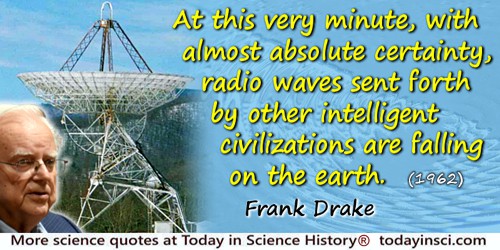
At this very minute, with almost absolute certainty, radio waves sent forth by other intelligent civilizations are falling on the earth. A telescope can be built that, pointed in the right place, and tuned to the right frequency, could discover these waves. Someday, from somewhere out among the stars, will come the answers to many of the oldest, most important, and most exciting questions mankind has asked.
In Intelligent Life in Space (1962), 111.
Because intelligence is our own most distinctive feature, we may incline to ascribe superior intelligence to the basic primate plan, or to the basic plan of the mammals in general, but this point requires some careful consideration. There is no question at all that most mammals of today are more intelligent than most reptiles of today. I am not going to try to define intelligence or to argue with those who deny thought or consciousness to any animal except man. It seems both common and scientific sense to admit that ability to learn, modification of action according to the situation, and other observable elements of behavior in animals reflect their degrees of intelligence and permit us, if only roughly, to compare these degrees. In spite of all difficulties and all the qualifications with which the expert (quite properly) hedges his conclusions, it also seems sensible to conclude that by and large an animal is likely to be more intelligent if it has a larger brain at a given body size and especially if its brain shows greater development of those areas and structures best developed in our own brains. After all, we know we are intelligent, even though we wish we were more so.
In The Meaning of Evolution: A Study of the History of Life and of its Significance for Man (1949), 78.
Before delivering your lectures, the manuscript should be in such a perfect form that, if need be, it could be set in type. Whether you follow the manuscript during the delivery of the lecture is purely incidental. The essential point is that you are thus master of the subject matter.
Advice to his son. As quoted in Ralph Oesper, The Human Side Of Scientists (1975), 185.
Behavioral avoidance, not physiological adaptations, is an organism’s primary response to an environmental challenge. This point is elementary, but it is by no means trivial.
From 'Interspecific comparison as a tool for ecological physiologists', collected in M.E. Feder, A.F. Bennett, W.W. Burggren, and R.B. Huey, (eds.), New Directions in Ecological Physiology (1987), 18.
Beyond a critical point within a finite space, freedom diminishes as numbers increase. ...The human question is not how many can possibly survive within the system, but what kind of existence is possible for those who do survive.
Dune
Both religion and natural science require a belief in God for their activities, to the former He is the starting point, and to the latter the goal of every thought process. To the former He is the foundation, to the latter, the crown of the edifice of every generalized world view.
Lecture, 'Religion and Natural Science' (1937) In Max Planck and Frank Gaynor (trans.), Scientific Autobiography and Other Papers (1949), 184.
Bradley is one of the few basketball players who have ever been appreciatively cheered by a disinterested away-from-home crowd while warming up. This curious event occurred last March, just before Princeton eliminated the Virginia Military Institute, the year’s Southern Conference champion, from the NCAA championships. The game was played in Philadelphia and was the last of a tripleheader. The people there were worn out, because most of them were emotionally committed to either Villanova or Temple-two local teams that had just been involved in enervating battles with Providence and Connecticut, respectively, scrambling for a chance at the rest of the country. A group of Princeton players shooting basketballs miscellaneously in preparation for still another game hardly promised to be a high point of the evening, but Bradley, whose routine in the warmup time is a gradual crescendo of activity, is more interesting to watch before a game than most players are in play. In Philadelphia that night, what he did was, for him, anything but unusual. As he does before all games, he began by shooting set shots close to the basket, gradually moving back until he was shooting long sets from 20 feet out, and nearly all of them dropped into the net with an almost mechanical rhythm of accuracy. Then he began a series of expandingly difficult jump shots, and one jumper after another went cleanly through the basket with so few exceptions that the crowd began to murmur. Then he started to perform whirling reverse moves before another cadence of almost steadily accurate jump shots, and the murmur increased. Then he began to sweep hook shots into the air. He moved in a semicircle around the court. First with his right hand, then with his left, he tried seven of these long, graceful shots-the most difficult ones in the orthodoxy of basketball-and ambidextrously made them all. The game had not even begun, but the presumably unimpressible Philadelphians were applauding like an audience at an opera.
A Sense of Where You Are: Bill Bradley at Princeton
But for the persistence of a student of this university in urging upon me his desire to study with me the modern algebra I should never have been led into this investigation; and the new facts and principles which I have discovered in regard to it (important facts, I believe), would, so far as I am concerned, have remained still hidden in the womb of time. In vain I represented to this inquisitive student that he would do better to take up some other subject lying less off the beaten track of study, such as the higher parts of the calculus or elliptic functions, or the theory of substitutions, or I wot not what besides. He stuck with perfect respectfulness, but with invincible pertinacity, to his point. He would have the new algebra (Heaven knows where he had heard about it, for it is almost unknown in this continent), that or nothing. I was obliged to yield, and what was the consequence? In trying to throw light upon an obscure explanation in our text-book, my brain took fire, I plunged with re-quickened zeal into a subject which I had for years abandoned, and found food for thoughts which have engaged my attention for a considerable time past, and will probably occupy all my powers of contemplation advantageously for several months to come.
In Johns Hopkins Commemoration Day Address, Collected Mathematical Papers, Vol. 3, 76.
But medicine has long had all its means to hand, and has discovered both a principle and a method, through which the discoveries made during a long period are many and excellent, while full discovery will be made, if the inquirer be competent, conduct his researches with knowledge of the discoveries already made, and make them his starting-point. But anyone who, casting aside and rejecting all these means, attempts to conduct research in any other way or after another fashion, and asserts that he has found out anything, is and has been victim of deception.
Ancient Medicine, in Hippocrates, trans. W. H. S. Jones (1923), Vol. I, 15.
But, as Bacon has well pointed out, truth is more likely to come out of error, if this is clear and definite, than out of confusion, and my experience teaches me that it is better to hold a well-understood and intelligible opinion, even if it should turn out to be wrong, than to be content with a muddle-headed mixture of conflicting views, sometimes miscalled impartiality, and often no better than no opinion at all.
Principles of General Physiology (1915), x.
By a recent estimate, nearly half the bills before the U.S. Congress have a substantial science-technology component and some two-thirds of the District of Columbia Circuit Court’s case load now involves review of action by federal administrative agencies; and more and more of such cases relate to matters on the frontiers of technology.
If the layman cannot participate in decision making, he will have to turn himself over, essentially blind, to a hermetic elite. … [The fundamental question becomes] are we still capable of self-government and therefore freedom?
Margaret Mead wrote in a 1959 issue of Daedalus about scientists elevated to the status of priests. Now there is a name for this elevation, when you are in the hands of—one hopes—a benevolent elite, when you have no control over your political decisions. From the point of view of John Locke, the name for this is slavery.
If the layman cannot participate in decision making, he will have to turn himself over, essentially blind, to a hermetic elite. … [The fundamental question becomes] are we still capable of self-government and therefore freedom?
Margaret Mead wrote in a 1959 issue of Daedalus about scientists elevated to the status of priests. Now there is a name for this elevation, when you are in the hands of—one hopes—a benevolent elite, when you have no control over your political decisions. From the point of view of John Locke, the name for this is slavery.
Quoted in 'Where is Science Taking Us? Gerald Holton Maps the Possible Routes', The Chronicle of Higher Education (18 May 1981). In Francis A. Schaeffer, A Christian Manifesto (1982), 80.
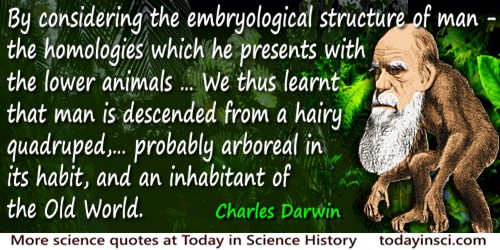
By considering the embryological structure of man - the homologies which he presents with the lower animals - the rudiments which he retains - and the reversions to which he is liable, we can partly recall in imagination the former condition of our early progenitors; and we can approximately place them in their proper position in the zoological series. We thus learnt that man is descended from a hairy quadruped, furnished with a tail and pointed ears, probably arboreal in its habit, and an inhabitant of the Old World. This creature, if its whole structure had been examined by a naturalist, would have been classed among the Quadrumana, as surely as would be the common and still more ancient progenitor of the Old and New World monkeys.
The Descent of Man (1871), Vol. 2, 389.
By destroying the biological character of phenomena, the use of averages in physiology and medicine usually gives only apparent accuracy to the results. From our point of view, we may distinguish between several kinds of averages: physical averages, chemical averages and physiological and pathological averages. If, for instance, we observe the number of pulsations and the degree of blood pressure by means of the oscillations of a manometer throughout one day, and if we take the average of all our figures to get the true or average blood pressure and to learn the true or average number of pulsations, we shall simply have wrong numbers. In fact, the pulse decreases in number and intensity when we are fasting and increases during digestion or under different influences of movement and rest; all the biological characteristics of the phenomenon disappear in the average. Chemical averages are also often used. If we collect a man's urine during twenty-four hours and mix all this urine to analyze the average, we get an analysis of a urine which simply does not exist; for urine, when fasting, is different from urine during digestion. A startling instance of this kind was invented by a physiologist who took urine from a railroad station urinal where people of all nations passed, and who believed he could thus present an analysis of average European urine! Aside from physical and chemical, there are physiological averages, or what we might call average descriptions of phenomena, which are even more false. Let me assume that a physician collects a great many individual observations of a disease and that he makes an average description of symptoms observed in the individual cases; he will thus have a description that will never be matched in nature. So in physiology, we must never make average descriptions of experiments, because the true relations of phenomena disappear in the average; when dealing with complex and variable experiments, we must study their various circumstances, and then present our most perfect experiment as a type, which, however, still stands for true facts. In the cases just considered, averages must therefore be rejected, because they confuse, while aiming to unify, and distort while aiming to simplify. Averages are applicable only to reducing very slightly varying numerical data about clearly defined and absolutely simple cases.
From An Introduction to the Study of Experimental Medicine (1865), as translated by Henry Copley Greene (1957), 134-135.
By the early 1960s Pauling had earned a reputation for being audacious, intuitive, charming, irreverent, self-promoting, self-reliant, self-involved to the point of arrogance and correct about almost everything.
In Force of Nature: The Life of Linus Pauling (1995), 13.
Cells are required to stick precisely to the point. Any ambiguity, any tendency to wander from the matter at hand, will introduce grave hazards for the cells, and even more for the host in which they live. … There is a theory that the process of aging may be due to the cumulative effect of imprecision, a gradual degrading of information. It is not a system that allows for deviating.
In 'Information', The Lives of a Cell: Notes of a Biology Watcher (1974), 110-111.
Centripetal force is the force by which bodies are drawn from all sides, are impelled, or in any way tend, toward some point as to a center.
The Principia: Mathematical Principles of Natural Philosophy (1687), 3rd edition (1726), trans. I. Bernard Cohen and Anne Whitman (1999), Definition 5, 405.
Certain elements have the property of producing the same crystal form when in combination with an equal number of atoms of one or more common elements, and the elements, from his point of view, can be arranged in certain groups. For convenience I have called the elements belonging to the same group … isomorphous.
Originally published in 'Om Förhållandet emellan chemiska sammansättningen och krystallformen hos Arseniksyrade och Phosphorsyrade Salter', (On the Relation between the Chemical Composition and Crystal Form of Salts of Arsenic and Phosphoric Acids), Kungliga Svenska vetenskapsakademiens handlingar (1821), 4. In F. Szabadváry article on 'Eilhard Mitscherlich' in Charles Coulston Gillispie (ed.), Dictionary of Scientific Biography (1974), Vol. 9, 424; perhaps from J.R. Partington, A History of Chemistry, Vol. 4 (1964), 210.
Contrary to popular parlance, Darwin didn't discover evolution. He uncovered one (most would say the) essential mechanism by which it operates: natural selection. Even then, his brainstorm was incomplete until the Modern Synthesis of the early/mid-20th century when (among other things) the complementary role of genetic heredity was fully realized. Thousands upon thousands of studies have followed, providing millions of data points that support this understanding of how life on Earth has come to be as it is.
In online article, 'The Day That Botany Took on Bobby Jindal by Just Being Itself', Huffington Post (5 Aug 2013).
Creating a new theory is not like destroying an old barn and erecting a skyscraper in its place. It is rather like climbing a mountain, gaining new and wider views, discovering unexpected connections between our starting point and its rich environment. But the point from which we started out still exists and can be seen, although it appears smaller and forms a tiny part of our broad view gained by the mastery of the obstacles on our adventurous way up.
Curves that have no tangents are the rule. … Those who hear of curves without tangents, or of functions without derivatives, often think at first that Nature presents no such complications. … The contrary however is true. … Consider, for instance, one of the white flakes that are obtained by salting a solution of soap. At a distance its contour may appear sharply defined, but as we draw nearer its sharpness disappears. The eye can no longer draw a tangent at any point. … The use of a magnifying glass or microscope leaves us just as uncertain, for fresh irregularities appear every time we increase the magnification. … An essential characteristic of our flake … is that we suspect … that any scale involves details that absolutely prohibit the fixing of a tangent.
(1906). As quoted “in free translation” in Benoit B. Mandelbrot, The Fractal Geometry of Nature (1977, 1983), 7.
Darwin's characteristic perspicacity is nowhere better illustrated than in his prophecy of the reaction of the world of science. He admitted at once that it would be impossible to convince those older men '...whose minds are stocked with a multitude of facts, all viewed ... from a point of view directly opposite to mine ... A few naturalists endowed with much flexibility of mind and who have already begun to doubt the immutability of species, may be influenced by this volume; but I look with confidence to the young and rising naturalists, who will be able to view both sides with equal impartiality.
'The Reaction of American scientists to Darwinism', American Historical Review 1932), 38, 687. Quoted in David L. Hull, Science as Process (), 379.
Descartes constructed as noble a road of science, from the point at which he found geometry to that to which he carried it, as Newton himself did after him. ... He carried this spirit of geometry and invention into optics, which under him became a completely new art.
A Philosophical Dictionary: from the French? (2nd Ed.,1824), Vol. 5, 110.
Dissection … teaches us that the body of man is made up of certain kinds of material, so differing from each other in optical and other physical characters and so built up together as to give the body certain structural features. Chemical examination further teaches us that these kinds of material are composed of various chemical substances, a large number of which have this characteristic that they possess a considerable amount of potential energy capable of being set free, rendered actual, by oxidation or some other chemical change. Thus the body as a whole may, from a chemical point of view, be considered as a mass of various chemical substances, representing altogether a considerable capital of potential energy.
From Introduction to A Text Book of Physiology (1876, 1891), Book 1, 1.
Does it not seem as if Algebra had attained to the dignity of a fine art, in which the workman has a free hand to develop his conceptions, as in a musical theme or a subject for a painting? It has reached a point where every properly developed algebraical composition, like a skillful landscape, is expected to suggest the notion of an infinite distance lying beyond the limits of the canvas.
In 'Lectures on the Theory of Reciprocants', Lecture XXI, American Journal of Mathematics (Jul 1886), 9, No. 3, 136.
Dr. Bhabha was a visionary. He had excellent command over electronics, physics and he saw the dream of India being a nuclear power. … He was a perfectionist and would leave no point of suspicion while working on any project. He was an inspiration.
Interview in newsletter of the Raja Ramanna Centre for Advanced Technology (Oct 2001), online.
Dr. M.L. von Franz has explained the circle (or sphere) as a symbol of Self. It expresses the totality of the psyche in all its aspects, including the relationship between man and the whole of nature. It always points to the single most vital aspect of life, its ultimate wholeness.
In Aniela Jaffé, 'Symbolism in the Visual Arts', collected in Carl Jung (ed.), Man and His Symbols (1964, 1968), 266.
During the half-century that has elapsed since the enunciation of the cell-theory by Schleiden and Schwann, in 1838-39, it has became ever more clearly apparent that the key to all ultimate biological problems must, in the last analysis, be sought in the cell. It was the cell-theory that first brought the structure of plants and animals under one point of view by revealing their common plan of organization. It was through the cell-theory that Kolliker and Remak opened the way to an understanding of the nature of embryological development, and the law of genetic continuity lying at the basis of inheritance. It was the cell-theory again which, in the hands of Virchaw and Max Schultze, inaugurated a new era in the history of physiology and pathology, by showing that all the various functions of the body, in health and in disease, are but the outward expression of cell-activities. And at a still later day it was through the cell-theory that Hertwig, Fol, Van Beneden, and Strasburger solved the long-standing riddle of the fertilization of the egg, and the mechanism of hereditary transmission. No other biological generalization, save only the theory of organic evolution, has brought so many apparently diverse phenomena under a common point of view or has accomplished more far the unification of knowledge. The cell-theory must therefore be placed beside the evolution-theory as one of the foundation stones of modern biology.
In The Cell in Development and Inheritance (1896), 1.
During this [book preparation] time attacks have not been wanting—we must always be prepared for them. If they grow out of a scientific soil, they cannot but be useful, by laying bare weak points and stimulating to their correction; but if they proceed from that soil, from which the lilies of innocence and the palms of conciliation should spring up, where, however, nothing but the marsh-trefoil of credulity and the poisonous water-hemlock of calumniation grow, they deserve no attention.
From Carl Vogt and James Hunt (ed.), Lectures on Man: His Place in Creation, and in the History of the Earth (1861), Author's Preface, 2-3.
Dust consisting of fine fibers of asbestos, which are insoluble and virtually indestructible, may become a public health problem in the near future. At a recent international conference on the biological effects of asbestos sponsored by the New York Academy of Sciences, participants pointed out on the one hand that workers exposed to asbestos dust are prone in later life to develop lung cancer, and on the other hand that the use of this family of fibrous silicate compounds has expanded enormously during the past few decades. A laboratory curiosity 100 years ago, asbestos today is a major component of building materials.
— Magazine
In Scientific American (Sep 1964). As cited in '50, 100 & 150 Years Ago', Scientific American (Dec 2014), 311, No. 6, 98.
Earlier this week … scientists announced the completion of a task that once seemed unimaginable; and that is, the deciphering of the entire DNA sequence of the human genetic code. This amazing accomplishment is likely to affect the 21st century as profoundly as the invention of the computer or the splitting of the atom affected the 20th century. I believe that the 21st century will be the century of life sciences, and nothing makes that point more clearly than this momentous discovery. It will revolutionize medicine as we know it today.
Senate Session, Congressional Record (29 Jun 2000) Vol. 146, No 85, S6050.
Educators may bring upon themselves unnecessary travail by taking a tactless and unjustifiable position about the relation between scientific and religious narratives. … The point is that profound but contradictory ideas may exist side by side, if they are constructed from different materials and methods and have different purposes. Each tells us something important about where we stand in the universe, and it is foolish to insist that they must despise each other.
In The End of Education: Redefining the Value of School (1995), 107.
Either one or the other [analysis or synthesis] may be direct or indirect. The direct procedure is when the point of departure is known-direct synthesis in the elements of geometry. By combining at random simple truths with each other, more complicated ones are deduced from them. This is the method of discovery, the special method of inventions, contrary to popular opinion.
Ampère gives this example drawn from geometry to illustrate his meaning for “direct synthesis” when deductions following from more simple, already-known theorems leads to a new discovery. In James R. Hofmann, André-Marie Ampère (1996), 159. Cites Académie des Sciences Ampère Archives, box 261.
Electricity is often called wonderful, beautiful; but it is so only in common with the other forces of nature. The beauty of electricity or of any other force is not that the power is mysterious, and unexpected, touching every sense at unawares in turn, but that it is under law, and that the taught intellect can even govern it largely. The human mind is placed above, and not beneath it, and it is in such a point of view that the mental education afforded by science is rendered super-eminent in dignity, in practical application and utility; for by enabling the mind to apply the natural power through law, it conveys the gifts of God to man.
Notes for a Friday Discourse at the Royal Institution (1858).
England and all civilised nations stand in deadly peril of not having enough to eat. As mouths multiply, food resources dwindle. Land is a limited quantity, and the land that will grow wheat is absolutely dependent on difficult and capricious natural phenomena... I hope to point a way out of the colossal dilemma. It is the chemist who must come to the rescue of the threatened communities. It is through the laboratory that starvation may ultimately be turned into plenty... The fixation of atmospheric nitrogen is one of the great discoveries, awaiting the genius of chemists.
Presidential Address to the British Association for the Advancement of Science 1898. Published in Chemical News, 1898, 78, 125.
Ethnologists regard man as the primitive element of tribes, races, and peoples. The anthropologist looks at him as a member of the fauna of the globe, belonging to a zoölogical classification, and subject to the same laws as the rest of the animal kingdom. To study him from the last point of view only would be to lose sight of some of his most interesting and practical relations; but to be confined to the ethnologist’s views is to set aside the scientific rule which requires us to proceed from the simple to the compound, from the known to the unknown, from the material and organic fact to the functional phenomenon.
'Paul Broca and the French School of Anthropology'. Lecture delivered in the National Museum, Washington, D.C., 15 April 1882, by Dr. Robert Fletcher. In The Saturday Lectures (1882), 118.
Euclid always contemplates a straight line as drawn between two definite points, and is very careful to mention when it is to be produced beyond this segment. He never thinks of the line as an entity given once for all as a whole. This careful definition and limitation, so as to exclude an infinity not immediately apparent to the senses, was very characteristic of the Greeks in all their many activities. It is enshrined in the difference between Greek architecture and Gothic architecture, and between Greek religion and modern religion. The spire of a Gothic cathedral and the importance of the unbounded straight line in modern Geometry are both emblematic of the transformation of the modern world.
In Introduction to Mathematics (1911), 119.
Euclidean mathematics assumes the completeness and invariability of mathematical forms; these forms it describes with appropriate accuracy and enumerates their inherent and related properties with perfect clearness, order, and completeness, that is, Euclidean mathematics operates on forms after the manner that anatomy operates on the dead body and its members. On the other hand, the mathematics of variable magnitudes—function theory or analysis—considers mathematical forms in their genesis. By writing the equation of the parabola, we express its law of generation, the law according to which the variable point moves. The path, produced before the eyes of the student by a point moving in accordance to this law, is the parabola.
If, then, Euclidean mathematics treats space and number forms after the manner in which anatomy treats the dead body, modern mathematics deals, as it were, with the living body, with growing and changing forms, and thus furnishes an insight, not only into nature as she is and appears, but also into nature as she generates and creates,—reveals her transition steps and in so doing creates a mind for and understanding of the laws of becoming. Thus modern mathematics bears the same relation to Euclidean mathematics that physiology or biology … bears to anatomy.
If, then, Euclidean mathematics treats space and number forms after the manner in which anatomy treats the dead body, modern mathematics deals, as it were, with the living body, with growing and changing forms, and thus furnishes an insight, not only into nature as she is and appears, but also into nature as she generates and creates,—reveals her transition steps and in so doing creates a mind for and understanding of the laws of becoming. Thus modern mathematics bears the same relation to Euclidean mathematics that physiology or biology … bears to anatomy.
In Die Mathematik die Fackelträgerin einer neuen Zeit (1889), 38. As translated in Robert Édouard Moritz, Memorabilia Mathematica; Or, The Philomath’s Quotation-book (1914), 112-113.
Every definition implies an axiom, since it asserts the existence of the object defined. The definition then will not be justified, from the purely logical point of view, until we have ‘proved’ that it involves no contradiction either in its terms or with the truths previously admitted.
…...
Every lecture should state one main point and repeat it over and over, like a theme with variations. An audience is like a herd of cows, moving slowly in the direction they are being driven towards. If we make one point, we have a good chance that the audience will take the right direction; if we make several points, then the cows will scatter all over the field. The audience will lose interest and everyone will go back to the thoughts they interrupted in order to come to our lecture.
In 'Ten Lessons I Wish I Had Been Taught', Indiscrete Thoughts (2008), 196.
Every science touches art at some points—every art has its scientific side.
In Armand Trousseau and John Rose Cormack (trans.), Lectures on Clinical Medicine: Delivered at the Hôtel-Dieu, Paris (1869), Vol. 2, 40.
Everyone makes for himself a clear idea of the motion of a point, that is to say, of the motion of a corpuscle which one supposes to be infinitely small, and which one reduces by thought in some way to a mathematical point.
Théorie Nouvelle de la Rotation des Corps (1834). As translated by Charles Thomas Whitley in Outlines of a New Theory of Rotatory Motion (1834), 1.
Everything is made of atoms ... Everything that animals do, atoms do. ... There is nothing that living things do that cannot be understood from the point of view that they are made of atoms acting according to the laws of physics.
In The Feynman Lectures (1963), 8.
Fanatical ethnic or religious or national chauvinisms are a little difficult to maintain when we see our planet as a fragile blue crescent fading to become an inconspicuous point of light against a bastion and citadel of the stars.
Cosmos
Finally one should add that in spite of the great complexity of protein synthesis and in spite of the considerable technical difficulties in synthesizing polynucleotides with defined sequences it is not unreasonable to hope that all these points will be clarified in the near future, and that the genetic code will be completely established on a sound experimental basis within a few years.
From Nobel Lecture (11 Dec 1962), 'On the Genetic Code'. Collected in Nobel Lectures: Physiology or Medicine 1942-1962 (1964), 808.
Firm support has been found for the assertion that electricity occurs at thousands of points where we at most conjectured that it was present. Innumerable electrical particles oscillate in every flame and light source. We can in fact assume that every heat source is filled with electrons which will continue to oscillate ceaselessly and indefinitely. All these electrons leave their impression on the emitted rays. We can hope that experimental study of the radiation phenomena, which are exposed to various influences, but in particular to the effect of magnetism, will provide us with useful data concerning a new field, that of atomistic astronomy, as Lodge called it, populated with atoms and electrons instead of planets and worlds.
'Light Radiation in a Magnetic Field', Nobel Lecture, 2 May 1903. In Nobel Lectures: Physics 1901-1921 (1967), 40.
First, as concerns the success of teaching mathematics. No instruction in the high schools is as difficult as that of mathematics, since the large majority of students are at first decidedly disinclined to be harnessed into the rigid framework of logical conclusions. The interest of young people is won much more easily, if sense-objects are made the starting point and the transition to abstract formulation is brought about gradually. For this reason it is psychologically quite correct to follow this course.
Not less to be recommended is this course if we inquire into the essential purpose of mathematical instruction. Formerly it was too exclusively held that this purpose is to sharpen the understanding. Surely another important end is to implant in the student the conviction that correct thinking based on true premises secures mastery over the outer world. To accomplish this the outer world must receive its share of attention from the very beginning.
Doubtless this is true but there is a danger which needs pointing out. It is as in the case of language teaching where the modern tendency is to secure in addition to grammar also an understanding of the authors. The danger lies in grammar being completely set aside leaving the subject without its indispensable solid basis. Just so in Teaching of Mathematics it is possible to accumulate interesting applications to such an extent as to stunt the essential logical development. This should in no wise be permitted, for thus the kernel of the whole matter is lost. Therefore: We do want throughout a quickening of mathematical instruction by the introduction of applications, but we do not want that the pendulum, which in former decades may have inclined too much toward the abstract side, should now swing to the other extreme; we would rather pursue the proper middle course.
Not less to be recommended is this course if we inquire into the essential purpose of mathematical instruction. Formerly it was too exclusively held that this purpose is to sharpen the understanding. Surely another important end is to implant in the student the conviction that correct thinking based on true premises secures mastery over the outer world. To accomplish this the outer world must receive its share of attention from the very beginning.
Doubtless this is true but there is a danger which needs pointing out. It is as in the case of language teaching where the modern tendency is to secure in addition to grammar also an understanding of the authors. The danger lies in grammar being completely set aside leaving the subject without its indispensable solid basis. Just so in Teaching of Mathematics it is possible to accumulate interesting applications to such an extent as to stunt the essential logical development. This should in no wise be permitted, for thus the kernel of the whole matter is lost. Therefore: We do want throughout a quickening of mathematical instruction by the introduction of applications, but we do not want that the pendulum, which in former decades may have inclined too much toward the abstract side, should now swing to the other extreme; we would rather pursue the proper middle course.
In Ueber den Mathematischen Unterricht an den hoheren Schulen; Jahresbericht der Deutschen Mathematiker Vereinigung, Bd. 11, 131.
Following the original proposal of Belinfante, “the writer has in a recent note on the meson theory of nuclear forces” used the word “nuclon” as a common notation for the heavy nuclear constituents, neutrons and protons. In the meantime, however, it has been pointed out to me that, since the root of the word nucleus is “nucle”, the notation “nucleon” would from a philological point of view be more appropriate for this purpose….
In Physical Review (1 Feb 1941), 59, 323. For book using the word “nuclon”, see Frederik Jozef Belinfante, Theory of Heavy Quanta: Proefschrift (1939), 40.
For if medicine is really to accomplish its great task, it must intervene in political and social life. It must point out the hindrances that impede the normal social functioning of vital processes, and effect their removal.
In Die einheitsrebungen in der wissenschaftlichen medicin (1849), 48. As quoted and citefd in Paul Farmer, Pathologies of Power (2004), 323.
For many of us, water simply flows from a faucet, and we think little about it beyond this point of contact. We have lost a sense of respect for the wild river, for the complex workings of a wetland, for the intricate web of life that water supports.
Last Oasis: Facing Water Scarcity (1997), 184.
For myself, I found that I was fitted for nothing so well as for the study of Truth; as having a mind nimble and versatile enough to catch the resemblances of things (which is the chief point) , and at the same time steady enough to fix and distinguish their subtler differences; as being gifted by nature with desire to seek, patience to doubt, fondness to meditate, slowness to assert, readiness to reconsider, carefulness to dispose and set in order; and as being a man that neither affects what is new nor admires what is old, and that hates every kind of imposture. So I thought my nature had a kind of familiarity and relationship with Truth.
From 'Progress of philosophical speculations. Preface to intended treatise De Interpretatione Naturæ (1603), in Francis Bacon and James Spedding (ed.), Works of Francis Bacon (1868), Vol. 3, 85.
For some months the astronomer Halley and other friends of Newton had been discussing the problem in the following precise form: what is the path of a body attracted by a force directed toward a fixed point, the force varying in intensity as the inverse of the distance? Newton answered instantly, “An ellipse.” “How do you know?” he was asked. “Why, I have calculated it.” Thus originated the imperishable Principia, which Newton later wrote out for Halley. It contained a complete treatise on motion.
In The Handmaiden of the Sciences (1937), 37.
For the saving the long progression of the thoughts to remote and first principles in every case, the mind should provide itself several stages; that is to say, intermediate principles, which it might have recourse to in the examining those positions that come in its way. These, though they are not self-evident principles, yet, if they have been made out from them by a wary and unquestionable deduction, may be depended on as certain and infallible truths, and serve as unquestionable truths to prove other points depending upon them, by a nearer and shorter view than remote and general maxims. … And thus mathematicians do, who do not in every new problem run it back to the first axioms through all the whole train of intermediate propositions. Certain theorems that they have settled to themselves upon sure demonstration, serve to resolve to them multitudes of propositions which depend on them, and are as firmly made out from thence as if the mind went afresh over every link of the whole chain that tie them to first self-evident principles.
In The Conduct of the Understanding, Sect. 21.
For these two years I have been gravitating towards your doctrines, and since the publication of your primula paper with accelerated velocity. By about this time next year I expect to have shot past you, and to find you pitching into me for being more Darwinian than yourself. However, you have set me going, and must just take the consequences, for I warn you I will stop at no point so long as clear reasoning will take me further.
Thomas Henry Huxley, Leonard Huxley, Life and Letters of Thomas Henry Huxley (1901), 211.
For us, an atom shall be a small, spherical, homogeneous body or an essentially indivisible, material point, whereas a molecule shall be a separate group of atoms in any number and of any nature.
Annales de Chimie 1833, 52, 133. Trans. W. H. Brock.
For we may remark generally of our mathematical researches, that these auxiliary quantities, these long and difficult calculations into which we are often drawn, are almost always proofs that we have not in the beginning considered the objects themselves so thoroughly and directly as their nature requires, since all is abridged and simplified, as soon as we place ourselves in a right point of view.
In Théorie Nouvelle de la Rotation des Corps (1834). As translated by Charles Thomas Whitley in Outlines of a New Theory of Rotatory Motion (1834), 4.
For, every time a certain portion is destroyed, be it of the brain or of the spinal cord, a function is compelled to cease suddenly, and before the time known beforehand when it would stop naturally, it is certain that this function depends upon the area destroyed. It is in this way that I have recognized that the prime motive power of respiration has its seat in that part of the medulla oblongata that gives rise to the nerves of the eighth pair [vagi]; and it is by this method that up to a certain point it will be possible to discover the use of certain parts of the brain.
Expériences sur le Principe de la Vie, Notamment sur celui des Mouvements du Coeur, et sur le Siege de ce Principe (1812), 148-149. Translated in Edwin Clarke and L. S. Jacyna, Nineteenth Century Origins of Neuroscientific Concepts (1987), 247.
For, however much we may clench our teeth in anger, we cannot but confess, in opposition to Galen’s teaching but in conformity with the might of Aristotle’s opinion, that the size of the orifice of the hollow vein at the right chamber of the heart is greater than that of the body of the hollow vein, no matter where you measure the latter. Then the following chapter will show the falsity of Galen’s view that the hollow vein is largest at the point where it joins the hump of the liver.
From De Humani Corporis Fabrica Libri Septem (1543), Book III, 275, as translated by William Frank Richardson and John Burd Carman, in 'The Arguments Advanced by Galen in Opposition to Aristotl’s Views about the Origin of the Hollow Vein Do Not Have Oracular Authority', On The Fabric of the Human Body: Book III: The Veins And Arteries; Book IV: The Nerves (1998), 45.
Forty years as an astronomer have not quelled my enthusiasm for lying outside after dark, staring up at the stars. It isn’t only the beauty of the night sky that thrills me. It’s the sense I have that some of those points of light—which ones I can’t even guess—are the home stars of beings not so different from us, daily cares and all, who look across space and wonder, just as we do.
In Frank Drake and Dava Sobel, Is Anyone Out There?: The Scientific Search for Extraterrestrial Intelligence (1992), 1.
Four college students taking a class together, had done so well through the semester, and each had an “A”. They were so confident, the weekend before finals, they went out partying with friends. Consequently, on Monday, they overslept and missed the final. They explained to the professor that they had gone to a remote mountain cabin for the weekend to study, but, unfortunately, they had a flat tire on the way back, didn’t have a spare, and couldn’t get help for a long time. As a result, they missed the final. The professor kindly agreed they could make up the final the following day. When they arrived the next morning, he placed them each in separate rooms, handed each one a test booklet, and told them to begin. The the first problem was simple, worth 5 points. Turning the page they found the next question, written: “(For 95 points): Which tire?”
Fractal is a word invented by Mandelbrot to bring together under one heading a large class of objects that have [played] … an historical role … in the development of pure mathematics. A great revolution of ideas separates the classical mathematics of the 19th century from the modern mathematics of the 20th. Classical mathematics had its roots in the regular geometric structures of Euclid and the continuously evolving dynamics of Newton. Modern mathematics began with Cantor’s set theory and Peano’s space-filling curve. Historically, the revolution was forced by the discovery of mathematical structures that did not fit the patterns of Euclid and Newton. These new structures were regarded … as “pathological,” .… as a “gallery of monsters,” akin to the cubist paintings and atonal music that were upsetting established standards of taste in the arts at about the same time. The mathematicians who created the monsters regarded them as important in showing that the world of pure mathematics contains a richness of possibilities going far beyond the simple structures that they saw in Nature. Twentieth-century mathematics flowered in the belief that it had transcended completely the limitations imposed by its natural origins.
Now, as Mandelbrot points out, … Nature has played a joke on the mathematicians. The 19th-century mathematicians may not have been lacking in imagination, but Nature was not. The same pathological structures that the mathematicians invented to break loose from 19th-century naturalism turn out to be inherent in familiar objects all around us.
Now, as Mandelbrot points out, … Nature has played a joke on the mathematicians. The 19th-century mathematicians may not have been lacking in imagination, but Nature was not. The same pathological structures that the mathematicians invented to break loose from 19th-century naturalism turn out to be inherent in familiar objects all around us.
From 'Characterizing Irregularity', Science (12 May 1978), 200, No. 4342, 677-678. Quoted in Benoit Mandelbrot, The Fractal Geometry of Nature (1977, 1983), 3-4.
From a pragmatic point of view, the difference between living against a background of foreigness (an indifferent Universe) and one of intimacy (a benevolent Universe) means the difference between a general habit of wariness and one of trust.
…...
From an entertainment point of view, the Solar System has been a bust. None of the planets turns out to have any real-estate potential, and most of them are probably even useless for filming Dune sequels.
From essay 'First Person Secular: Blocking the Gates to Heaven', Mother Jones Magazine (Jun 1986), 48. Collected in The Worst Years of our Lives: Irreverent Notes from a Decade of Greed (1995), 267.
From the point of view of a tapeworm, man was created by God to serve the appetite of the tapeworm.
In 'Philosophy, Religion, and So Forth', A Voice Crying in the Wilderness (1989), 4.
From the point of view of the physicist, a theory of matter is a policy rather than a creed; its object is to connect or co-ordinate apparently diverse phenomena, and above all to suggest, stimulate and direct experiment. It ought to furnish a compass which, if followed, will lead the observer further and further into previously unexplored regions.
The Corpuscular Theory of Matter (1907), 1.
From the point of view of the pure morphologist the recapitulation theory is an instrument of research enabling him to reconstruct probable lines of descent; from the standpoint of the student of development and heredity the fact of recapitulation is a difficult problem whose solution would perhaps give the key to a true understanding of the real nature of heredity.
Form and Function: A Contribution to the History of Animal Morphology (1916), 312-3.
From the rocket we can see the huge sphere of the planet in one or another phase of the Moon. We can see how the sphere rotates, and how within a few hours it shows all its sides successively ... and we shall observe various points on the surface of the Earth for several minutes and from different sides very closely. This picture is so majestic, attractive and infinitely varied that I wish with all my soul that you and I could see it. (1911)
As translated in William E. Burrows, The Survival Imperative: Using Space to Protect Earth (2007), 147. From Tsiolkovsky's 'The Investigation of Universal Space by Means of Reactive Devices', translated in K.E. Tsiolkovsky, Works on Rocket Technology (NASA, NASATT F-243, n.d.), 76-77.
From the time of Aristotle it had been said that man is a social animal: that human beings naturally form communities. I couldn’t accept it. The whole of history and pre-history is against it. The two dreadful world wars we have recently been through, and the gearing of our entire economy today for defensive war belie it. Man's loathsome cruelty to man is his most outstanding characteristic; it is explicable only in terms of his carnivorous and cannibalistic origin. Robert Hartmann pointed out that both rude and civilised peoples show unspeakable cruelty to one another. We call it inhuman cruelty; but these dreadful things are unhappily truly human, because there is nothing like them in the animal world. A lion or tiger kills to eat, but the indiscriminate slaughter and calculated cruelty of human beings is quite unexampled in nature, especially among the apes. They display no hostility to man or other animals unless attacked. Even then their first reaction is to run away.
In Africa's Place In the Emergence of Civilisation (1959), 41.
From whence it is obvious to conclude that, since our Faculties are not fitted to penetrate into the internal Fabrick and real Essences of Bodies; but yet plainly discover to us the Being of a GOD, and the Knowledge of our selves, enough to lead us into a full and clear discovery of our Duty, and great Concernment, it will become us, as rational Creatures, to imploy those Faculties we have about what they are most adapted to, and follow the direction of Nature, where it seems to point us out the way.
An Essay Concerning Human Understanding (1690). Edited by Peter Nidditch (1975), Book 4, Chapter 12, Section 11, 646.
Gaia is a thin spherical shell of matter that surrounds the incandescent interior; it begins where the crustal rocks meet the magma of the Earth’s hot interior, about 100 miles below the surface, and proceeds another 100 miles outwards through the ocean and air to the even hotter thermosphere at the edge of space. It includes the biosphere and is a dynamic physiological system that has kept our planet fit for life for over three billion years. I call Gaia a physiological system because it appears to have the unconscious goal of regulating the climate and the chemistry at a comfortable state for life. Its goals are not set points but adjustable for whatever is the current environment and adaptable to whatever forms of life it carries.
In The Revenge of Gaia: Earth’s Climate Crisis & The Fate of Humanity (2006, 2007), 19.
Generality of points of view and of methods, precision and elegance in presentation, have become, since Lagrange, the common property of all who would lay claim to the rank of scientific mathematicians. And, even if this generality leads at times to abstruseness at the expense of intuition and applicability, so that general theorems are formulated which fail to apply to a single special case, if furthermore precision at times degenerates into a studied brevity which makes it more difficult to read an article than it was to write it; if, finally, elegance of form has well-nigh become in our day the criterion of the worth or worthlessness of a proposition,—yet are these conditions of the highest importance to a wholesome development, in that they keep the scientific material within the limits which are necessary both intrinsically and extrinsically if mathematics is not to spend itself in trivialities or smother in profusion.
In Die Entwickdung der Mathematik in den letzten Jahrhunderten (1884), 14-15.
Geologists are rapidly becoming convinced that the mammals spread from their central Asian point of origin largely because of great variations in climate.
The Red Man's Continent: A Chronicle of Aboriginal America (1919), 13.
Gifford Pinchot points out that in colonial and pioneer days the forest was a foe and an obstacle to the settler. It had to be cleared away... But [now] as a nation we have not yet come to have a proper respect for the forest and to regard it as an indispensable part of our resources—one which is easily destroyed but difficult to replace; one which confers great benefits while it endures, but whose disappearance is accompanied by a train of evil consequences not readily foreseen and positively irreparable.
Concluding remark, in 'A Country that has Used up its Trees', The Outlook (24 Mar 1906), 82, 700. The topic of the article is the extensive deforestation in China, its consequences, and that America must avoid such massive problems.
God is a philosophical black hole—the point where reason breaks down.
In Quotations: Superultramodern Science and Philosophy (2005), 5.
Good applied science in medicine, as in physics, requires a high degree of certainty about the basic facts at hand, and especially about their meaning, and we have not yet reached this point for most of medicine.
The Medusa and the Snail (1979), 143.
Gradually, at various points in our childhoods, we discover different forms of conviction. There’s the rock-hard certainty of personal experience (“I put my finger in the fire and it hurt,”), which is probably the earliest kind we learn. Then there’s the logically convincing, which we probably come to first through maths, in the context of Pythagoras’s theorem or something similar, and which, if we first encounter it at exactly the right moment, bursts on our minds like sunrise with the whole universe playing a great chord of C Major.
In short essay, 'Dawkins, Fairy Tales, and Evidence', 2.
Heat may be considered, either in respect of its quantity, or of its intensity. Thus two lbs. of water, equally heated, must contain double the quantity that one of them does, though the thermometer applied to them separately, or together, stands at precisely the same point, because it requires double the time to heat two lbs. as it does to heat one.
In Alexander Law, Notes of Black's Lectures, vol. 1, 5. Cited in Charles Coulston Gillispie, Dictionary of Scientific Biography: Volumes 1-2 (1981), 178.
Herewith I offer you the Omnipotent Finger of God in the anatomy of a louse: wherein you will find miracles heaped on miracles and will see the wisdom of God clearly manifested in a minute point.
Letter to Melchisedec Thevenot (Apr 1678). In G. A. Lindeboom (ed.), The Letters of Jan Swammerdam to Melchisedec Thivenot (1975), 104-5.
How many and how curious problems concern the commonest of the sea-snails creeping over the wet sea-weed! In how many points of view may its history be considered! There are its origin and development, the mystery of its generation, the phenomena of its growth, all concerning each apparently insignificant individual; there is the history of the species, the value of its distinctive marks, the features which link it with the higher and lower creatures, the reason why it takes its stand where we place it in the scale of creation, the course of its distribution, the causes of its diffusion, its antiquity or novelty, the mystery (deepest of mysteries) of its first appearance, the changes of the outline of continents and of oceans which have taken place since its advent, and their influence on its own wanderings.
On the Natural History of European Seas. In George Wilson and Archibald Geikie, Memoir of Edward Forbes F.R.S. (1861), 547-8.
I am a believer in unconscious cerebration. The brain is working all the time, though we do not know it. At night it follows up what we think in the daytime. When I have worked a long time on one thing, I make it a point to bring all the facts regarding it together before I retire; I have often been surprised at the results… We are thinking all the time; it is impossible not to think.
In Orison Swett Marden, 'Bell Telephone Talk: Hints on Success by Alexander G. Bell', How They Succeeded: Life Stories of Successful Men Told by Themselves (1901), 33.
I am quite aware that we have just now lightheartedly expelled in imagination many excellent men who are largely, perhaps chiefly, responsible for the buildings of the temple of science; and in many cases our angel would find it a pretty ticklish job to decide. But of one thing I feel sure: if the types we have just expelled were the only types there were, the temple would never have come to be, any more than a forest can grow which consists of nothing but creepers. For these people any sphere of human activity will do, if it comes to a point; whether they become engineers, officers, tradesmen, or scientists depends on circumstances.
…...
I am sorry to say that there is too much point to the wisecrack that life is extinct on other planets because their scientists were more advanced than ours.
From Speech (11 Dec 1959) at Washington, D.C., 'Disarmament', printed in President John F. Kennedy, A Grand and Global Alliance (1968), 1.
I became expert at dissecting crayfish. At one point I had a crayfish claw mounted on an apparatus in such a way that I could operate the individual nerves. I could get the several-jointed claw to reach down and pick up a pencil and wave it around. I am not sure that what I was doing had much scientific value, although I did learn which nerve fiber had to be excited to inhibit the effects of another fiber so that the claw would open. And it did get me interested in robotic instrumentation, something that I have now returned to. I am trying to build better micromanipulators for surgery and the like.
In Jeremy Bernstein, 'A.I.', The New Yorker (14 Dec 1981).
I came into the room, which was half dark, and presently spotted Lord Kelvin in the audience and realised that I was in for trouble at the last part of my speech dealing with the age of the earth, where my views conflicted with his. To my relief, Kelvin fell fast asleep, but as I came to the important point, I saw the old bird sit up, open an eye and cock a baleful glance at me! Then a sudden inspiration came, and I said Lord Kelvin had limited the age of the earth, provided no new source was discovered. That prophetic utterance refers to what we are now considering tonight, radium! Behold! the old boy beamed upon me.
The italicized phrase refers to “no new source” of energy. Concerning a Lecture by Rutherford, at the Royal Institution, dealing with the energy of subterranean radium, which had an effect prolonging the heat of the Earth. Arthur S. Eve wrote that Rutherford “used to tell humorous stories about this lecture long afterwards:” — followed by the subject quote above, as its own paragraph. As given in Arthur S. Eve, Rutherford: Being the Life and Letters of the Rt. Hon. Lord Rutherford, O.M. (1939), 107. The story lacks quotation marks, and thus should be regarded as perhaps Eve’s own words giving a faithful recollection, rather than Rutherford’s verbatim words. (However, note that the style used throughout the book is to omit quotation marks from their own separate paragraph.)
I can see him [Sylvester] now, with his white beard and few locks of gray hair, his forehead wrinkled o’er with thoughts, writing rapidly his figures and formulae on the board, sometimes explaining as he wrote, while we, his listeners, caught the reflected sounds from the board. But stop, something is not right, he pauses, his hand goes to his forehead to help his thought, he goes over the work again, emphasizes the leading points, and finally discovers his difficulty. Perhaps it is some error in his figures, perhaps an oversight in the reasoning. Sometimes, however, the difficulty is not elucidated, and then there is not much to the rest of the lecture. But at the next lecture we would hear of some new discovery that was the outcome of that difficulty, and of some article for the Journal, which he had begun. If a text-book had been taken up at the beginning, with the intention of following it, that text-book was most likely doomed to oblivion for the rest of the term, or until the class had been made listeners to every new thought and principle that had sprung from the laboratory of his mind, in consequence of that first difficulty. Other difficulties would soon appear, so that no text-book could last more than half of the term. In this way his class listened to almost all of the work that subsequently appeared in the Journal. It seemed to be the quality of his mind that he must adhere to one subject. He would think about it, talk about it to his class, and finally write about it for the Journal. The merest accident might start him, but once started, every moment, every thought was given to it, and, as much as possible, he read what others had done in the same direction; but this last seemed to be his real point; he could not read without finding difficulties in the way of understanding the author. Thus, often his own work reproduced what had been done by others, and he did not find it out until too late.
A notable example of this is in his theory of cyclotomic functions, which he had reproduced in several foreign journals, only to find that he had been greatly anticipated by foreign authors. It was manifest, one of the critics said, that the learned professor had not read Rummer’s elementary results in the theory of ideal primes. Yet Professor Smith’s report on the theory of numbers, which contained a full synopsis of Kummer’s theory, was Professor Sylvester’s constant companion.
This weakness of Professor Sylvester, in not being able to read what others had done, is perhaps a concomitant of his peculiar genius. Other minds could pass over little difficulties and not be troubled by them, and so go on to a final understanding of the results of the author. But not so with him. A difficulty, however small, worried him, and he was sure to have difficulties until the subject had been worked over in his own way, to correspond with his own mode of thought. To read the work of others, meant therefore to him an almost independent development of it. Like the man whose pleasure in life is to pioneer the way for society into the forests, his rugged mind could derive satisfaction only in hewing out its own paths; and only when his efforts brought him into the uncleared fields of mathematics did he find his place in the Universe.
A notable example of this is in his theory of cyclotomic functions, which he had reproduced in several foreign journals, only to find that he had been greatly anticipated by foreign authors. It was manifest, one of the critics said, that the learned professor had not read Rummer’s elementary results in the theory of ideal primes. Yet Professor Smith’s report on the theory of numbers, which contained a full synopsis of Kummer’s theory, was Professor Sylvester’s constant companion.
This weakness of Professor Sylvester, in not being able to read what others had done, is perhaps a concomitant of his peculiar genius. Other minds could pass over little difficulties and not be troubled by them, and so go on to a final understanding of the results of the author. But not so with him. A difficulty, however small, worried him, and he was sure to have difficulties until the subject had been worked over in his own way, to correspond with his own mode of thought. To read the work of others, meant therefore to him an almost independent development of it. Like the man whose pleasure in life is to pioneer the way for society into the forests, his rugged mind could derive satisfaction only in hewing out its own paths; and only when his efforts brought him into the uncleared fields of mathematics did he find his place in the Universe.
In Florian Cajori, Teaching and History of Mathematics in the United States (1890), 266-267.
I can’t work well under the conditions at Bell Labs. Walter [Brattain] and I are looking at a few questions relating to point-contact transistors, but [William] Shockley keeps all the interesting problems for himself.
From conversation with Frederick Seitz as quoted in Lillian Hoddeson, 'John Bardeen: A Place to Win Two Nobel Prizes and Make a Hole in One', collected in Lillian Hoddeson (ed.), No Boundaries: University of Illinois Vignettes (2004), Chap. 16, 242.
I consider [H. G. Wells], as a purely imaginative writer, to be deserving of very high praise, but our methods are entirely different. I have always made a point in my romances of basing my so-called inventions upon a groundwork of actual fact, and of using in their construction methods and materials which are not entirely without the pale of contemporary engineering skill and knowledge. ... The creations of Mr. Wells, on the other hand, belong unreservedly to an age and degree of scientific knowledge far removed from the present, though I will not say entirely beyond the limits of the possible.
Gordon Jones, 'Jules Verne at Home', Temple Bar (Jun 1904), 129, 670.
I continued to do arithmetic with my father, passing proudly through fractions to decimals. I eventually arrived at the point where so many cows ate so much grass, and tanks filled with water in so many hours I found it quite enthralling.
In Agatha Christie: An Autobiography (1977), 89.
I could almost wish, at this point, that I were in the habit of expressing myself in theological terms, for if I were, I might be able to compress my entire thesis into a sentence. All knowledge of every variety (I might say) is in the mind of God—and the human intellect, even the best, in trying to pluck it forth can but “see through a glass, darkly.”
In Asimov on Physics (1976), 146. Also in Isaac Asimov’s Book of Science and Nature Quotations (1988), 279.
I could not help laughing at the ease with which he explained his process of deduction. “When I hear you give your reasons,” I remarked, “the thing always appears to me to be so ridiculously simple that I could easily do it myself, though at each successive instance of your reasoning I am baffled, until you explain your process. And yet I believe that my eyes are as good as yours.”
“Quite so,” he answered, lighting a cigarette, and throwing himself down into an arm-chair. “You see, but you do not observe. The distinction is clear. For example, you have frequently seen the steps which lead up from the hall to this room.”
“Frequently.”
“How often?”
“'Well, some hundreds of times.”
“Then how many are there?”
“How many! I don't know.”
“Quite so! You have not observed. And yet you have seen. That is just my point. Now, I know that there are seventeen steps, because I have both seen and observed.”
“Quite so,” he answered, lighting a cigarette, and throwing himself down into an arm-chair. “You see, but you do not observe. The distinction is clear. For example, you have frequently seen the steps which lead up from the hall to this room.”
“Frequently.”
“How often?”
“'Well, some hundreds of times.”
“Then how many are there?”
“How many! I don't know.”
“Quite so! You have not observed. And yet you have seen. That is just my point. Now, I know that there are seventeen steps, because I have both seen and observed.”
From 'Adventure I.—A Scandal in Bohemia', Adventures of Sherlock Holmes, in The Strand Magazine: An Illustrated Monthly (Jul 1891), 2, 62.
I devoted myself to studying the texts—the original and commentaries—in the natural sciences and metaphysics, and the gates of knowledge began opening for me. Next I sought to know medicine, and so read the books written on it. Medicine is not one of the difficult sciences, and therefore, I excelled in it in a very short time, to the point that distinguished physicians began to read the science of medicine under me. I cared for the sick and there opened to me some of the doors of medical treatment that are indescribable and can be learned only from practice. In addition I devoted myself to jurisprudence and used to engage in legal disputations, at that time being sixteen years old.
— Avicenna
W. E. Gohhnan, The Life of Ibn Sina: A Critical Edition and Annotated Translation (1974), 25-7.
I did try “to make things clear,” first to myself (an important point) and then to my students and somehow to make “these dry bones live.”
His response on his 80th birthday (1929) recognition of his mathematical contributions and teachings by his former students. As quoted by R.T. Glazebrook in Obituary Notices of Fellows of the Royal Society (Dec 1935), 392.
I do not want to write beyond this point, because those days when I studied relentlessly are nostalgic to me; and on the other hand, I am sad when I think how I have become increasingly preoccupied with matters other than study.
Explaining why he went no further in his autobiography than 1934, the year he published his paper describing his great discovery, the meson theory. From the original Japanese autobiography Tabibito, translated as The Traveler (1982), 207.
I end with a word on the new symbols which I have employed. Most writers on logic strongly object to all symbols. ... I should advise the reader not to make up his mind on this point until he has well weighed two facts which nobody disputes, both separately and in connexion. First, logic is the only science which has made no progress since the revival of letters; secondly, logic is the only science which has produced no growth of symbols.
I feel a desperation to make people see what we are doing to the environment, what a mess we are making of our world. At this point, the more people I reach, the more I accomplish. … I miss Gombe and my wonderful years in the forest But if I were to go back to that, I wouldn’t feel I was doing what I should be doing.
Answering the question, “Why have you transferred your energies from animal research to activism?” From interview by Tamar Lewin, 'Wildlife to Tireless Crusader, See Jane Run', New York Times (20 Nov 2000), F35.
I feel that the recent ruling of the United States Army and Navy regarding the refusal of colored blood donors is an indefensible one from any point of view. As you know, there is no scientific basis for the separation of the bloods of different races except on the basis of the individual blood types or groups. (1942)
Spencie Love, One Blood: The Death and Resurrection of Charles R. Drew (1996), 155-56, quoting as it appeared in Current Biography (1944), 180.
I feel, sometimes, as the renaissance man must have felt in finding new riches at every point and in the certainty that unexplored areas of knowledge and experience await at every turn.
Address to the University Students (10 Dec 1956 ) in Göran Liljestrand (ed.), Les Prix Nobel en 1955 (1956).
I have been trying to point out that in our lives chance may have an astonishing influence and, if I may offer advice to the young laboratory worker, it would be this—never neglect an extraordinary appearance or happening. It may be—usually is, in fact—a false alarm that leads to nothing, but may on the other hand be the clue provided by fate to lead you to some important advance.
Lecture at Harvard University. Quoted in Joseph Sambrook, David W. Russell, Molecular Cloning (2001), Vol. 1, 153.
I have now reached the point where I may indicate briefly what to me constitutes the essence of the crisis of our time. It concerns the relationship of the individual to society. The individual has become more conscious than ever of his dependence upon society. But he does not experience this dependence as a positive asset, as an organic tie, as a protective force, but rather as a threat to his natural rights, or even to his economic existence. Moreover, his position in society is such that the egotistical drives of his make-up are constantly being accentuated, while his social drives, which are by nature weaker, progressively deteriorate. All human beings, whatever their position in society, are suffering from this process of deterioration. Unknowingly prisoners of their own egotism, they feel insecure, lonely, and deprived of the naive, simple, and unsophisticated enjoyment of life. Man can find meaning in life, short and perilous as it is, only through devoting himself to society.
…...
I have repeatedly had cause to refer to certain resemblances between the phenomena of irritability in the vegetable kingdom and those of the animal body, thus touching a province of investigation which has hitherto been far too little cultivated. In the last instance, indeed, I might say animal and vegetable life must of necessity agree in all essential points, including the phenomena of irritability also, since it is established that the animal organism is constructed entirely and simply from the properties of these substances that all vital movements both of plants and animals are to be explained.
Lectures on the Physiology of Plants (1887), 600.
I have said that the investigation for which the teeth of the shark had furnished an opportunity, was very near an end... But thereafter, while I was examining more carefully these details of both places and bodies [sedimentary deposits and shells], these day by day presented points of doubt to me as they followed one another in indissoluble connection, so that I saw myself again and again brought back to the starting-place, as it were, when I thought I was nearest the goal. I might compare those doubts to the heads of the Lernean Hydra, since when one of them had been got rid of, numberless others were born; at any rate, I saw that I was wandering about in a sort of labyrinth, where the nearer one approaches the exit, the wider circuits does one tread.
The Prodromus of Nicolaus Steno's Dissertation Concerning a Solid Body enclosed by Process of Nature within a Solid (1669), trans. J. G. Winter (1916), 206.
I like to look at mathematics almost more as an art than as a science; for the activity of the mathematician, constantly creating as he is, guided though not controlled by the external world of the senses, bears a resemblance, not fanciful I believe but real, to the activity of an artist, of a painter let us say. Rigorous deductive reasoning on the part of the mathematician may be likened here to technical skill in drawing on the part of the painter. Just as no one can become a good painter without a certain amount of skill, so no one can become a mathematician without the power to reason accurately up to a certain point. Yet these qualities, fundamental though they are, do not make a painter or mathematician worthy of the name, nor indeed are they the most important factors in the case. Other qualities of a far more subtle sort, chief among which in both cases is imagination, go to the making of a good artist or good mathematician.
From 'Fundamental Conceptions and Methods in Mathematics', Bulletin American Mathematical Society (1904), 9, 133. As cited in Robert Édouard Moritz, Memorabilia Mathematica; Or, The Philomath’s Quotation-Book (1914), 182.
I never could make out what those damned dots meant.
Referring to decimal points. “But this was surely only to tease.” Quoted in W.S. Churchill, Lord Randolph Churchill (1906), Vol. 2, 184.
I ought to say that one of our first joint researches, so far as publication was concerned, had the peculiar effect of freeing me forever from the wiles of college football, and if that is a defect, make the most of it! Dr. Noyes and I conceived an idea on sodium aluminate solutions on the morning of the day of a Princeton-Harvard game (as I recall it) that we had planned to attend. It looked as though a few days' work on freezing-point determinations and electrical conductivities would answer the question. We could not wait, so we gave up the game and stayed in the laboratory. Our experiments were successful. I think that this was the last game I have ever cared about seeing. I mention this as a warning, because this immunity might attack anyone. I find that I still complainingly wonder at the present position of football in American education.
Address upon receiving the Perkin Medal Award, 'The Big Things in Chemistry', The Journal of Industrial and Engineering Chemistry (Feb 1921), 13, No. 2, 162-163.
I pray every day and I think everybody should. I don’t think you can be up here and look out the window as I did the first day and look out at the Earth from this vantage point. We’re not so high compared to people who went to the moon and back. But to look out at this kind of creation out here and not believe in God is, to me, impossible. It just strengthens my faith.
From NASA transcript of News Conference by downlink from Space Shuttle Discovery during its STS-95 Mission in Earth orbit (5 Nov 1998). In response to question from Paul Hoveston of USA Today asking John Glenn about how the space flight strengthened his faith and if he had any time to pray in orbit.
I read them. Not to grade them. No, I read them to see how I am doing. Where am I failing? What don’t they understand? Why do they give wrong answers? Why do they have some point of view that I don’t think is right? Where am I failing? Where do I need to build up.
In The Essential Deming.
I realized both the upper and lower body must be held securely in place with one strap across the chest and one across the hips. The belt also needed an immovable anchorage point for the buckle as far down beside the occupant’s hip, so it could hold the body properly during a collision. It was just a matter of finding a solution that was simple, effective and could be put on conveniently with one hand.
as quoted in New York Times obituary, 26 Sep 2002
I shall take as a starting point for our flight into space two contrasted statements about geography. The first is that of a boy who said that the earth is a ball filled inside with dirt and worms and covered all over on the outside with geography.
'Genetic Geography: The Development of the Geographic Sense and Concept', Annals of the Association of American Geographers, 1920, 10, 4.
I suppose I should be run after for a professorship if I had studied at Giessen, as it seems to be a settled point that no young man can be expected to know anything of chemistry unless he has studied with Liebig; while the truth is, that any one who goes there and does not afterwards correct the bad habits acquired there, in some other laboratory, is almost unfitted for doing things in Chemistry. No doubt Liebig is a remarkable man, who has done much for organic Chemistry, not to speak of his having quarreled with all the Chemists in Europe...
Letter to his brother, William Dwight Whitney (25 Apr 1846). In Edwin Tenney Brewster and Josiah Dwight Whitney, Life and Letters of Josiah Dwight Whitney (1909), 79-80.
I think that space flight is a condition of Nature that comes into effect when an intelligent species reaches the saturation point of its planetary habitat combined with a certain level of technological ability... I think it is a built-in gene-directed drive for the spreading of the species and its continuation.
…...
I took him [Lawrence Bragg] to a young zoologist working on pattern formation in insect cuticles. The zoologist explained how disturbances introduced into these regular patterns pointed to their formation being governed by some kind of gradient. Bragg listened attentively and then exclaimed: “Your disturbed gradient behaves like a stream of sand running downhill and encountering an obstacle.” “Good heavens,” replied the zoologist, “I had been working on this problem for years before this simple analogy occurred to me and you think of it after twenty minutes.”
As quoted in David Phillips, Biographical Memoirs of Fellows of the Royal Society (Nov 1979), 25, 132, citing: Perutz, M.F. 1971 New Sci. & Sci. J. 8 July 1967.
I try to make a point not to talk about things I don’t understand—at least the things I do not understand at all.
As quoted in Robert Coughlan, 'Dr. Edward Teller’s Magnificent Obsession', Life (6 Sep 1954), 74.
I wanted to be a scientist from my earliest school days. The crystallizing moment came when I first caught on that stars are mighty suns, and how staggeringly far away they must be to appear to us as mere points of light. I’m not sure I even knew the word science then, but I was gripped by the prospect of understanding how things work, of helping to uncover deep mysteries, of exploring new worlds.
In 'With Science on Our Side', Washington Post (9 Jan 1994).
I wasn’t aware of Chargaff’s rules when he said them, but the effect on me was quite electric because I realized immediately that if you had this sort of scheme that John Griffith was proposing, of adenine being paired with thymine, and guanine being paired with cytosine, then you should get Chargaff’s rules.
I was very excited, but I didn’t actually tell Chargaff because it was something I was doing with John Griffith. There was a sort of musical comedy effect where I forgot what the bases were and I had to go to the library to check, and I went back to John Griffith to find out which places he said. Low and behold, it turned out that John Griffith’s ideas fitted in with Chargaff’s rules!
This was very exciting, and we thought “ah ha!” and we realized—I mean what anyone who is familiar with the history of science ought to realize—that when you have one-to-one ratios, it means things go to together. And how on Earth no one pointed out this simple fact in those years, I don’t know.
I was very excited, but I didn’t actually tell Chargaff because it was something I was doing with John Griffith. There was a sort of musical comedy effect where I forgot what the bases were and I had to go to the library to check, and I went back to John Griffith to find out which places he said. Low and behold, it turned out that John Griffith’s ideas fitted in with Chargaff’s rules!
This was very exciting, and we thought “ah ha!” and we realized—I mean what anyone who is familiar with the history of science ought to realize—that when you have one-to-one ratios, it means things go to together. And how on Earth no one pointed out this simple fact in those years, I don’t know.
From Transcript of documentary by VSM Productions, The DNA Story (1973). As excerpted on web page 'Chargaff’s Rules', Linus Pauling and the Race for DNA on website scarc.library.oregonstate.edu
I well know what a spendidly great difference there is [between] a man and a bestia when I look at them from a point of view of morality. Man is the animal which the Creator has seen fit to honor with such a magnificent mind and has condescended to adopt as his favorite and for which he has prepared a nobler life; indeed, sent out for its salvation his only son; but all this belongs to another forum; it behooves me like a cobbler to stick to my last, in my own workshop, and as a naturalist to consider man and his body, for I know scarcely one feature by which man can be distinguished from apes, if it be not that all the apes have a gap between their fangs and their other teeth, which will be shown by the results of further investigation.
T. Fredbärj (ed.), Menniskans Cousiner (Valda Avhandlingar av Carl von Linné nr, 21) (1955), 4. Trans. Gunnar Broberg, 'Linnaeus's Classification of Man', in Tore Frängsmyr (ed.), Linnaeus: The Man and his Work (1983), 167.
I will frankly tell you that my experience in prolonged scientific investigations convinces me that a belief in God—a God who is behind and within the chaos of vanishing points of human knowledge—adds a wonderful stimulus to the man who attempts to penetrate into the regions of the unknown.
As quoted in E.P. Whipple, 'Recollections of Agassiz', in Henry Mills Alden (ed.), Harper's New Monthly Magazine (June 1879), 59, 103.
I will simply express my strong belief, that that point of self-education which consists in teaching the mind to resist its desires and inclinations, until they are proved to be right, is the most important of all, not only in things of natural philosophy, but in every department of dally life.
'Observations On Mental Education', a lecture before the Prince Consort and the Royal Institution, 6 May 1854. Experimental researches in chemistry and physics (1859), 477.
I would proclaim that the vast majority of what [say, Scientific American] is true—yet my ability to defend such a claim is weaker than I would like. And most likely the readers, authors, and editors of that magazine would be equally hard pressed to come up with cogent, non-technical arguments convincing a skeptic of this point, especially if pitted against a clever lawyer arguing the contrary. How come Truth is such a slippery beast?
Metamagical Themas (1985), 93.
I’m on the verge of a major breakthrough, but I’m also at the point where physics ends and chemistry begins, so I’ll have to drop the whole thing,
Epigraph in Michael Dudley Sturge , Statistical and Thermal Physics (2003), 139.
I’ve always been inspired by Dr. Martin Luther King, who articulated his Dream of an America where people are judged not by skin color but “by the content of their character.” In the scientific world, people are judged by the content of their ideas. Advances are made with new insights, but the final arbitrator of any point of view are experiments that seek the unbiased truth, not information cherry picked to support a particular point of view.
In letter (1 Feb 2013) to Energy Department employees announcing his decision not to serve a second term.
I've found out so much about electricity that I've reached the point where I understand nothing and can explain nothing.
[Describing his experiments with the Leyden jar.]
[Describing his experiments with the Leyden jar.]
Letter to Réamur (20 Jan 1746), in AS. Proc. verb., LXV (1746), 6. Cited in J. L. Heilbron, Electricity in the 17th and 18th Centuries: a Study of Early Modern Physics (1979), 314.
If a specific question has meaning, it must be possible to find operations by which an answer may be given to it ... I believe that many of the questions asked about social and philosophical subjects will be found to be meaningless when examined from the point of view of operations.
The Logic of Modern Physics (1960), 28.
If any one should ask me what I consider the most distinctive, progressive feature of California, I should answer promptly, its cable-car system. And it is not alone its system which seems to have reached a point of perfection, but the amazing length of the ride that is given you for the chink of a nickel. I have circled this city of San Francisco, … for this smallest of Southern coins.
In Letters from California (1888), 33.
If E is considered to be a continuously divisible quantity, this distribution is possible in infinitely many ways. We consider, however—this is the most essential point of the whole calculation—E to be composed of a well-defined number of equal parts and use thereto the constant of nature h = 6.55 ×10⁻²⁷ erg sec. This constant multiplied by the common frequency ν of the resonators gives us the energy element ε in erg, and dividing E by ε we get the number P of energy elements which must be divided over the N resonators.
[Planck’s constant, as introduced in 1900; subsequently written e = hν.]
[Planck’s constant, as introduced in 1900; subsequently written e = hν.]
In 'On the theory of the energy distribution law of the normal spectrum', in D. ter Haar and Stephen G. Brush, trans., Planck’s Original Papers in Quantum Physics (1972), 40.
If excessive smoking actually plays a role in the production of lung cancer, it seems to be a minor one, if judged by the evidence on hand.
A cautious statement indicating that evidence was, in 1954, beginning to point to the connection between lung cancer and smoking.
A cautious statement indicating that evidence was, in 1954, beginning to point to the connection between lung cancer and smoking.
Quoted in 'Tobacco Industry Denies Cancer Tie'. New York Times (14 Apr 1954), 51. In Oliver E. Byrd, Health Yearbook (1954), 142. The newspaper article was a report 'that the Tobacco Industry Research Committee had made public a list of "quotations and statements authorized by 36 distinguished cancer authorities" denying that there was any proof establishing a link between smothing and lung cancer. The committee is the spokesman for the leading tobacco manufacturers and associations of tobacco growers.' Webmaster comments: So, the central news was the publication of a booklet (which was essentially statements carefully picked for the purpose of propaganda for the tobacco industry). The quoted comment of Dr. Heuper, of the National Cancer Institute, is often seen in a list of regrettable remarks—where it is always stated lacking the final qualifying phrase, 'if judged by the evidence on hand.' Thus his statement was not at all an outright denial that smoking and lung cancer were related, but was—in fact— a balanced viewpoint indicating that the evidence was not yet in place. In fact, at the time, there was much debate on what reliable conclusions could be drawn on the basis of existing conflicting evidence from various researchers. Dr. Heuper's career was spent actively protecting health by carefully investigating cancer risks from various domestic and industrial chemicals. The list of regrettable remarks presently widely circulating on the web, and frequently seen in publications, unfairly distorts the intent of Heuper's quotation by omitting the final phrase. What is regrettable is that a huge number of authors are republishing the distorted remark, without consulting a primary print source and examining its context. Again, at the time, even the position of the American Cancer Society was cautiously stated, and limited to their position to: 'The evidence to date justifies suspicion that cigarette smoking does, to a degree as yet undertermined, increase the likelihood of developing cancer of the lung....' (See the ACS quote for 17 Mar 1954).
If it were possible for a metaphysician to be a golfer, he might perhaps occasionally notice that his ball, instead of moving forward in a vertical plane (like the generality of projectiles, such as brickbats and cricket balls), skewed away gradually to the right. If he did notice it, his methods would naturally lead him to content himself with his caddies’s remark-“ye heeled that yin,” or “Ye jist sliced it.” … But a scientific man is not to be put off with such flimsy verbiage as that. He must know more. What is “Heeling”, what is “slicing”, and why would either operation (if it could be thoroughly carried out) send a ball as if to cover point, thence to long slip, and finally behind back-stop? These, as Falstaff said, are “questions to be asked.”
In 'The Unwritten Chapter on Golf, Nature (1887), 36, 502.
If matter is not eternal, its first emergence into being is a miracle beside which all others dwindle into absolute insignificance. But, as has often been pointed out, the process is unthinkable; the sudden apocalypse of a material world out of blank nonentity cannot be imagined; its emergence into order out of chaos when “without form and void” of life, is merely a poetic rendering of the doctrine of its slow evolution.
In Nineteenth Century (Sep c.1879?). Quoted in John Tyndall, 'Professor Virchow and Evolution', Fragments of Science (1879), Vol. 2, 377.
If Nicolaus Copernicus, the distinguished and incomparable master, in this work had not been deprived of exquisite and faultless instruments, he would have left us this science far more well-established. For he, if anybody, was outstanding and had the most perfect understanding of the geometrical and arithmetical requisites for building up this discipline. Nor was he in any respect inferior to Ptolemy; on the contrary, he surpassed him greatly in certain fields, particularly as far as the device of fitness and compendious harmony in hypotheses is concerned. And his apparently absurd opinion that the Earth revolves does not obstruct this estimate, because a circular motion designed to go on uniformly about another point than the very center of the circle, as actually found in the Ptolemaic hypotheses of all the planets except that of the Sun, offends against the very basic principles of our discipline in a far more absurd and intolerable way than does the attributing to the Earth one motion or another which, being a natural motion, turns out to be imperceptible. There does not at all arise from this assumption so many unsuitable consequences as most people think.
From Letter (20 Jan 1587) to Christopher Rothman, chief astronomer of the Landgrave of Hesse. Webmaster seeks more information to better cite this source — please contact if you can furnish more. Webmaster originally found this quote introduced by an uncredited anonymous commentary explaining the context: “It was not just the Church that resisted the heliocentrism of Copernicus. Many prominent figures, in the decades following the 1543 publication of De Revolutionibus, regarded the Copernican model of the universe as a mathematical artifice which, though it yielded astronomical predictions of superior accuracy, could not be considered a true representation of physical reality.”
If one in twenty does not seem high enough odds, we may, if we prefer it, draw the line at one in fifty (the 2 per cent. point), or one in a hundred (the 1 per cent. point). Personally, the writer prefers to set a low standard of significance at the 5 per cent. point, and ignore entirely all results which fail to reach this level. A scientific fact should be regarded as experimentally established only if a properly designed experiment rarely fails to give this level of significance.
'The Arrangement of Field Experiments', The Journal of the Ministry of Agriculture, 1926, 33, 504.
If physics is too difficult for the physicists, the nonphysicist may wonder whether he should try at all to grasp its complexities and ambiguities. It is undeniably an effort, but probably one worth making, for the basic questions are important and the new experimental results are often fascinating. And if the layman runs into serious perplexities, he can be consoled with the thought that the points which baffle him are more than likely the ones for which the professionals have not found satisfactory answers.
From essay, 'Physics', contributed to James Roy Newman (ed.), What is Science?: Twelve Eminent Scientists and Philosophers Explain Their Various Fields to the Layman (1955), 102.
If this fire determined by the sun, be received on the blackest known bodies, its heat will be long retain'd therein; and hence such bodies are the soonest and the strongest heated by the flame fire, as also the quickest dried, after having been moisten'd with water; and it may be added, that they also burn by much the readiest: all which points are confirm'd by daily observations. Let a piece of cloth be hung in the air, open to the sun, one part of it dyed black, another part of a white colour, others of scarlet, and diverse other colours; the black part will always be found to heat the most, and the quickest of all; and the others will each be found to heat more slowly, by how much they reflect the rays more strongly to the eye; thus the white will warm the slowest of them all, and next to that the red, and so of the rest in proportion, as their colour is brighter or weaker.
A New Method of Chemistry, 2nd edition (1741), 262.
If to-day you ask a physicist what he has finally made out the æther or the electron to be, the answer will not be a description in terms of billiard balls or fly-wheels or anything concrete; he will point instead to a number of symbols and a set of mathematical equations which they satisfy. What do the symbols stand for? The mysterious reply is given that physics is indifferent to that; it has no means of probing beneath the symbolism. To understand the phenomena of the physical world it is necessary to know the equations which the symbols obey but not the nature of that which is being symbolised. …this newer outlook has modified the challenge from the material to the spiritual world.
Swarthmore Lecture (1929) at Friends’ House, London, printed in Science and the Unseen World (1929), 30.
If we can get kids talking about conservation and doing it, they can have a great influence on their parents by lecturing them and pointing the finger.
…...
If we knew all the laws of Nature, we should need only one fact or the description of one actual phenomenon to infer all the particular results at that point. Now we know only a few laws, and our result is vitiated, not, of course, by any confusion or irregularity in Nature, but by our ignorance of essential elements in the calculation. Our notions of law and harmony are commonly confined to those instances which we detect, but the harmony which results from a far greater number of seemingly conflicting, but really concurring, laws which we have not detected, is still more wonderful. The particular laws are as our points of view, as to the traveler, a mountain outline varies with every step, and it has an infinite number of profiles, though absolutely but one form. Even when cleft or bored through, it is not comprehended in its entireness.
In Walden (1878), 311.
If we seek for the simplest arrangement, which would enable it [the eye] to receive and discriminate the impressions of the different parts of the spectrum, we may suppose three distinct sensations only to be excited by the rays of the three principal pure colours, falling on any given point of the retina, the red, the green, and the violet; while the rays occupying the intermediate spaces are capable of producing mixed sensations, the yellow those which belong to the red and green, and the blue those which belong to the green and violet.
'Chromatics', in Supplement to the Fourth, Fifth, and Sixth Editions of the Encyclopedia Britannica (1824), Vol. 3, 142.
If you do not agree with the prevalent point of view, be ready to explain why.
If, in the course of a thousand or two thousand years, science arrives at the necessity of renewing its points of view, that will not mean that science is a liar. Science cannot lie, for it’s always striving, according to the momentary state of knowledge, to deduce what is true. When it makes a mistake, it does so in good faith. It’s Christianity that’s the liar. It’s in perpetual conflict with itself.
In Adolf Hitler, Hugh Redwald Trevor-Roper, translated by Norman Cameron and R. H. Stevens, '14 October 1941', Secret Conversations (1941 - 1944) (1953), 51
In [David] Douglas's success in life ... his great activity, undaunted courage, singular abstemiousness, and energetic zeal, at once pointed him out as an individual eminently calculated to do himself credit as a scientific traveler.
In 'Extracts from A Brief Memoir of the Life of David Douglas' (1834), in W.F. Wilson (ed.), David Douglas, Botanist at Hawaii (1919), 12.
In all cases of the motion of free material points under the influence of their attractive and repulsive forces, whose intensity depends solely upon distance, the loss in tension is always equal to the gain in vis viva, and the gain in the former equal to the loss in the latter. Hence the sum of the existing tensions and vires vivae is always constant. In this most general form we can distinguish our law as the principle of the conservation of force.
'On the Conservation of Force; a Physical Memoir'. In John Tyndall and William Francis (eds.), Scientific Memoirs: Natural Philosophy (1853), 121.
In attempting to discover how much blood passes from the veins into the arteries I made dissections of living animals, opened up arteries in them, and carried out various other investigations. I also considered the symmetry and size of the ventricles of the heart and of the vessels which enter and leave them (since Nature, who does nothing purposelessly, would not purposelessly have given these vessels such relatively large size). I also recalled the elegant and carefully contrived valves and fibres and other structural artistry of the heart; and many other points. I considered rather often and with care all this evidence, and took correspondingly long trying to assess how much blood was transmitted and in how short a time. I also noted that the juice of the ingested food could not supply this amount without our having the veins, on the one hand, completely emptied and the arteries, on the other hand, brought to bursting through excessive inthrust of blood, unless the blood somehow flowed back again from the arteries into the veins and returned to the right ventricle of the heart. In consequence, I began privately to consider that it had a movement, as it were, in a circle.
De Motu Cordis (1628), The Circulation of the Blood and Other Writings, trans. Kenneth j. Franklin (1957), Chapter 8, 57-8.
In discussing the state of the atmosphere following a nuclear exchange, we point especially to the effects of the many fires that would be ignited by the thousands of nuclear explosions in cities, forests, agricultural fields, and oil and gas fields. As a result of these fires, the loading of the atmosphere with strongly light absorbing particles in the submicron size range (1 micron = 10-6 m) would increase so much that at noon solar radiation at the ground would be reduced by at least a factor of two and possibly a factor of greater than one hundred.
Paul J. Crutzen -and John W. Birks (1946-, American chemist), 'The Atmosphere after a Nuclear War: Twilight at Noon', Ambio, 1982, 11, 115.
In fact, the thickness of the Earth's atmosphere, compared with the size of the Earth, is in about the same ratio as the thickness of a coat of shellac on a schoolroom globe is to the diameter of the globe. That's the air that nurtures us and almost all other life on Earth, that protects us from deadly ultraviolet light from the sun, that through the greenhouse effect brings the surface temperature above the freezing point. (Without the greenhouse effect, the entire Earth would plunge below the freezing point of water and we'd all be dead.) Now that atmosphere, so thin and fragile, is under assault by our technology. We are pumping all kinds of stuff into it. You know about the concern that chlorofluorocarbons are depleting the ozone layer; and that carbon dioxide and methane and other greenhouse gases are producing global warming, a steady trend amidst fluctuations produced by volcanic eruptions and other sources. Who knows what other challenges we are posing to this vulnerable layer of air that we haven't been wise enough to foresee?
In 'Wonder and Skepticism', Skeptical Enquirer (Jan-Feb 1995), 19, No. 1.
In like manner, the loadstone has from nature its two poles, a northern and a southern; fixed, definite points in the stone, which are the primary termini of the movements and effects, and the limits and regulators of the several actions and properties. It is to be understood, however, that not from a mathematical point does the force of the stone emanate, but from the parts themselves; and all these parts in the whole—while they belong to the whole—the nearer they are to the poles of the stone the stronger virtues do they acquire and pour out on other bodies. These poles look toward the poles of the earth, and move toward them, and are subject to them. The magnetic poles may be found in very loadstone, whether strong and powerful (male, as the term was in antiquity) or faint, weak, and female; whether its shape is due to design or to chance, and whether it be long, or flat, or four-square, or three-cornered or polished; whether it be rough, broken-off, or unpolished: the loadstone ever has and ever shows its poles.
On the Loadstone and Magnetic Bodies and on the Great Magnet the Earth: A New Physiology, Demonstrated with many Arguments and Experiments (1600), trans. P. Fleury Mottelay (1893), 23.
In my first publication I might have claimed that I had come to the conclusion, as a result of serious study of the literature and deep thought, that valuable antibacterial substances were made by moulds and that I set out to investigate the problem. That would have been untrue and I preferred to tell the truth that penicillin started as a chance observation. My only merit is that I did not neglect the observation and that I pursued the subject as a bacteriologist. My publication in 1929 was the starting-point of the work of others who developed penicillin especially in the chemical field.
'Penicillin', Nobel Lecture, 11 Dec 1945. In Nobel Lectures: Physiology or Medicine 1942-1962 (1964), 83.
In my work I now have the comfortable feeling that I am so to speak on my own ground and territory and almost certainly not competing in an anxious race and that I shall not suddenly read in the literature that someone else had done it all long ago. It is really at this point that the pleasure of research begins, when one is, so to speak, alone with nature and no longer worries about human opinions, views and demands. To put it in a way that is more learned than clear: the philological aspect drops out and only the philosophical remains.
In Davis Baird, R.I.G. Hughes and Alfred Nordmann, Heinrich Hertz: Classical Physicist, Modern Philosopher (1998), 157.
In point of fact, no conclusive disproof of a theory can ever be produced; for it is always possible to say that the experimental results are not reliable or that the discrepancies which are asserted to exist between the experimental results and the theory are only apparent and that they will disappear with the advance of our understanding. If you insist on strict proof (or strict disproof) in the empirical sciences, you will never benefit from experience, and never learn from it how wrong you are.
The Logic of Scientific Discovery: Logik Der Forschung (1959, 2002), 28.
In presenting a mathematical argument the great thing is to give the educated reader the chance to catch on at once to the momentary point and take details for granted: his successive mouthfuls should be such as can be swallowed at sight; in case of accidents, or in case he wishes for once to check in detail, he should have only a clearly circumscribed little problem to solve (e.g. to check an identity: two trivialities omitted can add up to an impasse). The unpractised writer, even after the dawn of a conscience, gives him no such chance; before he can spot the point he has to tease his way through a maze of symbols of which not the tiniest suffix can be skipped.
In A Mathematician's Miscellany (1953). Reissued as Béla Bollobás (ed.), Littlewood’s Miscellany (1986), 49.
In scientific matters ... the greatest discoverer differs from the most arduous imitator and apprentice only in degree, whereas he differs in kind from someone whom nature has endowed for fine art. But saying this does not disparage those great men to whom the human race owes so much in contrast to those whom nature has endowed for fine art. For the scientists' talent lies in continuing to increase the perfection of our cognitions and on all the dependent benefits, as well as in imparting that same knowledge to others; and in these respects they are far superior to those who merit the honour of being called geniuses. For the latter's art stops at some point, because a boundary is set for it beyond which it cannot go and which has probably long since been reached and cannot be extended further.
The Critique of Judgement (1790), trans. J. C. Meredith (1991), 72.
In the conception of a machine or the product of a machine there is a point where one may leave off for parsimonious reasons, without having reached aesthetic perfection; at this point perhaps every mechanical factor is accounted for, and the sense of incompleteness is due to the failure to recognize the claims of the human agent. Aesthetics carries with it the implications of alternatives between a number of mechanical solutions of equal validity; and unless this awareness is present at every stage of the process … it is not likely to come out with any success in the final stage of design.
From 'The Esthetic Assimilation of the Machine', Technics and Civilization (1934), 349.
In the course of the history of the earth innumerable events have occurred one after another, causing changes of states, all with certain lasting consequences. This is the basis of our developmental law, which, in a nutshell, claims that the diversity of phenomena is a necessary consequence of the accumulation of the results of all individual occurrences happening one after another... The current state of the earth, thus, constitutes the as yet most diverse final result, which of course represents not a real but only a momentary end-point.
Ober das Entwicklung der Erde, (1867), 5-6.
In the expressions we adopt to prescribe physical phenomena we necessarily hover between two extremes. We either have to choose a word which implies more than we can prove, or we have to use vague and general terms which hide the essential point, instead of bringing it out. The history of electrical theories furnishes a good example.
Opening Address to the Annual Meeting of the British Association by Prof. Arthur Schuster, in Nature (4 Aug 1892), 46, 325.
In the field of thinking, the whole history of science from geocentrism to the Copernican revolution, from the false absolutes of Aristotle’s physics to the relativity of Galileo’s principle of inertia and to Einstein’s theory of relativity, shows that it has taken centuries to liberate us from the systematic errors, from the illusions caused by the immediate point of view as opposed to “decentered” systematic thinking.
As quoted in D. E. Berlyne, Structure and Direction in Thinking (1965), 232.
In the history of scientific development the personal aspects of the process are usually omitted or played down to emphasize that the thing discovered is independent of the discoverer and that the result can be checked. But, as Einstein has pointed out, scientific concepts are 'created in the minds of men,' and in some way the nonprofessional aspects of life and mind are inevitably related to the professional.
American Institute of Physics, Center for History of Physics Newsletter (Fall 2004).
In the human body the central point is naturally the navel. For if a man be placed flat on his back, with his hands and feet extended, and a pair of compasses centered at his navel, the fingers and toes of his two hands and feet will touch the circumference of a circle described therefrom.
Leonardo da Vinci’s depiction of a man with outstretched limbs inscribed in a circle is thus called the Vitruvian Man (c. 1490). In De Architectura, Book 3, Chap 1, Sec. 3. As translated in Morris Hicky Morgan (trans.), Vitruvius: The Ten Books on Architecture (1914), 73.
In the mathematical investigations I have usually employed such methods as present themselves naturally to a physicist. The pure mathematician will complain, and (it must be confessed) sometimes with justice, of deficient rigour. But to this question there are two sides. For, however important it may be to maintain a uniformly high standard in pure mathematics, the physicist may occasionally do well to rest content with arguments which are fairly satisfactory and conclusive from his point of view. To his mind, exercised in a different order of ideas, the more severe procedure of the pure mathematician may appear not more but less demonstrative. And further, in many cases of difficulty to insist upon the highest standard would mean the exclusion of the subject altogether in view of the space that would be required.
In Preface to second edition, The Theory of Sound (1894), Vol. 1, vii.
In the United States, I am often addressed as a doctor. I should like to point out, however, that I am not such and shall never think of becoming one.
In Astronautics (1959), 4, No. 6, 103. Also As quoted in Arthur C. Clarke, The Coming of the Space Age: Famous Accounts of Man’s Probing of the Probing of the Universe (1967), 118.
In working out an invention, the most important quality is persistence. Nearly every man who develops an idea works it up to the point where it looks impossible, and then he gets discouraged. That’s not the place to become discouraged, that's the place to get interested.
As quoted in French Strother, 'The Modern Profession of Inventing', World's Work and Play (Jul 1905), 6, No. 32, 186.
Is it a fact—or have I dreamt it—that, by means of electricity, the world of matter has become a great nerve, vibrating thousands of miles in a breathless point of time?
In The House of the Seven Gables (1851), 203.
Isolated facts and experiments have in themselves no value, however great their number may be. They only become valuable in a theoretical or practical point of view when they make us acquainted with the law of a series of uniformly recurring phenomena, or, it may be, only give a negative result showing an incompleteness in our knowledge of such a law, till then held to be perfect.
'The Aim and Progress of Physical Science' (1869). Trans. E. Atkinson, Popular Lectures on Scientific Subjects (1873), 369.
It [analysis] lacks at this point such plan and unity that it is really amazing that it can be studied by so many people. The worst is that it has not at all been treated with rigor. There are only a few propositions in higher analysis that have been demonstrated with complete rigor. Everywhere one finds the unfortunate manner of reasoning from the particular to the general, and it is very unusual that with such a method one finds, in spite of everything, only a few of what many be called paradoxes. It is really very interesting to seek the reason.
In my opinion that arises from the fact that the functions with which analysis has until now been occupied can, for the most part, be expressed by means of powers. As soon as others appear, something that, it is true, does not often happen, this no longer works and from false conclusions there flow a mass of incorrect propositions.
In my opinion that arises from the fact that the functions with which analysis has until now been occupied can, for the most part, be expressed by means of powers. As soon as others appear, something that, it is true, does not often happen, this no longer works and from false conclusions there flow a mass of incorrect propositions.
From a letter to his professor Hansteen in Christiania, Oslo in Correspondence (1902), 23 . In Umberto Bottazzini and Warren Van Egmond, The Higher Calculus (1986), 87-88.
It has always irked me as improper that there are still so many people for whom the sky is no more than a mass of random points of light. I do not see why we should recognize a house, a tree, or a flower here below and not, for example, the red Arcturus up there in the heavens as it hangs from its constellation Bootes, like a basket hanging from a balloon.
As quoted in J. L. Locher, Escher: With a Complete Catalogue of the Graphic Works (1982), 113.
It has been pointed out already that no knowledge of probabilities, less in degree than certainty, helps us to know what conclusions are true, and that there is no direct relation between the truth of a proposition and its probability. Probability begins and ends with probability. That a scientific investigation pursued on account of its probability will generally lead to truth, rather than falsehood, is at the best only probable.
In A Treatise on Probability (1921), 322.
It has been said that [William Gull] “seldom delivered a lecture which was not remarkable for some phrase full of wise teaching, which from its point and conciseness became almost a proverb amongst his pupils.”
Stated in Sir William Withey Gull and Theodore Dyke Acland (ed.), A Collection of the Published Writings of William Withey Gull (1896), xxiv.
It is a curious and painful fact that almost all the completely futile treatments that have been believed in during the long history of medical folly have been such as caused acute suffering to the patient. When anesthetics were discovered, pious people considered them an attempt to evade the will of God. It was pointed out, however, that when God extracted Adam's rib He put him into a deep sleep. This proved that anesthetics are all right for men; women, however, ought to suffer, because of the curse of Eve.
In An Outline of Intellectual Rubbish (1943), 13.
It is above all the duty of the methodical text-book to adapt itself to the pupil’s power of comprehension, only challenging his higher efforts with the increasing development of his imagination, his logical power and the ability of abstraction. This indeed constitutes a test of the art of teaching, it is here where pedagogic tact becomes manifest. In reference to the axioms, caution is necessary. It should be pointed out comparatively early, in how far the mathematical body differs from the material body. Furthermore, since mathematical bodies are really portions of space, this space is to be conceived as mathematical space and to be clearly distinguished from real or physical space. Gradually the student will become conscious that the portion of the real space which lies beyond the visible stellar universe is not cognizable through the senses, that we know nothing of its properties and consequently have no basis for judgments concerning it. Mathematical space, on the other hand, may be subjected to conditions, for instance, we may condition its properties at infinity, and these conditions constitute the axioms, say the Euclidean axioms. But every student will require years before the conviction of the truth of this last statement will force itself upon him.
In Methodisches Lehrbuch der Elementar-Mathemalik (1904), Teil I, Vorwort, 4-5.
It is easy to overlook this thought that life just is. As humans we are inclined to feel that life must have a point. We have plans and aspirations and desires. We want to take constant advantage of the intoxicating existence we’ve been endowed with. But what’s life to a lichen? Yet its impulse to exist, to be, is every bit as strong as ours-arguably even stronger. If I were told that I had to spend decades being a furry growth on a rock in the woods, I believe I would lose the will to go on. Lichens don’t. Like virtually all living things, they will suffer any hardship; endure any insult, for a moment’s additions existence. Life, in short just wants to be.
…...
It is from this absolute indifference and tranquility of the mind, that mathematical speculations derive some of their most considerable advantages; because there is nothing to interest the imagination; because the judgment sits free and unbiased to examine the point. All proportions, every arrangement of quantity, is alike to the understanding, because the same truths result to it from all; from greater from lesser, from equality and inequality.
In On the Sublime and Beautiful, Part 3, sect. 2.
It is more important to have beauty in one's equations than to have them fit experiment... It seems that if one is working from the point of view of getting beauty in one's equations, and if one has really a sound insight, one is on a sure line of progress. If there is not complete agreement between the results of one's work and experiment, one should not allow oneself to be too discouraged, because the discrepancy may well be due to minor features that are not properly taken into account and that will get cleared up with further developments of the theory.
In 'The Evolution of the Physicist’s Picture of Nature', Scientific American, May 1963, 208, 47.
It is natural for man to relate the units of distance by which he travels to the dimensions of the globe that he inhabits. Thus, in moving about the earth, he may know by the simple denomination of distance its proportion to the whole circuit of the earth. This has the further advantage of making nautical and celestial measurements correspond. The navigator often needs to determine, one from the other, the distance he has traversed from the celestial arc lying between the zeniths at his point of departure and at his destination. It is important, therefore, that one of these magnitudes should be the expression of the other, with no difference except in the units. But to that end, the fundamental linear unit must be an aliquot part of the terrestrial meridian. ... Thus, the choice of the metre was reduced to that of the unity of angles.
Lecture at the École Normale to the Year III (Apr 1795), Oeuvres Completes de Laplace (1878-1912), Vol. 14, 141. In Charles Coulston Gillispie, Dictionary of Scientific Biography (1978), Vol. 15, 335.
It is now necessary to indicate more definitely the reason why mathematics not only carries conviction in itself, but also transmits conviction to the objects to which it is applied. The reason is found, first of all, in the perfect precision with which the elementary mathematical concepts are determined; in this respect each science must look to its own salvation .... But this is not all. As soon as human thought attempts long chains of conclusions, or difficult matters generally, there arises not only the danger of error but also the suspicion of error, because since all details cannot be surveyed with clearness at the same instant one must in the end be satisfied with a belief that nothing has been overlooked from the beginning. Every one knows how much this is the case even in arithmetic, the most elementary use of mathematics. No one would imagine that the higher parts of mathematics fare better in this respect; on the contrary, in more complicated conclusions the uncertainty and suspicion of hidden errors increases in rapid progression. How does mathematics manage to rid itself of this inconvenience which attaches to it in the highest degree? By making proofs more rigorous? By giving new rules according to which the old rules shall be applied? Not in the least. A very great uncertainty continues to attach to the result of each single computation. But there are checks. In the realm of mathematics each point may be reached by a hundred different ways; and if each of a hundred ways leads to the same point, one may be sure that the right point has been reached. A calculation without a check is as good as none. Just so it is with every isolated proof in any speculative science whatever; the proof may be ever so ingenious, and ever so perfectly true and correct, it will still fail to convince permanently. He will therefore be much deceived, who, in metaphysics, or in psychology which depends on metaphysics, hopes to see his greatest care in the precise determination of the concepts and in the logical conclusions rewarded by conviction, much less by success in transmitting conviction to others. Not only must the conclusions support each other, without coercion or suspicion of subreption, but in all matters originating in experience, or judging concerning experience, the results of speculation must be verified by experience, not only superficially, but in countless special cases.
In Werke [Kehrbach] (1890), Bd. 5, 105. As quoted, cited and translated in Robert Édouard Moritz, Memorabilia Mathematica; Or, The Philomath’s Quotation-Book (1914), 19.
It is odd to think that there is a word for something which, strictly speaking, does not exist, namely, “rest.” We distinguish between living and dead matter; between moving bodies and bodies at rest. This is a primitive point of view. What seems dead, a stone or the proverbial “door-nail,” say, is actually forever in motion. We have merely become accustomed to judge by outward appearances; by the deceptive impressions we get through our senses.
— Max Born
The Restless Universe (1935), I.
It is our great collective misfortune that the scientific community made its decisive diagnosis of the climate threat at the precise moment when an elite minority was enjoying more unfettered political, cultural, and intellectual power than at any point since the 1920s.
From This Changes Everything: Capitalism vs. the Climate (2014), 18.
It is scientists, not sceptics, who are most willing to consider explanations that conflict with their own. And far from quashing dissent, it is the scientists, not the sceptics, who do most to acknowledge gaps in their studies and point out the limitations of their data—which is where sceptics get much of the mud they fling at the scientists. By contrast, the [sceptics] are not trying to build a theory of anything. They have set the bar much lower, and are happy muddying the waters.
Editorial, Nature (28 Jul 2011), 475, 423-424.
It is the middle of the night when a glittering theatre of light suddenly appears in front of the Dhaka. Where, moments before there was only darkness, suddenly there are hundreds of columns of light. The sound of helicopters and car horns carry across to the ship on the breeze. There is the scent of rain after it has evaporated from warm streets. This is unmistakably Singapore, the small city-state at the most southern point of the Asiatic mainland. Singapore was built as a centre for world trade by the British over 250 years ago, and today, Singapore has the largest container harbour in the world. This is where the axes of world trade cross paths: from the Far East to Europe, from the Far East to Southeast Asia/the East, and from the Far East to Australia. Everything runs like clockwork here. Within five hours the Dhaka has been unloaded.
Made on Earth
It is the task of science, as a collective human undertaking, to describe from the external side, (on which alone agreement is possible), such statistical regularity as there is in a world “in which every event has a unique aspect, and to indicate where possible the limits of such description. It is not part of its task to make imaginative interpretation of the internal aspect of reality—what it is like, for example, to be a lion, an ant or an ant hill, a liver cell, or a hydrogen ion. The only qualification is in the field of introspective psychology in which each human being is both observer and observed, and regularities may be established by comparing notes. Science is thus a limited venture. It must act as if all phenomena were deterministic at least in the sense of determinable probabilities. It cannot properly explain the behaviour of an amoeba as due partly to surface and other physical forces and partly to what the amoeba wants to do, with out danger of something like 100 per cent duplication. It must stick to the former. It cannot introduce such principles as creative activity into its interpretation of evolution for similar reasons. The point of view indicated by a consideration of the hierarchy of physical and biological organisms, now being bridged by the concept of the gene, is one in which science deliberately accepts a rigorous limitation of its activities to the description of the external aspects of events. In carrying out this program, the scientist should not, however, deceive himself or others into thinking that he is giving an account of all of reality. The unique inner creative aspect of every event necessarily escapes him.
In 'Gene and Organism', American Naturalist, (1953), 87, 17.
It is true that Fourier had the opinion that the principal end of mathematics was public utility and the explanation of natural phenomena; but a philosopher as he is should have known that the unique end of science is the honor of the human mind and that from this point of view a question of [the theory of] number is as important as a question of the system of the world.
From letter to Legendre, translation as given in F.R. Moulton, 'The Influence of Astronomy on Mathematics', Science (10 Mar 1911), N.S. Vol. 33, No. 845, 359. A different translation begins, “It is true that M. Fourier believed…” on the Karl Jacobi Quotes web page on this site.
It must be gently but firmly pointed out that analogy is the very corner-stone of scientific method. A root-and-branch condemnation would invalidate any attempt to explain the unknown in terms of the known, and thus prune away every hypothesis.
In 'On Analogy', The Cambridge Magazine (2 Mar 1918), 476. As quoted in Robert Scott Root-Bernstein and Michèle Root-Bernstein, Sparks of Genius: The Thirteen Thinking Tools of the World’s Most Creative (2001), 144.
It need scarcely be pointed out that with such a mechanism complete isolation of portion of a species should result relatively rapidly in specific differentiation, and one that is not necessarily adaptive. The effective intergroup competition leading to adaptive advance may be between species rather than races. Such isolation is doubtless usually geographic in character at the outset but may be clinched by the development of hybrid sterility. The usual difference of the chromosome complements of related species puts the importance of chromosome aberration as an evolutionary process beyond question, but, as I see it, this importance is not in the character differences which they bring (slight in balanced types), but rather in leading to the sterility of hybrids and thus making permanent the isolation of two groups.
How far do the observations of actual species and their subdivisions conform to this picture? This is naturally too large a subject for more than a few suggestions.
That evolution involves non-adaptive differentiation to a large extent at the subspecies and even the species level is indicated by the kinds of differences by which such groups are actually distinguished by systematics. It is only at the subfamily and family levels that clear-cut adaptive differences become the rule. The principal evolutionary mechanism in the origin of species must thus be an essentially nonadaptive one.
How far do the observations of actual species and their subdivisions conform to this picture? This is naturally too large a subject for more than a few suggestions.
That evolution involves non-adaptive differentiation to a large extent at the subspecies and even the species level is indicated by the kinds of differences by which such groups are actually distinguished by systematics. It is only at the subfamily and family levels that clear-cut adaptive differences become the rule. The principal evolutionary mechanism in the origin of species must thus be an essentially nonadaptive one.
In Proceedings of the Sixth International Congress of Genetics: Ithaca, New York, 1932 (1932) Vol. 1, 363-364.
It needs scarcely be pointed out that in placing Mathematics at the head of Positive Philosophy, we are only extending the application of the principle which has governed our whole Classification. We are simply carrying back our principle to its first manifestation. Geometrical and Mechanical phenomena are the most general, the most simple, the most abstract of all,— the most irreducible to others, the most independent of them; serving, in fact, as a basis to all others. It follows that the study of them is an indispensable preliminary to that of all others. Therefore must Mathematics hold the first place in the hierarchy of the sciences, and be the point of departure of all Education whether general or special.
In Auguste Comte and Harriet Martineau (trans.), The Positive Philosophy (1858), Introduction, Chap. 2, 50.
It seemed as though the main framework had been put together once and for all, and that little remained to be done but to measure physical constants to the increased accuracy represented by another decimal point.
A History of Science and Its Relations with Philosophy and Religion (1931), 882.
It seems to me that the view toward which we are tending is that the specificity in gene action is always a chemical specificity, probably the production of enzymes which guide metabolic processes along particular channels. A given array of genes thus determines the production of a particular kind of protoplasm with particular properties—such, for example, as that of responding to surface forces by the formation of a special sort of semipermeable membrane, and that of responding to trivial asymmetries in the play of external stimuli by polarization, with consequent orderly quantitative gradients in all physiologic processes. Different genes may now be called into play at different points in this simple pattern, either through the local formation of their specific substrates for action, or by activation of a mutational nature. In either case the pattern becomes more complex and qualitatively differentiated. Successive interactions of differentiated regions and the calling into play of additional genes may lead to any degree of complexity of pattern in the organism as a largely self-contained system. The array of genes, assembled in the course of evolution, must of course be one which determines a highly selfregulatory system of reactions. On this view the genes are highly specific chemically, and thus called into play only under very specific conditions; but their morphological effects, if any, rest on quantitative influences of immediate or remote products on growth gradients, which are resultants of all that has gone on before in the organism.
In 'Genetics of Abnormal Growth in the Guinea Pig', Cold Spring Harbor Symposia on Quantitative Biology (1934), 2, 142.
It seems to me what is called for is an exquisite balance between two conflicting needs: the most skeptical scrutiny of all hypotheses that are served up to us and at the same time a great openness to new ideas … If you are only skeptical, then no new ideas make it through to you … On the other hand, if you are open to the point of gullibility and have not an ounce of skeptical sense in you, then you cannot distinguish the useful ideas from the worthless ones.
In 'The Burden of Skepticism', Skeptical Inquirer (Fall 1987), 12, No. 1.
It sometimes strikes me that the whole of science is a piece of impudence; that nature can afford to ignore our impertinent interference. If our monkey mischief should ever reach the point of blowing up the earth by decomposing an atom, and even annihilated the sun himself, I cannot really suppose that the universe would turn a hair.
The Confessions of Aleister Crowley, ch. 14 (1929, rev 1970).
It was a standing joke of [Dr. Chapman] to quote old Leuwenhoeck as having discovered 'twenty thousand devils playing upon the point of a needle' thus foreshadowing some of the most remarkable discoveries of the present day, especially disease germs.
Opening address to American Medical Association, Cleveland, Ohio, 5 Jun 1883. In The Chicago Medical Journal and Examiner (1883), 47 4.
It was found after many troublesome experiments that when the vacuum within the lamp globe was good, and the contact between the carbon and the conductor which supported it sufficient, there was no blackening of the globes, and no appreciable wasting away of the carbons. Thus was swept away a pernicious error, which, like a misleading finger post proclaiming “No road this way,” tended to bar progress along a good thoroughfare. It only remained to perfect the details of the lamp, to find the best material from which to form the carbon, and to fix this material in the lamp in the best manner. These points, I think, I have now satisfactorily settled, and you see the result in the lamp before me on the table.
In Lecture (20 Oct 1880) at Newcastle-Upon-Tyne, as quoted in United States Courts of Appeals Reports: Cases Adjudged in the United States Circuit Court of Appeals (1894), Vol. 11, 419-420.
It was shortly after midday on December 12, 1901, [in a hut on the cliffs at St. John’s, Newfoundland] that I placed a single earphone to my ear and started listening. The receiver on the table before me was very crude—a few coils and condensers and a coherer—no valves [vacuum tubes], no amplifiers, not even a crystal. I was at last on the point of putting the correctness of all my beliefs to test. … [The] answer came at 12:30. … Suddenly, about half past twelve there sounded the sharp click of the “tapper” … Unmistakably, the three sharp clicks corresponding to three dots sounded in my ear. “Can you hear anything, Mr. Kemp?” I asked, handing the telephone to my assistant. Kemp heard the same thing as I. … I knew then that I had been absolutely right in my calculations. The electric waves which were being sent out from Poldhu [Cornwall, England] had travelled the Atlantic, serenely ignoring the curvature of the earth which so many doubters considered a fatal obstacle. … I knew that the day on which I should be able to send full messages without wires or cables across the Atlantic was not far distant.
As quoted in Degna Marconi, My Father, Marconi (2000), 93.
It would appear... that moral phenomena, when observed on a great scale, are found to resemble physical phenomena; and we thus arrive, in inquiries of this kind, at the fundamental principle, that the greater the number of individuals observed, the more do individual peculiarities, whether physical or moral, become effaced, and leave in a prominent point of view the general facts, by virtue of which society exists and is preserved.
A Treatise on Man and the Development of his Faculties (1842). Reprinted with an introduction by Solomon Diamond (1969), 6.
It would be wrong to assume that one must stay with a research programme until it has exhausted all its heuristic power, that one must not introduce a rival programme before everybody agrees that the point of degeneration has probably been reached.
In Radio Lecture (30 Jun 1973) broadcast by the Open University, collected in Imre Lakatos, John Worrall (ed.) and Gregory Currie (ed.), 'Introduction: Science and Pseudoscience', The Methodology of Scientific Research Programmes (1978, 1980), Vol. 1, 68.
It’s important to always bear in mind that life occurs in historical time. Everyone in every culture lives in some sort of historical time, though it might not be perceived in the same way an outside observer sees it. It’s an interesting question, “When is now?” “Now” can be drawn from some point like this hour, this day, this month, this lifetime, or this generation. “Now” can also have occurred centuries ago; things like unfair treaties, the Trail of Tears, and the Black Hawk War, for instance, remain part of the “Now” from which many Native Americans view their place in time today. Human beings respond today to people and events that actually occurred hundreds or even thousands of years ago. Ethnohistorians have played a major role in showing how now is a social concept of time, and that time is part of all social life. I can only hope that their work will further the understanding that the study of social life is a study of change over time.
From Robert S. Grumet, 'An Interview with Anthony F. C. Wallace', Ethnohistory (Winter 1998), 45, No. 1, 127.
It’s not the critic who counts; not the man which points out how the strong man stumbles or where the doer of deeds could have done them better. The credit belongs to the man who is actually in the arena, whose face is marred by dust and sweat and blood; who strives valiantly; who errs, who comes short again and again … who knows great enthusiasms, the great devotions; who spends himself in a worthy cause; who at the best knows in the end the triumph of high achievement, and who at the worst, if he fails, at least fails while daring greatly, so that his place shall never be with those cold and timid souls who neither know victory nor defeat.
In Joseph A. Califano, Jr., Inside: A Public and Private Life (2005), 356.
Just as in the animal and vegetable kingdoms, an individual comes into being, so to speak, grows, remains in being, declines and passes on, will it not be the same for entire species? If our faith did not teach us that animals left the Creator's hands just as they now appear and, if it were permitted to entertain the slightest doubt as to their beginning and their end, may not a philosopher, left to his own conjectures, suspect that, from time immemorial, animal life had its own constituent elements, scattered and intermingled with the general body of matter, and that it happened when these constituent elements came together because it was possible for them to do so; that the embryo formed from these elements went through innumerable arrangements and developments, successively acquiring movement, feeling, ideas, thought, reflection, consciousness, feelings, emotions, signs, gestures, sounds, articulate sounds, language, laws, arts and sciences; that millions of years passed between each of these developments, and there may be other developments or kinds of growth still to come of which we know nothing; that a stationary point either has been or will be reached; that the embryo either is, or will be, moving away from this point through a process of everlasting decay, during which its faculties will leave it in the same way as they arrived; that it will disappear for ever from nature-or rather, that it will continue to exist there, but in a form and with faculties very different from those it displays at this present point in time? Religion saves us from many deviations, and a good deal of work. Had religion not enlightened us on the origin of the world and the universal system of being, what a multitude of different hypotheses we would have been tempted to take as nature's secret! Since these hypotheses are all equally wrong, they would all have seemed almost equally plausible. The question of why anything exists is the most awkward that philosophy can raise- and Revelation alone provides the answer.
Thoughts on the Interpretation of Nature and Other Philosophical Works (1753/4), ed. D. Adams (1999), Section LVIII, 75-6.
Just as the spectroscope opened up a new astronomy by enabling the astronomer to determine some of the constituents of which distant stars are composed, so the seismograph, recording the unfelt motion of distant earthquakes, enables us to see into the earth and determine its nature with as great a certainty, up to a certain point, as if we could drive a tunnel through it and take samples of the matter passed through.
'The Constitution of the Interior of the Earth, as Revealed by Earthquakes', Quarterly Journal of the Geological Society (1906), 62, 456.
Knowledge is necessary too. A child with great intuition could not grow up to become something worthwhile in life without some knowledge. However there comes a point in everyone’s life where only intuition can make the leap ahead, without knowing precisely how.
As recollected from a visit some months earlier, and quoted in William Miller, 'Old Man’s Advice to Youth: “Never Lose a Holy Curiosity”', Life (2 May 1955), 64.
LEAD, n. A heavy blue-gray metal much used ... as a counterpoise to an argument of such weight that it turns the scale of debate the wrong way. An interesting fact in the chemistry of international controversy is that at the point of contact of two patriotisms lead is precipitated in great quantities.
[Referring to bullets.]
[Referring to bullets.]
The Collected Works of Ambrose Bierce (1911), Vol. 7, The Devil's Dictionary, 187.
Let him look at that dazzling light hung aloft as an eternal lamp to lighten the universe; let him behold the earth, a mere dot compared with the vast circuit which that orb describes, and stand amazed to find that the vast circuit itself is but a very fine point compared with the orbit traced by the stars as they roll their course on high. But if our vision halts there, let imagination pass beyond; it will fail to form a conception long before Nature fails to supply material. The whole visible world is but an imperceptible speck in the ample bosom of Nature. No notion comes near it. Though we may extend our thought beyond imaginable space, yet compared with reality we bring to birth mere atoms. Nature is an infinite sphere whereof the centre is everywhere, the circumference nowhere. In short, imagination is brought to silence at the thought, and that is the most perceptible sign of the all-power of God.
Let man reawake and consider what he is compared with the reality of things; regard himself lost in this remote corner of Nature; and from the tiny cell where he lodges, to wit the Universe, weigh at their true worth earth, kingdoms, towns, himself. What is a man face to face with infinity?
Let man reawake and consider what he is compared with the reality of things; regard himself lost in this remote corner of Nature; and from the tiny cell where he lodges, to wit the Universe, weigh at their true worth earth, kingdoms, towns, himself. What is a man face to face with infinity?
Pensées (1670), Section 1, aphorism 43. In H. F. Stewart (ed.), Pascal’s Pensées (1950), 19.
Let him who so wishes take pleasure in boring us with all the wonders of nature: let one spend his life observing insects, another counting the tiny bones in the hearing membrane of certain fish, even in measuring, if you will, how far a flea can jump, not to mention so many other wretched objects of study; for myself, who am curious only about philosophy, who am sorry only not to be able to extend its horizons, active nature will always be my sole point of view; I love to see it from afar, in its breadth and its entirety, and not in specifics or in little details, which, although to some extent necessary in all the sciences, are generally the mark of little genius among those who devote themselves to them.
'L'Homme Plante', in Oeuvres Philosophiques de La Mettrie (1796), Vol. 2, 70-1. Jacques Roger, The Life Sciences in Eighteenth-Century French Thought, edited by Keith R. Benson and trans. Robert Ellrich (1997), 377.
Let us draw an arrow arbitrarily. If as we follow the arrow we find more and more of the random element in the state of the world, then the arrow is pointing towards the future; if the random element decreases the arrow points towards the past … I shall use the phrase “time's arrow” to express this one-way property of time which has no analogue in space.
Gifford Lectures (1927), The Nature of The Physical World (1928), 69.
Let us suppose that we have laid on the table... [a] piece of glass... and let us homologize this glass to a whole order of plants or birds. Let us hit this glass a blow in such a manner as but to crack it up. The sectors circumscribed by cracks following the first blow may here be understood to represent families. Continuing, we may crack the glass into genera, species and subspecies to the point of finally having the upper right hand corner a piece about 4 inches square representing a sub-species.
Space, Time, Form: The Biological Synthesis (1962, issued 1964), 209.
Life is girt all round with a zodiac of sciences, the contributions of men who have perished to add their point of light to our sky. ... These road-makers on every hand enrich us. We must extend the area of life and multiply our relations. We are as much gainers by finding a property in the old earth as by acquiring a new planet.
In James Wood, Dictionary of Quotations from Ancient and Modern, English and Foreign Sources (1893), 247:34.
Life is not a chain of events but an area—something spreading out from a hidden centre and welling at once toward all points of the compass.
The Gentle Art of Tramping (1926), 193.
Like all sciences and all valuations, the psychology of women has hitherto been considered only from the point of view of men. (1926)
The Flight from Womanhood', Femine Psychology (1967). Quoted in Elaine Partnow, The Quotable Woman, 1800-1975 (1977), 197.
Magnitude may be compared to the power output in kilowatts of a [radio] broadcasting station; local intensity, on the Mercalli or similar scale, is then comparable to the signal strength noted on a receiver at a given locality. Intensity, like signal strength, will generally fall off with distance from the source; it will also depend on local conditions at the point of observation, and to some extent on the conditions along the path from source to that point.
From interview in the Earthquake Information Bulletin (Jul-Aug 1971), 3, No. 4, as abridged in article on USGS website.
Man does not live by bread alone, there are other wants to be supplied, and even in a practical point of view, a single thought may be fraught with a thousand useful inventions.
Presidential Address (Aug 1853) to the American Association for the Advancement of Education, in Proceedings of the Third Session of the American Association for the Advancement of Education (1854), 29.
Many people are shrinking from the future and from participation in the movement toward a new, expanded reality. And, like homesick travelers abroad, they are focusing their anxieties on home. The reasons are not far to seek. We are at a turning point in human history. … We could turn our attention to the problems that going to the moon certainly will not solve … But I think this would be fatal to our future. … A society that no longer moves forward does not merely stagnate; it begins to die.
In 'Man On the Moon' (1969) collected in Margaret Mead and Robert B. Textor (ed.), The World Ahead: An Anthropologist Anticipates the Future (2005), 248. The original magazine article was written shortly before the first Moon landing for the lay public, in Redbook (Jun 1969). It was later reprinted in the Congressional Record—Senate (30 Jun 1969), 17725-17726.
Mathematics … above all other subjects, makes the student lust after knowledge, fills him, as it were, with a longing to fathom the cause of things and to employ his own powers independently; it collects his mental forces and concentrates them on a single point and thus awakens the spirit of individual inquiry, self-confidence and the joy of doing; it fascinates because of the view-points which it offers and creates certainty and assurance, owing to the universal validity of its methods. Thus, both what he receives and what he himself contributes toward the proper conception and solution of a problem, combine to mature the student and to make him skillful, to lead him away from the surface of things and to exercise him in the perception of their essence. A student thus prepared thirsts after knowledge and is ready for the university and its sciences. Thus it appears, that higher mathematics is the best guide to philosophy and to the philosophic conception of the world (considered as a self-contained whole) and of one’s own being.
In Die Mathematik die Fackelträgerin einer neuen Zeit (1889), 40. As translated in Robert Édouard Moritz, Memorabilia Mathematica; Or, The Philomath’s Quotation-book (1914), 49.
Mathematics … engages, it fructifies, it quickens, compels attention, is as circumspect as inventive, induces courage and self-confidence as well as modesty and submission to truth. It yields the essence and kernel of all things, is brief in form and overflows with its wealth of content. It discloses the depth and breadth of the law and spiritual element behind the surface of phenomena; it impels from point to point and carries within itself the incentive toward progress; it stimulates the artistic perception, good taste in judgment and execution, as well as the scientific comprehension of things.
In Die Mathematik die Fackelträgerin einer neuen Zeit (1889), 40. As translated in Robert Édouard Moritz, Memorabilia Mathematica; Or, The Philomath’s Quotation-book (1914), 49.
Mathematics gives the young man a clear idea of demonstration and habituates him to form long trains of thought and reasoning methodically connected and sustained by the final certainty of the result; and it has the further advantage, from a purely moral point of view, of inspiring an absolute and fanatical respect for truth. In addition to all this, mathematics, and chiefly algebra and infinitesimal calculus, excite to a high degree the conception of the signs and symbols—necessary instruments to extend the power and reach of the human mind by summarizing an aggregate of relations in a condensed form and in a kind of mechanical way. These auxiliaries are of special value in mathematics because they are there adequate to their definitions, a characteristic which they do not possess to the same degree in the physical and mathematical [natural?] sciences.
There are, in fact, a mass of mental and moral faculties that can be put in full play only by instruction in mathematics; and they would be made still more available if the teaching was directed so as to leave free play to the personal work of the student.
There are, in fact, a mass of mental and moral faculties that can be put in full play only by instruction in mathematics; and they would be made still more available if the teaching was directed so as to leave free play to the personal work of the student.
In 'Science as an Instrument of Education', Popular Science Monthly (1897), 253.
Mathematics is often erroneously referred to as the science of common sense. Actually, it may transcend common sense and go beyond either imagination or intuition. It has become a very strange and perhaps frightening subject from the ordinary point of view, but anyone who penetrates into it will find a veritable fairyland, a fairyland which is strange, but makes sense, if not common sense.
With co-author James R. Newman, in Mathematics and the Imagination (1940), 359.
Mathematics is the study which forms the foundation of the course [at West Point Military Academy]. This is necessary, both to impart to the mind that combined strength and versatility, the peculiar vigor and rapidity of comparison necessary for military action, and to pave the way for progress in the higher military sciences.
In Congressional Committee on Military Affairs, 1834, United States Bureau of Education, Bulletin 1912, No. 2, 10.
Mathematics, from the earliest times to which the history of human reason can reach, has followed, among that wonderful people of the Greeks, the safe way of science. But it must not be supposed that it was as easy for mathematics as for logic, in which reason is concerned with itself alone, to find, or rather to make for itself that royal road. I believe, on the contrary, that there was a long period of tentative work (chiefly still among the Egyptians), and that the change is to be ascribed to a revolution, produced by the happy thought of a single man, whose experiments pointed unmistakably to the path that had to be followed, and opened and traced out for the most distant times the safe way of a science. The history of that intellectual revolution, which was far more important than the passage round the celebrated Cape of Good Hope, and the name of its fortunate author, have not been preserved to us. … A new light flashed on the first man who demonstrated the properties of the isosceles triangle (whether his name was Thales or any other name), for he found that he had not to investigate what he saw in the figure, or the mere concepts of that figure, and thus to learn its properties; but that he had to produce (by construction) what he had himself, according to concepts a priori, placed into that figure and represented in it, so that, in order to know anything with certainty a priori, he must not attribute to that figure anything beyond what necessarily follows from what he has himself placed into it, in accordance with the concept.
In Critique of Pure Reason, Preface to the Second Edition, (1900), 690.
Mathematics, the science of the ideal, becomes the means of investigating, understanding and making known the world of the real. The complex is expressed in terms of the simple. From one point of view mathematics may be defined as the science of successive substitutions of simpler concepts for more complex.
In A Scrap-book of Elementary Mathematics (1908), 215.
Matter, though divisible in an extreme degree, is nevertheless not infinitely divisible. That is, there must be some point beyond which we cannot go in the division of matter. ... I have chosen the word “atom” to signify these ultimate particles.
Dalton's Manuscript Notes, Royal Institution Lecture 18 (30 Jan 1810). In Ida Freund, The Study of Chemical Composition: An Account of its Method and Historical Development (1910), 288.
Meat reared on land matures relatively quickly, and it takes only a few pounds of plants to produce a pound of meat. Tuna take 10 to 14 years to mature, require thousands of pounds of food to develop, and we’re hunting them to the point of extinction.
In 'Can We Stop Killing Our Oceans Now, Please?', Huffington Post (14 Aug 2013).
Mother: He’s been depressed. All of a sudden, he can’t do anything.
Doctor: Why are you depressed, Alvy?
Mother: Tell Dr. Flicker. It’s something he read.
Doctor: Something he read, huh?
Alvy: The universe is expanding.
Doctor: The universe is expanding?
Alvy: Well, the universe is everything, and if it’s expanding, someday it will break apart and that would be the end of everything!
Mother: What is that your business? He stopped doing his homework.
Alvy: What’s the point?
Doctor: Why are you depressed, Alvy?
Mother: Tell Dr. Flicker. It’s something he read.
Doctor: Something he read, huh?
Alvy: The universe is expanding.
Doctor: The universe is expanding?
Alvy: Well, the universe is everything, and if it’s expanding, someday it will break apart and that would be the end of everything!
Mother: What is that your business? He stopped doing his homework.
Alvy: What’s the point?
With co-author Marshall Brickman, Annie Hall (1973).
Mr. [Granville T.] Woods says that he has been frequently refused work because of the previous condition of his race, but he has had great determination and will and never despaired because of disappointments. He always carried his point by persistent efforts. He says the day is past when colored boys will be refused work only because of race prejudice. There are other causes. First, the boy has not the nerve to apply for work after being refused at two or three places. Second, the boy should have some knowledge of mechanics. The latter could be gained at technical schools, which should be founded for the purpose. And these schools must sooner or later be established, and thereby, we should be enabled to put into the hands of our boys and girls the actual means of livelihood.
From William J. Simmons, Men of Mark: Eminent, Progressive and Rising (1887), 108.
Mr. Hillaire Belloc has pointed out that science has changed greatly, and for the worse, since it became popular. Some hundred years ago, or more, only very unusual, highly original spirits were attracted to science at all; scientific work was therefore carried out by men of exceptional intelligence. Now, scientists are turned out by mass production in our universities.
In Science is a Sacred Cow (1950), 23-24.
My experiments proved that the radiation of uranium compounds ... is an atomic property of the element of uranium. Its intensity is proportional to the quantity of uranium contained in the compound, and depends neither on conditions of chemical combination, nor on external circumstances, such as light or temperature.
... The radiation of thorium has an intensity of the same order as that of uranium, and is, as in the case of uranium, an atomic property of the element.
It was necessary at this point to find a new term to define this new property of matter manifested by the elements of uranium and thorium. I proposed the word radioactivity which has since become generally adopted; the radioactive elements have been called radio elements.
... The radiation of thorium has an intensity of the same order as that of uranium, and is, as in the case of uranium, an atomic property of the element.
It was necessary at this point to find a new term to define this new property of matter manifested by the elements of uranium and thorium. I proposed the word radioactivity which has since become generally adopted; the radioactive elements have been called radio elements.
In Pierre Curie, with the Autobiographical Notes of Marie Curie, trans. Charlotte and Vernon Kellogg (1923), 96. Also in reprint (2012) 45-46.
My main point today is that usually one gets what one expects, but very rarely in the way one expected it. (1970)
Draft (22 May 1970) of speech he hoped to give upon his retirement. In Susan Hough, Richter's Scale: Measure of an Earthquake, Measure of a Man (2007), 309.
My point of view is that science is essentially private, whereas the almost universal counter point of view, explicitly stated in many of the articles in the Encyclopaedia, is that it must be public.
Reflections of a Physicist (1950), 44.
My position is a naturalistic one; I see philosophy not as an a priori propaedeutic or groundwork for science, but as continuous with science. I see philosophy and science as in the same boat—a boat which, to revert to Neurath’s figure as I so often do, we can rebuild only at sea while staying afloat in it. There is no external vantage point, no first philosophy.
Ontological Relativity and Other Essays, pp. 126-127, Columbia University Press (1969).
Nature, everywhere the most amazingly and outstandingly remarkable producer of living bodies, being most carefully arranged according to physical, mechanical, and chemical laws, does not give even the smallest hint of its extraordinary and tireless workings and quite clearly points to its work as being alone worthy of a benign and omnipotent God; and it carries this bright quality in all of its traces, in that, just as all of its general mechanisms rejoice, so also do all of their various smallest component parts rejoice in the depth of wisdom, in the height of perfection, and in the lofty arrangement of forms and qualities, which lie far beyond every investigation of the human mind.
'Inaugural Physico-Medical Dissertation on the Blood and the Circulation of the Microcosm' (1749). Trans. Arthur Donovan and Joseph Prentiss, James Hutton's Medical Dissertation (1980), 29.
Never leave an unsolved difficulty behind. I mean, don’t go any further in that book till the difficulty is conquered. In this point, Mathematics differs entirely from most other subjects. Suppose you are reading an Italian book, and come to a hopelessly obscure sentence—don’t waste too much time on it, skip it, and go on; you will do very well without it. But if you skip a mathematical difficulty, it is sure to crop up again: you will find some other proof depending on it, and you will only get deeper and deeper into the mud.
From letter to Edith Rix with hints for studying (about Mar 1885), in Stuart Dodgson Collingwood, The Life and Letters of Lewis Carroll (1898), 241.
New scientific ideas never spring from a communal body, however organized, but rather from the head of an individually inspired researcher who struggles with his problems in lonely thought and unites all his thought on one single point which is his whole world for the moment.
Address on the 25th anniversary of the Kaiser-Wilhelm Gesellschaft (Jan 1936). Quoted in Surviving the Swastika: Scientific Research in Nazi Germany (1993), 97.
Newton’s theory is the circle of generalization which includes all the others [as Kepler’s laws, Ptolemy’s theory, etc.];—the highest point of the inductive ascent;—the catastrophe of the philosophic drama to which Plato had prologized;— the point to which men’s minds had been journeying for two thousand years.
In History of the Inductive Sciences, Bk. 7, chap. 2, sect. 5.
No gun is perfectly true. So the marksman, that he may hit the bull's-eye, points elsewhere.
From chapter 'Jottings from a Note-Book', in Canadian Stories (1918), 169.
Nor ever yet
The melting rainbow’s vernal-tinctur’d hues
To me have shone so pleasing, as when first
the hand of science pointed out the path
In which the sun-beams gleaming from the west
Fall on the watery cloud.
The melting rainbow’s vernal-tinctur’d hues
To me have shone so pleasing, as when first
the hand of science pointed out the path
In which the sun-beams gleaming from the west
Fall on the watery cloud.
The Pleasures of Imagination (1818), 50.
Nothing in our experience suggests the introduction of [complex numbers]. Indeed, if a mathematician is asked to justify his interest in complex numbers, he will point, with some indignation, to the many beautiful theorems in the theory of equations, of power series, and of analytic functions in general, which owe their origin to the introduction of complex numbers. The mathematician is not willing to give up his interest in these most beautiful accomplishments of his genius.
In 'The Unreasonable Effectiveness of Mathematics in the Natural Sciences,' Communications in Pure and Applied Mathematics (Feb 1960), 13, No. 1 (February 1960). Collected in Eugene Paul Wigner, A.S. Wightman (ed.), Jagdish Mehra (ed.), The Collected Works of Eugene Paul Wigner (1955), Vol. 6, 537.
Now that we locate them [genes] in the chromosomes are we justified in regarding them as material units; as chemical bodies of a higher order than molecules? Frankly, these are questions with which the working geneticist has not much concern himself, except now and then to speculate as to the nature of the postulated elements. There is no consensus of opinion amongst geneticists as to what the genes are—whether they are real or purely fictitious—because at the level at which the genetic experiments lie, it does not make the slightest difference whether the gene is a hypothetical unit, or whether the gene is a material particle. In either case the unit is associated with a specific chromosome, and can be localized there by purely genetic analysis. Hence, if the gene is a material unit, it is a piece of chromosome; if it is a fictitious unit, it must be referred to a definite location in a chromosome—the same place as on the other hypothesis. Therefore, it makes no difference in the actual work in genetics which point of view is taken. Between the characters that are used by the geneticist and the genes that his theory postulates lies the whole field of embryonic development.
'The Relation of Genetics to Physiology and Medicine', Nobel Lecture (4 Jun 1934). In Nobel Lectures, Physiology or Medicine 1922-1941 (1965), 315.
Now, it may be stretching an analogy to compare epidemics of cholera—caused by a known agent—with that epidemic of violent crime which is destroying our cities. It is unlikely that our social problems can be traced to a single, clearly defined cause in the sense that a bacterial disease is ‘caused’ by a microbe. But, I daresay, social science is about as advanced in the late twentieth century as bacteriological science was in the mid nineteenth century. Our forerunners knew something about cholera; they sensed that its spread was associated with misdirected sewage, filth, and the influx of alien poor into crowded, urban tenements. And we know something about street crime; nowhere has it been reported that a member of the New York Stock Exchange has robbed ... at the point of a gun. Indeed, I am naively confident that an enlightened social scientist of the next century will be able to point out that we had available to us at least some of the clues to the cause of urban crime.
'Cholera at the Harvey,' Woods Hole Cantata: Essays on Science and Society (1985).
Now, when all these studies reach the point of inter-communion and connection with one another, and come to be considered in their mutual affinities, then, I think, but not till then, will the pursuit of them have a value for our objects: otherwise there is no profit in them.
— Plato
From The Republic, Book 7, Chap. 7, 531. As translated in The Dialogues of Plato (1871), Vol. 2, 367.
Nowadays the field naturalist—who is usually at all points superior to the mere closet naturalist—follows a profession as full of hazard and interest as that of the explorer or of the big-game hunter in the remote wilderness.
African Game Trails (1910), 414-415.
Observation is simple, indefatigable, industrious, upright, without any preconceived opinion. Experiment is artificial, impatient, busy, digressive; passionate, unreliable. We see every day one experiment after another, the second outweighing the impression gained from the first, both, often enough, carried out by men who are neither much distinguished for their spirit, nor for carrying with them the truth of personality and self denial. Nothing is easier than to make a series of so-called interesting experiments. Nature can only in some way be forced, and in her distress, she will give her suffering answer. Nothing is more difficult than to explain it, nothing is more difficult than a valid physiological experiment. We consider as the first task of current physiology to point at it and comprehend it.
Inaugural lecture as docent of physiology at the University of Bonn (19 Oct) 1824. Published in Johannes Muller, Zur vergleichenden Physiologie des Gesichtssinnes des Menschen und der Thiere (1826), 20.
Of the nucleosides from deoxyribonucleic acids, all that was known with any certainty [in the 1940s] was that they were 2-deoxy-D-ribosides of the bases adenine, guanine, thymine and cytosine and it was assumed that they were structurally analogous to the ribonucleosides. The chemistry of the nucleotides—the phosphates of the nucleosides—was in a correspondingly primitive state. It may well be asked why the chemistry of these groups of compounds was not further advanced, particularly since we recognize today that they occupy a central place in the history of the living cell. True, their full significance was for a long time unrecognized and emerged only slowly as biochemical research got into its stride but I think a more important reason is to be found in the physical properties of compounds of the nucleotide group. As water-soluble polar compounds with no proper melting points they were extremely difficult to handle by the classic techniques of organic chemistry, and were accordingly very discouraging substances to early workers. It is surely no accident that the major advances in the field have coincided with the appearance of new experimental techniques such as paper and ion-exchange chromatography, paper electrophoresis, and countercurrent distribution, peculiarly appropriate to the compounds of this group.
In 'Synthesis in the Study of Nucleotides', Nobel Lecture, 11 December 1957. In Nobel Lectures: Chemistry 1942-1962 (1964), 524.
On laying bare the roots of the spinal nerves, I found that I could cut across the posterior fasciculus of nerves, which took its origin from the posterior portion of the spinal marrow without convulsing the muscles of the back; but that on touching the anterior fasciculus with the point of a knife, the muscles of the back were immediately convulsed.
Idea of a New Anatomy of the Brain (1811, 22.
On my tests, I [had] … what I called a “two and fifty question.” Two points if they got it right; 50 points off if they missed it.
Now this isn’t as unfair as it seems because much of life is that way. You can do right all your life and nobody says anything. But you go out and make one little mistake and everybody censures you.
Now this isn’t as unfair as it seems because much of life is that way. You can do right all your life and nobody says anything. But you go out and make one little mistake and everybody censures you.
In address, to the Economic Club of Detroit (14 Jan 1990), 'Where Do We Go From Here?' on the massiechairs.com website.
On the basis of the results recorded in this review, it can be claimed that the average sand grain has taken many hundreds of millions of years to lose 10 per cent. of its weight by abrasion and become subangular. It is a platitude to point to the slowness of geological processes. But much depends on the way things are put. For it can also be said that a sand grain travelling on the bottom of a river loses 10 million molecules each time it rolls over on its side and that representation impresses us with the high rate of this loss. The properties of quartz have led to the concentration of its grains on the continents, where they could now form a layer averaging several hundred metres thick. But to my mind the most astounding numerical estimate that follows from the present evaluations, is that during each and every second of the incredibly long geological past the number of quartz grains on earth has increased by 1,000 million.
'Sand-its Origin, Transportation, Abrasion and Accumulation', The Geological Society of South Africa (1959), Annexure to Volume 62, 31.
One and all
We lend an ear—nay, Science takes thereto—
Encourages the meanest who has racked
Nature until he gains from her some fact,
To state what truth is from his point of view,
Mere pin-point though it be: since many such
Conduce to make a whole, she bids our friend
Come forward unabashed and haply lend
His little life-experience to our much
Of modern knowledge.
We lend an ear—nay, Science takes thereto—
Encourages the meanest who has racked
Nature until he gains from her some fact,
To state what truth is from his point of view,
Mere pin-point though it be: since many such
Conduce to make a whole, she bids our friend
Come forward unabashed and haply lend
His little life-experience to our much
Of modern knowledge.
'With Francis Furini', The Complete Poetic and Dramatic Works of Robert Browning (1895), 967.
One Form of Failure. From a worldly point of view there is no mistake so great as that of being always right.
Samuel Butler, Henry Festing Jones (ed.), The Note-Books of Samuel Butler (1917), 224.
One must be able to say at all times—instead of points, straight lines, and planes—tables, chairs, and beer mugs.
As quoted in Constance Reid, Hilbert: With an Appreciation of Hilbert’s Mathematical Work (1970), 57. The author notes this was a remark made “during his docent days,” to companions in the Berlin station on his way back to Konigsberg. He had attended a lecture in Halle by Hans Wiener, who had an abstract point of view in dealing with geometric entities. Wiener’s abstract approach, evidently, was an influence when Hilbert uttered the quote. This quote is probably not verbatim, but recounted from memory by a Hilbert colleague (or colleagues) interviewed by the author. It is more fully explained in the cited book.
One of Euler’s main recreations was music, and by cultivating it he brought with it all his geometrical spirit; … he rested his serious researches and composed his Essay of a New Theory of Music, published in 1739; a book full of new ideas presented in a new point of view, but that did not have a great success, apparently for the sole reason that it contains too much of geometry for the musician and too much music for the geometer.
From his Eulogy of Leonhard Euler, read at the Imperial Academy of Sciences of Saint Petersburg (23 Oct 1783). Published in 'Éloge de Léonard Euler, Prononcé en Français par Nicolas Fuss'. Collected in Leonard Euler, Oeuvres Complètes en Français de L. Euler (1839), Vol. 1, xii. From the original French, “Un des principaux délassements d'Euler était la musique, et en la cultivant il y apporta tout son esprit géométrique; … il accordait à ses recherches profondes, il composa son Essai d'une nouvelle théorie de la musique, publié en 1739; ouvrage rempli d'idées neuves ou présentées sous un nouveau point de vue, mais qui n’eut pas un grand succès, apparemment par la seule raison qu’il renferme trop de géométrie pour le musicien et trop de musique pour le géomètre.” English version by Webmaster using Google translate.
One of my inventions was a large thermometer made of an iron rod, … The expansion and contraction of this rod was multiplied by a series of levers … so that the slightest change in the length of the rod was instantly shown on a dial about three feet wide multiplied about thirty-two thousand times. The zero-point was gained by packing the rod in wet snow. The scale was so large that … the temperature read while we were ploughing in the field below the house.
From The Story of My Boyhood and Youth (1913), 258-259. One of the inventions made while growing up on his father’s farm, before he left the year after he was 21.
One of the great problems of philosophy, is the relationship between the realm of knowledge and the realm of values. Knowledge is what is; values are what ought to be. I would say that all traditional philosophies up to and including Marxism have tried to derive the “ought” from the “is.” My point of view is that this is impossible, this is a farce.
Quoted in John C. Hess, 'French Nobel Biologist Says World Based On Chance', New York Times (15 Mar 1971), 6. Cited in Barbara Bennett, Linda Amster, Who Said what (and When, and Where, and How) in 1971 (1972, 168.
One of the principal objects of theoretical research in my department of knowledge is to find the point of view from which the subject appears in its greatest simplicity.
In letter published in Proceedings of the American Academy of Arts and Sciences (1881), 420.
One of the principal obstacles to the rapid diffusion of a new idea lies in the difficulty of finding suitable expression to convey its essential point to other minds. Words may have to be strained into a new sense, and scientific controversies constantly resolve themselves into differences about the meaning of words. On the other hand, a happy nomenclature has sometimes been more powerful than rigorous logic in allowing a new train of thought to be quickly and generally accepted.
Opening Address to the Annual Meeting of the British Association by Prof. Arthur Schuster, in Nature (4 Aug 1892), 46, 325.
One point at which our magicians attempt their sleight-of-hand is when they slide quickly from the Hubble, redshift-distance relation to redshift-velocity of expansion. There are now five or six whole classes of objects that violate this absolutely basic assumption. It really gives away the game to realize how observations of these crucial objects have been banned from the telescope and how their discussion has met with desperate attempts at suppression.
In 'Letters: Wrangling Over the Bang', Science News (27 Jul 1991), 140, No. 4, 51. Also quoted in Roy C. Martin, Astronomy on Trial: A Devastating and Complete Repudiation of the Big Bang Fiasco (1999), Appendix I, 217.
One reason which has led the organic chemist to avert his mind from the problems of Biochemistry is the obsession that the really significant happenings in the animal body are concerned in the main with substances of such high molecular weight and consequent vagueness of molecular structure as to make their reactions impossible of study by his available and accurate methods. There remains, I find, pretty widely spread, the feeling—due to earlier biological teaching—that, apart from substances which are obviously excreta, all the simpler products which can be found in cells or tissues are as a class mere objects, already too remote from the fundamental biochemical events to have much significance. So far from this being the case, recent progress points in the clearest way to the fact that the molecules with which a most important and significant part of the chemical dynamics of living tissues is concerned are of a comparatively simple character.
In 'The Dynamic Side of Biochemistry', Address (11 Sep 1913) in Report on the 83rd Meeting of the British Association for the Advancement of Science (1914), 657-8.
One tragic example of the loss of forests and then water is found in Ethiopia. The amount of its forested land has decreased from 40 to 1 percent in the last four decades. Concurrently, the amount of rainfall has declined to the point where the country is rapidly becoming a wasteland.
— Al Gore
Earth in the Balance: Ecology and the Human Spirit (2006), 107.
ORGANIC LIFE beneath the shoreless waves
Was born and nurs'd in Ocean's pearly caves;
First, forms minute, unseen by spheric glass,
Move on the mud, or pierce the watery mass;
These, as successive generations bloom,
New powers acquire, and larger limbs assume;
Whence countless groups of vegetation spring,
And breathing realms of fin, and feet, and wing.
Thus the tall Oak, the giant of the wood,
Which bears Britannia's thunders on the flood;
The Whale, unmeasured monster of the main,
The lordly Lion, monarch of the plain,
The Eagle soaring in the realms of air,
Whose eye undazzled drinks the solar glare,
Imperious man, who rules the bestial crowd,
Of language, reason, and reflection proud,
With brow erect, who scorns this earthy sod,
And styles himself the image of his God;
Arose from rudiments of form and sense,
An embryon point, or microscopic ens!
Was born and nurs'd in Ocean's pearly caves;
First, forms minute, unseen by spheric glass,
Move on the mud, or pierce the watery mass;
These, as successive generations bloom,
New powers acquire, and larger limbs assume;
Whence countless groups of vegetation spring,
And breathing realms of fin, and feet, and wing.
Thus the tall Oak, the giant of the wood,
Which bears Britannia's thunders on the flood;
The Whale, unmeasured monster of the main,
The lordly Lion, monarch of the plain,
The Eagle soaring in the realms of air,
Whose eye undazzled drinks the solar glare,
Imperious man, who rules the bestial crowd,
Of language, reason, and reflection proud,
With brow erect, who scorns this earthy sod,
And styles himself the image of his God;
Arose from rudiments of form and sense,
An embryon point, or microscopic ens!
The Temple of Nature (1803), canto 1, lines 295-314, pages 26-8.
OSTRICH, n. A large bird to which (for its sins, doubtless) nature has denied that hinder toe in which so many pious naturalists have seen a conspicuous evidence of design. The absence of a good working pair of wings is no defect, for, as has been ingeniously pointed out, the ostrich does not fly.
The Collected Works of Ambrose Bierce (1911), Vol. 7, The Devil's Dictionary, 241.
Our aim is not to make poets, but to allow people to express themselves in a meaningful and appropriate way. We try to get them to enjoy and open up to a point where they can relate—anything to reach the level of their feeling and understanding.
As given in obituary, Myrna Oliver, 'Arthur Lerner; Promoted Use of Poetry in Therapy', Los Angeles Times (8 Apr 1998).
Our most distinguished “man of science” was the then veteran John Dalton. He was rarely absent from his seat in a warm corner of the room during the meetings of the Literary and Philosophical Society. Though a sober-minded Quaker, he was not devoid of some sense of fun; and there was a tradition amongst us, not only that he had once been a poet, but that, although a bachelor, two manuscript copies were still extant of his verses on the subject of matrimonial felicity; and it is my belief there was foundation for the tradition. The old man was sensitive on the subject of his age. Dining one day ... he was placed between two ladies ... [who] resolved to extract from him some admission on the tender point, but in vain. Though never other than courteous, Dalton foiled all their feminine arts and retained his secret. ... Dalton's quaint and diminutive figure was a strongly individualized one.
In Reminiscences of a Yorkshire Naturalist (1896), 73-74.
Our posturing, our imagined self-importance, the delusion that we have some privileged position in the Universe, are challenged by this point of pale light. Our planet is a lonely speck in the great enveloping cosmic dark. In our obscurity, in all this vastness, there is no hint that help will come from elsewhere to save us from ourselves.
…...
Our problem is that the climate crisis hatched in our laps at a moment in history when political and social conditions were uniquely hostile to a problem of this nature and magnitude—that moment being the tail end of the go-go ’80s, the blastoff point for the crusade to spread deregulated capitalism around the world. Climate change is a collective problem demanding collective action the likes of which humanity has never actually accomplished. Yet it entered mainstream consciousness in the midst of an ideological war being waged on the very idea of the collective sphere.
In 'The Change Within: The Obstacles We Face Are Not Just External', The Nation (12 May 2014).
Our ultimate analysis of space leads us not to a “here” and a “there,” but to an extension such as that which relates “here” and “there.” To put the conclusion rather crudely—space is not a lot of points close together; it is a lot of distances interlocked.
The Mathematical Theory of Relativity (1923), 10.
Our ultimate task is to find interpretative procedures that will uncover each bias and discredit its claims to universality. When this is done the eighteenth century can be formally closed and a new era that has been here a long time can be officially recognised. The individual human being, stripped of his humanity, is of no use as a conceptual base from which to make a picture of human society. No human exists except steeped in the culture of his time and place. The falsely abstracted individual has been sadly misleading to Western political thought. But now we can start again at a point where major streams of thought converge, at the other end, at the making of culture. Cultural analysis sees the whole tapestry as a whole, the picture and the weaving process, before attending to the individual threads.
As co-author with Baron Isherwood, The World of Goods: Towards an Anthropology of Consumption (1979, 2002), 41-42.
Over the last century, physicists have used light quanta, electrons, alpha particles, X-rays, gamma-rays, protons, neutrons and exotic sub-nuclear particles for this purpose [scattering experiments]. Much important information about the target atoms or nuclei or their assemblage has been obtained in this way. In witness of this importance one can point to the unusual concentration of scattering enthusiasts among earlier Nobel Laureate physicists. One could say that physicists just love to perform or interpret scattering experiments.
Nobel Banquet Speech (10 Dec 1994), in Tore Frängsmyr (ed.), Les Prix Nobel. The Nobel Prizes 1994 (1995).
People have wracked their brains for an explanation of benzene and how the celebrated man [Kekulé] managed to come up with the concept of the benzene theory. With regard to the last point especially, a friend of mine who is a farmer and has a lively interest in chemistry has asked me a question which I would like to share with you. My “agricultural friend” apparently believes he has traced the origins of the benzene theory. “Has Kekulé,” so ran the question, “once been a bee-keeper? You certainly know that bees too build hexagons; they know well that they can store the greatest amount of honey that way with the least amount of wax. I always liked it,” my agricultural friend went on, “When I received a new issue of the Berichte; admittedly, I don't read the articles, but I like the pictures very much. The patterns of benzene, naphthalene and especially anthracene are indeed wonderful. When I look at the pictures I always have to think of the honeycombs of my bee hives.”
A. W. Hofmann, after-dinner speech at Kekulé Benzolfest (Mar 1890). Trans. in W. H. Brock, O. Theodor Benfrey and Susanne Stark, 'Hofmann's Benzene Tree at the Kekulé Festivities', Journal of Chemical Education (1991), 68, 888.
Ploughing deep, your recipe for killing weeds, is also the recipe for almost every good thing in farming. … We now plough horizontally following the curvatures of the hills and hollows, on the dead level, however crooked the lines may be. Every furrow thus acts as a reservoir to receive and retain the waters, all of which go to the benefit of the growing plant, instead of running off into streams … In point of beauty nothing can exceed that of the waving lines and rows winding along the face of the hills and vallies.
In letter (17 Apr 1813) from Jefferson at Monticello to Charles Willson Peale. Collected in The Jefferson Papers: 1770-1826 (1900), 178-180.
Populations of bacteria live in the spumes of volcanic thermal vents on the ocean floor, multiplying in water above the boiling point. And far beneath Earth’s surface, to a depth of 2 miles (3.2 km) or more, dwell the SLIMES (subsurface lithoautotrophic microbial ecosystems), unique assemblages of bacteria and fungi that occupy pores in the interlocking mineral grains of igneous rock and derive their energy from inorganic chemicals. The SLIMES are independent of the world above, so even if all of it were burned to a cinder, they would carry on and, given enough time, probably evolve new life-forms able to re-enter the world of air and sunlight.
In 'Vanishing Before Our Eyes', Time (26 Apr 2000).
Primates stand at a turning point in the course of evolution. Primates are to the biologist what viruses are to the biochemist. They can be analysed and partly understood according to the rules of a simpler discipline, but they also present another level of complexity: viruses are living chemicals, and primates are animals who love and hate and think.
'The Evolution of Primate Behavior: A survey of the primate order traces the progressive development of intelligence as a way of life', American Scientist (1985), 73, 288.
Professor [Max] Planck, of Berlin, the famous originator of the Quantum Theory, once remarked to me that in early life he had thought of studying economics, but had found it too difficult! Professor Planck could easily master the whole corpus of mathematical economics in a few days. He did not mean that! But the amalgam of logic and intuition and the wide knowledge of facts, most of which are not precise, which is required for economic interpretation in its highest form is, quite truly, overwhelmingly difficult for those whose gift mainly consists in the power to imagine and pursue to their furthest points the implications and prior conditions of comparatively simple facts which are known with a high degree of precision.
'Alfred Marshall: 1842-1924' (1924). In Geoffrey Keynes (ed.), Essays in Biography (1933), 191-2
Professor Brown: “Since this slide was made,” he opined, “My students have re-examined the errant points and I am happy to report that all fall close to the [straight] line.” Questioner: “Professor Brown, I am delighted that the points which fell off the line proved, on reinvestigation, to be in compliance. I wonder, however, if you have had your students reinvestigate all these points that previously fell on the line to find out how many no longer do so?”
Quoted in D. A. Davenport, 'The Invective Effect', Chemtech, September 1987, 530.
PROJECTILE, n. The final arbiter in international disputes. Formerly these disputes were settled by physical contact of the disputants, with such simple arguments as the rudimentary logic of the times could supply —the sword, the spear, and so forth. With the growth of prudence in military affairs the projectile came more and more into favor, and is now held in high esteem by the most courageous. Its capital defect is that it requires personal attendance at the point of propulsion.
The Collected Works of Ambrose Bierce (1911), Vol. 7, The Devil's Dictionary, 268.
Pure mathematics consists entirely of such asseverations as that, if such and such is a proposition is true of anything, then such and such another propositions is true of that thing. It is essential not to discuss whether the first proposition is really true, and not to mention what the anything is of which it is supposed to be true. Both these points would belong to applied mathematics. … If our hypothesis is about anything and not about some one or more particular things, then our deductions constitute mathematics. Thus mathematics may be defined as the the subject in which we never know what we are talking about, not whether what we are saying is true. People who have been puzzled by the beginnings of mathematics will, I hope, find comfort in this definition, and will probably agree that it is accurate.
In 'Recent Work on the Principles of Mathematics', International Monthly (1901), 4, 84.
Reason may be employed in two ways to establish a point: first for the purpose of furnishing sufficient proof of some principle, as in natural science, where sufficient proof can be brought to show that the movement of the heavens is always of uniform velocity. Reason is employed in another way, not as furnishing a sufficient proof of a principle, but as confirming an already established principle, by showing the congruity of its results, as in astrology the theory of eccentrics and epicycles is considered as established because thereby the sensible appearances of the heavenly movements can be explained; not, however, as if this reason were sufficient, since some other theory might explain them.
Summa Theologica [1266-1273], Part I, question 32, article 2 (reply to objection 2), trans. Fathers of the English Dominican Province (i.e. L. Shapeote), revised D. J. Sullivan (1952), Vol. I, 177.
Religion and science ... constitute deep-rooted and ancient efforts to find richer experience and deeper meaning than are found in the ordinary biological and social satisfactions. As pointed out by Whitehead, religion and science have similar origins and are evolving toward similar goals. Both started from crude observations and fanciful concepts, meaningful only within a narrow range of conditions for the people who formulated them of their limited tribal experience. But progressively, continuously, and almost simultaneously, religious and scientific concepts are ridding themselves of their coarse and local components, reaching higher and higher levels of abstraction and purity. Both the myths of religion and the laws of science, it is now becoming apparent, are not so much descriptions of facts as symbolic expressions of cosmic truths.
'On Being Human,' A God Within, Scribner (1972).
Science … is perpetually advancing. It is like a torch in the sombre forest of mystery. Man enlarges every day the circle of light which spreads round him, but at the same time, and in virtue of his very advance, he finds himself confronting, at an increasing number of points, the darkness of the Unknown.
In Einstein and the Universe; A Popular Exposition of the Famous Theory (1922), xvi.
Science and knowledge are subject, in their extension and increase, to laws quite opposite to those which regulate the material world. Unlike the forces of molecular attraction, which cease at sensible distances; or that of gravity, which decreases rapidly with the increasing distance from the point of its origin; the farther we advance from the origin of our knowledge, the larger it becomes, and the greater power it bestows upon its cultivators, to
add new fields to its dominions.
In 'Future Prospects', On the Economy of Machinery and Manufactures (1st ed., 1832), chap. 32, 277-278.
Science has gone down into the mines and coal-pits, and before the safety-lamp the Gnomes and Genii of those dark regions have disappeared… Sirens, mermaids, shining cities glittering at the bottom of quiet seas and in deep lakes, exist no longer; but in their place, Science, their destroyer, shows us whole coasts of coral reef constructed by the labours of minute creatures; points to our own chalk cliffs and limestone rocks as made of the dust of myriads of generations of infinitesimal beings that have passed away; reduces the very element of water into its constituent airs, and re-creates it at her pleasure.
Book review of Robert Hunt, Poetry of Science (1848), in the London Examiner (1848). Although uncredited in print, biographers identified his authorship from his original handwritten work. Collected in Charles Dickens and Frederic George Kitton (ed.) Old Lamps for New Ones: And Other Sketches and Essays (1897), 86-87.
Science has not solved difficulties, only shifted the points of difficulty.
In James Wood, Dictionary of Quotations from Ancient and Modern, English and Foreign Sources (1893), 382:32 .
Science has not solved problems, only shifted the points of problems.
…...
Science is in a literal sense constructive of new facts. It has no fixed body of facts passively awaiting explanation, for successful theories allow the construction of new instruments—electron microscopes and deep space probes—and the exploration of phenomena that were beyond description—the behavior of transistors, recombinant DNA, and elementary particles, for example. This is a key point in the progressive nature of science—not only are there more elegant or accurate analyses of phenomena already known, but there is also extension of the range of phenomena that exist to be described and explained.
Co-author with Michael A. Arbib, English-born professor of computer science and biomedical engineering (1940-)
Co-author with Michael A. Arbib, English-born professor of computer science and biomedical engineering (1940-)
Michael A. Arbib and Mary B. Hesse, The Construction of Reality (1986), 8.
Science is the topography of ignorance. From a few elevated points we triangulate vast spaces, inclosing infinite unknown details. We cast the lead, and draw up a little sand from abysses we may never reach with our dredges.
'Border Lines of Knowledge in Some Provinces of Medical Science', an introductory lecture to the Medical Class of Harvard University (6 Nov 1861). In Works of Oliver Wendell Holmes (1892), 211.
Science moves, but slowly, slowly, creeping on from point to point.
In poem, 'Locksley Hall', collected in Poems by Alfred Tennyson (1842), Vol. 1, 105.
Science moves, but slowly, slowly, creeping on from point to point. ...
Yet I doubt not through the ages one increasing purpose runs,
And the thoughts of men are widened with the process of the suns.…
Knowledge comes, but wisdom lingers…
Yet I doubt not through the ages one increasing purpose runs,
And the thoughts of men are widened with the process of the suns.…
Knowledge comes, but wisdom lingers…
In poem, 'Locksley Hall', collected in Poems by Alfred Tennyson (1842), Vol. 1, 105-106.
Science sees the process of evolution from the outside, as one might a train of cars going by, and resolves it into the physical and mechanical elements, without getting any nearer the reason of its going by, or the point of its departure or destination.
From essay, 'A Prophet of the Soul', Under the Apple-Trees (1916), 212.
Science would have us believe that such accuracy, leading to certainty, is the only criterion of knowledge, would make the trial of Galileo the paradigm of the two points of view which aspire to truth, would suggest, that is, that the cardinals represent only superstition and repression, while Galileo represents freedom. But there is another criterion which is systematically neglected in this elevation of science. Man does not now—and will not ever—live by the bread of scientific method alone. He must deal with life and death, with love and cruelty and despair, and so must make conjectures of great importance which may or may not be true and which do not lend themselves to experimentation: It is better to give than to receive; Love thy neighbor as thyself; Better to risk slavery through non-violence than to defend freedom with murder. We must deal with such propositions, must decide whether they are true, whether to believe them, whether to act on them—and scientific method is no help for by their nature these matters lie forever beyond the realm of science.
In The End of the Modern Age (1973), 89.
Scientific truth, like juristic truth, must come about by controversy. Personally this view is abhorrent to me. It seems to mean that scientific truth must transcend the individual, that the best hope of science lies in its greatest minds being often brilliantly and determinedly wrong, but in opposition, with some third, eclectically minded, middle-of-the-road nonentity seizing the prize while the great fight for it, running off with it, and sticking it into a textbook for sophomores written from no point of view and in defense of nothing whatsoever. I hate this view, for it is not dramatic and it is not fair; and yet I believe that it is the verdict of the history of science.
From Address of the President before the American Psychological Association at New York (28 Dec 1928) 'The Psychology of Controversy', Psychological Review (1929), 36, 98. Collected in Robert I. Watson and Donald T. Campbell (eds.), History, Psychology and Science: Selected Papers by Edwin Boring (1963), 68.
Secondly, the study of mathematics would show them the necessity there is in reasoning, to separate all the distinct ideas, and to see the habitudes that all those concerned in the present inquiry have to one another, and to lay by those which relate not to the proposition in hand, and wholly to leave them out of the reckoning. This is that which, in other respects besides quantity is absolutely requisite to just reasoning, though in them it is not so easily observed and so carefully practised. In those parts of knowledge where it is thought demonstration has nothing to do, men reason as it were in a lump; and if upon a summary and confused view, or upon a partial consideration, they can raise the appearance of a probability, they usually rest content; especially if it be in a dispute where every little straw is laid hold on, and everything that can but be drawn in any way to give color to the argument is advanced with ostentation. But that mind is not in a posture to find truth that does not distinctly take all the parts asunder, and, omitting what is not at all to the point, draws a conclusion from the result of all the particulars which in any way influence it.
In Conduct of the Understanding, Sect. 7.
Several times every day I observed the portions of the polyp with a magnifying glass. On the 4th December, that is to say on the ninth day after having cut the polyp, I seemed in the morning to be able to perceive, on the edges of the anterior end of the second part (the part that had neither head nor arms), three little points arising from those edges. They immediately made me think of the horns that serve as the legs and arms of the polyp. Nevertheless I did not want to decide at once that these were actually arms that were beginning to grow. Throughout the next day I continually observed these points: this excited me extremely, and awaited with impatience the moment when I should know with certainty what they were. At last, on the following day, they were so big that there was no longer any room for doubt that they were actually arms growing at the anterior extremity of this second part. The next day two more arms started to grow out, and a few days later three more. The second part thus had eight of them, and they were all in a short time as long as those of the first part, that is to say as long as those the polyp possessed before it was cut. I then no longer found any difference between the second part and a polyp that had never been cut. I had remarked the same thing about the first part since the day after the operation. When I observed them with the magnifying glass with all the attention of which I was capable, each of the two appeared perceptibly to be a complete polyp, and they performed all the functions that were known to me: they extended, contracted, and walked.
Mémoires, pour servir à l'histoire d'un genre de polyps d'eau douce à bras en forme de cornes (1744), 7-16. Trans. John R. Baker, in Abraham Trembley of Geneva: Scientist and Philosopher 1710-1784 (1952), 32.
Since you are now studying geometry and trigonometry, I will give you a problem. A ship sails the ocean. It left Boston with a cargo of wool. It grosses 200 tons. It is bound for Le Havre. The mainmast is broken, the cabin boy is on deck, there are 12 passengers aboard, the wind is blowing East-North-East, the clock points to a quarter past three in the afternoon. It is the month of May. How old is the captain?
Letter (14 Aug 1853) to Louise Colet. As quote and cited in Robert A. Nowlan, Masters of Mathematics: The Problems They Solved, Why These Are Important, and What You Should Know about Them (2017), 271.
Sir W. Ramsay has striven to show that radium is in process of transformation, that it contains a store of energy enormous but not inexhaustible. The transformation of radium then would produce a
million times more heat than all known transformations; radium would wear itself out in 1,250 years; this is quite short, and you see that we are at least certain to have this point settled some hundreds of years from now. While waiting, our doubts remain.
In La Valeur de la Science (1904), 199, as translated by George Bruce Halsted, in The Value of Science (1907), 105.
So numerous are the objects which meet our view in the heavens, that we cannot imagine a point of space where some light would not strike the eye;—innumerable stars, thousands of double and multiple systems, clusters in one blaze with their tens of thousands of stars, and the nebulae amazing us by the strangeness of their forms and the incomprehensibility of their nature, till at last, from the limit of our senses, even these thin and airy phantoms vanish in the distance.
On the Connexion of the Physical Sciences (1858), 420.
Some may claim that is it unscientific to speak of the operations of nature as “miracles.” But the point of the title lies in the paradox of finding so many wonderful things … subservient to the rule of law.
In Nature’s Miracles: Familiar Talks on Science (1899), Vol. 1, Introduction, v.
Some of my cousins who had the great advantage of University education used to tease me with arguments to prove that nothing has any existence except what we think of it. … These amusing mental acrobatics are all right to play with. They are perfectly harmless and perfectly useless. ... I always rested on the following argument. … We look up to the sky and see the sun. Our eyes are dazzled and our senses record the fact. So here is this great sun standing apparently on no better foundation than our physical senses. But happily there is a method, apart altogether from our physical senses, of testing the reality of the sun. It is by mathematics. By means of prolonged processes of mathematics, entirely separate from the senses, astronomers are able to calculate when an eclipse will occur. They predict by pure reason that a black spot will pass across the sun on a certain day. You go and look, and your sense of sight immediately tells you that their calculations are vindicated. So here you have the evidence of the senses reinforced by the entirely separate evidence of a vast independent process of mathematical reasoning. We have taken what is called in military map-making “a cross bearing.” When my metaphysical friends tell me that the data on which the astronomers made their calculations, were necessarily obtained originally through the evidence of the senses, I say, “no.” They might, in theory at any rate, be obtained by automatic calculating-machines set in motion by the light falling upon them without admixture of the human senses at any stage. When it is persisted that we should have to be told about the calculations and use our ears for that purpose, I reply that the mathematical process has a reality and virtue in itself, and that onie discovered it constitutes a new and independent factor. I am also at this point accustomed to reaffirm with emphasis my conviction that the sun is real, and also that it is hot— in fact hot as Hell, and that if the metaphysicians doubt it they should go there and see.
In My Early Life (1930).
Some of the men stood talking in this room, and at the right of the door a little knot had formed round a small table, the center of which was the mathematics student, who was eagerly talking. He had made the assertion that one could draw through a given point more than one parallel to a straight line; Frau Hagenström had cried out that this was impossible, and he had gone on to prove it so conclusively that his hearers were constrained to behave as though they understood.
In Little Herr Friedemann (1961), 25.
Sometime between 1740 and 1780, electricians were for the first time enabled to take the foundations for their field for granted. From that point they pushed on to more concrete and recondite problems.
From The Structure of Scientific Revolutions (1970, 2012), 21-22.
Speaking of libraries: A big open-stack academic or public library is no small pleasure to work in. You’re, say, trying to do a piece on something in Nevada, and you go down to C Floor, deep in the earth, and out to what a miner would call a remote working face. You find 10995.497S just where the card catalog and the online computer thought it would be, but that is only the initial nick. The book you knew about has led you to others you did not know about. To the ceiling the shelves are loaded with books about Nevada. You pull them down, one at a time, and sit on the floor and look them over until you are sitting on a pile five feet high, at which point you are late home for dinner and you get up and walk away. It’s an incomparable boon to research, all that; but it is also a reason why there are almost no large open-stack libraries left in the world.
…...
Spherical space is not very easy to imagine. We have to think of the properties of the surface of a sphere—the two-dimensional case—and try to conceive something similar applied to three-dimensional space. Stationing ourselves at a point let us draw a series of spheres of successively greater radii. The surface of a sphere of radius r should be proportional to r2; but in spherical space the areas of the more distant spheres begin to fall below the proper proportion. There is not so much room out there as we expected to find. Ultimately we reach a sphere of biggest possible area, and beyond it the areas begin to decrease. The last sphere of all shrinks to a point—our antipodes. Is there nothing beyond this? Is there a kind of boundary there? There is nothing beyond and yet there is no boundary. On the earth’s surface there is nothing beyond our own antipodes but there is no boundary there
In Space, Time and Gravitation: An Outline of the General Relativity Theory (1920, 1921), 158-159.
Standing now in diffused light, with the wind at my back, I experience suddenly a feeling of completeness–not a feeling of having achieved something or of being stronger than everyone who was ever here before, not a feeling of having arrived at the ultimate point, not a feeling of supremacy. Just a breath of happiness deep inside my mind and my breast. The summit seemed suddenly to me to be a refuge, and I had not expected to find any refuge up here. Looking at the steep, sharp ridges below us, I have the impression that to have come later would have been too late. Everything we now say to one another, we only say out of embarrassment. I don’t think anymore. As I pull the tape recorder, trancelike, from my rucksack, and switch it on wanting to record a few appropriate phrases, tears again well into my eyes. “Now we are on the summit of Everest,” I begin, “it is so cold that we cannot take photographs…” I cannot go on, I am immediately shaken with sobs. I can neither talk nor think, feeling only how this momentous experience changes everything. To reach only a few meters below the summit would have required the same amount of effort, the same anxiety and burden of sorrow, but a feeling like this, an eruption of feeling, is only possible on the summit itself.
In Everest: Expedition to the Ultimate (1979), 180.
Strong, deeply rooted desire is the starting point of all achievement. Just as the electron is the last unit of matter discernible to the scientist. DESIRE is the seed of all achievement; the starting place, back of which there is nothing, or at least there is nothing of which we have any knowledge.
…...
Surely the claim of mathematics to take a place among the liberal arts must now be admitted as fully made good. Whether we look at the advances made in modern geometry, in modern integral calculus, or in modern algebra, in each of these three a free handling of the material employed is now possible, and an almost unlimited scope is left to the regulated play of fancy. It seems to me that the whole of aesthetic (so far as at present revealed) may be regarded as a scheme having four centres, which may be treated as the four apices of a tetrahedron, namely Epic, Music, Plastic, and Mathematic. There will be found a common plane to every three of these, outside of which lies the fourth; and through every two may be drawn a common axis opposite to the axis passing through the other two. So far is certain and demonstrable. I think it also possible that there is a centre of gravity to each set of three, and that the line joining each such centre with the outside apex will intersect in a common point the centre of gravity of the whole body of aesthetic; but what that centre is or must be I have not had time to think out.
In 'Proof of the Hitherto Undemonstrated Fundamental Theorem of Invariants', Collected Mathematical Papers (1909), Vol. 3, 123.
That mathematics “do not cultivate the power of generalization,”; … will be admitted by no person of competent knowledge, except in a very qualified sense. The generalizations of mathematics, are, no doubt, a different thing from the generalizations of physical science; but in the difficulty of seizing them, and the mental tension they require, they are no contemptible preparation for the most arduous efforts of the scientific mind. Even the fundamental notions of the higher mathematics, from those of the differential calculus upwards are products of a very high abstraction. … To perceive the mathematical laws common to the results of many mathematical operations, even in so simple a case as that of the binomial theorem, involves a vigorous exercise of the same faculty which gave us Kepler’s laws, and rose through those laws to the theory of universal gravitation. Every process of what has been called Universal Geometry—the great creation of Descartes and his successors, in which a single train of reasoning solves whole classes of problems at once, and others common to large groups of them—is a practical lesson in the management of wide generalizations, and abstraction of the points of agreement from those of difference among objects of great and confusing diversity, to which the purely inductive sciences cannot furnish many superior. Even so elementary an operation as that of abstracting from the particular configuration of the triangles or other figures, and the relative situation of the particular lines or points, in the diagram which aids the apprehension of a common geometrical demonstration, is a very useful, and far from being always an easy, exercise of the faculty of generalization so strangely imagined to have no place or part in the processes of mathematics.
In An Examination of Sir William Hamilton’s Philosophy (1878), 612-13.
That this subject [of imaginary magnitudes] has hitherto been considered from the wrong point of view and surrounded by a mysterious obscurity, is to be attributed largely to an ill-adapted notation. If, for example, +1, -1, and the square root of -1 had been called direct, inverse and lateral units, instead of positive, negative and imaginary (or even impossible), such an obscurity would have been out of the question.
Theoria Residiorum Biquadraticorum, Commentario secunda', Werke (1863), Vol. 2. Quoted in Robert Edouard Moritz, Memorabilia Mathematica (1914), 282.
That was the turning point. It was as though the signal was there, 'This is the disease you're going to have to work against.' I never really stopped to think about anything else. It was that sudden.
Autobiography, Nobel Foundation
The ‘mad idea’ which will lie at the basis of a future fundamental physical theory will come from a realization that physical meaning has some mathematical form not previously associated with reality. From this point of view the problem of the ‘mad idea’ is the problem of choosing, not of generating, the right idea. One should not understand that too literally. In the 1960s it was said (in a certain connection) that the most important discovery of recent years in physics was the complex numbers. The author [Yuri Manin] has something like that in mind.
Mathematics and Physics (1981), Foreward. Reprinted in Mathematics as Metaphor: Selected Essays of Yuri I. Manin (2007), 90.
The “hairy quadruped furnished with a tail and, pointed ears, probably arboreal in his habits,” this good fellow carried hidden in his nature, apparently, something destined to develop into a necessity for humane letters.
'Literature and Science', delivered as a lecture during Arnold's tour of the United States in 1883 and published in Discourses in America (1885). Taken from M. H. Abrams (ed.), The Norton Anthology of English Literature (1993), Vol. 2, 1441.
The ability of the genes to vary and, when they vary (mutate), to reproduce themselves in their new form, confers on these cell elements, as Muller has so convincingly pointed out, the properties of the building blocks required by the process of evolution. Thus, the cell, robbed of its noblest prerogative, was no longer the ultimate unit of life. This title was now conferred on the genes, subcellular elements, of which the cell nucleus contained many thousands and, more precisely, like Noah’s ark, two of each kind.
Nucleo-cytoplasmic Relations in Micro-Organisms: Their Bearing on Cell Heredity and Differentiation (1953), 2-3.
The ancients devoted a lifetime to the study of arithmetic; it required days to extract a square root or to multiply two numbers together. Is there any harm in skipping all that, in letting the school boy learn multiplication sums, and in starting his more abstract reasoning at a more advanced point? Where would be the harm in letting the boy assume the truth of many propositions of the first four books of Euclid, letting him assume their truth partly by faith, partly by trial? Giving him the whole fifth book of Euclid by simple algebra? Letting him assume the sixth as axiomatic? Letting him, in fact, begin his severer studies where he is now in the habit of leaving off? We do much less orthodox things. Every here and there in one’s mathematical studies one makes exceedingly large assumptions, because the methodical study would be ridiculous even in the eyes of the most pedantic of teachers. I can imagine a whole year devoted to the philosophical study of many things that a student now takes in his stride without trouble. The present method of training the mind of a mathematical teacher causes it to strain at gnats and to swallow camels. Such gnats are most of the propositions of the sixth book of Euclid; propositions generally about incommensurables; the use of arithmetic in geometry; the parallelogram of forces, etc., decimals.
In Teaching of Mathematics (1904), 12.
The attempted synthesis of paleontology and genetics, an essential part of the present study, may be particularly surprising and possibly hazardous. Not long ago, paleontologists felt that a geneticist was a person who shut himself in a room, pulled down the shades, watched small flies disporting themselves in milk bottles, and thought that he was studying nature. A pursuit so removed from the realities of life, they said, had no significance for the true biologist. On the other hand, the geneticists said that paleontology had no further contributions to make to biology, that its only point had been the completed demonstration of the truth of evolution, and that it was a subject too purely descriptive to merit the name 'science'. The paleontologist, they believed, is like a man who undertakes to study the principles of the internal combustion engine by standing on a street corner and watching the motor cars whiz by.
Tempo and Mode in Evolution (1944), 1.
The automatic computing engine now being designed at N.P.L. [National Physics Laboratory] is atypical large scale electronic digital computing machine. In a single lecture it will not be possible to give much technical detail of this machine, and most of what I shall say will apply equally to any other machine of this type now being planned. From the point of view of the mathematician the property of being digital should be of greater interest than that of being electronic. That it is electronic is certainly important because these machines owe their high speed to this, and without the speed it is doubtful if financial support for their construction would be forthcoming. But this is virtually all that there is to be said on that subject. That the machine is digital however has more subtle significance. It means firstly that numbers are represented by sequences of digits which can be as long as one wishes. One can therefore work to any desired degree of accuracy. This accuracy is not obtained by more careful machining of parts, control of temperature variations, and such means, but by a slight increase in the amount of equipment in the machine.
Lecture to the London Mathematical Society, 20 February 1947. Quoted in B. E. Carpenter and R. W. Doran (eds.), A. M. Turing's Ace Report of 1946 and Other Papers (1986), 106.
The bomb took forty-five seconds to drop thirty thousand feet to its detonation point, our three parachute gauges drifting down above. For half that time we were diving away in a two-g turn. Before we leveled off and flew directly away, we saw the calibration pulses that indicated our equipment was working well. Suddenly a bright flash lit the compartment, the light from the explosion reflecting off the clouds in front of us and back through the tunnel. The pressure pulse registered its N-shaped wave on our screen, and then a second wave recorded the reflection of the pulse from the ground. A few moments later two sharp shocks slammed the plane.
Alvarez: Adventures of a Physicist (1987), 7.
The bottom line for mathematicians is that the architecture has to be right. In all the mathematics that I did, the essential point was to find the right architecture. It’s like building a bridge. Once the main lines of the structure are right, then the details miraculously fit. The problem is the overall design.
In interview by Donald J. Albers, in 'Freeman Dyson: Mathematician, Physicist, and Writer', The College Mathematics Journal (Jan 1994), 25, No. 1, 20.
The business of concrete mathematics is to discover the equations which express the mathematical laws of the phenomenon under consideration; and these equations are the starting-point of the calculus, which must obtain from them certain quantities by means of others.
In Positive Philosophy, Bk. 1, chap. 2.
The cases of action at a distance are becoming, in a physical point of view, daily more and more important. Sound, light, electricity, magnetism, gravitation, present them as a series.
The nature of sound and its dependence on a medium we think we understand, pretty well. The nature of light as dependent on a medium is now very largely accepted. The presence of a medium in the phenomena of electricity and magnetism becomes more and more probable daily. We employ ourselves, and I think rightly, in endeavouring to elucidate the physical exercise of these forces, or their sets of antecedents and consequents, and surely no one can find fault with the labours which eminent men have entered upon in respect of light, or into which they may enter as regards electricity and magnetism. Then what is there about gravitation that should exclude it from consideration also? Newton did not shut out the physical view, but had evidently thought deeply of it; and if he thought of it, why should not we, in these advanced days, do so too?
The nature of sound and its dependence on a medium we think we understand, pretty well. The nature of light as dependent on a medium is now very largely accepted. The presence of a medium in the phenomena of electricity and magnetism becomes more and more probable daily. We employ ourselves, and I think rightly, in endeavouring to elucidate the physical exercise of these forces, or their sets of antecedents and consequents, and surely no one can find fault with the labours which eminent men have entered upon in respect of light, or into which they may enter as regards electricity and magnetism. Then what is there about gravitation that should exclude it from consideration also? Newton did not shut out the physical view, but had evidently thought deeply of it; and if he thought of it, why should not we, in these advanced days, do so too?
Letter to E. Jones, 9 Jun 1857. In Michael Faraday, Bence Jones (ed.), The Life and Letters of Faraday (1870), Vol. 2, 387.
The chances for favorable serendipity are increased if one studies an animal that is not one of the common laboratory species. Atypical animals, or preparations, force one to use non-standard approaches and non-standard techniques, and even to think nonstandard ideas. My own preference is to seek out species which show some extreme of adaptation. Such organisms often force one to abandon standard methods and standard points of view. Almost inevitably they lead one to ask new questions, and most importantly in trying to comprehend their special and often unusual adaptations one often serendipitously stumbles upon new insights.
In 'Scientific innovation and creativity: a zoologist’s point of view', American Zoologist (1982), 22, 234.
The chemists who uphold dualism are far from being agreed among themselves; nevertheless, all of them in maintaining their opinion, rely upon the phenomena of chemical reactions. For a long time the uncertainty of this method has been pointed out: it has been shown repeatedly, that the atoms put into movement during a reaction take at that time a new arrangement, and that it is impossible to deduce the old arrangement from the new one. It is as if, in the middle of a game of chess, after the disarrangement of all the pieces, one of the players should wish, from the inspection of the new place occupied by each piece, to determine that which it originally occupied.
Chemical Method (1855), 18.
The Designe of the Royall Society being the Improvement of Naturall knowledge all ways and meanes that tend thereunto ought to be made use of in the prosecution thereof. Naturall knowledge then being the thing sought for, we are to consider by what meanes it may soonest easiest and most certainly attaind. These meanes we shall the sooner find if we consider where tis to be had to wit in three places. first in bookes, 2dly in men. 3ly in the things themselves. and these three point us out the search of books. the converse & correspondence with men the Experimenting and Examining the things themselves under each of these there is a multitude of businesse to be done but the first hath the Least [and is] the most easily attained, the 2d hath a great Deal and requires much en[deavour] and Industry; and the 3d is infinite and the difficultest of all.
'Proposals for advancement of the R[oyal] S[ociety]' (c.1700), quoted in Michael Hunter, Establishing the New Science: The Experience of the Early Royal Society (1989), 232.
The determination of the average man is not merely a matter of speculative curiosity; it may be of the most important service to the science of man and the social system. It ought necessarily to precede every other inquiry into social physics, since it is, as it were, the basis. The average man, indeed, is in a nation what the centre of gravity is in a body; it is by having that central point in view that we arrive at the apprehension of all the phenomena of equilibrium and motion.
A Treatise on Man and the Development of his Faculties (1842). Reprinted with an introduction by Solomon Diamond (1969), 96.
The difficulties connected with my criterion of demarcation (D) are important, but must not be exaggerated. It is vague, since it is a methodological rule, and since the demarcation between science and nonscience is vague. But it is more than sharp enough to make a distinction between many physical theories on the one hand, and metaphysical theories, such as psychoanalysis, or Marxism (in its present form), on the other. This is, of course, one of my main theses; and nobody who has not understood it can be said to have understood my theory.
The situation with Marxism is, incidentally, very different from that with psychoanalysis. Marxism was once a scientific theory: it predicted that capitalism would lead to increasing misery and, through a more or less mild revolution, to socialism; it predicted that this would happen first in the technically highest developed countries; and it predicted that the technical evolution of the 'means of production' would lead to social, political, and ideological developments, rather than the other way round.
But the (so-called) socialist revolution came first in one of the technically backward countries. And instead of the means of production producing a new ideology, it was Lenin's and Stalin's ideology that Russia must push forward with its industrialization ('Socialism is dictatorship of the proletariat plus electrification') which promoted the new development of the means of production.
Thus one might say that Marxism was once a science, but one which was refuted by some of the facts which happened to clash with its predictions (I have here mentioned just a few of these facts).
However, Marxism is no longer a science; for it broke the methodological rule that we must accept falsification, and it immunized itself against the most blatant refutations of its predictions. Ever since then, it can be described only as nonscience—as a metaphysical dream, if you like, married to a cruel reality.
Psychoanalysis is a very different case. It is an interesting psychological metaphysics (and no doubt there is some truth in it, as there is so often in metaphysical ideas), but it never was a science. There may be lots of people who are Freudian or Adlerian cases: Freud himself was clearly a Freudian case, and Adler an Adlerian case. But what prevents their theories from being scientific in the sense here described is, very simply, that they do not exclude any physically possible human behaviour. Whatever anybody may do is, in principle, explicable in Freudian or Adlerian terms. (Adler's break with Freud was more Adlerian than Freudian, but Freud never looked on it as a refutation of his theory.)
The point is very clear. Neither Freud nor Adler excludes any particular person's acting in any particular way, whatever the outward circumstances. Whether a man sacrificed his life to rescue a drowning, child (a case of sublimation) or whether he murdered the child by drowning him (a case of repression) could not possibly be predicted or excluded by Freud's theory; the theory was compatible with everything that could happen—even without any special immunization treatment.
Thus while Marxism became non-scientific by its adoption of an immunizing strategy, psychoanalysis was immune to start with, and remained so. In contrast, most physical theories are pretty free of immunizing tactics and highly falsifiable to start with. As a rule, they exclude an infinity of conceivable possibilities.
The situation with Marxism is, incidentally, very different from that with psychoanalysis. Marxism was once a scientific theory: it predicted that capitalism would lead to increasing misery and, through a more or less mild revolution, to socialism; it predicted that this would happen first in the technically highest developed countries; and it predicted that the technical evolution of the 'means of production' would lead to social, political, and ideological developments, rather than the other way round.
But the (so-called) socialist revolution came first in one of the technically backward countries. And instead of the means of production producing a new ideology, it was Lenin's and Stalin's ideology that Russia must push forward with its industrialization ('Socialism is dictatorship of the proletariat plus electrification') which promoted the new development of the means of production.
Thus one might say that Marxism was once a science, but one which was refuted by some of the facts which happened to clash with its predictions (I have here mentioned just a few of these facts).
However, Marxism is no longer a science; for it broke the methodological rule that we must accept falsification, and it immunized itself against the most blatant refutations of its predictions. Ever since then, it can be described only as nonscience—as a metaphysical dream, if you like, married to a cruel reality.
Psychoanalysis is a very different case. It is an interesting psychological metaphysics (and no doubt there is some truth in it, as there is so often in metaphysical ideas), but it never was a science. There may be lots of people who are Freudian or Adlerian cases: Freud himself was clearly a Freudian case, and Adler an Adlerian case. But what prevents their theories from being scientific in the sense here described is, very simply, that they do not exclude any physically possible human behaviour. Whatever anybody may do is, in principle, explicable in Freudian or Adlerian terms. (Adler's break with Freud was more Adlerian than Freudian, but Freud never looked on it as a refutation of his theory.)
The point is very clear. Neither Freud nor Adler excludes any particular person's acting in any particular way, whatever the outward circumstances. Whether a man sacrificed his life to rescue a drowning, child (a case of sublimation) or whether he murdered the child by drowning him (a case of repression) could not possibly be predicted or excluded by Freud's theory; the theory was compatible with everything that could happen—even without any special immunization treatment.
Thus while Marxism became non-scientific by its adoption of an immunizing strategy, psychoanalysis was immune to start with, and remained so. In contrast, most physical theories are pretty free of immunizing tactics and highly falsifiable to start with. As a rule, they exclude an infinity of conceivable possibilities.
'The Problem of Demarcation' (1974). Collected in David Miller (ed.) Popper Selections (1985), 127-128.
The discovery in 1846 of the planet Neptune was a dramatic and spectacular achievement of mathematical astronomy. The very existence of this new member of the solar system, and its exact location, were demonstrated with pencil and paper; there was left to observers only the routine task of pointing their telescopes at the spot the mathematicians had marked.
In J.R. Newman (ed.), 'Commentary on John Couch Adams', The World of Mathematics (1956), 820.
The discovery which has been pointed to by theory is always one of profound interest and importance, but it is usually the close and crown of a long and fruitful period, whereas the discovery which comes as a puzzle and surprise usually marks a fresh epoch and opens a new chapter in science.
Becquerel Memorial Lecture, Journal of the Chemical Society, Transactions (1912), 101(2), 2005. Quoted by Simon Flexnor in 'The Scientific Career for Women', a commencement address at Bryn Mawr College (2 Jun 1921), The Scientific Monthly (Aug 1921), 13, 98.
The distinguishing of the strata, or layers, in the embryonic membrane was a turning-point in the study of the history of evolution, and placed later researches in their proper light. A division of the (disc-shaped) embryo into an animal and a plastic part first takes place. In the lower part (the plastic or vegetative layer) are a serous and a vascular layer, each of peculiar organization. In the upper part also (the animal or serous germ-layer) two layers are clearly distinguishable, a flesh-layer and a skin-layer. (1828)
Quoted in Ernst Heinrich Philipp August Haeckel, The Evolution of Man (1897), Vol 1, 185.
The equation eπi = -1 has been called the eutectic point of mathematics, for no matter how you boil down and explain this equation, which relates four of the most remarkable numbers of mathematics, it still has a certain mystery about it that cannot be explained away.
The essential unity of ecclesiastical and secular institutions was lost during the 19th century, to the point of senseless hostility. Yet there was never any doubt as to the striving for culture. No one doubted the sacredness of the goal. It was the approach that was disputed.
…...
The evidence at present available points strongly to the conclusion that the spirals are individual galaxies, or island universes, comparable with our own galaxy in dimension and in number of component units.
[Stating his conviction on the nature of nebulae during the Shapley-Curtis debate on 26 Apr 1920 to the National Academy of Sciences.]
[Stating his conviction on the nature of nebulae during the Shapley-Curtis debate on 26 Apr 1920 to the National Academy of Sciences.]
In Aleksandr Sergeevich Sharov and Igor Dmitrievich Novikov, Edwin Hubble: The Discoverer of the Big Bang Universe (1993), 27.
The evidence from both approaches, statistical and experimental, does not appear sufficiently significant to me to warrant forsaking the pleasure of smoking. As a matter of fact, if the investigations had been pointed toward some material that I thoroughly dislike, such as parsnips, I still would not feel that evidence of the type presented constituted a reasonable excuse for eliminating the things from my diet. I will still continue to smoke, and if the tobacco companies cease manufacturing their product, I will revert to sweet fern and grape leaves.
Introduction in Eric Northrup, Science Looks at Smoking (1957), 34.
The examination system, and the fact that instruction is treated mainly as a training for a livelihood, leads the young to regard knowledge from a purely utilitarian point of view as the road to money, not as the gateway to wisdom.
In 'Education as a Political Institution', Atlantic Monthly, (Jun 1916), 117 755.
Also in Principles of Social Reconstruction (1916, 2013), 113.
The existence of life must be considered as an elementary fact that can not be explained, but must be taken as a starting point in biology, in a similar way as the quantum of action, which appears as an irrational element from the point of view of classical mechanical physics, taken together with the existence of elementary particles, forms the foundation of atomic physics. The asserted impossibility of a physical or chemical explanation of the function peculiar to life would in this sense be analogous to the insufficiency of the mechanical analysis for the understanding of the stability of atoms.
'Light and Life', Nature, 1933, 131, 458.
The extensive literature addressed to the definition or characterization of science is filled with inconsistent points of view and demonstrates that an adequate definition is not easy to attain. Part of the difficulty arises from the fact that the meaning of science is not fixed, but is dynamic. As science has evolved, so has its meaning. It takes on a new meaning and significance with successive ages.
Opening statement on 'The Meaning of “Science”', in Scientific Method: Optimizing Applied Research Decisions (1962), 1.
The first atomic warhead I saw was … like a piece of beautiful sculpture, a work of the highest level of technological skill. It’s the point of a spear.
In Raymond Mungo, 'Dixy Lee Ray: How Madame Nuke Took Over Washington', Mother Jones (May 1977), 2, No. 4, 40.
The first day or so we all pointed to our countries. The third or fourth day we were pointing to our continents. By the fifth day we were aware of only one Earth.
…...
The first difficulty of all is the production of a lamp which shall be thoroughly reliable, and neither complicated nor expensive. All attempts up to the present lamp in this direction are acknowledged to be failures, and, as I have pointed out, there does not seem to be any novelty such as would authorize us to hope for a better success in the present one.
In 'A Scientific View of It: Prof. Henry Morton Not Sanguine About Edison’s Success', New York Times (28 Dec 1879), 1.
The first thing to realize about physics ... is its extraordinary indirectness.... For physics is not about the real world, it is about “abstractions” from the real world, and this is what makes it so scientific.... Theoretical physics runs merrily along with these unreal abstractions, but its conclusions are checked, at every possible point, by experiments.
In Science is a Sacred Cow (1950), 60-62.
The focal points of our different reflections have been called “science”’ or “art” according to the nature of their “formal” objects, to use the language of logic. If the object leads to action, we give the name of “art” to the compendium of rules governing its use and to their technical order. If the object is merely contemplated under different aspects, the compendium and technical order of the observations concerning this object are called “science.” Thus metaphysics is a science and ethics is an art. The same is true of theology and pyrotechnics.
Definition of 'Art', Encyclopédie (1751). Translated by Nelly S. Hoyt and Thomas Cassirer (1965), 4.
The genotypic constitution of a gamete or a zygote may be parallelized with a complicated chemico-physical structure. This reacts exclusively in consequence of its realized state, but not in consequence of the history of its creation. So it may be with the genotypical constitution of gametes and zygotes: its history is without influence upon its reactions, which are determined exclusively by its actual nature. The genotype-conception is thus an 'ahistoric' view of the reactions of living beings—of course only as far as true heredity is concerned. This view is an analog to the chemical view, as already pointed out; chemical compounds have no compromising ante-act, H2O is always H2O, and reacts always in the same manner, whatsoever may be the 'history' of its formation or the earlier states of its elements. I suggest that it is useful to emphasize this 'radical' ahistoric genotype-conception of heredity in its strict antagonism to the transmission—or phenotype-view.
'The Genotype Conception of Heredity', The American Naturalist (1911), 45, 129.
The gentleman [Mr. Taber] from New York says [agricultural research] is all foolish. Yes; it was foolish when Burbank was experimenting with wild cactus. It was foolish when the Wright boys went down to Kitty Hawk and had a contraption there that they were going to fly like birds. It was foolish when Robert Fulton tried to put a boiler into a sail boat and steam it up the Hudson. It was foolish when one of my ancestors thought the world was round and discovered this country so that the gentleman from New York could become a Congressman. (Laughter.) ... Do not seek to stop progress; do not seek to put the hand of politics on these scientific men who are doing a great work. As the gentleman from Texas points out, it is not the discharge of these particular employees that is at stake, it is all the work of investigation, of research, of experimentation that has been going on for years that will be stopped and lost.
Speaking (28 Dec 1932) as a member of the 72nd Congress, early in the Great Depression, in opposition to an attempt to eliminate a small amount from the agricultural appropriation bill. As quoted in 'Mayor-Elect La Guardia on Research', Science (1933), New Series, 78, No. 2031, 511.
The geometrical problems and theorems of the Greeks always refer to definite, oftentimes to rather complicated figures. Now frequently the points and lines of such a figure may assume very many different relative positions; each of these possible cases is then considered separately. On the contrary, present day mathematicians generate their figures one from another, and are accustomed to consider them subject to variation; in this manner they unite the various cases and combine them as much as possible by employing negative and imaginary magnitudes. For example, the problems which Apollonius treats in his two books De sectione rationis, are solved today by means of a single, universally applicable construction; Apollonius, on the contrary, separates it into more than eighty different cases varying only in position. Thus, as Hermann Hankel has fittingly remarked, the ancient geometry sacrifices to a seeming simplicity the true simplicity which consists in the unity of principles; it attained a trivial sensual presentability at the cost of the recognition of the relations of geometric forms in all their changes and in all the variations of their sensually presentable positions.
In 'Die Synthetische Geometrie im Altertum und in der Neuzeit', Jahresbericht der Deutschen Mathematiker Vereinigung (1902), 2, 346-347. As translated in Robert Édouard Moritz, Memorabilia Mathematica; Or, The Philomath’s Quotation-book (1914), 112. The spelling of the first “Apollonius” has been corrected from “Appolonius” in the original English text. From the original German, “Die geometrischen Probleme und Sätze der Griechen beziehen sich allemal auf bestimmte, oft recht komplizierte Figuren. Nun können aber die Punkte und Linien einer solchen Figur häufig sehr verschiedene Lagen zu einander annehmen; jeder dieser möglichen Fälle wird alsdann für sich besonders erörtert. Dagegen lassen die heutigen Mathematiker ihre Figuren aus einander entstehen und sind gewohnt, sie als veränderlich zu betrachten; sie vereinigen so die speziellen Fälle und fassen sie möglichst zusammen unter Benutzung auch negativer und imaginärer Gröfsen. Das Problem z. B., welches Apollonius in seinen zwei Büchern de sectione rationis behandelt, löst man heutzutage durch eine einzige, allgemein anwendbare Konstruktion; Apollonius selber dagegen zerlegt es in mehr als 80 nur durch die Lage verschiedene Fälle. So opfert, wie Hermann Hankel treffend bemerkt, die antike Geometrie einer scheinbaren Einfachheit die wahre, in der Einheit der Prinzipien bestehende; sie erreicht eine triviale sinnliche Anschaulichkeit auf Kosten der Erkenntnis vom Zusammenhang geometrischer Gestalten in aller Wechsel und in aller Veränderlichkeit ihrer sinnlich vorstellbaren Lage.”
The goal of science is clear—it is nothing short of the complete interpretation of the universe. But the goal is an ideal one—it marks the direction in which we move and strive, but never the point we shall actually reach.
From The Grammar of Science (1892), 17.
The greatest spiritual revolutionary Western history, Saint Francis, proposed what he thought was an alternative Christian view of nature and man’s relation to it: he tried to substitute the idea of the equality of creatures, including man, for the idea of man’s limitless rule of creation. He failed. Both our present science and our present technology are so tinctured with orthodox Christian arrogance toward nature that no solution for our ecologic crisis can be expected from them alone. Since the roots of our trouble are so largely religious, the remedy must also be essentially religious, whether we call it that or not. We must rethink and refeel our nature and destiny. The profoundly religious, but heretical, sense of the primitive Franciscans for the spiritual autonomy of all parts of nature may point a direction. I propose Francis as a patron saint for ecologists.
In The Historical Roots of our Ecologic Crisis (1967), 1207.
The heart transplant wasn’t such a big thing surgically. The point is I was prepared to take the risk. My philosophy is that the biggest risk in life is not to take the risk.
In conversation with Time magazine. As quoted in 'Christiaan Barnard', Encyclopedia of World Biography.
The history of mathematics may be instructive as well as agreeable; it may not only remind us of what we have, but may also teach us to increase our store. Says De Morgan, “The early history of the mind of men with regards to mathematics leads us to point out our own errors; and in this respect it is well to pay attention to the history of mathematics.” It warns us against hasty conclusions; it points out the importance of a good notation upon the progress of the science; it discourages excessive specialization on the part of the investigator, by showing how apparently distinct branches have been found to possess unexpected connecting links; it saves the student from wasting time and energy upon problems which were, perhaps, solved long since; it discourages him from attacking an unsolved problem by the same method which has led other mathematicians to failure; it teaches that fortifications can be taken by other ways than by direct attack, that when repulsed from a direct assault it is well to reconnoiter and occupy the surrounding ground and to discover the secret paths by which the apparently unconquerable position can be taken.
In History of Mathematics (1897), 1-2.
The human race has reached a turning point. Man has opened the secrets of nature and mastered new powers. If he uses them wisely, he can reach new heights of civilization. If he uses them foolishly, they may destroy him. Man must create the moral and legal framework for the world which will insure that his new powers are used for good and not for evil.
State of the Union Address (4 Jan 1950). In William J. Federer, A Treasury of Presidential Quotations (2004), 291.
The hypothetical character of continual creation has been pointed out, but why is it more of a hypothesis to say that creation is taking place now than that it took place in the past? On the contrary, the hypothesis of continual creation is more fertile in that it answers more questions and yields more results, and results that are, at least in principle, observable. To push the entire question of creation into the past is to restrict science to a discussion of what happened after creation while forbidding it to examine creation itself. This is a counsel of despair to be taken only if everything else fails.
From Cosmology (), 152.
The importance of a result is largely relative, is judged differently by different men, and changes with the times and circumstances. It has often happened that great importance has been attached to a problem merely on account of the difficulties which it presented; and indeed if for its solution it has been necessary to invent new methods, noteworthy artifices, etc., the science has gained more perhaps through these than through the final result. In general we may call important all investigations relating to things which in themselves are important; all those which have a large degree of generality, or which unite under a single point of view subjects apparently distinct, simplifying and elucidating them; all those which lead to results that promise to be the source of numerous consequences; etc.
From 'On Some Recent Tendencies in Geometric Investigations', Rivista di Matematica (1891), 44. In Bulletin American Mathematical Society (1904), 444.
The incomplete knowledge of a system must be an essential part of every formulation in quantum theory. Quantum theoretical laws must be of a statistical kind. To give an example: we know that the radium atom emits alpha-radiation. Quantum theory can give us an indication of the probability that the alpha-particle will leave the nucleus in unit time, but it cannot predict at what precise point in time the emission will occur, for this is uncertain in principle.
The Physicist's Conception of Nature (1958), 41.
The information reported in this section [about the two different forms, A and B, of DNA] was very kindly reported to us prior to its publication by Drs Wilkins and Franklin. We are most heavily indebted in this respect to the Kings College Group, and we wish to point out that without this data the formation of the picture would have been most unlikely, if not impossible.
[Co-author with Francis Crick]
[Co-author with Francis Crick]
In 'The Complementary Structure of Deoxyribonucleic Acid', Proceedings of the Royal Society of London, Series A (1954), 223, 82, footnote.
The ingenious but nevertheless somewhat artificial assumptions of [Bohr’s model of the atom], …
are replaced by a much more natural assumption in de Broglie’s wave phenomena. The wave phenomenon forms the real “body” of the atom. It replaces the individual punctiform electrons, which in Bohr’s model swarm around the nucleus.
From 'Our Image of Matter', collected in Werner Heisenberg, Max Born, Erwin Schrödinger, Pierre Auger, On Modern Physics (1961), 50. Webmaster note: “punctiform” means composed of points.
The ingenuity and effective logic that enabled chemists to determine complex molecular structures from the number of isomers, the reactivity of the molecule and of its fragments, the freezing point, the empirical formula, the molecular weight, etc., is one of the outstanding triumphs of the human mind.
'Trends in Chemistry', Chemical Engineering News, 7 Jan 1963, 5.
The invention of the differential calculus marks a crisis in the history of mathematics. The progress of science is divided between periods characterized by a slow accumulation of ideas and periods, when, owing to the new material for thought thus patiently collected, some genius by the invention of a new method or a new point of view, suddenly transforms the whole subject on to a higher level.
In An Introduction to Mathematics (1911), 217. Whitehead continued by quoting the poet, Percy Shelley, who compared the slow accumulation of thoughts leading to an avalanche following the laying down of a great truth. See the poetic quote beginning, “The sun-awakened avalanche…” on the Percy Shelley Quotations page.
The iron labor of conscious logical reasoning demands great perseverance and great caution; it moves on but slowly, and is rarely illuminated by brilliant flashes of genius. It knows little of that facility with which the most varied instances come thronging into the memory of the philologist or historian. Rather is it an essential condition of the methodical progress of mathematical reasoning that the mind should remain concentrated on a single point, undisturbed alike by collateral ideas on the one hand, and by wishes and hopes on the other, and moving on steadily in the direction it has deliberately chosen.
In Ueber das Verhältniss der Naturwissenschaften zur Gesammtheit der Wissenschaft, Vorträge und Reden (1896), Bd. 1, 178.
The late Alan Gregg pointed out that human population growth within the ecosystem was closely analogous to the growth of malignant tumor cells within an organism: that man was acting like a cancer on the biosphere. The multiplication of human numbers certainly seems wild and uncontrolled… Four million a month—the equivalent of the population of Chicago… We seem to be doing all right at the moment; but if you could ask cancer cells, I suspect they would think they were doing fine. But when the organism dies, so do they; and for our own, selfish, practical, utilitarian reasons, I think we should be careful about how we influence the rest of the ecosystem.
From Horace M. Albright Conservation Lectureship Berkeley, California (23 Apr 1962), 'The Human Environment', collected in Conservators of Hope: the Horace M. Albright Conservation Lectures (1988), 44.
The law that entropy always increases—the Second Law of Thermodynamics—holds, I think, the supreme position among the laws of Nature. If someone points out to you that your pet theory of the universe is in disagreement with Maxwell’s equations—then so much the worse for Maxwell’s equations. If it is found to be contradicted by observation—well these experimentalists do bungle things sometimes. But if your theory is found to be against the second law of thermodynamics I can give you no hope; there is nothing for it but to collapse in deepest humiliation.
Gifford Lectures (1927), The Nature of the Physical World (1928), 74.
The Lincoln Highway is to be something more than a road. It will be a road with a personality, a distinctive work of which the Americans of future generations can point with pride - an economic but also artistic triumph. (1914)
The longer it takes to get to a point, the blunter it turns out to be.
Aphorism as given by the fictional character Dezhnev Senior, in Fantastic Voyage II: Destination Brain (1987), 237.
The major credit I think Jim and I deserve … is for selecting the right problem and sticking to it. It’s true that by blundering about we stumbled on gold, but the fact remains that we were looking for gold. Both of us had decided, quite independently of each other, that the central problem in molecular biology was the chemical structure of the gene. … We could not see what the answer was, but we considered it so important that we were determined to think about it long and hard, from any relevant point of view.
In What Mad Pursuit (1990), 74-75.
The man of science multiples the points of contact between man and nature.
The Garden of Epicurus (1894) translated by Alfred Allinson, in The Works of Anatole France in an English Translation (1920), 49.
The materialistic point of view in psychology can claim, at best, only the value of an heuristic hypothesis.
The meaning of human life and the destiny of man cannot be separable from the meaning and destiny of life in general. 'What is man?' is a special case of 'What is life?' Probably the human species is not intelligent enough to answer either question fully, but even such glimmerings as are within our powers must be precious to us. The extent to which we can hope to understand ourselves and to plan our future depends in some measure on our ability to read the riddles of the past. The present, for all its awesome importance to us who chance to dwell in it, is only a random point in the long flow of time. Terrestrial life is one and continuous in space and time. Any true comprehension of it requires the attempt to view it whole and not in the artificial limits of any one place or epoch. The processes of life can be adequately displayed only in the course of life throughout the long ages of its existence.
The Meaning of Evolution: A Study of the History of Life and of its Significance for Man (1949), 9.
The metaphysical philosopher from his point of view recognizes mathematics as an instrument of education, which strengthens the power of attention, develops the sense of order and the faculty of construction, and enables the mind to grasp under the simple formulae the quantitative differences of physical phenomena.
In Dialogues of Plato (1897), Vol. 2, 78.
The mind can proceed only so far upon what it knows and can prove. There comes a point where the mind takes a higher plane of knowledge, but can never prove how it got there. All great discoveries have involved such a leap
As recollected from a visit some months earlier, and quoted in William Miller, 'Old Man’s Advice to Youth: “Never Lose a Holy Curiosity”', Life (2 May 1955), 64.
The moment man first picked up a stone or a branch to use as a tool, he altered irrevocably the balance between him and his environment. From this point on, the way in which the world around him changed was different. It was no longer regular or predictable. New objects appeared that were not recognizable as a mutation of something that existed before, and as each one merged it altered the environment not for one season, but for ever.
from Introduction to Connections by James Burke, Macmillan (1978)
The moment you encounter string theory and realise that almost all of the major developments in physics over the last hundred years emerge—and emerge with such elegance—from such a simple starting point, you realise that this incredibly compelling theory is in a class of its own.
…...
The most disgraceful cause of the scarcity [of remedies] is that even those who know them do not want to point them out, as if they were going to lose what they pass on to others.
Natural History, 25, 16. Trans. R. W. Sharples.
The most fatal illusion is the settled point of view. Since life is growth and motion, a fixed point of view kills anybody who has one.
In 'April 29', Once Around the Sun (1951), 115.
The most remarkable feature about the magnitude scale was that it worked at all and that it could be extended on a worldwide basis. It was originally envisaged as a rather rough-and-ready procedure by which we could grade earthquakes. We would have been happy if we could have assigned just three categories, large, medium, and small; the point is, we wanted to avoid personal judgments. It actually turned out to be quite a finely tuned scale.
From interview with Henry Spall, as in an abridged version of Earthquake Information Bulletin (Jan-Feb 1980), 12, No. 1, that is on the USGS website.
The most satisfactory definition of man from the scientific point of view is probably Man the Tool-maker.
'The Earliest Tool-makers', Antiquity (1956), II 7, 4.
The mystery of creation is not within the range of [Nature’s] legitimate territory; [Nature] says nothing, but she points upwards.
In History of the Inductive Sciences (1837), Vol. 3, 588.
The name of medicine is thought to have been given from 'moderation', modus, that is, from a due proportion, which advises that things be done not to excess, but 'little by little', paulatim. For nature is pained by surfeit but rejoices in moderation. Whence also those who take drugs and antidotes constantly, or to the point of saturation, are sorely vexed, for every immoderation brings not health but danger.
Etymologies [c.600], Book IV, chapter 2, quoted in E. Grant (ed.), A Source Book in Medieval Science (1974), trans. W. D. Sharpe (1964), 701.
The native hospital in Tunis was the focal point of my research. Often, when going to the hospital, I had to step over the bodies of typhus patients who were awaiting admission to the hospital and had fallen exhausted at the door. We had observed a certain phenomenon at the hospital, of which no one recognized the significance, and which drew my attention. In those days typhus patients were accommodated in the open medical wards. Before reaching the door of the wards they spread contagion. They transmitted the disease to the families that sheltered them, and doctors visiting them were also infected. The administrative staff admitting the patients, the personnel responsible for taking their clothes and linen, and the laundry staff were also contaminated. In spite of this, once admitted to the general ward the typhus patient did not contaminate any of the other patients, the nurses or the doctors. I took this observation as my guide. I asked myself what happened between the entrance to the hospital and the wards. This is what happened: the typhus patient was stripped of his clothes and linen, shaved and washed. The contagious agent was therefore something attached to his skin and clothing, something which soap and water could remove. It could only be the louse. It was the louse.
'Investigations on Typhus', Nobel lecture, 1928. In Nobel Lectures: Physiology or Medicine 1922-1941 (1965), 181.
The new appears as a minority point of view, and hence is unpopular. The function of a university is to give it a sanctuary.
The night spread out of the east in a great flood, quenching the red sunlight in a single minute. We wriggled by breathless degrees deep into our sleeping bags. Our sole thought was of comfort; we were not alive to the beauty or the grandeur of our position; we did not reflect on the splendor of our elevation. A regret I shall always have is that I did not muster up the energy to spend a minute or two stargazing. One peep I did make between the tent flaps into the night, and I remember dimly an appalling wealth of stars, not pale and remote as they appear when viewed through the moisture-laden air of lower levels, but brilliant points of electric blue fire standing out almost stereoscopically. It was a sight an astronomer would have given much to see, and here were we lying dully in our sleeping bags concerned only with the importance of keeping warm and comfortable.
…...
The nineteenth century is a turning point in history, simply on account of the work of two men, Darwin and Renan, the one the critic of the Book of Nature, the other the critic of the books of God. Not to recognise this is to miss the meaning of one of the most important eras in the progress of the world.
In Essay, 'The Critic as Artist With Some Remarks Upon the Importance of Doing Nothing and Discussing Everything', published in essay collection Intentions (1891), 174.
The number of hypotheses and theories about climate change are numerous. Quite naturally they have caught the public attention, as any proof of past climactic change points to the possibility of future climate change, which inevitably will have significant implications for global economics.
'Klimaschwankungen seit 1700 nebst Bemerkungen fiber die Klimaschwankungen der Diluvialzeit' Pencks Geographische Abhandlingen (1890) 4,2. In Eduard Brückner, Nico Stehr (Ed.), Hans von Storch (Ed.) and Barbara Stehr, Eduard Brückner (2000), 11.
The object of the present volume is to point out the effects and the advantages which arise from the use of tools and machines;—to endeavour to classify their modes of action;—and to trace both the causes and the conséquences of applying machinery to supersede the skill and power of the human arm.
Opening statement in 'Introduction', Economy of Machinery and Manufactures (1st ed., 1832), 15.
The occurrence of an internal skeleton, in definite relations to the other organ systems, and the articulation of the body into homologous segments, are points in the general organization of Vertebrates to which especial weight must be given. This metameric structure is more or less definitely expressed in most of the organs, and as it extends to the axial skeleton, the latter also gradually articulates into separate segments, the vertebrae. The latter, however, must be regarded only as the partial expression of a general articulation of the body which is all the more important in consequence of its appearing prior to the articulation of the originally inarticulate axial skeleton. Hence this general articulation may be considered as a primitive vertebral structure, to which the articulation of the axial skeleton is related as a secondary process of the same sort.
As translated and quoted in Ernst Haeckel and E. Ray Lankester (trans.) as epigraph for Chap. 11, The History of Creation (1886), Vol. 1, 328-329.
The opinion appears to be gaining ground that this very general conception of functionality, born on mathematical ground, is destined to supersede the narrower notion of causation, traditional in connection with the natural sciences. As an abstract formulation of the idea of determination in its most general sense, the notion of functionality includes and transcends the more special notion of causation as a one-sided determination of future phenomena by means of present conditions; it can be used to express the fact of the subsumption under a general law of past, present, and future alike, in a sequence of phenomena. From this point of view the remark of Huxley that Mathematics “knows nothing of causation” could only be taken to express the whole truth, if by the term “causation” is understood “efficient causation.” The latter notion has, however, in recent times been to an increasing extent regarded as just as irrelevant in the natural sciences as it is in Mathematics; the idea of thorough-going determinancy, in accordance with formal law, being thought to be alone significant in either domain.
In Presidential Address British Association for the Advancement of Science, Sheffield, Section A,
Nature (1 Sep 1910), 84, 290.
The oranges, it is true, are not all exactly of the same size, but careful machinery sorts them so that automatically all those in one box are exactly similar. They travel along with suitable things being done to them by suitable machines at suitable points until they enter a suitable refrigerator car in which they travel to a suitable market. The machine stamps the word “Sunkist” upon them, but otherwise there is nothing to suggest that nature has any part in their production.
From 'Modern Homogeneity', collected in In Praise of Idleness and Other Essays (1935, 2004), 131.
The owner of the means of production is in a position to purchase the labor power of the worker. By using the means of production, the worker produces new goods which become the property of the capitalist. The essential point about this process is the relation between what the worker produces and what he is paid, both measured in terms of real value. In so far as the labor contract is free what the worker receives is determined not by the real value of the goods he produces, but by his minimum needs and by the capitalists’ requirements for labor power in relation to the number of workers competing for jobs. It is important to understand that even in theory the payment of the worker is not determined by the value of his product.
…...
The partitions of knowledge are not like several lines that meet in one angle, and so touch not in a point; but are like branches of a tree, that meet in a stem, which hath a dimension and quantity of entireness and continuance, before it come to discontinue and break itself into arms and boughs.
Francis Bacon, Basil Montagu (Ed.), The Works of Francis Bacon (1852), Vol. 1, 193.
The personal adventures of a geologist would form an amusing narrative. He is trudging along, dusty and weatherbeaten, with his wallet at his back, and his hammer on his shoulder, and he is taken for a stone-mason travelling in search of work. In mining-countries, he is supposed to be in quest of mines, and receives many tempting offers of shares in the ‘Wheel Dream’, or the ‘Golden Venture’;—he has been watched as a smuggler; it is well if he has not been committed as a vagrant, or apprehended as a spy, for he has been refused admittance to an inn, or has been ushered into the room appropriated to ostlers and postilions. When his fame has spread among the more enlightened part of the community of a district which he has been exploring, and inquiries are made of the peasantry as to the habits and pursuits of the great philosopher who has been among them, and with whom they have become familiar, it is found that the importance attached by him to shells and stones, and such like trumpery, is looked upon as a species of derangement, but they speak with delight of his affability, sprightliness, and good-humour. They respect the strength of his arm, and the weight of his hammer, as they point to marks which he inflicted on the rocks, and they recount with wonder his pedestrian performances, and the voracious appetite with which, at the close of a long day’s work he would devour the coarsest food that was set before him.
In Practical Geology and Mineralogy: With Instructions for the Qualitative Analysis of Minerals (1841), 31-2.
The phenomenon of emergence takes place at critical points of instability that arise from fluctuations in the environment, amplified by feedback loops. Emergence results in the creation of novelty, and this novelty is often qualitatively different from the phenomenon out of which it emerged.
In The Hidden Connections (2002), 116-117.
The philosophers have only interpreted the world in various ways, the point is to change it.
Epitaph on Marx’s tombstone in Highgate Cemetery. In Theses on Feuerbach (1845), 5.
The phosphorous smell which is developed when electricity (to speak the profane language) is passing from the points of a conductor into air, or when lightning happens to fall upon some terrestrial object, or when water is electrolysed, has been engaging my attention the last couple of years, and induced me to make many attempts at clearing up that mysterious phenomenon. Though baffled for a long time, at last, I think, I have succeeded so far as to have got the clue which will lead to the discovery of the true cause of the smell in question.
[His first reference to investigating ozone, for which he is remembered.]
[His first reference to investigating ozone, for which he is remembered.]
Letter to Michael Faraday (4 Apr 1840), The Letters of Faraday and Schoenbein, 1836-1862 (1899), 73. This letter was communicated to the Royal Society on 7 May, and an abstract published in the Philosophical Magazine.
The physiological combustion theory takes as its starting point the fundamental principle that the amount of heat that arises from the combustion of a given substance is an invariable quantity–i.e., one independent of the circumstances accompanying the combustion–from which it is more specifically concluded that the chemical effect of the combustible materials undergoes no quantitative change even as a result of the vital process, or that the living organism, with all its mysteries and marvels, is not capable of generating heat out of nothing.
Bemerkungen über das mechanische Aequivalent der Wärme [Remarks on the Mechanical Equivalent of Heat] (1851), 17-9. Trans. Kenneth L. Caneva, Robert Mayer and the Conservation of Energy (1993), 240.
The plan followed by nature in producing animals clearly comprises a predominant prime cause. This endows animal life with the power to make organization gradually more complex, and to bring increasing complexity and perfection not only to the total organization but also to each individual apparatus when it comes to be established by animal life. This progressive complication of organisms was in effect accomplished by the said principal cause in all existing animals. Occasionally a foreign, accidental, and therefore variable cause has interfered with the execution of the plan, without, however, destroying it. This has created gaps in the series, in the form either of terminal branches that depart from the series in several points and alter its simplicity, or of anomalies observable in specific apparatuses of various organisms.
Histoire Naturelle des Animaux sans Vertèbres (1815-22), Vol. 1, 133. In Pietro Corsi, The Age of Lamarck: Evolutionary Theories in France 1790-1830, trans. J. Mandelbaum (1988), 189.
The point [is] largely scientific in character …[concerning] the methods which can be invented or adopted or discovered to enable the Earth to control the Air, to enable defence from the ground to exercise control—indeed dominance—upon aeroplanes high above its surface. … science is always able to provide something. We were told that it was impossible to grapple with submarines, but methods were found … Many things were adopted in war which we were told were technically impossible, but patience, perseverance, and above all the spur of necessity under war conditions, made men’s brains act with greater vigour, and science responded to the demands.
[Remarks made in the House of Commons on 7 June 1935. His speculation was later proved correct with the subsequent development of radar during World War II, which was vital in the air defence of Britain.]
[Remarks made in the House of Commons on 7 June 1935. His speculation was later proved correct with the subsequent development of radar during World War II, which was vital in the air defence of Britain.]
Quoting himself in The Second World War: The Gathering Storm (1948, 1986), Vol. 1, 134.
The point about zero is that we do not need to use it in the operations of daily life. No one goes out to buy zero fish. It is the most civilized of all the cardinals, and its use is only forced on us by the needs of cultivated modes of thought.
In An Introduction to Mathematics (1911), 63.
The point in which I am different from most inventors is that I have, besides the usual inventor’s make-up, the bump of practicality as a sort of appendix, the sense of the business, money value of an invention. Oh, no, I didn’t have it naturally. It was pounded into me by some pretty hard knocks.
As quoted in French Strother, 'The Modern Profession of Inventing', World's Work and Play (Jul 1905), 6, No. 32, 186.
The point of mathematics is that in it we have always got rid of the particular instance, and even of any particular sorts of entities. So that for example, no mathematical truths apply merely to fish, or merely to stones, or merely to colours. … Mathematics is thought moving in the sphere of complete abstraction from any particular instance of what it is talking about.
In 'Mathematics', Science and the Modern World (1926, 2011), 27.
The point of mathematics is that in it we have always got rid of the particular instance, and even of any particular sorts of entities. So that for example, no mathematical truths apply merely to fish, or merely to stones, or merely to colours. So long as you are dealing with pure mathematics, you are in the realm of complete and absolute abstraction. … Mathematics is thought moving in the sphere of complete abstraction from any particular instance of what it is talking about.
In Science and the Modern World: Lowell Lectures, 1925 (1925), 31.
The point of philosophy is to start with something so simple as not to seem worth stating and to end with something so paradoxical that no one will believe it
The Philosophy of Logical Atomism (1959), 10.
The point to remember is that a giant leap into space can be a giant leap toward peace down below.
…...
The power of the eye could not be extended further in the opened living animal, hence I had believed that this body of the blood breaks into the empty space, and is collected again by a gaping vessel and by the structure of the walls. The tortuous and diffused motion of the blood in divers directions, and its union at a determinate place offered a handle to this. But the dried lung of the frog made my belief dubious. This lung had, by chance, preserved the redness of the blood in (what afterwards proved to be) the smallest vessels, where by means of a more perfect lens, no more there met the eye the points forming the skin called Sagrino, but vessels mingled annularly. And, so great is the divarication of these vessels as they go out, here from a vein, there from an artery, that order is no longer preserved, but a network appears made up of the prolongations of both vessels. This network occupies not only the whole floor, but extends also to the walls, and is attached to the outgoing vessel, as I could see with greater difficulty but more abundantly in the oblong lung of a tortoise, which is similarly membranous and transparent. Here it was clear to sense that the blood flows away through the tortuous vessels, that it is not poured into spaces but always works through tubules, and is dispersed by the multiplex winding of the vessels.
De Pulmonibus (1661), trans. James Young, Proceedings of the Royal Society of Medicine (1929-30), 23, 8.
The present state of the system of nature is evidently a consequence of what it was in the preceding moment, and if we conceive of an intelligence that at a given instant comprehends all the relations of the entities of this universe, it could state the respective position, motions, and general affects of all these entities at any time in the past or future. Physical astronomy, the branch of knowledge that does the greatest honor to the human mind, gives us an idea, albeit imperfect, of what such an intelligence would be. The simplicity of the law by which the celestial bodies move, and the relations of their masses and distances, permit analysis to follow their motions up to a certain point; and in order to determine the state of the system of these great bodies in past or future centuries, it suffices for the mathematician that their position and their velocity be given by observation for any moment in time. Man owes that advantage to the power of the instrument he employs, and to the small number of relations that it embraces in its calculations. But ignorance of the different causes involved in the production of events, as well as their complexity, taken together with the imperfection of analysis, prevents our reaching the same certainty about the vast majority of phenomena. Thus there are things that are uncertain for us, things more or less probable, and we seek to compensate for the impossibility of knowing them by determining their different degrees of likelihood. So it was that we owe to the weakness of the human mind one of the most delicate and ingenious of mathematical theories, the science of chance or probability.
'Recherches, 1º, sur l'Intégration des Équations Différentielles aux Différences Finies, et sur leur Usage dans la Théorie des Hasards' (1773, published 1776). In Oeuvres complètes de Laplace, 14 Vols. (1843-1912), Vol. 8, 144-5, trans. Charles Coulston Gillispie, Pierre-Simon Laplace 1749-1827: A Life in Exact Science (1997), 26.
The primary rocks, … I regard as the deposits of a period in which the earth’s crust had sufficiently cooled down to permit the existence of a sea, with the necessary denuding agencies,—waves and currents,—and, in consequence, of deposition also; but in which the internal heat acted so near the surface, that whatever was deposited came, matter of course, to be metamorphosed into semi-plutonic forms, that retained only the stratification. I dare not speak of the scenery of the period. We may imagine, however, a dark atmosphere of steam and vapour, which for age after age conceals the face of the sun, and through which the light of moon or star never penetrates; oceans of thermal water heated in a thousand centres to the boiling point; low, half-molten islands, dim through the log, and scarce more fixed than the waves themselves, that heave and tremble under the impulsions of the igneous agencies; roaring geysers, that ever and anon throw up their intermittent jets of boiling fluid, vapour, and thick steam, from these tremulous lands; and, in the dim outskirts of the scene, the red gleam of fire, shot forth from yawning cracks and deep chasms, and that bears aloft fragments of molten rock and clouds of ashes. But should we continue to linger amid a scene so featureless and wild, or venture adown some yawning opening into the abyss beneath, where all is fiery and yet dark,—a solitary hell, without suffering or sin,—we would do well to commit ourselves to the guidance of a living poet of the true faculty,—Thomas Aird and see with his eyes.
Lecture Sixth, collected in Popular Geology: A Series of Lectures Read Before the Philosophical Institution of Edinburgh, with Descriptive Sketches from a Geologist's Portfolio (1859), 297-298.
The principles of Geology like those of geometry must begin at a point, through two or more of which the Geometrician draws a line and by thus proceeding from point to point, and from line to line, he constructs a map, and so proceeding from local to gen maps, and finally to a map of the world. Geometricians founded the science of Geography, on which is based that of Geology.
Abstract View of Geology, page proofs of unpublished work, Department of Geology, University of Oxford, 1.
The professor may choose familiar topics as a starting point. The students collect material, work problems, observe regularities, frame hypotheses, discover and prove theorems for themselves. … the student knows what he is doing and where he is going; he is secure in his mastery of the subject, strengthened in confidence of himself. He has had the experience of discovering mathematics. He no longer thinks of mathematics as static dogma learned by rote. He sees mathematics as something growing and developing, mathematical concepts as something continually revised and enriched in the light of new knowledge. The course may have covered a very limited region, but it should leave the student ready to explore further on his own.
In A Concrete Approach to Abstract Algebra (1959), 1-2.
The progress of the individual mind is not only an illustration, but an indirect evidence of that of the general mind. The point of departure of the individual and of the race being the same, the phases of the mind of a man correspond to the epochs of the mind of the race. Now, each of us is aware, if he looks back upon his own history, that he was a theologian in his childhood, a metaphysician in his youth, and a natural philosopher in his manhood. All men who are up to their age can verify this for themselves.
The Positive Philosophy, trans. Harriet Martineau (1853), Vol. 1, 3.
The purpose of the history of science is to establish the genesis and the development of scientific facts and ideas, taking into account all intellectual exchanges and all influences brought into play by the very progress of civilization. It is indeed a history of civilization considered from its highest point of view. The center of interest is the evolution of science, but general history remains always in the background.
In 'The History of Science', The Monist (July 1916), 26, No. 3, 333.
The reason I cannot really say that I positively enjoy nature is that I do not quite realize what it is that I enjoy. A work of art, on the other hand, I can grasp. I can — if I may put it this way — find that Archimedian point, and as soon as I have found it, everything is readily clear for me. Then I am able to pursue this one main idea and see how all the details serve to illuminate it.
Søren Kierkegaard, translation by Howard Vincent Hong and Edna Hatlestad Hong Søren Kierkegaard’s Journal and Papers (1834), 50.
The reason it is so hard to attain to something good in any of the arts and sciences is that it involves attaining to a certain stipulated point; to do something badly according to a predetermined rule would be just as hard, if indeed it would then still deserve to be called bad.
Aphorism 53 in Notebook C (1772-1773), as translated by R.J. Hollingdale in Aphorisms (1990). Reprinted as The Waste Books (2000), 42.
The reasoning of mathematicians is founded on certain and infallible principles. Every word they use conveys a determinate idea, and by accurate definitions they excite the same ideas in the mind of the reader that were in the mind of the writer. When they have defined the terms they intend to make use of, they premise a few axioms, or self-evident principles, that every one must assent to as soon as proposed. They then take for granted certain postulates, that no one can deny them, such as, that a right line may be drawn from any given point to another, and from these plain, simple principles they have raised most astonishing speculations, and proved the extent of the human mind to be more spacious and capacious than any other science.
In Diary, Works (1850), Vol. 2, 21.
The religious conservatives make an important point when they oppose presenting evolution in a manner that suggests it has been proved to be entirely determined by random, mechanistic events, but they are wrong to oppose the teaching of evolution itself. Its occurrence, on Earth and in the Universe, is by now indisputable. Not so its processes, however. In this, there is need for a nuanced approach, with evidence of creative ordering presented as intrinsic both to what we call matter and to the unfolding story, which includes randomness and natural selection.
Epigraph, without citation, in Michael Dowd, Thank God for Evolution: How the Marriage of Science and Religion Will Transform Your Life and Our World (2008), 109.
The result would inevitably be a state of universal rest and death, if the universe were finite and left to obey existing laws. But it is impossible to conceive a limit to the extent of matter in the universe; and therefore science points rather to an endless progress, through an endless space, of action involving the transformation of potential energy into palpable motion and thence into heat, than to a single finite mechanism, running down like a clock, and stopping for ever.
In 'On the Age of the Sun's Heat' (1862), Popular Lectures and Addresses (1891), Vol. 1, 349-50.
The ridge of the Lammer-muir hills... consists of primary micaceous schistus, and extends from St Abb's head westward... The sea-coast affords a transverse section of this alpine tract at its eastern extremity, and exhibits the change from the primary to the secondary strata... Dr HUTTON wished particularly to examine the latter of these, and on this occasion Sir JAMES HALL and I had the pleasure to accompany him. We sailed in a boat from Dunglass ... We made for a high rocky point or head-land, the SICCAR ... On landing at this point, we found that we actually trode [sic] on the primeval rock... It is here a micaceous schistus, in beds nearly vertical, highly indurated, and stretching from S.E. to N. W. The surface of this rock... has thin covering of red horizontal sandstone laid over it, ... Here, therefore, the immediate contact of the two rocks is not only visible, but is curiously dissected and laid open by the action of the waves... On us who saw these phenomena for the first time, the impression will not easily be forgotten. The palpable evidence presented to us, of one of the most extraordinary and important facts in the natural history of the earth, gave a reality and substance to those theoretical speculations, which, however probable had never till now been directly authenticated by the testimony of the senses... What clearer evidence could we have had of the different formation of these rocks, and of the long interval which separated their formation, had we actually seen them emerging from the bosom of the deep? ... The mind seemed to grow giddy by looking so far into the abyss of time; and while we listened with earnestness and admiration to the philosopher who was now unfolding to us the order and series of these wonderful events, we became sensible how much farther reason may sometimes go than imagination can venture to follow.
'Biographical Account of the Late Dr James Hutton, F.R.S. Edin.' (read 1803), Transactions of the Royal Society of Edinburgh (1805), 5, 71-3.
The risk of developing carcinoma of the lung increases steadily as the amount smoked increases. If the risk among non-smokers is taken as unity and the resulting ratios in the three age groups in which a large number of patients were interviewed (ages 45 to 74) are averaged, the relative risks become 6, 19, 26, 49, and 65 when the number of cigarettes smoked a day are 3, 10, 20, 35, and, say, 60—that is, the mid-points of each smoking group. In other words, on the admittedly speculative assumptions we have made, the risk seems to vary in approximately simple proportion with the amount smoked.
William Richard Shaboe Doll and Austin Bradford Hill (1897-1991 British medical statistician) 'Smoking and Carcinoma of the Lung', British Medical Journal, 1950, ii, 746.
The science of legislation, is like that of medicine; in one respect, that it is far more easy to point out what will do harm, than what will do good.
Reflection 529, in Lacon: or Many things in Few Words; Addressed to Those Who Think (1820), 219.
The scientific man does not aim at an immediate result. He does not expect that his advanced ideas will be readily taken up. His work is like that of the planter—for the future. His duty is to lay the foundation for those who are to come, and point the way.
In 'The Problem of Increasing Human Energy', Century Illustrated Monthly Magazine (Jun 1900), 60, 211.
The second [argument about motion] is the so-called Achilles, and it amounts to this, that in a race the quickest runner can never overtake the slowest, since the pursuer must first reach the point whence the pursued started, so that the slower must always hold a lead.
Statement of the Achilles and the Tortoise paradox in the relation of the discrete to the continuous.; perhaps the earliest example of the reductio ad absurdum method of proof.
Statement of the Achilles and the Tortoise paradox in the relation of the discrete to the continuous.; perhaps the earliest example of the reductio ad absurdum method of proof.
— Zeno
Aristotle, Physics, 239b, 14-6. In Jonathan Barnes (ed.), The Complete Works of Aristotle (1984), Vol. 1, 404.
The Secretary of the Navy [Josephus Daniels] has decided that the science of aerial navigation has reached that point where aircraft must form a large part of our naval force for offensive and defensive operations. Nearly all countries having a Navy are giving attention to this subject. This country has not fully realized the value of aeronautics in preparation for war, but it is believed we should take our proper place.
Statement on the future of U.S. Naval Aviation made on the eve of World War I.
Statement on the future of U.S. Naval Aviation made on the eve of World War I.
News release, U.S. Navy Department, 10 Jan 1914. In Aviation in the United States Navy (1965), 5. In Kevin L. Falk, Why Nations Put to Sea (2000), 48.
The seemingly useless or trivial observation made by one worker leads on to a useful observation by another: and so science advances, “creeping on from point to point.”
Lecture 6, collected in Light Visible and Invisible: A Series of Lectures Delivered at the Royal Institution of Great Britain, at Christmas, 1896 (1897), 276.
The sign which points to strong, unfailing health is a uniform pulse which is also totally regular.
As quoted in Fred Rosner, The Medical Legacy of Moses Maimonides (1998), 51.
The sixth pre-Christian century—the miraculous century of Buddha, Confucius and Lâo-Tse, of the Ionian philosophers and Pythagoras—was a turning point for the human species. A March breeze seemed to blow across the planet from China to Samos, stirring man into awareness, like the breath of Adam's nostrils. In the Ionian school of philosophy, rational thought was emerging from the mythological dream-world. …which, within the next two thousand years, would transform the species more radically than the previous two hundred thousand had done.
In The Sleepwalkers: A History of Man’s Changing Vision of the Universe (1959), 21-22.
The starting point of Darwin’s theory of evolution is precisely the existence of those differences between individual members of a race or species which morphologists for the most part rightly neglect. The first condition necessary, in order that any process of Natural Selection may begin among a race, or species, is the existence of differences among its members; and the first step in an enquiry into the possible effect of a selective process upon any character of a race must be an estimate of the frequency with which individuals, exhibiting any given degree of abnormality with respect to that, character, occur. The unit, with which such an enquiry must deal, is not an individual but a race, or a statistically representative sample of a race; and the result must take the form of a numerical statement, showing the relative frequency with which the various kinds of individuals composing the race occur.
Biometrika: A Joumal for the Statistical Study of Biological Problems (1901), 1, 1-2.
The starting-point for all systems of æsthetics must be the personal experience of a peculiar emotion. The objects that provoke this emotion we call works of art.
In Art (1913), 8.
The stories of Whitney’s love for experimenting are legion. At one time he received a letter asking if insects could live in a vacuum. Whitney took the letter to one of the members of his staff and asked the man if he cared to run an experiment on the subject. The man replied that there was no point in it, since it was well established that life could not exist without a supply of oxygen. Whitney, who was an inveterate student of wild life, replied that on his farm he had seen turtles bury themselves in mud each fall, and, although the mud was covered with ice and snow for months, emerge again in the spring. The man exclaimed, “Oh, you mean hibernation!” Whitney answered, “I don’t know what I mean, but I want to know if bugs can live in a vacuum.”
He proceeded down the hall and broached the subject to another member of the staff. Faced with the same lack of enthusiasm for pursuing the matter further, Whitney tried another illustration. “I’ve been told that you can freeze a goldfish solidly in a cake of ice, where he certainly can’t get much oxygen, and can keep him there for a month or two. But if you thaw him out carefully he seems none the worse for his experience.” The second scientist replied, “Oh, you mean suspended animation.” Whitney once again explained that his interest was not in the terms but in finding an answer to the question.
Finally Whitney returned to his own laboratory and set to work. He placed a fly and a cockroach in a bell jar and removed the air. The two insects promptly keeled over. After approximately two hours, however, when he gradually admitted air again, the cockroach waved its feelers and staggered to its feet. Before long, both the cockroach and the fly were back in action.
He proceeded down the hall and broached the subject to another member of the staff. Faced with the same lack of enthusiasm for pursuing the matter further, Whitney tried another illustration. “I’ve been told that you can freeze a goldfish solidly in a cake of ice, where he certainly can’t get much oxygen, and can keep him there for a month or two. But if you thaw him out carefully he seems none the worse for his experience.” The second scientist replied, “Oh, you mean suspended animation.” Whitney once again explained that his interest was not in the terms but in finding an answer to the question.
Finally Whitney returned to his own laboratory and set to work. He placed a fly and a cockroach in a bell jar and removed the air. The two insects promptly keeled over. After approximately two hours, however, when he gradually admitted air again, the cockroach waved its feelers and staggered to its feet. Before long, both the cockroach and the fly were back in action.
'Willis Rodney Whitney', National Academy of Sciences, Biographical Memoirs (1960), 357-358.
The strength of all sciences is, as the strength of the old man’s faggot, in the band. For the harmony of a science, supporting each part the other, is and ought to be the true and brief confutation and suppression of all the smaller sort of objections; but, on the other side, if you take out every axiom, as the sticks of the faggot, one by one, you may quarrel with them and bend them and break them at your pleasure: so that, as was said of Seneca, Verborum minutiis rerum frangit pondera [that he broke up the weight and mass of the matter by verbal points and niceties], so a man may truly say of the schoolmen, Quaestionum minutiis scientiarum frangunt soliditatem [they broke up the solidarity and coherency of the sciences by the minuteness and nicety of their questions]. For were it not better for a man in fair room to set up one great light, or branching candlestick of lights, than to go about with a small watch-candle into every corner?
The Works of Francis Bacon (1864), Vol. 6, 123
The sun’s rays proceed from the sun along straight lines and are reflected from every polished object at equal angles, i.e. the reflected ray subtends, together with the line tangential to the polished object which is in the plane of the reflected ray, two equal angles. Hence it follows that the ray reflected from the spherical surface, together with the circumference of the circle which is in the plane of the ray, subtends two equal angles. From this it also follows that the reflected ray, together with the diameter of the circle, subtends two equal angles. And every ray which is reflected from a polished object to a point produces a certain heating at that point, so that if numerous rays are collected at one point, the heating at that point is multiplied: and if the number of rays increases, the effect of the heat increases accordingly.
— Alhazan
In H.J.J. Winter, 'A Discourse of the Concave Spherical Mirror by Ibn Al-Haitham', Journal of the Royal Asiatic Society of Bengal, 1950, 16, 2.
The teacher manages to get along still with the cumbersome algebraic analysis, in spite of its difficulties and imperfections, and avoids the smooth infinitesimal calculus, although the eighteenth century shyness toward it had long lost all point.
Elementary Mathematics From an Advanced Standpoint (1908). 3rd edition (1924), trans. E. R. Hedrick and C. A. Noble (1932), Vol. 1, 155.
The technologists claim that if everything works [in a nuclear fission reactor] according to their blueprints, fission energy will be a safe and very attractive solution to the energy needs of the world. ... The real issue is whether their blueprints will work in the real world and not only in a “technological paradise.”...
Opponents of fission energy point out a number of differences between the real world and the “technological paradise.” ... No acts of God can be permitted.
Opponents of fission energy point out a number of differences between the real world and the “technological paradise.” ... No acts of God can be permitted.
'Energy and Environment', Bulletin of the Atomic Scientists (May 1972), 6.
The test of science is not whether you are reasonable—there would not be much of physics if that was the case—the test is whether it works. And the great point about Newton’s theory of gravitation was that it worked, that you could actually say something about the motion of the moon without knowing very much about the constitution of the Earth.
From Assumption and Myth in Physical Theory (1967), 10.
The true excellence and importance of those arts and sciences which exert and display themselves in writing, may be seen, in a more general point of view, in the great influence which they have exerted on the character and fate of nations, throughout the history of the world.
In Lectures on the History of Literature, Ancient and Modern (1841), 10.
The union of philosophical and mathematical productivity, which besides in Plato we find only in Pythagoras, Descartes and Leibnitz, has always yielded the choicest fruits to mathematics; To the first we owe scientific mathematics in general, Plato discovered the analytic method, by means of which mathematics was elevated above the view-point of the elements, Descartes created the analytical geometry, our own illustrious countryman discovered the infinitesimal calculus—and just these are the four greatest steps in the development of mathematics.
In Geschichte der Mathematik im Altertum und im Mittelalter (1874), 149-150. As translated in Robert Édouard Moritz, Memorabilia Mathematica; Or, The Philomath’s Quotation-book (1914), 210. From the original German, “Die Verbindung philosophischer und mathematischer Productivität, wie wir sie ausser in Platon wohl nur noch in Pythagoras, Descartes, Leibnitz vorfinden, hat der Mathematik immer die schönsten Früchte gebracht: Ersterem verdanken wir die wissenschaftliche Mathematik überhaupt, Platon erfand die analytische Methode, durch welche sich die Mathematik über den Standpunct der Elemente erhob, Descartes schuf die analytische Geometrie, unser berühmter Landsmann den Infinitesimalcalcül—und eben daß sind die vier grössten Stufen in der Entwickelung der Mathematik.”
The vast outpourings of publications by Professor Djerassi and his cohorts marks him as one of the most prolific scientific writers of our day... a plot of N, the papers published by Professor Djerassi in a given year, against T, the year (starting with 1945, T = 0) gives a good straight-line relationship. This line follows the equation N = 2.413T + 1.690 ... Assuming that the inevitable inflection point on the logistic curve is still some 10 years away, this equation predicts (a) a total of about 444 papers by the end of this year, (b) the average production of one paper per week or more every year beginning in 1966, and (c) the winning of the all-time productivity world championship in 10 years from now, in 1973. In that year Professor Djerassi should surpass the record of 995 items held by ...
Steroids Made it Possible (1990), 11-12.
The very closest stars would require many years to visit, even traveling at the speed of light, which is impossible according to Einstein's theory of relativity. Today's fastest spaceships would require 200,000 years to travel to Alpha Centauri, our closest bright star. The energy required to send a hundred colonists to another star, as Frank Drake has pointed out, would be enough to meet the energy needs of the entire United States over a human lifetime. And these estimates are regarding nearby stars. When we consider the distances across the entire galaxy, and between galaxies, interstellar travel seems absolutely untenable.
As co-author with his son, Marshall Fisher, in Strangers in the Night: a Brief History of Life on Other Worlds (1998).
The way to do research is to attack the facts at the point of greatest astonishment.
In The Decline and Fall of Science (1976), 1.
The whole point of getting things done is knowing what to leave undone.
…...
The world probably being of much greater antiquity than physical science has thought to be possible, it is interesting and harmless to speculate whether man has shared with the world its more remote history. … Some of the beliefs and legends which have come down to us from antiquity are so universal and deep-rooted that we have are accustomed to consider them almost as old as the race itself. One is tempted to inquire how far the unsuspected aptness of some of these beliefs and sayings to the point of view so recently disclosed is the result of mere chance or coincidence, and how far it may be evidence of a wholly unknown and unsuspected ancient civilization of which all other relic has disappeared.
In 'The Elixir of Life', The Interpretation of Radium: Being the Substance of Six Free Popular Lectures Delivered at the University of Glasgow (1909, 1912), 248-250. The original lectures of early 1908, were greatly edited, rearranged and supplemented by the author for the book form.
Theorem I. The first and most simple manifestation and representation of things, non-existent as well as latent in the folds of Nature, happened by means of straight line and circle.
Theorem II. Yet the circle cannot be artificially produced without the straight line, or the straight line without the point. Hence, things first began to be by way of a point, and a monad. And things related to the periphery (however big they may be) can in no way exist without the aid of the central point.
Theorem II. Yet the circle cannot be artificially produced without the straight line, or the straight line without the point. Hence, things first began to be by way of a point, and a monad. And things related to the periphery (however big they may be) can in no way exist without the aid of the central point.
— John Dee
From Monas Hierogyphica: Ioannia Dee, Londinensis (The Hieroglyphic Monad of John Dee, of London) translated by C. H.Josten, in Ambix, vol. 12 (1964). As quoted and cited in Philip Davis with Reuben Hersh, in The Mathematical Experience (1981), 103.
There are many points in the history of an invention which the inventor himself is apt to overlook as trifling, but in which posterity never fail to take a deep interest. The progress of the human mind is never traced with such a lively interest as through the steps by which it perfects a great invention; and there is certainly no invention respecting which this minute information will be more eagerly sought after, than in the case of the steam-engine.
Quoted in The Origin and Progress of the Mechanical Inventions of James Watt (1854), Vol.1, 4.
There are other sources of psychological knowledge, which become accessible at the very point where the experimental method fails us.
Principles of Physiological Psychology (1904)
There are reported to be six species of metals, namely, gold, silver, iron, copper, tin, and lead. Actually there are more. Mercury is a metal although we differ on this point with the chemists. Plumbum cinereum (gray lead) which we call bisemutum was unknown to the older Greek writers. On the other hand, Ammonius writes correctly many metals are unknown to us, as well as many plants and animals.
As translated by Mark Chance Bandy and Jean A. Bandy from the first Latin Edition of 1546 in De Natura Fossilium: (Textbook of Mineralogy) (2004), 19. Originally published by Geological Society of America as a Special Paper (1955). There are other translations with different wording.
There are two ways of extending life: firstly by moving the two points “born” and “died” farther away from one another… The other method is to go more slowly and leave the two points wherever God wills they should be, and this method is for the philosophers.
Aphorism 22 in Notebook B (1768-1771), as translated by R.J. Hollingdale in Aphorisms (1990). Reprinted as The Waste Books (2000), 21.
There could not be a language more universal and more simple, more exempt from errors and obscurities, that is to say, more worthy of expressing the invariable relations of natural objects. Considered from this point of view, it is coextensive with nature itself; it defines all the sensible relations, measures the times, the spaces, the forces, the temperatures; this difficult science is formed slowly, but it retains all the principles it has once acquired. It grows and becomes more certain without limit in the midst of so many errors of the human mind.
From Théorie Analytique de la Chaleur, Discours Préliminaire (Theory of Heat, Introduction), quoted as translated in F.R. Moulton, 'The Influence of Astronomy on Mathematics', Science (10 Mar 1911), N.S. Vol. 33, No. 845, 359.
There is a curious illusion today that nature is both wise and good. The awful truth is that nature is a bitch from the human point of view I care about the whooping crane a little. I would even give $10 to save the whooping crane. The whooping crane doesn’t give a damn about me.
From paper presented at Laramie College of Commerce and Industry, University of Wyoming, 'Energy and the Environment' (Jan 1976), 12, as quoted in Kenneth Ewart Boulding and Richard P. Beilock (ed.), Illustrating Economics: Beasts, Ballads and Aphorisms (1980, 2009), 153.
There is a point of view among astronomical researchers that is generally referred to as the Principle of Mediocrity. ... If the Sun and its retinue of worlds is only one system among many, then many other systems will be like ours: home to life. Indeed, to the extent that this is true, we should be prepared for the possibility that, even in the Milky Way galaxy, billions of planets may be carpeted by the dirty, nasty business known as life.
Quoted in 'Do Aliens Exist in the Milky Way', PBS web page for WGBH Nova, 'Origins.'
There is no doubt that human survival will continue to depend more and more on human intellect and technology. It is idle to argue whether this is good or bad. The point of no return was passed long ago, before anyone knew it was happening.
…...
There is no point in trying to teach a thief to steal.
Aphorism as given by the fictional character Dezhnev Senior, in Fantastic Voyage II: Destination Brain (1987), 198.
There is no sharp boundary line separating the reactions of the immune bodies from chemical processes between crystalloids, just as in nature there exists every stage between crystalloid and colloid. The nearer the colloid particle approximates to the normal electrolyte, the nearer its compounds must obviously come to conforming to the law of simple stoichiometric proportions, and the compounds themselves to simple chemical compounds. At this point, it should be recalled that Arrhenius has shown that the quantitative relationship between toxin and antitoxin is very similar to that between acid and base.
Landsteiner and Nicholas von Jagic, 'Uber Reaktionen anorganischer Kolloide und Immunkorper', Münchener medizinischer Wochenschrift (1904), 51, 1185-1189. Trans. Pauline M. H. Mazumdar.
There must be some bond of union between mass and the chemical elements; and as the mass of a substance is ultimately expressed (although not absolutely, but only relatively) in the atom, a functional dependence should exist and be discoverable between the individual properties of the elements and their atomic weights. But nothing, from mushrooms to a scientific dependence can be discovered without looking and trying. So I began to look about and write down the elements with their atomic weights and typical properties, analogous elements and like atomic weights on separate cards, and soon this convinced me that the properties of the elements are in periodic dependence upon their atomic weights; and although I had my doubts about some obscure points, yet I have never doubted the universality of this law, because it could not possibly be the result of chance.
Principles of Chemistry (1905), Vol. 2, 18.
There was no point in telling your bosses everything; they were busy men, they didn’t want explanations. There was no point in burdening them. What they wanted was little stories that they felt they could understand, and then they’d go away and stop worrying.
In Terry Pratchett, Ian Stewart and Jack Cohen, Chap. 1, 'Splitting the Thaum', The Science of Discworld (1999), 16. Pratchett wrote the fantasy story told in the odd-numbered chapters (such as Chap. 1). Relevant real science is contributed by his co-authors, Stewart and Cohen, in the even-numbered chapters.
There was one quality of mind which seemed to be of special and extreme advantage in leading him [Charles Darwin] to make discoveries. It was the power of never letting exceptions pass unnoticed. Everybody notices a fact as an exception when it is striking or frequent, but he had a special instinct for arresting an exception. A point apparently slight and unconnected with his present work is passed over by many a man almost unconsciously with some half-considered explanation, which is in fact no explanation. It was just these things that he seized on to make a start from. In a certain sense there is nothing special in this procedure, many discoveries being made by means of it. I only mention it because, as I watched him at work, the value of this power to an experimenter was so strongly impressed upon me.
In Charles Darwin: His Life Told in an Autobiographical Chapter, and in a Selected Series of his Published Letters (1908), 94-95.
Thermodynamics is a funny subject. The first time you go through it, you don’t understand it at all The second time you go through it, you think you understand it, except for one or two points. The third time you go through it, you know you don't understand it, but by that time you are so used to the subject, it doesn't bother you anymore.
Quoted, without citation, in Stanley W. Angrist and Loren G. Hepler, Order and Chaos: Laws of Energy and Entropy (1967), 215. The authors identify it as “perhaps apocryphal.” The quote is used as epigraph, dated as 1950 in Anton Z. Capri, Quips, Quotes, and Quanta: An Anecdotal History of Physics (2011), 50. The quote is introduced as “When asked why he did not write on that field he replied somewhat as follows,” by Keith J. Laidler in Physical Chemistry with Biological Applications (1978), 145.
They often say, “What’s the point in astrology if you can’t change your destiny?” Well, it’s true that you can’t change your destiny, but still it helps knowing about gravity.
Quotations: Superultramodern Science and Philosophy (2005), 1
This brings me to the final point of my remarks, the relation between creativity and aging, a topic with which I have had substantial experience. Scientific research, until it has gone through the grueling and sometimes painful process of publication, is just play, and play is characteristic of young vertebrates, particularly young mammals. In some ways, scientific creativity is related to the exuberant behavior of young mammals. Indeed, creativity seems to be a natural characteristic of young humans. If one is fortunate enough to be associated with a university, even as one ages, teaching allows one to contribute to, and vicariously share, in the creativity of youth.”
In 'Integrative Biology: An Organismic Biologist’s Point of View', Integrative and Comparative Biology (2005), 45, 331.
This is really the cornerstone of our situation. Now, I believe what we should try to bring about is the general conviction that the first thing you have to abolish is war at all costs, and every other point of view must be of secondary importance.
…...
This organ deserves to be styled the starting point of life and the sun of our microcosm just as much as the sun deserves to be styled the heart of the world. For it is by the heart's vigorous beat that the blood is moved, perfected, activated, and protected from injury and coagulation. The heart is the tutelary deity of the body, the basis of life, the source of all things, carrying out its function of nourishing, warming, and activating body as a whole. But we shall more fittingly speak of these matters when we consider the final cause of this kind of movement.
De Motu Cordis (1628), The Circulation of the Blood and Other Writings, trans. Kenneth J. Franklin (1957), Chapter 8, 59. Alternate translation: “The heart is the beginning of life; the sun of the microcosm, even as the sun in his turn might well be designated the heart of the world; for it is the heart by whose virtue and pulse the blood is moved, perfected, made apt to nourish, and is preserved from corruption and coagulation; it is the household divinity which, discharging its function, nourishes, cherishes, quickens the whole body, and is indeed the foundation of life, the source of all action. … The heart, like the prince in a kingdom, in whose hands lie the chief highest authority, rules over all; it is the original and foundation from which all power is derived, on which all power depends in the animal body.” In translation by Geoffrey Keynes (1953), 59.
This property of human languages—their resistance to algorithmic processing— is perhaps the ultimate reason why only mathematics can furnish an adequate language for physics. It is not that we lack words for expressing all this E = mc² and ∫eiS(Φ)DΦ … stuff … , the point is that we still would not be able to do anything with these great discoveries if we had only words for them. … Miraculously, it turns out that even very high level abstractions can somehow reflect reality: knowledge of the world discovered by physicists can be expressed only in the language of mathematics.
In 'Mathematical Knowledge: Internal, Social, And Cultural Aspects', Mathematics As Metaphor: Selected Essays (2007), 5.
This skipping is another important point. It should be done whenever a proof seems too hard or whenever a theorem or a whole paragraph does not appeal to the reader. In most cases he will be able to go on and later he may return to the parts which he skipped.
In George Edward Martin, The Foundations of Geometry and the Non-Euclidean Plane (1982), 19.
This spontaneous emergence of order at critical points of instability, which is often referred to simply as “emergence,” is one of the hallmarks of life. It has been recognized as the dynamic origin of development, learning, and evolution. In other words, creativity—the generation of new forms—is a key property of all living systems.
From 'Complexity and Life', in Fritjof Capra, Alicia Juarrero, Pedro Sotolongo (eds.) Reframing Complexity: Perspectives From the North and South (2007), 16.
This whole theory of electrostatics constitutes a group of abstract ideas and general propositions, formulated in the clear and precise language of geometry and algebra, and connected with one another by the rules of strict logic. This whole fully satisfies the reason of a French physicist and his taste for clarity, simplicity and order. The same does not hold for the Englishman. These abstract notions of material points, force, line of force, and equipotential surface do not satisfy his need to imagine concrete, material, visible, and tangible things. 'So long as we cling to this mode of representation,' says an English physicist, 'we cannot form a mental representation of the phenomena which are really happening.' It is to satisfy the need that he goes and creates a model.
The French or German physicist conceives, in the space separating two conductors, abstract lines of force having no thickness or real existence; the English physicist materializes these lines and thickens them to the dimensions of a tube which he will fill with vulcanised rubber. In place of a family of lines of ideal forces, conceivable only by reason, he will have a bundle of elastic strings, visible and tangible, firmly glued at both ends to the surfaces of the two conductors, and, when stretched, trying both to contact and to expand. When the two conductors approach each other, he sees the elastic strings drawing closer together; then he sees each of them bunch up and grow large. Such is the famous model of electrostatic action imagined by Faraday and admired as a work of genius by Maxwell and the whole English school.
The employment of similar mechanical models, recalling by certain more or less rough analogies the particular features of the theory being expounded, is a regular feature of the English treatises on physics. Here is a book* [by Oliver Lodge] intended to expound the modern theories of electricity and to expound a new theory. In it are nothing but strings which move around pulleys, which roll around drums, which go through pearl beads, which carry weights; and tubes which pump water while others swell and contract; toothed wheels which are geared to one another and engage hooks. We thought we were entering the tranquil and neatly ordered abode of reason, but we find ourselves in a factory.
*Footnote: O. Lodge, Les Théories Modernes (Modern Views on Electricity) (1889), 16.
The French or German physicist conceives, in the space separating two conductors, abstract lines of force having no thickness or real existence; the English physicist materializes these lines and thickens them to the dimensions of a tube which he will fill with vulcanised rubber. In place of a family of lines of ideal forces, conceivable only by reason, he will have a bundle of elastic strings, visible and tangible, firmly glued at both ends to the surfaces of the two conductors, and, when stretched, trying both to contact and to expand. When the two conductors approach each other, he sees the elastic strings drawing closer together; then he sees each of them bunch up and grow large. Such is the famous model of electrostatic action imagined by Faraday and admired as a work of genius by Maxwell and the whole English school.
The employment of similar mechanical models, recalling by certain more or less rough analogies the particular features of the theory being expounded, is a regular feature of the English treatises on physics. Here is a book* [by Oliver Lodge] intended to expound the modern theories of electricity and to expound a new theory. In it are nothing but strings which move around pulleys, which roll around drums, which go through pearl beads, which carry weights; and tubes which pump water while others swell and contract; toothed wheels which are geared to one another and engage hooks. We thought we were entering the tranquil and neatly ordered abode of reason, but we find ourselves in a factory.
*Footnote: O. Lodge, Les Théories Modernes (Modern Views on Electricity) (1889), 16.
The Aim and Structure of Physical Theory (1906), 2nd edition (1914), trans. Philip P. Wiener (1954), 70-1.
Those who see their lives as spoiled and wasted crave equality and fraternity more than they do freedom. If they clamor for freedom, it is but freedom to establish equality and uniformity. The passion for equality is partly a passion for anonymity: to be one thread of the many which make up a tunic; one thread not distinguishable from the others. No one can then point us out, measure us against others and expose our inferiority.
In The True Believer: Thoughts on the Nature of Mass Movements (1951), 31-32.
Throughout the 1960s and 1970s devoted Beckett readers greeted each successively shorter volume from the master with a mixture of awe and apprehensiveness; it was like watching a great mathematician wielding an infinitesimal calculus, his equations approaching nearer and still nearer to the null point.
Quoted in a review of Samuel Beckett’s Nohow On: Ill Seen Ill Said, Worstward Ho, in 'The Last Word', The New York Review of Books (13 Aug 1992).
Time out of mind—or, rather, ever since Nicolas Le Fèvre … pointed out that chemistry was the art of separations as well as of transmutations—it has been recognized that, with every increase of temperature, or dissociating power, bodies were separated from each other.
In The Chemistry of the Sun (1887), x.
Time will soon destroy the works of famous painters and sculptors, but the Indian arrowhead will balk his efforts and Eternity will have to come to his aid. They are not fossil bones, but, as it were, fossil thoughts, forever reminding me of the mind that shaped them… . Myriads of arrow-points lie sleeping in the skin of the revolving earth, while meteors revolve in space. The footprint, the mind-print of the oldest men.
(28 Mar 1859). In Henry David Thoreau and Bradford Torrey (ed.), The Writings of Henry Thoreau: Journal: XII: March, 2, 1859-November 30, 1859 (1906), 91.
To a body of infinite size there can be ascribed neither center nor boundary ... Just as we regard ourselves as at the center of that universally equidistant circle, which is the great horizon and the limit of our own encircling ethereal region, so doubtless the inhabitants of the moon believe themselves to be at the center (of a great horizon) that embraces this earth, the sun, and the stars, and is the boundary of the radii of their own horizon. Thus the earth no more than any other world is at the center; moreover no points constitute determined celestial poles for our earth, just as she herself is not a definite and determined pole to any other point of the ether, or of the world-space; and the same is true for all other bodies. From various points of view these may all be regarded either as centers, or as points on the circumference, as poles, or zeniths and so forth. Thus the earth is not in the center of the universe; it is central only to our own surrounding space.
Irving Louis Horowitz, The Renaissance Philosophy of Giordano Bruno (1952), 60.
To ask what qualities distinguish good from routine scientific research is to address a question that should be of central concern to every scientist. We can make the question more tractable by rephrasing it, “What attributes are shared by the scientific works which have contributed importantly to our understanding of the physical world—in this case the world of living things?” Two of the most widely accepted characteristics of good scientific work are generality of application and originality of conception. . These qualities are easy to point out in the works of others and, of course extremely difficult to achieve in one’s own research. At first hearing novelty and generality appear to be mutually exclusive, but they really are not. They just have different frames of reference. Novelty has a human frame of reference; generality has a biological frame of reference. Consider, for example, Darwinian Natural Selection. It offers a mechanism so widely applicable as to be almost coexistent with reproduction, so universal as to be almost axiomatic, and so innovative that it shook, and continues to shake, man’s perception of causality.
In 'Scientific innovation and creativity: a zoologist’s point of view', American Zoologist (1982), 22, 230.
To fully understand the mathematical genius of Sophus Lie, one must not turn to books recently published by him in collaboration with Dr. Engel, but to his earlier memoirs, written during the first years of his scientific career. There Lie shows himself the true geometer that he is, while in his later publications, finding that he was but imperfectly understood by the mathematicians accustomed to the analytic point of view, he adopted a very general analytic form of treatment that is not always easy to follow.
In Lectures on Mathematics (1911), 9.
To prove to an indignant questioner on the spur of the moment that the work I do was useful seemed a thankless task and I gave it up. I turned to him with a smile and finished, “To tell you the truth we don’t do it because it is useful but because it’s amusing.” The answer was thought of and given in a moment: it came from deep down in my soul, and the results were as admirable from my point of view as unexpected. My audience was clearly on my side. Prolonged and hearty applause greeted my confession. My questioner retired shaking his head over my wickedness and the newspapers next day, with obvious approval, came out with headlines “Scientist Does It Because It’s Amusing!” And if that is not the best reason why a scientist should do his work, I want to know what is. Would it be any good to ask a mother what practical use her baby is? That, as I say, was the first evening I ever spent in the United States and from that moment I felt at home. I realised that all talk about science purely for its practical and wealth-producing results is as idle in this country as in England. Practical results will follow right enough. No real knowledge is sterile. The most useless investigation may prove to have the most startling practical importance: Wireless telegraphy might not yet have come if Clerk Maxwell had been drawn away from his obviously “useless” equations to do something of more practical importance. Large branches of chemistry would have remained obscure had Willard Gibbs not spent his time at mathematical calculations which only about two men of his generation could understand. With this faith in the ultimate usefulness of all real knowledge a man may proceed to devote himself to a study of first causes without apology, and without hope of immediate return.
From lecture to a scientific society in Philadelphia on “The Mechanism of the Muscle” given by invitation after he received a Nobel Prize for that work. The quote is Hill’s response to a post-talk audience question asking disapprovingly what practical use the speaker thought there was in his research. The above quoted answer, in brief, is—for the intellectual curiosity. As quoted about Hill by Bernard Katz in his own autobiographical chapter, 'Sir Bernard Katz', collected in Larry R. Squire (ed.), The History of Neuroscience in Autobiography (1996), Vol. 1, 350-351. Two excerpts from the above have been highlighted as standalone quotes here in this same quote collection for A. V. Hill. They begin “All talk about science…” and “The most useless investigation may prove…”.
To teach effectively a teacher must develop a feeling for his subject; he cannot make his students sense its vitality if he does not sense it himself. He cannot share his enthusiasm when he has no enthusiasm to share. How he makes his point may be as important as the point he makes; he must personally feel it to be important.
Mathematical Methods in Science (1963, 1977), 1.
To us … the only acceptable point of view appears to be the one that recognizes both sides of reality—the quantitative and the qualitative, the physical and the psychical—as compatible with each other, and can embrace them simultaneously … It would be most satisfactory of all if physis and psyche (i.e., matter and mind) could be seen as complementary aspects of the same reality.
From Lecture at the Psychological Club of Zurich (1948), 'The Influence of Archetypal Ideas on the Scientific Theories of Kepler', collected in Writings on Physics and Philosophy (1994), 260, as translated by Robert Schlapp.
Try and penetrate with our limited means the secrets of nature and you will find that, behind all the discernible concatenations, there remains something subtle, intangible and inexplicable. Veneration for this force beyond anything that we can comprehend is my religion. To that extent I am, in point of fact, religious.
…...
Unfortunately, in many cases, people who write science fiction violate the laws of nature, not because they want to make a point, but because they don't know what the laws of nature are.
In Carl Howard Freedman (ed.), Conversations with Isaac Asimov (2005), back cover.
Very old and wide-spread is the opinion that forests have an important impact on rainfall. ... If forests enhance the amount and frequency of precipitation simply by being there, deforestation as part of agricultural expansion everywhere, must necessarily result in less rainfall and more frequent droughts. This view is most poignantly expressed by the saying: Man walks the earth and desert follows his steps! ... It is not surprising that under such circumstances the issue of a link between forests and climate has ... been addressed by governments. Lately, the Italian government has been paying special attention to reforestation in Italy and its expected improvement of the climate. ... It must be prevented that periods of heavy rainfall alternate with droughts. ...In the Unites States deforestation plays an important role as well and is seen as the cause for a reduction in rainfall. ... committee chairman of the American Association for Advancement of Science demands decisive steps to extend woodland in order to counteract the increasing drought. ... some serious concerns. In 1873, in Vienna, the congress for agriculture and forestry discussed the problem in detail; and when the Prussian house of representatives ordered a special commission to examine a proposed law pertaining to the preservation and implementation of forests for safeguarding, it pointed out that the steady decrease in the water levels of Prussian rivers was one of the most serious consequences of deforestation only to be rectified by reforestation programs. It is worth mentioning that ... the same concerns were raised in Russia as well and governmental circles reconsidered the issue of deforestation.
as quoted in Eduard Brückner - The Sources and Consequences of Climate Change and Climate Variability in Historical Times editted by N. Stehr and H. von Storch (2000)
Voluntary attention is … a habit, an imitation of natural attention, which … serves, at the same time, as its point of departure and point of support. … Attention … creates nothing; and if the brain be sterile, if the associations are poor, it will act its part in vain.
As translated in The Psychology of Attention (1890), 45 & 65. Also translated as, “Voluntary attention is a habit, an imitation of natural attention, which is its starting-point and its basis. … Attention creates nothing; and if the brain is barren, if the associations are meagre, it functions in vain”, in William W. Speer, Primary Arithmetic: First Year, for the Use of Teachers (1902), 2-3.
By
We academic scientists move within a certain sphere, we can go on being useless up to a point, in the confidence that sooner or later some use will be found for our studies. The mathematician, of course, prides himself on being totally useless, but usually turns out to be the most useful of the lot. He finds the solution but he is not interested in what the problem is: sooner or later, someone will find the problem to which his solution is the answer.
'Concluding Remarks', Proceedings of the Royal Society of London, Series A, A Discussion of New Materials, 1964, 282, 152-3.
We are at that very point in time when a four-hundred-year-old age is rattling in its deathbed and another is struggling to be born. A shifting of culture, science, society and institutions enormously greater and swifter than the world has ever experienced. Ahead, lies the possibility of regeneration of individuality, liberty, community and ethics such as the world has never known, and a harmony with nature, with one another and with the divine intelligence such as the world has always dreamed.
Birth of the Chaordic Age (1999), 310-311.
We are concerned to understand the motivation for the development of pure mathematics, and it will not do simply to point to aesthetic qualities in the subject and leave it at that. It must be remembered that there is far more excitement to be had from creating something than from appreciating it after it has been created. Let there be no mistake about it, the fact that the mathematician is bound down by the rules of logic can no more prevent him from being creative than the properties of paint can prevent the artist. … We must remember that the mathematician not only finds the solutions to his problems, he creates the problems themselves.
In A Signpost to Mathematics (1951), 19. As quoted and cited in William L. Schaaf, 'Memorabilia Mathematica', The Mathematics Teacher (Mar 1957), 50, No. 3, 230. Note that this paper incorrectly attributes “A.H. Head”.
We are impressed and even daunted by the immense Universe to be explored. “What we know is a point to what we do not know.”
In Emerson’s Complete Works: Volume 1, Nature, Addresses and Lectures (1855, 1889), 45.
We are like the explorers of a great continent, who have penetrated its margins in most points of the compass and have mapped the major mountain chains and rivers. There are still innumerable details to fill in, but the endless horizons no longer exist.
Stating his belief that within a generation or two, scientific progress was likely to halt. In Presidential Address (28 Dec 1970) to the American Association for the Advancement of Science. 'Science: Endless Horizons or Golden Age?', Science (8 Jan 1971), 171, No. 3866, 24. Quoted in obituary by Douglas Martin, New York Times (20 Jan 2005).
We cannot doubt the existence of an ultimate reality. It is the universe forever masked. We are a part of it, and the masks figured by us are the universe observing and understanding itself from a human point of view.
…...
We find that light acquires properties which are relative only to the sides of the ray,–which are the same for the north and south sides of the ray, (using the points of the compass for description’s sake only) and which are different when we go from the north and south to the east or to the west sides of the ray. I shall give the name of poles to these sides of the ray, and shall call polarization the modification which gives to light these properties relative to these poles.
(1811). As quoted in William Whewell, The Philosophy of the Inductive Sciences (1840), 336.
We have here spoken of the prediction of facts of the same kind as those from which our rule was collected. But the evidence in favour of our induction is of a much higher and more forcible character when it enables us to explain and determine cases of a kind different from those which were contemplated in the formation of our hypothesis. The instances in which this has occurred, indeed, impress us with a conviction that the truth of our hypothesis is certain. No accident could give rise to such an extraordinary coincidence. No false supposition could, after being adjusted to one class of phenomena, so exactly represent a different class, when the agreement was unforeseen and contemplated. That rules springing from remote and unconnected quarters should thus leap to the same point, can only arise from that being where truth resides.
In The Philosophy of the Inductive Sciences (1840), Vol. 2, 230.
We have really, that I know of, no philosophical basis for high and low. Moreover, the vegetable kingdom does not culminate, as the animal kingdom does. It is not a kingdom, but a common-wealth; a democracy, and therefore puzzling and unaccountable from the former point of view.
— Asa Gray
Letter to Charles Darwin (27 Jan 1863), collected in Letters of Asa Gray (1893), Vol. 2, 496. Gray was replying to Darwin’s question, “If flowers of an Oak or Beech tree had fine well-colored corolla & calyx, would they still be classed as low in the Vegetable Kingdom?”
We must not forget that when radium was discovered no one knew that it would prove useful in hospitals. The work was one of pure science. And this is a proof that scientific work must not be considered from the point of view of the direct usefulness of it. It must be done for itself, for the beauty of science, and then there is always the chance that a scientific discovery may become like the radium a benefit for humanity.
Lecture at Vassar College, Poughkeepsie, New York (14 May 1921). In Cambridge Editorial Partnership, Speeches that Changed the World, 53.
We see, then, that the elements of the scientific method are interrelated. Facts are necessary materials; but their working up by experimental reasoning, i.e., by theory, is what establishes and really builds up science. Ideas, given form by facts, embody science. A scientific hypothesis is merely a scientific idea, preconceived or previsioned. A theory is merely a scientific idea controlled by experiment. Reasoning merely gives a form to our ideas, so that everything, first and last, leads back to an idea. The idea is what establishes, as we shall see, the starting point or the primum movens of all scientific reasoning, and it is also the goal in the mind's aspiration toward the unknown.
From An Introduction to the Study of Experimental Medicine (1865), as translated by Henry Copley Greene (1957), 26.
We shall therefore take an appropriately correct view of the origin of our life, if we consider our own embryos to have sprung immediately from those embryos whence our parents were developed, and these from the embryos of their parents, and so on for ever. We should in this way look on the nature of mankind, and perhaps on that of the whole animated creation, as one Continuous System, ever pushing out new branches in all directions, that variously interlace, and that bud into separate lives at every point of interlacement.
'Hereditary Talent and Character', Macmillan's Magazine, 1865, 12, 322.
We should be most careful about retreating from the specific challenge of our age. We should be reluctant to turn our back upon the frontier of this epoch… We cannot be indifferent to space, because the grand slow march of our intelligence has brought us, in our generation, to a point from which we can explore and understand and utilize it. To turn back now would be to deny our history, our capabilities.
At a 1979 U.S. Senate hearing. As quoted in House Congressional Record (21 Jun 1991), 13874. Also quoted in James E. Oberg, Mission to Mars: Plans and Concepts for the First Manned Landing (2017), 174.
We thus learn that man is descended from a hairy quadruped, furnished with a tail and pointed ears, probably arboreal in its habits, and an inhabitant of the Old World.
The Descent of Man (1871), Vol. 2, 389.
We will be misguided in our intentions if we point at one single thing and say that it will prevent war, unless, of course, that thing happens to be the will, the determination, and the resolve of people everywhere that nations will never again clash on the battlefield.
Opening address (7 Nov 1945) of Town Hall’s annual lecture series, as quoted in 'Gen. Groves Warns on Atom ‘Suicide’', New York Times (8 Nov 1945), 4. (Just three months before he spoke, two atom bombs dropped on Japan in Aug 1945 effectively ended WW II.)
Well-established theories collapse under the weight of new facts and observations which cannot be explained, and then accumulate to the point where the once useful theory is clearly obsolete.
[Using Thomas S. Kuhn's theories to frame his argument about the relationship beween science and technology: as new facts continue to accumulate, a new, more accurate paradigm must replace the old one.]
[Using Thomas S. Kuhn's theories to frame his argument about the relationship beween science and technology: as new facts continue to accumulate, a new, more accurate paradigm must replace the old one.]
— Al Gore
Commencement address at M.I.T. (7 Jun 1996). In obituary, 'Thomas S. Kuhn', The Tech (26 Jun 1996), 9.
Were the succession of stars endless, then the background of the sky would present us an uniform luminosity, like that displayed by the Galaxy—since there could be absolutely no point, in all that background, at which would not exist a star. The only mode, therefore, in which, under such a state of affairs, we could comprehend the voids which our telescopes find in innumerable directions, would be by supposing the distance of the invisible background so immense that no ray from it has yet been able to reach us at all.
'Eureka: An Essay on the Material and Spiritual Universe' (1848). Collected in The Works of the Late Edgar Allan Poe (1857), Vol. 2, 183.
What about the magical number seven? What about the seven wonders of the world, the seven seas, the seven deadly sins, the seven daughters of Atlas in the Pleiades, the seven ages of man, the seven levels of hell, the seven primary colors, the seven notes of the musical scale, and the seven days of the week? What about the seven-point rating scale, the seven categories for absolute judgment, the seven objects in the span of attention, and the seven digits in the span of immediate memory? For the present I propose to withhold judgment. Perhaps there is something deep and profound behind all these sevens, something just calling out for us to discover it. But I suspect that it is only a pernicious, Pythagorean coincidence.
The Magical Number Seven, Plus or Minus Two (1956), 42-3.
What binds us to space-time is our rest mass, which prevents us from flying at the speed of light, when time stops and space loses meaning. In a world of light there are neither points nor moments of time; beings woven from light would live “nowhere” and “nowhen”; only poetry and mathematics are capable of speaking meaningfully about such things.
In 'Mathematics and Physics', collected in Mathematics as Metaphor: Selected Essays of Yuri I. Manin (2007), 130.
What is possible can never be demonstrated to be false; and 'tis possible the course of nature may change, since we can conceive such a change. Nay, I will go farther, and assert, that he could not so much as prove by any probable arguments, that the future must be conformable to the past. All probable arguments are built on the supposition, that there is this conformity betwixt the future and the past, and therefore can never prove it. This conformity is a matter of fact, and if it must be proved, will admit of no proof but from experience. But our experience in the past can be a proof of nothing for the future, but upon a supposition, that there is a resemblance betwixt them. This therefore is a point, which can admit of no proof at all, and which we take for granted without any proof.
An Abstract of A Treatise on Human Nature (1740), ed. John Maynard Keynes and Piero Sraffa (1938), 15.
What was Freud’s Galapagos, what species fluttered what kinds of wings before his searching eyes? It has often been pointed out derisively: his creative laboratory was the neurologist’s office, the dominant species hysterical ladies.
From Lecture, as collected in 'The First Psychoanalyst', Insight and Responsibility (1964, 1993), 23. As given in 'Acknowledgments' of that book, 'The First Psychoanalyst' was originally published in the Yale Review (1956), 46, 40-62, and reprinted in Benjamin Nelson (ed.), Freud and the Twentieth Century (1958).
When Benjamin Franklin invented the lightning-rod, the clergy, both in England and America, with the enthusiastic support of George III, condemned it as an impious attempt to defeat the will of God. For, as all right-thinking people were aware, lightning is sent by God to punish impiety or some other grave sin—the virtuous are never struck by lightning. Therefore if God wants to strike any one, Benjamin Franklin [and his lightning-rod] ought not to defeat His design; indeed, to do so is helping criminals to escape. But God was equal to the occasion, if we are to believe the eminent Dr. Price, one of the leading divines of Boston. Lightning having been rendered ineffectual by the “iron points invented by the sagacious Dr. Franklin,” Massachusetts was shaken by earthquakes, which Dr. Price perceived to be due to God’s wrath at the “iron points.” In a sermon on the subject he said,“In Boston are more erected than elsewhere in New England, and Boston seems to be more dreadfully shaken. Oh! there is no getting out of the mighty hand of God.” Apparently, however, Providence gave up all hope of curing Boston of its wickedness, for, though lightning-rods became more and more common, earthquakes in Massachusetts have remained rare.
In An Outline of Intellectual Rubbish (1943), 6-7.
When experimental results are found to be in conflict with those of an earlier investigator, the matter is often taken too easily and disposed of for an instance by pointing out a possible source of error in the experiments of the predessessor, but without enquiring whether the error, if present, would be quantitatively sufficient to explain the discrepancy. I think that disagreement with former results should never be taken easily, but every effort should be made to find a true explanation. This can be done in many more cases than it actually is; and as a result, it can be done more easily by the man “on the spot” who is already familiar with the essential details. But it may require a great deal of imagination, and very often it will require supplementary experiments.
From 'August Krogh' in Festkrift Københavns Universitet 1950 (1950), 18, as cited by E. Snorrason, 'Krogh, Schack August Steenberg', in Charles Coulton Gillispie (ed.), Dictionary of Scientific Biography (1973), Vol 7, 501. The DSB quote is introduced, “All his life Krogh was more interested in physical than in chemiical problems in biology, and he explained his critical attitude thus.”
When I needed an apparatus to help me linger below the surface of the sea, Émile Gagnan and I used well-known scientific principles about compressed gases to invent the Aqualung; we applied science. The Aqualung is only a tool. The point of the Aqualung—of the computer, the CAT scan, the vaccine, radar, the rocket, the bomb, and all other applied science—is utility.
In Jacques Cousteau and Susan Schiefelbein, The Human, the Orchid, and the Octopus: Exploring and Conserving Our Natural World (2007), 181.
When I was eight, I played Little League. I was on first; I stole third; I went straight across. Earlier that week, I learned that the shortest distance between two points was a direct line. I took advantage of that knowledge.
In Comic Relief (1996).
When some portion of the biosphere is rather unpopular with the human race–a crocodile, a dandelion, a stony valley, a snowstorm, an odd-shaped flint–there are three sorts of human being who are particularly likely still to see point in it and befriend it. They are poets, scientists and children. Inside each of us, I suggest, representatives of all these groups can be found.
Animals and Why They Matter; A Journey Around the Species Barrier (1983), 145.
When the boy begins to understand that the visible point is preceded by an invisible point, that the shortest distance between two points is conceived as a straight line before it is ever drawn with the pencil on paper, he experiences a feeling of pride, of satisfaction. And justly so, for the fountain of all thought has been opened to him, the difference between the ideal and the real, potentia et actu, has become clear to him; henceforth the philosopher can reveal him nothing new, as a geometrician he has discovered the basis of all thought.
In Sprüche in Reimen. Sprüche in Prosa. Ethisches (1850), Vol. 3, 214. As translated in Robert Édouard Moritz, Memorabilia Mathematica; Or, The Philomath’s Quotation-Book (1914), 67. From the original German, “Wenn der knabe zu begreifen anfängt, daß einem sichtbaren Punkte ein unsichtbarer vorhergehen müsse, daß der nächste Weg zwischen zwei Punkten schon als Linie gedacht werde, ehe sie mit dem Bleistift aufs Papier gezogen wird, so fühlt er einen gewissen Stolz, ein Behagen. Und nicht mit Unrecht; denn ihm ist die Quelle alles Denkens aufgeschlossen, Idee und Verwirklichtes, potentia et actu, ist ihm klargeworden; der Philosoph entdeckt ihm nichts Neues; dem Geometer war von seiner Seite der Grund alles Denkens aufgegangen.” The Latin phrase, “potentia et actu” means “potentiality and actuality”.
When the first “thermonuclear device” was approaching the test stage and someone asked Teller, “Will it work?” he had to admit that he didn’t know. “But you didn’t know that five years ago,” the questioner pointed out. “True,” Teller answered, “but now we don’t know on much better grounds.”
As given by in Robert Coughlan, 'Dr. Edward Teller’s Magnificent Obsession', Life (6 Sep 1954), 70.
When the great truth accidentally revealed and experimentally confirmed is fully recognized, that this planet, with all its appalling immensity, is to electric currents virtually no more than a small metal ball and that by this fact many possibilities, each baffling imagination and of incalculable consequence, are rendered absolutely sure of accomplishment; when the first plant is inaugurated and it is shown that a telegraphic message, almost as secret and non-interferable as a thought, can be transmitted to any terrestrial distance, the sound of the human voice, with all its intonations and inflections, faithfully and instantly reproduced at any other point of the globe, the energy of a waterfall made available for supplying light, heat or motive power, anywhere—on sea, or land, or high in the air—humanity will be like an ant heap stirred up with a stick: See the excitement coming!
In 'The Transmission of Electric Energy Without Wires', Electrical World and Engineer (5 Mar 1904), 43, No. 10, 431.
Wherever possible, scientists experiment. Which experiments suggest themselves often depends on which theories currently prevail. Scientists are intent of testing those theories to the breaking point. They do not trust what is intuitively obvious. That the Earth is flat was once obvious. That heavy bodies fall faster than light ones was once obvious. That bloodsucking leeches cure most diseases was once obvious. That some people are naturally and by divine decree slaves was once obvious. That there is such a place as the center of the Universe, and that the Earth sits in that exalted spot was once obvious. That there is an absolute standard of rest was once obvious. The truth may be puzzling or counterintuitive. It may contradict deeply held beliefs. Experiment is how we get a handle on it.
In The Demon-Haunted World: Science As A Candle in the Dark (1995), 36.
Whether one show one's self a man of genius in science or compose a song, the only point is, whether the thought, the discovery, the deed, is living and can live on.
In James Wood, Dictionary of Quotations from Ancient and Modern, English and Foreign Sources (1893), 549:41.
Whoever … proves his point and demonstrates the prime truth geometrically should be believed by all the world, for there we are captured.
In J. Heidrich (ed.), 'Von Menschlicher Proportion', Albrecht Dürer’s Schriftlicher Nachlass (1920), 270. From the original German: “Welcher aber … durch die Geometria sein Ding beweist und die gründliche Wahrheit anzeigt, dem soll alle Welt glauben. Denn da ist man gefangen.”
Whoever wishes to acquire a deep acquaintance with Nature must observe that there are analogies which connect whole branches of science in a parallel manner, and enable us to infer of one class of phenomena what we know of another. It has thus happened on several occasions that the discovery of an unsuspected analogy between two branches of knowledge has been the starting point for a rapid course of discovery.
Principles of Science: A Treatise on Logic and Scientific Method (1874, 2nd ed., 1913), 631.
Why is it so very important to know that the lines drawn from the extremities of the base of an isosceles triangle to the middle points of the opposite sides are equal!
In Letter (29 May 1898), at age almost 18, to Mrs. Lawrence Hutton, excerpted in The Story of My Life: With her Letters (1887-1901) (1903, 1921), 242.
Why, it is asked, since the scientist, by means of classification and experiment, can predict the “action of the physical world, shall not the historian do as much for the moral world”! The analogy is false at many points; but the confusion arises chiefly from the assumption that the scientist can predict the action of the physical world. Certain conditions precisely given, the scientist can predict the result; he cannot say when or where in the future those conditions will obtain.
In 'A New Philosophy of History', The Dial (2 Sep 1915), 148. This is Becker’s review of a book by L. Cecil Jane, The Interpretation of History. Becker refutes Jane’s idea that the value of history lies in whether it consists in furnishing “some clue as to what the future will bring.”
Willis Rodney Whitney ... once compared scientific research to a bridge being constructed by a builder who was fascinated by the construction problems involved. Basic research, he suggested, is such a bridge built wherever it strikes the builder's fancy—wherever the construction problems seem to him to be most challenging. Applied research, on the other hand, is a
bridge built where people are waiting to get across the river. The challenge to the builder's ingenuity and skill, Whitney pointed out, can be as great in one case as the other.
'Willis Rodney Whitney', National Academy of Sciences, Biographical Memoirs (1960), 351.
With respect to those points, on which the declaration of Scripture is positive and decisive, as, for instance, in asserting the low antiquity of the human race; the evidence of all facts that have yet been established in Geology coincides with the records of Sacred History and Profane Tradition to confirm the conclusion that the existence of mankind can on no account be supposed to have taken its beginning before that time which is assigned to it in the Mosaic writings.
Vindiciae Geologicae (1820), 23.
With the extension of mathematical knowledge will it not finally become impossible for the single investigator to embrace all departments of this knowledge? In answer let me point out how thoroughly it is ingrained in mathematical science that every real advance goes hand in hand with the invention of sharper tools and simpler methods which, at the same time, assist in understanding earlier theories and in casting aside some more complicated developments.
In 'Mathematical Problems', Lecture at the International Congress of Mathematics, Paris, (8 Aug 1900). Translated by Dr. Maby Winton Newson in Bulletin of the American Mathematical Society (1902), 8, 479. As quoted and cited in Robert Édouard Moritz, Memorabilia Mathematica; Or, The Philomath's Quotation-book (1914), 94-95. It is reprinted in Jeremy Gray, The Hilbert Challenge (2000), 282.
Within the nucleus [of a cell] is a network of fibers, a sap fills the interstices of the network. The network resolves itself into a definite number of threads at each division of the cell. These threads we call chromosomes. Each species of animals and plants possesses a characteristic number of these threads which have definite size and sometimes a specific shape and even characteristic granules at different levels. Beyond this point our strongest microscopes fail to penetrate.
In A Critique of the Theory of Evolution (1916), 91.
Without my attempts in natural science, I should never have learned to know mankind such as it is. In nothing else can we so closely approach pure contemplation and thought, so closely observe the errors of the senses and of the understanding, the weak and strong points of character.
Fri 13 Feb 1829. Johann Peter Eckermann, Conversations with Goethe, ed. J. K. Moorhead and trans. J. Oxenford (1971), 293.
Without the slightest doubt there is something through which material and spiritual energy hold togehter and are complementary. In the last analysis, somehow or other, there must be a single energy operating in the world. And the first idea that occurs to us is that the 'soul' must be as it were the focal point of transformation at which, from all the points of nature, the forces of bodies converge, to become interiorised and sublimated in beauty and truth.
In Teilhard de Chardin and Bernard Wall (trans.), The Phenomenon of Man (1959, 2008), 63. Originally published in French as Le Phénomene Humain (1955).
Words are to the Anthropologist what rolled pebbles are to the Geologist—Battered relics of past ages often containing within them indelible records capable of intelligible interpretion—and when we see what amount of change 2000 years has been able to produce in the languages of Greece & Italy or 1000 in those of Germany, France & Spain we naturally begin to ask how long a period must have lapsed since the Chinese, the Hebrew, the Delaware & the Malesass had a point in common with the German & Italian & each other.—Time! Time! Time!—we must not impugn the Scripture Chronology, but we must interpret it in accordance with whatever shall appear on fair enquiry to be the truth for there cannot be two truths. And really there is scope enough: for the lives of the Patriarchs may as reasonably be extended to 5000 or 50000 years apiece as the days of Creation to as many thousand millions of years.
Letter to Charles Lyell, 20 Feb 1836, In Walter F. Cannon, 'The Impact of Uniformitarianism', Proceedings of the American Philosophical Society, 1961, 105, 308.
You can't really discover the most interesting conflicts and problems in a subject until you've tried to write about them. At that point, one discovers discontinuities in the data, perhaps, or in one's own thinking; then the act of writing forces you to work harder to resolve these contradictions.
From Robert S. Grumet, 'An Interview with Anthony F. C. Wallace', Ethnohistory (Winter 1998), 45, No. 1, 109.
You have probably heard or said at some point, “I could not live without my cell phone.” Well, the world cannot live without the Arctic; it affects every living thing on Earth and acts as a virtual thermostat, reflecting sunlight and cooling the planet.
In 'What do the Arctic, a Thermostat and COP15 Have in Common?', Huffington Post (18 Mar 2010).
 In science it often happens that scientists say, 'You know that's a really good argument; my position is mistaken,' and then they would actually change their minds and you never hear that old view from them again. They really do it. It doesn't happen as often as it should, because scientists are human and change is sometimes painful. But it happens every day. I cannot recall the last time something like that happened in politics or religion.
(1987) --
In science it often happens that scientists say, 'You know that's a really good argument; my position is mistaken,' and then they would actually change their minds and you never hear that old view from them again. They really do it. It doesn't happen as often as it should, because scientists are human and change is sometimes painful. But it happens every day. I cannot recall the last time something like that happened in politics or religion.
(1987) -- 






.jpg)