Poet Quotes (97 quotes)
“On doit etre etonné ([Abbé Raynal]says) que l'Amerique n’ait pas encore produit un bon poëte, un habile mathematicien, un homme de génie dans un seul art, ou une seule science.” …“America has not yet produced one good poet.” When we shall have existed as a people as long as the Greeks did before they produced a Homer, the Romans a Virgil, the French a Racine and Voltaire, the English a Shakespeare and Milton, should this reproach be still true, we will enquire from what unfriendly causes it has proceeded, that the other countries of Europe and quarters of the earth shall not have inscribed any name in the roll of poets. But neither has America produced “one able mathematician, one man of genius in a single art or a single science.” … In physics we have produced a [Benjamin] Franklin, than whom no one of the present age has made more important discoveries, nor has enriched philosophy with more, or more ingenious solutions of the phaenomena, of nature. … [The quadrant invented by Godfrey, an American also, and with the aid of which the European nations traverse the globe, is called Hadley’s quadrant.] … We have supposed Mr. [David] Rittenhouse second to no astronomer living: that in genius he must be the first, because he is self-taught. As an artist he has exhibited as great a proof of mechanical genius as the world has ever produced. … We therefore suppose, that this reproach is as unjust as it is unkind; and that, of the geniuses which adorn the present age, America contributes its full share. [Compared to the much larger populations of European countries.]
The reference given by Jefferson for the original reproach by Abbé Raynal, an ellipsis above, is “7. Hist. Philos. p. 92. ed. Maestricht. 1774”. The original remark written in French, translates as: “One must be amazed that America has not yet produced a good poet, an able mathematician, one man of genius in a single art, or a single science.” Jefferson uses parts of it in English, to introduce his rebuttal. From Thomas Jefferson, Notes on the State of Virginia (1787), 107-110. A footnote adds that: “In a later edition of the Abbé Raynal’s work, he has withdrawn his censure…”
“You know that it is quite preposterous of you to chase rainbows,” said the sane person to the
poet.
“Yet it would be rather beautiful if I did one day manage to catch one,” mused the poet.
“Yet it would be rather beautiful if I did one day manage to catch one,” mused the poet.
'Dreams' in Little Stings (1907, 1908), 59.
[T]here shall be love between the poet and the man of demonstrable science. In the beauty of poems are the tuft and final applause of science.
In Walt Whitman and William Michael Rossetti (ed.), 'Preface to the First Edition of Leaves of Grass', Poems By Walt Whitman (1868), 46.
[About describing atomic models in the language of classical physics:] We must be clear that when it comes to atoms, language can be used only as in poetry. The poet, too, is not nearly so concerned with describing facts as with creating images and establishing mental connections.
As quoted by Werner Heisenberg, as translated by Arnold J. Pomerans, in Physics and Beyond: Encounters and Conversations (1971), 41. The words are not verbatim, but as later recollected by Werner Heisenberg describing his early encounter with Bohr in 1920.
Bernard: Oh, you’re going to zap me with penicillin and pesticides. Spare me that and I’ll spare you the bomb and aerosols. But don’t confuse progress with perfectibility. A great poet is always timely. A great philosopher is an urgent need. There’s no rush for Isaac Newton. We were quite happy with Aristotle’s cosmos. Personally, I preferred it. Fifty-five crystal spheres geared to God’s crankshaft is my idea of a satisfying universe. I can’t think of anything more trivial than the speed of light. Quarks, quasars—big bangs, black holes—who [cares]? How did you people con us out of all that status? All that money? And why are you so pleased with yourselves?
Chloe: Are you against penicillin, Bernard?
Bernard: Don’t feed the animals.
Chloe: Are you against penicillin, Bernard?
Bernard: Don’t feed the animals.
In the play, Acadia (1993), Act 2, Scene 5, 61.
There is no such thing as a Scientific Mind. Scientists are people of very dissimilar temperaments doing different things in very different ways. Among scientists are collectors, classifiers, and compulsive tidiers-up; many are detectives by temperament and many are explorers; some are artists and others artisans. There are poet-scientists and philosopher-scientists and even a few mystics.
The Art of the Soluble: Creativity and Originality in Science (1967). Reprinted in Pluto’s Republic (1982), 116.
A mathematician, like a painter or a poet, is a maker of patterns. If his patterns are more permanent than theirs, it is because they are made with ideas.
In A Mathematician’s Apology (1940, reprint with Foreward by C.P. Snow 1992), 84.
A painter makes patterns with shapes and colours, a poet with words. A painting may embody an “idea,” but the idea is usually commonplace and unimportant. In poetry, ideas count for a good deal more; but, as Housman insisted, the importance of ideas in poetry is habitually exaggerated. … The poverty of ideas seems hardly to affect the beauty of the verbal pattern. A mathematician, on the other hand, has no material to work with but ideas, and so his patterns are likely to last longer, since ideas wear less with time than words.
In A Mathematician’s Apology (1940, 2012), 84-85.
A poet is, after all, a sort of scientist, but engaged in a qualitative science in which nothing is measurable. He lives with data that cannot be numbered, and his experiments can be done only once. The information in a poem is, by definition, not reproducible. ... He becomes an equivalent of scientist, in the act of examining and sorting the things popping in [to his head], finding the marks of remote similarity, points of distant relationship, tiny irregularities that indicate that this one is really the same as that one over there only more important. Gauging the fit, he can meticulously place pieces of the universe together, in geometric configurations that are as beautiful and balanced as crystals.
In The Medusa and the Snail: More Notes of a Biology Watcher (1974, 1995), 107.
A principle of induction would be a statement with the help of which we could put inductive inferences into a logically acceptable form. In the eyes of the upholders of inductive logic, a principle of induction is of supreme importance for scientific method: “... this principle”, says Reichenbach, “determines the truth of scientific theories. To eliminate it from science would mean nothing less than to deprive science of the power to decide the truth or falsity of its theories. Without it, clearly, science would no longer have the right to distinguish its theories from the fanciful and arbitrary creations of the poet’s mind.” Now this principle of induction cannot be a purely logical truth like a tautology or an analytic statement. Indeed, if there were such a thing as a purely logical principle of induction, there would be no problem of induction; for in this case, all inductive inferences would have to be regarded as purely logical or tautological transformations, just like inferences in inductive logic. Thus the principle of induction must be a synthetic statement; that is, a statement whose negation is not self-contradictory but logically possible. So the question arises why such a principle should be accepted at all, and how we can justify its acceptance on rational grounds.
…...
Accordingly, the poet should prefer probable impossibilities to improbable possibilities.
In Poetics.
Acts of creation are ordinarily reserved for gods and poets, but humbler folk may circumvent this restriction if they know how. To plant a pine, for example, one need be neither god nor poet; one need only own a shovel. By virtue of this curious loophole in the rules, any clodhopper may say: Let there be a tree—and there will be one.
In 'December: Pines above the Snow', A Sand County Almanac, and Sketches Here and There (1949, 1987), 81.
Anthropologists are a connecting link between poets and scientists though their fieldwork among primitive peoples has often made them forget the language of science.
From Arthur D. Little Lecture (6 Dec 1963) at the London School of Economics, in Saturday Review (1963), 46, No. 4, 83.
![Robert Fulton quote: As the component parts of all new machines may be said to be old[,] it is a nice discriminating judgment,](https://todayinsci.com/F/Fulton_Robert/FultonRobert-Mechanic500x250px.jpg)
As the component parts of all new machines may be said to be old[,] it is a nice discriminating judgment, which discovers that a particular arrangement will produce a new and desired effect. ... Therefore, the mechanic should sit down among levers, screws, wedges, wheels, etc. like a poet among the letters of the alphabet, considering them as the exhibition of his thoughts; in which a new arrangement transmits a new idea to the world.
A Treatise on the Improvement of Canal Navigation (1796), preface, x.
As we cannot use physician for a cultivator of physics, I have called him a physicist. We need very much a name to describe a cultivator of science in general. I should incline to call him a Scientist. Thus we might say, that as an Artist is a Musician, Painter or Poet, a Scientist is a Mathematician, Physicist, or Naturalist.
The Philosophy of the Inductive Sciences (1840), Vol. I, cxiii.
At times the mathematician has the passion of a poet or a conqueror, the rigor of his arguments is that of a responsible statesman or, more simply, of a concerned father, and his tolerance and resignation are those of an old sage; he is revolutionary and conservative, skeptical and yet faithfully optimistic.
— Max Dehn
Address (18 Jan 1928) at the University of Frankfurt am Main, Germany. Trans. by Abe Schenitzer, and published in 'The Mentality of the Mathematician: A Characterization', The Mathematical Intelligencer (1983), 5, No. 2. As quoted in Michael Fitzgerald and Ioan James, The Mind of the Mathematician (2007), 6.
Books are the carriers of civilization. Without books, history is silent, literature dumb, science crippled, thought and speculation at a standstill. Without books the development of civilization would have been impossible. They are engines of change, windows on the world, “lighthouses,” (as a poet said), “erected in the sea of time.”
In Authors League Bulletin (1979). As city in Charles Francis (ed.), Wisdom Well Said (2009), 48.
Büchsel in his reminiscences from the life of a country parson relates that he sought his recreation in Lacroix’s Differential Calculus and thus found intellectual refreshment for his calling. Instances like this make manifest the great advantage which occupation with mathematics affords to one who lives remote from the city and is compelled to forego the pleasures of art. The entrancing charm of mathematics, which captivates every one who devotes himself to it, and which is comparable to the fine frenzy under whose ban the poet completes his work, has ever been incomprehensible to the spectator and has often caused the enthusiastic mathematician to be held in derision. A classic illustration is the example of Archimedes….
From Die Entwickelung der Mathematik im Zusammenhange mit der Ausbreitung der Kultur (1893), 22. As translated in Robert Édouard Moritz, Memorabilia Mathematica; Or, The Philomath’s Quotation-Book (1914), 186. From the original German, “Wenn Büchsel in seinen Erinnerungen aus dem Leben eines Landgeistlichen erzählt, dass er in der Differentialrechnung von Lacroix Erholung gesucht und geistige Erfrischung ftir seinen Beruf gefunden habe, so erkennen wir darin den grossen Vorzug, den die Beschaftigung mit der Mathematik für jemanden hat, der fern von einer Stadt lebt und auf ihre Kunstgenüsse verzichten muss. Der berückende Zauber der
Mathematik, dem jeder unterliegt, der sich ihr ergiebt, und der dem holden Wahnsinn vergleichbar ist, unter dessen Bann der Dichter sein Work vollendet, ist dem betrachtenden Mitmenschen immer unbegreiflich gewesen und hat den begeisterten Mathematiker oft zum Gespött werden lassen. Als klassisches Beispiel wird jedem Schüler Archimedes…”
Doubtless it is true that while consciousness is occupied in the scientific interpretation of a thing, which is now and again “a thing of beauty,” it is not occupied in the aesthetic appreciation of it. But it is no less true that the same consciousness may at another time be so wholly possessed by the aesthetic appreciation as to exclude all thought of the scientific interpretation. The inability of a man of science to take the poetic view simply shows his mental limitation; as the mental limitation of a poet is shown by his inability to take the scientific view. The broader mind can take both.
In An Autobiography (1904), Vol. 1, 485.
Even now, the imprisoned winds which the earliest poet made the Grecian warrior bear for the protection of his fragile bark; or those which, in more modern times, the Lapland wizards sold to the deluded sailors;—these, the unreal creations of fancy or of fraud, called, at the command of science, from their shadowy existence, obey a holier spell: and the unruly masters of the poet and the seer become the obedient slaves of civilized man.
In 'Future Prospects', On the Economy of Machinery and Manufactures (1st ed., 1832), chap. 32, 280.
Every man is ready to join in the approval or condemnation of a philosopher or a statesman, a poet or an orator, an artist or an architect. But who can judge of a mathematician? Who will write a review of Hamilton’s Quaternions, and show us wherein it is superior to Newton’s Fluxions?
In 'Imagination in Mathematics', North American Review, 85, 224.
Every man will be a poet if he can; otherwise a philosopher or man of science. This proves the superiority of the poet.
Odell Shepard (Ed.), The Heart of Thoreau's Journals (1961), 84.
Every poet has trembled on the verge of science.
Journal entry (18 Jul 1852). Collected in The Writings of Henry David Thoreau (1906), Vol. 10, 239.
Exact science and its practical movements are no checks on the greatest poet, but always his encouragement and support … The sailor and traveller, the anatomist, chemist, astronomer, geologist, phrenologist, spiritualist, mathematician, historian and lexicographer are not poets, but they are the lawgivers of poets and their construction underlies the structure of every perfect poem.
In Walt Whitman and William Michael Rossetti (ed.), 'Preface to the First Edition of Leaves of Grass', Poems By Walt Whitman (1868), 46.
Fundamentally, as is readily seen, there exists neither force nor matter. Both are abstractions of things, such as they are, looked at from different standpoints. They complete and presuppose each other. Isolated they are meaningless. … Matter is not a go-cart, to and from which force, like a horse, can be now harnessed, now loosed. A particle of iron is and remains exactly the same thing, whether it shoot through space as a meteoric stone, dash along on the tire of an engine-wheel, or roll in a blood-corpuscle through the veins of a poet. … Its properties are eternal, unchangeable, untransferable.
From the original German text in 'Über die Lebenskraft', Preface to Untersuchungen über tierische Elektrizität (1848), xliii. As translated in Ludwig Büchner, Force and Matter: Or, Principles of the Natural Order of the Universe (1891), 1.
He who would lead a Christ-like life is he who is perfectly and absolutely himself. He may be a great poet, or a great man of science, or a young student at the University, or one who watches sheep upon a moor, or a maker of dramas like Shakespeare, or a thinker about God, like Spinoza. or a child who plays in a garden, or a fisherman who throws his nets into the sea. It does not matter what he is as long as he realises the perfection of the soul that is within him.
In 'The Critic As Artist', Oscariana: Epigrams (1907), 27-28
I think a future flight should include a poet, a priest and a philosopher… we might get a much better idea of what we saw.
…...
If any layman were to ask a number of archaeologists to give, on the spur of the moment, a definition of archaeology, I suspect that such a person might find the answers rather confusing. He would, perhaps, sympathize with Socrates who, when he hoped to learn from the poets and artisans something about the arts they practised, was forced to go away with the conviction that, though they might themselves be able to accomplish something, they certainly could give no clear account to others of what they were trying to do.
Opening statement in lecture at Columbia University (8 Jan 1908), 'Archaeology'. Published by the Columbia University Press (1908).
If you were an artist or novelist, or a poet or somebody like that, nobody would think it odd if you worked in your own home. In science there’s none of this at all. I’m almost the only independent scientist in Britain. Everybody else works in large institutions, universities, or industrial labs. Why should one expect scientists to work that way?
From Visionaries documentary, 'The Man Who Named the World' (1989). As quoted on jameslovelock.org website.
In every case the awakening touch has been the mathematical spirit, the attempt to count, to measure, or to calculate. What to the poet or the seer may appear to be the very death of all his poetry and all his visions—the cold touch of the calculating mind,—this has proved to be the spell by which knowledge has been born, by which new sciences have been created, and hundreds of definite problems put before the minds and into the hands of diligent students. It is the geometrical figure, the dry algebraical formula, which transforms the vague reasoning of the philosopher into a tangible and manageable conception; which represents, though it does not fully describe, which corresponds to, though it does not explain, the things and processes of nature: this clothes the fruitful, but otherwise indefinite, ideas in such a form that the strict logical methods of thought can be applied, that the human mind can in its inner chamber evolve a train of reasoning the result of which corresponds to the phenomena of the outer world.
In A History of European Thought in the Nineteenth Century (1896), Vol. 1, 314.
In its famous paradox, the equation of money and excrement, psychoanalysis becomes the first science to state what common sense and the poets have long known—that the essence of money is in its absolute worthlessness.
Life Against Death: the Psychoanalytical Meaning of History (1985), 254.
In science, address the few; in literature, the many. In science, the few must dictate opinion to the many; in literature, the many, sooner or later, force their judgement on the few. But the few and the many are not necessarily the few and the many of the passing time: for discoverers in science have not un-often, in their own day, had the few against them; and writers the most permanently popular not unfrequently found, in their own day, a frigid reception from the many. By the few, I mean those who must ever remain the few, from whose dieta we, the multitude, take fame upon trust; by the many, I mean those who constitute the multitude in the long-run. We take the fame of a Harvey or a Newton upon trust, from the verdict of the few in successive generations; but the few could never persuade us to take poets and novelists on trust. We, the many, judge for ourselves of Shakespeare and Cervantes.
Caxtoniana: A Series of Essays on Life, Literature, and Manners (1863), Vol. 2, 329- 30.
Is not Cuvier the great poet of our era? Byron has given admirable expression to certain moral conflicts, but our immortal naturalist has reconstructed past worlds from a few bleached bones; has rebuilt cities, like Cadmus, with monsters’ teeth; has animated forests with all the secrets of zoology gleaned from a piece of coal; has discovered a giant population from the footprints of a mammoth.
From 'La Peau de Chagrin' (1831). As translated by Ellen Marriage in The Wild Ass’s Skin (1906), 21-22.
Is not Cuvier the greatest poet of our age? Of course Lord Byron has set down in fine words certain of our souls’ longings; but our immortal naturalist has reconstructed whole worlds out of bleached bones. Like Cadmus, he has rebuilt great cities from teeth, repopulated thousands of forests with all the mysteries of zoology from a few pieces of coal, discovered races of giants in the foot of a mammoth.
From 'La Peau de Chagrin' (1831). As translated as by Helen Constantine The Wild Ass’s Skin (2012), 19.
It [the value of building Fermilab’s first accelerator] only has to do with the respect with which we regard one another, the dignity of men, our love of culture. It has to do with those things. It has nothing to do with the military, I am sorry. … It has to do with: Are we good painters, good sculptors, great poets? I mean all the things that we really venerate and honor in our country and are patriotic about. In that sense, this new knowledge has all to do with honor and country but it has nothing to do directly with defending our country except to help make it worth defending.
In testimony to a Congressional Committee, answering a question on how the new accelerator will affect the nation’s security (17 Apr 1968). On record in AEC Authorizing Legislation, Fiscal Year 1970: Part 1.
It has hitherto been a serious impediment to the progress of knowledge, that is in investigating the origin or causes of natural productions, recourse has generally been had to the examination, both by experiment and reasoning, of what might be rather than what is. The laws or processes of nature we have every reason to believe invariable. Their results from time to time vary, according to the combinations of influential circumstances; but the process remains the same. Like the poet or the painter, the chemist may, and no doubt often' does, create combinations which nature never produced; and the possibility of such and such processes giving rise to such and such results, is no proof whatever that they were ever in natural operation.
Considerations on Volcanoes (1825), 243.
It is an open secret to the few who know it, but a mystery and stumbling block to the many, that Science and Poetry are own sisters; insomuch that in those branches of scientific inquiry which are most abstract, most formal, and most remote from the grasp of the ordinary sensible imagination, a higher power of imagination akin to the creative insight of the poet is most needed and most fruitful of lasting work.
From Introduction written for William Kingdon Clifford, Clifford’s Lectures and Essays (1879), Vol. 1, 1.
It is impossible to be a mathematician without being a poet in soul.
In a letter to Madame Schabelskoy, quoted in Sónya Kovalévsky: Her Recollections of Childhood, translated by Isabel F. Hapgood (1895), 316.
It is true that a mathematician who is not somewhat of a poet, will never be a perfect mathematician.
From letter to Sofia Kovalevskaya (27 Aug 1883), as quoted by Mittag-Leffler in Compte Rendu du Deuxième Congrès International des Mathématiciens Tenu à Paris du 6 au 12 Août 1900 (1902), 149. In Robert Edoward Moritz, Memorabilia Mathematica; Or, The Philomath's Quotation-book (1914), 121. From the original German, “Es ist wahr, ein Mathematiker, der nicht etwas Poet ist, wird nimmer ein vollkommener Mathematiker sein.” Also seen translated as, “No mathematician can be a complete mathematician unless he is also something of a poet”, in, for example, E.T. Bell, Men of Mathematics (1937), 432.
It seems to be considered as a common right to all poets and artists, to live only in the world of their own thoughts, and to be quite unfitted for the world which other men inhabit.
In Lectures on the History of Literature, Ancient and Modern (1841), 5-6.
It seems to me that the poet has only to perceive that which others do not perceive, to look deeper than others look. And the mathematician must do the same thing.
In a letter to Madame Schabelskoy, quoted in Sónya Kovalévsky: Her Recollections of Childhood, translated by Isabel F. Hapgood (1895), 317.
Let poets dream, let artists dream, let philosophers dream: let all thinkers be dreamers.
In 'Promonotorium Somnii', Victor Hugo's Intellectual Autobiography: (Postscriptum de Ma Vie) (1907), 125.
Man tries to make for himself in the fashion that suits him best a simplified and intelligible picture of the world; he then tries to some extent to substitute this cosmos of his for the world of experience, and thus to overcome it. This is what the painter, the poet, the speculative philosopher, and the natural scientist do, each in his own fashion. Each makes this cosmos and its construction the pivot of his emotional life, in order to find in this way the peace and security which he cannot find in the narrow whirlpool of personal experience.
Address at The Physical Society, Berlin (1918) for Max Planck’s 60th birthday, 'Principles of Research', collected in Essays in Science (1934, 2004) 3.
Many luckless people imagine that romance is dead: some, overcivilised, fondly suppose that there never was romance: a poet tells us that romance is unrecognised though really present: but scientists can meet him daily, walking at large and undisguised in the world.
In speech at Nobel Banquet, Stockholm (10 Dec 1923). Collected in Carl Gustaf Santesson (ed.), Les Prix Nobel en 1921-1922 (1923).
Mere poets are sottish as mere drunkards are, who live in a continual mist, without seeing or judging anything clearly. A man should be learned in several sciences, and should have a reasonable, philosophical and in some measure a mathematical head, to be a complete and excellent poet.
In Notes and Observations on The Empress of Morocco (1674), 70.
Mother of all the sciences, it [mathematics] is a builder of the imagination, a weaver of patterns of sheer thought, an intuitive dreamer, a poet.
In The American Mathematical Monthly (1949), 56, 19. Excerpted in John Ewing (ed,), A Century of Mathematics: Through the Eyes of the Monthly (1996), 186.
My mother, my dad and I left Cuba when I was two [January, 1959]. Castro had taken control by then, and life for many ordinary people had become very difficult. My dad had worked [as a personal bodyguard for the wife of Cuban president Batista], so he was a marked man. We moved to Miami, which is about as close to Cuba as you can get without being there. It’s a Cuba-centric society. I think a lot of Cubans moved to the US thinking everything would be perfect. Personally, I have to say that those early years were not particularly happy. A lot of people didn’t want us around, and I can remember seeing signs that said: “No children. No pets. No Cubans.” Things were not made easier by the fact that Dad had begun working for the US government. At the time he couldn’t really tell us what he was doing, because it was some sort of top-secret operation. He just said he wanted to fight against what was happening back at home. [Estefan’s father was one of the many Cuban exiles taking part in the ill-fated, anti-Castro Bay of Pigs invasion to overthrow dictator Fidel Castro.] One night, Dad disappeared. I think he was so worried about telling my mother he was going that he just left her a note. There were rumors something was happening back home, but we didn’t really know where Dad had gone. It was a scary time for many Cubans. A lot of men were involved—lots of families were left without sons and fathers. By the time we found out what my dad had been doing, the attempted coup had taken place, on April 17, 1961. Initially he’d been training in Central America, but after the coup attempt he was captured and spent the next two years as a political prisoner in Cuba. That was probably the worst time for my mother and me. Not knowing what was going to happen to Dad. I was only a kid, but I had worked out where my dad was. My mother was trying to keep it a secret, so she used to tell me Dad was on a farm. Of course, I thought that she didn’t know what had really happened to him, so I used to keep up the pretense that Dad really was working on a farm. We used to do this whole pretending thing every day, trying to protect each other. Those two years had a terrible effect on my mother. She was very nervous, just going from church to church. Always carrying her rosary beads, praying her little heart out. She had her religion, and I had my music. Music was in our family. My mother was a singer, and on my father’s side there was a violinist and a pianist. My grandmother was a poet.
…...
Nat Sci 5 has turned more scientists into poets, and more poets into scientists, than any course ever taught on this campus.
— Magazine
In the Confidential Guide published by The Harvard Crimson, as quoted on his web page by Elijah Wald about the introductory biology course (Nat Sci 5) taught for decades by his father, George Wald.
Neither the absolute nor the relative size of the brain can be used to measure the degree of mental ability in animal or in man. So far as man is concerned, the weights of the brains or the volumes of the cranial cavities of a hundred celebrities of all branches of knowledge all over the world have been listed. … At the bottom of those lists are Gall, the famous phrenologist, Anatole France, the French novelist, and Gambetta, the French statesman, each with about 1,100 cc brain mass. The lists are topped by Dean Jonathan Swift, the English writer, Lord Byron, the English poet, and Turgenev, the Russian novelist, all with about 2,000 cc … Now our mental test! Had Turgenev really twice the mental ability of Anatole France?
In 'The Human Brain in the Light of Its Phylogenetic Development', Scientific Monthly (Aug 1948), 67, No. 2, 104-105. Collected in Sherwood Larned Washburn and Davida Wolffson (eds.), The Shorter Anthropological Papers of Franz Weidenreich Published in the Period 1939-1948: A Memorial Volume (1949), 18.
Now and then, in the course of the century, a great man of science, like Darwin; a great poet, like Keats; a fine critical spirit, like M. Renan; a supreme artist, like Flaubert, has been able to isolate himself, to keep himself out of reach of the clamorous claims of others, to stand “under the shelter of the wall,” as Plato puts it, and so to realise the perfection of what was in him, to his own incomparable gain, and to the incomparable and lasting gain of the whole world.
In Sebastian Melmoth (1908), 133-134.
Now if we want poets to interpret physical science as Milton and Shelley did (Shelley and Keats were the last English poets who were at all up-to-date in their chemical knowledge), we must see that our possible poets are instructed, as their masters were, in science and economics.
In Daedalus or Science and the Future (1924). Reprinted in Haldane's Daedalus Revisited (1995), 31.
Obviously, what our age has in common with the age of the Reformation is the fallout of disintegrating values. What needs explaining is the presence of a receptive audience. More significant than the fact that poets write abstrusely, painters paint abstractly, and composers compose unintelligible music is that people should admire what they cannot understand; indeed, admire that which has no meaning or principle.
In Reflections on the Human Condition (1973), 62.
Of all the sciences that pertain to reason, Metaphysics and Geometry are those in which imagination plays the greatest part. … Imagination acts no less in a geometer who creates than in a poet who invents. It is true that they operate differently on their object. The first shears it down and analyzes it, the second puts it together and embellishes it. … Of all the great men of antiquity, Archimedes is perhaps the one who most deserves to be placed beside Homer.
From the original French: “La Métaphysique & la Géométrie sont de toutes les Sciences qui appartiennent à la raison, celles où l’imagination à le plus de part. … L’imagination dans un Géometre qui crée, n’agit pas moins que dans un Poëte qui invente. Il est vrai qu’ils operent différemment sur leur objet; le premier le dépouille & l’analyse, le second le compose & l’embellit. … De tous les grands hommes de l’antiquité, Archimede est peut-être celui qui mérite le plus d’être placé à côté d’Homere.” In Discours Preliminaire de L'Encyclopedie (1751), xvi. As translated by Richard N. Schwab and Walter E. Rex, Preliminary Discourse to the Encyclopedia of Diderot (1963, 1995), xxxvi. A footnote states “Note that ‘geometer’ in d’Alembert’s definition is a term that includes all mathematicians and is not strictly limited to practitioners of geometry alone.” Also seen in a variant extract and translation: “Thus metaphysics and mathematics are, among all the sciences that belong to reason, those in which imagination has the greatest role. I beg pardon of those delicate spirits who are detractors of mathematics for saying this …. The imagination in a mathematician who creates makes no less difference than in a poet who invents…. Of all the great men of antiquity, Archimedes may be the one who most deserves to be placed beside Homer.” This latter translation may be from The Plan of the French Encyclopædia: Or Universal Dictionary of Arts, Sciences, Trades and Manufactures (1751). Webmaster has not yet been able to check for a verified citation for this translation. Can you help?
One-story intellects, two-story intellects, three-story intellects with skylights. All fact-collectors, who have no aim beyond their facts, are one-story men. Two-story men compare, reason, generalize, using the labors of the fact-collectors as well as their own. Three-story men idealize, imagine, predict; their best illumination comes from above, through the skylight. There are minds with large ground-floors, that can store an infinite amount of knowledge; some librarians, for instance, who know enough of books to help other people, without being able to make much other use of their knowledge, have intellects of this class. Your great working lawyer has two spacious stories; his mind is clear, because his mental floors are large, and he has room to arrange his thoughts so that lie can get at them,—facts below, principles above, and all in ordered series; poets are often narrow below, incapable of clear statement, and with small power of consecutive reasoning, but full of light, if sometimes rather bare of furniture, in the attics.
The Poet at the Breakfast Table (1883), 50.
Our aim is not to make poets, but to allow people to express themselves in a meaningful and appropriate way. We try to get them to enjoy and open up to a point where they can relate—anything to reach the level of their feeling and understanding.
As given in obituary, Myrna Oliver, 'Arthur Lerner; Promoted Use of Poetry in Therapy', Los Angeles Times (8 Apr 1998).
Our most distinguished “man of science” was the then veteran John Dalton. He was rarely absent from his seat in a warm corner of the room during the meetings of the Literary and Philosophical Society. Though a sober-minded Quaker, he was not devoid of some sense of fun; and there was a tradition amongst us, not only that he had once been a poet, but that, although a bachelor, two manuscript copies were still extant of his verses on the subject of matrimonial felicity; and it is my belief there was foundation for the tradition. The old man was sensitive on the subject of his age. Dining one day ... he was placed between two ladies ... [who] resolved to extract from him some admission on the tender point, but in vain. Though never other than courteous, Dalton foiled all their feminine arts and retained his secret. ... Dalton's quaint and diminutive figure was a strongly individualized one.
In Reminiscences of a Yorkshire Naturalist (1896), 73-74.
Poets are always ahead of science; all the great discoveries of science have been stated before in poetry.
In Epigrams of Oscar Wilde (2007), 71.
Poets need be in no degree jealous of the geologists. The stony science, with buried creations for its domains, and half an eternity charged with its annals, possesses its realms of dim and shadowy fields, in which troops of fancies already walk like disembodied ghosts in the old fields of Elysium, and which bid fair to be quite dark and uncertain enough for all the purposes of poesy for centuries to come.
Lecture Third, collected in Popular Geology: A Series of Lectures Read Before the Philosophical Institution of Edinburgh, with Descriptive Sketches from a Geologist's Portfolio (1859), 127.
Poets say science takes away from the beauty of the stars—mere globs of gas atoms. Nothing is “mere.” I too can see the stars on a desert night, and feel them. But do I see less or more? The vastness of the heavens stretches my imagination—stuck on this carousel my little eye can catch one-million-year-old light. A vast pattern—of which I am a part. … What is the pattern, or the meaning, or the “why?” It does not do harm to the mystery to know a little about it. For far more marvelous is the truth than any artists of the past imagined it. Why do the poets of the present not speak of it? What men are poets who can speak of Jupiter if he were a man, but if he is an immense spinning sphere of methane and ammonia must be silent?
In 'Astronomy', The Feynman Lectures on Physics (1961), Vol. 1, 3-6, footnote.
Science … has made its way into the works of our best poets, and even the mere man of letters who affects to ignore and despise science, is unconsciously impregnated with her spirit and indebted for his best products to her methods.
From lecture, 'On Zoology', delivered at The South Kensington Museum (14 May 1860), published as a 16-page pamphlet, Lectures Addressed to Teachers: Lecture IV (1869), 14. Also known in later collections by the title, 'A Lobster; or, The Study of Zoology', for example, in Twelve Lectures and Essays (1908), 128.
Science is a capital or fund perpetually reinvested; it accumulates, rolls up, is carried forward by every new man. Every man of science has all the science before him to go upon, to set himself up in business with. What an enormous sum Darwin availed himself of and reinvested! Not so in literature; to every poet, to every artist, it is still the first day of creation, so far as the essentials of his task are concerned. Literature is not so much a fund to be reinvested as it is a crop to be ever new-grown.
Indoor Studies, vol. 12, Collected Works, Houghton (1913).
Science is not addressed to poets.
From 'The Principles of Success in Literature', The Fortnightly (1865), 1, 90.
Science! true daughter of Old Time thou art!
alterest all things with thy peering eyes.
preyest thou thus upon the poet’s heart,
Vulture, whose wings are dull realities?
How should he love thee? or how deem thee wise,
Who wouldst not leave him in his wandering .
To seek for treasure in the jewelled skies,
Albeit he soared with an undaunted wing?
Hast thou not dragged Diana from her car?
And driven the Hamadryad from the wood
To seek a shelter in some happier star?
Hast thou not torn the Naiad from her flood,
The Elfin from the green grass, and from me
The summer dread beneath the tamarind tree?
alterest all things with thy peering eyes.
preyest thou thus upon the poet’s heart,
Vulture, whose wings are dull realities?
How should he love thee? or how deem thee wise,
Who wouldst not leave him in his wandering .
To seek for treasure in the jewelled skies,
Albeit he soared with an undaunted wing?
Hast thou not dragged Diana from her car?
And driven the Hamadryad from the wood
To seek a shelter in some happier star?
Hast thou not torn the Naiad from her flood,
The Elfin from the green grass, and from me
The summer dread beneath the tamarind tree?
Sonnet, 'To Science' (1829), Saturday Evening Post (11 Sep 1830). In Poems of Edgar Allan Poe (1917), 33, and Notes, 169.
Scientists alone is true poet he gives us the moon / he promises the stars he’ll make us a new universe if it comes to that.
From poem, 'Poem Rocket', in Kaddish and Other Poems (1961).
Society is becoming increasingly aware of the power of science to bring weal or woe to mankind. But now when it is seen that the same science that brings prosperity and comfort may lead to depression and discomfort, men are beginning to look with mixed feelings at this monster which society may exalt or persecute, but cannot view with indifference. Perhaps my topic today should have read “Ought Scientists to be Burnt at the Stake?” I shall not attempt to decide this question, but only to present in a cursory way some of the pros and cons … But if scientists are to be destroyed, let them not alone by the victims; every creative thought must be extirpated. A philosopher’s epigram may kindle a world war. So scientist, inventor, artist, poet and every sort of troublous enthusiast must together be brought before the bar of the new inquisition
As quoted in Lecture (1981), American Chemical Society, Symposium of the Division of Chemical Education on Gilbert Newton Lewis Melvin Calvin, 'Gilbert Newton Lewis: His Influence on Physical-Organic Chemists at Berkeley', published in Chemical Biodynamics Division, Lawrence Berkeley Laboratory, Proceedings (Mar 1982).
The astronomer who catalogues the stars cannot add one atom to the universe; the poet can call an universe from the atom.
From Zanoni (1842), 6.
The discoverer and the poet are inventors; and they are so because their mental vision detects the unapparent, unsuspected facts, almost as vividly as ocular vision rests on the apparent and familiar.
From 'The Principles of Success in Literature', The Fortnightly (1865), 1, 574.
The fact that human life can be prolonged with fewer physical problems requires that we give increasing attention to improving the quality of life. As the poet Edwin Markham stated: “We are all fools until we know that in the common plan, nothing is worth the building if it does not build the man; why build these temples glorious, if man unbuilded goes?”
In 'Millenial Musings', Chemical & Engineering News (6 Dec 1999), 77, No. 49, 48.
The great mathematician, like the great poet or naturalist or great administrator, is born. My contention shall be that where the mathematic endowment is found, there will usually be found associated with it, as essential implications in it, other endowments in generous measure, and that the appeal of the science is to the whole mind, direct no doubt to the central powers of thought, but indirectly through sympathy of all, rousing, enlarging, developing, emancipating all, so that the faculties of will, of intellect and feeling learn to respond, each in its appropriate order and degree, like the parts of an orchestra to the “urge and ardor” of its leader and lord.
In Lectures on Science, Philosophy and Art (1908), 22.
The little girl had the baking of a poet in her who, being told to be sure of her meaning before she spoke, said ‘How can I know what I think till I see what I say?’
In The Art of Thought (1926), 106.
The man of science is nothing if not a poet gone wrong.
As given in James Geary, Geary's Guide to the World's Great Aphorists, (2008), 198. This is quoted with several other aphorisms identified as from the novel The Ordeal of Richard Feveral. However Webmaster has not yet located the subject quote in that book. If you can help specifically cite the source, please contact Webmaster.
The mathematician's patterns, like the painter's or the poet's must be beautiful; the ideas, like the colours or the words must fit together in a harmonious way.
In A Mathematician's Apology (1940, reprint with Foreward by C.P. Snow 1992), 85.
The moon, which is a favorite of the poets and portrayed by the Buddhists as representing the esthetic qualities of peace, serenity and beauty, is now being conquered by man’s ever expanding knowledge of science and technology. What was a mere conceptional imagination is today a concrete reality. The American landing on the moon symbolizes the very acme of scientific achievement. It is indeed a phenomenal feat of far-reaching consequences for the world of science.
In 'Reactions to Man’s Landing on the Moon Show Broad Variations in Opinions', The New York Times (21 Jul 1969), 6.
The poet’s eye, in fine frenzy rolling,
Doth glance from heaven to earth, from earth to heaven;
And as imagination bodies forth
The forms of things unknown, the poet's pen
Turns them into shapes, and gives to airy nothing
A local habitation and a name.
Doth glance from heaven to earth, from earth to heaven;
And as imagination bodies forth
The forms of things unknown, the poet's pen
Turns them into shapes, and gives to airy nothing
A local habitation and a name.
A Midsummer Night's Dream, Act 5, Scene 1. In Carl Sagan, Broca's Brain (1986), 162.
The poets did well to conjoin music and medicine, in Apollo, because the office of medicine is but to tune the curious harp of man's body and reduce it to harmony.
The Advancement of Learning (1605), Book 2. Reprinted in The Two Books of Francis Bacon: Of the Proficience and Advancement of Learning, Divine and Human (2009), 106.
The primary rocks, … I regard as the deposits of a period in which the earth’s crust had sufficiently cooled down to permit the existence of a sea, with the necessary denuding agencies,—waves and currents,—and, in consequence, of deposition also; but in which the internal heat acted so near the surface, that whatever was deposited came, matter of course, to be metamorphosed into semi-plutonic forms, that retained only the stratification. I dare not speak of the scenery of the period. We may imagine, however, a dark atmosphere of steam and vapour, which for age after age conceals the face of the sun, and through which the light of moon or star never penetrates; oceans of thermal water heated in a thousand centres to the boiling point; low, half-molten islands, dim through the log, and scarce more fixed than the waves themselves, that heave and tremble under the impulsions of the igneous agencies; roaring geysers, that ever and anon throw up their intermittent jets of boiling fluid, vapour, and thick steam, from these tremulous lands; and, in the dim outskirts of the scene, the red gleam of fire, shot forth from yawning cracks and deep chasms, and that bears aloft fragments of molten rock and clouds of ashes. But should we continue to linger amid a scene so featureless and wild, or venture adown some yawning opening into the abyss beneath, where all is fiery and yet dark,—a solitary hell, without suffering or sin,—we would do well to commit ourselves to the guidance of a living poet of the true faculty,—Thomas Aird and see with his eyes.
Lecture Sixth, collected in Popular Geology: A Series of Lectures Read Before the Philosophical Institution of Edinburgh, with Descriptive Sketches from a Geologist's Portfolio (1859), 297-298.
The programmer, like the poet, works only slightly removed from pure thought-stuff. He builds his castles in the air, from air, creating by exertion of the imagination. Few media of creation are so flexible, so easy to polish and rework, so readily capable of realizing grand conceptual structures.…
Yet the program construct, unlike the poet's words, is real in the sense that it moves and works, producing visible outputs separate from the construct itself. […] The magic of myth and legend has come true in our time. One types the correct incantation on a keyboard, and a display screen comes to life, showing things that never were nor could be.
Yet the program construct, unlike the poet's words, is real in the sense that it moves and works, producing visible outputs separate from the construct itself. […] The magic of myth and legend has come true in our time. One types the correct incantation on a keyboard, and a display screen comes to life, showing things that never were nor could be.
In The Mythical Man-Month: Essays on Software Engineering (1975), 7.
The science of Humboldt is one thing, poetry is another thing. The poet to-day, notwithstanding all the discoveries of science, and the accumulated... ?
The Columbia World of Quotations. 1996
The scientist has marched in and taken the place of the poet. But one day somebody will find the solution to the problems of the world and remember, it will be a poet, not a scientist.
As quoted in The Star (1959). Collected in Jonathon Green, Morrow's International Dictionary of Contemporary Quotations (1982).
The second law of thermodynamics is, without a doubt, one of the most perfect laws in physics. Any reproducible violation of it, however small, would bring the discoverer great riches as well as a trip to Stockholm. The world’s energy problems would be solved at one stroke… . Not even Maxwell’s laws of electricity or Newton’s law of gravitation are so sacrosanct, for each has measurable corrections coming from quantum effects or general relativity. The law has caught the attention of poets and philosophers and has been called the greatest scientific achievement of the nineteenth century.
In Thermodynamics (1964). As cited in The Mathematics Devotional: Celebrating the Wisdom and Beauty of Physics (2015), 82.
The true mathematician is always a good deal of an artist, an architect, yes, of a poet. Beyond the real world, though perceptibly connected with it, mathematicians have intellectually created an ideal world, which they attempt to develop into the most perfect of all worlds, and which is being explored in every direction. None has the faintest conception of this world, except he who knows it.
In Jahresbericht der Deutschen Mathematiker Vereinigung, 32, 381. As translated in Robert Édouard Moritz, Memorabilia Mathematica; Or, The Philomath’s Quotation-Book (1914), 184.
The union of the mathematician with the poet, fervor with measure, passion with correctness, this surely is the ideal.
From review by James on W.K. Clifford, Lectures and Essays in The Nation (1879), 29, No. 749, 312. In Collected Essays and Reviews (1920), 138.
The university imparts information, but it imparts it imaginatively. At least, this is the function which it should perform for society. A university which fails in this respect has no reason for existence. This atmosphere of excitement, arising from imaginative consideration, transforms knowledge. A fact is no longer a bare fact: it is invested with all its possibilities. It is no longer a bur. den on the memory: it is energising as the poet of our dreams, and as the architect of our purposes.
In 'Universities and Their Function', The Aims of Education: & Other Essays (1917), 139.
The wintry clouds drop spangles on the mountains. If the thing occurred once in a century historians would chronicle and poets would sing of the event; but Nature, prodigal of beauty, rains down her hexagonal ice-stars year by year, forming layers yards in thickness. The summer sun thaws and partially consolidates the mass. Each winter's fall is covered by that of the ensuing one, and thus the snow layer of each year has to sustain an annually augmented weight. It is more and more compacted by the pressure, and ends by being converted into the ice of a true glacier, which stretches its frozen tongue far down beyond the limits of perpetual snow. The glaciers move, and through valleys they move like rivers.
The Glaciers of the Alps & Mountaineering in 1861 (1911), 247.
There is a great deal of emotional satisfaction in the elegant demonstration, in the elegant ordering of facts into theories, and in the still more satisfactory, still more emotionally exciting discovery that the theory is not quite right and has to be worked over again, very much as any other work of art—a painting, a sculpture has to be worked over in the interests of aesthetic perfection. So there is no scientist who is not to some extent worthy of being described as artist or poet.
'Scientist and Citizen', Speech to the Empire Club of Canada (29 Jan 1948), The Empire Club of Canada Speeches (29 Jan 1948), 209-221.
There is beauty in discovery. There is mathematics in music, a kinship of science and poetry in the description of nature, and exquisite form in a molecule. Attempts to place different disciplines in different camps are revealed as artificial in the face of the unity of knowledge. All illiterate men are sustained by the philosopher, the historian, the political analyst, the economist, the scientist, the poet, the artisan, and the musician.
From address (1958), upon being appointed Chancellor of the University of California.
To speak algebraically, Mr. M. is execrable, but Mr. C. is x plus 1 -ecrable.
In The Works of Edgar Allan Poe (1849), Vol. 3, 279. Poe used this remark to summarize his low opinion of the works of two fellow writers, after stating that if Cornelius Mathews were not “the very worst poet that ever existed on the face of the earth, it is only because he is not quite so bad as” William Ellery Channing.
We do not listen with the best regard to the verses of a man who is only a poet, nor to his problems if he is only an algebraist; but if a man is at once acquainted with the geometric foundation of things and with their festal splendor, his poetry is exact and his arithmetic musical.
In 'Works and Days', Society and Solitude (1883), Chap. 7, 171.
When some portion of the biosphere is rather unpopular with the human race–a crocodile, a dandelion, a stony valley, a snowstorm, an odd-shaped flint–there are three sorts of human being who are particularly likely still to see point in it and befriend it. They are poets, scientists and children. Inside each of us, I suggest, representatives of all these groups can be found.
Animals and Why They Matter; A Journey Around the Species Barrier (1983), 145.
When we reflect that all the aspects of Nature, all the emotions of the soul, and all the events of life, have been the subjects of poetry for hundreds and thousands of years, we can hardly wonder that there should be so many resemblances and coincidences of expression among poets, but rather that they are not more numerous and more striking.
In 'Table-Talk', The Poetical Works of Henry Wadsworth Longfellow: Volume 3 (1883), 1355.
Who are so rich as the poet and the man of science? “The meanest flower that blows” is an unfathomable mine of thought to the one, and “the poor beetle that we tread upon” holds a whole museum of nature’s miracles for the other.
In 'Professor Jeffries Wyman: A Memorial Outline', The Atlantic Monthly (Nov 1874), 621.
Who saw what ferns and palms were pressed
Under the tumbling mountain’s breast,
In the safe herbal of the coal?
But when the quarried means were piled,
All is waste and worthless, till
Arrives the wise selecting Will,
And, out of slime and chaos, Wit
Draws the threads of fair and fit
Then temples rose, and towns, and marts,
The shop of toil, the hall of arts;
Then flew the sail across the seas
To feed the North from tropic trees;
The storm-wind wove, the torrent span,
Where they were bid the rivers ran;
New slaves fulfilled the poet’s dream.
Galvanic wire, strong-shouldered steam.
Under the tumbling mountain’s breast,
In the safe herbal of the coal?
But when the quarried means were piled,
All is waste and worthless, till
Arrives the wise selecting Will,
And, out of slime and chaos, Wit
Draws the threads of fair and fit
Then temples rose, and towns, and marts,
The shop of toil, the hall of arts;
Then flew the sail across the seas
To feed the North from tropic trees;
The storm-wind wove, the torrent span,
Where they were bid the rivers ran;
New slaves fulfilled the poet’s dream.
Galvanic wire, strong-shouldered steam.
Poem, 'Wealth', collected in The Complete Works of Ralph Waldo Emerson: The Conduct of Life (1859), 83-84.
Whoever limits his exertions to the gratification of others, whether by personal exhibition, as in the case of the actor and of the mimic, or by those kinds of literary composition which are calculated for no end but to please or to entertain, renders himself, in some measure, dependent on their caprices and humours. The diversity among men, in their judgments concerning the objects of taste, is incomparably greater than in their speculative conclusions; and accordingly, a mathematician will publish to the world a geometrical demonstration, or a philosopher, a process of abstract reasoning, with a confidence very different from what a poet would feel, in communicating one of his productions even to a friend.
In Elements of the Philosophy of the Human Mind (1827), Vol. 3, Chap. 1, Sec. 3, 202.
Whoever wins to a great scientific truth will find a poet before him in the quest.
…...
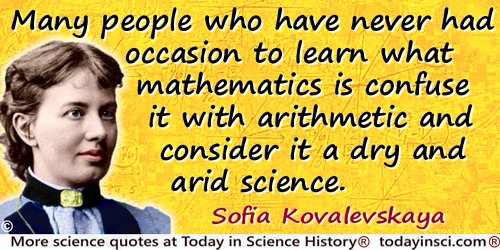
You are surprised at my working simultaneously in literature and in mathematics. Many people who have never had occasion to learn what mathematics is confuse it with arithmetic and consider it a dry and arid science. In actual fact it is the science which demands the utmost imagination. One of the foremost mathematicians of our century says very justly that it is impossible to be a mathematician without also being a poet in spirit. It goes without saying that to understand the truth of this statement one must repudiate the old prejudice by which poets are supposed to fabricate what does not exist, and that imagination is the same as “making things up”. It seems to me that the poet must see what others do not see, and see more deeply than other people. And the mathematician must do the same.
In letter (1890), quoted in S. Kovalevskaya and Beatrice Stillman (trans. and ed.), Sofia Kovalevskaya: A Russian Childhood (2013), 35. Translated the Russian edition of Vospominaniya detstva (1974).
You can hardly imagine how I am struggling to exert my poetical ideas just now for the discovery of analogies & remote figures respecting the earth, Sun & all sorts of things—for I think it is the true way (corrected by judgement) to work out a discovery.
Letter to C. Schrenbein, 13th Nov, 1845. In Frank A. J. L. James (ed.), The Correspondence of Michael Faraday (1996), Vol. 3, 428.
You explain nothing, O poet, but thanks to you all things become explicable.
In La Ville (1890), Act 1.
 In science it often happens that scientists say, 'You know that's a really good argument; my position is mistaken,' and then they would actually change their minds and you never hear that old view from them again. They really do it. It doesn't happen as often as it should, because scientists are human and change is sometimes painful. But it happens every day. I cannot recall the last time something like that happened in politics or religion.
(1987) --
In science it often happens that scientists say, 'You know that's a really good argument; my position is mistaken,' and then they would actually change their minds and you never hear that old view from them again. They really do it. It doesn't happen as often as it should, because scientists are human and change is sometimes painful. But it happens every day. I cannot recall the last time something like that happened in politics or religion.
(1987) -- 





