Physics Quotes (576 quotes)


… it is shameful that there are so few women in science… In China there are many, many women in physics. There is a misconception in America that women scientists are all dowdy spinsters. This is the fault of men. In Chinese society, a woman is valued for what she is, and men encourage her to accomplishments yet she remains eternally feminine.
Quoted in 'Queen of Physics', Newsweek (20 May 1963) no. 61, 20.
“But in the binary system,” Dale points out, handing back the squeezable glass, “the alternative to one isn’t minus one, it’s zero. That’s the beauty of it, mechanically.” “O.K. Gotcha. You’re asking me, What’s this minus one? I’ll tell you. It’s a plus one moving backward in time. This is all in the space-time foam, inside the Planck duration, don’t forget. The dust of points gives birth to time, and time gives birth to the dust of points. Elegant, huh? It has to be. It’s blind chance, plus pure math. They’re proving it, every day. Astronomy, particle physics, it’s all coming together. Relax into it, young fella. It feels great. Space-time foam.”
In Roger's Version: A Novel (1986), 304.
“On doit etre etonné ([Abbé Raynal]says) que l'Amerique n’ait pas encore produit un bon poëte, un habile mathematicien, un homme de génie dans un seul art, ou une seule science.” …“America has not yet produced one good poet.” When we shall have existed as a people as long as the Greeks did before they produced a Homer, the Romans a Virgil, the French a Racine and Voltaire, the English a Shakespeare and Milton, should this reproach be still true, we will enquire from what unfriendly causes it has proceeded, that the other countries of Europe and quarters of the earth shall not have inscribed any name in the roll of poets. But neither has America produced “one able mathematician, one man of genius in a single art or a single science.” … In physics we have produced a [Benjamin] Franklin, than whom no one of the present age has made more important discoveries, nor has enriched philosophy with more, or more ingenious solutions of the phaenomena, of nature. … [The quadrant invented by Godfrey, an American also, and with the aid of which the European nations traverse the globe, is called Hadley’s quadrant.] … We have supposed Mr. [David] Rittenhouse second to no astronomer living: that in genius he must be the first, because he is self-taught. As an artist he has exhibited as great a proof of mechanical genius as the world has ever produced. … We therefore suppose, that this reproach is as unjust as it is unkind; and that, of the geniuses which adorn the present age, America contributes its full share. [Compared to the much larger populations of European countries.]
The reference given by Jefferson for the original reproach by Abbé Raynal, an ellipsis above, is “7. Hist. Philos. p. 92. ed. Maestricht. 1774”. The original remark written in French, translates as: “One must be amazed that America has not yet produced a good poet, an able mathematician, one man of genius in a single art, or a single science.” Jefferson uses parts of it in English, to introduce his rebuttal. From Thomas Jefferson, Notes on the State of Virginia (1787), 107-110. A footnote adds that: “In a later edition of the Abbé Raynal’s work, he has withdrawn his censure…”
“Wu Li” was more than poetic. It was the best definition of physics that the conference would produce. It caught that certain something, that living quality that we were seeking to express in a book, that thing without which physics becomes sterile. “Wu” can mean either “matter” or “energy.” “Li” is a richly poetic word. It means “universal order” or “universal law.” It also means “organic patterns.” The grain in a panel of wood is Li. The organic pattern on the surface of a leaf is also Li, and so is the texture of a rose petal. In short, Wu Li, the Chinese word for physics, means “patterns of organic energy” (“matter/ energy” [Wu] + “universal order/organic patterns” [Li]). This is remarkable since it reflects a world view which the founders of western science (Galileo and Newton) simply did not comprehend, but toward which virtually every physical theory of import in the twentieth century is pointing!
In The Dancing Wu Li Masters: An Overview of the New Physics (1979), 5.
[A friend at Cambridge] told me that Helmholtz had been a medical doctor before he became a physicist. It thereupon occurred to me that Helmholtz had eaten the meal of life in the wrong order, and that I would like to spend the first half of my life under the strict discipline of physics, and afterwards to apply that training to researches on living things.
As quoted in Stephen A. Richardson 'Lewis Fry Richardson (1881-1953): A Personal Biography', Conflict Resolution (Sep 1957), 1, No. 3, 301.
[About the great synthesis of atomic physics in the 1920s:] It was a heroic time. It was not the doing of any one man; it involved the collaboration of scores of scientists from many different lands. But from the first to last the deeply creative, subtle and critical spirit of Niels Bohr guided, restrained, deepened and finally transmuted the enterprise.
Quoted in Bill Becker, 'Pioneer of the Atom', New York Times Sunday Magazine (20 Oct 1957), 54.
[At high school in Cape Town] my interests outside my academic work were debating, tennis, and to a lesser extent, acting. I became intensely interested in astronomy and devoured the popular works of astronomers such as Sir Arthur Eddington and Sir James Jeans, from which I learnt that a knowledge of mathematics and physics was essential to the pursuit of astronomy. This increased my fondness for those subjects.
'Autobiography of Allan M. Cormack,' Les Prix Nobel/Nobel Lectures 1979, editted by Wilhelm Odelberg.
[Blackett] came one morning, deep in thought, into the G (technical) Office at Stanmore. It was a bitterly cold day, and the staff were shivering in a garret warmed over only with an oil-stove. Without a word of greeting, Blackett stepped silently up on to the table and stood there pondering with his feet among the plans. After ten minutes somebody coughed uneasily and said, diffidently: “Wouldn’t you like a chair, sir … or something?” “No, thank you,” said Professor Blackett, “it is necessary to apply scientific methods. Hot air rises. The warmest spot in this room, therefore, will be near the ceiling.” At this, Colonel Krohn, my technical G.S.O., stepped up on the table beside the Professor, and for the next half-hour, the two stayed there in silence. At the end of this period Professor Blackett stepped down from the table saying: “Well! That’s that problem solved.” And so it was.
Anecdote as told by General Sir Frederick Pile, in Frederick Pile, Ack-Ack: Britain’s Defence Against Air Attack During Second World War (1949), 161. As cited by Maurice W. Kirby and Jonathan Rosenhead, 'Patrick Blackett (1897)' in Arjang A. Assad (ed.) and Saul I. Gass (ed.),Profiles in Operations Research: Pioneers and Innovators (2011), 7.
[Heisenberg's seminal 1925 paper initiating quantum mechanics marked] one of the great jumps—perhaps the greatest—in the development of twentieth century physics.
In Abraham Pais, Niels Bohr's Times: in Physics, Philosophy, and Polity (1991), 276. Cited in Mauro Dardo, Nobel Laureates and Twentieth-Century Physics (2004), 179.
[Helmholtz] is not a philosopher in the exclusive sense, as Kant, Hegel, Mansel are philosophers, but one who prosecutes physics and physiology, and acquires therein not only skill in developing any desideratum, but wisdom to know what are the desiderata, e.g., he was one of the first, and is one of the most active, preachers of the doctrine that since all kinds of energy are convertible, the first aim of science at this time. should be to ascertain in what way particular forms of energy can be converted into each other, and what are the equivalent quantities of the two forms of energy.
Letter to Lewis Campbell (21 Apr 1862). In P.M. Harman (ed.), The Scientific Letters and Papers of James Clerk Maxwell (1990), Vol. 1, 711.
[In high school,] I continued interest in experiments in physics related to astronomy and spectroscopy. I remember building various gadgets involved with the spectrograph in country houses that we rented in the summer, well before going to college. About 1923 our school radio club erected a giant-antenna and communicated with Australia by voice, which was I think early for radio amateurs. I had an early interest in radio. I remember back in summer camp hearing radio stations with an old crystal detector with coils I had wound when I was only nine or ten. Thus, I had an interest in radio at the beginning of radio astronomy in the United States [1933].
Oral History Transcript of interview with Dr. Jesse Greenstein by Paul Wright (31 Jul 1974), on website of American Institute of Physics.
[Karen] Uhlenbeck’s research has led to revolutionary advances at the intersection of mathematics and physics. Her pioneering insights have applications across a range of fascinating subjects, from string theory, which may help explain the nature of reality, to the geometry of space-time.
In news release, 'Mathematics’ Highest Prize Awarded to UT Austin’s Karen Uhlenbeck', UT News (19 Mar 2019) on website of University of Texas at Austin.
[Luis] Alvarez's whole approach to physics was that of an entrepreneur, taking big risks by building large new projects in the hope of large rewards, although his pay was academic rather than financial. He had drawn around him a group of young physicists anxious to try out the exciting ideas he was proposing.
As quoted in Walter Sullivan, 'Luis W. Alvarez, Nobel Physicist Who Explored Atom, Dies at 77: Obituary', New York Times (2 Sep 1988).
[My friends and I studied science to get away from] the stench of Fascist truths which tainted the sky. ... [T]he chemistry and physics on which we fed, besides being nourishment vital in themselves, were an antidote to Fascism. ... [T]hey were clear and distinct and verifiable at every step, and not a tissue of lies and emptiness like the radio and the newspapers.
The Periodic Table, trans. Raymond Rosenthal (1986), 42. In Vinoth Ramachandra, Subverting Global Myths: Theology and the Public Issues Shaping our World (2008), 170.
[Newton is the] British physicist linked forever in the schoolboy mind with an apple that fell and bore fruit throughout physics.
As given in Patricia Fara, Newton: The Making of Genius (2004), 192.
[On the practical applications of particle physics research with the Large Hadron Collider.] Sometimes the public says, “What's in it for Numero Uno? Am I going to get better television reception? Am I going to get better Internet reception?” Well, in some sense, yeah. … All the wonders of quantum physics were learned basically from looking at atom-smasher technology. … But let me let you in on a secret: We physicists are not driven to do this because of better color television. … That's a spin-off. We do this because we want to understand our role and our place in the universe.
As quoted in Alan Boyle, 'Discovery of Doom? Collider Stirs Debate', article (8 Sep 2008) on a msnbc.com web page. The article writer included the information that Kaku noted that past discoveries from the world of particle physics ushered in many of the innovations we enjoy today, ranging from satellite communications and handheld media players to medical PET scanners (which put antimatter to practical use)."
[Regarding mathematics,] there are now few studies more generally recognized, for good reasons or bad, as profitable and praiseworthy. This may be true; indeed it is probable, since the sensational triumphs of Einstein, that stellar astronomy and atomic physics are the only sciences which stand higher in popular estimation.
In A Mathematician's Apology (1940, reprint with Foreward by C.P. Snow 1992), 63-64.
[Richard Feynman] would be standing in front of the hall smiling at us all as we came in, his fingers tapping out a complicated rhythm on the black top of the demonstration bench that crossed the front of the lecture hall. As latecomers took their seats, he picked up the chalk and began spinning it rapidly through his fingers in a manner of a professional gambler playing with a poker chip, still smiling happily as if at some secret joke. And then—still smiling—he talked to us about physics, his diagrams and equations helping us to share his understanding. It was no secret joke that brought the smile and the sparkle in his eye, it was physics. The joy of physics!
Describing his experience as a student attending Feynman lectures, in Introduction to Richard P. Feynman Surely You’re Joking, Mr. Feynman! : Adventures of a Curious Character (1986, 2010), 9-10.
[Someone] remarked to me once: Physicians should not say, I have cured this man, but, This man didn’t die in my care. In physics too one might say, For such and such a phenomenon I have determined causes whose absurdity cannot finally be proved, instead of saying, I have explained it.
As quoted in Joseph Peter Stern, Lichtenberg: A Doctrine of Scattered Occasions: Reconstructed From His Aphorisms and Reflections (1959), 297.
[T]he yeoman’s work in any science, and especially physics, is done by the experimentalist, who must keep the theoreticians honest.
In Hyperspace: A Scientific Odyssey Through Parallel Universes, Time Warps, and The Tenth Dimension (1994), 314.
[The black hole] teaches us that space can be crumpled like a piece of paper into an infinitesimal dot, that time can be extinguished like a blown-out flame, and that the laws of physics that we regard as “sacred,” as immutable, are anything but.
In John A. Wheeler and Kenneth Ford, Geons, Black Holes & Quantum Foam: A Life in Physics. Quoted in Dennis Overbye, 'John A. Wheeler, Physicist Who Coined the Term Black Hole, Is Dead at 96', New York Times (14 Apr 2008).
[There] are still to be found text-books of the old sort, teaching Mathematics under the guise of Physics, presenting nothing but the dry husks of the latter.
A paper read at the Association for the Improvement of Geometrical Teaching (19 Jan 1889), 'The Vices of our Scientific Education', in Nature (6 Jun 1889), 40, 128.
[About describing atomic models in the language of classical physics:] We must be clear that when it comes to atoms, language can be used only as in poetry. The poet, too, is not nearly so concerned with describing facts as with creating images and establishing mental connections.
As quoted by Werner Heisenberg, as translated by Arnold J. Pomerans, in Physics and Beyond: Encounters and Conversations (1971), 41. The words are not verbatim, but as later recollected by Werner Heisenberg describing his early encounter with Bohr in 1920.
[Question: What do you think was the most important physics idea to emerge this year?]
We won't know for a few years.
We won't know for a few years.
Interview with Deborah Solomon, 'The Science of Second-Guessing', in New York Times Magazine (12 Dec 2004), 37.
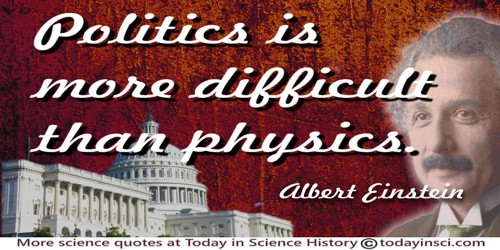
[When asked “Dr. Einstein, why is it that when the mind of man has stretched so far as to discover the structure of the atom we have been unable to devise the political means to keep the atom from destroying us?”] That is simple, my friend. It is because politics is more difficult than physics.
Einstein’s answer to a conferee at a meeting at Princeton, N.J. (Jan 1946), as recalled by Greenville Clark in 'Letters to the Times', in New York Times (22 Apr 1955), 24.
Dans les sciences physiques en général, on ait souvent supposé au lieu de conclure; que les suppositions transmises d’âge en âge, soient devenues de plus en plus imposantes par le poids des autorités qu'elles ont acquises , & qu'elles ayent enfin été adoptées & regardées comme des vérités fondamentales, même par de très-bons esprits.
In the science of physics in general, men have so often formed suppositions, instead of drawing conclusions. These suppositions, handed down from one age to another, acquire additional weight from the authorities by which they are supported, till at last they are received, even by men of genius, as fundamental truths.
In the science of physics in general, men have so often formed suppositions, instead of drawing conclusions. These suppositions, handed down from one age to another, acquire additional weight from the authorities by which they are supported, till at last they are received, even by men of genius, as fundamental truths.
From the original French in Traité élémentaire de chimie (1789, 1793), discours préliminaire, x; and from edition translated into English by Robert Kerr, as Elements of Chemistry (1790), Preface, xvi.
Die Chemie ist der unreinliche Teil der Physik.
Chemistry is the dirty part of physics.
Chemistry is the dirty part of physics.
Original German as quoted by Paul Krische, Wie Studiert man Chemie? (1904), 67, who also stated that Peter Reiss was a friend of Friedrich Wöhler (both chemists). English version as given in Chemisch Weekblad (1925), 22, 363. In more recent books, the quote is cited as by physicist Johann Philipp Reis. This confusion appears, for example in Ralph Oesper, The Human Side of Scientists (1975), 116.
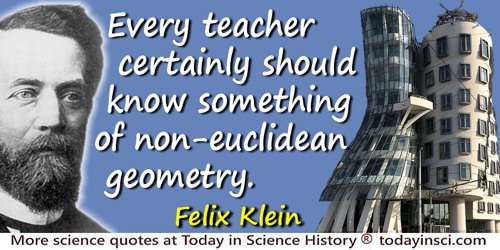
Every teacher certainly should know something of non-euclidean geometry. Thus, it forms one of the few parts of mathematics which, at least in scattered catch-words, is talked about in wide circles, so that any teacher may be asked about it at any moment. … Imagine a teacher of physics who is unable to say anything about Röntgen rays, or about radium. A teacher of mathematics who could give no answer to questions about non-euclidean geometry would not make a better impression.
On the other hand, I should like to advise emphatically against bringing non-euclidean into regular school instruction (i.e., beyond occasional suggestions, upon inquiry by interested pupils), as enthusiasts are always recommending. Let us be satisfied if the preceding advice is followed and if the pupils learn to really understand euclidean geometry. After all, it is in order for the teacher to know a little more than the average pupil.
On the other hand, I should like to advise emphatically against bringing non-euclidean into regular school instruction (i.e., beyond occasional suggestions, upon inquiry by interested pupils), as enthusiasts are always recommending. Let us be satisfied if the preceding advice is followed and if the pupils learn to really understand euclidean geometry. After all, it is in order for the teacher to know a little more than the average pupil.
In George Edward Martin, The Foundations of Geometry and the Non-Euclidean Plane (1982), 72.

La chaleur pénètre, comme la gravité, toutes les substances de l’univers, ses rayons occupent toutes les parties de l’espace. Le but de notre ouvrage est d’exposer les lois mathématiques que suit cet élément. Cette théorie formera désormais une des branches les plus importantes de la physique générale.
Heat, like gravity, penetrates every substance of the universe, its rays occupy all parts of space. The object of our work is to set forth the mathematical laws which this element obeys. The theory of heat will hereafter form one of the most important branches of general physics.
Heat, like gravity, penetrates every substance of the universe, its rays occupy all parts of space. The object of our work is to set forth the mathematical laws which this element obeys. The theory of heat will hereafter form one of the most important branches of general physics.
From 'Discours Préliminaire' to Théorie Analytique de la Chaleur (1822), i, translated by Alexander Freeman in The Analytical Theory of Heat (1878), 1.
Misattributed to Johann Reiss. Probably by Peter Reiss.
Die Chemie ist der unreinliche Teil der Physik.
Chemistry is the dirty part of physics.
Die Chemie ist der unreinliche Teil der Physik.
Chemistry is the dirty part of physics.
Webmaster believes this quote should be attributed to Peter Reiss, having found the following example cited for Peter Reiss. Original German as quoted by Paul Krische, Wie Studiert man Chemie? (1904), 67, who also stated that Peter Reiss was a friend of Friedrich Wöhler (both chemists). English version as given in Chemisch Weekblad (1925), 22, 363. In various recent books, the quote is cited as by physicist Johann Philipp Reis. This confusion appears, for example in Ralph Oesper, The Human Side of Scientists (1975), 116.
Natura non facit saltum or, Nature does not make leaps… If you assume continuity, you can open the well-stocked mathematical toolkit of continuous functions and differential equations, the saws and hammers of engineering and physics for the past two centuries (and the foreseeable future).
From Benoit B. Mandelbrot and Richard Hudson, The (Mis)Behaviour of Markets: A Fractal View of Risk, Ruin and Reward (2004,2010), 85-86.
Proof is an idol before whom the pure mathematician tortures himself. In physics we are generally content to sacrifice before the lesser shrine of Plausibility.
In Gifford Lecture (1927), Edinburgh, as collected in 'Science and Mysticism', The Nature of the Physical World (1928), 337.
Vacuum voco locum omnem in quo corpora sine resistentia movetur.
Vacuum I call every place in which a body is able to move without resistance.
Vacuum I call every place in which a body is able to move without resistance.
Original Latin from an unpublished line in a manuscript draft of additions and corrections to the second edition of the Principia held by Cambridge University Library, 'Definition II', MS Add 3965 sec 13 [53-94] Draft No. 3 Folio 422r. As quoted and cited in J.E. McGuire, Tradition and Innovation: Newton’s Metaphysics of Nature (1995, 2011), 139. English translation as given in Isaac Asimov and Jason A. Shulman (eds.), Isaac Asimov’s Book of Science and Nature Quotations (1988), 210.
~~[Attributed without source]~~ All of physics is either impossible or trivial. It is impossible until you understand it, and then it becomes trivial.
Often seen, virally spread, but always without a source citation. If you can provide a primary source, please contact Webmaster. Until then the quote should be regarded as not authenticated.
~~[Attributed without source]~~ In science there is only physics; all the rest is stamp collecting.
Often seen, virally spread in several variants, but always without a source citation. If you can provide a primary source, please contact Webmaster. Until then the quote should be regarded as not authenticated. See the discussion on the quoteinvestigator.com site, which could only trace an early example which had no quote marks, given only in narrative form, in John Desmond Bernal, The Social Function of Science (1939), 9.
~~[Attributed without source]~~ That which is not measurable is not science. That which is not PHYSICS is stamp collecting.
Often seen, virally spread, but always without a source citation. If you can provide a primary source, please contact Webmaster. Until then the quote should be regarded as not authenticated.
~~[Attributed without source]~~ The more physics you have the less engineering you need.
Often seen, virally spread, but always without a source citation. If you can provide a primary source, please contact Webmaster. Until then the quote should be regarded as not authenticated.
~~[Need source]~~ All theoretical chemistry is really physics; and all theoretical chemists know it.
Webmaster, so far, has been unable to find a primary source that adds the ending clause. (Can you help?) But Feynman certainly several times stated the idea in the opening clause. See, for example, the quote, “The theory of quantum mechanics … supplied the theory behind chemistry. So, fundamental theoretical chemistry is really physics.” on the Richard Feynman Quotes page on this website.
A biophysicist talks physics to the biologists and biology to the physicists, but when he meets another biophysicist, they just discuss women.
In Alan Lindsay Mackay , A Dictionary of Scientific Quotations (2nd Ed., 1991), 4.
A careful analysis of the process of observation in atomic physics has shown that the subatomic particles have no meaning as isolated entities, but can only be understood as interconnections between the preparation of an experiment and the subsequent measurement.
The Tao of Physics: An Exploration of the Parallels Between Modern Physics (1975), 68.
A commonsense interpretation of the facts suggests that a superintellect has monkeyed with physics, as well as with chemistry and biology, and that there are no blind forces worth speaking about in nature. The numbers one calculates from the facts seem to me so overwhelming as to put this conclusion almost beyond question.
In 'The Universe: Past and Present Reflections', Astrophysics and Relativity (1981), 70, 26.
A complete survey of life on Earth may appear to be a daunting task. But compared with what has been dared and achieved in high-energy physics, molecular genetics, and other branches of “big science,” it is in the second or third rank.
In 'Edward O. Wilson: The Biological Diversity Crisis: A Challenge to Science', Issues in Science and Technology (Fall 1985), 2, No. 1, 26.
A good deal of my research in physics has consisted in not setting out to solve some particular problem, but simply examining mathematical quantities of a kind that physicists use and trying to fit them together in an interesting way, regardless of any application that the work may have. It is simply a search for pretty mathematics. It may turn out later to have an application. Then one has good luck. At age 78.
International Journal of Theoretical Physics (1982), 21, 603. In A. Pais, 'Playing With Equations, the Dirac Way'. Behram N. Kursunoglu (Ed.) and Eugene Paul Wigner (Ed.), Paul Adrien Maurice Dirac: Reminiscences about a Great Physicist (1990), 110.
A great department of thought must have its own inner life, however transcendent may be the importance of its relations to the outside. No department of science, least of all one requiring so high a degree of mental concentration as Mathematics, can be developed entirely, or even mainly, with a view to applications outside its own range. The increased complexity and specialisation of all branches of knowledge makes it true in the present, however it may have been in former times, that important advances in such a department as Mathematics can be expected only from men who are interested in the subject for its own sake, and who, whilst keeping an open mind for suggestions from outside, allow their thought to range freely in those lines of advance which are indicated by the present state of their subject, untrammelled by any preoccupation as to applications to other departments of science. Even with a view to applications, if Mathematics is to be adequately equipped for the purpose of coping with the intricate problems which will be presented to it in the future by Physics, Chemistry and other branches of physical science, many of these problems probably of a character which we cannot at present forecast, it is essential that Mathematics should be allowed to develop freely on its own lines.
In Presidential Address British Association for the Advancement of Science, Sheffield, Section A,
Nature (1 Sep 1910), 84, 286.
A page from a journal of modern experimental physics will be as mysterious to the uninitiated as a Tibetan mandala. Both are records of enquiries into the nature of the universe.
In The Tao of Physics (1975), 36.
A physical theory remains an empty shell until we have found a reasonable physical interpretation.
At the 4th Soviet Gravitational Conference, Minsk, USSR (Jul 1976). Quoted in Anton Z. Capri, From Quanta to Quarks: More Anecdotal History of Physics (2007), 120.
A physicist learns more and more about less and less, until he knows everything about nothing; whereas a philosopher learns less and less about more and more, until he knows nothing about everything.
Saying.
A sound Physics of the Earth should include all the primary considerations of the earth's atmosphere, of the characteristics and continual changes of the earth's external crust, and finally of the origin and development of living organisms. These considerations naturally divide the physics of the earth into three essential parts, the first being a theory of the atmosphere, or Meteorology, the second, a theory of the earth's external crust, or Hydrogeology, and the third, a theory of living organisms, or Biology.
Hydrogéologie (1802), trans. A. V. Carozzi (1964), 18.
A theory of physics is not an explanation; it is a system of mathematical oppositions deduced from a small number of principles the aim of which is to represent as simply, as completely, and as exactly as possible, a group of experimental laws.
As quoted in Philipp Frank, Modern Science and its Philosophy (1949), 15, which cites Théorie Physique; Son Objet—Son Structure (1906), 24.
A time will however come (as I believe) when physiology will invade and destroy mathematical physics, as the latter has destroyed geometry.
In Daedalus, or Science and the Future (1923). Reprinted in Krishna R. Dronamraju (ed.),
Haldane’s Daedalus Revisited (1995), 27.
A vacuum is repugnant to reason.
A commonly seen shortened version of a longer quote. From the original Latin: “Repugnare ut detur vacuum, sive in quo nulla plane sit res.” Subtitle of Article XVI in Principia Philospphiæ (1644), Pars Secunda, XVI, 41-42. Also collected in Œuvres de Descartes (1905), Vol. 8, 49. As translated by John Veitch: “That a vacuum or space in which there is absolutely no body is repugnant to reason,” in Meditations and Selections from the Principles of Philosophy (1853, 1913), 185. [Note: In the French edition, the subtitle was translated as, “Qu'il ne peut y avoir aucun vuide au sens que les Philosophes prenent ce mot,” which in English would be, “That there can be no vacuum in the sense that Philosophers take this word.” In Les Principes de la Philosophie (1651), Seconde Partie, Article XVI, 75.]
A. R. Todd
Thinks he’s God.
N. F. Mott
Says he’s not.
Thinks he’s God.
N. F. Mott
Says he’s not.
Quoted by William Lord in The Times (22 Jan 1997), remarking on the competitiveness between the Physics and Chemistry Departments at the University of Cambridge.
According to Democritus, atoms had lost the qualities like colour, taste, etc., they only occupied space, but geometrical assertions about atoms were admissible and required no further analysis. In modern physics, atoms lose this last property, they possess geometrical qualities in no higher degree than colour, taste, etc. The atom of modern physics can only be symbolized by a partial differential equation in an abstract multidimensional space. Only the experiment of an observer forces the atom to indicate a position, a colour and a quantity of heat. All the qualities of the atom of modern physics are derived, it has no immediate and direct physical properties at all, i.e. every type of visual conception we might wish to design is, eo ipso, faulty. An understanding of 'the first order' is, I would almost say by definition, impossible for the world of atoms.
Philosophic Problems of Nuclear Science, trans. F. C. Hayes (1952), 38.
According to my views, aiming at quantitative investigations, that is at establishing relations between measurements of phenomena, should take first place in the experimental practice of physics. By measurement to knowledge [door meten tot weten] I should like to write as a motto above the entrance to every physics laboratory.
'The Significance of Quantitative Research in Physics', Inaugural Address at the University of Leiden (1882). In Hendrik Casimir, Haphazard Reality: Half a Century of Science (1983), 160-1.
After the discovery of spectral analysis no one trained in physics could doubt the problem of the atom would be solved when physicists had learned to understand the language of spectra. So manifold was the enormous amount of material that has been accumulated in sixty years of spectroscopic research that it seemed at first beyond the possibility of disentanglement. An almost greater enlightenment has resulted from the seven years of Röntgen spectroscopy, inasmuch as it has attacked the problem of the atom at its very root, and illuminates the interior. What we are nowadays hearing of the language of spectra is a true 'music of the spheres' in order and harmony that becomes ever more perfect in spite of the manifold variety. The theory of spectral lines will bear the name of Bohr for all time. But yet another name will be permanently associated with it, that of Planck. All integral laws of spectral lines and of atomic theory spring originally from the quantum theory. It is the mysterious organon on which Nature plays her music of the spectra, and according to the rhythm of which she regulates the structure of the atoms and nuclei.
Atombau und Spektrallinien (1919), viii, Atomic Structure and Spectral Lines, trans. Henry L. Brose (1923), viii.
All appearances to the contrary, the only watchmaker in nature is the blind forces of physics, albeit deployed in very special way. A true watchmaker has foresight: he designs his cogs springs, and plans their interconnections, with a future purpose in his mind's eye. Natural selection, the blind, unconscious, automatic process which Darwin discovered, and which we now know is the explanation for the existence and apparently purposeful form of all life, has no purpose in mind. It has no mind and no mind's eye. It does not plan for the future. It has no vision, no foresight, no sight at all. If it can be said to play the role of watchmaker in nature, it is the blind watchmaker.
The Blind Watchmaker (1986), 5.
All of modern physics is governed by that magnificent and thoroughly confusing discipline called quantum mechanics ... It has survived all tests and there is no reason to believe that there is any flaw in it.... We all know how to use it and how to apply it to problems; and so we have learned to live with the fact that nobody can understand it.
…...
All science is either physics or stamp collecting.
Quoted in J. B. Birks, Rutherford at Manchester (1962), 108, without citation. Webmaster has not been able to find any earlier example of the quote in print. If you know a primary print source, or very early reference to this quote, please contact the Webmaster. If—a strong if—truly a Rutherford quote, and such a snappy one, surely it should have been better documented from decades earlier?
All the real true knowledge we have of Nature is intirely experimental, insomuch that, how strange soever the assertion seems, we may lay this down as the first fundamental unerring rule in physics, That it is not within the compass of human understanding to assign a purely speculative reason for any one phaenomenon in nature.
In The Procedure, Extent, and Limits of Human Understanding (1728, 1729), 205-206.
Although I am primarily an experimental physicist, theoretical physics is my hobby.
Although I was four years at the University [of Wisconsin], I did not take the regular course of studies, but instead picked out what I thought would be most useful to me, particularly chemistry, which opened a new world, mathematics and physics, a little Greek and Latin, botany and and geology. I was far from satisfied with what I had learned, and should have stayed longer.
[Enrolled in Feb 1861, left in 1863 without completing a degree, and began his first botanical foot journey.]
[Enrolled in Feb 1861, left in 1863 without completing a degree, and began his first botanical foot journey.]
The Story of My Boyhood and Youth (1913), 286.
Among those whom I could never pursuade to rank themselves with idlers, and who speak with indignation of my morning sleeps and nocturnal rambles, one passes the day in catching spiders, that he may count their eyes with a microscope; another exhibits the dust of a marigold separated from the flower with a dexterity worthy of Leuwenhoweck himself. Some turn the wheel of electricity; some suspend rings to a lodestone, and find that what they did yesterday, they can do again to-day.—Some register the changes of the wind, and die fully convinced that the wind is changeable.—There are men yet more profound, who have heard that two colorless liquors may produce a color by union, and that two cold bodies will grow hot of they are mingled: they mingle them, and produce the effect expected, say it is strange, and mingle them again.
In Tryon Edwards, A Dictionary of Thoughts (1908), 243.
And having thus passed the principles of arithmetic, geometry, astronomy, and geography, with a general compact of physics, they may descend in mathematics to the instrumental science of trigonometry, and from thence to fortification, architecture, engineering, or navigation. And in natural philosophy they may proceed leisurely from the history of meteors, minerals, plants, and living creatures, as far as anatomy. Then also in course might be read to them out of some not tedious writer the institution of physic. … To set forward all these proceedings in nature and mathematics, what hinders but that they may procure, as oft as shall be needful, the helpful experiences of hunters, fowlers, fishermen, shepherds, gardeners, apothecaries; and in other sciences, architects, engineers, mariners, anatomists.
In John Milton and Robert Fletcher (ed.), 'On Education', The Prose Works of John Milton: With an Introductory Review (1834), 100.
And there are absolutely no judgments (or rules) in Mechanics which do not also pertain to Physics, of which Mechanics is a part or type: and it is as natural for a clock, composed of wheels of a certain kind, to indicate the hours, as for a tree, grown from a certain kind of seed, to produce the corresponding fruit. Accordingly, just as when those who are accustomed to considering automata know the use of some machine and see some of its parts, they easily conjecture from this how the other parts which they do not see are made: so, from the perceptible effects and parts of natural bodies, I have attempted to investigate the nature of their causes and of their imperceptible parts.
Principles of Philosophy (1644), trans. V. R. and R. P. Miller (1983), 285-6.
Any fundamental theory of physics is beautiful. If it isn’t, it’s probably wrong.
In the University of Toronto Bulletin, May 5, 1986.
Archimedes, who combined a genius for mathematics with a physical insight, must rank with Newton, who lived nearly two thousand years later, as one of the founders of mathematical physics. … The day (when having discovered his famous principle of hydrostatics he ran through the streets shouting Eureka! Eureka!) ought to be celebrated as the birthday of mathematical physics; the science came of age when Newton sat in his orchard.
In An Introduction to Mathematics (1911), 37.
As a boy I had liked both drawing and physics, and I always abhorred the role of being a spectator. In 1908, when I was 15, I designed, built and flew a toy model airplane which won the then-famous James Gordon Bennett Cup. By 16 I had discovered that design could be fun and profitable, and this lesson has never been lost on me.
On the official Raymond Loewry website.
As a result of the phenomenally rapid change and growth of physics, the men and women who did their great work one or two generations ago may be our distant predecessors in terms of the state of the field, but they are our close neighbors in terms of time and tastes. This may be an unprecedented state of affairs among professionals; one can perhaps be forgiven if one characterizes it epigrammatically with a disastrously mixed metaphor; in the sciences, we are now uniquely privileged to sit side-by-side with the giants on whose shoulders we stand.
In 'On the Recent Past of Physics', American Journal of Physics (1961), 29, 807.
As chemists, we must rename [our] scheme and insert the symbols Ba, La, Ce in place of Ra, Ac, Th. As nuclear chemists closely associated with physics, we cannot yet convince ourselves to make this leap, which contradicts all previous experience in nuclear physics.
Co-author with Fritz Strassmann, German chemist (1902-80)
Co-author with Fritz Strassmann, German chemist (1902-80)
'(Über den nachweis und das Verhalten der bei der Bestrahlung des Urans mittels Neutronen entstehenden Erdalkallmetalle', Die Naturwissenschaften, 1939, 27, 11-15. Trans. J. Heilbron and Robert W. Seidel, Lawrence and his Laboratory: A History of the Lawrence Berkeley Laboratory (1989), Vol. 1, 436-7.
As modern physics started with the Newtonian revolution, so modern philosophy starts with what one might call the Cartesian Catastrophe. The catastrophe consisted in the splitting up of the world into the realms of matter and mind, and the identification of “mind” with conscious thinking. The result of this identification was the shallow rationalism of l’esprit Cartesien, and an impoverishment of psychology which it took three centuries to remedy even in part.
The Act of Creation (1964), 148.
As to a perfect Science of natural Bodies … we are, I think, so far from being capable of any such thing that I conclude it lost labour to seek after it.
In 'Extent of Human Knowledge', An Essay Concerning Humane Understanding (1700), Book 4, 335.
As we cannot use physician for a cultivator of physics, I have called him a physicist. We need very much a name to describe a cultivator of science in general. I should incline to call him a Scientist. Thus we might say, that as an Artist is a Musician, Painter or Poet, a Scientist is a Mathematician, Physicist, or Naturalist.
The Philosophy of the Inductive Sciences (1840), Vol. I, cxiii.
As we look out into the Universe and identify the many accidents of physics and astronomy that have worked together to our benefit, it almost seems as if the Universe must in some sense have known that we were coming.
In The Anthropic Cosmological Principle by John D. Barrow and Frank J. Tipler (1986).
Astronomy is older than physics. In fact, it got physics started by showing the beautiful simplicity of the motion of the stars and planets, the understanding of which was the beginning of physics. But the most remarkable discovery in all of astronomy is that the stars are made of atoms of the same kind as those on the earth.
In 'Astronomy', The Feynman Lectures on Physics (1961), Vol. 1, 3-6.
At every major step physics has required, and frequently stimulated, the introduction of new mathematical tools and concepts. Our present understanding of the laws of physics, with their extreme precision and universality, is only possible in mathematical terms.
In Book Review 'Pulling the Strings,' of Lawrence Krauss's Hiding in the Mirror: The Mysterious Lure of Extra Dimensions, from Plato to String Theory and Beyond in Nature (22 Dec 2005), 438, 1081.
At first sight nothing seems more obvious than that everything has a beginning and an end, and that everything can be subdivided into smaller parts. Nevertheless, for entirely speculative reasons the philosophers of Antiquity, especially the Stoics, concluded this concept to be quite unnecessary. The prodigious development of physics has now reached the same conclusion as those philosophers, Empedocles and Democritus in particular, who lived around 500 B.C. and for whom even ancient man had a lively admiration.
'Development of the Theory of Electrolytic Dissociation', Nobel Lecture, 11 December 1903. In Nobel Lectures: Chemistry 1901-1921 (1966), 45.
At the present time it is of course quite customary for physicists to trespass on chemical ground, for mathematicians to do excellent work in physics, and for physicists to develop new mathematical procedures. … Trespassing is one of the most successful techniques in science.
In Dynamics in Psychology (1940, 1973), 116.
Biology is the study of complicated things that give the appearance of having been designed for a purpose. Physics is the study of simple things that do not tempt us to invoke design.
In The Blind Watchmaker (1986, 1996), 1.
Body and soul are not two different things, but only two different ways of perceiving the same thing. Similarly, physics and psychology are only different attempts to link our experiences together by way of systematic thought.
(1937). In Albert Einstein, the Human Side by Helen Dukas and Banesh Hoffman (1979), 38.
Bohr’s standpoint, that a space-time description is impossible, I reject a limine. Physics does not consist only of atomic research, science does not consist only of physics, and life does not consist only of science. The aim of atomic research is to fit our empirical knowledge concerning it into our other thinking. All of this other thinking, so far as it concerns the outer world, is active in space and time. If it cannot be fitted into space and time, then it fails in its whole aim and one does not know what purpose it really serves.
Letter to Willy Wien (25 Aug 1926). Quoted in Walter Moore, Schrödinger: Life and Thought (1989), 226.
But I canna change the laws of physics, Captain!
— Scotty
chief engineer aboard the U.S.S. Enterprise, to Captain James T. Kirk on Star Trek.
But, contrary to the lady’s prejudices about the engineering profession, the fact is that quite some time ago the tables were turned between theory and applications in the physical sciences. Since World War II the discoveries that have changed the world are not made so much in lofty halls of theoretical physics as in the less-noticed labs of engineering and experimental physics. The roles of pure and applied science have been reversed; they are no longer what they were in the golden age of physics, in the age of Einstein, Schrödinger, Fermi and Dirac.
'The Age of Computing: a Personal Memoir', Daedalus (1992), 121, 120.
By far the most important consequence of the conceptual revolution brought about in physics by relativity and quantum theory lies not in such details as that meter sticks shorten when they move or that simultaneous position and momentum have no meaning, but in the insight that we had not been using our minds properly and that it is important to find out how to do so.
'Quo Vadis'. In Gerald Holton (ed.), Science and the Modern Mind (1971), 84.
By the year 2070 we cannot say, or it would be imbecile to do so, that any man alive could understand Shakespearean experience better than Shakespeare, whereas any decent eighteen-year-old student of physics will know more physics than Newton.
'The Case of Leavis and the Serious Case’, Times Literary Supplement (9 Jul 1970), 737-740. Collected in Public Affairs (1971), 95.
Cell and tissue, shell and bone, leaf and flower, are so many portions of matter, and it is in obedience to the laws of physics that their particles have been moved, moulded and confirmed. They are no exception to the rule that God always geometrizes. Their problems of form are in the first instance mathematical problems, their problems of growth are essentially physical problems, and the morphologist is, ipso facto, a student of physical science.
On Growth and Form (1917), 7-8.
Chemistry and physics are experimental sciences; and those who are engaged in attempting to enlarge the boundaries of science by experiment are generally unwilling to publish speculations; for they have learned, by long experience, that it is unsafe to anticipate events. It is true, they must make certain theories and hypotheses. They must form some kind of mental picture of the relations between the phenomena which they are trying to investigate, else their experiments would be made at random, and without connection.
From 'Radium and Its Products', Harper’s Magazine (Dec 1904), 52.
Chemistry has been termed by the physicist as the messy part of physics, but that is no reason why the physicists should be permitted to make a mess of chemistry when they invade it.
Attributed. As quoted in American Journal of Physics (1946),14 248. Also in Robert L. Weber, More Random Walks in Science: An Anthology (1982), 64, without citation. Contact Webmaster if you know any primary source.
Chemistry stands at the pivot of science. On the one hand it deals with biology and provides explanations for the processes of life. On the other hand it mingles with physics and finds explanations for chemical phenomena in the fundamental processes and particles of the universe. Chemistry links the familiar with the fundamental.
In Scientific American Library, Molecules (1987, 2003), 2.
Chemistry teaches us to regard under one aspect, as various types of combustion or oxidation, the burning of a candle, the rusting of metals, the physiological process of respiration, and the explosion of gunpowder. In each process there is the one common fact that oxygen enters into new chemical combinations. Similarly to the physicist, the fall of the traditional apple of Newton, the revolution of the earth and planets round the sun, the apparitions of comets, and the ebb and flow of the tides are all phases of the universal law of gravitation. A race ignorant of the nature of combustion or of the law of gravitation, and ignorant of the need of such generalisations, could not be considered to have advanced far along the paths of scientific discovery.
In 'The Discovery of Radioactivity: Radioactivity, a New Science', The Interpretation of Radium and the Structure of the Atom (4th ed., 1920), 1.
Chemistry works with an enormous number of substances, but cares only for some few of their properties; it is an extensive science. Physics on the other hand works with rather few substances, such as mercury, water, alcohol, glass, air, but analyses the experimental results very thoroughly; it is an intensive science. Physical chemistry is the child of these two sciences; it has inherited the extensive character from chemistry. Upon this depends its all-embracing feature, which has attracted so great admiration. But on the other hand it has its profound quantitative character from the science of physics.
In Theories of Solutions (1912), xix.
Common sense … may be thought of as a series of concepts and conceptual schemes which have proved highly satisfactory for the practical uses of mankind. Some of those concepts and conceptual schemes were carried over into science with only a little pruning and whittling and for a long time proved useful. As the recent revolutions in physics indicate, however, many errors can be made by failure to examine carefully just how common sense ideas should be defined in terms of what the experimenter plans to do.
In Science and Common Sense (1951), 32-33.
Complicated things, everywhere, deserve a very special kind of explanation. We want to know how they came into existence and why they are so complicated. The explanation, … is likely to be broadly the same for complicated things everywhere in the universe; the same for us, for chimpanzees, worms, oak trees and monsters from outer space. On the other hand, it will not be the same for what I shall call ‘simple’ things, such as rocks, clouds, rivers, galaxies and quarks. These are the stuff of physics. Chimps and dogs and bats and cockroaches and people and worms and dandelions and bacteria and galactic aliens are the stuff of biology.
In The Blind Watchmaker (1986, 1996), 1.
Consciously and systematically Klein sought to enthrall me with the problems of mathematical physics, and to win me over to his conception of these problems as developed it in lecture courses in previous years. I have always regarded Klein as my real teacher only in things mathematical, but also in mathematical physics and in my conception of mechanics.
As quoted in Paul Forman and Armin Hermann, 'Sommerfeld, Arnold (Johannes Wilhelm)', Biography in Dictionary of Scientific Biography (1975), Vol. 12, 526. Cited from 'Autobiographische Skizze', Gesammelte Schriften, Vol 4, 673–682.
Considered as a mere question of physics, (and keeping all moral considerations entirely out of sight,) the appearance of man is a geological phenomenon of vast importance, indirectly modifying the whole surface of the earth, breaking in upon any supposition of zoological continuity, and utterly unaccounted for by what we have any right to call the laws of nature.
'Address to the Geological Society, delivered on the Evening of the 18th of February 1831', Proceedings of the Geological Society (1834), 1, 306.
Could Hamlet have been written by a committee, or the “Mona Lisa” painted by a club? Could the New Testament have been composed as a conference report? Creative ideas do not spring from groups. They spring from individuals. The divine spark leaps from the finger of God to the finger of Adam, whether it takes ultimate shape in a law of physics or a law of the land, a poem or a policy, a sonata or a mechanical computer.
Baccalaureate address (9 Jun 1957), Yale University. In In the University Tradition (1957), 156.
Dear Professor Rutherford, We students of our university physics club elect you our honorary president because you proved that atoms have balls.
In Letter (10 Oct 1929) received from students in Rostow na Donu, USSR, asking Ernest Rutherford USSR to become honorary president of their physics club. As quoted in George Gamow, My World Line: An Informal Autobiography (1970), 77-78. Gamow explained to Rutherford that the phrases for atomic “nucleus” and “cannonball” shared the use of the word “iadro” in Russian. The students had made faulty use of their Russian-English dictionary, but they were aware of Rutherford’s gold foil experiment. [Peter Atkins may have repeated the anecdote somewhere, but he did not originate it, yet the quote is seen attributed to him around the Web. —Webmaster]
Dr. Bhabha was a visionary. He had excellent command over electronics, physics and he saw the dream of India being a nuclear power. … He was a perfectionist and would leave no point of suspicion while working on any project. He was an inspiration.
Interview in newsletter of the Raja Ramanna Centre for Advanced Technology (Oct 2001), online.
During Alfvén's visit he gave a lecture at the University of Chicago, which was attended by [Enrico] Fermi. As Alfvén described his work, Fermi nodded his head and said, 'Of course.' The next day the entire world of physics said. 'Oh, of course.'
Quoted in Anthony L. Peratt, 'Dean of the Plasma Dissidents', Washington Times, supplement: The World and I (May 1988), 195.
During the war years I worked on the development of radar and other radio systems for the R.A.F. and, though gaining much in engineering experience and in understanding people, rapidly forgot most of the physics I had learned.
From Autobiography in Wilhelm Odelberg (ed.), Les Prix Nobel en 1974/Nobel Lectures (1975)
E=hf.
Formula describing the energy of a photon, in quantum theory, E=Energy, h=Planck’s constant, f=frequency of light.
Each juggler should be trained in the ignorance of the laws of physics.
Unkempt Thoughts (1962), 66.
Ecology has not yet explicitly developed the kind of cohesive, simplifying generalizations exemplified by, say, the laws of physics. Nevertheless there are a number of generalizations that are already evident in what we now know about the ecosphere and that can be organized into a kind of informal set of laws of ecology.
In The Closing Circle: Nature, Man, and Technology (2014).
Einstein, twenty-six years old, only three years away from crude privation, still a patent examiner, published in the Annalen der Physik in 1905 five papers on entirely different subjects. Three of them were among the greatest in the history of physics. One, very simple, gave the quantum explanation of the photoelectric effect—it was this work for which, sixteen years later, he was awarded the Nobel prize. Another dealt with the phenomenon of Brownian motion, the apparently erratic movement of tiny particles suspended in a liquid: Einstein showed that these movements satisfied a clear statistical law. This was like a conjuring trick, easy when explained: before it, decent scientists could still doubt the concrete existence of atoms and molecules: this paper was as near to a direct proof of their concreteness as a theoretician could give. The third paper was the special theory of relativity, which quietly amalgamated space, time, and matter into one fundamental unity.
This last paper contains no references and quotes no authority. All of them are written in a style unlike any other theoretical physicist’s. They contain very little mathematics. There is a good deal of verbal commentary. The conclusions, the bizarre conclusions, emerge as though with the greatest of ease: the reasoning is unbreakable. It looks as though he had reached the conclusions by pure thought, unaided, without listening to the opinions of others. To a surprisingly large extent, that is precisely what he had done.
This last paper contains no references and quotes no authority. All of them are written in a style unlike any other theoretical physicist’s. They contain very little mathematics. There is a good deal of verbal commentary. The conclusions, the bizarre conclusions, emerge as though with the greatest of ease: the reasoning is unbreakable. It looks as though he had reached the conclusions by pure thought, unaided, without listening to the opinions of others. To a surprisingly large extent, that is precisely what he had done.
In Variety of Men (1966), 100-101. First published in Commentary magazine.
Engineering is quite different from science. Scientists try to understand nature. Engineers try to make things that do not exist in nature. Engineers stress invention. To embody an invention the engineer must put his idea in concrete terms, and design something that people can use. That something can be a device, a gadget, a material, a method, a computing program, an innovative experiment, a new solution to a problem, or an improvement on what is existing. Since a design has to be concrete, it must have its geometry, dimensions, and characteristic numbers. Almost all engineers working on new designs find that they do not have all the needed information. Most often, they are limited by insufficient scientific knowledge. Thus they study mathematics, physics, chemistry, biology and mechanics. Often they have to add to the sciences relevant to their profession. Thus engineering sciences are born.
Y.C. Fung and P. Tong, Classical and Computational Solid Mechanics (2001), 1.
Engineering…is both an art and a science, and as a science it consists for the most part of mathematics applied to physics and mechanics. It is of necessity, therefore, a measuring science, and a congress of engineers ought, in the nature of things, to be interested in anything relating to progress in metrology.
From Address to the International Engineering Congress of the Columbia Exposition, Chicago, 1893. Published in Transactions of the American Society of Civil Engineers (Oct 1893), 120. Reprinted in 'Fundamental Units of Measure', Smithsonian Report for 1893 (1894), 135.
Every theoretical physicist who is any good knows six or seven different theoretical representations for exactly the same physics. He knows that they are all equivalent, and that nobody is ever going to be able to decide which one is right at that level, but he keeps them in his head, hoping that they will give him different ideas for guessing.
In The Character of Physical Law (1965, 2001), 168.
Everyone now agrees that a Physics where you banish all relationship with mathematics, to confine itself to a mere collection of observations and experiences, would be but an historical amusement, more fitting to entertain idle people, than to engage the mind of a true philosopher.
In 'Préface Contenant l’Exposition du Système', Dictionnaire de Physique (1761), Vol. 1, iii. English version via Google Translate, tweaked by Webmaster. From the original French, “Tout le monde convient maintenant qu’une Physique d’où l'on banniroit tout ce qui peut avoir quelque rapport avec les mathématiques, pour se borner à un simple recueil d’observations & d’experiences, ne seroit qu’un amusement historique, plus propre à récréer un cercle de personnes oisives, qu’à occuper un esprit véritablement philosophique.” Also seen translated as—“Everyone now agrees that a physics lacking all connection with mathematics…would only be an historical amusement, fitter for entertaining the idle than for occupying the mind of a philosopher,” in John L. Heilbron, Electricity in the 17th and 18th centuries: A Study of Early Modern Physics (1979), 74. In the latter source, the subject quote immediately follows a different one by Franz Karl Achard. An editor misreading that paragraph is the likely reason the subject quote will be found in Oxford Dictionary of Science Quotations attributed to Achard. Webmaster checked the original footnoted source, and corrected the author of this entry to Paulian (16 May 2014).
Everything is made of atoms ... Everything that animals do, atoms do. ... There is nothing that living things do that cannot be understood from the point of view that they are made of atoms acting according to the laws of physics.
In The Feynman Lectures (1963), 8.
Experiments in geology are far more difficult than in physics and chemistry because of the greater size of the objects, commonly outside our laboratories, up to the earth itself, and also because of the fact that the geologic time scale exceeds the human time scale by a million and more times. This difference in time allows only direct observations of the actual geologic processes, the mind having to imagine what could possibly have happened in the past.
In 'The Scientific Character of Geology', The Journal of Geology (Jul 1961), 69, No. 4, 455-6.
For it is the same whether you take it that the Earth is in motion or the Sky. For, in both the cases, it does not affect the Astronomical Science. It is just for the Physicist to see if it is possible to refute it.
In Syed Hasan Barani, 'Al-Biruni's Scientific Achievements', Indo-Iranica, 1952, S (4), 47.
For me, [John Wheeler] was the last Titan, the only physics superhero still standing.
Quoted in Dennis Overbye, 'John A. Wheeler, Physicist Who Coined the Term Black Hole, Is Dead at 96', New York Times (14 Apr 2008).
For me, physics cultivates a perpetual state of wonder about the limits of thoughts, the workings of the universe, and our place in the vast space-time landscape that we call home.
Closing sentence of 'Introduction', The Physics Book: From Olbers’ Paradox to Schrödinger’s Cat: From the Big Bang to Quantum Resurrection, 250 Milestones in the History of Physics (2011), 15.
For the better part of my last semester at Garden City High, I constructed a physical pendulum and used it to make a “precision” measurement of gravity. The years of experience building things taught me skills that were directly applicable to the construction of the pendulum. Twenty-five years later, I was to develop a refined version of this measurement using laser-cooled atoms in an atomic fountain interferometer.
[Outcome of high school physics teacher, Thomas Miner, encouraging Chu's ambitious laboratory project.]
[Outcome of high school physics teacher, Thomas Miner, encouraging Chu's ambitious laboratory project.]
Autobiography in Gösta Ekspong (ed.), Nobel Lectures: Physics 1996-2000 (2002), 116.
Fourier’s Theorem … is not only one of the most beautiful results of modern analysis, but it may be said to furnish an indispensable instrument in the treatment of nearly every recondite question in modern physics. To mention only sonorous vibrations, the propagation of electric signals along a telegraph wire, and the conduction of heat by the earth’s crust, as subjects in their generality intractable without it, is to give but a feeble idea of its importance.
In William Thomson and Peter Guthrie Tait, Treatise on Natural Philosophy (1867), Vol. 1, 28.
From all we have learnt about the structure of living matter, we must be prepared to find it working in a manner that cannot be reduced to the ordinary laws of physics. And that not on the ground that there is any “new force” or what not, directing the behavior of the single atoms within a living organism, but because the construction is different from anything we have yet tested in the physical laboratory.
What is Life? (1956), 74.
From my father I learned to build things, to take them apart, and to fix mechanical and electrical equipment in general. I spent vast hours in a woodworking shop he maintained in the basement of our house, building gadgets, working both with my father and alone, often late into the night. … This play with building, fixing, and designing was my favorite activity throughout my childhood, and was a wonderful preparation for my later career as an experimentalist working on the frontiers of chemistry and physics.
From 'Richard E. Smalley: Biographical', collected in Tore Frängsmyr (ed.), Les Prix Nobel: The Nobel Prizes 1996 (1997).
From the age of 13, I was attracted to physics and mathematics. My interest in these subjects derived mostly from popular science books that I read avidly. Early on I was fascinated by theoretical physics and determined to become a theoretical physicist. I had no real idea what that meant, but it seemed incredibly exciting to spend one's life attempting to find the secrets of the universe by using one's mind.
From 'Autobiography', in Tore Frängsmyr (ed.) Les Prix Nobel. The Nobel Prizes 2004, (2005).
From the infinitely great down to the infinitely small, all things are subject to [the laws of nature]. The sun and the planets follow the laws discovered by Newton and Laplace, just as the atoms in their combinations follow the laws of chemistry, as living creatures follow the laws of biology. It is only the imperfections of the human mind which multiply the divisions of the sciences, separating astronomy from physics or chemistry, the natural sciences from the social sciences. In essence, science is one. It is none other than the truth.
From Cours d’Economie Politique (1896-97), as given in Archives Internationales d’Histoire des Sciences (1993), Issues 131-133, 67.
From this fountain (the free will of God) it is those laws, which we call the laws of nature, have flowed, in which there appear many traces of the most wise contrivance, but not the least shadow of necessity. These therefore we must not seek from uncertain conjectures, but learn them from observations and experimental. He who is presumptuous enough to think that he can find the true principles of physics and the laws of natural things by the force alone of his own mind, and the internal light of his reason, must either suppose the world exists by necessity, and by the same necessity follows the law proposed; or if the order of Nature was established by the will of God, the [man] himself, a miserable reptile, can tell what was fittest to be done.
…...
Genetics has always turned out to be much more complicated than it seemed reasonable to imagine. Biology is not like physics. The more we know, the less it seems that there is one final explanation waiting to be discovered.
John Mitchinson and John Lloyd, If Ignorance Is Bliss, Why Aren't There More Happy People?: Smart Quotes for Dumb Times (2009), 275.
Genetics has enticed a great many explorers during the past two decades. They have labored with fruit-flies and guinea-pigs, with sweet peas and corn, with thousands of animals and plants in fact, and they have made heredity no longer a mystery but an exact science to be ranked close behind physics and chemistry in definiteness of conception. One is inclined to believe, however, that the unique magnetic attraction of genetics lies in the vision of potential good which it holds for mankind rather than a circumscribed interest in the hereditary mechanisms of the lowly species used as laboratory material. If man had been found to be sharply demarcated from the rest of the occupants of the world, so that his heritage of physical form, of physiological function, and of mental attributes came about in a superior manner setting him apart as lord of creation, interest in the genetics of the humbler organisms—if one admits the truth—would have flagged severely. Biologists would have turned their attention largely to the ways of human heredity, in spite of the fact that the difficulties encountered would have rendered progress slow and uncertain. Since this was not the case, since the laws ruling the inheritance of the denizens of the garden and the inmates of the stable were found to be applicable to prince and potentate as well, one could shut himself up in his laboratory and labor to his heart's content, feeling certain that any truth which it fell to his lot to discover had a real human interest, after all.
Mankind at the Crossroads (1923), v-vi.
Genetics is the first biological science which got in the position in which physics has been in for many years. One can justifiably speak about such a thing as theoretical mathematical genetics, and experimental genetics, just as in physics. There are some mathematical geniuses who work out what to an ordinary person seems a fantastic kind of theory. This fantastic kind of theory nevertheless leads to experimentally verifiable prediction, which an experimental physicist then has to test the validity of. Since the times of Wright, Haldane, and Fisher, evolutionary genetics has been in a similar position.
Oral history memoir. Columbia University, Oral History Research Office, New York, 1962. Quoted in William B. Provine, Sewall Wright and Evolutionary Biology (1989), 277.
Genetics is to biology what atomic theory is to physics. Its principle is clear: that inheritance is based on particles and not on fluids. Instead of the essence of each parent mixing, with each child the blend of those who made him, information is passed on as a series of units. The bodies of successive generations transport them through time, so that a long-lost character may emerge in a distant descendant. The genes themselves may be older than the species that bear them.
Almost Like a Whale: The Origin of Species Updated (1999), 115.
Geology differs from physics, chemistry, and biology in that the possibilities for experiment are limited.
In 'The Scientific Character of Geology', The Journal of Geology (Jul 1961), 69, No. 4, 453.
Geometry, which should only obey Physics, when united with it sometimes commands it. If it happens that the question which we wish to examine is too complicated for all the elements to be able to enter into the analytical comparison which we wish to make, we separate the more inconvenient [elements], we substitute others for them, less troublesome, but also less real, and we are surprised to arrive, notwithstanding a painful labour, only at a result contradicted by nature; as if after having disguised it, cut it short or altered it, a purely mechanical combination could give it back to us.
From Essai d’une nouvelle théorie de la résistance des fluides (1752), translated as an epigram in Ivor Grattan-Guinness, Convolutions in French Mathematics, 1800-1840: From the Calculus and Mechanics to Mathematical Analysis and Mathematical Physics (1990), Vol. 1, 33.
God plays dice with the universe, but they’re loaded dice. And the main objective of physics now is to find out by what rules were they loaded and how can we use them for our own ends.
Quoted in James Gleick, Chaos: Making a New Science (1987), 314.
Gödel proved that the world of pure mathematics is inexhaustible; no finite set of axioms and rules of inference can ever encompass the whole of mathematics; given any finite set of axioms, we can find meaningful mathematical questions which the axioms leave unanswered. I hope that an analogous Situation exists in the physical world. If my view of the future is correct, it means that the world of physics and astronomy is also inexhaustible; no matter how far we go into the future, there will always be new things happening, new information coming in, new worlds to explore, a constantly expanding domain of life, consciousness, and memory.
From Lecture 1, 'Philosophy', in a series of four James Arthur Lectures, 'Lectures on Time and its Mysteries' at New York University (Autumn 1978). Printed in 'Time Without End: Physics and Biology in an Open Universe', Reviews of Modern Physics (Jul 1979), 51, 449.
Good applied science in medicine, as in physics, requires a high degree of certainty about the basic facts at hand, and especially about their meaning, and we have not yet reached this point for most of medicine.
The Medusa and the Snail (1979), 143.
Happily, facts have become so multiplied, that Geology is daily emerging from that state when an hypothesis, provided it were brilliant and ingenious, was sure of advocates and temporary success, when when it sinned against the laws of physics and the facts themselves.
In Geological Manual (1832), Preface, iv.
He that could teach mathematics well, would not be a bad teacher in any of [physics, chemistry, biology or psychology] unless by the accident of total inaptitude for experimental illustration; while the mere experimentalist is likely to fall into the error of missing the essential condition of science as reasoned truth; not to speak of the danger of making the instruction an affair of sensation, glitter, or pyrotechnic show.
In Education as a Science (1879), 298.
Helmholtz—the physiologist who learned physics for the sake of his physiology, and mathematics for the sake of his physics, and is now in the first rank of all three.
In 'Aims and Instruments of Scientific Thought', Lectures and Essays, Vol. 1 (1901), 165.
Heroes of physics, Argonauts of our time
Who leaped the mountains, who crossed the seas …
You have confirmed in uncomfortable places
What Newton knew without leaving his study.
Who leaped the mountains, who crossed the seas …
You have confirmed in uncomfortable places
What Newton knew without leaving his study.
Discours en Vers sur l’Homme (1734), Quatrieme discours: de la Moderation (1738). English translation as in J. L. Heilbron, Weighing Imponderables and Other Quantitative Science around 1800 (1993), 224.
How do we discover the individual laws of Physics, and what is their nature? It should be remarked, to begin with, that we have no right to assume that any physical law exists, or if they have existed up to now, that they will continue to exist in a similar manner in the future. It is perfectly conceivable that one fine day Nature should cause an unexpected event to occur which would baffle us all; and if this were to happen we would be powerless to make any objection, even if the result would be that, in spite of our endeavors, we should fail to introduce order into the resulting confusion. In such an event, the only course open to science would be to declare itself bankrupt. For this reason, science is compelled to begin by the general assumption that a general rule of law dominates throughout Nature.
Max Planck, Walter Henry Johnston, The Universe in the Light of Modern Physics (1931), 58.
How far will chemistry and physics … help us understand the appeal of a painting?
Colour: Why the World Isn’t Grey (1983). Quoted in Sidney Perkowitz, Empire of Light (1999), 1.
Human consciousness is just about the last surviving mystery. A mystery is a phenomenon that people don’t know how to think about—yet. There have been other great mysteries: the mystery of the origin of the universe, the mystery of life and reproduction, the mystery of the design to be found in nature, the mysteries of time, space, and gravity. These were not just areas of scientific ignorance, but of utter bafflement and wonder. We do not yet have the final answers to any of the questions of cosmology and particle physics, molecular genetics and evolutionary theory, but we do know how to think about them. The mysteries haven't vanished, but they have been tamed. They no longer overwhelm our efforts to think about the phenomena, because now we know how to tell the misbegotten questions from the right questions, and even if we turn out to be dead wrong about some of the currently accepted answers, we know how to go about looking for better answers. With consciousness, however, we are still in a terrible muddle. Consciousness stands alone today as a topic that often leaves even the most sophisticated thinkers tongue-tied and confused. And, as with all the earlier mysteries, there are many who insist—and hope—that there will never be a demystification of consciousness.
Consciousness Explained (1991), 21-22.
Humanism is only another name for spiritual laziness, or a vague half-creed adopted by men of science and logicians whose heads are too occupied with the world of mathematics and physics to worry about religious categories.
In The Outsider (1956), 279.
I am acutely aware of the fact that the marriage between mathematics and physics, which was so enormously fruitful in past centuries, has recently ended in divorce.
From 'Missed Opportunities', Josiah Willard Gibbs Lecture (17 Jan 1972), as published in Bulletin of the American Mathematical Society (Sep 1972), 78, No. 5. Collected in Jong-Ping Hsu and Dana Fine (eds.), 100 Years of Gravity and Accelerated Frames: The Deepest Insights of Einstein and Yang-Mills (2005), 347.
I believe that certain erroneous developments in particle theory ... are caused by a misconception by some physicists that it is possible to avoid philosophical arguments altogether. Starting with poor philosophy, they pose the wrong questions. It is only a slight exaggeration to say that good physics has at times been spoiled by poor philosophy.
In 'The Nature of Elementary Particles', collected in Elena Castellani, Interpreting Bodies: Classical and Quantum Objects in Modern Physics (1998), 211. From Physics Today (1976), 29, No. 3, 32.
I believe that the laws of physics such as they are, such as they have been taught to us, are not the inevitable truth. We believe in the laws, or we experiment* with them each day, yet I believe it is possible to consider the existence of a universe in which these laws would be extended, changed a very tiny bit, in a precisely demarcated way. Consequently we immediately achieve extraordinary results, different yet certainly not far from the truth. After all, every century or two a new scientist comes along who changes the laws of physics, isn’t that so? After Newton there were many who did, and there were even more after Einstein, right? We have to wait to see how the laws in question will change over time, then… In any case, without being a scientist myself I can still hope to reach parallel results, if you will, in art.
Epigraph, in James Housefield, Playing with Earth and Sky: Astronomy, Geography, and the Art of Marcel Duchamp (2016), ix. As modified by James Housefield, from Guy Viau interview of Marcel Duchamp on Canadian Radio Television (17 July 1960), 'Simply Change Your Name', translated by Sarah Skinner Kilborne in Tout-Fait: the Marcel Duchamp Studies Online Journal 2, no. 4 (2002). [*Note: Where the Housefield in the Epigraph uses the word “experiment”, the original French gives “expérimentons”, which in the unmodified translation by Sarah Skinner Kilborne is written more correctly as “experience.” —Webmaster]
I believe that the present laws of physics are at least incomplete without a translation into terms of mental phenomena.
In 'Physics and the Explanation of Life', Foundations of Physics 1970, I, 35-45.
I cannot seriously believe in it [quantum theory] because the theory cannot be reconciled with the idea that physics should represent a reality in time and space, free from spooky actions at a distance [spukhafte Fernwirkungen].
Letter to Max Born (3 Mar 1947). In Born-Einstein Letters (1971), 158.
I claim that relativity and the rest of modern physics is not complicated. It can be explained very simply. It is only unusual or, put another way, it is contrary to common sense.
In Edward Teller, Wendy Teller and Wilson Talley, Conversations on the Dark Secrets of Physics (1991, 2013), 2.
I confess, that after I began … to discern how useful mathematicks may be made to physicks, I have often wished that I had employed about the speculative part of geometry, and the cultivation of the specious Algebra I had been taught very young, a good part of that time and industry, that I had spent about surveying and fortification (of which I remember I once wrote an entire treatise) and other parts of practick mathematicks.
In 'The Usefulness of Mathematiks to Natural Philosophy', Works (1772), Vol. 3, 426.
I do not see any reason to assume that the heuristic significance of the principle of general relativity is restricted to gravitation and that the rest of physics can be dealt with separately on the basis of special relativity, with the hope that later on the whole may be fitted consistently into a general relativistic scheme. I do not think that such an attitude, although historically understandable, can be objectively justified. The comparative smallness of what we know today as gravitational effects is not a conclusive reason for ignoring the principle of general relativity in theoretical investigations of a fundamental character. In other words, I do not believe that it is justifiable to ask: What would physics look like without gravitation?
…...
I do not see how a man can work on the frontiers of physics and write poetry at the same time. They are in opposition. In science you want to say something that nobody knew before, in words which everyone can understand. In poetry you are bound to say ... something that everyone knows already in words that nobody can understand.
Commenting to him about the poetry J. Robert Oppenheimer wrote.
Commenting to him about the poetry J. Robert Oppenheimer wrote.
Quoted in Steven George Krantz, Mathematical Apocrypha Redux: More Stories and Anecdotes of Mathematicians (2005), 169
I do not see the possibility of comparison between his [H. G. Wells] work and mine. We do not proceed in the same manner. It occurs to me that his stories do not repose on a very scientific basis. ... I make use of physics. He invents. I go to the moon in a cannon-ball, discharged from a cannon. Here there is no invention. He goes to Mars in an airship, which he constructs of a metal which does not obey the law of gravitation. Ça c'est très joli ... but show me this metal. Let him produce it.
Quoted in R. H. Sherard, 'Jules Verne Re-Visited', T.P.'s Weekly (9 Oct 1903).
I do not think the division of the subject into two parts - into applied mathematics and experimental physics a good one, for natural philosophy without experiment is merely mathematical exercise, while experiment without mathematics will neither sufficiently discipline the mind or sufficiently extend our knowledge in a subject like physics.
to Henry Roscoe, Professor of Chemistry at Owens College (2 Jun 1870), B.C.S Archive Quoted in R.H. Kargon, Science in Victorian Manchester (1977), 215.
I do not understand modern physics at all, but my colleagues who know a lot about the physics of very small things, like the particles in atoms, or very large things, like the universe, seem to be running into one queerness after another, from puzzle to puzzle.
In 'On Science and Certainty', Discover Magazine (Oct 1980).
I do not want to label myself a crystallographer as against a physicist and think indeed that though my research is concerned with crystals it is the physical side of it which attracts me.
In Letter (3 Jun 1929) to Ernest Rutherford, in Royal Society Archives, as quoted in David Phillips, Biographical Memoirs of Fellows of the Royal Society (Nov 1979), 25, 104.
I don’t know whether there is a finite set of basic laws of physics or whether there are infinite sets of structure like an infinite set of Chinese boxes. Will the electron turn out to have an interior structure? I wish I knew!
In Kendrick Frazier, 'A Mind at Play: An Interview with Martin Gardner', Skeptical Inquirer (Mar/Apr 1998), 37.
I don’t think there is one unique real universe. ... Even the laws of physics themselves may be somewhat observer dependent.
…...
I first met J. Robert Oppenheimer on October 8, 1942, at Berkeley, Calif. There we discussed the theoretical research studies he was engaged in with respect to the physics of the bomb. Our discussions confirmed my previous belief that we should bring all of the widely scattered theoretical work together. … He expressed complete agreement, and it was then that the idea of the prompt establishment of a Los Alamos was conceived.”
In 'Some Recollections of July 16, 1945', Bulletin of the Atomic Scientists (Jun 1970), 26, No. 6, 21.
I grew up in Brooklyn, New York … a city neighborhood that included houses, lampposts, walls, and bushes. But with an early bedtime in the winter, I could look out my window and see the stars, and the stars were not like anything else in my neighborhood. [At age 5] I didn’t know what they were.
[At age 9] my mother … said to me, “You have a library card now, and you know how to read. Take the streetcar to the library and get a book on stars.” … I stepped up to the big librarian and asked for a book on stars. … I sat down and found out the answer, which was something really stunning.I found out that the stars are glowing balls of gas. I also found out that the Sun is a star but really close and that the stars are all suns except really far away I didn’t know any physics or mathematics at that time, but I could imagine how far you’d have to move the Sun away from us till it was only as bright as a star. It was in that library, reading that book, that the scale of the universe opened up to me. There was something beautiful about it.
At that young age, I already knew that I’d be very happy if I could devote my life to finding out more about the stars and the planets that go around them. And it’s been my great good fortune to do just that.
[At age 9] my mother … said to me, “You have a library card now, and you know how to read. Take the streetcar to the library and get a book on stars.” … I stepped up to the big librarian and asked for a book on stars. … I sat down and found out the answer, which was something really stunning.I found out that the stars are glowing balls of gas. I also found out that the Sun is a star but really close and that the stars are all suns except really far away I didn’t know any physics or mathematics at that time, but I could imagine how far you’d have to move the Sun away from us till it was only as bright as a star. It was in that library, reading that book, that the scale of the universe opened up to me. There was something beautiful about it.
At that young age, I already knew that I’d be very happy if I could devote my life to finding out more about the stars and the planets that go around them. And it’s been my great good fortune to do just that.
Quoted in interview with Jack Rightmyer, in 'Stars in His Eyes', Highlights For Children (1 Jan 1997). Ages as given in Tom Head (ed.), Conversations with Carl Sagan (2006), x.
I had intended to major in physics … I could never seem to get the labs to come out right. So I switched to math and have been interested in it ever since.
In 'A Personal Profile of Karen K. Uhlenbeck', collected in Susan Ambrose et al., Journeys of Women in Science and Engineering, No Universal Constants (1999). Uhlenbeck’s father was an engineer and her father-in-law was a famous physicist.
I have been able to solve a few problems of mathematical physics on which the greatest mathematicians since Euler have struggled in vain … But the pride I might have held in my conclusions was perceptibly lessened by the fact that I knew that the solution of these problems had almost always come to me as the gradual generalization of favorable examples, by a series of fortunate conjectures, after many errors. I am fain to compare myself with a wanderer on the mountains who, not knowing the path, climbs slowly and painfully upwards and often has to retrace his steps because he can go no further—then, whether by taking thought or from luck, discovers a new track that leads him on a little till at length when he reaches the summit he finds to his shame that there is a royal road by which he might have ascended, had he only the wits to find the right approach to it. In my works, I naturally said nothing about my mistake to the reader, but only described the made track by which he may now reach the same heights without difficulty.
(1891) As quoted in translation in Leo Koenigsberger and Frances A. Welby (trans.), Hermann von Helmholtz (1906), 180-181.
I have paid special attention to those Properties of the Positive Rays which seem to throw light on the problems of the structure of molecules and atoms and the question of chemical combination … I am convinced that as yet we are only at the beginning of the harvest of results which will elucidate the process of chemical combination, and thus bridge over the most serious gap which now exists between Physics and Chemistry.
Rays of Positive Electricity and their Application to Chemical Analyses (1921), v.
I have sold more books on physics than Madonna has on sex.
[Hawking adopted this statement from a remark made to him by his former post-doc, Nathan Myhrvold.]
[Hawking adopted this statement from a remark made to him by his former post-doc, Nathan Myhrvold.]
The Illustrated A Brief History of Time, Updated and Expanded Edition (1996), Foreward.
I have tried to read philosophers of all ages and have found many illuminating ideas but no steady progress toward deeper knowledge and understanding. Science, however, gives me the feeling of steady progress: I am convinced that theoretical physics is actual philosophy. It has revolutionized fundamental concepts, e.g., about space and time (relativity), about causality (quantum theory), and about substance and matter (atomistics), and it has taught us new methods of thinking (complementarity) which are applicable far beyond physics.
— Max Born
My Life & My Views (1968), 48.
I hope that in 50 years we will know the answer to this challenging question: are the laws of physics unique and was our big bang the only one? … According to some speculations the number of distinct varieties of space—each the arena for a universe with its own laws—could exceed the total number of atoms in all the galaxies we see. … So do we live in the aftermath of one big bang among many, just as our solar system is merely one of many planetary systems in our galaxy? (2006)
In 'Martin Rees Forecasts the Future', New Scientist (18 Nov 2006), No. 2578.
I learned easily mathematics and physics, as far as these sciences were taken in consideration in the school. I found in this ready help from my father, who loved science and had to teach it himself. He enjoyed any explanation he could give us about Nature and her ways. Unhappily, he had no laboratory and could not perform experiments.
About her childhood schooling. As translated by Charlotte and Vernon Kellogg in Marie Curie, 'Autobiographical Notes', Pierre Curie (1923), 188. [Her father, Władysław Skłodowski, had studied Physics and Mathematics at the St. Petersburg University. For the early years of his career, he was a teacher in Warsaw schools. —Webmaster]]
I learnt to distrust all physical concepts as the basis for a theory. Instead one should put one's trust in a mathematical scheme, even if the scheme does not appear at first sight to be connected with physics. One should concentrate on getting interesting mathematics.
From a 1977 lecture. Quoted in Pesi Rustom Masani, Norbert Wiener, 1894-1964 (1990), 6.
I often use the analogy of a chess game: one can learn all the rules of chess, but one doesn’t know how to play well…. The present situation in physics is as if we know chess, but we don’t know one or two rules. But in this part of the board where things are in operation, those one or two rules are not operating much and we can get along pretty well without understanding those rules. That’s the way it is, I would say, regarding the phenomena of life, consciousness and so forth.
In Superstrings: A Theory of Everything? by P. C. W. Davies and Julian Brown (1988).
I really enjoy good murder mystery writers, usually women, frequently English, because they have a sense of what the human soul is about and why people do dark and terrible things. I also read quite a lot in the area of particle physics and quantum mechanics, because this is theology. This is about the nature of being. This is what life is all about. I try to read as widely as I possibly can.
…...
I recognize nothing that is not material. In physics, chemistry and biology I see only mechanics. The Universe is nothing but an infinite and complex mechanism. Its complexity is so great that it borders on willfulness, suddenness, and randomness; it gives the illusion of free will possessed by conscious beings.
In Monism of the Universe (1931).
I recognize that many physicists are smarter than I am—most of them theoretical physicists. A lot of smart people have gone into theoretical physics, therefore the field is extremely competitive. I console myself with the thought that although they may be smarter and may be deeper thinkers than I am, I have broader interests than they have.
…...
I started studying law, but this I could stand just for one semester. I couldn’t stand more. Then I studied languages and literature for two years. After two years I passed an examination with the result I have a teaching certificate for Latin and Hungarian for the lower classes of the gymnasium, for kids from 10 to 14. I never made use of this teaching certificate. And then I came to philosophy, physics, and mathematics. In fact, I came to mathematics indirectly. I was really more interested in physics and philosophy and thought about those. It is a little shortened but not quite wrong to say: I thought I am not good enough for physics and I am too good for philosophy. Mathematics is in between.
From interview on his 90th birthday. In D J Albers and G L Alexanderson (eds.), Mathematical People: Profiles and Interviews (1985), 245-254.
I suppose that I tend to be optimistic about the future of physics. And nothing makes me more optimistic than the discovery of broken symmetries. In the seventh book of the Republic, Plato describes prisoners who are chained in a cave and can see only shadows that things outside cast on the cave wall. When released from the cave at first their eyes hurt, and for a while they think that the shadows they saw in the cave are more real than the objects they now see. But eventually their vision clears, and they can understand how beautiful the real world is. We are in such a cave, imprisoned by the limitations on the sorts of experiments we can do. In particular, we can study matter only at relatively low temperatures, where symmetries are likely to be spontaneously broken, so that nature does not appear very simple or unified. We have not been able to get out of this cave, but by looking long and hard at the shadows on the cave wall, we can at least make out the shapes of symmetries, which though broken, are exact principles governing all phenomena, expressions of the beauty of the world outside.
In Nobel Lecture (8 Dec 1989), 'Conceptual Foundations of the Unified Theory of Weak and Electromagnetic Interactions.' Nobel Lectures: Physics 1971-1980 (1992), 556.
I suspect that the most important effect of World War II on physical science lay in the change in the attitude of people to science. The politicians and the public were convinced that science was useful and were in no position to argue about the details. A professor of physics might be more sinister than he was in the 1930s, but he was no longer an old fool with a beard in a comic-strip. The scientists or at any rate the physicists, had changed their attitude. They not only believed in the interest of science for themselves, they had acquired also a belief that the tax-payer should and would pay for it and would, in some unspecified length of run, benefit by it.
'The Effect of World War II on the Development of Knowledge in the Physical Sciences', Proceedings of the Royal Society of London, 1975, Series A, 342, 532.
I think equation guessing might be the best method to proceed to obtain the laws for the part of physics which is presently unknown.
In his Nobel Prize Lecture (11 Dec 1965), 'The Development of the Space-Time View of Quantum Electrodynamics'. Collected in Stig Lundqvist, Nobel Lectures: Physics, 1963-1970 (1998), 177.
I think my most important work has been done on the borderlines between different areas of science. My first work was in geophysics, a combination of physics and geology, and then at the Bell Laboratories, it was more a combination of physics and electrical engineering. That’s what I’m following more or less as time goes on. My appointment here at the university relates to physics and electrical engineering, but I have also worked in the borderline areas between physics and chemistry. I think reading widely and being interested in many different areas in science is important.
In Robert L. Burtch, 'Interview with a Nobel Laureate: Fifth Graders Learn About a Scientist We All Should Know', Science and Children, (Nov/Dec 1990), 28, No. 3, 16-17.
I think that considerable progress can be made in the analysis of the operations of nature by the scholar who reduces rather complicated phenomena to their proximate causes and primitive forces, even though the causes of those causes have not yet been detected.
R.W. Home (ed.), Aepinus's Essay on the Theory of Electricity and Magnetism (1979), 240.
I think that in order to achieve progress in the study of language and human cognitive faculties in general it is necessary first to establish 'psychic distance' from the 'mental facts' to which Köhler referred, and then to explore the possibilities for developing explanatory theories... We must recognize that even the most familiar phenomena require explanation and that we have no privileged access to the underlying mechanisms, no more so than in physiology or physics.
Language and Mind (1972, enlarged edition), 26.
I think that intelligence does not emerge from a handful of very beautiful principles—like physics. It emerges from perhaps a hundred fundamentally different kinds of mechanisms that have to interact just right. So, even if it took only four years to understand them, it might take four hundred years to unscramble the whole thing.
As quoted from an interview with author Jeremy Bernstein, in Science Observed: Essays Out of My Mind (1982), 44.
I think that physics is the most important—indeed the only—means we have of finding out the origins and fundamentals of our universe, and this is what interests me most about it. I believe that as science advances religion necessarily recedes, and this is a process I wish to encourage, because I consider that, on the whole, the influence of religion is malign.
Quoted in Contemporary Authors Online Gale (2007)
I think that the discovery of antimatter was perhaps the biggest jump of all the big jumps in physics in our century.
From 'Development of Concepts in the History of Quantum Theory', in Jagdish Mehra (ed.) The Physicist's Concept of Nature (1973), Vol. 1972, 271.
I think the next [21st] century will be the century of complexity. We have already discovered the basic laws that govern matter and understand all the normal situations. We don’t know how the laws fit together, and what happens under extreme conditions. But I expect we will find a complete unified theory sometime this century. The is no limit to the complexity that we can build using those basic laws.
[Answer to question: Some say that while the twentieth century was the century of physics, we are now entering the century of biology. What do you think of this?]
[Answer to question: Some say that while the twentieth century was the century of physics, we are now entering the century of biology. What do you think of this?]
'"Unified Theory" Is Getting Closer, Hawking Predicts', interview in San Jose Mercury News (23 Jan 2000), 29A. Answer quoted in Ashok Sengupta, Chaos, Nonlinearity, Complexity: The Dynamical Paradigm of Nature (2006), vii. Question included in Hans-Joachim Schellnhuber, Nicholas Stern and Mario Molina , Global Sustainability: a Nobel Cause (2010), 13. Cite from Brent Davis and Dennis J. Sumara, Complexity and Education: Inquiries Into Learning, Teaching, and Research (2006), 171.
I think we may picture those domains where understanding exists, whether in physics, chemistry, biology, psychology, economics or any other discipline as cultivated valleys in a formidably mountainous country. We may recognise in principle that we all inhabit the same world but in practice we do well to cultivate our own valleys, with an occasional assault on the more accessible foothills, rather than to build roads in a vain attempt at colonisation.
From Inaugural Lecture as Cavendish Professor of Physics, Cambridge, as quoted in Gordon L. Glegg, The Development of Design (1981), 1-2.
I took biology in high school and didn't like it at all. It was focused on memorization. ... I didn't appreciate that biology also had principles and logic ... [rather than dealing with a] messy thing called life. It just wasn't organized, and I wanted to stick with the nice pristine sciences of chemistry and physics, where everything made sense. I wish I had learned sooner that biology could be fun as well.
Interview (23 May 1998), 'Creating the Code to Life', Academy of Achievement web site.
I used to wonder how it comes about that the electron is negative. Negative-positive—these are perfectly symmetric in physics. There is no reason whatever to prefer one to the other. Then why is the electron negative? I thought about this for a long time and at last all I could think was 'It won the fight!'
Quoted in George Wald, 'The Origin of Optical Activity', Annals of the New York Academy of Sciences (1957), 60, 352-68.
I venture to maintain, that, if the general culture obtained in the Faculty of Arts were what it ought to be, the student would have quite as much knowledge of the fundamental principles of Physics, of Chemistry, and of Biology, as he needs, before he commenced his special medical studies. Moreover, I would urge, that a thorough study of Human Physiology is, in itself, an education broader and more comprehensive than much that passes under that name. There is no side of the intellect which it does not call into play, no region of human knowledge into which either its roots, or its branches, do not extend; like the Atlantic between the Old and the New Worlds, its waves wash the shores of the two worlds of matter and of mind; its tributary streams flow from both; through its waters, as yet unfurrowed by the keel of any Columbus, lies the road, if such there be, from the one to the other; far away from that Northwest Passage of mere speculation, in which so many brave souls have been hopelessly frozen up.
'Universities: Actual and Ideal' (1874). In Collected Essays (1893), Vol. 3, 220.
I want to get back again from Chemistry to Physics as soon as I can. The second-rate men seem to know their place so much better.
R. J. Strutt, John William Strutt, Third Baron Rayleigh (1924), 222.
I was very impressed that one simple theory could incorporate so much physics
…...
I would think I knew nothing in physics if I could say only how things could be but, without demonstrating that they can’t be otherwise.
From the original French, “Pour la Physique, ie croyrois n’y rien sçauoir, si ie ne sçauois que dire comment les choses peuuent estre, sans demonstrer qu’elles ne peuuent estre autrement,” in letter (11 Mar 1640) to Père Marin Mersenne, collected in Lettres de Mr Descartes (1659), Vol. 2, 213. As translated by John Cottingham, et al., (trans.), in The Philosophical Writings of Descartes: Volume 3, The Correspondence (1991), 145.
I’m on the verge of a major breakthrough, but I’m also at the point where physics ends and chemistry begins, so I’ll have to drop the whole thing,
Epigraph in Michael Dudley Sturge , Statistical and Thermal Physics (2003), 139.
If in physics there’s something you don’t understand, you can always hide behind the uncharted depths of nature. You can always blame God. You didn’t make it so complex yourself. But if your program doesn’t work, there is no one to hide behind. You cannot hide behind an obstinate nature. If it doesn’t work, you’ve messed up.
…...
If in the description of an experimental arrangement the expression 'position of a particle' can be used, then in the description of the same arrangement the expression 'velocity of a particle' can not be used, and vice versa. Experimental arrangements, one of which can be described with the help of the expression 'position of a particle' and the other with the help of the expression 'velocity' or, more exactly, 'momentum', are called complementary arrangements, and the descriptions are referred to as complementary descriptions.
Modern Science and its Philosophy (1949), 163-4.
If it’s green or wriggles, it’s biology. If it stinks, it’s chemistry. If it doesn’t work, it’s physics or engineering. If it’s green and wiggles and stinks and still doesn’t work, it’s psychology. If it’s incomprehensible, it’s mathematics. If it puts you to sleep, it’s statistics.
In Journal of the South African Institute of Mining and Metallurgy (1978), 79, 97, and additional lines from other sources.
If physics is too difficult for the physicists, the nonphysicist may wonder whether he should try at all to grasp its complexities and ambiguities. It is undeniably an effort, but probably one worth making, for the basic questions are important and the new experimental results are often fascinating. And if the layman runs into serious perplexities, he can be consoled with the thought that the points which baffle him are more than likely the ones for which the professionals have not found satisfactory answers.
From essay, 'Physics', contributed to James Roy Newman (ed.), What is Science?: Twelve Eminent Scientists and Philosophers Explain Their Various Fields to the Layman (1955), 102.
If physics leads us today to a world view which is essentially mystical, it returns, in a way, to its beginning, 2,500 years ago. ... This time, however, it is not only based on intuition, but also on experiments of great precision and sophistication, and on a rigorous and consistent mathematical formalism.
In The Tao of Physics (1975), 19.
If the aim of physical theories is to explain experimental laws, theoretical physics is not an autonomous science; it is subordinate to metaphysics.
The Aim and Structure of Physical Theory (1906), 2nd edition (1914), trans. Philip P. Wiener (1954), 10.
If the laws of physics and chemistry are universal, we can extrapolate the events of Earth’s chemical evolution to other planets and other stars and thus argue for the possibility of life beyond Earth.
In 'Cosmochemistry The Earliest Evolution', The Science Teacher (Oct 1983), 50, No. 7, 36.
If the modern conception of the atom is correct the barrier which separated physics from chemistry has been removed.
The Electron in Chemistry (1923), Preface.
If the observation of the amount of heat the sun sends the earth is among the most important and difficult in astronomical physics, it may also be termed the fundamental problem of meteorology, nearly all whose phenomena would become predictable, if we knew both the original quantity and kind of this heat.
In Report of the Mount Whitney Expedition, quoted in Charles Greeley Abbot, Adventures in the World of Science (1958), 17. Also quoted and cited in David H. Devorkin, 'Charles Greeley Abbot', Biographical Memoirs (1998), 4.
If the task of scientific methodology is to piece together an account of what scientists actually do, then the testimony of biologists should be heard with specially close attention. Biologists work very close to the frontier between bewilderment and understanding.
Biology is complex, messy and richly various, like real life; it travels faster nowadays than physics or chemistry (which is just as well, since it has so much farther to go), and it travels nearer to the ground. It should therefore give us a specially direct and immediate insight into science in the making.
Biology is complex, messy and richly various, like real life; it travels faster nowadays than physics or chemistry (which is just as well, since it has so much farther to go), and it travels nearer to the ground. It should therefore give us a specially direct and immediate insight into science in the making.
Induction and Intuition in Scientific Thought (1969), 1.
If there’s one thing in physics I feel more responsible for than any other, it’s this perception of how everything fits together. I like to think of myself as having a sense of judgment. I’m willing to go anywhere, talk to anybody, ask any question that will make headway. I confess to being an optimist about things, especially about someday being able to understand how things are put together. So many young people are forced to specialize in one line or another that a young person can’t afford to try and cover this waterfront — only an old fogy who can afford to make a fool of himself. If I don't, who will?
Stated during a 1983 interview. Quoted in Dennis Overbye, 'John A. Wheeler, Physicist Who Coined the Term Black Hole, Is Dead at 96', New York Times (14 Apr 2008).
If this is what the McCarran Act means in practice, it seems to us a form of organized cultural suicide.
In a letter co-signed with his Princeton University physics professor colleagues, Walker Bleakney and Milton G. White, protesting that Nobel Prize-winning, Cambridge professor, Dirac having been invited for a year's visit to Princeton, had been denied a visa by the U.S. State Department under section 212A of the Immigration and Naturalization Act (McCarran Act). Quoting a report in Physics Today, this regulation includes 'categories of undesireables ranging from vagrants to stowaways.' The real reason remains unclear, but was perhaps related to Dirac's prior science-related visits to Russia. Robert Oppenheimer's security clearance had recently been revoked, and this was the era of McCarthy's rabid anti-Communism hearings.
In a letter co-signed with his Princeton University physics professor colleagues, Walker Bleakney and Milton G. White, protesting that Nobel Prize-winning, Cambridge professor, Dirac having been invited for a year's visit to Princeton, had been denied a visa by the U.S. State Department under section 212A of the Immigration and Naturalization Act (McCarran Act). Quoting a report in Physics Today, this regulation includes 'categories of undesireables ranging from vagrants to stowaways.' The real reason remains unclear, but was perhaps related to Dirac's prior science-related visits to Russia. Robert Oppenheimer's security clearance had recently been revoked, and this was the era of McCarthy's rabid anti-Communism hearings.
'Letters to the Times: Denial of Visa to Physicist Seen as Loss to American Science'. New York Times (3 Jun 1954), 26. In A. Pais, 'Playing With Equations, the Dirac Way'. Behram N. Kursunoglu (Ed.) and Eugene Paul Wigner (Ed.), Paul Adrien Maurice Dirac: Reminiscences about a Great Physicist (1990), 108.
If time is treated in modern physics as a dimension on a par with the dimensions of space, why should we a priori exclude the possibility that we are pulled as well as pushed along its axis? The future has, after all, as much or as little reality as the past, and there is nothing logically inconceivable in introducing, as a working hypothesis, an element of finality, supplementary to the element of causality, into our equations. It betrays a great lack of imagination to believe that the concept of “purpose” must necessarily be associated with some anthropomorphic deity.
In 'Epilogue', The Sleepwalkers: A History of Man’s Changing Vision of the Universe (1959, 1968), 537.
If to-day you ask a physicist what he has finally made out the æther or the electron to be, the answer will not be a description in terms of billiard balls or fly-wheels or anything concrete; he will point instead to a number of symbols and a set of mathematical equations which they satisfy. What do the symbols stand for? The mysterious reply is given that physics is indifferent to that; it has no means of probing beneath the symbolism. To understand the phenomena of the physical world it is necessary to know the equations which the symbols obey but not the nature of that which is being symbolised. …this newer outlook has modified the challenge from the material to the spiritual world.
Swarthmore Lecture (1929) at Friends’ House, London, printed in Science and the Unseen World (1929), 30.
If we turn to the problems to which the calculus owes its origin, we find that not merely, not even primarily, geometry, but every other branch of mathematical physics—astronomy, mechanics, hydrodynamics, elasticity, gravitation, and later electricity and magnetism—in its fundamental concepts and basal laws contributed to its development and that the new science became the direct product of these influences.
Opening of Presidential Address (27 Apr 1907) to the American Mathematical Society, 'The Calculus in Colleges and Technical Schools', published in Bulletin of the American Mathematical Society (Jun 1907), 13, 449.
If you want to penetrate into the heart of physics, then let yourself be initiated into the mysteries of poetry.
Friedrich Schlegel's Lucinde and the Fragments, trans. Peter Firchow (1971), 250.
In 1900 however, he [Planck] worked out the revolutionary quantum theory, a towering achievement which extended and improved the basic concepts of physics. It was so revolutionary, in fact, that almost no physicist, including Planck himself could bring himself to accept it. (Planck later said that the only way a revolutionary theory could be accepted was to wait until all the old scientists had died.)
(1976). In Isaac Asimov’s Book of Science and Nature Quotations (1988), 324.
In 1905, a physicist measuring the thermal conductivity of copper would have faced, unknowingly, a very small systematic error due to the heating of his equipment and sample by the absorption of cosmic rays, then unknown to physics. In early 1946, an opinion poller, studying Japanese opinion as to who won the war, would have faced a very small systematic error due to the neglect of the 17 Japanese holdouts, who were discovered later north of Saipan. These cases are entirely parallel. Social, biological and physical scientists all need to remember that they have the same problems, the main difference being the decimal place in which they appear.
In William G. Cochran, Frederick Mosteller and John W. Tukey, 'Principles of Sampling', Journal of the American Statistical Society, 1954, 49, 31. Collected in Selected Papers of Frederick Mosteller (2006), 290.
In a lot of scientists, the ratio of wonder to skepticism declines in time. That may be connected with the fact that in some fields—mathematics, physics, some others—the great discoveries are almost entirely made by youngsters.
Quoted in interview with magazine staff, Psychology Today (Jan 1996).
In addition to this it [mathematics] provides its disciples with pleasures similar to painting and music. They admire the delicate harmony of the numbers and the forms; they marvel when a new discovery opens up to them an unexpected vista; and does the joy that they feel not have an aesthetic character even if the senses are not involved at all? … For this reason I do not hesitate to say that mathematics deserves to be cultivated for its own sake, and I mean the theories which cannot be applied to physics just as much as the others.
(1897) From the original French, “Et surtout, leurs adeptes y trouvent des jouissances analogues á celles que donnent la peinture et la musique. Ils admirent la délicate harmonie des nombres et des formes; ils s’émerveillent quand une découverte nouvelle leur ouvre une perspective inattendue; et la joie qu’ils éprouvent ainsi n’a-t-elle pas le caractère esthétique, bien que les sens n’y prennent aucune part?...C’est pourquoi je n’hésite pas à dire que les mathématiques méritent d’être cultivées pour elles-mêmes et que les théories qui ne peuvent être appliquées á la physique doivent l’être comme les autres.” Address read for him at the First International Congress of Mathematicians in Zurich: '‘Sur les rapports de l’analyse pure et de la physique', in Proceedings of that Congress 81-90, (1898). Also published as 'L’Analyse et la Physique', in La Valeur de la Science (1905), 137-151. As translated in Armand Borel, 'On the Place of Mathematics in Culture', in Armand Borel: Œvres: Collected Papers (1983), Vol. 4, 420-421.
In both social and natural sciences, the body of positive knowledge grows by the failure of a tentative hypothesis to predict phenomena the hypothesis professes to explain; by the patching up of that hypothesis until someone suggests a new hypothesis that more elegantly or simply embodies the troublesome phenomena, and so on ad infinitum. In both, experiment is sometimes possible, sometimes not (witness meteorology). In both, no experiment is ever completely controlled, and experience often offers evidence that is the equivalent of controlled experiment. In both, there is no way to have a self-contained closed system or to avoid interaction between the observer and the observed. The Gödel theorem in mathematics, the Heisenberg uncertainty principle in physics, the self-fulfilling or self-defeating prophecy in the social sciences all exemplify these limitations.
Inflation and Unemployment (1976), 348.
In early times, medicine was an art, which took its place at the side of poetry and painting; to-day, they try to make a science of it, placing it beside mathematics, astronomy, and physics.
In Armand Trousseau and John Rose Cormack (trans.), Lectures on Clinical Medicine: Delivered at the Hôtel-Dieu, Paris (1869), Vol. 2, 40.
In early times, when the knowledge of nature was small, little attempt was made to divide science into parts, and men of science did not specialize. Aristotle was a master of all science known in his day, and wrote indifferently treatises on physics or animals. As increasing knowledge made it impossible for any one man to grasp all scientific subjects, lines of division were drawn for convenience of study and of teaching. Besides the broad distinction into physical and biological science, minute subdivisions arose, and, at a certain stage of development, much attention was, given to methods of classification, and much emphasis laid on the results, which were thought to have a significance beyond that of the mere convenience of mankind.
But we have reached the stage when the different streams of knowledge, followed by the different sciences, are coalescing, and the artificial barriers raised by calling those sciences by different names are breaking down. Geology uses the methods and data of physics, chemistry and biology; no one can say whether the science of radioactivity is to be classed as chemistry or physics, or whether sociology is properly grouped with biology or economics. Indeed, it is often just where this coalescence of two subjects occurs, when some connecting channel between them is opened suddenly, that the most striking advances in knowledge take place. The accumulated experience of one department of science, and the special methods which have been developed to deal with its problems, become suddenly available in the domain of another department, and many questions insoluble before may find answers in the new light cast upon them. Such considerations show us that science is in reality one, though we may agree to look on it now from one side and now from another as we approach it from the standpoint of physics, physiology or psychology.
But we have reached the stage when the different streams of knowledge, followed by the different sciences, are coalescing, and the artificial barriers raised by calling those sciences by different names are breaking down. Geology uses the methods and data of physics, chemistry and biology; no one can say whether the science of radioactivity is to be classed as chemistry or physics, or whether sociology is properly grouped with biology or economics. Indeed, it is often just where this coalescence of two subjects occurs, when some connecting channel between them is opened suddenly, that the most striking advances in knowledge take place. The accumulated experience of one department of science, and the special methods which have been developed to deal with its problems, become suddenly available in the domain of another department, and many questions insoluble before may find answers in the new light cast upon them. Such considerations show us that science is in reality one, though we may agree to look on it now from one side and now from another as we approach it from the standpoint of physics, physiology or psychology.
In article 'Science', Encyclopedia Britannica (1911), 402.
In fact a favourite problem of [Tyndall] is—Given the molecular forces in a mutton chop, deduce Hamlet or Faust therefrom. He is confident that the Physics of the Future will solve this easily.
Letter to Herbert Spencer (3 Aug 1861). In L. Huxley, The Life and Letters of Thomas Henry Huxley (1900), Vol. 1, 249.
In geometric and physical applications, it always turns out that a quantity is characterized not only by its tensor order, but also by symmetry.
Epigraph in Charles W. Misner, Kip S. Thorn and John Archibald Wheeler, Gravitation (1970, 1973), 47. Cited as “(1925),” with no source.
In its efforts to learn as much as possible about nature, modern physics has found that certain things can never be “known” with certainty. Much of our knowledge must always remain uncertain. The most we can know is in terms of probabilities.
In The Feynman Lectures on Physics (1963), Vol. 1.
In our day grand generalizations have been reached. The theory of the origin of species is but one of them. Another, of still wider grasp and more radical significance, is the doctrine of the Conservation of Energy, the ultimate philosophical issues of which are as yet but dimly seem-that doctrine which “binds nature fast in fate” to an extent not hitherto recognized, exacting from every antecedent its equivalent consequent, and bringing vital as well as physical phenomena under the dominion of that law of causal connexion which, so far as the human understanding has yet pierced, asserts itself everywhere in nature.
'Address Delivered Before The British Association Assembled at Belfast', (19 Aug 1874). Fragments of Science for Unscientific People: A Series of Detached Essays, Lectures, and Reviews (1892), Vol. 2, 1801.
In physics we deal with states of affairs much simpler than those of psychology and yet we again and again learn that our task is not to investigate the essence of things—we do not at all know what this would mean&mash;but to develop those concepts that allow us to speak with each other about the events of nature in a fruitful manner.
Letter to H.P.E. Hansen (20 Jul 1935), Niels Bohr Archive. In Jan Faye, Henry J. Folse, Niels Bohr and Contemporary Philosophy (1994), 83.
In physics we have dealt hitherto only with periodic crystals. To a humble physicist’s mind, these are very interesting and complicated objects; they constitute one of the most fascinating and complex material structures by which inanimate nature puzzles his wits. Yet, compared with the aperiodic crystal, they are rather plain and dull. The difference in structure is of the same kind as that between an ordinary wallpaper in which the same pattern is repeated again and again in regular periodicity and a masterpiece of embroidery, say a Raphael tapestry, which shows no dull repetition, but an elaborate, coherent, meaningful design traced by the great master.
…...
In physics, mathematics, and astronautics [elderly] means over thirty; in the other disciplines, senile decay is sometimes postponed to the forties. There are, of course, glorious exceptions; but as every researcher just out of college knows, scientists of over fifty are good for nothing but board meetings, and should at all costs be kept out of the laboratory!
Defining 'elderly scientist' as in Clarke's First Law.
Defining 'elderly scientist' as in Clarke's First Law.
'Hazards of Prophecy: The Failure of Imagination'. In the collection. Profiles of the Future: An Enquiry into the Limits of the Possible (1962, rev. 1973), 14-15.
In physics, there are many discoveries already made, too powerful to be safe, too unmanageable to be subservient.
Reflection 328, in Lacon: or Many things in Few Words; Addressed to Those Who Think (1820), 155.
In physics, you don’t have to go around making trouble for yourself - nature does it for you.
…...
In science “fact” can only mean “confirmed to such a degree that it would be perverse to withhold provisional assent.” I suppose that apples might start to rise tomorrow, but the possibility does not merit equal time in physics classrooms.
'Evolution as Fact and Theory', in Hen’s Teeth and Horse’s Toes: Further Reflections in Natural History (1983), 255.
In science, probably ninety-nine percent of the knowable has to be discovered. We know only a few streaks about astronomy. We are only beginning to imagine the force and composition of the atom. Physics has not yet found any indivisible matter, or psychology a sensible soul.
'This World Depression of Ours is Chock-full of Good News', Hearst's International Combined with Cosmopolitan, (Oct 1932), 26. Reprinted in Ella Winter and Herbert Shapiro The World of Lincoln Steffens (1962), 216.
In spite of ignorance, folly and passion, the scientific method has won field after field since the days of Galileo. From mechanics it passed to physics, from physics to biology, from biology to psychology, where it is slowly adapting itself to unfamiliar ground.
from A History of Science and Its Relations with Philosophy and Religion (1929, 4th Ed., 1948), 500.
In the 1920s, there was a dinner at which the physicist Robert W. Wood was asked to respond to a toast … “To physics and metaphysics.” Now by metaphysics was meant something like philosophy—truths that you could get to just by thinking about them. Wood took a second, glanced about him, and answered along these lines: The physicist has an idea, he said. The more he thinks it through, the more sense it makes to him. He goes to the scientific literature, and the more he reads, the more promising the idea seems. Thus prepared, he devises an experiment to test the idea. The experiment is painstaking. Many possibilities are eliminated or taken into account; the accuracy of the measurement is refined. At the end of all this work, the experiment is completed and … the idea is shown to be worthless. The physicist then discards the idea, frees his mind (as I was saying a moment ago) from the clutter of error, and moves on to something else. The difference between physics and metaphysics, Wood concluded, is that the metaphysicist has no laboratory.
In 'Wonder and Skepticism', Skeptical Enquirer (Jan-Feb 1995), 19, No. 1.
In the beginning there was an explosion. Not an explosion like those familiar on earth, starting from a definite center and spreading out to engulf more and more of the circumambient air, but an explosion which occurred simultaneously everywhere, filling all space from the beginning, with every particle of matter rushing apart from every other particle. ‘All space’ in this context may mean either all of an infinite universe, or all of a finite universe which curves back on itself like the surface of a sphere. Neither possibility is easy to comprehend, but this will not get in our way; it matters hardly at all in the early universe whether space is finite or infinite. At about one-hundredth of a second, the earliest time about which we can speak with any confidence, the temperature of the universe was about a hundred thousand million (1011) degrees Centigrade. This is much hotter than in the center of even the hottest star, so hot, in fact, that none of the components of ordinary matter, molecules, or atoms, or even the nuclei of atoms, could have held together. Instead, the matter rushing apart in this explosion consisted of various types of the so-called elementary particles, which are the subject of modern high energy nuclear physics.
The First Three Minutes: A Modern View of the Origin of the Universe (1977), 5.
In the field of thinking, the whole history of science from geocentrism to the Copernican revolution, from the false absolutes of Aristotle’s physics to the relativity of Galileo’s principle of inertia and to Einstein’s theory of relativity, shows that it has taken centuries to liberate us from the systematic errors, from the illusions caused by the immediate point of view as opposed to “decentered” systematic thinking.
As quoted in D. E. Berlyne, Structure and Direction in Thinking (1965), 232.
In the history of physics, there have been three great revolutions in thought that first seemed absurd yet proved to be true. The first proposed that the earth, instead of being stationary, was moving around at a great and variable speed in a universe that is much bigger than it appears to our immediate perception. That proposal, I believe, was first made by Aristarchos two millenia ago ... Remarkably enough, the name Aristarchos in Greek means best beginning.
[The next two revolutions occurred ... in the early part of the twentieth century: the theory of relativity and the science of quantum mechanics...]
[The next two revolutions occurred ... in the early part of the twentieth century: the theory of relativity and the science of quantum mechanics...]
Edward Teller with Judith L. Shoolery, Memoirs: A Twentieth-Century Journey in Science and Politics (2001), 562.
In the matter of physics, the first lessons should contain nothing but what is experimental and interesting to see. A pretty experiment is in itself often more valuable than twenty formulae extracted from our minds.
…...
In the most modern theories of physics probability seems to have replaced aether as “the nominative of the verb ‘to undulate’.”
Messenger Lectures (1934), New Pathways in Science (1935), 110.
In the progressive growth of astronomy, physics or mechanical science was developed, and when this had been, to a certain degree, successfully cultivated, it gave birth to the science of chemistry.
Familiar Letters on Chemistry (1851), 2.
In the vestibule of the Manchester Town Hall are placed two life-sized marble statues facing each other. One of these is that of John Dalton … the other that of James Prescott Joule. … Thus honour is done to Manchester’s two greatest sons—to Dalton, the founder of modern Chemistry and of the Atomic Theory, and the laws of chemical-combining proportions; to Joule, the founder of modern Physics and the discoverer of the Law of Conservation of Energy. The one gave to the world the final and satisfactory proof … that in every kind of chemical change no loss of matter occurs; the other proved that in all the varied modes of physical change, no loss of energy takes place.
In John Dalton and the Rise of Modern Chemistry (1895), 7.
In the world of physics we watch a shadowgraph performance of the drama of familiar life. The shadow of my elbow rests on the shadow table as the shadow ink flows over the shadow paper. It is all symbolic, and as a symbol the physicist leaves it. ... The frank realization that physical science is concerned with a world of shadows is one of the most significant of recent advances.
In The Nature of the Physical World (1928, 2005), xiv-xv.
In working out physical problems there should be, in the first place, no pretence of rigorous formalism. The physics will guide the physicist along somehow to useful and important results, by the constant union of physical and geometrical or analytical ideas. The practice of eliminating the physics by reducing a problem to a purely mathematical exercise should be avoided as much as possible. The physics should be carried on right through, to give life and reality to the problem, and to obtain the great assistance which the physics gives to the mathematics.
In Electromagnetic Theory (1892), Vol. 2, 5.
Infinite space cannot be conceived by anybody; finite but unbounded space is difficult to conceive but not impossible. … [We] are using a conception of space which must have originated a million years ago and has become rather firmly imbedded in human thought. But the space of Physics ought not to be dominated by this creation of the dawning mind of an enterprising ape."
In The Nature of the Physical World (1929), 80-81.
Introductory physics courses are taught at three levels: physics with calculus, physics without calculus, and physics without physics.
…...
Is what you are doing fun? Of course, physics is also fun—indeed it is an enjoyable way of life. One reason physics is fun is that each element of progress transforms an area of ignorance into knowledge, but it also creates, as a by-product, an amount of new and additional ignorance in excess of that which was reduced to understanding. Thus, the volume of delicious ignorance we produce is ever-expanding, like our exponentially exploding universe.
In 'Physics and the APS in 1979', Physics Today (Apr 1980), 33, No. 4, 50.
It always bothers me that according to the laws as we understand them today, it takes a computing machine an infinite number of logical operations to figure out what goes on in no matter how tiny a region of space and no matter how tiny a region of time … I have often made the hypothesis that ultimately physics will not require a mathematical statement, that in the end the machinery will be revealed and the laws will turn out to be simple, like the chequer board with all its apparent complexities. But this speculation is of the same nature as those other people make—“I like it”,“I don't like it”—and it is not good to be too prejudiced about these things.
In The Character of Physical Law (1965, 2001), 57.
It behooves us always to remember that in physics it has taken great men to discover simple things. They are very great names indeed which we couple with the explanation of the path of a stone, the droop of a chain, the tints of a bubble, the shadows of a cup.
In On Growth and Form (1917).
It did not cause anxiety that Maxwell’s equations did not apply to gravitation, since nobody expected to find any link between electricity and gravitation at that particular level. But now physics was faced with an entirely new situation. The same entity, light, was at once a wave and a particle. How could one possibly imagine its proper size and shape? To produce interference it must be spread out, but to bounce off electrons it must be minutely localized. This was a fundamental dilemma, and the stalemate in the wave-photon battle meant that it must remain an enigma to trouble the soul of every true physicist. It was intolerable that light should be two such contradictory things. It was against all the ideals and traditions of science to harbor such an unresolved dualism gnawing at its vital parts. Yet the evidence on either side could not be denied, and much water was to flow beneath the bridges before a way out of the quandary was to be found. The way out came as a result of a brilliant counterattack initiated by the wave theory, but to tell of this now would spoil the whole story. It is well that the reader should appreciate through personal experience the agony of the physicists of the period. They could but make the best of it, and went around with woebegone faces sadly complaining that on Mondays, Wednesdays, and Fridays they must look on light as a wave; on Tuesdays, Thursdays, and Saturdays, as a particle. On Sundays they simply prayed.
The Strange Story of the Quantum (1947), 42.
It gave me great pleasure to tell you about the mysteries with which physics confronts us. As a human being, one has been endowed with just enough intelligence to be able to see clearly how utterly inadequate that intelligence is when confronted with what exists. If such humility could be conveyed to everybody, the world of human activities would be more appealing.
Letter (19 Sep 1932) replying to Queen Elizabeth of Belgium, in which she had complimented his lucid explanation of the casual and probabilistic theories in physics during a wander with her, in a park. As quoted in Albert Einstein, edited by Helen Dukas and Banesh Hoffman, Albert Einstein, The Human Side: Glimpses from His Archives (1979, 2013), 48.
It has come to pass, I know not how, that Mathematics and Logic, which ought to be but the handmaids of Physic, nevertheless presume on the strength of the certainty which they possess to exercise dominion over it.
From De Augmentis Scientiaurum as translated in Francis Guy Selby, The Advancement of Learning (1893), Vol. 2, 73.
It has often been said, and certainly not without justification, that the man of science is a poor philosopher. Why then should it not be the right thing for the physicist to let the philosopher do the philosophising? Such might indeed be the right thing to do a time when the physicist believes he has at his disposal a rigid system of fundamental laws which are so well that waves of doubt can't reach them; but it cannot be right at a time when the very foundations of physics itself have become problematic as they are now … when experience forces us to seek a newer and more solid foundation.
‘Physics and Reality’, Franklin Institute Journal (Mar 1936). Collected in Out of My Later Years (1950), 58.
It is … a sign of the times—though our brothers of physics and chemistry may smile to hear me say so—that biology is now a science in which theories can be devised: theories which lead to predictions and predictions which sometimes turn out to be correct. These facts confirm me in a belief I hold most passionately—that biology is the heir of all the sciences.
From Nobel Banquet speech (10 Dec 1960).
It is a common rule in theoretical physics, one accepted by many physicists, that anything not forbidden by the basic laws of nature must take place.
In 'The Ultimate Speed Limit', Saturday Review of Sciences (8 Jul 1972), 56.
It is an old saying, abundantly justified, that where sciences meet there growth occurs. It is true moreover to say that in scientific borderlands not only are facts gathered that [are] often new in kind, but it is in these regions that wholly new concepts arise. It is my own faith that just as the older biology from its faithful studies of external forms provided a new concept in the doctrine of evolution, so the new biology is yet fated to furnish entirely new fundamental concepts of science, at which physics and chemistry when concerned with the non-living alone could never arrive.
'Biological Thought and Chemical Thought: A Plea for Unification', Linacre Lecture, Cambridge (6 May 1938), published in Lancet (1938),2, 1204.
It is clear, then, that though there may be countless instances of the perishing of unmoved movers, and though many things that move themselves perish and are succeeded by others that come into being, and though one thing that is unmoved moves one thing while another moves another, nevertheless there is something that comprehends them all, and that as something apart from each one of them, and this it is that is the cause of the fact that some things are and others are not and of the continuous process of change; and this causes the motion of the other movers, while they are the causes of the motion of other things. Motion, then, being eternal, the first mover, if there is but one, will be eternal also; if there are more than one, there will be a plurality of such eternal movers.
Physics, 258b, 32-259a, 8. In Jonathan Barnes (ed.), The Complete Works of Aristotle (1984), Vol. 1, 432.
It is customary in physics to take geometry for granted, as if it were a branch of mathematics. But in substance geometry is the noblest branch of physics.
In Introduction to the Calculus (1922), 348, footnote.
It is easy to make out three areas where scientists will be concentrating their efforts in the coming decades. One is in physics, where leading theorists are striving, with the help of experimentalists, to devise a single mathematical theory that embraces all the basic phenomena of matter and energy. The other two are in biology. Biologists—and the rest of us too—would like to know how the brain works and how a single cell, the fertilized egg cell, develops into an entire organism
Article 'The View From Mars', in Annals of the New York Academy of Sciences: Research Facilities of the Future (1994), 735, 37.
It is going to be necessary that everything that happens in a finite volume of space and time would have to be analyzable with a finite number of logical operations. The present theory of physics is not that way, apparently. It allows space to go down into infinitesimal distances, wavelengths to get infinitely great, terms to be summed in infinite order, and so forth; and therefore, if this proposition [that physics is computer-simulatable] is right, physical law is wrong.
International Journal of Theoretical Physics (1982), 21 Nos. 6-7, 468. Quoted in Brian Rotman, Mathematics as Sign (2000), 82.
It is impossible to trap modern physics into predicting anything with perfect determinism because it deals with probabilities from the outset.
New Pathways in Science (1935), 105.
It is interesting to note how many fundamental terms which the social sciences are trying to adopt from physics have as a matter of historical fact originated in the social field. Take, for instance, the notion of cause. The Greek aitia or the Latin causa was originally a purely legal term. It was taken over into physics, developed there, and in the 18th century brought back as a foreign-born kind for the adoration of the social sciences. The same is true of the concept of law of nature. Originally a strict anthropomorphic conception, it was gradually depersonalized or dehumanized in the natural sciences and then taken over by the social sciences in an effort to eliminate final causes or purposes from the study of human affairs. It is therefore not anomalous to find similar transformations in the history of such fundamental concepts of statistics as average and probability. The concept of average was developed in the Rhodian laws as to the distribution of losses in maritime risks. After astronomers began to use it in correcting their observations, it spread to other physical sciences; and the prestige which it thus acquired has given it vogue in the social field. The term probability, as its etymology indicates, originates in practical and legal considerations of probing and proving.
The Statistical View of Nature (1936), 327-8.
It is like the difference between a specialist and a philosopher. A specialist is someone who knows more and more about less and less until at last he knows everything about nothing. A philosopher is someone who knows less and less about more and more until at last he knows nothing about everything. Physics is now too philosophical. In my work I would like to reverse the process, and to try to limit the things to be found out and to make some modest discoveries which may later be useful.
As quoted in Robert Coughlan, 'Dr. Edward Teller’s Magnificent Obsession', Life (6 Sep 1954), 74.
It is now quite lawful for a Catholic woman to avoid pregnancy by a resort to mathematics, though she is still forbidden to resort to physics and chemistry.
…...
It is often assumed that because the young child is not competent to study geometry systematically he need be taught nothing geometrical; that because it would be foolish to present to him physics and mechanics as sciences it is useless to present to him any physical or mechanical principles.
An error of like origin, which has wrought incalculable mischief, denies to the scholar the use of the symbols and methods of algebra in connection with his early essays in numbers because, forsooth, he is not as yet capable of mastering quadratics! … The whole infant generation, wrestling with arithmetic, seek for a sign and groan and travail together in pain for the want of it; but no sign is given them save the sign of the prophet Jonah, the withered gourd, fruitless endeavor, wasted strength.
An error of like origin, which has wrought incalculable mischief, denies to the scholar the use of the symbols and methods of algebra in connection with his early essays in numbers because, forsooth, he is not as yet capable of mastering quadratics! … The whole infant generation, wrestling with arithmetic, seek for a sign and groan and travail together in pain for the want of it; but no sign is given them save the sign of the prophet Jonah, the withered gourd, fruitless endeavor, wasted strength.
From presidential address (9 Sep 1884) to the General Meeting of the American Social Science Association, 'Industrial Education', printed in Journal of Social Science (1885), 19, 121. Collected in Francis Amasa Walker, Discussions in Education (1899), 132.

It is perhaps difficult for a modern student of Physics to realize the basic taboo of the past period (before 1956) … it was unthinkable that anyone would question the validity of symmetries under “space inversion,” “charge conjugation” and “time reversal.” It would have been almost sacrilegious to do experiments to test such unholy thoughts.
In paper presented to the International Conference on the History of Original Ideas and Basic Discoveries, Erice, Sicily (27 Jul-4 Aug 1994), 'Parity Violation' collected in Harvey B. Newman, Thomas Ypsilantis History of Original Ideas and Basic Discoveries in Particle Physics (1996), 381.
It is perhaps just dawning on five or six minds that physics, too, is only an interpretation and exegesis of the world (to suit us, if I may say so!) and not a world-explanation.
Beyond Good and Evil (1886). Trans. W. Kaufmann (ed.), Basic Writings of Nietzsche (1968), 211.
It is probable that the scheme of physics will be enlarged so as to embrace the behaviour of living organisms under the influence of life and mind. Biology and psychology are not alien sciences; their operations are not solely mechanical, nor can they be formulated by physics as it is today; but they belong to a physical universe, and their mode of action ought to be capable of being formulated in terms of an enlarged physics in the future, in which the ether will take a predominant place. On the other hand it may be thought that those entities cannot be brought to book so easily, and that they will always elude our ken. If so, there will be a dualism in the universe, which posterity will find staggering, but that will not alter the facts.
In Past Years: an Autobiography (1932), 350. Quoted in book review, Waldehar Kaempfert, 'Sir Oliver Lodge Stands by the Old Physics', New York Times (21 Feb 1932), BR5.
It is the facts that matter, not the proofs. Physics can progress without the proofs, but we can’t go on without the facts … if the facts are right, then the proofs are a matter of playing around with the algebra correctly.
Feynman Lectures on Gravitation, edited by Brian Hatfield (2002), 137.
It is to Borda and to Coulomb that one owes the renaissance of true physics in France, not a verbose and hypothetical physics, but that ingenious and exact physics which observes and compares all with rigor.
As quoted in C. Stewart Gillmor, Coulomb and the Evolution of Physics and Engineering in Eighteenth-Century France (2017), 230.
It is true that physics gives a wonderful training in precise, logical thinking-about physics. It really does depend upon accurate reproducible experiments, and upon framing hypotheses with the greatest possible freedom from dogmatic prejudice. And if these were the really important things in life, physics would be an essential study for everybody.
In Science is a Sacred Cow (1950), 90-91.
It is unreasonable to expect science to produce a system of ethics—ethics are a kind of highway code for traffic among mankind—and the fact that in physics atoms which were yesterday assumed to be square are now assumed to be round is exploited with unjustified tendentiousness by all who are hungry for faith; so long as physics extends our dominion over nature, these changes ought to be a matter of complete indifference to you.
Letter to Oskar Pfister, 24 Feb 1928. Quoted in H. Meng and E. Freud (eds.), Psycho-Analysis and Faith: The Letters of Sigmund Freud and Oscar Pfister (1963), 123.
It may be that in the practice of religion men have real evidence of the Being of God. If that is so, it is merely fallacious to refuse consideration of this evidence because no similar evidence is forthcoming from the study of physics, astronomy or biology.
In Nature, Man and God: Being the Gifford Lectures Delivered in the University of Glasgow in the Academical Years 1932-1933 and 1933-1934 (1934), 11.
It remains a real world if there is a background to the symbols—an unknown quantity which the mathematical symbol x stands for. We think we are not wholly cut off from this background. It is to this background that our own personality and consciousness belong, and those spiritual aspects of our nature not to be described by any symbolism… to which mathematical physics has hitherto restricted itself.
Swarthmore Lecture (1929) at Friends’ House, London, printed in Science and the Unseen World (1929), 37-38.
It seems to me, he says, that the test of “Do we or not understand a particular subject in physics?” is, “Can we make a mechanical model of it?” I have an immense admiration for Maxwell’s model of electromagnetic induction. He makes a model that does all the wonderful things that electricity docs in inducing currents, etc., and there can be no doubt that a mechanical model of that kind is immensely instructive and is a step towards a definite mechanical theory of electromagnetism.
From stenographic report by A.S. Hathaway of the Lecture 20 Kelvin presented at Johns Hopkins University, Baltimore, on 'Molecular Dynamics and the Wave Theory of Light' (1884), 132. (Hathaway was a Mathematics fellow there.) This remark is not included in the first typeset publication—a revised version, printed twenty years later, in 1904, as Lord Kelvin’s Baltimore Lectures on Molecular Dynamics and the Wave Theory of Light. The original notes were reproduced by the “papyrograph” process. They are excerpted in Pierre Maurice Marie Duhem, Essays in the History and Philosophy of Science (1996), 54-55.
It was basic research in the photoelectric field—in the photoelectric effect that would one day lead to solar panels. It was basic research in physics that would eventually produce the CAT scan. The calculations of today's GPS satellites are based on the equations that Einstein put to paper more than a century ago.
Speech to the National Academy of Sciences Annual Meeting (27 Apr 2009).
It was the method which attracted me [to physics]—the experimental method, which was born with physics, and is now universal in science. It’s asking a question of nature, and listening for the answer from nature … the way in which you’re going about asking the question and detecting the answer. And in my view it’s this kind of method that attracts me.
From 'Asking Nature', collected in Lewis Wolpert and Alison Richards (eds.), Passionate Minds: The Inner World of Scientists (1997), 197.
It would be better for the true physics if there were no mathematicians on earth.
Quoted in The Mathematical Intelligencer (Winter 1991), 13, No. 1, 6.
It’s as important an event as would be the transfer of the Vatican from Rome to the New World. The Pope of Physics has moved and the United States will now become the center of the natural sciences.
on Albert Einstein’s move to Princeton, New Jersey, from Germany in 1933, in Brighter Than a Thousand Suns by Robert Jungk (1958).
It’s becoming clear that in a sense the cosmos provides the only laboratory where sufficiently extreme conditions are ever achieved to test new ideas on particle physics. The energies in the Big Bang were far higher than we can ever achieve on Earth. So by looking at evidence for the Big Bang, and by studying things like neutron stars, we are in effect learning something about fundamental physics.
From editted transcript of BBC Radio 3 interview, collected in Lewis Wolpert and Alison Richards, A Passion For Science (1988), 33.
John [H.] Van Vleck, who was a leading young theoretical physicist when I was also a leading young theoretical physicist, said to me one day, “I never have made a contribution to physics that I didn’t get by fiddling with the equations,” and I said, “I’ve never made a contribution that I didn’t get by just having a new idea. Then I would fiddle with the equations to help support the new idea.” Van Vleck was essentially a mathematical physicist, you might say, and I was essentially a person of ideas. I don’t think I’m primarily mathematical. … I have a great curiosity about the nature of the world as a whole, and most of my ideas are qualitative rather than quantitative.
Interview with George B. Kauffman and Laurie M. Kauffman, in 'Linus Pauling: Reflections', American Scientist (Nov-Dec 1994), 82, No. 6, 523.
Just by studying mathematics we can hope to make a guess at the kind of mathematics that will come into the physics of the future ... If someone can hit on the right lines along which to make this development, it m may lead to a future advance in which people will first discover the equations and then, after examining them, gradually learn how to apply the ... My own belief is that this is a more likely line of progress than trying to guess at physical pictures.
'The Evolution of the Physicist's Picture of Nature', Scientific American, May 1963, 208, 47. In Steve Adams, Frontiers (2000), 57.
Large physical objects like stars consist of a rather limited array of parts, more or less haphazardly arranged. The behaviour of physical, nonbiological objects is so simple that it is feasible to use existing mathematical language to describe it, which is why physics books are full of mathematics.
In The Blind Watchmaker (1986, 1996), 2.
Let me suggest to you a simple test one can apply to scientific activities to determine whether or not they can constitute the practice of physics. Is what you are doing beautiful? Many beautiful things are created without the use of physical knowledge, but I know of no really worthwhile physics that isn’t beautiful. Indeed, one of the most distressing symptoms of scientific illiteracy is the impression so often given to school children that science is a mechanistic activity subject to algorithmic description.
In 'Physics and the APS in 1979', Physics Today (Apr 1980), 33, No. 4, 50.
Let us keep the discoveries and indisputable measurements of physics. But ... A more complete study of the movements of the world will oblige us, little by little, to turn it upside down; in other words, to discover that if things hold and hold together, it is only by reason of complexity, from above.
In Teilhard de Chardin and Bernard Wall (trans.), The Phenomenon of Man (1959, 2008), 43. Originally published in French as Le Phénomene Humain (1955).
Let us now discuss the extent of the mathematical quality in Nature. According to the mechanistic scheme of physics or to its relativistic modification, one needs for the complete description of the universe not merely a complete system of equations of motion, but also a complete set of initial conditions, and it is only to the former of these that mathematical theories apply. The latter are considered to be not amenable to theoretical treatment and to be determinable only from observation.
From Lecture delivered on presentation of the James Scott prize, (6 Feb 1939), 'The Relation Between Mathematics And Physics', printed in Proceedings of the Royal Society of Edinburgh (1938-1939), 59, Part 2, 125.
̈Machines which do not receive their motion from heat, those which have for a motor the force of men or of animal, a waterfall, an air current, etc., can be studied even to their smallest details by the mechanical theory. All cases are foreseen, all imaginable movements are referred to these general principles, firmly established, and applicable under all circumstances. This is the character of a complete theory. A similar theory is evidently needed for heat-engines. A similar theory is evidently needed for heat-engines. We shall have it only when the laws of Physics shall be extended enough, generalized enough, to make known beforehand all of the effects of heat acting in a determined manner on any body.
As translated in Reflections on the Motive Power of Heat and on Machines Fitted to Develop Power (1890, Rev. 1897), 44. Edited by R. H. Thurston, from the original French, Réflexions sur la Puissance Motrice du Feu (1824).
Magnetism, you recall from physics class, is a powerful force that causes certain items to be attracted to refrigerators.
In Peter Archer, The Quotable Intellectual: 1,417 Bon Mots, Ripostes, and Witticisms (2010), 76.
Mainstream biology may be suffering from what I call 'Physics envy' in aiming to reduce life to nothing but well known, typically Newtonian principles of physics and chemistry.
'From the Editor's Desk', Frontier Perspectives (1991), 2, 3.
Making predictions that are already known to be wrong is no way to get ahead in the physics game.
In Facing Up: Science and Its Cultural Adversaries (2001), 185
Man is slightly nearer to the atom than to the star. … From his central position man can survey the grandest works of Nature with the astronomer, or the minutest works with the physicist. … [K]nowledge of the stars leads through the atom; and important knowledge of the atom has been reached through the stars.
Lecture 1. Stars and Atoms (1928, 2007), 9.
Many scientists have tried to make determinism and complementarity the basis of conclusions that seem to me weak and dangerous; for instance, they have used Heisenberg’s uncertainty principle to bolster up human free will, though his principle, which applies exclusively to the behavior of electrons and is the direct result of microphysical measurement techniques, has nothing to do with human freedom of choice. It is far safer and wiser that the physicist remain on the solid ground of theoretical physics itself and eschew the shifting sands of philosophic extrapolations.
In New Perspectives in Physics (1962), viii.
Marx founded a new science: the science of history. … The sciences we are familiar with have been installed in a number of great “continents”. Before Marx, two such continents had been opened up to scientific knowledge: the continent of Mathematics and the continent of Physics. The first by the Greeks (Thales), the second by Galileo. Marx opened up a third continent to scientific knowledge: the continent of History.
In Lenin and Philosophy, and Other Writings (1971), 4.
Mathematical physics is in the first place physics and it could not exist without experimental investigations.
From inaugural lecture at Utrecht on the kinetic theory of matter and its modern development (1913), as quoted in Julio Antonio Gonzalo and Carmen Aragó López (eds.), Great Solid State Physicists of the 20th Century (2003), 157.
Mathematical theories have sometimes been used to predict phenomena that were not confirmed until years later. For example, Maxwell’s equations, named after physicist James Clerk Maxwell, predicted radio waves. Einstein’s field equations suggested that gravity would bend light and that the universe is expanding. Physicist Paul Dirac once noted that the abstract mathematics we study now gives us a glimpse of physics in the future. In fact, his equations predicted the existence of antimatter, which was subsequently discovered. Similarly, mathematician Nikolai Lobachevsky said that “there is no branch of mathematics, however abstract, which may not someday be applied to the phenomena of the real world.”
In 'Introduction', The Math Book: From Pythagoras to the 57th Dimension, 250 Milestones in the History of Mathematics (2009), 12.
Mathematicians are only dealing with the structure of reasoning, and they do not really care what they are talking about. They do not even need to know what they are talking about … But the physicist has meaning to all his phrases. … In physics, you have to have an understanding of the connection of words with the real world.
In The Character of Physical Law (1965), 55.
Mathematics began to seem too much like puzzle solving. Physics is puzzle solving, too, but of puzzles created by nature, not by the mind of man.
Quoted in Joan Dash, 'Maria Goeppert-Mayer', A Life of One's Own, 252.
Mathematics is the cheapest science. Unlike physics or chemistry, it does not require any expensive equipment. All one needs for mathematics is a pencil and paper.
Quoted in 'And Sometimes the Mathematician Wants a Powerful Computer', in Donald J. Albers and Gerald L. Alexanderson (eds.), Mathematical People (1985). In John De Pillis, 777 Mathematical Conversation Starters (2002), 193.
Mathematics is the part of physics where experiments are cheap.
From an address (7 Mar 1997) at the discussion on 'Teaching of Mathematics' in Palais de Découverte, Paris. Quoted in Mathematical Understanding of Nature: Essays on Amazing Physical Phenomena and Their Understanding by Mathematicians (2014), Foreword, x.
Mathematics must subdue the flights of our reason; they are the staff of the blind; no one can take a step without them; and to them and experience is due all that is certain in physics.
In Oeuvres Completes (1880), t. 35, 219.
![Martin Gardner quote: Mathematics, a creation of the mind, so accurately fits the outside world. … [There is a] fantastic amount](https://todayinsci.com/G/Gardner_Martin/GardnerMartin-FormulasThm.jpg)
Mathematics, a creation of the mind, so accurately fits the outside world. … [There is a] fantastic amount of uniformity in the universe. The formulas of physics are compressed descriptions of nature's weird repetitions. The accuracy of those formulas, coupled with nature’s tireless ability to keep doing everything the same way, gives them their incredible power.
In book review, 'Adventures Of a Mathematician: The Man Who Invented the H-Bomb', New York Times (9 May 1976), 201. The book is a biography of Stanislaw Ulam, and this is Gardner’s description of one of Ulam’s reflections on nature and mathematics.
Memories are not recycled like atoms and particles in quantum physics. They can be lost forever.
From music video, Marry The Night: The Prelude Pathétique (2011). Quoted in Richard J. Gray II, The Performance Identities of Lady Gaga: Critical Essays (2011), 137.
Modern physics has changed nothing in the great classical disciplines of, for instance, mechanics, optics, and heat. Only the conception of hitherto unexplored regions, formed prematurely from a knowledge of only certain parts of the world, has undergone a decisive transformation. This conception, however, is always decisive for the future course of research.
In Philosophical Problems of Nuclear Science: Eight Lectures (1952), 18.
Modern Physics impresses us particularly with the truth of the old doctrine which teaches that there are realities existing apart from our sense-perceptions, and that there are problems and conflicts where these realities are of greater value for us than the richest treasures of the world of experience.
In The Universe in the Light of Modern Physics (1931), 107.
Modern theories did not arise from revolutionary ideas which have been, so to speak, introduced into the exact sciences from without. On the contrary they have forced their way into research which was attempting consistently to carry out the programme of classical physics—they arise out of its very nature. It is for this reason that the beginnings of modern physics cannot be compared with the great upheavals of previous periods like the achievements of Copernicus. Copernicus’s idea was much more an import from outside into the concepts of the science of his time, and therefore caused far more telling changes in science than the ideas of modern physics are creating to-day.
In Philosophical Problems of Nuclear Science: Eight Lectures (1952), 13.
Most of us who become experimental physicists do so for two reasons; we love the tools of physics because to us they have intrinsic beauty, and we dream of finding new secrets of nature as important and as exciting as those uncovered by our scientific heroes.
In Nobel Lecture (11 Dec 1968), 'Recent Developments in Particle Physics', collected in Nobel Lectures: Physics 1963-1970 (1972), 241.
Most, if not all, of the great ideas of modern mathematics have had their origin in observation. Take, for instance, the arithmetical theory of forms, of which the foundation was laid in the diophantine theorems of Fermat, left without proof by their author, which resisted all efforts of the myriad-minded Euler to reduce to demonstration, and only yielded up their cause of being when turned over in the blow-pipe flame of Gauss’s transcendent genius; or the doctrine of double periodicity, which resulted from the observation of Jacobi of a purely analytical fact of transformation; or Legendre’s law of reciprocity; or Sturm’s theorem about the roots of equations, which, as he informed me with his own lips, stared him in the face in the midst of some mechanical investigations connected (if my memory serves me right) with the motion of compound pendulums; or Huyghen’s method of continued fractions, characterized by Lagrange as one of the principal discoveries of that great mathematician, and to which he appears to have been led by the construction of his Planetary Automaton; or the new algebra, speaking of which one of my predecessors (Mr. Spottiswoode) has said, not without just reason and authority, from this chair, “that it reaches out and indissolubly connects itself each year with fresh branches of mathematics, that the theory of equations has become almost new through it, algebraic geometry transfigured in its light, that the calculus of variations, molecular physics, and mechanics” (he might, if speaking at the present moment, go on to add the theory of elasticity and the development of the integral calculus) “have all felt its influence”.
In 'A Plea for the Mathematician', Nature, 1, 238 in Collected Mathematical Papers, Vol. 2, 655-56.
Much as I admired the elegance of physical theories, which at that time geology wholly lacked, I preferred a life in the woods to one in the laboratory.
From J. Tuzo Wilson, 'Early Days in University Geophysics', Ann. Rev. Earth Planet Sci. (1982), 10, 4.
My father introduced me to three black men who had earned doctorates in chemistry and physics. The best jobs they could find were at the post office. My father said I was taking the long road toward working at the post office.
Recalling how his parents were disappointed that he chose to study physics at university instead of medicine to be a doctor. Quoted in Johns Hopkins University News Release (9 Jan 2003) on jh.edu web site.
My final remark to young women and men going into experimental science is that they should pay little attention to the speculative physics ideas of my generation. After all, if my generation has any really good speculative ideas, we will be carrying these ideas out ourselves.
'Reflections on the Discovery of the Tau Lepton', Nobel Lecture (8 Dec 1995). In Nobel Lectures: Physics 1991-1995 (1997), 193.
My observations of the young physicists who seem to be most like me and the friends I describe in this book tell me that they feel as we would if we had been chained to those same oars. Our young counterparts aren’t going into nuclear or particle physics (they tell me it’s too unattractive); they are going into condensed-matter physics, low-temperature physics, or astrophysics, where important work can still be done in teams smaller than ten and where everyone can feel that he has made an important contribution to the success of the experiment that every other member of the collaboration is aware of. Most of us do physics because it’s fun and because we gain a certain respect in the eyes of those who know what we’ve done. Both of those rewards seem to me to be missing in the huge collaborations that now infest the world of particle physics.
Alvarez: Adventures of a Physicist (1987), 198.
My only wish would be to have ten more lives to live on this planet. If that were possible, I’d spend one lifetime each in embryology, genetics, physics, astronomy and geology. The other lifetimes would be as a pianist, backwoodsman, tennis player, or writer for the National Geographic. … I’d like to keep open the option for another lifetime as a surgeon-scientist.
In Tore Frängsmyr and Jan E. Lindsten (eds.), Nobel Lectures: Physiology Or Medicine: 1981-1990 (1993), 557.
My story [Lord of the Rings] is not an allegory of Atomic power, but of Power (exerted for Domination). Nuclear physics can be used for that purpose. But they need not be. They need not be used at all. If there is any contemporary reference in my story at all it is to what seems to me the most widespread assumption of our time: that if a thing can be done, it must be done. This seems to me wholly false.
From Letter draft to Joanna de Bortadano (Apr 1956). In Humphrey Carpenter (ed.) assisted by Christopher Tolkien, The Letters of J.R.R. Tolkien (1995, 2014), 246, Letter No. 186.
My two Jamaican cousins … were studying engineering. “That’s where the money is,” Mom advised. … I was to be an engineering major, despite my allergy to science and math. … Those who preceded me at CCNY include the polio vaccine discoverer, Dr. Jonas Salk … and eight Nobel Prize winners. … In class, I stumbled through math, fumbled through physics, and did reasonably well in, and even enjoyed, geology. All I ever looked forward to was ROTC.
Explaining his original reason for going to the City College of New York, where he shortly turned to his military career, in My American Journey (1996), 23-26. ROTC is the Reserve Officers’ Training Corps (ROTC) school-based program of the U.S. military. From there, the self-described “C-average student out of middling Morris High School” went on to become a four-star general.
My view, the skeptical one, holds that we may be as far away from an understanding of elementary particles as Newton's successors were from quantum mechanics. Like them, we have two tremendous tasks ahead of us. One is to study and explore the mathematics of the existing theories. The existing quantum field-theories may or may not be correct, but they certainly conceal mathematical depths which will take the genius of an Euler or a Hamilton to plumb. Our second task is to press on with the exploration of the wide range of physical phenomena of which the existing theories take no account. This means pressing on with experiments in the fashionable area of particle physics. Outstanding among the areas of physics which have been left out of recent theories of elementary particles are gravitation and cosmology
In Scientific American (Sep 1958). As cited in '50, 100 & 150 years ago', Scientific American (Sep 2008), 299, No. 3, 14.
Nature uses only the longest threads to weave her patterns, so that each small piece of her fabric reveals the organization of the entire tapestry.
In The Character of Physical Law (1965, 2001), 34.
Newton was the greatest creative genius physics has ever seen. None of the other candidates for the superlative (Einstein, Maxwell, Boltzmann, Gibbs, and Feynman) has matched Newton’s combined achievements as theoretician, experimentalist, and mathematician. … If you were to become a time traveler and meet Newton on a trip back to the seventeenth century, you might find him something like the performer who first exasperates everyone in sight and then goes on stage and sings like an angel.
In Great Physicists (2001), 39.
Newton was the greatest creative genius physics has ever seen. None of the other candidates for the superlative (Einstein, Maxwell, Boltzmann, Gibbs, and Feynman) has matched Newton’s combined achievements as theoretician, experimentalist, and mathematician. … If you were to become a time traveler and meet Newton on a trip back to the seventeenth century, you might find him something like the performer who first exasperates everyone in sight and then goes on stage and sings like an angel.
In Great Physicists (2001), 39.
No one in his senses, or imbued with the slightest knowledge of physics, will ever think that the earth, heavy and unwieldy from its own weight and mass, staggers up and down around its own center and that of the sun; for at the slightest jar of the earth, we would see cities and fortresses, towns and mountains thrown down.
Universae Naturae Theatrum (1597). In Dorothy Stimson, The Gradual Acceptance of the Copernican Theory of the Universe (1917), 45.
No one must think that Newton’s great creation can be overthrown in any real sense by this [Theory of Relativity] or by any other theory. His clear and wide ideas will for ever retain their significance as the foundation on which our modern conceptions of physics have been built.
In 'Time, Space, and Gravitation', The Times (28 Nov 1919). Excerpted in David E. Rowe and Robert J. Schulmann, Einstein on Politics: His Private Thoughts and Public Stands on Nationalism, Zionism, War, Peace, and the Bomb (2007), 104.
No theory of physics that deals only with physics will ever explain physics. I believe that as we go on trying to understand the universe, we are at the same time trying to understand man.
In The Intellectual Digest (June 1973), as quoted and cited in Mark Chandos, 'Philosophical Essay: Story Theory", Kosmoautikon: Exodus From Sapiens (2015).
No, this trick wont work ... How on earth are you ever going to explain in terms of chemistry and physics so important a biological phenomenon as first love?
…...
Nothing in physics seems so hopeful to as the idea that it is possible for a theory to have a high degree of symmetry was hidden from us in everyday life. The physicist's task is to find this deeper symmetry.
In American Scientist (1977) (as cited in The Atlantic (1984), 254, 81.) As an epigraph in Crystal and Dragon: The Cosmic Dance of Symmetry and Chaos in Nature, Art and Consciousness (1993), 139.
Nothing is accidental in the universe— this is one of my Laws of Physics—except the entire universe itself, which is Pure Accident, pure divinity.
In ‘The Summing Up: Meredith Dawe’, Do What You Will, (1970). As cited in Robert Andrews, The Columbia Dictionary of Quotations (1993), 946.
Now, the causes being four, it is the business of the student of nature to know about them all, and if he refers his problems back to all of them, he will assign the “why” in the way proper to his science—the matter, the form, the mover, that for the sake of which.
Physics, 198a, 22-4. In Jonathan Barnes (ed.), The Complete Works of Aristotle (1984), Vol. I, 338.
Of all the Prizes endowed by Alfred Nobel, only one has an ambiguous name—the Prize for Physiology or Medicine. Nobel believed that physiology was an experimental science like physics and chemistry. On the other hand, medicine was an empirical art that would rarely merit a scientific prize. To the contrary, however, many of the advances in biology during the subsequent 85 years were made by people trained in medicine who were attempting to solve medical problems.
In Banquet Speech, 'The Nobel Prize in Physiology or Medicine 1985', on website nobelprize.org. Published in Les Prix Nobel, 1985: Nobel Prizes, Presentations, Biographies and Lectures (1986).
On the 20th of May 1747, I took twelve patients in the scurvy, on board the Salisbury at sea. Their cases were as similar as I could have them. They all in general had putrid gums, the spots and lassitude, with weakness of their knees. They lay together in one place, being a proper apartment for the sick in the fore-hold; and had one diet common to all, viz, water-gruel sweetened with sugar in the morning; fresh mutton-broth often times for dinner; at other times puddings, boiled biscuit with sugar, &c.; and for supper, barley and raisins, rice and currents, sago and wine, or the like.
Two of these were ordered each a quart of cider a-day. Two others took twenty-five gutta of elixir vitriol three times a-day, upon an empty stomach; using a gargle strongly acidulated with it for their mouths. Two others took two spoonfuls of vinegar three times a-day, upon an empty stomach; having their gruels and their other food well acidulated with it, as also the gargle for their mouth. Two of the worst patients, with the tendons in the ham rigid, (a symptom none of the rest had), were put under a course of sea-water. Of this they drank half a pint every day, and sometimes more or less as it operated, by way of gentle physics. The others had each two oranges and one lemon given them every day. These they eat with greediness, at different times, upon an empty stomach. They continued but six days under this course, having consumed the quantity that could be spared. The two remaining patients, took the bigness of a nutmeg three times a-day, of an electuary recommended by an hospital-surgeon, made of garlic, mustard-seed, rad. raphan. balsam of Peru, and gum myrrh; using for common drink, barley-water well acidulated with tamarinds; by a decoction of which, with the addition of cremor tartar, they were gently purged three or four times during the course.
The consequence was, that the most sudden and visible good effects were perceived from the use of the oranges and lemons; one of those who had taken them, being at the end of six days fit for duty. …
Next to the oranges, I thought the cider had the best effects.
Two of these were ordered each a quart of cider a-day. Two others took twenty-five gutta of elixir vitriol three times a-day, upon an empty stomach; using a gargle strongly acidulated with it for their mouths. Two others took two spoonfuls of vinegar three times a-day, upon an empty stomach; having their gruels and their other food well acidulated with it, as also the gargle for their mouth. Two of the worst patients, with the tendons in the ham rigid, (a symptom none of the rest had), were put under a course of sea-water. Of this they drank half a pint every day, and sometimes more or less as it operated, by way of gentle physics. The others had each two oranges and one lemon given them every day. These they eat with greediness, at different times, upon an empty stomach. They continued but six days under this course, having consumed the quantity that could be spared. The two remaining patients, took the bigness of a nutmeg three times a-day, of an electuary recommended by an hospital-surgeon, made of garlic, mustard-seed, rad. raphan. balsam of Peru, and gum myrrh; using for common drink, barley-water well acidulated with tamarinds; by a decoction of which, with the addition of cremor tartar, they were gently purged three or four times during the course.
The consequence was, that the most sudden and visible good effects were perceived from the use of the oranges and lemons; one of those who had taken them, being at the end of six days fit for duty. …
Next to the oranges, I thought the cider had the best effects.
A Treatise of the Scurvy (1753), 191-193. Quoted in Carleton Ellis and Annie Louise Macleod, Vital Factors of Foods: Vitamins and Nutrition (1922), 229-230.
On the morning of 1 November 1956 the US physicist John Bardeen dropped the frying-pan of eggs that he was cooking for breakfast, scattering its contents on the kitchen floor. He had just heard that he had won the Nobel Prize for Physics along with William Shockley and Walter Brattain for their invention of the transistor. That evening Bardeen was startled again, this time by a parade of his colleagues from the University of Illinois marching to the door of his home bearing champagne and singing “For He’s a Jolly Good Fellow”.
In Abstract for 'John Bardeen: An Extraordinary Physicist', Physics World (2008), 21, No. 4, 22.
One aim of physical sciences had been to give an exact picture the material world. One achievement of physics in the twentieth century has been to prove that that aim is unattainable.
From The Ascent of Man (1973), 353.
One may characterize physics as the doctrine of the repeatable, be it a succession in time or the co-existence in space. The validity of physical theorems is founded on this repeatability.
In Geschichte der physikalischen Begriffe (1972), 274. Quoted in Erhard Scheibe and Brigitte Falkenburg (ed), Between Rationalism and Empiricism: Selected Papers in the Philosophy of Physics (2001), 276
One of the biggest and most important tools of theoretical physics is the wastebasket.
In interview for the American Association for the Advancement of Science (AAAS), 'Richard Feynman Builds a Universe', collected in Jeffrey Robbins (ed.), The Pleasure of Finding Things Out (1999), Chap. 12, 234.
One of the main purposes of scientific inference is to justify beliefs which we entertain already; but as a rule they are justified with a difference. Our pre-scientific general beliefs are hardly ever without exceptions; in science, a law with exceptions can only be tolerated as a makeshift. Scientific laws, when we have reason to think them accurate, are different in form from the common-sense rules which have exceptions: they are always, at least in physics, either differential equations, or statistical averages. It might be thought that a statistical average is not very different from a rule with exceptions, but this would be a mistake. Statistics, ideally, are accurate laws about large groups; they differ from other laws only in being about groups, not about individuals. Statistical laws are inferred by induction from particular statistics, just as other laws are inferred from particular single occurrences.
The Analysis of Matter (1927), 191.
One of the most beautiful hypotheses ever propounded in physics is ... the Dynamical Theory of Gases
Speaking to the 491st Meeting (30 Jan1861), Proceedings of the American Academy of Arts and Sciences (1862), Vol. 5, 112.
One of the most conspicuous and distinctive features of mathematical thought in the nineteenth century is its critical spirit. Beginning with the calculus, it soon permeates all analysis, and toward the close of the century it overhauls and recasts the foundations of geometry and aspires to further conquests in mechanics and in the immense domains of mathematical physics. … A searching examination of the foundations of arithmetic and the calculus has brought to light the insufficiency of much of the reasoning formerly considered as conclusive.
In History of Mathematics in the Nineteenth Century', Congress of Arts and Sciences (1906), Vol. 1, 482. As quoted and cited in Robert Édouard Moritz, Memorabilia Mathematica; Or, The Philomath’s Quotation-book (1914), 113-114.
Ordinary language is totally unsuited for expressing what physics really asserts, since the words of everyday life are not sufficiently abstract. Only mathematics and mathematical logic can say as little as the physicist means to say.
In The Scientific Outlook (1931, 2001), 61.
Our civil rights have no dependence on our religious opinions, any more than our opinions in physics or geometry.
In A Bill for Establishing Religious Freedom (State of Virginia, 1779). Jefferson declared he had drafted it in 1777, but it was not until he had just taken office as governor of Virginia that the Bill was presented to the General Assembly of Virginia, by Harvie, on 12 Jun 1779. It was not passed, though a broadside was printed (privately?) and circulated for the consideration of the people. It was eventually passed 16 Dec 1785.
Our job in physics is to see things simply, to understand a great many complicated phenomena in a unified way, in terms of a few simple principles.
In Nobel Lecture (8 Dec 1989), 'Conceptual Foundations of the Unified Theory of Weak and Electromagnetic Interactions.'
Our knowledge of the external world must always consist of numbers, and our picture of the universe—the synthesis of our knowledge—must necessarily be mathematical in form. All the concrete details of the picture, the apples, the pears and bananas, the ether and atoms and electrons, are mere clothing that we ourselves drape over our mathematical symbols— they do not belong to Nature, but to the parables by which we try to make Nature comprehensible. It was, I think, Kronecker who said that in arithmetic God made the integers and man made the rest; in the same spirit, we may add that in physics God made the mathematics and man made the rest.
From Address (1934) to the British Association for the Advancement of Science, Aberdeen, 'The New World—Picture of Modern Physics'. Printed in Nature (Sep 1934) 134, No. 3384, 356. As quoted and cited in Wilbur Marshall Urban, Language and Reality: The Philosophy of Language and the Principles of Symbolism (2004), Vol. 15, 542.
Our most successful theories in physics are those that explicitly leave room for the unknown, while confining this room sufficiently to make the theory empirically disprovable. It does not matter whether this room is created by allowing for arbitrary forces as Newtonian dynamics does, or by allowing for arbitrary equations of state for matter, as General Relativity does, or for arbitrary motions of charges and dipoles, as Maxwell's electrodynamics does. To exclude the unknown wholly as a “unified field theory” or a “world equation” purports to do is pointless and of no scientific significance.
Our most trustworthy safeguard in making general statements on this question is imagination. If we can imagine the breaking of a law of physics then… it is in some degree an empirical law. With a purely rational law we could not conceive an alternative… This ultimate criterion serves as an anchor to keep us from drifting unduly in a perilous sea of thought.
From concluding paragraph of 'Transition to General Relativity', The Special Theory of Relativity (1940, 2014), Chap 8, 91.
Our new idea is simple: to build a physics valid for all coordinate systems.
Our popular lecturers on physics present us with chains of deductions so highly polished that it is a luxury to let them slip from end to end through our fingers. But they leave nothing behind but a vague memory of the sensation they afforded.
Said by the fictional character Lydia in Cashel Byron’s Profession (1886, 1906), 88.
Our scientific work in physics consists in asking questions about nature in the language that we possess and trying to get an answer from experiment by the means at our disposal. In this way quantum theory reminds us, as Bohr has put it, of the old wisdom that when searching for harmony in life one must never forget that in the drama of existence we are ourselves both players and spectators. It is understandable that in our scientific relation to nature our own activity becomes very important when we have to deal with parts of nature into which we can penetrate only by using the most elaborate tools.
The Copenhagen Interpretation of Quantum Theory (1958). In Steve Adams, Frontiers (2000), 13.
Our understanding of the causes of biological diversity is still crude. The science addressing it can be generously put at about the level of physics in the late nineteenth century.
In 'Edward O. Wilson: The Biological Diversity Crisis: A Challenge to Science', Issues in Science and Technology (Fall 1985), 2, No. 1, 24.
Over the last century, physicists have used light quanta, electrons, alpha particles, X-rays, gamma-rays, protons, neutrons and exotic sub-nuclear particles for this purpose [scattering experiments]. Much important information about the target atoms or nuclei or their assemblage has been obtained in this way. In witness of this importance one can point to the unusual concentration of scattering enthusiasts among earlier Nobel Laureate physicists. One could say that physicists just love to perform or interpret scattering experiments.
Nobel Banquet Speech (10 Dec 1994), in Tore Frängsmyr (ed.), Les Prix Nobel. The Nobel Prizes 1994 (1995).
Particle physics has become the archeology of physics.
In 'What's Wrong With Those Epochs', Physics Today (Nov 1990). Collected in Why Quark Rhymes with Pork: And Other Scientific Diversions (2016), 60.
People say to me, “Are you looking for the ultimate laws of physics?” No, I’m not; I’m just looking to find out more about the world and if it turns out there is a simple ultimate law which explains everything, so be it; that would be very nice to discover. If it turns out it’s like an onion with millions of layers, and we’re just sick and tired of looking at the layers, then that’s the way it is …
From Interview in BBC TV program Horizon (1981). As quoted in The Pleasure of Finding Things Out: The Best Short Works of Richard P. Feynman 1983, (1999), 23.
Perhaps ’twas an apple fell from a tree,
That inspired young Isaac, to see.
The law of gravity it sparked,
A breakthrough, it marked,
And physics was changed, eternally!
That inspired young Isaac, to see.
The law of gravity it sparked,
A breakthrough, it marked,
And physics was changed, eternally!
Text tweaked from an original limerick by Artificial Intelligence: ChatGPT. Newton image imagined by AI: midjourney. Both had prompts formed by Webmaster. (10 Feb 2023). The original limerick as output by AI was: “There was an apple, plucked from a tree,/That inspired Sir Isaac, to see,/The laws of motion it sparked,/A breakthrough, with a mark,/And physics was changed, eternally!” Webmaster made some edits for accuracy. “Perhaps 'twas…” since the falling apple story is likely just myth. Newton was indeed young at the time; not yet “Sir”. He realized that gravity crucially affects both a falling apple and the Moon falling around in orbit. The words “it marked” scan better. The rhyming, and clever final line are entirely from AI.
Perhaps the earliest memories I have are of being a stubborn, determined child. Through the years my mother has told me that it was fortunate that I chose to do acceptable things, for if I had chosen otherwise no one could have deflected me from my path. ... The Chairman of the Physics Department, looking at this record, could only say 'That A- confirms that women do not do well at laboratory work'. But I was no longer a stubborn, determined child, but rather a stubborn, determined graduate student. The hard work and subtle discrimination were of no moment.
Autobiography, Nobel Foundation
Philosophers have said that if the same circumstances don't always produce the same results, predictions are impossible and science will collapse. Here is a circumstance—identical photons are always coming down in the same direction to the piece of glass—that produces different results. We cannot predict whether a given photon will arrive at A or B. All we can predict is that out of 100 photons that come down, an average of 4 will be reflected by the front surface. Does this mean that physics, a science of great exactitude, has been reduced to calculating only the probability of an event, and not predicting exactly what will happen? Yes. That's a retreat, but that's the way it is: Nature permits us to calculate only probabilities. Yet science has not collapsed.
QED: The Strange Theory of Light and Matter (1985), 19.
Physical changes take place continuously, while chemical changes take place discontinuously. Physics deals chiefly with continuous varying quantities, while chemistry deals chiefly with whole numbers.
Treatise on Thermodynamics (1897), trans. Alexander Ogg (1903), 22, footnote.
Physical science comes nearest to that complete system of exact knowledge which all sciences have before them as an ideal. Some fall far short of it. The physicist who inveighs against the lack of coherence and the indefiniteness of theological theories, will probably speak not much less harshly of the theories of biology and psychology. They also fail to come up to his standard of methodology. On the other side of him stands an even superior being—the pure mathematician—who has no high opinion of the methods of deduction used in physics, and does not hide his disapproval of the laxity of what is accepted as proof in physical science. And yet somehow knowledge grows in all these branches. Wherever a way opens we are impelled to seek by the only methods that can be devised for that particular opening, not over-rating the security of our finding, but conscious that in this activity of mind we are obeying the light that is in our nature.
Swarthmore Lecture (1929) at Friends’ House, London, printed in Science and the Unseen World (1929), 77-78.
Physicists often quote from T. H. White’s epic novel The Once and Future King, where a society of ants declares, “Everything not forbidden is compulsory.” In other words, if there isn't a basic principle of physics forbidding time travel, then time travel is necessarily a physical possibility. (The reason for this is the uncertainty principle. Unless something is forbidden, quantum effects and fluctuations will eventually make it possible if we wait long enough. Thus, unless there is a law forbidding it, it will eventually occur.)
In Parallel Worlds: a Journey Through Creation, Higher Dimensions, and the Future of the Cosmos (2006), 136.
Physics does not change the nature of the world it studies, and no science of behavior can change the essential nature of man, even though both sciences yield technologies with a vast power to manipulate their subject matters.
In article 'Man', Proceedings of the American Philosophical Society (1964), 108, 482-85. Collected in Cumulative Record: Definitive Edition (2015).
Physics does not endeavour to explain nature. In fact, the great success of physics is due to a restriction of its objectives: it only endeavours to explain the regularities in the behavior of objects.
In 'Events, Laws of Nature, and Invariance Principles', Nobel Lecture (12 Dec 1963). in Nobel Lectures: Physics 1963-1970 (1972), 6.
Physics has in the main contented itself with studying the abridged edition of the book of nature.
In 'A Generalization of Weyl's Theory of the Electromagnetic and Gravitational Fields' in Proceedings of the Royal Society of London (1921), 99, Series A, 108.
Physics inquires whether the world is eternal, or perpetual, or had a beginning and will have an end in time, or whether none of these alternatives is accurate.
In The Metalogicon of John of Salisbury: A Twelfth-Century Defense of the Verbal and Logical Arts of the Trivium, Book 2, Chap. 12, as translated by Daniel D. McGarry (1955, 2009), 103. The translator footnotes “eternal” as “without beginning or end” and “perpetual” as “having a beginning, but without end.” The context is describing “physics” as one of the three fields of philosophy (literally, faculties): natural, moral and rational—translated as Physics, Ethics, Logic.
Physics investigates the essential nature of the world, and biology describes a local bump. Psychology, human psychology, describes a bump on the bump.
Theories and Things (1981), 93.
Physics is becoming so unbelievably complex that it is taking longer and longer to train a physicist. It is taking so long, in fact, to train a physicist to the place where he understands the nature of physical problems that he is already too old to solve them.
As quoted by Colin Pittendrigh (1971). In George C. Beakley, Ernest G. Chilton, Introduction to Engineering Design and Graphics (1973), 40
Physics is becoming too difficult for the physicists.
As quoted in Constance Reid, Hilbert (1970), 127.
Physics is experience, arranged in economical order.
'The Economical Nature of Physics' (1882), in Popular Scientific Lectures, trans. Thomas J. McConnack (1910), 197.
Physics is geometric proof on steroids.
— SA Sachs
…...
Physics is imagination in a straight jacket.
In the University of Toronto Bulletin (5 May 1986). This quote has been widely copied and re-copied (each time with its misspelling of straitjacket!), for example in Rob Kaplan, Science Says (2001), 78. However, note that the metaphor is not original; it was expressed by Richard Feynman more than two decades earlier.
Physics is mathematical not because we know so much about the physical world, but because we know so little: it is only its mathematical properties that we can discover.
In The World within the World by John D. Barrow (1988).
Physics is much too hard for physicists.
As quoted in Constance Reid, Hilbert (2012), 127. Reid explains Hilbert’s goal of “the axiomatization of physics. … But this project required a mathematician.” Hilbert envisioned “A few fundamental physical phenomena should be set up as the axioms from which all observable data could then be derived by rigorous mathematical deduction as smoothly and as satisfyingly as the theorems of Euclid had been derived from his axioms.”
Physics is NOT a body of indisputable and immutable Truth; it is a body of well-supported probable opinion only .... Physics can never prove things the way things are proved in mathematics, by eliminating ALL of the alternative possibilities. It is not possible to say what the alternative possibilities are.... Write down a number of 20 figures; if you multiply this by a number of, say, 30 figures, you would arrive at some enormous number (of either 49 or 50 figures). If you were to multiply the 30-figure number by the 20-figure number you would arrive at the same enormous 49- or 50-figure number, and you know this to be true without having to do the multiplying. This is the step you can never take in physics.
In Science is a Sacred Cow (1950), 68, 88, 179.
Physics is not religion. If it were, we’d have a much easier time raising money.
In Leon Lederman and Dick Teresi, The God Particle: If the Universe is the Answer, What is the
Question (1993), 198.
Physics is the basic science. One can easily argue that all other sciences are specialized aspects of physics.
Epigraph in Isaac Asimov’s Book of Science and Nature Quotations (1988), 210.
Physics is to mathematics what sex is to masturbation.
In Fear of Physics by Lawrence M. Krauss (1993).
Physics is unable to stand on its own feet, but needs a metaphysics on which to support itself, whatever fine airs it may assume towards the latter.
The World as Will and Representation, trans. E. F. J. Byrne (1958), Vol. 2, 172.
Physics is very muddled again at the moment; it is much too hard for me anyway, and I wish I were a movie comedian or something like that and had never heard anything about physics.
Letter to R. Kronig (21 May 1925). Quoted in R. Kronig, 'The Turning Point', in M. Fierz and V. F. Weisskopf (eds.), Theoretical Physics in the Twentieth Century. A Memorial Volume to Wolfgang Pauli (1960),as trans. in M. Klein, Letters on Wave Mechanics, x.
Physics isn’t what I do, it’s what I am.
As given by Henry Yang, Chancellor, University of California, Santa Barbara, quoted in Catherine Offord, 'Nobel Laureate Dies', The Scientist (25 Apr 2016).
Physics most strongly insists that its methods do not penetrate behind the symbolism.
Swarthmore Lecture (1929) at Friends’ House, London, printed in Science and the Unseen World (1929), 36.
Physics tells us much less about the physical world than we thought it did.
…...
Physics tries to discover the pattern of events which controls the phenomena we observe. But we can never know what this pattern means or how it originates; and even if some superior intelligence were to tell us, we should find the explanation unintelligible.
In Physics And Philosophy: the Revolution In Modern Science (1942), 16.
Physics was always the master-science. The behaviour of matter and energy, which was its theme, underlay all action in the world. In time astronomy, chemistry, geology and even biology became extensions of physics. Moreover, its discoveries found ready application, whether in calculating the tides, creating television or releasing nuclear energy. For better or worse, physics made a noise in the world. But the abiding reason for its special status was that it posed the deepest questions to nature.
In The Key to the Universe: Report on the New Physics (1977), 14.
Physics without mathematics is meaningless.
In Edward Teller, Wendy Teller and Wilson Talley, Conversations on the Dark Secrets of Physics (1991, 2013), 1.
Physics, as we know it, will be over in six months.
— Max Born
As quoted in Stephen Hawking, Black Holes and Baby Universes and Other Essays (1993), 50. The context given with the quote was that in the late 1920s Max Born told made this remark to a group of scientists visiting Gottingen. This was shortly after the discovery by Paul Dirac, of the Dirac equation, which governs the behavior of the electron. (It seemed a comprehensive theory was imminent to unify the theories of physics.)
Physics, owing to the simplicity of its subject matter, has reached a higher state of development than any other science. (1931)
In The Scientific Outlook (1931, 2009), 42.
Psychology, as the behaviorist views it, is a purely objective, experimental branch of natural science which needs introspection as little as do the sciences of chemistry and physics. It is granted that the behavior of animals can be investigated without appeal to consciousness. Heretofore the viewpoint has been that such data have value only in so far as they can be interpreted by analogy in terms of consciousness. The position is taken here that the behavior of man and the behavior of animals must be considered in the same plane.
In Psychology as the Behaviorist Views It (1913), 176.
Pure mathematics and physics are becoming ever more closely connected, though their methods remain different. One may describe the situation by saying that the mathematician plays a game in which he himself invents the rules while the while the physicist plays a game in which the rules are provided by Nature, but as time goes on it becomes increasingly evident that the rules which the mathematician finds interesting are the same as those which Nature has chosen. … Possibly, the two subjects will ultimately unify, every branch of pure mathematics then having its physical application, its importance in physics being proportional to its interest in mathematics.
From Lecture delivered on presentation of the James Scott prize, (6 Feb 1939), 'The Relation Between Mathematics And Physics', printed in Proceedings of the Royal Society of Edinburgh (1938-1939), 59, Part 2, 124.
Radioactivity is a new primary science owing allegiance neither to physics nor chemistry, as these sciences were understood before its advent, because it is concerned with a knowledge of the elementary atoms themselves of a character so fundamental and intimate that the old laws of physics and chemistry, concerned almost wholly with external relationships, do not suffice.
In 'The Discovery of Radioactivity: Radioactivity, a New Science', The Interpretation of Radium and the Structure of the Atom (4th ed., 1920), 2-3.
Reality is the real business of physics.
…...
Realizing how often ingenious speculation in the complex biological world has led nowhere and how often the real advances in biology as well as in chemistry, physics and astronomy have kept within the bounds of mechanistic interpretation, we geneticists should rejoice, even with our noses on the grindstone (which means both eyes on the objectives), that we have at command an additional means of testing whatever original ideas pop into our heads.
'The Rise of Genetics', Science (1932), 1969, 264.
Relativity applies to physics, not ethics.
…...
Remarkably, only a handful of fundamental physical principles are sufficient to summarize most of modern physics.
In 'Conclusion', Hyperspace: A Scientific Odyssey Through Parallel Universes, Time Warps, and the Tenth Dimension (1995), 328.
Rutherford was as straightforward and unpretentious as a physicist as he was elsewhere in life, and that no doubt was one of the secrets of his success. “I was always a believer in simplicity, being a simple man myself,” he said. If a principle of physics could not be explained to a barmaid, he insisted, the problem was with the principle, not the barmaid.
In Great Physicists (2001), 328.
Science derives its conclusions by the laws of logic from our sense perceptions, Thus it does not deal with the real world, of which we know nothing, but with the world as it appears to our senses. … All our sense perceptions are limited by and attached to the conceptions of time and space. … Modern physics has come to the same conclusion in the relativity theory, that absolute space and absolute time have no existence, but, time and space exist only as far as things or events fill them, that is, are forms of sense perception.
In 'Religion and Modern Science', The Christian Register (16 Nov 1922), 101, 1089. The article is introduced as “the substance of an address to the Laymen’s League in All Soul’s Church (5 Nov 1922).
Science has taught us how to put the atom to work. But to make it work for good instead of for evil lies in the domain dealing with the principles of human duty. We are now facing a problem more of ethics than physics.
Speech to the United Nations Atomic Energy Commission (14 Jun 1946). In Alfred J. Kolatch, Great Jewish Quotations (1996), 39.
Science is beautiful when it makes simple explanations of phenomena or connections between different observations. Examples include the double helix in biology, and the fundamental equations of physics.
[Answer to question: What are the things you find most beautiful in science?]
[Answer to question: What are the things you find most beautiful in science?]
'Stephen Hawking: "There is no heaven; it's a fairy story"', interview in newspaper The Guardian (15 May 2011).
Science is like sex: sometimes something useful comes out, but that is not the reason we are doing it.
This, and variations, appear in various places attributed (highly likely incorrectly) to Richard Feynman, but without any primary source citation. For example, see John Lloyd and John Mitchinson, If Ignorance Is Bliss, Why Aren't There More Happy People? : Smart Quotes for Dumb Times (2009), 274. It is also very suspicious that no example, readily found on the internet, is dated earlier than 2000, yet such a salacious remark surely would have seen the light of day long before that! Also seen worded beginning with: "Physics is….” If you know any instance of this quote published before 2000, please contact Webmaster.
Science is, according to Mach, nothing but the comparison and orderly arrangement of factually given contents of our consciousness, in accord with certain gradually acquired points of view and methods. Therefore, physics and psychology differ from each other not so much in the subject matter, but rather only in the points of view of the arrangement and connection of the various topics.
Translation from obituary, 'Ernst Mach', Physikalische Zeitschrift (1 Apr 1916), 102. From the original German text: “Nach Mach ist Wissenschaft nichts anderes, als Vergleichung und Ordnung der uns tatsächlich gegebenen Bewußtseinsinhalte nach gewissen, von uns allmählich ertasteten Gesichtspunkten und Methoden. Physik und Psychologie unterscheiden sich also voneinander nicht in dem Gegenstände, sondern nur in den Gesichtspunkten der Anordnung und Verknüpfung des Stoffes.”
Science itself is badly in need of integration and unification. The tendency is more and more the other way ... Only the graduate student, poor beast of burden that he is, can be expected to know a little of each. As the number of physicists increases, each specialty becomes more self-sustaining and self-contained. Such Balkanization carries physics, and indeed, every science further away, from natural philosophy, which, intellectually, is the meaning and goal of science.
Science, The Center of Culture (1970), 92. Quoted by Victor F. Weisskopf, 'One Hundred Years of the Physical Review', in H. Henry Stroke, Physical Review: The First Hundred Years: a Selection of Seminal Papers and Commentaries, Vol. 1, 15.
Scientists [still] refuse to consider man as an object of scientific scrutiny except through his body. The time has come to realise that an interpretation of the universe—even a positivist one—remains unsatisfying unless it covers the interior as well as the exterior of things; mind as well as matter. The true physics is that which will, one day, achieve the inclusion of man in his wholeness in a coherent picture of the world.
In Teilhard de Chardin and Bernard Wall (trans.), The Phenomenon of Man (1959, 2008), 36. Originally published in French as Le Phénomene Humain (1955).
Scientists, therefore, are responsible for their research, not only intellectually but also morally. This responsibility has become an important issue in many of today's sciences, but especially so in physics, in which the results of quantum mechanics and relativity theory have opened up two very different paths for physicists to pursue. They may lead us—to put it in extreme terms—to the Buddha or to the Bomb, and it is up to each of us to decide which path to take.
In The Turning Point: Science, Society, and the Rising Culture (1983), 87.
Since the beginning of physics, symmetry considerations have provided us with an extremely powerful and useful tool in our effort to understand nature. Gradually they have become the backbone of our theoretical formulation of physical laws.
Particle Physics and an Introduction to Field Theory (1981), 177.
Since the measuring device has been constructed by the observer … we have to remember that what we observe is not nature itself but nature exposed to our method of questioning. Our scientific work in physics consists in asking questions about nature in the language that we possess and trying to get an answer from experiment by the means that are at our disposal.
Physics and Philosophy: The Revolution in Modern Science (1958), 78.
Since the seventeenth century, physical intuition has served as a vital source for mathematical porblems and methods. Recent trends and fashions have, however, weakened the connection between mathematics and physics; mathematicians, turning away from their roots of mathematics in intuition, have concentrated on refinement and emphasized the postulated side of mathematics, and at other times have overlooked the unity of their science with physics and other fields. In many cases, physicists have ceased to appreciate the attitudes of mathematicians. This rift is unquestionably a serious threat to science as a whole; the broad stream of scientific development may split into smaller and smaller rivulets and dry out. It seems therefore important to direct our efforts towards reuniting divergent trends by classifying the common features and interconnections of many distinct and diverse scientific facts.
As co-author with David Hilbert, in Methods of Mathematical Physics (1937, 1989), Preface, v.
So far as physics is concerned, time’s arrow is a property of entropy alone.
Gifford Lectures (1927), The Nature of the Physical World (1928), 80.
Someday someone will write a pathology of experimental physics and bring to light all those swindles which subvert our reason, beguile our judgement and, what is worse, stand in the way of any practical progress. The phenomena must be freed once and for all from their grim torture chamber of empiricism, mechanism, and dogmatism; they must be brought before the jury of man's common sense.
Jeremy Naydler (ed.), Goethe On Science: An Anthology of Goethe's Scientific Writings (1996), 31.
Something is as little explained by means of a distinctive vital force as the attraction between iron and magnet is explained by means of the name magnetism. We must therefore firmly insist that in the organic natural sciences, and thus also in botany, absolutely nothing has yet been explained and the entire field is still open to investigation as long as we have not succeeded in reducing the phenomena to physical and chemical laws.
Grundzüge der Wissenschaftlichen Botanik nebst einer Methodologischen Einleitung als Anleitung zum Studium der Planze [Principles of Scientific Botany] (1842-3), Vol. 1, 49. Trans. Kenneth L. Caneva, Robert Mayer and the Conservation of Energy (1993), 108.
Specialists never contribute anything to their specialty; Helmholtz wasn’t an eye-specialist, but a German army doctor who invented the ophthalmoscope one Saturday afternoon when there wasn’t anything else to do. Incidentally, he rewrote whole chapters of physics, so that the physicists only know him as one of their own. Robert Mayer wasn’t a physicist, but another country doctor; and Pasteur, who made bacteriology, was a tanner’s son or a chemist, as you will.
In Fischerisms (1930), 7.
String theory is 21 st century physics that fell accidentally into the 20th century.
In Nina L. Diamond, Voices of Truth (2000), 324.
String Theory is a part of twenty-first century physics that fell by chance into the twentieth century.
…...
Students using astrophysical textbooks remain essentially ignorant of even the existence of plasma concepts, despite the fact that some of them have been known for half a century. The conclusion is that astrophysics is too important to be left in the hands of astrophysicists who have gotten their main knowledge from these textbooks. Earthbound and space telescope data must be treated by scientists who are familiar with laboratory and magnetospheric physics and circuit theory, and of course with modern plasma theory.
[Lamenting the traditional neglect of plasma physics]
[Lamenting the traditional neglect of plasma physics]
Quoted in Anthony L. Peratt, 'Dean of the Plasma Dissidents', Washington Times, supplement: The World and I (May 1988),197.
Suppose physics soon succeeds, as Stephen Hawking and a few other physicists hope and believe, in reducing physics to a single equation or a small set of equations that will “explain” all of nature’s fundamental laws. We can then ask the unanswerable question, "Why this set of equations?”
In Introduction, The Night Is Large: Collected Essays 1938-1995 (1996), xvii.
Surely it must be admitted that if the conceptions of Physics are presented to the beginner in erroneous language, there is a danger that in many instances these conceptions will never be properly acquired. And is not accurate language as cheap as inaccurate?
A paper read at the Association for the Improvement of Geometrical Teaching (19 Jan 1889), 'The Vices of our Scientific Education', in Nature (6 Jun 1889), 40, 128.
Take the living human brain endowed with mind and thought. …. The physicist brings his tools and commences systematic exploration. All that he discovers is a collection of atoms and electrons and fields of force arranged in space and time, apparently similar to those found in inorganic objects. He may trace other physical characteristics, energy, temperature, entropy. None of these is identical with thought. … How can this collection of ordinary atoms be a thinking machine? … The Victorian physicist felt that he knew just what he was talking about when he used such terms as matter and atoms. … But now we realize that science has nothing to say as to the intrinsic nature of the atom. The physical atom is, like everything else in physics, a schedule of pointer readings.
From a Gifford Lecture, University of Edinburgh (1927), published in 'Pointer Readings: Limits of Physical Knowledge', The Nature of the Physical World (1929), 258-259.
Tapestries are made by many artisans working together. The contributions of separate workers cannot be discerned in the completed work, and the loose and false threads have been covered over. So it is in our picture of particle physics.
In 'Towards a Unified Theory—Threads in a Tapestry', Nobel Lecture, 8 Dec 1979. In Nobel Lectures: Physics 1971-1980 (1992), 494. Also reproduced in Science (19 Dec 1980), New Series 210, No. 4476, 1319.
Teaching thermal physics
Is as easy as a song:
You think you make it simpler
When you make it slightly wrong!
Is as easy as a song:
You think you make it simpler
When you make it slightly wrong!
In The Physics Teacher (Sep 1970). As quoted and cited in Clifford Swartz, Cliff's Nodes: Editorials from The Physics Teacher (2006), 192.
The ‘mad idea’ which will lie at the basis of a future fundamental physical theory will come from a realization that physical meaning has some mathematical form not previously associated with reality. From this point of view the problem of the ‘mad idea’ is the problem of choosing, not of generating, the right idea. One should not understand that too literally. In the 1960s it was said (in a certain connection) that the most important discovery of recent years in physics was the complex numbers. The author [Yuri Manin] has something like that in mind.
Mathematics and Physics (1981), Foreward. Reprinted in Mathematics as Metaphor: Selected Essays of Yuri I. Manin (2007), 90.
The experimentum crucis is impossible in physics.
As quoted in Philipp Frank, Modern Science and its Philosophy (1949), 15, which cites Théorie Physique; Son Objet—Son Structure (1906), 285. [Note: the experimentum crucis is a “crucial experiment” to be a conclusive test to decide between different hypotheses.]
The advanced course in physics began with Rutherford’s lectures. I was the only woman student who attended them and the regulations required that women should sit by themselves in the front row. There had been a time when a chaperone was necessary but mercifully that day was past. At every lecture Rutherford would gaze at me pointedly, as I sat by myself under his very nose, and would begin in his stentorian voice: “Ladies and Gentlemen”. All the boys regularly greeted this witticism with thunderous applause, stamping with their feet in the traditional manner, and at every lecture I wished I could sink into the earth. To this day I instinctively take my place as far back as possible in a lecture room.
In Cecilia Payne-Gaposchkin: An Autobiography and Other Recollections (1996), 118.
The automatic computing engine now being designed at N.P.L. [National Physics Laboratory] is atypical large scale electronic digital computing machine. In a single lecture it will not be possible to give much technical detail of this machine, and most of what I shall say will apply equally to any other machine of this type now being planned. From the point of view of the mathematician the property of being digital should be of greater interest than that of being electronic. That it is electronic is certainly important because these machines owe their high speed to this, and without the speed it is doubtful if financial support for their construction would be forthcoming. But this is virtually all that there is to be said on that subject. That the machine is digital however has more subtle significance. It means firstly that numbers are represented by sequences of digits which can be as long as one wishes. One can therefore work to any desired degree of accuracy. This accuracy is not obtained by more careful machining of parts, control of temperature variations, and such means, but by a slight increase in the amount of equipment in the machine.
Lecture to the London Mathematical Society, 20 February 1947. Quoted in B. E. Carpenter and R. W. Doran (eds.), A. M. Turing's Ace Report of 1946 and Other Papers (1986), 106.
The average English author [of mathematical texts] leaves one under the impression that he has made a bargain with his reader to put before him the truth, the greater part of the truth, and nothing but the truth; and that if he has put the facts of his subject into his book, however difficult it may be to unearth them, he has fulfilled his contract with his reader. This is a very much mistaken view, because effective teaching requires a great deal more than a bare recitation of facts, even if these are duly set forth in logical order—as in English books they often are not. The probable difficulties which will occur to the student, the objections which the intelligent student will naturally and necessarily raise to some statement of fact or theory—these things our authors seldom or never notice, and yet a recognition and anticipation of them by the author would be often of priceless value to the student. Again, a touch of humour (strange as the contention may seem) in mathematical works is not only possible with perfect propriety, but very helpful; and I could give instances of this even from the pure mathematics of Salmon and the physics of Clerk Maxwell.
In Perry, Teaching of Mathematics (1902), 59-61.
The beauty of physics lies in the extent which seemingly complex and unrelated phenomena can be explained and correlated through a high level of abstraction by a set of laws which are amazing in their simplicity.
In Principles of Electrodynamics (1972, 1987), 105.
The belief that all things are created solely for the utility of man has stained with many errors that most noble part of physics which deals with the ends of things.
R.W. Home (ed.), Aepinus's Essay on the Theory of Electricity and Magnetism (1979), 399.
The burgeoning field of computer science has shifted our view of the physical world from that of a collection of interacting material particles to one of a seething network of information. In this way of looking at nature, the laws of physics are a form of software, or algorithm, while the material world—the hardware—plays the role of a gigantic computer.
'Laying Down the Laws', New Scientist. In Clifford A. Pickover, Archimedes to Hawking: Laws of Science and the Great Minds Behind Them (2008), 183.
The calculus is to mathematics no more than what experiment is to physics, and all the truths produced solely by the calculus can be treated as truths of experiment. The sciences must proceed to first causes, above all mathematics where one cannot assume, as in physics, principles that are unknown to us. For there is in mathematics, so to speak, only what we have placed there… If, however, mathematics always has some essential obscurity that one cannot dissipate, it will lie, uniquely, I think, in the direction of the infinite; it is in that direction that mathematics touches on physics, on the innermost nature of bodies about which we know little….
In Elements de la géométrie de l'infini (1727), Preface, ciii. Quoted as a footnote to Michael S. Mahoney, 'Infinitesimals and Transcendent Relations: The Mathematics of Motion in the Late Seventeenth Century', collected in David C. Lindberg and Robert S. Westman (eds.), Reappraisals of the Scientific Revolution (1990), 489-490, footnote 46
The capital ... shall form a fund, the interest of which shall be distributed annually as prizes to those persons who shall have rendered humanity the best services during the past year. ... One-fifth to the person having made the most important discovery or invention in the science of physics, one-fifth to the person who has made the most eminent discovery or improvement in chemistry, one-fifth to the one having made the most important discovery with regard to physiology or medicine, one-fifth to the person who has produced the most distinguished idealistic work of literature, and one-fifth to the person who has worked the most or best for advancing the fraternization of all nations and for abolishing or diminishing the standing armies as well as for the forming or propagation of committees of peace.
From will (27 Nov 1895), in which he established the Nobel Prizes, as translated in U.S. Dept. of Commerce, Consular Reports, Issues 156-159 (1897), 331.
The conception of correspondence plays a great part in modern mathematics. It is the fundamental notion in the science of order as distinguished from the science of magnitude. If the older mathematics were mostly dominated by the needs of mensuration, modern mathematics are dominated by the conception of order and arrangement. It may be that this tendency of thought or direction of reasoning goes hand in hand with the modern discovery in physics, that the changes in nature depend not only or not so much on the quantity of mass and energy as on their distribution or arrangement.
In History of European Thought in the Nineteenth Century (1903), Vol. 2, 736.
The concepts of ‘soul’ or ‘life’ do not occur in atomic physics, and they could not, even indirectly, be derived as complicated consequences of some natural law. Their existence certainly does not indicate the presence of any fundamental substance other than energy, but it shows only the action of other kinds of forms which we cannot match with the mathematical forms of modern atomic physics ... If we want to describe living or mental processes, we shall have to broaden these structures. It may be that we shall have to introduce yet other concepts.
In 'Fundamental Problems of Atomic Physics', collected in Philip P. Wiener (Ed.), Readings in Philosophy of Science: Introduction to the Foundations and Cultural Aspects of the Sciences (1953), 96. From a Lecture delivered at the Eidgenössische Technische Hochschule, Zürich (9 Jul 1948). Published Wandlungen in den Grundlagen der Naturwissenschaft, as translated by F. C. Hayes in Philosophic Problems of Nuclear Science (1952).
The contents of physics is the concern of physicists, its effect the concern of all men.
In '21 Points,' The Physicists (1962).
The cultivation of any science—of chemistry, of physics, of geometry, of philology—may be, though within very narrow limits and restrictions, a work of differentiated specialization; but philosophy, like poetry, is either a work of integration and harmony or else it is mere philosophism, pseudo-philosophical erudition.
From Miguel Unamuno and J. E. Crawford Flitch (trans.), Essays and Soliloquies (1926), 201.
The curiosity remains… to grasp more clearly how the same matter, which in physics and chemistry displays orderly and reproducible and relatively simple properties, arranges itself in the most astounding fashions as soon as it is drawn into the orbit of the living organism. The closer one looks at these performances of matter in living organisms the more impressive the show becomes. The meanest living cell becomes a magic puzzle box full of elaborate and changing molecules.
From 'Life: The Magic Puzzle Box', Transactions of the Connecticut Academy of Arts and Sciences (Dec 1949), 38, 173-190.
The determination of the average man is not merely a matter of speculative curiosity; it may be of the most important service to the science of man and the social system. It ought necessarily to precede every other inquiry into social physics, since it is, as it were, the basis. The average man, indeed, is in a nation what the centre of gravity is in a body; it is by having that central point in view that we arrive at the apprehension of all the phenomena of equilibrium and motion.
A Treatise on Man and the Development of his Faculties (1842). Reprinted with an introduction by Solomon Diamond (1969), 96.
The determination of the relationship and mutual dependence of the facts in particular cases must be the first goal of the Physicist; and for this purpose he requires that an exact measurement may be taken in an equally invariable manner anywhere in the world… Also, the history of electricity yields a well-known truth—that the physicist shirking measurement only plays, different from children only in the nature of his game and the construction of his toys.
In 'Mémoire sur la mesure de force de l'électricité', Journal de Physique (1782), 21, 191. English version by Google Translate tweaked by Webmaster. From the original French, “La determination de la relation & de la dépendance mutuelle de ces données dans certains cas particuliers, doit être le premier but du Physicien; & pour cet effet, il falloit one mesure exacte qui indiquât d’une manière invariable & égale dans tous les lieux de la terre, le degré de l'électricité au moyen duquel les expéiences ont été faites… Aussi, l’histoire de l'électricité prouve une vérité suffisamment reconnue; c’est que le Physicien sans mesure ne fait que jouer, & qu’il ne diffère en cela des enfans, que par la nature de son jeu & la construction de ses jouets.”
The discovery of the famous original [Rosetta Stone] enabled Napoleon’s experts to begin the reading of Egypt’s ancient literature. In like manner the seismologists, using the difficult but manageable Greek of modern physics, are beginning the task of making earthquakes tell the nature of the earth’s interior and translating into significant speech the hieroglyphics written by the seismograph.
The Engineer is one who, in the world of physics and applied sciences, begets new things, or adapts old things to new and better uses; above all, one who, in that field, attains new results in the best way and at lowest cost.
From Address on 'Industrial Engineering' at Purdue University (24 Feb 1905). Reprinted by Yale & Towne Mfg Co of New York and Stamford, Conn. for the use of students in its works.
The Europeans and the Americans are not throwing $10 billion down this gigantic tube for nothing. We're exploring the very forefront of physics and cosmology with the Large Hadron Collider because we want to have a window on creation, we want to recreate a tiny piece of Genesis to unlock some of the greatest secrets of the universe.
Quoted by Alexander G. Higgins (AP), in 'Particle Collider: Black Hole or Crucial Machine', The Journal Gazette (7 Aug 2009).
The existence of life must be considered as an elementary fact that can not be explained, but must be taken as a starting point in biology, in a similar way as the quantum of action, which appears as an irrational element from the point of view of classical mechanical physics, taken together with the existence of elementary particles, forms the foundation of atomic physics. The asserted impossibility of a physical or chemical explanation of the function peculiar to life would in this sense be analogous to the insufficiency of the mechanical analysis for the understanding of the stability of atoms.
'Light and Life', Nature, 1933, 131, 458.
The external world of physics has … become a world of shadows. In removing our illusions we have removed the substance, for indeed we have seen that substance is one of the greatest of our illusions. Later perhaps we may inquire whether in our zeal to cut out all that is unreal we may not have used the knife too ruthlessly. Perhaps, indeed, reality is a child which cannot survive without its nurse illusion. But if so, that is of little concern to the scientist, who has good and sufficient reasons for pursuing his investigations in the world of shadows and is content to leave to the philosopher the determination of its exact status in regard to reality.
In Introduction to The Nature of the Physical World (1928), xiv.
The fact that Science walks forward on two feet, namely theory and experiment, is nowhere better illustrated than in the two fields for slight contributions to which you have done me the great honour of awarding the the Nobel Prize in Physics for the year 1923. Sometimes it is one foot that is put forward first, sometimes the other, but continuous progress is only made by the use of both—by theorizing and then testing, or by finding new relations in the process of experimenting and then bringing the theoretical foot up and pushing it on beyond, and so on in unending alterations.
'The Electron and the Light-quant from the Experimental Point of View', Nobel Lecture (23 May 1924). In Nobel Lectures: Physics 1922-1941 (1998), 54.
The faith of scientists in the power and truth of mathematics is so implicit that their work has gradually become less and less observation, and more and more calculation. The promiscuous collection and tabulation of data have given way to a process of assigning possible meanings, merely supposed real entities, to mathematical terms, working out the logical results, and then staging certain crucial experiments to check the hypothesis against the actual empirical results. But the facts which are accepted by virtue of these tests are not actually observed at all. With the advance of mathematical technique in physics, the tangible results of experiment have become less and less spectacular; on the other hand, their significance has grown in inverse proportion. The men in the laboratory have departed so far from the old forms of experimentation—typified by Galileo's weights and Franklin's kite—that they cannot be said to observe the actual objects of their curiosity at all; instead, they are watching index needles, revolving drums, and sensitive plates. No psychology of 'association' of sense-experiences can relate these data to the objects they signify, for in most cases the objects have never been experienced. Observation has become almost entirely indirect; and readings take the place of genuine witness.
Philosophy in a New Key; A Study in Inverse the Symbolism of Reason, Rite, and Art (1942), 19-20.
The first experiment a child makes is a physical experiment: the suction-pump is but an imitation of the first act of every new-born infant.
Lecture 'On the Study of Physics', Royal Institution of Great Britain (Spring 1854). Collected in Fragments of Science for Unscientific People: A Series of Detached Essays, Lectures, and Reviews (1892), Vol. 1, 283.
The first notions of law and order in the universe were found in the heavens. When the same ideas were dragged down from the skies to the earth, Physics was born.
The Nature of Science and Other Lectures (1954), 5.
The first thing to realize about physics ... is its extraordinary indirectness.... For physics is not about the real world, it is about “abstractions” from the real world, and this is what makes it so scientific.... Theoretical physics runs merrily along with these unreal abstractions, but its conclusions are checked, at every possible point, by experiments.
In Science is a Sacred Cow (1950), 60-62.
The fundamental concept in social science is Power, in the same sense in which Energy is the fundamental concept in physics.
Power: A New Social Analysis (1938), 10.
The fundamental laws necessary for the mathematical treatment of a large part of physics and the whole of chemistry are thus completely known, and the difficulty lies only in the fact that application of these laws leads to equations that are too complex to be solved.
'Quantum Mechanics of Many-Electron Systems', Proceedings of the Royal Society (1929), A, 123, 714-733. Quoted in Steven M. Bachrach, Computational Organic Chemistry, Preface, xiii.
The future of Thought, and therefore of History, lies in the hands of the physicists, and … the future historian must seek his education in the world of mathematical physics. A new generation must be brought up to think by new methods, and if our historical departments in the Universities cannot enter this next phase, the physical departments will have to assume this task alone.
In The Degradation of the Democratic Dogma (1920), 283.
The geneticist to-day is in a rather difficult position. He must have at least a bowing acquaintance with anatomy, cytology, and mathematics. He must dabble in taxonomy, physics, and even psychology.
In 'The Biochemistry of the Individual' (1937), collected in Neurath Hans (ed.), Perspectives in Biochemistry (1989), 6.
The geologist applies a certain number of general views and concepts which are the rules for his scientific practice. Such premises, however, are less fixed than the natural laws postulated by the basic sciences of physics and chemistry. The geologist is therefore forced to test the validity of the greatest possible number of presuppositions (method of multiple working hypotheses).
The Scientific Character of Geology', The Journal of Geology (Jul 1961), 69, No. 4, 453.
The great problem of today is, how to subject all physical phenomena to dynamical laws. With all the experimental devices, and all the mathematical appliances of this generation, the human mind has been baffled in its attempts to construct a universal science of physics.
'President's Address', Proceedings of the American Association for the Advancement of Science (1874), 23, 34-5.
The history of semiconductor physics is not one of grand heroic theories, but one of painstaking intelligent labor. Not strokes of genius producing lofty edifices, but great ingenuity and endless undulation of hope and despair. Not sweeping generalizations, but careful judgment of the border between perseverance and obstinacy. Thus the history of solid-state physics in general, and of semiconductors in particular, is not so much about great men and women and their glorious deeds, as about the unsung heroes of thousands of clever ideas and skillful experiments—reflection of an age of organization rather than of individuality.
'Selected Topics from the History of Semiconductor Physics and Its Applications', in Lillian Hoddeson et al. (eds.), Out of the Crystal Maze (1992), 474.
The influence of modern physics goes beyond technology. It extends to the realm of thought and culture where it has led to a deep revision in man’s conception of the universe and his relation to it
In The Tao of Physics (1975), 17.
The interpretation of messages from the earth’s interior demands all the resources of ordinary physics and of extraordinary mathematics. The geophysicist is of a noble company, all of whom are reading messages from the untouchable reality of things. The inwardness of things—atoms, crystals, mountains, planets, stars, nebulas, universes—is the quarry of these hunters of genius and Promethean boldness.
The investigation of causal relations between economic phenomena presents many problems of peculiar difficulty, and offers many opportunities for fallacious conclusions. Since the statistician can seldom or never make experiments for himself, he has to accept the data of daily experience, and discuss as best he can the relations of a whole group of changes; he cannot, like the physicist, narrow down the issue to the effect of one variation at a time. The problems of statistics are in this sense far more complex than the problems of physics.
In 'On the Theory of Correlation', Journal of the Royal Statistical Society (Dec 1897), 60, 812, as cited in Stephen M. Stigler, The History of Statistics: The Measurement of Uncertainty Before 1900 (1986), 348.
The landed classes neglected technical education, taking refuge in classical studies; as late as 1930, for example, long after Ernest Rutherford at Cambridge had discovered the atomic nucleus and begun transmuting elements, the physics laboratory at Oxford had not been wired for electricity. Intellectuals neglect technical education to this day.
Describing C.P. Snow’s observations on the neglect of technical education in Visions of Technology (1999), 23.
The laws of physics and chemistry are statistical throughout.
…...
The laws of physics and chemistry must be the same in a crucible as in the larger laboratory of Nature.
The Natural History of Igneous Rocks (1909), 282.
The laws of physics are the decrees of fate.
In Science and the Modern World (1926), 13.
The laws of physics must provide a mechanism for the universe to come into being.
As restated in Alan Lindsay Mackay, A Dictionary of Scientific Quotations (1991), 260. Compare with P.C.W. Davies, God and the New Physics (1984), 39, for quotation footnoted from J.A. Wheeler, 'Genesis and observership', Foundational Problems in the Special Science (1977), 39.
The mathematical framework of quantum theory has passed countless successful tests and is now universally accepted as a consistent and accurate description of all atomic phenomena. The verbal interpretation, on the other hand, i.e. the metaphysics of quantum physics, is on far less solid ground. In fact, in more than forty years physicists have not been able to provide a clear metaphysical model.
In The Tao of Physics: An Exploration of the Parallels Between Modern Physics (1975), 132.
The mathematical take-over of physics has its dangers, as it could tempt us into realms of thought which embody mathematical perfection but might be far removed, or even alien to, physical reality. Even at these dizzying heights we must ponder the same deep questions that troubled both Plato and Immanuel Kant. What is reality? Does it lie in our mind, expressed by mathematical formulae, or is it “out there”.
In Book Review 'Pulling the Strings,' of Lawrence Krauss's Hiding in the Mirror: The Mysterious Lure of Extra Dimensions, from Plato to String Theory and Beyond in Nature (22 Dec 2005), 438, 1081.
The mathematics involved in string theory … in subtlety and sophistication vastly exceeds previous uses of mathematics in physical theories. … String theory has led to a whole host of amazing results in mathematics in areas that seem far removed from physics. To many this indicates that string theory must be on the right track.
In Book Review 'Pulling the Strings,' of Lawrence Krauss's Hiding in the Mirror: The Mysterious Lure of Extra Dimensions, from Plato to String Theory and Beyond in Nature (22 Dec 2005), 438, 1082.
The meaning of time has become terribly problematic in contemporary physics. The situation is so uncomfortable that by far the best thing to do is declare oneself an agnostic.
Quoted by Tim Folger in 'Newsflash: Time May Not Exist', Discover Magazine (Jun 2007).
The methods of theoretical physics should be applicable to all those branches of thought in which the essential features are expressible with numbers.
Nobel Prize Banquet Speech (10 Dec1933). In Carl Gustaf Santesson (Ed.), Les Prix Nobel en 1933 (1935), 78
The microwave oven is the consolation prize in our struggle to understand physics.
…...
The middle third of the twentieth century was the era of hegemony of physics in American science. During that whole period Edward Uhler Condon was a leader in physics, in research of his own, in stimulating research in others, in applying physics, and in calling attention to the effects on all of us of its indiscriminate and irrational application. When he made his first contribution to theoretical physics in 1926, the word physics was not in the vocabularies of most Americans and the revolutionary concepts of quantum mechanics and relativity were just being worked out in Europe; by 1960 the applications of electronics and solid state physics had begun to change our lives irreversibly, and the implications of nuclear physics were manifest to everyone. Ed Condon contributed to each part of this explosive evolution.
From 'Edward Uhler Condon, 1902-1974', Reviews of Modern Physics (1975), 47, 1; as collected in Asim O. Barut, Halis Odabasi and Alwyn van der Merwe (eds.), Selected Popular Writings of E.U. Condon (1991), 42.
The miracle of the appropriateness of the language of mathematics for the formulation of the laws of physics is a wonderful gift which we neither understand nor deserve.
In 'The Unreasonable Effectiveness of Mathematics in the Natural Sciences', Communications in Pure and Applied Mathematics (Feb 1960), 13, No. 1, 14. Collected in Eugene Paul Wigner, A.S. Wightman (ed.), Jagdish Mehra (ed.), The Collected Works of Eugene Paul Wigner (1955), Vol. 6, 537.
The moment you encounter string theory and realise that almost all of the major developments in physics over the last hundred years emerge—and emerge with such elegance—from such a simple starting point, you realise that this incredibly compelling theory is in a class of its own.
…...
The more success the quantum theory has, the sillier it looks.
The object of pure Physic is the unfolding of the laws of the intelligible world; the object of pure Mathematic that of unfolding the laws of human intelligence.
In 'On a theorem connected with Newton's Rule, etc.', Collected Mathematical Papers, 3, 424.
The observed phenomena of meteorology and the well-established laws of physics are the two extremes of the science of meteorology between which we trace the connection of cause and effect; in so far as we can do this successfully meteorology becomes an exact deductive science.
In 'The Meteorological Work of the U.S. Signal Service, 1870 to 1891', U.S. Department of Agriculture, Weather Bureau, Bulletin No. 11, Report of the International Meteorological Congress, Chicago, Ill., August 21-24, 1893 (1894), 242.
The only object of theoretical physics is to calculate results that can be compared with experiment... it is quite unnecessary that any satisfactory description of the whole course of the phenomena should be given.
The Principles of Quantum Mechanics (1930), 7.
The only thing harder to understand than a law of statistical origin would be a law that is not of statistical origin, for then there would be no way for it—or its progenitor principles—to come into being. On the other hand, when we view each of the laws of physics—and no laws are more magnificent in scope or better tested—as at bottom statistical in character, then we are at last able to forego the idea of a law that endures from everlasting to everlasting.
In 'Law without Law' (1979), in John Archibald Wheeler and Wojciech Hubert Zurek (eds.), Quantum Theory and Measurement (1983), 203.
The pace of science forces the pace of technique. Theoretical physics forces atomic energy on us; the successful production of the fission bomb forces upon us the manufacture of the hydrogen bomb. We do not choose our problems, we do not choose our products; we are pushed, we are forced—by what? By a system which has no purpose and goal transcending it, and which makes man its appendix.
In The Sane Society (1955), 87.
The physicist is like someone who’s watching people playing chess and, after watching a few games, he may have worked out what the moves in the game are. But understanding the rules is just a trivial preliminary on the long route from being a novice to being a grand master. So even if we understand all the laws of physics, then exploring their consequences in the everyday world where complex structures can exist is a far more daunting task, and that’s an inexhaustible one I'm sure.
In Lewis Wolpert and Alison Richards, A Passion For Science (1988), 37.
The physicist, in his study of natural phenomena, has two methods of making progress: (1) the method of experiment and observation, and (2) the method of mathematical reasoning. The former is just the collection of selected data; the latter enables one to infer results about experiments that have not been performed. There is no logical reason why the second method should be possible at all, but one has found in practice that it does work and meets with reasonable success.
From Lecture delivered on presentation of the James Scott prize, (6 Feb 1939), 'The Relation Between Mathematics And Physics', printed in Proceedings of the Royal Society of Edinburgh (1938-1939), 59, Part 2, 122.
The physics of undergraduate text-books is 90% true; the contents of the primary research journals of physics is 90% false.
In Reliable Knowledge: An Exploration of the Grounds for Belief in Science (1978, 1991), 40.
The powerful notion of entropy, which comes from a very special branch of physics … is certainly useful in the study of communication and quite helpful when applied in the theory of language.
From 'The Growth of Science and the Structure of Culture', Daedalus (Winter 1958), 87, No. 1, 67.
The prediction of nuclear winter is drawn not, of course, from any direct experience with the consequences of global nuclear war, but rather from an investigation of the governing physics. (The problem does not lend itself to full experimental verification—at least not more than once.)[co-author with American atmospheric chemist Richard P. Turco (1943- )]
A Path Where No Man Thought: Nuclear Winter and the End of the Arms Race (1990), 26.
The prevailing trend in modern physics is thus much against any sort of view giving primacy to ... undivided wholeness of flowing movement. Indeed, those aspects of relativity theory and quantum theory which do suggest the need for such a view tend to be de-emphasized and in fact hardly noticed by most physicists, because they are regarded largely as features of the mathematical calculus and not as indications of the real nature of things.
Wholeness and the Implicate Order? (1981), 14.
The problems of analyzing war operations are … rather nearer, in general, to many problems, say of biology or of economics, than to most problems of physics, where usually a great deal of numerical data are ascertainable about relatively simple phenomena.
In report at the British Association Annual Meeting, Dundee (30 Aug 1947), published in 'Operational Research in War and Peace', The Advancement of Science (1948), 17, 320-332. Collected in P.M.S. Blackett, Studies of War: Nuclear and Conventional (1962), 177.
The proving power of the intellect or the senses was questioned by the skeptics more than two thousand years ago; but they were browbeaten into confusion by the glory of Newtonian physics.
In Radio Lecture (30 Jun 1973) broadcast by the Open University, collected in Imre Lakatos, John Worrall (ed.) and Gregory Currie (ed.), 'Introduction: Science and Pseudoscience', The Methodology of Scientific Research Programmes (1978, 1980), Vol. 1, 8.
The quantum entered physics with a jolt. It didn’t fit anywhere; it made no sense; it contradicted everything we thought we knew about nature. Yet the data seemed to demand it. ... The story of Werner Heisenberg and his science is the story of the desperate failures and ultimate triumphs of the small band of brilliant physicists who—during an incredibly intense period of struggle with the data, the theories, and each other during the 1920s—brought about a revolutionary new understanding of the atomic world known as quantum mechanics.
Beyond Uncertainty: Heisenberg, Quantum Physics, and the Bomb (2009), 90. Selected and contributed to this website by the author.
The reason Dick's [Richard Feynman] physics was so hard for ordinary people to grasp was that he did not use equations. The usual theoretical physics was done since the time of Newton was to begin by writing down some equations and then to work hard calculating solutions of the equations. This was the way Hans [Bethe] and Oppy [Oppenheimer] and Julian Schwinger did physics. Dick just wrote down the solutions out of his head without ever writing down the equations. He had a physical picture of the way things happen, and the picture gave him the solutions directly with a minimum of calculation. It was no wonder that people who had spent their lives solving equations were baffled by him. Their minds were analytical; his was pictorial.
Quoted in Michio Kaku and Jennifer Trainer Thompson, Beyond Einstein: the Cosmic Quest for the Theory of the Universe (1987, 1999), 56-57, citing Freeman Dyson, Disturbing the Universe (1979, 1981), 55-56.
The second law of thermodynamics is, without a doubt, one of the most perfect laws in physics. Any reproducible violation of it, however small, would bring the discoverer great riches as well as a trip to Stockholm. The world’s energy problems would be solved at one stroke… . Not even Maxwell’s laws of electricity or Newton’s law of gravitation are so sacrosanct, for each has measurable corrections coming from quantum effects or general relativity. The law has caught the attention of poets and philosophers and has been called the greatest scientific achievement of the nineteenth century.
In Thermodynamics (1964). As cited in The Mathematics Devotional: Celebrating the Wisdom and Beauty of Physics (2015), 82.
The so-called “scientific revolution,” popularly associated with the sixteenth and seventeenth centuries, but reaching back in an unmistakably continuous line to a period much earlier still. Since that revolution overturned the authority in science not only of the middle ages but of the ancient world—since it ended not only in the eclipse of scholastic philosophy but in the destruction of Aristotelian physics—it outshines everything since the rise of Christianity and reduces the Renaissance and Reformation to the rank of mere episodes, mere internal displacements, within the system of medieval Christendom … It looms so large as the real origin of the modern world and of the modern mentality that our customary periodisation of European history has become an anachronism and an encumbrance.
The Origins of Modern Science (1949), viii.
The steady progress of physics requires for its theoretical formulation a mathematics which get continually more advanced. ... it was expected that mathematics would get more and more complicated, but would rest on a permanent basis of axioms and definitions, while actually the modern physical developments have required a mathematics that continually shifts its foundation and gets more abstract. Non-euclidean geometry and noncommutative algebra, which were at one time were considered to be purely fictions of the mind and pastimes of logical thinkers, have now been found to be very necessary for the description of general facts of the physical world. It seems likely that this process of increasing abstraction will continue in the future and the advance in physics is to be associated with continual modification and generalisation of the axioms at the base of mathematics rather than with a logical development of any one mathematical scheme on a fixed foundation.
Introduction to a paper on magnetic monopoles, 'Quantised singularities in the electromagnetic field', Proceedings of the Royal Society of Lonndon (1931), A, 133 60. In Helge Kragh, Dirac: a Scientific Biography (1990), 208.
The study of geometry is a petty and idle exercise of the mind, if it is applied to no larger system than the starry one. Mathematics should be mixed not only with physics but with ethics; that is mixed mathematics.
A Week on the Concord and Merrimack Rivers (1862), 381-382.
The subject, cosmic physics, of her inaugural lecture was reported as 'cosmetic physics' in the press (more plausible with a female Dozent!).
Biographical Memoirs of Fellows of the Royal Society (1970), 16, 408.
The sun rises. In that short phrase, in a single fact, is enough information to keep biology, physics, and philosophy busy for all the rest of time.
In Lifetide: A Biology of the Unconscious (1979), 23.
The supreme task of the physicist is to arrive at those universal elementary laws from which the cosmos can be built up by pure deduction. There is no logical path to these laws; only intuition, resting on sympathetic understanding of experience, can reach them. In this methodological uncertainty, one might suppose that there were any number of possible systems of theoretical physics all equally well justified; and this opinion is no doubt correct, theoretically. But the development of physics has shown that at any given moment, out of all conceivable constructions, a single one has always proved itself decidedly superior to all the rest.
Address (1918) for Max Planck's 60th birthday, at Physical Society, Berlin, 'Principles of Research' in Essays in Science (1934), 4.
The symbol A is not the counterpart of anything in familiar life. To the child the letter A would seem horribly abstract; so we give him a familiar conception along with it. “A was an Archer who shot at a frog.” This tides over his immediate difficulty; but he cannot make serious progress with word-building so long as Archers, Butchers, Captains, dance round the letters. The letters are abstract, and sooner or later he has to realise it. In physics we have outgrown archer and apple-pie definitions of the fundamental symbols. To a request to explain what an electron really is supposed to be we can only answer, “It is part of the A B C of physics”.
In Introduction to The Nature of the Physical World (1928), xiv.
The task of asking nonliving matter to speak and the responsibility for interpreting its reply is that of physics.
Time: the Familiar Stranger (1987)
The Telescope, in fact, was comparatively little used until astronomy annexed that important branch of physics to its aid which gave us a Clock—a means of dividing time in the most accurate manner.
In Stargazing: Past and Present (1878), 2.
The tendency of modern physics is to resolve the whole material universe into waves, and nothing but waves. These waves are of two kinds: bottled-up waves, which we call matter, and unbottled waves, which we call radiation or light. If annihilation of matter occurs, the process is merely that of unbottling imprisoned wave-energy and setting it free to travel through space. These concepts reduce the whole universe to a world of light, potential or existent, so that the whole story of its creation can be told with perfect accuracy and completeness in the six words: 'God said, Let there be light'.
In The Mysterious Universe (1930, 1932), 97-98
The test of science is not whether you are reasonable—there would not be much of physics if that was the case—the test is whether it works. And the great point about Newton’s theory of gravitation was that it worked, that you could actually say something about the motion of the moon without knowing very much about the constitution of the Earth.
From Assumption and Myth in Physical Theory (1967), 10.
The theory of quantum mechanics also explained all kinds of details, such as why an oxygen atom combines with two hydrogen atoms to make water, and so on. Quantum mechanics thus supplied the theory behind chemistry. So, fundamental theoretical chemistry is really physics.
In 'Introduction', QED: The Strange Theory of Light and Matter (1985), 5.
The totality of our so-called knowledge or beliefs, from the most casual matters of geography and history to the profoundest laws of atomic physics or even of pure mathematics and logic, is a man-made fabric which impinges on experience only along the edges. Or, to change the figure, total science is like a field of force whose boundary conditions are experience. A conflict with experience at the periphery occasions readjustments in the interior of the field. Truth values have to be redistributed over some of our statements. Reevaluation of some statements entails reevaluation of others, because of their logical interconnections—the logical laws being in turn simply certain further statements of the system, certain further elements of the field.
'Two Dogmas of Experience,' in Philosophical Review (1951). Reprinted in From a Logical Point of View (1953), 42.
The trend of mathematics and physics towards unification provides the physicist with a powerful new method of research into the foundations of his subject. … The method is to begin by choosing that branch of mathematics which one thinks will form the basis of the new theory. One should be influenced very much in this choice by considerations of mathematical beauty. It would probably be a good thing also to give a preference to those branches of mathematics that have an interesting group of transformations underlying them, since transformations play an important role in modern physical theory, both relativity and quantum theory seeming to show that transformations are of more fundamental importance than equations.
From Lecture delivered on presentation of the James Scott prize, (6 Feb 1939), 'The Relation Between Mathematics And Physics', printed in Proceedings of the Royal Society of Edinburgh (1938-1939), 59, Part 2, 122.
The trick in discovering evolutionary laws is the same as it is in discovering laws of physics or chemistry—namely, finding the right level of generalization to make prediction possible. We do not try to find a law that says when and where explosions will occur. We content ourselves with saying that certain sorts of compounds are explosive under the right conditions, and we predict that explosions will occur whenever those conditions are realized.
In 'Paleoanthropology: Science or Mythical Charter?', Journal of Anthropological Research (Summer 2002), 58, No. 2, 193.
The ultimate aim of the modern movement in biology is in fact to explain all biology in terms of physics and chemistry.
In 'The Nature of Vitalism', Of Molecules and Men (1966), 10.
The ultimate origin of the difficulty lies in the fact (or philosophical principle) that we are compelled to use the words of common language when we wish to describe a phenomenon, not by logical or mathematical analysis, but by a picture appealing to the imagination. Common language has grown by everyday experience and can never surpass these limits. Classical physics has restricted itself to the use of concepts of this kind; by analysing visible motions it has developed two ways of representing them by elementary processes; moving particles and waves. There is no other way of giving a pictorial description of motions—we have to apply it even in the region of atomic processes, where classical physics breaks down.
— Max Born
Atomic Physics (1957), 97.
The understanding of atomic physics is child’s play, compared with the understanding of child’s play.
As quoted in Alan L. Mackay, A Dictionary of Scientific Quotations (1991), 144. Need primary source; can you help?
The universe came into being in a big bang, before which, Einstein’s theory instructs us, there was no before. Not only particles and fields of force had to come into being at the big bang, but the laws of physics themselves, and this by a process as higgledy-piggledy as genetic mutation or the second law of thermodynamics.
In 'The Computer and the Universe', International Journal of Theoretical Physics (1982), 21, 565.
The universe does not exist “out there,” independent of us. We are inescapably involved in bringing about that which appears to be happening. We are not only observers. We are participators. In some strange sense, this is a participatory universe. Physics is no longer satisfied with insights only into particles, fields of force, into geometry, or even into time and space. Today we demand of physics some understanding of existence itself.
Quoted in Denis Brian, The Voice Of Genius: Conversations with Nobel Scientists and Other Luminaries, 127.
The University of Cambridge, in accordance with that law of its evolution, by which, while maintaining the strictest continuity between the successive phases of its history, it adapts itself with more or less promptness to the requirements of the times, has lately instituted a course of Experimental Physics.
'Introductory Lecture on Experimental Physics', (1871). In W. D. Niven (ed.), The Scientific Papers of James Clerk Maxwell (1890), Vol. 2, 241.Course;Experiment;Cambridge;History;Promptness;Adapt;Requirement
The value of mathematical instruction as a preparation for those more difficult investigations, consists in the applicability not of its doctrines but of its methods. Mathematics will ever remain the past perfect type of the deductive method in general; and the applications of mathematics to the simpler branches of physics furnish the only school in which philosophers can effectually learn the most difficult and important of their art, the employment of the laws of simpler phenomena for explaining and predicting those of the more complex. These grounds are quite sufficient for deeming mathematical training an indispensable basis of real scientific education, and regarding with Plato, one who is … as wanting in one of the most essential qualifications for the successful cultivation of the higher branches of philosophy
In System of Logic, Bk. 3, chap. 24, sect. 9.
The velocity of light occupies an extraordinary place in modern physics. It is lèse-majesté to make any criticism of the velocity of light. It is a sacred cow within a sacred cow, and it is just about the Absolutest Absolute in the history of human thought.
In Science is a Sacred Cow (1950), 73.
The vernal equinox is a cosmic event that transcends geographical boundaries and cultural differences. It’s a reminder of the universal principles of physics and astronomy that govern our planet’s journey through space.
A fictional quote imagined in the style of a theoretical physicist and cosmologist (19 Mar 2024).
The views of space and time which I wish to lay before you have sprung from the soil of experimental physics, and therein lies their strength. They are radical. Henceforth space by itself, and time by itself, are doomed to fade away into mere shadows, and only a kind of union of the two will preserve an independent reality.
'Space And Time', a translation of an address delivered at the 80th Assembly of German Natural Scientists and Physicians, at Cologne, 21 Sep 1908. In H.A. Lorentz, H. Weyl, H. Minkowski, et al., The Principle of Relativity: A Collection of Original Memoirs on the Special and General Theory of Relativity (1952), 74. Also seen translated as, “From henceforth, space by itself, and time by itself, have vanished into the merest shadows and only a kind of blend of the two exists in its own right.”
The whole history of physics proves that a new discovery is quite likely lurking at the next decimal place.
In 'The Romance of the Next Decimal Place', Science (1 Jan 1932), 75, No. 1931, 3.
The whole question of imagination in science is often misunderstood by people in other disciplines. They try to test our imagination in the following way. They say, “Here is a picture of some people in a situation. What do you imagine will happen next?” When we say, “I can’t imagine,” they may think we have a weak imagination. They overlook the fact that whatever we are allowed to imagine in science must be consistent with everything else we know; that the electric fields and the waves we talk about are not just some happy thoughts which we are free to make as we wish, but ideas which must be consistent with all the laws of physics we know. We can’t allow ourselves to seriously imagine things which are obviously in contradiction to the laws of nature. And so our kind of imagination is quite a difficult game. One has to have the imagination to think of something that has never been seen before, never been heard of before. At the same time the thoughts are restricted in a strait jacket, so to speak, limited by the conditions that come from our knowledge of the way nature really is. The problem of creating something which is new, but which is consistent with everything which has been seen before, is one of extreme difficulty
In The Feynman Lectures in Physics (1964), Vol. 2, Lecture 20, p.20-10 to p.20-11.
The world of mathematics and theoretical physics is hierarchical. That was my first exposure to it. There's a limit beyond which one cannot progress. The differences between the limiting abilities of those on successively higher steps of the pyramid are enormous. I have not seen described anywhere the shock a talented man experiences when he finds, late in his academic life, that there are others enormously more talented than he. I have personally seen more tears shed by grown men and women over this discovery than I would have believed possible. Most of those men and women shift to fields where they can compete on more equal terms
Alvarez: Adventures of a Physicist (1987), 20.
The year 1896 … marked the beginning of what has been aptly termed the heroic age of Physical Science. Never before in the history of physics has there been witnessed such a period of intense activity when discoveries of fundamental importance have followed one another with such bewildering rapidity.
In 'The Electrical Structure of Matter', Reports of the British Association for the Advancement of Science (1924), C2.
Their minds sang with the ecstatic knowledge that either what they were doing was completely and utterly and totally impossible or that physics had a lot of catching up to do.
So Long, and Thanks for All the Fish (1985). Quoted in Gary Westfahl, Science Fiction Quotations (2005), 322.
Then we'll work a hundred years without physics and chemistry.
[Response shouted back to Carl Bosch (then still head of IG Farben), who had tried to advise him that if Jewish scientists were forced to leave the country both physics and chemistry would be set back 100 years.]
[Response shouted back to Carl Bosch (then still head of IG Farben), who had tried to advise him that if Jewish scientists were forced to leave the country both physics and chemistry would be set back 100 years.]
At first meeting between Bosch and Hitler (Mar 1933). As quoted in Joseph Borkin, (1978), 57. Pat Choate in Hot Property: The Stealing of Ideas in an Age of Globalization (2005), states the result that “A month after that meeting, the ninety-day-old Nazi-led government adopted a law that forbade anyone of ‘non-Aryan descent’ from working in the German civil service, including state-run universities. ... Within a year, almost 20 percent of Germany's mathematicians and physicists were dismissed from university positions.”
There are children playing in the street who could solve some of my top problems in physics, because they have modes of sensory perception that I lost long ago.
…...
There are notable examples enough of demonstration outside of mathematics, and it may be said that Aristotle has already given some in his “Prior Analytics.” In fact logic is as susceptible of demonstration as geometry, … Archimedes is the first, whose works we have, who has practised the art of demonstration upon an occasion where he is treating of physics, as he has done in his book on Equilibrium. Furthermore, jurists may be said to have many good demonstrations; especially the ancient Roman jurists, whose fragments have been preserved to us in the Pandects.
In G.W. Leibniz and Alfred Gideon Langley (trans.), New Essay on Human Understanding (1896), Bk. 4, Chap. 2, Sec. 9, 414-415.
There are, at present, fundamental problems in theoretical physics … the solution of which … will presumably require a more drastic revision of our fundmental concepts than any that have gone before. Quite likely, these changes will be so great that it will be beyond the power of human intelligence to get the necessary new ideas by direct attempts to formulate the experimental data in mathematical terms. The theoretical worker in the future will, therefore, have to proceed in a more direct way. The most powerful method of advance that can be suggested at present is to employ all the resources of pure mathematics in attempts to perfect and generalize the mathematical formalism that forms the existing basis of theoretical physics, and after each success in this direction, to try to interpret the new mathematical features in terms of physical entities.
At age 28.
At age 28.
Proceedings of the Royal Society (1931), A133, 60. In A. Pais, 'Playing With Equations, the Dirac Way'. Behram N. Kursunoglu (Ed.) and Eugene Paul Wigner (Ed.), Paul Adrien Maurice Dirac: Reminiscences about a Great Physicist (1990), 109.
There can be no final truth in ethics any more than in physics, until the last man has had his experience and his say.
In 'The Moral Philosopher and the Moral Life,' The Will to Believe and Other Essays in Popular Philosophy (1910).
There does seem to be a sense in which physics has gone beyond what human intuition can understand. We shouldn’t be too surprised about that because we’re evolved to understand things that move at a medium pace at a medium scale. We can’t cope with the very tiny scale of quantum physics or the very large scale of relativity.
From 'Interview: Of Mind and Matter: David Attenborough Meets Richard Dawkins', The Guardian (11 Sep 2010).
There is a strange disparity between the sciences of inert matter and those of life. Astronomy, mechanics, and physics are based on concepts which can be expressed, tersely and elegantly, in mathematical language. They have built up a universe as harmonious as the monuments of ancient Greece. They weave about it a magnificent texture of calculations and hypotheses. They search for reality beyond the realm of common thought up to unutterable abstractions consisting only of equations of symbols. Such is not the position of biological sciences. Those who investigate the phenomena of life are as if lost in an inextricable jungle, in the midst of a magic forest, whose countless trees unceasingly change their place and their shape. They are crushed under a mass of facts, which they can describe but are incapable of defining in algebraic equations.
Man the Unknown (1935), 1.
There is beauty in space, and it is orderly. There is no weather, and there is regularity. It is predictable…. Everything in space obeys the laws of physics. If you know these laws, and obey them, space will treat you kindly. And don't tell me that man doesn't belong out there. Man belongs wherever he wants to go—and he’ll do plenty well when he gets there.
Quoted in 'Reach For The Stars', Time (17 Feb 1958), 71, 25.
There is inherent in nature a hidden harmony that reflects itself in our minds under the image of simple mathematical laws. That then is the reason why events in nature are predictable by a combination of observation and mathematical analysis. Again and again in the history of physics this conviction, or should I say this dream, of harmony in nature has found fulfillments beyond our expectations.
…...
There is no democracy in physics. We can’t say that some second-rate guy has as much right to opinion as Fermi.
Quoted in Daniel S. Greenberg, The Politics of American Science (1968), 43.
There is no inductive method which could lead to the fundamental concepts of physics. Failure to understand this fact constituted the basic philosophical error of so many investigators of the nineteenth century.
Opening of section 4, 'The Theory of Relativity', in Physics and Reality (1936), collected in Essays in Physics (1950), 34.
There is no logical staircase running from the physics of 10-28 cm. to the physics of 1028 light-years.
Patterns of Discovery (1958), 157.
There is not a “pure” science. By this I mean that physics impinges on astronomy, on the one hand, and chemistry and biology on the other. And not only does each support neighbors, but derives sustenance from them. The same can be said of chemistry. Biology is, perhaps, the example par excellence today of an “impure” science.
In 'Abstract' The Impurity of Science (19 Apr 1962), the printed version of the Robbins Lecture (27 Feb 1962) given at, Pomona College, Claremont, California, as published by Ernest O. Lawrence Radiation Laboratory, University of California.
There is not a soul on Earth who can read the deluge of physics publications in its entirety. As a result, it is sad but true that physics has irretrievably fallen apart from a cohesive to a fragmented discipline. … It was not that long ago that people were complaining about two cultures. If we only had it that good today.
In 'The Physical Review Then and Now', in H. Henry Stroke, Physical Review: The First Hundred Years: a Selection of Seminal Papers and Commentaries, Vol. 1, 3.
There is nothing new to be discovered in physics now. All that remains is more and more precise measurement.
Webmaster has searched for a primary print source without success. Walter Isaacson likewise found no direct evidence, as he reports in Einstein (2007), 575. However, these sentences are re-quoted in a variety of books and other sources (often citing them as a remark reportedly made by Kelvin in an Address at the British Association for the Advancement of Science in 1900). Although the quote appears noteworthy, it is not included in the major biographical work, the two volumes by Silvanus P. Thomson, The Life of Lord Kelvin (1976). The quote is included here so that this caveat should be read with it.
There is now a feeling that the pieces of physics are falling into place, not because of any single revolutionary idea or because of the efforts of any one physicist, but because of a flowering of many seeds of theory, most of them planted long ago.
In 'The Forces of Nature', Bulletin of the American Academy of Arts and Sciences (Jan 1976), 29:4, 14.
There is plenty of room left for exact experiment in art, and the gate has been opened for some time. What had been accomplished in music by the end of the eighteenth century has only begun in the fine arts. Mathematics and physics have given us a clue in the form of rules to be strictly observed or departed from, as the case may be. Here salutary discipline is come to grips first of all with the function of forms, and not with form as the final result … in this way we learn how to look beyond the surface and get to the root of things.
Quoted in The Bulletin of the Atomic Scientists (Feb 1959), 59, citing Bauhaus-Zeitschrijt (1928).
There is thus a possibility that the ancient dream of philosophers to connect all Nature with the properties of whole numbers will some day be realized. To do so physics will have to develop a long way to establish the details of how the correspondence is to be made. One hint for this development seems pretty obvious, namely, the study of whole numbers in modern mathematics is inextricably bound up with the theory of functions of a complex variable, which theory we have already seen has a good chance of forming the basis of the physics of the future. The working out of this idea would lead to a connection between atomic theory and cosmology.
From Lecture delivered on presentation of the James Scott prize, (6 Feb 1939), 'The Relation Between Mathematics And Physics', printed in Proceedings of the Royal Society of Edinburgh (1938-1939), 59, Part 2, 129.
There may be some interest in one of my own discoveries in physics, entitled, “A Method of Approximating the Importance of a Given Physicist.” Briefly stated, after elimination of all differentials, the importance of a physicist can be measured by observation in the lobby of a building where the American Physical Society is in session. The importance of a given physicist varies inversely with his mean free path as he moves from the door of the meeting-room toward the street. His progress, of course, is marked by a series of scattering collisions with other physicists, during which he remains successively in the orbit of other individuals for a finite length of time. A good physicist has a mean free path of 3.6 ± 0.3 meters. The shortest m.f.p. measured in a series of observations between 1445 and 1947 was that of Oppenheimer (New York, 1946), the figure being 2.7 centimeters. I know. I was waiting for him on the street.
In 'A Newsman Looks at Physicists', Physics Today (May 1948), 1, No. 1, 33.
There once was a cat named Albert’s pet,Whose physics ideas you wouldn’t forget, It solved E=mc^2, With a twitch of its tail and a mew,Proving cats can be smart, that’s a sure bet!
Text by Artificial Intelligence: ChatGPT. Einstein caricature by AI: midjourney. Prompts by Webmaster. (10 Feb 2023)
There would be no place, in our new physics, for both field and matter, field being the only reality.
Epigraph in Albert Einstein and Leopold Infeld, 'Introduction' The Evolution of Physics: The Growth of Ideas from Early Concepts to Relativity and Quanta (1938, 1978), xi.
They think that differential equations are not reality. Hearing some colleagues speak, it’s as though theoretical physics was just playing house with plastic building blocks. This absurd idea has gained currency, and now people seem to feel that theoretical physicists are little more than dreamers locked away ivory towers. They think our games, our little houses, bear no relation to their everyday worries, their interests, their problems, or their welfare. But I’m going to tell you something, and I want you to take it as a ground rule for this course. From now on I will be filling this board with equations. … And when I'm done, I want you to do the following: look at those numbers, all those little numbers and Greek letters on the board, and repeat to yourselves, “This is reality,” repeat it over and over.
Zig Zag, trans. Lisa Dillman (2008), 63.
Think, for a moment, of a cheetah, a sleek, beautiful animal, one of the fastest on earth, which roams freely on the savannas of Africa. In its natural habitat, it is a magnificent animal, almost a work of art, unsurpassed in speed or grace by any other animal. Now, think of a cheetah that has been captured and thrown into a miserable cage in a zoo. It has lost its original grace and beauty, and is put on display for our amusement. We see only the broken spirit of the cheetah in the cage, not its original power and elegance. The cheetah can be compared to the laws of physics, which are beautiful in their natural setting. The natural habitat of the laws of physics is a higher-dimensional space-time. However, we can only measure the laws of physics when they have been broken and placed on display in a cage, which is our three-dimensional laboratory. We only see the cheetah when its grace and beauty have been stripped away.
In Hyperspace by Michio Kaku (1994).
This change in the conception of reality is the most profound and the most fruitful that physics has experienced since the time of Newton.
Refering to James Clerk Maxwell's contributions to physics.
Refering to James Clerk Maxwell's contributions to physics.
'Maxwell's Influence on the Development of the Conception of Physical Reality', James Clerk Maxwell: A Commemorative Volume 1831-1931 (1931), 71.
This irrelevance of molecular arrangements for macroscopic results has given rise to the tendency to confine physics and chemistry to the study of homogeneous systems as well as homogeneous classes. In statistical mechanics a great deal of labor is in fact spent on showing that homogeneous systems and homogeneous classes are closely related and to a considerable extent interchangeable concepts of theoretical analysis (Gibbs theory). Naturally, this is not an accident. The methods of physics and chemistry are ideally suited for dealing with homogeneous classes with their interchangeable components. But experience shows that the objects of biology are radically inhomogeneous both as systems (structurally) and as classes (generically). Therefore, the method of biology and, consequently, its results will differ widely from the method and results of physical science.
Atom and Organism: A New Approach to Theoretical Biology (1966), 34.
This is often the way it is in physics—our mistake is not that we take our theories too seriously, but that we do not take them seriously enough. It is always hard to realize that these numbers and equations we play with at our desks have something to do with the real world.
In The First Three Minutes: A Modern View of the Origin of the Universe (1977, Rev. ed. 1993), 131-132.
This is the reason why all attempts to obtain a deeper knowledge of the foundations of physics seem doomed to me unless the basic concepts are in accordance with general relativity from the beginning. This situation makes it difficult to use our empirical knowledge, however comprehensive, in looking for the fundamental concepts and relations of physics, and it forces us to apply free speculation to a much greater extent than is presently assumed by most physicists.
…...
This missing science of heredity, this unworked mine of knowledge on the borderland of biology and anthropology, which for all practical purposes is as unworked now as it was in the days of Plato, is, in simple truth, ten times more important to humanity than all the chemistry and physics, all the technical and indsutrial science that ever has been or ever will be discovered.
Mankind in the Making (1903), 72.
This property of human languages—their resistance to algorithmic processing— is perhaps the ultimate reason why only mathematics can furnish an adequate language for physics. It is not that we lack words for expressing all this E = mc² and ∫eiS(Φ)DΦ … stuff … , the point is that we still would not be able to do anything with these great discoveries if we had only words for them. … Miraculously, it turns out that even very high level abstractions can somehow reflect reality: knowledge of the world discovered by physicists can be expressed only in the language of mathematics.
In 'Mathematical Knowledge: Internal, Social, And Cultural Aspects', Mathematics As Metaphor: Selected Essays (2007), 5.
This whole theory of electrostatics constitutes a group of abstract ideas and general propositions, formulated in the clear and precise language of geometry and algebra, and connected with one another by the rules of strict logic. This whole fully satisfies the reason of a French physicist and his taste for clarity, simplicity and order. The same does not hold for the Englishman. These abstract notions of material points, force, line of force, and equipotential surface do not satisfy his need to imagine concrete, material, visible, and tangible things. 'So long as we cling to this mode of representation,' says an English physicist, 'we cannot form a mental representation of the phenomena which are really happening.' It is to satisfy the need that he goes and creates a model.
The French or German physicist conceives, in the space separating two conductors, abstract lines of force having no thickness or real existence; the English physicist materializes these lines and thickens them to the dimensions of a tube which he will fill with vulcanised rubber. In place of a family of lines of ideal forces, conceivable only by reason, he will have a bundle of elastic strings, visible and tangible, firmly glued at both ends to the surfaces of the two conductors, and, when stretched, trying both to contact and to expand. When the two conductors approach each other, he sees the elastic strings drawing closer together; then he sees each of them bunch up and grow large. Such is the famous model of electrostatic action imagined by Faraday and admired as a work of genius by Maxwell and the whole English school.
The employment of similar mechanical models, recalling by certain more or less rough analogies the particular features of the theory being expounded, is a regular feature of the English treatises on physics. Here is a book* [by Oliver Lodge] intended to expound the modern theories of electricity and to expound a new theory. In it are nothing but strings which move around pulleys, which roll around drums, which go through pearl beads, which carry weights; and tubes which pump water while others swell and contract; toothed wheels which are geared to one another and engage hooks. We thought we were entering the tranquil and neatly ordered abode of reason, but we find ourselves in a factory.
*Footnote: O. Lodge, Les Théories Modernes (Modern Views on Electricity) (1889), 16.
The French or German physicist conceives, in the space separating two conductors, abstract lines of force having no thickness or real existence; the English physicist materializes these lines and thickens them to the dimensions of a tube which he will fill with vulcanised rubber. In place of a family of lines of ideal forces, conceivable only by reason, he will have a bundle of elastic strings, visible and tangible, firmly glued at both ends to the surfaces of the two conductors, and, when stretched, trying both to contact and to expand. When the two conductors approach each other, he sees the elastic strings drawing closer together; then he sees each of them bunch up and grow large. Such is the famous model of electrostatic action imagined by Faraday and admired as a work of genius by Maxwell and the whole English school.
The employment of similar mechanical models, recalling by certain more or less rough analogies the particular features of the theory being expounded, is a regular feature of the English treatises on physics. Here is a book* [by Oliver Lodge] intended to expound the modern theories of electricity and to expound a new theory. In it are nothing but strings which move around pulleys, which roll around drums, which go through pearl beads, which carry weights; and tubes which pump water while others swell and contract; toothed wheels which are geared to one another and engage hooks. We thought we were entering the tranquil and neatly ordered abode of reason, but we find ourselves in a factory.
*Footnote: O. Lodge, Les Théories Modernes (Modern Views on Electricity) (1889), 16.
The Aim and Structure of Physical Theory (1906), 2nd edition (1914), trans. Philip P. Wiener (1954), 70-1.
Thus identified with astronomy, in proclaiming truths supposed to be hostile to Scripture, Geology has been denounced as the enemy of religion. The twin sisters of terrestrial and celestial physics have thus been joint-heirs of intolerance and persecution—unresisting victims in the crusade which ignorance and fanaticism are ever waging against science. When great truths are driven to make an appeal to reason, knowledge becomes criminal, and philosophers martyrs. Truth, however, like all moral powers, can neither be checked nor extinguished. When compressed, it but reacts the more. It crushes where it cannot expand—it burns where it is not allowed to shine. Human when originally divulged, it becomes divine when finally established. At first, the breath of a rage—at last it is the edict of a god. Endowed with such vital energy, astronomical truth has cut its way through the thick darkness of superstitious times, and, cheered by its conquests, Geology will find the same open path when it has triumphed over the less formidable obstacles of a civilized age.
More Worlds than One: The Creed of the Philosopher and the Hope of the Christian (1854), 42.
Thus one becomes entangled in contradictions if one speaks of the probable position of the electron without considering the experiment used to determine it ... It must also be emphasized that the statistical character of the relation depends on the fact that the influence of the measuring device is treated in a different manner than the interaction of the various parts of the system on one another. This last interaction also causes changes in the direction of the vector representing the system in the Hilbert space, but these are completely determined. If one were to treat the measuring device as a part of the system—which would necessitate an extension of the Hilbert space—then the changes considered above as indeterminate would appear determinate. But no use could be made of this determinateness unless our observation of the measuring device were free of indeterminateness. For these observations, however, the same considerations are valid as those given above, and we should be forced, for example, to include our own eyes as part of the system, and so on. The chain of cause and effect could be quantitatively verified only if the whole universe were considered as a single system—but then physics has vanished, and only a mathematical scheme remains. The partition of the world into observing and observed system prevents a sharp formulation of the law of cause and effect. (The observing system need not always be a human being; it may also be an inanimate apparatus, such as a photographic plate.)
The Physical Principles of the Quantum Theory, trans. Carl Eckart and Frank C. Hoyt (1949), 58.
To be a cosmologist, you have to know particle physics.
In David Michael Harland, The Big Bang (), viii
To find fault with our ancestors for not having annual parliaments, universal suffrage, and vote by ballot, would be like quarrelling with the Greeks and Romans for not using steam navigation, when we know it is so safe and expeditious; which would be, in short, simply finding fault with the third century before Christ for not being the eighteenth century after. It was necessary that many other things should be thought and done, before, according to the laws of human affairs, it was possible that steam navigation should be thought of. Human nature must proceed step by step, in politics as well as in physics.
The Spirit of the Age (1831). Ed. Frederick A. von Hayek (1942), 48.
To my knowledge there are no written accounts of Fermi’s contributions to the [first atomic bomb] testing problems, nor would it be easy to reconstruct them in detail. This, however, was one of those occasions in which Fermi’s dominion over all physics, one of his most startling characteristics, came into its own. The problems involved in the Trinity test ranged from hydrodynamics to nuclear physics, from optics to thermodynamics, from geophysics to nuclear chemistry. Often they were closely interrelated, and to solve one’it was necessary to understand all the others. Even though the purpose was grim and terrifying, it was one of the greatest physics experiments of all time. Fermi completely immersed himself in the task. At the time of the test he was one of the very few persons (or perhaps the only one) who understood all the technical ramifications.
In Enrico Fermi: Physicist (1970), 145
To the pure geometer the radius of curvature is an incidental characteristic—like the grin of the Cheshire cat. To the physicist it is an indispensable characteristic. It would be going too far to say that to the physicist the cat is merely incidental to the grin. Physics is concerned with interrelatedness such as the interrelatedness of cats and grins. In this case the “cat without a grin” and the “grin without a cat” are equally set aside as purely mathematical phantasies.
In 'The Universe and the Atom' The Expanding Universe. (1933), 103.
To those who have any intimate acquaintance with the laws of chemistry and physics the suggestion that the spiritual world could be ruled by laws of allied character is as preposterous as the suggestion that a nation could be ruled by laws like the laws of grammar.
Swarthmore Lecture (1929) at Friends’ House, London, printed in Science and the Unseen World (1929), 54.
To understand hydrogen is to understand all of physics.
This quote has been (apparently incorrectly) attributed to Victor Weisskopf, for example in Oxford Dictionary of Science Quotations citing John S. Rigden, The Essential Element (2002), 253. However, Daniel Kleppner in 'The Ying and Yang of Hydrogen', Physics Today (Apr 1999), 11 states he had asked Weisskopf, “but he denied having coined it. Then after a pause, he added, ‘But I wish I had.’” As given; also online. If you know the authentic source of this quote, please contact Webmaster.
To-day, science has withdrawn into realms that are hardly understanded of the people. Biology means very largely histology, the study of the cell by difficult and elaborate microscopical processes. Chemistry has passed from the mixing of simple substances with ascertained reactions, to an experimentation of these processes under varying conditions of temperature, pressure, and electrification—all requiring complicated apparatus and the most delicate measurement and manipulation. Similarly, physics has outgrown the old formulas of gravity, magnetism, and pressure; has discarded the molecule and atom for the ion, and may in its recent generalizations be followed only by an expert in the higher, not to say the transcendental mathematics.
‘Exit the Amateur Scientist.’ Editorial, The Nation, 23 August 1906, 83, 160.
True physics was founded the day when Galileo, rejecting fruitless speculations, conceived the idea … of defining the general form to give to experiments, by assigning for their immediate purpose the measure of all that can be measurable in natural phenomena.
From the original French, “La vraie physique a été fondée le jour où Galilée, rejetant des spéculations depuis si longtemps stériles, a conçu l’idée … de préciser la forme générale à donner aux expériences, en leur assignant pour objet immédiat la mesure de tout ce qui peut être mesurable dans les phénomènes naturels,” in De l’origine et des limites de la correspondance entre l’algèbre et la géométrie (1847), 375. English version by Webmaster using Google translate. This may be the basis of Thomas-Henri Martin describing Galileo’s experimental method , often translated as Measure what is measurable, and make measurable what is not so, from the original French in Galilée: Les droits de la science et la méthode des sciences physiques (1868), 289. Note that in both cases, the words were narrative by the authors, not quoting actual words by Galileo. What the authors wrote was in their own words, and should not be attributed to Galileo with quotation marks.
Turbulence is the most important unsolved problem of classical physics.
In The Feynman Lectures on Physics (1964).
Two extreme views have always been held as to the use of mathematics. To some, mathematics is only measuring and calculating instruments, and their interest ceases as soon as discussions arise which cannot benefit those who use the instruments for the purposes of application in mechanics, astronomy, physics, statistics, and other sciences. At the other extreme we have those who are animated exclusively by the love of pure science. To them pure mathematics, with the theory of numbers at the head, is the only real and genuine science, and the applications have only an interest in so far as they contain or suggest problems in pure mathematics.
Of the two greatest mathematicians of modern tunes, Newton and Gauss, the former can be considered as a representative of the first, the latter of the second class; neither of them was exclusively so, and Newton’s inventions in the science of pure mathematics were probably equal to Gauss’s work in applied mathematics. Newton’s reluctance to publish the method of fluxions invented and used by him may perhaps be attributed to the fact that he was not satisfied with the logical foundations of the Calculus; and Gauss is known to have abandoned his electro-dynamic speculations, as he could not find a satisfying physical basis. …
Newton’s greatest work, the Principia, laid the foundation of mathematical physics; Gauss’s greatest work, the Disquisitiones Arithmeticae, that of higher arithmetic as distinguished from algebra. Both works, written in the synthetic style of the ancients, are difficult, if not deterrent, in their form, neither of them leading the reader by easy steps to the results. It took twenty or more years before either of these works received due recognition; neither found favour at once before that great tribunal of mathematical thought, the Paris Academy of Sciences. …
The country of Newton is still pre-eminent for its culture of mathematical physics, that of Gauss for the most abstract work in mathematics.
Of the two greatest mathematicians of modern tunes, Newton and Gauss, the former can be considered as a representative of the first, the latter of the second class; neither of them was exclusively so, and Newton’s inventions in the science of pure mathematics were probably equal to Gauss’s work in applied mathematics. Newton’s reluctance to publish the method of fluxions invented and used by him may perhaps be attributed to the fact that he was not satisfied with the logical foundations of the Calculus; and Gauss is known to have abandoned his electro-dynamic speculations, as he could not find a satisfying physical basis. …
Newton’s greatest work, the Principia, laid the foundation of mathematical physics; Gauss’s greatest work, the Disquisitiones Arithmeticae, that of higher arithmetic as distinguished from algebra. Both works, written in the synthetic style of the ancients, are difficult, if not deterrent, in their form, neither of them leading the reader by easy steps to the results. It took twenty or more years before either of these works received due recognition; neither found favour at once before that great tribunal of mathematical thought, the Paris Academy of Sciences. …
The country of Newton is still pre-eminent for its culture of mathematical physics, that of Gauss for the most abstract work in mathematics.
In History of European Thought in the Nineteenth Century (1903), 630.
Unavoidably, physics is usually expensive, and too many physicists find themselves with outdated or incomplete apparatus. The average factory worker in the United States has his productivity supported by a capital investment of $25,000 in machines and equipment. If physicists engaged in
small science were as well supported as the average factory worker, they would share a total of ¾ billion dollars of depreciated equipment. I seriously doubt that they are that well supported.
In 'Physics and the APS in 1979', Physics Today (Apr 1980), 33, No. 4, 50.
Unless the structure of the nucleus has a surprise in store for us, the conclusion seems plain—there is nothing in the whole system if laws of physics that cannot be deduced unambiguously from epistemological considerations. An intelligence, unacquainted with our universe, but acquainted with the system of thought by which the human mind interprets to itself the contents of its sensory experience, and should be able to attain all the knowledge of physics that we have attained by experiment.
In Clive William Kilmister, Eddington's Search for a Fundamental Theory (1994), 202.
Until now, physical theories have been regarded as merely models with approximately describe the reality of nature. As the models improve, so the fit between theory and reality gets closer. Some physicists are now claiming that supergravity is the reality, that the model and the real world are in mathematically perfect accord.
Superforce (1984, 1985), 149.
We already know the physical laws that govern everything we experience in everyday life … It is a tribute to how far we have come in theoretical physics that it now takes enormous machines and a great deal of money to perform an experiment whose results we cannot predict.
From Inaugural Lecture (29 Apr 1980) as Lucasian Professor at Cambridge University, 'Is the End in Sight for Theoretical Physics?', collected in Black Holes and Baby Universes and Other Essays (1993), 50 & 64.
We are at the dawn of a new era, the era of “molecular biology” as I like to call it, and there is an urgency about the need for more intensive application of physics and chemistry, and specially of structure analysis, that is still not sufficiently appreciated.
'On the Structure of Biological Fibres and the Problem of Muscle', Proceedings of the Royal Society of London, 1947, 134, 326.
We are just beginning to understand how molecular reaction systems have found a way to “organize themselves”. We know that processes of this nature ultimately led to the life cycle, and that (for the time being?) Man with his central nervous system, i.e. his memory, his mind, and his soul, stands at the end of this development and feels compelled to understand this development. For this purpose he must penetrate into the smallest units of time and space, which also requires new ideas to make these familiar concepts from physics of service in understanding what has, right into our century, appeared to be beyond the confines of space and time.
Answering “Where Now?” as the conclusion of his Nobel Lecture (11 Dec 1967) on 'Immeasurably Fast Reactions', published in Nobel Lectures, Chemistry 1963-1970 (1972).
We could present spatially an atomic fact which contradicted the laws of physics, but not one which contradicted the laws of geometry.
In Tractatus Logico Philosophicus (1922), 45 (proposition 3.021).
We don't know what we are talking about. Many of us believed that string theory was a very dramatic break with our previous notions of quantum theory. But now we learn that string theory, well, is not that much of a break. The state of physics today is like it was when we were mystified by radioactivity. They were missing something absolutely fundamental. We are missing perhaps something as profound as they were back then.
Closing address to the 23rd Solvay Conference in Physics, Brussels, Belgium (Dec 2005). Quoted in Ashok Sengupta, Chaos, Nonlinearity, Complexity: The Dynamical Paradigm of Nature (2006), vii. Cite in Alfred B. Bortz, Physics: Decade by Decade (2007), 206.
We have learned that there is an endocrinology of elation and despair, a chemistry of mystical insight, and, in relation to the autonomic nervous system, a meteorology and even... an astro-physics of changing moods.
Literature and Science (1963), 90.
We may as well cut out group theory. That is a subject that will never be of any use in physics.
Discussing mathematics curriculum reform at Princeton University (1910), as quoted in Abraham P. Hillman, Gerald L. Alexanderson, Abstract Algebra: A First Undergraduate Course (1994), 94.
We may be well be justified in saying that quantum theory is of greater importance to chemistry than physics. For where there are large fields of physics that can be discussed in a completely penetrating way without reference to Planck's constant and to quantum theory at all, there is no part of chemistry that does not depend, in its fundamental theory, upon quantum principles.
As quoted in Leonard W. Fine, Chemistry (1972), 537. Please contact Webmaster if you know the primary source.
We may fairly claim for the study of Physics the recognition that it answers to an impulse implanted by nature in the constitution of man.
From 'On the Study of Physics', a Lecture delivered in the Royal Institution of Great Britain in the Spring of 1854. Collected in Fragments of Science for Unscientific People: A Series of Detached Essays, Lectures, and Reviews (1892), Vol. 1, 284.
We may reflect that physics and philosophy are at most a few thousand years old, but probably have lives of thousands of millions of years stretching in front of them.
In Physics and Philosophy (1943), 217.
We need nothing to explain behavior but the ordinary laws of physics and chemistry. There are many things we cannot explain in behavior just as there are many things we cannot explain in physics and chemistry, but where objectively verifiable experimentation ends, hypothesis, and later theory, begin. But even theories and hypotheses must be couched in terms of what is already known about physical and chemical processes. … The Behaviorist cannot find consciousness in the test-tube of his science.
In The Battle Of Behaviorism: An Exposition and an Exposure (1927), 26.
We, on the other hand, must take for granted that the things that exist by nature are, either all or some of them, in motion.
Physics, 185a, 12-3. In Jonathan Barnes (ed.), The Complete Works of Aristotle (1984), Vol. I, 316.
What appear to be the most valuable aspects of the theoretical physics we have are the mathematical descriptions which enable us to predict events. These equations are, we would argue, the only realities we can be certain of in physics; any other ways we have of thinking about the situation are visual aids or mnemonics which make it easier for beings with our sort of macroscopic experience to use and remember the equations.
In The Lost Cause: Causation and the Mind-body Problem (2003).
What has been learned in physics stays learned. People talk about scientific revolutions. The social and political connotations of revolution evoke a picture of a body of doctrine being rejected, to be replaced by another equally vulnerable to refutation. It is not like that at all. The history of physics has seen profound changes indeed in the way that physicists have thought about fundamental questions. But each change was a widening of vision, an accession of insight and understanding. The introduction, one might say the recognition, by man (led by Einstein) of relativity in the first decade of this century and the formulation of quantum mechanics in the third decade are such landmarks. The only intellectual casualty attending the discovery of quantum mechanics was the unmourned demise of the patchwork quantum theory with which certain experimental facts had been stubbornly refusing to agree. As a scientist, or as any thinking person with curiosity about the basic workings of nature, the reaction to quantum mechanics would have to be: “Ah! So that’s the way it really is!” There is no good analogy to the advent of quantum mechanics, but if a political-social analogy is to be made, it is not a revolution but the discovery of the New World.
From Physics Survey Committee, U.S. National Academy of Sciences, National
Research Council, 'The Nature of Physics', in report Physics in Perspective (1973), 61-62. As cited in I. Bernard Cohen, Revolution in Science (1985), 554-555.
What I am going to tell you about is what we teach our physics students in the third or fourth year of graduate school… It is my task to convince you not to turn away because you don’t understand it. You see my physics students don’t understand it… That is because I don’t understand it. Nobody does.
From Lecture, the first in the first series of Alix G. Mauntner Lectures, trascribed and editted by Ralph Leighton, 'Introduction', QED, The Strange Theory of Light and Matter (1985, 1988), 9.
What I remember most clearly was that when I put down a suggestion that seemed to me cogent and reasonable, Einstein did not in the least contest this, but he only said, 'Oh, how ugly.' As soon as an equation seemed to him to be ugly, he really rather lost interest in it and could not understand why somebody else was willing to spend much time on it. He was quite convinced that beauty was a guiding principle in the search for important results in theoretical physics.
quoted in Fearful Symmetry: The Search for Beauty in Modern Physics (1987)
What must be an essential feature of any future fundamental physics?
…...
What really matters for me is … the more active role of the observer in quantum physics … According to quantum physics the observer has indeed a new relation to the physical events around him in comparison with the classical observer, who is merely a spectator.
Letter to Niels Bohr (1955). Quoted in Robert J. Scully, The Demon and the Quantum (2007), 22.
What these two sciences of recognition, evolution and immunology, have in common is not found in nonbiological systems such as 'evolving' stars. Such physical systems can be explained in terms of energy transfer, dynamics, causes, and even 'information transfer'. But they do not exhibit repertoires of variants ready for interaction by selection to give a population response according to a hereditary principle. The application of a selective principle in a recognition system, by the way, does not necessarily mean that genes must be involved—it simply means that any state resulting after selection is highly correlated in structure with the one that gave rise to it and that the correlation continues to be propagated. Nor is it the case that selection cannot itself introduce variation. But a constancy or 'memory' of selected events is necessary. If changes occurred so fast that what was selected could not emerge in the population or was destroyed, a recognition system would not survive. Physics proper does not deal with recognition systems, which are by their nature biological and historical systems. But all the laws of physics nevertheless apply to recognition systems.
Bright and Brilliant Fire, On the Matters of the Mind (1992), 79.
What we usually consider as impossible are simply engineering problems … there’s no law of physics preventing them.
As quoted in Alok Ajh, 'Science Weekly with Michio Kaku: Impossibility is Relative' (15 Jun 2009), on website of The Guardian.
Wheeler hopes that we can discover, within the context of physics, a principle that will enable the universe to come into existence “of its own accord.” In his search for such a theory, he remarks: “No guiding principle would seem more powerful than the requirement that it should provide the universe with a way to come into being.” Wheeler likened this 'self-causing' universe to a self-excited circuit in electronics.
In God and the New Physics (1984), 39. Wheeler quotation footnoted 'From the Black Hole', in H. Woolf (Ed.),Some Strangeness in the Proportion (1980).
Wheeler’s First Moral Principle: Never make a calculation until you know the answer. Make an estimate before every calculation, try a simple physical argument (symmetry! invariance! conservation!) before every derivation, guess the answer to every paradox and puzzle. Courage: No one else needs to know what the guess is. Therefore make it quickly, by instinct. A right guess reinforces this instinct. A wrong guess brings the refreshment of surprise. In either case life as a spacetime expert, however long, is more fun!
In E.F. Taylor and J.A. Wheeler, Spacetime Physics (1992), 20.
When asked … [about] an underlying quantum world, Bohr would answer, “There is no quantum world. There is only an abstract quantum physical description. It is wrong to think that the task of physics is to find out how nature is. Physics concerns what we can say about Nature.”
As quoted in Aage Petersen, 'The Philosophy of Niels Bohr', Bulletin of the Atomic Scientists, 1963, 19, 12. Note: Bohr's remark, although in quotation marks, should not be regarded as a direct quote in these exact words. It is a generalised statement in Petersen’s words to represent Bohr’s viewpoint. This is explained in a footnote in Michael Frayn, The Human Touch (2007), 431 based on an article by N. David Mermin in Physics Today (Feb 2004).
When chemists have brought their knowledge out of their special laboratories into the laboratory of the world, where chemical combinations are and have been through all time going on in such vast proportions,—when physicists study the laws of moisture, of clouds and storms, in past periods as well as in the present,—when, in short, geologists and zoologists are chemists and physicists, and vice versa,—then we shall learn more of the changes the world has undergone than is possible now that they are separately studied.
Geological Sketches (1866), 73.
When I began my physical studies [in Munich in 1874] and sought advice from my venerable teacher Philipp von Jolly...he portrayed to me physics as a highly developed, almost fully matured science...Possibly in one or another nook there would perhaps be a dust particle or a small bubble to be examined and classified, but the system as a whole stood there fairly secured, and theoretical physics approached visibly that degree of perfection which, for example, geometry has had already for centuries.
From a lecture (1924). In Damien Broderick (ed.), Year Million: Science at the Far Edge of Knowledge (2008), 104.
When I entered the field of space physics in 1956, I recall that I fell in with the crowd believing, for example, that electric fields could not exist in the highly conducting plasma of space. It was three years later that I was shamed by S. Chandrasekhar into investigating Alfvén's work objectively. My degree of shock and surprise in finding Alfvén right and his critics wrong can hardly be described. I learned that a cosmic ray acceleration mechanism basically identical to the famous mechanism suggested by Fermi in 1949 had [previously] been put forth by Alfvén.
Quoted in Anthony L. Peratt, 'Dean of the Plasma Dissidents', Washington Times, supplement: The World and I (May 1988), 195.
When I hear to-day protests against the Bolshevism of modern science and regrets for the old-established order, I am inclined to think that Rutherford, not Einstein, is the real villain of the piece. When we compare the universe as it is now supposed to be with the universe as we had ordinarily preconceived it, the most arresting change is not the rearrangement of space and time by Einstein but the dissolution of all that we regard as most solid into tiny specks floating in void. That gives an abrupt jar to those who think that things are more or less what they seem. The revelation by modern physics of the void within the atom is more disturbing than the revelation by astronomy of the immense void of interstellar space.
In The Nature of the Physical World (1928, 2005), 1.
When I received my B.S. degree in 1932, only two of the fundamental particles of physics were known. Every bit of matter in the universe was thought to consist solely of protons and electrons.
From Nobel Lecture (11 Dec 1968). Collected in Yong Zhou (ed.), Nobel Lecture: Physics, 1963-1970 (2013), 241.
When one studies strongly radioactive substances special precautions must be taken if one wishes to be able to take delicate measurements. The various objects used in a chemical laboratory and those used in a chemical laboratory, and those which serve for experiments in physics, become radioactive in a short time and act upon photographic plates through black paper. Dust, the air of the room, and one’s clothes all become radioactive.
Notebook entry. In Eve Curie, Madame Curie: a Biography by Eve Curie (1937, 2007), 196.
When the war finally came to an end, 1 was at a loss as to what to do. ... I took stock of my qualifications. A not-very-good degree, redeemed somewhat by my achievements at the Admiralty. A knowledge of certain restricted parts of magnetism and hydrodynamics, neither of them subjects for which I felt the least bit of enthusiasm.
No published papers at all … [Only gradually did I realize that this lack of qualification could be an advantage. By the time most scientists have reached age thirty they are trapped by their own expertise. They have invested so much effort in one particular field that it is often extremely difficult, at that time in their careers, to make a radical change. I, on the other hand, knew nothing, except for a basic training in somewhat old-fashioned physics and mathematics and an ability to turn my hand to new things. … Since I essentially knew nothing, I had an almost completely free choice. …
No published papers at all … [Only gradually did I realize that this lack of qualification could be an advantage. By the time most scientists have reached age thirty they are trapped by their own expertise. They have invested so much effort in one particular field that it is often extremely difficult, at that time in their careers, to make a radical change. I, on the other hand, knew nothing, except for a basic training in somewhat old-fashioned physics and mathematics and an ability to turn my hand to new things. … Since I essentially knew nothing, I had an almost completely free choice. …
In What Mad Pursuit (1988).
When... the biologist is confronted with the fact that in the organism the parts are so adapted to each other as to give rise to a harmonious whole; and that the organisms are endowed with structures and instincts calculated to prolong their life and perpetuate their race, doubts as to the adequacy of a purely physiochemical viewpoint in biology may arise. The difficulties besetting the biologist in this problem have been rather increased than diminished by the discovery of Mendelian heredity, according to which each character is transmitted independently of any other character. Since the number of Mendelian characters in each organism is large, the possibility must be faced that the organism is merely a mosaic of independent hereditary characters. If this be the case the question arises: What moulds these independent characters into a harmonious whole? The vitalist settles this question by assuming the existence of a pre-established design for each organism and of a guiding 'force' or 'principle' which directs the working out of this design. Such assumptions remove the problem of accounting for the harmonious character of the organism from the field of physics or chemistry. The theory of natural selection invokes neither design nor purpose, but it is incomplete since it disregards the physiochemical constitution of living matter about which little was known until recently.
The Organism as a Whole: From a Physiochemical Viewpoint (1916), v-vi.
Whenever they say someone got hit by a “stray bullet” I wonder about the choice of words. It seems to me the bullet isn’t stray at all. It’s doing exactly what physics predicts: traveling in a straight line. What’s so stray about that?
In Napalm and Silly Putty (2001), 323.
Who can fail to be uplifted by the kind of vision that the laureates in physics have provided into the outer reaches of space?
Speech at the Nobel Banquet (10 Dec 1983) for his Nobel Prize in Chemistry. In Wilhelm Odelberg (ed.), Les Prix Nobel: The Nobel Prizes (1984), 43.
Who—aside from certain big children who are indeed found in the natural sciences—still believes that the findings of astronomy, biology, physics, or chemistry could teach us anything about the meaning of the world?
From a Speech (1918) presented at Munich University, published in 1919, and collected in 'Wissenschaft als Beruf', Gessammelte Aufsätze zur Wissenschaftslehre (1922), 524-525. As given in H.H. Gerth and C. Wright-Mills (translators and eds.), 'Science as a Vocation', Max Weber: Essays in Sociology (1946), 142.
Why do the laws that govern [the universe] seem constant in time? One can imagine a Universe in which laws are not truly law-full. Talk of miracle does just this, invoking God to make things work. Physics aims to find the laws instead, and hopes that they will be uniquely constrained, as when Einstein wondered whether God had any choice when He made the Universe.
Gregory Benford, in John Brockman, What We Believe But Cannot Prove. In Clifford A. Pickover, Archimedes to Hawking: Laws of Science and the Great Minds Behind Them (2008), 182-183.
Wind, earthquake, fire—meteorology, seismology, physics—pass in review, as we have been reviewing the natural forces of evolution; the Lord was not in them. Afterwards, a stirring, an awakening in the organ of the brain, a voice which asks “What doest thou here?”
Swarthmore Lecture (1929) at Friends’ House, London, printed in Science and the Unseen World (1929), 26.
With the discovery and study of Cathode rays, Röntgen rays and Radioactivity a new era has begun in Physics.
In Conduction of Electricity through Gases (1903), vi.
You don’t know who he was? Half the particles in the universe obey him!
[Reply by a physics professor when a student asked who Bose was.]
[Reply by a physics professor when a student asked who Bose was.]
Quoted in 'Original Vision, Forgotten Hero', The Calcutta Telegraph (3 Jan 2012)
 In science it often happens that scientists say, 'You know that's a really good argument; my position is mistaken,' and then they would actually change their minds and you never hear that old view from them again. They really do it. It doesn't happen as often as it should, because scientists are human and change is sometimes painful. But it happens every day. I cannot recall the last time something like that happened in politics or religion.
(1987) --
In science it often happens that scientists say, 'You know that's a really good argument; my position is mistaken,' and then they would actually change their minds and you never hear that old view from them again. They really do it. It doesn't happen as often as it should, because scientists are human and change is sometimes painful. But it happens every day. I cannot recall the last time something like that happened in politics or religion.
(1987) -- 





.jpg)