Photograph Quotes (23 quotes)
[Concerning] phosphorescent bodies, and in particular to uranium salts whose phosphorescence has a very brief duration. With the double sulfate of uranium and potassium ... I was able to perform the following experiment: One wraps a Lumière photographic plate with a bromide emulsion in two sheets of very thick black paper, such that the plate does not become clouded upon being exposed to the sun for a day. One places on the sheet of paper, on the outside, a slab of the phosphorescent substance, and one exposes the whole to the sun for several hours. When one then develops the photographic plate, one recognizes that the silhouette of the phosphorescent substance appears in black on the negative. If one places between the phosphorescent substance and the paper a piece of money or a metal screen pierced with a cut-out design, one sees the image of these objects appear on the negative. One can repeat the same experiments placing a thin pane of glass between the phosphorescent substance and the paper, which excludes the possibility of chemical action due to vapors which might emanate from the substance when heated by the sun's rays. One must conclude from these experiments that the phosphorescent substance in question emits rays which pass through the opaque paper and reduces silver salts.
[Although the sun is irrelevant, and he misinterprets the role of phosphorescence, he has discovered the effect of radioactivity.]
[Although the sun is irrelevant, and he misinterprets the role of phosphorescence, he has discovered the effect of radioactivity.]
Read at French Academy of Science (24 Feb 1896). In Comptes Rendus (1896), 122, 420. As translated by Carmen Giunta on the Classic Chemistry web site.
[The Library of Congress] is a multimedia encyclopedia. These are the tentacles of a nation.
[Referring to the diverse holdings of the library, including motion pictures, photographs, recordings, posters and other historic objects which collectively far outnumber the books]
[Referring to the diverse holdings of the library, including motion pictures, photographs, recordings, posters and other historic objects which collectively far outnumber the books]
Quoted by Barbara Gamarekian in 'Working Profile: Daniel J. Boorstin. Helping the Library of Congress Fulfill Its Mission', New York Times (8 Jul 1983), B6.
As Arthur C. Clarke has observed: “How inappropriate to call this planet Earth, when clearly it is Ocean.” Nearly three-quarters of the Earth’s surface is sea, which is why those magnificent photographs taken from space show our planet as a sapphire blue globe, flecked with soft wisps of cloud and capped by brilliant white fields of polar ice.
From opening paragraph to Chap. 6, 'The Sea', in James E. Lovelock, Gaia: A New Look at Life on Earth (1979) 84. The origin of the Arthur C. Clarke quote is not cited therein, and Webmaster has, as yet, been unable to locate a primary source, although found widely quoted without citation, in print and on the web. Note that G. Carleton Ray made a similar quote in 1963, naming “sea” rather than “Ocean”. See the web page for Ray on this site for his quote, beginning, “We call this planet Earth…”.

For the birth of something new, there has to be a happening. Newton saw an apple fall; James Watt watched a kettle boil; Roentgen fogged some photographic plates. And these people knew enough to translate ordinary happenings into something new...
Quoted by André Maurois, The Life of Sir Alexander Fleming, trans. by Gerard Hopkins (1959), 167. Cited in Steven Otfinoski, Alexander Fleming: Conquering Disease with Penicillin (1993), 1.
Franklin brought down the lightning, Morse made it a bearer of dispatches, and in answer to the increasing human demands of progressive human nature, Daguerre has taught the god of day to deck the world with pictures far beyond the art of ancient masters.
In Henry Louis Gates, Jr. (ed.), The Portable Frederick Douglass (2016), 350.
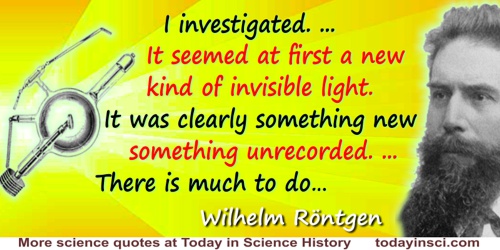
I was working with a Crookes tube covered by a shield of black cardboard. A piece of barium platino-cyanide paper lay on the bench there. I had been passing a current through the tube, and I noticed a peculiar black line across the paper. …
The effect was one which could only be produced in ordinary parlance by the passage of light. No light could come from the tube because the shield which covered it was impervious to any light known even that of the electric arc. …
I did not think; I investigated. …
I assumed that the effect must have come from the tube since its character indicated that it could come from nowhere else. … It seemed at first a new kind of invisible light. It was clearly something new something unrecorded. …
There is much to do, and I am busy, very busy. [Describing to a journalist the discovery of X-rays that he had made on 8 Nov 1895.]
The effect was one which could only be produced in ordinary parlance by the passage of light. No light could come from the tube because the shield which covered it was impervious to any light known even that of the electric arc. …
I did not think; I investigated. …
I assumed that the effect must have come from the tube since its character indicated that it could come from nowhere else. … It seemed at first a new kind of invisible light. It was clearly something new something unrecorded. …
There is much to do, and I am busy, very busy. [Describing to a journalist the discovery of X-rays that he had made on 8 Nov 1895.]
In H.J.W. Dam in 'The New Marvel in Photography", McClure's Magazine (Apr 1896), 4:5, 413.
I will insist particularly upon the following fact, which seems to me quite important and beyond the phenomena which one could expect to observe: The same [double sulfate of uranium and potassium] crystalline crusts, arranged the same way [as reported to the French academy on 24 Feb 1896] with respect to the photographic plates, in the same conditions and through the same screens, but sheltered from the excitation of incident rays and kept in darkness, still produce the same photographic images … [when kept from 26 Feb 1896] in the darkness of a bureau drawer. … I developed the photographic plates on the 1st of March, expecting to find the images very weak. Instead the silhouettes appeared with great intensity.
It is important to observe that it appears this phenomenon must not be attributed to the luminous radiation emitted by phosphorescence … One hypothesis which presents itself to the mind naturally enough would be to suppose that these rays, whose effects have a great similarity to the effects produced by the rays studied by M. Lenard and M. Röntgen, are invisible rays …
[Having eliminated phosphorescence as a cause, he has further revealed the effect of the as yet unknown radioactivity.]
It is important to observe that it appears this phenomenon must not be attributed to the luminous radiation emitted by phosphorescence … One hypothesis which presents itself to the mind naturally enough would be to suppose that these rays, whose effects have a great similarity to the effects produced by the rays studied by M. Lenard and M. Röntgen, are invisible rays …
[Having eliminated phosphorescence as a cause, he has further revealed the effect of the as yet unknown radioactivity.]
Read at French Academy of Science (2 Mar 1896). In Comptes Rendus (1896), 122, 501. As translated by Carmen Giunta on the Classic Chemistry web site.
In Melvin Calvin’s office there were four photographs: Michael Polanyi, Joel Hildebrand, Gilbert N. Lewis, and Ernest O. Lawrence. These scientists were his mentors: Polanyi for introducing him to the chemistry of phthalocyanine; Hildebrand for bringing him to Berkeley; Lewis, perhaps his most influential teacher; and Lawrence, who provided him the opportunity to work with the new scientific tool of radioactive carbon, which enabled the search for the path of carbon in photosynthesis to be successful.
Co-author with Marilyn Taylor and Robert E. Connick, obituary, 'Melvin Calvin', Proceedings of the American Philosophical Society (Dec 2000), 144, No. 4, 454.
In that same year [1932], the number of [known] particles was suddenly doubled. In two beautiful experiments, Chadwick showed that the neutron existed, and Anderson photographed the first unmistakable positron track.
In Nobel Lecture (11 Dec 1968), 'Recent Developments in Particle Physics', collected in Nobel Lectures: Physics 1963-1970 (1972), 241.
No video, no photographs, no verbal descriptions, no lectures can provide the enchantment that a few minutes out-of-doors can: watch a spider construct a web; observe a caterpillar systematically ravaging the edge of a leaf; close your eyes, cup your hands behind your ears, and listen to aspen leaves rustle or a stream muse about its pools and eddies. Nothing can replace plucking a cluster of pine needles and rolling them in your fingers to feel how they’re put together, or discovering that “sedges have edges and grasses are round,” The firsthand, right-and-left-brain experience of being in the out-of-doors involves all the senses including some we’ve forgotten about, like smelling water a mile away. No teacher, no student, can help but sense and absorb the larger ecological rhythms at work here, and the intertwining of intricate, varied and complex strands that characterize a rich, healthy natural world.
Into the Field: A Guide to Locally Focused Teaching
PHOTOGRAPH, n. A picture painted by the sun without instruction in art.
The Collected Works of Ambrose Bierce (1911), Vol. 7, The Devil's Dictionary, 251.
Picture yourself during the early 1920's inside the dome of the [Mount Wilson Observatory]. …
[Milton] Humason is showing [Harlow] Shapley stars he had found in the Andromeda Nebula that appeared and disappeared on photographs of that object. The famous astronomer very patiently explains that these objects could not be stars because the Nebula was a nearby gaseous cloud within our own Milky Way system. Shapley takes his handkerchief from his pocket and wipes the identifying marks off the back of the photographic plate.
Of course, Hubble came along in 1924 and showed that it was just these Cepheid variable stars in the Andromeda Nebula which proved it was a separate galaxy system.
Of course, Hubble came along in 1924 and showed that it was just these Cepheid variable stars in the Andromeda Nebula which proved it was a separate galaxy system.
In Quasars, Redshifts and Controversies (1998), 168. Arp writes that this was “a piece of real history which I happen to know because it was told to me by one of the participants. It dramatically illustrate the critical role of discordant evidence.”
Standing now in diffused light, with the wind at my back, I experience suddenly a feeling of completeness–not a feeling of having achieved something or of being stronger than everyone who was ever here before, not a feeling of having arrived at the ultimate point, not a feeling of supremacy. Just a breath of happiness deep inside my mind and my breast. The summit seemed suddenly to me to be a refuge, and I had not expected to find any refuge up here. Looking at the steep, sharp ridges below us, I have the impression that to have come later would have been too late. Everything we now say to one another, we only say out of embarrassment. I don’t think anymore. As I pull the tape recorder, trancelike, from my rucksack, and switch it on wanting to record a few appropriate phrases, tears again well into my eyes. “Now we are on the summit of Everest,” I begin, “it is so cold that we cannot take photographs…” I cannot go on, I am immediately shaken with sobs. I can neither talk nor think, feeling only how this momentous experience changes everything. To reach only a few meters below the summit would have required the same amount of effort, the same anxiety and burden of sorrow, but a feeling like this, an eruption of feeling, is only possible on the summit itself.
In Everest: Expedition to the Ultimate (1979), 180.
The generalized theory of relativity has furnished still more remarkable results. This considers not only uniform but also accelerated motion. In particular, it is based on the impossibility of distinguishing an acceleration from the gravitation or other force which produces it. Three consequences of the theory may be mentioned of which two have been confirmed while the third is still on trial: (1) It gives a correct explanation of the residual motion of forty-three seconds of arc per century of the perihelion of Mercury. (2) It predicts the deviation which a ray of light from a star should experience on passing near a large gravitating body, the sun, namely, 1".7. On Newton's corpuscular theory this should be only half as great. As a result of the measurements of the photographs of the eclipse of 1921 the number found was much nearer to the prediction of Einstein, and was inversely proportional to the distance from the center of the sun, in further confirmation of the theory. (3) The theory predicts a displacement of the solar spectral lines, and it seems that this prediction is also verified.
Studies in Optics (1927), 160-1.
The greatest of all spectral classifiers, Antonia Maury had two strikes on her: the biggest one was, she was a woman. A woman had no chance at anything in astronomy except at Harvard in the 1880’s and 1890’s. And even there, things were rough. It now turns out that her director, E.C. Pickering, did not like the way she classified; she then refused to change to suit him; and after her great publication in Harvard Annals 28 (1897), she left Harvard—and in a sense, astronomy. ... I would say the most remarkable phenomenological investigation in modern astronomy is Miss Maury’s work in Harvard Annals 28. She didn’t have anything astrophysical to go on. Investigations between 1890 and 1900 were the origin of astrophysics. But these were solar, mostly. And there Miss Maury was on the periphery. I’ve seen pictures of groups, where she’d be standing away a little bit to one side of the other people, a little bit in the background. It was a very sad thing. When Hertzsprung wrote Pickering to congratulate him on Miss Maury’s work that had led to Hertzsprung’s discovery of super giants, Pickering is supposed to have replied that Miss Maury’s work was wrong — could not possibly be correct.
'Oral History Transcript: Dr. William Wilson Morgan' (8 Aug 1978) in the Niels Bohr Library & Archives.
The progress of synthesis, or the building up of natural materials from their constituent elements, proceeds apace. Even some of the simpler albuminoids, a class of substances of great importance in the life process, have recently been artificially prepared. ... Innumerable entirely new compounds have been produced in the last century. The artificial dye-stuffs, prepared from materials occurring in coal-tar, make the natural colours blush. Saccharin, which is hundreds of times sweeter than sugar, is a purely artificial substance. New explosives, drugs, alloys, photographic substances, essences, scents, solvents, and detergents are being poured out in a continuous stream.
In Matter and Energy (1912), 45-46.
The Sun is no lonelier than its neighbors; indeed, it is a very common-place star,—dwarfish, though not minute,—like hundreds, nay thousands, of others. By accident the brighter component of Alpha Centauri (which is double) is almost the Sun's twin in brightness, mass, and size. Could this Earth be transported to its vicinity by some supernatural power, and set revolving about it, at a little less than a hundred million miles' distance, the star would heat and light the world just as the Sun does, and life and civilization might go on with no radical change. The Milky Way would girdle the heavens as before; some of our familiar constellations, such as Orion, would be little changed, though others would be greatly altered by the shifting of the nearer stars. An unfamiliar brilliant star, between Cassiopeia and Perseus would be—the Sun. Looking back at it with our telescopes, we could photograph its spectrum, observe its motion among the stars, and convince ourselves that it was the same old Sun; but what had happened to the rest of our planetary system we would not know.
The Solar System and its Origin (1935), 2-3.
The typical nature photograph shows a butterfly on a pretty flower. The conservation photograph shows the same thing, but with a bulldozer coming at it in the background.
As quoted in Jaymi Heimbuch, 'How One Photographer's Foolishness is Saving Endangered Wildlife' (23 Jan 2014) on Mother Nature Network webpage.
To the east was our giant neighbor Makalu, unexplored and unclimbed, and even on top of Everest the mountaineering instinct was sufficient strong to cause me to spend some moments conjecturing as to whether a route up that mountain might not exist. Far away across the clouds the great bulk of Kangchenjunga loomed on the horizon. To the west, Cho Oyu, our old adversary from 1952, dominated the scene and we could see the great unexplored ranges of Nepal stretching off into the distance. The most important photograph, I felt, was a shot down the north ridge, showing the North Col and the old route that had been made famous by the struggles of those great climbers of the 1920s and 1930s. I had little hope of the results being particularly successful, as I had a lot of difficulty in holding the camera steady in my clumsy gloves, but I felt that they would at least serve as a record. After some ten minutes of this, I realized that I was becoming rather clumsy-fingered and slow-moving, so I quickly replaced my oxygen set and experience once more the stimulating effect of even a few liters of oxygen. Meanwhile, Tenzing had made a little hole in the snow and in it he placed small articles of food – a bar of chocolate, a packet of biscuits and a handful of lollies. Small offerings, indeed, but at least a token gifts to the gods that all devoted Buddhists believe have their home on this lofty summit. While we were together on the South Col two days before, Hunt had given me a small crucifix that he had asked me to take to the top. I, too, made a hole in the snow and placed the crucifix beside Tenzing’s gifts.
As quoted in Whit Burnett, The Spirit of Adventure: The Challenge (1955), 349.
Vesuvius is actually inside the exploded skeleton of an older volcano. If you look at an aerial photograph, you can see the remaining ridge of a much larger volcano on the north side.
As quoted in Doug Stewart, 'Resurrecting Pompeii', Smithsonian Magazine (Feb 2006). Stewart adds, “It likely blew, violently, long before human settlement.”
When alpha rays are photographed, the plate is all cluttered up with traces of rays which fail to reach their objective inside the atom and usually they hide the most interesting part of the picture. In the case of neutrons, [the advantage is that they are not seen, so] the photograph gives clear evidence of the disrupted atom.
In Ferdinand Kuhn Jr., 'Chadwick calls Neutron ‘Difficult Catch’; His Find Hailed as Aid in Study of Atom, New York Times (29 Feb 1932), 8.
Why can't I see the picture right away?
Remark made at age 3 years old after having just been photographed by her father, Edwin Land. Subsequently, he took a solitary walk while vacationing in Sante Fe (1943) and in that time originated the basic idea for the Polaroid instant camera. As quoted in 'Colossus of the Camera', New York Times (5 Aug 1982).
With crystals we are in a situation similar to an attempt to investigate an optical grating merely from the spectra it produces... But a knowledge of the positions and intensities of the spectra does not suffice for the determination of the structure. The phases with which the diffracted waves vibrate relative to one another enter in an essential way. To determine a crystal structure on the atomic scale, one must know the phase differences between the different interference spots on the photographic plate, and this task may certainly prove to be rather difficult.
Physikalische Zeitschrift (1913), 14. Translated in Walter Moore, Schrödinger. Life and Thought (1989), 73.
 In science it often happens that scientists say, 'You know that's a really good argument; my position is mistaken,' and then they would actually change their minds and you never hear that old view from them again. They really do it. It doesn't happen as often as it should, because scientists are human and change is sometimes painful. But it happens every day. I cannot recall the last time something like that happened in politics or religion.
(1987) --
In science it often happens that scientists say, 'You know that's a really good argument; my position is mistaken,' and then they would actually change their minds and you never hear that old view from them again. They really do it. It doesn't happen as often as it should, because scientists are human and change is sometimes painful. But it happens every day. I cannot recall the last time something like that happened in politics or religion.
(1987) --