Phenomenon Quotes (337 quotes)
… it may happen that small differences in the initial conditions produce very great ones in the final phenomena.
Science and Method (1908) translated by Francis Maitland (2003), 68.
…separation of the observer from the phenomenon to be observed is no longer possible.
Quoted in Robert J. Scully, The Demon and the Quantum (2007), 3.
[Defining Life] the sum of the phenomena proper to organized beings. In consists essentially in this, that organized beings are all, during a certain time, the centres to which foreign substances penetrate and are appropriated, and from which others issue.
Béclard, "Anatomie Générale." In The British Controversialist and Literary Magazine (1865), 234.
[F. Werner, while a student in Princeton,] came to me and expressed his bewilderment with the fact that we make a rather narrow selection when choosing the data on which we test our theories. “How do we know that, if we made a theory which focuses its attention on phenomena we disregard and disregards some of the phenomena now commanding our attention, that we could not build another theory which has little in common with the present one but which, nevertheless, explains just as many phenomena as the present theory?” It has to be admitted that we have no definite evidence that there is no such theory.
In 'The Unreasonable Effectiveness of Mathematics in the Natural Sciences,' Communications in Pure and Applied Mathematics (Feb 1960), 13, No. 1 (February 1960). Collected in Eugene Paul Wigner, A.S. Wightman (ed.), Jagdish Mehra (ed.), The Collected Works of Eugene Paul Wigner (1955), Vol. 6, 535.
[Herbert Spencer] has discovered a great law of evolution in nature, which underlies all phenomena, & which is as important & more comprehensive than Newton’s law of gravitation.
In letter to his mother, after reading (Jul 1861) Herbert Spencer, The Principles of Psychology (1855). Fiske called the book, “the profoundest work I ever read”. It ignited his enthusiasm for Spencer’s philosophy of evolution. As quoted in Milton Berman, John Fiske: The Evolution of a Popularizer (1961), 36-37.
[Quantum mechanics is] a phenomenon which is impossible, absolutely impossible, to explain in any classical way.
…...
[Someone] remarked to me once: Physicians should not say, I have cured this man, but, This man didn’t die in my care. In physics too one might say, For such and such a phenomenon I have determined causes whose absurdity cannot finally be proved, instead of saying, I have explained it.
As quoted in Joseph Peter Stern, Lichtenberg: A Doctrine of Scattered Occasions: Reconstructed From His Aphorisms and Reflections (1959), 297.
[T]he phenomena of animal life correspond to one another, whether we compare their rank as determined by structural complication with the phases of their growth, or with their succession in past geological ages; whether we compare this succession with their relative growth, or all these different relations with each other and with the geographical distribution of animals upon the earth. The same series everywhere!
In Essay on Classification (1851), 196.
[There] are cases where there is no dishonesty involved but where people are tricked into false results by a lack of understanding about what human beings can do to themselves in the way of being led astray by subjective effects, wishful thinking or threshold interactions. These are examples of pathological science. These are things that attracted a great deal of attention. Usually hundreds of papers have been published upon them. Sometimes they have lasted for fifteen or twenty years and then they gradually die away.
[Coining the term “pathological science” for the self-deceiving application of science to a phenomenon that doesn't exist.]
[Coining the term “pathological science” for the self-deceiving application of science to a phenomenon that doesn't exist.]
From a Colloquium at The Knolls Research Laboratory (18 Dec 1953). Transcribed and edited by R. N. Hall. In General Electric Laboratories, Report No. 68-C-035 (April 1968).
[Defining Life] The constant uniformity of phenomena under diversity of external influences.
Biologie (1802). As cited in translated form in George Henry Lewes, Physiology of Common Life (1875), Vol. 2, 356.
L’analyse mathématique … dans l’étude de tous les phénomènes; elle les interprète par le même langage, comme pour attester l’unité et la simplicité du plan de l’univers, et rendre encore plus manifeste cet ordre immuable qui préside à toutes les causes naturelles.
Mathematical analysis … in the study of all phenomena, interprets them by the same language, as if to attest the unity and simplicity of the plan of the universe, and to make still more evident that unchangeable order which presides over all natural causes.
Mathematical analysis … in the study of all phenomena, interprets them by the same language, as if to attest the unity and simplicity of the plan of the universe, and to make still more evident that unchangeable order which presides over all natural causes.
From Théorie Analytique de la Chaleur (1822), xv, translated by Alexander Freeman in The Analytical Theory of Heat (1878), 8.
Le premier regard de l’homme jeté sur l’univers n’y découvre que variété, diversité, multiplicité des phénomènes. Que ce regard soit illuminé par la science,—par la science qui rapproche l’homme de Dieu,—et la simplicité et l’unité brillent de toutes parts.
Man’s first glance at the universe discovers only variety, diversity, multiplicity of phenomena. Let that glance be illuminated by science—by the science which brings man closer to God,—and simplicity and unity shine on all sides.
Man’s first glance at the universe discovers only variety, diversity, multiplicity of phenomena. Let that glance be illuminated by science—by the science which brings man closer to God,—and simplicity and unity shine on all sides.
Original French quoted in René Vallery-Radot, La Vie de Pasteur (1901), 209. Translation by Google translate, tweaked by Webmaster. The English version of the book, omits this passage, except for “Science, which brings man nearer to God.” In The Life of Pasteur (1902), Vol. 1, 194.
Neue Phaenomena zu erklären, dieses macht meine Sorgen aus, und wie froh ist der Forscher, wenn er das so fleissig Gesuche findet, eine Ergötzung wobei das Herz lacht.
To explain new phenomena, that is my task; and how happy is the scientist when he finds what he so diligently sought, a pleasure that gladdens the heart.
To explain new phenomena, that is my task; and how happy is the scientist when he finds what he so diligently sought, a pleasure that gladdens the heart.
Letter to Johan Gahn. Original German quote in Mary Elivira Weeks, The Discovery of the Elements (1934), 153, citing Nordenskiöld, Scheeles nachgelassene Briefe und Aufzeichnungen (1892), 151. Translation in Mary Elvira Weeks and Henry M. Leicester (ed.)The Discovery of the Elements (6th ed. 1956), 223.
Qu. 31. Have not the small Particles of Bodies certain Powers, Virtues or Forces, by which they act at a distance, not only upon the Rays of Light for reflecting, refracting and reflecting them, but also upon one another for producing a great part of the Phænomena of Nature?
From Opticks, (1704, 2nd ed. 1718), Book 3, Query 31, 350.
A drop from the nose of Fleming, who had a cold, fell onto an agar plate where large yellow colonies of a contaminant had grown, and lysosyme was discovered. He made this important discovery because when he saw that the colonies of the contaminant were fading, his mind went straight to the right cause of the phenomenon he was observing—that the drop from his nose contained a lytic substance. And also immediately, he thought that this substance might be present in many secretions and tissues of the body. And he found this was so—the substance was in tears, saliva, leucocytes, skin, fingernails, mother's milk—thus very widely distributed in amounts and also in plants.
Personal recollections of Alexander Fleming by Lady Amelia Fleming. Quoted in Molecular Cloning (2001), Vol. 1, 153.
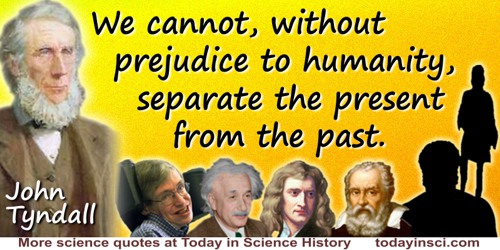
A few days ago, a Master of Arts, who is still a young man, and therefore the recipient of a modern education, stated to me that until he had reached the age of twenty he had never been taught anything whatever regarding natural phenomena, or natural law. Twelve years of his life previously had been spent exclusively amongst the ancients. The case, I regret to say, is typical. Now we cannot, without prejudice to humanity, separate the present from the past.
'On the Study of Physics', From a Lecture delivered in the Royal Institution of Great Britain in the Spring of 1854. Fragments of Science for Unscientific People: A Series of Detached Essays, Lectures, and Reviews (1892), Vol. 1, 284-5.
A good physiological experiment like a good physical one requires that it should present anywhere, at any time, under identical conditions, the same certain and unequivocal phenomena that can always be confirmed.
Bestätigung des Bell'schen Lehrsatzes, dass die doppelten Wurzeln der Rückenmarksnerven verschiedene Functionen haben, durch neue nod entscheidende Experimente' (1831). Trans. Edwin Clarke and C. D. O'Malley, The Human Brain and Spinal Cord (1968), 304.
A science cannot be played with. If an hypothesis is advanced that obviously brings into direct sequence of cause and effect all the phenomena of human history, we must accept it, and if we accept it, we must teach it.
In The Degradation of the Democratic Dogma (1919), 131.
A scientific observation is always a committed observation. It confirms or denies one’s preconceptions, one’s first ideas, one’s plan of observation. It shows by demonstration. It structures the phenomenon. It transcends what is close at hand. It reconstructs the real after having reconstructed its representation.
In The New Scientific Spirit (1934).
A thing is either alive or it isn’t; there is nothing that is almost alive. There is but the remotest possibility of the origin of life by spontaneous generation, and every likelihood that Arrhenius is right when he dares to claim that life is a cosmic phenomenon, something that drifts between the spheres, like light, and like light transiently descends upon those fit to receive it.
In An Almanac for Moderns (1935), 393.
A vital phenomenon can only be regarded as explained if it has been proven that it appears as the result of the material components of living organisms interacting according to the laws which those same components follow in their interactions outside of living systems.
Gesammelte Schriften (1904), Vol. 3, 767. Trans. Paul F. Cranefield, 'The Organic Physics of 1847 and the Biophysics of Today', Journal of the History of Medicine and Allied Sciences, 1957, 12, 410.
All interesting issues in natural history are questions of relative frequency, not single examples. Everything happens once amidst the richness of nature. But when an unanticipated phenomenon occurs again and again–finally turning into an expectation–then theories are overturned.
…...
All of our experience indicates that life can manifest itself only in a concrete form, and that it is bound to certain substantial loci. These loci are cells and cell formations. But we are far from seeking the last and highest level of understanding in the morphology of these loci of life. Anatomy does not exclude physiology, but physiology certainly presupposes anatomy. The phenomena that the physiologist investigates occur in special organs with quite characteristic anatomical arrangements; the various morphological parts disclosed by the anatomist are the bearers of properties or, if you will, of forces probed by the physiologist; when the physiologist has established a law, whether through physical or chemical investigation, the anatomist can still proudly state: This is the structure in which the law becomes manifest.
In 'Cellular-Pathologie', Archiv für pathologische Anatomie und Physiologie und fur klinische Medizin (1855), 8, 19, as translated in LellandJ. Rather, 'Cellular Pathology', Disease, Life, and Man: Selected Essays by Rudolf Virchow (1958), 84.
All sciences deal in unity. They unite phenomena in a principle.
In Psychologic Foundations of Education: An Attempt to Show the Genesis of the Higher Faculties of the Mind (1907), 379.
All scientists must focus closely on limited targets. Whether or not one’s findings on a limited subject will have wide applicability depends to some extent on chance, but biologists of superior ability repeatedly focus on questions the answers to which either have wide ramifications or lead to new areas of investigation. One procedure that can be effective is to attempt both reduction and synthesis; that is, direct a question at a phenomenon on one integrative level, identify its mechanism at a simpler level, then extrapolate its consequences to a more complex level of integration.
In 'Scientific innovation and creativity: a zoologist’s point of view', American Zoologist (1982), 22, 230-231,
All that concerns the Mediterranean is of the deepest interest to civilized man, for the history of its progress is the history of the development of the world; the memory of the great men who have lived and died around its banks; the recollection of the undying works that have come thence to delight us for ever; the story of patient research and brilliant discoveries connected with every physical phenomenon presented by its waves and currents, and with every order of creatures dwelling in and around its waters.
From Literary Papers (1855), 106. As quoted in On Early Explorations in the Mediterranean.In George Wilson and Archibald Geikie, Memoir of Edward Forbes F.R.S. (1861), 279. Geike introduces the Forbes quote as “the recollection of these, his earliest explorations in the Mediterranean,” as written down years later.
All the real true knowledge we have of Nature is intirely experimental, insomuch that, how strange soever the assertion seems, we may lay this down as the first fundamental unerring rule in physics, That it is not within the compass of human understanding to assign a purely speculative reason for any one phaenomenon in nature.
In The Procedure, Extent, and Limits of Human Understanding (1728, 1729), 205-206.
All things are hidden, obscure and debatable if the cause of the phenomena is unknown, but everything is clear if its cause be known.
In Louis Pasteur and Harold Clarence Ernst (trans), The Germ Theory and Its Application to Medicine and Surgery, Chap. 2. Reprinted in Charles W. Eliot (ed.), The Harvard Classics:
Scientific Papers: Physiology, Medicine, Surgery, Geology (1897, 1910), Vol. 38, 384. Cited as read before French Academy of Science (20 Apr 1878), published in Comptes Rendus de l’Académie des Sciences, 84, 1037-43.
Although to penetrate into the intimate mysteries of nature and thence to learn the true causes of phenomena is not allowed to us, nevertheless it can happen that a certain fictive hypothesis may suffice for explaining many phenomena.
…...
An evolution is a series of events that in itself as series is purely physical, — a set of necessary occurrences in the world of space and time. An egg develops into a chick; … a planet condenses from the fluid state, and develops the life that for millions of years makes it so wondrous a place. Look upon all these things descriptively, and you shall see nothing but matter moving instant after instant, each instant containing in its full description the necessity of passing over into the next. … But look at the whole appreciatively, historically, synthetically, as a musician listens to a symphony, as a spectator watches a drama. Now you shall seem to have seen, in phenomenal form, a story.
In The Spirit of Modern Philosophy: An Essay in the Form of Lectures (1892), 425.
An example of such emergent phenomena is the origin of life from non-living chemical compounds in the oldest, lifeless oceans of the earth. Here, aided by the radiation energy received from the sun, countless chemical materials were synthesized and accumulated in such a way that they constituted, as it were, a primeval “soup.” In this primeval soup, by infinite variations of lifeless growth and decay of substances during some billions of years, the way of life was ultimately reached, with its metabolism characterized by selective assimilation and dissimilation as end stations of a sluiced and canalized flow of free chemical energy.
In 'The Scientific Character of Geology', The Journal of Geology (Jul 1961), 69, No. 4, 458.
An Experiment, like every other event which takes place, is a natural phenomenon; but in a Scientific Experiment the circumstances are so arranged that the relations between a particular set of phenomena may be studied to the best advantage.
'General Considerations Concerning Scientific Apparatus', 1876. In W. D. Niven (ed.), The Scientific Papers of James Clerk Maxwell (1890), Vol. 2, 505.
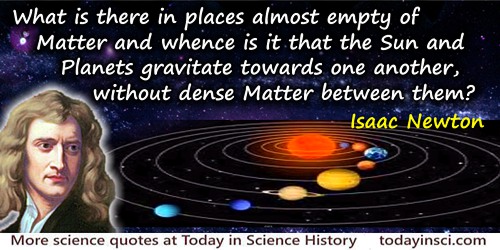
And for rejecting such a Medium, we have the Authority of those the oldest and most celebrated Philosophers of Greece and Phoenicia, who made a Vacuum, and Atoms, and the Gravity of Atoms, the first Principles of their Philosophy; tacitly attributing Gravity to some other Cause than dense Matter. Later Philosophers banish the Consideration of such a Cause out of natural Philosophy, feigning Hypotheses for explaining all things mechanically, and referring other Causes to Metaphysicks: Whereas the main Business of natural Philosophy is to argue from Phaenomena without feigning Hypotheses, and to deduce Causes from Effects, till we come to the very first Cause, which certainly is not mechanical; and not only to unfold the Mechanism of the World, but chiefly to resolve these and such like Questions. What is there in places almost empty of Matter, and whence is it that the Sun and Planets gravitate towards one another, without dense Matter between them? Whence is it that Nature doth nothing in vain; and whence arises all that Order and Beauty which we see in the World? ... does it not appear from phaenomena that there is a Being incorporeal, living, intelligent, omnipresent, who in infinite space, as it were in his Sensory, sees the things themselves intimately, and thoroughly perceives them, and comprehends them wholly by their immediate presence to himself.
In Opticks, (1704, 2nd. Ed. 1718), Book 3, Query 28, 343-5. Newton’s reference to “Nature does nothing in vain” recalls the axiom from Aristotle, which may be seen as “Natura nihil agit frustra” in the Aristotle Quotes on this web site.
Anthropology has reached that point of development where the careful investigation of facts shakes our firm belief in the far-reaching theories that have been built up. The complexity of each phenomenon dawns on our minds, and makes us desirous of proceeding more cautiously. Heretofore we have seen the features common to all human thought. Now we begin to see their differences. We recognize that these are no less important than their similarities, and the value of detailed studies becomes apparent. Our aim has not changed, but our method must change. We are still searching for the laws that govern the growth of human culture, of human thought; but we recognize the fact that before we seek for what is common to all culture, we must analyze each culture by careful and exact methods, as the geologist analyzes the succession and order of deposits, as the biologist examines the forms of living matter. We see that the growth of human culture manifests itself in the growth of each special culture. Thus we have come to understand that before we can build up the theory of the growth of all human culture, we must know the growth of cultures that we find here and there among the most primitive tribes of the Arctic, of the deserts of Australia, and of the impenetrable forests of South America; and the progress of the civilization of antiquity and of our own times. We must, so far as we can, reconstruct the actual history of mankind, before we can hope to discover the laws underlying that history.
The Jesup North Pacific Expedition: Memoir of the American Museum of Natural History (1898), Vol. 1, 4.
Are not all Hypotheses erroneous, in which Light is supposed to consist in Pression or Motion, propagated through a fluid Medium? For in all these Hypotheses the Phaenomena of Light have been hitherto explain'd by supposing that they arise from new Modifications of the Rays; which is an erroneous Supposition.
Opticks, 2nd edition (1718), Book 3, Query 28, 337.
As science has supplanted its predecessors, so it may hereafter be superseded by some more perfect hypothesis, perhaps by some totally different way of looking at the phenomena—of registering the shadows on the screen—of which we in this generation can form no idea. The advance of knowledge is an infinite progression towards a goal that for ever recedes.
In The Golden Bough: A Study in Magic and Religion (1890, 1900), Vol. 3, 460.
As soon as the circumstances of an experiment are well known, we stop gathering statistics. … The effect will occur always without exception, because the cause of the phenomena is accurately defined. Only when a phenomenon includes conditions as yet undefined,Only when a phenomenon includes conditions as yet undefined, can we compile statistics. … we must learn therefore that we compile statistics only when we cannot possibly help it; for in my opinion, statistics can never yield scientific truth.
From An Introduction to the Study of Experimental Medicine (1865), as translated by Henry Copley Greene (1957), 134-137.
As soon as we touch the complex processes that go on in a living thing, be it plant or animal, we are at once forced to use the methods of this science [chemistry]. No longer will the microscope, the kymograph, the scalpel avail for the complete solution of the problem. For the further analysis of these phenomena which are in flux and flow, the investigator must associate himself with those who have labored in fields where molecules and atoms, rather than multicellular tissues or even unicellular organisms, are the units of study.
'Experimental and Chemical Studies of the Blood with an Appeal for More Extended Chemical Training for the Biological and Medical Investigator', Science (6 Aug 1915), 42, 176.
At this stage you must admit that whatever is seen to be sentient is nevertheless composed of atoms that are insentient. The phenomena open to our observation so not contradict this conclusion or conflict with it. Rather they lead us by the hand and compel us to believe that the animate is born, as I maintain, of the insentient.
In On the Nature of the Universe, translated by R. E. Latham (1951, 1994), 59.
Built up of carbon, hydrogen, oxygen, nitrogen, together with traces of a few other elements, yet of a complexity of structure that has hitherto resisted all attempts at complete analysis, protoplasm is at once the most enduring and the most easily destroyed of substances; its molecules are constantly breaking down to furnish the power for the manifestations of vital phenomena, and yet, through its remarkable property of assimilation, a power possessed by nothing else upon earth, it constantly builds up its substance anew from the surrounding medium.
In History of the Human Body (1919), 1.
But it will be found... that one universal law prevails in all these phenomena. Where two portions of the same light arrive in the eye by different routes, either exactly or very nearly in the same direction, the appearance or disappearance of various colours is determined by the greater or less difference in the lengths of the paths.
Lecture XIV. 'Of Physical Optics'. In A Syllabus of a Course of Lectures on Natural and Experimental Philosophy (1802), 112-4.
By destroying the biological character of phenomena, the use of averages in physiology and medicine usually gives only apparent accuracy to the results. From our point of view, we may distinguish between several kinds of averages: physical averages, chemical averages and physiological and pathological averages. If, for instance, we observe the number of pulsations and the degree of blood pressure by means of the oscillations of a manometer throughout one day, and if we take the average of all our figures to get the true or average blood pressure and to learn the true or average number of pulsations, we shall simply have wrong numbers. In fact, the pulse decreases in number and intensity when we are fasting and increases during digestion or under different influences of movement and rest; all the biological characteristics of the phenomenon disappear in the average. Chemical averages are also often used. If we collect a man's urine during twenty-four hours and mix all this urine to analyze the average, we get an analysis of a urine which simply does not exist; for urine, when fasting, is different from urine during digestion. A startling instance of this kind was invented by a physiologist who took urine from a railroad station urinal where people of all nations passed, and who believed he could thus present an analysis of average European urine! Aside from physical and chemical, there are physiological averages, or what we might call average descriptions of phenomena, which are even more false. Let me assume that a physician collects a great many individual observations of a disease and that he makes an average description of symptoms observed in the individual cases; he will thus have a description that will never be matched in nature. So in physiology, we must never make average descriptions of experiments, because the true relations of phenomena disappear in the average; when dealing with complex and variable experiments, we must study their various circumstances, and then present our most perfect experiment as a type, which, however, still stands for true facts. In the cases just considered, averages must therefore be rejected, because they confuse, while aiming to unify, and distort while aiming to simplify. Averages are applicable only to reducing very slightly varying numerical data about clearly defined and absolutely simple cases.
From An Introduction to the Study of Experimental Medicine (1865), as translated by Henry Copley Greene (1957), 134-135.
By science, then, I understand the consideration of all subjects, whether of a pure or mixed nature, capable of being reduced to measurement and calculation. All things comprehended under the categories of space, time and number properly belong to our investigations; and all phenomena capable of being brought under the semblance of a law are legitimate objects of our inquiries.
In Report of the British Association for the Advancement of Science (1833), xxviii.
By the 18th century science had been so successful in laying bare the laws of nature that many thought there was nothing left to discover. Immutable laws prescribed the motion of every particle in the universe, exactly and forever: the task of the scientist was to elucidate the implications of those laws for any particular phenomenon of interest. Chaos gave way to a clockwork world. But the world moved on ...Today even our clocks are not made of clockwork. ... With the advent of quantum mechanics, the clockwork world has become a lottery. Fundamental events, such as the decay of a radioactive atom, are held to be determined by chance, not law.
Does God Play Dice?: The New Mathematics of Chaos (2002). xi.
Can science ever be immune from experiments conceived out of prejudices and stereotypes, conscious or not? (Which is not to suggest that it cannot in discrete areas identify and locate verifiable phenomena in nature.) I await the study that says lesbians have a region of the hypothalamus that resembles straight men and I would not be surprised if, at this very moment, some scientist somewhere is studying brains of deceased Asians to see if they have an enlarged ‘math region’ of the brain.
— Kay Diaz
…...
Casting off the dark fog of verbal philosophy and vulgar medicine, which inculcate names alone ... I tried a series of experiments to explain more clearly many phenomena, particularly those of physiology. In order that I might subject as far as possible the reasonings of the Galenists and Peripatetics to sensory criteria, I began, after trying experiments, to write dialogues in which a Galenist adduced the better-known and stronger reasons and arguments; these a mechanist surgeon refuted by citing to the contrary the experiments I had tried, and a third, neutral interlocutor weighed the reasons advanced by both and provided an opportunity for further progress.
'Malpighi at Pisa 1656-1659', in H. B. Adelmann (ed.), Marcello Malpighi and the Evolution of Embryology (1966), Vol. 1, 155-6.
Chemistry and physics are experimental sciences; and those who are engaged in attempting to enlarge the boundaries of science by experiment are generally unwilling to publish speculations; for they have learned, by long experience, that it is unsafe to anticipate events. It is true, they must make certain theories and hypotheses. They must form some kind of mental picture of the relations between the phenomena which they are trying to investigate, else their experiments would be made at random, and without connection.
From 'Radium and Its Products', Harper’s Magazine (Dec 1904), 52.
Chemistry stands at the pivot of science. On the one hand it deals with biology and provides explanations for the processes of life. On the other hand it mingles with physics and finds explanations for chemical phenomena in the fundamental processes and particles of the universe. Chemistry links the familiar with the fundamental.
In Scientific American Library, Molecules (1987, 2003), 2.
Consciousness ... is the phenomenon whereby the universe's very existence is made known.
from The Emperor's New Mind: Concerning Computers, Minds, and the Laws of Physics (1989, 2002), 580.
Consciousness is an electrical phenomenon which arises from a state of being which we can feel.
In On Love & Psychological Exercises: With Some Aphorisms & Other Essays (1998), 54.
Considered as a mere question of physics, (and keeping all moral considerations entirely out of sight,) the appearance of man is a geological phenomenon of vast importance, indirectly modifying the whole surface of the earth, breaking in upon any supposition of zoological continuity, and utterly unaccounted for by what we have any right to call the laws of nature.
'Address to the Geological Society, delivered on the Evening of the 18th of February 1831', Proceedings of the Geological Society (1834), 1, 306.
Curiosity atrophies after childhood unless it is transferred to an intellectual plane. The research worker is usually a person whose curiosity is turned toward seeking explanations for phenomena that are not understood.
In The Art of Scientific Investigation (1950), 67.
Curiosity that inborn property of man, daughter of ignorance and mother of knowledge when wonder wakens our minds, has the habit, wherever it sees some extraordinary phenomenon of nature, a comet for example, a sun-dog, or a midday star, of asking straightway what it means.
In The New Science (3rd ed., 1744), Book 1, Para. 189, as translated by Thomas Goddard Bergin and Max Harold Fisch, The New Science of Giambattista Vico (1948), 64.
During the last two centuries and a half, physical knowledge has been gradually made to rest upon a basis which it had not before. It has become mathematical. The question now is, not whether this or that hypothesis is better or worse to the pure thought, but whether it accords with observed phenomena in those consequences which can be shown necessarily to follow from it, if it be true
In Augustus De Morgan and Sophia Elizabeth De Morgan (ed.), A Budget of Paradoxes (1872), 2.
EFFECT, n. The second of two phenomena which always occur together in the same order. The first, called a Cause, is said to generate the other—which is no more sensible than it would be for one who has never seen a dog except in pursuit of a rabbit to declare the rabbit the cause of the dog.
The Cynic's Word Book (1906), 86. Later published as The Devil's Dictionary.
Einstein, twenty-six years old, only three years away from crude privation, still a patent examiner, published in the Annalen der Physik in 1905 five papers on entirely different subjects. Three of them were among the greatest in the history of physics. One, very simple, gave the quantum explanation of the photoelectric effect—it was this work for which, sixteen years later, he was awarded the Nobel prize. Another dealt with the phenomenon of Brownian motion, the apparently erratic movement of tiny particles suspended in a liquid: Einstein showed that these movements satisfied a clear statistical law. This was like a conjuring trick, easy when explained: before it, decent scientists could still doubt the concrete existence of atoms and molecules: this paper was as near to a direct proof of their concreteness as a theoretician could give. The third paper was the special theory of relativity, which quietly amalgamated space, time, and matter into one fundamental unity.
This last paper contains no references and quotes no authority. All of them are written in a style unlike any other theoretical physicist’s. They contain very little mathematics. There is a good deal of verbal commentary. The conclusions, the bizarre conclusions, emerge as though with the greatest of ease: the reasoning is unbreakable. It looks as though he had reached the conclusions by pure thought, unaided, without listening to the opinions of others. To a surprisingly large extent, that is precisely what he had done.
This last paper contains no references and quotes no authority. All of them are written in a style unlike any other theoretical physicist’s. They contain very little mathematics. There is a good deal of verbal commentary. The conclusions, the bizarre conclusions, emerge as though with the greatest of ease: the reasoning is unbreakable. It looks as though he had reached the conclusions by pure thought, unaided, without listening to the opinions of others. To a surprisingly large extent, that is precisely what he had done.
In Variety of Men (1966), 100-101. First published in Commentary magazine.
Ethnologists regard man as the primitive element of tribes, races, and peoples. The anthropologist looks at him as a member of the fauna of the globe, belonging to a zoölogical classification, and subject to the same laws as the rest of the animal kingdom. To study him from the last point of view only would be to lose sight of some of his most interesting and practical relations; but to be confined to the ethnologist’s views is to set aside the scientific rule which requires us to proceed from the simple to the compound, from the known to the unknown, from the material and organic fact to the functional phenomenon.
'Paul Broca and the French School of Anthropology'. Lecture delivered in the National Museum, Washington, D.C., 15 April 1882, by Dr. Robert Fletcher. In The Saturday Lectures (1882), 118.
Every phenomenon, however trifling it be, has a cause, and a mind infinitely powerful, and infinitely well-informed concerning the laws of nature could have foreseen it from the beginning of the ages. If a being with such a mind existed, we could play no game of chance with him; we should always lose.
Science and Method (1908), trans. Francis Maitland (1914), 65.
Evolution has encountered no intellectual trouble; no new arguments have been offered. Creationism is a home-grown phenomenon of American sociocultural history—a splinter movement … who believe that every word in the Bible must be literally true, whatever such a claim might mean.
Leonardo's Mountain of Clams and the Diet of Worms: Essays on Natural History (1998), 270.
For a physicist mathematics is not just a tool by means of which phenomena can be calculated, it is the main source of concepts and principles by means of which new theories can be created.
In 'Mathematics in the Physical Sciences', Scientific American (Sep 1964), 211, No. 3, 129.
For it is too bad that there are so few who seek the truth and so few who do not follow a mistaken method in philosophy. This is not, however, the place to lament the misery of our century, but to rejoice with you over such beautiful ideas for proving the truth. So I add only, and I promise, that I shall read your book at leisure; for I am certain that I shall find the noblest things in it. And this I shall do the more gladly, because I accepted the view of Copernicus many years ago, and from this standpoint I have discovered from their origins many natural phenomena, which doubtless cannot be explained on the basis of the more commonly accepted hypothesis.
Letter (4 Aug 1597) to Kepler, expressing thanks and interest in the book Kepler sent him. As quoted in translation in Jackson J. Spielvogel, Western Civilization: Alternate Volume: Since 1300 (2010), Vol. 2, 494.
From the aspect of energy, renewed by radio-active phenomena, material corpuscles may now be treated as transient reservoirs of concentrated power. Though never found in a state of purity, but always more or less granulated (even in light) energy nowadays represents for science the most primitive form of universal stuff.
In Teilhard de Chardin and Bernard Wall (trans.), The Phenomenon of Man (1959, 2008), 42. Originally published in French as Le Phénomene Humain (1955).
Galileo … asserts that in all these phenomena we must measure all that is measurable, and try to make measurable all that is not directly measurable.
From the original French, “Galilée … déclare que dans tous ces phénomènes il faut mesurer tout ce qui est mesurable, et tâcher de rendre mesurable tout ce qui ne l’est pas directement,” in Galilée: Les Droits de la Science et la Méthode des Sciences Physiques (1868), 289. Notice the statement is not enclosed in quotation marks; they are the author’s words, not Galileo’s. Translation by Webmaster using Internet resources. Martin’s words are often repeated as an assumed quote by Galileo: Measure what is measurable, and make measurable what is not so. These words do not come verbatim from any known work by Galileo, and should only be used without quotation marks as Martin’s description of Galileo’s method. Nevertheless, quotation marks have been - erroneously - added in many books, for example, in the transcript of a radio talk by Hermann Weyl, 'Mathematics and the Laws of Nature', collected in Warren Weaver (ed.), The Scientists Speak (1947). Reprinted in Isabel S. Gordon and Sophie Sorkin (eds.), The Armchair Science Reader (1959), 301.
Geology got into the hands of the theoreticians who were conditioned by the social and political history of their day more than by observations in the field. … We have allowed ourselves to be brainwashed into avoiding any interpretation of the past that involves extreme and what might be termed “catastrophic” processes. However, it seems to me that the stratigraphical record is full of examples of processes that are far from “normal” in the usual sense of the word. In particular we must conclude that sedimentation in the past has often been very rapid indeed and very spasmodic. This may be called the “Phenomenon of the Catastrophic Nature of the Stratigraphic Record.”
In The Nature of the Stratigraphical Record (3rd ed., 1993), 70.
Geology is part of that remarkable dynamic process of the human mind which is generally called science and to which man is driven by an inquisitive urge. By noticing relationships in the results of his observations, he attempts to order and to explain the infinite variety of phenomena that at first sight may appear to be chaotic. In the history of civilization this type of progressive scientist has been characterized by Prometheus stealing the heavenly fire, by Adam eating from the tree of knowledge, by the Faustian ache for wisdom.
In 'The Scientific Character of Geology', The Journal of Geology (Jul 1961), 69, No. 4, 454.
Half a century ago Oswald (1910) distinguished classicists and romanticists among the scientific investigators: the former being inclined to design schemes and to use consistently the deductions from working hypotheses; the latter being more fit for intuitive discoveries of functional relations between phenomena and therefore more able to open up new fields of study. Examples of both character types are Werner and Hutton. Werner was a real classicist. At the end of the eighteenth century he postulated the theory of “neptunism,” according to which all rocks including granites, were deposited in primeval seas. It was an artificial scheme, but, as a classification system, it worked quite satisfactorily at the time. Hutton, his contemporary and opponent, was more a romanticist. His concept of “plutonism” supposed continually recurrent circuits of matter, which like gigantic paddle wheels raise material from various depths of the earth and carry it off again. This is a very flexible system which opens the mind to accept the possible occurrence in the course of time of a great variety of interrelated plutonic and tectonic processes.
In 'The Scientific Character of Geology', The Journal of Geology (Jul 1961), 69, No. 4, 456-7.
He [Heinrich Rose] looked upon the various substances that he was manipulating, as well as their reactions, under a thoroughly familial point of view: they were like so many children entrusted to his tutelage. Every time he explained simple, clear, well-defined phenomena, he assumed a jovial and smiling countenance; on the other hand, he almost got angry at certain mischievous bodies, the properties of which did not obey ordinary laws and troubled general theoretical views; in his eyes, this was unruly behavior.
As his student, about the lectures of Heinrich Rose, as quoted in entry by Stuart Pierson, 'Rose, Heinrich', in Charles Coulston Gillespie (ed.), Dictionary of Scientific Biography (1975), Vol.11, 541, citing Adolphe Remelé, 'Notice biographique sur le Professeur Henri Rose', in Moniteur Scientifique (1864), 2nd ser., 6, 385–389. [Remelé’s italics.]
He who studies it [Nature] has continually the exquisite pleasure of discerning or half discerning and divining laws; regularities glimmer through an appearance of confusion, analogies between phenomena of a different order suggest themselves and set the imagination in motion; the mind is haunted with the sense of a vast unity not yet discoverable or nameable. There is food for contemplation which never runs short; you are gazing at an object which is always growing clearer, and yet always, in the very act of growing clearer, presenting new mysteries.
From 'Natural History', Macmillan's Magazine (1875), 31, 366.
Heavy dependence on direct observation is essential to biology not only because of the complexity of biological phenomena, but because of the intervention of natural selection with its criterion of adequacy rather than perfection. In a system shaped by natural selection it is inevitable that logic will lose its way.
In 'Scientific innovation and creativity: a zoologist’s point of view', American Zoologist (1982), 22, 229.
Higher Mathematics is the art of reasoning about numerical relations between natural phenomena; and the several sections of Higher Mathematics are different modes of viewing these relations.
In Higher Mathematics for Students of Chemistry and Physics (1902), Prologue, xvii.
Hipparchus displayed his love of truth in confining to the sun and moon his demonstration of
circular and uniform motions, and in not extending them to the five planets. Inasmuch as his predecessors had not left him a sufficient number of accurate observations, he judged rightly, with reference to the planets, in attempting nothing beyond a collection of good observations for the use of his successors, and a demonstration, by means of these observations, that the hypotheses of the mathematicians of his time did not agree with the phenomena.
— Ptolemy
Translated from Syntaxis, ix, 2. As quoted and cited in George Cornewall Lewis, An Historical Survey of the Astronomy of the Ancients (1862), 214.
How have people come to be taken in by The Phenomenon of Man? Just as compulsory primary education created a market catered for by cheap dailies and weeklies, so the spread of secondary and latterly of tertiary education has created a large population of people, often with well-developed literary and scholarly tastes who have been educated far beyond their capacity to undertake analytical thought … [The Phenomenon of Man] is written in an all but totally unintelligible style, and this is construed as prima-facie evidence of profundity.
Medawar’s book review of The Phenomenon of Man by Teilhard de Chardin first appeared as 'Critical Notice' in the journal Mind (1961), 70, No. 277, 105. The book review was reprinted in The Art of the Soluble: Creativity and Originality in Science (1967).
Human consciousness is just about the last surviving mystery. A mystery is a phenomenon that people don’t know how to think about—yet. There have been other great mysteries: the mystery of the origin of the universe, the mystery of life and reproduction, the mystery of the design to be found in nature, the mysteries of time, space, and gravity. These were not just areas of scientific ignorance, but of utter bafflement and wonder. We do not yet have the final answers to any of the questions of cosmology and particle physics, molecular genetics and evolutionary theory, but we do know how to think about them. The mysteries haven't vanished, but they have been tamed. They no longer overwhelm our efforts to think about the phenomena, because now we know how to tell the misbegotten questions from the right questions, and even if we turn out to be dead wrong about some of the currently accepted answers, we know how to go about looking for better answers. With consciousness, however, we are still in a terrible muddle. Consciousness stands alone today as a topic that often leaves even the most sophisticated thinkers tongue-tied and confused. And, as with all the earlier mysteries, there are many who insist—and hope—that there will never be a demystification of consciousness.
Consciousness Explained (1991), 21-22.
I am here to support the assertion that light of every kind is itself an electrical phenomenon—the light of the sun, the light of a candle, the light of a glowworm.
From Lecture (20 Sep 1889) delivered to the German Association for the Advancement of Natural Science and Medicine, Heidelberg, 'On the Relations Between Light and Electricity', Miscellaneous Papers (1896), 313, as translated by D.E. Jones and G.A. Schott.
I am more and more convinced that the ant colony is not so much composed of separate individuals as that the colony is a sort of individual, and each ant like a loose cell in it. Our own blood stream, for instance, contains hosts of white corpuscles which differ little from free-swimming amoebae. When bacteria invade the blood stream, the white corpuscles, like the ants defending the nest, are drawn mechanically to the infected spot, and will die defending the human cell colony. I admit that the comparison is imperfect, but the attempt to liken the individual human warrior to the individual ant in battle is even more inaccurate and misleading. The colony of ants with its component numbers stands half way, as a mechanical, intuitive, and psychical phenomenon, between our bodies as a collection of cells with separate functions and our armies made up of obedient privates. Until one learns both to deny real individual initiative to the single ant, and at the same time to divorce one's mind from the persuasion that the colony has a headquarters which directs activity … one can make nothing but pretty fallacies out of the polity of the ant heap.
In An Almanac for Moderns (1935), 121
I believe it’s worth emphasizing that a scientist and a graduate student in college, and a kid in grammar school all can start with understanding something new by exploring even the simplest and most common forms of life you find right in the heart of the city. Along a fringe of a street, along the edges and into a city park, is a multitude of species, of associations, of phenomena going on that scientists themselves have not fully come to understand.
From interview with National Geographic, in Andrew Revkin, 'Conservation Legend Has Big Plans For Future', on nationalgeographic.com website.
I believe that the present laws of physics are at least incomplete without a translation into terms of mental phenomena.
In 'Physics and the Explanation of Life', Foundations of Physics 1970, I, 35-45.
I have always felt that astronomical hypotheses should not be regarded as articles of faith, but should only serve as a framework for astronomical calculations, so that it does not matter whether they were right or wrong, as long as the phenomena can be characterized precisely. For who could possibly be certain as to whether the uneven movement of the sun, if we follow the hypotheses of Ptolemy, can be explained by assuming an epicycle or eccentricity. Both assumptions are plausible. That’s why I would consider it quite desirable for you to tell something about that in the preface. In this way you would appease the Aristotelians and the theologians, whose opposition you dread.
From surviving fragment of a Letter (20 Apr 1541) answering a query from Copernicus as to whether he should publish his book (De Revolutionibus). From the German in Leopold Friedrich Prowe, Nicolaus Coppernicus (1883), Vol. 1, Part 2, 521-522. Translated from Prowe by Webmaster using web resources. Original German: “Hypothesen nicht als Glaubens-Artikel zu betrachten seien, sondern nur als Grundlage für die astronomischen Rechnungen zu dienen hätten, so dass es nicht darauf ankomme, ob sie richtig oder falsch seien, wofern sich nur die Erscheinungen dadurch genau bestimmen liessen. »Denn wer dürfte uns wohl darüber sichere Auskunft geben, ob die ungleiche Bewegung der Sonne, wenn wir den Hypothesen des Ptolemaeus folgen, durch Annahme eines Epicykels oder der Ekcentricität zu erklären sei. Beide Annahmen sind gestattet. Daher würde ich—so schliesst Osiander—es für recht wünschenswerth erachten, wenn Du hierüber in der Vorrede etwas beibrächtest. Auf diese Weise würdest Du die Aristoteliker und die Theologen milder stimmen, von denen Du befürchtest, dass sie heftigen Widerspruch kundthun werden.«” Compare Latin text, from Johannes Kepler, 'Apologia Tychonia', Astronomi Opera Omnia (1858), Vol. 1, 246: “De hypothesibus ego sic sensi semper, non esse articulos fidei, sed fundamenta calculi ita ut, etiamsi falsae sint, modo motuum φαινομενα exacte exhibeant, nihil referat; quis enim nos certiores reddet, an Solis inaequalis motus nomine epicycli an nomine eccentricitatis contingat, si Ptolemaei hypotheses sequamur, cum id possit utrumque. Quare plausibile fore videretur, si hac de re in praefatione nonnihil attingeres. Sic enim placidiores redderes peripatheticos et theologos, quos contradicturos metuis.”
I have always felt that I understood a phenomenon only to the extent that I could visualise it. Much of the charm organic chemical research has for me derives from structural formulae. When reading chemical journals, I look for formulae first.
From Design to Discovery (1990), 122.
I have been much amused at ye singular φενόμενα [phenomena] resulting from bringing of a needle into contact with a piece of amber or resin fricated on silke clothe. Ye flame putteth me in mind of sheet lightning on a small—how very small—scale.
Letter to Dr. Law (15 Dec 1716) as quoted in Norman Lockyer, (ed.), Nature (25 May 1881), 24, 39. The source refers to it as an unpublished letter. Newton's comment relating the spark of static electricity with lightning long predates the work of Benjamin Franklin.
I have repeatedly had cause to refer to certain resemblances between the phenomena of irritability in the vegetable kingdom and those of the animal body, thus touching a province of investigation which has hitherto been far too little cultivated. In the last instance, indeed, I might say animal and vegetable life must of necessity agree in all essential points, including the phenomena of irritability also, since it is established that the animal organism is constructed entirely and simply from the properties of these substances that all vital movements both of plants and animals are to be explained.
Lectures on the Physiology of Plants (1887), 600.
I know that certain minds would regard as audacious the idea of relating the laws which preside over the play of our organs to those laws which govern inanimate bodies; but, although novel, this truth is none the less incontestable. To hold that the phenomena of life are entirely distinct from the general phenomena of nature is to commit a grave error, it is to oppose the continued progress of science.
Leçons sur les Phenomenes Physiques de la Vie (1836-38), Vol. 1, 6. Trans. J. M. D. Olmsted, François Magendie (1944), 203.
I know, indeed, and can conceive of no pursuit so antagonistic to the cultivation of the oratorical faculty … as the study of Mathematics. An eloquent mathematician must, from the nature of things, ever remain as rare a phenomenon as a talking fish, and it is certain that the more anyone gives himself up to the study of oratorical effect the less will he find himself in a fit state to mathematicize.
In Address (22 Feb 1877) for Commemoration Day at Johns Hopkins University. Published as a pamphlet, and reprinted in The Collected Mathematical Papers of James Joseph Sylvester: (1870-1883) (1909), Vol. 3, 72.
https://books.google.com/books?id=wgVbAAAAQAAJ
James Joseph Sylvester - 1877
I must not pass by Dr. Young called Phaenomenon Young at Cambridge. A man of universal erudition, & almost universal accomplishments. Had he limited himself to anyone department of knowledge, he must have been first in that department. But as a mathematician, a scholar, a hieroglyphist, he was eminent; & he knew so much that it is difficult to say what he did not know. He was a most amiable & good-tempered man; too fond, perhaps, of the society of persons of rank for a true philosopher.
J. Z. Fullmer, 'Davy's Sketches of his Contemporaries', Chymia (1967), 12, 135.
I read … that the celebrated Amontons, using a thermometer of his own invention, had discovered that water boils at a fixed degree of heat. I was at once inflamed with a great desire to make for myself a thermometer of the same sort, so that I might with my own eyes perceive this beautiful phenomenon of nature.
From 'Experimenta circa gradum caloris liquorum nonnullorum ebullientium instituta', Philosophical Transactions (1724), 33, 1, as translated in William Francis Magie, A Source Book in Physics (1935), 131.
I see…. Scientists call that phenomenon an obsession of the visual nerve.
In Epigrams of Oscar Wilde (2007), 111.
I suppose that I tend to be optimistic about the future of physics. And nothing makes me more optimistic than the discovery of broken symmetries. In the seventh book of the Republic, Plato describes prisoners who are chained in a cave and can see only shadows that things outside cast on the cave wall. When released from the cave at first their eyes hurt, and for a while they think that the shadows they saw in the cave are more real than the objects they now see. But eventually their vision clears, and they can understand how beautiful the real world is. We are in such a cave, imprisoned by the limitations on the sorts of experiments we can do. In particular, we can study matter only at relatively low temperatures, where symmetries are likely to be spontaneously broken, so that nature does not appear very simple or unified. We have not been able to get out of this cave, but by looking long and hard at the shadows on the cave wall, we can at least make out the shapes of symmetries, which though broken, are exact principles governing all phenomena, expressions of the beauty of the world outside.
In Nobel Lecture (8 Dec 1989), 'Conceptual Foundations of the Unified Theory of Weak and Electromagnetic Interactions.' Nobel Lectures: Physics 1971-1980 (1992), 556.
I took a glass retort, capable of containing eight ounces of water, and distilled fuming spirit of nitre according to the usual method. In the beginning the acid passed over red, then it became colourless, and lastly again all red: no sooner did this happen, than I took away the receiver; and tied to the mouth of the retort a bladder emptied of air, which I had moistened in its inside with milk of lime lac calcis, (i.e. lime-water, containing more quicklime than water can dissolve) to prevent its being corroded by the acid. Then I continued the distillation, and the bladder gradually expanded. Here-upon I left every thing to cool, tied up the bladder, and took it off from the mouth of the retort.— I filled a ten-ounce glass with this air and put a small burning candle into it; when immediately the candle burnt with a large flame, of so vivid a light that it dazzled the eyes. I mixed one part of this air with three parts of air, wherein fire would not burn; and this mixture afforded air, in every respect familiar to the common sort. Since this air is absolutely necessary for the generation of fire, and makes about one-third of our common air, I shall henceforth, for shortness sake call it empyreal air, [literally fire-air] the air which is unserviceable for the fiery phenomenon, and which makes abut two-thirds of common air, I shall for the future call foul air [literally corrupted air].
Chemische Abhandlung von der Luft und dem Feuer (1777), Chemical Observations and Experiments on Air and Fire (1780), trans. J. R. Forster, 34-5.
I want to know how God created this world. I am not interested in this or that phenomenon, in the spectrum of this or that element. I want to know His thoughts; the rest are details.
From Esther Salaman, 'A Talk with Einstein', The Listener (Sep 1955), 54, 370, as quoted and cited in Don Lincoln, 'God’s Thoughts: Practical Steps Toward a Theory of Everything', The Physics Teacher (Apr 2017), 55, No. 4, 204. Quoted, without citation, in Ronald William Clark, The Life and Times Einstein: An Illustrated Biography (1984), 19. Also given in Max Jammer, Einstein and Religion: Physics and Theology (1999), 123. The wording of the quote may not be verbatim, since Salaman is recollecting a conversation during a walk with Einstein to his office. Another source dates this event in 1905. [Webmaster has not yet seen the full text of the Salaman article to verify. If you have it, please contact webmaster.]
I will insist particularly upon the following fact, which seems to me quite important and beyond the phenomena which one could expect to observe: The same [double sulfate of uranium and potassium] crystalline crusts, arranged the same way [as reported to the French academy on 24 Feb 1896] with respect to the photographic plates, in the same conditions and through the same screens, but sheltered from the excitation of incident rays and kept in darkness, still produce the same photographic images … [when kept from 26 Feb 1896] in the darkness of a bureau drawer. … I developed the photographic plates on the 1st of March, expecting to find the images very weak. Instead the silhouettes appeared with great intensity.
It is important to observe that it appears this phenomenon must not be attributed to the luminous radiation emitted by phosphorescence … One hypothesis which presents itself to the mind naturally enough would be to suppose that these rays, whose effects have a great similarity to the effects produced by the rays studied by M. Lenard and M. Röntgen, are invisible rays …
[Having eliminated phosphorescence as a cause, he has further revealed the effect of the as yet unknown radioactivity.]
It is important to observe that it appears this phenomenon must not be attributed to the luminous radiation emitted by phosphorescence … One hypothesis which presents itself to the mind naturally enough would be to suppose that these rays, whose effects have a great similarity to the effects produced by the rays studied by M. Lenard and M. Röntgen, are invisible rays …
[Having eliminated phosphorescence as a cause, he has further revealed the effect of the as yet unknown radioactivity.]
Read at French Academy of Science (2 Mar 1896). In Comptes Rendus (1896), 122, 501. As translated by Carmen Giunta on the Classic Chemistry web site.
I will now direct the attention of scientists to a previously unnoticed cause which brings about the metamorphosis and decomposition phenomena which are usually called decay, putrefaction, rotting, fermentation and moldering. This cause is the ability possessed by a body engaged in decomposition or combination, i.e. in chemical action, to give rise in a body in contact with it the same ability to undergo the same change which it experiences itself.
Annalen der Pharmacie 1839, 30, 262. Trans. W. H. Brock.
I would like to start by emphasizing the importance of surfaces. It is at a surface where many of our most interesting and useful phenomena occur. We live for example on the surface of a planet. It is at a surface where the catalysis of chemical reactions occur. It is essentially at a surface of a plant that sunlight is converted to a sugar. In electronics, most if not all active circuit elements involve non-equilibrium phenomena occurring at surfaces. Much of biology is concerned with reactions at a surface.
'Surface properties of semiconductors', Nobel Lecture (11 Dec 1956). In Nobel Lectures, Physics 1942-1962 (1967), 377.
If all the individual facts, all the individual phenomena, were directly accessible to us, as we ask for the knowledge of them; no science would ever have arisen.
English translation by Webmaster from the original German, “Wenn uns alle einzelnen Thatsachen, alle einzelnen Erscheinungen unmittelbar zugänglich wären, so wie wir nach der Kenntniss derselben verlangen; so wäre nie eine Wissenschaft entstanden.” In Die Geschichte und die Wurzel des Satzes von der Erhaltung der Arbeit (1872), 30-31. Also found translated as “If all single facts, all separate phenomena, were as directly accessible to us as we demand that knowledge of them to be; science would never have arisen,” in Ernst Cassirer, The Problem of Knowledge: Philosophy, Science, and History since Hegel (1950), 108. Citing from
If all the parts of the universe are interchained in a certain measure, any one phenomenon will not be the effect of a single cause, but the resultant of causes infinitely numerous.
…...
If catastrophic geology had at times pushed Nature to almost indecent extremes of haste, uniformitarian geology, on the other hand, had erred in the opposite direction, and pictured Nature when she was “young and wantoned in her prime”, as moving with the lame sedateness of advanced middle age. It became necessary, therefore, as Dr. Haughton expresses it, “to hurry up the phenomena”.
From British Association Address to Workingmen, 'Geology and Deluges', published in Nature (1984), 50, 505-510. Also printed in Popular Science Monthly (Dec 1894), 46 251. “Wontoned” (sic) was likely used for “wanton.” and Dr. Samuel Haughton was an Irish scientific writer —Webmaster.
If I have put the case of science at all correctly, the reader will have recognised that modern science does much more than demand that it shall be left in undisturbed possession of what the theologian and metaphysician please to term its “legitimate field.” It claims that the whole range of phenomena, mental as well as physical—the entire universe—is its field. It asserts that the scientific method is the sole gateway to the whole region of knowledge.
From The Grammar of Science (1892), 29-30.
If logical training is to consist, not in repeating barbarous scholastic formulas or mechanically tacking together empty majors and minors, but in acquiring dexterity in the use of trustworthy methods of advancing from the known to the unknown, then mathematical investigation must ever remain one of its most indispensable instruments. Once inured to the habit of accurately imagining abstract relations, recognizing the true value of symbolic conceptions, and familiarized with a fixed standard of proof, the mind is equipped for the consideration of quite other objects than lines and angles. The twin treatises of Adam Smith on social science, wherein, by deducing all human phenomena first from the unchecked action of selfishness and then from the unchecked action of sympathy, he arrives at mutually-limiting conclusions of transcendent practical importance, furnish for all time a brilliant illustration of the value of mathematical methods and mathematical discipline.
In 'University Reform', Darwinism and Other Essays (1893), 297-298.
If the observation of the amount of heat the sun sends the earth is among the most important and difficult in astronomical physics, it may also be termed the fundamental problem of meteorology, nearly all whose phenomena would become predictable, if we knew both the original quantity and kind of this heat.
In Report of the Mount Whitney Expedition, quoted in Charles Greeley Abbot, Adventures in the World of Science (1958), 17. Also quoted and cited in David H. Devorkin, 'Charles Greeley Abbot', Biographical Memoirs (1998), 4.
If there is a lesson in our story it is that the manipulation, according to strictly self-consistent rules, of a set of symbols representing one single aspect of the phenomena may produce correct, verifiable predictions, and yet completely ignore all other aspects whose ensemble constitutes reality.
In 'Epilogue', The Sleepwalkers: A History of Man’s Changing Vision of the Universe (1959, 1968), 533.
If two or more instances of the phenomenon under investigation have only one circumstance in common, the circumstance in which alone all the instances agree is the cause (or effect) of the given phenomenon.
A System of Logic, Ratiocinative and Inductive (1858), 224.
If we knew all the laws of Nature, we should need only one fact or the description of one actual phenomenon to infer all the particular results at that point. Now we know only a few laws, and our result is vitiated, not, of course, by any confusion or irregularity in Nature, but by our ignorance of essential elements in the calculation. Our notions of law and harmony are commonly confined to those instances which we detect, but the harmony which results from a far greater number of seemingly conflicting, but really concurring, laws which we have not detected, is still more wonderful. The particular laws are as our points of view, as to the traveler, a mountain outline varies with every step, and it has an infinite number of profiles, though absolutely but one form. Even when cleft or bored through, it is not comprehended in its entireness.
In Walden (1878), 311.
If we look at the problems raised by Aristotle, we are astonished at his gift of observation. What wonderful eyes the Greeks had for many things! Only they committed the mistake of being overhasty, of passing straightway from the phenomenon to the explanation of it, and thereby produced certain theories that are quite inadequate. But this is the mistake of all times, and still made in our own day.
In The Maxims and Reflections of Goethe (1906), 195.
In 1768, some peasants, near Luce in France, heard a thunderclap and saw a large stone fall from the sky. Reports of this strange phenomenon reached the French Academy of Sciences. The Academy asked Lavoisier, the premier chemist, to investigate. Lavoisier knew that stones do not fall out of the sky; so, in his knowledgeable arrogance, he reported that the witnesses were either lying or mistaken. The academy did not accept the fact of meteorites until the following century.
In 'Forum: A Case of Spontaneous Human Combustion', New Scientist (15 May 1986), 70.
In attempting to explain geological phenomena, the bias has always been on the wrong side; there has always been a disposition to reason á priori on the extraordinary violence and suddenness of changes, both in the inorganic crust of the earth, and in organic types, instead of attempting strenuously to frame theories in accordance with the ordinary operations of nature.
Letter to Rev. W. Whewell (7 Mar 1837). Quoted in Mrs Lyell (ed.), Life, Letters and Journals of Sir Charles Lyell, Bart (1881), Vol. 2, 3.
In considering God's power, we must not look for a God of the Gaps, a god who is called in for those phenomena for which there is yet no scientific explanation.
Essay 'Science Will Never Give Us the Answers to All Our Questions', collected in Henry Margenau, and Roy Abraham Varghese (eds.), Cosmos, Bios, Theos (1992), 66.
In every case the awakening touch has been the mathematical spirit, the attempt to count, to measure, or to calculate. What to the poet or the seer may appear to be the very death of all his poetry and all his visions—the cold touch of the calculating mind,—this has proved to be the spell by which knowledge has been born, by which new sciences have been created, and hundreds of definite problems put before the minds and into the hands of diligent students. It is the geometrical figure, the dry algebraical formula, which transforms the vague reasoning of the philosopher into a tangible and manageable conception; which represents, though it does not fully describe, which corresponds to, though it does not explain, the things and processes of nature: this clothes the fruitful, but otherwise indefinite, ideas in such a form that the strict logical methods of thought can be applied, that the human mind can in its inner chamber evolve a train of reasoning the result of which corresponds to the phenomena of the outer world.
In A History of European Thought in the Nineteenth Century (1896), Vol. 1, 314.
In experimental philosophy, propositions gathered from phenomena by induction should be considered either exactly or very nearly true notwithstanding any contrary hypotheses, until yet other phenomena make such propositions either more exact or liable to exceptions.
The Principia: Mathematical Principles of Natural Philosophy (1687),3rd edition (1726), trans. I. Bernard Cohen and Anne Whitman (1999), Book 3, Rules of Reasoning in Philosophy, Rule 4, 796.
In general the actions which we see ever taking place around us are complex, or due to the simultaneous action of many causes. When, as in astronomy, we endeavour to ascertain these causes by simply watching their effects, we observe; when, as in our laboratories, we interfere arbitrarily with the causes or circumstances of a phenomenon, we are said to experiment.
In William Thomson and Peter Guthrie Tait, Treatise on Natural Philosophy (1867), Vol. 1, 305.
In its earliest development knowledge is self-sown. Impressions force themselves upon men’s senses whether they will or not, and often against their will. The amount of interest in which these impressions awaken is determined by the coarser pains and pleasures which they carry in their train or by mere curiosity; and reason deals with the materials supplied to it as far as that interest carries it, and no further. Such common knowledge is rather brought than sought; and such ratiocination is little more than the working of a blind intellectual instinct. It is only when the mind passes beyond this condition that it begins to evolve science. When simple curiosity passes into the love of knowledge as such, and the gratification of the æsthetic sense of the beauty of completeness and accuracy seems more desirable that the easy indolence of ignorance; when the finding out of the causes of things becomes a source of joy, and he is accounted happy who is successful in the search, common knowledge passes into what our forefathers called natural history, whence there is but a step to that which used to be termed natural philosophy, and now passes by the name of physical science.
In this final state of knowledge the phenomena of nature are regarded as one continuous series of causes and effects; and the ultimate object of science is to trace out that series, from the term which is nearest to us, to that which is at the farthest limit accessible to our means of investigation.
The course of nature as it is, as it has been, and as it will be, is the object of scientific inquiry; whatever lies beyond, above, or below this is outside science. But the philosopher need not despair at the limitation on his field of labor; in relation to the human mind Nature is boundless; and, though nowhere inaccessible, she is everywhere unfathomable.
In this final state of knowledge the phenomena of nature are regarded as one continuous series of causes and effects; and the ultimate object of science is to trace out that series, from the term which is nearest to us, to that which is at the farthest limit accessible to our means of investigation.
The course of nature as it is, as it has been, and as it will be, is the object of scientific inquiry; whatever lies beyond, above, or below this is outside science. But the philosopher need not despair at the limitation on his field of labor; in relation to the human mind Nature is boundless; and, though nowhere inaccessible, she is everywhere unfathomable.
The Crayfish: an Introduction to the Study of Zoölogy (1880), 2-3. Excerpted in Popular Science (Apr 1880), 16, 789-790.
In order to discover Truth in this manner by observation and reason, it is requisite we should fix on some principles whose certainty and effects are demonstrable to our senses, which may serve to explain the phenomena of natural bodies and account for the accidents that arise in them; such only are those which are purely material in the human body with mechanical and physical experiments … a physician may and ought to furnish himself with, and reason from, such things as are demonstrated to be true in anatomy, chemistry, and mechanics, with natural and experimental philosophy, provided he confines his reasoning within the bounds of truth and simple experiment.
As quoted in selection from the writings of Herman Boerhaave, collected in Oliver Joseph Thatcher (ed.), The Ideas that Have Influenced Civilization, in the Original Documents (1800), Vol. 6, 242.
In our day grand generalizations have been reached. The theory of the origin of species is but one of them. Another, of still wider grasp and more radical significance, is the doctrine of the Conservation of Energy, the ultimate philosophical issues of which are as yet but dimly seem-that doctrine which “binds nature fast in fate” to an extent not hitherto recognized, exacting from every antecedent its equivalent consequent, and bringing vital as well as physical phenomena under the dominion of that law of causal connexion which, so far as the human understanding has yet pierced, asserts itself everywhere in nature.
'Address Delivered Before The British Association Assembled at Belfast', (19 Aug 1874). Fragments of Science for Unscientific People: A Series of Detached Essays, Lectures, and Reviews (1892), Vol. 2, 1801.
In reality the origin of the notion of derivatives is in the vague feeling of the mobility of things, and of the greater or less speed with which phenomena take place; this is well expressed by the terms fluent and fluxion, which were used by Newton and which we may believe were borrowed from the
ancient mathematician Heraclitus.
From address to the section of Algebra and Analysis, International Congress of Arts and Sciences, St. Louis (22 Sep 1904), 'On the Development of Mathematical Analysis and its Relation to Certain Other Sciences,' as translated by M.W. Haskell in Bulletin of the American Mathematical Society (May 1905), 11, 407.
In science there is and will remain a Platonic element which could not be taken away without ruining it. Among the infinite diversity of singular phenomena science can only look for invariants.
In Jacques Monod and Austryn Wainhouse (trans.), Chance and Necessity: An Essay on the Natural Philosophy of Modern Biology (1971), 101.
In the beginning was the book of Nature. For eon after eon, the pages of the book turned with no human to read them. No eye wondered at the ignition of the sun, the coagulation of the earth, the birth of the moon, the solidification of a terrestrial continent, or the filling of the seas. Yet when the first primitive algae evolved to float on the waters of this ocean, a promise was born—a hope that someday all the richness and variety of the phenomena of the universe would be read with appreciative eyes.
Opening paragraph in Gary G. Tibbetts, How the Great Scientists Reasoned: The Scientific Method in Action (2012), 1.
In the expressions we adopt to prescribe physical phenomena we necessarily hover between two extremes. We either have to choose a word which implies more than we can prove, or we have to use vague and general terms which hide the essential point, instead of bringing it out. The history of electrical theories furnishes a good example.
Opening Address to the Annual Meeting of the British Association by Prof. Arthur Schuster, in Nature (4 Aug 1892), 46, 325.
In the patient who succumbed, the cause of death was evidently something which was not found in the patient who recovered; this something we must determine, and then we can act on the phenomena or recognize and foresee them accurately. But not by statistics shall we succeed in this; never have statistics taught anything, and never can they teach anything about the nature of the phenomenon.
From An Introduction to the Study of Experimental Medicine (1865), as translated by Henry Copley Greene (1957), 138.
Indeed the modern developments of mathematics constitute not only one of the most impressive, but one of the most characteristic, phenomena of our age. It is a phenomenon, however, of which the boasted intelligence of a “universalized” daily press seems strangely unaware; and there is no other great human interest, whether of science or of art, regarding which the mind of the educated public is permitted to hold so many fallacious opinions and inferior estimates.
In Lectures on Science, Philosophy and Arts (1908), 8.
Indeed, the most important part of engineering work—and also of other scientific work—is the determination of the method of attacking the problem, whatever it may be, whether an experimental investigation, or a theoretical calculation. … It is by the choice of a suitable method of attack, that intricate problems are reduced to simple phenomena, and then easily solved.
In Engineering Mathematics: A Series of Lectures Delivered at Union College (1911, 1917), Vol. 2, 275.
It can hardly be pressed forcibly enough on the attention of the student of nature, that there is scarcely any natural phenomenon which can be fully and completely explained, in all its circumstances, without a union of several, perhaps of all, the sciences.
In A Preliminary Discourse on the Study of Natural Philosophy (1831), 174.
It has been said that no science is established on a firm basis unless its generalisations can be expressed in terms of number, and it is the special province of mathematics to assist the investigator in finding numerical relations between phenomena. After experiment, then mathematics. While a science is in the experimental or observational stage, there is little scope for discerning numerical relations. It is only after the different workers have “collected data” that the mathematician is able to deduce the required generalisation. Thus a Maxwell followed Faraday and a Newton completed Kepler.
In Higher Mathematics for Students of Chemistry and Physics (1902), 3.
It is a great deal easier to believe in the existence of parapsychological phenomena, if one is ignorant of, or indifferent to, the nature of scientific evidence.
Epigraph in Isaac Asimov’s Book of Science and Nature Quotations (1988), 207.
It is a natural inquiry to ask—To what most nearly are these new phenomena [the newly-born science of radioactivity and the spontaneous disintegration of elements] correlated? Is it possible to give, by the help of an analogy to familiar phenomena, any correct idea of the nature of this new phenomenon “Radioactivity”? The answer may surprise those who hold to the adage that there is nothing new under the sun. Frankly, it is not possible, because in these latest developments science has broken fundamentally new ground, and has delved one distinct step further down into the foundations of knowledge.
In The Interpretation of Radium: Being the Substance of Six Free Popular Lectures Delivered at the University of Glasgow (1909, 1912), 2. The original lectures of early 1908, were greatly edited, rearranged and supplemented by the author for the book form.
It is a test of true theories not only to account for but to predict phenomena.
Aphorism 12, 'Aphorisms Concerning Science', The Philosophy of the Inductive Sciences (1840), Vol. 1, xxxvi.
It is as true now, as it was in the days when Werner first drew his far-reaching inferences before his charmed listeners, that on the characteristic phenomena and varying distribution of the grand mineral masses of the rock-formations, almost all that concerns the relative habitability of a land depends.
In 'The Relations of Geology', Scottish Geographical Magazine (Aug 1902), 19, No. 8, 409.
It is certainly true that all physical phenomena are subject to strictly mathematical conditions, and mathematical processes are unassailable in themselves. The trouble arises from the data employed. Most phenomena are so highly complex that one can never be quite sure that he is dealing with all the factors until the experiment proves it. So that experiment is rather the criterion of mathematical conclusions and must lead the way.
In Matter, Ether, Motion (1894), 89.
It is impossible to disassociate language from science or science from language, because every natural science always involves three things: the sequence of phenomena on which the science is based; the abstract concepts which call these phenomena to mind; and the words in which the concepts are expressed. To call forth a concept a word is needed; to portray a phenomenon a concept is needed. All three mirror one and the same reality.
In Traite Elementaire de Chimie (1789).
It is probable that all organisms now alive are descended from one ancestor, for the following reason. Most of our structural molecules are asymmetrical, as shown by the fact that they rotate the plane of polarized light, and often form asymmetrical crystals. But of the two possible types of any such molecule, related to one another like a right and left boot, only one is found throughout living nature. The apparent exceptions to this rule are all small molecules which are not used in the building of the large structures which display the phenomena of life.
In 'The Origin of Life', The Inequality of Man: And Other Essays (1932), 157.
It is true that Fourier had the opinion that the principal end of mathematics was public utility and the explanation of natural phenomena; but a philosopher as he is should have known that the unique end of science is the honor of the human mind and that from this point of view a question of [the theory of] number is as important as a question of the system of the world.
From letter to Legendre, translation as given in F.R. Moulton, 'The Influence of Astronomy on Mathematics', Science (10 Mar 1911), N.S. Vol. 33, No. 845, 359. A different translation begins, “It is true that M. Fourier believed…” on the Karl Jacobi Quotes web page on this site.
It is true that M. Fourier believed that the main aim of mathematics was public utility and the explanation of natural phenomena; but a philosopher of his ability ought to have known that the sole aim of science is the honour of the human intellect, and that on this ground a problem in numbers is as important as a problem on the system of the world.
In Letter to Legendre, as quoted in an Address by Emile Picard to the Congress of Science and Art, St. Louis (22 Sep 1904), translated in 'Development of Mathematical Analysis', The Mathematical Gazette (Jul 1905), 3, No. 52, 200. A different translation begins, “It is true that Fourier had the opinion…” on the Karl Jacobi Quotes web page on this site.
It is usual to say that the two sources of experience are Observation and Experiment. When we merely note and record the phenomena which occur around us in the ordinary course of nature we are said to observe. When we change the course of nature by the intervention of our will and muscular powers, and thus produce unusual combinations and conditions of phenomena, we are said to experiment. [Sir John] Herschel has justly remarked that we might properly call these two modes of experience passive and active observation. In both cases we must certainly employ our senses to observe, and an experiment differs from a mere observation in the fact that we more or less influence the character of the events which we observe. Experiment is thus observation plus alteration of conditions.
Principles of Science: A Treatise on Logic and Scientific Method (1874, 2nd ed., 1913), 400.
It is well known that theoretical physicists cannot handle experimental equipment; it breaks whenever they touch it. Pauli was such a good theoretical physicist that something usually broke in the lab whenever he merely stepped across the threshold. A mysterious event that did not seem at first to be connected with Pauli's presence once occurred in Professor J. Franck's laboratory in Göttingen. Early one afternoon, without apparent cause, a complicated apparatus for the study of atomic phenomena collapsed. Franck wrote humorously about this to Pauli at his Zürich address and, after some delay, received an answer in an envelope with a Danish stamp. Pauli wrote that he had gone to visit Bohr and at the time of the mishap in Franck's laboratory his train was stopped for a few minutes at the Göttingen railroad station. You may believe this anecdote or not, but there are many other observations concerning the reality of the Pauli Effect!
From Thirty Years That Shook Physics: The Story of Quantum Theory (1966), 64. Note the so-called Pauli Effect is merely anecdotal to provide humor about supposed parapsychology phenomena in coincidences involving Pauli; it should not be confused with scientifically significant Pauli Exclusion Principle.
It is, however, a most astonishing but incontestable fact, that the history of the evolution of man as yet constitutes no part of general education. Indeed, our so-called “educated classes” are to this day in total ignorance of the most important circumstances and the most remarkable phenomena which Anthropogeny has brought to light.
From Oliver Joseph Thatcher, The Library Of Original Sources (1907), 345.
It needs scarcely be pointed out that in placing Mathematics at the head of Positive Philosophy, we are only extending the application of the principle which has governed our whole Classification. We are simply carrying back our principle to its first manifestation. Geometrical and Mechanical phenomena are the most general, the most simple, the most abstract of all,— the most irreducible to others, the most independent of them; serving, in fact, as a basis to all others. It follows that the study of them is an indispensable preliminary to that of all others. Therefore must Mathematics hold the first place in the hierarchy of the sciences, and be the point of departure of all Education whether general or special.
In Auguste Comte and Harriet Martineau (trans.), The Positive Philosophy (1858), Introduction, Chap. 2, 50.
It seems to me that every phenomenon, every fact, itself is the really interesting object. Whoever explains it, or connects it with other events, usually only amuses himself or makes sport of us, as, for instance, the naturalist or historian. But a single action or event is interesting, not because it is explainable, but because it is true.
Quoted in translated from Unterhaltungen deutscher Ausgewanderten in Franz Boas, 'The Study of Geography', Science Supplement (11 Feb 1881), 9, No. 210, 139.
It then came into my mind what that most careful observer of natural phenomena [Amontons] had written about the correction of the barometer; for he had observed that the height of the column of mercury in the barometer was a little (though sensibly enough) altered by the varying temperature of the mercury. From this I gathered that a thermometer might be perhaps constructed with mercury.
From 'Experimenta circa gradum caloris liquorum nonnullorum ebullientium instituta', Philosophical Transactions (1724), 33, 1, as translated in William Francis Magie, A Source Book in Physics (1935), 131.
It would appear... that moral phenomena, when observed on a great scale, are found to resemble physical phenomena; and we thus arrive, in inquiries of this kind, at the fundamental principle, that the greater the number of individuals observed, the more do individual peculiarities, whether physical or moral, become effaced, and leave in a prominent point of view the general facts, by virtue of which society exists and is preserved.
A Treatise on Man and the Development of his Faculties (1842). Reprinted with an introduction by Solomon Diamond (1969), 6.
It would not be difficult to come to an agreement as to what we understand by science. Science is the century-old endeavor to bring together by means of systematic thought the perceptible phenomena of this world into as thoroughgoing an association as possible. To put it boldly, it is the attempt at the posterior reconstruction of existence by the process of conceptualization. But when asking myself what religion is I cannot think of the answer so easily. And even after finding an answer which may satisfy me at this particular moment, I still remain convinced that I can never under any circumstances bring together, even to a slight extent, the thoughts of all those who have given this question serious consideration.
…...
It would not become physical science to see in its self created, changeable, economical tools, molecules and atoms, realities behind phenomena... The atom must remain a tool for representing phenomena.
'The Economical Nature of Physics' (1882), in Popular Scientific Lectures, trans. Thomas J. McConnack (1910), 206-7.
Its [mathematical analysis] chief attribute is clearness; it has no means for expressing confused ideas. It compares the most diverse phenomena and discovers the secret analogies which unite them. If matter escapes us, as that of air and light because of its extreme tenuity, if bodies are placed far from us in the immensity of space, if man wishes to know the aspect of the heavens at successive periods separated by many centuries, if gravity and heat act in the interior of the solid earth at depths which will forever be inaccessible, mathematical analysis is still able to trace the laws of these phenomena. It renders them present and measurable, and appears to be the faculty of the human mind destined to supplement the brevity of life and the imperfection of the senses, and what is even more remarkable, it follows the same course in the study of all phenomena; it explains them in the same language, as if in witness to the unity and simplicity of the plan of the universe, and to make more manifest the unchangeable order which presides over all natural causes.
From Théorie Analytique de la Chaleur (1822), Discours Préliminaire, xiv, (Theory of Heat, Introduction), as translated by Alexander Freeman in The Analytical Theory of Heat (1878), 7.
Laplace considers astronomy a science of observation, because we can only observe the movements of the planets; we cannot reach them, indeed, to alter their course and to experiment with them. “On earth,” said Laplace, “we make phenomena vary by experiments; in the sky, we carefully define all the phenomena presented to us by celestial motion.” Certain physicians call medicine a science of observations, because they wrongly think that experimentation is inapplicable to it.
From An Introduction to the Study of Experimental Medicine (1865), as translated by Henry Copley Greene (1957), 18. A footnote cites Laplace, Système du monde, Chap. 2.
Life is a phenomenon sui generis, a primal fact in its own right, like energy. Cut flesh or wood how you like, hack at them in a baffled fury—you cannot find life itself, you can only see what it built out of the lifeless dust.
In An Almanac for Moderns (1935), 393.
Life is not a miracle. It is a natural phenomenon, and can be expected to appear whenever there is a planet whose conditions duplicate those of the earth.
[Stating his belief that planets supporting life cannot be rare.]
[Stating his belief that planets supporting life cannot be rare.]
Lecture at New York Academy of Medicine. Quoted in article, 'Life Begins,' Time (24 Nov 1952).
Like other theorists, I work with just pencil and paper, trying to make simple explanations of complicated phenomena. We leave it to the experimental physicists to decide whether our theories actually describe the real world.
In Facing Up: Science and Its Cultural Adversaries (2001), 185
Little can be understood of even the simplest phenomena of nature without some knowledge of mathematics, and the attempt to penetrate deeper into the mysteries of nature compels simultaneous development of the mathematical processes.
In Teaching of Mathematics in the Elementary and the Secondary School (1906), 16.
Man does not limit himself to seeing; he thinks and insists on learning the meaning of phenomena whose existence has been revealed to him by observation. So he reasons, compares facts, puts questions to them, and by the answers which he extracts, tests one by another. This sort of control, by means of reasoning and facts, is what constitutes experiment, properly speaking; and it is the only process that we have for teaching ourselves about the nature of things outside us.
In Claude Bernard and Henry Copley Greene (trans.), An Introduction to the Study of Experimental Medicine (1927, 1957), 5.
Mathematical theories have sometimes been used to predict phenomena that were not confirmed until years later. For example, Maxwell’s equations, named after physicist James Clerk Maxwell, predicted radio waves. Einstein’s field equations suggested that gravity would bend light and that the universe is expanding. Physicist Paul Dirac once noted that the abstract mathematics we study now gives us a glimpse of physics in the future. In fact, his equations predicted the existence of antimatter, which was subsequently discovered. Similarly, mathematician Nikolai Lobachevsky said that “there is no branch of mathematics, however abstract, which may not someday be applied to the phenomena of the real world.”
In 'Introduction', The Math Book: From Pythagoras to the 57th Dimension, 250 Milestones in the History of Mathematics (2009), 12.
Mathematicians … believed that prediction was just a function of keeping track of things. If you knew enough, you could predict anything. … Chaos theory throws it right out the window because …
in fact there are great categories of phenomena that are inherently unpredictable.
In novel, Jurassic Park (1990, 1991), 158.
Mathematics … engages, it fructifies, it quickens, compels attention, is as circumspect as inventive, induces courage and self-confidence as well as modesty and submission to truth. It yields the essence and kernel of all things, is brief in form and overflows with its wealth of content. It discloses the depth and breadth of the law and spiritual element behind the surface of phenomena; it impels from point to point and carries within itself the incentive toward progress; it stimulates the artistic perception, good taste in judgment and execution, as well as the scientific comprehension of things.
In Die Mathematik die Fackelträgerin einer neuen Zeit (1889), 40. As translated in Robert Édouard Moritz, Memorabilia Mathematica; Or, The Philomath’s Quotation-book (1914), 49.
Mathematics … is necessarily the foundation of exact thought as applied to natural phenomena.
In An Introduction to Mathematics (1911), 8.
Mathematics is that form of intelligence in which we bring the objects of the phenomenal world under the control of the conception of quantity.
Offered as a provision definition, in 'The Departments of Mathematics, and their Mutual Relations', Journal of Speculative Philosophy (Apr 1871), 5, No. 2, 164.
Mediocre men often have the most acquired knowledge. It is in the darker. It is in the darker regions of science that great men are recognized; they are marked by ideas which light up phenomena hitherto obscure and carry science forward.
From An Introduction to the Study of Experimental Medicine (1865), as translated by Henry Copley Greene (reprint 1999), 42.
My present and most fixed opinion regarding the nature of alcoholic fermentation is this: The chemical act of fermentation is essentially a phenomenon correlative with a vital act, beginning and ending with the latter. I believe that there is never any alcoholic fermentation without their being simultaneously the organization, development, multiplication of the globules, or the pursued, continued life of globules which are already formed.
In 'Memoire sur la fermentation alcoolique', Annales de Chemie et de Physique (1860), 58:3, 359-360, as translated in Joseph S. Fruton, Proteins, Enzymes, Genes: The Interplay of Chemistry and Biology (1999), 137.
My task was to show the psychologists that it is possible to apply physiological knowledge to the phenomena of psychical life.
'Reflexes of the Brain', Selected Works (1935), 335-6.
Nature! … Each of her works has an essence of its own; each of her phenomena a special characterisation: and yet their diversity is in unity.
As quoted by T.H. Huxley, in Norman Lockyer (ed.), 'Nature: Aphorisms by Goethe', Nature (1870), 1, 10.
No isolated experiment, however significant in itself, can suffice for the experimental demonstration of any natural phenomenon; for the “one chance in a million” will undoubtedly occur, with no less and no more than its appropriate frequency, however surprised we may be that it should occur to us.
The Design of Experiments (1935, 1971), 13-14.
No phenomenon is a physical phenomenon until it is an observed phenomenon.
Quoted in Robert J. Scully, The Demon and the Quantum (2007), 191.
No, this trick wont work ... How on earth are you ever going to explain in terms of chemistry and physics so important a biological phenomenon as first love?
…...
Not a single visible phenomenon of cell-division gives even a remote suggestion of qualitative division. All the facts, on the contrary, indicate that the division of the chromatin is carried out with the most exact equality.
In The Cell in Development and Inheritance (1896), 306.
Not long ago the head of what should be a strictly scientific department in one of the major universities commented on the odd (and ominous) phenomenon that persons who can claim to be scientists on the basis of the technical training that won them the degree of Ph.D. are now found certifying the authenticity of the painted rag that is called the “Turin Shroud” or adducing “scientific” arguments to support hoaxes about the “paranormal” or an antiquated religiosity. “You can hire a scientist [sic],” he said, “to prove anything.” He did not adduce himself as proof of his generalization, but he did boast of his cleverness in confining his own research to areas in which the results would not perturb the Establishment or any vociferous gang of shyster-led fanatics. If such is indeed the status of science and scholarship in our darkling age, Send not to ask for whom the bell tolls.
In 'The Price of the Head', Instauration Magazine (Mar 1980).
Not that we may not, to explain any Phenomena of Nature, make use of any probable Hypothesis whatsoever: Hypotheses, if they are well made, are at least great helps to the Memory, and often direct us to new discoveries. But my Meaning is, that we should not take up anyone too hastily, (which the Mind, that would always penetrate into the Causes of Things, and have Principles to rest on, is very apt to do,) till we have very well examined Particulars, and made several Experiments, in that thing which we would explain by our Hypothesis, and see whether it will agree to them all; whether our Principles will carry us quite through, and not be as inconsistent with one Phenomenon of Nature, as they seem to accommodate and explain another.
An Essay Concerning Human Understanding (1690). Edited by Peter Nidditch (1975), Book 4, Chapter 12, Section 13, 648.
Now, in the development of our knowledge of the workings of Nature out of the tremendously complex assemblage of phenomena presented to the scientific inquirer, mathematics plays in some respects a very limited, in others a very important part. As regards the limitations, it is merely necessary to refer to the sciences connected with living matter, and to the ologies generally, to see that the facts and their connections are too indistinctly known to render mathematical analysis practicable, to say nothing of the complexity.
From article 'Electro-magnetic Theory II', in The Electrician (16 Jan 1891), 26, No. 661, 331.
Of our three principal instruments for interrogating Nature,—observation, experiment, and comparison,—the second plays in biology a quite subordinate part. But while, on the one hand, the extreme complication of causes involved in vital processes renders the application of experiment altogether precarious in its results, on the other hand, the endless variety of organic phenomena offers peculiar facilities for the successful employment of comparison and analogy.
In 'University Reform', Darwinism and Other Essays (1893), 302.
Of possible quadruple algebras the one that had seemed to him by far the most beautiful and remarkable was practically identical with quaternions, and that he thought it most interesting that a calculus which so strongly appealed to the human mind by its intrinsic beauty and symmetry should prove to be especially adapted to the study of natural phenomena. The mind of man and that of Nature’s God must work in the same channels.
As quoted in W. E. Byerly (writing as a Professor Emeritus at Harvard University, but a former student at a Peirce lecture on Hamilton’s new calculus of quaternions), 'Benjamin Peirce: II. Reminiscences', The American Mathematical Monthly (Jan 1925), 32, No. 1, 6.
One of the main duties of science is the correlation of phenomena, apparently disconnected and even contradictory.
Opening sentence of Pt. 1, Ch. 1, 'The Discovery of Radioactivity: Radioactivity, a New Science', The Interpretation of Radium and the Structure of the Atom (4th ed., 1920), 1.
Our job in physics is to see things simply, to understand a great many complicated phenomena in a unified way, in terms of a few simple principles.
In Nobel Lecture (8 Dec 1989), 'Conceptual Foundations of the Unified Theory of Weak and Electromagnetic Interactions.'
Our present work sets forth mathematical principles of philosophy. For the basic problem of philosophy seems to be to discover the forces of nature from the phenomena of motions and then to demonstrate the other phenomena from these forces. It is to these ends that the general propositions in books 1 and 2 are directed, while in book 3 our explanation of the system of the world illustrates these propositions.
The Principia: Mathematical Principles of Natural Philosophy (1687), 3rd edition (1726), trans. I. Bernard Cohen and Anne Whitman (1999), Preface to the first edition, 382.
Over the years it has become clear that adjustments to the physical environment are behavioral as well as physiological and are inextricably intertwined with ecology and evolution. Consequently, a student of the physiology of adaptation should not only be a technically competent physiologist, but also be familiar with the evolutionary and ecological setting of the phenomenon that he or she is studying.
From 'Interspecific comparison as a tool for ecological physiologists', collected in M.E. Feder, A.F. Bennett, W.W. Burggren, and R.B. Huey, (eds.), New Directions in Ecological Physiology (1987), 17.
Palaeontologists cannot live by uniformitarianism alone. This may be termed the Phenomenon of the Fallibility of the Fossil Record.
In The Nature of the Stratigraphical Record (1973), 26.
Perhaps the problem is the seeming need that people have of making black-and-white cutoffs when it comes to certain mysterious phenomena, such as life and consciousness. People seem to want there to be an absolute threshold between the living and the nonliving, and between the thinking and the “merely mechanical,” ... But the onward march of science seems to force us ever more clearly into accepting intermediate levels of such properties.
‘Shades of Gray Along the Consciousness Continuum’, Fluid Concepts & Creative Analogies: Computer Models of the Fundamental Mechanisms of Thought (1995), 310.
Phenomena unfold on their own appropriate scales of space and time and may be invisible in our myopic world of dimensions assessed by comparison with human height and times metered by human lifespans. So much of accumulating importance at earthly scales ... is invisible by the measuring rod of a human life. So much that matters to particles in the microscopic world of molecules ... either averages out to stability at our scale or simply stands below our limits of perception.
…...
Philosophy would long ago have reached a high level if our predecessors and fathers had put this into practice; and we would not waste time on the primary difficulties, which appear now as severe as in the first centuries which noticed them. We would have the experience of assured phenomena, which would serve as principles for a solid reasoning; truth would not be so deeply sunken; nature would have taken off most of her envelopes; one would see the marvels she contains in all her individuals. ...
Les Préludes de l'Harmonie Universelle (1634), 135-139. In Charles Coulston Gillispie (ed.), Dictionary of Scientific Biography (1974), Vol. 9, 316.
Physical science enjoys the distinction of being the most fundamental of the experimental sciences, and its laws are obeyed universally, so far as is known, not merely by inanimate things, but also by living organisms, in their minutest parts, as single individuals, and also as whole communities. It results from this that, however complicated a series of phenomena may be and however many other sciences may enter into its complete presentation, the purely physical aspect, or the application of the known laws of matter and energy, can always be legitimately separated from the other aspects.
In Matter and Energy (1912), 9-10.
Physics tries to discover the pattern of events which controls the phenomena we observe. But we can never know what this pattern means or how it originates; and even if some superior intelligence were to tell us, we should find the explanation unintelligible.
In Physics And Philosophy: the Revolution In Modern Science (1942), 16.
Plasticity, then, in the wide sense of the word, means the possession of a structure weak enough to yield to an influence, but strong enough not to yield all at once. Each relatively stable phase of equilibrium in such a structure is marked by what we may call a new set of habits. Organic matter, especially nervous tissue, seems endowed with a very extraordinary degree of plasticity of this sort ; so that we may without hesitation lay down as our first proposition the following, that the phenomena of habit in living beings are due to plasticity of the organic materials of which their bodies are composed.
'The Laws of Habit', The Popular Science Monthly (Feb 1887), 434.
Proof that a given condition always precedes or accompanies a phenomenon does not warrant concluding with certainty that a given condition is the immediate cause of that phenomenon. It must still be established that when this condition is removed, the phenomen will no longer appear.
From An Introduction to the Study of Experimental Medicine (1865), as translated by Henry Copley Greene (1957), 55.
Real science exists, then, only from the moment when a phenomenon is accurately defined as to its nature and rigorously determined in relation to its material conditions, that is, when its law is known. Before that, we have only groping and empiricism.
From An Introduction to the Study of Experimental Medicine (1865), as translated by Henry Copley Greene (reprint 1999), 74.
Refining is inevitable in science when you have made measurements of a phenomenon for a long period of time.
From interview with Henry Spall, as in an abridged version of Earthquake Information Bulletin (Jan-Feb 1980), 12, No. 1, that is on the USGS website.
Religion has been compelled by science to give up one after another of its dogmas—of those assumed cognitions which it could not substantiate. In the mean time, Science substituted for the personalities to which Religion ascribed phenomena certain metaphysical entities; and in doing this it trespassed on the province of religion; since it classed among the things which it comprehended certain forms of the incomprehensible.
In First Principles (1864), 109.
Round about the accredited and orderly facts of every science there ever floats a sort of dust-cloud of exceptional observations, of occurrences minute and irregular and seldom met with, which it always proves more easy to ignore than to attend to … Anyone will renovate his science who will steadily look after the irregular phenomena, and when science is renewed, its new formulas often have more of the voice of the exceptions in them than of what were supposed to be the rules.
In 'The Hidden Self', Scribner’s Magazine (1890), Vol. 7, 361.
Saturated with that speculative spirit then pervading the Greek mind, he [Pythagoras] endeavoured to discover some principle of homogeneity in the universe. Before him, the philosophers of the Ionic school had sought it in the matter of things; Pythagoras looked for it in the structure of things. He observed the various numerical relations or analogies between numbers and the phenomena of the universe. Being convinced that it was in numbers and their relations that he was to find the foundation to true philosophy, he proceeded to trace the origin of all things to numbers. Thus he observed that musical strings of equal lengths stretched by weights having the proportion of 1/2, 2/3, 3/4, produced intervals which were an octave, a fifth and a fourth. Harmony, therefore, depends on musical proportion; it is nothing but a mysterious numerical relation. Where harmony is, there are numbers. Hence the order and beauty of the universe have their origin in numbers. There are seven intervals in the musical scale, and also seven planets crossing the heavens. The same numerical relations which underlie the former must underlie the latter. But where number is, there is harmony. Hence his spiritual ear discerned in the planetary motions a wonderful “Harmony of spheres.”
In History of Mathematics (1893), 67.
Science advances through tentative answers to a series of more and more subtle questions which reach deeper and deeper into the essence of natural phenomena.
…...
Science can be defined as “the observation, identification, description, experimental investigation and theoretical explanation of natural phenomena.”
In Bernice Zeldin Schacter, Issues and Dilemmas of Biotechnology: A Reference Guide (1999), 1, citing the American Heritage Dictionary, 2nd College Edition.
Science gives us the grounds of premises from which religious truths are to be inferred; but it does not set about inferring them, much less does it reach the inference; that is not its province. It brings before us phenomena, and it leaves us, if we will, to call them works of design, wisdom, or benevolence; and further still, if we will, to proceed to confess an Intelligent Creator. We have to take its facts, and to give them a meaning, and to draw our own conclusions from them. First comes Knowledge, then a view, then reasoning, then belief. This is why Science has so little of a religious tendency; deductions have no power of persuasion. The heart is commonly reached, not through the reason, but through the imagination, by means of direct impressions, by the testimony of facts and events, by history, by description. Persons influence us, voices melt us, looks subdue us, deeds inflame us. Many a man will live and die upon a dogma; no man will be a martyr for a conclusion.
Letter collected in Tamworth Reading Room: Letters on an Address Delivered by Sir Robert Peel, Bart., M.P. on the Establishment of a Reading Room at Tamworth (1841), 32. Excerpted in John Henry Newman, An Essay in Aid of a Grammar of Assent (1870), 89 & 94 footnote.
Science has to do with facts, art with phenomena. To science, phenomena are of use only as they lead to facts; and to art, facts are of use only as they lead to phenomena.
From Stones of Venice (1851, 1886), Vol. 3, 36.
Science is beautiful when it makes simple explanations of phenomena or connections between different observations. Examples include the double helix in biology, and the fundamental equations of physics.
[Answer to question: What are the things you find most beautiful in science?]
[Answer to question: What are the things you find most beautiful in science?]
'Stephen Hawking: "There is no heaven; it's a fairy story"', interview in newspaper The Guardian (15 May 2011).
Science proceeds by successive answers to questions more and more subtle, coming nearer and nearer to the very essence of phenomena.
From Études sur la bière, Chap 6, Sec. vi. As translated by René J. Dubos, quoted and cited in Maurice B. Strauss, Familiar Medical Quotations (1968), 526.
Scientific development depends in part on a process of non-incremental or revolutionary change. Some revolutions are large, like those associated with the names of Copernicus, Newton, or Darwin, but most are much smaller, like the discovery of oxygen or the planet Uranus. The usual prelude to changes of this sort is, I believed, the awareness of anomaly, of an occurrence or set of occurrences that does not fit existing ways of ordering phenomena. The changes that result therefore require 'putting on a different kind of thinking-cap', one that renders the anomalous lawlike but that, in the process, also transforms the order exhibited by some other phenomena, previously unproblematic.
The Essential Tension (1977), xvii.
Scientific theory is a contrived foothold in the chaos of living phenomena.
In Function of the Orgasm: Discovery of the Orgone (1927, 1973), 39-40.
Scientific wealth tends to accumulate according to the law of compound interest. Every addition to knowledge of the properties of matter supplies the physical scientist with new instrumental means for discovering and interpreting phenomena of nature, which in their turn afford foundations of fresh generalisations, bringing gains of permanent value into the great storehouse of natural philosophy.
From Inaugural Address of the President to British Association for the Advancement of Science, Edinburgh (2 Aug 1871). Printed in The Chemical News (4 Aug 1871), 24, No. 610., 53.
Scientists and particularly the professional students of evolution are often accused of a bias toward mechanism or materialism, even though believers in vitalism and in finalism are not lacking among them. Such bias as may exist is inherent in the method of science. The most successful scientific investigation has generally involved treating phenomena as if they were purely materialistic, rejecting any metaphysical hypothesis as long as a physical hypothesis seems possible. The method works. The restriction is necessary because science is confined to physical means of investigation and so it would stultify its own efforts to postulate that its subject is not physical and so not susceptible to its methods.
The Meaning of Evolution: A Study of the History of Life and of its Significance for Man (1949), 127.
Scientists are not robotic inducing machines that infer structures of explanation only from regularities observed in natural phenomena (assuming, as I doubt, that such a style of reasoning could ever achieve success in principle). Scientists are human beings, immersed in culture, and struggling with all the curious tools of inference that mind permits ... Culture can potentiate as well as constrain–as Darwin’s translation of Adam Smith’s laissez-faire economic models into biology as the theory of natural selection. In any case, objective minds do not exist outside culture, so we must make the best of our ineluctable embedding.
…...
Sedimentation in the past has often been very rapid indeed and very spasmodic. This may be called the Phenomenon of the Catastrophic Nature of the Stratigraphical Record.
In The Nature of the Stratigraphical Record, (1973), 42.
Simultaneous discovery is utterly commonplace, and it was only the rarity of scientists, not the inherent improbability of the phenomenon, that made it remarkable in the past. Scientists on the same road may be expected to arrive at the same destination, often not far apart.
From review '[Arthur] Koestler’s Theory of the Creative Act: “The Act of Creation”', in New Statesman (19 Jun 1964). According to Michael Scammell in his biography (Koestler: The Literary and Political Odyssey of a Twentieth-Century Skeptic (2009), 491 and 654), Medawar eviscerated the book as “amateurish” with “overstretched metaphors” and “fatuous epigrams” while Koestler’s psychological insights were “in the style of the nineteenth century.” The review, with follow-ups, were reprinted in Medawar’s The Art of the Soluble: Creativity and Originality in Science (1967), 85-98.
Since science's competence extends to observable and measurable phenomena, not to the inner being of things, and to the means, not to the ends of human life, it would be nonsense to expect that the progress of science will provide men with a new type of metaphysics, ethics, or religion.
'Science and Ontology', Bulletin of Atomic Scientists (1949), 5, 200.
Some months ago we discovered that certain light elements emit positrons under the action of alpha particles. Our latest experiments have shown a very striking fact: when an aluminium foil is irradiated on a polonium preparation [alpha ray emitter], the emission of positrons does not cease immediately when the active preparation is removed: the foil remains radioactive and the emission of radiation decays exponentially as for an ordinary radio-element. We observed the same phenomenon with boron and magnesium.
[Co-author with Irène Joliot-Curie. This one-page paper reported their discovery of artificial radioactivity for which they were awarded the 1935 Nobel Prize for Chemistry.]
[Co-author with Irène Joliot-Curie. This one-page paper reported their discovery of artificial radioactivity for which they were awarded the 1935 Nobel Prize for Chemistry.]
Letter to the Editor, 'Artificial Production of a New Kind of Radio-Element'(10 Jan 1934) published in Nature (1934), 133, 201-2. Cited in Mauro Dardo, Nobel Laureates and Twentieth-Century Physics (2004), 187.
Some recent work by E. Fermi and L. Szilard, which has been communicated to me in manuscript, leads me to expect that the element uranium may be turned into a new and important source of energy in the immediate future. Certain aspects of the situation seem to call for watchfulness and, if necessary, quick action on the part of the Administration. …
In the course of the last four months it has been made probable … that it may become possible to set up nuclear chain reactions in a large mass of uranium, by which vast amounts of power and large quantities of new radium-like elements would be generated. Now it appears almost certain that this could be achieved in the immediate future.
This new phenomenon would also lead to the construction of bombs, and it is conceivable—though much less certain—that extremely powerful bombs of a new type may thus be constructed. A single bomb of this type, carried by boat or exploded in a port, might well destroy the whole port altogether with some of the surrounding territory. However, such bombs might well prove to be too heavy for transportation by air.
In the course of the last four months it has been made probable … that it may become possible to set up nuclear chain reactions in a large mass of uranium, by which vast amounts of power and large quantities of new radium-like elements would be generated. Now it appears almost certain that this could be achieved in the immediate future.
This new phenomenon would also lead to the construction of bombs, and it is conceivable—though much less certain—that extremely powerful bombs of a new type may thus be constructed. A single bomb of this type, carried by boat or exploded in a port, might well destroy the whole port altogether with some of the surrounding territory. However, such bombs might well prove to be too heavy for transportation by air.
Letter to President Franklin P. Roosevelt, (2 Aug 1939, delivered 11 Oct 1939). In Otto Nathan and Heinz Norden (Eds.) Einstein on Peace (1960, reprinted 1981), 294-95.
Something is as little explained by means of a distinctive vital force as the attraction between iron and magnet is explained by means of the name magnetism. We must therefore firmly insist that in the organic natural sciences, and thus also in botany, absolutely nothing has yet been explained and the entire field is still open to investigation as long as we have not succeeded in reducing the phenomena to physical and chemical laws.
Grundzüge der Wissenschaftlichen Botanik nebst einer Methodologischen Einleitung als Anleitung zum Studium der Planze [Principles of Scientific Botany] (1842-3), Vol. 1, 49. Trans. Kenneth L. Caneva, Robert Mayer and the Conservation of Energy (1993), 108.
Sport is an international phenomenon, like science or music.
…...
Such is the tendency of the human mind to speculation, that on the least idea of an analogy between a few phenomena, it leaps forward, as it were, to a cause or law, to the temporary neglect of all the rest; so that, in fact, almost all our principal inductions must be regarded as a series of ascents and descents, and of conclusions from a few cases, verified by trial on many.
In A Preliminary Discourse on the Study of Natural Philosophy (1830), 164-165.
Suppose [an] imaginary physicist, the student of Niels Bohr, is shown an experiment in which a virus particle enters a bacterial cell and 20 minutes later the bacterial cell is lysed and 100 virus particles are liberated. He will say: “How come, one particle has become 100 particles of the same kind in 20 minutes? That is very interesting. Let us find out how it happens! How does the particle get in to the bacterium? How does it multiply? Does it multiply like a bacterium, growing and dividing, or does it multiply by an entirely different mechanism ? Does it have to be inside the bacterium to do this multiplying, or can we squash the bacterium and have the multiplication go on as before? Is this multiplying a trick of organic chemistry which the organic chemists have not yet discovered ? Let us find out. This is so simple a phenomenon that the answers cannot be hard to find. In a few months we will know. All we have to do is to study how conditions will influence the multiplication. We will do a few experiments at different temperatures, in different media, with different viruses, and we will know. Perhaps we may have to break into the bacteria at intermediate stages between infection and lysis. Anyhow, the experiments only take a few hours each, so the whole problem can not take long to solve.”
[Eight years later] he has not got anywhere in solving the problem he set out to solve. But [he may say to you] “Well, I made a slight mistake. I could not do it in a few months. Perhaps it will take a few decades, and perhaps it will take the help of a few dozen other people. But listen to what I have found, perhaps you will be interested to join me.”
[Eight years later] he has not got anywhere in solving the problem he set out to solve. But [he may say to you] “Well, I made a slight mistake. I could not do it in a few months. Perhaps it will take a few decades, and perhaps it will take the help of a few dozen other people. But listen to what I have found, perhaps you will be interested to join me.”
From 'Experiments with Bacterial Viruses (Bacteriophages)', Harvey Lecture (1946), 41, 161-162. As cited in Robert Olby, The Path of the Double Helix: The Discovery of DNA (1974, 1994), 237.
Suppose it were perfectly certain that the life and fortune of every one of us would, one day or other, depend upon his winning or losing a game of chess. Don't you think that we should all consider it to be a primary duty to learn at least the names and the moves of the pieces; to have a notion of a gambit, and a keen eye for all the means of giving and getting out of check? Do you not think that we should look with a disapprobation amounting to scorn upon the father who allowed his son, or the state which allowed its members, to grow up without knowing a pawn from a knight?
Yet, it is a very plain and elementary truth that the life, the fortune, and the happiness of every one of us, and, more or less, of those who are connected with us, do depend upon our knowing something of the rules of a game infinitely more difficult and complicated than chess. It is a game which has been played for untold ages, every man and woman of us being one of the two players in a game of his or her own. The chess-board is the world, the pieces are the phenomena of the universe, the rules of the game are what we call the laws of nature. The player on the other side is hidden from us. We know that his play is always fair, just, and patient. But also we know, to our cost, that he never overlooks a mistake, or makes the smallest allowance for ignorance. To the man who plays well the highest stakes are paid with that sort of overflowing generosity with which the strong shows delight in strength. And one who plays ill is checkmated—without haste, but without remorse.
Yet, it is a very plain and elementary truth that the life, the fortune, and the happiness of every one of us, and, more or less, of those who are connected with us, do depend upon our knowing something of the rules of a game infinitely more difficult and complicated than chess. It is a game which has been played for untold ages, every man and woman of us being one of the two players in a game of his or her own. The chess-board is the world, the pieces are the phenomena of the universe, the rules of the game are what we call the laws of nature. The player on the other side is hidden from us. We know that his play is always fair, just, and patient. But also we know, to our cost, that he never overlooks a mistake, or makes the smallest allowance for ignorance. To the man who plays well the highest stakes are paid with that sort of overflowing generosity with which the strong shows delight in strength. And one who plays ill is checkmated—without haste, but without remorse.
Address to the South London Working Men’s College. 'A Liberal Education; and Where to Find It', in David Masson, (ed.), Macmillan’s Magazine (Mar 1868), 17, 369. Also in 'A Liberal Education and Where to Find it' (1868). In Collected Essays (1893), Vol. 3, 82.
That form of popular science which merely recites the results of investigations, which merely communicates useful knowledge, is from this standpoint bad science, or no science at all. … Apply this test to every work professing to give a popular account of any branch of science. If any such work gives a description of phenomena that appeals to his imagination rather than to his reason, then it is bad science.
From The Grammar of Science (1892), 12.
That the enthusiasm which characterizes youth should lift its parricide hands against freedom and science would be such a monstrous phenomenon as I cannot place among possible things in this age and country.
[Expressing confidence in the next generation to preserve the freedom of the human mind, and of the press, which grew out of America's Declaration of Independence.]
[Expressing confidence in the next generation to preserve the freedom of the human mind, and of the press, which grew out of America's Declaration of Independence.]
Letter to a student, William Green Mumford (18 Jun 1799), In Merrill D. Peterson, Thomas Jefferson and the New Nation (1970), 616.
The act of discovery, the act of being confronted with a new phenomenon, is a very passionate and very exciting moment in everyone’s life. It’s the reward for many, many years of effort and, also, of failures.
From 'Asking Nature', collected in Lewis Wolpert and Alison Richards (eds.), Passionate Minds: The Inner World of Scientists (1997), 197.
The aim of natural science is to obtain connections among phenomena. Theories, however, are like withered leaves, which drop off after having enabled the organism of science to breathe for a time.
As quoted in Philipp Frank, Modern Science and its Philosophy (1949), 62, which cites Die Geschichte und die Wurzel des Satzes von der Erhaltung der Arbeit (1871) and English translation, History and Root of the Principle of the Conservation of Energy (1911).
The aim of research is the discovery of the equations which subsist between the elements of phenomena.
In Popular Scientific Lectures (1910), 205.
The Archetypal idea was manifested in the flesh, under divers such modifications, upon this planet, long prior to the existence of those animal species that actually exemplify it. To what natural laws or secondary causes the orderly succession and progression of such organic phaenomena may have been committed we as yet are ignorant. But if, without derogation of the Divine power, we may conceive the existence of such ministers, and personify them by the term 'Nature,' we learn from the past history of our globe that she has advanced with slow and stately steps, guided by the archetypal light, amidst the wreck of worlds, from the first embodiment of the Vertebrate idea under its old Ichthyic vestment, until it became arrayed in the glorious garb of the Human form.
On the Nature of Limbs (1849), 86.
The art of discovering the causes of phenomena, or true hypothesis, is like the art of deciphering, in which an ingenious conjecture greatly shortens the road.
In Gottfried Leibniz and Alfred Fideon Langley (trans.), 'Leibniz’s Critique of Locke', New Essays Concerning Human Understanding (1896), Book 4, Chap. 12, 526.
The beautiful is a manifestation of secret laws of nature, which but for this phenomenon would have remained hidden from us for ever.
Quoted in The Life of Goethe (1905), 101, citing Sprüche in Prosa, No. 197.
The beauty of physics lies in the extent which seemingly complex and unrelated phenomena can be explained and correlated through a high level of abstraction by a set of laws which are amazing in their simplicity.
In Principles of Electrodynamics (1972, 1987), 105.
The business of concrete mathematics is to discover the equations which express the mathematical laws of the phenomenon under consideration; and these equations are the starting-point of the calculus, which must obtain from them certain quantities by means of others.
In Positive Philosophy, Bk. 1, chap. 2.
The chemists who uphold dualism are far from being agreed among themselves; nevertheless, all of them in maintaining their opinion, rely upon the phenomena of chemical reactions. For a long time the uncertainty of this method has been pointed out: it has been shown repeatedly, that the atoms put into movement during a reaction take at that time a new arrangement, and that it is impossible to deduce the old arrangement from the new one. It is as if, in the middle of a game of chess, after the disarrangement of all the pieces, one of the players should wish, from the inspection of the new place occupied by each piece, to determine that which it originally occupied.
Chemical Method (1855), 18.
The chess-board is the world; the pieces are the phenomena of the universe; the rules of the game are what we call the laws of Nature. The player on the other side is hidden from us. We know that his play is always fair, just and patient. But we know, to our cost, that he never overlooks a mistake, or makes the slightest allowance for ignorance.
From an address to the South London Working Men’s College (4 Jan 1868), 'A Liberal Education, and Where to Find It'. Printed in David Masson, (ed.), Macmillan’s Magazine (Mar 1868), 17, 369. Also collected in Chap. 3, 'The Physical Basis of Life', Select Works of Thomas H. Huxley (1886), 497.
The contributions of physiological knowledge to an understanding of distribution are necessarily inferential. Distribution is a historical phenomenon, and the data ordinarily obtained by students of physiology are essentially instantaneous. However, every organism has a line of ancestors which extends back to the beginning of life on earth and which, during this immensity of time, has invariably been able to avoid, to adapt to, or to compensate for environmental changes.
From 'The role of physiology in the distribution of terrestrial vertebrates', collected in C.L. Hubbs (ed.), Zoogeography: Publ. 51 (1958), 84.
The description of some of the experiments, which are communicated here, was completely worked out at my writing-table, before I had seen anything of the phenomena in question. After making the experiments on the following day, it was found that nothing in the description required to be altered. I do not mention this from feelings of pride, but in order to make clear the extraordinary ease and security with which the relations in question can be considered on the principles of Arrhenius' theory of free ions. Such facts speak more forcibly then any polemics for the value of this theory .
Philosophical Magazine (1891), 32, 156.
The determination of the average man is not merely a matter of speculative curiosity; it may be of the most important service to the science of man and the social system. It ought necessarily to precede every other inquiry into social physics, since it is, as it were, the basis. The average man, indeed, is in a nation what the centre of gravity is in a body; it is by having that central point in view that we arrive at the apprehension of all the phenomena of equilibrium and motion.
A Treatise on Man and the Development of his Faculties (1842). Reprinted with an introduction by Solomon Diamond (1969), 96.
The discovery of the telephone has made us acquainted with many strange phenomena. It has enabled us, amongst other things, to establish beyond a doubt the fact that electric currents actually traverse the earth’s crust. The theory that the earth acts as a great reservoir for electricity may be placed in the physicist's waste-paper basket, with phlogiston, the materiality of light, and other old-time hypotheses.
From Recent Progress in Telephony: British Association Report (1882). Excerpted in John Joseph Fahie, A History of Wireless Telegraphy (1902), 136.
The earth was covered by a huge ice sheet which buried the Siberian mammoths, and reached just as far south as did the phenomenon of erratic boulders. This ice sheet filled all the irregularities of the surface of Europe before the uplift of the Alps, the Baltic Sea, all the lakes of Northern Germany and Switzerland. It extended beyond the shorelines of the Mediterranean and of the Atlantic Ocean, and even covered completely North America and Asiatic Russia. When the Alps were uplifted, the ice sheet was pushed upwards like the other rocks, and the debris, broken loose from all the cracks generated by the uplift, fell over its surface and, without becoming rounded (since they underwent no friction), moved down the slope of the ice sheet.
From Études sur Les Glaciers (1840), as translated by Albert V. Carozzi in Studies on Glaciers: Preceded by the Discourse of Neuchâtel (1967), 166.
The El Nino phenomenon, the geophysicists' equivalent of the universal solvent.
In 'Great Greenhouse in the Sky?', Nature (1983), 306, 221.
The entire cosmos is made out of one and the same world-stuff, operated by the same energy as we ourselves. “Mind” and “matter” appears as two aspects of our unitary mind-bodies. There is no separate supernatural realm: all phenomena are part of one natural process of evolution. There is no basic cleavage between science and religion; they are both organs of evolving humanity.
In essay, 'The New Divinity', originally published in The Twentieth Century (1962), 170, 9. Collected in Essays of a Humanist (1964), 218.
The essence of the simplest mineral phenomenon is as completely unknown to chemists and physicists today as is the essence of intellectual phenomenon to physiologists.
The experimental investigation by which Ampere established the law of the mechanical action between electric currents is one of the most brilliant achievements in science. The whole theory and experiment, seems as if it had leaped, full grown and full armed, from the brain of the 'Newton of Electricity'. It is perfect in form, and unassailable in accuracy, and it is summed up in a formula from which all the phenomena may be deduced, and which must always remain the cardinal formula of electro-dynamics.
A Treatise on Electricity and Magnetism (1873), Vol. 2, 162.
The experimental investigation by which Ampère established the law of the mechanical action between electric currents is one of the most brilliant achievements in science. The whole, theory and experiment, seems as if it had leaped, full grown and full armed, from the brain of the “Newton of Electricity”. It is perfect in form, and unassailable in accuracy, and it is summed up in a formula from which all the phenomena may be deduced, and which must always remain the cardinal formula of electro-dynamics.
In James Clerk Maxwell, Electricity and Magnetism (1881), Vol. 2, 163
The experimental verification of a theory concerning any natural phenomenon generally rests on the result of an integration.
Epigraph in Higher Mathematics for Students of Chemistry and Physics: With Special Reference to Practical Work (1902), Chap 4, 150.
The famous principle of indeterminacy is not as negative as it appears. It limits the applicability of classical concepts to atomic events in order to make room for new phenomena such as the wave-particle duality. The uncertainty principle has made our understanding richer, not poorer; it permits us to include atomic reality in the framework of classical concepts. To quote from Hamlet: “There are more things in heaven and earth, Horatio, than are dreamt of in your philosophy.”
In Scientific American as quoted in epigraph, in Barbara Lovett Cline, The Questioners: Physicists and the Quantum Theory (1965), 235. Weisskopf was replying to James R Newman’s statement beginning “In this century the professional philosophers…” on this site’s webpage of James R. Newman Quotations.
The functional validity of a working hypothesis is not a priori certain, because often it is initially based on intuition. However, logical deductions from such a hypothesis provide expectations (so-called prognoses) as to the circumstances under which certain phenomena will appear in nature. Such a postulate or working hypothesis can then be substantiated by additional observations ... The author calls such expectations and additional observations the prognosis-diagnosis method of research. Prognosis in science may be termed the prediction of the future finding of corroborative evidence of certain features or phenomena (diagnostic facts). This method of scientific research builds up and extends the relations between the subject and the object by means of a circuit of inductions and deductions.
In 'The Scientific Character of Geology', The Journal of Geology (Jul 1961), 69, No. 4, 454-5.
The great problem of today is, how to subject all physical phenomena to dynamical laws. With all the experimental devices, and all the mathematical appliances of this generation, the human mind has been baffled in its attempts to construct a universal science of physics.
'President's Address', Proceedings of the American Association for the Advancement of Science (1874), 23, 34-5.
The Greeks in the first vigour of their pursuit of mathematical truth, at the time of Plato and soon after, had by no means confined themselves to those propositions which had a visible bearing on the phenomena of nature; but had followed out many beautiful trains of research concerning various kinds of figures, for the sake of their beauty alone; as for instance in their doctrine of Conic Sections, of which curves they had discovered all the principal properties. But it is curious to remark, that these investigations, thus pursued at first as mere matters of curiosity and intellectual gratification, were destined, two thousand years later, to play a very important part in establishing that system of celestial motions which succeeded the Platonic scheme of cycles and epicycles. If the properties of conic sections had not been demonstrated by the Greeks and thus rendered familiar to the mathematicians of succeeding ages, Kepler would probably not have been able to discover those laws respecting the orbits and motions of planets which were the occasion of the greatest revolution that ever happened in the history of science.
In History of Scientific Ideas, Bk. 9, chap. 14, sect. 3.
The history of a species, or any natural phenomenon that requires unbroken continuity in a world of trouble, works like a batting streak. All are games of a gambler playing with a limited stake against a house with infinite resources. The gambler must eventually go bust. His aim can only be to stick around as long as possible, to have some fun while he’s at it, and, if he happens to be a moral agent as well, to worry about staying the course with honor.
In Bully for Brontosaurus: Reflections in Natural History (1991), 471-472.
The history of aëronautic adventure affords a curious illustration of the same [dip of the horizon] principle. The late Mr. Sadler, the celebrated aeronaut, ascended on one occasion in a balloon from Dublin, and was wafted across the Irish Channel, when, on his approach to the Welsh coast, the balloon descended nearly to the surface of the sea. By this time the sun was set, and the shades of evening began to close in. He threw out nearly all his ballast, and suddenly sprang upwards to a great height, and by so doing brought his horizon to dip below the sun, producing the whole phenomenon of a western sunrise. Subsequently descending in Wales, he of course witnessed a second sunset on the same evening.
This describes how a rapidly ascending balloonist can see more of a setting sun, from the top down, as the viewer gradually rises more and thus sees further, beyond the curvature of the earth. The sun gradually appears as if at sunrise. It is the reverse of the view of a ship sailing toward the horizon which disappears from its hull up to the tip of the mast. In Outlines of Astronomy (1849), 20. A similar description appeared earlier, in Astronomy (1833), 36, which also footnoted Herschel's comment that he had this anecdote from Dr. Lardner, who was present at the ascent
The history of mathematics, lacking the guidance of philosophy, [is] blind, while the philosophy of mathematics, turning its back on the most intriguing phenomena in the history of mathematics, is empty.
In Proofs and Refutations: The Logic of Mathematical Discovery (1976), 2
The horrors of Vivisection have supplanted the solemnity, the thrilling fascination, of the old unetherized operation upon the human sufferer. Their recorded phenomena, stored away by the physiological inquisitor on dusty shelves, are mostly of as little present use to man as the knowledge of a new comet or of a tungstate of zirconium … —contemptibly small compared with the price paid for it in agony and torture.
From address to the Massachusetts Medical Society (7 Jun 1871), 'Medical Education in America', collected in Surgical Anaesthesia: Addresses, and Other Papers (1894, 1900), 309.
The hypotheses which we accept ought to explain phenomena which we have observed. But they ought to do more than this; our hypotheses ought to foretell phenomena which have not yet been observed; ... because if the rule prevails, it includes all cases; and will determine them all, if we can only calculate its real consequences. Hence it will predict the results of new combinations, as well as explain the appearances which have occurred in old ones. And that it does this with certainty and correctness, is one mode in which the hypothesis is to be verified as right and useful.
Philosophy of the Inductive Sciences (1847), Vol. 2, 62-63.
The ideas which these sciences, Geometry, Theoretical Arithmetic and Algebra involve extend to all objects and changes which we observe in the external world; and hence the consideration of mathematical relations forms a large portion of many of the sciences which treat of the phenomena and laws of external nature, as Astronomy, Optics, and Mechanics. Such sciences are hence often termed Mixed Mathematics, the relations of space and number being, in these branches of knowledge, combined with principles collected from special observation; while Geometry, Algebra, and the like subjects, which involve no result of experience, are called Pure Mathematics.
In The Philosophy of the Inductive Sciences (1868), Part 1, Bk. 2, chap. 1, sect. 4.
The ingenious but nevertheless somewhat artificial assumptions of [Bohr’s model of the atom], …
are replaced by a much more natural assumption in de Broglie’s wave phenomena. The wave phenomenon forms the real “body” of the atom. It replaces the individual punctiform electrons, which in Bohr’s model swarm around the nucleus.
From 'Our Image of Matter', collected in Werner Heisenberg, Max Born, Erwin Schrödinger, Pierre Auger, On Modern Physics (1961), 50. Webmaster note: “punctiform” means composed of points.
The integrals which we have obtained are not only general expressions which satisfy the differential equation, they represent in the most distinct manner the natural effect which is the object of the phenomenon… when this condition is fulfilled, the integral is, properly speaking, the equation of the phenomenon; it expresses clearly the character and progress of it, in the same manner as the finite equation of a line or curved surface makes known all the properties of those forms.
Théorie Analytique de la Chaleur (1822), Art. 428, trans. Ivor Grattan-Guinness.
The investigation of causal relations between economic phenomena presents many problems of peculiar difficulty, and offers many opportunities for fallacious conclusions. Since the statistician can seldom or never make experiments for himself, he has to accept the data of daily experience, and discuss as best he can the relations of a whole group of changes; he cannot, like the physicist, narrow down the issue to the effect of one variation at a time. The problems of statistics are in this sense far more complex than the problems of physics.
In 'On the Theory of Correlation', Journal of the Royal Statistical Society (Dec 1897), 60, 812, as cited in Stephen M. Stigler, The History of Statistics: The Measurement of Uncertainty Before 1900 (1986), 348.
The ionosphere had been critical in the development of atomic and molecular physics. … The upper regions of the atmosphere are a rich showcase of phenomena based on non-equilibrium energy distributions for both protons and electrons.
From 'Edward Uhler Condon, A Personal Recollection', presented at the Fourth International Conference on Atomic Physics, published in the Proceedings of this conference by G. zu Pulitz et al. (eds.), Atomic Physics (1975), Vol. 4, as collected in Asim O. Barut, Halis Odabasi and Alwyn van der Merwe (eds.), Selected Popular Writings of E.U. Condon (1991), 2.
The latest authors, like the most ancient, strove to subordinate the phenomena of nature to the laws of mathematics.
From 'Auctoris Præfatio', Principia Mathematica (1687). As translated by Andrew Motte in 'Author’s Preface', The Mathematical Principles of Natural Philosophy (1729), Vol. 1, first page of the Preface, unpaginated. From the original Latin: “Cum Veteres Mechanicam (uti Auctor est Pappus) in rerum Naturalium investigatione maximi fecerint, & Recentiores, missis formis substantialibus & qualitatibus occultis, Phenomena Naturæ ad leges Mathematicas revocare aggressi sint : Visum est in hoc Tractatu Mathesin excolere quatenus ea ad Philosophiam spectat.”
The law of conservation rigidly excludes both creation and annihilation. Waves may change to ripples, and ripples to waves,—magnitude may be substituted for number, and number for magnitude,—asteroids may aggregate to suns, suns may resolve themselves into florae and faunae, and florae and faunae melt in air,—the flux of power is eternally the same. It rolls in music through the ages, and all terrestrial energy,—the manifestations of life, as well as the display of phenomena, are but the modulations of its rhythm.
Conclusion to lecture 12 (10 Apr 1862) at the Royal Institution, collected in Heat Considered as a Mode of Motion: Being a Course of Twelve Lectures (1863), 449.
The longing to behold this pre-established harmony [of phenomena and theoretical principles] is the source of the inexhaustible patience and perseverance with which Planck has devoted himself ... The state of mind which enables a man to do work of this kind is akin to that of the religious worshiper or the lover; the daily effort comes from no deliberate intention or program, but straight from the heart.
Address (1918) for Max Planck's 60th birthday, at Physical Society, Berlin, 'Principles of Research' in Essays in Science (1934), 4-5.
The main Business of Natural Philosophy is to argue from Phænomena without feigning Hypotheses, and to deduce Causes from Effects till we come to the very first Cause, which certainly is not mechanical; and not only to unfold the Mechanism of the World, but chiefly to resolve these, and to such like Questions.
From 'Query 31', Opticks (1704, 2nd ed., 1718), 344.
The mathematical formulation of the physicist’s often crude experience leads in an uncanny number of cases to an amazingly accurate description of a large class of phenomena. This shows that the mathematical language has more to commend it than being the only language which we can speak; it shows that it is, in a very real sense, the correct language.
In 'The Unreasonable Effectiveness of Mathematics in the Natural Sciences,' Communications in Pure and Applied Mathematics (Feb 1960), 13, No. 1 (February 1960). Collected in Eugene Paul Wigner, A.S. Wightman (ed.), Jagdish Mehra (ed.), The Collected Works of Eugene Paul Wigner (1955), Vol. 6, 542.
The mathematical framework of quantum theory has passed countless successful tests and is now universally accepted as a consistent and accurate description of all atomic phenomena. The verbal interpretation, on the other hand – i.e., the metaphysics of quantum theory – is on far less solid ground. In fact, in more than forty years physicists have not been able to provide a clear metaphysical model.
In The Tao of Physics (1975), 132.
The mathematical framework of quantum theory has passed countless successful tests and is now universally accepted as a consistent and accurate description of all atomic phenomena. The verbal interpretation, on the other hand, i.e. the metaphysics of quantum physics, is on far less solid ground. In fact, in more than forty years physicists have not been able to provide a clear metaphysical model.
In The Tao of Physics: An Exploration of the Parallels Between Modern Physics (1975), 132.
The meaning of life is contained in every single expression of life. It is present in the infinity of forms and phenomena that exist in all of creation.
…...
The metaphysical philosopher from his point of view recognizes mathematics as an instrument of education, which strengthens the power of attention, develops the sense of order and the faculty of construction, and enables the mind to grasp under the simple formulae the quantitative differences of physical phenomena.
In Dialogues of Plato (1897), Vol. 2, 78.
The method of scientific investigation is nothing but the expression of the necessary mode of working of the human mind. It is simply the mode at which all phenomena are reasoned about, rendered precise and exact.
In 'Method of Discovery', On Our Knowledge of the Causes of the Phenomena of Organic Nature (1863), 56. Also in excerpt collected in in Isabel S. Gordon and Sophie Sorkin (eds.), The Armchair Science Reader (1959), 263.
The mind of man may be compared to a musical instrument with a certain range of notes, beyond which in both directions we have an infinitude of silence. The phenomena of matter and force lie within our intellectual range, and as far as they reach we will at all hazards push our inquiries. But behind, and above, and around all, the real mystery of this universe [Who made it all?] lies unsolved, and, as far as we are concerned, is incapable of solution.
In 'Matter and Force', Fragments of Science for Unscientific People (1871), 93.
The moment one has offered an original explanation for a phenomenon which seems satisfactory, that moment affection for his intellectual child springs into existence, and as the explanation grows into a definite theory his parental affections cluster about his offspring and it grows more and more dear to him. ... There springs up also unwittingly a pressing of the theory to make it fit the facts and a pressing of the facts to make them fit the theory... To avoid this grave danger, the method of multiple working hypotheses is urged. It differs from the simple working hypothesis in that it distributes the effort and divides the affections... In developing the multiple hypotheses, the effort is to bring up into view every rational exploration of the phenomenon in hand and to develop every tenable hypothesis relative to its nature, cause or origin, and to give to all of these as impartially as possible a working form and a due place in the investigation. The investigator thus becomes the parent of a family of hypotheses; and by his parental relations to all is morally forbidden to fasten his affections unduly upon anyone. ... Each hypothesis suggests its own criteria, its own method of proof, its own method of developing the truth, and if a group of hypotheses encompass the subject on all sides, the total outcome of means and of methods is full and rich.
'Studies for Students. The Method of Multiple Working Hypotheses', Journal of Geology (1897), 5, 840-6.
The moon landing will, no doubt, be an epoch-making event—a phenomena of awe, unrestrained excitement and sensation. But, the most wondrous event would be if man could relinquish all the stains and defilements of the untamed mind and progress toward achieving the real mental peace and satisfaction when he reaches the moon.
In 'Reactions to Man’s Landing on the Moon Show Broad Variations in Opinions', The New York Times (21 Jul 1969), 6.
The more experiences and experiments accumulate in the exploration of nature, the more precarious the theories become. But it is not always good to discard them immediately on this account. For every hypothesis which once was sound was useful for thinking of previous phenomena in the proper interrelations and for keeping them in context. We ought to set down contradictory experiences separately, until enough have accumulated to make building a new structure worthwhile.
Lichtenberg: Aphorisms & Letters (1969), 61.
The native hospital in Tunis was the focal point of my research. Often, when going to the hospital, I had to step over the bodies of typhus patients who were awaiting admission to the hospital and had fallen exhausted at the door. We had observed a certain phenomenon at the hospital, of which no one recognized the significance, and which drew my attention. In those days typhus patients were accommodated in the open medical wards. Before reaching the door of the wards they spread contagion. They transmitted the disease to the families that sheltered them, and doctors visiting them were also infected. The administrative staff admitting the patients, the personnel responsible for taking their clothes and linen, and the laundry staff were also contaminated. In spite of this, once admitted to the general ward the typhus patient did not contaminate any of the other patients, the nurses or the doctors. I took this observation as my guide. I asked myself what happened between the entrance to the hospital and the wards. This is what happened: the typhus patient was stripped of his clothes and linen, shaved and washed. The contagious agent was therefore something attached to his skin and clothing, something which soap and water could remove. It could only be the louse. It was the louse.
'Investigations on Typhus', Nobel lecture, 1928. In Nobel Lectures: Physiology or Medicine 1922-1941 (1965), 181.
The nature of the atoms, and the forces called into play in their chemical union; the interactions between these atoms and the non-differentiated ether as manifested in the phenomena of light and electricity; the structures of the molecules and molecular systems of which the atoms are the units; the explanation of cohesion, elasticity, and gravitation—all these will be marshaled into a single compact and consistent body of scientific knowledge.
In Light Waves and Their Uses? (1902), 163.
The nucleic acids, as constituents of living organisms, are comparable In importance to proteins. There is evidence that they are Involved In the processes of cell division and growth, that they participate In the transmission of hereditary characters, and that they are important constituents of viruses. An understanding of the molecular structure of the nucleic acids should be of value In the effort to understand the fundamental phenomena of life.
[Co-author with American chemist, B. Corey (1897-1971)]
[Co-author with American chemist, B. Corey (1897-1971)]
'A Proposed Structure for the Nucleic Acids', Proceedings of the National Academy of Sciences (1953), 39, 84.
The number of rational hypotheses that can explain any given phenomenon is infinite.
In Zen and the Art of Motorcycle Maintenance: An inquiry into Values (1974), 107.
The observed phenomena of meteorology and the well-established laws of physics are the two extremes of the science of meteorology between which we trace the connection of cause and effect; in so far as we can do this successfully meteorology becomes an exact deductive science.
In 'The Meteorological Work of the U.S. Signal Service, 1870 to 1891', U.S. Department of Agriculture, Weather Bureau, Bulletin No. 11, Report of the International Meteorological Congress, Chicago, Ill., August 21-24, 1893 (1894), 242.
The opinion appears to be gaining ground that this very general conception of functionality, born on mathematical ground, is destined to supersede the narrower notion of causation, traditional in connection with the natural sciences. As an abstract formulation of the idea of determination in its most general sense, the notion of functionality includes and transcends the more special notion of causation as a one-sided determination of future phenomena by means of present conditions; it can be used to express the fact of the subsumption under a general law of past, present, and future alike, in a sequence of phenomena. From this point of view the remark of Huxley that Mathematics “knows nothing of causation” could only be taken to express the whole truth, if by the term “causation” is understood “efficient causation.” The latter notion has, however, in recent times been to an increasing extent regarded as just as irrelevant in the natural sciences as it is in Mathematics; the idea of thorough-going determinancy, in accordance with formal law, being thought to be alone significant in either domain.
In Presidential Address British Association for the Advancement of Science, Sheffield, Section A,
Nature (1 Sep 1910), 84, 290.
The origin of volcanic energy is one of the blankest mysteries of science, and it is strange indeed, that a class of phenomena so long familiar to the human race and so zealously studied through all the ages should be so utterly without explanation. (1880)
In Report on the Geology of the High Plateaus of Utah (1880), 113.
The persons who have been employed on these problems of applying the properties of matter and the laws of motion to the explanation of the phenomena of the world, and who have brought to them the high and admirable qualities which such an office requires, have justly excited in a very eminent degree the admiration which mankind feels for great intellectual powers. Their names occupy a distinguished place in literary history; and probably there are no scientific reputations of the last century higher, and none more merited, than those earned by great mathematicians who have laboured with such wonderful success in unfolding the mechanism of the heavens; such for instance as D ’Alembert, Clairaut, Euler, Lagrange, Laplace.
In Astronomy and General Physics (1833), Bk. 3, chap. 4, 327.
The phenomenon of emergence takes place at critical points of instability that arise from fluctuations in the environment, amplified by feedback loops. Emergence results in the creation of novelty, and this novelty is often qualitatively different from the phenomenon out of which it emerged.
In The Hidden Connections (2002), 116-117.
The phosphorous smell which is developed when electricity (to speak the profane language) is passing from the points of a conductor into air, or when lightning happens to fall upon some terrestrial object, or when water is electrolysed, has been engaging my attention the last couple of years, and induced me to make many attempts at clearing up that mysterious phenomenon. Though baffled for a long time, at last, I think, I have succeeded so far as to have got the clue which will lead to the discovery of the true cause of the smell in question.
[His first reference to investigating ozone, for which he is remembered.]
[His first reference to investigating ozone, for which he is remembered.]
Letter to Michael Faraday (4 Apr 1840), The Letters of Faraday and Schoenbein, 1836-1862 (1899), 73. This letter was communicated to the Royal Society on 7 May, and an abstract published in the Philosophical Magazine.
The present state of the system of nature is evidently a consequence of what it was in the preceding moment, and if we conceive of an intelligence that at a given instant comprehends all the relations of the entities of this universe, it could state the respective position, motions, and general affects of all these entities at any time in the past or future. Physical astronomy, the branch of knowledge that does the greatest honor to the human mind, gives us an idea, albeit imperfect, of what such an intelligence would be. The simplicity of the law by which the celestial bodies move, and the relations of their masses and distances, permit analysis to follow their motions up to a certain point; and in order to determine the state of the system of these great bodies in past or future centuries, it suffices for the mathematician that their position and their velocity be given by observation for any moment in time. Man owes that advantage to the power of the instrument he employs, and to the small number of relations that it embraces in its calculations. But ignorance of the different causes involved in the production of events, as well as their complexity, taken together with the imperfection of analysis, prevents our reaching the same certainty about the vast majority of phenomena. Thus there are things that are uncertain for us, things more or less probable, and we seek to compensate for the impossibility of knowing them by determining their different degrees of likelihood. So it was that we owe to the weakness of the human mind one of the most delicate and ingenious of mathematical theories, the science of chance or probability.
'Recherches, 1º, sur l'Intégration des Équations Différentielles aux Différences Finies, et sur leur Usage dans la Théorie des Hasards' (1773, published 1776). In Oeuvres complètes de Laplace, 14 Vols. (1843-1912), Vol. 8, 144-5, trans. Charles Coulston Gillispie, Pierre-Simon Laplace 1749-1827: A Life in Exact Science (1997), 26.
The progress of science depends less than is usually believed on the efforts and performance of the individual genius ... many important discoveries have been made by men of ordinary talents, simply because chance had made them, at the proper time and in the proper place and circumstances, recipients of a body of doctrines, facts and techniques that rendered almost inevitable the recognition of an important phenomenon. It is surprising that some historian has not taken malicious pleasure in writing an anthology of 'one discovery' scientists. Many exciting facts have been discovered as a result of loose thinking and unimaginative experimentation, and described in wrappings of empty words. One great discovery does not betoken a great scientist; science now and then selects insignificant standard bearers to display its banners.
Louis Pasteur, Free Lance of Science (1986), 368
The reactions follow a pattern, which is valid for the blood of all humans... Basically, in fact, there are four different types of human blood, the so-called blood groups. The number of the groups follows from the fact that the erythrocytes evidently contain substances (iso-agglutinogens) with two different structures, of which both may be absent, or one or both present, in the erythrocytes of a person. This alone would still not explain the reactions; the active substances of the sera, the iso-agglutinins, must also be present in a specific distribution. This is actually the case, since every serum contains those agglutinins which react with the agglutinogens not present in the cells—a remarkable phenomenon, the cause of which is not yet known for certain.
'On Individual Differences in Human Blood', Nobel Lecture (11 Dec 1930). In Nobel Lectures: Physiology or Medicine 1922-1941 (1965), 235.
The recurrence of a phenomenon like Edison is not very likely. The profound change of conditions and the ever increasing necessity of theoretical training would seem to make it impossible. He will occupy a unique and exalted position in the history of his native land, which might well be proud of his great genius and undying achievements in the interest of humanity.
As quoted in 'Tesla Says Edison Was an Empiricist', The New York Times (19 Oct 1931), 25. In 1884, Tesla had moved to America to assist Edison in the designing of motors and generators.
The rules of scientific investigation always require us, when we enter the domains of conjecture, to adopt that hypothesis by which the greatest number of known facts and phenomena may be reconciled.
In The Physical Geography of the Sea (1855), 123.
The sciences do not try to explain, they hardly even try to interpret, they mainly make models. By a model is meant a mathematical construct which, with the addition of certain verbal interpretations, describes observed phenomena. The justification of such a mathematical construct is solely and precisely that it is expected to work—that is, correctly to describe phenomena from a reasonably wide area. Furthermore, it must satisfy certain esthetic criteria—that is, in relation to how much it describes, it must be rather simple.
From 'Method in the Physical Sciences', in John von Neumann and L. Leary (ed.), The Unity of Knowledge (1955), 158. Reprinted in John Von Neumann, F. Bródy (ed.) and Tibor Vámos (ed.), The Neumann Compendium (2000), 628.
The scientist explores the world of phenomena by successive approximations. He knows that his data are not precise and that his theories must always be tested. It is quite natural that he tends to develop healthy skepticism, suspended judgment, and disciplined imagination.
In Commencement Address, California Institute of Technology (10 Jun 1938), 'Experiment and Experience'. Collected in abridged form in The Huntington Library Quarterly (Apr 1939), 2, No. 3, 245
The simplicity of nature is not to be measured by that of our conceptions. Infinitely varied in its effects, nature is simple only in its causes, and its economy consists in producing a great number of phenomena, often very complicated, by means of a small number of general laws.
Philosophical Essay on Probabilities (1825), trans. Andrew I. Dale (1995), book 1, chap. 14.
The so-called science of psychology is now in chaos, with no sign that order is soon to be restored. It is hard to find two of its professors who agree, and when the phenomenon is encountered it usually turns out that one of them is not a psychologist at all, but simply a teacher of psychology. … Not even anthropology offers a larger assortment of conflicting theories, or a more gaudy band of steaming and blood-sweating professors.
From book review (of Psychology: A Simplification) in American Mercury (Jul 1927), 582-583. Collected in A Mencken Chrestomathy (1949, 1956), 317.
The study of the serum of immunized animals forms a new chapter in the history of the struggle between the animal and infective agents, under which heading practical results of the highest importance are already inscribed. Any explanation of the phenomena is, however, still far from complete.
In Studies in Immunity (1909), 8.
The success of the paradigm... is at the start largely a promise of success ... Normal science consists in the actualization of that promise... Mopping up operations are what engage most scientists throughout their careers. They constitute what I am here calling normal science... That enterprise seems an attempt to force nature into the preformed and relatively inflexible box that the paradigm supplies. No part of the aim of normal science is to call forth new sorts of phenomena; indeed those that will not fit the box are often not seen at all. Nor do scientists normally aim to invent new theories, and they are often intolerant of those invented by others.
The Structure of Scientific Revolutions (1962), 23-4.
The Synthesis consists in assuming the Causes discovered and established as Principles, and by them explaining the Phænomena proceeding from them, and proving the Explanations.
From 'Query 31', Opticks (1704, 2nd ed., 1718), 380-381.
The test of a theory is its ability to cope with all the relevant phenomena, not its a priori 'reasonableness'. The latter would have proved a poor guide in the development of science, which often makes progress by its encounter with the totally unexpected and initially extremely puzzling.
'From DAMTP [Department of Applied Mathematics and Theoretical Physics] to Westcott House', Cambridge Review (1981), 103, 61.
The thinker makes a great mistake when he asks after cause and effect. They both together make up the invisible phenomenon.
…...
The transistor came about because fundamental knowledge had developed to a stage where human minds could understand phenomena that had been observed for a long time. In the case of a device with such important consequences to technology, it is noteworthy that a breakthrough came from work dedicated to the understanding of fundamental physical phenomena, rather than the cut-and-try method of producing a useful device.
In 'Discovery of the Transistor Effect: One Researcher’s Personal Account', Adventures in Experimental Physics (1976), 5, 3-13. As quoted and partially cited in Leon M. Lederman, 'Physics and Development', collected in Encyclopedia of Life Support Systems. Citation complete in footnotes of other articles found online.
The ultimate aim of those who are devoted to science is to penetrate beyond the phenomena observed on the surface to the ultimate causes, and to reduce the whole … to a simple deductive system of mechanics, in which the phenomena observed shall be shown to flow naturally from the few simple laws that underlie the structure of the universe.
In article, 'Meteorolgy', Encyclopaedia Britannica, (11th ed., 1911), Vol. 18, 281
The ultimate origin of the difficulty lies in the fact (or philosophical principle) that we are compelled to use the words of common language when we wish to describe a phenomenon, not by logical or mathematical analysis, but by a picture appealing to the imagination. Common language has grown by everyday experience and can never surpass these limits. Classical physics has restricted itself to the use of concepts of this kind; by analysing visible motions it has developed two ways of representing them by elementary processes; moving particles and waves. There is no other way of giving a pictorial description of motions—we have to apply it even in the region of atomic processes, where classical physics breaks down.
— Max Born
Atomic Physics (1957), 97.
The universality of parasitism as an offshoot of the predatory habit negatives the position taken by man that it is a pathological phenomenon or a deviation from the normal processes of nature. The pathological manifestations are only incidents in a developing parasitism. As human beings intent on maintaining man's domination over nature we may regard parasitism as pathological insofar as it becomes a drain upon human resources. In our efforts to protect ourselves we may make every kind of sacrifice to limit, reduce, and even eliminate parasitism as a factor in human life. Science attempts to define the terms on which this policy of elimination may or may not succeed. We must first of all thoroughly understand the problem, put ourselves in possession of all the facts in order to estimate the cost. Too often it has been assumed that parasitism was abnormal and that it needed only a slight force to reestablish what was believed to be a normal equilibrium without parasitism. On the contrary, biology teaches us that parasitism is a normal phenomenon and if we accept this view we shall be more ready to pay the price of freedom as a permanent and ever recurring levy of nature for immunity from a condition to which all life is subject. The greatest victory of man over nature in the physical realm would undoubtedly be his own delivery from the heavy encumbrance of parasitism with which all life is burdened.
Parasitism and Disease (1934), 4.
The validity of all the Inductive Methods depends on the assumption that every event, or the beginning of every phenomenon, must have some cause; some antecedent, upon the existence of which it is invariably and unconditionally consequent.
A System of Logic: Ratiocinative and Inductive (1843), Vol. 2, 107.
The value of mathematical instruction as a preparation for those more difficult investigations, consists in the applicability not of its doctrines but of its methods. Mathematics will ever remain the past perfect type of the deductive method in general; and the applications of mathematics to the simpler branches of physics furnish the only school in which philosophers can effectually learn the most difficult and important of their art, the employment of the laws of simpler phenomena for explaining and predicting those of the more complex. These grounds are quite sufficient for deeming mathematical training an indispensable basis of real scientific education, and regarding with Plato, one who is … as wanting in one of the most essential qualifications for the successful cultivation of the higher branches of philosophy
In System of Logic, Bk. 3, chap. 24, sect. 9.
Their specific effect on the glucosides might thus be explained by assuming that the intimate contact between the molecules necessary for the release of the chemical reaction is possible only with similar geometrical configurations. To give an illustration I will say that enzyme and glucoside must fit together like lock and key in order to be able to exercise a chemical action on each other. This concept has undoubtedly gained in probability and value for stereochemical research, after the phenomenon itself was transferred from the biological to the purely chemical field. It is an extension of the theory of asymmetry without being a direct consequence of it: for the conviction that the geometrical structure of the molecule even for optical isomers exercises such a great influence on the chemical affinities, in my opinion could only be gained by new actual observations.
'Einfluss der Configuration auf die wirkung der Enzyme', Berichte der deutschen Chemischen Gesellschaft, 1894, 27, 2985-93. Trans. B. Holmstedt and G. Liljestrand (eds.) Readings in Pharmacology (1963), 251.
There are no better terms available to describe the difference between the approach of the natural and the social sciences than to call the former ‘objective’ and the latter ‘subjective.’ ... While for the natural scientist the contrast between objective facts and subjective opinions is a simple one, the distinction cannot as readily be applied to the object of the social sciences. The reason for this is that the object, the ‘facts’ of the social sciences are also opinions—not opinions of the student of the social phenomena, of course, but opinions of those whose actions produce the object of the social scientist.
…...
There is no art so difficult as the art of observation: it requires a skillful, sober spirit and a well-trained experience, which can only be acquired by practice; for he is not an observer who only sees the thing before him with his eyes, but he who sees of what parts the thing consists, and in what connexion the parts stand to the whole. One person overlooks half from inattention; another relates more than he sees while he confounds it with that which he figures to himself; another sees the parts of the whole, but he throws things together that ought to be separated. ... When the observer has ascertained the foundation of a phenomenon, and he is able to associate its conditions, he then proves while he endeavours to produce the phenomena at his will, the correctness of his observations by experiment. To make a series of experiments is often to decompose an opinion into its individual parts, and to prove it by a sensible phenomenon. The naturalist makes experiments in order to exhibit a phenomenon in all its different parts. When he is able to show of a series of phenomena, that they are all operations of the same cause, he arrives at a simple expression of their significance, which, in this case, is called a Law of Nature. We speak of a simple property as a Law of Nature when it serves for the explanation of one or more natural phenomena.
'The Study of the Natural Sciences: An Introductory Lecture to the Course of Experimental Chemistry in the University of Munich, for the Winter Session of 1852-53,' as translated and republished in The Medical Times and Gazette (22 Jan 1853), N.S. Vol. 6, 82.
There is no branch of mathematics, however abstract, which may not some day be applied to phenomena of the real world.
As quoted, without source, in D’Arcy Wentworth Thompson, On Growth and Form (1942), Vol. 1, 10. If you know the primary source, please contact Webmaster.
There is no more convincing proof of the truth of a comprehensive theory than its power of absorbing and finding a place for new facts, and its capability of interpreting phenomena which had been previously looked upon as unaccountable anomalies. It is thus that the law of universal gravitation and the undulatory theory of light have become established and universally accepted by men of science. Fact after fact has been brought forward as being apparently inconsistent with them, and one alter another these very facts have been shown to be the consequences of the laws they were at first supposed to disprove. A false theory will never stand this test. Advancing knowledge brings to light whole groups of facts which it cannot deal with, and its advocates steadily decrease in numbers, notwithstanding the ability and scientific skill with which it may have been supported.
From a review of four books on the subject 'Mimicry, and Other Protective Resemblances Among Animals', in The Westminster Review (Jul 1867), 88, 1. Wallace is identified as the author in the article as reprinted in William Beebe, The Book of Naturalists: An Anthology of the Best Natural History (1988), 108.
There is no philosophy which is not founded upon knowledge of the phenomena, but it is absolutely necessary to be a mathematician to get any profit from this knowledge.
Letter to John Bernoulli III (7 Dec 1763), held at the Basel University Library. As quoted and cited in Leonhard Euler, Commentationes Mechanicae ad Theoriam Corporum Fluidorum Pertinentes (1955), Vol. 2, lviii. The editor, Clifford Ambrose Truesdell III, states he viewed the letters firsthand.
Those who suggest that the “dark ages” were a time of violence and superstition would do well to remember the appalling cruelties of our own time, truly without parallel in past ages, as well as the fact that the witch-hunts were not strictly speaking a medieval phenomenon but belong rather to the so-called Renaissance.
From Interview (2003) on the Exhibition, 'Il Medioevo Europeo di Jacques le Goff' (The European Middle Ages by Jacques Le Goff), at Parma, Italy (27 Sep 2003—11 Jan 2004). Published among web pages about the Exhibition, that were on the website of the Province of Parma.

Though the theories of plate tectonics now provide us with a modus operandi, they still seem to me to be a periodic phenomenon. Nothing is world-wide, but everything is episodic. In other words, the history of any one part of the earth, like the life of a soldier, consists of long periods of boredom and short periods of terror.
In The Nature of the Stratigraphical Record (1973), 100.
Thus far I have explained the phenomena of the heavens and of our sea by the force of gravity, but I have not yet assigned a cause to gravity. Indeed, this force arises from some cause that penetrates as far as the centers of the sun and planets without any diminution of its power to act, and that acts not in proportion to the quantity of the surfaces of the particles on which it acts (as mechanical causes are wont to do) but in proportion to the quantity of solid matter, and whose action is extended everywhere to immense distances, always decreasing as the squares of the distances.
The Principia: Mathematical Principles of Natural Philosophy (1687), 3rd edition (1726), trans. I. Bernard Cohen and Anne Whitman (1999), General Scholium, 943.
Thus the system of the world only oscillates around a mean state from which it never departs except by a very small quantity. By virtue of its constitution and the law of gravity, it enjoys a stability that can be destroyed only by foreign causes, and we are certain that their action is undetectable from the time of the most ancient observations until our own day. This stability in the system of the world, which assures its duration, is one of the most notable among all phenomena, in that it exhibits in the heavens the same intention to maintain order in the universe that nature has so admirably observed on earth for the sake of preserving individuals and perpetuating species.
'Sur l'Équation Séculaire de la Lune' (1786, published 1788). In Oeuvres complètes de Laplace, 14 Vols. (1843-1912), Vol. 11, 248-9, trans. Charles Coulston Gillispie, Pierre-Simon Laplace 1749-1827: A Life in Exact Science (1997), 145.
Time, inexhaustible and ever accumulating his efficacy, can undoubtedly do much for the theorist in geology; but Force, whose limits we cannot measure, and whose nature we cannot fathom, is also a power never to be slighted: and to call in the one to protect us from the other, is equally presumptuous, to whichever of the two our superstition leans. To invoke Time, with ten thousand earthquakes, to overturn and set on edge a mountain-chain, should the phenomena indicate the change to have been sudden and not successive, would be ill excused by pleading the obligation of first appealing to known causes.
In History of the Inductive Sciences (1857), Vol. 3, 513-514.
To a sound judgment, the most abstract truth is the most practical. Whenever a true theory appears, it will be its own evidence. Its test is, that it will explain all phenomena.
In 'Introduction', Nature: Addresses, and Lectures (1849), 2.
To be worthy of the name, an experimenter must be at once theorist and practitioner. While he must completely master the art of establishing experimental facts, which are the materials of science, he must also clearly understand the scientific principles which guide his reasoning through the varied experimental study of natural phenomena. We cannot separate these two things: head and hand. An able hand, without a head to direct it, is a blind tool; the head is powerless without its executive hand.
In Claude Bernard and Henry Copley Greene (trans.), An Introduction to the Study of Experimental Medicine (1927, 1957), 3.
To day we made the grand experiment of burning the diamond and certainly the phenomena presented were extremely beautiful and interesting… The Duke’s burning glass was the instrument used to apply heat to the diamond. It consists of two double convex lenses … The instrument was placed in an upper room of the museum and having arranged it at the window the diamond was placed in the focus and anxiously watched. The heat was thus continued for 3/4 of an hour (it being necessary to cool the globe at times) and during that time it was thought that the diamond was slowly diminishing and becoming opaque … On a sudden Sir H Davy observed the diamond to burn visibly, and when removed from the focus it was found to be in a state of active and rapid combustion. The diamond glowed brilliantly with a scarlet light, inclining to purple and, when placed in the dark, continued to burn for about four minutes. After cooling the glass heat was again applied to the diamond and it burned again though not for nearly so long as before. This was repeated twice more and soon after the diamond became all consumed. This phenomenon of actual and vivid combustion, which has never been observed before, was attributed by Sir H Davy to be the free access of air; it became more dull as carbonic acid gas formed and did not last so long.
Entry (Florence, 27 Mar 1814) in his foreign journal kept whilst on a continental tour with Sir Humphry Davy. In Michael Faraday, Bence Jones (ed.), The Life and Letters of Faraday (1870), Vol. 1, 119. Silvanus Phillips Thompson identifies the Duke as the Grand Duke of Tuscany, in Michael Faraday, His Life and Work (1901), 21.
To derive two or three general Principles of Motion from Phænomena, and afterwards to tell us how the Properties and Actions of all corporeal Things follow from those manifest Principles, would be a very great step in Philosophy.
From 'Query 31', Opticks (1704, 2nd ed., 1718), 377.
To emphasize this opinion that mathematicians would be unwise to accept practical issues as the sole guide or the chief guide in the current of their investigations, ... let me take one more instance, by choosing a subject in which the purely mathematical interest is deemed supreme, the theory of functions of a complex variable. That at least is a theory in pure mathematics, initiated in that region, and developed in that region; it is built up in scores of papers, and its plan certainly has not been, and is not now, dominated or guided by considerations of applicability to natural phenomena. Yet what has turned out to be its relation to practical issues? The investigations of Lagrange and others upon the construction of maps appear as a portion of the general property of conformal representation; which is merely the general geometrical method of regarding functional relations in that theory. Again, the interesting and important investigations upon discontinuous two-dimensional fluid motion in hydrodynamics, made in the last twenty years, can all be, and now are all, I believe, deduced from similar considerations by interpreting functional relations between complex variables. In the dynamics of a rotating heavy body, the only substantial extension of our knowledge since the time of Lagrange has accrued from associating the general properties of functions with the discussion of the equations of motion. Further, under the title of conjugate functions, the theory has been applied to various questions in electrostatics, particularly in connection with condensers and electrometers. And, lastly, in the domain of physical astronomy, some of the most conspicuous advances made in the last few years have been achieved by introducing into the discussion the ideas, the principles, the methods, and the results of the theory of functions. … the refined and extremely difficult work of Poincare and others in physical astronomy has been possible only by the use of the most elaborate developments of some purely mathematical subjects, developments which were made without a thought of such applications.
In Presidential Address British Association for the Advancement of Science, Section A, (1897), Nature, 56, 377.
To Nature nothing can be added; from Nature nothing can be taken away; the sum of her energies is constant, and the utmost man can do in the pursuit of physical truth, or in the applications of physical knowledge, is to shift the constituents of the never-varying total. The law of conservation rigidly excludes both creation and annihilation. Waves may change to ripples, and ripples to waves; magnitude may be substituted for number, and number for magnitude; asteroids may aggregate to suns, suns may resolve themselves into florae and faunae, and floras and faunas melt in air: the flux of power is eternally the same. It rolls in music through the ages, and all terrestrial energy—the manifestations of life as well as the display of phenomena—are but the modulations of its rhythm.
Conclusion of Heat Considered as a Mode of Motion: Being a Course of Twelve Lectures Delivered at the Royal Institution of Great Britain in the Season of 1862 (1863), 449.

To study the phenomenon of disease without books is to sail uncharted sea, while to study books without patients is not to go to sea at all.
Address for the Dedication of the New Building of the Boston Medical Library (12 Jan 1901). Printed as 'Books and Men', The Boston Medical and Surgical Journal (17 Jan 1901), 144, No. 3, 60.
To the scientist, nature is always and merely a 'phenomenon,' not in the sense of being defective in reality, but in the sense of being a spectacle presented to his intelligent observation; whereas the events of history are never mere phenomena, never mere spectacles for contemplation, but things which the historian looks, not at, but through, to discern the thought within them.
The Idea of History (1946), 214.

Train yourselves. Don’t wait to be fed knowledge out of a book. Get out and seek it. Make explorations. Do your own research work. Train your hands and your mind. Become curious. Invent your own problems and solve them. You can see things going on all about you. Inquire into them. Seek out answers to your own questions. There are many phenomena going on in nature the explanation of which cannot be found in books. Find out why these phenomena take place. Information a boy gets by himself is enormously more valuable than that which is taught to him in school.
In 'Dr. Irving Langmuir', Boys' Life (Jul 1941), 12.
True Agnosticism will not forget that existence, motion, and law-abiding operation in nature are more stupendous miracles than any recounted by the mythologies, and that there may be things, not only in the heavens and earth, but beyond the intelligible universe, which “are not dreamt of in our philosophy.” The theological “gnosis” would have us believe that the world is a conjurer’s house; the anti-theological “gnosis” talks as if it were a “dirt-pie,” made by the two blind children, Law and Force. Agnosticism simply says that we know nothing of what may be behind phenomena.
In Life and Letters of Thomas Henry Huxley (1913), Vol. 3, 98, footnote 3.
True physics was founded the day when Galileo, rejecting fruitless speculations, conceived the idea … of defining the general form to give to experiments, by assigning for their immediate purpose the measure of all that can be measurable in natural phenomena.
From the original French, “La vraie physique a été fondée le jour où Galilée, rejetant des spéculations depuis si longtemps stériles, a conçu l’idée … de préciser la forme générale à donner aux expériences, en leur assignant pour objet immédiat la mesure de tout ce qui peut être mesurable dans les phénomènes naturels,” in De l’origine et des limites de la correspondance entre l’algèbre et la géométrie (1847), 375. English version by Webmaster using Google translate. This may be the basis of Thomas-Henri Martin describing Galileo’s experimental method , often translated as Measure what is measurable, and make measurable what is not so, from the original French in Galilée: Les droits de la science et la méthode des sciences physiques (1868), 289. Note that in both cases, the words were narrative by the authors, not quoting actual words by Galileo. What the authors wrote was in their own words, and should not be attributed to Galileo with quotation marks.
Untruth naturally afflicts historical information. There are various reasons that make this unavoidable. One of them is partisanship for opinions and schools … Another reason making untruth unavoidable in historical information is reliance upon transmitters … Another reason is unawareness of the purpose of an event … Another reason is unfounded assumption as to the truth of a thing. … Another reason is ignorance of how conditions conform with reality … Another reason is the fact that people as a rule approach great and high-ranking persons with praise and encomiums … Another reason making untruth unavoidable—and this one is more powerful than all the reasons previously mentioned—is ignorance of the nature of the various conditions arising in civilization. Every event (or phenomenon), whether (it comes into being in connection with some) essence or (as the result of an) action, must inevitably possess a nature peculiar to its essence as well as to the accidental conditions that may attach themselves to it.
In Ibn Khaldûn, Franz Rosenthal (trans.) and N.J. Dawood (ed.), The Muqaddimah: An Introduction to History (1967, 1969), Vol. 1, 35-36.
Vast as is the universe, its phenomena are regular. Countless though its contents, the laws which govern these are uniform.
As translated from the Chinese original by Herbert A. Giles in Chuang Tzŭ: Mystic, Moralist, and Social Reformer (1889), 135.
Volcanic eruptions are very local phenomena. At any given epoch they are confined to a few localities of very small relative extent.
In Report on the Geology of the High Plateaus of Utah (1880), 115.
We are told that “Mathematics is that study which knows nothing of observation, nothing of experiment, nothing of induction, nothing of causation.” I think no statement could have been made more opposite to the facts of the case; that mathematical analysis is constantly invoking the aid of new principles, new ideas, and new methods, not capable of being defined by any form of words, but springing direct from the inherent powers and activities of the human mind, and from continually renewed introspection of that inner world of thought of which the phenomena are as varied and require as close attention to discern as those of the outer physical world (to which the inner one in each individual man may, I think, be conceived to stand somewhat in the same relation of correspondence as a shadow to the object from which it is projected, or as the hollow palm of one hand to the closed fist which it grasps of the other), that it is unceasingly calling forth the faculties of observation and comparison, that one of its principal weapons is induction, that it has frequent recourse to experimental trial and verification, and that it affords a boundless scope for the exercise of the highest efforts of the imagination and invention.
In Presidential Address to British Association, Exeter British Association Report (1869), pp. 1-9, in Collected Mathematical Papers, Vol. 2, 654.
We can scarcely avoid the inference that light consists in the transverse undulations of the same medium which is the cause of electric and magnetic phenomena.
'On Physical Lines of Force' (1862). In W. D. Niven (ed.), The Scientific Papers of James Clerk Maxwell (1890), Vol. 1, 500.
We can trace the development of a nervous system, and correlate with it the parallel phenomena of sensation and thought. We see with undoubting certainty that they go hand in hand. But we try to soar in a vacuum the moment we seek to comprehend the connexion between them … Man the object is separated by an impassable gulf from man the subject.
In 'Address Delivered Before The British Association Assembled at Belfast' (19 Aug 1874), in Fragments of Science for Unscientific People: A Series of Detached Essays, Lectures, and Reviews (1892), Vol. 2, 194-195.
We dissect nature along lines laid down by our native languages. The categories and types that we isolate from the world of phenomena we do not find there because they stare every observer in the face; on the contrary, the world is presented in a kaleidoscopic flux of impressions which has to be organized by our minds—and this means largely by the linguistic systems in our minds.
In Four Articles on Metalinguistics (1950), 5.
We do not ask for what useful purpose the birds do sing, for song is their pleasure since they were created for singing. Similarly, we ought not to ask why the human mind troubles to fathom the secrets of the heavens ... The diversity of the phenomena of Nature is so great, and the treasures hidden in the heavens so rich, precisely in order that the human mind shall never be lacking in fresh nourishment.
From Mysterium Cosmographicum. Quote as translated in Carl Sagan, Cosmos (1980, 1985), 32.
We have here spoken of the prediction of facts of the same kind as those from which our rule was collected. But the evidence in favour of our induction is of a much higher and more forcible character when it enables us to explain and determine cases of a kind different from those which were contemplated in the formation of our hypothesis. The instances in which this has occurred, indeed, impress us with a conviction that the truth of our hypothesis is certain. No accident could give rise to such an extraordinary coincidence. No false supposition could, after being adjusted to one class of phenomena, so exactly represent a different class, when the agreement was unforeseen and contemplated. That rules springing from remote and unconnected quarters should thus leap to the same point, can only arise from that being where truth resides.
In The Philosophy of the Inductive Sciences (1840), Vol. 2, 230.
We love to discover in the cosmos the geometrical forms that exist in the depths of our consciousness. The exactitude of the proportions of our monuments and the precision of our machines express a fundamental character of our mind. Geometry does not exist in the earthly world. It has originated in ourselves. The methods of nature are never so precise as those of man. We do not find in the universe the clearness and accuracy of our thought. We attempt, therefore, to abstract from the complexity of phenomena some simple systems whose components bear to one another certain relations susceptible of being described mathematically.
In Man the Unknown (1935), 8.
We may, I think, draw a yet higher and deeper teaching from the phenomena of degeneration. We seem to learn from it the absolute necessity of labour and effort, of struggle and difficulty, of discomfort and pain, as the condition of all progress, whether physical or mental, and that the lower the organism the more need there is of these ever-present stimuli, not only to effect progress, but to avoid retrogression. And if so, does not this afford us the nearest attainable solution of the great problem of the origin of evil? What we call evil is the essential condition of progress in the lower stages of the development of conscious organisms, and will only cease when the mind has become so thoroughly healthy, so well balanced, and so highly organised, that the happiness derived from mental activity, moral harmony, and the social affections, will itself be a sufficient stimulus to higher progress and to the attainment of a more perfect life.
In 'Two Darwinian Essays', Nature (1880), 22, 142.
We regard as 'scientific' a method based on deep analysis of facts, theories, and views, presupposing unprejudiced, unfearing open discussion and conclusions. The complexity and diversity of all the phenomena of modern life, the great possibilities and dangers linked with the scientific-technical revolution and with a number of social tendencies demand precisely such an approach, as has been acknowledged in a number of official statements.
Progress, Coexistence and Intellectual Freedom (1968), 25.
We set out, therefore, with the supposition that an organised body is not produced by a fundamental power which is guided in its operation by a definite idea, but is developed, according to blind laws of necessity, by powers which, like those of inorganic nature, are established by the very existence of matter. As the elementary materials of organic nature are not different from those of the inorganic kingdom, the source of the organic phenomena can only reside in another combination of these materials, whether it be in a peculiar mode of union of the elementary atoms to form atoms of the second order, or in the arrangement of these conglomerate molecules when forming either the separate morphological elementary parts of organisms, or an entire organism.
Mikroskopische Untersuchungen über die Uebereinstimmung in der Struktur und dem Wachsthum der Thiere und Pflanzen (1839). Microscopic Researches into the Accordance in the Structure and Growth of Animals and Plants, trans. Henry Smith (1847), 190-1.
What certainty can there be in a Philosophy which consists in as many Hypotheses as there are Phaenomena to be explained. To explain all nature is too difficult a task for any one man or even for any one age. 'Tis much better to do a little with certainty, & leave the rest for others that come after you, than to explain all things by conjecture without making sure of any thing.
Quoted in Richard S. Westfall, The Life of Isaac Newton (1994), 256.
What hopes filled me when I discovered that there were laws behind so many obscure phenomena!
In Speech (27 Dec 1892) at the Golden Jubilee celebration for Pasteur's 70th birthday. As translated in Nature (1893), 47, 205.
What intellectual phenomenon can be older, or more oft repeated, than the story of a large research program that impaled itself upon a false central assumption accepted by all practitioners? Do we regard all people who worked within such traditions as dishonorable fools? What of the scientists who assumed that the continents were stable, that the hereditary material was protein, or that all other galaxies lay within the Milky Way? These false and abandoned efforts were pursued with passion by brilliant and honorable scientists. How many current efforts, now commanding millions of research dollars and the full attention of many of our best scientists, will later be exposed as full failures based on false premises?
…...
What parts of the interior or the atmosphere give rise to the various phenomena, or indeed, if these regions have any parts at all, are questions which we ask of the stars in vain.
In Modern Astrophysics (1924), 182.
Whatever phenomenon varies in any manner whenever another phenomenon varies in some particular manner, is either a cause or an effect of that phenomenon, or is connected with it through some fact of causation.
Fifth Canon of Induction (the Method of Concomitant Variations). In A System of Logic: Ratiocinative and Inductive; Being a Connected View of Principles of Evidence and the Methods of Scientific Investigation (1850), 233.
Whatever things are not derived from objects themselves, whether by the external senses or by the sensation of internal thoughts, are to be taken as hypotheses…. Those things which follow from the phenomena neither by demonstration nor by the argument of induction, I hold as hypotheses.
As quoted in Ernan McMullin, 'The Principia: Significance For Empiricism', collected in Margaret J. Osler and Paul Lawrence Farber (eds.), Religion, Science, and Worldview: Essays in Honor of Richard S. Westfall (2002), 38.
When a Parliament, acting against the declared Sense of the Nation, would have appeared as surprising a phœnomenon in the moral World, as a retrograde Motion of the Sun, or any other signal Deviation of Things from their ordinary Course in the natural World.
In A Dissertation Upon Parties: In Several Letters to Caleb D’Anvers, Esq. (1733, 1735), 39.
When a hypothesis no longer suffices to explain phenomena, it should be abandoned. This is the case with the hypothesis which regards caloric as matter, as a subtile fluid.
From Appendix A, 'Extracts From the Unpublished Writings of Carnot', Reflections on the Motive Power of Heat (1890, 2nd ed. 1897), 219.
When a man sees a phenomenon before him, his thoughts often range beyond it; when he hears it only talked about, he has no thoughts at all.
In The Maxims and Reflections of Goethe (1906), 188.
When every fact, every present or past phenomenon of that universe, every phase of present or past life therein, has been examined, classified, and co-ordinated with the rest, then the mission of science will be completed. What is this but saying that the task of science can never end till man ceases to be, till history is no longer made, and development itself ceases?
From The Grammar of Science (1892), 15.
When I worked on the polio vaccine, I had a theory. Experiments were done to determine what might or might not occur. I guided each one by imagining myself in the phenomenon in which I was interested. The intuitive realm is constantly active—the realm of imagination guides my thinking.
From interview with James Reston, Jr., in Pamela Weintraub (ed.), The Omni Interviews (1984), 98. Previously published in magazine, Omni (May 1982).
When the number of factors coming into play in a phenomenological complex is too large, scientific method in most cases fails us. One need only think of the weather, in which case prediction even for a few days ahead is impossible. Nevertheless no one doubts that we are confronted with a causal connection whose causal components are in the main known to us.
Out of My Later Years (1995), 28.
When we consider all that Hipparchus invented or perfected, and reflect upon the number of his works, and the mass of calculations which they imply, we must regard him as one of the most astonishing men of antiquity, and as the greatest of all in the sciences which are not purely speculative, and which require a combination of geometrical knowledge with a knowledge of phenomena, to be observed only by diligent attention and refined instruments.
In Histoire de l’Astronomie Ancienne (1817), Vol. 1, 186. As translated in George Cornewall Lewis, An Historical Survey of the Astronomy of the Ancients (1862), 214. From the original French: “Quand on réunit tout ce qu’il a inventé ou perfectionné, et qu’on songe au nombre de ses ouvrages, à la quantité de calculs qu’ils supposent, on trouve dans Hipparque un des hommes les plus étonnans de l’antiquité, et le plus grand de tous dans les sciences qui ne sont pas purement spéculatives, et qui demandent qu’aux connaissances géométriques on réunisse des connaissances de faits particuliers et de phénomènes dont l’observation exige beaucoup d'assiduité et des instrumens perfectionnés.”
When, in an experiment, all known causes being allowed for, there remain certain unexplained effects (excessively slight it may be), these must be carefully investigated, and every conceivable variation of arrangement of apparatus, etc., tried ; until, if possible, we manage so to exaggerate the residual phenomenon as to be able to detect its cause. It is here, perhaps, that in the present state of science we may most reasonably look for extensions of our knowledge
In William Thomson and Peter Guthrie Tait, Treatise on Natural Philosophy (1867), Vol. 1, 306.
While it is never safe to affirm that the future of Physical Science has no marvels in store even more astonishing than those of the past, it seems probable that most of the grand underlying principles have been firmly established and that further advances are to be sought chiefly in the rigorous application of these principles to all the phenomena which come under our notice.
'Spectroscopy, Molecular Orbitals, and Chemical Bonding', Nobel Lecture (12 Dec 1966). In Nobel Lectures: Chemistry 1963-1970 (1972), 159.
While the method of the natural sciences is... analytic, the method of the social sciences is better described as compositive or synthetic. It is the so-called wholes, the groups of elements which are structurally connected, which we learn to single out from the totality of observed phenomena... Insofar as we analyze individual thought in the social sciences the purpose is not to explain that thought, but merely to distinguish the possible types of elements with which we shall have to reckon in the construction of different patterns of social relationships. It is a mistake... to believe that their aim is to explain conscious action ... The problems which they try to answer arise only insofar as the conscious action of many men produce undesigned results... If social phenomena showed no order except insofar as they were consciously designed, there would indeed be no room for theoretical sciences of society and there would be, as is often argued, only problems of psychology. It is only insofar as some sort of order arises as a result of individual action but without being designed by any individual that a problem is raised which demands a theoretical explanation... people dominated by the scientistic prejudice are often inclined to deny the existence of any such order... it can be shown briefly and without any technical apparatus how the independent actions of individuals will produce an order which is no part of their intentions... The way in which footpaths are formed in a wild broken country is such an instance. At first everyone will seek for himself what seems to him the best path. But the fact that such a path has been used once is likely to make it easier to traverse and therefore more likely to be used again; and thus gradually more and more clearly defined tracks arise and come to be used to the exclusion of other possible ways. Human movements through the region come to conform to a definite pattern which, although the result of deliberate decision of many people, has yet not be consciously designed by anyone.
…...
Whoever wishes to acquire a deep acquaintance with Nature must observe that there are analogies which connect whole branches of science in a parallel manner, and enable us to infer of one class of phenomena what we know of another. It has thus happened on several occasions that the discovery of an unsuspected analogy between two branches of knowledge has been the starting point for a rapid course of discovery.
Principles of Science: A Treatise on Logic and Scientific Method (1874, 2nd ed., 1913), 631.
With fame I become more and more stupid, which, of course, is a very common phenomenon. There is far too great a disproportion between what one is and what others think one is, or at least what they say they think one is. But one has to take it all with good humor.
From Letter (Christmas 1919) to his friend Heinrich Zangger, in Einstein archives. Quoted by Helen Dukas and Banesh Hoffman, Albert Einstein: The Human Side (1979, 2013), 8.
Without any doubt, the regularity which astronomy shows us in the movements of the comets takes place in all phenomena. The trajectory of a simple molecule of air or vapour is regulated in a manner as certain as that of the planetary orbits; the only difference between them is that which is contributed by our ignorance. Probability is relative in part to this ignorance, and in part to our knowledge.
Philosophical Essay on Probabilities (1814), 5th edition (1825), trans. Andrew I. Dale (1995), 3.
You see, if the height of the mercury [barometer] column is less on the top of a mountain than at the foot of it (as I have many reasons for believing, although everyone who has so far written about it is of the contrary opinion), it follows that the weight of the air must be the sole cause of the phenomenon, and not that abhorrence of a vacuum, since it is obvious that at the foot of the mountain there is more air to have weight than at the summit, and we cannot possibly say that the air at the foot of the mountain has a greater aversion to empty space than at the top.
In letter to brother-in-law Perier (Nov 1647) as given in Daniel Webster Hering, Physics: the Science of the Forces of Nature (1922), 114. As also stated by Hering, Perier conducted an experiment on 19 Sep 1648 comparing readings on two barometers, one at the foot, and another at the top of 4,000-ft Puy-de-Dôme neighboring mountain.
 In science it often happens that scientists say, 'You know that's a really good argument; my position is mistaken,' and then they would actually change their minds and you never hear that old view from them again. They really do it. It doesn't happen as often as it should, because scientists are human and change is sometimes painful. But it happens every day. I cannot recall the last time something like that happened in politics or religion.
(1987) --
In science it often happens that scientists say, 'You know that's a really good argument; my position is mistaken,' and then they would actually change their minds and you never hear that old view from them again. They really do it. It doesn't happen as often as it should, because scientists are human and change is sometimes painful. But it happens every day. I cannot recall the last time something like that happened in politics or religion.
(1987) -- 





