Perfection Quotes (134 quotes)
…with common water. Its substance reaches everywhere; it touches the past and prepares the future; it moves under the poles and wanders thinly in the heights of air. It can assume forms of exquisite perfection in a snowflake, or strip the living to a single shining bone cast up by the sea.
From essay 'The Flow of the River', collected in The Immense Journey: An Imaginative Naturalist Explores the Mysteries of Man and Nature (1957, 1959), 16.
[Euclid's Elements] has been for nearly twenty-two centuries the encouragement and guide of that scientific thought which is one thing with the progress of man from a worse to a better state. The encouragement; for it contained a body of knowledge that was really known and could be relied on, and that moreover was growing in extent and application. For even at the time this book was written—shortly after the foundation of the Alexandrian Museum—Mathematics was no longer the merely ideal science of the Platonic school, but had started on her career of conquest over the whole world of Phenomena. The guide; for the aim of every scientific student of every subject was to bring his knowledge of that subject into a form as perfect as that which geometry had attained. Far up on the great mountain of Truth, which all the sciences hope to scale, the foremost of that sacred sisterhood was seen, beckoning for the rest to follow her. And hence she was called, in the dialect of the Pythagoreans, ‘the purifier of the reasonable soul.’
From a lecture delivered at the Royal Institution (Mar 1873), collected postumously in W.K. Clifford, edited by Leslie Stephen and Frederick Pollock, Lectures and Essays, (1879), Vol. 1, 296.
[On common water.] Its substance reaches everywhere; it touches the past and prepares the future; it moves under the poles and wanders thinly in the heights of air. It can assume forms of exquisite perfection in a snowflake, or strip the living to a single shining bone cast up by the sea.
From essay 'The Flow of the River', collected in The Immense Journey: An Imaginative Naturalist Explores the Mysteries of Man and Nature (1957, 1959), 16.
[The nanotube] brings those properties you cannot get from other organic molecules. And it’s still carbon, so it has organic chemistry. Here is an object that has, to a superlative degree, the aspects that we hold most central to the inorganic world: hardness, toughness, terrific strength, thermal and electrical conductivity. Things you just can’t do with bone and wood. But it’s made out of carbon. It’s something that plays the game at the same level of perfection as molecules and life.
From interview in 'Wires of Wonder', Technology Review (Mar 2001), 104, No. 2, 88.
[The screw machine] was on the principle of the guage or sliding lathe now in every workshop throughout the world; the perfection of which consists in that most faithful agent gravity, making the joint, and that almighty perfect number three, which is in harmony itself. I was young when I learned that principle. I had never seen my grandmother putting a chip under a three-legged milking-stool; but she always had to put a chip under a four-legged table, to keep it steady. I cut screws of all dimensions by this machine, and did them perfectly. (1846)
Quoted in ASME International and Heritage Committee, Landmarks in Mechanical Engineering.
Les Leucocytes Et L'esprit De Sacrifice. — Il semble, d'après les recherches de De Bruyne (Phagocytose, 1895) et de ceux qui le citent, que les leucocytes des Lamellibranches — probablement lorsqu'ils ont phagocyté, qu'ils se sont chargés de résidus et de déchets, qu'ils ont, en un mot, accompli leur rôle et bien fait leur devoir — sortent du corps de l'animal et vont mourir dans le milieu ambiant. Ils se sacrifient. Après avoir si bien servi l'organisme par leur activité, ils le servent encore par leur mort en faisant place aux cellules nouvelles, plus jeunes.
N'est-ce pas la parfaite image du désintéressement le plus noble, et n'y a-t-il point là un exemple et un modèle? Il faut s'en inspirer: comme eux, nous sommes les unités d'un grand corps social; comme eux, nous pouvons le servir et envisager la mort avec sérénité, en subordonnant notre conscience individuelle à la conscience collective. (30 Jan 1896)
Leukocytes and The Spirit Of Sacrifice. - It seems, according to research by De Bruyne (Phagocytosis, 1885) and those who quote it, that leukocytes of Lamellibranches [bivalves] - likely when they have phagocytized [ingested bacteria], as they become residues and waste, they have, in short, performed their role well and done their duty - leave the body of the animal and will die in the environment. They sacrifice themselves. Having so well served the body by their activities, they still serve in their death by making room for new younger cells.
Isn't this the perfect image of the noblest selflessness, and thereby presents an example and a model? It should be inspiring: like them, we are the units of a great social body, like them, we can serve and contemplate death with equanimity, subordinating our individual consciousness to collective consciousness.
N'est-ce pas la parfaite image du désintéressement le plus noble, et n'y a-t-il point là un exemple et un modèle? Il faut s'en inspirer: comme eux, nous sommes les unités d'un grand corps social; comme eux, nous pouvons le servir et envisager la mort avec sérénité, en subordonnant notre conscience individuelle à la conscience collective. (30 Jan 1896)
Leukocytes and The Spirit Of Sacrifice. - It seems, according to research by De Bruyne (Phagocytosis, 1885) and those who quote it, that leukocytes of Lamellibranches [bivalves] - likely when they have phagocytized [ingested bacteria], as they become residues and waste, they have, in short, performed their role well and done their duty - leave the body of the animal and will die in the environment. They sacrifice themselves. Having so well served the body by their activities, they still serve in their death by making room for new younger cells.
Isn't this the perfect image of the noblest selflessness, and thereby presents an example and a model? It should be inspiring: like them, we are the units of a great social body, like them, we can serve and contemplate death with equanimity, subordinating our individual consciousness to collective consciousness.
In Recueil d'Œuvres de Léo Errera: Botanique Générale (1908), 194. Google translation by Webmaster. Please give feedback if you can improve it.
Omnis perfectio in hac vita quandam imperfectionem sibi habet annexam: et omnis speculatio nostra quadam caligine non caret.
Every perfection in this life has some imperfection clinging to it; and no speculation is without a certain obscurity.
Every perfection in this life has some imperfection clinging to it; and no speculation is without a certain obscurity.
In De Imitatione Christi (1709), Book 1, Chap. 3, 6. As translated in Of the Imitation of Christ (1903), 8.
Question: A hollow indiarubber ball full of air is suspended on one arm of a balance and weighed in air. The whole is then covered by the receiver of an air pump. Explain what will happen as the air in the receiver is exhausted.
Answer: The ball would expand and entirely fill the vessell, driving out all before it. The balance being of greater density than the rest would be the last to go, but in the end its inertia would be overcome and all would be expelled, and there would be a perfect vacuum. The ball would then burst, but you would not be aware of the fact on account of the loudness of a sound varying with the density of the place in which it is generated, and not on that in which it is heard.
Answer: The ball would expand and entirely fill the vessell, driving out all before it. The balance being of greater density than the rest would be the last to go, but in the end its inertia would be overcome and all would be expelled, and there would be a perfect vacuum. The ball would then burst, but you would not be aware of the fact on account of the loudness of a sound varying with the density of the place in which it is generated, and not on that in which it is heard.
Genuine student answer* to an Acoustics, Light and Heat paper (1880), Science and Art Department, South Kensington, London, collected by Prof. Oliver Lodge. Quoted in Henry B. Wheatley, Literary Blunders (1893), 181, Question 21. (*From a collection in which Answers are not given verbatim et literatim, and some instances may combine several students' blunders.)
A man can do his best only by confidently seeking (and perpetually missing) an unattainable perfection.
In Forbes (1946), 57, 46.
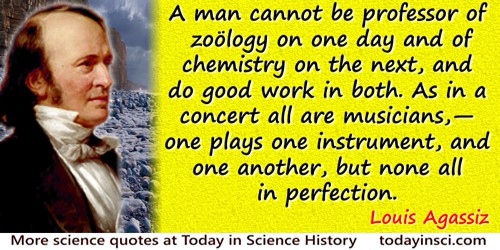
A man cannot be professor of zoölogy on one day and of chemistry on the next, and do good work in both. As in a concert all are musicians,—one plays one instrument, and one another, but none all in perfection.
Lecture at a teaching laboratory on Penikese Island, Buzzard's Bay. Quoted from the lecture notes by David Starr Jordan, Science Sketches (1911), 146.
A single tree by itself is dependent upon all the adverse chances of shifting circumstances. The wind stunts it: the variations in temperature check its foliage: the rains denude its soil: its leaves are blown away and are lost for the purpose of fertilisation. You may obtain individual specimens of line trees either in exceptional circumstances, or where human cultivation had intervened. But in nature the normal way in which trees flourish is by their association in a forest. Each tree may lose something of its individual perfection of growth, but they mutually assist each other in preserving the conditions of survival. The soil is preserved and shaded; and the microbes necessary for its fertility are neither scorched, nor frozen, nor washed away. A forest is the triumph of the organisation of mutually dependent species.
In Science and the Modern World (1926), 296-7.
After the discovery of spectral analysis no one trained in physics could doubt the problem of the atom would be solved when physicists had learned to understand the language of spectra. So manifold was the enormous amount of material that has been accumulated in sixty years of spectroscopic research that it seemed at first beyond the possibility of disentanglement. An almost greater enlightenment has resulted from the seven years of Röntgen spectroscopy, inasmuch as it has attacked the problem of the atom at its very root, and illuminates the interior. What we are nowadays hearing of the language of spectra is a true 'music of the spheres' in order and harmony that becomes ever more perfect in spite of the manifold variety. The theory of spectral lines will bear the name of Bohr for all time. But yet another name will be permanently associated with it, that of Planck. All integral laws of spectral lines and of atomic theory spring originally from the quantum theory. It is the mysterious organon on which Nature plays her music of the spectra, and according to the rhythm of which she regulates the structure of the atoms and nuclei.
Atombau und Spektrallinien (1919), viii, Atomic Structure and Spectral Lines, trans. Henry L. Brose (1923), viii.
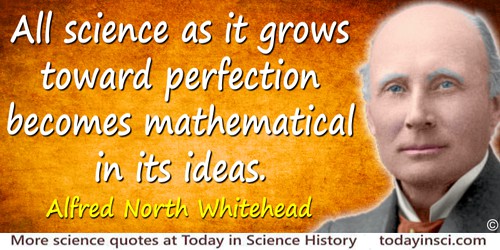
All science as it grows toward perfection becomes mathematical in its ideas.
In An Introduction to Mathematics (1911), 14. This is part of a longer quote that begins, “In modern times the belief that the ultimate explanation…”, on the Alfred North Whitehead Quotes page of this website.
All sciences originated among the sons of Israel, the reason being the existence of prophecy among them which made their perfection in the sciences amazing.
— Averroes
In Benzion Netanyahu, Don Isaac Abravanel, Statesman and Philosopher (1953, 1998), 100. Footnote gives: See Abravanel’s Comm, on Gen., io.i (f. 48, col. 4). The corresponding passage in Happoint ha-Happalah (Hebrew translation of Averroes’ Destruction of the Destruction, by Kalonymos ben David ben Todros, Bodleian Library, Michael Collection, Ms. 293, ff. 137b-138a) is somewhat different. Abravanel might have used the other Hebrew translation (MS. in Leyden) of Averroes' work (cf. Steinschneider, Uebersetzungen, pp. 333-4).
An extra-terrestrial philosopher, who had watched a single youth up to the age of twenty-one and had never come across any other human being, might conclude that it is the nature of human beings to grow continually taller and wiser in an indefinite progress towards perfection; and this generalization would be just as well founded as the generalization which evolutionists base upon the previous history of this planet.
Scientific Method in Philosophy (1914), 12.
And from true lordship it follows that the true God is living, intelligent, and powerful; from the other perfections, that he is supreme, or supremely perfect. He is eternal and infinite, omnipotent and omniscient; that is, he endures from eternity to eternity; and he is present from infinity to infinity; he rules all things, and he knows all things that happen or can happen.
The Principia: Mathematical Principles of Natural Philosophy (1687), 3rd edition (1726), trans. I. Bernard Cohen and Anne Whitman (1999), General Scholium, 941.
Arts and sciences in one and the same century have arrived at great perfection; and no wonder, since every age has a kind of universal genius, which inclines those that live in it to some particular studies; the work then, being pushed on by many hands, must go forward.
In Samuel Austin Allibone, Prose Quotations from Socrates to Macaulay (1880), 45.
As a scientist Miss [Rosalind] Franklin was distinguished by extreme clarity and perfection in everything she undertook. Her photographs are among the most beautiful X-ray photographs of any substance ever taken.
In his Obituary for Rosalind Franklin, Nature, 1958, 182, 154. As given in Andrew Brown, J.D. Bernal: The Sage of Science (2005), 359.
As long as Algebra and Geometry have been separated, their progress has been slow and their usages limited; but when these two sciences were reunited, they lent each other mutual strength and walked together with a rapid step towards perfection.
From the original French, “Tant que l’Algèbre et la Géométrie ont été séparées, leur progrès ont été lents et leurs usages bornés; mais lorsque ces deux sciences se sont réunies, elles se sont prêté des forces mutuelles et ont marché ensemble d’un pas rapide vers la perfection,” in Leçons Élémentaires sur la Mathematiques, Leçon 5, as collected in J.A. Serret (ed.), Œuvres de Lagrange (1877), Tome 7, Leçon 15, 271. English translation above by Google translate, tweeked by Webmaster. Also seen translated as, “As long as algebra and geometry proceeded along separate paths, their advance was slow and their applications limited. But when these sciences joined company, they drew from each other fresh vitality and thenceforward marched on at a rapid pace toward perfection,” in Robert Édouard Moritz, Memorabilia Mathematica; Or, The Philomath’s Quotation-Book (1914), 81.
As natural selection works solely by and for the good of each being, all corporeal and mental endowments will tend to progress towards perfection.
On the Origin of Species by Means of Natural Selection (1866), 577.
At the entrance to the observatory Stjerneborg located underground, Tycho Brahe built a Ionic portal. On top of this were three sculptured lions. On both sides were inscriptions and on the backside was a longer inscription in gold letters on a porfyr stone: Consecrated to the all-good, great God and Posterity. Tycho Brahe, Son of Otto, who realized that Astronomy, the oldest and most distinguished of all sciences, had indeed been studied for a long time and to a great extent, but still had not obtained sufficient firmness or had been purified of errors, in order to reform it and raise it to perfection, invented and with incredible labour, industry, and expenditure constructed various exact instruments suitable for all kinds of observations of the celestial bodies, and placed them partly in the neighbouring castle of Uraniborg, which was built for the same purpose, partly in these subterranean rooms for a more constant and useful application, and recommending, hallowing, and consecrating this very rare and costly treasure to you, you glorious Posterity, who will live for ever and ever, he, who has both begun and finished everything on this island, after erecting this monument, beseeches and adjures you that in honour of the eternal God, creator of the wonderful clockwork of the heavens, and for the propagation of the divine science and for the celebrity of the fatherland, you will constantly preserve it and not let it decay with old age or any other injury or be removed to any other place or in any way be molested, if for no other reason, at any rate out of reverence to the creator’s eye, which watches over the universe. Greetings to you who read this and act accordingly. Farewell!
(Translated from the original in Latin)
Between the lowest and the highest degree of spiritual and corporal perfection, there is an almost infinite number of intermediate degrees. The succession of degrees comprises the Universal Chain. It unites all beings, ties together all worlds, embraces all the spheres. One SINGLE BEING is outside this chain, and this is HE who made it.
Contemplation de la nature (1764), Vol. I, 27. Trans. Stephen Jay Gould, Ontogeny and Phylogeny (1977), 23.
But in my opinion we can now be assured sufficiently that no animals, however small they may be, take their origin in putrefaction, but exclusively in procreation… For seeing that animals, from the largest down to the little despised animal, the flea, have animalcules in their semen, seeing also that some of the vessels of the lungs of horses and cows consist of rings and that these rings can occur on the flea's veins, why cannot we come to the conclusion that as well as the male sperm of that large animal the horse and similar animals, and of all manner of little animals, the flea included, is furnished with animalcules (and other intestines, for I have often been astonished when I beheld the numerous vessels in a flea), why, I say should not the male sperm of the smallest animals, smaller than a flea may even the very smallest animalcules have the perfection that we find in a flea.
Letter to Robert Hooke, 12 Nov 1680. In The Collected Letters of Antoni van Leeuwenhoek (1957), Vol. 3, 329.
Evolution has no long-term goal. There is no long-distance target, no final perfection to serve as a criterion for selection, although human vanity cherishes the absurd notion that our species is the final goal of evolution.
The Blind Watchmaker (1996), 50.
Evolution is the conviction that organisms developed their current forms by an extended history of continual transformation, and that ties of genealogy bind all living things into one nexus. Panselectionism is a denial of history, for perfection covers the tracks of time. A perfect wing may have evolved to its current state, but it may have been created just as we find it. We simply cannot tell if perfection be our only evidence. As Darwin himself understood so well, the primary proofs of evolution are oddities and imperfections that must record pathways of historical descent–the panda’s thumb and the flamingo’s smile of my book titles (chosen to illustrate this paramount principle of history).
…...
Exact science and its practical movements are no checks on the greatest poet, but always his encouragement and support … The sailor and traveller, the anatomist, chemist, astronomer, geologist, phrenologist, spiritualist, mathematician, historian and lexicographer are not poets, but they are the lawgivers of poets and their construction underlies the structure of every perfect poem.
In Walt Whitman and William Michael Rossetti (ed.), 'Preface to the First Edition of Leaves of Grass', Poems By Walt Whitman (1868), 46.
For just as musical instruments are brought to perfection of clearness in the sound of their strings by means of bronze plates or horn sounding boards, so the ancients devised methods of increasing the power of the voice in theaters through the application of the science of harmony.
In Vitruvius Pollio and Morris Hicky Morgan (trans.), 'Book V: Chapter III', Vitruvius, the Ten Books on Architecture (1914), 139. From the original Latin, “Ergo veteres Architecti, naturae vestigia persecuti, indagationibus vocis scandentes theatrorum perfecerunt gradationes: & quaesiuerunt per canonicam mathematicorum,& musicam rationem, ut quaecunq; vox effet in scena, clarior & suauior ad spectatorum perueniret aures. Uti enim organa in aeneis laminis, aut corneis, diesi ad chordarum sonituum claritatem perficiuntur: sic theatrorum, per harmonicen ad augendam vocem, ratiocinationes ab antiquis sunt constitutae.” In De Architectura libri decem (1552), 175.
For Nature is accustomed to rehearse with certain large, perhaps baser, and all classes of wild (animals), and to place in the imperfect the rudiments of the perfect animals.
De Pulmonibus (1661), trans. James Young, Proceedings of the Royal Society of Medicine (1929-30), 23, 7.
FORTRAN —’the infantile disorder’—, by now nearly 20 years old, is hopelessly inadequate for whatever computer application you have in mind today: it is now too clumsy, too risky, and too expensive to use. PL/I —’the fatal disease’— belongs more to the problem set than to the solution set. It is practically impossible to teach good programming to students that have had a prior exposure to BASIC: as potential programmers they are mentally mutilated beyond hope of regeneration. The use of COBOL cripples the mind; its teaching should, therefore, be regarded as a criminal offence. APL is a mistake, carried through to perfection. It is the language of the future for the programming techniques of the past: it creates a new generation of coding bums.
…...
Genuine religion has its root deep down in the heart of humanity and in the reality of things. It is not surprising that by our methods we fail to grasp it: the actions of the Deity make no appeal to any special sense, only a universal appeal; and our methods are, as we know, incompetent to detect complete uniformity. There is a principle of Relativity here, and unless we encounter flaw or jar or change, nothing in us responds; we are deaf and blind therefore to the Immanent Grandeur, unless we have insight enough to recognise in the woven fabric of existence, flowing steadily from the loom in an infinite progress towards perfection, the ever-growing garment of a transcendent God.
Continuity: The Presidential Address to the British Association (1913), 92-93.
God put a secret art into the forces of Nature so as to enable it to fashion itself out of chaos into a perfect world system.
Universal Natural History and Theory of the Heavens (1755), editted and translated by William Hastie in Kant's Cosmogony (1900), 27.
He who would lead a Christ-like life is he who is perfectly and absolutely himself. He may be a great poet, or a great man of science, or a young student at the University, or one who watches sheep upon a moor, or a maker of dramas like Shakespeare, or a thinker about God, like Spinoza. or a child who plays in a garden, or a fisherman who throws his nets into the sea. It does not matter what he is as long as he realises the perfection of the soul that is within him.
In 'The Critic As Artist', Oscariana: Epigrams (1907), 27-28
Heavy dependence on direct observation is essential to biology not only because of the complexity of biological phenomena, but because of the intervention of natural selection with its criterion of adequacy rather than perfection. In a system shaped by natural selection it is inevitable that logic will lose its way.
In 'Scientific innovation and creativity: a zoologist’s point of view', American Zoologist (1982), 22, 229.
I had at one time a very bad fever of which I almost died. In my fever I had a long consistent delirium. I dreamt that I was in Hell, and that Hell is a place full of all those happenings that are improbable but not impossible. The effects of this are curious. Some of the damned, when they first arrive below, imagine that they will beguile the tedium of eternity by games of cards. But they find this impossible, because, whenever a pack is shuffled, it comes out in perfect order, beginning with the Ace of Spades and ending with the King of Hearts. There is a special department of Hell for students of probability. In this department there are many typewriters and many monkeys. Every time that a monkey walks on a typewriter, it types by chance one of Shakespeare's sonnets. There is another place of torment for physicists. In this there are kettles and fires, but when the kettles are put on the fires, the water in them freezes. There are also stuffy rooms. But experience has taught the physicists never to open a window because, when they do, all the air rushes out and leaves the room a vacuum.
'The Metaphysician's Nightmare', Nightmares of Eminent Persons and Other Stories (1954), 38-9.
I heard there the nightingale in all its perfection: and I do not hesitate to pronounce that in America it would be deemed a bird of the third rank only, our mocking-bird and fox-coloured thrush being unquestionably superior to it.
Letter (21 Jun 1785) to Mrs. John (Abigail) Adams. Collected in Paul Leicester Ford (ed.), The Writings of Thomas Jefferson: 1784-1787 (1894), 63.
I imagined in the beginning, that a few experiments would determine the problem; but experience soon convinced me, that a very great number indeed were necessary before such an art could be brought to any tolerable degree of perfection.
Upon pursuing the ''
Upon pursuing the ''
Preface to An Essay on Combustion with a View to a New Art of Dyeing and Painting (1794), iii. In Marilyn Bailey Ogilvie and Joy Dorothy Harvey, The Biographical Dictionary of Women in Science (2000), 478.
I like a deep and difficult investigation when I happen to have made it easy to myself, if not to all others; and there is a spirit of gambling in this, whether, as by the cast of a die, a calculation è perte de vue shall bring out a beautiful and perfect result or shall be wholly thrown away. Scientific investigations are a sort of warfare carried on in the closet or on the couch against all one’s contemporaries and predecessors; I have often gained a signal victory when I have been half asleep, but more frequently have found, upon being thoroughly awake, that the enemy had still the advantage of me, when I thought I had him fast in a corner, and all this you see keeps me alive.
Letter to Hudson Gurney, quoted in George Peacock, The Life of Thomas Young (1855), 239.
I shall explain a System of the World differing in many particulars from any yet known, answering in all things to the common Rules of Mechanical Motions: This depends upon three Suppositions. First, That all Cœlestial Bodies whatsoever, have an attraction or gravitating power towards their own Centers, whereby they attract not only their own parts, and keep them from flying from them, as we may observe the Earth to do, but that they do also attract all the other Cœlestial bodies that are within the sphere of their activity; and consequently that not only the Sun and Moon have an influence upon the body and motion the Earth, and the Earth upon them, but that Mercury also Venus, Mars, Saturn and Jupiter by their attractive powers, have a considerable influence upon its motion in the same manner the corresponding attractive power of the Earth hath a considerable influence upon every one of their motions also. The second supposition is this, That all bodies whatsoever that are put into a direct and simple motion, will continue to move forward in a streight line, till they are by some other effectual powers deflected and bent into a Motion, describing a Circle, Ellipse, or some other more compounded Curve Line. The third supposition is, That these attractive powers are so much the more powerful in operating, by how much the nearer the body wrought upon is to their own Centers. Now what these several degrees are I have not yet experimentally verified; but it is a notion, which if fully prosecuted as it ought to be, will mightily assist the Astronomer to reduce all the Cœlestial Motions to a certain rule, which I doubt will never be done true without it. He that understands the nature of the Circular Pendulum and Circular Motion, will easily understand the whole ground of this Principle, and will know where to find direction in Nature for the true stating thereof. This I only hint at present to such as have ability and opportunity of prosecuting this Inquiry, and are not wanting of Industry for observing and calculating, wishing heartily such may be found, having myself many other things in hand which I would first compleat and therefore cannot so well attend it. But this I durst promise the Undertaker, that he will find all the Great Motions of the World to be influenced by this Principle, and that the true understanding thereof will be the true perfection of Astronomy.
An Attempt to Prove the Motion of the Earth from Observations (1674), 27-8. Based on a Cutlerian Lecture delivered by Hooke at the Royal Society four years earlier.
I was unable to devote myself to the learning of this al-jabr [algebra] and the continued concentration upon it, because of obstacles in the vagaries of Time which hindered me; for we have been deprived of all the people of knowledge save for a group, small in number, with many troubles, whose concern in life is to snatch the opportunity, when Time is asleep, to devote themselves meanwhile to the investigation and perfection of a science; for the majority of people who imitate philosophers confuse the true with the false, and they do nothing but deceive and pretend knowledge, and they do not use what they know of the sciences except for base and material purposes; and if they see a certain person seeking for the right and preferring the truth, doing his best to refute the false and untrue and leaving aside hypocrisy and deceit, they make a fool of him and mock him.
A. P. Youschkevitch and B. A. Rosenfeld, 'Al-Khayyami', in C. C. Gillispie (ed.), Dictionary of Scientific Biography (1973), Vol. 7, 324.
I work for perfection, for perfection's sake. I don't care what the external reasons are. And it's much more like a ballerina on opening night. You've done what you've got to do. When you go out, the purpose is to turn a perfect turn. You are not thinking about the future of the company, you are not thinking about your future, you're not thinking about the critics, it is you and the perfect turn.
[Describing his task of repairing the Hubble Space Telescope.]
[Describing his task of repairing the Hubble Space Telescope.]
Interview (22 May 1997). On Academy of Achievement website.
If any one should ask me what I consider the most distinctive, progressive feature of California, I should answer promptly, its cable-car system. And it is not alone its system which seems to have reached a point of perfection, but the amazing length of the ride that is given you for the chink of a nickel. I have circled this city of San Francisco, … for this smallest of Southern coins.
In Letters from California (1888), 33.
If we were capable of following the progress of increase of the number of the parts of the most perfect animal, as they first formed in succession, from the very first to its state of full perfection, we should probably be able to compare it with some one of the incomplete animals themselves, of every order of animals in the Creation, being at no stage different from some of the inferior orders; or, in other words, if we were to take a series of animals, from the more imperfect to the perfect, we should probably find an imperfect animal, corresponding with some stage of the most perfect.
R. Owen (ed.), John Hunter's Observations on Animal Development (1841), 14.
If you want excellence, you must aim at perfection. It has its drawbacks but being finicky is essential.
Quoted in India Today (Apr 2008), 33, No 16, as cited on webpage of Dhirubhai Ambani Institute of Information and Communication Technology.
Imagination, as well as reason, is necessary to perfection of the philosophical mind. A rapidity of combination, a power of perceiving analogies, and of comparing them by facts, is the creative source of discovery. Discrimination and delicacy of sensation, so important in physical research, are other words for taste; and the love of nature is the same passion, as the love of the magnificent, the sublime and the beautiful.
In Parallels Between Art and Science (1807).
In a class I was taking there was one boy who was much older than the rest. He clearly had no motive to work. I told him that, if he could produce for me, accurately to scale, drawings of the pieces of wood required to make a desk like the one he was sitting at, I would try to persuade the Headmaster to let him do woodwork during the mathematics hours—in the course of which, no doubt, he would learn something about measurement and numbers. Next day, he turned up with this task completed to perfection. This I have often found with pupils; it is not so much that they cannot do the work, as that they see no purpose in it.
In Mathematician's Delight (1943), 52.
In an age of egoism, it is so difficult to persuade man that of all studies, the most important is that of himself. This is because egoism, like all passions, is blind. The attention of the egoist is directed to the immediate needs of which his senses give notice, and cannot be raised to those reflective needs that reason discloses to us; his aim is satisfaction, not perfection. He considers only his individual self; his species is nothing to him. Perhaps he fears that in penetrating the mysteries of his being he will ensure his own abasement, blush at his discoveries, and meet his conscience. True philosophy, always at one with moral science, tells a different tale. The source of useful illumination, we are told, is that of lasting content, is in ourselves. Our insight depends above all on the state of our faculties; but how can we bring our faculties to perfection if we do not know their nature and their laws! The elements of happiness are the moral sentiments; but how can we develop these sentiments without considering the principle of our affections, and the means of directing them? We become better by studying ourselves; the man who thoroughly knows himself is the wise man. Such reflection on the nature of his being brings a man to a better awareness of all the bonds that unite us to our fellows, to the re-discovery at the inner root of his existence of that identity of common life actuating us all, to feeling the full force of that fine maxim of the ancients: 'I am a man, and nothing human is alien to me.'
Considerations sur les diverses méthodes à suivre dans l'observation des peuples sauvages (1800) The Observation of Savage Peoples, trans. F. C. T. Moore (1969), 61.
In anything at all, perfection is finally attained not when there is no longer anything to add, but when there is no longer anything to take away.
From the French, “Il semble que la perfection soit atteinte non quand il n'y a plus rien à ajouter, mais quand il n'y a plus rien à retrancher,” in Terre des Hommes (1939). As translated by Lewis Galantière, in Wind, Sand, and Stars (1939), 66.
In modern times the belief that the ultimate explanation of all things was to be found in Newtonian mechanics was an adumbration of the truth that all science, as it grows towards perfection, becomes mathematical in its ideas.
In An Introduction to Mathematics (1911), 13-14. [To suggest, disclose, or outline partially, produces an “adumbration”, which gives only the main facts and not the details. —Webmaster]
In other branches of science, where quick publication seems to be so much desired, there may possibly be some excuse for giving to the world slovenly or ill-digested work, but there is no such excuse in mathematics. The form ought to be as perfect as the substance, and the demonstrations as rigorous as those of Euclid. The mathematician has to deal with the most exact facts of Nature, and he should spare no effort to render his interpretation worthy of his subject, and to give to his work its highest degree of perfection. “Pauca sed matura” was Gauss’s motto.
In Presidential Address British Association for the Advancement of Science, Section A, (1890), Nature, 42, 467. [The Latin motto translates as “Few, but ripe”. —Webmaster]
In scientific matters ... the greatest discoverer differs from the most arduous imitator and apprentice only in degree, whereas he differs in kind from someone whom nature has endowed for fine art. But saying this does not disparage those great men to whom the human race owes so much in contrast to those whom nature has endowed for fine art. For the scientists' talent lies in continuing to increase the perfection of our cognitions and on all the dependent benefits, as well as in imparting that same knowledge to others; and in these respects they are far superior to those who merit the honour of being called geniuses. For the latter's art stops at some point, because a boundary is set for it beyond which it cannot go and which has probably long since been reached and cannot be extended further.
The Critique of Judgement (1790), trans. J. C. Meredith (1991), 72.
In the conception of a machine or the product of a machine there is a point where one may leave off for parsimonious reasons, without having reached aesthetic perfection; at this point perhaps every mechanical factor is accounted for, and the sense of incompleteness is due to the failure to recognize the claims of the human agent. Aesthetics carries with it the implications of alternatives between a number of mechanical solutions of equal validity; and unless this awareness is present at every stage of the process … it is not likely to come out with any success in the final stage of design.
From 'The Esthetic Assimilation of the Machine', Technics and Civilization (1934), 349.
In the course of this short tour, I became convinced that we must turn to the New World if we wish to see in perfection the oldest monuments of the earth’s history, so far at least as relates to its earliest inhabitants.
Travels in North America (1845), Vol. 1, 19.
Incompetency is a greater obstacle to perfection than one would think.
In The Maxims and Reflections of Goethe (1906), 201.
Is not disease the rule of existence? There is not a lily pad floating on the river but has been riddled by insects. Almost every shrub and tree has its gall, oftentimes esteemed its chief ornament and hardly to be distinguished from the fruit. If misery loves company, misery has company enough. Now, at midsummer, find me a perfect leaf or fruit.
In The Writings of Henry David Thoreau (1893), Vol. 9, 458.
It follows from the supreme perfection of God, that in creating the universe has chosen the best possible plan, in which there is the greatest variety together with the greatest order; the best arranged ground, place, time; the most results produced in the most simple ways; the most of power, knowledge, happiness and goodness the creatures that the universe could permit. For since all the possibles in I understanding of God laid claim to existence in proportion to their perfections, the actual world, as the resultant of all these claims, must be the most perfect possible. And without this it would not be possible to give a reason why things have turned out so rather than otherwise.
The Principles of Nature and Grace (1714), The Philosophical Works of Leibnitz (1890), ed. G. M. Duncan, 213-4.
It is a misfortune for a science to be born too late when the means of observation have become too perfect. That is what is happening at this moment with respect to physical chemistry; the founders are hampered in their general grasp by third and fourth decimal places; happily they are men of robust faith.
From La Science et l’Hypothèse (1901, 1908), 211-212, as translated in Henri Poincaré and William John Greenstreet (trans.), Science and Hypothesis (1902, 1905), 181. From the original French, “C’est un malheur pour une science de prendre naissance trop tard, quand les moyens d’observation sont devenus trop parfaits. C’est ce qui arrive aujourd’hui à la physico-chimie; ses fondateurs sont gènés dans leurs aperçus par la troisième et la quatrième décimales; heureusement, ce sont des hommes d’une foi robuste.”
It is an error to imagine that evolution signifies a constant tendency to increased perfection. That process undoubtedly involves a constant remodeling of the organism in adaptation to new conditions; but it depends on the nature of those conditions whether the direction of the modifications effected shall be upward or downward.
'The Struggle for Existence in Human Society' (1888). In Collected Essays (1894), Vol. 9, 199.
It is beyond all doubt that during the sixteenth century, and the years immediately preceding and following it, poisoning had been brought to a pitch of perfection which remains unknown to modern chemistry, but which is indisputably proved by history. Italy, the cradle of modern science, was at that time the inventor and mistress of these secrets, many of which are lost. Romancers have made such extravagant use of this fact, that whenever they introduce Italians they make them play the part of assassins and poisoners.
In Catherine De Medici (1842), 274-275.
It is obvious that man dwells in a splendid universe, a magnificent expanse of earth and sky and heaven, which manifestly is built on a majestic plan, maintains some mighty design, though man himself cannot grasp it. Yet for him it is not a pleasant or satisfying world. In his few moments of respite from labor or from his enemies, he dreams that this very universe might indeed be perfect, its laws operating just as now they seem to do, and yet he and it somehow be in full accord. The very ease with which he can frame this image to himself makes the reality all the more mocking. ... It is only too clear that man is not at home in this universe, and yet he is not good enough to deserve a better.
In The New England Mind: The Seventeenth Century (1939, 1954), 7.
It is perhaps a law of nature that when a species (or group) fits itself to a place not previously occupied, and in which it is subject to no opposition from beings of its own class, or where it attains so great a perfection as to be able easily to overcome all opposition, the character eventually loses its original plasticity, or tendency to vary, since improvement in such a case would be superfluous, and becomes, so to speak, crystallized in that form which continues thereafter unaltered. … [Such as] the humming-bird.
In The Naturalist in La Plata (1895), 40.
It is probably no exaggeration to suppose that in order to improve such an organ as the eye at all, it must be improved in ten different ways at once. And the improbability of any complex organ being produced and brought to perfection in any such way is an improbability of the same kind and degree as that of producing a poem or a mathematical demonstration by throwing letters at random on a table.
[Expressing his reservations about Darwin's proposed evolution of the eye by natural selection.]
[Expressing his reservations about Darwin's proposed evolution of the eye by natural selection.]
Opening address to the Belfast Natural History Society, as given in the 'Belfast Northern Whig,' (19 Nov 1866). As cited by Charles Darwin in The Variation of Animals & Plants Under Domestication (1868), 222.
It is suitable to the magnificent harmony of the universe that the species of creatures should, by gentle degrees, ascend upward from us toward His perfection, as we see them gradually descend from us downward.
In An Essay Concerning Human Understanding (1849), Book 3, Chap 6, Sec. 12, 326.
Know, oh Brother (May God assist thee and us by the Spirit from Him) that God, Exalted Be His Praise, when He created all creatures and brought all things into being, arranged them and brought them into existence by a process similar to the process of generation of numbers from one, so that the multiplicity [of numbers] should be a witness to his Oneness, and their classification and order an indication of the perfection of His wisdom in creation. And this would be a witness to the fact, too, that they [creatures] are related to Him who created them, in the same way as the numbers are related to the One which is prior to two, and which is the principle, origin and source of numbers, as we have shown in our treatise on arithmetic.
Rasa'il. In Seyyed Hossein Nasr, Science and Civilisation in Islam (1968), 155-6.
Leo Szilard’s Ten Commandments:
1. Recognize the connections of things and the laws of conduct of men, so that you may know what you are doing.
2. Let your acts be directed towards a worthy goal, but do not ask if they will reach it; they are to be models and examples, not means to an end.
3. Speak to all men as you do to yourself, with no concern for the effect you make, so that you do not shut them out from your world; lest in isolation the meaning of life slips out of sight and you lose the belief in the perfection of the creation.
4. Do not destroy what you cannot create.
5. Touch no dish, except that you are hungry.
6. Do not covet what you cannot have.
7. Do not lie without need.
8. Honor children. Listen reverently to their words and speak to them with infinite love.
9. Do your work for six years; but in the seventh, go into solitude or among strangers, so that the memory of your friends does not hinder you from being what you have become.
10. Lead your life with a gentle hand and be ready to leave whenever you are called.
1. Recognize the connections of things and the laws of conduct of men, so that you may know what you are doing.
2. Let your acts be directed towards a worthy goal, but do not ask if they will reach it; they are to be models and examples, not means to an end.
3. Speak to all men as you do to yourself, with no concern for the effect you make, so that you do not shut them out from your world; lest in isolation the meaning of life slips out of sight and you lose the belief in the perfection of the creation.
4. Do not destroy what you cannot create.
5. Touch no dish, except that you are hungry.
6. Do not covet what you cannot have.
7. Do not lie without need.
8. Honor children. Listen reverently to their words and speak to them with infinite love.
9. Do your work for six years; but in the seventh, go into solitude or among strangers, so that the memory of your friends does not hinder you from being what you have become.
10. Lead your life with a gentle hand and be ready to leave whenever you are called.
Circulated by Mrs. Szilard in July 1964, in a letter to their friends (translated by Dr. Jacob
Bronowski). As printed in Robert J. Levine, Ethics and Regulation of Clinical Research (1988), 431.
Let us not be exacting; perfection is so rare.
From Appendix A, 'Extracts From the Unpublished Writings of Carnot', Reflections on the Motive Power of Heat (1890, 2nd ed. 1897), 209.
Man perfected by society is the best of all animals; he is the most terrible of all when he lives without law and without justice.
In Politics, Book 1, 1253a. As given in Maturin Murray Ballou (ed.), Treasury of Thought: Forming an Encyclopædia of Quotations from Ancient and Modern Authors (1872), 323. As translated by Benjamin Jowett, The Politics of Aristotle (1899), 4: “For man, when perfected, is the best of animals, but, when separated from law and justice, he is the worst of all.” As translated by Harris Rackham in Aristotle: Politics, 13: “For as man is the best of the animals when perfected, so he is the worst of all when sundered from law and justice.”
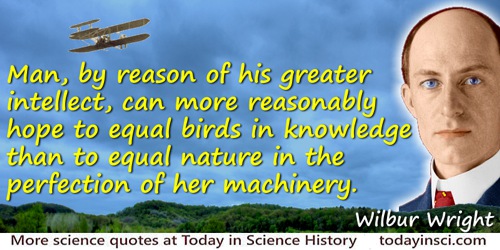
Man, by reason of his greater intellect, can more reasonably hope to equal birds in knowledge than to equal nature in the perfection of her machinery.
In The Papers of Wilbur and Orville Wright: 1899-1905 (1953), 15.
Mathematics as an expression of the human mind reflects the active will, the contemplative reason, and the desire for aesthetic perfection. Its basic elements are logic and intuition, analysis and construction, generality and individuality. Though different traditions may emphasize different aspects, it is only the interplay of these antithetic forces and the struggle for their synthesis that constitute the life, usefulness, and supreme value of mathematical science.
As co-author with Herbert Robbins, in What Is Mathematics?: An Elementary Approach to Ideas and Methods (1941, 1996), x.
Mathematics is an obscure field, an abstruse science, complicated and exact; yet so many have attained perfection in it that we might conclude almost anyone who seriously applied himself would achieve a measure of success.
In George Edward Martin, The Foundations of Geometry and the Non-Euclidean Plane (1982), 82.
Mathematics, rightly viewed, possesses not only truth, but supreme beauty—a beauty cold and austere, like that of sculpture, without appeal to any part of our weaker nature, without the gorgeous trappings of painting or music, yet sublimely pure, and capable of a stern perfection such as only the greatest art can show.
Essay, 'The Study of Mathematics' (1902), collected in Philosophical Essays (1910), 73-74. Also collected in Mysticism and Logic: And Other Essays (1918), 60.
Metals are the great agents by which we can examine the recesses of nature; and their uses are so multiplied, that they have become of the greatest importance in every occupation of life. They are the instruments of all our improvements, of civilization itself, and are even subservient to the progress of the human mind towards perfection. They differ so much from each other, that nature seems to have had in view all the necessities of man, in order that she might suit every possible purpose his ingenuity can invent or his wants require.
From 'Classification of Simple Bodies', The Artist & Tradesman’s Guide: Embracing Some Leading Facts & Principles of Science, and a Variety of Matter Adapted to the Wants of the Artist, Mechanic, Manufacturer, and Mercantile Community (1827), 16.
Moreover the perfection of mathematical beauty is such … that whatsoever is most beautiful and regular is also found to be most useful and excellent.
In 'Epilogue', On Growth and Form (1917), 779.
Most classifications, whether of inanimate objects or of organisms, are hierarchical. There are “higher” and “lower” categories, there are higher and lower ranks. What is usually overlooked is that the use of the term “hierarchy” is ambiguous, and that two fundamentally different kinds of arrangements have been designated as hierarchical. A hierarchy can be either exclusive or inclusive. Military ranks from private, corporal, sergeant, lieutenant, captain, up to general are a typical example of an exclusive hierarchy. A lower rank is not a subdivision of a higher rank; thus, lieutenants are not a subdivision of captains. The scala naturae, which so strongly dominated thinking from the sixteenth to the eighteenth century, is another good illustration of an exclusive hierarchy. Each level of perfection was considered an advance (or degradation) from the next lower (or higher) level in the hierarchy, but did not include it.
The Growth of Biological Thought: Diversity, Evolution and Inheritance (1982), 205-6.
Natural law is not applicable to the unseen world behind the symbols, because it is unadapted to anything except symbols, and its perfection is a perfection of symbolic linkage. You cannot apply such a scheme to the parts of our personality which are not measurable by symbols any more than you can extract the square root of a sonnet.
Swarthmore Lecture (1929) at Friends’ House, London, printed in Science and the Unseen World (1929), 53.
Natural Magick is taken to be nothing else, but the chief power of all the natural Sciences; which therefore they call the top and perfection of Natural Philosophy, and which is indeed the active part of the same; which by the assistance of natural forces and faculties, through their mutual & opportune application, performs those things that are above Humane Reason.
In The Vanity of the Arts and Sciences (1530), translation (1676), 110.
Natural selection produces systems that function no better than necessary. It results in ad hoc adaptive solutions to immediate problems. Whatever enhances fitness is selected. The product of natural selection is not perfection but adequacy, not final answers but limited, short-term solutions.
In 'The role of natural history in contemporary biology', BioScience (1986), 36, 325.
Nature never wears a mean appearance. Neither does the wisest man extort her secret, and lose his curiosity by finding out all her perfection.
In Emerson’s Complete Works: Volume 1, Nature, Addresses and Lectures (1855, 1889), 13-14.
Nature seems to take advantage of the simple mathematical representations of the symmetry laws. When one pauses to consider the elegance and the beautiful perfection of the mathematical reasoning involved and contrast it with the complex and far-reaching physical consequences, a deep sense of respect for the power of the symmetry laws never fails to develop.
Nobel Lecture (11 Dec 1957). In Nobel Lectures: Physics, 1981-1990) (1998), 394-395.
Nature, everywhere the most amazingly and outstandingly remarkable producer of living bodies, being most carefully arranged according to physical, mechanical, and chemical laws, does not give even the smallest hint of its extraordinary and tireless workings and quite clearly points to its work as being alone worthy of a benign and omnipotent God; and it carries this bright quality in all of its traces, in that, just as all of its general mechanisms rejoice, so also do all of their various smallest component parts rejoice in the depth of wisdom, in the height of perfection, and in the lofty arrangement of forms and qualities, which lie far beyond every investigation of the human mind.
'Inaugural Physico-Medical Dissertation on the Blood and the Circulation of the Microcosm' (1749). Trans. Arthur Donovan and Joseph Prentiss, James Hutton's Medical Dissertation (1980), 29.
Nature! … She is the only artist; working-up the most uniform material into utter opposites; arriving, without a trace of effort, at perfection, at the most exact precision, though always veiled under a certain softness.
As quoted by T.H. Huxley, in Norman Lockyer (ed.), 'Nature: Aphorisms by Goethe', Nature (1870), 1, 10.
Now and then, in the course of the century, a great man of science, like Darwin; a great poet, like Keats; a fine critical spirit, like M. Renan; a supreme artist, like Flaubert, has been able to isolate himself, to keep himself out of reach of the clamorous claims of others, to stand “under the shelter of the wall,” as Plato puts it, and so to realise the perfection of what was in him, to his own incomparable gain, and to the incomparable and lasting gain of the whole world.
In Sebastian Melmoth (1908), 133-134.
Objections … inspired Kronecker and others to attack Weierstrass’ “sequential” definition of irrationals. Nevertheless, right or wrong, Weierstrass and his school made the theory work. The most useful results they obtained have not yet been questioned, at least on the ground of their great utility in mathematical analysis and its implications, by any competent judge in his right mind. This does not mean that objections cannot be well taken: it merely calls attention to the fact that in mathematics, as in everything else, this earth is not yet to be confused with the Kingdom of Heaven, that perfection is a chimaera, and that, in the words of Crelle, we can only hope for closer and closer approximations to mathematical truth—whatever that may be, if anything—precisely as in the Weierstrassian theory of convergent sequences of rationals defining irrationals.
In Men of Mathematics (1937), 431-432.
On a perfect planet such as might be acceptable to a physicist, one might predict that from its origin the diversity of life would grow exponentially until the carrying capacity, however defined, was reached. The fossil record on Earth, however, tells a very different story.
In 'The Evolution of Diversity in AAncient Ecosystems: a Review', Philosophical Transactions of the Royal Society B (28 Feb 1998), 353, No. 1366, 327.
Our machines have often approached perfection; but no similar development has been visible in the education of men.
As reported in 'Humanities Head', Time (8 Jun 1942), 39, No. 23, 63.
Our world is not an optimal place, fine tuned by omnipotent forces of selection. It is a quirky mass of imperfections, working well enough (often admirably); a jury-rigged set of adaptations built of curious parts made available by past histories in different contexts ... A world optimally adapted to current environments is a world without history, and a world without history might have been created as we find it. History matters; it confounds perfection and proves that current life transformed its own past.
…...
Perfect concordance among reformers is not to be expected; and men who are honestly struggling towards the light cannot hope to attain at one bound to the complete truth. There is always a danger lest the fascination of a new discovery should lead us too far. Men of science, being human, are apt, like lovers, to exaggerate the perfections and be a little blind to the faults of the object of their choice.
'The Anniversary Address of the President', Quarterly Journal of the Geological Society of London, 1885, 41, 55.
Perfection can be achieved by no one, because perfection is achieved from faults—yet faults tear away the perfection in you.
Found on the web, but as yet Webmaster has not been able to verify with a primary source. Can you help?
Perfection of means and confusion of ends seems to characterize our age.
…...
Perfections of means and confusion of goals seem—in my opinion to characterize our age.
In Out of My Later Years (1950, 1956), 113. Footnoted on page 277 as from 'The Common Language of Science', a broadcast recording for the Science Conference, London (28 Sep 1941) and published in Advancement of Science, 2, No. 5, 16.
Progress is a tension between the notion of perfection and the notion that striving, not finding, is important.
Macrolife: A Mobile Utopia (1979, 2006), 70.
Science has hitherto been proceeding without the guidance of any rational theory of logic, and has certainly made good progress. It is like a computer who is pursuing some method of arithmetical approximation. Even if he occasionally makes mistakes in his ciphering, yet if the process is a good one they will rectify themselves. But then he would approximate much more rapidly if he did not commit these errors; and in my opinion, the time has come when science ought to be provided with a logic. My theory satisfies me; I can see no flaw in it. According to that theory universality, necessity, exactitude, in the absolute sense of these words, are unattainable by us, and do not exist in nature. There is an ideal law to which nature approximates; but to express it would require an endless series of modifications, like the decimals expressing surd. Only when you have asked a question in so crude a shape that continuity is not involved, is a perfectly true answer attainable.
Letter to G. F. Becker, 11 June 1893. Merrill Collection, Library of Congress. Quoted in Nathan Reingold, Science in Nineteenth-Century America: A Documentary History (1966), 231-2.
Science is a magnificent force, but it is not a teacher of morals. It can perfect machinery, but it adds no moral restraints to protect society from the misuse of the machine. It can also build gigantic intellectual ships, but it constructs no moral rudders for the control of storm tossed human vessel. It not only fails to supply the spiritual element needed but some of its unproven hypotheses rob the ship of its compass and thus endangers its cargo.
Proposed summation written for the Scopes Monkey Trial (1925), in Genevieve Forbes Herrick and John Origen Herrick ,The Life of William Jennings Bryan (1925), 405. This speech was prepared for delivery at the trial, but was never heard there, as both sides mutually agreed to forego arguments to the jury.
Society is indeed a contract. … It is a partnership in all science; a partnership in all art; a partnership in every virtue, and in all perfection. As the ends of such a partnership cannot be obtained in many generations, it becomes a partnership not only between those who are living, but between those who are living, those who are dead, and those who are to be born.
Reflections on the Revolution in France (1790, 2005), 54.
Species do not grow more perfect: the weaker dominate the strong, again and again— the reason being that they are the great majority, and they are also cleverer. Darwin forgot the mind (—that is English!): the weak possess more mind. … To acquire mind, one must need mind—one loses it when one no longer needs it.
[Criticism of Darwin’s Origin of Species.]
[Criticism of Darwin’s Origin of Species.]
The Twilight of the Idols (1888), translated by R. J. Hollingdale, Twilight of the Idols and the Anti Christ (1990), 67. Also see alternate translations.
Species do not evolve towards perfection: the weak always prevail over the strong—simply because they are the majority, and because they are also the more crafty. Darwin forgot the intellect (that is English!), the weak have more intellect. In order to acquire intellect, one must be in need of it. One loses it when one no longer needs it.
[Criticism of Darwin's Origin of Species.]
[Criticism of Darwin's Origin of Species.]
The Twilight of the Idols (1888) collected in Twilight of the Idols, with The Antichrist and Ecce Homo, translated by Anthony M. Ludovici (2007), 56. Also see alternate translations.
Strive for perfection in everything you do. Take the best that exists and make it better. When it does not exist, design it. Accept nothing nearly right or good enough.
As quoted in 'Rule Britannia', Financial Mail (1983), 242. Also quoted in Francis J. Gouillart, Transforming the Organization (1995), 85.
Symmetry, as wide or as narrow as you may define its meaning, is one idea by which man through the ages has tried to comprehend and create order, beauty and perfection.
Symmetry (1952), 5.
The admirable perfection of the adaptations of organisms and of their parts to the functions they perform has detracted attention from the fact that adaptedness does not consist of perfect fit, but capacity to fit or to adapt in a variety of ways: only in this sense is adaptedness a guarantee of further survival and evolutionary progress, for too perfect a fit is fatal to the species if not to the individual. This, I think, sets phylogeny and ontogeny in the correct perspective. It is the genotype which bears the marks of past experience of the species and defines the range of possible fits. What fit is actually chosen, what phenotype is actually evolved, is determined by the ever renewed individual history.
'The Interplay of Heredity and Environment in the Synthesis of Respiratory Enzymes in Yeast', The Harvey Lectures: Delivered under the auspices of The Harvey Society of New York 1950-1951, 1951, 156, 45-6.
The advancement and perfection of mathematics are intimately connected with the prosperity of the State.
Correspondance de Napoléon, t. 24 (1868), 112. In Robert Édouard Moritz, Memorabilia Mathematica; Or, The Philomath’s Quotation-book (1914), 42.
The beautiful has its place in mathematics as elsewhere. The prose of ordinary intercourse and of business correspondence might be held to be the most practical use to which language is put, but we should be poor indeed without the literature of imagination. Mathematics too has its triumphs of the Creative imagination, its beautiful theorems, its proofs and processes whose perfection of form has made them classic. He must be a “practical” man who can see no poetry in mathematics.
In A Scrap-book of Elementary Mathematics: Notes, Recreations, Essays (1908), 208.
The discerning man who acknowledges his limitations is not far off perfection.
In The Maxims and Reflections of Goethe (1906), 200.
The Earth Speaks, clearly, distinctly, and, in many of the realms of Nature, loudly, to William Jennings Bryan, but he fails to hear a single sound. The earth speaks from the remotest periods in its wonderful life history in the Archaeozoic Age, when it reveals only a few tissues of its primitive plants. Fifty million years ago it begins to speak as “the waters bring forth abundantly the moving creatures that hath life.” In successive eons of time the various kinds of animals leave their remains in the rocks which compose the deeper layers of the earth, and when the rocks are laid bare by wind, frost, and storm we find wondrous lines of ascent invariably following the principles of creative evolution, whereby the simpler and more lowly forms always precede the higher and more specialized forms.
The earth speaks not of a succession of distinct creations but of a continuous ascent, in which, as the millions of years roll by, increasing perfection of structure and beauty of form are found; out of the water-breathing fish arises the air-breathing amphibian; out of the land-living amphibian arises the land-living, air-breathing reptile, these two kinds of creeping things resembling each other closely. The earth speaks loudly and clearly of the ascent of the bird from one kind of reptile and of the mammal from another kind of reptile.
This is not perhaps the way Bryan would have made the animals, but this is the way God made them!
The earth speaks not of a succession of distinct creations but of a continuous ascent, in which, as the millions of years roll by, increasing perfection of structure and beauty of form are found; out of the water-breathing fish arises the air-breathing amphibian; out of the land-living amphibian arises the land-living, air-breathing reptile, these two kinds of creeping things resembling each other closely. The earth speaks loudly and clearly of the ascent of the bird from one kind of reptile and of the mammal from another kind of reptile.
This is not perhaps the way Bryan would have made the animals, but this is the way God made them!
The Earth Speaks to Bryan (1925), 5-6. Osborn wrote this book in response to the Scopes Monkey Trial, where William Jennings Bryan spoke against the theory of evolution. They had previously been engaged in the controversy about the theory for several years. The title refers to a Biblical verse from the Book of Job (12:8), “Speak to the earth and it shall teach thee.”
The experimental investigation by which Ampere established the law of the mechanical action between electric currents is one of the most brilliant achievements in science. The whole theory and experiment, seems as if it had leaped, full grown and full armed, from the brain of the 'Newton of Electricity'. It is perfect in form, and unassailable in accuracy, and it is summed up in a formula from which all the phenomena may be deduced, and which must always remain the cardinal formula of electro-dynamics.
A Treatise on Electricity and Magnetism (1873), Vol. 2, 162.
The great masters of modern analysis are Lagrange, Laplace, and Gauss, who were contemporaries. It is interesting to note the marked contrast in their styles. Lagrange is perfect both in form and matter, he is careful to explain his procedure, and though his arguments are general they are easy to follow. Laplace on the other hand explains nothing, is indifferent to style, and, if satisfied that his results are correct, is content to leave them either with no proof or with a faulty one. Gauss is as exact and elegant as Lagrange, but even more difficult to follow than Laplace, for he removes every trace of the analysis by which he reached his results, and studies to give a proof which while rigorous shall be as concise and synthetical as possible.
In History of Mathematics (3rd Ed., 1901), 468.
The great mathematician fully, almost ruthlessly, exploits the domain of permissible reasoning and skirts the impermissible. … [I]t is hard to believe that our reasoning power was brought, by Darwin’s process of natural selection, to the perfection which it seems to possess.
In 'The Unreasonable Effectiveness of Mathematics in the Natural Sciences,' Communications in Pure and Applied Mathematics (Feb 1960), 13, No. 1 (February 1960). Collected in Eugene Paul Wigner, A.S. Wightman (ed.), Jagdish Mehra (ed.), The Collected Works of Eugene Paul Wigner (1955), Vol. 6, 536.
The mathematical take-over of physics has its dangers, as it could tempt us into realms of thought which embody mathematical perfection but might be far removed, or even alien to, physical reality. Even at these dizzying heights we must ponder the same deep questions that troubled both Plato and Immanuel Kant. What is reality? Does it lie in our mind, expressed by mathematical formulae, or is it “out there”.
In Book Review 'Pulling the Strings,' of Lawrence Krauss's Hiding in the Mirror: The Mysterious Lure of Extra Dimensions, from Plato to String Theory and Beyond in Nature (22 Dec 2005), 438, 1081.
The method of science is tried and true. It is not perfect, it’s just the best we have. And to abandon it, with its skeptical protocols, is the pathway to a dark age.
From a sound clip from CSICOP, now CSI (Committee for Skeptical Inquiry). If you know a more specific citation, please contact Webmaster.
The more nearly an object approaches perfection, the more we notice its slightest defects.
From Appendix A, 'Extracts From the Unpublished Writings of Carnot', Reflections on the Motive Power of Heat (1890, 2nd ed. 1897), 209
The more progress physical sciences make, the more they tend to enter the domain of mathematics, which is a kind of center to which they all converge. We may even judge of the degree of perfection to which a science has arrived by the facility with which it may be submitted to calculation.
In Eulogy of Quetelet by E. Mailly (1874).
The perfection of the heavenly spheres does not depend upon the order of their relative position as to whether one is higher than another.
As quoted in Edward Grant, Planets, Stars, and Orbs: The Medieval Cosmos, 1200-1687 (1996), 231, citing Oresme, Le Livre du ciel, (1968), Book 2, 507.
https://books.google.com/books?isbn=052156509X
Edward Grant - 1996
The plan followed by nature in producing animals clearly comprises a predominant prime cause. This endows animal life with the power to make organization gradually more complex, and to bring increasing complexity and perfection not only to the total organization but also to each individual apparatus when it comes to be established by animal life. This progressive complication of organisms was in effect accomplished by the said principal cause in all existing animals. Occasionally a foreign, accidental, and therefore variable cause has interfered with the execution of the plan, without, however, destroying it. This has created gaps in the series, in the form either of terminal branches that depart from the series in several points and alter its simplicity, or of anomalies observable in specific apparatuses of various organisms.
Histoire Naturelle des Animaux sans Vertèbres (1815-22), Vol. 1, 133. In Pietro Corsi, The Age of Lamarck: Evolutionary Theories in France 1790-1830, trans. J. Mandelbaum (1988), 189.
The principal mark of genius is not perfection but originality, the opening of new frontiers.
In The Act of Creation (1964), 402.
The sole precoccupation of this learned society was the destruction of humanity for philanthropic reasons and the perfection of weapons as instruments of civilization.
From the Earth to the Moon, translated by Walter James Miller (1978)
The species does not grow in perfection: the weak again and again get the upper hand of the strong,—and their large number and their greater cunning are the cause of it. Darwin forgot the intellect (that was English!); the weak have more intellect. ... One must need intellect in order to acquire it; one loses it when it is no longer necessary.
[Criticism of Darwin’s Origin of Species.]
[Criticism of Darwin’s Origin of Species.]
In The Twilight of the Idols (1886) collected in Thomas Common (trans.), The Works of Nietzsche (1896), Vol. 11, 177. Also see alternate translations.
The theory here developed is that mega-evolution normally occurs among small populations that become preadaptive and evolve continuously (without saltation, but at exceptionally rapid rates) to radically different ecological positions. The typical pattern involved is probably this: A large population is fragmented into numerous small isolated lines of descent. Within these, inadaptive differentiation and random fixation of mutations occur. Among many such inadaptive lines one or a few are preadaptive, i.e., some of their characters tend to fit them for available ecological stations quite different from those occupied by their immediate ancestors. Such groups are subjected to strong selection pressure and evolve rapidly in the further direction of adaptation to the new status. The very few lines that successfully achieve this perfected adaptation then become abundant and expand widely, at the same time becoming differentiated and specialized on lower levels within the broad new ecological zone.
Tempo and Mode in Evolution (1944), 123.
The treatises [of Archimedes] are without exception, monuments of mathematical exposition; the gradual revelation of the plan of attack, the masterly ordering of the propositions, the stern elimination of everything not immediately relevant to the purpose, the finish of the whole, are so impressive in their perfection as to create a feeling akin to awe in the mind of the reader.
In A History of Greek Mathematics (1921), Vol. 1, 20.
The University is a Mecca to which students come with something less than perfect faith. It is important that students bring a certain ragamuffin, barefoot irreverence to their studies; they are not here to worship what is known, but to question it.
From The Ascent of Man (1973,2011), 275.
The world is anxious to admire that apex and culmination of modern mathematics: a theorem so perfectly general that no particular application of it is feasible.
In 'A Story With a Moral', Mathematical Gazette (Jun 1973), 57, No. 400, 87.
The world of mathematics, which you condemn, is really a beautiful world; it has nothing to do with life and death and human sordidness, but is eternal, cold and passionless. To me, pure, mathematics is one of the highest forms of art; it has a sublimity quite special to itself, and an immense dignity derived, from the fact that its world is exempt I, from change and time. I am quite serious in this. The only difficulty is that none but mathematicians can enter this enchanted region, and they hardly ever have a sense of beauty. And mathematics is the only thing we know of that is capable of perfection; in thinking about it we become Gods.
Letter to Helen Thomas (30 Dec 1901). Quoted in Nicholas Griffin (ed.), The Selected Letters of Bertrand Russell (1992), Vol. 1, 224.
There is a great deal of emotional satisfaction in the elegant demonstration, in the elegant ordering of facts into theories, and in the still more satisfactory, still more emotionally exciting discovery that the theory is not quite right and has to be worked over again, very much as any other work of art—a painting, a sculpture has to be worked over in the interests of aesthetic perfection. So there is no scientist who is not to some extent worthy of being described as artist or poet.
'Scientist and Citizen', Speech to the Empire Club of Canada (29 Jan 1948), The Empire Club of Canada Speeches (29 Jan 1948), 209-221.
There is no doubt but men of genius and leisure may carry our method to greater perfection, but, having had long experience, we have found none equal to it for the commodiousness it affords in working with the Understanding.
In 'Scala Intellectus', The Works of Francis Bacon (1815), Vol. 11, 13.
There is no such thing as absolute truth and absolute falsehood. The scientific mind should never recognise the perfect truth or the perfect falsehood of any supposed theory or observation. It should carefully weigh the chances of truth and error and grade each in its proper position along the line joining absolute truth and absolute error.
In 'The Highest Aim of the Physicist: Presidential Address Delivered at the 2nd Meeting of the Society, October 28th, 1899', Bulletin of the American Physical Society (1899), 1, 13.
These works [the creation of the world] are recorded to have been completed in six days … because six is a perfect number … [and] the perfection of the works was signified by the number six.
From De Civitate Dei (early 400s), as translated by Marcus Dods, collected in The Works of Aurelius Augustine (1871), Vol. 1: 'Of the Perfection of the Number Six, which is the First of the Numbers Which is Composed of its Aliquot Parts', The City of God, Book 11, sect. 30, 474. Also seen translated as “Six is a number perfect in itself, and not because God created the world in six days; rather the contrary is true. God created the world in six days because this number is perfect, and it would remain perfect, even if the work of the six days did not exist.” [Note: 6 can be exactly divided (excluding itself) by 1, 2 or 3. It is a perfect number because those possible divisors also add up to a sum of 6.]
This is the element that distinguishes applied science from basic. Surprise is what makes the difference. When you are organized to apply knowledge, set up targets, produce a usable product, you require a high degree of certainty from the outset. All the facts on which you base protocols must be reasonably hard facts with unambiguous meaning. The challenge is to plan the work and organize the workers so that it will come out precisely as predicted. For this, you need centralized authority, elaborately detailed time schedules, and some sort of reward system based on speed and perfection. But most of all you need the intelligible basic facts to begin with, and these must come from basic research. There is no other source. In basic research, everything is just the opposite. What you need at the outset is a high degree of uncertainty; otherwise it isn’t likely to be an important problem. You start with an incomplete roster of facts, characterized by their ambiguity; often the problem consists of discovering the connections between unrelated pieces of information. You must plan experiments on the basis of probability, even bare possibility, rather than certainty.
The Planning of Science, The Lives of a Cell: Notes of a Biology Watcher, (1974) .
To most ... of us, Russia was as mysterious and remote as the other side of the moon and not much more productive when it came to really new ideas or inventions. A common joke of the time [mid 1940s] said that the Russians could not surreptitiously introduce nuclear bombs in suitcases into the United States because they had not yet been able to perfect a suitcase.
In Richard Rhodes, The Making of the Atomic Bomb (1986), 760.
Undeterred by poverty, failure, domestic tragedy, and persecution, but sustained by his mystical belief in an attainable mathematical harmony and perfection of nature, Kepler persisted for fifteen years before finding the simple regularity [of planetary orbits] he sought… . What stimulated Kepler to keep slaving all those fifteen years? An utter absurdity. In addition to his faith in the mathematical perfectibility of astronomy, Kepler also believed wholeheartedly in astrology. This was nothing against him. For a scientist of Kepler’s generation astrology was as respectable scientifically and mathematically as the quantum theory or relativity is to theoretical physicists today. Nonsense now, astrology was not nonsense in the sixteenth century.
In The Handmaiden of the Sciences (1937), 30.
We are the inheritors of a great scientific tradition and of a beautiful structure of knowledge. It is the duty of our generation to add to the perfection of this structure and to pass on to the next generation the best traditions of our science for the edification and entertainment of all mankind.
Concluding sentences of 'The Physicist Returns from the War', The Atlantic Monthly (Oct 1945), 176, No. 4, 114. Collected in 'Physics: A Physicist Surveys the Scene', American Thought 1947 (1947), 342.
We shall find everywhere, that the several Species are linked together, and differ but in almost insensible degrees. And when we consider the infinite Power and Wisdom of the Maker, we have reason to think, that it is suitable to the magnificent Harmony of the Universe, and the great Design and infinite Goodness of the Architect, that the Species of Creatures should also, by gentle degrees, ascend upward from us toward his infinite Perfection, as we see they gradually descend from us downwards.
In An Essay Concerning Humane Understanding (1689, 1706, 5th ed.), 381.
Whatever opinions we may adopt as to the physical constitution of comets, we must admit that they serve some grand and important purpose in the economy of the universe; for we cannot suppose that the Almighty has created such an immense number of bodies, and set them in rapid motion according to established laws, without an end worthy of his perfections, and, on the whole, beneficial to the inhabitants of the system through which they move.
In The Sidereal Heavens and Other Subjects Connected with Astronomy: As Illustrative of the Character of the Deity, and of an Infinity of Worlds (1871), 353.
When I began my physical studies [in Munich in 1874] and sought advice from my venerable teacher Philipp von Jolly...he portrayed to me physics as a highly developed, almost fully matured science...Possibly in one or another nook there would perhaps be a dust particle or a small bubble to be examined and classified, but the system as a whole stood there fairly secured, and theoretical physics approached visibly that degree of perfection which, for example, geometry has had already for centuries.
From a lecture (1924). In Damien Broderick (ed.), Year Million: Science at the Far Edge of Knowledge (2008), 104.
While electric railroading is perhaps the most important branch of electrical engineering, at least as regards commercial importance, considering the amount capital invested therein, nevertheless it is a remarkable fact that while most other branches of electrical engineering had been developed to a very high degree of perfection, even a few years ago theoretical investigation of electric railroading was still conspicuous by its almost entire absence.
All the work was done by some kind of empirical experimenting, that is, some kind of motor was fitted up with some gearing or some sort of railway car, and then run, and if the motor burned out frequently it was replaced with a larger motor, and if it did not burn out, a trailer was put on the car, and perhaps a second trailer, until the increase of the expense account in burn-outs of the motors balanced the increased carrying capacity of the train.
All the work was done by some kind of empirical experimenting, that is, some kind of motor was fitted up with some gearing or some sort of railway car, and then run, and if the motor burned out frequently it was replaced with a larger motor, and if it did not burn out, a trailer was put on the car, and perhaps a second trailer, until the increase of the expense account in burn-outs of the motors balanced the increased carrying capacity of the train.
'The Electric Railway', Transactions of the American Institute of Electrical Engineers (1902), 125.
Who has studied the works of such men as Euler, Lagrange, Cauchy, Riemann, Sophus Lie, and Weierstrass, can doubt that a great mathematician is a great artist? The faculties possessed by such men, varying greatly in kind and degree with the individual, are analogous with those requisite for constructive art. Not every mathematician possesses in a specially high degree that critical faculty which finds its employment in the perfection of form, in conformity with the ideal of logical completeness; but every great mathematician possesses the rarer faculty of constructive imagination.
In Presidential Address British Association for the Advancement of Science, Sheffield, Section A,
Nature (1 Sep 1910), 84, 290.
You cannot force ideas. Successful ideas are the result of slow growth. Ideas do not reach perfection in a day, no matter how much study is put upon them. It is perserverance in the pursuit of studies that is really wanted.
In Orison Swett Marden, 'Bell Telephone Talk: Hints on Success by Alexander G. Bell', How They Succeeded: Life Stories of Successful Men Told by Themselves (1901), 34.
You only have to bat 1.000 in two things—flying and heart transplants. Everything else, you can go four in five.
TV programme, SportsCenter (1987). In The Quotable ESPN? (1998), 28.
 In science it often happens that scientists say, 'You know that's a really good argument; my position is mistaken,' and then they would actually change their minds and you never hear that old view from them again. They really do it. It doesn't happen as often as it should, because scientists are human and change is sometimes painful. But it happens every day. I cannot recall the last time something like that happened in politics or religion.
(1987) --
In science it often happens that scientists say, 'You know that's a really good argument; my position is mistaken,' and then they would actually change their minds and you never hear that old view from them again. They really do it. It doesn't happen as often as it should, because scientists are human and change is sometimes painful. But it happens every day. I cannot recall the last time something like that happened in politics or religion.
(1987) --