Peak Quotes (20 quotes)
[Before the time of Benjamin Peirce it never occurred to anyone that mathematical research] was one of the things for which a mathematical department existed. Today it is a commonplace in all the leading universities. Peirce stood alone—a mountain peak whose absolute height might be hard to measure, but which towered above all the surrounding country.
In 'The Story of Mathematics at Harvard', Harvard Alumni Bulletin (3 Jan 1924), 26, 376. Cited by R. C. Archibald in 'Benjamin Peirce: V. Biographical Sketch', The American Mathematical Monthly (Jan 1925), 32, No. 1, 10.
A small cabin stands in the Glacier Peak Wilderness, about a hundred yards off a trail that crosses the Cascade Range. In midsummer, the cabin looked strange in the forest. It was only twelve feet square, but it rose fully two stories and then had a high and steeply peaked roof. From the ridge of the roof, moreover, a ten-foot pole stuck straight up. Tied to the top of the pole was a shovel. To hikers shedding their backpacks at the door of the cabin on a cold summer evening—as the five of us did—it was somewhat unnerving to look up and think of people walking around in snow perhaps thirty-five feet above, hunting for that shovel, then digging their way down to the threshold.
In Encounters with the Archdruid (1971), 3.
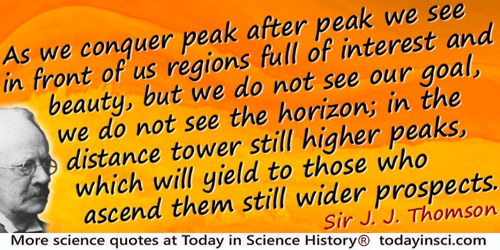
As we conquer peak after peak we see in front of us regions full of interest and beauty, but we do not see our goal, we do not see the horizon; in the distance tower still higher peaks, which will yield to those who ascend them still wider prospects, and deepen the feeling, the truth of which is emphasised by every advance in science, that “Great are the Works of the Lord.”
In Presidential Address to the British Association, as quoted in Arthur L. Foley, 'Recent Developments in Physical Science, The Popular Science Monthly (1910), 456.
Before any great scientific principle receives distinct enunciation by individuals, it dwells more or less clearly in the general scientific mind. The intellectual plateau is already high, and our discoverers are those who, like peaks above the plateau, rise a little above the general level of thought at the time.
In 'Faraday as a Discoverer', The American Journal of Science (Jul 1868), 2nd series,
46, No. 136, 194.
Glittering white, shining blue, raven black … the land looks like a fairytale. Pinnacle after pinnacle, peak after peak—crevassed, wild as any land on our globe, it lies, unseen and untrodden. It is a wonderful feeling to travel along it.
As quoted from South Pole expedition diary (13 Nov 1911) in Roland Huntford, Scott and Amundsen (1980), 438.
Have you ever watched an eagle held captive in a zoo, fat and plump and full of food and safe from danger too?
Then have you seen another wheeling high up in the sky, thin and hard and battle-scarred, but free to soar and fly?
Well, which have you pitied the caged one or his brother? Though safe and warm from foe or storm, the captive, not the other!
There’s something of the eagle in climbers, don’t you see; a secret thing, perhaps the soul, that clamors to be free.
It’s a different sort of freedom from the kind we often mean, not free to work and eat and sleep and live in peace serene.
But freedom like a wild thing to leap and soar and strive, to struggle with the icy blast, to really be alive.
That’s why we climb the mountain’s peak from which the cloud-veils flow, to stand and watch the eagle fly, and soar, and wheel... below...
Then have you seen another wheeling high up in the sky, thin and hard and battle-scarred, but free to soar and fly?
Well, which have you pitied the caged one or his brother? Though safe and warm from foe or storm, the captive, not the other!
There’s something of the eagle in climbers, don’t you see; a secret thing, perhaps the soul, that clamors to be free.
It’s a different sort of freedom from the kind we often mean, not free to work and eat and sleep and live in peace serene.
But freedom like a wild thing to leap and soar and strive, to struggle with the icy blast, to really be alive.
That’s why we climb the mountain’s peak from which the cloud-veils flow, to stand and watch the eagle fly, and soar, and wheel... below...
…...
In the distance tower still higher peaks which will yield to those who ascend them still wider prospects, and deepen the feeling whose truth is emphasized by every advance in science: that “Great are the Works of the Lord.”
From Inaugural Address to the Annual Meeting of the British Association for the Advancement of Science at Winnipeg. Collected in 'The British Association at Winnipeg',Nature (26 Aug 1909), 81. No. 2078, 257.
In the mountains of Parma and Piacenza, multitudes of shells and corals filled with worm-holes may be seen still adhering to the rocks, and when I was making the great horse at Milan a large sack of those which had been found in these parts was brought to my workshop by some peasants... The red stone of the mountains of Verona is found with shells all intermingled, which have become part of this stone... And if you should say that these shells have been and still constantly are being created in such places as these by the nature of the locality or by potency of the heavens in these spots, such an opinion cannot exist in brains possessed of any extensive powers of reasoning because the years of their growth are numbered upon the outer coverings of their shells; and both small and large ones may be seen; and these would not have grown without feeding, or fed without movement, and here [embedded in rock] they would not have been able to move... The peaks of the Apennines once stood up in a sea, in the form of islands surrounded by salt water... and above the plains of Italy where flocks of birds are flying today, fishes were once moving in large shoals.
'Physical Geography', in The Notebooks of Leonardo da Vinci, trans. E. MacCurdy (1938), Vol. 1, 355-6, 359.
Lo! keen-eyed towering science,
As from tall peaks the modern overlooking.
As from tall peaks the modern overlooking.
In poem, 'Song of the Universal', Leaves of Grass (1867), 185.
Standing beside each other, we feasted our eyes. Above us the cerulean sky deepened to an inky black as the remnants of the atmosphere gave way to the depths of space. The mighty Himalaya were now a sparkling relief map spread out before us and garnished with a gleaming lattice work of swirling glaciers. Even Cho Oyu, Lhotse and Makalu, all 8,000-meter giants, were dwarfed. To the east and west, Kanchenjunga and Shishapangma, two more great sentinels of the Himalaya, stood crystal clear over 100 kilometers away. To the north were the burnished plains of Tibet, and to the south the majestic peaks and lush foothills of Nepal. We stood on the crown jewel of the earth, the curved horizon spinning endlessly around us.
— Jo Gambi
…...
The evening was calm, the calmest we had known above the North Col. The smooth, outward dipping slabs glowed in the fast setting sun and, at an immense distance beneath, clouds concealed the valleys and lesser peaks. There was nothing to obstruct the tremendous prospect. Seen from Everest, great peaks that dominate the climber as he toils along the East Rongbuk Glacier, and up the slopes of the North Col, show like insignificant ripples at the base of a great ocean roller. Even the North Peak was but a stepping-stone to quick-footed vision.
…...
The human brain is a machine which alone accounts for all our actions, our most private thoughts, our beliefs. ... To choose a spouse, a job, a religious creed—or even choose to rob a bank—is the peak of a causal chain that runs back to the origin of life and down to the nature of atoms and molecules.
The Mind Machine (1998), 145. In Vinoth Ramachandra, Subverting Global Myths: Theology and the Public Issues Shaping our World (2008), 179.
The laboratory was an unattractive half basement and low ceilinged room with an inner dark room for the galvanometer and experimental animals. It was dark, crowded with equipment and uninviting. Into it came patients for electrocardiography, dogs for experiments, trays with coffee and buns for lunch. It was hot and dusty in summer and cold in winter. True a large fire burnt brightly in the winter but anyone who found time to warm his backside at it was not beloved by [Sir Thomas] Lewis. It was no good to try and look out of the window for relaxation, for it was glazed with opaque glass. The scientific peaks were our only scenery, and it was our job to try and find the pathways to the top.
— Magazine
'Tribute to Sir Thomas Lewis', University College Hospital Magazine (1955), 40, 71.
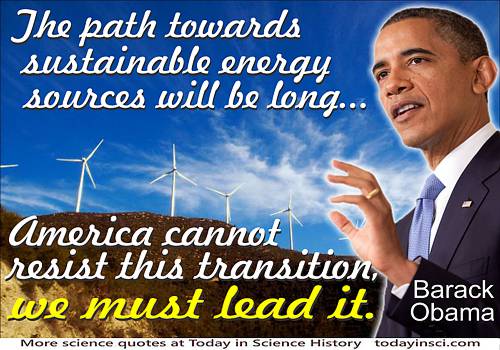
The path towards sustainable energy sources will be long and sometimes difficult. But America cannot resist this transition, we must lead it. We cannot cede to other nations the technology that will power new jobs and new industries, we must claim its promise. That’s how we will maintain our economic vitality and our national treasure—our forests and waterways, our crop lands and snow-capped peaks. That is how we will preserve our planet, commanded to our care by God. That’s what will lend meaning to the creed our fathers once declared.
In Second Inaugural Address (21 Jan 2013) at the United States Capitol.
Theorists tend to peak at an early age; the creative juices tend to gush very early and start drying up past the age of fifteen—or so it seems. They need to know just enough; when they’re young they haven’t accumulated the intellectual baggage.
In Leon Lederman and Dick Teresi, The God Particle: If the Universe is the Answer, What is the
Question (1993), 16.
To make the peaks higher.
[His reason to target philanthropic funding to only the best university science departments.]
[His reason to target philanthropic funding to only the best university science departments.]
As quoted by Stanley Coben in 'The Scientific Establishment and the Transmission of Quantum Mechanics to the United States, 1919-32', The American Historical Review (Apr 1971), 76, No. 2, 450. As president of the Rockerfeller Foundation's General Education Board in the 1920s, Rose explained the reason to narrow the board's financial focus. It would cease distributing funds to many university general endowment funds, and instead support only the few strongest university science departments. It became an unofficial motto for philanthropist John D. Rockefeller, Jr. It was also a favorite of George Ellery Hale. The quotation comes from Rose's private notebook as cited by Raymond B. Fosdick, Adventure in Giving, The Story of the General Education Board (1962), 230. Further details of the board's change in policy are in Annual Report of the General Education Board, 1924-1925 (1926), 6-8.
We are in a position similar to that of a mountaineer who is wandering over uncharted spaces, and never knows whether behind the peak which he sees in front of him and which he tries to scale there may not be another peak still beyond and higher up.
In Max Planck and James Vincent Murphy (trans.), Where is Science Going?, (1932), 200.
We talk about our high standard of living in this country. What we have is a high standard of work. Usually the peaks of civilization have been periods when a large proportion of the population had time to live. I don’t think we’re doing this today. I think the people who could live are still spending their time and supplementary resources on making a living.
As quoted in interview with Frances Glennon, 'Student and Teacher of Human Ways', Life (14 Sep 1959), 147.
We think of Euclid as of fine ice; we admire Newton as we admire the peak of Teneriffe. Even the intensest labors, the most remote triumphs of the abstract intellect, seem to carry us into a region different from our own—to be in a terra incognita of pure reasoning, to cast a chill on human glory.
In Estimates of Some Englishmen and Scotchmen (1856), 411-412
When asked what it was like to set about proving something, the mathematician likened proving a theorem to seeing the peak of a mountain and trying to climb to the top. One establishes a base camp and begins scaling the mountain’s sheer face, encountering obstacles at every turn, often retracing one’s steps and struggling every foot of the journey. Finally when the top is reached, one stands examining the peak, taking in the view of the surrounding countryside and then noting the automobile road up the other side!
Space-filler in The Two-Year College Mathematics Journal (Nov 1980), 11, No. 5, 295.
 In science it often happens that scientists say, 'You know that's a really good argument; my position is mistaken,' and then they would actually change their minds and you never hear that old view from them again. They really do it. It doesn't happen as often as it should, because scientists are human and change is sometimes painful. But it happens every day. I cannot recall the last time something like that happened in politics or religion.
(1987) --
In science it often happens that scientists say, 'You know that's a really good argument; my position is mistaken,' and then they would actually change their minds and you never hear that old view from them again. They really do it. It doesn't happen as often as it should, because scientists are human and change is sometimes painful. But it happens every day. I cannot recall the last time something like that happened in politics or religion.
(1987) --