Pathology Quotes (20 quotes)
Cellular pathology is not an end if one cannot see any alteration in the cell. Chemistry brings the clarification of living processes nearer than does anatomy. Each anatomical change must have been preceded by a chemical one.
Attributed in H. Coper and H. Herken, Deutsche Medizini Wochenschrift (18 Oct 1963), 88, No. 42, 2035, in the original German, “Nach der Überlieferung durch His soll Virchow geäußert haben: ‘Die Zellular-pathologie ist nicht am Ende, wenn man an einer Zelle keine Veränderungen mehr sehen kann. Die Chemie steht der Erklärung der Lebensvorgänge näher als die Anatomie. Jede anatomische Verände-rung setzt notwendig eine chemische voraus.’” As translated in Angel Pentschew,'Morphology and morphogenesis of lead encephalopathy', Acta Neuropathologica (Sep 1965) 5, No. 2, 133-160, as cited in I. Arthur Michaelson and Mitchell W. Sauerhoff, 'Animal Models of Human Disease: Severe and Mild Lead Encephalopathy in the Neonatal Rat', Environmental Health Perspectives (May 1974), 7, 204 & 223 footnote. Note: Although given in quotation marks in the original German text, the subject quote is almost definitely NOT verbatim, but only a paraphrase of Virchow’s teachings. The German text introduces the subject quote with, “Nach der Überlieferung durch His soll Virchow geäußert haben:…” which means, “According to tradition Virchow is said to have expressed:…” (using Google translate). However, it is useful as a succinct statement to the effect of what Virchow might say to summarize his doctrine.
During the half-century that has elapsed since the enunciation of the cell-theory by Schleiden and Schwann, in 1838-39, it has became ever more clearly apparent that the key to all ultimate biological problems must, in the last analysis, be sought in the cell. It was the cell-theory that first brought the structure of plants and animals under one point of view by revealing their common plan of organization. It was through the cell-theory that Kolliker and Remak opened the way to an understanding of the nature of embryological development, and the law of genetic continuity lying at the basis of inheritance. It was the cell-theory again which, in the hands of Virchaw and Max Schultze, inaugurated a new era in the history of physiology and pathology, by showing that all the various functions of the body, in health and in disease, are but the outward expression of cell-activities. And at a still later day it was through the cell-theory that Hertwig, Fol, Van Beneden, and Strasburger solved the long-standing riddle of the fertilization of the egg, and the mechanism of hereditary transmission. No other biological generalization, save only the theory of organic evolution, has brought so many apparently diverse phenomena under a common point of view or has accomplished more far the unification of knowledge. The cell-theory must therefore be placed beside the evolution-theory as one of the foundation stones of modern biology.
In The Cell in Development and Inheritance (1896), 1.
Effects vary with the conditions which bring them to pass, but laws do not vary. Physiological and pathological states are ruled by the same forces; they differ only because of the special conditions under which the vital laws manifest themselves.
From An Introduction to the Study of Experimental Medicine (1865), as translated by Henry Copley Greene (1957),10.
Historically [chemistry] arose from a constellation of interests: the empirically based technologies of early metallurgists, brewers, dyers, tanners, calciners and pharmacists; the speculative Greek philosphers' concern whether brute matter was invariant or transformable; the alchemists' real or symbolic attempts to achieve the transmutation of base metals into gold; and the iatrochemists' interst in the chemistry and pathology of animal and human functions. Partly because of the sheer complexity of chemical phenomena, the absence of criteria and standards of purity, and uncertainty over the definition of elements ... but above all because of the lack of a concept of the gaseous state of matter, chemistry remained a rambling, puzzling and chaotic area of natural philosophy until the middle of the eighteenth century.
The Chemical Tree: A History of Chemistry (2000), xxii.
I suppose that Dr. [Florence] Sabin is the most eminent of living women scientists. The knowledge she has derived from her studies has led to better understanding of the anatomy, physiology, and pathology of the body in health and in disease, and has been not only of theoretical but of practical value. It is of the nature of conspicuous social service to have added to the knowledge of our bodies, well and ill, and thus to have helped make them better instruments for the fulfilment of the purposes of society as a whole.
In Genevieve Parkhurst, 'Dr. Sabin, Scientist: Winner Of Pictorial Review’s Achievement Award', Pictorial Review (Jan 1930), 2.
In a word, I consider hospitals only as the entrance to scientific medicine; they are the first field of observation which a physician enters; but the true sanctuary of medical science is a laboratory; only there can he seek explanations of life in the normal and pathological states by means of experimental analysis.
From An Introduction to the Study of Experimental Medicine (1865), as translated by Henry Copley Greene (1957), 146.
In the dog two conditions were found to produce pathological disturbances by functional interference, namely, an unusually acute clashing of the excitatory and inhibitory processes, and the influence of strong and extraordinary stimuli. In man precisely similar conditions constitute the usual causes of nervous and psychic disturbances. Different conditions productive of extreme excitation, such as intense grief or bitter insults, often lead, when the natural reactions are inhibited by the necessary restraint, to profound and prolonged loss of balance in nervous and psychic activity.
Ivan Pavlov and G. V. Anrep (ed., trans.), Conditioned Reflexes—An Investigation of the Physiological Activity of the Cerebral Cortex (1927), 397.
Inexact method of observation, as I believe, is one flaw in clinical pathology to-day. Prematurity of conclusion is another, and in part follows from the first; but in chief part an unusual craving and veneration for hypothesis, which besets the minds of most medical men, is responsible. Except in those sciences which deal with the intangible or with events of long past ages, no treatises are to be found in which hypothesis figures as it does in medical writings. The purity of a science is to be judged by the paucity of its recorded hypotheses. Hypothesis has its right place, it forms a working basis; but it is an acknowledged makeshift, and, at the best, of purpose unaccomplished. Hypothesis is the heart which no man with right purpose wears willingly upon his sleeve. He who vaunts his lady love, ere yet she is won, is apt to display himself as frivolous or his lady a wanton.
The Mechanism and Graphic Registration of the Heart Beat (1920), vii.
Influenza is a distinct disease, recognizable clinically by its epidemic proportions and extreme infectiousness, characterized pathologically by peculiar lesions in the lung, and caused by an unknown virus which gains entry through the respiratory tract.
Describing his findings from two autopsies, reported in a 1919 article. The influenza virus was eventually discovered in 1933 by Smith, Andrews, and Laidlaw. As quoted in Robert D. Collins, 'Dr Goodpasture: “I was not aware of such a connection between lung and kidney disease”', Annals of Diagnostic Pathology (Jun 2010), 14, No. 3, 194-198. [The original article is Goodpasture EW. The significance of certain pulmonary lesions in relation to the etiology of influenza. Am. J. Med. Sci. 1919;158:863–70.]
It seeming impossible in any other manner to properly restrict the use of this powerful agent [calomel, a mercury compound, mercurous chloride], it is directed that it be struck from the supply table, and that no further requisitions for this medicine be approved by Medical Directors. ... modern pathology has proved the impropriety of the use of mercury in very many of those diseases in which it was formerly unfailingly administered. ... No doubt can exist that more harm has resulted from the misuse [of this agent], in the treatment of disease, than benefit from their proper administration.
W.A. Hammond, Surgeon General, Washington D.C., 4 May 1863
W.A. Hammond, Surgeon General, Washington D.C., 4 May 1863
'Circular No. 6,', in William Grace, The Army Surgeon's Manual (1864), 121.
No matter how we twist and turn we shall always come back to the cell. The eternal merit of Schwann does not lie in his cell theory that has occupied the foreground for so long, and perhaps will soon be given up, but in his description of the development of the various tissues, and in his demonstration that this development (hence all physiological activity) is in the end traceable back to the cell. Now if pathology is nothing but physiology with obstacles, and diseased life nothing but healthy life interfered with by all manner of external and internal influences then pathology too must be referred back to the cell.
In 'Cellular-Pathologie', Archiv für pathologische Anatomie und Physiologie und fur klinische Medizin (1855), 8, 13-14, as translated in LellandJ. Rather, 'Cellular Pathology', Disease, Life, and Man: Selected Essays by Rudolf Virchow (1958), 81.
Pathology would remain a lovely science, even if there were no therapeutics, just as seismology is a lovely science, though no one knows how to stop earthquakes.
In A Mencken Chrestomathy (1949, 1956), 625-626.
Pathology, probably more than any other branch of science, suffers from heroes and hero-worship. Rudolf Virchow has been its archangel and William Welch its John the Baptist, while Paracelsus and Cohnheim have been relegated to the roles of Lucifer and Beelzebub. … Actually, there are no heroes in Pathology—all of the great thoughts permitting advance have been borrowed from other fields, and the renaissance of pathology stems not from pathology itself but from the philosophers Kant and Goethe.
Quoted from an address to a second year class, in Levin L. Waters, obituary for Harry S. N. Greene, M.D., in Yale Journal of Biology and Medicine (Feb-Apr 1971), 43:4-5, 207.
Rudolf Virchow, often referred to as the father of modern pathology, broke sharply with such traditional concepts by proposing that the basis of all disease is injury to the smallest living unit of the body, namely, the cell. More than a century later, both clinical and experimental
pathology remain rooted in Virchow’s cellular pathology.
In Emanuel Rubin and John L. Farber (eds.), Pathology (1944), 2.
Someday someone will write a pathology of experimental physics and bring to light all those swindles which subvert our reason, beguile our judgement and, what is worse, stand in the way of any practical progress. The phenomena must be freed once and for all from their grim torture chamber of empiricism, mechanism, and dogmatism; they must be brought before the jury of man's common sense.
Jeremy Naydler (ed.), Goethe On Science: An Anthology of Goethe's Scientific Writings (1996), 31.
The history of penicillin is one of the disgraces of medical research. Fleming published his
classic paper in the British Journal of Experimental Pathology for June, 1929, but it was not until 1939 that Florey followed up the clue. An antiseptic which is almost ideal, inasmuch as it has no toxic effects, was allowed to slumber for ten years. Had it not been for the exigencies of the present war it might be slumbering still.
In book review, 'The Story of a Neglected Miracle', New York Times (25 Mar 1945), BR3. (The book being reviewed was J.D. Ratcliff, Yellow Magic: The Story of Penicillin.)
The ordinary patient goes to his doctor because he is in pain or some other discomfort and wants to be comfortable again; he is not in pursuit of the ideal of health in any direct sense. The doctor on the other hand wants to discover the pathological condition and control it if he can. The two are thus to some degree at cross purposes from the first, and unless the affair is brought to an early and happy conclusion this diversion of aims is likely to become more and more serious as the case goes on.
Address, opening of 1932-3 session of U.C.H. Medical School (4 Oct 1932), 'Art and Science in Medicine', The Collected Papers of Wilfred Trotter, FRS (1941), 98.
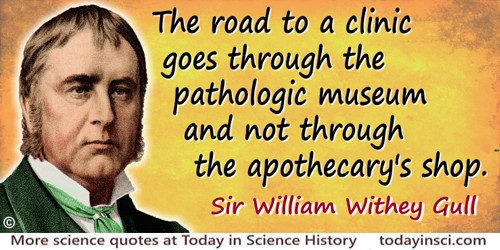
The road to a clinic goes through the pathologic museum and not through the apothecary's shop.
Quoted without further citation in The New Encyclopedia Britannica (1986), Vol. 5, 566.
The universality of parasitism as an offshoot of the predatory habit negatives the position taken by man that it is a pathological phenomenon or a deviation from the normal processes of nature. The pathological manifestations are only incidents in a developing parasitism. As human beings intent on maintaining man's domination over nature we may regard parasitism as pathological insofar as it becomes a drain upon human resources. In our efforts to protect ourselves we may make every kind of sacrifice to limit, reduce, and even eliminate parasitism as a factor in human life. Science attempts to define the terms on which this policy of elimination may or may not succeed. We must first of all thoroughly understand the problem, put ourselves in possession of all the facts in order to estimate the cost. Too often it has been assumed that parasitism was abnormal and that it needed only a slight force to reestablish what was believed to be a normal equilibrium without parasitism. On the contrary, biology teaches us that parasitism is a normal phenomenon and if we accept this view we shall be more ready to pay the price of freedom as a permanent and ever recurring levy of nature for immunity from a condition to which all life is subject. The greatest victory of man over nature in the physical realm would undoubtedly be his own delivery from the heavy encumbrance of parasitism with which all life is burdened.
Parasitism and Disease (1934), 4.
The value the world sets upon motives is often grossly unjust and inaccurate. Consider, for example, two of them: mere insatiable curiosity and the desire to do good. The latter is put high above the former, and yet it is the former that moves some of the greatest men the human race has yet produced: the scientific investigators. What animates a great pathologist? Is it the desire to cure disease, to save life? Surely not, save perhaps as an afterthought. He is too intelligent, deep down in his soul, to see anything praiseworthy in such a desire. He knows by life-long observation that his discoveries will do quite as much harm as good, that a thousand scoundrels will profit to every honest man, that the folks who most deserve to be saved will probably be the last to be saved. No man of self-respect could devote himself to pathology on such terms. What actually moves him is his unquenchable curiosity–his boundless, almost pathological thirst to penetrate the unknown, to uncover the secret, to find out what has not been found out before. His prototype is not the liberator releasing slaves, the good Samaritan lifting up the fallen, but the dog sniffing tremendously at an infinite series of rat-holes.
In 'Types of Men: The Scientist', Prejudices (1923), 269-70.
 In science it often happens that scientists say, 'You know that's a really good argument; my position is mistaken,' and then they would actually change their minds and you never hear that old view from them again. They really do it. It doesn't happen as often as it should, because scientists are human and change is sometimes painful. But it happens every day. I cannot recall the last time something like that happened in politics or religion.
(1987) --
In science it often happens that scientists say, 'You know that's a really good argument; my position is mistaken,' and then they would actually change their minds and you never hear that old view from them again. They really do it. It doesn't happen as often as it should, because scientists are human and change is sometimes painful. But it happens every day. I cannot recall the last time something like that happened in politics or religion.
(1987) -- 




