Origin Of Species Quotes (43 quotes)
[My dream dinner guest is] Charles Darwin. It’s an obvious answer, but it’s the truth. Think of any problem and before you start theorising, just check up whether Charles Darwin mentioned it in one of those green books sitting on your shelf. Whether it’s earthworms, human gestures or the origin of species, the observations that man made are unbelievable. He touched on so many subjects. Then, Alexander von Humboldt, the last polymath. There was no aspect of the natural world that he wasn’t curious about or didn’t write about in Kosmos, an extraordinary book.
From interview with Alice Roberts, 'Attenborough: My Life on Earth', The Biologist (Aug 2015), 62, No. 4, 16.
![Charles Darwin quote: About weak points [of the Origin] I agree. The eye to this day gives me a cold shudder, but when I think o](https://todayinsci.com/D/Darwin_Charles/DarwinCharles-Weak500x250px.jpg)
About weak points [of the Origin] I agree. The eye to this day gives me a cold shudder, but when I think of the fine known gradations, my reason tells me I ought to conquer the cold shudder.
Letter to Asa Gray, 8 or 9 February 1860. In F. Burkhardt and S. Smith (eds.), The Correspondence of Charles Darwin 1860 (1993), Vol. 8, 75.
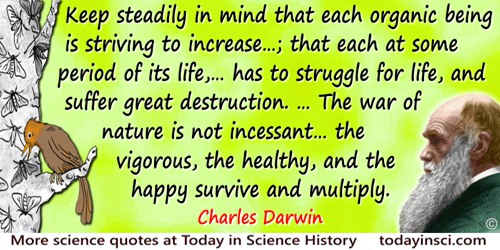
All that we can do, is to keep steadily in mind that each organic being is striving to increase at a geometrical ratio; that each at some period of its life, during some season of the year, during each generation or at intervals, has to struggle for life, and to suffer great destruction. When we reflect on this struggle, we may console ourselves with the full belief, that the war of nature is not incessant, that no fear is felt, that death is generally prompt, and that the vigorous, the healthy, and the happy survive and multiply.
From On the Origin of Species by Means of Natural Selection; or, The Preservation of Favoured Races in the Struggle for Life (1861), 76.
As buds give rise by growth to fresh buds, and these, if vigorous, branch out and overtop on all sides many a feebler branch, so by generation I believe it has been with the great Tree of Life, which fills with its dead and broken branches the crust of the earth, and covers the surface with its ever branching and beautiful ramifications.
From On the Origin of Species by Means of Natural Selection; or, The Preservation of Favoured Races in the Struggle for Life (1861), 119.
As for your doctrines I am prepared to go to the Stake if requisite ... I trust you will not allow yourself to be in any way disgusted or annoyed by the considerable abuse & misrepresentation which unless I greatly mistake is in store for you... And as to the curs which will bark and yelp - you must recollect that some of your friends at any rate are endowed with an amount of combativeness which (though you have often & justly rebuked it) may stand you in good stead - I am sharpening up my claws and beak in readiness.
Letter (23 Nov 1859) to Charles Darwin a few days after the publication of Origin of Species. In Charles Darwin, Frederick Burkhardt, Sydney Smith, The Correspondence of Charles Darwin: 1858-1859 (1992), Vol. 19, 390-391.
At last gleams of light have come, and I am almost convinced (quite contrary to opinion I started with) that species are not (it is like confessing a murder) immutable. Heaven forfend me from Lamarck nonsense of a “tendency to progression”, “adaptations from the slow willing of animals”, &c! But the conclusions I am led to are not widely different from his; though the means of change are wholly so. I think I have found out (here’s presumption!) the simple way by which species become exquisitely adapted to various ends.
Letter to Sir Joseph Hooker (11 Jan 1844). In Charles Darwin and Francis Darwin (ed.), Charles Darwin: His Life Told in an Autobiographical Chapter, and in a Selected Series of His Published Letters (1892), 173-174.
But as my conclusions have lately been much misrepresented, and it has been stated that I attribute the modification of species exclusively to natural selection, I may be permitted to remark that in the first edition of this work, and subsequently, I placed in a most conspicuous position—namely, at the close of the Introduction—the following words: “I am convinced that natural selection has been the main but not the exclusive means of modification.” This has been of no avail. Great is the power of steady misrepresentation; but the history of science shows that fortunately this power does not long endure.
In The Origin of Species by Means of Natural Selection with additions and corrections from sixth and last English edition (1899), Vol. 2, 293.
Darwin abolished special creations, contributed the Origin of Species and hitched all life together in one unbroken procession of Siamese Twins, the whole evolved by natural and orderly processes from one microscopic parent germ.
'The Secret History of Eddypus', in Mark Twain and David Ketterer (ed.), Tales of Wonder (2003), 223.
Darwin's Origin of Species had come into the theological world like a plough into an ant-hill. Everywhere those thus rudely awakened from their old comfort and repose had swarmed forth angry and confused. Reviews, sermons, books light and heavy, came flying at the new thinker from all sides.
From The Warfare of Science and Theology in Christendom (1898), 70.
Darwin’s book is very important and serves me as a basis in natural science for the class struggle in history. One has to put up with the crude English method of development, of course. Despite all deficiencies not only is the death-blow dealt here for the first time to “teleology” in the natural sciences, but their rational meaning is empirically explained.
Marx to Lasalle, 16 Jan 1861. In Marx-Engels Selected Correspondence, 1846-95, trans. Donna Torr (1934), 125.
Every philosophical thinker hails it [The Origin of Species] as a veritable Whitworth gun in the armoury of liberalism.
'The Origin of Species' (1860). In Collected Essays (1893), Vol. 2, 23.
His subject is the “Origin of Species,” & not the origin of Organization; & it seems a needless mischief to have opened the latter speculation at all.
In a letter to Fannie Wedgwood (13 Mar 1860), in Harriet Martineau's Letters to Fanny Wedgwood (1983), 189.
I expect to think that I would rather be author of your book [The Origin of Species] than of any other on Nat. Hist. Science.
Letter to Darwin (12 Dec 1859). Quoted in Leonard Huxley, Life and Letters of Sir Joseph Dalton Hooker (1918), Vol. 1, 511.
I have heard by round about channel that Herschel says my book “is the law of higgledy-pigglety.”
Letter to C. Lyell, 10 December 1859. In F. Burkhardt and S. Smith (eds.), The Correspondence of Charles Darwin 1858-1859 (1991), Vol. 7, 423.
I have just finished my sketch of my species theory. If as I believe that my theory is true & if it be accepted even by one competent judge, it will be a considerable step in science. I therefore write this, in case of my sudden death, as my most solemn & last request, which I am sure you will consider the same as if legally entered in my will, that you will devote 400£ to its publication & further will yourself, or through Hensleigh [Wedgwood], take trouble in promoting it.
Letter to Emma Darwin, 5 July 1844. In F. Burkhardt and S. Smith (eds.), The Correspondence of Charles Darwin 1844-1846 (1987), Vol. 3, 43.
I hope you have not murdered too completely your own and my child.
Referring to their independently conceived ideas on the origin of species.
Referring to their independently conceived ideas on the origin of species.
Letter to A. R. Wallace, March 1869. In J. Marchant, Alfred Russel Wallace: Letters and Reminiscences (1916), Vol. 1, 240.
I see no good reason why the views given this volume [The Origin of Species] should shock the religious feelings of any one. It is satisfactory, as showing how transient such impressions are, to remember that the greatest discovery ever made by man, namely, the law of attraction of gravity, was also attacked by Leibnitz, “as subversive of natural, and inferentially of revealed, religion.”
The Origin of Species (1909), 520.
If Darwin had printed “The Origin of Species” as a serial running twenty or thirty years he might have found himself, at the end of it, a member of the House of Lords or even Archbishop of Canterbury. But he disgorged it in one stupendous and appalling dose, and in consequence he alarmed millions, including many of his fellow scientists, and got an evil name.
From Baltimore Evening Sun (6 Apr 1931). Collected in A Mencken Chrestomathy (1949, 1956), 330.
In July [1837] opened first note-book on Transmutation of Species. Had been greatly struck from about the month of previous March on character of South American fossils, and species on Galapagos Archipelago. These facts (especially latter), origin of all my views.
In Francis Darwin (ed.), The Life and Letters of Charles Darwin, Including an Autobiographical Chapter (1888), Vol. 1, 276.
In less than eight years “The Origin of Species” has produced conviction in the minds of a majority of the most eminent living men of science. New facts, new problems, new difficulties as they arise are accepted, solved, or removed by this theory; and its principles are illustrated by the progress and conclusions of every well established branch of human knowledge.
From a review of four books on the subject 'Mimicry, and Other Protective Resemblances Among Animals', in The Westminster Review (Jul 1867), 88, 1. Wallace is identified as the author in the article as reprinted in William Beebe, The Book of Naturalists: An Anthology of the Best Natural History (1988), 108.
In our day grand generalizations have been reached. The theory of the origin of species is but one of them. Another, of still wider grasp and more radical significance, is the doctrine of the Conservation of Energy, the ultimate philosophical issues of which are as yet but dimly seem-that doctrine which “binds nature fast in fate” to an extent not hitherto recognized, exacting from every antecedent its equivalent consequent, and bringing vital as well as physical phenomena under the dominion of that law of causal connexion which, so far as the human understanding has yet pierced, asserts itself everywhere in nature.
'Address Delivered Before The British Association Assembled at Belfast', (19 Aug 1874). Fragments of Science for Unscientific People: A Series of Detached Essays, Lectures, and Reviews (1892), Vol. 2, 1801.
It appears that the extremely important papers that trigger a revolution may not receive a proportionately large number of citations. The normal procedures of referencing are not used for folklore. A real scientific revolution, like any other revolution, is news. The Origin of Species sold out as fast as it could be printed and was denounced from the pulpit almost immediately. Sea-floor spreading has been explained, perhaps not well, in leading newspapers, magazines, books, and most recently in a color motion picture. When your elementary school children talk about something at dinner, you rarely continue to cite it.
'Citations in a Scientific Revolution', in R. Shagam et al., Studies in Earth and Space Sciences: A Memoir in Honor of Harry Hammond Hess (1972), 4.
It has sometimes been said that the success of the Origin proved “that the subject was in the air,” or “that men's minds were prepared for it.” I do not think that this is strictly true, for I occasionally sounded not a few naturalists, and never happened to come across a single one who seemed to doubt about the permanence of species.
In Charles Darwin and Francis Darwin (ed.), Charles Darwin: His Life Told in an Autobiographical Chapter, and in a Selected Series of His Published Letters (1892), 42.
It may metaphorically be said that natural selection is daily and hourly scrutinising, throughout the world, the slightest variations; rejecting those that are bad, preserving and adding up all that are good; silently and insensibly working, whenever and wherever opportunity offers, at the improvement of each organic being in relation to its organic and inorganic conditions of life. We see nothing of these slow changes in progress, until the hand of time has marked the lapse of ages...
The Origin of Species (1870), 80.
It wasn’t the finches that put the idea [of natural selection] in Darwin’s head, it was the tortoises. The reason he didn’t use the tortoises [in writing On the Origin of Species] was that, when he got back, he found he didn’t have localities on the tortoise specimens. Here the great god, the greatest naturalist we have records of, made a mistake. His fieldwork wasn’t absolutely perfect.
From interview with Brian Cox and Robert Ince, in 'A Life Measured in Heartbeats', New Statesman (21 Dec 2012), 141, No. 5138, 33.
It will be possible, through the detailed determination of amino-acid sequences of hemoglobin molecules and of other molecules too, to obtain much information about the course of the evolutionary process, and to illuminate the question of the origin of species.
'Molecular Disease and Evolution'. Typescript of the Rudolph Virchow Lecture (5 Nov 1962). Quoted in T. Hager, Force of Nature: The Life of Linus Pauling (1997), 541.
Mutations and chromosomal changes arise in every sufficiently studied organism with a certain finite frequency, and thus constantly and unremittingly supply the raw materials for evolution. But evolution involves something more than origin of mutations. Mutations and chromosomal changes are only the first stage, or level, of the evolutionary process, governed entirely by the laws of the physiology of individuals. Once produced, mutations are injected in the genetic composition of the population, where their further fate is determined by the dynamic regularities of the physiology of populations. A mutation may be lost or increased in frequency in generations immediately following its origin, and this (in the case of recessive mutations) without regard to the beneficial or deleterious effects of the mutation. The influences of selection, migration, and geographical isolation then mold the genetic structure of populations into new shapes, in conformity with the secular environment and the ecology, especially the breeding habits, of the species. This is the second level of the evolutionary process, on which the impact of the environment produces historical changes in the living population.
Genetics and Origin of Species (1937), 13.
My father had read to me [as a young boy] from Charles Darwin’s Origin of Species, Descent of Man, and The Voyage of the Beagle, which I had then finished reading for myself, and, although not a trained scholar, I thought Darwin was right. It was the only plausible explanation of man’s long and tortuous journey to his present physical and mental development.
In John Scopes and James Presley, Center of the Storm: Memoirs of John T. Scopes (1967), 53.
My reflection, when I first made myself master of the central idea of the “Origin”, was, “How extremely stupid not to have thought of that!”
'On the Reception of the Origin of Species'. In F. Darwin (ed.), The Life and Letters of Charles Darwin, Including an Autobiographical Chapter (1888), Vol. 2, 197.
On the theory of natural selection we can clearly understand the full meaning of that old canon in natural history, “Natura non facit saltum.” This canon, if we look only to the present inhabitants of the world, is not strictly correct, but if we include all those of past times, it must by my theory be strictly true.
From On the Origin of Species by Means of Natural Selection; or, The Preservation of Favoured Races in the Struggle for Life (1861), 183.
One day the zoo-keeper noticed that the orangutan was reading two books—the Bible and Darwin’s Origin of Species. In surprise, he asked the ape,“Why are you reading both those books?”
“Well,” said the orangutan, “I just wanted to know if I was my brother’s keeper, or my keeper’s brother.”
“Well,” said the orangutan, “I just wanted to know if I was my brother’s keeper, or my keeper’s brother.”
In Jon Fripp, Michael Fripp and Deborah Fripp, Speaking of Science (2000), 27.
Species do not grow more perfect: the weaker dominate the strong, again and again— the reason being that they are the great majority, and they are also cleverer. Darwin forgot the mind (—that is English!): the weak possess more mind. … To acquire mind, one must need mind—one loses it when one no longer needs it.
[Criticism of Darwin’s Origin of Species.]
[Criticism of Darwin’s Origin of Species.]
The Twilight of the Idols (1888), translated by R. J. Hollingdale, Twilight of the Idols and the Anti Christ (1990), 67. Also see alternate translations.
Species do not evolve towards perfection: the weak always prevail over the strong—simply because they are the majority, and because they are also the more crafty. Darwin forgot the intellect (that is English!), the weak have more intellect. In order to acquire intellect, one must be in need of it. One loses it when one no longer needs it.
[Criticism of Darwin's Origin of Species.]
[Criticism of Darwin's Origin of Species.]
The Twilight of the Idols (1888) collected in Twilight of the Idols, with The Antichrist and Ecce Homo, translated by Anthony M. Ludovici (2007), 56. Also see alternate translations.
The fundamental problem in the origin of species is not the origin of differences in appearance, since these arise at the level of the geographical race, but the origin of genetic segregation. The test of species-formation is whether, when two forms meet, they interbreed and merge, or whether they keep distinct.
Darwin's Finches (1947), 129.
The origin of species is therefore simply the evolution of some difference—any difference at all—that prevents the production of fertile hybrids between populations under natural conditions.
In 'Biodiversity Rising', The Diversity of Life (1992), 56.
The publication in 1859 of the Origin of Species by Charles Darwin made a marked epoch in my own mental development, as it did in that of human thought generally. Its effect was to demolish a multitude of dogmatic barriers by a single stroke, and to arouse a spirit of rebellion against all ancient authorities whose positive and unauthenticated statements were contradicted by modern science.
Memories of My Life (1908), 287.
The question is this: Is man an ape or an angel? I, my lord, am on the side of the angels.
[Debating Darwin's Origin of Species.]
[Debating Darwin's Origin of Species.]
Speech at the Diocesan Conference, Oxford (1864), chaired by Bishop Wilberforce. Quoted in James Anthony Froude, Lord Beaconsfield (4th ed. 1890), 176.
The species does not grow in perfection: the weak again and again get the upper hand of the strong,—and their large number and their greater cunning are the cause of it. Darwin forgot the intellect (that was English!); the weak have more intellect. ... One must need intellect in order to acquire it; one loses it when it is no longer necessary.
[Criticism of Darwin’s Origin of Species.]
[Criticism of Darwin’s Origin of Species.]
In The Twilight of the Idols (1886) collected in Thomas Common (trans.), The Works of Nietzsche (1896), Vol. 11, 177. Also see alternate translations.
The Struggle for Existence amongst all organic beings throughout the world, which inevitably follows from their high geometrical powers of increase ... This is the doctrine of Malthus, applied to the whole animal and vegetable kingdoms. As many more individuals of each species are born than can possibly survive; and as, consequently, there is a frequently recurring struggle for existence, it follows that any being, if it vary however slightly in any manner profitable to itself, under the complex and sometimes varying conditions of life, will have a better chance of surviving, and thus be naturally selected. From the strong principle of inheritance, any selected variety will tend to propagate its new and modified form.
From On the Origin of Species by Means of Natural Selection; or, The Preservation of Favoured Races in the Struggle for Life (1861), 12.
There is no field of biological inquiry in which the influence of the Origin of Species is not traceable; the foremost men of science in every country are either avowed champions of its leading doctrines, or at any rate abstain from opposing them; a host of young and ardent investigators seek for and find inspiration and guidance in Mr. Darwin’s great work; and the general doctrine of Evolution, to one side of which it gives expression, finds in the phenomena of biology a firm base of operations whence it may conduct its conquest of the whole realm of nature.
From Lecture (19 Mar 1880) delivered at the Royal Institute 'The Coming of Age of The Origin of Species', printed in John Michels (ed.), Science (3 Jul 1880), 1, 15.
To suppose that the eye, with all its inimitable contrivances for adjusting the focus to different distances, for admitting different amounts of light, and for the correction of spherical and chromatic aberration, could have been formed by natural selection, seems, I freely confess, absurd in the highest possible degree. When it was first said that the sun stood still and the world turned round, the common sense of mankind declared the doctrine false; but the old saying of Vox populi, vox Dei, as every philosopher knows, cannot be trusted in science. Reason tells me, that if numerous gradations from a perfect and complex eye to one very imperfect and simple, each grade being useful to its possessor, can be shown to exist; if further, the eye does vary ever so slightly, and the variations be inherited, which is certainly the case; and if any variation or modification in the organ be ever useful to an animal under changing conditions of life, then the difficulty of believing that a perfect and complex eye could be formed by natural selection, though insuperable by our imagination, can hardly be considered real.
On The Origin of Species by Means of Natural Selection (1859, 1882), 143-144.
Very few, even among those who have taken the keenest interest in the progress of the revolution in natural knowledge set afoot by the publication of the “Origin of Species”; and who have watched, not without astonishment, the rapid and complete change which has been effected both inside and outside the boundaries of the scientific world in the attitude of men’s minds towards the doctrines which are expounded in that great work, can have been prepared for the extraordinary manifestation of affectionate regard for the man, and of profound reverence for the philosopher, which followed the announcement, on Thursday last, of the death of Mr Darwin.
'Obituary [of Charles Darwin]' (1882). In Collected Essays (1893), Vol. 2, 244.
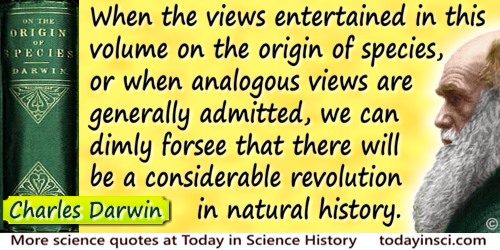
When the views entertained in this volume on the origin of species, or when analogous views are generally admitted, we can dimly forsee that there will be a considerable revolution in natural history.
The Origin of Species (1859), Penguin edn , J. W. Burrow (ed.) (1968), 455.
 In science it often happens that scientists say, 'You know that's a really good argument; my position is mistaken,' and then they would actually change their minds and you never hear that old view from them again. They really do it. It doesn't happen as often as it should, because scientists are human and change is sometimes painful. But it happens every day. I cannot recall the last time something like that happened in politics or religion.
(1987) --
In science it often happens that scientists say, 'You know that's a really good argument; my position is mistaken,' and then they would actually change their minds and you never hear that old view from them again. They really do it. It doesn't happen as often as it should, because scientists are human and change is sometimes painful. But it happens every day. I cannot recall the last time something like that happened in politics or religion.
(1987) -- 




