Origin Quotes (252 quotes)
[Man] … his origin, his growth, his hopes and fears, his loves and his beliefs are but the outcome of accidental collocations of atoms; that no fire, no heroism, no intensity of thought and feeling can preserve an individual life beyond the grave; that all the labour of the ages, all the devotion, all the inspiration, all the noonday brightness of human genius are destined to extinction in the vast death of the solar system, and that the whole temple of Man's achievement must inevitably be buried beneath the debris of a universe in ruins…
From 'A Free Man's Worship', Independent Review (Dec 1903). Collected in Mysticism and Logic: And Other Essays (1918), 47-48.
[My dream dinner guest is] Charles Darwin. It’s an obvious answer, but it’s the truth. Think of any problem and before you start theorising, just check up whether Charles Darwin mentioned it in one of those green books sitting on your shelf. Whether it’s earthworms, human gestures or the origin of species, the observations that man made are unbelievable. He touched on so many subjects. Then, Alexander von Humboldt, the last polymath. There was no aspect of the natural world that he wasn’t curious about or didn’t write about in Kosmos, an extraordinary book.
From interview with Alice Roberts, 'Attenborough: My Life on Earth', The Biologist (Aug 2015), 62, No. 4, 16.
[The science of cosmology is] closest to the soul because it has to do with origins, and that somehow generates strong opinions.
As quoted in John Noble Wilford, 'Sizing up the Cosmos: An Astronomers Quest', New York Times (12 Mar 1991), C10.
[To] explain the phenomena of the mineral kingdom ... systems are usually reduced to two classes, according as they refer to the origin of terrestrial bodies to FIRE or to WATER; and ... their followers have of late been distinguished by the fanciful names of Vulcanists and Neptunists. To the former of these Dr HUTTON belongs much more than to the latter; though, as he employs the agency both of fire and water in his system, he cannot, in strict propriety, be arranged with either.
Illustrations of the Huttonian Theory of the Earth (1802) collected in The Works of John Playfair (1822), Vol. 1, 21
Considerate la vostra semenza:
Fatti non foste a viver come bruti,
Ma per seguir virtute e conoscenza.
Consider your origins: you were not made to live as brutes, but to follow virtue and knowledge.
Fatti non foste a viver come bruti,
Ma per seguir virtute e conoscenza.
Consider your origins: you were not made to live as brutes, but to follow virtue and knowledge.
Divina Commedia 'Inferno', canto 26, l.118.
Dilbert: It took weeks but I’ve calculated a new theory about the origin of the universe. According to my calculations it didn’t start with a “Big Bang” at all—it was more of “Phhbwt” sound. You may be wondering about the practical applications of the “Little Phhbwt” theory.
Dogbert: I was wondering when you’ll go away.
Dogbert: I was wondering when you’ll go away.
Dilbert comic strip (1 Jan 1993)
Ich have auf eine geringe Vermutung eine gefährliche Reise gewagt und erblicke schon die Vorgebirge neuer Länder. Diejenigen, welche die Herzhaftigheit haben die Untersuchung fortzusetzen, werden sie betreten.
Upon a slight conjecture [on the origin of the solar system] I have ventured on a dangerous journey and I already behold the foothills of new lands. Those who have the courage to continue the search will set foot on them.
Upon a slight conjecture [on the origin of the solar system] I have ventured on a dangerous journey and I already behold the foothills of new lands. Those who have the courage to continue the search will set foot on them.
From Allgemeine Naturgeschichte und Theorie des Himmels (Natural History and Theory of the Heavens (1755). As quoted in D. ter Haar and A.G.W. Cameron, 'Historical Review of Theories of the Origin of the Solar System', collected in Robert Jastrow and A. G. W. Cameron (eds.), Origin of the Solar System: Proceedings of a Conference Held at the Goddard Institute for Space Studies, New York, January 23-24, 1962, (1963), 3.
'Cosmogonical Hypotheses' (1913), collected in Harlow Shapley, Source Book in Astronomy, 1900-1950 (1960), 347.
Ogni nostra cognitione prīcipia da sentimēti.
All our knowledge has its origin in our preceptions.
All our knowledge has its origin in our preceptions.
Tr. 45. As translated by Jean Paul Richter, in 'Philosophical Maxims', The Literary Works of Leonardo da Vinci: Compiled and Edited from the Original Manuscripts (1883), Vol. 2, 288, Maxim 1147.
Where faith commences, science ends. Both these arts of the human mind must be strictly kept apart from each other. Faith has its origin in the poetic imagination; knowledge, on the other hand, originates in the reasoning intelligence of man. Science has to pluck the blessed fruits from the tree of knowledge, unconcerned whether these conquests trench upon the poetical imaginings of faith or not.
In Ernst Haeckel and E. Ray Lankester (trans.), The History of Creation (1880), Vol. 1, 9.
A bewildering assortment of (mostly microscopic) life-forms has been found thriving in what were once thought to be uninhabitable regions of our planet. These hardy creatures have turned up in deep, hot underground rocks, around scalding volcanic vents at the bottom of the ocean, in the desiccated, super-cold Dry Valleys of Antarctica, in places of high acid, alkaline, and salt content, and below many meters of polar ice. ... Some deep-dwelling, heat-loving microbes, genetic studies suggest, are among the oldest species known, hinting that not only can life thrive indefinitely in what appear to us totally alien environments, it may actually originate in such places.
In Life Everywhere: the Maverick Science of Astrobiology (2002), xi.
A hundred years ago the study of life was often pursued, and also presented to the public, in a highly unified way. Darwin, as everyone knows, in addressing the world at large began his story with the history of pigeons and ended it with the breeding of primroses, having made excursions on the way into the origins of coral reefs and of the races of Man.
In 'The Unification of Biology', New Scientist (11 Jan 1962), 13, No. 269, 72.
A sound Physics of the Earth should include all the primary considerations of the earth's atmosphere, of the characteristics and continual changes of the earth's external crust, and finally of the origin and development of living organisms. These considerations naturally divide the physics of the earth into three essential parts, the first being a theory of the atmosphere, or Meteorology, the second, a theory of the earth's external crust, or Hydrogeology, and the third, a theory of living organisms, or Biology.
Hydrogéologie (1802), trans. A. V. Carozzi (1964), 18.
A thing is either alive or it isn’t; there is nothing that is almost alive. There is but the remotest possibility of the origin of life by spontaneous generation, and every likelihood that Arrhenius is right when he dares to claim that life is a cosmic phenomenon, something that drifts between the spheres, like light, and like light transiently descends upon those fit to receive it.
In An Almanac for Moderns (1935), 393.
![Charles Darwin quote: About weak points [of the Origin] I agree. The eye to this day gives me a cold shudder, but when I think o](https://todayinsci.com/D/Darwin_Charles/DarwinCharles-Weak500x250px.jpg)
About weak points [of the Origin] I agree. The eye to this day gives me a cold shudder, but when I think of the fine known gradations, my reason tells me I ought to conquer the cold shudder.
Letter to Asa Gray, 8 or 9 February 1860. In F. Burkhardt and S. Smith (eds.), The Correspondence of Charles Darwin 1860 (1993), Vol. 8, 75.
According to my derivative hypothesis, a change takes place first in the structure of the animal, and this, when sufficiently advanced, may lead to modifications of habits… . “Derivation” holds that every species changes, in time, by virtue of inherent tendencies thereto. “Natural Selection” holds that no such change can take place without the influence of altered external circumstances educing or selecting such change… . The hypothesis of “natural selection” totters on the extension of a conjectural condition, explanatory of extinction to the majority of organisms, and not known or observed to apply to the origin of any species.
In On the Anatomy of Vertebrates (1868), Vol. 3, 808.
According to the conclusion of Dr. Hutton, and of many other geologists, our continents are of definite antiquity, they have been peopled we know not how, and mankind are wholly unacquainted with their origin. According to my conclusions drawn from the same source, that of facts, our continents are of such small antiquity, that the memory of the revolution which gave them birth must still be preserved among men; and thus we are led to seek in the book of Genesis the record of the history of the human race from its origin. Can any object of importance superior to this be found throughout the circle of natural science?
An Elementary Treatise on Geology (1809), 82.
All admit that the mountains of the globe are situated mostly along the border regions of the continents (taking these regions as 300 to 1000 miles or more in width), and that over these same areas the sedimentary deposits have, as a general thing, their greatest thickness. At first thought, it would seem almost incredible that the upliftings of mountains, whatever their mode of origin, should have taken place just where the earth’s crust, through these sedimentary accumulations, was the thickest, and where, therefore, there was the greatest weight to be lifted. … Earthquakes show that even now, in this last of the geological ages, the same border regions of the continents, although daily thickening from the sediments borne to the ocean by rivers, are the areas of the greatest and most frequent movements of the earth’s crust. (1866)
[Thus, the facts were known long ago; the explanation by tectonic activity came many decades later.]
[Thus, the facts were known long ago; the explanation by tectonic activity came many decades later.]
In 'Observations on the Origin of Some of the Earth’s Features', The American Journal of Science (Sep 1866), Second Series, 42, No. 125, 210-211.
All material Things seem to have been composed of the hard and solid Particles … variously associated with the first Creation by the Counsel of an intelligent Agent. For it became him who created them to set them in order: and if he did so, it is unphilosophical to seek for any other Origin of the World, or to pretend that it might arise out of a Chaos by the mere Laws of Nature.
From Opticks (1704, 2nd ed., 1718), 377-378.
All palaetiological sciences, all speculations which attempt to ascend from the present to the remote past, by the chain of causation, do also, by an inevitable consequence, urge us to look for the beginning of the state of things which we thus contemplate; but in none of these cases have men been able, by the aid of science, to arrive at a beginning which is homogeneous with the known course of events. The first origin of language, of civilization, of law and government, cannot be clearly made out by reasoning and research; and just as little, we may expect, will a knowledge of the origin of the existing and extinct species of plants and animals, be the result of physiological and geological investigation.
In History of the Inductive Sciences (1837), Vol. 3, 581.
All sciences originated among the sons of Israel, the reason being the existence of prophecy among them which made their perfection in the sciences amazing.
— Averroes
In Benzion Netanyahu, Don Isaac Abravanel, Statesman and Philosopher (1953, 1998), 100. Footnote gives: See Abravanel’s Comm, on Gen., io.i (f. 48, col. 4). The corresponding passage in Happoint ha-Happalah (Hebrew translation of Averroes’ Destruction of the Destruction, by Kalonymos ben David ben Todros, Bodleian Library, Michael Collection, Ms. 293, ff. 137b-138a) is somewhat different. Abravanel might have used the other Hebrew translation (MS. in Leyden) of Averroes' work (cf. Steinschneider, Uebersetzungen, pp. 333-4).
Already at the origin of the species man was equal to what he was destined to become.
Can Man Be Modified? (1959), 76.
Although it be a known thing subscribed by all, that the foetus assumes its origin and birth from the male and female, and consequently that the egge is produced by the cock and henne, and the chicken out of the egge, yet neither the schools of physicians nor Aristotle’s discerning brain have disclosed the manner how the cock and its seed doth mint and coin the chicken out of the egge.
As quoted in John Arthur Thomson, The Science of Life: An Outline of the History of Biology and Its Recent Advances (1899), 126.
An example of such emergent phenomena is the origin of life from non-living chemical compounds in the oldest, lifeless oceans of the earth. Here, aided by the radiation energy received from the sun, countless chemical materials were synthesized and accumulated in such a way that they constituted, as it were, a primeval “soup.” In this primeval soup, by infinite variations of lifeless growth and decay of substances during some billions of years, the way of life was ultimately reached, with its metabolism characterized by selective assimilation and dissimilation as end stations of a sluiced and canalized flow of free chemical energy.
In 'The Scientific Character of Geology', The Journal of Geology (Jul 1961), 69, No. 4, 458.
An honest man, armed with all the knowledge available to us now, could only state that in some sense, the origin of life appears at the moment to be almost a miracle, so many are the conditions which would have had to have been satisfied to get it going. But this should not be taken to imply that there are good reasons to believe that it could not have started on the earth by a perfectly reasonable sequence of fairly ordinary chemical reactions. The plain fact is that the time available was too long, the many microenvironments on the earth’s surface too diverse, the various chemical possibilities too numerous and our own knowledge and imagination too feeble to allow us to be able to unravel exactly how it might or might not have happened such a long time ago, especially as we have no experimental evidence from that era to check our ideas against.
In Life Itself: Its Origin and Nature (1981), 88.
At the origin, the [space travel] pioneers of the greatest adventure of all times were motivated by the drive to explore, by the pure spirit of conquest, by the lofty desire to open up new fields to human genius. … From their exceptional journeys, they all came back with the revelation of beauty. Beauty of the black sky, beauty and variety of our planet, beauty of the Earth seen from the Moon, girdled by a scintillating belt of equatorial thunderstorms. They all emphasize that our planet is one, that borderlines are artificial, that humankind is one single community on board spaceship Earth. They all insist that this fragile gem is at our mercy and that we must all endeavor to protect it.
Written for 'Foreword' to Kevin W. Kelley (ed.), The Home Planet (1988), paragraphs 6-7 (unpaginated).
At times the [radio telescope] records exhibited a feature characteristic of interference, occurring some time later than the passage of the two known sources. This intermittent feature was curious, and I recall saying once that we would have to investigate the origin of that interference some day. We joked that it was probably due to the faulty ignition of some farm hand returning from a date.
From address to the 101st Meeting of the American Astronomical Society, Gainesville, Florida (27 Dec 1958). Printed in 'An Account of the Discovery of Jupiter as a Radio Source', The Astronomical Journal (Mar 1959), 64, No. 2, 37.
But in my opinion we can now be assured sufficiently that no animals, however small they may be, take their origin in putrefaction, but exclusively in procreation… For seeing that animals, from the largest down to the little despised animal, the flea, have animalcules in their semen, seeing also that some of the vessels of the lungs of horses and cows consist of rings and that these rings can occur on the flea's veins, why cannot we come to the conclusion that as well as the male sperm of that large animal the horse and similar animals, and of all manner of little animals, the flea included, is furnished with animalcules (and other intestines, for I have often been astonished when I beheld the numerous vessels in a flea), why, I say should not the male sperm of the smallest animals, smaller than a flea may even the very smallest animalcules have the perfection that we find in a flea.
Letter to Robert Hooke, 12 Nov 1680. In The Collected Letters of Antoni van Leeuwenhoek (1957), Vol. 3, 329.
But the idea that any of the lower animals have been concerned in any way with the origin of man—is not this degrading? Degrading is a term, expressive of a notion of the human mind, and the human mind is liable to prejudices which prevent its notions from being invariably correct. Were we acquainted for the first time with the circumstances attending the production of an individual of our race, we might equally think them degrading, and be eager to deny them, and exclude them from the admitted truths of nature.
Coming to the question of life being found on other planets, Professor Haldane apologized for discoursing, as a mere biologist, on a subject on which we had been expecting a lecture by a physicist [J. D. Bernal]. He mentioned three hypotheses:
(a) That life had a supernatural origin,
(b) That it originated from inorganic materials, and (c) That life is a constituent of the Universe and can only arise from pre-existing life. The first hypothesis, he said, should be taken seriously, and he would proceed to do so. From the fact that there are 400,000 species of beetle on this planet, but only 8,000 species of mammals, he concluded that the Creator, if he exists, has a special preference for beetles, and so we might be more likely to meet them than any other type of animal on a planet which would support life.
(a) That life had a supernatural origin,
(b) That it originated from inorganic materials, and (c) That life is a constituent of the Universe and can only arise from pre-existing life. The first hypothesis, he said, should be taken seriously, and he would proceed to do so. From the fact that there are 400,000 species of beetle on this planet, but only 8,000 species of mammals, he concluded that the Creator, if he exists, has a special preference for beetles, and so we might be more likely to meet them than any other type of animal on a planet which would support life.
In Mark Williamson, 'Haldane’s Special Preference', The Linnean, 1992, 8, 14.
Concepts that have proven useful in ordering thi ngs easily achieve such authority over us that we forget their earthly origins and accept them as unalterable givens.
…...
Controlled research … endeavors to pick out of the web of nature’s activities some single strand and trace it towards its origin and its terminus and determine its relation to other strands.
In 'The Influence of Research in Bringing into Closer Relationship the Practice of Medicine and Public Health Activities', American Journal of Medical Sciences (Dec 1929), No. 178.
Darwin abolished special creations, contributed the Origin of Species and hitched all life together in one unbroken procession of Siamese Twins, the whole evolved by natural and orderly processes from one microscopic parent germ.
'The Secret History of Eddypus', in Mark Twain and David Ketterer (ed.), Tales of Wonder (2003), 223.
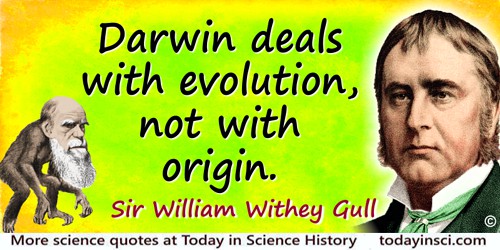
Darwin deals with evolution, not with origin.
In Sir William Withey Gull and Theodore Dyke Acland (ed.), A Collection of the Published Writings of William Withey Gull (1896), lvii.
Darwin's Origin of Species had come into the theological world like a plough into an ant-hill. Everywhere those thus rudely awakened from their old comfort and repose had swarmed forth angry and confused. Reviews, sermons, books light and heavy, came flying at the new thinker from all sides.
From The Warfare of Science and Theology in Christendom (1898), 70.
During my stay in London I resided for a considerable time in Clapham Road in the neighbourhood of Clapham Common... One fine summer evening I was returning by the last bus 'outside' as usual, through the deserted streets of the city, which are at other times so full of life. I fell into a reverie (Träumerei), and 10, the atoms were gambolling before my eyes! Whenever, hitherto, these diminutive beings had appeared to me, they had always been in motion: but up to that time I had never been able to discern the nature of their motion. Now, however, I saw how, frequently, two smaller atoms united to form a pair: how the larger one embraced the two smaller ones: how still larger ones kept hold of three or even four of the smaller: whilst the whole kept whirling in a giddy dance. I saw how the larger ones formed a chain, dragging the smaller ones after them but only at the ends of the chain. I saw what our past master, Kopp, my highly honoured teacher and friend has depicted with such charm in his Molekular-Welt: but I saw it long before him. The cry of the conductor 'Clapham Road', awakened me from my dreaming: but I spent part of the night in putting on paper at least sketches of these dream forms. This was the origin of the 'Structural Theory'.
Kekule at Benzolfest in Berichte (1890), 23, 1302.
Each species may have had its origin in a single pair, or individual, where an individual was sufficient, and species may have been created in succession at such times and in such places as to enable them to multiply and endure for an appointed period, and occupy an appointed space on the globe.
Principles of Geology(1830-3), Vol. 2, 124.
Ecosystems, with their enormous origami-like relationships, are among the most complex of all natural constructions. To understand the patterns and laws of their common origins is one of the most important challenges of science in the present century.
In 'Introduction' contributed to Enric Sala, The Nature of Nature: Why We Need the Wild (2020).
Education, then, beyond all other devices of human origin, is the great equalizer of the conditions of men–the balance-wheel of the social machinery.
Twelfth Report of the Secretary of the Massachusetts Board of Education (1948). Life and Works of Horace Mann (1891), Vol. 4, 251.
Every philosophical thinker hails it [The Origin of Species] as a veritable Whitworth gun in the armoury of liberalism.
'The Origin of Species' (1860). In Collected Essays (1893), Vol. 2, 23.
Except the blind forces of Nature, nothing moves in this world which is not Greek in its origin.
Village-Communities in the East and West (1871), 238.
Fifty years from now if an understanding of man’s origins, his evolution, his history, his progress is not in the common place of the school books we shall not exist.
In Ch. 13, 'The Long Childhood', The Ascent of Man, (2011), 328
For a long time it has been known that the first systems of representations with which men have pictured to themselves the world and themselves were of religious origin. There is no religion that is not a cosmology at the same time that it is a speculation upon divine things. If philosophy and the sciences were born of religion, it is because religion began by taking the place of the sciences and philosophy.
The Elementary Forms of the Religious Life (1912), trans. J. W. Swain (2nd edition 1976), 9.
For I am yearning to visit the limits of the all-nurturing Earth, and Oceans, from whom the gods are sprung.
— Homer
Hera to Aphrodite in the Iliad, 14.201. As given in Norman K. Glendenning, Our Place in the Universe (2007), 126.
For it is too bad that there are so few who seek the truth and so few who do not follow a mistaken method in philosophy. This is not, however, the place to lament the misery of our century, but to rejoice with you over such beautiful ideas for proving the truth. So I add only, and I promise, that I shall read your book at leisure; for I am certain that I shall find the noblest things in it. And this I shall do the more gladly, because I accepted the view of Copernicus many years ago, and from this standpoint I have discovered from their origins many natural phenomena, which doubtless cannot be explained on the basis of the more commonly accepted hypothesis.
Letter (4 Aug 1597) to Kepler, expressing thanks and interest in the book Kepler sent him. As quoted in translation in Jackson J. Spielvogel, Western Civilization: Alternate Volume: Since 1300 (2010), Vol. 2, 494.
For it is too bad that there are so few who seek the truth and so few who do not follow a mistaken method in philosophy. This is not, however, the place to lament the misery of our century, but to rejoice with you over such beautiful ideas for proving the truth. So I add only, and I promise, that I shall read your book at leisure; for I am certain that I shall find the noblest things in it. And this I shall do the more gladly, because I accepted the view of Copernicus many years ago, and from this standpoint I have discovered from their origins many natural phenomena, which doubtless cannot be explained on the basis of the more commonly accepted hypothesis.
In Letter to Johannes Kepler. As quoted in The Portable Renaissance Reader (1968), 597.
For the evolution of science by societies the main requisite is the perfect freedom of communication between each member and anyone of the others who may act as a reagent.
The gaseous condition is exemplified in the soiree, where the members rush about confusedly, and the only communication is during a collision, which in some instances may be prolonged by button-holing.
The opposite condition, the crystalline, is shown in the lecture, where the members sit in rows, while science flows in an uninterrupted stream from a source which we take as the origin. This is radiation of science. Conduction takes place along the series of members seated round a dinner table, and fixed there for several hours, with flowers in the middle to prevent any cross currents.
The condition most favourable to life is an intermediate plastic or colloidal condition, where the order of business is (1) Greetings and confused talk; (2) A short communication from one who has something to say and to show; (3) Remarks on the communication addressed to the Chair, introducing matters irrelevant to the communication but interesting to the members; (4) This lets each member see who is interested in his special hobby, and who is likely to help him; and leads to (5) Confused conversation and examination of objects on the table.
I have not indicated how this programme is to be combined with eating.
The gaseous condition is exemplified in the soiree, where the members rush about confusedly, and the only communication is during a collision, which in some instances may be prolonged by button-holing.
The opposite condition, the crystalline, is shown in the lecture, where the members sit in rows, while science flows in an uninterrupted stream from a source which we take as the origin. This is radiation of science. Conduction takes place along the series of members seated round a dinner table, and fixed there for several hours, with flowers in the middle to prevent any cross currents.
The condition most favourable to life is an intermediate plastic or colloidal condition, where the order of business is (1) Greetings and confused talk; (2) A short communication from one who has something to say and to show; (3) Remarks on the communication addressed to the Chair, introducing matters irrelevant to the communication but interesting to the members; (4) This lets each member see who is interested in his special hobby, and who is likely to help him; and leads to (5) Confused conversation and examination of objects on the table.
I have not indicated how this programme is to be combined with eating.
Letter to William Grylls Adams (3 Dec 1873). In P. M. Harman (ed.), The Scientific Letters and Papers of James Clerk Maxwell (1995), Vol. 2, 1862-1873, 949-50.
For the little that one has reflected on the origin of our knowledge, it is easy to perceive that we can acquire it only by means of comparison. That which is absolutely incomparable is wholly incomprehensible. God is the only example that we could give here. He cannot be comprehended, because he cannot be compared. But all which is susceptible of comparison, everything that we can perceive by different aspects, all that we can consider relatively, can always be judged according to our knowledge.
'Histoire naturelle de l'Homme', Histoire Naturelle, Générale et Particulière, Avec la Description du Cabinet du Roi (1749), Vol. 2, 431. Trans. Phillip R. Sloan.
Formerly one sought the feeling of the grandeur of man by pointing to his divine origin: this has now become a forbidden way, for at its portal stands the ape, together with other gruesome beasts, grinning knowingly as if to say: no further in this direction! One therefore now tries the opposite direction: the way mankind is going shall serve as proof of his grandeur and kinship with God. Alas this, too, is vain! At the end of this way stands the funeral urn of the last man and gravedigger (with the inscription “nihil humani a me alienum puto”). However high mankind may have evolved—and perhaps at the end it will stand even lower than at the beginning!— it cannot pass over into a higher order, as little as the ant and the earwig can at the end of its “earthly course” rise up to kinship with God and eternal life. The becoming drags the has-been along behind it: why should an exception to this eternal spectacle be made on behalf of some little star or for any little species upon it! Away with such sentimentalities!
Daybreak: Thoughts on the Prejudices of Morality (1881), trans. R. J. Hollingdale (1982), 32.
Fractal is a word invented by Mandelbrot to bring together under one heading a large class of objects that have [played] … an historical role … in the development of pure mathematics. A great revolution of ideas separates the classical mathematics of the 19th century from the modern mathematics of the 20th. Classical mathematics had its roots in the regular geometric structures of Euclid and the continuously evolving dynamics of Newton. Modern mathematics began with Cantor’s set theory and Peano’s space-filling curve. Historically, the revolution was forced by the discovery of mathematical structures that did not fit the patterns of Euclid and Newton. These new structures were regarded … as “pathological,” .… as a “gallery of monsters,” akin to the cubist paintings and atonal music that were upsetting established standards of taste in the arts at about the same time. The mathematicians who created the monsters regarded them as important in showing that the world of pure mathematics contains a richness of possibilities going far beyond the simple structures that they saw in Nature. Twentieth-century mathematics flowered in the belief that it had transcended completely the limitations imposed by its natural origins.
Now, as Mandelbrot points out, … Nature has played a joke on the mathematicians. The 19th-century mathematicians may not have been lacking in imagination, but Nature was not. The same pathological structures that the mathematicians invented to break loose from 19th-century naturalism turn out to be inherent in familiar objects all around us.
Now, as Mandelbrot points out, … Nature has played a joke on the mathematicians. The 19th-century mathematicians may not have been lacking in imagination, but Nature was not. The same pathological structures that the mathematicians invented to break loose from 19th-century naturalism turn out to be inherent in familiar objects all around us.
From 'Characterizing Irregularity', Science (12 May 1978), 200, No. 4342, 677-678. Quoted in Benoit Mandelbrot, The Fractal Geometry of Nature (1977, 1983), 3-4.
From the time of Aristotle it had been said that man is a social animal: that human beings naturally form communities. I couldn’t accept it. The whole of history and pre-history is against it. The two dreadful world wars we have recently been through, and the gearing of our entire economy today for defensive war belie it. Man's loathsome cruelty to man is his most outstanding characteristic; it is explicable only in terms of his carnivorous and cannibalistic origin. Robert Hartmann pointed out that both rude and civilised peoples show unspeakable cruelty to one another. We call it inhuman cruelty; but these dreadful things are unhappily truly human, because there is nothing like them in the animal world. A lion or tiger kills to eat, but the indiscriminate slaughter and calculated cruelty of human beings is quite unexampled in nature, especially among the apes. They display no hostility to man or other animals unless attacked. Even then their first reaction is to run away.
In Africa's Place In the Emergence of Civilisation (1959), 41.
Geologists are rapidly becoming convinced that the mammals spread from their central Asian point of origin largely because of great variations in climate.
The Red Man's Continent: A Chronicle of Aboriginal America (1919), 13.
Geometric writings are not rare in which one would seek in vain for an idea at all novel, for a result which sooner or later might be of service, for anything in fact which might be destined to survive in the science; and one finds instead treatises on trivial problems or investigations on special forms which have absolutely no use, no importance, which have their origin not in the science itself but in the caprice of the author; or one finds applications of known methods which have already been made thousands of times; or generalizations from known results which are so easily made that the knowledge of the latter suffices to give at once the former. Now such work is not merely useless; it is actually harmful because it produces a real incumbrance in the science and an embarrassment for the more serious investigators; and because often it crowds out certain lines of thought which might well have deserved to be studied.
From 'On Some Recent Tendencies in Geometric Investigations', Rivista di Matematica (1891), 43. In Bulletin American Mathematical Society (1904), 443.
Geometry, which before the origin of things was coeternal with the divine mind and is God himself (for what could there be in God which would not be God himself?), supplied God with patterns for the creation of the world, and passed over to Man along with the image of God; and was not in fact taken in through the eyes.
Harmonice Mundi, The Harmony of the World (1619), book IV, ch. 1. Trans. E. J. Aiton, A. M. Duncan and J. V. Field (1997), 304.
He who thus considers things in their first growth and origin … will obtain the clearest view of them.
In Politics, Book 1, Chap. 1, as translated by Benjamin Jowett (1885), Vol. 1, 2.
Hence when a person is in great pain, the cause of which he cannot remove, he sets his teeth firmly together, or bites some substance between them with great vehemence, as another mode of violent exertion to produce a temporary relief. Thus we have the proverb where no help can be has in pain, 'to grin and abide;' and the tortures of hell are said to be attended with 'gnashing of teeth.'Describing a suggestion of the origin of the grin in the present form of a proverb, 'to grin and bear it.'
Zoonomia, Or, The Laws of Organic Life, in three parts (1803), Vol. 1, 330.
His [Isaac Newton’s] observations of the colours of thin films [were] the origin of the next great theoretical advance, which had to await, over a hundred years, the coming of Thomas Young.
In 'Foreword' to Isaac Newton, Opticks: Or, A Treatise of the Reflections, Refractions, Inflections & Colours of Light. Based on the 4th Ed., London, 1730 (1952), lix-lx.
His subject is the “Origin of Species,” & not the origin of Organization; & it seems a needless mischief to have opened the latter speculation at all.
In a letter to Fannie Wedgwood (13 Mar 1860), in Harriet Martineau's Letters to Fanny Wedgwood (1983), 189.
History … celebrates the battlefields that kill us, but keeps silent on the crop fields that sustain us. It knows the bastards of kings, it doesn’t know the origin of wheat. This is the way of human folly.
From the original French, “L’histoire … célèbre les champs de bataille qui nous tuent, elle garde le silence sur les champs de culture qui nous font vivre; elle sait les bâtards des rois, elle ne sait pas l'origine du froment. Ainsi le veut la sottise humaine,” in Les Merveilles de l'Instinct Chez les Insectes: Morceaux Choisis (The Wonders of Instinct in Insects: Selected Pieces) (1913), 242. English version by Webmaster using Google to translate literally and indicate the context is lamenting that history has not preserved the origins of food cultivation. The translation usually seen is “History celebrates the battlefields whereon we meet our death but scorns to speak of the ploughed fields whereby we live. It knows the names of the kings’ bastards, but cannot tell us the origin of wheat,” for example, in Alan L. Mackay, A Dictionary of Scientific Quotations (1991), 88.
History warns us … that it is the customary fate of new truths to begin as heresies and to end as superstitions; and, as matters now stand, it is hardly rash to anticipate that, in another twenty years, the new generation, educated under the influences of the present day, will be in danger of accepting the main doctrines of the “Origin of Species,” with as little reflection, and it may be with as little justification, as so many of our contemporaries, twenty years ago, rejected them.
'The Coming of Age of the Origin of Species' (1880). In Collected Essays, Vol. 2: Darwiniana (1893), 229.
How many and how curious problems concern the commonest of the sea-snails creeping over the wet sea-weed! In how many points of view may its history be considered! There are its origin and development, the mystery of its generation, the phenomena of its growth, all concerning each apparently insignificant individual; there is the history of the species, the value of its distinctive marks, the features which link it with the higher and lower creatures, the reason why it takes its stand where we place it in the scale of creation, the course of its distribution, the causes of its diffusion, its antiquity or novelty, the mystery (deepest of mysteries) of its first appearance, the changes of the outline of continents and of oceans which have taken place since its advent, and their influence on its own wanderings.
On the Natural History of European Seas. In George Wilson and Archibald Geikie, Memoir of Edward Forbes F.R.S. (1861), 547-8.
However improbable we regard [the spontaneous origin of life],… it will almost certainly happen at least once…. The time… is of the order of two billion years.… Given so much time, the “impossible” becomes possible, the possible probable, and the probable virtually certain. One only has to wait: time itself performs the miracles.
In 'The Origin of Life', Scientific American (Aug 1954), 191, No. 2, 46. Note that the quoted time of 2 billion years is rejected as impossibly short by such authors as H. J. Morowitz, in Energy Flow in Biology (1968), 317.

Human blood is a testament to life’s origin in the ocean: its chemical composition is nearly identical to that of sea-water.
In 'Ocean Policy and Reasonable Utopias', The Forum (Summer 1981), 16, No. 5, 900.
Human consciousness is just about the last surviving mystery. A mystery is a phenomenon that people don’t know how to think about—yet. There have been other great mysteries: the mystery of the origin of the universe, the mystery of life and reproduction, the mystery of the design to be found in nature, the mysteries of time, space, and gravity. These were not just areas of scientific ignorance, but of utter bafflement and wonder. We do not yet have the final answers to any of the questions of cosmology and particle physics, molecular genetics and evolutionary theory, but we do know how to think about them. The mysteries haven't vanished, but they have been tamed. They no longer overwhelm our efforts to think about the phenomena, because now we know how to tell the misbegotten questions from the right questions, and even if we turn out to be dead wrong about some of the currently accepted answers, we know how to go about looking for better answers. With consciousness, however, we are still in a terrible muddle. Consciousness stands alone today as a topic that often leaves even the most sophisticated thinkers tongue-tied and confused. And, as with all the earlier mysteries, there are many who insist—and hope—that there will never be a demystification of consciousness.
Consciousness Explained (1991), 21-22.
Human language is in some ways similar to, but in other ways vastly different from, other kinds of animal communication. We simply have no idea about its evolutionary history, though many people have speculated about its possible origins. There is, for instance, the “bow-bow” theory, that language started from attempts to imitate animal sounds. Or the “ding-dong” theory, that it arose from natural sound-producing responses. Or the “pooh-pooh” theory, that it began with violent outcries and exclamations.
We have no way of knowing whether the kinds of men represented by the earliest fossils could talk or not…
Language does not leave fossils, at least not until it has become written.
We have no way of knowing whether the kinds of men represented by the earliest fossils could talk or not…
Language does not leave fossils, at least not until it has become written.
Man in Nature (1961), 10.
I am about to discuss the disease called “sacred”. It is not, in my opinion, any more divine or more sacred that other diseases, but has a natural cause, and its supposed divine origin is due to men's inexperience, and to their wonder at its peculiar character.
From 'The Sacred Disease', in Hippocrates, trans. W.H.S. Jones (1923), Vol. 2, 139.
I expect to think that I would rather be author of your book [The Origin of Species] than of any other on Nat. Hist. Science.
Letter to Darwin (12 Dec 1859). Quoted in Leonard Huxley, Life and Letters of Sir Joseph Dalton Hooker (1918), Vol. 1, 511.
I found the invention was applicable to painting, and would also contribute to facilitate the study of geography: for I have applied it to some maps, the rivers of which I represented in silver, and in the cities in gold. The rivers appearing, as it were, in silver streams, have a most pleasing effect on the sight, and relieve the eye of that painful search for the course, and origin, of rivers, the minutest branches of which can be splendidly represented this way.
Description of an outcome of her experiments originally investigating 'the possibility of making cloths of gold, silver and other metals by chemical processes.'
Description of an outcome of her experiments originally investigating 'the possibility of making cloths of gold, silver and other metals by chemical processes.'
Preface to An Essay on Combustion with a View to a New Art of Dyeing and Painting (1794), iii-iv. In Marilyn Bailey
Ogilvie and Joy Dorothy
Harvey, The Biographical Dictionary of Women in Science (2000), 478.
I have long held an opinion, almost amounting to conviction, in common I believe with many other lovers of natural knowledge, that the various forms under which the forces of matter are made manifest have one common origin; or, in other words, are so directly related and mutually dependent, that they are convertible, as it were, one into another, and possess equivalents of power in their action.
Paper read to the Royal Institution (20 Nov 1845). 'On the Magnetization of Light and the Illumination of Magnetic Lines of Force', Series 19. In Experimental Researches in Electricity (1855), Vol. 3, 1. Reprinted from Philosophical Transactions (1846), 1.
I hope you have not murdered too completely your own and my child.
Referring to their independently conceived ideas on the origin of species.
Referring to their independently conceived ideas on the origin of species.
Letter to A. R. Wallace, March 1869. In J. Marchant, Alfred Russel Wallace: Letters and Reminiscences (1916), Vol. 1, 240.
I intentionally left the question of the origin of life uncanvassed as being altogether ultra vires in the present state of our knowledge.
Letter (28 Mar 1882) to George C. Wallich—which Sir Gavin de Beer thinks was the last letter which Darwin is known to have dictated and signed before his death in 1882. In Gavin De Beer, 'Some Unpublished Letters of Charles Darwin', Notes and Records of the Royal Society (1959), 14, As quoted and cited in Lim Ramon, Self And The Phenomenon Of Life: A Biologist Examines Life From Molecules To Humanity (2017), 12-66.
I know no study which is so unutterably saddening as that of the evolution of humanity, as it is set forth in the annals of history. Out of the darkness of prehistoric ages man emerges with the marks of his lowly origin strong upon him. He is a brute, only more intelligent than the other brutes, a blind prey to impulses, which as often as not led him to destruction; a victim to endless illusions, which make his mental existence a terror and a burden, and fill his physical life with barren toil and battle.
'Agnosticism' (1889). In Collected Essays (1894), Vol. 5, 256.
I see no good reason why the views given this volume [The Origin of Species] should shock the religious feelings of any one. It is satisfactory, as showing how transient such impressions are, to remember that the greatest discovery ever made by man, namely, the law of attraction of gravity, was also attacked by Leibnitz, “as subversive of natural, and inferentially of revealed, religion.”
The Origin of Species (1909), 520.
I shall never forget the sight. The vessel of crystallization was three quarters full of slightly muddy water—that is, dilute water-glass—and from the sandy bottom there strove upwards a grotesque little landscape of variously colored growths: a confused vegetation of blue, green, and brown shoots which reminded one of algae, mushrooms, attached polyps, also moss, then mussels, fruit pods, little trees or twigs from trees, here, and there of limbs. It was the most remarkable sight I ever saw, and remarkable not so much for its profoundly melancholy nature. For when Father Leverkühn asked us what we thought of it and we timidly answered him that they might be plants: “No,” he replied, “they are not, they only act that way. But do not think the less of them. Precisely because they do, because they try as hard as they can, they are worthy of all respect.”
It turned out that these growths were entirely unorganic in their origin; they existed by virtue of chemicals from the apothecary's shop.
It turned out that these growths were entirely unorganic in their origin; they existed by virtue of chemicals from the apothecary's shop.
Description of a “chemical garden” in Doktor Faustus: The Life of the German Composer Adrian Leverkühn, as Told by a Friend, (1947), 19.
I think that physics is the most important—indeed the only—means we have of finding out the origins and fundamentals of our universe, and this is what interests me most about it. I believe that as science advances religion necessarily recedes, and this is a process I wish to encourage, because I consider that, on the whole, the influence of religion is malign.
Quoted in Contemporary Authors Online Gale (2007)
I think the facts leave no doubt that the very mightiest among the chemical forces are of electric origin. The atoms cling to their electric charges, and opposite electric charges cling to each other.
'On the Modern Development of Faraday's Conception of Electricity', Journal of the Chemical Society 1881, 39, 302.
I was often humiliated to see men disputing for a piece of bread, just as animals might have done. My feelings on this subject have very much altered since I have been personally exposed to the tortures of hunger. I have discovered, in fact, that a man, whatever may have been his origin, his education, and his habits, is governed, under certain circumstances, much more by his stomach than by his intelligence and his heart.
In François Arago, trans. by William Henry Smyth, Baden Powell and Robert Grant, 'The History of My Youth: An Autobiography of Francis Arago', Biographies of Distinguished Scientific Men (1859), Vol. 1, 55.
I’m trying to assemble pieces of this great jigsaw puzzle of the origin of the solar system, to see if we can illuminate our own processes on the Earth more fundamentally.
In interview, Rushworth M. Kidder, 'Grounded in Space Science', Christian Science Monitor (22 Dec 1989).
If a single cell, under appropriate conditions, becomes a man in the space of a few years, there can surely be no difficulty in understanding how, under appropriate conditions, a cell may, in the course of untold millions of years, give origin to the human race.
Principles of Biology (1865, 1872), 350.
If Darwin had printed “The Origin of Species” as a serial running twenty or thirty years he might have found himself, at the end of it, a member of the House of Lords or even Archbishop of Canterbury. But he disgorged it in one stupendous and appalling dose, and in consequence he alarmed millions, including many of his fellow scientists, and got an evil name.
From Baltimore Evening Sun (6 Apr 1931). Collected in A Mencken Chrestomathy (1949, 1956), 330.
If we ever establish contact with intelligent aliens living on a planet around a distant star … They would be made of similar atoms to us. They could trace their origins back to the big bang 13.7 billion years ago, and they would share with us the universe's future. However, the surest common culture would be mathematics.
In 'Take Me to Your Mathematician', New Scientist (14 Feb 2009), 201, No. 2695.
If we look round the world, there seem to be not above six distinct varieties in the human species, each of which is strongly marked, and speaks the kind seldom to have mixed with any other. But there is nothing in the shape, nothing in the faculties, that shows their coming from different originals; and the varieties of climate, of nourishment, and custom, are sufficient to produce every change.
In History of the Earth and Animated Nature (1774, 1812), Vol. 2, 154.
If we turn to the problems to which the calculus owes its origin, we find that not merely, not even primarily, geometry, but every other branch of mathematical physics—astronomy, mechanics, hydrodynamics, elasticity, gravitation, and later electricity and magnetism—in its fundamental concepts and basal laws contributed to its development and that the new science became the direct product of these influences.
Opening of Presidential Address (27 Apr 1907) to the American Mathematical Society, 'The Calculus in Colleges and Technical Schools', published in Bulletin of the American Mathematical Society (Jun 1907), 13, 449.
Immediately south of nitrogen is phosphorus, which was first isolated by the distillation and treatment of urine—an indication of the lengths to which chemists are prepared to go, or perhaps only a sign of the obsessive, scatological origins of their vocation.
In The Periodic Kingdom: A Journey Into the Land of the Chemical Elements (1995), 20. [On the Periodic Table, nitrogen and phosphorus are in the same Group, a column headed by nitrogen. Phosphorus is located immediately below, or “south” if the Periodic Table is viewed as analogous to a map. —Webmaster]
In all speculations on the origin, or agents that have produced the changes on this globe, it is probable that we ought to keep within the boundaries of the probable effects resulting from the regular operations of the great laws of nature which our experience and observation have brought within the sphere of our knowledge. When we overleap those limits, and suppose a total change in nature's laws, we embark on the sea of uncertainty, where one conjecture is perhaps as probable as another; for none of them can have any support, or derive any authority from the practical facts wherewith our experience has brought us acquainted.
Observations on the Geology of the United States of America (1817), iv-v.
In its essence, the theory of natural selection is primarily an attempt to give an account of the probable mechanism of the origin of the adaptations of the organisms to their environment, and only secondarily an attempt to explain evolution at large. Some modern biologists seem to believe that the word 'adaptation' has teleological connotations, and should therefore be expunged from the scientific lexicon. With this we must emphatically disagree. That adaptations exist is so evident as to be almost a truism, although this need not mean that ours is the best of all possible worlds. A biologist has no right to close his eyes to the fact that the precarious balance between a living being and its environment must be preserved by some mechanism or mechanisms if life is to endure.
Genetics and Origin of Species (1937), 150.
In July [1837] opened first note-book on Transmutation of Species. Had been greatly struck from about the month of previous March on character of South American fossils, and species on Galapagos Archipelago. These facts (especially latter), origin of all my views.
In Francis Darwin (ed.), The Life and Letters of Charles Darwin, Including an Autobiographical Chapter (1888), Vol. 1, 276.
In less than eight years “The Origin of Species” has produced conviction in the minds of a majority of the most eminent living men of science. New facts, new problems, new difficulties as they arise are accepted, solved, or removed by this theory; and its principles are illustrated by the progress and conclusions of every well established branch of human knowledge.
From a review of four books on the subject 'Mimicry, and Other Protective Resemblances Among Animals', in The Westminster Review (Jul 1867), 88, 1. Wallace is identified as the author in the article as reprinted in William Beebe, The Book of Naturalists: An Anthology of the Best Natural History (1988), 108.
In my opinion, there is absolutely no trustworthy proof that talents have been improved by their exercise through the course of a long series of generations. The Bach family shows that musical talent, and the Bernoulli family that mathematical power, can be transmitted from generation to generation, but this teaches us nothing as to the origin of such talents. In both families the high-watermark of talent lies, not at the end of the series of generations, as it should do if the results of practice are transmitted, but in the middle. Again, talents frequently appear in some member of a family which has not been previously distinguished.
In 'On Heredity', Essays upon Heredity and Kindred Biological Problems (1889), Vol. 1, 95-96.
In order that an inventory of plants may be begun and a classification of them correctly established, we must try to discover criteria of some sort for distinguishing what are called “species”. After a long and considerable investigation, no surer criterion for determining species had occurred to me than distinguishing features that perpetuate themselves in propagation from seed. Thus, no matter what variations occur in the individuals or the species, if they spring from the seed of one and the same plant, they are accidental variations and not such as to distinguish a species. For these variations do not perpetuate themselves in subsequent seeding. Thus, for example, we do not regard caryophylli with full or multiple blossoms as a species distinct from caryophylli with single blossoms, because the former owe their origin to the seed of the latter and if the former are sown from their own seed, they once more produce single-blossom caryophylli. But variations that never have as their source seed from one and the same species may finally be regarded as distinct species. Or, if you make a comparison between any two plants, plants which never spring from each other's seed and never, when their seed is sown, are transmuted one into the other, these plants finally are distinct species. For it is just as in animals: a difference in sex is not enough to prove a difference of species, because each sex is derived from the same seed as far as species is concerned and not infrequently from the same parents; no matter how many and how striking may be the accidental differences between them; no other proof that bull and cow, man and woman belong to the same species is required than the fact that both very frequently spring from the same parents or the same mother. Likewise in the case of plants, there is no surer index of identity of species than that of origin from the seed of one and the same plant, whether it is a matter of individuals or species. For animals that differ in species preserve their distinct species permanently; one species never springs from the seed of another nor vice versa.
— John Ray
Historia Plantarum (1686), Vol. 1, 40. Trans. Edmund Silk. Quoted in Barbara G. Beddall, 'Historical Notes on Avian Classification', Systematic Zoology (1957), 6, 133-4.
In our day grand generalizations have been reached. The theory of the origin of species is but one of them. Another, of still wider grasp and more radical significance, is the doctrine of the Conservation of Energy, the ultimate philosophical issues of which are as yet but dimly seem-that doctrine which “binds nature fast in fate” to an extent not hitherto recognized, exacting from every antecedent its equivalent consequent, and bringing vital as well as physical phenomena under the dominion of that law of causal connexion which, so far as the human understanding has yet pierced, asserts itself everywhere in nature.
'Address Delivered Before The British Association Assembled at Belfast', (19 Aug 1874). Fragments of Science for Unscientific People: A Series of Detached Essays, Lectures, and Reviews (1892), Vol. 2, 1801.
In reality the origin of the notion of derivatives is in the vague feeling of the mobility of things, and of the greater or less speed with which phenomena take place; this is well expressed by the terms fluent and fluxion, which were used by Newton and which we may believe were borrowed from the
ancient mathematician Heraclitus.
From address to the section of Algebra and Analysis, International Congress of Arts and Sciences, St. Louis (22 Sep 1904), 'On the Development of Mathematical Analysis and its Relation to Certain Other Sciences,' as translated by M.W. Haskell in Bulletin of the American Mathematical Society (May 1905), 11, 407.
In the distant future I see open fields for far more important researches. Psychology will be based on a new foundation, that of the necessary acquirement of each mental power and capacity by gradation. Light will be thrown on the origin of man and his history.
On The Origin of Species by Means of Natural Selection (1859, 1882), 428
.
In the fall of 1967, [I was invited] to a conference … on pulsars. … In my talk, I argued that we should consider the possibility that the center of a pulsar is a gravitationally completely collapsed object. I remarked that one couldn't keep saying “gravitationally completely collapsed object” over and over. One needed a shorter descriptive phrase. “How about black hole?” asked someone in the audience. I had been searching for the right term for months, mulling it over in bed, in the bathtub, in my car, whenever I had quiet moments. Suddenly this name seemed exactly right. When I gave a more formal Sigma Xi-Phi Beta Kappa lecture … on December 29, 1967, I used the term, and then included it in the written version of the lecture published in the spring of 1968. (As it turned out, a pulsar is powered by “merely” a neutron star, not a black hole.)
[Although John Wheeler is often identified as coining the term “black hole,” he in fact merely popularized the expression. In his own words, this is his explanation of the true origin: a suggestion from an unidentified person in a conference audience.]
[Although John Wheeler is often identified as coining the term “black hole,” he in fact merely popularized the expression. In his own words, this is his explanation of the true origin: a suggestion from an unidentified person in a conference audience.]
In Geons, Black Holes, and Quantum Foam (2000), 296-297.
In the final, the positive, state, the mind has given over the vain search after absolute notions, the origin and destination of the universe, and the causes of phenomena, and applies itself to the study of their laws—that is, their invariable relations of succession and resemblance. Reasoning and observation, duly combined, are the means of this knowledge. What is now understood when we speak of an explanation of facts is simply the establishment of a connection between single phenomena and some general facts.
The Positive Philosophy, trans. Harriet Martineau (1853), Vol. 1, 2.
Is man a peculiar organism? Does he originate in a wholly different way from a dog, bird, frog, or fish? and does he thereby justify those who assert that he has no place in nature, and no real relationship with the lower world of animal life? Or does he develop from a similar embryo, and undergo the same slow and gradual progressive modifications? The answer is not for an instant doubtful, and has not been doubtful for the last thirty years. The mode of man’s origin and the earlier stages of his development are undoubtedly identical with those of the animals standing directly below him in the scale; without the slightest doubt, he stands in this respect nearer the ape than the ape does to the dog. (1863)
As quoted in Ernst Haeckel and E. Ray Lankester (trans.) as epigraph for Chap. 12, The History of Creation (1886), Vol. 1, 364.
It appears that the extremely important papers that trigger a revolution may not receive a proportionately large number of citations. The normal procedures of referencing are not used for folklore. A real scientific revolution, like any other revolution, is news. The Origin of Species sold out as fast as it could be printed and was denounced from the pulpit almost immediately. Sea-floor spreading has been explained, perhaps not well, in leading newspapers, magazines, books, and most recently in a color motion picture. When your elementary school children talk about something at dinner, you rarely continue to cite it.
'Citations in a Scientific Revolution', in R. Shagam et al., Studies in Earth and Space Sciences: A Memoir in Honor of Harry Hammond Hess (1972), 4.
It feels unacceptable to many people even to think of having a cosmology based on science. … They see fanciful origin stories as spicing up the culture. … Aspects of many origin stories can enrich our understanding of the scientific picture, but they cannot take its place.
As co-author with Nancy Ellen Abrams, in The View from the Center of the Universe: Discovering Our Extraordinary Place in the Cosmos (2006), 85.
It has hitherto been a serious impediment to the progress of knowledge, that is in investigating the origin or causes of natural productions, recourse has generally been had to the examination, both by experiment and reasoning, of what might be rather than what is. The laws or processes of nature we have every reason to believe invariable. Their results from time to time vary, according to the combinations of influential circumstances; but the process remains the same. Like the poet or the painter, the chemist may, and no doubt often' does, create combinations which nature never produced; and the possibility of such and such processes giving rise to such and such results, is no proof whatever that they were ever in natural operation.
Considerations on Volcanoes (1825), 243.
It has sometimes been said that the success of the Origin proved “that the subject was in the air,” or “that men's minds were prepared for it.” I do not think that this is strictly true, for I occasionally sounded not a few naturalists, and never happened to come across a single one who seemed to doubt about the permanence of species.
In Charles Darwin and Francis Darwin (ed.), Charles Darwin: His Life Told in an Autobiographical Chapter, and in a Selected Series of His Published Letters (1892), 42.
It is a vulgar belief that our astronomical knowledge dates only from the recent century when it was rescued from the monks who imprisoned Galileo; but Hipparchus…who among other achievements discovered the precession of the eqinoxes, ranks with the Newtons and the Keplers; and Copernicus, the modern father of our celestial science, avows himself, in his famous work, as only the champion of Pythagoras, whose system he enforces and illustrates. Even the most modish schemes of the day on the origin of things, which captivate as much by their novelty as their truth, may find their precursors in ancient sages, and after a careful analysis of the blended elements of imagination and induction which charaterise the new theories, they will be found mainly to rest on the atom of Epicurus and the monad of Thales. Scientific, like spiritual truth, has ever from the beginning been descending from heaven to man.
Lothair (1879), preface, xvii.
It is easy to create an interstellar radio message which can be recognized as emanating unambiguously from intelligent beings. A modulated signal (‘beep,’ ‘beep-beep,’…) comprising the numbers 1, 2, 3, 5, 7, 11, 13, 17, 19, 23, 29, 31, for example, consists exclusively of the first 12 prime numbers…. A signal of this kind, based on a simple mathematical concept, could only have a biological origin. … But by far the most promising method is to send pictures.
From 'The Quest for Extraterrestrial Intelligence', in the magazine Smithsonian (May 1978), 43-44. Reprinted in Cosmic Search (Mar 1979), 1, No. 2, 5.
It is in scientific honesty that I endorse the presentation of alternative theories for the origin of the universe, life and man in the science classroom. It would be an error to overlook the possibility that the universe was planned rather than happening by chance.
In letter to California State board of Education (14 Sep 1972).
It is mere rubbish thinking, at present, of origin of life; one might as well think of origin of matter.
Letter to J. D. Hooker, 29 March 1863. In F. Burkhardt and S. Smith (eds.), The Correspondence of Charles Darwin 1863 (1999), Vol. 11, 278.
It is no valid objection that science as yet throws no light on the far higher problem of the essence or origin of life. Who can explain gravity? No one now objects to following out the results consequent on this unknown element of attraction...
The Origin of Species (1909), 519-520.
It is often assumed that because the young child is not competent to study geometry systematically he need be taught nothing geometrical; that because it would be foolish to present to him physics and mechanics as sciences it is useless to present to him any physical or mechanical principles.
An error of like origin, which has wrought incalculable mischief, denies to the scholar the use of the symbols and methods of algebra in connection with his early essays in numbers because, forsooth, he is not as yet capable of mastering quadratics! … The whole infant generation, wrestling with arithmetic, seek for a sign and groan and travail together in pain for the want of it; but no sign is given them save the sign of the prophet Jonah, the withered gourd, fruitless endeavor, wasted strength.
An error of like origin, which has wrought incalculable mischief, denies to the scholar the use of the symbols and methods of algebra in connection with his early essays in numbers because, forsooth, he is not as yet capable of mastering quadratics! … The whole infant generation, wrestling with arithmetic, seek for a sign and groan and travail together in pain for the want of it; but no sign is given them save the sign of the prophet Jonah, the withered gourd, fruitless endeavor, wasted strength.
From presidential address (9 Sep 1884) to the General Meeting of the American Social Science Association, 'Industrial Education', printed in Journal of Social Science (1885), 19, 121. Collected in Francis Amasa Walker, Discussions in Education (1899), 132.
It is therefore proper to acknowledge that the first filaments of the chick preexist in the egg and have a deeper origin, exactly as [the embryo] in the eggs of plants.
'On the Formation of the Chick in the Egg' (1673), in H. B. Adelmann (ed.), Marcello Malpighi and the Evolution of Embryology (1966), Vol. 2, 945.
It is well to observe the force and virtue and consequence of discoveries, and these are to be seen nowhere more conspicuously than in those three which were unknown to the ancients, and of which the origins, although recent, are obscure and inglorious; namely, printing, gunpowder, and the magnet. For these three have changed the whole face and state of things throughout the world; the first in literature, the second in warfare, the third in navigation; whence have followed innumerable changes, insomuch that no empire, no sect, no star seems to have exerted greater power and influence in human affairs than these mechanical discoveries.
From Novum Organum (1620), Book 1, Aphorism 129. Translated as The New Organon: Aphorisms Concerning the Interpretation of Nature and the Kingdom of Man), collected in James Spedding, Robert Ellis and Douglas Heath (eds.), The Works of Francis Bacon (1857), Vol. 4, 114.
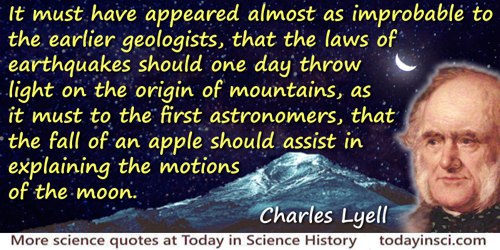
It must have appeared almost as improbable to the earlier geologists, that the laws of earthquakes should one day throw light on the origin of mountains, as it must to the first astronomers, that the fall of an apple should assist in explaining the motions of the moon.
Principles of Geology(1830-3), Vol. 3, 5.
It need scarcely be pointed out that with such a mechanism complete isolation of portion of a species should result relatively rapidly in specific differentiation, and one that is not necessarily adaptive. The effective intergroup competition leading to adaptive advance may be between species rather than races. Such isolation is doubtless usually geographic in character at the outset but may be clinched by the development of hybrid sterility. The usual difference of the chromosome complements of related species puts the importance of chromosome aberration as an evolutionary process beyond question, but, as I see it, this importance is not in the character differences which they bring (slight in balanced types), but rather in leading to the sterility of hybrids and thus making permanent the isolation of two groups.
How far do the observations of actual species and their subdivisions conform to this picture? This is naturally too large a subject for more than a few suggestions.
That evolution involves non-adaptive differentiation to a large extent at the subspecies and even the species level is indicated by the kinds of differences by which such groups are actually distinguished by systematics. It is only at the subfamily and family levels that clear-cut adaptive differences become the rule. The principal evolutionary mechanism in the origin of species must thus be an essentially nonadaptive one.
How far do the observations of actual species and their subdivisions conform to this picture? This is naturally too large a subject for more than a few suggestions.
That evolution involves non-adaptive differentiation to a large extent at the subspecies and even the species level is indicated by the kinds of differences by which such groups are actually distinguished by systematics. It is only at the subfamily and family levels that clear-cut adaptive differences become the rule. The principal evolutionary mechanism in the origin of species must thus be an essentially nonadaptive one.
In Proceedings of the Sixth International Congress of Genetics: Ithaca, New York, 1932 (1932) Vol. 1, 363-364.
It was through living among these groups and much more I think, through moving regularly from one to the other and back again that I got occupied with the problem of what, long before I put it on paper, I christened to myself as the ‘two cultures’. For constantly I felt I was moving among two groups [scientists and literary intellectuals] comparable in intelligence, identical in race, not grossly different in social origin, earning about the same incomes, who had almost ceased to communicate at all, who in intellectual, moral and psychological climate had so little in common that instead of going from Burlington House or South Kensington to Chelsea, one might have crossed an ocean.
The Two Cultures: The Rede Lecture (1959), 2. The places mentioned are all in London. Burlington House is the home of the Royal Society and South Kensington is the site of the Natural History Museum, whereas Chelsea represents an affluent centre of artistic life.
It wasn’t the finches that put the idea [of natural selection] in Darwin’s head, it was the tortoises. The reason he didn’t use the tortoises [in writing On the Origin of Species] was that, when he got back, he found he didn’t have localities on the tortoise specimens. Here the great god, the greatest naturalist we have records of, made a mistake. His fieldwork wasn’t absolutely perfect.
From interview with Brian Cox and Robert Ince, in 'A Life Measured in Heartbeats', New Statesman (21 Dec 2012), 141, No. 5138, 33.
It will be found that everything depends on the composition of the forces with which the particles of matter act upon one another; and from these forces, as a matter of fact, all phenomena of Nature take their origin.
Philosophiae Naturalis Theoria (1758), sec. 1. 5
It will be possible, through the detailed determination of amino-acid sequences of hemoglobin molecules and of other molecules too, to obtain much information about the course of the evolutionary process, and to illuminate the question of the origin of species.
'Molecular Disease and Evolution'. Typescript of the Rudolph Virchow Lecture (5 Nov 1962). Quoted in T. Hager, Force of Nature: The Life of Linus Pauling (1997), 541.
Just as in the animal and vegetable kingdoms, an individual comes into being, so to speak, grows, remains in being, declines and passes on, will it not be the same for entire species? If our faith did not teach us that animals left the Creator's hands just as they now appear and, if it were permitted to entertain the slightest doubt as to their beginning and their end, may not a philosopher, left to his own conjectures, suspect that, from time immemorial, animal life had its own constituent elements, scattered and intermingled with the general body of matter, and that it happened when these constituent elements came together because it was possible for them to do so; that the embryo formed from these elements went through innumerable arrangements and developments, successively acquiring movement, feeling, ideas, thought, reflection, consciousness, feelings, emotions, signs, gestures, sounds, articulate sounds, language, laws, arts and sciences; that millions of years passed between each of these developments, and there may be other developments or kinds of growth still to come of which we know nothing; that a stationary point either has been or will be reached; that the embryo either is, or will be, moving away from this point through a process of everlasting decay, during which its faculties will leave it in the same way as they arrived; that it will disappear for ever from nature-or rather, that it will continue to exist there, but in a form and with faculties very different from those it displays at this present point in time? Religion saves us from many deviations, and a good deal of work. Had religion not enlightened us on the origin of the world and the universal system of being, what a multitude of different hypotheses we would have been tempted to take as nature's secret! Since these hypotheses are all equally wrong, they would all have seemed almost equally plausible. The question of why anything exists is the most awkward that philosophy can raise- and Revelation alone provides the answer.
Thoughts on the Interpretation of Nature and Other Philosophical Works (1753/4), ed. D. Adams (1999), Section LVIII, 75-6.
Know, oh Brother (May God assist thee and us by the Spirit from Him) that God, Exalted Be His Praise, when He created all creatures and brought all things into being, arranged them and brought them into existence by a process similar to the process of generation of numbers from one, so that the multiplicity [of numbers] should be a witness to his Oneness, and their classification and order an indication of the perfection of His wisdom in creation. And this would be a witness to the fact, too, that they [creatures] are related to Him who created them, in the same way as the numbers are related to the One which is prior to two, and which is the principle, origin and source of numbers, as we have shown in our treatise on arithmetic.
Rasa'il. In Seyyed Hossein Nasr, Science and Civilisation in Islam (1968), 155-6.
Life through many long periods has been manifested in a countless host of varying structures, all circumscribed by one general plan, each appointed to a definite place, and limited to an appointed duration. On the whole the earth has been thus more and more covered by the associated life of plants and animals, filling all habitable space with beings capable of enjoying their own existence or ministering to the enjoyment of others; till finally, after long preparation, a being was created capable of the wonderful power of measuring and weighing all the world of matter and space which surrounds him, of treasuring up the past history of all the forms of life, and considering his own relation to the whole. When he surveys this vast and co-ordinated system, and inquires into its history and origin, can he be at a loss to decide whether it be a work of Divine thought and wisdom, or the fortunate offspring of a few atoms of matter, warmed by the anima mundi, a spark of electricity, or an accidental ray of sunshine?
Life on the Earth: Its Origin and Succession (1860), 216-7.
Man is no new-begot child of the ape, bred of a struggle for existence upon brutish lines—nor should the belief that such is his origin, oft dinned into his ears by scientists, influence his conduct. Were he to regard himself as an extremely ancient type, distinguished chiefly by the qualities of his mind, and to look upon the existing Primates as the failures of his line, as his misguided and brutish collaterals, rather than as his ancestors, I think it would be something gained for the ethical outlook of Homo—and also it would be consistent with present knowledge.
The Origin of Man (1918), a pamphlet published by The Society for the Promotion of Christian Knowledge, reprinted in Arthur Dendy (ed.), Animal Life and Human Progress (1919), 131.
Man may be excused for feeling some pride at having risen, though not through his own exertions, to the very summit of the organic scale; and the fact of his having thus risen, instead of having been aboriginally placed there, may give him hopes for a still higher destiny in the distant future. But we are not here concerned with hopes or fears, only with the truth as far as our reason allows us to discover it. I have given the evidence to the best of my ability; and we must acknowledge, as it seems to me, that man with all his noble qualities, with sympathy which feels for the most debased, with benevolence which extends not only to other men but to the humblest living creature, with his god-like intellect which has penetrated into the movements and constitution of the solar system—with all these exalted powers—Man still bears in his bodily frame the indelible stamp of his lowly origin.
Concluding remarks. The Descent of Man (1871), Vol. 2, 405.
Mathematics as a science commenced when first someone, probably a Greek, proved propositions about any things or about some things, without specification of definite particular things. These propositions were first enunciated by the Greeks for geometry; and, accordingly, geometry was the great Greek mathematical science.
In An Introduction to Mathematics (1911), 15.
Melvin Calvin was a fearless scientist, totally unafraid to venture into new fields such as hot atom chemistry, carcinogenesis, chemical evolution and the origin of life, organic geochemistry, immunochemistry, petroleum production from plants, farming, Moon rock analysis, and development of novel synthetic biomembrane models for plant photosystems.
Co-author with Andrew A. Benson, 'Melvin Calvin', Biographical Memoirs of the US National Academy of Science.
Mineral substances vary greatly in color, transparency, luster, brilliance, odor, taste, and other properties which are shown by their strength and weakness, shape, and form. They do not have the variety of origins that we find not only in living matter but also in original matter. Moreover they have not been classified like the latter on the basis of the place where they pass their life since mineral substances lack life and with rare exceptions are found only within the earth. They do not have the differences in characters and actions which nature has given to living things alone. Great differences are not the essential features of minerals as they are of living and original matter.
De Natura Fossilium (1546), trans. M. C. and J. A. Bandy (1955), 1.
Modern Science has along with the theory that the Earth dated its beginning with the advent of man, swept utterly away this beautiful imagining. We can, indeed, find no beginning of the world. We trace back events and come to barriers which close our vistabarriers which, for all we know, may for ever close it. They stand like the gates of ivory and of horn; portals from which only dreams proceed; and Science cannot as yet say of this or that dream if it proceeds from the gate of horn or from that of ivory.
In short, of the Earth's origin we have no certain knowledge; nor can we assign any date to it. Possibly its formation was an event so gradual that the beginning was spread over immense periods. We can only trace the history back to certain events which may with considerable certainty be regarded as ushering in our geological era.
In short, of the Earth's origin we have no certain knowledge; nor can we assign any date to it. Possibly its formation was an event so gradual that the beginning was spread over immense periods. We can only trace the history back to certain events which may with considerable certainty be regarded as ushering in our geological era.
Lecture at the Royal Dublin Society, 6 Feb 1914. Published in Science Progress, Vol. 9, 37. Republished in The Birth-Time of the World and Other Scientific Essays, (1915), 2.
Most, if not all, of the great ideas of modern mathematics have had their origin in observation. Take, for instance, the arithmetical theory of forms, of which the foundation was laid in the diophantine theorems of Fermat, left without proof by their author, which resisted all efforts of the myriad-minded Euler to reduce to demonstration, and only yielded up their cause of being when turned over in the blow-pipe flame of Gauss’s transcendent genius; or the doctrine of double periodicity, which resulted from the observation of Jacobi of a purely analytical fact of transformation; or Legendre’s law of reciprocity; or Sturm’s theorem about the roots of equations, which, as he informed me with his own lips, stared him in the face in the midst of some mechanical investigations connected (if my memory serves me right) with the motion of compound pendulums; or Huyghen’s method of continued fractions, characterized by Lagrange as one of the principal discoveries of that great mathematician, and to which he appears to have been led by the construction of his Planetary Automaton; or the new algebra, speaking of which one of my predecessors (Mr. Spottiswoode) has said, not without just reason and authority, from this chair, “that it reaches out and indissolubly connects itself each year with fresh branches of mathematics, that the theory of equations has become almost new through it, algebraic geometry transfigured in its light, that the calculus of variations, molecular physics, and mechanics” (he might, if speaking at the present moment, go on to add the theory of elasticity and the development of the integral calculus) “have all felt its influence”.
In 'A Plea for the Mathematician', Nature, 1, 238 in Collected Mathematical Papers, Vol. 2, 655-56.
Mr Hall's hypothesis has its cause for subsidence, but none for the lifting of the thickened sunken crust into mountains. It is a theory for the origin of mountains, with the origin of mountains left out.
In 'Observations on the Origin of Some of the Earth’s Features', The American Journal of Science (Sep 1866), Second Series, 42, No. 125, 210.
Mutations and chromosomal changes arise in every sufficiently studied organism with a certain finite frequency, and thus constantly and unremittingly supply the raw materials for evolution. But evolution involves something more than origin of mutations. Mutations and chromosomal changes are only the first stage, or level, of the evolutionary process, governed entirely by the laws of the physiology of individuals. Once produced, mutations are injected in the genetic composition of the population, where their further fate is determined by the dynamic regularities of the physiology of populations. A mutation may be lost or increased in frequency in generations immediately following its origin, and this (in the case of recessive mutations) without regard to the beneficial or deleterious effects of the mutation. The influences of selection, migration, and geographical isolation then mold the genetic structure of populations into new shapes, in conformity with the secular environment and the ecology, especially the breeding habits, of the species. This is the second level of the evolutionary process, on which the impact of the environment produces historical changes in the living population.
Genetics and Origin of Species (1937), 13.
My reading of Aristotle leads me to believe that in all his work he had always before him the question; What light does this throw on man? But the question was not phrased in his mind—at least, so it appears to me—in the sense of “What light does this throw upon the origin of man,” but rather in the sense “What light does this throw on the way in which man functions and behaves here and now?”
Considering Aristotle as an anthropologist. In 'Review: The Discovery of Man by Stanley Casson', Isis (Jun 1941), 33, No. 2, 303.
My reflection, when I first made myself master of the central idea of the “Origin”, was, “How extremely stupid not to have thought of that!”
'On the Reception of the Origin of Species'. In F. Darwin (ed.), The Life and Letters of Charles Darwin, Including an Autobiographical Chapter (1888), Vol. 2, 197.
Neither had Watt of the Steam engine a heroic origin, any kindred with the princes of this world. The princes of this world were shooting their partridges… While this man with blackened fingers, with grim brow, was searching out, in his workshop, the Fire-secret.
From Chartism, collected in James Wood (ed.) The Carlyle Reader (1894), 73.
Ninety-nine and nine-tenths of the earth’s volume must forever remain invisible and untouchable. Because more than 97 per cent of it is too hot to crystallize, its body is extremely weak. The crust, being so thin, must bend, if, over wide areas, it becomes loaded with glacial ice, ocean water or deposits of sand and mud. It must bend in the opposite sense if widely extended loads of such material be removed. This accounts for … the origin of chains of high mountains … and the rise of lava to the earth’s surface.
Presidential speech to the Geological Society of America at Cambridge, Mass. (1932). As quoted in New York Times (20 Sep 1957), 23. Also summarized in Popular Mechanics (Apr 1933), 513.
No branches of historical inquiry have suffered more from fanciful speculation than those which relate to the origin and attributes of the races of mankind. The differentiation of these races began in prehistoric darkness, and the more obscure a subject is, so much the more fascinating. Hypotheses are tempting, because though it may be impossible to verify them, it is, in the paucity of data, almost equally impossible to refute them.
Creighton Lecture delivered before the University of London on 22 Feb 1915. Race Sentiment as a Factor in History (1915), 3.
None of us deny evolution. We know it and study it with pleasure. Catholic universities do not see anything in evolution to prevent a Christian accepting it, but with the reservation that the great problem of the origin of the world and of the creation of man is the secret of God. The Catholic church accepts what science gives it on condition that science reports facts which can be proved, for it is a fact that there is no scientific truth which can contradict eternal truth.
The position of the Catholic Church on the theory of evolution, as stated by Monseigneur Piette, as he introduced the next speaker Dr. Thomas Hunt Morgan, professor of experimental zoology at Columbia University. As given in The School of Education Record of the University of North Dakota (Jun 1926), Vol.11, No. 9, 72.
Nor can it be supposed that the diversity of chemical structure and process stops at the boundary of the species, and that within that boundary, which has no real finality, rigid uniformity reigns. Such a conception is at variance with any evolutionary conception of the nature and origin of species. The existence of chemical individuality follows of necessity from that of chemical specificity, but we should expect the differences between individuals to be still more subtle and difficult of detection. Indications of their existence are seen, even in man, in the various tints of skin, hair, and eyes, and in the quantitative differences in those portions of the end-products of metabolism which are endogenous and are not affected by diet, such as recent researches have revealed in increasing numbers. Even those idiosyncrasies with regard to drugs and articles of food which are summed up in the proverbial saying that what is one man's meat is another man's poison presumably have a chemical basis.
Inborn Errors of Metabolism: The Croonian Lectures delivered before the Royal College of Physicians of London, in June, 1908 (1909), 2-3.
Not in the ground of need, not in bent and painful toil, but in the deep-centred play-instinct of the world, in the joyous mood of the eternal Being, which is always young, science has her origin and root; and her spirit, which is the spirit of genius in moments of elevation, is but a sublimated form of play, the austere and lofty analogue of the kitten playing with the entangled skein or of the eaglet sporting with the mountain winds.
In Mathematics (1907), 44.
Nothing in our experience suggests the introduction of [complex numbers]. Indeed, if a mathematician is asked to justify his interest in complex numbers, he will point, with some indignation, to the many beautiful theorems in the theory of equations, of power series, and of analytic functions in general, which owe their origin to the introduction of complex numbers. The mathematician is not willing to give up his interest in these most beautiful accomplishments of his genius.
In 'The Unreasonable Effectiveness of Mathematics in the Natural Sciences,' Communications in Pure and Applied Mathematics (Feb 1960), 13, No. 1 (February 1960). Collected in Eugene Paul Wigner, A.S. Wightman (ed.), Jagdish Mehra (ed.), The Collected Works of Eugene Paul Wigner (1955), Vol. 6, 537.
Now it is a well-known principle of zoological evolution that an isolated region, if large and sufficiently varied in its topography, soil, climate and vegetation, will give rise to a diversified fauna according to the law of adaptive radiation from primitive and central types. Branches will spring off in all directions to take advantage of every possible opportunity of securing food. The modifications which animals undergo in this adaptive radiation are largely of mechanical nature, they are limited in number and kind by hereditary, stirp or germinal influences, and thus result in the independent evolution of similar types in widely-separated regions under the law of parallelism or homoplasy. This law causes the independent origin not only of similar genera but of similar families and even of our similar orders. Nature thus repeats herself upon a vast scale, but the similarity is never complete and exact.
'The Geological and Faunal Relations of Europe and America during the Tertiary Period and the Theory of the Successive Invasions of an African Fauna', Science (1900), 11, 563-64.
On a perfect planet such as might be acceptable to a physicist, one might predict that from its origin the diversity of life would grow exponentially until the carrying capacity, however defined, was reached. The fossil record on Earth, however, tells a very different story.
In 'The Evolution of Diversity in AAncient Ecosystems: a Review', Philosophical Transactions of the Royal Society B (28 Feb 1998), 353, No. 1366, 327.
On laying bare the roots of the spinal nerves, I found that I could cut across the posterior fasciculus of nerves, which took its origin from the posterior portion of the spinal marrow without convulsing the muscles of the back; but that on touching the anterior fasciculus with the point of a knife, the muscles of the back were immediately convulsed.
Idea of a New Anatomy of the Brain (1811, 22.
One day the zoo-keeper noticed that the orangutan was reading two books—the Bible and Darwin’s Origin of Species. In surprise, he asked the ape,“Why are you reading both those books?”
“Well,” said the orangutan, “I just wanted to know if I was my brother’s keeper, or my keeper’s brother.”
“Well,” said the orangutan, “I just wanted to know if I was my brother’s keeper, or my keeper’s brother.”
In Jon Fripp, Michael Fripp and Deborah Fripp, Speaking of Science (2000), 27.
One of my friends, reading the title of these lectures [The Whence and Whither of Man] said: “Of man's origin you know nothing, of his future you know less.”
From the Introduction to The Whence and Whither of Man; a Brief History of his Origin and Development through Conformity to Environment; being the Morse Lectures of 1895. (1896), ix. The Morse lectureship was founded by Prof. Samuel F.B. Morse in 1865 at Union Theological Seminary, the lectures to deal with “the relation of the Bible to any of the sciences.”
One of the most impressive discoveries was the origin of the energy of the stars, that makes them continue to burn. One of the men who discovered this was out with his girl friend the night after he realized that nuclear reactions must be going on in the stars in order to make them shine.
She said “Look at how pretty the stars shine!”
He said, “Yes, and right now I am the only man in the world who knows why they shine.”
She merely laughed at him. She was not impressed with being out with the only man who, at that moment, knew why stars shine. Well, it is sad to be alone, but that is the way it is in this world.
She said “Look at how pretty the stars shine!”
He said, “Yes, and right now I am the only man in the world who knows why they shine.”
She merely laughed at him. She was not impressed with being out with the only man who, at that moment, knew why stars shine. Well, it is sad to be alone, but that is the way it is in this world.
…...
Origin of man now proved.— Metaphysics must flourish.—He who understands baboon would do more towards metaphysics than Locke.
In a notebook not intended for publication, Notebook M (1838), 84. Reproduced in P. H. Barrett et al. (eds.), Charles Darwin's Notebooks, 1836-1844: Geology, Transmutation of the Species and Metaphysical Enquiries (1987), 539. Also reproduced at the Darwin Online website.
Our enmity to the serpent, which often exists together with a mythic and anthropomorphic belief in the serpent’s enmity to us, might be regarded as purely traditional, having its origin in the Scriptural narrative of man’s disobedience and expulsion from Paradise.
In The Book of a Naturalist (1919), 178.
Our exploration of the planets represents a triumph of imagination and will for the human race. The events of the last twenty years are perhaps too recent for us to adequately appreciate their proper historical significance.
We can, however, appraise the scientific significance of these voyages of exploration: They have been nothing less than revolutionary both in providing a new picture of the nature of the solar system, its likely origin and evolution, and in giving us a new perspective on our own planet Earth.
We can, however, appraise the scientific significance of these voyages of exploration: They have been nothing less than revolutionary both in providing a new picture of the nature of the solar system, its likely origin and evolution, and in giving us a new perspective on our own planet Earth.
— NASA
NASA Advisory Committee, report of Solar System Exploration Committee, Planetary Exploration Through Year 2000: A Core Program (1983).
People have wracked their brains for an explanation of benzene and how the celebrated man [Kekulé] managed to come up with the concept of the benzene theory. With regard to the last point especially, a friend of mine who is a farmer and has a lively interest in chemistry has asked me a question which I would like to share with you. My “agricultural friend” apparently believes he has traced the origins of the benzene theory. “Has Kekulé,” so ran the question, “once been a bee-keeper? You certainly know that bees too build hexagons; they know well that they can store the greatest amount of honey that way with the least amount of wax. I always liked it,” my agricultural friend went on, “When I received a new issue of the Berichte; admittedly, I don't read the articles, but I like the pictures very much. The patterns of benzene, naphthalene and especially anthracene are indeed wonderful. When I look at the pictures I always have to think of the honeycombs of my bee hives.”
A. W. Hofmann, after-dinner speech at Kekulé Benzolfest (Mar 1890). Trans. in W. H. Brock, O. Theodor Benfrey and Susanne Stark, 'Hofmann's Benzene Tree at the Kekulé Festivities', Journal of Chemical Education (1991), 68, 888.
Perfect as the wing of a bird may be, it will never enable the bird to fly if unsupported by the air. Facts are the air of science. Without them a man of science can never rise. Without them your theories are vain surmises. But while you are studying, observing, experimenting, do not remain content with the surface of things. Do not become a mere recorder of facts, but try to penetrate the mystery of their origin. Seek obstinately for the laws that govern them.
Translation of a note, 'Bequest of Pavlov to the Academic Youth of his Country', written a few days before his death for a student magazine, The Generation of the Victors. As published in 'Pavlov and the Spirit of Science', Nature (4 Apr 1936), 137, 572.
Perhaps the majority of paleontologists of the present time, who believe in orthogenesis, the irreversibility of evolution and the polyphyletic origin families, will assume that a short molar must keep on getting shorter, that it can never get longer and then again grow relatively shorter and therefore that Propliopithecus with its extremely short third molar and Dryopithecus its long m3 are alike excluded from ancestry of the Gorilla, in which the is a slight retrogression in length of m3. After many years reflection and constant study of the evolution of the vertebrates however, I conclude that 'orthogenesis' should mean solely that structures and races evolve in a certain direction, or toward a certain goal, only until the direction of evolution shifts toward some other goal. I believe that the 'irreversibility of evolution' means only that past changes irreversibly limit and condition future possibilities, and that, as a matter of experience, if an organ is once lost the same (homogenous) organ can be regained, although nature is fertile in substituting imitations. But this not mean, in my judgement, that if one tooth is smaller than its fellows it will in all cases continue to grow smaller.
'Studies on the Evolution of the Primates’, Bulletin of the American Museum of Natural History, 1916, 35, 307.
Physicians still retain something of their priestly origin; they would gladly do what they forbid.
Quoted in Frank Heynick, Jews and Medicine: An Epic Saga (2002), 293.
Physics tries to discover the pattern of events which controls the phenomena we observe. But we can never know what this pattern means or how it originates; and even if some superior intelligence were to tell us, we should find the explanation unintelligible.
In Physics And Philosophy: the Revolution In Modern Science (1942), 16.
Physio-philosophy has to show how, and in accordance indeed with what laws, the Material took its origin; and, therefore, how something derived its existence from nothing. It has to portray the first periods of the world's development from nothing; how the elements and heavenly bodies originated; in what method by self-evolution into higher and manifold forms, they separated into minerals, became finally organic, and in Man attained self-consciousness.
In Lorenz Oken, trans. by Alfred Tulk, Elements of Physiophilosophy (1847), 1.
Professor Cayley has since informed me that the theorem about whose origin I was in doubt, will be found in Schläfli’s De Eliminatione. This is not the first unconscious plagiarism I have been guilty of towards this eminent man whose friendship I am proud to claim. A more glaring case occurs in a note by me in the Comptes Rendus, on the twenty-seven straight lines of cubic surfaces, where I believe I have followed (like one walking in his sleep), down to the very nomenclature and notation, the substance of a portion of a paper inserted by Schlafli in the Mathematical Journal, which bears my name as one of the editors upon the face.
In Philosophical Transactions of the Royal Society (1864), 642.
Proposition VIII. When two Undulations, from different Origins, coincide either perfectly or very nearly in Direction, their joint effect is a Combination of the Motions belonging to each.
'On the Theory of Light and Colours' (read in 1801), Philosophical Transactions (1802), 92, 34.
Religion and science ... constitute deep-rooted and ancient efforts to find richer experience and deeper meaning than are found in the ordinary biological and social satisfactions. As pointed out by Whitehead, religion and science have similar origins and are evolving toward similar goals. Both started from crude observations and fanciful concepts, meaningful only within a narrow range of conditions for the people who formulated them of their limited tribal experience. But progressively, continuously, and almost simultaneously, religious and scientific concepts are ridding themselves of their coarse and local components, reaching higher and higher levels of abstraction and purity. Both the myths of religion and the laws of science, it is now becoming apparent, are not so much descriptions of facts as symbolic expressions of cosmic truths.
'On Being Human,' A God Within, Scribner (1972).
Saturated with that speculative spirit then pervading the Greek mind, he [Pythagoras] endeavoured to discover some principle of homogeneity in the universe. Before him, the philosophers of the Ionic school had sought it in the matter of things; Pythagoras looked for it in the structure of things. He observed the various numerical relations or analogies between numbers and the phenomena of the universe. Being convinced that it was in numbers and their relations that he was to find the foundation to true philosophy, he proceeded to trace the origin of all things to numbers. Thus he observed that musical strings of equal lengths stretched by weights having the proportion of 1/2, 2/3, 3/4, produced intervals which were an octave, a fifth and a fourth. Harmony, therefore, depends on musical proportion; it is nothing but a mysterious numerical relation. Where harmony is, there are numbers. Hence the order and beauty of the universe have their origin in numbers. There are seven intervals in the musical scale, and also seven planets crossing the heavens. The same numerical relations which underlie the former must underlie the latter. But where number is, there is harmony. Hence his spiritual ear discerned in the planetary motions a wonderful “Harmony of spheres.”
In History of Mathematics (1893), 67.
Science and knowledge are subject, in their extension and increase, to laws quite opposite to those which regulate the material world. Unlike the forces of molecular attraction, which cease at sensible distances; or that of gravity, which decreases rapidly with the increasing distance from the point of its origin; the farther we advance from the origin of our knowledge, the larger it becomes, and the greater power it bestows upon its cultivators, to
add new fields to its dominions.
In 'Future Prospects', On the Economy of Machinery and Manufactures (1st ed., 1832), chap. 32, 277-278.
Science cannot determine origin, and so cannot determine destiny. As it presents only a sectional view of creation, it gives only a sectional view of everything in creation.
…...
Science has never shaken off the impress of its origin In the historical revolt of the later Renaissance, It has remained predominately an anti-rationalistic movement, based on a naive faith. What reasoning it has wanted it borrowed from mathematics, which is a surviving relic of Greek rationalism, following the deductive method. Science repudiated Philosophy. In other words, it never cared to justify its faith or explain its meaning; it has remained blandly indifferent to its refutation by Hume.
In Science and the Modern World: Lowell Lectures, 1925 (1926), 23-24.
Scientifically, the comet was a bonanza, due both to its impressive performance and to the long lead-time provided by its early discovery. Much of the science concerning Hale-Bopp was tied into questions of our own origins. The comet helped establish connections between material present in interstellar clouds and material delivered by comets to the early Earth.
In 'Hale-Bopp + 10', Astronomy (Jul 2005), 33, No. 7, 76-79.
Scientists constantly get clobbered with the idea that we spent 27 billion dollars on the Apollo programs, and are asked “What more do you want?” We didn't spend it; it was done for political reasons. ... Apollo was a response to the Bay of Pigs fiasco and to the successful orbital flight of Yuri Gagarin. President Kennedy's objective was not to find out the origin of the moon by the end of the decade; rather it was to put a man on the moon and bring him back, and we did that.
Quoted by Dennis Meredith, in 'Carl Sagan's Cosmic Connection and Extraterrestrial Life-Wish', Science Digest (Jun 1979), 85, 38 & 89. Reproduced in Carl Sagan and Tom Head, Conversations With Sagan (2006), 55-56.

Simple molecules combine to make powerful chemicals. Simple cells combine to make powerful life-forms. Simple electronics combine to make powerful computers. Logically, all things are created by a combination of simpler, less capable components. Therefore, a supreme being must be in our future, not our origin. What if “God” is the consciousness that will be created when enough of us are connected by the Internet?!!
Thoughts by character Dogbert in Dilbert cartoon strip (11 Feb 1996).
Some of Feynman’s ideas about cosmology have a modern ring. A good example is his attitude toward the origin of matter. The idea of continuous matter creation in the steady state cosmology does not seriously offend him (and he notes … that the big bang cosmology has a problem just as bad, to explain where all the matter came from in the beginning). … He emphasizes that the total energy of the universe could really be zero, and that matter creation is possible because the rest energy of the matter is actually canceled by its gravitational potential energy. “It is exciting to think that it costs nothing to create a new particle, …”
In John Preskill and Kip S. Thorne, 'Foreword to Feynman Lectures on Gravitation' (15 May 1995). Feynman delivered his lectures in 1962–63.
Species do not grow more perfect: the weaker dominate the strong, again and again— the reason being that they are the great majority, and they are also cleverer. Darwin forgot the mind (—that is English!): the weak possess more mind. … To acquire mind, one must need mind—one loses it when one no longer needs it.
[Criticism of Darwin’s Origin of Species.]
[Criticism of Darwin’s Origin of Species.]
The Twilight of the Idols (1888), translated by R. J. Hollingdale, Twilight of the Idols and the Anti Christ (1990), 67. Also see alternate translations.
Species do not evolve towards perfection: the weak always prevail over the strong—simply because they are the majority, and because they are also the more crafty. Darwin forgot the intellect (that is English!), the weak have more intellect. In order to acquire intellect, one must be in need of it. One loses it when one no longer needs it.
[Criticism of Darwin's Origin of Species.]
[Criticism of Darwin's Origin of Species.]
The Twilight of the Idols (1888) collected in Twilight of the Idols, with The Antichrist and Ecce Homo, translated by Anthony M. Ludovici (2007), 56. Also see alternate translations.
The arithmetization of mathematics … which began with Weierstrass … had for its object the separation of purely mathematical concepts, such as number and correspondence and aggregate, from intuitional ideas, which mathematics had acquired from long association with geometry and mechanics. These latter, in the opinion of the formalists, are so firmly entrenched in mathematical thought that in spite of the most careful circumspection in the choice of words, the meaning concealed behind these words, may influence our reasoning. For the trouble with human words is that they possess content, whereas the purpose of mathematics is to construct pure thought. But how can we avoid the use of human language? The … symbol. Only by using a symbolic language not yet usurped by those vague ideas of space, time, continuity which have their origin in intuition and tend to obscure pure reason—only thus may we hope to build mathematics on the solid foundation of logic.
In Tobias Dantzig and Joseph Mazur (ed.), Number: The Language of Science (1930, ed. by Joseph Mazur 2007), 99.
The axis cylinders of all nerve fibers (motor, secretory, sensitive and sensory, conducting centrifugally or centripetally) have been proved to proceed directly from the cells. A connection with a fiber network, or an origin from such a network, does not take place.
In 'Uber einige neuere Forschungen im Gebiete der Anatomie des Centralnervensystems', Deutsche Medizirusche Wochenschrlft (1891), 7, 1352. Trans. Edwin Clarke and L. S. Jacyna, Nineteenth Century Origins of Neuroscientific Concepts (1987), 99.
The beginning of civilisation is the discovery of some useful arts, by which men acquire property, comforts, or luxuries. The necessity or desire of preserving them leads to laws and social institutions. The discovery of peculiar arts gives superiority to particular nations ... to subjugate other nations, who learn their arts, and ultimately adopt their manners;— so that in reality the origin as well as the progress and improvement of civil society is founded in mechanical and chemical inventions.
Consolations In Travel; or, the Last Days of a Philosopher (1830), 228.

The catastrophist constructs theories, the uniformitarian demolishes them. The former adduces evidence of an Origin, the latter explains the evidence away.
Aphorism 110, 'Aphorisms Concerning Ideas', The Philosophy of the Inductive Sciences (1840), Vol. 1, xxxvi.
The cause of the six-sided shape of a snowflake is none other than that of the ordered shapes of plants and of numerical constants; and since in them nothing occurs without supreme reason—not, to be sure, such as discursive reasoning discovers, but such as existed from the first in the Creators's design and is preserved from that origin to this day in the wonderful nature of animal faculties, I do not believe that even in a snowflake this ordered pattern exists at random.
Di Nive Sexangula, On the Six-Cornered Snowflake (1611), K18, 1. 6-12. Trans. and ed. Colin Hardie (1966), 33.
The chemical differences among various species and genera of animals and plants are certainly as significant for the history of their origins as the differences in form. If we could define clearly the differences in molecular constitution and functions of different kinds of organisms, there would be possible a more illuminating and deeper understanding of question of the evolutionary reactions of organisms than could ever be expected from morphological considerations.
'Uber das Vorkommen von Haemoglobin in den Muskeln der Mollusken und die Verbreitung desselben in den lebenden Organismen', Pflügers Archiv für die gesamte Physiologie des Menschen und der Tiere, 1871, 4, 318-9. Trans. Joseph S. Fruton, Proteins, Enzymes, Genes: The Interplay of Chemistry and Biology (1999), 270.
The course of the line we indicated as forming our grandest terrestrial fold [along the shores of Japan] returns upon itself. It is an endless fold, an endless band, the common possession of two sciences. It is geological in origin, geographical in effect. It is the wedding ring of geology and geography, uniting them at once and for ever in indissoluble union.
Presidential Address to the Geology Section, Report of the British Association for the Advancement of Science (1892), 705.
The empirical domain of objective contemplation, and the delineation of our planet in its present condition, do not include a consideration of the mysterious and insoluble problems of origin and
existence.
In lecture, 'Organic Life', collected in Cosmos, the Elements of the Physical World (1849), 348, as translated by E.C. Otté. Also seen translated as “The mysterious and unsolved problem of how things came to be does not enter the empirical province of objective research, which is confined to a description of things as they are.”
The essential molecule of reproduction, DNA, … is composed of only four nitrogen bases (adenine, thymine, guanine, and cytosine), the sugar deoxyribose, and a phosphate. DNA’s intermediary, RNA, differs only by the substitution of the sugar ribose for deoxyribose and the nitrogen base uracil for thymine. The proteins of living organisms are made with a mere 20 amino acids, all arranged in a “left-handed” configuration. Taking into account all 28 building blocks, or “letters” (20 amino acids, five bases, two sugars, and one phosphate), the message is clear: With such a limited alphabet, all life must have had a common chemical origin.
In 'Cosmochemistry The Earliest Evolution', The Science Teacher (Oct 1983), 50, No. 7, 35.
The external impressions which are made on the sensorial nerves are very quickly transmitted along the whole length of the nerves, as far as their origin; and having arrived there, they are reflected by a certain law, and pass on to certain and corresponding motor nerves, through which, being again very quickly transmitted to muscles, they excite certain and definite motions. This part, in which, as in a centre, the sensorial nerves, as well as the motor nerves, meet and communicate, and in which the impressions made on the sensorial nerves are reflected on the motor nerves, is designated by a term, now adopted by most physiologists, the sensorium commune.
A Dissertation on the Functions of the Nervous System (1784), trans. and ed. Thomas Laycock (1851), 429.
The frontiers of science are separated now by long years of study, by specialized vocabularies, arts, techniques, and knowledge from the common heritage even of a most civilized society; and anyone working at the frontier of such science is in that sense a very long way from home, a long way too from the practical arts that were its matrix and origin, as indeed they were of what we today call art.
Address at the close of the year-long Bicentennial Celebration of Columbia University (26 Dec 54). Printed in 'Prospects in the Arts and Sciences', Bulletin of the Atomic Scientists (Feb 1955), 52.
The fundamental problem in the origin of species is not the origin of differences in appearance, since these arise at the level of the geographical race, but the origin of genetic segregation. The test of species-formation is whether, when two forms meet, they interbreed and merge, or whether they keep distinct.
Darwin's Finches (1947), 129.
The great age of the earth will appear greater to man when he understands the origin of living organisms and the reasons for the gradual development and improvement of their organization. This antiquity will appear even greater when he realizes the length of time and the particular conditions which were necessary to bring all the living species into existence. This is particularly true since man is the latest result and present climax of this development, the ultimate limit of which, if it is ever reached, cannot be known.
Hydrogéologie (1802), trans. A. V. Carozzi (1964), 77.
The greatest of all spectral classifiers, Antonia Maury had two strikes on her: the biggest one was, she was a woman. A woman had no chance at anything in astronomy except at Harvard in the 1880’s and 1890’s. And even there, things were rough. It now turns out that her director, E.C. Pickering, did not like the way she classified; she then refused to change to suit him; and after her great publication in Harvard Annals 28 (1897), she left Harvard—and in a sense, astronomy. ... I would say the most remarkable phenomenological investigation in modern astronomy is Miss Maury’s work in Harvard Annals 28. She didn’t have anything astrophysical to go on. Investigations between 1890 and 1900 were the origin of astrophysics. But these were solar, mostly. And there Miss Maury was on the periphery. I’ve seen pictures of groups, where she’d be standing away a little bit to one side of the other people, a little bit in the background. It was a very sad thing. When Hertzsprung wrote Pickering to congratulate him on Miss Maury’s work that had led to Hertzsprung’s discovery of super giants, Pickering is supposed to have replied that Miss Maury’s work was wrong — could not possibly be correct.
'Oral History Transcript: Dr. William Wilson Morgan' (8 Aug 1978) in the Niels Bohr Library & Archives.
The Historic Method may be described as the comparison of the forms of an idea, or a usage, or a belief, at any given time, with the earlier forms from which they were evolved, or the later forms into which they were developed and the establishment from such a comparison, of an ascending and descending order among the facts. It consists in the explanation of existing parts in the frame of society by connecting them with corresponding parts in some earlier frame; in the identification of present forms in the past, and past forms in the present. Its main process is the detection of corresponding customs, opinions, laws, beliefs, among different communities, and a grouping of them into general classes with reference to some one common feature. It is a certain way of seeking answers to various questions of origin, resting on the same general doctrine of evolution, applied to moral and social forms, as that which is being applied with so much ingenuity to the series of organic matter.
On Compromise (1874), 22-3.
The human brain is a machine which alone accounts for all our actions, our most private thoughts, our beliefs. ... To choose a spouse, a job, a religious creed—or even choose to rob a bank—is the peak of a causal chain that runs back to the origin of life and down to the nature of atoms and molecules.
The Mind Machine (1998), 145. In Vinoth Ramachandra, Subverting Global Myths: Theology and the Public Issues Shaping our World (2008), 179.
The known is finite, the unknown infinite; intellectually we stand on an islet in the midst of an illimitable ocean of inexplicability. Our business in every generation is to reclaim a little more land, to add something to the extent and the solidity of our possessions. And even a cursory glance at the history of the biological sciences during the last quarter of a century is sufficient to justify the assertion, that the most potent instrument for the extension of the realm of natural knowledge which has come into men’s hands, since the publication of Newton's ‘Principia’, is Darwin's ‘Origin of Species.’
From concluding remarks to a chapter by Thomas Huxley, 'On the Reception of the ‘Origin of Species’', the last chapter in Charles Darwin and Francis Darwin (ed.), The Life and Letters of Charles Darwin (1887), Vol. 1, 557.
The laws expressing the relations between energy and matter are, however, not solely of importance in pure science. They necessarily come first in order ... in the whole record of human experience, and they control, in the last resort, the rise or fall of political systems, the freedom or bondage of nations, the movements of commerce and industry, the origin of wealth and poverty, and the general physical welfare of the race.
In Matter and Energy (1912), 10-11.
The mere man of pleasure is miserable in old age, and the mere drudge in business is but little better, whereas, natural philosophy, mathematical and mechanical science, are a continual source of tranquil pleasure, and in spite of the gloomy dogmas of priests and of superstition, the study of these things is the true theology; it teaches man to know and admire the Creator, for the principles of science are in the creation, and are unchangeable and of divine origin.
Age of Reason (1794, 1818), 35.
The mighty steam-engine has its germ in the simple boiler in which the peasant prepares his food. The huge ship is but the expansion of the floating leaf freighted with its cargo of atmospheric dust; and the flying balloon is but the infant's soap-bubble lightly laden and overgrown. But the Telescope, even in its most elementary form, embodies a novel and gigantic idea, without an analogue in nature, and without a prototype in experience
Stories of Inventors and Discoverers in Science and the Useful Arts (1860), 145.
The mind comprehends a thing the more correctly the closer the thing approaches toward pure quantity as its origin.
Letter to Mästlin (19 Apr 1597). In Gerald James Holton, Thematic Origins of Scientific Thought: Kepler to Einstein (1985), 74.
The moment one has offered an original explanation for a phenomenon which seems satisfactory, that moment affection for his intellectual child springs into existence, and as the explanation grows into a definite theory his parental affections cluster about his offspring and it grows more and more dear to him. ... There springs up also unwittingly a pressing of the theory to make it fit the facts and a pressing of the facts to make them fit the theory... To avoid this grave danger, the method of multiple working hypotheses is urged. It differs from the simple working hypothesis in that it distributes the effort and divides the affections... In developing the multiple hypotheses, the effort is to bring up into view every rational exploration of the phenomenon in hand and to develop every tenable hypothesis relative to its nature, cause or origin, and to give to all of these as impartially as possible a working form and a due place in the investigation. The investigator thus becomes the parent of a family of hypotheses; and by his parental relations to all is morally forbidden to fasten his affections unduly upon anyone. ... Each hypothesis suggests its own criteria, its own method of proof, its own method of developing the truth, and if a group of hypotheses encompass the subject on all sides, the total outcome of means and of methods is full and rich.
'Studies for Students. The Method of Multiple Working Hypotheses', Journal of Geology (1897), 5, 840-6.
The mystery of life is certainly the most persistent problem ever placed before the thought of man. There is no doubt that from the time humanity began to think it has occupied itself with the problem of its origin and its future which undoubtedly is the problem of life. The inability of science to solve it is absolute. This would be truly frightening were it not for faith.
Address (10 Sep 1934) to the International Congress of Electro-Radio Biology, Venice. In Associated Press, 'Life a Closed Book, Declares Marconi', New York Times (11 Sep 1934), 15.
The only objections that have occurred to me are, 1st that you have loaded yourself with an unnecessary difficulty in adopting Natura non facit saltum so unreservedly. … And 2nd, it is not clear to me why, if continual physical conditions are of so little moment as you suppose, variation should occur at all. However, I must read the book two or three times more before I presume to begin picking holes.
Comments after reading Darwin's book, Origin of Species.]
Comments after reading Darwin's book, Origin of Species.]
Letter to Charles Darwin (23 Nov 1859). In Charles Darwin and Francis Darwin (ed.), Charles Darwin: His Life Told in an Autobiographical Chapter, and in a Selected Series of His Published Letters (1892), 214.
The only thing harder to understand than a law of statistical origin would be a law that is not of statistical origin, for then there would be no way for it—or its progenitor principles—to come into being. On the other hand, when we view each of the laws of physics—and no laws are more magnificent in scope or better tested—as at bottom statistical in character, then we are at last able to forego the idea of a law that endures from everlasting to everlasting.
In 'Law without Law' (1979), in John Archibald Wheeler and Wojciech Hubert Zurek (eds.), Quantum Theory and Measurement (1983), 203.
The origin and the causes of disease are far too recondite for the human mind to unravel them.
Praxi Medica (1696), Introduction.
The origin of a science is usually to be sought for not in any systematic treatise, but in the investigation and solution of some particular problem. This is especially the case in the ordinary history of the great improvements in any department of mathematical science. Some problem, mathematical or physical, is proposed, which is found to be insoluble by known methods. This condition of insolubility may arise from one of two causes: Either there exists no machinery powerful enough to effect the required reduction, or the workmen are not sufficiently expert to employ their tools in the performance of an entirely new piece of work. The problem proposed is, however, finally solved, and in its solution some new principle, or new application of old principles, is necessarily introduced. If a principle is brought to light it is soon found that in its application it is not necessarily limited to the particular question which occasioned its discovery, and it is then stated in an abstract form and applied to problems of gradually increasing generality.
Other principles, similar in their nature, are added, and the original principle itself receives such modifications and extensions as are from time to time deemed necessary. The same is true of new applications of old principles; the application is first thought to be merely confined to a particular problem, but it is soon recognized that this problem is but one, and generally a very simple one, out of a large class, to which the same process of investigation and solution are applicable. The result in both of these cases is the same. A time comes when these several problems, solutions, and principles are grouped together and found to produce an entirely new and consistent method; a nomenclature and uniform system of notation is adopted, and the principles of the new method become entitled to rank as a distinct science.
Other principles, similar in their nature, are added, and the original principle itself receives such modifications and extensions as are from time to time deemed necessary. The same is true of new applications of old principles; the application is first thought to be merely confined to a particular problem, but it is soon recognized that this problem is but one, and generally a very simple one, out of a large class, to which the same process of investigation and solution are applicable. The result in both of these cases is the same. A time comes when these several problems, solutions, and principles are grouped together and found to produce an entirely new and consistent method; a nomenclature and uniform system of notation is adopted, and the principles of the new method become entitled to rank as a distinct science.
In A Treatise on Projections (1880), Introduction, xi. Published as United States Coast and Geodetic Survey, Treasury Department Document, No. 61.
The origin of all science is the desire to know causes, and the origin of all false science and imposture is the desire to accept false causes rather than none; or, which is the same thing, in the unwillingness to acknowledge our own ignorance.
From 'Burke and the Edinburgh Phrenologists', The Atlas (15 Feb 1829). Collected in William Hazlitt and Percival Presland Howe (ed.), New Writings by William Hazlitt (2nd Ed., 1925), 117.
The origin of an adaptive structure and the purposes it comes to fulfill are only chance combinations. Purposefulness is a very human conception for usefulness. It is usefulness looked at backwards. Hard as it is to imagine, inconceivably hard it may appear to many, that there is no direct relation between the origin of useful variations and the ends they come to serve, yet the modern zoologist takes his stand as a man of science on this ground. He may admit in secret to his father confessor, the metaphysician, that his poor intellect staggers under such a supposition, but he bravely carries forward his work of investigation along the only lines that he has found fruitful.
'For Darwin', The Popular Science Monthly (1909), 74, 380.
The origin of species is therefore simply the evolution of some difference—any difference at all—that prevents the production of fertile hybrids between populations under natural conditions.
In 'Biodiversity Rising', The Diversity of Life (1992), 56.
The origin of volcanic energy is one of the blankest mysteries of science, and it is strange indeed, that a class of phenomena so long familiar to the human race and so zealously studied through all the ages should be so utterly without explanation. (1880)
In Report on the Geology of the High Plateaus of Utah (1880), 113.
The origin of what we call civilization is not due to religion but to skepticism. … The modern world is the child of doubt and inquiry, as the ancient world was the child of fear and faith.
In Summer for the Gods by Edward J. Larson (1997).
The physicist’s problem is the problem of ultimate origins and ultimate natural laws. The biologist's problem is the problem of complexity.
In The Blind Watchmaker (1996), 15.
The present lack of a definitely acceptable account of the origin of life should certainly not be taken as a stumbling block for the whole Darwinian world view.
In The Blind Watchmaker (1991), 166.
The publication in 1859 of the Origin of Species by Charles Darwin made a marked epoch in my own mental development, as it did in that of human thought generally. Its effect was to demolish a multitude of dogmatic barriers by a single stroke, and to arouse a spirit of rebellion against all ancient authorities whose positive and unauthenticated statements were contradicted by modern science.
Memories of My Life (1908), 287.
The publication of the Darwin and Wallace papers in 1858, and still more that of the 'Origin' in 1859, had the effect upon them of the flash of light, which to a man who has lost himself in a dark night, suddenly reveals a road which, whether it takes him straight home or not, certainly goes his way. That which we were looking for, and could not find, was a hypothesis respecting the origin of known organic forms, which assumed the operation of no causes but such as could be proved to be actually at work. We wanted, not to pin our faith to that or any other speculation, but to get hold of clear and definite conceptions which could be brought face to face with facts and have their validity tested. The 'Origin' provided us with the working hypothesis we sought.
'On the Reception of the Origin of Species'. In F. Darwin (ed.), The Life and Letters of Charles Darwin, Including an Autobiographical Chapter (1888), Vol 2, 197.
The question is this: Is man an ape or an angel? I, my lord, am on the side of the angels.
[Debating Darwin's Origin of Species.]
[Debating Darwin's Origin of Species.]
Speech at the Diocesan Conference, Oxford (1864), chaired by Bishop Wilberforce. Quoted in James Anthony Froude, Lord Beaconsfield (4th ed. 1890), 176.
The question of the origin of life is essentially speculative. We have to construct, by straightforward thinking on the basis of very few factual observations, a plausible and self-consistent picture of a process which must have occurred before any of the forms which are known to us in the fossil record could have existed.
The Origin of Life (1967), 2.
The question of the origin of the hypothesis belongs to a domain in which no very general rules can be given; experiment, analogy and constructive intuition play their part here. But once the correct hypothesis is formulated, the principle of mathematical induction is often sufficient to provide the proof.
As co-author with Herbert Robbins, in What Is Mathematics?: An Elementary Approach to Ideas and Methods (1941, 1996), 15.
The really profound changes in human life all have their ultimate origin in knowledge pursued for its own sake. The use of the compass was not introduced into Europe till the end of the twelfth century A.D., more than three thousand years after its first use in China. The importance which the science of electromagnetism has since assumed in every department of human life is due not to the superior practical bias of Europeans, but to the fact that in the West electrical and magnetic phenomena were studied by men who were dominated by abstract theoretic interests.
In Introduction to Mathematics (1911), 32-33.
The science of the earth... invites us to be present at the origin of things, and to enter into the very worship of the Creator.
The Story of the Earth and Man (1887), vi.
The sciences are like a beautiful river, of which the course is easy to follow, when it has acquired a certain regularity; but if one wants to go back to the source, one will find it nowhere, because it is everywhere; it is spread so much [as to be] over all the surface of the earth; it is the same if one wants to go back to the origin of the sciences, one will find only obscurity, vague ideas, vicious circles; and one loses oneself in the primitive ideas.
In Essai sur les machines en général (1783), conclusion, as translated in Ivor Grattan-Guinness, Convolutions in French Mathematics, 1800-1840 (1990), Vol. 1, 32.
The so-called “scientific revolution,” popularly associated with the sixteenth and seventeenth centuries, but reaching back in an unmistakably continuous line to a period much earlier still. Since that revolution overturned the authority in science not only of the middle ages but of the ancient world—since it ended not only in the eclipse of scholastic philosophy but in the destruction of Aristotelian physics—it outshines everything since the rise of Christianity and reduces the Renaissance and Reformation to the rank of mere episodes, mere internal displacements, within the system of medieval Christendom … It looms so large as the real origin of the modern world and of the modern mentality that our customary periodisation of European history has become an anachronism and an encumbrance.
The Origins of Modern Science (1949), viii.
The source and origin of the nerves is the brain and spinal marrow, and hence some nerves originate from the brain and some from the spinal marrow. Some … experts set down the heart as the origin of the nerves and some the hard membrane that envelops the brain; none of them, however, thought it was the liver or any other viscus of that kind … Aristotle in particular, and quite a few others, thought that the nerves took origin from the heart.
From De Humani Corporis Fabrica Libri Septem (1543), Book IV, 315, as translated by William Frank Richardson and John Burd Carman, in 'The Nerves Originate From the Brain', On The Fabric of the Human Body: Book III: The Veins And Arteries; Book IV: The Nerves (1998), 160
The species does not grow in perfection: the weak again and again get the upper hand of the strong,—and their large number and their greater cunning are the cause of it. Darwin forgot the intellect (that was English!); the weak have more intellect. ... One must need intellect in order to acquire it; one loses it when it is no longer necessary.
[Criticism of Darwin’s Origin of Species.]
[Criticism of Darwin’s Origin of Species.]
In The Twilight of the Idols (1886) collected in Thomas Common (trans.), The Works of Nietzsche (1896), Vol. 11, 177. Also see alternate translations.
The study of origins is the art of drawing sufficient conclusions from insufficient evidence.
As quoted in John Noble Wilford, 'Sizing up the Cosmos: An Astronomers Quest', New York Times (12 Mar 1991), C10.
The theory of punctuated equilibrium, proposed by Niles Eldredge and myself, is not, as so often misunderstood, a radical claim for truly sudden change, but a recognition that ordinary processes of speciation, properly conceived as glacially slow by the standard of our own life-span, do not resolve into geological time as long sequences of insensibly graded intermediates (the traditional, or gradualistic, view), but as geologically ‘sudden’ origins at single bedding planes.
…...
The two great components of the critical movement, though distinct in origin and following separate paths, are found to converge at last in the thesis: Symbolic Logic is Mathematics, Mathematics is Symbolic Logic, the twain are one.
In Lecture delivered at Columbia University (16 Oct 1907), 'Mathematics', the first of a series published as Lectures on Science, Philosophy and Art (1908), 19.
The ultimate origin of the difficulty lies in the fact (or philosophical principle) that we are compelled to use the words of common language when we wish to describe a phenomenon, not by logical or mathematical analysis, but by a picture appealing to the imagination. Common language has grown by everyday experience and can never surpass these limits. Classical physics has restricted itself to the use of concepts of this kind; by analysing visible motions it has developed two ways of representing them by elementary processes; moving particles and waves. There is no other way of giving a pictorial description of motions—we have to apply it even in the region of atomic processes, where classical physics breaks down.
— Max Born
Atomic Physics (1957), 97.
The unprecedented identification of the spectrum of an apparently stellar object in terms of a large red-shift suggests either of the two following explanations.
The stellar object is a star with a large gravitational red-shift. Its radius would then be of the order of 10km. Preliminary considerations show that it would be extremely difficult, if not impossible, to account for the occurrence of permitted lines and a forbidden line with the same red-shift, and with widths of only 1 or 2 per cent of the wavelength.
The stellar object is the nuclear region of a galaxy with a cosmological red-shift of 0.158, corresponding to an apparent velocity of 47,400 km/sec. The distance would be around 500 megaparsecs, and the diameter of the nuclear region would have to be less than 1 kiloparsec. This nuclear region would be about 100 times brighter optically than the luminous galaxies which have been identified with radio sources thus far. If the optical jet and component A of the radio source are associated with the galaxy, they would be at a distance of 50 kiloparsecs implying a time-scale in excess of 105 years. The total energy radiated in the optical range at constant luminosity would be of the order of 1059 ergs.
Only the detection of irrefutable proper motion or parallax would definitively establish 3C 273 as an object within our Galaxy. At the present time, however, the explanation in terms of an extragalactic origin seems more direct and less objectionable.
The stellar object is a star with a large gravitational red-shift. Its radius would then be of the order of 10km. Preliminary considerations show that it would be extremely difficult, if not impossible, to account for the occurrence of permitted lines and a forbidden line with the same red-shift, and with widths of only 1 or 2 per cent of the wavelength.
The stellar object is the nuclear region of a galaxy with a cosmological red-shift of 0.158, corresponding to an apparent velocity of 47,400 km/sec. The distance would be around 500 megaparsecs, and the diameter of the nuclear region would have to be less than 1 kiloparsec. This nuclear region would be about 100 times brighter optically than the luminous galaxies which have been identified with radio sources thus far. If the optical jet and component A of the radio source are associated with the galaxy, they would be at a distance of 50 kiloparsecs implying a time-scale in excess of 105 years. The total energy radiated in the optical range at constant luminosity would be of the order of 1059 ergs.
Only the detection of irrefutable proper motion or parallax would definitively establish 3C 273 as an object within our Galaxy. At the present time, however, the explanation in terms of an extragalactic origin seems more direct and less objectionable.
'3C 273: A Star-like Object with Large Red-Shift', Nature (1963), 197, 1040.
The unscientific person takes things as they are, and cares not for their origin. To study things from a scientific standpoint means to take an inventory of them—to find the process in which they are being produced; to connect them with other things; to see things in their causal process.
From a series of lectures at Johns Hopkins University. Lecture 5 (4 Feb 1893), 'Herbert Spencer and What Knowledge is of Most Worth', The Philosophy of Education (1893), 7.
The vulgar opinion, then, which, on health reasons, condemns vegetable food and so much praises animal food, being so ill-founded, I have always thought it well to oppose myself to it, moved both by experience and by that refined knowledge of natural things which some study and conversation with great men have given me. And perceiving now that such my constancy has been honoured by some learned and wise physicians with their authoritative adhesion (della autorevole sequela), I have thought it my duty publicly to diffuse the reasons of the Pythagorean diet, regarded as useful in medicine, and, at the same time, as full of innocence, of temperance, and of health. And it is none the less accompanied with a certain delicate pleasure, and also with a refined and splendid luxury (non è privo nemmeno d’una certa delicate voluttà e d’un lusso gentile e splendido ancora), if care and skill be applied in selection and proper supply of the best vegetable food, to which the fertility and the natural character of our beautiful country seem to invite us. For my part I have been so much the more induced to take up this subject, because I have persuaded myself that I might be of service to intending diet-reformers, there not being, to my knowledge, any book of which this is the sole subject, and which undertakes exactly to explain the origin and the reasons of it.
From Dell Vitto Pitagorico (1743), (The Pythagorean Diet: for the Use of the Medical Faculty), as translated quotes in Howard Williams, The Ethics of Diet: A Catena of Authorities Deprecatory of the Practice of Flesh-Eating (1883), 158.
The word “mathematics” is a Greek word and, by origin, it means “something that has been learned or understood,” or perhaps “acquired knowledge,” or perhaps even, somewhat against grammar, “acquirable knowledge,” that is, “learnable knowledge,” that is, “knowledge acquirable by learning.”
'Why Mathematics Grows', Journal of the History of Ideas (Jan-Mar 1965), 26, No. 1, 4. In Salomon Bochner and Robert Clifford Gunning (ed.) Collected Papers of Salomon Bochner (1992), Vol. 4, 192.
The world has arisen in some way or another. How it originated is the great question, and Darwin's theory, like all other attempts, to explain the origin of life, is thus far merely conjectural. I believe he has not even made the best conjecture possible in the present state of our knowledge.
In Evolution and Permanence of Type (1874), 12.
The world is comparable to ice, and the Truth to water, the origin of this ice. The name “ice” is only lent to this coagulation; it is the name of water which is restored to it, according to its essential reality.
— Al- Jill
Universal Man. In Seyyed Hossein Nasr, Science and Civilisation in Islam (1968), 341.
There are many arts and sciences of which a miner should not be ignorant. First there is Philosophy, that he may discern the origin, cause, and nature of subterranean things; for then he will be able to dig out the veins easily and advantageously, and to obtain more abundant results from his mining. Secondly there is Medicine, that he may be able to look after his diggers and other workman ... Thirdly follows astronomy, that he may know the divisions of the heavens and from them judge the directions of the veins. Fourthly, there is the science of Surveying that he may be able to estimate how deep a shaft should be sunk … Fifthly, his knowledge of Arithmetical Science should be such that he may calculate the cost to be incurred in the machinery and the working of the mine. Sixthly, his learning must comprise Architecture, that he himself may construct the various machines and timber work required underground … Next, he must have knowledge of Drawing, that he can draw plans of his machinery. Lastly, there is the Law, especially that dealing with metals, that he may claim his own rights, that he may undertake the duty of giving others his opinion on legal matters, that he may not take another man’s property and so make trouble for himself, and that he may fulfil his obligations to others according to the law.
In De Re Metallica (1556), trans. H.C. and L.H. Hoover (1950), 3-4.
There have been men, like Dalton, of humble origin and retiring habits, unable to command the advantages of a public position, and scantily provided with the means for private research, who by speculation and experiment confined to some one branch have reached the highest eminence in science, and discovered laws of nature with which their names are thenceforth connected.
In obituary, Benjamin Silliman, Benjamin Silliman Jr., and James D. Dana (eds.), Art. XXXI, 'Heinrich Rose', American Journal of Science and Arts (Nov 1864), s2-38, No. 114, 305. The article title gives no author name, but it ends with a one-letter signature, “D.”, [For attribution, Webmaster has assumed this is the initial identifying one of the journal editors, of which only the name James Dana corresponds.]
There is another approach to the extraterrestrial hypothesis of UFO origins. This assessment depends on a large number of factors about which we know little, and a few about which we know literally nothing. I want to make some crude numerical estimate of the probability that we are frequently visited by extraterrestrial beings.
Now, there is a range of hypotheses that can be examined in such a way. Let me give a simple example: Consider the Santa Claus hypothesis, which maintains that, in a period of eight hours or so on December 24-25 of each year, an outsized elf visits one hundred million homes in the United States. This is an interesting and widely discussed hypothesis. Some strong emotions ride on it, and it is argued that at least it does no harm.
We can do some calculations. Suppose that the elf in question spends one second per house. This isn't quite the usual picture—“Ho, Ho, Ho,” and so on—but imagine that he is terribly efficient and very speedy; that would explain why nobody ever sees him very much-only one second per house, after all. With a hundred million houses he has to spend three years just filling stockings. I have assumed he spends no time at all in going from house to house. Even with relativistic reindeer, the time spent in a hundred million houses is three years and not eight hours. This is an example of hypothesis-testing independent of reindeer propulsion mechanisms or debates on the origins of elves. We examine the hypothesis itself, making very straightforward assumptions, and derive a result inconsistent with the hypothesis by many orders of magnitude. We would then suggest that the hypothesis is untenable.
We can make a similar examination, but with greater uncertainty, of the extraterrestrial hypothesis that holds that a wide range of UFOs viewed on the planet Earth are space vehicles from planets of other stars.
Now, there is a range of hypotheses that can be examined in such a way. Let me give a simple example: Consider the Santa Claus hypothesis, which maintains that, in a period of eight hours or so on December 24-25 of each year, an outsized elf visits one hundred million homes in the United States. This is an interesting and widely discussed hypothesis. Some strong emotions ride on it, and it is argued that at least it does no harm.
We can do some calculations. Suppose that the elf in question spends one second per house. This isn't quite the usual picture—“Ho, Ho, Ho,” and so on—but imagine that he is terribly efficient and very speedy; that would explain why nobody ever sees him very much-only one second per house, after all. With a hundred million houses he has to spend three years just filling stockings. I have assumed he spends no time at all in going from house to house. Even with relativistic reindeer, the time spent in a hundred million houses is three years and not eight hours. This is an example of hypothesis-testing independent of reindeer propulsion mechanisms or debates on the origins of elves. We examine the hypothesis itself, making very straightforward assumptions, and derive a result inconsistent with the hypothesis by many orders of magnitude. We would then suggest that the hypothesis is untenable.
We can make a similar examination, but with greater uncertainty, of the extraterrestrial hypothesis that holds that a wide range of UFOs viewed on the planet Earth are space vehicles from planets of other stars.
The Cosmic Connection: An Extraterrestrial Perspective (1973), 200.
There is no field of biological inquiry in which the influence of the Origin of Species is not traceable; the foremost men of science in every country are either avowed champions of its leading doctrines, or at any rate abstain from opposing them; a host of young and ardent investigators seek for and find inspiration and guidance in Mr. Darwin’s great work; and the general doctrine of Evolution, to one side of which it gives expression, finds in the phenomena of biology a firm base of operations whence it may conduct its conquest of the whole realm of nature.
From Lecture (19 Mar 1880) delivered at the Royal Institute 'The Coming of Age of The Origin of Species', printed in John Michels (ed.), Science (3 Jul 1880), 1, 15.
There is no science which does not spring from pre-existing knowledge, and no certain and definite idea which has not derived its origin from the senses.
In Willis (trans.) and Alex Bowie (trans.), 'The First Anatomical Disquisition on the Circulation of the Blood, Addressed to Jo. Riolan', On the Motion of the Heart and Blood in Animals (1889), 93.
This fundamental discovery that all bodies owe their origin to arrangements of single initial corpuscular type is the beacon that lights the history of the universe to our eyes. In its own way, matter obeyed from the beginning that great law of biology to which we shall have to recur time and time again, the law of “complexification.”
In Teilhard de Chardin and Bernard Wall (trans.), The Phenomenon of Man (1959, 2008), 48. Originally published in French as Le Phénomene Humain (1955).
This leads us to ask for the reasons which call for this new theory of transmutation. The beginning of things must needs lie in obscurity, beyond the bounds of proof, though within those of conjecture or of analogical inference. Why not hold fast to the customary view, that all species were directly, instead of indirectly, created after their respective kinds, as we now behold them,--and that in a manner which, passing our comprehension, we intuitively refer to the supernatural? Why this continual striving after “the unattained and dim,”—these anxious endeavors, especially of late years, by naturalists and philosophers of various schools and different tendencies, to penetrate what one of them calls “the mystery of mysteries,” the origin of species? To this, in general, sufficient answer may be found in the activity of the human intellect, “the delirious yet divine desire to know,” stimulated as it has been by its own success in unveiling the laws and processes of inorganic Nature,—in the fact that the principal triumphs of our age in physical science have consisted in tracing connections where none were known before, in reducing heterogeneous phenomena to a common cause or origin, in a manner quite analogous to that of the reduction of supposed independently originated species to a common ultimate origin,—thus, and in various other ways, largely and legitimately extending the domain of secondary causes. Surely the scientific mind of an age which contemplates the solar system as evolved from a common, revolving, fluid mass,— which, through experimental research, has come to regard light, heat, electricity, magnetism, chemical affinity, and mechanical power as varieties or derivative and convertible forms of one force, instead of independent species,—which has brought the so-called elementary kinds of matter, such as the metals, into kindred groups, and raised the question, whether the members of each group may not be mere varieties of one species,—and which speculates steadily in the direction of the ultimate unity of matter, of a sort of prototype or simple element which may be to the ordinary species of matter what the protozoa or component cells of an organism are to the higher sorts of animals and plants,—the mind of such an age cannot be expected to let the old belief about species pass unquestioned.
— Asa Gray
'Darwin on the Origin of Species', The Atlantic Monthly (Jul 1860), 112-3. Also in 'Natural Selection Not Inconsistent With Natural Theology', Darwiniana: Essays and Reviews Pertaining to Darwinism (1876), 94-95.
This spontaneous emergence of order at critical points of instability, which is often referred to simply as “emergence,” is one of the hallmarks of life. It has been recognized as the dynamic origin of development, learning, and evolution. In other words, creativity—the generation of new forms—is a key property of all living systems.
From 'Complexity and Life', in Fritjof Capra, Alicia Juarrero, Pedro Sotolongo (eds.) Reframing Complexity: Perspectives From the North and South (2007), 16.
Thus we conclude, that the strata both primary and secondary, both those of ancient and those of more recent origin, have had their materials furnished from the ruins of former continents, from the dissolution of rocks, or the destruction of animal or vegetable bodies, similar, at least in some respects, to those that now occupy the surface of the earth.
Illustrations of the Huttonian Theory of the Earth (1802), 14-5.
Thus, we see that one of the obvious origins of human disagreement lies in the use of noises for words.
Science and Sanity: An Introduction to Non-Aristotelian Systems and General Semantics (1958), 82.
To be born, to live and to die is merely to change forms... And what does one form matter any more than another?... Each form has its own sort of happiness and unhappiness. From the elephant down to the flea... from the flea down to the sensitive and living molecule which is the origin of all, there is not a speck in the whole of nature that does not feel pain or pleasure.
D'Alembert's Dream (1769), in Rameau's Nephew and D' Alembert's Dream, trans. Leonard Tancock (Penguin edition 1966), 182.
Truth is beautiful and divine, no matter how humble its origin; it is the same in the musty boiler-room as it is in the glorious stars of heaven.
In 'From Chaos to Cosmos', Scribner's Magazine (July 1924), 76, No. 1, 9. Reprinted in The New Reformation: From Physical to Spiritual Realities (1927), 205.
Truths physical have an origin as divine as truths religious.
More Worlds Than One: The Creed of the Philosopher and the Hope of the Christian (1856), 132.
Twin sister of natural and revealed religion, and of heavenly birth, science will never belie her celestial origin, nor cease to sympathize with all that emanates from the same pure home. Human ignorance and prejudice may for a time seem to have divorced what God has joined together; but human ignorance and prejudice shall at length pass away, and then science and religion shall be seen blending their particolored rays into one beautiful bow of light, linking heaven to earth and earth to heaven.
…...
Until recently even the most generous assessment places the subject [of the origin of the universe] at the edges of objective inquiry if not entirely outside the scientific method.
As quoted in John Noble Wilford, 'Sizing up the Cosmos: An Astronomers Quest', New York Times (12 Mar 1991), C10.
Very few, even among those who have taken the keenest interest in the progress of the revolution in natural knowledge set afoot by the publication of the “Origin of Species”; and who have watched, not without astonishment, the rapid and complete change which has been effected both inside and outside the boundaries of the scientific world in the attitude of men’s minds towards the doctrines which are expounded in that great work, can have been prepared for the extraordinary manifestation of affectionate regard for the man, and of profound reverence for the philosopher, which followed the announcement, on Thursday last, of the death of Mr Darwin.
'Obituary [of Charles Darwin]' (1882). In Collected Essays (1893), Vol. 2, 244.
We are as remote from adequate explanation of the nature and causes of mechanical evolution of the hard parts of animals as we were when Aristotle first speculated on this subject … I think it is possible that we may never fathom all the causes of mechanical evolution or of the origin of new mechanical characters, but shall have to remain content with observing the modes of mechanical evolution, just as embryologists and geneticists are observing the modes of development, from the fertilized ovum to the mature individual, without in the least understanding either the cause or the nature of the process of development which goes on under their eyes every day
From 'Orthogenesis as observed from paleontological evidence beginning in the year 1889', American Naturalist (1922) 56, 141-142. As quoted and cited in 'G.G. Simpson, Paleontology, and the Modern Synthesis', collected in Ernst Mayr, William B. Provine (eds.), The Evolutionary Synthesis: Perspectives on the Unification of Biology (1998), 171.
We expect that the study of lunar geology will help to answer some longstanding questions about the early evolution of the earth. The moon and the earth are essentially a two-planet system, and the two bodies are probably closely related in origin. In this connection the moon is of special interest because its surface has not been subjected to the erosion by running water that has helped to shape the earth’s surface.
In Scientific American (Sep 1964). As cited in '50, 100 & 150 Years Ago', Scientific American (Dec 2014), 311, No. 6, 98.
We have found that where science has progressed the farthest, the mind has but regained from nature that which the mind has put into nature.
We have found a strange foot-print on the shores of the unknown. We have devised profound theories, one after another, to account for its origin. At last, we have succeeded in reconstructing the creature that made the foot-print. And Lo! it is our own.
We have found a strange foot-print on the shores of the unknown. We have devised profound theories, one after another, to account for its origin. At last, we have succeeded in reconstructing the creature that made the foot-print. And Lo! it is our own.
Concluding sentences in Space, Time and Gravitation: An Outline of the General Relativity Theory (1921), 200-201
We have the satisfaction to find, that in nature there is wisdom, system and consistency. For having, in the natural history of this earth, seen a succession of worlds, we may from this conclude that, there is a system in nature; in like manner as, from seeing revolutions of the planets, it is concluded, that there is a system by which they are intended to continue those revolutions. But if the succession of worlds is established in the system of nature, it is vain to look for anything higher in the origin of the earth. The result, therefore, of our present enquiry is, that we find no vestige of a beginning,-no prospect of an end.
'Theory of the Earth', Transactions of the Royal Society of Edinburgh, 1788, 1, 304.
We know next to nothing about virtually everything. It is not necessary to know the origin of the universe; it is necessary to want to know. Civilization depends not on any particular knowledge, but on the disposition to crave knowledge
In A Toolbox for Humanity: More than 9000 Years of Thought (2006), Vol. 1, 68.
We may, I think, draw a yet higher and deeper teaching from the phenomena of degeneration. We seem to learn from it the absolute necessity of labour and effort, of struggle and difficulty, of discomfort and pain, as the condition of all progress, whether physical or mental, and that the lower the organism the more need there is of these ever-present stimuli, not only to effect progress, but to avoid retrogression. And if so, does not this afford us the nearest attainable solution of the great problem of the origin of evil? What we call evil is the essential condition of progress in the lower stages of the development of conscious organisms, and will only cease when the mind has become so thoroughly healthy, so well balanced, and so highly organised, that the happiness derived from mental activity, moral harmony, and the social affections, will itself be a sufficient stimulus to higher progress and to the attainment of a more perfect life.
In 'Two Darwinian Essays', Nature (1880), 22, 142.
We shall therefore take an appropriately correct view of the origin of our life, if we consider our own embryos to have sprung immediately from those embryos whence our parents were developed, and these from the embryos of their parents, and so on for ever. We should in this way look on the nature of mankind, and perhaps on that of the whole animated creation, as one Continuous System, ever pushing out new branches in all directions, that variously interlace, and that bud into separate lives at every point of interlacement.
'Hereditary Talent and Character', Macmillan's Magazine, 1865, 12, 322.
Well beyond the tropostrata
There is a region stark and stellar
Where, on a streak of anti-matter
Lived Dr. Edward anti-Teller.
Remote from Fusion’s origin,
He lived unguessed and unawares
With all his antikith and kin,
And kept macassars on his chairs.
One morning, idling by the sea,
He spied a tin of monstrous girth
That bore three letters: A. E. C.
Out stepped a visitor from Earth.
Then, shouting gladly o’er the sands,
Met two who in their alien ways
Were like as lentils. Their right hands
Clasped, and the rest was gamma rays.
There is a region stark and stellar
Where, on a streak of anti-matter
Lived Dr. Edward anti-Teller.
Remote from Fusion’s origin,
He lived unguessed and unawares
With all his antikith and kin,
And kept macassars on his chairs.
One morning, idling by the sea,
He spied a tin of monstrous girth
That bore three letters: A. E. C.
Out stepped a visitor from Earth.
Then, shouting gladly o’er the sands,
Met two who in their alien ways
Were like as lentils. Their right hands
Clasped, and the rest was gamma rays.
In 'Perils of Modern Living', The New Yorker (10 Nov 1956), 56. Reprinted in Edward Teller with Judith Schoolery, Memoirs: A Twentieth Century Journey in Science and Politics (2002), 428. Webmaster supposes the initials 'A.E.C.' might be for the Atomic Energy Commission.
What a curious picture it is to find man, homo sapiens, of divine origin, we are told, seriously considering going underground to escape the consequences of his own folly. With a little wisdom and foresight, surely it is not yet necessary to forsake life in the fresh air and in the warmth of sunlight. What a paradox if our own cleverness in science should force us to live underground with the moles.
'The Effect of the Atomic Bomb on American Foreign Policy', address to the Foreign Policy Association, New York City, 20 Oct 1945. Congressional Record 2 Nov 1945, 91, Appendix, p. A4654.
Whatever lies beyond the limits of experience, and claims another origin than that of induction and deduction from established data, is illegitimate.
In Problems of Life and Mind (1874), Vol. 1, 17.
When the views entertained in this volume on the origin of species, or when analogous views are generally admitted, we can dimly forsee that there will be a considerable revolution in natural history.
The Origin of Species (1859), Penguin edn , J. W. Burrow (ed.) (1968), 455.
When ultra-violet light acts on a mixture of water, carbon dioxide, and ammonia, a vast variety of organic substances are made, including sugars and apparently some of the materials from which proteins are built up…. But before the origin of life they must have accumulated till the primitive oceans reached the consistency of hot dilute soup…. The first living or half-living things were probably large molecules synthesized under the influence of the sun’s radiation, and only capable of reproduction in the particularly favorable medium in which they originated….
In 'The Origin of Life', The Inequality of Man: And Other Essays (1932, 1937), 152.
While DNA could be claimed to be both simple and elegant, it must be remembered that DNA almost certainly originated fairly close to the origin of life when things were necessarily simple or they would not have got going.
In What Mad Pursuit: A Personal View of Scientific Discovery (1988), 138.
While natural science up to the end of the last century was predominantly a collecting science, a science of finished things, in our century it is essentially a classifying science, a science of processes, of the origin and development of these things and of the interconnection which binds these processes into one great whole.
Speaking of the 18th (last) and 19th (our) centuries, in Ludwig Feuerbach and the Outcome of Classical German Philosophy (1886, 1941).
With a single exception, it may be affirmed that units of volume now [1893] in use were originally in no way related to units of length, most of them being of accidental and now unknown origin. That a legal bushel in the United States must contain 2150.42 cubic inches is convincing evidence that the foot or the yard has no place in its ancestry.
From Address to the International Engineering Congress of the Columbia Exposition, Chicago, 1893. Published in Transactions of the American Society of Civil Engineers (Oct 1893), 121. Reprinted in 'Fundamental Units of Measure', Smithsonian Report for 1893 (1894), 136.
With whom [do] the adherents of historicism actually empathize[?] The answer is inevitable: with the victor. And all rulers are the heirs of those who conquered before them. Hence, empathy with the victor invariably benefits the rulers. Historical materialists know what that means. Whoever has emerged victorious participates to this day in the triumphal procession in which the present rulers step over those who are lying prostrate. According to traditional practice, the spoils are carried along in the procession. They are called cultural treasures, and a historical materialist views them with cautious detachment. For without exception the cultural treasures he surveys have an origin which he cannot contemplate without horror. They owe their existence not only to the efforts of the great minds and talents who have created them, but also to the anonymous toil of their contemporaries. There is no document of civilization which is not at the same time a document of barbarism.
'Theses on the Philosophy of History' (completed 1940, first published 1950). In Illuminations, ed. Hannah Arendt and trans. Harry Zohn (1970), 258.
Within the last five or six years [from 1916], from a common wild species of fly, the fruit fly, Drosophila ampelophila, which we have brought into the laboratory, have arisen over a hundred and twenty-five new types whose origin is completely known.
In A Critique of the Theory of Evolution (1916), 60.
Without knowing it, we utilize hundreds of products each day that owe their origin to wild animals and plants. Indeed our welfare is intimately tied up with the welfare of wildlife. Well may conservationists proclaim that by saving the lives of wild species, we may be saving our own.
In 'Wild Species: A Key Factor in Our Daily Lives', A Wealth Of Wild Species: Storehouse For Human Welfare (1983), Prologue, 3.
Without the suitable conditions life could not exist. But both life and its conditions set forth the operations of inscrutable Power. We know not its origin; we know not its end. And the presumption, if not the degradation, rests with those who place upon the throne of the universe a magnified image of themselves, and make its doings a mere colossal imitation of their own.
In Forms of Water in Clouds and Rivers, Ice and Glaciers (1872), 125.
 In science it often happens that scientists say, 'You know that's a really good argument; my position is mistaken,' and then they would actually change their minds and you never hear that old view from them again. They really do it. It doesn't happen as often as it should, because scientists are human and change is sometimes painful. But it happens every day. I cannot recall the last time something like that happened in politics or religion.
(1987) --
In science it often happens that scientists say, 'You know that's a really good argument; my position is mistaken,' and then they would actually change their minds and you never hear that old view from them again. They really do it. It doesn't happen as often as it should, because scientists are human and change is sometimes painful. But it happens every day. I cannot recall the last time something like that happened in politics or religion.
(1987) -- 





