Organic Quotes (161 quotes)
“These changes in the body,” he wrote in the review paper he sent to the American Journal of Physiology late in 1913, “are, each one of them, directly serviceable in making the organism more efficient in the struggle which fear or rage or pain may involve; for fear and rage are organic preparations for action, and pain is the most powerful known stimulus to supreme exertion. The organism which with the aid of increased adrenal secretion can best muster its energies, can best call forth sugar to supply the labouring muscles, can best lessen fatigue, and can best send blood to the parts essential in the run or the fight for life, is most likely to survive. Such, according to the view here propounded, is the function of the adrenal medulla at times of great emergency.”
Quoted in S. Benison, A. C. Barger and E. L. Wolfe, Walter B Cannon: The Life and Times of a Young Scientist (1987), 311.
“Wu Li” was more than poetic. It was the best definition of physics that the conference would produce. It caught that certain something, that living quality that we were seeking to express in a book, that thing without which physics becomes sterile. “Wu” can mean either “matter” or “energy.” “Li” is a richly poetic word. It means “universal order” or “universal law.” It also means “organic patterns.” The grain in a panel of wood is Li. The organic pattern on the surface of a leaf is also Li, and so is the texture of a rose petal. In short, Wu Li, the Chinese word for physics, means “patterns of organic energy” (“matter/ energy” [Wu] + “universal order/organic patterns” [Li]). This is remarkable since it reflects a world view which the founders of western science (Galileo and Newton) simply did not comprehend, but toward which virtually every physical theory of import in the twentieth century is pointing!
In The Dancing Wu Li Masters: An Overview of the New Physics (1979), 5.
[Fossils found in the Secondary formation are] unrefined and imperfect [species and the species in the Tertiary formation] are very perfect and wholly similar to those that are seen in the modern sea. [Thus] as many ages have elapsed during the elevation of the Alps, as there are races of organic fossil bodies embedded within the strata.
Quoted in Francesco Rodolico, 'Arduino', In Charles Coulston Gillispie (ed.), Dictionary of Scientific Biography (1970), Vol. 1, 234.
[Other than fossils,] the most important of these other records of creation is, without doubt, ontogeny, that is, the history of the developmment of the organic individual (embryology and motamorphology). It briefly repeats in great and marked features the series of forms which the ancestors of the respective individuals have passed through from the beginning of their tribe. We have designated the palaeontological history of the development of the ancestors of a living form as the history of a tribe, or phylogeny, and we may therefore thus enunciate this exceedingly important biogenetic fundamental principle: “Ontogeny is a short and quick repetition, or recapitulation, of Phylogeny, determined by the laws of Inheritance and Adaptation.”
In Ernst Haeckel and E. Ray Lankester (trans.), The History of Creation (1876), Vol. 2, 33. Seen shortened to “Ontogeny recapitulates phylogeny.” This was Haeckel's (incorrect) answer to the vexing question of his time: what is the relationship between individual development (ontogeny) and the evolution of species and lineages (phylogeny)?
[The nanotube] brings those properties you cannot get from other organic molecules. And it’s still carbon, so it has organic chemistry. Here is an object that has, to a superlative degree, the aspects that we hold most central to the inorganic world: hardness, toughness, terrific strength, thermal and electrical conductivity. Things you just can’t do with bone and wood. But it’s made out of carbon. It’s something that plays the game at the same level of perfection as molecules and life.
From interview in 'Wires of Wonder', Technology Review (Mar 2001), 104, No. 2, 88.
[The] structural theory is of extreme simplicity. It assumes that the molecule is held together by links between one atom and the next: that every kind of atom can form a definite small number of such links: that these can be single, double or triple: that the groups may take up any position possible by rotation round the line of a single but not round that of a double link: finally that with all the elements of the first short period [of the periodic table], and with many others as well, the angles between the valencies are approximately those formed by joining the centre of a regular tetrahedron to its angular points. No assumption whatever is made as to the mechanism of the linkage. Through the whole development of organic chemistry this theory has always proved capable of providing a different structure for every different compound that can be isolated. Among the hundreds of thousands of known substances, there are never more isomeric forms than the theory permits.
Presidential Address to the Chemical Society (16 Apr 1936), Journal of the Chemical Society (1936), 533.
An diesen Apparate ist nichts neu als seine Einfachkeit und die vollkommene zu Verlaessigkeit, welche er gewaehst.
In this apparatus is nothing new but its simplicity and thorough trustworthiness.
On his revolutionary method of organic analysis.
In this apparatus is nothing new but its simplicity and thorough trustworthiness.
On his revolutionary method of organic analysis.
Poggendorf's Annalen, (1831), 21, 4. Trans. W. H. Brock.
Epitaph of John Hunter
The Royal College of Surgeons of England have placed this tablet over the grave of Hunter, to record their admiration of his genius as a gifted interpreter of the Divine Power and Wisdom at work in the Laws of Organic Life, and their grateful veneration for his services to mankind as the Founder of Scientific Surgery.
The Royal College of Surgeons of England have placed this tablet over the grave of Hunter, to record their admiration of his genius as a gifted interpreter of the Divine Power and Wisdom at work in the Laws of Organic Life, and their grateful veneration for his services to mankind as the Founder of Scientific Surgery.
— Epitaph
Memorial brass in the floor of north aisle of Westminster Abbey, placed when Hunter's remains were reinterred there (28 Mar 1859). In Charles Coulston Gillespie (ed.), Dictionary of Scientific Biography (1972), Vol. 6, 568.
Lehre von den Ursachen der organischen Gestaltungen.
Developmental mechanics... is the doctrine of the causes of organic forms.
Developmental mechanics... is the doctrine of the causes of organic forms.
Archiv fur Entwickelungsmechanik der Organismen (1895), 1.
~~[Unverified]~~ [Louis Pasteur’s] … theory of germs is a ridiculous fiction. How do you think that these germs in the air can be numerous enough to develop into all these organic infusions? If that were true, they would be numerous enough to form a thick fog, as dense as iron.
Webmaster has not yet been able to verify this quote - and is very suspicious of it - but includes it to provide this cautionary note. It appears in several books, such as Rob Kaplan, Science Says (2001), 201-202, which cites “Professor of Physiology at Toulouse, The Universe: The Infinitely Great and the Infinitely Small (1872).” Webmaster has not yet found any information on Pierre Pochet as a 19th-century scientist, anywhere. A similar book title was found as The Universe: The Infinitely Great and the Infinitely Little (1870) but that author is Félix-Archimède Pochet, Director of the Natural History Museum at Rouen. This book, translated from the French, presents germs in the normal way, with no trace of the subject quote to be found in it. The Preface (dated 1867) begins, “My sole object in writing this work was…” implying it was totally authored by F.A. Pochet with no reference to taking over from earlier work by another person. It does, however, have this curious statement: “One of my learned colleagues at the Academy of Sciences lately brought out a similar work, but under a fictitious name,” which F.A. Pochet thought was a questionable practice, and did not provide any name of the individual involved. If you find more definitive information, please contact Webmaster.
A noteworthy and often-remarked similarity exists between the facts and methods of geology and those of linguistic study. The science of language is, as it were, the geology of the most modern period, the Age of the Man, having for its task to construct the history of development of the earth and its inhabitants from the time when the proper geological record remains silent … The remains of ancient speech are like strata deposited in bygone ages, telling of the forms of life then existing, and of the circumstances which determined or affected them; while words are as rolled pebbles, relics of yet more ancient formations, or as fossils, whose grade indicates the progress of organic life, and whose resemblances and relations show the correspondence or sequence of the different strata; while, everywhere, extensive denudation has marred the completeness of the record, and rendered impossible a detailed exhibition of the whole course of development.
In Language and the Study of Language (1867), 47.
A physician’s subject of study is necessarily the patient, and his first field for observation is the hospital. But if clinical observation teaches him to know the form and course of diseases, it cannot suffice to make him understand their nature; to this end he must penetrate into the body to find which of the internal parts are injured in their functions. That is why dissection of cadavers and microscopic study of diseases were soon added to clinical observation. But to-day these various methods no longer suffice; we must push investigation further and, in analyzing the elementary phenomena of organic bodies, must compare normal with abnormal states. We showed elsewhere how incapable is anatomy alone to take account of vital phenenoma, and we saw that we must add study of all physico-chemical conditions which contribute necessary elements to normal or pathological manifestations of life. This simple suggestion already makes us feel that the laboratory of a physiologist-physician must be the most complicated of all laboratories, because he has to experiment with phenomena of life which are the most complex of all natural phenomena.
From An Introduction to the Study of Experimental Medicine (1865), as translated by Henry Copley Greene (1957), 140-141.
All life depends on organic reactions.
A favorite saying.
A favorite saying.
Quoted in William J. Cromie, Obituary, Harvard University Gazette (16 Oct 1997).
All Nature is linked together by invisible bonds and every organic creature, however low, however feeble, however dependent, is necessary to the well-being of some other among the myriad forms of life.
From Man and Nature (1864), 109.
All that we can do, is to keep steadily in mind that each organic being is striving to increase at a geometrical ratio; that each at some period of its life, during some season of the year, during each generation or at intervals, has to struggle for life, and to suffer great destruction. When we reflect on this struggle, we may console ourselves with the full belief, that the war of nature is not incessant, that no fear is felt, that death is generally prompt, and that the vigorous, the healthy, and the happy survive and multiply.
From On the Origin of Species by Means of Natural Selection; or, The Preservation of Favoured Races in the Struggle for Life (1861), 76.
And so, after many years, victory has come, and the romance of exploration, of high hopes and bitter disappointment, will in a few years simply be recorded in the text-books of organic chemistry in a few terse sentences.
Recent Developments in the Vitamin A Field', The Pedlar Lecture, 4 Dec 1947, Journal of the Chemical Society, Part I (1948), 393.
Apart from the hostile influence of man, the organic and the inorganic world are … bound together by such mutual relations and adaptations as secure, if not the absolute permanence and equilibrium of both … at least a very slow and gradual succession of changes in those conditions. But man is everywhere a disturbing agent. Wherever he plants his foot, the harmonies of nature are turned to discords.
In Man and Nature, (1864), 35-36.
Art is an expression of the world order and is, therefore, orderly, organic, subject to mathematical law, and susceptible to mathematical analysis.
In 'The Theosophic View of the Art of Architecture', The Beautiful Necessity, Seven Essays on Theosophy and Architecture (2nd ed., 1922), Preface to the Second Edition, 11.
As an adult she had her organs removed one by one. Now she is a mere shell with symptoms where her organs used to be.
Written as an intern on one of his patient's charts; commentary on the result of surgical treatment of non-organic disease.
Written as an intern on one of his patient's charts; commentary on the result of surgical treatment of non-organic disease.
In Barry G. Firkin, Judith A. Whitworth, Dictionary of Medical Eponyms (1966), 267.
As our researches have made clear, an animal high in the organic scale only reaches this rank by passing through all the intermediate states which separate it from the animals placed below it. Man only becomes man after traversing transitional organisatory states which assimilate him first to fish, then to reptiles, then to birds and mammals.
Annales des Sciences Naturelles (1834), 2 (ii), 248. Trans. in E. S. Russell, Form and Function (1916), 82.
Be a physical chemist, an organic chemist, an analytical chemist, if you will; but above all be a Chemist.
[Admonishing his students to avoid over-specialization.]
[Admonishing his students to avoid over-specialization.]
F. H. Getman, The Life of Ira Remsen (1940), 71.
But I think that in the repeated and almost entire changes of organic types in the successive formations of the earth—in the absence of mammalia in the older, and their very rare appearance (and then in forms entirely. unknown to us) in the newer secondary groups—in the diffusion of warm-blooded quadrupeds (frequently of unknown genera) through the older tertiary systems—in their great abundance (and frequently of known genera) in the upper portions of the same series—and, lastly, in the recent appearance of man on the surface of the earth (now universally admitted—in one word, from all these facts combined, we have a series of proofs the most emphatic and convincing,—that the existing order of nature is not the last of an uninterrupted succession of mere physical events derived from laws now in daily operation: but on the contrary, that the approach to the present system of things has been gradual, and that there has been a progressive development of organic structure subservient to the purposes of life.
'Address to the Geological Society, delivered on the Evening of the 18th of February 1831', Proceedings of the Geological Society (1834), 1, 305-6.
But if we are to control evolution we shall have to find out how to influence gene reproduction in a definite direction, just as organic chemists nowadays work for definite ends. Such a possibility is at present entirely beyond our grasp, but a century hence it may not be so.
In 'The Biochemistry of the Individual' (1937), collected in Neurath Hans (ed.), Perspectives in Biochemistry (1989), 6.
But when you come right down to it, the reason that we did this job is because it was an organic necessity. If you are a scientist you cannot stop such a thing. If you are a scientist you believe that it is good to find out how the world works; that it is good to find out what the realities are; that it is good to turn over to mankind at large the greatest possible power to control the world and to deal with it according to its lights and values.
Regarding the atomic bomb project.
Regarding the atomic bomb project.
From speech at Los Alamos (17 Oct 1945). Quoted in David C. Cassidy, J. Robert Oppenheimer and the American Century (2009), 214.
By blending water and minerals from below with sunlight and CO2 from above, green plants link the earth to the sky. We tend to believe that plants grow out of the soil, but in fact most of their substance comes from the air. The bulk of the cellulose and the other organic compounds produced through photosynthesis consists of heavy carbon and oxygen atoms, which plants take directly from the air in the form of CO2. Thus the weight of a wooden log comes almost entirely from the air. When we burn a log in a fireplace, oxygen and carbon combine once more into CO2, and in the light and heat of the fire we recover part of the solar energy that went into making the wood.
The Web of Life: A New Scientific Understanding of Living Systems (1997), 178.
By firm immutable immortal laws Impress’d on Nature by the GREAT FIRST CAUSE,
Say, MUSE! how rose from elemental strife
Organic forms, and kindled into life;
How Love and Sympathy with potent charm
Warm the cold heart, the lifted hand disarm;
Allure with pleasures, and alarm with pains,
And bind Society in golden chains.
Say, MUSE! how rose from elemental strife
Organic forms, and kindled into life;
How Love and Sympathy with potent charm
Warm the cold heart, the lifted hand disarm;
Allure with pleasures, and alarm with pains,
And bind Society in golden chains.
From 'Production of Life', The Temple of Nature; or, The Origin of Society: A Poem, with Philosophical Notes (1803), 3, Canto I, lines 1-8.
Calculation touches, at most, certain phenomena of organic destruction. Organic creation, on the contrary, the evolutionary phenomena which properly constitute life, we cannot in any way subject to a mathematical treatment.
In Creative Evolution (1911).
Darwinian fitness is compounded of a mutual relationship between the organism and the environment. Of this, fitness of environment is quite as essential a component as the fitness which arises in the process of organic evolution; and in fundamental characteristics the actual environment is the fittest possible abode of life.
His thesis for the book stated at the beginning of The Fitness of the Environment (1913), Preface, v.
During the half-century that has elapsed since the enunciation of the cell-theory by Schleiden and Schwann, in 1838-39, it has became ever more clearly apparent that the key to all ultimate biological problems must, in the last analysis, be sought in the cell. It was the cell-theory that first brought the structure of plants and animals under one point of view by revealing their common plan of organization. It was through the cell-theory that Kolliker and Remak opened the way to an understanding of the nature of embryological development, and the law of genetic continuity lying at the basis of inheritance. It was the cell-theory again which, in the hands of Virchaw and Max Schultze, inaugurated a new era in the history of physiology and pathology, by showing that all the various functions of the body, in health and in disease, are but the outward expression of cell-activities. And at a still later day it was through the cell-theory that Hertwig, Fol, Van Beneden, and Strasburger solved the long-standing riddle of the fertilization of the egg, and the mechanism of hereditary transmission. No other biological generalization, save only the theory of organic evolution, has brought so many apparently diverse phenomena under a common point of view or has accomplished more far the unification of knowledge. The cell-theory must therefore be placed beside the evolution-theory as one of the foundation stones of modern biology.
In The Cell in Development and Inheritance (1896), 1.
Education is an organic necessity of a human being.
In Thoughts Selected From the Writings of Horace Mann (1872), 235.
Ethnologists regard man as the primitive element of tribes, races, and peoples. The anthropologist looks at him as a member of the fauna of the globe, belonging to a zoölogical classification, and subject to the same laws as the rest of the animal kingdom. To study him from the last point of view only would be to lose sight of some of his most interesting and practical relations; but to be confined to the ethnologist’s views is to set aside the scientific rule which requires us to proceed from the simple to the compound, from the known to the unknown, from the material and organic fact to the functional phenomenon.
'Paul Broca and the French School of Anthropology'. Lecture delivered in the National Museum, Washington, D.C., 15 April 1882, by Dr. Robert Fletcher. In The Saturday Lectures (1882), 118.
Evolution is a theory of organic change, but it does not imply, as many people assume, that ceaseless flux is the irreducible state of nature and that structure is but a temporary incarnation of the moment. Change is more often a rapid transition between stable states than a continuous transformation at slow and steady rates. We live in a world of structure and legitimate distinction. Species are the units of nature’s morphology.
…...
Few scientists acquainted with the chemistry of biological systems at the molecular level can avoid being inspired. Evolution has produced chemical compounds exquisitely organized to accomplish the most complicated and delicate of tasks. Many organic chemists viewing crystal structures of enzyme systems or nucleic acids and knowing the marvels of specificity of the immune systems must dream of designing and synthesizing simpler organic compounds that imitate working features of these naturally occurring compounds.
In 'The Design of Molecular Hosts, Guests, and Their Complexes', Nobel Lecture, 8 December 1987. In Nobel Lectures: Chemistry 1981-1990 (1992), 419.
For truly in nature there are many operations that are far more than mechanical. Nature is not simply an organic body like a clock, which has no vital principle of motion in it; but it is a living body which has life and perception, which are much more exalted than a mere mechanism or a mechanical motion.
The Principles of the Most Ancient and Modern Philosophy (1692), trans. and ed. Allison Coudert and Taylor Corse (1996), 64.
Four elements, hydrogen, carbon, oxygen and nitrogen, also provide an example of the astonishing togetherness of our universe. They make up the “organic” molecules that constitute living organisms on a planet, and the nuclei of these same elements interact to generate the light of its star. Then the organisms on the planet come to depend wholly on that starlight, as they must if life is to persist. So it is that all life on the Earth runs on sunlight. [Referring to photosynthesis]
In lecture, 'Life and Mind in the Universe', versions of which George Wald delivered throughout the 1980s. On the website of his son, Elijah Wald, who states it was the last of his father’s major lectures.
Geology fully proves that organic creation passed through a series of stages before the highest vegetable and animal forms appeared.
Explanations (1845), 31
Geology is intimately related to almost all the physical sciences, as is history to the moral. An historian should, if possible, be at once profoundly acquainted with ethics, politics, jurisprudence, the military art, theology; in a word, with all branches of knowledge, whereby any insight into human affairs, or into the moral and intellectual nature of man, can be obtained. It would be no less desirable that a geologist should be well versed in chemistry, natural philosophy, mineralogy, zoology, comparative anatomy, botany; in short, in every science relating to organic and inorganic nature. With these accomplishments the historian and geologist would rarely fail to draw correct and philosophical conclusions from the various monuments transmitted to them of former occurrences.
Principles of Geology (1830-3), Vol. 1, 2-3.
Geology is the science which investigates the successive changes that have taken place in the organic and inorganic kingdoms of nature; it enquires into the causes of these changes, and the influence which they have exerted in modifying the surface and external structure of our planet.
Principles of Geology (1830-3), Vol. 1, 1.
He who wishes to explain Generation must take for his theme the organic body and its constituent parts, and philosophize about them; he must show how these parts originated, and how they came to be in that relation in which they stand to each other. But he who learns to know a thing not only from its phenomena, but also its reasons and causes; and who, therefore, not by the phenomena merely, but by these also, is compelled to say: “The thing must be so, and it cannot be otherwise; it is necessarily of such a character; it must have such qualities; it is impossible for it to possess others”—understands the thing not only historically but truly philosophically, and he has a philosophic knowledge of it. Our own Theory of Generation is to be such a philosphic comprehension of an organic body, a very different one from one merely historical. (1764)
Quoted as an epigraph to Chap. 2, in Ernst Haeckel, The Evolution of Man, (1886), Vol 1, 25.
Heredity is the general expression of the periodicity of organic life. All generations belong to a continuous succession of waves, in which every single one resembles its predecessors and its followers.
In 'On the Principles of Animal Morphology', Proceedings of the Royal Society of Edinburgh (1888), 15, 295. Original as Letter to Mr John Murray, communicated to the Society by Professor Sir William Turner. Page given as in collected volume published 1889.
How does it arise that, while the statements of geologists that other organic bodies existed millions of years ago are tacitly accepted, their conclusions as to man having existed many thousands of years ago should be received with hesitation by some geologists, and be altogether repudiated by a not inconsiderable number among the other educated classes of society?
'Anniversary Address of the Geological Society of London', Proceedings of the Geological Society of London (1861), 17, lxvii.
I am afraid I shall have to give up my trade; I am far too inert to keep up with organic chemistry, it is becoming too much for me, though I may boast of having contributed something to its development. The modern system of formulae is to me quite repulsive.
Letter to Christian Schönbein (21 May 1862), The Letters of Faraday and Schoenbein, 1836-1862 (1899), footnote, 225.
I am an organic chemist, albeit one who adheres to the definition of organic chemistry given by the great Swedish chemist Berzelius, namely, the chemistry of substances found in living matter, and my science is one of the more abstruse insofar as it rests on concepts and employs a jargon neither of which is a part of everyday experience. Nevertheless, organic chemistry deals with matters of truly vital Importance and in some of its aspects with which I myself have been particularly concerned it may prove to hold the keys to Life itself.
In 'Synthesis in the Study of Nucleotides', Nobel Lecture, 11 December 1957. In Nobel Lectures: Chemistry 1942-1962 (1964), 522.
I believe that, as men occupied with the study and treatment of disease, we cannot have too strong a conviction that the problems presented to us are physical problems, which perhaps we may never solve, but still admitting of solution only in one way, namely, by regarding them as part of an unbroken series, running up from the lowest elementary conditions of matter to the highest composition of organic structure.
From Address (7 Aug 1868), the Hunterian Oration, 'Clinical Observation in Relation to medicine in Modern Times' delivered to a meeting of the British Medical Association, Oxford. Collected in Sir William Withey Gull and Theodore Dyke Acland (ed.), A Collection of the Published Writings of William Withey Gull (1896), 4.
I have always felt that I understood a phenomenon only to the extent that I could visualise it. Much of the charm organic chemical research has for me derives from structural formulae. When reading chemical journals, I look for formulae first.
From Design to Discovery (1990), 122.
I have always had the feeling that organic chemistry is a very peculiar science, that organic chemists are unlike other men, and there are few occupations that give more satisfactions [sic] than masterly experimentation along the old lines of this highly specialised science.
Henderson’s memories, unpublished typescript, 85-6, Harvard University Archives 4450.7.2. Quoted in J. S. Fruton, Contrasts in Scientific Style (1990), 194.
I have long recognized the theory and aesthetic of such comprehensive display: show everything and incite wonder by sheer variety. But I had never realized how power fully the decor of a cabinet museum can promote this goal until I saw the Dublin [Natural History Museum] fixtures redone right ... The exuberance is all of one piece–organic and architectural. I write this essay to offer my warmest congratulations to the Dublin Museum for choosing preservation–a decision not only scientifically right, but also ethically sound and decidedly courageous. The avant-garde is not an exclusive locus of courage; a principled stand within a reconstituted rear unit may call down just as much ridicule and demand equal fortitude. Crowds do not always rush off in admirable or defendable directions.
…...
I have now reached the point where I may indicate briefly what to me constitutes the essence of the crisis of our time. It concerns the relationship of the individual to society. The individual has become more conscious than ever of his dependence upon society. But he does not experience this dependence as a positive asset, as an organic tie, as a protective force, but rather as a threat to his natural rights, or even to his economic existence. Moreover, his position in society is such that the egotistical drives of his make-up are constantly being accentuated, while his social drives, which are by nature weaker, progressively deteriorate. All human beings, whatever their position in society, are suffering from this process of deterioration. Unknowingly prisoners of their own egotism, they feel insecure, lonely, and deprived of the naive, simple, and unsophisticated enjoyment of life. Man can find meaning in life, short and perilous as it is, only through devoting himself to society.
…...
I hope that in due time the chemists will justify their proceedings by some large generalisations deduced from the infinity of results which they have collected. For me I am left hopelessly behind and I will acknowledge to you that through my bad memory organic chemistry is to me a sealed book. Some of those here, [August] Hoffman for instance, consider all this however as scaffolding, which will disappear when the structure is built. I hope the structure will be worthy of the labour. I should expect a better and a quicker result from the study of the powers of matter, but then I have a predilection that way and am probably prejudiced in judgment.
Letter to Christian Schönbein (9 Dec 1852), The Letters of Faraday and Schoenbein, 1836-1862 (1899), 209-210.
I liked science. I wasn’t mathematically oriented, so I became an organic chemist.
As quoted in Columbia University Press Release, On Campus (21 Feb 2013).
I propose to substitute the word 'autonomic'. The word implies a certain degree of independent action, but exercised under control of a higher power. The 'autonomic' nervous system means the nervous system of the glands and of the involuntary muscle; it governs the 'organic' functions of the body.
'On the Union of Cranial Autonomic (Visceral) Fibres w;th the Nerve Cells of the Superior Cervical Ganglion', The Journal of Physiology, 1898-99, 23, 241.
I should be the last to discard the law of organic heredity ... but the single word “heredity” cannot dispense science from the duty of making every possible inquiry into the mechanism of organic growth and of organic formation. To think that heredity will build organic beings without mechanical means is a piece of unscientific mysticism.
In 'On the Principles of Animal Morphology', Proceedings of the Royal Society of Edinburgh (1888), 15, 294-295. Original as Letter to Mr John Murray, communicated to the Society by Professor Sir William Turner. Page given as in collected volume published 1889.
I suppose I should be run after for a professorship if I had studied at Giessen, as it seems to be a settled point that no young man can be expected to know anything of chemistry unless he has studied with Liebig; while the truth is, that any one who goes there and does not afterwards correct the bad habits acquired there, in some other laboratory, is almost unfitted for doing things in Chemistry. No doubt Liebig is a remarkable man, who has done much for organic Chemistry, not to speak of his having quarreled with all the Chemists in Europe...
Letter to his brother, William Dwight Whitney (25 Apr 1846). In Edwin Tenney Brewster and Josiah Dwight Whitney, Life and Letters of Josiah Dwight Whitney (1909), 79-80.
I think chemistry is being frittered away by the hairsplitting of the organic chemists; we have new compounds discovered, which scarcely differ from the known ones and when discovered are valueless—very illustrations perhaps of their refinements in analysis, but very little aiding the progress of true science.
Letter to William Grove (5 Jan 1845), The Letters of Faraday and Schoenbein, 1836-1862 (1899), Footnote, 209.
If there were some deep principle that drove organic systems towards living systems, the operation of the principle should easily be demonstrable in a test tube in half-a-morning. Needless to say, no such demonstration has ever been given. Nothing happens when organic materials are subjected to the usual prescription of showers of electrical sparks or drenched in ultraviolet light, except the eventual production of a tarry sludge.
In Facts and Dogmas in Cosmology and Elsewhere: The Rede Lecture 1982 (1982), 12-13.
In attempting to explain geological phenomena, the bias has always been on the wrong side; there has always been a disposition to reason á priori on the extraordinary violence and suddenness of changes, both in the inorganic crust of the earth, and in organic types, instead of attempting strenuously to frame theories in accordance with the ordinary operations of nature.
Letter to Rev. W. Whewell (7 Mar 1837). Quoted in Mrs Lyell (ed.), Life, Letters and Journals of Sir Charles Lyell, Bart (1881), Vol. 2, 3.
In general the position as regards all such new calculi is this That one cannot accomplish by them anything that could not be accomplished without them. However, the advantage is, that, provided such a calculus corresponds to the inmost nature of frequent needs, anyone who masters it thoroughly is able—without the unconscious inspiration of genius which no one can command—to solve the respective problems, yea, to solve them mechanically in complicated cases in which, without such aid, even genius becomes powerless. Such is the case with the invention of general algebra, with the differential calculus, and in a more limited region with Lagrange’s calculus of variations, with my calculus of congruences, and with Möbius’s calculus. Such conceptions unite, as it were, into an organic whole countless problems which otherwise would remain isolated and require for their separate solution more or less application of inventive genius.
Letter (15 May 1843) to Schumacher, collected in Carl Friedrich Gauss Werke (1866), Vol. 8, 298, as translated in Robert Édouard Moritz, Memorabilia Mathematica; Or, The Philomath's Quotation-book (1914), 197-198. From the original German, “Überhaupt verhält es sich mit allen solchen neuen Calculs so, dass man durch sie nichts leisten kann, was nicht auch ohne sie zu leisten wäre; der Vortheil ist aber der, dass, wenn ein solcher Calcul dem innersten Wesen vielfach vorkommender Bedürfnisse correspondirt, jeder, der sich ihn ganz angeeignet hat, auch ohne die gleichsam unbewussten Inspirationen des Genies, die niemand erzwingen kann, die dahin gehörigen Aufgaben lösen, ja selbst in so verwickelten Fällen gleichsam mechanisch lösen kann, wo ohne eine solche Hülfe auch das Genie ohnmächtig wird. So ist es mit der Erfindung der Buchstabenrechnung überhaupt; so mit der Differentialrechnung gewesen; so ist es auch (wenn auch in partielleren Sphären) mit Lagranges Variationsrechnung, mit meiner Congruenzenrechnung und mit Möbius' Calcul. Es werden durch solche Conceptionen unzählige Aufgaben, die sonst vereinzelt stehen, und jedesmal neue Efforts (kleinere oder grössere) des Erfindungsgeistes erfordern, gleichsam zu einem organischen Reiche.”
In inorganic chemistry the radicals are simple; in organic chemistry they are compounds—that is the sole difference.
Joint paper with Liebig, but written by Dumas, Comptes Rendus 1837, 5, 567. Trans. J. R. Partington, A History of Chemistry, Vol. 4, 351.
In its most primitive form, life is, therefore, no longer bound to the cell, the cell which possesses structure and which can be compared to a complex wheel-work, such as a watch which ceases to exist if it is stamped down in a mortar. No, in its primitive form life is like fire, like a flame borne by the living substance;—like a flame which appears in endless diversity and yet has specificity within it;—which can adopt the form of the organic world, of the lank grass-leaf and of the stem of the tree.
Address given at the 1913 meeting of the Koninklijke Akademie van Wetenschappen in Amsterdam. Trans. in G. Van Iterson, Jr, L. E. Den Dooren De Jong and A. J. Kluyver, Martinus Willem Beilerinck: His Life and Work (1940), 120.
In my work on Fossil Bones, I set myself the task of recognizing to which animals the fossilized remains which fill the surface strata of the earth belong. ... As a new sort of antiquarian, I had to learn to restore these memorials to past upheavals and, at the same time, to decipher their meaning. I had to collect and put together in their original order the fragments which made up these animals, to reconstruct the ancient creatures to which these fragments belonged, to create them once more with their proportions and characteristics, and finally to compare them to those alive today on the surface of the earth. This was an almost unknown art, which assumed a science hardly touched upon up until now, that of the laws which govern the coexistence of forms
of the various parts in organic beings.
Discours sur les révolutions du globe, (Discourse on the Revolutions of the Surface of the Globe), originally the introduction to Recherches sur les ossemens fossiles des quadrupèdes (1812). Translated by Ian Johnston from the 1825 edition. Online at Vancouver Island University website.
In organic chemistry there exist certain types which are conserved even when, in place of hydrogen, equal volumes of chlorine, of bromine, etc. are introduced.
Comptes Rendus, 1839, 8, 609-22. Trans. J. R. Partington, A History of Chemistry, Vol. 4, 364.
In the benzene nucleus we have been given a soil out of which we can see with surprise the already-known realm of organic chemistry multiply, not once or twice but three, four, five or six times just like an equivalent number of trees. What an amount of work had suddenly become necessary, and how quickly were busy hands found to carry it out! First the eye moves up the six stems opening out from the tremendous benzene trunk. But already the branches of the neighbouring stems have become intertwined, and a canopy of leaves has developed which becomes more spacious as the giant soars upwards into the air. The top of the tree rises into the clouds where the eye cannot yet follow it. And to what an extent is this wonderful benzene tree thronged with blossoms! Everywhere in the sea of leaves one can spy the slender hydroxyl bud: hardly rarer is the forked blossom [Gabelblüte] which we call the amine group, the most frequent is the beautiful cross-shaped blossom we call the methyl group. And inside this embellishment of blossoms, what a richness of fruit, some of them shining in a wonderful blaze of color, others giving off an overwhelming fragrance.
A. W. Hofmann, after-dinner speech at Kekulé Benzolfest (Mar 1890). Trans. in W. H. Brock, O. Theodor Benfrey and Susanne Stark, 'Hofmann's Benzene Tree at the Kekulé Festivities', Journal of Chemical Education (1991), 68, 887-8.
It is ... indisputable that the orogenic movements which uplift the hills have been at the basis of geological history. To them the great accumulation of sediments which now form so large a part of continental land are mainly due. There can be no doubt of the fact that these movements have swayed the entire history, both inorganic and organic, of the world in which we live.
Radioactivity and Geology (1909), 115-6.
It is demonstrable from Geology that there was a period when no organic beings had existence: these organic beings must therefore have had a beginning subsequently to this period; and where is that beginning to be found, but in the will and fiat of an intelligent and all-wise Creator?
Vindiciae Geologicae (1820), 21.
It is most interesting to observe into how small a field the whole of the mysteries of nature thus ultimately resolve themselves. The inorganic has one final comprehensive law, GRAVITATION. The organic, the other great department of mundane things, rests in like manner on one law, and that is,—DEVELOPMENT. Nor may even these be after all twain, but only branches of one still more comprehensive law, the expression of that unity which man's wit can scarcely separate from Deity itself.
Vestiges of the Natural History of Creation (1844), 360.
It is still false to conclude that man is nothing but the highest animal, or the most progressive product of organic evolution. He is also a fundamentally new sort of animal and one in which, although organic evolution continues on its way, a fundamentally new sort of evolution has also appeared. The basis of this new sort of evolution is a new sort of heredity, the inheritance of learning. This sort of heredity appears modestly in other mammals and even lower in the animal kingdom, but in man it has incomparably fuller development and it combines with man's other characteristics unique in degree with a result that cannot be considered unique only in degree but must also be considered unique in kind.
In The Meaning of Evolution: A Study of the History of Life and of its Significance for Man (1949), 286.
It is, I believe, justifiable to make the generalization that anything an organic chemist can synthesize can be made without him. All he does is increase the probability that given reactions will “go”. So it is quite reasonable to assume that given sufficient time and proper conditions, nucleotides, amino acids, proteins, and nucleic acids will arise by reactions that, though less probable, are as inevitable as those by which the organic chemist fulfills his predictions. So why not self-duplicating virus-like systems capable of further evolution?
The Place of Genetics in Modern Biology (1959),18.
It may metaphorically be said that natural selection is daily and hourly scrutinising, throughout the world, the slightest variations; rejecting those that are bad, preserving and adding up all that are good; silently and insensibly working, whenever and wherever opportunity offers, at the improvement of each organic being in relation to its organic and inorganic conditions of life. We see nothing of these slow changes in progress, until the hand of time has marked the lapse of ages...
The Origin of Species (1870), 80.
It may sound like a lot of work to keep up with organic chemistry, and it is; however, those who haven't the time to do it become subject to decay in the ability to teach and to contribute to the Science—a sort of first-order process the half-life of which can't be much more than a year or two.
Highlights of Organic Chemistry: An Advanced Textbook (1974), 112.
It will be noticed that the fundamental theorem proved above bears some remarkable resemblances to the second law of thermodynamics. Both are properties of populations, or aggregates, true irrespective of the nature of the units which compose them; both are statistical laws; each requires the constant increase of a measurable quantity, in the one case the entropy of a physical system and in the other the fitness, measured by m, of a biological population. As in the physical world we can conceive the theoretical systems in which dissipative forces are wholly absent, and in which the entropy consequently remains constant, so we can conceive, though we need not expect to find, biological populations in which the genetic variance is absolutely zero, and in which fitness does not increase. Professor Eddington has recently remarked that “The law that entropy always increases—the second law of thermodynamics—holds, I think, the supreme position among the laws of nature.” It is not a little instructive that so similar a law should hold the supreme position among the biological sciences. While it is possible that both may ultimately be absorbed by some more general principle, for the present we should note that the laws as they stand present profound differences—-(1) The systems considered in thermodynamics are permanent; species on the contrary are liable to extinction, although biological improvement must be expected to occur up to the end of their existence. (2) Fitness, although measured by a uniform method, is qualitatively different for every different organism, whereas entropy, like temperature, is taken to have the same meaning for all physical systems. (3) Fitness may be increased or decreased by changes in the environment, without reacting quantitatively upon that environment. (4) Entropy changes are exceptional in the physical world in being irreversible, while irreversible evolutionary changes form no exception among biological phenomena. Finally, (5) entropy changes lead to a progressive disorganization of the physical world, at least from the human standpoint of the utilization of energy, while evolutionary changes are generally recognized as producing progressively higher organization in the organic world.
The Genetical Theory of Natural Selection (1930), 36.
Just as Darwin discovered the law of evolution in organic nature, so Marx discovered the law of evolution in human history; he discovered the simple fact, hitherto concealed by an overgrowth of idealogy [sic], that mankind must first of all eat and drink, have shelter and clothing, before it can pursue politics, science, religion, art etc.
Engels' Speech over the Grave of Karl Marx, delivered at Highgate Cemetery, London, 17 Mar 1883. Quoted in Karl Marx 1818-1883, for the Anniversary of his Death (1942), 27.
Man has risen, not fallen. He can choose to develop his capacities as the highest animal and to try to rise still farther, or he can choose otherwise. The choice is his responsibility, and his alone. There is no automatism that will carry him upward without choice or effort and there is no trend solely in the right direction. Evolution has no purpose; man must supply this for himself. The means to gaining right ends involve both organic evolution and human evolution, but human choice as to what are the right ends must be based on human evolution.
The Meaning of Evolution: A Study of the History of Life and of its Significance for Man (1949), 310.
Man may be excused for feeling some pride at having risen, though not through his own exertions, to the very summit of the organic scale; and the fact of his having thus risen, instead of having been aboriginally placed there, may give him hopes for a still higher destiny in the distant future. But we are not here concerned with hopes or fears, only with the truth as far as our reason allows us to discover it. I have given the evidence to the best of my ability; and we must acknowledge, as it seems to me, that man with all his noble qualities, with sympathy which feels for the most debased, with benevolence which extends not only to other men but to the humblest living creature, with his god-like intellect which has penetrated into the movements and constitution of the solar system—with all these exalted powers—Man still bears in his bodily frame the indelible stamp of his lowly origin.
Concluding remarks. The Descent of Man (1871), Vol. 2, 405.
Mathematics is the language of languages, the best school for sharpening thought and expression, is applicable to all processes in nature; and Germany needs mathematical gymnasia. Mathematics is God’s form of speech, and simplifies all things organic and inorganic. As knowledge becomes real, complete and great it approximates mathematical forms. It mediates between the worlds of mind and of matter.
Summarizing the ideas presented by Christian Heinrich Dillmann in Die Mathematik die Fackelträgerin einer neuen Zeit (1889). From book review, 'Recent Literature on Arithmetic and Arithmetical Teaching', in Granville Stanley Hall (ed.), The Pedagogical Seminary (1892), 2, 168. Dillmann’s book title translates as “Mathematics the Torchbearer of a New Era”. (However, Conant concluded that it was a “loosely-written, vague and incoherent book, which belies every anticipation awakened by its attractive title.”)
Melvin Calvin was a fearless scientist, totally unafraid to venture into new fields such as hot atom chemistry, carcinogenesis, chemical evolution and the origin of life, organic geochemistry, immunochemistry, petroleum production from plants, farming, Moon rock analysis, and development of novel synthetic biomembrane models for plant photosystems.
Co-author with Andrew A. Benson, 'Melvin Calvin', Biographical Memoirs of the US National Academy of Science.
Mostly, I spend my time being a mother to my two children, working in my organic garden, raising masses of sweet peas, being passionately involved in conservation, recycling and solar energy.
…...
No collateral science had profited so much by palæontology as that which teaches the structure and mode of formation of the earth’s crust, with the relative position, time, and order of formation of its constituent stratified and unstratified parts. Geology has left her old hand-maiden mineralogy to rest almost wholly on the broad shoulders of her young and vigorous offspring, the science of organic remains.
In article 'Palæontology' contributed to Encyclopædia Britannica (8th ed., 1859), Vol. 17, 91.
Not one of them [formulae] can be shown to have any existence, so that the formula of one of the simplest of organic bodies is confused by the introduction of unexplained symbols for imaginary differences in the mode of combination of its elements… It would be just as reasonable to describe an oak tree as composed of blocks and chips and shavings to which it may be reduced by the hatchet, as by Dr Kolbe’s formula to describe acetic acid as containing the products which may be obtained from it by destructive influences. A Kolbe botanist would say that half the chips are united with some of the blocks by the force parenthesis; the other half joined to this group in a different way, described by a buckle; shavings stuck on to these in a third manner, comma; and finally, a compound of shavings and blocks united together by a fourth force, juxtaposition, is joined to the main body by a fifth force, full stop.
'On Dr. Kolbe's Additive Formulae', Quarterly Journal of the Chemical Society (1855), 7, 133-4.
Now, we propose in the first place to show, that this law of organic progress is the law of all progress. Whether it be in the development of the Earth, in the development in Life upon its surface, in the development of Society, of Government, of Manufactures, of Commerce, of Language, Literature, Science, Art, this same evolution of the simple into the complex, through a process of continuous differentiation, holds throughout. From the earliest traceable cosmical changes down to the latest results of civilization, we shall find that the transformation of the homogeneous into the heterogeneous is that in which Progress essentially consists.
'Progress: Its Law and Cause', Westminster Review (1857), 67, 446-7.
Of our three principal instruments for interrogating Nature,—observation, experiment, and comparison,—the second plays in biology a quite subordinate part. But while, on the one hand, the extreme complication of causes involved in vital processes renders the application of experiment altogether precarious in its results, on the other hand, the endless variety of organic phenomena offers peculiar facilities for the successful employment of comparison and analogy.
In 'University Reform', Darwinism and Other Essays (1893), 302.
Of the nucleosides from deoxyribonucleic acids, all that was known with any certainty [in the 1940s] was that they were 2-deoxy-D-ribosides of the bases adenine, guanine, thymine and cytosine and it was assumed that they were structurally analogous to the ribonucleosides. The chemistry of the nucleotides—the phosphates of the nucleosides—was in a correspondingly primitive state. It may well be asked why the chemistry of these groups of compounds was not further advanced, particularly since we recognize today that they occupy a central place in the history of the living cell. True, their full significance was for a long time unrecognized and emerged only slowly as biochemical research got into its stride but I think a more important reason is to be found in the physical properties of compounds of the nucleotide group. As water-soluble polar compounds with no proper melting points they were extremely difficult to handle by the classic techniques of organic chemistry, and were accordingly very discouraging substances to early workers. It is surely no accident that the major advances in the field have coincided with the appearance of new experimental techniques such as paper and ion-exchange chromatography, paper electrophoresis, and countercurrent distribution, peculiarly appropriate to the compounds of this group.
In 'Synthesis in the Study of Nucleotides', Nobel Lecture, 11 December 1957. In Nobel Lectures: Chemistry 1942-1962 (1964), 524.
Once the forest has been removed and the swamp starts being drained, that organic matter begins to oxidise and give off continuing emissions. It’s sort of like the goose that keeps on giving.
From interview with Inter Press Service (IPS), with Stephen de Tarczynski, 'Environment—Indonesia: Deforestation Causing More Than Landslides' (9 Mar 2008).
One general law, leading to the advancement of all organic beings, namely, multiply, vary, let the strongest live and the weakest die.
…...
One of the most immediate consequences of the electrochemical theory is the necessity of regarding all chemical compounds as binary substances. It is necessary to discover in each of them the positive and negative constituents... No view was ever more fitted to retard the progress of organic chemistry. Where the theory of substitution and the theory of types assume similar molecules, in which some of the elements can be replaced by others without the edifice becoming modified either in form or outward behaviour, the electrochemical theory divides these same molecules, simply and solely, it may be said, in order to find in them two opposite groups, which it then supposes to be combined with each other in virtue of their mutual electrical activity... I have tried to show that in organic chemistry there exist types which are capable, without destruction, of undergoing the most singular transformations according to the nature of the elements.
Traité de Chemie Appliquée aux Arts, Vol. I (1828), 53. Trans. J. R. Partington, A History of Chemistry, Vol. 4, 366.
One of the most striking evidences of the reliability of the organic chemist's methods of determining molecular structure is the fact that he has never been able to derive satisfactory structures for supposed molecules which are in fact nonexistent.
Physical Organic Chemistry; Reaction Rates, Equilibria, and Mechanisms (1940),38.
One reason which has led the organic chemist to avert his mind from the problems of Biochemistry is the obsession that the really significant happenings in the animal body are concerned in the main with substances of such high molecular weight and consequent vagueness of molecular structure as to make their reactions impossible of study by his available and accurate methods. There remains, I find, pretty widely spread, the feeling—due to earlier biological teaching—that, apart from substances which are obviously excreta, all the simpler products which can be found in cells or tissues are as a class mere objects, already too remote from the fundamental biochemical events to have much significance. So far from this being the case, recent progress points in the clearest way to the fact that the molecules with which a most important and significant part of the chemical dynamics of living tissues is concerned are of a comparatively simple character.
In 'The Dynamic Side of Biochemistry', Address (11 Sep 1913) in Report on the 83rd Meeting of the British Association for the Advancement of Science (1914), 657-8.
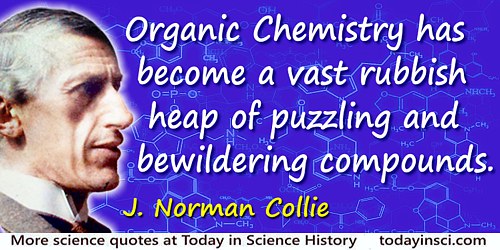
Organic Chemistry has become a vast rubbish heap of puzzling and bewildering compounds.
Preface to A. W. Stewart, Recent Advances in Organic Chemistry (1908), xiii.
Organic chemistry has literally placed a new nature beside the old. And not only for the delectation and information of its devotees; the whole face and manner of society has been altered by its products. We are clothed, ornamented and protected by forms of matter foreign to Nature; we travel and are propelled, in, on and by them. Their conquest of our powerful insect enemies, their capacity to modify the soil and control its microscopic flora, their ability to purify and protect our water, have increased the habitable surface of the earth and multiplied our food supply; and the dramatic advances in synthetic medicinal chemistry comfort and maintain us, and create unparalleled social opportunities (and problems).
In 'Synthesis', in A. Todd (ed.), Perspectives in Organic Chemistry (1956), 180.
Organic chemistry is the chemistry of carbon compounds. Biochemistry is the study of carbon compounds that crawl.
Often seen quoted, though without source, for example, in Jon Fripp, Michael Fripp and Deborah Fripp , Speaking of Science (2000), 13. [Please contact webmaster if you can identify the author and a primary source.]
Organic chemistry is the study of organs; inorganic chemistry is the study of the insides of organs.
Barefoot Boy with Cheek (1943), 129.
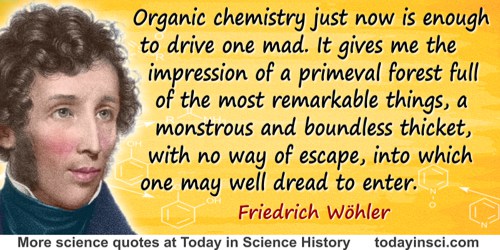
Organic chemistry just now is enough to drive one mad. It gives me the impression of a primeval forest full of the most remarkable things, a monstrous and boundless thicket, with no way of escape, into which one may well dread to enter.
Letter to J.J. Berzelius (28 Jan 1835). In Bulletin of the Atomic Scientists (Nov 1949), 310. Date of letter as given in Alan L. Mackay, A Dictionary of Scientific Quotations (1991), 267. An alternate translation is “Organic chemistry nowadays almost drives one mad to me it appears like a primeval tropical forest full of the most remarkable things a dreadful endless jungle into which one dare not enter for there seems no way out.” as given in J.R. Partington, A History of Chemistry (1901), Vol. 4, 327.
ORGANIC LIFE beneath the shoreless waves
Was born and nurs'd in Ocean's pearly caves;
First, forms minute, unseen by spheric glass,
Move on the mud, or pierce the watery mass;
These, as successive generations bloom,
New powers acquire, and larger limbs assume;
Whence countless groups of vegetation spring,
And breathing realms of fin, and feet, and wing.
Thus the tall Oak, the giant of the wood,
Which bears Britannia's thunders on the flood;
The Whale, unmeasured monster of the main,
The lordly Lion, monarch of the plain,
The Eagle soaring in the realms of air,
Whose eye undazzled drinks the solar glare,
Imperious man, who rules the bestial crowd,
Of language, reason, and reflection proud,
With brow erect, who scorns this earthy sod,
And styles himself the image of his God;
Arose from rudiments of form and sense,
An embryon point, or microscopic ens!
Was born and nurs'd in Ocean's pearly caves;
First, forms minute, unseen by spheric glass,
Move on the mud, or pierce the watery mass;
These, as successive generations bloom,
New powers acquire, and larger limbs assume;
Whence countless groups of vegetation spring,
And breathing realms of fin, and feet, and wing.
Thus the tall Oak, the giant of the wood,
Which bears Britannia's thunders on the flood;
The Whale, unmeasured monster of the main,
The lordly Lion, monarch of the plain,
The Eagle soaring in the realms of air,
Whose eye undazzled drinks the solar glare,
Imperious man, who rules the bestial crowd,
Of language, reason, and reflection proud,
With brow erect, who scorns this earthy sod,
And styles himself the image of his God;
Arose from rudiments of form and sense,
An embryon point, or microscopic ens!
The Temple of Nature (1803), canto 1, lines 295-314, pages 26-8.
Organic life, we are told, has developed gradually from the protozoan to the philosopher, and this development, we are assured, is indubitably an advance. Unfortunately it is the philosopher, not the protozoon, who gives us this assurance.
From Herbert Spencer lecture delivered at Oxford (1914) 'On Scientific Method in Philosophy', collected in Mysticism and Logic and Other Essays (1919), 106.
Owing to this struggle for life, any variation, however slight and from whatever cause proceeding, if it be in any degree profitable to an individual of any species, in its infinitely complex relationship to other organic beings and to external nature, will tend to the preservation of that individual, and will generally be inherited by its offspring.
…...
Physical chemistry is all very well, but it does not apply to organic substances.
Quoted in L. E. Sutton's obituary of Nevil V. Sidgwick, Proceedings of the Chemical Society (1958), 312.
Physio-philosophy has to show how, and in accordance indeed with what laws, the Material took its origin; and, therefore, how something derived its existence from nothing. It has to portray the first periods of the world's development from nothing; how the elements and heavenly bodies originated; in what method by self-evolution into higher and manifold forms, they separated into minerals, became finally organic, and in Man attained self-consciousness.
In Lorenz Oken, trans. by Alfred Tulk, Elements of Physiophilosophy (1847), 1.
Plasticity, then, in the wide sense of the word, means the possession of a structure weak enough to yield to an influence, but strong enough not to yield all at once. Each relatively stable phase of equilibrium in such a structure is marked by what we may call a new set of habits. Organic matter, especially nervous tissue, seems endowed with a very extraordinary degree of plasticity of this sort ; so that we may without hesitation lay down as our first proposition the following, that the phenomena of habit in living beings are due to plasticity of the organic materials of which their bodies are composed.
'The Laws of Habit', The Popular Science Monthly (Feb 1887), 434.
Producing food for 6.2 billion people, adding a population of 80 million more a year, is not simple. We better develop an ever improved science and technology, including the new biotechnology, to produce the food that’s needed for the world today. In response to the fraction of the world population that could be fed if current farmland was convered to organic-only crops: “We are 6.6 billion people now. We can only feed 4 billion. I don’t see 2 billion volunteers to disappear.” In response to extreme critics: “These are utopian people that live on Cloud 9 and come into the third world and cause all kinds of confusion and negative impacts on the developing countries.”
…...
Reagents are regarded as acting by virtue of a constitutional affinity either for electrons or for nuclei... the terms electrophilic (electron-seeking) and nucleophilic (nucleus-seeking) are suggested... and the organic molecule, in the activation necessary for reaction, is therefore required to develop at the seat of attack either a high or low electron density as the case may be.
'Significance of Tautomerism and of the Reactions of Aromatic Compounds in the Electronic Theory of Organic Relations', Journal of the Chemical Society (1933), 136, 1121, fn.
Scientific practice is above all a story-telling practice. ... Biology is inherently historical, and its form of discourse is inherently narrative. ... Biology as a way of knowing the world is kin to Romantic literature, with its discourse about organic form and function. Biology is the fiction appropriate to objects called organisms; biology fashions the facts “discovered” about organic beings.
Primate Visions: Gender, Race and Nature in the World of Modern Science(1989), 4-5.
Something is as little explained by means of a distinctive vital force as the attraction between iron and magnet is explained by means of the name magnetism. We must therefore firmly insist that in the organic natural sciences, and thus also in botany, absolutely nothing has yet been explained and the entire field is still open to investigation as long as we have not succeeded in reducing the phenomena to physical and chemical laws.
Grundzüge der Wissenschaftlichen Botanik nebst einer Methodologischen Einleitung als Anleitung zum Studium der Planze [Principles of Scientific Botany] (1842-3), Vol. 1, 49. Trans. Kenneth L. Caneva, Robert Mayer and the Conservation of Energy (1993), 108.
Sooner or later in every talk, [David] Brower describes the creation of the world. He invites his listeners to consider the six days of Genesis as a figure of speech for what has in fact been 4 billion years. On this scale, one day equals something like six hundred and sixty-six million years, and thus, all day Monday and until Tuesday noon, creation was busy getting the world going. Life began Tuesday noon, and the beautiful organic wholeness of it developed over the next four days. At 4 p.m. Saturday, the big reptiles came on. At three minutes before midnight on the last day, man appeared. At one-fourth of a second before midnight Christ arrived. At one-fortieth of a second before midnight, the Industrial Revolution began. We are surrounded with people who think that what we have been doing for that one-fortieth of a second can go on indefinitely. They are considered normal, but they are stark. raving mad.
In Encounters with the Archdruid (1971), 79-80.
Such is the condition of organic nature! whose first law might be expressed in the words 'Eat or be eaten!' and which would seem to be one great slaughter-house, one universal scene of rapacity and injustice!
Phytologia (1800), 556.
Suppose [an] imaginary physicist, the student of Niels Bohr, is shown an experiment in which a virus particle enters a bacterial cell and 20 minutes later the bacterial cell is lysed and 100 virus particles are liberated. He will say: “How come, one particle has become 100 particles of the same kind in 20 minutes? That is very interesting. Let us find out how it happens! How does the particle get in to the bacterium? How does it multiply? Does it multiply like a bacterium, growing and dividing, or does it multiply by an entirely different mechanism ? Does it have to be inside the bacterium to do this multiplying, or can we squash the bacterium and have the multiplication go on as before? Is this multiplying a trick of organic chemistry which the organic chemists have not yet discovered ? Let us find out. This is so simple a phenomenon that the answers cannot be hard to find. In a few months we will know. All we have to do is to study how conditions will influence the multiplication. We will do a few experiments at different temperatures, in different media, with different viruses, and we will know. Perhaps we may have to break into the bacteria at intermediate stages between infection and lysis. Anyhow, the experiments only take a few hours each, so the whole problem can not take long to solve.”
[Eight years later] he has not got anywhere in solving the problem he set out to solve. But [he may say to you] “Well, I made a slight mistake. I could not do it in a few months. Perhaps it will take a few decades, and perhaps it will take the help of a few dozen other people. But listen to what I have found, perhaps you will be interested to join me.”
[Eight years later] he has not got anywhere in solving the problem he set out to solve. But [he may say to you] “Well, I made a slight mistake. I could not do it in a few months. Perhaps it will take a few decades, and perhaps it will take the help of a few dozen other people. But listen to what I have found, perhaps you will be interested to join me.”
From 'Experiments with Bacterial Viruses (Bacteriophages)', Harvey Lecture (1946), 41, 161-162. As cited in Robert Olby, The Path of the Double Helix: The Discovery of DNA (1974, 1994), 237.
The analysis of Nature into its individual parts, the grouping of the different natural processes and natural objects in definite classes, the study of the internal anatomy of organic bodies in their manifold forms—these were the fundamental conditions of the gigantic strides in our knowledge of Nature which have been made during the last four hundred years. But this method of investigation has also left us as a legacy the habit of observing natural objects and natural processes in their isolation, detached from the whole vast interconnection of things; and therefore not in their motion, but in their repose; not as essentially changing, but fixed constants; not in their life, but in their death.
Herr Eugen Dühring's Revolution in Science (Anti-Dühring), First Publication (1878). Trans. Emile Burns and ed. C.P. Dutt (1935), 27-8.
The Archetypal idea was manifested in the flesh, under divers such modifications, upon this planet, long prior to the existence of those animal species that actually exemplify it. To what natural laws or secondary causes the orderly succession and progression of such organic phaenomena may have been committed we as yet are ignorant. But if, without derogation of the Divine power, we may conceive the existence of such ministers, and personify them by the term 'Nature,' we learn from the past history of our globe that she has advanced with slow and stately steps, guided by the archetypal light, amidst the wreck of worlds, from the first embodiment of the Vertebrate idea under its old Ichthyic vestment, until it became arrayed in the glorious garb of the Human form.
On the Nature of Limbs (1849), 86.
The assumptions of population thinking are diametrically opposed to those of the typologist. The populationist stresses the uniqueness of everything in the organic world. What is true for the human species,–that no two individuals are alike, is equally true for all other species of animals and plants ... All organisms and organic phenomena are composed of unique features and can be described collectively only in statistical terms. Individuals, or any kind of organic entities, form populations of which we can determine the arithmetic mean and the statistics of variation. Averages are merely statistical abstractions, only the individuals of which the populations are composed have reality. The ultimate conclusions of the population thinker and of the typologist are precisely the opposite. For the typologist, the type (eidos) is real and the variation. an illusion, while for the populationist the type (average) is an abstraction and only the variation is real. No two ways of looking at nature could be more different.
Darwin and the Evolutionary Theory in Biology (1959), 2.
The equation of animal and vegetable life is too complicated a problem for human intelligence to solve, and we can never know how wide a circle of disturbance we produce in the harmonies of nature when we throw the smallest pebble into the ocean of organic life.
Man and Nature, (1864), 103.
The further away the chronic abdominal pain in a child is from the umbilicus the more likely an organic cause.
Attributed
The Historic Method may be described as the comparison of the forms of an idea, or a usage, or a belief, at any given time, with the earlier forms from which they were evolved, or the later forms into which they were developed and the establishment from such a comparison, of an ascending and descending order among the facts. It consists in the explanation of existing parts in the frame of society by connecting them with corresponding parts in some earlier frame; in the identification of present forms in the past, and past forms in the present. Its main process is the detection of corresponding customs, opinions, laws, beliefs, among different communities, and a grouping of them into general classes with reference to some one common feature. It is a certain way of seeking answers to various questions of origin, resting on the same general doctrine of evolution, applied to moral and social forms, as that which is being applied with so much ingenuity to the series of organic matter.
On Compromise (1874), 22-3.
The History of Evolution is the real source of light in the investigation of organic bodies. It is applicable at every step, and all our ideas of the correlation of organic bodies will be swayed by our knowledge of the history of evolution. To carry the proof of it into all branches of research would be an almost endless task. (1828)
Quoted as an epigraph to Chap. 3, in Ernst Haeckel, The Evolution of Man, (1886), Vol 1, 48.
The History of Evolution of Organisms consists of two kindred and closely connected parts: Ontogeny, which is the history of the evolution of individual organisms, and Phylogeny, which is the history of the evolution of organic tribes. Ontogency is a brief and rapid recapitulation of Phylogeny, dependent on the physiological functions of Heredity (reproduction) and Adaptation (nutrition). The individual organism reproduces in the rapid and short course of its own evolution the most important of the changes in form through which its ancestors, according to laws of Heredity and Adaptation, have passed in the slow and long course of their palaeontological evolution.
Translated from his Generelle Morphologie (1866) as an epigraph to Chap. 1, The Evolution of Man, (1886), Vol 1, 1-2.
The hypothesis of the connexion of the first limestone beds with the commencement of organic life upon our planet is supported by the fact, that in these beds we find the first remains of the bodies of animated creatures.
Vestiges of the Natural History of Creation (1844), 57.
The interior parts of the earth and its internal depths are a region totally impervious to the eye of mortal man, and can least of all be approached by those ordinary paths of hypothesis adopted by naturalists and geologists. The region designed for the existence of man, and of every other creature endowed with organic life, as well as the sphere opened to the perception of man's senses, is confined to a limited space between the upper and lower parts of the earth, exceedingly small in proportion to the diameter, or even semi-diameter of the earth, and forming only the exterior surface, or outer skin, of the great body of the earth.
In Friedrich von Schlegel and James Burton Robertson (trans.), The Philosophy of History (1835), 20.
The magnetic force is animate, or imitates a soul; in many respects it surpasses the human soul while it is united to an organic body.
In De Magnete. Cited in Gerrit L. Verschuur, Hidden Attraction (1996), 31.
The mineral kingdom consists of the fossil substances found in the earth. These are either entirely destitute of organic structure, or, having once possessed it, possess it no longer: such are the petrefactions.
In Outlines of Mineralogy (1783), trans. William Withering, 5. [Before it was specifically used for the petrified remains of organic forms, the word “fossil”—obsolete, as used here—refers to that which is “dug from the earth, preserved in the ground.” —Webmaster] Also collected in William Withering (the son, ed.), The Miscellaneous Tracts of the Late William Withering (1822), Vol. 2, 9.
The name chronic alcoholism applies to the collective symptoms of a disordered condition of the mental, motor, and sensory functions of the nervous system, these symptoms assuming a chronic form, and without their being immediately connected with any of those (organic) modifications of the central or peripheric portions of the nervous system which may be detected during life, or discovered after death by ocular inspection; such symptoms, moreover, affecting individuals who have persisted for a considerable length of time in the abuse of alcoholic liquors.
Published in Swedish in 1849. Translation quoted in William Marcet On Chronic Alcoholic Intoxication (1868), 21.
The natural history of these islands is eminently curious, and well deserves attention. Most of the organic productions are aboriginal creations, found nowhere else; there is even a difference between the inhabitants of the different islands; yet all show a marked relationship with those of America, though separated from that continent by an open space of ocean, between 500 and 600 miles in width. The archipelago is a little world within itself, or rather a satellite attached to America, whence it has derived a few stray colonists, and has received the general character of its indigenous productions. Considering the small size of these islands, we feel the more astonished at the number of their aboriginal beings, and at their confined range. Seeing every height crowned with its crater, and the boundaries of most of the lava-streams still distinct, we are led to believe that within a period, geologically recent, the unbroken ocean was here spread out. Hence, both in space and time, we seem to be brought somewhere near to that great fact—that mystery of mysteries—the first appearance of new beings on this earth.
Journal of Researches into the Natural History and Geology of the Countries Visited During the Voyage of H.M.S. Beagle Round the World, 2nd edn. (1845), 377-8.
The ordinary naturalist is not sufficiently aware that when dogmatizing on what species are, he is grappling with the whole question of the organic world & its connection with the time past & with Man; that it involves the question of Man & his relation to the brutes, of instinct, intelligence & reason, of Creation, transmutation & progressive improvement or development. Each set of geological questions & of ethnological & zool. & botan. are parts of the great problem which is always assuming a new aspect.
Leonard G. Wilson (ed.), Sir Charles Lyell's Scientific Journals on the Species Question (1970), 164.
The organic creation, as we now see it ... was not placed upon the earth at once:—it observed a PROGRESS.
Explanations (1845), 30.
The precise equivalence of the chromosomes contributed by the two sexes is a physical correlative of the fact that the two sexes play, on the whole, equal parts in hereditary transmission, and it seems to show that the chromosomal substance, the chromatin, is to be regarded as the physical basis of inheritance. Now, chromatin is known to be closely similar to, if not identical with, a substance known as nuclein (C29H49N9O22, according to Miescher), which analysis shows to be a tolerably definite chemical compased of nucleic acid (a complex organic acid rich in phosphorus) and albumin. And thus we reach the remarkable conclusion that inheritance may, perhaps, be effected by the physical transmission of a particular chemical compound from parent to offspring.
In An Atlas of the Fertilization and Karyokinesis of the Ovum (1895), 4.
The publication of the Darwin and Wallace papers in 1858, and still more that of the 'Origin' in 1859, had the effect upon them of the flash of light, which to a man who has lost himself in a dark night, suddenly reveals a road which, whether it takes him straight home or not, certainly goes his way. That which we were looking for, and could not find, was a hypothesis respecting the origin of known organic forms, which assumed the operation of no causes but such as could be proved to be actually at work. We wanted, not to pin our faith to that or any other speculation, but to get hold of clear and definite conceptions which could be brought face to face with facts and have their validity tested. The 'Origin' provided us with the working hypothesis we sought.
'On the Reception of the Origin of Species'. In F. Darwin (ed.), The Life and Letters of Charles Darwin, Including an Autobiographical Chapter (1888), Vol 2, 197.
The ravages committed by man subvert the relations and destroy the balance which nature had established between her organized and her inorganic creations; and she avenges herself upon the intruder, by letting loose upon her defaced provinces destructive energies hitherto kept in check by organic forces destined to be his best auxiliaries, but which he has unwisely dispersed and driven from the field of action. When the forest is gone, the great reservoir of moisture stored up in its vegetable mould is evaporated, and returns only in deluges of rain to wash away the parched dust into which that mould has been converted. The well-wooded and humid hills are turned to ridges of dry rock, which encumbers the low grounds and chokes the watercourses with its debris, and–except in countries favored with an equable distribution of rain through the seasons, and a moderate and regular inclination of surface–the whole earth, unless rescued by human art from the physical degradation to which it tends, becomes an assemblage of bald mountains, of barren, turfless hills, and of swampy and malarious plains. There are parts of Asia Minor, of Northern Africa, of Greece, and even of Alpine Europe, where the operation of causes set in action by man has brought the face of the earth to a desolation almost as complete as that of the moon; and though, within that brief space of time which we call “the historical period,” they are known to have been covered with luxuriant woods, verdant pastures, and fertile meadows, they are now too far deteriorated to be reclaimable by man, nor can they become again fitted for human use, except through great geological changes, or other mysterious influences or agencies of which we have no present knowledge, and over which we have no prospective control. The earth is fast becoming an unfit home for its noblest inhabitant, and another era of equal human crime and human improvidence, and of like duration with that through which traces of that crime and that improvidence extend, would reduce it to such a condition of impoverished productiveness, of shattered surface, of climatic excess, as to threaten the depravation, barbarism, and perhaps even extinction of the species.
Man and Nature, (1864), 42-3.
The structural formula of the organic chemist is not the canvas on which the cubist artist should impose his drawings which he alone can interpret.
'A Pragmatic System of Notation for Electronic Valance Conceptions in Chemical Formulas', Chemical Reviews, 1928, 5, 558-9.
The structural theory of Kekulé has been the growth hormone of organic chemistry.
Co-author with Melville Calvin (1911-1997)
Co-author with Melville Calvin (1911-1997)
The Theory of Organic Chemistry (1941), Preface, v.
The struggle between the unitary and dualistic theories of chemical affinity, which raged for nearly a century, was a form of civil war between inorganic and organic chemists.
Comment made on a postcard sent to Robin O. Gandy. Reproduced in Andrew Hodges, Alan Turing: The Enigma (1983), 513.
The Struggle for Existence amongst all organic beings throughout the world, which inevitably follows from their high geometrical powers of increase ... This is the doctrine of Malthus, applied to the whole animal and vegetable kingdoms. As many more individuals of each species are born than can possibly survive; and as, consequently, there is a frequently recurring struggle for existence, it follows that any being, if it vary however slightly in any manner profitable to itself, under the complex and sometimes varying conditions of life, will have a better chance of surviving, and thus be naturally selected. From the strong principle of inheritance, any selected variety will tend to propagate its new and modified form.
From On the Origin of Species by Means of Natural Selection; or, The Preservation of Favoured Races in the Struggle for Life (1861), 12.
The synthesis of substances occurring in Nature, perhaps in greater measure than activities in any other area of organic chemistry, provides a measure of the conditions and powers of science.
'Synthesis', in A. Todd (ed.), Perspectives in Organic Chemistry (1956), 155.
The universe is reeking with organic matter. You could say that the universe is in the business of making life—or that God is an organic chemist.
From interview, 'The Seeds of Life', in The Omni Interviews (1984), 10.
The vigorous branching of life’s tree, and not the accumulating valor of mythical marches to progress, lies behind the persistence and expansion of organic diversity in our tough and constantly stressful world. And if we do not grasp the fundamental nature of branching as the key to life’s passage across the geological stage, we will never understand evolution aright.
…...
The virgin fertility of our soils, and the vast amount of unskilled labor, have been more of a curse than a blessing to agriculture. This exhaustive system for cultivation, the destruction of forests, the rapid and almost constant decomposition of organic matter, together with the problems of nitrification and denitrification, the multitudinous insects and fungus diseases which are ever increasing with marvelous rapidity year by year, make our agricultural problem one requiring more brains than of the North, East or West.
In Farmer’s Leaflet 7: The Need of Scientific Agriculture in the South (1902). Reprinted in The Review of Reviews (1902), 25, 322.
The volume now in press will make the new gospel of geology and mineralogy, and if I live to complete my mineralogical text-book, I shall do for the mineral what Darwin did for the organic world.
Letter to a friend (1886), as quoted in Paper read before the American Philosophical Society (1 Apr 1898) by James Douglas, printed as A Memoir of Thomas Sterry Hunt (1898), 12.
There is a kind of plant that eats organic food with its flowers: when a fly settles upon the blossom, the petals close upon it and hold it fast till the plant has absorbed the insect into its system; but they will close on nothing but what is good to eat; of a drop of rain or a piece of stick they will take no notice. Curious! that so unconscious a thing should have such a keen eye to its own interest.
In Erewhon: Or Over the Range (1880), 190.
There is a moral or metaphysical part of nature as well as a physical. A man who denies this is deep in the mire of folly. ’Tis the crown and glory of organic science that it does through final cause, link material and moral; and yet does not allow us to mingle them in our first conception of laws, and our classification of such laws, whether we consider one side of nature or the other. You have ignored this link; and, if I do not mistake your meaning, you have done your best in one or two pregnant cases to break it. Were it possible (which, thank God, it is not) to break it, humanity, in my mind, would suffer a damage that might brutalize it, and sink the human race into a lower grade of degradation than any into which it has fallen since its written records tell us of its history.
Letter to Charles Darwin (Nov 1859). In Charles Darwin and Francis Darwin (ed.), Charles Darwin: His Life Told in an Autobiographical Chapter, and in a Selected Series of His Published Letters (1892), 217.
There is, I think, no more wonderful and illuminating spectacle than that of an osmotic growth,—a crude lump of brute inanimate matter germinating before our very eyes, putting forth bud and stem and root and branch and leaf and fruit, with no stimulus from germ or seed, without even the presence of organic matter. For these mineral growths are not mere crystallizations as many suppose … They imitate the forms, the colour, the texture, and even the microscopical structure of organic growth so closely as to deceive the very elect.
In the 'Translator’s Preface' of his translation of Stéphane Leduc, The Mechanism of Life (1911), vii-viii. Butcher is drawing attention to the remarkable discussion of “Organic Growth” in Leduc’s book. Must-see illustrations of various inorganic growths are shown on the M.I.T. web page Osmotic Morphogenesis. Also note that “to deceive the very elect” is a Biblical reference, where the “elect” are the chosen ones faithful to their divine call.See, for example, Matthew 24:24.
These principles have given me a way of explaining naturally the union or rather the mutual agreement [conformité] of the soul and the organic body. The soul follows its own laws, and the body likewise follows its own laws; and they agree with each other in virtue of the pre-established harmony between all substances, since they are all representations of one and the same universe.
The Monadology and Other Philosophical Writings (1714), trans. Robert Latta (1898), 262.
This frustration of reading the tabloid press… it would easy to become convinced that the human race is on a mission to divide things into two clean columns… Good or evil, healthy or deadly or natural or chemical… everything organic and natural is good, ignoring the fact that organic natural substances include arsenic… Everything chemical is bad, ignoring that fact the everything is chemicals. Everything is chemicals! The day they discover yoga mats are carcinogenic will be the happiest day of my life.
Introducing his song, 'The Fence', on DVD, Live at the Royal Albert Hall (2011).
This investigation has yielded an unanticipated result that reaction of cyanic acid with ammonia gives urea, a noteworthy result in as much as it provides an example of the artificial production of an organic, indeed a so-called animal, substance from inorganic substances.
[The first report of the epoch-making discovery, that an organic compound can be produced from inorganic substances.]
[The first report of the epoch-making discovery, that an organic compound can be produced from inorganic substances.]
In 'On the Artificial Formation of Urea'. In J.C. Poggendorff's Annalen der Physik und Chemie (1828), 88, 253. Alternate translation in 'Über Künstliche Bildung des
Hamstoffs', Annalen der Physik und Chemie (1828), 12, 253, as translated in Quarterly Journal of Science (Apr-Jun 1828), 25, 491. Collected in Henry Marshall Leicester and Herbert S. Klickstein, A Source Book in Chemistry, 1400-1900 (1951), 310.
This new force, which was unknown until now, is common to organic and inorganic nature. I do not believe that this is a force entirely independent of the electrochemical affinities of matter; I believe, on the contrary, that it is only a new manifestation, but since we cannot see their connection and mutual dependence, it will be easier to designate it by a separate name. I will call this force catalytic force. Similarly, I will call the decomposition of bodies by this force catalysis, as one designates the decomposition of bodies by chemical affinity analysis.
In'Some Ideas on a New Force which Acts in Organic Compounds', Annales chimie physiques, 1836, 61, 146. Translated in Henry M. Leicester and Herbert S. Klickstein, A Source Book in Chemistry 1400-1900 (1952), 267.
Those of us who were familiar with the state of inorganic chemistry in universities twenty to thirty years ago will recall that at that time it was widely regarded as a dull and uninteresting part of the undergraduate course. Usually, it was taught almost entirely in the early years of the course and then chiefly as a collection of largely unconnected facts. On the whole, students concluded that, apart from some relationships dependent upon the Periodic table, there was no system in inorganic chemistry comparable with that to be found in organic chemistry, and none of the rigour and logic which characterised physical chemistry. It was widely believed that the opportunities for research in inorganic chemistry were few, and that in any case the problems were dull and uninspiring; as a result, relatively few people specialized in the subject... So long as inorganic chemistry is regarded as, in years gone by, as consisting simply of the preparations and analysis of elements and compounds, its lack of appeal is only to be expected. The stage is now past and for the purpose of our discussion we shall define inorganic chemistry today as the integrated study of the formation, composition, structure and reactions of the chemical elements and compounds, excepting most of those of carbon.
Inaugural Lecture delivered at University College, London (1 Mar 1956). In The Renaissance of Inorganic Chemistry (1956), 4-5.
Through [the growing organism's] power of assimilation there is a constant encroachment of the organic upon the inorganic, a constant attempt to convert all available material into living substance, and to indefinitely multiply the total number of individual organisms.
In History of the Human Body (1919), 2.
Thus it might be said, that the vegetable is only the sketch, nor rather the ground-work of the animal; that for the formation of the latter, it has only been requisite to clothe the former with an apparatus of external organs, by which it might be connected with external objects.
From hence it follows, that the functions of the animal are of two very different classes. By the one (which is composed of an habitual succession of assimilation and excretion) it lives within itself, transforms into its proper substance the particles of other bodies, and afterwards rejects them when they are become heterogeneous to its nature. By the other, it lives externally, is the inhabitant of the world, and not as the vegetable of a spot only; it feels, it perceives, it reflects on its sensations, it moves according to their influence, and frequently is enabled to communicate by its voice its desires, and its fears, its pleasures, and its pains.
The aggregate of the functions of the first order, I shall name the organic life, because all organized beings, whether animal or vegetable, enjoy it more or less, because organic texture is the sole condition necessary to its existence. The sum of the functions of the second class, because it is exclusively the property of the animal, I shall denominate the animal life.
From hence it follows, that the functions of the animal are of two very different classes. By the one (which is composed of an habitual succession of assimilation and excretion) it lives within itself, transforms into its proper substance the particles of other bodies, and afterwards rejects them when they are become heterogeneous to its nature. By the other, it lives externally, is the inhabitant of the world, and not as the vegetable of a spot only; it feels, it perceives, it reflects on its sensations, it moves according to their influence, and frequently is enabled to communicate by its voice its desires, and its fears, its pleasures, and its pains.
The aggregate of the functions of the first order, I shall name the organic life, because all organized beings, whether animal or vegetable, enjoy it more or less, because organic texture is the sole condition necessary to its existence. The sum of the functions of the second class, because it is exclusively the property of the animal, I shall denominate the animal life.
Physiological Researches on Life and Death (1815), trans. P. Gold, 22-3.
To many physical chemists in the 1920's and early 1930's, the organic chemist was a grubby artisan engaged in an unsystematic search for new compounds, a search which was strongly influenced by the profit motive.
'Physical Organic Chemistry in Retrospect', Journal of Chemical Education, 1966, 43, 464.
Unfortunately, the study of organic remains is beset with two evils, which, though of an opposite character, do not neutralize each other so much as at first sight might be anticipated: the one consisting of a strong desire to find similar organic remains in supposed equivalent deposits, even at great distances; the other being an equally strong inclination to discover new species, often as it would seem for the sole purpose of appending the apparently magical word nobis.
In Geological Manual (1832), Preface, iii.
We are already farming more than the Earth can afford, and if we attempt to farm the whole Earth to feed people, even with organic farming, it would make us like sailors who burnt the timbers and rigging of their ship to keep warm.
In The Revenge of Gaia: Earth’s Climate Crisis & The Fate of Humanity (2006, 2007), 15-16.
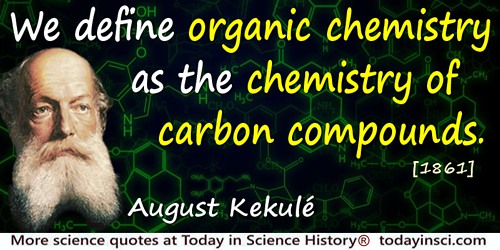
We define organic chemistry as the chemistry of carbon compounds.
Lehrbuch der Organischen Chemie (1861), Vol. 1, 11. Trans. W. H. Brock.
We do not inhabit a perfected world where natural selection ruthlessly scrutinizes all organic structures and then molds them for optimal utility. Organisms inherit a body form and a style of embryonic development; these impose constraint s upon future change and adaptation. In many cases, evolutionary pathways reflect inherited patterns more than current environmental demands. These inheritances constrain, but they also provide opportunity. A potentially minor genetic change ... entails a host of complex, nonadaptive consequences ... What ‘play’ would evolution have if each structure were built for a restricted purpose and could be used for nothing else? How could humans learn to write if our brain had not evolved for hunting, social cohesion, or whatever, and could not transcend the adaptive boundaries of its original purpose?
…...
We do not know of any enzymes or other chemical defined organic substances having specifically acting auto-catalytic properties such as to enable them to construct replicas of themselves. Neither was there a general principle known that would result in pattern-copying; if there were, the basis of life would be easier to come by. Moreover, there was no evidence to show that the enzymes were not products of hereditary determiners or genes, rather than these genes themselves, and they might even be products removed by several or many steps from the genes, just as many other known substances in the cell must be. However, the determiners or genes themselves must conduct, or at least guide, their own replication, so as to lead to the formation of genes just like themselves, in such wise that even their own mutations become .incorporated in the replicas. And this would probably take place by some kind of copying of pattern similar to that postulated by Troland for the enzymes, but requiring some distinctive chemical structure to make it possible. By virtue of this ability of theirs to replicate, these genes–or, if you prefer, genetic material–contained in the nuclear chromosomes and in whatever other portion of the cell manifests this property, such as the chloroplastids of plants, must form the basis of all the complexities of living matter that have arisen subsequent to their own appearance on the scene, in the whole course of biological evolution. That is, this genetic material must underlie all evolution based on mutation and selective multiplication.
'Genetic Nucleic Acid', Perspectives in Biology and Medicine (1961), 5, 6-7.
We have several stones whose generation is incomprehensible unless it is supposed that they come from some kind of seed, if I may be permitted to use this term; that is to say, from a germ in which the organic particles of these stones are enclosed ‘en petit’, just as those of the largest plants are enclosed in the germs of their grains.
In Histoire de l' Académie Royale des Sciences Annee: Avec les Memoires de Mathematique et de Physique (1702), 230.
We may regard [Scheele] not only as having given the first indication of the rich harvest to be reaped by the investigation of the compounds of organic chemistry, but as having been the first to discover and make use of characteristic reactions by which closely allied substances can be detected and separated, so that he must be considered one of the chief founders of analytical chemistry.
In Treatise on Chemistry (1877, 1890), Vol. 1, 23.
We may regard the cell quite apart from its familiar morphological aspects, and contemplate its constitution from the purely chemical standpoint. We are obliged to adopt the view, that the protoplasm is equipped with certain atomic groups, whose function especially consists in fixing to themselves food-stuffs, of importance to the cell-life. Adopting the nomenclature of organic chemistry, these groups may be designated side-chains. We may assume that the protoplasm consists of a special executive centre (Leistungs-centrum) in connection with which are nutritive side-chains… The relationship of the corresponding groups, i.e., those of the food-stuff, and those of the cell, must be specific. They must be adapted to one another, as, e.g., male and female screw (Pasteur), or as lock and key (E. Fischer).
Croonian Lecture, 'On Immunity with Special Reference to Cell Life', Proceedings of the Royal Society of London, 1900, 66, 433-434.
We need to learn the lessons of the real cost of production. We need to ask ourselves not just why organic prices are so high, but why conventional prices are so low.
We set out, therefore, with the supposition that an organised body is not produced by a fundamental power which is guided in its operation by a definite idea, but is developed, according to blind laws of necessity, by powers which, like those of inorganic nature, are established by the very existence of matter. As the elementary materials of organic nature are not different from those of the inorganic kingdom, the source of the organic phenomena can only reside in another combination of these materials, whether it be in a peculiar mode of union of the elementary atoms to form atoms of the second order, or in the arrangement of these conglomerate molecules when forming either the separate morphological elementary parts of organisms, or an entire organism.
Mikroskopische Untersuchungen über die Uebereinstimmung in der Struktur und dem Wachsthum der Thiere und Pflanzen (1839). Microscopic Researches into the Accordance in the Structure and Growth of Animals and Plants, trans. Henry Smith (1847), 190-1.
We've been fighting from the beginning for organic architecture. That is, architecture where the whole is to the part as the part is to the whole, and where the nature of materials, the nature of the purpose, the nature of the entire performance becomes a necessity—architecture of democracy.
Quoted in Aline B. Louchheim, 'Wright Analyzes Architect's Need', New York Times (26 May 1953), 23. Wright was interviewed at age 83 for the opening of a small exhibition of his work at the gallery of the National Institute and the American Academy of Arts and Letters, New York.
What is the meaning of human life, or of organic life altogether? To answer this question at all implies a religion. Is there any sense then, you ask, in putting it? I answer, the man who regards his own life and that of his fellow creatures as meaningless is not merely unfortunate but almost disqualified for life.
In The World As I See It (1935), 1. A different translation is given in Ideas and Opinions (1954), 11. From the original German in Mein Weltbild (1934).
When I first read Plato and came upon this gradation of beings which rises from the lightest atom to the Supreme Being, I was struck with admiration. But when I looked at it more closely, the great phantom vanished. … At first the imagination takes a pleasure in seeing the imperceptible transition from inanimate to organic matter, from plants to zoophytes, from these to animals, from these to genii, … and finally angels.
As quoted in Arthur O. Lovejoy, The Great Chain of Being: A Study of the History of an Idea (2011), 252.
When ultra-violet light acts on a mixture of water, carbon dioxide, and ammonia, a vast variety of organic substances are made, including sugars and apparently some of the materials from which proteins are built up…. But before the origin of life they must have accumulated till the primitive oceans reached the consistency of hot dilute soup…. The first living or half-living things were probably large molecules synthesized under the influence of the sun’s radiation, and only capable of reproduction in the particularly favorable medium in which they originated….
In 'The Origin of Life', The Inequality of Man: And Other Essays (1932, 1937), 152.
When we no longer look at an organic being as a savage looks at a ship, as something wholly beyond his comprehension; when we regard every production of nature as one which has had a long history; when we contemplate every complex structure and instinct as the summing up of many contrivances, each useful to the possessor, in the same way as any great mechanical invention is the summing up of the labour, the experience, the reason, and even the blunders of numerous workmen; when we thus view each organic being, how far more interesting, I speak from experience, does the study of natural history become!
From the Conclusion of Origin of Species by Means of Natural Selection, Or the Preservation of Favoured Races in the Struggle for Life (3rd. ed., 1861), 521.
Why do we study insects? Because, together with man, hummingbirds and the bristlecone pine, they are among the great achievements of organic evolution.
In The Insect Societies (1971), 1.
Without an acquaintance with chemistry, the statesman must remain a stranger to the true vital interests of the state, to the means of its organic development and improvement; ... The highest economic or material interests of a country, the increased and more profitable production of food for man and animals, ... are most closely linked with the advancement and diffusion of the natural sciences, especially of chemistry.
Familiar Letters on Chemistry (1851), 3rd edn., 19.
You can hardly convince a man of error in a life-time, but must content yourself with the reflection that the progress of science is slow. If he is not convinced, his grand-children may be. The geologists tell us that it took one hundred years to prove that fossils are organic, and one hundred and fifty more, to prove that they are not to be referred to the Noachian deluge.
In A Week on the Concord and Merrimack Rivers (1862), 68.
 In science it often happens that scientists say, 'You know that's a really good argument; my position is mistaken,' and then they would actually change their minds and you never hear that old view from them again. They really do it. It doesn't happen as often as it should, because scientists are human and change is sometimes painful. But it happens every day. I cannot recall the last time something like that happened in politics or religion.
(1987) --
In science it often happens that scientists say, 'You know that's a really good argument; my position is mistaken,' and then they would actually change their minds and you never hear that old view from them again. They really do it. It doesn't happen as often as it should, because scientists are human and change is sometimes painful. But it happens every day. I cannot recall the last time something like that happened in politics or religion.
(1987) --