Organ Quotes (118 quotes)
… (T)he same cause, such as electricity, can simultaneously affect all sensory organs, since they are all sensitive to it; and yet, every sensory nerve reacts to it differently; one nerve perceives it as light, another hears its sound, another one smells it; another tastes the electricity, and another one feels it as pain and shock. One nerve perceives a luminous picture through mechanical irritation, another one hears it as buzzing, another one senses it as pain… He who feels compelled to consider the consequences of these facts cannot but realize that the specific sensibility of nerves for certain impressions is not enough, since all nerves are sensitive to the same cause but react to the same cause in different ways… (S)ensation is not the conduction of a quality or state of external bodies to consciousness, but the conduction of a quality or state of our nerves to consciousness, excited by an external cause.
Law of Specific Nerve Energies.
Law of Specific Nerve Energies.
Handbuch der Physiologie des Menschen für Vorlesungen, 2nd Ed. translation by Edwin Clarke and Charles Donald O'Malley
...for the animals, which we resemble and which would be our equals if we did not have reason, do not reflect upon the actions or the passions of their external or internal senses, and do not know what is color, odor or sound, or if there is any differences between these objects, to which they are moved rather than moving themselves there. This comes about by the force of the impression that the different objects make on their organs and on their senses, for they cannot discern if it is more appropriate to go and drink or eat or do something else, and they do not eat or drink or do anything else except when the presence of objects or the animal imagination [l'imagination brutalle], necessitates them and transports them to their objects, without their knowing what they do, whether good or bad; which would happen to us just as to them if we were destitute of reason, for they have no enlightenment except what they must have to take their nourishment and to serve us for the uses to which God has destined them.
[Arguing the uniqueness of man by regarding animals to be merely automatons.].
[Arguing the uniqueness of man by regarding animals to be merely automatons.].
Les Préludes de l'Harmonie Universelle (1634), 135-139. In Charles Coulston Gillespie (ed.), Dictionary of Scientific Biography (1974), Vol. 9, 318.
[Beyond natural history] Other biological sciences take up the study at other levels of organization: dissecting the individual into organs and tissues and seeing how these work together, as in physiology; reaching down still further to the level of cells, as in cytology; and reaching the final biological level with the study of living molecules and their interactions, as in biochemistry. No one of these levels can be considered as more important than any other.
In The Nature of Natural History (1961, 2014), 7.
[In biological evolution,] there are organs which have lost their purpose and are yet carried over as an evolutionary legacy: modern science is full of appendices and rudimentary monkey-tails.
In Epilogue, The Sleepwalkers: A History of Man’s Changing Vision of the Universe (1959), 515.
[The heart is] really a fascinating organ. It's about the only organ in the body that you can really witness its function. Doing things. And so on. Some of the other organs you can witness, like the intestines, will have this sort of peristaltic motion. But nothing that can compare with the activity of the human heart.
[The root cap of a plant], having the power of directing the movements of the adjoining parts, acts like the brain of one of the lower animals; the brain being seated within the anterior end of the body, receiving impressions from the sense-organs, and directing the several movements.
I. Animals have an electricity peculiar to themselves to which the name animal electricity is given.
II. The organs in which animal electricity acts above all others, and by which it is distributed throughout the whole body, are the nerves, and the most important organ of secretion is the brain.
II. The organs in which animal electricity acts above all others, and by which it is distributed throughout the whole body, are the nerves, and the most important organ of secretion is the brain.
Thierische Elektricitäund Reizbarkeit. Ein Beytrag zu den neuesten Entdeckungen üdiese Gegenstä(1795), 329. Quoted and trans. in Edwin Clarke and C. D. O'Malley, The Human Brain and Spinal Cord (1968), 180.
LEPIDUS: What manner o’ thing is your crocodile?
ANTONY: It is shaped, sir, like itself, and it is as broad as it hath breadth. It is just so high as it is, and moves with it own organs. It lives by that which nourisheth it, and the elements once out of it, it transmigrates.
LEPIDUS: What colour is it of?
ANTONY:Of its own colour, too.
LEPIDUS:’Tis a strange serpent.
ANTONY:’Tis so, and the tears of it are wet.
ANTONY: It is shaped, sir, like itself, and it is as broad as it hath breadth. It is just so high as it is, and moves with it own organs. It lives by that which nourisheth it, and the elements once out of it, it transmigrates.
LEPIDUS: What colour is it of?
ANTONY:Of its own colour, too.
LEPIDUS:’Tis a strange serpent.
ANTONY:’Tis so, and the tears of it are wet.
In Antony and Cleopatra (1606-7), II, vii.
1839—The fermentation satire
THE MYSTERY OF ALCOHOLIC FERMENTATION RESOLVED
(Preliminary Report by Letter) Schwindler
I am about to develop a new theory of wine fermentation … Depending on the weight, these seeds carry fermentation to completion somewhat less than as in the beginning, which is understandable … I shall develop a new theory of wine fermentation [showing] what simple means Nature employs in creating the most amazing phenomena. I owe it to the use of an excellent microscope designed by Pistorius.
When brewer’s yeast is mixed with water the microscope reveals that the yeast dissolves into endless small balls, which are scarcely 1/800th of a line in diameter … If these small balls are placed in sugar water, it can be seen that they consist of the eggs of animals. As they expand, they burst, and from them develop small creatures that multiply with unbelievable rapidity in a most unheard of way. The form of these animals differs from all of the 600 types described up until now. They possess the shape of a Beinsdorff still (without the cooling apparatus). The head of the tube is a sort of proboscis, the inside of which is filled with fine bristles 1/2000th of a line long. Teeth and eyes are not discernible; however, a stomach, intestinal canal, anus (a rose red dot), and organs for secretion of urine are plainly discernible. From the moment they are released from the egg one can see these animals swallow the sugar from the solution and pass it to the stomach. It is digested immediately, a process recognized easily by the resultant evacuation of excrements. In a word, these infusors eat sugar, evacuate ethyl alcohol from the intestinal canal, and carbon dioxide from the urinary organs. The bladder, in the filled state, has the form of a champagne bottle; when empty, it is a small button … As soon as the animals find no more sugar present, they eat each other up, which occurs through a peculiar manipulation; everything is digested down to the eggs which pass unchanged through the intestinal canal. Finally, one again fermentable yeast, namely the seed of the animals, which remain over.
THE MYSTERY OF ALCOHOLIC FERMENTATION RESOLVED
(Preliminary Report by Letter) Schwindler
I am about to develop a new theory of wine fermentation … Depending on the weight, these seeds carry fermentation to completion somewhat less than as in the beginning, which is understandable … I shall develop a new theory of wine fermentation [showing] what simple means Nature employs in creating the most amazing phenomena. I owe it to the use of an excellent microscope designed by Pistorius.
When brewer’s yeast is mixed with water the microscope reveals that the yeast dissolves into endless small balls, which are scarcely 1/800th of a line in diameter … If these small balls are placed in sugar water, it can be seen that they consist of the eggs of animals. As they expand, they burst, and from them develop small creatures that multiply with unbelievable rapidity in a most unheard of way. The form of these animals differs from all of the 600 types described up until now. They possess the shape of a Beinsdorff still (without the cooling apparatus). The head of the tube is a sort of proboscis, the inside of which is filled with fine bristles 1/2000th of a line long. Teeth and eyes are not discernible; however, a stomach, intestinal canal, anus (a rose red dot), and organs for secretion of urine are plainly discernible. From the moment they are released from the egg one can see these animals swallow the sugar from the solution and pass it to the stomach. It is digested immediately, a process recognized easily by the resultant evacuation of excrements. In a word, these infusors eat sugar, evacuate ethyl alcohol from the intestinal canal, and carbon dioxide from the urinary organs. The bladder, in the filled state, has the form of a champagne bottle; when empty, it is a small button … As soon as the animals find no more sugar present, they eat each other up, which occurs through a peculiar manipulation; everything is digested down to the eggs which pass unchanged through the intestinal canal. Finally, one again fermentable yeast, namely the seed of the animals, which remain over.
In 'Das entriithselle Geheimiss der geisligen Giihrung', Annalen der Pharmacie und Chemie (1839), 29, 100-104; adapted from English translalion by Ralph E. Oesper, The Human Side of Scientists (1975), 203-205.
A function to each organ, and each organ to its own function, is the law of all organization.
Social Statics: Or, The Conditions Essential to Human Happiness Specified, and the First of them Developed (1851), 274.
A man in twenty-four hours converts as much as seven ounces of carbon into carbonic acid; a milch cow will convert seventy ounces, and a horse seventy-nine ounces, solely by the act of respiration. That is, the horse in twenty-four hours burns seventy-nine ounces of charcoal, or carbon, in his organs of respiration to supply his natural warmth in that time ..., not in a free state, but in a state of combination.
In A Course of Six Lectures on the Chemical History of a Candle (1861), 117.
A nutritive centre, anatomically considered, is merely a cell, the nucleus of which is the permanent source of successive broods of young cells, which from time to time fill the cavity of their parent, and carrying with them the cell wall of the parent, pass off in certain directions, and under various forms, according to the texture or organ of which their parent forms a part.
Anatomical and Pathological Observations (1845), 2.
A physician is obligated to consider more than a diseased organ, more than even the whole man—he must view the man in his world.
Attributed by Rene Dubos, Man Adapting (1965, 1980), Chap. 12, 342. Dubos introduces the quote with “is reported to have taught” and no other citation.
A weird happening has occurred in the case of a lansquenet named Daniel Burghammer, of the squadron of Captain Burkhard Laymann Zu Liebenau, of the honorable Madrucci Regiment in Piadena, in Italy. When the same was on the point of going to bed one night he complained to his wife, to whom he had been married by the Church seven years ago, that he had great pains in his belly and felt something stirring therein. An hour thereafter he gave birth to a child, a girl. When his wife was made aware of this, she notified the occurrence at once. Thereupon he was examined and questioned. … He confessed on the spot that he was half man and half woman and that for more than seven years he had served as a soldier in Hungary and the Netherlands… . When he was born he was christened as a boy and given in baptism the name of Daniel… . He also stated that while in the Netherlands he only slept once with a Spaniard, and he became pregnant therefrom. This, however, he kept a secret unto himself and also from his wife, with whom he had for seven years lived in wedlock, but he had never been able to get her with child… . The aforesaid soldier is able to suckle the child with his right breast only and not at all on the left side, where he is a man. He has also the natural organs of a man for passing water. Both are well, the child is beautiful, and many towns have already wished to adopt it, which, however, has not as yet been arranged. All this has been set down and described by notaries. It is considered in Italy to be a great miracle, and is to be recorded in the chronicles. The couple, however, are to be divorced by the clergy.
'From Piadena in Italy, the 26th day of May 1601'. As quoted in George Tennyson Matthews (ed.) The Fugger Newsletter (1970), 247-248. A handwritten collection of news reports (1568-1604) by the powerful banking and merchant house of Fugger in Ausburg. This was footnoted in The Story of the Secret Service (1937), 698.
https://books.google.com/books?id=YfssAAAAMAAJ
Richard Wilmer Rowan - 1937
After having produced aquatic animals of all ranks and having caused extensive variations in them by the different environments provided by the waters, nature led them little by little to the habit of living in the air, first by the water's edge and afterwards on all the dry parts of the globe. These animals have in course of time been profoundly altered by such novel conditions; which so greatly influenced their habits and organs that the regular gradation which they should have exhibited in complexity of organisation is often scarcely recognisable.
Hydrogéologie (1802), trans. A. V. Carozzi (1964), 69-70.
All Frenchmen are under the blissful impression that the brain is a French organ.
As quoted in Harry Black, Canada and the Nobel Prize: Biographies, Portraits and Fascinating Facts (2002), 19.
All living organisms are but leaves on the same tree of life. The various functions of plants and animals and their specialized organs are manifestations of the same living matter. This adapts itself to different jobs and circumstances, but operates on the same basic principles. Muscle contraction is only one of these adaptations. In principle it would not matter whether we studied nerve, kidney or muscle to understand the basic principles of life. In practice, however, it matters a great deal.
'Muscle Research', Scientific American, 1949, 180 (6), 22.
All of our experience indicates that life can manifest itself only in a concrete form, and that it is bound to certain substantial loci. These loci are cells and cell formations. But we are far from seeking the last and highest level of understanding in the morphology of these loci of life. Anatomy does not exclude physiology, but physiology certainly presupposes anatomy. The phenomena that the physiologist investigates occur in special organs with quite characteristic anatomical arrangements; the various morphological parts disclosed by the anatomist are the bearers of properties or, if you will, of forces probed by the physiologist; when the physiologist has established a law, whether through physical or chemical investigation, the anatomist can still proudly state: This is the structure in which the law becomes manifest.
In 'Cellular-Pathologie', Archiv für pathologische Anatomie und Physiologie und fur klinische Medizin (1855), 8, 19, as translated in LellandJ. Rather, 'Cellular Pathology', Disease, Life, and Man: Selected Essays by Rudolf Virchow (1958), 84.
All organs of an animal form a single system, the parts of which hang together, and act and re-act upon one another; and no modifications can appear in one part without bringing about corresponding modifications in all the rest.
Histoire des Progrès des Sciences naturelles depuis (1789), Vol. I, 310. Quoted in E. S. Russell, Form and Function(1916), 35.
Among natural bodies some have, and some have not, life; and by life we mean the faculties of self-nourishment, self-growth and self-decay. Thus every natural body partaking of life may be regarded as an essential existence; … but then it is an existence only in combination. … And since the organism is such a combination, being possessed of life, it cannot be the Vital Principle. Therefore it follows that the Vital Principle most be an essence, as being the form of a natural body, holding life in potentiality; but essence is a reality (entetechie). The Vital Principle is the original reality of a natural body endowed with potential life; this, however, is to be understood only of a body which may be organized. Thus the parts even of plants are organs, but they are organs that are altogether simple; as the leaf which is the covering of the pericarp, the pericarp of the fruit. If, then, there be any general formula for every kind of Vital Principle, it is—tthe primary reality of an organism.
In George Henry Lewes, Aristotle (1864), 231.
Analogue. A part or organ in one animal which has the same function as another part or organ in a different animal.
'Glossary', Lectures on the Comparative Anatomy and Physiology of the Invertebrate Animals Delivered at the Royal College of Surgeons in 1843 (1843), 374.
And men ought to know that from nothing else but thence [from the brain] come joys, delights, laughter and sports, and sorrows, griefs, despondency, and lamentations. And by this, in an especial manner, we acquire wisdom and knowledge, and see and hear, and know what are foul and hat are fair, what are bad and what are good, what are sweet, and what unsavory... And by the same organ we become mad and delirious, and fears and terrors assail us... All these things we endure from the brain, when it is not healthy... In these ways I am of the opinion that the brain exercises the greatest power in the man. This is the interpreter to us of those things which emanate from the air, when it [the brain] happens to be in a sound state.
The Genuine Works of Hippocrates, trans. Francis Adams (1886), Vol. 2, 344-5.
As an adult she had her organs removed one by one. Now she is a mere shell with symptoms where her organs used to be.
Written as an intern on one of his patient's charts; commentary on the result of surgical treatment of non-organic disease.
Written as an intern on one of his patient's charts; commentary on the result of surgical treatment of non-organic disease.
In Barry G. Firkin, Judith A. Whitworth, Dictionary of Medical Eponyms (1966), 267.
As an organ is exercised, circulation is more particularly directed to it and is more readily performed in it. Consequently, all its secretions and excretions increase. The more an organ is exercised, the more it is nourished.
'Réflexions sur les corps organisés et les sciences dont ils sont l'objet', Magasin Encyclopedique, III (1799), 471. Trans. Jonathan Mandelbaum in Pietro Corsi, The Age of Lamarck (1988), 75.
As for the presence of large NGF [nerve growth factor] sources in snake venom and male genital organs, they may be conceived as instances of bizarre evolutionary gene expression.
The Nerve Growth Factor: Thirty-five Years Later, Nobel Lecture (8 Dec 1986).
Constant, or free, life is the third form of life; it belongs to the most highly organized animals. In it, life is not suspended in any circumstance, it unrolls along a constant course, apparently indifferent to the variations in the cosmic environment, or to the changes in the material conditions that surround the animal. Organs, apparatus, and tissues function in an apparently uniform manner, without their activity undergoing those considerable variations exhibited by animals with an oscillating life. This because in reality the internal environment that envelops the organs, the tissues, and the elements of the tissues does not change; the variations in the atmosphere stop there, so that it is true to say that physical conditions of the environment are constant in the higher animals; it is enveloped in an invariable medium, which acts as an atmosphere of its own in the constantly changing cosmic environment. It is an organism that has placed itself in a hot-house. Thus the perpetual changes in the cosmic environment do not touch it; it is not chained to them, it is free and independent.
Lectures on the Phenomena of Life Common to Animals and Plants (1878), trans. Hebbel E. Hoff, Roger Guillemin and Lucienne Guillemin (1974), 83.
Descriptive anatomy is to physiology what geography is to history, and just as it is not enough to know the typography of a country to understand its history, so also it is not enough to know the anatomy of organs to understand their functions.
Lectures on the Phenomena of Life Common to Animals and Plants (1878), trans. Hebbel E. Hoff, Roger Guillemin and Lucienne Guillemin (1974), 7.
Don’t take your organs to heaven with you. Heaven knows we need them here.
[Slogan advocating organ donations.]
[Slogan advocating organ donations.]
Don’t think of organ donations as giving up part of yourself to keep a total stranger alive. It’s really a total stranger giving up almost all of themselves to keep part of you alive.
…...
Even the mind depends so much on temperament and the disposition of one’s bodily organs that, if it is possible to find a way to make people generally more wise and more skilful than they have been in the past, I believe that we should look for it in medicine. It is true that medicine as it is currently practiced contains little of much use.
In Discourse on Method as translated by Desmond M. Clarke, in Discourse on Method and Related Writings (1999), 44. Also see an earlier translation that begins “For the mind…” on this web page.
Facts may belong to the past history of mankind, to the social statistics of our great cities, to the atmosphere of the most distant stars, to the digestive organs of a worm, or to the life of a scarcely visible bacillus. It is not the facts themselves which form science, but the method in which they are dealt with.
From The Grammar of Science (1892), 15.
Firefly meteorites blazed against a dark background, and sometimes the lightning was frighteningly brilliant. Like a boy, I gazed open-mouthed at the fireworks, and suddenly, before my eyes, something magical occurred. A greenish radiance poured from Earth directly up to the station, a radiance resembling gigantic phosphorescent organ pipes, whose ends were glowing crimson, and overlapped by waves of swirling green mist.
“Consider yourself very lucky, Vladimir,” I said to myself, “to have watched the northern lights.”
“Consider yourself very lucky, Vladimir,” I said to myself, “to have watched the northern lights.”
…...
First Law
In every animal which has not passed the limit of its development, a more frequent and continuous use of any organ gradually strengthens, develops and enlarges that organ, and gives it a power proportional to the length of time it has been so used; while the permanent disuse of any organ imperceptibly weakens and deteriorates it, and progressively diminishes its functional capacity, until it finally disappears.
In every animal which has not passed the limit of its development, a more frequent and continuous use of any organ gradually strengthens, develops and enlarges that organ, and gives it a power proportional to the length of time it has been so used; while the permanent disuse of any organ imperceptibly weakens and deteriorates it, and progressively diminishes its functional capacity, until it finally disappears.
Philosophie Zoologique (1809), Vol. 1, 235, trans. Hugh Elliot (1914), 113.
Five per cent vision is better than no vision at all. Five per cent hearing is better than no hearing at all. Five per cent flight efficiency is better than no flight at all. It is thoroughly believable that every organ or apparatus that we actually see is the product of a smooth trajectory through animal space, a trajectory in which every intermediate stage assisted survival and reproduction.
[Rebutting the Creationist assertion that fully developed organs could not have arisen 'by chance.']
[Rebutting the Creationist assertion that fully developed organs could not have arisen 'by chance.']
The Blind Watchmaker (1986, 1996) 90-91.
For between true Science, and erroneous Doctrines, Ignorance is in the middle. Naturall sense and imagination, are not subject to absurdity. Nature it selfe cannot erre: and as men abound in copiousnesses of language; so they become more wise, or more mad than ordinary. Nor is it possible without Letters for any man to become either excellently wise, or (unless his memory be hurt by disease, or ill constitution of organs) excellently foolish. For words are wise men's counters, they do but reckon by them; but they are the money of fools that value them by the authority of an Aristotle, a Cicero, or a Thomas, or any other Doctor whatsoever, if but a man.
Leviathan (1651), ed. C. B. Macpherson (1968), Part 1, Chapter 4, 106.
For the mind is so intimately dependent upon the condition and relation of the organs of the body, that if any means can ever be found to render men wiser and more ingenious than hitherto, I believe that it is in medicine they must be sought for. It is true that the science of medicine, as it now exists, contains few things whose utility is very remarkable.
In A Discourse on Method (1637) as translated by John Veitch, Everyman’s Library: Philosophy & Theology: A Discourse on Method, Etc. (1912, 1916), 49-50. A later translation of this quote begins “Even the mind…” on this web page.
Fortunately Nature herself seems to have prepared for us the means of supplying that want which arises from the impossibility of making certain experiments on living bodies. The different classes of animals exhibit almost all the possible combinations of organs: we find them united, two and two, three and three, and in all proportions; while at the same time it may be said that there is no organ of which some class or some genus is not deprived. A careful examination of the effects which result from these unions and privations is therefore sufficient to enable us to form probable conclusions respecting the nature and use of each organ, or form of organ. In the same manner we may proceed to ascertain the use of the different parts of the same organ, and to discover those which are essential, and separate them from those which are only accessory. It is sufficient to trace the organ through all the classes which possess it, and to examine what parts constantly exist, and what change is produced in the respective functions of the organ, by the absence of those parts which are wanting in certain classes.
Letter to Jean Claude Mertrud. In Lectures on Comparative Anatomy (1802), Vol. I, xxiii--xxiv.
HEART, n. An automatic, muscular blood- pump. Figuratively, this useful organ is said to be the seat of emotions and sentiments—a very pretty fancy which, however, is nothing but a survival of a once universal belief. It is now known that the sentiments and emotions reside in the stomach, being evolved from food by chemical action of the gastric fluid. The exact process by which a beefsteak becomes a feeling—tender or not, according to the age of the animal from which it was cut; the successive stages of elaboration through which a caviar sandwich is transmuted to a quaint fancy and reappears as a pungent epigram; the marvelous functional methods of converting a hard-boiled egg into religious contrition, or a cream-puff into a sigh of sensibility—these things have been patiently ascertained by M. Pasteur, and by him expounded with convincing lucidity.
The Collected Works of Ambrose Bierce (1911), Vol. 7, The Devil's Dictionary, 133-134.
Homologue. The same organ in different animals under every variety of form and function.
'Glossary', Lectures on the Comparative Anatomy and Physiology of the Invertebrate Animals Delivered at the Royal College of Surgeons in 1843 (1843), 379.
I am not insensible to natural beauty, but my emotional joys center on the improbable yet sometimes wondrous works of that tiny and accidental evolutionary twig called Homo sapiens. And I find, among these works, nothing more noble than the history of our struggle to understand nature—a majestic entity of such vast spatial and temporal scope that she cannot care much for a little mammalian afterthought with a curious evolutionary invention, even if that invention has, for the first time in so me four billion years of life on earth, produced recursion as a creature reflects back upon its own production and evolution. Thus, I love nature primarily for the puzzles and intellectual delights that she offers to the first organ capable of such curious contemplation.
…...
I am willing to believe that my unobtainable sixty seconds within a sponge or a flatworm might not reveal any mental acuity that I would care to ca ll consciousness. But I am also confident ... that vultures and sloths, as close evolutionary relatives with the same basic set of organs, lie on our side of any meaningful (and necessarily fuzzy) border–and that we are therefore not mistaken when we look them in the eye and see a glimmer of emotional and conceptual affinity.
…...
I had no idea of the worldwide influence of it [the world’s first kidney transplant]. It expanded to other organs, multiple organs.
As quoted by Alvin Powell in 'A Transplant Makes History', Harvard Gazette (22 Sep 2011).
I have never had reason, up to now, to give up the concept which I have always stressed, that nerve cells, instead of working individually, act together, so that we must think that several groups of elements exercise a cumulative effect on the peripheral organs through whole bundles of fibres. It is understood that this concept implies another regarding the opposite action of sensory functions. However opposed it may seem to the popular tendency to individualize the elements, I cannot abandon the idea of a unitary action of the nervous system, without bothering if, by that, I approach old conceptions.
'The Neuron Doctrine-Theory and Facts', Nobel Lecture 11 Dec 1906. In Nobel Lectures: Physiology or Medicine 1901-1921 (1967), 216.
I have not been aware of any one else [than Joseph Leidy] in America interested in microscopic anatomy, and write to interest you in my investigation of the organ of hearing.
Describing Joseph Leidy in a letter to him (1852). As quoted, without further source detail, in Henry Fairfield Osborn, 'Biographical Memoir of Joseph Leidy', collected in National Academy of Sciences, Biographical Memoirs: Volume 7 (1913), 345.
I know that certain minds would regard as audacious the idea of relating the laws which preside over the play of our organs to those laws which govern inanimate bodies; but, although novel, this truth is none the less incontestable. To hold that the phenomena of life are entirely distinct from the general phenomena of nature is to commit a grave error, it is to oppose the continued progress of science.
Leçons sur les Phenomenes Physiques de la Vie (1836-38), Vol. 1, 6. Trans. J. M. D. Olmsted, François Magendie (1944), 203.
I specifically paused to show that, if there were such machines with the organs and shape of a monkey or of some other non-rational animal, we would have no way of discovering that they are not the same as these animals. But if there were machines that resembled our bodies and if they imitated our actions as much as is morally possible, we would always have two very certain means for recognizing that, none the less, they are not genuinely human. The first is that they would never be able to use speech, or other signs composed by themselves, as we do to express our thoughts to others. For one could easily conceive of a machine that is made in such a way that it utters words, and even that it would utter some words in response to physical actions that cause a change in its organs—for example, if someone touched it in a particular place, it would ask what one wishes to say to it, or if it were touched somewhere else, it would cry out that it was being hurt, and so on. But it could not arrange words in different ways to reply to the meaning of everything that is said in its presence, as even the most unintelligent human beings can do. The second means is that, even if they did many things as well as or, possibly, better than anyone of us, they would infallibly fail in others. Thus one would discover that they did not act on the basis of knowledge, but merely as a result of the disposition of their organs. For whereas reason is a universal instrument that can be used in all kinds of situations, these organs need a specific disposition for every particular action.
Discourse on Method in Discourse on Method and Related Writings (1637), trans. Desmond M. Clarke, Penguin edition (1999), Part 5, 40.
I think if a physician wrote on a death certificate that old age was the cause of death, he’d be thrown out of the union. There is always some final event, some failure of an organ, some last attack of pneumonia, that finishes off a life. No one dies of old age.
In talk, 'Origin of Death' (1970). Evolution began with one-celled organisms reproducing indefinitely by cell division.
I would clarify that by ‘animal’ I understand a being that has feeling and that is capable of exercising life functions through a principle called soul; that the soul uses the body's organs, which are true machines, by virtue of its being the principal cause of the action of each of the machine's parts; and that although the placement that these parts have with respect to one another does scarcely anything else through the soul's mediation than what it does in pure machines, the entire machine nonetheless needs to be activated and guided by the soul in the same way as an organ, which, although capable of rendering different sounds through the placement of the parts of which it is composed, nonetheless never does so except through the guidance of the organist.
'La Mechanique des Animaux', in Oeuvres Diverses de Physique et de Mechanique (1721), Vol. 1, 329. Quoted in Jacques Roger, Keith R. Benson (ed.), Robert Ellrich (trans.), The Life Sciences in Eighteenth-Century French Thought, (1997), 273-4.
If it could be demonstrated that any complex organ existed which could not possibly have been formed by numerous, successive slight modifications, my theory would absolutely break down.
From On the Origin of Species by Means of Natural Selection; or, The Preservation of Favoured Races in the Struggle for Life (1861), 171.
If we reflect that a small creature such as this is provided, not only with external members, but also with intestines and other organs, we have no reason to doubt that a like creature, even if a thousand million times smaller, may already be provided with all its external and internal organs... though they may be hidden from our eyes. For, if we consider the external and internal organs of animalcules which are so small that a thousand million of them together would amount to the size of a coarse grain of sand, it may well be, however incomprehensible and unsearchable it may seem to us, that an animalcule from the male seed of whatever members of the animal kingdom, contains within itself... all the limbs and organs which an animal has when it is born.
Letter to the Gentlemen of the Royal Society, 30 Mar 1685. In The Collected Letters of Antoni van Leeuwenhoek (1957), Vol. 5, 185.
In man, then, let us take the amount that is extruded by the individual beats, and that cannot return into the heart because of the barrier set in its way by the valves, as half an ounce, or three drachms, or at least one drachm. In half an hour the heart makes over a thousand beats; indeed, in some individuals, and on occasion, two, three, or four thousand. If you multiply the drachms per beat by the number of beats you will see that in half an hour either a thousand times three drachms or times two drachms, or five hundred ounces, or other such proportionate quantity of blood has been passed through the heart into the arteries, that is, in all cases blood in greater amount than can be found in the whole of the body. Similarly in the sheep or the dog. Let us take it that one scruple passes in a single contraction of the heart; then in half an hour a thousand scruples, or three and a half pounds of blood, do so. In a body of this size, as I have found in the sheep, there is often not more than four pounds of blood.
In the above sort of way, by calculating the amount of blood transmitted [at each heart beat] and by making a count of the beats, let us convince ourselves that the whole amount of the blood mass goes through the heart from the veins to the arteries and similarly makes the pulmonary transit.
Even if this may take more than half an hour or an hour or a day for its accomplishment, it does nevertheless show that the beat of the heart is continuously driving through that organ more blood than the ingested food can supply, or all the veins together at any time contain.
In the above sort of way, by calculating the amount of blood transmitted [at each heart beat] and by making a count of the beats, let us convince ourselves that the whole amount of the blood mass goes through the heart from the veins to the arteries and similarly makes the pulmonary transit.
Even if this may take more than half an hour or an hour or a day for its accomplishment, it does nevertheless show that the beat of the heart is continuously driving through that organ more blood than the ingested food can supply, or all the veins together at any time contain.
De Motu Cordis (1628), The Circulation of the Blood and Other Writings, trans. Kenneth J. Franklin (1957), Chapter 9, 62-3.
In order to form for one's self a just notion of the operations which result in the production of thought, it is necessary to conceive of the brain as a peculiar organ, specially designed for the production thereof, just as the stomach is designed to effect digestion, the liver to filter the bile, the parotids and the maxillary and sublingual glands to prepare the salivary juices.
Rapports du Physique et du Moral de l'Homme (1805), 2nd edition, Vol. 1, 152-3. Translated in Robert M. Young, Mind, Brain and Adaptation in the Nineteenth Century (1970), 20.
In the end, science as we know it has two basic types of practitioners. One is the educated man who still has a controlled sense of wonder before the universal mystery, whether it hides in a snail’s eye or within the light that impinges on that delicate organ. The second kind of observer is the extreme reductionist who is so busy stripping things apart that the tremendous mystery has been reduced to a trifle, to intangibles not worth troubling one’s head about.
In 'Science and the Sense of the Holy,' The Star Thrower (1978), 190.
It is entirely unprecedented that evolution should provide a species with an organ which it does not know how to use. … But the evolution of man’s brain has so wildly overshot man’s immediate needs that he is still breathlessly catching up with its unexploited, unexplored possibilities.
In The Ghost in the Machine (1967), 298-299. This is often seen paraphrased as “The evolution of the brain not only overshot the needs of prehistoric man, it is the only example of evolution providing a species with an organ which it does not know how to use.”
It is in this mutual dependence of the functions and the aid which they reciprocally lend one another that are founded the laws which determine the relations of their organs and which possess a necessity equal to that of metaphysical or mathematical laws, since it is evident that the seemly harmony between organs which interact is a necessary condition of existence of the creature to which they belong and that if one of these functions were modified in a manner incompatible with the modifications of the others the creature could no longer continue to exist.
Leçons d' anatomie comparée, Vol. I, 47. Trans. William Coleman, Georges Cuvier Zoologist: A Study in the History of Evolution Theory (1964), 67-8.
It is natural selection that gives direction to changes, orients chance, and slowly, progressively produces more complex structures, new organs, and new species. Novelties come from previously unseen association of old material. To create is to recombine.
In 'Evolution and Tinkering', Science (10 Jun 1977), 196, 1163.
It is not the organs—that is, the character and form of the animal's bodily parts—that have given rise to its habits and particular structures. It is the habits and manner of life and the conditions in which its ancestors lived that have in the course of time fashioned its bodily form, its organs and qualities.
Attributed.
It is probably no exaggeration to suppose that in order to improve such an organ as the eye at all, it must be improved in ten different ways at once. And the improbability of any complex organ being produced and brought to perfection in any such way is an improbability of the same kind and degree as that of producing a poem or a mathematical demonstration by throwing letters at random on a table.
[Expressing his reservations about Darwin's proposed evolution of the eye by natural selection.]
[Expressing his reservations about Darwin's proposed evolution of the eye by natural selection.]
Opening address to the Belfast Natural History Society, as given in the 'Belfast Northern Whig,' (19 Nov 1866). As cited by Charles Darwin in The Variation of Animals & Plants Under Domestication (1868), 222.
It seems wonderful to everyone that sometimes stones are found that have figures of animals inside and outside. For outside they have an outline, and when they are broken open, the shapes of the internal organs are found inside. And Avicenna says that the cause of this is that animals, just as they are, are sometimes changed into stones, and especially [salty] stones. For he says that just as the Earth and Water are material for stones, so animals, too, are material for stones. And in places where a petrifying force is exhaling, they change into their elements and are attacked by the properties of the qualities [hot, cold, moist, dry] which are present in those places, and in the elements in the bodies of such animals are changed into the dominant element, namely Earth mixed with Water; and then the mineralizing power converts [the mixture] into stone, and the parts of the body retain their shape, inside and outside, just as they were before. There are also stones of this sort that are [salty] and frequently not hard; for it must be a strong power which thus transmutes the bodies of animals, and it slightly burns the Earth in the moisture, so it produces a taste of salt.
De Mineralibus (On Minerals) (c.1261-1263), Book I, tract 2, chapter 8, trans. Dorothy Wyckoff (1967), 52-53.
Life is order, death is disorder. A fundamental law of Nature states that spontaneous chemical changes in the universe tend toward chaos. But life has, during milliards of years of evolution, seemingly contradicted this law. With the aid of energy derived from the sun it has built up the most complicated systems to be found in the universe—living organisms. Living matter is characterized by a high degree of chemical organisation on all levels, from the organs of large organisms to the smallest constituents of the cell. The beauty we experience when we enjoy the exquisite form of a flower or a bird is a reflection of a microscopic beauty in the architecture of molecules.
The Nobel Prize for Chemistry: Introductory Address'. Nobel Lectures: Chemistry 1981-1990 (1992), 69.
LIVER, n. A large red organ thoughtfully provided by nature to be bilious with. The sentiments and emotions which every literary anatomist now knows to haunt the heart were anciently believed to infest the liver; and even Gascoygne, speaking of the emotional side of human nature, calls it "our hepaticall parte." It was at one time considered the seat of life; hence its name— liver, the thing we live with.
The Collected Works of Ambrose Bierce (1911), Vol. 7, The Devil's Dictionary, 195.
Looking back over the geological record it would seem that Nature made nearly every possible mistake before she reached her greatest achievement Man—or perhaps some would say her worst mistake of all. ... At last she tried a being of no great size, almost defenseless, defective in at least one of the more important sense organs; one gift she bestowed to save him from threatened extinction—a certain stirring, a restlessness, in the organ called the brain.
…...
Mathematics, like dialectics, is an organ of the inner higher sense; in its execution it is an art like eloquence. Both alike care nothing for the content, to both nothing is of value but the form. It is immaterial to mathematics whether it computes pennies or guineas, to rhetoric whether it defends truth or error.
From Wilhelm Meislers Wanderjahre (1829), Zweites Buch. Collected in Goethe’s Werke (1830), Vol. 22, 252. As translated in Robert Édouard Moritz, Memorabilia Mathematica; Or, The Philomath’s Quotation-Book (1914), 36-37. The same book has another translation on p.202: “Mathematics, like dialectics, is an organ of the higher sense, in its execution it is an art like eloquence. To both nothing but the form is of value; neither cares anything for content. Whether mathematics considers pennies or guineas, whether rhetoric defends truth or error, is perfectly immaterial to either.” From the original German, “Die Mathematik ist, wie die Dialektik, ein Organ des inneren höheren Sinnes, in der Ausübung ist sie eine Kunst wie die Beredsamkeit. Für beide hat nichts Wert als die Form; der Gehalt ist ihnen gleichgültig. Ob die Mathematik Pfennige oder oder Guineen berechne, die Rhetorik Wahres oder Falsches verteidige, ist beiden vollkommen gleich.”
Might one not say that in the chance combination of nature's production, since only those endowed with certain relations of suitability could survive, it is no cause for wonder that this suitability is found in all species that exist today? Chance, one might say, produced an innumerable multitude of individuals; a small number turned out to be constructed in such fashion that the parts of the animal could satisfy its needs; in another, infinitely greater number, there was neither suitability nor order: all of the later have perished; animals without a mouth could not live, others lacking organs for reproduction could not perpetuate themselves: the only ones to have remained are those in which were found order and suitability; and these species, which we see today, are only the smallest part of what blind fate produced.
'Essai de Cosmologie' in Oeuvres de Mr. De Maupertuis (1756), Vol. 1, 11-12. Quoted in Jacques Roger, The Life Sciences in Eighteenth-Century French Thought, ed. Keith R. Benson and trans. Robert Ellrich (1997), 381.
Muscles are in a most intimate and peculiar sense the organs of the will. They have built all the roads, cities and machines in the world, written all the books, spoken all the words, and, in fact done everything that man has accomplished with matter. Character might be a sense defined as a plexus of motor habits.
Youth, Its Education, Regimen and Hygiene (1907), 7.
My interest in the biology of tissue and organ transplantation arose from my [WW II] military experience at Valley Forge General Hospital in Pennsylvania … a major plastic surgical center. While there, I spent all my available spare time on the plastic surgical wards which were jammed with hundreds of battle casualties. I enjoyed talking to the patients, helping with dressings, and observing the results of the imaginative reconstructive surgical operations.
As a First Lieutenant with only a nine-month surgical internship, randomly assigned to VFGH to await overseas duty. In Tore Frängsmyr and Jan E. Lindsten (eds.), Nobel Lectures: Physiology Or Medicine: 1981-1990 (1993), 556.
Nature ... tends to repeat the same organs in the same number and in the same relations, and varies to infinity only their form. In accordance with this principle I shall have to draw my conclusions, in the determining the bones of the fish's skull, not from a consideration of their form, but from a consideration of their connections.
'Considérations sur les pieces de la tête osseuse des animaux vertebras, et particulièrement sur celle du crane des oiseaux', Annales du Museum d'Histoire Naturelle, 1807, 10, 344. Trans. E. S. Russell, Form and Function (1916), 71.
Nature becomes fertile only by virtue of laws that oblige matter to organize itself into one of a number of necessarily very simple primitive forms. Because of their very simplicity, these are capable of constituting the basis for increasingly complex bodies, by the addition of organs calculated according to identical laws of possibility.
'Matiere', Dictionnaire Classique d' Histoire Naturelle (1822-31), Vol. 10, 277, trans. J. Mandelbaum. Quoted in Pietro Corsi, The Age of Lamarck (1988), 225.
Nature, … in order to carry out the marvelous operations [that occur] in animals and plants has been pleased to construct their organized bodies with a very large number of machines, which are of necessity made up of extremely minute parts so shaped and situated as to form a marvelous organ, the structure and composition of which are usually invisible to the naked eye without the aid of a microscope. … Just as Nature deserves praise and admiration for making machines so small, so too the physician who observes them to the best of his ability is worthy of praise, not blame, for he must also correct and repair these machines as well as he can every time they get out of order.
'Reply to Doctor Sbaraglia' in Opera Posthuma (1697), in H. B. Adelmann (ed.), Marcello Malpighi and the Evolution of Embryology (1966), Vol. 1, 568.
Of all the constituents of the human body, bone is the hardest, the driest, the earthiest, and the coldest; and, excepting only the teeth, it is devoid of sensation. God, the great Creator of all things, formed its substance to this specification with good reason, intending it to be like a foundation for the whole body; for in the fabric of the human body bones perform the same function as do walls and beams in houses, poles in tents, and keels and ribs in boats.
Bones Differentiated by Function
Some bones, by reason of their strength, form as it were props for the body; these include the tibia, the femur, the spinal vertebrae, and most of the bony framework. Others are like bastions, defense walls, and ramparts, affording natural protection to other parts; examples are the skull, the spines and transverse processes of the vertebrae, the breast bone, the ribs. Others stand in front of the joints between certain bones, to ensure that the joint does not move too loosely or bend to too acute an angle. This is the function of the tiny bones, likened by the professors of anatomy to the size of a sesame seed, which are attached to the second internode of the thumb, the first internode of the other four fingers and the first internodes of the five toes. The teeth, on the other hand, serve specifically to cut, crush, pound and grind our food, and similarly the two ossicles in the organ of hearing perform a specifically auditory function.
Bones Differentiated by Function
Some bones, by reason of their strength, form as it were props for the body; these include the tibia, the femur, the spinal vertebrae, and most of the bony framework. Others are like bastions, defense walls, and ramparts, affording natural protection to other parts; examples are the skull, the spines and transverse processes of the vertebrae, the breast bone, the ribs. Others stand in front of the joints between certain bones, to ensure that the joint does not move too loosely or bend to too acute an angle. This is the function of the tiny bones, likened by the professors of anatomy to the size of a sesame seed, which are attached to the second internode of the thumb, the first internode of the other four fingers and the first internodes of the five toes. The teeth, on the other hand, serve specifically to cut, crush, pound and grind our food, and similarly the two ossicles in the organ of hearing perform a specifically auditory function.
From De Humani Corporis Fabrica Libri Septem: (1543), Book I, 1, as translated by William Frank Richardson, in 'Nature of Bone; Function of Bones', On The Fabric of the Human Body: Book I: The Bones and Cartilages (1998), 1.
One can truly say that the irresistible progress of natural science since the time of Galileo has made its first halt before the study of the higher parts of the brain, the organ of the most complicated relations of the animal to the external world. And it seems, and not without reason, that now is the really critical moment for natural science; for the brain, in its highest complexity—the human brain—which created and creates natural science, itself becomes the object of this science.
Natural Science and Brain (1909), 120.
One definition of man is “an intelligence served by organs.”
From 'Works and Days' in Society and Solitude (1870). Collected in Emerson's Complete Works (1883), Vol. 7, 151.
Organic chemistry is the study of organs; inorganic chemistry is the study of the insides of organs.
Barefoot Boy with Cheek (1943), 129.
Organs, faculties, powers, capacities, or whatever else we call them; grow by use and diminish from disuse, it is inferred that they will continue to do so. And if this inference is unquestionable, then is the one above deduced from it—that humanity must in the end become completely adapted to its conditions—unquestionable also. Progress, therefore, is not an accident, but a necessity.
Social Statics: Or, The Conditions Essential to Human Happiness Specified, and the First of them Developed (1851), 65.
Our story of evolution ended with a stirring in the brain-organ of the latest of Nature’s experiments; but that stirring of consciousness transmutes the whole story and gives meaning to its symbolism. Symbolically it is the end, but looking behind the symbolism it is the beginning.
Swarthmore Lecture (1929) at Friends’ House, London, printed in Science and the Unseen World (1929), 38.
Perhaps the majority of paleontologists of the present time, who believe in orthogenesis, the irreversibility of evolution and the polyphyletic origin families, will assume that a short molar must keep on getting shorter, that it can never get longer and then again grow relatively shorter and therefore that Propliopithecus with its extremely short third molar and Dryopithecus its long m3 are alike excluded from ancestry of the Gorilla, in which the is a slight retrogression in length of m3. After many years reflection and constant study of the evolution of the vertebrates however, I conclude that 'orthogenesis' should mean solely that structures and races evolve in a certain direction, or toward a certain goal, only until the direction of evolution shifts toward some other goal. I believe that the 'irreversibility of evolution' means only that past changes irreversibly limit and condition future possibilities, and that, as a matter of experience, if an organ is once lost the same (homogenous) organ can be regained, although nature is fertile in substituting imitations. But this not mean, in my judgement, that if one tooth is smaller than its fellows it will in all cases continue to grow smaller.
'Studies on the Evolution of the Primates’, Bulletin of the American Museum of Natural History, 1916, 35, 307.
PHRENOLOGY, n. The science of picking the pocket through the scalp. It consists in locating and exploiting the organ that one is a dupe with.
The Collected Works of Ambrose Bierce (1911), Vol. 7, The Devil's Dictionary, 252.
Physiology, in its analysis of the physiological functions of the sense organs, must use the results of subjective observation of sensations; and psychology, in its turn, needs to know the physiological aspects of sensory function, in order rightly to appreciate the psychological.
Plants, again, inasmuch as they are without locomotion, present no great variety in their heterogeneous pacts. For, when the functions are but few, few also are the organs required to effect them. ... Animals, however, that not only live but perceive, present a great multiformity of pacts, and this diversity is greater in some animals than in others, being most varied in those to whose share has fallen not mere life but life of high degree. Now such an animal is man.
Parts of Animals, 655b, 37-656a, 7. In Jonathan Barnes (ed.), The Complete Works of Aristotle (1984), Vol. I, 1021-2.
Post-operatively the transplanted kidney functioned immediately with a dramatic improvement in the patient’s renal and cardiopulmonary status. This spectacular success was a clear demonstration that organ transplantation could be life-saving. In a way, it was spying into the future because we had achieved our long-term goal by bypassing, but not solving, the issue of biological incompatibility.
Referring to the pioneering first kidney transplant. It was well-matched since it was between twins. In Nobel Lecture (8 Dec 1990). Printed in Tore Frängsmyr and Jan Lindsten (eds.), Nobel Lectures, Physiology or Medicine 1981-1990 (1993).
PROBOSCIS, n. The rudimentary organ of an elephant which serves him in place of the knife-and-fork that Evolution has as yet denied him.
The Collected Works of Ambrose Bierce (1911), Vol. 7, The Devil's Dictionary, 267.
RADIUM, n. A mineral that gives off heat and stimulates the organ that a scientist is a fool with.
The Collected Works of Ambrose Bierce (1911), Vol. 7, The Devil’s Dictionary, 273.
Ros Yalow and Sol Berson [her research partner] were the Toscaninis of the field... Most others were, if not organ-grinders, followers.
Quoted in Eugene Straus, Rosalyn Yalow, Nobel Laureate: Her Life and Work in Medicine, 1.
Second Law
All the acquisitions or losses wrought by nature on individuals, through the influence of the environment in which their race has long been placed, and hence through the influence of the predominant use or permanent disuse of any organ; all these are preserved by reproduction to the new individuals which arise, provided that the acquired modifications are common to both sexes, or at least to the individuals which produce the young.
All the acquisitions or losses wrought by nature on individuals, through the influence of the environment in which their race has long been placed, and hence through the influence of the predominant use or permanent disuse of any organ; all these are preserved by reproduction to the new individuals which arise, provided that the acquired modifications are common to both sexes, or at least to the individuals which produce the young.
Philosophie Zoologique (1809), Vol. 1, 235, trans. Hugh Elliot (1914), 113.
Since the stomach gives no obvious external sign of its workings, investigators of gastric movements have hitherto been obliged to confine their studies to pathological subjects or to animals subjected to serious operative interference. Observations made under these necessarily abnormal conditions have yielded a literature which is full of conflicting statements and uncertain results. The only sure conclusion to be drawn from this material is that when the stomach receives food, obscure peristaltic contractions are set going, which in some way churn the food to a liquid chyme and force it into the intestines. How imperfectly this describes the real workings of the stomach will appear from the following account of the actions of the organ studied by a new method. The mixing of a small quantity of subnitrate of bismuth with the food allows not only the contractions of the gastric wall, but also the movements of the gastric contents to be seen with the Röntgen rays in the uninjured animal during normal digestion.
In 'The Movements of the Stomach Studied by Means of the Röntgen Rays,' American Journal of Physiology (1898), 1, 359-360.
So erst the Sage [Pythagoras] with scientific truth
In Grecian temples taught the attentive youth;
With ceaseless change how restless atoms pass
From life to life, a transmigrating mass;
How the same organs, which to-day compose
The poisonous henbane, or the fragrant rose,
May with to-morrow's sun new forms compile,
Frown in the Hero, in the Beauty smile.
Whence drew the enlighten'd Sage the moral plan,
That man should ever be the friend of man;
Should eye with tenderness all living forms,
His brother-emmets, and his sister-worms.
In Grecian temples taught the attentive youth;
With ceaseless change how restless atoms pass
From life to life, a transmigrating mass;
How the same organs, which to-day compose
The poisonous henbane, or the fragrant rose,
May with to-morrow's sun new forms compile,
Frown in the Hero, in the Beauty smile.
Whence drew the enlighten'd Sage the moral plan,
That man should ever be the friend of man;
Should eye with tenderness all living forms,
His brother-emmets, and his sister-worms.
The Temple of Nature (1803), canto 4, lines 417-28, page 163.
The brain is a wonderful organ. It starts working the moment you get up in the morning and does not stop until you get into the office.
Attributed. In Peter McDonald Slop, Oxford Dictionary of Medical Quotations (2004), 37.
The cell was the first invention of the animal kingdom, and all higher animals are and must be cellular in structure. Our tissues were formed ages on ages ago; they have all persisted. Most of our organs are as old as worms. All these are very old, older than the mountains.
In The Whence and Whither of Man; a Brief History of his Origin and Development through Conformity to Environment; being the Morse Lectures of 1895. (1896), 173. The Morse lectureship was founded by Prof. Samuel F.B. Morse in 1865 at Union Theological Seminary, the lectures to deal with “the relation of the Bible to any of the sciences.”
The cerebrum I consider as the grand organ by which the mind is united to the body. Into it all the nerves from the external organs of the senses enter; and from it all the nerves which are agents of the will pass out.
Idea of a New Anatomy of the Brain (1811), 27.
The contradictory experiments of chemists leave us at liberty to conclude what we please. My conclusion is, that art has not yet invented sufficient aids to enable such subtle bodies [air, light, &c.] to make a well-defined impression on organs as blunt as ours; that it is laudable to encourage investigation but to hold back conclusion.
Letter to Rev. James Madison (Paris, 19 Jul 1788). In Thomas Jefferson and John P. Foley (ed.), The Jeffersonian Cyclopedia (1900), 135. From H.A. Washington, The Writings of Thomas Jefferson (1853-54). Vol 2, 431.
The development of the Vertebrate proceeds from an axis upward, in two layers, which coalesce at the edges, and also downward, in two layers, which likewise coalesce at the edges. Thus two main tubes are formed, one above the other. During the formation of these, the embryo separates into strata, so that the two main tubes are composed of subordinate tubes which enclose each other as fundamental organs, and are capable of developing into all the organs.
As translated and quoted in Ernst Haeckel and E. Ray Lankester (trans.) as epigraph for Chap. 10, The History of Creation (1886), Vol. 1, 244. Alternate translation: “Vertebrate development consists in the formation, in the median plane, of four leaflets two of which are above the axis and two below. During this evolution the germ subdivides in layers, and this has the effect of dividing the primordial tubes into secondary masses. The latter, included in the other masses, are the fundamental organs with the faculty of forming all the other organs.” in François Jacob, The Logic of Life (1993), 121-122.
The entire cosmos is made out of one and the same world-stuff, operated by the same energy as we ourselves. “Mind” and “matter” appears as two aspects of our unitary mind-bodies. There is no separate supernatural realm: all phenomena are part of one natural process of evolution. There is no basic cleavage between science and religion; they are both organs of evolving humanity.
In essay, 'The New Divinity', originally published in The Twentieth Century (1962), 170, 9. Collected in Essays of a Humanist (1964), 218.
The fact remains that, if the supply of energy failed, modern civilization would come to an end as abruptly as does the music of an organ deprived of wind.
Matter and Energy (1911), 251.
The full story of successful organ transplantation in man weaves together three separate pathways: the study of renal disease, skin grafting in twins, and surgical determination. A leitmotif permeates each of these pathways, i.e. a single event or report was critical for medical progress.
In Tore Frängsmyr and Jan E. Lindsten (eds.), Nobel Lectures: Physiology Or Medicine: 1981-1990 (1993), 558.
The fundamental act of medical care is assumption of responsibility. Surgery has assumed responsibility for disease which is largely acute, local or traumatic. This is responsibility for the entire range of injuries and wounds, local infections, benign and malignant tumors, as well as a large fraction of those pathologic processes and anomalies which are localized in the organs of the body. The study of surgery is a study of these diseases, the conditions and details of their care.
Metabolic Care of the Surgical Patient (1959), Preface. In Loyal Davis, David C. Sabiston, Jr., David C. Sabiston, Frederick Christopher, Davis-Christopher Textbook of Surgery (1972), 19.
The heart is the only organ that takes no rest.
Martin H. Fischer, Howard Fabing (ed.) and Ray Marr (ed.), Fischerisms (1944).
The history of the universe is in every one of us. Every particle in our bodies has a multibillion-year past, every cell and every bodily organ has a multimillion-year past, and many of our ways of thinking have multithousand-year pasts.
As co-author with Nancy Ellen Abrams, in The View from the Center of the Universe: Discovering Our Extraordinary Place in the Cosmos (2006), 151.
The integers of language are sentences, and their organs are the parts of speech. Linguistic organization, then, consists in the differentiation of the parts of speech and the integration of the sentence.
In Introduction to the Study of Indian Languages: With Words, Phrases and Sentences to be Collected (1880), 70.
The next care to be taken, in respect of the Senses, is a supplying of their infirmities with Instruments, and, as it were, the adding of artificial Organs to the natural; this in one of them has been of late years accomplisht with prodigious benefit to all sorts of useful knowledge, by the invention of Optical Glasses. By the means of Telescopes, there is nothing so far distant but may be represented to our view; and by the help of Microscopes, there is nothing so small, as to escape our inquiry; hence there is a new visible World discovered to the understanding. By this means the Heavens are open'd, and a vast number of new Stars, and new Motions, and new Productions appear in them, to which all the ancient Astronomers were utterly Strangers. By this the Earth it self, which lyes so neer us, under our feet, shews quite a new thing to us, and in every little particle of its matter, we now behold almost as great a variety of creatures as we were able before to reckon up on the whole Universe it self.
Micrographia, or some Physiological Descriptions of Minute Bodies made by Magnifying Glasses with Observations and Inquiries thereupon (1665), preface, sig. A2V.
The occurrence of an internal skeleton, in definite relations to the other organ systems, and the articulation of the body into homologous segments, are points in the general organization of Vertebrates to which especial weight must be given. This metameric structure is more or less definitely expressed in most of the organs, and as it extends to the axial skeleton, the latter also gradually articulates into separate segments, the vertebrae. The latter, however, must be regarded only as the partial expression of a general articulation of the body which is all the more important in consequence of its appearing prior to the articulation of the originally inarticulate axial skeleton. Hence this general articulation may be considered as a primitive vertebral structure, to which the articulation of the axial skeleton is related as a secondary process of the same sort.
As translated and quoted in Ernst Haeckel and E. Ray Lankester (trans.) as epigraph for Chap. 11, The History of Creation (1886), Vol. 1, 328-329.
The question of protection against the noxious action of the X rays appears to be assuming more and more importance, as we begin to recognise the searching nature of their action on the deep-seated tissues and their far-reaching therapeutic effect on the internal organs.
In 'Protection in X-Ray Work', Archives of the Roentgen Ray (July 1905), 10, No. 2, 38. [Note that this concern for protection, written in 1905, comes within 10 years of the discovery of X-Rays in 1895. —Webmaster]
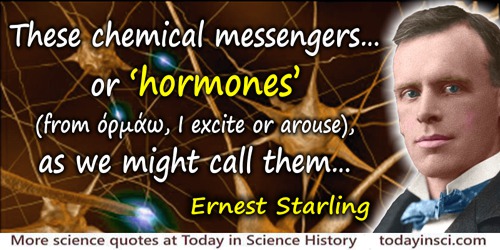
The specific character of the greater part of the toxins which are known to us (I need only instance such toxins as those of tetanus and diphtheria) would suggest that the substances produced for effecting the correlation of organs within the body, through the intermediation of the blood stream, might also belong to this class, since here also specificity of action must be a distinguishing characteristic. These chemical messengers, however, or 'hormones' (from όρμάω, I excite or arouse), as we might call them, have to be carried from the organ where they are produced to the organ which they affect by means of the blood stream and the continually recurring physiological needs of the organism must determine their repeated production and circulation through the body.
'The Chemical Correlation of the Functions of the Body', The Lancet (1905), ii, 340.
The unconscious is the true psychical reality; in its innermost nature it is as much unknown to us as the reality of the external world, and it is as incompletely presented by the data of consciousness as is the external world by the communications of our sense organs.
The Interpretation of Dreams (1900), In James Strachey (ed.), The Standard Edition of the Complete Psychological Works of Sigmund Freud (1953), Vol. 5, 613.
The use of every organ has been discovered by starting from the assumption that it must have been some use.
In History of the Inductive Sciences (1857), Vol. 3, 385.
The use of fetuses as organ and tissue donors is a ticking time bomb of bioethics.
Quoted in Andrea Dorf and Joe Levine 'Help From The Unborn Fetal-Cell', Time magazine (12 Jan 1987).
There are those who say that the human kidney was created to keep the blood pure, or more precisely, to keep our internal environment in an ideal balanced state. This I must deny. I grant that the human kidney is a marvelous organ, but I cannot grant that it was purposefully designed to excrete urine or to regulate the composition of the blood or to subserve the physiological welfare of Homo sapiens in any sense. Rather I contend that the human kidney manufactures the kind of urine that it does, and it maintains the blood in the composition which that fluid has, because this kidney has a certain functional architecture; and it owes that architecture not to design or foresight or to any plan, but to the fact that the earth is an unstable sphere with a fragile crust, to the geologic revolutions that for six hundred million years have raised and lowered continents and seas, to the predacious enemies, and heat and cold, and storms and droughts; to the unending succession of vicissitudes that have driven the mutant vertebrates from sea into fresh water, into desiccated swamps, out upon the dry land, from one habitation to another, perpetually in search of the free and independent life, perpetually failing, for one reason or another, to find it.
From Fish to Philosopher (1953), 210-1.
These turdy-facy-nasty-paty-lousy-fartical rogues, with one poor groat's worth of unprepared antimony, finely wrapt up in several scartoccios, are able, very well, to kill their twenty a week, and play; yet, these meagre, started spirits, who have half stopt the organs of their minds with earthy oppilations, want not their favorers among your shrivell’d sallad-eating artizans, who are overjoyed that they may have their half-pe’rth of physic; though it purge them into another world, it makes no matter.
Spoken by character Volpone, disguised as a “mountebank Doctor” in Valpone: or, The Foxe (1605), collected in Ben Jonson and William Gifford, The Works of Ben Johnson (1879), 282.
This integrative action in virtue of which the nervous system unifies from separate organs an animal possessing solidarity, an individual, is the problem before us.
The Integrative Action of the Nervous System (1906), 2.
This organ deserves to be styled the starting point of life and the sun of our microcosm just as much as the sun deserves to be styled the heart of the world. For it is by the heart's vigorous beat that the blood is moved, perfected, activated, and protected from injury and coagulation. The heart is the tutelary deity of the body, the basis of life, the source of all things, carrying out its function of nourishing, warming, and activating body as a whole. But we shall more fittingly speak of these matters when we consider the final cause of this kind of movement.
De Motu Cordis (1628), The Circulation of the Blood and Other Writings, trans. Kenneth J. Franklin (1957), Chapter 8, 59. Alternate translation: “The heart is the beginning of life; the sun of the microcosm, even as the sun in his turn might well be designated the heart of the world; for it is the heart by whose virtue and pulse the blood is moved, perfected, made apt to nourish, and is preserved from corruption and coagulation; it is the household divinity which, discharging its function, nourishes, cherishes, quickens the whole body, and is indeed the foundation of life, the source of all action. … The heart, like the prince in a kingdom, in whose hands lie the chief highest authority, rules over all; it is the original and foundation from which all power is derived, on which all power depends in the animal body.” In translation by Geoffrey Keynes (1953), 59.
Thus it might be said, that the vegetable is only the sketch, nor rather the ground-work of the animal; that for the formation of the latter, it has only been requisite to clothe the former with an apparatus of external organs, by which it might be connected with external objects.
From hence it follows, that the functions of the animal are of two very different classes. By the one (which is composed of an habitual succession of assimilation and excretion) it lives within itself, transforms into its proper substance the particles of other bodies, and afterwards rejects them when they are become heterogeneous to its nature. By the other, it lives externally, is the inhabitant of the world, and not as the vegetable of a spot only; it feels, it perceives, it reflects on its sensations, it moves according to their influence, and frequently is enabled to communicate by its voice its desires, and its fears, its pleasures, and its pains.
The aggregate of the functions of the first order, I shall name the organic life, because all organized beings, whether animal or vegetable, enjoy it more or less, because organic texture is the sole condition necessary to its existence. The sum of the functions of the second class, because it is exclusively the property of the animal, I shall denominate the animal life.
From hence it follows, that the functions of the animal are of two very different classes. By the one (which is composed of an habitual succession of assimilation and excretion) it lives within itself, transforms into its proper substance the particles of other bodies, and afterwards rejects them when they are become heterogeneous to its nature. By the other, it lives externally, is the inhabitant of the world, and not as the vegetable of a spot only; it feels, it perceives, it reflects on its sensations, it moves according to their influence, and frequently is enabled to communicate by its voice its desires, and its fears, its pleasures, and its pains.
The aggregate of the functions of the first order, I shall name the organic life, because all organized beings, whether animal or vegetable, enjoy it more or less, because organic texture is the sole condition necessary to its existence. The sum of the functions of the second class, because it is exclusively the property of the animal, I shall denominate the animal life.
Physiological Researches on Life and Death (1815), trans. P. Gold, 22-3.
To suppose that the eye, with all its inimitable contrivances for adjusting the focus to different distances, for admitting different amounts of light, and for the correction of spherical and chromatic aberration, could have been formed by natural selection, seems, I freely confess, absurd in the highest possible degree. When it was first said that the sun stood still and the world turned round, the common sense of mankind declared the doctrine false; but the old saying of Vox populi, vox Dei, as every philosopher knows, cannot be trusted in science. Reason tells me, that if numerous gradations from a perfect and complex eye to one very imperfect and simple, each grade being useful to its possessor, can be shown to exist; if further, the eye does vary ever so slightly, and the variations be inherited, which is certainly the case; and if any variation or modification in the organ be ever useful to an animal under changing conditions of life, then the difficulty of believing that a perfect and complex eye could be formed by natural selection, though insuperable by our imagination, can hardly be considered real.
On The Origin of Species by Means of Natural Selection (1859, 1882), 143-144.
We are not to consider the world as the body of God: he is an uniform being, void of organs, members, or parts; and they are his creatures, subordinate to him, and subservient to his will.
From 'Query 31', Opticks (1704, 2nd ed., 1718), 379.
We have also here an acting cause to account for that balance so often observed in nature,—a deficiency in one set of organs always being compensated by an increased development of some others—powerful wings accompanying weak feet, or great velocity making up for the absence of defensive weapons; for it has been shown that all varieties in which an unbalanced deficiency occurred could not long continue their existen The action of this principle is exactly like that of the centrifugal governor of the steam engine, which checks and corrects any irregularities almost before they become evident; and in like manner no unbalanced deficiency in the animal kingdom can ever reach any conspicuous magnitude, because it would make itself felt at the very first step, by rendering existence difficult and extinction almost sure soon to follow.
In 'On the Tendency of Varieties to Depart Indefinitely from the Original Type', Journal of the Proceedings of the Linnean Society, Zoology (1858), 3, 61-62.
We have no organ at all for knowledge, for ‘truth’: we ‘know’ (or believe or imagine) precisely as much as may be useful in the interest of the human herd, the species: and even what is here called ‘usefulness’ is in the end only a belief, something imagined and perhaps precisely that most fatal piece of stupidity by which we shall one day perish.
Sämtliche Werke: Kritische Studienausgabe, vol. 3, p. 593, eds. Giorgio Colli and Mazzino Montinari, Berlin, de Gruyter (1980). The Gay Science, second edition, 'Fifth Book: We Fearless Ones,' section 354 (1887).
We know that nature invariably uses the same materials in its operations. Its ingeniousness is displayed only in the variation of form. Indeed, as if nature had voluntarily confined itself to using only a few basic units, we observe that it generally causes the same elements to reappear, in the same number, in the same circumstances, and in the same relationships to one another. If an organ happens to grow in an unusual manner, it exerts a considerable influence on adjacent parts, which as a result fail to reach their standard degree of development.
'Considérations sur les pieces de la tête osseuse des animaux vertebras, et particulièrement sur celle du crane des oiseaux', Annales du Museum d'Histoire Naturelle, 1807, 10, 343. Trans. J. Mandelbaum. Quoted in Pietro Corsi, The Age of Lamarck (1988), 232.
We spend long hours discussing the curious situation that the two great bodies of biological knowledge, genetics and embryology, which were obviously intimately interrelated in development, had never been brought together in any revealing way. An obvious difficulty was that the most favorable organisms for genetics, Drosophila as a prime example, were not well suited for embryological study, and the classical objects of embryological study, sea urchins and frogs as examples, were not easily investigated genetically. What might we do about it? There were two obvious approaches: one to learn more about the genetics of an embryologically favourable organism, the other to better understand the development of Drosophila. We resolved to gamble up to a year of our lives on the latter approach, this in Ephrussi’s laboratory in Paris which was admirably equipped for tissue culture, tissue or organ transplantation, and related techniques.
In 'Recollections', Annual Review of Biochemistry, 1974, 43, 6.
Why it is that animals, instead of developing in a simple and straightforward way, undergo in the course of their growth a series of complicated changes, during which they often acquire organs which have no function, and which, after remaining visible for a short time, disappear without leaving a trace ... To the Darwinian, the explanation of such facts is obvious. The stage when the tadpole breathes by gills is a repetition of the stage when the ancestors of the frog had not advanced in the scale of development beyond a fish.
In The Works of Francis Maitland Balfour (1885), Vol. 1, 702.
Wind, earthquake, fire—meteorology, seismology, physics—pass in review, as we have been reviewing the natural forces of evolution; the Lord was not in them. Afterwards, a stirring, an awakening in the organ of the brain, a voice which asks “What doest thou here?”
Swarthmore Lecture (1929) at Friends’ House, London, printed in Science and the Unseen World (1929), 26.
 In science it often happens that scientists say, 'You know that's a really good argument; my position is mistaken,' and then they would actually change their minds and you never hear that old view from them again. They really do it. It doesn't happen as often as it should, because scientists are human and change is sometimes painful. But it happens every day. I cannot recall the last time something like that happened in politics or religion.
(1987) --
In science it often happens that scientists say, 'You know that's a really good argument; my position is mistaken,' and then they would actually change their minds and you never hear that old view from them again. They really do it. It doesn't happen as often as it should, because scientists are human and change is sometimes painful. But it happens every day. I cannot recall the last time something like that happened in politics or religion.
(1987) -- 





.jpg)
