Order Quotes (647 quotes)
... I should think that anyone who considered it more reasonable for the whole universe to move in order to let the Earth remain fixed would be more irrational than one who should climb to the top of your cupola just to get a view of the city and its environs, and then demand that the whole countryside should revolve around him so that he would not have to take the trouble to turn his head.
In Dialogue Concerning the Two Chief World Systems (1632).
… just as the astronomer, the physicist, the geologist, or other student of objective science looks about in the world of sense, so, not metaphorically speaking but literally, the mind of the mathematician goes forth in the universe of logic in quest of the things that are there; exploring the heights and depths for facts—ideas, classes, relationships, implications, and the rest; observing the minute and elusive with the powerful microscope of his Infinitesimal Analysis; observing the elusive and vast with the limitless telescope of his Calculus of the Infinite; making guesses regarding the order and internal harmony of the data observed and collocated; testing the hypotheses, not merely by the complete induction peculiar to mathematics, but, like his colleagues of the outer world, resorting also to experimental tests and incomplete induction; frequently finding it necessary, in view of unforeseen disclosures, to abandon one hopeful hypothesis or to transform it by retrenchment or by enlargement:—thus, in his own domain, matching, point for point, the processes, methods and experience familiar to the devotee of natural science.
In Lectures on Science, Philosophy and Art (1908), 26
… the embryological record, as it is usually presented to us, is both imperfect and misleading. It may be compared to an ancient manuscript, with many of the sheets lost, others displaced, and with spurious passages interpolated by a later hand. … Like the scholar with his manuscript, the embryologist has by a process of careful and critical examination to determine where the gaps are present, to detect the later insertions, and to place in order what has been misplaced.
A Treatise on Comparative Embryology (1885), Vol. 1, 3-4.
… the reasoning process [employed in mathematics] is not different from that of any other branch of knowledge, … but there is required, and in a great degree, that attention of mind which is in some part necessary for the acquisition of all knowledge, and in this branch is indispensably necessary. This must be given in its fullest intensity; … the other elements especially characteristic of a mathematical mind are quickness in perceiving logical sequence, love of order, methodical arrangement and harmony, distinctness of conception.
In Treatise on Infinitesimal Calculus (1868), Vol. 8, 6.
…it ought to be remembered that there is nothing more difficult to take in hand, more perilous to conduct, or more uncertain in its success, than to take the lead in the introduction of a new order of things. Because the innovator has for enemies all those who have done well under the old conditions, and lukewarm defenders in those who may do well under the new.
The Prince (1532). W. K. Marriott (translator) and Rob McMahon (editor), The Prince (2008), 71.
…reality is a system, completely ordered and fully intelligible, with which thought in its advance is more and more identifying itself. We may look at the growth of knowledge … as an attempt by our mind to return to union with things as they are in their ordered wholeness…. and if we take this view, our notion of truth is marked out for us. Truth is the approximation of thought to reality … Its measure is the distance thought has travelled … toward that intelligible system … The degree of truth of a particular proposition is to be judged in the first instance by its coherence with experience as a whole, ultimately by its coherence with that further whole, all comprehensive and fully articulated, in which thought can come to rest.
In The Nature of Thought (1921), Vol II, 264.
“In order to ascertain the height of the tree I must be in such a position that the top of the tree is exactly in a line with the top of a measuring-stick—or any straight object would do, such as an umbrella—which I shall secure in an upright position between my feet. Knowing then that the ratio that the height of the tree bears to the length of the measuring stick must equal the ratio that the distance from my eye to the base of the tree bears to my height, and knowing (or being able to find out) my height, the length of the measuring stick and the distance from my eye to the base of the tree, I can, therefore, calculate the height of the tree.”
“What is an umbrella?”
“What is an umbrella?”
In Mr. Fortune’s Maggot (1927), 175.
“Wu Li” was more than poetic. It was the best definition of physics that the conference would produce. It caught that certain something, that living quality that we were seeking to express in a book, that thing without which physics becomes sterile. “Wu” can mean either “matter” or “energy.” “Li” is a richly poetic word. It means “universal order” or “universal law.” It also means “organic patterns.” The grain in a panel of wood is Li. The organic pattern on the surface of a leaf is also Li, and so is the texture of a rose petal. In short, Wu Li, the Chinese word for physics, means “patterns of organic energy” (“matter/ energy” [Wu] + “universal order/organic patterns” [Li]). This is remarkable since it reflects a world view which the founders of western science (Galileo and Newton) simply did not comprehend, but toward which virtually every physical theory of import in the twentieth century is pointing!
In The Dancing Wu Li Masters: An Overview of the New Physics (1979), 5.
(1) A robot may not injure a human being, or, through inaction, allow a human being to come to harm.
(2) A robot must obey the orders given it by human beings except where such orders would conflict with the first law.
(3) A robot must protect its own existence as long as such protection does not conflict with the First or Second Law.
(2) A robot must obey the orders given it by human beings except where such orders would conflict with the first law.
(3) A robot must protect its own existence as long as such protection does not conflict with the First or Second Law.
'The Three Laws of Robotics', in I, Robot (1950), Frontispiece.
[1665-06-10] ...In the evening home to supper, and there to my great trouble hear that the plague is come into the City (though it hath these three or four weeks since its beginning been wholly out of the City); but where it begin but in my good friend and neighbour's, Dr Burnett in Fanchurch Street - which in both points troubles me mightily. To the office to finish my letters, and then home to bed, being troubled at the sickness ... and particularly how to put my things and estate in order, in case it should please God to call me away.
Diary of Samuel Pepys (10 Jun 1665)
[1665-08-31] Up, and after putting several things in order to my removal to Woolwich, the plague having a great increase this week beyond all expectation, of almost 2000 - making the general Bill 7000, odd 100 and the plague above 6000 .... Thus this month ends, with great sadness upon the public through the greateness of the plague, everywhere through the Kingdom almost. Every day sadder and sadder news of its increase. In the City died this week 7496; and all of them, 6102 of the plague. But it is feared that the true number of the dead this week is near 10000 - partly from the poor that cannot be taken notice of through the greatness of the number, and partly from the Quakers and others that will not have any bell ring for them. As to myself, I am very well; only, in fear of the plague, and as much of an Ague, by being forced to go early and late to Woolwich, and my family to lie there continually.
Diary of Samuel Pepys (31 August 1665)
[A man] must learn to understand the motives of human beings, their illusions, and their sufferings human beings, their illusions, and their sufferings in order to acquire a proper relationship to individual fellow-men and to the community. These precious things … primarily constitutes and preserves culture. This is what I have in mind when I recommend the “humanities” as important, not just dry specialized knowledge in the fields of history and philosophy.
From interview with Benjamin Fine, 'Einstein Stresses Critical Thinking', New York Times (5 Oct 1952), 37.
[About any invention] (1) everything that’s already in the world when you’re born is just normal; (2) anything that gets invented between then and before you turn thirty is incredibly exciting and creative and with any luck you can make a career out of it; (3) anything that gets invented after you’re thirty is against the natural order of things and the beginning of the end of civilisation as we know it until it’s been around for about ten years when it gradually turns out to be alright really.
In News Review section, Sunday Times (29 Aug 1999).
[Edward Teller is a conceptual thinker,] an ‘order of magnitude’ man. That’s his language. He’s like the architect who likes to make the big drawing, the broad sketch, and not worry himself about the plumbing details.
As quoted in Robert Coughlan, 'Dr. Edward Teller’s Magnificent Obsession', Life (6 Sep 1954), 62.
[Engineers are] the direct and necessary instrument of coalition by which alone the new social order can commence.
[John Scott Haldane] preferred to work on himself or other human beings who were sufficiently interested in the work to ignore pain or fear … [His] object was not to achieve this state of [pain or fear] but to achieve knowledge which could save other men's lives. His attitute was much more like a good soldier who will risk his life and endure wounds in order to gain victory than that of an ascetic who deliberately undergoes pain. The soldier does not get himself wounded deliberately, and my father did not seek pain in his work though he greeted pain which would have made some people writhe or groan, with laughter.
In R.W. Clark, JBS: The Life and Work of J.B.S. Haldane (1968), quoted in Lawrence K. Altman, Who Goes First? (1986), 215.
[M]y work, which I’ve done for a long time, was not pursued in order to gain the praise I now enjoy, but chiefly from a craving after knowledge, which I notice resides in me more than in most other men. And therewithal, whenever I found out anything remarkable, I have thought it my duty to put down my discovery on paper, so that all ingenious people might be informed thereof.
Letter (27 Jun 1716) thanking the University of Louvain for ending him a medal designed in honour of his research. (Leeuwenhoek was then in his 84th year.) As cited by Charles-Edward Amory Winslow in The Conquest of Epidemic Disease: A Chapter in the History of Ideas (), 156.
[My work as a photographer is a] mission to document endangered species and landscapes in order to show a world worth saving.
On the 'About' page of his web site.
[Presently, science undergraduates] do not learn to write clearly and briefly, marshalling their points in due and aesthetically satisfying order, and eliminating inessentials. They are inept at those turns of phrase or happy analogy which throw a flying bridge across a chasm of misunderstanding and make contact between mind and mind.
From essay in Thomas Rice Henn, The Apple and the Spectroscope: Being Lectures on Poetry Designed (in the Main) for Science Students (1951), 142.
[Science] dissipates errors born of ignorance about our true relations with nature, errors the more damaging in that the social order should rest only on those relations. TRUTH! JUSTICE! Those are the immutable laws. Let us banish the dangerous maxim that it is sometimes useful to depart from them and to deceive or enslave mankind to assure its happiness.
Exposition du Système du Monde (1796), 2, 312, trans. Charles Coulston Gillispie, Pierre-Simon Laplace 1749-1827: A Life in Exact Science (1997), 175.
[Scientific research reveals] the majestic spectacle of the order of nature gradually unfolding itself to man’s consciousness and placing in his hands the implements of ever augmenting power to control his destinies and attain that ultimate comprehension of the universe which has in all ages constituted the supreme aspiration of man.
As quoted in book review by Ian Clunies Ross, "The Spirit of Research', The Australian Quarterly (Dec 1931), 3, No. 12, 126.
[We] can easily distinguish what relates to Mathematics in any question from that which belongs to the other sciences. But as I considered the matter carefully it gradually came to light that all those matters only were referred to Mathematics in which order and measurements are investigated, and that it makes no difference whether it be in numbers, figures, stars, sounds or any other object that the question of measurement arises. I saw consequently that there must be some general science to explain that element as a whole which gives rise to problems about order and measurement, restricted as these are to no special subject matter. This, I perceived was called “Universal Mathematics,” not a far-fetched asignation, but one of long standing which has passed into current use, because in this science is contained everything on account of which the others are called parts of Mathematics.
Rules for the Direction of the Mind (written 1628). As translated by Elizabeth Sanderson Haldane and George Robert Thomson Ross in The Philosophical Works of Descartes (1911, 1931), 13.
[About Pierre de Fermat] It cannot be denied that he has had many exceptional ideas, and that he is a highly intelligent man. For my part, however, I have always been taught to take a broad overview of things, in order to be able to deduce from them general rules, which might be applicable elsewhere.
Quoted, without source, in The Grolier Library of Science Biographies (1996), Vol. 3, 191.
Branches or types are characterized by the plan of their structure,
Classes, by the manner in which that plan is executed, as far as ways and means are concerned,
Orders, by the degrees of complication of that structure,
Families, by their form, as far as determined by structure,
Genera, by the details of the execution in special parts, and
Species, by the relations of individuals to one another and to the world in which they live, as well as by the proportions of their parts, their ornamentation, etc.
Classes, by the manner in which that plan is executed, as far as ways and means are concerned,
Orders, by the degrees of complication of that structure,
Families, by their form, as far as determined by structure,
Genera, by the details of the execution in special parts, and
Species, by the relations of individuals to one another and to the world in which they live, as well as by the proportions of their parts, their ornamentation, etc.
Essay on Classification (1857). Contributions to the Natural History of the United States of America (1857), Vol. I, 170.
Combien de gens se font abstraits pour paraître profonds! La plupart des termes abstraits sont des ombres qui cachent des vides.
How many people become abstract in order to appear profound! Most abstract terms are shadows that conceal a void.
How many people become abstract in order to appear profound! Most abstract terms are shadows that conceal a void.
Quoted in M. Paul De Raynal, Pensées de J. Joubert (1862), 456.
Dass die bis jetzt unzerlegten chemischen Elemente absolut unzerlegbare Stoffe seien, ist gegenwärtig mindestens sehr unwahrscheinlich. Vielmehr scheint es, dass die Atome der Elemente nicht die letzten, sondern nur die näheren Bestandtheile der Molekeln sowohl der Elemente wie der Verbindungen bilden, die Molekeln oder Molecule als Massentheile erster, die Atome als solche zweiter Ordnung anzusehen sind, die ihrerseits wiederum aus Massentheilchen einer dritten höheren Ordnung bestehen werden.
That the as yet undivided chemical elements are absolutely irreducible substances, is currently at least very unlikely. Rather it seems, that the atoms of elements are not the final, but only the immediate constituents of the molecules of both the elements and the compounds—the Molekeln or molecule as foremost division of matter, the atoms being considered as second order, in turn consisting of matter particles of a third higher order.
[Speculating in 1870, on the existence of subatomic particles, in opening remark of the paper by which he became established as co-discoverer of the Periodic Law.]
That the as yet undivided chemical elements are absolutely irreducible substances, is currently at least very unlikely. Rather it seems, that the atoms of elements are not the final, but only the immediate constituents of the molecules of both the elements and the compounds—the Molekeln or molecule as foremost division of matter, the atoms being considered as second order, in turn consisting of matter particles of a third higher order.
[Speculating in 1870, on the existence of subatomic particles, in opening remark of the paper by which he became established as co-discoverer of the Periodic Law.]
'Die Natur der chemischen Elemente als Function ihrer Atomgewichte' ('The Nature of the Chemical Elements as a Function of their Atomic Weight'), Annalen der Chemie (1870), supp. b, 354. Original German paper reprinted in Lothar Meyer and Dmitry Ivanovich Mendeleyev, Das natürliche System der chemischen Elemente: Abhandlungen (1895), 9. Translation by Webmaster, with punctuation faithful to the original, except a comma was changed to a dash to improve readability.
Every teacher certainly should know something of non-euclidean geometry. Thus, it forms one of the few parts of mathematics which, at least in scattered catch-words, is talked about in wide circles, so that any teacher may be asked about it at any moment. … Imagine a teacher of physics who is unable to say anything about Röntgen rays, or about radium. A teacher of mathematics who could give no answer to questions about non-euclidean geometry would not make a better impression.
On the other hand, I should like to advise emphatically against bringing non-euclidean into regular school instruction (i.e., beyond occasional suggestions, upon inquiry by interested pupils), as enthusiasts are always recommending. Let us be satisfied if the preceding advice is followed and if the pupils learn to really understand euclidean geometry. After all, it is in order for the teacher to know a little more than the average pupil.
On the other hand, I should like to advise emphatically against bringing non-euclidean into regular school instruction (i.e., beyond occasional suggestions, upon inquiry by interested pupils), as enthusiasts are always recommending. Let us be satisfied if the preceding advice is followed and if the pupils learn to really understand euclidean geometry. After all, it is in order for the teacher to know a little more than the average pupil.
In George Edward Martin, The Foundations of Geometry and the Non-Euclidean Plane (1982), 72.
In primis, hominis est propria VERI inquisitio atque investigato. Itaque cum sumus negotiis necessariis, curisque vacui, tum avemus aliquid videre, audire, ac dicere, cognitionemque rerum, aut occultarum aut admirabilium, ad benè beatéque vivendum necessariam ducimus; —ex quo intelligitur, quod VERUM, simplex, sincerumque sit, id esse naturæ hominis aptissimum. Huic veri videndi cupiditati adjuncta est appetitio quædam principatûs, ut nemini parere animus benè a naturâ informatus velit, nisi præcipienti, aut docenti, aut utilitatis causâ justè et legitimè imperanti: ex quo animi magnitudo existit, et humanarum rerum contemtio.
Before all other things, man is distinguished by his pursuit and investigation of TRUTH. And hence, when free from needful business and cares, we delight to see, to hear, and to communicate, and consider a knowledge of many admirable and abstruse things necessary to the good conduct and happiness of our lives: whence it is clear that whatsoever is TRUE, simple, and direct, the same is most congenial to our nature as men. Closely allied with this earnest longing to see and know the truth, is a kind of dignified and princely sentiment which forbids a mind, naturally well constituted, to submit its faculties to any but those who announce it in precept or in doctrine, or to yield obedience to any orders but such as are at once just, lawful, and founded on utility. From this source spring greatness of mind and contempt of worldly advantages and troubles.
Before all other things, man is distinguished by his pursuit and investigation of TRUTH. And hence, when free from needful business and cares, we delight to see, to hear, and to communicate, and consider a knowledge of many admirable and abstruse things necessary to the good conduct and happiness of our lives: whence it is clear that whatsoever is TRUE, simple, and direct, the same is most congenial to our nature as men. Closely allied with this earnest longing to see and know the truth, is a kind of dignified and princely sentiment which forbids a mind, naturally well constituted, to submit its faculties to any but those who announce it in precept or in doctrine, or to yield obedience to any orders but such as are at once just, lawful, and founded on utility. From this source spring greatness of mind and contempt of worldly advantages and troubles.
In De Officiis, Book 1. Sect. 13. As given in epigraph to John Frederick William Herschel, A Preliminary Discourse on the Study of Natural Philosophy (1830), viii.
L’analyse mathématique … dans l’étude de tous les phénomènes; elle les interprète par le même langage, comme pour attester l’unité et la simplicité du plan de l’univers, et rendre encore plus manifeste cet ordre immuable qui préside à toutes les causes naturelles.
Mathematical analysis … in the study of all phenomena, interprets them by the same language, as if to attest the unity and simplicity of the plan of the universe, and to make still more evident that unchangeable order which presides over all natural causes.
Mathematical analysis … in the study of all phenomena, interprets them by the same language, as if to attest the unity and simplicity of the plan of the universe, and to make still more evident that unchangeable order which presides over all natural causes.
From Théorie Analytique de la Chaleur (1822), xv, translated by Alexander Freeman in The Analytical Theory of Heat (1878), 8.
Le savant n’étudie pas la nature parce que cela est utile; il l’étudie parce qu’il y prend plaisir et il y prend plaisir parce qu’elle est belle. Si la nature n’était pas belle, elle ne vaudrait pas la peine d’être connue, la vie ne vaudrait pas la peine d’être vécue.
The scientist does not study nature because it is useful to do so. He studies it because he takes pleasure in it, and he takes pleasure in it because it is beautiful. If nature were not beautiful, it would not be worth knowing, and life would not be worth living. I am not speaking, of course, of the beauty which strikes the senses, of the beauty of qualities and appearances. I am far from despising this, but it has nothing to do with science. What I mean is that more intimate beauty which comes from the harmonious order of its parts, and which a pure intelligence can grasp.
The scientist does not study nature because it is useful to do so. He studies it because he takes pleasure in it, and he takes pleasure in it because it is beautiful. If nature were not beautiful, it would not be worth knowing, and life would not be worth living. I am not speaking, of course, of the beauty which strikes the senses, of the beauty of qualities and appearances. I am far from despising this, but it has nothing to do with science. What I mean is that more intimate beauty which comes from the harmonious order of its parts, and which a pure intelligence can grasp.
In Science et Méthode (1920), 48, as translated by Francis Maitland, in Science and Method (1908, 1952), 15.
Mi è impossibile cingere i fianchi di una ragazza con il mio braccio destro e serrare il suo sorriso nella mia mano sinistra, per poi tentare di studiare i due oggetti separatamente. Allo stesso modo, non ci è possibile separare la vita dalla materia vivente, allo scopo di studiare la sola materia vivente e le sue reazioni. Inevitabilmente, studiando la materia vivente e le sue reazioni, studiamo la vita stessa.
It is impossible to encircle the hips of a girl with my right arm and hold her smile in my left hand, then proceed to study the two items separately. Similarly, we can not separate life from living matter, in order to study only living matter and its reactions. Inevitably, studying living matter and its reactions, we study life itself
It is impossible to encircle the hips of a girl with my right arm and hold her smile in my left hand, then proceed to study the two items separately. Similarly, we can not separate life from living matter, in order to study only living matter and its reactions. Inevitably, studying living matter and its reactions, we study life itself
In The Nature of Life (1948).
Question: Explain why, in order to cook food by boiling, at the top of a high mountain, you must employ a different method from that used at the sea level.
Answer: It is easy to cook food at the sea level by boiling it, but once you get above the sea level the only plan is to fry it in its own fat. It is, in fact, impossible to boil water above the sea level by any amount of heat. A different method, therefore, would have to be employed to boil food at the top of a high mountain, but what that method is has not yet been discovered. The future may reveal it to a daring experimentalist.
Answer: It is easy to cook food at the sea level by boiling it, but once you get above the sea level the only plan is to fry it in its own fat. It is, in fact, impossible to boil water above the sea level by any amount of heat. A different method, therefore, would have to be employed to boil food at the top of a high mountain, but what that method is has not yet been discovered. The future may reveal it to a daring experimentalist.
Genuine student answer* to an Acoustics, Light and Heat paper (1880), Science and Art Department, South Kensington, London, collected by Prof. Oliver Lodge. Quoted in Henry B. Wheatley, Literary Blunders (1893), 178-9, Question 11. (*From a collection in which Answers are not given verbatim et literatim, and some instances may combine several students' blunders.)
Rassemblons des faits pour nous donner des idées.
Let us gather facts in order to get ourselves thinking.
Let us gather facts in order to get ourselves thinking.
'Histoire des Animaux', Histoire Naturelle, Générale et Particulière, avec la Description du Cabinet du Roi (1749), Vol. 2, 18. Quoted in Jacques Roger, The Life Sciences in Eighteenth- Century French Thought, ed. Keith R. Benson and trans. Robert Ellrich (1997), 440.
Socrates: Very good; let us begin then, Protarchus, by asking whether all this which they call the universe is left to the guidance of unreason and chance medley, or, on the contrary, as our fathers have declared, ordered and governed by a marvellous intelligence and wisdom.
Protarchus: Wide asunder are the two assertions, illustrious Socrates, for that which you were just now saying to me appears to be blasphemy, but the other assertion, that mind orders all things, is worthy of the aspect of the world…
Protarchus: Wide asunder are the two assertions, illustrious Socrates, for that which you were just now saying to me appears to be blasphemy, but the other assertion, that mind orders all things, is worthy of the aspect of the world…
— Plato
From 'Philebus', collected in The Dialogues of Plato (1875), Vol. 4, 70.
~~[Unverified]~~ Through steady observation and a meaningful contact with the divined order of the world’s structure, arranged by God’s wisdom,–who would not be guided to admire the Builder who creates all!
As quoted, without citation, in Adam Mabry, Life and Doctrine: How the Truth and Grace of Christian Story Change Everything (2001, 2014), 17. Also seen, without citation, in Katherine Katsanis, 'In This Age of Science And Technology, How Can we Accept The Reality of Miracles?', Orthodox Observer (Sep 1997), 21, attributed to Nikolai Copernicus. As yet, Webmaster cannot identify a trustworthy primary source, is therefore presently skeptical, and meanwhile labels the quote as unverified.
A fact is like a sack which won’t stand up if it’s empty. In order that it may stand up, one has to put into it the reason and sentiment which caused it to exist.
Character, The Father, in play Six Characters in Search of an Author (1921), Act 1. Collected in John Gassner and Burns Mantle, A Treasury of the Theatre (1935), Vol. 2, 507.
A human being should be able to change a diaper, plan an invasion, butcher a hog, conn a ship, design a building, write a sonnet, balance accounts, build a wall, set a bone, comfort the dying, take orders, give orders, cooperate, act alone, solve equations, analyze a new problem, pitch manure, program a computer, cook a tasty meal, fight efficiently, die gallantly. Specialization is for insects.
In Time Enough for Love: The Lives of Lazarus Long (1973), 265.
A hundred times every day I remind myself that my inner and outer life depends on the labors of other men, living and dead, and that I must exert myself in order to give in the measure as I have received and am still receiving.
…...
A layman will no doubt find it hard to understand how pathological disorders of the body and mind can be eliminated by 'mere' words. He will feel that he is being asked to believe in magic. And he will not be so very wrong, for the words which we use in our everyday speech are nothing other than watered-down magic. But we shall have to follow a roundabout path in order to explain how science sets about restoring to words a part at least of their former magical power.
Psychical (or Mental) Treatment (1905), In James Strachey (ed.), The Standard Edition of the Complete Psychological Works of Sigmund Freud (1953), Vol. 7, 283.
A mathematical problem should be difficult in order to entice us, yet not completely inaccessible, lest it mock at our efforts. It should be to us a guide post on the mazy paths to hidden truths, and ultimately a reminder of our pleasure in the successful solution.
In Mathematical Problems', Bulletin American Mathematical Society, 8, 438.
A mind which has once imbibed a taste for scientific enquiry, and has learnt the habit of applying its principles readily to the cases which occur, has within itself an inexhaustable source of pure and exciting contemplations:— One would think that Shakespeare had such a mind in view when he describes a contemplative man as finding
“Tongues in trees—books in running brooks—
Sermons in stones—and good in everything.”
Accustomed to trace the operations of general causes and the exemplification of general laws, in circumstances where the uninformed and uninquiring eye, perceives neither novelty nor beauty, he walks in the midst of wonders; every object which falls in his way elucidates some principle, affords some instruction and impresses him with a sense of harmony and order. Nor is it a mere passive pleasure which is thus communicated. A thousand questions are continually arising in his mind, a thousand objects of enquiry presenting themselves, which keep his faculties in constant exercise, and his thoughts perpetually on the wing, so that lassitude is excluded from his life, and that craving after artificial excitement and dissipation of the mind, which leads so many into frivolous, unworthy, and destructive pursuits, is altogether eradicated from his bosom.
“Tongues in trees—books in running brooks—
Sermons in stones—and good in everything.”
Accustomed to trace the operations of general causes and the exemplification of general laws, in circumstances where the uninformed and uninquiring eye, perceives neither novelty nor beauty, he walks in the midst of wonders; every object which falls in his way elucidates some principle, affords some instruction and impresses him with a sense of harmony and order. Nor is it a mere passive pleasure which is thus communicated. A thousand questions are continually arising in his mind, a thousand objects of enquiry presenting themselves, which keep his faculties in constant exercise, and his thoughts perpetually on the wing, so that lassitude is excluded from his life, and that craving after artificial excitement and dissipation of the mind, which leads so many into frivolous, unworthy, and destructive pursuits, is altogether eradicated from his bosom.
In Dionysius Lardner (ed.), Cabinet Cyclopaedia, Vol 1, Preliminary Discourse on the Study of Natural Philosophy (1831), 14-15.
A soil adapted to the growth of plants, is necessarily prepared and carefully preserved; and, in the necessary waste of land which is inhabited, the foundation is laid for future continents, in order to support the system of the living world.
In 'Concerning and System of the Earth, its Duration and Stability', a Dissertation presented to the Royal Society of Edinburgh (Mar-Apr 1785). The surviving Abstract is excerpted in Frank H. T. Rhodes, Richard O. Stone and Bruce D. Malamud (eds.), Language of the Earth: A Literary Anthology (2002, 2nd. ed. 2008), 110.
A theory with mathematical beauty is more likely to be correct than an ugly one that fits some experimental data. God is a mathematician of a very high order, and He used very advanced mathematics in constructing the universe.
In Scientific American (May 1963). As quoted and cited in The Hutchinson Encyclopedia of Science (1998), 468.
A true anecdote which illustrates his unworldly nature is of the instruction he received in 1922 to appear at Buckingham Palace to receive the accolade of the Order of Knighthood; he replied that as the date coincided with that of a meeting of the Physiological Society, he would be unable to attend.
Charles Lovatt Evans, Reminiscences of Bayliss and Starling (1964), 3.
A universe without law would be a universe without order, without the possibility of science, and the manifestations of an intelligent governor and creator.
Presidential address to the American Association for the Advancement of Science (22 Aug 1850),The Papers of Joseph Henry, Vol. 8, 99.
A world that did not lift a finger when Hitler was wiping out six million Jewish men, women, and children is now saying that the Jewish state of Israel will not survive if it does not come to terms with the Arabs. My feeling is that no one in this universe has the right and the competence to tell Israel what it has to do in order to survive. On the contrary, it is Israel that can tell us what to do. It can tell us that we shall not survive if we do not cultivate and celebrate courage, if we coddle traitors and deserters, bargain with terrorists, court enemies, and scorn friends.
In Before the Sabbath (1979), 6.
About 85 per cent of my “thinking” time was spent getting into a position to think, to make a decision, to learn something I needed to know. Much more time went into finding or obtaining information than into digesting it. Hours went into the plotting of graphs... When the graphs were finished, the relations were obvious at once, but the plotting had to be done in order to make them so.
From article 'Man-Computer Symbiosis', in IRE Transactions on Human Factors in Electronics (Mar 1960), Vol. HFE-1, 4-11.
According to Democritus, atoms had lost the qualities like colour, taste, etc., they only occupied space, but geometrical assertions about atoms were admissible and required no further analysis. In modern physics, atoms lose this last property, they possess geometrical qualities in no higher degree than colour, taste, etc. The atom of modern physics can only be symbolized by a partial differential equation in an abstract multidimensional space. Only the experiment of an observer forces the atom to indicate a position, a colour and a quantity of heat. All the qualities of the atom of modern physics are derived, it has no immediate and direct physical properties at all, i.e. every type of visual conception we might wish to design is, eo ipso, faulty. An understanding of 'the first order' is, I would almost say by definition, impossible for the world of atoms.
Philosophic Problems of Nuclear Science, trans. F. C. Hayes (1952), 38.
After having a wash I proceeded to the bar where—believe it or not—there was a white-coated barman who was not only serving drinks but also cigarettes! I hastened forward and rather timidly said ‘Can I have some cigarettes?’
‘What’s your rank?’ was the slightly unexpected reply.
‘I am afraid I haven’t got one,’ I answered.
‘Nonsense—everyone who comes here has a rank.’
‘I’m sorry but I just don’t have one.’
‘Now that puts me in a spot,’ said the barman, ‘for orders about cigarettes in this camp are clear—twenty for officers and ten for other ranks. Tell me what exactly are you?’
Now I really wanted those cigarettes so I drew myself up and said ‘I am the Professor of Chemistry at Manchester University.’
The barman contemplated me for about thirty seconds and then said ‘I’ll give you five.’
Since that day I have had few illusions about the importance of professors!
‘What’s your rank?’ was the slightly unexpected reply.
‘I am afraid I haven’t got one,’ I answered.
‘Nonsense—everyone who comes here has a rank.’
‘I’m sorry but I just don’t have one.’
‘Now that puts me in a spot,’ said the barman, ‘for orders about cigarettes in this camp are clear—twenty for officers and ten for other ranks. Tell me what exactly are you?’
Now I really wanted those cigarettes so I drew myself up and said ‘I am the Professor of Chemistry at Manchester University.’
The barman contemplated me for about thirty seconds and then said ‘I’ll give you five.’
Since that day I have had few illusions about the importance of professors!
In A Time to Remember: The Autobiography of a Chemist (1983), 59. This event took place after a visit to the Defence Research Establishment at Porton to observe a demonstration of a new chemical anti-tank weapon (1941).
After I had addressed myself to this very difficult and almost insoluble problem, the suggestion at length came to me how it could be solved with fewer and much simpler constructions than were formerly used, if some assumptions (which are called axioms) were granted me. They follow in this order.
There is no one center of all the celestial circles or spheres.
The center of the earth is not the center of the universe, but only of gravity and of the lunar sphere.
All the spheres revolve about the sun as their mid-point, and therefore the sun is the center of the universe.
The ratio of the earth’s distance from the sun to the height of the firmament is so much smaller than the ratio of the earth’s radius to its distance from the sun that the distance from the earth to the sun is imperceptible in comparison with the height of the firmament.
Whatever motion appears in the firmament arises not from any motion of the firmament, but from the earth’s motion. The earth together with its circumjacent elements performs a complete rotation on its fixed poles in a daily motion, while the firmament and highest heaven abide unchanged.
What appears to us as motions of the sun arise not from its motion but from the motion of the earth and our sphere, with which we revolve about the sun like any other planet. The earth has, then, more than one motion.
The apparent retrograde and direct motion of the planets arises not from their motion but from the earth’s. The motion of the earth alone, therefore, suffices to explain so many apparent inequalities in the heavens.
There is no one center of all the celestial circles or spheres.
The center of the earth is not the center of the universe, but only of gravity and of the lunar sphere.
All the spheres revolve about the sun as their mid-point, and therefore the sun is the center of the universe.
The ratio of the earth’s distance from the sun to the height of the firmament is so much smaller than the ratio of the earth’s radius to its distance from the sun that the distance from the earth to the sun is imperceptible in comparison with the height of the firmament.
Whatever motion appears in the firmament arises not from any motion of the firmament, but from the earth’s motion. The earth together with its circumjacent elements performs a complete rotation on its fixed poles in a daily motion, while the firmament and highest heaven abide unchanged.
What appears to us as motions of the sun arise not from its motion but from the motion of the earth and our sphere, with which we revolve about the sun like any other planet. The earth has, then, more than one motion.
The apparent retrograde and direct motion of the planets arises not from their motion but from the earth’s. The motion of the earth alone, therefore, suffices to explain so many apparent inequalities in the heavens.
'The Commentariolus', in Three Copernican Treatises (c.1510), trans. E. Rosen (1939), 58-9.
After that, I thought about what a proposition generally needs in order to be true and certain because, since I had just found one that I knew was such, I thought I should also know what this certainty consists in. Having noticed that there is nothing at all in the proposition “I think, therefore I am” [cogito ergo sum] which convinces me that I speak the truth, apart from the fact that I see very clearly that one has to exist in order to think, I judged that I could adopt as a general rule that those things we conceive very clearly and distinctly are all true. The only outstanding difficulty is in recognizing which ones we conceive distinctly.
Discourse on Method in Discourse on Method and Related Writings (1637), trans. Desmond M. Clarke, Penguin edition (1999), Part 4, 25.
After the discovery of spectral analysis no one trained in physics could doubt the problem of the atom would be solved when physicists had learned to understand the language of spectra. So manifold was the enormous amount of material that has been accumulated in sixty years of spectroscopic research that it seemed at first beyond the possibility of disentanglement. An almost greater enlightenment has resulted from the seven years of Röntgen spectroscopy, inasmuch as it has attacked the problem of the atom at its very root, and illuminates the interior. What we are nowadays hearing of the language of spectra is a true 'music of the spheres' in order and harmony that becomes ever more perfect in spite of the manifold variety. The theory of spectral lines will bear the name of Bohr for all time. But yet another name will be permanently associated with it, that of Planck. All integral laws of spectral lines and of atomic theory spring originally from the quantum theory. It is the mysterious organon on which Nature plays her music of the spectra, and according to the rhythm of which she regulates the structure of the atoms and nuclei.
Atombau und Spektrallinien (1919), viii, Atomic Structure and Spectral Lines, trans. Henry L. Brose (1923), viii.
All are born to observe order, but few are born to establish it.
…...
All material Things seem to have been composed of the hard and solid Particles … variously associated with the first Creation by the Counsel of an intelligent Agent. For it became him who created them to set them in order: and if he did so, it is unphilosophical to seek for any other Origin of the World, or to pretend that it might arise out of a Chaos by the mere Laws of Nature.
From Opticks (1704, 2nd ed., 1718), 377-378.
All power, all subordination rests on the executioner: he is the horror and the bond of human association. Remove this incomprehensible agent from the world, and the very moment order gives way to chaos, thrones topple, and society disappears
In Joseph de Maistre and Richard A. Lebrun (trans.), The St. Petersburg Dialogues (1993), 20.
All that concerns the Mediterranean is of the deepest interest to civilized man, for the history of its progress is the history of the development of the world; the memory of the great men who have lived and died around its banks; the recollection of the undying works that have come thence to delight us for ever; the story of patient research and brilliant discoveries connected with every physical phenomenon presented by its waves and currents, and with every order of creatures dwelling in and around its waters.
From Literary Papers (1855), 106. As quoted in On Early Explorations in the Mediterranean.In George Wilson and Archibald Geikie, Memoir of Edward Forbes F.R.S. (1861), 279. Geike introduces the Forbes quote as “the recollection of these, his earliest explorations in the Mediterranean,” as written down years later.
All the different classes of beings which taken together make up the universe are, in the ideas of God who knows distinctly their essential gradations, only so many ordinates of a single curve so closely united that it would be impossible to place others between any two of them, since that would imply disorder and imperfection. Thus men are linked with the animals, these with the plants and these with the fossils which in turn merge with those bodies which our senses and our imagination represent to us as absolutely inanimate. And, since the law of continuity requires that when the essential attributes of one being approximate those of another all the properties of the one must likewise gradually approximate those of the other, it is necessary that all the orders of natural beings form but a single chain, in which the various classes, like so many rings, are so closely linked one to another that it is impossible for the senses or the imagination to determine precisely the point at which one ends and the next begins?all the species which, so to say, lie near the borderlands being equivocal, at endowed with characters which might equally well be assigned to either of the neighboring species. Thus there is nothing monstrous in the existence zoophytes, or plant-animals, as Budaeus calls them; on the contrary, it is wholly in keeping with the order of nature that they should exist. And so great is the force of the principle of continuity, to my thinking, that not only should I not be surprised to hear that such beings had been discovered?creatures which in some of their properties, such as nutrition or reproduction, might pass equally well for animals or for plants, and which thus overturn the current laws based upon the supposition of a perfect and absolute separation of the different orders of coexistent beings which fill the universe;?not only, I say, should I not be surprised to hear that they had been discovered, but, in fact, I am convinced that there must be such creatures, and that natural history will perhaps some day become acquainted with them, when it has further studied that infinity of living things whose small size conceals them for ordinary observation and which are hidden in the bowels of the earth and the depth of the sea.
Lettre Prétendue de M. De Leibnitz, à M. Hermann dont M. Koenig a Cité le Fragment (1753), cxi-cxii, trans. in A. O. Lovejoy, Great Chain of Being: A Study of the History of an Idea (1936), 144-5.
All things began in Order, so shall they end, and so shall they begin again, according to the Ordainer of Order, and the mystical mathematicks of the City of Heaven.
In 'Garden of Cyrus', Religio Medici and Other Writings (1909), 229.
All women scientists should marry, rear children, cook, and clean in order to achieve fulfillment, to be a complete woman.
Quoted in The Chemical Educator, vol. 7, No. 2, in a book review of Eugene Straus, Rosalyn Yalow, Nobel Laureate: Her Life and Work in Medicine.
Almost everyone... seems to be quite sure that the differences between the methodologies of history and of the natural sciences are vast. For, we are assured, it is well known that in the natural sciences we start from observation and proceed by induction to theory. And is it not obvious that in history we proceed very differently? Yes, I agree that we proceed very differently. But we do so in the natural sciences as well.
In both we start from myths—from traditional prejudices, beset with error—and from these we proceed by criticism: by the critical elimination of errors. In both the role of evidence is, in the main, to correct our mistakes, our prejudices, our tentative theories—that is, to play a part in the critical discussion, in the elimination of error. By correcting our mistakes, we raise new problems. And in order to solve these problems, we invent conjectures, that is, tentative theories, which we submit to critical discussion, directed towards the elimination of error.
In both we start from myths—from traditional prejudices, beset with error—and from these we proceed by criticism: by the critical elimination of errors. In both the role of evidence is, in the main, to correct our mistakes, our prejudices, our tentative theories—that is, to play a part in the critical discussion, in the elimination of error. By correcting our mistakes, we raise new problems. And in order to solve these problems, we invent conjectures, that is, tentative theories, which we submit to critical discussion, directed towards the elimination of error.
The Myth of the Framework: In Defence of Science and Rationality (1993), 140.
An amoeba never is torn apart through indecision, though, for even if two parts of the amoeba are inclined to go in different directions, a choice is always made. We could interpret this as schizophrenia or just confusion, but it could also be a judicious simultaneous sampling of conditions, in order to make a wise choice of future direction.
In The Center of Life: A Natural History of the Cell (1977, 1978), 73.
An ignorant or half-informed teacher may present science as an accumulation of unconnected facts. … To teach in that fashion is like going to the tree of science with its glorious fruit in order to pick up a handful of the dry fallen leaves from the ground.
In Inaugural Presidential Address (9 Sep 1885) to the British Association for the Advancement of Science, Aberdeen, Scotland, 'Relations of Science to the Public Weal', Report to the Fifty-Fifth Meeting of the British Association (1886), 11.
An Individual, whatever species it might be, is nothing in the Universe. A hundred, a thousand individuals are still nothing. The species are the only creatures of Nature, perpetual creatures, as old and as permanent as it. In order to judge it better, we no longer consider the species as a collection or as a series of similar individuals, but as a whole independent of number, independent of time, a whole always living, always the same, a whole which has been counted as one in the works of creation, and which, as a consequence, makes only a unity in Nature.
'De la Nature: Seconde Vue', Histoire Naturelle, Générale et Particulière, Avec la Description du Cabinet du Roi (1765), Vol. 13, i. Trans. Phillip R. Sloan.
And by the influence of heat, light, and electrical powers, there is a constant series of changes [in animal and vegetal substances]; matter assumes new forms, the destruction of one order of beings tends to the conservation of another, solution and consolidation, decay and renovation, are connected, and whilst the parts of the system, continue in a state of fluctuation and change, the order and harmony of the whole remain unalterable.
The Elements of Agricultural Chemistry (1813), in J. Davy (ed.) The Collected Works of Sir Humphry Davy(1839-40), Vol 7, 182.
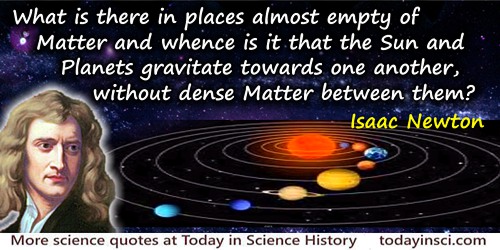
And for rejecting such a Medium, we have the Authority of those the oldest and most celebrated Philosophers of Greece and Phoenicia, who made a Vacuum, and Atoms, and the Gravity of Atoms, the first Principles of their Philosophy; tacitly attributing Gravity to some other Cause than dense Matter. Later Philosophers banish the Consideration of such a Cause out of natural Philosophy, feigning Hypotheses for explaining all things mechanically, and referring other Causes to Metaphysicks: Whereas the main Business of natural Philosophy is to argue from Phaenomena without feigning Hypotheses, and to deduce Causes from Effects, till we come to the very first Cause, which certainly is not mechanical; and not only to unfold the Mechanism of the World, but chiefly to resolve these and such like Questions. What is there in places almost empty of Matter, and whence is it that the Sun and Planets gravitate towards one another, without dense Matter between them? Whence is it that Nature doth nothing in vain; and whence arises all that Order and Beauty which we see in the World? ... does it not appear from phaenomena that there is a Being incorporeal, living, intelligent, omnipresent, who in infinite space, as it were in his Sensory, sees the things themselves intimately, and thoroughly perceives them, and comprehends them wholly by their immediate presence to himself.
In Opticks, (1704, 2nd. Ed. 1718), Book 3, Query 28, 343-5. Newton’s reference to “Nature does nothing in vain” recalls the axiom from Aristotle, which may be seen as “Natura nihil agit frustra” in the Aristotle Quotes on this web site.
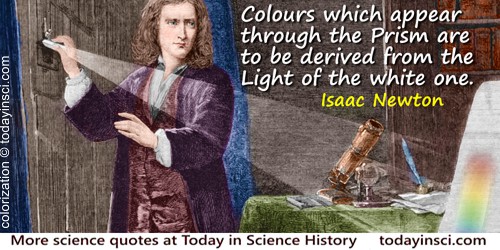
And if one look through a Prism upon a white Object encompassed with blackness or darkness, the reason of the Colours arising on the edges is much the same, as will appear to one that shall a little consider it. If a black Object be encompassed with a white one, the Colours which appear through the Prism are to be derived from the Light of the white one, spreading into the Regions of the black, and therefore they appear in a contrary order to that, when a white Object is surrounded with black. And the same is to be understood when an Object is viewed, whose parts are some of them less luminous than others. For in the borders of the more and less luminous Parts, Colours ought always by the same Principles to arise from the Excess of the Light of the more luminous, and to be of the same kind as if the darker parts were black, but yet to be more faint and dilute.
Opticks (1704), Book I, Part 2, Prop. VIII, Prob. III, 123.
And, notwithstanding a few exceptions, we do undoubtedly find that the most truly eminent men have had not only their affections, but also their intellect, greatly influenced by women. I will go even farther; and I will venture to say that those who have not undergone that influence betray a something incomplete and mutilated. We detect, even in their genius, a certain frigidity of tone; and we look in vain for that burning fire, that gushing and spontaneous nature with which our ideas of genius are indissolubly associated. Therefore, it is, that those who are most anxious that the boundaries of knowledge should be enlarged, ought to be most eager that the influence of women should be increased, in order that every resource of the human mind may be at once and quickly brought into play.
Lecture (19 Mar 1858) at the Royal Institution, 'The Influence Of Women On The Progress Of Knowledge', collected in The Miscellaneous and Posthumous Works of Henry Thomas Buckle (1872), Vol. 1, 17. Published in Frazier’s Magazine (Apr 1858).
Animals, even plants, lie to each other all the time, and we could restrict the research to them, putting off the real truth about ourselves for the several centuries we need to catch our breath. What is it that enables certain flowers to resemble nubile insects, or opossums to play dead, or female fireflies to change the code of their flashes in order to attract, and then eat, males of a different species?
In Late Night Thoughts on Listening to Mahler's Ninth Symphony(1984), 131.
Anthropology has reached that point of development where the careful investigation of facts shakes our firm belief in the far-reaching theories that have been built up. The complexity of each phenomenon dawns on our minds, and makes us desirous of proceeding more cautiously. Heretofore we have seen the features common to all human thought. Now we begin to see their differences. We recognize that these are no less important than their similarities, and the value of detailed studies becomes apparent. Our aim has not changed, but our method must change. We are still searching for the laws that govern the growth of human culture, of human thought; but we recognize the fact that before we seek for what is common to all culture, we must analyze each culture by careful and exact methods, as the geologist analyzes the succession and order of deposits, as the biologist examines the forms of living matter. We see that the growth of human culture manifests itself in the growth of each special culture. Thus we have come to understand that before we can build up the theory of the growth of all human culture, we must know the growth of cultures that we find here and there among the most primitive tribes of the Arctic, of the deserts of Australia, and of the impenetrable forests of South America; and the progress of the civilization of antiquity and of our own times. We must, so far as we can, reconstruct the actual history of mankind, before we can hope to discover the laws underlying that history.
The Jesup North Pacific Expedition: Memoir of the American Museum of Natural History (1898), Vol. 1, 4.

Anyone who thinks we can continue to have world wars but make them nice polite affairs by outlawing this weapon or that should meditate upon the outlawing of the cross-bow by Papal authority. Setting up the machinery for international law and order must surely precede disarmament. The Wild West did not abandon its shooting irons till after sheriffs and courts were established.
Speech, American Library Assiciation Conference (3 Jul 1947), as quoted by Lawrence E. Davies in 'Army's Atomic Bid Viewed in Making', New York Times (4 Jul 1947), 11.
Art and religion first; then philosophy; lastly science. That is the order of the great subjects of life, that’s their order of importance.
Dialog by the character Miss Brodie, in The Prime of Miss Jean Brodie (1961, 2004), 23-24.
Art is an expression of the world order and is, therefore, orderly, organic, subject to mathematical law, and susceptible to mathematical analysis.
In 'The Theosophic View of the Art of Architecture', The Beautiful Necessity, Seven Essays on Theosophy and Architecture (2nd ed., 1922), Preface to the Second Edition, 11.
As a second year high school chemistry student, I still have a vivid memory of my excitement when I first saw a chart of the periodic table of elements. The order in the universe seemed miraculous, and I wanted to study and learn as much as possible about the natural sciences.
In Tore Frängsmyr and Jan E. Lindsten (eds.), Nobel Lectures: Physiology Or Medicine: 1981-1990 (1993), 555.
As an antiquary of a new order, I have been obliged to learn the art of deciphering and restoring these remains, of discovering and bringing together, in their primitive arrangement, the scattered and mutilated fragments of which they are composed, of reproducing in all their original proportions and characters, the animals to which these fragments formerly belonged, and then of comparing them with those animals which still live on the surface of the earth; an art which is almost unknown, and which presupposes, what had scarcely been obtained before, an acquaintance with those laws which regulate the coexistence of the forms by which the different parts of organized being are distinguished.
'Preliminary discourse', to Recherches sur les Ossemens Fossiles (1812), trans. R. Kerr Essay on the Theory of the Earth (1813), 1-2.
As far as the meaning of life in general, or in the abstract, as far as I can see, there is none. If all of life were suddenly to disappear from earth and anywhere else it may exist, or if none had ever formed in the first place, I think the Universe would continue to exist without perceptible change. However, it is always possible for an individual to invest his own life with meaning that he can find significant. He can so order his life that he may find as much beauty and wisdom in it as he can, and spread as much of that to others as possible.
In a book proposal for The Meaning of Life edited by Hugh S. Moorhead, 1989.
As for me ... I would much rather be a perfected ape than a degraded Adam. Yes, if it is shown to me that my humble ancestors were quadrupedal animals, arboreal herbivores, brothers or cousins of those who were also the ancestors of monkeys and apes, far from blushing in shame for my species because of its genealogy and parentage, I will be proud of all that evolution has accomplished, of the continuous improvement which takes us up to the highest order, of the successive triumphs that have made us superior to all of the other species ... the splendid work of progress.
I will conclude in saying: the fixity of species is almost impossible, it contradicts the mode of succession and of the distribution of species in the sequence of extant and extinct creatures. It is therefore extremely likely that species are variable and are subject to evolution. But the causes, the mechanisms of this evolution are still unknown.
I will conclude in saying: the fixity of species is almost impossible, it contradicts the mode of succession and of the distribution of species in the sequence of extant and extinct creatures. It is therefore extremely likely that species are variable and are subject to evolution. But the causes, the mechanisms of this evolution are still unknown.
'Discussion sur la Machoire Humaine de la Naulette (Belgique)', Bulletin de la Societé d'Anthropologie de Paris, 2nd Series, I (1866), 595. Trans. Erik Trinkaus and Pat Shipman, The Neanderthals: Changing the Image of Mankind (1993), 103-4.
As historians, we refuse to allow ourselves these vain speculations which turn on possibilities that, in order to be reduced to actuality, suppose an overturning of the Universe, in which our globe, like a speck of abandoned matter, escapes our vision and is no longer an object worthy of our regard. In order to fix our vision, it is necessary to take it such as it is, to observe well all parts of it, and by indications infer from the present to the past.
'Second Discours: Histoire et Theorie de la Terre', Histoire Naturelle, Ginerale et Particulière, Avec la Description du Cabinet du Roi (1749), Vol. 1, 98-9. Trans. Phillip R. Sloan.
As is well known the principle of virtual velocities transforms all statics into a mathematical assignment, and by D'Alembert's principle for dynamics, the latter is again reduced to statics. Although it is is very much in order that in gradual training of science and in the instruction of the individual the easier precedes the more difficult, the simple precedes the more complicated, the special precedes the general, yet the min, once it has arrived at the higher standpoint, demands the reverse process whereby all statics appears only as a very special case of mechanics.
Collected Works (1877), Vol. 5, 25-26. Quoted in G. Waldo Dunnington, Carl Friedrich Gauss: Titan of Science (2004), 412.
As mineralogy constitutes a part of chemistry, it is clear that this arrangement [of minerals] must derive its principles from chemistry. The most perfect mode of arrangement would certainly be to allow bodies to follow each other according to the order of their electro-chemical properties, from the most electro-negative, oxygen, to the most electro-positive, potassium; and to place every compound body according to its most electro-positive ingredient.
An Attempt to Establish a Pure Scientific System of Mineralogy (1814), trans. J. Black, 48.
As soon … as it was observed that the stars retained their relative places, that the times of their rising and setting varied with the seasons, that sun, moon, and planets moved among them in a plane, … then a new order of things began.… Science had begun, and the first triumph of it was the power of foretelling the future; eclipses were perceived to recur in cycles of nineteen years, and philosophers were able to say when an eclipse was to be looked for. The periods of the planets were determined. Theories were invented to account for their eccentricities; and, false as those theories might be, the position of the planets could be calculated with moderate certainty by them.
Lecture delivered to the Royal Institution (5 Feb 1864), 'On the Science of History'. Collected in Notices of the Proceedings at the Meetings of the Members of the Royal Institution of Great Britain with Abstracts of the Discourses (1866), Vol. 4, 187.
As the nineteenth century drew to a close, scientists could reflect with satisfaction that they had pinned down most of the mysteries of the physical world: electricity, magnetism, gases, optics, acoustics, kinetics and statistical mechanics … all had fallen into order before them. They had discovered the X ray, the cathode ray, the electron, and radioactivity, invented the ohm, the watt, the Kelvin, the joule, the amp, and the little erg.
A Short History of Nearly Everything. In Clifford A. Pickover, Archimedes to Hawking: Laws of Science and the Great Minds Behind Them (2008), 172.
As usual, the author in his thorough, unobjective fashion has marshalled up all the good, indifferent and bad arguments ... I offer the following detailed comments ... though I realize that many of them will arouse him to a vigorous, if not violent rebuttal. In order to preserve the pH of Dr. Brown's digestive system I would not require a rebuttal as a condition of publication...
With heartiest greetings of the season to you and yours! Jack Roberts
PS The above comments should (help) to reduce your winter heating bill!
Jack Roberts' referee's report on Herbert Charles Brown's paper with Rachel Kornblum on the role of steric strain in carbonium ion reactions.
With heartiest greetings of the season to you and yours! Jack Roberts
PS The above comments should (help) to reduce your winter heating bill!
Jack Roberts' referee's report on Herbert Charles Brown's paper with Rachel Kornblum on the role of steric strain in carbonium ion reactions.
As quoted by D. A. Davenport, in 'On the Comparative Unimportance of the Invective Effect', Chemtech (Sep 1987), 17, 530.
At the entrance to the observatory Stjerneborg located underground, Tycho Brahe built a Ionic portal. On top of this were three sculptured lions. On both sides were inscriptions and on the backside was a longer inscription in gold letters on a porfyr stone: Consecrated to the all-good, great God and Posterity. Tycho Brahe, Son of Otto, who realized that Astronomy, the oldest and most distinguished of all sciences, had indeed been studied for a long time and to a great extent, but still had not obtained sufficient firmness or had been purified of errors, in order to reform it and raise it to perfection, invented and with incredible labour, industry, and expenditure constructed various exact instruments suitable for all kinds of observations of the celestial bodies, and placed them partly in the neighbouring castle of Uraniborg, which was built for the same purpose, partly in these subterranean rooms for a more constant and useful application, and recommending, hallowing, and consecrating this very rare and costly treasure to you, you glorious Posterity, who will live for ever and ever, he, who has both begun and finished everything on this island, after erecting this monument, beseeches and adjures you that in honour of the eternal God, creator of the wonderful clockwork of the heavens, and for the propagation of the divine science and for the celebrity of the fatherland, you will constantly preserve it and not let it decay with old age or any other injury or be removed to any other place or in any way be molested, if for no other reason, at any rate out of reverence to the creator’s eye, which watches over the universe. Greetings to you who read this and act accordingly. Farewell!
(Translated from the original in Latin)
Attempts have been made from a study of the changes produced by mutation to obtain the relative order of the bases within various triplets, but my own view is that these are premature until there is more extensive and more reliable data on the composition of the triplets.
In Nobel Lecture (11 Dec 1962). Collected in Nobel Lectures, Physiology or Medicine 1942-1962 (1964).
Available energy is energy which we can direct into any desired channel. Dissipated energy is energy which we cannot lay hold of and direct at pleasure, such as the energy of the confused agitation of molecules which we call heat. Now, confusion, like the correlative term order, is not a property of material things in themselves, but only in relation to the mind which perceives them. A memorandum-book does not, provided it is neatly written, appear confused to an illiterate person, or to the owner who understands it thoroughly, but to any other person able to read it appears to be inextricably confused. Similarly the notion of dissipated energy could not occur to a being who could not turn any of the energies of nature to his own account, or to one who could trace the motion of every molecule and seize it at the right moment. It is only to a being in the intermediate stage, who can lay hold of some forms of energy while others elude his grasp, that energy appears to be passing inevitably from the available to the dissipated state.
'Diffusion', Encyclopaedia Britannica (1878). In W. D. Niven (ed.), The Scientific Papers of James Clerk Maxwell (1890), Vol. 2, 646.
Beneath all the wealth of detail in a geological map lies an elegant, orderly simplicity.
As quoted in G.D. Garland, 'John Tuzo Wilson', Biographical Memoirs of Fellows of the Royal Society (Nov 1995), 552.
Both science and art have to do with ordered complexity.
In The Griffin (1957), 6, No 10.
Both the man of science and the man of art live always at the edge of mystery, surrounded by it; both always, as to the measure of their creation, have had to do with the harmonization of what is new with what is familiar, with the balance between novelty and synthesis, with the struggle to make partial order in total chaos.
Address at the close of the year-long Bicentennial Celebration of Columbia University (26 Dec 54). Printed in 'Prospects in the Arts and Sciences', Bulletin of the Atomic Scientists (Feb 1955), 52.
But here it may be objected, that the present Earth looks like a heap of Rubbish and Ruines; And that there are no greater examples of confusion in Nature than Mountains singly or jointly considered; and that there appear not the least footsteps of any Art or Counsel either in the Figure and Shape, or Order and Disposition of Mountains and Rocks. Wherefore it is not likely they came so out of God's hands ... To which I answer, That the present face of the Earth with all its Mountains and Hills, its Promontaries and Rocks, as rude and deformed as they appear, seems to me a very beautiful and pleasant object, and with all the variety of Hills, and Valleys, and Inequalities far more grateful to behold, than a perfectly level Countrey without any rising or protuberancy, to terminate the sight: As anyone that hath but seen the Isle of Ely, or any the like Countrey must need acknowledge.
— John Ray
Miscellaneous Discourses Concerning the Dissolution and Changes of the World (1692), 165-6.
But I think that in the repeated and almost entire changes of organic types in the successive formations of the earth—in the absence of mammalia in the older, and their very rare appearance (and then in forms entirely. unknown to us) in the newer secondary groups—in the diffusion of warm-blooded quadrupeds (frequently of unknown genera) through the older tertiary systems—in their great abundance (and frequently of known genera) in the upper portions of the same series—and, lastly, in the recent appearance of man on the surface of the earth (now universally admitted—in one word, from all these facts combined, we have a series of proofs the most emphatic and convincing,—that the existing order of nature is not the last of an uninterrupted succession of mere physical events derived from laws now in daily operation: but on the contrary, that the approach to the present system of things has been gradual, and that there has been a progressive development of organic structure subservient to the purposes of life.
'Address to the Geological Society, delivered on the Evening of the 18th of February 1831', Proceedings of the Geological Society (1834), 1, 305-6.
But if any skillful minister of nature shall apply force to matter, and by design torture and vex it, in order to [effect] its annihilation, it, on the contrary being brought under this necessity, changes and transforms itself into a strange variety of shapes and appearances; for nothing but the power of the Creator can annihilate, or truly destroy it.
As quoted in M.J. Gorton, 'The Weather', Popular Science News (1889), 23, No. 8, 115.
But it seems to me equally obvious that the orderliness is not all-pervasive. There are streaks of order to be found among the chaos, and the nature of scientific method is to seek these out and to stick to them when found and to reject or neglect the chaos. It is obvious that we have succeeded in finding some order in nature, but this fact in itself does not prove anything farther.
Scientific Method: An Inquiry into the Character and Validy of Natural Law (1923), 200.
But to proceed; as in order and place, so also in matter of her Creation, Woman far excells Man. things receive their value from the matter they are made of, and the excellent skill of their maker: Pots of common clay must not contend with China-dishes, nor pewter utensils vye dignity with those of silver…. Woman was not composed of any inanimate or vile dirt, but of a more refined and purified substance, enlivened and actuated by a Rational Soul, whose operations speak it a beam, or bright ray of Divinity.
In Female Pre-eminence: Or, The Dignity and Excellency of that Sex above the Male, translation (1670).
But when science, passing beyond its own limits, assumes to take the place of theology, and sets up its own conception of the order of Nature as a sufficient account of its cause, it is invading a province of thought to which it has no claim, and not unreasonably provokes the hostility of its best friends.
Presidential Address (14 Aug 1872) to the British Association for the Advancement of Science, Brighton, reprinted in The Journal of the Society of Arts (16 Aug 1872), 20, No. 1030, 799, penultimate sentence.
But, as we consider the totality of similarly broad and fundamental aspects of life, we cannot defend division by two as a natural principle of objective order. Indeed, the ‘stuff’ of the universe often strikes our senses as complex and shaded continua, admittedly with faster and slower moments, and bigger and smaller steps, along the way. Nature does not dictate dualities, trinities, quarterings, or any ‘objective’ basis for human taxonomies; most of our chosen schemes, and our designated numbers of categories, record human choices from a cornucopia of possibilities offered by natural variation from place to place, and permitted by the flexibility of our mental capacities. How many seasons (if we wish to divide by seasons at all) does a year contain? How many stages shall we recognize in a human life?
…...
By its very nature the uterus is a field for growing the seeds, that is to say the ova, sown upon it. Here the eggs are fostered, and here the parts of the living [fetus], when they have further unfolded, become manifest and are made strong. Yet although it has been cast off by the mother and sown, the egg is weak and powerless and so requires the energy of the semen of the male to initiate growth. Hence in accordance with the laws of Nature, and like the other orders of living things, women produce eggs which, when received into the chamber of the uterus and fecundated by the semen of the male, unfold into a new life.
'On the Developmental Process', in H. B. Adelmann (ed.), Marcello Malpighi and the Evolution of Embryology (1966), Vol. 2, 861.
By the fruit one judges the tree; the tree of science grows exceedingly slowly; centuries elapse before one can pluck the ripe fruits; even today it is hardly possible for us to shell and appraise the kernel of the teachings that blossomed in the seventeenth century. He who sows cannot therefore judge the worth of the corn. He must have faith in the fruitfulness of the seed in order that he may follow untiringly his chosen furrow when he casts his ideas to the four winds of heaven.
As quoted in Philipp Frank, Modern Science and its Philosophy (1949), 62, which cites Évolution de la Mécanique (1903).
Carry when walking a book, and a note-book to preserve the ideas, and a piece of bread in order to prolong the walk if need be.
From Appendix A, 'Extracts From the Unpublished Writings of Carnot', Reflections on the Motive Power of Heat (1890, 2nd ed. 1897), 205.
Casting off the dark fog of verbal philosophy and vulgar medicine, which inculcate names alone ... I tried a series of experiments to explain more clearly many phenomena, particularly those of physiology. In order that I might subject as far as possible the reasonings of the Galenists and Peripatetics to sensory criteria, I began, after trying experiments, to write dialogues in which a Galenist adduced the better-known and stronger reasons and arguments; these a mechanist surgeon refuted by citing to the contrary the experiments I had tried, and a third, neutral interlocutor weighed the reasons advanced by both and provided an opportunity for further progress.
'Malpighi at Pisa 1656-1659', in H. B. Adelmann (ed.), Marcello Malpighi and the Evolution of Embryology (1966), Vol. 1, 155-6.
Causality may be considered as a mode of perception by which we reduce our sense impressions to order.
In Atomic Theory and the Description of Nature (1929, 1961), 116-117.
Chaos often breeds life when order breeds habit.
The Education of Henry Adams (1907, 1918), 249.
Chaos was the law of nature; order was the dream of man.
From his autobiography, The Education of Henry Adams (1907, 1918), 451.
Chemistry is an art that has furnished the world with a great number of useful facts, and has thereby contributed to the improvement of many arts; but these facts lie scattered in many different books, involved in obscure terms, mixed with many falsehoods, and joined to a great deal of false philosophy; so that it is not great wonder that chemistry has not been so much studied as might have been expected with regard to so useful a branch of knowledge, and that many professors are themselves but very superficially acquainted with it. But it was particularly to be expected, that, since it has been taught in universities, the difficulties in this study should have been in some measure removed, that the art should have been put into form, and a system of it attempted—the scattered facts collected and arranged in a proper order. But this has not yet been done; chemistry has not yet been taught but upon a very narrow plan. The teachers of it have still confined themselves to the purposes of pharmacy and medicine, and that comprehends a small branch of chemistry; and even that, by being a single branch, could not by itself be tolerably explained.
John Thomson, An Account of the Life, Lectures and Writings of William Cullen, M.D. (1832), Vol. 1, 40.
Chemistry is the science or study of those effects and qualities of matter which are discovered by mixing bodies variously together, or applying them to one another with a view to mixture, and by exposing them to different degrees of heat, alone, or in mixture with one another, in order to enlarge our knowledge of nature, and to promote the useful arts.
From the first of a series of lectures on chemistry, collected in John Robison (ed.), Lectures on the Elements of Chemistry: Delivered in the University of Edinburgh (1807), Vol. 1, 11.
Chemistry is the study of material transformations. Yet a knowledge of the rate, or time dependence, of chemical change is of critical importance for the successful synthesis of new materials and for the utilization of the energy generated by a reaction. During the past century it has become clear that all macroscopic chemical processes consist of many elementary chemical reactions that are themselves simply a series of encounters between atomic or molecular species. In order to understand the time dependence of chemical reactions, chemical kineticists have traditionally focused on sorting out all of the elementary chemical reactions involved in a macroscopic chemical process and determining their respective rates.
'Molecular Beam Studies of Elementary Chemical Processes', Nobel Lecture, 8 Dec 1986. In Nobel Lectures: Chemistry 1981-1990 (1992), 320.
Chemists must unite in order to force upon the reluctant world the power of their discoveries.
Shortly after World War I. Quoted, as a memory of Pope, in Sir William Jackson Pope Memorial Lecture by Leslie H. Lampitt, 'Sir William Jackson Pope: His Influence on Scientific Organisation' Journal of the Royal Society of Arts (31 Jan 1947), 95, No. 4736, 174. Webmaster notes that this is given as a memory, and the wording therefore may not be verbatim.
Children are to be guided to make a beginning in all the arts and sciences without interference with their spontaneity, the instinct of imitation being so used as to give them order without constraining them.
In Friedrich Fröbel and Josephine Jarvis (trans.), 'American Preface', The Education of Man (1885), vi.
Concepts that have proven useful in ordering thi ngs easily achieve such authority over us that we forget their earthly origins and accept them as unalterable givens.
…...
Confined to its true domain, mathematical reasoning is admirably adapted to perform the universal office of sound logic: to induce in order to deduce, in order to construct. … It contents itself to furnish, in the most favorable domain, a model of clearness, of precision, and consistency, the close contemplation of which is alone able to prepare the mind to render other conceptions also as perfect as their nature permits. Its general reaction, more negative than positive, must consist, above all, in inspiring us everywhere with an invincible aversion for vagueness, inconsistency, and obscurity, which may always be really avoided in any reasoning whatsoever, if we make sufficient effort.
In Synthèse Subjective (1856), 98. As translated in Robert Édouard Moritz, Memorabilia Mathematica; Or, The Philomath’s Quotation-Book (1914), 202-203. From the original French, “Bornée à son vrai domaine, la raison mathématique y peut admirablement remplir l’office universel de la saine logique: induire pour déduire, afin de construire. … Elle se contente de former, dans le domaine le plus favorable, un type de clarté, de précision, et de consistance, dont la contemplation familière peut seule disposer l’esprit à rendre les autres conceptions aussi parfaites que le comporte leur nature. Sa réaction générale, plus négative que positive, doit surtout consister à nous inspirer partout une invincible répugnance pour le vague, l’incohérence, et l’obscurité, que nous pouvons réellement éviter envers des pensées quelconques, si nous y faisons assez d’efforts.”
Connected by innumerable ties with abstract science, Physiology is yet in the most intimate relation with humanity; and by teaching us that law and order, and a definite scheme of development, regulate even the strangest and wildest manifestations of individual life, she prepares the student to look for a goal even amidst the erratic wanderings of mankind, and to believe that history offers something more than an entertaining chaos—a journal of a toilsome, tragi-comic march nowither.
In 'Educational Value of Natural History Sciences', Lay Sermons, Addresses, and Reviews (1870), 97.
Coterminous with space and coeval with time is the kingdom of Mathematics; within this range her dominion is supreme; otherwise than according to her order nothing can exist; in contradiction to her laws nothing takes place. On her mysterious scroll is to be found written for those who can read it that which has been, that which is, and that which is to come.
From Presidential Address (Aug 1878) to the British Association, Dublin, published in the Report of the 48th Meeting of the British Association for the Advancement of Science (1878), 31.
Creatures that by a rule in nature teach
The act of order to a peopled kingdom.
They have a king and officers of sorts;
Where some, like magistrates, correct at home,
Others, like merchants, venture trade abroad,
Others, like soldiers, armed in their stings,
Make boot upon the summer's velvet buds;
Which pillage they with merry march bring home
To the tent-royal of their emperor.
Who, busied in his majesty, surveys
The singing masons building roofs of gold;
The civil citizens kneading up the honey;
The poor mechanic porters crowding
Their heavy burdens at his narrow gate;
The sad-eyed justice, with his surly hum,
Delivering o'er to executors pale
The lazy yawning drone.
The act of order to a peopled kingdom.
They have a king and officers of sorts;
Where some, like magistrates, correct at home,
Others, like merchants, venture trade abroad,
Others, like soldiers, armed in their stings,
Make boot upon the summer's velvet buds;
Which pillage they with merry march bring home
To the tent-royal of their emperor.
Who, busied in his majesty, surveys
The singing masons building roofs of gold;
The civil citizens kneading up the honey;
The poor mechanic porters crowding
Their heavy burdens at his narrow gate;
The sad-eyed justice, with his surly hum,
Delivering o'er to executors pale
The lazy yawning drone.
Henry V (1599), I, ii.
Discoveries are not generally made in the order of their scientific arrangement: their connexions and relations are made out gradually; and it is only when the fermentation of invention has subsided that the whole clears into simplicity and order.
In 'The Equilibrium of Forces on a Point', Elementary Treatise on Mechanics (1819), Vol. 1, Preface, iii.
Each nerve cell receives connections from other nerve cells at six sites called synapses. But here is an astonishing fact—there are about one million billion connections in the cortical sheet. If you were to count them, one connection (or synapse) per second, you would finish counting some thirty-two million years after you began. Another way of getting a feeling for the numbers of connections in this extraordinary structure is to consider that a large match-head’s worth of your brain contains about a billion connections. Notice that I only mention counting connections. If we consider how connections might be variously combined, the number would be hyperastronomical—on the order of ten followed by millions of zeros. (There are about ten followed by eighty zero’s worth of positively charged particles in the whole known universe!)
Bright and Brilliant Fire, On the Matters of the Mind (1992), 17.
Edward [Teller] isn’t the cloistered kind of scientist. He gets his ideas in conversation and develops them by trying them out on people. We were coming back from Europe on the Ile de France and I was standing in the ship’s nightclub when he came up and said, 'Freddie, I think I have an idea.’ It was something he’d just thought of about magnetohydrodynamics. I was a bachelor then and I’d located several good-looking girls on the ship, but I knew what I had to do, so I disappeared and started working on the calculations. I’d get something finished and start prowling on the deck again when Edward would turn up out of the night and we’d walk the deck together while he talked and I was the brick wall he was bouncing these things off of. By the end of the trip we had a paper. He’d had the ideas, and I’d done some solving of equations. But he insisted that we sign in alphabetical order, which put my name first.
As quoted in Robert Coughlan, 'Dr. Edward Teller’s Magnificent Obsession', Life (6 Sep 1954), 61-62.
EFFECT, n. The second of two phenomena which always occur together in the same order. The first, called a Cause, is said to generate the other—which is no more sensible than it would be for one who has never seen a dog except in pursuit of a rabbit to declare the rabbit the cause of the dog.
The Cynic's Word Book (1906), 86. Later published as The Devil's Dictionary.
Einstein’s space is no closer to reality than Van Gogh’s sky. The glory of science is not in a truth more absolute than the truth of Bach or Tolstoy, but in the act of creation itself. The scientist’s discoveries impose his own order on chaos, as the composer or painter imposes his; an order that always refers to limited aspects of reality, and is based on the observer's frame of reference, which differs from period to period as a Rembrandt nude differs from a nude by Manet.
In The Act of Creation (1964), 252.
Either an ordered Universe or a medley heaped together mechanically but still an order; or can order subsist in you and disorder in the Whole! And that, too, when all things are so distinguished and yet intermingled and sympathetic.
A. S. L. Farquharson (ed.), The Meditations of the Emperor Marcus Antoninus Aurelius (1944), Vol. I, Book IV, 63.
Energy of the tides is continuously being dissipated at a rate whose order of magnitude is a billion horsepower!
In The Tides: Pulse of the Earth (1968), 133.
Engineering is more closely akin to the arts than perhaps any other of the professions; first, because it requires the maximum of natural aptitude and of liking for the work in order to offset other factors; second, because it demands, like the arts, an almost selfless consecration to the job; and, third, because out of the hundreds who faithfully devote themselves to the task, only a few are destined to receive any significant reward—in either money or fame.
As coauthor with Frank W. Skinner, and Harold E. Wessman, 'Foreward', Vocational Guidance in Engineering Lines (1933), vi.
Environmentalism opposes reckless innovation and makes conservation the central order of business.
…...
Euclidean mathematics assumes the completeness and invariability of mathematical forms; these forms it describes with appropriate accuracy and enumerates their inherent and related properties with perfect clearness, order, and completeness, that is, Euclidean mathematics operates on forms after the manner that anatomy operates on the dead body and its members. On the other hand, the mathematics of variable magnitudes—function theory or analysis—considers mathematical forms in their genesis. By writing the equation of the parabola, we express its law of generation, the law according to which the variable point moves. The path, produced before the eyes of the student by a point moving in accordance to this law, is the parabola.
If, then, Euclidean mathematics treats space and number forms after the manner in which anatomy treats the dead body, modern mathematics deals, as it were, with the living body, with growing and changing forms, and thus furnishes an insight, not only into nature as she is and appears, but also into nature as she generates and creates,—reveals her transition steps and in so doing creates a mind for and understanding of the laws of becoming. Thus modern mathematics bears the same relation to Euclidean mathematics that physiology or biology … bears to anatomy.
If, then, Euclidean mathematics treats space and number forms after the manner in which anatomy treats the dead body, modern mathematics deals, as it were, with the living body, with growing and changing forms, and thus furnishes an insight, not only into nature as she is and appears, but also into nature as she generates and creates,—reveals her transition steps and in so doing creates a mind for and understanding of the laws of becoming. Thus modern mathematics bears the same relation to Euclidean mathematics that physiology or biology … bears to anatomy.
In Die Mathematik die Fackelträgerin einer neuen Zeit (1889), 38. As translated in Robert Édouard Moritz, Memorabilia Mathematica; Or, The Philomath’s Quotation-book (1914), 112-113.
Every lecture should state one main point and repeat it over and over, like a theme with variations. An audience is like a herd of cows, moving slowly in the direction they are being driven towards. If we make one point, we have a good chance that the audience will take the right direction; if we make several points, then the cows will scatter all over the field. The audience will lose interest and everyone will go back to the thoughts they interrupted in order to come to our lecture.
In 'Ten Lessons I Wish I Had Been Taught', Indiscrete Thoughts (2008), 196.
Every new discovery of science is a further 'revelation' of the order which God has built into His universe.
Magazine, Look (5 Apr 1955), 30.
Every time a significant discovery is being made one sets in motion a tremendous activity in laboratories and industrial enterprises throughout the world. It is like the ant who suddenly finds food and walks back to the anthill while sending out material called food attracting substance. The other ants follow the path immediately in order to benefit from the finding and continue to do so as long as the supply is rich.
Nobel Banquet speech (10 Dec 1982). In Wilhelm Odelberg (ed.), Les Prix Nobel. The Nobel Prizes 1982 (1983)
Everything material which is the subject of knowledge has number, order, or position; and these are her first outlines for a sketch of the universe. If our feeble hands cannot follow out the details, still her part has been drawn with an unerring pen, and her work cannot be gainsaid. So wide is the range of mathematical sciences, so indefinitely may it extend beyond our actual powers of manipulation that at some moments we are inclined to fall down with even more than reverence before her majestic presence. But so strictly limited are her promises and powers, about so much that we might wish to know does she offer no information whatever, that at other moments we are fain to call her results but a vain thing, and to reject them as a stone where we had asked for bread. If one aspect of the subject encourages our hopes, so does the other tend to chasten our desires, and he is perhaps the wisest, and in the long run the happiest, among his fellows, who has learned not only this science, but also the larger lesson which it directly teaches, namely, to temper our aspirations to that which is possible, to moderate our desires to that which is attainable, to restrict our hopes to that of which accomplishment, if not immediately practicable, is at least distinctly within the range of conception.
From Presidential Address (Aug 1878) to the British Association, Dublin, published in the Report of the 48th Meeting of the British Association for the Advancement of Science (1878), 31.
Facts, and facts alone, are the foundation of science... When one devotes oneself to experimental research it is in order to augment the sum of known facts, or to discover their mutual relations.
Precis elementaire de Physiologie (1816), ii. Trans. J. M. D. Olmsted, François Magendie: Pioneer in Experimental Physiology and Scientific Medicine in XIX Century France (1944), 62.
Far from becoming discouraged, the philosopher should applaud nature, even when she appears miserly of herself or overly mysterious, and should feel pleased that as he lifts one part of her veil, she allows him to glimpse an immense number of other objects, all worthy of investigation. For what we already know should allow us to judge of what we will be able to know; the human mind has no frontiers, it extends proportionately as the universe displays itself; man, then, can and must attempt all, and he needs only time in order to know all. By multiplying his observations, he could even see and foresee all phenomena, all of nature's occurrences, with as much truth and certainty as if he were deducing them directly from causes. And what more excusable or even more noble enthusiasm could there be than that of believing man capable of recognizing all the powers, and discovering through his investigations all the secrets, of nature!
'Des Mulets', Oeuvres Philosophiques, ed. Jean Piveteau (1954), 414. Quoted in Jacques Roger, The Life Sciences in Eighteenth-Century French Thought, ed. Keith R. Benson and trans. Robert Ellrich (1997), 458.
Finally, since I thought that we could have all the same thoughts, while asleep, as we have while we are awake, although none of them is true at that time, I decided to pretend that nothing that ever entered my mind was any more true than the illusions of my dreams. But I noticed, immediately afterwards, that while I thus wished to think that everything was false, it was necessarily the case that I, who was thinking this, was something. When I noticed that this truth “I think, therefore I am” was so firm and certain that all the most extravagant assumptions of the sceptics were unable to shake it, I judged that I could accept it without scruple as the first principle of the philosophy for which I was searching. Then, when I was examining what I was, I realized that I could pretend that I had no body, and that there was no world nor any place in which I was present, but I could not pretend in the same way that I did not exist. On the contrary, from the very fact that I was thinking of doubting the truth of other things, it followed very evidently and very certainly that I existed; whereas if I merely ceased to think, even if all the rest of what I had ever imagined were true, I would have no reason to believe that I existed. I knew from this that I was a substance, the whole essence or nature of which was to think and which, in order to exist, has no need of any place and does not depend on anything material. Thus this self—that is, the soul by which I am what I am—is completely distinct from the body and is even easier to know than it, and even if the body did not exist the soul would still be everything that it is.
Discourse on Method in Discourse on Method and Related Writings (1637), trans. Desmond M. Clarke, Penguin edition (1999), Part 4, 24-5.
First, In showing in how to avoid attempting impossibilities. Second, In securing us from important mistakes in attempting what is, in itself possible, by means either inadequate or actually opposed to the end in view. Thirdly, In enabling us to accomplish our ends in the easiest, shortest, most economical, and most effectual manner. Fourth, In inducing us to attempt, and enabling us to accomplish, object which, but for such knowledge, we should never have thought of understanding.
On the ways that a knowledge of the order of nature can be of use.
On the ways that a knowledge of the order of nature can be of use.
Quoted in Robert Routledge, Discoveries and Inventions of the 19th Century (1890), 665.
Following the example of Archimedes who wished his tomb decorated with his most beautiful discovery in geometry and ordered it inscribed with a cylinder circumscribed by a sphere, James Bernoulli requested that his tomb be inscribed with his logarithmic spiral together with the words, “Eadem mutata resurgo,” a happy allusion to the hope of the Christians, which is in a way symbolized by the properties of that curve.
From 'Eloge de M. Bernoulli', Oeuvres de Fontenelle, t. 5 (1768), 112. As translated in Robert Édouard Moritz, Memorabilia Mathematica; Or, The Philomath’s Quotation-Book (1914), 143-144. [The Latin phrase, Eadem numero mutata resurgo means as “Though changed, I arise again exactly the same”. —Webmaster]
For any one who is pervaded with the sense of causal law in all that happens, who accepts in real earnest the assumption of causality, the idea of a Being who interferes with the sequence of events in the world is absolutely impossible! Neither the religion of fear nor the social-moral religion can have, any hold on him. A God who rewards and punishes is for him unthinkable, because man acts in accordance with an inner and outer necessity, and would, in the eyes of God, be as little responsible as an inanimate object is for the movements which it makes. Science, in consequence, has been accused of undermining morals—but wrongly. The ethical behavior of man is better based on sympathy, education and social relationships, and requires no support from religion. Man’s plight would, indeed, be sad if he had to be kept in order through fear of punishment and hope of rewards after death.
From 'Religion and Science', The New York Times Magazine, (9 Nov 1930), 1. Article in full, reprinted in Edward H. Cotton (ed.), Has Science Discovered God? A Symposium of Modern Scientific Opinion (1931), 101. The wording differs significantly from the version collected in 'Religion And Science', Ideas And Opinions (1954), 39, giving its source as: “Written expressly for the New York Times Magazine. Appeared there November 9, 1930 (pp. 1-4). The German text was published in the Berliner Tageblatt, November 11, 1930.” This variant form of the quote from the book begins, “The man who is thoroughly convinced of the universal operation of the law of causation….” and is also on the Albert Einstein Quotes page on this website. As for why the difference, Webmaster speculates the book form editor perhaps used a revised translation from Einstein’s German article.
For centuries we have dreamt of flying; recently we made that come true: we have always hankered for speed; now we have speeds greater than we can stand: we wanted to speak to far parts of the Earth; we can: we wanted to explore the sea bottom; we have: and so on, and so on. And, too, we wanted the power to smash our enemies utterly; we have it. If we had truly wanted peace, we should have had that as well. But true peace has never been one of the genuine dreams—we have got little further than preaching against war in order to appease out consciences.
The Outward Urge (1959)
For in disease the most voluntary or most special movements, faculties, etc., suffer first and most, that is in an order the exact opposite of evolution. Therefore I call this the principle of Dissolution.
'On the Anatomical and Physiological Localisation of Movements in the Brain' (1875), Preface. In James Taylor (ed.), Selected Writings of John Hughlings Jackson, Vol. 1 (1931), 38.
For it is owing to their wonder that men now both begin and at first began to philosophize; they wondered originally at the obvious difficulties, then advanced little by little and stated difficulties about the greater matters, e.g. about the phenomena of the moon and those of the sun and the stars, and about the genesis of the universe. And a man who is puzzled and wonders thinks himself ignorant (whence even the lover of myth is in a sense a lover of wisdom, for myth is composed of wonders); therefore since they philosophized in order to escape from ignorance, evidently they were pursuing science in order to know, and not for any utilitarian end. And this is confirmed by the facts; for it was when almost all the necessities of life and the things that make for comfort and recreation were present, that such knowledge began to be sought. Evidently then we do not seek it for the sake of any advantage; but as the man is free, we say, who exists for himself and not for another, so we pursue this as the only free science, for it alone exists for itself.
Metaphysics, 982b, 12-27. In Jonathan Baines (ed.), The Complete Works of Aristotle (1984), Vol. 2, 1554.
For man being the minister and interpreter of nature, acts and understands so far as he has observed of the order, the works and mind of nature, and can proceed no further; for no power is able to loose or break the chain of causes, nor is nature to be conquered but by submission: whence those twin intentions, human knowledge and human power, are really coincident; and the greatest hindrance to works is the ignorance of causes.
In The Great lnstauration.
For me, the first challenge for computing science is to discover how to maintain order in a finite, but very large, discrete universe that is intricately intertwined. And a second, but not less important challenge is how to mould what you have achieved in solving the first problem, into a teachable discipline: it does not suffice to hone your own intellect (that will join you in your grave), you must teach others how to hone theirs. The more you concentrate on these two challenges, the clearer you will see that they are only two sides of the same coin: teaching yourself is discovering what is teachable.
…...
For me, the idea of a creation is not conceivable without invoking the necessity of design. One cannot be exposed to the law and order of the universe without concluding that there must be design and purpose behind it all.
In letter to California State board of Education (14 Sep 1972).
For most of history, man has had to fight nature to survive; in this century he is beginning to realize that, in order to survive, he must protect it.
…...
For my own part I would as soon be descended from that heroic little monkey, who braved his dreaded enemy in order to save the life of his keeper; or from that old baboon, who, descending from the mountains, carried away in triumph his young comrade from a crowd of astonished dogs—as from a savage who delights to torture his enemies, offers up bloody sacrifices, practices infanticide without remorse, treats his wives like slaves, knows no decency, and is haunted by the grossest superstitions.
The Descent of Man (1871), Vol. 2, 404-5.
For myself, I found that I was fitted for nothing so well as for the study of Truth; as having a mind nimble and versatile enough to catch the resemblances of things (which is the chief point) , and at the same time steady enough to fix and distinguish their subtler differences; as being gifted by nature with desire to seek, patience to doubt, fondness to meditate, slowness to assert, readiness to reconsider, carefulness to dispose and set in order; and as being a man that neither affects what is new nor admires what is old, and that hates every kind of imposture. So I thought my nature had a kind of familiarity and relationship with Truth.
From 'Progress of philosophical speculations. Preface to intended treatise De Interpretatione Naturæ (1603), in Francis Bacon and James Spedding (ed.), Works of Francis Bacon (1868), Vol. 3, 85.
For that which can shewn only in a certain Light is questionable. Truth, ’tis suppos’d, may bear all Lights: and one of those principal Lights or natural Mediums, by which Things are to be view’d, in order to a thorow Recognition, is Ridicule it-self.
Also seen in short form: “Ridicule is the test of truth.”
Also seen in short form: “Ridicule is the test of truth.”
In 'An Essay on the Freedom of Wit and Humour', Characteristicks of Men, Manners, Opinions, Times (1723), Vol. 1, 61.
For the evolution of science by societies the main requisite is the perfect freedom of communication between each member and anyone of the others who may act as a reagent.
The gaseous condition is exemplified in the soiree, where the members rush about confusedly, and the only communication is during a collision, which in some instances may be prolonged by button-holing.
The opposite condition, the crystalline, is shown in the lecture, where the members sit in rows, while science flows in an uninterrupted stream from a source which we take as the origin. This is radiation of science. Conduction takes place along the series of members seated round a dinner table, and fixed there for several hours, with flowers in the middle to prevent any cross currents.
The condition most favourable to life is an intermediate plastic or colloidal condition, where the order of business is (1) Greetings and confused talk; (2) A short communication from one who has something to say and to show; (3) Remarks on the communication addressed to the Chair, introducing matters irrelevant to the communication but interesting to the members; (4) This lets each member see who is interested in his special hobby, and who is likely to help him; and leads to (5) Confused conversation and examination of objects on the table.
I have not indicated how this programme is to be combined with eating.
The gaseous condition is exemplified in the soiree, where the members rush about confusedly, and the only communication is during a collision, which in some instances may be prolonged by button-holing.
The opposite condition, the crystalline, is shown in the lecture, where the members sit in rows, while science flows in an uninterrupted stream from a source which we take as the origin. This is radiation of science. Conduction takes place along the series of members seated round a dinner table, and fixed there for several hours, with flowers in the middle to prevent any cross currents.
The condition most favourable to life is an intermediate plastic or colloidal condition, where the order of business is (1) Greetings and confused talk; (2) A short communication from one who has something to say and to show; (3) Remarks on the communication addressed to the Chair, introducing matters irrelevant to the communication but interesting to the members; (4) This lets each member see who is interested in his special hobby, and who is likely to help him; and leads to (5) Confused conversation and examination of objects on the table.
I have not indicated how this programme is to be combined with eating.
Letter to William Grylls Adams (3 Dec 1873). In P. M. Harman (ed.), The Scientific Letters and Papers of James Clerk Maxwell (1995), Vol. 2, 1862-1873, 949-50.
For the first time I saw a medley of haphazard facts fall into line and order. All the jumbles and recipes and Hotchpotch of the inorganic chemistry of my boyhood seemed to fit into the scheme before my eyes-as though one were standing beside a jungle and it suddenly transformed itself into a Dutch garden. “But it’s true,” I said to myself “It’s very beautiful. And it’s true.”
How the Periodic Table was explained in a first-term university lecture to the central character in the novel by C.P. Snow, The Search (1935), 38.
For the holy Bible and the phenomena of nature proceed alike from the divine Word, the former as the dictate of the Holy Ghost and the latter as the observant executrix of God's commands. It is necessary for the Bible, in order to be accommodated to the understanding of every man, to speak many things which appear to differ from the absolute truth so far as the bare meaning of the words is concerned. But Nature, on the other hand, is inexorable and immutable; she never transgresses the laws imposed upon her, or cares a whit whether her abstruse reasons and methods of operation are understandable to men. For that reason it appears that nothing physical which sense-experience sets before our eyes, or which necessary demonstrations prove to us, ought to be called in question (much less condemned) upon the testimony of biblical passages which may have some different meaning beneath their words.
Letter to Madame Christina of Lorraine, Grand Duchess of Tuscany: Concerning the Use of Biblical Quotations in Matters of Science (1615), trans. Stillman Drake, Discoveries and Opinions of Galileo (1957), 182-3.
For the philosopher, order is the entirety of repetitions manifested, in the form of types or of laws, by perceived objects. Order is an intelligible relation. For the biologist, order is a sequence in space and time. However, according to Plato, all things arise out of their opposites. Order was born of the original disorder, and the long evolution responsible for the present biological order necessarily had to engender disorder.
An organism is a molecular society, and biological order is a kind of social order. Social order is opposed to revolution, which is an abrupt change of order, and to anarchy, which is the absence of order.
I am presenting here today both revolution and anarchy, for which I am fortunately not the only one responsible. However, anarchy cannot survive and prosper except in an ordered society, and revolution becomes sooner or later the new order. Viruses have not failed to follow the general law. They are strict parasites which, born of disorder, have created a very remarkable new order to ensure their own perpetuation.
An organism is a molecular society, and biological order is a kind of social order. Social order is opposed to revolution, which is an abrupt change of order, and to anarchy, which is the absence of order.
I am presenting here today both revolution and anarchy, for which I am fortunately not the only one responsible. However, anarchy cannot survive and prosper except in an ordered society, and revolution becomes sooner or later the new order. Viruses have not failed to follow the general law. They are strict parasites which, born of disorder, have created a very remarkable new order to ensure their own perpetuation.
'Interaction Among Virus, Cell, and Organism', Nobel Lecture (11 Dec 1965). In Nobel Lectures: Physiology or Medicine 1963-1970 (1972), 174.
For the world was built in order,
And the atoms march in tune.
And the atoms march in tune.
In poem, 'Monadnock', collected in Works of Ralph Waldo Emerson (1883), 533.
Form resolutions in advance in order not to reflect during action. Then obey thyself blindly.
From Appendix A, 'Extracts From the Unpublished Writings of Carnot', Reflections on the Motive Power of Heat (1890, 2nd ed. 1897), 206.
Former arbiters of taste must have felt (as so many apostles of ‘traditional values’ and other highminded tags for restriction and conformity do today) that maintaining the social order required a concept of unalloyed heroism. Human beings so designated as role models had to embody all virtues of the paragon–which meant, of course, that they could not be described in their truly human and ineluctably faulted form.
…...
Formerly one sought the feeling of the grandeur of man by pointing to his divine origin: this has now become a forbidden way, for at its portal stands the ape, together with other gruesome beasts, grinning knowingly as if to say: no further in this direction! One therefore now tries the opposite direction: the way mankind is going shall serve as proof of his grandeur and kinship with God. Alas this, too, is vain! At the end of this way stands the funeral urn of the last man and gravedigger (with the inscription “nihil humani a me alienum puto”). However high mankind may have evolved—and perhaps at the end it will stand even lower than at the beginning!— it cannot pass over into a higher order, as little as the ant and the earwig can at the end of its “earthly course” rise up to kinship with God and eternal life. The becoming drags the has-been along behind it: why should an exception to this eternal spectacle be made on behalf of some little star or for any little species upon it! Away with such sentimentalities!
Daybreak: Thoughts on the Prejudices of Morality (1881), trans. R. J. Hollingdale (1982), 32.
Freudian psychoanalytical theory is a mythology that answers pretty well to Levi-Strauss's descriptions. It brings some kind of order into incoherence; it, too, hangs together, makes sense, leaves no loose ends, and is never (but never) at a loss for explanation. In a state of bewilderment it may therefore bring comfort and relief … give its subject a new and deeper understanding of his own condition and of the nature of his relationship to his fellow men. A mythical structure will be built up around him which makes sense and is believable-in, regardless of whether or not it is true.
From 'Science and Literature', The Hope of Progress: A Scientist Looks at Problems in Philosophy, Literature and Science (1973), 29.
From this fountain (the free will of God) it is those laws, which we call the laws of nature, have flowed, in which there appear many traces of the most wise contrivance, but not the least shadow of necessity. These therefore we must not seek from uncertain conjectures, but learn them from observations and experimental. He who is presumptuous enough to think that he can find the true principles of physics and the laws of natural things by the force alone of his own mind, and the internal light of his reason, must either suppose the world exists by necessity, and by the same necessity follows the law proposed; or if the order of Nature was established by the will of God, the [man] himself, a miserable reptile, can tell what was fittest to be done.
…...
From whatever I have been able to observe up to this time the series of strata which form the visible crust of the earth appear to me classified in four general and successive orders. These four orders can be conceived to be four very large strata, as they really are, so that wherever they are exposed, they are disposed one above the other, always in the same order.
Quoted in Francesco Rodolico, 'Arduino', In Charles Coulston Gillispie (ed.), Dictionary of Scientific Biography (1970), Vol. 1, 234.
Furthermore, it’s equally evident that what goes on is actually one degree better than self-reproduction, for organisms appear to have gotten more elaborate in the course of time. Today's organisms are phylogenetically descended from others which were vastly simpler than they are, so much simpler, in fact, that it’s inconceivable, how any kind of description of the latter, complex organism could have existed in the earlier one. It’s not easy to imagine in what sense a gene, which is probably a low order affair, can contain a description of the human being which will come from it. But in this case you can say that since the gene has its effect only within another human organism, it probably need not contain a complete description of what is to happen, but only a few cues for a few alternatives. However, this is not so in phylogenetic evolution. That starts from simple entities, surrounded by an unliving amorphous milieu, and produce, something more complicated. Evidently, these organisms have the ability to produce something more complicated than themselves.
From lecture series on self-replicating machines at the University of Illinois, Lecture 5 (Dec 1949), 'Re-evaluation of the Problems of Complicated Automata—Problems of Hierarchy and Evolution', Theory of Self-Reproducing Automata (1966).
Geology is part of that remarkable dynamic process of the human mind which is generally called science and to which man is driven by an inquisitive urge. By noticing relationships in the results of his observations, he attempts to order and to explain the infinite variety of phenomena that at first sight may appear to be chaotic. In the history of civilization this type of progressive scientist has been characterized by Prometheus stealing the heavenly fire, by Adam eating from the tree of knowledge, by the Faustian ache for wisdom.
In 'The Scientific Character of Geology', The Journal of Geology (Jul 1961), 69, No. 4, 454.
God created, Linnaeus ordered.
Quoting the witticism current in the late eighteenth century in 'The Two Faces of Linnaeus', in Tore Frängsmyr (ed.), Linnaeus: The Man and his Work (1983), 22.
God has ordered all his Creation by Weight and Measure.
Written over the door of the world's first instructional laboratory, founded at Giessen, 1824.
Written over the door of the world's first instructional laboratory, founded at Giessen, 1824.
As given in Patterns of Survival: An Anatomy of Life (1938), 2. It is based on a line from the Bible in Wisdom of Solomon, Chap. 11, Verse 20. Webmaster presumes this is the English translation, but Liebig used the dictum written in German. Contact webmaster if you know the specific wording of the original.
Great thinkers build their edifices with subtle consistency. We do our intellectual forebears an enormous disservice when we dismember their visions and scan their systems in order to extract a few disembodied ‘gems’–thoughts or claims still accepted as true. These disarticulated pieces then become the entire legacy of our ancestors, and we lose the beauty and coherence of older systems that might enlighten us by their unfamiliarity–and their consequent challenge in our fallible (and complacent) modern world.
…...
Groves hated the weather, and the weathermen; they represented chaos and the messengers of chaos. Weather violated boundaries, ignored walls and gates, failed to adhere to deadlines, disobeyed orders. Weather caused delays. The weather forecasters had opposed the [atomic bomb] test date for months—it was set within a window of unfavorable conditions: thunderstorms, rain, high winds, inversion layers. Groves had overridden them. … Groves saw it as a matter of insubordination when the weather forecasters refused to forecast good weather for the test.
In Atomic Spaces: Living on the Manhattan Project (1999), 312. For the attitude of Groves toward the weather see his, 'Some Recollections of July 16, 1945', Bulletin of the Atomic Scientists (Jun 1970), 26, No. 6, 27.
He who has mastered the Darwinian theory, he who recognizes the slow and subtle process of evolution as the way in which God makes things come to pass, … sees that in the deadly struggle for existence that has raged throughout countless aeons of time, the whole creation has been groaning and travailing together in order to bring forth that last consummate specimen of God’s handiwork, the Human Soul
In The Destiny of Man Viewed in the Light of his Origin (1884), 32. Collected in Studies in Religion (1902), 19–20.
He who studies it [Nature] has continually the exquisite pleasure of discerning or half discerning and divining laws; regularities glimmer through an appearance of confusion, analogies between phenomena of a different order suggest themselves and set the imagination in motion; the mind is haunted with the sense of a vast unity not yet discoverable or nameable. There is food for contemplation which never runs short; you are gazing at an object which is always growing clearer, and yet always, in the very act of growing clearer, presenting new mysteries.
From 'Natural History', Macmillan's Magazine (1875), 31, 366.
Hope being the greatest of all blessings, it is necessary, in order to be happy, to sacrifice the present to the future.
From Appendix A, 'Extracts From the Unpublished Writings of Carnot', Reflections on the Motive Power of Heat (1890, 2nd ed. 1897), 209.
How do we discover the individual laws of Physics, and what is their nature? It should be remarked, to begin with, that we have no right to assume that any physical law exists, or if they have existed up to now, that they will continue to exist in a similar manner in the future. It is perfectly conceivable that one fine day Nature should cause an unexpected event to occur which would baffle us all; and if this were to happen we would be powerless to make any objection, even if the result would be that, in spite of our endeavors, we should fail to introduce order into the resulting confusion. In such an event, the only course open to science would be to declare itself bankrupt. For this reason, science is compelled to begin by the general assumption that a general rule of law dominates throughout Nature.
Max Planck, Walter Henry Johnston, The Universe in the Light of Modern Physics (1931), 58.
How strange is the lot of us mortals! Each of us is here for a brief sojourn; for what purpose he knows not, though he sometimes thinks he senses it. But without deeper reflection one knows from daily life that one exists for other people–first of all for those upon whose smiles and well-being our own happiness is wholly dependent, and then for the many, unknown to us, to whose destinies we are bound by the ties of sympathy. A hundred times every day I remind myself that my inner and outer life are based on the labors of other men, living and dead, and that I must exert myself in order to give in the same measure as I have received and am still receiving.
…...
However improbable we regard [the spontaneous origin of life],… it will almost certainly happen at least once…. The time… is of the order of two billion years.… Given so much time, the “impossible” becomes possible, the possible probable, and the probable virtually certain. One only has to wait: time itself performs the miracles.
In 'The Origin of Life', Scientific American (Aug 1954), 191, No. 2, 46. Note that the quoted time of 2 billion years is rejected as impossibly short by such authors as H. J. Morowitz, in Energy Flow in Biology (1968), 317.
I am astonished that in the United States a scientist gets into such trouble because of his scientific beliefs; that your activity in 1957 and 1958 in relation to the petition to the United Nations asking for a bomb-test agreement causes you now to be called before the authorities and ordered to give the names of the scientists who have the same opinions that you have and who have helped you to gather signatures to the petition. I think that I must be dreaming!
Letter to Linus Pauling (23 Jul 1960). As quoted on the Linus Pauling and the International Peace Movement website at scarc.library.oregonstate.edu.
I am very astonished that the scientific picture of the real world around me is deficient. It gives a lot of factual information, puts all our experience in a magnificently consistent order, but it is ghastly silent about all and sundry that is really near to our heart, that really matters to us. It cannot tell us a word about red and blue, bitter and sweet, physical pain and physical delight; it knows nothing of beautiful and ugly, good or bad, God and eternity. Science sometimes pretends to answer questions in these domains, but the answers are very often so silly that we are not inclined to take them seriously.
…...
I appeal to the contemptible speech made lately by Sir Robert Peel to an applauding House of Commons. 'Orders of merit,' said he, 'were the proper rewards of the military' (the desolators of the world in all ages). 'Men of science are better left to the applause of their own hearts.' Most learned Legislator! Most liberal cotton-spinner! Was your title the proper reward of military prowess? Pity you hold not the dungeon-keys of an English Inquisition! Perhaps Science, like creeds, would flourish best under a little persecution.
Chemical Recreations (1834), 232.
I believe that life can go on forever. It takes a million years to evolve a new species, ten million for a new genus, one hundred million for a class, a billion for a phylum—and that’s usually as far as your imagination goes. In a billion years, it seems, intelligent life might be as different from humans as humans are from insects. But what would happen in another ten billion years? It’s utterly impossible to conceive of ourselves changing as drastically as that, over and over again. All you can say is, on that kind of time scale the material form that life would take is completely open. To change from a human being to a cloud may seem a big order, but it’s the kind of change you’d expect over billions of years.
Quoted in Omni (1986), 8, 38.
I believe—and human psychologists, particularly psychoanalysts should test this—that present-day civilized man suffers from insufficient discharge of his aggressive drive. It is more than probable that the evil effects of the human aggressive drives, explained by Sigmund Freud as the results of a special death wish, simply derive from the fact that in prehistoric times intra-specific selection bred into man a measure of aggression drive for which in the social order today he finds no adequate outlet.
On Aggression, trans. M. Latzke (1966), 209.
I believed that, instead of the multiplicity of rules that comprise logic, I would have enough in the following four, as long as I made a firm and steadfast resolution never to fail to observe them.
The first was never to accept anything as true if I did not know clearly that it was so; that is, carefully to avoid prejudice and jumping to conclusions, and to include nothing in my judgments apart from whatever appeared so clearly and distinctly to my mind that I had no opportunity to cast doubt upon it.
The second was to subdivide each on the problems I was about to examine: into as many parts as would be possible and necessary to resolve them better.
The third was to guide my thoughts in an orderly way by beginning, as if by steps, to knowledge of the most complex, and even by assuming an order of the most complex, and even by assuming an order among objects in! cases where there is no natural order among them.
And the final rule was: in all cases, to make such comprehensive enumerations and such general review that I was certain not to omit anything.
The long chains of inferences, all of them simple and easy, that geometers normally use to construct their most difficult demonstrations had given me an opportunity to think that all the things that can fall within the scope of human knowledge follow from each other in a similar way, and as long as one avoids accepting something as true which is not so, and as long as one always observes the order required to deduce them from each other, there cannot be anything so remote that it cannot be reached nor anything so hidden that it cannot be uncovered.
The first was never to accept anything as true if I did not know clearly that it was so; that is, carefully to avoid prejudice and jumping to conclusions, and to include nothing in my judgments apart from whatever appeared so clearly and distinctly to my mind that I had no opportunity to cast doubt upon it.
The second was to subdivide each on the problems I was about to examine: into as many parts as would be possible and necessary to resolve them better.
The third was to guide my thoughts in an orderly way by beginning, as if by steps, to knowledge of the most complex, and even by assuming an order of the most complex, and even by assuming an order among objects in! cases where there is no natural order among them.
And the final rule was: in all cases, to make such comprehensive enumerations and such general review that I was certain not to omit anything.
The long chains of inferences, all of them simple and easy, that geometers normally use to construct their most difficult demonstrations had given me an opportunity to think that all the things that can fall within the scope of human knowledge follow from each other in a similar way, and as long as one avoids accepting something as true which is not so, and as long as one always observes the order required to deduce them from each other, there cannot be anything so remote that it cannot be reached nor anything so hidden that it cannot be uncovered.
Discourse on Method in Discourse on Method and Related Writings (1637), trans. Desmond M. Clarke, Penguin edition (1999), Part 2, 16.
I can conceive few human states more enviable than that of the man to whom, panting in the foul laboratory, or watching for his life under the tropic forest, Isis shall for a moment lift her sacred veil, and show him, once and for ever, the thing he dreamed not of; some law, or even mere hint of a law, explaining one fact; but explaining with it a thousand more, connecting them all with each other and with the mighty whole, till order and meaning shoots through some old Chaos of scattered observations.
Health and Education (1874), 289.
I consider that a man’s brain originally is like a little empty attic, and you have to stock it with such furniture as you choose. A fool takes in all the lumber of every sort that he comes across, so that the knowledge which might be useful to him gets crowded out, or at best is jumbled up with a lot of other things so that he has a difficulty in laying his hands upon it. Now the skilful workman is very careful indeed as to what he takes into his brain-attic. He will have nothing but the tools which may help him in doing his work, but of these he has a large assortment, and all in the most perfect order. It is a mistake to think that that little room has elastic walls and can distend to any extent. Depend upon it there comes a time when for every addition of knowledge you forget something that you knew before. It is of the highest importance, therefore, not to have useless facts elbowing out the useful ones.
In 'The Science Of Deduction', A Study In Scarlet (1887, 1904), 15-16.
I do not hope for any relief, and that is because I have committed no crime. I might hope for and obtain pardon, if I had erred, for it is to faults that the prince can bring indulgence, whereas against one wrongfully sentenced while he was innocent, it is expedient, in order to put up a show of strict lawfulness, to uphold rigor… . But my most holy intention, how clearly would it appear if some power would bring to light the slanders, frauds, and stratagems, and trickeries that were used eighteen years ago in Rome in order to deceive the authorities!
In Letter to Nicolas-Claude Fabri de Peiresc (22 Feb 1635). As quoted in translation in Giorgio de Santillana, The Crime of Galileo (1976), 324.
I find it quite improbable that such order came out of chaos. There has to be some organizing principle. God to me is a mystery, but is the explanation for the miracle of existence, why there is something instead of nothing.
As quoted in John Noble Wilford, 'Sizing up the Cosmos: An Astronomers Quest', New York Times (12 Mar 1991), C10.
I had at one time a very bad fever of which I almost died. In my fever I had a long consistent delirium. I dreamt that I was in Hell, and that Hell is a place full of all those happenings that are improbable but not impossible. The effects of this are curious. Some of the damned, when they first arrive below, imagine that they will beguile the tedium of eternity by games of cards. But they find this impossible, because, whenever a pack is shuffled, it comes out in perfect order, beginning with the Ace of Spades and ending with the King of Hearts. There is a special department of Hell for students of probability. In this department there are many typewriters and many monkeys. Every time that a monkey walks on a typewriter, it types by chance one of Shakespeare's sonnets. There is another place of torment for physicists. In this there are kettles and fires, but when the kettles are put on the fires, the water in them freezes. There are also stuffy rooms. But experience has taught the physicists never to open a window because, when they do, all the air rushes out and leaves the room a vacuum.
'The Metaphysician's Nightmare', Nightmares of Eminent Persons and Other Stories (1954), 38-9.
I had made up my mind to find that for which I was searching even if it required the remainder of my life. After innumerable failures I finally uncovered the principle for which I was searching, and I was astounded at its simplicity. I was still more astounded to discover the principle I had revealed not only beneficial in the construction of a mechanical hearing aid but it served as well as means of sending the sound of the voice over a wire. Another discovery which came out of my investigation was the fact that when a man gives his order to produce a definite result and stands by that order it seems to have the effect of giving him what might be termed a second sight which enables him to see right through ordinary problems. What this power is I cannot say; all I know is that it exists and it becomes available only when a man is in that state of mind in which he knows exactly what he wants and is fully determined not to quit until he finds it.
As quoted, without citation, in Mack R. Douglas, Making a Habit of Success: How to Make a Habit of Succeeding, How to Win With High Self-Esteem (1966, 1994), 38. Note: Webmaster is dubious of a quote which seems to appear in only one source, without a citation, decades after Bell’s death. If you know a primary source, please contact Webmaster.
I had this experience at the age of eight. My parents gave me a microscope. I don’t recall why, but no matter. I then found my own little world, completely wild and unconstrained, no plastic, no teacher, no books, no anything predictable. At first I did not know the names of the water-drop denizens or what they were doing. But neither did the pioneer microscopists. Like them, I graduated to looking at butterfly scales and other miscellaneous objects. I never thought of what I was doing in such a way, but it was pure science. As true as could be of any child so engaged, I was kin to Leeuwenhoek, who said that his work “was not pursued in order to gain the praise I now enjoy, but chiefly from a craving after knowledge, which I notice resides in me more that most other men.”
In The Creation: An Appeal to Save Life on Earth (2010), 143-144.
I have always liked horticulturists, people who make their living from orchards and gardens, whose hands are familiar with the feel of the bark, whose eyes are trained to distinguish the different varieties, who have a form memory. Their brains are not forever dealing with vague abstractions; they are satisfied with the romance which the seasons bring with them, and have the patience and fortitude to gamble their lives and fortunes in an industry which requires infinite patience, which raise hopes each spring and too often dashes them to pieces in fall. They are always conscious of sun and wind and rain; must always be alert lest they lose the chance of ploughing at the right moment, pruning at the right time, circumventing the attacks of insects and fungus diseases by quick decision and prompt action. They are manufacturers of a high order, whose business requires not only intelligence of a practical character, but necessitates an instinct for industry which is different from that required by the city dweller always within sight of other people and the sound of their voices. The successful horticulturist spends much time alone among his trees, away from the constant chatter of human beings.
I have called this principle, by which each slight variation, if useful, is preserved, by the term Natural Selection, in order to mark its relation to man's power of selection. But the expression often used by Mr. Herbert Spencer of the Survival of the Fittest is more accurate, and is sometimes equally convenient.
from Origin of Species (1859, 1888), 49.
I have destroyed almost the whole race of frogs, which does not happen in that savage Batrachomyomachia of Homer. For in the anatomy of frogs, which, by favour of my very excellent colleague D. Carolo Fracassato, I had set on foot in order to become more certain about the membranous substance of the lungs, it happened to me to see such things that not undeservedly I can better make use of that [saying] of Homer for the present matter—
“I see with my eyes a work trusty and great.”
For in this (frog anatomy) owing to the simplicity of the structure, and the almost complete transparency of the vessels which admits the eye into the interior, things are more clearly shown so that they will bring the light to other more obscure matters.
“I see with my eyes a work trusty and great.”
For in this (frog anatomy) owing to the simplicity of the structure, and the almost complete transparency of the vessels which admits the eye into the interior, things are more clearly shown so that they will bring the light to other more obscure matters.
De Pulmonibus (1661), trans. James Young, Proceedings of the Royal Society of Medicine (1929-30), 23, 7.
I have done a terrible thing: I have postulated a particle that cannot be detected.
After postulating the existence of the neutrino, a particle with no mass and no electric charge, in order to balance an equation. In an article in Mercury, 29, 29, it is stated, without citation, that “the day after making the proposal Pauli told his colleague Walter Baade.” Webmaster has looked, but not yet found a primary source. Can you help?
I have patiently born with abundance of Clamour and Ralary [raillery], for beginning a new Practice here (for the Good of the Publick) which comes well Recommended, from Gentlemen of Figure & Learning, and which well agrees to Reason, when try’d & duly considered, viz. Artificially giving the Small Pocks, by Inoculation, to One of my Children, and Two of my Slaves, in order to prevent the hazard of Life… . and they never took one grain or drop of Medicine since, & are perfectly well.
By “clamour” he is referring to the public commotion in Boston reacting to his introduction of smallpox inoculation. Public statement in the Gazette (Jul 10-17), No. 85, 1721. As quoted and cited in Reginald H. Fitz, 'Zabdiel Boylston, Inoculator, and the Epidemic of Smallpox in Boston in 1721', Bulletin of the Johns Hopkins Hospital (1911), 22, 319.
I have to keep going, as there are always people on my track. I have to publish my present work as rapidly as possible in order to keep in the race. The best sprinters in this road of investigation are Becquerel and the Curies...
Letter to his mother (5 Jan1902). Quoted in A. S. Eve, Rutherford: Being the Life and Letters of the Rt. Hon. Lord Rutherford (1939), 80. In Laurie M. Brown, Abraham Pais and A. B. Pippard, Twentieth Century Physics (1995), 58.
I knew, however, that it would cost ten times what I had available in order to build a molecular beam machine. I decided to follow a byway, rather than the highway. It is a procedure I have subsequently recommended to beginning scientists in this country, where research strategy is best modelled on that used by Wolfe at the Plains of Abraham.
(British General James Wolfe defeated the French defending Quebec in 1759 after scaling a cliff for a surprise attack.)
(British General James Wolfe defeated the French defending Quebec in 1759 after scaling a cliff for a surprise attack.)
'A Scientist and the World He Lives In', Speech to the Empire Club of Canada (27 Nov 1986) in C. Frank Turner and Tim Dickson (eds.), The Empire Club of Canada Speeches 1986-1987 (1987), 149-161.
I know of scarcely anything so apt to impress the imagination as the wonderful form of cosmic order expressed by the “Law of Frequency of Error.” The law would have been personified by the Greeks and deified, if they had known of it. It reigns with serenity and in complete self-effacement, amidst the wildest confusion. The huger the mob, and the greater the apparent anarchy, the more perfect is its sway. It is the supreme law of Unreason. Whenever a large sample of chaotic elements are taken in hand and marshaled in the order of their magnitude, an unsuspected and most beautiful form of regularity proves to have been latent all along.
In Natural Inheritance (1894), 66.
I learned, and later had to unlearn in order to become a scientist myself, that science is simply measurement and the answers are in print.
This View of Life: the World of an Evolutionist (1964), 27.
I presume that few who have paid any attention to the history of the Mathematical Analysis, will doubt that it has been developed in a certain order, or that that order has been, to a great extent, necessary—being determined, either by steps of logical deduction, or by the successive introduction of new ideas and conceptions, when the time for their evolution had arrived. And these are the causes that operate in perfect harmony. Each new scientific conception gives occasion to new applications of deductive reasoning; but those applications may be only possible through the methods and the processes which belong to an earlier stage.
Explaining his choice for the exposition in historical order of the topics in A Treatise on Differential Equations (1859), Preface, v-vi.
I publish this Essay in its present imperfect state, in order to prevent the furacious attempts of the prowling plagiary, and the insidious pretender to chymistry, from arrogating to themselves, and assuming my invention, in plundering silence: for there are those, who, if they can not be chymical, never fail by stratagem, and mechanical means, to deprive industry of the fruits, and fame of her labours.
Preface to An Essay on Combustion with a View to a New Art of Dyeing and Painting (1794), vii-viii.
I shall consider this paper an essay in geopoetry. In order not to travel any further into the realm of fantasy than is absolutely necessary I shall hold as closely as possibly to a uniformitarian approach; even so, at least one great catastrophe will be required early in the Earth's history.
'History of Ocean Basins', in A. E. J. Engel, H. L. James and B. F. Leonard (eds.), Petrologic Studies: A Volume to Honour F. Buddington (1962), 599-600.
I should like to compare this rearrangement which the proteins undergo in the animal or vegetable organism to the making up of a railroad train. In their passage through the body parts of the whole may be left behind, and here and there new parts added on. In order to understand fully the change we must remember that the proteins are composed of Bausteine united in very different ways. Some of them contain Bausteine of many kinds. The multiplicity of the proteins is determined by many causes, first through the differences in the nature of the constituent Bausteine; and secondly, through differences in the arrangement of them. The number of Bausteine which may take part in the formation of the proteins is about as large as the number of letters in the alphabet. When we consider that through the combination of letters an infinitely large number of thoughts may be expressed, we can understand how vast a number of the properties of the organism may be recorded in the small space which is occupied by the protein molecules. It enables us to understand how it is possible for the proteins of the sex-cells to contain, to a certain extent, a complete description of the species and even of the individual. We may also comprehend how great and important the task is to determine the structure of the proteins, and why the biochemist has devoted himself with so much industry to their analysis.
'The Chemical Composition of the Cell', The Harvey Lectures (1911), 7, 45.
I sought excitement and, taking chances, I was all ready to fail in order to achieve something large.
On the official Raymond Loewry website. Also quoted in part in Society of Industrial Artists and Designers, Designer (1980).
I think that in order to achieve progress in the study of language and human cognitive faculties in general it is necessary first to establish 'psychic distance' from the 'mental facts' to which Köhler referred, and then to explore the possibilities for developing explanatory theories... We must recognize that even the most familiar phenomena require explanation and that we have no privileged access to the underlying mechanisms, no more so than in physiology or physics.
Language and Mind (1972, enlarged edition), 26.
I think that the unity we can seek lies really in two things. One is that the knowledge which comes to us at such a terrifyingly, inhumanly rapid rate has some order in it. We are allowed to forget a great deal, as well as to learn. This order is never adequate. The mass of ununderstood things, which cannot be summarized, or wholly ordered, always grows greater; but a great deal does get understood.
The second is simply this: we can have each other to dinner. We ourselves, and with each other by our converse, can create, not an architecture of global scope, but an immense, intricate network of intimacy, illumination, and understanding. Everything cannot be connected with everything in the world we live in. Everything can be connected with anything.
The second is simply this: we can have each other to dinner. We ourselves, and with each other by our converse, can create, not an architecture of global scope, but an immense, intricate network of intimacy, illumination, and understanding. Everything cannot be connected with everything in the world we live in. Everything can be connected with anything.
Concluding paragraphs of 'The Growth of Science and the Structure of Culture', Daedalus (Winter 1958), 87, No. 1, 76.
I thought that the wisdom of our City had certainly designed the laudable practice of taking and distributing these accompts [parish records of christenings and deaths] for other and greater uses than [merely casual comments], or, at least, that some other uses might be made of them; and thereupon I ... could, and (to be short) to furnish myself with as much matter of that kind ... the which when I had reduced into tables ... so as to have a view of the whole together, in order to the more ready comparing of one Year, Season, Parish, or other Division of the City, with another, in respect of all Burials and Christnings, and of all the Diseases and Casualties happening in each of them respectively...
Moreover, finding some Truths and not-commonly-believed opinions to arise from my meditations upon these neglected Papers, I proceeded further to consider what benefit the knowledge of the same would bring to the world, ... with some real fruit from those ayrie blossoms.
Moreover, finding some Truths and not-commonly-believed opinions to arise from my meditations upon these neglected Papers, I proceeded further to consider what benefit the knowledge of the same would bring to the world, ... with some real fruit from those ayrie blossoms.
From Natural and Political Observations Mentioned in a Following Index and Made upon Bills of Mortality (1662), Preface. Reproduced in Cornelius Walford, The Insurance Cyclopaedia (1871), Vol. 1, 286-287.
I trust ... I have succeeded in convincing you that modern chemistry is not, as it has so long appeared, an ever-growing accumulation of isolated facts, as impossible for a single intellect to co-ordinate as for a single memory to grasp.
The intricate formulae that hang upon these walls, and the boundless variety of phenomena they illustrate, are beginning to be for us as a labyrinth once impassable, but to which we have at length discovered the clue. A sense of mastery and power succeeds in our minds to the sort of weary despair with which we at first contemplated their formidable array. For now, by the aid of a few general principles, we find ourselves able to unravel the complexities of these formulae, to marshal the compounds which they represent in orderly series; nay, even to multiply their numbers at our will, and in a great measure to forecast their nature ere we have called them into existence. It is the great movement of modern chemistry that we have thus, for an hour, seen passing before us. It is a movement as of light spreading itself over a waste of obscurity, as of law diffusing order throughout a wilderness of confusion, and there is surely in its contemplation something of the pleasure which attends the spectacle of a beautiful daybreak, something of the grandeur belonging to the conception of a world created out of chaos.
The intricate formulae that hang upon these walls, and the boundless variety of phenomena they illustrate, are beginning to be for us as a labyrinth once impassable, but to which we have at length discovered the clue. A sense of mastery and power succeeds in our minds to the sort of weary despair with which we at first contemplated their formidable array. For now, by the aid of a few general principles, we find ourselves able to unravel the complexities of these formulae, to marshal the compounds which they represent in orderly series; nay, even to multiply their numbers at our will, and in a great measure to forecast their nature ere we have called them into existence. It is the great movement of modern chemistry that we have thus, for an hour, seen passing before us. It is a movement as of light spreading itself over a waste of obscurity, as of law diffusing order throughout a wilderness of confusion, and there is surely in its contemplation something of the pleasure which attends the spectacle of a beautiful daybreak, something of the grandeur belonging to the conception of a world created out of chaos.
Concluding remark for paper presented at the Friday Discourse of the the Royal Institution (7 Apr 1865). 'On the Combining Power of Atoms', Proceedings of the Royal Institution (1865), 4, No. 42, 416.
I was pretty good in science. But again, because of the small budget, in science class we couldn’t do experiments in order to prove theories. We just believed everything. Actually I think that class was call Religion. Religion was always an easy class. All you had to do was suspend the logic and reasoning you were taught in all the other classes.
In autobiography, Brain Droppings (1998), 227.
I was suffering from a sharp attack of intermittent fever, and every day during the cold and succeeding hot fits had to lie down for several hours, during which time I had nothing to do but to think over any subjects then particularly interesting me. One day something brought to my recollection Malthus's 'Principles of Population', which I had read about twelve years before. I thought of his clear exposition of 'the positive checks to increase'—disease, accidents, war, and famine—which keep down the population of savage races to so much lower an average than that of more civilized peoples. It then occurred to me that these causes or their equivalents are continually acting in the case of animals also; and as animals usually breed much more rapidly than does mankind, the destruction every year from these causes must be enormous in order to keep down the numbers of each species, since they evidently do not increase regularly from year to year, as otherwise the world would long ago have been densely crowded with those that breed most quickly. Vaguely thinking over the enormous and constant destruction which this implied, it occurred to me to ask the question, Why do some die and some live? The answer was clearly, that on the whole the best fitted live. From the effects of disease the most healthy escaped; from enemies, the strongest, swiftest, or the most cunning; from famine, the best hunters or those with the best digestion; and so on. Then it suddenly flashed upon me that this self-acting process would necessarily improve the race, because in every generation the inferior would inevitably be killed off and the superior would remain—that is, the fittest would survive.
[The phrase 'survival of the fittest,' suggested by the writings of Thomas Robert Malthus, was expressed in those words by Herbert Spencer in 1865. Wallace saw the term in correspondence from Charles Darwin the following year, 1866. However, Wallace did not publish anything on his use of the expression until very much later, and his recollection is likely flawed.]
[The phrase 'survival of the fittest,' suggested by the writings of Thomas Robert Malthus, was expressed in those words by Herbert Spencer in 1865. Wallace saw the term in correspondence from Charles Darwin the following year, 1866. However, Wallace did not publish anything on his use of the expression until very much later, and his recollection is likely flawed.]
My Life: A Record of Events and Opinions (1905), Vol. 1, 361-362, or in reprint (2004), 190.
I will ask you to mark again that rather typical feature of the development of our subject; how so much progress depends on the interplay of techniques, discoveries and new ideas, probably in that order of decreasing importance.
This is the original quote, which gave rise to the commonly seen misstated shortened quote as: “Progress in science depends on new techniques, new discoveries and new ideas, probably in that order”—with the qualifying words “interplay” and “decreasing importance” omitted. From Brenner’s own handwritten notes of a Speech (20 Mar 1980), 'Biology in the 1980s', at the Friedrich Miescher Institute in Basel, Switzerland. Reproduced in his article 'Life sentences: Detective Rummage investigates', The Scientist (19 Aug 2002), 16, No. 16, 15. He reflects on the original wording of the quote, from his notes that he “came across”, while rummaging through “the piles of papers that I have accumulated,” (hence “Detective Rummage” in the title). See more on the commonly seen misstated shortened quote also on the Sydney Brenner Quotes web page of this site, beginning, “Progress in science…”.
I’m not an atheist and I don’t think I can call myself a pantheist. We are in the position of a little child entering a huge library filled with books in many different languages. The child knows someone must have written those books. It doe s not know how. The child dimly suspects a mysterious order in the arrangement of the books but doesn’t know what it is. That, it seems to me, is the attitude of even the most intelligent human being toward God.
…...
If a man is in any sense a real mathematician, then it is a hundred to one that his mathematics will be far better than anything else he can do, and that it would be silly if he surrendered any decent opportunity of exercising his one talent in order to do undistinguished work in other fields. Such a sacrifice could be justified only by economic necessity of age.
In A Mathematician's Apology (1940, 2012), 70.
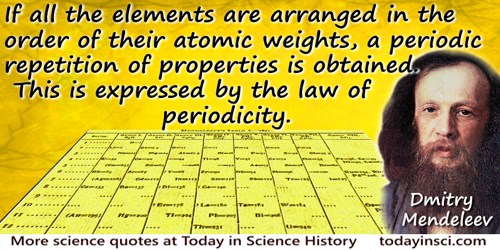
If all the elements are arranged in the order of their atomic weights, a periodic repetition of properties is obtained. This is expressed by the law of periodicity.
Principles of Chemistry (1905), Vol. 2, 17.
If Bacon erred here [in valuing mathematics only for its uses], we must acknowledge that we greatly prefer his error to the opposite error of Plato. We have no patience with a philosophy which, like those Roman matrons who swallowed abortives in order to preserve their shapes, takes pains to be barren for fear of being homely.
In 'Lord Bacon', Edinburgh Review (Jul 1837). Collected in Critical and Miscellaneous Essays: Contributed to the Edinburgh Review (1857), Vol. 1, 396.
If diphtheria is a disease caused by a microorganism, it is essential that three postulates be fulfilled. The fulfilment of these postulates is necessary in order to demonstrate strictly the parasitic nature of a disease:
1) The organism must be shown to be constantly present in characteristic form and arrangement in the diseased tissue.
2) The organism which, from its behaviour appears to be responsible for the disease, must be isolated and grown in pure culture.
3) The pure culture must be shown to induce the disease experimentally.
An early statement of Koch's postulates.
1) The organism must be shown to be constantly present in characteristic form and arrangement in the diseased tissue.
2) The organism which, from its behaviour appears to be responsible for the disease, must be isolated and grown in pure culture.
3) The pure culture must be shown to induce the disease experimentally.
An early statement of Koch's postulates.
Mittheilungen aus den Kaiserliche Gesundheitsamt (1884) Vol. 2. Trans. T. D. Brock, Robert Koch: A Life in Medicine and Bacteriology (1988), 180.
If it were always necessary to reduce everything to intuitive knowledge, demonstration would often be insufferably prolix. This is why mathematicians have had the cleverness to divide the difficulties and to demonstrate separately the intervening propositions. And there is art also in this; for as the mediate truths (which are called lemmas, since they appear to be a digression) may be assigned in many ways, it is well, in order to aid the understanding and memory, to choose of them those which greatly shorten the process, and appear memorable and worthy in themselves of being demonstrated. But there is another obstacle, viz.: that it is not easy to demonstrate all the axioms, and to reduce demonstrations wholly to intuitive knowledge. And if we had chosen to wait for that, perhaps we should not yet have the science of geometry.
In Gottfried Wilhelm Leibnitz and Alfred Gideon Langley (trans.), New Essays Concerning Human Understanding (1896), 413-414.
If man were by nature a solitary animal, the passions of the soul by which he was conformed to things so as to have knowledge of them would be sufficient for him; but since he is by nature a political and social animal it was necessary that his conceptions be made known to others. This he does through vocal sound. Therefore there had to be significant vocal sounds in order that men might live together. Whence those who speak different languages find it difficult to live together in social unity.
As quoted in Jeffrey J. Maciejewski, Thomas Aquinas on Persuasion: Action, Ends, and Natural Rhetoric (2013), 36.
If matter is not eternal, its first emergence into being is a miracle beside which all others dwindle into absolute insignificance. But, as has often been pointed out, the process is unthinkable; the sudden apocalypse of a material world out of blank nonentity cannot be imagined; its emergence into order out of chaos when “without form and void” of life, is merely a poetic rendering of the doctrine of its slow evolution.
In Nineteenth Century (Sep c.1879?). Quoted in John Tyndall, 'Professor Virchow and Evolution', Fragments of Science (1879), Vol. 2, 377.
If one of these people, in whom the chance-worship of our remoter ancestors thus strangely survives, should be within reach of the sea when a heavy gale is blowing, let him betake himself to the shore and watch the scene. Let him note the infinite variety of form and size of the tossing waves out at sea; or against the curves of their foam-crested breakers, as they dash against the rocks; let him listen to the roar and scream of the shingle as it is cast up and torn down the beach; or look at the flakes of foam as they drive hither and thither before the wind: or note the play of colours, which answers a gleam of sunshine as it falls upon their myriad bubbles. Surely here, if anywhere, he will say that chance is supreme, and bend the knee as one who has entered the very penetralia of his divinity. But the man of science knows that here, as everywhere, perfect order is manifested; that there is not a curve of the waves, not a note in the howling chorus, not a rainbow-glint on a bubble, which is other than a necessary consequence of the ascertained laws of nature; and that with a sufficient knowledge of the conditions, competent physico-mathematical skill could account for, and indeed predict, every one of these 'chance' events.
In 'On the Reception of the Origin of Species'. In Francis Darwin (ed.), The Life and Letters of Charles Darwin, Including an Autobiographical Chapter (1888), Vol. 2, 200-1.
If order appeals to the intellect, then disorder titillates the imagination.
Quoted in the original French, “Si l’ordre satisfait la raison, /Le désordre fait les deélices de l’imagination,” in P.H. Gaskell (ed.), Structure of Non-crystalline Materials 1976: Symposium Proceedings (1977), 260. As translated in Alan A. Mackay, A Dictionary of Scientific Quotations (1991), 56.
If some race of quadrumanous animals, especially one of the most perfect of them, were to lose, by force of circumstances or some other cause, the habit of climbing trees and grasping the branches with its feet in the same way as with its hands, in order to hold on to them; and if the individuals of this race were forced for a series of generations to use their feet only for walking, and to give up using their hands like feet; there is no doubt, according to the observations detailed in the preceding chapter, that these quadrumanous animals would at length be transformed into bimanous, and that the thumbs on their feet would cease to be separated from the other digits, when they only used their feet for walking.
Philosophie Zoologique (1809), Vol. 1, 349, trans. Hugh Elliot (1914), 170.
If that's how it all started, then we might as well face the fact that what's left out there is a great deal of shrapnel and a whole bunch of cinders (one of which is, fortunately, still hot enough and close enough to be good for tanning). Trying to find some sense and order in this mess may be as futile as trying to … reconstruct the economy of Iowa from a bowl of popcorn. [On searching for evidence of the Big Bang.]
From essay 'First Person Secular: Blocking the Gates to Heaven', Mother Jones Magazine (Jun 1986), 48. Collected in The Worst Years of our Lives: Irreverent Notes from a Decade of Greed (1995), 267.
If the actual order of the bases on one of the pair of chains were given, one could write down the exact order of the bases on the other one, because of the specific pairing. Thus one chain is, as it were, the complement of the other, and it is this feature which suggests how the deoxyribonucleic acid molecule might duplicate itself.
[Co-author with Francis Crick]
[Co-author with Francis Crick]
In 'Genetic Implications of the Structure of Deoxyribonucleic Acid', Nature (1958), 171, 965-966.
If the world has begun with a single quantum, the notions of space and would altogether fail to have any meaning at the beginning; they would only begin to have a sensible meaning when the original quantum had been divided into a sufficient number of quanta. If this suggestion is correct, the beginning of the world happened a little before the beginning of space and time. I think that such a beginning of the world is far enough from the present order of Nature to be not at all repugnant. It may be difficult to follow up the idea in detail as we are not yet able to count the quantum packets in every case. For example, it may be that an atomic nucleus must be counted as a unique quantum, the atomic number acting as a kind of quantum number. If the future development of quantum theory happens to turn in that direction, we could conceive the beginning of the universe in the form of a unique atom, the atomic weight of which is the total mass of the universe. This highly unstable atom would divide in smaller and smaller atoms by a kind of super-radioactive process.
In a seminal short letter (457 words), 'The Beginning of the World from the Point of View of Quantum Theory', Nature (9 May 1931), 127, 706.
If there be an order in which the human race has mastered its various kinds of knowledge, there will arise in every child an aptitude to acquire these kinds of knowledge in the same order. So that even were the order intrinsically indifferent, it would facilitate education to lead the individual mind through the steps traversed by the general mind. But the order is not intrinsically indifferent; and hence the fundamental reason why education should be a repetition of civilization in little.
Education: Intellectual, Moral and Physical (1861), 76.
If there were some solitary or feral man, the passions of the soul would be sufficient for him; by them he would be conformed to things in order that he might have knowledge of them. But because man is naturally political and social, there is need for one man to make his conceptions known to others, which is done with speech. So significant speech was needed if men were to live together. Which is why those of different tongues do not easily live together.
Sententia super libri Perihermeneias (Commentary on Aristotle’s On Interpretation) [1270-1271], Book I, lesson 2, number 2, trans. R. McInerny, quoted in R. McInerny (ed.) Thomas Aquinas, Selected Writings (1998), 460.
If this “critical openminded attitude” … is wanted, the question at once arises, Is it science that should be studied in order to achieve it? Why not study law? A judge has to do everything that a scientist is exhorted to do in the way of withholding judgment until all the facts are in, and then judging impartially on the merits of the case as well as he can. … Why not a course in Sherlock Holmes? The detectives, or at least the detective-story writers, join with the scientists in excoriating “dogmatic prejudice, lying, falsification of facts, and data, and willful fallacious reasoning.”
In Science is a Sacred Cow (1950), 191.

If we can abstract pathogenicity and hygiene from our notion of dirt, we are left with the old definition of dirt as matter out of place. This is a very suggestive approach. It implies two conditions: a set of ordered relations and a contravention of that order. Dirt then, is never a unique, isolated event.
In Purity and Danger: An Analysis of the Concepts of Pollution and Taboo (1966), 35.
If we were capable of following the progress of increase of the number of the parts of the most perfect animal, as they first formed in succession, from the very first to its state of full perfection, we should probably be able to compare it with some one of the incomplete animals themselves, of every order of animals in the Creation, being at no stage different from some of the inferior orders; or, in other words, if we were to take a series of animals, from the more imperfect to the perfect, we should probably find an imperfect animal, corresponding with some stage of the most perfect.
R. Owen (ed.), John Hunter's Observations on Animal Development (1841), 14.
If you want to build a ship, don’t recruit the men to gather the wood, divide the work and give orders. Instead, teach them to yearn for vast and endless sea.
Not found as such in a work by Saint-Exupéry. Probably an anonymous paraphrase of a related passage in Citadelle (1948), section 75, 687. See the quote beginning, “One will weave the canvas…” on the Antoine de Saint-Exupéry Quotes page of this website.
In a sense, of course, probability theory in the form of the simple laws of chance is the key to the analysis of warfare;… My own experience of actual operational research work, has however, shown that its is generally possible to avoid using anything more sophisticated. … In fact the wise operational research worker attempts to concentrate his efforts in finding results which are so obvious as not to need elaborate statistical methods to demonstrate their truth. In this sense advanced probability theory is something one has to know about in order to avoid having to use it.
In 'Operations Research', Physics Today (Nov 1951), 19. As cited by Maurice W. Kirby and Jonathan Rosenhead, 'Patrick Blackett (1897)' in Arjang A. Assad (ed.) and Saul I. Gass (ed.),Profiles in Operations Research: Pioneers and Innovators (2011), 25.
In all chemical investigations, it has justly been considered an important object to ascertain the relative weights of the simples which constitute a compound. But unfortunately the enquiry has terminated here; whereas from the relative weights in the mass, the relative weights of the ultimate particles or atoms of the bodies might have been inferred, from which their number and weight in various other compounds would appear, in order to assist and to guide future investigations, and to correct their results. Now it is one great object of this work, to shew the importance and advantage of ascertaining the relative weights of the ultimate particles, both of simple and compound bodies, the number of simple elementary particles which constitute one compound particle, and the number of less compound particles which enter into the formation of one more compound particle.
If there are two bodies, A and B, which are disposed to combine, the following is the order in which the combinations may take place, beginning with the most simple: namely,
1 atom of A + 1 atom of B = 1 atom of C, binary
1 atom of A + 2 atoms of B = 1 atom of D, ternary
2 atoms of A + 1 atom of B = 1 atom of E, ternary
1 atom of A + 3 atoms of B = 1 atom of F, quaternary
3 atoms of A and 1 atom of B = 1 atom of G, quaternary
If there are two bodies, A and B, which are disposed to combine, the following is the order in which the combinations may take place, beginning with the most simple: namely,
1 atom of A + 1 atom of B = 1 atom of C, binary
1 atom of A + 2 atoms of B = 1 atom of D, ternary
2 atoms of A + 1 atom of B = 1 atom of E, ternary
1 atom of A + 3 atoms of B = 1 atom of F, quaternary
3 atoms of A and 1 atom of B = 1 atom of G, quaternary
A New System of Chemical Philosophy (1808), Vol. 1, 212-3.
In all spheres of science, art, skill, and handicraft it is never doubted that, in order to master them, a considerable amount of trouble must be spent in learning and in being trained. As regards philosophy, on the contrary, there seems still an assumption prevalent that, though every one with eyes and fingers is not on that account in a position to make shoes if he only has leather and a last, yet everybody understands how to philosophize straight away, and pass judgment on philosophy, simply because he possesses the criterion for doing so in his natural reason.
From Phänomenologie des Geistes (1807) as translated by J.B. Baillie in 'Preface', The Phenomenology of Mind (1910), Vol. 1, 67.
In arranging the bodies in order of their electrical nature, there is formed an electro-chemical system which, in my opinion, is more fit than any other to give an idea of chemistry.
Essai sur le théorie des proportions chimiques (1819). Translated in Henry M. Leicester and Herbert S. Klickstein, A Source Book in Chemistry 1400-1900 (1952), 260.
In degenerating programmes, however, theories are fabricated only in order to accommodate known facts.
In Radio Lecture (30 Jun 1973) broadcast by the Open University, collected in Imre Lakatos, John Worrall (ed.) and Gregory Currie (ed.), 'Introduction: Science and Pseudoscience', The Methodology of Scientific Research Programmes (1978, 1980), Vol. 1, 5.
In describing a protein it is now common to distinguish the primary, secondary and tertiary structures. The primary structure is simply the order, or sequence, of the amino-acid residues along the polypeptide chains. This was first determined by Sanger using chemical techniques for the protein insulin, and has since been elucidated for a number of peptides and, in part, for one or two other small proteins. The secondary structure is the type of folding, coiling or puckering adopted by the polypeptide chain: the a-helix structure and the pleated sheet are examples. Secondary structure has been assigned in broad outline to a number of librous proteins such as silk, keratin and collagen; but we are ignorant of the nature of the secondary structure of any globular protein. True, there is suggestive evidence, though as yet no proof, that a-helices occur in globular proteins, to an extent which is difficult to gauge quantitatively in any particular case. The tertiary structure is the way in which the folded or coiled polypeptide chains are disposed to form the protein molecule as a three-dimensional object, in space. The chemical and physical properties of a protein cannot be fully interpreted until all three levels of structure are understood, for these properties depend on the spatial relationships between the amino-acids, and these in turn depend on the tertiary and secondary structures as much as on the primary. Only X-ray diffraction methods seem capable, even in principle, of unravelling the tertiary and secondary structures.
Co-author with G. Bodo, H. M. Dintzis, R. G. Parrish, H. Wyckoff, and D. C. Phillips
Co-author with G. Bodo, H. M. Dintzis, R. G. Parrish, H. Wyckoff, and D. C. Phillips
'A Three-Dimensional Model of the Myoglobin Molecule Obtained by X-ray Analysis', Nature (1958) 181, 662.
In general, the more one augments the number of divisions of the productions of nature, the more one approaches the truth, since in nature only individuals exist, while genera, orders, and classes only exist in our imagination.
Histoire Naturelle (1749), trans. by John Lyon, The 'Initial Discourse' to Buffon’s Histoire Naturelle: The First Complete English Translation, Journal of the History of Biology, 9(1), 1976, 164.
In geometric and physical applications, it always turns out that a quantity is characterized not only by its tensor order, but also by symmetry.
Epigraph in Charles W. Misner, Kip S. Thorn and John Archibald Wheeler, Gravitation (1970, 1973), 47. Cited as “(1925),” with no source.
In his wretched life of less than twenty-seven years Abel accomplished so much of the highest order that one of the leading mathematicians of the Nineteenth Century (Hermite, 1822-1901) could say without exaggeration, “Abel has left mathematicians enough to keep them busy for five hundred years.” Asked how he had done all this in the six or seven years of his working life, Abel replied, “By studying the masters, not the pupils.”
The Queen of the Sciences (1931, 1938), 10.
In Man the brain presents an ascensive step in development, higher and more strongly marked than that by which the preceding subclass was distinguished from the one below it. Not only do the cerebral hemispheres overlap the olfactory lobes and cerebellum, but they extend in advance of the one, and further back than the other. Their posterior development is so marked, that anatomists have assigned to that part the character of a third lobe; it is peculiar to the genus Homo, and equally peculiar is the 'posterior horn of the lateral ventricle,' and the 'hippocampus minor,' which characterize the hind lobe of each hemisphere. The superficial grey matter of the cerebrum, through the number and depth of the convolutions, attains its maximum of extent in Man. Peculiar mental powers are associated with this highest form of brain, and their consequences wonderfully illustrate the value of the cerebral character; according to my estimate of which, I am led to regard the genus Homo, as not merely a representative of a distinct order, but of a distinct subclass of the Mammalia, for which I propose a name of 'ARCHENCEPHALA.'
'On the Characters, Principles of Division, and Primary Groups of the Class MAMMALIA' (1857), Journal of the Proceedings of the Linnean Society of London (1858), 2, 19-20.
In many ways the performances of Donald Trump remind me of male chimpanzees and their dominance rituals. In order to impress rivals, males seeking to rise in the dominance hierarchy perform spectacular displays: stamping, slapping the ground, dragging branches, throwing rocks. The more vigorous and imaginative the display, the faster the individual is likely to rise in the hierarchy, and the longer he is likely to maintain that position.
As quoted in magazine article by James Fallows, 'When Donald Meets Hillary', The Atlantic (Oct 2016). The reporter stated “Jane Goodall … told me shortly before Trump won the GOP nomination.”
In my opinion instruction is very purposeless for such individuals who do no want merely to collect a mass of knowledge, but are mainly interested in exercising (training) their own powers. One doesn't need to grasp such a one by the hand and lead him to the goal, but only from time to time give him suggestions, in order that he may reach it himself in the shortest way.
Letter to Heinrich Schumacher (2 Oct 1808). Quoted in G. Waldo Dunnington, Carl Friedrich Gauss: Titan of Science (2004), 416.
In my work on Fossil Bones, I set myself the task of recognizing to which animals the fossilized remains which fill the surface strata of the earth belong. ... As a new sort of antiquarian, I had to learn to restore these memorials to past upheavals and, at the same time, to decipher their meaning. I had to collect and put together in their original order the fragments which made up these animals, to reconstruct the ancient creatures to which these fragments belonged, to create them once more with their proportions and characteristics, and finally to compare them to those alive today on the surface of the earth. This was an almost unknown art, which assumed a science hardly touched upon up until now, that of the laws which govern the coexistence of forms
of the various parts in organic beings.
Discours sur les révolutions du globe, (Discourse on the Revolutions of the Surface of the Globe), originally the introduction to Recherches sur les ossemens fossiles des quadrupèdes (1812). Translated by Ian Johnston from the 1825 edition. Online at Vancouver Island University website.
In no subject is there a rule, compliance with which will lead to new knowledge or better understanding. Skilful observations, ingenious ideas, cunning tricks, daring suggestions, laborious calculations, all these may be required to advance a subject. Occasionally the conventional approach in a subject has to be studiously followed; on other occasions it has to be ruthlessly disregarded. Which of these methods, or in what order they should be employed is generally unpredictable. Analogies drawn from the history of science are frequently claimed to be a guide; but, as with forecasting the next game of roulette, the existence of the best analogy to the present is no guide whatever to the future. The most valuable lesson to be learnt from the history of scientific progress is how misleading and strangling such analogies have been, and how success has come to those who ignored them.
'Cosmology', in Arthur Beer (ed.), Vistas in Astronomy (1956), Vol. 2, 1722.
In order that an inventory of plants may be begun and a classification of them correctly established, we must try to discover criteria of some sort for distinguishing what are called “species”. After a long and considerable investigation, no surer criterion for determining species had occurred to me than distinguishing features that perpetuate themselves in propagation from seed. Thus, no matter what variations occur in the individuals or the species, if they spring from the seed of one and the same plant, they are accidental variations and not such as to distinguish a species. For these variations do not perpetuate themselves in subsequent seeding. Thus, for example, we do not regard caryophylli with full or multiple blossoms as a species distinct from caryophylli with single blossoms, because the former owe their origin to the seed of the latter and if the former are sown from their own seed, they once more produce single-blossom caryophylli. But variations that never have as their source seed from one and the same species may finally be regarded as distinct species. Or, if you make a comparison between any two plants, plants which never spring from each other's seed and never, when their seed is sown, are transmuted one into the other, these plants finally are distinct species. For it is just as in animals: a difference in sex is not enough to prove a difference of species, because each sex is derived from the same seed as far as species is concerned and not infrequently from the same parents; no matter how many and how striking may be the accidental differences between them; no other proof that bull and cow, man and woman belong to the same species is required than the fact that both very frequently spring from the same parents or the same mother. Likewise in the case of plants, there is no surer index of identity of species than that of origin from the seed of one and the same plant, whether it is a matter of individuals or species. For animals that differ in species preserve their distinct species permanently; one species never springs from the seed of another nor vice versa.
— John Ray
Historia Plantarum (1686), Vol. 1, 40. Trans. Edmund Silk. Quoted in Barbara G. Beddall, 'Historical Notes on Avian Classification', Systematic Zoology (1957), 6, 133-4.
In order that the facts obtained by observation and experiment may be capable of being used in furtherance of our exact and solid knowledge, they must be apprehended and analysed according to some Conceptions which, applied for this purpose, give distinct and definite results, such as can be steadily taken hold of and reasoned from.
Philosophy of the Inductive Sciences (1840), Vol. 2, 205.
In order that the relations between science and the age may be what they ought to be, the world at large must be made to feel that science is, in the fullest sense, a ministry of good to all, not the private possession and luxury of a few, that it is the best expression of human intelligence and not the abracadabra of a school, that it is a guiding light and not a dazzling fog.
'Hindrances to Scientific Progress', The Popular Science Monthly (Nov 1890), 38, 121.
In order to comprehend and fully control arithmetical concepts and methods of proof, a high degree of abstraction is necessary, and this condition has at times been charged against arithmetic as a fault. I am of the opinion that all other fields of knowledge require at least an equally high degree of abstraction as mathematics,—provided, that in these fields the foundations are also everywhere examined with the rigour and completeness which is actually necessary.
In 'Die Theorie der algebraischen Zahlkorper', Vorwort, Jahresbericht der Deutschen Mathematiker Vereinigung, Bd. 4.
In order to discover Truth in this manner by observation and reason, it is requisite we should fix on some principles whose certainty and effects are demonstrable to our senses, which may serve to explain the phenomena of natural bodies and account for the accidents that arise in them; such only are those which are purely material in the human body with mechanical and physical experiments … a physician may and ought to furnish himself with, and reason from, such things as are demonstrated to be true in anatomy, chemistry, and mechanics, with natural and experimental philosophy, provided he confines his reasoning within the bounds of truth and simple experiment.
As quoted in selection from the writings of Herman Boerhaave, collected in Oliver Joseph Thatcher (ed.), The Ideas that Have Influenced Civilization, in the Original Documents (1800), Vol. 6, 242.
In order to drive the individuals towards reproduction, sexuality had therefore to be associated with some other devices. Among these was pleasure. … Thus pleasure appears as a mere expedient to push individuals to indulge in sex and therefore to reproduce. A rather successful expedient indeed as judged by the state of the world population.
In 'Evolution and Tinkering,' Science, June 10, 1977.
In order to form an immaculate member of a flock of sheep one must, above all, be a sheep.
…...
In order to form for one's self a just notion of the operations which result in the production of thought, it is necessary to conceive of the brain as a peculiar organ, specially designed for the production thereof, just as the stomach is designed to effect digestion, the liver to filter the bile, the parotids and the maxillary and sublingual glands to prepare the salivary juices.
Rapports du Physique et du Moral de l'Homme (1805), 2nd edition, Vol. 1, 152-3. Translated in Robert M. Young, Mind, Brain and Adaptation in the Nineteenth Century (1970), 20.
In order to imbue civilization with sound principles and enliven it with the spirit of the gospel, it is not enough to be illumined with the gift of faith and enkindled with the desire of forwarding a good cause. For this end it is necessary to take an active part in the various organizations and influence them from within. And since our present age is one of outstanding scientific and technical progress and excellence, one will not be able to enter these organizations and work effectively from within unless he is scientifically competent, technically capable and skilled in the practice of his own profession.
Encyclical (10 Apr 1963). In Pacem in Terris, Pt. 5, 50
In order to pursue chemotherapy successfully we must look for substances which possess a high affinity and high lethal potency in relation to the parasites, but have a low toxicity in relation to the body, so that it becomes possible to kill the parasites without damaging the body to any great extent. We want to hit the parasites as selectively as possible. In other words, we must learn to aim and to aim in a chemical sense. The way to do this is to synthesize by chemical means as many derivatives as possible of relevant substances.
'Ueber den jetzigen Stand der Chemotherapie'. Berichte der Deutschen Chemischen Gesellschagt, 1909, 42, 17-47. Translated in B. Holmstedt and G. Liljestrand (eds.), Readings in Pharmacology (1963), 286.
In order to see birds it is necessary to become a part of the silence. One has to sit still like a mystic and wait. One soon learns that fussing, instead of achieving things, merely prevents things from happening.
First essay collected in Solomon in All his Glory (1922), 12. Also seen reprinted titled 'Kingfisher' in The New Statesman (1921), 17, 619. “Solomon in All His Glory” refers to a kingfisher, the subject of the essay.
In order to seek truth, it is necessary once in the course of our life, to doubt, as far as possible, of all things.
From the original Latin: “Veritatem inquirenti, semel in vita de omnibus, quantum fieri potest, esse dubitandum,” Principles of Philosophy (1644). Pars Prima, as collected in Charles Adam and Paul Tannery, Œuvres de Descartes (1905), Vol. 8, Proposition I, 5. English version as given in John Veitch (trans.), The Method, Meditations, and Selections from the Principles of Descartes (1880), 193. Also seen translated as: “If you would be a real seeker after truth, you must at least once in your life doubt, as far as possible, all things.”
In order to survive, an animal must be born into a favoring or at least tolerant environment. Similarly, in order to achieve preservation and recognition, a specimen of fossil man must be discovered in intelligence, attested by scientific knowledge, and interpreted by evolutionary experience. These rigorous prerequisites have undoubtedly caused many still-births in human palaeontology and are partly responsible for the high infant mortality of discoveries of geologically ancient man.
Apes, Men and Morons (1938), 106.
In order to translate a sentence from English into French two things are necessary. First, we must understand thoroughly the English sentence. Second, we must be familiar with the forms of expression peculiar to the French language. The situation is very similar when we attempt to express in mathematical symbols a condition proposed in words. First, we must understand thoroughly the condition. Second, we must be familiar with the forms of mathematical expression.
In How to Solve It: A New Aspect of Mathematical Method (2004), 174.
In order to turn natural history into a true science, one would have to devote oneself to investigations capable of telling us not the particular shape of such and such an animal, but the general procedures of nature in the animal's production and preservation.
'Lettre sur le progress des sciences' in Oeuvres de Mr. De Maupertuis (1756), Vol. 2, 386. Quoted in Jacques Roger, The Life Sciences in Eighteenth-Century French Thought, ed. Keith R. Benson and trans. Robert Ellrich (1997), 392.
In such sad circumstances I but see myself exalted by my own enemies, for in order to defeat some small works of mine they try to make the whole rational medicine and anatomy fall, as if I were myself these noble disciplines.
'Letter to Marescotti about the dispute with Sbaraglia and others, 1689(?)', in H. B. Adelmann (ed.), The Correspondence of Marcello Malpighi (1975), Vol. 4, 1561.
In the beginning of the year 1800 the illustrious professor [Volta] conceived the idea of forming a long column by piling up, in succession, a disc of copper, a disc of zinc, and a disc of wet cloth, with scrupulous attention to not changing this order. What could be expected beforehand from such a combination? Well, I do not hesitate to say, this apparently inert mass, this bizarre assembly, this pile of so many couples of unequal metals separated by a little liquid is, in the singularity of effect, the most marvellous instrument which men have yet invented, the telescope and the steam engine not excepted.
In François Arago, 'Bloge for Volta' (1831), Oeuvres Completes de François Arago (1854), Vol. 1, 219-20.
In the discussion of the. energies involved in the deformation of nuclei, the concept of surface tension of nuclear matter has been used and its value had been estimated from simple considerations regarding nuclear forces. It must be remembered, however, that the surface tension of a charged droplet is diminished by its charge, and a rough estimate shows that the surface tension of nuclei, decreasing with increasing nuclear charge, may become zero for atomic numbers of the order of 100. It seems therefore possible that the uranium nucleus has only small stability of form, and may, after neutron capture, divide itself into two nuclei of roughly equal size (the precise ratio of sizes depending on liner structural features and perhaps partly on chance). These two nuclei will repel each other and should gain a total kinetic energy of c. 200 Mev., as calculated from nuclear radius and charge. This amount of energy may actually be expected to be available from the difference in packing fraction between uranium and the elements in the middle of the periodic system. The whole 'fission' process can thus be described in an essentially classical way, without having to consider quantum-mechanical 'tunnel effects', which would actually be extremely small, on account of the large masses involved.
[Co-author with Otto Robert Frisch]
[Co-author with Otto Robert Frisch]
Lise Meitner and O. R. Frisch, 'Disintegration of Uranium by Neutrons: a New Type of Nuclear Reaction', Nature (1939), 143, 239.
In the first place, there can be no living science unless there is a widespread instinctive conviction in the existence of an Order of Things, and, in particular, of an Order of Nature.
In Science and the Modern World (1927), 4.
In the index to the six hundred odd pages of Arnold Toynbee’s A Study of History, abridged version, the names of Copernicus, Galileo, Descartes and Newton do not occur … yet their cosmic quest destroyed the mediaeval vision of an immutable social order in a walled-in universe and transformed the European landscape, society, culture, habits and general outlook, as thoroughly as if a new species had arisen on this planet.
First lines of 'Preface', in The Sleepwalkers: A History of Man’s Changing Vision of the Universe (1959), 13.
In the index to the six hundred odd pages of Arnold Toynbee’s A Study of History, abridged version, the names of Copernicus, Galileo, Descartes and Newton do not occur yet their cosmic quest destroyed the medieval vision of an immutable social order in a walled-in universe and transformed the European landscape, society, culture, habits and general outlook, as thoroughly as if a new species had arisen on this planet.
In The Sleepwalkers: A History of Man's Changing Vision of the Universe (1959), Preface, 13.
In the mathematical investigations I have usually employed such methods as present themselves naturally to a physicist. The pure mathematician will complain, and (it must be confessed) sometimes with justice, of deficient rigour. But to this question there are two sides. For, however important it may be to maintain a uniformly high standard in pure mathematics, the physicist may occasionally do well to rest content with arguments which are fairly satisfactory and conclusive from his point of view. To his mind, exercised in a different order of ideas, the more severe procedure of the pure mathematician may appear not more but less demonstrative. And further, in many cases of difficulty to insist upon the highest standard would mean the exclusion of the subject altogether in view of the space that would be required.
In Preface to second edition, The Theory of Sound (1894), Vol. 1, vii.
In the next twenty centuries … humanity may begin to understand its most baffling mystery—where are we going? The earth is, in fact, traveling many thousands of miles per hour in the direction of the constellation Hercules—to some unknown destination in the cosmos. Man must understand his universe in order to understand his destiny. Mystery, however, is a very necessary ingredient in our lives. Mystery creates wonder and wonder is the basis for man’s desire to understand. Who knows what mysteries will be solved in our lifetime, and what new riddles will become the challenge of the new generation? Science has not mastered prophesy. We predict too much for the next year yet far too little for the next ten. Responding to challenges is one of democracy’s great strengths. Our successes in space can be used in the next decade in the solution of many of our planet’s problems.
In a speech to a Joint Meeting of the Two Houses of Congress to Receive the Apollo 11 Astronauts (16 Sep 1969), in the Congressional Record.
In the same sense that our judicial system presumes us to be innocent until proven guilty, a medical care system may work best if it starts with the presumption that most people are healthy. Left to themselves, computers may try to do it in the opposite way, taking it as given that some sort of direct, continual, professional intervention is required all the time, in order to maintain the health of each citizen, and we will end up spending all our money on nothing but this.
In 'Aspects of Biomedical Science Policy', The New England Journal of Medicine (12 Oct 1972), 4. Also published as Occasional Paper of the Institute of Medicine.
In this physical world there is no real chaos; all is in fact orderly; all is ordered by the physical principles. Chaos is but unperceived order- it is a word indicating the limitations of the human mind and the paucity of observational facts. The words “chaos,” “accidental,” “chance,” “unpredictable," are conveniences behind which we hide our ignorance.
From Of Stars and Men: The Human Response to an Expanding Universe (1958 Rev. Ed. 1964), Foreword.
In truth, we know causes only by their effects; and in order to learn the nature of the causes which modify the earth, we must study them through all ages of their action, and not select arbitrarily the period in which we live as the standard for all other epochs.
In History of the Inductive Sciences (1857), Vol. 3, 514.
In using the present in order to reveal the past, we assume that the forces in the world are essentially the same through all time; for these forces are based on the very nature of matter, and could not have changed. The ocean has always had its waves, and those waves have always acted in the same manner. Running water on the land has ever had the same power of wear and transportation and mathematical value to its force. The laws of chemistry, heat, electricity, and mechanics have been the same through time. The plan of living structures has been fundamentally one, for the whole series belongs to one system, as much almost as the parts of an animal to the one body; and the relations of life to light and heat, and to the atmosphere, have ever been the same as now.
In 'Introduction', Manual of Geology: Treating of the Principles of the Science (1863), 7.
In-depth studies have an influence on general ideas, whereas theories, in turn, in order to maintain themselves, push their spectators to search for new evidence. The mind’s activity that is maintained by the debates about these works, is probably the source of the greatest joys given to man to experience on Earth.
La théorie des glaciers et ses progrès les plus récents. Bibl. universelle de Geneve, (3), Vol. 41, p. 139. Trans. Karin Verrecchia.
Inasmuch as science represents one way of dealing with the world, it does tend to separate its practitioners from the rest. Being a scientist resembles membership of a religious order and a scientist usually finds that he has more in common with a colleague on the other side of the world than with his next-door neighbor.
In A Dictionary of Scientific Quotations (1991).
Is it possible that a promiscuous Jumble of Printing Letters should often fall into a Method and Order, which should stamp on Paper a coherent Discourse; or that a blind fortuitous Concourse of Atoms, not guided by an Understanding Agent, should frequently constitute the Bodies of any Species of Animals.
In 'Of Wrong Assent, or Error', An Essay Concerning Humane Understanding (1706), Book 4, 601.
Is pure science to be considered as something potentially harmful? Answer: Most certainly! Every child knows that it is potentially exceedingly harmful. … The menace of blowing ourselves up by atom bombs, doing ourselves in by chemical or biological warfare, or by population explosion, is certainly with us. I consider the environment thing a trivial question, by comparison—like housekeeping. In any home, the dishes have to be washed, the floors swept, the beds made, and there must be rules as to who is allowed to produce how much stink and noise, and where in the house: When the garbage piles up, these questions become pressing. But they are momentary problems. Once the house is in order, you still want to live in it, not just sit around enjoying its orderliness. I would be sorry to see Caltech move heavily into this type of applied research. … SCIENCE POTENTIALLY HARMFUL? DEFINITELY.
In 'Homo Scientificus According to Beckett," collected in William Beranek, Jr. (ed.)Science, Scientists, and Society, (1972), 135. Excerpted in Ann E. Kammer, Science, Sex, and Society (1979), 277.
It [mathematics] is in the inner world of pure thought, where all entia dwell, where is every type of order and manner of correlation and variety of relationship, it is in this infinite ensemble of eternal verities whence, if there be one cosmos or many of them, each derives its character and mode of being,—it is there that the spirit of mathesis has its home and its life.
Is it a restricted home, a narrow life, static and cold and grey with logic, without artistic interest, devoid of emotion and mood and sentiment? That world, it is true, is not a world of solar light, not clad in the colours that liven and glorify the things of sense, but it is an illuminated world, and over it all and everywhere throughout are hues and tints transcending sense, painted there by radiant pencils of psychic light, the light in which it lies. It is a silent world, and, nevertheless, in respect to the highest principle of art—the interpenetration of content and form, the perfect fusion of mode and meaning—it even surpasses music. In a sense, it is a static world, but so, too, are the worlds of the sculptor and the architect. The figures, however, which reason constructs and the mathematic vision beholds, transcend the temple and the statue, alike in simplicity and in intricacy, in delicacy and in grace, in symmetry and in poise. Not only are this home and this life thus rich in aesthetic interests, really controlled and sustained by motives of a sublimed and supersensuous art, but the religious aspiration, too, finds there, especially in the beautiful doctrine of invariants, the most perfect symbols of what it seeks—the changeless in the midst of change, abiding things hi a world of flux, configurations that remain the same despite the swirl and stress of countless hosts of curious transformations.
Is it a restricted home, a narrow life, static and cold and grey with logic, without artistic interest, devoid of emotion and mood and sentiment? That world, it is true, is not a world of solar light, not clad in the colours that liven and glorify the things of sense, but it is an illuminated world, and over it all and everywhere throughout are hues and tints transcending sense, painted there by radiant pencils of psychic light, the light in which it lies. It is a silent world, and, nevertheless, in respect to the highest principle of art—the interpenetration of content and form, the perfect fusion of mode and meaning—it even surpasses music. In a sense, it is a static world, but so, too, are the worlds of the sculptor and the architect. The figures, however, which reason constructs and the mathematic vision beholds, transcend the temple and the statue, alike in simplicity and in intricacy, in delicacy and in grace, in symmetry and in poise. Not only are this home and this life thus rich in aesthetic interests, really controlled and sustained by motives of a sublimed and supersensuous art, but the religious aspiration, too, finds there, especially in the beautiful doctrine of invariants, the most perfect symbols of what it seeks—the changeless in the midst of change, abiding things hi a world of flux, configurations that remain the same despite the swirl and stress of countless hosts of curious transformations.
In 'The Universe and Beyond', Hibbert Journal (1904-1906), 3, 314.
It appears … [Descartes] has inverted the order of philosophising, … it seemed good to him not to learn from things, but to impose his own laws on things.… First he collected … truths which he thought suitable …; and then gradually advanced to particulars explicable from principles which … he had framed without consulting Nature.
As quoted in B.J.T. Dobbs, The Foundations of Newton's Alchemy (1983), 101. Cited as Osmond’s translation in Percy Herbert Osmond, Isaac Barrow, His Life and Times (1944), 30-31.
It appears that all that can be, is. The Creator’s hand does not appear to have been opened in order to give existence to a certain determinate number of species, but it seems that it has thrown out all at once a world of relative and non-relative creatures, an infinity of harmonic and contrary combinations and a perpetuity of destructions and replacements. What idea of power is not given us by this spectacle! What feeling of respect for its Author is not inspired in us by this view of the universe!
In 'Premier Discours: De la Manière d'Étudier et de Traiter l'Histoire naturelle', Histoire Naturelle, Generale et Particulière, Avec la Description du Cabinet du Roi (1749), Vol. I, 11. Trans. Phillip R. Sloan.
It follows from the supreme perfection of God, that in creating the universe has chosen the best possible plan, in which there is the greatest variety together with the greatest order; the best arranged ground, place, time; the most results produced in the most simple ways; the most of power, knowledge, happiness and goodness the creatures that the universe could permit. For since all the possibles in I understanding of God laid claim to existence in proportion to their perfections, the actual world, as the resultant of all these claims, must be the most perfect possible. And without this it would not be possible to give a reason why things have turned out so rather than otherwise.
The Principles of Nature and Grace (1714), The Philosophical Works of Leibnitz (1890), ed. G. M. Duncan, 213-4.
It is admitted by all that a finished or even a competent reasoner is not the work of nature alone; the experience of every day makes it evident that education develops faculties which would otherwise never have manifested their existence. It is, therefore, as necessary to learn to reason before we can expect to be able to reason, as it is to learn to swim or fence, in order to attain either of those arts. Now, something must be reasoned upon, it matters not much what it is, provided it can be reasoned upon with certainty. The properties of mind or matter, or the study of languages, mathematics, or natural history, may be chosen for this purpose. Now of all these, it is desirable to choose the one which admits of the reasoning being verified, that is, in which we can find out by other means, such as measurement and ocular demonstration of all sorts, whether the results are true or not. When the guiding property of the loadstone was first ascertained, and it was necessary to learn how to use this new discovery, and to find out how far it might be relied on, it would have been thought advisable to make many passages between ports that were well known before attempting a voyage of discovery. So it is with our reasoning faculties: it is desirable that their powers should be exerted upon objects of such a nature, that we can tell by other means whether the results which we obtain are true or false, and this before it is safe to trust entirely to reason. Now the mathematics are peculiarly well adapted for this purpose, on the following grounds:
1. Every term is distinctly explained, and has but one meaning, and it is rarely that two words are employed to mean the same thing.
2. The first principles are self-evident, and, though derived from observation, do not require more of it than has been made by children in general.
3. The demonstration is strictly logical, taking nothing for granted except self-evident first principles, resting nothing upon probability, and entirely independent of authority and opinion.
4. When the conclusion is obtained by reasoning, its truth or falsehood can be ascertained, in geometry by actual measurement, in algebra by common arithmetical calculation. This gives confidence, and is absolutely necessary, if, as was said before, reason is not to be the instructor, but the pupil.
5. There are no words whose meanings are so much alike that the ideas which they stand for may be confounded. Between the meaning of terms there is no distinction, except a total distinction, and all adjectives and adverbs expressing difference of degrees are avoided.
1. Every term is distinctly explained, and has but one meaning, and it is rarely that two words are employed to mean the same thing.
2. The first principles are self-evident, and, though derived from observation, do not require more of it than has been made by children in general.
3. The demonstration is strictly logical, taking nothing for granted except self-evident first principles, resting nothing upon probability, and entirely independent of authority and opinion.
4. When the conclusion is obtained by reasoning, its truth or falsehood can be ascertained, in geometry by actual measurement, in algebra by common arithmetical calculation. This gives confidence, and is absolutely necessary, if, as was said before, reason is not to be the instructor, but the pupil.
5. There are no words whose meanings are so much alike that the ideas which they stand for may be confounded. Between the meaning of terms there is no distinction, except a total distinction, and all adjectives and adverbs expressing difference of degrees are avoided.
In On the Study and Difficulties of Mathematics (1898), chap. 1.
It is clear that we cannot go up another two orders of magnitude as we have climbed the last five. If we did, we should have two scientists for every man, woman, child, and dog in the population, and we should spend on them twice as much money as we had. Scientific doomsday is therefore less than a century distant.
Little Science, Big Science (1963), 19.
It is clear, then, that the idea of a fixed method, or of a fixed theory of rationality, rests on too naive a view of man and his social surroundings. To those who look at the rich material provided by history, and who are not intent on impoverishing it in order to please their lower instincts, their craving for intellectual security in the form of clarity, precision, “objectivity”, “truth”, it will become clear that there is only one principle that can be defended under all circumstances and in all stages of human development. It is the principle: anything goes.
Against Method: Outline of an Anarchistic Theory of Knowledge (1975, 1993), 18-19.
It is contrary to the usual order of things, that events so harmonious as those of the system of the world, should depend on such diversified agents as are supposed to exist in our artificial arrangements; and there is reason to anticipate a great reduction in the number of undecompounded bodies, and to expect that the analogies of nature will be found conformable to the refined operations of art. The more the phenomena of the universe are studied, the more distinct their connection appears, and the more simple their causes, the more magnificent their design, and the more wonderful the wisdom and power of their Author.
Elements of Chemical Philosophy (1812), in J. Davy (ed.), The Collected Works of Sir Humphry Davy(1839-40), Vol. 4, 42.
It is customary to connect Medicine with Botany, yet scientific treatment demands that we should consider each separately. For the fact is that in every art, theory must be disconnected and separated from practice, and the two must be dealt with singly and individually in their proper order before they are united. And for that reason, in order that Botany, which is, as it were, a special branch of Natural Philosophy [Physica], may form a unit by itself before it can be brought into connection with other sciences, it must be divided and unyoked from Medicine.
Methodi herbariae libri tres (1592), translated in Agnes Arber, Herbals: Their Origin and Evolution, 2nd edition (1938), 144.
It is easy for men to give advice, but difficult for one’s self to follow; we have an example in physicians: for their patients they order a strict regime, for themselves, on going to bed, they do all that they have forbidden to others.
— Philemon
'The Sicilian.' In Gustave Jules Witkowski, The Evil that Has Been Said of Doctors (1889), 4-5
It is going to be necessary that everything that happens in a finite volume of space and time would have to be analyzable with a finite number of logical operations. The present theory of physics is not that way, apparently. It allows space to go down into infinitesimal distances, wavelengths to get infinitely great, terms to be summed in infinite order, and so forth; and therefore, if this proposition [that physics is computer-simulatable] is right, physical law is wrong.
International Journal of Theoretical Physics (1982), 21 Nos. 6-7, 468. Quoted in Brian Rotman, Mathematics as Sign (2000), 82.
It is imperative in the design process to have a full and complete understanding of how failure is being obviated in order to achieve success. Without fully appreciating how close to failing a new design is, its own designer may not fully understand how and why a design works. A new design may prove to be successful because it has a sufficiently large factor of safety (which, of course, has often rightly been called a “factor of ignorance”), but a design's true factor of safety can never be known if the ultimate failure mode is unknown. Thus the design that succeeds (ie, does not fail) can actually provide less reliable information about how or how not to extrapolate from that design than one that fails. It is this observation that has long motivated reflective designers to study failures even more assiduously than successes.
In Design Paradigms: Case Histories of Error and Judgment in Engineering (1994), 31.
books.google.comHenry Petroski - 1994
It is not enough that you should understand about applied science in order that your work may increase man's blessings. Concern for man himself and his fate must always form the chief interest of all technical endeavours... in order that the creations of our minds shall be a blessing and not a curse to mankind. Never forget this in the midst of your diagrams and equations.
Address to students of the California Institute of Technology, Pasadena, California (16 Feb 1931). In New York Times (17 Feb 1931), p. 6.
It is not knowledge, but the act of learning, not possession but the act of getting there, which grants the greatest enjoyment. When I have clarified and exhausted a subject, then I turn away from it, in order to go into darkness again; the never-satisfied man is so strange if he has completed a structure, then it is not in order to dwell in it peacefully,but in order to begin another. I imagine the world conqueror must feel thus, who, after one kingdom is scarcely conquered, stretches out his arms for others.
Letter to Farkas Wolfgang Bolyai (2 Sep 1808). Quoted in G. Waldo Dunnington, Carl Friedrich Gauss: Titan of Science (2004), 416.
It is not necessary to probe into the nature of things, as was done by those whom the Greeks call physici; nor need we be in alarm lest the Christian should be ignorant of the force and number of the elements—the motion, and order, and eclipses of the heavenly bodies; the form of the heavens; the species and the natures of animals, plants, stones, fountains, rivers, mountains; about chronology and distances; the signs of coming storms; and a thousand other things which those philosophers either have found out, or think they have found out. … It is enough for the Christian to believe that the only cause of all created things, whether heavenly or earthly … is the goodness of the Creator, the one true God.
In Marcus Dods (ed.), J.F. Shaw (trans.), The Enchiridion of Augustine, Chap. 9, collected in The Works of Aurelius Augustine, Bishop of Hippo: A new translation (1873), Vol. 9, 180-181. The physici are natural philosophers.
It is one of the triumphs of human wit ... to conquer by humility and submissiveness ... to make oneself small in order to appear great ... such ... are often the expedients of the neurotic.
In The Neurotic Constitution (1917), 81-82.
It is possible with … carbon … to form very large molecules that are stable. This results from the stability of the carbon-to-carbon bond. You must have complexity in order to achieve the versatility characteristic of living organisms. You can achieve this complexity with carbon forming the molecular backbone.
From interview with Neil A. Campbell, in 'Crossing the Boundaries of Science', BioScience (Dec 1986), 36, No. 11, 739.
It is probably no exaggeration to suppose that in order to improve such an organ as the eye at all, it must be improved in ten different ways at once. And the improbability of any complex organ being produced and brought to perfection in any such way is an improbability of the same kind and degree as that of producing a poem or a mathematical demonstration by throwing letters at random on a table.
[Expressing his reservations about Darwin's proposed evolution of the eye by natural selection.]
[Expressing his reservations about Darwin's proposed evolution of the eye by natural selection.]
Opening address to the Belfast Natural History Society, as given in the 'Belfast Northern Whig,' (19 Nov 1866). As cited by Charles Darwin in The Variation of Animals & Plants Under Domestication (1868), 222.
It is sages and grey-haired philosophers who ought to sit up all night reading Alice in Wonderland in order to study that darkest problem of metaphysics, the borderland between reason and unreason, and the nature of the most erratic of spiritual forces, humour, which eternally dances between the two. That we do find a pleasure in certain long and elaborate stories, in certain complicated and curious forms of diction, which have no intelligible meaning whatever, is not a subject for children to play with; it is a subject for psychologists to go mad over.
In 'The Library of the Nursery', in Lunacy and Letters (1958), 26.
It is said that the composing of the Lilavati was occasioned by the following circumstance. Lilavati was the name of the author’s daughter, concerning whom it appeared, from the qualities of the ascendant at her birth, that she was destined to pass her life unmarried, and to remain without children. The father ascertained a lucky hour for contracting her in marriage, that she might be firmly connected and have children. It is said that when that hour approached, he brought his daughter and his intended son near him. He left the hour cup on the vessel of water and kept in attendance a time-knowing astrologer, in order that when the cup should subside in the water, those two precious jewels should be united. But, as the intended arrangement was not according to destiny, it happened that the girl, from a curiosity natural to children, looked into the cup, to observe the water coming in at the hole, when by chance a pearl separated from her bridal dress, fell into the cup, and, rolling down to the hole, stopped the influx of water. So the astrologer waited in expectation of the promised hour. When the operation of the cup had thus been delayed beyond all moderate time, the father was in consternation, and examining, he found that a small pearl had stopped the course of the water, and that the long-expected hour was passed. In short, the father, thus disappointed, said to his unfortunate daughter, I will write a book of your name, which shall remain to the latest times—for a good name is a second life, and the ground-work of eternal existence.
In Preface to the Persian translation of the Lilavati by Faizi (1587), itself translated into English by Strachey and quoted in John Taylor (trans.) Lilawati, or, A Treatise on Arithmetic and Geometry by Bhascara Acharya (1816), Introduction, 3. [The Lilavati is the 12th century treatise on mathematics by Indian mathematician, Bhaskara Acharya, born 1114.]
It is sometimes helpful to differentiate between the God of Miracles and the God of Order. When scientists use the word God, they usually mean the God of Order. …The God of Miracles intervenes in our affairs, performs miracles, destroys wicked cities, smites enemy armies, drowns the Pharaoh's troops, and avenges the pure and noble. …This is not to say that miracles cannot happen, only that they are outside what is commonly called science.
In 'Conclusion', Hyperspace: A Scientific Odyssey Through Parallel Universes, Time Warps, and the Tenth Dimension (1995), 330-331.
It is tempting to wonder if our present universe, large as it is and complex though it seems, might not be merely the result of a very slight random increase in order over a very small portion of an unbelievably colossal universe which is virtually entirely in heat-death. Perhaps we are merely sliding down a gentle ripple that has been set up, accidently and very temporarily, in a quiet pond, and it is only the limitation of our own infinitesimal range of viewpoint in space and time that makes it seem to ourselves that we are hurtling down a cosmic waterfall of increasing entropy, a waterfall of colossal size and duration.
(1976). In Isaac Asimov’s Book of Science and Nature Quotations (1988), 331.
It is very much in the order of nature that toothless animals should have horns: is it any wonder that old men and women should often have them?
Aphorism 6 in Notebook E (1775-1776), as translated by R.J. Hollingdale in Aphorisms (1990). Reprinted as The Waste Books (2000), 62.
It is well for people who think to change their minds occasionally in order to keep them clean.
As quoted in Forbes (1948). 42.
It is well known that the man who first made public the theory of irrationals perished in a shipwreck in order that the inexpressible and unimaginable should ever remain veiled. And so the guilty man, who fortuitously touched on and revealed this aspect of living things, was taken to the place where he began and there is for ever beaten by the waves.
— Proclus
In scholium to Book X of Euclid t. V, 417 as quoted and cited in Ettore Carruccio and Isabel Quigly (trans.), Mathematics And Logic in History And in Contemporary Thought (1964), 27.
It is well to know something of the manners of various peoples, in order more sanely to judge our own, and that we do not think that everything against our modes is ridiculous, and against reason, as those who have seen nothing are accustomed to think.
In Discourse on Method (1637).
It may sound like a lot of work to keep up with organic chemistry, and it is; however, those who haven't the time to do it become subject to decay in the ability to teach and to contribute to the Science—a sort of first-order process the half-life of which can't be much more than a year or two.
Highlights of Organic Chemistry: An Advanced Textbook (1974), 112.
It turns out that an eerie type of chaos can lurk just behind a façade of order—and yet, deep inside the chaos lurks an even eerier type of order.
Metamagical Themas: Questing for the Essence of Mind and Pattern (1985, 1996), 299.
It was a great step in science when men became convinced that, in order to understand the nature of things, they must begin by asking, not whether a thing is good or bad, noxious or beneficial, but of what kind it is? And how much is there of it? Quality and Quantity were then first recognised as the primary features to be observed in scientific inquiry.
'Address to the Mathematical and Physical Sections of the British Association, Liverpool, 15 Sep 1870', The Scientific Papers of James Clerk Maxwell (1890 edition, reprint 2003), Vol. 2, 217.
It was a profound saying of Wilhelm Humboldt, that 'Man is man only by means of speech, but in order to invent speech he must be already man.'
The Antiquity of Man (1863), 468.
It was his [Leibnitz’s] love of method and order, and the conviction that such order and harmony existed in the real world, and that our success in understanding it depended upon the degree and order which we could attain in our own thoughts, that originally was probably nothing more than a habit which by degrees grew into a formal rule. This habit was acquired by early occupation with legal and mathematical questions. We have seen how the theory of combinations and arrangements of elements had a special interest for him. We also saw how mathematical calculations served him as a type and model of clear and orderly reasoning, and how he tried to introduce method and system into logical discussions, by reducing to a small number of terms the multitude of compound notions he had to deal with. This tendency increased in strength, and even in those early years he elaborated the idea of a general arithmetic, with a universal language of symbols, or a characteristic which would be applicable to all reasoning processes, and reduce philosophical investigations to that simplicity and certainty which the use of algebraic symbols had introduced into mathematics.
A mental attitude such as this is always highly favorable for mathematical as well as for philosophical investigations. Wherever progress depends upon precision and clearness of thought, and wherever such can be gained by reducing a variety of investigations to a general method, by bringing a multitude of notions under a common term or symbol, it proves inestimable. It necessarily imports the special qualities of number—viz., their continuity, infinity and infinite divisibility—like mathematical quantities—and destroys the notion that irreconcilable contrasts exist in nature, or gaps which cannot be bridged over. Thus, in his letter to Arnaud, Leibnitz expresses it as his opinion that geometry, or the philosophy of space, forms a step to the philosophy of motion—i.e., of corporeal things—and the philosophy of motion a step to the philosophy of mind.
A mental attitude such as this is always highly favorable for mathematical as well as for philosophical investigations. Wherever progress depends upon precision and clearness of thought, and wherever such can be gained by reducing a variety of investigations to a general method, by bringing a multitude of notions under a common term or symbol, it proves inestimable. It necessarily imports the special qualities of number—viz., their continuity, infinity and infinite divisibility—like mathematical quantities—and destroys the notion that irreconcilable contrasts exist in nature, or gaps which cannot be bridged over. Thus, in his letter to Arnaud, Leibnitz expresses it as his opinion that geometry, or the philosophy of space, forms a step to the philosophy of motion—i.e., of corporeal things—and the philosophy of motion a step to the philosophy of mind.
In Leibnitz (1884), 44-45. [The first sentence is reworded to better introduce the quotation. —Webmaster]
It was Plato, according to Sosigenes, who set this as a problem for those concerned with these things, through what suppositions of uniform and ordered movements the appearances concerning the movements of the wandering heavenly bodies could be preserved.
— Plato
Simplicius, On Aristotle's On the Heavens, 488.21. Trans. R. W. Sharples.
It’s that moment, that brief epiphany when the universe opens up and shows us something, and in that instant we get just a sense of an order greater than Heaven and, as yet at least, beyond the grasp of Stephen Hawking.
Quoted in Kim Lim (ed.), 1,001 Pearls of Spiritual Wisdom: Words to Enrich, Inspire, and Guide Your Life (2014), 109
Its [mathematical analysis] chief attribute is clearness; it has no means for expressing confused ideas. It compares the most diverse phenomena and discovers the secret analogies which unite them. If matter escapes us, as that of air and light because of its extreme tenuity, if bodies are placed far from us in the immensity of space, if man wishes to know the aspect of the heavens at successive periods separated by many centuries, if gravity and heat act in the interior of the solid earth at depths which will forever be inaccessible, mathematical analysis is still able to trace the laws of these phenomena. It renders them present and measurable, and appears to be the faculty of the human mind destined to supplement the brevity of life and the imperfection of the senses, and what is even more remarkable, it follows the same course in the study of all phenomena; it explains them in the same language, as if in witness to the unity and simplicity of the plan of the universe, and to make more manifest the unchangeable order which presides over all natural causes.
From Théorie Analytique de la Chaleur (1822), Discours Préliminaire, xiv, (Theory of Heat, Introduction), as translated by Alexander Freeman in The Analytical Theory of Heat (1878), 7.
Just as our eyes need light in order to see, our minds need ideas in order to conceive.
Recherche de la vérité
Just as, in civil History, one consults title-deeds, one studies coins, one deciphers ancient inscriptions, in order to determine the epochs of human revolutions and to fix the dates of moral [i.e. human] events; so, in Natural History, one must excavate the archives of the world, recover ancient monuments from the depths of the earth, collect their remains, and assemble in one body of proofs all the evidence of physical changes that enable us to reach back to the different ages of Nature. This, then, is the order of the times indicated by facts and monuments: these are six epochs in the succession of the first ages of Nature; six spaces of duration, the limits of which although indeterminate are not less real; for these epochs are not like those of civil History ... that we can count and measure exactly; nevertheless we can compare them with each other and estimate their relative duration.
'Des Époques de la Nature', Histoire Naturelle, Générale et Particulière contenant les Époques de la Nature (1778), Supplement Vol. 9, 1-2, 41. Trans. Martin J. Rudwick.
Know, oh Brother (May God assist thee and us by the Spirit from Him) that God, Exalted Be His Praise, when He created all creatures and brought all things into being, arranged them and brought them into existence by a process similar to the process of generation of numbers from one, so that the multiplicity [of numbers] should be a witness to his Oneness, and their classification and order an indication of the perfection of His wisdom in creation. And this would be a witness to the fact, too, that they [creatures] are related to Him who created them, in the same way as the numbers are related to the One which is prior to two, and which is the principle, origin and source of numbers, as we have shown in our treatise on arithmetic.
Rasa'il. In Seyyed Hossein Nasr, Science and Civilisation in Islam (1968), 155-6.
Laws alone can not secure freedom of expression; in order that every man present his views without penalty there must be spirit of tolerance in the entire population.
…...
Laws of Serendi[ity:
(1) In order to discover anything, you must be looking for something.
(2) If you wish to make an improved product, you must already be engaged in making an inferior one.
(1) In order to discover anything, you must be looking for something.
(2) If you wish to make an improved product, you must already be engaged in making an inferior one.
In Dr. N Sreedharan, Quotations of Wit and Wisdom (2007), 18.
Leibnitz’s discoveries lay in the direction in which all modern progress in science lies, in establishing order, symmetry, and harmony, i.e., comprehensiveness and perspicuity,—rather than in dealing with single problems, in the solution of which followers soon attained greater dexterity than himself.
In Leibnitz (1884), 112.
Let me tell you how at one time the famous mathematician Euclid became a physician. It was during a vacation, which I spent in Prague as I most always did, when I was attacked by an illness never before experienced, which manifested itself in chilliness and painful weariness of the whole body. In order to ease my condition I took up Euclid’s Elements and read for the first time his doctrine of ratio, which I found treated there in a manner entirely new to me. The ingenuity displayed in Euclid’s presentation filled me with such vivid pleasure, that forthwith I felt as well as ever.
Selbstbiographie (1875), 20. In Robert Édouard Moritz, Memorabilia Mathematica; Or, The Philomath's Quotation-book (1914), 146.
Let us follow the natural order and begin with the primary facts.
In Ingram Bywater (trans.), Aristotle, On the Art of Poetry (1909), 3.
Let us suppose that we have laid on the table... [a] piece of glass... and let us homologize this glass to a whole order of plants or birds. Let us hit this glass a blow in such a manner as but to crack it up. The sectors circumscribed by cracks following the first blow may here be understood to represent families. Continuing, we may crack the glass into genera, species and subspecies to the point of finally having the upper right hand corner a piece about 4 inches square representing a sub-species.
Space, Time, Form: The Biological Synthesis (1962, issued 1964), 209.
Liebig taught the world two great lessons. The first was that in order to teach chemistry it was necessary that students should be taken into a laboratory. The second lesson was that he who is to apply scientific thought and method to industrial problems must have a thorough knowledge of the sciences. The world learned the first lesson more readily than it learned the second.
Ira Remsen, Address to the Industrial Chemistry Society, Glasgow (1910). Quoted in Frederick Hutton Getman, The Life of Ira Remsen (1980), 121-122.
Life is order, death is disorder. A fundamental law of Nature states that spontaneous chemical changes in the universe tend toward chaos. But life has, during milliards of years of evolution, seemingly contradicted this law. With the aid of energy derived from the sun it has built up the most complicated systems to be found in the universe—living organisms. Living matter is characterized by a high degree of chemical organisation on all levels, from the organs of large organisms to the smallest constituents of the cell. The beauty we experience when we enjoy the exquisite form of a flower or a bird is a reflection of a microscopic beauty in the architecture of molecules.
The Nobel Prize for Chemistry: Introductory Address'. Nobel Lectures: Chemistry 1981-1990 (1992), 69.
Life, in a body whose order and state of affairs can make it manifest, is assuredly, as I have said, a real power that gives rise to numerous phenomena. This power has, however, neither goal nor intention. It can do only what it does; it is only a set of acting causes, not a particular being. I was the first to establish this truth at a time when life was still thought to be a principle, an archeia, a being of some sort.
'Système Analytique des Connaissances Positives de l’Homme, restreintes a celles qui proviennent directement ou indirectement de I'observation' (1820), trans. M. H. Shank and quoted in Madeleine Barthélemy-Madaule, Lamarck the Mythical Precursor: A Study of the Relations between Science and Ideology (1982), 102.
Life, this anti-entropy, ceaselessly reloaded with energy, is a climbing force, toward order amidst chaos, toward light, among the darkness of the indefinite, toward the mystic dream of Love, between the fire which devours itself and the silence of the Cold.
Nobel Lecture, The Coming Age of the Cell, 12 Dec 1974
Like most fathers, by clear star-studded skies I used to take each of my two little boys in my arms for a glimpse at infinity. The splendor of the unreachable silenced their chatterboxes for a few seconds. They raised their arms and closed their little fingers in a futile attempt to grasp one of the twinkling sparks that dot our dreams. The little fellows obeyed the command reported by Ovid: “God elevated man's forehead and ordered him to contemplate the stars.”
Written as opening paragraph for 'Foreword' to Kevin W. Kelley (ed.), The Home Planet (1988) (unpaginated).
Long intervals frequently elapse between the discovery of new principles in science and their practical application… Those intellectual qualifications, which give birth to new principles or to new methods, are of quite a different order from those which are necessary for their practical application.
Reflections on the Decline of Science in England (1830), 16.
Make no little plans. They have no magic to stir men’s blood and probably themselves will not be realized. Make big plans; aim high in hope and work. … Let your watchword be order and your beacon beauty,
(1907) As quoted in 'Closing In', Charles Moore, Daniel H. Burnham, Architect, Planner of Cities (1921), Vol. 2, 147.
Man embraces in his makeup all the natural orders; he’s a squid, a mollusk, a sucker and a buzzard; sometimes he’s a cerebrate.
Man is merely a frequent effect, a monstrosity is a rare one, but both are equally natural, equally inevitable, equally part of the universal and general order. And what is strange about that? All creatures are involved in the life of all others, consequently every species... all nature is in a perpetual state of flux. Every animal is more or less a human being, every mineral more or less a plant, every plant more or less an animal... There is nothing clearly defined in nature.
D'Alembert's Dream (1769), in Rameau's Nephew and D' Alembert's Dream, trans. Leonard Tancock (Penguin edition 1966), 181.
Man tries to make for himself in the fashion that suits him best a simplified and intelligible picture of the world; he then tries to some extent to substitute this cosmos of his for the world of experience, and thus to overcome it. This is what the painter, the poet, the speculative philosopher, and the natural scientist do, each in his own fashion. Each makes this cosmos and its construction the pivot of his emotional life, in order to find in this way the peace and security which he cannot find in the narrow whirlpool of personal experience.
Address at The Physical Society, Berlin (1918) for Max Planck’s 60th birthday, 'Principles of Research', collected in Essays in Science (1934, 2004) 3.
Man, as the minister and interpreter of nature, is limited in act and understanding by his observation of the order of nature; neither his understanding nor his power extends further.
Novum Organum, Aphor I. Quoted in Robert Routledge, Discoveries and Inventions of the 19th Century (1890), 696
Mankind have been slow to believe that order reigns in the universe—that the world is a cosmos and a chaos.
… The divinities of heathen superstition still linger in one form or another in the faith of the ignorant, and even intelligent men shrink from the contemplation of one supreme will acting regularly, not fortuitously, through laws beautiful and simple rather than through a fitful and capricious system of intervention.
... The scientific spirit has cast out the demons, and presented us with nature clothed in her right mind and living under the reign of law. It has given us, for the sorceries of the alchemist, the beautiful laws of chemistry; for the dreams of the astrologer, the sublime truths of astronomy; for the wild visions of cosmogony, the monumental records of geology; for the anarchy of diabolism, the laws of God.
… The divinities of heathen superstition still linger in one form or another in the faith of the ignorant, and even intelligent men shrink from the contemplation of one supreme will acting regularly, not fortuitously, through laws beautiful and simple rather than through a fitful and capricious system of intervention.
... The scientific spirit has cast out the demons, and presented us with nature clothed in her right mind and living under the reign of law. It has given us, for the sorceries of the alchemist, the beautiful laws of chemistry; for the dreams of the astrologer, the sublime truths of astronomy; for the wild visions of cosmogony, the monumental records of geology; for the anarchy of diabolism, the laws of God.
Speech (16 Dec 1867) given while a member of the U.S. House of Representatives, introducing resolution for the appointment of a committee to examine the necessities for legislation upon the subject of the ninth census to be taken the following year. Quoted in John Clark Ridpath, The Life and Work of James A. Garfield (1881), 216.
Many of the nobles and senators, although of great age, mounted more than once to the top of the highest church in Venice, in order to see sails and shipping … so far off that it was two hours before they were seen without my spy-glass …, for the effect of my instrument is such that it makes an object fifty miles off appear as large as if it were only five miles away. ... The Senate, knowing the way in which I had served it for seventeen years at Padua, ... ordered my election to the professorship for life.
Quoted in Will Durant, Ariel Duran, The Age of Reason Begins (1961), 604. From Charles Singer, Studies in the History and Method of Science (1917), Vol. 1, 228.
Many people know everything they know in the way we know the solution of a riddle after we have read it or been told it, and that is the worst kind of knowledge and the kind least to be cultivated; we ought rather to cultivate that kind of knowledge which enables us to discover for ourselves in case of need that which others have to read or be told of in order to know it.
Aphorism 89 in Notebook D (1773-1775), as translated by R.J. Hollingdale in Aphorisms (1990). Reprinted as The Waste Books (2000), 58.
Mathematicians attach great importance to the elegance of their methods and their results. This is not pure dilettantism. What is it indeed that gives us the feeling of elegance in a solution, in a demonstration? It is the harmony of the diverse parts, their symmetry, their happy balance; in a word it is all that introduces order, all that gives unity, that permits us to see clearly and to comprehend at once both the ensemble and the details. But this is exactly what yields great results, in fact the more we see this aggregate clearly and at a single glance, the better we perceive its analogies with other neighboring objects, consequently the more chances we have of divining the possible generalizations. Elegance may produce the feeling of the unforeseen by the unexpected meeting of objects we are not accustomed to bring together; there again it is fruitful, since it thus unveils for us kinships before unrecognized. It is fruitful even when it results only from the contrast between the simplicity of the means and the complexity of the problem set; it makes us then think of the reason for this contrast and very often makes us see that chance is not the reason; that it is to be found in some unexpected law. In a word, the feeling of mathematical elegance is only the satisfaction due to any adaptation of the solution to the needs of our mind, and it is because of this very adaptation that this solution can be for us an instrument. Consequently this esthetic satisfaction is bound up with the economy of thought.
In 'The Future of Mathematics', Monist, 20, 80. Translated from the French by George Bruce Halsted.
Mathematicians have tried in vain to this day to discover some order in the sequence of prime numbers, and we have reason to believe that it is a mystery into which the human mind will never penetrate.
As quoted in G. Simmons Calculus Gems (1992).
Mathematics is a logical method … Mathematical propositions express no thoughts. In life it is never a mathematical proposition which we need, but we use mathematical propositions only in order to infer from propositions which do not belong to mathematics to others which equally do not belong to mathematics.
In Tractatus Logico Philosophicus (1922), 169 (statements 6.2-6.211).
Mathematics, from the earliest times to which the history of human reason can reach, has followed, among that wonderful people of the Greeks, the safe way of science. But it must not be supposed that it was as easy for mathematics as for logic, in which reason is concerned with itself alone, to find, or rather to make for itself that royal road. I believe, on the contrary, that there was a long period of tentative work (chiefly still among the Egyptians), and that the change is to be ascribed to a revolution, produced by the happy thought of a single man, whose experiments pointed unmistakably to the path that had to be followed, and opened and traced out for the most distant times the safe way of a science. The history of that intellectual revolution, which was far more important than the passage round the celebrated Cape of Good Hope, and the name of its fortunate author, have not been preserved to us. … A new light flashed on the first man who demonstrated the properties of the isosceles triangle (whether his name was Thales or any other name), for he found that he had not to investigate what he saw in the figure, or the mere concepts of that figure, and thus to learn its properties; but that he had to produce (by construction) what he had himself, according to concepts a priori, placed into that figure and represented in it, so that, in order to know anything with certainty a priori, he must not attribute to that figure anything beyond what necessarily follows from what he has himself placed into it, in accordance with the concept.
In Critique of Pure Reason, Preface to the Second Edition, (1900), 690.
Men are impatient, and for precipitating things; but the Author of Nature appears deliberate throughout His operations, accomplishing His natural ends by slow, successive steps. And there is a plan of things beforehand laid out, which, from the nature of it, requires various systems of means, as well as length of time, in order to the carrying on its several parts into execution.
Analogy of Religion (1860), 239-240.
Metals are the great agents by which we can examine the recesses of nature; and their uses are so multiplied, that they have become of the greatest importance in every occupation of life. They are the instruments of all our improvements, of civilization itself, and are even subservient to the progress of the human mind towards perfection. They differ so much from each other, that nature seems to have had in view all the necessities of man, in order that she might suit every possible purpose his ingenuity can invent or his wants require.
From 'Classification of Simple Bodies', The Artist & Tradesman’s Guide: Embracing Some Leading Facts & Principles of Science, and a Variety of Matter Adapted to the Wants of the Artist, Mechanic, Manufacturer, and Mercantile Community (1827), 16.
Might one not say that in the chance combination of nature's production, since only those endowed with certain relations of suitability could survive, it is no cause for wonder that this suitability is found in all species that exist today? Chance, one might say, produced an innumerable multitude of individuals; a small number turned out to be constructed in such fashion that the parts of the animal could satisfy its needs; in another, infinitely greater number, there was neither suitability nor order: all of the later have perished; animals without a mouth could not live, others lacking organs for reproduction could not perpetuate themselves: the only ones to have remained are those in which were found order and suitability; and these species, which we see today, are only the smallest part of what blind fate produced.
'Essai de Cosmologie' in Oeuvres de Mr. De Maupertuis (1756), Vol. 1, 11-12. Quoted in Jacques Roger, The Life Sciences in Eighteenth-Century French Thought, ed. Keith R. Benson and trans. Robert Ellrich (1997), 381.
Moreover, the works already known are due to chance and experiment rather than to sciences; for the sciences we now possess are merely systems for the nice ordering and setting forth of things already invented; not methods of invention or directions for new works.
From Novum Organum (1620), Book 1, Aphorism 8. Translated as The New Organon: Aphorisms Concerning the Interpretation of Nature and the Kingdom of Man), collected in James Spedding, Robert Ellis and Douglas Heath (eds.), The Works of Francis Bacon (1857), Vol. 4, 48.
My Design in this Book is not to explain the Properties of Light by Hypotheses, but to propose and prove them by Reason and Experiments: In order to which, I shall premise the following Definitions and Axioms.
Opticks (1704), Book 1, Part 1, Introduction, 1.
My experiments proved that the radiation of uranium compounds ... is an atomic property of the element of uranium. Its intensity is proportional to the quantity of uranium contained in the compound, and depends neither on conditions of chemical combination, nor on external circumstances, such as light or temperature.
... The radiation of thorium has an intensity of the same order as that of uranium, and is, as in the case of uranium, an atomic property of the element.
It was necessary at this point to find a new term to define this new property of matter manifested by the elements of uranium and thorium. I proposed the word radioactivity which has since become generally adopted; the radioactive elements have been called radio elements.
... The radiation of thorium has an intensity of the same order as that of uranium, and is, as in the case of uranium, an atomic property of the element.
It was necessary at this point to find a new term to define this new property of matter manifested by the elements of uranium and thorium. I proposed the word radioactivity which has since become generally adopted; the radioactive elements have been called radio elements.
In Pierre Curie, with the Autobiographical Notes of Marie Curie, trans. Charlotte and Vernon Kellogg (1923), 96. Also in reprint (2012) 45-46.
My father’s collection of fossils was practically unnamed, but the appearance of Phillips’ book [Geology of the Yorkshire Coast], in which most of our specimens were figured, enabled us to remedy this defect. Every evening was devoted by us to accomplishing the work. This was my first introduction to true scientific study. … Phillips’ accurate volume initiated an entirely new order of things. Many a time did I mourn over the publication of this book, and the consequences immediately resulting from it. Instead of indulging in the games and idleness to which most lads are prone, my evenings throughout a long winter were devoted to the detested labour of naming these miserable stones. Such is the short-sightedness of boyhood. Pursuing this uncongenial work gave me in my thirteenth year a thorough practical familiarity with the palaeontological treasures of Eastern Yorkshire. This early acquisition happily moulded the entire course of my future life.
In Reminiscences of a Yorkshire naturalist (1896), 12.
My thesis is that what we call 'science' is differentiated from the older myths not by being something distinct from a myth, but by being accompanied by a second-order tradition—that of critically discussing the myth. … In a certain sense, science is myth-making just as religion is.
Conjectures and Refutations: the Growth of Scientific Knowledge (2002), 170-171.
Natural science is founded on minute critical views of the general order of events taking place upon our globe, corrected, enlarged, or exalted by experiments, in which the agents concerned are placed under new circumstances, and their diversified properties separately examined. The body of natural science, then, consists of facts; is analogy,—the relation of resemblance of facts by which its different parts are connected, arranged, and employed, either for popular use, or for new speculative improvements.
'Introductory Lecture to the Chemistry of Nature' (1807), in J. Davy (ed.), The Collected Works of Sir Humphry Davy (1839-40), Vol 8, 167-8.
Nature even in chaos cannot proceed otherwise than regularly and according to order.
Universal Natural History and Theory of the Heavens (1755), editted and translated by William Hastie in Kant's Cosmogony (1900), 26.
Nature goes her own way, and all that to us seems an exception is really according to order.
Thurs 9 Dec 1824. Johann Peter Eckermann, Conversations with Goethe, ed. J. K. Moorhead and trans. J. Oxenford (1971), 75.
Nature is disordered, powerful and chaotic, and through fear of the chaos we impose system on it. We abhor complexity, and seek to simplify things whenever we can by whatever means we have at hand. We need to have an overall explanation of what the universe is and how it functions. In order to achieve this overall view we develop explanatory theories which will give structure to natural phenomena: we classify nature into a coherent system which appears to do what we say it does.
In Day the Universe Changed (1985), 11.
Nature is the system of laws established by the Creator for the existence of things and for the succession of creatures. Nature is not a thing, because this thing would be everything. Nature is not a creature, because this creature would be God. But one can consider it as an immense vital power, which encompasses all, which animates all, and which, subordinated to the power of the first Being, has begun to act only by his order, and still acts only by his concourse or consent ... Time, space and matter are its means, the universe its object, motion and life its goal.
'De la Nature: Premiere Vue', Histoire Naturelle, Générale et Particulière, Avec la Description du Cabinet du Roi (1764), Vol. 12, iii-iv. Trans. Phillip R. Sloan.

Nature, … in order to carry out the marvelous operations [that occur] in animals and plants has been pleased to construct their organized bodies with a very large number of machines, which are of necessity made up of extremely minute parts so shaped and situated as to form a marvelous organ, the structure and composition of which are usually invisible to the naked eye without the aid of a microscope. … Just as Nature deserves praise and admiration for making machines so small, so too the physician who observes them to the best of his ability is worthy of praise, not blame, for he must also correct and repair these machines as well as he can every time they get out of order.
'Reply to Doctor Sbaraglia' in Opera Posthuma (1697), in H. B. Adelmann (ed.), Marcello Malpighi and the Evolution of Embryology (1966), Vol. 1, 568.
Nature, displayed in its full extent, presents us with an immense tableau, in which all the order of beings are each represented by a chain which sustains a continuous series of objects, so close and so similar that their difference would be difficult to define. This chain is not a simple thread which is only extended in length, it is a large web or rather a network, which, from interval to interval, casts branches to the side in order to unite with the networks of another order.
'Les Oiseaux Qui Ne Peuvent Voler', Histoire Naturelle des Oiseaux (1770), Vol. I, 394. Trans. Phillip R. Sloan.
Nature, when left to universal laws, tends to produce regularity out of chaos.
'Seventh Reflection: Cosmogony' in 'The Only Possible Argument in Support of a Demonstration of the Existence of God', (1763), editted and translated by David Walford in Theoretical Philosophy, 1755-1770 (2003), 191
Never any knowledge was delivered in the same order it was invented.
'Of the Interpretation of Nature' (c.1603) in James Spedding, Robert Ellis and Douglas Heath (eds.), The Works of Francis Bacon (1887-1901), Vol. 3, 248.
No collateral science had profited so much by palæontology as that which teaches the structure and mode of formation of the earth’s crust, with the relative position, time, and order of formation of its constituent stratified and unstratified parts. Geology has left her old hand-maiden mineralogy to rest almost wholly on the broad shoulders of her young and vigorous offspring, the science of organic remains.
In article 'Palæontology' contributed to Encyclopædia Britannica (8th ed., 1859), Vol. 17, 91.
No hypothesis concerning the nature of this 'something' shall be advanced thereby or based thereon. Therefore it appears as most simple to use the last syllable 'gen' taken from Darwin's well-known word pangene since it alone is of interest to use, in order thereby to replace the poor, more ambiguous word, 'Anlage'. Thus, we will say for 'das pangene' and 'die pangene' simply 'Das Gen' and 'Die Gene,' The word Gen is fully free from every hypothesis; it expresses only the safely proved fact that in any case many properties of organisms are conditioned by separable and hence independent 'Zustiinde,' 'Grundlagen,' 'Anlagen'—in short what we will call 'just genes'—which occur specifically in the gametes.
Elemente der Exakten Erblichkeitslehre (1909), 124. Trans. G. E. Allen and quoted in G. E. Allen, Thomas Hunt Morgan: The Man and His Science (1978), 209-10 (Footnote 79).
No man of science wants merely to know. He acquires knowledge to appease his passion for discovery. He does not discover in order to know, he knows in order to discover.
In 'Technical Education and Its Relation to Science and Literature', The Aims of Education: & Other Essays (1917), 74.
No one knows the diversity in the world, not even to the nearest order of magnitude. … We don’t know for sure how many species there are, where they can be found or how fast they’re disappearing. It’s like having astronomy without knowing where the stars are.
Quoted in Jamie Murphy and Andrea Dorfman, 'The Quiet Apocalypse,' Time (13 Oct 1986).
Not one idiot in a thousand has been entirely refractory to treatment, not one in a hundred has not been made more happy and healthy; more than thirty per cent have been taught to conform to social and moral law, and rendered capable of order, of good feeling, and of working like the third of a man; more than forty per cent have become capable of the ordinary transactions of life under friendly control, of understanding moral and social abstractions, of working like two-thirds of a man.
Quoted in Appleton's Cyclopedia of American Biography
Notwithstanding, therefore, that we have not witnessed of a large continent, yet, as we may predict the future occurrence of such catastrophes, we are authorized to regard them as part of the present order of Nature.
Principles of Geology (1837), Vol. 1, 94.
Now it is a well-known principle of zoological evolution that an isolated region, if large and sufficiently varied in its topography, soil, climate and vegetation, will give rise to a diversified fauna according to the law of adaptive radiation from primitive and central types. Branches will spring off in all directions to take advantage of every possible opportunity of securing food. The modifications which animals undergo in this adaptive radiation are largely of mechanical nature, they are limited in number and kind by hereditary, stirp or germinal influences, and thus result in the independent evolution of similar types in widely-separated regions under the law of parallelism or homoplasy. This law causes the independent origin not only of similar genera but of similar families and even of our similar orders. Nature thus repeats herself upon a vast scale, but the similarity is never complete and exact.
'The Geological and Faunal Relations of Europe and America during the Tertiary Period and the Theory of the Successive Invasions of an African Fauna', Science (1900), 11, 563-64.
Now that we locate them [genes] in the chromosomes are we justified in regarding them as material units; as chemical bodies of a higher order than molecules? Frankly, these are questions with which the working geneticist has not much concern himself, except now and then to speculate as to the nature of the postulated elements. There is no consensus of opinion amongst geneticists as to what the genes are—whether they are real or purely fictitious—because at the level at which the genetic experiments lie, it does not make the slightest difference whether the gene is a hypothetical unit, or whether the gene is a material particle. In either case the unit is associated with a specific chromosome, and can be localized there by purely genetic analysis. Hence, if the gene is a material unit, it is a piece of chromosome; if it is a fictitious unit, it must be referred to a definite location in a chromosome—the same place as on the other hypothesis. Therefore, it makes no difference in the actual work in genetics which point of view is taken. Between the characters that are used by the geneticist and the genes that his theory postulates lies the whole field of embryonic development.
'The Relation of Genetics to Physiology and Medicine', Nobel Lecture (4 Jun 1934). In Nobel Lectures, Physiology or Medicine 1922-1941 (1965), 315.
Nuclear energy and foreign policy cannot coexist on the planet. The more deep the secret, the greater the determination of every nation to discover and exploit it. Nuclear energy insists on global government, on law, on order, and on the willingness of the community to take the responsibility for the acts of the individual. And to what end? Why, for liberty, first of blessings. Soldier, we await you, and if the
In 'The Talk of the Town', The New Yorker (18 Aug 1945), 13.
Number is therefore the most primitive instrument of bringing an unconscious awareness of order into consciousness.
In Creation Myths (1995), 326.
Nurses that attend lying-in women ought to have provided, and in order, every thing that may be necessary for the woman, accoucheur, midwife, and child; such as linnen and cloaths, well aired and warm, for the woman and the bed, which she must know how to prepare when there is occasion; together with nutmeg, sugar, spirit of hartshorn, vinegar, Hungary water, white or brown caudle ready made, and a glyster-pipe fitted.
In A Treatise on the Theory and Practice of Midwifery (1766), 444
O. Hahn and F. Strassmann have discovered a new type of nuclear reaction, the splitting into two smaller nuclei of the nuclei of uranium and thorium under neutron bombardment. Thus they demonstrated the production of nuclei of barium, lanthanum, strontium, yttrium, and, more recently, of xenon and caesium. It can be shown by simple considerations that this type of nuclear reaction may be described in an essentially classical way like the fission of a liquid drop, and that the fission products must fly apart with kinetic energies of the order of hundred million electron-volts each.
'Products of the Fission of the Urarium Nucleus', Nature (1939), 143, 471.
Observation is like a piece of glass, which, as a mirror, must be very smooth, and must be very carefully polished, in order that it may reflect the image pure and undistorted.
'The Study of the Natural Sciences: An Introductory Lecture to the Course of Experimental Chemistry in the University of Munich, for the Winter Session of 1852-53,' as translated and republished in The Medical Times and Gazette (22 Jan 1853), N.S. Vol. 6, 82.
Often in evolutionary processes a species must adapt to new conditions in order to survive. Today the atomic bomb has altered profoundly the nature of the world as we know it, and the human race consequently finds itself in a new habitat to which it must adapt its thinking.
…...
Ohm (a distinguished mathematician, be it noted) brought into order a host of puzzling facts connecting electromotive force and electric current in conductors, which all previous electricians had only succeeded in loosely binding together qualitatively under some rather vague statements. Even as late as 20 years ago, “quantity” and “tension” were much used by men who did not fully appreciate Ohm's law. (Is it not rather remarkable that some of Germany's best men of genius should have been, perhaps, unfairly treated? Ohm; Mayer; Reis; even von Helmholtz has mentioned the difficulty he had in getting recognised. But perhaps it is the same all the world over.)
On our planet, all objects are subject to continual and inevitable changes which arise from the essential order of things. These changes take place at a variable rate according to the nature, condition, or situation of the objects involved, but are nevertheless accomplished within a certain period of time. Time is insignificant and never a difficulty for Nature. It is always at her disposal and represents an unlimited power with which she accomplishes her greatest and smallest tasks.
Hydrogéologie (1802), trans. A. V. Carozzi (1964), 61.
On the 20th of May 1747, I took twelve patients in the scurvy, on board the Salisbury at sea. Their cases were as similar as I could have them. They all in general had putrid gums, the spots and lassitude, with weakness of their knees. They lay together in one place, being a proper apartment for the sick in the fore-hold; and had one diet common to all, viz, water-gruel sweetened with sugar in the morning; fresh mutton-broth often times for dinner; at other times puddings, boiled biscuit with sugar, &c.; and for supper, barley and raisins, rice and currents, sago and wine, or the like.
Two of these were ordered each a quart of cider a-day. Two others took twenty-five gutta of elixir vitriol three times a-day, upon an empty stomach; using a gargle strongly acidulated with it for their mouths. Two others took two spoonfuls of vinegar three times a-day, upon an empty stomach; having their gruels and their other food well acidulated with it, as also the gargle for their mouth. Two of the worst patients, with the tendons in the ham rigid, (a symptom none of the rest had), were put under a course of sea-water. Of this they drank half a pint every day, and sometimes more or less as it operated, by way of gentle physics. The others had each two oranges and one lemon given them every day. These they eat with greediness, at different times, upon an empty stomach. They continued but six days under this course, having consumed the quantity that could be spared. The two remaining patients, took the bigness of a nutmeg three times a-day, of an electuary recommended by an hospital-surgeon, made of garlic, mustard-seed, rad. raphan. balsam of Peru, and gum myrrh; using for common drink, barley-water well acidulated with tamarinds; by a decoction of which, with the addition of cremor tartar, they were gently purged three or four times during the course.
The consequence was, that the most sudden and visible good effects were perceived from the use of the oranges and lemons; one of those who had taken them, being at the end of six days fit for duty. …
Next to the oranges, I thought the cider had the best effects.
Two of these were ordered each a quart of cider a-day. Two others took twenty-five gutta of elixir vitriol three times a-day, upon an empty stomach; using a gargle strongly acidulated with it for their mouths. Two others took two spoonfuls of vinegar three times a-day, upon an empty stomach; having their gruels and their other food well acidulated with it, as also the gargle for their mouth. Two of the worst patients, with the tendons in the ham rigid, (a symptom none of the rest had), were put under a course of sea-water. Of this they drank half a pint every day, and sometimes more or less as it operated, by way of gentle physics. The others had each two oranges and one lemon given them every day. These they eat with greediness, at different times, upon an empty stomach. They continued but six days under this course, having consumed the quantity that could be spared. The two remaining patients, took the bigness of a nutmeg three times a-day, of an electuary recommended by an hospital-surgeon, made of garlic, mustard-seed, rad. raphan. balsam of Peru, and gum myrrh; using for common drink, barley-water well acidulated with tamarinds; by a decoction of which, with the addition of cremor tartar, they were gently purged three or four times during the course.
The consequence was, that the most sudden and visible good effects were perceived from the use of the oranges and lemons; one of those who had taken them, being at the end of six days fit for duty. …
Next to the oranges, I thought the cider had the best effects.
A Treatise of the Scurvy (1753), 191-193. Quoted in Carleton Ellis and Annie Louise Macleod, Vital Factors of Foods: Vitamins and Nutrition (1922), 229-230.
Once we thought, journalists and readers alike, that if we put together enough “facts” and gave them a fast stir, we would come up with something that, at least by the standards of short-order cooks, could be called the truth.
In 'How Journalists Regard Their Field', Christian Science Monitor (23 Jan 1985).
One can argue that mathematics is a human activity deeply rooted in reality, and permanently returning to reality. From counting on one’s fingers to moon-landing to Google, we are doing mathematics in order to understand, create, and handle things, … Mathematicians are thus more or less responsible actors of human history, like Archimedes helping to defend Syracuse (and to save a local tyrant), Alan Turing cryptanalyzing Marshal Rommel’s intercepted military dispatches to Berlin, or John von Neumann suggesting high altitude detonation as an efficient tactic of bombing.
In 'Mathematical Knowledge: Internal, Social and Cultural Aspects', Mathematics As Metaphor: Selected Essays (2007), 3.
One day when the whole family had gone to a circus to see some extraordinary performing apes, I remained alone with my microscope, observing the life in the mobile cells of a transparent star-fish larva, when a new thought suddenly flashed across my brain. It struck me that similar cells might serve in the defence of the organism against intruders. Feeling that there was in this something of surpassing interest, I felt so excited that I began striding up and down the room and even went to the seashore in order to collect my thoughts.
I said to myself that, if my supposition was true, a splinter introduced into the body of a star-fish larva, devoid of blood-vessels or of a nervous system, should soon be surrounded by mobile cells as is to be observed in a man who runs a splinter into his finger. This was no sooner said than done.
There was a small garden to our dwelling, in which we had a few days previously organised a 'Christmas tree' for the children on a little tangerine tree; I fetched from it a few rose thorns and introduced them at once under the skin of some beautiful star-fish larvae as transparent as water.
I was too excited to sleep that night in the expectation of the result of my experiment, and very early the next morning I ascertained that it had fully succeeded.
That experiment formed the basis of the phagocyte theory, to the development of which I devoted the next twenty-five years of my life.
I said to myself that, if my supposition was true, a splinter introduced into the body of a star-fish larva, devoid of blood-vessels or of a nervous system, should soon be surrounded by mobile cells as is to be observed in a man who runs a splinter into his finger. This was no sooner said than done.
There was a small garden to our dwelling, in which we had a few days previously organised a 'Christmas tree' for the children on a little tangerine tree; I fetched from it a few rose thorns and introduced them at once under the skin of some beautiful star-fish larvae as transparent as water.
I was too excited to sleep that night in the expectation of the result of my experiment, and very early the next morning I ascertained that it had fully succeeded.
That experiment formed the basis of the phagocyte theory, to the development of which I devoted the next twenty-five years of my life.
In Olga Metchnikoff, Life of Elie Metchnikoff 1845-1916 (1921), 116-7.
One feature which will probably most impress the mathematician accustomed to the rapidity and directness secured by the generality of modern methods is the deliberation with which Archimedes approaches the solution of any one of his main problems. Yet this very characteristic, with its incidental effects, is calculated to excite the more admiration because the method suggests the tactics of some great strategist who foresees everything, eliminates everything not immediately conducive to the execution of his plan, masters every position in its order, and then suddenly (when the very elaboration of the scheme has almost obscured, in the mind of the spectator, its ultimate object) strikes the final blow. Thus we read in Archimedes proposition after proposition the bearing of which is not immediately obvious but which we find infallibly used later on; and we are led by such easy stages that the difficulties of the original problem, as presented at the outset, are scarcely appreciated. As Plutarch says: “It is not possible to find in geometry more difficult and troublesome questions, or more simple and lucid explanations.” But it is decidedly a rhetorical exaggeration when Plutarch goes on to say that we are deceived by the easiness of the successive steps into the belief that anyone could have discovered them for himself. On the contrary, the studied simplicity and the perfect finish of the treatises involve at the same time an element of mystery. Though each step depends on the preceding ones, we are left in the dark as to how they were suggested to Archimedes. There is, in fact, much truth in a remark by Wallis to the effect that he seems “as it were of set purpose to have covered up the traces of his investigation as if he had grudged posterity the secret of his method of inquiry while he wished to extort from them assent to his results.” Wallis adds with equal reason that not only Archimedes but nearly all the ancients so hid away from posterity their method of Analysis (though it is certain that they had one) that more modern mathematicians found it easier to invent a new Analysis than to seek out the old.
In The Works of Archimedes (1897), Preface, vi.
One has to do something new in order to see something new.
Aphorism from Notebook J (1789).
One most necessary function of the brain is to exert an inhibitory power over the nerve centres that lie below it, just as man exercises a beneficial control over his fellow animals of a lower order of dignity; and the increased irregular activity of the lower centres surely betokens a degeneration: it is like the turbulent, aimless action of a democracy without a head.
The Physiology and Pathology of Mind (1868), 94.
One must credit an hypothesis with all that has had to be discovered in order to demolish it.
Pensées d'un Biologiste (1939). Translated in The Substance of Man (1962), 89.
One night we were hauling long lines on the Faroe slope, working with an electric lamp hanging over the side in order to see the line, when like lightning flashes one squid after another shot towards the light; … In October 1902 we were one night steaming outside the slopes of the coast banks of Norway, and for many miles we could see the squids moving in the surface waters like luminous bubbles, resembling large milky white electric lamps being constantly lit and extinguished.
From Sir John Murray and Johan Hyort, The Depths of the Ocean (1912), 649.
One of the most immediate consequences of the electrochemical theory is the necessity of regarding all chemical compounds as binary substances. It is necessary to discover in each of them the positive and negative constituents... No view was ever more fitted to retard the progress of organic chemistry. Where the theory of substitution and the theory of types assume similar molecules, in which some of the elements can be replaced by others without the edifice becoming modified either in form or outward behaviour, the electrochemical theory divides these same molecules, simply and solely, it may be said, in order to find in them two opposite groups, which it then supposes to be combined with each other in virtue of their mutual electrical activity... I have tried to show that in organic chemistry there exist types which are capable, without destruction, of undergoing the most singular transformations according to the nature of the elements.
Traité de Chemie Appliquée aux Arts, Vol. I (1828), 53. Trans. J. R. Partington, A History of Chemistry, Vol. 4, 366.
One of the most impressive discoveries was the origin of the energy of the stars, that makes them continue to burn. One of the men who discovered this was out with his girl friend the night after he realized that nuclear reactions must be going on in the stars in order to make them shine.
She said “Look at how pretty the stars shine!”
He said, “Yes, and right now I am the only man in the world who knows why they shine.”
She merely laughed at him. She was not impressed with being out with the only man who, at that moment, knew why stars shine. Well, it is sad to be alone, but that is the way it is in this world.
She said “Look at how pretty the stars shine!”
He said, “Yes, and right now I am the only man in the world who knows why they shine.”
She merely laughed at him. She was not impressed with being out with the only man who, at that moment, knew why stars shine. Well, it is sad to be alone, but that is the way it is in this world.
…...
One of the petty ideas of philosophers is to elaborate a classification, a hierarchy of sciences. They all try it, and they are generally so fond of their favorite scheme that they are prone to attach an absurd importance to it. We must not let ourselves be misled by this. Classifications are always artificial; none more than this, however. There is nothing of value to get out of a classification of science; it dissembles more beauty and order than it can possibly reveal.
In 'The Teaching of the History of Science', The Scientific Monthly (Sep 1918), 194.
One will see a layer of smooth stones, popularly called fluitati [diluvium], and over these another layer of smaller pebbles, thirdly sand, and finally earth, and you will see this repeatedly … up to the summit of the Mountain. This clearly shows that the order has been caused by many floods, not just one.
In De' Corpi Marini che su Monti si Trovano (1721), 57, as translated by Ezio Vaccari.
One-story intellects, two-story intellects, three-story intellects with skylights. All fact-collectors, who have no aim beyond their facts, are one-story men. Two-story men compare, reason, generalize, using the labors of the fact-collectors as well as their own. Three-story men idealize, imagine, predict; their best illumination comes from above, through the skylight. There are minds with large ground-floors, that can store an infinite amount of knowledge; some librarians, for instance, who know enough of books to help other people, without being able to make much other use of their knowledge, have intellects of this class. Your great working lawyer has two spacious stories; his mind is clear, because his mental floors are large, and he has room to arrange his thoughts so that lie can get at them,—facts below, principles above, and all in ordered series; poets are often narrow below, incapable of clear statement, and with small power of consecutive reasoning, but full of light, if sometimes rather bare of furniture, in the attics.
The Poet at the Breakfast Table (1883), 50.
Only science can hope to keep technology in some sort of moral order.
In 'The Impact of the School,' The Vanishing Adolescent (1959).
Order and regularity are more readily and clearly recognised when exhibited to the eye in a picture than they are when presented to the mind in any other manner.
In The Philosophy of the Inductive Sciences: Founded Upon Their History (1840), 543.
Order is Heaven’s first law.
From An Essay on Man, Epistle 4, collected in William Roscoe (ed.), The Works of Alexander Pope (1824), Vol. 5, 173.
Order is not sufficient. What is required, is something much more complex. It is order entering upon novelty; so that the massiveness of order does not degenerate into mere repetition; and so that the novelty is always reflected upon a background of system.
Alfred North Whitehead, David Ray Griffin (ed.), Donald W. Sherburne (ed.), Process and Reality: an Essay in Cosmology (2nd Ed.,1979), 339.
Our defense is not in our armaments, nor in science, nor in going underground. Our defense is in law and order.
…...
Our natural way of thinking about these coarser emotions is that the mental perception of some fact excites the mental affection called the emotion, and that this latter state of mind gives rise to the bodily expression. My theory, on the contrary, is that the bodily changes follow directly the perception of the exciting fact, and that our feeling of the same changes as they occur IS the emotion. Common-sense says, we lose our fortune, are sorry and weep; we meet a bear, are frightened and run; we are insulted by a rival, are angry and strike. The hypothesis here to be defended says that this order of sequence is incorrect, that the one mental state is not immediately induced by the other, that the bodily manifestations must first be interposed between, and that the more rational statement is that we feel sorry because we cry, angry because we strike, afraid because we tremble, and not that we cry, strike, or tremble, because we are sorry, angry, or fearful, as the case may be. Without the bodily states following on the perception, the latter would be purely cognitive in form, pale, colorless, destitute of emotional warmth. We might then see the bear, and judge it best to run, receive the insult and deem it right to strike, but we should not actually feel afraid or angry.
The Principles or Psychology (1890), Vol. 2, 449-50.
Our purpose is to be able to measure the intellectual capacity of a child who is brought to us in order to know whether he is normal or retarded. ... We do not attempt to establish or prepare a prognosis and we leave unanswered the question of whether this retardation is curable, or even improveable. We shall limit ourselves to ascertaining the truth in regard to his present mental state.
Alfred Binet and Theodore Simon (1873-1961, French psychologist) 'New Methods for the Diagnosis of the Intellectual Level of Subnormals' (1905), in The Development of Intelligence in Children, trans. Elizabeth Kite (1916), 37.
Over the years, many Americans have made sacrifices in order to promote freedom and human rights around the globe: the heroic actions of our veterans, the lifesaving work of our scientists and physicians, and generosity of countless individuals who voluntarily give of their time, talents, and energy to help others—all have enriched humankind and affirmed the importance of our Judeo-Christian heritage in shaping our government and values.
Message on the observance of Christmas (8 Dec 1992). In William J. Federer, A Treasury of Presidential Quotations (2004), 300.
Owing to his lack of knowledge, the ordinary man cannot attempt to resolve conflicting theories of conflicting advice into a single organized structure. He is likely to assume the information available to him is on the order of what we might think of as a few pieces of an enormous jigsaw puzzle. If a given piece fails to fit, it is not because it is fraudulent; more likely the contradictions and inconsistencies within his information are due to his lack of understanding and to the fact that he possesses only a few pieces of the puzzle. Differing statements about the nature of things, differing medical philosophies, different diagnoses and treatments—all of these are to be collected eagerly and be made a part of the individual's collection of puzzle pieces. Ultimately, after many lifetimes, the pieces will fit together and the individual will attain clear and certain knowledge.
'Strategies of Resort to Curers in South India', contributed in Charles M. Leslie (ed.), Asian Medical Systems: A Comparative Study (1976), 185.
Pauling was shocked by the freedom with which the X-ray crystallographers of the time, including particularly Astbury, played with the intimate chemical structure of their models. They seemed to think that if the atoms were arranged in the right order and about the right distance apart, that was all that mattered, that no further restrictions need to be put on them.
Quoted by John Law in 'The Case of X-ray Protein Crystallography', collected in Gerard Lemaine (ed.), Perspectives on the Emergence of Scientific Disciplines, 1976, 140.
People are entirely too disbelieving of coincidence. They are far too ready to dismiss it and to build arcane structures of extremely rickety substance in order to avoid it. I, on the other hand, see coincidence everywhere as an inevitable consequence of the laws of probability, according to which having no unusual coincidence is far more unusual than any coincidence could possibly be.
In The Planet That Wasn't (1976), 3.
People are ready enough to laugh at you. Don’t make funny faces in order to encourage them.
Aphorism as given by the fictional character Dezhnev Senior, in Fantastic Voyage II: Destination Brain (1987), 181.
People will do anything, no matter how absurd, in order to avoid facing their own soul.
Quoted in Kim Lim (ed.), 1,001 Pearls of Spiritual Wisdom: Words to Enrich, Inspire, and Guide Your Life (2014), 121
People, houses, streets, animals, flowers—everything in Holland looks as if it were washed and ironed each night in order to glisten immaculately and newly starched the next morning.
In The Mirror of Souls, and Other Essays (1966), 334.
Perhaps five or even ten per cent of men can do something rather well. It is a tiny minority who can do anything really well, and the number of men who can do two things well is negligible. If a man has any genuine talent, he should be ready to make almost any sacrifice in order to cultivate it to the full.
In A Mathematician's Apology (1940, 2012), 53.
Perhaps it would be necessary to weaken their opposition by not subjecting the actual proprietors to the new tax, which might take effect only with the next change either by sale or by inheritance. A restriction of the right of transfer would also facilitate the passage from one situation to the other. All changes in taxes should, as a general thing, be made gradually, in order to avoid sudden changes of fortune.
From Appendix A, 'Extracts From the Unpublished Writings of Carnot', Reflections on the Motive Power of Heat (1890, 2nd ed. 1897), 214.
Perhaps the least inadequate description of the general scope of modern Pure Mathematics—I will not call it a definition—would be to say that it deals with form, in a very general sense of the term; this would include algebraic form, functional relationship, the relations of order in any ordered set of entities such as numbers, and the analysis of the peculiarities of form of groups of operations.
In Presidential Address British Association for the Advancement of Science, Sheffield, Section A,
Nature (1 Sep 1910), 84, 287.
Physics is experience, arranged in economical order.
'The Economical Nature of Physics' (1882), in Popular Scientific Lectures, trans. Thomas J. McConnack (1910), 197.
Physiology, in its analysis of the physiological functions of the sense organs, must use the results of subjective observation of sensations; and psychology, in its turn, needs to know the physiological aspects of sensory function, in order rightly to appreciate the psychological.
Plant breeding to be successful must be conducted like architecture. Definite plans must be carefully laid for the proposed creation; suitable materials selected with judgment, and these must he securely placed in their proper order and position.
From Paper read at the Annual Meeting of the American Breeders’ Association, at Columbia, Mo. (5-8 January 1909). In 'Another Mode of Species Forming', Popular Science Monthly (Sep 1909), 75, 265.
Progress in science depends on new techniques, new discoveries and new ideas, probably in that order.
As quoted in Miranda Robinson, 'Biology in the 1980s, Plus or Minus a Decade', Nature (5 Jun 1980), 285, 358-359. Note that Robinson gave her (slightly flawed) recollection of the quote from Brenner’s Speech (20 Mar 1980), 'Biology in the 1980s', Friedrich Miescher Institute Basel, Switzerland. Note that in other sources the journal date is stated incorrectly as 5 May 1980, for example, in Alan Mackay, A Dictionary of Scientific Quotations (1991), 39. See the original quote also on the Sydney Brenner Quotes web page of this site, beginning, “I will ask you…”
Psychology must not only strive to become a useful basis for the other mental sciences, but it must also turn again and again to the historical sciences, in order to obtain an understanding for the more highly developed metal processes.
An Introduction to Psychology (1912)
Pure mathematics is not concerned with magnitude. It is merely the doctrine of notation of relatively ordered thought operations which have become mechanical.
In Schriften (1901), Zweiter Teil, 282.
Pure reasoning as a means of arriving at truth is like the spider who spins a web out of himself. The web is orderly and elaborate, but it is only a trap.
In Reconstruction in Philosophy (1920), 32.
Remote from human passions, remote even from the pitiful facts of nature, the generations have gradually created an ordered cosmos [mathematics], where pure thought can dwell in its natural home...
'The Study of Mathematics', Philosophical Essays (1910), 73-74. In J. E. Creighton (Ed.), Evander Bradley McGilvary, 'Reviews of Books', The Philosophical Review (1911), Vol 20, 422.
Round about the accredited and orderly facts of every science there ever floats a sort of dust-cloud of exceptional observations, of occurrences minute and irregular and seldom met with, which it always proves more easy to ignore than to attend to … Anyone will renovate his science who will steadily look after the irregular phenomena, and when science is renewed, its new formulas often have more of the voice of the exceptions in them than of what were supposed to be the rules.
In 'The Hidden Self', Scribner’s Magazine (1890), Vol. 7, 361.
Round about the accredited and orderly facts of every science there ever floats a sort of dustcloud of exceptional observations, of occurrences minute and irregular and seldom met with, which it always proves more easy to ignore than to attend to.
The Fractal Geometry of Nature (1977, 1983), 28.
Saturated with that speculative spirit then pervading the Greek mind, he [Pythagoras] endeavoured to discover some principle of homogeneity in the universe. Before him, the philosophers of the Ionic school had sought it in the matter of things; Pythagoras looked for it in the structure of things. He observed the various numerical relations or analogies between numbers and the phenomena of the universe. Being convinced that it was in numbers and their relations that he was to find the foundation to true philosophy, he proceeded to trace the origin of all things to numbers. Thus he observed that musical strings of equal lengths stretched by weights having the proportion of 1/2, 2/3, 3/4, produced intervals which were an octave, a fifth and a fourth. Harmony, therefore, depends on musical proportion; it is nothing but a mysterious numerical relation. Where harmony is, there are numbers. Hence the order and beauty of the universe have their origin in numbers. There are seven intervals in the musical scale, and also seven planets crossing the heavens. The same numerical relations which underlie the former must underlie the latter. But where number is, there is harmony. Hence his spiritual ear discerned in the planetary motions a wonderful “Harmony of spheres.”
In History of Mathematics (1893), 67.
Science ... must be absorbed in order to inculcate that wonderful humility before the facts of nature that comes from close attention to a textbook, and that unwillingness to learn from Authority that comes from making almost verbatim lecture notes and handing them back to the professor.
In Science is a Sacred Cow (1950), 141.
Science attempts to find logic and simplicity in nature. Mathematics attempts to establish order and simplicity in human thought.
The Pursuit of Simplicity (1980), 17.
Science began to be powerful when it began to be cumulative, when observers began to preserve detailed records, to organize cooperating groups in order to pool and criticize their experiences.
In School and Society (1930), 31, 581.
Science is an essentially anarchic enterprise: theoretical anarchism is more humanitarian and more likely to encourage progress than its law-and-order alternatives.
From Against Method: Outline of an Anarchistic Theory of Knowledge (1975, 1993), 9.
Science is the attempt to discern the order that underlies the chaos of nature; art is the attempt to discern the order that underlies the chaos of man.
In The Strength To Dream: Literature and the Imagination (1961), 197.
Science is, according to Mach, nothing but the comparison and orderly arrangement of factually given contents of our consciousness, in accord with certain gradually acquired points of view and methods. Therefore, physics and psychology differ from each other not so much in the subject matter, but rather only in the points of view of the arrangement and connection of the various topics.
Translation from obituary, 'Ernst Mach', Physikalische Zeitschrift (1 Apr 1916), 102. From the original German text: “Nach Mach ist Wissenschaft nichts anderes, als Vergleichung und Ordnung der uns tatsächlich gegebenen Bewußtseinsinhalte nach gewissen, von uns allmählich ertasteten Gesichtspunkten und Methoden. Physik und Psychologie unterscheiden sich also voneinander nicht in dem Gegenstände, sondern nur in den Gesichtspunkten der Anordnung und Verknüpfung des Stoffes.”
Science makes people reach selflessly for truth and objectivity; it teaches people to accept reality, with wonder and admiration, not to mention the deep awe and joy that the natural order of things brings to the true scientist.
Lecture, Austrian UNESCO Commision (30 Mar 1953), in Atomenergie und Frieden: Lise Meitner und Otto Hahn (1953), 23-4. Trans. Ruth Sime, Lise Meitner: A Life in Physics (1996), 375.
Science, then, is the attentive consideration of common experience; it is common knowledge extended and refined. Its validity is of the same order as that of ordinary perception; memory, and understanding. Its test is found, like theirs, in actual intuition, which sometimes consists in perception and sometimes in intent. The flight of science is merely longer from perception to perception, and its deduction more accurate of meaning from meaning and purpose from purpose. It generates in the mind, for each vulgar observation, a whole brood of suggestions, hypotheses, and inferences. The sciences bestow, as is right and fitting, infinite pains upon that experience which in their absence would drift by unchallenged or misunderstood. They take note, infer, and prophesy. They compare prophesy with event, and altogether they supply—so intent are they on reality—every imaginable background and extension for the present dream.
The Life of Reason, or the Phases of Human Progress (1954), 393.
Scientific development depends in part on a process of non-incremental or revolutionary change. Some revolutions are large, like those associated with the names of Copernicus, Newton, or Darwin, but most are much smaller, like the discovery of oxygen or the planet Uranus. The usual prelude to changes of this sort is, I believed, the awareness of anomaly, of an occurrence or set of occurrences that does not fit existing ways of ordering phenomena. The changes that result therefore require 'putting on a different kind of thinking-cap', one that renders the anomalous lawlike but that, in the process, also transforms the order exhibited by some other phenomena, previously unproblematic.
The Essential Tension (1977), xvii.
Scientific discovery, or the formulation of scientific theory, starts in with the unvarnished and unembroidered evidence of the senses. It starts with simple observation—simple, unbiased, unprejudiced, naive, or innocent observation—and out of this sensory evidence, embodied in the form of simple propositions or declarations of fact, generalizations will grow up and take shape, almost as if some process of crystallization or condensation were taking place. Out of a disorderly array of facts, an orderly theory, an orderly general statement, will somehow emerge.
In 'Is the Scientific Paper Fraudulent?', The Saturday Review (1 Aug 1964), 42.
Scientific research can reduce superstition by encouraging people to think and survey things in terms of cause and effect. Certain it is that a conviction, akin to religious feeling, of the rationality or intelligibility of the world lies behind all scientific work of a higher order.
From 'Scientific Truth' in Essays in Science (1934, 2004), 11.
Scientists do not believe in fundamental and absolute certainties. For the scientist, certainty is never an end, but a search; not the ordering of certainty, but its exploration. For the scientist, certainty represents the highest degree of probability.
Ashley Montagu (ed.), Science and Creationism (1984), Introduction, 7-8.
Scientists have long been baffled by the existence of spontaneous order in the universe. The laws of thermodynamics seem to dictate the opposite, that nature should inexorably degenerate toward a state of greater disorder, greater entropy. Yet all around
John Mitchinson and John Lloyd, If Ignorance Is Bliss, Why Aren't There More Happy People?: Smart Quotes for Dumb Times (2009), 274.
Since the Creator had made the facts of the after-life inaccessible to man, He must not have required that man understand death in order to live fruitfully.
In The Lost World of Thomas Jefferson (1948, 1993), 262.
Since the invention of the microprocessor, the cost of moving a byte of information around has fallen on the order of 10-million-fold. Never before in the human history has any product or service gotten 10 million times cheaper-much less in the course of a couple decades. That’s as if a 747 plane, once at $150 million a piece, could now be bought for about the price of a large pizza.
…...
So far as I have been able to observe thus far, the series of strata which compose the earth’s visible crust, seem to me to be divided into four general or successive, orders, without taking into consideration the sea. These four orders can be thought of as being four enormous strata ... which, wherever they are found, are seen to be placed one above the other, in a consistently uniform manner.
'Lettere Seconda ... sopra varie sue Osservazioni fatti in diverse parti del Territorio di Vicenza, ad altrove, appartenenti alIa Teoria terrestre, ed alIa Mineralogia') Nuova Raccolta di Opuscoli Scientificie Filologici, 1760,6,158, trans. Ezio Vaccari.
Somehow I am not distressed that the human order must veil all our interactions with the universe, for the veil is translucent, however strong its texture.
…...
Something to remember. If you have remembered every word in this article, your memory will have recorded about 150 000 bits of information. Thus, the order in your brain will have increased by about 150 000 units. However, while you have been reading the article, you will have converted about 300 000 joules of ordered energy, in the form of food, into disordered energy, in the form of heat which you lose to the air around you by convection and sweat. This will increase the disorder of the Universe by about 3 x 1024 units, about 20 million million million times the increase in order because you remember my article.
An afterword to his three-page article discussing thermodynamics and entropy, in 'The Direction of Time', New Scientist (9 Jul 1987), 49.
Speaking concretely, when we say “making experiments or making observations,” we mean that we devote ourselves to investigation and to research, that we make attempts and trials in order to gain facts from which the mind, through reasoning, may draw knowledge or instruction.
Speaking in the abstract, when we say “relying on observation and gaining experience,” we mean that observation is the mind's support in reasoning, and experience the mind's support in deciding, or still better, the fruit of exact reasoning applied to the interpretation of facts. It follows from this that we can gain experience without making experiments, solely by reasoning appropriately about well-established facts, just as we can make experiments and observations without gaining experience, if we limit ourselves to noting facts.
Observation, then, is what shows facts; experiment is what teaches about facts and gives experience in relation to anything.
Speaking in the abstract, when we say “relying on observation and gaining experience,” we mean that observation is the mind's support in reasoning, and experience the mind's support in deciding, or still better, the fruit of exact reasoning applied to the interpretation of facts. It follows from this that we can gain experience without making experiments, solely by reasoning appropriately about well-established facts, just as we can make experiments and observations without gaining experience, if we limit ourselves to noting facts.
Observation, then, is what shows facts; experiment is what teaches about facts and gives experience in relation to anything.
From An Introduction to the Study of Experimental Medicine (1865), as translated by Henry Copley Greene (1957), 11.
Species do not evolve towards perfection: the weak always prevail over the strong—simply because they are the majority, and because they are also the more crafty. Darwin forgot the intellect (that is English!), the weak have more intellect. In order to acquire intellect, one must be in need of it. One loses it when one no longer needs it.
[Criticism of Darwin's Origin of Species.]
[Criticism of Darwin's Origin of Species.]
The Twilight of the Idols (1888) collected in Twilight of the Idols, with The Antichrist and Ecce Homo, translated by Anthony M. Ludovici (2007), 56. Also see alternate translations.
Strife in nature is but disorder longing for order.
In Kahlil Gibran: The Collected Works (2007), 203.
Suddenly there was an enormous explosion, like a violent volcano. The nuclear reactions had led to overheating in the underground burial grounds. The explosion poured radioactive dust and materials high up into the sky. It was just the wrong weather for such a tragedy. Strong winds blew the radioactive clouds hundreds of miles away. It was difficult to gauge the extent of the disaster immediately, and no evacuation plan was put into operation right away. Many villages and towns were only ordered to evacuate when the symptoms of radiation sickness were already quite apparent. Tens of thousands of people were affected, hundreds dying, though the real figures have never been made public. The large area, where the accident happened, is still considered dangerous and is closed to the public.
'Two Decades of Dissidence', New Scientist (4 Nov 1976), 72, No. 72, 265.
Suppose that you are in love with a lady on Neptune and that she returns the sentiment. It will be some consolation for the melancholy separation if you can say to yourself at some possibly pre-arranged moment, “She is thinking of me now.” Unfortunately a difficulty has arisen because we have had to abolish Now. There is no absolute Now, but only the various relative Nows, differing according to their reckoning of different observers and covering the whole neutral wedge which at the distance of Neptune is about eight hours thick. She will have to think of you continuously for eight hours on end in order to circumvent the ambiguity “Now.”
In The Nature of the Physical World (1929), 49.
Symmetry, as wide or as narrow as you may define its meaning, is one idea by which man through the ages has tried to comprehend and create order, beauty and perfection.
Symmetry (1952), 5.
Taxonomy (the science of classification) is often undervalued as a glorified form of filing—with each species in its folder, like a stamp in its prescribed place in an album; but taxonomy is a fundamental and dynamic science, dedicated to exploring the causes of relationships and similarities among organisms. Classifications are theories about the basis of natural order, not dull catalogues compiled only to avoid chaos.
Wonderful Life (1989), 98.
Taxonomy is often regarded as the dullest of subjects, fit only for mindless ordering and sometimes denigrated within science as mere “stamp collecting” (a designation that this former philatelist deeply resents). If systems of classification were neutral hat racks for hanging the facts of the world, this disdain might be justified. But classifications both reflect and direct our thinking. The way we order represents the way we think. Historical changes in classification are the fossilized indicators of conceptual revolutions.
In Hen’s Teeth and Horse’s Toes: Further Reflections in Natural History (1983, 2010), 72
Technology, when misused, poisons air, soil, water and lives. But a world without technology would be prey to something worse: the impersonal ruthlessness of the natural order, in which the health of a species depends on relentless sacrifice of the weak.
Editorial, 'Nature As Demon', (29 Aug 1986), A26.
That John Thomas Scopes, heretofore on the 24th day of April, 1925, in the county aforesaid, then and there unlawfully did wilfully teach in the public schools of Rhea County, Tennessee, which said public schools are supported in part, or in whole by the public school fund of the State, a certain theory or theories that denied the story of the divine creation of man as taught in the Bible, but did teach instead thereof, that man is descended from a lower order of animals, he, the said John Thomas Scopes, being at the time, and prior thereto, a teacher in the public schools of Rhea County, Tennessee, as foresaid, against the peace and dignity of the State.
Text of the indictment of John Scopes for teaching evolution. As given in John Scopes and James Presley, Center of the Storm: Memoirs of John T. Scopes (1967),
The “big bang” … set matter whirling in a maelstrom of activity that would never cease. The forces of order sought to bring this process under control, to tame chance. The result was not the rigid order of a crystal but the order of life. From the outset, chance has been the essential counterpart of the ordering forces.
As co-author with Ruthild Winkler, trans by Robert and Rita Kimber, in The Laws of the Game: How the Principles of Nature Govern Chance (1981, 1993), 3.
The species and the genus are always the work of nature [i.e. specially created]; the variety mostly that of circumstance; the class and the order are the work of nature and art.
Philosophia Botanica (1751), aphorism 162. Trans. Frans A. Statfleu, Linnaeus and the Linnaeans: The Spreading of their Ideas in Systematic Botany, 1735-1789 (1971), 67.
The Analytical Engine has no pretensions whatever to originate anything. It can do whatever we know how to order it to perform. It can follow analysis; but it has no power of anticipating any analytical relations or truths. Its province is to assist us to making available what we are already acquainted with.
[Describing Charles Babbage's machine.]
[Describing Charles Babbage's machine.]
In her notes as translator, following her translation of I. F. Menabrea, 'Sketch of the Analytical Engine Invented by Charles Babbage, Esq.', (from Bibliothègue Universelle de Génève (Oct 1842), No. 82) in Richard Taylor (ed.), Scientific Memoirs (1843), 3, 722.
The art of progress is to preserve order amid change and to preserve change amid order. Life refuses to be embalmed alive. The more prolonged the halt in some unrelieved system of order, the greater the crash of the dead society.
In Process and Reality: An Essay in Cosmology (1929), 515. As cited in Paul Grimley Kuntz, Alfred North Whitehead (1984), 14.
The average English author [of mathematical texts] leaves one under the impression that he has made a bargain with his reader to put before him the truth, the greater part of the truth, and nothing but the truth; and that if he has put the facts of his subject into his book, however difficult it may be to unearth them, he has fulfilled his contract with his reader. This is a very much mistaken view, because effective teaching requires a great deal more than a bare recitation of facts, even if these are duly set forth in logical order—as in English books they often are not. The probable difficulties which will occur to the student, the objections which the intelligent student will naturally and necessarily raise to some statement of fact or theory—these things our authors seldom or never notice, and yet a recognition and anticipation of them by the author would be often of priceless value to the student. Again, a touch of humour (strange as the contention may seem) in mathematical works is not only possible with perfect propriety, but very helpful; and I could give instances of this even from the pure mathematics of Salmon and the physics of Clerk Maxwell.
In Perry, Teaching of Mathematics (1902), 59-61.
The belief that mathematics, because it is abstract, because it is static and cold and gray, is detached from life, is a mistaken belief. Mathematics, even in its purest and most abstract estate, is not detached from life. It is just the ideal handling of the problems of life, as sculpture may idealize a human figure or as poetry or painting may idealize a figure or a scene. Mathematics is precisely the ideal handling of the problems of life, and the central ideas of the science, the great concepts about which its stately doctrines have been built up, are precisely the chief ideas with which life must always deal and which, as it tumbles and rolls about them through time and space, give it its interests and problems, and its order and rationality. That such is the case a few indications will suffice to show. The mathematical concepts of constant and variable are represented familiarly in life by the notions of fixedness and change. The concept of equation or that of an equational system, imposing restriction upon variability, is matched in life by the concept of natural and spiritual law, giving order to what were else chaotic change and providing partial freedom in lieu of none at all. What is known in mathematics under the name of limit is everywhere present in life in the guise of some ideal, some excellence high-dwelling among the rocks, an “ever flying perfect” as Emerson calls it, unto which we may approximate nearer and nearer, but which we can never quite attain, save in aspiration. The supreme concept of functionality finds its correlate in life in the all-pervasive sense of interdependence and mutual determination among the elements of the world. What is known in mathematics as transformation—that is, lawful transfer of attention, serving to match in orderly fashion the things of one system with those of another—is conceived in life as a process of transmutation by which, in the flux of the world, the content of the present has come out of the past and in its turn, in ceasing to be, gives birth to its successor, as the boy is father to the man and as things, in general, become what they are not. The mathematical concept of invariance and that of infinitude, especially the imposing doctrines that explain their meanings and bear their names—What are they but mathematicizations of that which has ever been the chief of life’s hopes and dreams, of that which has ever been the object of its deepest passion and of its dominant enterprise, I mean the finding of the worth that abides, the finding of permanence in the midst of change, and the discovery of a presence, in what has seemed to be a finite world, of being that is infinite? It is needless further to multiply examples of a correlation that is so abounding and complete as indeed to suggest a doubt whether it be juster to view mathematics as the abstract idealization of life than to regard life as the concrete realization of mathematics.
In 'The Humanization of Teaching of Mathematics', Science, New Series, 35, 645-46.
The bones of Descartes were returned to France (all except those of the right hand, which were retained by the French Treasurer-General as a souvenir for his skill in engineering the transaction) and were re-entombed in what is now the Pantheon. There was to have been a public oration, but this was hastily forbidden by order of the crown, as the doctrines of Descartes were deemed to be still too hot for handling before the people.
In Men of Mathematics (1937), 51-52. The remains of Descartes were returned to his native France, seventeen years after he died in Stockholm, Sweden.
The business of their weekly Meetings shall be, To order, take account, consider, and discourse of Philosophical Experiments, and Observations: to read, hear, and discourse upon Letters, Reports, and other Papers containing Philosophical matters, as also to view, and discourse upon the productions and rarities of Nature, and Art: and to consider what to deduce from them, or how they may be improv'd for use, or discovery.
'An Abstract of the Statutes of the Royal Society', in Thomas Sprat, History of the Royal Society (1667), 145.
The cause of the six-sided shape of a snowflake is none other than that of the ordered shapes of plants and of numerical constants; and since in them nothing occurs without supreme reason—not, to be sure, such as discursive reasoning discovers, but such as existed from the first in the Creators's design and is preserved from that origin to this day in the wonderful nature of animal faculties, I do not believe that even in a snowflake this ordered pattern exists at random.
Di Nive Sexangula, On the Six-Cornered Snowflake (1611), K18, 1. 6-12. Trans. and ed. Colin Hardie (1966), 33.
The celestial order and the beauty of the universe compel me to admit that there is some excellent and eternal Being, who deserves the respect and homage of men.
…...
The chief aim of all investigations of the external world should be to discover the rational order and harmony which has been imposed on it by God and which He revealed to us in the language of mathematics.
Epigraph, without citation, in Morris Kline, Mathematical Thought from Ancient to Modern Times (1972), 231. Need primary source. Can you help?
The chief forms of beauty are order and symmetry and definiteness, which the mathematical sciences demonstrate in a special degree.
As translated in Book 13, 1078.a3, Aristotle’s Metaphysics, a Revised Text with Introduction and Commentary by W. D. Ross (1924), Vol. 2, 416.
The combination of such characters, some, as the sacral ones, altogether peculiar among Reptiles, others borrowed, as it were, from groups now distinct from each other, and all manifested by creatures far surpassing in size the largest of existing reptiles, will, it is presumed, be deemed sufficient ground for establishing a distinct tribe or sub-order of Saurian Reptiles, for which I would propose the name of Dinosauria.
'Report on British Fossil Reptiles', Report of the Eleventh Meeting of the British Association for the Advancement of Science (1842), 103.
The conception of correspondence plays a great part in modern mathematics. It is the fundamental notion in the science of order as distinguished from the science of magnitude. If the older mathematics were mostly dominated by the needs of mensuration, modern mathematics are dominated by the conception of order and arrangement. It may be that this tendency of thought or direction of reasoning goes hand in hand with the modern discovery in physics, that the changes in nature depend not only or not so much on the quantity of mass and energy as on their distribution or arrangement.
In History of European Thought in the Nineteenth Century (1903), Vol. 2, 736.
The conditions that direct the order of the whole of the living world around us, are marked by their persistence in improving the birthright of successive generations. They determine, at much cost of individual comfort, that each plant and animal shall, on the general average, be endowed at its birth with more suitable natural faculties than those of its representative in the preceding generation.
In 'The Observed Order of Events', Inquiries Into Human Faculty and Its Development (1882), 229.
The cosmogonist has finished his task when he has described to the best of his ability the inevitable sequence of changes which constitute the history of the material universe. But the picture which he draws opens questions of the widest interest not only to science, but also to humanity. What is the significance of the vast processes it portrays? What is the meaning, if any there be which is intelligible to us, of the vast accumulations of matter which appear, on our present interpretations of space and time, to have been created only in order that they may destroy themselves.
In Astronomy and Cosmogony (1961).
The curiosity remains… to grasp more clearly how the same matter, which in physics and chemistry displays orderly and reproducible and relatively simple properties, arranges itself in the most astounding fashions as soon as it is drawn into the orbit of the living organism. The closer one looks at these performances of matter in living organisms the more impressive the show becomes. The meanest living cell becomes a magic puzzle box full of elaborate and changing molecules.
From 'Life: The Magic Puzzle Box', Transactions of the Connecticut Academy of Arts and Sciences (Dec 1949), 38, 173-190.
The description of some of the experiments, which are communicated here, was completely worked out at my writing-table, before I had seen anything of the phenomena in question. After making the experiments on the following day, it was found that nothing in the description required to be altered. I do not mention this from feelings of pride, but in order to make clear the extraordinary ease and security with which the relations in question can be considered on the principles of Arrhenius' theory of free ions. Such facts speak more forcibly then any polemics for the value of this theory .
Philosophical Magazine (1891), 32, 156.
The discovery of the laws of definite proportions is one of the most important and wonderful among the great and brilliant achievements of modern chemistry. It is sufficient of itself to convince any reasoning mind, that order and system pervade the universe, and that the minutest atoms of matter, and the vast orbs that move round the heavens are equally under the control of the invariable laws of the creator.
Elements of Chemistry (1845), 84.
The drive to make money … seeks to monopolize order while leaving … disorder to overwhelm others.
In Critical Path (1982), 276.
The earth itself assures us it is a living entity. Deep below surface one can hear its slow pulse, feel its vibrant rhythm. The great breathing mountains expand and contract. The vast sage desert undulates with almost imperceptible tides like the oceans. From the very beginning, throughout all its cataclysmic upthrusts and deep sea submergences, the planet Earth seems to have maintained an ordered rhythm.
…...
The existence of an extensive Science of Mathematics, requiring the highest scientific genius in those who contributed to its creation, and calling for the most continued and vigorous exertion of intellect in order to appreciate it when created, etc.
In System of Logic, Bk. 2, chap. 4, sect. 4.
The experience and behaviour that gets labelled schizophrenic is a special strategy that a person invents in order to live in an unlivable situation.
Politics of Experience (1967), 95.
The fact is that up to now the free society has not been good for the intellectual. It has neither accorded him a superior status to sustain his confidence nor made it easy for him to acquire an unquestioned sense of social usefulness. For he derives his sense of usefulness mainly from directing, instructing, and planning-from minding other people’s business-and is bound to feel superfluous and neglected where people believe themselves competent to manage individual and communal affairs, and are impatient of supervision and regulation. A free society is as much a threat to the intellectual’s sense of worth as an automated economy is to the workingman’s sense of worth. Any social order that can function with a minimum of leadership will be anathema to the intellectual.
In 'Concerning Individual Freedom', The Ordeal of Change (1963), 141.
The focal points of our different reflections have been called “science”’ or “art” according to the nature of their “formal” objects, to use the language of logic. If the object leads to action, we give the name of “art” to the compendium of rules governing its use and to their technical order. If the object is merely contemplated under different aspects, the compendium and technical order of the observations concerning this object are called “science.” Thus metaphysics is a science and ethics is an art. The same is true of theology and pyrotechnics.
Definition of 'Art', Encyclopédie (1751). Translated by Nelly S. Hoyt and Thomas Cassirer (1965), 4.
The fundamental characteristic of the scientific method is honesty. In dealing with any question, science asks no favors. ... I believe that constant use of the scientific method must in the end leave its impress upon him who uses it. ... A life spent in accordance with scientific teachings would be of a high order. It would practically conform to the teachings of the highest types of religion. The motives would be different, but so far as conduct is concerned the results would be practically identical.
Address as its retiring president, to the American Association for the Advancement of Science, St. Louis (28 Dec 1903). 'Scientific Investigation and Progress', Nature 928 Jan 1904), 69:1787, 309.
The fundamental concepts of physical science, it is now understood, are abstractions, framed by our mind, so as to bring order to an apparent chaos of phenomena.
From Preface, A History of Science and its Relations with Philosophy & Religion (1931), vii.
The great mathematician, like the great poet or naturalist or great administrator, is born. My contention shall be that where the mathematic endowment is found, there will usually be found associated with it, as essential implications in it, other endowments in generous measure, and that the appeal of the science is to the whole mind, direct no doubt to the central powers of thought, but indirectly through sympathy of all, rousing, enlarging, developing, emancipating all, so that the faculties of will, of intellect and feeling learn to respond, each in its appropriate order and degree, like the parts of an orchestra to the “urge and ardor” of its leader and lord.
In Lectures on Science, Philosophy and Art (1908), 22.
The heavens themselves, the planets, and this centre
Observe degree, priority, and place,
Insisture, course, proportion, season, form,
Office and custom, in all line of order:
And therefore is the glorious planet Sol
In noble eminence enthroned and sphered.
Observe degree, priority, and place,
Insisture, course, proportion, season, form,
Office and custom, in all line of order:
And therefore is the glorious planet Sol
In noble eminence enthroned and sphered.
From play Troilus and Cressida, Act 1, Scene 3, lines 85-90. In, for example, William Shakespeare edited by William George Clark and William Aldis Wright, The Complete Works of William Shakespeare (1880), 627. [Insisture means: steady continuance, regularity. —Webmaster]
The Historic Method may be described as the comparison of the forms of an idea, or a usage, or a belief, at any given time, with the earlier forms from which they were evolved, or the later forms into which they were developed and the establishment from such a comparison, of an ascending and descending order among the facts. It consists in the explanation of existing parts in the frame of society by connecting them with corresponding parts in some earlier frame; in the identification of present forms in the past, and past forms in the present. Its main process is the detection of corresponding customs, opinions, laws, beliefs, among different communities, and a grouping of them into general classes with reference to some one common feature. It is a certain way of seeking answers to various questions of origin, resting on the same general doctrine of evolution, applied to moral and social forms, as that which is being applied with so much ingenuity to the series of organic matter.
On Compromise (1874), 22-3.
The human mind is not capable of grasping the Universe. We are like a little child entering a huge library. The walls are covered to the ceilings with books in many different tongues. The child knows that someone must have written these books. It does not know who or how. It does not understand the languages in which they are written. But the child notes a definite plan in the arrangement of the books—a mysterious order which it does not comprehend, but only dimly suspects.
…...
The human mind needs nature in order to think most deeply. Pretending to be other creatures, children practise metaphor and empathy alike.
In 'Fifty Years On, the Silence of Rachel Carson’s Spring Consumes Us', The Guardian (25 Sep 2012),
The human understanding is of its own nature prone to suppose the existence of more order and regularity in the world than it finds. And though there be many things in nature which are singular and unmatched, yet it devises for them parallels and conjugates and relatives which do not exist. Hence the fiction that all celestial bodies move in perfect circles, spirals and dragons being (except in name) utterly rejected.
From Aphorism 45, Novum Organum, Book I (1620). Collected in James Spedding (ed.), The Works of Francis Bacon (1858), Vol. 4, 55.
The human understanding when it has once adopted an opinion (either as being the received opinion or as being agreeable to itself) draws all things else to support and agree with it. And though there be a greater number and weight of instances to be found on the other side, yet these it either neglects and despises, or else by some distinction sets aside and rejects, in order that by this great and pernicious predetermination the authority of its former conclusions may remain inviolate.
From Aphorism 46, Novum Organum, Book I (1620). Collected in James Spedding (ed.), The Works of Francis Bacon (1858), Vol. 4, 56.
The individual feels the futility of human desires and aims and the sublimity and marvelous order which reveal themselves both in nature and in the world of thought. Individual existence impresses him as a sort of prison and he wants to experience the universe as a single significant whole. The beginnings of cosmic religious feeling already appear at an early stage of development, e.g., in many of the Psalms of David and in some of the Prophets. Buddhism, as we have learned especially from the wonderful writings of Schopenhauer, contains a much stronger element of this. The religious geniuses of all ages have been distinguished by this kind of religious feeling, which knows no dogma and no God conceived in man’s image; so that there can be no church whose central teachings are based on it. Hence it is precisely among the heretics of every age that we find men who were filled with this highest kind of religious feeling and were in many cases regarded by their contemporaries as atheists, sometimes also as saints. Looked at in this light, men like Democritus, Francis of Assisi, and Spinoza are closely akin to one another.
In 'Religion and Science', New York Times Magazine (9 Nov 1930), 136. Collected in Cal Seelig (ed.), Ideas and Opinions (1954, 1982), 38.
The intellectual craves a social order in which uncommon people perform uncommon tasks every day. He wants a society throbbing with dedication, reverence, and worshiHe sees it as scandalous that the discoveries of science and the feats of heroes should have as their denouement the comfort and affluence of common folk. A social order run by and for the people is to him a mindless organism motivated by sheer physiologism.
In 'Concerning Individual Freedom', The Ordeal of Change (1963, 1990), 100.
The knowledge we have aquired ought not to resemble a great shop without order, and without inventory; we ought to know what we possess, and be able to make it serve us in our need.
In Hialmer Day Gould, New Practical Spelling (1905), 27
The largest land animal is the elephant, and it is the nearest to man in intelligence: it understands the language of its country and obeys orders, remembers duties that it has been taught, is pleased by affection and by marks of honour, nay more it possesses virtues rare even in man, honesty, wisdom, justice, also respect for the stars and reverence for the sun and moon.
Natural History, 8, I. Trans. H. Rackham, Pliny: Natural History (1947), Vol. 3, 3.
The laws expressing the relations between energy and matter are, however, not solely of importance in pure science. They necessarily come first in order ... in the whole record of human experience, and they control, in the last resort, the rise or fall of political systems, the freedom or bondage of nations, the movements of commerce and industry, the origin of wealth and poverty, and the general physical welfare of the race.
In Matter and Energy (1912), 10-11.
The laws of thermodynamics, as empirically determined, express the approximate and probable behavior of systems of a great number of particles, or, more precisely, they express the laws of mechanics for such systems as they appear to beings who have not the fineness of perception to enable them to appreciate quantities of the order of magnitude of those which relate to single particles, and who cannot repeat their experiments often enough to obtain any but the most probable results.
Elementary Principles in Statististical Mechanics (1902), Preface, viii.
The lives of scientists, considered as Lives, almost always make dull reading. For one thing, the careers of the famous and the merely ordinary fall into much the same pattern, give or take an honorary degree or two, or (in European countries) an honorific order. It could be hardly otherwise. Academics can only seldom lead lives that are spacious or exciting in a worldly sense. They need laboratories or libraries and the company of other academics. Their work is in no way made deeper or more cogent by privation, distress or worldly buffetings. Their private lives may be unhappy, strangely mixed up or comic, but not in ways that tell us anything special about the nature or direction of their work. Academics lie outside the devastation area of the literary convention according to which the lives of artists and men of letters are intrinsically interesting, a source of cultural insight in themselves. If a scientist were to cut his ear off, no one would take it as evidence of a heightened sensibility; if a historian were to fail (as Ruskin did) to consummate his marriage, we should not suppose that our understanding of historical scholarship had somehow been enriched.
'J.B.S: A Johnsonian Scientist', New York Review of Books (10 Oct 1968), reprinted in Pluto's Republic (1982), and inThe Strange Case of the Spotted Mice and Other Classic Essays on Science (1996), 86.
The living being is stable. It must be so in order not to be destroyed, dissolved, or disintegrated by the colossal forces, often adverse, which surround it. By apparent contradiction it maintains its stability only if it is excitable and capable of modifying itself according to external stimuli and adjusting its response to the stimulation. In a sense it is stable because it is modifiable—the slight instability is the necessary condition for the true stability of the organism.
In Dictionnaire de Physiologie (1900), Vol. 4, 72. English as quoted in Walter Bradford Cannon, The Wisdom of the Body (1932), 21, with French source citation footnoted on 26.
The main species of beauty are orderly arrangement, proportion, and definiteness; and these are especially manifested by the mathematical sciences.
In Metaphysics, 13-1078a-b, as translated by Hugh Tredennick (1933). Also seen translated as, “The mathematical sciences particularly exhibit order, symmetry, and limitation; and these are the greatest forms of the beautiful.”
The mathematical conception is, from its very nature, abstract; indeed its abstractness is usually of a higher order than the abstractness of the logician.
In 'Mathematics', Encyclopedia Britannica (1883), Vol. 15, 636.
The mathematical intellectualism is henceforth a positive doctrine, but one that inverts the usual doctrines of positivism: in place of originating progress in order, dynamics in statics, its goal is to make logical order the product of intellectual progress. The science of the future is not enwombed, as Comte would have had it, as Kant had wished it, in the forms of the science already existing; the structure of these forms reveals an original dynamism whose onward sweep is prolonged by the synthetic generation of more and more complicated forms. No speculation on number considered as a category a priori enables one to account for the questions set by modern mathematics … space affirms only the possibility of applying to a multiplicity of any elements whatever, relations whose type the intellect does not undertake to determine in advance, but, on the contrary, it asserts their existence and nourishes their unlimited development.
As translated in James Byrnie Shaw, Lectures on the Philosophy of Mathematics (1918), 193. From Léon Brunschvicg, Les Étapes de La Philosophie Mathématique (1912), 567-568, “L’intellectualisme mathématique est désormais une doctrine positive, mais qui intervertira les formules habituelles du positivisme: au lieu de faire sortir le progrès de l’ordre, ou le dynamique du statique, il tend à faire de l'ordre logique le produit du progrès intellectuel. La science à venir n'est pas enfermée, comme l’aurait voulu Comte, comme le voulait déjà Kant, dans les formes de la science déjà faite; la constitution de ces formes révèle un dynamisme originel dont l’élan se prolonge par la génération synthétique de notions de plus en plus compliquées. Aucune spéculation sur le nombre, considéré comme catégorie a priori, ne permet de rendre compte des questions qui se sont posées pour la mathématique moderne … … l’espace ne fait qu'affirmer la possibilité d'appliquer sur une multiplicité d’éléments quelconques des relations dont l’intelligence ne cherche pas à déterminer d’avance le type, dont elle constate, au contraire, dont elle suscite le développement illimité.”
The mathematical sciences particularly exhibit order, symmetry, and limitation; and these are the greatest forms of the beautiful.
In Metaphysica, 3-1078b.
The metaphysical philosopher from his point of view recognizes mathematics as an instrument of education, which strengthens the power of attention, develops the sense of order and the faculty of construction, and enables the mind to grasp under the simple formulae the quantitative differences of physical phenomena.
In Dialogues of Plato (1897), Vol. 2, 78.
The moral order of the universe will be maintained regardless of the individual power of any man.
As quoted in Edward J. Wheeler (ed.), 'The Demeanor of John D. Rockefeller, Jr., Under Fire,' Current Opinion (Jul 1914), 57, No. 1, 21. This quote was one out of a collation in the article, “from his many talks to the Bible Class he formerly conducted and from various interviews.”
The moral principle inherent in evolution, that nothing can be gained in this world without an effort; the ethical principle inherent in evolution is that only the best has the right to survive; the spiritual principle in evolution is the evidence of beauty, of order, and of design in the daily myriad of miracles to which we owe our existence.
'Evolution and Religion', New York Times (5 Mar 1922), 91.
The more a man is imbued with the ordered regularity of all events the firmer becomes his conviction that there is no room left by the side of this ordered regularity for causes of a different nature. For him neither the rule of human nor the rule of divine will exists as an independent cause of natural events. To be sure, the doctrine of a personal God interfering with natural events could never be refuted, in the real sense, by science, for this doctrine can always take refuge in those domains in which scientific knowledge has not yet been able to set foot.
…...
The more clearly the immensely speculative nature of geological science is recognized, the easier it becomes to remodel our concepts of any inferred terrestrial conditions and processes in order to make outrages upon them not outrageous.
'The Value of Outrageous Geological Hypotheses', Science, 1926, 63, 466.
The more important fundamental laws and facts of physical science have all been discovered, and these are now so firmly established that the possibility of their ever being supplanted in consequence of new discoveries is exceedingly remote. Nevertheless, it has been found that there are apparent exceptions to most of these laws, and this is particularly true when the observations are pushed to a limit, i.e., whenever the circumstances of experiment are such that extreme cases can be examined. Such examination almost surely leads, not to the overthrow of the law, but to the discovery of other facts and laws whose action produces the apparent exceptions. As instances of such discoveries, which are in most cases due to the increasing order of accuracy made possible by improvements in measuring instruments, may be mentioned: first, the departure of actual gases from the simple laws of the so-called perfect gas, one of the practical results being the liquefaction of air and all known gases; second, the discovery of the velocity of light by astronomical means, depending on the accuracy of telescopes and of astronomical clocks; third, the determination of distances of stars and the orbits of double stars, which depend on measurements of the order of accuracy of one-tenth of a second-an angle which may be represented as that which a pin's head subtends at a distance of a mile. But perhaps the most striking of such instances are the discovery of a new planet or observations of the small irregularities noticed by Leverrier in the motions of the planet Uranus, and the more recent brilliant discovery by Lord Rayleigh of a new element in the atmosphere through the minute but unexplained anomalies found in weighing a given volume of nitrogen. Many other instances might be cited, but these will suffice to justify the statement that “our future discoveries must be looked for in the sixth place of decimals.”
In Light Waves and Their Uses (1903), 23-4. Michelson had some years earlier referenced “an eminent physicist” that he did not name who had “remarked that the future truths of physical science are to be looked for in the sixth place of decimals,” near the end of his Convocation Address at the Dedication of the Ryerson Physical Laboratory at the University of Chicago, 'Some of the Objects and Methods of Physical Science' (4 Jul 1894), published in University of Chicago Quarterly Calendar (Aug 1894), 3, No.2, 15. Also
The more the subject is examined the more complex must we suppose the constitution of matter in order to explain the remarkable effects observed.
In Radio-activity (1905), 1.
The most ordinary things are to philosophy a source of insoluble puzzles. In order to explain our perceptions it constructs the concept of matter and then finds matter quite useless either for itself having or for causing perceptions in a mind. With infinite ingenuity it constructs a concept of space or time and then finds it absolutely impossible that there be objects in this space or that processes occur during this time ... The source of this kind of logic lies in excessive confidence in the so-called laws of thought.
'On Statistical Mechanics' (1904), in Theoretical Physics and Philosophical Problems (1974), 164-5.
The natural sciences are sometimes said to have no concern with values, nor to seek morality and goodness, and therefore belong to an inferior order of things. Counter-claims are made that they are the only living and dynamic studies... Both contentions are wrong. Language, Literature and Philosophy express, reflect and contemplate the world. But it is a world in which men will never be content to stay at rest, and so these disciplines cannot be cut off from the great searching into the nature of things without being deprived of life-blood.
Presidential Address to Classical Association, 1959. In E. J. Bowen's obituary of Hinshelwood, Chemistry in Britain (1967), Vol. 3, 536.
The nicest constitutions of government are often like the finest pieces of clock-work, which, depending on so many motions, are therefore more subject to be out of order.
'Thoughts On Various Subjects', The Works of Alexander Pope (1806), Vol. 6, 406.
The object of pure mathematics is those relations which may be conceptually established among any conceived elements whatsoever by assuming them contained in some ordered manifold; the law of order of this manifold must be subject to our choice; the latter is the case in both of the only conceivable kinds of manifolds, in the discrete as well as in the continuous.
In Über das System der rein mathematischen Wissenschaften, Jahresbericht der Deutschen Mathematiker-Vereinigung, Bd. 1, 36. As quoted and cited in Robert Édouard Moritz, Memorabilia Mathematica; Or, The Philomath’s Quotation-book (1914), 3.
The observations we make in everyday life as well as the more systematic observations of science reveal certain repetitions or regularities in the world. Day always follows night; the seasons repeat themselves in the same order; fire always feels hot; objects fall when we drop them; and so on. The laws of science are nothing more than statements expressing these regularities as precisely as possible.
In An Introduction to the Philosophy of Science (1966, 1995), 3.
The opinion I formed from attentive observation of the facts and phenomena, is as follows. When ice, for example, or any other solid substance, is changing into a fluid by heat, I am of opinion that it receives a much greater quantity of heat than that what is perceptible in it immediately after by the thermometer. A great quantity of heat enters into it, on this occasion, without making it apparently warmer, when tried by that instrument. This heat, however, must be thrown into it, in order to give it the form of a fluid; and I affirm, that this great addition of heat is the principal, and most immediate cause of the fluidity induced. And, on the other hand, when we deprive such a body of its fluidity again, by a diminution of its heat, a very great quantity of heat comes out of it, while it is assuming a solid form, the loss of which heat is not to be perceived by the common manner of using the thermometer. The apparent heat of the body, as measured by that instrument, is not diminished, or not in proportion to the loss of heat which the body actually gives out on this occasion; and it appears from a number of facts, that the state of solidity cannot be induced without the abstraction of this great quantity of heat. And this confirms the opinion, that this quantity of heat, absorbed, and, as it were, concealed in the composition of fluids, is the most necessary and immediate cause of their fluidity.
Lectures on the Elements of Chemistry, delivered in the University of Edinburgh (1803), Vol. I, 116-7.
The order of ... successive generations is indeed much more clearly proved than many a legend which has assumed the character of history in the hands of man; for the geological record is the work of God.
Siluria (1872), 476.
The order, the symmetry, the harmony enchant us ... God is pure order. He is the originator of universal harmony
…...
The other line of argument, which leads to the opposite conclusion, arises from looking at artificial automata. Everyone knows that a machine tool is more complicated than the elements which can be made with it, and that, generally speaking, an automaton A, which can make an automaton B, must contain a complete description of B, and also rules on how to behave while effecting the synthesis. So, one gets a very strong impression that complication, or productive potentiality in an organization, is degenerative, that an organization which synthesizes something is necessarily more complicated, of a higher order, than the organization it synthesizes. This conclusion, arrived at by considering artificial automaton, is clearly opposite to our early conclusion, arrived at by considering living organisms.
From lecture series on self-replicating machines at the University of Illinois, Lecture 5 (Dec 1949), 'Re-evaluation of the Problems of Complicated Automata—Problems of Hierarchy and Evolution', Theory of Self-Reproducing Automata (1966).
The perfection of the heavenly spheres does not depend upon the order of their relative position as to whether one is higher than another.
As quoted in Edward Grant, Planets, Stars, and Orbs: The Medieval Cosmos, 1200-1687 (1996), 231, citing Oresme, Le Livre du ciel, (1968), Book 2, 507.
https://books.google.com/books?isbn=052156509X
Edward Grant - 1996
The philosophy of mathematics still consists essentially in discerning the rational order of dependence of as many abstract truths as the sagacity of inventive minds has successfully and laboriously discovered, often by very roundabout means.
From Essai sur les Fondements de nos Connaissances et sur les Caractères de la Critique Philosophique (1851), Vol. 2, 235, as translated by Merritt H Moore in An Essay on the Foundations of Our Knowledge (1956), 475. From the original French: “La philosophie des mathématiques consiste encore essentiellement à discerner l'ordre et la dépendance rationnelle de tant de vérités abstraites que la sagacité des inventeurs a successivement et laborieusement découvertes, souvent par des voies si détournées.”
The plant cell, like the animal cell, is a type of laboratory of cellular tissues that organize themselves and develop within its innermost substance; its imperforate walls, to judge from our strongest magnifying instruments, have the property of drawing out by aspiration from the ambient liquid the elements necessary for its elaboration. They thus have the property of acting as a sorter, of admitting certain substances and preventing the passage of others, and consequently of separating the elements of certain combinations in order to admit only a portion of them.
As quoted in article
Marc Klein,'François-Vincent Raspail', in Charles Coulston Gillispie (ed.), Dictionary of Scientific Biography (1975). Vol.11, 300.
The politician … is sometimes tempted to encroach on the normal territory of the scientific estate. Sometimes he interferes directly with the scientist’s pursuit of basic science; but he is more likely to interfere when the scientist proposes to publish findings that upset the established political or economic order, or when he joins with the engineering or medical profession in proposing to translate the findings of science into new policies. … Who decides when the apparent consensus of scientific opinion on the relation of cigarettes to lung cancer is great enough to justify governmental regulatory action, and of what kind? In such issues the problem is less often whether politics will presume to dictate to science than it is how much politics is to be influenced by the new findings of science.
In The Scientific Estate (1965), 201.
The power of the eye could not be extended further in the opened living animal, hence I had believed that this body of the blood breaks into the empty space, and is collected again by a gaping vessel and by the structure of the walls. The tortuous and diffused motion of the blood in divers directions, and its union at a determinate place offered a handle to this. But the dried lung of the frog made my belief dubious. This lung had, by chance, preserved the redness of the blood in (what afterwards proved to be) the smallest vessels, where by means of a more perfect lens, no more there met the eye the points forming the skin called Sagrino, but vessels mingled annularly. And, so great is the divarication of these vessels as they go out, here from a vein, there from an artery, that order is no longer preserved, but a network appears made up of the prolongations of both vessels. This network occupies not only the whole floor, but extends also to the walls, and is attached to the outgoing vessel, as I could see with greater difficulty but more abundantly in the oblong lung of a tortoise, which is similarly membranous and transparent. Here it was clear to sense that the blood flows away through the tortuous vessels, that it is not poured into spaces but always works through tubules, and is dispersed by the multiplex winding of the vessels.
De Pulmonibus (1661), trans. James Young, Proceedings of the Royal Society of Medicine (1929-30), 23, 8.
The present state of the system of nature is evidently a consequence of what it was in the preceding moment, and if we conceive of an intelligence that at a given instant comprehends all the relations of the entities of this universe, it could state the respective position, motions, and general affects of all these entities at any time in the past or future. Physical astronomy, the branch of knowledge that does the greatest honor to the human mind, gives us an idea, albeit imperfect, of what such an intelligence would be. The simplicity of the law by which the celestial bodies move, and the relations of their masses and distances, permit analysis to follow their motions up to a certain point; and in order to determine the state of the system of these great bodies in past or future centuries, it suffices for the mathematician that their position and their velocity be given by observation for any moment in time. Man owes that advantage to the power of the instrument he employs, and to the small number of relations that it embraces in its calculations. But ignorance of the different causes involved in the production of events, as well as their complexity, taken together with the imperfection of analysis, prevents our reaching the same certainty about the vast majority of phenomena. Thus there are things that are uncertain for us, things more or less probable, and we seek to compensate for the impossibility of knowing them by determining their different degrees of likelihood. So it was that we owe to the weakness of the human mind one of the most delicate and ingenious of mathematical theories, the science of chance or probability.
'Recherches, 1º, sur l'Intégration des Équations Différentielles aux Différences Finies, et sur leur Usage dans la Théorie des Hasards' (1773, published 1776). In Oeuvres complètes de Laplace, 14 Vols. (1843-1912), Vol. 8, 144-5, trans. Charles Coulston Gillispie, Pierre-Simon Laplace 1749-1827: A Life in Exact Science (1997), 26.
The Principle of Uncertainty is a bad name. In science or outside of it we are not uncertain; our knowledge is merely confined, within a certain tolerance. We should call it the Principle of Tolerance. And I propose that name in two senses: First, in the engineering sense, science has progressed, step by step, the most successful enterprise in the ascent of man, because it has understood that the exchange of information between man and nature, and man and man, can only take place with a certain tolerance. But second, I also use the word, passionately, about the real world. All knowledge, all information between human beings, can only be exchanged within a play of tolerance. And that is true whether the exchange is in science, or in literature, or in religion, or in politics, or in any form of thought that aspires to dogma. It’s a major tragedy of my lifetime and yours that scientists were refining, to the most exquisite precision, the Principle of Tolerance, and turning their backs on the fact that all around them, tolerance was crashing to the ground beyond repair. The Principle of Uncertainty or, in my phrase, the Principle of Tolerance, fixed once for all the realization that all knowledge is limited. It is an irony of history that at the very time when this was being worked out there should rise, under Hitler in Germany and other tyrants elsewhere, a counter-conception: a principle of monstrous certainty. When the future looks back on the 1930s it will think of them as a crucial confrontation of culture as I have been expounding it, the ascent of man, against the throwback to the despots’ belief that they have absolute certainty. It is said that science will dehumanize people and turn them into numbers. That is false: tragically false. Look for yourself. This is the concentration camp and crematorium at Auschwitz. This is where people were turned into numbers. Into this pond were flushed the ashes of four million people. And that was not done by gas. It was done by arrogance. It was done by dogma. It was done by ignorance. When people believe that they have absolute knowledge, with no test in reality this is how they behave. This is what men do when they aspire to the knowledge of gods. Science is a very human form of knowledge. We are always at the brink of the known; we always feel forward for what is to be hoped. Every judgment in science stands on the edge of error, and is personal. Science is a tribute to what we can know although we are fallible. In the end, the words were said by Oliver Cromwell: “I beseech you, in the bowels of Christ: Think it possible you may be mistaken.” We have to cure ourselves of the itch for absolute knowledge and power. We have to close the distance between the push-button order and the human act. We have to touch people. [Referring to Heisenberg’s Uncertainty Principle.]
'Knowledge or Certainty,' episode 11, The Ascent of Man (1972), BBC TV series.
The problem of values arises only when men try to fit together their need to be social animals with their need to be free men. There is no problem, and there are no values, until men want to do both. If an anarchist wants only freedom, whatever the cost, he will prefer the jungle of man at war with man. And if a tyrant wants only social order, he will create the totalitarian state.
Science and Human Values (1961), 63.
The pure mathematician, like the musician, is a free creator of his world of ordered beauty.
In A History of Western Philosophy (1945), 33.
The Reason of making Experiments is, for the Discovery of the Method of Nature, in its Progress and Operations. Whosoever, therefore doth rightly make Experiments, doth design to enquire into some of these Operations; and, in order thereunto, doth consider what Circumstances and Effects, in the Experiment, will be material and instructive in that Enquiry, whether for the confirming or destroying of any preconceived Notion, or for the Limitation and Bounding thereof, either to this or that Part of the Hypothesis, by allowing a greater Latitude and Extent to one Part, and by diminishing or restraining another Part within narrower Bounds than were at first imagin'd, or hypothetically supposed. The Method therefore of making Experiments by the Royal Society I conceive should be this.
First, To propound the Design and Aim of the Curator in his present Enquiry.
Secondly, To make the Experiment, or Experiments, leisurely, and with Care and Exactness.
Thirdly, To be diligent, accurate, and curious, in taking Notice of, and shewing to the Assembly of Spectators, such Circumstances and Effects therein occurring, as are material, or at least, as he conceives such, in order to his Theory .
Fourthly, After finishing the Experiment, to discourse, argue, defend, and further explain, such Circumstances and Effects in the preceding Experiments, as may seem dubious or difficult: And to propound what new Difficulties and Queries do occur, that require other Trials and Experiments to be made, in order to their clearing and answering: And farther, to raise such Axioms and Propositions, as are thereby plainly demonstrated and proved.
Fifthly, To register the whole Process of the Proposal, Design, Experiment, Success, or Failure; the Objections and Objectors, the Explanation and Explainers, the Proposals and Propounders of new and farther Trials; the Theories and Axioms, and their Authors; and, in a Word the history of every Thing and Person, that is material and circumstantial in the whole Entertainment of the said Society; which shall be prepared and made ready, fairly written in a bound Book, to be read at the Beginning of the Sitting of the Society: The next Day of their Meeting, then to be read over and further discoursed, augmented or diminished, as the Matter shall require, and then to be sign'd by a certain Number of the Persons present, who have been present, and Witnesses of all the said Proceedings, who, by Subscribing their names, will prove undoubted testimony to Posterity of the whole History.
First, To propound the Design and Aim of the Curator in his present Enquiry.
Secondly, To make the Experiment, or Experiments, leisurely, and with Care and Exactness.
Thirdly, To be diligent, accurate, and curious, in taking Notice of, and shewing to the Assembly of Spectators, such Circumstances and Effects therein occurring, as are material, or at least, as he conceives such, in order to his Theory .
Fourthly, After finishing the Experiment, to discourse, argue, defend, and further explain, such Circumstances and Effects in the preceding Experiments, as may seem dubious or difficult: And to propound what new Difficulties and Queries do occur, that require other Trials and Experiments to be made, in order to their clearing and answering: And farther, to raise such Axioms and Propositions, as are thereby plainly demonstrated and proved.
Fifthly, To register the whole Process of the Proposal, Design, Experiment, Success, or Failure; the Objections and Objectors, the Explanation and Explainers, the Proposals and Propounders of new and farther Trials; the Theories and Axioms, and their Authors; and, in a Word the history of every Thing and Person, that is material and circumstantial in the whole Entertainment of the said Society; which shall be prepared and made ready, fairly written in a bound Book, to be read at the Beginning of the Sitting of the Society: The next Day of their Meeting, then to be read over and further discoursed, augmented or diminished, as the Matter shall require, and then to be sign'd by a certain Number of the Persons present, who have been present, and Witnesses of all the said Proceedings, who, by Subscribing their names, will prove undoubted testimony to Posterity of the whole History.
'Dr Hooke's Method of Making Experiments' (1664-5). In W. Derham (ed.), Philosophical Experiments and Observations Of the Late Eminent Dr. Robert Hooke, F.R.S. And Geom. Prof. Gresh. and Other Eminent Virtuoso's in his Time (1726), 26-8.
The resources of the Deity cannot be so meagre, that, in order to create a human being endowed with reason, he must change a monkey into a man.
Methods of Study in Natural History (1863), Preface, iv.
The respect which in all ages and countries has ever been paid to inventors seems, indeed, to rest on something more profound than mere gratitude for the benefits which they have been the means of conferring on mankind; and to imply, if it does not express, a consciousness that by the grand and original conceptions of their minds they approach somewhat more nearly than their fellows to the qualities and pre-eminence of a higher order of being.
The Origin and Progress of the Mechanical Inventions of James Watt (1854), Vol.1, 2.
The ridge of the Lammer-muir hills... consists of primary micaceous schistus, and extends from St Abb's head westward... The sea-coast affords a transverse section of this alpine tract at its eastern extremity, and exhibits the change from the primary to the secondary strata... Dr HUTTON wished particularly to examine the latter of these, and on this occasion Sir JAMES HALL and I had the pleasure to accompany him. We sailed in a boat from Dunglass ... We made for a high rocky point or head-land, the SICCAR ... On landing at this point, we found that we actually trode [sic] on the primeval rock... It is here a micaceous schistus, in beds nearly vertical, highly indurated, and stretching from S.E. to N. W. The surface of this rock... has thin covering of red horizontal sandstone laid over it, ... Here, therefore, the immediate contact of the two rocks is not only visible, but is curiously dissected and laid open by the action of the waves... On us who saw these phenomena for the first time, the impression will not easily be forgotten. The palpable evidence presented to us, of one of the most extraordinary and important facts in the natural history of the earth, gave a reality and substance to those theoretical speculations, which, however probable had never till now been directly authenticated by the testimony of the senses... What clearer evidence could we have had of the different formation of these rocks, and of the long interval which separated their formation, had we actually seen them emerging from the bosom of the deep? ... The mind seemed to grow giddy by looking so far into the abyss of time; and while we listened with earnestness and admiration to the philosopher who was now unfolding to us the order and series of these wonderful events, we became sensible how much farther reason may sometimes go than imagination can venture to follow.
'Biographical Account of the Late Dr James Hutton, F.R.S. Edin.' (read 1803), Transactions of the Royal Society of Edinburgh (1805), 5, 71-3.
The safest thing for a patient is to be in the hands of a man engaged in teaching medicine. In order to be a teacher of medicine the doctor must always be a student.
Proceedings of the Staff Meetings of the Mayo Clinic (1927).
/AdamsJohn(1735-1826)-StudyThm.jpg)
The science of government is my duty. … I must study politics and war that my sons may have liberty to study mathematics and philosophy. My sons ought to study mathematics and philosophy, geography, natural history, naval architecture, navigation, commerce, and agriculture, in order to give their children a right to study painting, poetry, music, architecture, statuary, tapestry, and porcelain.
Letter to Abigail Adams, (1780). In John Adams and Charles Francis Adams, Letters of John Adams, Addressed to His Wife (1841), 68.
The sciences are taught in following order: morality, arithmetic, accounts, agriculture, geometry, longimetry, astronomy, geomancy, economics, the art of government, physic, logic, natural philosophy, abstract mathematics, divinity, and history.
From Ain-i-Akbery (c.1590). As translated from the original Persian, by Francis Gladwin in 'Akbar’s Conduct and Administrative Rules', 'Regulations For Teaching in the Public Schools', Ayeen Akbery: Or, The Institutes of the Emperor Akber (1783), Vol. 1, 290. Note: Akbar (Akber) was a great ruler; he was an enlightened statesman. He instituted a great system for general education.
The sciences have sworn among themselves an inviolable partnership; it is almost impossible to separate them, for they would rather suffer than be torn apart; and if anyone persists in doing so, he gets for his trouble only imperfect and confused fragments. Yet they do not arrive all together, but they hold each other by the hand so that they follow one another in a natural order which it is dangerous to change, because they refuse to enter in any other way where they are called. ...
Les Préludes de l'Harmonie Universelle (1634), 135-139. In Charles Coulston Gillespie (ed.), Dictionary of Scientific Biography (1974), Vol. 9, 316.
The smallest particles of matter were said [by Plato] to be right-angled triangles which, after combining in pairs, ... joined together into the regular bodies of solid geometry; cubes, tetrahedrons, octahedrons and icosahedrons. These four bodies were said to be the building blocks of the four elements, earth, fire, air and water ... [The] whole thing seemed to be wild speculation. ... Even so, I was enthralled by the idea that the smallest particles of matter must reduce to some mathematical form ... The most important result of it all, perhaps, was the conviction that, in order to interpret the material world we need to know something about its smallest parts.
[Recalling how as a teenager at school, he found Plato's Timaeus to be a memorable poetic and beautiful view of atoms.]
[Recalling how as a teenager at school, he found Plato's Timaeus to be a memorable poetic and beautiful view of atoms.]
In Werner Heisenberg and A.J. Pomerans (trans.) The Physicist's Conception of Nature (1958), 58-59. Quoted in Jagdish Mehra and Helmut Rechenberg, The Historical Development of Quantum Theory (2001), Vol. 2, 12. Cited in Mauro Dardo, Nobel Laureates and Twentieth-Century Physics (2004), 178.
The so-called science of psychology is now in chaos, with no sign that order is soon to be restored. It is hard to find two of its professors who agree, and when the phenomenon is encountered it usually turns out that one of them is not a psychologist at all, but simply a teacher of psychology. … Not even anthropology offers a larger assortment of conflicting theories, or a more gaudy band of steaming and blood-sweating professors.
From book review (of Psychology: A Simplification) in American Mercury (Jul 1927), 582-583. Collected in A Mencken Chrestomathy (1949, 1956), 317.
The species does not grow in perfection: the weak again and again get the upper hand of the strong,—and their large number and their greater cunning are the cause of it. Darwin forgot the intellect (that was English!); the weak have more intellect. ... One must need intellect in order to acquire it; one loses it when it is no longer necessary.
[Criticism of Darwin’s Origin of Species.]
[Criticism of Darwin’s Origin of Species.]
In The Twilight of the Idols (1886) collected in Thomas Common (trans.), The Works of Nietzsche (1896), Vol. 11, 177. Also see alternate translations.
The specific goals we set for ourselves are almost always subsidiary to our long range intentions. A good parent, a good neighbour, a good citizen, is not good because his specific goals are acceptable, but because his successive goals are ordered to a dependable and socially desirable set of values. (1947)
Presidential Address to the first annual Meeting of the American Psychological Asssociation (1947). As cited by Charles Abraham and Paschal Sheeran, 'Implications of Goal Theories for the Theories of Reasoned Action and Planned Behavior' in Christopher J. Armitage and Julie Christian (eds.), Planned Behavior: The Relationship Between Human Thought and Action (2004), 101.
The starting point of Darwin’s theory of evolution is precisely the existence of those differences between individual members of a race or species which morphologists for the most part rightly neglect. The first condition necessary, in order that any process of Natural Selection may begin among a race, or species, is the existence of differences among its members; and the first step in an enquiry into the possible effect of a selective process upon any character of a race must be an estimate of the frequency with which individuals, exhibiting any given degree of abnormality with respect to that, character, occur. The unit, with which such an enquiry must deal, is not an individual but a race, or a statistically representative sample of a race; and the result must take the form of a numerical statement, showing the relative frequency with which the various kinds of individuals composing the race occur.
Biometrika: A Joumal for the Statistical Study of Biological Problems (1901), 1, 1-2.
The statement that although the past can be recorded, the future cannot, is translatable into the statistical statement: Isolated states of order are always postinteraction states, never preinteraction states.
'18. Cause aud Effect: Producing and Recording—The Time Direction of Macrostatistics', in Hans Reichenbach and Maria Reichenbach (ed.), The Direction of Time (1956, 1991), 155.
The stone that Dr. Johnson once kicked to demonstrate the reality of matter has become dissipated in a diffuse distribution of mathematical probabilities. The ladder that Descartes, Galileo, Newton, and Leibniz erected in order to scale the heavens rests upon a continually shifting, unstable foundation.
Mathematics in Western Culture (1953), 382.
The story of scientific discovery has its own epic unity—a unity of purpose and endeavour—the single torch passing from hand to hand through the centuries; and the great moments of science when, after long labour, the pioneers saw their accumulated facts falling into a significant order—sometimes in the form of a law that revolutionised the whole world of thought—have an intense human interest, and belong essentially to the creative imagination of poetry.
In Prefactory Note, Watchers of the Sky (1922), v.
The student should read his author with the most sustained attention, in order to discover the meaning of every sentence. If the book is well written, it will endure and repay his close attention: the text ought to be fairly intelligible, even without illustrative examples. Often, far too often, a reader hurries over the text without any sincere and vigorous effort to understand it; and rushes to some example to clear up what ought not to have been obscure, if it had been adequately considered. The habit of scrupulously investigating the text seems to me important on several grounds. The close scrutiny of language is a very valuable exercise both for studious and practical life. In the higher departments of mathematics the habit is indispensable: in the long investigations which occur there it would be impossible to interpose illustrative examples at every stage, the student must therefore encounter and master, sentence by sentence, an extensive and complicated argument.
In 'Private Study of Mathematics', Conflict of Studies and other Essays (1873), 67.
The study of economics does not seem to require any specialised gifts of an unusually high order. Is it not, intellectually regarded, a very easy subject compared with the higher branches of philosophy and pure science? Yet good, or even competent, economists are the rarest of birds. An easy subject, at which very few excel! The paradox finds its explanation, perhaps, in that the master-economist must possess a rare combination of gifts. He must reach a high standard in several different directions and must combine talents not often found together. He must be mathematician, historian, statesman, philosopher—in some degree. He must understand symbols and speak in words. He must contemplate the particular in terms of the general, and touch abstract and concrete in the same flight of thought. He must study the present in the light of the past for the purposes of the future. No part of man's nature or his institutions must lie entirely outside his regard. He must be purposeful and disinterested in a simultaneous mood; as aloof and incorruptible as an artist, yet sometimes as near the earth as a politician.
'Alfred Marshall: 1842-1924' (1924). In Geoffrey Keynes (ed.), Essays in Biography (1933), 170.
The study of the theory of a physical science should be preceded by some general experimental acquaintance therewith, in order to secure the inimitable advantage of a personal acquaintance with something real and living.
Opening sentence of Electromagnetic Theory (1892), Vol. 2, 1.
The subject matter of the scientist is a crowd of natural events at all times; he presupposes that this crowd is not real but apparent, and seeks to discover the true place of events in the system of nature. The subject matter of the poet is a crowd of historical occasions of feeling recollected from the past; he presupposes that this crowd is real but should not be, and seeks to transform it into a community. Both science and art are primarily spiritual activities, whatever practical applications may be derived from their results. Disorder, lack of meaning, are spiritual not physical discomforts, order and sense spiritual not physical satisfactions.
The Dyer’s Hand and Other Essays (1965), 66.
The subsequent course of nature, teaches, that God, indeed, gave motion to matter; but that, in the beginning, he so guided the various motion of the parts of it, as to contrive them into the world he design'd they should compose; and establish'd those rules of motion, and that order amongst things corporeal, which we call the laws of nature. Thus, the universe being once fram'd by God, and the laws of motion settled, and all upheld by his perpetual concourse, and general providence; the same philosophy teaches, that the phenomena of the world, are physically produced by the mechanical properties of the parts of matter; and, that they operate upon one another according to mechanical laws. 'Tis of this kind of corpuscular philosophy, that I speak.
'The Excellence and Grounds of the Mechanical Philosophy', In P. Shaw (ed.), The Philosophical Works of Robert Boyle (1725), Vol. 1, 187.
The success of Apollo was mainly due to the fact that the project was conceived and honestly presented to the public as an international sporting event and not as a contribution to science. The order of priorities in Apollo was accurately reflected by the first item to be unloaded after each landing on the Moon's surface, the television camera. The landing, the coming and going of the astronauts, the exploring of the moon's surface, the gathering of Moon rocks and the earthward departure, all were expertly choreographed with the cameras placed in the right positions to make a dramatic show on television. This was to me the great surprise of the Apollo missions. There was nothing surprising in the fact that astronauts could walk on the Moon and bring home Moon rocks. There were no big scientific surprises in the chemistry of the Moon rocks or in the results of magnetic and seismic observations that the astronauts carried out. The big surprise was the quality of the public entertainment that the missions provided. I had never expected that we would see in real time astronauts hopping around in lunar gravity and driving their Rover down the Lincoln- Lee scarp to claim a lunar speed record of eleven miles per hour. Intensive television coverage was the driving force of Apollo. Von Braun had not imagined the possibilities of television when he decided that one kilohertz would be an adequate communication bandwidth for his Mars Project.
From a Danz lecture at University of Washington, 'Sixty Years of Space Science 1958-2018' (1988), collected in From Eros to Gaia (1992), Vol. 5, 52.
The task of science is both to extend the range of our experience and to reduce it to order.
From Introductory Survey (1929) in Atomic Theory and the Description of Nature (1934), 1.
The theory of the earth is the science which describes and explains changes that the terrestrial globe has undergone from its beginning until today, and which allows the prediction of those it shall undergo in the future. The only way to understand these changes and their causes is to study the present-day state of the globe in order to gradually reconstruct its earlier stages, and to develop probable hypotheses on its future state. Therefore, the present state of the earth is the only solid base on which the theory can rely.
In Albert V. Carozzi, 'Forty Years of Thinking in Front of the Alps: Saussure's (1796) Unpublished Theory of the Earth', Earth Sciences History (1989), 8 136.
The total disorder in the universe, as measured by the quantity that physicists call entropy, increases steadily steadily as we go from past to future. On the other hand, the total order in the universe, as measured by the complexity and permanence of organized structures, also increases steadily as we go from past to future.
From Page-Barbour lecture, University of Virginia (Mar 2004). Collected in 'A Friendly Universe', A Many-Colored Glass: Reflections on the Place of Life in the Universe (2007), 62.
The traditional mathematics professor of the popular legend is absentminded. He usually appears in public with a lost umbrella in each hand. He prefers to face a blackboard and to turn his back on the class. He writes a, he says b, he means c, but it should be d. Some of his sayings are handed down from generation to generation:
“In order to solve this differential equation you look at it till a solution occurs to you.”
“This principle is so perfectly general that no particular application of it is possible.”
“Geometry is the science of correct reasoning on incorrect figures.”
“My method to overcome a difficulty is to go round it.”
“What is the difference between method and device? A method is a device which you used twice.”
“In order to solve this differential equation you look at it till a solution occurs to you.”
“This principle is so perfectly general that no particular application of it is possible.”
“Geometry is the science of correct reasoning on incorrect figures.”
“My method to overcome a difficulty is to go round it.”
“What is the difference between method and device? A method is a device which you used twice.”
In How to Solve It: A New Aspect of Mathematical Method (2004), 208.
The treatises [of Archimedes] are without exception, monuments of mathematical exposition; the gradual revelation of the plan of attack, the masterly ordering of the propositions, the stern elimination of everything not immediately relevant to the purpose, the finish of the whole, are so impressive in their perfection as to create a feeling akin to awe in the mind of the reader.
In A History of Greek Mathematics (1921), Vol. 1, 20.
The true order of learning should be first, what is necessary; second, what is useful, and third, what is ornamental. To reverse this arrangement is like beginning to build at the top of the edifice.
Tryon Edwards and William Buell Sprague, The World’s Laconics: or, The Best Thoughts of the Best Authors (1853), 153.
The truly wise ask what the thing is in itself and in relation to other things, and do not trouble themselves about the use of it,—in other words, about the way in which it may be applied to the necessities of existence and what is already known. This will soon be discovered by minds of a very different order—minds that feel the joy of living, and are keen, adroit, and practical.
In The Maxims and Reflections of Goethe (1906), 190.
The universality of parasitism as an offshoot of the predatory habit negatives the position taken by man that it is a pathological phenomenon or a deviation from the normal processes of nature. The pathological manifestations are only incidents in a developing parasitism. As human beings intent on maintaining man's domination over nature we may regard parasitism as pathological insofar as it becomes a drain upon human resources. In our efforts to protect ourselves we may make every kind of sacrifice to limit, reduce, and even eliminate parasitism as a factor in human life. Science attempts to define the terms on which this policy of elimination may or may not succeed. We must first of all thoroughly understand the problem, put ourselves in possession of all the facts in order to estimate the cost. Too often it has been assumed that parasitism was abnormal and that it needed only a slight force to reestablish what was believed to be a normal equilibrium without parasitism. On the contrary, biology teaches us that parasitism is a normal phenomenon and if we accept this view we shall be more ready to pay the price of freedom as a permanent and ever recurring levy of nature for immunity from a condition to which all life is subject. The greatest victory of man over nature in the physical realm would undoubtedly be his own delivery from the heavy encumbrance of parasitism with which all life is burdened.
Parasitism and Disease (1934), 4.
The universe contains vastly more order than Earth-life could ever demand. All those distant galaxies, irrelevant for our existence, seem as equally well ordered as our own.
As quoted in Eugene F. Mallove, The Quickening Universe: Cosmic Evolution and Human Destiny (1987), 61.
The universe flows, carrying with it milky ways and worlds, Gondwanas and Eurasias, inconsistent visions and clumsy systems. But the good conceptual models, these serena templa of intelligence on which several masters have worked, never disappear entirely. They are the great legacy of the past. They linger under more and more harmonious forms and actually never cease to grow. They bring solace by the great art that is inseparable from them. Their permanence relies on the immortal poetry of truth, of the truth that is given to us in minute amounts, foretelling an order whose majesty dominates time.
In Tectonics of Asia (1924, 1977), 164, trans. Albert V. and Marguerite Carozzi.
The unprecedented identification of the spectrum of an apparently stellar object in terms of a large red-shift suggests either of the two following explanations.
The stellar object is a star with a large gravitational red-shift. Its radius would then be of the order of 10km. Preliminary considerations show that it would be extremely difficult, if not impossible, to account for the occurrence of permitted lines and a forbidden line with the same red-shift, and with widths of only 1 or 2 per cent of the wavelength.
The stellar object is the nuclear region of a galaxy with a cosmological red-shift of 0.158, corresponding to an apparent velocity of 47,400 km/sec. The distance would be around 500 megaparsecs, and the diameter of the nuclear region would have to be less than 1 kiloparsec. This nuclear region would be about 100 times brighter optically than the luminous galaxies which have been identified with radio sources thus far. If the optical jet and component A of the radio source are associated with the galaxy, they would be at a distance of 50 kiloparsecs implying a time-scale in excess of 105 years. The total energy radiated in the optical range at constant luminosity would be of the order of 1059 ergs.
Only the detection of irrefutable proper motion or parallax would definitively establish 3C 273 as an object within our Galaxy. At the present time, however, the explanation in terms of an extragalactic origin seems more direct and less objectionable.
The stellar object is a star with a large gravitational red-shift. Its radius would then be of the order of 10km. Preliminary considerations show that it would be extremely difficult, if not impossible, to account for the occurrence of permitted lines and a forbidden line with the same red-shift, and with widths of only 1 or 2 per cent of the wavelength.
The stellar object is the nuclear region of a galaxy with a cosmological red-shift of 0.158, corresponding to an apparent velocity of 47,400 km/sec. The distance would be around 500 megaparsecs, and the diameter of the nuclear region would have to be less than 1 kiloparsec. This nuclear region would be about 100 times brighter optically than the luminous galaxies which have been identified with radio sources thus far. If the optical jet and component A of the radio source are associated with the galaxy, they would be at a distance of 50 kiloparsecs implying a time-scale in excess of 105 years. The total energy radiated in the optical range at constant luminosity would be of the order of 1059 ergs.
Only the detection of irrefutable proper motion or parallax would definitively establish 3C 273 as an object within our Galaxy. At the present time, however, the explanation in terms of an extragalactic origin seems more direct and less objectionable.
'3C 273: A Star-like Object with Large Red-Shift', Nature (1963), 197, 1040.
The valuable properties of this cement depend in a great measure on the mode of preparing it for use. The mixing should therefore be conducted with care in order to form a perfect union of the powdered cement, sand and water. This can be best accomplished by the use of the New England corn hoe on a board floor or by beating with a hand stamper; not much labour is required if properly applied. Mechanics can judge when the mixture is perfect by the appearance of the mortar, which, when properly prepared, very much resembles putty.
Directions for Using White's Patent Hydraulic Cement.
The various elements had different places before they were arranged so as to form the universe. At first, they were all without reason and measure. But when the world began to get into order, fire and water and earth and air had only certain faint traces of themselves, and were altogether such as everything might be expected in the absence of God; this, I say, was their nature at that time, and God fashioned them by form and number.
— Plato
In Plato and B. Jowett (trans.), The Dialogues of Plato: Republic (3rd ed., 1892), Vol. 3, 473.
The whole history of science has been the gradual realization that events do not happen in an arbitrary manner, but that they reflect a certain underlying order, which may or may not be divinely inspired.
A Brief History of Time (1998), 127.
The word “chance” then expresses only our ignorance of the causes of the phenomena that we observe to occur and to succeed one another in no apparent order. Probability is relative in part to this ignorance, and in part to our knowledge.
'Mémoire sur les Approximations des Formules qui sont Fonctions de Très Grands Nombres' (1783, published 1786). In Oeuvres complète de Laplace, 14 Vols. (1843-1912), Vol. 10, 296, trans. Charles Coulston Gillispie, Pierre-Simon Laplace 1749-1827: A Life in Exact Science (1997), 91.
The word “electromagnetic” which is used to characterize the phenomena produced by the conducting wires of the voltaic pile, … were those which M. Oersted discovered, exhibited by an electric current and a magnet. I have determined to use the word electrodynamic in order to unite under a common name all these phenomena, and particularly to designate those which I have observed between two voltaic conductors. It expresses their true character, that of being produced by electricity in motion: while the electric attractions and repulsions, which have been known for a long time, are electrostatic phenomena produced by the unequal distribution of electricity at rest in the bodies in which they are observed.
New terminology introduced in 'Experiments on the New Electrodynamical Phenomena', Annales de Chemie et de Physique (1822), Series 2, Vol. 20, 60. As translated in Dagobert David Runes (ed.), A Treasury of World Science (1962), 5.
The work of the inventor consists of conceptualizing, combining, and ordering what is possible according to the laws of nature. This inner working out which precedes the external has a twofold characteristic: the participation of the subconscious in the inventing subject; and that encounter with an external power which demands and obtains complete subjugation, so that the way to the solution is experienced as the fitting of one's own imagination to this power.
Philosophie der Technik (1927). 'Technology in Its Proper Sphere' translated by William Carroll. In Carl Mitcham (ed.) and Robert Mackey (ed.), Philosophy and Technology: Readings in the Philosophical Problems of Technology, (1972), Vol. 14, 321. In David Lovekin, Technique, Discourse, and Consciousness (1991), 73.
The world of ideas which it [mathematics] discloses or illuminates, the contemplation of divine beauty and order which it induces, the harmonious connexion of its parts, the infinite hierarchy and absolute evidence of the truths with which it is concerned, these, and such like, are the surest grounds of the title of mathematics to human regard, and would remain unimpeached and unimpaired were the plan of the universe unrolled like a map at our feet, and the mind of man qualified to take in the whole scheme of creation at a glance.
In Presidential Address to British Association (19 Aug 1869), 'A Plea for the Mathematician', published in Nature (6 Jan 1870), 1, 262. Collected in Collected Mathematical Papers (1908), Vol. 2, 659.
Their specific effect on the glucosides might thus be explained by assuming that the intimate contact between the molecules necessary for the release of the chemical reaction is possible only with similar geometrical configurations. To give an illustration I will say that enzyme and glucoside must fit together like lock and key in order to be able to exercise a chemical action on each other. This concept has undoubtedly gained in probability and value for stereochemical research, after the phenomenon itself was transferred from the biological to the purely chemical field. It is an extension of the theory of asymmetry without being a direct consequence of it: for the conviction that the geometrical structure of the molecule even for optical isomers exercises such a great influence on the chemical affinities, in my opinion could only be gained by new actual observations.
'Einfluss der Configuration auf die wirkung der Enzyme', Berichte der deutschen Chemischen Gesellschaft, 1894, 27, 2985-93. Trans. B. Holmstedt and G. Liljestrand (eds.) Readings in Pharmacology (1963), 251.
Then I had shown, in the same place, what the structure of the nerves and muscles of the human body would have to be in order for the animal spirits in the body to have the power to move its members, as one sees when heads, soon after they have been cut off, still move and bite the ground even though they are no longer alive; what changes must be made in the brain to cause waking, sleep and dreams; how light, sounds, odours, tastes, warmth and all the other qualities of external objects can impress different ideas on it through the senses; how hunger, thirst, and the other internal passions can also send their ideas there; what part of the brain should be taken as “the common sense”, where these ideas are received; what should be taken as the memory, which stores the ideas, and as the imagination, which can vary them in different ways and compose new ones and, by the same means, distribute the animal spirits to the muscles, cause the limbs of the body to move in as many different ways as our own bodies can move without the will directing them, depending on the objects that are present to the senses and the internal passions in the body. This will not seem strange to those who know how many different automata or moving machines can be devised by human ingenuity, by using only very few pieces in comparison with the larger number of bones, muscles, nerves, arteries, veins and all the other parts in the body of every animal. They will think of this body like a machine which, having been made by the hand of God, is incomparably better structured than any machine that could be invented by human beings, and contains many more admirable movements.
Discourse on Method in Discourse on Method and Related Writings (1637), trans. Desmond M. Clarke, Penguin edition (1999), Part 5, 39-40.
Then if the first argument remains secure (for nobody will produce a neater one, than the length of the periodic time is a measure of the size of the spheres), the order of the orbits follows this sequence, beginning from the highest: The first and highest of all is the sphere of the fixed stars, which contains itself and all things, and is therefore motionless. It is the location of the universe, to which the motion and position of all the remaining stars is referred. For though some consider that it also changes in some respect, we shall assign another cause for its appearing to do so in our deduction of the Earth’s motion. There follows Saturn, the first of the wandering stars, which completes its circuit in thirty years. After it comes Jupiter which moves in a twelve-year long revolution. Next is Mars, which goes round biennially. An annual revolution holds the fourth place, in which as we have said is contained the Earth along with the lunar sphere which is like an epicycle. In fifth place Venus returns every nine months. Lastly, Mercury holds the sixth place, making a circuit in the space of eighty days. In the middle of all is the seat of the Sun. For who in this most beautiful of temples would put this lamp in any other or better place than the one from which it can illuminate everything at the same time? Aptly indeed is he named by some the lantern of the universe, by others the mind, by others the ruler. Trismegistus called him the visible God, Sophocles' Electra, the watcher over all things. Thus indeed the Sun as if seated on a royal throne governs his household of Stars as they circle around him. Earth also is by no means cheated of the Moon’s attendance, but as Aristotle says in his book On Animals the Moon has the closest affinity with the Earth. Meanwhile the Earth conceives from the Sun, and is made pregnant with annual offspring. We find, then, in this arrangement the marvellous symmetry of the universe, and a sure linking together in harmony of the motion and size of the spheres, such as could be perceived in no other way. For here one may understand, by attentive observation, why Jupiter appears to have a larger progression and retrogression than Saturn, and smaller than Mars, and again why Venus has larger ones than Mercury; why such a doubling back appears more frequently in Saturn than in Jupiter, and still more rarely in Mars and Venus than in Mercury; and furthermore why Saturn, Jupiter and Mars are nearer to the Earth when in opposition than in the region of their occultation by the Sun and re-appearance. Indeed Mars in particular at the time when it is visible throughout the night seems to equal Jupiter in size, though marked out by its reddish colour; yet it is scarcely distinguishable among stars of the second magnitude, though recognized by those who track it with careful attention. All these phenomena proceed from the same course, which lies in the motion of the Earth. But the fact that none of these phenomena appears in the fixed stars shows their immense elevation, which makes even the circle of their annual motion, or apparent motion, vanish from our eyes.
'Book One. Chapter X. The Order of the Heavenly Spheres', in Copernicus: On the Revolutions of the Heavenly Spheres (1543), trans. A. M. Duncan (1976), 49-51.
There are no mistakes. The events we bring upon ourselves, no matter how unpleasant, are necessary in order to learn what we need to learn; whatever steps we take, they're necessary to reach the places we've chosen to go.
The Bridge across Forever (1984). In Gary Westfahl, Science Fiction Quotations: From the Inner Mind to the Outer Limits (2006), 2.
There are several kinds of truths, and it is customary to place in the first order mathematical truths, which are, however, only truths of definition. These definitions rest upon simple, but abstract, suppositions, and all truths in this category are only constructed, but abstract, consequences of these definitions ... Physical truths, to the contrary, are in no way arbitrary, and do not depend on us.
'Premier Discours: De la Manière d'Étudier et de Traiter l'Histoire naturelle', Histoire Naturelle, Generale et Particulière, Avec la Description du Cabinet du Roi (1749), Vol. I, 53-4. Trans. Phillip R. Sloan.
There are those who will say “unless we announce disasters, no one will listen”, but I’m not one of them. It’s not the sort of thing I would ever say. It’s quite the opposite of what I think and it pains me to see this quote being used repeatedly in this way. I would never say we should hype up the risk of climate disasters in order to get noticed.
In Steve Connor, 'Fabricated quote used to discredit climate scientist', The Independent (10 Feb 2010).
There are three creative ideas which, each in its turn, have been central to science. They are the idea of order, the idea of causes, and the idea of chance.
From The Common Sense of Science (1951), 145.
There are three ruling ideas, three so to say, spheres of thought, which pervade the whole body of mathematical science, to some one or other of which, or to two or all three of them combined, every mathematical truth admits of being referred; these are the three cardinal notions, of Number, Space and Order.
Arithmetic has for its object the properties of number in the abstract. In algebra, viewed as a science of operations, order is the predominating idea. The business of geometry is with the evolution of the properties of space, or of bodies viewed as existing in space.
Arithmetic has for its object the properties of number in the abstract. In algebra, viewed as a science of operations, order is the predominating idea. The business of geometry is with the evolution of the properties of space, or of bodies viewed as existing in space.
In 'A Probationary Lecture on Geometry, York British Association Report (1844), Part 2; Collected Mathematical Papers, Vol. 2, 5.
There are two kinds of physician - those who work for love, and those who work for their own profit. They are both known by their works; the true and just physician is known by his love and by his unfailing love for his neighbor. The unjust physicians are known for their transgressions against the commandment; for they reap, although they have not sown, and they are like ravening wolves; they reap because they want to reap, in order to increase their profit, and they are heedless of the commandment of love.
…...
There cannot be design without a designer; contrivance without a contriver; order without choice; arrangement, without any thing capable of arranging; subserviency and relation to a purpose; means suitable to an end, and executing their office in accomplishing that end, without the end ever having been contemplated, or the means accommodated to it. Arrangement, disposition of parts, subserviency of means to an end, relation of instruments to use, imply the preference of intelligence and mind.
Natural Theology: or, Evidences of the Existence and Attributes of The Deity, Collected from the Appearances of Nature (1802), 12.
There is a great deal of emotional satisfaction in the elegant demonstration, in the elegant ordering of facts into theories, and in the still more satisfactory, still more emotionally exciting discovery that the theory is not quite right and has to be worked over again, very much as any other work of art—a painting, a sculpture has to be worked over in the interests of aesthetic perfection. So there is no scientist who is not to some extent worthy of being described as artist or poet.
'Scientist and Citizen', Speech to the Empire Club of Canada (29 Jan 1948), The Empire Club of Canada Speeches (29 Jan 1948), 209-221.
There is another approach to the extraterrestrial hypothesis of UFO origins. This assessment depends on a large number of factors about which we know little, and a few about which we know literally nothing. I want to make some crude numerical estimate of the probability that we are frequently visited by extraterrestrial beings.
Now, there is a range of hypotheses that can be examined in such a way. Let me give a simple example: Consider the Santa Claus hypothesis, which maintains that, in a period of eight hours or so on December 24-25 of each year, an outsized elf visits one hundred million homes in the United States. This is an interesting and widely discussed hypothesis. Some strong emotions ride on it, and it is argued that at least it does no harm.
We can do some calculations. Suppose that the elf in question spends one second per house. This isn't quite the usual picture—“Ho, Ho, Ho,” and so on—but imagine that he is terribly efficient and very speedy; that would explain why nobody ever sees him very much-only one second per house, after all. With a hundred million houses he has to spend three years just filling stockings. I have assumed he spends no time at all in going from house to house. Even with relativistic reindeer, the time spent in a hundred million houses is three years and not eight hours. This is an example of hypothesis-testing independent of reindeer propulsion mechanisms or debates on the origins of elves. We examine the hypothesis itself, making very straightforward assumptions, and derive a result inconsistent with the hypothesis by many orders of magnitude. We would then suggest that the hypothesis is untenable.
We can make a similar examination, but with greater uncertainty, of the extraterrestrial hypothesis that holds that a wide range of UFOs viewed on the planet Earth are space vehicles from planets of other stars.
Now, there is a range of hypotheses that can be examined in such a way. Let me give a simple example: Consider the Santa Claus hypothesis, which maintains that, in a period of eight hours or so on December 24-25 of each year, an outsized elf visits one hundred million homes in the United States. This is an interesting and widely discussed hypothesis. Some strong emotions ride on it, and it is argued that at least it does no harm.
We can do some calculations. Suppose that the elf in question spends one second per house. This isn't quite the usual picture—“Ho, Ho, Ho,” and so on—but imagine that he is terribly efficient and very speedy; that would explain why nobody ever sees him very much-only one second per house, after all. With a hundred million houses he has to spend three years just filling stockings. I have assumed he spends no time at all in going from house to house. Even with relativistic reindeer, the time spent in a hundred million houses is three years and not eight hours. This is an example of hypothesis-testing independent of reindeer propulsion mechanisms or debates on the origins of elves. We examine the hypothesis itself, making very straightforward assumptions, and derive a result inconsistent with the hypothesis by many orders of magnitude. We would then suggest that the hypothesis is untenable.
We can make a similar examination, but with greater uncertainty, of the extraterrestrial hypothesis that holds that a wide range of UFOs viewed on the planet Earth are space vehicles from planets of other stars.
The Cosmic Connection: An Extraterrestrial Perspective (1973), 200.
There is no area in our minds reserved for superstition, such as the Greeks had in their mythology; and superstition, under cover of an abstract vocabulary, has revenged itself by invading the entire realm of thought. Our science is like a store filled with the most subtle intellectual devices for solving the most complex problems, and yet we are almost incapable of applying the elementary principles of rational thought. In every sphere, we seem to have lost the very elements of intelligence: the ideas of limit, measure, degree, proportion, relation, comparison, contingency, interdependence, interrelation of means and ends. To keep to the social level, our political universe is peopled exclusively by myths and monsters; all it contains is absolutes and abstract entities. This is illustrated by all the words of our political and social vocabulary: nation, security, capitalism, communism, fascism, order, authority, property, democracy. We never use them in phrases such as: There is democracy to the extent that… or: There is capitalism in so far as… The use of expressions like “to the extent that” is beyond our intellectual capacity. Each of these words seems to represent for us an absolute reality, unaffected by conditions, or an absolute objective, independent of methods of action, or an absolute evil; and at the same time we make all these words mean, successively or simultaneously, anything whatsoever. Our lives are lived, in actual fact, among changing, varying realities, subject to the casual play of external necessities, and modifying themselves according to specific conditions within specific limits; and yet we act and strive and sacrifice ourselves and others by reference to fixed and isolated abstractions which cannot possibly be related either to one another or to any concrete facts. In this so-called age of technicians, the only battles we know how to fight are battles against windmills.
From 'The Power of Words', collected in Siân Miles (ed.), Simone Weil: An Anthology (2000), 222-223.
There is no art so difficult as the art of observation: it requires a skillful, sober spirit and a well-trained experience, which can only be acquired by practice; for he is not an observer who only sees the thing before him with his eyes, but he who sees of what parts the thing consists, and in what connexion the parts stand to the whole. One person overlooks half from inattention; another relates more than he sees while he confounds it with that which he figures to himself; another sees the parts of the whole, but he throws things together that ought to be separated. ... When the observer has ascertained the foundation of a phenomenon, and he is able to associate its conditions, he then proves while he endeavours to produce the phenomena at his will, the correctness of his observations by experiment. To make a series of experiments is often to decompose an opinion into its individual parts, and to prove it by a sensible phenomenon. The naturalist makes experiments in order to exhibit a phenomenon in all its different parts. When he is able to show of a series of phenomena, that they are all operations of the same cause, he arrives at a simple expression of their significance, which, in this case, is called a Law of Nature. We speak of a simple property as a Law of Nature when it serves for the explanation of one or more natural phenomena.
'The Study of the Natural Sciences: An Introductory Lecture to the Course of Experimental Chemistry in the University of Munich, for the Winter Session of 1852-53,' as translated and republished in The Medical Times and Gazette (22 Jan 1853), N.S. Vol. 6, 82.
There is no logical way to the discovery of these elemental laws. There is only the way of intuition, which is helped by a feeling for the order lying behind the appearance.
In the 'Introduction' he wrote for Max Planck’s book, Where is Science Going (c.1932), 12, translated by James Murphy.
There is no short cut, nor “royal road” to the attainment of medical knowledge. The path which we have to pursue is long, difficult, and unsafe. In our progress, we must frequently take up our abode with death and corruption, we must adopt loathsome diseases for our familiar associates, or we shall never be acquainted with their nature and dispositions ; we must risk, nay, even injure our own health, in order to be able to preserve, or restore that of others.
Hunterian Oration (1819). Quoted in Clement Carlyon, Early Years and Late Reflections (1856), 110-111.
There is the immense sea of energy ... a multidimensional implicate order, ... the entire universe of matter as we generally observe it is to be treated as a comparatively small pattern of excitation. This excitation pattern is relatively autonomous and gives rise to approximately recurrent, stable separable projections into a three-dimensional explicate order of manifestation, which is more or less equivalent to that of space as we commonly experience it.
Wholeness and the Implicate Order? (1981), 192.
There they stand, the innumerable stars, shining in order like a living hymn, written in light.
…...
There will one day spring from the brain of science a machine or force so fearful in its potentialities, so absolutely terrifying, that even man, the fighter, who will dare torture and death in order to inflict torture and death, will be appalled, and so abandon war forever.
…...
These creators, makers of the new, can never become obsolete, for in the arts there is no correct answer. The story of discoverers could be told in simple chronological order, since the latest science replaces what went before. But the arts are another story—a story of infinite addition. We must find order in the random flexings of the imagination.
In The Creators: A History of Heroes of the Imagination (1992), xv.
These two orders of mountains [Secondary and Tertiary] offer the most ancient chronicle of our globe, least liable to falsifications and at the same time more legible than the writing of the primitive ranges. They are Nature's archives, prior to even the most remote records and traditions that have been preserved for our observant century to investigate, comment on and bring to the light of day, and which will not be exhausted for several centuries after our own.
Observations sur la Formation des Montagnes', Acta Academiae Scientiarum Imperialis Petropolitanae (1777) [1778], 46. Trans. Albert Carozzi.
They [mathematicians] only take those things into consideration, of which they have clear and distinct ideas, designating them by proper, adequate, and invariable names, and premising only a few axioms which are most noted and certain to investigate their affections and draw conclusions from them, and agreeably laying down a very few hypotheses, such as are in the highest degree consonant with reason and not to be denied by anyone in his right mind. In like manner they assign generations or causes easy to be understood and readily admitted by all, they preserve a most accurate order, every proposition immediately following from what is supposed and proved before, and reject all things howsoever specious and probable which can not be inferred and deduced after the same manner.
In Mathematical Lectures (1734), 65-66.
Things are always best seen when they are a trifle mixed up, a trifle disordered; the chilly administrative neatness of museums and filing cases, of statistics and cemeteries, is an inhuman and antinatural kind of order; it is, in a word, disorder. True order belongs to Nature, which never yet has produced two identical trees or mountains or horses.
In Journey to the Alcarria: Travels Through the Spanish Countryside (1948, 1990), 131.
This is a moment to seize. The kaleidoscope has been shaken. The pieces are in flux. Soon they will settle again. Before they do, let us re-order this world around us. Today, humankind has the science and technology to destroy itself or to provide prosperity to all. Yet science can’t make that choice for us. Only the moral power of a world acting as a community can.
Address to Labour Party Conference, Brighton (2 Oct 2001), in the wake of the 9/11 destruction of the World Trade Center. Quoted in Tony Blair, A Journey: My Political Life (2011), 367.
This is one of man's oldest riddles. How can the independence of human volition be harmonized with the fact that we are integral parts of a universe which is subject to the rigid order of nature's laws?
In Max Planck and James Vincent Murphy (trans.), Where is Science Going?, (1932), 107.
This is the right cavity of the two cavities of the heart. When the blood in this cavity has become thin, it must be transferred into the left cavity, where the pneuma is generated. But there is no passage between these two cavities, the substance of the heart there being impermeable. It neither contains a visible passage, as some people have thought, nor does it contain an invisible passage which would permit the passage of blood, as Galen thought. The pores of the heart there are compact and the substance of the heart is thick. It must, therefore, be that when the blood has become thin, it is passed into the arterial vein [pulmonary artery] to the lung, in order to be dispersed inside the substance of the lung, and to mix with the air. The finest parts of the blood are then strained, passing into the venous artery [pulmonary vein] reaching the left of the two cavities of the heart, after mixing with the air and becoming fit for the generation of pneuma.
Albert Z. Iskandar, 'Ibn al-Nafis', In Charles Coulston Gillispie (ed.), Dictionary of Scientific Biography (1974), Vol. 9, 603.
This king [Sesostris] divided the land among all Egyptians so as to give each one a quadrangle of equal size and to draw from each his revenues, by imposing a tax to be levied yearly. But everyone from whose part the river tore anything away, had to go to him to notify what had happened; he then sent overseers who had to measure out how much the land had become smaller, in order that the owner might pay on what was left, in proportion to the entire tax imposed. In this way, it appears to me, geometry originated, which passed thence to Hellas.
(II. c. 109) As quoted in Florian Cajori, A History of Elementary Mathematics (1893), 10, footnoted to C.A. Bretschneider, Die Geometrie und die Geometer vor Eukides (1870). Note that the word geometry itself means “land measurement.”
This sense of the unfathomable beautiful ocean of existence drew me into science. I am awed by the universe, puzzled by it and sometimes angry at a natural order that brings such pain and suffering, Yet an emotion or feeling I have toward the cosmos seems to be reciprocated by neither benevolence nor hostility but just by silence. The universe appears to be a perfectly neutral screen unto which I can project any passion or attitude, and it supports them all.
…...
This spontaneous emergence of order at critical points of instability, which is often referred to simply as “emergence,” is one of the hallmarks of life. It has been recognized as the dynamic origin of development, learning, and evolution. In other words, creativity—the generation of new forms—is a key property of all living systems.
From 'Complexity and Life', in Fritjof Capra, Alicia Juarrero, Pedro Sotolongo (eds.) Reframing Complexity: Perspectives From the North and South (2007), 16.
This success permits us to hope that after thirty or forty years of observation on the new Planet [Neptune], we may employ it, in its turn, for the discovery of the one following it in its order of distances from the Sun. Thus, at least, we should unhappily soon fall among bodies invisible by reason of their immense distance, but whose orbits might yet be traced in a succession of ages, with the greatest exactness, by the theory of Secular Inequalities.
[Following the success of the confirmation of the existence of the planet Neptune, he considered the possibility of the discovery of a yet further planet.]
[Following the success of the confirmation of the existence of the planet Neptune, he considered the possibility of the discovery of a yet further planet.]
In John Pringle Nichol, The Planet Neptune: An Exposition and History (1848), 90.
This topic brings me to that worst outcrop of the herd nature, the military system, which I abhor. That a man can take pleasure in marching in formation to the strains of a band is enough to make me despise him. He has only been given his big brain by mistake; a backbone was all he needed. This plague-spot of civilisation ought to be abolished with all possible speed. Heroism by order, senseless violence, and all the pestilent nonsense that goes by the name of patriotism–how I hate them! War seems to me a mean, contemptible thing: I would rather be hacked in pieces than take part in such an abominable business.
…...
This very sun, this very moon, these stars, this very order and revolution of the universe, is the same which your ancestors enjoyed, and which will be the admiration of your posterity.
From Essay 1, Chapter 19. In Craufurd Tait Ramage (ed.), Beautiful Thoughts from French and Italian Authors (1866), 164.
This whole theory of electrostatics constitutes a group of abstract ideas and general propositions, formulated in the clear and precise language of geometry and algebra, and connected with one another by the rules of strict logic. This whole fully satisfies the reason of a French physicist and his taste for clarity, simplicity and order. The same does not hold for the Englishman. These abstract notions of material points, force, line of force, and equipotential surface do not satisfy his need to imagine concrete, material, visible, and tangible things. 'So long as we cling to this mode of representation,' says an English physicist, 'we cannot form a mental representation of the phenomena which are really happening.' It is to satisfy the need that he goes and creates a model.
The French or German physicist conceives, in the space separating two conductors, abstract lines of force having no thickness or real existence; the English physicist materializes these lines and thickens them to the dimensions of a tube which he will fill with vulcanised rubber. In place of a family of lines of ideal forces, conceivable only by reason, he will have a bundle of elastic strings, visible and tangible, firmly glued at both ends to the surfaces of the two conductors, and, when stretched, trying both to contact and to expand. When the two conductors approach each other, he sees the elastic strings drawing closer together; then he sees each of them bunch up and grow large. Such is the famous model of electrostatic action imagined by Faraday and admired as a work of genius by Maxwell and the whole English school.
The employment of similar mechanical models, recalling by certain more or less rough analogies the particular features of the theory being expounded, is a regular feature of the English treatises on physics. Here is a book* [by Oliver Lodge] intended to expound the modern theories of electricity and to expound a new theory. In it are nothing but strings which move around pulleys, which roll around drums, which go through pearl beads, which carry weights; and tubes which pump water while others swell and contract; toothed wheels which are geared to one another and engage hooks. We thought we were entering the tranquil and neatly ordered abode of reason, but we find ourselves in a factory.
*Footnote: O. Lodge, Les Théories Modernes (Modern Views on Electricity) (1889), 16.
The French or German physicist conceives, in the space separating two conductors, abstract lines of force having no thickness or real existence; the English physicist materializes these lines and thickens them to the dimensions of a tube which he will fill with vulcanised rubber. In place of a family of lines of ideal forces, conceivable only by reason, he will have a bundle of elastic strings, visible and tangible, firmly glued at both ends to the surfaces of the two conductors, and, when stretched, trying both to contact and to expand. When the two conductors approach each other, he sees the elastic strings drawing closer together; then he sees each of them bunch up and grow large. Such is the famous model of electrostatic action imagined by Faraday and admired as a work of genius by Maxwell and the whole English school.
The employment of similar mechanical models, recalling by certain more or less rough analogies the particular features of the theory being expounded, is a regular feature of the English treatises on physics. Here is a book* [by Oliver Lodge] intended to expound the modern theories of electricity and to expound a new theory. In it are nothing but strings which move around pulleys, which roll around drums, which go through pearl beads, which carry weights; and tubes which pump water while others swell and contract; toothed wheels which are geared to one another and engage hooks. We thought we were entering the tranquil and neatly ordered abode of reason, but we find ourselves in a factory.
*Footnote: O. Lodge, Les Théories Modernes (Modern Views on Electricity) (1889), 16.
The Aim and Structure of Physical Theory (1906), 2nd edition (1914), trans. Philip P. Wiener (1954), 70-1.
Those who assert that the mathematical sciences make no affirmation about what is fair or good make a false assertion; for they do speak of these and frame demonstrations of them in the most eminent sense of the word. For if they do not actually employ these names, they do not exhibit even the results and the reasons of these, and therefore can be hardly said to make any assertion about them. Of what is fair, however, the most important species are order and symmetry, and that which is definite, which the mathematical sciences make manifest in a most eminent degree. And since, at least, these appear to be the causes of many things—now, I mean, for example, order, and that which is a definite thing, it is evident that they would assert, also, the existence of a cause of this description, and its subsistence after the same manner as that which is fair subsists in.
In Metaphysics [MacMahon] Bk. 12, chap. 3.
Thought-economy is most highly developed in mathematics, that science which has reached the highest formal development, and on which natural science so frequently calls for assistance. Strange as it may seem, the strength of mathematics lies in the avoidance of all unnecessary thoughts, in the utmost economy of thought-operations. The symbols of order, which we call numbers, form already a system of wonderful simplicity and economy. When in the multiplication of a number with several digits we employ the multiplication table and thus make use of previously accomplished results rather than to repeat them each time, when by the use of tables of logarithms we avoid new numerical calculations by replacing them by others long since performed, when we employ determinants instead of carrying through from the beginning the solution of a system of equations, when we decompose new integral expressions into others that are familiar,—we see in all this but a faint reflection of the intellectual activity of a Lagrange or Cauchy, who with the keen discernment of a military commander marshalls a whole troop of completed operations in the execution of a new one.
In Populär-wissenschafliche Vorlesungen (1903), 224-225.
Three thousand stadia from the earth to the moon,—the first station. From thence to the sun about five hundred parasangs. ... Marvel not, my comrade, if I appear talking to you on super-terrestrial and aerial topics. The long and the short of the matter is that I am running over the order of a Journey I have lately made. ... I have travelled in the stars.
One of the earliest examples of what might be regarded as science fiction.
One of the earliest examples of what might be regarded as science fiction.
Icaromennipus, or the Aerial Jaunt in Ainsworth Rand Spofford (ed.), Rufus Edmonds Shapley (ed.) The Library of Wit and Humor, Prose and Poetry, Selected from the Literature of all Times and Nations (1894), vol. 4, 282-283. A shortened quote is on the title page of H. G. Wells, The First Men in the Moon (1901).
Through the Middle Ages and down to the late eighteenth century, many philosophers, most men of science, and, indeed, most educated men, were to accept without question—the conception of the universe as a Great Chain of Being, composed of an immense, or—by the strict but seldom rigorously applied logic of the principle of continuity—of an infinite number of links ranging in hierarchical order from the meagerest kind of existents, which barely escape non-existence, through 'every possible' grade up to the ens perfectissimum—or, in a somewhat more orthodox version, to the highest possible kind of creature, between which and the Absolute Being the disparity was assumed to be infinite—every one of them differing from that immediately above and that immediately below it by the 'least possible' degree of difference.
The Great Chain of Being (1936), 59.
Throughout his last half-dozen books, for example, Arthur Koestler has been conducting a campaign against his own misunderstanding of Darwinism. He hopes to find some ordering force, constraining evolution to certain directions and overriding the influence of natural selection ... Darwinism is not the theory of capricious change that Koestler imagines. Random variation may be the raw material of change, but natural selection builds good design by rejecting most variants while accepting and accumulating the few that improve adaptation to local environments.
In The Panda’s Thumb: More Reflections in Natural History (1990, 2010), 38.
Throughout the last four hundred years, during which the growth of science had gradually shown men how to acquire knowledge of the ways of nature and mastery over natural forces, the clergy have fought a losing battle against science, in astronomy and geology, in anatomy and physiology, in biology and psychology and sociology. Ousted from one position, they have taken up another. After being worsted in astronomy, they did their best to prevent the rise of geology; they fought against Darwin in biology, and at the present time they fight against scientific theories of psychology and education. At each stage, they try to make the public forget their earlier obscurantism, in order that their present obscurantism may not be recognized for what it is.
From An Outline of Intellectual Rubbish (1937, 1943), 6. Collected in The Basic Writings of Bertrand Russell (2009), 47.
Thus it might be said, that the vegetable is only the sketch, nor rather the ground-work of the animal; that for the formation of the latter, it has only been requisite to clothe the former with an apparatus of external organs, by which it might be connected with external objects.
From hence it follows, that the functions of the animal are of two very different classes. By the one (which is composed of an habitual succession of assimilation and excretion) it lives within itself, transforms into its proper substance the particles of other bodies, and afterwards rejects them when they are become heterogeneous to its nature. By the other, it lives externally, is the inhabitant of the world, and not as the vegetable of a spot only; it feels, it perceives, it reflects on its sensations, it moves according to their influence, and frequently is enabled to communicate by its voice its desires, and its fears, its pleasures, and its pains.
The aggregate of the functions of the first order, I shall name the organic life, because all organized beings, whether animal or vegetable, enjoy it more or less, because organic texture is the sole condition necessary to its existence. The sum of the functions of the second class, because it is exclusively the property of the animal, I shall denominate the animal life.
From hence it follows, that the functions of the animal are of two very different classes. By the one (which is composed of an habitual succession of assimilation and excretion) it lives within itself, transforms into its proper substance the particles of other bodies, and afterwards rejects them when they are become heterogeneous to its nature. By the other, it lives externally, is the inhabitant of the world, and not as the vegetable of a spot only; it feels, it perceives, it reflects on its sensations, it moves according to their influence, and frequently is enabled to communicate by its voice its desires, and its fears, its pleasures, and its pains.
The aggregate of the functions of the first order, I shall name the organic life, because all organized beings, whether animal or vegetable, enjoy it more or less, because organic texture is the sole condition necessary to its existence. The sum of the functions of the second class, because it is exclusively the property of the animal, I shall denominate the animal life.
Physiological Researches on Life and Death (1815), trans. P. Gold, 22-3.
Thus ordered thinking arises out of the ordered course of nature in which man finds himself, and this thinking is from the beginning nothing more than the subjective reproduction of the regularity according to the law of natural phenomena. On the other hand, this reproduction is only possible by means of the will that controls the concatenation of ideas.
An Introduction to Psychology (1912)
Thus the system of the world only oscillates around a mean state from which it never departs except by a very small quantity. By virtue of its constitution and the law of gravity, it enjoys a stability that can be destroyed only by foreign causes, and we are certain that their action is undetectable from the time of the most ancient observations until our own day. This stability in the system of the world, which assures its duration, is one of the most notable among all phenomena, in that it exhibits in the heavens the same intention to maintain order in the universe that nature has so admirably observed on earth for the sake of preserving individuals and perpetuating species.
'Sur l'Équation Séculaire de la Lune' (1786, published 1788). In Oeuvres complètes de Laplace, 14 Vols. (1843-1912), Vol. 11, 248-9, trans. Charles Coulston Gillispie, Pierre-Simon Laplace 1749-1827: A Life in Exact Science (1997), 145.
Thus, remarkably, we do not know the true number of species on earth even to the nearest order of magnitude. My own guess, based on the described fauna and flora and many discussions with entomologists and other specialists, is that the absolute number falls somewhere between five and thirty million.
Conservation for the 21st Century
Time’s arrow of ‘just history’ marks each moment of time with a distinctive brand. But we cannot, in our quest to understand history, be satisfied only with a mark to recognize each moment and a guide to order events in temporal sequence. Uniqueness is the essence of history, but we also crave some underlying generality, some principles of order transcending the distinction of moments–lest we be driven mad by Borges’s vision of a new picture every two thousand pages in a book without end. We also need, in short, the immanence of time’s cycle.
…...
To appeal to contemporary man to revert, in this twentieth century, to a pagan-like nature worship in order to restrain technology from further encroachment and devastation of the resources of nature, is a piece of atavistic nonsense.
Faith and Doubt (1971).
To discover a Conception of the mind which will justly represent a train of observed facts is, in some measure, a process of conjecture, ... and the business of conjecture is commonly conducted by calling up before our minds several suppositions, selecting that one which most agrees with what we know of the observed facts. Hence he who has to discover the laws of nature may have to invent many suppositions before he hits upon the right one; and among the endowments which lead to his success, we must reckon that fertility of invention which ministers to him such imaginary schemes, till at last he finds the one which conforms to the true order of nature.
Philosophy of the Inductive Sciences (1847), Vol. 2, 54.
To say that there is a soul in stones simply in order to account for their production is unsatisfactory: for their production is not like the reproduction of living plants, and of animals which have senses. For all these we see reproducing their own species from their own seeds; and a stone does not do this at all. We never see stones reproduced from stones; ... because a stone seems to have no reproductive power at all.
De Mineralibus (On Minerals) (c.1261-1263), Book I, tract I, chapter 4, trans. Dorothy Wyckoff (1967), 20.
To seek in the great accumulation of the already-said the text that resembles "in advance" a later text, to ransack history in order to rediscover the play of anticipations or echoes, to go right back to the first seeds or to go forward to the last traces, to reveal in a work its fidelity to tradition or its irreducible uniqueness, to raise or lower its stock of originality, to say that the Port -Royal grammarians invented nothing, or to discover that Cuvier had more predecessors than one thought, these are harmless enough amusements for historians who refuse to grow up.
The Archaeology of Knowledge (1969), trans. M. Sheridan Smith (1972), 144.
Today I am more than ever frightened. I wish it would dawn upon engineers that, in order to be an engineer, it is not enough to be an engineer.
In Toward a Philosophy of History (1941), 103.
Today it is no longer questioned that the principles of the analysts are the more far-reaching. Indeed, the synthesists lack two things in order to engage in a general theory of algebraic configurations: these are on the one hand a definition of imaginary elements, on the other an interpretation of general algebraic concepts. Both of these have subsequently been developed in synthetic form, but to do this the essential principle of synthetic geometry had to be set aside. This principle which manifests itself so brilliantly in the theory of linear forms and the forms of the second degree, is the possibility of immediate proof by means of visualized constructions.
In Riemannsche Flächen (1906), Bd. 1, 234.
Truth travels down from the heights of philosophy to the humblest walks of life, and up from the simplest perceptions of an awakened intellect to the discoveries which almost change the face of the world. At every stage of its progress it is genial, luminous, creative. When first struck out by some distinguished and fortunate genius, it may address itself only to a few minds of kindred power. It exists then only in the highest forms of science; it corrects former systems, and authorizes new generalizations. Discussion, controversy begins; more truth is elicited, more errors exploded, more doubts cleared up, more phenomena drawn into the circle, unexpected connexions of kindred sciences are traced, and in each step of the progress, the number rapidly grows of those who are prepared to comprehend and carry on some branches of the investigation,— till, in the lapse of time, every order of intellect has been kindled, from that of the sublime discoverer to the practical machinist; and every department of knowledge been enlarged, from the most abstruse and transcendental theory to the daily arts of life.
In An Address Delivered Before the Literary Societies of Amherst College (25 Aug 1835), 16-17.
Understanding is the reward of faith. Therefore, do not seek to understand in order to believe, but believe that thou mayest understand; since “except ye believe ye shall not understand.”
From Tractate 29, as translated by Marcus Dods in Saint Augustine (Bishop of Hippo), The Works of Aurelius Augustine: A New Translation (1873), Vol. 10, 405.
Very old and wide-spread is the opinion that forests have an important impact on rainfall. ... If forests enhance the amount and frequency of precipitation simply by being there, deforestation as part of agricultural expansion everywhere, must necessarily result in less rainfall and more frequent droughts. This view is most poignantly expressed by the saying: Man walks the earth and desert follows his steps! ... It is not surprising that under such circumstances the issue of a link between forests and climate has ... been addressed by governments. Lately, the Italian government has been paying special attention to reforestation in Italy and its expected improvement of the climate. ... It must be prevented that periods of heavy rainfall alternate with droughts. ...In the Unites States deforestation plays an important role as well and is seen as the cause for a reduction in rainfall. ... committee chairman of the American Association for Advancement of Science demands decisive steps to extend woodland in order to counteract the increasing drought. ... some serious concerns. In 1873, in Vienna, the congress for agriculture and forestry discussed the problem in detail; and when the Prussian house of representatives ordered a special commission to examine a proposed law pertaining to the preservation and implementation of forests for safeguarding, it pointed out that the steady decrease in the water levels of Prussian rivers was one of the most serious consequences of deforestation only to be rectified by reforestation programs. It is worth mentioning that ... the same concerns were raised in Russia as well and governmental circles reconsidered the issue of deforestation.
as quoted in Eduard Brückner - The Sources and Consequences of Climate Change and Climate Variability in Historical Times editted by N. Stehr and H. von Storch (2000)
Water runs down hill concisely. There is no quibbling about it. It does not have to run up hill in order to be entertaining.
As quoted in Gabe Huck (ed.), A Sourcebook about Liturgy (1994), 45.
We adore chaos because we love to produce order.
Notation made on his pocket calendar (4 Dec 1958) as quoted in Michele Emmer and Doris Schattschneider, M.C. Escher’s Legacy: A Centennial Celebration (2007), 71.
We are not to suppose, that there is any violent exertion of power, such as is required in order to produce a great event in little time; in nature, we find no deficiency in respect of time, nor any limitation with regard to power. But time is not made to flow in vain; nor does there ever appear the exertion of superfluous power, or the manifestation of design, not calculated in wisdom to effect some general end.
'Theory of the Earth', Transactions of the Royal Society of Edinburgh, 1788, 1, 294.
We are not to think that Jupiter has four satellites given him by nature, in order, by revolving round him, to immortalize the name of the Medici, who first had notice of the observation. These are the dreams of idle men, who love ludicrous ideas better than our laborious and industrious correction of the heavens.—Nature abhors so horrible a chaos, and to the truly wise, such vanity is detestable.
From Nodus Gordius, Appendix, as cited in John Elliot Drinkwater Bethune, Life of Galileo Galilei: With Illustrations of the Advancement of Experimental Philosophy (1832), 93.
We build our personalities laboriously and through many years, and we cannot order fundamental changes just because we might value their utility; no button reading ‘positive attitude’ protrudes from our hearts, and no finger can coerce positivity into immediate action by a single and painless pressing.
…...
We cannot doubt of our existence while we doubt, and that this is the first knowledge we acquire when we philosophize in order. … The knowledge, I think, therefore I am, is the first and most certain that occurs to one who philosophizes orderly.
From the original Latin: “Non posse à nobis dubitari, quin existamus dum dubitamus; atque quod ordine philosophando cognoscimus. … Ac proinde hæc cognitio, ego cognito, ergo sum, est omnium | prima & certissima, quæ cuilibet ordine philosophanti occurant,” in Principia Philosophiæ (1644), Pars Prima, as collected in Charles Adam and Paul Tannery, Œuvres de Descartes (1905), Vol. 8, Proposition VII, 6-7. English version as given in John Veitch (trans.), The Method, Meditations, and Selections from the Principles of Descartes (1880), 195.
We do not ask for what useful purpose the birds do sing, for song is their pleasure since they were created for singing. Similarly, we ought not to ask why the human mind troubles to fathom the secrets of the heavens ... The diversity of the phenomena of Nature is so great, and the treasures hidden in the heavens so rich, precisely in order that the human mind shall never be lacking in fresh nourishment.
From Mysterium Cosmographicum. Quote as translated in Carl Sagan, Cosmos (1980, 1985), 32.
We have a habit in writing articles published in scientific journals to make the work as finished as possible, to cover up all the tracks, to not worry about the blind alleys or describe how you had the wrong idea first, and so on. So there isn’t any place to publish, in a dignified manner, what you actually did in order to get to do the work.
In his Nobel Prize Lecture (11 Dec 1965), 'The Development of the Space-Time View of Quantum Electrodynamics'. Collected in Stig Lundqvist, Nobel Lectures: Physics, 1963-1970 (1998), 155.
We have seven or eight geological facts, related by Moses on the one part, and on the other, deduced solely from the most exact and best verified geological observations, and yet agreeing perfectly with each other, not only in substance, but in the order of their succession... That two accounts derived from sources totally distinct from and independent on each other should agree not only in the substance but in the order of succession of two events only, is already highly improbable, if these facts be not true, both substantially and as to the order of their succession. Let this improbability, as to the substance of the facts, be represented only by 1/10. Then the improbability of their agreement as to seven events is 1.7/10.7 that is, as one to ten million, and would be much higher if the order also had entered into the computation.
Geological Essays (1799), 52-3.
We have to believe that everything has a cause, as the spider spins its web in order to catch flies. But it does this before it knows there are such things as flies.
Aphorisms, trans. R. J. Hollingdale (1990), 112.
We may conclude that from what science teaches us, there is in nature an order independent of man's existence, a meaningful order to which nature and man are subordinate.
Sometimes seen attributed (doubtfully?) to Max Planck. Widely seen on the web, but always without citation. Webmaster has not yet found any evidence in print that this is a valid Planck quote, and must be skeptical that it is. Contact Webmaster if you know a primary source.
We must draw our standards from the natural world. … We must honor with the humility of the wise the bounds of that natural world and the mystery which lies beyond them, admitting that there is something in the order of being which evidently exceeds all our competence.
In speech 'Politics and Conscience' written upon receiving an honorary degree from the University of Toulouse, delivered by Tom Stoppard because Havel was forbidden to travel abroad. First published in Czech, collected in The Natural World as Political Problem: Essays on Modern Man (1984). As translated by Erazim Kohák and Roger Scruton in Salisbury Review (Jan 1985), No. 2.
We must make the following remark: a proof, that after a certain time t1, the spheres must necessarily be mixed uniformly, whatever may be the initial distribution of states, cannot be given. This is in fact a consequence of probability theory, for any non-uniform distribution of states, no matter how improbable it may be, is still not absolutely impossible. Indeed it is clear that any individual uniform distribution, which might arise after a certain time from some particular initial state, is just as improbable as an individual non-uniform distribution; just as in the game of Lotto, any individual set of five numbers is as improbable as the set 1, 2, 3, 4, 5. It is only because there are many more uniform distributions than non-uniform ones that the distribution of states will become uniform in the course of time. One therefore cannot prove that, whatever may be the positions and velocities of the spheres at the beginning, the distributions must become uniform after a long time; rather one can only prove that infinitely many more initial states will lead to a uniform one after a definite length of time than to a non-uniform one. Loschmidt's theorem tells us only about initial states which actually lead to a very non-uniform distribution of states after a certain time t1; but it does not prove that there are not infinitely many more initial conditions that will lead to a uniform distribution after the same time. On the contrary, it follows from the theorem itself that, since there are infinitely many more uniform distributions, the number of states which lead to uniform distributions after a certain time t1, is much greater than the number that leads to non-uniform ones, and the latter are the ones that must be chosen, according to Loschmidt, in order to obtain a non-uniform distribution at t1.
From 'On the Relation of a General Mechanical Theorem to the Second Law of Thermodynamics' (1877), in Stephen G. Brush (ed.), Selected Readings in Physics (1966), Vol. 2, Irreversible Processes, 191-2.
We need constantly new accessions of truth as to the universe and better definition of the truths which are old. Such knowledge, tested and placed in order, we call science. Science is the gathered wisdom of the race.
From Presidential Address (5 Dec 1896) to the Biological Society of Washington, 'The Malarial Parasite and Other Pathogenic Protozoa', Popular Science Monthly (Mar 1897), 642.
We need to be realistic. There is very little we can do now to stop the ice from disappearing from the North Pole in the Summer. And we probably cannot prevent the melting of the permafrost and the resulting release of methane. In addition, I fear that we may be too late to help the oceans maintain their ability to absorb carbon dioxide. But there is something we can do—and it could make the whole difference and buy us time to develop the necessary low carbon economies. We can halt the destruction of the world’s rainforests—and even restore parts of them—in order to ensure that the forests do what they are so good at—in other words storing carbon naturally. This is a far easier, cheaper and quicker option than imagining we can rely on as yet unproven technology to capture carbon at a cost of some $50 per tonne or, for that matter, imagining we can achieve what is necessary through plantation timber.
Presidential Lecture (3 Nov 2008) at the Presidential Palace, Jakarta, Indonesia. On the Prince of Wales website.
We ourselves introduce that order and regularity in the appearance which we entitle ‘nature’. We could never find them in appearances had we not ourselves, by the nature of our own mind, originally set them there.
…...
We seem to be heading for a state of affairs in which the determination of whether or not Doomsday has arrived will be made either by an automatic device ... or by a pre-programmed president who, whether he knows it or not, will be carrying out orders written years before by some operations analyst.
In The Race to Oblivion, (1970), 232.
We seem to have a compulsion these days to bury time capsules in order to give those people living in the next century or so some idea of what we are like.
…...
We set out, therefore, with the supposition that an organised body is not produced by a fundamental power which is guided in its operation by a definite idea, but is developed, according to blind laws of necessity, by powers which, like those of inorganic nature, are established by the very existence of matter. As the elementary materials of organic nature are not different from those of the inorganic kingdom, the source of the organic phenomena can only reside in another combination of these materials, whether it be in a peculiar mode of union of the elementary atoms to form atoms of the second order, or in the arrangement of these conglomerate molecules when forming either the separate morphological elementary parts of organisms, or an entire organism.
Mikroskopische Untersuchungen über die Uebereinstimmung in der Struktur und dem Wachsthum der Thiere und Pflanzen (1839). Microscopic Researches into the Accordance in the Structure and Growth of Animals and Plants, trans. Henry Smith (1847), 190-1.
We should first look at the evidence that DNA itself is not the direct template that orders amino acid sequences. Instead, the genetic information of DNA is transferred to another class of molecules which then serve as the protein templates. These intermediate templates are molecules of ribonucleic acid (RNA), large polymeric molecules chemically very similar to DNA. Their relation to DNA and protein is usually summarized by the central dogma, a How scheme for genetic information first proposed some twenty years ago.
In Molecular Biology of the Gene (1965), 281-282.
Wealth is in applications of mind to nature, and the art of getting rich consists not in industry, much less in saving, but in a better order, in timeliness, in being at the right spot. … Steam is no stronger now, than it was a hundred years ago; but is put to better use.
In 'Wealth', Power, Wealth, Illusions (1860, 1975), 42.
What a type of happy family is the family of the Sun! With what order, with what harmony, with what blessed peace, do his children the planets move around him, shining with light which they drink in from their parent’s in at once upon him and on one another!
…...
What is it indeed that gives us the feeling of elegance in a solution, in a demonstration? It is the harmony of the diverse parts, their symmetry, their happy balance; in a word it is all that introduces order, all that gives unity, that permits us to see clearly and to comprehend at once both the ensemble and the details.
From 'L’Avenir des Mathématiques', Science et Méthode (1908, 1920), Livre Premier, Chap. 2, 25. English as in Henri Poincaré and George Bruce Halsted (trans.), 'The Future of Mathematics', Science and Method collected in The Foundations of Science: Science and Hypothesis, The Value of Science, Science and Method (1913), 372. From the French, “Qu’est-ce qui nous donne en effet dans une solution, dans une démonstration, le sentiment de l’élégance? C’est l’harmonie des diverses parties, leur symétrie, leur heureux balancement; c’est en un mot tout ce qui y met de l'ordre, tout ce qui leur donne de l’unité, ce qui nous permet par conséquent d’y voir clair et d’en comprendre l’ensemble en même temps que les détails”.
What is laid down, ordered, factual, is never enough to embrace the whole truth: life always spills over the rim of every cup.
As quoted, without source, in Philip J. Davis and Reuben Hersh, The Mathematical Experience (1981, 2012), xxv.
What is the Chaos? It is the Order destroyed during Creation.
Unkempt Thoughts (1962), 53.
Whatever is Natural doth by that appear, adorned with all imaginable Elegance and Beauty. There are such inimitable gildings and embroideries in the smallest seeds of Plants, but especially in the parts of Animals, in the head or eye of a small Fly: such accurate order and symmetry in the frame of the most minute creatures, a Lowse or a Mite, as no man were able to conceive without seeing of them. Whereas the most curious works of Art, the sharpest finest Needle, doth appear as a blunt rough bar of iron, coming from the furnace or the forge. The most accurate engravings or embossments, seem such rude bungling deformed works, as if they had been done with a Mattock or a Trowel.
In Of the Principles and Duties of Natural Religion (1675, 1699), 80.
When a physician is called to a patient, he should decide on the diagnosis, then the prognosis, and then the treatment. … Physicians must know the evolution of the disease, its duration and gravity in order to predict its course and outcome. Here statistics intervene to guide physicians, by teaching them the proportion of mortal cases, and if observation has also shown that the successful and unsuccessful cases can be recognized by certain signs, then the prognosis is more certain.
From An Introduction to the Study of Experimental Medicine (1865), as translated by Henry Copley Greene (1957), 213.
When air has been freshly and strongly tainted with putrefaction, so as to smell through the water, sprigs of mint have presently died, upon being put into it, their leaves turning black; but if they do not die presently, they thrive in a most surprizing manner. In no other circumstances have I ever seen vegetation so vigorous as in this kind of air, which is immediately fatal to animal life. Though these plants have been crouded in jars filled with this air, every leaf has been full of life; fresh shoots have branched out in various , and have grown much faster than other similiar plants, growing in the same exposure in common air.
This observation led me to conclude that plants, instead of affecting the air in the same manner with animal respiration, reverse the effects of breathing, and tend to keep the atmosphere sweet and wholesome, when it is become noxious, in consequence on animals living and breathing, or dying and putrefying in it.
In order to ascertain this, I took a quantity of air, made thoroughly noxious, by mice breathing and dying in it, and divided it into two parts; one of which I put into a phial immersed in water; and to the other (which was contained in a glass jar, standing in water) I put a sprig of mint. This was about the beginning of August 1771, and after eight or nine days, I found that a mouse lived perfectly well in that part of the air, in which the sprig of mint had grown, but died the moment it was put into the other part of the same original quantity of air; and which I had kept in the very same exposure, but without any plant growing in it.
This observation led me to conclude that plants, instead of affecting the air in the same manner with animal respiration, reverse the effects of breathing, and tend to keep the atmosphere sweet and wholesome, when it is become noxious, in consequence on animals living and breathing, or dying and putrefying in it.
In order to ascertain this, I took a quantity of air, made thoroughly noxious, by mice breathing and dying in it, and divided it into two parts; one of which I put into a phial immersed in water; and to the other (which was contained in a glass jar, standing in water) I put a sprig of mint. This was about the beginning of August 1771, and after eight or nine days, I found that a mouse lived perfectly well in that part of the air, in which the sprig of mint had grown, but died the moment it was put into the other part of the same original quantity of air; and which I had kept in the very same exposure, but without any plant growing in it.
'Observations on Different Kinds of Air', Philosophical Transactions (1772), 62, 193-4.
When I hear to-day protests against the Bolshevism of modern science and regrets for the old-established order, I am inclined to think that Rutherford, not Einstein, is the real villain of the piece. When we compare the universe as it is now supposed to be with the universe as we had ordinarily preconceived it, the most arresting change is not the rearrangement of space and time by Einstein but the dissolution of all that we regard as most solid into tiny specks floating in void. That gives an abrupt jar to those who think that things are more or less what they seem. The revelation by modern physics of the void within the atom is more disturbing than the revelation by astronomy of the immense void of interstellar space.
In The Nature of the Physical World (1928, 2005), 1.
When science makes minor mysteries disappear, greater mysteries stand confessed. For one object of delight whose emotional value science has inevitably lessened—as Newton damaged the rainbow for Keats—science gives back double. To the grand primary impressions of the worldpower, the immensities, the pervading order, and the universal flux, with which the man of feeling has been nurtured from of old, modern science has added thrilling impressions of manifoldness, intricacy, uniformity, inter-relatedness, and evolution. Science widens and clears the emotional window. There are great vistas to which science alone can lead, and they make for elevation of mind. The opposition between science and feeling is largely a misunderstanding. As one of our philosophers has remarked, science is in a true sense 'one of the humanities.'
J. Arthur Thomson (ed.), The Outline of Science: A Plain Story Simply Told (1921/2), Vol. 2, Science and Modern Thought, 787.
When the mathematician says that such and such a proposition is true of one thing, it may be interesting, and it is surely safe. But when he tries to extend his proposition to everything, though it is much more interesting, it is also much more dangerous. In the transition from one to all, from the specific to the general, mathematics has made its greatest progress, and suffered its most serious setbacks, of which the logical paradoxes constitute the most important part. For, if mathematics is to advance securely and confidently, it must first set its affairs in order at home.
With co-author James R. Newman, in Mathematics and the Imagination (1940), 219.
When two minds of a high order, interested in kindred subjects, come together, their conversation is chiefly remarkable for the summariness of its allusions and the rapidity of its transitions. Before one of them is half through a sentence the other knows his meaning and replies. ... His mental lungs breathe more deeply, in an atmosphere more broad and vast...
In The Principles of Psychology (1918), Vol. 2, 370.
When we try to imagine a chaos we fail. ... In its very fiber the mind is an order and refuses to build a chaos.
From chapter 'Jottings from a Note-Book', in Canadian Stories (1918), 170.
When you live in a complex world, you have to simplify it in order to understand it.
With co-author Jack Cohen. In Terry Pratchett, Ian Stewart and Jack Cohen, Chap. 4, 'Science and Magic', The Science of Discworld (1999), 39. Pratchett wrote the fantasy story told in the odd-numbered chapters. Following each, relevant real science is provided by his co-authors, Stewart and Cohen, in the even-numbered chapters (such as Chap. 4), but which of the two wrote which lines, is not designated.
Whence is it that nature does nothing in vain; and whence arises all that order and beauty which we see in the world?
Part of a longer quote by Newton that begins: “And for rejecting such a medium we have the authority…. See the full quote, and citation, elsewhere in the collection of Newton quotes on this web site. Newton’s reference to “Nature does nothing in vain” recalls the axiom from Aristotle, which may be seen as “Natura nihil agit frustra” in the Aristotle Quotes on this web site.
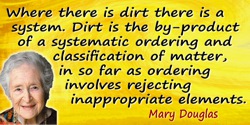
Where there is dirt there is a system. Dirt is the by-product of a systematic ordering and classification of matter, in so far as ordering involves rejecting inappropriate elements.
In Purity and Danger: An Analysis of the Concepts of Pollution and Taboo (1966), 35.
Where we reach the sphere of mathematics we are among processes which seem to some the most inhuman of all human activities and the most remote from poetry. Yet it is just here that the artist has the fullest scope for his imagination. … We are in the imaginative sphere of art, and the mathematician is engaged in a work of creation which resembles music in its orderliness, … It is not surprising that the greatest mathematicians have again and again appealed to the arts in order to find some analogy to their own work. They have indeed found it in the most varied arts, in poetry, in painting, and in sculpture, although it would certainly seem that it is in music, the most abstract of all the arts, the art of number and time, that we find the closest analogy.
In The Dance of Life (1923), 138-139.
Wherefore also these Kinds [elements] occupied different places even before the universe was organised and generated out of them. Before that time, in truth, all these were in a state devoid of reason or measure, but when the work of setting in order this Universe was being undertaken, fire and water and earth and air, although possessing some traces of their known nature, were yet disposed as everything is likely to be in the absence of God; and inasmuch as this was then their natural condition, God began by first marking them out into shapes by means of forms and numbers.
— Plato
Timaeus 53ab, trans. R. G. Bury, in Plato: Timaeus, Critias, Cleitophon, Menexenus, Epistles (1929), 125-7.
While the method of the natural sciences is... analytic, the method of the social sciences is better described as compositive or synthetic. It is the so-called wholes, the groups of elements which are structurally connected, which we learn to single out from the totality of observed phenomena... Insofar as we analyze individual thought in the social sciences the purpose is not to explain that thought, but merely to distinguish the possible types of elements with which we shall have to reckon in the construction of different patterns of social relationships. It is a mistake... to believe that their aim is to explain conscious action ... The problems which they try to answer arise only insofar as the conscious action of many men produce undesigned results... If social phenomena showed no order except insofar as they were consciously designed, there would indeed be no room for theoretical sciences of society and there would be, as is often argued, only problems of psychology. It is only insofar as some sort of order arises as a result of individual action but without being designed by any individual that a problem is raised which demands a theoretical explanation... people dominated by the scientistic prejudice are often inclined to deny the existence of any such order... it can be shown briefly and without any technical apparatus how the independent actions of individuals will produce an order which is no part of their intentions... The way in which footpaths are formed in a wild broken country is such an instance. At first everyone will seek for himself what seems to him the best path. But the fact that such a path has been used once is likely to make it easier to traverse and therefore more likely to be used again; and thus gradually more and more clearly defined tracks arise and come to be used to the exclusion of other possible ways. Human movements through the region come to conform to a definite pattern which, although the result of deliberate decision of many people, has yet not be consciously designed by anyone.
…...
Who does not know Maxwell’s dynamic theory of gases? At first there is the majestic development of the variations of velocities, then enter from one side the equations of condition and from the other the equations of central motions, higher and higher surges the chaos of formulas, suddenly four words burst forth: “Put n = 5.” The evil demon V disappears like the sudden ceasing of the basso parts in music, which hitherto wildly permeated the piece; what before seemed beyond control is now ordered as by magic. There is no time to state why this or that substitution was made, he who cannot feel the reason may as well lay the book aside; Maxwell is no program-musician who explains the notes of his composition. Forthwith the formulas yield obediently result after result, until the temperature-equilibrium of a heavy gas is reached as a surprising final climax and the curtain drops.
In Ceremonial Speech (15 Nov 1887) celebrating the 301st anniversary of the Karl-Franzens-University Graz. Published as Gustav Robert Kirchhoff: Festrede zur Feier des 301. Gründungstages der Karl-Franzens-Universität zu Graz (1888), 29-30, as translated in Robert Édouard Moritz, Memorabilia Mathematica; Or, The Philomath’s Quotation-book (1914), 187. From the original German, “Wer kennt nicht seine dynamische Gastheorie? – Zuerst entwickeln sich majestätisch die Variationen der Geschwindigkeiten, dann setzen von der einen Seite die Zustands-Gleichungen, von der anderen die Gleichungen der Centralbewegung ein, immer höher wogt das Chaos der Formeln; plötzlich ertönen die vier Worte: „Put n=5.“Der böse Dämon V verschwindet, wie in der Musik eine wilde, bisher alles unterwühlende Figur der Bässe plötzlich verstummt; wie mit einem Zauberschlage ordnet sich, was früher unbezwingbar schien. Da ist keine Zeit zu sagen, warum diese oder jene Substitution gemacht wird; wer das nicht fühlt, lege das Buch weg; Maxwell ist kein Programmmusiker, der über die Noten deren Erklärung setzen muss. Gefügig speien nun die Formeln Resultat auf Resultat aus, bis überraschend als Schlusseffect noch das Wärme-Gleichgewicht eines schweren Gases gewonnen wird und der Vorhang sinkt.” A condensed alternate translation also appears on the Ludwig Boltzmann Quotes page of this website.
Who ordered that?
Exclaimed about discovery of the muon, adding to the growing family of different entities appearing in ephemeral particle showers. As quoted in Marcia Bartusiak, 'Science & Technology; Who Ordered the Muon?', New York Times (27 Sep 1987), 42.
Why can the chemist not take the requisite numbers of atoms and simply put them together? The answer is that the chemist never has atoms at his disposal, and if he had, the direct combination of the appropriate numbers of atoms would lead only to a Brobdingnagian potpourri of different kinds of molecules, having a vast array of different structures. What the chemist has at hand always consists of substances, themselves made up of molecules, containing defined numbers of atoms in ordered arrangements. Consequently, in order to synthesize anyone substance, his task is that of combining, modifying, transforming, and tailoring known substances, until the total effect of his manipulations is the conversion of one or more forms of matter into another.
In 'Art and Science in the Synthesis of Organic Compounds: Retrospect and Prospect', in Maeve O'Connor (ed.), Pointers and Pathways in Research (1963), 28.
Why should we look to the past in order to prepare for the future? Because there is nowhere else to look.
In Connections (1978, 1979), 287.
With a thousand joys I would accept a nonacademic job for which industriousness, accuracy, loyalty, and such are sufficient without specialized knowledge, and which would give a comfortable living and sufficient leisure, in order to sacrifice to my gods [mathematical research]. For example, I hope to get the editting of the census, the birth and death lists in local districts, not as a job, but for my pleasure and satisfaction...
Letter to Heinrich Olbers (26 Oct 1802). Quoted in G. Waldo Dunnington, Carl Friedrich Gauss: Titan of Science (2004), 415.
With such wisdom has nature ordered things in the economy of this world, that the destruction of one continent is not brought about without the renovation of the earth in the production of another.
Theory of the Earth, with Proofs and Illustrations, Vol. 1 (1795), 183.
Without preparing fluorine, without being able to separate it from the substances with which it is united, chemistry has been able to study and to analyze a great number of its compounds. The body was not isolated, and yet its place was marked in our classifications. This well demonstrates the usefulness of a scientific theory, a theory which is regarded as true during a certain time, which correlates facts and leads the mind to new hypotheses, the first causes of experimentation; which, little by little, destroy the theory itself, in order to replace it by another more in harmony with the progress of science.
[Describing the known history of fluorine compounds before his isolation of the element.]
[Describing the known history of fluorine compounds before his isolation of the element.]
'Fluorine', lecture at the Royal Institution (28 May 1897), translated from the French, in Proceedings of the Royal Institution (1897). In Annual Report of the Board of Regents of the Smithsonian Institution to July 1897 (1898), 262.
Write a paper promising salvation, make it a ‘structured’ something or a ‘virtual’ something, or ‘abstract’, ‘distributed’ or ‘higher-order’ or ‘applicative’ and you can almost be certain of having started a new cult.
…...
Yet I also appreciate that we cannot win this battle to save species and environments without forging an emotional bond between ourselves and nature as well–for we will not fight to save what we do not love (but only appreciate in some abstract sense). So let them all continue–the films, the books, the television programs, the zoos, the little half acre of ecological preserve in any community, the primary school lessons, the museum demonstrations, even ... the 6:00 A.M. bird walks. Let them continue and expand because we must have visceral contact in order to love. We really must make room for nature in our hearts.
…...
Yet is it possible in terms of the motion of atoms to explain how men can invent an electric motor, or design and build a great cathedral? If such achievements represent anything more than the requirements of physical law, it means that science must investigate the additional controlling factors, whatever they may be, in order that the world of nature may be adequately understood. For a science which describes only the motions of inanimate things but fails to include the actions of living organisms cannot claim universality.
The Human Meaning of Science (1940), 31.
You believe in the God who plays dice, and I in complete law and order in a world that objectively exists, and which I, in a wildly speculative way, am trying to capture. … Even the great initial success of the quantum theory does not make me believe in the fundamental dice-game, although I am well aware that our younger colleagues interpret this as a consequence of senility. No doubt the day will come when we will see whose instinctive attitude was the correct one.
Letter to Max Born (7 Sep 1944). In Born-Einstein Letters, 146. Einstein Archives 8-207. In Albert Einstein, Alice Calaprice, Freeman Dyson, The Ultimate Quotable Einstein (2011), 393-394. Often seen paraphrased as “I cannot believe that God plays dice with the cosmos.” Also see a related quote about God playing dice on the Stephen W. Hawking Quotes page of this website.
You do not know our culture, our ethics, or the unwritten codes that already provide our society more order than could be obtained by any of your impositions.
In 'A Declaration of the Independence of Cyberspace' (8 Feb 1996). Published on Electronic Frontier Foundation website. Reproduced in Lawrence Lessig, Code: Version 2.0) (2008), 302.
You have read my writings, and from them you have certainly understood which was the true and real motive that caused, under the lying mask of religion, this war against me that continually restrains and undercuts me in all directions, so that neither can help come to me from outside nor can I go forth to defend myself, there having been issued an express order to all Inquisitors that they should not allow any of my works to be reprinted which had been printed many years ago or grant permission to any new work that I would print. … a most rigorous and general order, I say, against all my works, omnia et edenda; so that it is left to me only to succumb in silence under the flood of attacks, exposures, derision, and insult coming from all sides.
You have read my writings, and from them you have certainly understood which was the true and real motive that caused, under the lying mask of religion, this war against me that continually restrains and undercuts me in all directions, so that neither can help come to me from outside nor can I go forth to defend myself, there having been issued an express order to all Inquisitors that they should not allow any of my works to be reprinted which had been printed many years ago or grant permission to any new work that I would print. … a most rigorous and general order, I say, against all my works, omnia et edenda; so that it is left to me only to succumb in silence under the flood of attacks, exposures, derision, and insult coming from all sides.
In Letter to Nicolas-Claude Fabri de Peiresc (16 Mar 1635). As quoted in translation in Giorgio de Santillana, The Crime of Galileo (1976), 324, with footnote that “he had known about the reserved orders to the provincial Inquisitors from Micanzio in Venice. On September 8, 1633, the Pope had further reprimanded the Inquisitor of Florence for giving permission to reprint some past works.”
You may perceive something of the distinction which I think necessary to keep in view between art and science, between the artist and the man of knowledge, or the philosopher. The man of knowledge, the philosopher, is he who studies and acquires knowledge in order to improve his own mind; and with a desire of extending the department of knowledge to which he turns his attention, or to render it useful to the world, by discoveries, or by inventions, which may be the foundation of new arts, or of improvements in those already established. Excited by one or more of these motives, the philosopher employs himself in acquiring knowledge and in communicating it. The artist only executes and practises what the philosopher or man of invention has discovered or contrived, while the business of the trader is to retail the productions of the artist, exchange some of them for others, and transport them to distant places for that purpose.
From the first of a series of lectures on chemistry, collected in John Robison (ed.), Lectures on the Elements of Chemistry: Delivered in the University of Edinburgh (1807), Vol. 1, 3.
Your mind works very simply: you are either trying to find out what are God’s laws in order to follow them; or you are trying to outsmart Him.
 In science it often happens that scientists say, 'You know that's a really good argument; my position is mistaken,' and then they would actually change their minds and you never hear that old view from them again. They really do it. It doesn't happen as often as it should, because scientists are human and change is sometimes painful. But it happens every day. I cannot recall the last time something like that happened in politics or religion.
(1987) --
In science it often happens that scientists say, 'You know that's a really good argument; my position is mistaken,' and then they would actually change their minds and you never hear that old view from them again. They really do it. It doesn't happen as often as it should, because scientists are human and change is sometimes painful. But it happens every day. I cannot recall the last time something like that happened in politics or religion.
(1987) -- 





.jpg)

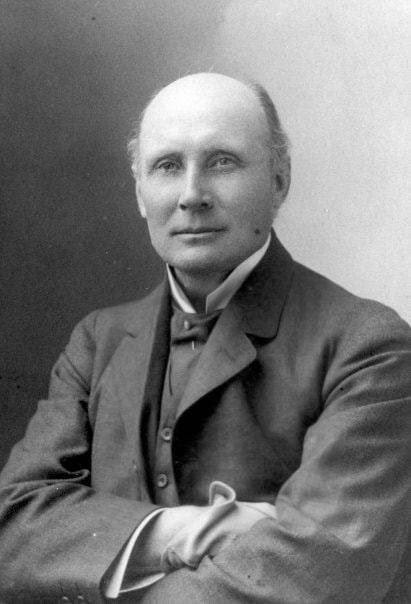

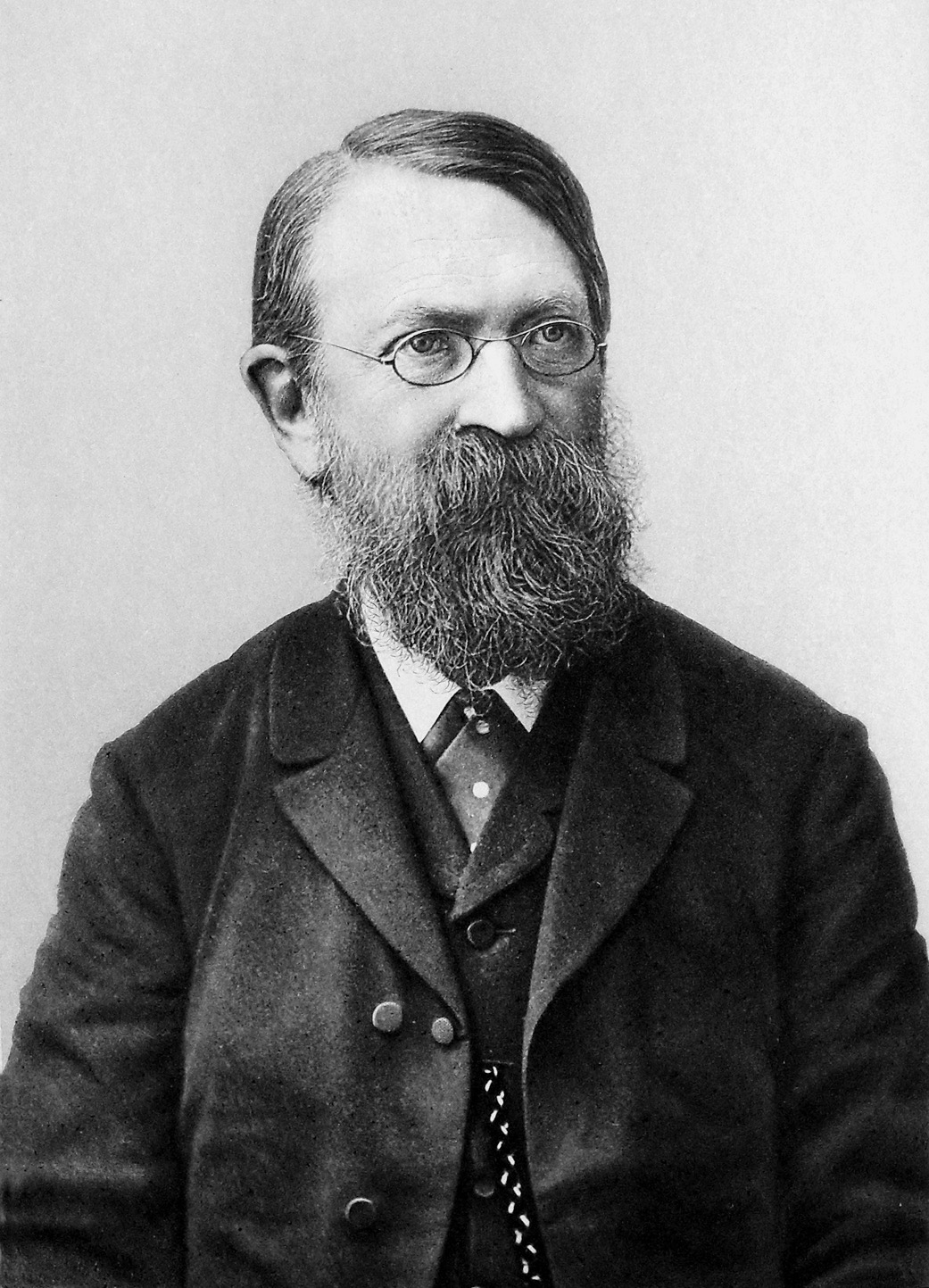
-LLNL.jpg)

