Object Quotes (446 quotes)
… the rules of clockwork might apply to familiar objects such as snookerballs, but when it comes to atoms, the rules are those of roulette.
In God and the New Physics (1984), 102.
...for the animals, which we resemble and which would be our equals if we did not have reason, do not reflect upon the actions or the passions of their external or internal senses, and do not know what is color, odor or sound, or if there is any differences between these objects, to which they are moved rather than moving themselves there. This comes about by the force of the impression that the different objects make on their organs and on their senses, for they cannot discern if it is more appropriate to go and drink or eat or do something else, and they do not eat or drink or do anything else except when the presence of objects or the animal imagination [l'imagination brutalle], necessitates them and transports them to their objects, without their knowing what they do, whether good or bad; which would happen to us just as to them if we were destitute of reason, for they have no enlightenment except what they must have to take their nourishment and to serve us for the uses to which God has destined them.
[Arguing the uniqueness of man by regarding animals to be merely automatons.].
[Arguing the uniqueness of man by regarding animals to be merely automatons.].
Les Préludes de l'Harmonie Universelle (1634), 135-139. In Charles Coulston Gillespie (ed.), Dictionary of Scientific Biography (1974), Vol. 9, 318.
“In order to ascertain the height of the tree I must be in such a position that the top of the tree is exactly in a line with the top of a measuring-stick—or any straight object would do, such as an umbrella—which I shall secure in an upright position between my feet. Knowing then that the ratio that the height of the tree bears to the length of the measuring stick must equal the ratio that the distance from my eye to the base of the tree bears to my height, and knowing (or being able to find out) my height, the length of the measuring stick and the distance from my eye to the base of the tree, I can, therefore, calculate the height of the tree.”
“What is an umbrella?”
“What is an umbrella?”
In Mr. Fortune’s Maggot (1927), 175.
“Say whatever you choose about the object, and whatever you might say is not it.” Or, in other words: “Whatever you might say the object ‘is,’ well, it is not.”
Korzybski's controversial formulation of “Non-identity” in his Science and Sanity: An Introduction to Non-Aristotelian Systems and General Semantics (1958), 35, and comment in Preface, xviii.
“Science studies everything,” say the scientists. But, really, everything is too much. Everything is an infinite quantity of objects; it is impossible at one and the same time to study all. As a lantern cannot light up everything, but only lights up the place on which it is turned or the direction in which the man carrying it is walking, so also science cannot study everything, but inevitably only studies that to which its attention is directed. And as a lantern lights up most strongly the place nearest to it, and less and less strongly objects that are more and more remote from it, and does not at all light up those things its light does not reach, so also human science, of whatever kind, has always studied and still studies most carefully what seems most important to the investigators, less carefully what seems to them less important, and quite neglects the whole remaining infinite quantity of objects. ... But men of science to-day ... have formed for themselves a theory of “science for science's sake,” according to which science is to study not what mankind needs, but everything.
In 'Modern Science', Essays and Letters (1903), 223.
“That’s another thing we’ve learned from your Nation,” said Mein Herr, “map-making. But we’ve carried it much further than you. What do you consider the largest map that would be really useful?”
“About six inches to the mile.”
“Only six inches!” exclaimed Mein Herr. “We very soon got to six yards to the mile. Then we tried a hundred yards to the mile. And then came the grandest idea of all! We actually made a map of the country, on the scale of a mile to the mile!”
“Have you used it much?” I enquired.
“It has never been spread out, yet,” said Mein Herr: “the farmers objected: they said it would cover the whole country, and shut out the sunlight! So we now use the country itself, as its own map, and I assure you it does nearly as well.”
“About six inches to the mile.”
“Only six inches!” exclaimed Mein Herr. “We very soon got to six yards to the mile. Then we tried a hundred yards to the mile. And then came the grandest idea of all! We actually made a map of the country, on the scale of a mile to the mile!”
“Have you used it much?” I enquired.
“It has never been spread out, yet,” said Mein Herr: “the farmers objected: they said it would cover the whole country, and shut out the sunlight! So we now use the country itself, as its own map, and I assure you it does nearly as well.”
From Sylvie and Bruno Concluded (1893), 169.
[Animals] do not so much act as be put into action, and that objects make an impression on their senses such that it is necessary for them to follow it just as it is necessary for the wheels of a clock to follow the weights and the spring that pulls them.
[In his philosophy, he regarded animals to be merely automatons.].
[In his philosophy, he regarded animals to be merely automatons.].
'Traitez de la voix', Harmonie Universelle (1637), Vol. 1, prop. lii, 79. In Charles Coulston Gillespie (ed.), Dictionary of Scientific Biography (1974), Vol. 9, 318.
[Concerning] phosphorescent bodies, and in particular to uranium salts whose phosphorescence has a very brief duration. With the double sulfate of uranium and potassium ... I was able to perform the following experiment: One wraps a Lumière photographic plate with a bromide emulsion in two sheets of very thick black paper, such that the plate does not become clouded upon being exposed to the sun for a day. One places on the sheet of paper, on the outside, a slab of the phosphorescent substance, and one exposes the whole to the sun for several hours. When one then develops the photographic plate, one recognizes that the silhouette of the phosphorescent substance appears in black on the negative. If one places between the phosphorescent substance and the paper a piece of money or a metal screen pierced with a cut-out design, one sees the image of these objects appear on the negative. One can repeat the same experiments placing a thin pane of glass between the phosphorescent substance and the paper, which excludes the possibility of chemical action due to vapors which might emanate from the substance when heated by the sun's rays. One must conclude from these experiments that the phosphorescent substance in question emits rays which pass through the opaque paper and reduces silver salts.
[Although the sun is irrelevant, and he misinterprets the role of phosphorescence, he has discovered the effect of radioactivity.]
[Although the sun is irrelevant, and he misinterprets the role of phosphorescence, he has discovered the effect of radioactivity.]
Read at French Academy of Science (24 Feb 1896). In Comptes Rendus (1896), 122, 420. As translated by Carmen Giunta on the Classic Chemistry web site.
[For] those suffering under the thraldom of the vice [of opium eating] … it is well to avoid undue harshness with the patient; and it should be carefully remembered, that in many instances the sufferers are more objects of pity than of blame.
In 'Clinical Lecture On The Treatment Of The Habit Of Opium-Eating', The British Medical Journal (15 Feb 1868), 1, No. 372, 137.
[John Scott Haldane] preferred to work on himself or other human beings who were sufficiently interested in the work to ignore pain or fear … [His] object was not to achieve this state of [pain or fear] but to achieve knowledge which could save other men's lives. His attitute was much more like a good soldier who will risk his life and endure wounds in order to gain victory than that of an ascetic who deliberately undergoes pain. The soldier does not get himself wounded deliberately, and my father did not seek pain in his work though he greeted pain which would have made some people writhe or groan, with laughter.
In R.W. Clark, JBS: The Life and Work of J.B.S. Haldane (1968), quoted in Lawrence K. Altman, Who Goes First? (1986), 215.
[Mathematics] has for its object the indirect measurement of magnitudes, and it proposes to determine magnitudes by each other, according to the precise relations which exist between them.
In The Positive Philosophy of Auguste Comte, translated by Harriet Martineau, (1896), Vol. 1, 40.
[The Library of Congress] is a multimedia encyclopedia. These are the tentacles of a nation.
[Referring to the diverse holdings of the library, including motion pictures, photographs, recordings, posters and other historic objects which collectively far outnumber the books]
[Referring to the diverse holdings of the library, including motion pictures, photographs, recordings, posters and other historic objects which collectively far outnumber the books]
Quoted by Barbara Gamarekian in 'Working Profile: Daniel J. Boorstin. Helping the Library of Congress Fulfill Its Mission', New York Times (8 Jul 1983), B6.
[The nanotube] brings those properties you cannot get from other organic molecules. And it’s still carbon, so it has organic chemistry. Here is an object that has, to a superlative degree, the aspects that we hold most central to the inorganic world: hardness, toughness, terrific strength, thermal and electrical conductivity. Things you just can’t do with bone and wood. But it’s made out of carbon. It’s something that plays the game at the same level of perfection as molecules and life.
From interview in 'Wires of Wonder', Technology Review (Mar 2001), 104, No. 2, 88.
[The object of education is] to train the mind to ascertain the sequence of a particular conclusion from certain premises, to detect a fallacy, to correct undue generalisation, to prevent the growth of mistakes in reasoning. Everything in these must depend on the spirit and the manner in which the instruction itself is conveyed and honoured. If you teach scientific knowledge without honouring scientific knowledge as it is applied, you do more harm than good. I do think that the study of natural science is so glorious a school for the mind, that with the laws impressed on all these things by the Creator, and the wonderful unity and stability of matter, and the forces of matter, there cannot be a better school for the education of the mind.
Giving Evidence (18 Nov 1862) to the Public Schools Commission. As quoted in John L. Lewis, 125 Years: The Physical Society & The Institute of Physics (1999), 168-169.
[The teaching of Nature] is harsh and wasteful in its operation. Ignorance is visited as sharply as wilful disobedience—incapacity meets with the same punishment as crime. Nature’s discipline is not even a word and a blow, and the blow first; but the blow without the word. It is left to you to find out why your ears are boxed.
The object of what we commonly call education—that education in which man intervenes, and which I shall distinguish as artificial education—is to make good these defects in Nature’s methods; to prepare the child to receive Nature’s education, neither incapably, nor ignorantly, nor with wilful disobedience; and to understand the preliminary symptoms of her displeasure, without waiting for the box on the ear. In short, all artificial education ought to he an anticipation of natural education. And a liberal education is an artificial education, which has not only prepared a man to escape the great evils of disobedience to natural laws, but has trained him to appreciate and to seize upon the rewards, which Nature scatters with as free a hand as her penalties.
The object of what we commonly call education—that education in which man intervenes, and which I shall distinguish as artificial education—is to make good these defects in Nature’s methods; to prepare the child to receive Nature’s education, neither incapably, nor ignorantly, nor with wilful disobedience; and to understand the preliminary symptoms of her displeasure, without waiting for the box on the ear. In short, all artificial education ought to he an anticipation of natural education. And a liberal education is an artificial education, which has not only prepared a man to escape the great evils of disobedience to natural laws, but has trained him to appreciate and to seize upon the rewards, which Nature scatters with as free a hand as her penalties.
From Inaugural Address as Principal, South London Working Men’s College, in 'A Liberal Education; and Where to Find it', Macmillan's Magazine (Mar 1868), 17, 370.
[Walter] Baade, like all scientists of substance, had a set view of how things were put together, to be sure a view to be always challenged by the scientist himself, but defended as well against all less informed mortals who objected without simon-pure reasons.
From Owen Gingerich in Physics Today (1994), 47, No.12, 34-40. As quoted and cited in Donald Lynden-Bell and François Schweizer, 'Allan Rex Sandage: 18 June 1926—13 November 2010', Biographical Memoirs of Fellows of the Royal Society (2012), Vol. 58, 251.
[We] can easily distinguish what relates to Mathematics in any question from that which belongs to the other sciences. But as I considered the matter carefully it gradually came to light that all those matters only were referred to Mathematics in which order and measurements are investigated, and that it makes no difference whether it be in numbers, figures, stars, sounds or any other object that the question of measurement arises. I saw consequently that there must be some general science to explain that element as a whole which gives rise to problems about order and measurement, restricted as these are to no special subject matter. This, I perceived was called “Universal Mathematics,” not a far-fetched asignation, but one of long standing which has passed into current use, because in this science is contained everything on account of which the others are called parts of Mathematics.
Rules for the Direction of the Mind (written 1628). As translated by Elizabeth Sanderson Haldane and George Robert Thomson Ross in The Philosophical Works of Descartes (1911, 1931), 13.

La chaleur pénètre, comme la gravité, toutes les substances de l’univers, ses rayons occupent toutes les parties de l’espace. Le but de notre ouvrage est d’exposer les lois mathématiques que suit cet élément. Cette théorie formera désormais une des branches les plus importantes de la physique générale.
Heat, like gravity, penetrates every substance of the universe, its rays occupy all parts of space. The object of our work is to set forth the mathematical laws which this element obeys. The theory of heat will hereafter form one of the most important branches of general physics.
Heat, like gravity, penetrates every substance of the universe, its rays occupy all parts of space. The object of our work is to set forth the mathematical laws which this element obeys. The theory of heat will hereafter form one of the most important branches of general physics.
From 'Discours Préliminaire' to Théorie Analytique de la Chaleur (1822), i, translated by Alexander Freeman in The Analytical Theory of Heat (1878), 1.
Les causes primordiales ne nous sont point connues; mais elles sont assujetties à des lois simples et constantes, que l’on peut découvrir par l’observation, et dont l’étude est l’objet de la philosophie naturelle.
Primary causes are unknown to us; but are subject to simple and constant laws, which may be discovered by observation, the study of them being the object of natural philosophy.
Primary causes are unknown to us; but are subject to simple and constant laws, which may be discovered by observation, the study of them being the object of natural philosophy.
Opening statement from 'Discours Préliminaire' to Théorie Analytique de la Chaleur (1822), i, translated by Alexander Freeman in The Analytical Theory of Heat (1878), 1.
Longtemps les objets dont s'occupent les mathématiciens étaient our la pluspart mal définis; on croyait les connaître, parce qu'on se les représentatit avec le sens ou l'imagination; mais on n'en avait qu'une image grossière et non une idée précise sure laquelle le raisonment pût avoir prise.
For a long time the objects that mathematicians dealt with were mostly ill-defined; one believed one knew them, but one represented them with the senses and imagination; but one had but a rough picture and not a precise idea on which reasoning could take hold.
For a long time the objects that mathematicians dealt with were mostly ill-defined; one believed one knew them, but one represented them with the senses and imagination; but one had but a rough picture and not a precise idea on which reasoning could take hold.
La valeur de la science. In Anton Bovier, Statistical Mechanics of Disordered Systems (2006), 97.
Of Cooking. This is an art of various forms, the object of which is to give ordinary observations the appearance and character of those of the highest degree of accuracy. One of its numerous processes is to make multitudes of observations, and out of these to select only those which agree, or very nearly agree. If a hundred observations are made, the cook must be very unhappy if he cannot pick out fifteen or twenty which will do for serving up.
Reflections on the Decline of Science in England (1830). In Calyampudi Radhakrishna Rao, Statistics and Truth (1997), 84.
Socrates: Shall we set down astronomy among the objects of study?
Glaucon: I think so, to know something about the seasons, the months and the years is of use for military purposes, as well as for agriculture and for navigation.
Socrates: It amuses me to see how afraid you are, lest the common herd of people should accuse you of recommending useless studies.
As quoted by Plato. In Richard Garnett, Léon Vallée, Alois Brandl (eds.), The Universal Anthology: A Collection of the Best Literature (1899), Vol. 4, 111.
Ueber den Glauben lässt sich wissenschaftlich nicht rechten, denn die Wissenschaft und der Glaube schliessen sich aus. Nicht so, dass der eine die andere unmöglich machte oder umgekehrt, sondern so, dass, soweit die Wissenschaft reicht, kein Glaube existirt und der Glaube erst da anfangen darf, wo die Wissenschaft aufhört. Es lässt „sich nicht läugnen, dass, wenn diese Grenze eingehalten wird, der Glaube wirklich reale Objekte haben kann. Die Aufgabe der Wissenschaft ist es daher nicht, die Gegenstände des Glaubens anzugreifen, sondern nur die Grenzen zu stecken, welche die Erkenntniss erreichen kann, und innerhalb derselben das einheitliche Selbstbewusstsein zu begründen.
There is no scientific justification for faith, for science and faith are mutually exclusive. Not that one made the other impossible, or vice versa, but that, as far as science goes, there is no faith, and faith can only begin where science ends. It can not be denied that, if this limit is adhered to, faith can really have real objects. The task of science, therefore, is not to attack the objects of faith, but merely to set the limits which knowledge can attain and to establish within it the unified self-esteem.
There is no scientific justification for faith, for science and faith are mutually exclusive. Not that one made the other impossible, or vice versa, but that, as far as science goes, there is no faith, and faith can only begin where science ends. It can not be denied that, if this limit is adhered to, faith can really have real objects. The task of science, therefore, is not to attack the objects of faith, but merely to set the limits which knowledge can attain and to establish within it the unified self-esteem.
Original German from 'Der Mensch' (1849), collected in Gesammelte abhandlungen zur wissenschaftlichen medicin (1856), 6. Webmaster used Google translate for the English version. This longer quote unites the shorter quotes from within it shown separately on the Rudolf Virchow quotations page, with alternative translations, which begin: “There can be no scientific dispute…”, “Belief has no place…”, and “The task of science…”.
~~[Unverified]~~ The strongest affection and utmost zeal should, I think, promote the studies concerned with the most beautiful objects. This is the discipline that deals with the universe’s divine revolutions, the stars’ motions, sizes, distances, risings and settings . . . for what is more beautiful than heaven?
Seen spreading across the web, only in recent years. As yet, Webmaster cannot identify a trustworthy primary source, is therefore presently skeptical, and meanwhile labels the quote as unverified.
1. Universal CHEMISTRY is the Art of resolving mixt, compound, or aggregate Bodies into their Principles; and of composing such Bodies from those Principles. 2. It has for its Subject all the mix’d, compound, and aggregate Bodies that are and resolvable and combinable and Resolution and Combination, or Destruction and Generation, for its Object. 3. Its Means in general, are either remote or immediate; that is, either Instruments or the Operations themselves. 4. Its End is either philosophical and theoretical; or medicinal, mechanical, œconomical, and practical. 5. Its efficient Cause is the Chemist.
In Philosophical Principles of Universal Chemistry: Or, The Foundation of a Scientifical Manner of Inquiring Into and Preparing the Natural and Artificial Bodies for the Uses of Life: Both in the Smaller Way of Experiment, and the Larger Way of Business (1730), 1. Footnote to (1.): “The justness of this Definition will appear from the scope and tenour of the Work; though it is rather adapted to the perfect, than the present imperfect state of Chemistry….” Footnote to (4): “Hence universal Chemistry is commodiously resolved into several Parts or Branches, under which it must be distinctly treated to give a just notion of its due extent and usefulness. For tho’ in common acceptation of the word, Chemistry is supposed to relate chiefly to the Art of Medicine, as it supplies that Art with Remedies, this in reality is but a very small part of its use, compared with the rest; numerous other Arts, Trades, and mechanical Employments, Merchandize itself, and all natural Philosophy, being as much, and some of them more, concern’d therewith….”
A fractal is a mathematical set or concrete object that is irregular or fragmented at all scales.
Cited as from Fractals: Form, Chance, and Dimension (1977), by J.W. Cannon, in review of The Fractal Geometry of Nature (1982) in The American Mathematical Monthly (Nov 1984), 91, No. 9, 594.
A man may fulfill the object of his existence by asking a question he cannot answer, and attempting a task he cannot achieve.
Quoted in Kim Lim (ed.), 1,001 Pearls of Spiritual Wisdom: Words to Enrich, Inspire, and Guide Your Life (2014), 121
A mind which has once imbibed a taste for scientific enquiry, and has learnt the habit of applying its principles readily to the cases which occur, has within itself an inexhaustable source of pure and exciting contemplations:— One would think that Shakespeare had such a mind in view when he describes a contemplative man as finding
“Tongues in trees—books in running brooks—
Sermons in stones—and good in everything.”
Accustomed to trace the operations of general causes and the exemplification of general laws, in circumstances where the uninformed and uninquiring eye, perceives neither novelty nor beauty, he walks in the midst of wonders; every object which falls in his way elucidates some principle, affords some instruction and impresses him with a sense of harmony and order. Nor is it a mere passive pleasure which is thus communicated. A thousand questions are continually arising in his mind, a thousand objects of enquiry presenting themselves, which keep his faculties in constant exercise, and his thoughts perpetually on the wing, so that lassitude is excluded from his life, and that craving after artificial excitement and dissipation of the mind, which leads so many into frivolous, unworthy, and destructive pursuits, is altogether eradicated from his bosom.
“Tongues in trees—books in running brooks—
Sermons in stones—and good in everything.”
Accustomed to trace the operations of general causes and the exemplification of general laws, in circumstances where the uninformed and uninquiring eye, perceives neither novelty nor beauty, he walks in the midst of wonders; every object which falls in his way elucidates some principle, affords some instruction and impresses him with a sense of harmony and order. Nor is it a mere passive pleasure which is thus communicated. A thousand questions are continually arising in his mind, a thousand objects of enquiry presenting themselves, which keep his faculties in constant exercise, and his thoughts perpetually on the wing, so that lassitude is excluded from his life, and that craving after artificial excitement and dissipation of the mind, which leads so many into frivolous, unworthy, and destructive pursuits, is altogether eradicated from his bosom.
In Dionysius Lardner (ed.), Cabinet Cyclopaedia, Vol 1, Preliminary Discourse on the Study of Natural Philosophy (1831), 14-15.
A patent is property carried to the highest degree of abstraction—a right in rem to exclude, without a physical object or content.
Homes-Pollock Letters (1946), edited by Mark DeWolfe Howe, Vol. 1, 53. In Eugene C. Gerhart, Quote it Completely! (1998), 802.
A person who is religiously enlightened appears to me to be one who has, to the best of his ability, liberated himself from the fetters of his selfish desires and is preoccupied with thoughts, feelings, and aspirations to which he clings because of their superpersonal value. It seems to me that what is important is the force of this superpersonal content and the depth of the conviction concerning its overpowering meaningfulness, regardless of whether any attempt is made to unite this content with a divine Being, for otherwise it would not be possible to count Buddha and Spinoza as religious personalities. Accordingly, a religious person is devout in the sense that he has no doubt of the significance and loftiness of those superpersonal objects and goals which neither require nor are capable of rational foundation. They exist with the same necessity and matter-of-factness as he himself. In this sense religion is the age-old endeavor of mankind to become clearly and completely conscious of these values and goals and constantly to strengthen and extend their effect. If one conceives of religion and science according to these definitions then a conflict between them appears impossible. For science can only ascertain what is, but not what should be, and outside of its domain value judgments of all kinds remain necessary.
…...
A poem in my opinion, is opposed to a work of science by having for its immediate object, pleasure, not truth.
'Letter to B——— ———', in Southern Literary Messenger (Jul 1836). Quoted in Poems of Edgar Allan Poe (1917), 169, and Appendix, 311. According to different commentators, B——— may be merely a fictional character, or Bulwer-Lyton, or the publisher Elam Bliss.
A political law or a scientific truth may be perilous to the morals or the faith of individuals; but it cannot on this ground be resisted by the Church. … A discovery may be made in science which will shake the faith of thousands; yet religion cannot regret it or object to it. The difference in this respect between a true and a false religion is, that one judges all things by the standard of their truth, the other by the touchstone of its own interests. A false religion fears the progress of all truth; a true religion seeks and recognises truth wherever it can be found.
From 'Cardinal Wiseman and the Home and Foreign Review' (1862), collected in John Emerich Edward Dalberg Acton Baron Acton, John Neville Figgis (ed.) and Reginald Vere Laurence (ed.), The History of Freedom and Other Essays (1907), 449-450. The Darwinian controversy was at its height when this was written.
A single and distinct luminous body causes stronger relief in the objects than a diffused light; as may be seen by comparing one side of a landscape illuminated by the sun, and one overshadowed by clouds, and illuminated only by the diffused light of the atmosphere.
…...
A wise man in China asked his gardener to plant a shrub. The gardener objected that it only flowered once in a hundred years. “In that case,” said the wise man, “plant it immediately.” [On the importance of fundamental research.]
'A Scientist and the World He Lives In', Speech to the Empire Club of Canada (27 Nov 1986) in C. Frank Turner and Tim Dickson (eds.), The Empire Club of Canada Speeches 1986-1987 (1987), 149-161.
About ten months ago [1609] a report reached my ears that a certain Fleming [Hans Lippershey] had constructed a spyglass, by means of which visible objects, though very distant from the eye of the observer, were distinctly seen as if nearby... Of this truly remarkable effect several experiences were related, to which some persons gave credence while others denied them. A few days later the report was confirmed to me in a letter from a noble Frenchman at Paris, Jacques Badovere, which caused me to apply myself wholeheartedly to enquire into the means by which I might arrive at the invention of a similar instrument. This I did shortly afterwards, my basis being the theory of refraction. First I prepared a tube of lead, at the ends of which I fitted two glass lenses, both plane on one side while on the other side one was spherically convex and the other concave.
The Starry Messenger (1610), trans. Stillman Drake, Discoveries and Opinions of Galileo (1957), 28-9.
According to the conclusion of Dr. Hutton, and of many other geologists, our continents are of definite antiquity, they have been peopled we know not how, and mankind are wholly unacquainted with their origin. According to my conclusions drawn from the same source, that of facts, our continents are of such small antiquity, that the memory of the revolution which gave them birth must still be preserved among men; and thus we are led to seek in the book of Genesis the record of the history of the human race from its origin. Can any object of importance superior to this be found throughout the circle of natural science?
An Elementary Treatise on Geology (1809), 82.
After five years' work I allowed myself to speculate on the subject, and drew up some short notes; these I enlarged in 1844 into a sketch of the conclusions, which then seemed to me probable: from that period to the present day I have steadily pursued the same object. I hope that I may be excused for entering on these personal details, as I give them to show that I have not been hasty in coming to a decision.
From On the Origin of Species by Means of Natural Selection; or, The Preservation of Favoured Races in the Struggle for Life (1861), 9.
Again, it [the Analytical Engine] might act upon other things besides number, were objects found whose mutual fundamental relations could be expressed by those of the abstract science of operations, and which should be also susceptible of adaptations to the action of the operating notation and mechanism of the engine. Supposing for instance, that the fundamental relations of pitched sounds in the science of harmony and of musical composition were susceptible of such expression and adaptations, the engine might compose elaborate and scientific pieces of music of any degree of complexity or extent.
In Richard Taylor (ed.), 'Translator’s Notes to M. Menabrea’s Memoir', Scientific Memoirs, Selected from the Transactions of Foreign Academies and Learned Societies and from Foreign Journals (1843), 3, Note A, 694. Her notes were appended to L.F. Menabrea, of Turin, Officer of the Military Engineers, 'Article XXIX: Sketch of the Analytical Engine invented by Charles Babbage Esq.', Bibliothèque Universelle de Gnve (Oct 1842), No. 82.
All cell biologists are condemned to suffer an incurable secret sorrow: the size of the objects of their passion. … But those of us enamored of the cell must resign ourselves to the perverse, lonely fascination of a human being for things invisible to the naked human eye.
Opening sentence from The Center of Life: A Natural History of the Cell (1977, 1978), 5.
All knowledge resolves itself into probability. ... In every judgment, which we can form concerning probability, as well as concerning knowledge, we ought always to correct the first judgment deriv’d from the nature of the object, by another judgment, deriv’d from the nature of the understanding.
In A treatise of Human Nature (1888), 181-182.
All our knowledge derived from observation … is knowledge gotten at first hand. Hereby we see and know things as they are, or as they appear to us; we take the impressions of them on our minds from the original objects themselves which give a clearer and stronger conception of things.
In Interesting Anecdotes, Memoirs, Allegories, Essays, and Poetical Fragments (1793), Vols 3-4, Vol 4, 72.
Although gravity is by far the weakest force of nature, its insidious and cumulative action serves to determine the ultimate fate not only of individual astronomical objects but of the entire cosmos. The same remorseless attraction that crushes a star operates on a much grander scale on the universe as a whole.
In The Last Three Minutes (1994).
Among our sensations it is difficult not to confuse what comes from the part of objects with what comes from the part of our senses. … Supposing this, one clearly sees that it is not easy to say much about colors,… and that all one can expect in such a difficult subject is to give some general rules and to derive from them consequences that can be of some use in the arts and satisfy somewhat the natural desire we have to render account of everything that appears to us.
'De la Nature des Couleurs', collected in Oeuvres (1717), 196–197.
Among the authorities it is generally agreed that the Earth is at rest in the middle of the universe, and they regard it as inconceivable and even ridiculous to hold the opposite opinion. However, if we consider it more closely the question will be seen to be still unsettled, and so decidedly not to be despised. For every apparent change in respect of position is due to motion of the object observed, or of the observer, or indeed to an unequal change of both.
'Book One. Chapter V. Whether Circular Motion is Proper to the Earth, and of its Place', in Copernicus: On the Revolutions of the Heavenly Spheres (1543), trans. A. M. Duncan (1976), 40.
An experiment differs from an observation in this, that knowledge gained through observation seems to appear of itself, while that which an experiment brings us is the fruit of an effort that we make, with the object of knowing whether something exists or does not exist.
Traité sur l'expérience en médecine (1774), Vol. 1, 45. In Claude Bernard, Henry C. Greene, L. J. Henderson, An Introduction to the Study of Experimental Medicine (1957), 6.
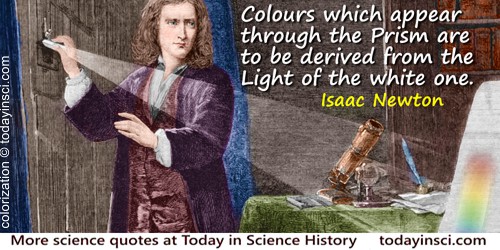
And if one look through a Prism upon a white Object encompassed with blackness or darkness, the reason of the Colours arising on the edges is much the same, as will appear to one that shall a little consider it. If a black Object be encompassed with a white one, the Colours which appear through the Prism are to be derived from the Light of the white one, spreading into the Regions of the black, and therefore they appear in a contrary order to that, when a white Object is surrounded with black. And the same is to be understood when an Object is viewed, whose parts are some of them less luminous than others. For in the borders of the more and less luminous Parts, Colours ought always by the same Principles to arise from the Excess of the Light of the more luminous, and to be of the same kind as if the darker parts were black, but yet to be more faint and dilute.
Opticks (1704), Book I, Part 2, Prop. VIII, Prob. III, 123.
And so the great truth, now a paradox, may become a commonplace, that man is greater than his surroundings, and that the production of a breed of men and women, even in our great cities, less prone to disease, and pain, more noble in aspect, more rational in habits, more exultant in the pure joy of living, is not only scientifically possible, but that even the partial fulfillment of this dream, if dream it be, is the most worthy object towards which the lover of his kind can devote the best energies of his life.
In 'The Breed of Man', The Nineteenth Century, (Oct 1900), 669, as collected in Martin Polley (ed.), The History of Sport in Britain, 1880-1914: Sport, Education, and Improvement (2004), Vol. 2, 181.
And when with excellent Microscopes I discern in otherwise invisible Objects the Inimitable Subtlety of Nature’s Curious Workmanship; And when, in a word, by the help of Anatomicall Knives, and the light of Chymicall Furnaces, I study the Book of Nature, and consult the Glosses of Aristotle, Epicurus, Paracelsus, Harvey, Helmont, and other learn'd Expositors of that instructive Volumne; I find my self oftentimes reduc’d to exclaim with the Psalmist, How manifold are thy works, O Lord? In wisdom hast thou made them all.
Some Motives and Incentives to the Love of God (1659), 56-7.
Anything at all that can be the object of scientific thought becomes dependent on the axiomatic method, and thereby indirectly on mathematics, as soon as it is ripe for the formation of a theory. By pushing ahead to ever deeper layers of axioms … we become ever more conscious of the unity of our knowledge. In the sign of the axiomatic method, mathematics is summoned to a leading role in science.
Address (11 Sep 1917), 'Axiomatisches Denken' delivered before the Swiss Mathematical Society in
Zürich. Translated by Ewald as 'Axiomatic Thought', (1918), in William Bragg Ewald, From Kant to Hilbert (1996), Vol. 2, 1115.
Architects who have aimed at acquiring manual skill without scholarship have never been able to reach a position of authority to correspond to their pains, while those who relied only upon theories and scholarship were obviously hunting the shadow, not the substance. But those who have a thorough knowledge of both, like men armed at all points, have the sooner attained their object and carried authority with them.
In De Architectura, Book 1, Chap 1, Sec. 2. As translated in Morris Hicky Morgan (trans.), Vitruvius: The Ten Books on Architecture (1914), 3.
Art is usually considered to be not of the highest quality if the desired object is exhibited in the midst of unnecessary lumber.
In Mathematics: Queen and Servant of Sciences (1938), 20. Bell is writing about the postulational method and the art of pruning a set of postulates to bare essentials without internal duplication.
As a different, but perhaps more common, strategy for the suppression of novelty, we may admit the threatening object to our midst, but provide an enveloping mantle of ordinary garb… . This kind of cover-up, so often amusing in our daily lives, can be quite dangerous in science, for nothing can stifle originality more effectively than an ordinary mantle placed fully and securely over an extraordinary thing.
In 'A Short Way to Big Ends', Natural History (Jan 1986), 95, No. 1, 18.
As an empiricist I continue to think of the conceptual scheme of science as a tool, ultimately, for predicting future experience in the light of past experience. Physical objects are conceptually imported into the situation as convenient intermediaries—not by definition in terms of experience, but simply as irreducible posits comparable, epistemologically, to the gods of Homer. For my part I do, qua lay physicist, believe in physical objects and not in Homer's gods; and I consider it a scientific error to believe otherwise. But in point of epistemological footing the physical objects and the gods differ only in degree and not in kind. Both sorts of entities enter our conception only as cultural posits. The myth of physical objects is epistemologically superior to most in that it has proved more efficacious than other myths as a device for working a manageable structure into the flux of experience.
From A Logical Point of View (1953), 44. [Note: “qua” means “in the character or role of,” thus “qua lay physicist” means “in the role of lay physicist,” or perhaps even (?) “putting on my lay physicist hat.” —Webmaster]
As arithmetic and algebra are sciences of great clearness, certainty, and extent, which are immediately conversant about signs, upon the skilful use whereof they entirely depend, so a little attention to them may possibly help us to judge of the progress of the mind in other sciences, which, though differing in nature, design, and object, may yet agree in the general methods of proof and inquiry.
In Alciphron: or the Minute Philosopher, Dialogue 7, collected in The Works of George Berkeley D.D. (1784), Vol. 1, 621.
As historians, we refuse to allow ourselves these vain speculations which turn on possibilities that, in order to be reduced to actuality, suppose an overturning of the Universe, in which our globe, like a speck of abandoned matter, escapes our vision and is no longer an object worthy of our regard. In order to fix our vision, it is necessary to take it such as it is, to observe well all parts of it, and by indications infer from the present to the past.
'Second Discours: Histoire et Theorie de la Terre', Histoire Naturelle, Ginerale et Particulière, Avec la Description du Cabinet du Roi (1749), Vol. 1, 98-9. Trans. Phillip R. Sloan.
As I had occasion to pass daily to and from the building-yard, while my boat was in progress, I have often loitered unknown near the idle groups of strangers, gathering in little circles, and heard various inquiries as to the object of this new vehicle. The language was uniformly that of scorn, or sneer, or ridicule. The loud laugh often rose at my expense; the dry jest; the wise calculation of losses and expenditures; the dull, but endless, repetition of “the Fulton folly”. Never did a single encouraging remark, a bright hope, or a warm wish, cross my path.
As quoted in Kirkpatrick Sale, The Fire of His Genius: Robert Fulton and the American Dream (2001), 10. Citing in end notes as from Story, Life and Letters, 24.
As I strayed into the study of an eminent physicist, I observed hanging against the wall, framed like a choice engraving, several dingy, ribbon-like strips of, I knew not what... My curiosity was at once aroused. What were they? ... They might be shreds of mummy-wraps or bits of friable bark-cloth from the Pacific, ... [or] remnants from a grandmother’s wedding dress... They were none of these... He explained that they were carefully-prepared photographs of portions of the Solar Spectrum. I stood and mused, absorbed in the varying yet significant intensities of light and shade, bordered by mystic letters and symbolic numbers. As I mused, the pale legend began to glow with life. Every line became luminous with meaning. Every shadow was suffused with light shining from behind, suggesting some mighty achievement of knowledge; of knowledge growing more daring in proportion to the remoteness of the object known; of knowledge becoming more positive in its answers, as the questions which were asked seemed unanswerable. No Runic legend, no Babylonish arrowhead, no Egyptian hieroglyph, no Moabite stone, could present a history like this, or suggest thoughts of such weighty import or so stimulate and exalt the imagination.
The Sciences of Nature Versus the Science of Man: A Plea for the Science of Man (1871), 7-9.
Astronomers and physicists, dealing habitually with objects and quantities far beyond the reach of the senses, even with the aid of the most powerful aids that ingenuity has been able to devise, tend almost inevitably to fall into the ways of thinking of men dealing with objects and quantities that do not exist at all, e.g., theologians and metaphysicians. Thus their speculations tend almost inevitably to depart from the field of true science, which is that of precise observation, and to become mere soaring in the empyrean. The process works backward, too. That is to say, their reports of what they pretend actually to see are often very unreliable. It is thus no wonder that, of all men of science, they are the most given to flirting with theology. Nor is it remarkable that, in the popular belief, most astronomers end by losing their minds.
Minority Report: H. L. Mencken’s Notebooks (1956), Sample 74, 60.
Astronomy is, not without reason, regarded, by mankind, as the sublimest of the natural sciences. Its objects so frequently visible, and therefore familiar, being always remote and inaccessible, do not lose their dignity.
In Elements of Chemistry: In the Order of the Lectures Given in Yale College (1830), 11.
Astronomy was not studied by Kepler, Galileo, or Newton for the practical applications which might result from it, but to enlarge the bounds of knowledge, to furnish new objects of thought and contemplation in regard to the universe of which we form a part; yet how remarkable the influence which this science, apparently so far removed from the sphere of our material interests, has exerted on the destinies of the world!
In 'Report of the Secretary', Annual Report of the Board of Regents of the Smithsonian Institution for 1859 (1860), 15.
At Gabriel College there was a very holy object on the high altar of the Oratory, covered with a black velvet cloth... At the height of the invocation the Intercessor lifted the cloth to reveal in the dimness a glass dome inside which there was something too distant to see, until he pulled a string attached to a shutter above, letting a ray of sunlight through to strike the dome exactly. Then it became clear: a little thing like a weathervane, with four sails black on one side and white on the other, began to whirl around as the light struck it. It illustrated a moral lesson, the Intercessor explained, for the black of ignorance fled from the light, whereas the wisdom of white rushed to embrace it.
[Alluding to Crookes's radiometer.]
[Alluding to Crookes's radiometer.]
Northern Lights (2001), 149.
Atoms and molecules … from their very nature can never be made the objects of sensuous contemplation.
In Ernst Mach and Thomas J. McCormack (trans.), 'Space and Geometry from the Point of View of Physical Inquiry', Space and Geometry in the Light of Physiological, Psychological and Physical Inquiry (1906), 138. Originally written as an article for The Monist (1 Oct 1903), 14, No. 1, Mach believed the realm of science should include only phenomena directly observable by the senses, and rejected theories of unseeable atomic orbitals.
Available energy is the main object at stake in the struggle for existence and the evolution of the world.
In Der zweite Hauptsatz der mechanischen Wärmetheorie (1886), 21, as cited in Alfred J. Lotka, 'Contribution to the Energetics of Evolution', Proceedings of the National Academy of Sciences (15 Jun 1922), 8, No. 6, 150. As translated, without quotation marks, in D'Arcy W. Thompson, On Growth and Form (1917, 2014), 14, footnote.
Bacon himself was very ignorant of all that had been done by mathematics; and, strange to say, he especially objected to astronomy being handed over to the mathematicians. Leverrier and Adams, calculating an unknown planet into a visible existence by enormous heaps of algebra, furnish the last comment of note on this specimen of the goodness of Bacon’s view… . Mathematics was beginning to be the great instrument of exact inquiry: Bacon threw the science aside, from ignorance, just at the time when his enormous sagacity, applied to knowledge, would have made him see the part it was to play. If Newton had taken Bacon for his master, not he, but somebody else, would have been Newton.
In Budget of Paradoxes (1872), 53-54.
Because of the way it came into existence, the solar system has only one-way traffic—like Piccadilly Circus. … If we want to make a model to scale, we must take a very tiny object, such as a pea, to represent the sun. On the same scale the nine planets will be small seeds, grains of sand and specks of dust. Even so, Piccadilly Circus is only just big enough to contain the orbit of Pluto. … The whole of Piccadilly Circus was needed to represent the space of the solar system, but a child can carry the whole substance of the model in its hand. All the rest is empty space.
In The Stars in Their Courses (1931, 1954), 49-50 & 89.
Botany here is but an object of amusement, a great one indeed and in which all our family mingles more or less. mr Randolph is our leader, and a good one. my mind has been so long ingrossed by other objects, that those I loved most have escaped from it, and none more than botany.
Letter (22 Oct 1810) from Jefferson at Monticello to Benjamin Smith Barton.
But here it may be objected, that the present Earth looks like a heap of Rubbish and Ruines; And that there are no greater examples of confusion in Nature than Mountains singly or jointly considered; and that there appear not the least footsteps of any Art or Counsel either in the Figure and Shape, or Order and Disposition of Mountains and Rocks. Wherefore it is not likely they came so out of God's hands ... To which I answer, That the present face of the Earth with all its Mountains and Hills, its Promontaries and Rocks, as rude and deformed as they appear, seems to me a very beautiful and pleasant object, and with all the variety of Hills, and Valleys, and Inequalities far more grateful to behold, than a perfectly level Countrey without any rising or protuberancy, to terminate the sight: As anyone that hath but seen the Isle of Ely, or any the like Countrey must need acknowledge.
— John Ray
Miscellaneous Discourses Concerning the Dissolution and Changes of the World (1692), 165-6.
But most of us, however strict we may be, are apt to apply the epithet “beautiful” to objects that do not provoke that peculiar emotion produced by works of art.
In Art (1913), 12.
But science is the great instrument of social change, all the greater because its object is not change but knowledge, and its silent appropriation of this dominant function, amid the din of political and religious strife, is the most vital of all the revolutions which have marked the development of modern civilisation.
Decadence: Henry Sidgwick Memorial Lecture (1908), 55-6.
By convention sweet is sweet, by convention bitter is bitter, by convention hot is hot, by convention cold is cold, by convention colour is colour. But in reality there are atoms and the void. That is, the objects of sense are supposed to be real and it is customary to regard them as such, but in truth they are not. Only the atoms and the void are real.
Cited as from Sext. Emp. Math. VII. 135, in Charles Montague Bakewell, Source Book in Ancient Philosophy (1907), 60.
By research in pure science I mean research made without any idea of application to industrial matters but solely with the view of extending our knowledge of the Laws of Nature. I will give just one example of the ‘utility’ of this kind of research, one that has been brought into great prominence by the War—I mean the use of X-rays in surgery. Now, not to speak of what is beyond money value, the saving of pain, or, it may be, the life of the wounded, and of bitter grief to those who loved them, the benefit which the state has derived from the restoration of so many to life and limb, able to render services which would otherwise have been lost, is almost incalculable. Now, how was this method discovered? It was not the result of a research in applied science starting to find an improved method of locating bullet wounds. This might have led to improved probes, but we cannot imagine it leading to the discovery of X-rays. No, this method is due to an investigation in pure science, made with the object of discovering what is the nature of Electricity. The experiments which led to this discovery seemed to be as remote from ‘humanistic interest’ —to use a much misappropriated word—as anything that could well be imagined. The apparatus consisted of glass vessels from which the last drops of air had been sucked, and which emitted a weird greenish light when stimulated by formidable looking instruments called induction coils. Near by, perhaps, were great coils of wire and iron built up into electro-magnets. I know well the impression it made on the average spectator, for I have been occupied in experiments of this kind nearly all my life, notwithstanding the advice, given in perfect good faith, by non-scientific visitors to the laboratory, to put that aside and spend my time on something useful.
In Speech made on behalf of a delegation from the Conjoint Board of Scientific Studies in 1916 to Lord Crewe, then Lord President of the Council. In George Paget Thomson, J. J. Thomson and the Cavendish Laboratory in His Day (1965), 167-8.
By science, then, I understand the consideration of all subjects, whether of a pure or mixed nature, capable of being reduced to measurement and calculation. All things comprehended under the categories of space, time and number properly belong to our investigations; and all phenomena capable of being brought under the semblance of a law are legitimate objects of our inquiries.
In Report of the British Association for the Advancement of Science (1833), xxviii.
By the classification of any series of objects, is meant the actual or ideal arrangement together of those which are like and the separation of those which are unlike ; the purpose of this arrangement being to facilitate the operations of the mind in clearly conceiving and retaining in the memory the characters of the objects in question.
In 'Lecture I: On the Classification of Animals', Lectures on the Elements of Comparative Anatomy: On the ... - (1864), 1.
Can we separate object and subject? Myself is nothing but a part of my body, my body is nothing but a part of my food, my food is nothing but a part of the earth, the earth is nothing but a part of the solar system.
In Sir William Withey Gull and Theodore Dyke Acland (ed.), A Collection of the Published Writings of William Withey Gull (1896), lii.
Catastrophe Theory is—quite likely—the first coherent attempt (since Aristotelian logic) to give a theory on analogy. When narrow-minded scientists object to Catastrophe Theory that it gives no more than analogies, or metaphors, they do not realise that they are stating the proper aim of Catastrophe Theory, which is to classify all possible types of analogous situations.
From 'La Théorie des catastrophes État présent et perspective', as quoted in Erick Christopher Zeeman, (ed.), Catastrophe Theory: Selected Papers, 1972-1977 (1977), 637, as cited in Martin Krampe (ed.), Classics of Semiotics (1987), 214.
Children are told that an apple fell on Isaac Newton’s head and he was led to state the law of gravity. This, of course, is pure foolishness. What Newton discovered was that any two particles in the universe attract each other with a force that is proportional to the product of their masses and inversely proportional to the square of the distance between them. This is not learned from a falling apple, but by observing quantities of data and developing a mathematical theory that can be verified by additional data. Data gathered by Galileo on falling bodies and by Johannes Kepler on motions of the planets were invaluable aids to Newton. Unfortunately, such false impressions about science are not universally outgrown like the Santa Claus myth, and some people who don’t study much science go to their graves thinking that the human race took until the mid-seventeenth century to notice that objects fall.
In How to Tell the Liars from the Statisticians (1983), 127.
Classes and concepts may, however, also be conceived as real objects, namely classes as “pluralities of things” or as structures consisting of a plurality of things and concepts as the properties and relations of things existing independently of our definitions and constructions. It seems to me that the assumption of such objects is quite as legitimate as the assumption of physical bodies and there is quite as much reason to believe in their existence. They are in the same sense necessary to obtain a satisfactory system of mathematics as physical bodies are necessary for a satisfactory theory of our sense perceptions…
In 'Russell's Mathematical Logic', in P.A. Schilpp (ed.), The Philosophy of Bertrand Russell (1944), Vol. 1, 137.
Common sense is not wrong in the view that is meaningful, appropriate and necessary to talk about the large objects of our daily experience …. Common sense is wrong only if it insists that what is familiar must reappear in what is unfamiliar.
In 'Uncommon Sense', collected in J. Robert Oppenheimer, Nicholas Metropolis (ed.) and Gian-Carlo Rota (ed.), Uncommon Sense (1984), 61.
Concerned to reconstruct past ideas, historians must approach the generation that held them as the anthropologist approaches an alien culture. They must, that is, be prepared at the start to find that natives speak a different language and map experience into different categories from those they themselves bring from home. And they must take as their object the discovery of those categories and the assimilation of the corresponding language.
'Revisiting Planck', Historical Studies in the Physical Sciences (1984), 14, 246.
Descriptive geometry has two objects: the first is to establish methods to represent on drawing paper which has only two dimensions,—namely, length and width,—all solids of nature which have three dimensions,—length, width, and depth,—provided, however, that these solids are capable of rigorous definition.
The second object is to furnish means to recognize accordingly an exact description of the forms of solids and to derive thereby all truths which result from their forms and their respective positions.
The second object is to furnish means to recognize accordingly an exact description of the forms of solids and to derive thereby all truths which result from their forms and their respective positions.
From On the Purpose of Descriptive Geometry as translated by Arnold Emch in David Eugene Smith, A Source Book in Mathematics (1929), 426.
Do the day’s work. If it be to protect the rights of the weak, whoever objects, do it. If it be to help a powerful corporation better to serve the people, whatever the opposition, do that. Expect to be called a stand-patter, but don’t be a stand-patter. Expect to be called a demagogue, but don’t be a demagogue. Don’t hesitate to be as revolutionary as science. Don’t hesitate to be as reactionary as the multiplication table. Don’t expect to build up the weak by pulling down the strong. Don’t hurry to legislate. Give administration a chance to catch up with legislation.
Speech (7 Jan 1914), to the State Senate of Massachusetts upon election as its president. Collected in Coolidge, Have Faith in Massachusetts (1919, 2004), 7-8.
Each and every loss becomes an instance of ultimate tragedy–something that once was, but shall never be known to us. The hump of the giant deer–as a nonfossilizable item of soft anatomy–should have fallen into the maw of erased history. But our ancestors provided a wondrous rescue, and we should rejoice mightily. Every new item can instruct us; every unexpected object possesses beauty for its own sake; every rescue from history’s great shredding machine is–and I don’t know how else to say this–a holy act of salvation for a bit of totality.
…...
Each scientist of course maintains the “purity” of his own research and repudiates violently any proposal to subject his pet research to the test of immediate applicability and “usefulness.” It is not the object of his research to be useful but to be sound.
In Science: the False Messiah (1927), 35.
Earth’s history, which it is the object of Geology to teach, is the true introduction to human history.
In 'Concluding Remarks', A Text-book of Geology: Designed for Schools and Academies (1863), 339.
Engineering is the art of construction; but to limit it to this would be to restrict its meaning much within the range of the ordinary use of the word. In a broader sense, engineering includes all operations whose object is the utilization of the forces of nature in the interests of man.
From Address to the International Engineering Congress of the Columbia Exposition, Chicago, 1893. Published in Transactions of the American Society of Civil Engineers (Oct 1893), 120. Reprinted in 'Fundamental Units of Measure', Smithsonian Report for 1893 (1894), 135.
Even happiness itself may become habitual. There is a habit of looking at the bright side of things, and also of looking at the dark side. Dr. Johnson has said that the habit of looking at the best side of a thing is worth more to a man than a thousand pounds a year. And we possess the power, to a great extent, of so exercising the will as to direct the thoughts upon objects calculated to yield happiness and improvement rather than their opposites.
In Self-help: With Illustrations of Character and Conduct (1859, 1861), 405-406.
Even in science the object of research is no longer nature itself, but man’s investigation of nature.
In The Physicist's Conception of Nature (1958), 24.
Every definition implies an axiom, since it asserts the existence of the object defined. The definition then will not be justified, from the purely logical point of view, until we have ‘proved’ that it involves no contradiction either in its terms or with the truths previously admitted.
…...
Experiments in geology are far more difficult than in physics and chemistry because of the greater size of the objects, commonly outside our laboratories, up to the earth itself, and also because of the fact that the geologic time scale exceeds the human time scale by a million and more times. This difference in time allows only direct observations of the actual geologic processes, the mind having to imagine what could possibly have happened in the past.
In 'The Scientific Character of Geology', The Journal of Geology (Jul 1961), 69, No. 4, 455-6.
Far from becoming discouraged, the philosopher should applaud nature, even when she appears miserly of herself or overly mysterious, and should feel pleased that as he lifts one part of her veil, she allows him to glimpse an immense number of other objects, all worthy of investigation. For what we already know should allow us to judge of what we will be able to know; the human mind has no frontiers, it extends proportionately as the universe displays itself; man, then, can and must attempt all, and he needs only time in order to know all. By multiplying his observations, he could even see and foresee all phenomena, all of nature's occurrences, with as much truth and certainty as if he were deducing them directly from causes. And what more excusable or even more noble enthusiasm could there be than that of believing man capable of recognizing all the powers, and discovering through his investigations all the secrets, of nature!
'Des Mulets', Oeuvres Philosophiques, ed. Jean Piveteau (1954), 414. Quoted in Jacques Roger, The Life Sciences in Eighteenth-Century French Thought, ed. Keith R. Benson and trans. Robert Ellrich (1997), 458.
Faraday, … by his untiring faithfulness in keeping his diary, contributes to our understanding the objects of his scientific research in magnetism, electricity and light, but he also makes us understand the scientist himself, as a living subject, the mind in action.
In 'The Scientific Grammar of Michael Faraday’s Diaries', Part I, 'The Classic of Science', A Classic and a Founder (1937), collected in Rosenstock-Huessy Papers (1981), Vol. 1, 2.
First of all, we ought to observe, that mathematical propositions, properly so called, are always judgments a priori, and not empirical, because they carry along with them necessity, which can never be deduced from experience. If people should object to this, I am quite willing to confine my statements to pure mathematics, the very concept of which implies that it does not contain empirical, but only pure knowledge a priori.
In Critique of Pure Reason (1900), 720.
First, as concerns the success of teaching mathematics. No instruction in the high schools is as difficult as that of mathematics, since the large majority of students are at first decidedly disinclined to be harnessed into the rigid framework of logical conclusions. The interest of young people is won much more easily, if sense-objects are made the starting point and the transition to abstract formulation is brought about gradually. For this reason it is psychologically quite correct to follow this course.
Not less to be recommended is this course if we inquire into the essential purpose of mathematical instruction. Formerly it was too exclusively held that this purpose is to sharpen the understanding. Surely another important end is to implant in the student the conviction that correct thinking based on true premises secures mastery over the outer world. To accomplish this the outer world must receive its share of attention from the very beginning.
Doubtless this is true but there is a danger which needs pointing out. It is as in the case of language teaching where the modern tendency is to secure in addition to grammar also an understanding of the authors. The danger lies in grammar being completely set aside leaving the subject without its indispensable solid basis. Just so in Teaching of Mathematics it is possible to accumulate interesting applications to such an extent as to stunt the essential logical development. This should in no wise be permitted, for thus the kernel of the whole matter is lost. Therefore: We do want throughout a quickening of mathematical instruction by the introduction of applications, but we do not want that the pendulum, which in former decades may have inclined too much toward the abstract side, should now swing to the other extreme; we would rather pursue the proper middle course.
Not less to be recommended is this course if we inquire into the essential purpose of mathematical instruction. Formerly it was too exclusively held that this purpose is to sharpen the understanding. Surely another important end is to implant in the student the conviction that correct thinking based on true premises secures mastery over the outer world. To accomplish this the outer world must receive its share of attention from the very beginning.
Doubtless this is true but there is a danger which needs pointing out. It is as in the case of language teaching where the modern tendency is to secure in addition to grammar also an understanding of the authors. The danger lies in grammar being completely set aside leaving the subject without its indispensable solid basis. Just so in Teaching of Mathematics it is possible to accumulate interesting applications to such an extent as to stunt the essential logical development. This should in no wise be permitted, for thus the kernel of the whole matter is lost. Therefore: We do want throughout a quickening of mathematical instruction by the introduction of applications, but we do not want that the pendulum, which in former decades may have inclined too much toward the abstract side, should now swing to the other extreme; we would rather pursue the proper middle course.
In Ueber den Mathematischen Unterricht an den hoheren Schulen; Jahresbericht der Deutschen Mathematiker Vereinigung, Bd. 11, 131.
First, In showing in how to avoid attempting impossibilities. Second, In securing us from important mistakes in attempting what is, in itself possible, by means either inadequate or actually opposed to the end in view. Thirdly, In enabling us to accomplish our ends in the easiest, shortest, most economical, and most effectual manner. Fourth, In inducing us to attempt, and enabling us to accomplish, object which, but for such knowledge, we should never have thought of understanding.
On the ways that a knowledge of the order of nature can be of use.
On the ways that a knowledge of the order of nature can be of use.
Quoted in Robert Routledge, Discoveries and Inventions of the 19th Century (1890), 665.
For any one who is pervaded with the sense of causal law in all that happens, who accepts in real earnest the assumption of causality, the idea of a Being who interferes with the sequence of events in the world is absolutely impossible! Neither the religion of fear nor the social-moral religion can have, any hold on him. A God who rewards and punishes is for him unthinkable, because man acts in accordance with an inner and outer necessity, and would, in the eyes of God, be as little responsible as an inanimate object is for the movements which it makes. Science, in consequence, has been accused of undermining morals—but wrongly. The ethical behavior of man is better based on sympathy, education and social relationships, and requires no support from religion. Man’s plight would, indeed, be sad if he had to be kept in order through fear of punishment and hope of rewards after death.
From 'Religion and Science', The New York Times Magazine, (9 Nov 1930), 1. Article in full, reprinted in Edward H. Cotton (ed.), Has Science Discovered God? A Symposium of Modern Scientific Opinion (1931), 101. The wording differs significantly from the version collected in 'Religion And Science', Ideas And Opinions (1954), 39, giving its source as: “Written expressly for the New York Times Magazine. Appeared there November 9, 1930 (pp. 1-4). The German text was published in the Berliner Tageblatt, November 11, 1930.” This variant form of the quote from the book begins, “The man who is thoroughly convinced of the universal operation of the law of causation….” and is also on the Albert Einstein Quotes page on this website. As for why the difference, Webmaster speculates the book form editor perhaps used a revised translation from Einstein’s German article.
For the evolution of science by societies the main requisite is the perfect freedom of communication between each member and anyone of the others who may act as a reagent.
The gaseous condition is exemplified in the soiree, where the members rush about confusedly, and the only communication is during a collision, which in some instances may be prolonged by button-holing.
The opposite condition, the crystalline, is shown in the lecture, where the members sit in rows, while science flows in an uninterrupted stream from a source which we take as the origin. This is radiation of science. Conduction takes place along the series of members seated round a dinner table, and fixed there for several hours, with flowers in the middle to prevent any cross currents.
The condition most favourable to life is an intermediate plastic or colloidal condition, where the order of business is (1) Greetings and confused talk; (2) A short communication from one who has something to say and to show; (3) Remarks on the communication addressed to the Chair, introducing matters irrelevant to the communication but interesting to the members; (4) This lets each member see who is interested in his special hobby, and who is likely to help him; and leads to (5) Confused conversation and examination of objects on the table.
I have not indicated how this programme is to be combined with eating.
The gaseous condition is exemplified in the soiree, where the members rush about confusedly, and the only communication is during a collision, which in some instances may be prolonged by button-holing.
The opposite condition, the crystalline, is shown in the lecture, where the members sit in rows, while science flows in an uninterrupted stream from a source which we take as the origin. This is radiation of science. Conduction takes place along the series of members seated round a dinner table, and fixed there for several hours, with flowers in the middle to prevent any cross currents.
The condition most favourable to life is an intermediate plastic or colloidal condition, where the order of business is (1) Greetings and confused talk; (2) A short communication from one who has something to say and to show; (3) Remarks on the communication addressed to the Chair, introducing matters irrelevant to the communication but interesting to the members; (4) This lets each member see who is interested in his special hobby, and who is likely to help him; and leads to (5) Confused conversation and examination of objects on the table.
I have not indicated how this programme is to be combined with eating.
Letter to William Grylls Adams (3 Dec 1873). In P. M. Harman (ed.), The Scientific Letters and Papers of James Clerk Maxwell (1995), Vol. 2, 1862-1873, 949-50.
For the philosopher, order is the entirety of repetitions manifested, in the form of types or of laws, by perceived objects. Order is an intelligible relation. For the biologist, order is a sequence in space and time. However, according to Plato, all things arise out of their opposites. Order was born of the original disorder, and the long evolution responsible for the present biological order necessarily had to engender disorder.
An organism is a molecular society, and biological order is a kind of social order. Social order is opposed to revolution, which is an abrupt change of order, and to anarchy, which is the absence of order.
I am presenting here today both revolution and anarchy, for which I am fortunately not the only one responsible. However, anarchy cannot survive and prosper except in an ordered society, and revolution becomes sooner or later the new order. Viruses have not failed to follow the general law. They are strict parasites which, born of disorder, have created a very remarkable new order to ensure their own perpetuation.
An organism is a molecular society, and biological order is a kind of social order. Social order is opposed to revolution, which is an abrupt change of order, and to anarchy, which is the absence of order.
I am presenting here today both revolution and anarchy, for which I am fortunately not the only one responsible. However, anarchy cannot survive and prosper except in an ordered society, and revolution becomes sooner or later the new order. Viruses have not failed to follow the general law. They are strict parasites which, born of disorder, have created a very remarkable new order to ensure their own perpetuation.
'Interaction Among Virus, Cell, and Organism', Nobel Lecture (11 Dec 1965). In Nobel Lectures: Physiology or Medicine 1963-1970 (1972), 174.
For the religious, passivism [i.e., objects are obedient to the laws of nature] provides a clear role of God as the author of the laws of nature. If the laws of nature are God’s commands for an essentially passive world…, God also has the power to suspend the laws of nature, and so perform miracles.
In The Philosophy of Nature: A Guide to the New Essentialism (2002), 2.
For we may remark generally of our mathematical researches, that these auxiliary quantities, these long and difficult calculations into which we are often drawn, are almost always proofs that we have not in the beginning considered the objects themselves so thoroughly and directly as their nature requires, since all is abridged and simplified, as soon as we place ourselves in a right point of view.
In Théorie Nouvelle de la Rotation des Corps (1834). As translated by Charles Thomas Whitley in Outlines of a New Theory of Rotatory Motion (1834), 4.
Fractal is a word invented by Mandelbrot to bring together under one heading a large class of objects that have [played] … an historical role … in the development of pure mathematics. A great revolution of ideas separates the classical mathematics of the 19th century from the modern mathematics of the 20th. Classical mathematics had its roots in the regular geometric structures of Euclid and the continuously evolving dynamics of Newton. Modern mathematics began with Cantor’s set theory and Peano’s space-filling curve. Historically, the revolution was forced by the discovery of mathematical structures that did not fit the patterns of Euclid and Newton. These new structures were regarded … as “pathological,” .… as a “gallery of monsters,” akin to the cubist paintings and atonal music that were upsetting established standards of taste in the arts at about the same time. The mathematicians who created the monsters regarded them as important in showing that the world of pure mathematics contains a richness of possibilities going far beyond the simple structures that they saw in Nature. Twentieth-century mathematics flowered in the belief that it had transcended completely the limitations imposed by its natural origins.
Now, as Mandelbrot points out, … Nature has played a joke on the mathematicians. The 19th-century mathematicians may not have been lacking in imagination, but Nature was not. The same pathological structures that the mathematicians invented to break loose from 19th-century naturalism turn out to be inherent in familiar objects all around us.
Now, as Mandelbrot points out, … Nature has played a joke on the mathematicians. The 19th-century mathematicians may not have been lacking in imagination, but Nature was not. The same pathological structures that the mathematicians invented to break loose from 19th-century naturalism turn out to be inherent in familiar objects all around us.
From 'Characterizing Irregularity', Science (12 May 1978), 200, No. 4342, 677-678. Quoted in Benoit Mandelbrot, The Fractal Geometry of Nature (1977, 1983), 3-4.
From the point of view of the physicist, a theory of matter is a policy rather than a creed; its object is to connect or co-ordinate apparently diverse phenomena, and above all to suggest, stimulate and direct experiment. It ought to furnish a compass which, if followed, will lead the observer further and further into previously unexplored regions.
The Corpuscular Theory of Matter (1907), 1.
From the war of nature, from famine and death, the most exalted object which we are capable of conceiving, namely, the production of the higher animals, directly follows. There is grandeur in this view of life, with its several powers, having been originally breathed into a few forms or into one; and that, whilst this planet has gone cycling on according to the fixed law of gravity, from so simple a beginning endless forms most beautiful and most wonderful have been, and are being, evolved.
Concluding paragraph in The Origin of Species (1859), 490. In the second edition, Darwin changed “breathed” to “breathed by the Creator”.
Genius itself has been analyzed by the shrewdest observers into a higher capacity of attention. “Genius,” says Helvetius … “is nothing but a continued attention,” (une attention suivie). “Genius,” says Buffon, “is only a protracted patience,” (une longue patience). “In the exact sciences, at least,” says Cuvier, “it is the patience of a sound intellect, when invincible, which truly constitutes genius.” And Chesterfield has also observed, that “the power of applying an attention, steady and undissipated, to a single object, is the sure mark of a superior genius.”
In Lectures on Metaphysics and Logic (1860), Vol. 1, 179.
Geology, in the magnitude and sublimity of the objects of which it treats, undoubtedly ranks, in the scale of the sciences, next to astronomy.
In Dionysius Lardner (ed.), Cabinet Cyclopaedia, Vol 1, Preliminary Discourse on the Study of Natural Philosophy (1831), 287.
Gravity is a contributing factor in nearly 73 percent of all accidents involving falling objects.
Syndicated column, 'Problems Of Utmost Gravity', seen, for example, in the Chicago Tribune (15 Mar 1998).
Having discovered … by observation and comparison that certain objects agree in certain respects, we generalise the qualities in which they coincide,—that is, from a certain number of individual instances we infer a general law; we perform an act of Induction. This induction is erroneously viewed as analytic; it is purely a synthetic process.
In Lecture VI of his Biennial Course, by William Hamilton and Henry L. Mansel (ed.) and John Veitch (ed.), Metaphysics (1860), Vol. 1, 101.
He [Sylvester] had one remarkable peculiarity. He seldom remembered theorems, propositions, etc., but had always to deduce them when he wished to use them. In this he was the very antithesis of Cayley, who was thoroughly conversant with everything that had been done in every branch of mathematics.
I remember once submitting to Sylvester some investigations that I had been engaged on, and he immediately denied my first statement, saying that such a proposition had never been heard of, let alone proved. To his astonishment, I showed him a paper of his own in which he had proved the proposition; in fact, I believe the object of his paper had been the very proof which was so strange to him.
I remember once submitting to Sylvester some investigations that I had been engaged on, and he immediately denied my first statement, saying that such a proposition had never been heard of, let alone proved. To his astonishment, I showed him a paper of his own in which he had proved the proposition; in fact, I believe the object of his paper had been the very proof which was so strange to him.
As quoted by Florian Cajori, in Teaching and History of Mathematics in the United States (1890), 268.
He who studies it [Nature] has continually the exquisite pleasure of discerning or half discerning and divining laws; regularities glimmer through an appearance of confusion, analogies between phenomena of a different order suggest themselves and set the imagination in motion; the mind is haunted with the sense of a vast unity not yet discoverable or nameable. There is food for contemplation which never runs short; you are gazing at an object which is always growing clearer, and yet always, in the very act of growing clearer, presenting new mysteries.
From 'Natural History', Macmillan's Magazine (1875), 31, 366.
Hence, even in the domain of natural science the aid of the experimental method becomes indispensable whenever the problem set is the analysis of transient and impermanent phenomena, and not merely the observation of persistent and relatively constant objects.
Here arises a puzzle that has disturbed scientists of all periods. How can it be that mathematics, being after all a product of human thought which is independent of experience, is so admirably appropriate to the objects of reality? Is human reason, then, without experience, merely by taking thought, able to fathom the properties of real things?
From 'Geometry and Experience', an expanded form of an Address by Albert Einstein to the Prussian Academy of Sciences in Berlin (27 Jan 1921). In Albert Einstein, translated by G. B. Jeffery and W. Perrett, Sidelights on Relativity (1923).
His [Henry Cavendish’s] Theory of the Universe seems to have been, that it consisted solely of a multitude of objects which could be weighed, numbered, and measured; and the vocation to which he considered himself called was, to weigh, number and measure as many of those objects as his allotted three-score years and ten would permit. This conviction biased all his doings, alike his great scientific enterprises, and the petty details of his daily life.
In George Wilson, The Life of the Honourable Henry Cavendish: Including the Abstracts of his Important Scientific Papers (1851), 186.
How often natural processes produce objects mistaken for the work of humans.
As quoted in Sharman Apt Russell, When the Land Was Young: Reflections on American Archaeology (2001), 23. Russell adds that Haynes coined the term “geofact” to describe such objects. [To distinguish from a valid “artifact❞. -Webmaster]
Hypothesis is the most important mental technique of the investigator, and its main function is to suggest new experiments or new observations. Indeed, most experiments and many observations are carried out with the deliberate object of testing an hypothesis. Another function is to help one see the significance of an object or event that otherwise would mean nothing. For instance, a mind prepared by the hypothesis of evolution would make many more significant observations on a field excursion than one not so prepared. Hypotheses should be used as tools to uncover new facts rather than as ends in themselves.
The Art of Scientific Investigation (1953), 46.
I … object to dividing the study of living processes into botany, zoology, and microbiology because by any such arrangement, the interrelations within the biological community get lost. Corals cannot be studied without reference to the algae that live with them; flowering plants without the insects that pollinate them; grasslands without the grazing mammals.
In The Forest and the Sea (1960), 7.
I am a strong advocate for free thought on all subjects, yet it appears to me (whether rightly or wrongly) that direct arguments against christianity & theism produce hardly any effect on the public; & freedom of thought is best promoted by the gradual illumination of men's minds, which follow[s] from the advance of science. It has, therefore, been always my object to avoid writing on religion, & I have confined myself to science. I may, however, have been unduly biassed by the pain which it would give some members of my family, if I aided in any way direct attacks on religion.
Letter to E.B. Aveling (13 Oct 1880).
I am reminded of the great French Marshal Lyautey, who once asked his gardener to plant a tree. The gardener objected that the tree was slow-growing and would not reach maturity for a hundred years. The Marshal replied, “In that case, there is no time to lose, plant it this afternoon.”
Address at the University of California, Berkeley, California (23 March 1962), in Public Papers of the Presidents of the United States: John F. Kennedy (1962), 266. Kennedy used this story several times. The indicated source, Marshal Lyautey, has not been verified. Contact Webmaster if you know a primary source.
I believe that there is but one way to learn any subject, and that is through study. The very name student tells what the person so named should be doing; and with a natural science, dealing with a most complex object, extending through three dimensions of space, any other method besides studying the object is practically useless.
As quoted from a paper by Mall (1896), in Florence R. Sabin, Franklin Paine Mall: The Story of a Mind. (1934), 142.
I believed that, instead of the multiplicity of rules that comprise logic, I would have enough in the following four, as long as I made a firm and steadfast resolution never to fail to observe them.
The first was never to accept anything as true if I did not know clearly that it was so; that is, carefully to avoid prejudice and jumping to conclusions, and to include nothing in my judgments apart from whatever appeared so clearly and distinctly to my mind that I had no opportunity to cast doubt upon it.
The second was to subdivide each on the problems I was about to examine: into as many parts as would be possible and necessary to resolve them better.
The third was to guide my thoughts in an orderly way by beginning, as if by steps, to knowledge of the most complex, and even by assuming an order of the most complex, and even by assuming an order among objects in! cases where there is no natural order among them.
And the final rule was: in all cases, to make such comprehensive enumerations and such general review that I was certain not to omit anything.
The long chains of inferences, all of them simple and easy, that geometers normally use to construct their most difficult demonstrations had given me an opportunity to think that all the things that can fall within the scope of human knowledge follow from each other in a similar way, and as long as one avoids accepting something as true which is not so, and as long as one always observes the order required to deduce them from each other, there cannot be anything so remote that it cannot be reached nor anything so hidden that it cannot be uncovered.
The first was never to accept anything as true if I did not know clearly that it was so; that is, carefully to avoid prejudice and jumping to conclusions, and to include nothing in my judgments apart from whatever appeared so clearly and distinctly to my mind that I had no opportunity to cast doubt upon it.
The second was to subdivide each on the problems I was about to examine: into as many parts as would be possible and necessary to resolve them better.
The third was to guide my thoughts in an orderly way by beginning, as if by steps, to knowledge of the most complex, and even by assuming an order of the most complex, and even by assuming an order among objects in! cases where there is no natural order among them.
And the final rule was: in all cases, to make such comprehensive enumerations and such general review that I was certain not to omit anything.
The long chains of inferences, all of them simple and easy, that geometers normally use to construct their most difficult demonstrations had given me an opportunity to think that all the things that can fall within the scope of human knowledge follow from each other in a similar way, and as long as one avoids accepting something as true which is not so, and as long as one always observes the order required to deduce them from each other, there cannot be anything so remote that it cannot be reached nor anything so hidden that it cannot be uncovered.
Discourse on Method in Discourse on Method and Related Writings (1637), trans. Desmond M. Clarke, Penguin edition (1999), Part 2, 16.
I came from Paris in the Spring of 1884, and was brought in intimate contact with him [Thomas Edison]. We experimented day and night, holidays not excepted. His existence was made up of alternate periods of work and sleep in the laboratory. He had no hobby, cared for no sport or amusement of any kind and lived in utter disregard of the most elementary rules of hygiene. There can be no doubt that, if he had not married later a woman of exceptional intelligence, who made it the one object of her life to preserve him, he would have died many years ago from consequences of sheer neglect. So great and uncontrollable was his passion for work.
As quoted in 'Tesla Says Edison Was an Empiricist', The New York Times (19 Oct 1931), 25.
I cannot imagine a God who rewards and punishes the objects of his creation, whose purposes are modeled after our own–a God, in short, who is but a reflection of human frailty. Neither can I believe that the individual survives the death of his body, although feeble souls harbor such thoughts through fear or ridiculous egotism. It is enough for me to contemplate the mystery of conscious life perpetuating itself through all eternity, to reflect upon the marvelous structure of the universe which we can dimly perceive, and to try humbly to comprehend even an infinitesimal part of the intelligence manifested in nature.
From 'What I Believe: Living Philosophies XIII', Forum and Century (Oct 1930), 84, No. 4, 194. Article in full, reprinted in Edward H. Cotton (ed.), Has Science Discovered God? A Symposium of Modern Scientific Opinion (1931), 97.
I concluded that I might take as a general rule the principle that all things which we very clearly and obviously conceive are true: only observing, however, that there is some difficulty in rightly determining the objects which we distinctly conceive.
In Discours de la Méthode (1637), as translated by J. Veitch, A Discourse on Method (1912), 27.
I do not mind if you think slowly. But I do object when you publish more quickly than you think.
As quoted, without citation, in William H. Cropper, Great Physicists: The Life and Times of Leading Physicists from Galileo to Hawking (2001), 257.
I do not think that, practically or morally, we can defend a policy of saving every distinctive local population of organisms. I can cite a good rationale for the preservation of species, for each species is a unique and separate natural object that, once lost, can never be reconstituted. But subspecies are distinctive local populations of species with broader geographic range. Subspecies are dynamic, interbreedable, and constantly changing: what then are we saving by declaring them all inviolate?
…...
I don't really care how time is reckoned so long as there is some agreement about it, but I object to being told that I am saving daylight when my reason tells me that I am doing nothing of the kind. I even object to the implication that I am wasting something valuable if I stay in bed after the sun has risen. As an admirer of moonlight I resent the bossy insistence of those who want to reduce my time for enjoying it. At the back of the Daylight Saving scheme I detect the bony, blue-fingered hand of Puritanism, eager to push people into bed earlier, and get them up earlier, to make them healthy, wealthy and wise in spite of themselves.
In The Diary of Samuel Marchbanks (1947), 75.
I end with a word on the new symbols which I have employed. Most writers on logic strongly object to all symbols. ... I should advise the reader not to make up his mind on this point until he has well weighed two facts which nobody disputes, both separately and in connexion. First, logic is the only science which has made no progress since the revival of letters; secondly, logic is the only science which has produced no growth of symbols.
I felt more determined than ever to become a physician, and thus place a strong barrier between me and all ordinary marriage. I must have something to engross my thoughts, some object in life which will fill this vacuum, and prevent this sad wearing away of the heart.
Entry from her early journal, stated in Pioneer Work in Opening the Medical Profession to Women (1895), 28.
I had this experience at the age of eight. My parents gave me a microscope. I don’t recall why, but no matter. I then found my own little world, completely wild and unconstrained, no plastic, no teacher, no books, no anything predictable. At first I did not know the names of the water-drop denizens or what they were doing. But neither did the pioneer microscopists. Like them, I graduated to looking at butterfly scales and other miscellaneous objects. I never thought of what I was doing in such a way, but it was pure science. As true as could be of any child so engaged, I was kin to Leeuwenhoek, who said that his work “was not pursued in order to gain the praise I now enjoy, but chiefly from a craving after knowledge, which I notice resides in me more that most other men.”
In The Creation: An Appeal to Save Life on Earth (2010), 143-144.
I have never looked upon ease and happiness as ends in themselves–this critical basis I call the ideal of a pigsty. The ideals that have lighted my way, and time after time have given me new courage to face life cheerfully, have been Kindness, Beauty, and Truth. Without the sense of kinship with men of like mind, without the occupation with the objective world, the eternally unattainable in the field of art and scientific endeavors, life would have seemed empty to me. The trite objects of human efforts–possessions, outward success, luxury–have always seemed to me contemptible.
In 'What I Believe,' Forum and Century (1930).
I have spent much time in the study of the abstract sciences; but the paucity of persons with whom you can communicate on such subjects disgusted me with them. When I began to study man, I saw that these abstract sciences are not suited to him, and that in diving into them, I wandered farther from my real object than those who knew them not, and I forgave them for not having attended to these things. I expected then, however, that I should find some companions in the study of man, since it was so specifically a duty. I was in error. There are fewer students of man than of geometry.
Thoughts of Blaise Pascal (1846), 137.
I have wished to see chemistry applied to domestic objects, to malting, for instance, brewing, making cider, to fermentation and distillation generally, to the making of bread, butter, cheese, soap, to the incubation of eggs, &c.
Letter to Thomas Cooper (Monticello, 1812). In Thomas Jefferson and John P. Foley (ed.), The Jeffersonian Cyclopedia (1900), 135. From H.A. Washington, The Writings of Thomas Jefferson (1853-54). Vol 6, 73.
I may not be proud of being a human
I object to having attention called to my iron and water and potash and albumen.
In the first place, it’s undignified,
And in the second place, nothing by it is signified.
I object to having attention called to my iron and water and potash and albumen.
In the first place, it’s undignified,
And in the second place, nothing by it is signified.
From 'Lines in Dispraise of Dispraise', Hard Lines (1931), 40.
I prefer rationalism to atheism. The question of God and other objects-of-faith are outside reason and play no part in rationalism, thus you don't have to waste your time in either attacking or defending.
In Isaac Asimov and Janet Asimov (ed.), It's Been a Good Life (2002), 21. Attribution uncertain. If you know an original print citation, please contact Webmaster.
I scrutinize life.
Part of a longer quote that begins, “You disembowel the animal…” on the Jean-Henri Fabre Quotes page of this website.
I should object to any experimentation which can justly be called painful, for the purpose of elementary instruction ... [but I regret] a condition of the law which permits a boy to troll for pike, or set lines with live frog bait, for idle amusement; and, at the same time, lays the teacher of that boy open to the penalty of fine and imprisonment, if he uses the same animal for the purpose of exhibiting one of the most beautiful and instructive of physiological spectacles, the circulation in the web of the foot. ... [Maybe the frog is] inconvenienced by being wrapped up in a wet rag, and having his toes tied out ... But you must not inflict the least pain on a vertebrated animal for scientific purposes (though you may do a good deal in that way for gain or for sport) without due licence of the Secretary of State for the Home Department, granted under the authority of the Vivisection Act.
... [Yet, in] 1877, two persons may be charged with cruelty to animals. One has impaled a frog, and suffered the creature to writhe about in that condition for hours; the other has pained the animal no more than one of us would be pained by tying strings round his fingers, and keeping him in the position of a hydropathic patient. The first offender says, 'I did it because I find fishing very amusing,' and the magistrate bids him depart in peace; nay, probably wishes him good sport. The second pleads, 'I wanted to impress a scientific truth, with a distinctness attainable in no other way, on the minds of my scholars,' and the magistrate fines him five pounds.
I cannot but think that this is an anomalous and not wholly creditable state of things.
... [Yet, in] 1877, two persons may be charged with cruelty to animals. One has impaled a frog, and suffered the creature to writhe about in that condition for hours; the other has pained the animal no more than one of us would be pained by tying strings round his fingers, and keeping him in the position of a hydropathic patient. The first offender says, 'I did it because I find fishing very amusing,' and the magistrate bids him depart in peace; nay, probably wishes him good sport. The second pleads, 'I wanted to impress a scientific truth, with a distinctness attainable in no other way, on the minds of my scholars,' and the magistrate fines him five pounds.
I cannot but think that this is an anomalous and not wholly creditable state of things.
'On Elementary Instruction in Physiology'. Science and Culture (1882), 92.
I spend money on war because it is necessary, but to spend it on science, that is pleasant to me. This object costs no tears; it is an honour to humanity,
Said to Lalande. Quoted in R. A. Gregory, Discovery, Or the Spirit and Service of Science (1916), 47-8.
I suppose that I tend to be optimistic about the future of physics. And nothing makes me more optimistic than the discovery of broken symmetries. In the seventh book of the Republic, Plato describes prisoners who are chained in a cave and can see only shadows that things outside cast on the cave wall. When released from the cave at first their eyes hurt, and for a while they think that the shadows they saw in the cave are more real than the objects they now see. But eventually their vision clears, and they can understand how beautiful the real world is. We are in such a cave, imprisoned by the limitations on the sorts of experiments we can do. In particular, we can study matter only at relatively low temperatures, where symmetries are likely to be spontaneously broken, so that nature does not appear very simple or unified. We have not been able to get out of this cave, but by looking long and hard at the shadows on the cave wall, we can at least make out the shapes of symmetries, which though broken, are exact principles governing all phenomena, expressions of the beauty of the world outside.
In Nobel Lecture (8 Dec 1989), 'Conceptual Foundations of the Unified Theory of Weak and Electromagnetic Interactions.' Nobel Lectures: Physics 1971-1980 (1992), 556.
I trust and believe that the time spent in this voyage … will produce its full worth in Natural History; and it appears to me the doing what little we can to increase the general stock of knowledge is as respectable an object of life, as one can in any likelihood pursue.
In Charles Darwin and Francis Darwin (ed.), The Life and Letters of Charles Darwin (1888), 245.
Iconography becomes even more revealing when processes or concepts, rather than objects, must be depicted–for the constraint of a definite ‘thing’ cedes directly to the imagination. How can we draw ‘evolution’ or ‘social organization,’ not to mention the more mundane ‘digestion’ or ‘self-interest,’ without portraying more of a mental structure than a physical reality? If we wish to trace the history of ideas, iconography becomes a candid camera trained upon the scholar’s mind.
…...
If all sentient beings in the universe disappeared, there would remain a sense in which mathematical objects and theorems would continue to exist even though there would be no one around to write or talk about them. Huge prime numbers would continue to be prime, even if no one had proved them prime.
In When You Were a Tadpole and I Was a Fish: And Other Speculations About This and That (), 124.
If any person thinks the examination of the rest of the animal kingdom an unworthy task, he must hold in like disesteem the study of man. For no one can look at the primordia of the human frame—blood, flesh, bones, vessels, and the like—without much repugnance. Moreover, in every inquiry, the examination of material elements and instruments is not to be regarded as final, but as ancillary to the conception of the total form. Thus, the true object of architecture is not bricks, mortar or timber, but the house; and so the principal object of natural philosophy is not the material elements, but their composition, and the totality of the form to which they are subservient, and independently of which they have no existence.
On Parts of Animals, Book 1, Chap 5, 645a, 26-36. In W. Ogle (trans.), Aristotle on the Parts of Animals (1882), 17. Alternate translations: “primodia” = “elements”; “Moreover ... Thus” = “Moreover, when anyone of the parts or structures, be it which it may, is under discussion, it must not be supposed that it is its material composition to which attention is being directed or which is the object of the discussion, but rather the total form. Similarly”; “form ... subservient, and” = “totality of the substance.” See alternate translation in Jonathan Barnes (ed.), The Complete Works of Aristotle (1984), Vol. 1, 1004.
![Nikola Tesla quote: If he [Thomas Edison] had a needle to find in a haystack, he would not stop to reason where it was most like](https://todayinsci.com/T/Tesla_Nikola/TeslaNikola-Haystack500x250px.jpg)
If he [Thomas Edison] had a needle to find in a haystack, he would not stop to reason where it was most likely to be, but would proceed at once with the feverish diligence of a bee, to examine straw after straw until he found the object of his search. … [J]ust a little theory and calculation would have saved him ninety percent of his labor.
As quoted in 'Tesla Says Edison Was an Empiricist', The New York Times (19 Oct 1931), 25. In 1884, Tesla had moved to America to assist Edison in the designing of motors and generators.
If one small and odd lineage of fishes had not evolved fins capable of bearing weight on land (though evolved for different reasons in lakes and seas,) terrestrial vertebrates would never have arisen. If a large extraterrestrial object—the ultimate random bolt from the blue—had not triggered the extinction of dinosaurs 65 million years ago, mammals would still be small creatures, confined to the nooks and crannies of a dinosaur's world, and incapable of evolving the larger size that brains big enough for self-consciousness require. If a small and tenuous population of protohumans had not survived a hundred slings and arrows of outrageous fortune (and potential extinction) on the savannas of Africa, then Homo sapiens would never have emerged to spread throughout the globe. We are glorious accidents of an unpredictable process with no drive to complexity, not the expected results of evolutionary principles that yearn to produce a creature capable of understanding the mode of its own necessary construction.
Full House: The Spread of Excellence from Plato to Darwin (1996), 216.
If the entire Mandelbrot set were placed on an ordinary sheet of paper, the tiny sections of boundary we examine would not fill the width of a hydrogen atom. Physicists think about such tiny objects; only mathematicians have microscopes fine enough to actually observe them.
In 'Can We See the Mandelbrot Set?', The College Mathematics Journal (Mar 1995), 26, No. 2, 90.
If the Humours of the Eye by old Age decay, so as by shrinking to make the Cornea and Coat of the Crystalline Humour grow flatter than before, the Light will not be refracted enough, and for want of a sufficient Refraction will not converge to the bottom of the Eye but to some place beyond it, and by consequence paint in the bottom of the Eye a confused Picture, and according to the Indistinctuess of this Picture the Object will appear confused. This is the reason of the decay of sight in old Men, and shews why their Sight is mended by Spectacles. For those Convex glasses supply the defect of plumpness in the Eye, and by increasing the Refraction make the rays converge sooner, so as to convene distinctly at the bottom of the Eye if the Glass have a due degree of convexity. And the contrary happens in short-sighted Men whose Eyes are too plump. For the Refraction being now too great, the Rays converge and convene in the Eyes before they come at the bottom; and therefore the Picture made in the bottom and the Vision caused thereby will not be distinct, unless the Object be brought so near the Eye as that the place where the converging Rays convene may be removed to the bottom, or that the plumpness of the Eye be taken off and the Refractions diminished by a Concave-glass of a due degree of Concavity, or lastly that by Age the Eye grow flatter till it come to a due Figure: For short-sighted Men see remote Objects best in Old Age, and therefore they are accounted to have the most lasting Eyes.
Opticks (1704), Book 1, Part 1, Axiom VII, 10-11.
If the study of all these sciences which we have enumerated, should ever bring us to their mutual association and relationship, and teach us the nature of the ties which bind them together, I believe that the diligent treatment of them will forward the objects which we have in view, and that the labor, which otherwise would be fruitless, will be well bestowed.
— Plato
…...
If we would indicate an idea … striving to remove the barriers which prejudice and limited views of every kind have erected among men, and to treat all mankind, without reference to religion, nation, or color, as one fraternity, one great community, fitted for the attainment of one object, the unrestrained development of the physical powers. This is the ultimate and highest aim of society.
In Ueber die Kawi-Sprache, Vol. 3, 426. As quoted in Alexander von Humboldt, Cosmos: A Sketch of a Physical Description of the Universe (1850), Vol. 1, 358, as translated by Elise C. Otté.
If worms have the power of acquiring some notion, however rude, of the shape of an object and over their burrows, as seems the case, they deserve to be called intelligent; for they act in nearly the same manner as would man under similar circumstances.
Formation of Vegetable Mould, Through the Action of Worms
In all chemical investigations, it has justly been considered an important object to ascertain the relative weights of the simples which constitute a compound. But unfortunately the enquiry has terminated here; whereas from the relative weights in the mass, the relative weights of the ultimate particles or atoms of the bodies might have been inferred, from which their number and weight in various other compounds would appear, in order to assist and to guide future investigations, and to correct their results. Now it is one great object of this work, to shew the importance and advantage of ascertaining the relative weights of the ultimate particles, both of simple and compound bodies, the number of simple elementary particles which constitute one compound particle, and the number of less compound particles which enter into the formation of one more compound particle.
If there are two bodies, A and B, which are disposed to combine, the following is the order in which the combinations may take place, beginning with the most simple: namely,
1 atom of A + 1 atom of B = 1 atom of C, binary
1 atom of A + 2 atoms of B = 1 atom of D, ternary
2 atoms of A + 1 atom of B = 1 atom of E, ternary
1 atom of A + 3 atoms of B = 1 atom of F, quaternary
3 atoms of A and 1 atom of B = 1 atom of G, quaternary
If there are two bodies, A and B, which are disposed to combine, the following is the order in which the combinations may take place, beginning with the most simple: namely,
1 atom of A + 1 atom of B = 1 atom of C, binary
1 atom of A + 2 atoms of B = 1 atom of D, ternary
2 atoms of A + 1 atom of B = 1 atom of E, ternary
1 atom of A + 3 atoms of B = 1 atom of F, quaternary
3 atoms of A and 1 atom of B = 1 atom of G, quaternary
A New System of Chemical Philosophy (1808), Vol. 1, 212-3.
In any conceivable method ever invented by man, an automaton which produces an object by copying a pattern, will go first from the pattern to a description to the object. It first abstracts what the thing is like, and then carries it out. It’s therefore simpler not to extract from a real object its definition, but to start from the definition.
From lecture series on self-replicating machines at the University of Illinois, Lecture 5 (Dec 1949), 'Re-evaluation of the Problems of Complicated Automata—Problems of Hierarchy and Evolution', Theory of Self-Reproducing Automata (1966).
In describing a protein it is now common to distinguish the primary, secondary and tertiary structures. The primary structure is simply the order, or sequence, of the amino-acid residues along the polypeptide chains. This was first determined by Sanger using chemical techniques for the protein insulin, and has since been elucidated for a number of peptides and, in part, for one or two other small proteins. The secondary structure is the type of folding, coiling or puckering adopted by the polypeptide chain: the a-helix structure and the pleated sheet are examples. Secondary structure has been assigned in broad outline to a number of librous proteins such as silk, keratin and collagen; but we are ignorant of the nature of the secondary structure of any globular protein. True, there is suggestive evidence, though as yet no proof, that a-helices occur in globular proteins, to an extent which is difficult to gauge quantitatively in any particular case. The tertiary structure is the way in which the folded or coiled polypeptide chains are disposed to form the protein molecule as a three-dimensional object, in space. The chemical and physical properties of a protein cannot be fully interpreted until all three levels of structure are understood, for these properties depend on the spatial relationships between the amino-acids, and these in turn depend on the tertiary and secondary structures as much as on the primary. Only X-ray diffraction methods seem capable, even in principle, of unravelling the tertiary and secondary structures.
Co-author with G. Bodo, H. M. Dintzis, R. G. Parrish, H. Wyckoff, and D. C. Phillips
Co-author with G. Bodo, H. M. Dintzis, R. G. Parrish, H. Wyckoff, and D. C. Phillips
'A Three-Dimensional Model of the Myoglobin Molecule Obtained by X-ray Analysis', Nature (1958) 181, 662.
In its earliest development knowledge is self-sown. Impressions force themselves upon men’s senses whether they will or not, and often against their will. The amount of interest in which these impressions awaken is determined by the coarser pains and pleasures which they carry in their train or by mere curiosity; and reason deals with the materials supplied to it as far as that interest carries it, and no further. Such common knowledge is rather brought than sought; and such ratiocination is little more than the working of a blind intellectual instinct. It is only when the mind passes beyond this condition that it begins to evolve science. When simple curiosity passes into the love of knowledge as such, and the gratification of the æsthetic sense of the beauty of completeness and accuracy seems more desirable that the easy indolence of ignorance; when the finding out of the causes of things becomes a source of joy, and he is accounted happy who is successful in the search, common knowledge passes into what our forefathers called natural history, whence there is but a step to that which used to be termed natural philosophy, and now passes by the name of physical science.
In this final state of knowledge the phenomena of nature are regarded as one continuous series of causes and effects; and the ultimate object of science is to trace out that series, from the term which is nearest to us, to that which is at the farthest limit accessible to our means of investigation.
The course of nature as it is, as it has been, and as it will be, is the object of scientific inquiry; whatever lies beyond, above, or below this is outside science. But the philosopher need not despair at the limitation on his field of labor; in relation to the human mind Nature is boundless; and, though nowhere inaccessible, she is everywhere unfathomable.
In this final state of knowledge the phenomena of nature are regarded as one continuous series of causes and effects; and the ultimate object of science is to trace out that series, from the term which is nearest to us, to that which is at the farthest limit accessible to our means of investigation.
The course of nature as it is, as it has been, and as it will be, is the object of scientific inquiry; whatever lies beyond, above, or below this is outside science. But the philosopher need not despair at the limitation on his field of labor; in relation to the human mind Nature is boundless; and, though nowhere inaccessible, she is everywhere unfathomable.
The Crayfish: an Introduction to the Study of Zoölogy (1880), 2-3. Excerpted in Popular Science (Apr 1880), 16, 789-790.
In my personal view, a failure to discover unimagined objects and answer unasked questions, once HST functions properly, would indicate a lack of imagination in stocking the Universe on the part of the Deity.
In Hubble Space Telescope flaw: hearing before the Committee on Science, Space, and Technology, U.S. House of Representatives, One Hundred First Congress, second session, July 13, 1990 (1990), 105.
In physics we have dealt hitherto only with periodic crystals. To a humble physicist’s mind, these are very interesting and complicated objects; they constitute one of the most fascinating and complex material structures by which inanimate nature puzzles his wits. Yet, compared with the aperiodic crystal, they are rather plain and dull. The difference in structure is of the same kind as that between an ordinary wallpaper in which the same pattern is repeated again and again in regular periodicity and a masterpiece of embroidery, say a Raphael tapestry, which shows no dull repetition, but an elaborate, coherent, meaningful design traced by the great master.
…...
In reality, all Arguments from Experience are founded on the Similarity which we discover among natural Objects, and by which we are induc'd to expect effects similar to those which we have found to follow from such Objects. And tho' none but a Fool or Madman will ever pretend to dispute the Authority of Experience, or to reject that great Guide of human Life, it may surely be allow'd a Philosopher to have so much Curiosity at least as to examine the Principle of human Nature, which gives this mighty Authority to Experience, and makes us draw Advantage from that Similarity which Nature has plac'd among different Objects. From Causes which appear similar we expect similar Effects. This is the Sum of our experimental Conclusions.
An Enquiry Concerning Human Understanding (1748), 63.
In science, reason is the guide; in poetry, taste. The object of the one is truth, which is uniform and indivisible; the object of the other is beauty, which is multiform and varied.
Lacon: Many Things in Few Words (1820-22, 1866), 33.
In the case of a Christian clergyman, the tragic-comical is found in this: that the Christian religion demands love from the faithful, even love for the enemy. This demand, because it is indeed superhuman, he is unable to fulfill. Thus intolerance and hatred ring through the oily words of the clergyman. The love, which on the Christian side is the basis for the conciliatory attempt towards Judaism is the same as the love of a child for a cake. That means that it contains the hope that the object of the love will be eaten up.
…...
In the fall of 1967, [I was invited] to a conference … on pulsars. … In my talk, I argued that we should consider the possibility that the center of a pulsar is a gravitationally completely collapsed object. I remarked that one couldn't keep saying “gravitationally completely collapsed object” over and over. One needed a shorter descriptive phrase. “How about black hole?” asked someone in the audience. I had been searching for the right term for months, mulling it over in bed, in the bathtub, in my car, whenever I had quiet moments. Suddenly this name seemed exactly right. When I gave a more formal Sigma Xi-Phi Beta Kappa lecture … on December 29, 1967, I used the term, and then included it in the written version of the lecture published in the spring of 1968. (As it turned out, a pulsar is powered by “merely” a neutron star, not a black hole.)
[Although John Wheeler is often identified as coining the term “black hole,” he in fact merely popularized the expression. In his own words, this is his explanation of the true origin: a suggestion from an unidentified person in a conference audience.]
[Although John Wheeler is often identified as coining the term “black hole,” he in fact merely popularized the expression. In his own words, this is his explanation of the true origin: a suggestion from an unidentified person in a conference audience.]
In Geons, Black Holes, and Quantum Foam (2000), 296-297.
Inanimate objects are classified scientifically into three categories—those that don't work, those that break down, and those that get lost. The goal of all inanimate objects is to resist man and ultimately to defeat him, and the three major classifications are based on the method each object uses to achieve its purpose
'Observer: The Plot Against People', New York Times (18 Jun 1968), 46.
Indian nouns are extremely connotive; that is, the name does more than simply denote the thing to which it belongs; in denoting the object, it also assigns to it some quality or characteristic.
In Introduction to the Study of Indian Languages: With Words, Phrases and Sentences to be Collected (1880), 72.
Intellect is void of affection and sees an object as it stands in the light of science, cool and disengaged. The intellect goes out of the individual, floats over its own personality, and regards it as a fact, and not as I and mine.
From 'Intellect', collected in The Complete Works of Ralph Waldo Emerson (1903), 326.
Inventions and discoveries are of two kinds. The one which we owe to chance, such as those of the mariner’s compass, gunpowder, and in general almost all the discoveries we have made in the arts. The other which we owe to genius: and here we ought to understand by the word discovery, a new combination, or a new relation perceived between certain objects or ideas. A person obtains the title of a man of genius, if the ideas which result from this combination form one grand whole, are fruitful in truths, and are of importance with respect to mankind.
From the original French, “Les inventions ou les découvertes sont de deux espèces. Il en est que nous devons au hazard; telles sont la boussole, la poudre à canon, & généralement presque toutes les découvertes que nous avons faites dans les arts. Il en est d'autres que nous devons au génie: &, par ce mot de découverte, on doit alors entendre une nouvelle combinaison, un rapport nouveau aperçu entre certains objets ou certaines idées. On obtient le titre d'homme de génie, si les idées qui résultent de ce rapport forment un grand ensemble, sont fécondes en vérités & intéressantes pour l'humanité,” in 'Du Génie', L’Esprit (1758), Discourse 4, 476. English version from Claude Adrien Helvétius and William Mudford (trans.), 'Of Genius', De l’Esprit or, Essays on the Mind and its several Faculties (1759), Essay 4, Chap. 1, 241-242.
It has been asserted … that the power of observation is not developed by mathematical studies; while the truth is, that; from the most elementary mathematical notion that arises in the mind of a child to the farthest verge to which mathematical investigation has been pushed and applied, this power is in constant exercise. By observation, as here used, can only be meant the fixing of the attention upon objects (physical or mental) so as to note distinctive peculiarities—to recognize resemblances, differences, and other relations. Now the first mental act of the child recognizing the distinction between one and more than one, between one and two, two and three, etc., is exactly this. So, again, the first geometrical notions are as pure an exercise of this power as can be given. To know a straight line, to distinguish it from a curve; to recognize a triangle and distinguish the several forms—what are these, and all perception of form, but a series of observations? Nor is it alone in securing these fundamental conceptions of number and form that observation plays so important a part. The very genius of the common geometry as a method of reasoning—a system of investigation—is, that it is but a series of observations. The figure being before the eye in actual representation, or before the mind in conception, is so closely scrutinized, that all its distinctive features are perceived; auxiliary lines are drawn (the imagination leading in this), and a new series of inspections is made; and thus, by means of direct, simple observations, the investigation proceeds. So characteristic of common geometry is this method of investigation, that Comte, perhaps the ablest of all writers upon the philosophy of mathematics, is disposed to class geometry, as to its method, with the natural sciences, being based upon observation. Moreover, when we consider applied mathematics, we need only to notice that the exercise of this faculty is so essential, that the basis of all such reasoning, the very material with which we build, have received the name observations. Thus we might proceed to consider the whole range of the human faculties, and find for the most of them ample scope for exercise in mathematical studies. Certainly, the memory will not be found to be neglected. The very first steps in number—counting, the multiplication table, etc., make heavy demands on this power; while the higher branches require the memorizing of formulas which are simply appalling to the uninitiated. So the imagination, the creative faculty of the mind, has constant exercise in all original mathematical investigations, from the solution of the simplest problems to the discovery of the most recondite principle; for it is not by sure, consecutive steps, as many suppose, that we advance from the known to the unknown. The imagination, not the logical faculty, leads in this advance. In fact, practical observation is often in advance of logical exposition. Thus, in the discovery of truth, the imagination habitually presents hypotheses, and observation supplies facts, which it may require ages for the tardy reason to connect logically with the known. Of this truth, mathematics, as well as all other sciences, affords abundant illustrations. So remarkably true is this, that today it is seriously questioned by the majority of thinkers, whether the sublimest branch of mathematics,—the infinitesimal calculus—has anything more than an empirical foundation, mathematicians themselves not being agreed as to its logical basis. That the imagination, and not the logical faculty, leads in all original investigation, no one who has ever succeeded in producing an original demonstration of one of the simpler propositions of geometry, can have any doubt. Nor are induction, analogy, the scrutinization of premises or the search for them, or the balancing of probabilities, spheres of mental operations foreign to mathematics. No one, indeed, can claim preeminence for mathematical studies in all these departments of intellectual culture, but it may, perhaps, be claimed that scarcely any department of science affords discipline to so great a number of faculties, and that none presents so complete a gradation in the exercise of these faculties, from the first principles of the science to the farthest extent of its applications, as mathematics.
In 'Mathematics', in Henry Kiddle and Alexander J. Schem, The Cyclopedia of Education, (1877.) As quoted and cited in Robert Édouard Moritz, Memorabilia Mathematica; Or, The Philomath’s Quotation-book (1914), 27-29.
It hath been an old remark, that Geometry is an excellent Logic. And it must be owned that when the definitions are clear; when the postulata cannot be refused, nor the axioms denied; when from the distinct contemplation and comparison of figures, their properties are derived, by a perpetual well-connected chain of consequences, the objects being still kept in view, and the attention ever fixed upon them; there is acquired a habit of reasoning, close and exact and methodical; which habit strengthens and sharpens the mind, and being transferred to other subjects is of general use in the inquiry after truth.
In 'The Analyst', in The Works of George Berkeley (1898), Vol. 3, 10.
It is a matter of primary importance in the cultivation of those sciences in which truth is discoverable by the human intellect that the investigator should be free, independent, unshackled in his movement; that he should be allowed and enabled to fix his mind intently, nay, exclusively, on his special object, without the risk of being distracted every other minute in the process and progress of his inquiry by charges of temerariousness, or by warnings against extravagance or scandal.
In The Idea of a University Defined and Illustrated (1905), 471.
It is admitted by all that a finished or even a competent reasoner is not the work of nature alone; the experience of every day makes it evident that education develops faculties which would otherwise never have manifested their existence. It is, therefore, as necessary to learn to reason before we can expect to be able to reason, as it is to learn to swim or fence, in order to attain either of those arts. Now, something must be reasoned upon, it matters not much what it is, provided it can be reasoned upon with certainty. The properties of mind or matter, or the study of languages, mathematics, or natural history, may be chosen for this purpose. Now of all these, it is desirable to choose the one which admits of the reasoning being verified, that is, in which we can find out by other means, such as measurement and ocular demonstration of all sorts, whether the results are true or not. When the guiding property of the loadstone was first ascertained, and it was necessary to learn how to use this new discovery, and to find out how far it might be relied on, it would have been thought advisable to make many passages between ports that were well known before attempting a voyage of discovery. So it is with our reasoning faculties: it is desirable that their powers should be exerted upon objects of such a nature, that we can tell by other means whether the results which we obtain are true or false, and this before it is safe to trust entirely to reason. Now the mathematics are peculiarly well adapted for this purpose, on the following grounds:
1. Every term is distinctly explained, and has but one meaning, and it is rarely that two words are employed to mean the same thing.
2. The first principles are self-evident, and, though derived from observation, do not require more of it than has been made by children in general.
3. The demonstration is strictly logical, taking nothing for granted except self-evident first principles, resting nothing upon probability, and entirely independent of authority and opinion.
4. When the conclusion is obtained by reasoning, its truth or falsehood can be ascertained, in geometry by actual measurement, in algebra by common arithmetical calculation. This gives confidence, and is absolutely necessary, if, as was said before, reason is not to be the instructor, but the pupil.
5. There are no words whose meanings are so much alike that the ideas which they stand for may be confounded. Between the meaning of terms there is no distinction, except a total distinction, and all adjectives and adverbs expressing difference of degrees are avoided.
1. Every term is distinctly explained, and has but one meaning, and it is rarely that two words are employed to mean the same thing.
2. The first principles are self-evident, and, though derived from observation, do not require more of it than has been made by children in general.
3. The demonstration is strictly logical, taking nothing for granted except self-evident first principles, resting nothing upon probability, and entirely independent of authority and opinion.
4. When the conclusion is obtained by reasoning, its truth or falsehood can be ascertained, in geometry by actual measurement, in algebra by common arithmetical calculation. This gives confidence, and is absolutely necessary, if, as was said before, reason is not to be the instructor, but the pupil.
5. There are no words whose meanings are so much alike that the ideas which they stand for may be confounded. Between the meaning of terms there is no distinction, except a total distinction, and all adjectives and adverbs expressing difference of degrees are avoided.
In On the Study and Difficulties of Mathematics (1898), chap. 1.
It is fair to say that astronomy is still just about the only science in which the amateur can make valuable contributions today, and in which the work is welcomed by professionals. For example, amateurs search for new comets and ‘new stars’ or novae, and since they generally know the sky much better than their professional colleagues they have a fine record of success. Routinely, they keep watch on objects such as variable stars, and they monitor the surfaces of the planets in a way that professionals have neither the time nor the inclination to do.
From 'Introduction', The Amateur Astronomer (11th Ed., 1990), 1-2.
It is for such inquiries the modern naturalist collects his materials; it is for this that he still wants to add to the apparently boundless treasures of our national museums, and will never rest satisfied as long as the native country, the geographical distribution, and the amount of variation of any living thing remains imperfectly known. He looks upon every species of animal and plant now living as the individual letters which go to make up one of the volumes of our earth’s history; and, as a few lost letters may make a sentence unintelligible, so the extinction of the numerous forms of life which the progress of cultivation invariably entails will necessarily render obscure this invaluable record of the past. It is, therefore, an important object, which governments and scientific institutions should immediately take steps to secure, that in all tropical countries colonised by Europeans the most perfect collections possible in every branch of natural history should be made and deposited in national museums, where they may be available for study and interpretation. If this is not done, future ages will certainly look back upon us as a people so immersed in the pursuit of wealth as to be blind to higher considerations. They will charge us with having culpably allowed the destruction of some of those records of Creation which we had it in our power to preserve; and while professing to regard every living thing as the direct handiwork and best evidence of a Creator, yet, with a strange inconsistency, seeing many of them perish irrecoverably from the face of the earth, uncared for and unknown.
In 'On the Physical Geography of the Malay Archipelago', Journal of the Royal Geographical Society (1863), 33, 234.
It is indeed an Opinion strangely prevailing amongst Men, that Houses, Mountains, Rivers, and in a word all sensible Objects have an Existence Natural or Real, distinct from their being perceived by the Understanding. But with how great an Assurance and Acquiescence soever this Principle may be entertained in the World; yet whoever shall find in his Heart to call it in Question, may, if I mistake not, perceive it to involve a manifest Contradiction. For what are the forementioned Objects but the things we perceive by Sense, and what do we perceive besides our own Ideas or Sensations; and is it not plainly repugnant that anyone of these or any Combination of them should exist unperceived?
A Treatise Concerning the Principles of Human Knowledge [first published 1710], (1734),38.
It is my object, in the following work, to travel over ground which has as yet been little explored and to make my reader acquainted with a species of Remains, which, though absolutely necessary for understanding the history of the globe, have been hitherto almost uniformly neglected.
'Preliminary discourse', to Recherches sur les Ossemens Fossiles (1812), trans. R. Kerr Essay on the Theory of the Earth (1813), 1.
It is no valid objection that science as yet throws no light on the far higher problem of the essence or origin of life. Who can explain gravity? No one now objects to following out the results consequent on this unknown element of attraction...
The Origin of Species (1909), 519-520.
It is not merely as an investigator and discoverer, but as a high-principled and unassuming man, that Scheele merits our warmest admiration. His aim and object was the discovery of truth. The letters of the man reveal to us in the most pleasant way his high scientific ideal, his genuinely philosophic temper, and his simple mode of thought. “It is the truth alone that we desire to know, and what joy there is in discovering it!” With these words he himself characterizes his own efforts.
From History of Chemistry (1899). As quoted in Victor Robinson, Pathfinders in Medicine (1912), 121.
It is now necessary to indicate more definitely the reason why mathematics not only carries conviction in itself, but also transmits conviction to the objects to which it is applied. The reason is found, first of all, in the perfect precision with which the elementary mathematical concepts are determined; in this respect each science must look to its own salvation .... But this is not all. As soon as human thought attempts long chains of conclusions, or difficult matters generally, there arises not only the danger of error but also the suspicion of error, because since all details cannot be surveyed with clearness at the same instant one must in the end be satisfied with a belief that nothing has been overlooked from the beginning. Every one knows how much this is the case even in arithmetic, the most elementary use of mathematics. No one would imagine that the higher parts of mathematics fare better in this respect; on the contrary, in more complicated conclusions the uncertainty and suspicion of hidden errors increases in rapid progression. How does mathematics manage to rid itself of this inconvenience which attaches to it in the highest degree? By making proofs more rigorous? By giving new rules according to which the old rules shall be applied? Not in the least. A very great uncertainty continues to attach to the result of each single computation. But there are checks. In the realm of mathematics each point may be reached by a hundred different ways; and if each of a hundred ways leads to the same point, one may be sure that the right point has been reached. A calculation without a check is as good as none. Just so it is with every isolated proof in any speculative science whatever; the proof may be ever so ingenious, and ever so perfectly true and correct, it will still fail to convince permanently. He will therefore be much deceived, who, in metaphysics, or in psychology which depends on metaphysics, hopes to see his greatest care in the precise determination of the concepts and in the logical conclusions rewarded by conviction, much less by success in transmitting conviction to others. Not only must the conclusions support each other, without coercion or suspicion of subreption, but in all matters originating in experience, or judging concerning experience, the results of speculation must be verified by experience, not only superficially, but in countless special cases.
In Werke [Kehrbach] (1890), Bd. 5, 105. As quoted, cited and translated in Robert Édouard Moritz, Memorabilia Mathematica; Or, The Philomath’s Quotation-Book (1914), 19.
It is of interest to inquire what happens when the aviator’s speed… approximates to the velocity of light. Lengths in the direction of flight become smaller and smaller, until for the speed of light they shrink to zero. The aviator and the objects accompanying him shrink to two dimensions. We are saved the difficulty of imagining how the processes of life can go on in two dimensions, because nothing goes on. Time is arrested altogether. This is the description according to the terrestrial observer. The aviator himself detects nothing unusual; he does not perceive that he has stopped moving. He is merely waiting for the next instant to come before making the next movement; and the mere fact that time is arrested means that he does not perceive that the next instant is a long time coming.
In Space, Time and Gravitation: An Outline of the General Relativity Theory (1920, 1921), 26.
It is remarkable that a science which began with the consideration of games of chance should have become the most important object of human knowledge.
Théorie Analytique des Probabilitiés. Quoted in Isaac Todhunter, History of the Mathematical Theory of Probability from the Time of Pascal to that of Laplace (1865),
It is something to be able to paint a particular picture or to carve a statue and so to make a few objects beautiful; but it is far more glorious to carve and paint the very atmosphere and medium through which we look, which morally we can do. To affect the quality of the day, that is the highest of arts.
In Walden: or, Life in the Woods (1854, 1893), 143.
It is the object of science to replace, or save, experiences, by the reproduction and anticipation of facts in thought. Memory is handier than experience, and often answers the same purpose. This economical office of science, which fills its whole life, is apparent at first glance; and with its full recognition all mysticism in science disappears.
In 'The Economy of Science', The Science of Mechanics: A Critical and Historical Exposition of Its Principles (1893), 4.
It is to Titian we must turn our eyes to find excellence with regard to color, and light and shade, in the highest degree. He was both the first and the greatest master of this art. By a few strokes he knew how to mark the general image and character of whatever object he attempted.
In Discourse XI, Discourses on Painting and the Fine Arts: Delivered at the Royal Academy (1826), 209
It often happens that men, even of the best understandings and greatest circumspection, are guilty of that fault in reasoning which the writers on logick call the insufficient, or imperfect enumeration of parts, or cases: insomuch that I will venture to assert, that this is the chief, and almost the only, source of the vast number of erroneous opinions, and those too very often in matters of great importance, which we are apt to form on all the subjects we reflect upon, whether they relate to the knowledge of nature, or the merits and motives of human actions. It must therefore be acknowledged, that the art which affords a cure to this weakness, or defect, of our understandings, and teaches us to enumerate all the possible ways in which a given number of things may be mixed and combined together, that we may be certain that we have not omitted anyone arrangement of them that can lead to the object of our inquiry, deserves to be considered as most eminently useful and worthy of our highest esteem and attention. And this is the business of the art, or doctrine of combinations ... It proceeds indeed upon mathematical principles in calculating the number of the combinations of the things proposed: but by the conclusions that are obtained by it, the sagacity of the natural philosopher, the exactness of the historian, the skill and judgement of the physician, and the prudence and foresight of the politician, may be assisted; because the business of all these important professions is but to form reasonable conjectures concerning the several objects which engage their attention, and all wise conjectures are the results of a just and careful examination of the several different effects that may possibly arise from the causes that are capable of producing them.
Ars conjectandi (1713). In F. Maseres, The Doctrine of Permutations and Combinations (1795), 36.
It seems to me that every phenomenon, every fact, itself is the really interesting object. Whoever explains it, or connects it with other events, usually only amuses himself or makes sport of us, as, for instance, the naturalist or historian. But a single action or event is interesting, not because it is explainable, but because it is true.
Quoted in translated from Unterhaltungen deutscher Ausgewanderten in Franz Boas, 'The Study of Geography', Science Supplement (11 Feb 1881), 9, No. 210, 139.
It seems to me that the evidence ... is opposed to the view that the spirals are individual galaxies comparable with our own. In fact, there appears as yet no reason for modifying the tentative hypothesis that the spirals are not composed of typical stars at all, but are truly nebulous objects.
[Contradicting the view of Heber Curtis during the Shapley-Curtis debate on 26 Apr 1920 to the National Academy of Sciences.]
[Contradicting the view of Heber Curtis during the Shapley-Curtis debate on 26 Apr 1920 to the National Academy of Sciences.]
In Aleksandr Sergeevich Sharov and Igor Dmitrievich Novikov, Edwin Hubble: The Discoverer of the Big Bang Universe (1993), 27.
It seems to me, that the only Objects of the abstract Sciences or of Demonstration is Quantity and Number, and that all Attempts to extend this more perfect Species of Knowledge beyond these Bounds are mere Sophistry and Illusion.
An Enquiry Concerning Human Understanding (1748), 252.
It’s very good jam, said the Queen.
“Well, I don’t want any to-day, at any rate.”
“You couldn’t have it if you did want it,” the Queen said.
“The rule is jam tomorrow and jam yesterday but never jam to-day.”
“It must come sometimes to “jam to-day,” Alice objected.
“No it can’t,” said the Queen.
“It’s jam every other day; to-day isn’t any other day, you know.”
“I don’t understand you,” said Alice. “It’s dreadfully confusing.”
“Well, I don’t want any to-day, at any rate.”
“You couldn’t have it if you did want it,” the Queen said.
“The rule is jam tomorrow and jam yesterday but never jam to-day.”
“It must come sometimes to “jam to-day,” Alice objected.
“No it can’t,” said the Queen.
“It’s jam every other day; to-day isn’t any other day, you know.”
“I don’t understand you,” said Alice. “It’s dreadfully confusing.”
From Through the Looking Glass. In Alice’s Adventures in Wonderland And, Through the Looking Glass (1898), 149.
Just as the introduction of the irrational numbers … is a convenient myth [which] simplifies the laws of arithmetic … so physical objects are postulated entities which round out and simplify our account of the flux of existence… The conceptional scheme of physical objects is [likewise] a convenient myth, simpler than the literal truth and yet containing that literal truth as a scattered part.
In J. Koenderink Solid Shape (1990.), 16.
Lectures with demonstrations are certainly valuable—more valuable than the lectures with text-books alone. Yet analyzing the object itself is infinitely more valuable than to watch the results exposed by another. Wrestling with the part which is being studied, handling it and viewing it from all sides, and tabulating and classifying the parts worked out, give us the greatest reward. All this can be accomplished by practical laboratory work. If we can make the student work thoroughly and carefully, a great result is achieved. It makes of him an artist, an actor, an expert, not a dilettante. He is upon the stage, not in the audience.
As quoted from a paper by Mall (1896), in Florence R. Sabin, Franklin Paine Mall: The Story of a Mind. (1934), 142.
Lecturing after a fashion is easy enough ; teaching is a very different affair. ... The transmission of ideas from one mind to another, in a simple unequivocal form, is not always easy ; but in teaching, the object is not merely to convey the idea, but to give a lively and lasting impression; something that should not merely cause the retention of the image, but in such connection as to excite another process, ' thought.'
Memoirs of John Abernethy (1854), 253.
Let him who so wishes take pleasure in boring us with all the wonders of nature: let one spend his life observing insects, another counting the tiny bones in the hearing membrane of certain fish, even in measuring, if you will, how far a flea can jump, not to mention so many other wretched objects of study; for myself, who am curious only about philosophy, who am sorry only not to be able to extend its horizons, active nature will always be my sole point of view; I love to see it from afar, in its breadth and its entirety, and not in specifics or in little details, which, although to some extent necessary in all the sciences, are generally the mark of little genius among those who devote themselves to them.
'L'Homme Plante', in Oeuvres Philosophiques de La Mettrie (1796), Vol. 2, 70-1. Jacques Roger, The Life Sciences in Eighteenth-Century French Thought, edited by Keith R. Benson and trans. Robert Ellrich (1997), 377.
Let me describe briefly how a black hole might be created. Imagine a star with a mass 10 times that of the sun. During most of its lifetime of about a billion years the star will generate heat at its center by converting hydrogen into helium. The energy released will create sufficient pressure to support the star against its own gravity, giving rise to an object with a radius about five times the radius of the sun. The escape velocity from the surface of such a star would be about 1,000 kilometers per second. That is to say, an object fired vertically upward from the surface of the star with a velocity of less than 1,000 kilometers per second would be dragged back by the gravitational field of the star and would return to the surface, whereas an object with a velocity greater than that would escape to infinity.
When the star had exhausted its nuclear fuel, there would be nothing to maintain the outward pressure, and the star would begin to collapse because of its own gravity. As the star shrank, the gravitational field at the surface would become stronger and the escape velocity would increase. By the time the radius had got down to 10 kilometers the escape velocity would have increased to 100,000 kilometers per second, the velocity of light. After that time any light emitted from the star would not be able to escape to infinity but would be dragged back by the gravitational field. According to the special theory of relativity nothing can travel faster than light, so that if light cannot escape, nothing else can either. The result would be a black hole: a region of space-time from which it is not possible to escape to infinity.
When the star had exhausted its nuclear fuel, there would be nothing to maintain the outward pressure, and the star would begin to collapse because of its own gravity. As the star shrank, the gravitational field at the surface would become stronger and the escape velocity would increase. By the time the radius had got down to 10 kilometers the escape velocity would have increased to 100,000 kilometers per second, the velocity of light. After that time any light emitted from the star would not be able to escape to infinity but would be dragged back by the gravitational field. According to the special theory of relativity nothing can travel faster than light, so that if light cannot escape, nothing else can either. The result would be a black hole: a region of space-time from which it is not possible to escape to infinity.
'The Quantum Mechanics of Black Holes', Scientific American, 1977, 236, 34-40.
Let us suppose that an ichthyologist is exploring the life of the ocean. He casts a net into the water and brings up a fishy assortment. Surveying his catch, he proceeds in the usual manner of a scientist to systematise what it reveals. He arrives at two generalisations:
(1) No sea-creature is less than two inches long.
(2) All sea-creatures have gills.
These are both true of his catch, and he assumes tentatively that they will remain true however often he repeats it.
In applying this analogy, the catch stands for the body of knowledge which constitutes physical science, and the net for the sensory and intellectual equipment which we use in obtaining it. The casting of the net corresponds to observation; for knowledge which has not been or could not be obtained by observation is not admitted into physical science.
An onlooker may object that the first generalisation is wrong. “There are plenty of sea-creatures under two inches long, only your net is not adapted to catch them.” The icthyologist dismisses this objection contemptuously. “Anything uncatchable by my net is ipso facto outside the scope of icthyological knowledge. In short, what my net can't catch isn't fish.” Or—to translate the analogy—“If you are not simply guessing, you are claiming a knowledge of the physical universe discovered in some other way than by the methods of physical science, and admittedly unverifiable by such methods. You are a metaphysician. Bah!”
(1) No sea-creature is less than two inches long.
(2) All sea-creatures have gills.
These are both true of his catch, and he assumes tentatively that they will remain true however often he repeats it.
In applying this analogy, the catch stands for the body of knowledge which constitutes physical science, and the net for the sensory and intellectual equipment which we use in obtaining it. The casting of the net corresponds to observation; for knowledge which has not been or could not be obtained by observation is not admitted into physical science.
An onlooker may object that the first generalisation is wrong. “There are plenty of sea-creatures under two inches long, only your net is not adapted to catch them.” The icthyologist dismisses this objection contemptuously. “Anything uncatchable by my net is ipso facto outside the scope of icthyological knowledge. In short, what my net can't catch isn't fish.” Or—to translate the analogy—“If you are not simply guessing, you are claiming a knowledge of the physical universe discovered in some other way than by the methods of physical science, and admittedly unverifiable by such methods. You are a metaphysician. Bah!”
In 'Selective Subjectivism', The Philosophy of Physical Science (1938, 2012), 16.
Let us then suppose the Mind to be, as we say, white Paper, void of all Characters, without any Ideas; How comes it to be furnished? Whence comes it by that vast store, which the busy and boundless Fancy of Man has painted on it, with an almost endless variety? Whence has it all the materials of Reason and Knowledge? To this I answer, in one word, from Experience: In that, all our Knowledge is founded; and from that it ultimately derives it self. Our Observation employ’d either about external, sensible Objects; or about the internal Operations of our Minds, perceived and reflected on by our selves, is that, which supplies our Understandings with all the materials of thinking.
In 'Of Ideas in general, and their Original', An Essay Concerning Human Understanding (1690), Book 2, Chap. 1, Sec. 2, 37.
Life is not the object of Science: we see a little, very little; And what is beyond we can only conjecture.
In Samuel Johnson and William P. Page (ed.), 'Causes Which Produce Diversity of Opinion', The Life and Writings of Samuel Johnson (1840), Vol. 2, 244.
Machines are the direct products of living objects; they derive their complexity and design from living objects, and they are diagnostic of the existence of life on a planet. The same goes for fossils, skeletons and dead bodies.
In The Blind Watchmaker (1986, 1996), 2.
Man is only a moral being because he lives in society, since morality consists in solidarity with the group, and varies according to that solidarity. Cause all social life to vanish, and moral life would vanish at the same time, having no object to cling to.
The Division of Labour in Society (1893), trans. W. D. Halls (1984), 331.
Many of the nobles and senators, although of great age, mounted more than once to the top of the highest church in Venice, in order to see sails and shipping … so far off that it was two hours before they were seen without my spy-glass …, for the effect of my instrument is such that it makes an object fifty miles off appear as large as if it were only five miles away. ... The Senate, knowing the way in which I had served it for seventeen years at Padua, ... ordered my election to the professorship for life.
Quoted in Will Durant, Ariel Duran, The Age of Reason Begins (1961), 604. From Charles Singer, Studies in the History and Method of Science (1917), Vol. 1, 228.
Mathematicians attach great importance to the elegance of their methods and their results. This is not pure dilettantism. What is it indeed that gives us the feeling of elegance in a solution, in a demonstration? It is the harmony of the diverse parts, their symmetry, their happy balance; in a word it is all that introduces order, all that gives unity, that permits us to see clearly and to comprehend at once both the ensemble and the details. But this is exactly what yields great results, in fact the more we see this aggregate clearly and at a single glance, the better we perceive its analogies with other neighboring objects, consequently the more chances we have of divining the possible generalizations. Elegance may produce the feeling of the unforeseen by the unexpected meeting of objects we are not accustomed to bring together; there again it is fruitful, since it thus unveils for us kinships before unrecognized. It is fruitful even when it results only from the contrast between the simplicity of the means and the complexity of the problem set; it makes us then think of the reason for this contrast and very often makes us see that chance is not the reason; that it is to be found in some unexpected law. In a word, the feeling of mathematical elegance is only the satisfaction due to any adaptation of the solution to the needs of our mind, and it is because of this very adaptation that this solution can be for us an instrument. Consequently this esthetic satisfaction is bound up with the economy of thought.
In 'The Future of Mathematics', Monist, 20, 80. Translated from the French by George Bruce Halsted.
Mathematicians do not study objects, but the relations between objects; to them it is a matter of indifference if these objects are replaced by others, provided that the relations do not change. Matter does not engage their attention, they are interested in form alone.
In Science and Hypothesis (1901, 1907). Translated by W.J.G. from the original French, “Les mathématiciens n'étudient pas des objets, mais des relations entre les objets ; il leur est donc indifférent de remplacer ces objets par d'autres, pourvu que les relations ne changent pas. La matière ne leur importe pas, la forme seule les intéresse.”
Mathematics is a broad-ranging field of study in which the properties and interactions of idealized objects are examined
In CRC Concise Encyclopedia of Mathematics (1998, 2nd ed. 2002 ), 1862.
Mathematics is that form of intelligence in which we bring the objects of the phenomenal world under the control of the conception of quantity.
Offered as a provision definition, in 'The Departments of Mathematics, and their Mutual Relations', Journal of Speculative Philosophy (Apr 1871), 5, No. 2, 164.
Mathematics make the mind attentive to the objects which it considers. This they do by entertaining it with a great variety of truths, which are delightful and evident, but not obvious. Truth is the same thing to the understanding as music to the ear and beauty to the eye. The pursuit of it does really as much gratify a natural faculty implanted in us by our wise Creator as the pleasing of our senses: only in the former case, as the object and faculty are more spiritual, the delight is more pure, free from regret, turpitude, lassitude, and intemperance that commonly attend sensual pleasures.
In An Essay on the Usefulness of Mathematical Learning (1701), 3-4.
Mathematics, among all school subjects, is especially adapted to further clearness, definite brevity and precision in expression, although it offers no exercise in flights of rhetoric. This is due in the first place to the logical rigour with which it develops thought, avoiding every departure from the shortest, most direct way, never allowing empty phrases to enter. Other subjects excel in the development of expression in other respects: translation from foreign languages into the mother tongue gives exercise in finding the proper word for the given foreign word and gives knowledge of laws of syntax, the study of poetry and prose furnish fit patterns for connected presentation and elegant form of expression, composition is to exercise the pupil in a like presentation of his own or borrowed thoughtsand their development, the natural sciences teach description of natural objects, apparatus and processes, as well as the statement of laws on the grounds of immediate sense-perception. But all these aids for exercise in the use of the mother tongue, each in its way valuable and indispensable, do not guarantee, in the same manner as mathematical training, the exclusion of words whose concepts, if not entirely wanting, are not sufficiently clear. They do not furnish in the same measure that which the mathematician demands particularly as regards precision of expression.
In Anleitung zum mathematischen Unterricht in höheren Schulen (1906), 17.
Medicine is a science of experience; its object is to eradicate diseases by means of remedies. The knowledge of disease, the knowledge of remedies and the knowledge of their employment, constitute medicine.
In 'The Medicine of Experience' (1805), collected in R.E. Dudgeon (ed., trans.) The Lesser Writings of Samuel Hahnemann (1851), 501.
Men who have excessive faith in their theories … make poor observations, because they choose among the results of their experiments only what suits their object, neglecting whatever is unrelated to it and carefully setting aside everything which might tend toward the idea they wish to combat.
From An Introduction to the Study of Experimental Medicine (1927, 1957), as translated by Henry Copley Greene (1957), 38. Note: the ellipsis condenses the quote from two paragraphs, beginning with the same clause as another quote on this web page, beginning, “Men who have excessive faith….” From the original French by Claude Bernard: “Les hommes qui ont une foi excessive dans leurs théories … font de mauvaises observations parce qu'ils ne prennent dans les résultats de leurs expériences que ce qui convient à leur but en négligeant ce qui ne s'y rapporte pas, et en écartant bien soigneusement tout ce qui pourrait aller dans le sens de l'idée qu'ils veulent combattre.” (1865), 67-68. A Google translation gives: “Men who have excessive faith in their theories … make bad observations because they only take from the results of their experiments what suits their purpose, neglecting what does not relate to it, and carefully discarding everything that could go in the direction of the idea they want to fight.”
Most classifications, whether of inanimate objects or of organisms, are hierarchical. There are “higher” and “lower” categories, there are higher and lower ranks. What is usually overlooked is that the use of the term “hierarchy” is ambiguous, and that two fundamentally different kinds of arrangements have been designated as hierarchical. A hierarchy can be either exclusive or inclusive. Military ranks from private, corporal, sergeant, lieutenant, captain, up to general are a typical example of an exclusive hierarchy. A lower rank is not a subdivision of a higher rank; thus, lieutenants are not a subdivision of captains. The scala naturae, which so strongly dominated thinking from the sixteenth to the eighteenth century, is another good illustration of an exclusive hierarchy. Each level of perfection was considered an advance (or degradation) from the next lower (or higher) level in the hierarchy, but did not include it.
The Growth of Biological Thought: Diversity, Evolution and Inheritance (1982), 205-6.
Most complex object in mathematics? The Mandelbrot Set, named after Benoit Mandelbrot, is represented by a unique pattern plotted from complex number coordinates. … A mathematical description of the shape’s outline would require an infinity of information and yet the pattern can be generated from a few lines of computer code. Used in the study of chaotic behavior, Mandelbrot’s work has found applications in fields such as fluid mechanics, economics and linguistics.
In Donald McFarlan (ed.), The Guinness Book of World Records: The 1991 Edition (1991), 187.
Mr. Bertrand Russell tells us that it can be shown that a mathematical web of some kind can be woven about any universe containing several objects. If this be so, then the fact that our universe lends itself to mathematical treatment is not a fact of any great philosophical significance.
In The Limitations of Science (1933), 229. [Notice that there are no quotation marks in the narrative statement by Sullivan. Therefore, Webmaster believes they are not necessarily, and likely not, the verbatim words from Russell. The first sentence is more likely to be Sullivan expressing in his own words an idea from Russell, and most likely the second sentence is Sullivan’s comment on that idea. (Be cautioned that quotation marks, perhaps spurious, have appeared when re-stated in later publications by other authors.) Webmaster has so far been unable to identify a primary source for these words in a text by Russell. If you know the primary source, please contact Webmaster.]
My father, the practicing physician, … was a passionate collector of natural objects (amber, shells, minerals, beetles, etc.) and a great friend of the natural sciences. … To my energetic and intellectually vigorous mother I owe an infinite debt.
As quoted in Paul Forman and Armin Hermann, 'Sommerfeld, Arnold (Johannes Wilhelm)', Biography in Dictionary of Scientific Biography (1975), Vol. 12, 525. Cited from 'Autobiographische Skizze', Gesammelte Schriften, Vol 4, 673–682.
My position is perfectly definite. Gravitation, motion, heat, light, electricity and chemical action are one and the same object in various forms of manifestation.
Annalen der Chemie und der Pharmacie (1842). Trans. A. S. Eve and C. H. Creasey, The Life and Work of John Tyndall (1945), 94.
My view of the matter, for what it is worth, is that there is no such thing as a logical method of having new ideas, or a logical reconstruction of this process. My view may be expressed by saying that every discovery contains an “irrational element,” or “a creative intuition,” in Bergson's sense. In a similar way Einstein speaks of the “search for those highly universal laws … from which a picture of the world can be obtained by pure deduction. There is no logical path.” he says, “leading to these … laws. They can only be reached by intuition, based upon something like an intellectual love (Einfühlung) of the objects of experience.”
In The Logic of Scientific Discovery: Logik Der Forschung (1959, 2002), 8.
Nature is the system of laws established by the Creator for the existence of things and for the succession of creatures. Nature is not a thing, because this thing would be everything. Nature is not a creature, because this creature would be God. But one can consider it as an immense vital power, which encompasses all, which animates all, and which, subordinated to the power of the first Being, has begun to act only by his order, and still acts only by his concourse or consent ... Time, space and matter are its means, the universe its object, motion and life its goal.
'De la Nature: Premiere Vue', Histoire Naturelle, Générale et Particulière, Avec la Description du Cabinet du Roi (1764), Vol. 12, iii-iv. Trans. Phillip R. Sloan.
Nature proceeds little by little from things lifeless to animal life in such a way that it is impossible to determine the exact line of demarcation, nor on which side thereof an intermediate form should lie. Thus, next after lifeless things comes the plant, and of plants one will differ from another as to its amount of apparent vitality; and, in a word, the whole genus of plants, whilst it is devoid of life as compared with an animal, is endowed with life as compared with other corporeal entities. Indeed, as we just remarked, there is observed in plants a continuous scale of ascent towards the animal. So, in the sea, there are certain objects concerning which one would be at a loss to determine whether they be animal or vegetable. For instance, certain of these objects are fairly rooted, and in several cases perish if detached.
History of Animals, 588b, 4-14. In Jonathan Barnes (ed.) The Complete Works of Aristotle (1984), Vol. 1, 922.
Nature, displayed in its full extent, presents us with an immense tableau, in which all the order of beings are each represented by a chain which sustains a continuous series of objects, so close and so similar that their difference would be difficult to define. This chain is not a simple thread which is only extended in length, it is a large web or rather a network, which, from interval to interval, casts branches to the side in order to unite with the networks of another order.
'Les Oiseaux Qui Ne Peuvent Voler', Histoire Naturelle des Oiseaux (1770), Vol. I, 394. Trans. Phillip R. Sloan.
Nearly all the great inventions which distinguish the present century are the results, immediately or remotely, of the application of scientific principles to practical purposes, and in most cases these applications have been suggested by the student of nature, whose primary object was the discovery of abstract truth.
In 'Report of the Secretary', Annual Report of the Board of Regents of the Smithsonian Institution for 1859 (1860), 15.
No Man is the wiser for his Learning: it may administer Matter to work in, or Objects to work upon; but Wit and Wisdom are born with a man.
In John Selden, Richard Milward (ed.), 'Learning', Table-Talk of John Selden (1689, 1856), 85.
No occupation is more worthy of an intelligent and enlightened mind, than the study of Nature and natural objects; and whether we labour to investigate the structure and function of the human system, whether we direct our attention to the classification and habits of the animal kingdom, or prosecute our researches in the more pleasing and varied field of vegetable life, we shall constantly find some new object to attract our attention, some fresh beauties to excite our imagination, and some previously undiscovered source of gratification and delight.
In A Practical Treatise on the Cultivation of the Dahlia (1838), 1-2.
No person will deny that the highest degree of attainable accuracy is an object to be desired, and it is generally found that the last advances towards precision require a greater devotion of time, labour, and expense, than those which precede them.
Reflections on the Decline of Science in England (1830), 167.
Not greatly moved with awe am I
To learn that we may spy
Five thousand firmaments beyond our own.
The best that's known
Of the heavenly bodies does them credit small.
View'd close, the Moon's fair ball
Is of ill objects worst,
A corpse in Night's highway, naked, fire-scarr'd, accurst;
And now they tell
That the Sun is plainly seen to boil and burst
Too horribly for hell.
So, judging from these two,
As we must do,
The Universe, outside our living Earth,
Was all conceiv'd in the Creator's mirth,
Forecasting at the time Man's spirit deep,
To make dirt cheap.
Put by the Telescope!
Better without it man may see,
Stretch'd awful in the hush'd midnight,
The ghost of his eternity.
To learn that we may spy
Five thousand firmaments beyond our own.
The best that's known
Of the heavenly bodies does them credit small.
View'd close, the Moon's fair ball
Is of ill objects worst,
A corpse in Night's highway, naked, fire-scarr'd, accurst;
And now they tell
That the Sun is plainly seen to boil and burst
Too horribly for hell.
So, judging from these two,
As we must do,
The Universe, outside our living Earth,
Was all conceiv'd in the Creator's mirth,
Forecasting at the time Man's spirit deep,
To make dirt cheap.
Put by the Telescope!
Better without it man may see,
Stretch'd awful in the hush'd midnight,
The ghost of his eternity.
'The Two Deserts' (1880-85). Poems, Introduction Basil Champneys (1906), 302.
Nothing in the whole system of nature is isolated or unimportant. The fall of a leaf and the motion of a planet are governed by the same laws. … It is in the study of objects considered trivial and unworthy of notice by the casual observer that genius finds the most important and interesting phenomena. It was in the investigation of the varying colors of the soap-bubble that Newton detected the remarkable fact of the fits of easy reflection and easy refraction presented by a ray of light in its passage through space, and upon which he established the fundamental principle of the present generalization of the undulatory theory of light. … The microscopic organization of animals and plants is replete with the highest instruction; and, surely, in the language of one of the fathers of modern physical science, “nothing can be unworthy of being investigated by man which was thought worthy of being created by GOD.”
In 'Report of the Secretary', Seventh Annual Report of the Board of Regents of the Smithsonian Institution for 1852 (1853), 15.
Nothing, however, is more common than energy in money-making, quite independent of any higher object than its accumulation. A man who devotes himself to this pursuit, body and soul, can scarcely fail to become rich. Very little brains will do; spend less than you earn; add guinea to guinea; scrape and save; and the pile of gold will gradually rise.
In Self-help: With Illustrations of Character and Conduct (1859, 1861), 301-302.
Now, when all these studies reach the point of inter-communion and connection with one another, and come to be considered in their mutual affinities, then, I think, but not till then, will the pursuit of them have a value for our objects: otherwise there is no profit in them.
— Plato
From The Republic, Book 7, Chap. 7, 531. As translated in The Dialogues of Plato (1871), Vol. 2, 367.
Object-oriented programming is an exceptionally bad idea which could only have originated in California.
…...
Of all the sciences that pertain to reason, Metaphysics and Geometry are those in which imagination plays the greatest part. … Imagination acts no less in a geometer who creates than in a poet who invents. It is true that they operate differently on their object. The first shears it down and analyzes it, the second puts it together and embellishes it. … Of all the great men of antiquity, Archimedes is perhaps the one who most deserves to be placed beside Homer.
From the original French: “La Métaphysique & la Géométrie sont de toutes les Sciences qui appartiennent à la raison, celles où l’imagination à le plus de part. … L’imagination dans un Géometre qui crée, n’agit pas moins que dans un Poëte qui invente. Il est vrai qu’ils operent différemment sur leur objet; le premier le dépouille & l’analyse, le second le compose & l’embellit. … De tous les grands hommes de l’antiquité, Archimede est peut-être celui qui mérite le plus d’être placé à côté d’Homere.” In Discours Preliminaire de L'Encyclopedie (1751), xvi. As translated by Richard N. Schwab and Walter E. Rex, Preliminary Discourse to the Encyclopedia of Diderot (1963, 1995), xxxvi. A footnote states “Note that ‘geometer’ in d’Alembert’s definition is a term that includes all mathematicians and is not strictly limited to practitioners of geometry alone.” Also seen in a variant extract and translation: “Thus metaphysics and mathematics are, among all the sciences that belong to reason, those in which imagination has the greatest role. I beg pardon of those delicate spirits who are detractors of mathematics for saying this …. The imagination in a mathematician who creates makes no less difference than in a poet who invents…. Of all the great men of antiquity, Archimedes may be the one who most deserves to be placed beside Homer.” This latter translation may be from The Plan of the French Encyclopædia: Or Universal Dictionary of Arts, Sciences, Trades and Manufactures (1751). Webmaster has not yet been able to check for a verified citation for this translation. Can you help?
On one occasion committee members were asked by the chairman, who was also in charge of the project, to agree that a certain machine be run at a power which was ten percent lower than the design value. [Franz Eugen] Simon objected, arguing that “design value” should mean what it said. Thereupon the chairman remarked, “Professor Simon, don’t you see that we are not talking about science, but about engineering, which is an art.” Simon was persistent: “What would happen if the machine were run at full power?” “It might get too hot.” “But, Mr. Chairman,” came Simon’s rejoinder, “Can’t artists use thermometers?”
(1908). From N. Kurti, 'Franz Eugen Simon', Biographical Memoirs of Fellows of the Royal Society (Nov 1958), 4, 247.
On our planet, all objects are subject to continual and inevitable changes which arise from the essential order of things. These changes take place at a variable rate according to the nature, condition, or situation of the objects involved, but are nevertheless accomplished within a certain period of time. Time is insignificant and never a difficulty for Nature. It is always at her disposal and represents an unlimited power with which she accomplishes her greatest and smallest tasks.
Hydrogéologie (1802), trans. A. V. Carozzi (1964), 61.
One can truly say that the irresistible progress of natural science since the time of Galileo has made its first halt before the study of the higher parts of the brain, the organ of the most complicated relations of the animal to the external world. And it seems, and not without reason, that now is the really critical moment for natural science; for the brain, in its highest complexity—the human brain—which created and creates natural science, itself becomes the object of this science.
Natural Science and Brain (1909), 120.
One day in the year 1666 Newton had gone to the country, and seeing the fall of an apple, [as his niece (Mme Conduit) told me,] let himself be led into a deep meditation on the cause which thus draws every object along a line whose extension would pass almost through the center of the Earth.
From the original French, “Un jour, en l'année 1666, Newton, retiré à la campagne, et voyant tomber des fruits d’un arbre, à ce que m'a conté sa nièce, (Mme Conduit) se laissa aller à une méditation profonde sur la cause qui entraîne ainsi tous les corps dans une ligne qui, si elle était prolongée, passerait à peu près par le centre de la Terre,” in Éléments de Philosophie de Newton, Part 1, Chap. 3, in Oeuvres Completes de Voltaire (1785), Vol. 31, 175. Translation as given in an epigraph, in Charles W. Misner, Kip S. Thorn and John Archibald Wheeler, Gravitation (1970, 1973), 47. An alternate translation is: “One day in the year 1666, Newton went into the country, and seeing fruit fall from a tree (as his niece, Madame Conduit, has informed me), entered into a profound train of thought as to the causes which could lead to such a drawing together or attraction.” As given in Robert Chambers (ed.), The Book of Days: A Miscellany of Popular Antiquities in Connection with the Calendar (1888), Vol. 2, 757. (Note: Voltaire originally published his Éléments in 1738, but Webmaster could not find the above quote in it.)
One feature which will probably most impress the mathematician accustomed to the rapidity and directness secured by the generality of modern methods is the deliberation with which Archimedes approaches the solution of any one of his main problems. Yet this very characteristic, with its incidental effects, is calculated to excite the more admiration because the method suggests the tactics of some great strategist who foresees everything, eliminates everything not immediately conducive to the execution of his plan, masters every position in its order, and then suddenly (when the very elaboration of the scheme has almost obscured, in the mind of the spectator, its ultimate object) strikes the final blow. Thus we read in Archimedes proposition after proposition the bearing of which is not immediately obvious but which we find infallibly used later on; and we are led by such easy stages that the difficulties of the original problem, as presented at the outset, are scarcely appreciated. As Plutarch says: “It is not possible to find in geometry more difficult and troublesome questions, or more simple and lucid explanations.” But it is decidedly a rhetorical exaggeration when Plutarch goes on to say that we are deceived by the easiness of the successive steps into the belief that anyone could have discovered them for himself. On the contrary, the studied simplicity and the perfect finish of the treatises involve at the same time an element of mystery. Though each step depends on the preceding ones, we are left in the dark as to how they were suggested to Archimedes. There is, in fact, much truth in a remark by Wallis to the effect that he seems “as it were of set purpose to have covered up the traces of his investigation as if he had grudged posterity the secret of his method of inquiry while he wished to extort from them assent to his results.” Wallis adds with equal reason that not only Archimedes but nearly all the ancients so hid away from posterity their method of Analysis (though it is certain that they had one) that more modern mathematicians found it easier to invent a new Analysis than to seek out the old.
In The Works of Archimedes (1897), Preface, vi.
One important object of this original spectroscopic investigation of the light of the stars and other celestial bodies, namely to discover whether the same chemical elements as those of our earth are present throughout the universe, was most satisfactorily settled in the affirmative. (1909)
In Publications of Sir William Huggins's Observatory (1909), Vol. 2, 49, footnote added to emphasize the significance of the results shown in this collection’s reprint of William Huggins and Dr. Miller, 'On the Spectra of Some of the Fixed Stars', Philosophical Transactions (1864), 64, 413-435.
One object of Life and Habit was to place the distrust of science upon a scientific basis.
In Samuel Butler and Henry Festing Jones (ed.), The Note-Books of Samuel Butler (1920), Vol. 2, 266. About Butler’s own book, Life and Habit.
One of the principal objects of theoretical research in my department of knowledge is to find the point of view from which the subject appears in its greatest simplicity.
In letter published in Proceedings of the American Academy of Arts and Sciences (1881), 420.
One of the wonders of this world is that objects so small can have such consequences: any visible lump of matter—even the merest speck—contains more atoms than there are stars in our galaxy.
In Scientific American Library, Molecules (1987), 4.
One point at which our magicians attempt their sleight-of-hand is when they slide quickly from the Hubble, redshift-distance relation to redshift-velocity of expansion. There are now five or six whole classes of objects that violate this absolutely basic assumption. It really gives away the game to realize how observations of these crucial objects have been banned from the telescope and how their discussion has met with desperate attempts at suppression.
In 'Letters: Wrangling Over the Bang', Science News (27 Jul 1991), 140, No. 4, 51. Also quoted in Roy C. Martin, Astronomy on Trial: A Devastating and Complete Repudiation of the Big Bang Fiasco (1999), Appendix I, 217.
One reason which has led the organic chemist to avert his mind from the problems of Biochemistry is the obsession that the really significant happenings in the animal body are concerned in the main with substances of such high molecular weight and consequent vagueness of molecular structure as to make their reactions impossible of study by his available and accurate methods. There remains, I find, pretty widely spread, the feeling—due to earlier biological teaching—that, apart from substances which are obviously excreta, all the simpler products which can be found in cells or tissues are as a class mere objects, already too remote from the fundamental biochemical events to have much significance. So far from this being the case, recent progress points in the clearest way to the fact that the molecules with which a most important and significant part of the chemical dynamics of living tissues is concerned are of a comparatively simple character.
In 'The Dynamic Side of Biochemistry', Address (11 Sep 1913) in Report on the 83rd Meeting of the British Association for the Advancement of Science (1914), 657-8.
Our ancestors, when about to build a town or an army post, sacrificed some of the cattle that were wont to feed on the site proposed and examined their livers. If the livers of the first victims were dark-coloured or abnormal, they sacrificed others, to see whether the fault was due to disease or their food. They never began to build defensive works in a place until after they had made many such trials and satisfied themselves that good water and food had made the liver sound and firm. …healthfulness being their chief object.
In De Architectura, Book 1, Chap 4, Sec. 9. As translated in Morris Hicky Morgan (trans.), Vitruvius: The Ten Books on Architecture (1914), 20.
Our children will attain to a far more fundamental insight into language, if we, when teaching them, connect the words more with the actual perception of the thing and the object. … Our language would then again become a true language of life, that is, born of life and producing life.
In Friedrich Fröbel and Josephine Jarvis (trans.), The Education of Man (1885), 145.
Our knowledge springs from two fundamental sources of the mind; the first is the capacity of receiving representations (receptivity for impressions), the second is the power of knowing an object through these representations (spontaneity [in the production] of concepts).
Critique of Pure Reason (1781), trans. Norman Kemp Smith (1929), 92.
Our spirit is often led astray by its own delusions; it is even frightened by its own work, believes that it sees what it fears, and in the horror of night sees at last the objects which itself has produced.
Translation of the original French, “Souvent de ses erreurs notre âme est obsedée; De son ouvrage même elle est intimidée, Croit voir ce qu’elle craint, et dans l’horreur des nuits, Voit enfin les objets qu’elle-même a produits.” From Sémiramis, Act 1, Scene 5. Accompanied with the translation in Craufurd Tait Ramage, Beautiful Thoughts from French and Italian Authors (1866), 364.
People say the effect is only on the mind. It is no such thing. The effect is on the body, too. Little as we know about the way in which we are affected by form, by color, and light, we do know this, that they have an actual physical effect. Variety of form and brilliancy of color in the objects presented to patients, are actual means of recovery.
Notes on Nursing: What it is and what it is not (1860), 84.
Perfect concordance among reformers is not to be expected; and men who are honestly struggling towards the light cannot hope to attain at one bound to the complete truth. There is always a danger lest the fascination of a new discovery should lead us too far. Men of science, being human, are apt, like lovers, to exaggerate the perfections and be a little blind to the faults of the object of their choice.
'The Anniversary Address of the President', Quarterly Journal of the Geological Society of London, 1885, 41, 55.
Physicists speak of the particle representation or the wave representation. Bohr's principle of complementarity asserts that there exist complementary properties of the same object of knowledge, one of which if known will exclude knowledge of the other. We may therefore describe an object like an electron in ways which are mutually exclusive—e.g., as wave or particle—without logical contradiction provided we also realize that the experimental arrangements that determine these descriptions are similarly mutually exclusive. Which experiment—and hence which description one chooses—is purely a matter of human choice.
The Cosmic Code: Quantum Physics as the Language of Nature (1982), 94.
Physics does not endeavour to explain nature. In fact, the great success of physics is due to a restriction of its objectives: it only endeavours to explain the regularities in the behavior of objects.
In 'Events, Laws of Nature, and Invariance Principles', Nobel Lecture (12 Dec 1963). in Nobel Lectures: Physics 1963-1970 (1972), 6.
Picture yourself during the early 1920's inside the dome of the [Mount Wilson Observatory]. …
[Milton] Humason is showing [Harlow] Shapley stars he had found in the Andromeda Nebula that appeared and disappeared on photographs of that object. The famous astronomer very patiently explains that these objects could not be stars because the Nebula was a nearby gaseous cloud within our own Milky Way system. Shapley takes his handkerchief from his pocket and wipes the identifying marks off the back of the photographic plate.
Of course, Hubble came along in 1924 and showed that it was just these Cepheid variable stars in the Andromeda Nebula which proved it was a separate galaxy system.
Of course, Hubble came along in 1924 and showed that it was just these Cepheid variable stars in the Andromeda Nebula which proved it was a separate galaxy system.
In Quasars, Redshifts and Controversies (1998), 168. Arp writes that this was “a piece of real history which I happen to know because it was told to me by one of the participants. It dramatically illustrate the critical role of discordant evidence.”
Placed in a universe of constant change, on an isolated globe surrounded by distant celestial objects on all sides, subjected to influences of various kinds, it is a sublime occupation to measure the earth and weigh the planets, to predict their changes, and even to discover the materials of which they are composed; to investigate the causes of the tempest and volcano; to bring the lightning from the clouds; to submit it to experiment by which it shall reveal its character; and to estimate the size and weight of those invisible atoms which constitute the universe of things.
In Letter (3 Feb 1873) to the Committee of Arrangements, in Proceedings of the Farewell Banquet to Professor Tyndall (4 Feb 1873), 19. Reprinted as 'On the Importance of the Cultivation of Science', The Popular Science Monthly (1873), Vol. 2, 645.
Poetry is not the proper antithesis to prose, but to science…. The proper and immediate object of science is the acquirement, or communication, of truth; the proper and immediate object of poetry is the communication of immediate pleasure.
From 'Definition of Poetry' (1811), in Henry Nelson Coleridge (ed.), The Literary Remains of Samuel Taylor Coleridge (1836), Vol. 2, 7.
Pure mathematics proves itself a royal science both through its content and form, which contains within itself the cause of its being and its methods of proof. For in complete independence mathematics creates for itself the object of which it treats, its magnitudes and laws, its formulas and symbols.
In Die Mathematik die Fackelträgerin einer neuen Zeit (1889), 94. As translated in Robert Édouard Moritz, Memorabilia Mathematica; Or, The Philomath’s Quotation-book (1914), 11.
Quantity is that which is operated with according to fixed mutually consistent laws. Both operator and operand must derive their meaning from the laws of operation. In the case of ordinary algebra these are the three laws already indicated [the commutative, associative, and distributive laws], in the algebra of quaternions the same save the law of commutation for multiplication and division, and so on. It may be questioned whether this definition is sufficient, and it may be objected that it is vague; but the reader will do well to reflect that any definition must include the linear algebras of Peirce, the algebra of logic, and others that may be easily imagined, although they have not yet been developed. This general definition of quantity enables us to see how operators may be treated as quantities, and thus to understand the rationale of the so called symbolical methods.
In 'Mathematics', Encyclopedia Britannica (9th ed.).
Quantum theory thus reveals a basic oneness of the universe. It shows that we cannot decompose the world into independently existing smallest units. As we penetrate into matter, nature does not show us any isolated “building blocks,” but rather appears as a complicated web of relations between the various parts of the whole. These relations always include the observer in an essential way. The human observer constitute the final link in the chain of observational processes, and the properties of any atomic object can be understood only in terms of the object’s interaction with the observer.
In The Tao of Physics (1975), 68.
Radiation, unlike smoking, drinking, and overeating, gives no pleasure, so the possible victims object.
As given in The Journal of NIH Research (1990), 2, 30
Reason is just as cunning as she is powerful. Her cunning consists principally in her mediating activity, which, by causing objects to act and re-act on each other in accordance with their own nature, in this way, without any direct interference in the process, carries out reason’s intentions.
In Die Logik (1840), 382.
Religion cannot object to science on moral grounds. The history of religious intolerance forbids it.
Epigraph in Isaac Asimov’s Book of Science and Nature Quotations (1988), 273.
Science no longer is in the position of observer of nature, but rather recognizes itself as part of the interplay between man and nature. The scientific method ... changes and transforms its object: the procedure can no longer keep its distance from the object.
The Representation of Nature in Contemporary Physics', Symbolism in Religion and Literature (1960), 231. Cited in John J. Stuhr, Philosophy and the Reconstruction of Culture (1993), 139.
Scientific practice is above all a story-telling practice. ... Biology is inherently historical, and its form of discourse is inherently narrative. ... Biology as a way of knowing the world is kin to Romantic literature, with its discourse about organic form and function. Biology is the fiction appropriate to objects called organisms; biology fashions the facts “discovered” about organic beings.
Primate Visions: Gender, Race and Nature in the World of Modern Science(1989), 4-5.
Scientists [still] refuse to consider man as an object of scientific scrutiny except through his body. The time has come to realise that an interpretation of the universe—even a positivist one—remains unsatisfying unless it covers the interior as well as the exterior of things; mind as well as matter. The true physics is that which will, one day, achieve the inclusion of man in his wholeness in a coherent picture of the world.
In Teilhard de Chardin and Bernard Wall (trans.), The Phenomenon of Man (1959, 2008), 36. Originally published in French as Le Phénomene Humain (1955).
Scientists have been struck by the fact that things that break down virtually never get lost, while things that get lost hardly ever break down.
'Why on Earth Are We There? Because It's Impossible', New York Times (21 Jul 1969), 46.
Since Copernicus, man seems to have got himself on an inclined plane—now he is slipping faster and faster away from the center into—what? into nothingness? into a 'penetrating sense of his nothingness?' ... all science, natural as well as unnatural—which is what I call the self-critique of knowledge—has at present the object of dissuading man from his former respect for himself, as if this had been but a piece of bizarre conceit.
On the Genealogy of Morals (1887), trans. W. Kaufmann and R. J. Hollingdale (1969), 155-6.
So far, the clumsily long name 'quasi-stellar radio sources' is used to describe these objects. Because the nature of these objects is entirely unknown, it is hard to prepare a short, appropriate nomenclature for them so that their essential properties are obvious from their name. For convenience, the abbreviated form 'quasar' will be used throughout this paper.
'Gravitational Collapse', Physics Today, 1964, 17, 21.
So numerous are the objects which meet our view in the heavens, that we cannot imagine a point of space where some light would not strike the eye;—innumerable stars, thousands of double and multiple systems, clusters in one blaze with their tens of thousands of stars, and the nebulae amazing us by the strangeness of their forms and the incomprehensibility of their nature, till at last, from the limit of our senses, even these thin and airy phantoms vanish in the distance.
On the Connexion of the Physical Sciences (1858), 420.
Sociological method as we practice it rests wholly on the basic principle that social facts must be studied as things, that is, as realities external to the individual. There is no principle for which we have received more criticism; but none is more fundamental. Indubitably for sociology to be possible, it must above all have an object all its own. It must take cognizance of a reality which is not in the domain of other sciences... there can be no sociology unless societies exist, and that societies cannot exist if there are only individuals.
Suicide: A Study in Sociology (1897), trans. J. A. Spaulding and G. Simpson (1952), 37-8.
Some guns were fired to give notice that the departure of the balloon was near. ... Means were used, I am told, to prevent the great balloon's rising so high as might endanger its bursting. Several bags of sand were taken on board before the cord that held it down was cut, and the whole weight being then too much to be lifted, such a quantity was discharged as would permit its rising slowly. Thus it would sooner arrive at that region where it would be in equilibrio with the surrounding air, and by discharging more sand afterwards, it might go higher if desired. Between one and two o’clock, all eyes were gratified with seeing it rise majestically from above the trees, and ascend gradually above the buildings, a most beautiful spectacle. When it was about two hundred feet high, the brave adventurers held out and waved a little white pennant, on both sides of their car, to salute the spectators, who returned loud claps of applause. The wind was very little, so that the object though moving to the northward, continued long in view; and it was a great while before the admiring people began to disperse. The persons embarked were Mr. Charles, professor of experimental philosophy, and a zealous promoter of that science; and one of the Messrs Robert, the very ingenious constructors of the machine.
While U.S. ambassador to France, writing about witnessing, from his carriage outside the garden of Tuileries, Paris, the first manned balloon ascent using hydrogen gas on the afternoon of 1 Dec 1783. A few days earlier, he had watched the first manned ascent in Montgolfier's hot-air balloon, on 21 Nov 1783.
While U.S. ambassador to France, writing about witnessing, from his carriage outside the garden of Tuileries, Paris, the first manned balloon ascent using hydrogen gas on the afternoon of 1 Dec 1783. A few days earlier, he had watched the first manned ascent in Montgolfier's hot-air balloon, on 21 Nov 1783.
Letter to Sir Charles Banks (1 Dec 1783). In The Writings of Benjamin Franklin: 1783-1788 (1906), Vol. 9, 119-120.
Take the living human brain endowed with mind and thought. …. The physicist brings his tools and commences systematic exploration. All that he discovers is a collection of atoms and electrons and fields of force arranged in space and time, apparently similar to those found in inorganic objects. He may trace other physical characteristics, energy, temperature, entropy. None of these is identical with thought. … How can this collection of ordinary atoms be a thinking machine? … The Victorian physicist felt that he knew just what he was talking about when he used such terms as matter and atoms. … But now we realize that science has nothing to say as to the intrinsic nature of the atom. The physical atom is, like everything else in physics, a schedule of pointer readings.
From a Gifford Lecture, University of Edinburgh (1927), published in 'Pointer Readings: Limits of Physical Knowledge', The Nature of the Physical World (1929), 258-259.
TELESCOPE, n. A device having a relation to the eye similar to that of the telephone to the ear, enabling distant objects to plague us with a multitude of needless details. Luckily it is unprovided with a bell summoning us to the sacrifice.
The Collected Works of Ambrose Bierce (1911), Vol. 7, The Devil's Dictionary, 342.
That a free, or at least an unsaturated acid usually exists in the stomachs of animals, and is in some manner connected with the important process of digestion, seems to have been the general opinion of physiologists till the time of SPALLANZANI. This illustrious philosopher concluded, from his numerous experiments, that the gastric fluids, when in a perfectly natural state, are neither acid nor alkaline. Even SPALLANZANI, however, admitted that the contents of the stomach are very generally acid; and this accords not only with my own observation, but with that, I believe, of almost every individual who has made any experiments on the subject. ... The object of the present communication is to show, that the acid in question is the muriatic [hydrochloric] acid, and that the salts usually met with in the stomach, are the alkaline muriates.
'On the Nature of the Acid and Saline Matters Usually Existing in the Stomachs of Animals', Philosophical Transactions of the Royal Society of London (1824), 114, 45-6.
That many very remarkable change and involuntary motions are sudden produced in the body by various affections of the mind, is undeniably evinced from a number of facts. Thus fear often causes a sudden and uncommon flow of pale urine. Looking much at one troubled with sore eyes, has sometimes affected the spectator with the same disease.—Certain sounds cause a shivering over the whole body.—The noise of a bagpipe has raised in some persons an inclination to make urine.—The sudden appearance of any frightful object, will, in delicate people, cause an uncommon palpitation of the heart.—The sight of an epileptic person agitated with convulsions, has brought on an epilepsy; and yawning is so very catching, as frequently to be propagated through whole companies.
In An Essay on the Vital and Other Involuntary Motions of Animals (1751), 253-254.
That mathematics “do not cultivate the power of generalization,”; … will be admitted by no person of competent knowledge, except in a very qualified sense. The generalizations of mathematics, are, no doubt, a different thing from the generalizations of physical science; but in the difficulty of seizing them, and the mental tension they require, they are no contemptible preparation for the most arduous efforts of the scientific mind. Even the fundamental notions of the higher mathematics, from those of the differential calculus upwards are products of a very high abstraction. … To perceive the mathematical laws common to the results of many mathematical operations, even in so simple a case as that of the binomial theorem, involves a vigorous exercise of the same faculty which gave us Kepler’s laws, and rose through those laws to the theory of universal gravitation. Every process of what has been called Universal Geometry—the great creation of Descartes and his successors, in which a single train of reasoning solves whole classes of problems at once, and others common to large groups of them—is a practical lesson in the management of wide generalizations, and abstraction of the points of agreement from those of difference among objects of great and confusing diversity, to which the purely inductive sciences cannot furnish many superior. Even so elementary an operation as that of abstracting from the particular configuration of the triangles or other figures, and the relative situation of the particular lines or points, in the diagram which aids the apprehension of a common geometrical demonstration, is a very useful, and far from being always an easy, exercise of the faculty of generalization so strangely imagined to have no place or part in the processes of mathematics.
In An Examination of Sir William Hamilton’s Philosophy (1878), 612-13.
The arithmetization of mathematics … which began with Weierstrass … had for its object the separation of purely mathematical concepts, such as number and correspondence and aggregate, from intuitional ideas, which mathematics had acquired from long association with geometry and mechanics. These latter, in the opinion of the formalists, are so firmly entrenched in mathematical thought that in spite of the most careful circumspection in the choice of words, the meaning concealed behind these words, may influence our reasoning. For the trouble with human words is that they possess content, whereas the purpose of mathematics is to construct pure thought. But how can we avoid the use of human language? The … symbol. Only by using a symbolic language not yet usurped by those vague ideas of space, time, continuity which have their origin in intuition and tend to obscure pure reason—only thus may we hope to build mathematics on the solid foundation of logic.
In Tobias Dantzig and Joseph Mazur (ed.), Number: The Language of Science (1930, ed. by Joseph Mazur 2007), 99.
The aim of science is to apprehend this purely intelligible world as a thing in itself, an object which is what it is independently of all thinking, and thus antithetical to the sensible world.... The world of thought is the universal, the timeless and spaceless, the absolutely necessary, whereas the world of sense is the contingent, the changing and moving appearance which somehow indicates or symbolizes it.
'Outlines of a Philosophy of Art,' Essays in the Philosophy of Art, Indiana University Press (1964).
The analysis of Nature into its individual parts, the grouping of the different natural processes and natural objects in definite classes, the study of the internal anatomy of organic bodies in their manifold forms—these were the fundamental conditions of the gigantic strides in our knowledge of Nature which have been made during the last four hundred years. But this method of investigation has also left us as a legacy the habit of observing natural objects and natural processes in their isolation, detached from the whole vast interconnection of things; and therefore not in their motion, but in their repose; not as essentially changing, but fixed constants; not in their life, but in their death.
Herr Eugen Dühring's Revolution in Science (Anti-Dühring), First Publication (1878). Trans. Emile Burns and ed. C.P. Dutt (1935), 27-8.
The anatomist presents to the eye the most hideous and disagreeable objects, but his science is useful to the painter in delineating even a Venus or a Helen.
Inquiry Concerning the Human Understanding collected in The Philosophical Works of David Hume (1826), Vol. 4, 8.
The animals of the Burgess Shale are holy objects–in the unconventional sense that this word conveys in some cultures. We do not place them on pedestals and worship from afar. We climb mountains and dynamite hillsides to find them. We quarry them, split them, carve them, draw them, and dissect them, struggling to wrest their secrets. We vilify and curse them for their damnable intransigence. They are grubby little creatures of a sea floor 530 million years old, but we greet them with awe because they are the Old Ones, and they are trying to tell us something.
…...
The belief that mathematics, because it is abstract, because it is static and cold and gray, is detached from life, is a mistaken belief. Mathematics, even in its purest and most abstract estate, is not detached from life. It is just the ideal handling of the problems of life, as sculpture may idealize a human figure or as poetry or painting may idealize a figure or a scene. Mathematics is precisely the ideal handling of the problems of life, and the central ideas of the science, the great concepts about which its stately doctrines have been built up, are precisely the chief ideas with which life must always deal and which, as it tumbles and rolls about them through time and space, give it its interests and problems, and its order and rationality. That such is the case a few indications will suffice to show. The mathematical concepts of constant and variable are represented familiarly in life by the notions of fixedness and change. The concept of equation or that of an equational system, imposing restriction upon variability, is matched in life by the concept of natural and spiritual law, giving order to what were else chaotic change and providing partial freedom in lieu of none at all. What is known in mathematics under the name of limit is everywhere present in life in the guise of some ideal, some excellence high-dwelling among the rocks, an “ever flying perfect” as Emerson calls it, unto which we may approximate nearer and nearer, but which we can never quite attain, save in aspiration. The supreme concept of functionality finds its correlate in life in the all-pervasive sense of interdependence and mutual determination among the elements of the world. What is known in mathematics as transformation—that is, lawful transfer of attention, serving to match in orderly fashion the things of one system with those of another—is conceived in life as a process of transmutation by which, in the flux of the world, the content of the present has come out of the past and in its turn, in ceasing to be, gives birth to its successor, as the boy is father to the man and as things, in general, become what they are not. The mathematical concept of invariance and that of infinitude, especially the imposing doctrines that explain their meanings and bear their names—What are they but mathematicizations of that which has ever been the chief of life’s hopes and dreams, of that which has ever been the object of its deepest passion and of its dominant enterprise, I mean the finding of the worth that abides, the finding of permanence in the midst of change, and the discovery of a presence, in what has seemed to be a finite world, of being that is infinite? It is needless further to multiply examples of a correlation that is so abounding and complete as indeed to suggest a doubt whether it be juster to view mathematics as the abstract idealization of life than to regard life as the concrete realization of mathematics.
In 'The Humanization of Teaching of Mathematics', Science, New Series, 35, 645-46.
The black holes of nature are the most perfect macroscopic objects there are in the universe: the only elements in their construction are our concepts of space and time.
…...
The cause of rain is now, I consider, no longer an object of doubt. If two masses of air of unequal temperatures, by the ordinary currents of the winds, are intermixed, when saturated with vapour, a precipitation ensues. If the masses are under saturation, then less precipitation takes place, or none at all, according to the degree. Also, the warmer the air, the greater is the quantity of vapour precipitated in like circumstances. ... Hence the reason why rains are heavier in summer than in winter, and in warm countries than in cold.
Memoirs of the Literary and Philosophical Society of Manchester (1819), 3, 507. Quoted in George Drysdale Dempsey and Daniel Kinnear Clark, On the Drainage of Lands, Towns, & Buildings (1887), 246.
The chief instrument of American statistics is the census, which should accomplish a two-fold object. It should serve the country by making a full and accurate exhibit of the elements of national life and strength, and it should serve the science of statistics by so exhibiting general results that they may be compared with similar data obtained by other nations.
Speech (16 Dec 1867) given while a member of the U.S. House of Representatives, introducing resolution for the appointment of a committee to examine the necessities for legislation upon the subject of the ninth census to be taken the following year. Quoted in John Clark Ridpath, The Life and Work of James A. Garfield (1881), 219.
The complexity of an object depends not on itself, but of the degree to which it is investigated, and the questions we ourselves raise in investigating it.
In The Unity of Science (1921), 141.
The dogma of the impossibility of determining the atomic constitution of substances, which until recently was advocated with such fervor by the most able chemists, is beginning to be abandoned and forgotten; and one can predict that the day is not far in the future when a sufficient collection of facts will permit determination of the internal architecture of molecules. A series of experiments directed toward such a goal is the object of this paper.
The Earth reminded us of a Christmas tree ornament hanging in the blackness of space. As we got farther and farther away it diminished in size. Finally it shrank to the size of a marble, the most beautiful marble you can imagine. That beautiful, warm, living object looked so fragile, so delicate, that if you touched it with a finger it would crumble and fall apart. Seeing this has to change a man, has to make a man appreciate the creation of God and the love of God.
…...
The earth’s atmosphere is an imperfect window on the universe. Electromagnetic waves in the optical part of the spectrum (that is, waves longer than X rays and shorter than radio waves) penetrate to the surface of the earth only in a few narrow spectral bands. The widest of the transmitted bands corresponds roughly to the colors of visible light; waves in the flanking ultraviolet and infrared regions of the optical spectrum are almost totally absorbed by the atmosphere. In addition, atmospheric turbulence blurs the images of celestial objects, even when they are viewed through the most powerful ground-based telescopes.
in an article promoting the construction of the Hubble Space Telescope
in an article promoting the construction of the Hubble Space Telescope
Scientific American (July 1977)
The Einsteinian and the Newtonian vision of the world are two faithful reflectors of it: just as the two images, polarized in opposite directions, which Iceland spar shows us in its strange crystal both share the light of the same object.
In Einstein and the Universe; A Popular Exposition of the Famous Theory (1922), 239.
The ends of scientific classification are best answered, when the objects are formed into groups respecting which a greater number of general propositions can be made, and those propositions more important, than could be made respecting any other groups into which the same things could be distributed. ... A classification thus formed is properly scientific or philosophical, and is commonly called a Natural, in contradistinction to a Technical or Artificial, classification or arrangement.
A System of Logic, Ratiocinative and Inductive (1843), Vol. 2, Book 4, Chapter 7, 302-3.
The engineer is concerned to travel from the abstract to the concrete. He begins with an idea and ends with an object. He journeys from theory to practice. The scientist’s job is the precise opposite. He explores nature with his telescopes or microscopes, or much more sophisticated techniques, and feeds into a computer what he finds or sees in an attempt to define mathematically its significance and relationships. He travels from the real to the symbolic, from the concrete to the abstract. The scientist and the engineer are the mirror image of each other.
In The Development of Design (1981), 19-20.
The eye transmits its own image through the air to all the objects which face it, and also receives them on its own surface, whence the “sensus communis” takes them and considers them.
…...
The faith of scientists in the power and truth of mathematics is so implicit that their work has gradually become less and less observation, and more and more calculation. The promiscuous collection and tabulation of data have given way to a process of assigning possible meanings, merely supposed real entities, to mathematical terms, working out the logical results, and then staging certain crucial experiments to check the hypothesis against the actual empirical results. But the facts which are accepted by virtue of these tests are not actually observed at all. With the advance of mathematical technique in physics, the tangible results of experiment have become less and less spectacular; on the other hand, their significance has grown in inverse proportion. The men in the laboratory have departed so far from the old forms of experimentation—typified by Galileo's weights and Franklin's kite—that they cannot be said to observe the actual objects of their curiosity at all; instead, they are watching index needles, revolving drums, and sensitive plates. No psychology of 'association' of sense-experiences can relate these data to the objects they signify, for in most cases the objects have never been experienced. Observation has become almost entirely indirect; and readings take the place of genuine witness.
Philosophy in a New Key; A Study in Inverse the Symbolism of Reason, Rite, and Art (1942), 19-20.
The fertilized germ of one of the higher animals … is perhaps the most wonderful object in nature… . On the doctrine of reversion [atavism] … the germ becomes a far more marvelous object, for, besides the visible changes which it undergoes, we must believe that it is crowded with invisible characters … separated by hundreds or even thousands of generations from the present time: and these characters, like those written on paper with invisible ink, lie ready to be evolved whenever the organization is disturbed by certain known or unknown conditions.
The first fundamental rule of historical science and research, when by these is sought a knowledge of the general destinies of mankind, is to keep these and every object connected with them steadily in view, without losing ourselves in the details of special inquiries and particular facts, for the multitude and variety of these subjects is absolutely boundless; and on the ocean of historical science the main subject easily vanishes from the eye.
In Friedrich von Schlegel and James Burton Robertson (trans.), The Philosophy of History (1835), 8.
The first step in wisdom is to know the things themselves; this notion consists in having a true idea of the objects; objects are distinguished and known by classifying them methodically and giving them appropriate names. Therefore, classification and name-giving will be the foundation of our science.
Systema Naturae (1735), trans. M. S. J. Engel-Ledeboer and H. Engel (1964), 19.
The first thing the intellect does with an object is to class it along with something else. But any object that is infinitely important to us and awakens our devotion feels to us also as if it must be sui generis and unique. Probably a crab would be filled with a sense of personal outrage if it could hear us class it without ado or apology as a crustacean, and thus dispose of it. 'I am no such thing,' it would say; 'I am MYSELF, MYSELF alone.
The Varieties of Religious Experience: A Study in Human Nature (1902), 9.
The first three men in the world were a gardener, a ploughman, and a grazier; and if any object that the second of these was a murderer, I desire him to consider that as soon as he was so, he quitted our profession, and turned builder.
The focal points of our different reflections have been called “science”’ or “art” according to the nature of their “formal” objects, to use the language of logic. If the object leads to action, we give the name of “art” to the compendium of rules governing its use and to their technical order. If the object is merely contemplated under different aspects, the compendium and technical order of the observations concerning this object are called “science.” Thus metaphysics is a science and ethics is an art. The same is true of theology and pyrotechnics.
Definition of 'Art', Encyclopédie (1751). Translated by Nelly S. Hoyt and Thomas Cassirer (1965), 4.
The functional validity of a working hypothesis is not a priori certain, because often it is initially based on intuition. However, logical deductions from such a hypothesis provide expectations (so-called prognoses) as to the circumstances under which certain phenomena will appear in nature. Such a postulate or working hypothesis can then be substantiated by additional observations ... The author calls such expectations and additional observations the prognosis-diagnosis method of research. Prognosis in science may be termed the prediction of the future finding of corroborative evidence of certain features or phenomena (diagnostic facts). This method of scientific research builds up and extends the relations between the subject and the object by means of a circuit of inductions and deductions.
In 'The Scientific Character of Geology', The Journal of Geology (Jul 1961), 69, No. 4, 454-5.
The geologist strides across the landscape to get the big picture, but the paleontologist stays at one spot or shuffles along looking at the ground for his pet objects.
'Fossils—The How and Why of Collecting and Storing', Proceedings of the Biological Society of Washington (1969), 82, 590.
The great object I desire to accomplish by this institution [the Cooper Institute], is to open the avenues of scientific knowledge to the youth of our country, so unfolding the volume of Nature, that the young may see the beauties of creation.
Speech (17 Sep 1853), laying the foundation stone of the Cooper Institute, in New York Times (19 Sep 1853), 3. The article clarifies that although the ceremony was spoken of as the laying of the corner-stone, the basement stories were already completed at that time.
The great object is to find the theory of the matter [of X-rays] before anyone else, for nearly every professor in Europe is now on the warpath.
In Letter to Mary Newton (28 Jan 1896), collected in Arthur Stewart Eve, Rutherford: Being the Life and Letters of the Rt. Hon. Lord Rutherford, O.M. (1939), 25.
The great object of all knowledge is to enlarge and purify the soul, to fill the mind with noble contemplations, to furnish a refined pleasure, and to lead our feeble reason from the works of nature up to its great Author and Sustainer. Considering this as the ultimate end of science, no branch of it can surely claim precedence of Astronomy. No other science furnishes such a palpable embodiment of the abstractions which lie at the foundation of our intellectual system; the great ideas of time, and space, and extension, and magnitude, and number, and motion, and power. How grand the conception of the ages on ages required for several of the secular equations of the solar system; of distances from which the light of a fixed star would not reach us in twenty millions of years, of magnitudes compared with which the earth is but a foot-ball; of starry hosts—suns like our own—numberless as the sands on the shore; of worlds and systems shooting through the infinite spaces.
Oration at Inauguration of the Dudley Astronomical Observatory, Albany (28 Jul 1856). Text published as The Uses of Astronomy (1856), 36.
The great object of human thought is the discovery of truth or, in other words, to arrive at conceptions and expressions of things which shall agree with the nature of things.
Lecture (c. 1840s) on 'Geology and Revelation', in Joseph Henry and Arthur P. Molella et al. (eds.), A Scientist in American Life: Essays and Lectures of Joseph Henry (1980), 24.
The great object, in trying to understand history, political, religious, literary, or scientific, is to get behind men, and to grasp ideas.
In Letters of Lord Acton to Mary Gladstone (1904), 99.
The highest object at which the natural sciences are constrained to aim, but which they will never reach, is the determination of the forces which are present in nature, and of the state of matter at any given moment—in one word, the reduction of all the phenomena of nature to mechanics.
In Über das Ziel der Naturwissenschaften (1865), 9. As translated in John Bernhard Stallo, The Concepts and Theories of Modern Physics (1882), 18. From the original German, “Das höchste Ziel, welches die Naturwissenschaften zu erstreben haben, ist die Verwirklichung der eben gemachten Voraussetzung, also die Ermittelung der Kräfte, welche in der Natur vorhanden sind, und des Zustandes, in dem die Materie in einem Augenblicke sich befindet, mit einem Worte, die Zurückführung aller Naturerscheinungen auf die Mechanik.”
The historian of science may be tempted to claim that when paradigms change, the world itself changes with them. Led by a new paradigm, scientists adopt new instruments and look in new places. even more important, during revolutions, scientists see new and different things when looking with familiar instruments in places they have looked before. It is rather as if the professional community had been suddenly transported to another planet where familiar objects are seen in a different light and are joined by unfamiliar ones as well.
In The Structure of Scientific Revolutions (1962, 2nd ed. 1970). Excerpt 'Revolutions as Changes of World View', in Joseph Margolis and Jacques Catudal, The Quarrel between Invariance and Flux (2001), 35-36.
The idea of making a fault a subject of study and not an object to be merely determined has been the most important step in the course of my methods of observation. If I have obtained some new results it is to this that I owe it.
'Notice sur les Travaux Scientifiques de Marcel Bertrand' (1894). In Geological Society of London, The Quarterly Journal of the Geological Society of London (May 1908), 64, li.
The ideas which these sciences, Geometry, Theoretical Arithmetic and Algebra involve extend to all objects and changes which we observe in the external world; and hence the consideration of mathematical relations forms a large portion of many of the sciences which treat of the phenomena and laws of external nature, as Astronomy, Optics, and Mechanics. Such sciences are hence often termed Mixed Mathematics, the relations of space and number being, in these branches of knowledge, combined with principles collected from special observation; while Geometry, Algebra, and the like subjects, which involve no result of experience, are called Pure Mathematics.
In The Philosophy of the Inductive Sciences (1868), Part 1, Bk. 2, chap. 1, sect. 4.
The immediate object of all art is either pleasure or utility: the immediate object of all science is solely truth.
Lecture (19 Mar 1858) at the Royal Institution, 'The Influence Of Women On The Progress Of Knowledge', collected in The Miscellaneous and Posthumous Works of Henry Thomas Buckle (1872), Vol. 1, 4. Published in Frazier’s Magazine (Apr 1858).
The impossibility of separating the nomenclature of a science from the science itself, is owing to this, that every branch of physical science must consist of three things; the series of facts which are the objects of the science, the ideas which represent these facts, and the words by which these ideas are expressed. Like three impressions of the same seal, the word ought to produce the idea, and the idea to be a picture of the fact.
Elements of Chemistry (1790), trans. R. Kerr, Preface, xiv.
The integrals which we have obtained are not only general expressions which satisfy the differential equation, they represent in the most distinct manner the natural effect which is the object of the phenomenon… when this condition is fulfilled, the integral is, properly speaking, the equation of the phenomenon; it expresses clearly the character and progress of it, in the same manner as the finite equation of a line or curved surface makes known all the properties of those forms.
Théorie Analytique de la Chaleur (1822), Art. 428, trans. Ivor Grattan-Guinness.
The interpretations of science do not give us this intimate sense of objects as the interpretations of poetry give it; they appeal to a limited faculty, and not to the whole man. It is not Linnaeus or Cavendish or Cuvier who gives us the true sense of animals, or water, or plants, who seizes their secret for us, who makes us participate in their life; it is Shakspeare [sic] … Wordsworth … Keats … Chateaubriand … Senancour.
'Maurice de Guerin' Essays in Criticism (1865), in R.H. Super (ed.) The Complete Prose Works of Matthew Arnold: Lectures and Essays in Criticism (1962), Vol. 3, 13.
The knowledge whose content makes up astronomy is the gain from more than 2,000 years’ work on one of the most abundant objects of human knowledge, in which the foremost minds of all times have summoned up all the resources of genius and diligence.
From 'Inaugural Lecture on Astronomy', collected in G. Waldo Dunnington (ed.), Carl Friedrich Gauss: Inaugural Lecture on Astronomy and Papers on the Foundations of Mathematics (1937), 49.
The light is a messenger, carrying a story about the form of the object.
From Mackenzie Davidson Memorial Lecture (14 Nov 1928), as quoted and cited in Graeme K. Hunter, Light is a Messenger: The Life of William Lawrence Bragg (2004), epigraph in front matter.
The logic of the subject [algebra], which, both educationally and scientifically speaking, is the most important part of it, is wholly neglected. The whole training consists in example grinding. What should have been merely the help to attain the end has become the end itself. The result is that algebra, as we teach it, is neither an art nor a science, but an ill-digested farrago of rules, whose object is the solution of examination problems. … The result, so far as problems worked in examinations go, is, after all, very miserable, as the reiterated complaints of examiners show; the effect on the examinee is a well-known enervation of mind, an almost incurable superficiality, which might be called Problematic Paralysis—a disease which unfits a man to follow an argument extending beyond the length of a printed octavo page.
In Presidential Address British Association for the Advancement of Science (1885), Nature, 32, 447-448.
The main duty of the historian of mathematics, as well as his fondest privilege, is to explain the humanity of mathematics, to illustrate its greatness, beauty and dignity, and to describe how the incessant efforts and accumulated genius of many generations have built up that magnificent monument, the object of our most legitimate pride as men, and of our wonder, humility and thankfulness, as individuals.
In The Study of the History of Mathematics (1936), 28.
The main object of all science is the freedom and happiness of man.
Letter (26 Jan 1810) to General Kosciusko. Collected in Thomas Jefferson Randolph (ed.), Memoirs, Correspondence and Private Papers (1829), Vol. 4, 145.
The main objects of all science, the freedom and happiness of man. … [are] the sole objects of all legitimate government.
From Letter to General Thaddeus Kosciusko (26 Feb 1810), Andrew A. Lipscomb, The Writings of Thomas Jefferson (1904), Vol. 12, 369-70. A plaque with this quotation, with the first phrase omitted, is in the stairwell of the pedestal of the Statue of Liberty.
The man who is thoroughly convinced of the universal operation of the law of causation cannot for a moment entertain the idea of a being who interferes in the course of events–provided, of course, that he takes the hypothesis of causality really seriously. He has no use for the religion of fear and equally little for social or moral religion. A God who rewards and punishes is inconceivable to him for the simple reason that a man’s actions are determined by necessity, external and internal, so that in God’s eyes he cannot be responsible, any more than an inanimate object is responsible for the motions it undergoes. Science has therefore been charged with undermining morality, but the charge is unjust. A man’s ethical behavior should be based effectually on sympathy, education, and social ties and needs; no religious basis is necessary. Man would indeed be in a poor way if he had to be restrained by fear of punishment and hopes of reward after death.
From 'Religion And Science', as collected in Ideas And Opinions (1954), 39, given its source as: “Written expressly for the New York Times Magazine. Appeared there November 9, 1930 (pp. 1-4). The German text was published in the Berliner Tageblatt, November 11, 1930.” The NYT Magazine article in full, is reprinted in Edward H. Cotton (ed.), Has Science Discovered God? A Symposium of Modern Scientific Opinion (1931), 101. This original version directly from the magazine has significantly different wording, beginning, “For anyone who is pervaded with the sense of causal law….” See this alternate form on the Albert Einstein Quotes page on this website. As for why the difference, Webmaster speculates the book form editor perhaps used a revised translation from Einstein’s German article.
The mathematically formulated laws of quantum theory show clearly that our ordinary intuitive concepts cannot be unambiguously applied to the smallest particles. All the words or concepts we use to describe ordinary physical objects, such as position, velocity, color, size, and so on, become indefinite and problematic if we try to use them of elementary particles.
In Across the Frontiers (1974), 114.
The mathematician … stands between areas of study, especially between the humanities and the natural sciences … The object of his research is more spiritual than that of the natural scientist, and more sentient than that of the humanist.
— Max Dehn
Address (18 Jan 1928) at the University of Frankfurt am Main, Germany. Trans. by Abe Schenitzer, and published in 'The Mentality of the Mathematician: A Characterization', The Mathematical Intelligencer (1983), 5, No. 2. As quoted in Michael Fitzgerald and Ioan James, The Mind of the Mathematician (2007), 6.
The Mathematician deals with two properties of objects only, number and extension, and all the inductions he wants have been formed and finished ages ago. He is now occupied with nothing but deduction and verification.
In 'On the Educational Value of the Natural History Sciences', Lay Sermons, Addresses and Reviews (1872), 87.
The mathematics clearly called for a set of underlying elementary objects—at that time we needed three types of them—elementary objects that could be combined three at a time in different ways to make all the heavy particles we knew. ... I needed a name for them and called them quarks, after the taunting cry of the gulls, “Three quarks for Muster Mark,” from Finnegan's Wake by the Irish writer James Joyce.
From asppearance in the BBC-TV program written by Nigel Calder, 'The Key to the Universe,' (27 Jan 1977). As cited in Arthur Lewis Caso, 'The Production of New Scientific Terms', American Speech (Summer 1980), 55, No. 2, 101-102.
The methods of science aren’t foolproof, but they are indefinitely perfectible. Just as important: there is a tradition of criticism that enforces improvement whenever and wherever flaws are discovered. The methods of science, like everything else under the sun, are themselves objects of scientific scrutiny, as method becomes methodology, the analysis of methods. Methodology in turn falls under the gaze of epistemology, the investigation of investigation itself—nothing is off limits to scientific questioning. The irony is that these fruits of scientific reflection, showing us the ineliminable smudges of imperfection, are sometimes used by those who are suspicious of science as their grounds for denying it a privileged status in the truth-seeking department—as if the institutions and practices they see competing with it were no worse off in these regards. But where are the examples of religious orthodoxy being simply abandoned in the face of irresistible evidence? Again and again in science, yesterday’s heresies have become today’s new orthodoxies. No religion exhibits that pattern in its history.
…...
The moment a person forms a theory, his imagination sees, in every object, only the traits which favor that theory.
In Letter (20 Sep 1787) to Charles Thompson. Collected in Thomas Jefferson Randolph, Memoirs, Correspondence, and Private Papers of Thomas Jefferson (1829), Vol. 2, 223.
The moment man first picked up a stone or a branch to use as a tool, he altered irrevocably the balance between him and his environment. From this point on, the way in which the world around him changed was different. It was no longer regular or predictable. New objects appeared that were not recognizable as a mutation of something that existed before, and as each one merged it altered the environment not for one season, but for ever.
from Introduction to Connections by James Burke, Macmillan (1978)
The more nearly an object approaches perfection, the more we notice its slightest defects.
From Appendix A, 'Extracts From the Unpublished Writings of Carnot', Reflections on the Motive Power of Heat (1890, 2nd ed. 1897), 209
The most important discoveries will provide answers to questions that we do not yet know how to ask and will concern objects that we can not yet imagine.
In Hubble Space Telescope flaw: hearing before the Committee on Science, Space, and Technology, U.S. House of Representatives, One Hundred First Congress, second session, July 13, 1990 (1990), 105.
The most important distinction between the two qualities [talent and genius] is this: one, in conception, follows mechanical processes; the other, vital. Talent feebly conceives objects with the senses and understanding; genius, fusing all its powers together in the alembic of an impassioned imagination, clutches every thing in the concrete, conceives objects as living realities, gives body to spiritual abstractions, and spirit to bodily appearances, and like
“A gate of steel
Fronting the sun, receives and renders back
His figure and his heat!”
“A gate of steel
Fronting the sun, receives and renders back
His figure and his heat!”
In 'Genius', Wellman’s Miscellany (Dec 1871), 4, No. 6, 203. The quotation at the end is from Wiliam Shakespeare, Tr. & Cress. iii, 3.
The most important object of Civil Engineering is to improve the means of production and of traffic in states, both for external and internal trade. It is applied in the construction and management of roads, bridges, railroads, aqueducts, canals, river navigation, docks and storehouses, for the convenience of internal intercourse and exchange; and in the construction of ports, harbours, moles, breakwaters and lighthouses; and in the navigation by artificial power for the purposes of commerce. It is applied to the protection of property where natural powers are the sources of injury, as by embankments forthe defence of tracts of country from the encroachments of the sea, or the overflowing of rivers; it also directs the means of applying streams and rivers to use, either as powers to work machines, or as supplies for the use of cities and towns, or for irrigation; as well as the means of removing noxious accumulations, as by the drainage of towns and districts to ... secure the public health.
1828
The most ordinary things are to philosophy a source of insoluble puzzles. In order to explain our perceptions it constructs the concept of matter and then finds matter quite useless either for itself having or for causing perceptions in a mind. With infinite ingenuity it constructs a concept of space or time and then finds it absolutely impossible that there be objects in this space or that processes occur during this time ... The source of this kind of logic lies in excessive confidence in the so-called laws of thought.
'On Statistical Mechanics' (1904), in Theoretical Physics and Philosophical Problems (1974), 164-5.
The natural attitude of inspection is prone; we do not often observe accurately any object that rises much above the level of the eye.
Concerning observing human nature. In The Characters of Theophrastus: Illustrated With Physionomical Sketches (1881), 7.
The next object which I have observed is the essence or substance of the Milky Way. By the aid of a telescope anyone may behold this in a manner which so distinctly appeals to the senses that all the disputes which have tormented philosophers through so many ages are exploded at once by the irrefragable evidence of our eyes, and we are freed from wordy disputes upon this subject, for the Galaxy is nothing else but a mass of innumerable stars planted together in clusters.
In pamphlet, The Sidereal Messenger (1610), reprinted in The Sidereal Messenger of Galileo Galilei: And a Part of the Preface to the Preface to Kepler's Dioptrics Containing the Original Account of Galileo's Astronomical Discoveries (1880), 42.
The object of geometry in all its measuring and computing, is to ascertain with exactness the plan of the great Geometer, to penetrate the veil of material forms, and disclose the thoughts which lie beneath them? When our researches are successful, and when a generous and heaven-eyed inspiration has elevated us above humanity, and raised us triumphantly into the very presence, as it were, of the divine intellect, how instantly and entirely are human pride and vanity repressed, and, by a single glance at the glories of the infinite mind, are we humbled to the dust.
From 'Mathematical Investigation of the Fractions Which Occur in Phyllotaxis', Proceedings of the American Association for the Advancement of Science (1850), 2, 447, as quoted by R. C. Archibald in 'Benjamin Peirce: V. Biographical Sketch', The American Mathematical Monthly (Jan 1925), 32, No. 1, 12.
The object of opening the mind, as of opening the mouth, is to shut it again on something solid.
as quoted in New Scientist, 1990.
The object of psychology is to give us a totally different idea of the things we know best.
Tel quel (1943). In Bill Swainson and Anne H. Soukhanov. Encarta Book of Quotations (2000), 951.
The object of pure mathematics is those relations which may be conceptually established among any conceived elements whatsoever by assuming them contained in some ordered manifold; the law of order of this manifold must be subject to our choice; the latter is the case in both of the only conceivable kinds of manifolds, in the discrete as well as in the continuous.
In Über das System der rein mathematischen Wissenschaften, Jahresbericht der Deutschen Mathematiker-Vereinigung, Bd. 1, 36. As quoted and cited in Robert Édouard Moritz, Memorabilia Mathematica; Or, The Philomath’s Quotation-book (1914), 3.
The object of pure Physic is the unfolding of the laws of the intelligible world; the object of pure Mathematic that of unfolding the laws of human intelligence.
In 'On a theorem connected with Newton's Rule, etc.', Collected Mathematical Papers, 3, 424.
The object of science is knowledge; the objects of art are works. In art, truth is the means to an end; in science, it is the only end. Hence the practical arts are not to be classed among the sciences
Aphorism 25, 'Aphorisms Respecting Knowledge', The Philosophy of the Inductive Sciences (1840), Vol. 1, xli.
The object of teaching a child is to enable him to get along without his teacher.
Used as epigraph on cover of Harry Persons Taber and Elbert Hubbard, The Philistine: A Periodical of Protest (Apr 1902), Vol. 14, 128.
The object of the present volume is to point out the effects and the advantages which arise from the use of tools and machines;—to endeavour to classify their modes of action;—and to trace both the causes and the conséquences of applying machinery to supersede the skill and power of the human arm.
Opening statement in 'Introduction', Economy of Machinery and Manufactures (1st ed., 1832), 15.

The object of the project is to produce a practical military weapon in the form of a bomb in which the energy is released by a fast neutron chain reaction in one or more of the materials known to show nuclear fission.
From notes (written up by Edward U. Condon) of introductory lectures by Robert Serber (Apr 1943) at the start-up of the Los Alamos Project. For distribution to new arrivals, the notes were mimeographed as The Los Alamos Primer. See 'Object', Sec.1, p.1. Declassified in 1965. Published with an Introduction and extensive notations added by the editor, in Robert Serber and Richard Rhodes (ed.), The Los Alamos Primer: The First Lectures on How To Build an Atomic Bomb (1992), 3.
The objects which astronomy discloses afford subjects of sublime contemplation, and tend to elevate the soul above vicious passions and groveling pursuits.
In Elijah H. Burritt, 'Introduction', The Geography of the Heavens (1844), 16.
The observations we make in everyday life as well as the more systematic observations of science reveal certain repetitions or regularities in the world. Day always follows night; the seasons repeat themselves in the same order; fire always feels hot; objects fall when we drop them; and so on. The laws of science are nothing more than statements expressing these regularities as precisely as possible.
In An Introduction to the Philosophy of Science (1966, 1995), 3.
The observations, so numerous and so important, of the pendulum as object are especially relevant to the length of its oscillations. Those that I propose to make known to the [Paris] Academy [of Sciences] are principally addressed to the direction of the plane of its oscillation, which, moving gradually from east to west, provides evidence to the senses of the diurnal movement of the terrestrial globe.
'Demonstration Physique du Mouvement de Rotation de la Terre', 3 Feb 1851. In C. M. Gariel and J. Bertrand (eds.), Recueil des Travaux Scientifiques de Lion Foucault (1878), Vol. 2, 378. Trans. Harold Burstyn.
The only object of theoretical physics is to calculate results that can be compared with experiment... it is quite unnecessary that any satisfactory description of the whole course of the phenomena should be given.
The Principles of Quantum Mechanics (1930), 7.
The opening of a foreign trade, by making them acquainted with new objects, or tempting them by the easier acquisition of things which they had not previously thought attainable, sometimes works a sort of industrial revolution in a country whose resources were previously undeveloped for want of energy and ambition in the people; inducing those who were satisfied with scanty comforts and little work to work harder for the gratification of their new tastes, and even to save, and accumulate capital, for the still more complete satisfaction of those tastes at a future time.
In Principles of Political Economy, with Some of Their Applications to Social Philosophy Vol. 1 (1873), Vol. 1, 351.
The organism cannot be regarded as simply the passive object of autonomous internal and external forces; it is also the subject of its own evolution.
Co-author with American biologist Richard Charles Lewontin (1929- )
Co-author with American biologist Richard Charles Lewontin (1929- )
The Dialectical Biologist (1985), 89.
The overwhelming astonishment, the queerest structure we know about so far in the whole universe, the greatest of all cosmological scientific puzzles, confounding all our efforts to comprehend it, is the earth. We are only now beginning to appreciate how strange and splendid it is, how it catches the breath, the loveliest object afloat around the sun, enclosed in its own blue bubble of atmosphere, manufacturing and breathing its own oxygen, fixing its own nitrogen from the air into its own soil, generating its own weather at the surface of its rain forests, constructing its own carapace from living parts: chalk cliffs, coral reefs, old fossils from earlier forms of life now covered by layers of new life meshed together around the globe, Troy upon Troy.
In Late Night Thoughts on Listening to Mahler’s Ninth Symphony (1984), 22-23.
The Pacific coral reef, as a kind of oasis in a desert, can stand as an object lesson for man who must now learn that mutualism between autotrophic and heterotrophic components, and between producers and consumers in the societal realm, coupled with efficient recycling of materials and use of energy, are the keys to maintaining prosperity in a world of limited resources.
'The Emergence of Ecology as a New Integrative Discipline', Science (1977), 195, 1290.
The phosphorous smell which is developed when electricity (to speak the profane language) is passing from the points of a conductor into air, or when lightning happens to fall upon some terrestrial object, or when water is electrolysed, has been engaging my attention the last couple of years, and induced me to make many attempts at clearing up that mysterious phenomenon. Though baffled for a long time, at last, I think, I have succeeded so far as to have got the clue which will lead to the discovery of the true cause of the smell in question.
[His first reference to investigating ozone, for which he is remembered.]
[His first reference to investigating ozone, for which he is remembered.]
Letter to Michael Faraday (4 Apr 1840), The Letters of Faraday and Schoenbein, 1836-1862 (1899), 73. This letter was communicated to the Royal Society on 7 May, and an abstract published in the Philosophical Magazine.
The present state of the system of nature is evidently a consequence of what is in the preceding moment, and if we conceive of an intelligence which at a given instant knew all the forces acting in nature and the position of every object in the universe—if endowed with a brain sufficiently vast to make all necessary calculations—could describe with a single formula the motions of the largest astronomical bodies and those of the smallest atoms. To such an intelligence, nothing would be uncertain; the future, like the past, would be an open book.
As quoted in The Fascination of Physics by Jacqueline D. Spears and Dean Zollman (1986). Alternate translation: “The present state of the system of nature is evidently a consequence of what is in the preceding moment, and if we conceive of an intelligence which at a given instant comprehends all the relations of the entities of this universe, it could state the respective positions, motions, and general effects of all these entities at any time in the past or future.” In Harry Woolf, The Analytic spirit: essays in the history of science in honor of Henry Guerlac (1981), 91, the author states that “the language Laplace used was obviously borrowed from Concdorset, though now the words were reshuffled to express a new idea.”
The primary aim, object, and purpose of consciousness is control. Consciousness in a mere automaton is a useless and unnecessary epiphenomenon.
An Introduction to Comparative Psychology (1894), 182.
The products of the senses, especially those of sight, hearing, and touch, form the basis of all the higher thought processes. Hence the importance of developing accurate sense concepts. … The purpose of objective thinking is to enable the mind to think without the help of objects.
As quoted in William W. Speer, Primary Arithmetic (1896), 1.
The purely formal sciences, logic and mathematics, deal with such relations which are independent of the definite content, or the substance of the objects, or at least can be. In particular, mathematics involves those relations of objects to each other that involve the concept of size, measure, number.
In Theorie der Complexen Zahlensysteme, (1867), 1. Translated by Webmaster using Google Translate from the original German, “Die rein formalen Wissenschaften, Logik und Mathematik, haben solche Relationen zu behandeln, welche unabhängig von dem bestimmten Inhalte, der Substanz der Objecte sind oder es wenigstens sein können.”
The purely formal Sciences, logic and mathematics, deal with those relations which are, or can be, independent of the particular content or the substance of objects. To mathematics in particular fall those relations between objects which involve the concepts of magnitude, of measure and of number.
In Theorie der Complexen Zahlensysteme (1867), 1. As translated in Robert Édouard Moritz, Memorabilia Mathematica; Or, The Philomath’s Quotation-book (1914), 4. From the original German, “Die rein formalen Wissenschaften, Logik und Mathematik, haben solche Relationen zu behandeln, welche unabhängig von dem bestimmten Inhalte, der Substanz der Objecte sind oder es wenigstens sein können. Der Mathematik fallen ins Besondere diejenigen Beziehungen der Objecte zu einander zu, die den Begriff der Grösse, des Maasses, der Zahl involviren.”
The radiation of radium was “contagious”—Contagious like a persistent scent or a disease. It was impossible for an object, a plant, an animal or a person to be left near a tube of radium without immediately acquiring a notable “activity” which a sensitive apparatus could detect.
In Eve Curie, Madame Curie: a Biography by Eve Curie (1937, 2007), 196.
The real problem in speech is not precise language. The problem is clear language. The desire is to have the idea clearly communicated to the other person. [But] precise language is not precise in any sense if you deal with the real objects of the world, and is overly pedantic and quite confusing to use it unless there are some special subtleties which have to be carefully distinguished.
Criticizing “overly pedantic” language in proposed textbooks for a modified arithmetic course for grades 1-8 in California schools. In article, 'New Textbooks for the ‘New’ Mathematics', Engineering and Science (Mar 1965), 28, No. 6. Collected in Perfectly Reasonable Deviations from the Beaten Track: The Letters of Richard Feynman (2008), 454. He was writing as a member of the California State Curriculum Committee
The remotest discoveries of the Chemist, the Botanist, or the Mineralogist, will be as proper objects of the Poet’s art as any upon which it can be employed, if the time should ever come when these things shall be familiar to us, and the relations under which they are contemplated by the followers of these respective sciences shall be manifestly and palpably material to us as enjoying and suffering beings.
In W. J. B. Owen (ed.), Preface to the Lyrical Ballads (1800, 1957), 124-125.
The rocks are not so close akin to us as the soil; they are one more remove from us; but they lie back of all, and are the final source of all. ... Time, geologic time, looks out at us from the rocks as from no other objects in the landscape.
From Under the Apple-Trees (1916), Chap. 2, 'The Friendly Rocks', 40.
The same society which receives the rewards of technology must, as a cooperating whole, take responsibility for control. To deal with these new problems will require a new conservation. We must not only protect the countryside and save it from destruction, we must restore what has been destroyed and salvage the beauty and charm of our cities. Our conservation must be not just the classic conservation of protection and development, but a creative conservation of restoration and innovation. Its concern is not with nature alone, but with the total relation between man and the world around him. Its object is not just man's welfare, but the dignity of man's spirit.
In his 'Message to Congress on Conservation and Restoration of Natural Beauty' written to Congress (8 Feb 1965). It was a broad initiative aimed at beautifying America, guaranteeing water and air quality, and preserving natural areas. In Lyndon B. Johnson: Containing the Public Messages, Speeches, and Statements of the President (1965), Vol.1, 156.
United States. President (1963-1969 : Johnson), Lyndon Baines Johnson, United States. Office of the Federal Register - 1970
The sciences of Natural History and Botany require so much time to be devoted to them that, however pleasing, they may be justly considered as improper objects for the man of business to pursue scientifically, so as to enter into the exact arrangement and classification of the different bodies of the animal, vegetable, and mineral kingdoms. But reading and personal observation will supply him with ample matter for reflection and admiration.
'On the Advantages of Literature and Philosophy in general and especially on the Consistency of Literary and Philosophical with Commercial Pursuits' (Read 3 Oct 1781). As quoted in Robert Angus Smith, A Centenary of Science in Manchester (1883), 79.
The speculative propositions of mathematics do not relate to facts; … all that we are convinced of by any demonstration in the science, is of a necessary connection subsisting between certain suppositions and certain conclusions. When we find these suppositions actually take place in a particular instance, the demonstration forces us to apply the conclusion. Thus, if I could form a triangle, the three sides of which were accurately mathematical lines, I might affirm of this individual figure, that its three angles are equal to two right angles; but, as the imperfection of my senses puts it out of my power to be, in any case, certain of the exact correspondence of the diagram which I delineate, with the definitions given in the elements of geometry, I never can apply with confidence to a particular figure, a mathematical theorem. On the other hand, it appears from the daily testimony of our senses that the speculative truths of geometry may be applied to material objects with a degree of accuracy sufficient for the purposes of life; and from such applications of them, advantages of the most important kind have been gained to society.
In Elements of the Philosophy of the Human Mind (1827), Vol. 3, Chap. 1, Sec. 3, 180.
The starting-point for all systems of æsthetics must be the personal experience of a peculiar emotion. The objects that provoke this emotion we call works of art.
In Art (1913), 8.
The statistical method is required in the interpretation of figures which are at the mercy of numerous influences, and its object is to determine whether individual influences can be isolated and their effects measured. The essence of the method lies in the determination that we are really comparing like with like, and that we have not overlooked a relevant factor which is present in Group A and absent from Group B. The variability of human beings in their illnesses and in their reactions to them is a fundamental reason for the planned clinical trial and not against it.
Principles of Medical Statistics (1971), 13.
The sublime can only be found in the great subjects. Poetry, history and philosophy all have the same object, and a very great object—Man and Nature. Philosophy describes and depicts Nature. Poetry paints and embellishes it. It also paints men, it aggrandizes them, it exaggerates them, it creates heroes and gods. History only depicts man, and paints him such as he is.
'Discours Prononcé a L' Académie française par M. De Buffon. Le Jour de sa Reception 25 Aout 1753'. Supplement a T.iv (1753), Histoire Naturelle, Générale et Particulière, Avec la Description du Cabinet du Roi (1777), 11. Trans. Phillip R. Sloan.
The sun’s rays proceed from the sun along straight lines and are reflected from every polished object at equal angles, i.e. the reflected ray subtends, together with the line tangential to the polished object which is in the plane of the reflected ray, two equal angles. Hence it follows that the ray reflected from the spherical surface, together with the circumference of the circle which is in the plane of the ray, subtends two equal angles. From this it also follows that the reflected ray, together with the diameter of the circle, subtends two equal angles. And every ray which is reflected from a polished object to a point produces a certain heating at that point, so that if numerous rays are collected at one point, the heating at that point is multiplied: and if the number of rays increases, the effect of the heat increases accordingly.
— Alhazan
In H.J.J. Winter, 'A Discourse of the Concave Spherical Mirror by Ibn Al-Haitham', Journal of the Royal Asiatic Society of Bengal, 1950, 16, 2.
The task of science, therefore, is not to attack the objects of faith, but to establish the limits beyond which knowledge cannot go and found a unified self-consciousness within these limits.
Translation of the original German: Die Aufgabe der Wissenschaft ist es daher nicht, die Gegenstände des Glaubens anzugreifen, sondern nur die Grenzen zu stecken, welche die Erkenntniss erreichen kann, und innerhalb derselben das einheitliche Selbstbewusstsein zu begründen., from 'Der Mensch' (1849), collected in Gesammelte abhandlungen zur wissenschaftlichen medicin (1856), 6. As translated in Lelland J. Rather (ed., trans.), 'On Man', Disease, Life, and Man: Selected Essays (1958), 83-84.
The theory of probabilities is at bottom only common sense reduced to calculation; it makes us appreciate with exactitude what reasonable minds feel by a sort of instinct, often without being able to account for it. … It is remarkable that [this] science, which originated in the consideration of games of chance, should have become the most important object of human knowledge.
From A Philosophical Essay on Probabilities. As given in epigraph, E.T. Bell, Men of Mathematics (2014), 71.
The ultimate object of design is form.
In Notes on the Synthesis of Form (1964), 15.
The unprecedented identification of the spectrum of an apparently stellar object in terms of a large red-shift suggests either of the two following explanations.
The stellar object is a star with a large gravitational red-shift. Its radius would then be of the order of 10km. Preliminary considerations show that it would be extremely difficult, if not impossible, to account for the occurrence of permitted lines and a forbidden line with the same red-shift, and with widths of only 1 or 2 per cent of the wavelength.
The stellar object is the nuclear region of a galaxy with a cosmological red-shift of 0.158, corresponding to an apparent velocity of 47,400 km/sec. The distance would be around 500 megaparsecs, and the diameter of the nuclear region would have to be less than 1 kiloparsec. This nuclear region would be about 100 times brighter optically than the luminous galaxies which have been identified with radio sources thus far. If the optical jet and component A of the radio source are associated with the galaxy, they would be at a distance of 50 kiloparsecs implying a time-scale in excess of 105 years. The total energy radiated in the optical range at constant luminosity would be of the order of 1059 ergs.
Only the detection of irrefutable proper motion or parallax would definitively establish 3C 273 as an object within our Galaxy. At the present time, however, the explanation in terms of an extragalactic origin seems more direct and less objectionable.
The stellar object is a star with a large gravitational red-shift. Its radius would then be of the order of 10km. Preliminary considerations show that it would be extremely difficult, if not impossible, to account for the occurrence of permitted lines and a forbidden line with the same red-shift, and with widths of only 1 or 2 per cent of the wavelength.
The stellar object is the nuclear region of a galaxy with a cosmological red-shift of 0.158, corresponding to an apparent velocity of 47,400 km/sec. The distance would be around 500 megaparsecs, and the diameter of the nuclear region would have to be less than 1 kiloparsec. This nuclear region would be about 100 times brighter optically than the luminous galaxies which have been identified with radio sources thus far. If the optical jet and component A of the radio source are associated with the galaxy, they would be at a distance of 50 kiloparsecs implying a time-scale in excess of 105 years. The total energy radiated in the optical range at constant luminosity would be of the order of 1059 ergs.
Only the detection of irrefutable proper motion or parallax would definitively establish 3C 273 as an object within our Galaxy. At the present time, however, the explanation in terms of an extragalactic origin seems more direct and less objectionable.
'3C 273: A Star-like Object with Large Red-Shift', Nature (1963), 197, 1040.
The whole inherent pride of human nature revolts at the idea that the lord of the creation is to be treated like any other natural object. No sooner does the naturalist discover the resemblance of some higher mammals, such as the ape, to man, than there is a general outcry against the presumptuous audacity that ventures to touch man in his inmost sanctuary. The whole fraternity of philosophers, who have never seen monkeys except in zoological gardens, at once mount the high horse, and appeal to the mind, the soul, to reason, to consciousness, and to all the rest of the innate faculties of man, as they are refracted in their own philosophical prisms.
From Carl Vogt and James Hunt (ed.), Lectures on Man: His Place in Creation, and in the History of the Earth (1861), 10.
The whole value of science consists in the power which it confers upon us of applying to one object the knowledge acquired from like objects; and it is only so far, therefore, as we can discover and register resemblances that we can turn our observations to account.
Principles of Science: A Treatise on Logic and Scientific Method (1874, 2nd ed., 1913), 1.
The words are strung together, with their own special grammar—the laws of quantum theory—to form sentences, which are molecules. Soon we have books, entire libraries, made out of molecular “sentences.” The universe is like a library in which the words are atoms. Just look at what has been written with these hundred words! Our own bodies are books in that library, specified by the organization of molecules—but the universe and literature are organizations of identical, interchangeable objects; they are information systems.
In The Cosmic Code: Quantum Physics as the Language of Nature (1983), 255.
The work … was … so blinding that I could scarcely see afterwards, and the difficulty was increased by the fact that my microscope was almost worn out, the screws being rusted with sweat
from my hands and forehead, and my only remaining eye-piece being cracked… Fortunately my
invaluable oil-immersion object-glass remained good.
From 'Researches on Malaria', Journal of the Royal Army Medical Corps (May 1905), 4, No. 5, 549.
The world is a museum in which all men are destined to be employed and amused, and they cannot be too much interested in the objects around them. Goldsmith the elegant imitator of Buffon, says “The mere uninformed spectator passes on in gloomy solitude; while the naturalist in every plant, in every insect, and in every pebble, finds something to entertain his curiosity and excite his speculation.”
From Introduction to a Course of Lectures on Natural History: Delivered in the University of Pennsylvania, Nov. 16, 1799 (1800), 19.
The world is given to me only once, not one existing and one perceived. Subject and object are only one. The barrier between them cannot be said to have broken down as a result of recent experience in the physical sciences, for this barrier does not exist.
Concluding remark in Lecture, 'The Principle of Objectivation', the Tarner Lectures Delivered at Trinity College, Cambridge (Oct 1956), published in Mind and Matter (1958). Reprinted in collection What is Life?: With Mind and Matter and Autobiographical Sketches (1992, 2006), 127
The young genius early exults in the contemplation of power and beauty. During Scott’s childhood, a frightful thunder-storm raged at Edinburgh, which made his brothers and the domestics huddle together in one room, shivering with fear at every peal. Young Walter was found lying on his back in the garden, the rain pitilessly pelting his face, while he, almost convulsed with delight, shouted, at every flash, “bonnie! bonnie!” Schiller was found by his father, on a similar occasion, perched upon a tree, and, on being harshly questioned as to his object, whimpered out that he wanted to see where the thunder came from.
In 'Genius', Wellman’s Miscellany (Dec 1871), 4, No. 6, 204. A variation of the anecdote about Walter Scott is given in George Gilfillan (ed.), 'Memoir of Sir Walter Scott', The Poetical Works of Sir Walter Scott: With memoir and critical dissertation (1857), viii. The anecdote about Schiller is of dubious authenticity, according to Charles Follen (ed.), The Life of Friedrich Schiller: Comprehending an Examination of His Works (1837), 7
Then I had shown, in the same place, what the structure of the nerves and muscles of the human body would have to be in order for the animal spirits in the body to have the power to move its members, as one sees when heads, soon after they have been cut off, still move and bite the ground even though they are no longer alive; what changes must be made in the brain to cause waking, sleep and dreams; how light, sounds, odours, tastes, warmth and all the other qualities of external objects can impress different ideas on it through the senses; how hunger, thirst, and the other internal passions can also send their ideas there; what part of the brain should be taken as “the common sense”, where these ideas are received; what should be taken as the memory, which stores the ideas, and as the imagination, which can vary them in different ways and compose new ones and, by the same means, distribute the animal spirits to the muscles, cause the limbs of the body to move in as many different ways as our own bodies can move without the will directing them, depending on the objects that are present to the senses and the internal passions in the body. This will not seem strange to those who know how many different automata or moving machines can be devised by human ingenuity, by using only very few pieces in comparison with the larger number of bones, muscles, nerves, arteries, veins and all the other parts in the body of every animal. They will think of this body like a machine which, having been made by the hand of God, is incomparably better structured than any machine that could be invented by human beings, and contains many more admirable movements.
Discourse on Method in Discourse on Method and Related Writings (1637), trans. Desmond M. Clarke, Penguin edition (1999), Part 5, 39-40.
There are no better terms available to describe the difference between the approach of the natural and the social sciences than to call the former ‘objective’ and the latter ‘subjective.’ ... While for the natural scientist the contrast between objective facts and subjective opinions is a simple one, the distinction cannot as readily be applied to the object of the social sciences. The reason for this is that the object, the ‘facts’ of the social sciences are also opinions—not opinions of the student of the social phenomena, of course, but opinions of those whose actions produce the object of the social scientist.
…...
There are three leading objects in the study of truth:—one, to discover it; another, to demonstrate it when discovered; the last, to separate it from all admixture of falsehood.
As translated in Blaise Pascal and M.P. Faugère (trans.), 'On The Geometrical Spirit', collected in The Miscellaneous Writings of Pascal; Consisting of Letters, Essays, Conversations, and Miscellaneous Thoughts (1849), 73. From the original French, “On peut avoir trois principaux objets dans l’etude de la vérité: l’un, de la découvrir quand on la cherche; l’autre, de la démontrer quand on la possède; le dernier, de la discerner d'avec le faux quand on l’examine,” in 'De l'Esprit Géométrique', Pascal: Opuscules Philosophiques (1887), 82. For an alternative translation, see the quote beginning, “We may have three principal objects…” on the Blaise Pascal Quotes page of this website.
There are three ruling ideas, three so to say, spheres of thought, which pervade the whole body of mathematical science, to some one or other of which, or to two or all three of them combined, every mathematical truth admits of being referred; these are the three cardinal notions, of Number, Space and Order.
Arithmetic has for its object the properties of number in the abstract. In algebra, viewed as a science of operations, order is the predominating idea. The business of geometry is with the evolution of the properties of space, or of bodies viewed as existing in space.
Arithmetic has for its object the properties of number in the abstract. In algebra, viewed as a science of operations, order is the predominating idea. The business of geometry is with the evolution of the properties of space, or of bodies viewed as existing in space.
In 'A Probationary Lecture on Geometry, York British Association Report (1844), Part 2; Collected Mathematical Papers, Vol. 2, 5.
There are three stages in the development of science: First, there is the observation of things and facts—the scientists map out and inventory the objects in each department of Nature; secondly, the interrelations are investigated, and this leads to a knowledge of forces and influences which produce or modify those objects…. This is the dynamic stage, the discovery of forces and laws connecting each fact with all other facts, and each province of Nature with all other provinces of Nature. The goal of this second stage of science is to make each fact in Nature throw light on all the other facts, and thus to illuminate each by all. … Science in its third and final stage learns to know everything in Nature as a part of a process which it studies in the history of its development. When it comes to see each thing in the perspective of its evolution, it knows it and comprehends it.
In Psychologic Foundations of Education: An Attempt to Show the Genesis of the Higher Faculties of the Mind (1907), 378.
There are two objects of medical education: To heal the sick and to advance the science.
Collected Papers of the Mayo Clinic and Mayo Foundation (1913).
There can be no doubt that science is in many ways the natural enemy of language. Language, either literary or colloquial, demands a rich store of living and vivid words—words that are “thoughtpictures,” and appeal to the senses, and also embody our feelings about the objects they describe. But science cares nothing about emotion or vivid presentation; her ideal is a kind of algebraic notation, to be used simply as an instrument of analysis; and for this she rightly prefers dry and abstract terms, taken from some dead language, and deprived of all life and personality.
In The English Language (1912), 124-125.
There could not be a language more universal and more simple, more exempt from errors and obscurities, that is to say, more worthy of expressing the invariable relations of natural objects. Considered from this point of view, it is coextensive with nature itself; it defines all the sensible relations, measures the times, the spaces, the forces, the temperatures; this difficult science is formed slowly, but it retains all the principles it has once acquired. It grows and becomes more certain without limit in the midst of so many errors of the human mind.
From Théorie Analytique de la Chaleur, Discours Préliminaire (Theory of Heat, Introduction), quoted as translated in F.R. Moulton, 'The Influence of Astronomy on Mathematics', Science (10 Mar 1911), N.S. Vol. 33, No. 845, 359.
There is no profession so incompatible with original enquiry as is a Scotch Professorship, where one’s income depends on the numbers of pupils. Is there one Professor in Edinburgh pursuing science with zeal? Are they not all occupied as showmen whose principal object is to attract pupils and make money?
Brewster to J. D. Forbes, 11 February 1830 (St. Andrew's University Library). Quoted in William Cochlan, 'Sir David Brewster: An Outline Biography', in J.R.R. Christie (ed.), Martyr of Science: Sir David Brewster, 1781-1868 (1984), 13.
There is not perhaps another object in the heavens that presents us with such a variety of extraordinary phenomena as the planet Saturn: a magnificent globe, encompassed by a stupendous double ring: attended by seven satellites: ornamented with equatorial belts: compressed at the poles: turning upon its axis: mutually eclipsing its ring and satellites, and eclipsed by them: the most distant of the rings also turning upon its axis, and the same taking place with the farthest of the satellites: all the parts of the system of Saturn occasionally reflecting light to each other: the rings and moons illuminating the nights of the Saturnian: the globe and satellites enlightening the dark parts of the rings: and the planet and rings throwing back the sun's beams upon the moons, when they are deprived of them at the time of their conjunctions. (1805)
Quoted in John Vose, A System of Astronomy: On the Principles of Copernicus (1827), 66-67.
There were details like clothing, hair styles and the fragile objects that hardly ever survive for the archaeologist—musical instruments, bows and arrows, and body ornaments depicted as they were worn. … No amounts of stone and bone could yield the kinds of information that the paintings gave so freely
As quoted in Current Biography Yearbook (1985), 259.
These duplicates in those parts of the body, without which a man might have very well subsisted, though not so well as with them, are a plain demonstration of an all-wise Contriver, as those more numerous copyings which are found among the vessels of the same body are evident demonstrations that they could not be the work of chance. This argument receives additional strength if we apply it to every animal and insect within our knowledge, as well as to those numberless living creatures that are objects too minute for a human eye: and if we consider how the several species in this whole world of life resemble one another in very many particulars, so far as is convenient for their respective states of existence, it is much more probable that a hundred millions of dice should be casually thrown a hundred millions of times in the same number than that the body of any single animal should be produced by the fortuitous concourse of matter.
In The Spectator (22 Nov 1712), No. 543, as collected in Vol. 4 (1721, 10th ed.), 48.
These machines [used in the defense of the Syracusans against the Romans under Marcellus] he [Archimedes] had designed and contrived, not as matters of any importance, but as mere amusements in geometry; in compliance with king Hiero’s desire and request, some time before, that he should reduce to practice some part of his admirable speculation in science, and by accommodating the theoretic truth to sensation and ordinary use, bring it more within the appreciation of people in general. Eudoxus and Archytas had been the first originators of this far-famed and highly-prized art of mechanics, which they employed as an elegant illustration of geometrical truths, and as means of sustaining experimentally, to the satisfaction of the senses, conclusions too intricate for proof by words and diagrams. As, for example, to solve the problem, so often required in constructing geometrical figures, given the two extremes, to find the two mean lines of a proportion, both these mathematicians had recourse to the aid of instruments, adapting to their purpose certain curves and sections of lines. But what with Plato’s indignation at it, and his invectives against it as the mere corruption and annihilation of the one good of geometry,—which was thus shamefully turning its back upon the unembodied objects of pure intelligence to recur to sensation, and to ask help (not to be obtained without base supervisions and depravation) from matter; so it was that mechanics came to be separated from geometry, and, repudiated and neglected by philosophers, took its place as a military art.
— Plutarch
In John Dryden (trans.), Life of Marcellus.
Things which we see are not by themselves what we see ... It remains completely unknown to us what the objects may be by themselves and apart from the receptivity of our senses. We know nothing but our manner of perceiving them.
…...
Think of the image of the world in a convex mirror. ... A well-made convex mirror of moderate aperture represents the objects in front of it as apparently solid and in fixed positions behind its surface. But the images of the distant horizon and of the sun in the sky lie behind the mirror at a limited distance, equal to its focal length. Between these and the surface of the mirror are found the images of all the other objects before it, but the images are diminished and flattened in proportion to the distance of their objects from the mirror. ... Yet every straight line or plane in the outer world is represented by a straight line or plane in the image. The image of a man measuring with a rule a straight line from the mirror, would contract more and more the farther he went, but with his shrunken rule the man in the image would count out exactly the same results as in the outer world, all lines of sight in the mirror would be represented by straight lines of sight in the mirror. In short, I do not see how men in the mirror are to discover that their bodies are not rigid solids and their experiences good examples of the correctness of Euclidean axioms. But if they could look out upon our world as we look into theirs without overstepping the boundary, they must declare it to be a picture in a spherical mirror, and would speak of us just as we speak of them; and if two inhabitants of the different worlds could communicate with one another, neither, as far as I can see, would be able to convince the other that he had the true, the other the distorted, relation. Indeed I cannot see that such a question would have any meaning at all, so long as mechanical considerations are not mixed up with it.
In 'On the Origin and Significance of Geometrical Axioms,' Popular Scientific Lectures< Second Series (1881), 57-59. In Robert Édouard Moritz, Memorabilia Mathematica (1914), 357-358.
This irrelevance of molecular arrangements for macroscopic results has given rise to the tendency to confine physics and chemistry to the study of homogeneous systems as well as homogeneous classes. In statistical mechanics a great deal of labor is in fact spent on showing that homogeneous systems and homogeneous classes are closely related and to a considerable extent interchangeable concepts of theoretical analysis (Gibbs theory). Naturally, this is not an accident. The methods of physics and chemistry are ideally suited for dealing with homogeneous classes with their interchangeable components. But experience shows that the objects of biology are radically inhomogeneous both as systems (structurally) and as classes (generically). Therefore, the method of biology and, consequently, its results will differ widely from the method and results of physical science.
Atom and Organism: A New Approach to Theoretical Biology (1966), 34.
This is a classical example of the process which we call, with Tinbergen, a redirected activity. It is characterized by the fact that an activity is released by one object but discharged at another, because the first one, while presenting stimuli specifically eliciting the response, simultaneously emits others which inhibit its discharge. A human example is furnished by the man who is very angry with someone and hits the table instead of the other man's jaw, because inhibition prevents him from doing so, although his pent-up anger, like the pressure within a volcano, demands outlet.
On Aggression, trans. M. Latzke (1966), 145.
This is one of the greatest advantages of modern geometry over the ancient, to be able, through the consideration of positive and negative quantities, to include in a single enunciation the several cases which the same theorem may present by a change in the relative position of the different parts of a figure. Thus in our day the nine principal problems and the numerous particular cases, which form the object of eighty-three theorems in the two books De sectione determinata of Appolonius constitute only one problem which is resolved by a single equation.
In Histoire de la Géométrie, chap. 1, sect. 35.
This is the question
Marry
Children—(if it Please God)—Constant companion (& friend in old age) who will feel interested in one—object to be beloved and played with—better than a dog anyhow. Home, & someone to take care of house—Charms of music and female chit-chat.—These things good for one’s health.—but terrible loss of time.—
My God, it is Intolerable to think of spending ones whole life, like a neuter bee, working, working—& nothing after all.—No, no, won’t do. Imagine living all one’s day solitary in smoky dirty London House.—Only picture to yourself a nice soft wife on a sofa with good fire, & books & music perhaps-—Compare this vision with the dingy reality of Grt. Marlbro’ Street.
Not Marry
Freedom to go where one liked—choice of Society and little of it. —Conversation of clever men at clubs—Not forced to visit relatives, & to bend in every trifle. —to have the expense and anxiety of children—perhaps quarreling—Loss of time. —cannot read in the Evenings—fatness & idleness—Anxiety & responsibility—less money for books &c—if many children forced to gain one’s bread. —(but then it is very bad for ones health to work too much)
Perhaps my wife won’t like London; then the sentence is banishment & degradation into indolent, idle fool.
Marry—Marry—Marry Q.E.D.
It being proved necessary to Marry When? Soon or late?
Marry
Children—(if it Please God)—Constant companion (& friend in old age) who will feel interested in one—object to be beloved and played with—better than a dog anyhow. Home, & someone to take care of house—Charms of music and female chit-chat.—These things good for one’s health.—but terrible loss of time.—
My God, it is Intolerable to think of spending ones whole life, like a neuter bee, working, working—& nothing after all.—No, no, won’t do. Imagine living all one’s day solitary in smoky dirty London House.—Only picture to yourself a nice soft wife on a sofa with good fire, & books & music perhaps-—Compare this vision with the dingy reality of Grt. Marlbro’ Street.
Not Marry
Freedom to go where one liked—choice of Society and little of it. —Conversation of clever men at clubs—Not forced to visit relatives, & to bend in every trifle. —to have the expense and anxiety of children—perhaps quarreling—Loss of time. —cannot read in the Evenings—fatness & idleness—Anxiety & responsibility—less money for books &c—if many children forced to gain one’s bread. —(but then it is very bad for ones health to work too much)
Perhaps my wife won’t like London; then the sentence is banishment & degradation into indolent, idle fool.
Marry—Marry—Marry Q.E.D.
It being proved necessary to Marry When? Soon or late?
Notes on Marriage, July 1838. In F. Burkhardt and S. Smith (eds.), The Correspondence of Charles Darwin 1837-1843 (1986), Vol. 2, 444.
This part of optics [perspectiva], when well understood, shows us how we may make things a very long way off appear to be placed very close, and large near things appear very small, and how we may make small things placed at a distance appear as large as we want, so that it is possible for us to read the smallest letters at an incredible distance, or to count sand, or grain, or seeds, or any sort of minute objects.
Describing the use of a lens for magnification.
Describing the use of a lens for magnification.
De iride, in Baur, Die philosophischen Werke, 74.
Those skilled in mathematical analysis know that its object is not simply to calculate numbers, but that it is also employed to find the relations between magnitudes which cannot be expressed in numbers and between functions whose law is not capable of algebraic expression.
In Antoine-Augustin Cournot and Nathaniel T. Bacon (trans.), Mathematical Theory of the Principles of Wealth (1897), Preface, 3.
Thus it might be said, that the vegetable is only the sketch, nor rather the ground-work of the animal; that for the formation of the latter, it has only been requisite to clothe the former with an apparatus of external organs, by which it might be connected with external objects.
From hence it follows, that the functions of the animal are of two very different classes. By the one (which is composed of an habitual succession of assimilation and excretion) it lives within itself, transforms into its proper substance the particles of other bodies, and afterwards rejects them when they are become heterogeneous to its nature. By the other, it lives externally, is the inhabitant of the world, and not as the vegetable of a spot only; it feels, it perceives, it reflects on its sensations, it moves according to their influence, and frequently is enabled to communicate by its voice its desires, and its fears, its pleasures, and its pains.
The aggregate of the functions of the first order, I shall name the organic life, because all organized beings, whether animal or vegetable, enjoy it more or less, because organic texture is the sole condition necessary to its existence. The sum of the functions of the second class, because it is exclusively the property of the animal, I shall denominate the animal life.
From hence it follows, that the functions of the animal are of two very different classes. By the one (which is composed of an habitual succession of assimilation and excretion) it lives within itself, transforms into its proper substance the particles of other bodies, and afterwards rejects them when they are become heterogeneous to its nature. By the other, it lives externally, is the inhabitant of the world, and not as the vegetable of a spot only; it feels, it perceives, it reflects on its sensations, it moves according to their influence, and frequently is enabled to communicate by its voice its desires, and its fears, its pleasures, and its pains.
The aggregate of the functions of the first order, I shall name the organic life, because all organized beings, whether animal or vegetable, enjoy it more or less, because organic texture is the sole condition necessary to its existence. The sum of the functions of the second class, because it is exclusively the property of the animal, I shall denominate the animal life.
Physiological Researches on Life and Death (1815), trans. P. Gold, 22-3.
Thus, we have three principles for increasing adequacy of data: if you must work with a single object, look for imperfections that record historical descent; if several objects are available, try to render them as stages of a single historical process; if processes can be directly observed, sum up their effects through time. One may discuss these principles directly or recognize the ‘little problems’ that Darwin used to exemplify them: orchids, coral reefs, and worms–the middle book, the first, and the last.
…...
Time ends. That is the lesson of the “big bang”. It is also the lesson of the black hole, closer at hand and more immediate object of study. The black hole is a completely collapsed object. It is mass without matter. The Cheshire cat in Alice in Wonderland faded away leaving behind only its grin. A star that falls into an already existing black hole, or that collapses to make a new black hole, fades away. Of the star, of its matter and of its sunspots and solar prominences, all trace disappears. There remains behind only gravitational attraction, the attraction of disembodied mass.
In 'The Lesson of the Black Hole', Proceedings of the American Philosophical Society (1981), 125, 25.
Tis evident that all reasonings concerning matter of fact are founded on the relation of cause and effect, and that we can never infer the existence of one object from another, unless they be connected together, either mediately or immediately... Here is a billiard ball lying on the table, and another ball moving toward it with rapidity. They strike; and the ball which was formerly at rest now acquires a motion. This is as perfect an instance of the relation of cause and effect as any which we know, either by sensation or reflection.
An Abstract of A Treatise on Human Nature (1740), ed. John Maynard Keynes and Piero Sraffa (1938), 11.
To Avogadro and Cannizzaro, as to Couper and Kekulé, the molecules and atoms considered in this great theory were real objects: they were thought of the same way as one thinks of tables and chairs.
On the Operational Interpretation of Classical Chemistry', British Journal for the Philosophy of Science (1955), 6, 32. In Mary Jo Nye, From Chemical Philosophy to Theoretical Chemistry (1993), 58
To be always poring over the same Object, dulls the Intellects and tires the Mind, which is delighted and improved by a Variety: and therefore it ought, at times, to be relaxed from the more severe mathematical Contemplations, and to be employed upon something more light and agreeable, as Poetry, Physic, History, &c
In Dr. Boerhaave's Academical Lectures on the Theory of Physic (1746), Vol. 6, 264.
To bring scientific investigation to a happy end once appropriate methods have been determined, we must hold firmly in mind the goal of the project. The object here is to focus the train of thought on more and more complex and accurate associations between images based on observation and ideas slumbering in the unconscious.
From Reglas y Consejos sobre Investigacíon Cientifica: Los tónicos de la voluntad. (1897), as translated by Neely and Larry W. Swanson, in Advice for a Young Investigator (1999), 33.
To make “beauty” the objects of the æsthetic emotion, we must give to the word an over-strict and unfamiliar definition.
In Art (1913), 14.
To show that Science, truly expounding nature, can, like nature herself, restore in some new form whatever she destroys; that, instead of binding us, as some would have it, in stern utilitarian chains, when she has freed us from a harmless superstition, she offers to our contemplation something better and more beautiful, something which, rightly considered, is more elevating to the soul, nobler and more stimulating to the soaring fancy; is a sound, wise, wholesome object.
In 'The Poetry of Science', Examiner 2132 (9 Dec 1848), 787. Collected in The Works of Charles Dickens: Vol. 19 (1911), 135-136.
To trace the series of these revolutions, to explain their causes, and thus to connect together all the indications of change that are found in the mineral kingdom, is the proper object of a THEORY OF THE EARTH.
Illustrations of the Huttonian Theory of the Earth (1802), 2.
To unfold the secret laws and relations of those high faculties of thought by which all beyond the merely perceptive knowledge of the world and of ourselves is attained or matured, is a object which does not stand in need of commendation to a rational mind.
An Investigation of the Laws of Thought (1854), 3.
True religion is rational: if it excludes reason, it is self-condemned. And reason without religion fails of its object; since, if philosophy can find no place for religion, it can not explain man.
'An Essay On The Christian Doctrine of God', Lux Mundi: A Series of Studies in the Religion of the Incarnation (1890), 82.
Understanding … must begin by saturating itself with facts and realities. … Besides, we only understand that which is already within us. To understand is to possess the thing understood, first by sympathy and then by intelligence. Instead of first dismembering and dissecting the object to be conceived, we should begin by laying hold of it in its ensemble. The procedure is the same, whether we study a watch or a plant, a work of art or a character.
(7 Apr 1886). In Mary A. Ward (trans.), Amiel’s Journal: The Journal Intime of Henri-Frédéric Amiel (1889), 119.
Uniformity in the currency, weights, and measures of the United States is an object of great importance, and will, I am persuaded, be duly attended to.
First Annual Message to Congress on the State of the Union (8 Jan 1790).
![Albert Claude quote: Until 1930 or thereabout biologists [using microscopes]](https://todayinsci.com/C/Claude_Albert/ClaudeAlbert-DistantThm.jpg)
Until 1930 or thereabout biologists [using microscopes], in the situation of Astronomers and Astrophysicists, were permitted to see the objects of their interest, but not to touch them; the cell was as distant from us, as the stars and galaxies were from them.
Nobel Lecture, The Coming Age of the Cell, 12 Dec 1974
We are machines built by DNA whose purpose is to make more copies of the same DNA. ... This is exactly what we are for. We are machines for propagating DNA, and the propagation of DNA is a self-sustaining process. It is every living object's sole reason for living.
Royal Institution Christmas Lecture, 'The Ultraviolet Garden', (No. 4, 1991). Quoted in Vinoth Ramachandra, Subverting Global Myths: Theology and the Public Issues Shaping our World (2008), 187.
We are told that “Mathematics is that study which knows nothing of observation, nothing of experiment, nothing of induction, nothing of causation.” I think no statement could have been made more opposite to the facts of the case; that mathematical analysis is constantly invoking the aid of new principles, new ideas, and new methods, not capable of being defined by any form of words, but springing direct from the inherent powers and activities of the human mind, and from continually renewed introspection of that inner world of thought of which the phenomena are as varied and require as close attention to discern as those of the outer physical world (to which the inner one in each individual man may, I think, be conceived to stand somewhat in the same relation of correspondence as a shadow to the object from which it is projected, or as the hollow palm of one hand to the closed fist which it grasps of the other), that it is unceasingly calling forth the faculties of observation and comparison, that one of its principal weapons is induction, that it has frequent recourse to experimental trial and verification, and that it affords a boundless scope for the exercise of the highest efforts of the imagination and invention.
In Presidential Address to British Association, Exeter British Association Report (1869), pp. 1-9, in Collected Mathematical Papers, Vol. 2, 654.
We can trace the development of a nervous system, and correlate with it the parallel phenomena of sensation and thought. We see with undoubting certainty that they go hand in hand. But we try to soar in a vacuum the moment we seek to comprehend the connexion between them … Man the object is separated by an impassable gulf from man the subject.
In 'Address Delivered Before The British Association Assembled at Belfast' (19 Aug 1874), in Fragments of Science for Unscientific People: A Series of Detached Essays, Lectures, and Reviews (1892), Vol. 2, 194-195.
We find that whole communities suddenly fix their minds upon one object, and go mad in its pursuit; that millions of people become simultaneously impressed with one delusion, and run after it, till their attention is caught by some new folly more captivating than the first.
From Memoirs of Extraordinary Popular Delusions (1841), Vol. 1, 1.
We have hitherto considered those Ideas, in the reception whereof, the Mind is only passive, which are those simple ones received from Sensation and Reflection before-mentioned, whereof the Mind cannot make anyone to it self, nor have any Idea which does not wholy consist of them. But as these simple Ideas are observed to exist in several Combinations united together; so the Mind has a power to consider several of them united together, as one Idea; and that not only as they are united in external Objects, but as it self has joined them. Ideas thus made up of several simple ones put together, I call Complex; such as are Beauty, Gratitude, a Man, an Army, the Universe; which tough complicated various simple Ideas, made up of simple ones, yet are, when the Mind pleases, considered each by if self, as one entire thing, and signified by one name.
An Essay Concerning Human Understanding (1690). Edited by Peter Nidditch (1975), Book 2, Chapter 12, Section 1, 163-4.
We have no knowledge, that is, no general principles drawn from the contemplation of particular facts, but what has been built up by pleasure, and exists in us by pleasure alone. The Man of Science, the Chemist and Mathematician, whatever difficulties and disgusts they may have had to struggle with, know and feel this. However painful may be the objects with which the Anatomist's knowledge is connected, he feels that his knowledge is pleasure; and where he has no pleasure he has no knowledge.
In Lyrical Ballads: With Pastoral and Other Poems (3rd Ed., 1802), Vol. 1, Preface, xxxiv.
We have no other notion of cause and effect, but that of certain objects, which have always conjoin’d together, and which in all past instances have been found inseparable. We cannot penetrate into the reason of the conjunction. We only observe the thing itself, and always find that from the constant conjunction the objects acquire an union in the imagination.
A Treatise on Human Nature (1739-40), ed. L. A. Selby-Bigge (1888), book 1, part 3, section 6, 93.
We know, from ordinary life, that we are not able to direct our attention perfectly steadily and uniformly to one and the same object... At times the attention turns towards the object most intensely, and at times the energy flags.
An Introduction to Psychology (1912)
We may have three principal objects in the study of truth: one to discover it when it is sought; another to demonstrate it when it is possessed; and a third, to discriminate it from the false when it is examined.
As translated in Blaise Pascal and G.W. Wight (trans.), Of the Geometrical Spirit, collected in Charles William Eliot, The Harvard Classics (1910), Vol. 48, 427. From the original French, “On peut avoir trois principaux objets dans l’etude de la vérité: l’un, de la découvrir quand on la cherche; l’autre, de la démontrer quand on la possède; le dernier, de la discerner d'avec le faux quand on l’examine,” in 'De l'Ésprit Géométrique', Pascal: Opuscules Philosophiques (1887), 82. For an alternative translation, see the quote beginning, “There are three leading objects…” on the Blaise Pascal Quotes page of this website.
We may produce at will, from a sending station. an electrical effect in any particular region of the globe; we may determine the relative position or course of a moving object, such as a vessel at sea, the distance traversed by the same, or its speed.
In 'The Problem of Increasing Human Energy', Century Illustrated Monthly Magazine (Jun 1900), 60, 208-209.
We must make practice in thinking, or, in other words, the strengthening of reasoning power, the constant object of all teaching from infancy to adult age, no matter what may be the subject of instruction. … Effective training of the reasoning powers cannot be secured simply by choosing this subject or that for study. The method of study and the aim in studying are the all-important things.
From 'Wherein Popular Education has Failed' Forum (Dec 1892), collected in American Contributions to Civilization: And Other Essays and Addresses (1897), 229 & 231.
We never really see time. We see only clocks. If you say this object moves, what you really mean is that this object is here when the hand of your clock is here, and so on. We say we measure time with clocks, but we see only the hands of the clocks, not time itself. And the hands of a clock are a physical variable like any other. So in a sense we cheat because what we really observe are physical variables as a function of other physical variables, but we represent that as if everything is evolving in time.
Quoted by Tim Folger in 'Newsflash: Time May Not Exist', Discover Magazine (Jun 2007).
We often frame our understanding of what the [Hubble] space telescope will do in terms of what we expect to find, and actually it would be terribly anticlimactic if in fact we find what we expect to find. … The most important discoveries will provide answers to questions that we do not yet know how to ask and will concern objects we have not yet imagined.
As quoted in Timothy Ferris, 'The Space Telescope: A Sign of Intelligent Life', New York Times (29 Apr 1990), A1.
We should therefore, with grace and optimism, embrace NOMA’s tough-minded demand: Acknowledge the personal character of these human struggles about morals and meanings, and stop looking for definite answers in nature’s construction. But many people cannot bear to surrender nature as a ‘transitional object’–a baby’s warm blanket for our adult comfort. But when we do (for we must) , nature can finally emerge in her true form: not as a distorted mirror of our needs, but as our most fascinating companion. Only then can we unite the patches built by our separate magisteria into a beautiful and coherent quilt called wisdom.
From essay, 'Non-overlapping Magisteria', Natural History magazine (Mar 1997), 106, 16–22 and 60–62. Collected in Rocks of Ages: Science and Religion in the Fullness of Life (1999), 178. [NOMA or Non-overlapping magisteria, is viewpoint advocated by Gould, that science and religion each represent different areas of inquiry, fact vs. values, and thus he aims to resolve the supposed conflict between science and religion. He draws the term “magisterium” from an encyclical of Pope Pius XII.
about science and religion. —Webmaster]
We spend long hours discussing the curious situation that the two great bodies of biological knowledge, genetics and embryology, which were obviously intimately interrelated in development, had never been brought together in any revealing way. An obvious difficulty was that the most favorable organisms for genetics, Drosophila as a prime example, were not well suited for embryological study, and the classical objects of embryological study, sea urchins and frogs as examples, were not easily investigated genetically. What might we do about it? There were two obvious approaches: one to learn more about the genetics of an embryologically favourable organism, the other to better understand the development of Drosophila. We resolved to gamble up to a year of our lives on the latter approach, this in Ephrussi’s laboratory in Paris which was admirably equipped for tissue culture, tissue or organ transplantation, and related techniques.
In 'Recollections', Annual Review of Biochemistry, 1974, 43, 6.
We used to be a source of fuel; we are increasingly becoming a sink. These supplies of foreign liquid fuel are no doubt vital to our industry, but our ever-increasing dependence upon them ought to arouse serious and timely reflection. The scientific utilisation, by liquefaction, pulverisation and other processes, or our vast and magnificent deposits of coal, constitutes a national object of prime importance.
Parliamentary Debate (24 Apr 1928). Quoted in Winston Churchill and Richard Langworth (ed.), Churchill by Himself: The Definitive Collection of Quotations (2008), 469.
What about the magical number seven? What about the seven wonders of the world, the seven seas, the seven deadly sins, the seven daughters of Atlas in the Pleiades, the seven ages of man, the seven levels of hell, the seven primary colors, the seven notes of the musical scale, and the seven days of the week? What about the seven-point rating scale, the seven categories for absolute judgment, the seven objects in the span of attention, and the seven digits in the span of immediate memory? For the present I propose to withhold judgment. Perhaps there is something deep and profound behind all these sevens, something just calling out for us to discover it. But I suspect that it is only a pernicious, Pythagorean coincidence.
The Magical Number Seven, Plus or Minus Two (1956), 42-3.
What caused me to undertake the catalog was the nebula I discovered above the southern horn of Taurus on September 12, 1758, while observing the comet of that year. ... This nebula had such a resemblance to a comet in its form and brightness that I endeavored to find others, so that astronomers would not confuse these same nebulae with comets just beginning to shine. I observed further with suitable refractors for the discovery of comets, and this is the purpose I had in mind in compiling the catalog.
After me, the celebrated Herschel published a catalog of 2000 which he has observed. This unveiling the sky, made with instruments of great aperture, does not help in the perusal of the sky for faint comets. Thus my object is different from his, and I need only nebulae visible in a telescope of two feet [focal length].
After me, the celebrated Herschel published a catalog of 2000 which he has observed. This unveiling the sky, made with instruments of great aperture, does not help in the perusal of the sky for faint comets. Thus my object is different from his, and I need only nebulae visible in a telescope of two feet [focal length].
Connaissance des Temps for 1800/1801. In Charles Coulston Gillespie (ed.), Dictionary of Scientific Biography (1974), Vol. 9, 330.
What is a good definition? For the philosopher or the scientist, it is a definition which applies to all the objects to be defined, and applies only to them; it is that which satisfies the rules of logic. But in education it is not that; it is one that can be understood by the pupils.
Science and Method (1914, 2003), 117.
What quality is shared by all objects that provoke our aesthetic emotions? Only one answer seems possible—significant form. In each, lines and colors combined in a particular way; certain forms and relations of forms, stir our aesthetic emotions. These relations and combinations of lines and colours, these æsthetically moving forms, I call “Significant Form”; and “Significant Form” is the one quality common to all works of visual art.
In Art (1913), 8.
Whatever things are not derived from objects themselves, whether by the external senses or by the sensation of internal thoughts, are to be taken as hypotheses…. Those things which follow from the phenomena neither by demonstration nor by the argument of induction, I hold as hypotheses.
As quoted in Ernan McMullin, 'The Principia: Significance For Empiricism', collected in Margaret J. Osler and Paul Lawrence Farber (eds.), Religion, Science, and Worldview: Essays in Honor of Richard S. Westfall (2002), 38.
Whatsoever accidents Or qualities our sense make us think there be in the world, they are not there, but are seemings and apparitions only. The things that really are in the world without us, are those motions by which these seemings are caused. And this is the great deception of sense, which also is by sense to be corrected. For as sense telleth me, when I see directly, that the colour seemeth to be in the object; so also sense telleth me, when I see by reflection, that colour is not in the object.
The Elements of Law: Natural and Politic (1640), Ferdinand Tonnies edn. (1928), Part 1, Chapter 2, 6.
When external objects are impressed on the sensory nerves, they excite vibrations in the aether residing in the pores of these nerves... Thus it seems that light affects both the optic nerve and the aether and ... the affections of the aether are communicated to the optic nerve, and vice versa. And the same may be observed of frictions of the skin, taste, smells and sounds... Vibrations in the aether will agitate the small particles of the medullary substance of the sensory nerves with synchronous vibrations... up to the brain... These vibrations are motions backwards and forwards of small particles, of the same kind with the oscillations of pendulums, and the tremblings of the particles of the sounding bodies (but) exceedingly short and small, so as not to have the least efficacy to disturb or move the whole bodies of the nerves... That the nerves themselves should vibrate like musical strings is highly absurd.
Observations on Man, His Frame, His Duty, and His Expectations (1749), part 1, 11-22.
When it is considered that this light, when obtained with mercury gas, has an efficiency at least eight times as great as that obtained by an ordinary incandescent lamp, it will be appreciated that it has its use in places where lack of red is not important, for the economy of operation will much more than compensate for the somewhat unnatural color given to illuminated objects.
'Electric Gas Lamps and Gas Electrical Resistance Phenomena', a paper read at the 150th AIEE meeting 3 Jan 1902. In Transactions of the American Institute of Electrical Engineers (1902), 61.
When it was first proposed to establish laboratories at Cambridge, Todhunter, the mathematician, objected that it was unnecessary for students to see experiments performed, since the results could be vouched for by their teachers, all of them of the highest character, and many of them clergymen of the Church of England.
In The Scientific Outlook (1931, 2009), 49.
When one studies strongly radioactive substances special precautions must be taken if one wishes to be able to take delicate measurements. The various objects used in a chemical laboratory and those used in a chemical laboratory, and those which serve for experiments in physics, become radioactive in a short time and act upon photographic plates through black paper. Dust, the air of the room, and one’s clothes all become radioactive.
Notebook entry. In Eve Curie, Madame Curie: a Biography by Eve Curie (1937, 2007), 196.
When science makes minor mysteries disappear, greater mysteries stand confessed. For one object of delight whose emotional value science has inevitably lessened—as Newton damaged the rainbow for Keats—science gives back double. To the grand primary impressions of the worldpower, the immensities, the pervading order, and the universal flux, with which the man of feeling has been nurtured from of old, modern science has added thrilling impressions of manifoldness, intricacy, uniformity, inter-relatedness, and evolution. Science widens and clears the emotional window. There are great vistas to which science alone can lead, and they make for elevation of mind. The opposition between science and feeling is largely a misunderstanding. As one of our philosophers has remarked, science is in a true sense 'one of the humanities.'
J. Arthur Thomson (ed.), The Outline of Science: A Plain Story Simply Told (1921/2), Vol. 2, Science and Modern Thought, 787.
When the child outgrows the narrow circle of family life … then comes the period of the school, whose object is to initiate him into the technicalities of intercommunication with his fellow-men, and to familiarize him with the ideas that underlie his civilization, and which he must use as tools of thought if he would observe and understand the phases of human life around him; for these … are invisible to the human being who has not the aid of elementary ideas with which to see them.
In Psychologic Foundations of Education: An Attempt to Show the Genesis of the Higher Faculties of the Mind (1907), 265.
When the sun is covered by clouds, objects are less conspicuous, because there is little difference between the light and shade of the trees and the buildings being illuminated by the brightness of the atmosphere which surrounds the objects in such a way that the shadows are few, and these few fade away so that their outline is lost in haze.
…...
When we have amassed a great store of such general facts, they become the objects of another and higher species of classification, and are themselves included in laws which, as they dispose of groups, not individuals have a far superior degree of generality, till at length, by continuing the process, we arrive at axioms of the highest degree of generality of which science is capable. This process is what we mean by induction.
In A Preliminary Discourse on the Study of Natural Philosophy (1830), 102.
When we speak of the picture of nature in the exact science of our age, we do not mean a picture of nature so much as a picture of our relationships with nature. The old division of the world into objective processes in space and time and the mind in which these processes are mirrored … is no longer a suitable starting point for our understanding of modern science. Science, we find, is now focused on the network of relationships between man and nature, on the framework which makes us as living beings dependent parts of nature, and which we as human beings have simultaneously made the object of our thoughts and actions. Science no longer confronts nature as an objective observer, but sees itself as an actor in this interplay between man and nature. The scientific method of analysing, explaining and classifying has become conscious of its limitations, which arise out of the fact that by its intervention science alters and refashions the object of investigation. In other words, method and object can no longer be separated. The scientific world view has ceased to be a scientific view in the true sense of the word.
From Das Naturbild der Heutigen Physik (1955). Translated by Arnold J. Pomerans, The Physicist’s Conception of Nature (1958), 29. Compare a similar but original translation by O. T. Benfey, 'The Representation of Nature in Contemporary Physics', in Daedalus (Summer 1958), 87, No. 3, 107.
When we take a slight survey of the surface of our globe a thousand objects offer themselves which, though long known, yet still demand our curiosity.
In History of the Earth and Animated Nature (1774, 1847), Vol. 1, 67.
Wherever it was, I did not come to know it through the bodily senses; the only things we know through the bodily senses are material objects, which we have found are not truly and simply one. Moreover, if we do not perceive one by the bodily sense, then we do not perceive any number by that sense, at least of those numbers that we grasp by understanding.
De Ubero Arbitrio (On Free Choice of the Will) [386], trans. T. Williams (1993), 45.
While it is true that the suicide braves death, he does it not for some noble object but to escape some ill.
Nicomachean Ethics, 3.
Whoever limits his exertions to the gratification of others, whether by personal exhibition, as in the case of the actor and of the mimic, or by those kinds of literary composition which are calculated for no end but to please or to entertain, renders himself, in some measure, dependent on their caprices and humours. The diversity among men, in their judgments concerning the objects of taste, is incomparably greater than in their speculative conclusions; and accordingly, a mathematician will publish to the world a geometrical demonstration, or a philosopher, a process of abstract reasoning, with a confidence very different from what a poet would feel, in communicating one of his productions even to a friend.
In Elements of the Philosophy of the Human Mind (1827), Vol. 3, Chap. 1, Sec. 3, 202.
Whoever would not remain in complete ignorance of the resources which cause him to act; whoever would seize, at a single philosophical glance, the nature of man and animals, and their relations to external objects; whoever would establish, on the intellectual and moral functions, a solid doctrine of mental diseases, of the general and governing influence of the brain in the states of health and disease, should know, that it is indispensable, that the study of the organization of the brain should march side by side with that of its functions.
On the Organ of the Moral Qualities and Intellectual Faculties, and the Plurality of the Cerebral Organs (1835), 45-6.
Will we ever again be able to view a public object with civic dignity, unencumbered by commercial messages? Must city buses be fully painted as movable ads, lampposts smothered, taxis festooned, even seats in concert halls sold one by one to donors and embellished in perpetuity with their names on silver plaques?
…...
With your talents and industry, with science, and that steadfast honesty which eternally pursues right, regardless of consequences, you may promise yourself every thing—but health, without which there is no happiness. An attention to health then should take place of evey other object. The time necessary to secure this by active exercises, should be devoted to it in preference to every other pursuit.
Letter to Tomas Mann Randolph, Jr., (6 Jul 1787), In Thomas Jefferson and Paul Leicester Ford (ed.) The Works of Thomas Jefferson (1904), Vol. 5, 300.
Julian P. Boyd (Ed.), The Papers of Thomas Jefferson (1955), Vol. 11, 558.
Without the sensuous faculty no object would be given to us, without understanding no object would be thought. Thoughts without content are void, intuitions without conceptions, blind.
Critique of Pure Reason, translation by John Miller Dow Meiklejohn (1899), 45.
Years ago I used to worry about the degree to which I specialized. Vision is limited enough, yet I was not really working on vision, for I hardly made contact with visual sensations, except as signals, nor with the nervous pathways, nor the structure of the eye, except the retina. Actually my studies involved only the rods and cones of the retina, and in them only the visual pigments. A sadly limited peripheral business, fit for escapists. But it is as though this were a very narrow window through which at a distance, one can only see a crack of light. As one comes closer the view grows wider and wider, until finally looking through the same narrow window one is looking at the universe. It is like the pupil of the eye, an opening only two to three millimetres across in daylight, but yielding a wide angle of view, and manoeuvrable enough to be turned in all directions. I think this is always the way it goes in science, because science is all one. It hardly matters where one enters, provided one can come closer, and then one does not see less and less, but more and more, because one is not dealing with an opaque object, but with a window.
In Scientific American, 1960s, attributed.
You boil it in sawdust: you salt it in glue:
You condense it with locusts and tape:
Still keeping one principal object in view—
To preserve its symmetrical shape.
You condense it with locusts and tape:
Still keeping one principal object in view—
To preserve its symmetrical shape.
In 'The Beaver’s Lesson', The Hunting of the Snark: An Agony in Eight Fits (1876), 56.
You disembowel the animal and I study it alive; you make it an object of horror and pity, and I make it love you; you work in a torture and dismemberment workshop, I observe under the blue sky, on the cicadas’ song; … you scrutinize death, I scrutinize life.
From the original French, “Vous éventrez la bête et moi je l'étudie vivante ; vous en faites un objet d'horreur et de pitié, et moi je la fais aimer; vous travaillez dans un atelier de torture et de dépècement, j'observe sous le ciel bleu, au chant des cigales; … vous scrutez la mort, je scrute la vie.” In 'L’Harmas', Nouveaux Souvenirs entomologiques: Études sur l’instinct et les mœurs des Insectes (1882), 3. English version by Webmaster using Google translate.
You may object that by speaking of simplicity and beauty I am introducing aesthetic criteria of truth, and I frankly admit that I am strongly attracted by the simplicity and beauty of mathematical schemes which nature presents us. You must have felt this too: the almost frightening simplicity and wholeness of the relationship, which nature suddenly spreads out before us.
Letter to Albert Einstein. In Ian Stewart, Why Beauty is Truth (), 278.
 In science it often happens that scientists say, 'You know that's a really good argument; my position is mistaken,' and then they would actually change their minds and you never hear that old view from them again. They really do it. It doesn't happen as often as it should, because scientists are human and change is sometimes painful. But it happens every day. I cannot recall the last time something like that happened in politics or religion.
(1987) --
In science it often happens that scientists say, 'You know that's a really good argument; my position is mistaken,' and then they would actually change their minds and you never hear that old view from them again. They really do it. It doesn't happen as often as it should, because scientists are human and change is sometimes painful. But it happens every day. I cannot recall the last time something like that happened in politics or religion.
(1987) -- 







.jpg)