Nothing Quotes (1000 quotes)
… There can be no doubt about faith and not reason being the ultima ratio. Even Euclid, who has laid himself as little open to the charge of credulity as any writer who ever lived, cannot get beyond this. He has no demonstrable first premise. He requires postulates and axioms which transcend demonstration, and without which he can do nothing. His superstructure indeed is demonstration, but his ground his faith. Nor again can he get further than telling a man he is a fool if he persists in differing from him. He says “which is absurd,” and declines to discuss the matter further. Faith and authority, therefore, prove to be as necessary for him as for anyone else.
In The Way of All Flesh (1917), 319-320.
…cabinet naturalists [who] of nature saw almost nothing but what [that] is conserved in museums.
Arduino had an aversion to those authors inclined to empiricism and speculation, instead of field research. From Due Lettere del Sig Giovanni Arduino, lvi, 61. As quoted and cited by Francesco Luzzini, Lettere di Giovanni Arduino (edited by Ezio Vaccari) - Book Review (Jan 2011), published in Studi Veneziani (2010), LX, 294. As given by Google Translate, from the original: “naturalisti da gabinetto”, che “della naturaquasi altro non viddero che ciò [che] conservasi ne’ musei.”
...He cannot conclude however, without observing, that from the contemplation of so great a variety of extraneous fossils discovered in the cliffs which were evidently the produce of very different climates, he thinks himself rationally induced to believe that nothing short of an universal deluge could be a cause adequate to this effect.
Plantae Favershamiensis, Appendix, 'Establishing a short view of the fossil bodies of the adjacent island of Sheppey.' Quoted in David Beerling, The Emerald Planet: How Plants Changed Earth's History (2007), 145.
…it ought to be remembered that there is nothing more difficult to take in hand, more perilous to conduct, or more uncertain in its success, than to take the lead in the introduction of a new order of things. Because the innovator has for enemies all those who have done well under the old conditions, and lukewarm defenders in those who may do well under the new.
The Prince (1532). W. K. Marriott (translator) and Rob McMahon (editor), The Prince (2008), 71.
…this discussion would be unprofitable if it did not lead us to appreciate the wisdom of our Creator, and the wondrous knowledge of the Author of the world, Who in the beginning created the world out of nothing, and set everything in number, measure and weight, and then, in time and the age of man, formulated a science which reveals fresh wonders the more we study it.
— Hrosvita
From her play Sapientia, as quoted and cited in Philip Davis with Reuben Hersh, in The Mathematical Experience (1981), 110-111. Davis and Hersh introduce the quote saying it comes “after a rather long and sophisticated discussion of certain facts in the theory of numbers” by the character Sapientia.
…what is man in the midst of nature? A nothing in comparison with the infinite, an all in comparison with nothingness: a mean between nothing and all. Infinitely far from comprehending the extremes, the end of things and their principle are for him inevitably concealed in an impenetrable secret; equally incapable of seeing the nothingness whence he is derived, and the infinity in which he is swallowed up.
Pensées. Collected in Blaise Pascal and O.W. Wright (trans.), The Thoughts, Letters and Opuscules of Blaise Pascal (1859), 160. There are versions by other translators. For example, an alternate translation for the last sentence is: [Man is] “equally incapable of seeing the nothingness from which he emerges and the infinity in which he is engulfed.”
“Daddy,” she says, “which came first, the chicken or the egg?”
Steadfastly, even desperately, we have been refusing to commit ourselves. But our questioner is insistent. The truth alone will satisfy her. Nothing less. At long last we gather up courage and issue our solemn pronouncement on the subject: “Yes!”
So it is here.
“Daddy, is it a wave or a particle?”
“Yes.”
“Daddy, is the electron here or is it there?”
“Yes.”
“Daddy, do scientists really know what they are talking about?”
“Yes!”
Steadfastly, even desperately, we have been refusing to commit ourselves. But our questioner is insistent. The truth alone will satisfy her. Nothing less. At long last we gather up courage and issue our solemn pronouncement on the subject: “Yes!”
So it is here.
“Daddy, is it a wave or a particle?”
“Yes.”
“Daddy, is the electron here or is it there?”
“Yes.”
“Daddy, do scientists really know what they are talking about?”
“Yes!”
The Strange Story of the Quantum (1947), 156-7.
“Facts speak for themselves.” Illusion! Facts are ventriloquists’ dummies. Sitting on a wise man’s knee they may be made to utter words of wisdom; elsewhere, they say nothing, or talk nonsense, or indulge in sheer diabolism.
In Time Must Have A Stop (1916), 295.
“On earth there is nothing great but man; and in man there is nothing great but mind.”
A favorite quote by Phavorinus which Hamilton used as a motto posted in his classroom.
A favorite quote by Phavorinus which Hamilton used as a motto posted in his classroom.
As translated from a reported quote by Phavorinus. Hamilton showed his fondness for this motto by having it painted in gold letters on a green board posted on his classroom wall, behind the chair. However, he did not originate it. He made this clear during a lecture, when he stated, “‘On earth’ says a forgotten philosopher, ‘there is nothing great but man; and in man there is nothing great but mind.’” This was in Lecture II, 'Philosophy—Its Absolute Utility (B) Objective' (1836), part of Hamilton’s Biennial Course while Chair of Logic and Mathematics, University of Edinburgh. The lectures were collected and annotated by editors Henry L. Mansel and John Veitch, in Lectures on Metaphysics and Logic (1858, 6th ed. 1877), 24. The epigraph following the title page of this book also reads, “On earth, there is nothing great but man, and in man there is nothing great but Mind.” Since the collection was published posthumously, Webmaster speculates this was the choice of the editors, as Hamilton’s motto. In the book, a footnote to the quote identifies the philosopher as “Phavorinus, quoted by Joannes Picus Mirandulanus, In Astrologiam, lib. iii p.351*, Basil, ed.” This information was found by an editor in Hamilton’s Commonplace-Book or fragmentary papers. An editor’s own addition to the footnote gives “For notice of Phavorinus, see Vossius, De Hist. Grœc, lib. ii c. 10.” Thus, although this quote is widely seen attributed to Sir William Hamilton, and although he may have been very fond of repeating it, his own notes reveal the original author was the ancient philosopher, Phavorinus. In the Latin written in Basil’s work, Mirandula stated that Phavorinus said “Nihil magnum in terra praeter hominem, nihil magnum in homine praeter mentem & animum.” A footnote points this out in Lester Frank Ward, Pure Sociology: A Treatise on the Origin and Spontaneous Development of Society (1921), 496. *Ward corrects the page number to 529, not 351, and notes the passage also occurs in an earlier 1498 edition.
“Science for its own sake” usually means nothing more than science for the sake of the people who happen to be pursuing it.
In 'Standpoints in Scientific Medicine', Disease, Life, and Man: Selected Essays (1958), 42.
“Science in itself” is nothing, for it exists only in the human beings who are its bearers.
In 'Standpoints in Scientific Medicine', Disease, Life, and Man: Selected Essays (1958), 42.
“Take some more tea,” the March Hare said to Alice, very earnestly.
“I’ve had nothing yet,” Alice replied in an offended tone, “so I can't take more.”
“You mean you can’t take less,” said the Hatter; “it’s very easy to take more than nothing.”
“I’ve had nothing yet,” Alice replied in an offended tone, “so I can't take more.”
“You mean you can’t take less,” said the Hatter; “it’s very easy to take more than nothing.”
From Alice in Wonderland. In Alice’s Adventures in Wonderland And, Through the Looking Glass (1898), 61.
“Try another Subtraction sum. Take a bone from a dog: what remains?” [asked the Red Queen]
Alice considered. “The bone wouldn't remain, of course, if I took it—and the dog wouldn’t remain; it would come to bite me—and I’m sure I shouldn’t remain!”
“Then you think nothing would remain?” said the Red Queen.
“I think that’s the answer.”
“Wrong, as usual,” said the Red Queen, “the dog's temper would remain.”
Alice considered. “The bone wouldn't remain, of course, if I took it—and the dog wouldn’t remain; it would come to bite me—and I’m sure I shouldn’t remain!”
“Then you think nothing would remain?” said the Red Queen.
“I think that’s the answer.”
“Wrong, as usual,” said the Red Queen, “the dog's temper would remain.”
Through the Looking Glass and What Alice Found There (1871, 1897), 190-191.
[1665-12-31] Thus ends this year ... It is true we have gone through great melancholy because of the great plague, and I put to great charges by it, by keeping my family long at Woolwich, and myself and another part of my family, my clerks, at my charge at Greenwich ... But now the plague is abated almost to nothing ... But many of such as I know very well, dead. Yet to our great joy, the town fills apace, and shops begin to open again. Pray God continue the plague's decrease - for that keeps the Court away from the place of business, and so all goes to wrack as to public matters, they at this distance not thinking of it.
Diary of Samuel Pepys (31 Dec 1665)
[At the funeral of Kettering’s researcher, Thomas Midgley, Jr., the minister intoned “We brought nothing into this world, and it is certain we can carry nothing out.” Afterwards Kettering commented:] It struck me then that in Midgley’s case it would have seemed so appropriate to have added, “But we can leave a lot behind for the good of the world.”
As quoted in book review, T.A. Boyd, 'Charles F. Kettering: Prophet of Progress', Science (30 Jan 1959), 256.
[Florence Nightingale] was a great administrator, and to reach excellence here is impossible without being an ardent student of statistics. Florence Nightingale has been rightly termed the “Passionate Statistician.” Her statistics were more than a study, they were indeed her religion. For her, Quetelet was the hero as scientist, and the presentation copy of his Physique Sociale is annotated by her on every page. Florence Nightingale believed—and in all the actions of her life acted upon that belief—that the administrator could only be successful if he were guided by statistical knowledge. The legislator—to say nothing of the politician—too often failed for want of this knowledge. Nay, she went further: she held that the universe—including human communities—was evolving in accordance with a divine plan; that it was man's business to endeavour to understand this plan and guide his actions in sympathy with it. But to understand God's thoughts, she held we must study statistics, for these are the measure of his purpose. Thus the study of statistics was for her a religious duty.
In Karl Pearson, The Life, Letters and Labours of Francis Galton (1924), Vol. 2, 414-5.
[For] men to whom nothing seems great but reason ... nature ... is a cosmos, so admirable, that to penetrate to its ways seems to them the only thing that makes life worth living. These are the men whom we see possessed by a passion to learn ... Those are the natural scientific men; and they are the only men that have any real success in scientific research.
From 'Lessons from the History of Science: The Scientific Attitude' (c.1896), in Collected Papers (1931), Vol. 1, 19.
[In Adelie Land, Antarctica, a howling river of] wind, 50 miles wide, blows off the plateau, month in and month out, at an average velocity of 50 m.p.h. As a source of power this compares favorably with 6,000 tons of water falling every second over Niagara Falls. I will not further anticipate some H. G. Wells of the future who will ring the antarctic with power-producing windmills; but the winds of the Antarctic have to be felt to be believed, and nothing is quite impossible to physicists and engineers.
Speaking at convention of the British Association for the Advancement of Science, Norwich (1935). As quoted in 'Science: One Against Darwin', Time (23 Sep 1935).
[In my early youth, walking with my father,] “See that bird?” he says. “It’s a Spencer’s warbler.” (I knew he didn’t know the real name.) “Well, in Italian, it’s a Chutto Lapittida. In Portuguese, it’s a Bom da Peida. In Chinese, it’s a Chung-long-tah, and in Japanese, it’s a Katano Tekeda. You can know the name of that bird in all the languages of the world, but when you’re finished, you’ll know absolutely nothing whatever about the bird. You’ll only know about humans in different places, and what they call the bird. So let’s look at the bird and see what it’s doing—that’s what counts.” (I learned very early the difference between knowing the name of something and knowing something.)
In 'The Making of a Scientist', What Do You Care What Other People Think?": Further Adventures of a Curious Character (2001), 13-14.
[John] Dalton was a man of regular habits. For fifty-seven years he walked out of Manchester every day; he measured the rainfall, the temperature—a singularly monotonous enterprise in this climate. Of all that mass of data, nothing whatever came. But of the one searching, almost childlike question about the weights that enter the construction of these simple molecules—out of that came modern atomic theory. That is the essence of science: ask an impertinent question, and you are on the way to the pertinent answer.
The Ascent of Man (1973), 153.
[Kepler] had to realize clearly that logical-mathematical theoretizing, no matter how lucid, could not guarantee truth by itself; that the most beautiful logical theory means nothing in natural science without comparison with the exactest experience. Without this philosophic attitude, his work would not have been possible.
From Introduction that Einstein wrote for Carola Baumgardt and Jamie Callan, Johannes Kepler Life and Letters (1953), 13.
[Learning is] the actual process of broadening yourself, of knowing there’s a little extra facet of the universe you know about and can think about and can understand. It seems to me that when it’s time to die, and that will come to all of us, there’ll be a certain pleasure in thinking that you had utilized your life well, that you had learned as much as you could, gathered in as much as possible of the universe, and enjoyed it. I mean, there’s only this universe and only this one lifetime to try to grasp it. And, while it is inconceivable that anyone can grasp more than a tiny portion of it, at least do that much. What a tragedy to just pass through and get nothing out of it.
'Isaac Asimov Speaks' with Bill Moyers in The Humanist (Jan/Feb 1989), 49. Reprinted in Carl Howard Freedman (ed.), Conversations with Isaac Asimov (2005), 139.
[Mathematics] is that [subject] which knows nothing of observation, nothing of experiment, nothing of induction, nothing of causation.
In 'The Scientific Aspects of Positivism', Fortnightly Review (1898) in Lay Sermons, Addresses and Reviews, (1872), 169.
[My grandmother] lived the latter years of her life in the horrible suspicion that electricity was dripping invisibly all over the house. It leaked, she contended, out of empty sockets if the wall switch had been left on. She would go around screwing in bulbs, and if they lighted up, she would fearfully turn off the wall switch and go back to her Pearson's or Everybody's, happy in the satisfaction that she had stopped not only a costly but dangerous leakage. nothing could ever clear this up for her.
In My Life and Hard Times (1937, 1999), 16.
[My] numberless observations... made on the Strata... [have] made me confident of their uniformity throughout this Country & [have] led me to conclude that the same regularity... will be found to extend to every part of the Globe for Nature has done nothing by piecemeal. [T]here is no inconsistency in her productions. [T]he Horse never becomes an Ass nor the Crab an Apple by any intermixture or artificial combination whatever[. N]or will the Oak ever degenerate into an Ash or an Ash into an Elm. [H]owever varied by Soil or Climate the species will still be distinct on this ground. [T]hen I argue that what is found here may be found elsewhere[.] When proper allowances are made for such irregularities as often occur and the proper situation and natural agreement is well understood I am satisfied there will be no more difficulty in ascertaining the true quality of the Strata and the place of its possition [sic] than there is now in finding the true Class and Character of Plants by the Linean [sic] System.
Natural Order of the Strata in England and Wales Accurately Delineated and Described, unpublished manuscript, Department of Geology, University of Oxford, 1801, f. 7v.
[On the 11th day of November 1572], in the evening, after sunset, when, according to my habit, I was contemplating the stars in a clear sky, I noticed that a new and unusual star, surpassing all others in brilliancy, was shining almost directly over my head; and since I had, almost from boyhood, known all the stars of the heavens perfectly (there is no great difficulty in gaining that knowledge), it was quite evident to me that there had never before been any star in that place in the sky, even the smallest, to say nothing of a star so conspicuously bright as this. I was so astonished at this sight that I was not ashamed to doubt the trustworthiness of my own eyes. But when I observed that others, too, on having the place pointed out to them, could see that there was a star there, I had no further doubts. A miracle indeed, either the greatest of all that have occurred in the whole range of nature since the beginning of the world, or one certainly that is to be classed with those attested by the Holy Oracles.
De Stello. Nova (On the New Star) (1573). Quoted in H. Shapley and A. E. Howarth (eds.), Source Book in Astronomy (1929), 13.
[On the first moon landing:] It means nothing to me. I have no opinion about it, and I don’t care.
In 'Reactions to Man’s Landing on the Moon Show Broad Variations in Opinions', The New York Times (21 Jul 1969), 6.
[On why are numbers beautiful?] It’s like asking why is Beethoven’s Ninth Symphony beautiful. If you don’t see why, someone can’t tell you. I know numbers are beautiful. If they aren’t beautiful, nothing is.
As quoted in Paul Hoffman, The Man who Loves Only Numbers (1998), 44.
[Scientists] have learned to respect nothing but evidence, and to believe that their highest duty lies in submitting to it however it may jar against their inclinations.
From Man’s Place in Nature (1894), 109
[The Big Bang is] followed by what? By a dull-as-ditchwater expansion which degrades itself adiabatically until it is incapable of doing anything at all. The notion that galaxies form, to be followed by an active astronomical history, is an illusion. Nothing forms, the thing is as dead as a door-nail.
In 'The Big Bang in Astronomy', New Scientist (19 Nov 1981), 523. [Hoyle championed the “steady-state” theory instead.]
[The heart is] really a fascinating organ. It's about the only organ in the body that you can really witness its function. Doing things. And so on. Some of the other organs you can witness, like the intestines, will have this sort of peristaltic motion. But nothing that can compare with the activity of the human heart.
[The] erroneous assumption is to the effect that the aim of public education is to fill the young of the species with knowledge and awaken their intelligence, and so make them fit to discharge the duties of citizenship in an enlightened and independent manner. Nothing could be further from the truth. The aim of public education is not to spread enlightenment at all; it is simply to reduce as many individuals as possible to the same safe level, to breed and train a standardised citizenry, to put down dissent and originality.
The American Mercury (24 Apr 1924).
[There is an] immense advantage to be gained by ample space and appropriate surroundings in aiding the formation of a just idea of the beauty and interest of each specimen... Nothing detracts so much from the enjoyment ... from a visit to a museum as the overcrowding of the specimens exhibited.
Essays on Museums (1898), 33.
[There] are still to be found text-books of the old sort, teaching Mathematics under the guise of Physics, presenting nothing but the dry husks of the latter.
A paper read at the Association for the Improvement of Geometrical Teaching (19 Jan 1889), 'The Vices of our Scientific Education', in Nature (6 Jun 1889), 40, 128.
[Colonel Ross:] “Is there any point to which you would wish to draw my attention?”
[Sherlock Holmes:] “To the curious incident of the dog in the night-time.”
“The dog did nothing in the night-time.”
“That was the curious incident.”
[Sherlock Holmes:] “To the curious incident of the dog in the night-time.”
“The dog did nothing in the night-time.”
“That was the curious incident.”
Fiction from 'XIII—The Adventure of the Silver Blaze', Adventures of Sherlock Holmes, in The Strand Magazine: An Illustrated Monthly (Dec 1892), Vol. 4, 656-657.
[On Typhoid Fever] How often have I seen in past days, in the single narrow chamber of the day-labourer’s cottage, the father in the coffin, the mother in the sick-bed in muttering delirium, and nothing to relieve the desolation of the children but the devotion of some poor neighbour, who in too many cases paid the penalty of her kindness in becoming herself the victim of the same disorder.
As quoted by John Tyndall in Lecture (19 Oct 1876) to Glasgow Science Lectures Association. Printed in 'Address Delivered Before The British Association Assembled at Belfast', The Fortnightly Review (1 Nov 1876), 26 N.S., No. 119, 572.
An diesen Apparate ist nichts neu als seine Einfachkeit und die vollkommene zu Verlaessigkeit, welche er gewaehst.
In this apparatus is nothing new but its simplicity and thorough trustworthiness.
On his revolutionary method of organic analysis.
In this apparatus is nothing new but its simplicity and thorough trustworthiness.
On his revolutionary method of organic analysis.
Poggendorf's Annalen, (1831), 21, 4. Trans. W. H. Brock.
Ath. There still remain three studies suitable for freemen. Calculation in arithmetic is one of them; the measurement of length, surface, and depth is the second; and the third has to do with the revolutions of the stars in reference to one another … there is in them something that is necessary and cannot be set aside, … if I am not mistaken, [something of] divine necessity; for as to the human necessities of which men often speak when they talk in this manner, nothing can be more ridiculous than such an application of the words.
Cle. And what necessities of knowledge are there, Stranger, which are divine and not human?
Ath. I conceive them to be those of which he who has no use nor any knowledge at all cannot be a god, or demi-god, or hero to mankind, or able to take any serious thought or charge of them.
Cle. And what necessities of knowledge are there, Stranger, which are divine and not human?
Ath. I conceive them to be those of which he who has no use nor any knowledge at all cannot be a god, or demi-god, or hero to mankind, or able to take any serious thought or charge of them.
— Plato
In Republic, Bk. 7, in Jowett, Dialogues of Plato (1897, 2010), Vol. 4, 331.
Bin Chemiker der kein Physiker ist, ist gar nichts.
A chemist who is not a physicist is nothing at all.
A chemist who is not a physicist is nothing at all.
J. R. Partington (ed.), A History of Chemistry (1961), Vol. 4, 282.
Hominem ad deos nulla re propius accedunt quam salutem hominibus dando,
In nothing do men more nearly approach the gods, than in giving health to men.
In nothing do men more nearly approach the gods, than in giving health to men.
Henry Thomas Riley, Dictionary of Latin Quotations, Proverbs, Maxims, and Mottos (1866), 152.
Ita est … rerum natura, post omnia oceanus, post oceanum nihil.
Thus is nature, Beyond all things is the ocean, beyond the ocean nothing.
Thus is nature, Beyond all things is the ocean, beyond the ocean nothing.
In Suasoriarum, collected in L. Annaei Senecae (1557), Vol. 4, 620.
As translated in Fridtjof Nansen, In Northern Mists: Arctic Exploration in Early Times (1911), Vol. 1, 84.
L’homme n’est qu’un roseau, le plus faible de la nature, mais c’est un roseau pensant. Il ne faut pas que l’univers entier s’arme pour l’écraser; une vapeur, une goutte d’eau suffit pour le tuer. Mais quand l’univers l’écraserait, l’homme serait encore plus noble que ce qui le tue, parce qu’il sait qu’il meurt et l’avantage que l’univers a sur lui; l’univers n'en sait rien.
Man is a reed, the feeblest thing in nature. But a reed that can think. The whole universe need not fly to arms to kill him ; for a little heat or a drop of water can slay a man. But, even then, man would be nobler than his destroyer, for he would know he died, while the whole universe would know nothing of its victory.
Man is a reed, the feeblest thing in nature. But a reed that can think. The whole universe need not fly to arms to kill him ; for a little heat or a drop of water can slay a man. But, even then, man would be nobler than his destroyer, for he would know he died, while the whole universe would know nothing of its victory.
Pensées. As given and translated in Hugh Percy Jones (ed.), Dictionary of Foreign Phrases and Classical Quotations (1908), 292.
Le savant n’étudie pas la nature parce que cela est utile; il l’étudie parce qu’il y prend plaisir et il y prend plaisir parce qu’elle est belle. Si la nature n’était pas belle, elle ne vaudrait pas la peine d’être connue, la vie ne vaudrait pas la peine d’être vécue.
The scientist does not study nature because it is useful to do so. He studies it because he takes pleasure in it, and he takes pleasure in it because it is beautiful. If nature were not beautiful, it would not be worth knowing, and life would not be worth living. I am not speaking, of course, of the beauty which strikes the senses, of the beauty of qualities and appearances. I am far from despising this, but it has nothing to do with science. What I mean is that more intimate beauty which comes from the harmonious order of its parts, and which a pure intelligence can grasp.
The scientist does not study nature because it is useful to do so. He studies it because he takes pleasure in it, and he takes pleasure in it because it is beautiful. If nature were not beautiful, it would not be worth knowing, and life would not be worth living. I am not speaking, of course, of the beauty which strikes the senses, of the beauty of qualities and appearances. I am far from despising this, but it has nothing to do with science. What I mean is that more intimate beauty which comes from the harmonious order of its parts, and which a pure intelligence can grasp.
In Science et Méthode (1920), 48, as translated by Francis Maitland, in Science and Method (1908, 1952), 15.
Les faits scientifiques, et à fortiori, les lois sont l’œuvre artificielle du savant ; la science ne peut donc rien nous apprendre de la vérité, elle ne peut nous servir que de règle d’action.
The facts of science and, à fortiori, its laws are the artificial work of the scientist; science therefore can teach us nothing of the truth; it can only serve us as rule of action.
The facts of science and, à fortiori, its laws are the artificial work of the scientist; science therefore can teach us nothing of the truth; it can only serve us as rule of action.
In La Valeur de la Science (1904), 214, translated by George Bruce Halsted, in The Value of Science (1907), 112.
Medicus enim nihil aliud est quam animi consolatio
A doctor is nothing more than consolation for the spirit.
A doctor is nothing more than consolation for the spirit.
Satyricon, Cap. 42. In Iain Bamforth, The Body in the Library (2003), 298.
Natura nihil agit frustra.
Nature does nothing in vain.
Nature does nothing in vain.
The idea that nature does nothing in vain can be found in many texts by Aristotle: De Caelo 271a 33, 291b 13-14; De Anima 432b 21, 434a 41; P.A. 661b 24, 691b 4-5, 694a 15, 695b 19-20; G.A. 739b 19, 741b 4, 744a 37-8. The original Greek over the centuries was repeatedly hand-copied and variously translated. The quote as shown above is none-the-less ascribed to “Anonymous” in James Wood, Dictionary of Quotations from Ancient and Modern, English and Foreign Sources (1893), 290:9. For comparison, in De Caelo translated by J.L.Stocks (1922), the last sentence of 291a is given as “But God and nature create nothing that has not its use,” and 291b as “Nature is no wanton or random creator.” In De Anima, 432b, J.A. Smith translates Aristotle’s words as “Nature never makes anything without a purpose,” whereas R.D. Hicks wrote a translation (1907), giving the same quote as “Nature does nothing in vain,” on p.149.
Natura nihil agit frustra [Nature does nothing in vain] is the only indisputible axiom in philosophy. There are no grotesques in nature; not any thing framed to fill up empty cantons, and unncecessary spaces.
Religio Medici (1642), Part I, Section 15. In Thomas Browne and Simon Wilkin (Ed.), The Works of Thomas Browne (1852), Vol. 2, 339. Brown begins by quoting the axiom from Aristotle, which may be seen for “Natura nihil agit frustra” in the Aristotle Quotes on this web site.
Nihil est in intellectu quod non prius fuerit in sensu.
There is nothing in the mind that has not previously been in the senses.
There is nothing in the mind that has not previously been in the senses.
Saying.
Nihil est sine ratione.
There is nothing without a reason.
There is nothing without a reason.
Attributed.
Nil posse creari de nihilo.
Nothing can be created from nothing.
Nothing can be created from nothing.
In De Rerum Natura, Book 1, lines 156-157. Title is translated as On the Nature of Things.
Nulla (enim) res tantum ad dicendum proficit, quantum scriptio
Nothing so much assists learning as writing down what we wish to remember.
Nothing so much assists learning as writing down what we wish to remember.
In Jon R. Stone, The Routledge Dictionary of Latin Quotations (2005), 78.
Nullius in Verba.
On no man’s word.
Motto of the Royal Society
On no man’s word.
Motto of the Royal Society
Alternate translation: “nothing upon trust.” Based upon Horace: Nullius addictus iurare in verba magistri (“not bound to swear by the words of any master”).
Primas sum: primatum nihil a me alienum puto
I am a primate; nothing about primates is alien to me.
Paraphrasing Latin playwright Terence's words: Homo sum: humani nil a me alienum puto (I am a man; nothing about men is alien to me).
I am a primate; nothing about primates is alien to me.
Paraphrasing Latin playwright Terence's words: Homo sum: humani nil a me alienum puto (I am a man; nothing about men is alien to me).
Attributed. (Caution: presently widely found quoted on the internet, but without a source.) Please contact webmaster if you know a primary print source.
Question: Explain why pipes burst in cold weather.
Answer: People who have not studied acoustics think that Thor bursts the pipes, but we know that is nothing of the kind for Professor Tyndall has burst the mythologies and has taught us that it is the natural behaviour of water (and bismuth) without which all fish would die and the earth be held in an iron grip. (1881)
Answer: People who have not studied acoustics think that Thor bursts the pipes, but we know that is nothing of the kind for Professor Tyndall has burst the mythologies and has taught us that it is the natural behaviour of water (and bismuth) without which all fish would die and the earth be held in an iron grip. (1881)
Genuine student answer* to an Acoustics, Light and Heat paper (1881), Science and Art Department, South Kensington, London, collected by Prof. Oliver Lodge. Quoted in Henry B. Wheatley, Literary Blunders (1893), 186-7, Question 10. (*From a collection in which Answers are not given verbatim et literatim, and some instances may combine several students' blunders.) Webmaster notes that “fish would die” may refer to being taught that water's greatest density is at 4°C, and sinks below a frozen surface, so bodies of water can remain liquid underneath, to the benefit of the fish. The student was likely taught that bismuth, like water, expands when it freezes.
Qui est de nous & qui seul peut nous égarer; à le mettre continuellement à épreuve de l'expérience; à ne conserver que les faits qui ne font que des données de la nature , & qui ne peuvent nous tromper; à ne chercher la vérité que dans l'enchaînement naturel des expériences & des observations
We must trust to nothing but facts: These are presented to us by Nature, and cannot deceive. We ought, in every instance, to submit our reasoning to the test of experiment, and never to search for truth but by the natural road of experiment and observation.
We must trust to nothing but facts: These are presented to us by Nature, and cannot deceive. We ought, in every instance, to submit our reasoning to the test of experiment, and never to search for truth but by the natural road of experiment and observation.
From the original French in Traité élémentaire de chimie (1789, 1793), discours préliminaire, x; and from edition translated into English by Robert Kerr, as Elements of Chemistry (1790), Preface, xviii.
Third Fisherman: Master, I marvel how the fishes live in the sea.
First Fisherman: Why, as men do a-land; the great ones eat up the little ones: I can compare our rich misers to nothing so fitly as to a whale; a’ plays and tumbles, driving the poor fry before him, and at last devours them all at a mouthful: such whales have I heard on o’ the land, who never leave gaping till they’ve swallowed the whole parish, church, steeple, bells, and all.
First Fisherman: Why, as men do a-land; the great ones eat up the little ones: I can compare our rich misers to nothing so fitly as to a whale; a’ plays and tumbles, driving the poor fry before him, and at last devours them all at a mouthful: such whales have I heard on o’ the land, who never leave gaping till they’ve swallowed the whole parish, church, steeple, bells, and all.
In Pericles (1609), Act 2, Scene 1, line 29-38.
Thomasina: Every week I plot your equations dot for dot, x’s against y’s in all manner of algebraical relation, and every week they draw themselves as commonplace geometry, as if the world of forms were nothing but arcs and angles. God’s truth, Septimus, if there is an equation for a curve like a bell, there must be an equation for one like a bluebell, and if a bluebell, why not a rose? Do we believe nature is written in numbers?
Septimus: We do.
Thomasina: Then why do your shapes describe only the shapes of manufacture?
Septimus: I do not know.
Thomasina: Armed thus, God could only make a cabinet.
Septimus: We do.
Thomasina: Then why do your shapes describe only the shapes of manufacture?
Septimus: I do not know.
Thomasina: Armed thus, God could only make a cabinet.
In the play, Acadia (1993), Scene 3, 37.
Truth then seems to me, in the proper import of the Word, to signifie nothing but the joining or separating of Signs, as the Things signified by them do agree or disagree one with another; which way of joining or separating of Signs, we call Proposition. So that Truth properly belongs only to Propositions: whereof there are two sorts, viz. Mental and Verbal; as there are two sorts of Signs commonly made use of, viz. Ideas and Words.
In 'Truth in General', Essay Concerning Human Understanding (1690), book 4, ch. 5, sec. 2, 289.
Une idée anticipée ou une hypothèse est donc le point de départ nécessaire de tout raisonnement expérimental. Sans cela on ne saurait faire aucune investigation ni s’instruire ; on ne pourrait qu’entasser des observations stériles. Si l’on expérimentait sans idée préconçue, on irait à l’aventure; mais d’un autre côté, ainsi que nous l’avons dit ailleurs, si l’on observait avec des idées préconçues, on ferait de mauvaises observations.
An anticipative idea or an hypothesis is, then, the necessary starting point for all experimental reasoning. Without it, we could not make any investigation at all nor learn anything; we could only pile up sterile observations. If we experimented without a preconceived idea, we should move at random.
[Also seen translated as:] A hypothesis is … the obligatory starting point of all experimental reasoning. Without it no investigation would be possible, and one would learn nothing: one could only pile up barren observations. To experiment without a preconceived idea is to wander aimlessly.
An anticipative idea or an hypothesis is, then, the necessary starting point for all experimental reasoning. Without it, we could not make any investigation at all nor learn anything; we could only pile up sterile observations. If we experimented without a preconceived idea, we should move at random.
[Also seen translated as:] A hypothesis is … the obligatory starting point of all experimental reasoning. Without it no investigation would be possible, and one would learn nothing: one could only pile up barren observations. To experiment without a preconceived idea is to wander aimlessly.
Original work in French, Introduction à l'Étude de la Médecine Expérimentale (1865). English translation by Henry Copley Green in An Introduction to the Study of Experimental Medicine (1927, 1957), 32. Alternate translation in Peter Medawar, 'Hypothesis and Imagination', collected in The Strange Case of the Spotted Mice and Other Classic Essays on Science (1974), 30.
Wenn sich für ein neues Fossil kein, auf eigenthümliche Eigenschaften desselben hinweisender, Name auffinden lassen Will; als in welchem Falle ich mich bei dem gegenwärtigen zu befinden gestehe; so halte ich es für besser, eine solche Benennung auszuwählen, die an sich gar nichts sagt, und folglich auch zu keinen unrichtigen Begriffen Anlass geben kann. Diesem zufolge will ich den Namen für die gegenwärtige metallische Substanz, gleichergestalt wie bei dem Uranium geschehen, aus der Mythologie, und zwar von den Ursöhnen der Erde, den Titanen, entlehnen, und benenne also dieses neue Metallgeschlecht: Titanium.
Wherefore no name can be found for a new fossil [element] which indicates its peculiar and characteristic properties (in which position I find myself at present), I think it is best to choose such a denomination as means nothing of itself and thus can give no rise to any erroneous ideas. In consequence of this, as I did in the case of Uranium, I shall borrow the name for this metallic substance from mythology, and in particular from the Titans, the first sons of the earth. I therefore call this metallic genus TITANIUM.
Wherefore no name can be found for a new fossil [element] which indicates its peculiar and characteristic properties (in which position I find myself at present), I think it is best to choose such a denomination as means nothing of itself and thus can give no rise to any erroneous ideas. In consequence of this, as I did in the case of Uranium, I shall borrow the name for this metallic substance from mythology, and in particular from the Titans, the first sons of the earth. I therefore call this metallic genus TITANIUM.
Martin Heinrich Klaproth. Original German edition, Beiträge Zur Chemischen Kenntniss Der Mineralkörper (1795), Vol. 1 , 244. English edition, translator not named, Analytical Essays Towards Promoting the Chemical Knowledge of Mineral Substances (1801), Vol. 1, 210. Klaproth's use of the term fossil associates his knowledge of the metal as from ore samples dug out of a mine.
A “critic” is a man who creates nothing and thereby feels qualified to judge the work of creative men. There is logic in this; he is unbiased—he hates all creative people equally.
In Time Enough for Love: The Lives of Lazarus Long (1973), 365.
A bird is an instrument working according to mathematical law, which instrument it is within the capacity of man to reproduce with all its movements, but not with a corresponding degree of strength, though it is deficient only in the power of maintaining equilibrium. We may therefore say that such an instrument constructed by man is lacking in nothing except the life of the bird, and this life must needs be supplied from that of man.
'Of the Bird's Movement' from Codice Atlantico 161 r.a., in Leonardo da Vinci's Notebooks, trans. E. MacCurdy (1906), Vol. 1, 153.
A candle loses nothing by lighting another candle.
…...
A chemical name should not be a phrase, it ought not to require circumlocutions to become definite; it should not be of the type “Glauber’s salt”, which conveys nothing about the composition of the substance; it should recall the constituents of a compound; it should be non-committal if nothing is known about the substance; the names should preferably be coined from Latin or Greek, so that their meaning can be more widely and easily understood; the form of the words should be such that they fit easily into the language into which they are to be incorporated.
(1782) As quoted in Archibald Clow, Chemical Revolution: A Contribution to Social Technology (1952, 1992), 618.
A conceptual scheme is never discarded merely because of a few stubborn facts with which it cannot be reconciled; a conceptual scheme is either modified or replaced by a better one, never abandoned with nothing left to take its place.
Science and Common Sense (1951), 173.
A creative force that either creates itself or arises from nothing, and which is a causa sui (its own cause), exactly resembles Baron Munchhausen, who drew himself out of the bog by taking hold of his own hair.
From Force and Matter: Or, Principles of the Natural Order of the Universe (15th ed. 1884), 10.
A cucumber should be well sliced and dressed with pepper and vinegar, and then thrown out, as good for nothing.
In James Boswell, John Wilson Croker, The Life of Samuel Johnson, LL.D.: Including a Journal of a Tour to the Hebrides (1831), Vol. 2, 516.
A fact is nothing in itself. It has value only for the idea connected with it or through the proof that it furnishes.
In An Introduction to the Study of Experimental Medicine (1927, 1957), 53, as translated by Henry Copley Greene. From the original French by Claude Bernard: “Un fait n’est rien par lui-même, il ne vaut que par l’idée qui s’y rattache ou par la preuve qu’il fournit.” (1865), 93.
A free soul ought not to pursue any study slavishly; for while bodily labors performed under constraint do not harm the body, nothing that is learned under compulsion stays with the mind.
— Plato
From The Republic 7 536e, as translated by Paul Shorey (1930).
A Frenchman who arrives in London, will find Philosophy, like every Thing else, very much chang’d there. He had left the World a plenum, and he now finds it a vacuum. At Paris the Universe is seen, compos’d of Vortices of subtile Matter; but nothing like it is seen in London. In France, ‘tis the Pressure of the Moon that causes the Tides; but in England ‘tis the Sea that gravitates towards the Moon; so what when you think that the Moon should make it flood with us, those Gentlemen fancy it should be Ebb, which, very unluckily, cannot be prov’d. For to be able to do this, ‘tis necessary the Moon and the Tides should have been enquir’d into, at the very instant of the Creation.
Letter XIV. 'On DesCartes and Sir Isaac Newton', in Letters Concerning the English Nation (1733), 109-110.
A good farmer is nothing more nor less than a handy man with a sense of humus.
In 'The Practical Farmer' (Oct 1940), collected in One Man’s Meat (1942), 218.
A government, at bottom, is nothing more than a gang of men, and as a practical matter most of them are inferior men ... Government is actually the worst failure of civilized man. There has never been a really good one, and even those that are most tolerable are arbitrary, cruel, grasping and unintelligent. Indeed, it would not be far wrong to describe the best as the common enemy of all decent citizens.
…...
A great surgeon performs operations for stone by a single method; later he makes a statistical summary of deaths and recoveries, and he concludes from these statistics that the mortality law for this operation is two out of five. Well, I say that this ratio means literally nothing scientifically and gives us no certainty in performing the next operation; for we do not know whether the next case will be among the recoveries or the deaths. What really should be done, instead of gathering facts empirically, is to study them more accurately, each in its special determinism. We must study cases of death with great care and try to discover in them the cause of mortal accidents so as to master the cause and avoid the accidents.
From An Introduction to the Study of Experimental Medicine (1865), as translated by Henry Copley Greene (1957), 137-138. (Note that Bernard overlooks how the statistical method can be useful: a surgeon announcing a mortality rate of 40% invites comparison. A surgeon with worse outcomes should adopt this method. If a surgeon has a better results, that method should be adopted.)
A great swindle of our time is the assumption that science has made religion obsolete. All science has damaged is the story of Adam and Eve and the story of Jonah and the Whale. Everything else holds up pretty well, particularly lessons about fairness and gentleness. People who find those lessons irrelevant in the twentieth century are simply using science as an excuse for greed and harshness. Science has nothing to do with it, friends.
Through the Looking Glass. In Carl Sagan, Broca's Brain (1986), 206.
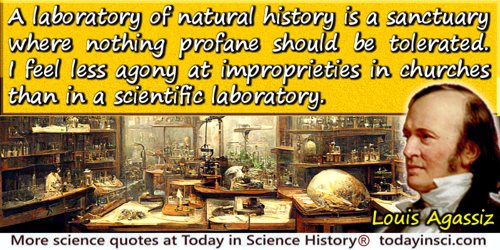
A laboratory of natural history is a sanctuary where nothing profane should be tolerated. I feel less agony at improprieties in churches than in a scientific laboratory.
Lecture at a teaching laboratory on Penikese Island, Buzzard's Bay. Quoted from the lecture notes by David Starr Jordan, Science Sketches (1911), 147.
A layman will no doubt find it hard to understand how pathological disorders of the body and mind can be eliminated by 'mere' words. He will feel that he is being asked to believe in magic. And he will not be so very wrong, for the words which we use in our everyday speech are nothing other than watered-down magic. But we shall have to follow a roundabout path in order to explain how science sets about restoring to words a part at least of their former magical power.
Psychical (or Mental) Treatment (1905), In James Strachey (ed.), The Standard Edition of the Complete Psychological Works of Sigmund Freud (1953), Vol. 7, 283.
A leg of mutton is better than nothing,
Nothing is better than Heaven,
Therefore a leg of mutton is better than Heaven.
Nothing is better than Heaven,
Therefore a leg of mutton is better than Heaven.
Aphorism 21 in Notebook C (1772-1773), as translated by R.J. Hollingdale in Aphorisms (1990). Reprinted as The Waste Books (2000), 35.
A life spent in making mistakes is not only more honorable but more useful than a life spent doing nothing.
In 'Preface on Doctors', The Doctor's Dilemma (1909, 1911), lxxxv.
A machine is not a genie, it does not work by magic, it does not possess a will, and … nothing comes out which has not been put in, barring of course, an infrequent case of malfunctioning. … The “intentions” which the machine seems to manifest are the intentions of the human programmer, as specified in advance, or they are subsidiary intentions derived from these, following rules specified by the programmer. … The machine will not and cannot do any of these things until it has been instructed as to how to proceed. ... To believe otherwise is either to believe in magic or to believe that the existence of man’s will is an illusion and that man’s actions are as mechanical as the machine’s.
In Science, September 16, 1960.
A man who writes a great deal and says little that is new writes himself into a daily declining reputation. When he wrote less he stood higher in people’s estimation, even though there was nothing in what he wrote. The reason is that then they still expected better things of him in the future, whereas now they can view the whole progression.
Aphorism 43 in Notebook D (1773-1775), as translated by R.J. Hollingdale in Aphorisms (1990). Reprinted as The Waste Books (2000), 50.
A men whose every word is nothing but the truth is not a human being but a god! Gods do not die, whereas Aristotle is lying in a grave now.
From the play Galileo Galilei (2001) .
A Miracle is a Violation of the Laws of Nature; and as a firm and unalterable Experience has established these Laws, the Proof against a Miracle, from the very Nature of the Fact, is as entire as any Argument from Experience can possibly be imagined. Why is it more than probable, that all Men must die; that Lead cannot, of itself, remain suspended in the Air; that Fire consumes Wood, and is extinguished by Water; unless it be, that these Events are found agreeable to the Laws of Nature, and there is required a Violation of these Laws, or in other Words, a Miracle to prevent them? Nothing is esteem'd a Miracle, if it ever happen in the common Course of Nature... There must, therefore, be a uniform Experience against every miraculous Event, otherwise the Event would not merit that Appellation. And as a uniform Experience amounts to a Proof, there is here a direct and full Proof, from the Nature of the Fact, against the Existence of any Miracle; nor can such a Proof be destroy'd, or the Miracle render'd credible, but by an opposite Proof, which is superior.
An Enquiry Concerning Human Understanding (1748), 180-181.
A physician is someone who knows everything and does nothing.
A surgeon is someone who does everything and knows nothing.
A psychiatrist is someone who knows nothing and does nothing.
A pathologist is someone who knows everything and does everything too late.
A surgeon is someone who does everything and knows nothing.
A psychiatrist is someone who knows nothing and does nothing.
A pathologist is someone who knows everything and does everything too late.
A physicist learns more and more about less and less, until he knows everything about nothing; whereas a philosopher learns less and less about more and more, until he knows nothing about everything.
Saying.
A poet is, after all, a sort of scientist, but engaged in a qualitative science in which nothing is measurable. He lives with data that cannot be numbered, and his experiments can be done only once. The information in a poem is, by definition, not reproducible. ... He becomes an equivalent of scientist, in the act of examining and sorting the things popping in [to his head], finding the marks of remote similarity, points of distant relationship, tiny irregularities that indicate that this one is really the same as that one over there only more important. Gauging the fit, he can meticulously place pieces of the universe together, in geometric configurations that are as beautiful and balanced as crystals.
In The Medusa and the Snail: More Notes of a Biology Watcher (1974, 1995), 107.
A principle of induction would be a statement with the help of which we could put inductive inferences into a logically acceptable form. In the eyes of the upholders of inductive logic, a principle of induction is of supreme importance for scientific method: “... this principle”, says Reichenbach, “determines the truth of scientific theories. To eliminate it from science would mean nothing less than to deprive science of the power to decide the truth or falsity of its theories. Without it, clearly, science would no longer have the right to distinguish its theories from the fanciful and arbitrary creations of the poet’s mind.” Now this principle of induction cannot be a purely logical truth like a tautology or an analytic statement. Indeed, if there were such a thing as a purely logical principle of induction, there would be no problem of induction; for in this case, all inductive inferences would have to be regarded as purely logical or tautological transformations, just like inferences in inductive logic. Thus the principle of induction must be a synthetic statement; that is, a statement whose negation is not self-contradictory but logically possible. So the question arises why such a principle should be accepted at all, and how we can justify its acceptance on rational grounds.
…...
A professor of experimental science must sometimes grab at any, even senseless, means to impress scientific laws [on students]. Sometimes, one can only capture what is most important about beautiful drastic experiments with a joke. Nothing conveys it better!
Given as “fashioned from Boltzmann’s notes for his lecture on natural philosophy on November 3, 1903” and translated in John Blackmore (ed.), Ludwig Boltzmann: His Later Life and Philosophy, 1900-1906 (1995), 133. Blackmore indicates that since Boltzmann spoke freely, this may not be verbatim for what he actually said, because he did not read his lectures from his notes. However, it does “rather accurately represent his thinking” at the time he wrote his lecture. His Lectures on Natural Philosophy (1903-1906) were reconstructed from Boltzmann’s shorthand notes by Ilse M. Fasol-Boltzmann (ed.), in Ludwig Boltzmann Principien der Naturfolosofti (1990).
A scientist lives with all of reality. There is nothing better. To know reality is to accept it and eventually to love it.
…...
A scientist lives with all reality. There is nothing better. To know reality is to accept it, and eventually to love it.
Nobel banquet speech (10 Dec 1967). In Ragnar Granit (ed.), Les Prix Nobel en 1967 (1968).
A theory is scientific only if it can be disproved. But the moment you try to cover absolutely everything the chances are that you cover nothing.
From Assumption and Myth in Physical Theory (1967), 12.
A thing is either alive or it isn’t; there is nothing that is almost alive. There is but the remotest possibility of the origin of life by spontaneous generation, and every likelihood that Arrhenius is right when he dares to claim that life is a cosmic phenomenon, something that drifts between the spheres, like light, and like light transiently descends upon those fit to receive it.
In An Almanac for Moderns (1935), 393.
A universe that came from nothing in the big bang will disappear into nothing in the big crunch, its glorious few zillion years of existence not even a memory.
In The Last Three Minutes: Conjectures About The Ultimate Fate Of The Universe (1994, 2008), 123.
Above all things expand the frontiers of science: without this the rest counts for nothing.
Aphorism 262 in Notebook J (1789-1793), as translated by R. J. Hollingdale in Aphorisms (1990). Reprinted as The Waste Books (2000), 181.
Absolute space, that is to say, the mark to which it would be necessary to refer the earth to know whether it really moves, has no objective existence…. The two propositions: “The earth turns round” and “it is more convenient to suppose the earth turns round” have the same meaning; there is nothing more in the one than in the other.
From La Science et l’Hypothèse (1908), 141, as translated by George Bruce Halsted in Science and Hypothesis (1905), 85-86. From the original French, “L’espace absolu, c’est-à-dire le repère auquel il faudrait rapporter la terre pour savoir si réellement elle tourne, n’a aucune existence objective. … Ces deux propositions: ‘la terre tourne’, et: ‘il est plus commode de supposer que la terre tourne’, ont un seul et même sens; il n’y a rien de plus dans l’une que dans l’autre.”
According to this view of the matter, there is nothing casual in the formation of Metamorphic Rocks. All strata, once buried deep enough, (and due TIME allowed!!!) must assume that state,—none can escape. All records of former worlds must ultimately perish.
Letter to Mr Murchison, In explanation of the views expressed in his previous letter to Mr Lyell, 15 Nov 1836. Quoted in the Appendix to Charles Babbage, The Ninth Bridgewater Treatise: A Fragment (1838), 240.
Adam is fading out. It is on account of Darwin and that crowd. I can see that he is not going to last much longer. There's a plenty of signs. He is getting belittled to a germ—a little bit of a speck that you can't see without a microscope powerful enough to raise a gnat to the size of a church. They take that speck and breed from it: first a flea; then a fly, then a bug, then cross these and get a fish, then a raft of fishes, all kinds, then cross the whole lot and get a reptile, then work up the reptiles till you've got a supply of lizards and spiders and toads and alligators and Congressmen and so on, then cross the entire lot again and get a plant of amphibiums, which are half-breeds and do business both wet and dry, such as turtles and frogs and ornithorhyncuses and so on, and cross-up again and get a mongrel bird, sired by a snake and dam'd by a bat, resulting in a pterodactyl, then they develop him, and water his stock till they've got the air filled with a million things that wear feathers, then they cross-up all the accumulated animal life to date and fetch out a mammal, and start-in diluting again till there's cows and tigers and rats and elephants and monkeys and everything you want down to the Missing Link, and out of him and a mermaid they propagate Man, and there you are! Everything ship-shape and finished-up, and nothing to do but lay low and wait and see if it was worth the time and expense.
'The Refuge of the Derelicts' collected in Mark Twain and John Sutton Tuckey, The Devil's Race-Track: Mark Twain's Great Dark Writings (1980), 340-41.
- 1980
After Gibbs, one the most distinguished [American scientists] was Langley, of the Smithsonian. … He had the physicist’s heinous fault of professing to know nothing between flashes of intense perception. … Rigidly denying himself the amusement of philosophy, which consists chiefly in suggesting unintelligible answers to insoluble problems, and liked to wander past them in a courteous temper, even bowing to them distantly as though recognizing their existence, while doubting their respectability.
The Education of Henry Adams: An Autobiography? (1918), 377.
After that, I thought about what a proposition generally needs in order to be true and certain because, since I had just found one that I knew was such, I thought I should also know what this certainty consists in. Having noticed that there is nothing at all in the proposition “I think, therefore I am” [cogito ergo sum] which convinces me that I speak the truth, apart from the fact that I see very clearly that one has to exist in order to think, I judged that I could adopt as a general rule that those things we conceive very clearly and distinctly are all true. The only outstanding difficulty is in recognizing which ones we conceive distinctly.
Discourse on Method in Discourse on Method and Related Writings (1637), trans. Desmond M. Clarke, Penguin edition (1999), Part 4, 25.
All change is relative. The universe is expanding relatively to our common material standards; our material standards are shrinking relatively to the size of the universe. The theory of the “expanding universe” might also be called the theory of the “shrinking atom”. …
:Let us then take the whole universe as our standard of constancy, and adopt the view of a cosmic being whose body is composed of intergalactic spaces and swells as they swell. Or rather we must now say it keeps the same size, for he will not admit that it is he who has changed. Watching us for a few thousand million years, he sees us shrinking; atoms, animals, planets, even the galaxies, all shrink alike; only the intergalactic spaces remain the same. The earth spirals round the sun in an ever-decreasing orbit. It would be absurd to treat its changing revolution as a constant unit of time. The cosmic being will naturally relate his units of length and time so that the velocity of light remains constant. Our years will then decrease in geometrical progression in the cosmic scale of time. On that scale man’s life is becoming briefer; his threescore years and ten are an ever-decreasing allowance. Owing to the property of geometrical progressions an infinite number of our years will add up to a finite cosmic time; so that what we should call the end of eternity is an ordinary finite date in the cosmic calendar. But on that date the universe has expanded to infinity in our reckoning, and we have shrunk to nothing in the reckoning of the cosmic being.
We walk the stage of life, performers of a drama for the benefit of the cosmic spectator. As the scenes proceed he notices that the actors are growing smaller and the action quicker. When the last act opens the curtain rises on midget actors rushing through their parts at frantic speed. Smaller and smaller. Faster and faster. One last microscopic blurr of intense agitation. And then nothing.
:Let us then take the whole universe as our standard of constancy, and adopt the view of a cosmic being whose body is composed of intergalactic spaces and swells as they swell. Or rather we must now say it keeps the same size, for he will not admit that it is he who has changed. Watching us for a few thousand million years, he sees us shrinking; atoms, animals, planets, even the galaxies, all shrink alike; only the intergalactic spaces remain the same. The earth spirals round the sun in an ever-decreasing orbit. It would be absurd to treat its changing revolution as a constant unit of time. The cosmic being will naturally relate his units of length and time so that the velocity of light remains constant. Our years will then decrease in geometrical progression in the cosmic scale of time. On that scale man’s life is becoming briefer; his threescore years and ten are an ever-decreasing allowance. Owing to the property of geometrical progressions an infinite number of our years will add up to a finite cosmic time; so that what we should call the end of eternity is an ordinary finite date in the cosmic calendar. But on that date the universe has expanded to infinity in our reckoning, and we have shrunk to nothing in the reckoning of the cosmic being.
We walk the stage of life, performers of a drama for the benefit of the cosmic spectator. As the scenes proceed he notices that the actors are growing smaller and the action quicker. When the last act opens the curtain rises on midget actors rushing through their parts at frantic speed. Smaller and smaller. Faster and faster. One last microscopic blurr of intense agitation. And then nothing.
In The Expanding Universe (1933) , 90-92.
All knowledge has an ultimate goal. Knowledge for the sake of knowledge is, say what you will, nothing but a dismal begging of the question.
Tragic Sense of Life (1913), translated by John Ernest Crawford Flitch (1954), 90.
All knowledge is profitable; profitable in its ennobling effect on the character, in the pleasure it imparts in its acquisition, as well as in the power it gives over the operations of mind and of matter. All knowledge is useful; every part of this complex system of nature is connected with every other. Nothing is isolated. The discovery of to-day, which appears unconnected with any useful process, may, in the course of a few years, become the fruitful source of a thousand inventions.
In 'Report of the Secretary', Sixth Annual Report of the Board of Regents of the Smithsonian Institution for 1851 (1852), 10.
All other things have a portion of everything, but Mind is infinite and self-ruled, and is mixed with nothing but is all alone by itself.
Simplicius, Commentary on Aristotle’s Physics, 164, 24 - 5. In G. S. Kirk, J. E. Raven and M. Schofield (eds.), The Presocratic Philosophers: A Critical History with a Selection of Texts (1983), p. 363.
All our knowledge merely helps us to die a more painful death than the animals that know nothing. A day will come when science will turn upon its error and no longer hesitate to shorten our woes. A day will come when it will dare and act with certainty; when life, grown wiser, will depart silently at its hour, knowing that it has reached its term.
Our Eternity, translated by Alexander Teixeira de Mattos (1913), 24.
All parts of the material universe are in constant motion and though some of the changes may appear to be cyclical, nothing ever exactly returns, so far as human experience extends, to precisely the same condition.
Address (Jul 1874) at the grave of Joseph Priestley, in Joseph Henry and Arthur P. Molella, et al. (eds.), A Scientist in American Life: Essays and Lectures of Joseph Henry (1980), 119.
All that can be said upon the number and nature of elements is, in my opinion, confined to discussions entirely of a metaphysical nature. The subject only furnishes us with indefinite problems, which may be solved in a thousand different ways, not one of which, in all probability, is consistent with nature. I shall therefore only add upon this subject, that if, by the term elements, we mean to express those simple and indivisible atoms of which matter is composed, it is extremely probable we know nothing at all about them; but, if we apply the term elements, or principles of bodies, to express our idea of the last point which analysis is capable of reaching, we must admit, as elements, all the substances into which we are capable, by any means, to reduce bodies by decomposition.
Elements of Chemistry (1790), trans. R. Kerr, Preface, xxiv.
All the different classes of beings which taken together make up the universe are, in the ideas of God who knows distinctly their essential gradations, only so many ordinates of a single curve so closely united that it would be impossible to place others between any two of them, since that would imply disorder and imperfection. Thus men are linked with the animals, these with the plants and these with the fossils which in turn merge with those bodies which our senses and our imagination represent to us as absolutely inanimate. And, since the law of continuity requires that when the essential attributes of one being approximate those of another all the properties of the one must likewise gradually approximate those of the other, it is necessary that all the orders of natural beings form but a single chain, in which the various classes, like so many rings, are so closely linked one to another that it is impossible for the senses or the imagination to determine precisely the point at which one ends and the next begins?all the species which, so to say, lie near the borderlands being equivocal, at endowed with characters which might equally well be assigned to either of the neighboring species. Thus there is nothing monstrous in the existence zoophytes, or plant-animals, as Budaeus calls them; on the contrary, it is wholly in keeping with the order of nature that they should exist. And so great is the force of the principle of continuity, to my thinking, that not only should I not be surprised to hear that such beings had been discovered?creatures which in some of their properties, such as nutrition or reproduction, might pass equally well for animals or for plants, and which thus overturn the current laws based upon the supposition of a perfect and absolute separation of the different orders of coexistent beings which fill the universe;?not only, I say, should I not be surprised to hear that they had been discovered, but, in fact, I am convinced that there must be such creatures, and that natural history will perhaps some day become acquainted with them, when it has further studied that infinity of living things whose small size conceals them for ordinary observation and which are hidden in the bowels of the earth and the depth of the sea.
Lettre Prétendue de M. De Leibnitz, à M. Hermann dont M. Koenig a Cité le Fragment (1753), cxi-cxii, trans. in A. O. Lovejoy, Great Chain of Being: A Study of the History of an Idea (1936), 144-5.
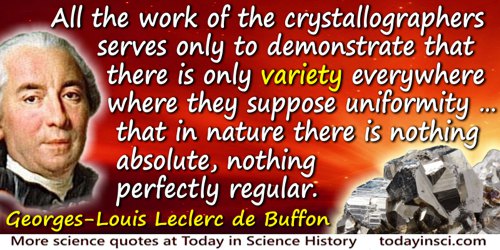
All the work of the crystallographers serves only to demonstrate that there is only variety everywhere where they suppose uniformity … that in nature there is nothing absolute, nothing perfectly regular.
In Histoire Naturelle des Minéraux (1783-88), Vol. 3, 433.
All things appear and disappear because of the concurrence of causes and conditions. Nothing ever exists entirely alone; everything is in relationship to everything else.
In Dwight Goddard, Buddha, Truth, and Brotherhood (1934), 44.
Although the time of death is approaching me, I am not afraid of dying and going to Hell or (what would be considerably worse) going to the popularized version of Heaven. I expect death to be nothingness and, for removing me from all possible fears of death, I am thankful to atheism.
In John Altson, Patti Rae Miliotis, What Happened to Grandpa? (2009).
Although the whole of this life were said to be nothing but a dream and the physical world nothing but a phantasm, I should call this dream or phantasm real enough, if, using reason well, we were never deceived by it.
Epigraph, without citation, in J.R. Newman (ed.) The World of Mathematics (1956), 1832.
Although we know nothing of what an atom is, yet we cannot resist forming some idea of a small particle, which represents it to the mind ... there is an immensity of facts which justify us in believing that the atoms of matter are in some way endowed or associated with electrical powers, to which they owe their most striking qualities, and amongst them their mutual chemical affinity.
[Summarizing his investigations in electrolysis.]
[Summarizing his investigations in electrolysis.]
Experimental Researches in Electricity (1839), section 852. Cited in Laurie M. Brown, Abraham Pais, Brian Pippard, Twentieth Century Physics (1995), Vol. 1, 51.
Alvarez seemed to care less about the way the picture in the puzzle would look, when everything fit together, than about the fun of looking for pieces that fit. He loved nothing more than doing something that everybody else thought impossible. His designs were clever, and usually exploited some little-known principle that everyone else had forgotten.
As quoted in Walter Sullivan, 'Luis W. Alvarez, Nobel Physicist Who Explored Atom, Dies at 77: Obituary', New York Times (2 Sep 1988).
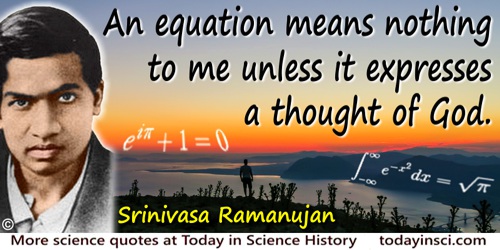
An equation means nothing to me unless it expresses a thought of God.
Quoted in Clifford A. Pickover, A Passion for Mathematics (2005), 1; but with no footnote to primary source.
An evolution is a series of events that in itself as series is purely physical, — a set of necessary occurrences in the world of space and time. An egg develops into a chick; … a planet condenses from the fluid state, and develops the life that for millions of years makes it so wondrous a place. Look upon all these things descriptively, and you shall see nothing but matter moving instant after instant, each instant containing in its full description the necessity of passing over into the next. … But look at the whole appreciatively, historically, synthetically, as a musician listens to a symphony, as a spectator watches a drama. Now you shall seem to have seen, in phenomenal form, a story.
In The Spirit of Modern Philosophy: An Essay in the Form of Lectures (1892), 425.
An expert is a man who understands everything, and nothing else.
Speech, London (16 Dec 1970), 'Israel's International Relations in an Era of Peace', (1979), 22.
An Individual, whatever species it might be, is nothing in the Universe. A hundred, a thousand individuals are still nothing. The species are the only creatures of Nature, perpetual creatures, as old and as permanent as it. In order to judge it better, we no longer consider the species as a collection or as a series of similar individuals, but as a whole independent of number, independent of time, a whole always living, always the same, a whole which has been counted as one in the works of creation, and which, as a consequence, makes only a unity in Nature.
'De la Nature: Seconde Vue', Histoire Naturelle, Générale et Particulière, Avec la Description du Cabinet du Roi (1765), Vol. 13, i. Trans. Phillip R. Sloan.
An irrefutable proof that such single-celled primaeval animals really existed as the direct ancestors of Man, is furnished according to the fundamental law of biogeny by the fact that the human egg is nothing more than a simple cell.
Natürlche Schöpfungsgeschichte, trans. E. R. Lankester, The History of Creation (1892), Vol. 2, 381.
Analogies, it is true, decide nothing but they can make one feel more at home.
New Introductory Lectures on Psycho-Analysis (1933), in James Strachey (ed.), The Standard Edition of the Complete Psychological Works of Sigmund Freud (1964), Vol. 22, 72.
Analogy is a wonderful, useful and most important form of thinking, and biology is saturated with it. Nothing is worse than a horrible mass of undigested facts, and facts are indigestible unless there is some rhyme or reason to them. The physicist, with his facts, seeks reason; the biologist seeks something very much like rhyme, and rhyme is a kind of analogy.... This analogizing, this fine sweeping ability to see likenesses in the midst of differences is the great glory of biology, but biologists don't know it.... They have always been so fascinated and overawed by the superior prestige of exact physical science that they feel they have to imitate it.... In its central content, biology is not accurate thinking, but accurate observation and imaginative thinking, with great sweeping generalizations.
In Science is a Sacred Cow (1950), 98-100.
And do you know what “the world” is to me? Shall I show it to you in my mirror? This world: a monster of energy, without beginning, without end; a firm, iron magnitude of force that does not grow bigger or smaller, that does not expend itself but only transforms itself; as a whole, of unalterable size, a household without expenses or losses, but likewise without increase or income; enclosed by “nothingness”' as by a boundary; not by something blurry or wasted, not something endlessly extended, but set in a definite space as a definite force, and not a space that might be “empty” here or there, but rather as force throughout, as a play of forces and waves of forces, at the same time one and many, increasing here and at the same time decreasing there; a sea of forces flowing and rushing together, eternally changing, eternally flooding back, with tremendous years of recurrence, with an ebb and a flood of its forms; out of the simplest forms striving toward the most complex, out of the stillest, most rigid, coldest forms toward the hottest, most turbulent, most self-contradictory, and then again returning home to the simple out of this abundance, out of the play of contradictions back to the joy of concord, still affirming itself in this uniformity of its courses and its years, blessing itself as that which must return eternally, as a becoming that knows no satiety, no disgust, no weariness: this, my Dionysian world of the eternally self-creating, the eternally self-destroying, this mystery world of the twofold voluptuous delight, my “beyond good and evil,” without goal, unless the joy of the circle itself is a goal; without will, unless a ring feels good will toward itself-do you want a name for this world? A solution for all its riddles? A light for you, too, you best-concealed, strongest, most intrepid, most midnightly men?—This world is the will to power—and nothing besides! And you yourselves are also this will to power—and nothing besides!
The Will to Power (Notes written 1883-1888), book 4, no. 1067. Trans. W. Kaufmann and R. J. Hollingdale and ed. W. Kaufmann (1968), 549-50.
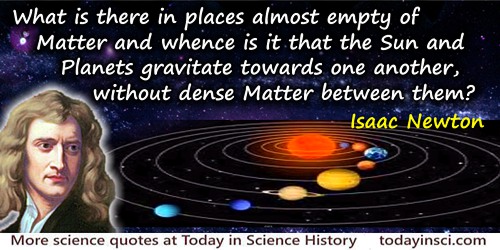
And for rejecting such a Medium, we have the Authority of those the oldest and most celebrated Philosophers of Greece and Phoenicia, who made a Vacuum, and Atoms, and the Gravity of Atoms, the first Principles of their Philosophy; tacitly attributing Gravity to some other Cause than dense Matter. Later Philosophers banish the Consideration of such a Cause out of natural Philosophy, feigning Hypotheses for explaining all things mechanically, and referring other Causes to Metaphysicks: Whereas the main Business of natural Philosophy is to argue from Phaenomena without feigning Hypotheses, and to deduce Causes from Effects, till we come to the very first Cause, which certainly is not mechanical; and not only to unfold the Mechanism of the World, but chiefly to resolve these and such like Questions. What is there in places almost empty of Matter, and whence is it that the Sun and Planets gravitate towards one another, without dense Matter between them? Whence is it that Nature doth nothing in vain; and whence arises all that Order and Beauty which we see in the World? ... does it not appear from phaenomena that there is a Being incorporeal, living, intelligent, omnipresent, who in infinite space, as it were in his Sensory, sees the things themselves intimately, and thoroughly perceives them, and comprehends them wholly by their immediate presence to himself.
In Opticks, (1704, 2nd. Ed. 1718), Book 3, Query 28, 343-5. Newton’s reference to “Nature does nothing in vain” recalls the axiom from Aristotle, which may be seen as “Natura nihil agit frustra” in the Aristotle Quotes on this web site.
And I do not take my medicines from the apothecaries; their shops are but foul sculleries, from which comes nothing but foul broths. As for you, you defend your kingdom with belly-crawling and flattery. How long do you think this will last? ... let me tell you this: every little hair on my neck knows more than you and all your scribes, and my shoebuckles are more learned than your Galen and Avicenna, and my beard has more experience than all your high colleges.
'Credo', in J. Jacobi (ed.), Paracelsus: Selected Writings (1951), 80.
And men ought to know that from nothing else but thence [from the brain] come joys, delights, laughter and sports, and sorrows, griefs, despondency, and lamentations. And by this, in an especial manner, we acquire wisdom and knowledge, and see and hear, and know what are foul and hat are fair, what are bad and what are good, what are sweet, and what unsavory... And by the same organ we become mad and delirious, and fears and terrors assail us... All these things we endure from the brain, when it is not healthy... In these ways I am of the opinion that the brain exercises the greatest power in the man. This is the interpreter to us of those things which emanate from the air, when it [the brain] happens to be in a sound state.
The Genuine Works of Hippocrates, trans. Francis Adams (1886), Vol. 2, 344-5.
Anton Chekhov wrote that ‘one must not put a loaded rifle on stage if no one is thinking of firing it.’ Good drama requires spare and purposive action, sensible linking of potential causes with realized effects. Life is much messier; nothing happens most of the time. Millions of Americans (many hotheaded) own rifles (many loaded), but the great majority, thank God, do not go off most of the time. We spend most of real life waiting for Godot, not charging once more unto the breach.
…...
Are God and Nature then at strife,
That Nature lends such evil dreams?
So careful of the type she seems,
So careless of the single life; ...
'So careful of the type', but no.
From scarped cliff and quarried stone
She cries, 'A thousand types are gone:
I care for nothing, all shall go' ...
Man, her last work, who seemed so fair,
Such splendid purpose in his eyes,
Who rolled the psalm to wintry skies,
Who built him fanes of fruitless prayer,
Who trusted God was love indeed
And love Creation's final law—
Tho’ Nature red in tooth and claw
With ravine, shrieked against his creed...
That Nature lends such evil dreams?
So careful of the type she seems,
So careless of the single life; ...
'So careful of the type', but no.
From scarped cliff and quarried stone
She cries, 'A thousand types are gone:
I care for nothing, all shall go' ...
Man, her last work, who seemed so fair,
Such splendid purpose in his eyes,
Who rolled the psalm to wintry skies,
Who built him fanes of fruitless prayer,
Who trusted God was love indeed
And love Creation's final law—
Tho’ Nature red in tooth and claw
With ravine, shrieked against his creed...
In Memoriam A. H. H. (1850), Cantos 56-57. Collected in Alfred Tennyson and William James Rolfe (ed.) The Poetic and Dramatic works of Alfred, Lord Tennyson (1898), 176.
Are God and Nature then at strife,
That Nature lends such evil dreams?
So careful of the type she seems,
So careless of the single life…
So careful of the type, but no.
From scarped cliff and quarried stone
She cries, “A thousand types are gone;
I care for nothing, all shall go.”
That Nature lends such evil dreams?
So careful of the type she seems,
So careless of the single life…
So careful of the type, but no.
From scarped cliff and quarried stone
She cries, “A thousand types are gone;
I care for nothing, all shall go.”
From poem, 'In Memoriam A.H.H.' written between 1833-50, and first published anonymously in 1850. Collected in Poetical Works of Alfred Tennyson (1860), Vol.2, 64.
Aristotle’s opinion … that comets were nothing else than sublunary vapors or airy meteors … prevailed so far amongst the Greeks, that this sublimest part of astronomy lay altogether neglected; since none could think it worthwhile to observe, and to give an account of the wandering and uncertain paths of vapours floating in the Ether.
Attributed.
Art is nothing but humanized science.
In Marco Treves, Artists on art, from the XIV to the XX century (1945), 437.
As a child I read a lot, and I read everything. I’d go to the library and then stay up all night reading. I used to read under the desk in school … I read all of the books on science in the library and was frustrated when there was nothing left to read.
In 'A Personal Profile of Karen K. Uhlenbeck', collected in Susan Ambrose et al., Journeys of Women in Science and Engineering, No Universal Constants (1999).
As a different, but perhaps more common, strategy for the suppression of novelty, we may admit the threatening object to our midst, but provide an enveloping mantle of ordinary garb… . This kind of cover-up, so often amusing in our daily lives, can be quite dangerous in science, for nothing can stifle originality more effectively than an ordinary mantle placed fully and securely over an extraordinary thing.
In 'A Short Way to Big Ends', Natural History (Jan 1986), 95, No. 1, 18.
As advertising always convinces the sponsor even more than the public, the scientists have become sold, and remain sold, on the idea that they have the key to the Absolute, and that nothing will do for Mr. Average Citizen but to stuff himself full of electrons.
In Science is a Sacred Cow (1950), 26.
As followers of natural science we know nothing of any relation between thoughts and the brain, except as a gross correlation in time and space.
Man on his Nature (1942), 290.
As for the excellent little wretches who grow up in what they are taught, with never a scruple or a query, ... they signify nothing in the intellectual life of the race.
'Poet at the Breakfast-Table', The Atlantic Monthly (Oct 1872), 429.
As physicists have arranged an extensive series of effects under the general term of Heat, so they have named another series Light, and a third they have called Electricity. We find ... that all these principles are capable of being produced through the medium of living bodies, for nearly all animals have the power of evolving heat; many insects, moreover, can voluntarily emit light; and the property of producing electricity is well evinced in the terrible shock of the electric eel, as well as in that of some other creatures. We are indeed in the habit of talking of the Electric fluid, or the Galvanic fluid, but this in reality is nothing but a licence of expression suitable to our finite and material notions.
In the Third Edition of Elements of Electro-Metallurgy: or The Art of Working in Metals by the Galvanic Fluid (1851), 1.
As regards railways, it is certain that nothing is so profitable, because nothing is so cheaply transported, as passenger traffic. Goods traffic, of whatsoever description, must be more or less costly. Every article conveyed by railway requires handling and conveyance beyond the limit of the railway stations; but passengers take care of themselves, and find their own way.
From 'Railway System and its Results' (Jan 1856) read to the Institution of Civil Engineers, reprinted in Samuel Smiles, Life of George Stephenson (1857), 520.
Astronomy, as the science of cyclical motions, has nothing in common with Geology. But look at Astronomy where she has an analogy with Geology; consider our knowledge of the heavens as a palaetiological science;—as the study of a past condition, from which the present is derived by causes acting in time. Is there no evidence of a beginning, or of a progress?
In History of the Inductive Sciences (1857), Vol. 3, 516.
At first sight nothing seems more obvious than that everything has a beginning and an end, and that everything can be subdivided into smaller parts. Nevertheless, for entirely speculative reasons the philosophers of Antiquity, especially the Stoics, concluded this concept to be quite unnecessary. The prodigious development of physics has now reached the same conclusion as those philosophers, Empedocles and Democritus in particular, who lived around 500 B.C. and for whom even ancient man had a lively admiration.
'Development of the Theory of Electrolytic Dissociation', Nobel Lecture, 11 December 1903. In Nobel Lectures: Chemistry 1901-1921 (1966), 45.
At first, the sea, the earth, and the heaven, which covers all things, were the only face of nature throughout the whole universe, which men have named Chaos; a rude and undigested mass, and nothing more than an inert weight, and the discordant atoms of things not harmonizing, heaped together in the same spot.
Describing the creation of the universe from chaos, at the beginning of Book I of Metamorphoses, lines 5-9. As translated by Henry T. Riley, The Metamorphoses of Ovid, Vol I: Books I-VII (1858), 1-2. Riley footnoted: “A rude and undigested mass.—Ver. 7. This is very similar to the words of the Scriptures, ‘And the earth was without form and void,’ Genesis, ch. i. ver. 2.”
At the outset do not be worried about this big question—Truth. It is a very simple matter if each one of you starts with the desire to get as much as possible. No human being is constituted to know the truth, the whole truth, and nothing but the truth; and even the best of men must be content with fragments, with partial glimpses, never the full fruition. In this unsatisfied quest the attitude of mind, the desire, the thirst—a thirst that from the soul must arise!—the fervent longing, are the be-all and the end-all.
'The Student Life' (1905). In G. L. Keynes (ed.), Selected Writings of Sir William Osler (1951), 172.
Attainment and science, retainment and art—the two couples keep to themselves, but when they do meet, nothing else in the world matters.
In Time and Ebb (1947) in Nine Stories(1947), 102.
Attempt the end and never stand to doubt;
Nothing's so hard, but search will find it out.
Nothing's so hard, but search will find it out.
'Seeke and Finde', Hesperides: Or, the Works Both Humane and Divine of Robert Herrick Esq. (1648). In J. Max Patrick (ed.), The Complete Poetry of Robert Herrick (1963), 411.
Augustine's Law XVI: Software is like entropy. It is difficult to grasp, weighs nothing, and obeys the second law of thermodynamics; i.e. it always increases.
In Augustine's Laws (1997), 114.
Before the introduction of the Arabic notation, multiplication was difficult, and the division even of integers called into play the highest mathematical faculties. Probably nothing in the modern world could have more astonished a Greek mathematician than to learn that, under the influence of compulsory education, the whole population of Western Europe, from the highest to the lowest, could perform the operation of division for the largest numbers. This fact would have seemed to him a sheer impossibility. … Our modern power of easy reckoning with decimal fractions is the most miraculous result of a perfect notation.
In Introduction to Mathematics (1911), 59.
Before the seas and lands had been created, before the sky that covers everything, Nature displayed a single aspect only throughout the cosmos; Chaos was its name, a shapeless, unwrought mass of inert bulk and nothing more, with the discordant seeds of disconnected elements all heaped together in anarchic disarray.
Describing the creation of the universe from chaos, at the beginning of Book I of Metamorphoses, lines 5-9. As translated in Charles Martin (trans.), Metamorphoses (2004), 15.
Behold a universe so immense that I am lost in it. I no longer know where I am. I am just nothing at all. Our world is terrifying in its insignificance.
In Etretiens sur la Pluralité des Mondes (Conversations with a Lady on the Plurality of Worlds) (1686) as cited in Edward Harrison, Cosmology: The Science of the Universe (2000), 162.
Blessed is the man who, having nothing to say, abstains from giving in words evidence of the fact.
(Mary Ann Evans, English Novelist)
Built up of carbon, hydrogen, oxygen, nitrogen, together with traces of a few other elements, yet of a complexity of structure that has hitherto resisted all attempts at complete analysis, protoplasm is at once the most enduring and the most easily destroyed of substances; its molecules are constantly breaking down to furnish the power for the manifestations of vital phenomena, and yet, through its remarkable property of assimilation, a power possessed by nothing else upon earth, it constantly builds up its substance anew from the surrounding medium.
In History of the Human Body (1919), 1.
Business is just about enabling human beings, nothing more, nothing less. Businesses need to recognize this fundamental fact.
As quoted on imdb.com bigraphy page for Bruce Dickinson.
But experiments went for nothing,—dualism had sworn to uphold its position.
Chemical Method (1855), 203.
But for the persistence of a student of this university in urging upon me his desire to study with me the modern algebra I should never have been led into this investigation; and the new facts and principles which I have discovered in regard to it (important facts, I believe), would, so far as I am concerned, have remained still hidden in the womb of time. In vain I represented to this inquisitive student that he would do better to take up some other subject lying less off the beaten track of study, such as the higher parts of the calculus or elliptic functions, or the theory of substitutions, or I wot not what besides. He stuck with perfect respectfulness, but with invincible pertinacity, to his point. He would have the new algebra (Heaven knows where he had heard about it, for it is almost unknown in this continent), that or nothing. I was obliged to yield, and what was the consequence? In trying to throw light upon an obscure explanation in our text-book, my brain took fire, I plunged with re-quickened zeal into a subject which I had for years abandoned, and found food for thoughts which have engaged my attention for a considerable time past, and will probably occupy all my powers of contemplation advantageously for several months to come.
In Johns Hopkins Commemoration Day Address, Collected Mathematical Papers, Vol. 3, 76.
But from the time I was in college I learned that there is nothing one could imagine which is so strange and incredible that it was not said by some philosopher; and since that time, I have recognized through my travels that all those whose views are different from our own are not necessarily, for that reason, barbarians or savages, but that many of them use their reason either as much as or even more than we do. I also considered how the same person, with the same mind, who was brought up from infancy either among the French or the Germans, becomes different from what they would have been if they had always lived among the Chinese or among the cannibals, and how, even in our clothes fashions, the very thing that we liked ten years ago, and that we may like again within the next ten years, appears extravagant and ridiculous to us today. Thus our convictions result from custom and example very much more than from any knowledge that is certain... truths will be discovered by an individual rather than a whole people.
Discourse on Method in Discourse on Method and Related Writings (1637), trans. Desmond M. Clarke, Penguin edition (1999), Part 2, 14-5.
But if any skillful minister of nature shall apply force to matter, and by design torture and vex it, in order to [effect] its annihilation, it, on the contrary being brought under this necessity, changes and transforms itself into a strange variety of shapes and appearances; for nothing but the power of the Creator can annihilate, or truly destroy it.
As quoted in M.J. Gorton, 'The Weather', Popular Science News (1889), 23, No. 8, 115.
But in nothing are swifts more singular than in their early retreat. They retire, as to the main body of them, by the tenth of August, and sometimes a few days sooner: and every straggler invariably withdraws by the twentieth, while their congeners, all of them, stay till the beginning of October; many of them all through that month, and some occasionally to the beginning of November. This early retreat is mysterious and wonderful, since that time is often the sweetest season in the year. But, what is more extraordinary, they begin to retire still earlier in the most southerly parts of Andalusia, where they can be no ways influenced by any defect of heat; or, as one might suppose, defect of food. Are they regulated in their motions with us by failure of food, or by a propensity to moulting, or by a disposition to rest after so rapid a life, or by what? This is one of those incidents in natural history that not only baffles our searches, but almost eludes our guesses!
In Letter to Daines Barrington, (28 Sep 1774), in The Natural History and Antiquities of Selborne (1789), 278.
But nothing ever put 'Hoppy' in the shade. No one could fail to recognize in the little figure... the authentic gold of intellectual inspiration, the Fundator et Primus Abbas of biochemistry in England.
Co-author with D. M. Needham,
Co-author with D. M. Needham,
'F. G. Hopkins' Personal Influence'. In J. Needham and E. Baldwin (eds.), Hopkins and Biochemistry, 1861-1947 (1949), 115.
But nothing is more estimable than a physician who, having studied nature from his youth, knows the properties of the human body, the diseases which assail it, the remedies which will benefit it, exercises his art with caution, and pays equal attention to the rich and the poor.
A Philosophical Dictionary: from the French? (2nd Ed.,1824), Vol. 5, 239-240.
But nothing of a nature foreign to the duties of my profession [clergyman] engaged my attention while I was at Leeds so much as the, prosecution of my experiments relating to electricity, and especially the doctrine of air. The last I was led into a consequence of inhabiting a house adjoining to a public brewery, where first amused myself with making experiments on fixed air [carbon dioxide] which found ready made in the process of fermentation. When I removed from that house, I was under the necessity making the fixed air for myself; and one experiment leading to another, as I have distinctly and faithfully noted in my various publications on the subject, I by degrees contrived a convenient apparatus for the purpose, but of the cheapest kind. When I began these experiments I knew very little of chemistry, and had in a manner no idea on the subject before I attended a course of chymical lectures delivered in the Academy at Warrington by Dr. Turner of Liverpool. But I have often thought that upon the whole, this circumstance was no disadvantage to me; as in this situation I was led to devise an apparatus and processes of my own, adapted to my peculiar views. Whereas, if I had been previously accustomed to the usual chemical processes, I should not have so easily thought of any other; and without new modes of operation I should hardly have discovered anything materially new.
Memoirs of Dr. Joseph Priestley, in the Year 1795 (1806), Vol. 1, 61-2.
But soft! what light through yonder window breaks?
It speaks, and yet says nothing.
It speaks, and yet says nothing.
Romeo and Juliet, Act 2, Scene 2.
But the idea of science and systematic knowledge is wanting to our whole instruction alike, and not only to that of our business class ... In nothing do England and the Continent at the present moment more strikingly differ than in the prominence which is now given to the idea of science there, and the neglect in which this idea still lies here; a neglect so great that we hardly even know the use of the word science in its strict sense, and only employ it in a secondary and incorrect sense.
Schools and Universities on the Continent (1868),278-9.
But Truth is that besides which there is nothing: nothing to modify it, nothing to question it, nothing to form an exception: the all-inclusive, the complete — By Truth, I mean the Universal.
The Book of the Damned (1932). In The Complete Books of Charles Fort (1975), 9.
But when great and ingenious artists behold their so inept performances, not undeservedly do they ridicule the blindness of such men; since sane judgment abhors nothing so much as a picture perpetrated with no technical knowledge, although with plenty of care and diligence. Now the sole reason why painters of this sort are not aware of their own error is that they have not learnt Geometry, without which no one can either be or become an absolute artist; but the blame for this should be laid upon their masters, who are themselves ignorant of this art.
In The Art of Measurement (1525). As quoted in Albrecht Dürer and R.T. Nichol (trans.), 'Preface', Of the Just Shaping of Letters (1965), Book 3, 1-2.
By explanation the scientist understands nothing except the reduction to the least and simplest basic laws possible, beyond which he cannot go, but must plainly demand them; from them however he deduces the phenomena absolutely completely as necessary.
From his memoir 'Erdmagnetismus und Magnetometer' in Collected Works (1877), Vol. 5, 315-316. Quoted in G. Waldo Dunnington, Carl Friedrich Gauss: Titan of Science (2004), 411.
By profession a biologist, [Thomas Henry Huxley] covered in fact the whole field of the exact sciences, and then bulged through its four fences. Absolutely nothing was uninteresting to him. His curiosity ranged from music to theology and from philosophy to history. He didn't simply know something about everything; he knew a great deal about everything.
'Thomas Henry Huxley.' In the Baltimore Evening Sun (4 May 1925). Reprinted in A Second Mencken Chrestomathy: A New Selection from the Writings of America's Legendary Editor, Critic, and Wit (2006), 157.
By the 18th century science had been so successful in laying bare the laws of nature that many thought there was nothing left to discover. Immutable laws prescribed the motion of every particle in the universe, exactly and forever: the task of the scientist was to elucidate the implications of those laws for any particular phenomenon of interest. Chaos gave way to a clockwork world. But the world moved on ...Today even our clocks are not made of clockwork. ... With the advent of quantum mechanics, the clockwork world has become a lottery. Fundamental events, such as the decay of a radioactive atom, are held to be determined by chance, not law.
Does God Play Dice?: The New Mathematics of Chaos (2002). xi.
By the act of generation nothing more is done than to ferment the sperm of ye female by the sperm of ye male that it may thereby become fit nourishment for ye Embryo: ffor ye nourishment of all animals is prepared by ferment & the ferment is taken from animals of the same kind, & makes the nourishment subtile & spiritual. In adult animals the nourishmt is fermented by the choler and pancreatic juice both wch come from the blood. The Embryo not being able to ferment its own nourishment wch comes from the mothers blood has it fermented by the sperm wch comes from ye fathers blood, & by this nourishment it swells, drops off from ye Ovarium & begins to grow with a life distinct from that of ye mother.
From 'Quæst 25' in Draft version of The Queries manuscript, Add. MS. 3970, folio 235 held by the University of Cambridge Library. As quoted and cited in R.W. Home, 'Force, Electricity, and Living Matter', from Margaret J. Osler and Paul Lawrence Farber (eds.), Religion, Science, and Worldview: Essays in Honor of Richard S. Westfall (2002), 113.
By this we may understand, there be two sorts of knowledge, whereof the one is nothing else but sense, or knowledge original (as I have said at the beginning of the second chapter), and remembrance of the same; the other is called science or knowledge of the truth of propositions, and how things are called, and is derived from understanding.
The Elements of Law: Natural and Politic (1640), Ferdinand Tonnies edn. (1928), Part 1, Chapter 6, 18-9.
Can any thoughtful person admit for a moment that, in a society so constituted that these overwhelming contrasts of luxury and privation are looked upon as necessities, and are treated by the Legislature as matters with which it has practically nothing do, there is the smallest probability that we can deal successfully with such tremendous social problems as those which involve the marriage tie and the family relation as a means of promoting the physical and moral advancement of the race? What a mockery to still further whiten the sepulchre of society, in which is hidden ‘all manner of corruption,’ with schemes for the moral and physical advancement of the race!
In 'Human Selection', Fortnightly Review (1890),48, 330.
Can we separate object and subject? Myself is nothing but a part of my body, my body is nothing but a part of my food, my food is nothing but a part of the earth, the earth is nothing but a part of the solar system.
In Sir William Withey Gull and Theodore Dyke Acland (ed.), A Collection of the Published Writings of William Withey Gull (1896), lii.
Chagrined a little that we have been hitherto able to produce nothing in this way of use to mankind; and the hot weather coming on, when electrical experiments are not so agreeable, it is proposed to put an end to them for this season, somewhat humorously, in a party of pleasure, on the banks of Skuylkil. Spirits, at the same time, are to be fired by a spark sent from side to side through the river, without any other conductor that the water; an experiment which we some time since performed, to the amazement of many. A turkey is to be killed for our dinner by the electrified bottle: when the healths of all the famous electricians in England, Holland, France, and Germany are to be drank in electrified bumpers, under the discharge of guns from the electrical battery.
Letter to Peter Collinson, 29 Apr 1749. In I. Bernard Cohen (ed.), Benjamin Franklin's Experiments (1941), 199-200.
Cheops’ Law: Nothing ever gets built on schedule or within budget.
In 'From the Notebooks of Lazarus Long', Time Enough for Love: The Lives of Lazarus Long (1973), 259. Note: Cheops built the Great Pyramid at Giza. Of course, exceptions do exist, for example, the Empire State Building was built speedily, and under budget.
Colour, Figure, Motion, Extension and the like, considered only so many Sensations in the Mind, are perfectly known, there being nothing in them which is not perceived. But if they are looked on as notes or Images, referred to Things or Archetypes existing without the Mind, then are we involved all in Scepticism.
A Treatise Concerning the Principles of Human Knowledge [first published 1710], (1734), 109.
Commitment becomes hysterical when those who have nothing to give advocate generosity, and those who have nothing to give up preach renunciation.
In Reflections on the Human Condition (1973), 31.
Common sense is the favorite daughter of Reason, and altho thare are menny other wimmin more attraktive for a time, thare is nothing but death kan rob common sense ov her buty.
In The Complete Works of Josh Billings (1876), 214.
Computers are composed of nothing more than logic gates stretched out to the horizon in a vast numerical irrigation system.
In State of the Art: A Photographic History of the Integrated Circuit (1983), vii.
Computers may soon replace many people who work with their minds, but nothing yet can replace that finest physical tool of all, the human hand.
In Best of Sydney J. Harris (1976), 82.
Consciousness… does not appear to itself chopped up in bits. Such words as “chain” or “train” do not describe it fitly as it presents itself in the first instance. It is nothing jointed; it flows. A “river” or a “stream” are the metaphors by which it is most naturally described. In talking of it hereafter, let us call it the stream of thought, of consciousness, or of subjective life.
Source of the expression “stream of consciousness”.
Source of the expression “stream of consciousness”.
The Principles of Psychology (1890), Vol. 1, 239.
Copernicus, the most learned man whom we are able to name other than Atlas and Ptolemy, even though he taught in a most learned manner the demonstrations and causes of motion based on observation, nevertheless fled from the job of constructing tables, so that if anyone computes from his tables, the computation is not even in agreement with his observations on which the foundation of the work rests. Therefore first I have compared the observations of Copernicus with those of Ptolemy and others as to which are the most accurate, but besides the bare observations, I have taken from Copernicus nothing other than traces of demonstrations. As for the tables of mean motion, and of prosthaphaereses and all the rest, I have constructed these anew, following absolutely no other reasoning than that which I have judged to be of maximum harmony.
Dedication to the Duke of Prussia, Prutenicae Tabulae (1551), 1585 edition, as quoted in Owen Gingerich, The Eye of Heaven: Ptolemy, Copernicus, Kepler (1993), 227.
Coterminous with space and coeval with time is the kingdom of Mathematics; within this range her dominion is supreme; otherwise than according to her order nothing can exist; in contradiction to her laws nothing takes place. On her mysterious scroll is to be found written for those who can read it that which has been, that which is, and that which is to come.
From Presidential Address (Aug 1878) to the British Association, Dublin, published in the Report of the 48th Meeting of the British Association for the Advancement of Science (1878), 31.
Culture is activity of thought, and receptiveness to beauty and humane feeling. Scraps of information have nothing to do with it. A merely well informed man is the most useless bore on God’s earth. What we should aim at producing is men who possess both culture and expert knowledge in some special direction.
Opening sentences of Chapter 1,'The Aims of Education', in Aims of Education and Other Essays (1917), 1.
Daily it is forced home on the mind of the geologist that nothing, not even the wind that blows, is so unstable as the level of the crust of this Earth.
Debate is an art form. It is about the winning of arguments. It is not about the discovery of truth. There are certain rules and procedures to debate that really have nothing to do with establishing fact–which creationists have mastered. Some of those rules are: never say anything positive about your own position because it can be attacked, but chip away at what appear to be the weaknesses in your opponent’s position. They are good at that. I don’t think I could beat the creationists at debate. I can tie them. But in courtrooms they are terrible, because in courtrooms you cannot give speeches. In a courtroom you have to answer direct questions about the positive status of your belief. We destroyed them in Arkansas. On the second day of the two-week trial we had our victory party!
…...
Disease makes men more physical, it leaves them nothing but body.
The Magic Mountain (1924, 1965), 178.
Distinguisht Link in Being’s endless Chain!
Midway from Nothing to the Deity!
Midway from Nothing to the Deity!
The Complaint: or, Night-Thoughts on Life, Death, and Immortality (1742, 1750), Night 1, 5.
Doctors are men who prescribe medicines of which they know little, to cure diseases of which they know less, in human beings of whom they know nothing. (1760)
In Robert Allan Weinberg, The Biology of Cancer (2006), 726. (Note: Webmaster has not yet found this quote, in this wording, in a major quotation reference book. If you know a primary print source, or correction, please contact Webmaster.)
Doctors coin money when they do procedures—family practice doesn’t have any procedures. A urologist has cystoscopies, a gastroenterologist has gastroscopies, a dermatologist has biopsies. They can do three or four of those and make five or six hundred dollars in a single day. We get nothing for the use of our time to understand the lives of our patients. Technology is rewarded in medicine, it seems to me, and not thinking.
Quoted in John McPhee, 'Heirs of General Practice,' New Yorker (23 Jul 1984), 40-85. In David Barton Smith and Arnold D. Kaluzny, The White Labyrinth (2000), 227.
Doing nothing is better than being busy doing nothing.
— Lao Tzu
Tao Te Ching. Quoted in Kim Lim (ed.), 1,001 Pearls of Spiritual Wisdom: Words to Enrich, Inspire, and Guide Your Life (2014), 183
Don’t be afraid of hard work. Nothing worthwhile comes easily. Don’t let others discourage you or tell you that you can’t do it. In my day I was told women didn’t go into chemistry. I saw no reason why we couldn’t.
from her lecture notes
During this [book preparation] time attacks have not been wanting—we must always be prepared for them. If they grow out of a scientific soil, they cannot but be useful, by laying bare weak points and stimulating to their correction; but if they proceed from that soil, from which the lilies of innocence and the palms of conciliation should spring up, where, however, nothing but the marsh-trefoil of credulity and the poisonous water-hemlock of calumniation grow, they deserve no attention.
From Carl Vogt and James Hunt (ed.), Lectures on Man: His Place in Creation, and in the History of the Earth (1861), Author's Preface, 2-3.
Each generation has its few great mathematicians, and mathematics would not even notice the absence of the others. They are useful as teachers, and their research harms no one, but it is of no importance at all. A mathematician is great or he is nothing.
Reflections: Mathematics and Creativity', New Yorker (1972), 47, No. 53, 39-45. In Douglas M. Campbell, John C. Higgins (eds.), Mathematics: People, Problems, Results (1984), Vol. 2, 3.
Each new scientific development is due to the pressure of some social need. Of course … insatiable curiosity … is still nothing but a response either to an old problem of nature, or to one arising from new social circumstances.
In 'The Teaching of the History of Science', The Scientific Monthly (Sep 1918), 194.
Each of us has read somewhere that in New Guinea pidgin the word for 'piano' is (I use English spelling) 'this fellow you hit teeth belonging to him he squeal all same pig'. I am inclined to doubt whether this expression is authentic; it looks just like the kind of thing a visitor to the Islands would facetiously invent. But I accept 'cut grass belong head belong me' for 'haircut' as genuine... Such phrases seem very funny to us, and make us feel very superior to the ignorant foreigners who use long winded expressions for simple matters. And then it is our turn to name quite a simple thing, a small uncomplicated molecule consisting of nothing more than a measly 11 carbons, seven hydrogens, one nitrogen and six oxygens. We sharpen our pencils, consult our rule books and at last come up with 3-[(1, 3- dihydro-1, 3-dioxo-2H-isoindol-2-yl) oxy]-3-oxopropanoic acid. A name like that could drive any self-respecting Papuan to piano-playing.
The Chemist's English (1990), 3rd Edition, 57.
Earlier this week … scientists announced the completion of a task that once seemed unimaginable; and that is, the deciphering of the entire DNA sequence of the human genetic code. This amazing accomplishment is likely to affect the 21st century as profoundly as the invention of the computer or the splitting of the atom affected the 20th century. I believe that the 21st century will be the century of life sciences, and nothing makes that point more clearly than this momentous discovery. It will revolutionize medicine as we know it today.
Senate Session, Congressional Record (29 Jun 2000) Vol. 146, No 85, S6050.
Education is an admirable thing, but it is well to remember from time to time that nothing that is worth knowing can be taught.
In his dialogue 'The Critic As Artist', collected in Intentions (1904), 101.
England was nothing, compared to continental nations until she had become commercial … until about the middle of the last century, when a number of ingenious and inventive men, without apparent relation to each other, arose in various parts of the kingdom, succeeded in giving an immense impulse to all the branches of the national industry; the result of which has been a harvest of wealth and prosperity, perhaps without a parallel in the history of the world.
In Lives of the Engineers (1862, 1874), xvii.
Ere long intelligence—transmitted without wires—will throb through the earth like a pulse through a living organism. The wonder is that, with the present state of knowledge and the experiences gained, no attempt is being made to disturb the electrostatic or magnetic condition of the earth, and transmit, if nothing else, intelligence.
Electrical Engineer (24 Jun 1892), 11, 609.
Etna presents us not merely with an image of the power of subterranean heat, but a record also of the vast period of time during which that power has been exerted. A majestic mountain has been produced by volcanic action, yet the time of which the volcanic forms the register, however vast, is found by the geologist to be of inconsiderable amount, even in the modern annals of the earth’s history. In like manner, the Falls of Niagara teach us not merely to appreciate the power of moving water, but furnish us at the same time with data for estimating the enormous lapse of ages during which that force has operated. A deep and long ravine has been excavated, and the river has required ages to accomplish the task, yet the same region affords evidence that the sum of these ages is as nothing, and as the work of yesterday, when compared to the antecedent periods, of which there are monuments in the same district.
Travels in North America (1845), Vol. 1, 28-9.
Euclid alone has looked on Beauty bare.
Let all who prate of Beauty hold their peace,
And lay them prone upon the earth and cease
To ponder on themselves, the while they stare
At nothing, intricately drawn nowhere
In shapes of shifting lineage; let geese
Gabble and hiss, but heroes seek release
From dusty bondage into luminous air.
O blinding hour, O holy, terrible day,
When first the shaft into his vision shone
Of light anatomized! Euclid alone
Has looked on Beauty bare. Fortunate they
Who, though once only and then but far away,
Have heard her massive sandal set on stone.
Let all who prate of Beauty hold their peace,
And lay them prone upon the earth and cease
To ponder on themselves, the while they stare
At nothing, intricately drawn nowhere
In shapes of shifting lineage; let geese
Gabble and hiss, but heroes seek release
From dusty bondage into luminous air.
O blinding hour, O holy, terrible day,
When first the shaft into his vision shone
Of light anatomized! Euclid alone
Has looked on Beauty bare. Fortunate they
Who, though once only and then but far away,
Have heard her massive sandal set on stone.
Poem, 'Euclid Alone Has Looked on Beauty Bare", collected in Wallace Warner Douglas and Hallett Darius Smith (eds.), The Critical Reader: Poems, Stories, Essays (1949), 110.
Even in the vast and mysterious reaches of the sea we are brought back to the fundamental truth that nothing lives to itself.
Silent Spring, Introduction.
Every great improvement has come after repeated failures. Virtually nothing comes out right the first time. Failures, repeated failures, are finger posts on the road to achievement. One fails forward toward success.
Every man has his little weakness. It often takes the form of a desire to get something for nothing.
Aphorism in The Philistine (Apr 1905), 20, No. 5, 160.
Every rule has its limits, and every concept its ambiguities. Most of all is this true in the science of life, where nothing quite corresponds to our ideas; similar ends are reached by varied means, and no causes are simple.
In Internal Factors in Evolution (1965), 13.
Every writer must reconcile, as best he may, the conflicting claims of consistency and variety, of rigour in detail and elegance in the whole. The present author humbly confesses that, to him, geometry is nothing at all, if not a branch of art.
Concluding remark in preface to Treatise on Algebraic Plane Curves (1931), x.
Everything flows and nothing abides; everything gives way and nothing stays fixed.
…...
Everything is made of atoms ... Everything that animals do, atoms do. ... There is nothing that living things do that cannot be understood from the point of view that they are made of atoms acting according to the laws of physics.
In The Feynman Lectures (1963), 8.
Everything is poisonous, nothing is poisonous, it is all a matter of dose.
In Pathologie expérimenta1e (1872), 72. From the original French, “Tout est poison, rien n’est poison, tout est une question de dose.”
Everywhere in nature we seek some certainty, but all this is nothing more than an arrangement of the dark feeling of our own. All the mathematical laws that we find in Nature are always suspicious to me, despite their beauty. They give me no pleasure. They are merely expedients. Everything is not true at close range.
From the original German, in Physikalische und Mathematische Schriften (1806), Vol. 4, 145, “Wir suchen in der Natur überall eine gewisse Bestimmtheit, aber das Alles ist weiter nichts, als Anordnung des dunkeln Gefühls unserer eigenen. Alle mathematischen Gesetze, die wir in der Natur finden, sind mir trotz ihrer Schönheit immer verdächtig. Sie Freuen mich nicht. Sie sind bloss Hülfsmittel. In der Nähe ist Alles nicht wahr.” English version by Webmaster using Google translate.
Evolution is the law of policies: Darwin said it, Socrates endorsed it, Cuvier proved it and established it for all time in his paper on 'The Survival of the Fittest.' These are illustrious names, this is a mighty doctrine: nothing can ever remove it from its firm base, nothing dissolve it, but evolution.
'Three Thousand Years Among the Microbes', Which Was the Dream? (1967), Chap. 8. In Mark Twain and Brian Collins (ed.), When in Doubt, Tell the Truth: and Other Quotations from Mark Twain (1996), 47.
Except the blind forces of Nature, nothing moves in this world which is not Greek in its origin.
Village-Communities in the East and West (1871), 238.
Experience teaches nothing without theory.
In On the Management of Statistical Techniques for Quality and Productivity (1981), 86.
Faced with the admitted difficulty of managing the creative process, we are doubling our efforts to do so. Is this because science has failed to deliver, having given us nothing more than nuclear power, penicillin, space travel, genetic engineering, transistors, and superconductors? Or is it because governments everywhere regard as a reproach activities they cannot advantageously control? They felt that way about the marketplace for goods, but trillions of wasted dollars later, they have come to recognize the efficiency of this self-regulating system. Not so, however, with the marketplace for ideas.
Quoted in Martin Moskovits (ed.), Science and Society, the John C. Polanyi Nobel Lareates Lectures (1995), 8.
Failure is so much more interesting because you learn from it. That’s what we should be teaching children at school, that being successful the first time, there’s nothing in it. There’s no interest, you learn nothing actually.
Interview with Carole Cadwalladr, The Observer (9 May 2014).
Far be it from me to suggest that geologists should be reckless in their drafts upon the bank of Time; but nothing whatever is gained, and very much is lost, by persistent niggardliness in this direction.
Proceedings of the Geological Society of London (1903), 59, lxxii.
Finally, since I thought that we could have all the same thoughts, while asleep, as we have while we are awake, although none of them is true at that time, I decided to pretend that nothing that ever entered my mind was any more true than the illusions of my dreams. But I noticed, immediately afterwards, that while I thus wished to think that everything was false, it was necessarily the case that I, who was thinking this, was something. When I noticed that this truth “I think, therefore I am” was so firm and certain that all the most extravagant assumptions of the sceptics were unable to shake it, I judged that I could accept it without scruple as the first principle of the philosophy for which I was searching. Then, when I was examining what I was, I realized that I could pretend that I had no body, and that there was no world nor any place in which I was present, but I could not pretend in the same way that I did not exist. On the contrary, from the very fact that I was thinking of doubting the truth of other things, it followed very evidently and very certainly that I existed; whereas if I merely ceased to think, even if all the rest of what I had ever imagined were true, I would have no reason to believe that I existed. I knew from this that I was a substance, the whole essence or nature of which was to think and which, in order to exist, has no need of any place and does not depend on anything material. Thus this self—that is, the soul by which I am what I am—is completely distinct from the body and is even easier to know than it, and even if the body did not exist the soul would still be everything that it is.
Discourse on Method in Discourse on Method and Related Writings (1637), trans. Desmond M. Clarke, Penguin edition (1999), Part 4, 24-5.
For even they who compose treatises of medicine or natural philosophy in verse are denominated Poets: yet Homer and Empedocles have nothing in common except their metre; the former, therefore, justly merits the name of the Poet; while the other should rather be called a Physiologist than a Poet.
Aristotle’s Treatise on Poetry, I:2, trans. Thomas Twining (1957), 103
For I am actually not at all a man of science, not an observer, nor an experimenter, not a thinker. I am by temperament nothing but a conquistador—an adventurer... with all the curiosity, daring, and tenacity characteristic of a man of this sort.
Letter to Wilhelm Fliess, 1 Feb 1900. In Jeffrey Moussaieff Masson (ed.), The Complete Letters of Sigmund Freud to Wilhelm Fliess (1985), 398.
For it is a good remedy sometimes to apply nothing at all.
Hippocrates wrote this concerning “both to the ear and to many other cases.” In 'On the Articulations', Part 40 (400 BC), as translated by Francis Adams, The Genuine Works of Hippocrates (1886), Vol. 2, 113. Also often seen quoted more briefly as “To do nothing is sometimes a good remedy.”
For more than ten years, my theory was in limbo. Then, finally, in the late 1980s, physicists at Princeton said, “There’s nothing wrong with this theory. It’s the only one that works, and we have to open out minds to hyperspace.” We weren’t destined to discover this theory for another 100 years because it’s so bizarre, so different from everything we’d been doing. We didn’t use the normal sequence of discoveries to get to it.
Describing reaction to his superstring theory of hyperspace which mathematically relates the universe’s basic forces.
Describing reaction to his superstring theory of hyperspace which mathematically relates the universe’s basic forces.
Quoted in Nina L. Diamond, Voices of Truth (2000), 326.
For myself, I found that I was fitted for nothing so well as for the study of Truth; as having a mind nimble and versatile enough to catch the resemblances of things (which is the chief point) , and at the same time steady enough to fix and distinguish their subtler differences; as being gifted by nature with desire to seek, patience to doubt, fondness to meditate, slowness to assert, readiness to reconsider, carefulness to dispose and set in order; and as being a man that neither affects what is new nor admires what is old, and that hates every kind of imposture. So I thought my nature had a kind of familiarity and relationship with Truth.
From 'Progress of philosophical speculations. Preface to intended treatise De Interpretatione Naturæ (1603), in Francis Bacon and James Spedding (ed.), Works of Francis Bacon (1868), Vol. 3, 85.
For nothing is fixed, forever and forever and forever, it is not fixed; the earth is always shifting, the light is always changing, the sea does not cease to grind down rock. Generations do not cease to be born, and we are responsible to them because we are the only witnesses they have. The sea rises, the light fails, lovers cling to each other, and children cling to us. The moment we cease to hold each other, the sea engulfs us and the light goes out.
…...
For since the fabric of the universe is most perfect and the work of a most wise creator, nothing at all takes place in the universe in which some rule of the maximum or minimum does not appear….
From Methodus Inveniendi Uneas Curvas (1744), 1st addition, art. 1, translated as an epigram in Ivor Grattan-Guinness, Convolutions in French Mathematics, 1800-1840: From the Calculus and Mechanics to Mathematical Analysis and Mathematical Physics (1990), Vol. 1, 285.
For the holy Bible and the phenomena of nature proceed alike from the divine Word, the former as the dictate of the Holy Ghost and the latter as the observant executrix of God's commands. It is necessary for the Bible, in order to be accommodated to the understanding of every man, to speak many things which appear to differ from the absolute truth so far as the bare meaning of the words is concerned. But Nature, on the other hand, is inexorable and immutable; she never transgresses the laws imposed upon her, or cares a whit whether her abstruse reasons and methods of operation are understandable to men. For that reason it appears that nothing physical which sense-experience sets before our eyes, or which necessary demonstrations prove to us, ought to be called in question (much less condemned) upon the testimony of biblical passages which may have some different meaning beneath their words.
Letter to Madame Christina of Lorraine, Grand Duchess of Tuscany: Concerning the Use of Biblical Quotations in Matters of Science (1615), trans. Stillman Drake, Discoveries and Opinions of Galileo (1957), 182-3.
For to define true madness,
What is't but to be nothing else but mad?
What is't but to be nothing else but mad?
Hamlet (1601), II, ii.
For what is that which we call evil but the absence of good? In the bodies of animals, disease and wounds mean nothing but the absence of health; for when a cure is effected, that does not mean that the evils which were present—namely, the diseases and wounds—go away from the body and dwell elsewhere: they altogether cease to exist; for the wound or disease is not a substance, but a defect in the fleshly substance,—the flesh itself being a substance, and therefore something good, of which those evils—that is, privations of the good which we call health—are accidents. Just in the same way, what are called vices in the soul are nothing but privations of natural good. And when they are cured, they are not transferred elsewhere: when they cease to exist in the healthy soul, they cannot exist anywhere else.
In Marcus Dods (ed.), J.F. Shaw (trans.), The Enchiridion of Augustine, Chap. 9, collected in The Works of Aurelius Augustine, Bishop of Hippo: A new translation (1873), Vol. 9, 181-182.
Freud expressed the opinion—not quite in earnest, though, it seeemed to me—that philosophy was the most decent form of sublimation of repressed sexuality, nothing more. In response I put the question, 'What then is science, particularly psychoanalytic psychology?' Whereupon he, visibly a bit surprised, answered evasively: 'At least psychology has a social purpose.'
Recollection by Binswanger of conversation during his third visit to Vienna to see Freud (17-18 May 1913), in Gerhard Fichtner (ed.) and Arnold J. Pomerans (trans.), The Sigmund Freud-Ludwig Binswanger Correspondence 1908-1938 (2003), 237.
From the time of Aristotle it had been said that man is a social animal: that human beings naturally form communities. I couldn’t accept it. The whole of history and pre-history is against it. The two dreadful world wars we have recently been through, and the gearing of our entire economy today for defensive war belie it. Man's loathsome cruelty to man is his most outstanding characteristic; it is explicable only in terms of his carnivorous and cannibalistic origin. Robert Hartmann pointed out that both rude and civilised peoples show unspeakable cruelty to one another. We call it inhuman cruelty; but these dreadful things are unhappily truly human, because there is nothing like them in the animal world. A lion or tiger kills to eat, but the indiscriminate slaughter and calculated cruelty of human beings is quite unexampled in nature, especially among the apes. They display no hostility to man or other animals unless attacked. Even then their first reaction is to run away.
In Africa's Place In the Emergence of Civilisation (1959), 41.
From this time everything was copulated. Acetic, formic, butyric, margaric, &c., acids, alkaloids, ethers, amides, anilides, all became copulated bodies. So that to make acetanilide, for example, they no longer employed acetic acid and aniline, but they re-copulated a copulated oxalic acid with a copulated ammonia. I am inventing nothing—altering nothing. Is it my fault if, when writing history, I appear to be composing a romance?
Chemical Method (1855), 204.
Frost is but slender weeks away,
Tonight the sunset glow will stay,
Swing to the north and burn up higher
And Northern Lights wall earth with fire.
Nothing is lost yet, nothing broken,
And yet the cold blue word is spoken:
Say goodbye to the sun.
The days of love and leaves are done.
Tonight the sunset glow will stay,
Swing to the north and burn up higher
And Northern Lights wall earth with fire.
Nothing is lost yet, nothing broken,
And yet the cold blue word is spoken:
Say goodbye to the sun.
The days of love and leaves are done.
Apples by Ocean (1950), 10.
Gauss was not the son of a mathematician; Handel’s father was a surgeon, of whose musical powers nothing is known; Titian was the son and also the nephew of a lawyer, while he and his brother, Francesco Vecellio, were the first painters in a family which produced a succession of seven other artists with diminishing talents. These facts do not, however, prove that the condition of the nerve-tracts and centres of the brain, which determine the specific talent, appeared for the first time in these men: the appropriate condition surely existed previously in their parents, although it did not achieve expression. They prove, as it seems to me, that a high degree of endowment in a special direction, which we call talent, cannot have arisen from the experience of previous generations, that is, by the exercise of the brain in the same specific direction.
In 'On Heredity', Essays upon Heredity and Kindred Biological Problems (1889), Vol. 1, 96.
Genius is nothing but a great aptitude for patience.
Inaugural speech at the French Academy (1753). Quoted in Hans Theodore David, Arthur Mendel and Christoph Wolff, The New Bach Reader (1998), 20. Also seen translated as “Genius is simply patience carried to the extreme,” or shortened as “Genius is patience.” The latter is also sometimes seen attributed (incorrectly?) to Isaac Newton, for example, in Lady Isabel Burton, The Life of Captain Sir Richd F. Burton (1893), Vol. 1, 577. Webmaster has found no primary source from Newton. Also seen attributed to Santiago Ramon y Cajal, but he was only quoting Buffon, translated as “Genius is simply patience carried to the extreme,” in Advice for a Young Investigator (1999), 39. Translated from the original French, “Le génie n'est qu'une grande aptitude à la patience.”
Genius itself has been analyzed by the shrewdest observers into a higher capacity of attention. “Genius,” says Helvetius … “is nothing but a continued attention,” (une attention suivie). “Genius,” says Buffon, “is only a protracted patience,” (une longue patience). “In the exact sciences, at least,” says Cuvier, “it is the patience of a sound intellect, when invincible, which truly constitutes genius.” And Chesterfield has also observed, that “the power of applying an attention, steady and undissipated, to a single object, is the sure mark of a superior genius.”
In Lectures on Metaphysics and Logic (1860), Vol. 1, 179.
Gentlemen, now you will see that now you see nothing. And why you see nothing you will see presently.
Quoted in R. Oesper, The Human Side of Scientists (1975), 164.
Genuine religion has its root deep down in the heart of humanity and in the reality of things. It is not surprising that by our methods we fail to grasp it: the actions of the Deity make no appeal to any special sense, only a universal appeal; and our methods are, as we know, incompetent to detect complete uniformity. There is a principle of Relativity here, and unless we encounter flaw or jar or change, nothing in us responds; we are deaf and blind therefore to the Immanent Grandeur, unless we have insight enough to recognise in the woven fabric of existence, flowing steadily from the loom in an infinite progress towards perfection, the ever-growing garment of a transcendent God.
Continuity: The Presidential Address to the British Association (1913), 92-93.
Geometry is founded in mechanical practice, and is nothing but that part of universal mechanics which accurately proposes and demonstrates the art of measuring.
In Principia (1687), Preface, translated by Andrew Motte (1729), in Florian Cajori (ed.), Sir Isaac Newton's Mathematical Principles of Natural Philosophy (1934), xvii.
Given for one instant an intelligence which could comprehend all the forces by which nature is animated and the respective situation of the beings which compose it—an intelligence sufficiently vast to submit these data to analysis, it would embrace in the same formula the movements of the greatest bodies in the universe and those of the lightest atom; to it nothing would be uncertain, and the future as the past would be present to its eyes.
Introduction to Oeuvres vol. VII, Theorie Analytique de Probabilites (1812-1820). As translated by Frederick Wilson Truscott and Frederick Lincoln Emory in A Philosophical Essay on Probabilities (1902), 4. [LaPlace is here expressing his belief in causal determinism.] From the original French, “Une intelligence qui, pour un instant donné, connaîtrait toutes les forces dont la nature est animée, et la situation respective des êtres qui la composent, si d’ailleurs elle était assez vaste pour soumettre ces données a l’analyse, embrasserait dans la même formula les mouvements des plus grand corps de l’univers et ceux du plus léger atome: rien ne serait incertain pour elle, et l’avenir comme le passé serait présent à ses yeux.”
God made everything out of nothing. But the nothingness shows through.
Mauvaises pensées et autres (1942). In Bill Swainson and Anne H. Soukhanov. Encarta Book of Quotations (2000), 951.
God pity the man of science who believes in nothing but what he can prove by scientific methods; for if ever a human being needed divine pity, he does.
Every-Day Topics, a Book of Briefs (1882), 5.
Half the joy of life is in little things taken on the run… but let us keep our hearts
young and our eyes open that nothing worth our while shall escape us. That nothing worth our while shall escape us. And everything is worth its while if we only grasp it and its significance.
Found quoted without source in The American Journal of Clinical Medicine (1907), 14, 150, and several other publications of that time period. Webmaster invites help pinpointing the primary text.
He that knows the secrets of nature with Albertus Magnus, or the motions of the heavens with Galileo, or the cosmography of the moon with Hevelius, or the body of man with Galen, or the nature of diseases with Hippocrates, or the harmonies in melody with Orpheus, or of poesy with Homer, or of grammar with Lilly, or of whatever else with the greatest artist; he is nothing if he knows them merely for talk or idle speculation, or transient and external use. But he that knows them for value, and knows them his own, shall profit infinitely.
In Bertram Doben (ed.), Centuries of Meditations (1908), The Third Century, No. 41, 189-190.
He that leaves nothing to chance will do few things ill, but he will do very few things.
…...
He who is not courageous enough to take risks will accomplish nothing in life.
In Ebony (1984), 40, 140.
He who joyfully marches to music in rank and file has already earned my contempt. He has been given a large brain by mistake, since for him the spinal cord would fully suffice. This disgrace to civilisation should be done away with at once. Heroism at command, senseless brutality, deplorable love-of-country stance, how violently I hate all this, how despicable and ignoble war is; I would rather be torn to shreds than be part of so base an action! It is my conviction that killing under the cloak of war is nothing but an act of murder.
…...
HEART, n. An automatic, muscular blood- pump. Figuratively, this useful organ is said to be the seat of emotions and sentiments—a very pretty fancy which, however, is nothing but a survival of a once universal belief. It is now known that the sentiments and emotions reside in the stomach, being evolved from food by chemical action of the gastric fluid. The exact process by which a beefsteak becomes a feeling—tender or not, according to the age of the animal from which it was cut; the successive stages of elaboration through which a caviar sandwich is transmuted to a quaint fancy and reappears as a pungent epigram; the marvelous functional methods of converting a hard-boiled egg into religious contrition, or a cream-puff into a sigh of sensibility—these things have been patiently ascertained by M. Pasteur, and by him expounded with convincing lucidity.
The Collected Works of Ambrose Bierce (1911), Vol. 7, The Devil's Dictionary, 133-134.
Heraclitus somewhere says that all things are in process and nothing stays still, and likening existing things to the stream of a river he says that you would not step twice into the same river.
Plato, Cratylus 402A. In G. S. Kirk, J. E. Raven, and M. Schofield (eds.), The Presocratic Philosophers: A Critical History with a Selection of Texts (1983),195.
Here I most violently want you to
Avoid one fearful error, a vicious flaw.
Don’t think that our bright eyes were made that we
Might look ahead; that hips and knees and ankles
So intricately bend that we might take
Big strides, and the arms are strapped to the sturdy shoulders
And hands are given for servants to each side
That we might use them to support our lives.
All other explanations of this sort
Are twisted, topsy-turvy logic, for
Nothing what is born produces its own use.
Sight was not born before the light of the eyes,
Nor were words and pleas created before the tongue
Rather the tongue's appearance long preceded
Speech, and the ears were formed far earlier than
The sound first heard. To sum up, all the members Existed, I should think, before their use, So use has not caused them to have grown.
Avoid one fearful error, a vicious flaw.
Don’t think that our bright eyes were made that we
Might look ahead; that hips and knees and ankles
So intricately bend that we might take
Big strides, and the arms are strapped to the sturdy shoulders
And hands are given for servants to each side
That we might use them to support our lives.
All other explanations of this sort
Are twisted, topsy-turvy logic, for
Nothing what is born produces its own use.
Sight was not born before the light of the eyes,
Nor were words and pleas created before the tongue
Rather the tongue's appearance long preceded
Speech, and the ears were formed far earlier than
The sound first heard. To sum up, all the members Existed, I should think, before their use, So use has not caused them to have grown.
On the Nature of Things, trans. Anthony M. Esolen (1995), Book 4, lines 820-8, 145.
Heredity, to our understanding is not capable of giving to this illness (paraphilia) its characteristic form ... Heredity invents nothing, creates nothing anew; it has no imagination.
Études de psychologie expérimentale: Le fétichisme dans l’amour (1888), 42.
How can you shorten the subject? That stern struggle with the multiplication table, for many people not yet ended in victory, how can you make it less? Square root, as obdurate as a hardwood stump in a pasture nothing but years of effort can extract it. You can’t hurry the process. Or pass from arithmetic to algebra; you can’t shoulder your way past quadratic equations or ripple through the binomial theorem. Instead, the other way; your feet are impeded in the tangled growth, your pace slackens, you sink and fall somewhere near the binomial theorem with the calculus in sight on the horizon. So died, for each of us, still bravely fighting, our mathematical training; except for a set of people called “mathematicians”—born so, like crooks.
In Too Much College: Or, Education Eating up Life, with Kindred Essays in Education and Humour (1939), 8.
How many wells of science there are in whose depths there is nothing but clear water!
In Bluettes et Boutardes. Translated in Conceits and Caprices (1869), 13.
How many famous men be there in this our age, which make scruple to condemne these old witches, thinking it to bee nothing but a melancholike humour which corrupteth thei imagination, and filleth them with all these vaines toyes. I will not cast my selfe any further into the depth of this question, the matter craveth a man of more leisure.
Describing melancholy as the innocent affliction of those regarded as witches instead of Satanic influence, while distancing himself from the controversy.
Describing melancholy as the innocent affliction of those regarded as witches instead of Satanic influence, while distancing himself from the controversy.
Discours de la conservation de la veue; des maladies mélancholiques, des catarrhes, et de la vieillese (1594). In Richard Surphlet (trans.) A Discourse of the Preservation of the Sight: of Melancholike Diseases; of Rheumes, and of Old Age (1599), 98-9. Quoted in Michael Heyd, Be sober and Reasonable (), 58.
How, indeed, can there be a response within to the impression from without when there is nothing within that is in relation of congenial vibration with that which is without? Inattention in such case is insusceptibility; and if this be complete, then to demand attention is very much like demanding of the eye that it should attend to sound-waves, and of the ear that it should attend to light-waves.
As quoted in William W. Speer, Primary Arithmetic: First Year, for the Use of Teachers (1902), 3.
However far modern science and technics have fallen short of their inherent possibilities, they have taught mankind at least one lesson: Nothing is impossible.
Technics and Civilization (1934), 435.
Human behaviour reveals uniformities which constitute natural laws. If these uniformities did not exist, then there would be neither social science nor political economy, and even the study of history would largely be useless. In effect, if the future actions of men having nothing in common with their past actions, our knowledge of them, although possibly satisfying our curiosity by way of an interesting story, would be entirely useless to us as a guide in life.
In Cours d’Economie Politique (1896-7), Vol. 2, 397.
Human evolution is nothing else but the natural continuation, at a collective level, of the perennial and cumulative process of “psychogenetic” arrangement of matter which we call life. … The whole history of mankind has been nothing else (and henceforth it will never be anything else) but an explosive outburst of ever-growing cerebration. … Life, if fully understood, is not a freak in the universe—nor man a freak in life. On the contrary, life physically culminates in man, just as energy physically culminates in life.
(1952). As quoted in Stephen Jay Gould, Hen's Teeth and Horse's Toes: Further Reflections in Natural History (1984, 1994), 246.
Hypothesis is the most important mental technique of the investigator, and its main function is to suggest new experiments or new observations. Indeed, most experiments and many observations are carried out with the deliberate object of testing an hypothesis. Another function is to help one see the significance of an object or event that otherwise would mean nothing. For instance, a mind prepared by the hypothesis of evolution would make many more significant observations on a field excursion than one not so prepared. Hypotheses should be used as tools to uncover new facts rather than as ends in themselves.
The Art of Scientific Investigation (1953), 46.
I am born into an environment–I know not whence I came nor whither I go nor who I am. This is my situation as yours, every single one of you. The fact that everyone always was in this same situation, and always will be, tells me nothing. Our burning question as to the whence and whither–all we can ourselves observe about it is the present environment. That is why we are eager to find out about it as much as we can. That is science, learning, knowledge; it is the true source of every spiritual endeavour of man. We try to find out as much as we can about the spatial and temporal surroundings of the place in which we find ourselves put by birth.
…...
I am certain of nothing but the holiness of the Heart’s affections and the truth of Imagination—What the imagination seizes as Beauty must be truth—whether it existed before or not.
Letter to Benjamin Bailey (22 Nov 1817). In H. E. Rollins (ed.), Letters of John Keats (1958), Vol. 1, 184.
I am more and more convinced that the ant colony is not so much composed of separate individuals as that the colony is a sort of individual, and each ant like a loose cell in it. Our own blood stream, for instance, contains hosts of white corpuscles which differ little from free-swimming amoebae. When bacteria invade the blood stream, the white corpuscles, like the ants defending the nest, are drawn mechanically to the infected spot, and will die defending the human cell colony. I admit that the comparison is imperfect, but the attempt to liken the individual human warrior to the individual ant in battle is even more inaccurate and misleading. The colony of ants with its component numbers stands half way, as a mechanical, intuitive, and psychical phenomenon, between our bodies as a collection of cells with separate functions and our armies made up of obedient privates. Until one learns both to deny real individual initiative to the single ant, and at the same time to divorce one's mind from the persuasion that the colony has a headquarters which directs activity … one can make nothing but pretty fallacies out of the polity of the ant heap.
In An Almanac for Moderns (1935), 121
I am not insensible to natural beauty, but my emotional joys center on the improbable yet sometimes wondrous works of that tiny and accidental evolutionary twig called Homo sapiens. And I find, among these works, nothing more noble than the history of our struggle to understand nature—a majestic entity of such vast spatial and temporal scope that she cannot care much for a little mammalian afterthought with a curious evolutionary invention, even if that invention has, for the first time in so me four billion years of life on earth, produced recursion as a creature reflects back upon its own production and evolution. Thus, I love nature primarily for the puzzles and intellectual delights that she offers to the first organ capable of such curious contemplation.
…...
I am not only a pacifist but a militant pacifist. I am willing to fight for peace. Nothing will end war unless the people themselves refuse to go to war.
…...
I am nothing more than a single narrow gasping lung, floating over the mists and summits.
In Everest: Expedition to the Ultimate (1979), 180.
I am only a physicist with nothing material to show for my labours. I have never even seen the ionosphere, although I have worked on the subject for thirty years. That does show how lucky people can be. If there had been no ionosphere I would not have been standing here this morning.
Response to receiving an honour from the Institute of Mechanical Engineers. As quoted in New Scientist (22 Nov 1956), 33.
I am particularly fond of his [Emmanuel Mendes da Costa’s] Natural History of Fossils because this treatise, more than any other work written in English, records a short episode expressing one of the grand false starts in the history of natural science–and nothing can be quite so informative and instructive as a juicy mistake.
In Leonardo's Mountain of Clams and the Diet of Worms: Essays on Natural History (1998, 2011), 93. [Gould uses the spelling “Emmanuel”, but it is usually seen as “Emanuel”. —Webmaster]
I am quite aware that we have just now lightheartedly expelled in imagination many excellent men who are largely, perhaps chiefly, responsible for the buildings of the temple of science; and in many cases our angel would find it a pretty ticklish job to decide. But of one thing I feel sure: if the types we have just expelled were the only types there were, the temple would never have come to be, any more than a forest can grow which consists of nothing but creepers. For these people any sphere of human activity will do, if it comes to a point; whether they become engineers, officers, tradesmen, or scientists depends on circumstances.
…...
I am very astonished that the scientific picture of the real world around me is deficient. It gives a lot of factual information, puts all our experience in a magnificently consistent order, but it is ghastly silent about all and sundry that is really near to our heart, that really matters to us. It cannot tell us a word about red and blue, bitter and sweet, physical pain and physical delight; it knows nothing of beautiful and ugly, good or bad, God and eternity. Science sometimes pretends to answer questions in these domains, but the answers are very often so silly that we are not inclined to take them seriously.
…...
I assume that each organism which the Creator educed was stamped with an indelible specific character, which made it what it was, and distinguished it from everything else, however near or like. I assume that such character has been, and is, indelible and immutable; that the characters which distinguish species now, were as definite at the first instant of their creation as now and are as distinct now as they were then. If any choose to maintain... that species were gradually bought to their present maturity from humbler forms... he is welcome to his hypothesis, but I have nothing to do with it.
Omphalos: An Attempt to Untie the Geological Knot (1857), 111.
I believe in an immortal soul. science has proved that nothing disintegrates into nothingness. Life and soul, therefore, cannot disintegrate into nothingness, and so are immortal.
…...
I believe that the useful methods of mathematics are easily to be learned by quite young persons, just as languages are easily learned in youth. What a wondrous philosophy and history underlie the use of almost every word in every language—yet the child learns to use the word unconsciously. No doubt when such a word was first invented it was studied over and lectured upon, just as one might lecture now upon the idea of a rate, or the use of Cartesian co-ordinates, and we may depend upon it that children of the future will use the idea of the calculus, and use squared paper as readily as they now cipher. … When Egyptian and Chaldean philosophers spent years in difficult calculations, which would now be thought easy by young children, doubtless they had the same notions of the depth of their knowledge that Sir William Thomson might now have of his. How is it, then, that Thomson gained his immense knowledge in the time taken by a Chaldean philosopher to acquire a simple knowledge of arithmetic? The reason is plain. Thomson, when a child, was taught in a few years more than all that was known three thousand years ago of the properties of numbers. When it is found essential to a boy’s future that machinery should be given to his brain, it is given to him; he is taught to use it, and his bright memory makes the use of it a second nature to him; but it is not till after-life that he makes a close investigation of what there actually is in his brain which has enabled him to do so much. It is taken because the child has much faith. In after years he will accept nothing without careful consideration. The machinery given to the brain of children is getting more and more complicated as time goes on; but there is really no reason why it should not be taken in as early, and used as readily, as were the axioms of childish education in ancient Chaldea.
In Teaching of Mathematics (1902), 14.
I believed that, instead of the multiplicity of rules that comprise logic, I would have enough in the following four, as long as I made a firm and steadfast resolution never to fail to observe them.
The first was never to accept anything as true if I did not know clearly that it was so; that is, carefully to avoid prejudice and jumping to conclusions, and to include nothing in my judgments apart from whatever appeared so clearly and distinctly to my mind that I had no opportunity to cast doubt upon it.
The second was to subdivide each on the problems I was about to examine: into as many parts as would be possible and necessary to resolve them better.
The third was to guide my thoughts in an orderly way by beginning, as if by steps, to knowledge of the most complex, and even by assuming an order of the most complex, and even by assuming an order among objects in! cases where there is no natural order among them.
And the final rule was: in all cases, to make such comprehensive enumerations and such general review that I was certain not to omit anything.
The long chains of inferences, all of them simple and easy, that geometers normally use to construct their most difficult demonstrations had given me an opportunity to think that all the things that can fall within the scope of human knowledge follow from each other in a similar way, and as long as one avoids accepting something as true which is not so, and as long as one always observes the order required to deduce them from each other, there cannot be anything so remote that it cannot be reached nor anything so hidden that it cannot be uncovered.
The first was never to accept anything as true if I did not know clearly that it was so; that is, carefully to avoid prejudice and jumping to conclusions, and to include nothing in my judgments apart from whatever appeared so clearly and distinctly to my mind that I had no opportunity to cast doubt upon it.
The second was to subdivide each on the problems I was about to examine: into as many parts as would be possible and necessary to resolve them better.
The third was to guide my thoughts in an orderly way by beginning, as if by steps, to knowledge of the most complex, and even by assuming an order of the most complex, and even by assuming an order among objects in! cases where there is no natural order among them.
And the final rule was: in all cases, to make such comprehensive enumerations and such general review that I was certain not to omit anything.
The long chains of inferences, all of them simple and easy, that geometers normally use to construct their most difficult demonstrations had given me an opportunity to think that all the things that can fall within the scope of human knowledge follow from each other in a similar way, and as long as one avoids accepting something as true which is not so, and as long as one always observes the order required to deduce them from each other, there cannot be anything so remote that it cannot be reached nor anything so hidden that it cannot be uncovered.
Discourse on Method in Discourse on Method and Related Writings (1637), trans. Desmond M. Clarke, Penguin edition (1999), Part 2, 16.
I boast nothing, but plainely say, we all labour against our owne cure, for death is the cure of all diseases.
Religio Medici (1642), Part I, Section 9. In L. C. Martin (ed.), Thomas Browne: Religio Medici and Other Works (1964), 68.
I can certainly wish for new, large, and properly constructed instruments, and enough of them, but to state where and by what means they are to be procured, this I cannot do. Tycho Brahe has given Mastlin an instrument of metal as a present, which would be very useful if Mastlin could afford the cost of transporting it from the Baltic, and if he could hope that it would travel such a long way undamaged… . One can really ask for nothing better for the observation of the sun than an opening in a tower and a protected place underneath.
As quoted in James Bruce Ross and Mary Martin McLaughlin, The Portable Renaissance Reader (1968), 605.
I can think of a few microorganisms, possibly the tubercle bacillus, the syphilis spirochete, the malarial parasite, and a few others, that have a selective advantage in their ability to infect human beings, but there is nothing to be gained, in an evolutionary sense, by the capacity to cause illness or death. Pathogenicity may be something of a disadvantage for most microbes…
In 'Germs', The Lives of a Cell: Notes of a Biology Watcher (1974), 90.
I cannot write long books; I leave that for those who have nothing to say.
In The Decline and Fall of Science (1976), 6.
I conceive of nothing, in religion, science, or philosophy, that is more than the proper thing to wear, for a while.
Wild Talents (1932, 2006), 240.
I consider that a man’s brain originally is like a little empty attic, and you have to stock it with such furniture as you choose. A fool takes in all the lumber of every sort that he comes across, so that the knowledge which might be useful to him gets crowded out, or at best is jumbled up with a lot of other things so that he has a difficulty in laying his hands upon it. Now the skilful workman is very careful indeed as to what he takes into his brain-attic. He will have nothing but the tools which may help him in doing his work, but of these he has a large assortment, and all in the most perfect order. It is a mistake to think that that little room has elastic walls and can distend to any extent. Depend upon it there comes a time when for every addition of knowledge you forget something that you knew before. It is of the highest importance, therefore, not to have useless facts elbowing out the useful ones.
In 'The Science Of Deduction', A Study In Scarlet (1887, 1904), 15-16.
I don't really care how time is reckoned so long as there is some agreement about it, but I object to being told that I am saving daylight when my reason tells me that I am doing nothing of the kind. I even object to the implication that I am wasting something valuable if I stay in bed after the sun has risen. As an admirer of moonlight I resent the bossy insistence of those who want to reduce my time for enjoying it. At the back of the Daylight Saving scheme I detect the bony, blue-fingered hand of Puritanism, eager to push people into bed earlier, and get them up earlier, to make them healthy, wealthy and wise in spite of themselves.
In The Diary of Samuel Marchbanks (1947), 75.
I experimented with all possible maneuvers—loops, somersaults and barrel rolls. I stood upside down on one finger and burst out laughing, a shrill, distorted laugh. Nothing I did altered the automatic rhythm of the air. Delivered from gravity and buoyancy, I flew around in space.
Describing his early test (1943) in the Mediterranean Sea of the Aqua-Lung he co-invented.
Describing his early test (1943) in the Mediterranean Sea of the Aqua-Lung he co-invented.
Quoted in 'Sport: Poet of the Depths', Time (28 Mar 1960)
I feel that, in a sense, the writer knows nothing any longer. He has no moral stance. He offers the reader the contents of his own head, a set of options and imaginative alternatives. His role is that of a scientist, whether on safari or in his laboratory, faced with an unknown terrain or subject. All he can do is to devise various hypotheses and test them against the facts.
Crash (1973, 1995), Introduction. In Barry Atkins, More Than A Game: the Computer Game as a Fictional Form (2003), 144.
I find in Geology a never failing interest, as [it] has been remarked, it creates the same gran[d] ideas respecting this world, which Astronomy do[es] for the universe.—We have seen much fine scenery that of the Tropics in its glory & luxuriance, exceeds even the language of Humboldt to describe. A Persian writer could alone do justice to it, & if he succeeded he would in England, be called the 'grandfather of all liars'.— But I have seen nothing, which more completely astonished me, than the first sight of a Savage; It was a naked Fuegian his long hair blowing about, his face besmeared with paint. There is in their countenances, an expression, which I believe to those who have not seen it, must be inconceivably wild. Standing on a rock he uttered tones & made gesticulations than which, the cries of domestic animals are far more intelligible.
Letter to Charles Whitley, 23 July 1834. In F. Burkhardt and S. Smith (eds.), The Correspondence of Charles Darwin 1821-1836 (1985), Vol. I, 397.
I find it quite improbable that such order came out of chaos. There has to be some organizing principle. God to me is a mystery, but is the explanation for the miracle of existence, why there is something instead of nothing.
As quoted in John Noble Wilford, 'Sizing up the Cosmos: An Astronomers Quest', New York Times (12 Mar 1991), C10.
I find it sad, but all too human, that there are vast bureaucracies concerned about nuclear waste, huge organizations devoted to decommissioning nuclear power stations, but nothing comparable to deal with that truly malign waste, carbon dioxide.
In The Revenge of Gaia: Earth’s Climate Crisis & The Fate of Humanity (2006, 2007), 117-118.
I graduated from college still knowing nothing of original research in science.
In 'J. Michael Bishop: Biographical', website of nobelprize.org.
I have always considered my work a joint effort. I was fortunate to have worked on great ideas and with very intelligent people. I may have developed a few equations no one had thought of before but that was nothing unusual—everybody did that.
In interview with Laurel M. Sheppard, 'An Interview with Mary Ross: First Native American Woman Engineer Aerospace Pioneer Returns to her Native American Roots', on website of Lash Publications.
I have been able to solve a few problems of mathematical physics on which the greatest mathematicians since Euler have struggled in vain … But the pride I might have held in my conclusions was perceptibly lessened by the fact that I knew that the solution of these problems had almost always come to me as the gradual generalization of favorable examples, by a series of fortunate conjectures, after many errors. I am fain to compare myself with a wanderer on the mountains who, not knowing the path, climbs slowly and painfully upwards and often has to retrace his steps because he can go no further—then, whether by taking thought or from luck, discovers a new track that leads him on a little till at length when he reaches the summit he finds to his shame that there is a royal road by which he might have ascended, had he only the wits to find the right approach to it. In my works, I naturally said nothing about my mistake to the reader, but only described the made track by which he may now reach the same heights without difficulty.
(1891) As quoted in translation in Leo Koenigsberger and Frances A. Welby (trans.), Hermann von Helmholtz (1906), 180-181.
I have been trying to point out that in our lives chance may have an astonishing influence and, if I may offer advice to the young laboratory worker, it would be this—never neglect an extraordinary appearance or happening. It may be—usually is, in fact—a false alarm that leads to nothing, but may on the other hand be the clue provided by fate to lead you to some important advance.
Lecture at Harvard University. Quoted in Joseph Sambrook, David W. Russell, Molecular Cloning (2001), Vol. 1, 153.
I have before mentioned mathematics, wherein algebra gives new helps and views to the understanding. If I propose these it is not to make every man a thorough mathematician or deep algebraist; but yet I think the study of them is of infinite use even to grown men; first by experimentally convincing them, that to make anyone reason well, it is not enough to have parts wherewith he is satisfied, and that serve him well enough in his ordinary course. A man in those studies will see, that however good he may think his understanding, yet in many things, and those very visible, it may fail him. This would take off that presumption that most men have of themselves in this part; and they would not be so apt to think their minds wanted no helps to enlarge them, that there could be nothing added to the acuteness and penetration of their understanding.
In The Conduct of the Understanding, Sect. 7.
I have here only made a nosegay of culled flowers, and have brought nothing of my own but the thread that tied them together.
In William Hazlitt (ed.), The Works of Michael de Montaigne: His Essays, Letters, and Journey Through Germany and Italy (1849), 515. Alternate translation: “I have gathered a posy [posie] of other men's flowers and nothing but the thread which binds them is my own,” as epigraph to article 'A Country Walk With the Poets', The Victoria Magazine (May 1874), 23, 1. No citations given. If you know the primary source, please contact Webmaster.
I have just received copies of “To-day” containing criticisms of my letter. I am in no way surprised to find that these criticisms are not only unfair and misleading in the extreme. They are misleading in so far that anyone reading them would be led to believe the exact opposite of the truth. It is quite possible that I, an old and trained engineer and chronic experimenter, should put an undue value upon truth; but it is common to all scientific men. As nothing but the truth is of any value to them, they naturally dislike things that are not true. ... While my training has, perhaps, warped my mind so that I put an undue value upon truth, their training has been such as to cause them to abhor exact truth and logic.
[Replying to criticism by Colonel Acklom and other religious parties attacking Maxim's earlier contribution to the controversy about the modern position of Christianity.]
[Replying to criticism by Colonel Acklom and other religious parties attacking Maxim's earlier contribution to the controversy about the modern position of Christianity.]
In G.K. Chesterton, 'The Maxims of Maxim', Daily News (25 Feb 1905). Collected in G. K. Chesterton and Dale Ahlquist (ed.), In Defense of Sanity: The Best Essays of G.K. Chesterton (2011), 86.
I have no doubt that certain learned men, now that the novelty of the hypotheses in this work has been widely reported—for it establishes that the Earth moves, and indeed that the Sun is motionless in the middle of the universe—are extremely shocked, and think that the scholarly disciplines, rightly established once and for all, should not be upset. But if they are willing to judge the matter thoroughly, they will find that the author of this work has committed nothing which deserves censure. For it is proper for an astronomer to establish a record of the motions of the heavens with diligent and skilful observations, and then to think out and construct laws for them, or rather hypotheses, whatever their nature may be, since the true laws cannot be reached by the use of reason; and from those assumptions the motions can be correctly calculated, both for the future and for the past. Our author has shown himself outstandingly skilful in both these respects. Nor is it necessary that these hypotheses should be true, nor indeed even probable, but it is sufficient if they merely produce calculations which agree with the observations. … For it is clear enough that this subject is completely and simply ignorant of the laws which produce apparently irregular motions. And if it does work out any laws—as certainly it does work out very many—it does not do so in any way with the aim of persuading anyone that they are valid, but only to provide a correct basis for calculation. Since different hypotheses are sometimes available to explain one and the same motion (for instance eccentricity or an epicycle for the motion of the Sun) an astronomer will prefer to seize on the one which is easiest to grasp; a philosopher will perhaps look more for probability; but neither will grasp or convey anything certain, unless it has been divinely revealed to him. Let us therefore allow these new hypotheses also to become known beside the older, which are no more probable, especially since they are remarkable and easy; and let them bring with them the vast treasury of highly learned observations. And let no one expect from astronomy, as far as hypotheses are concerned, anything certain, since it cannot produce any such thing, in case if he seizes on things constructed for another other purpose as true, he departs from this discipline more foolish than he came to it.
Although this preface would have been assumed by contemporary readers to be written by Copernicus, it was unsigned. It is now believed to have been written and added at press time by Andreas Osiander (who was then overseeing the printing of the book). It suggests the earth’s motion as described was merely a mathematical device, and not to be taken as absolute reality. Text as given in 'To the Reader on the Hypotheses in this Work', Copernicus: On the Revolutions of the Heavenly Spheres (1543), translated by Alistair Matheson Duncan (1976), 22-3. By adding this preface, Osiander wished to stave off criticism by theologians. See also the Andreas Osiander Quotes page of this website.
I have nothing to offer except a way of looking at things.
(1986)
I have taken the stand that nobody can be always wrong, but it does seem to me that I have approximated so highly that I am nothing short of a negative genius.
Wild Talents (1932). In The Complete Books of Charles Fort (1975), 1037.
I have watched all the work going on there, and the more I see of it the more I am convinced that Mendelism has nothing to do with evolution.
Letter, 'Embryology and Evolution,' Nature (1931), 127, 56.
I know no such thing as genius,—genius is nothing but labor and diligence.
Louis Klopsch, Many Thoughts of Many Minds (1896), 106.
I know nothing of the science of astrology and I consider it to be a science, if it is a science, of doubtful value, to be severely left alone by those who have any faith in Providence.
The Collected Works of Mahatma Gandhi (1976), Vol. 36, 46.
I know of nothing more laughable than a doctor who does not die of old age.
Letter to Charles Augustin Ferriol, comte d'Argental (1767). In Raymond C. Rowe, Joseph Chamberlain, A Spoonful of Sugar (2007), 243.
I know of nothing so pleasant to minds as the discovery of anything which is at once new and valuable; for nothing which so lightens and sweetens toil, as the hopeful pursuit of such discovery.
In The Wit & Wisdom of Abraham Lincoln by James C. Humes (1996).
I know with sure and certain knowledge that a man’s work is nothing but this slow trek to rediscover, through the detours of art, those two or three great and simple images in whose presence his heart first opened.
In Lyrical and Critical Essays (1967), 14.
I never said a word against eminent men of science. What I complain of is a vague popular philosophy which supposes itself to be scientific when it is really nothing but a sort of new religion and an uncommonly nasty one. When people talked about the fall of man, they knew they were talking about a mystery, a thing they didn’t understand. Now they talk about the survival of the fittest: they think they do understand it, whereas they have not merely no notion, they have an elaborately false notion of what the words mean.
In The Club of Queer Trades (1903, 1905), 241.
I recognize nothing that is not material. In physics, chemistry and biology I see only mechanics. The Universe is nothing but an infinite and complex mechanism. Its complexity is so great that it borders on willfulness, suddenness, and randomness; it gives the illusion of free will possessed by conscious beings.
In Monism of the Universe (1931).
I saw them; there is nothing beautiful about them, just that they are a little higher than the others.
Referring to one of the oldest and loveliest groves of redwoods, showing insensitivity to their magnificence.
Referring to one of the oldest and loveliest groves of redwoods, showing insensitivity to their magnificence.
(15 Mar 1967)
I say it is impossible that so sensible a people [citizens of Paris], under such circumstances, should have lived so long by the smoky, unwholesome, and enormously expensive light of candles, if they had really known that they might have had as much pure light of the sun for nothing.
[Describing the energy-saving benefit of adopting daylight saving time. (1784)]
[Describing the energy-saving benefit of adopting daylight saving time. (1784)]
'An Economical Project', The Life and Miscellaneous Writings of Benjamin Franklin (1839), 58. A translation of this letter appeared in one of the Paris daily papers about 1784. He estimated, during six months, a saving of over 64 million pound weight of candles, worth over 96 million livres tournois.
I see nothing in space as promising as the view from a Ferris wheel.
In 'Good-bye to Forty-eighth Street', The New Yorker (1957), 33, 163. After visiting a state fair.
I see nothing wrong ethically with the idea of correcting single gene defects [through genetic engineering]. But I am concerned about any other kind of intervention, for anything else would be an experiment, [which would] impose our will on future generations [and take unreasonable chances] with their welfare ... [Thus] such intervention is beyond the scope of consideration.
in The Second Creation: Dolly and the Age of Biological Control
I suppose that I tend to be optimistic about the future of physics. And nothing makes me more optimistic than the discovery of broken symmetries. In the seventh book of the Republic, Plato describes prisoners who are chained in a cave and can see only shadows that things outside cast on the cave wall. When released from the cave at first their eyes hurt, and for a while they think that the shadows they saw in the cave are more real than the objects they now see. But eventually their vision clears, and they can understand how beautiful the real world is. We are in such a cave, imprisoned by the limitations on the sorts of experiments we can do. In particular, we can study matter only at relatively low temperatures, where symmetries are likely to be spontaneously broken, so that nature does not appear very simple or unified. We have not been able to get out of this cave, but by looking long and hard at the shadows on the cave wall, we can at least make out the shapes of symmetries, which though broken, are exact principles governing all phenomena, expressions of the beauty of the world outside.
In Nobel Lecture (8 Dec 1989), 'Conceptual Foundations of the Unified Theory of Weak and Electromagnetic Interactions.' Nobel Lectures: Physics 1971-1980 (1992), 556.
I think I did pretty well, considering I started out with nothing but a bunch of blank paper.
As collected, without citation, in Lilless McPherson Shilling and Linda K. Fuller (eds.), Dictionary of Quotations in Communications (), 279.
I think I’ve had more failures than successes, but I don’t see the failures as mistakes because I always learned something from those experiences. I see them as having not achieved the initial goal, nothing more than that.
Quoted in Timothy L. O’Brien, 'Not Invented here: Are U.S. Innovators Losing Their Competitive Edge?', New York Times (13 Nov 2005), B6.
I think that science would never have achieved much progress if it had always imagined unknown obstacles hidden round every corner. At least we may peer gingerly round the corner, and perhaps we shall find there is nothing very formidable after all.
In Stars and Atoms (1927), 20.
I think we are living in a new time. I think that the ways of working when there was not the current widespread questioning of what science does are no longer applicable. Besides, there is a difference between the sort of research you do when you’re developing something for the first time and the sort of thing you have to do to make sure it continues to work—and the two different sorts of research are done best by different sorts of people. And, just as with basic science, one needs confirmatory experiments. One can’t just have one group saying “yes they’re safe, yes they’re safe, take our word for it, we made them and we know they’re safe”. Someone else, quite independent, needs to take a look, do the confirmatory experiment. Duplication in this case can do nothing but good.
From interview with Graham Chedd, 'The Lady Gets Her Way', New Scientist (5 Jul 1973), 59, No. 853, 16.
I used to sit in class and listen to the terms come floating down the room like paper airplanes. Geology was called a descriptive science, and with its pitted outwash plains and drowned rivers, its hanging tributaries and starved coastlines, it was nothing if not descriptive. It was a fountain of metaphor…
In Basin and Range (1981), 25.
I waited for Rob and, linking arms, we took our final steps together onto the rooftop of the world. It was 8.15 am on 24 May 2004; there was nowhere higher on the planet that we could go, the world lay at our feet. Holding each other tightly, we tried to absorb where we were. To be standing here, together, exactly three years since Rob’s cancer treatment, was nothing short of a miracle. Standing on top of Everest was more than just climbing a mountain - it was a gift of life. With Pemba and Nawang we crowded together, wrapping our arms around each other. They had been more than Sherpas, they had been our guardian angels.
— Jo Gambi
…...
I wanted certainty in the kind of way in which people want religious faith. I thought that certainty is more likely to be found in mathematics than elsewhere. But I discovered that many mathematical demonstrations, which my teachers expected me to accept, were full of fallacies, and that, if certainty were indeed discoverable in mathematics, it would be in a new field of mathematics, with more solid foundations than those that had hitherto been thought secure. But as the work proceeded, I was continually reminded of the fable about the elephant and the tortoise. Having constructed an elephant upon which the mathematical world could rest, I found the elephant tottering, and proceeded to construct a tortoise to keep the elephant from falling. But the tortoise was no more secure than the elephant, and after some twenty years of very arduous toil, I came to the conclusion that there was nothing more that I could do in the way of making mathematical knowledge indubitable.
In 'Reflections on my Eightieth Birthday', Portraits from Memory (1956), 54.
I wanted to preserve the spontaneity of thought in speech… [and to] guard the spontaneity of the argument. A spoken argument is informal and heuristic; it singles out the heart of the matter and shows in what way it is crucial and new; and it gives the direction and line of the solution so that, simplified as it is, still the logic is right. For me, this philosophic form of argument is the foundation of science, and nothing should be allowed to obscure it.
On his philosophy in presenting the TV series, from which the book followed. In 'Foreward', The Ascent of Man, (1973), 14-15.
I was suffering from a sharp attack of intermittent fever, and every day during the cold and succeeding hot fits had to lie down for several hours, during which time I had nothing to do but to think over any subjects then particularly interesting me. One day something brought to my recollection Malthus's 'Principles of Population', which I had read about twelve years before. I thought of his clear exposition of 'the positive checks to increase'—disease, accidents, war, and famine—which keep down the population of savage races to so much lower an average than that of more civilized peoples. It then occurred to me that these causes or their equivalents are continually acting in the case of animals also; and as animals usually breed much more rapidly than does mankind, the destruction every year from these causes must be enormous in order to keep down the numbers of each species, since they evidently do not increase regularly from year to year, as otherwise the world would long ago have been densely crowded with those that breed most quickly. Vaguely thinking over the enormous and constant destruction which this implied, it occurred to me to ask the question, Why do some die and some live? The answer was clearly, that on the whole the best fitted live. From the effects of disease the most healthy escaped; from enemies, the strongest, swiftest, or the most cunning; from famine, the best hunters or those with the best digestion; and so on. Then it suddenly flashed upon me that this self-acting process would necessarily improve the race, because in every generation the inferior would inevitably be killed off and the superior would remain—that is, the fittest would survive.
[The phrase 'survival of the fittest,' suggested by the writings of Thomas Robert Malthus, was expressed in those words by Herbert Spencer in 1865. Wallace saw the term in correspondence from Charles Darwin the following year, 1866. However, Wallace did not publish anything on his use of the expression until very much later, and his recollection is likely flawed.]
[The phrase 'survival of the fittest,' suggested by the writings of Thomas Robert Malthus, was expressed in those words by Herbert Spencer in 1865. Wallace saw the term in correspondence from Charles Darwin the following year, 1866. However, Wallace did not publish anything on his use of the expression until very much later, and his recollection is likely flawed.]
My Life: A Record of Events and Opinions (1905), Vol. 1, 361-362, or in reprint (2004), 190.
I was there when Abbe Georges Lemaître first proposed this [Big Bang] theory. ... There is no rational reason to doubt that the universe has existed indefinitely, for an infinite time. .... It is only myth that attempts to say how the universe came to be, either four thousand or twenty billion years ago.
[Expressing his belief that the Big Bang is a myth devised to explain creation. He said he heard Lemaître (who was, at the time both a member of the Catholic hierarchy and an accomplished scientist) say in private that this theory was a way to reconcile science with St. Thomas Aquinas' theological dictum of creatio ex nihilo—creation out of nothing.]
[Expressing his belief that the Big Bang is a myth devised to explain creation. He said he heard Lemaître (who was, at the time both a member of the Catholic hierarchy and an accomplished scientist) say in private that this theory was a way to reconcile science with St. Thomas Aquinas' theological dictum of creatio ex nihilo—creation out of nothing.]
Quoted in Anthony L. Peratt, 'Dean of the Plasma Dissidents', Washington Times, supplement: The World and I (May 1988),196.
I was unable to devote myself to the learning of this al-jabr [algebra] and the continued concentration upon it, because of obstacles in the vagaries of Time which hindered me; for we have been deprived of all the people of knowledge save for a group, small in number, with many troubles, whose concern in life is to snatch the opportunity, when Time is asleep, to devote themselves meanwhile to the investigation and perfection of a science; for the majority of people who imitate philosophers confuse the true with the false, and they do nothing but deceive and pretend knowledge, and they do not use what they know of the sciences except for base and material purposes; and if they see a certain person seeking for the right and preferring the truth, doing his best to refute the false and untrue and leaving aside hypocrisy and deceit, they make a fool of him and mock him.
A. P. Youschkevitch and B. A. Rosenfeld, 'Al-Khayyami', in C. C. Gillispie (ed.), Dictionary of Scientific Biography (1973), Vol. 7, 324.
I will have nothing to do with a bomb!
[Response to being invited (1943) to work with Otto Robert Frisch and some British scientists at Los Alamos during the Manhattan Project to create the atomic bomb.]
[Response to being invited (1943) to work with Otto Robert Frisch and some British scientists at Los Alamos during the Manhattan Project to create the atomic bomb.]
Ruth Sime, Lise Meitner: A Life in Physics (1996), 305.
I would not have it inferred ... that I am, as yet, an advocate for the hypothesis of chemical life. The doctrine of the vitality of the blood, stands in no need of aid from that speculative source. If it did, I would certainly abandon it. For, notwithstanding the fashionableness of the hypothesis in Europe, and the ascendancy it has gained over some minds in this country [USA], it will require stubborn facts to convince me that man with all his corporeal and intellectual attributes is nothing but hydro-phosphorated oxyde of azote ... When the chemist declares, that the same laws which direct the crystallization of spars, nitre and Glauber's salts, direct also the crystallization of man, he must pardon me if I neither understand him, nor believe him.
Medical Theses (1805), 391-2, footnote.
I would think I knew nothing in physics if I could say only how things could be but, without demonstrating that they can’t be otherwise.
From the original French, “Pour la Physique, ie croyrois n’y rien sçauoir, si ie ne sçauois que dire comment les choses peuuent estre, sans demonstrer qu’elles ne peuuent estre autrement,” in letter (11 Mar 1640) to Père Marin Mersenne, collected in Lettres de Mr Descartes (1659), Vol. 2, 213. As translated by John Cottingham, et al., (trans.), in The Philosophical Writings of Descartes: Volume 3, The Correspondence (1991), 145.
I've found out so much about electricity that I've reached the point where I understand nothing and can explain nothing.
[Describing his experiments with the Leyden jar.]
[Describing his experiments with the Leyden jar.]
Letter to Réamur (20 Jan 1746), in AS. Proc. verb., LXV (1746), 6. Cited in J. L. Heilbron, Electricity in the 17th and 18th Centuries: a Study of Early Modern Physics (1979), 314.
If … the motion of the earth were circular, it would be violent and contrary to nature, and could not be eternal since … nothing violent is eternal. ... It follows, therefore, that the earth is not moved with a circular motion.
In Commentaria in Libros Aristotelis de Caelo et Mundo (c. 1270).
If a child left school at ten, knowing nothing of detailed information, but knowing the pleasure that comes from agreeable music, from reading, from making things, from finding things out, it would be better off than a man who left university at twenty-two, full of facts but without any desire to enquire further into such dry domains.
In Mathematician's Delight (1943), 9.
If agriculture goes wrong, nothing else will have a chance to go right in the country.
Quoted as “He had a strong belief” in Journal of Plantation Crops (2002), 30-33, 72. Also in Combating Hunger and Achieving Food Security (2016), 86, ending with wording “in our country”, referring to India.
If conservation of natural resources goes wrong, nothing else will go right.
Quoted in India Today (Apr 2008), 33, No 16, 130.
If experiments are performed thousands of times at all seasons and in every place without once producing the effects mentioned by your philosophers, poets, and historians, this will mean nothing and we must believe their words rather our own eyes? But what if I find for you a state of the air that has all the conditions you say are required, and still the egg is not cooked nor the lead ball destroyed? Alas! I should be wasting my efforts... for all too prudently you have secured your position by saying that 'there is needed for this effect violent motion, a great quantity of exhalations, a highly attenuated material and whatever else conduces to it.' This 'whatever else' is what beats me, and gives you a blessed harbor, a sanctuary completely secure.
'The Assayer' (1623), trans. Stillman Drake, Discoveries and Opinions of Galileo (1957), 273.
If farm ecology and economics go wrong, nothing else will go right in agriculture.
In 'Science and Shaping the Future of Rice', collected in Pramod K. Aggarwal et al. (eds.), 2006 International Rice Congress: Science, Technology, and Trade for Peace and Prosperity (2007), 5.
If I have done the public any service this way, ’tis due to nothing but industry and a patient thought.
From opening of letter to Richard Bentley (17 Jan 1692/3). Collected in Four Letters From Isaac Newton to Doctor Bentley, Containing Some Arguments in Proof of a Deity, (1756), 1.
If I say [electrons] behave like particles I give the wrong impression; also if I say they behave like waves. They behave in their own inimitable way, which technically could be called a quantum mechanical way. They behave in a way that is like nothing that you have seen before.
'Probability abd Uncertainty—the Quantum Mechanical View of Nature', the sixth of his Messenger Lectures (1964), Cornell University. Collected in The Character of Physical Law (1967), 128.
If I were working in astrophysics I would find it quite hard to explain to people what I was doing. Natural history is a pretty easy thing to explain. It does have its complexities, but nowhere do you speak about things that are outside people’s experience. You might speak about a species that is outside their experience, but nothing as remote as astrophysics.
From interview with Michael Bond, 'It’s a Wonderful Life', New Scientist (14 Dec 2002), 176, No. 2373, 48.
If it is good to teach students about the chemical industry then why is it not good to assign ethical qualities to substances along with their physical and chemical ones? We might for instance say that CS [gas] is a bad chemical because it can only ever be used by a few people with something to protect against many people with nothing to lose. Terylene or indigotin are neutral chemicals. Under capitalism their production is an exploitive process, under socialism they are used for the common good. Penicillin is a good chemical.
Quoted in T. Pateman (ed.), Countercourse (1972), 215.
If it were true what in the end would be gained? Nothing but another truth. Is this such a mighty advantage? We have enough old truths still to digest, and even these we would be quite unable to endure if we did not sometimes flavor them with lies.
Aphorism 10 in Notebook E (1775-1776), as translated by R.J. Hollingdale in Aphorisms (1990). Reprinted as The Waste Books (2000), 63.
If one were to define chance as the outcome of a random movement which interlocks with no causes, I should maintain that it does not exist at all, that it is a wholly empty term denoting nothing substantial.
The Consolation of Philosophy [before 524], Book V, trans. P. G. Walsh (1999), 97.
If the term education may be understood in so large a sense as to include all that belongs to the improvement of the mind, either by the acquisition of the knowledge of others or by increase of it through its own exertions, we learn by them what is the kind of education science offers to man. It teaches us to be neglectful of nothing — not to despise the small beginnings, for they precede of necessity all great things in the knowledge of science, either pure or applied.
'Science as a Branch of Education', lecture to the Royal Institution, 11 Jun 1858. Reprinted in The Mechanics Magazine (1858), 49, 11.
If there were some deep principle that drove organic systems towards living systems, the operation of the principle should easily be demonstrable in a test tube in half a morning. Needless to say, no such demonstration has ever been given. Nothing happens when organic materials are subjected to the usual prescription of showers of electrical sparks or drenched in ultraviolet light, except the eventual production of a tarry sludge.
…...
If time is treated in modern physics as a dimension on a par with the dimensions of space, why should we a priori exclude the possibility that we are pulled as well as pushed along its axis? The future has, after all, as much or as little reality as the past, and there is nothing logically inconceivable in introducing, as a working hypothesis, an element of finality, supplementary to the element of causality, into our equations. It betrays a great lack of imagination to believe that the concept of “purpose” must necessarily be associated with some anthropomorphic deity.
In 'Epilogue', The Sleepwalkers: A History of Man’s Changing Vision of the Universe (1959, 1968), 537.
If we and the rest of the backboned animals were to disappear overnight, the rest of the world would get on pretty well. But if [the invertebrates] were to disappear, the world’s ecosystems would collapse. disappear, the land’s ecosystems would collapse. The soil would lose its fertility. Many of the plants would no longer be pollinated. Lots of animals, amphibians, reptiles, birds, mammals would have nothing to eat. And our fields and pastures would be covered with dung and carrion.
From BBC TV series Life in the Undergrowth (2005). As cited in Simon Barnes, History of the World in 100 Animals (2020), end of Chap. 72.
If we had nothing but pecuniary rewards and worldly honours to look to, our profession would not be one to be desired. But in its practice you will find it to be attended with peculiar privileges, second to none in intense interest and pure pleasures. It is our proud office to tend the fleshly tabernacle of the immortal spirit, and our path, rightly followed, will be guided by unfettered truth and love unfeigned. In the pursuit of this noble and holy calling I wish you all God-speed.
Conclusion of Graduation Address, University of Edinburgh (1876). In John Vaughan, 'Lord Lister', The Living Age (1918), 297, 361.
If we lived on a planet where nothing ever changed, there would be little to do. There would be nothing to figure out. There would be no impetus for science. And if we lived in an unpredictable world, where things changed in random or very complex ways, we would not be able to figure things out. But we live in an in-between universe, where things change, but according to patterns, rules, or as we call them, laws of nature. If I throw a stick up in the air, it always falls down. If the sun sets in the west, it always rises again the next morning in the east. And so it becomes possible to figure things out. We can do science, and with it we can improve our lives.
Cosmos (1980, 1985), 32.
If we look round the world, there seem to be not above six distinct varieties in the human species, each of which is strongly marked, and speaks the kind seldom to have mixed with any other. But there is nothing in the shape, nothing in the faculties, that shows their coming from different originals; and the varieties of climate, of nourishment, and custom, are sufficient to produce every change.
In History of the Earth and Animated Nature (1774, 1812), Vol. 2, 154.
If we take in our hand any Volume; of Divinity or School Metaphysics, for Instance; let us ask, Does it contain any abstract Reasoning concerning Quantity or Number? No. Does it contain any experimental Reasoning concerning Matter of Fact and Existence? No. Commit it then to the Flames: For it can contain nothing but Sophistry and Illusion.
An Enquiry Concerning Human Understanding (1748), 256.
If you confine yourself to this Skinnerian technique, you study nothing but the learning apparatus and you leave out everything that is different in octopi, crustaceans, insects and vertebrates. In other words, you leave out everything that makes a pigeon a pigeon, a rat a rat, a man a man, and, above all, a healthy man healthy and a sick man sick.
'Some Psychological Concepts and Issues. A Discussion between Konrad Lorenz and Richard I Evans'. In Richard I. Evans, Konrad Lorenz: The Man and his Ideas (1975), 60.
If you do not know how to ask the right question, you discover nothing.
Widely quoted without citation. If you know a primary source, please contact Webmaster.
If you find nothing, you are never to come begging at our door again.
To paleontologist Richard Leakey, regarding funding of Richard’s first dig in Kenya. As quoted in Sonia Mary Cole, Leakey's Luck: The Life of Louis Seymour Bazett Leakey, 1903-1972 (1975), 297.
If you have great talents, industry will improve them; if moderate abilities, industry will supply their deficiencies. Nothing is denied to well-directed labour; nothing is ever to be attained without it.
From 'A Discourse Delivered to the Students of the Royal Academy, on the Distribution of Prizes' (11 Dec 1769), in Seven Discourses Delivered in the Royal Academy (1778), 57.
If you have nothing to lose, gamble freely.
Aphorism as given by the fictional character Dezhnev Senior, in Fantastic Voyage II: Destination Brain (1987), 275.
If you were going to risk all that, not just risk the hardship and the pain but risk your life. Put everything on line for a dream, for something that’s worth nothing, that can’t be proved to anybody. You just have the transient moment on a summit and when you come back down to the valley it goes. It is actually a completely illogical thing to do. It is not justifiable by any rational terms. That’s probably why you do it.
The Beckoning Silence
If, then, there must be something eternal, let us see what sort of Being it must be. And to that it is very obvious to Reason, that it must necessarily be a cogitative Being. For it is as impossible to conceive that ever bare incogitative Matter should produce a thinking intelligent Being, as that nothing should of itself produce Matter...
In Essay Concerning Human Understanding (1690, 1801), Book 4, Chap. 10, Sec. 10, 114.
Imagine Aristotle revivified and visiting Manhattan. Nothing in our social, political, economic, artistic, sexual or religious life would mystify him, but he would be staggered by our technology. Its products—skyscrapers, cars, airplanes, television, pocket calculators—would have been impossible without calculus.
In book review, 'Adventures Of a Mathematician: The Man Who Invented the H-Bomb', New York Times (9 May 1976), 201.
In an age of egoism, it is so difficult to persuade man that of all studies, the most important is that of himself. This is because egoism, like all passions, is blind. The attention of the egoist is directed to the immediate needs of which his senses give notice, and cannot be raised to those reflective needs that reason discloses to us; his aim is satisfaction, not perfection. He considers only his individual self; his species is nothing to him. Perhaps he fears that in penetrating the mysteries of his being he will ensure his own abasement, blush at his discoveries, and meet his conscience. True philosophy, always at one with moral science, tells a different tale. The source of useful illumination, we are told, is that of lasting content, is in ourselves. Our insight depends above all on the state of our faculties; but how can we bring our faculties to perfection if we do not know their nature and their laws! The elements of happiness are the moral sentiments; but how can we develop these sentiments without considering the principle of our affections, and the means of directing them? We become better by studying ourselves; the man who thoroughly knows himself is the wise man. Such reflection on the nature of his being brings a man to a better awareness of all the bonds that unite us to our fellows, to the re-discovery at the inner root of his existence of that identity of common life actuating us all, to feeling the full force of that fine maxim of the ancients: 'I am a man, and nothing human is alien to me.'
Considerations sur les diverses méthodes à suivre dans l'observation des peuples sauvages (1800) The Observation of Savage Peoples, trans. F. C. T. Moore (1969), 61.
In anything at all, perfection is finally attained not when there is no longer anything to add, but when there is no longer anything to take away.
From the French, “Il semble que la perfection soit atteinte non quand il n'y a plus rien à ajouter, mais quand il n'y a plus rien à retrancher,” in Terre des Hommes (1939). As translated by Lewis Galantière, in Wind, Sand, and Stars (1939), 66.
In attempting to discover how much blood passes from the veins into the arteries I made dissections of living animals, opened up arteries in them, and carried out various other investigations. I also considered the symmetry and size of the ventricles of the heart and of the vessels which enter and leave them (since Nature, who does nothing purposelessly, would not purposelessly have given these vessels such relatively large size). I also recalled the elegant and carefully contrived valves and fibres and other structural artistry of the heart; and many other points. I considered rather often and with care all this evidence, and took correspondingly long trying to assess how much blood was transmitted and in how short a time. I also noted that the juice of the ingested food could not supply this amount without our having the veins, on the one hand, completely emptied and the arteries, on the other hand, brought to bursting through excessive inthrust of blood, unless the blood somehow flowed back again from the arteries into the veins and returned to the right ventricle of the heart. In consequence, I began privately to consider that it had a movement, as it were, in a circle.
De Motu Cordis (1628), The Circulation of the Blood and Other Writings, trans. Kenneth j. Franklin (1957), Chapter 8, 57-8.
In biology, nothing is clear, everything is too complicated, everything is a mess, and just when you think you understand something, you peel off a layer and find deeper complications beneath. Nature is anything but simple.
The Hot Zone
In consequence of Darwin's reformed Theory of Descent, we are now in a position to establish scientifically the groundwork of a non-miraculous history of the development of the human race. ... If any person feels the necessity of conceiving the coming into existence of this matter as the work of a supernatural creative power, of the creative force of something outside of matter, we have nothing to say against it. But we must remark, that thereby not even the smallest advantage is gained for a scientific knowledge of nature. Such a conception of an immaterial force, which as the first creates matter, is an article of faith which has nothing whatever to do with human science.
In Ernst Haeckel and E. Ray Lankester (trans.), The History of Creation (1880), Vol. 1, 6-9.
In general, we mean by any concept nothing more than a set of operations; the concept is synonymous with the corresponding set of operations.
The Logic of Modern Physics (1960), 5.
In Japan, an exceptional dexterity that comes from eating with chopsticks … is especially useful in micro-assembly. (This … brings smiles from my colleagues, but I stand by it. Much of modern assembly is fine tweezer work, and nothing prepares for it better than eating with chopsticks from early childhood.)
In The Wealth and Poverty of Nations: Why Some Are So Rich and Some So Poor (1998, 1999), 475.
In mathematics, which is but a mirror of the society in which it thrives or suffers, the pre-Athenian period is one of colorful men and important discoveries. Sparta, like most militaristic states before and after it, produced nothing. Athens, and the allied Ionians, produced a number of works by philosophers and mathematicians; some good, some controversial, some grossly overrated.
In A History of Pi (1970), 34.
In matters of sexuality we are at present, every one of us, ill or well, nothing but hypocrites.
Sexuality in the Aetiology of the Neuroses (1898), In James Strachey (ed.), The Standard Edition of the Complete Psychological Works of Sigmund Freud (1952), Vol. 3, 266.
In modern thought, (if not in fact)
Nothing is that doesn’t act, So that is reckoned wisdom which
Describes the scratch but not the itch.
Nothing is that doesn’t act, So that is reckoned wisdom which
Describes the scratch but not the itch.
Understanding Media: the Extensions of Man? (2nd Ed.,1964), 25.
In my opinion, there is absolutely no trustworthy proof that talents have been improved by their exercise through the course of a long series of generations. The Bach family shows that musical talent, and the Bernoulli family that mathematical power, can be transmitted from generation to generation, but this teaches us nothing as to the origin of such talents. In both families the high-watermark of talent lies, not at the end of the series of generations, as it should do if the results of practice are transmitted, but in the middle. Again, talents frequently appear in some member of a family which has not been previously distinguished.
In 'On Heredity', Essays upon Heredity and Kindred Biological Problems (1889), Vol. 1, 95-96.
In Nature nothing can be lost, nothing wasted, nothing thrown away, there is no such thing as rubbish.
In While Following the Plough (1947), 63.
In nature, nothing exists alone.
In Silent Spring (1962), 51.
In nature, nothing is perfect and everything is perfect. Trees can be contorted, bent in weird ways, and they’re still beautiful.
…...
In physics, mathematics, and astronautics [elderly] means over thirty; in the other disciplines, senile decay is sometimes postponed to the forties. There are, of course, glorious exceptions; but as every researcher just out of college knows, scientists of over fifty are good for nothing but board meetings, and should at all costs be kept out of the laboratory!
Defining 'elderly scientist' as in Clarke's First Law.
Defining 'elderly scientist' as in Clarke's First Law.
'Hazards of Prophecy: The Failure of Imagination'. In the collection. Profiles of the Future: An Enquiry into the Limits of the Possible (1962, rev. 1973), 14-15.
In psycho-analysis nothing is true except the exaggerations.
Minima Moralia: Reflections from Damaged Life (1974), 28.
In psychoanalytic treatment nothing happens but an exchange of words between the patient and the physician.
From a series of 28 lectures for laymen, Part One, 'The Psychology of Errors'. Lecture 1, 'Introduction' collected in Sigmund Freud and G. Stanley Hall (trans.), A General Introduction to Psychoanalysis (1920), 3.
In reality, nothing but atoms and the void.
In science men have discovered an activity of the very highest value in which they are no longer, as in art, dependent for progress upon the appearance of continually greater genius, for in science the successors stand upon the shoulders of their predecessors; where one man of supreme genius has invented a method, a thousand lesser men can apply it. … In art nothing worth doing can be done without genius; in science even a very moderate capacity can contribute to a supreme achievement.
Essay, 'The Place Of Science In A Liberal Education.' In Mysticism and Logic: and Other Essays (1919), 41.
In science nothing can be permanently accepted but that which is true, and whatever is accepted as true is challenged again and again. It is an axiom in science that no truth can be so sacred that it may not be questioned. When that which has been accepted as true has the least doubt thrown upon it, scientific men at once re-examine the subject. No opinion is sacred. “It ought to be” is never heard in scientific circles. “It seems to be” and “we think it is” is the modest language of scientific literature.
From address (1 Oct 1884), at inauguration of the Corcoran School of Science and Arts, Columbian University, Washington, D.C. Published in 'The Larger Import of Scientific Education', Popular Science Monthly (Feb 1885), 26, 455.
In some remote corner of the universe, poured out and glittering in innumerable solar systems, there once was a star on which clever animals invented knowledge. That was the haughtiest and most mendacious minute of ‘world history’—yet only a minute. After nature had drawn a few breaths the star grew cold, and the clever animals had to die. ... There have been eternities when [human intellect] did not exist; and when it is done for again, nothing will have happened.
…...
In some sense, there’s nothing as impractical as astronomy. You could take away the whole astronomical universe, and most people wouldn’t know the difference—except for the sun and maybe the moon.
In interview, Rushworth M. Kidder, 'Grounded in Space Science', Christian Science Monitor (22 Dec 1989).
In the arts of life main invents nothing; but in the arts of death he outdoes Nature herself, and produces by chemistry and machinery all the slaughter of plague, pestilence and famine. … There is nothing in Man's industrial machinery but his greed and sloth: his heart is in his weapons.
Play, Man and Superman: A Comedy and a Philosophy (1903)
In the beginning, there was nothing, which exploded.
In Lords and Ladies (1992), 1.
In the following pages I offer nothing more than simple facts, plain arguments, and common sense; and have no other preliminaries to settle with the reader, than that he will divest himself of prejudice and repossession, and suffer his reason and feelings to determine for themselves; and that he will put on, or rather that he will not put off, the true character of man, and generously enlarge his view beyond the present day.
In Common Sense: Addressed to the Inhabitants of America (1792), 15.
In the great debates of early-nineteenth century geology, catastrophists followed the stereotypical method of objective science-empirical literalism. They believed what they saw, interpolated nothing, and read the record of the rocks directly.
'The Stinkstones of Oeningen', In Hen's Teeth and Horse's Toes (1983), 105.
In the last fifteen years we have witnessed an event that, I believe, is unique in the history of the natural sciences: their subjugation to and incorporation into the whirls and frenzies of disgusting publicity and propaganda. This is no doubt symptomatic of the precarious position assigned by present-day society to any form of intellectual activity. Such intellectual pursuits have at all times been both absurd and fragile; but they become ever more ludicrous when, as is now true of science, they become mass professions and must, as homeless pretentious parasites, justify their right to exist in a period devoted to nothing but the rapid consumption of goods and amusements. These sciences were always a divertissement in the sense in which Pascal used the word; but what is their function in a society living under the motto lunam et circenses? Are they only a band of court jesters in search of courts which, if they ever existed, have long lost their desire to be amused?
Voices in the Labyrinth: Nature, Man, and Science (1979), 27.
In the matter of physics, the first lessons should contain nothing but what is experimental and interesting to see. A pretty experiment is in itself often more valuable than twenty formulae extracted from our minds.
…...
In the same sense that our judicial system presumes us to be innocent until proven guilty, a medical care system may work best if it starts with the presumption that most people are healthy. Left to themselves, computers may try to do it in the opposite way, taking it as given that some sort of direct, continual, professional intervention is required all the time, in order to maintain the health of each citizen, and we will end up spending all our money on nothing but this.
In 'Aspects of Biomedical Science Policy', The New England Journal of Medicine (12 Oct 1972), 4. Also published as Occasional Paper of the Institute of Medicine.
In the school of political projectors, I was but ill entertained, the professors appearing, in my judgment, wholly out of their senses; which is a scene that never fails to make me melancholy. These unhappy people were proposing schemes for persuading monarchs to choose favourites upon the score of their wisdom, capacity, and virtue; of teaching ministers to consult the public good; of rewarding merit, great abilities, and eminent services; of instructing princes to know their true interest, by placing it on the same foundation with that of their people; of choosing for employment persons qualified to exercise them; with many other wild impossible chimeras, that never entered before into the heart of man to conceive, and confirmed in me the old observation, that there is nothing so extravagant and irrational which some philosophers have not maintained for truth.
Gulliver's Travels (1726, Penguin ed. 1967), Part III, Chap. 6, 232.
Included in this ‘almost nothing,’ as a kind of geological afterthought of the last few million years, is the first development of self-conscious intelligence on this planet–an odd and unpredictable invention of a little twig on the mammalian evolutionary bush. Any definition of this uniqueness, embedded as it is in our possession of language, must involve our ability to frame the world as stories and to transmit these tales to others. If our propensity to grasps nature as story has distorted our perceptions, I shall accept this limit of mentality upon knowledge, for we receive in trade both the joys of literature and the core of our being.
…...
Indeed, nothing more beautifully simplifying has ever happened in the history of science than the whole series of discoveries culminating about 1914 which finally brought practically universal acceptance to the theory that the material world contains but two fundamental entities, namely, positive and negative electrons, exactly alike in charge, but differing widely in mass, the positive electron—now usually called a proton—being 1850 times heavier than the negative, now usually called simply the electron.
Time, Matter and Values (1932), 46. Cited in Karl Raimund Popper and William Warren Bartley (ed.), Quantum Theory and theSchism in Physics (1992), 37.
Innovations, free thinking is blowing like a storm; those that stand in front of it, ignorant scholars like you, false scientists, perverse conservatives, obstinate goats, resisting mules are being crushed under the weight of these innovations. You are nothing but ants standing in front of the giants; nothing but chicks trying to challenge roaring volcanoes!
From the play Galileo Galilei (2001) .
Intelligence is not creative; judgment is not creative. If a sculptor is nothing but skill and mind, his hands will be without genius.
Translation by Lewis Galantière of Pilote de Guerre (1941) as Flight to Arras (1942, 2008), 130. A different translation is found in Jason Merchey, Values of the Wise: Humanity's Highest Aspirations (2004), 240: “Neither intelligence nor judgment are creative. If a scupltor is nothing but science and intelligence, his hands will have no talent.”
Invention, strictly speaking, is little more than a new combination of those images which have been previously gathered and deposited in the memory. Nothing can be made of nothing: he who has laid up no materials can produce no combinations.
From a Discourse (11 Dec 1769), delivered to the students of the Royal Academy, on the distribution of Prizes, collected in The Discourses of Sir Joshua Reynolds (1842), 20.
Is it not evident, in these last hundred years (when the Study of Philosophy has been the business of all the Virtuosi in Christendome) that almost a new Nature has been revealed to us? that more errours of the School have been detected, more useful Experiments in Philosophy have been made, more Noble Secrets in Opticks, Medicine, Anatomy, Astronomy, discover'd, than in all those credulous and doting Ages from Aristotle to us? So true it is that nothing spreads more fast than Science, when rightly and generally cultivated.
Of Dramatic Poesie (1684 edition), lines 258-67, in James T. Boulton (ed.) (1964), 44
Is it not true that the doctrine of attraction and gravity has done nothing but astonish our imagination? Is it not true that all chemical discoveries have done only the same?
Letter to Jean le Rond D'Alembert (7 Jan 1768). Collected in Correspondence: Letters Between Frederick II and M. D’Alembert (1789), 79, as translated by Thomas Holcroft.
It [the value of building Fermilab’s first accelerator] only has to do with the respect with which we regard one another, the dignity of men, our love of culture. It has to do with those things. It has nothing to do with the military, I am sorry. … It has to do with: Are we good painters, good sculptors, great poets? I mean all the things that we really venerate and honor in our country and are patriotic about. In that sense, this new knowledge has all to do with honor and country but it has nothing to do directly with defending our country except to help make it worth defending.
In testimony to a Congressional Committee, answering a question on how the new accelerator will affect the nation’s security (17 Apr 1968). On record in AEC Authorizing Legislation, Fiscal Year 1970: Part 1.
It has become, in my view, a bit too trendy to regard the acceptance of death as something tantamount to intrinsic dignity. Of course I agree with the preacher of Ecclesiastes that there is a time to love and a time to die - and when my skein runs out I hope to face the end calmly and in my own way. For most situations, however, I prefer the more martial view that death is the ultimate enemy - and I find nothing reproachable in those who rage mightily against the dying of the light.
Bully for Brontosaurus: Reflections on Natural History (1991).
It has just occurred to me to ask if you are familiar with Lissajous’ experiments. I know nothing about them except what I found in Flammarion’s great “Astronomie Populaire.” One extraordinary chapter on numbers gives diagrams of the vibrations of harmonics—showing their singular relation to the geometrical designs of crystal-formation;—and the chapter is aptly closed by the Pythagorian quotation: Ἀεὶ ὁ θεὸς ὁ μέγας γεωμετρεῖ—“God geometrizes everywhere.” … I should imagine that the geometry of a fine opera would—were the vibrations outlined in similar fashion—offer a network of designs which for intricate beauty would double discount the arabesque of the Alhambra.
In letter to H.E. Krehbiel (1887), collected in Elizabeth Bisland The Writings of Lafcadio Hearn (1922), Vol. 14, 8.
It has often been said that, to make discoveries, one must be ignorant. This opinion, mistaken in itself, nevertheless conceals a truth. It means that it is better to know nothing than to keep in mind fixed ideas based on theories whose confirmation we constantly seek, neglecting meanwhile everything that fails to agree with them.
From An Introduction to the Study of Experimental Medicine (1865), as translated by Henry Copley Greene (1957), 37.
It is a fair question whether the results of these things have induced among us in a large class of well-to-do people, with little muscular activity, a habit of excessive eating [particularly fats and sweets] and may be responsible for great damage to health, to say nothing of the purse.
L.A. Maynard citing Wilbur O. Atwater in a biographical sketch, Journal of Nutrition (1962) 78, 3. Quoted in Ira Wolinsky, Nutrition in Exercise and Sport (1998), 36.
It is a natural inquiry to ask—To what most nearly are these new phenomena [the newly-born science of radioactivity and the spontaneous disintegration of elements] correlated? Is it possible to give, by the help of an analogy to familiar phenomena, any correct idea of the nature of this new phenomenon “Radioactivity”? The answer may surprise those who hold to the adage that there is nothing new under the sun. Frankly, it is not possible, because in these latest developments science has broken fundamentally new ground, and has delved one distinct step further down into the foundations of knowledge.
In The Interpretation of Radium: Being the Substance of Six Free Popular Lectures Delivered at the University of Glasgow (1909, 1912), 2. The original lectures of early 1908, were greatly edited, rearranged and supplemented by the author for the book form.
It is above all the duty of the methodical text-book to adapt itself to the pupil’s power of comprehension, only challenging his higher efforts with the increasing development of his imagination, his logical power and the ability of abstraction. This indeed constitutes a test of the art of teaching, it is here where pedagogic tact becomes manifest. In reference to the axioms, caution is necessary. It should be pointed out comparatively early, in how far the mathematical body differs from the material body. Furthermore, since mathematical bodies are really portions of space, this space is to be conceived as mathematical space and to be clearly distinguished from real or physical space. Gradually the student will become conscious that the portion of the real space which lies beyond the visible stellar universe is not cognizable through the senses, that we know nothing of its properties and consequently have no basis for judgments concerning it. Mathematical space, on the other hand, may be subjected to conditions, for instance, we may condition its properties at infinity, and these conditions constitute the axioms, say the Euclidean axioms. But every student will require years before the conviction of the truth of this last statement will force itself upon him.
In Methodisches Lehrbuch der Elementar-Mathemalik (1904), Teil I, Vorwort, 4-5.
It is admitted by all that a finished or even a competent reasoner is not the work of nature alone; the experience of every day makes it evident that education develops faculties which would otherwise never have manifested their existence. It is, therefore, as necessary to learn to reason before we can expect to be able to reason, as it is to learn to swim or fence, in order to attain either of those arts. Now, something must be reasoned upon, it matters not much what it is, provided it can be reasoned upon with certainty. The properties of mind or matter, or the study of languages, mathematics, or natural history, may be chosen for this purpose. Now of all these, it is desirable to choose the one which admits of the reasoning being verified, that is, in which we can find out by other means, such as measurement and ocular demonstration of all sorts, whether the results are true or not. When the guiding property of the loadstone was first ascertained, and it was necessary to learn how to use this new discovery, and to find out how far it might be relied on, it would have been thought advisable to make many passages between ports that were well known before attempting a voyage of discovery. So it is with our reasoning faculties: it is desirable that their powers should be exerted upon objects of such a nature, that we can tell by other means whether the results which we obtain are true or false, and this before it is safe to trust entirely to reason. Now the mathematics are peculiarly well adapted for this purpose, on the following grounds:
1. Every term is distinctly explained, and has but one meaning, and it is rarely that two words are employed to mean the same thing.
2. The first principles are self-evident, and, though derived from observation, do not require more of it than has been made by children in general.
3. The demonstration is strictly logical, taking nothing for granted except self-evident first principles, resting nothing upon probability, and entirely independent of authority and opinion.
4. When the conclusion is obtained by reasoning, its truth or falsehood can be ascertained, in geometry by actual measurement, in algebra by common arithmetical calculation. This gives confidence, and is absolutely necessary, if, as was said before, reason is not to be the instructor, but the pupil.
5. There are no words whose meanings are so much alike that the ideas which they stand for may be confounded. Between the meaning of terms there is no distinction, except a total distinction, and all adjectives and adverbs expressing difference of degrees are avoided.
1. Every term is distinctly explained, and has but one meaning, and it is rarely that two words are employed to mean the same thing.
2. The first principles are self-evident, and, though derived from observation, do not require more of it than has been made by children in general.
3. The demonstration is strictly logical, taking nothing for granted except self-evident first principles, resting nothing upon probability, and entirely independent of authority and opinion.
4. When the conclusion is obtained by reasoning, its truth or falsehood can be ascertained, in geometry by actual measurement, in algebra by common arithmetical calculation. This gives confidence, and is absolutely necessary, if, as was said before, reason is not to be the instructor, but the pupil.
5. There are no words whose meanings are so much alike that the ideas which they stand for may be confounded. Between the meaning of terms there is no distinction, except a total distinction, and all adjectives and adverbs expressing difference of degrees are avoided.
In On the Study and Difficulties of Mathematics (1898), chap. 1.
It is always better to have no ideas than false ones; to believe nothing than to believe what is wrong.
In Letter (19 Jul 1788) to James Madison. Collected in Thomas Jefferson Randolph, Memoirs, Correspondence, and Private Papers of Thomas Jefferson (1829), Vol. 2, 223.
It is by the aid of iron that we construct houses, cleave rocks, and perform so many other useful offices of life. But it is with iron also that wars, murders, and robberies are effected, and this, not only hand to hand, but from a distance even, by the aid of missiles and winged weapons, now launched from engines, now hurled by the human arm, and now furnished with feathery wings. This last I regard as the most criminal artifice that has been devised by the human mind; for, as if to bring death upon man with still greater rapidity, we have given wings to iron and taught it to fly. ... Nature, in conformity with her usual benevolence, has limited the power of iron, by inflicting upon it the punishment of rust; and has thus displayed her usual foresight in rendering nothing in existence more perishable, than the substance which brings the greatest dangers upon perishable mortality.
Natural History of Pliny, translation (1857, 1898) by John Bostock and H. T. Riley, 205-6.
It is difficult even to attach a precise meaning to the term “scientific truth.” So different is the meaning of the word “truth” according to whether we are dealing with a fact of experience, a mathematical proposition or a scientific theory. “Religious truth” conveys nothing clear to me at all.
From 'Scientific Truth' in Essays in Science (1934, 2004), 11.
It is easier to love humanity as a whole than to love one’s neighbor. There may even be a certain antagonism between love of humanity and love of neighbor; a low capacity for getting along with those near us often goes hand in hand with a high receptivity to the idea of the brotherhood of men. About a hundred years ago a Russian landowner by the name of Petrashevsky recorded a remarkable conclusion: “Finding nothing worthy of my attachment either among women or among men, I have vowed myself to the service of mankind.” He became a follower of Fourier, and installed a phalanstery on his estate. The end of the experiment was sad, but what one might perhaps have expected: the peasants—Petrashevsky’s neighbors-burned the phalanstery.
In 'Brotherhood', The Ordeal of Change (1963), 91.
It is exciting to think that it costs nothing to create a new particle,…
In Lectures on Gravitation: 1962-62, quoted by John Preskill and Kip S. Thorne, 'Foreword to Feynman Lectures on Gravitation' (15 May 1995). The authors of the Foreword explain: “Because the total energy of the universe could really be zero, … matter creation is possible because the rest energy of the matter is actually canceled by its gravitational potential energy.”
It is from this absolute indifference and tranquility of the mind, that mathematical speculations derive some of their most considerable advantages; because there is nothing to interest the imagination; because the judgment sits free and unbiased to examine the point. All proportions, every arrangement of quantity, is alike to the understanding, because the same truths result to it from all; from greater from lesser, from equality and inequality.
In On the Sublime and Beautiful, Part 3, sect. 2.
It is impossible for a Die, with such determin'd force and direction, not to fall on such determin'd side, only I don't know the force and direction which makes it fall on such determin'd side, and therefore I call it Chance, which is nothing but the want of art.... .
Of the Laws of Chance (1692), preface
It is known that there are an infinite number of worlds, simply because there is an infinite amount of space for them to be in. However, not every one of them is inhabited. Therefore, there must be a finite number of inhabited worlds. Any finite number divided by infinity is as near to nothing as makes no odds, so the average population of all the planets in the Universe can be said to be zero. From this it follows that the population of the whole Universe is also zero, and that any people you may meet from time to time are merely the products of a deranged imagination.
In The Restaurant at the End of the Universe (1980, 2005), 142-143. Slightly revised from 'Fit the Fifth', The Original Hitchhiker Radio Scripts (1985), 102. The show was recorded for the BBC on 21 Feb 1978.
It is like the difference between a specialist and a philosopher. A specialist is someone who knows more and more about less and less until at last he knows everything about nothing. A philosopher is someone who knows less and less about more and more until at last he knows nothing about everything. Physics is now too philosophical. In my work I would like to reverse the process, and to try to limit the things to be found out and to make some modest discoveries which may later be useful.
As quoted in Robert Coughlan, 'Dr. Edward Teller’s Magnificent Obsession', Life (6 Sep 1954), 74.
It is like the man who became short-sighted and refused to wear glasses, saying there was nothing wrong with him, but that the trouble was that the recent papers were so badly printed.
In Psychological Commentaries on the Teaching of Gurdjieff (1972), 98.
It is not so long since, during one of the meetings of the Association, one of the leading English newspapers briefly described a sitting of this Section in the words, “Saturday morning was devoted to pure mathematics, and so there was nothing of any general interest:” still, such toleration is better than undisguised and ill-informed hostility.
In Report of the 67th meeting of the British Association for the Advancement of Science.
It is nothing short of scandalous that we probably only know one out of every ten species on earth, let alone where they are or, various aspects of their biology, and … unless we really know what there is, and where it is, we’re gonna make some mistakes without even knowing we’ve made them.
From Reith Lecture, 'Biodiversity', on BBC Radio 4 (19 Apr 2000). Transcript and audio on BBC website.
It is now necessary to indicate more definitely the reason why mathematics not only carries conviction in itself, but also transmits conviction to the objects to which it is applied. The reason is found, first of all, in the perfect precision with which the elementary mathematical concepts are determined; in this respect each science must look to its own salvation .... But this is not all. As soon as human thought attempts long chains of conclusions, or difficult matters generally, there arises not only the danger of error but also the suspicion of error, because since all details cannot be surveyed with clearness at the same instant one must in the end be satisfied with a belief that nothing has been overlooked from the beginning. Every one knows how much this is the case even in arithmetic, the most elementary use of mathematics. No one would imagine that the higher parts of mathematics fare better in this respect; on the contrary, in more complicated conclusions the uncertainty and suspicion of hidden errors increases in rapid progression. How does mathematics manage to rid itself of this inconvenience which attaches to it in the highest degree? By making proofs more rigorous? By giving new rules according to which the old rules shall be applied? Not in the least. A very great uncertainty continues to attach to the result of each single computation. But there are checks. In the realm of mathematics each point may be reached by a hundred different ways; and if each of a hundred ways leads to the same point, one may be sure that the right point has been reached. A calculation without a check is as good as none. Just so it is with every isolated proof in any speculative science whatever; the proof may be ever so ingenious, and ever so perfectly true and correct, it will still fail to convince permanently. He will therefore be much deceived, who, in metaphysics, or in psychology which depends on metaphysics, hopes to see his greatest care in the precise determination of the concepts and in the logical conclusions rewarded by conviction, much less by success in transmitting conviction to others. Not only must the conclusions support each other, without coercion or suspicion of subreption, but in all matters originating in experience, or judging concerning experience, the results of speculation must be verified by experience, not only superficially, but in countless special cases.
In Werke [Kehrbach] (1890), Bd. 5, 105. As quoted, cited and translated in Robert Édouard Moritz, Memorabilia Mathematica; Or, The Philomath’s Quotation-Book (1914), 19.
It is of interest to inquire what happens when the aviator’s speed… approximates to the velocity of light. Lengths in the direction of flight become smaller and smaller, until for the speed of light they shrink to zero. The aviator and the objects accompanying him shrink to two dimensions. We are saved the difficulty of imagining how the processes of life can go on in two dimensions, because nothing goes on. Time is arrested altogether. This is the description according to the terrestrial observer. The aviator himself detects nothing unusual; he does not perceive that he has stopped moving. He is merely waiting for the next instant to come before making the next movement; and the mere fact that time is arrested means that he does not perceive that the next instant is a long time coming.
In Space, Time and Gravitation: An Outline of the General Relativity Theory (1920, 1921), 26.
It is often assumed that because the young child is not competent to study geometry systematically he need be taught nothing geometrical; that because it would be foolish to present to him physics and mechanics as sciences it is useless to present to him any physical or mechanical principles.
An error of like origin, which has wrought incalculable mischief, denies to the scholar the use of the symbols and methods of algebra in connection with his early essays in numbers because, forsooth, he is not as yet capable of mastering quadratics! … The whole infant generation, wrestling with arithmetic, seek for a sign and groan and travail together in pain for the want of it; but no sign is given them save the sign of the prophet Jonah, the withered gourd, fruitless endeavor, wasted strength.
An error of like origin, which has wrought incalculable mischief, denies to the scholar the use of the symbols and methods of algebra in connection with his early essays in numbers because, forsooth, he is not as yet capable of mastering quadratics! … The whole infant generation, wrestling with arithmetic, seek for a sign and groan and travail together in pain for the want of it; but no sign is given them save the sign of the prophet Jonah, the withered gourd, fruitless endeavor, wasted strength.
From presidential address (9 Sep 1884) to the General Meeting of the American Social Science Association, 'Industrial Education', printed in Journal of Social Science (1885), 19, 121. Collected in Francis Amasa Walker, Discussions in Education (1899), 132.
It is really laughable to see what different ideas are prominent in various naturalists’ minds, when they speak of “species”; in some, resemblance is everything and descent of little weight—in some, resemblance seems to go for nothing, and Creation the reigning idea—in some, descent is the key,—in some, sterility an unfailing test, with others it is not worth a farthing. It all comes, I believe, from trying to define the undefinable.
Letter to J. D. Hooker (24 Dec 1856). In Francis Darwin, The Life and Letters of Charles Darwin (1888), 446.
It is requisite that we should here say something of Magick, which is so linked to Astrology, as being her near Kinswoman, that whoever professes Magick without Astrology, does nothing, but is altogether out of the way.
In The Vanity of the Arts and Sciences (1530), translation (1676), 109.
It is still false to conclude that man is nothing but the highest animal, or the most progressive product of organic evolution. He is also a fundamentally new sort of animal and one in which, although organic evolution continues on its way, a fundamentally new sort of evolution has also appeared. The basis of this new sort of evolution is a new sort of heredity, the inheritance of learning. This sort of heredity appears modestly in other mammals and even lower in the animal kingdom, but in man it has incomparably fuller development and it combines with man's other characteristics unique in degree with a result that cannot be considered unique only in degree but must also be considered unique in kind.
In The Meaning of Evolution: A Study of the History of Life and of its Significance for Man (1949), 286.
It is the destiny of the sciences, which must necessarily be in the hands of a few, that the utility of their progress should be invisible to the greater part of mankind, especially if those sciences are associated with unobtrusive pursuits. Let a greater facility in using our navigable waters and opening new lines of communication but once exist, simply because at present we know vastly better how to level the ground and construct locks and flood-gates—what does it amount to? The workmen have had their labors lightened, but they themselves have not the least idea of the skill of the geometer who directed them; they have been put in motion nearly as the body is by a soul of which it knows nothing; the rest of the world has even less perception of the genius which presided over the enterprise, and enjoys the success it has attained only with a species of ingratitude.
As quoted in Joseph Henry, 'Report of the Secretary', Annual Report of the Board of Regents of the Smithsonian Institution for 1859 (1860), 16-17. Webmaster has not yet been able to locate a primary source for this quote.
It is the man of science, eager to have his every opinion regenerated, his every idea rationalised, by drinking at the fountain of fact, and devoting all the energies of his life to the cult of truth, not as he understands it, but as he does not understand it, that ought properly to be called a philosopher. To an earlier age knowledge was power—merely that and nothing more—to us it is life and the summum bonum.
As quoted in Sir Richard Gregory, Discovery: Or, The Spirit and Service of Science (1916), 24.
It is well to know something of the manners of various peoples, in order more sanely to judge our own, and that we do not think that everything against our modes is ridiculous, and against reason, as those who have seen nothing are accustomed to think.
In Discourse on Method (1637).
It is well-known that both rude and civilized peoples are capable of showing unspeakable, and as it is erroneously termed, inhuman cruelty towards each other. These acts of cruelty, murder and rapine are often the result of the inexorable logic of national characteristics, and are unhappily truly human, since nothing like them can be traced in the animal world. It would, for instance, be a grave mistake to compare a tiger with the bloodthirsty exectioner of the Reign of Terror, since the former only satisfies his natural appetite in preying on other mammals. The atrocities of the trials for witchcraft, the indiscriminate slaughter committed by the negroes on the coast of Guinea, the sacrifice of human victims made by the Khonds, the dismemberment of living men by the Battas, find no parallel in the habits of animals in their savage state. And such a comparision is, above all, impossible in the case of anthropoids, which display no hostility towards men or other animals unless they are first attacked. In this respect the anthropid ape stands on a higher plane than many men.
Robert Hartmann, Anthropoid Apes, 294-295.
It is with mathematics not otherwise than it is with music, painting or poetry. Anyone can become a lawyer, doctor or chemist, and as such may succeed well, provided he is clever and industrious, but not every one can become a painter, or a musician, or a mathematician: general cleverness and industry alone count here for nothing.
In Ueber die Anlage zur Mathematik (1900), 5. As translated in Robert Édouard Moritz, Memorabilia Mathematica; Or, The Philomath’s Quotation-Book (1914), 184.
It is worth remembering (though there is nothing that we can do about it) that the world as it really is may easily be a far nastier place than it would be if scientific materialism were the whole truth and nothing but the truth about it.
Lectures on Psychical Research, Incorporating the Perrot Lectures Given in Cambridge University in 1959 and 1960 (1962), 430.
It may be observed of mathematicians that they only meddle with such things as are certain, passing by those that are doubtful and unknown. They profess not to know all things, neither do they affect to speak of all things. What they know to be true, and can make good by invincible arguments, that they publish and insert among their theorems. Of other things they are silent and pass no judgment at all, chusing [choosing] rather to acknowledge their ignorance, than affirm anything rashly. They affirm nothing among their arguments or assertions which is not most manifestly known and examined with utmost rigour, rejecting all probable conjectures and little witticisms. They submit nothing to authority, indulge no affection, detest subterfuges of words, and declare their sentiments, as in a Court of Judicature [Justice], without passion, without apology; knowing that their reasons, as Seneca testifies of them, are not brought to persuade, but to compel.
Mathematical Lectures (1734), 64.
It may be said “In research, if you know what you are doing, then you shouldn't be doing it.” In a sense, if the answer turns out to be exactly what you expected, then you have learned nothing new, although you may have had your confidence increased somewhat.
In Numerical Methods for Scientists and Engineers (1973), 704.
It may metaphorically be said that natural selection is daily and hourly scrutinising, throughout the world, the slightest variations; rejecting those that are bad, preserving and adding up all that are good; silently and insensibly working, whenever and wherever opportunity offers, at the improvement of each organic being in relation to its organic and inorganic conditions of life. We see nothing of these slow changes in progress, until the hand of time has marked the lapse of ages...
The Origin of Species (1870), 80.
It often seems to me as if History was like a child’s box of letters, with which we can spell any word we please. We have only to pick out such letters as we want, arrange them as we like, and say nothing about those which do not suit our purpose.
Lecture delivered to the Royal Institution (5 Feb 1864), 'On the Science of History'. Collected in Notices of the Proceedings at the Meetings of the Members of the Royal Institution of Great Britain with Abstracts of the Discourses (1866), Vol. 4, 180.
It ought ... to be understood that no one can be a good physician who has no idea of surgical operations, and that a surgeon is nothing if ignorant of medicine. In a word, one must be familiar with both departments of medicine.
Chirurgia Magna (1296, printed 1479). In Henry Ebenezer Handerson, Gilbertus Anglicus (1918), 77,
It was his [Leibnitz’s] love of method and order, and the conviction that such order and harmony existed in the real world, and that our success in understanding it depended upon the degree and order which we could attain in our own thoughts, that originally was probably nothing more than a habit which by degrees grew into a formal rule. This habit was acquired by early occupation with legal and mathematical questions. We have seen how the theory of combinations and arrangements of elements had a special interest for him. We also saw how mathematical calculations served him as a type and model of clear and orderly reasoning, and how he tried to introduce method and system into logical discussions, by reducing to a small number of terms the multitude of compound notions he had to deal with. This tendency increased in strength, and even in those early years he elaborated the idea of a general arithmetic, with a universal language of symbols, or a characteristic which would be applicable to all reasoning processes, and reduce philosophical investigations to that simplicity and certainty which the use of algebraic symbols had introduced into mathematics.
A mental attitude such as this is always highly favorable for mathematical as well as for philosophical investigations. Wherever progress depends upon precision and clearness of thought, and wherever such can be gained by reducing a variety of investigations to a general method, by bringing a multitude of notions under a common term or symbol, it proves inestimable. It necessarily imports the special qualities of number—viz., their continuity, infinity and infinite divisibility—like mathematical quantities—and destroys the notion that irreconcilable contrasts exist in nature, or gaps which cannot be bridged over. Thus, in his letter to Arnaud, Leibnitz expresses it as his opinion that geometry, or the philosophy of space, forms a step to the philosophy of motion—i.e., of corporeal things—and the philosophy of motion a step to the philosophy of mind.
A mental attitude such as this is always highly favorable for mathematical as well as for philosophical investigations. Wherever progress depends upon precision and clearness of thought, and wherever such can be gained by reducing a variety of investigations to a general method, by bringing a multitude of notions under a common term or symbol, it proves inestimable. It necessarily imports the special qualities of number—viz., their continuity, infinity and infinite divisibility—like mathematical quantities—and destroys the notion that irreconcilable contrasts exist in nature, or gaps which cannot be bridged over. Thus, in his letter to Arnaud, Leibnitz expresses it as his opinion that geometry, or the philosophy of space, forms a step to the philosophy of motion—i.e., of corporeal things—and the philosophy of motion a step to the philosophy of mind.
In Leibnitz (1884), 44-45. [The first sentence is reworded to better introduce the quotation. —Webmaster]
It was not easy for a person brought up in the ways of classical thermodynamics to come around to the idea that gain of entropy eventually is nothing more nor less than loss of information.
Letter to Irving Langmuir, 5 Aug 1930. Quoted in Arthur Lachman, Borderland of the Unknown: The Life Story of Gilbert Newton, One of the World’s Great Scientists (1955), 64.
It would be foolish to give credit to Euclid for pangeometrical conceptions; the idea of geometry deifferent from the common-sense one never occurred to his mind. Yet, when he stated the fifth postulate, he stood at the parting of the ways. His subconscious prescience is astounding. There is nothing comperable to it in the whole history of science.
Ancient Science And Modern Civilization (1954, 1959), 28. In George Edward Martin, The Foundations of Geometry and the Non-Euclidean Plane (1982), 130.
It would be our worst enemy who would wish us to live only on the glories of the past and die off from the face of the earth in sheer passivity. By continuous achievement alone we can justify our great ancestry. We do not honour our ancestors by the false claim that they are omniscient and had nothing more to learn.
From 'Sir J.C. Bose’s Address', Benares Hindu University 1905-1935 (1936), 423. Collected in J. Lourdusamy, Science and National Consciousness in Bengal: 1870-1930 (2004), 106.
It would be rash to say that nothing remains for discovery or improvement even in elementary mathematics, but it may be safely asserted that the ground has been so long and so thoroughly explored as to hold out little hope of profitable return for a casual adventurer.
In 'Private Study of Mathematics', Conflict of Studies and other Essays (1873), 73.
It would be rash to say that nothing remains for discovery or improvement even in elementary mathematics, but it may be safely asserted that the ground has been so long and so thoroughly explored as to hold out little hope of profitable return for a casual adventurer.
In 'Private Study of Mathematics', Conflict of Studies and other Essays (1873), 73.
It... [can] be easily shown:
1. That all present mountains did not exist from the beginning of things.
2. That there is no growing of mountains.
3. That the rocks or mountains have nothing in common with the bones of animals except a certain resemblance in hardness, since they agree in neither matter nor manner of production, nor in composition, nor in function, if one may be permitted to affirm aught about a subject otherwise so little known as are the functions of things.
4. That the extension of crests of mountains, or chains, as some prefer to call them, along the lines of certain definite zones of the earth, accords with neither reason nor experience.
5. That mountains can be overthrown, and fields carried over from one side of a high road across to the other; that peaks of mountains can be raised and lowered, that the earth can be opened and closed again, and that other things of this kind occur which those who in their reading of history wish to escape the name of credulous, consider myths.
1. That all present mountains did not exist from the beginning of things.
2. That there is no growing of mountains.
3. That the rocks or mountains have nothing in common with the bones of animals except a certain resemblance in hardness, since they agree in neither matter nor manner of production, nor in composition, nor in function, if one may be permitted to affirm aught about a subject otherwise so little known as are the functions of things.
4. That the extension of crests of mountains, or chains, as some prefer to call them, along the lines of certain definite zones of the earth, accords with neither reason nor experience.
5. That mountains can be overthrown, and fields carried over from one side of a high road across to the other; that peaks of mountains can be raised and lowered, that the earth can be opened and closed again, and that other things of this kind occur which those who in their reading of history wish to escape the name of credulous, consider myths.
The Prodromus of Nicolaus Steno's Dissertation Concerning a Solid Body enclosed by Process of Nature within a Solid (1669), trans. J. G. Winter (1916), 232-4.
It’s among the intelligentsia … that we often find the glib compulsion to explain everything and to understand nothing.
The Rape of the Mind World 56
John Young and Bob Crippen have made us very proud. Their deeds reminded us that we as a free people can accomplish whatever we set out to do. Nothing binds our abilities except our expectations, and, given that, the farthest star is within our reach.
At Oval Office ceremony (20 May 1981) awarding NASA Distinguished Service medals to Young and Crippen, and a Congressional Space Medal of Honor to Young.
Just a rock, a dome of snow, the deep blue sky, and a hunk of orange-painted metal from which a shredded American flag cracked in the wind. Nothing more. Except two tiny figures walking together those last few feet to the top of the Earth.
…...
Just as eating contrary to the inclination is injurious to the health, so study without desire sports the memory, and it retains nothing that it takes in.
…...
Just as in the animal and vegetable kingdoms, an individual comes into being, so to speak, grows, remains in being, declines and passes on, will it not be the same for entire species? If our faith did not teach us that animals left the Creator's hands just as they now appear and, if it were permitted to entertain the slightest doubt as to their beginning and their end, may not a philosopher, left to his own conjectures, suspect that, from time immemorial, animal life had its own constituent elements, scattered and intermingled with the general body of matter, and that it happened when these constituent elements came together because it was possible for them to do so; that the embryo formed from these elements went through innumerable arrangements and developments, successively acquiring movement, feeling, ideas, thought, reflection, consciousness, feelings, emotions, signs, gestures, sounds, articulate sounds, language, laws, arts and sciences; that millions of years passed between each of these developments, and there may be other developments or kinds of growth still to come of which we know nothing; that a stationary point either has been or will be reached; that the embryo either is, or will be, moving away from this point through a process of everlasting decay, during which its faculties will leave it in the same way as they arrived; that it will disappear for ever from nature-or rather, that it will continue to exist there, but in a form and with faculties very different from those it displays at this present point in time? Religion saves us from many deviations, and a good deal of work. Had religion not enlightened us on the origin of the world and the universal system of being, what a multitude of different hypotheses we would have been tempted to take as nature's secret! Since these hypotheses are all equally wrong, they would all have seemed almost equally plausible. The question of why anything exists is the most awkward that philosophy can raise- and Revelation alone provides the answer.
Thoughts on the Interpretation of Nature and Other Philosophical Works (1753/4), ed. D. Adams (1999), Section LVIII, 75-6.
Kids like their fossils. I’ve taken my godson fossil-hunting and there’s nothing more magical than finding a shiny shell and knowing you’re the first person to have seen it for 150 million years.
As reported by Adam Lusher in 'Sir David Attenborough', Daily Mail (28 Feb 2014).
Knock, And He’ll open the door
Vanish, And He’ll make you shine like the sun
Fall, And He’ll raise you to the heavens
Become nothing, And He’ll turn you into everything.
Vanish, And He’ll make you shine like the sun
Fall, And He’ll raise you to the heavens
Become nothing, And He’ll turn you into everything.
— Rumi
Quoted in Kim Lim (ed.), 1,001 Pearls of Spiritual Wisdom: Words to Enrich, Inspire, and Guide Your Life (2014), 164
Know thyself! This is the source of all wisdom, said the great thinkers of the past, and the sentence was written in golden letters on the temple of the gods. To know himself, Linnæus declared to be the essential indisputable distinction of man above all other creatures. I know, indeed, in study nothing more worthy of free and thoughtful man than the study of himself. For if we look for the purpose of our existence, we cannot possibly find it outside ourselves. We are here for our own sake.
As translated and quoted in Ernst Haeckel and E. Ray Lankester (trans.) as epigraph for Chap. 9, The History of Creation (1886), Vol. 1, 244.
Knowledge and science is nothing but perception.
— Plato
Tr. i. 392; Theset. 160 D. As indexed in Alfred Day, Summary and Analysis of the Dialogues of Plato (1870), 380.
Kriegman says … “Think binary. When matter meets antimatter, both vanish, into pure energy. But both existed; I mean, there was a condition we’ll call ‘existence.’ Think of one and minus one. Together they add up to zero, nothing, nada, niente, right? Picture them together, then picture them separating—peeling apart. … Now you have something, you have two somethings, where once you had nothing.”
In Roger's Version (1986), 304.
Leibnitz believed he saw the image of creation in his binary arithmetic in which he employed only two characters, unity and zero. Since God may be represented by unity, and nothing by zero, he imagined that the Supreme Being might have drawn all things from nothing, just as in the binary arithmetic all numbers are expressed by unity with zero. This idea was so pleasing to Leibnitz, that he communicated it to the Jesuit Grimaldi, President of the Mathematical Board of China, with the hope that this emblem of the creation might convert to Christianity the reigning emperor who was particularly attached to the sciences.
In 'Essai Philosophique sur les Probabiliés', Oeuvres (1896), t. 7, 119.
Let me describe briefly how a black hole might be created. Imagine a star with a mass 10 times that of the sun. During most of its lifetime of about a billion years the star will generate heat at its center by converting hydrogen into helium. The energy released will create sufficient pressure to support the star against its own gravity, giving rise to an object with a radius about five times the radius of the sun. The escape velocity from the surface of such a star would be about 1,000 kilometers per second. That is to say, an object fired vertically upward from the surface of the star with a velocity of less than 1,000 kilometers per second would be dragged back by the gravitational field of the star and would return to the surface, whereas an object with a velocity greater than that would escape to infinity.
When the star had exhausted its nuclear fuel, there would be nothing to maintain the outward pressure, and the star would begin to collapse because of its own gravity. As the star shrank, the gravitational field at the surface would become stronger and the escape velocity would increase. By the time the radius had got down to 10 kilometers the escape velocity would have increased to 100,000 kilometers per second, the velocity of light. After that time any light emitted from the star would not be able to escape to infinity but would be dragged back by the gravitational field. According to the special theory of relativity nothing can travel faster than light, so that if light cannot escape, nothing else can either. The result would be a black hole: a region of space-time from which it is not possible to escape to infinity.
When the star had exhausted its nuclear fuel, there would be nothing to maintain the outward pressure, and the star would begin to collapse because of its own gravity. As the star shrank, the gravitational field at the surface would become stronger and the escape velocity would increase. By the time the radius had got down to 10 kilometers the escape velocity would have increased to 100,000 kilometers per second, the velocity of light. After that time any light emitted from the star would not be able to escape to infinity but would be dragged back by the gravitational field. According to the special theory of relativity nothing can travel faster than light, so that if light cannot escape, nothing else can either. The result would be a black hole: a region of space-time from which it is not possible to escape to infinity.
'The Quantum Mechanics of Black Holes', Scientific American, 1977, 236, 34-40.
Let no one say that I have said nothing new; the arrangement of the subject is new. When we play tennis, we both play with the same ball, but one of us places it better.
In Pensées (1670), Section 7, No. 9. From Blaise Pascal and W.F. Trotter (trans.), 'Thoughts', collected in Charles W. Eliot (ed.), The Harvard Classics (1910), Vol. 48, 14. From the French, “Qu’on ne dise pas que je n’ai rien dit de nouveau: la disposition des matières est nouvelle. Quand on joue à la paume, c’est une même balle dont on joue l’un et l’autre; mais l’un la place mieux,” in Oeuvres Complètes de Blaise Pascal (1864), Vol. 1, 287.
Let the artist have just enough to eat, and the tools of this trade: ask nothing of him. Materially make the life of the artist sufficiently miserable to be unattractive, and no-one will take to art save those in whom the divine daemon is absolute.
In Art (1958), 172.
Let us hope that the advent of a successful flying machine, now only dimly foreseen and nevertheless thought to be possible, will bring nothing but good into the world; that it shall abridge distance, make all parts of the globe accessible, bring men into closer relation with each other, advance civilization, and hasten the promised era in which there shall be nothing but peace and goodwill among all men.
Concluding paragraph, Progress in Flying Machines (1894), 269.
Let us weigh the gain and the loss in wagering that God is. Let us consider the two chances. If you gain, you gain all; if you lose, you lose nothing. Wager then without hesitation that He is.
In Pensées (1670), Section 10. From Blaise Pascal and W.F. Trotter (trans.), 'Thoughts', collected in Charles W. Eliot (ed.), The Harvard Classics (1910), Vol. 48, 85. Also seen translated as, “…consider the two possibilities…”. From the French, “Pesons le gain et la perte, en prenant croix, que Dieu est. Estimons ces deux cas: si vous gagnez, vous gagnez tout; si vous perdez, vous ne perdez rien. Gagez donc qu’il est, sans hésiter,” in Oeuvres Complètes de Blaise Pascal (1864), Vol. 1, 304.
Life is either a daring adventure or nothing.
Quoted in Kim Lim (ed.), 1,001 Pearls of Spiritual Wisdom: Words to Enrich, Inspire, and Guide Your Life (2014), 21
Look round the world, contemplate the whole and every part of it: you will find it to be nothing but one great machine, subdivided into an infinite number of lesser machines, which again admit of subdivisions to a degree beyond what human senses and faculties can trace and explain. All these various machines, and even their most minute parts, are adjusted to each other with an accuracy which ravishes into admiration all men who have ever contemplated them. The curious adapting of means to ends, throughout all nature, resembles exactly, though it much exceeds, the productions of human contrivance-of human design, thought, wisdom, and intelligence.
Dialogues Concerning Natural Religion (1779), 47-48.
Look round this universe. What an immense profusion of beings, animated and organized, sensible and active! You admire this prodigious variety and fecundity. But inspect a little more narrowly these living existences, the only beings worth regarding. How hostile and destructive to each other! How insufficient all of them for their own happiness! How contemptible or odious to the spectator! The whole presents nothing but the idea of a blind Nature, inpregnated by a great vivifying principle, and pouring forth from her lap, without discernment or parental care, her maimed and abortive children.
In Dialogues Concerning Natural Religion (1779), 219-220.
Look wise, say nothing, and grunt. Speech was given to conceal thought.
William Bennett Bean (ed.), Sir William Osler: Aphorisms from his Bedside Teachings and Writings, No. 267 (1950), 126.
M. Waldman … concluded with a panegyric upon modern chemistry…:— “The ancient teachers of this science” said he, “Promised impossibilities and performed nothing. The modern masters promise very little; they know that metals cannot be transmuted and that the elixir of life is a chimera. But these philosophers seem only made to dabble in dirt, and their eyes to pore over the microscope or crucible, have indeed performed miracles. They penetrate into the recesses of nature and show how she works in her hiding-places. They ascend into the heavens; they have discovered how the blood circulates, and the nature of the air we breathe. They can command the thunders of heaven, mimic the earthquake, and even mock the invisible world with its own shadows.”
In Frankenstein: Or, The Modern Prometheus (1823), Vol. 1, 73-74. Webmaster note: In the novel, when the fictional characters meet, M. Waldman, professor of chemistry, sparks Victor Frankenstein’s interest in science. Shelley was age 20 when the first edition of the novel was published anonymously (1818).
Magnetism, galvanism, electricity, are “one form of many names.” Without magnetism we should never have discovered America; to which we are indebted for nothing but evil; diseases in the worst forms that can afflict humanity, and slavery in the worst form in which slavery can exist. The Old World had the sugar-cane and the cotton-plant, though it did not so misuse them.
Written for fictional character, the Rev. Dr. Opimian, in Gryll Grange (1861), collected in Sir Henry Cole (ed.) The Works of Thomas Love Peacock(1875), Vol. 2, 382. [Hans Øersted discovered electromagnetism in 1820. Presumably the next reference to magnetism refers to a compass needle for navigation. —Webmaster]
MAGNITUDE, n. Size. Magnitude being purely relative, nothing is large and nothing small. If everything in the universe were increased in bulk one thousand diameters nothing would be any larger than it was before, but if one thing remained unchanged all the others would be larger than they had been. To an understanding familiar with the relativity of magnitude and distance the spaces and masses of the astronomer would be no more impressive than those of the microscopist. For anything we know to the contrary, the visible universe may be a small part of an atom, with its component ions, floating in the life-fluid (luminiferous ether) of some animal. Possibly the wee creatures peopling the corpuscles of our own blood are overcome with the proper emotion when contemplating the unthinkable distance from one of these to another.
The Collected Works of Ambrose Bierce (1911), Vol. 7, The Devil's Dictionary, 209.
Mainstream biology may be suffering from what I call 'Physics envy' in aiming to reduce life to nothing but well known, typically Newtonian principles of physics and chemistry.
'From the Editor's Desk', Frontier Perspectives (1991), 2, 3.
Man can learn nothing except by going from the known to the unknown.
In An Introduction to the Study of Experimental Medicine (1927, 1957), 45, as translated by Henry Copley Greene. From the original French by Claude Bernard: “L'homme ne peut rien apprendre qu’en allant duconnu à l'inconnu.” From Introduction à l'étude de la médecine expérimentale (1865), 78.
Man is a classifying animal: in one sense it may be said that the whole process of speaking is nothing but distributing phenomena, of which no two are alike in every respect, into different classes on the strength of perceived similarities and dissimilarities. In the name-giving process we witness the same ineradicable and very useful tendency to see likenesses and to express similarity in the phenomena through similarity in name.
Language: Its Nature, Development and Origin (1922), 388-9.
Man is a tool-using animal [Handthierendes Tier] ... Without tools he is nothing, with tools he is all.
Sarlor Resartus: The Life and Opinions of Herr Teufelsdröckh (1889), 36-7.
Man is an eating animal, a drinking animal, and a sleeping animal, and one placed in a material world, which alone furnishes all the human animal can desire. He is gifted besides with knowing faculties, practically to explore and to apply the resources of this world to his use. These are realities. All else is nothing; conscience and sentiment are mere figments of the imagination. Man has but five gates of knowledge, the five senses; he can know nothing but through them; all else is a vain fancy, and as for the being of a God, the existence of a soul, or a world to come, who can know anything about them? Depend upon it, my dear madam, these are only the bugbears by which men of sense govern fools.
Attributed to Darwin by Mary Anne Schimmelpennick. Quoted in Christiana C. Hankin (ed.) Life of Mary Anne Schimmelpenninck (1858), Vol. I, 241-2.
Man is merely a frequent effect, a monstrosity is a rare one, but both are equally natural, equally inevitable, equally part of the universal and general order. And what is strange about that? All creatures are involved in the life of all others, consequently every species... all nature is in a perpetual state of flux. Every animal is more or less a human being, every mineral more or less a plant, every plant more or less an animal... There is nothing clearly defined in nature.
D'Alembert's Dream (1769), in Rameau's Nephew and D' Alembert's Dream, trans. Leonard Tancock (Penguin edition 1966), 181.
Man is the highest product of his own history. The discoverer finds nothing so grand or tall as himself, nothing so valuable to him. The greatest star is at the small end of the telescope, the star that is looking, not looked after nor looked at.
In Theodore Parker and Rufus Leighton (ed.), Lessons from the World of Matter and the World of Man: Selected from Notes of Unpublished Sermons (1865), 70.
Man is uncanny, yet nothing
uncannier than man bestirs itself, rising up beyond him.
uncannier than man bestirs itself, rising up beyond him.
First line of a choral ode in Antigone, line 332, as translated from a French translation. One of several variations given in Bernard Stiegler, Technics and Time, 3, (2010), 237.
Man is wreaking a damage far greater than Vesuvius. The moment of Pompeii’s destruction was also the moment of its preservation. The public needs to understand that unless constant efforts are taken to arrest the decay, the site will, within decades crumble to nothing.
Expressing concern about the deterioration of Pompeii, in T. Hurley, P. Medcalf, et al., Antiquity 3 (2005), 65.
Man, so far as natural science by itself is able to teach us, is no longer the final cause of the universe, the heaven-descended heir of all the ages. His very existence is an accident, his story a brief and discreditable episode in the life of one of the meanest of the planets. Of the combination of causes which first converted a piece or pieces of unorganised jelly into the living progenitors of humanity, science indeed, as yet, knows nothing.
In 'The Religion of Humanity', Essays and Addresses by the Right Hon. Arthur J. Balfour (1893), 307.
Many psychologists ... thought by turning their attention to their own consciousness to be able to explain what happened when we were thnking. Or they sought to attain the same end by asking another person a question, by means of which certain processes of thought would be excited, and then by questioning the person about the introspection he had made. It is obvious ... that nothing can be discovered in such experiments.
An Introduction to Psychology (1912)
Many scientists have tried to make determinism and complementarity the basis of conclusions that seem to me weak and dangerous; for instance, they have used Heisenberg’s uncertainty principle to bolster up human free will, though his principle, which applies exclusively to the behavior of electrons and is the direct result of microphysical measurement techniques, has nothing to do with human freedom of choice. It is far safer and wiser that the physicist remain on the solid ground of theoretical physics itself and eschew the shifting sands of philosophic extrapolations.
In New Perspectives in Physics (1962), viii.
Many Species of Animals have been lost out of the World, which Philosophers and Divines are unwilling to admit, esteeming the Destruction of anyone Species a Dismembring of the Universe, and rendring the World imperfect; whereas they think the Divine Providence is especially concerned, and solicitous to secure and preserve the Works of the Creation. And truly so it is, as appears, in that it was so careful to lodge all Land Animals in the Ark at the Time of the general Deluge; and in that, of all Animals recorded in Natural Histories, we cannot say that there hath been anyone Species lost, no not of the most infirm, and most exposed to Injury and Ravine. Moreover, it is likely, that as there neither is nor can be any new Species of Animals produced, all proceeding from Seeds at first created; so Providence, without which one individual Sparrow falls not to the ground, doth in that manner watch over all that are created, that an entire Species shall not be lost or destroyed by any Accident. Now, I say, if these Bodies were sometimes the Shells and Bones of Fish, it will thence follow, that many Species have been lost out of the World... To which I have nothing to reply, but that there may be some of them remaining some where or other in the Seas, though as yet they have not come to my Knowledge. Far though they may have perished, or by some Accident been destroyed out of our Seas, yet the Race of them may be preserved and continued still in others.
— John Ray
Three Physico-Theological Discourses (1713), Discourse II, 'Of the General Deluge, in the Days of Noah; its Causes and Effects', 172-3.
Many the wonders but nothing walks stranger than man.
First line of a choral ode in Antigone, line 332, as translated by Elizabeth Wyckoff (1954) in David Grene and Richmond Lattimore (eds.)The Complete Greek Tragedies: Sophocles (1957), Vol. 2, 170.
Many things cause terror and wonder, yet nothing
is more terrifying and wonderful than man.
is more terrifying and wonderful than man.
First line of a choral ode in Antigone, line 332, as translated by M. Blake Tyrrell and Larry J. Bennett. One of several variations given in Bernard Stiegler, Technics and Time, 3, (2010), 237.
Mathematical proofs, like diamonds, are hard and clear, and will be touched with nothing but strict reasoning.
In 'Mr Locke’s Reply to the Bishop of Worcester’s Answer to his Second Letter', collected in The Works of John Locke (1824), Vol. 3, 428.
Mathematical research, with all its wealth of hidden treasure, is all too apt to yield nothing to our research: for it is haunted by certain ignes fatui—delusive phantoms, that float before us, and seem so fair, and are all but in our grasp, so nearly that it never seems to need more than one step further, and the prize shall be ours! Alas for him who has been turned aside from real research by one of these spectres—who has found a music in its mocking laughter—and who wastes his life and energy on the desperate chase!
Written without pseudonym as Charles L. Dodgson, in Introduction to A New Theory of Parallels (1888, 1890), xvi. Note: Ignes fatui, the plural of ignes fatuus (foolish fire), refers to a will-o'-the-wisp: something deceptive or deluding.
Mathematicians boast of their exacting achievements, but in reality they are absorbed in mental acrobatics and contribute nothing to society.
From Complete Works on Japan’s Philosophical Thought (1956). As quoted and cited in Alan L. Mackay, A Dictionary of Scientific Quotations (1991), 185.
Mathematics accomplishes really nothing outside of the realm of magnitude; marvellous, however, is the skill with which it masters magnitude wherever it finds it. We recall at once the network of lines which it has spun about heavens and earth; the system of lines to which azimuth and altitude, declination and right ascension, longitude and latitude are referred; those abscissas and ordinates, tangents and normals, circles of curvature and evolutes; those trigonometric and logarithmic functions which have been prepared in advance and await application. A look at this apparatus is sufficient to show that mathematicians are not magicians, but that everything is accomplished by natural means; one is rather impressed by the multitude of skilful machines, numerous witnesses of a manifold and intensely active industry, admirably fitted for the acquisition of true and lasting treasures.
In Werke [Kehrbach] (1890), Bd. 5, 101. As quoted, cited and translated in Robert Édouard Moritz, Memorabilia Mathematica; Or, The Philomath’s Quotation-Book (1914), 13.
Mathematics has the completely false reputation of yielding infallible conclusions. Its infallibility is nothing but identity. Two times two is not four, but it is just two times two, and that is what we call four for short. But four is nothing new at all. And thus it goes on and on in its conclusions, except that in the higher formulas the identity fades out of sight.
As quoted in Richard von Mises, 'Mathematical Postulates and Human Understanding', collected in J.R. Newman (ed.) The World of Mathematics (1956), Vol. 3, 1754.
Mathematics is often considered a difficult and mysterious science, because of the numerous symbols which it employs. Of course, nothing is more incomprehensible than a symbolism which we do not understand. … But this is not because they are difficult in themselves. On the contrary they have invariably been introduced to make things easy. … [T]he symbolism is invariably an immense simplification. It … represents an analysis of the ideas of the subject and an almost pictorial representation of their relations to each other.
In Introduction to Mathematics (1911), 59-60.
Mathematics, like dialectics, is an organ of the inner higher sense; in its execution it is an art like eloquence. Both alike care nothing for the content, to both nothing is of value but the form. It is immaterial to mathematics whether it computes pennies or guineas, to rhetoric whether it defends truth or error.
From Wilhelm Meislers Wanderjahre (1829), Zweites Buch. Collected in Goethe’s Werke (1830), Vol. 22, 252. As translated in Robert Édouard Moritz, Memorabilia Mathematica; Or, The Philomath’s Quotation-Book (1914), 36-37. The same book has another translation on p.202: “Mathematics, like dialectics, is an organ of the higher sense, in its execution it is an art like eloquence. To both nothing but the form is of value; neither cares anything for content. Whether mathematics considers pennies or guineas, whether rhetoric defends truth or error, is perfectly immaterial to either.” From the original German, “Die Mathematik ist, wie die Dialektik, ein Organ des inneren höheren Sinnes, in der Ausübung ist sie eine Kunst wie die Beredsamkeit. Für beide hat nichts Wert als die Form; der Gehalt ist ihnen gleichgültig. Ob die Mathematik Pfennige oder oder Guineen berechne, die Rhetorik Wahres oder Falsches verteidige, ist beiden vollkommen gleich.”
May the Gods confound that man who first disclosed the hours, and who first, in fact, erected a sun-dial here; who, for wretched me, minced the day up into pieces. For when I was a boy, this stomach was the sun-dial, one much better and truer than all of these; when that used to warn me to eat. Except when there was nothing to eat. Now, even when there is something to eat, it’s not eaten, unless the sun chooses; and to such a degree now, in fact, is the city filled with sun-dials, that the greater part of the people are creeping along the streets shrunk up with famine.
— Plautus
A fragment, preserved in the works of Aulus Gellius, as translated by Henry Thomas Riley, in The Comedies of Plautus (1890), Vol. 2, 517.
Measure, time and number are nothing but modes of thought or rather of imagination.
Letter to Ludvicus Meyer (20 Apr 1663), in Correspondence of Spinoza (2003), 118.
Medicine is a social science, and politics is nothing else but medicine on a large scale.
From the original German “Die Medicin ist eine sociale Wissenschaft, und die Politik ist weiter nichts, als Medicin im Grossen.” In his weekly medical newspaper, 'Der Armenarzt' (Poor Doctor), Die Medizinische Reform, (3 Nov 1848), 3, No. 18, 125. As translated in Henry Ernest Sigerist, Medicine and Human Welfare, (1941) 93.
Men fear thought as they fear nothing else on earth more than ruin more even than death. Thought is subversive and revolutionary, destructive and terrible, thought is merciless to privilege, established institutions, and comfortable habit. Thought looks into the pit of hell and is not afraid. Thought is great and swift and free, the light of the world, and the chief glory of man.
…...
Men, accustomed to think of men as possessing sex attributes and other things besides, are accustomed to think of women as having sex, and nothing else.
In “Common Sense” Applied to Woman Suffrage (1894), 180.
MIND, n. A mysterious form of matter secreted by the brain. Its chief activity consists in the endeavor to ascertain its own nature, the futility of the attempt being due to the fact that it has nothing but itself to know itself with.
The Collected Works of Ambrose Bierce (1911), Vol. 7, The Devil's Dictionary, 217.
Modern civilization depends on science … James Smithson was well aware that knowledge should not be viewed as existing in isolated parts, but as a whole, each portion of which throws light on all the other, and that the tendency of all is to improve the human mind, and give it new sources of power and enjoyment … narrow minds think nothing of importance but their own favorite pursuit, but liberal views exclude no branch of science or literature, for they all contribute to sweeten, to adorn, and to embellish life … science is the pursuit above all which impresses us with the capacity of man for intellectual and moral progress and awakens the human intellect to aspiration for a higher condition of humanity.
[Joseph Henry was the first Secretary of the Smithsonian Institution, named after its benefactor, James Smithson.]
[Joseph Henry was the first Secretary of the Smithsonian Institution, named after its benefactor, James Smithson.]
The first clause is inscribed on the National Museum of American History, Washington, D.C. In Library of Congress, Respectfully Quoted: A Dictionary of Quotations (1989), 313. From 'On the Smithsonian Institution', (Aug 1853), Proceedings of the Third Session of the American Association for the Advancement of Education (1854), 101.
Modern physics has changed nothing in the great classical disciplines of, for instance, mechanics, optics, and heat. Only the conception of hitherto unexplored regions, formed prematurely from a knowledge of only certain parts of the world, has undergone a decisive transformation. This conception, however, is always decisive for the future course of research.
In Philosophical Problems of Nuclear Science: Eight Lectures (1952), 18.
Money lost—nothing lost, Health lost—little lost, Spirit lost—everything lost.
In The Story of the Winged-S: The Autobiography of Igor I. Sikorsky (2011).
Money never made a man happy yet, nor will it. There is nothing in its nature to produce happiness. The more a man has, the more he wants. Instead of filling a vacuum, it makes one.
…...
More about the selection theory: Jerne meant that the Socratic idea of learning was a fitting analogy for 'the logical basis of the selective theories of antibody formation': Can the truth (the capability to synthesize an antibody) be learned? If so, it must be assumed not to pre-exist; to be learned, it must be acquired. We are thus confronted with the difficulty to which Socrates calls attention in Meno [ ... ] namely, that it makes as little sense to search for what one does not know as to search for what one knows; what one knows, one cannot search for, since one knows it already, and what one does not know, one cannot search for, since one does not even know what to search for. Socrates resolves this difficulty by postulating that learning is nothing but recollection. The truth (the capability to synthesize an antibody) cannot be brought in, but was already inherent.
'The Natural Selection Theory', in John Cairns, Gunther S. Stent, and James D. Watson (eds.) Phage and the Origins of Molecular Biology (1966), 301.
Most Mens Learning is nothing but History duly taken up. If I quote Thomas Aquinas for some Tenet, and believe it, because the School-Men say so, that is but History. Few men make themselves Masters of the things they write or speak.
In John Selden, Richard Milward (ed.), 'Learning', Table-Talk of John Selden (1689, 1856), 85.
Mr. Cayley, of whom it may be so truly said, whether the matter he takes in hand be great or small, "nihil tetigit quod non ornavit," …
In Philosophic Transactions of the Royal Society (1864), 17, 605. [“Nihil tetigit quod non ornavit” translates as “He touched nothing without embellishing it”. —Webmaster]
Mssr. Fermat—what have you done?
Your simple conjecture has everyone
Churning out proofs,
Which are nothing but goofs!
Could it be that your statement’s an erudite spoof?
A marginal hoax
That you’ve played on us folks?
But then you’re really not known for your practical jokes.
Or is it then true
That you knew what to do
When n was an integer greater than two?
Oh then why can’t we find
That same proof…are we blind?
You must be reproved, for I’m losing my mind.
Your simple conjecture has everyone
Churning out proofs,
Which are nothing but goofs!
Could it be that your statement’s an erudite spoof?
A marginal hoax
That you’ve played on us folks?
But then you’re really not known for your practical jokes.
Or is it then true
That you knew what to do
When n was an integer greater than two?
Oh then why can’t we find
That same proof…are we blind?
You must be reproved, for I’m losing my mind.
In 'Fermat's Last Theorem', Mathematics Magazine (Apr 1986), 59, No. 2, 76.
My business is to teach my aspirations to conform themselves to fact, not to try to make facts harmonise with my aspirations. Sit down before fact as a little child, be prepared to give up every preconceived notion, follow humbly wherever nature leads, or you will learn nothing.
In Thomas Henry Huxley and Leonard Huxley, Life and Letters of Thomas Huxley (1908), Vol. 1, 316.
My picture of the world is drawn in perspective and not like a model to scale. The foreground is occupied by human beings and the stars are all as small as three-penny bits. I don't really believe in astronomy, except as a complicated description of part of the course of human and possibly animal sensation. I apply my perspective not merely to space but also to time. In time the world will cool and everything will die; but that is a long time off still and its present value at compound discount is almost nothing.
From a paper read to the Apostles, a Cambridge discussion society (1925). In 'The Foundations of Mathematics' (1925), collected in Frank Plumpton Ramsey and D.H. Mellor (ed.), Philosophical Papers (1990), Epilogue, 249. Citation to the paper, in Nils-Eric Sahlin, The Philosophy of F.P. Ramsey (1990), 225.
Natural Magick is taken to be nothing else, but the chief power of all the natural Sciences; which therefore they call the top and perfection of Natural Philosophy, and which is indeed the active part of the same; which by the assistance of natural forces and faculties, through their mutual & opportune application, performs those things that are above Humane Reason.
In The Vanity of the Arts and Sciences (1530), translation (1676), 110.
Nature abhors a vacuum. It is quite certain that in the bounds of nature, a vacuum, which is nothing, can find no place. There is no power in Nature from which nothing could have made the universe, and none which could reduce the universe to nothing: that requires the same virtue. Now the matter would be otherwise if there could be a vacuum. For if it could be here, it could also be there; and being here and there, why not elsewhere? and why not everywhere? Thus the universe could reach annihilation by its own forces; but to Him alone who could make it is due the glory of compassing its destruction.
— Jean Rey
From On an Inquiry wherefore Tin and Lead increase in Weight on Calcination (1630), collected in Essays of Jean Rey, Doctor of Medicine (1895), 11. As quoted in William Ramsay, [Ramsay adds his comment, “Nature abhors a vacuum,” was a favourite thesis in former days.]
Nature does not know extinction; all it knows is transformation. … Everything science has taught me—and continues to teach me—strengthens my belief in the continuity of our spiritual existence after death. Nothing disappears without a trace.
Wehner von Braun article in This Week Magazine (24 Jan 1960), 2. Excerpted in Viola Walden, Sword Scrapbook (1980), 66.
Nature does nothing in vain when less will serve; for Nature is pleased with simplicity and affects not the pomp of superfluous causes.
In Isaac Newton and Andrew Motte (trans.), The Mathematical Principles of Natural Philosophy (1803), Vol. 2, 160. Newton's comment on his Rules of Reasoning Philosophy, Rule 1. Newton’s reference to “Nature does nothing in vain” recalls the axiom from Aristotle, which may be seen as “Natura nihil agit frustra” in the Aristotle Quotes on this web site.
Nature does nothing without a purpose. In children may be observed the traces and seeds of what will one day be settled psychological habits, though psychologically a child hardly differs for the time being from an animal.
In D. W. Thompson (trans.), Historia Animalium, VIII, 1. Another translation of the first sentence is, “Nature does nothing uselessly.”
Nature never “fails.” Nature complies with its own laws. Nature is the law. When Man lacks understanding of Nature’s laws and a Man-contrived structure buckles unexpectedly, it does not fail. It only demonstrates that Man did not understand Nature’s laws and behaviors. Nothing failed. Man’s knowledge or estimating was inadequate.
In "How Little I Know", in Saturday Review (12 Nov 1966), 152. Excerpted in Buckminster Fuller and Answar Dil, Humans in Universe (1983), 31.
Nature! … She tosses her creatures out of nothingness, and tells them not whence they came, nor whither they go. It is their business to run, she knows the road.
As quoted by T.H. Huxley, in Norman Lockyer (ed.), 'Nature: Aphorisms by Goethe', Nature (1870), 1, 9.
Nature! … The one thing she seems to aim at is Individuality; yet she cares nothing for individuals.
As quoted by T.H. Huxley, in Norman Lockyer (ed.), 'Nature: Aphorisms by Goethe', Nature (1870), 1, 9.
Neither in the subjective nor in the objective world can we find a criterion for the reality of the number concept, because the first contains no such concept, and the second contains nothing that is free from the concept. How then can we arrive at a criterion? Not by evidence, for the dice of evidence are loaded. Not by logic, for logic has no existence independent of mathematics: it is only one phase of this multiplied necessity that we call mathematics.
How then shall mathematical concepts be judged? They shall not be judged. Mathematics is the supreme arbiter. From its decisions there is no appeal. We cannot change the rules of the game, we cannot ascertain whether the game is fair. We can only study the player at his game; not, however, with the detached attitude of a bystander, for we are watching our own minds at play.
How then shall mathematical concepts be judged? They shall not be judged. Mathematics is the supreme arbiter. From its decisions there is no appeal. We cannot change the rules of the game, we cannot ascertain whether the game is fair. We can only study the player at his game; not, however, with the detached attitude of a bystander, for we are watching our own minds at play.
In Number: The Language of Science; a Critical Survey Written for the Cultured Non-Mathematician (1937), 244-245.
Never say there is nothing beautiful in the world anymore. There is always something to make you wonder in the shape of a tree, the trembling of a leaf.
In The Schweitzer Album: A Portrait in Words and Pictures (1965), 39.
Nevertheless if any skillful Servant of Nature shall bring force to bear on matter, and shall vex it and drive it to extremities as if with the purpose of reducing it to nothing, then will matter (since annihilation or true destruction is not possible except by the omnipotence of God) finding itself in these straits, turn and transform itself into strange shapes, passing from one change to another till it has gone through the whole circle and finished the period.
From 'Proteus; or Matter', De Sapientia Veterum (1609), Sec. 13. As translated in James Spedding, Robert Ellis and Douglas Heath (eds.), The Works of Francis Bacon (1857), Vol. 6, 726.
Newton could not admit that there was any difference between him and other men, except in the possession of such habits as … perseverance and vigilance. When he was asked how he made his discoveries, he answered, “by always thinking about them;” and at another time he declared that if he had done anything, it was due to nothing but industry and patient thought: “I keep the subject of my inquiry constantly before me, and wait till the first dawning opens gradually, by little and little, into a full and clear light.”
In History of the Inductive Sciences, Bk. 7, chap, 1, sect. 5.
Newton has shown us that a law is only a necessary relation between the present state of the world and its immediately subsequent state. All the other laws since discovered are nothing else; they are in sum, differential equations.
In Henri Poincaré and George Bruce Halsted (trans.), The Value of Science: Essential Writings of Henri Poincare (1907), 87.
Next to ignorance of the grammar of one’s native language, nothing betrays want of information so soon as ignorance in matters of geography, without which it is almost impossible to carry on conversation long on any general subject.
In The Statistical Breviary: Shewing, on a Principle Entirely New, the Resources of Every State and Kingdom in Europe (1801), 5.
Nirvana is a state of pure blissful knowledge ... It has nothing to do with the individual. The ego or its separation is an illusion. Indeed in a certain sense two ‘I’s are identical namely when one disregards all special contents–their Karma. The goal of man is to preserve his Karma and to develop it further ... when man dies his Karma lives and creates for itself another carrier.
…...
No engineer can go upon a new work and not find something peculiar, that will demand his careful reflection, and the deliberate consideration of any advice that he may receive; and nothing so fully reveals his incapacity as a pretentious assumption of knowledge, claiming to understand everything.
In Railway Property: A Treatise on the Construction and Management of Railways (1866), 247.
No matter how we twist and turn we shall always come back to the cell. The eternal merit of Schwann does not lie in his cell theory that has occupied the foreground for so long, and perhaps will soon be given up, but in his description of the development of the various tissues, and in his demonstration that this development (hence all physiological activity) is in the end traceable back to the cell. Now if pathology is nothing but physiology with obstacles, and diseased life nothing but healthy life interfered with by all manner of external and internal influences then pathology too must be referred back to the cell.
In 'Cellular-Pathologie', Archiv für pathologische Anatomie und Physiologie und fur klinische Medizin (1855), 8, 13-14, as translated in LellandJ. Rather, 'Cellular Pathology', Disease, Life, and Man: Selected Essays by Rudolf Virchow (1958), 81.
No one thinks of concealing the truth from a cardiac patient: there is nothing shameful about a heart attack. Cancer patients are lied to, not just because the disease is (or is thought to be) a death sentence, but because it is felt to be obscene—in the original meaning of that word: ill-omened, abominable, repugnant to the senses.
In Illness as a Metaphor (1978), 8,
No part of Mathematics suffers more from the triviality of its initial presentation to beginners than the great subject of series. Two minor examples of series, namely arithmetic and geometric series, are considered; these examples are important because they are the simplest examples of an important general theory. But the general ideas are never disclosed; and thus the examples, which exemplify nothing, are reduced to silly trivialities.
In An Introduction to Mathematics (1911), 194.
No place affords a more striking conviction of the vanity of human hopes than a publick library; for who can see the wall crouded on every side by mighty volumes, the works of laborious meditation, and accurate inquiry, now scarcely known but by the catalogue, and preserved only to encrease the pomp of learning, without considering how many hours have been wasted in vain endeavours, how often imagination has anticipated the praises of futurity, how many statues have risen to the eye of vanity, how many ideal converts have elevated zeal, how often wit has exulted in the eternal infamy of his antagonists, and dogmatism has delighted in the gradual advances of his authority, the immutability of his decrees, and the perpetuity of his power.
Non unquam dedit
Documenta fors majora, quam fragili loco
Starent superbi.
Seneca, Troades, II, 4-6
Insulting chance ne'er call'd with louder voice,
On swelling mortals to be proud no more.
Of the innumerable authors whose performances are thus treasured up in magnificent obscurity, most are forgotten, because they never deserved to be remembered, and owed the honours which they have once obtained, not to judgment or to genius, to labour or to art, but to the prejudice of faction, the stratagem of intrigue, or the servility of adulation.
Nothing is more common than to find men whose works are now totally neglected, mentioned with praises by their contemporaries, as the oracles of their age, and the legislators of science. Curiosity is naturally excited, their volumes after long enquiry are found, but seldom reward the labour of the search. Every period of time has produced these bubbles of artificial fame, which are kept up a while by the breath of fashion and then break at once and are annihilated. The learned often bewail the loss of ancient writers whose characters have survived their works; but perhaps if we could now retrieve them we should find them only the Granvilles, Montagus, Stepneys, and Sheffields of their time, and wonder by what infatuation or caprice they could be raised to notice.
It cannot, however, be denied, that many have sunk into oblivion, whom it were unjust to number with this despicable class. Various kinds of literary fame seem destined to various measures of duration. Some spread into exuberance with a very speedy growth, but soon wither and decay; some rise more slowly, but last long. Parnassus has its flowers of transient fragrance as well as its oaks of towering height, and its laurels of eternal verdure.
Non unquam dedit
Documenta fors majora, quam fragili loco
Starent superbi.
Seneca, Troades, II, 4-6
Insulting chance ne'er call'd with louder voice,
On swelling mortals to be proud no more.
Of the innumerable authors whose performances are thus treasured up in magnificent obscurity, most are forgotten, because they never deserved to be remembered, and owed the honours which they have once obtained, not to judgment or to genius, to labour or to art, but to the prejudice of faction, the stratagem of intrigue, or the servility of adulation.
Nothing is more common than to find men whose works are now totally neglected, mentioned with praises by their contemporaries, as the oracles of their age, and the legislators of science. Curiosity is naturally excited, their volumes after long enquiry are found, but seldom reward the labour of the search. Every period of time has produced these bubbles of artificial fame, which are kept up a while by the breath of fashion and then break at once and are annihilated. The learned often bewail the loss of ancient writers whose characters have survived their works; but perhaps if we could now retrieve them we should find them only the Granvilles, Montagus, Stepneys, and Sheffields of their time, and wonder by what infatuation or caprice they could be raised to notice.
It cannot, however, be denied, that many have sunk into oblivion, whom it were unjust to number with this despicable class. Various kinds of literary fame seem destined to various measures of duration. Some spread into exuberance with a very speedy growth, but soon wither and decay; some rise more slowly, but last long. Parnassus has its flowers of transient fragrance as well as its oaks of towering height, and its laurels of eternal verdure.
The Rambler, Number 106, 23 Mar 1751. In W. J. Bate and Albrecht B. Strauss (eds.), The Rambler (1969), Vol. 2, 200-1.
No video, no photographs, no verbal descriptions, no lectures can provide the enchantment that a few minutes out-of-doors can: watch a spider construct a web; observe a caterpillar systematically ravaging the edge of a leaf; close your eyes, cup your hands behind your ears, and listen to aspen leaves rustle or a stream muse about its pools and eddies. Nothing can replace plucking a cluster of pine needles and rolling them in your fingers to feel how they’re put together, or discovering that “sedges have edges and grasses are round,” The firsthand, right-and-left-brain experience of being in the out-of-doors involves all the senses including some we’ve forgotten about, like smelling water a mile away. No teacher, no student, can help but sense and absorb the larger ecological rhythms at work here, and the intertwining of intricate, varied and complex strands that characterize a rich, healthy natural world.
Into the Field: A Guide to Locally Focused Teaching
Noise proves nothing. Often a hen who has merely laid an egg cackles as if she laid an asteroid. — Pudd’nhead Wilson’s New Calendar
Epigraph to Chap. 5, In More Tramps Abroad (1897), Vol. 1, 40. Also published under the title Following the Equator (1897).
Non-standard analysis frequently simplifies substantially the proofs, not only of elementary theorems, but also of deep results. This is true, e.g., also for the proof of the existence of invariant subspaces for compact operators, disregarding the improvement of the result; and it is true in an even higher degree in other cases. This state of affairs should prevent a rather common misinterpretation of non-standard analysis, namely the idea that it is some kind of extravagance or fad of mathematical logicians. Nothing could be farther from the truth. Rather, there are good reasons to believe that non-standard analysis, in some version or other, will be the analysis of the future.
In 'Remark on Non-standard Analysis' (1974), in S. Feferman (ed.), Kurt Gödel Collected Works: Publications 1938-1974 (1990), Vol. 2, 311.
Not everything is an idea. Otherwise psychology would contain all the sciences within it or at least it would be the highest judge over all the sciences. Otherwise psychology would rule over logic and mathematics. But nothing would be a greater misunderstanding of mathematics than its subordination to psychology.
In Elmer Daniel Klemke, Essays on Frege (1968), 531.
Not everything that is faced can be changed, but nothing can be changed until it is faced.
…...
Nothing afflicted Marcellus so much as the death of Archimedes, who was then, as fate would have it, intent upon working out some problem by a diagram, and having fixed his mind alike and his eyes upon the subject of his speculation, he never noticed the incursion of the Romans, nor that the city was taken. In this transport of study and contemplation, a soldier, unexpectedly coming up to him, commanded him to follow to Marcellus, which he declined to do before he had worked out his problem to a demonstration; the soldier, enraged, drew his sword and ran him through. Others write, that a Roman soldier, running upon him with a drawn sword, offered to kill him; and that Archimedes, looking back, earnestly besought him to hold his hand a little while, that he might not leave what he was at work upon inconclusive and imperfect; but the soldier, nothing moved by his entreaty, instantly killed him. Others again relate, that as Archimedes was carrying to Marcellus mathematical instruments, dials, spheres, and angles, by which the magnitude of the sun might be measured to the sight, some soldiers seeing him, and thinking that he carried gold in a vessel, slew him. Certain it is, that his death was very afflicting to Marcellus; and that Marcellus ever after regarded him that killed him as a murderer; and that he sought for his kindred and honoured them with signal favours.
— Plutarch
In John Dryden (trans.), Life of Marcellus.
Nothing afflicted Marcellus so much as the death of Archimedes, who was then, as fate would have it, intent upon working out some problem by a diagram, and having fixed his mind alike and his eyes upon the subject of his speculation, he never noticed the incursion of the Romans, nor that the city was taken. In this transport of study and contemplation, a soldier, unexpectedly coming up to him, commanded him to follow to Marcellus, which he declined to do before he had worked out his problem to a demonstration; the soldier, enraged, drew his sword and ran him through. Others write, that a Roman soldier, running upon him with a drawn sword, offered to kill him; and that Archimedes, looking back, earnestly besought him to hold his hand a little while, that he might not leave what he was at work upon inconclusive and imperfect; but the soldier, nothing moved by his entreaty, instantly killed him. Others again relate, that as Archimedes was carrying to Marcellus mathematical instruments, dials, spheres, and angles, by which the magnitude of the sun might be measured to the sight, some soldiers seeing him, and thinking that he carried gold in a vessel, slew him. Certain it is, that his death was very afflicting to Marcellus; and that Marcellus ever after regarded him that killed him as a murderer; and that he sought for his kindred and honoured them with signal favours.
— Plutarch
In John Dryden (trans.), Life of Marcellus.
Nothing astonishes men so much as common sense and plain dealing.
In Art (1841), collected in Nature and Art (1896), 40.
https://books.google.com/books?id=
Ralph Waldo Emerson - 1896
Nothing before had ever made me thoroughly realise, though I had read various scientific books, that science consists in grouping facts so that general laws or conclusions may be drawn from them.
In Charles Darwin and Francis Darwin (ed.), Chap. 2, 'Autobiography', The Life and Letters of Charles Darwin: Including an Autobiographical Chapter (1887), Vol. 1, 48.
Nothing can be believed unless it is first understood; and that for any one to preach to others that which either he has not understood nor they have understood is absurd.
From Historia Calamitatum, Chap. 9. As translated in Arthur Penrhyn Stanley, 'The Word Amen' reprinted from The Independent in Friends' Intelligencer (1872), Vol. 28, 575.
Nothing can be inside an edgeless universe.
…...
Nothing can be more fatal to progress than a too confident reliance upon mathematical symbols; for the student is only too apt to take the easier course, and consider the formula and not the fact as the physical reality.
In William Thomson and Peter Guthrie Tait, Treatise on Natural Philosophy (1867), Vol. 1, viii.
Nothing can be more improving to a young naturalist, than a journey in a distant country.
Journal of Researches: into the Natural History and Geology of the Countries Visited During the Voyage of H.M.S. Beagle Round the World (1839), ch. XXIII, 607.
Nothing can be unworthy of being investigated by man, which was thought worthy of being created by God.
In 'Report of the Secretary', Seventh Annual Report of the Board of Regents of the Smithsonian Institution for 1852 (1853), 15.
Nothing can he learned as to the physical world save by observation and experiment, or by mathematical deductions from data so obtained.
From Heat (1884), 1.
Nothing can so quickly blur and distort the facts as desire—the wish to use the facts for some purpose of your own—and nothing can so surely destroy the truth. As soon as the witness wants to prove something he is no longer impartial and his evidence is no longer to be trusted.
From 'Getting at the Truth', The Saturday Review (19 Sep 1953), 36, No. 38, 12. Excerpted in Meta Riley Emberger and Marian Ross Hall, Scientific Writing (1955), 400.
Nothing cools so fast as undue enthusiasm. Water that has boiled freezes sooner than any other.
From chapter 'Jottings from a Note-Book', in Canadian Stories (1918), 171.
Nothing could be more admirable than the manner in which for forty years he [Joseph Black] performed this useful and dignified office. His style of lecturing was as nearly perfect as can well be conceived; for it had all the simplicity which is so entirely suited to scientific discourse, while it partook largely of the elegance which characterized all he said or did … I have heard the greatest understandings of the age giving forth their efforts in its most eloquent tongues—have heard the commanding periods of Pitt’s majestic oratory—the vehemence of Fox’s burning declamation—have followed the close-compacted chain of Grant’s pure reasoning—been carried away by the mingled fancy, epigram, and argumentation of Plunket; but I should without hesitation prefer, for mere intellectual gratification (though aware how much of it is derived from association), to be once more allowed the privilege which I in those days enjoyed of being present while the first philosopher of his age was the historian of his own discoveries, and be an eyewitness of those experiments by which he had formerly made them, once more performed with his own hands.
In 'Philosophers of the Time of George III', The Works of Henry, Lord Brougham, F.R.S. (1855), Vol. I, 19-21.
Nothing could be more obvious than that the earth is stable and unmoving, and that we are in the center of the universe. Modern Western science takes its beginning from the denial of this common sense axiom.
In The Discoverers (2011), 294.
Nothing could have been worse for the development of my mind than Dr. Butler's school, as it was strictly classical, nothing else being taught, except a little ancient geography and history. The school as a means of education to me was simply a blank. During my whole life I have been singularly incapable of mastering any language. Especial attention was paid to versemaking, and this I could never do well. I had many friends, and got together a good collection of old verses, which by patching together, sometimes aided by other boys, I could work into any subject.
In Charles Darwin and Francis Darwin (ed.), Charles Darwin: His Life Told in an Autobiographical Chapter, and in a Selected Series of His Published Letters (1892), 8.
Nothing drives progress like the imagination. The idea precedes the deed. The only exceptions
are accidents and natural selection.
In The Marketing Imagination (1983, 1986), 127.
Nothing enrages me more than when people criticize my criticism of school by telling me that schools are not just places to learn math and spelling, they are places where children learn a vaguely defined thing called socialization. I know. I think schools generally do an effective and terribly damaging job of teaching children to be infantile, dependent, intellectually dishonest, passive and disrespectful to their own developmental capacities. (1981)
Quoted in K.P. Yaday and Malti Sundram, Encyclopaedia Of Child And Primary Education Development, Vol. 2, 99.
Nothing ever built ... arose to touch the skies unless some man dreamed that it should, some man believed that it could, and some man willed that it must.
Nothing got him angrier than when people implied he was paranoid. It made him feel persecuted.
…...
Nothing great was ever achieved without enthusiasm
…...
Nothing has afforded me so convincing a proof of the unity of the Deity as these purely mental conceptions of numerical and mathematical science which have been by slow degrees vouchsafed to man, and are still granted in these latter times by the Differential Calculus, now superseded by the Higher Algebra, all of which must have existed in that sublimely omniscient Mind from eternity.
Martha Somerville (ed.) Personal Recollections, from Early Life to Old Age, of Mary Somerville (1874), 140-141.
Nothing has more retarded the advancement of learning than the disposition of vulgar minds to ridicule and vilify what they cannot comprehend.
The Rambler, Number 117, 30 Apr 1751. In W. J. Bate and Albrecht B. Stranss (eds.), The Rambler (1969), Vol. 2, 258-9.
Nothing has such power to broaden the mind as the ability to investigate systematically and truly all that comes under thy observation in life.
Meditations. In Jehiel Keeler Hoyt, The Cyclopedia of Practical Quotations (1896), 326.
Nothing has tended more to retard the advancement of science than the disposition in vulgar minds to vilify what they cannot comprehend.
In Maturin Murray Ballou, Treasury of Thought (1894), 459.
Nothing holds me ... I will indulge in my sacred fury; I will triumph over mankind by the honest confession that I have stolen the golden vases of the Egyptians to build up a tabernacle for my God, far away from the confines of Egypt. If you forgive me, I rejoice ; if you are angry, I can bear it. The die is cast; the book is written, to be read either now or by posterity, I care not which. It may well wait a century for a reader, as God has waited six thousand years for an observer.
As given in David Brewster, The Martyrs of Science (1841), 217.
Nothing I then learned [in high school] had any bearing at all on the big and real questions. Who am I? What am I doing here? What is the world? What is my relationship to it?
This View of Life: the World of an Evolutionist (1964), 37.
Nothing in biology makes sense except in the light of evolution.
Title of article, 'Nothing in Biology makes Sense except in the Light of Evolution', The American Biology Teacher (Mar 1973), 125. Used earlier, stated in a different word order in 'Biology, Molecular and Organismic', American Zoologist, 1964, 4, 449.
Nothing in education is so astonishing as the amount of ignorance it accumulates in the form of inert facts.
The Education of Henry Adams (1907, 1918), 379.
Nothing in life is to be feared, it is only to be understood. Now is the time to understand more, so that we may fear less.
Primary source uncertain. Found widely quoted as two sentences, without citation. For example, in Larry Chang, Wisdom for the Soul (2006), 304. If you have a primary source, please contact Webmaster, who has not yet found it in any large collection or biography, but has seen it mentioned without citation in many books as far back as 1952. Webmaster doubts that the second sentence is by Curie. The quote appears in a 1968 publication as the conclusion of an article, and only the first sentence is given in quotes. The second sentence is outside the quotes. See Glenn T. Seaborg, 'Need We Fear Our Nuclear Future?', Bulletin of the Atomic Scientists (Jan 1968), 24, No. 1, 42. Seaborg's article title, on page 36, is followed by the first sentence only, in quotes, citing Maria Sklodowska-Curie. His article condenses the speech he gave before a symposium in celebration of the Maria Sklodowska-Curie Centenary held in Warsaw, Poland (19 Oct 1967). The first sentence, alone, appears in French as «On ne doit rien craindre dans la vie—il suffit de comprendre,» in Université Laval, Faculté de médecine, Société medicale des hôpitaux universitaires de Québec, Laval médical (1951), 16, 569. This French source gives as context Marie Curie's discovery that she had cancer. The second sentence does not easily share that context, so the Webmaster believes it is solely the words of Glenn T. Seaborg, belonging only as a concluding remark to his article.
Nothing in Nature is random. … A thing appears random only through the incompleteness of our knowledge.
Ethics I. Quoted in Robert M. Gray and Lee D. Davisson, introduction to statistical signal processing (2004), x.
Nothing in our experience suggests the introduction of [complex numbers]. Indeed, if a mathematician is asked to justify his interest in complex numbers, he will point, with some indignation, to the many beautiful theorems in the theory of equations, of power series, and of analytic functions in general, which owe their origin to the introduction of complex numbers. The mathematician is not willing to give up his interest in these most beautiful accomplishments of his genius.
In 'The Unreasonable Effectiveness of Mathematics in the Natural Sciences,' Communications in Pure and Applied Mathematics (Feb 1960), 13, No. 1 (February 1960). Collected in Eugene Paul Wigner, A.S. Wightman (ed.), Jagdish Mehra (ed.), The Collected Works of Eugene Paul Wigner (1955), Vol. 6, 537.
Nothing in physics seems so hopeful to as the idea that it is possible for a theory to have a high degree of symmetry was hidden from us in everyday life. The physicist's task is to find this deeper symmetry.
In American Scientist (1977) (as cited in The Atlantic (1984), 254, 81.) As an epigraph in Crystal and Dragon: The Cosmic Dance of Symmetry and Chaos in Nature, Art and Consciousness (1993), 139.
Nothing in science has any value to society if it is not communicated, and scientists are beginning to learn their social obligations.
— Anne Roe
The Making of a Scientist (1953), 17.
Nothing in the entire universe ever perishes, believe me, but things vary, and adopt a new form. The phrase “being born” is used for beginning to be something different from what one was before, while “dying” means ceasing to be the same. Though this thing may pass into that, and that into this, yet the sums of things remains unchanged.
…...
Nothing in the whole system of nature is isolated or unimportant. The fall of a leaf and the motion of a planet are governed by the same laws. … It is in the study of objects considered trivial and unworthy of notice by the casual observer that genius finds the most important and interesting phenomena. It was in the investigation of the varying colors of the soap-bubble that Newton detected the remarkable fact of the fits of easy reflection and easy refraction presented by a ray of light in its passage through space, and upon which he established the fundamental principle of the present generalization of the undulatory theory of light. … The microscopic organization of animals and plants is replete with the highest instruction; and, surely, in the language of one of the fathers of modern physical science, “nothing can be unworthy of being investigated by man which was thought worthy of being created by GOD.”
In 'Report of the Secretary', Seventh Annual Report of the Board of Regents of the Smithsonian Institution for 1852 (1853), 15.
Nothing inspires more reverence and awe in me than an old man who knows how to change his mind.
In Pensamientos Escogidos (1924), 58. Translated from the original Spanish, “Nada me inspira más veneración y asombro que un anciano que sabe cambiar de opinión.”
Nothing is accidental in the universe— this is one of my Laws of Physics—except the entire universe itself, which is Pure Accident, pure divinity.
In ‘The Summing Up: Meredith Dawe’, Do What You Will, (1970). As cited in Robert Andrews, The Columbia Dictionary of Quotations (1993), 946.
Nothing is accomplished all at once, and it is one of my great maxims, and one of the most completely verified, that Nature makes no leaps: a maxim which I have called the law of continuity.
[Referring to the gradual nature of all change from an initial state, through a continuous series of intermediate stages, to a final state.]
[Referring to the gradual nature of all change from an initial state, through a continuous series of intermediate stages, to a final state.]
Letter to de Volder, in Nouveaux Essais, New Essays (1703) translated by A. G. Langley (3rd ed. 1949). In Frederick Copleston, A History of Philosophy (1999), 292.
Nothing is constant but change! All existence is a perpetual flux of “being and becoming!” That is the broad lesson of the evolution of the world.
As translated by Joseph McCabe in Haeckel's The Wonders of Life: a Popular Study of Biological Philosophy (1904), 100.
Nothing is easy to the unwilling.
No. 3663 in Gnomologia: Adagies and Proverbs, Wise Sentences and Witty Sayings (1732), 156.
Nothing is in the intellect that was not first in the senses.
Nihil est in intellectu quod non sit prius in sensu.
Nihil est in intellectu quod non sit prius in sensu.
Original Latin in Quaestiones Disputatae de Veritate, q. 2 a. 3 arg. 19. Also seen translated as “There is nothing in the mind that has not been previously in the senses.” In plain language, it means that the knowledge (or understanding) of outward objects “is conveyed to the mind through the senses,” as given in William Sullivan and George Barrell Emerson, The Political Class Book: Intended to Instruct the Higher Classes in Schools (1831), 9.
Nothing is indifferent, nothing is powerless in the universe; an atom might destroy everything, an atom might save everything!
In Aurélia ou Le Rêve et la vie (1855).
Nothing is known in our profession by guess; and I do not believe, that from the first dawn of medical science to the present moment, a single correct idea has ever emanated from conjecture: it is right therefore, that those who are studying their profession should be aware that there is no short road to knowledge; and that observation on the diseased living, examination of the dead, and experiments upon living animals, are the only sources of true knowledge; and that inductions from these are the sole bases of legitimate theory.
Astley Paston Cooper, Astley Cooper, Bransby Blake Cooper, A Treatise on Dislocations and Fractures of the Joints (1851), 155.
Nothing is less applicable to life than mathematical reasoning. A proposition in mathematics is decidedly false or true. Everywhere else the true is mingled with the false.
Quoted, without citation, in David Eugene Smith, The Teaching of Elementary Mathematics (1904), 170.
Nothing is less predictable than the development of an active scientific field.
From interview with Henry Spall, as in an abridged version of Earthquake Information Bulletin (Jan-Feb 1980), 12, No. 1, that is on the USGS website.
Nothing is lost and nothing is created in the operations of art as those of nature.
Pasteur Vallery-Radot (ed.), Correspondance de Pasteur 1840-1895 (1940), Vol. 1, 326. Quoted in Patrice Debré, Louis Pasteur, trans. Elborg Forster (1994), 90.
Nothing is more consonant with Nature than that she puts into operation in the smallest detail that which she intends as a whole.
Jeremy Naydler (ed.), Goethe On Science: An Anthology of Goethe’s Scientific Writings (1996), 59.
Nothing is more detestable to the physical anthropologist than... [the] wretched habit of cremating the dead. It involves not only a prodigal waste of costly fuel and excellent fertilizer, but also the complete destruction of physical historical data. On the other hand, the custom of embalming and mummification is most praiseworthy and highly to be recommended.
Up From the Ape (1931), 531.
Nothing is more flatly contradicted by experience than the belief that a man, distinguished in one of the departments of science is more likely to think sensibly about ordinary affairs than anyone else.
In 'Has the Intellect A Function?', The Collected Papers of Wilfred Trotter, FRS (1941), 181.
Nothing is more humbling than to look with a strong magnifying glass at an insect so tiny that the naked eye sees only the barest speck and to discover that nevertheless it is sculpted and articulated and striped with the same care and imagination as a zebra. Apparently it does not occur to nature whether or not a creature is within our range of vision, and the suspicion arises that even the zebra was not designed for our benefit.
…...
Nothing is more important than to see the sources of invention which are, in my opinion more interesting than the inventions themselves.
Epigraph, without citation, in R.P. Watkins, Computer Problem Solving (1980). Webmaster has not yet been able to find a primary source. Can you help?
Nothing is more incontestable than the existence of our sensations; … they are the principle of all our knowledge.
From Discours préliminaire de l’Encyclopédie, collect in Œvres d’Alembert: Tome Premier (1821), 19. Translated from the original French, “Rien n'est plus incontestable que l’existence de nos sensations; … elles sont le principe de toutes nos connaissances.”
Nothing is more interesting to the true theorist than a fact which directly contradicts a theory generally accepted up to that time, for this is his particular work.
A Survey of Physics (1925).
Nothing is more irredeemably irrelevant than bad science.
quoted in H. W. Wilson Co., Nobel Prize Winners (1987)
Nothing is more powerful than an individual acting out of his conscience, thus helping to bring the collective conscience to life.
…...
Nothing is more symptomatic of the enervation, of the decompression of the Western imagination, than our incapacity to respond to the landings on the Moon. Not a single great poem, picture, metaphor has come of this breathtaking act, of Prometheus’ rescue of Icarus or of Phaeton in flight towards the stars.
…...
Nothing is really small; whoever is open to the deep penetration of nature knows this.
Victor Hugo and Charles E. Wilbour (trans.), Les Misérables (1862), 41.
Nothing is rich but the inexhaustible wealth of nature. She shows us only surfaces, but she is a million fathoms deep.
In 'Resources', Letters and Social Aims (1875, 1894), 113.
Nothing is so beautiful as spring—
When weeds in wheels, shoot long and lovely and lush;...
When weeds in wheels, shoot long and lovely and lush;...
'Spring' (1877), reprinted in Gerard Manley Hopkins and Michael White (ed.) Some Poems of Gerard Manley Hopkins, (1945), 7.
Nothing is so contagious as enthusiasm; it is the real allegory of the lute of Orpheus: it moves stones, it charms brutes.
In The Last Days of Pompeii (1834), Vol. 1, 78.
Nothing is so firmly believed as what we least know; nor any people so confident as those who entertain us with fabulous stories, such as your alchemists, judicial astrologers, fortune-tellers, and physicians.
In Charles Cotton (trans.), Essays of Michael Seigneur de Montaigne: In Three Books (1693), Vol. 1, 339.
Nothing is sudden in nature: whereas the slightest storms are forecasted several days in advance, the destruction of the world must have been announced several years beforehand by heat waves, by winds, by meteorites, in short, by an infinity of phenomena.
L' Antiquité devoilée par ses usages ou Examen critique des principales Opinions, Cérémonies & Institutions religieuses & politiques des differens Peuples de la Terre (1766), 373-4.
Nothing is there beyond hope
Nothing that can be sworn impossible
Nothing wonderful, since Zeus,
Father of the Olympians
Made night from mid-day
Hiding the bright sunlight
And sore fear came upon men.
[Perhaps written having seen the eclipse of 6 Apr 648 BC.]
Nothing that can be sworn impossible
Nothing wonderful, since Zeus,
Father of the Olympians
Made night from mid-day
Hiding the bright sunlight
And sore fear came upon men.
[Perhaps written having seen the eclipse of 6 Apr 648 BC.]
Quoted in B S Shylaja, Eclipse (1999), 16.
Nothing is too wonderful to be true if it be consistent with the laws of nature.
Laboratory notebook (19 Mar 1850), while musing on the possible relation of gravity to electricy. In Michael Faraday and Bence Jones (ed.), The Life and Letters of Faraday (1870), 253
Nothing is useless for the man of sense; he turns everything to account.
In Hialmer Day Gould, New Practical Spelling (1905), 13.
Nothing leads the scientist so astray as a premature truth.
Pensées d'un Biologiste (1939). Translated in The Substance of Man (1962), 89.
Nothing makes sense in biology except in the light of evolution.
'Biology, Molecular and Organismic', American Zoologist, 1964, 4, 449. Later, worded slightly differently as an article title, 'Nothing in Biology makes Sense except in the Light of Evolution', The American Biology Teacher (Mar 1973), 125.
Nothing occurs at random, but everything for a reason and by necessity.
Aetius 1.25.4. In G. S. Kirk, J. E. Raven and M. Schofield (eds.), The Presocratic Philosophers (1983), 420.
Nothing perhaps has so retarded the reception of the higher conclusions of Geology among men in general, as ... [the] instinctive parsimony of the human mind in matters where time is concerned.
Proceedings of the Geological Society of London (1903), 59, lxx.
Nothing puzzles me more than time and space, and yet nothing puzzles me less, for I never think about them.
Letter to Thomas Manning (2 Jan 1810), collected in The Works of Charles Lamb: The Letters of Charles Lamb (1851), Vol. 1, 155.
Nothing retains less of desire in art, in science, than this will to industry, booty, possession.
Mad Love (1937) translated by Mary Ann Caws (1988), 25.
Nothing shocks me. I’m a scientist.
…...
Nothing succeeds like address
As quoted, without citation, in John Walker, A Fork in the Road: Answers to Daily Dilemmas from the Teachings of Jesus Christ (2005), 185.
Nothing tends so much to the advancement of knowledge as the application of a new instrument. The native intellectual powers of men in different times are not so much the causes of the different success of their labors, as the peculiar nature of the means and artificial resources in their possession.
In Elements of Chemical Philosophy (1812), Vol. 1, Part 1, 28.
Nothing tends so much to the corruption of science as to suffer it to stagnate; these waters must be troubled before they can exert their virtues.
From 'A Philosophical Enquiry into the Origin Of Our Ideas of the Sublime and Beautiful' collected in The Works of the Right Honorable Edmund Burke (1756), 87.
Nothing that you do in science is guaranteed to result in benefits for mankind. Any discovery, I believe, is morally neutral and it can be turned either to constructive ends or destructive ends. That’s not the fault of science.
Quoted by Jeremy Pearce in 'Arthur Galston, Agent Orange Researcher, Is Dead at 88', New York Times (23 Jun 2008), B6.
Nothing travels faster than the speed of light, with the possible exception of bad news, which obeys its own special laws.
In Mostly Harmless (1992), 1.
Nothing will benefit human health and increase chances for survival of life on Earth as much as the evolution to a vegetarian diet.
…...
Nothing will ever equal that moment of joyous excitement which filled my whole being when I felt myself flying away from the earth. It was not mere pleasure; it was perfect bliss. Escaped from the frightful torments of persecution and of calumny, I felt that I was answering all in rising above all.
after making man's first ascent by hydrogen balloon in 1783 quoted in Wonderful Balloon Ascents: Or, the Conquest of the Skies by F. Marion
Nothing will sustain you more potently than the power to recognize in your humdrum routine, as perhaps it may be thought, the true poetry of life—the poetry of the commonplace, of the ordinary man, of the plain, toil-worn woman, with their loves and their joys, their sorrows and their griefs.
From address 'The Student Life', No. 20 in Aequanimitas and other Addresses (1904, 1906), 423. This was a farewell address to American and Canadian medical students.
Nothing without understanding would ever be more beauteous than with understanding.
— Plato
From 'Timaeus', St. III, 30b, in A E Taylor, Plato: Timaeus and Critias (2013), 27.
Nothing you can't spell will ever work.
In 'Breaking into the Writing Game', The Illiterate Digest (1924). Also in column 'Rogers Interviews Self' (3 Jan 1933), The Spokesman-Review (4 Jan 1933), 1.
Nothing, however, is more common than energy in money-making, quite independent of any higher object than its accumulation. A man who devotes himself to this pursuit, body and soul, can scarcely fail to become rich. Very little brains will do; spend less than you earn; add guinea to guinea; scrape and save; and the pile of gold will gradually rise.
In Self-help: With Illustrations of Character and Conduct (1859, 1861), 301-302.
Nothing, save the waves and I.
George Gordon Byron and Paul Elmer More, 'Don Juan', The Complete Poetical Works of Lord Byron (1905), 813.
Now [Michele Besso] has departed from this strange world a little ahead of me. That signifies nothing. For us believing in physicists, the distinction between past, present and future is only a stubbornly persistent illusion.
Letter of condolence to the family of Michele Besso, his lifelong friend (21 Mar 1955). In Tabatha Yeatts, Albert Einstein (2007), 116. (Besso died on 15 Mar 1955. Einstein died 18 Apr 1955.)
Now that is the wisdom of a man, in every instance of his labor, to hitch his wagon to a star, and see his chore done by the gods themselves. That is the way we are strong, by borrowing the might of the elements. The forces of steam, gravity, galvanism, light, magnets, wind, fire, serve us day by day and cost us nothing.
From Chap. 2, 'Civilization', in Society and Solitude (1870), 24.
Now the whole earth had one language and few words… . Then they said, Come, let us build ourselves a city, and a tower with its top in the heavens, and let us make a name for ourselves, lest we be scattered abroad upon the face of the whole earth.” And the Lord came down to see the city and the tower, which the sons of men had built. And the Lord said, “Behold, they are one people, and they have all one language; and this is only the beginning of what they will do; and nothing that they propose to do will now be impossible for them. Come, let us go down, and there confuse their language, that they may not understand one another’s speech.” So the Lord scattered them abroad from there over the face of all the earth, and they left off building the city. Therefore its name was called Babel, because there the Lord confused the language of all the earth… .
— Bible
(circa 725 B.C.)
Now this supreme wisdom, united to goodness that is no less infinite, cannot but have chosen the best. For as a lesser evil is a kind of good, even so a lesser good is a kind of evil if it stands in the way of a greater good; and the would be something to correct in the actions of God if it were possible to the better. As in mathematics, when there is no maximum nor minimum, in short nothing distinguished, everything is done equally, or when that is not nothing at all is done: so it may be said likewise in respect of perfect wisdom, which is no less orderly than mathematics, that if there were not the best (optimum) among all possible worlds, God would not have produced any.
Theodicy: Essays on the Goodness of God and Freedom of Man and the Origin of Evil (1710), 128.
Now, a living organism is nothing but a wonderful machine endowed with the most marvellous properties and set going by means of the most complex and delicate mechanism.
From An Introduction to the Study of Experimental Medicine (1865), as translated by Henry Copley Greene (1957), 63.
Now, at Suiattle Pass, Brower was still talking about butterflies. He said he had raised them from time to time and had often watched them emerge from the chrysalis—first a crack in the case, then a feeler, and in an hour a butterfly. He said he had felt that he wanted to help, to speed them through the long and awkward procedure; and he had once tried. The butterflies came out with extended abdomens, and their wings were balled together like miniature clenched fists. Nothing happened. They sat there until they died. ‘I have never gotten over that,’ he said. ‘That kind of information is all over in the country, but it’s not in town.”
…...
Now, I must tell you of a strange experience which bore fruit in my later life. … We had a cold [snap] drier that ever observed before. People walking in the snow left a luminous trail behind them and a snowball thrown against an obstacle gave a flare of light like a loaf of sugar hit with a knife. [As I stroked] Mačak’s back, [it became] a sheet of light and my hand produced a shower of sparks. … My father … remarked, this is nothing but electricity, the same thing you see on the trees in a storm. My mother seemed alarmed. Stop playing with the cat, she said, he might start a fire. I was thinking abstractly. Is nature a cat? If so, who strokes its back? It can only be God, I concluded. …
I cannot exaggerate the effect of this marvelous sight on my childish imagination. Day after day I asked myself what is electricity and found no answer. Eighty years have gone by since and I still ask the same question, unable to answer it.
I cannot exaggerate the effect of this marvelous sight on my childish imagination. Day after day I asked myself what is electricity and found no answer. Eighty years have gone by since and I still ask the same question, unable to answer it.
Letter to Miss Pola Fotitch, 'A Story of Youth Told by Age' (1939). In John Ratzlaff, editor, Tesla Said (1984), 283-84. Cited in Marc J. Seifer, Wizard: The Life and Times of Nikola Tesla (1998), 5.
Now, in the development of our knowledge of the workings of Nature out of the tremendously complex assemblage of phenomena presented to the scientific inquirer, mathematics plays in some respects a very limited, in others a very important part. As regards the limitations, it is merely necessary to refer to the sciences connected with living matter, and to the ologies generally, to see that the facts and their connections are too indistinctly known to render mathematical analysis practicable, to say nothing of the complexity.
From article 'Electro-magnetic Theory II', in The Electrician (16 Jan 1891), 26, No. 661, 331.
Now, what I want is, Facts. Teach these boys and girls nothing but Facts. Facts alone are wanted in life. Plant nothing else. And root out everything else. You can only form the minds of reasoning animals upon Facts: nothing else will ever be of any service to them. This is the principle on which I bring up my own children, and this is the principle on which I bring up these children. Stick to Facts, sir! ... In this life, we want nothing but Facts, sir: nothing but Facts!
Spoken by fictional character Thomas Gringrind, first paragraph, chap. 1, Hard Times, published in Household Words (1 Apr 1854), Vol. 36, 1.

Nuclear weapons offer us nothing but a balance of terror, and a balance of terror is still terror.
From speech given at an anti-war teach-in at the Massachusetts Institute of Technology, (4 Mar 1969) 'A Generation in Search of a Future', as edited by Ron Dorfman for Chicago Journalism Review, (May 1969).
Numbers have neither substance, nor meaning, nor qualities. They are nothing but marks, and all that is in them we have put into them by the simple rule of straight succession.
In 'Mathematics and the Laws of Nature', The Armchair Science Reader (1959), 301.
Observation is simple, indefatigable, industrious, upright, without any preconceived opinion. Experiment is artificial, impatient, busy, digressive; passionate, unreliable. We see every day one experiment after another, the second outweighing the impression gained from the first, both, often enough, carried out by men who are neither much distinguished for their spirit, nor for carrying with them the truth of personality and self denial. Nothing is easier than to make a series of so-called interesting experiments. Nature can only in some way be forced, and in her distress, she will give her suffering answer. Nothing is more difficult than to explain it, nothing is more difficult than a valid physiological experiment. We consider as the first task of current physiology to point at it and comprehend it.
Inaugural lecture as docent of physiology at the University of Bonn (19 Oct) 1824. Published in Johannes Muller, Zur vergleichenden Physiologie des Gesichtssinnes des Menschen und der Thiere (1826), 20.
Observe constantly that all things take place by change, and accustom thyself to consider that the nature of the universe loves nothing so much as to change the things which are, and to make new things like them.
In (George Long, trans.), The Thoughts of the Emperor M. Aurelius Antoninus (1869), 101.
Of all the conceptions of the human mind from unicorns to gargoyles to the hydrogen bomb perhaps the most fantastic is the black hole: a hole in space with a definite edge over which anything can fall and nothing can escape; a hole with a gravitational field so strong that even light is caught and held in its grip; a hole that curves space and warps time.
In Cosmology + I: Readings from Scientific American (1977), 63.
Of all the strange “crimes” that humanity has legislated out of nothing, “blasphemy” is the most amazing—with “obscenity” and “indecent exposure” fighting it out for second and third place.
In 'From the Notebooks of Lazarus Long', Time Enough for Love: The Lives of Lazarus Long (1973), 259.
Oh, don't tell me of facts, I never believe facts; you know, [George] Canning said nothing was so fallacious as facts, except figures.
Lady Saba Holland, A Memoir of The Reverend Sydney Smith (1854), 253.
Oh! But I have better news for you, Madam, if you have any patriotism as citizen of this world and wish its longevity. Mr. Herschel has found out that our globe is a comely middle-aged personage, and has not so many wrinkles as seven stars, who are evidently our seniors. Nay, he has discovered that the Milky Way is not only a mob of stars, but that there is another dairy of them still farther off, whence, I conclude, comets are nothing but pails returning from milking, instead of balloons filled with inflammable air.
Letter to the Countess of Upper Ossory (4 Jul 1785) in W. S. Lewis (ed.), Horace Walpole's Correspondence with the Countess of Upper Ossory (1965), Vol. 33, 474.
On earth there is nothing great but man… in man there is nothing great but mind.
In 'Appendix', Lectures on Metaphysics and Logic (1860), Vol. 2, 261. Attributed in a Latin form to Favorinus in Pico di Mirandola (1463–94) Disputationes Adversus Astrologiam Divinatricem.
On principle, there is nothing new in the postulate that in the end exact science should aim at nothing more than the description of what can really be observed. The question is only whether from now on we shall have to refrain from tying description to a clear hypothesis about the real nature of the world. There are many who wish to pronounce such abdication even today. But I believe that this means making things a little too easy for oneself.
…...
On the one hand, then, in the reproductive functions proper—menstruation, defloration, pregnancy and parturition—woman is biologically doomed to suffer. Nature seems to have no hesitation in administering to her strong doses of pain, and she can do nothing but submit passively to the regimen prescribed. On the other hand, as regards sexual attraction, which is necessary for the act of impregnation, and as regards the erotic pleasures experienced during the act itself, the woman may be on an equal footing with the man.
'Passivity, Masochism and Femininity', Journal of Psychoanalysis, 1935, 16, 327.
Once the hatch was opened, I turned the lock handle and bright rays of sunlight burst through it. I opened the hatch and dust from the station flew in like little sparklets, looking like tiny snowflakes on a frosty day. Space, like a giant vacuum cleaner, began to suck everything out. Flying out together with the dust were some little washers and nuts that dad got stuck somewhere; a pencil flew by.
My first impression when I opened the hatch was of a huge Earth and of the sense of unreality concerning everything that was going on. Space is very beautiful. There was the dark velvet of the sky, the blue halo of the Earth and fast-moving lakes, rivers, fields and clouds clusters. It was dead silence all around, nothing whatever to indicate the velocity of the flight… no wind whistling in your ears, no pressure on you. The panorama was very serene and majestic.
My first impression when I opened the hatch was of a huge Earth and of the sense of unreality concerning everything that was going on. Space is very beautiful. There was the dark velvet of the sky, the blue halo of the Earth and fast-moving lakes, rivers, fields and clouds clusters. It was dead silence all around, nothing whatever to indicate the velocity of the flight… no wind whistling in your ears, no pressure on you. The panorama was very serene and majestic.
…...
Once you can accept the universe as matter expanding into nothing that is something, wearing stripes with plaid comes easy.
…...
One of my friends, reading the title of these lectures [The Whence and Whither of Man] said: “Of man's origin you know nothing, of his future you know less.”
From the Introduction to The Whence and Whither of Man; a Brief History of his Origin and Development through Conformity to Environment; being the Morse Lectures of 1895. (1896), ix. The Morse lectureship was founded by Prof. Samuel F.B. Morse in 1865 at Union Theological Seminary, the lectures to deal with “the relation of the Bible to any of the sciences.”
One of the petty ideas of philosophers is to elaborate a classification, a hierarchy of sciences. They all try it, and they are generally so fond of their favorite scheme that they are prone to attach an absurd importance to it. We must not let ourselves be misled by this. Classifications are always artificial; none more than this, however. There is nothing of value to get out of a classification of science; it dissembles more beauty and order than it can possibly reveal.
In 'The Teaching of the History of Science', The Scientific Monthly (Sep 1918), 194.
One thing only I know, and that is that I know nothing.
…...
One will weave the canvas; another will fell a tree by the light of his ax. Yet another will forge nails, and there will be others who observe the stars to learn how to navigate. And yet all will be as one. Building a boat isn’t about weaving canvas, forging nails, or reading the sky. It’s about giving a shared taste for the sea, by the light of which you will see nothing contradictory but rather a community of love.
From the French, “Celui-là tissera des toiles, l’autre dans la forêt par l’éclair de sa hache couchera l’arbre. L’autre, encore, forgera des clous, et il en sera quelque part qui observeront les étoiles afin d’apprendre à gouverner. Et tous cependant ne seront qu’un. Créer le navire ce n’est point tisser les toiles, forger les clous, lire les astres, mais bien donner le goût de la mer qui est un, et à la lumière duquel il n’est plus rien qui soit contradictoire mais communauté dans l’amour.” In Citadelle (1948), Sect. 75, 687. An English edition was published as “Wisdom of the Sands.” The translation in the subject quote is given the website quoteinvestigator.com which discusses how it may have been paraphrased anonymously to yield the commonly seen quote as “If you want to build a ship, don’t recruit the men to gather the wood, divide the work and give orders. Instead, teach them to yearn for vast and endless sea.”
Only the applied scientist sets out to find a “useful” pot of gold. The pure scientist sets out to find nothing. Anything. Everything. The applied scientist is a prospector. The pure scientist is an explorer.
In Jacques Cousteau and Susan Schiefelbein, The Human, the Orchid, and the Octopus: Exploring and Conserving Our Natural World (2007), 181.
Only to often on meeting scientific men, even those of genuine distiction, one finds that they are dull fellows and very stupid. They know one thing to excess; they know nothing else. Pursuing facts too doggedly and unimaginatively, they miss all the charming things that are not facts. ... Too much learning, like too little learning, is an unpleasant and dangerous thing.
A Second Mencken Chrestomathy: A New Selection from the Writings of America's Legendary Editor, Critic, and Wit (2006), 157.
Optimism is the faith that leads to achievement. Nothing can be done without hope or confidence.
…...
Our exploration of the planets represents a triumph of imagination and will for the human race. The events of the last twenty years are perhaps too recent for us to adequately appreciate their proper historical significance.
We can, however, appraise the scientific significance of these voyages of exploration: They have been nothing less than revolutionary both in providing a new picture of the nature of the solar system, its likely origin and evolution, and in giving us a new perspective on our own planet Earth.
We can, however, appraise the scientific significance of these voyages of exploration: They have been nothing less than revolutionary both in providing a new picture of the nature of the solar system, its likely origin and evolution, and in giving us a new perspective on our own planet Earth.
— NASA
NASA Advisory Committee, report of Solar System Exploration Committee, Planetary Exploration Through Year 2000: A Core Program (1983).
Our new Constitution is now established, and has an appearance that promises permanency; but in this world nothing can be said to be certain, except death and taxes.
Letter to Jean Baptiste Le Roy, 13 Nov 1789. Quoted in Albert Henry Smyth (ed.) The Writings of Benjamin Franklin (1907), vol. 10, 69.
Our popular lecturers on physics present us with chains of deductions so highly polished that it is a luxury to let them slip from end to end through our fingers. But they leave nothing behind but a vague memory of the sensation they afforded.
Said by the fictional character Lydia in Cashel Byron’s Profession (1886, 1906), 88.
Paris ... On this side of the ocean it is difficult to understand the susceptibility of American citizens on the subject and precisely why they should so stubbornly cling to the biblical version. It is said in Genesis the first man came from mud and mud is not anything very clean. In any case if the Darwinian hypothesis should irritate any one it should only be the monkey. The monkey is an innocent animal—a vegetarian by birth. He never placed God on a cross, knows nothing of the art of war, does not practice lynch law and never dreams of assassinating his fellow beings. The day when science definitely recognizes him as the father of the human race the monkey will have no occasion to be proud of his descendants. That is why it must be concluded that the American Association which is prosecuting the teacher of evolution can be no other than the Society for Prevention of Cruelty to Animals.
[A cynical article in the French press on the Scopes Monkey Trial, whether it will decide “a monkey or Adam was the grandfather of Uncle Sam.”]
[A cynical article in the French press on the Scopes Monkey Trial, whether it will decide “a monkey or Adam was the grandfather of Uncle Sam.”]
Article from a French daily newspaper on the day hearings at the Scopes Monkey Trial began, Paris Soir (13 Jul 1925), quoted in 'French Satirize the Case', New York Times (14 Jul 1925), 3.
Part of the charm in solving a differential equation is in the feeling that we are getting something for nothing. So little information appears to go into the solution that there is a sense of surprise over the extensive results that are derived.
Co-author with Jules Alphonse Larrivee, Mathematics and Computers (1957), 40.
People are usually surprised to discover that I hate the phrase “constitutional rights.” I hate the phrase because it is terribly misleading. Most of the people who say it or hear it have the impression that the Constitution “grants” them their rights. Nothing could be further from the truth. Strictly speaking it is the Bill of Rights that enumerates our rights, but none of our founding documents bestow anything on you at all [...] The government can burn the Constitution and shred the Bill of Rights, but those actions wouldn’t have the slightest effect on the rights you’ve always had.
…...
People have now-a-days got a strange opinion that everything should be taught by lectures. Now, I cannot see that lectures can do so much good as reading the books from which the lectures are taken. I know nothing that can best be taught by lectures, except where experiments are to be shewn. You may teach chemistry by lectures.
Elements of Chemistry (1830)
Perseus and St. George. These dragon-slayers did not take lessons in dragon-slaying, nor do leaders of forlorn hopes generally rehearse their parts beforehand. Small things may be rehearsed, but the greatest are always do-or-die, neck-or-nothing matters.
Samuel Butler, Henry Festing Jones (ed.), The Note-Books of Samuel Butler (1917), 222.
Philosophers of science constantly discuss theories and representation of reality, but say almost nothing about experiment, technology, or the use of knowledge to alter the world. This is odd, because ‘experimental method’ used to be just another name for scientific method.... I hope [to] initiate a Back-to-Bacon movement, in which we attend more seriously to experimental science. Experimentation has a life of its own.
Representing and Intervening, p. 149f (1983). Announcing the author's intention to stress 'intervening' as an essential component of science.
Philosophy gets on my nerves. If we analyze the ultimate ground of everything, then everything finally falls into nothingness. But I have decided to resume my lectures again and look the Hydra of doubt straight into the eye, and it be quite ominous if one values one’s life.
Given as “fashioned from Boltzmann’s notes for his lecture on natural philosophy on October 24, 1904” and translated in John Blackmore (ed.), Ludwig Boltzmann: His Later Life and Philosophy, 1900-1906 (1995), 136. Blackmore indicates (p.133) that since Boltzmann spoke freely, this may not be verbatim for what he actually said, because he did not read his lectures from his notes. However, it does “rather accurately represent his thinking” at the time he wrote his lecture. His Lectures on Natural Philosophy (1903-1906) were reconstructed from Boltzmann’s shorthand notes by Ilse M. Fasol-Boltzmann (ed.), in Ludwig Boltzmann Principien der Naturfolosofti (1990). This quote is translated from p.107.
PHILOSOPHY, n. A route of many roads leading from nowhere to nothing
The Collected Works of Ambrose Bierce (1911), Vol. 7, The Devil's Dictionary, 251.
Physic, for the most part, is nothing else but the substitute of exercise and temperance.
The Spectator (13 Oct 1711), 3, No. 195. In James Wood, Dictionary of Quotations from Ancient and Modern, English and Foreign Sources (1893), 348:16.
Physical misery is great everywhere out here [Africa]. Are we justified in shutting our eyes and ignoring it because our European newspapers tell us nothing about it? We civilised people have been spoilt. If any one of us is ill the doctor comes at once. Is an operation necessary, the door of some hospital or other opens to us immediately. But let every one reflect on the meaning of the fact that out here millions and millions live without help or hope of it. Every day thousands and thousands endure the most terrible sufferings, though medical science could avert them. Every day there prevails in many and many a far-off hut a despair which we could banish. Will each of my readers think what the last ten years of his family history would have been if they had been passed without medical or surgical help of any sort? It is time that we should wake from slumber and face our responsibilities!
In On the Edge of the Primeval Forest, trans. C. T. Campion (1948, 1998), 126-127.
Physio-philosophy has to show how, and in accordance indeed with what laws, the Material took its origin; and, therefore, how something derived its existence from nothing. It has to portray the first periods of the world's development from nothing; how the elements and heavenly bodies originated; in what method by self-evolution into higher and manifold forms, they separated into minerals, became finally organic, and in Man attained self-consciousness.
In Lorenz Oken, trans. by Alfred Tulk, Elements of Physiophilosophy (1847), 1.
Placed as the fossils are in their several tiers of burial-places the one over the other; we have in them true witnesses of successive existences, whilst the historian of man is constantly at fault as to dates and even the sequence of events, to say nothing of the contradicting statements which he is forced to reconcile.
Siluria (1872), 476.
Plenty of mathematicians, Hardy knew, could follow a step-by-step discursus unflaggingly—yet counted for nothing beside Ramanujan. Years later, he would contrive an informal scale of natural mathematical ability on which he assigned himself a 25 and Littlewood a 30. To David Hilbert, the most eminent mathematician of the day, he assigned an 80. To Ramanujan he gave 100.
In The Man who Knew Infinity: A Life of the Genius Ramanujan (1975), 226.
Ploughing deep, your recipe for killing weeds, is also the recipe for almost every good thing in farming. … We now plough horizontally following the curvatures of the hills and hollows, on the dead level, however crooked the lines may be. Every furrow thus acts as a reservoir to receive and retain the waters, all of which go to the benefit of the growing plant, instead of running off into streams … In point of beauty nothing can exceed that of the waving lines and rows winding along the face of the hills and vallies.
In letter (17 Apr 1813) from Jefferson at Monticello to Charles Willson Peale. Collected in The Jefferson Papers: 1770-1826 (1900), 178-180.
Poets say science takes away from the beauty of the stars—mere globs of gas atoms. Nothing is “mere.” I too can see the stars on a desert night, and feel them. But do I see less or more? The vastness of the heavens stretches my imagination—stuck on this carousel my little eye can catch one-million-year-old light. A vast pattern—of which I am a part. … What is the pattern, or the meaning, or the “why?” It does not do harm to the mystery to know a little about it. For far more marvelous is the truth than any artists of the past imagined it. Why do the poets of the present not speak of it? What men are poets who can speak of Jupiter if he were a man, but if he is an immense spinning sphere of methane and ammonia must be silent?
In 'Astronomy', The Feynman Lectures on Physics (1961), Vol. 1, 3-6, footnote.
Population stabilization policies are a must for sustainable food, health, and livelihood security in many developing countries. If population policies go wrong, nothing else will have a chance to succeed.
In 'Malthus and Mendel: Children for Happiness', Politics and the Life Sciences (Sep 1997), 16, No. 2, 221.
POTABLE, n. Suitable for drinking. Water is said to be potable; indeed, some declare it our natural beverage, although even they find it palatable only when suffering from the recurrent disorder known as thirst, for which it is a medicine. Upon nothing has so great and diligent ingenuity been brought to bear in all ages and in all countries, except the most uncivilized, as upon the invention of substitutes for water. To hold that this general aversion to that liquid has no basis in the preservative instinct of the race is to be unscientific—and without science we are as the snakes and toads.
The Collected Works of Ambrose Bierce (1911), Vol. 7, The Devil's Dictionary, 260-261.
Psychiatrist: A man who asks you a lot of expensive questions your wife asks you for nothing.
Attributed.
Pure mathematics … reveals itself as nothing but symbolic or formal logic. It is concerned with implications, not applications. On the other hand, natural science, which is empirical and ultimately dependent upon observation and experiment, and therefore incapable of absolute exactness, cannot become strictly mathematical. The certainty of geometry is thus merely the certainty with which conclusions follow from non-contradictory premises. As to whether these conclusions are true of the material world or not, pure mathematics is indifferent.
In 'Non-Euclidian Geometry of the Fourth Dimension', collected in Henry Parker Manning (ed.), The Fourth Dimension Simply Explained (1910), 58.
Read no newspapers, try to find a few friends who think as you do, read the wonderful writers of earlier times, Kant, Goethe, Lessing, and the classics of other lands, and enjoy the natural beauties of Munich’s surroundings. Make believe all the time that you are living, so to speak, on Mars among alien creatures and blot out any deeper interest in the actions of those creatures. Make friends with a few animals. Then you will become a cheerful man once more and nothing will be able to trouble you.
Letter (5 Apr 1933). As quoted in Jamie Sayen, Einstein in America: The Scientist’s Conscience in the Age of Hitler and Hiroshima (1985), 12. This is part of Einstein’s reply to a letter from a troubled, unemployed musician, presumably living in Munich.
Reason is always a kind of brute force; those who appeal to the head rather than the heart, however pallid and polite, are necessarily men of violence. We speak of “touching” a man’s heart, but we can do nothing to his head but hit it.
From 'Charles II', Twelve Types (1906), 98.
Religion shows a pattern of heredity which I think is similar to genetic heredity. ... There are hundreds of different religious sects, and every religious person is loyal to just one of these. ... The overwhelming majority just happen to choose the one their parents belonged to. Not the sect that has the best evidence in its favour, the best miracles, the best moral code, the best cathedral, the best stained-glass, the best music when it comes to choosing from the smorgasbord of available religions, their potential virtues seem to count for nothing compared to the matter of heredity.
From edited version of a speech, at the Edinburgh International Science Festival (15 Apr 1992), as reprinted from the Independent newspaper in Alec Fisher, The Logic of Real Arguments (2004), 82-83.
Religious people split into three main groups when faced with science. I shall label them the “know-nothings”, the “know-alls”, and the “no-contests”.
From speech at the Edinburgh International Science Festival (15 Apr 1992), published in the Independent newspaper. An excerpt appears in Alec Fisher, The Logic of Real Arguments (2004), 84. The full speech was published in The Nullifidian, (Dec 1994), transcribed online in the Richard Dawkins archive, article 89, titled: Lecture from 'The Nullifidian' (Dec 94). Since the excerpt in Fisher’s book appears as part of the The Nullifidian article, they must refer to the same speech at Edinburgh, although the location and original date was not noted in the latter source.
Rules of Thumb
Thumb’s First Postulate: It is better to use a crude approximation and know the truth, plus or minus 10 percent, than demand an exact solution and know nothing at all.
Thumb’s Second Postulate: An easily understood, workable falsehood is more useful than a complex incomprehensible truth.
Thumb’s First Postulate: It is better to use a crude approximation and know the truth, plus or minus 10 percent, than demand an exact solution and know nothing at all.
Thumb’s Second Postulate: An easily understood, workable falsehood is more useful than a complex incomprehensible truth.
In Arthur Bloch, The Complete Murphy's Law: A Definitive Collection (1991), 126.
Sand in reality is nothing else than very small stones.
An Essay Towards a System of Mineralogy (1770), trans. G. Von Engestrom, xiv.
Saturated with that speculative spirit then pervading the Greek mind, he [Pythagoras] endeavoured to discover some principle of homogeneity in the universe. Before him, the philosophers of the Ionic school had sought it in the matter of things; Pythagoras looked for it in the structure of things. He observed the various numerical relations or analogies between numbers and the phenomena of the universe. Being convinced that it was in numbers and their relations that he was to find the foundation to true philosophy, he proceeded to trace the origin of all things to numbers. Thus he observed that musical strings of equal lengths stretched by weights having the proportion of 1/2, 2/3, 3/4, produced intervals which were an octave, a fifth and a fourth. Harmony, therefore, depends on musical proportion; it is nothing but a mysterious numerical relation. Where harmony is, there are numbers. Hence the order and beauty of the universe have their origin in numbers. There are seven intervals in the musical scale, and also seven planets crossing the heavens. The same numerical relations which underlie the former must underlie the latter. But where number is, there is harmony. Hence his spiritual ear discerned in the planetary motions a wonderful “Harmony of spheres.”
In History of Mathematics (1893), 67.
Scheele, it was said, never forgot anything if it had to do with chemistry. He never forgot the look, the feel, the smell of a substance, or the way it was transformed in chemical reactions, never forgot anything he read, or was told, about the phenomena of chemistry. He seemed indifferent, or inattentive, to most things else, being wholly dedicated to his single passion, chemistry. It was this pure and passionate absorption in phenomena—noticing everything, forgetting nothing—that constituted Scheele's special strength.
Uncle Tungsten: Memories of a Chemical Boyhood (2001), 44.
Scholars are frequently to be met with who are ignorant of nothing saving their own ignorance.
In James Wood, Dictionary of Quotations from Ancient and Modern, English and Foreign Sources (1893), 382:11.
Scholars should always receive with thanks new suppositions about things, provided they possess some tincture of sense; another head may often make an important discovery prompted by nothing more than such a stimulus: the generally accepted way of explaining a thing no longer had any effect on his brain and could communicate to it no new notion.
Aphorism 81 in Notebook D (1773-1775), as translated by R.J. Hollingdale in Aphorisms (1990). Reprinted as The Waste Books (2000), 56.
Science cannot answer the deepest questions. As soon as you ask why is there something instead of nothing, you have gone beyond science.
As quoted in John Noble Wilford, 'Sizing up the Cosmos: An Astronomers Quest', New York Times (12 Mar 1991), C10.
Science derives its conclusions by the laws of logic from our sense perceptions, Thus it does not deal with the real world, of which we know nothing, but with the world as it appears to our senses. … All our sense perceptions are limited by and attached to the conceptions of time and space. … Modern physics has come to the same conclusion in the relativity theory, that absolute space and absolute time have no existence, but, time and space exist only as far as things or events fill them, that is, are forms of sense perception.
In 'Religion and Modern Science', The Christian Register (16 Nov 1922), 101, 1089. The article is introduced as “the substance of an address to the Laymen’s League in All Soul’s Church (5 Nov 1922).
Science even more than the Gospel teaches us humility. She cannot look down on anything, she does not know what superiority means, she despises nothing, never lies for the sake of a pose, and conceals nothing out of coquetry. She stops before the facts as an investigator, sometimes as a physician, never as an executioner, and still less with hostility and irony.
My Past and Thoughts: the Memoirs of Alexander Herzen (revised translation 1968, 1982), 639.
Science has “explained” nothing; the more we know the more fantastic the world becomes and the profounder the surrounding darkness.
Along the Road: Notes and Essays of a Tourist (1928), 108.
Science has but one fashion—to lose nothing once gained.
In chapter 'Oliver Wendell Holmes: A Poet of the Old School', Poets of America (1885), 275. Also in The Century Illustrated Monthly Magazine (Feb 1885), 29, New Series Vol. 7, No. 4, 503.
Science has found that nothing can disappear without a trace. Nature does not know extinction. All it knows is transformation.
In This Week Magazine (24 Jan 1960), 2. As quoted in Martin A. Recio, From the Threshold of Heaven (2008), 102.
Science has nothing to be ashamed of even in the ruins of Nagasaki. The shame is theirs who appeal to other values than the human imaginative values which science has evolved. The shame is ours if we do not make science part of our world...
Lecture, 'The Sense of Human Dignity', at the Massachusetts Institute of Technology (19 Mar 1953), printed in Science and Human Values (1959), 94.
Science is like society and trade, in resting at bottom upon a basis of faith. There are some things here, too, that we can not prove, otherwise there would be nothing we can prove. Science is busy with the hither-end of things, not the thither-end. It is a mistake to contrast religion and science in this respect, and to think of religion as taking everything for granted, and science as doing only
clean work, and having all the loose ends gathered up and tucked in. We never reach the roots of things in science more than in religion.
From 'Walking by Faith', The Pattern in the Mount: And Other Sermons (1885), 49. The sentence “Science is busy with the hither-end of things, not the thither-end” is quoted alone in collections such as James Wood, Dictionary of Quotations from Ancient and Modern, English and Foreign Sources (1893), 382:35.
Science is not, as so many seem to think, something apart, which has to do with telescopes, retorts, and test-tubes, and especially with nasty smells, but it is a way of searching out by observation, trial and classification; whether the phenomena investigated be the outcome of human activities, or of the more direct workings of nature's laws. Its methods admit of nothing untidy or slip-shod; its keynote is accuracy and its goal is truth.
The University of Utopia (1918), 17.
Science is nothing but developed perception, interpreted intent, common sense rounded out, and minutely articulated.
The Life of Reason: Reason in Science (1906), 307.
Science is one thing, wisdom is another. Science is an edged tool, with which men play like children, and cut their own fingers. If you look at the results which science has brought in its train, you will find them to consist almost wholly in elements of mischief. See how much belongs to the word “Explosion” alone, of which the ancients knew nothing.
Written for fictional character, the Rev. Dr. Opimian, in Gryll Grange (1861), collected in Sir Henry Cole (ed.) The Works of Thomas Love Peacock(1875), Vol. 2, 380. (An incorrect citation is found in Robert L. Weber, More Random Walks in Science (1982), 48. Weber attributes to Arthur Eddington in 'The Decline of Determinism.' Webmaster checked an article by this name in Mathematical Gazette (May 1932) but found nothing resembling the quote therein.)
Science is the flower of the altruism of the ages, by which nothing that lives “liveth for itself alone.” The recognition of facts and laws is the province of science.
From Presidential Address (5 Dec 1896) to the Biological Society of Washington, 'The Malarial Parasite and Other Pathogenic Protozoa', Popular Science Monthly (Mar 1897), 642.
Science is the only truth and it is the great lie. It knows nothing, and people think it knows everything. It is misrepresented. People think that science is electricity, automobilism, and dirigible balloons. It is something very different. It is life devouring itself. It is the sensibility transformed into intelligence. It is the need to know stifling the need to live. It is the genius of knowledge vivisecting the vital genius.
repr. In Selected Writings, ed. and trans. by Glen S. Burne (1966). 'Art and Science,' Promenades Philosophiques (1905-1909).
Science is, I believe, nothing but trained and organised common-sense, differing from the latter only as a veteran may differ from a raw recruit; and its methods differ from those of common-sense only so far as the guardsman's cut and thrust differ from the manner in which a savage wields his club.
Lecture at St. Martin's Hall (22 Jul 1854), printed as On the Educational Value of the Natural History Sciences (1854), 12.
Science is, I believe, nothing but trained and organized common sense.
Lecture (22 Jul 1854) delivered at St Martin’s Hall, published as a booklet, On the Educational Value of the Natural History Sciences (1854), 12.
Science predicts that many different kinds of universe will be spontaneously created out of nothing. It is a matter of chance which we are in.
[Answer to question: You've said there is no reason to invoke God to light the blue touchpaper. Is our existence all down to luck?]
[Answer to question: You've said there is no reason to invoke God to light the blue touchpaper. Is our existence all down to luck?]
'Stephen Hawking: "There is no heaven; it's a fairy story"', interview in newspaper The Guardian (15 May 2011).
Science says the first word on everything, and the last word on nothing.
In Victor Hugo and Lorenzo O’Rourke (trans.) Victor Hugo’s Intellectual Autobiography: (Postscriptum de ma vie) (1907), 237.
Science seems to me to teach in the highest and strongest manner the great truth which is embodied in the Christian conception of entire surrender to the will of God. Sit down before fact as a little child, be prepared to give up every preconceived notion, follow humbly wherever and to whatever abysses nature leads, or you shall learn nothing. I have only begun to learn content and peace of mind since I have resolved at all risks to do this.
Letter to Charles Kingsley (23 Sep 1860). In L. Huxley, The Life and Letters of Thomas Henry Huxley (1903), Vol. 1, 316.
Science when well digested is nothing but good sense and reason.
…...
Science when well-digested is nothing but good sense and reason.
'Maxims, No. 43'. In Jehiel Keeler Hoyt, The Cyclopedia of Practical Quotations (1881, 1896), 538.
Science—we have loved her well, and followed her diligently, what will she do? I fear she is too much in the pay of the counting-houses, and the drill-serjent, that she is too busy, and will for the present do nothing. Yet there are matters which I should have thought easy for her; say, for example, teaching Manchester how to consume its town smoke, or Leeds how to get rid of its superfluous black dye without turning it into the river, which would be as much worth her attention as the production of the heaviest black silks, or the biggest of useless guns.
In The Lesser Arts (1878).
Science, regarded as the pursuit of truth, which can only be attained by patient and unprejudiced investigation, wherein nothing is to be attempted, nothing so minute as to be justly disregarded, must ever afford occupation of consummate interest, and subject of elevated meditation.
On the Connexion of the Physical Sciences (1858), 2-3.
Science, ships, policies, cities, factories, are not nothing,
Like a grand procession to music of distant bugles pouring, triumphantly moving, and grander heaving in sight,
They stand for realities—all is as it should be.
Like a grand procession to music of distant bugles pouring, triumphantly moving, and grander heaving in sight,
They stand for realities—all is as it should be.
In poem, 'As I Walk These Broad Majestic Days', Leaves of Grass (1892), 379.
Scientific training gives its votaries freedom from the impositions of modern quackery. Those who know nothing of the laws and processes of Nature fall an easy prey to quacks and impostors. Perfectionism in the realm of religion; a score of frauds in the realm of medicine, as electric shoe soles, hair brushes and belts, electropises, oxydonors, insulating bed casters, and the like; Christian science, in the presence of whose unspeakable stillness and self-stultifying idealism a wise man knows not whether to laugh or cry; Prof. Weltmer’s magnetic treatment of disease; divine healing and miracle working by long-haired peripatetics—these and a score of other contagious fads and rank impostures find their followers among those who have no scientific training. Among their deluded victims are thousands of men and women of high character, undoubted piety, good intentions, charitable impulses and literary culture, but none trained to scientific research. Vaccinate the general public with scientific training and these epidemics will become a thing of the past.
As quoted by S.D. Van Meter, Chairman, closing remarks for 'Report of Committee on Public Policy and Legislation', to the Colorado State Medical Society in Denver, printed in Colorado Medicine (Oct 1904), 1, No. 12, 363. Van Meter used the quote following his statement, “In conclusion, allow me to urge once more the necessity of education of the public as well as the profession if we ever expect to correct the evils we are striving to reach by State and Society legislation. Much can be accomplished toward this end by the publication of well edited articles in the secular press upon medical subjects the public is eager to know about.” Prof. Weltmer is presumably Sidney A. Weltmer, founder of The Weltmer Institute of Suggestive Therapeutics, who offered a Course in Magnetic Healing by mail order correspondence (1899). [The word printed as “electropises” in the article is presumably a typo for “electropoises”. —Webmaster]
Scientific truth, like puristic truth, must come about by controversy. Personally this view is abhorrent to me. It seems to mean that scientific truth must transcend the individual, that the best hope of science lies in its greatest minds being often brilliantly and determinedly wrong, but in opposition, with some third, eclectically minded, middle-of-the-road nonentity seizing the prize while the great fight for it, running off with it, and sticking it into a textbook for sophomores written from no point of view and in defense of nothing whatsoever. I hate this view, for it is not dramatic and it is not fair; and yet I believe that it is the verdict of the history of science.
From Address of the President before the American Psychological Association at New York (28 Dec 1928) 'The Psychology of Controversy', Psychological Review (1929), 36, 97. Collected in Robert I. Watson and Donald T. Campbell (eds.), History, Psychology and Science: Selected Papers by Edwin Boring (1963), 68.
Secondly, the study of mathematics would show them the necessity there is in reasoning, to separate all the distinct ideas, and to see the habitudes that all those concerned in the present inquiry have to one another, and to lay by those which relate not to the proposition in hand, and wholly to leave them out of the reckoning. This is that which, in other respects besides quantity is absolutely requisite to just reasoning, though in them it is not so easily observed and so carefully practised. In those parts of knowledge where it is thought demonstration has nothing to do, men reason as it were in a lump; and if upon a summary and confused view, or upon a partial consideration, they can raise the appearance of a probability, they usually rest content; especially if it be in a dispute where every little straw is laid hold on, and everything that can but be drawn in any way to give color to the argument is advanced with ostentation. But that mind is not in a posture to find truth that does not distinctly take all the parts asunder, and, omitting what is not at all to the point, draws a conclusion from the result of all the particulars which in any way influence it.
In Conduct of the Understanding, Sect. 7.
See, thro' this air, this ocean, and this earth,
All matter quick, and bursting into birth.
Above, how high progressive life may go!
Around, how wide! how deep extend below!
Vast chain of being, which from God began,
Natures ethereal, human, angel, man,
Beast, bird, fish, insect! what no eye can see,
No glass can reach! from Infinite to thee,
From thee to Nothing—On superior pow'rs
Were we to press, inferior might on ours:
Or in the full creation leave a void,
Where, one step broken, the great scale's destroy'd:
From Nature's chain whatever link you strike,
Tenth or ten thousandth, breaks the chain alike.
All matter quick, and bursting into birth.
Above, how high progressive life may go!
Around, how wide! how deep extend below!
Vast chain of being, which from God began,
Natures ethereal, human, angel, man,
Beast, bird, fish, insect! what no eye can see,
No glass can reach! from Infinite to thee,
From thee to Nothing—On superior pow'rs
Were we to press, inferior might on ours:
Or in the full creation leave a void,
Where, one step broken, the great scale's destroy'd:
From Nature's chain whatever link you strike,
Tenth or ten thousandth, breaks the chain alike.
'An Essay on Man' (1733-4), Epistle I. In John Butt (ed.), The Poems of Alexander Pope (1965), 513.
Seldom has there occurred a more pitifully tragic disaster than the sudden fall of the Wright aeroplane, involving the death of that promising young officer Lieut. Thomas Selfridge, and inflicting shocking injuries on the talented inventor, Orville Wright. But although the accident is deplorable, it should not be allowed to discredit the art of aeroplane navigation. If it emphasizes the risks, there is nothing in the mishap to shake our faith in the principles upon which the Wright brothers built their machine, and achieved such brilliant success.
— Magazine
In Scientific American (Sep 1908). As cited in '50, 100 & 150 Years Ago', Scientific American (Sep 2008), 299, No. 3, 14.
Select such subjects that your pupils cannot walk out without seeing them. Train your pupils to be observers, and have them provided with the specimens about which you speak. If you can find nothing better, take a house-fly or a cricket, and let each one hold a specimen and examine it as you talk.
Lecture at a teaching laboratory on Penikese Island, Buzzard's Bay. Quoted from the lecture notes by David Starr Jordan, Science Sketches (1911), 146.
Significant inventions are not mere accidents. The erroneous view [that they are] is widely held, and it is one that the scientific and technical community, unfortunately, has done little to dispel. Happenstance usually plays a part, to be sure, but there is much more to invention than the popular notion of a bolt out of the blue. Knowledge in depth and in breadth are virtual prerequisites. Unless the mind is thoroughly charged beforehand, the proverbial spark of genius, if it should manifest itself, probably will find nothing to ignite.
Speech, at award of Perkin Medal. As quoted in 'Introduction', Royston M. Roberts, Serendipity (1989), x.
Since disease originates in the elementary cell, the organization and microscopic functions of which reproduce the general organization exactly and in all its relationships, nothing is more suited to simplifying the work of classification and of systematic division than to take the elementary cell as the basis of division.
As quoted in article, Marc Klein,'François-Vincent Raspail', in Charles Coulston Gillispie (ed.), Dictionary of Scientific Biography (1975). Vol.11, 300-301.
Since in reality there is nothing to which growth is relative save more growth, there is nothing to which education is subordinate save more education.
Democracy and Education: an Introduction to the Philosophy of Education (1916), 60.
Since men are really interested in nothing but their own opinions, every one who puts forward an opinion looks about him right and left for means of strengthening himself and others in it.
In The Maxims and Reflections of Goethe (1906), 193.
Since nothing can exist that does not fulfil the conditions which render its existence possible, the different parts each being must be co-ordinated in such a way as to render possible the existence of the being as a whole, not only in itself, but also in its relations with other beings, and the analysis of these conditions often leads to general laws which are as certain as those which are derived from calculation or from experiment.
Le Règne Animal distribué d' Après son Organisation (1817), 6. Translated in E. S. Russell, Form and Function: A Contribution to the History of Animal Morphology (1916), 34.
Since nothing stands in the way of the movability of the earth, I believe we must now investigate whether it also has several motions, so that it can be considered one of the planets.
In De Revolutionibus Orbium Coelestium (1543).
Sir Isaac Newton and Dr. Bentley met accidentally in London, and on Sir Isaac’s inquiring what philosophical pursuits were carrying on at Cambridge, the doctor replied—None—for when you go a hunting Sir Isaac, you kill all the game; you have left us nothing to pursue.—Not so, said the philosopher, you may start a variety of game in every bush if you will but take the trouble to beat for it.
From Richard Watson, Chemical Essays (1786, 1806), Vol. 4, 257-258. No citation given, so—assuming it is more or less authentic—Webmaster offers this outright guess. Watson was the source of another anecdote about Newton (see “I find more sure marks…”). Thus, one might by pure speculation wonder if this quote was passed along in the same way. Was this another anecdote relayed to Watson by his former teacher, Dr. Robert Smith (Master of Trinity House), who might have been told this by Newton himself? Perhaps we’ll never know, but if you know a primary source, please contact Webmaster.
Smoking is indispensable if one has nothing to kiss.
Letter to Martha Bernays, 22 Jan 1884. Quoted in P. Gay, Freud: A Life For Our Time (1988), 39.
So much goes into doing a transplant operation. All the way from preparing the patient, to procuring the donor. It's like being an astronaut. The astronaut gets all the credit, he gets the trip to the moon, but he had nothing to do with the creation of the rocket, or navigating the ship. He's the privileged one who gets to drive to the moon. I feel that way in some of these more difficult operations, like the heart transplant.
Society is not a mere sum of individuals. Rather, the system formed by their association represents a specific reality which has its own characteristics... The group thinks, feels, and acts quite differently from the way in which its members would were they isolated. If, then, we begin with the individual, we shall be able to understand nothing of what takes place in the group.
The Rules of Sociological Method (1895), 8th edition, trans. Sarah A. Solovay and John M. Mueller, ed. George E. G. Catlin (1938,1964 edition), 103-4.
Socrates said, our only knowledge was
“To know that nothing could be known;” a pleasant
Science enough, which levels to an ass
Each Man of Wisdom, future, past, or present.
Newton, (that Proverb of the Mind,) alas!
Declared, with all his grand discoveries recent,
That he himself felt only “like a youth
Picking up shells by the great Ocean—Truth.”
“To know that nothing could be known;” a pleasant
Science enough, which levels to an ass
Each Man of Wisdom, future, past, or present.
Newton, (that Proverb of the Mind,) alas!
Declared, with all his grand discoveries recent,
That he himself felt only “like a youth
Picking up shells by the great Ocean—Truth.”
From poem, 'Don Juan,' (1822), canto 7, verse V. In Lord Byron, Don Juan: Cantos VI, VII and VIII (1823), 67.
Some critics are like chimney-sweepers; they put out the fire below, or frighten the swallows from their nests above: they scrape a long time in the chimney, cover themselves with soot, and bring nothing away but a bag of cinders, and then sing from the top of the house as if they had built it.
In 'Table-Talk', The Poetical Works of Henry Wadsworth Longfellow: Volume 3 (1883), 1355.
Some of Feynman’s ideas about cosmology have a modern ring. A good example is his attitude toward the origin of matter. The idea of continuous matter creation in the steady state cosmology does not seriously offend him (and he notes … that the big bang cosmology has a problem just as bad, to explain where all the matter came from in the beginning). … He emphasizes that the total energy of the universe could really be zero, and that matter creation is possible because the rest energy of the matter is actually canceled by its gravitational potential energy. “It is exciting to think that it costs nothing to create a new particle, …”
In John Preskill and Kip S. Thorne, 'Foreword to Feynman Lectures on Gravitation' (15 May 1995). Feynman delivered his lectures in 1962–63.
Some of my cousins who had the great advantage of University education used to tease me with arguments to prove that nothing has any existence except what we think of it. … These amusing mental acrobatics are all right to play with. They are perfectly harmless and perfectly useless. ... I always rested on the following argument. … We look up to the sky and see the sun. Our eyes are dazzled and our senses record the fact. So here is this great sun standing apparently on no better foundation than our physical senses. But happily there is a method, apart altogether from our physical senses, of testing the reality of the sun. It is by mathematics. By means of prolonged processes of mathematics, entirely separate from the senses, astronomers are able to calculate when an eclipse will occur. They predict by pure reason that a black spot will pass across the sun on a certain day. You go and look, and your sense of sight immediately tells you that their calculations are vindicated. So here you have the evidence of the senses reinforced by the entirely separate evidence of a vast independent process of mathematical reasoning. We have taken what is called in military map-making “a cross bearing.” When my metaphysical friends tell me that the data on which the astronomers made their calculations, were necessarily obtained originally through the evidence of the senses, I say, “no.” They might, in theory at any rate, be obtained by automatic calculating-machines set in motion by the light falling upon them without admixture of the human senses at any stage. When it is persisted that we should have to be told about the calculations and use our ears for that purpose, I reply that the mathematical process has a reality and virtue in itself, and that onie discovered it constitutes a new and independent factor. I am also at this point accustomed to reaffirm with emphasis my conviction that the sun is real, and also that it is hot— in fact hot as Hell, and that if the metaphysicians doubt it they should go there and see.
In My Early Life (1930).
Some of the most important results (e.g. Cauchy’s theorem) are so surprising at first sight that nothing short of a proof can make them credible.
As co-author with Bertha Swirls Jeffreys, in Methods of Mathematical Physics (1946, 1999), v.
Some persons have contended that mathematics ought to be taught by making the illustrations obvious to the senses. Nothing can be more absurd or injurious: it ought to be our never-ceasing effort to make people think, not feel.
Seven Lectures on Shakespeare and Milton (1856) 24.
Some recent philosophers seem to have given their moral approval to these deplorable verdicts that affirm that the intelligence of an individual is a fixed quantity, a quantity that cannot be augmented. We must protest and react against this brutal pessimism; we will try to demonstrate that it is founded on nothing.
Les idées modernes sur les enfants (1909), 141.
Some say that everything that is called a psychical law is nothing but the psychological reflex of physical combinations, which is made up of sensations joined to certain central cerebral processes... It is contradicted by the fact of consciousness itself, which cannot possibly be derived from any physical qualities of material molecules or atoms.
An Introduction to Psychology (1912)
Something is as little explained by means of a distinctive vital force as the attraction between iron and magnet is explained by means of the name magnetism. We must therefore firmly insist that in the organic natural sciences, and thus also in botany, absolutely nothing has yet been explained and the entire field is still open to investigation as long as we have not succeeded in reducing the phenomena to physical and chemical laws.
Grundzüge der Wissenschaftlichen Botanik nebst einer Methodologischen Einleitung als Anleitung zum Studium der Planze [Principles of Scientific Botany] (1842-3), Vol. 1, 49. Trans. Kenneth L. Caneva, Robert Mayer and the Conservation of Energy (1993), 108.
Sometimes one pays most for the things one gets for nothing.
…...
Spherical space is not very easy to imagine. We have to think of the properties of the surface of a sphere—the two-dimensional case—and try to conceive something similar applied to three-dimensional space. Stationing ourselves at a point let us draw a series of spheres of successively greater radii. The surface of a sphere of radius r should be proportional to r2; but in spherical space the areas of the more distant spheres begin to fall below the proper proportion. There is not so much room out there as we expected to find. Ultimately we reach a sphere of biggest possible area, and beyond it the areas begin to decrease. The last sphere of all shrinks to a point—our antipodes. Is there nothing beyond this? Is there a kind of boundary there? There is nothing beyond and yet there is no boundary. On the earth’s surface there is nothing beyond our own antipodes but there is no boundary there
In Space, Time and Gravitation: An Outline of the General Relativity Theory (1920, 1921), 158-159.
Strive for perfection in everything you do. Take the best that exists and make it better. When it does not exist, design it. Accept nothing nearly right or good enough.
As quoted in 'Rule Britannia', Financial Mail (1983), 242. Also quoted in Francis J. Gouillart, Transforming the Organization (1995), 85.
Strong, deeply rooted desire is the starting point of all achievement. Just as the electron is the last unit of matter discernible to the scientist. DESIRE is the seed of all achievement; the starting place, back of which there is nothing, or at least there is nothing of which we have any knowledge.
…...
Such biological ideas as the “survival of the fittest,” whatever their doubtful value in natural science, are utterly useless in attempting to understand society … The life of a man in society, while it is incidentally a biological fact, has characteristics that are not reducible to biology and must be explained in the distinctive terms of a cultural analysis … the physical well-being of men is a result of their social organization and not vice versa … Social improvement is a product of advances in technology and social organization, not of breeding or selective elimination … Judgments as to the value of competition between men or enterprises or nations must be based upon social and not allegedly biological consequences; and … there is nothing in nature or a naturalistic philosophy of life to make impossible the acceptance of moral sanctions that can be employed for the common good.
Social Darwinism in American Thought 1860-1915 (1945), 176.
Symbolism is useful because it makes things difficult. Now in the beginning everything is self-evident, and it is hard to see whether one self-evident proposition follows from another or not. Obviousness is always the enemy to correctness. Hence we must invent a new and difficult symbolism in which nothing is obvious. … Thus the whole of Arithmetic and Algebra has been shown to require three indefinable notions and five indemonstrable propositions.
In International Monthly (1901), 4, 85-86.
Take nothing but pictures, kill nothing but time, leave nothing but footprints.
— Motto
…...
Take the living human brain endowed with mind and thought. …. The physicist brings his tools and commences systematic exploration. All that he discovers is a collection of atoms and electrons and fields of force arranged in space and time, apparently similar to those found in inorganic objects. He may trace other physical characteristics, energy, temperature, entropy. None of these is identical with thought. … How can this collection of ordinary atoms be a thinking machine? … The Victorian physicist felt that he knew just what he was talking about when he used such terms as matter and atoms. … But now we realize that science has nothing to say as to the intrinsic nature of the atom. The physical atom is, like everything else in physics, a schedule of pointer readings.
From a Gifford Lecture, University of Edinburgh (1927), published in 'Pointer Readings: Limits of Physical Knowledge', The Nature of the Physical World (1929), 258-259.
That ability to impart knowledge … what does it consist of? … a deep belief in the interest and importance of the thing taught, a concern about it amounting to a sort of passion. A man who knows a subject thoroughly, a man so soaked in it that he eats it, sleeps it and dreams it—this man can always teach it with success, no matter how little he knows of technical pedagogy. That is because there is enthusiasm in him, and because enthusiasm is almost as contagious as fear or the barber’s itch. An enthusiast is willing to go to any trouble to impart the glad news bubbling within him. He thinks that it is important and valuable for to know; given the slightest glow of interest in a pupil to start with, he will fan that glow to a flame. No hollow formalism cripples him and slows him down. He drags his best pupils along as fast as they can go, and he is so full of the thing that he never tires of expounding its elements to the dullest.
This passion, so unordered and yet so potent, explains the capacity for teaching that one frequently observes in scientific men of high attainments in their specialties—for example, Huxley, Ostwald, Karl Ludwig, Virchow, Billroth, Jowett, William G. Sumner, Halsted and Osler—men who knew nothing whatever about the so-called science of pedagogy, and would have derided its alleged principles if they had heard them stated.
This passion, so unordered and yet so potent, explains the capacity for teaching that one frequently observes in scientific men of high attainments in their specialties—for example, Huxley, Ostwald, Karl Ludwig, Virchow, Billroth, Jowett, William G. Sumner, Halsted and Osler—men who knew nothing whatever about the so-called science of pedagogy, and would have derided its alleged principles if they had heard them stated.
In Prejudices: third series (1922), 241-2.
For a longer excerpt, see H.L. Mencken on Teaching, Enthusiasm and Pedagogy.
For a longer excerpt, see H.L. Mencken on Teaching, Enthusiasm and Pedagogy.
That all plants immediately and substantially stem from the element water alone I have learnt from the following experiment. I took an earthern vessel in which I placed two hundred pounds of earth dried in an oven, and watered with rain water. I planted in it a willow tree weighing five pounds. Five years later it had developed a tree weighing one hundred and sixty-nine pounds and about three ounces. Nothing but rain (or distilled water) had been added. The large vessel was placed in earth and covered by an iron lid with a tin-surface that was pierced with many holes. I have not weighed the leaves that came off in the four autumn seasons. Finally I dried the earth in the vessel again and found the same two hundred pounds of it diminished by about two ounces. Hence one hundred and sixty-four pounds of wood, bark and roots had come up from water alone. (1648)
A diligent experiment that was quantitatively correct only as far as it goes. He overlooked the essential role of air and photosynthesis in the growth process.
A diligent experiment that was quantitatively correct only as far as it goes. He overlooked the essential role of air and photosynthesis in the growth process.
Complex. atque mist. elem. fig., 30, Opp. pp. 104-5; Aufgang, 148. In Walter Pagel, Joan Baptista Van Helmont (2002) , 53.
That is how the atom is split. But what does it mean? To us who think in terms of practical use it means—Nothing!
Deity Htreld (June 27, |»J2)
In Daily Herald (27 Jun 1932).
The 'stream' we call science always flows forward; sometimes reactionary beavers block its flow, but the stream is never defeated by this; it accumulates, gathers strength; its waters get over the barrage and continue on their course. The advancement of science is the advancement of God, for science is nothing but human intelligence, and human intelligence is the most valuable treasure God has bequeathed us.
From the play Galileo Galilei (2001) .
The Ideas of primary Qualities of Bodies, are Resemblances of them, and their Patterns do really exist in the Bodies themselves; but the Ideas, produced in us by these Secondary Qualities, have no resemblance of them at all. There is nothing like our Ideas, existing in the Bodies themselves. They are in Bodies, we denominate from them, only a Power to produce those Sensations in us: And what is Sweet, Blue or Warm in Idea, is but the certain Bulk, Figure, and Motion of the insensible parts in the Bodies themselves, which we call so.
An Essay Concerning Human Understanding (1690). Edited by Peter Nidditch (1975), Book 2, Chapter 8, Section 15, 137.
The acquirements of science may be termed the armour of the mind; but that armour would be worse than useless, that cost us all we had, and left us nothing to defend.
In Lacon, Or, Many Things in a Few Words: Addressed to Those who Think (1820), 121.
The Astonishing Hypothesis is that “You,” your joys and your sorrows, your memories and your ambitions, your sense of identity and free will, are in fact no more than the behaviour of a vast assembly of nerve cells and their associated molecules. As Lewis Carroll’s Alice might have phrased it: “You’re nothing but a pack of neurons.”
In 'Introduction', The Astonishing Hypothesis: The Scientific Search for Soul (1994), 3.
The attitude of the intellectual community toward America is shaped not by the creative few but by the many who for one reason or another cannot transmute their dissatisfaction into a creative impulse, and cannot acquire a sense of uniqueness and of growth by developing and expressing their capacities and talents. There is nothing in contemporary America that can cure or alleviate their chronic frustration. They want power, lordship, and opportunities for imposing action. Even if we should banish poverty from the land, lift up the Negro to true equality, withdraw from Vietnam, and give half of the national income as foreign aid, they will still see America as an air-conditioned nightmare unfit for them to live in.
In 'Some Thoughts on the Present', The Temper of Our Time (1967), 107.
The average English author [of mathematical texts] leaves one under the impression that he has made a bargain with his reader to put before him the truth, the greater part of the truth, and nothing but the truth; and that if he has put the facts of his subject into his book, however difficult it may be to unearth them, he has fulfilled his contract with his reader. This is a very much mistaken view, because effective teaching requires a great deal more than a bare recitation of facts, even if these are duly set forth in logical order—as in English books they often are not. The probable difficulties which will occur to the student, the objections which the intelligent student will naturally and necessarily raise to some statement of fact or theory—these things our authors seldom or never notice, and yet a recognition and anticipation of them by the author would be often of priceless value to the student. Again, a touch of humour (strange as the contention may seem) in mathematical works is not only possible with perfect propriety, but very helpful; and I could give instances of this even from the pure mathematics of Salmon and the physics of Clerk Maxwell.
In Perry, Teaching of Mathematics (1902), 59-61.
The average Ph.D. thesis is nothing but a transference of bones from one graveyard to another.
A Texan in England, (1945), 26.
The believer has the whole world of wealth (Prov. 17: 6 LXX) and “possesses all things as if he had nothing” (2 Cor. 6: 10) by virtue of his attachment to you whom all things serve; yet he may know nothing about the circuits of the Great Bear. It is stupid to doubt that he is better than the person who measures the heaven and counts the stars and weighs the elements, but neglects you who have disposed everything “by measure and number and weight” (Wisd. 11: 21).
Confessions [c.397], Book V, chapter 4 (7), trans. H. Chadwick (1991), 76.
The Big Bang theory says nothing about what banged, why it banged, or what happened before it banged.
As quoted in Neil Swidey, 'Alan Guth: What Made the Big Bang Bang', Boston Globe (2 May 2014).
The cause of the six-sided shape of a snowflake is none other than that of the ordered shapes of plants and of numerical constants; and since in them nothing occurs without supreme reason—not, to be sure, such as discursive reasoning discovers, but such as existed from the first in the Creators's design and is preserved from that origin to this day in the wonderful nature of animal faculties, I do not believe that even in a snowflake this ordered pattern exists at random.
Di Nive Sexangula, On the Six-Cornered Snowflake (1611), K18, 1. 6-12. Trans. and ed. Colin Hardie (1966), 33.
The choice is: the Universe…or nothing.
…...
The choice to 'do nothing' in response to the mounting evidence is actually a choice to continue and even accelerate the reckless environmental destruction that is creating the catastrophe at hand.
— Al Gore
Earth in the Balance: Ecology and the Human Spirit (2006), 37.
The custom of eating the lover after consummation of the nuptials, of making a meal of the exhausted pigmy, who is henceforth good for nothing, is not so difficult to understand, since insects can hardly be accused of sentimentality; but to devour him during the act surpasses anything the most morbid mind could imagine. I have seen the thing with my own eyes, and I have not yet recovered from my surprise.
In Jean-Henri Fabre and B. Miall (trans.), Social Life in the Insect World (1912), 84.
The description of some of the experiments, which are communicated here, was completely worked out at my writing-table, before I had seen anything of the phenomena in question. After making the experiments on the following day, it was found that nothing in the description required to be altered. I do not mention this from feelings of pride, but in order to make clear the extraordinary ease and security with which the relations in question can be considered on the principles of Arrhenius' theory of free ions. Such facts speak more forcibly then any polemics for the value of this theory .
Philosophical Magazine (1891), 32, 156.
The development of mathematics toward greater precision has led, as is well known, to the formalization of large tracts of it, so that one can prove any theorem using nothing but a few mechanical rules... One might therefore conjecture that these axioms and rules of inference are sufficient to decide any mathematical question that can at all be formally expressed in these systems. It will be shown below that this is not the case, that on the contrary there are in the two systems mentioned relatively simple problems in the theory of integers that cannot be decided on the basis of the axioms.
'On Formally Undecidable Propositions of Principia Mathematica and Related Systems I' (193 1), in S. Feferman (ed.), Kurt Gödel Collected Works: Publications 1929-1936 (1986), Vol. I, 145.
The development of statistics are causing history to be rewritten. Till recently the historian studied nations in the aggregate, and gave us only the story of princes, dynasties, sieges, and battles. Of the people themselves—the great social body with life, growth, sources, elements, and laws of its own—he told us nothing. Now statistical inquiry leads him into the hovels, homes, workshops, mines, fields, prisons, hospitals, and all places where human nature displays its weakness and strength. In these explorations he discovers the seeds of national growth and decay, and thus becomes the prophet of his generation.
Speech (16 Dec 1867) given while a member of the U.S. House of Representatives, introducing resolution for the appointment of a committee to examine the necessities for legislation upon the subject of the ninth census to be taken the following year. Quoted in John Clark Ridpath, The Life and Work of James A. Garfield (1881), 217.
The dexterous management of terms and being able to fend and prove with them, I know has and does pass in the world for a great part of learning; but it is learning distinct from knowledge, for knowledge consists only in perceiving the habitudes and relations of ideas one to another, which is done without words; the intervention of sounds helps nothing to it. And hence we see that there is least use of distinction where there is most knowledge: I mean in mathematics, where men have determined ideas with known names to them; and so, there being no room for equivocations, there is no need of distinctions.
In Conduct of the Understanding, Sect. 31.
The difference between science and Congress is that in science facts mean everything and the illusions mean nothing. And in politics, it’s just the opposite.
Seen attributed on the NPR website to perhaps congressman Rush Holt (Verification pending). Also seen recalled by NPR’s Ira Flatow as: “I think it was Rush Holt who was quoted when he got into Congress, his saying, when I was a scientist, facts meant everything and illusions meant nothing. When I became a politician, illusions meant everything and facts meant nothing.” From program transcript for Science Friday (11 May 2012).
The empirical basis of objective science has nothing “absolute” about it. Science does not rest upon solid bedrock. The bold structure of its theories rises, as it were, above a swamp. It is like a building erected on piles. The piles are driven down from above into the swamp, but not down to any natural or “given” base; and when we cease our attempts to drive our piles into a deeper layer, it is not because we have reached firm ground. We simply stop when we are satisfied that they are firm enough to carry the structure, at least for the time being.
The Logic of Scientific Discovery: Logik Der Forschung (1959, 2002), 94.
The end of the ridge and the end of the world... then nothing but that clear, empty air. There was nowhere else to climb. I was standing on the top of the world.
…...
The engineer who counts cost as nothing as compared to the result, who holds himself above the consideration of dollars and cents, has missed his vocation.
Presidents Address (1886), Transactions of the American Society of Mechanical Engineers (1887), 8, 678.
The Epicureans, according to whom animals had no creation, doe suppose that by mutation of one into
another, they were first made; for they are the substantial part of the world; like as Anaxagoras and
Euripides affirme in these tearmes: nothing dieth, but in changing as they doe one for another they show sundry formes.
— Plutarch
Fom Morals, translated by Philemon Holland, The Philosophie, Commonlie Called, the Moral Written by the Learned Philosopher Plutarch of Chæronea (1603), 846. As cited in Harris Hawthorne Wilder, History of the Human Body (1909), 26.
The Europeans and the Americans are not throwing $10 billion down this gigantic tube for nothing. We're exploring the very forefront of physics and cosmology with the Large Hadron Collider because we want to have a window on creation, we want to recreate a tiny piece of Genesis to unlock some of the greatest secrets of the universe.
Quoted by Alexander G. Higgins (AP), in 'Particle Collider: Black Hole or Crucial Machine', The Journal Gazette (7 Aug 2009).
The evening was calm, the calmest we had known above the North Col. The smooth, outward dipping slabs glowed in the fast setting sun and, at an immense distance beneath, clouds concealed the valleys and lesser peaks. There was nothing to obstruct the tremendous prospect. Seen from Everest, great peaks that dominate the climber as he toils along the East Rongbuk Glacier, and up the slopes of the North Col, show like insignificant ripples at the base of a great ocean roller. Even the North Peak was but a stepping-stone to quick-footed vision.
…...
The Excellence of Modern Geometry is in nothing more evident, than in those full and adequate Solutions it gives to Problems; representing all possible Cases in one view, and in one general Theorem many times comprehending whole Sciences; which deduced at length into Propositions, and demonstrated after the manner of the Ancients, might well become the subjects of large Treatises: For whatsoever Theorem solves the most complicated Problem of the kind, does with a due Reduction reach all the subordinate Cases.
In 'An Instance of the Excellence of Modern Algebra, etc', Philosophical Transactions, 1694, 960.
The fact that human life can be prolonged with fewer physical problems requires that we give increasing attention to improving the quality of life. As the poet Edwin Markham stated: “We are all fools until we know that in the common plan, nothing is worth the building if it does not build the man; why build these temples glorious, if man unbuilded goes?”
In 'Millenial Musings', Chemical & Engineering News (6 Dec 1999), 77, No. 49, 48.
The fact that stares one in the face is that people of the greatest sincerity and of all levels of intelligence differ and have always differed in their religious beliefs. Since at most one faith can be true, it follows that human beings are extremely liable to believe firmly and honestly in something untrue in the field of revealed religion. One would have expected this obvious fact to lead to some humility, to some thought that however deep one's faith, one may conceivably be mistaken. Nothing is further from the believer, any believer, than this elementary humility. All in his power … must have his faith rammed down their throats. In many cases children are indeed indoctrinated with the disgraceful thought that they belong to the one group with superior knowledge who alone have a private wire to the office of the Almighty, all others being less fortunate than they themselves.
From 'Religion is a Good Thing', collected in R. Duncan and M. Wesson-Smith (eds.) Lying Truths: A Critical Scruting of Current Beliefs and Conventions (1979), 205. As quoted in Paul Davies, God and the New Physics (1984), 6-7.
The facts, gentlemen, and nothing but the facts, for careful eyes are narrowly watching.
In Fact and Fancy (1962), 11.
The fear of mathematics is a tradition handed down from days when the majority of teachers knew little about human nature and nothing at all about the nature of mathematics itself. What they did teach was an imitation.
in Mathematician’s Delight (1946), 12.
The first principles of the universe are atoms and empty space. Everything else is merely thought to exist. The worlds are unlimited. They come into being and perish. Nothing can come into being from that which is not nor pass away into that which is not. Further, the atoms are unlimited in size and number, and they are borne along in the whole universe in a vortex, and thereby generate all composite things—-fire, water, air, earth. For even these are conglomerations of given atoms. And it is because of their solidarity that these atoms are impassive and unalterable. The sun and the moon have been composed of such smooth and spherical masses [i.e. atoms], and so also the soul, which is identical with reason.
Diogenes Laertius IX, 44. Trans. R. D. Hicks (1925), Vol. 2, 453-5. An alternate translation of the opening is "Nothing exists except atoms and empty space; everything else is opinion."
The first question which you will ask and which I must try to answer is this, “What is the use of climbing Mount Everest ?” and my answer must at once be, “It is no use.” There is not the slightest prospect of any gain whatsoever. Oh, we may learn a little about the behavior of the human body at high altitudes, and possibly medical men may turn our observation to some account for the purposes of aviation. But otherwise nothing will come of it. We shall not bring back a single bit of gold or silver, not a gem, nor any coal or iron. We shall not find a single foot of earth that can be planted with crops to raise food. It’s no use. So, if you cannot understand that there is something in man which responds to the challenge of this mountain and goes out to meet it, that the struggle is the struggle of life itself upward and forever upward, then you won’t see why we go. What we get from this adventure is just sheer joy. And joy is, after all, the end of life. We do not live to eat and make money. We eat and make money to be able to enjoy life. That is what life means and what life is for.
…...
The generality of men are so accustomed to judge of things by their senses that, because the air is indivisible, they ascribe but little to it, and think it but one remove from nothing.
In Mary Elvira Weeks, The Discovery of the Elements (1934), 29, citing Boyle, 'Memoirs for a General History of the Air', in Shaw's Abridgment of Boyle's works (1725), Vol. 3, 61, and Ramsay, The Gases of the Atmosphere (1915), 10.
The goal is nothing other than the coherence and completeness of the system not only in respect of all details, but also in respect of all physicists of all places, all times, all peoples, and all cultures.
Acht Vorlesungen (1910), 'Vorwort': 4. Translated in J. L. Heilbron, The Dilemmas of an Upright Man (1986), 51.
The goal of science is clear—it is nothing short of the complete interpretation of the universe. But the goal is an ideal one—it marks the direction in which we move and strive, but never the point we shall actually reach.
From The Grammar of Science (1892), 17.
The great masters of modern analysis are Lagrange, Laplace, and Gauss, who were contemporaries. It is interesting to note the marked contrast in their styles. Lagrange is perfect both in form and matter, he is careful to explain his procedure, and though his arguments are general they are easy to follow. Laplace on the other hand explains nothing, is indifferent to style, and, if satisfied that his results are correct, is content to leave them either with no proof or with a faulty one. Gauss is as exact and elegant as Lagrange, but even more difficult to follow than Laplace, for he removes every trace of the analysis by which he reached his results, and studies to give a proof which while rigorous shall be as concise and synthetical as possible.
In History of Mathematics (3rd Ed., 1901), 468.
The great rule: If the little bit you have is nothing special in itself, at least find a way of saying it that is a little bit special.
Aphorism 55 in Notebook E, as translated by R.J. Hollingdale in Aphorisms (1990).
The greatest mystery is why there is something instead of nothing, and the greatest something is this thing we call life.
In Through a Window by Alan Lightman and Roberta Brawer (1990).
The greatest reward lies in making the discovery; recognition can add little or nothing to that.
As quoted, without citation, in Howard Whitley Eves, Mathematical Circles Squared (1972), 148.
The Greeks are wrong to recognize coming into being and perishing; for nothing comes into being nor perishes, but is rather compounded or dissolved from things that are. So they would be right to call coming into being composition and perishing dissolution.
Simplicius, Commentary on Aristotle’s Physics, 163,20-4. In G. S. Kirk, J. E. Raven and M. Schofield (eds.), The Presocratic Philosophers: A Critical History with a Selection of Texts (1983), p. 358.

The heavens declare the glory of God; and the firmament sheweth his handy work. … In them hath he set a tabernacle for the sun, which is as a bridegroom coming out of his chamber, and rejoiceth as a strong man to run a race. His going forth is from the end of the heaven, and his circuit unto the ends of it: and there is nothing his from the heat thereof.
— Bible
Psalm 19, verse 1 from the King James Bible (translated 1611), as in The Holy Bible Containing the Old and New Testaments (1709), 347.
The History of the World is nothing but the development of the Idea of Freedom.
From Vorlesungen über die philosophie der weltgeschichte (1837), as translated from the Third German Edition by J. Sibree (1857), in The Philosophy of History (1857, 1861), 476.
The history of thought should warn us against concluding that because the scientific theory of the world is the best that has yet been formulated, it is necessarily complete and final. We must remember that at bottom the generalizations of science or, in common parlance, the laws of nature are merely hypotheses devised to explain that ever-shifting phantasmagoria of thought which we dignify with the high-sounding names of the world and the universe. In the last analysis magic, religion, and science are nothing but theories of thought.
In The Golden Bough: A Study in Magic and Religion (1890, 1900), Vol. 3, 460.
The human soul is like a bird that is born in a cage. Nothing can deprive it of its natural longings, or obliterate the mysterious remembrance of its heritage.
Quoted in Kim Lim (ed.), 1,001 Pearls of Spiritual Wisdom: Words to Enrich, Inspire, and Guide Your Life (2014), 6
The ideal of the supreme being is nothing but a regulative principle of reason which directs us to look upon all connection in the world as if it originated from an all-sufficient necessary cause.
Critique of Pure Reason (1781), trans. Norman Kemp Smith (1929), 517.
The indescribable pleasure—which pales the rest of life's joys—is abundant compensation for the investigator who endures the painful and persevering analytical work that precedes the appearance of the new truth, like the pain of childbirth. It is true to say that nothing for the scientific scholar is comparable to the things that he has discovered. Indeed, it would be difficult to find an investigator willing to exchange the paternity of a scientific conquest for all the gold on earth. And if there are some who look to science as a way of acquiring gold instead of applause from the learned, and the personal satisfaction associated with the very act of discovery, they have chosen the wrong profession.
From Reglas y Consejos sobre Investigacíon Cientifica: Los tónicos de la voluntad. (1897), as translated by Neely and Larry W. Swanson, in Advice for a Young Investigator (1999), 50.
The influence of the Mongols, who were Arabs without Aristotle and without algebra, contributed nothing on the level of proto-scientific concepts and interests.
As given in Efthymios Nicolaidis, Science and Eastern Orthodoxy: From the Greek Fathers to the Age of (2011), 140.
The instinct of brutes and insects can be the effect of nothing else than the wisdom and skill of a powerful ever-living agent.
From 'Query 31', Opticks (1704, 2nd ed., 1718), 379.
The invention of what we may call primary or fundamental notation has been but little indebted to analogy, evidently owing to the small extent of ideas in which comparison can be made useful. But at the same time analogy should be attended to, even if for no other reason than that, by making the invention of notation an art, the exertion of individual caprice ceases to be allowable. Nothing is more easy than the invention of notation, and nothing of worse example and consequence than the confusion of mathematical expressions by unknown symbols. If new notation be advisable, permanently or temporarily, it should carry with it some mark of distinction from that which is already in use, unless it be a demonstrable extension of the latter.
In 'Calculus of Functions', Encyclopaedia of Pure Mathematics (1847), Addition to Article 26, 388.
The investigation of the truth is in one way hard, in another easy. An indication of this is found in the fact that no one is able to attain the truth adequately, while, on the other hand, no one fails entirely, but every one says something true about the nature of things, and while individually they contribute little or nothing to the truth, by the union of all a considerable amount is amassed. Therefore, since the truth seems to be like the proverbial door, which no one can fail to hit, in this way it is easy, but the fact that we can have a whole truth and not the particular part we aim at shows the difficulty of it. Perhaps, as difficulties are of two kinds, the cause of the present difficulty is not in the facts but in us.
Metaphysics, 993a, 30-993b, 9. In Jonathan Barnes (ed.), The Complete Works of Aristotle (1984), Vol. 2, 1569-70.
The last few meters up to the summit no longer seem so hard. On reaching the top, I sit down and let my legs dangle into space. I don’t have to climb anymore. I pull my camera from my rucksack and, in my down mittens, fumble a long time with the batteries before I have it working properly. Then I film Peter. Now, after the hours of torment, which indeed I didn’t recognize as torment, now, when the monotonous motion of plodding upwards is at an end, and I have nothing more to do than breathe, a great peace floods my whole being. I breathe like someone who has run the race of his life and knows that he may now rest forever. I keep looking all around, because the first time I didn’t see anything of the panorama I had expected from Everest, neither indeed did I notice how the wind was continually chasing snow across the summit. In my state of spiritual abstraction, I no longer belong to myself and to my eyesight. I am nothing more than a single, narrow, gasping lung, floating over the mists and the summits.
In Everest: Expedition to the Ultimate (1979), 180.
The late James McNeil Whistler had a French poodle of which he was extravagantly fond. This poodle was seized with an affection of the throat, and Whistler had the audacity to send for the great throat specialist, Mackenzie. Sir Morell, when he saw that he had been called to treat a dog, didn't like it much, it was plain. But he said nothing. He prescribed, pocketed a big fee, and drove away.
The next day he sent posthaste for Whistler. And Whistler, thinking he was summoned on some matter connected with his beloved dog, dropped his work and rushed like the wind to Mackenzie's. On his arrival Sir Morell said, gravely: “How do you do, Mr. Whistler? I wanted to see you about having my front door painted.”
The next day he sent posthaste for Whistler. And Whistler, thinking he was summoned on some matter connected with his beloved dog, dropped his work and rushed like the wind to Mackenzie's. On his arrival Sir Morell said, gravely: “How do you do, Mr. Whistler? I wanted to see you about having my front door painted.”
Attributed or merely a legend. This anecdote wording is from 'Turn About Is Fair Play', Collier's (26 Mar 1904), 32, No. 26, 24, the earliest version the Webmaster has found so far. It has been variously reworded and printed in a number of books and magazines over the decades since, and is still circulated in the present day. The wording of Mackenzie's remark changes from one version to another, but remains true to the sense of it. In Medical Record (4 Jan 1913), 83, No. 1, 46, a reprinted column from The Universal Medical Record says: “‘X’ relates that he ‘has recently been watching through the weekly papers, of a story anent the artist Whistler and Sir mrell Mackenzie, which, curiously enough, starting in Paris, has now reached the American medical Journals and seems embarked on a long and active career. ... Mr. Ben Trovato, the eminent raconteur, seems for the moment at fault. Still, the natural history of such legends as this leads us to suppose that the story of the laryngologist and the poodle will continue to circulate, till after having served its day it ‘falls on sleep,’ later to be revived by the journalists of the next generation about some heroes of to-day.” Examples of other versions are in La Vulgarisation scientifique: revue mensuelle illustrée (1906); Don C. Seitz Whistler Stories (1913); Lewis C. Henry, Humorous Anecdotes About Famous People (1948); Graeme Garden The Best Medicine (1984); The Reader's Digest (1986), 128, Nos. 765-769, 40. So, in fact, this anecdote has, indeed, been revived for over a century, but is still narrated about Whistler and Mackenzie. Meanwhile, the column in the Medical Record mentioned above comments: “Why Whistler—whose brother, by-the-bye, was almost equally celebrated in the same department of medicine—should have desired the services of a laryngologist for his poodle, heaven only knows.” So, whether to regard this as entirely legend, or perhaps having some foundation of truth, the Webmaster cannot say, but would like to hear from anyone with more historical background to add.
The law of conservation of energy tells us we can't get something for nothing, but we refuse to believe it.
In Isaac Asimov's Book of Science and Nature Quotations (1988), 75.
The law that entropy always increases—the Second Law of Thermodynamics—holds, I think, the supreme position among the laws of Nature. If someone points out to you that your pet theory of the universe is in disagreement with Maxwell’s equations—then so much the worse for Maxwell’s equations. If it is found to be contradicted by observation—well these experimentalists do bungle things sometimes. But if your theory is found to be against the second law of thermodynamics I can give you no hope; there is nothing for it but to collapse in deepest humiliation.
Gifford Lectures (1927), The Nature of the Physical World (1928), 74.
The laws and conditions of the production of wealth partake of the character of physical truths. There is nothing optional or arbitrary in them ... It is not so with the Distribution of Wealth. That is a matter of human institution solely. The things once there, mankind, individually or collectively, can do with them as they like.
Principles of Political Economy (1848), Book 2, 199.
The line separating investment and speculation, which is never bright and clear, becomes blurred still further when most market participants have recently enjoyed triumphs. Nothing sedates rationality like large doses of effortless money. After a heady experience of that kind, normally sensible people drift into behavior akin to that of Cinderella at the ball. They know that overstaying the festivities—that is, continuing to speculate in companies that have gigantic valuations relative to the cash they are likely to generate in the future—will eventually bring on pumpkins and mice. But they nevertheless hate to miss a single minute of what is one helluva party. Therefore, the giddy participants all plan to leave just seconds before midnight. There’s a problem, though: They are dancing in a room in which the clocks have no hands.
…...
The living human being seems to consist of nothing more than matter and energy. Spirit is merely an assumption.
Epigraph in Isaac Asimov’s Book of Science and Nature Quotations (1988), 214.
The man of science is nothing if not a poet gone wrong.
As given in James Geary, Geary's Guide to the World's Great Aphorists, (2008), 198. This is quoted with several other aphorisms identified as from the novel The Ordeal of Richard Feveral. However Webmaster has not yet located the subject quote in that book. If you can help specifically cite the source, please contact Webmaster.
The Mathematician deals with two properties of objects only, number and extension, and all the inductions he wants have been formed and finished ages ago. He is now occupied with nothing but deduction and verification.
In 'On the Educational Value of the Natural History Sciences', Lay Sermons, Addresses and Reviews (1872), 87.
The Mathematics, I say, which effectually exercises, not vainly deludes or vexatiously torments studious Minds with obscure Subtilties, perplexed Difficulties, or contentious Disquisitions; which overcomes without Opposition, triumphs without Pomp, compels without Force, and rules absolutely without Loss of Liberty; which does not privately over-reach a weak Faith, but openly assaults an armed Reason, obtains a total Victory, and puts on inevitable Chains; whose Words are so many Oracles, and Works as many Miracles; which blabs out nothing rashly, nor designs anything from the Purpose, but plainly demonstrates and readily performs all Things within its Verge; which obtrudes no false Shadow of Science, but the very Science itself, the Mind firmly adhering to it, as soon as possessed of it, and can never after desert it of its own Accord, or be deprived of it by any Force of others: Lastly the Mathematics, which depends upon Principles clear to the Mind, and agreeable to Experience; which draws certain Conclusions, instructs by profitable Rules, unfolds pleasant Questions; and produces wonderful Effects; which is the fruitful Parent of, I had almost said all, Arts, the unshaken Foundation of Sciences, and the plentiful Fountain of Advantage to human Affairs.
Address to the University of Cambridge upon being elected Lucasian Professor of Mathematics (14 Mar 1664). In Mathematical Lectures (1734), xxviii.
The members of the department became like the Athenians who, according to the Apostle Paul, “spent their time in nothing else, but either to tell or to hear some new thing.” Anyone who thought he had a bright idea rushed out to try it out on a colleague. Groups of two or more could be seen every day in offices, before blackboards or even in corridors, arguing vehemently about these 'brain storms.' It is doubtful whether any paper ever emerged for publication that had not run the gauntlet of such criticism. The whole department thus became far greater than the sum of its individual members.
Obituary of Gilbert Newton Lewis, Biographical Memoirs of the National Academy of Science (1958), 31, 212.
The mental process by which hypotheses are suggested is obscure. Ordinarily they flash into consciousness without premonition, and it would he easy to ascribe them to a mysterious intuition or creative faculty; but this would contravene one of the broadest generalizations of modern psychology. Just as in the domain of matter nothing is created from nothing, just as in the domain of life there is no spontaneous generation, so in the domain of mind there are no ideas which do not owe their existence to antecedent ideas which stand in the relation of parent to child.
In Address (11 Dec 1895) as President of the Geological Society, 'The Origin of Hypotheses, illustrated by the Discussion of a Topographical Problem', printed as Presidential Address of Grove Karl Gilbert (1896), 4. Also collected in Science (1896), 3, 2.
The method of scientific investigation is nothing but the expression of the necessary mode of working of the human mind. It is simply the mode at which all phenomena are reasoned about, rendered precise and exact.
In 'Method of Discovery', On Our Knowledge of the Causes of the Phenomena of Organic Nature (1863), 56. Also in excerpt collected in in Isabel S. Gordon and Sophie Sorkin (eds.), The Armchair Science Reader (1959), 263.
The methods of science aren’t foolproof, but they are indefinitely perfectible. Just as important: there is a tradition of criticism that enforces improvement whenever and wherever flaws are discovered. The methods of science, like everything else under the sun, are themselves objects of scientific scrutiny, as method becomes methodology, the analysis of methods. Methodology in turn falls under the gaze of epistemology, the investigation of investigation itself—nothing is off limits to scientific questioning. The irony is that these fruits of scientific reflection, showing us the ineliminable smudges of imperfection, are sometimes used by those who are suspicious of science as their grounds for denying it a privileged status in the truth-seeking department—as if the institutions and practices they see competing with it were no worse off in these regards. But where are the examples of religious orthodoxy being simply abandoned in the face of irresistible evidence? Again and again in science, yesterday’s heresies have become today’s new orthodoxies. No religion exhibits that pattern in its history.
…...
The microscope has shown me that all the varied forms in the animal tissues are nothing but transformed cells. … All my work has authorized me to apply to animals as to plants the doctrine of the individuality of the cells.
From his preliminary announcement (1838). As quoted in William Dobinson Halliburton, A Textbook of Chemical Physiology and Pathology (1891) 186.
The moment after, I began to respire 20 quarts of unmingled nitrous oxide. A thrilling, extending from the chest to the extremities, was almost immediately produced. I felt a sense of tangible extension highly pleasurable in every limb; my visible impressions were dazzling, and apparently magnified, I heard distinctly every sound in the room and was perfectly aware of my situation. By degrees, as the pleasurable sensations increased, I last all connection with external things; trains of vivid visible images rapidly passed through my mind, and were connected with words in such a manner, as to produce perceptions perfectly novel. I existed in a world of newly connected and newly modified ideas. I theorised—I imagined that I made discoveries. When I was awakened from this semi-delirious trance by Dr. Kinglake, who took the bag from my mouth, indignation and pride were the first feelings produced by the sight of the persons about me. My emotions were enthusiastic and sublime; and for a minute I walked round the room, perfectly regardless of what was said to me. As I recovered my former state of mind, I felt an inclination to communicate the discoveries I had made during the experiment. I endeavoured to recall the ideas, they were feeble and indistinct; one collection of terms, however, presented itself: and with the most intense belief and prophetic manner, I exclaimed to Dr Kinglake, 'Nothing exists but thoughts!—the universe is composed of impressions, ideas, pleasures and pains!'
Researches, Chemical and Philosophical (1800), in J. Davy (ed.), The Collected Works of Sir Humphry Davy (1839-40), Vol 3, 289-90.
The moral principle inherent in evolution, that nothing can be gained in this world without an effort; the ethical principle inherent in evolution is that only the best has the right to survive; the spiritual principle in evolution is the evidence of beauty, of order, and of design in the daily myriad of miracles to which we owe our existence.
'Evolution and Religion', New York Times (5 Mar 1922), 91.
The more I learned about the use of pesticides, the more appalled I became. I realized that here was the material for a book. What I discovered was that everything which meant most to me as a naturalist was being threatened, and that nothing I could do would be more important.
Explaining her motivation for writing the book Silent Spring (1962), quoted in Always, Rachel: The Letters of Rachel Carson and Dorothy Freeman, 1952-1964 (1995), xxvii.
The more intelligence mankind bestows upon technology, the less knowledge a child is required to learn. If this pattern is never changed, the generation of the future may become reduced to nothing more than lifeless drones born for nothing except pushing buttons on a machine that lives the lives of their masters.
…...
The mystery of creation is not within the range of [Nature’s] legitimate territory; [Nature] says nothing, but she points upwards.
In History of the Inductive Sciences (1837), Vol. 3, 588.
The nation that prepares for war will sooner or later have war. We get just anything we prepare for, and we get nothing else. Everything that happens is a sequence: this happened today because you did that yesterday.
Aphorism in The Philistine (Apr 1905), 20, No. 5, 160.
The natural world in which we live is nothing short of entrancing—wondrous really. Personally, I take great joy in sharing a world with the shimmering variety of life on earth. Nor can I believe any of us really want a planet which is a lonely wasteland.
In Reith Lecture, 'Biodiversity', BBC Radio 4 (19 Apr 2000). Audio on BBC website.
The next care to be taken, in respect of the Senses, is a supplying of their infirmities with Instruments, and, as it were, the adding of artificial Organs to the natural; this in one of them has been of late years accomplisht with prodigious benefit to all sorts of useful knowledge, by the invention of Optical Glasses. By the means of Telescopes, there is nothing so far distant but may be represented to our view; and by the help of Microscopes, there is nothing so small, as to escape our inquiry; hence there is a new visible World discovered to the understanding. By this means the Heavens are open'd, and a vast number of new Stars, and new Motions, and new Productions appear in them, to which all the ancient Astronomers were utterly Strangers. By this the Earth it self, which lyes so neer us, under our feet, shews quite a new thing to us, and in every little particle of its matter, we now behold almost as great a variety of creatures as we were able before to reckon up on the whole Universe it self.
Micrographia, or some Physiological Descriptions of Minute Bodies made by Magnifying Glasses with Observations and Inquiries thereupon (1665), preface, sig. A2V.
The next object which I have observed is the essence or substance of the Milky Way. By the aid of a telescope anyone may behold this in a manner which so distinctly appeals to the senses that all the disputes which have tormented philosophers through so many ages are exploded at once by the irrefragable evidence of our eyes, and we are freed from wordy disputes upon this subject, for the Galaxy is nothing else but a mass of innumerable stars planted together in clusters.
In pamphlet, The Sidereal Messenger (1610), reprinted in The Sidereal Messenger of Galileo Galilei: And a Part of the Preface to the Preface to Kepler's Dioptrics Containing the Original Account of Galileo's Astronomical Discoveries (1880), 42.
The Nihilists do not believe in nothing; they only believe in nothing that does not commend itself to themselves; that is, they will not allow that anything may be beyond their comprehension. As their comprehension is not great their creed is, after all, very nearly nihil.
Samuel Butler, Henry Festing Jones (ed.), The Note-Books of Samuel Butler (1917), 216.
The northern ocean is beautiful, ... and beautiful the delicate intricacy of the snowflake before it melts and perishes, but such beauties are as nothing to him who delights in numbers, spurning alike the wild irrationality of life and baffling complexity of nature’s laws.
In Kandelman's Krim: A Realistic Fantasy (1957), 101.
The notion of evolution predicts the nested pattern of relationships we find in the living world; supernatural creation, on the other hand, predicts nothing. It is concepts of this latter kind that are truly untestable.
In The Monkey in the Mirror: Essays on the Science of What Makes Us Human (2003), 15.
The observer is never entirely replaced by instruments; for if he were, he could obviously obtain no knowledge whatsoever ... They must be read! The observer’s senses have to step in eventuality. The most careful record, when not inspected, tells us nothing.
…...
The only certainty is that nothing is certain.
As quoted, without citation, in John Walker, A Fork in the Road: Answers to Daily Dilemmas from the Teachings of Jesus Christ (2005), 169.
The only way to escape the personal corruption of praise is to go on working. One is tempted to stop and listen to it. The only thing is to turn away and go on working. Work. There is nothing else.
…...
The opinion appears to be gaining ground that this very general conception of functionality, born on mathematical ground, is destined to supersede the narrower notion of causation, traditional in connection with the natural sciences. As an abstract formulation of the idea of determination in its most general sense, the notion of functionality includes and transcends the more special notion of causation as a one-sided determination of future phenomena by means of present conditions; it can be used to express the fact of the subsumption under a general law of past, present, and future alike, in a sequence of phenomena. From this point of view the remark of Huxley that Mathematics “knows nothing of causation” could only be taken to express the whole truth, if by the term “causation” is understood “efficient causation.” The latter notion has, however, in recent times been to an increasing extent regarded as just as irrelevant in the natural sciences as it is in Mathematics; the idea of thorough-going determinancy, in accordance with formal law, being thought to be alone significant in either domain.
In Presidential Address British Association for the Advancement of Science, Sheffield, Section A,
Nature (1 Sep 1910), 84, 290.
The oranges, it is true, are not all exactly of the same size, but careful machinery sorts them so that automatically all those in one box are exactly similar. They travel along with suitable things being done to them by suitable machines at suitable points until they enter a suitable refrigerator car in which they travel to a suitable market. The machine stamps the word “Sunkist” upon them, but otherwise there is nothing to suggest that nature has any part in their production.
From 'Modern Homogeneity', collected in In Praise of Idleness and Other Essays (1935, 2004), 131.
The physicist cannot simply surrender to the philosopher the critical contemplation of the theoretical foundations for he himself knows best and feels most surely where the shoe pinches. … he must try to make clear in his own mind just how far the concepts which he uses are justified … The whole of science is nothing more than a refinement of everyday thinking. It is for this reason that the critical thinking of the physicist cannot possibly be restricted by the examination of the concepts of his own specific field. He cannot proceed without considering critically a much more difficult problem, the problem of analyzing the nature of everyday thinking.
‘Physics and Reality’, Franklin Institute Journal (Mar 1936). Collected in Out of My Later Years (1950), 59.
The physiological combustion theory takes as its starting point the fundamental principle that the amount of heat that arises from the combustion of a given substance is an invariable quantity–i.e., one independent of the circumstances accompanying the combustion–from which it is more specifically concluded that the chemical effect of the combustible materials undergoes no quantitative change even as a result of the vital process, or that the living organism, with all its mysteries and marvels, is not capable of generating heat out of nothing.
Bemerkungen über das mechanische Aequivalent der Wärme [Remarks on the Mechanical Equivalent of Heat] (1851), 17-9. Trans. Kenneth L. Caneva, Robert Mayer and the Conservation of Energy (1993), 240.
The poet’s eye, in fine frenzy rolling,
Doth glance from heaven to earth, from earth to heaven;
And as imagination bodies forth
The forms of things unknown, the poet's pen
Turns them into shapes, and gives to airy nothing
A local habitation and a name.
Doth glance from heaven to earth, from earth to heaven;
And as imagination bodies forth
The forms of things unknown, the poet's pen
Turns them into shapes, and gives to airy nothing
A local habitation and a name.
A Midsummer Night's Dream, Act 5, Scene 1. In Carl Sagan, Broca's Brain (1986), 162.
The present state of the system of nature is evidently a consequence of what is in the preceding moment, and if we conceive of an intelligence which at a given instant knew all the forces acting in nature and the position of every object in the universe—if endowed with a brain sufficiently vast to make all necessary calculations—could describe with a single formula the motions of the largest astronomical bodies and those of the smallest atoms. To such an intelligence, nothing would be uncertain; the future, like the past, would be an open book.
As quoted in The Fascination of Physics by Jacqueline D. Spears and Dean Zollman (1986). Alternate translation: “The present state of the system of nature is evidently a consequence of what is in the preceding moment, and if we conceive of an intelligence which at a given instant comprehends all the relations of the entities of this universe, it could state the respective positions, motions, and general effects of all these entities at any time in the past or future.” In Harry Woolf, The Analytic spirit: essays in the history of science in honor of Henry Guerlac (1981), 91, the author states that “the language Laplace used was obviously borrowed from Concdorset, though now the words were reshuffled to express a new idea.”
The prestige of government has undoubtedly been lowered considerably by the prohibition law. For nothing is more destructive of respect for the government and the law of the land than passing laws which cannot be enforced. It is an open secret that the dangerous increase of crime in the United States is closely connected with this.
…...
The psychoanalysis of individual human beings, however, teaches us with quite special insistence that the god of each of them is formed in the likeness of his father, that his personal relation to God depends on his relation to his father in the flesh and oscillates and changes along with that relation, and that at bottom God is nothing other than an exalted father.
(Originally published 1913). Totem and Taboo, vol. 13, pt. 4, sct. 6, Complete Works, Standard Edition, eds. James Strachey and Anna Freud (1953).
The pursuit of science has often been compared to the scaling of mountains, high and not so high. But who amongst us can hope, even in imagination, to scale the Everest and reach its summit when the sky is blue and the air is still, and in the stillness of the air survey the entire Himalayan range in the dazzling white of the snow stretching to infinity? None of us can hope for a comparable vision of nature and of the universe around us. But there is nothing mean or lowly in standing in the valley below and awaiting the sun to rise over Kinchinjunga.
Truth and Beauty: Aesthetics and Motivations in Science (1987), 26.
The Requisites of a good Hypothesis are:
That It be Intelligible.
That It neither Assume nor Suppose anything Impossible, unintelligible, or demonstrably False.
That It be consistent with Itself.
That It be lit and sufficient to Explicate the Phaenomena, especially the chief.
That It be, at least, consistent, with the rest of the Phaenomena It particularly relates to, and do not contradict any other known Phaenomena of nature, or manifest Physical Truth.
The Qualities and Conditions of an Excellent Hypothesis are:
That It be not Precarious, but have sufficient Grounds In the nature of the Thing Itself or at least be well recommended by some Auxiliary Proofs.
That It be the Simplest of all the good ones we are able to frame, at least containing nothing that is superfluous or Impertinent.
That It be the only Hypothesis that can Explicate the Phaenomena; or at least, that do’s Explicate them so well.
That it enable a skilful Naturailst to foretell future Phaenomena by the Congruity or Incongruity to it; and especially the event of such Experlm’ts as are aptly devis’d to examine It, as Things that ought, or ought not, to be consequent to It.
That It be Intelligible.
That It neither Assume nor Suppose anything Impossible, unintelligible, or demonstrably False.
That It be consistent with Itself.
That It be lit and sufficient to Explicate the Phaenomena, especially the chief.
That It be, at least, consistent, with the rest of the Phaenomena It particularly relates to, and do not contradict any other known Phaenomena of nature, or manifest Physical Truth.
The Qualities and Conditions of an Excellent Hypothesis are:
That It be not Precarious, but have sufficient Grounds In the nature of the Thing Itself or at least be well recommended by some Auxiliary Proofs.
That It be the Simplest of all the good ones we are able to frame, at least containing nothing that is superfluous or Impertinent.
That It be the only Hypothesis that can Explicate the Phaenomena; or at least, that do’s Explicate them so well.
That it enable a skilful Naturailst to foretell future Phaenomena by the Congruity or Incongruity to it; and especially the event of such Experlm’ts as are aptly devis’d to examine It, as Things that ought, or ought not, to be consequent to It.
Boyle Papers, 37. Quoted In Barbara Kaplan (ed.), Divulging of Useful Truths in Physick:The Medical Agenda of Robert Boyle (1993), 50.
The researches of many commentators have already thrown much darkness on this subject, and it is probable that, if they continue, we shall soon know nothing at all about it.
In The Sciences, September-October 1989.
The scientific method … is nothing but the exclusion of subjective opinions as far as possible, by the devising of experiments where observation can give objective answers, yes or no, to questions whether events are causally connected.
In Science and the Humanities: The Rickman Godlee Lecture Delivered At University College London 25 October 1956 (1956), 12.
The scientific method can teach us nothing else beyond how facts are related to, and conditioned by, each other. The aspiration toward such objective knowledge belongs to the highest of which man is capable…. Yet it is equally clear that knowledge of what is does not open the door directly to what should be. One, can have the clearest and most complete knowledge of is, and yet not be able to deduct from that what should be the goal of our human aspirations.
From an Address (19 May 1939) at Princeton Theological Seminary, 'Science and Religion', collected in Ideas And Opinions (1954, 2010), 41.
The scientific value of truth is not, however, ultimate or absolute. It rests partly on practical, partly on aesthetic interests. As our ideas are gradually brought into conformity with the facts by the painful process of selection,—for intuition runs equally into truth and into error, and can settle nothing if not controlled by experience,—we gain vastly in our command over our environment. This is the fundamental value of natural science
In The Sense of Beauty: Being the Outlines of Aesthetic Theory (1896), 22.
The steam-engine I call fire-demon and great; but it is nothing to the invention of fire.
From Chartism, collected in James Wood (ed.) The Carlyle Reader (1894), 74.
The strongest arguments prove nothing so long as the conclusions are not verified by experience. Experimental science is the queen of sciences and the goal of all speculation.
Opus Tertium. Translation as stated in Popular Science (Aug 1901), 337.
The success of Apollo was mainly due to the fact that the project was conceived and honestly presented to the public as an international sporting event and not as a contribution to science. The order of priorities in Apollo was accurately reflected by the first item to be unloaded after each landing on the Moon's surface, the television camera. The landing, the coming and going of the astronauts, the exploring of the moon's surface, the gathering of Moon rocks and the earthward departure, all were expertly choreographed with the cameras placed in the right positions to make a dramatic show on television. This was to me the great surprise of the Apollo missions. There was nothing surprising in the fact that astronauts could walk on the Moon and bring home Moon rocks. There were no big scientific surprises in the chemistry of the Moon rocks or in the results of magnetic and seismic observations that the astronauts carried out. The big surprise was the quality of the public entertainment that the missions provided. I had never expected that we would see in real time astronauts hopping around in lunar gravity and driving their Rover down the Lincoln- Lee scarp to claim a lunar speed record of eleven miles per hour. Intensive television coverage was the driving force of Apollo. Von Braun had not imagined the possibilities of television when he decided that one kilohertz would be an adequate communication bandwidth for his Mars Project.
From a Danz lecture at University of Washington, 'Sixty Years of Space Science 1958-2018' (1988), collected in From Eros to Gaia (1992), Vol. 5, 52.
The Sun, with all the planets revolving around it, and depending on it, can still ripen a bunch of grapes as though it had nothing else in the Universe to do.
…...
The teaching process, as commonly observed, has nothing to do with the investigation and establishment of facts, assuming that actual facts may ever be determined. Its sole purpose is to cram the pupils, as rapidly and as painlessly as possible, with the largest conceivable outfit of current axioms, in all departments of human thought—to make the pupil a good citizen, which is to say, a citizen differing as little as possible, in positive knowledge and habits of mind, from all other citizens.
From Baltimore Evening Sun (12 Mar 1923). Collected in A Mencken Chrestomathy (1949, 1956), 316.
The tendency of modern physics is to resolve the whole material universe into waves, and nothing but waves. These waves are of two kinds: bottled-up waves, which we call matter, and unbottled waves, which we call radiation or light. If annihilation of matter occurs, the process is merely that of unbottling imprisoned wave-energy and setting it free to travel through space. These concepts reduce the whole universe to a world of light, potential or existent, so that the whole story of its creation can be told with perfect accuracy and completeness in the six words: 'God said, Let there be light'.
In The Mysterious Universe (1930, 1932), 97-98
The term element is applied in chemistry to those forms of matter which have hitherto resisted all attempts to decompose them. Nothing is ever meant to be affirmed concerning their real nature; they are simply elements to us at the present time; hereafter, by new methods of research, or by new combinations of those already possessed by science, many of the substances which now figure as elements may possibly be shown to be compounds; this has already happened, and may again take place.
In Elementary Chemistry, Theoretical and Practical (1854), 103. There follows on this page, 62 listed elements, some indicated as “of recent discovery and yet imperfectly known”. Two of the later names were Norium and Pelopium.
The theory of probabilities is at bottom nothing but common sense reduced to calculus; it enables us to appreciate with exactness that which accurate minds feel with a sort of instinct for which of times they are unable to account.
Introduction to Théorie Analytique des Probabilitiés
The traditional psychology talks like one who should say a river consists of nothing but pailsful, spoonsful, quartpotsful, barrelsful, and other moulded forms of water. Even were the pails and the pots all actually standing in the stream, still between them the free water would continue to flow. It is just this free water of consciousness that psychologists resolutely overlook. Every definite image in the mind is steeped and dyed in the free water that flows round it. With it goes the sense of its relations, near and remote, the dying echo of whence it came to us, the dawning sense of whither it is to lead.
'On Some Omissions of Introspective Psychology', Mind (1884), 9, 16.
The truth of a proposition has nothing to do with its credibility. And vice versa.
In Time Enough for Love: The Lives of Lazarus Long (1973), 265.
The universe is made of particles and fields about which nothing can be said except to describe their mathematical structures. In a sense, the entire universe is made of mathematics. If the particles and fields are not made of mathematical structure, then please tell me what you think they are made of!
As quoted in Kendrick Frazier, 'A Mind at Play: An Interview with Martin Gardner', Skeptical Inquirer (Mar/Apr 1998), 22, No. 2, 39.
The universe may have a purpose, but nothing we know suggests that, if so, this purpose has any similarity to ours.
Portraits from Memory and Other Essays
The universe, that vast assemblage of every thing that exists, presents only matter and motion: the whole offers to our contemplation, nothing but an immense, an uninterrupted succession of causes and effects.
The System of Nature (1770), trans. Samuel Wilkinson (1820), Vol. 1, 12-13.
The utmost extent of man’s knowledge, is to know that he knows nothing.
In Interesting Anecdotes, Memoirs, Allegories, Essays, and Poetical Fragments (1793), Vols 3-4, Vol. 3, 226.
The very bulk of scientific publications is itself delusive. It is of very unequal value; a large proportion of it, possibly as much as three-quarters, does not deserve to be published at all, and is only published for economic considerations which have nothing to do with the real interests of science.
The Social Function of Science (1939), 118.
The vortex theory [of the atom] is only a dream. Itself unproven, it can prove nothing, and any speculations founded upon it are mere dreams about dreams.
Quoted in Henry Smith Williams, 'Some Unsolved Scientific Problems', Harper's New Monthly Magazine (1899-1900), Vol. 100, 779.
The voyager is always man, his vessel nothing less than all the world.
In 'Reactions to Man’s Landing on the Moon Show Broad Variations in Opinions', The New York Times (21 Jul 1969), 6.
The whole of science is nothing more than a refinement of everyday thinking.
‘Physics and Reality’, Franklin Institute Journal (Mar 1936). Collected in Out of My Later Years (1950), 59.
The world always makes the assumption that the exposure of an error is identical with the discovery of truth that the error and truth are simply opposite. They are nothing of the sort. What the world turns to, when it is cured on one error, is usually simply another error, and maybe one worse than the first one.
…...
The world in which we live is a hopeless case. I myself prefer to abide in abstractions that have nothing to do with reality.
(Jan 1967). As quoted in Michele Emmer and Doris Schattschneider, M.C. Escher’s Legacy: A Centennial Celebration (2007), 71.
The world is a dangerous place, not because of those who do evil, but because of those who look on and do nothing.
Widely quoted, but without citation, for example in Eve Herold, George Daley, Stem Cell Wars (2007), 79. If you know a primary source, please contact Webmaster.
The world of mathematics, which you condemn, is really a beautiful world; it has nothing to do with life and death and human sordidness, but is eternal, cold and passionless. To me, pure, mathematics is one of the highest forms of art; it has a sublimity quite special to itself, and an immense dignity derived, from the fact that its world is exempt I, from change and time. I am quite serious in this. The only difficulty is that none but mathematicians can enter this enchanted region, and they hardly ever have a sense of beauty. And mathematics is the only thing we know of that is capable of perfection; in thinking about it we become Gods.
Letter to Helen Thomas (30 Dec 1901). Quoted in Nicholas Griffin (ed.), The Selected Letters of Bertrand Russell (1992), Vol. 1, 224.
The young specialist in English Lit, having quoted me, went on to lecture me severely on the fact that in every century people have thought they understood the Universe at last, and in every century they were proved to be wrong. It follows that the one thing we can say about our modern “knowledge” is that it is wrong.
The young man then quoted with approval what Socrates had said on learning that the Delphic oracle had proclaimed him the wisest man in Greece. “If I am the wisest man,” said Socrates, “it is because I alone know that I know nothing.” The implication was that I was very foolish because I was under the impression I knew a great deal.
Alas, none of this was new to me. (There is very little that is new to me; I wish my correspondents would realize this.) This particular theme was addressed to me a quarter of a century ago by John Campbell, who specialized in irritating me. He also told me that all theories are proven wrong in time.
My answer to him was, “John, when people thought the Earth was flat, they were wrong. When people thought the Earth was spherical, they were wrong. But if you think that thinking the Earth is spherical is just as wrong as thinking the Earth is flat, then your view is wronger than both of them put together.”
The young man then quoted with approval what Socrates had said on learning that the Delphic oracle had proclaimed him the wisest man in Greece. “If I am the wisest man,” said Socrates, “it is because I alone know that I know nothing.” The implication was that I was very foolish because I was under the impression I knew a great deal.
Alas, none of this was new to me. (There is very little that is new to me; I wish my correspondents would realize this.) This particular theme was addressed to me a quarter of a century ago by John Campbell, who specialized in irritating me. He also told me that all theories are proven wrong in time.
My answer to him was, “John, when people thought the Earth was flat, they were wrong. When people thought the Earth was spherical, they were wrong. But if you think that thinking the Earth is spherical is just as wrong as thinking the Earth is flat, then your view is wronger than both of them put together.”
In The Relativity of Wrong (1989), 214.
Theoretical and experimental physicists are now studying nothing at all—the vacuum. But that nothingness contains all of being.
The Cosmic Code: Quantum Physics as the Language of Nature (1982), 279.
Theory is a window into the world. Theory leads to prediction. Without prediction, experience and examples teach nothing.
In The New Economics for Industry, Government, Education (1993), 103.
There are hosts of men, of the profoundest thought, who find nothing in the disclosures of science to shake their faith in the eternal virtues of reason and religion.
…...
There are many strange and wonderful things, but nothing more strangely wonderful than man.
First line of a choral ode in Antigone, line 332, as translated by Ian Johnson. One of several variations given in Bernard Stiegler, Technics and Time, 3, (2010), 237.
There are only two ways to live your life. One is as though nothing is a miracle. The other is as though everything is a miracle.
…...
There are two kinds of biologists, those who are looking to see if there is one thing that can be understood and those who keep saying it is very complicated and that nothing can be understood. ... You must study the simplest system you think has the properties you are interested in.
As quoted, without source, by John R. Platt in 'Science, Strong Inference', Science (16 Oct 1964), 146, No. 3642, 349.
There can be no doubt that science is in many ways the natural enemy of language. Language, either literary or colloquial, demands a rich store of living and vivid words—words that are “thoughtpictures,” and appeal to the senses, and also embody our feelings about the objects they describe. But science cares nothing about emotion or vivid presentation; her ideal is a kind of algebraic notation, to be used simply as an instrument of analysis; and for this she rightly prefers dry and abstract terms, taken from some dead language, and deprived of all life and personality.
In The English Language (1912), 124-125.
There has never been an age so full of humbug. Humbug everywhere, even in science. For years now the scientists have been promising us every morning a new miracle, a new element, a new metal, guaranteeing to warm us with copper discs immersed in water, to feed us with nothing, to kill us at no expense whatever on a grand scale, to keep us alive indefinitely, to make iron out of heaven knows what. And all this fantastic, scientific humbugging leads to membership of the Institut, to decorations, to influence, to stipends, to the respect of serious people. In the meantime the cost of living rises, doubles, trebles; there is a shortage of raw materials; even death makes no progress—as we saw at Sebastopol, where men cut each other to ribbons—and the cheapest goods are still the worst goods in the world.
With co-author Jules de Goncourt (French writer, 1830-70)
With co-author Jules de Goncourt (French writer, 1830-70)
Diary entry, 7 Jan 1857. In R. Baldick (ed. & trans.), Pages from the Goncourt Journal (1978), 24.
There is a kind of plant that eats organic food with its flowers: when a fly settles upon the blossom, the petals close upon it and hold it fast till the plant has absorbed the insect into its system; but they will close on nothing but what is good to eat; of a drop of rain or a piece of stick they will take no notice. Curious! that so unconscious a thing should have such a keen eye to its own interest.
In Erewhon: Or Over the Range (1880), 190.
There is another approach to the extraterrestrial hypothesis of UFO origins. This assessment depends on a large number of factors about which we know little, and a few about which we know literally nothing. I want to make some crude numerical estimate of the probability that we are frequently visited by extraterrestrial beings.
Now, there is a range of hypotheses that can be examined in such a way. Let me give a simple example: Consider the Santa Claus hypothesis, which maintains that, in a period of eight hours or so on December 24-25 of each year, an outsized elf visits one hundred million homes in the United States. This is an interesting and widely discussed hypothesis. Some strong emotions ride on it, and it is argued that at least it does no harm.
We can do some calculations. Suppose that the elf in question spends one second per house. This isn't quite the usual picture—“Ho, Ho, Ho,” and so on—but imagine that he is terribly efficient and very speedy; that would explain why nobody ever sees him very much-only one second per house, after all. With a hundred million houses he has to spend three years just filling stockings. I have assumed he spends no time at all in going from house to house. Even with relativistic reindeer, the time spent in a hundred million houses is three years and not eight hours. This is an example of hypothesis-testing independent of reindeer propulsion mechanisms or debates on the origins of elves. We examine the hypothesis itself, making very straightforward assumptions, and derive a result inconsistent with the hypothesis by many orders of magnitude. We would then suggest that the hypothesis is untenable.
We can make a similar examination, but with greater uncertainty, of the extraterrestrial hypothesis that holds that a wide range of UFOs viewed on the planet Earth are space vehicles from planets of other stars.
Now, there is a range of hypotheses that can be examined in such a way. Let me give a simple example: Consider the Santa Claus hypothesis, which maintains that, in a period of eight hours or so on December 24-25 of each year, an outsized elf visits one hundred million homes in the United States. This is an interesting and widely discussed hypothesis. Some strong emotions ride on it, and it is argued that at least it does no harm.
We can do some calculations. Suppose that the elf in question spends one second per house. This isn't quite the usual picture—“Ho, Ho, Ho,” and so on—but imagine that he is terribly efficient and very speedy; that would explain why nobody ever sees him very much-only one second per house, after all. With a hundred million houses he has to spend three years just filling stockings. I have assumed he spends no time at all in going from house to house. Even with relativistic reindeer, the time spent in a hundred million houses is three years and not eight hours. This is an example of hypothesis-testing independent of reindeer propulsion mechanisms or debates on the origins of elves. We examine the hypothesis itself, making very straightforward assumptions, and derive a result inconsistent with the hypothesis by many orders of magnitude. We would then suggest that the hypothesis is untenable.
We can make a similar examination, but with greater uncertainty, of the extraterrestrial hypothesis that holds that a wide range of UFOs viewed on the planet Earth are space vehicles from planets of other stars.
The Cosmic Connection: An Extraterrestrial Perspective (1973), 200.
There is another form of temptation even more fraught with danger. This is the disease of curiosity. ... It is this which drives us on to try to discover the secrets of nature, those secrets which are beyond our understanding, which can avail us nothing and which men should not wish to learn.
In Dragons of Eden by Carl Sagan (1977).
There is no logical impossibility in the hypothesis that the world sprang into being five minutes ago, exactly as it then was, with a population that "remembered" a wholly unreal past. There is no logically necessary connection between events at different times; therefore nothing that is happening now or will happen in the future can disprove the hypothesis that the world began five minutes ago.
In The Analysis of Mind (1921) 159–160.
There is no more potent antidote to the corroding influence of mammon than the presence in the community of a body of men devoted to science, living for investigation and caring nothing for the lust of the eyes and the pride of life.
In address at the University of Minnesota, "Teacher and Student" (1892) collected in Aequanimitas: With Other Addresses to Medical Students, Nurses and Practitioners of Medicine (1904), 29.
There is no one central problem in philosophy, but countless little problems. Philosophy is like trying to open a safe with a combination lock: each little adjustment of the dials seems to achieve nothing, only when everything is in place does the door open.
From conversation with Rush Rhees (1930) as given by Rush Rhees in Ludwig Wittgenstein: Personal Recollections (1981), 96.
There is nothing besides a spiritual world...
Quoted in Kim Lim (ed.), 1,001 Pearls of Spiritual Wisdom: Words to Enrich, Inspire, and Guide Your Life (2014), 13
There is nothing distinctively scientific about the hypothetico-deductive process. It is not even distinctively intellectual. It is merely a scientific context for a much more general stratagem that underlies almost all regulative processes or processes of continuous control, namely feedback, the control of performance by the consequences of the act performed. In the hypothetico-deductive scheme the inferences we draw from a hypothesis are, in a sense, its logical output. If they are true, the hypothesis need not be altered, but correction is obligatory if they are false. The continuous feedback from inference to hypothesis is implicit in Whewell’s account of scientific method; he would not have dissented from the view that scientific behaviour can be classified as appropriately under cybernetics as under logic.
Induction and Intuition in Scientific Thought (1969), 54-5.
There is nothing either good or bad, but thinking makes it so.
Hamlet (1601), II, ii.
There is nothing evil save that which perverts the mind and shackles the conscience.
In The Life and Times of St. Ambrose (1935), Vol. 2, 461.
There is nothing frightening about an eternal dreamless sleep. Surely it is better than eternal torment in Hell and eternal boredom in Heaven.
…...
There is nothing in machinery, there is nothing in embankments and railways and iron bridges and engineering devices to oblige them to be ugly. Ugliness is the measure of imperfection.
repr. In The Works of H.G. Wells, vol. 9 (1925). A Modern Utopia, ch. 3, sct. 8 (1905).
There is nothing in the world except empty curved space. Matter, charge, electromagnetism, and other fields are only manifestations of the curvature of space.
(1957) Quoted in New Scientist, 26 Sep 1974.
There is nothing in the world more peaceful than apple-leaves with an early moon.
…...
There is nothing in which the birds differ more from man than the way in which they can build and yet leave a landscape as it was before.
In The Blue Lion, and Other Essays (1923), 29.
There is nothing more certain in nature than that it is impossible for any body to be utterly annihilated.
[Stating the conservation of matter.]
[Stating the conservation of matter.]
Sylva Sylvarum; or a Natural History in Ten Centuries (1627), Century 1, Experiment 100. Collected in The Works of Francis Bacon (1826), Vol 1, 285.
There is nothing more frightful than ignorance in action.
In 'Maximen und Reflexionen' (1826), Goethes Sprüche in Prosa: Maximen und Reflexionen (1908), 45. Translated using Google Translate from the original German, “Es ist nichts schrecklicher als eine tätige Unwissenheit.”
There is nothing more mysterious than a TV set left on in an empty room. It is even stranger than a man talking to himself or a woman standing dreaming at her stove. It is as if another planet is communicating with you.
In Jean Baudrillard and Chris Turner (trans.), America (1989), 50.
There is nothing more odious than the majority; it consists of a few powerful men to lead the way; of accommodating rascals and submissive weaklings; and of a mass of men who trot after them, without in the least knowing their own mind.
In The Maxims and Reflections of Goethe (1906), 197.
There is nothing more uncommon than common sense.
In Thomas Chalmers, 'On the Strength of the Evidences for a God in the Phenomena of Visible and External Nature', Natural Theology (1836, 1850), Vol. 1, Bk. II, Ch. III, Sect. 15, 276. With the introductory clause, “It has been said that…”, Chalmers made clear that he did not originate this saying himself. So attribution of this quote as originated by Thomas Chalmers is incorrect, as are various attributions to other people after 1836. There are also earlier instances of similar quotes, for example in 1748, when Lord Chesterfield wrote, “Common sense, (which, in truth, is very uncommon)…”. See the Lord Chester field Quotes page on this website.
There is nothing mysterious, as some have tried to maintain, about the applicability of mathematics. What we get by abstraction from something can be returned.
In Introduction to the Foundations of Mathematics (1952), 175.
There is nothing new to be discovered in physics now. All that remains is more and more precise measurement.
Webmaster has searched for a primary print source without success. Walter Isaacson likewise found no direct evidence, as he reports in Einstein (2007), 575. However, these sentences are re-quoted in a variety of books and other sources (often citing them as a remark reportedly made by Kelvin in an Address at the British Association for the Advancement of Science in 1900). Although the quote appears noteworthy, it is not included in the major biographical work, the two volumes by Silvanus P. Thomson, The Life of Lord Kelvin (1976). The quote is included here so that this caveat should be read with it.
There is nothing on earth, intended for innocent people, so horrible as a school. It is in some respects more cruel than a prison. In a prison for example, you are not forced to read books written by the warders and the governor.
In 'School', Misalliance: A Debate in One Sitting (1914, 1957), 24.
There is nothing opposed in Biometry and Mendelism. Your husband [W.F.R. Weldon] and I worked that out at Peppards [on the Chilterns] and you will see it referred in the Biometrika memoir. The Mendelian formula leads up to the “ancestral law.” What we fought against was the slovenliness in applying Mendel's categories and asserting that such formulae apply in cases when they did not.
Letter to Mrs.Weldon (12 Apr 1907). Quoted in M. E. Magnello, 'Karl Pearson's Mathematization of Inheritance: From Ancestral Heredity to Mendelian Genetics (1895-1909)', Annals of Science (1998), 55, 89.
There is nothing so captivating as NEW knowledge.
In The Collected Works of Dr. P.M. Latham (1878), Vol. 1, 51.
There is nothing so mysterious as a fact clearly described.
There is nothing that cannot be understood.
From Preface, The Creation Revisited, (1992), vii.
There is nothing that haz bin diskovered yet, that iz so skarse as good Hoss sense, about 28 hoss power.
In The Complete Works of Josh Billings (1876), 78.
There is nothing which can better deserve your patronage, than the promotion of Science and Literature. Knowledge is in every country the surest basis of publick happiness.
First Annual Message to Congress on the State of the Union (8 Jan 1790).
There is nothing which Nature so clearly reveals, and upon which science so strongly insists, as the universal reign of law, absolute, universal, invariable law... Not one jot or tittle of the laws of Nature are unfulfilled. I do not believe it is possible to state this fact too strongly... Everything happens according to law, and, since law is the expression of Divine will, everything happens according to Divine will, i.e. is in some sense ordained, decreed.
Lecture 18, 'Predestination and Free-Will', Religion and Science: A Series of Sunday Lectures (1874), 278.
There is nothing wrong with electricity; nothing except that modern man is not a god who holds the thunderbolts but a savage who is struck by lightning.
There is nothing wrong with men possessing riches. The wrong comes when riches possess men.
…...
There is nothing, in itself, valuable or despicable, desirable or hateful, beautiful or deformed; but that these attributes arise from the particular constitution and fabric of human sentiment and affection.
Essay XVIII, 'The Sceptic', Essays and Treatises on Several Subjects (1742, New ed. 1767), Vol. 1, 184.
There is only one subject matter for education, and that is Life in all its manifestations. Instead of this single unity, we offer children—Algebra, from which nothing follows; Geometry, from which nothing follows; Science, from which nothing follows; History, from which nothing follows; a Couple of Languages, never mastered; and lastly, most dreary of all, Literature, represented by plays of Shakespeare, with philological notes and short analyses of plot and character to be in substance committed to memory.
In 'The Aims of Education', The Aims of Education: & Other Essays (1917), 10.
There is probably nothing more sublime than discontent transmuted into a work of art, a scientific discovery, and so on.
In Working and Thinking on the Waterfront: A Journal, June 1958-May 1959 (1969), 65.
There is still a difference between something and nothing, but it is purely geometrical and there is nothing behind the geometry.
In The Mathematical Magic Show (1977), 21.
There is virtually nothing that has come from molecular biology that can be of any value to human living in the conventional sense of what is good, and quite tremendous possibilities of evil, again in the conventional sense.
In Changing Patterns (1968).
There must be some bond of union between mass and the chemical elements; and as the mass of a substance is ultimately expressed (although not absolutely, but only relatively) in the atom, a functional dependence should exist and be discoverable between the individual properties of the elements and their atomic weights. But nothing, from mushrooms to a scientific dependence can be discovered without looking and trying. So I began to look about and write down the elements with their atomic weights and typical properties, analogous elements and like atomic weights on separate cards, and soon this convinced me that the properties of the elements are in periodic dependence upon their atomic weights; and although I had my doubts about some obscure points, yet I have never doubted the universality of this law, because it could not possibly be the result of chance.
Principles of Chemistry (1905), Vol. 2, 18.
There rolls the deep where grew the tree.
O earth, what changes hast thou seen!
There where the long street roars, hath been
The stillness of the central sea.
The hills are shadows, and they flow
From form to form, and nothing stands;
They melt like mist, the solid lands,
Like clouds they shape themselves and go.
O earth, what changes hast thou seen!
There where the long street roars, hath been
The stillness of the central sea.
The hills are shadows, and they flow
From form to form, and nothing stands;
They melt like mist, the solid lands,
Like clouds they shape themselves and go.
In Memoriam A. H. H. (1850), canto 123. Collected in Alfred Tennyson and William James Rolfe (ed.) The Poetic and Dramatic works of Alfred, Lord Tennyson (1898), 194.
There was one quality of mind which seemed to be of special and extreme advantage in leading him [Charles Darwin] to make discoveries. It was the power of never letting exceptions pass unnoticed. Everybody notices a fact as an exception when it is striking or frequent, but he had a special instinct for arresting an exception. A point apparently slight and unconnected with his present work is passed over by many a man almost unconsciously with some half-considered explanation, which is in fact no explanation. It was just these things that he seized on to make a start from. In a certain sense there is nothing special in this procedure, many discoveries being made by means of it. I only mention it because, as I watched him at work, the value of this power to an experimenter was so strongly impressed upon me.
In Charles Darwin: His Life Told in an Autobiographical Chapter, and in a Selected Series of his Published Letters (1908), 94-95.
There will still be things that machines cannot do. They will not produce great art or great literature or great philosophy; they will not be able to discover the secret springs of happiness in the human heart; they will know nothing of love and friendship.
…...
There’s nothing between you and oblivion except a pressure suit, and you just can’t afford to get out there and get in a big rush and tangle yourself up where nobody can help you. … The biggest thing I’ve learned from the people that have gone in the past, you simply have to take your time, and you can’t exhaust yourself.
In AP feed newspaper articles, for example, in the Bridgewater, NJ, The Courier-News (7 Sep 1966), 8. First and last phrases quoted in John Barbour, Footprints on the Moon (1969), 110.
There's nothing situate under heaven's eye
But hath his bond in earth, in sea, in sky.
The beasts, the fishes, and the winged fowls
Are their males' subjects and at their controls.
Man, more divine, the master of all these,
Lord of the wide world and wild wat'ry seas,
Indu'd with intellectual sense and souls,
Of more pre-eminence than fish and fowls,
Are masters to their females, and their lords;
Then let your will attend on their accords.
But hath his bond in earth, in sea, in sky.
The beasts, the fishes, and the winged fowls
Are their males' subjects and at their controls.
Man, more divine, the master of all these,
Lord of the wide world and wild wat'ry seas,
Indu'd with intellectual sense and souls,
Of more pre-eminence than fish and fowls,
Are masters to their females, and their lords;
Then let your will attend on their accords.
The Comedy of Errors (1594), II, i.
They are ill discoverers that think there is no land, when they can see nothing but sea.
The Advancement of Learning (1605) in James Spedding, Robert Ellis and Douglas Heath (eds.), The Works of Francis Bacon (1887-1901), Vol. 3, 355.
They assembled together and dedicated these as the first-fruits of their love to Apollo in his Delphic temple, inscribing there those maxims which are on every tongue- “know thyself” and “Nothing overmuch”.
— Plato
In Protagoras 343ab, trans. W. R. M. Lamb, in Plato: Laches Protagoras Meno Euthydemus (1924), 197.
They were in orbit around the planet now, and its giant curving bulk loomed so huge that he could see nothing else, nothing but the bands and swirls of clouds that raced fiercely across Jupiter’s face. The clouds shifted and flowed before his eyes, spun into eddies the size of Asia, moved and throbbed and pulsed like living creatures. Lightning flashed down there, sudden explosions of light that flickered back and forth across the clouds, like signalling lamps.
— Ben Bova
Jupiter
Things which we see are not by themselves what we see ... It remains completely unknown to us what the objects may be by themselves and apart from the receptivity of our senses. We know nothing but our manner of perceiving them.
…...
Thinking is the activity I love best, and writing to me is simply thinking through my fingers. I can write up to 18 hours a day. Typing 90 words a minute, I’ve done better than 50 pages a day. Nothing interferes with my concentration. You could put an orgy in my office and I wouldn't look up—well, maybe once.
When accepting the James T. Grady award from the American Chemical Society. As quoted in Something About the Author (1981), Vol. 26, 32.
This discovery, indeed, is almost of that kind which I call serendipity, a very expressive word, which as I have nothing better to tell you, I shall endeavour to explain to you: you will understand it better by the derivation than by the definition. I once read a silly fairy tale, called The Three Princes of Serendip: as their highnesses travelled, they were always making discoveries, by accidents and sagacity, of things which they were not in quest of: for instance, one of them discovered that a mule blind of the right eye had travelled the same road lately, because the grass was eaten only on the left side, where it was worse than on the right—now do you understand serendipity?
Letter to Sir Horace Mann (28 Jan 1754), in W. S. Lewis, Warren Hunting Smith and George L. Lam (eds.), Horace Walpole's Correspondence with Sir Horace Mann (1960), Vol. 20, 407-408.
This is the question
Marry
Children—(if it Please God)—Constant companion (& friend in old age) who will feel interested in one—object to be beloved and played with—better than a dog anyhow. Home, & someone to take care of house—Charms of music and female chit-chat.—These things good for one’s health.—but terrible loss of time.—
My God, it is Intolerable to think of spending ones whole life, like a neuter bee, working, working—& nothing after all.—No, no, won’t do. Imagine living all one’s day solitary in smoky dirty London House.—Only picture to yourself a nice soft wife on a sofa with good fire, & books & music perhaps-—Compare this vision with the dingy reality of Grt. Marlbro’ Street.
Not Marry
Freedom to go where one liked—choice of Society and little of it. —Conversation of clever men at clubs—Not forced to visit relatives, & to bend in every trifle. —to have the expense and anxiety of children—perhaps quarreling—Loss of time. —cannot read in the Evenings—fatness & idleness—Anxiety & responsibility—less money for books &c—if many children forced to gain one’s bread. —(but then it is very bad for ones health to work too much)
Perhaps my wife won’t like London; then the sentence is banishment & degradation into indolent, idle fool.
Marry—Marry—Marry Q.E.D.
It being proved necessary to Marry When? Soon or late?
Marry
Children—(if it Please God)—Constant companion (& friend in old age) who will feel interested in one—object to be beloved and played with—better than a dog anyhow. Home, & someone to take care of house—Charms of music and female chit-chat.—These things good for one’s health.—but terrible loss of time.—
My God, it is Intolerable to think of spending ones whole life, like a neuter bee, working, working—& nothing after all.—No, no, won’t do. Imagine living all one’s day solitary in smoky dirty London House.—Only picture to yourself a nice soft wife on a sofa with good fire, & books & music perhaps-—Compare this vision with the dingy reality of Grt. Marlbro’ Street.
Not Marry
Freedom to go where one liked—choice of Society and little of it. —Conversation of clever men at clubs—Not forced to visit relatives, & to bend in every trifle. —to have the expense and anxiety of children—perhaps quarreling—Loss of time. —cannot read in the Evenings—fatness & idleness—Anxiety & responsibility—less money for books &c—if many children forced to gain one’s bread. —(but then it is very bad for ones health to work too much)
Perhaps my wife won’t like London; then the sentence is banishment & degradation into indolent, idle fool.
Marry—Marry—Marry Q.E.D.
It being proved necessary to Marry When? Soon or late?
Notes on Marriage, July 1838. In F. Burkhardt and S. Smith (eds.), The Correspondence of Charles Darwin 1837-1843 (1986), Vol. 2, 444.
This method is, to define as the number of a class the class of all classes similar to the given class. Membership of this class of classes (considered as a predicate) is a common property of all the similar classes and of no others; moreover every class of the set of similar classes has to the set of a relation which it has to nothing else, and which every class has to its own set. Thus the conditions are completely fulfilled by this class of classes, and it has the merit of being determinate when a class is given, and of being different for two classes which are not similar. This, then, is an irreproachable definition of the number of a class in purely logical terms.
The Principles of Mathematics (1903), 115.
This new knowledge has all to do with honor and country but it has nothing to do directly with defending our country except to help make it worth defending.
Explaining the value of building Fermilab’s first accelerator in testimony to Congressional Joint Committee on Atomic Energy (17 Apr 1969).
This whole theory of electrostatics constitutes a group of abstract ideas and general propositions, formulated in the clear and precise language of geometry and algebra, and connected with one another by the rules of strict logic. This whole fully satisfies the reason of a French physicist and his taste for clarity, simplicity and order. The same does not hold for the Englishman. These abstract notions of material points, force, line of force, and equipotential surface do not satisfy his need to imagine concrete, material, visible, and tangible things. 'So long as we cling to this mode of representation,' says an English physicist, 'we cannot form a mental representation of the phenomena which are really happening.' It is to satisfy the need that he goes and creates a model.
The French or German physicist conceives, in the space separating two conductors, abstract lines of force having no thickness or real existence; the English physicist materializes these lines and thickens them to the dimensions of a tube which he will fill with vulcanised rubber. In place of a family of lines of ideal forces, conceivable only by reason, he will have a bundle of elastic strings, visible and tangible, firmly glued at both ends to the surfaces of the two conductors, and, when stretched, trying both to contact and to expand. When the two conductors approach each other, he sees the elastic strings drawing closer together; then he sees each of them bunch up and grow large. Such is the famous model of electrostatic action imagined by Faraday and admired as a work of genius by Maxwell and the whole English school.
The employment of similar mechanical models, recalling by certain more or less rough analogies the particular features of the theory being expounded, is a regular feature of the English treatises on physics. Here is a book* [by Oliver Lodge] intended to expound the modern theories of electricity and to expound a new theory. In it are nothing but strings which move around pulleys, which roll around drums, which go through pearl beads, which carry weights; and tubes which pump water while others swell and contract; toothed wheels which are geared to one another and engage hooks. We thought we were entering the tranquil and neatly ordered abode of reason, but we find ourselves in a factory.
*Footnote: O. Lodge, Les Théories Modernes (Modern Views on Electricity) (1889), 16.
The French or German physicist conceives, in the space separating two conductors, abstract lines of force having no thickness or real existence; the English physicist materializes these lines and thickens them to the dimensions of a tube which he will fill with vulcanised rubber. In place of a family of lines of ideal forces, conceivable only by reason, he will have a bundle of elastic strings, visible and tangible, firmly glued at both ends to the surfaces of the two conductors, and, when stretched, trying both to contact and to expand. When the two conductors approach each other, he sees the elastic strings drawing closer together; then he sees each of them bunch up and grow large. Such is the famous model of electrostatic action imagined by Faraday and admired as a work of genius by Maxwell and the whole English school.
The employment of similar mechanical models, recalling by certain more or less rough analogies the particular features of the theory being expounded, is a regular feature of the English treatises on physics. Here is a book* [by Oliver Lodge] intended to expound the modern theories of electricity and to expound a new theory. In it are nothing but strings which move around pulleys, which roll around drums, which go through pearl beads, which carry weights; and tubes which pump water while others swell and contract; toothed wheels which are geared to one another and engage hooks. We thought we were entering the tranquil and neatly ordered abode of reason, but we find ourselves in a factory.
*Footnote: O. Lodge, Les Théories Modernes (Modern Views on Electricity) (1889), 16.
The Aim and Structure of Physical Theory (1906), 2nd edition (1914), trans. Philip P. Wiener (1954), 70-1.
Those who have taken upon them to lay down the law of nature as a thing already searched out and understood, whether they have spoken in simple assurance or professional affectation, have therein done philosophy and the sciences great injury. For as they have been successful in inducing belief, so they have been effective in quenching and stopping inquiry; and have done more harm by spoiling and putting an end to other men's efforts than good by their own. Those on the other hand who have taken a contrary course, and asserted that absolutely nothing can be known — whether it were from hatred of the ancient sophists, or from uncertainty and fluctuation of mind, or even from a kind of fullness of learning, that they fell upon this opinion — have certainly advanced reasons for it that are not to be despised; but yet they have neither started from true principles nor rested in the just conclusion, zeal and affectation having carried them much too far...
Now my method, though hard to practice, is easy to explain; and it is this. I propose to establish progressive stages of certainty. The evidence of the sense, helped and guarded by a certain process of correction, I retain. But the mental operation which follows the act of sense I for the most part reject; and instead of it I open and lay out a new and certain path for the mind to proceed in, starting directly from the simple sensuous perception.
Now my method, though hard to practice, is easy to explain; and it is this. I propose to establish progressive stages of certainty. The evidence of the sense, helped and guarded by a certain process of correction, I retain. But the mental operation which follows the act of sense I for the most part reject; and instead of it I open and lay out a new and certain path for the mind to proceed in, starting directly from the simple sensuous perception.
Novum Organum (1620)
Though human ingenuity may make various inventions which, by the help of various machines answering the same end, it will never devise any inventions more beautiful, nor more simple, nor more to the purpose than Nature does; because in her inventions nothing is wanting, and nothing is superfluous, and she needs no counterpoise when she makes limbs proper for motion in the bodies of animals.
W. An. IV. 184a (7). Translated by Jean Paul Richter, in 'Physiology', The Literary Works of Leonardo da Vinci: Compiled and Edited from the Original Manuscripts (1883), Vol. 2, 126, selection 837.
Though the theories of plate tectonics now provide us with a modus operandi, they still seem to me to be a periodic phenomenon. Nothing is world-wide, but everything is episodic. In other words, the history of any one part of the earth, like the life of a soldier, consists of long periods of boredom and short periods of terror.
In The Nature of the Stratigraphical Record (1973), 100.
Thoughts without content are empty, intuitions without concepts are blind... The understanding can intuit nothing, the senses can think nothing. Only through their union can knowledge arise.
Critique of Pure Reason (1781), trans. Norman Kemp Smith (1929), 93.
Throughout the centuries there were men who took first steps, down new roads, armed with nothing but their own vision.
— Ayn Rand
…...
Thus ordered thinking arises out of the ordered course of nature in which man finds himself, and this thinking is from the beginning nothing more than the subjective reproduction of the regularity according to the law of natural phenomena. On the other hand, this reproduction is only possible by means of the will that controls the concatenation of ideas.
An Introduction to Psychology (1912)
Thus science strips off, one after the other, the more or less gross materialisations by which we endeavour to form an objective image of the soul, till men of science, speculating, in their non-scientific intervals, like other men on what science may possibly lead to, have prophesied that we shall soon have to confess that the soul is nothing else than a function of certain complex material systems.
Review of B. Stewart and P. G. Tait's book on Paradoxical Philosophy, in Nature, 19, 1878. In W. D. Niven (ed.), The Scientific Papers of James Clerk Maxwell (1890), Vol. 2, 760.
Thus there can be no doubt that the world was not created in time but with time. An event in time happens after one time and before another, after the past and before the future. But at the time of creation there could have been no past, because there was nothing created to provide the change and movement which is the condition of time.
De Civitate Dei (The City of God) [413-426], Book XI, chapter 6, trans. H. Bettenson (1972), 436.
Time, which measures everything in our idea, and is often deficient to our schemes, is to nature endless and as nothing; it cannot limit that by which alone it had existence; and as the natural course of time, which to us seems infinite, cannot be bounded by any operation that may have an end, the progress of things upon this globe, that is, the course of nature, cannot be limited by time, which must proceed in a continual succession.
'Theory of the Earth', Transactions of the Royal Society of Edinburgh (1788), 1, 215.
To a new truth there is nothing more hurtful than an old error.
In The Maxims and Reflections of Goethe (1906), 192.
To appreciate a work of art we need bring with us nothing but a sense of form and colour and a knowledge of three-dimensional space.
In Art (1913), 27.
To appreciate a work of art we need bring with us nothing from life, no knowledge of its ideas and affairs, no familiarity with its emotions. Art transports us from the world of man’s activity to a world of æsthetic exaltation. For a moment we are shut off from human interests; our anticipations and memories are arrested; we are lifted above the stream of life. The pure mathematician rapt in his studies knows a state of mind which I take to be similar, if not identical. He feels an emotion for his speculations which arises from no perceived relation between them and the lives of men, but springs, inhuman or super-human, from the heart of an abstract science. I wonder, sometimes, whether the appreciators of art and of mathematical solutions are not even more closely allied.
In Art (1913), 25.
To complete a PhD[,] I took courses in the history of philosophy. … As a result of my studies, I concluded that the traditional philosophy of science had little if anything to do with biology. … I had no use for a philosophy based on such an occult force as the vis vitalis. … But I was equally disappointed by the traditional philosophy of science, which was all based on logic, mathematics, and the physical sciences, and had adopted Descartes’ conclusion that an organism was nothing but a machine. This Cartesianism left me completely dissatisfied.
In 'Introduction', What Makes Biology Unique?: Considerations on the Autonomy of a Scientific Discipline (2007), 2.
To complete a PhD[,] I took courses in the history of philosophy. … As a result of my studies, I concluded that the traditional philosophy of science had little if anything to do with biology. … I had no use for a philosophy based on such an occult force as the vis vitalis. … But I was equally disappointed by the traditional philosophy of science, which was all based on logic, mathematics, and the physical sciences, and had adopted Descartes’ conclusion that an organism was nothing but a machine. This Cartesianism left me completely dissatisfied.
In 'Introduction', What Makes Biology Unique?: Considerations on the Autonomy of a Scientific Discipline (2007), 2.
To consider the matter aright, reason is nothing but a wonderful and unintelligible instinct in our souls, which carries us along a certain train of ideas, and endows them with particular qualities, according to their particular situations and relations. This instinct, 'tis true, arises from past observation and experience; but can anyone give the ultimate reason, why past experience and observation produces such an effect, any more than why nature alone should produce it?
A Treatise on Human Nature (1739-40), ed. L. A. Selby-Bigge (1888), book 1, part 3, section 16, 179.
To him who devotes his life to science, nothing can give more happiness than increasing the number of discoveries, but his cup of joy is full when the results of his studies immediately find practical applications.
As quoted in René J. Dubos, Louis Pasteur, Free Lance of Science (1960, 1986), 85.
To invent an airplane is nothing. To build one is something. But to fly is everything.
Quoted in Mark Eppler The Wright Way (2003), 13.
To most of us nothing is so invisible as an unpleasant truth. Though it is held before our eyes, pushed under our noses, rammed down our throats- we know it not.
In The Passionate State of Mind (1955), 39.
To my deep mortification my father once said to me, “You care for nothing but shooting, dogs, and rat-catching, and you will be a disgrace to yourself and all your family.”
Despite this, perhaps rare, angry or unjust outburst, Darwin regarded his father as “the kindest man I ever knew and whose memory I love with all my heart.” In Charles Darwin and Francis Darwin (ed.), 'Autobiography', The Life and Letters of Charles Darwin (1887, 1896), Vol. 1, 30.
To Nature nothing can be added; from Nature nothing can be taken away; the sum of her energies is constant, and the utmost man can do in the pursuit of physical truth, or in the applications of physical knowledge, is to shift the constituents of the never-varying total. The law of conservation rigidly excludes both creation and annihilation. Waves may change to ripples, and ripples to waves; magnitude may be substituted for number, and number for magnitude; asteroids may aggregate to suns, suns may resolve themselves into florae and faunae, and floras and faunas melt in air: the flux of power is eternally the same. It rolls in music through the ages, and all terrestrial energy—the manifestations of life as well as the display of phenomena—are but the modulations of its rhythm.
Conclusion of Heat Considered as a Mode of Motion: Being a Course of Twelve Lectures Delivered at the Royal Institution of Great Britain in the Season of 1862 (1863), 449.
To say that mind is a product or function of protoplasm, or of its molecular changes, is to use words to which we can attach no clear conception. You cannot have, in the whole, what does not exist in any of the parts; and those who argue thus should put forth a definite conception of matter, with clearly enunciated properties, and show, that the necessary result of a certain complex arrangement of the elements or atoms of that matter, will be the production of self-consciousness. There is no escape from this dilemma—either all matter is conscious, or consciousness is something distinct from matter, and in the latter case, its presence in material forms is a proof of the existence of conscious beings, outside of, and independent of, what we term matter. The foregoing considerations lead us to the very important conclusion, that matter is essentially force, and nothing but force; that matter, as popularly understood, does not exist, and is, in fact, philosophically inconceivable. When we touch matter, we only really experience sensations of resistance, implying repulsive force; and no other sense can give us such apparently solid proofs of the reality of matter, as touch does. This conclusion, if kept constantly present in the mind, will be found to have a most important bearing on almost every high scientific and philosophical problem, and especially on such as relate to our own conscious existence.
In 'The Limits of Natural Selection as Applied to Man', last chapter of Contributions to the Theory of Natural Selection (1870), 365-366.
To seek in the great accumulation of the already-said the text that resembles "in advance" a later text, to ransack history in order to rediscover the play of anticipations or echoes, to go right back to the first seeds or to go forward to the last traces, to reveal in a work its fidelity to tradition or its irreducible uniqueness, to raise or lower its stock of originality, to say that the Port -Royal grammarians invented nothing, or to discover that Cuvier had more predecessors than one thought, these are harmless enough amusements for historians who refuse to grow up.
The Archaeology of Knowledge (1969), trans. M. Sheridan Smith (1972), 144.
To show, therefore, that we are capable of knowing, i.e. being certain that there is a God, and how we may come by this certainty, I think we need go no further than ourselves, and that undoubted knowledge we have of our own existence... For man knows that he himself exists... If any one pretends to be so sceptical as to deny his own existence, (for really to doubt of it is manifestly impossible,) let him for me enjoy his beloved happiness of being nothing, until hunger or some other pain convince him of the contrary... He knows also that nothing cannot produce a being; therefore something must have existed from eternity... Next, it is evident, that what had its being and beginning from another, must also have all that which is in and belongs to its being from another too. All the powers it has must be owing to and received from the same source. This eternal source, then, of all being must also be the source and original of all power; and so this eternal Being must be also the most powerful... And most knowing. Again, a man finds in himself perception and knowledge. We have then got one step further; and we are certain now that there is not only some being, but some knowing, intelligent being in the world. There was a time, then, when there was no knowing being, and when knowledge began to be; or else there has been also a knowing being from eternity...And therefore God.
Essay Concerning Human Understanding (1690), book 4, ch. 10, sec 19.
To stop short in any research that bids fair to widen the gates of knowledge, to recoil from fear of difficulty or adverse criticism, is to bring reproach on science. There is nothing for the investigator to do but go straight on, 'to explore up and down, inch by inch, with the taper his reason;' to follow the light wherever it may lead, even should it at times resemble a will-o'-the-wisp.
Referring to his interest in psychical (spiritual) research.
Referring to his interest in psychical (spiritual) research.
Presidential address to the British Association (1898). Quoted in Harold Begbie in Pall Mall magazine (Jan 1903). In Albert Shaw, The American Monthly Review of Reviews (1903), 27, 232.
To the days of the aged it addeth length;
To the might of the strong it addeth strength;
It freshens the heart, It brightens the sight;
’Tis like quaffing a goblet of morning light.
So, water, I will drink nothing but thee,
Thou parent of health and energy!
To the might of the strong it addeth strength;
It freshens the heart, It brightens the sight;
’Tis like quaffing a goblet of morning light.
So, water, I will drink nothing but thee,
Thou parent of health and energy!
From 'Song of the Water Drinker', The Metropolitan Magazine (1835), 15, 283. Attributed to E. Johnson, but without a full name with which to find more biographical information, Webmaster is putting these lines under Anonymous.
To vary the compression of the muscle therefore, and so to swell and shrink it, there needs nothing but to change the consistency of the included ether… . Thus may therefore the soul, by determining this ethereal animal spirit or wind into this or that nerve, perhaps with as much ease as air is moved in open spaces, cause all the motions we see in animals.
From 'An Hypothesis explaining the Properties of Light, discoursed of in my several Papers', in Thomas Birch, The History of the Royal Society (1757), Vol. 3, 252. This was from Newton’s Second Paper on Color and Light, read at the Royal Society (9 Dec 1675).
Tobacco, in its various forms, is one of the most mischievous of all drugs. There is perhaps no other drug which injures the body in so many ways and so universally as does tobacco. Some drugs offer a small degree of compensation for the evil effects which they produce; but tobacco has not a single redeeming feature and gives nothing in return.
In Tobaccoism: or, How Tobacco Kills (1922), Preface, 7.
Today, nothing is unusual about a scientific discovery's being followed soon after by a technical application: The discovery of electrons led to electronics; fission led to nuclear energy. But before the 1880's, science played almost no role in the advances of technology. For example, James Watt developed the first efficient steam engine long before science established the equivalence between mechanical heat and energy.
Edward Teller with Judith L. Shoolery, Memoirs: A Twentieth-Century Journey in Science and Politics (2001), 42.
Too much openness and you accept every notion, idea, and hypothesis—which is tantamount to knowing nothing. Too much skepticism—especially rejection of new ideas before they are adequately tested—and you're not only unpleasantly grumpy, but also closed to the advance of science. A judicious mix is what we need.
In 'Wonder and Skepticism', Skeptical Enquirer (Jan-Feb 1995), 19, No. 1.
Training is everything. The peach was once a bitter almond; cauliflower is nothing but a cabbage with a college education.
Pudd'nhead Wilson and Those Extrraordinary Twins (1894), Chap. 5. In Mark Twain and Brian Collins (ed.), When in Doubt, Tell the Truth: and Other Quotations from Mark Twain (1996), 43.
Tranquility is nothing else than the good ordering of the mind.
Meditations, IV, 3.
Traveling is a brutality. It forces you to trust strangers and to lose sight of all that familiar comfort of home and friends. You are constantly off balance. Nothing is yours except the essential things - air, sleep, dreams, the sea, the sky - all things tending towards the eternal or what we imagine of it.
…...
Trees and fields tell me nothing: men are my teachers.
— Plato
Phædrus. In Clifton Wilbraham Collins, William Lucas Collins, Plato (1879), Vol. 4, 62.
True Agnosticism will not forget that existence, motion, and law-abiding operation in nature are more stupendous miracles than any recounted by the mythologies, and that there may be things, not only in the heavens and earth, but beyond the intelligible universe, which “are not dreamt of in our philosophy.” The theological “gnosis” would have us believe that the world is a conjurer’s house; the anti-theological “gnosis” talks as if it were a “dirt-pie,” made by the two blind children, Law and Force. Agnosticism simply says that we know nothing of what may be behind phenomena.
In Life and Letters of Thomas Henry Huxley (1913), Vol. 3, 98, footnote 3.
Ultra-modern physicists [are tempted to believe] that Nature in all her infinite variety needs nothing but mathematical clothing [and are] strangely reluctant to contemplate Nature unclad. Clothing she must have. At the least she must wear a matrix, with here and there a tensor to hold the queer garment together.
As quoted by Stephen T. Keith and Pierre Quédec, in 'Magnetism and Magnetic Materials', an article collected in Out of the Crystal Maze: Chapters from The History of Solid State Physics (1992), 361.
Undeterred by poverty, failure, domestic tragedy, and persecution, but sustained by his mystical belief in an attainable mathematical harmony and perfection of nature, Kepler persisted for fifteen years before finding the simple regularity [of planetary orbits] he sought… . What stimulated Kepler to keep slaving all those fifteen years? An utter absurdity. In addition to his faith in the mathematical perfectibility of astronomy, Kepler also believed wholeheartedly in astrology. This was nothing against him. For a scientist of Kepler’s generation astrology was as respectable scientifically and mathematically as the quantum theory or relativity is to theoretical physicists today. Nonsense now, astrology was not nonsense in the sixteenth century.
In The Handmaiden of the Sciences (1937), 30.
Undeveloped though the science [of chemistry] is, it already has great power to bring benefits. Those accruing to physical welfare are readily recognized, as in providing cures, improving the materials needed for everyday living, moving to ameliorate the harm which mankind by its sheer numbers does to the environment, to say nothing of that which even today attends industrial development. And as we continue to improve our understanding of the basic science on which applications increasingly depend, material benefits of this and other kinds are secured for the future.
Speech at the Nobel Banquet (10 Dec 1983) for his Nobel Prize in Chemistry. In Wilhelm Odelberg (ed.), Les Prix Nobel: The Nobel Prizes (1984), 43.
Unless the materials involved can be traced back to the material of common sense concern there is nothing whatever for scientific concern to be concerned with.
In 'Common Sense and Science: Their Respective Frames of Reference', The Journal of Philosophy (8 Apr 1948), 45, No. 8, 206.
Unless the structure of the nucleus has a surprise in store for us, the conclusion seems plain—there is nothing in the whole system if laws of physics that cannot be deduced unambiguously from epistemological considerations. An intelligence, unacquainted with our universe, but acquainted with the system of thought by which the human mind interprets to itself the contents of its sensory experience, and should be able to attain all the knowledge of physics that we have attained by experiment.
In Clive William Kilmister, Eddington's Search for a Fundamental Theory (1994), 202.
Unless you make yourself equal to God, you cannot understand God: for the like is not intelligible save to the like. Make yourself grow to a greatness beyond measure, by a bound free yourself from the body; raise yourself above all time, become Eternity; then you will understand God. Believe that nothing is impossible for you, think yourself immortal and capable of understanding all, all arts, all sciences, the nature of every living being. Mount higher than the highest height; descend lower than the lowest depth. Draw into yourself all sensations of everything created, fire and water, dry and moist, imagining that you are everywhere, on earth, in the sea, in the sky, that you are not yet born, in the maternal womb, adolescent, old, dead, beyond death. If you embrace in your thought all things at once, times, places, substances, qualities, quantities, you may understand God.
Quoted in F. A. Yales, Giordano Bruno and the Hermetic Tradition (1964), 198.
Until now the theory of infinite series in general has been very badly grounded. One applies all the operations to infinite series as if they were finite; but is that permissible? I think not. Where is it demonstrated that one obtains the differential of an infinite series by taking the differential of each term? Nothing is easier than to give instances where this is not so.
As quoted and translated in Reinhold Remmert and Robert B. Burckel, Theory of Complex Functions: Readings in Mathematics (1991), 125. From the original French, “La théorie des séries infinies en général est justqu’à présent très mal fondée. On applique aux séries infinies toutes les opérations, come si elles aient finies; mais cela est-il bien permis? Je crois que non. Où est-il démonstré qu/on ontient la différentielle dune série infinie en prenant la différentiaella de chaque terme. Rien n’est plus facile que de donner des exemples où cela n’est pas juste.” In Oeuvres Complètes (1881), Vol. 2, 258.
Until that afternoon, my thoughts on planetary atmospheres had been wholly concerned with atmospheric analysis as a method of life detection and nothing more. Now that I knew the composition of the Martian atmosphere was so different from that of our own, my mind filled with wonderings about the nature of the Earth. If the air is burning, what sustains it at a constant composition? I also wondered about the supply of fuel and the removal of the products of combustion. It came to me suddenly, just like a flash of enlightenment, that to persist and keep stable, something must be regulating the atmosphere and so keeping it at its constant composition. Moreover, if most of the gases came from living organisms, then life at the surface must be doing the regulation.
Homage to Gaia: The Life of an Independent Scholar (2000), 253.
Voluntary attention is … a habit, an imitation of natural attention, which … serves, at the same time, as its point of departure and point of support. … Attention … creates nothing; and if the brain be sterile, if the associations are poor, it will act its part in vain.
As translated in The Psychology of Attention (1890), 45 & 65. Also translated as, “Voluntary attention is a habit, an imitation of natural attention, which is its starting-point and its basis. … Attention creates nothing; and if the brain is barren, if the associations are meagre, it functions in vain”, in William W. Speer, Primary Arithmetic: First Year, for the Use of Teachers (1902), 2-3.
By
We are fast approaching a situation in which nobody will believe anything we [physicists] say in any matter that touches upon our self-interest. Nothing we do is likely to arrest our decline in numbers, support or social value.
'Hard Times', Physics Today (Oct 1992), 45, 9.
We are in great haste to construct a magnetic telegraph from Maine to Texas; but Maine and Texas, it may be, have nothing important to communicate.
In Walden: or, Life in the Woods (1854, 1899), 84.
We are told that “Mathematics is that study which knows nothing of observation, nothing of experiment, nothing of induction, nothing of causation.” I think no statement could have been made more opposite to the facts of the case; that mathematical analysis is constantly invoking the aid of new principles, new ideas, and new methods, not capable of being defined by any form of words, but springing direct from the inherent powers and activities of the human mind, and from continually renewed introspection of that inner world of thought of which the phenomena are as varied and require as close attention to discern as those of the outer physical world (to which the inner one in each individual man may, I think, be conceived to stand somewhat in the same relation of correspondence as a shadow to the object from which it is projected, or as the hollow palm of one hand to the closed fist which it grasps of the other), that it is unceasingly calling forth the faculties of observation and comparison, that one of its principal weapons is induction, that it has frequent recourse to experimental trial and verification, and that it affords a boundless scope for the exercise of the highest efforts of the imagination and invention.
In Presidential Address to British Association, Exeter British Association Report (1869), pp. 1-9, in Collected Mathematical Papers, Vol. 2, 654.
We believe one magnificent highway of this kind [the Lincoln Highway], in actual existence, will stimulate as nothing else could the building of enduring highways everywhere that will not only be a credit to the American people but that will also mean much to American agriculture and American commerce.
From Letter (24 Sep 1912) to his friend, the publisher Elbert Hubbard asking for help facilitating fund-raising. In Jane Watts Fisher, Fabulous Hoosier: A Story of American Achievement (1947), 79.
We can see that, the constant in the law of gravitation being fixed, there may be some upper limit to the amount of matter possible; as more and more matter is added in the distant parts, space curves round and ultimately closes; the process of adding more matter must stop, because there is no more space, and we can only return to the region already dealt with. But there seems nothing to prevent a defect of matter, leaving space unclosed. Some mechanism seems to be needed, whereby either gravitation creates matter, or all the matter in the universe conspires to define a law of gravitation.
In Space, Time and Gravitation: An Outline of the General Relativity Theory (1920, 1921), 163.
We come now to the question: what is a priori certain or necessary, respectively in geometry (doctrine of space) or its foundations? Formerly we thought everything; nowadays we think nothing. Already the distance-concept is logically arbitrary; there need be no things that correspond to it, even approximately.
In article he wrote, 'Space-Time', for Encyclopaedia Britannica (14th ed., 1929), Vol. 21, 106.
We do not inhabit a perfected world where natural selection ruthlessly scrutinizes all organic structures and then molds them for optimal utility. Organisms inherit a body form and a style of embryonic development; these impose constraint s upon future change and adaptation. In many cases, evolutionary pathways reflect inherited patterns more than current environmental demands. These inheritances constrain, but they also provide opportunity. A potentially minor genetic change ... entails a host of complex, nonadaptive consequences ... What ‘play’ would evolution have if each structure were built for a restricted purpose and could be used for nothing else? How could humans learn to write if our brain had not evolved for hunting, social cohesion, or whatever, and could not transcend the adaptive boundaries of its original purpose?
…...
We fall from womb to tomb, from one blackness and toward another, remembering little of the one and knowing nothing of the other… except through faith.
Danse Macabre. Quoted in Kim Lim (ed.), 1,001 Pearls of Spiritual Wisdom: Words to Enrich, Inspire, and Guide Your Life (2014), 14
We have made many glass vessels... with tubes two cubits long. These were filled with mercury, the open end was closed with the finger, and the tubes were then inverted in a vessel where there was mercury. We saw that an empty space was formed and that nothing happened in the vessel where this space was formed ... I claim that the force which keeps the mercury from falling is external and that the force comes from outside the tube. On the surface of the mercury which is in the bowl rests the weight of a column of fifty miles of air. Is it a surprise that into the vessel, in which the mercury has no inclination and no repugnance, not even the slightest, to being there, it should enter and should rise in a column high enough to make equilibrium with the weight of the external air which forces it up?
Quoted in Archana Srinivasan, Great Inventors (2007), 27-28.
We have not known a single great scientist who could not discourse freely and interestingly with a child. Can it be that haters of clarity have nothing to say, have observed nothing, have no clear picture of even their own fields?
In John Steinbeck and Edward Flanders Ricketts, Sea of Cortez: a Leisurely Journal of Travel and Research (1941), 73.
We have simply arrived too late in the history of the universe to see this primordial simplicity easily ... But although the symmetries are hidden from us, we can sense that they are latent in nature, governing everything about us. That's the most exciting idea I know: that nature is much simpler than it looks. Nothing makes me more hopeful that our generation of human beings may actually hold the key to the universe in our hands—that perhaps in our lifetimes we may be able to tell why all of what we see in this immense universe of galaxies and particles is logically inevitable.
Quoted in Nigel Calder, The Key to the Universe: A Report on the New Physics (1978), 185.
We know next to nothing about virtually everything. It is not necessary to know the origin of the universe; it is necessary to want to know. Civilization depends not on any particular knowledge, but on the disposition to crave knowledge
In A Toolbox for Humanity: More than 9000 Years of Thought (2006), Vol. 1, 68.
We know the truth not only through our reason but also through our heart. It is through the latter that we know first principles, and reason, which has nothing to do with it, tries in vain to refute them.
Pensées (1670), trans. A.J. Krailsheimer (1966), Section 1, VI, aphorism 110, 58.
We may lay it down as an incontestible axiom, that, in all the operations of art and nature, nothing is created; an equal quantity of matter exists both before and after the experiment; the quality and quantity of the elements remain precisely the same; and nothing takes place beyond changes and modifications in the combination of these elements. Upon this principle the whole art of performing chemical experiments depends: We must always suppose an exact equality between the elements of the body examined and those of the products of its analysis.
Elements of Chemistry trans. Robert. Kerr, (1790, 5th Ed. 1802), Vol. 1, 226.
We may... have to relinquish the notion, explicit or implicit, that changes of paradigm carry scientists and those who learn from them closer and closer to the truth... The developmental process described in this essay has been a process of evolution from primitive beginnings—a process whose successive stages are characterized by an increasingly detailed and refined understanding of nature. But nothing that has been or will be said makes it a process of evolution toward anything.
The Structure of Scientific Revolutions (1962), 169-70.
We often observe in lawyers, who as Quicquid agunt homines is the matter of law suits, are sometimes obliged to pick up a temporary knowledge of an art or science, of which they understood nothing till their brief was delivered, and appear to be much masters of it.
In The Life of Samuel Johnson (1820), Vol. 1, 218. The Latin phrase translates as “what people do.”
We ought then to consider the present state of the universe as the effect of its previous state and as the cause of that which is to follow. An intelligence that, at a given instant, could comprehend all the forces by which nature is animated and the respective situation of the beings that make it up, if moreover it were vast enough to submit these data to analysis, would encompass in the same formula the movements of the greatest bodies of the universe and those of the lightest atoms. For such an intelligence nothing would be uncertain, and the future, like the past, would be open to its eyes.
Philosophical Essay on Probabilities (1814), 5th edition (1825), trans. Andrew I. Dale (1995), 2.
We see not only thought as participating in evolution as an anomaly or as an epiphenomenon; but evolution as so reducible to and identifiable with a progress towards thought that the movement of our souls expresses and measures the very stages of progress of evolution itself. Man discovers that he is nothing else than evolution become conscious of itself.
In Teilhard de Chardin and Bernard Wall (trans.), The Phenomenon of Man (1959, 2008), 221. Originally published in French as Le Phénomene Humain (1955).
We think we understand the regular reflection of light and X rays - and we should understand the reflections of electrons as well if electrons were only waves instead of particles ... It is rather as if one were to see a rabbit climbing a tree, and were to say ‘Well, that is rather a strange thing for a rabbit to be doing, but after all there is really nothing to get excited about. Cats climb trees - so that if the rabbit were only a cat, we would understand its behavior perfectly.’ Of course, the explanation might be that what we took to be a rabbit was not a rabbit at all but was actually a cat. Is it possible that we are mistaken all this time in supposing they are particles, and that actually they are waves?
Franklin Institute Journal Vol. 205, 597. Cited in New Scientist (14 Apr 1977), 66.
Wealth is nothing more or less than a tool to do things with. It is like the fuel that runs the furnace or the belt that runs the wheel—only a means to an end.
From Henry Ford and Ralph Waldo Trine, The Power that Wins (1929), 13
What a master a man would be in his own subject if he taught nothing useless!
In The Maxims and Reflections of Goethe (1906), 196.
What exploded was–nothing. Space, time, and matter are the products of that explosion: they played no part in its cause. Indeed, in a very real sense, it had no cause.
With co-author Jack Cohen. Explaining the Big Bang, in Terry Pratchett, Ian Stewart and Jack Cohen, Chap. 6, 'Beginnings and Becomings', The Science of Discworld (1999), 50. Pratchett wrote the fantasy story told in the odd-numbered chapters. Following each, relevant real science is provided by his co-authors, Stewart and Cohen, in the even-numbered chapters (such as Chap. 6), but which of the two wrote which lines, is not designated.
What is called science today consists of a haphazard heap of information, united by nothing, often utterly unnecessary, and not only failing to present one unquestionable truth, but as often as not containing the grossest errors, today put forward as truths, and tomorrow overthrown.
In Leo Tolstoy and Charles R. Joy (ed.), Lyof Tolstoy: An Anthology (1958), 34.
What is man in nature? A Nothing in comparison with the Infinite, an All in comparison with the
Nothing, a mean between nothing and everything.
In Pensées (1670), Section 1, No. 1. As translated in Blaise Pascal and W.F. Trotter (trans.), 'Thoughts', No. 72, collected in Charles W. Eliot (ed.), The Harvard Classics (1910), Vol. 48, 27. From the original French, “Qu’est-ce que l’homme dans la nature? Un néant à l’égard de l’infini, un tout à l’égard du néant, un milieu entre rien et tout,” in Ernest Havet (ed.), Pensées de Pascal (1892), 102-103.
What is possible can never be demonstrated to be false; and 'tis possible the course of nature may change, since we can conceive such a change. Nay, I will go farther, and assert, that he could not so much as prove by any probable arguments, that the future must be conformable to the past. All probable arguments are built on the supposition, that there is this conformity betwixt the future and the past, and therefore can never prove it. This conformity is a matter of fact, and if it must be proved, will admit of no proof but from experience. But our experience in the past can be a proof of nothing for the future, but upon a supposition, that there is a resemblance betwixt them. This therefore is a point, which can admit of no proof at all, and which we take for granted without any proof.
An Abstract of A Treatise on Human Nature (1740), ed. John Maynard Keynes and Piero Sraffa (1938), 15.
What others strive to see dimly and blindly, like bats in twilight, he [Petrus Peregrinus] gazes at in the full light of day, because he is a master of experiment. Through experiment he gains knowledge of natural things, medical, chemical, and indeed of everything in the heavens or earth. … He has even taken note of the remedies, lot casting, and charms used by old women and by wizards and magicians, and of the deceptions and devices of conjurors, so that nothing which deserves inquiry should escape him, and that he may be able to expose the falsehoods of magicians.
What would life be without art? Science prolongs life. To consist of what—eating, drinking, and sleeping? What is the good of living longer if it is only a matter of satisfying the requirements that sustain life? All this is nothing without the charm of art.
The Art of the Theatre (1924), 177.
Whatever be the detail with which you cram your student, the chance of his meeting in after life exactly that detail is almost infinitesimal; and if he does meet it, he will probably have forgotten what you taught him about it. The really useful training yields a comprehension of a few general principles with a thorough grounding in the way they apply to a variety of concrete details. In subsequent practice the men will have forgotten your particular details; but they will remember by an unconscious common sense how to apply principles to immediate circumstances. Your learning is useless to you till you have lost your textbooks, burnt your lecture notes, and forgotten the minutiae which you learned by heart for the examination. What, in the way of detail, you continually require will stick in your memory as obvious facts like the sun and the moon; and what you casually require can be looked up in any work of reference. The function of a University is to enable you to shed details in favor of principles. When I speak of principles I am hardly even thinking of verbal formulations. A principle which has thoroughly soaked into you is rather a mental habit than a formal statement. It becomes the way the mind reacts to the appropriate stimulus in the form of illustrative circumstances. Nobody goes about with his knowledge clearly and consciously before him. Mental cultivation is nothing else than the satisfactory way in which the mind will function when it is poked up into activity.
In 'The Rhythm of Education', The Aims of Education: & Other Essays (1917), 41.
When ‘thermal agency’ is thus spent in conducting heat through a solid, what becomes of the mechanical effect which it might produce? Nothing can be lost in the operations of nature—no energy can be destroyed.
In 'An Account of Carnot's Theory of the Motive Power of Heat; with Numerical Results Deduced from Regnault's Experiments on Steam' (1849). In Mathematical and Physical Papers (1882-1911), Vol. 1, 118.
When an Englishman has nothing to do, and a certain time to wait, his one resource is to walk about. A Frenchman sits down and lights a cigar, an Italian goes to sleep, a German meditates, an American invents some new position for his limbs as far as possible asunder from that intended for them by nature, but an Englishman always takes a walk.
In The West Indies and the Spanish Main (1860), 15.
When everything moves at the same time, nothing moves in appearance.
Quand tout se remue également, rien ne se remue en apparence.
Quand tout se remue également, rien ne se remue en apparence.
From Pensées Art. vi, 27. In Craufurd Tait Ramage, Beautiful Thoughts from French and Italian Authors (1866), 237.
When I examine the conclusion [on experiments with the electric light bulb experiments published in the Herald] which everyone acquainted with the subject will recognize as a conspicuous failure, trumpeted as a wonderful success, I [conclude]... that the writer ... must either be very ignorant, and the victim of deceit, or a conscious accomplice in what is nothing less than a fraud upon the public.
Letter to the Sanitary Engineer (22 Dec 1880). Quoted in Charles Bazermanl, The Languages of Edison's Light (2002), 186.
When I was in college studying science, I found the experience fundamentally unsatisfying. I was continually oppressed by the feeling that my only role was to “shut up and learn.” I felt there was nothing I could say to my instructors that they would find interesting. … As I sat in the science lecture hall, I was utterly silent. That’s not a good state to be in when you are 19 years old.
In Understanding the Universe: An Inquiry Approach to Astronomy and the Nature of Scientific Research (2013), ix.
When important decisions have to be taken, the natural anxiety to come to a right decision will often keep us awake. Nothing, however, is more conducive to healthful sleep than plenty of open air.
The Pleasures of Life (1887, 2007), 87.
When Lord Kelvin was in this country [U.S.], he said that nothing interested him so much as Mr. Hewitt's work and his vacuum lamp.
Referring to the mercury lamp invention.
Referring to the mercury lamp invention.
Quoting Kelvin in McClure's Magazine (Jun 1903). In Albert Shaw (Ed.), The American Monthly Review of Reviews (1903), 27, 724.
When the boy begins to understand that the visible point is preceded by an invisible point, that the shortest distance between two points is conceived as a straight line before it is ever drawn with the pencil on paper, he experiences a feeling of pride, of satisfaction. And justly so, for the fountain of all thought has been opened to him, the difference between the ideal and the real, potentia et actu, has become clear to him; henceforth the philosopher can reveal him nothing new, as a geometrician he has discovered the basis of all thought.
In Sprüche in Reimen. Sprüche in Prosa. Ethisches (1850), Vol. 3, 214. As translated in Robert Édouard Moritz, Memorabilia Mathematica; Or, The Philomath’s Quotation-Book (1914), 67. From the original German, “Wenn der knabe zu begreifen anfängt, daß einem sichtbaren Punkte ein unsichtbarer vorhergehen müsse, daß der nächste Weg zwischen zwei Punkten schon als Linie gedacht werde, ehe sie mit dem Bleistift aufs Papier gezogen wird, so fühlt er einen gewissen Stolz, ein Behagen. Und nicht mit Unrecht; denn ihm ist die Quelle alles Denkens aufgeschlossen, Idee und Verwirklichtes, potentia et actu, ist ihm klargeworden; der Philosoph entdeckt ihm nichts Neues; dem Geometer war von seiner Seite der Grund alles Denkens aufgegangen.” The Latin phrase, “potentia et actu” means “potentiality and actuality”.
When the war finally came to an end, 1 was at a loss as to what to do. ... I took stock of my qualifications. A not-very-good degree, redeemed somewhat by my achievements at the Admiralty. A knowledge of certain restricted parts of magnetism and hydrodynamics, neither of them subjects for which I felt the least bit of enthusiasm.
No published papers at all … [Only gradually did I realize that this lack of qualification could be an advantage. By the time most scientists have reached age thirty they are trapped by their own expertise. They have invested so much effort in one particular field that it is often extremely difficult, at that time in their careers, to make a radical change. I, on the other hand, knew nothing, except for a basic training in somewhat old-fashioned physics and mathematics and an ability to turn my hand to new things. … Since I essentially knew nothing, I had an almost completely free choice. …
No published papers at all … [Only gradually did I realize that this lack of qualification could be an advantage. By the time most scientists have reached age thirty they are trapped by their own expertise. They have invested so much effort in one particular field that it is often extremely difficult, at that time in their careers, to make a radical change. I, on the other hand, knew nothing, except for a basic training in somewhat old-fashioned physics and mathematics and an ability to turn my hand to new things. … Since I essentially knew nothing, I had an almost completely free choice. …
In What Mad Pursuit (1988).
When we burn fossil fuel for energy we are, in qualitative terms, doing nothing more wrong than burning wood. Our wrongdoing, if that is an appropriate term, is taking energy from Gaia hundreds of times faster than it is naturally made available. We are sinning in a quantitative not a qualitative way.
In The Revenge of Gaia: Earth’s Climate Crisis & The Fate of Humanity (2006, 2007), 92.
When you look at the average American you realize there’s nothing nature enjoys more than a good joke.
In Napalm and Silly Putty (2001), 336-337.
When you say A[tomic] P[ower] is ‘here to stay’ you remind me that Chesterton said that whenever he heard that, he knew that whatever it referred to would soon be replaced, and thought pitifully shabby and old-fashioned. So-called ‘atomic’ power is rather bigger than anything he was thinking of (I have heard it of trams, gas-light, steam-trains). But it surely is clear that there will have to be some ‘abnegation’ in its use, a deliberate refusal to do some of the things it is possible to do with it, or nothing will stay!
From Letter draft to Joanna de Bortadano (Apr 1956). In Humphrey Carpenter (ed.) assisted by Christopher Tolkien, The Letters of J.R.R. Tolkien (1995, 2014), 246, Letter No. 186.
When you see the natural and almost universal craving in English sick for their 'tea,' you cannot but feel that nature knows what she is about. … [A] little tea or coffee restores them. … [T]here is nothing yet discovered which is a substitute to the English patient for his cup of tea.
'Tea, Coffee, and Cocoa for the Sick', Scientific American (2 Jul 1860), New Series, 3, No. 1, 3.
When you, my dear Father, see them, you will understand; at present I can say nothing except this: that out of nothing I have created a strange new universe. All that I have sent you previously is like a house of cards in comparison with a tower.
Referring to his creation of a non-euclidean geometry, in a letter (3 Nov 1823) to his father, Farkas Bolyai (in Hungarian). Quoted, as a translation, in Marvin J. Greenberg, Euclidean and Non-Euclidean Geometries: Development and History (1993), 163
Whence is it that nature does nothing in vain; and whence arises all that order and beauty which we see in the world?
Part of a longer quote by Newton that begins: “And for rejecting such a medium we have the authority…. See the full quote, and citation, elsewhere in the collection of Newton quotes on this web site. Newton’s reference to “Nature does nothing in vain” recalls the axiom from Aristotle, which may be seen as “Natura nihil agit frustra” in the Aristotle Quotes on this web site.
Where the untrained eye will see nothing but mire and dirt, Science will often reveal exquisite possibilities. The mud we tread under our feet in the street is a grimy mixture of clay and sand, soot and water. Separate the sand, however, as Ruskinn observes—let the atoms arrange themselves in peace according to their nature—and you have the opal. Separate the clay, and it becomes a white earth, fit for the finest porcelain; or if it still further purifies itself, you have a sapphire. Take the soot, and it properly treated it will give you a diamond. While lastly, the water, purified and distilled, will become a dew-drop, or crystallize into a lovely star. Or, again, you may see as you will in any shallow pool either the mud lying at the bottom, or the image of the heavens above.
The Pleasures of Life (1887, 2007), 63.
Whereas there is nothing more necessary for promoting the improvement of Philosophical Matters, than the communicating to such, as apply their Studies and Endeavours that way, such things as are discovered or put in practice by others; it is therefore thought fit to employ the Press, as the most proper way to gratifie those, whose engagement in such Studies, and delight in the advancement of Learning and profitable Discoveries, doth entitle them to the knowledge of what this Kingdom, or other parts of the World, do, from time to time, afford as well of the progress of the Studies, Labours, and attempts of the Curious and learned in things of this kind, as of their compleat Discoveries and performances: To the end, that such Productions being clearly and truly communicated, desires after solid and usefull knowledge may be further entertained, ingenious Endeavours and Undertakings cherished, and those, addicted to and conversant in such matters, may be invited and encouraged to search, try, and find out new things, impart their knowledge to one another, and contribute what they can to the Grand design of improving Natural knowledge, and perfecting all Philosophical Arts, and Sciences. All for the Glory of God, the Honour and Advantage of these Kingdoms, and the Universal Good of Mankind.
'Introduction', Philosophical Transactions (1665), 1, 1-2.
Why are you so sure parallel lines exist?
Believe nothing, merely because you have been told it, or because it is traditional, or because you have imagined it.
Believe nothing, merely because you have been told it, or because it is traditional, or because you have imagined it.
In George Edward Martin, The Foundations of Geometry and the Non-Euclidean Plane (1982), 47.
Why does the universe, as Hawking has recently phrased it, go to all the bother of existing? Why is there something rather than nothing? Things would be so much simpler if nothing, absolutely nothing, existed, not even a God.
In Introduction, The Night Is Large: Collected Essays 1938-1995 (1996), xvii.
Why, who makes much of a miracle? As to me I know of nothing else but miracles…
“Miracles”. Quoted in Kim Lim (ed.), 1,001 Pearls of Spiritual Wisdom: Words to Enrich, Inspire, and Guide Your Life (2014), 21
Wit must grow like Fingers. If it be taken from others, ’tis like Plums stuck upon black Thorns; there they are for a while, but they come to nothing.
In John Selden, Richard Milward (ed.), 'Wit', Table-Talk of John Selden (1689), 60.
With moth cytochrome C there are 30 differences and 74 identities. With bread yeast and humans, there are about 45 amino acids that are different and about 59 that are identical. Think how close together man and this other organism, bread yeast, are. What is the probability that in 59 positions the same choice out of 20 possibilities would have been made by accident? It is impossibly small. There is, there must be, a developmental explanation of this. The developmental explanation is that bread yeast and man have a common ancestor, perhaps two billion years ago. And so we see that not only are all men brothers, but men and yeast cells, too, are at least close cousins, to say nothing about men and gorillas or rhesus monkeys. It is the duty of scientists to dispel ignorance of such relationships.
'The Social Responsibilities of Scientists and Science', The Science Teacher (1933), 33, 15.
With respect to Committees as you would perceive I am very jealous of their formation. I mean working committees. I think business is always better done by few than by many. I think also the working few ought not to be embarrassed by the idle many and further I think the idle many ought not to be honoured by association with the working few.—I do not think that my patience has ever come nearer to an end than when compelled to hear … long rambling malapropros enquiries of members who still have nothing in consequence to propose that shall advance the business.
Letter to John William Lubbock (6 Dec 1833). In Frank A.J.L. James (ed.), The Correspondence of Michael Faraday: Volume 2, 1832-1840 (1993), 160. The original text spelling of “embarrased” has been edited for ease of reading in the above quote.
With respect to those who may ask why Nature does not produce new beings? We may enquire of them in turn, upon what foundation they suppose this fact? What it is that authorizes them to believe this sterility in Nature? Know they if, in the various combinations which she is every instant forming, Nature be not occupied in producing new beings, without the cognizance of these observers? Who has informed them that this Nature is not actually assembling, in her immense elaboratory, the elements suitable to bring to light, generations entirely new, that will have nothing in common with those of the species at present existing? What absurdity then, or what want of just inference would there be, to imagine that the man, the horse, the fish, the bird will be no more? Are these animals so indispensably requisite to Nature, that without them she cannot continue her eternal course? Does not all change around us? Do we not ourselves change? ... Nature contains no one constant form.
The System of Nature (1770), trans. Samuel Wilkinson (1820), Vol. 1, 94-95.
With thermodynamics, one can calculate almost everything crudely; with kinetic theory, one can calculate fewer things, but more accurately; and with statistical mechanics, one can calculate almost nothing exactly.
Edward B. Stuart, Alan J. Brainard and Benjamin Gal-Or (eds.), A Critical Review of Thermodynamics (1970), 205.
Without my attempts in natural science, I should never have learned to know mankind such as it is. In nothing else can we so closely approach pure contemplation and thought, so closely observe the errors of the senses and of the understanding, the weak and strong points of character.
Fri 13 Feb 1829. Johann Peter Eckermann, Conversations with Goethe, ed. J. K. Moorhead and trans. J. Oxenford (1971), 293.
Would you have a man reason well, you must use him to it betimes; exercise his mind in observing the connection between ideas, and following them in train. Nothing does this better than mathematics, which therefore, I think should be taught to all who have the time and opportunity, not so much to make them mathematicians, as to make them reasonable creatures; for though we all call ourselves so, because we are born to it if we please, yet we may truly say that nature gives us but the seeds of it, and we are carried no farther than industry and application have carried us.
In Conduct of the Understanding, Sect. 6.
Xenophanes of Kolophon ... says that nothing comes into being, nor is anything destroyed, nor moved; and that the universe is one and is not subject to change.
Doxographists, Epiph. adv. Haer. iii. 9; Dox. 590. Quoted in Arthur Fairbanks (ed. And trans.), The First Philosophers of Greece (1898), 83.
You can be a thorough-going Neo-Darwinian without imagination, metaphysics, poetry, conscience, or decency. For “Natural Selection” has no moral significance: it deals with that part of evolution which has no purpose, no intelligence, and might more appropriately be called accidental selection, or better still, Unnatural Selection, since nothing is more unnatural than an accident. If it could be proved that the whole universe had been produced by such Selection, only fools and rascals could bear to live.
Back to Methuselah: A Metabiological Pentateuch (1921), lxi-lxii.
You explain nothing, O poet, but thanks to you all things become explicable.
In La Ville (1890), Act 1.
You have only to take in what you please and leave out what you please; to select your own conditions of time and place; to multiply and divide at discretion; and you can pay the National Debt in half an hour. Calculation is nothing but cookery.
(1849). Epigraph, without citation, in M.J. Moroney, Facts From Figures (1951), 334.
You know the formula m over naught equals infinity, m being any positive number? [m/0 = ∞]. Well, why not reduce the equation to a simpler form by multiplying both sides by naught? In which case you have m equals infinity times naught [m = ∞ × 0]. That is to say, a positive number is the product of zero and infinity. Doesn't that demonstrate the creation of the Universe by an infinite power out of nothing? Doesn't it?
In Point Counter Point (1928), 162.
You know, all is development. The principle is perpetually going on. First, there was nothing, then there was something; then—I forget the next—I think there were shells, then fishes; then we came—let me see—did we come next? Never mind that; we came at last. And at the next change there will be something very superior to us—something with wings. Ah! That's it: we were fishes, and I believe we shall be crows.
Tancred: or, The New Crusade (1847), 124.
You must remember that nothing happens quite by chance. It’s a question of accretion of information and experience … it’s just chance that I happened to be here at this particular time when there was available and at my disposal the great experience of all the investigators who plodded along for a number of years.
on his discovery of the polio vaccine, in Breakthrough: The Saga of Jonas Salk by Richard Carter (1965).
You treat world history as a mathematician does mathematics, in which nothing but laws and formulae exist, no reality, no good and evil, no time, no yesterday, no tomorrow, nothing but an eternal, shallow, mathematical present.
From Das Glasperlemspeil (1943) translated as The Glass Bead Game (1969, 1990), 168.
You, in this country [the USA], are subjected to the British insularity in weights and measures; you use the foot, inch and yard. I am obliged to use that system, but must apologize to you for doing so, because it is so inconvenient, and I hope Americans will do everything in their power to introduce the French metrical system. ... I look upon our English system as a wickedly, brain-destroying system of bondage under which we suffer. The reason why we continue to use it, is the imaginary difficulty of making a change, and nothing else; but I do not think in America that any such difficulty should stand in the way of adopting so splendidly useful a reform.
Journal of the Franklin Institute, Nov 1884, 118, 321-341
Young people, especially young women, often ask me for advice. Here it is, valeat quantum. Do not undertake a scientific career in quest of fame or money. There are easier and better ways to reach them. Undertake it only if nothing else will satisfy you; for nothing else is probably what you will receive. Your reward will be the widening of the horizon as you climb. And if you achieve that reward you will ask no other.
In Cecilia Payne-Gaposchkin: An Autobiography and Other Recollections (1996), 227.
 In science it often happens that scientists say, 'You know that's a really good argument; my position is mistaken,' and then they would actually change their minds and you never hear that old view from them again. They really do it. It doesn't happen as often as it should, because scientists are human and change is sometimes painful. But it happens every day. I cannot recall the last time something like that happened in politics or religion.
(1987) --
In science it often happens that scientists say, 'You know that's a really good argument; my position is mistaken,' and then they would actually change their minds and you never hear that old view from them again. They really do it. It doesn't happen as often as it should, because scientists are human and change is sometimes painful. But it happens every day. I cannot recall the last time something like that happened in politics or religion.
(1987) -- 





.jpg)