Nomenclature Quotes (159 quotes)
… however useful the words may have been in the past, they have now become handicaps to the further development of knowledge. Words like botany and zoology imply that plants and animals are quite different things. … But the differences rapidly become blurred when we start looking at the world through a microscope. … The similarities between plants and animals became more important than their differences with the discoveries that both were built up of cells, had sexual reproduction,… nutrition and respiration … and with the development of evolutionary theory.
In The Forest and the Sea (1960), 7.
“Of course they answer to their names?” the Gnat remarked carelessly.
“I never knew them to do it,” [said Alice.]
“What’s the use of them having names,” said the Gnat, “if they won’t answer to them?”
“No use to them,” said Alice; “but it’s useful to the people that name them, I suppose.”
“I never knew them to do it,” [said Alice.]
“What’s the use of them having names,” said the Gnat, “if they won’t answer to them?”
“No use to them,” said Alice; “but it’s useful to the people that name them, I suppose.”
In Through the Looking Glass and What Alice Found There (1871, 1897), 55.
“What’s the collective noun for a group of statisticians?”
"A quarrel."
"A quarrel."
In Sharon Bertsch McGrayne, The Theory that Would Not Die: How Bayes’ Rule Cracked the Enigma Code, Hunted Down Russian Submarines, and Emerged Triumphant from Two Centuries of Controversy (2011), 51. The author cryptically footnotes the source as “Tukey, according to Brillinger e-mail.” Presumably, these would be John W. Tukey (1915-2000) and his student David R. Brillinger (1937-)
![Ernest Rutherford quote: [From uranium] there are present at least two distinct types of radiation](https://todayinsci.com/R/Rutherford_Ernest/RutherfordErnest-AlphaBeta500x250px.jpg)
[From uranium] there are present at least two distinct types of radiation one that is very readily absorbed, which will be termed for convenience the α radiation, and the other of a more penetrative character, which will be termed the β radiation.
Originating the names for these two types of radiation. In 'Uranium Radiation and the Electrical Conduction Produced by It', Philosophical Magazine (1899), 47, 116.
[The new term] Physicist is both to my mouth and ears so awkward that I think I shall never use it. The equivalent of three separate sounds of i in one word is too much.
Quoted in Sydney Ross, Nineteenth-Century Attitudes: Men of Science (1991), 10.
[Pechblende] einer eigenthümlichen, selbstständigen metallischen Substanz bestehe. Es fallen folglich auch deren bisherige Benennungen, als: Ресhblende Eisenpecherz, hinweg, welche nun durch einen neuen ausschliessend bezeichnenden Namen zu ersetzen sind. Ich habe dazu den Namen: Uranerz (Uranium) erwählt; zu einigem Andenken, dass die chemische Ausfindung dieses neuen Metallkörpers in die Epoche der astronomischen. Entdeckung des Planeten Uranus gefallen sei.
[Pitchblende] consists of a peculiar, distinct, metallic substance. Therefore its former denominations, pitch-blende, pitch-iron-ore, &c. are no longer applicable, and must be supplied by another more appropriate name.—I have chosen that of uranite, (Uranium), as a kind of memorial, that the chemical discovery of this new metal happened in the period of the astronomical discovery of the new planet Uranus.
[Pitchblende] consists of a peculiar, distinct, metallic substance. Therefore its former denominations, pitch-blende, pitch-iron-ore, &c. are no longer applicable, and must be supplied by another more appropriate name.—I have chosen that of uranite, (Uranium), as a kind of memorial, that the chemical discovery of this new metal happened in the period of the astronomical discovery of the new planet Uranus.
In original German edition, Beiträge Zur Chemischen Kenntniss Der Mineralkörper (1797), Vol. 2, 215. English edition, translator not named, Analytical Essays Towards Promoting the Chemical Knowledge of Mineral Substances (1801), 491. The new planet was discovered on 13 Mar 1781 by William Herschel, who originally named it Georgium Sidus (George's Star) to honour King George III.
Die Wahlverwandtschaften.
Elective affinities.
Elective affinities.
Title of a novel, 1809.
I. Animals have an electricity peculiar to themselves to which the name animal electricity is given.
II. The organs in which animal electricity acts above all others, and by which it is distributed throughout the whole body, are the nerves, and the most important organ of secretion is the brain.
II. The organs in which animal electricity acts above all others, and by which it is distributed throughout the whole body, are the nerves, and the most important organ of secretion is the brain.
Thierische Elektricitäund Reizbarkeit. Ein Beytrag zu den neuesten Entdeckungen üdiese Gegenstä(1795), 329. Quoted and trans. in Edwin Clarke and C. D. O'Malley, The Human Brain and Spinal Cord (1968), 180.
La matière verte des végétaux … Nous proposons de lui donner le nom de chlorophyle.
The green matter of plants … We propose to give the name of chlorophyll.
The green matter of plants … We propose to give the name of chlorophyll.
As coauthor with Joseph-Bienaimé Caventou, in 'Sur la Matière verte des Feuilles', Annales de Chimie (1818), 9, 195. Cited in the Oxford English Dictionary as the earliest etymology example given for chlorophyll. Translation by Google.
Nature, in the common sense, refers to essences unchanged by man; space, the air, the river, the leaf.
From 'Introduction' in his first published book (at first, anonymously), Nature (1836), 7.
Syphilis sive morbus Gallicus
Syphilis or the French disease.
Syphilis or the French disease.
Title of a poem recounting the story of a shepherd, Syphilis, the first sufferer of the disease henceforth known by that name. Etymology given in Oxford English Dictionary.
Wenn sich für ein neues Fossil kein, auf eigenthümliche Eigenschaften desselben hinweisender, Name auffinden lassen Will; als in welchem Falle ich mich bei dem gegenwärtigen zu befinden gestehe; so halte ich es für besser, eine solche Benennung auszuwählen, die an sich gar nichts sagt, und folglich auch zu keinen unrichtigen Begriffen Anlass geben kann. Diesem zufolge will ich den Namen für die gegenwärtige metallische Substanz, gleichergestalt wie bei dem Uranium geschehen, aus der Mythologie, und zwar von den Ursöhnen der Erde, den Titanen, entlehnen, und benenne also dieses neue Metallgeschlecht: Titanium.
Wherefore no name can be found for a new fossil [element] which indicates its peculiar and characteristic properties (in which position I find myself at present), I think it is best to choose such a denomination as means nothing of itself and thus can give no rise to any erroneous ideas. In consequence of this, as I did in the case of Uranium, I shall borrow the name for this metallic substance from mythology, and in particular from the Titans, the first sons of the earth. I therefore call this metallic genus TITANIUM.
Wherefore no name can be found for a new fossil [element] which indicates its peculiar and characteristic properties (in which position I find myself at present), I think it is best to choose such a denomination as means nothing of itself and thus can give no rise to any erroneous ideas. In consequence of this, as I did in the case of Uranium, I shall borrow the name for this metallic substance from mythology, and in particular from the Titans, the first sons of the earth. I therefore call this metallic genus TITANIUM.
Martin Heinrich Klaproth. Original German edition, Beiträge Zur Chemischen Kenntniss Der Mineralkörper (1795), Vol. 1 , 244. English edition, translator not named, Analytical Essays Towards Promoting the Chemical Knowledge of Mineral Substances (1801), Vol. 1, 210. Klaproth's use of the term fossil associates his knowledge of the metal as from ore samples dug out of a mine.
A catalyst is a substance which alters the velocity of a chemical reaction without appearing in the final products.
'Über Katalyse', Zeitschrift für Physikalische Chemie (1901), 7, 995-1004 as quoted in J. R. Partington, A History of Chemistry, Vol. 4 (1901), 599-600.
A chemical name should not be a phrase, it ought not to require circumlocutions to become definite; it should not be of the type “Glauber’s salt”, which conveys nothing about the composition of the substance; it should recall the constituents of a compound; it should be non-committal if nothing is known about the substance; the names should preferably be coined from Latin or Greek, so that their meaning can be more widely and easily understood; the form of the words should be such that they fit easily into the language into which they are to be incorporated.
(1782) As quoted in Archibald Clow, Chemical Revolution: A Contribution to Social Technology (1952, 1992), 618.
A schism has taken place among the chemists. A particular set of them in France have undertaken to remodel all the terms of the science, and to give every substance a new name, the composition, and especially the termination of which, shall define the relation in which it stands to other substances of the same family, But the science seems too much in its infancy as yet, for this reformation; because in fact, the reformation of this year must be reformed again the next year, and so on, changing the names of substances as often as new experiments develop properties in them undiscovered before. The new nomenclature has, accordingly, been already proved to need numerous and important reformations. ... It is espoused by the minority here, and by the very few, indeed, of the foreign chemists. It is particularly rejected in England.
Letter to Dr. Willard (Paris, 1788). In Thomas Jefferson and John P. Foley (ed.), The Jeffersonian Cyclopedia (1900), 135. From H.A. Washington, The Writings of Thomas Jefferson (1853-54). Vol 3, 15.
A species is a reproductive community of populations (reproductively isolated from others) that occupies a specific niche in nature.
The Growth of Biological Thought: Diversity, Evolution and Inheritance (1982), 273.
Across the road from my cabin was a huge clear-cut—hundreds of acres of massive spruce stumps interspersed with tiny Douglas firs—products of what they call “Reforestation,” which I guess makes the spindly firs en masse a “Reforest,” which makes an individual spindly fir a “Refir,” which means you could say that Weyerhauser, who owns the joint, has Refir Madness, since they think that sawing down 200-foot-tall spruces and replacing them with puling 2-foot Refirs is no different from farming beans or corn or alfalfa. They even call the towering spires they wipe from the Earth’s face forever a “crop”--as if they’d planted the virgin forest! But I'm just a fisherman and may be missing some deeper significance in their nomenclature and stranger treatment of primordial trees.
In David James Duncan, The River Why (1983), 71.
All your names I and my friend approve of or nearly all as to sense & expression, but I am frightened by their length & sound when compounded. As you will see I have taken deoxide and skaiode because they agree best with my natural standard East and West. I like Anode & Cathode better as to sound, but all to whom I have shewn them have supposed at first that by Anode I meant No way.
Letter (3 May 1834) to William Whewell, who coined the terms. In Frank A. J. L. James (ed.), The Correspondence of Michael Faraday (1993), Vol. 2, 181. Note: Here “No way” is presumably not an idiomatic exclamation, but a misinterpretation from the Greek prefix, -a “not”or “away from,” and hodos meaning “way.” The Greek ἄνοδος anodos means “way up” or “ascent.”
Ammonia is furnished from all animal substances by decomposition. The horns of cattle, especially those of deer, yield it in abundance, and it is from this circumstance that a solution of ammonia in water has been termed hartshorn.
From 'Earths and Alkalis', The Artist & Tradesman’s Guide: Embracing Some Leading Facts & Principles of Science, and a Variety of Matter Adapted to the Wants of the Artist, Mechanic, Manufacturer, and Mercantile Community (1827), 14.
An astronomer must be the wisest of men; his mind must be duly disciplined in youth; especially is mathematical study necessary; both an acquaintance with the doctrine of number, and also with that other branch of mathematics, which, closely connected as it is with the science of the heavens, we very absurdly call geometry, the measurement of the earth.
— Plato
From the 'Epilogue to the Laws' (Epinomis), 988-990. As quoted in William Whewell, History of the Inductive Sciences from the Earliest to the Present Time (1837), Vol. 1, 161. (Although referenced to Plato’s Laws, the Epinomis is regarded as a later addition, not by Plato himself.)
An optical unit has been devised which will convey optical images along a flexible axis. The unit comprises a bundle of fibres of glass, or other transparent material, and it therefore appears appropriate to introduce the term 'fibrescope' to denote it.
Co-author with Indian-American physicist Narinder Singh Kapany..
Co-author with Indian-American physicist Narinder Singh Kapany..
'A Flexible Fibrescope, using Static Scanning', Nature (1954), 173, 39.
Analogue. A part or organ in one animal which has the same function as another part or organ in a different animal.
'Glossary', Lectures on the Comparative Anatomy and Physiology of the Invertebrate Animals Delivered at the Royal College of Surgeons in 1843 (1843), 374.
Anatomists see no beautiful woman in all their lives, but only a ghastly sack of bones with Latin names to them, and a network of nerves and muscles and tissues inflamed by disease.
From Letter to the San Francisco Alta California (28 May 1867; published 28 Jul 1867), collected and published by Franklin Walker and G. Ezra Dane in Mark Twain's Travels with Mr. Brown (1940), 238.
And teach me how
To name the bigger light, and how the less,
That burn by day and night …
To name the bigger light, and how the less,
That burn by day and night …
The Tempest, Act 1, Scene 2. In Carl Sagan, Broca's Brain (1986), 188.
And we daily in our experiments electrise bodies plus or minus, as we think proper. [These terms we may use till your Philosophers give us better.] To electrise plus or minus, no more needs to be known than this, that the parts of the Tube or Sphere, that are rubb’d, do, in the Instant of Friction, attract the Electrical Fire, and therefore take it from the Thin rubbing; the same parts immediately, as the Friction upon them ceases, are disposed to give the fire they have received, to any Body that has less.
Letter 25 May 1747. Quoted in I. Bernard Cohen, Franklin and Newton: An Enquiry into Speculative Newtonian Experimental Science and Franklin’s Work in Electricity as an Example Thereof (1956), 439.
As for hailing [the new term] scientist as 'good', that was mere politeness: Faraday never used the word, describing himself as a natural philosopher to the end of his career.
Nineteenth-Century Attitudes: Men of Science (1991), 10.
As I have already mentioned, wherever cells are formed, this tough fluid precedes the first solid structures that indicate the presence of future cells. Moreover, we must assume that this substance furnishes the material for the formation of the nucleus and of the primitive sac, not only because these structures are closely apposed to it, but also because,they react to iodine in the same way. We must assume also that the organization of this substance is the process that inaugurates the formation of new cells. It therefore seems justifiable for me to propose a name that refers to its physiological function: I propose the word protoplasma.
H. Mohl, Botanisch Zeitung (1846), 4, col. 73, trans. Henry Harris, The Birth of the Cell (1999), 75.
As ideas are preserved and communicated by means of words, it necessarily follows that we cannot improve the language of any science, without at the same time improving the science itself; neither can we, on the other hand, improve a science without improving the language or nomenclature which belongs to it.
Elements of Chemistry (1790), trans. R. Kerr, Preface, xiv-v.
As we cannot use physician for a cultivator of physics, I have called him a physicist. We need very much a name to describe a cultivator of science in general. I should incline to call him a Scientist. Thus we might say, that as an Artist is a Musician, Painter or Poet, a Scientist is a Mathematician, Physicist, or Naturalist.
The Philosophy of the Inductive Sciences (1840), Vol. I, cxiii.
Catastrophe Theory is a new mathematical method for describing the evolution of forms in nature. … It is particularly applicable where gradually changing forces produce sudden effects. We often call such effects catastrophes, because our intuition about the underlying continuity of the forces makes the very discontinuity of the effects so unexpected, and this has given rise to the name.
From Catastrophe Theory: Selected Papers, 1972-1977 (1977), 1. As quoted and cited in a Review by: Hector J. Sussmann, SIAM Review (Apr 1979), 21, No. 2, 269.
Certain elements have the property of producing the same crystal form when in combination with an equal number of atoms of one or more common elements, and the elements, from his point of view, can be arranged in certain groups. For convenience I have called the elements belonging to the same group … isomorphous.
Originally published in 'Om Förhållandet emellan chemiska sammansättningen och krystallformen hos Arseniksyrade och Phosphorsyrade Salter', (On the Relation between the Chemical Composition and Crystal Form of Salts of Arsenic and Phosphoric Acids), Kungliga Svenska vetenskapsakademiens handlingar (1821), 4. In F. Szabadváry article on 'Eilhard Mitscherlich' in Charles Coulston Gillispie (ed.), Dictionary of Scientific Biography (1974), Vol. 9, 424; perhaps from J.R. Partington, A History of Chemistry, Vol. 4 (1964), 210.
Chemical signs ought to be letters, for the greater facility of writing, and not to disfigure a printed book ... I shall take therefore for the chemical sign, the initial letter of the Latin name of each elementary substance: but as several have the same initial letter, I shall distinguish them in the following manner:— 1. In the class which I shall call metalloids, I shall employ the initial letter only, even when this letter is common to the metalloid and to some metal. 2. In the class of metals, I shall distinguish those that have the same initials with another metal, or a metalloid, by writing the first two letters of the word. 3. If the first two letters be common to two metals, I shall, in that case, add to the initial letter the first consonant which they have not in common: for example, S = sulphur, Si = silicium, St = stibium (antimony), Sn = stannum (tin), C = carbonicum, Co = colbaltum (colbalt), Cu = cuprum (copper), O = oxygen, Os = osmium, &c.
'Essay on the Cause of Chemical Proportions, and on some circumstances relating to them: together with a short and easy method of expressing them', Annals of Philosophy, 1814, 3,51-2.
Consciousness… does not appear to itself chopped up in bits. Such words as “chain” or “train” do not describe it fitly as it presents itself in the first instance. It is nothing jointed; it flows. A “river” or a “stream” are the metaphors by which it is most naturally described. In talking of it hereafter, let us call it the stream of thought, of consciousness, or of subjective life.
Source of the expression “stream of consciousness”.
Source of the expression “stream of consciousness”.
The Principles of Psychology (1890), Vol. 1, 239.
Different kinds of animals and plants live together in different places: camels in deserts, whales in the seas, gorillas in tropical forests. The totality of this diversity from the genetic level, through organisms to ecosystems and landscapes is termed collectively biological diversity.
From Reith Lecture, 'Biodiversity', on BBC Radio 4 (19 Apr 2000). Transcript and audio on BBC website.
Earlier theories … were based on the hypothesis that all the matter in the universe was created in one big bang at a particular time in the remote past. [Coining the “big bang” expression.]
From microfilmed Speaker's Copy of a radio script held at the BBC Written Archive Centre, for Hoyle's radio talk on the BBC Third Programme (28 Mar 1949). The date and time of the broadcast, 6:30pm, are given in that week’s Radio Times. The quote, with these references given in footnotes, in Simon Mitton, Fred Hoyle: A Life in Science (2011), 127-128 and 332. The text of the talk, the first printed use of the “big bang” expression, in the BBC’s The Listener magazine (7 Apr 1949), Vol.41, 568.
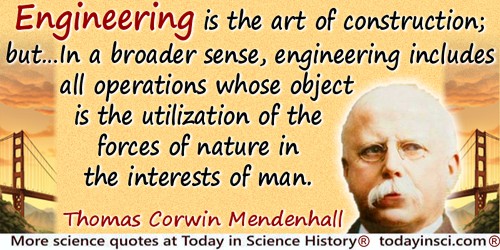
Engineering is the art of construction; but to limit it to this would be to restrict its meaning much within the range of the ordinary use of the word. In a broader sense, engineering includes all operations whose object is the utilization of the forces of nature in the interests of man.
From Address to the International Engineering Congress of the Columbia Exposition, Chicago, 1893. Published in Transactions of the American Society of Civil Engineers (Oct 1893), 120. Reprinted in 'Fundamental Units of Measure', Smithsonian Report for 1893 (1894), 135.
For in disease the most voluntary or most special movements, faculties, etc., suffer first and most, that is in an order the exact opposite of evolution. Therefore I call this the principle of Dissolution.
'On the Anatomical and Physiological Localisation of Movements in the Brain' (1875), Preface. In James Taylor (ed.), Selected Writings of John Hughlings Jackson, Vol. 1 (1931), 38.
For this knowledge of right living, we have sought a new name... . As theology is the science of religious life, and biology the science of [physical] life ... so let Oekology be henceforth the science of [our] normal lives ... the worthiest of all the applied sciences which teaches the principles on which to found... healthy... and happy life.
Quoted in Robert Clarke (ed.), Ellen Swallow: The Woman Who Founded Ecology (1973), 120.
Fractal is a word invented by Mandelbrot to bring together under one heading a large class of objects that have [played] … an historical role … in the development of pure mathematics. A great revolution of ideas separates the classical mathematics of the 19th century from the modern mathematics of the 20th. Classical mathematics had its roots in the regular geometric structures of Euclid and the continuously evolving dynamics of Newton. Modern mathematics began with Cantor’s set theory and Peano’s space-filling curve. Historically, the revolution was forced by the discovery of mathematical structures that did not fit the patterns of Euclid and Newton. These new structures were regarded … as “pathological,” .… as a “gallery of monsters,” akin to the cubist paintings and atonal music that were upsetting established standards of taste in the arts at about the same time. The mathematicians who created the monsters regarded them as important in showing that the world of pure mathematics contains a richness of possibilities going far beyond the simple structures that they saw in Nature. Twentieth-century mathematics flowered in the belief that it had transcended completely the limitations imposed by its natural origins.
Now, as Mandelbrot points out, … Nature has played a joke on the mathematicians. The 19th-century mathematicians may not have been lacking in imagination, but Nature was not. The same pathological structures that the mathematicians invented to break loose from 19th-century naturalism turn out to be inherent in familiar objects all around us.
Now, as Mandelbrot points out, … Nature has played a joke on the mathematicians. The 19th-century mathematicians may not have been lacking in imagination, but Nature was not. The same pathological structures that the mathematicians invented to break loose from 19th-century naturalism turn out to be inherent in familiar objects all around us.
From 'Characterizing Irregularity', Science (12 May 1978), 200, No. 4342, 677-678. Quoted in Benoit Mandelbrot, The Fractal Geometry of Nature (1977, 1983), 3-4.
Gaia is a thin spherical shell of matter that surrounds the incandescent interior; it begins where the crustal rocks meet the magma of the Earth’s hot interior, about 100 miles below the surface, and proceeds another 100 miles outwards through the ocean and air to the even hotter thermosphere at the edge of space. It includes the biosphere and is a dynamic physiological system that has kept our planet fit for life for over three billion years. I call Gaia a physiological system because it appears to have the unconscious goal of regulating the climate and the chemistry at a comfortable state for life. Its goals are not set points but adjustable for whatever is the current environment and adaptable to whatever forms of life it carries.
In The Revenge of Gaia: Earth’s Climate Crisis & The Fate of Humanity (2006, 2007), 19.
Homologue. The same organ in different animals under every variety of form and function.
'Glossary', Lectures on the Comparative Anatomy and Physiology of the Invertebrate Animals Delivered at the Royal College of Surgeons in 1843 (1843), 379.
I called it ignose, not knowing which carbohydrate it was. This name was turned down by my editor. 'God-nose' was not more successful, so in the end 'hexuronic acid' was agreed upon. To-day the substance is called 'ascorbic acid' and I will use this name.
Studies on Biological Oxidation and Some of its Catalysts (C4 Dicarboxylic Acids, Vitamin C and P Etc.) (1937), 73.
I conceived and developed a new geometry of nature and implemented its use in a number of diverse fields. It describes many of the irregular and fragmented patterns around us, and leads to full-fledged theories, by identifying a family of shapes I call fractals.
The Fractal Geometry of Nature (1977, 1983), Introduction, xiii.
I had been struck by the beautiful colour of the sea when seen through the chinks of a straw hat.— To day 26th. Lat 18°6' S: Long 36°6' W. it was according to Werner nomenclature ‘Indigo with a little Azure blue’. The sky at the time was ‘Berlin with little Ultra marine’ & there were some cirro cumili scattered about.
In Zoological Notebook, Mar 26. As quoted in epigraph for the Second Edition of Patrick Syme, Werner’s Nomenclature of Colours: Adapted to Zoology, Botany, Chemistry, Mineralogy, Anatomy, and the Arts (1821)
I have been driven to assume for some time, especially in relation to the gases, a sort of conducting power for magnetism. Mere space is Zero. One substance being made to occupy a given portion of space will cause more lines of force to pass through that space than before, and another substance will cause less to pass. The former I now call Paramagnetic & the latter are the diamagnetic. The former need not of necessity assume a polarity of particles such as iron has with magnetic, and the latter do not assume any such polarity either direct or reverse. I do not say more to you just now because my own thoughts are only in the act of formation, but this I may say: that the atmosphere has an extraordinary magnetic constitution, & I hope & expect to find in it the cause of the annual & diurnal variations, but keep this to yourself until I have time to see what harvest will spring from my growing ideas.
Letter to William Whewell, 22 Aug 1850. In L. Pearce Williams (ed.), The Selected Correspondence of Michael Faraday (1971), Vol. 2, 589.
I have considered the two terms you want to substitute for eisode and exode, and upon the whole I am disposed to recommend instead of them anode and cathode. These words may signify eastern and western way, just as well as the longer compounds which you mention … I may mention too that anodos and cathodos are good, genuine Greek words, and not compounds coined for the purpose.
Letter to Michael Faraday (25 Apr 1834). Quoted in I. Todhunter (ed.), William Whewell: An Account of His Writings with Selections From His Literary and Scientific Correspondence (1876), Vol. 2, 179.
I have spent some months in England, have seen an awful lot and learned little. England is not a land of science, there is only a widely practised dilettantism, the chemists are ashamed to call themselves chemists because the pharmacists, who are despised, have assumed this name.
Liebig to Berzelius, 26 Nov 1837. Quoted in J. Carriere (ed.), Berzelius und Liebig.; ihre Briefe (1898), 134. Trans. W. H. Brock.
I have taken your advice, and the names used are anode cathode anions cations and ions; the last I shall have but little occasion for. I had some hot objections made to them here and found myself very much in the condition of the man with his son and ass who tried to please every body; but when I held up the shield of your authority, it was wonderful to observe how the tone of objection melted away.
Letter to William Whewell, 15 May 1834. In Frank A. J. L. James (ed.), The Correspondence of Michael Faraday (1993), Vol. 2, 186.
I like the word “nanotechnology.” I like it because the prefix “nano” guarantees it will be fundamental science for decades; the “technology” says it is engineering, something you’re involved in not just because you’re interested in how nature works but because it will produce something that has a broad impact.
From interview in 'Wires of Wonder', Technology Review (Mar 2001), 104, No. 2, 88.
I must admit that when I chose the name, “vitamine,” I was well aware that these substances might later prove not to be of an amine nature. However, it was necessary for me to choose a name that would sound well and serve as a catchword, since I had already at that time no doubt about the importance and the future popularity of the new field.
The Vitamines translated by Harry Ennis Dubin (1922), 26, footnote.
I must beg leave to propose a separate technical name ‘chromosome’ for those things which have been called by Boveri ‘chromatic elements’, in which there occurs one of the most important acts in karyokinesis, viz. the longitudinal splitting.
[Coining the word ‘chromosome,’ or ‘chromosom’ in the original German.]
[Coining the word ‘chromosome,’ or ‘chromosom’ in the original German.]
Original German text by Waldeyer in Archiv für Mikroskopische Anatomie (1888), 27, translated by W.B. Benham in Quarterly Journal of Microscopical Science (1889), 30, 181.
I propose to substitute the word 'autonomic'. The word implies a certain degree of independent action, but exercised under control of a higher power. The 'autonomic' nervous system means the nervous system of the glands and of the involuntary muscle; it governs the 'organic' functions of the body.
'On the Union of Cranial Autonomic (Visceral) Fibres w;th the Nerve Cells of the Superior Cervical Ganglion', The Journal of Physiology, 1898-99, 23, 241.
I realize that Galen called an earth which contained metallic particles a mixed earth when actually it is a composite earth. But it behooves one who teaches others to give exact names to everything.
As translated by Mark Chance Bandy and Jean A. Bandy from the first Latin Edition of 1546 in De Natura Fossilium: (Textbook of Mineralogy) (2004), 19. Originally published by Geological Society of America as a Special Paper (1955). There are other translations with different wording.
I require a term to express those bodies which can pass to the electrodes, or, as they are usually called, the poles. Substances are frequently spoken of as being electro-negative, or electro-positive, according as they go under the supposed influence of a direct attraction to the positive or negative pole. But these terms are much too significant for the use to which I should have to put them; for though the meanings are perhaps right, they are only hypothetical, and may be wrong; and then, through a very imperceptible, but still very dangerous, because continual, influence, they do great injury to science, by contracting and limiting the habitual view of those engaged in pursuing it. I propose to distinguish these bodies by calling those anions which go to the anode of the decomposing body; and those passing to the cathode, cations; and when I have occasion to speak of these together, I shall call them ions.
Philosophical Transactions of the Royal Society of London, 1834, 124, 79.
I think the name atomic theory was an unfortunate one. We talk fluently about atoms as the smallest particles that exist, and chemists regard them as indivisible … To my mind the infinitely small is as incomprehensible as the infinitely great. … we cannot comprehend it, we cannot take it in. And so with the atom. Therefore I think that it would have been better to have taken a different word—say minim—which would have been a safer term than atom.
Address, in 'Report to the Chemical Society's Jubilee', Nature (26 Mar 1891), 43, 493.
I want to note that, because there is the aforementioned difference between mountain and mountain, it will be appropriate, to avoid confusion, to distinguish one [type] from another by different terms; so I shall call the first Primary and the second Secondary.
From De’ Crostacei e degli altri Marini Corpi che si truovano su’ monti (1740), 263, as translated by Ezio Vaccari, from the original Italian, “Qui sol piacemi notare, che, giacchè tra monti e monti v’è l'accennata differenza, farà bene, per ischifar la confusione , distinguere gli uni dagli altri con differenti vocaboli; e perciò i primi Primarie, i secondi Secondarie monti per me si appelleranno.”
I wanted some new names to express my facts in Electrical science without involving more theory than I could help & applied to a friend Dr Nicholl [his doctor], who has given me some that I intend to adopt for instance, a body decomposable by the passage of the Electric current, I call an ‘electrolyte’ and instead of saying that water is electro chemically decomposed I say it is ‘electrolyzed’. The intensity above which a body is decomposed beneath which it conducts without decomposition I call the ‘Electrolyte intensity’ &c &c. What have been called: the poles of the battery I call the electrodes they are not merely surfaces of metal, but even of water & air, to which the term poles could hardly apply without receiving a new sense. Electrolytes must consist of two parts which during the electrolization, are determined the one in the one direction, and the other towards the poles where they are evolved; these evolved substances I call zetodes, which are therefore the direct constituents of electrolites.
Letter to William Whewell (24 Apr 1834). In Frank A. J. L. James (ed.), The Correspondence of Michael Faraday: Volume 2, 1832-1840 (1993), 176.
I will sette as I doe often in woorke use, a paire of paralleles, or gemowe times of one lengthe, thus: =, bicause noe 2 thynges, can be moare equalle.
Explaining the sign he initiated to mean equality.
Explaining the sign he initiated to mean equality.
The Whetstone of Witte (1557). The word gemowe (related to the name Gemini) means twins.)
I wish they would use English instead of Greek words. When I want to know why a leaf is green, they tell me it is coloured by “chlorophyll,” which at first sounds very instructive; but if they would only say plainly that a leaf is coloured green by a thing which is called “green leaf,” we should see more precisely how far we had got.
The word “chlorophyll” is formed from the Greek words for “green” “leaf.” In The Queen of the Air: a Study of the Greek Myths of Cloud and Storm (1869, 1889), 51.
I would never use a long word, even, where a short one would answer the purpose. I know there are professors in this country who “ligate” arteries. Other surgeons only tie them, and it stops the bleeding just as well.
'Scholastic and Bedside Teaching: An Introductory Lecture to the Medical Class of Harvard University, November 6, 1867'. Collected in Medical Essays 1842-1882 (1891), 302.
Iamblichus in his treatise On the Arithmetic of Nicomachus observes p. 47- “that certain numbers were called amicable by those who assimilated the virtues and elegant habits to numbers.” He adds, “that 284 and 220 are numbers of this kind; for the parts of each are generative of each other according to the nature of friendship, as was shown by Pythagoras. For some one asking him what a friend was, he answered, another I (ετεϑος εγω) which is demonstrated to take place in these numbers.” [“Friendly” thus: Each number is equal to the sum of the factors of the other.]
In Theoretic Arithmetic (1816), 122. (Factors of 284 are 1, 2, 4 ,71 and 142, which give the sum 220. Reciprocally, factors of 220 are 1, 2, 4, 5, 10, 11 ,22, 44, 55 and 110, which give the sum 284.) Note: the expression “alter ego” is Latin for “the other I.”
If a Schirrus by long standing, increasing, and motion of the adjacent Parts is thus moved, that the neighbouring Vessels around its edges begin to inflame, it’s become malignant, and from its likeness to a Crab, is now called a Cancer, or Carcinoma.
Aphorism No. 492 in Boerhaave’s Aphorisms: Concerning The Knowledge and Cure of Diseases (1715), 113.
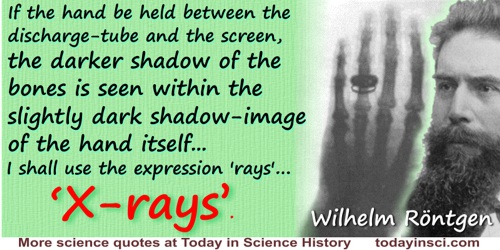
If the hand be held between the discharge-tube and the screen, the darker shadow of the bones is seen within the slightly dark shadow-image of the hand itself… For brevity’s sake I shall use the expression “rays”; and to distinguish them from others of this name I shall call them “X-rays”.
From 'On a New Kind of Rays' (1895). In Herbert S. Klickstein, Wilhelm Conrad Rontgen: On a New Kind of Rays, A Bibliographic Study (1966), 4.
If we assume that there is only one enzyme present to act as an oxidizing agent, we must assume for it as many different degrees of activity as are required to explain the occurrence of the various colors known to mendelize (three in mice, yellow, brown, and black). If we assume that a different enzyme or group of enzymes is responsible for the production of each pigment we must suppose that in mice at least three such enzymes or groups of enzymes exist. To determine which of these conditions occurs in mice is not a problem for the biologist, but for the chemist. The biologist must confine his attention to determining the number of distinct agencies at work in pigment formation irrespective of their chemical nature. These agencies, because of their physiological behavior, the biologist chooses to call 'factors,' and attempts to learn what he can about their functions in the evolution of color varieties.
Experimental Studies of the Inheritance of Color in Mice (1913), 17-18.
Imagine a school-boy who has outgrown his clothes. Imagine the repairs made on the vestments where the enlarged frame had burst the narrow limits of the enclosure. Imagine the additions made where the projecting limbs had fairly and far emerged beyond the confines of the garment. Imagine the boy still growing, and the clothes, mended allover, now more than ever in want of mending—such is chemistry, and such is nomenclature.
Chemical Recreations (1834), 206, footnote.
In 1786, I found that in Germany they were engaged in a species of political inquiry, to which they had given the name of Statistics;… an inquiry for the purpose of ascertaining the political strength of a country, or questions respecting matters of state;… as I thought that a new word, might attract public attention, I resolved on adopting it, and I hope that it is now completely naturalised and incorporated with our language.
In Statistical Account of Scotland: Drawn Up from the Communications of the Ministers of the Different Parishes, Volume 20 (1798), xiii-xiv.
In 1963, when I assigned the name “quark” to the fundamental constituents of the nucleon, I had the sound first, without the spelling, which could have been “kwork.” Then, in one of my occasional perusals of Finnegans Wake, by James Joyce, I came across the word “quark” in the phrase “Three quarks for Muster Mark.” Since “quark” (meaning, for one thing, the cry of a gull) was clearly intended to rhyme with “Mark,” as well as “bark” and other such words, I had to find an excuse to pronounce it as “kwork.” But the book represents the dreams of a publican named Humphrey Chimpden Earwicker. Words in the text are typically drawn from several sources at once, like the “portmanteau words” in Through the Looking Glass. From time to time, phrases occur in the book that are partially determined by calls for drinks at the bar. I argued, therefore, that perhaps one of the multiple sources of the cry “Three quarks for Muster Mark” might be pronunciation for “Three quarts for Mister Mark,” in which case the pronunciation “kwork” would not be totally unjustified. In any case, the number three fitted perfectly the way quarks occur in nature.
The Quark and the Jaguar (1994), 180.
In reality the origin of the notion of derivatives is in the vague feeling of the mobility of things, and of the greater or less speed with which phenomena take place; this is well expressed by the terms fluent and fluxion, which were used by Newton and which we may believe were borrowed from the
ancient mathematician Heraclitus.
From address to the section of Algebra and Analysis, International Congress of Arts and Sciences, St. Louis (22 Sep 1904), 'On the Development of Mathematical Analysis and its Relation to Certain Other Sciences,' as translated by M.W. Haskell in Bulletin of the American Mathematical Society (May 1905), 11, 407.
In the expressions we adopt to prescribe physical phenomena we necessarily hover between two extremes. We either have to choose a word which implies more than we can prove, or we have to use vague and general terms which hide the essential point, instead of bringing it out. The history of electrical theories furnishes a good example.
Opening Address to the Annual Meeting of the British Association by Prof. Arthur Schuster, in Nature (4 Aug 1892), 46, 325.
In the fall of 1967, [I was invited] to a conference … on pulsars. … In my talk, I argued that we should consider the possibility that the center of a pulsar is a gravitationally completely collapsed object. I remarked that one couldn't keep saying “gravitationally completely collapsed object” over and over. One needed a shorter descriptive phrase. “How about black hole?” asked someone in the audience. I had been searching for the right term for months, mulling it over in bed, in the bathtub, in my car, whenever I had quiet moments. Suddenly this name seemed exactly right. When I gave a more formal Sigma Xi-Phi Beta Kappa lecture … on December 29, 1967, I used the term, and then included it in the written version of the lecture published in the spring of 1968. (As it turned out, a pulsar is powered by “merely” a neutron star, not a black hole.)
[Although John Wheeler is often identified as coining the term “black hole,” he in fact merely popularized the expression. In his own words, this is his explanation of the true origin: a suggestion from an unidentified person in a conference audience.]
[Although John Wheeler is often identified as coining the term “black hole,” he in fact merely popularized the expression. In his own words, this is his explanation of the true origin: a suggestion from an unidentified person in a conference audience.]
In Geons, Black Holes, and Quantum Foam (2000), 296-297.
In the real changes which animals undergo during their embryonic growth, in those external transformations as well as in those structural modifications within the body, we have a natural scale to measure the degree or the gradation of those full grown animals which corresponds in their external form and in their structure, to those various degrees in the metamorphoses of animals, as illustrated by embryonic changes, a real foundation for zoological classification.
From Lecture 4, collected in Twelve Lectures on Comparative Embryology: Delivered Before the Lowell Institute in Boston: December and January 1848-9 (1849), 29.
Isn’t it weird how scientists can imagine all the matter of the universe exploding out of a dot smaller than the head of a pin, but they can’t come up with a more evocative name for it than “The Big Bang”? … [I’d call it] “The Horrendous Space KABLOOUIE!”
Dialog by Calvin (fictional character) in syndicated newspaper comic strip Calvin and Hobbes (21 Jun 1992).
It is clear that there is some difference between ends: some ends are energeia [energy], while others are products which are additional to the energeia.
[The first description of the concept of energy.]
[The first description of the concept of energy.]
In Cutler J. Cleveland and Christopher G. Morris, Dictionary of Energy (2009), 572, with this added: Energeia has traditionally been translated as “activity” or “actuality” some modern texts render it more literally as “in work&rqduo; or “being at work”.
It is necessary to avoid the affected conciseness and quaint terms so much in fashion, and only to use the proper language and established terms. Linnæus, otherwise the great ornament of natural historians, is very blameable in this respect…I am the more desirous of fixing technical names, as the unjustifiable and very indecent terms used by Linnaeus in his Bivalves may meet their deserved fate, by being exploded with indignation; for
Immodest words admit of defense,
And want of decency is want of sense.
These my terms being adopted, will render descriptions proper, intelligible, and decent; by which the science may become useful, easy, and adapted to all capacities, and to both sexes.
Immodest words admit of defense,
And want of decency is want of sense.
These my terms being adopted, will render descriptions proper, intelligible, and decent; by which the science may become useful, easy, and adapted to all capacities, and to both sexes.
From Preface to Elements of Conchology or, An introduction to the Knowledge of Shells (1776), 108-109. [Note: the quotation comes from the fourth Earl of Roscommon. Benjamin Franklin also used this quote, but he was only repeating it, not originating it.]
It is told of Faraday that he refused to be called a physicist; he very much disliked the new name as being too special and particular and insisted on the old one, philosopher, in all its spacious generality: we may suppose that this was his way of saying that he had not over-ridden the limiting conditions of class only to submit to the limitation of a profession.
Commentary (Jun 1962), 33, 461-77. Cited by Sydney Ross in Nineteenth-Century Attitudes: Men of Science (1991), 11.
It is very desirable to have a word to express the Availability for work of the heat in a given magazine; a term for that possession, the waste of which is called Dissipation. Unfortunately the excellent word Entropy, which Clausius has introduced in this connexion, is applied by him to the negative of the idea we most naturally wish to express. It would only confuse the student if we were to endeavour to invent another term for our purpose. But the necessity for some such term will be obvious from the beautiful examples which follow. And we take the liberty of using the term Entropy in this altered sense ... The entropy of the universe tends continually to zero.
Sketch of Thermodynamics (1868), 100-2.
It makes me feel both proud and rather humble that it shall be called Lonsdaleite. Certainly the name seems appropriate since the mineral only occurs in very small quantities (perhaps rare would be too flattering) and it is generally rather mixed up!
From Letter to Clifford Frondel, who had named a meteoritic form of diamond after Lonsdale (a petite person). As quoted in Maureen M. Julian, 'Women in Crystallography', in G. Kass-Simon and P. Farnes (eds.), Women of Science: Righting the Record (1990), 356.
It really is worth the trouble to invent a new symbol if we can thus remove not a few logical difficulties and ensure the rigour of the proofs. But many mathematicians seem to have so little feeling for logical purity and accuracy that they will use a word to mean three or four different things, sooner than make the frightful decision to invent a new word.
Grundgesetz der Arithmetik(1893), Vol. 2, Section 60, In P. Greach and M. Black (eds., Translations from the Philosophical Writings of Gottlob Frege (1952), 144.
It was a reaction from the old idea of “protoplasm”, a name which was a mere repository of ignorance.
Perspectives in Biochemistry (1938). As cited in Max Perutz, I Wish I’d Made You Angry Earlier: Essays on Science, Scientists, and Humanity (1998).
Laplace considers astronomy a science of observation, because we can only observe the movements of the planets; we cannot reach them, indeed, to alter their course and to experiment with them. “On earth,” said Laplace, “we make phenomena vary by experiments; in the sky, we carefully define all the phenomena presented to us by celestial motion.” Certain physicians call medicine a science of observations, because they wrongly think that experimentation is inapplicable to it.
From An Introduction to the Study of Experimental Medicine (1865), as translated by Henry Copley Greene (1957), 18. A footnote cites Laplace, Système du monde, Chap. 2.
Let us make an arbitrary decision (by a show of hands if necessary) to define the base of every stratigraphical unit in a selected section. This may be called the Principle of the Golden Spike. Then stratigraphical nomenclature can be forgotten and we can get on with the real work of stratigraphy, which is correlation and interpretation.
In The Nature of the Stratigraphical Record (1973), 73.
Magnetic lines of force convey a far better and purer idea than the phrase magnetic current or magnetic flood: it avoids the assumption of a current or of two currents and also of fluids or a fluid, yet conveys a full and useful pictorial idea to the mind.
Diary Entry for 10 Sep 1854. In Thomas Martin (ed.), Faraday's Diary: Being the Various Philosophical Notes of Experimental Investigation (1935), Vol. 6, 315.
Many errors, of a truth, consist merely in the application of the wrong names of things. For if a man says that the lines which are drawn from the centre of the circle to the circumference are not equal, he understands by the circle, at all events for the time, something else than mathematicians understand by it.
In 'Prop. 47: The human mind possesses an adequate knowledge of the eternal and infinite essence of God', Ethic, translated by William Hale White (1883), 93-94. Collected in The English and Foreign Philosophical Library, Vol. 21.
Many important spatial patterns of Nature are either irregular or fragmented to such an extreme degree that … classical geometry … is hardly of any help in describing their form. … I hope to show that it is possible in many cases to remedy this absence of geometric representation by using a family of shapes I propose to call fractals—or fractal sets.
In Fractals: Form, Chance, and Dimension (1977), xix.
Many will, no doubt, prefer to retain old unsystematic names as far as possible, but it is easy to see that the desire to avoid change may carry us too far in this direction; it will undoubtedly be very inconvenient to the present generation of chemists to abandon familiar and cherished names, but nevertheless it may be a wise course to boldly face the difficulty, rather than inflict on coming generations a partially illogical and unsystematic nomenclature.
'International Conference on Chemical Nomenclature', Nature (19 May 1892), 46, 57.
Medicine is essentially a learned profession. Its literature is ancient, and connects it with the most learned periods of antiquity; and its terminology continues to be Greek or Latin. You cannot name a part of the body, and scarcely a disease, without the use of a classical term. Every structure bears upon it the impress of learning, and is a silent appeal to the student to cultivate an acquaintance with the sources from which the nomenclature of his profession is derived.
From Address (Oct 1874) delivered at Guy’s Hospital, 'On The Study of Medicine', printed in British Medical journal (1874), 2, 425. Collected in Sir William Withey Gull and Theodore Dyke Acland (ed.), A Collection of the Published Writings of William Withey Gull (1896), 11.
Modern philosophers, to avoid circumlocutions, call that instrument, wherein a cylinder of quicksilver, of between 28 to 32 inches in altitude, is kept suspended after the manner of the Torricellian experiment, a barometer or baroscope.
Opening sentence of 'A Relation of Some Mercurial Observations, and Their Results', Philosophical Transactions of the Royal Society (12 Feb 1665/6), 1, No. 9, 153. Since no author is identified, it is here assumed that the article was written by the journal (founding) editor, Oldenburg.
My amateur interest in astronomy brought out the term “magnitude,” which is used for the brightness of a star.
From interview with Henry Spall, as in an abridged version of Earthquake Information Bulletin (Jan-Feb 1980), 12, No. 1, that is on the USGS website.
Natural history is not equivalent to biology. Biology is the study of life. Natural history is the study of animals and plants—of organisms. Biology thus includes natural history, and much else besides.
In The Nature of Natural History (1961, 2014), 7.
Nernst was a great admirer of Shakespeare, and it is said that in a conference concerned with naming units after appropriate persons, he proposed that the unit of rate of liquid flow should be called the falstaff.
'The Nemst Memorial Lecture', Journal of the Chemical Society (1953), Part 3, 2855.
No hypothesis concerning the nature of this 'something' shall be advanced thereby or based thereon. Therefore it appears as most simple to use the last syllable 'gen' taken from Darwin's well-known word pangene since it alone is of interest to use, in order thereby to replace the poor, more ambiguous word, 'Anlage'. Thus, we will say for 'das pangene' and 'die pangene' simply 'Das Gen' and 'Die Gene,' The word Gen is fully free from every hypothesis; it expresses only the safely proved fact that in any case many properties of organisms are conditioned by separable and hence independent 'Zustiinde,' 'Grundlagen,' 'Anlagen'—in short what we will call 'just genes'—which occur specifically in the gametes.
Elemente der Exakten Erblichkeitslehre (1909), 124. Trans. G. E. Allen and quoted in G. E. Allen, Thomas Hunt Morgan: The Man and His Science (1978), 209-10 (Footnote 79).
No man can be truly called an entomologist, sir; the subject is too vast for any single human
intelligence to grasp.
In 'The Poet at the Breakfast Table: II', The Atlantic Monthly (Feb 1872), 29, 231.
Nomenclature, the other foundation of botany, should provide the names as soon as the classification is made... If the names are unknown knowledge of the things also perishes... For a single genus, a single name.
Philosophia Botanica (1751), aphorism 210. Trans. Frans A. Stafleu, Linnaeus and the Linnaeans: The Spreading of their Ideas in Systematic Botany, 1735-1789 (1971), 80.
One [idea] was that the Universe started its life a finite time ago in a single huge explosion, and that the present expansion is a relic of the violence of this explosion. This big bang idea seemed to me to be unsatisfactory even before detailed examination showed that it leads to serious difficulties.
In radio talk on the BBC Third Programme, as subsequently printed in the BBC’s The Listener magazine (9 Mar 1950), Vol.43, 420. This was his further use of the term “big bang” that he first expressed in a radio talk on 28 Mar 1949.
One dictionary that I consulted remarks that “natural history” now commonly means the study of animals and plants “in a popular and superficial way,” meaning popular and superficial to be equally damning adjectives. This is related to the current tendency in the biological sciences to label every subdivision of science with a name derived from the Greek. “Ecology” is erudite and profound; while “natural history” is popular and superficial. Though, as far as I can see, both labels apply to just about the same package of goods.
In The Nature of Natural History (1961, 2014), 7.
One of the principal obstacles to the rapid diffusion of a new idea lies in the difficulty of finding suitable expression to convey its essential point to other minds. Words may have to be strained into a new sense, and scientific controversies constantly resolve themselves into differences about the meaning of words. On the other hand, a happy nomenclature has sometimes been more powerful than rigorous logic in allowing a new train of thought to be quickly and generally accepted.
Opening Address to the Annual Meeting of the British Association by Prof. Arthur Schuster, in Nature (4 Aug 1892), 46, 325.
Phylogeny and ontogeny are, therefore, the two coordinated branches of morphology. Phylogeny is the developmental history [Entwickelungsgeschichte] of the abstract, genealogical individual; ontogeny, on the other hand, is the developmental history of the concrete, morphological individual.
Allgemeine Entwickelungsgeschichte der Organismen (1866), Vol. 1, 60. Trans. Stephen Jay Gould, Ontogeny and Phylogeny (1977), 80.
Plasticity, then, in the wide sense of the word, means the possession of a structure weak enough to yield to an influence, but strong enough not to yield all at once. Each relatively stable phase of equilibrium in such a structure is marked by what we may call a new set of habits. Organic matter, especially nervous tissue, seems endowed with a very extraordinary degree of plasticity of this sort ; so that we may without hesitation lay down as our first proposition the following, that the phenomena of habit in living beings are due to plasticity of the organic materials of which their bodies are composed.
'The Laws of Habit', The Popular Science Monthly (Feb 1887), 434.
Professor Cayley has since informed me that the theorem about whose origin I was in doubt, will be found in Schläfli’s De Eliminatione. This is not the first unconscious plagiarism I have been guilty of towards this eminent man whose friendship I am proud to claim. A more glaring case occurs in a note by me in the Comptes Rendus, on the twenty-seven straight lines of cubic surfaces, where I believe I have followed (like one walking in his sleep), down to the very nomenclature and notation, the substance of a portion of a paper inserted by Schlafli in the Mathematical Journal, which bears my name as one of the editors upon the face.
In Philosophical Transactions of the Royal Society (1864), 642.
Psychologists must cease to be content with the sterile and narrow conception of their science as the science of consciousness, and must boldly assert its claim to be the positive science of mind in all its aspects and modes of functining, or, as I would prefer to say, the positive science of conduct or behavior.
An Introduction to Social Psychology (1928), 13.
Reagents are regarded as acting by virtue of a constitutional affinity either for electrons or for nuclei... the terms electrophilic (electron-seeking) and nucleophilic (nucleus-seeking) are suggested... and the organic molecule, in the activation necessary for reaction, is therefore required to develop at the seat of attack either a high or low electron density as the case may be.
'Significance of Tautomerism and of the Reactions of Aromatic Compounds in the Electronic Theory of Organic Relations', Journal of the Chemical Society (1933), 136, 1121, fn.
Sarcophagus is a stone that devours dead bodies, for in Greek σάρκος means “flesh” and φαγώ “eating”. Some of the ancients first made coffins for the dead of this stone because in the space of thirty days it consumed the dead… . For this reason stone monuments are called sarcophagi.
From De Mineralibus (c.1261-1263), as translated by Dorothy Wyckoff, Book of Minerals (1967), 116.
Scientists and Drapers. Why should the botanist, geologist or other-ist give himself such airs over the draper’s assistant? Is it because he names his plants or specimens with Latin names and divides them into genera and species, whereas the draper does not formulate his classifications, or at any rate only uses his mother tongue when he does? Yet how like the sub-divisions of textile life are to those of the animal and vegetable kingdoms! A few great families—cotton, linen, hempen, woollen, silk, mohair, alpaca—into what an infinite variety of genera and species do not these great families subdivide themselves? And does it take less labour, with less intelligence, to master all these and to acquire familiarity with their various habits, habitats and prices than it does to master the details of any other great branch of science? I do not know. But when I think of Shoolbred’s on the one hand and, say, the ornithological collections of the British Museum upon the other, I feel as though it would take me less trouble to master the second than the first.
Samuel Butler, Henry Festing Jones (ed.), The Note-Books of Samuel Butler (1917), 218.
Scientists often invent words to fill the holes in their understanding.These words are meant as conveniences until real understanding can be found. … Words such as dimension and field and infinity … are not descriptions of reality, yet we accept them as such because everyone is sure someone else knows what the words mean.
In God’s Debris: A Thought Experiment (2004), 20-21.
Since it is necessary for specific ideas to have definite and consequently as far as possible selected terms, I have proposed to call substances of similar composition and dissimilar properties isomeric, from the Greek ίσομερης (composed of equal parts).
Jahrebericht (1832). As translated in Henry M. Leicester and Herbert S. Klickstein, A Source Book in Chemistry 1400-1900 (1952), 265.
So far, the clumsily long name 'quasi-stellar radio sources' is used to describe these objects. Because the nature of these objects is entirely unknown, it is hard to prepare a short, appropriate nomenclature for them so that their essential properties are obvious from their name. For convenience, the abbreviated form 'quasar' will be used throughout this paper.
'Gravitational Collapse', Physics Today, 1964, 17, 21.
Sometimes I wonder whether there is any such thing as biology. The word was invented rather late—in 1809—and other words like botany, zoology, physiology, anatomy, have much longer histories and in general cover more coherent and unified subject matters. … I would like to see the words removed from dictionaries and college catalogues. I think they do more harm than good because they separate things that should not be separated…
In The Forest and the Sea (1960), 6-7.
Surely something is wanting in our conception of the universe. We know positive and negative electricity, north and south magnetism, and why not some extra terrestrial matter related to terrestrial matter, as the source is to the sink. … Worlds may have formed of this stuff, with element and compounds possessing identical properties with our own, indistinguishable from them until they are brought into each other’s vicinity. … Astronomy, the oldest and most juvenile of the sciences, may still have some surprises in store. May anti-matter be commended to its care! … Do dreams ever come true?
[Purely whimsical prediction long before the 1932 discovery of the positron, the antiparticle of the electron.]
[Purely whimsical prediction long before the 1932 discovery of the positron, the antiparticle of the electron.]
'Potential Matter—A Holiday Dream', Letter to the Editor, Nature (18 Aug 1898), 58, No. 1503, 367. Quoted in Edward Robert Harrison, Cosmology: the Science of the Universe (2000), 433.
That alone is worthy to be called Natural History, which investigates and records the condition of living things, of things in a state of nature; if animals, of living animals:— which tells of their 'sayings and doings,' their varied notes and utterances, songs and cries; their actions, in ease and under the pressure of circumstances; their affections and passions, towards their young, towards each other, towards other animals, towards man: their various arts and devices, to protect their progeny, to procure food, to escape from their enemies, to defend themselves from attacks; their ingenious resources for concealment; their stratagems to overcome their victims; their modes of bringing forth, of feeding, and of training, their offspring; the relations of their structure to their wants and habits; the countries in which they dwell; their connexion with the intimate world around them, mountain or plain, forest or field, barren heath or bushy dell, open savanna or wild hidden glen, river, lake, or sea:— this would be indeed zoology, i.e. the science of living creatures.
A Naturalist's Sojourn in Jamaica (1851), vi-vii.
That small word “Force,” they make a barber's block,
Ready to put on
Meanings most strange and various, fit to shock
Pupils of Newton....
The phrases of last century in this
Linger to play tricks—
Vis viva and Vis Mortua and Vis Acceleratrix:—
Those long-nebbed words that to our text books still
Cling by their titles,
And from them creep, as entozoa will,
Into our vitals.
But see! Tait writes in lucid symbols clear
One small equation;
And Force becomes of Energy a mere
Space-variation.
Ready to put on
Meanings most strange and various, fit to shock
Pupils of Newton....
The phrases of last century in this
Linger to play tricks—
Vis viva and Vis Mortua and Vis Acceleratrix:—
Those long-nebbed words that to our text books still
Cling by their titles,
And from them creep, as entozoa will,
Into our vitals.
But see! Tait writes in lucid symbols clear
One small equation;
And Force becomes of Energy a mere
Space-variation.
'Report on Tait's Lecture on Force:— B.A., 1876', reproduced in Bruce Clarke, Energy Forms: Allegory and Science in the Era of Classical Thermodynamics (2001), 19. Maxwell's verse was inspired by a paper delivered at the British Association (B.A.. He was satirizing a “considerable cofusion of nomenclature” at the time, and supported his friend Tait's desire to establish a redefinition of energy on a thermnodynamic basis.
The attempt of Lavoisier to reform chemical nomenclature is premature. One single experiment may destroy the whole filiation of his terms; and his string of sulphates, sulphites, and sulphures, may have served no end than to have retarded the progress of science by a jargon, from the confusion of which time will be requisite to extricate us.
Letter to Rev. James Madison (Paris, 1788). In Thomas Jefferson and John P. Foley (ed.), The Jeffersonian Cyclopedia (1900), 135. From H.A. Washington, The Writings of Thomas Jefferson (1853-54). Vol 2, 432.
The combination of such characters, some, as the sacral ones, altogether peculiar among Reptiles, others borrowed, as it were, from groups now distinct from each other, and all manifested by creatures far surpassing in size the largest of existing reptiles, will, it is presumed, be deemed sufficient ground for establishing a distinct tribe or sub-order of Saurian Reptiles, for which I would propose the name of Dinosauria.
'Report on British Fossil Reptiles', Report of the Eleventh Meeting of the British Association for the Advancement of Science (1842), 103.
The energy of a covalent bond is largely the energy of resonance of two electrons between two atoms. The examination of the form of the resonance integral shows that the resonance energy increases in magnitude with increase in the overlapping of the two atomic orbitals involved in the formation of the bond, the word ‘overlapping” signifying the extent to which regions in space in which the two orbital wave functions have large values coincide... Consequently it is expected that of two orbitals in an atom the one which can overlap more with an orbital of another atom will form the stronger bond with that atom, and, moreover, the bond formed by a given orbital will tend to lie in that direction in which the orbital is concentrated.
Nature of the Chemical Bond and the Structure of Molecules and Crystals (1939), 76.
The future science of government should be called “la cybernétique”.
In Essai sur la philosophie des sciences, ou Exposition analytique d'une classification naturelle de toutes les connaissances humaines (1834). Coining the French word to mean “the art of governing,” from the Greek (Kybernetes = navigator or steersman), subsequently adopted as cybernetics by Norbert Weiner for the field of control and communication theory (see Oxford English Dictionary).
The impossibility of separating the nomenclature of a science from the science itself, is owing to this, that every branch of physical science must consist of three things; the series of facts which are the objects of the science, the ideas which represent these facts, and the words by which these ideas are expressed. Like three impressions of the same seal, the word ought to produce the idea, and the idea to be a picture of the fact.
Elements of Chemistry (1790), trans. R. Kerr, Preface, xiv.
The mathematics clearly called for a set of underlying elementary objects—at that time we needed three types of them—elementary objects that could be combined three at a time in different ways to make all the heavy particles we knew. ... I needed a name for them and called them quarks, after the taunting cry of the gulls, “Three quarks for Muster Mark,” from Finnegan's Wake by the Irish writer James Joyce.
From asppearance in the BBC-TV program written by Nigel Calder, 'The Key to the Universe,' (27 Jan 1977). As cited in Arthur Lewis Caso, 'The Production of New Scientific Terms', American Speech (Summer 1980), 55, No. 2, 101-102.
The maxim is, that whatever can be affirmed (or denied) of a class, may be affirmed (or denied) of everything included in the class. This axiom, supposed to be the basis of the syllogistic theory, is termed by logicians the dictum de omni et nullo.
A System of Logic, Ratiocinative and Inductive (1858), 117.
The modern system of elevating every minor group, however trifling the characters by which it is distinguished, to the rank of genus, evinces, we think, a want of appreciation of the true value of classification. The genus is the group which, in consequence of our system of nomenclature, is kept most prominently before the mind, and which has therefore most importance attached to it ... The rashness of some botanists is productive of still more detrimental effects to the science in the case of species; for though a beginner may pause before venturing to institute a genus, it rarely enters into his head to hesitate before proposing a new species.
(With Thomas Thomson) Flora Indica: A Systematic Account of the Plants of British India (1855),10-11.
The origin of a science is usually to be sought for not in any systematic treatise, but in the investigation and solution of some particular problem. This is especially the case in the ordinary history of the great improvements in any department of mathematical science. Some problem, mathematical or physical, is proposed, which is found to be insoluble by known methods. This condition of insolubility may arise from one of two causes: Either there exists no machinery powerful enough to effect the required reduction, or the workmen are not sufficiently expert to employ their tools in the performance of an entirely new piece of work. The problem proposed is, however, finally solved, and in its solution some new principle, or new application of old principles, is necessarily introduced. If a principle is brought to light it is soon found that in its application it is not necessarily limited to the particular question which occasioned its discovery, and it is then stated in an abstract form and applied to problems of gradually increasing generality.
Other principles, similar in their nature, are added, and the original principle itself receives such modifications and extensions as are from time to time deemed necessary. The same is true of new applications of old principles; the application is first thought to be merely confined to a particular problem, but it is soon recognized that this problem is but one, and generally a very simple one, out of a large class, to which the same process of investigation and solution are applicable. The result in both of these cases is the same. A time comes when these several problems, solutions, and principles are grouped together and found to produce an entirely new and consistent method; a nomenclature and uniform system of notation is adopted, and the principles of the new method become entitled to rank as a distinct science.
Other principles, similar in their nature, are added, and the original principle itself receives such modifications and extensions as are from time to time deemed necessary. The same is true of new applications of old principles; the application is first thought to be merely confined to a particular problem, but it is soon recognized that this problem is but one, and generally a very simple one, out of a large class, to which the same process of investigation and solution are applicable. The result in both of these cases is the same. A time comes when these several problems, solutions, and principles are grouped together and found to produce an entirely new and consistent method; a nomenclature and uniform system of notation is adopted, and the principles of the new method become entitled to rank as a distinct science.
In A Treatise on Projections (1880), Introduction, xi. Published as United States Coast and Geodetic Survey, Treasury Department Document, No. 61.
The poet’s eye, in fine frenzy rolling,
Doth glance from heaven to earth, from earth to heaven;
And as imagination bodies forth
The forms of things unknown, the poet's pen
Turns them into shapes, and gives to airy nothing
A local habitation and a name.
Doth glance from heaven to earth, from earth to heaven;
And as imagination bodies forth
The forms of things unknown, the poet's pen
Turns them into shapes, and gives to airy nothing
A local habitation and a name.
A Midsummer Night's Dream, Act 5, Scene 1. In Carl Sagan, Broca's Brain (1986), 162.
The Royal Navy’s unique ability to combat scurvy was said by one naval physician to have doubled its performance and contributed directly to Britain’s eventual defeat of the French and Spanish fleets at Trafalgar in 1805. (It also meant that British sailors became known as “limeys.”)
In A History of the World in 6 Glasses (2005, 2009), 110.
The same algebraic sum of positive and negative charges in the nucleus, when the arithmetical sum is different, gives what I call “isotopes” or “isotopic elements,” because they occupy the same place in the periodic table. They are chemically identical, and save only as regards the relatively few physical properties which depend upon atomic mass directly, physically identical also. Unit changes of this nuclear charge, so reckoned algebraically, give the successive places in the periodic table. For any one “place” or any one nuclear charge, more than one number of electrons in the outer-ring system may exist, and in such a case the element exhibits variable valency. But such changes of number, or of valency, concern only the ring and its external environment. There is no in- and out-going of electrons between ring and nucleus.
Concluding paragraph of 'Intra-atomic Charge', Nature (1913), 92, 400. Collected in Alfred Romer, Radiochemistry and the Discovery of Isotopes (1970), 251-252.
The science of figures is most glorious and beautiful. But how inaptly it has received the name of geometry!
Dialog 1. In George Edward Martin, The Foundations of Geometry and the Non-Euclidean Plane (1982), 130.
The science which investigates the action of Force is called, by the most logical writers, Dynamics. It is commonly, but erroneously, called Mechanics; a term employed by Newton in its true sense, the Science of Machines, and the art of making them.
As co-author with Peter Guthrie Tait. Opening paragraph, Chap. 1, Elements of Natural Philosophy (1872, 1902), 1.
The word “universe” means the general assemblage of all nature, and it also means the heaven that is made up of the constellations and the courses of the stars.
In De Architectura, Book 9, Chap 1, Sec. 2. As translated in Morris Hicky Morgan (trans.), Vitruvius: The Ten Books on Architecture (1914), 257.
The word 'statistic' is derived from the Latin status, which, in the middle ages, had become to mean 'state' in the political sense. 'Statistics', therefore, originally denoted inquiries into the condition of a state.
'Statistics' Encyclopedia Britannica (1911), Vol. 25, 806. In Anton Bovier, Statistical Mechanics of Disordered Systems (2006), 49.
The word “electromagnetic” which is used to characterize the phenomena produced by the conducting wires of the voltaic pile, … were those which M. Oersted discovered, exhibited by an electric current and a magnet. I have determined to use the word electrodynamic in order to unite under a common name all these phenomena, and particularly to designate those which I have observed between two voltaic conductors. It expresses their true character, that of being produced by electricity in motion: while the electric attractions and repulsions, which have been known for a long time, are electrostatic phenomena produced by the unequal distribution of electricity at rest in the bodies in which they are observed.
New terminology introduced in 'Experiments on the New Electrodynamical Phenomena', Annales de Chemie et de Physique (1822), Series 2, Vol. 20, 60. As translated in Dagobert David Runes (ed.), A Treasury of World Science (1962), 5.
The word, “Vitamine,” served as a catchword which meant something even to the uninitiated, and it was not by mere accident that just at that time, research developed so markedly in this direction. Our view as to the fortunate choice of this name is strengthened, on the one hand, because it has become popular (and a badly chosen catchword, like a folksong without feeling, can never become popular), and on the other, because of the untiring efforts of other workers to introduce a varied nomenclature, for example, “accessory food factors, food hormones, water-soluble B and fat-soluble A, nutramine, and auximone” (for plants). Some of these designations are certainly not better, while others are much worse than “Vitamine.”
The Vitamines translated by Harry Ennis Dubin (1922), 18.
The world of organisms, of animals and plants, is built up of individuals. I like to think, then, of natural history as the study of life at the level of the individual—of what plants and animals do, how they react to each other and their environment, how they are organized into larger groupings like populations and communities.
In The Nature of Natural History (1961, 2014), 7.
There can never be two or more equivalent electrons in an atom, for which in a strong field the values of all the quantum numbers n, k1, k2 and m are the same. If an electron is present, for which these quantum numbers (in an external field) have definite values, then this state is ‘occupied.’
Quoted by M. Fierz, in article ‘Wolfgang Pauli’, in C. C. Gillispie (ed.), Dictionary of Scientific Biography (1974), Vol. 10, 423.
There is a reference in Aristotle to a gnat produced by larvae engendered in the slime of vinegar. This must have been Drosophila.
A History of Genetics (1965), 43. Used as an Epigraph in M. M. Green, James F. Crow and William F. Dove (eds.), 'It Really Is Not a Fruit Fly', Genetics (Sep 2002), 162, 1. The article points out that Drosphila melanogaster now called the “fruit fly” was historically known in general genetics texts as the “pomace fly” (e.g. Castle, 1911) or the “vinegar fly” (e.g. Morgan, Bridges and Sturtevant, 1925). The article footnotes the origin as a sentence in Aristotle’s History of Animals, book 5, section 19: “The conops comes from a grub engendered in the slime of vinegar.” Whereas that insect would seen to be the “vinegar fly,” from descriptions elsewhere in Aristotle's writing, he also used the word “conops” for an insect like a mosquito.
There is always the danger in scientific work that some word or phrase will be used by different authors to express so many ideas and surmises that, unless redefined, it loses all real significance.
'Valence and Tautomerism', Journal of the American Chemical Society (1913), 35, 1448.
There is an occasional glimmer of fertility [as compounds], the chemical equivalent of a blade of grass [in a desert]. So, gone … is the justification for “inert.” [Group 0 elements] are now known collectively as the noble gases, a name intended to imply a kind of chemical aloofness rather than a rigorous chastity.
In The Periodic Kingdom: A Journey Into the Land of the Chemical Elements (1995), 9.
There was once an Editor of the Chemical Society, given to dogmatic expressions of opinion, who once duly said firmly that 'isomer' was wrong usage and 'isomeride' was correct, because the ending 'er' always meant a 'do-er'. 'As in water?' snapped Sidgwick.
Obituary of Nevil Vincent Sidgwick by L. E Sutton, Proceedings of the Chemical Society (1958), 318.
These earthly godfathers of heaven’s lights
That give a name to every fixed star
Have no more profit of their shining nights
Than those that walk and wot not what they are.
That give a name to every fixed star
Have no more profit of their shining nights
Than those that walk and wot not what they are.
Dialog for Biron, written in Love’s Labour Lost (1598), Act 1, Scene 1, line 78-81.
These microscopic organisms form an entire world composed of species, families and varieties whose history, which has barely begun to be written, is already fertile in prospects and findings of the highest importance. The names of these organisms are very numerous and will have to be defined and in part discarded. The word microbe which has the advantage of being shorter and carrying a more general meaning, and of having been approved by my illustrious friend, M. Littré, the most competent linguist in France, is one we will adopt.
In paper read to the Académie de Medecine (Mar 1878). In Charles-Emile Sedillot, 'Influence de M. Pasteur sur les progres de la chirurgie' [Influence of Pasteur on the progress of surgery].
These symptoms are formed in such a particular way that they form a disease group in themselves and thus merit being designated and described as a definite disease ... It is this group of symptoms which I wish to designate by the name Alcoholismus chronicus.
Alcoholismus chronicus: Chronisk alcoholisjudkom: Ett bidrag till dyskrasiarnas känndom (1849). Trans. quoted in John William Crowley, William L. White, Drunkard's Refuge (2004), 5.
They have come a long way, those replicators. Now they go by the name of genes, and we are their survival machines.
Concluding sentences, Ch. 2, The Selfish Gene: 30th Anniversary Edition (1976, 2006), 21.
This constitution we designate by the word genotype. The word is entirely independent of any hypothesis; it is fact, not hypothesis that different zygotes arising by fertilisation can thereby have different qualities, that, even under quite similar conditions of life, phenotypically diverse individuals can develop.
Elemente der Exakten Erblichkeitslehre (1909), 165-70. Trans. in Ernst Mayr, The Growth of Biological Thought: Diversity, Evolution and Inheritance (1982), 782.
This king [Sesostris] divided the land among all Egyptians so as to give each one a quadrangle of equal size and to draw from each his revenues, by imposing a tax to be levied yearly. But everyone from whose part the river tore anything away, had to go to him to notify what had happened; he then sent overseers who had to measure out how much the land had become smaller, in order that the owner might pay on what was left, in proportion to the entire tax imposed. In this way, it appears to me, geometry originated, which passed thence to Hellas.
(II. c. 109) As quoted in Florian Cajori, A History of Elementary Mathematics (1893), 10, footnoted to C.A. Bretschneider, Die Geometrie und die Geometer vor Eukides (1870). Note that the word geometry itself means “land measurement.”
Thus a nerve element, a nerve entity, or ‘neuron’, as I propose to call it, consists‥of the following pieces:—(a) a nerve cell, (b) the nerve process, (c) its collaterals, and (d) the end-branching.
[Coining the word ‘neuron’ in the sense of a nerve cell.]
[Coining the word ‘neuron’ in the sense of a nerve cell.]
In original German text by Waldeyer in Berliner Klin. Wochenschr. (13 July 1891), 691:1. As translated in Brain (1891), 14, 569. Note: The word ‘neuron’ was used earlier in difference senses, now obsolete, by B.T. Lowne (1883) for the neural part of the compound eye of athropods, and by B.G. Wilder (1884) for the neuraxis.
To demonstrate experimentally that a microscopic organism actually is the cause of a disease and the agent of contagion, I know no other way, in the present state of Science, than to subject the microbe (the new and happy term introduced by M. Sédillot) to the method of cultivation out of the body.
Paper read to the French Academy of Sciences (29 Apr 1878), published in Comptes Rendus de l'Academie des Sciences, 86, 1037-43, as translated by H.C.Ernst. Collected in Charles W. Eliot (ed.) The Harvard Classics, Vol. 38; Scientific Papers: Physiology, Medicine, Surgery, Geology (1910), 364.
To discover the laws of operative power in material productions, whether formed by man or brought into being by Nature herself, is the work of a science, and is indeed what we more especially term Science.
Lecture (26 Nov 1851), to the London Society of Arts, 'The General Bearing of the Great Exhibition on the Progress of Art and Science', collected in Lectures on the Results of the Great Exhibition of 1851' (1852), 7.
We astronauts, we don’t really refer to it as blasting off because that sounds pretty uncontrollable. During the launch we call it launching.
Replying to a Whetstone High School students’ question during a school forum held using a downlink with the Discovery Space Shuttle mission (31 Oct 1998). On NASA web page 'STS-95 Educational Downlink'. Mubarak Abdurraqib, David Tynan, Keith Smith asked, “Commander Brown, when blasting off, do you actually feel the inertia?”
We define organic chemistry as the chemistry of carbon compounds.
Lehrbuch der Organischen Chemie (1861), Vol. 1, 11. Trans. W. H. Brock.
We find that light acquires properties which are relative only to the sides of the ray,–which are the same for the north and south sides of the ray, (using the points of the compass for description’s sake only) and which are different when we go from the north and south to the east or to the west sides of the ray. I shall give the name of poles to these sides of the ray, and shall call polarization the modification which gives to light these properties relative to these poles.
(1811). As quoted in William Whewell, The Philosophy of the Inductive Sciences (1840), 336.
We greatly want a brief word to express the science of improving stock, which is by no means confined to questions of judicious mating, but which, especially in the case of man, takes cognisance of all influences that tend in however remote a degree to give to the more suitable races or strains of blood a better chance of prevailing speedily over the less suitable than they otherwise would have had. The word eugenics would sufficiently express the idea; it is at least a neater word and a more generalised one than viviculture, which I once ventured to use.
First use of the term Eugenics.
First use of the term Eugenics.
Inquiries into Human Faculty and its Development (1883), 25, footnote.
We may regard the cell quite apart from its familiar morphological aspects, and contemplate its constitution from the purely chemical standpoint. We are obliged to adopt the view, that the protoplasm is equipped with certain atomic groups, whose function especially consists in fixing to themselves food-stuffs, of importance to the cell-life. Adopting the nomenclature of organic chemistry, these groups may be designated side-chains. We may assume that the protoplasm consists of a special executive centre (Leistungs-centrum) in connection with which are nutritive side-chains… The relationship of the corresponding groups, i.e., those of the food-stuff, and those of the cell, must be specific. They must be adapted to one another, as, e.g., male and female screw (Pasteur), or as lock and key (E. Fischer).
Croonian Lecture, 'On Immunity with Special Reference to Cell Life', Proceedings of the Royal Society of London, 1900, 66, 433-434.
We might call it the transformational content of the body … But as I hold it better to borrow terms for important magnitudes from the ancient languages, so that they may be adopted unchanged in all modern languages, I propose to call [it] the entropy of the body, from the Greek word “trope” for “transformation” I have intentionally formed the word “entropy” to be as similar as possible to the word “energy”; for the two magnitudes to be denoted by these words are so nearly allied in their physical meanings, that a certain similarity in designation appears to be desirable.
In 'The Bulldog: A Profile of Ludwig Boltzmann', The American Scholar (1 Jan 1999), 99.
We need a name for the new replicator, a noun that conveys the idea of a unit of cultural transmission, or a unit of imitation. 'Mimeme' comes from a suitable Greek root, but I want a monosyllable that sounds a bit like 'gene'. I hope my classicist friends will forgive me if I abbreviate mimeme to meme. If it is any consolation, it could alternatively be thought of as being related to 'memory', or to the French word même. It should be pronounced to rhyme with 'cream'.
In The Selfish Gene (1976).
What does one have to do to be called a scientist? I decided that anyone who spent on science more than 10% of his waking, thinking time for a period of more than a year would be called a scientist, at least for that year.
Quoted in 'The Way it Was', Annual Review of Physical Chemistry (1982), 33, 1-2.
What we call recycling is typically the product losing its quality. Paper gets mixed with other papers, re-chlorinated and contaminated with toxic inks. The fiber length gets shorter…and you end up with gray, fuzzy stuff that doesn't really work for you. That's downcycling. Michael Braungart and I coined the term upcycling, meaning that the product could actually get better as it comes through the system.
In interview article, 'Designing For The Future', Newsweek (15 May 2005).

When there is no explanation, then give it a name, which immediately explains everything.
Martin H. Fischer, Howard Fabing (ed.) and Ray Marr (ed.), Fischerisms (1944), 4.
When we have amassed a great store of such general facts, they become the objects of another and higher species of classification, and are themselves included in laws which, as they dispose of groups, not individuals have a far superior degree of generality, till at length, by continuing the process, we arrive at axioms of the highest degree of generality of which science is capable. This process is what we mean by induction.
In A Preliminary Discourse on the Study of Natural Philosophy (1830), 102.
Why do scientists call it research when looking for something new?
You have heard of the new chemical nomenclature endeavored to be introduced by Lavoisier, Fourcroy, &c. Other chemists of this country, of equal note, reject it, and prove in my opinion that it is premature, insufficient and false. These latter are joined by the British chemists; and upon the whole, I think the new nomenclature will be rejected, after doing more harm than good. There are some good publications in it, which must be translated into the ordinary chemical language before they will be useful.
Letter to Dr. Currie (Paris, 1788). In Thomas Jefferson and John P. Foley (ed.), The Jeffersonian Cyclopedia (1900), 135. From H.A. Washington, The Writings of Thomas Jefferson (1853-54). Vol 2, 544.
You must learn to talk clearly. The jargon of scientific terminology which rolls off your tongues is mental garbage
Martin H. Fischer, Howard Fabing (ed.) and Ray Marr (ed.), Fischerisms (1944).
You should call it entropy, for two reasons. In the first place your uncertainty function has been used in statistical mechanics under that name, so it already has a name. In the second place, and more important, no one really knows what entropy really is, so in a debate you will always have the advantage.
From the recollection of Claude Shannon given in discussion with Myron Tribus (Apr 1961) about the reason Shannon chose the word “entropy” for his information function (first used by Shannon in a 1945 memorandum at Bell Labs). The suggestion from Neumann to use “entropy” dates back to a Neumann-Shannon conversation c.1940. Shannon’s recollection of the Neumann’s recommendation was quoted as recollected by Tribus in Myron Tribus and Edward C. McIrving, 'Energy and Information', Scientific American (1971), 225, 179-88.
Your remarks upon chemical notation with the variety of systems which have arisen, &c., &c., had almost stirred me up to regret publicly that such hindrances to the progress of science should exist. I cannot help thinking it a most unfortunate thing that men who as experimentalists & philosophers are the most fitted to advance the general cause of science & knowledge should by promulgation of their own theoretical views under the form of nomenclature, notation, or scale, actually retard its progress.
Letter to William Whewell (21 Feb 1831). In Isaac Todhunter, William Whewell, An Account of his Writings (1876), Vol. 1., 307. Faraday may have been referring to a paper by Whewell published in the Journal of the Royal Institution of England (1831), 437-453.
 In science it often happens that scientists say, 'You know that's a really good argument; my position is mistaken,' and then they would actually change their minds and you never hear that old view from them again. They really do it. It doesn't happen as often as it should, because scientists are human and change is sometimes painful. But it happens every day. I cannot recall the last time something like that happened in politics or religion.
(1987) --
In science it often happens that scientists say, 'You know that's a really good argument; my position is mistaken,' and then they would actually change their minds and you never hear that old view from them again. They really do it. It doesn't happen as often as it should, because scientists are human and change is sometimes painful. But it happens every day. I cannot recall the last time something like that happened in politics or religion.
(1987) -- 





.jpg)

