Nobel Prize Quotes (42 quotes)
Ihre Arbeit ist gekrönt worden mit dem Nobel Preis für Otto Hahn.
Her work has been crowned by the Nobel Prize for Otto Hahn.
Her work has been crowned by the Nobel Prize for Otto Hahn.
Said to observe that she did not herself receive recognition of her research.
A Canadian newspaperman said yesterday that this is the President's “Easter egghead roll on the White House lawn.” I want to deny that!
[Welcoming Nobel Prize winners as his guests at a White House dinner.]
[Welcoming Nobel Prize winners as his guests at a White House dinner.]
Remarks at a dinner honoring Nobel Prize Winners of the Western Hemisphere (29 Apr 1962). From John T. Woolley and Gerhard Peters, The American Presidency Project [online].
A possible explanation for the observed excess noise is the one given by Dicke, Peebles, Roll, and Wilkinson (1965) in a companion letter in this issue.
[The low-key announcement of the detection of the cosmic microwave background radiation which is the afterglow of the Big Bang. Co-author with Robert Wilson. They received the 1978 Nobel Prize for their discovery.]
[The low-key announcement of the detection of the cosmic microwave background radiation which is the afterglow of the Big Bang. Co-author with Robert Wilson. They received the 1978 Nobel Prize for their discovery.]
'A measurement of excess antenna temperature at 4080 Mc/s'. In Astrophysical Journal (1965). Reprinted in R. B. Partridge, 3 K the cosmic microwave background radiation? (1995), Appendix A, 355.
Einstein, twenty-six years old, only three years away from crude privation, still a patent examiner, published in the Annalen der Physik in 1905 five papers on entirely different subjects. Three of them were among the greatest in the history of physics. One, very simple, gave the quantum explanation of the photoelectric effect—it was this work for which, sixteen years later, he was awarded the Nobel prize. Another dealt with the phenomenon of Brownian motion, the apparently erratic movement of tiny particles suspended in a liquid: Einstein showed that these movements satisfied a clear statistical law. This was like a conjuring trick, easy when explained: before it, decent scientists could still doubt the concrete existence of atoms and molecules: this paper was as near to a direct proof of their concreteness as a theoretician could give. The third paper was the special theory of relativity, which quietly amalgamated space, time, and matter into one fundamental unity.
This last paper contains no references and quotes no authority. All of them are written in a style unlike any other theoretical physicist’s. They contain very little mathematics. There is a good deal of verbal commentary. The conclusions, the bizarre conclusions, emerge as though with the greatest of ease: the reasoning is unbreakable. It looks as though he had reached the conclusions by pure thought, unaided, without listening to the opinions of others. To a surprisingly large extent, that is precisely what he had done.
This last paper contains no references and quotes no authority. All of them are written in a style unlike any other theoretical physicist’s. They contain very little mathematics. There is a good deal of verbal commentary. The conclusions, the bizarre conclusions, emerge as though with the greatest of ease: the reasoning is unbreakable. It looks as though he had reached the conclusions by pure thought, unaided, without listening to the opinions of others. To a surprisingly large extent, that is precisely what he had done.
In Variety of Men (1966), 100-101. First published in Commentary magazine.
Eventually, it becomes hard to take the selections seriously, because we have no idea what factors are taken into consideration, except that somehow, it ends with only white and Asian men receiving the [Nobel] prize.
As quoted in Jesse Emspak, 'Are the Nobel Prizes Missing Female Scientists?' (5 Oct 2016), on LiveScience website.
Hell, if I could explain it to the average person, it wouldn't have been worth the Nobel prize.
After being awarded a Nobel Prize, he was frequently asked to explain what he had done, and would would give this answer. As stated in Lee Dye, 'Nobel Physicist R.P. Feynman of Caltech Dies', Los Angeles Times (16 Feb 1988). About this answer, the articles also states that, “Feynman once said, claiming he was told that by a New York cab driver.”
I looked for it [heavy hydrogen, deuterium] because I thought it should exist. I didn't know it would have industrial applications or be the basic for the most powerful weapon ever known [the nuclear bomb] … I thought maybe my discovery might have the practical value of, say, neon in neon signs.
[He was awarded the 1931 Nobel Prize in Chemistry for discovering deuterium.]
[He was awarded the 1931 Nobel Prize in Chemistry for discovering deuterium.]
Quoted in 'Moon-Struck Scientist,' New York Times (27 Apr 1961), 42.
I might paraphrase Churchill and say: never have I received so much for so little.
[Exemplifying humility, upon accepting the Nobel Prize in Chemistry.]
[Exemplifying humility, upon accepting the Nobel Prize in Chemistry.]
In Banquet Speech, Stokholm (10 Dec 1970). Nobelprize.org website.
I think that Alfred Nobel would have been pleased that his prize emphasizes the continuity of science, as well as its novelties.
From Speech (10 Dec 1963) at the Nobel Banquet in Stockholm, Sweden. Collected inGöran Liljestrand (ed.), Les Prix Nobel en 1963, (1964).
I wish I had my beta-blockers handy.
[Comment when told that he had won a Nobel prize, referring to the drug he discovered for the treatment of heart disease.]
[Comment when told that he had won a Nobel prize, referring to the drug he discovered for the treatment of heart disease.]
As quoted in Obituary, The Times (24 Mar 2010)
If gold medals and prizes were awarded to institutions instead of individuals, the Peter Bent Brigham Hospital of 30 years ago would have qualified. The ruling board and administrative structure of that hospital did not falter in their support of the quixotic objective of treating end-stage renal disease despite a long list of tragic failures that resulted from these early efforts.
In Tore Frängsmyr and Jan E. Lindsten (eds.), Nobel Lectures: Physiology Or Medicine: 1981-1990 (1993), 558.
If this is what the McCarran Act means in practice, it seems to us a form of organized cultural suicide.
In a letter co-signed with his Princeton University physics professor colleagues, Walker Bleakney and Milton G. White, protesting that Nobel Prize-winning, Cambridge professor, Dirac having been invited for a year's visit to Princeton, had been denied a visa by the U.S. State Department under section 212A of the Immigration and Naturalization Act (McCarran Act). Quoting a report in Physics Today, this regulation includes 'categories of undesireables ranging from vagrants to stowaways.' The real reason remains unclear, but was perhaps related to Dirac's prior science-related visits to Russia. Robert Oppenheimer's security clearance had recently been revoked, and this was the era of McCarthy's rabid anti-Communism hearings.
In a letter co-signed with his Princeton University physics professor colleagues, Walker Bleakney and Milton G. White, protesting that Nobel Prize-winning, Cambridge professor, Dirac having been invited for a year's visit to Princeton, had been denied a visa by the U.S. State Department under section 212A of the Immigration and Naturalization Act (McCarran Act). Quoting a report in Physics Today, this regulation includes 'categories of undesireables ranging from vagrants to stowaways.' The real reason remains unclear, but was perhaps related to Dirac's prior science-related visits to Russia. Robert Oppenheimer's security clearance had recently been revoked, and this was the era of McCarthy's rabid anti-Communism hearings.
'Letters to the Times: Denial of Visa to Physicist Seen as Loss to American Science'. New York Times (3 Jun 1954), 26. In A. Pais, 'Playing With Equations, the Dirac Way'. Behram N. Kursunoglu (Ed.) and Eugene Paul Wigner (Ed.), Paul Adrien Maurice Dirac: Reminiscences about a Great Physicist (1990), 108.
In 1944 Erwin Schroedinger, stimulated intellectually by Max Delbruck, published a little book called What is life? It was an inspiration to the first of the molecular biologists, and has been, along with Delbruck himself, credited for directing the research during the next decade that solved the mystery of how 'like begat like.' Max was awarded this Prize in 1969, and rejoicing in it, he also lamented that the work for which he was honored before all the peoples of the world was not something which he felt he could share with more than a handful. Samuel Beckett's contributions to literature, being honored at the same time, seemed to Max somehow universally accessible to anyone. But not his. In his lecture here Max imagined his imprisonment in an ivory tower of science.
'The Polymerase Chain Reaction', Nobel Lecture (8 Dec 1993). In Nobel Lectures: Chemistry 1991-1995 (1997), 103.
It can even be thought that radium could become very dangerous in criminal hands, and here the question can be raised whether mankind benefits from knowing the secrets of Nature, whether it is ready to profit from it or whether this knowledge will not be harmful for it. The example of the discoveries of Nobel is characteristic, as powerful explosives have enabled man to do wonderful work. They are also a terrible means of destruction in the hands of great criminals who lead the peoples towards war. I am one of those who believe with Nobel that mankind will derive more good than harm from the new discoveries.
Nobel Lecture (6 June 1905), 'Radioactive Substances, Especially Radium', collected in Stig Lundqvist (ed.), Nobel Lectures: Physics 1901-1921 (1998), 78.
John Bardeen was an avid golfer and a good one. Whenever possible, he sought out golf courses during research or consulting trips. According to the stories, he was as proud of hitting a “hole in one” as he was to win a second Nobel Prize.
In 'John Bardeen: A Place to Win Two Nobel Prizes and Make a Hole in One', collected in Lillian Hoddeson (ed.), No Boundaries: University of Illinois Vignettes (2004), Chap. 16, 257.
My children have often asked me why I never received a Nobel Prize. I used to tell them it was because the Nobel committee couldn’t make up its mind which of my projects to recognize.
As quoted by Malcolm W. Browne, in '3 American Physicists Get Nobel for Landmark Work', New York Times (20 Oct 1988), B12. (Lederman was a co-winner of the 1988 Nobel Prize for Physics.)
My two Jamaican cousins … were studying engineering. “That’s where the money is,” Mom advised. … I was to be an engineering major, despite my allergy to science and math. … Those who preceded me at CCNY include the polio vaccine discoverer, Dr. Jonas Salk … and eight Nobel Prize winners. … In class, I stumbled through math, fumbled through physics, and did reasonably well in, and even enjoyed, geology. All I ever looked forward to was ROTC.
Explaining his original reason for going to the City College of New York, where he shortly turned to his military career, in My American Journey (1996), 23-26. ROTC is the Reserve Officers’ Training Corps (ROTC) school-based program of the U.S. military. From there, the self-described “C-average student out of middling Morris High School” went on to become a four-star general.
Of all the Prizes endowed by Alfred Nobel, only one has an ambiguous name—the Prize for Physiology or Medicine. Nobel believed that physiology was an experimental science like physics and chemistry. On the other hand, medicine was an empirical art that would rarely merit a scientific prize. To the contrary, however, many of the advances in biology during the subsequent 85 years were made by people trained in medicine who were attempting to solve medical problems.
In Banquet Speech, 'The Nobel Prize in Physiology or Medicine 1985', on website nobelprize.org. Published in Les Prix Nobel, 1985: Nobel Prizes, Presentations, Biographies and Lectures (1986).
On hearing the news [of being awarded a Nobel Prize], a friend who knows me only too well, sent me this laconic message: 'Blood, toil, sweat and tears always were a good mixture'.
Nobel Banquet Speech (10 Dec 1962).
On the morning of 1 November 1956 the US physicist John Bardeen dropped the frying-pan of eggs that he was cooking for breakfast, scattering its contents on the kitchen floor. He had just heard that he had won the Nobel Prize for Physics along with William Shockley and Walter Brattain for their invention of the transistor. That evening Bardeen was startled again, this time by a parade of his colleagues from the University of Illinois marching to the door of his home bearing champagne and singing “For He’s a Jolly Good Fellow”.
In Abstract for 'John Bardeen: An Extraordinary Physicist', Physics World (2008), 21, No. 4, 22.
One indicator of Ernest Lawrence’s influence is the fact that I am the eighth member of his laboratory staff to receive the highest award that can come to a scientist—the Nobel Prize.
From Nobel Banquet Speech (10 Dec 1968). Collected in Wilhelm Odelberg (ed.), Les Prix Nobel en 1968 (1969).
People ask me often [whether] the Nobel Prize [was] the thing you were aiming for all your life, and I say that would be crazy. Nobody would aim for a Nobel Prize because, if you didn’t get it, your whole life would be wasted. What we were aiming at was getting people well, and the satisfaction of that is much greater than any prize you can get.
Quoted in interview by Mary Ellen Avery (1997).
Physicist Isador Isaac Rabi, who won a Nobel Prize for inventing a technique that permitted scientists to probe the structure of atoms and molecules in the 1930s, attributed his success to the way his mother used to greet him when he came home from school each day. “Did you ask any good questions today, Isaac?” she would say.
Thomas J. Peters, Liberation Management: Necessary Disorganization for the Nanosecond Nineties (1992).
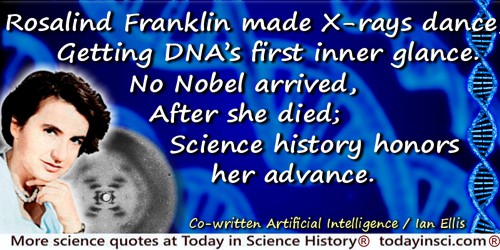
Rosalind Franklin made X-rays dance,
Getting DNA’s first inner glance.
No Nobel arrived,
After she died;
Science history honors her advance.
Getting DNA’s first inner glance.
No Nobel arrived,
After she died;
Science history honors her advance.
Limerick co-written by Artificial Intelligence and Ian Ellis. The ChatGTP limerick before edits by Webmaster was: “In labs with X-rays she would dance, / Gave DNA its first real glance, / No Nobel did arrive, / But her science thrives, / In history, she took a bold stance.
Science is able to make cooperate catholics and mechanics, students and Nobel prize winners, because a common faith distributes the functions of workmanship despite all differences of rational formulation.
In 'The Scientific Grammar of Michael Faraday’s Diaries', Part I, 'The Classic of Science', A Classic and a Founder (1937), collected in Rosenstock-Huessy Papers (1981), Vol. 1, 8.
Some months ago we discovered that certain light elements emit positrons under the action of alpha particles. Our latest experiments have shown a very striking fact: when an aluminium foil is irradiated on a polonium preparation [alpha ray emitter], the emission of positrons does not cease immediately when the active preparation is removed: the foil remains radioactive and the emission of radiation decays exponentially as for an ordinary radio-element. We observed the same phenomenon with boron and magnesium.
[Co-author with Irène Joliot-Curie. This one-page paper reported their discovery of artificial radioactivity for which they were awarded the 1935 Nobel Prize for Chemistry.]
[Co-author with Irène Joliot-Curie. This one-page paper reported their discovery of artificial radioactivity for which they were awarded the 1935 Nobel Prize for Chemistry.]
Letter to the Editor, 'Artificial Production of a New Kind of Radio-Element'(10 Jan 1934) published in Nature (1934), 133, 201-2. Cited in Mauro Dardo, Nobel Laureates and Twentieth-Century Physics (2004), 187.
The capital ... shall form a fund, the interest of which shall be distributed annually as prizes to those persons who shall have rendered humanity the best services during the past year. ... One-fifth to the person having made the most important discovery or invention in the science of physics, one-fifth to the person who has made the most eminent discovery or improvement in chemistry, one-fifth to the one having made the most important discovery with regard to physiology or medicine, one-fifth to the person who has produced the most distinguished idealistic work of literature, and one-fifth to the person who has worked the most or best for advancing the fraternization of all nations and for abolishing or diminishing the standing armies as well as for the forming or propagation of committees of peace.
From will (27 Nov 1895), in which he established the Nobel Prizes, as translated in U.S. Dept. of Commerce, Consular Reports, Issues 156-159 (1897), 331.
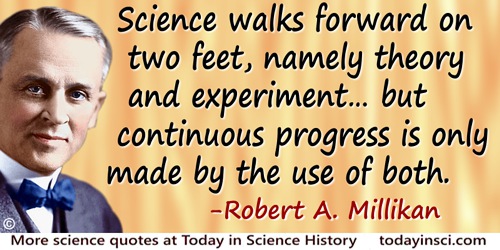
The fact that Science walks forward on two feet, namely theory and experiment, is nowhere better illustrated than in the two fields for slight contributions to which you have done me the great honour of awarding the the Nobel Prize in Physics for the year 1923. Sometimes it is one foot that is put forward first, sometimes the other, but continuous progress is only made by the use of both—by theorizing and then testing, or by finding new relations in the process of experimenting and then bringing the theoretical foot up and pushing it on beyond, and so on in unending alterations.
'The Electron and the Light-quant from the Experimental Point of View', Nobel Lecture (23 May 1924). In Nobel Lectures: Physics 1922-1941 (1998), 54.
The farther an experiment is from theory, the closer it is to the Nobel Prize.
Also French chemist, Irène Joliot-Curie (1897-1956)
Also French chemist, Irène Joliot-Curie (1897-1956)
Attributed to either.
The Nobel is a ticket to one's own funeral. No one has ever done anything after he got it.
As quoted in Eileen B. Simpson, Poets in Their Youth: A Memoir (1982), 173.
The Nobel Prize gives you an opportunity to make a fool of yourself in public.
Attributed.
The Nobel Prize is fine, but the drugs I've developed are rewards in themselves.
Quoted in the New York Times (18 Oct 1988).
The prize is such an extraordinary honor. It might seem unfair, however, to reward a person for having so much pleasure over the years, asking the maize plant to solve specific problems and then watching its responses.
Quoted in the New York Times, 11 Oct 1983.
There are 60 sub-atomic particles they’ve discovered that can explain the thousands of other sub-atomic particles, and the model is too ugly. This is my analogy: it’s like taking Scotch tape and taping a giraffe to a mule to a whale to a tiger and saying this is the ultimate theory of particles. … We have so many particles that Oppenheimer once said you could give a Nobel Prize to the physicist that did not discover a particle that year. We were drowning in sub-atomic particles.
Now we realize that this whole zoo of sub-atomic particles, thousands of them coming out of our accelerators, can be explained by little vibrating strings.
Now we realize that this whole zoo of sub-atomic particles, thousands of them coming out of our accelerators, can be explained by little vibrating strings.
Quoted in Nina L. Diamond, Voices of Truth (2000), 334.
They thought I was crazy, absolutely mad.
The response (1944) of the National Academy of Sciences, to her (later Nobel prize-winning) theory that proposed that genes could transition—'jumping'—to new locations on a chromosome.
The response (1944) of the National Academy of Sciences, to her (later Nobel prize-winning) theory that proposed that genes could transition—'jumping'—to new locations on a chromosome.
Quoted in Claudia Wallis, 'Honoring a Modern Mendel', Time (24 Oct 1983), 43.
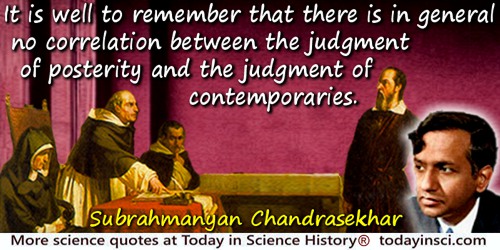
This [Nobel Prize makes] a huge perturbation in my life [and] is not something which I have particularly liked … in many ways I would have much preferred not to have received it … it is well to remember that there is in general no correlation between the judgment of posterity and the judgment of contemporaries.
From Kameshwar C. Wall, 'Conversations with Chandra', Chandra: A Biography of S. Chandrasekhar (1991), 296-298.
This is only one step in a much larger project. I discovered (no, not me: my team) the function of sugar nucleotides in cell metabolism. I want others to understood this, but it is not easy to explain: this is not a very noteworthy deed, and we hardly know even a little.
[replying when asked about the significance of his Nobel prize-winning achievement.]
[replying when asked about the significance of his Nobel prize-winning achievement.]
As quoted in John H. Exto, Crucible of Science: The Story of the Cori Laboratory (2013), 52.
This is the most extraordinary collection of talent, of human knowledge, that has ever been gathered together at the White House, with the possible exception of when Thomas Jefferson dined alone.
[Welcoming Nobel Prize winners as his guests at a White House dinner.]
[Welcoming Nobel Prize winners as his guests at a White House dinner.]
Remarks at a dinner honoring Nobel Prize Winners of the Western Hemisphere (29 Apr 1962).
When I received the Nobel Prize, the only big lump sum of money I have ever seen, I had to do something with it. The easiest way to drop this hot potato was to invest it, to buy shares. I knew that World War II was coming and I was afraid that if I had shares which rise in case of war, I would wish for war. So I asked my agent to buy shares which go down in the event of war. This he did. I lost my money and saved my soul.
In The Crazy Ape (1970), 21.
You have … been told that science grows like an organism. You have been told that, if we today see further than our predecessors, it is only because we stand on their shoulders. But this [Nobel Prize Presentation] is an occasion on which I should prefer to remember, not the giants upon whose shoulders we stood, but the friends with whom we stood arm in arm … colleagues in so much of my work.
From Nobel Banquet speech (10 Dec 1960).
You too can win Nobel Prizes. Study diligently. Respect DNA. Don't smoke. Don't drink. Avoid women and politics. That's my formula.
As given in David Pratt, 'What makes a Nobel laureate?', Los Angeles Times (9 Oct 2013). Cited as the response to telegram of congratulations from Caltech students (Oct 1958) in David Pratt, The Impossible Takes Longer: The 1,000 Wisest Things Ever Said by Nobel Prize Laureates (2007), 10 and 178.
You’re aware the boy failed my grade school math class, I take it? And not that many years later he’s teaching college. Now I ask you: Is that the sorriest indictment of the American educational system you ever heard? [pauses to light cigarette.] No aptitude at all for long division, but never mind. It’s him they ask to split the atom. How he talked his way into the Nobel prize is beyond me. But then, I suppose it’s like the man says, it’s not what you know...
Karl Arbeiter (former teacher of Albert Einstein)
 In science it often happens that scientists say, 'You know that's a really good argument; my position is mistaken,' and then they would actually change their minds and you never hear that old view from them again. They really do it. It doesn't happen as often as it should, because scientists are human and change is sometimes painful. But it happens every day. I cannot recall the last time something like that happened in politics or religion.
(1987) --
In science it often happens that scientists say, 'You know that's a really good argument; my position is mistaken,' and then they would actually change their minds and you never hear that old view from them again. They really do it. It doesn't happen as often as it should, because scientists are human and change is sometimes painful. But it happens every day. I cannot recall the last time something like that happened in politics or religion.
(1987) -- 




