New Quotes (1288 quotes)
… our “Physick” and “Anatomy” have embraced such infinite varieties of being, have laid open such new worlds in time and space, have grappled, not unsuccessfully, with such complex problems, that the eyes of Vesalius and of Harvey might be dazzled by the sight of the tree that has grown out of their grain of mustard seed.
A Lay Sermon, delivered at St. Martin's Hall (7 Jan 1866), 'On the Advisableness of Improving Natural Knowledge', published in The Fortnightly Review (1866), Vol. 3, 629.
… to explore strange new worlds, to seek out new life and new civilizations, to boldly go where no one has gone before.
…...
…it ought to be remembered that there is nothing more difficult to take in hand, more perilous to conduct, or more uncertain in its success, than to take the lead in the introduction of a new order of things. Because the innovator has for enemies all those who have done well under the old conditions, and lukewarm defenders in those who may do well under the new.
The Prince (1532). W. K. Marriott (translator) and Rob McMahon (editor), The Prince (2008), 71.
…resort to science has rendered modern war so destructive of life and property that it presents a new problem to mankind, such, that unless our civilization shall find some means of making an end to war, war will make an end to our civilization.
America and World Peace (1925), 37. In Edward C. Luck, Mixed Messages: American Politics and International Organization, 1919-1999 (1999), 143.
…there is no prescribed route to follow to arrive at a new idea. You have to make the intuitive leap. But the difference is that once you’ve made the intuitive leap you have to justify it by filling in the intermediate steps. In my case, it often happens that I have an idea, but then I try to fill in the intermediate steps and find that they don’t work, so I have to give it up.
In Michael Harwood, 'The Universe and Dr. Hawking', New York Times Magazine (23 Jan 1983), 53.
...while science gives us implements to use, science alone does not determine for what ends they will be employed. Radio is an amazing invention. Yet now that it is here, one suspects that Hitler never could have consolidated his totalitarian control over Germany without its use. One never can tell what hands will reach out to lay hold on scientific gifts, or to what employment they will be put. Ever the old barbarian emerges, destructively using the new civilization.
In 'The Real Point of Conflict between Science and Religion', collected in Living Under Tension: Sermons On Christianity Today (1941), 142.
“Crawling at your feet,” said the Gnat … “you may observe a Bread-and-Butterfly. …”
“And what does it live on?”
“Weak tea with cream in it.”
A new difficulty came into Alice's head. “Supposing it couldn't find any?” she suggested.
“Then it would die, of course.”
“But that must happen very often,” Alice remarked thoughtfully.
“It always happens,” said the Gnat.
“And what does it live on?”
“Weak tea with cream in it.”
A new difficulty came into Alice's head. “Supposing it couldn't find any?” she suggested.
“Then it would die, of course.”
“But that must happen very often,” Alice remarked thoughtfully.
“It always happens,” said the Gnat.
In Through the Looking Glass: And what Alice Found There (1893), 66-67.
“Half genius and half buffoon,” Freeman Dyson ... wrote. ... [Richard] Feynman struck him as uproariously American—unbuttoned and burning with physical energy. It took him a while to realize how obsessively his new friend was tunneling into the very bedrock of modern science.
In Genius: The Life and Science of Richard Feynman (1992), Prologue, 4.
[1665-06-11] I out of doors a little to show forsooth my new suit, and back again; and in going, saw poor Dr Burnets door shut. But he hath, I hear, gained goodwill among his neighbours; for he discovered it himself first, and caused himself to be shut up of his own accord - which was very handsome.
Diary of Samuel Pepys (11 Jun 1665)
[1665-08-31] Up, and after putting several things in order to my removal to Woolwich, the plague having a great increase this week beyond all expectation, of almost 2000 - making the general Bill 7000, odd 100 and the plague above 6000 .... Thus this month ends, with great sadness upon the public through the greateness of the plague, everywhere through the Kingdom almost. Every day sadder and sadder news of its increase. In the City died this week 7496; and all of them, 6102 of the plague. But it is feared that the true number of the dead this week is near 10000 - partly from the poor that cannot be taken notice of through the greatness of the number, and partly from the Quakers and others that will not have any bell ring for them. As to myself, I am very well; only, in fear of the plague, and as much of an Ague, by being forced to go early and late to Woolwich, and my family to lie there continually.
Diary of Samuel Pepys (31 August 1665)
[1665-09-03] Up, and put on my coloured suit on, very fine, and my new periwig, bought a good while since, but durst not wear, because the plague was in westminster when I bought it; and it is a wonder what will be the fashion after the plague is done as to periwigs, for nobody will dare to buy any haire for fear of the infection - that it had been cut off of heads of people dead of the plague. ... but Lord, to consider the madness of people of the town, who will (because they are forbid) come in crowds along with the dead corps to see them buried. ...
Diary of Samuel Pepys (3 Sep 1665)
[A plant] does not change itself gradually, but remains unaffected during all succeeding generations. It only throws off new forms, which are sharply contrasted with the parent, and which are from the very beginning as perfect and as constant, as narrowly defined, and as pure of type as might be expected of any species.
In Species and Varieties: Their Origin and Mutation (1905), 28-9.
[A scientist] naturally and inevitably … mulls over the data and guesses at a solution. [He proceeds to] testing of the guess by new data—predicting the consequences of the guess and then dispassionately inquiring whether or not the predictions are verified.
From manuscript on Francis Bacon as a scientist (1942), Edwin Hubble collection, Box 2, Huntington Library, San Marino, California. As cited by Norriss S. Hetherington in 'Philosophical Values and Observation in Edwin Hubble's Choice of a Model of the Universe', Historical Studies in the Physical Sciences (1982), 13, No. 1, 42.
[A]s you know, scientific education is fabulously neglected … This is an evil that is inherited, passed on from generation to generation. The majority of educated persons are not interested in science, and are not aware that scientific knowledge forms part of the idealistic background of human life. Many believe—in their complete ignorance of what science really is—that it has mainly the ancillary task of inventing new machinery, or helping to invent it, for improving our conditions of life. They are prepared to leave this task to the specialists, as they leave the repairing of their pipes to the plumber. If persons with this outlook decide upon the curriculum of our children, the result is necessarily such as I have just described it.
Opening remarks of the second of four public lectures for the Dublin Institute for Advanced Studies at University College, Dublin (Feb 1950), The Practical Achievements of Science Tending to Obliterate its True Import', collected in Science and Humanism: Physics in Our Time (1951). Reprinted in 'Nature and the Greeks' and 'Science and Humanism' (1996), 113.
[About research with big particle accelerators such as the Large Hadron Collider.] I think the primary justification for this sort of science that we do is fundamental human curiosity. ... It's true, of course, that every previous generation that's made some breakthrough in understanding nature has seen those discoveries translated into new technologies, new possibilities for the human race. That may well happen with the Higgs boson. Quite frankly, at the moment I don't see how you can use the Higgs boson for anything useful.
As quoted in Alan Boyle, 'Discovery of Doom? Collider Stirs Debate', article (8 Sep 2008) on a msnbc.com web page.
[Alchemists] finde out men so covetous of so much happiness, whom they easily perswade that they shall finde greater Riches in Hydargyrie [mercury], than Nature affords in Gold. Such, whom although they have twice or thrice already been deluded, yet they have still a new Device wherewith to deceive um again; there being no greater Madness…. So that the smells of Coles, Sulphur, Dung, Poyson, and Piss, are to them a greater pleasure than the taste of Honey; till their Farms, Goods, and Patrimonies being wasted, and converted into Ashes and Smoak, when they expect the rewards of their Labours, births of Gold, Youth, and Immortality, after all their Time and Expences; at length, old, ragged, famisht, with the continual use of Quicksilver [mercury] paralytick, onely rich in misery, … a laughing-stock to the people: … compell’d to live in the lowest degree of poverty, and … at length compell’d thereto by Penury, they fall to Ill Courses, as Counterfeiting of Money.
In The Vanity of the Arts and Sciences (1530), translation (1676), 313.
[Antarctica has 90 percent of the world’s ice, and God help us if it melts,] whales will be swimming in the streets of New York.
From address (20 Sep 1989) to the National Press Club, as quoted in Phil McCombs, The Washington Post (21 Sep 1989).
[Davy's] March of Glory, which he has run for the last six weeks—within which time by the aid and application of his own great discovery, of the identity of electricity and chemical attractions, he has placed all the elements and all their inanimate combinations in the power of man; having decomposed both the Alkalies, and three of the Earths, discovered as the base of the Alkalies a new metal... Davy supposes there is only one power in the world of the senses; which in particles acts as chemical attractions, in specific masses as electricity, & on matter in general, as planetary Gravitation... when this has been proved, it will then only remain to resolve this into some Law of vital Intellect—and all human knowledge will be Science and Metaphysics the only Science.
In November 1807 Davy gave his famous Second Bakerian Lecture at the Royal Society, in which he used Voltaic batteries to “decompose, isolate and name” several new chemical elements, notably sodium and potassium.
In November 1807 Davy gave his famous Second Bakerian Lecture at the Royal Society, in which he used Voltaic batteries to “decompose, isolate and name” several new chemical elements, notably sodium and potassium.
Letter to Dorothy Wordsworth, 24 November 1807. In Earl Leslie Griggs (ed.), The Collected Letters of Samuel Taylor Coleridge (1956), Vol. 3, 38.
[Engineers are] the direct and necessary instrument of coalition by which alone the new social order can commence.
[Gut instinct is more important than expertise.] Muscle memory isn't very helpful when you're charting new territory.
In Issie Lapowsky, 'Scott Belsky', Inc. (Nov 2013), 140. Biography in Context,
[In relation to business:] Invention must be its keynote—a steady progression from one thing to another. As each in turn approaches a saturated market, something new must be produced.
Aphorism listed Frederick Seitz, The Cosmic Inventor: Reginald Aubrey Fessenden (1866-1932) (1999), 55, being Transactions of the American Philosophical Society, Held at Philadelphia For Promoting Useful Knowledge, Vol. 86, Pt. 6.
[In] the evolution of ideas… New ideas are thrown up spontaneously like mutations; the vast majority of them are useless crank theories, the equivalent of biological freaks without survival-value.
In Epilogue, The Sleepwalkers: A History of Man’s Changing Vision of the Universe (1959), 515.
[In] the realm of science, … what we have achieved will be obsolete in ten, twenty or fifty years. That is the fate, indeed, that is the very meaning of scientific work. … Every scientific “fulfillment” raises new “questions” and cries out to be surpassed and rendered obsolete. Everyone who wishes to serve science has to resign himself to this.
From a Speech (1918) presented at Munich University, published in 1919, and collected in 'Wissenschaft als Beruf', Gessammelte Aufsätze zur Wissenschaftslehre (1922), 524-525. As translated by Rodney Livingstone in David Owen (ed.), The Vocation Lectures: Science as a Vocation: Politics as a Vocation (2004), 11. A different translation of a longer excerpt for this quote, beginning “In science, each of us knows …”, is also on the Max Weber Quotes web page on this site.
[J.J.] Sylvester’s methods! He had none. “Three lectures will be delivered on a New Universal Algebra,” he would say; then, “The course must be extended to twelve.” It did last all the rest of that year. The following year the course was to be Substitutions-Théorie, by Netto. We all got the text. He lectured about three times, following the text closely and stopping sharp at the end of the hour. Then he began to think about matrices again. “I must give one lecture a week on those,” he said. He could not confine himself to the hour, nor to the one lecture a week. Two weeks were passed, and Netto was forgotten entirely and never mentioned again. Statements like the following were not unfrequent in his lectures: “I haven’t proved this, but I am as sure as I can be of anything that it must be so. From this it will follow, etc.” At the next lecture it turned out that what he was so sure of was false. Never mind, he kept on forever guessing and trying, and presently a wonderful discovery followed, then another and another. Afterward he would go back and work it all over again, and surprise us with all sorts of side lights. He then made another leap in the dark, more treasures were discovered, and so on forever.
As quoted by Florian Cajori, in Teaching and History of Mathematics in the United States (1890), 265-266.
[Luis] Alvarez's whole approach to physics was that of an entrepreneur, taking big risks by building large new projects in the hope of large rewards, although his pay was academic rather than financial. He had drawn around him a group of young physicists anxious to try out the exciting ideas he was proposing.
As quoted in Walter Sullivan, 'Luis W. Alvarez, Nobel Physicist Who Explored Atom, Dies at 77: Obituary', New York Times (2 Sep 1988).
[N]o scientist likes to be criticized. … But you don’t reply to critics: “Wait a minute, wait a minute; this is a really good idea. I’m very fond of it. It’s done you no harm. Please don’t attack it.” That's not the way it goes. The hard but just rule is that if the ideas don't work, you must throw them away. Don't waste any neurons on what doesn’t work. Devote those neurons to new ideas that better explain the data. Valid criticism is doing you a favor.
In 'Wonder and Skepticism', Skeptical Enquirer (Jan-Feb 1995), 19, No. 1.
[On the 11th day of November 1572], in the evening, after sunset, when, according to my habit, I was contemplating the stars in a clear sky, I noticed that a new and unusual star, surpassing all others in brilliancy, was shining almost directly over my head; and since I had, almost from boyhood, known all the stars of the heavens perfectly (there is no great difficulty in gaining that knowledge), it was quite evident to me that there had never before been any star in that place in the sky, even the smallest, to say nothing of a star so conspicuously bright as this. I was so astonished at this sight that I was not ashamed to doubt the trustworthiness of my own eyes. But when I observed that others, too, on having the place pointed out to them, could see that there was a star there, I had no further doubts. A miracle indeed, either the greatest of all that have occurred in the whole range of nature since the beginning of the world, or one certainly that is to be classed with those attested by the Holy Oracles.
De Stello. Nova (On the New Star) (1573). Quoted in H. Shapley and A. E. Howarth (eds.), Source Book in Astronomy (1929), 13.
[Pavel Yablochkov’s electric lamp is] the starting point for the creation of a new branch of industry.
In 'Opasnosti elektricheskogo osveshcheniia', Elektrichestvo 4 (1890): 68. 2. As quoted in Loren Graham, Lonely Ideas: Can Russia Compete? (2013), 176.
[Radius]: You will work. You will build ... You will serve them... Robots of the world... The power of man has fallen... A new world has arisen. The rule of the Robots... March!
The word 'robot' was coined in this play for a new working class of automatons (from the Czech word robota meaning compulsory labour)
The word 'robot' was coined in this play for a new working class of automatons (from the Czech word robota meaning compulsory labour)
R.U.R. (1920), 89-90 in 1961 ed.
[Should Britain fail, then the entire world would] sink into the abyss of a new dark age made more sinister ... by the lights of perverted science.
“Finest Hour” speech after Dunkirk during WW II (18 Jun 1940). In Robert Rhodes James, ed. Winston Churchill: His Complete Speeches, 1897-1963 (1974), Vol. 6, p.6238.
[Some] philosophers have been of opinion that our immortal part acquires during this life certain habits of action or of sentiment, which become forever indissoluble, continuing after death in a future state of existence ... I would apply this ingenious idea to the generation, or production of the embryon, or new animal, which partakes so much of the form and propensities of the parent.
Zoonomia (1794), Vol. 1, 483-4.
[Technical courage means the] physician-scientist must be brave enough to adopt new methods. It is far too easy to learn one technique and then to repeat the same experiment over and over. In this fashion one can write many papers, receive large research grants, and remain solidly rooted in the middle of a scientific field. But the true innovator has the confidence to drop one set of experimental crutches and leap to another when he or she must move forward.
In Banquet Speech, 'The Nobel Prize in Physiology or Medicine 1985', on website nobelprize.org. Published in Les Prix Nobel, 1985: Nobel Prizes, Presentations, Biographies and Lectures (1986).
[The attitude of the Renaissance towards the antique world was that] Archaeology to them was not a mere science for the antiquarian; it was a means by which they could touch the dry dust of antiquity into the very breath and beauty of life, and fill with the new wine of romanticism forms that else had been old and out-worn.
In his essay 'The Truth of Masks', collected in Intentions (1904), 213.
[The compass needle] as the guide of Vasco de Gama to the East Indies, and of Columbus to the West Indies and the New World, it was pre-eminently the precursor and pioneer of the telegraph. Silently, and as with finger on its lips, it led them across the waste of waters to the new homes of the world; but when these were largely filled, and houses divided between the old and new hemispheres longed to exchange affectionate greetings, it removed its finger and broke silence. The quivering magnetic needle which lies in the coil of the galvanometer is the tongue of the electric telegraph, and already engineers talk of it as speaking.
'Progress of the Telegraph.' In Jesse Aitken Wilson, Memoirs of George Wilson. Quoted in Natural History Society of Montreal, 'Reviews and Notices of Books,' The Canadian Naturalist and Geologist (1861) Vol. 6, 392.
[The new term] Physicist is both to my mouth and ears so awkward that I think I shall never use it. The equivalent of three separate sounds of i in one word is too much.
Quoted in Sydney Ross, Nineteenth-Century Attitudes: Men of Science (1991), 10.
[The surplus of basic knowledge of the atomic nucleus was] largely used up [during the war with the atomic bomb as the dividend.] We must, without further delay restore this surplus in preparation for the important peacetime job for the nucleus - power production. ... Many of the proposed applications of atomic power - even for interplanetary rockets - seem to be within the realm of possibility provided the economic factor is ruled out completely, and the doubtful physical and chemical factors are weighted heavily on the optimistic side. ... The development of economic atomic power is not a simple extrapolation of knowledge gained during the bomb work. It is a new and difficult project to reach a satisfactory answer. Needless to say, it is vital that the atomic policy legislation now being considered by the congress recognizes the essential nature of this peacetime job, and that it not only permits but encourages the cooperative research-engineering effort of industrial, government and university laboratories for the task. ... We must learn how to generate the still higher energy particles of the cosmic rays - up to 1,000,000,000 volts, for they will unlock new domains in the nucleus.
Addressing the American Institute of Electrical Engineering, in New York (24 Jan 1946). In Schenectady Gazette (25 Jan 1946),
[Vikram Sarabhai] always gave new technical knowledge to the engineers and at that moment his face was lit with joy.
As given in narrative form by Mahesh Sharma, P. Bhalla and P.K. Das, in 'Prof. Vikram Sarabhai in the Opinion of Dr. Kalam', Pride Of The Nation: Dr. A.P.J. Abdul Kalam (2004), 46.
[Vikram Sarabhai] informed the whole of his team about any new project and started working on it only after having discussed it with everyone.
As given in narrative form by Mahesh Sharma, P. Bhalla and P.K. Das, in 'Prof. Vikram Sarabhai in the Opinion of Dr. Kalam', Pride Of The Nation: Dr. A.P.J. Abdul Kalam (2004), 46.
[We are] a fragile species, still new to the earth, … here only a few moments as evolutionary time is measured, … in real danger at the moment of leaving behind only a thin layer of of our fossils, radioactive at that.
The Fragile Species (1992, 1996), 25.
[When I was a child] I grew up in Brooklyn, New York, and I was a street kid. … [T]here was one aspect of that environment that, for some reason, struck me as different, and that was the stars. … I could tell they were lights in the sky, but that wasn’t an explanation. I mean, what were they? Little electric bulbs on long black wires, so you couldn’t see what they were held up by? What were they? … My mother said to me, "Look, we’ve just got you a library card … get out a book and find the answer.” … It was in there. It was stunning. The answer was that the Sun was a star, except very far away. … The dazzling idea of a universe vast beyond imagining swept over me. … I sensed awe.
In 'Wonder and Skepticism', Skeptical Enquirer (Jan-Feb 1995), 19, No. 1.
![Arthur Stanley Eddington quote: [When thinking about the new relativity and quantum theories] I have felt a homesickness for the](https://todayinsci.com/E/Eddington_Arthur/EddingtonArthur-Handrails500x250px.jpg)
[When thinking about the new relativity and quantum theories] I have felt a homesickness for the paths of physical science where there are more or less discernible handrails to keep us from the worst morasses of foolishness.
The Nature Of The Physical World (1928), 343.
[Young] was afterwards accustomed to say, that at no period of his life was he particularly fond of repeating experiments, or even of very frequently attempting to originate new ones; considering that, however necessary to the advancement of science, they demanded a great sacrifice of time, and that when the fact was once established, that time was better employed in considering the purposes to which it might be applied, or the principles which it might tend to elucidate.
Hudson Gurney, Memoir of the Life of Thomas Young, M.D. F.R.S. (1831), 12-3.
Πάντα ῥεῖ : all things are in flux. It is inevitable that you are indebted to the past. You are fed and formed by it. The old forest is decomposed for the composition of the new forest. The old animals have given their bodies to the earth to furnish through chemistry the forming race, and every individual is only a momentary fixation of what was yesterday another’s, is today his and will belong to a third to-morrow. So it is in thought.
In Lecture, second in a series given at Freeman Place Chapel, Boston (Mar 1859), 'Quotation and Originality', collected in Letters and Social Aims (1875, 1917), 200. The Greek expression, “panta rei” is a quote from Heraclitus.
[About Sir Roderick Impey Murchison:] The enjoyments of elegant life you early chose to abandon, preferring to wander for many successive years over the rudest portions of Europe and Asia—regions new to Science—in the hope, happily realized, of winning new truths.
By a rare union of favourable circumstances, and of personal qualifications equally rare, you have thus been enabled to become the recognized Interpreter and Historian (not without illustrious aid) of the Silurian Period.
By a rare union of favourable circumstances, and of personal qualifications equally rare, you have thus been enabled to become the recognized Interpreter and Historian (not without illustrious aid) of the Silurian Period.
Dedication page in Thesaurus Siluricus: The Flora and Fauna of the Silurian Period (1868), iv.
[Answering question whether he was tired of life:] Tired! Not so long as there is an undescribed intestinal worm, or the riddle of a fossil bone, or a rhizopod new to me.
Related about Joseph Leidy by Dr. Weir Mitchell, as stated in Richard A. Gregory, Discovery: Or, The Spirit and Service of Science (1916), 17.
[Pechblende] einer eigenthümlichen, selbstständigen metallischen Substanz bestehe. Es fallen folglich auch deren bisherige Benennungen, als: Ресhblende Eisenpecherz, hinweg, welche nun durch einen neuen ausschliessend bezeichnenden Namen zu ersetzen sind. Ich habe dazu den Namen: Uranerz (Uranium) erwählt; zu einigem Andenken, dass die chemische Ausfindung dieses neuen Metallkörpers in die Epoche der astronomischen. Entdeckung des Planeten Uranus gefallen sei.
[Pitchblende] consists of a peculiar, distinct, metallic substance. Therefore its former denominations, pitch-blende, pitch-iron-ore, &c. are no longer applicable, and must be supplied by another more appropriate name.—I have chosen that of uranite, (Uranium), as a kind of memorial, that the chemical discovery of this new metal happened in the period of the astronomical discovery of the new planet Uranus.
[Pitchblende] consists of a peculiar, distinct, metallic substance. Therefore its former denominations, pitch-blende, pitch-iron-ore, &c. are no longer applicable, and must be supplied by another more appropriate name.—I have chosen that of uranite, (Uranium), as a kind of memorial, that the chemical discovery of this new metal happened in the period of the astronomical discovery of the new planet Uranus.
In original German edition, Beiträge Zur Chemischen Kenntniss Der Mineralkörper (1797), Vol. 2, 215. English edition, translator not named, Analytical Essays Towards Promoting the Chemical Knowledge of Mineral Substances (1801), 491. The new planet was discovered on 13 Mar 1781 by William Herschel, who originally named it Georgium Sidus (George's Star) to honour King George III.
[When recording electrical impulses from a frog nerve-muscle preparation seemed to show a tiresomely oscillating electrical artefact—but only when the muscle was hanging unsupported.] The explanation suddenly dawned on me ... a muscle hanging under its own weight ought, if you come to think of it, to be sending sensory impulses up the nerves coming from the muscle spindles ... That particular day’s work, I think, had all the elements that one could wish for. The new apparatus seemed to be misbehaving very badly indeed, and I suddenly found it was behaving so well that it was opening up an entire new range of data ... it didn’t involve any particular hard work, or any particular intelligence on my part. It was just one of those things which sometimes happens in a laboratory if you stick apparatus together and see what results you get.
From 'Memorable experiences in research', Diabetes (1954), 3, 17-18. As cited in Alan McComa, Galvani's Spark: The Story of the Nerve Impulse (2011), 102-103.
Air Force Chief of Staff: Doctor, what do you think of our new creation, the … Corporation?
von Kármán: Why, General, I think that corporation has already had an effect on the whole industry.
Air Force Chief of Staff: I’m delighted. What effect is that?
von Kármán: Why, they’ve upset the salary schedule of the whole industry.
von Kármán: Why, General, I think that corporation has already had an effect on the whole industry.
Air Force Chief of Staff: I’m delighted. What effect is that?
von Kármán: Why, they’ve upset the salary schedule of the whole industry.
As quoted by William R. Sears in 'Some Recollections of Theodore von Kármán', Address to the Symposium in Memory of Theodore von Kármán, Society for Industrial and Applied Mathematics, National Meeting (13-14 May 1964), Washington, D.C. Printed in Journal of the Society for Industrial and Applied Mathematics (Mar 1965), 13>, No. 1, 181. These are likely not verbatim words of Karman, but as recollected by Sears, giving an example of von Kármán’s willingness to speak truth to power.
An diesen Apparate ist nichts neu als seine Einfachkeit und die vollkommene zu Verlaessigkeit, welche er gewaehst.
In this apparatus is nothing new but its simplicity and thorough trustworthiness.
On his revolutionary method of organic analysis.
In this apparatus is nothing new but its simplicity and thorough trustworthiness.
On his revolutionary method of organic analysis.
Poggendorf's Annalen, (1831), 21, 4. Trans. W. H. Brock.
Compounds formed by chemical attraction, possess new properties different from those of their component parts... chemists have long believed that the contrary took place in their combination. They thought, in fact, that the compounds possessed properties intermediate between those of their component parts; so that two bodies, very coloured, very sapid, or insapid, soluble or insoluble, fusible or infusible, fixed or volatile, assumed in chemical combination, a shade or colour, or taste, solubility or volatility, intermediate between, and in some sort composed of, the same properties which were considered in their principles. This is an illusion or error which modern chemistry is highly interested to overthrow.
Quoted in A General System of Chemical Knowledge (1804), Vol. I, trans. W. Nicholson, 102-3.
Dilbert: It took weeks but I’ve calculated a new theory about the origin of the universe. According to my calculations it didn’t start with a “Big Bang” at all—it was more of “Phhbwt” sound. You may be wondering about the practical applications of the “Little Phhbwt” theory.
Dogbert: I was wondering when you’ll go away.
Dogbert: I was wondering when you’ll go away.
Dilbert comic strip (1 Jan 1993)
Dilbert: Wow! According to my computer simulation, it should be possible to create new life forms from common household chemicals
Dogbert: This raises some thorny issues.
Dilbert: You mean legal, ethical and religious issues?
Dogbert: I was thinking about parking spaces.
Dogbert: This raises some thorny issues.
Dilbert: You mean legal, ethical and religious issues?
Dogbert: I was thinking about parking spaces.
Dilbert comic strip (31 May 1989).
Eine neue wissenschaftliche Wahrheit pflegt sich nicht in der Weise durchzusetzen, daß ihre Gegner überzeugt werden und sich als belehrt erklären, sondern vielmehr dadurch, daß ihre Gegner allmählich aussterben und daß die heranwachsende Generation von vornherein mit der Wahrheit vertraut gemacht ist.
A new scientific truth does not triumph by convincing its opponents and making them see the light, but rather its opponents eventually die, and a new generation grows up that is familiar with it.
A new scientific truth does not triumph by convincing its opponents and making them see the light, but rather its opponents eventually die, and a new generation grows up that is familiar with it.
In Scientific Autobiography and Other Papers, trans. F. Gaynor (1950), 33. Also seen paraphrased in shortened form as: Die Wahrheit triumphiert nie, ihre Gegner sterben nur aus. (Translated as “Truth never triumphs—its opponents just die out.” More loosely paraphrased as “Science advances one funeral at a time.”)
Ich have auf eine geringe Vermutung eine gefährliche Reise gewagt und erblicke schon die Vorgebirge neuer Länder. Diejenigen, welche die Herzhaftigheit haben die Untersuchung fortzusetzen, werden sie betreten.
Upon a slight conjecture [on the origin of the solar system] I have ventured on a dangerous journey and I already behold the foothills of new lands. Those who have the courage to continue the search will set foot on them.
Upon a slight conjecture [on the origin of the solar system] I have ventured on a dangerous journey and I already behold the foothills of new lands. Those who have the courage to continue the search will set foot on them.
From Allgemeine Naturgeschichte und Theorie des Himmels (Natural History and Theory of the Heavens (1755). As quoted in D. ter Haar and A.G.W. Cameron, 'Historical Review of Theories of the Origin of the Solar System', collected in Robert Jastrow and A. G. W. Cameron (eds.), Origin of the Solar System: Proceedings of a Conference Held at the Goddard Institute for Space Studies, New York, January 23-24, 1962, (1963), 3.
'Cosmogonical Hypotheses' (1913), collected in Harlow Shapley, Source Book in Astronomy, 1900-1950 (1960), 347.
If the Indians hadn’t spent the $24. In 1626 Peter Minuit, first governor of New Netherland, purchased Manhattan Island from the Indians for about $24. … Assume for simplicity a uniform rate of 7% from 1626 to the present, and suppose that the Indians had put their $24 at [compound] interest at that rate …. What would be the amount now, after 280 years? 24 x 1.07²⁸⁰ = more than 4,042,000,000.
The latest tax assessment available at the time of writing gives the realty for the borough of Manhattan as $3,820,754,181. This is estimated to be 78% of the actual value, making the actual value a little more than $4,898,400,000.
The amount of the Indians’ money would therefore be more than the present assessed valuation but less than the actual valuation.
The latest tax assessment available at the time of writing gives the realty for the borough of Manhattan as $3,820,754,181. This is estimated to be 78% of the actual value, making the actual value a little more than $4,898,400,000.
The amount of the Indians’ money would therefore be more than the present assessed valuation but less than the actual valuation.
In A Scrap-book of Elementary Mathematics: Notes, Recreations, Essays (1908), 47-48.
In artibus et scientiis, tanquam in metalli fodinis, omnia novis operibus et ulterioribus progressibus circumstrepere debent
But arts and sciences should be like mines, where the noise of new works and further advances is heard on every side.
But arts and sciences should be like mines, where the noise of new works and further advances is heard on every side.
Original Latin as in Novum Organum, Book 1, XC, collected in The Works of Francis Bacon (1826), Vol. 8, 50-51. As translated by James Spedding and Robert Leslie Ellis in The Works of Francis Bacon (1863), 127.
La nature veut que dans certains temps les hommes se succèdent les uns aux autres par le moyen de la mort; il leur est permis de se défendre contr’elle jusqu’à un certain point; mais passé cela, on aura beau faire de nouvelles découvertes dans l’Anatomie, on aura beau pénétrer de plus en plus dans les secrets de la structure du corps humain, on ne prendra point la Nature pour dupe, on mourra comme à l’ordinaire.
Nature intends that at fixed periods men should succeed each other by the instrumentality of death. They are allowed to keep it at bay up to a certain point; but when that is passed, it will be of no use to make new discoveries in anatomy, or to penetrate more and more into the secrets of the structure of the human body; we shall never outwit nature, we shall die as usual.
Nature intends that at fixed periods men should succeed each other by the instrumentality of death. They are allowed to keep it at bay up to a certain point; but when that is passed, it will be of no use to make new discoveries in anatomy, or to penetrate more and more into the secrets of the structure of the human body; we shall never outwit nature, we shall die as usual.
In 'Dialogue 5: Dialogues De Morts Anciens', Nouveaux Dialogues des Morts (2nd Ed., 1683), Vol. 1, 154-155. As translated in Craufurd Tait Ramage, Beautiful Thoughts from French and Italian Authors (1866), 113.
La théorie est l’hypothèse vérifiée, après qu’elle a été soumise au contrôle du raisonnement et de la critique expérimentale. La meilleure théorie est celle qui a été vérifiée par le plus grand nombre de faits. Mais une théorie, pour rester bonne, doit toujours se modifier avec les progrès de la science et demeurer constamment soumise à la vérification et à la critique des faits nouveaux qui apparaissent.
A theory is a verified hypothesis, after it has been submitted to the control of reason and experimental criticism. The soundest theory is one that has been verified by the greatest number of facts. But to remain valid, a theory must be continually altered to keep pace with the progress of science and must be constantly resubmitted to verification and criticism as new facts appear.
A theory is a verified hypothesis, after it has been submitted to the control of reason and experimental criticism. The soundest theory is one that has been verified by the greatest number of facts. But to remain valid, a theory must be continually altered to keep pace with the progress of science and must be constantly resubmitted to verification and criticism as new facts appear.
Original work in French, Introduction à l'Étude de la Médecine Expérimentale (1865), 385. English translation by Henry Copley Green in An Introduction to the Study of Experimental Medicine (1927, 1957), 220.
Le seul véritable voyage ... ce ne serait pas d’aller vers de nouveaux paysages, mais d’avoir d’autres yeux, de voir l’univers avec les yeux d’un autre, de cent autres, de voir les cent univers que chacun d’eux voit …
The only true voyage of discovery … would be not to visit new landscapes, but to possess other eyes, to see the universe through the eyes of another, of a hundred others, to see the hundred universes that each of them sees.
[Also often seen translated in the shortened form: 'The only real voyage of discovery consists not in seeing new landscapes, but in having new eyes.']
The only true voyage of discovery … would be not to visit new landscapes, but to possess other eyes, to see the universe through the eyes of another, of a hundred others, to see the hundred universes that each of them sees.
[Also often seen translated in the shortened form: 'The only real voyage of discovery consists not in seeing new landscapes, but in having new eyes.']
'La Prisonnière', À la recherche du temps perdu (1913-27). In Roger Shattuck, Proust (1974), 131.
Les Leucocytes Et L'esprit De Sacrifice. — Il semble, d'après les recherches de De Bruyne (Phagocytose, 1895) et de ceux qui le citent, que les leucocytes des Lamellibranches — probablement lorsqu'ils ont phagocyté, qu'ils se sont chargés de résidus et de déchets, qu'ils ont, en un mot, accompli leur rôle et bien fait leur devoir — sortent du corps de l'animal et vont mourir dans le milieu ambiant. Ils se sacrifient. Après avoir si bien servi l'organisme par leur activité, ils le servent encore par leur mort en faisant place aux cellules nouvelles, plus jeunes.
N'est-ce pas la parfaite image du désintéressement le plus noble, et n'y a-t-il point là un exemple et un modèle? Il faut s'en inspirer: comme eux, nous sommes les unités d'un grand corps social; comme eux, nous pouvons le servir et envisager la mort avec sérénité, en subordonnant notre conscience individuelle à la conscience collective. (30 Jan 1896)
Leukocytes and The Spirit Of Sacrifice. - It seems, according to research by De Bruyne (Phagocytosis, 1885) and those who quote it, that leukocytes of Lamellibranches [bivalves] - likely when they have phagocytized [ingested bacteria], as they become residues and waste, they have, in short, performed their role well and done their duty - leave the body of the animal and will die in the environment. They sacrifice themselves. Having so well served the body by their activities, they still serve in their death by making room for new younger cells.
Isn't this the perfect image of the noblest selflessness, and thereby presents an example and a model? It should be inspiring: like them, we are the units of a great social body, like them, we can serve and contemplate death with equanimity, subordinating our individual consciousness to collective consciousness.
N'est-ce pas la parfaite image du désintéressement le plus noble, et n'y a-t-il point là un exemple et un modèle? Il faut s'en inspirer: comme eux, nous sommes les unités d'un grand corps social; comme eux, nous pouvons le servir et envisager la mort avec sérénité, en subordonnant notre conscience individuelle à la conscience collective. (30 Jan 1896)
Leukocytes and The Spirit Of Sacrifice. - It seems, according to research by De Bruyne (Phagocytosis, 1885) and those who quote it, that leukocytes of Lamellibranches [bivalves] - likely when they have phagocytized [ingested bacteria], as they become residues and waste, they have, in short, performed their role well and done their duty - leave the body of the animal and will die in the environment. They sacrifice themselves. Having so well served the body by their activities, they still serve in their death by making room for new younger cells.
Isn't this the perfect image of the noblest selflessness, and thereby presents an example and a model? It should be inspiring: like them, we are the units of a great social body, like them, we can serve and contemplate death with equanimity, subordinating our individual consciousness to collective consciousness.
In Recueil d'Œuvres de Léo Errera: Botanique Générale (1908), 194. Google translation by Webmaster. Please give feedback if you can improve it.
Neue Phaenomena zu erklären, dieses macht meine Sorgen aus, und wie froh ist der Forscher, wenn er das so fleissig Gesuche findet, eine Ergötzung wobei das Herz lacht.
To explain new phenomena, that is my task; and how happy is the scientist when he finds what he so diligently sought, a pleasure that gladdens the heart.
To explain new phenomena, that is my task; and how happy is the scientist when he finds what he so diligently sought, a pleasure that gladdens the heart.
Letter to Johan Gahn. Original German quote in Mary Elivira Weeks, The Discovery of the Elements (1934), 153, citing Nordenskiöld, Scheeles nachgelassene Briefe und Aufzeichnungen (1892), 151. Translation in Mary Elvira Weeks and Henry M. Leicester (ed.)The Discovery of the Elements (6th ed. 1956), 223.
Remarking about Frederick Sanger who used the new technique of paper chromotography:
They are not chemists there, just a lot of paper hangers.
They are not chemists there, just a lot of paper hangers.
Quoted in 'Alexander Robertus Todd, O.M., Baron Todd of Trumpington', obituary by Damiel M. Brown and Hans Kornberg in Biographical Memoirs of Fellows of the Royal Society, 2000, 46, 527. At Cambridge, Todd and his colleagues began using paper chromotography in the early 1950s to separate a mixture of vitamin B12 reaction products as a method to identify them.
Science for the Citizen is ... also written for the large and growing number of adolescents, who realize that they will be the first victims of the new destructive powers of science misapplied.
Science for the Citizen: A Self-Educator based on the Social Background of Scientific Discovery (1938), Author's Confessions, 9.
The Annotated Alice, of course, does tie in with math, because Lewis Carroll was, as you know, a professional mathematician. So it wasn’t really too far afield from recreational math, because the two books are filled with all kinds of mathematical jokes. I was lucky there in that I really didn’t have anything new to say in The Annotated Alice because I just looked over the literature and pulled together everything in the form of footnotes. But it was a lucky idea because that’s been the best seller of all my books.
In Anthony Barcellos, 'A Conversation with Martin Gardner', The Two-Year College Mathematics Journal (Sep 1979), 10, No. 4, 241.
The Water-baby story character, Tom, asks: 'I heard, ma'am, that you were always making new beasts out of old.'
Mother Carey [Mother Nature] replies: 'So people fancy. But I am not going to trouble myself to make things, my little dear. I sit here and make them make themselves.'
[The author's indirect reference to evolution.]
Mother Carey [Mother Nature] replies: 'So people fancy. But I am not going to trouble myself to make things, my little dear. I sit here and make them make themselves.'
[The author's indirect reference to evolution.]
The Water-babies (1886), 307.
Wenn sich für ein neues Fossil kein, auf eigenthümliche Eigenschaften desselben hinweisender, Name auffinden lassen Will; als in welchem Falle ich mich bei dem gegenwärtigen zu befinden gestehe; so halte ich es für besser, eine solche Benennung auszuwählen, die an sich gar nichts sagt, und folglich auch zu keinen unrichtigen Begriffen Anlass geben kann. Diesem zufolge will ich den Namen für die gegenwärtige metallische Substanz, gleichergestalt wie bei dem Uranium geschehen, aus der Mythologie, und zwar von den Ursöhnen der Erde, den Titanen, entlehnen, und benenne also dieses neue Metallgeschlecht: Titanium.
Wherefore no name can be found for a new fossil [element] which indicates its peculiar and characteristic properties (in which position I find myself at present), I think it is best to choose such a denomination as means nothing of itself and thus can give no rise to any erroneous ideas. In consequence of this, as I did in the case of Uranium, I shall borrow the name for this metallic substance from mythology, and in particular from the Titans, the first sons of the earth. I therefore call this metallic genus TITANIUM.
Wherefore no name can be found for a new fossil [element] which indicates its peculiar and characteristic properties (in which position I find myself at present), I think it is best to choose such a denomination as means nothing of itself and thus can give no rise to any erroneous ideas. In consequence of this, as I did in the case of Uranium, I shall borrow the name for this metallic substance from mythology, and in particular from the Titans, the first sons of the earth. I therefore call this metallic genus TITANIUM.
Martin Heinrich Klaproth. Original German edition, Beiträge Zur Chemischen Kenntniss Der Mineralkörper (1795), Vol. 1 , 244. English edition, translator not named, Analytical Essays Towards Promoting the Chemical Knowledge of Mineral Substances (1801), Vol. 1, 210. Klaproth's use of the term fossil associates his knowledge of the metal as from ore samples dug out of a mine.
~~[Attributed, authorship undocumented]~~ Mathematical demonstrations are a logic of as much or more use, than that commonly learned at schools, serving to a just formation of the mind, enlarging its capacity, and strengthening it so as to render the same capable of exact reasoning, and discerning truth from falsehood in all occurrences, even in subjects not mathematical. For which reason it is said, the Egyptians, Persians, and Lacedaemonians seldom elected any new kings, but such as had some knowledge in the mathematics, imagining those, who had not, men of imperfect judgments, and unfit to rule and govern.
From an article which appeared as 'The Usefulness of Mathematics', Pennsylvania Gazette (30 Oct 1735), No. 360. Collected, despite being without clear evidence of Franklin’s authorship, in The Works of Benjamin Franklin (1809), Vol. 4, 377. Evidence of actual authorship by Ben Franklin for the newspaper article has not been ascertained, and scholars doubt it. See Franklin documents at the website founders.archives.gov. The quote is included here to attach this caution.
~~[Paraphrased version]~~ Man’s mind once stretched by a new idea, never regains its original dimension.
Although seen very widely quoted in these or very similar, sometimes as by his son Oliver Wendell Holmes, Jr., this is probably actually shorter paraphrased variation of “Every now and then a man’s mind is stretched by a new idea or sensation, and never shrinks back to its former dimensions.” In The Autocrat of the Breakfast Table (1858), 311.
~~[Questionable attribution]~~ Travel and change of place impart new vigor to the mind.
Found widely quoted and attributed to Seneca, but Webmaster, as yet, has not identified the primary source of these words (in verbatim translation) in the writings of Seneca. Conversely, Seneca says somewhat the opposite in his Epistle CIV on 'Travelling', as translated in The Epistles of Lucius Annæus Seneca (1786), Vol. 2, 242-243. Seneca quotes Socrates, “For it is said that Socrates, when a person was complaining to him that he had received very little benefit from travelling, made this reply: I do not wonder at it, since you travelled with yourself.” However Seneca was perhaps commenting on physical health, saying further, “Medicine is requisite for a sick man, not a journey. … Why then should you think a mind … can be cured merely by change of place?” However, please contact if you can help with a different Seneca source applying to mental health.
1839—The fermentation satire
THE MYSTERY OF ALCOHOLIC FERMENTATION RESOLVED
(Preliminary Report by Letter) Schwindler
I am about to develop a new theory of wine fermentation … Depending on the weight, these seeds carry fermentation to completion somewhat less than as in the beginning, which is understandable … I shall develop a new theory of wine fermentation [showing] what simple means Nature employs in creating the most amazing phenomena. I owe it to the use of an excellent microscope designed by Pistorius.
When brewer’s yeast is mixed with water the microscope reveals that the yeast dissolves into endless small balls, which are scarcely 1/800th of a line in diameter … If these small balls are placed in sugar water, it can be seen that they consist of the eggs of animals. As they expand, they burst, and from them develop small creatures that multiply with unbelievable rapidity in a most unheard of way. The form of these animals differs from all of the 600 types described up until now. They possess the shape of a Beinsdorff still (without the cooling apparatus). The head of the tube is a sort of proboscis, the inside of which is filled with fine bristles 1/2000th of a line long. Teeth and eyes are not discernible; however, a stomach, intestinal canal, anus (a rose red dot), and organs for secretion of urine are plainly discernible. From the moment they are released from the egg one can see these animals swallow the sugar from the solution and pass it to the stomach. It is digested immediately, a process recognized easily by the resultant evacuation of excrements. In a word, these infusors eat sugar, evacuate ethyl alcohol from the intestinal canal, and carbon dioxide from the urinary organs. The bladder, in the filled state, has the form of a champagne bottle; when empty, it is a small button … As soon as the animals find no more sugar present, they eat each other up, which occurs through a peculiar manipulation; everything is digested down to the eggs which pass unchanged through the intestinal canal. Finally, one again fermentable yeast, namely the seed of the animals, which remain over.
THE MYSTERY OF ALCOHOLIC FERMENTATION RESOLVED
(Preliminary Report by Letter) Schwindler
I am about to develop a new theory of wine fermentation … Depending on the weight, these seeds carry fermentation to completion somewhat less than as in the beginning, which is understandable … I shall develop a new theory of wine fermentation [showing] what simple means Nature employs in creating the most amazing phenomena. I owe it to the use of an excellent microscope designed by Pistorius.
When brewer’s yeast is mixed with water the microscope reveals that the yeast dissolves into endless small balls, which are scarcely 1/800th of a line in diameter … If these small balls are placed in sugar water, it can be seen that they consist of the eggs of animals. As they expand, they burst, and from them develop small creatures that multiply with unbelievable rapidity in a most unheard of way. The form of these animals differs from all of the 600 types described up until now. They possess the shape of a Beinsdorff still (without the cooling apparatus). The head of the tube is a sort of proboscis, the inside of which is filled with fine bristles 1/2000th of a line long. Teeth and eyes are not discernible; however, a stomach, intestinal canal, anus (a rose red dot), and organs for secretion of urine are plainly discernible. From the moment they are released from the egg one can see these animals swallow the sugar from the solution and pass it to the stomach. It is digested immediately, a process recognized easily by the resultant evacuation of excrements. In a word, these infusors eat sugar, evacuate ethyl alcohol from the intestinal canal, and carbon dioxide from the urinary organs. The bladder, in the filled state, has the form of a champagne bottle; when empty, it is a small button … As soon as the animals find no more sugar present, they eat each other up, which occurs through a peculiar manipulation; everything is digested down to the eggs which pass unchanged through the intestinal canal. Finally, one again fermentable yeast, namely the seed of the animals, which remain over.
In 'Das entriithselle Geheimiss der geisligen Giihrung', Annalen der Pharmacie und Chemie (1839), 29, 100-104; adapted from English translalion by Ralph E. Oesper, The Human Side of Scientists (1975), 203-205.
A carriage (steam) will set out from Washington in the morning, the passengers will breakfast at Baltimore, dine at Philadelphia, and sup in New York the same day.
(about 1804). As quoted in Henry Howe, 'Oliver Evans', Memoirs of the Most Eminent American Mechanics: (1840), 80.
A child of the new generation
Refused to learn multiplication.
He said “Don’t conclude
That I’m stupid or rude;
I am simply without motivation.”
Refused to learn multiplication.
He said “Don’t conclude
That I’m stupid or rude;
I am simply without motivation.”
…...

A child’s world is fresh and new and beautiful, full of wonder and excitement. It is our misfortune that for most of us that clear-eyed vision, that true instinct for what is beautiful and awe-inspiring, is dimmed and even lost before we reach adulthood.
In The Sense of Wonder (1956, 1998), 54.
A discovery in science, or a new theory, even when it appears most unitary and most all-embracing, deals with some immediate element of novelty or paradox within the framework of far vaster, unanalysed, unarticulated reserves of knowledge, experience, faith, and presupposition. Our progress is narrow; it takes a vast world unchallenged and for granted. This is one reason why, however great the novelty or scope of new discovery, we neither can, nor need, rebuild the house of the mind very rapidly. This is one reason why science, for all its revolutions, is conservative. This is why we will have to accept the fact that no one of us really will ever know very much. This is why we shall have to find comfort in the fact that, taken together, we know more and more.
Science and the Common Understanding (1954), 53-4.

A disease which new and obscure to you, Doctor, will be known only after death; and even then not without an autopsy will you examine it with exacting pains. But rare are those among the extremely busy clinicians who are willing or capable of doing this correctly.
In Atrocis, nee Descipti Prius, Morbi Historia as translated in Bulletin of the Medical Library Association (1944), 43, 217.
A few days afterwards, I went to him [the same actuary referred to in another quote] and very gravely told him that I had discovered the law of human mortality in the Carlisle Table, of which he thought very highly. I told him that the law was involved in this circumstance. Take the table of the expectation of life, choose any age, take its expectation and make the nearest integer a new age, do the same with that, and so on; begin at what age you like, you are sure to end at the place where the age past is equal, or most nearly equal, to the expectation to come. “You don’t mean that this always happens?”—“Try it.” He did try, again and again; and found it as I said. “This is, indeed, a curious thing; this is a discovery!” I might have sent him about trumpeting the law of life: but I contented myself with informing him that the same thing would happen with any table whatsoever in which the first column goes up and the second goes down.
In Budget of Paradoxes (1872), 172.
A good theoretical physicist today might find it useful to have a wide range of physical viewpoints and mathematical expressions of the same theory (for example, of quantum electrodynamics) available to him. This may be asking too much of one man. Then new students should as a class have this. If every individual student follows the same current fashion in expressing and thinking about electrodynamics or field theory, then the variety of hypotheses being generated to understand strong interactions, say, is limited. Perhaps rightly so, for possibly the chance is high that the truth lies in the fashionable direction. But, on the off-chance that it is in another direction—a direction obvious from an unfashionable view of field theory—who will find it?
In his Nobel Prize Lecture (11 Dec 1965), 'The Development of the Space-Time View of Quantum Electrodynamics'. Collected in Stig Lundqvist, Nobel Lectures: Physics, 1963-1970 (1998), 177.
A great ball of fire about a mile in diameter, changing colors as it kept shooting upward, from deep purple to orange, expanding, growing bigger, rising as it was expanding, an elemental force freed from its bonds after being chained for billions of years.
On the first atomic explosion in New Mexico, 16 Jul 1945.
On the first atomic explosion in New Mexico, 16 Jul 1945.
From 'Drama of the Atomic Bomb Found Climax in July 16 Test', in New York Times (26 Sep 1945). This was the first of a series of articles by Laurence, who was the only civilian witness of the first bomb test. He was on a flight to see the dropping of a bomb on Nagasaki. Laurence, science writer for the NYT, had been requested for service to the War Department to explain the atomic bomb to the lay public.
A human being should be able to change a diaper, plan an invasion, butcher a hog, conn a ship, design a building, write a sonnet, balance accounts, build a wall, set a bone, comfort the dying, take orders, give orders, cooperate, act alone, solve equations, analyze a new problem, pitch manure, program a computer, cook a tasty meal, fight efficiently, die gallantly. Specialization is for insects.
In Time Enough for Love: The Lives of Lazarus Long (1973), 265.
A key concept is that security is an enabler, not a disabler. … Security … enables you to keep your job, security enables you to move into new markets, security enables you to have confidence in what you’re doing.
As quoted in magazine article, an interview by John McCormick, 'Computer Security as a Business Enabler', Baseline (7 Jul 2007).
A lot of scientific papers do deal with matters of atheoretical fact ... for example, whenever somebody finds a new “world's largest dinosaur,” which has only slightly more scientific relevance than shooting the record moose. In short, not everything that gets published in scientific journals bears the distinctive hallmarks of science.
In 'Paleoanthropology: Science or Mythical Charter?', Journal of Anthropological Research (Summer 2002), 58, No. 2, 186.
A man who writes a great deal and says little that is new writes himself into a daily declining reputation. When he wrote less he stood higher in people’s estimation, even though there was nothing in what he wrote. The reason is that then they still expected better things of him in the future, whereas now they can view the whole progression.
Aphorism 43 in Notebook D (1773-1775), as translated by R.J. Hollingdale in Aphorisms (1990). Reprinted as The Waste Books (2000), 50.
A man with a new idea is a crank until he succeeds.
In 'Pudd’nhead Wilson’s New Calendar,' Following the Equator (1897), 297.
A million million spermatozoa,
All of them alive:
Out of their cataclysm but one poor Noah
Dare hope to survive.
And among that billion minus one
Might have chanced to be Shakespeare, another Newton, a new Donne—
But the One was Me.
All of them alive:
Out of their cataclysm but one poor Noah
Dare hope to survive.
And among that billion minus one
Might have chanced to be Shakespeare, another Newton, a new Donne—
But the One was Me.
'Fifth Philosopher's Song', Leda (1920),33.
A moment’s consideration of this case shows what a really great advance in the theory and practise of breeding has been obtained through the discovery of Mendel’s law. What a puzzle this case would have presented to the biologist ten years ago! Agouti crossed with chocolate gives in the second filial generation (not in the first) four varieties, viz., agouti, chocolate, black and cinnamon. We could only have shaken our heads and looked wise (or skeptical).
Then we had no explanation to offer for such occurrences other than the “instability of color characters under domestication,” the “effects of inbreeding,” “maternal impressions.” Serious consideration would have been given to the proximity of cages containing both black and cinnamon-agouti mice.
Now we have a simple, rational explanation, which anyone can put to the test. We are able to predict the production of new varieties, and to produce them.
We must not, of course, in our exuberance, conclude that the powers of the hybridizer know no limits. The result under consideration consists, after all, only in the making of new combinations of unit characters, but it is much to know that these units exist and that all conceivable combinations of them are ordinarily capable of production. This valuable knowledge we owe to the discoverer and to the rediscoverers of Mendel’s law.
Then we had no explanation to offer for such occurrences other than the “instability of color characters under domestication,” the “effects of inbreeding,” “maternal impressions.” Serious consideration would have been given to the proximity of cages containing both black and cinnamon-agouti mice.
Now we have a simple, rational explanation, which anyone can put to the test. We are able to predict the production of new varieties, and to produce them.
We must not, of course, in our exuberance, conclude that the powers of the hybridizer know no limits. The result under consideration consists, after all, only in the making of new combinations of unit characters, but it is much to know that these units exist and that all conceivable combinations of them are ordinarily capable of production. This valuable knowledge we owe to the discoverer and to the rediscoverers of Mendel’s law.
'New Colour Variety of the Guinea Pig', Science, 1908, 28, 250-252.
A nation which depends upon others for its new basic scientific knowledge will be slow in its industrial progress and weak in its competitive position in world trade, regardless of its mechanical skill.
Quoted by Edwin T. Layton, Jr., in 'American Ideologies of Science and Engineering', Technology and Culture (1976), 17, 689. As cited in Arie Leegwater, 'Technology and Science', Stephen V. Monsma (ed.), Responsible Technology: A Christian Perspective (1986), 79.
A New Arithmetic: “I am not much of a mathematician,” said the cigarette, “but I can add nervous troubles to a boy, I can subtract from his physical energy, I can multiply his aches and pains, I can divide his mental powers, I can take interest from his work and discount his chances for success.”
In Henry Ford, The Case Against the Little White Slaver (1914), Vol. 3, 40.
A new cigarette offers coupons good for a cemetery lot.
In E.C. McKenzie, 14,000 Quips and Quotes for Speakers, Writers, Editors, Preachers, and Teachers (1990), 85.
A new era of ocean exploration can yield discoveries that will help inform everything from critical medical advances to sustainable forms of energy. Consider that AZT, an early treatment for HIV, is derived from a Caribbean reef sponge, or that a great deal of energy—from offshore wind, to OTEC (ocean thermal energy conservation), to wind and wave energy—is yet untapped in our oceans.
In 'Why Exploring the Ocean is Mankind’s Next Giant Leap', contributed to CNN 'Lightyears Blog' (13 Mar 2012).
A new species develops if a population which has become geographically isolated from its parental species acquires during this period of isolation characters which promote or guarantee reproductive isolation when the external barriers break down.
Systematics and the Origin of Species: From the Viewpoint of a Zoologist (1942), 155.
A new theory is guilty until proven innocent, and the pre-existing theory innocent until proven guilty ... Continental drift was guilty until proven innocent.
The Nemesis Affair: A Story of the Death of the Dinosaurs and the Ways of Science (1986), 195-205.
A new truth is a truth, an old error is an error.
In Poor Richard's Almanack (1734).
A plain, reasonable working man supposes, in the old way which is also the common-sense way, that if there are people who spend their lives in study, whom he feeds and keeps while they think for him—then no doubt these men are engaged in studying things men need to know; and he expects of science that it will solve for him the questions on which his welfare, and that of all men, depends. He expects science to tell him how he ought to live: how to treat his family, his neighbours and the men of other tribes, how to restrain his passions, what to believe in and what not to believe in, and much else. And what does our science say to him on these matters?
It triumphantly tells him: how many million miles it is from the earth to the sun; at what rate light travels through space; how many million vibrations of ether per second are caused by light, and how many vibrations of air by sound; it tells of the chemical components of the Milky Way, of a new element—helium—of micro-organisms and their excrements, of the points on the hand at which electricity collects, of X rays, and similar things.
“But I don't want any of those things,” says a plain and reasonable man—“I want to know how to live.”
It triumphantly tells him: how many million miles it is from the earth to the sun; at what rate light travels through space; how many million vibrations of ether per second are caused by light, and how many vibrations of air by sound; it tells of the chemical components of the Milky Way, of a new element—helium—of micro-organisms and their excrements, of the points on the hand at which electricity collects, of X rays, and similar things.
“But I don't want any of those things,” says a plain and reasonable man—“I want to know how to live.”
In 'Modern Science', Essays and Letters (1903), 221-222.
A religion old or new, that stressed the magnificence of the universe as revealed by modern science, might be able to draw forth reserves of reverence and awe hardly tapped by the conventional faiths. Sooner or later such a religion will emerge.
Pale Blue Dot: a Vision of the Human Future in Space (1994), 52.
A schism has taken place among the chemists. A particular set of them in France have undertaken to remodel all the terms of the science, and to give every substance a new name, the composition, and especially the termination of which, shall define the relation in which it stands to other substances of the same family, But the science seems too much in its infancy as yet, for this reformation; because in fact, the reformation of this year must be reformed again the next year, and so on, changing the names of substances as often as new experiments develop properties in them undiscovered before. The new nomenclature has, accordingly, been already proved to need numerous and important reformations. ... It is espoused by the minority here, and by the very few, indeed, of the foreign chemists. It is particularly rejected in England.
Letter to Dr. Willard (Paris, 1788). In Thomas Jefferson and John P. Foley (ed.), The Jeffersonian Cyclopedia (1900), 135. From H.A. Washington, The Writings of Thomas Jefferson (1853-54). Vol 3, 15.
A scientist can be productive in various ways. One is having the ability to plan and carry out experiments, but the other is having the ability to formulate new ideas, which can be about what experiments can be carried out … by making [the] proper calculations. Individual scientists who are successful in their work are successful for different reasons.
Interview with George B. Kauffman and Laurie M. Kauffman, in 'Linus Pauling: Reflections', American Scientist (Nov-Dec 1994), 82, No. 6, 522.
A scientist can discover a new star but he cannot make one. He would have to ask an engineer to do it for him.
The Design of Design (1969), 1
A scientist strives to understand the work of Nature. But with our insufficient talents as scientists, we do not hit upon the truth all at once. We must content ourselves with tracking it down, enveloped in considerable darkness, which leads us to make new mistakes and errors. By diligent examination, we may at length little by little peel off the thickest layers, but we seldom get the core quite free, so that finally we have to be satisfied with a little incomplete knowledge.
Lecture to the Royal Swedish Academy of Science, 23 May 1764. Quoted in J. A. Schufle 'Torbern Bergman, Earth Scientist', Chymia, 1967, 12, 78.
A short, broad man of tremendous vitality, the physical type of Hereward, the last of the English, and his brother-in-arms, Winter, Sylvester’s capacious head was ever lost in the highest cloud-lands of pure mathematics. Often in the dead of night he would get his favorite pupil, that he might communicate the very last product of his creative thought. Everything he saw suggested to him something new in the higher algebra. This transmutation of everything into new mathematics was a revelation to those who knew him intimately. They began to do it themselves. His ease and fertility of invention proved a constant encouragement, while his contempt for provincial stupidities, such as the American hieroglyphics for π and e, which have even found their way into Webster’s Dictionary, made each young worker apply to himself the strictest tests.
In Florian Cajori, Teaching and History of Mathematics in the United States (1890), 265.
A student who wishes now-a-days to study geometry by dividing it sharply from analysis, without taking account of the progress which the latter has made and is making, that student no matter how great his genius, will never be a whole geometer. He will not possess those powerful instruments of research which modern analysis puts into the hands of modern geometry. He will remain ignorant of many geometrical results which are to be found, perhaps implicitly, in the writings of the analyst. And not only will he be unable to use them in his own researches, but he will probably toil to discover them himself, and, as happens very often, he will publish them as new, when really he has only rediscovered them.
From 'On Some Recent Tendencies in Geometrical Investigations', Rivista di Matematica (1891), 43. In Bulletin American Mathematical Society (1904), 443.
Abstruse mathematical researches … are … often abused for having no obvious physical application. The fact is that the most useful parts of science have been investigated for the sake of truth, and not for their usefulness. A new branch of mathematics, which has sprung up in the last twenty years, was denounced by the Astronomer Royal before the University of Cambridge as doomed to be forgotten, on account of its uselessness. Now it turns out that the reason why we cannot go further in our investigations of molecular action is that we do not know enough of this branch of mathematics.
In 'Conditions of Mental Development', Lectures and Essays (1901), Vol. 1, 115.
According to Herr Cook's observation, the inhabitants of New Guinea have something they set light to which burns up almost like gunpowder. They also put it into hollow staves, and from a distance you could believe they are shooting. But it does not produce so much as a bang. Presumably they are trying to imitate the Europeans. They have failed to realize its real purpose.
Aphorism 27 in Notebook D (1773-1775), as translated by R.J. Hollingdale in Aphorisms (1990). Reprinted as The Waste Books (2000), 48.
Accurate and minute measurement seems to the non-scientific imagination, a less lofty and dignified work than looking for something new. But nearly all the grandest discoveries of science have been but the rewards of accurate measurement and patient long-continued labour in the minute sifting of numerical results.
Presidential inaugural address, to the General Meeting of the British Association, Edinburgh (2 Aug 1871). In Report of the Forty-First Meeting of the British Association for the Advancement of Science (1872), xci.
Adventure isn’t hanging on a rope off the side of a mountain. Adventure is an attitude that we must apply to the day to day obstacles of life - facing new challenges, seizing new opportunities, testing our resources against the unknown and in the process, discovering our own unique potential.
…...
After a tremendous task has been begun in our time, first by Copernicus and then by many very learned mathematicians, and when the assertion that the earth moves can no longer be considered something new, would it not be much better to pull the wagon to its goal by our joint efforts, now that we have got it underway, and gradually, with powerful voices, to shout down the common herd, which really does not weigh arguments very carefully?
Letter to Galileo (13 Oct 1597). In James Bruce Ross (ed.) and Mary Martin (ed., trans.), 'Comrades in the Pursuit of Truth', The Portable Renaissance Reader (1953, 1981), 599. As quoted and cited in Merry E. Wiesner, Early Modern Europe, 1450-1789 (2013), 377.
After having a wash I proceeded to the bar where—believe it or not—there was a white-coated barman who was not only serving drinks but also cigarettes! I hastened forward and rather timidly said ‘Can I have some cigarettes?’
‘What’s your rank?’ was the slightly unexpected reply.
‘I am afraid I haven’t got one,’ I answered.
‘Nonsense—everyone who comes here has a rank.’
‘I’m sorry but I just don’t have one.’
‘Now that puts me in a spot,’ said the barman, ‘for orders about cigarettes in this camp are clear—twenty for officers and ten for other ranks. Tell me what exactly are you?’
Now I really wanted those cigarettes so I drew myself up and said ‘I am the Professor of Chemistry at Manchester University.’
The barman contemplated me for about thirty seconds and then said ‘I’ll give you five.’
Since that day I have had few illusions about the importance of professors!
‘What’s your rank?’ was the slightly unexpected reply.
‘I am afraid I haven’t got one,’ I answered.
‘Nonsense—everyone who comes here has a rank.’
‘I’m sorry but I just don’t have one.’
‘Now that puts me in a spot,’ said the barman, ‘for orders about cigarettes in this camp are clear—twenty for officers and ten for other ranks. Tell me what exactly are you?’
Now I really wanted those cigarettes so I drew myself up and said ‘I am the Professor of Chemistry at Manchester University.’
The barman contemplated me for about thirty seconds and then said ‘I’ll give you five.’
Since that day I have had few illusions about the importance of professors!
In A Time to Remember: The Autobiography of a Chemist (1983), 59. This event took place after a visit to the Defence Research Establishment at Porton to observe a demonstration of a new chemical anti-tank weapon (1941).
After the birth of printing books became widespread. Hence everyone throughout Europe devoted himself to the study of literature... Every year, especially since 1563, the number of writings published in every field is greater than all those produced in the past thousand years. Through them there has today been created a new theology and a new jurisprudence; the Paracelsians have created medicine anew and the Copernicans have created astronomy anew. I really believe that at last the world is alive, indeed seething, and that the stimuli of these remarkable conjunctions did not act in vain.
De Stella Nova, On the New Star (1606), Johannes Kepler Gesammelte Werke (1937- ), Vol. 1, 330-2. Quoted in N. Jardine, The Birth of History and Philosophy of Science: Kepler's A Defence of Tycho Against Ursus With Essays on its Provenance and Significance (1984), 277-8.
After the planet becomes theirs, many millions of years will have to pass before a beetle particularly loved by God, at the end of its calculations will find written on a sheet of paper in letters of fire that energy is equal to the mass multiplied by the square of the velocity of light. The new kings of the world will live tranquilly for a long time, confining themselves to devouring each other and being parasites among each other on a cottage industry scale.
'Beetles' Other People’s Trades (1985, trans. 1989).
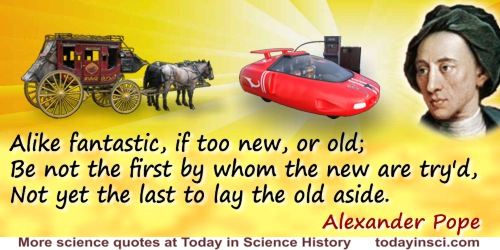
Alike fantastic, if too new, or old;
Be not the first by whom the new are try'd,
Not yet the last to lay the old aside.
Be not the first by whom the new are try'd,
Not yet the last to lay the old aside.
In An Essay on Criticism. With notes by Mr. Warburton (1749), 49.
All fossil anthropoids found hitherto have been known only from mandibular or maxillary fragments, so far as crania are concerned, and so the general appearance of the types they represented had been unknown; consequently, a condition of affairs where virtually the whole face and lower jaw, replete with teeth, together with the major portion of the brain pattern, have been preserved, constitutes a specimen of unusual value in fossil anthropoid discovery. Here, as in Homo rhodesiensis, Southern Africa has provided documents of higher primate evolution that are amongst the most complete extant. Apart from this evidential completeness, the specimen is of importance because it exhibits an extinct race of apes intermediate between living anthropoids and man ... Whether our present fossil is to be correlated with the discoveries made in India is not yet apparent; that question can only be solved by a careful comparison of the permanent molar teeth from both localities. It is obvious, meanwhile, that it represents a fossil group distinctly advanced beyond living anthropoids in those two dominantly human characters of facial and dental recession on one hand, and improved quality of the brain on the other. Unlike Pithecanthropus, it does not represent an ape-like man, a caricature of precocious hominid failure, but a creature well advanced beyond modern anthropoids in just those characters, facial and cerebral, which are to be anticipated in an extinct link between man and his simian ancestor. At the same time, it is equally evident that a creature with anthropoid brain capacity and lacking the distinctive, localised temporal expansions which appear to be concomitant with and necessary to articulate man, is no true man. It is therefore logically regarded as a man-like ape. I propose tentatively, then, that a new family of Homo-simidæ be created for the reception of the group of individuals which it represents, and that the first known species of the group be designated Australopithecus africanus, in commemoration, first, of the extreme southern and unexpected horizon of its discovery, and secondly, of the continent in which so many new and important discoveries connected with the early history of man have recently been made, thus vindicating the Darwinian claim that Africa would prove to be the cradle of mankind.
'Australopithicus africanus: The Man-Ape of South Africa', Nature, 1925, 115, 195.
All minds quote. Old and new make the warp and woof of every moment. There is no thread that is not a twist of these two strands.
In Lecture, second in a series given at Freeman Place Chapel, Boston (Mar 1859), 'Quotation and Originality', Letters and Social Aims (1875, 1917), 178.
All my life through, the new sights of Nature made me rejoice like a child.
In Pierre Curie (1923), 162.
All scientists must focus closely on limited targets. Whether or not one’s findings on a limited subject will have wide applicability depends to some extent on chance, but biologists of superior ability repeatedly focus on questions the answers to which either have wide ramifications or lead to new areas of investigation. One procedure that can be effective is to attempt both reduction and synthesis; that is, direct a question at a phenomenon on one integrative level, identify its mechanism at a simpler level, then extrapolate its consequences to a more complex level of integration.
In 'Scientific innovation and creativity: a zoologist’s point of view', American Zoologist (1982), 22, 230-231,
All the species recognized by Botanists came forth from the Almighty Creator’s hand, and the number of these is now and always will be exactly the same, while every day new and different florists’ species arise from the true species so-called by Botanists, and when they have arisen they finally revert to the original forms. Accordingly to the former have been assigned by Nature fixed limits, beyond which they cannot go: while the latter display without end the infinite sport of Nature.
In Philosophia Botanica (1751), aphorism 310. Trans. Frans A. Stafleu, Linnaeus and the Linnaeans: The Spreading of their Ideas in Systematic Botany, 1735-1789 (1971), 90.
Almost all really new ideas have a certain aspect of foolishness when they are first produced.
In Science and the Modern World (1926, 2011), 60.
Almost always the men who achieve these fundamental inventions of a new paradigm have been either very young or very new to the field whose paradigm they change.
The Structure of Scientific Revolutions (1962), 89-90.
Almost daily we shudder as prophets of doom announce the impending end of civilization and universe. We are being asphyxiated, they say, by the smoke of the industry; we are suffocating in the ever growing mountain of rubbish. Every new project depicts its measureable effects and is denounced by protesters screaming about catastrophe, the upsetting of the land, the assault on nature. If we accepted this new mythology we would have to stop pushing roads through the forest, harnessing rivers to produce the electricity, breaking grounds to extract metals, enriching the soil with chemicals, killing insects, combating viruses … But progress—basically, an effort to organise a corner of land and make it more favourable for human life—cannot be baited. Without the science of pomiculture, for example, trees will bear fruits that are small, bitter, hard, indigestible, and sour. Progress is desirable.
Uncredited. In Lachman Mehta, Stolen Treasure (2012), 117.
Almost everyone... seems to be quite sure that the differences between the methodologies of history and of the natural sciences are vast. For, we are assured, it is well known that in the natural sciences we start from observation and proceed by induction to theory. And is it not obvious that in history we proceed very differently? Yes, I agree that we proceed very differently. But we do so in the natural sciences as well.
In both we start from myths—from traditional prejudices, beset with error—and from these we proceed by criticism: by the critical elimination of errors. In both the role of evidence is, in the main, to correct our mistakes, our prejudices, our tentative theories—that is, to play a part in the critical discussion, in the elimination of error. By correcting our mistakes, we raise new problems. And in order to solve these problems, we invent conjectures, that is, tentative theories, which we submit to critical discussion, directed towards the elimination of error.
In both we start from myths—from traditional prejudices, beset with error—and from these we proceed by criticism: by the critical elimination of errors. In both the role of evidence is, in the main, to correct our mistakes, our prejudices, our tentative theories—that is, to play a part in the critical discussion, in the elimination of error. By correcting our mistakes, we raise new problems. And in order to solve these problems, we invent conjectures, that is, tentative theories, which we submit to critical discussion, directed towards the elimination of error.
The Myth of the Framework: In Defence of Science and Rationality (1993), 140.
Although I was four years at the University [of Wisconsin], I did not take the regular course of studies, but instead picked out what I thought would be most useful to me, particularly chemistry, which opened a new world, mathematics and physics, a little Greek and Latin, botany and and geology. I was far from satisfied with what I had learned, and should have stayed longer.
[Enrolled in Feb 1861, left in 1863 without completing a degree, and began his first botanical foot journey.]
[Enrolled in Feb 1861, left in 1863 without completing a degree, and began his first botanical foot journey.]
The Story of My Boyhood and Youth (1913), 286.
America, so far as her physical history is concerned, has been falsely denominated the New World. Hers was the first dry land lifted out of the waters, hers the first shore washed by the ocean that enveloped all the earth beside; and while Europe was represented only by islands rising here and there above the sea, America already stretched an unbroken line of land from Nova Scotia to the Far West.
Geological Sketches (1866), I.
Among the current discussions, the impact of new and sophisticated methods in the study of the past occupies an important place. The new 'scientific' or 'cliometric' history—born of the marriage contracted between historical problems and advanced statistical analysis, with economic theory as bridesmaid and the computer as best man—has made tremendous advances in the last generation.
Co-author with Geoffrey Rudolph Elton (1921-94), British historian. Which Road to the Past? Two Views of History (1983), 2.
Among the multitude of animals which scamper, fly, burrow and swim around us, man is the only one who is not locked into his environment. His imagination, his reason, his emotional subtlety and toughness, make it possible for him not to accept the environment, but to change it. And that series of inventions, by which man from age to age has remade his environment, is a different kind of evolution—not biological, but cultural evolution. I call that brilliant sequence of cultural peaks The Ascent of Man. I use the word ascent with a precise meaning. Man is distinguished from other animals by his imaginative gifts. He makes plans, inventions, new discoveries, by putting different talents together; and his discoveries become more subtle and penetrating, as he learns to combine his talents in more complex and intimate ways. So the great discoveries of different ages and different cultures, in technique, in science, in the arts, express in their progression a richer and more intricate conjunction of human faculties, an ascending trellis of his gifts.
The Ascent of Man (1973), 19-20.
Among the studies to which the [Rockefeller] Foundation is giving support is a series in a relatively new field, which may be called molecular biology, in which delicate modern techniques are being used to investigate ever more minute details of certain life processes.
In 'Molecular Biology', Annual Report of the Rockefeller Foundation (1938), 203-4. Reprinted in a letter to Science (6 Nov 1970), 170, 582.
An article in Bioscience in November 1987 by Julie Ann Miller claimed the cortex was a “quarter-meter square.” That is napkin-sized, about ten inches by ten inches. Scientific American magazine in September 1992 upped the ante considerably with an estimate of 1½ square meters; that’s a square of brain forty inches on each side, getting close to the card-table estimate. A psychologist at the University of Toronto figured it would cover the floor of his living room (I haven’t seen his living room), but the prize winning estimate so far is from the British magazine New Scientist’s poster of the brain published in 1993 which claimed that the cerebral cortex, if flattened out, would cover a tennis court. How can there be such disagreement? How can so many experts not know how big the cortex is? I don’t know, but I’m on the hunt for an expert who will say the cortex, when fully spread out, will cover a football field. A Canadian football field.
In The Burning House: Unlocking the Mysteries of the Brain (1994, 1995), 11.
An essential [of an inventor] is a logical mind that sees analogies. No! No! not mathematical. No man of a mathematical habit of mind ever invented anything that amounted to much. He hasn’t the imagination to do it. He sticks too close to the rules, and to the things he is mathematically sure he knows, to create anything new.
As quoted in French Strother, 'The Modern Profession of Inventing', World's Work and Play (Jul 1905), 6, No. 32, 187.
An evolutionary view of human health and disease is not surprising or new; it is merely inevitable in the face of evidence and time.
Epigraph, without citation, in Robert Perlman, Evolution and Medicine (2013), xiii. Webmaster has not yet found the primary source; can you help?
An idea must not be condemned for being a little shy and incoherent; all new ideas are shy when introduced first among our old ones. We should have patience and see whether the incoherency is likely to wear off or to wear on, in which latter case the sooner we get rid of them the better.
In Samuel Butler and Henry Festing Jones (ed.), 'Higgledy-Piggledy', The Note-books of Samuel Butler (1912, 1917), 216-217.
An idea must not be condemned for being a little shy and incoherent; all new ideas are shy when introduced first among our old ones. We should have patience and see whether the incoherency is likely to wear off or to wear on, in which latter case the sooner we get rid of them the better.
Samuel Butler, Henry Festing Jones (ed.), The Note-Books of Samuel Butler (1917), 216-217.
An inventive age
Has wrought, if not with speed of magic, yet
To most strange issues. I have lived to mark
A new and unforeseen creation rise
From out the labours of a peaceful Land:
Wielding her potent enginery to frame
And to produce, with appetite as keen
As that of war, which rests not night or day.
Has wrought, if not with speed of magic, yet
To most strange issues. I have lived to mark
A new and unforeseen creation rise
From out the labours of a peaceful Land:
Wielding her potent enginery to frame
And to produce, with appetite as keen
As that of war, which rests not night or day.
In The Excursion (1814). In The Works of William: Wordsworth (1994), Book 8, 875.
And by the influence of heat, light, and electrical powers, there is a constant series of changes [in animal and vegetal substances]; matter assumes new forms, the destruction of one order of beings tends to the conservation of another, solution and consolidation, decay and renovation, are connected, and whilst the parts of the system, continue in a state of fluctuation and change, the order and harmony of the whole remain unalterable.
The Elements of Agricultural Chemistry (1813), in J. Davy (ed.) The Collected Works of Sir Humphry Davy(1839-40), Vol 7, 182.
And if you want the exact moment in time, it was conceived mentally on 8th March in this year one thousand six hundred and eighteen, but submitted to calculation in an unlucky way, and therefore rejected as false, and finally returning on the 15th of May and adopting a new line of attack, stormed the darkness of my mind. So strong was the support from the combination of my labour of seventeen years on the observations of Brahe and the present study, which conspired together, that at first I believed I was dreaming, and assuming my conclusion among my basic premises. But it is absolutely certain and exact that the proportion between the periodic times of any two planets is precisely the sesquialterate proportion of their mean distances.
Harmonice Mundi, The Harmony of the World (1619), book V, ch. 3. Trans. E. J. Aiton, A. M. Duncan and J. V. Field (1997), 411.
And many kinds of creatures must have died,
Unable to plant out new sprouts of life.
For whatever you see that lives and breathes and thrives
Has been, from the very beginning, guarded, saved
By it's trickery for its swiftness or brute strength.
And many have been entrusted to our care,
Commended by their usefulness to us.
For instance, strength supports a savage lion;
Foxes rely on their cunning; deer their flight.
Unable to plant out new sprouts of life.
For whatever you see that lives and breathes and thrives
Has been, from the very beginning, guarded, saved
By it's trickery for its swiftness or brute strength.
And many have been entrusted to our care,
Commended by their usefulness to us.
For instance, strength supports a savage lion;
Foxes rely on their cunning; deer their flight.
On the Nature of Things, trans. Anthony M. Esolen (1995), Book 5, lines 852-60, 183.
And new philosophy calls all in doubt,
The Element of fire is quite put out;
The Sun is lost, and th’earth, and no mans wit
Can well direct him where to look for it.
And freely men confesse that this world’s spent,
When in the Planets, and the Firmament
They seeke so many new; and then see that this
Is crumbled out againe to his Atomies.
’Tis all in pieces, all cohaerence gone;
All just supply, and all Relation;
Prince, Subject, Father, Sonne, are things forgot,
For every man alone thinkes he hath got
To be a phoenix, and that then can bee
None of that kinde, of which he is, but hee.
The Element of fire is quite put out;
The Sun is lost, and th’earth, and no mans wit
Can well direct him where to look for it.
And freely men confesse that this world’s spent,
When in the Planets, and the Firmament
They seeke so many new; and then see that this
Is crumbled out againe to his Atomies.
’Tis all in pieces, all cohaerence gone;
All just supply, and all Relation;
Prince, Subject, Father, Sonne, are things forgot,
For every man alone thinkes he hath got
To be a phoenix, and that then can bee
None of that kinde, of which he is, but hee.
An Anatomie of the World, I. 205-18. The Works of John Donne (Wordsworth edition 1994), 177.
And no one has the right to say that no water-babies exist, till they have seen no water-babies existing; which is quite a different thing, mind, from not seeing water-babies; and a thing which nobody ever did, or perhaps will ever do. But surely [if one were caught] ... they would have put it into spirits, or into the Illustrated News, or perhaps cut it into two halves, poor dear little thing, and sent one to Professor Owen, and one to Professor Huxley, to see what they would each say about it.
The Water-babies (1886), 79-80.
And yet, it will be no cool process of mere science … with which we face this new age of right and opportunity….
Inaugural Address (4 Mar 1913). In 'President Wilson’s Inaugural Address', New York Times (5 Mar 1913), 2.
Angling may be said to be so like the Mathematics that it can never be fully learnt; at least not so fully but that there will still be more new experiments left for the trial of other men that succeed us.
In The Complete Angler (1653, 1915), 7.
Another argument of hope may be drawn from this–that some of the inventions already known are such as before they were discovered it could hardly have entered any man's head to think of; they would have been simply set aside as impossible. For in conjecturing what may be men set before them the example of what has been, and divine of the new with an imagination preoccupied and colored by the old; which way of forming opinions is very fallacious, for streams that are drawn from the springheads of nature do not always run in the old channels.
Translation of Novum Organum, XCII. In Francis Bacon, James Spedding, The Works of Francis Bacon (1864), Vol. 8, 128.
Another error is a conceit that … the best has still prevailed and suppressed the rest: so as, if a man should begin the labor of a new search, he were but like to light upon somewhat formerly rejected, and by rejection brought into oblivion; as if the multitude, or the wisest for the multitude’s sake, were not ready to give passage rather to that which is popular and superficial, than to that which is substantial and profound: for the truth is, that time seemeth to be of the nature of a river or stream, which carrieth down to us that which is light and blown up, and sinketh and drowneth that which is weighty and solid.
Advancement of Learning, Book 1. Collected in The Works of Francis Bacon (1826), Vol 1, 36.
Antoine Magnan, a French zoologist, in 1934 made some very careful studies of bumblebee flight and came to the conclusion that bumblebees cannot fly at all! Fortunately, the bumblebees never heard this bit of news and so went on flying as usual.
Insects (1968, 1972), 68. Referring to Antoine Magnan Le Vol des Insectes (1934), Vol. 1 of Locomotion Chez les Animaux. Cited
Anyone who has never made a mistake has never tried anything new.
…...
Apart from its healthful mental training as a branch of ordinary education, geology as an open-air pursuit affords an admirable training in habits of observation, furnishes a delightful relief from the cares and routine of everyday life, takes us into the open fields and the free fresh face of nature, leads us into all manner of sequestered nooks, whither hardly any other occupation or interest would be likely to send us, sets before us problems of the highest interest regarding the history of the ground beneath our feet, and thus gives a new charm to scenery which may be already replete with attractions.
Outlines of Field-Geology (1900), 251-2.
Are not all Hypotheses erroneous, in which Light is supposed to consist in Pression or Motion, propagated through a fluid Medium? For in all these Hypotheses the Phaenomena of Light have been hitherto explain'd by supposing that they arise from new Modifications of the Rays; which is an erroneous Supposition.
Opticks, 2nd edition (1718), Book 3, Query 28, 337.
Around here, however, we don't look backwards for very long. We keep moving forward, opening up new doors, and doing new things, because we're curious and curiosity keeps leading us down new paths.
In Juz Griffiths, Disneyland Paris - The Family Guide (2007), opening page.
Art and science coincide insofar as both aim to improve the lives of men and women. The latter normally concerns itself with profit, the former with pleasure. In the coming age, art will fashion our entertainment out of new means of productivity in ways that will simultaneously enhance our profit and maximize our pleasure.
Brecht’s positive vision of theater in the coming age of technology, expressed in Little Organon for the Theater (1949). In The Columbia World of Quotations (1996).
As an answer to those who are in the habit of saying to every new fact, “What is its use?” Dr. Franklin says to such, “What is the use of an infant?” The answer of the experimentalist would be, “Endeavour to make it useful.”
From 5th Lecture in 1816, in Bence Jones, The Life and Letters of Faraday (1870), Vol. 1, 218.
As an antiquary of a new order, I have been obliged to learn the art of deciphering and restoring these remains, of discovering and bringing together, in their primitive arrangement, the scattered and mutilated fragments of which they are composed, of reproducing in all their original proportions and characters, the animals to which these fragments formerly belonged, and then of comparing them with those animals which still live on the surface of the earth; an art which is almost unknown, and which presupposes, what had scarcely been obtained before, an acquaintance with those laws which regulate the coexistence of the forms by which the different parts of organized being are distinguished.
'Preliminary discourse', to Recherches sur les Ossemens Fossiles (1812), trans. R. Kerr Essay on the Theory of the Earth (1813), 1-2.
As evolutionary time is measured, we have only just turned up and have hardly had time to catch breath, still marveling at our thumbs, still learning to use the brand-new gift of language. Being so young, we can be excused all sorts of folly and can permit ourselves the hope that someday, as a species, we will begin to grow up.
From 'Introduction' written by Lewis Thomas for Horace Freeland Judson, The Search for Solutions (1980, 1987), xvii.
As for hailing [the new term] scientist as 'good', that was mere politeness: Faraday never used the word, describing himself as a natural philosopher to the end of his career.
Nineteenth-Century Attitudes: Men of Science (1991), 10.
As I had occasion to pass daily to and from the building-yard, while my boat was in progress, I have often loitered unknown near the idle groups of strangers, gathering in little circles, and heard various inquiries as to the object of this new vehicle. The language was uniformly that of scorn, or sneer, or ridicule. The loud laugh often rose at my expense; the dry jest; the wise calculation of losses and expenditures; the dull, but endless, repetition of “the Fulton folly”. Never did a single encouraging remark, a bright hope, or a warm wish, cross my path.
As quoted in Kirkpatrick Sale, The Fire of His Genius: Robert Fulton and the American Dream (2001), 10. Citing in end notes as from Story, Life and Letters, 24.
As I have already mentioned, wherever cells are formed, this tough fluid precedes the first solid structures that indicate the presence of future cells. Moreover, we must assume that this substance furnishes the material for the formation of the nucleus and of the primitive sac, not only because these structures are closely apposed to it, but also because,they react to iodine in the same way. We must assume also that the organization of this substance is the process that inaugurates the formation of new cells. It therefore seems justifiable for me to propose a name that refers to its physiological function: I propose the word protoplasma.
H. Mohl, Botanisch Zeitung (1846), 4, col. 73, trans. Henry Harris, The Birth of the Cell (1999), 75.
As long as museums and universities send out expeditions to bring to light new forms of living and extinct animals and new data illustrating the interrelations of organisms and their environments, as long as anatomists desire a broad comparative basis human for anatomy, as long as even a few students feel a strong curiosity to learn about the course of evolution and relationships of animals, the old problems of taxonomy, phylogeny and evolution will gradually reassert themselves even in competition with brilliant and highly fruitful laboratory studies in cytology, genetics and physiological chemistry.
'Genetics Versus Paleontology', The American Naturalist, 1917, 51, 623.
As never before, the work of the engineer is basic to the kind of society to which our best efforts are committed. Whether it be city planning, improved health care in modern facilities, safer and more efficient transportation, new techniques of communication, or better ways to control pollution and dispose of wastes, the role of the engineer—his initiative, creative ability, and hard work—is at the root of social progress.
Remarks for National Engineers Week (1971). As quoted in Consulting Engineer (1971), 36, 18.
As new areas of the world came into view through exploration, the number of identified species of animals and plants grew astronomically. By 1800 it had reached 70,000. Today more than 1.25 million different species, two-thirds animal and one-third plant, are known, and no biologist supposes that the count is complete.
In The Intelligent Man's Guide to Science: The Biological Sciences (1960), 654. Also in Isaac Asimov’s Book of Science and Nature Quotations (1988), 320.
As our technology evolves, we will have the capacity to reach new, ever-increasing depths. The question is: What kind of technology, in the end, do we want to deploy in the far reaches of the ocean? Tools of science, ecology and documentation, or the destructive tools of heavy industry? Some parts of our oceans, like the rich and mysterious recesses of our Atlantic submarine canyons and seamounts, are so stunning and sensitive they deserve to be protected from destructive activities.
In 'Ocean Oases: Protecting Canyons & Seamounts of the Atlantic Coast', The Huffington Post (8 Jun 2011).
As soon … as it was observed that the stars retained their relative places, that the times of their rising and setting varied with the seasons, that sun, moon, and planets moved among them in a plane, … then a new order of things began.… Science had begun, and the first triumph of it was the power of foretelling the future; eclipses were perceived to recur in cycles of nineteen years, and philosophers were able to say when an eclipse was to be looked for. The periods of the planets were determined. Theories were invented to account for their eccentricities; and, false as those theories might be, the position of the planets could be calculated with moderate certainty by them.
Lecture delivered to the Royal Institution (5 Feb 1864), 'On the Science of History'. Collected in Notices of the Proceedings at the Meetings of the Members of the Royal Institution of Great Britain with Abstracts of the Discourses (1866), Vol. 4, 187.
As soon as we got rid of the backroom attitude and brought our apparatus fully into the Department with an inexhaustible supply of living patients with fascinating clinical problems, we were able to get ahead really fast. Any new technique becomes more attractive if its clinical usefulness can be demonstrated without harm, indignity or discomfort to the patient... Anyone who is satisfied with his diagnostic ability and with his surgical results is unlikely to contribute much to the launching of a new medical science. He should first be consumed with a divine discontent with things as they are. It greatly helps, of course, to have the right idea at the right time, and quite good ideas may come, Archimedes fashion, in one's bath..
![Robert Fulton quote: As the component parts of all new machines may be said to be old[,] it is a nice discriminating judgment,](https://todayinsci.com/F/Fulton_Robert/FultonRobert-Mechanic500x250px.jpg)
As the component parts of all new machines may be said to be old[,] it is a nice discriminating judgment, which discovers that a particular arrangement will produce a new and desired effect. ... Therefore, the mechanic should sit down among levers, screws, wedges, wheels, etc. like a poet among the letters of the alphabet, considering them as the exhibition of his thoughts; in which a new arrangement transmits a new idea to the world.
A Treatise on the Improvement of Canal Navigation (1796), preface, x.
As the world has seen its age of stone, its age of bronze, and its age of iron, so it may before long have embarked on a new and even more prosperous era—the age of aluminium.
— Magazine
Concluding remark in uncredited 'Topics of the Day' article, 'The Future of Aluminium', The Spectator (15 Jul 1893), 77.
As there are six kinds of metals, so I have also shown with reliable experiments… that there are also six kinds of half-metals. I through my experiments, had the good fortune … to be the discoverer of a new half-metal, namely cobalt regulus, which had formerly been confused with bismuth.
The six metals were gold, silver, copper, iron, lead, tin. The semimetals, in addition to cobalt, were mercury, bismuth, zinc, and the reguluses of antimony and arsenic. Cited as “According to Zenzén, Brandt stated in his diary for 1741,” in Mary Elvira Weeks and Henry M. Leicester (ed.), Discovery of the Elements (6th edition, revised and enlarged 1960). Brandt presented his work to the Royal Academy of Sciences, Upsala, as printed in 'Dissertatio de semimetallis' (Dissertation on semi-metals) in Acta Literaria et Scientiarum Sveciae (Journal of Swedish literature and sciences) (1735), 4 1-10.
![Augustus De Morgan quote: As to writing another book on geometry [to replace Euclid] the middle ages would have as soon thought](https://todayinsci.com/D/DeMorgan_Augustus/DeMorganAugustus-Testament500x250px.jpg)
As to writing another book on geometry [to replace Euclid] the middle ages would have as soon thought of composing another New Testament.
In George Edward Martin, The Foundations of Geometry and the Non-Euclidean Plane (1982), 130.
Ask a follower of Bacon what [science] the new philosophy, as it was called in the time of Charles the Second, has effected for mankind, and his answer is ready; “It has lengthened life; it has mitigated pain; it has extinguished diseases; it has increased the fertility of the soil; it has given new securities to the mariner; it has furnished new arms to the warrior; it has spanned great rivers and estuaries with bridges of form unknown to our fathers; it has guided the thunderbolt innocuously from heaven to earth; it has lighted up the night with the splendour of the day; it has extended the range of the human vision; it has multiplied the power of the human muscles; it has accelerated motion; it has annihilated distance; it has facilitated intercourse, correspondence, all friendly offices, all dispatch of business; it has enabled man to descend to the depths of the sea, to soar into the air, to penetrate securely into the noxious recesses of the earth, to traverse the land in cars which whirl along without horses, to cross the ocean in ships which run ten knots an hour against the wind. These are but a part of its fruits, and of its first-fruits; for it is a philosophy which never rests, which has never attained, which is never perfect. Its law is progress. A point which yesterday was invisible is its goal to-day, and will be its starting-point to-morrow.”
From essay (Jul 1837) on 'Francis Bacon' in Edinburgh Review. In Baron Thomas Babington Macaulay and Lady Trevelyan (ed.) The Works of Lord Macaulay Complete (1871), Vol. 6, 222.
Astronomy may be revolutionized more than any other field of science by observations from above the atmosphere. Study of the planets, the Sun, the stars, and the rarified matter in space should all be profoundly influenced by measurements from balloons, rockets, probes and satellites. ... In a new adventure of discovery no one can foretell what will be found, and it is probably safe to predict that the most important new discovery that will be made with flying telescopes will be quite unexpected and unforeseen. (1961)
Opening and closing of 'Flying Telescopes', Bulletin of the Atomic Scientists (May 1961), Vol. 17, No. 5, 191 and 194.
Astronomy teaches the correct use of the sun and the planets. These may be put on a frame of little sticks and turned round. This causes the tides. Those at the ends of the sticks are enormously far away. From time to time a diligent searching of the sticks reveals new planets. The orbit of the planet is the distance the stick goes round in going round. Astronomy is intensely interesting; it should be done at night, in a high tower at Spitzbergen. This is to avoid the astronomy being interrupted. A really good astronomer can tell when a comet is coming too near him by the warning buzz of the revolving sticks.
In Literary Lapses (1928), 128.
Astronomy was not studied by Kepler, Galileo, or Newton for the practical applications which might result from it, but to enlarge the bounds of knowledge, to furnish new objects of thought and contemplation in regard to the universe of which we form a part; yet how remarkable the influence which this science, apparently so far removed from the sphere of our material interests, has exerted on the destinies of the world!
In 'Report of the Secretary', Annual Report of the Board of Regents of the Smithsonian Institution for 1859 (1860), 15.
At every major step physics has required, and frequently stimulated, the introduction of new mathematical tools and concepts. Our present understanding of the laws of physics, with their extreme precision and universality, is only possible in mathematical terms.
In Book Review 'Pulling the Strings,' of Lawrence Krauss's Hiding in the Mirror: The Mysterious Lure of Extra Dimensions, from Plato to String Theory and Beyond in Nature (22 Dec 2005), 438, 1081.
At fertilization, these two “haploid” nuclei are added together to make a “diploid” nucleus that now contains 2a, 2b and so on; and, by the splitting of each chromosome and the regulated karyokinetic separation of the daughter chromosomes, this double series is inherited by both of the primary blastomeres. In the resulting resting nuclei the individual chromosomes are apparently destroyed. But we have the strongest of indications that, in the stroma of the resting nucleus, every one of the chromosomes that enters the nucleus survives as a well-defined region; and as the cell prepares for its next division this region again gives rise to the same chromosome (Theory of the Individuality of the Chromosomes). In this way the two sets of chromosomes brought together at fertilization are inherited by all the cells of the new individual. It is only in the germinal cells that the so called reduction division converts the double series into a single one. Out of the diploid state, the haploid is once again generated.
In Arch. Zellforsch, 1909, 3, 181, trans. Henry Harris, The Birth of the Cell (1999), 171-2.
At first men try with magic charms
To fertilize the earth,
To keep their flocks and herds from harm
And bring new young to birth.
Then to capricious gods they turn
To save from fire or flood;
Their smoking sacrifices burn
On altars red with blood.
Next bold philosopher and sage
A settled plan decree
And prove by thought or sacred page
What Nature ought to be.
But Nature smiles—a Sphinx-like smile
Watching their little day
She waits in patience for a while—
Their plans dissolve away.
Then come those humbler men of heart
With no completed scheme,
Content to play a modest part,
To test, observe, and dream.
Till out of chaos come in sight
Clear fragments of a Whole;
Man, learning Nature’s ways aright
Obeying, can control.
To fertilize the earth,
To keep their flocks and herds from harm
And bring new young to birth.
Then to capricious gods they turn
To save from fire or flood;
Their smoking sacrifices burn
On altars red with blood.
Next bold philosopher and sage
A settled plan decree
And prove by thought or sacred page
What Nature ought to be.
But Nature smiles—a Sphinx-like smile
Watching their little day
She waits in patience for a while—
Their plans dissolve away.
Then come those humbler men of heart
With no completed scheme,
Content to play a modest part,
To test, observe, and dream.
Till out of chaos come in sight
Clear fragments of a Whole;
Man, learning Nature’s ways aright
Obeying, can control.
Epigraph in A History of Science and Its Relation with Philosophy & Religion (1968), vi.
At present we begin to feel impatient, and to wish for a new state of chemical elements. For a time the desire was to add to the metals, now we wish to diminish their number. They increase upon us continually, and threaten to enclose within their ranks the bounds of our fair fields of chemical science. The rocks of the mountain and the soil of the plain, the sands of the sea and the salts that are in it, have given way to the powers we have been able to apply to them, but only to be replaced by metals.
In his 16th Lecture of 1818, in Bence Jones, The Life and Letters of Faraday (1870), Vol. 1, 256-257.
At the heart of science is an essential balance between two seemingly contradictory attitudes—an openness to new ideas, no matter how bizarre or counterintuitive they may be, and the most ruthless skeptical scrutiny of all ideas, old and new. This is how deep truths are winnowed from deep nonsense.
The Demon-Haunted World: Science as a Candle in the Dark (1997), 304.
At the origin, the [space travel] pioneers of the greatest adventure of all times were motivated by the drive to explore, by the pure spirit of conquest, by the lofty desire to open up new fields to human genius. … From their exceptional journeys, they all came back with the revelation of beauty. Beauty of the black sky, beauty and variety of our planet, beauty of the Earth seen from the Moon, girdled by a scintillating belt of equatorial thunderstorms. They all emphasize that our planet is one, that borderlines are artificial, that humankind is one single community on board spaceship Earth. They all insist that this fragile gem is at our mercy and that we must all endeavor to protect it.
Written for 'Foreword' to Kevin W. Kelley (ed.), The Home Planet (1988), paragraphs 6-7 (unpaginated).
At the present time it is of course quite customary for physicists to trespass on chemical ground, for mathematicians to do excellent work in physics, and for physicists to develop new mathematical procedures. … Trespassing is one of the most successful techniques in science.
In Dynamics in Psychology (1940, 1973), 116.
Attention makes the genius; all learning, fancy, and science depend on it. Newton traced back his discoveries to its unwearied employment. It builds bridges, opens new worlds, and heals diseases; without it Taste is useless, and the beauties of literature are unobserved; as the rarest flowers bloom in vain, if the eye be not fixed upon the bed.
Pleasures, Objects, and Advantages of Literature (1855), 37.
Authority in science exists to be questioned, since heresy is the spring from which new ideas flow.
Address, the Canadian Journalists for Free Expression Awards Banquet, as printed in The Globe and Mail (27 Nov 2004).
Bad news has the wings of an eagle, good news the legs of a sloth.
Aphorism as given by the fictional character Dezhnev Senior, in Fantastic Voyage II: Destination Brain (1987), 119.
Be suspicious of a theory if more and more hypotheses are needed to support it as new facts become available, or as new considerations are brought to bear.
Given as the authors’ preferred interpretation of Ockham’s Razor. With co-author Nalin Chandra Wickramasinghe, Evolution from Space (1981), 135.
Before the promulgation of the periodic law the chemical elements were mere fragmentary incidental facts in nature; there was no special reason to expect the discovery of new elements, and the new ones which were discovered from time to time appeared to be possessed of quite novel properties. The law of periodicity first enabled us to perceive undiscovered elements at a distance which formerly were inaccessible to chemical vision, and long ere they were discovered new elements appeared before our eyes possessed of a number of well-defined properties.
In Faraday Lecture, delivered before the Fellows of the Chemical Society in the Theatre of the Royal Institution (4 Jun 1889), printed in Professor Mendeléeff, 'The Periodic Law of the Chemical Elements', Transactions of the Chemical Society (1889), 55, 648.
Bertrand Russell had given a talk on the then new quantum mechanics, of whose wonders he was most appreciative. He spoke hard and earnestly in the New Lecture Hall. And when he was done, Professor Whitehead, who presided, thanked him for his efforts, and not least for “leaving the vast darkness of the subject unobscured.”
Quoted in Robert Oppenheimer, The Open Mind (1955), 102.
Bertrand, Darboux, and Glaisher have compared Cayley to Euler, alike for his range, his analytical power, and, not least, for his prolific production of new views and fertile theories. There is hardly a subject in the whole of pure mathematics at which he has not worked.
In Proceedings of London Royal Society (1895), 58, 21.
Besides electrical engineering theory of the transmission of messages, there is a larger field [cybernetics] which includes not only the study of language but the study of messages as a means of controlling machinery and society, the development of computing machines and other such automata, certain reflections upon psychology and the nervous system, and a tentative new theory of scientific method.
In Cybernetics (1948).
Between every two pine trees there is a door leading to a new way of life.
As stated in Frederick W. Turner, John Muir: Rediscovering America (2000), 193. Also seen as “Between every two pines is a doorway to a new world,” in Thomas N. Taylor, Edith L. Taylor, Michael Krings, Paleobotany: the Biology and Evolution of Fossil Plants (2009), 805. “Between every two pines stood the door to the world's greatest cathedral,” in Robert Adrian de Jauralde Hart, Forest Gardening: Cultivating an Edible Landscape (1996), xi. Please contact Webmaster if you know the primary source and Muir's exact wording.
Biography is one of the new terrors of death.
Bistromathics itself is simply a revolutionary new way of understanding the behavior of numbers. Just as Einstein observed that space was not an absolute but depended on the observer's movement in space, and that time was not an absolute, but depended on the observer's movement in time, so it is now realized that numbers are not absolute, but depend on the observer's movement in restaurants.
Life, the Universe and Everything (1982, 1995), 47.
Blessings on Science! When the earth seem’d old,
When Faith grew doting, and the Reason cold,
Twas she discover’d that the world was young,
And taught a language to its lisping tongue:
’Twas she disclosed a future to its view,
And made old knowledge pale before the new.
When Faith grew doting, and the Reason cold,
Twas she discover’d that the world was young,
And taught a language to its lisping tongue:
’Twas she disclosed a future to its view,
And made old knowledge pale before the new.
From poem, 'Railways' (1846), collected in The Poetical Works of Charles Mackay: Now for the First Time Collected Complete in One Volume (1876), 214.
Book-knowledge is a poor resource … In many cases, ignorance is a good thing: the mind retains its freedom of investigation and does not stray along roads that lead nowhither, suggested by one’s reading. … Ignorance can have its advantages; the new is found far from the beaten track.
In Jean-Henri Fabre and Alexander Teixeira de Mattos (trans.), The Life and Love of the Insect (1918), 243.
Both the man of science and the man of art live always at the edge of mystery, surrounded by it; both always, as to the measure of their creation, have had to do with the harmonization of what is new with what is familiar, with the balance between novelty and synthesis, with the struggle to make partial order in total chaos.
Address at the close of the year-long Bicentennial Celebration of Columbia University (26 Dec 54). Printed in 'Prospects in the Arts and Sciences', Bulletin of the Atomic Scientists (Feb 1955), 52.
Bread has been made (indifferent) from potatoes;
And galvanism has set some corpses grinning,
But has not answer'd like the apparatus
Of the Humane Society's beginning,
By which men are unsuffocated gratis:
What wondrous new machines have late been spinning.
And galvanism has set some corpses grinning,
But has not answer'd like the apparatus
Of the Humane Society's beginning,
By which men are unsuffocated gratis:
What wondrous new machines have late been spinning.
Don Juan (1819, 1858), Canto I, CXXX, 35. Aware of scientific experiments, the poet refers to the animating effects of electrical current on nerves of human corpses investigated by Professor Aldini (nephew of Galvani) on the body of Forster, a murderer (Jan-Feb 1803). Potato flour can be made by grinding dried grated potatoes.
But among all these many departments of research, these many branches of industry, new and old, which are being rapidly expanded, there is one dominating all others in importance—one which is of the greatest significance for the comfort and welfare, not to say for the existence, of mankind, and that is the electrical transmission of power.
Speech (12 Jan 1897) at a gala inaugurating power service from Niagara Falls to Buffalo, NY. Printed in 'Tesla on Electricity', The Electrical Review (27 Jan 1897), 30, No. 3, 47.
But by far the greatest obstacle to the progress of science and to the undertaking of new tasks and provinces therein is found in this—that men despair and think things impossible.
Translation of Novum Organum, CIX. In Francis Bacon, James Spedding, The Works of Francis Bacon (1864), Vol. 8, 140-141.
But for the persistence of a student of this university in urging upon me his desire to study with me the modern algebra I should never have been led into this investigation; and the new facts and principles which I have discovered in regard to it (important facts, I believe), would, so far as I am concerned, have remained still hidden in the womb of time. In vain I represented to this inquisitive student that he would do better to take up some other subject lying less off the beaten track of study, such as the higher parts of the calculus or elliptic functions, or the theory of substitutions, or I wot not what besides. He stuck with perfect respectfulness, but with invincible pertinacity, to his point. He would have the new algebra (Heaven knows where he had heard about it, for it is almost unknown in this continent), that or nothing. I was obliged to yield, and what was the consequence? In trying to throw light upon an obscure explanation in our text-book, my brain took fire, I plunged with re-quickened zeal into a subject which I had for years abandoned, and found food for thoughts which have engaged my attention for a considerable time past, and will probably occupy all my powers of contemplation advantageously for several months to come.
In Johns Hopkins Commemoration Day Address, Collected Mathematical Papers, Vol. 3, 76.
But if capitalism had built up science as a productive force, the very character of the new mode of production was serving to make capitalism itself unnecessary.
Marx and Science (1952), 39.
But in science the credit goes to the man who convinces the world, not to the man to whom the idea first occurs. Not the man who finds a grain of new and precious quality but to him who sows it, reaps it, grinds it and feeds the world on it.
First Galton Lecture before the Eugenics Society', Eugenics Review, 1914, 6, 9.
But no pursuit at Cambridge was followed with nearly so much eagerness or gave me so much pleasure as collecting beetles. It was the mere passion for collecting, for I did not dissect them, and rarely compared their external characters with published descriptions, but got them named anyhow. I will give a proof of my zeal: one day, on tearing off some old bark, I saw two rare beetles, and seized one in each hand; then I saw a third and new kind, which I could not bear to lose, so that I popped the one which I held in my right hand into my mouth. Alas! it ejected some intensely acrid fluid, which burnt my tongue so that I was forced to spit the beetle out, which was lost, as was the third one.
In Charles Darwin and Francis Darwin (ed.), Charles Darwin: His Life Told in an Autobiographical Chapter, and in a Selected Series of His Published Letters (1892), 20.
But nothing of a nature foreign to the duties of my profession [clergyman] engaged my attention while I was at Leeds so much as the, prosecution of my experiments relating to electricity, and especially the doctrine of air. The last I was led into a consequence of inhabiting a house adjoining to a public brewery, where first amused myself with making experiments on fixed air [carbon dioxide] which found ready made in the process of fermentation. When I removed from that house, I was under the necessity making the fixed air for myself; and one experiment leading to another, as I have distinctly and faithfully noted in my various publications on the subject, I by degrees contrived a convenient apparatus for the purpose, but of the cheapest kind. When I began these experiments I knew very little of chemistry, and had in a manner no idea on the subject before I attended a course of chymical lectures delivered in the Academy at Warrington by Dr. Turner of Liverpool. But I have often thought that upon the whole, this circumstance was no disadvantage to me; as in this situation I was led to devise an apparatus and processes of my own, adapted to my peculiar views. Whereas, if I had been previously accustomed to the usual chemical processes, I should not have so easily thought of any other; and without new modes of operation I should hardly have discovered anything materially new.
Memoirs of Dr. Joseph Priestley, in the Year 1795 (1806), Vol. 1, 61-2.
But we shall not satisfy ourselves simply with improving steam and explosive engines or inventing new batteries; we have something much better to work for, a greater task to fulfill. We have to evolve means for obtaining energy from stores which are forever inexhaustible, to perfect methods which do not imply consumption and waste of any material whatever.
Speech (12 Jan 1897) at a gala inaugurating power service from Niagara Falls to Buffalo, NY. Printed in 'Tesla on Electricity', The Electrical Review (27 Jan 1897), 30, No. 3, 47.
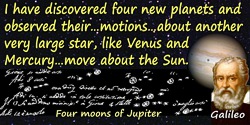
But what exceeds all wonders, I have discovered four new planets and observed their proper and particular motions, different among themselves and from the motions of all the other stars; and these new planets move about another very large star [Jupiter] like Venus and Mercury, and perchance the other known planets, move about the Sun. As soon as this tract, which I shall send to all the philosophers and mathematicians as an announcement, is finished, I shall send a copy to the Most Serene Grand Duke, together with an excellent spyglass, so that he can verify all these truths.
Letter to the Tuscan Court, 30 Jan 1610. Quoted in Albert van Heiden (ed.), Siderius Nuncius or The Sidereal Messenger (1989), 18.
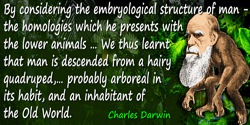
By considering the embryological structure of man - the homologies which he presents with the lower animals - the rudiments which he retains - and the reversions to which he is liable, we can partly recall in imagination the former condition of our early progenitors; and we can approximately place them in their proper position in the zoological series. We thus learnt that man is descended from a hairy quadruped, furnished with a tail and pointed ears, probably arboreal in its habit, and an inhabitant of the Old World. This creature, if its whole structure had been examined by a naturalist, would have been classed among the Quadrumana, as surely as would be the common and still more ancient progenitor of the Old and New World monkeys.
The Descent of Man (1871), Vol. 2, 389.
By its very nature the uterus is a field for growing the seeds, that is to say the ova, sown upon it. Here the eggs are fostered, and here the parts of the living [fetus], when they have further unfolded, become manifest and are made strong. Yet although it has been cast off by the mother and sown, the egg is weak and powerless and so requires the energy of the semen of the male to initiate growth. Hence in accordance with the laws of Nature, and like the other orders of living things, women produce eggs which, when received into the chamber of the uterus and fecundated by the semen of the male, unfold into a new life.
'On the Developmental Process', in H. B. Adelmann (ed.), Marcello Malpighi and the Evolution of Embryology (1966), Vol. 2, 861.
By the nineteenth century … new circumstances called for new conformity enforcers… The government locked you in a house of penitence—a penitentiary—where your feelings of remorse would theoretically pummel you without cease.
In 'The Conformity Police', Global Brain: The Evolution of Mass Mind from the Big Bang to the 21st Century (2000), 89.
By these pleasures it is permitted to relax the mind with play, in turmoils of the mind, or when our labors are light, or in great tension, or as a method of passing the time. A reliable witness is Cicero, when he says (De Oratore, 2): 'men who are accustomed to hard daily toil, when by reason of the weather they are kept from their work, betake themselves to playing with a ball, or with knucklebones or with dice, or they may also contrive for themselves some new game at their leisure.'
The Book of Games of Chance (1663), final sentences, trans. Sydney Henry Gould. In Oysten Ore, The Gambling Scholar (1953), 241.
Catastrophe Theory is a new mathematical method for describing the evolution of forms in nature. … It is particularly applicable where gradually changing forces produce sudden effects. We often call such effects catastrophes, because our intuition about the underlying continuity of the forces makes the very discontinuity of the effects so unexpected, and this has given rise to the name.
From Catastrophe Theory: Selected Papers, 1972-1977 (1977), 1. As quoted and cited in a Review by: Hector J. Sussmann, SIAM Review (Apr 1979), 21, No. 2, 269.
Celebrities are people who make news, but heroes are people who make history.
Quoted in Ponchitta Pierce, 'Who Are Our Heroes?', Parade Magazine (6 Aug 1995). As cited in Before I Pour This Over Your Head, Remember That I Love You (2011), 41 & 63.
Cezanne is the Christopher Columbus of a new continent of form.
In Art (1958), 139.
Chance throws peculiar conditions in everyone's way. If we apply intelligence, patience and special vision, we are rewarded with new creative breakthroughs.
Told to his Harvard students. As quoted, without citation, by Marcus Bach, 'Serendiptiy in the Business World', in The Rotarian (Oct 1981), 139, No. 4, 40. If you know a primary source, please contact Webmaster.
Chaos theory is a new theory invented by scientists panicked by the thought that the public were beginning to understand the old ones.
John Mitchinson and John Lloyd, If Ignorance Is Bliss, Why Aren't There More Happy People?: Smart Quotes for Dumb Times (2009), 273.
Chemical analysis and synthesis go no farther than to the separation of particles one from another, and to their reunion. No new creation or destruction of matter is within the reach of chemical agency. We might as well attempt to introduce a new planet into the solar system, or to annihilate one already in existence, as to create or destroy a particle of hydrogen.
A New System of Chemical Philosophy (1808), Vol. 1, 212.
Chemistry affords two general methods of determining the constituent principles of bodies, the method of analysis, and that of synthesis. When, for instance, by combining water with alkohol, we form the species of liquor called, in commercial language, brandy or spirit of wine, we certainly have a right to conclude, that brandy, or spirit of wine, is composed of alkohol combined with water. We can produce the same result by the analytical method; and in general it ought to be considered as a principle in chemical science, never to rest satisfied without both these species of proofs. We have this advantage in the analysis of atmospherical air, being able both to decompound it, and to form it a new in the most satisfactory manner.
Elements of Chemistry (1790), trans. R. Kerr, 33.
Chemistry is one of those branches of human knowledge which has built itself upon methods and instruments by which truth can presumably be determined. It has survived and grown because all its precepts and principles can be re-tested at any time and anywhere. So long as it remained the mysterious alchemy by which a few devotees, by devious and dubious means, presumed to change baser metals into gold, it did not flourish, but when it dealt with the fact that 56 g. of fine iron, when heated with 32 g. of flowers of sulfur, generated extra heat and gave exactly 88 g. of an entirely new substance, then additional steps could be taken by anyone. Scientific research in chemistry, since the birth of the balance and the thermometer, has been a steady growth of test and observation. It has disclosed a finite number of elementary reagents composing an infinite universe, and it is devoted to their inter-reaction for the benefit of mankind.
Address upon receiving the Perkin Medal Award, 'The Big Things in Chemistry', The Journal of Industrial and Engineering Chemistry (Feb 1921), 13, No. 2, 163.
Chemistry is the study of material transformations. Yet a knowledge of the rate, or time dependence, of chemical change is of critical importance for the successful synthesis of new materials and for the utilization of the energy generated by a reaction. During the past century it has become clear that all macroscopic chemical processes consist of many elementary chemical reactions that are themselves simply a series of encounters between atomic or molecular species. In order to understand the time dependence of chemical reactions, chemical kineticists have traditionally focused on sorting out all of the elementary chemical reactions involved in a macroscopic chemical process and determining their respective rates.
'Molecular Beam Studies of Elementary Chemical Processes', Nobel Lecture, 8 Dec 1986. In Nobel Lectures: Chemistry 1981-1990 (1992), 320.
Clearly, we have compiled a record of serious failures in recent technological encounters with the environment. In each case, the new technology was brought into use before the ultimate hazards were known. We have been quick to reap the benefits and slow to comprehend the costs.
In 'Frail Reeds in a Harsh World', Natural History Journal of the American Museum of Natural History (Feb 1969), 79, No. 2, 44.
Climbing is all about freedom, the freedom to go beyond all the rules and take a chance, to experience something new, to gain insight into human nature.
In Reinhold Messner: My Life At The Limit (2014), 12-13.
Clinical ecology [is] a new branch of medicine aimed at helping people made sick by a failure to adapt to facets of our modern, polluted environment. Adverse reactions to processed foods and their chemical contaminants, and to indoor and outdoor air pollution with petrochemicals, are becoming more and more widespread and so far these reactions are being misdiagnosed by mainstream medical practitioners and so are not treated effectively.
Quoted in article 'Richard Mackarness', Contemporary Authors Online (2002).
Come, my friends,
’Tis not too late to seek a newer world.
Push off, and sitting well in order smite
The sounding furrows; for my purpose holds
To sail beyond the sunset, and the baths
Of all the western stars, until I die.
’Tis not too late to seek a newer world.
Push off, and sitting well in order smite
The sounding furrows; for my purpose holds
To sail beyond the sunset, and the baths
Of all the western stars, until I die.
From poem, 'Ulysses', collected in Walter James Turner (ed.), Great Names: Being an Anthology of English & American Literature from Chaucer to Francis Thompson (1926), 198.
Communism is at once a complete system of proletarian ideology and a new social system. It is different from any other ideological and social system, and is the most complete, progressive, revolutionary, and rational system in human history.
In Mao Tse-Tung: On New Democracy: Talks at the Yenan Forum on Literature and Art (1967), 32.
Conferences with open attendance are very important for the stimulation of young people or other people who are new in the field. … The field of high-energy physics is, as you know, very strongly in the hands of a clique and it is hard for an outsider to enter.
From Letter to J. Howard McMillen (14 Mar 1960), in collection of Raymond Thayer Birge, Correspondence and Papers, Box 29, Folder 'Weisskopf, Victor Frederick, 1908-', Bancroft Library, University of California, Berkeley. As quoted and cited in David Kaiser, Drawing Theories Apart: The Dispersion of Feynman Diagrams in Postwar Physics (2009), 336.
Conformity-enforcing packs of vicious children and adults gradually shape the social complexes we know as religion, science, corporations, ethnic groups, and even nations. The tools of our cohesion include ridicule, rejection, snobbery, self-righteousness, assault, torture, and death by stoning, lethal injection, or the noose. A collective brain may sound warm and fuzzily New Age, but one force lashing it together is abuse.
In 'The Conformity Police', Global Brain: The Evolution of Mass Mind from the Big Bang to the 21st Century (2000), 89.
Consider the plight of a scientist of my age. I graduated from the University of California at Berkeley in 1940. In the 41 years since then the amount of biological information has increased 16 fold; during these 4 decades my capacity to absorb new information has declined at an accelerating rate and now is at least 50% less than when I was a graduate student. If one defines ignorance as the ratio of what is available to be known to what is known, there seems no alternative to the conclusion that my ignorance is at least 25 times as extensive as it was when I got my bachelor’s degree. Although I am sure that my unfortunate condition comes as no surprise to my students and younger colleagues, I personally find it somewhat depressing. My depression is tempered, however, by the fact that all biologists, young or old, developing or senescing, face the same melancholy situation because of an interlocking set of circumstances.
In 'Scientific innovation and creativity: a zoologist’s point of view', American Zoologist (1982), 22, 228.
Consider the very roots of our ability to discern truth. Above all (or perhaps I should say “underneath all”), common sense is what we depend on—that crazily elusive, ubiquitous faculty we all have to some degree or other. … If we apply common sense to itself over and over again, we wind up building a skyscraper. The ground floor of the structure is the ordinary common sense we all have, and the rules for building news floors are implicit in the ground floor itself. However, working it all out is a gigantic task, and the result is a structure that transcends mere common sense.
In Metamagical Themas: Questing for the Essence of Mind and Pattern (1985), 93–94.
Cosmology is a science which has only a few observable facts to work with. The discovery of the cosmic microwave background radiation added one—the present radiation temperature of the universe. This, however, was a significant increase in our knowledge since it requires a cosmology with a source for the radiation at an early epoch and is a new probe of that epoch. More sensitive measurements of the background radiation in the future will allow us to discover additional facts about the universe.
'Discovery of the Cosmic Microwave Background', in B. Bertotti (ed.) Modern Cosmology in Retrospect (1990), 304.
Could Hamlet have been written by a committee, or the “Mona Lisa” painted by a club? Could the New Testament have been composed as a conference report? Creative ideas do not spring from groups. They spring from individuals. The divine spark leaps from the finger of God to the finger of Adam, whether it takes ultimate shape in a law of physics or a law of the land, a poem or a policy, a sonata or a mechanical computer.
Baccalaureate address (9 Jun 1957), Yale University. In In the University Tradition (1957), 156.
Counting stars by candlelight all are dim but one is bright; the spiral light of Venus rising first and shining best, from the northwest corner of a brand-new crescent moon crickets and cicadas sing a rare and different tune.
Terrapin Station
Creating a new theory is not like destroying an old barn and erecting a skyscraper in its place. It is rather like climbing a mountain, gaining new and wider views, discovering unexpected connections between our starting point and its rich environment. But the point from which we started out still exists and can be seen, although it appears smaller and forms a tiny part of our broad view gained by the mastery of the obstacles on our adventurous way up.
Creative imagination is likely to find corroborating novel evidence even for the most 'absurd' programme, if the search has sufficient drive. This look-out for new confirming evidence is perfectly permissible. Scientists dream up phantasies and then pursue a highly selective hunt for new facts which fit these phantasies. This process may be described as “science creating its own universe” (as long as one remembers that “creating” here is used in a provocative-idiosyncratic sense). A brilliant school of scholars (backed by a rich society to finance a few well-planned tests) might succeed in pushing any fantastic programme ahead, or alternatively, if so inclined, in overthrowing any arbitrarily chosen pillar of “established knowledge”.
In 'Falsification and the Methodology of Scientific Research Programmes', in I. Lakatos and A. Musgrave (eds.), Criticism and the Growth of Knowledge: Proceedings of the International Colloquium in the Philosophy of Science, London 1965 (1970), Vol. 4, 187-8.
![Luis W. Alvarez quote: Dad [Walter C. Alvarez] … advised me to sit every few months in my reading chair for an entire evening, c](https://todayinsci.com/A/Alvarez_Luis/AlvarezLuis-ProblemsThm.jpg)
Dad [Walter C. Alvarez] … advised me to sit every few months in my reading chair for an entire evening, close my eyes and try to think of new problems to solve. I took his advice very seriously and have been glad ever since that he did.
In Alvarez: Adventures of a Physicist (1987), 58.
Dalton transformed the atomic concept from a philosophical speculation into a scientific theory—framed to explain quantitative observations, suggesting new tests and experiments, and capable of being given quantitative form through the establishment of relative masses of atomic particles.
Development of Concepts of Physics. In Clifford A. Pickover, Archimedes to Hawking: Laws of Science and the Great Minds Behind Them (2008), 175.
Darwin's Origin of Species had come into the theological world like a plough into an ant-hill. Everywhere those thus rudely awakened from their old comfort and repose had swarmed forth angry and confused. Reviews, sermons, books light and heavy, came flying at the new thinker from all sides.
From The Warfare of Science and Theology in Christendom (1898), 70.
Descartes constructed as noble a road of science, from the point at which he found geometry to that to which he carried it, as Newton himself did after him. ... He carried this spirit of geometry and invention into optics, which under him became a completely new art.
A Philosophical Dictionary: from the French? (2nd Ed.,1824), Vol. 5, 110.
Discoveries are always accidental; and the great use of science is by investigating the nature of the effects produced by any process or contrivance, and of the causes by which they are brought about, to explain the operation and determine the precise value of every new invention. This fixes as it were the latitude and longitude of each discovery, and enables us to place it in that part of the map of human knowledge which it ought to occupy. It likewise enables us to use it in taking bearings and distances, and in shaping our course when we go in search of new discoveries.
In The Complete Works of Count Rumford (1876), Vol. 4, 270.
Discovery follows discovery, each both raising and answering questions, each ending a long search, and each providing the new instruments for a new search.
In 'Prospects in the Arts and Sciences,' in Fifty Famous Essays (1964).
Divers of Hermetic Books have such involv’d Obscuritys that they may justly be compar’d to Riddles written in Cyphers. For after a Man has surmounted the difficulty of decyphering the Words & Terms, he finds a new & greater difficulty to discover ye meaning of the seemingly plain Expression.
Fragment In Boyle papers. Cited by Lawrence Principe, 'Boyle's Alchemical Pursuits', In M. Hunter (ed.), Robert Boyle Reconsidered (1994), 95
Domesticated biotechnology, once it gets into the hands of housewives and children, will give us an explosion of diversity of new living creatures … New lineages will proliferate to replace those that monoculture farming and deforestation have destroyed. Designing genomes will be a personal thing, a new art form as creative as painting or sculpture. Few of the new creations will be masterpieces, but a great many will bring joy to their creators and variety to our fauna and flora.
In 'Our Biotech Future', The New York Review of Books (2007). As quoted and cited in Kenneth Brower, 'The Danger of Cosmic Genius', The Atlantic (Dec 2010).
Doubtless the reasoning faculty, the mind, is the leading and characteristic attribute of the human race. By the exercise of this, man arrives at the properties of the natural bodies. This is science, properly and emphatically so called. It is the science of pure mathematics; and in the high branches of this science lies the truly sublime of human acquisition. If any attainment deserves that epithet, it is the knowledge, which, from the mensuration of the minutest dust of the balance, proceeds on the rising scale of material bodies, everywhere weighing, everywhere measuring, everywhere detecting and explaining the laws of force and motion, penetrating into the secret principles which hold the universe of God together, and balancing worlds against worlds, and system against system. When we seek to accompany those who pursue studies at once so high, so vast, and so exact; when we arrive at the discoveries of Newton, which pour in day on the works of God, as if a second fiat had gone forth from his own mouth; when, further, we attempt to follow those who set out where Newton paused, making his goal their starting-place, and, proceeding with demonstration upon demonstration, and discovery upon discovery, bring new worlds and new systems of worlds within the limits of the known universe, failing to learn all only because all is infinite; however we may say of man, in admiration of his physical structure, that “in form and moving he is express and admirable,” it is here, and here without irreverence, we may exclaim, “In apprehension how like a god!” The study of the pure mathematics will of course not be extensively pursued in an institution, which, like this [Boston Mechanics’ Institute], has a direct practical tendency and aim. But it is still to be remembered, that pure mathematics lie at the foundation of mechanical philosophy, and that it is ignorance only which can speak or think of that sublime science as useless research or barren speculation.
In Works (1872), Vol. 1, 180.
Dreams are renewable. No matter what our age or condition, there are still untapped possibilities within us and new beauty waiting to be born.
…...
During the half-century that has elapsed since the enunciation of the cell-theory by Schleiden and Schwann, in 1838-39, it has became ever more clearly apparent that the key to all ultimate biological problems must, in the last analysis, be sought in the cell. It was the cell-theory that first brought the structure of plants and animals under one point of view by revealing their common plan of organization. It was through the cell-theory that Kolliker and Remak opened the way to an understanding of the nature of embryological development, and the law of genetic continuity lying at the basis of inheritance. It was the cell-theory again which, in the hands of Virchaw and Max Schultze, inaugurated a new era in the history of physiology and pathology, by showing that all the various functions of the body, in health and in disease, are but the outward expression of cell-activities. And at a still later day it was through the cell-theory that Hertwig, Fol, Van Beneden, and Strasburger solved the long-standing riddle of the fertilization of the egg, and the mechanism of hereditary transmission. No other biological generalization, save only the theory of organic evolution, has brought so many apparently diverse phenomena under a common point of view or has accomplished more far the unification of knowledge. The cell-theory must therefore be placed beside the evolution-theory as one of the foundation stones of modern biology.
In The Cell in Development and Inheritance (1896), 1.
Dust consisting of fine fibers of asbestos, which are insoluble and virtually indestructible, may become a public health problem in the near future. At a recent international conference on the biological effects of asbestos sponsored by the New York Academy of Sciences, participants pointed out on the one hand that workers exposed to asbestos dust are prone in later life to develop lung cancer, and on the other hand that the use of this family of fibrous silicate compounds has expanded enormously during the past few decades. A laboratory curiosity 100 years ago, asbestos today is a major component of building materials.
— Magazine
In Scientific American (Sep 1964). As cited in '50, 100 & 150 Years Ago', Scientific American (Dec 2014), 311, No. 6, 98.
Each and every loss becomes an instance of ultimate tragedy–something that once was, but shall never be known to us. The hump of the giant deer–as a nonfossilizable item of soft anatomy–should have fallen into the maw of erased history. But our ancestors provided a wondrous rescue, and we should rejoice mightily. Every new item can instruct us; every unexpected object possesses beauty for its own sake; every rescue from history’s great shredding machine is–and I don’t know how else to say this–a holy act of salvation for a bit of totality.
…...
Each new machine or technique, in a sense, changes all existing machines and techniques, by permitting us to put them together into new combinations. The number of possible combinations rises exponentially as the number of new machines or techniques rises
Future Shock (1970).
Each new scientific development is due to the pressure of some social need. Of course … insatiable curiosity … is still nothing but a response either to an old problem of nature, or to one arising from new social circumstances.
In 'The Teaching of the History of Science', The Scientific Monthly (Sep 1918), 194.
Each of us has read somewhere that in New Guinea pidgin the word for 'piano' is (I use English spelling) 'this fellow you hit teeth belonging to him he squeal all same pig'. I am inclined to doubt whether this expression is authentic; it looks just like the kind of thing a visitor to the Islands would facetiously invent. But I accept 'cut grass belong head belong me' for 'haircut' as genuine... Such phrases seem very funny to us, and make us feel very superior to the ignorant foreigners who use long winded expressions for simple matters. And then it is our turn to name quite a simple thing, a small uncomplicated molecule consisting of nothing more than a measly 11 carbons, seven hydrogens, one nitrogen and six oxygens. We sharpen our pencils, consult our rule books and at last come up with 3-[(1, 3- dihydro-1, 3-dioxo-2H-isoindol-2-yl) oxy]-3-oxopropanoic acid. A name like that could drive any self-respecting Papuan to piano-playing.
The Chemist's English (1990), 3rd Edition, 57.
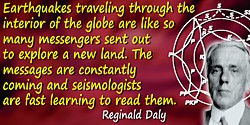
Earthquakes traveling through the interior of the globe are like so many messengers sent out to explore a new land. The messages are constantly coming and seismologists are fast learning to read them.
In Our Mobile Earth (1926), 5.
Electricity is but yet a new agent for the arts and manufactures, and, doubtless, generations unborn will regard with interest this century, in which it has been first applied to the wants of mankind.
In Preface to the Third Edition ofElements of Electro-Metallurgy: or The Art of Working in Metals by the Galvanic Fluid (1851), viii.
Engineering is quite different from science. Scientists try to understand nature. Engineers try to make things that do not exist in nature. Engineers stress invention. To embody an invention the engineer must put his idea in concrete terms, and design something that people can use. That something can be a device, a gadget, a material, a method, a computing program, an innovative experiment, a new solution to a problem, or an improvement on what is existing. Since a design has to be concrete, it must have its geometry, dimensions, and characteristic numbers. Almost all engineers working on new designs find that they do not have all the needed information. Most often, they are limited by insufficient scientific knowledge. Thus they study mathematics, physics, chemistry, biology and mechanics. Often they have to add to the sciences relevant to their profession. Thus engineering sciences are born.
Y.C. Fung and P. Tong, Classical and Computational Solid Mechanics (2001), 1.
Engineers apply the theories and principles of science and mathematics to research and develop economical solutions to practical technical problems. Their work is the link between scientific discoveries and commercial applications. Engineers design products, the machinery to build those products, the factories in which those products are made, and the systems that ensure the quality of the product and efficiency of the workforce and manufacturing process. They design, plan, and supervise the construction of buildings, highways, and transit systems. They develop and implement improved ways to extract, process, and use raw materials, such as petroleum and natural gas. They develop new materials that both improve the performance of products, and make implementing advances in technology possible. They harness the power of the sun, the earth, atoms, and electricity for use in supplying the Nation’s power needs, and create millions of products using power. Their knowledge is applied to improving many things, including the
quality of health care, the safety of food products, and the efficient operation of financial systems.
Bureau of Labor Statistics, Occupational Outlook Handbook (2000) as quoted in Charles R. Lord. Guide to Information Sources in Engineering (2000), 5. This definition has been revised and expanded over time in different issues of the Handbook.
Engineers at General Motors have developed a revolutionary new engine whose only function is to lubricate itself.
In Napalm and Silly Putty (2002), 105.
Even bigger machines, entailing even bigger concentrations of economic power and exerting ever greater violence against the environment, do not represent progress: they are a denial of wisdom. Wisdom demands a new orientation of science and technology towards the organic, the gentle, the non-violent, the elegant and beautiful.
In Small is Beautiful: Economics as if People Mattered (1973).
Ever so often in the history of human endeavour, there comes a breakthrough that takes humankind across a frontier into a new era. ... today's announcement is such a breakthrough, a breakthrough that opens the way for massive advancement in the treatment of cancer and hereditary diseases. And that is only the beginning.
From White House Announcement of the Completion of the First Survey of the Entire Human Genome Project, broadcast on the day of the publication of the first draft of the human genome. Quoted in transcript on the National Archives, Clinton White House web site, 'Text of Remarks on the Completion of the First Survey of the Entire Human Genome Project' (26 Jun 2000).
Every new body of discovery is mathematical in form, because there is no other guidance we can have.
(1931). As quoted, without citation, in Eric Temple Bell, 'They Say, What They Say, Let Them Say', Men of Mathematics (1937, 2014), Vol. 2, xvii. Webmaster has searched, but not yet found a primary source. Can you help?
Every answer given arouses new questions. The progress of science is matched by an increase in the hidden and mysterious.
In Judaism and Science (1949).
Every discoverer of a new truth, or inventor of the method which evolves it, makes a dozen, perhaps fifty, useless combinations, experiments, or trials for one successful one. In the realm of electricity or of mechanics there is no objection to this. But when such rejected failures involve a torture of animals, sometimes fearful in its character, there is a distinct objection to it.
From 'Vivisection', an original paper in Surgical Anaesthesia: Addresses, and Other Papers (1894, 1900), 369-370.
Every discovery opens a new field for investigation of facts, shows us the imperfection of our theories. It has justly been said, that the greater the circle of light, the greater the boundary of darkness by which it is surrounded.
Humphry Davy and John Davy, 'Consolations in Travel—Dialogue V—The Chemical Philosopher', The Collected Works of Sir Humphry Davy (1840), Vol. 9, 362.
Every generation has the obligation to free men’s minds for a look at new worlds… to look out from a higher plateau than the last generation.
…...
Every great advance in science has issued from a new audacity of imagination. What are now working conceptions, employed as a matter of course because they have withstood the tests of experiment and have emerged triumphant, were once speculative hypotheses.
'The Copernican Revolution', in The Quest for Certainty: A Study of the Relation of Knowledge and Action (1929), 294. Collected in John Dewey. Volume 4: The Later Works, 1925-1953: 1929 The Quest for Certainty (1984), 247. The first sentence is used as the motto of The Bronx High School of Science, New York.
Every great advance of science opens our eyes to facts which we had failed before to observe, and makes new demands on our powers of interpretation.
From The Grammar of Science (1892), 17.
Every living language, like the perspiring bodies of living creatures, is in perpetual motion and alteration; some words go off, and become obsolete; others are taken in, and by degrees grow into common use; or the same word is inverted to a new sense and notion, which in tract of time makes as observable a change in the air and features of a language as age makes in the lines and mien of a face.
Every new discovery of science is a further 'revelation' of the order which God has built into His universe.
Magazine, Look (5 Apr 1955), 30.
Every new theory as it arises believes in the flush of youth that it has the long sought goal; it sees no limits to its applicability, and believes that at last it is the fortunate theory to achieve the 'right' answer. This was true of electron theory—perhaps some readers will remember a book called The Electrical Theory of the Universe by de Tunzelman. It is true of general relativity theory with its belief that we can formulate a mathematical scheme that will extrapolate to all past and future time and the unfathomed depths of space. It has been true of wave mechanics, with its first enthusiastic claim a brief ten years ago that no problem had successfully resisted its attack provided the attack was properly made, and now the disillusionment of age when confronted by the problems of the proton and the neutron. When will we learn that logic, mathematics, physical theory, are all only inventions for formulating in compact and manageable form what we already know, like all inventions do not achieve complete success in accomplishing what they were designed to do, much less complete success in fields beyond the scope of the original design, and that our only justification for hoping to penetrate at all into the unknown with these inventions is our past experience that sometimes we have been fortunate enough to be able to push on a short distance by acquired momentum.
The Nature of Physical Theory (1936), 136.
Every now and then a man’s mind is stretched by a new idea or sensation, and never shrinks back to its former dimensions.
In The Autocrat of the Breakfast Table (1858), 311. This is widely and most often seen, (sometimes as “Attributed”), in shorter paraphrased variations similar to: “A mind that is stretched by a new idea can never go back to its original dimensions,” or “Man’s mind once stretched by a new idea, never regains its original dimension.”
Although seen very widely quoted in these or very similar, sometimes as by his son Oliver Wendell Holmes, Jr., this is probably actually a restatement of “Every now and then a man’s mind is stretched by a new idea or sensation, and never shrinks back to its former dimensions.”
Every progress that a church makes in the construction of its dogmas leads to a further taming of the free spirit; every new dogma … narrows the circle of free thought. … Science, on the other hand, liberates with every step of its development, it opens up new paths to thought … In other words, it allows the individual to be truly free.
Translated from the original German, “Jeder Fortschritt, den eine Kirche in dem Aufbau ihrer Dogmen macht, führt zu einer weiter gehenden Bändigung des freien Geistes; jedes neue Dogma …
verengt den Kreis des freien Denkens. … Die Naturwissenschaft umgekehrt befreit mit jedem Schritte ihrer Entwicklung, sie eröffnet dem Gedanken neue Bahnen … Sie gestattet, mit anderen Worten, dem Einzelnen in vollem Masse wahr zu sein.” In Speech to the 24th meeting of the German Naturalists and Physicians at Rostock 'Ueber die Aufgaben der Naturwissenschaften in dem neuen nationalen Leben Deutschlands', (On the tasks of the natural sciences in the new
national life of Germany), published in Chemisches Zentralblatt (11 Oct 1871), No. 41, 654-655. English version by Webmaster using Google translate.
Every scientist is an agent of cultural change. He may not be a champion of change; he may even resist it, as scholars of the past resisted the new truths of historical geology, biological evolution, unitary chemistry, and non-Euclidean geometry. But to the extent that he is a true professional, the scientist is inescapably an agent of change. His tools are the instruments of change—skepticism, the challenge to establish authority, criticism, rationality, and individuality.
In Science in Russian Culture: A History to 1860 (1963).
Every time you tear a leaf off a calendar, you present a new place for new ideas and progress.
Every utterance from government - from justifying 90-day detention to invading other countries [and] to curtailing civil liberties - is about the dangers of religious division and fundamentalism. Yet New Labour is approving new faith schools hand over fist. We have had the grotesque spectacle of a British prime minister, on the floor of the House of Commons, defending - like some medieval crusader - the teaching of creationism in the science curriculum at a sponsor-run school whose running costs are wholly met from the public purse.
In The Guardian (10 Apr 2006).
Everyone knows that in research there are no final answers, only insights that allow one to formulate new questions.
In A Slot Machine, A Broken Test Tube: An Autobiography (1984).
Everything which is new has to come out of fundamental research otherwise it’s not new.
From transcript of video interview, with Hans Jörnvallat, the meeting of Nobel Laureates in Lindau, Germany (Jun 2000), obelprize.org website.
Evolution has encountered no intellectual trouble; no new arguments have been offered. Creationism is a home-grown phenomenon of American sociocultural history—a splinter movement … who believe that every word in the Bible must be literally true, whatever such a claim might mean.
Leonardo's Mountain of Clams and the Diet of Worms: Essays on Natural History (1998), 270.
Experience is the sole source of truth: it alone can teach us something new; it alone can give us certainty.
In La Science et l’Hypothèse (1901, 1908), 167, as translated in Henri Poincaré and William John Greenstreet (trans.), Science and Hypothesis (1902, 1905), 140. From the original French, “L'expérience est la source unique de la vérité: elle seule peut nous apprendre quelque chose de nouveau; elle seule peut nous donner la certitude. Voilà deux points que nul ne peut contester.”
Experiment is the sole source of truth. It alone can teach us something new; it alone can give us certainty.
Science and Hypothesis (1902), trans. W. J. G. and preface by J. Larmor (1905), 140.
Experimental observations are only experience carefully planned in advance, and designed to form a secure basis of new knowledge.
In The Design of Experiments (1935, 1970), 7.
Faced with a new mutation in an organism, or a fundamental change in its living conditions, the biologist is frequently in no position whatever to predict its future prospects. He has to wait and see. For instance, the hairy mammoth seems to have been an admirable animal, intelligent and well-accoutered. Now that it is extinct, we try to understand why it failed. I doubt that any biologist thinks he could have predicted that failure. Fitness and survival are by nature estimates of past performance.
In Scientific American (Sep 1958). As cited in '50, 100 & 150 years ago', Scientific American (Sep 2008), 299, No. 3, 14.
Faced with the widespread destruction of the environment, people everywhere are coming to understand that we cannot continue to use the goods of the earth as we have in the past … [A] new ecological awareness is beginning to emerge which rather than being downplayed, ought to be encouraged to develop into concrete programs and initiatives. (8 Dec 1989)
The Ecological Crisis: A Common Responsibility. Quoted in Al Gore, Earth in the Balance: Ecology and the Human Spirit (2000), 262.
Faraday thinks from day to day, against a background of older thinking, and anticipating new facts of tomorrow. In other words, he thinks in three dimensions of time; past, present, and future.
In 'The Scientific Grammar of Michael Faraday’s Diaries', Part I, 'The Classic of Science', A Classic and a Founder (1937), collected in Rosenstock-Huessy Papers (1981), Vol. 1, 1.
Fatware has been a nasty little dance that we’ve endured for most of this decade. Intel builds a hot new machine and Microsoft follows quickly with new and ever more bulky software that consumes all of the new machine’s resources to do its stuff. So, Intel builds another machine…
In The Chicago Tribune (1 Feb 1998).
Fertilization of mammalian eggs is followed by successive cell divisions and progressive differentiation, first into the early embryo and subsequently into all of the cell types that make up the adult animal. Transfer of a single nucleus at a specific stage of development, to an enucleated unfertilized egg, provided an opportunity to investigate whether cellular differentiation to that stage involved irreversible genetic modification. The first offspring to develop from a differentiated cell were born after nuclear transfer from an embryo-derived cell line that had been induced to became quiescent. Using the same procedure, we now report the birth of live lambs from three new cell populations established from adult mammary gland, fetus and embryo. The fact that a lamb was derived from an adult cell confirms that differentiation of that cell did not involve the irreversible modification of genetic material required far development to term. The birth of lambs from differentiated fetal and adult cells also reinforces previous speculation that by inducing donor cells to became quiescent it will be possible to obtain normal development from a wide variety of differentiated cells.
[Co-author of paper announcing the cloned sheep, ‘Dolly’.]
[Co-author of paper announcing the cloned sheep, ‘Dolly’.]
In I. Wilmut, A. E. Schnieke, J. McWhir, et al., 'Viable Offspring Derived from Petal and Adult Mammalian Cells', Nature (1997), 385, 810.
Finally in a large population, divided and subdivided into partially isolated local races of small size, there is a continually shifting differentiation among the latter (intensified by local differences in selection but occurring under uniform and static conditions) which inevitably brings about an indefinitely continuing, irreversible, adaptive, and much more rapid evolution of the species. Complete isolation in this case, and more slowly in the preceding, originates new species differing for the most part in nonadaptive parallel orthogenetic lines, in accordance with the conditions. It is suggested, in conclusion, that the differing statistical situations to be expected among natural species are adequate to account for the different sorts of evolutionary processes which have been described, and that, in particular, conditions in nature are often such as to bring about the state of poise among opposing tendencies on which an indefinitely continuing evolutionary process depends.
In 'Evolution In Mendelian Populations', Genetics, (1931), 16, 158.
Firm support has been found for the assertion that electricity occurs at thousands of points where we at most conjectured that it was present. Innumerable electrical particles oscillate in every flame and light source. We can in fact assume that every heat source is filled with electrons which will continue to oscillate ceaselessly and indefinitely. All these electrons leave their impression on the emitted rays. We can hope that experimental study of the radiation phenomena, which are exposed to various influences, but in particular to the effect of magnetism, will provide us with useful data concerning a new field, that of atomistic astronomy, as Lodge called it, populated with atoms and electrons instead of planets and worlds.
'Light Radiation in a Magnetic Field', Nobel Lecture, 2 May 1903. In Nobel Lectures: Physics 1901-1921 (1967), 40.
First... a new theory is attacked as absurd; then it is admitted to be true, but obvious and insignificant; finally it is seen to be so important that its adversaries claim that they themselves discovered it.
'Pragmatism's Conception of Truth', in Pragmatism: A New Name for some Old Ways of Thinking, Popular Lectures on Philosophy (1907), 198.
Five centuries ago the printing press sparked a radical reshaping of the nature of education. By bringing a master’s words to those who could not hear a master’s voice, the technology of printing dissolved the notion that education must be reserved for those with the means to hire personal tutors. Today we are approaching a new technological revolution, one whose impact on education may be as far-reaching as that of the printing press: the emergence of powerful computers that are sufficiently inexpensive to be used by students for learning, play and exploration. It is our hope that these powerful but simple tools for creating and exploring richly interactive environments will dissolve the barriers to the production of knowledge as the printing press dissolved the barriers to its transmission.
As co-author with A.A. diSessa, from 'Preface', Turtle Geometry: The Computer as a Medium for Exploring Mathematics (1986), xiii.
For a physicist mathematics is not just a tool by means of which phenomena can be calculated, it is the main source of concepts and principles by means of which new theories can be created.
In 'Mathematics in the Physical Sciences', Scientific American (Sep 1964), 211, No. 3, 129.
For me and many scientists, the understanding of nature is based upon scientific investigations that add to humankind’s ever increasing fund of knowledge. The fund is ever changing as new generations of scientists add to, debate, and reinterpret the data.
From 'Mystery of the First Americans: Claims for the Remains: C. Vance Haynes, Jr.', web page on pbs.org website.
For more than two years, ever since August 6, 1945, I have been looking at physicists as science writer for The New York Herald Tribune.
The context of this quote makes it interesting. White had been a staff reporter at the newspaper since 1943. The day he became science writer is notable. The first atom bomb was dropped on Hiroshima, Japan on 6 Aug 1945. The newspaper immediately responded to the need to provide information on science for the public’s interest stimulated by that event. (The newspaper also had to compete with the New York Times science reporter, William L. Laurence, who had been on the inside track at the Manhattan Project, and covered the news of the atomic attacks on Japan.) In 'A Newsman Looks at Physicists', Physics Today (May 1948), 1, No. 1, 15.
For my part, I too much value the pursuit of truth and the discovery of any new fact in nature, to avoid inquiry because it appears to clash with prevailing opinions.
In 'Experimental Investigation of a New Force', The Quarterly Journal of Science, and Annals of Astronomy, Biology, Geology, Industrial Arts, Manufactures, and Technology (Jul 1871), New Series, 1, 341.
For myself, I found that I was fitted for nothing so well as for the study of Truth; as having a mind nimble and versatile enough to catch the resemblances of things (which is the chief point) , and at the same time steady enough to fix and distinguish their subtler differences; as being gifted by nature with desire to seek, patience to doubt, fondness to meditate, slowness to assert, readiness to reconsider, carefulness to dispose and set in order; and as being a man that neither affects what is new nor admires what is old, and that hates every kind of imposture. So I thought my nature had a kind of familiarity and relationship with Truth.
From 'Progress of philosophical speculations. Preface to intended treatise De Interpretatione Naturæ (1603), in Francis Bacon and James Spedding (ed.), Works of Francis Bacon (1868), Vol. 3, 85.
For the birth of something new, there has to be a happening. Newton saw an apple fall; James Watt watched a kettle boil; Roentgen fogged some photographic plates. And these people knew enough to translate ordinary happenings into something new...
Quoted by André Maurois, The Life of Sir Alexander Fleming, trans. by Gerard Hopkins (1959), 167. Cited in Steven Otfinoski, Alexander Fleming: Conquering Disease with Penicillin (1993), 1.
For the philosopher, order is the entirety of repetitions manifested, in the form of types or of laws, by perceived objects. Order is an intelligible relation. For the biologist, order is a sequence in space and time. However, according to Plato, all things arise out of their opposites. Order was born of the original disorder, and the long evolution responsible for the present biological order necessarily had to engender disorder.
An organism is a molecular society, and biological order is a kind of social order. Social order is opposed to revolution, which is an abrupt change of order, and to anarchy, which is the absence of order.
I am presenting here today both revolution and anarchy, for which I am fortunately not the only one responsible. However, anarchy cannot survive and prosper except in an ordered society, and revolution becomes sooner or later the new order. Viruses have not failed to follow the general law. They are strict parasites which, born of disorder, have created a very remarkable new order to ensure their own perpetuation.
An organism is a molecular society, and biological order is a kind of social order. Social order is opposed to revolution, which is an abrupt change of order, and to anarchy, which is the absence of order.
I am presenting here today both revolution and anarchy, for which I am fortunately not the only one responsible. However, anarchy cannot survive and prosper except in an ordered society, and revolution becomes sooner or later the new order. Viruses have not failed to follow the general law. They are strict parasites which, born of disorder, have created a very remarkable new order to ensure their own perpetuation.
'Interaction Among Virus, Cell, and Organism', Nobel Lecture (11 Dec 1965). In Nobel Lectures: Physiology or Medicine 1963-1970 (1972), 174.
For the saving the long progression of the thoughts to remote and first principles in every case, the mind should provide itself several stages; that is to say, intermediate principles, which it might have recourse to in the examining those positions that come in its way. These, though they are not self-evident principles, yet, if they have been made out from them by a wary and unquestionable deduction, may be depended on as certain and infallible truths, and serve as unquestionable truths to prove other points depending upon them, by a nearer and shorter view than remote and general maxims. … And thus mathematicians do, who do not in every new problem run it back to the first axioms through all the whole train of intermediate propositions. Certain theorems that they have settled to themselves upon sure demonstration, serve to resolve to them multitudes of propositions which depend on them, and are as firmly made out from thence as if the mind went afresh over every link of the whole chain that tie them to first self-evident principles.
In The Conduct of the Understanding, Sect. 21.
For this knowledge of right living, we have sought a new name... . As theology is the science of religious life, and biology the science of [physical] life ... so let Oekology be henceforth the science of [our] normal lives ... the worthiest of all the applied sciences which teaches the principles on which to found... healthy... and happy life.
Quoted in Robert Clarke (ed.), Ellen Swallow: The Woman Who Founded Ecology (1973), 120.
For three days now this angel, almost too heavenly for earth has been my fiancée … Life stands before me like an eternal spring with new and brilliant colours. Upon his engagement to Johanne Osthof of Brunswick; they married 9 Oct 1805.
Letter to Farkas Wolfgang Bolyai (1804). Quoted in Stephen Hawking, God Created the Integers: The Mathematical Breakthroughs (2005), 567.
FORTRAN —’the infantile disorder’—, by now nearly 20 years old, is hopelessly inadequate for whatever computer application you have in mind today: it is now too clumsy, too risky, and too expensive to use. PL/I —’the fatal disease’— belongs more to the problem set than to the solution set. It is practically impossible to teach good programming to students that have had a prior exposure to BASIC: as potential programmers they are mentally mutilated beyond hope of regeneration. The use of COBOL cripples the mind; its teaching should, therefore, be regarded as a criminal offence. APL is a mistake, carried through to perfection. It is the language of the future for the programming techniques of the past: it creates a new generation of coding bums.
…...
Fortunately science, like that nature to which it belongs, is neither limited by time nor by space. It belongs to the world, and is of no country and of no age. The more we know, the more we feel our ignorance; the more we feel how much remains unknown; and in philosophy, the sentiment of the Macedonian hero can never apply,– there are always new worlds to conquer.
…...
Fractal is a word invented by Mandelbrot to bring together under one heading a large class of objects that have [played] … an historical role … in the development of pure mathematics. A great revolution of ideas separates the classical mathematics of the 19th century from the modern mathematics of the 20th. Classical mathematics had its roots in the regular geometric structures of Euclid and the continuously evolving dynamics of Newton. Modern mathematics began with Cantor’s set theory and Peano’s space-filling curve. Historically, the revolution was forced by the discovery of mathematical structures that did not fit the patterns of Euclid and Newton. These new structures were regarded … as “pathological,” .… as a “gallery of monsters,” akin to the cubist paintings and atonal music that were upsetting established standards of taste in the arts at about the same time. The mathematicians who created the monsters regarded them as important in showing that the world of pure mathematics contains a richness of possibilities going far beyond the simple structures that they saw in Nature. Twentieth-century mathematics flowered in the belief that it had transcended completely the limitations imposed by its natural origins.
Now, as Mandelbrot points out, … Nature has played a joke on the mathematicians. The 19th-century mathematicians may not have been lacking in imagination, but Nature was not. The same pathological structures that the mathematicians invented to break loose from 19th-century naturalism turn out to be inherent in familiar objects all around us.
Now, as Mandelbrot points out, … Nature has played a joke on the mathematicians. The 19th-century mathematicians may not have been lacking in imagination, but Nature was not. The same pathological structures that the mathematicians invented to break loose from 19th-century naturalism turn out to be inherent in familiar objects all around us.
From 'Characterizing Irregularity', Science (12 May 1978), 200, No. 4342, 677-678. Quoted in Benoit Mandelbrot, The Fractal Geometry of Nature (1977, 1983), 3-4.
Frequently, I have been asked if an experiment I have planned is pure or applied science; to me it is more important to know if the experiment will yield new and probably enduring knowledge about nature. If it is likely to yield such knowledge, it is, in my opinion, good fundamental research; and this is more important than whether the motivation is purely aesthetic satisfaction on the part of the experimenter on the one hand or the improvement of the stability of a high-power transistor on the other.
Quoted in Richard R. Nelson, 'The Link Between Science and Invention: The Case of the Transistor,' The Rate and Direction of the Inventive Activity (1962). In Daniel S. Greenberg, The Politics of Pure Science (1999), 32, footnote.
Freudian psychoanalytical theory is a mythology that answers pretty well to Levi-Strauss's descriptions. It brings some kind of order into incoherence; it, too, hangs together, makes sense, leaves no loose ends, and is never (but never) at a loss for explanation. In a state of bewilderment it may therefore bring comfort and relief … give its subject a new and deeper understanding of his own condition and of the nature of his relationship to his fellow men. A mythical structure will be built up around him which makes sense and is believable-in, regardless of whether or not it is true.
From 'Science and Literature', The Hope of Progress: A Scientist Looks at Problems in Philosophy, Literature and Science (1973), 29.
From all we have learnt about the structure of living matter, we must be prepared to find it working in a manner that cannot be reduced to the ordinary laws of physics. And that not on the ground that there is any “new force” or what not, directing the behavior of the single atoms within a living organism, but because the construction is different from anything we have yet tested in the physical laboratory.
What is Life? (1956), 74.
From my earliest childhood I nourished and cherished the desire to make a creditable journey in a new country, and write such a respectable account of its natural history as should give me a niche amongst the scientific explorers of the globe I inhabit, and hand my name down as a useful contributor of original matter.
Letter to Charles Darwin (1854), in Francis Darwin, More Letters of Charles Darwin (1903).
From the sexual, or amatorial, generation of plants new varieties, or improvements, are frequently obtained; as many of the young plants from seeds are dissimilar to the parent, and some of them superior to the parent in the qualities we wish to possess... Sexual reproduction is the chef d'oeuvre, the master-piece of nature.
Phytologia. (1800), 115, 103.
From thus meditating on the great similarity of the structure of the warm-blooded animals, and at the same time of the great changes they undergo both before and after their nativity; and by considering in how minute a portion of time many of the changes of animals above described have been produced; would it be too bold to imagine that, in the great length of time since the earth began to exist, perhaps millions of ages before the commencement of the history of mankind would it be too bold to imagine that all warm-blooded animals have arisen from one living filament, which THE GREAT FIRST CAUSE endued with animality, with the power of acquiring new parts, attended with new propensities, directed by irritations, sensations, volitions and associations, and thus possessing the faculty of continuing to improve by its own inherent activity, and of delivering down these improvements by generation to its posterity, world without end!
Zoonomia, Or, The Laws of Organic Life, in three parts (1803), Vol. 1, 397.
Gödel proved that the world of pure mathematics is inexhaustible; no finite set of axioms and rules of inference can ever encompass the whole of mathematics; given any finite set of axioms, we can find meaningful mathematical questions which the axioms leave unanswered. I hope that an analogous Situation exists in the physical world. If my view of the future is correct, it means that the world of physics and astronomy is also inexhaustible; no matter how far we go into the future, there will always be new things happening, new information coming in, new worlds to explore, a constantly expanding domain of life, consciousness, and memory.
From Lecture 1, 'Philosophy', in a series of four James Arthur Lectures, 'Lectures on Time and its Mysteries' at New York University (Autumn 1978). Printed in 'Time Without End: Physics and Biology in an Open Universe', Reviews of Modern Physics (Jul 1979), 51, 449.

Gold and iron at the present day, as in ancient times, are the rulers of the world; and the great events in the world of mineral art are not the discovery of new substances, but of new and rich localities of old ones.
Lecture (26 Npv 1851), to the London Society of Arts, 'The General Bearing of the Great Exhibition on the Progress of Art and Science', collected in Lectures on the Results of the Great Exhibition of 1851' (1852), 3.
Governments of the Industrial World, you weary giants of flesh and steel, I come from Cyberspace, the new home of Mind. On behalf of the future, I ask you of the past to leave us alone. You are not welcome among us. You have no sovereignty where we gather.
Opening statement of 'A Declaration of the Independence of Cyberspace' (8 Feb 1996). Published on Electronic Frontier Foundation website. Reproduced in Lawrence Lessig, Code: Version 2.0) (2008), 302.
Gradually the sunken land begins to rise again, and falls perhaps again, and rises again after that, more and more gently each time, till as it were the panting earth, worn out with the fierce passions of her fiery youth, has sobbed herself to sleep once more, and this new world of man is made.
'Thoughts in a Gravel Pit', a lecture delivered at the Mechanics' Institute, Odiham (1857). The Works of Charles Kingsley (1880), 282.
Great capitalists could not themselves cultivate vast extents of land, and not wanting to diminish their revenues by renting them, would be induced to sell portions suitable for cultivation by their new owners, and would then carry their money into new industrial and commercial enterprises.
From Appendix A, 'Extracts From the Unpublished Writings of Carnot', Reflections on the Motive Power of Heat (1890, 2nd ed. 1897), 213.
Guido was as much enchanted by the rudiments of algebra as he would have been if I had given him an engine worked by steam, with a methylated spirit lamp to heat the boiler; more enchanted, perhaps for the engine would have got broken, and, remaining always itself, would in any case have lost its charm, while the rudiments of algebra continued to grow and blossom in his mind with an unfailing luxuriance. Every day he made the discovery of something which seemed to him exquisitely beautiful; the new toy was inexhaustible in its potentialities.
In Young Archimedes: And Other Stories (1924), 299. The fictional character, Guido, is a seven year old boy. Methylated spirit is an alcohol fuel.
Half a century ago Oswald (1910) distinguished classicists and romanticists among the scientific investigators: the former being inclined to design schemes and to use consistently the deductions from working hypotheses; the latter being more fit for intuitive discoveries of functional relations between phenomena and therefore more able to open up new fields of study. Examples of both character types are Werner and Hutton. Werner was a real classicist. At the end of the eighteenth century he postulated the theory of “neptunism,” according to which all rocks including granites, were deposited in primeval seas. It was an artificial scheme, but, as a classification system, it worked quite satisfactorily at the time. Hutton, his contemporary and opponent, was more a romanticist. His concept of “plutonism” supposed continually recurrent circuits of matter, which like gigantic paddle wheels raise material from various depths of the earth and carry it off again. This is a very flexible system which opens the mind to accept the possible occurrence in the course of time of a great variety of interrelated plutonic and tectonic processes.
In 'The Scientific Character of Geology', The Journal of Geology (Jul 1961), 69, No. 4, 456-7.
Hardly a year passes that fails to find a new, oft-times exotic, research method or technique added to the armamentarium of political inquiry. Anyone who cannot negotiate Chi squares, assess randomization, statistical significance, and standard deviations
…...
Hawking in his chariot of thought,
With cosmic brilliance he sought
The equations profound,
Space and time unbound.
In science’s tapestry, new threads he wrought.
With cosmic brilliance he sought
The equations profound,
Space and time unbound.
In science’s tapestry, new threads he wrought.
Limerick about Stephen Hawking. Co-written by Artificial Intelligence and Webmaster.
He [Louis Pasteur] imagined further experiments, to bring more light, for contradictions excited him to new investigations.
As quoted in René J. Dubos, Louis Pasteur, Free Lance of Science (1960, 1986), 76.
He leads a new crusade, his bald head glistening... One somehow pities him, despite his so palpable imbecilities... But let no one, laughing at him, underestimate the magic that lies in his black, malignant eye, his frayed but still eloquent voice. He can shake and inflame these poor ignoramuses as no other man among us...
[Describing William Jennings Bryan, orator, at the Scopes Monkey Trial.]
[Describing William Jennings Bryan, orator, at the Scopes Monkey Trial.]
Henry Louis Mencken and S.T. Joshi (ed.), H.L. Mencken on Religion (2002), 18.
He scarce had ceased when the superior fiend
Was moving toward the shore; his ponderous shield
Ethereal temper, massy, large and round,
Behind him cast; the broad circumference
Hung on his shoulders like the moon, whose orb
Through optic glass the Tuscan artist views
At evening from the top of Fésolè,
Or in Valdarno, to descry new lands,
Rivers or mountains in her spotty globe.
Was moving toward the shore; his ponderous shield
Ethereal temper, massy, large and round,
Behind him cast; the broad circumference
Hung on his shoulders like the moon, whose orb
Through optic glass the Tuscan artist views
At evening from the top of Fésolè,
Or in Valdarno, to descry new lands,
Rivers or mountains in her spotty globe.
Paradise Lost, Books I and II (1667), edited by Anna Baldwin (1998), lines 283-91, p. 9.
He who studies it [Nature] has continually the exquisite pleasure of discerning or half discerning and divining laws; regularities glimmer through an appearance of confusion, analogies between phenomena of a different order suggest themselves and set the imagination in motion; the mind is haunted with the sense of a vast unity not yet discoverable or nameable. There is food for contemplation which never runs short; you are gazing at an object which is always growing clearer, and yet always, in the very act of growing clearer, presenting new mysteries.
From 'Natural History', Macmillan's Magazine (1875), 31, 366.
Here we come to a new and peculiar street railway … There is no steam on board. You ask how is this train propelled? Between the track and under ground is a cable running upon rollers for the length of the road…
In Travels with Jottings: From Midland to the Pacific (1880), 33.
History is primarily a socio-psychological science. In the conflict between the old and the new tendencies in historical investigation... we are at the turn of the stream, the parting of the ways in historical science.
Historical Development and Present Character of the Science of History (1906), 111.
History tells us that [leading minds] can’t do it alone. From landing on the moon, to sequencing the human genome, to inventing the Internet, America has been the first to cross that new frontier because we had leaders who paved the way: leaders like President Kennedy, who inspired us to push the boundaries of the known world and achieve the impossible; leaders who not only invested in our scientists, but who respected the integrity of the scientific process.
From weekly Democratic address as President-Elect, online video (20 Dec 2008), announcing his selection of science and technology advisers. C-Span video 282995-102.
History warns us … that it is the customary fate of new truths to begin as heresies and to end as superstitions; and, as matters now stand, it is hardly rash to anticipate that, in another twenty years, the new generation, educated under the influences of the present day, will be in danger of accepting the main doctrines of the “Origin of Species,” with as little reflection, and it may be with as little justification, as so many of our contemporaries, twenty years ago, rejected them.
'The Coming of Age of the Origin of Species' (1880). In Collected Essays, Vol. 2: Darwiniana (1893), 229.
Holding then to science with one hand—the left hand—we give the right hand to religion, and cry: ‘Open Thou mine eyes, that I may behold wondrous things, more wondrous than the shining worlds can tell.’ Obedient to the promise, religion does awaken faculties within us, does teach our eyes to the beholding of more wonderful things. Those great worlds blazing like suns die like feeble stars in the glory of the morning, in the presence of this new light. The soul knows that an infinite sea of love is all about it, throbbing through it, everlasting arms of affection lift it, and it bathes itself in the clear consciousness of a Father’s love.
…...
Hop in a bathysphere, take in the atmosphere, it’s like New York, but with more fish.
How can we have any new ideas or fresh outlooks when 90 per cent of the scientists who have ever lived have still not died?
In Scientific World, 1969.
However far the calculating reason of the mathematician may seem separated from the bold flight of the artist’s phantasy, it must be remembered that these expressions are but momentary images snatched arbitrarily from among the activities of both. In the projection of new theories the mathematician needs as bold and creative a phantasy as the productive artist, and in the execution of the details of a composition the artist too must calculate dispassionately the means which are necessary for the successful consummation of the parts. Common to both is the creation, the generation, of forms out of mind.
From Die Entwickelung der Mathematik im Zusammenhange mit der Ausbreitung der Kultur (1893), 4. As translated in Robert Édouard Moritz, Memorabilia Mathematica; Or, The Philomath’s Quotation-Book (1914), 185. From the original German, “Wie weit auch der rechnende Verstand des Mathematikers von dem kühnen Fluge der Phantasie des Künstlers getrennt zu sein scheint, so bezeichnen diese Ausdrücke doch blosse Augenblicksbilder, die willkürlich aus der Thätigkeit Beider herausgerissen sind. Bei dem Entwurfe neuer Theorieen bedarf der Mathematiker einer ebenso kühnen und schöpferischen Phantasie wie der schaffende Künstler, und bei der Ausführung der Einzelheiten eines Werkes muss auch der Künstler kühl alle Mittel berechnen, welche zum Gelingen der Theile erforderlich sind. Gemeinsam ist Beiden die Hervorbringung, die Erzeugung der Gebilde aus dem Geiste.”
However far the mathematician’s calculating senses seem to be separated from the audacious flight of the artist’s imagination, these manifestations refer to mere instantaneous images, which have been arbitrarily torn from the operation of both. In designing new theories, the mathematician needs an equally bold and inspired imagination as creative as the artist, and in carrying out the details of a work the artist must unemotionally reckon all the resources necessary for the success of the parts. Common to both is the fabrication, the creation of the structure from the intellect.
From Die Entwickelung der Mathematik im Zusammenhange mit der Ausbreitung der Kultur (1893), 4. Translated by Webmaster using online resources. From the original German, “Wie weit auch der rechnende Verstand des Mathematikers von dem kühnen Fluge der Phantasie des Künstlers getrennt zu sein scheint, so bezeichnen diese Ausdrücke doch blosse Augenblicksbilder, die willkürlich aus der Thätigkeit Beider herausgerissen sind. Bei dem Entwurfe neuer Theorieen bedarf der Mathematiker einer ebenso kühnen und schöpferischen Phantasie wie der schaffende Künstler, und bei der Ausführung der Einzelheiten eines Werkes muss auch der Künstler kühl alle Mittel berechnen, welche zum Gelingen der Theile erforderlich sind. Gemeinsam ist Beiden die Hervorbringung, die Erzeugung der Gebilde aus dem Geiste.”
However, the small probability of a similar encounter [of the earth with a comet], can become very great in adding up over a huge sequence of centuries. It is easy to picture to oneself the effects of this impact upon the Earth. The axis and the motion of rotation changed; the seas abandoning their old position to throw themselves toward the new equator; a large part of men and animals drowned in this universal deluge, or destroyed by the violent tremor imparted to the terrestrial globe.
Exposition du Système du Monde, 2nd edition (1799), 208, trans. Ivor Grattan-Guinness.
Humanity is at the very beginning of its existence—a new-born babe, with all the unexplored potentialities of babyhood; and until the last few moments its interest has been centred, absolutely and exclusively, on its cradle and feeding bottle.
EOS: Or the Wider Aspects of Cosmology (1928), 12.
Humanity stands ... before a great problem of finding new raw materials and new sources of energy that shall never become exhausted. In the meantime we must not waste what we have, but must leave as much as possible for coming generations.
Chemistry in Modern Life (1925), trans. Clifford Shattuck-Leonard, vii.
Hypothesis is the most important mental technique of the investigator, and its main function is to suggest new experiments or new observations. Indeed, most experiments and many observations are carried out with the deliberate object of testing an hypothesis. Another function is to help one see the significance of an object or event that otherwise would mean nothing. For instance, a mind prepared by the hypothesis of evolution would make many more significant observations on a field excursion than one not so prepared. Hypotheses should be used as tools to uncover new facts rather than as ends in themselves.
The Art of Scientific Investigation (1953), 46.
I am confident that if we recommit ourselves to discovery; if we support science education to create the next generation of scientists and engineers right here in America; if we have the vision to believe and invest in things unseen, then we can lead the world into a new future of peace and prosperity.
From weekly Democratic address as President-Elect, online video (20 Dec 2008), announcing his selection of science and technology advisers. C-Span video 282995-102.
I am delighted that I have found a new reaction to demonstrate even to the blind the structure of the interstitial stroma of the cerebral cortex. I let the silver nitrate react with pieces of brain hardened in potassium dichromate. I have already obtained magnificent results and hope to do even better in the future.
Letter to Nicolo Manfredi, 16 Feb 1873. Archive source. Quoted in Paolo Mazzarello, The Hidden Structure: A Scientific Biography of Camillo Golgi, trans. and ed. Henry A. Buchtel and Aldo Badiani (1999), 63.
I am not pleading with you to make changes, I am telling you you have got to make them—not because I say so, but because old Father Time will take care of you if you don’t change. Consequently, you need a procurement department for new ideas.
As quoted in book review, T.A. Boyd, 'Charles F. Kettering: Prophet of Progress', Science (30 Jan 1959), 256.
I am one of those who think, like Nobel, that humanity will draw more good than evil from new discoveries.
In Pierre Biquard, Frédéric Joliot-Curie: the Man and his Theories (1966), 11.
I am trying to get the hang of this new fangled writing machine, but I am not making a shining success of it. However, this is the first attempt I have ever made & yet I perceive I shall soon & easily acquire a fine facility in its use. … The machine has several virtues. I believe it will print faster than I can write. One may lean back in his chair & work it. It piles an awful stack of words on one page. It don't muss things or scatter ink blots around. Of course it saves paper.
Letter (9 Dec 1874). Quoted in B. Blivens, Jr., The Wonderful Writing Machine (1954), 61.
I assumed that nature would “evaluate” my work as I went along. If I was doing what nature wanted done, and if I was doing it in promising ways, permitted by nature’s principles, I would find my work being economically sustained—and vice versa, in which latter negative case I must quickly cease doing what I had been doing and seek logically alternative courses until I found the new course that nature signified her approval of by providing for its physical support.
In Critical Path (1982), 145.
I believe as a matter of faith that the extension of space travel to the limits of the solar system will probably be accomplished in several decades, perhaps before the end of the century. Pluto is 4000 million miles from the sun. The required minimum launching velocity is about 10 miles per second and the transit time is 46 years. Thus we would have to make the velocity considerably higher to make the trip interesting to man. Travel to the stars is dependent on radically new discoveries in science and technology. The nearest star is 25 million million miles way and requires a travel time of more than four years at the speed of light. Prof. Dr. Ing. E. Sanger has speculated that velocities comparable with the speed of light might be attained in the next century, but such extrapolation of current technology is probably not very reliable.
In Popular Mechanics (Sep 1961), 262.
I believe television is going to be the test of the modern world, and that in this new opportunity to see beyond the range of our vision we shall discover either a new and unbearable disturbance of the general peace or a saving radiance in the sky. We shall stand or fall by television—of that I am quite sure
In 'Removal' (Jul 1938), collected in One Man's Meat (1942), 3.
I believe that life can go on forever. It takes a million years to evolve a new species, ten million for a new genus, one hundred million for a class, a billion for a phylum—and that’s usually as far as your imagination goes. In a billion years, it seems, intelligent life might be as different from humans as humans are from insects. But what would happen in another ten billion years? It’s utterly impossible to conceive of ourselves changing as drastically as that, over and over again. All you can say is, on that kind of time scale the material form that life would take is completely open. To change from a human being to a cloud may seem a big order, but it’s the kind of change you’d expect over billions of years.
Quoted in Omni (1986), 8, 38.
I believe that the Dayton trial marked the beginning of the decline of fundamentalism. … I feel that restrictive legislation on academic freedom is forever a thing of the past, that religion and science may now address one another in an atmosphere of mutual respect and of a common quest for truth. I like to think that the Dayton trial had some part in bringing to birth this new era.
From 'Reflections—Forty Years After', in Jerry R. Tompkins (ed.), D-Days at Dayton: Reflections on the Scopes Trial(1965), 31. As quoted in Stephen Jay Gould, Hen’s Teeth and Horse’s Toes: Further Reflections in Natural History (1983), 274.
I believe that the laws of physics such as they are, such as they have been taught to us, are not the inevitable truth. We believe in the laws, or we experiment* with them each day, yet I believe it is possible to consider the existence of a universe in which these laws would be extended, changed a very tiny bit, in a precisely demarcated way. Consequently we immediately achieve extraordinary results, different yet certainly not far from the truth. After all, every century or two a new scientist comes along who changes the laws of physics, isn’t that so? After Newton there were many who did, and there were even more after Einstein, right? We have to wait to see how the laws in question will change over time, then… In any case, without being a scientist myself I can still hope to reach parallel results, if you will, in art.
Epigraph, in James Housefield, Playing with Earth and Sky: Astronomy, Geography, and the Art of Marcel Duchamp (2016), ix. As modified by James Housefield, from Guy Viau interview of Marcel Duchamp on Canadian Radio Television (17 July 1960), 'Simply Change Your Name', translated by Sarah Skinner Kilborne in Tout-Fait: the Marcel Duchamp Studies Online Journal 2, no. 4 (2002). [*Note: Where the Housefield in the Epigraph uses the word “experiment”, the original French gives “expérimentons”, which in the unmodified translation by Sarah Skinner Kilborne is written more correctly as “experience.” —Webmaster]
I call this Spirit, unknown hitherto, by the new name of Gas, which can neither be constrained by Vessels, nor reduced into a visible body, unless the feed being first extinguished. But Bodies do contain this Spirit, and do sometimes wholly depart into such a Spirit, not indeed, because it is actually in those very bodies (for truly it could not be detained, yea the whole composed body should I lie away at once) but it is a Spirit grown together, coagulated after the manner of a body, and is stirred up by an attained ferment, as in Wine, the juyce of unripe Grapes, bread, hydromel or water and Honey.
Oriatrike: Or, Physick Refined, trans. John Chandler (1662), 106.
I came into the room, which was half dark, and presently spotted Lord Kelvin in the audience and realised that I was in for trouble at the last part of my speech dealing with the age of the earth, where my views conflicted with his. To my relief, Kelvin fell fast asleep, but as I came to the important point, I saw the old bird sit up, open an eye and cock a baleful glance at me! Then a sudden inspiration came, and I said Lord Kelvin had limited the age of the earth, provided no new source was discovered. That prophetic utterance refers to what we are now considering tonight, radium! Behold! the old boy beamed upon me.
The italicized phrase refers to “no new source” of energy. Concerning a Lecture by Rutherford, at the Royal Institution, dealing with the energy of subterranean radium, which had an effect prolonging the heat of the Earth. Arthur S. Eve wrote that Rutherford “used to tell humorous stories about this lecture long afterwards:” — followed by the subject quote above, as its own paragraph. As given in Arthur S. Eve, Rutherford: Being the Life and Letters of the Rt. Hon. Lord Rutherford, O.M. (1939), 107. The story lacks quotation marks, and thus should be regarded as perhaps Eve’s own words giving a faithful recollection, rather than Rutherford’s verbatim words. (However, note that the style used throughout the book is to omit quotation marks from their own separate paragraph.)
I can certainly wish for new, large, and properly constructed instruments, and enough of them, but to state where and by what means they are to be procured, this I cannot do. Tycho Brahe has given Mastlin an instrument of metal as a present, which would be very useful if Mastlin could afford the cost of transporting it from the Baltic, and if he could hope that it would travel such a long way undamaged… . One can really ask for nothing better for the observation of the sun than an opening in a tower and a protected place underneath.
As quoted in James Bruce Ross and Mary Martin McLaughlin, The Portable Renaissance Reader (1968), 605.
I can see him [Sylvester] now, with his white beard and few locks of gray hair, his forehead wrinkled o’er with thoughts, writing rapidly his figures and formulae on the board, sometimes explaining as he wrote, while we, his listeners, caught the reflected sounds from the board. But stop, something is not right, he pauses, his hand goes to his forehead to help his thought, he goes over the work again, emphasizes the leading points, and finally discovers his difficulty. Perhaps it is some error in his figures, perhaps an oversight in the reasoning. Sometimes, however, the difficulty is not elucidated, and then there is not much to the rest of the lecture. But at the next lecture we would hear of some new discovery that was the outcome of that difficulty, and of some article for the Journal, which he had begun. If a text-book had been taken up at the beginning, with the intention of following it, that text-book was most likely doomed to oblivion for the rest of the term, or until the class had been made listeners to every new thought and principle that had sprung from the laboratory of his mind, in consequence of that first difficulty. Other difficulties would soon appear, so that no text-book could last more than half of the term. In this way his class listened to almost all of the work that subsequently appeared in the Journal. It seemed to be the quality of his mind that he must adhere to one subject. He would think about it, talk about it to his class, and finally write about it for the Journal. The merest accident might start him, but once started, every moment, every thought was given to it, and, as much as possible, he read what others had done in the same direction; but this last seemed to be his real point; he could not read without finding difficulties in the way of understanding the author. Thus, often his own work reproduced what had been done by others, and he did not find it out until too late.
A notable example of this is in his theory of cyclotomic functions, which he had reproduced in several foreign journals, only to find that he had been greatly anticipated by foreign authors. It was manifest, one of the critics said, that the learned professor had not read Rummer’s elementary results in the theory of ideal primes. Yet Professor Smith’s report on the theory of numbers, which contained a full synopsis of Kummer’s theory, was Professor Sylvester’s constant companion.
This weakness of Professor Sylvester, in not being able to read what others had done, is perhaps a concomitant of his peculiar genius. Other minds could pass over little difficulties and not be troubled by them, and so go on to a final understanding of the results of the author. But not so with him. A difficulty, however small, worried him, and he was sure to have difficulties until the subject had been worked over in his own way, to correspond with his own mode of thought. To read the work of others, meant therefore to him an almost independent development of it. Like the man whose pleasure in life is to pioneer the way for society into the forests, his rugged mind could derive satisfaction only in hewing out its own paths; and only when his efforts brought him into the uncleared fields of mathematics did he find his place in the Universe.
A notable example of this is in his theory of cyclotomic functions, which he had reproduced in several foreign journals, only to find that he had been greatly anticipated by foreign authors. It was manifest, one of the critics said, that the learned professor had not read Rummer’s elementary results in the theory of ideal primes. Yet Professor Smith’s report on the theory of numbers, which contained a full synopsis of Kummer’s theory, was Professor Sylvester’s constant companion.
This weakness of Professor Sylvester, in not being able to read what others had done, is perhaps a concomitant of his peculiar genius. Other minds could pass over little difficulties and not be troubled by them, and so go on to a final understanding of the results of the author. But not so with him. A difficulty, however small, worried him, and he was sure to have difficulties until the subject had been worked over in his own way, to correspond with his own mode of thought. To read the work of others, meant therefore to him an almost independent development of it. Like the man whose pleasure in life is to pioneer the way for society into the forests, his rugged mind could derive satisfaction only in hewing out its own paths; and only when his efforts brought him into the uncleared fields of mathematics did he find his place in the Universe.
In Florian Cajori, Teaching and History of Mathematics in the United States (1890), 266-267.
I cannot find anything showing early aptitude for acquiring languages; but that he [Clifford] had it and was fond of exercising it in later life is certain. One practical reason for it was the desire of being able to read mathematical papers in foreign journals; but this would not account for his taking up Spanish, of which he acquired a competent knowledge in the course of a tour to the Pyrenees. When he was at Algiers in 1876 he began Arabic, and made progress enough to follow in a general way a course of lessons given in that language. He read modern Greek fluently, and at one time he was furious about Sanskrit. He even spent some time on hieroglyphics. A new language is a riddle before it is conquered, a power in the hand afterwards: to Clifford every riddle was a challenge, and every chance of new power a divine opportunity to be seized. Hence he was likewise interested in the various modes of conveying and expressing language invented for special purposes, such as the Morse alphabet and shorthand. … I have forgotten to mention his command of French and German, the former of which he knew very well, and the latter quite sufficiently; …
In paper, 'William Kingdon Clifford', The Fortnightly Review (1879), 31, 671. Published in advance of Leslie Stephen and Frederick Pollock (eds.), Clifford’s Lectures and Essays (1879), Vol. 1, Introduction, 9. The 'Introduction' was written by Pollock.
I cannot let the year run out without sending you a sign of my continued existence and to extend my sincere wishes for the well-being of you and your dear ones in the New Year. We will not be able to send New Year greetings much longer; but even when we have passed away and have long since decomposed, the bonds that united us in life will remain and we shall be remembered as a not too common example of two men, who truly without envy and jealousy, contended and struggled in the same field, yet nevertheless remained always closely bound in friendship.
Letter from Liebig to Wohler (31 Dec 1871). Quoted in Ralph Oesper, The Human Side of Scientists (1975), 206.
I conceived and developed a new geometry of nature and implemented its use in a number of diverse fields. It describes many of the irregular and fragmented patterns around us, and leads to full-fledged theories, by identifying a family of shapes I call fractals.
The Fractal Geometry of Nature (1977, 1983), Introduction, xiii.
I consider then, that generally speaking, to render a reason of an effect or Phaenomenon, is to deduce It from something else in Nature more known than it self, and that consequently there may be divers kinds of Degrees of Explication of the same thing. For although such Explications be the most satisfactory to the Understanding, wherein ’tis shewn how the effect is produc’d by the more primitive and Catholick Affection of Matter, namely bulk, shape and motion, yet are not these Explications to be despis’d, wherein particular effects are deduc’d from the more obvious and familiar Qualities or States of Bodies, … For in the search after Natural Causes, every new measure of Discovery does both instinct and gratifie the Understanding.
Physiological Essays (1669), 20.
I definitely deny that any pathological process, i.e. any life-process taking place under unfavourable circumstances, is able to call forth qualitatively new formations lying beyond the customary range of forms characteristic of the species. All pathological formations are either degenerations, transformations, or repetitions of typical physiological structures.
In 'Cellular-Pathologie', Archiv für pathologische Anatomie und Physiologie und fur klinische Medizin (1855), 8, 13-14, as translated in LellandJ. Rather, 'Cellular Pathology', Disease, Life, and Man: Selected Essays by Rudolf Virchow (1958), 81.
I do not claim that intelligence, however defined, has no genetic basis–I regard it as trivially true, uninteresting, and unimportant that it does. The expression of any trait represents a complex interaction of heredity and environment ... a specific claim purporting to demonstrate a mean genetic deficiency in the intelligence of American blacks rests upon no new facts whatever and can cite no valid data in its support. It is just as likely that blacks have a genetic advantage over whites. And, either way, it doesn’t matter a damn. An individual can’t be judged by his group mean.
…...
I do not think we can impose limits on research. Through hundreds of thousands of years, man’s intellectual curiosity has been essential to all the gains we have made. Although in recent times we have progressed from chance and hit-or-miss methods to consciously directed research, we still cannot know in advance what the results may be. It would be regressive and dangerous to trammel the free search for new forms of truth.
In Margaret Mead and Rhoda Bubendey Métraux (ed.), Margaret Mead, Some Personal Views (1979), 89.
I end with a word on the new symbols which I have employed. Most writers on logic strongly object to all symbols. ... I should advise the reader not to make up his mind on this point until he has well weighed two facts which nobody disputes, both separately and in connexion. First, logic is the only science which has made no progress since the revival of letters; secondly, logic is the only science which has produced no growth of symbols.
I enjoy, and always have enjoyed, disturbing scientists.
[About pioneering with his new ideas.]
[About pioneering with his new ideas.]
As quoted by Neil Shubin in The Universe Within: The Deep History of the Human Body (2013), 113
I feel, sometimes, as the renaissance man must have felt in finding new riches at every point and in the certainty that unexplored areas of knowledge and experience await at every turn.
Address to the University Students (10 Dec 1956 ) in Göran Liljestrand (ed.), Les Prix Nobel en 1955 (1956).
I find myself now preaching about the golden age of manned spaceflight, because something went on there, within us, that we’re missing. When we went to the Moon, it was not only just standing on a new plateau for all mankind. We changed the way everybody in the world thought of themselves, you know. It was a change that went on inside of us. And we’re losing that.
From interview with Ron Stone (24 May 1999) for NASA Johnson Space Center Oral History Project on NASA website.
I grew up in Brooklyn, New York … a city neighborhood that included houses, lampposts, walls, and bushes. But with an early bedtime in the winter, I could look out my window and see the stars, and the stars were not like anything else in my neighborhood. [At age 5] I didn’t know what they were.
[At age 9] my mother … said to me, “You have a library card now, and you know how to read. Take the streetcar to the library and get a book on stars.” … I stepped up to the big librarian and asked for a book on stars. … I sat down and found out the answer, which was something really stunning.I found out that the stars are glowing balls of gas. I also found out that the Sun is a star but really close and that the stars are all suns except really far away I didn’t know any physics or mathematics at that time, but I could imagine how far you’d have to move the Sun away from us till it was only as bright as a star. It was in that library, reading that book, that the scale of the universe opened up to me. There was something beautiful about it.
At that young age, I already knew that I’d be very happy if I could devote my life to finding out more about the stars and the planets that go around them. And it’s been my great good fortune to do just that.
[At age 9] my mother … said to me, “You have a library card now, and you know how to read. Take the streetcar to the library and get a book on stars.” … I stepped up to the big librarian and asked for a book on stars. … I sat down and found out the answer, which was something really stunning.I found out that the stars are glowing balls of gas. I also found out that the Sun is a star but really close and that the stars are all suns except really far away I didn’t know any physics or mathematics at that time, but I could imagine how far you’d have to move the Sun away from us till it was only as bright as a star. It was in that library, reading that book, that the scale of the universe opened up to me. There was something beautiful about it.
At that young age, I already knew that I’d be very happy if I could devote my life to finding out more about the stars and the planets that go around them. And it’s been my great good fortune to do just that.
Quoted in interview with Jack Rightmyer, in 'Stars in His Eyes', Highlights For Children (1 Jan 1997). Ages as given in Tom Head (ed.), Conversations with Carl Sagan (2006), x.
I had … during many years, followed a golden rule, namely, that whenever a published fact, a new observation or thought came across me, which was opposed by my general results, to make a memorandum of it without fail and at once; for I had found by experience that such facts and thoughts were far more apt to escape from memory than favorable ones.
In The Autobiography of Charles Darwin with original omissions restored, edited by Nora Barlow (1958).
I had a Meccano set with which I “played” endlessly. Meccano which was invented by Frank Hornby around 1900, is called Erector Set in the US. New toys (mainly Lego) have led to the extinction of Meccano and this has been a major disaster as far as the education of our young engineers and scientists is concerned. Lego is a technically trivial plaything and kids love it partly because it is so simple and partly because it is seductively coloured. However it is only a toy, whereas Meccano is a real engineering kit and it teaches one skill which I consider to be the most important that anyone can acquire: This is the sensitive touch needed to thread a nut on a bolt and tighten them with a screwdriver and spanner just enough that they stay locked, but not so tightly that the thread is stripped or they cannot be unscrewed. On those occasions (usually during a party at your house) when the handbasin tap is closed so tightly that you cannot turn it back on, you know the last person to use the washroom never had a Meccano set.
Nobel laureate autobiography in Les Prix Nobel/Nobel Lectures 1996 (1997), 189.
I hate it. I just do. That [artificial turf], local news, the IRS, and hair dryers are the four worst inventions of the century.
Football analyst, quoted in Sport (1985). In Julia Vitullo-Martin and J. Robert Moskin, The Executive's Book of Quotations (2002), 148.
I have been able to solve a few problems of mathematical physics on which the greatest mathematicians since Euler have struggled in vain … But the pride I might have held in my conclusions was perceptibly lessened by the fact that I knew that the solution of these problems had almost always come to me as the gradual generalization of favorable examples, by a series of fortunate conjectures, after many errors. I am fain to compare myself with a wanderer on the mountains who, not knowing the path, climbs slowly and painfully upwards and often has to retrace his steps because he can go no further—then, whether by taking thought or from luck, discovers a new track that leads him on a little till at length when he reaches the summit he finds to his shame that there is a royal road by which he might have ascended, had he only the wits to find the right approach to it. In my works, I naturally said nothing about my mistake to the reader, but only described the made track by which he may now reach the same heights without difficulty.
(1891) As quoted in translation in Leo Koenigsberger and Frances A. Welby (trans.), Hermann von Helmholtz (1906), 180-181.
I have been arranging certain experiments in reference to the notion that Gravity itself may be practically and directly related by experiment to the other powers of matter and this morning proceeded to make them. It was almost with a feeling of awe that I went to work, for if the hope should prove well founded, how great and mighty and sublime in its hitherto unchangeable character is the force I am trying to deal with, and how large may be the new domain of knowledge that may be opened up to the mind of man.
In Thomas Martin (ed.) Faraday’s Diary: Sept. 6, 1847 - Oct. 17, 1851 (1934), 156.
I have been branded with folly and madness for attempting what the world calls impossibilities, and even from the great engineer, the late James Watt, who said ... that I deserved hanging for bringing into use the high-pressure engine. This has so far been my reward from the public; but should this be all, I shall be satisfied by the great secret pleasure and laudable pride that I feel in my own breast from having been the instrument of bringing forward new principles and new arrangements of boundless value to my country, and however much I may be straitened in pecuniary circumstances, the great honour of being a useful subject can never be taken from me, which far exceeds riches.
From letter to Davies Gilbert, written a few months before Trevithick's last illness. Quoted in Francis Trevithick, Life of Richard Trevithick: With an Account of his Inventions (1872), Vol. 2, 395-6.
I have been scientifically studying the traits and dispositions of the “lower animals” (so-called,) and contrasting them with the traits and dispositions of man. I find the result profoundly humiliating to me. For it obliges me to renounce my allegiance to the Darwinian theory of the Ascent of Man from the Lower Animals; since it now seems plain to me that that theory ought to be vacated in favor of a new and truer one, this new and truer one to be named the Descent of Man from the Higher Animals.
From 'Man's Place in the Animal World' (1896) in What is Man?: and Other Philosophical Writings (1973), 81.
I have before mentioned mathematics, wherein algebra gives new helps and views to the understanding. If I propose these it is not to make every man a thorough mathematician or deep algebraist; but yet I think the study of them is of infinite use even to grown men; first by experimentally convincing them, that to make anyone reason well, it is not enough to have parts wherewith he is satisfied, and that serve him well enough in his ordinary course. A man in those studies will see, that however good he may think his understanding, yet in many things, and those very visible, it may fail him. This would take off that presumption that most men have of themselves in this part; and they would not be so apt to think their minds wanted no helps to enlarge them, that there could be nothing added to the acuteness and penetration of their understanding.
In The Conduct of the Understanding, Sect. 7.
I have decided today that the United States should proceed at once with the development of an entirely new type of space transportation system designed to help transform the space frontier of the 1970s into familiar territory, easily accessible for human endeavor in the 1980s and ’90s.
This system will center on a space vehicle that can shuttle repeatedly from Earth to orbit and back. It will revolutionize transportation into near space, by routinizing it. It will take the astronomical costs out of astronautics. In short, it will go a long way toward delivering the rich benefits of practical space utilization and the valuable spin-offs from space efforts into the daily lives of Americans and all people.
Statement by President Nixon (5 Jan 1972).
I have just got a new theory of eternity.
Alleged comment to the secretary of the Netherlands embassy, seated beside him at a National Academy of Sciences annual awards ceremony (1921), after listening to lengthy formal speeches. As quoted in Ronald W. Clark, Einstein: The Life and Times (1971), 389.
I have long since come to see that no one deserves either praise or blame for the ideas that come to him, but only for the actions resulting therefrom. Ideas and beliefs are certainly not voluntary acts. They come to us—we hardly know how or whence, and once they have got possession of us we can not reject or change them at will. It is for the common good that the promulgation of ideas should be free—uninfluenced by either praise or blame, reward or punishment. But the actions which result from our ideas may properly be so treated, because it is only by patient thought and work, that new ideas, if good and true, become adopted and utilized; while, if untrue or if not adequately presented to the world, they are rejected or forgotten.
In 'The Origin of the Theory of Natural Selection', Popular Science Monthly (1909), 74, 400.
I have never looked upon ease and happiness as ends in themselves–this critical basis I call the ideal of a pigsty. The ideals that have lighted my way, and time after time have given me new courage to face life cheerfully, have been Kindness, Beauty, and Truth. Without the sense of kinship with men of like mind, without the occupation with the objective world, the eternally unattainable in the field of art and scientific endeavors, life would have seemed empty to me. The trite objects of human efforts–possessions, outward success, luxury–have always seemed to me contemptible.
In 'What I Believe,' Forum and Century (1930).
I have no doubt that certain learned men, now that the novelty of the hypotheses in this work has been widely reported—for it establishes that the Earth moves, and indeed that the Sun is motionless in the middle of the universe—are extremely shocked, and think that the scholarly disciplines, rightly established once and for all, should not be upset. But if they are willing to judge the matter thoroughly, they will find that the author of this work has committed nothing which deserves censure. For it is proper for an astronomer to establish a record of the motions of the heavens with diligent and skilful observations, and then to think out and construct laws for them, or rather hypotheses, whatever their nature may be, since the true laws cannot be reached by the use of reason; and from those assumptions the motions can be correctly calculated, both for the future and for the past. Our author has shown himself outstandingly skilful in both these respects. Nor is it necessary that these hypotheses should be true, nor indeed even probable, but it is sufficient if they merely produce calculations which agree with the observations. … For it is clear enough that this subject is completely and simply ignorant of the laws which produce apparently irregular motions. And if it does work out any laws—as certainly it does work out very many—it does not do so in any way with the aim of persuading anyone that they are valid, but only to provide a correct basis for calculation. Since different hypotheses are sometimes available to explain one and the same motion (for instance eccentricity or an epicycle for the motion of the Sun) an astronomer will prefer to seize on the one which is easiest to grasp; a philosopher will perhaps look more for probability; but neither will grasp or convey anything certain, unless it has been divinely revealed to him. Let us therefore allow these new hypotheses also to become known beside the older, which are no more probable, especially since they are remarkable and easy; and let them bring with them the vast treasury of highly learned observations. And let no one expect from astronomy, as far as hypotheses are concerned, anything certain, since it cannot produce any such thing, in case if he seizes on things constructed for another other purpose as true, he departs from this discipline more foolish than he came to it.
Although this preface would have been assumed by contemporary readers to be written by Copernicus, it was unsigned. It is now believed to have been written and added at press time by Andreas Osiander (who was then overseeing the printing of the book). It suggests the earth’s motion as described was merely a mathematical device, and not to be taken as absolute reality. Text as given in 'To the Reader on the Hypotheses in this Work', Copernicus: On the Revolutions of the Heavenly Spheres (1543), translated by Alistair Matheson Duncan (1976), 22-3. By adding this preface, Osiander wished to stave off criticism by theologians. See also the Andreas Osiander Quotes page of this website.
I have no doubt that it is possible to give a new direction to technological development, a direction that shall lead it back to the real needs of man, and that also means: to the actual size of man. Man is small, and, therefore, small is beautiful. To go
Small is Beautiful (1973).
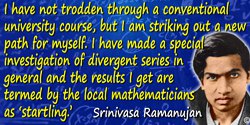
I have not trodden through a conventional university course, but I am striking out a new path for myself. I have made a special investigation of divergent series in general and the results I get are termed by the local mathematicians as “startling.”
First letter to G.H. Hardy (16 Jan 1913). In Collected Papers of Srinivasa Ramanujan (1927), xxiii. Hardy notes he did “seem to remember his telling me that his friends had given him some assistance” in writing the letter because Ramanujan's “knowledge of English, at that stage of his life, could scarcely have been sufficient.”
I have not yet lost a feeling of wonder, and of delight, that this delicate motion should reside in all the things around us, revealing itself only to him who looks for it. I remember, in the winter of our first experiments, just seven years ago, looking on snow with new eyes. There the snow lay around my doorstep—great heaps of protons quietly precessing in the earth’s magnetic field. To see the world for a moment as something rich and strange is the private reward of many a discovery.
Opening remark, Nobel Lecture (11 Dec 1952).
I have patiently born with abundance of Clamour and Ralary [raillery], for beginning a new Practice here (for the Good of the Publick) which comes well Recommended, from Gentlemen of Figure & Learning, and which well agrees to Reason, when try’d & duly considered, viz. Artificially giving the Small Pocks, by Inoculation, to One of my Children, and Two of my Slaves, in order to prevent the hazard of Life… . and they never took one grain or drop of Medicine since, & are perfectly well.
By “clamour” he is referring to the public commotion in Boston reacting to his introduction of smallpox inoculation. Public statement in the Gazette (Jul 10-17), No. 85, 1721. As quoted and cited in Reginald H. Fitz, 'Zabdiel Boylston, Inoculator, and the Epidemic of Smallpox in Boston in 1721', Bulletin of the Johns Hopkins Hospital (1911), 22, 319.
I have procured some of the mice mentioned in my former letters, a young one and a female with young, both of which I have preserved in brandy. From the colour, shape, size, and manner of nesting, I make no doubt but that the species is nondescript [not known to science]. They are much smaller and more slender than the mus domesticus medius of Ray; and have more of the squirrel or dormouse colour ... They never enter into houses; are carried into ricks and barns with the sheaves; abound in harvest, and build their nests amidst the straws of the corn above the ground, and sometimes in thistles.
[Part of his observations on the harvest mouse, which he was the first to describe as a new species.]
[Part of his observations on the harvest mouse, which he was the first to describe as a new species.]
Letter XII (4 Nov 1767) in The Natural History of Selborne (1789, 1899), 31.
I have rather, however, been desirous of discovering new facts and new relations dependent on magneto-electric induction, than of exalting the force of those already obtained; being assured that the latter would find their full development hereafter.
Read 12 Jan 1832, reprinted from Philosophical Transactions of 1831-1828, in 'Second Series', Experimental Researches in Electricity: Volume 1 (1839), 47.
I have satisfied myself that the [cosmic] rays are not generated by the formation of new matter in space, a process which would be like water running up a hill. Nor do they come to any appreciable amount from the stars. According to my investigations the sun emits a radiation of such penetrative power that it is virtually impossible to absorb it in lead or other substances. ... This ray, which I call the primary solar ray, gives rise to a secondary radiation by impact against the cosmic dust scattered through space. It is the secondary radiation which now is commonly called the cosmic ray, and comes, of course, equally from all directions in space. [The article continues: The phenomena of radioactivity are not the result of forces within the radioactive substances but are caused by this ray emitted by the sun. If radium could be screened effectively against this ray it would cease to be radioactive, he said.]
Quoted in 'Tesla, 75, Predicts New Power Source', New York Times (5 Jul 1931), Section 2, 1.
I have seen a thousand sunsets and sunrises, on land where it floods forest and mountains with honey coloured light, at sea where it rises and sets like a blood orange in a multicoloured nest of cloud, slipping in and out of the vast ocean. I have seen a thousand moons: harvest moons like gold coins, winter moons as white as ice chips, new moons like baby swans’ feathers.
Letter to Lee McGeorge (31 Jul 1978). Collected in Letters of Note: Volume 2: An Eclectic Collection of Correspondence (2016), 76.
I have tried to read philosophers of all ages and have found many illuminating ideas but no steady progress toward deeper knowledge and understanding. Science, however, gives me the feeling of steady progress: I am convinced that theoretical physics is actual philosophy. It has revolutionized fundamental concepts, e.g., about space and time (relativity), about causality (quantum theory), and about substance and matter (atomistics), and it has taught us new methods of thinking (complementarity) which are applicable far beyond physics.
— Max Born
My Life & My Views (1968), 48.
I have, also, a good deal of respect for the job they [physicists] did in the first months after Hiroshima. The world desperately needed information on this new problem in the daily life of the planet, and the physicists, after a slow start, did a good job of giving it to them. It hasn’t come out with a fraction of the efficiency that the teachers might have wished, but it was infinitely more effective than anyone would have dared expect.
In 'A Newsman Looks at Physicists', Physics Today (May 1948), 1, No. 1, 15.
I hear beyond the range of sound,
I see beyond the range of sight,
New earths and skies and seas around,
And in my day the sun doth pale his light.
I see beyond the range of sight,
New earths and skies and seas around,
And in my day the sun doth pale his light.
…...
I heard … xenon was a good anesthesia. … I thought, “How can xenon, which doesn’t form any chemical compounds, serve as a general anesthetic? … I lay awake at night for a few minutes before going to sleep, and during the next couple of weeks each night I would think, “…how do anesthetic agents work?" Then I forgot to do it after a while, but I’d trained my unconscious mind to keep this question alive and to call [it] to my consciousness whenever a new idea turned up…. So seven years went by. [One day I] put my feet up on the desk and started reading my mail, and here was a letter from George Jeffrey … an x-ray crystallographer, on his determination of the structure of a hydrate crystal. Immediately I sat up, took my feet off the desk, and said, “I understand anesthesia!” … I spent a year [and] determined the structure of chloroform hydrate, and then I wrote my paper published in June of 1961.
Interview with George B. Kauffman and Laurie M. Kauffman, in 'Linus Pauling: Reflections', American Scientist (Nov-Dec 1994), 82, No. 6, 522-523.
I here present the reader with a new sign which I have discovered for detecting diseases of the chest. This consists in percussion of the human thorax, whereby, according to the character of the particular sounds then elicited, an opinion is formed of the internal state of that cavity.
New Invention by Means of Percussing the Human Thorax for Detecting Signs of Obscure Disease of the Interior of the Chest, Inventum novum ex percussione (31 Dec 1761).
I invite you to entertain some new beliefs about dolphins … [that] these Cetacea with huge brains are more intelligent than any man or woman..
A statement showing his enthusiasm, but overstating the intelligence of dolphins. In Communication between Man and Dolphin: The Possibilities of Talking with Other Species (1978), 1.
I know all about neutrinos, and my friend here knows about everything else in astrophysics.
His standard phrase when introducing himself and a colleague to a new acquaintance.
His standard phrase when introducing himself and a colleague to a new acquaintance.
Sky and Telescope (Jan 1990)
I know of nothing so pleasant to minds as the discovery of anything which is at once new and valuable; for nothing which so lightens and sweetens toil, as the hopeful pursuit of such discovery.
In The Wit & Wisdom of Abraham Lincoln by James C. Humes (1996).
I like to tell students that the jobs I took [at NASA] after my Ph.D. were not in existence only a few years before. New opportunities can open up for you in this ever changing field.
From interview, 'Happy 90th Birthday, Nancy', on NASA website (30 May 2017).
I like to think that when Medawar and his colleagues showed that immunological tolerance could be produced experimentally the new immunology was born. This is a science which to me has far greater potentialities both for practical use in medicine and for the better understanding of living process than the classical immunochemistry which it is incorporating and superseding.
'Immunological Recognition of Self', Nobel Lecture, 12 December 1960. In Nobel Lectures Physiology or Medicine 1942-1962 (1964), 689.
I may conclude this chapter by quoting a saying of Professor Agassiz, that whenever a new and startling fact is brought to light in science, people first say, 'it is not true,' then that 'it is contrary to religion,' and lastly, 'that everybody knew it before.'
The Antiquity of Man (1863), 105.
I must admit that when I chose the name, “vitamine,” I was well aware that these substances might later prove not to be of an amine nature. However, it was necessary for me to choose a name that would sound well and serve as a catchword, since I had already at that time no doubt about the importance and the future popularity of the new field.
The Vitamines translated by Harry Ennis Dubin (1922), 26, footnote.
I never got tired of watching the radar echo from an aircraft as it first appeared as a tiny blip in the noise on the cathode-ray tube, and then grew slowly into a big deflection as the aircraft came nearer. This strange new power to “see” things at great distances, through clouds or darkness, was a magical extension of our senses. It gave me the same thrill that I felt in the early days of radio when I first heard a voice coming out of a horn...
In Boffin: A Personal Story of the Early Days of Radar, Radio Astronomy and Quantum Optics (1991), 9.
I never said a word against eminent men of science. What I complain of is a vague popular philosophy which supposes itself to be scientific when it is really nothing but a sort of new religion and an uncommonly nasty one. When people talked about the fall of man, they knew they were talking about a mystery, a thing they didn’t understand. Now they talk about the survival of the fittest: they think they do understand it, whereas they have not merely no notion, they have an elaborately false notion of what the words mean.
In The Club of Queer Trades (1903, 1905), 241.
I observed on most collected stones the imprints of innumerable plant fragments which were so different from those which are growing in the Lyonnais, in the nearby provinces, and even in the rest of France, that I felt like collecting plants in a new world… The number of these leaves, the way they separated easily, and the great variety of plants whose imprints I saw, appeared to me just as many volumes of botany representing in the same quarry the oldest library of the world.
In 'Examen des causes des Impressions des Plantes marquees sur certaines Pierres des environs de Saint-Chaumont dans le Lionnais', Memoires de l’ Academie Royale des Sciences (1718), 364, as trans. by Albert V. and Marguerite Carozzi.
I presume that few who have paid any attention to the history of the Mathematical Analysis, will doubt that it has been developed in a certain order, or that that order has been, to a great extent, necessary—being determined, either by steps of logical deduction, or by the successive introduction of new ideas and conceptions, when the time for their evolution had arrived. And these are the causes that operate in perfect harmony. Each new scientific conception gives occasion to new applications of deductive reasoning; but those applications may be only possible through the methods and the processes which belong to an earlier stage.
Explaining his choice for the exposition in historical order of the topics in A Treatise on Differential Equations (1859), Preface, v-vi.
I should like to compare this rearrangement which the proteins undergo in the animal or vegetable organism to the making up of a railroad train. In their passage through the body parts of the whole may be left behind, and here and there new parts added on. In order to understand fully the change we must remember that the proteins are composed of Bausteine united in very different ways. Some of them contain Bausteine of many kinds. The multiplicity of the proteins is determined by many causes, first through the differences in the nature of the constituent Bausteine; and secondly, through differences in the arrangement of them. The number of Bausteine which may take part in the formation of the proteins is about as large as the number of letters in the alphabet. When we consider that through the combination of letters an infinitely large number of thoughts may be expressed, we can understand how vast a number of the properties of the organism may be recorded in the small space which is occupied by the protein molecules. It enables us to understand how it is possible for the proteins of the sex-cells to contain, to a certain extent, a complete description of the species and even of the individual. We may also comprehend how great and important the task is to determine the structure of the proteins, and why the biochemist has devoted himself with so much industry to their analysis.
'The Chemical Composition of the Cell', The Harvey Lectures (1911), 7, 45.
I strongly oppose cloning, as do most Americans. We recoil at the idea of growing human beings for spare body parts or creating life for our convenience. And while we must devote enormous energy to conquering disease, it is equally important that we pay attention to the moral concerns raised by the new frontier of human embryo stem cell research. Even the most noble ends do not justify any means.
'Address to the Nation on Stem Cell Research', (9 Aug 2001) in Public Papers Of The Presidents Of The United States, George W. Bush, 2001 (2004), Book 2, 955.
I then [in 1902] possessed one decigramme of very pure radium chloride. It had taken me almost four years to produce the kind of evidence which chemical science demands, that radium is truly a new element. … The demonstration that cost so much effort was the basis of the new science of radioactivity.
As translated by Charlotte and Vernon Kellogg in Marie Curie, 'Autobiographical Notes', Pierre Curie (1923), 188.
I think chemistry is being frittered away by the hairsplitting of the organic chemists; we have new compounds discovered, which scarcely differ from the known ones and when discovered are valueless—very illustrations perhaps of their refinements in analysis, but very little aiding the progress of true science.
Letter to William Grove (5 Jan 1845), The Letters of Faraday and Schoenbein, 1836-1862 (1899), Footnote, 209.
I think it is the general rule that the originator of a new idea is not the most suitable person to develop it, because his fears of something going wrong are really too strong…
At age 69.
At age 69.
The Development of Quantum Theory (1971). In A. Pais, 'Playing With Equations, the Dirac Way'. Behram N. Kursunoglu (Ed.) and Eugene Paul Wigner (Ed.), Paul Adrien Maurice Dirac: Reminiscences about a Great Physicist (1990), 111.
I think popular belief in bogus sciences is steadily increasing. … Almost every paper except the New York Times, not to mention dozens of magazines, features a horoscope column. Professional astrologers now outnumber astronomers.
As quoted in Kendrick Frazier, 'A Mind at Play: An Interview with Martin Gardner', Skeptical Inquirer (Mar/Apr 1998), 22, No. 2, 37.
I think that the difference between pure and applied mathematics is social rather than scientific. A pure mathematician is paid for making mathematical discoveries. An applied mathematician is paid for the solution of given problems.
When Columbus set sail, he was like an applied mathematician, paid for the search of the solution of a concrete problem: find a way to India. His discovery of the New World was similar to the work of a pure mathematician.
When Columbus set sail, he was like an applied mathematician, paid for the search of the solution of a concrete problem: find a way to India. His discovery of the New World was similar to the work of a pure mathematician.
In S.H. Lui, 'An Interview with Vladimir Arnol’d', Notices of the AMS (Apr 1997) 44, No. 4, 438. Reprinted from the Hong Kong Mathematics Society (Feb 1996).
I think we are living in a new time. I think that the ways of working when there was not the current widespread questioning of what science does are no longer applicable. Besides, there is a difference between the sort of research you do when you’re developing something for the first time and the sort of thing you have to do to make sure it continues to work—and the two different sorts of research are done best by different sorts of people. And, just as with basic science, one needs confirmatory experiments. One can’t just have one group saying “yes they’re safe, yes they’re safe, take our word for it, we made them and we know they’re safe”. Someone else, quite independent, needs to take a look, do the confirmatory experiment. Duplication in this case can do nothing but good.
From interview with Graham Chedd, 'The Lady Gets Her Way', New Scientist (5 Jul 1973), 59, No. 853, 16.
I used to get so depressed about the environment. … But I feel much better since I joined my Environmental Grief Counseling Group, which is a wonderful New Age approach to gaining the personal serenity you need in a world of melting ice caps, shrinking rain forests, and toxic lakes.
In 'Stop Beaching, Think Positive', Mother Jones Magazine (Oct 1988), 14, No. 8, 8.
I venture to maintain, that, if the general culture obtained in the Faculty of Arts were what it ought to be, the student would have quite as much knowledge of the fundamental principles of Physics, of Chemistry, and of Biology, as he needs, before he commenced his special medical studies. Moreover, I would urge, that a thorough study of Human Physiology is, in itself, an education broader and more comprehensive than much that passes under that name. There is no side of the intellect which it does not call into play, no region of human knowledge into which either its roots, or its branches, do not extend; like the Atlantic between the Old and the New Worlds, its waves wash the shores of the two worlds of matter and of mind; its tributary streams flow from both; through its waters, as yet unfurrowed by the keel of any Columbus, lies the road, if such there be, from the one to the other; far away from that Northwest Passage of mere speculation, in which so many brave souls have been hopelessly frozen up.
'Universities: Actual and Ideal' (1874). In Collected Essays (1893), Vol. 3, 220.
I wanted certainty in the kind of way in which people want religious faith. I thought that certainty is more likely to be found in mathematics than elsewhere. But I discovered that many mathematical demonstrations, which my teachers expected me to accept, were full of fallacies, and that, if certainty were indeed discoverable in mathematics, it would be in a new field of mathematics, with more solid foundations than those that had hitherto been thought secure. But as the work proceeded, I was continually reminded of the fable about the elephant and the tortoise. Having constructed an elephant upon which the mathematical world could rest, I found the elephant tottering, and proceeded to construct a tortoise to keep the elephant from falling. But the tortoise was no more secure than the elephant, and after some twenty years of very arduous toil, I came to the conclusion that there was nothing more that I could do in the way of making mathematical knowledge indubitable.
In 'Reflections on my Eightieth Birthday', Portraits from Memory (1956), 54.
I wanted some new names to express my facts in Electrical science without involving more theory than I could help & applied to a friend Dr Nicholl [his doctor], who has given me some that I intend to adopt for instance, a body decomposable by the passage of the Electric current, I call an ‘electrolyte’ and instead of saying that water is electro chemically decomposed I say it is ‘electrolyzed’. The intensity above which a body is decomposed beneath which it conducts without decomposition I call the ‘Electrolyte intensity’ &c &c. What have been called: the poles of the battery I call the electrodes they are not merely surfaces of metal, but even of water & air, to which the term poles could hardly apply without receiving a new sense. Electrolytes must consist of two parts which during the electrolization, are determined the one in the one direction, and the other towards the poles where they are evolved; these evolved substances I call zetodes, which are therefore the direct constituents of electrolites.
Letter to William Whewell (24 Apr 1834). In Frank A. J. L. James (ed.), The Correspondence of Michael Faraday: Volume 2, 1832-1840 (1993), 176.
I wanted to be a scientist from my earliest school days. The crystallizing moment came when I first caught on that stars are mighty suns, and how staggeringly far away they must be to appear to us as mere points of light. I’m not sure I even knew the word science then, but I was gripped by the prospect of understanding how things work, of helping to uncover deep mysteries, of exploring new worlds.
In 'With Science on Our Side', Washington Post (9 Jan 1994).
I wanted to preserve the spontaneity of thought in speech… [and to] guard the spontaneity of the argument. A spoken argument is informal and heuristic; it singles out the heart of the matter and shows in what way it is crucial and new; and it gives the direction and line of the solution so that, simplified as it is, still the logic is right. For me, this philosophic form of argument is the foundation of science, and nothing should be allowed to obscure it.
On his philosophy in presenting the TV series, from which the book followed. In 'Foreward', The Ascent of Man, (1973), 14-15.
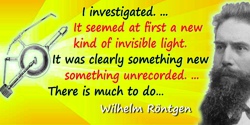
I was working with a Crookes tube covered by a shield of black cardboard. A piece of barium platino-cyanide paper lay on the bench there. I had been passing a current through the tube, and I noticed a peculiar black line across the paper. …
The effect was one which could only be produced in ordinary parlance by the passage of light. No light could come from the tube because the shield which covered it was impervious to any light known even that of the electric arc. …
I did not think; I investigated. …
I assumed that the effect must have come from the tube since its character indicated that it could come from nowhere else. … It seemed at first a new kind of invisible light. It was clearly something new something unrecorded. …
There is much to do, and I am busy, very busy. [Describing to a journalist the discovery of X-rays that he had made on 8 Nov 1895.]
The effect was one which could only be produced in ordinary parlance by the passage of light. No light could come from the tube because the shield which covered it was impervious to any light known even that of the electric arc. …
I did not think; I investigated. …
I assumed that the effect must have come from the tube since its character indicated that it could come from nowhere else. … It seemed at first a new kind of invisible light. It was clearly something new something unrecorded. …
There is much to do, and I am busy, very busy. [Describing to a journalist the discovery of X-rays that he had made on 8 Nov 1895.]
In H.J.W. Dam in 'The New Marvel in Photography", McClure's Magazine (Apr 1896), 4:5, 413.
I was working with these very long-chain … extended-chain polymers, where you had a lot of benzene rings in them. … Transforming a polymer solution from a liquid to a fiber requires a process called spinning. … We spun it and it spun beautifully. It [Kevlar] was very strong and very stiff—unlike anything we had made before. I knew that I had made a discovery. I didn’t shout “Eureka!” but I was very excited, as was the whole laboratory excited, and management was excited, because we were looking for something new. Something different. And this was it.
From transcript for video interview (2007, published Aug 2012), 'Stephanie Kwolek: Curiosity and the Discovery of Kevlar', in the series Women in Chemistry, on Chemical Heritage Foundation website.
I will ask you to mark again that rather typical feature of the development of our subject; how so much progress depends on the interplay of techniques, discoveries and new ideas, probably in that order of decreasing importance.
This is the original quote, which gave rise to the commonly seen misstated shortened quote as: “Progress in science depends on new techniques, new discoveries and new ideas, probably in that order”—with the qualifying words “interplay” and “decreasing importance” omitted. From Brenner’s own handwritten notes of a Speech (20 Mar 1980), 'Biology in the 1980s', at the Friedrich Miescher Institute in Basel, Switzerland. Reproduced in his article 'Life sentences: Detective Rummage investigates', The Scientist (19 Aug 2002), 16, No. 16, 15. He reflects on the original wording of the quote, from his notes that he “came across”, while rummaging through “the piles of papers that I have accumulated,” (hence “Detective Rummage” in the title). See more on the commonly seen misstated shortened quote also on the Sydney Brenner Quotes web page of this site, beginning, “Progress in science…”.
I wished to show that Pythagoras, the first founder of the vegetable regimen, was at once a very great physicist and a very great physician; that there has been no one of a more cultured and discriminating humanity; that he was a man of wisdom and of experience; that his motive in commending and introducing the new mode of living was derived not from any extravagant superstition, but from the desire to improve the health and the manners of men.
From Dell Vitto Pitagorico (1743), (The Pythagorean Diet: for the Use of the Medical Faculty), as translated quotes in Howard Williams, The Ethics of Diet: A Catena of Authorities Deprecatory of the Practice of Flesh-Eating (1883), 158.
I would by all means have men beware, lest Æsop’s pretty fable of the fly that sate [sic] on the pole of a chariot at the Olympic races and said, “What a dust do I raise,” be verified in them. For so it is that some small observation, and that disturbed sometimes by the instrument, sometimes by the eye, sometimes by the calculation, and which may be owing to some real change in the heaven, raises new heavens and new spheres and circles.
'Of Vain Glory' (1625) in James Spedding, Robert Ellis and Douglas Heath (eds.), The Works of Francis Bacon (1887-1901), Vol. 6, 503.
I would like to see us continue to explore space. There's just a lot for us to keep learning. I think it’s a good investment, so on my list of things that I want our country to invest in—in terms of research and innovation and science, basic science, exploring space, exploring our oceans, exploring our genome—we’re at the brink of all kinds of new information. Let's not back off now!
At Town Hall Meeting, Dover, New Hampshire (16 Jul 2015). As quoted in Clare Foran, 'Hillary Clinton: I Wanted to Be an Astronaut', National Journal (16 Jul 2015).
I would picture myself as a virus, or as a cancer cell, for example, and try to sense what it would be like to be either. I would also imagine myself as the immune system, and I would try to reconstruct what I would do as an immune system engaged in combating a virus or cancer cell. When I had played through a series of such scenarios on a particular problem and had acquired new insights, I would design laboratory experiments accordingly… Based upon the results of the experiment, I would then know what question to ask next… When I observed phenomena in the laboratory that I did not understand, I would also ask questions as if interrogating myself: “Why would I do that if I were a virus or a cancer cell, or the immune system?” Before long, this internal dialogue became second nature to me; I found that my mind worked this way all the time.
In Anatomy of Reality: Merging of Intuition and Reason (1983), 7, footnote b, as quoted and cited in Roger Frantz, Two Minds: Intuition and Analysis in the History of Economic Thought (2006), 7.
I’m afraid for all those who’ll have the bread snatched from their mouths by these machines. … What business has science and capitalism got, bringing ail these new inventions into the works, before society has produced a generation educated up to using them!
Dialog for Aune, in the play The Pillars of Society, Act 2. Collected in Henrik Ibsen and James Walter McFarlane (ed.), Ibsen: Pillars of society. A Doll’s House. Ghosts (1960), Vol. 5, 52.
I’m convinced that the best solutions are often the ones that are counterintuitive—that challenge conventional thinking—and end in breakthroughs. It is always easier to do things the same old way … why change? To fight this, keep your dissatisfaction index high and break with tradition. Don’t be too quick to accept the way things are being done. Question whether there’s a better way. Very often you will find that once you make this break from the usual way - and incidentally, this is probably the hardest thing to do—and start on a new track your horizon of new thoughts immediately broadens. New ideas flow in like water. Always keep your interests broad - don’t let your mind be stunted by a limited view.
1988
I’ve always been inspired by Dr. Martin Luther King, who articulated his Dream of an America where people are judged not by skin color but “by the content of their character.” In the scientific world, people are judged by the content of their ideas. Advances are made with new insights, but the final arbitrator of any point of view are experiments that seek the unbiased truth, not information cherry picked to support a particular point of view.
In letter (1 Feb 2013) to Energy Department employees announcing his decision not to serve a second term.
I’ve tried to make the men around me feel as I do, that we are embarked as pioneers upon a new science and industry in which our problems are so new and unusual that it behooves no one to dismiss any novel idea with the statement, “It can’t be done.”
Start of Boeing’s quote, inscribed on his memorial at the Boeing Developmental Center, Tukwila, WA, as given in Mike Lombardi, 'Historical Perspective: 50 years at the Leading Edge', Boeing Frontiers (Aug 2009), 8.
If any human being earnestly desire to push on to new discoveries instead of just retaining and using the old; to win victories over Nature as a worker rather than over hostile critics as a disputant; to attain, in fact, clear and demonstrative knowlegde instead of attractive and probable theory; we invite him as a true son of Science to join our ranks.
Novum Organum (1620), 34, Preface.
If any woman were to hang a man for stealing her picture, although it were set in gold, it would be a new case in law; but, if he carried off the setting, and left the portrait, I would not answer for his safety.
Reflection 557, in Lacon: or Many things in Few Words; Addressed to Those Who Think (1820), 234.
If atomic bombs are to be added as new weapons to the arsenals of a warring world, or to the arsenals of nations preparing for war, then the time will come when mankind will curse the names of Los Alamos and Hiroshima. The people must unite, or they will perish.
Speech at Fuller Lodge when the U.S. Army was honouring the work at Los Alamos. (16 Oct 1945). Quoted in Kai Bird, Martin J. Sherwin, American Prometheus: the Triumph and Tragedy of J. Robert Oppenheimer (2005), 323.
If education really educates, there will, in time, be more and more citizens who understand that relics of the old West add meaning and value to the new. Youth yet unborn will pole up the Missouri with Lewis and Clark, or climb the Sierras with James Capen Adams, and each generation in turn will ask: Where is the big white bear? It will be a sorry answer to say he went under while conservationists weren’t looking.
Conclusion from article 'The Grizzly—A Problem in Land Planning', in Outdoor America (6 Apr 1942), 7, 12.
If I give you a pfennig, you will be one pfennig richer and I’ll be one pfennig poorer. But if I give you an idea, you will have a new idea, but I shall still have it, too.
…...
If I had been taught from my youth all the truths of which I have since sought out demonstrations, and had thus learned them without labour, I should never, perhaps, have known any beyond these; at least, I should never have acquired the habit and the facility which I think I possess in always discovering new truths in proportion as I give myself to the search.
In Discours de la Méthode (1637). In English from John Veitch (trans.), A Discourse on Method (1912), 57.
If I had my life to live over again I would not devote it to develop new industrial processes: I would try to add my humble efforts to use Science to the betterment of the human race.
I despair of the helter-skelter methods of our vaulted homo sapiens, misguided by his ignorance and his politicians. If we continue our ways, there is every possibility that the human race may follow the road of former living races of animals whose fossils proclaim that they were not fit to continue. Religion, laws and morals is not enough. We need more. Science can help us.
I despair of the helter-skelter methods of our vaulted homo sapiens, misguided by his ignorance and his politicians. If we continue our ways, there is every possibility that the human race may follow the road of former living races of animals whose fossils proclaim that they were not fit to continue. Religion, laws and morals is not enough. We need more. Science can help us.
Letter to a friend (14 Jan 1934). In Savage Grace (1985, 2007), 62.
If in our withered leaves you see
Hint of your own mortality:—
Think how, when they have turned to earth,
New loveliness from their rich worth
Shall spring to greet the light; then see
Death as the keeper of eternity,
And dying Life’s perpetual re-birth !
Hint of your own mortality:—
Think how, when they have turned to earth,
New loveliness from their rich worth
Shall spring to greet the light; then see
Death as the keeper of eternity,
And dying Life’s perpetual re-birth !
Poem attributed with initials W.L., epigraph for chapter on 'The Nitrogen Cycle', in Arthur E. Shipley, Life: A Book for Elementary Students (1925, 2013), 37.
If indeed the Earth is, in its own slow way, a very dynamic body and we have regarded it as essentially static, we need to discard most of our old theories and books and start again with a new viewpoint and a new science.
In 'Reply to Beloussov', Geotimes (1968), 13, No. 12, 22. The public disagreement on seafloor spreading between Wilson and V.V. Beloussov is collected in Brainerd Mears, The Nature of Geology: Contemporary Readings (1970).
If mankind is to profit freely from the small and sporadic crop of the heroically gifted it produces, it will have to cultivate the delicate art of handling ideas. Psychology is now able to tell us with reasonable assurance that the most influential obstacle to freedom of thought and to new ideas is fear; and fear which can with inimitable art disguise itself as caution, or sanity, or reasoned skepticism, or on occasion even as courage.
'The Commemoration of Great Men', Hunterian Oration, Royal College of Surgeons (15 Feb 1952) British Medical Journal (20 Feb 1932), 1, 317-20. The Collected Papers of Wilfred Trotter, FRS (1941), 30.
If new species arise very rapidly in small, peripherally isolated local populations, then the great expectation of insensibly graded fossil sequences is a chimera. A new species does not evolve in the area of its ancestors; it does not arise from the slow transformation of all its forbears.
co-author with Niles Eldridge (palaeontologist, 1943- )
co-author with Niles Eldridge (palaeontologist, 1943- )
'Punctuated Equilibria: An Alternative to Phyletic Gradualism', in Thomas J. M. Schopf (ed.), Models in Paleobiology (1972), 84.
If one were to demonstrate to an architect that the bricks…in his constructions were under other circumstances capable of entirely different uses—let us say,…that they could with effect be employed as an explosive incomparably more powerful in its activities than dynamite—the surprise of the architect would be no greater than the surprise of the chemist at the new and undreamt of possibilities of matter demonstrated by the mere existence of such an element as radium.
In 'The Discovery of Radioactivity: Radioactivity, a New Science', The Interpretation of Radium and the Structure of the Atom (4th ed., 1920), 3.
If our intention had been merely to bring back a handful of soil and rocks from the lunar gravel pit and then forget the whole thing, we would certainly be history's biggest fools. But that is not our intention now—it never will be. What we are seeking in tomorrow's [Apollo 11] trip is indeed that key to our future on earth. We are expanding the mind of man. We are extending this God-given brain and these God-given hands to their outermost limits and in so doing all mankind will benefit. All mankind will reap the harvest…. What we will have attained when Neil Armstrong steps down upon the moon is a completely new step in the evolution of man.
Banquet speech on the eve of the Apollo 11 launch, Royal Oaks Country Club, Titusville (15 Jul 1969). In "Of a Fire on the Moon", Life (29 Aug 1969), 67, No. 9, 34.
If physics is too difficult for the physicists, the nonphysicist may wonder whether he should try at all to grasp its complexities and ambiguities. It is undeniably an effort, but probably one worth making, for the basic questions are important and the new experimental results are often fascinating. And if the layman runs into serious perplexities, he can be consoled with the thought that the points which baffle him are more than likely the ones for which the professionals have not found satisfactory answers.
From essay, 'Physics', contributed to James Roy Newman (ed.), What is Science?: Twelve Eminent Scientists and Philosophers Explain Their Various Fields to the Layman (1955), 102.
If the mysterious influence to which the dissymmetry of nature is due should come to change in sense or direction, the constituting elements of all living beings would take an inverse dissymmetry. Perhaps a new world would be presented to us. Who could foresee the organization of living beings, if the cellulose, which is right, should become left, if the left albumen of the blood should become right? There are here mysteries which prepare immense labours for the future, and from this hour invite the most serious meditations in science.
Lecture (3 Feb 1860), to the Chemical Society of Paris, 'On the Molecular Dissymetry of Natural Organic Products', reprinted in The Chemical News and Journal of Industrial Science (3 May 1862), 5, No. 126, 248.
If the views we have ventured to advance be correct, we may almost consider {greek words} of the ancients to be realised in hydrogen, an opinion, by the by, not altogether new. If we actually consider the specific gravities of bodies in their gaseous state to represent the number of volumes condensed into one; or in other words, the number of the absolute weight of a single volume of the first matter ({greek words}) which they contain, which is extremely probable, multiples in weight must always indicate multiples in volume, and vice versa; and the specific gravities, or absolute weights of all bodies in a gaseous state, must be multiples of the specific gravity or absolute weight of the first matter, ({Greek words}), because all bodies in the gaseous state which unite with one another unite with reference to their volume.
'Correction of a Mistake in the Essay on the Relation between the Specific Gravities of Bodies in their Gaseous State and the Weights of their Atoms', Annals of Philosophy (1816), 7, 113.
If the Weismann idea triumphs, it will be in a sense a triumph of fatalism; for, according to it, while we may indefinitely improve the forces of our education and surroundings, and this civilizing nurture will improve the individuals of each generation, its actual effects will not be cumulative as regards the race itself, but only as regards the environment of the race; each new generation must start de novo, receiving no increment of the moral and intellectual advance made during the lifetime of its predecessors. It would follow that one deep, almost instinctive motive for a higher life would be removed if the race were only superficially benefited by its nurture, and the only possible channel of actual improvement were in the selection of the fittest chains of race plasma.
'The Present Problem of Heredity', The Atlantic Monthly (1891), 57, 363.
If there be one man, more than another, who deserves to succeed in flying through the air, that man is Mr. Laurence Hargrave, of Sydney, New South Wales.
In Progress in Flying Machines (1894), 218.
If these d'Hérelle bodies were really genes, fundamentally like our chromosome genes, they would give us an utterly new angle from which to attack the gene problem. They are filterable, to some extent isolable, can be handled in test-tubes, and their properties, as shown by their effects on the bacteria, can then be studied after treatment. It would be very rash to call these bodies genes, and yet at present we must confess that there is no distinction known between the genes and them. Hence we can not categorically deny that perhaps we may be able to grind genes in a mortar and cook them in a beaker after all. Must we geneticists become bacteriologists, physiological chemists and physicists, simultaneously with being zoologists and botanists? Let us hope so.
'Variation Due to Change in the Individual Gene', The American Naturalist (1922), 56, 48-9.
If this plane were to crash, we could get a new start on this quasar problem.
Said to colleagues, dramatically cupping his hand over his brow, shortly after the take-off of a propeller plane leaving Austin, Texas, after the Second Texas Symposium for Relativistic Astrophysics in Dec 1964. Various different theories had been presented at the conference. The flight passengers included many of the major scientists in quasar research, including Margaret and Geoffrey Burbridge, Subrahmanyan Chandrasekhar, John Wheeler and Maarten Schmidt.
Said to colleagues, dramatically cupping his hand over his brow, shortly after the take-off of a propeller plane leaving Austin, Texas, after the Second Texas Symposium for Relativistic Astrophysics in Dec 1964. Various different theories had been presented at the conference. The flight passengers included many of the major scientists in quasar research, including Margaret and Geoffrey Burbridge, Subrahmanyan Chandrasekhar, John Wheeler and Maarten Schmidt.
As quoted by Arthur I. Miller, Empire of the Stars (2005), 226.
If to be the Author of new things, be a crime; how will the first Civilizers of Men, and makers of Laws, and Founders of Governments escape? Whatever now delights us in the Works of Nature, that excells the rudeness of the first Creation, is New. Whatever we see in Cities, or Houses, above the first wildness of Fields, and meaness of Cottages, and nakedness of Men, had its time, when this imputation of Novelty, might as well have bin laid to its charge. It is not therefore an offence, to profess the introduction of New things, unless that which is introduc'd prove pernicious in itself; or cannot be brought in, without the extirpation of others, that are better.
The History of the Royal Society (1667), 322.
If we have learned anything at all in this century, it is that all new technologies will be put to use, sooner or later, for better or worse, as it is in our nature to do
In 'Autonomy', The Lives of a Cell: Notes of a Biology Watcher (1974), 79.
If we turn to the problems to which the calculus owes its origin, we find that not merely, not even primarily, geometry, but every other branch of mathematical physics—astronomy, mechanics, hydrodynamics, elasticity, gravitation, and later electricity and magnetism—in its fundamental concepts and basal laws contributed to its development and that the new science became the direct product of these influences.
Opening of Presidential Address (27 Apr 1907) to the American Mathematical Society, 'The Calculus in Colleges and Technical Schools', published in Bulletin of the American Mathematical Society (Jun 1907), 13, 449.
If we wish to make a new world we have the material ready. The first one, too, was made out of chaos.
…...
If you are too fond of new remedies, first you will not cure your patients; secondly, you will have no patients to cure.
Attributed. In Peter McDonald, Oxford Dictionary of Medical Quotations (2004), 25.
![Jane Goodall quote: If you look into their [chimpanzees] eyes, you know you’re looking into a thinking mind. They teach us that](https://todayinsci.com/G/Goodall_Jane/GoodallJane-EyesThm.jpg)
If you look into their [chimpanzees] eyes, you know you’re looking into a thinking mind. They teach us that we are not the only beings with personalities, minds capable of rational thought, altruism and a sense of humor. That leads to new respect for other animals, respect for the environment and respect for all life.
From interview by Tamar Lewin, 'Wildlife to Tireless Crusader, See Jane Run', New York Times (20 Nov 2000), F35.
If you’re telling a story, it’s very tempting to personalise an animal. To start with, biologists said this fascination with one individual was just television storytelling. But they began to realise that, actually, it was a new way to understand behaviour–following the fortunes of one particular animal could be very revealing and have all kinds of implications in terms of the ecology and general behaviour of the animals in that area.
From interview with Alice Roberts, 'Attenborough: My Life on Earth', The Biologist (Aug 2015), 62, No. 4, 15.
If your new theorem can be stated with great simplicity, then there will exist a pathological exception.
In Howard W. Eves Return to Mathematical Circles, (1988), 157.
If your news must be bad, tell it soberly and promptly.
The Corner of Harley Street: Being Some Familiar Correspondence of Peter Harding, M. D., Ch. 26.
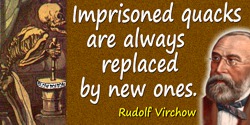
Imprisoned quacks are always replaced by new ones.
In Fielding Hudson Garrison, An Introduction to the History of Medicine (1966), 577.
Improvements in industry can be left to chance in the hope that someone, sometime, will think of something useful. that some good invention will show up. The other way is to organize so that new knowledge shall always be coming from the researches in the fundamental sciences and engineering arts on which business is based. From that steady stream will arise inventions and new methods. This is the way of Bell Laboratories.
From a Bell Telephone System advertisement, 'The Search That Never Ends', placed, for example, in Life Magazine (17 Jan 1944), 33.
In 399 B.C. Socrates was accused of introducing new gods and questioning accepted gods. He was sentenced to death by a jury of 500 of his peers. His philosophy did not pass peer review.
Please contact webmaster if you have the primary source for this interesting quote.
In a Dublin hospital, many years ago, it was noticed that the death-rate was markedly higher in the ground-floor wards than it was in the wards upstairs. This fact was commented on in an official report, and marked down as requiring investigation. Then it was discovered that, when new patients came in, the porter of the hospital was in the habit of putting them upstairs if they could walk by themselves, and downstairs if they could not.
From 'Figures Can Lie', Science Digest (Sep 1951), 30, No. 3, 53. (As condensed from The Listener). Excerpted in Meta Riley Emberger and Marian Ross Hall, Scientific Writing (1955), 407.
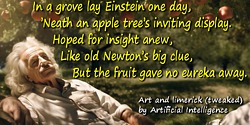
In a grove lay Einstein one day,
’Neath an apple tree’s inviting display.
Hoped for insight anew,
Like old Newton’s big clue,
But the fruit gave no eureka away.
’Neath an apple tree’s inviting display.
Hoped for insight anew,
Like old Newton’s big clue,
But the fruit gave no eureka away.
Caricature by AI: midjourney, clipdrop. Text by Artificial Intelligence: ChatGPT. Slight text edit and prompts by Webmaster. (19 Aug 2023)
In addition to this it [mathematics] provides its disciples with pleasures similar to painting and music. They admire the delicate harmony of the numbers and the forms; they marvel when a new discovery opens up to them an unexpected vista; and does the joy that they feel not have an aesthetic character even if the senses are not involved at all? … For this reason I do not hesitate to say that mathematics deserves to be cultivated for its own sake, and I mean the theories which cannot be applied to physics just as much as the others.
(1897) From the original French, “Et surtout, leurs adeptes y trouvent des jouissances analogues á celles que donnent la peinture et la musique. Ils admirent la délicate harmonie des nombres et des formes; ils s’émerveillent quand une découverte nouvelle leur ouvre une perspective inattendue; et la joie qu’ils éprouvent ainsi n’a-t-elle pas le caractère esthétique, bien que les sens n’y prennent aucune part?...C’est pourquoi je n’hésite pas à dire que les mathématiques méritent d’être cultivées pour elles-mêmes et que les théories qui ne peuvent être appliquées á la physique doivent l’être comme les autres.” Address read for him at the First International Congress of Mathematicians in Zurich: '‘Sur les rapports de l’analyse pure et de la physique', in Proceedings of that Congress 81-90, (1898). Also published as 'L’Analyse et la Physique', in La Valeur de la Science (1905), 137-151. As translated in Armand Borel, 'On the Place of Mathematics in Culture', in Armand Borel: Œvres: Collected Papers (1983), Vol. 4, 420-421.
In all times and epochs the greatest happiness for man has been to take part in new discoveries.
First;Enter;Cosmos;Single-Handed;Unprecedented;Duel;Nature;Dream
In both social and natural sciences, the body of positive knowledge grows by the failure of a tentative hypothesis to predict phenomena the hypothesis professes to explain; by the patching up of that hypothesis until someone suggests a new hypothesis that more elegantly or simply embodies the troublesome phenomena, and so on ad infinitum. In both, experiment is sometimes possible, sometimes not (witness meteorology). In both, no experiment is ever completely controlled, and experience often offers evidence that is the equivalent of controlled experiment. In both, there is no way to have a self-contained closed system or to avoid interaction between the observer and the observed. The Gödel theorem in mathematics, the Heisenberg uncertainty principle in physics, the self-fulfilling or self-defeating prophecy in the social sciences all exemplify these limitations.
Inflation and Unemployment (1976), 348.
In Cairo, I secured a few grains of wheat that had slumbered for more than thirty centuries in an Egyptian tomb. As I looked at them this thought came into my mind: If one of those grains had been planted on the banks of the Nile the year after it grew, and all its lineal descendants had been planted and replanted from that time until now, its progeny would to-day be sufficiently numerous to feed the teeming millions of the world. An unbroken chain of life connects the earliest grains of wheat with the grains that we sow and reap. There is in the grain of wheat an invisible something which has power to discard the body that we see, and from earth and air fashion a new body so much like the old one that we cannot tell the one from the other.…This invisible germ of life can thus pass through three thousand resurrections.
In In His Image (1922), 33.
In early times, when the knowledge of nature was small, little attempt was made to divide science into parts, and men of science did not specialize. Aristotle was a master of all science known in his day, and wrote indifferently treatises on physics or animals. As increasing knowledge made it impossible for any one man to grasp all scientific subjects, lines of division were drawn for convenience of study and of teaching. Besides the broad distinction into physical and biological science, minute subdivisions arose, and, at a certain stage of development, much attention was, given to methods of classification, and much emphasis laid on the results, which were thought to have a significance beyond that of the mere convenience of mankind.
But we have reached the stage when the different streams of knowledge, followed by the different sciences, are coalescing, and the artificial barriers raised by calling those sciences by different names are breaking down. Geology uses the methods and data of physics, chemistry and biology; no one can say whether the science of radioactivity is to be classed as chemistry or physics, or whether sociology is properly grouped with biology or economics. Indeed, it is often just where this coalescence of two subjects occurs, when some connecting channel between them is opened suddenly, that the most striking advances in knowledge take place. The accumulated experience of one department of science, and the special methods which have been developed to deal with its problems, become suddenly available in the domain of another department, and many questions insoluble before may find answers in the new light cast upon them. Such considerations show us that science is in reality one, though we may agree to look on it now from one side and now from another as we approach it from the standpoint of physics, physiology or psychology.
But we have reached the stage when the different streams of knowledge, followed by the different sciences, are coalescing, and the artificial barriers raised by calling those sciences by different names are breaking down. Geology uses the methods and data of physics, chemistry and biology; no one can say whether the science of radioactivity is to be classed as chemistry or physics, or whether sociology is properly grouped with biology or economics. Indeed, it is often just where this coalescence of two subjects occurs, when some connecting channel between them is opened suddenly, that the most striking advances in knowledge take place. The accumulated experience of one department of science, and the special methods which have been developed to deal with its problems, become suddenly available in the domain of another department, and many questions insoluble before may find answers in the new light cast upon them. Such considerations show us that science is in reality one, though we may agree to look on it now from one side and now from another as we approach it from the standpoint of physics, physiology or psychology.
In article 'Science', Encyclopedia Britannica (1911), 402.
In every case the awakening touch has been the mathematical spirit, the attempt to count, to measure, or to calculate. What to the poet or the seer may appear to be the very death of all his poetry and all his visions—the cold touch of the calculating mind,—this has proved to be the spell by which knowledge has been born, by which new sciences have been created, and hundreds of definite problems put before the minds and into the hands of diligent students. It is the geometrical figure, the dry algebraical formula, which transforms the vague reasoning of the philosopher into a tangible and manageable conception; which represents, though it does not fully describe, which corresponds to, though it does not explain, the things and processes of nature: this clothes the fruitful, but otherwise indefinite, ideas in such a form that the strict logical methods of thought can be applied, that the human mind can in its inner chamber evolve a train of reasoning the result of which corresponds to the phenomena of the outer world.
In A History of European Thought in the Nineteenth Century (1896), Vol. 1, 314.
In experimenting on the arc, my aim was not so much to add to the large number of isolated facts that had already been discovered, as to form some idea of the bearing of these upon one another, and thus to arrive at a clear conception of what takes place in each part of the arc and carbons at every moment. The attempt to correlate all the known phenomena, and to bind them together into one consistent whole, led to the deduction of new facts, which, when duly tested by experiment, became parts of the growing body, and, themselves, opened up fresh questions, to be answered in their turn by experiment.
In The Electric Arc (1902), Preface, iii. Ayrton described the growth of her published work on the electric arc, from a series of articles in The Electrician in 1895-6, to the full book, which “has attained to its present proportions almost with the growth of an organic body.”
In general the position as regards all such new calculi is this That one cannot accomplish by them anything that could not be accomplished without them. However, the advantage is, that, provided such a calculus corresponds to the inmost nature of frequent needs, anyone who masters it thoroughly is able—without the unconscious inspiration of genius which no one can command—to solve the respective problems, yea, to solve them mechanically in complicated cases in which, without such aid, even genius becomes powerless. Such is the case with the invention of general algebra, with the differential calculus, and in a more limited region with Lagrange’s calculus of variations, with my calculus of congruences, and with Möbius’s calculus. Such conceptions unite, as it were, into an organic whole countless problems which otherwise would remain isolated and require for their separate solution more or less application of inventive genius.
Letter (15 May 1843) to Schumacher, collected in Carl Friedrich Gauss Werke (1866), Vol. 8, 298, as translated in Robert Édouard Moritz, Memorabilia Mathematica; Or, The Philomath's Quotation-book (1914), 197-198. From the original German, “Überhaupt verhält es sich mit allen solchen neuen Calculs so, dass man durch sie nichts leisten kann, was nicht auch ohne sie zu leisten wäre; der Vortheil ist aber der, dass, wenn ein solcher Calcul dem innersten Wesen vielfach vorkommender Bedürfnisse correspondirt, jeder, der sich ihn ganz angeeignet hat, auch ohne die gleichsam unbewussten Inspirationen des Genies, die niemand erzwingen kann, die dahin gehörigen Aufgaben lösen, ja selbst in so verwickelten Fällen gleichsam mechanisch lösen kann, wo ohne eine solche Hülfe auch das Genie ohnmächtig wird. So ist es mit der Erfindung der Buchstabenrechnung überhaupt; so mit der Differentialrechnung gewesen; so ist es auch (wenn auch in partielleren Sphären) mit Lagranges Variationsrechnung, mit meiner Congruenzenrechnung und mit Möbius' Calcul. Es werden durch solche Conceptionen unzählige Aufgaben, die sonst vereinzelt stehen, und jedesmal neue Efforts (kleinere oder grössere) des Erfindungsgeistes erfordern, gleichsam zu einem organischen Reiche.”
In general, scientific progress calls for no more than the absorption and elaboration of new ideas—and this is a call most scientists are happy to heed.
In Werner Heisenberg and Arnold J. Pomerans (trans.), Physics and Beyond: Encounters and Conversations (1971), 70.
In general, we look for a new law by the following process. First, we guess it. Then we—don’t laugh, that’s really true. Then we compute the consequences of the guess to see if this is right—if this law that we guessed is right—we see what it would imply. And then we compare those computation results to nature—or, we say compare to experiment or experience—compare it directly with observation to see if it works. If it disagrees with experiment, it’s wrong.
Verbatim from Lecture No. 7, 'Seeking New Laws', Messenger Lectures, Cornell, (1964) in video and transcript online at caltech.edu website. Also, lightly paraphrased, in Christopher Sykes, No Ordinary Genius: The Illustrated Richard Feynman (1994), 143. There is another paraphrase elsewhere on the Richard Feynman Quotations webpage, beginning: “First you guess…”. Also see the continuation of this quote, verbatim, beginning: “If it disagrees with experiment…”.
In less than eight years “The Origin of Species” has produced conviction in the minds of a majority of the most eminent living men of science. New facts, new problems, new difficulties as they arise are accepted, solved, or removed by this theory; and its principles are illustrated by the progress and conclusions of every well established branch of human knowledge.
From a review of four books on the subject 'Mimicry, and Other Protective Resemblances Among Animals', in The Westminster Review (Jul 1867), 88, 1. Wallace is identified as the author in the article as reprinted in William Beebe, The Book of Naturalists: An Anthology of the Best Natural History (1988), 108.
In light of new knowledge ... an eventual world state is not just desirable in the name of brotherhood, it is necessary for survival ... Today we must abandon competition and secure cooperation. This must be the central fact in all our considerations of international affairs; otherwise we face certain disaster. Past thinking and methods did not prevent world wars. Future thinking must prevent wars.
…...
In mathematics as in other fields, to find one self lost in wonder at some manifestation is frequently the half of a new discovery.
In Werke, Bd. 8 (1897), 233.
In matters of science, curiosity gratified begets not indolence, but new desires.
Theory of the Earth, with Proofs and Illustrations, Vol. 3, ed. Archibald Geikie (1899), 16.
In Melvin Calvin’s office there were four photographs: Michael Polanyi, Joel Hildebrand, Gilbert N. Lewis, and Ernest O. Lawrence. These scientists were his mentors: Polanyi for introducing him to the chemistry of phthalocyanine; Hildebrand for bringing him to Berkeley; Lewis, perhaps his most influential teacher; and Lawrence, who provided him the opportunity to work with the new scientific tool of radioactive carbon, which enabled the search for the path of carbon in photosynthesis to be successful.
Co-author with Marilyn Taylor and Robert E. Connick, obituary, 'Melvin Calvin', Proceedings of the American Philosophical Society (Dec 2000), 144, No. 4, 454.
In modern Europe, the Middle Ages were called the Dark Ages. Who dares to call them so now? … Their Dante and Alfred and Wickliffe and Abelard and Bacon; their Magna Charta, decimal numbers, mariner’s compass, gunpowder, glass, paper, and clocks; chemistry, algebra, astronomy; their Gothic architecture, their painting,—are the delight and tuition of ours. Six hundred years ago Roger Bacon explained the precession of the equinoxes, and the necessity of reform in the calendar; looking over how many horizons as far as into Liverpool and New York, he announced that machines can be constructed to drive ships more rapidly than a whole galley of rowers could do, nor would they need anything but a pilot to steer; carriages, to move with incredible speed, without aid of animals; and machines to fly into the air like birds.
In 'Progress of Culture', an address read to the Phi Beta Kappa Society at Cambridge, 18 July 1867. Collected in Works of Ralph Waldo Emerson (1883), 475.
In most sciences one generation tears down what another has built, and what one has established, another undoes. In mathematics alone each generation adds a new storey to the old structure.
In Die Entwickelung der Mathematik in den letzten Jahrhunderten (1869), 34. As translated in Robert Édouard Moritz, Memorabilia Mathematica; Or, The Philomath’s Quotation-book (1914), 14. From the original German, “In den meisten Wissenschaften pflegt eine Generation das niederzureissen, was die andere gebaut, und was jene gesetzt, hebt diese auf. In der Mathematik allein setzt jede Generation ein neues Stockwerk auf den alten Unterbau.”
In my estimation it was obvious that Jansky had made a fundamental and very important discovery. Furthermore, he had exploited it to the limit of his equipment facilities. If greater progress were to be made it would be necessary to construct new and different equipment especially designed to measure the cosmic static.
Reber explaining his own motivation to build the first radio telescope.
In my life as an architect, I found that the single thing which inhibits young professionals, new students most severely, is their acceptance of standards that are too low.
In 'Foreword' written for Richard P. Gabriel, Patterns of Software: Tales from the Software Community (1996), vii.
In my opinion there is no other salvation for civilization and even for the human race than the creation of a world government with security on the basis of law. As long as there are sovereign states with their separate armaments and armament secrets, new world wars cannot be avoided.
Interview comment reported in 'For a World Government: Einstein Says This is Only Way to Save Mankind', New York Times (15 Sep 1945), 11.
In my opinion, the American “war on drugs” represents merely a new variation in humanity’s age-old passion to “purge” itself of its “impurities” by staging vast dramas of scapegoat persecutions. In the past, we have witnessed religious or “holy” wars waged against people who professed the wrong faith; … now we are witnessing a medical or “therapeutic” war, waged against people who use the wrong drugs.
From 'The Morality of Drug Controls', collected in Ronald Hamowy (ed.), Dealing with Drugs: Consequences of Government Control (1987), 329.
In my work on Fossil Bones, I set myself the task of recognizing to which animals the fossilized remains which fill the surface strata of the earth belong. ... As a new sort of antiquarian, I had to learn to restore these memorials to past upheavals and, at the same time, to decipher their meaning. I had to collect and put together in their original order the fragments which made up these animals, to reconstruct the ancient creatures to which these fragments belonged, to create them once more with their proportions and characteristics, and finally to compare them to those alive today on the surface of the earth. This was an almost unknown art, which assumed a science hardly touched upon up until now, that of the laws which govern the coexistence of forms
of the various parts in organic beings.
Discours sur les révolutions du globe, (Discourse on the Revolutions of the Surface of the Globe), originally the introduction to Recherches sur les ossemens fossiles des quadrupèdes (1812). Translated by Ian Johnston from the 1825 edition. Online at Vancouver Island University website.
In natural history, great discovery often requires a map to a hidden mine filled with gems then easily gathered by conventional tools, not a shiny new space-age machine for penetrating previously inaccessible worlds.
…...
In New England they once thought blackbirds useless, and mischievous to the corn. They made efforts to destroy them. The consequence was, the blackbirds were diminished; but a kind of worm, which devoured their grass, and which the blackbirds used to feed on, increased prodigiously; then, finding their loss in grass much greater than their saving in corn, they wished again for their blackbirds.
Letter to Richard Jackson, 5 May 1753. In Albert Henry Smyth, The Writings of Benjamin Franklin (1905), Vol. 3, 135.
In no subject is there a rule, compliance with which will lead to new knowledge or better understanding. Skilful observations, ingenious ideas, cunning tricks, daring suggestions, laborious calculations, all these may be required to advance a subject. Occasionally the conventional approach in a subject has to be studiously followed; on other occasions it has to be ruthlessly disregarded. Which of these methods, or in what order they should be employed is generally unpredictable. Analogies drawn from the history of science are frequently claimed to be a guide; but, as with forecasting the next game of roulette, the existence of the best analogy to the present is no guide whatever to the future. The most valuable lesson to be learnt from the history of scientific progress is how misleading and strangling such analogies have been, and how success has come to those who ignored them.
'Cosmology', in Arthur Beer (ed.), Vistas in Astronomy (1956), Vol. 2, 1722.
In October 1838, that is, fifteen months after I had begun my systematic enquiry, I happened to read for amusement Malthus on Population, and being well prepared to appreciate the struggle for existence which everywhere goes on from long-continued observation of the habits of animals and plants, it at once struck me that under these circumstances favourable variations would tend to be, preserved, and unfavourable ones to be destroyed. The result of this would be the formation of new species. Here, then, I had at last got a theory by which to work; but I was so anxious to avoid prejudice, that I determined not for some time to write even the briefest sketch of it.
In Charles Darwin and Francis Darwin (ed.), Charles Darwin: His Life Told in an Autobiographical Chapter, and in a Selected Series of His Published Letters (1892), 40.
In our daily lives, we enjoy the pervasive benefits of long-lived robotic spacecraft that provide high-capacity worldwide telecommunications; reconnaissance of Earth’s solid surface and oceans, with far-reaching cultural and environmental implications; much-improved weather and climatic forecasts; improved knowledge about the terrestrial effects of the Sun’s radiations; a revolutionary new global navigational system for all manner of aircraft and many other uses both civil and military; and the science of Earth itself as a sustainable abode of life.
In 'Is Human Spaceflight Obsolete?', Issues in Science and Technology (Summer 2004).
In physical science in most cases a new discovery means that by some new idea, new instrument, or some new and better use of an old one, Nature has been wooed in some new way.
In 'The History of a Star', The Nineteenth Century (Nov 1889), 26, No. 153, 785.
In physical science the discovery of new facts is open to every blockhead with patience, manual dexterity, and acute senses; it is less effectually promoted by genius than by co-operation, and more frequently the result of accident than of design.
In Review of 'An Account of the Life, Lectures, and Writings of William Cullen, M.D. Professor of the Practice of Physic in the University of Edinburgh', The Edinburgh Review (1832), 55, 461.
In recent years it has become impossible to talk about man’s relation to nature without referring to “ecology” … such leading scientists in this area as Rachel Carson, Barry Commoner, Eugene Odum, Paul Ehrlich and others, have become our new delphic voices … so influential has their branch of science become that our time might well be called the “Age of Ecology”.
In opening paragraph of Preface, Nature’s Economy: A History of Ecological Ideas (1994), 14.
In recent years several new particles have been discovered which are currently assumed to be “elementary,” that is, essentially structureless. The probability that all such particles should be really elementary becomes less and less as their number increases. It is by no means certain that nucleons, mesons, electrons, neutrinos are all elementary particles.
Opening statement, Enrico Fermi and C.N. Yang, 'Are Mesons Elementary Particles?', Physical Review (1949), 76, 1739. As cited in James Gleick, Genius: The Life and Science of Richard Feynman (1992), 283.
In science it is no crime to be wrong, unless you are (inappropriately) laying claim to truth. What matters is that science as a whole is a self-correcting mechanism in which both new and old notions are constantly under scrutiny. In other words, the edifice of scientific knowledge consists simply of a body of observations and ideas that have (so far) proven resistant to attack, and that are thus accepted as working hypotheses about nature.
In The Monkey in the Mirror: Essays on the Science of What Makes Us Human (2003), 9.
In science the new is an advance; but in morals, as contradicting our inner ideals and historic idols, it is ever a retrogression.
Levana, or, The Doctrine of Education translated from the German (1880), 123.
In science, each of us knows that what he has accomplished will be antiquated in ten, twenty, fifty years. That is the fate to which science is subjected; it is the very meaning of scientific work, to which it is devoted in a quite specific sense, as compared with other spheres of culture for which in general the same holds. Every scientific “fulfilment” raises new “questions”; it asks to be “surpassed” and outdated. Whoever wishes to serve science has to resign himself to this fact. Scientific works certainly can last as “gratifications” because of their artistic quality, or they may remain important as a means of training. Yet they will be surpassed scientifically—let that be repeated—for it is our common fate and, more our common goal. We cannot work without hoping that others will advance further than we have. In principle, this progress goes on ad infinitum.
From a Speech (1918) presented at Munich University, published in 1919, and collected in 'Wissenschaft als Beruf', Gessammelte Aufsätze zur Wissenschaftslehre (1922), 524-525. As given in H.H. Gerth and C. Wright-Mills (translators and eds.), 'Science as a Vocation', Max Weber: Essays in Sociology (1946), 138. A different translation of a shorter excerpt from this quote, beginning “[In] the realm of science, …” is also on the Max Weber Quotes web page on this site.
In science, the more discovered, the more new paths open for exploration. It is usual in science, when things are vague and unclear, for the path to be like that of a drunkard, wandering in a zigzag. As we stagger back from what lastly dawns upon our befuddled wits is the wrong way, we cross over the true path and move nearly as far to the, equally wrong, opposite side. If all goes well, our deviations lessen and the path converges towards, but never completely follows, the true one. It gives a new insight to the old tag in vino veritas.
In The Ages of Gaia: A Biography of Our Living Earth (1999), 199.
In scientific thought we adopt the simplest theory which will explain all the facts under consideration and enable us to predict new facts of the same kind. The catch in this criterion lies in the world “simplest.” It is really an aesthetic canon such as we find implicit in our criticisms of poetry or painting. The layman finds such a law as dx/dt = κ(d²x/dy²) much less simple than “it oozes,” of which it is the mathematical statement. The physicist reverses this judgment, and his statement is certainly the more fruitful of the two, so far as prediction is concerned. It is, however, a statement about something very unfamiliar to the plain man, namely the rate of change of a rate of change.
In 'Science and Theology as Art-Forms', Possible Worlds (1927), 227.
In shades of black and blue the skies do bow as darkness falls the lights go out.
Nature softly immersed in glee as all mankind drifts off to sleep.
Water breathes a sigh of relief now aquatic creatures can do as they please.
Animals whether large or small regain the natural instincts that man has fought.
The moon shines bright he’s happy too people can’t over-ride his rules.
Midnight calms the wounds of the world the break of dawn disperses new hope...
Nature softly immersed in glee as all mankind drifts off to sleep.
Water breathes a sigh of relief now aquatic creatures can do as they please.
Animals whether large or small regain the natural instincts that man has fought.
The moon shines bright he’s happy too people can’t over-ride his rules.
Midnight calms the wounds of the world the break of dawn disperses new hope...
…...
In some strange way, any new fact or insight that I may have found has not seemed to me as a “discovery” of mine, but rather something that had always been there and that I had chanced to pick up.
Truth and Beauty: Aesthetics and Motivations in Science (1987, 1990), Preface, ix.
In that pure enjoyment experienced on approaching to the ideal, in that eagerness to draw aside the veil from the hidden truth, and even in that discord which exists between the various workers, we ought to see the surest pledges of further scientific success. Science thus advances, discovering new truths, and at the same time obtaining practical results.
In The Principles of Chemistry (1891), Vol. 1, preface, footnote, ix, as translated from the Russian 5th edition by George Kamensky, edited by A. J. Greenaway.
In the Anthropocene, the time of humans[,] … rocks … are forming today. Not only will they contain fewer species than the rocks that preceded them but they will contain markers that are completely new—fragments of plastic, plutonium from nuclear activity, and a worldwide distribution of the bones of domesticated chickens.
In 'Conclusion', A Life on Our Planet: My Witness Statement and a Vision for the Future (2020), 215.
In the case of the Sun, we have a new understanding of the cosmological meaning of sacrifice. The Sun is, with each second, transforming four million tons of itself into light—giving itself over to become energy that we, with every meal, partake of. The Sun converts itself into a flow of energy that photosynthesis changes into plants that are consumed by animals. Humans have been feasting on the Sun’s energy stored in the form of wheat or maize or reindeer as each day the Sun dies as Sun and is reborn as the vitality of Earth. These solar flares are in fact the very power of the vast human enterprise. Every child of ours needs to learn the simple truth: she is the energy of the Sun. And we adults should organize things so her face shines with the same radiant joy.
In The Hidden Heart of the Cosmos: Humanity and the New Story (1996), 40-41.
In the context of biological research one can reasonably identify creativity with the capacity 1 to ask new and incisive questions, 2 to form new hypotheses, 3 to examine old questions in new ways or with new techniques, and 4 to perceive previously unnoticed relationships.
In 'Scientific innovation and creativity: a zoologist’s point of view', American Zoologist (1982), 22, 231.
In the course of this short tour, I became convinced that we must turn to the New World if we wish to see in perfection the oldest monuments of the earth’s history, so far at least as relates to its earliest inhabitants.
Travels in North America (1845), Vol. 1, 19.
In the distant future I see open fields for far more important researches. Psychology will be based on a new foundation, that of the necessary acquirement of each mental power and capacity by gradation. Light will be thrown on the origin of man and his history.
On The Origin of Species by Means of Natural Selection (1859, 1882), 428
.
In the first papers concerning the aetiology of tuberculosis I have already indicated the dangers arising from the spread of the bacilli-containing excretions of consumptives, and have urged moreover that prophylactic measures should be taken against the contagious disease. But my words have been unheeded. It was still too early, and because of this they still could not meet with full understanding. It shared the fate of so many similar cases in medicine, where a long time has also been necessary before old prejudices were overcome and the new facts were acknowledged to be correct by the physicians.
'The current state of the struggle against tuberculosis', Nobel Lecture (12 Dec 1905). In Nobel Lectures: Physiology or Medicine 1901-1921 (1967), 169.
In the index to the six hundred odd pages of Arnold Toynbee’s A Study of History, abridged version, the names of Copernicus, Galileo, Descartes and Newton do not occur … yet their cosmic quest destroyed the mediaeval vision of an immutable social order in a walled-in universe and transformed the European landscape, society, culture, habits and general outlook, as thoroughly as if a new species had arisen on this planet.
First lines of 'Preface', in The Sleepwalkers: A History of Man’s Changing Vision of the Universe (1959), 13.
In the index to the six hundred odd pages of Arnold Toynbee’s A Study of History, abridged version, the names of Copernicus, Galileo, Descartes and Newton do not occur yet their cosmic quest destroyed the medieval vision of an immutable social order in a walled-in universe and transformed the European landscape, society, culture, habits and general outlook, as thoroughly as if a new species had arisen on this planet.
In The Sleepwalkers: A History of Man's Changing Vision of the Universe (1959), Preface, 13.
In the main, Bacon prophesied the direction of subsequent progress. But he “anticipated” the advance. He did not see that the new science was for a long time to be worked in the interest of old ends of human exploitation. He thought that it would rapidly give man new ends. Instead, it put at the disposal of a class the means to secure their old ends of aggrandizement at the expense of another class. The industrial revolution followed, as he foresaw, upon a revolution in scientific method. But it is taking the revolution many centuries to produce a new mind.
In Democracy and Education: An Introduction to the Philosophy of Education (1916), 330-331.
In the moment of the vernal equinox, we find ourselves standing at the threshold between winter’s chill and spring’s warmth, a testament to the resilience of life and the promise of new beginnings.
A fictional quote imagined in the style typical of a scientist (19 Mar 2024).
In the new era, thought itself will be transmitted by radio.
In 'Quotation Marks', New York Times (11 Oct 1931), XX2.
In the next twenty centuries … humanity may begin to understand its most baffling mystery—where are we going? The earth is, in fact, traveling many thousands of miles per hour in the direction of the constellation Hercules—to some unknown destination in the cosmos. Man must understand his universe in order to understand his destiny. Mystery, however, is a very necessary ingredient in our lives. Mystery creates wonder and wonder is the basis for man’s desire to understand. Who knows what mysteries will be solved in our lifetime, and what new riddles will become the challenge of the new generation? Science has not mastered prophesy. We predict too much for the next year yet far too little for the next ten. Responding to challenges is one of democracy’s great strengths. Our successes in space can be used in the next decade in the solution of many of our planet’s problems.
In a speech to a Joint Meeting of the Two Houses of Congress to Receive the Apollo 11 Astronauts (16 Sep 1969), in the Congressional Record.
In the old days, they killed the messenger who brought the bad news... a Cassandra is never popular in her time.
Quoted in Gayle Jacoba Greene The Woman Who Knew Too Much (1999).
In the past century, there were more changes than in the previous thousand years. The new century will see changes that will dwarf those of the last.
Referring to the 19th and 20th centuries.
Referring to the 19th and 20th centuries.
Lecture, 'Discovery of the Future' at the Royal Institution (1902). Quoted in Martin J. Rees, Our Final Hour: a Scientist's Warning (2004), 9.
In the sciences hypothesis always precedes law, which is to say, there is always a lot of tall guessing before a new fact is established. The guessers are often quite as important as the factfinders; in truth, it would not be difficult to argue that they are more important.
From Baltimore Evening Sun (6 Apr 1931). Collected in A Mencken Chrestomathy (1949, 1956), 329.
In the space of one hundred and seventy-six years the Lower Mississippi has shortened itself two hundred and forty-two miles. That is an average of a trifle over one mile and a third per year. Therefore, any calm person, who is not blind or idiotic, can see that in the old Oolitic Silurian Period, must a million years ago next November, the Lower Mississippi River was upward of one million three hundred thousand miles long, and stuck out over the Gulf of Mexico like a fishing-rod. And by the same token any person can see that seven hundred and forty-two years from now the Lower Mississippi will be only a mile and three-quarters long, and Cairo and New Orleans will have their streets joined together, and be plodding comfortably along under a single mayor and a mutual board of aldermen. There is something fascinating about science. One gets such wholesale returns of conjecture out of such a trifling investment of fact.
Life on the Mississippi (1883, 2000), 173.
In the twenties the late Dr. Glenn Frank, an eminent social scientist, developed a new statement of the scientific code, which has been referred to as the “Five Fingers of the Scientific Method.” It may be outlined as follows: find the facts; filter the facts; focus the facts; face the facts; follow the facts. The facts or truths are found by experimentation; the motivation is material. The facts are filtered by research into the literature; the motivation is material. The facts are focused by the publication of results; again the motivation is material. Thus the first three-fifths of the scientific method have a material motivation. It is about time scientists acknowledge that there is more to the scientific convention than the material aspect. Returning to the fourth and fifth fingers of Dr. Frank's conception of the scientific method, the facts should be faced by the proper interpretation of them for society. In other words, a scientist must assume social responsibility for his discoveries, which means that he must have a moral motivation. Finally, in the fifth definition of the scientific method, the facts are to be followed by their proper application to everyday life in society, which means moral motivation through responsibility to society.
From 'Scientists and Society', American Scientist (Jul 1954), 42, No. 3, 495.
In the year 1902 (while I was attempting to explain to an elementary class in chemistry some of the ideas involved in the periodic law) becoming interested in the new theory of the electron, and combining this idea with those which are implied in the periodic classification, I formed an idea of the inner structure of the atom which, although it contained certain crudities, I have ever since regarded as representing essentially the arrangement of electrons in the atom ... In accordance with the idea of Mendeleef, that hydrogen is the first member of a full period, I erroneously assumed helium to have a shell of eight electrons. Regarding the disposition in the positive charge which balanced the electrons in the neutral atom, my ideas were very vague; I believed I inclined at that time toward the idea that the positive charge was also made up of discrete particles, the localization of which determined the localization of the electrons.
Valence and the Structure of Atoms and Molecules (1923), 29-30.
In the years since man unlocked the power stored up within the atom, the world has made progress, halting, but effective, toward bringing that power under human control. The challenge may be our salvation. As we begin to master the destructive potentialities of modern science, we move toward a new era in which science can fulfill its creative promise and help bring into existence the happiest society the world has ever known.
From Address to the Centennial Convocation of the National Academy of Sciences (22 Oct 1963), 'A Century of Scientific Conquest.' Online at The American Presidency Project.
In these researches I followed the principles of the experimental method that we have established, i.e., that, in presence of a well-noted, new fact which contradicts a theory, instead of keeping the theory and abandoning the fact, I should keep and study the fact, and I hastened to give up the theory.
From An Introduction to the Study of Experimental Medicine (1865), as translated by Henry Copley Greene (1957), 164.
In this age of space flight, when we use the modern tools of science to advance into new regions of human activity, the Bible ... this grandiose, stirring history of the gradual revelation and unfolding of the moral law ... remains in every way an up-to-date book. Our knowledge and use of the laws of nature that enable us to fly to the Moon also enable us to destroy our home planet with the atom bomb. Science itself does not address the question whether we should use the power at our disposal for good or for evil. The guidelines of what we ought to do are furnished in the moral law of God. It is no longer enough that we pray that God may be with us on our side. We must learn again that we may be on God's side.
Quoted in Bob Phillips, Phillips' Book of Great Thoughts & Funny Sayings (1993), 42.
In this communication I wish first to show in the simplest case of the hydrogen atom (nonrelativistic and undistorted) that the usual rates for quantization can be replaced by another requirement, in which mention of “whole numbers” no longer occurs. Instead the integers occur in the same natural way as the integers specifying the number of nodes in a vibrating string. The new conception can be generalized, and I believe it touches the deepest meaning of the quantum rules.
'Quantisierung als Eigenwertproblem', Annalen der Physik (1926), 79, 361. Trans. Walter Moore, Schrödinger: Life and Thought (1989), 200-2.
In-depth studies have an influence on general ideas, whereas theories, in turn, in order to maintain themselves, push their spectators to search for new evidence. The mind’s activity that is maintained by the debates about these works, is probably the source of the greatest joys given to man to experience on Earth.
La théorie des glaciers et ses progrès les plus récents. Bibl. universelle de Geneve, (3), Vol. 41, p. 139. Trans. Karin Verrecchia.
Indeed, while Nature is wonderfully inventive of new structures, her conservatism in holding on to old ones is still more remarkable. In the ascending line of development she tries an experiment once exceedingly thorough, and then the question is solved for all time. For she always takes time enough to try the experiment exhaustively. It took ages to find how to build a spinal column or brain, but when the experiment was finished she had reason to be, and was, satisfied.
In The Whence and Whither of Man; a Brief History of his Origin and Development through Conformity to Environment; being the Morse Lectures of 1895. (1896), 173. The Morse lectureship was founded by Prof. Samuel F.B. Morse in 1865 at Union Theological Seminary, the lectures to deal with “the relation of the Bible to any of the sciences.”
![Ronald Aylmer Fisher quote Inductive inference … [for] new knowledge.](https://todayinsci.com/F/Fisher_Ronald/FisherRonald-InferenceThm.jpg)
Inductive inference is the only process known to us by which essentially new knowledge comes into the world.
In The Design of Experiments (1935, 1971), 7.
Infidels are intellectual discoverers. They sail the unknown seas and find new isles and continents in the infinite realms of thought. An Infidel is one who has found a new fact, who
has an idea of his own, and who in the mental sky has seen another star. He is an intellectual capitalist, and for that reason excites the envy and hatred of the theological pauper.
In 'The Great Infidels', The Works of Robert G. Ingersoll (1902), Vol. 3, 309.
Intelligence is the capacity to learn. Learning is based on the acquisition of new knowledge about the environment. Memory is its retention.
…...
Inventions and discoveries are of two kinds. The one which we owe to chance, such as those of the mariner’s compass, gunpowder, and in general almost all the discoveries we have made in the arts. The other which we owe to genius: and here we ought to understand by the word discovery, a new combination, or a new relation perceived between certain objects or ideas. A person obtains the title of a man of genius, if the ideas which result from this combination form one grand whole, are fruitful in truths, and are of importance with respect to mankind.
From the original French, “Les inventions ou les découvertes sont de deux espèces. Il en est que nous devons au hazard; telles sont la boussole, la poudre à canon, & généralement presque toutes les découvertes que nous avons faites dans les arts. Il en est d'autres que nous devons au génie: &, par ce mot de découverte, on doit alors entendre une nouvelle combinaison, un rapport nouveau aperçu entre certains objets ou certaines idées. On obtient le titre d'homme de génie, si les idées qui résultent de ce rapport forment un grand ensemble, sont fécondes en vérités & intéressantes pour l'humanité,” in 'Du Génie', L’Esprit (1758), Discourse 4, 476. English version from Claude Adrien Helvétius and William Mudford (trans.), 'Of Genius', De l’Esprit or, Essays on the Mind and its several Faculties (1759), Essay 4, Chap. 1, 241-242.
Inventions that are not made, like babies that are not born, are rarely missed. In the absence of new developments, old ones may seem very impressive for quite a long while.
The Affluent Society (1958), 127.
Is it not evident, in these last hundred years (when the Study of Philosophy has been the business of all the Virtuosi in Christendome) that almost a new Nature has been revealed to us? that more errours of the School have been detected, more useful Experiments in Philosophy have been made, more Noble Secrets in Opticks, Medicine, Anatomy, Astronomy, discover'd, than in all those credulous and doting Ages from Aristotle to us? So true it is that nothing spreads more fast than Science, when rightly and generally cultivated.
Of Dramatic Poesie (1684 edition), lines 258-67, in James T. Boulton (ed.) (1964), 44
Is no one inspired by our present picture of the universe? This value of science remains unsung by singers: you are reduced to hearing not a song or poem, but an evening lecture about it. This is not yet a scientific age.
Perhaps one of the reasons for this silence is that you have to know how to read music. For instance, the scientific article may say, “The radioactive phosphorus content of the cerebrum of the rat decreases to one-half in a period of two weeks.” Now what does that mean?
It means that phosphorus that is in the brain of a rat—and also in mine, and yours—is not the same phosphorus as it was two weeks ago. It means the atoms that are in the brain are being replaced: the ones that were there before have gone away.
So what is this mind of ours: what are these atoms with consciousness? Last week’s potatoes! They now can remember what was going on in my mind a year ago—a mind which has long ago been replaced. To note that the thing I call my individuality is only a pattern or dance, that is what it means when one discovers how long it takes for the atoms of the brain to be replaced by other atoms. The atoms come into my brain, dance a dance, and then go out—there are always new atoms, but always doing the same dance, remembering what the dance was yesterday.
Perhaps one of the reasons for this silence is that you have to know how to read music. For instance, the scientific article may say, “The radioactive phosphorus content of the cerebrum of the rat decreases to one-half in a period of two weeks.” Now what does that mean?
It means that phosphorus that is in the brain of a rat—and also in mine, and yours—is not the same phosphorus as it was two weeks ago. It means the atoms that are in the brain are being replaced: the ones that were there before have gone away.
So what is this mind of ours: what are these atoms with consciousness? Last week’s potatoes! They now can remember what was going on in my mind a year ago—a mind which has long ago been replaced. To note that the thing I call my individuality is only a pattern or dance, that is what it means when one discovers how long it takes for the atoms of the brain to be replaced by other atoms. The atoms come into my brain, dance a dance, and then go out—there are always new atoms, but always doing the same dance, remembering what the dance was yesterday.
'What do You Care What Other People Think?' Further Adventures of a Curious Character (1988), 244.
Is what you are doing fun? Of course, physics is also fun—indeed it is an enjoyable way of life. One reason physics is fun is that each element of progress transforms an area of ignorance into knowledge, but it also creates, as a by-product, an amount of new and additional ignorance in excess of that which was reduced to understanding. Thus, the volume of delicious ignorance we produce is ever-expanding, like our exponentially exploding universe.
In 'Physics and the APS in 1979', Physics Today (Apr 1980), 33, No. 4, 50.
Isolated, so-called “pretty theorems” have even less value in the eyes of a modern mathematician than the discovery of a new “pretty flower” has to the scientific botanist, though the layman finds in these the chief charm of the respective Sciences.
In Die Entwickelung der Mathematik in den letzten Jahrhunderten (1869), 19. As translated in Robert Édouard Moritz, Memorabilia Mathematica; Or, The Philomath’s Quotation-book (1914), 92. From the original German, “Einzelne, sogenannte „hübsche Sätze“ haben an und für sich in den Augen eines modernen Mathematikers noch weniger Werth, als für den wissenschaftlichen Botaniker die Entdeckung einer neuen „hübschen Blume“, obgleich dem Laien gerade hierin der Hauptreiz der betreffenden Wissenschaft zu liegen pflegt.”
It [the Euglena] is a perfect laboratory in itself, and it will act and react upon the water and the matters contained therein; converting them into new compounds resembling its own substance, and at the same time giving up portions of its own substance which have become effete.
From Address (22 Jul 1854) delivered at St. Martin’s Hall, published as a pamphlet (1854), 8, and collected in 'Educational Value of Natural History Sciences', Lay Sermons, Addresses, and Reviews (1870), 75.
It appears that the extremely important papers that trigger a revolution may not receive a proportionately large number of citations. The normal procedures of referencing are not used for folklore. A real scientific revolution, like any other revolution, is news. The Origin of Species sold out as fast as it could be printed and was denounced from the pulpit almost immediately. Sea-floor spreading has been explained, perhaps not well, in leading newspapers, magazines, books, and most recently in a color motion picture. When your elementary school children talk about something at dinner, you rarely continue to cite it.
'Citations in a Scientific Revolution', in R. Shagam et al., Studies in Earth and Space Sciences: A Memoir in Honor of Harry Hammond Hess (1972), 4.
It be urged that the wild and uncultivated tree, hitherto yielding sour and bitter fruit only, can never be made to yield better; yet we know that the grafting art implants a new tree on the savage stock, producing what is most estimable in kind and degree. Education, in like manner, engrafts a new man on the native stock, and improves what in his nature was vicious and perverse into qualities of virtue and social worth.
From paper 'Report of the Commissioners Appointed to Fix the Site of the University of Virginia', included in Annual Report of the Board of Visitors of the University of Virginia for the Fiscal Year Ending May 31, 1879 (1879), 10. Collected in Commonwealth of Virginia, Annual Reports of Officers, Boards, and Institutions of the Commonwealth of Virginia, for the Year Ending September 30, 1879 (1879).
It can even be thought that radium could become very dangerous in criminal hands, and here the question can be raised whether mankind benefits from knowing the secrets of Nature, whether it is ready to profit from it or whether this knowledge will not be harmful for it. The example of the discoveries of Nobel is characteristic, as powerful explosives have enabled man to do wonderful work. They are also a terrible means of destruction in the hands of great criminals who lead the peoples towards war. I am one of those who believe with Nobel that mankind will derive more good than harm from the new discoveries.
Nobel Lecture (6 June 1905), 'Radioactive Substances, Especially Radium', collected in Stig Lundqvist (ed.), Nobel Lectures: Physics 1901-1921 (1998), 78.
It cannot be that axioms established by argumentation should avail for the discovery of new works, since the subtlety of nature is greater many times over than the subtlety of argument. But axioms duly and orderly formed from particulars easily discover the way to new particulars, and thus render sciences active.
From Novum Organum (1620), Book 1, Aphorism 24. Translated as The New Organon: Aphorisms Concerning the Interpretation of Nature and the Kingdom of Man), collected in James Spedding, Robert Ellis and Douglas Heath (eds.), The Works of Francis Bacon (1857), Vol. 4, 51.
It did not cause anxiety that Maxwell’s equations did not apply to gravitation, since nobody expected to find any link between electricity and gravitation at that particular level. But now physics was faced with an entirely new situation. The same entity, light, was at once a wave and a particle. How could one possibly imagine its proper size and shape? To produce interference it must be spread out, but to bounce off electrons it must be minutely localized. This was a fundamental dilemma, and the stalemate in the wave-photon battle meant that it must remain an enigma to trouble the soul of every true physicist. It was intolerable that light should be two such contradictory things. It was against all the ideals and traditions of science to harbor such an unresolved dualism gnawing at its vital parts. Yet the evidence on either side could not be denied, and much water was to flow beneath the bridges before a way out of the quandary was to be found. The way out came as a result of a brilliant counterattack initiated by the wave theory, but to tell of this now would spoil the whole story. It is well that the reader should appreciate through personal experience the agony of the physicists of the period. They could but make the best of it, and went around with woebegone faces sadly complaining that on Mondays, Wednesdays, and Fridays they must look on light as a wave; on Tuesdays, Thursdays, and Saturdays, as a particle. On Sundays they simply prayed.
The Strange Story of the Quantum (1947), 42.
It does appear that on the whole a physicist… tries to reduce his theory at all times to as few parameters as possible and is inclined to feel that a theory is a “respectable” one, though by no means necessarily correct, if in principle it does offer reasonably specific means for its possible refutation. Moreover the physicist will generally arouse the irritation amongst fellow physicists if he is not prepared to abandon his theory when it clashes with subsequent experiments. On the other hand it would appear that the chemist regards theories—or perhaps better his theories (!) —as far less sacrosanct, and perhaps in extreme cases is prepared to modify them continually as each bit of new experimental evidence comes in.
'Discussion: Physics and Chemistry: Comments on Caldin's View of Chemistry', British Journal of the Philosophy of Science, 1960, 11, 222.
It has been a fortunate fact in the modern history of physical science that the scientist constructing a new theoretical system has nearly always found that the mathematics he required for his system had already been worked out by pure mathematicians for their own amusement. … The moral for statesmen would seem to be that, for proper scientific “planning”, pure mathematics should be endowed fifty years ahead of scientists.
In 'Scientific Deductive Systems and Their Representations', Scientific Explanation: A Study of the Function of Theory, Probability and Law in Science (1968), 48-49. This book is elaborated and developed from his series of Tarner lectures (Lent 1946).
It has been asserted … that the power of observation is not developed by mathematical studies; while the truth is, that; from the most elementary mathematical notion that arises in the mind of a child to the farthest verge to which mathematical investigation has been pushed and applied, this power is in constant exercise. By observation, as here used, can only be meant the fixing of the attention upon objects (physical or mental) so as to note distinctive peculiarities—to recognize resemblances, differences, and other relations. Now the first mental act of the child recognizing the distinction between one and more than one, between one and two, two and three, etc., is exactly this. So, again, the first geometrical notions are as pure an exercise of this power as can be given. To know a straight line, to distinguish it from a curve; to recognize a triangle and distinguish the several forms—what are these, and all perception of form, but a series of observations? Nor is it alone in securing these fundamental conceptions of number and form that observation plays so important a part. The very genius of the common geometry as a method of reasoning—a system of investigation—is, that it is but a series of observations. The figure being before the eye in actual representation, or before the mind in conception, is so closely scrutinized, that all its distinctive features are perceived; auxiliary lines are drawn (the imagination leading in this), and a new series of inspections is made; and thus, by means of direct, simple observations, the investigation proceeds. So characteristic of common geometry is this method of investigation, that Comte, perhaps the ablest of all writers upon the philosophy of mathematics, is disposed to class geometry, as to its method, with the natural sciences, being based upon observation. Moreover, when we consider applied mathematics, we need only to notice that the exercise of this faculty is so essential, that the basis of all such reasoning, the very material with which we build, have received the name observations. Thus we might proceed to consider the whole range of the human faculties, and find for the most of them ample scope for exercise in mathematical studies. Certainly, the memory will not be found to be neglected. The very first steps in number—counting, the multiplication table, etc., make heavy demands on this power; while the higher branches require the memorizing of formulas which are simply appalling to the uninitiated. So the imagination, the creative faculty of the mind, has constant exercise in all original mathematical investigations, from the solution of the simplest problems to the discovery of the most recondite principle; for it is not by sure, consecutive steps, as many suppose, that we advance from the known to the unknown. The imagination, not the logical faculty, leads in this advance. In fact, practical observation is often in advance of logical exposition. Thus, in the discovery of truth, the imagination habitually presents hypotheses, and observation supplies facts, which it may require ages for the tardy reason to connect logically with the known. Of this truth, mathematics, as well as all other sciences, affords abundant illustrations. So remarkably true is this, that today it is seriously questioned by the majority of thinkers, whether the sublimest branch of mathematics,—the infinitesimal calculus—has anything more than an empirical foundation, mathematicians themselves not being agreed as to its logical basis. That the imagination, and not the logical faculty, leads in all original investigation, no one who has ever succeeded in producing an original demonstration of one of the simpler propositions of geometry, can have any doubt. Nor are induction, analogy, the scrutinization of premises or the search for them, or the balancing of probabilities, spheres of mental operations foreign to mathematics. No one, indeed, can claim preeminence for mathematical studies in all these departments of intellectual culture, but it may, perhaps, be claimed that scarcely any department of science affords discipline to so great a number of faculties, and that none presents so complete a gradation in the exercise of these faculties, from the first principles of the science to the farthest extent of its applications, as mathematics.
In 'Mathematics', in Henry Kiddle and Alexander J. Schem, The Cyclopedia of Education, (1877.) As quoted and cited in Robert Édouard Moritz, Memorabilia Mathematica; Or, The Philomath’s Quotation-book (1914), 27-29.
It is a good principle in science not to believe any “fact”—however well attested—until it fits into some accepted frame of reference. Occasionally, of course, an observation can shatter the frame and force the construction of a new one, but that is extremely rare. Galileos and Einsteins seldom appear more than once per century, which is just as well for the equanimity of mankind.
In Opening of Chap 14, 'Search', 2061: Odyssey Three (1987, 1989), 62.
It is a happy world after all. The air, the earth, the water teem with delighted existence. In a spring noon, or a summer evening, on whichever side I turn my eyes, myriads of happy beings crowd upon my view. “The insect youth are on the wing.” Swarms of new-born flies are trying their pinions in the air. Their sportive motions, their wanton mazes, their gratuitous activity testify their joy and the exultation they feel in their lately discovered faculties … The whole winged insect tribe, it is probable, are equally intent upon their proper employments, and under every variety of constitution, gratified, and perhaps equally gratified, by the offices which the author of their nature has assigned to them.
Natural Theology: or, Evidences of the Existence and Attributes of The Deity, Collected from the Appearances of Nature (1802), 490-1.
It is a melancholy experience for a professional mathematician to find him writing about mathematics. The function of a mathematician is to do something, to prove new theorems, to add to mathematics, and not to talk about what he or other mathematicians have done. Statesmen despise publicists, painters despise art-critics, and physiologists, physicists, or mathematicians have usually similar feelings; there is no scorn more profound, or on the whole more justifiable, than that of men who make for the men who explain. Exposition, criticism, appreciation, is work for second-rate minds.
In A Mathematician's Apology (1940, reprint with Foreward by C.P. Snow 1992), 61 (Hardy's opening lines after Snow's foreward).
It is a myth that the success of science in our time is mainly due to the huge amounts of money that have been spent on big machines. What really makes science grow is new ideas, including false ideas.
As quoted by Adam Gopnik, writing about his meeting with Popper at home, in 'The Porcupine: A Pilgrimage to Popper' in The New Yorker (1 Apr 2002).
It is a natural inquiry to ask—To what most nearly are these new phenomena [the newly-born science of radioactivity and the spontaneous disintegration of elements] correlated? Is it possible to give, by the help of an analogy to familiar phenomena, any correct idea of the nature of this new phenomenon “Radioactivity”? The answer may surprise those who hold to the adage that there is nothing new under the sun. Frankly, it is not possible, because in these latest developments science has broken fundamentally new ground, and has delved one distinct step further down into the foundations of knowledge.
In The Interpretation of Radium: Being the Substance of Six Free Popular Lectures Delivered at the University of Glasgow (1909, 1912), 2. The original lectures of early 1908, were greatly edited, rearranged and supplemented by the author for the book form.
It is a vulgar belief that our astronomical knowledge dates only from the recent century when it was rescued from the monks who imprisoned Galileo; but Hipparchus…who among other achievements discovered the precession of the eqinoxes, ranks with the Newtons and the Keplers; and Copernicus, the modern father of our celestial science, avows himself, in his famous work, as only the champion of Pythagoras, whose system he enforces and illustrates. Even the most modish schemes of the day on the origin of things, which captivate as much by their novelty as their truth, may find their precursors in ancient sages, and after a careful analysis of the blended elements of imagination and induction which charaterise the new theories, they will be found mainly to rest on the atom of Epicurus and the monad of Thales. Scientific, like spiritual truth, has ever from the beginning been descending from heaven to man.
Lothair (1879), preface, xvii.
It is admitted by all that a finished or even a competent reasoner is not the work of nature alone; the experience of every day makes it evident that education develops faculties which would otherwise never have manifested their existence. It is, therefore, as necessary to learn to reason before we can expect to be able to reason, as it is to learn to swim or fence, in order to attain either of those arts. Now, something must be reasoned upon, it matters not much what it is, provided it can be reasoned upon with certainty. The properties of mind or matter, or the study of languages, mathematics, or natural history, may be chosen for this purpose. Now of all these, it is desirable to choose the one which admits of the reasoning being verified, that is, in which we can find out by other means, such as measurement and ocular demonstration of all sorts, whether the results are true or not. When the guiding property of the loadstone was first ascertained, and it was necessary to learn how to use this new discovery, and to find out how far it might be relied on, it would have been thought advisable to make many passages between ports that were well known before attempting a voyage of discovery. So it is with our reasoning faculties: it is desirable that their powers should be exerted upon objects of such a nature, that we can tell by other means whether the results which we obtain are true or false, and this before it is safe to trust entirely to reason. Now the mathematics are peculiarly well adapted for this purpose, on the following grounds:
1. Every term is distinctly explained, and has but one meaning, and it is rarely that two words are employed to mean the same thing.
2. The first principles are self-evident, and, though derived from observation, do not require more of it than has been made by children in general.
3. The demonstration is strictly logical, taking nothing for granted except self-evident first principles, resting nothing upon probability, and entirely independent of authority and opinion.
4. When the conclusion is obtained by reasoning, its truth or falsehood can be ascertained, in geometry by actual measurement, in algebra by common arithmetical calculation. This gives confidence, and is absolutely necessary, if, as was said before, reason is not to be the instructor, but the pupil.
5. There are no words whose meanings are so much alike that the ideas which they stand for may be confounded. Between the meaning of terms there is no distinction, except a total distinction, and all adjectives and adverbs expressing difference of degrees are avoided.
1. Every term is distinctly explained, and has but one meaning, and it is rarely that two words are employed to mean the same thing.
2. The first principles are self-evident, and, though derived from observation, do not require more of it than has been made by children in general.
3. The demonstration is strictly logical, taking nothing for granted except self-evident first principles, resting nothing upon probability, and entirely independent of authority and opinion.
4. When the conclusion is obtained by reasoning, its truth or falsehood can be ascertained, in geometry by actual measurement, in algebra by common arithmetical calculation. This gives confidence, and is absolutely necessary, if, as was said before, reason is not to be the instructor, but the pupil.
5. There are no words whose meanings are so much alike that the ideas which they stand for may be confounded. Between the meaning of terms there is no distinction, except a total distinction, and all adjectives and adverbs expressing difference of degrees are avoided.
In On the Study and Difficulties of Mathematics (1898), chap. 1.
It is always the case with the best work, that it is misrepresented, and disparaged at first, for it takes a curiously long time for new ideas to become current, and the older men who ought to be capable of taking them in freely, will not do so through prejudice.
From letter reprinted in Journal of Political Economy (Feb 1977), 85, No. 1, back cover, as cited in Stephen M. Stigler, The History of Statistics: The Measurement of Uncertainty Before 1900 (1986), 307. Stigler notes the letter is held by David E. Butler of Nuffield College, Oxford.
It is an error to imagine that evolution signifies a constant tendency to increased perfection. That process undoubtedly involves a constant remodeling of the organism in adaptation to new conditions; but it depends on the nature of those conditions whether the direction of the modifications effected shall be upward or downward.
'The Struggle for Existence in Human Society' (1888). In Collected Essays (1894), Vol. 9, 199.
It is an old saying, abundantly justified, that where sciences meet there growth occurs. It is true moreover to say that in scientific borderlands not only are facts gathered that [are] often new in kind, but it is in these regions that wholly new concepts arise. It is my own faith that just as the older biology from its faithful studies of external forms provided a new concept in the doctrine of evolution, so the new biology is yet fated to furnish entirely new fundamental concepts of science, at which physics and chemistry when concerned with the non-living alone could never arrive.
'Biological Thought and Chemical Thought: A Plea for Unification', Linacre Lecture, Cambridge (6 May 1938), published in Lancet (1938),2, 1204.
It is characteristic of the unlearned that they are forever proposing something which is old, and because it has recently come to their own attention, supposing it to be new.
Address at Holy Cross College (25 Jun 1919), collected in Have Faith In Massachusetts: A Collection of Speeches and Messages (1919, 2nd Ed.), 231. (This speech was not included in the period covered by the first edition.)
It is easy to follow in the sacred writings of the Jewish people the development of the religion of fear into the moral religion, which is carried further in the New Testament. The religions of all civilized peoples, especially those of the Orient, are principally moral religions. An important advance in the life of a people is the transformation of the religion of fear into the moral religion.
…...
It is evident that scientists and philosophers can help each other. For the scientist sometimes wants a new idea, and the philosopher is enlightened as to meanings by the study of the scientific consequences.
From Epilogue to a collection of lectures, 'The Aim of Philosophy', Modes of Thought (1938), 235.
It is exciting to think that it costs nothing to create a new particle,…
In Lectures on Gravitation: 1962-62, quoted by John Preskill and Kip S. Thorne, 'Foreword to Feynman Lectures on Gravitation' (15 May 1995). The authors of the Foreword explain: “Because the total energy of the universe could really be zero, … matter creation is possible because the rest energy of the matter is actually canceled by its gravitational potential energy.”
It is fair to say that astronomy is still just about the only science in which the amateur can make valuable contributions today, and in which the work is welcomed by professionals. For example, amateurs search for new comets and ‘new stars’ or novae, and since they generally know the sky much better than their professional colleagues they have a fine record of success. Routinely, they keep watch on objects such as variable stars, and they monitor the surfaces of the planets in a way that professionals have neither the time nor the inclination to do.
From 'Introduction', The Amateur Astronomer (11th Ed., 1990), 1-2.
It is given to but few men to achieve immortality, still less to achieve Olympian rank, during their own lifetime. In a generation that witnesses one of the greatest revolutions in the entire history of science [Ernest Rutherford] was universally acknowledged as the leading explorer of the vast infinitely complex universe within the atom, a universe that he was first to penetrate.
(Rutherford's death was front page news in the New York Times.)
(Rutherford's death was front page news in the New York Times.)
William L. Lawrence, New York Times (20 Oct 1937), 18.
It is hard to tell what causes the pervasive timidity. One thinks of video-induced stupor, intake of tranquilizers, fear of not living to enjoy the many new possessions and toys, the example of our betters in cities and on campuses who high-mindedly surrender to threats of violence and make cowardice fashionable.
In 'Thoughts on the Present', First Things, Last Things (1971), 111.
It is hard to think of fissionable materials when fashioned into bombs as being a source of happiness. However this may be, if with such destructive weapons men are to survive, they must grow rapidly in human greatness. A new level of human understanding is needed. The reward for using the atom’s power towards man’s welfare is great and sure. The punishment for its misuse would seem to be death and the destruction of the civilization that has been growing for a thousand years. These are the alternatives that atomic power, as the steel of Daedalus, presents to mankind. We are forced to grow to greater manhood.
Atomic Quest: A Personal Narrative (1956), xix.
It is idle to expect any great advancement in science from the superinducing and engrafting of new things upon old. We must begin anew from the very foundations, unless we would revolve for ever in a circle with mean and contemptible progress.
From Novum Organum (1620), Book 1, Aphorism 31. Translated as The New Organon: Aphorisms Concerning the Interpretation of Nature and the Kingdom of Man), collected in James Spedding, Robert Ellis and Douglas Heath (eds.), The Works of Francis Bacon (1857), Vol. 4, 52.
It is imperative in the design process to have a full and complete understanding of how failure is being obviated in order to achieve success. Without fully appreciating how close to failing a new design is, its own designer may not fully understand how and why a design works. A new design may prove to be successful because it has a sufficiently large factor of safety (which, of course, has often rightly been called a “factor of ignorance”), but a design's true factor of safety can never be known if the ultimate failure mode is unknown. Thus the design that succeeds (ie, does not fail) can actually provide less reliable information about how or how not to extrapolate from that design than one that fails. It is this observation that has long motivated reflective designers to study failures even more assiduously than successes.
In Design Paradigms: Case Histories of Error and Judgment in Engineering (1994), 31.
books.google.comHenry Petroski - 1994
It is my thesis that the physical functioning of the living individual and the operation of some of the newer communication machines are precisely parallel in their analogous attempts to control entropy through feedback. Both of them have sensory receptors as one stage in their cycle of operation: that is, in both of them there exists a special apparatus for collecting information from the outer world at low energy levels, and for making it available in the operation of the individual or of the machine. In both cases these external messages are not taken neat, but through the internal transforming powers of the apparatus, whether it be alive or dead. The information is then turned into a new form available for the further stages of performance. In both the animal and the machine this performance is made to be effective on the outer world. In both of them, their performed action on the outer world, and not merely their intended aetion, is reported back to the central regulatory apparatus.
In The Human Use of Human Beings: Cybernetics and Society (1954), 26-27.
It is natural selection that gives direction to changes, orients chance, and slowly, progressively produces more complex structures, new organs, and new species. Novelties come from previously unseen association of old material. To create is to recombine.
In 'Evolution and Tinkering', Science (10 Jun 1977), 196, 1163.
It is not always the truth that tells us where to look for new knowledge. We don’t search for the penny under the lamp post where the light is. We know we are more likely to find it out there in the darkness. My favorite way of expressing this notion to graduate students who are trying to do very hard experiments is to remind them that “God loves the noise as much as he does the signal.”
In 'Physics and the APS in 1979', Physics Today (Apr 1980), 33, No. 4, 50.
It is not enough to say that we cannot know or judge because all the information is not in. The process of gathering knowledge does not lead to knowing. A child's world spreads only a little beyond his understanding while that of a great scientist thrusts outward immeasurably. An answer is invariably the parent of a great family of new questions. So we draw worlds and fit them like tracings against the world about us, and crumple them when we find they do not fit and draw new ones.
In John Steinbeck and Edward Flanders Ricketts, Sea of Cortez: a Leisurely Journal of Travel and Research (1941), 165-66.
It is not failure but success that is forcing man off this earth. It is not sickness but the triumph of health... Our capacity to survive has expanded beyond the capacity of Earth to support us. The pains we are feeling are growing pains. We can solve growth problems in direct proportion to our capacity to find new worlds... If man stays on Earth, his extinction is sure even if he lasts till the sun expands and destroys him... It is no longer reasonable to assume that the meaning of life lies on this earth alone. If Earth is all there is for man, we are reaching the foreseeable end of man.
…...
It is not so difficult a task as to plant new truths, as to root out old errors
Lacon: Many Things in Few Words (1820-22, 1866), 276.
It is not, indeed, strange that the Greeks and Romans should not have carried ... any ... experimental science, so far as it has been carried in our time; for the experimental sciences are generally in a state of progression. They were better understood in the seventeenth century than in the sixteenth, and in the eighteenth century than in the seventeenth. But this constant improvement, this natural growth of knowledge, will not altogether account for the immense superiority of the modern writers. The difference is a difference not in degree, but of kind. It is not merely that new principles have been discovered, but that new faculties seem to be exerted. It is not that at one time the human intellect should have made but small progress, and at another time have advanced far; but that at one time it should have been stationary, and at another time constantly proceeding. In taste and imagination, in the graces of style, in the arts of persuasion, in the magnificence of public works, the ancients were at least our equals. They reasoned as justly as ourselves on subjects which required pure demonstration.
History (May 1828). In Samuel Austin Allibone, Prose Quotations from Socrates to Macaulay (1880), 36.
It is now necessary to indicate more definitely the reason why mathematics not only carries conviction in itself, but also transmits conviction to the objects to which it is applied. The reason is found, first of all, in the perfect precision with which the elementary mathematical concepts are determined; in this respect each science must look to its own salvation .... But this is not all. As soon as human thought attempts long chains of conclusions, or difficult matters generally, there arises not only the danger of error but also the suspicion of error, because since all details cannot be surveyed with clearness at the same instant one must in the end be satisfied with a belief that nothing has been overlooked from the beginning. Every one knows how much this is the case even in arithmetic, the most elementary use of mathematics. No one would imagine that the higher parts of mathematics fare better in this respect; on the contrary, in more complicated conclusions the uncertainty and suspicion of hidden errors increases in rapid progression. How does mathematics manage to rid itself of this inconvenience which attaches to it in the highest degree? By making proofs more rigorous? By giving new rules according to which the old rules shall be applied? Not in the least. A very great uncertainty continues to attach to the result of each single computation. But there are checks. In the realm of mathematics each point may be reached by a hundred different ways; and if each of a hundred ways leads to the same point, one may be sure that the right point has been reached. A calculation without a check is as good as none. Just so it is with every isolated proof in any speculative science whatever; the proof may be ever so ingenious, and ever so perfectly true and correct, it will still fail to convince permanently. He will therefore be much deceived, who, in metaphysics, or in psychology which depends on metaphysics, hopes to see his greatest care in the precise determination of the concepts and in the logical conclusions rewarded by conviction, much less by success in transmitting conviction to others. Not only must the conclusions support each other, without coercion or suspicion of subreption, but in all matters originating in experience, or judging concerning experience, the results of speculation must be verified by experience, not only superficially, but in countless special cases.
In Werke [Kehrbach] (1890), Bd. 5, 105. As quoted, cited and translated in Robert Édouard Moritz, Memorabilia Mathematica; Or, The Philomath’s Quotation-Book (1914), 19.
It is only necessary to check the comic books and Reader’s Digest to see the extent of the influence of applied science on the popular imagination. How much it is used to provide an atmosphere of endless thrill and excitement, quite apart from its accidental menace or utility, one can decide from such typical daily headlines as these:
London, March 10, 1947, Reuters: ROCKET TO MOON SEEN POSSIBLE BUT THOUSANDS TO DIE IN ATTEMPT
Cleveland, January 5, 1948.: LIFE SPAN OF 100, BE YOUNG AT 80, ATOM PREDICTION
Washington, June 11, 1947: SCIENTISTS AWAIT COW’S DEATH TO SOLVE MATHEMATICS PROBLEM
Needham Market, Suffolk, England. (U.P.): VICAR PROPOSES BABIES FOR YEARNING SPINSTERS, TEST-TUBE BABIES WILL PRODUCE ROBOTS
Washington, D.C., January 3, 1948. U.S. FLYER PASSING SONIC BARRIER OPENS NEW VISTAS OF DESTRUCTION ONE OF BRAVEST ACTS IN HISTORY
Those headlines represent “human interest” attempts to gear science to the human nervous system.
London, March 10, 1947, Reuters: ROCKET TO MOON SEEN POSSIBLE BUT THOUSANDS TO DIE IN ATTEMPT
Cleveland, January 5, 1948.: LIFE SPAN OF 100, BE YOUNG AT 80, ATOM PREDICTION
Washington, June 11, 1947: SCIENTISTS AWAIT COW’S DEATH TO SOLVE MATHEMATICS PROBLEM
Needham Market, Suffolk, England. (U.P.): VICAR PROPOSES BABIES FOR YEARNING SPINSTERS, TEST-TUBE BABIES WILL PRODUCE ROBOTS
Washington, D.C., January 3, 1948. U.S. FLYER PASSING SONIC BARRIER OPENS NEW VISTAS OF DESTRUCTION ONE OF BRAVEST ACTS IN HISTORY
Those headlines represent “human interest” attempts to gear science to the human nervous system.
In The Mechanical Bride: Folklore of Industrial Man (1967), 93.
It is raining DNA outside. On the bank of the Oxford canal at the bottom of my garden is a large willow tree, and it is pumping downy seeds into the air. ... [spreading] DNA whose coded characters spell out specific instructions for building willow trees that will shed a new generation of downy seeds. … It is raining instructions out there; it’s raining programs; it’s raining tree-growing, fluff-spreading, algorithms. That is not a metaphor, it is the plain truth. It couldn’t be any plainer if it were raining floppy discs.
The Blind Watchmaker (1986), 111.
It is safe to say that the little pamphlet which was left to find its way through the slow mails to the English scientist outweighed in importance and interest for the human race all the press dispatches which have been flashed under the channel since the delivery of the address—March 24. The rapid growth of the Continental capitals, the movements of princely noodles and fat, vulgar Duchesses, the debates in the Servian Skupschina, and the progress or receding of sundry royal gouts are given to the wings of lightning; a lumbering mail-coach is swift enough for the news of one of the great scientific discoveries of the age. Similarly, the gifted gentlemen who daily sift out for the American public the pith and kernel of the Old World's news; leave Dr. KOCH and his bacilli to chance it in the ocean mails, while they challenge the admiration of every gambler and jockey in this Republic by the fullness and accuracy of their cable reports of horse-races.
New York Times (3 May 1882). Quoted in Thomas D. Brock, Robert Koch (1988), 131.
It is still false to conclude that man is nothing but the highest animal, or the most progressive product of organic evolution. He is also a fundamentally new sort of animal and one in which, although organic evolution continues on its way, a fundamentally new sort of evolution has also appeared. The basis of this new sort of evolution is a new sort of heredity, the inheritance of learning. This sort of heredity appears modestly in other mammals and even lower in the animal kingdom, but in man it has incomparably fuller development and it combines with man's other characteristics unique in degree with a result that cannot be considered unique only in degree but must also be considered unique in kind.
In The Meaning of Evolution: A Study of the History of Life and of its Significance for Man (1949), 286.
It is the constant attempt in this country [Canada] to make fundamental science responsive to the marketplace. Because technology needs science, it is tempting to require that scientific projects be justified in terms of the worth of the technology they can be expected to generate. The effect of applying this criterion is, however, to restrict science to developed fields where the links to technology are most evident. By continually looking for a short-term payoff we disqualify the sort of science that … attempts to answer fundamental questions, and, having answered them, suggests fundamentally new approaches in the realm of applications.
'A Scientist and the World He Lives In', Speech to the Empire Club of Canada (27 Nov 1986) in C. Frank Turner and Tim Dickson (eds.), The Empire Club of Canada Speeches 1986-1987 (1987), 149-161.
It is the customary fate of new truths to begin as heresies and to end as superstitions.
From Lecture (19 Mar 1880) delivered at the Royal Institute 'The Coming of Age of The Origin of Species', printed in John Michels (ed.), Science (3 Jul 1880), 1, 15. Also seen misquoted as, “Every truth starts life as a heresy and ends life as an orthodoxy.”
It is the destiny of the sciences, which must necessarily be in the hands of a few, that the utility of their progress should be invisible to the greater part of mankind, especially if those sciences are associated with unobtrusive pursuits. Let a greater facility in using our navigable waters and opening new lines of communication but once exist, simply because at present we know vastly better how to level the ground and construct locks and flood-gates—what does it amount to? The workmen have had their labors lightened, but they themselves have not the least idea of the skill of the geometer who directed them; they have been put in motion nearly as the body is by a soul of which it knows nothing; the rest of the world has even less perception of the genius which presided over the enterprise, and enjoys the success it has attained only with a species of ingratitude.
As quoted in Joseph Henry, 'Report of the Secretary', Annual Report of the Board of Regents of the Smithsonian Institution for 1859 (1860), 16-17. Webmaster has not yet been able to locate a primary source for this quote.
It is the destiny of wine to be drunk, and it is the destiny of glucose to be oxidized. But it was not oxidized immediately: its drinker kept it in his liver for more than a week, well curled up and tranquil, as a reserve aliment for a sudden effort; an effort that he was forced to make the following Sunday, pursuing a bolting horse. Farewell to the hexagonal structure: in the space of a few instants the skein was unwound and became glucose again, and this was dragged by the bloodstream all the way to a minute muscle fiber in the thigh, and here brutally split into two molecules of lactic acid, the grim harbinger of fatigue: only later, some minutes after, the panting of the lungs was able to supply the oxygen necessary to quietly oxidize the latter. So a new molecule of carbon dioxide returned to the atmosphere, and a parcel of the energy that the sun had handed to the vine-shoot passed from the state of chemical energy to that of mechanical energy, and thereafter settled down in the slothful condition of heat, warming up imperceptibly the air moved by the running and the blood of the runner. 'Such is life,' although rarely is it described in this manner: an inserting itself, a drawing off to its advantage, a parasitizing of the downward course of energy, from its noble solar form to the degraded one of low-temperature heat. In this downward course, which leads to equilibrium and thus death, life draws a bend and nests in it.
The Periodic Table (1975), trans. Raymond Rosenthal (1984), 192-3.
It is time that science, having destroyed the religious basis for morality, accepted the obligation to provide a new and rational basis for human behavior—a code of ethics concerned with man’s needs on earth, not his rewards in heaven.
In 'Toward a New Morality,' IEEE Spectrum, 1972.
It is to geometry that we owe in some sort the source of this discovery [of beryllium]; it is that [science] that furnished the first idea of it, and we may say that without it the knowledge of this new earth would not have been acquired for a long time, since according to the analysis of the emerald by M. Klaproth and that of the beryl by M. Bindheim one would not have thought it possible to recommence this work without the strong analogies or even almost perfect identity that Citizen Haüy found for the geometrical properties between these two stony fossils.
Haüy used the geometry of cleavage to reveal the underlying crystal structure, and thus found the emeral and beryl were geometrically identical. In May Elvira Weeks, The Discovery of the Elements (1934), 153, citing Mellor, Comprehensive Treatise on Inorganic and Theoretical Chemistry (1923), 204-7.
It is told of Faraday that he refused to be called a physicist; he very much disliked the new name as being too special and particular and insisted on the old one, philosopher, in all its spacious generality: we may suppose that this was his way of saying that he had not over-ridden the limiting conditions of class only to submit to the limitation of a profession.
Commentary (Jun 1962), 33, 461-77. Cited by Sydney Ross in Nineteenth-Century Attitudes: Men of Science (1991), 11.
It is very different to make a practical system and to introduce it. A few experiments in the laboratory would prove the practicability of system long before it could be brought into general use. You can take a pipe and put a little coal in it, close it up, heat it and light the gas that comes out of the stem, but that is not introducing gas lighting. I'll bet that if it were discovered to-morrow in New York that gas could be made out of coal it would be at least five years before the system would be in general use.
From the New York Herald (30 Jan 1879), as cited in Leslie Tomory, 'Building the First Gas Network, 1812-1820', Technology and Culture (Jan 2011), 52, No. 1, 75-102.
It may be said “In research, if you know what you are doing, then you shouldn't be doing it.” In a sense, if the answer turns out to be exactly what you expected, then you have learned nothing new, although you may have had your confidence increased somewhat.
In Numerical Methods for Scientists and Engineers (1973), 704.
It may be said of some very old places, as of some very old books, that they are destined to be forever new. The nearer we approach them, the more remote they seem: the more we study them, the more we have yet to learn. Time augments rather than diminishes their everlasting novelty; and to our descendants of a thousand years hence it may safely be predicted that they will be even more fascinating than to ourselves. This is true of many ancient lands, but of no place is it so true as of Egypt.
Opening remark in Pharaohs, Fellahs and Explorers (1891), 3.
It must happen that in some cases the author is not understood, or is very imperfectly understood; and the question is what is to be done. After giving a reasonable amount of attention to the passage, let the student pass on, reserving the obscurity for future efforts. … The natural tendency of solitary students, I believe, is not to hurry away prematurely from a hard passage, but to hang far too long over it; the just pride that does not like to acknowledge defeat, and the strong will that cannot endure to be thwarted, both urge to a continuance of effort even when success seems hopeless. It is only by experience we gain the conviction that when the mind is thoroughly fatigued it has neither the power to continue with advantage its course in .an assigned direction, nor elasticity to strike out a new path; but that, on the other hand, after being withdrawn for a time from the pursuit, it may return and gain the desired end.
In 'Private Study of Mathematics', Conflict of Studies and other Essays (1873), 68.
It never occurred to me that there was going to be any stumbling block. Not that I had the answer, but [I had] the joy of going at it. When you have that joy, you do the right experiments. You let the material tell you where to go, and it tells you at every step what the next has to be because you're integrating with an overall brand new pattern in mind.
When asked how she could have worked for two years without knowing the outcome.
When asked how she could have worked for two years without knowing the outcome.
Quoted in Evelyn Fox Keller, A Feeling for the Organism: The Life and Work of Barbara McClintock (1984), 125.
It really is worth the trouble to invent a new symbol if we can thus remove not a few logical difficulties and ensure the rigour of the proofs. But many mathematicians seem to have so little feeling for logical purity and accuracy that they will use a word to mean three or four different things, sooner than make the frightful decision to invent a new word.
Grundgesetz der Arithmetik(1893), Vol. 2, Section 60, In P. Greach and M. Black (eds., Translations from the Philosophical Writings of Gottlob Frege (1952), 144.
It seems to me what is called for is an exquisite balance between two conflicting needs: the most skeptical scrutiny of all hypotheses that are served up to us and at the same time a great openness to new ideas … If you are only skeptical, then no new ideas make it through to you … On the other hand, if you are open to the point of gullibility and have not an ounce of skeptical sense in you, then you cannot distinguish the useful ideas from the worthless ones.
In 'The Burden of Skepticism', Skeptical Inquirer (Fall 1987), 12, No. 1.
It so happens that the work which is likely to be our most durable monument, and to convey some knowledge of us to the most remote posterity, is a work of bare utility; not a shrine, not a fortress, not a palace, but a bridge.
Writing upon the opening of the Brooklyn Bridge, New York.
Writing upon the opening of the Brooklyn Bridge, New York.
'The Bridge as a Monument', Harper's Weekly (26 May 1883), 27, 326. In David P. Billington, The Tower and the Bridge: The New Art of Structural Engineering (1983), 17.
It surely can be no offence to state, that the progress of science has led to new views, and that the consequences that can be deduced from the knowledge of a hundred facts may be very different from those deducible from five. It is also possible that the facts first known may be the exceptions to a rule and not the rule itself, and generalisations from these first-known facts, though useful at the time, may be highly mischievous, and impede the progress of the science if retained when it has made some advance.
Sections and Views Illustrative of Geological Phenomena (1830), viii.
It takes someone with a vision of the possibilities to attain new levels of experience. Someone with the courage to live his dreams.
…...
It turned out that the buckyball, the soccer ball, was something of a Rosetta stone of an infinite new class of molecules.
From interview with National Public Radio (2000), quoted and cited in Nell GreenfieldBoyce, '‘Buckyball’ Nobel Laureate Richard Smalley Dies', All Things Considered (31 Oct 2005). Transcript on NPR website.
It was badly received by the generation to which it was first addressed, and the outpouring of angry nonsense to which it gave rise is sad to think upon. But the present generation will probably behave just as badly if another Darwin should arise, and inflict upon them that which the generality of mankind most hate—the necessity of revising their convictions. Let them, then, be charitable to us ancients; and if they behave no better than the men of my day to some new benefactor, let them recollect that, after all, our wrath did not come to much, and vented itself chiefly in the bad language of sanctimonious scolds. Let them as speedily perform a strategic right-about-face, and follow the truth wherever it leads.
'On the Reception of the Origin of Species'. In F. Darwin (ed.), The Life and Letters of Charles Darwin, Including an Autobiographical Chapter (1888), Vol. 2, 204.
It was like a new world opened to me, the world of science, which I was at last permitted to know in all liberty.
As quoted in Marie and Pierre Curie and the Discovery of Polonium and Radium, Nobel Lecture
It was not noisy prejudice that caused the work of Mendel to lie dead for thirty years, but the sheer inability of contemporary opinion to distinguish between a new idea and nonsense.
In 'The Commemoration of Great Men', British Medical Journal (20 Feb 1932). In The Adelphi (1932), 4, 480, and in The Collected Papers of Wilfred Trotter, FRS (1941), 27.
It would be an easy task to show that the characteristics in the organization of man, on account of which the human species and races are grouped as a distinct family, are all results of former changes of occupation, and of acquired habits, which have come to be distinctive of individuals of his kind. When, compelled by circumstances, the most highly developed apes accustomed themselves to walking erect, they gained the ascendant over the other animals. The absolute advantage they enjoyed, and the new requirements imposed on them, made them change their mode of life, which resulted in the gradual modification of their organization, and in their acquiring many new qualities, and among them the wonderful power of speech.
Quoted in Ernst Heinrich Philipp August Haeckel The Evolution of Man (1897), Vol. 1, 70.
It would be difficult and perhaps foolhardy to analyze the chances of further progress in almost every part of mathematics one is stopped by unsurmountable difficulties, improvements in the details seem to be the only possibilities which are left… All these difficulties seem to announce that the power of our analysis is almost exhausted, even as the power of ordinary algebra with regard to transcendental geometry in the time of Leibniz and Newton, and that there is a need of combinations opening a new field to the calculation of transcendental quantities and to the solution of the equations including them.
From Rapport historique sur les progrès des sciences mathématiques depuis 1789, et sur leur état actuel (1810), 131. As translated in George Sarton, The Study of the History of Mathematics (1936), 13. In the original French: “Il seroit difficile et peut-être téméraire d’analyser les chances que l’avenir offre à l’avancement des mathématiques: dans presque toutes les parties, on est arrêté par des difficultés insurmontables; des perfectionnements de détail semblent la seule chose qui reste à faire… Toutes ces difficultés semblent annoncer que la puissance de notre analyse est à-peu-près épuisée, comme celle de l’algèbre ordinaire l’étoit par rapport à la géométrie transcendante au temps de Leibnitz et de Newton, et qu’il faut des combinaisons qui ouvrent un nouveau champ au calcul des transcendantes et à la résolution des équations qui les contiennent.” Sarton states this comes from “the report on mathematical progress prepared for the French Academy of Sciences at Napoleon’s request”.
It would seem at first sight as if the rapid expansion of the region of mathematics must be a source of danger to its future progress. Not only does the area widen but the subjects of study increase rapidly in number, and the work of the mathematician tends to become more and more specialized. It is, of course, merely a brilliant exaggeration to say that no mathematician is able to understand the work of any other mathematician, but it is certainly true that it is daily becoming more and more difficult for a mathematician to keep himself acquainted, even in a general way, with the progress of any of the branches of mathematics except those which form the field of his own labours. I believe, however, that the increasing extent of the territory of mathematics will always be counteracted by increased facilities in the means of communication. Additional knowledge opens to us new principles and methods which may conduct us with the greatest ease to results which previously were most difficult of access; and improvements in notation may exercise the most powerful effects both in the simplification and accessibility of a subject. It rests with the worker in mathematics not only to explore new truths, but to devise the language by which they may be discovered and expressed; and the genius of a great mathematician displays itself no less in the notation he invents for deciphering his subject than in the results attained. … I have great faith in the power of well-chosen notation to simplify complicated theories and to bring remote ones near and I think it is safe to predict that the increased knowledge of principles and the resulting improvements in the symbolic language of mathematics will always enable us to grapple satisfactorily with the difficulties arising from the mere extent of the subject.
In Presidential Address British Association for the Advancement of Science, Section A., (1890), Nature, 42, 466.
It’s as important an event as would be the transfer of the Vatican from Rome to the New World. The Pope of Physics has moved and the United States will now become the center of the natural sciences.
on Albert Einstein’s move to Princeton, New Jersey, from Germany in 1933, in Brighter Than a Thousand Suns by Robert Jungk (1958).
It’s becoming clear that in a sense the cosmos provides the only laboratory where sufficiently extreme conditions are ever achieved to test new ideas on particle physics. The energies in the Big Bang were far higher than we can ever achieve on Earth. So by looking at evidence for the Big Bang, and by studying things like neutron stars, we are in effect learning something about fundamental physics.
From editted transcript of BBC Radio 3 interview, collected in Lewis Wolpert and Alison Richards, A Passion For Science (1988), 33.
It’s very dangerous to invent something in our times; ostentatious men of the other world, who are hostile to innovations, roam about angrily. To live in peace, one has to stay away from innovations and new ideas. Innovations, like trees, attract the most destructive lightnings to themselves.
From the play Galileo Galilei (2001) .
Ivan Pavlov revealed new findings,
For conditioned reflex with bell rings.
The bell was a tool,
That made dogs drool,
Anticipating the food it brings.
For conditioned reflex with bell rings.
The bell was a tool,
That made dogs drool,
Anticipating the food it brings.
Co-written by Artificial Intelligence with much editing by Webmaster.
James Watt patented his steam engine on the eve of the American Revolution, consummating a relationship between coal and the new Promethean spirit of the age, and humanity made its first tentative steps into an industrial way of life that would, over the next two centuries, forever change the world.
In The Hydrogen Economy: The Creation of the Worldwide Energy Web and the Redistribution of Power on Earth (2002), 2.
John [H.] Van Vleck, who was a leading young theoretical physicist when I was also a leading young theoretical physicist, said to me one day, “I never have made a contribution to physics that I didn’t get by fiddling with the equations,” and I said, “I’ve never made a contribution that I didn’t get by just having a new idea. Then I would fiddle with the equations to help support the new idea.” Van Vleck was essentially a mathematical physicist, you might say, and I was essentially a person of ideas. I don’t think I’m primarily mathematical. … I have a great curiosity about the nature of the world as a whole, and most of my ideas are qualitative rather than quantitative.
Interview with George B. Kauffman and Laurie M. Kauffman, in 'Linus Pauling: Reflections', American Scientist (Nov-Dec 1994), 82, No. 6, 523.
Just as the spectroscope opened up a new astronomy by enabling the astronomer to determine some of the constituents of which distant stars are composed, so the seismograph, recording the unfelt motion of distant earthquakes, enables us to see into the earth and determine its nature with as great a certainty, up to a certain point, as if we could drive a tunnel through it and take samples of the matter passed through.
'The Constitution of the Interior of the Earth, as Revealed by Earthquakes', Quarterly Journal of the Geological Society (1906), 62, 456.
Keep in mind that new ideas are commonplace, and almost always wrong. Most flashes of insight lead nowhere; statistically, they have a half-life of hours or maybe days. Most experiments to follow up the surviving insights are tedious and consume large amounts of time, only to yield negative or (worse!) ambiguous results.
In Consilience: The Unity of Knowledge (1998, 1999), 60
Kepler’s suggestion of gravitation with the inverse distance, and Bouillaud’s proposed substitution of the inverse square of the distance, are things which Newton knew better than his modern readers. I have discovered two anagrams on his name, which are quite conclusive: the notion of gravitation was not new; but Newton went on.
In Budget of Paradoxes (1872), 82.
Last night I invented a new pleasure, and as I was giving it the first trial an angel and a devil came rushing toward my house. They met at my door and fought with each other over my newly created pleasure; the one crying, “It is a sin!” - the other, “It is a virtue!”
In Kahlil Gibran: The Collected Works (2007), 21.
Lately, however, on abandoning the brindled and grey mosquitos and commencing similar work on a new, brown species, of which I have as yet obtained very few individuals, I succeeded in finding in two of them certain remarkable and suspicious cells containing pigment identical in appearance to that of the parasite of malaria. As these cells appear to me to be very worthy of attention … I think it would be advisable to place on record a brief description both of the cells and of the mosquitos.
In 'On Some Peculiar Pigmented Cells Found in Two Mosquitoes Fed on Malarial Blood', British Medical Journal (18 Dec 1897), 1786. Ross continued this study and identified how malaria was transmitted.
Learn to reverence night and to put away the vulgar fear of it, for, with the banishment of night from the experience of man, there vanishes as well a religious emotion, a poetic mood, which gives depth to the adventure of humanity. By day, space is one with the earth and with man - it is his sun that is shining, his clouds that are floating past; at night, space is his no more. When the great earth, abandoning day, rolls up the deeps of the heavens and the universe, a new door opens for the human spirit, and there are few so clownish that some awareness of the mystery of being does not touch them as they gaze. For a moment of night we have a glimpse of ourselves and of our world islanded in its stream of stars - pilgrims of mortality, voyaging between horizons across eternal seas of space and time. Fugitive though the instant be, the spirit of man is, during it, ennobled by a genuine moment of emotional dignity, and poetry makes its own both the human spirit and experience.
…...
Learning how to access a continuity of common sense can be one of your most efficient accomplishments in this decade. Can you imagine common sense surpassing science and technology in the quest to unravel the human stress mess? In time, society will have a new measure for confirming truth. It’s inside the people-not at the mercy of current scientific methodology. Let scientists facilitate discovery, but not invent your inner truth.
…...
Leaving aside genetic surgery applied humans, I foresee that the coming century will place in our hands two other forms of biological technology which are less dangerous but still revolutionary enough to transform the conditions of our existence. I count these new technologies as powerful allies in the attack on Bernal's three enemies. I give them the names “biological engineering” and “self-reproducing machinery.” Biological engineering means the artificial synthesis of living organisms designed to fulfil human purposes. Self-reproducing machinery means the imitation of the function and reproduction of a living organism with non-living materials, a computer-program imitating the function of DNA and a miniature factory imitating the functions of protein molecules. After we have attained a complete understanding of the principles of organization and development of a simple multicellular organism, both of these avenues of technological exploitation should be open to us.
From 3rd J.D. Bernal Lecture, Birkbeck College London (16 May 1972), The World, the Flesh and the Devil (1972), 6. Collected in The Scientist as Rebel (2006), 292. (The World, the Flesh & the Devil: An Enquiry into the Future of the Three Enemies of the Rational Soul is the title of a book by J. D Bernal, a scientist who pioneered X-ray crystallography.)
Let me tell you how at one time the famous mathematician Euclid became a physician. It was during a vacation, which I spent in Prague as I most always did, when I was attacked by an illness never before experienced, which manifested itself in chilliness and painful weariness of the whole body. In order to ease my condition I took up Euclid’s Elements and read for the first time his doctrine of ratio, which I found treated there in a manner entirely new to me. The ingenuity displayed in Euclid’s presentation filled me with such vivid pleasure, that forthwith I felt as well as ever.
Selbstbiographie (1875), 20. In Robert Édouard Moritz, Memorabilia Mathematica; Or, The Philomath's Quotation-book (1914), 146.
Let no one say that I have said nothing new; the arrangement of the subject is new. When we play tennis, we both play with the same ball, but one of us places it better.
In Pensées (1670), Section 7, No. 9. From Blaise Pascal and W.F. Trotter (trans.), 'Thoughts', collected in Charles W. Eliot (ed.), The Harvard Classics (1910), Vol. 48, 14. From the French, “Qu’on ne dise pas que je n’ai rien dit de nouveau: la disposition des matières est nouvelle. Quand on joue à la paume, c’est une même balle dont on joue l’un et l’autre; mais l’un la place mieux,” in Oeuvres Complètes de Blaise Pascal (1864), Vol. 1, 287.
Let us now recapitulate all that has been said, and let us conclude that by hermetically sealing the vials, one is not always sure to prevent the birth of the animals in the infusions, boiled or done at room temperature, if the air inside has not felt the ravages of fire. If, on the contrary, this air has been powerfully heated, it will never allow the animals to be born, unless new air penetrates from outside into the vials. This means that it is indispensable for the production of the animals that they be provided with air which has not felt the action of fire. And as it would not be easy to prove that there were no tiny eggs disseminated and floating in the volume of air that the vials contain, it seems to me that suspicion regarding these eggs continues, and that trial by fire has not entirely done away with fears of their existence in the infusions. The partisans of the theory of ovaries will always have these fears and will not easily suffer anyone's undertaking to demolish them.
Nouvelles Recherches sur les Découvertes Microscopiques, et la Génération des Corps Organisés (1769), 134-5. Quoted in Jacques Roger, The Life Sciences in Eighteenth-Century French Thought, ed. Keith R. Benson and trans. Robert Ellrich (1997), 510-1.
Let us suppose, that the Old and New worlds were formerly but one continent, and that, by a violent earthquake, the ancient Atalantis [sic] of Plato was sunk ... The sea would necessarily rush in from all quarters, and form what is now called the Atlantic ocean.
'Second Discours: Histoire et Théorie de la Terre', Histoire Naturelle, Générale et Particulière, Avec la Description du Cabinet du Roi (1749), Vol. I, 96; Natural History, General and Particular (1785), Vol. I, trans. W. Smellie, 31.
Let's put it this way: I wouldn't buy gene-splicing stock for my grandmother.
Commenting to a reporter in 1981 on his doubt for the short-term possibilities of new gene-splicing companies.
Commenting to a reporter in 1981 on his doubt for the short-term possibilities of new gene-splicing companies.
'Shaping Life in the Lab'. In Time (9 Mar 1981).
Life has found ways to flourish in boiling hot springs and on icy mountain tops, to fly, glow in the dark, put forth leaves in a rainless desert, or plumb the ocean, reproducing and adapting, reincarnating itself in new forms in defiance of time and death.
…...
Life is girt all round with a zodiac of sciences, the contributions of men who have perished to add their point of light to our sky. ... These road-makers on every hand enrich us. We must extend the area of life and multiply our relations. We are as much gainers by finding a property in the old earth as by acquiring a new planet.
In James Wood, Dictionary of Quotations from Ancient and Modern, English and Foreign Sources (1893), 247:34.
Light brings us the news of the Universe.
The Universe of Light (1933), 1.
Like buried treasures, the outposts of the universe have beckoned to the adventurous from immemorial times. Princes and potentates, political or industrial, equally with men of science, have felt the lure of the uncharted seas of space, and through their provision of instrumental means the sphere of exploration has made new discoveries and brought back permanent additions to our knowledge of the heavens.
From article by Hale in Harper's Magazine, 156, (1928), 639-646, in which he urged building a 200-inch optical telescope. Cited in Kenneth R. Lang, Parting the Cosmic Veil (2006), 82 and 210. Also in George Ellery Hale, Signals From the Stars (1931), 1.
Listen now for the sound that forevermore separates the old from the new.
[Introducing the beep-beep chirp transmitted by the Sputnik satellite.]
[Introducing the beep-beep chirp transmitted by the Sputnik satellite.]
NBC radio announcer on the night of 4 Oct 1957. In 'The Nation: Red Moon Over the U.S.', Time (14 Oct 1957), 70, 27.
Logic it is called [referring to Whitehead and Russell’s Principia Mathematica] and logic it is, the logic of propositions and functions and classes and relations, by far the greatest (not merely the biggest) logic that our planet has produced, so much that is new in matter and in manner; but it is also mathematics, a prolegomenon to the science, yet itself mathematics in its most genuine sense, differing from other parts of the science only in the respects that it surpasses these in fundamentally, generality and precision, and lacks traditionality. Few will read it, but all will feel its effect, for behind it is the urgence and push of a magnificent past: two thousand five hundred years of record and yet longer tradition of human endeavor to think aright.
In Science (1912), 35, 110, from his book review on Alfred North Whitehead and Bertrand Russell, Principia Mathematica.
Long intervals frequently elapse between the discovery of new principles in science and their practical application… Those intellectual qualifications, which give birth to new principles or to new methods, are of quite a different order from those which are necessary for their practical application.
Reflections on the Decline of Science in England (1830), 16.
Long lives are not necessarily pleasurable…. We will be lucky if we can postpone the search for new technologies for a while, until we have discovered some satisfactory things to do with the extra time. Something will surely have to be found to take the place of sitting on the porch re-examining one’s watch.
In 'The Long Habit', The Lives of a Cell: Notes of a Biology Watcher (1974), 57.
Looking back over the last thousand years, one can divide the development of the machine and the machine civilization into three successive but over-lapping and interpenetrating phases: eotechnic, paleotechnic, neotechnic … Speaking in terms of power and characteristic materials, the eotechnic phase is a water-and-wood complex: the paleotechnic phase is a coal-and-wood complex… The dawn-age of our modern technics stretches roughly from the year 1000 to 1750. It did not, of course, come suddenly to an end in the middle of the eighteenth century. A new movement appeared in industrial society which had been gathering headway almost unnoticed from the fifteenth century on: after 1750 industry passed into a new phase, with a different source of power, different materials, different objectives.
Technics and Civilisation (1934), 109.
Man could not stay there forever. He was bound to spread to new regions, partly because of his innate migratory tendency and partly because of Nature's stern urgency.
The Red Man's Continent: A Chronicle of Aboriginal America (1919), 12.
Man is no new-begot child of the ape, bred of a struggle for existence upon brutish lines—nor should the belief that such is his origin, oft dinned into his ears by scientists, influence his conduct. Were he to regard himself as an extremely ancient type, distinguished chiefly by the qualities of his mind, and to look upon the existing Primates as the failures of his line, as his misguided and brutish collaterals, rather than as his ancestors, I think it would be something gained for the ethical outlook of Homo—and also it would be consistent with present knowledge.
The Origin of Man (1918), a pamphlet published by The Society for the Promotion of Christian Knowledge, reprinted in Arthur Dendy (ed.), Animal Life and Human Progress (1919), 131.
Man studied birds for centuries, trying to learn how to make a machine to fly like them. He never did do the trick; his final success came when he broke away entirely and tried new methods.
Published under the name Don A. Stuart, 'Who Goes There?', Astounding Stories (Aug 1938). In Robert Silverberg, Ben Bova and Science Fiction Writers of America, The Science Fiction Hall of Fame (1973), Vol. 2, 62.
Many animals even now spring out of the soil,
Coalescing from the rains and the heat of the sun.
Small wonder, then, if more and bigger creatures,
Full-formed, arose from the new young earth and sky.
The breed, for instance, of the dappled birds
Shucked off their eggshells in the springtime, as
Crickets in summer will slip their slight cocoons
All by themselves, and search for food and life.
Earth gave you, then, the first of mortal kinds,
For all the fields were soaked with warmth and moisture.
Coalescing from the rains and the heat of the sun.
Small wonder, then, if more and bigger creatures,
Full-formed, arose from the new young earth and sky.
The breed, for instance, of the dappled birds
Shucked off their eggshells in the springtime, as
Crickets in summer will slip their slight cocoons
All by themselves, and search for food and life.
Earth gave you, then, the first of mortal kinds,
For all the fields were soaked with warmth and moisture.
On the Nature of Things, trans. Anthony M. Esolen (1995), Book 5, lines 794-803, 181.
Many people are shrinking from the future and from participation in the movement toward a new, expanded reality. And, like homesick travelers abroad, they are focusing their anxieties on home. The reasons are not far to seek. We are at a turning point in human history. … We could turn our attention to the problems that going to the moon certainly will not solve … But I think this would be fatal to our future. … A society that no longer moves forward does not merely stagnate; it begins to die.
In 'Man On the Moon' (1969) collected in Margaret Mead and Robert B. Textor (ed.), The World Ahead: An Anthropologist Anticipates the Future (2005), 248. The original magazine article was written shortly before the first Moon landing for the lay public, in Redbook (Jun 1969). It was later reprinted in the Congressional Record—Senate (30 Jun 1969), 17725-17726.
Many persons have inquired concerning a recent message of mine that “a new type of thinking is essential if mankind is to survive and move to higher levels.”
From interview with Michael Amrine, 'The Real Problem is in the Hearts of Men', New York Times Magazine, (23 Jun 1946), 7. See more of the message from which Einstein quoted himself, see the longer quote that begins, “Our world faces a crisis as yet unperceived…,” on the Albert Einstein Quotes page of this website.
Many Species of Animals have been lost out of the World, which Philosophers and Divines are unwilling to admit, esteeming the Destruction of anyone Species a Dismembring of the Universe, and rendring the World imperfect; whereas they think the Divine Providence is especially concerned, and solicitous to secure and preserve the Works of the Creation. And truly so it is, as appears, in that it was so careful to lodge all Land Animals in the Ark at the Time of the general Deluge; and in that, of all Animals recorded in Natural Histories, we cannot say that there hath been anyone Species lost, no not of the most infirm, and most exposed to Injury and Ravine. Moreover, it is likely, that as there neither is nor can be any new Species of Animals produced, all proceeding from Seeds at first created; so Providence, without which one individual Sparrow falls not to the ground, doth in that manner watch over all that are created, that an entire Species shall not be lost or destroyed by any Accident. Now, I say, if these Bodies were sometimes the Shells and Bones of Fish, it will thence follow, that many Species have been lost out of the World... To which I have nothing to reply, but that there may be some of them remaining some where or other in the Seas, though as yet they have not come to my Knowledge. Far though they may have perished, or by some Accident been destroyed out of our Seas, yet the Race of them may be preserved and continued still in others.
— John Ray
Three Physico-Theological Discourses (1713), Discourse II, 'Of the General Deluge, in the Days of Noah; its Causes and Effects', 172-3.
Many years ago the great British explorer George Mallory, who was to die on Mount Everest, was asked why did he want to climb it. He said, “Because it is there.” Well, space is there, and we’re going to climb it, and the moon and the planets are there, and new hopes for knowledge and peace are there. And, therefore, as we set sail we ask God’s blessing on the most hazardous and dangerous and greatest adventure on which man has ever embarked.
From Address at Rice Stadium (12 Sep 1962). On website of John F. Kennedy Presidential Library and Museum. [This go-to-the-moon speech was largely written by presidential advisor and speechwriter Ted Sorensen.]
Marx founded a new science: the science of history. … The sciences we are familiar with have been installed in a number of great “continents”. Before Marx, two such continents had been opened up to scientific knowledge: the continent of Mathematics and the continent of Physics. The first by the Greeks (Thales), the second by Galileo. Marx opened up a third continent to scientific knowledge: the continent of History.
In Lenin and Philosophy, and Other Writings (1971), 4.
Mathematicians deal with possible worlds, with an infinite number of logically consistent systems. Observers explore the one particular world we inhabit. Between the two stands the theorist. He studies possible worlds but only those which are compatible with the information furnished by observers. In other words, theory attempts to segregate the minimum number of possible worlds which must include the actual world we inhabit. Then the observer, with new factual information, attempts to reduce the list further. And so it goes, observation and theory advancing together toward the common goal of science, knowledge of the structure and observation of the universe.
Lecture to Sigma Xi, 'The Problem of the Expanding Universe' (1941), printed in Sigma Xi Quarterly (1942), 30, 104-105. Reprinted in Smithsonian Institution Report of the Board of Regents (1943), 97, 123. As cited by Norriss S. Hetherington in 'Philosophical Values and Observation in Edwin Hubble's Choice of a Model of the Universe', Historical Studies in the Physical Sciences (1982), 13, No. 1, 63.
Mathematicians may flatter themselves that they possess new ideas which mere human language is as yet unable to express. Let them make the effort to express these ideas in appropriate words without the aid of symbols, and if they succeed they will not only lay us laymen under a lasting obligation, but, we venture to say, they will find themselves very much enlightened during the process, and will even be doubtful whether the ideas as expressed in symbols had ever quite found their way out of the equations into their minds.
Mathematicians seem to have no difficulty in creating new concepts faster than the old ones become well understood.
Acceptance Speech for the Kyoto Prize (1991), 'A scientist by choice'. On kyotoprize.org website.
Mathematics associates new mental images with ... physical abstractions; these images are almost tangible to the trained mind but are far removed from those that are given directly by life and physical experience. For example, a mathematician represents the motion of planets of the solar system by a flow line of an incompressible fluid in a 54-dimensional phase space, whose volume is given by the Liouville measure
Mathematics and Physics (1981), Foreward. Reprinted in Mathematics as Metaphor: Selected Essays of Yuri I. Manin (2007), 90.
Mathematics has often been characterized as the most conservative of all sciences. This is true in the sense of the immediate dependence of new upon old results. All the marvellous new advancements presuppose the old as indispensable steps in the ladder. … Inaccessibility of special fields of mathematics, except by the regular way of logically antecedent acquirements, renders the study discouraging or hateful to weak or indolent minds.
In Number and its Algebra (1896), 136.
Mathematics has the completely false reputation of yielding infallible conclusions. Its infallibility is nothing but identity. Two times two is not four, but it is just two times two, and that is what we call four for short. But four is nothing new at all. And thus it goes on and on in its conclusions, except that in the higher formulas the identity fades out of sight.
As quoted in Richard von Mises, 'Mathematical Postulates and Human Understanding', collected in J.R. Newman (ed.) The World of Mathematics (1956), Vol. 3, 1754.
Mathematics is much more than a language for dealing with the physical world. It is a source of models and abstractions which will enable us to obtain amazing new insights into the way in which nature operates. Indeed, the beauty and elegance of the physical laws themselves are only apparent when expressed in the appropriate mathematical framework.
In Principles of Electrodynamics (1972, 1987), 105.
Mathematics is not a book confined within a cover and bound between brazen clasps, whose contents it needs only patience to ransack; it is not a mine, whose treasures may take long to reduce into possession, but which fill only a limited number of veins and lodes; it is not a soil, whose fertility can be exhausted by the yield of successive harvests; it is not a continent or an ocean, whose area can be mapped out and its contour defined: it is limitless as that space which it finds too narrow for its aspirations; its possibilities are as infinite as the worlds which are forever crowding in and multiplying upon the astronomer’s gaze; it is as incapable of being restricted within assigned boundaries or being reduced to definitions of permanent validity, as the consciousness of life, which seems to slumber in each monad, in every atom of matter, in each leaf and bud cell, and is forever ready to burst forth into new forms of vegetable and animal existence.
From Commemoration Day Address (22 Feb 1877) at Johns Hopkins University, Baltimore, collected in The Collected Mathematical Papers: (1870-1883) (1909), 77-78.
Mathematics seems to endow one with something like a new sense.
…...
Mathematics, from the earliest times to which the history of human reason can reach, has followed, among that wonderful people of the Greeks, the safe way of science. But it must not be supposed that it was as easy for mathematics as for logic, in which reason is concerned with itself alone, to find, or rather to make for itself that royal road. I believe, on the contrary, that there was a long period of tentative work (chiefly still among the Egyptians), and that the change is to be ascribed to a revolution, produced by the happy thought of a single man, whose experiments pointed unmistakably to the path that had to be followed, and opened and traced out for the most distant times the safe way of a science. The history of that intellectual revolution, which was far more important than the passage round the celebrated Cape of Good Hope, and the name of its fortunate author, have not been preserved to us. … A new light flashed on the first man who demonstrated the properties of the isosceles triangle (whether his name was Thales or any other name), for he found that he had not to investigate what he saw in the figure, or the mere concepts of that figure, and thus to learn its properties; but that he had to produce (by construction) what he had himself, according to concepts a priori, placed into that figure and represented in it, so that, in order to know anything with certainty a priori, he must not attribute to that figure anything beyond what necessarily follows from what he has himself placed into it, in accordance with the concept.
In Critique of Pure Reason, Preface to the Second Edition, (1900), 690.
May the conscience and the common sense of the peoples be awakened, so that we may reach a new stage in the life of nations, where people will look back on war as an incomprehensible aberration of their forefathers!
…...
May we not assure ourselves that whatever woman’s thought and study shall embrace will thereby receive a new inspiration, that she will save science from materialism, and art from a gross realism; that the ‘eternal womanly shall lead upward and onward’?
As quoted in The Fair Women, ch. 16, by Jeanne Madeline Weimann (1981).From a paper published in Art and Handicraft in the Woman's Building, a book sponsored by the Board of Lady Managers of the Commission that planned the 1893 World's Columbian Expositio
Medical researchers have discovered a new disease that has no symptoms. It is impossible to detect, and there is no known cure. Fortunately, no cases have been reported thus far.
In Napalm and Silly Putty (2002), 104.
Melvin Calvin was a fearless scientist, totally unafraid to venture into new fields such as hot atom chemistry, carcinogenesis, chemical evolution and the origin of life, organic geochemistry, immunochemistry, petroleum production from plants, farming, Moon rock analysis, and development of novel synthetic biomembrane models for plant photosystems.
Co-author with Andrew A. Benson, 'Melvin Calvin', Biographical Memoirs of the US National Academy of Science.
Men can construct a science with very few instruments, or with very plain instruments; but no one on earth could construct a science with unreliable instruments. A man might work out the whole of mathematics with a handful of pebbles, but not with a handful of clay which was always falling apart into new fragments, and falling together into new combinations. A man might measure heaven and earth with a reed, but not with a growing reed.
Heretics (1905), 146-7.
Men go into space to see whether it is the kind of place where other men, and their families and their children, can eventually follow them. A disturbingly high proportion of the intelligent young are discontented because they find the life before them intolerably confining. The moon offers a new frontier. It is as simple and splendid as that.
— Magazine
Editorial on the moon landing, The Economist (1969).
Men in general are very slow to enter into what is reckoned a new thing; and there seems to be a very universal as well as great reluctance to undergo the drudgery of acquiring information that seems not to be absolutely necessary.
In The Commercial and Political Atlas: Representing, by Means of Stained Copper Charts, the Progress of the Commerce, Revenues, Expenditure and Debts of England During the Whole of the Eighteenth Century (1786, 1801), 29.
Men of science, osteologists
And surgeons, beat some poets, in respect
For nature,—count nought common or unclean,
Spend raptures upon perfect specimens
Of indurated veins, distorted joints,
Or beautiful new cases of curved spine;
While we, we are shocked at nature’s falling off,
We dare to shrink back from her warts and blains.
And surgeons, beat some poets, in respect
For nature,—count nought common or unclean,
Spend raptures upon perfect specimens
Of indurated veins, distorted joints,
Or beautiful new cases of curved spine;
While we, we are shocked at nature’s falling off,
We dare to shrink back from her warts and blains.
From poem, 'Aurora Leigh' (1856), Book 6. In Elizabeth Barrett Browning and Harriet Waters Preston (ed.), The Complete Poetical Works of Mrs. Browning (1900), 344.
Men, my brothers, men the workers, ever reaping something new,
That which they have done but earnest of the things which they shall do.
That which they have done but earnest of the things which they shall do.
Stanza in poem 'Locksley Hall' (1842) in The Complete Works of Alfred Tennyson (1880), 64.
Modern civilization depends on science … James Smithson was well aware that knowledge should not be viewed as existing in isolated parts, but as a whole, each portion of which throws light on all the other, and that the tendency of all is to improve the human mind, and give it new sources of power and enjoyment … narrow minds think nothing of importance but their own favorite pursuit, but liberal views exclude no branch of science or literature, for they all contribute to sweeten, to adorn, and to embellish life … science is the pursuit above all which impresses us with the capacity of man for intellectual and moral progress and awakens the human intellect to aspiration for a higher condition of humanity.
[Joseph Henry was the first Secretary of the Smithsonian Institution, named after its benefactor, James Smithson.]
[Joseph Henry was the first Secretary of the Smithsonian Institution, named after its benefactor, James Smithson.]
The first clause is inscribed on the National Museum of American History, Washington, D.C. In Library of Congress, Respectfully Quoted: A Dictionary of Quotations (1989), 313. From 'On the Smithsonian Institution', (Aug 1853), Proceedings of the Third Session of the American Association for the Advancement of Education (1854), 101.
Modern technology has lost its magic. No longer do people stand in awe, thrilled by the onward rush of science, the promise of a new day. Instead, the new is suspect. It arouses our hostility as much as it used to excite our fancy. With each breakthrough there are recurrent fears and suspicion. How will the advance further pollute our lives; modern technology is not merely what it first appears to be. Behind the white coats, the disarming jargon, the elaborate instrumentation, and at the core of what has often seemed an automatic process, one finds what Dorothy found in Oz: modern technology is human after all.
In Science and Liberation edited by Rita Arditti, Pat Brennan, and Steve Cavrak (1980).
Modern war, even from the consideration of physical welfare, is not creative. Soldiers and civilians alike are supposed to put on mental khaki. … War means the death of that fertile war which consists of the free, restless conflict of ideas. The war which matters is that of the scientist with nature; of the farmer with the tawny desert; of … philosopher against … mob stupidity. Such war is creative. … Inventions that further life and joy; freedom; new knowledge, whether Luther Burbank’s about the breeding of fruits or Einstein's about relativity; great cathedrals and Beethoven's music: these modern mechanical war can destroy but never produce. At its most inventive height, war creates the Maxim gun, the submarine, disseminable germs of disease, life-blasting gases. Spiritually and intellectually, modern war is not creative.
From ‘The Stagnation of War’, in Allen D. Hole (ed.) The Messenger of Peace (Nov 1924), 49, No. 11, 162-163.
Moreover, the works already known are due to chance and experiment rather than to sciences; for the sciences we now possess are merely systems for the nice ordering and setting forth of things already invented; not methods of invention or directions for new works.
From Novum Organum (1620), Book 1, Aphorism 8. Translated as The New Organon: Aphorisms Concerning the Interpretation of Nature and the Kingdom of Man), collected in James Spedding, Robert Ellis and Douglas Heath (eds.), The Works of Francis Bacon (1857), Vol. 4, 48.
Most advances in science come when a person for one reason or another is forced to change fields.
Viewing a new field with fresh eyes, and bringing prior knowledge, results in creativity.
Viewing a new field with fresh eyes, and bringing prior knowledge, results in creativity.
Quoted in Roger Von Oech, A Whack on the Side of the Head (1982), 71. (Berger is credited in the Introduction in a listed of people providing ideas and suggestions.) In Cheryl Farr, Jim Rhode, Newsletters, Patients and You (1985), 142.
Most loss of life and property has been due to the collapse of antiquated and unsafe structures, mostly of brick and other masonry. ... There is progress of California toward building new construction according to earthquake-resistant design. We would have less reason to ask for earthquake prediction if this was universal.
From interview with Henry Spall, as in an abridged version of Earthquake Information Bulletin (Jan-Feb 1980), 12, No. 1, that was on the USGS website.
Most of us who become experimental physicists do so for two reasons; we love the tools of physics because to us they have intrinsic beauty, and we dream of finding new secrets of nature as important and as exciting as those uncovered by our scientific heroes.
In Nobel Lecture (11 Dec 1968), 'Recent Developments in Particle Physics', collected in Nobel Lectures: Physics 1963-1970 (1972), 241.
Most people like to believe something is or is not true. Great scientists tolerate ambiguity very well. They believe the theory enough to go ahead; they doubt it enough to notice the errors and faults so they can step forward and create the new replacement theory. If you believe too much you’ll never notice the flaws; if you doubt too much you won’t get started. It requires a lovely balance.
'You and Your Research', Bell Communications Research Colloquium Seminar, 7 Mar 1986.
Most, if not all, of the great ideas of modern mathematics have had their origin in observation. Take, for instance, the arithmetical theory of forms, of which the foundation was laid in the diophantine theorems of Fermat, left without proof by their author, which resisted all efforts of the myriad-minded Euler to reduce to demonstration, and only yielded up their cause of being when turned over in the blow-pipe flame of Gauss’s transcendent genius; or the doctrine of double periodicity, which resulted from the observation of Jacobi of a purely analytical fact of transformation; or Legendre’s law of reciprocity; or Sturm’s theorem about the roots of equations, which, as he informed me with his own lips, stared him in the face in the midst of some mechanical investigations connected (if my memory serves me right) with the motion of compound pendulums; or Huyghen’s method of continued fractions, characterized by Lagrange as one of the principal discoveries of that great mathematician, and to which he appears to have been led by the construction of his Planetary Automaton; or the new algebra, speaking of which one of my predecessors (Mr. Spottiswoode) has said, not without just reason and authority, from this chair, “that it reaches out and indissolubly connects itself each year with fresh branches of mathematics, that the theory of equations has become almost new through it, algebraic geometry transfigured in its light, that the calculus of variations, molecular physics, and mechanics” (he might, if speaking at the present moment, go on to add the theory of elasticity and the development of the integral calculus) “have all felt its influence”.
In 'A Plea for the Mathematician', Nature, 1, 238 in Collected Mathematical Papers, Vol. 2, 655-56.
Much of the work we do as scientists involves filling in the details about matters that are basically understood already, or applying standard techniques to new specific cases. But occasionally there is a question that offers an opportunity for a really major discovery.
In Tyrannosaurus Rex and the Crater of Doom (1997), 42.
Mutations and chromosomal changes arise in every sufficiently studied organism with a certain finite frequency, and thus constantly and unremittingly supply the raw materials for evolution. But evolution involves something more than origin of mutations. Mutations and chromosomal changes are only the first stage, or level, of the evolutionary process, governed entirely by the laws of the physiology of individuals. Once produced, mutations are injected in the genetic composition of the population, where their further fate is determined by the dynamic regularities of the physiology of populations. A mutation may be lost or increased in frequency in generations immediately following its origin, and this (in the case of recessive mutations) without regard to the beneficial or deleterious effects of the mutation. The influences of selection, migration, and geographical isolation then mold the genetic structure of populations into new shapes, in conformity with the secular environment and the ecology, especially the breeding habits, of the species. This is the second level of the evolutionary process, on which the impact of the environment produces historical changes in the living population.
Genetics and Origin of Species (1937), 13.
My experiments proved that the radiation of uranium compounds ... is an atomic property of the element of uranium. Its intensity is proportional to the quantity of uranium contained in the compound, and depends neither on conditions of chemical combination, nor on external circumstances, such as light or temperature.
... The radiation of thorium has an intensity of the same order as that of uranium, and is, as in the case of uranium, an atomic property of the element.
It was necessary at this point to find a new term to define this new property of matter manifested by the elements of uranium and thorium. I proposed the word radioactivity which has since become generally adopted; the radioactive elements have been called radio elements.
... The radiation of thorium has an intensity of the same order as that of uranium, and is, as in the case of uranium, an atomic property of the element.
It was necessary at this point to find a new term to define this new property of matter manifested by the elements of uranium and thorium. I proposed the word radioactivity which has since become generally adopted; the radioactive elements have been called radio elements.
In Pierre Curie, with the Autobiographical Notes of Marie Curie, trans. Charlotte and Vernon Kellogg (1923), 96. Also in reprint (2012) 45-46.
My father’s collection of fossils was practically unnamed, but the appearance of Phillips’ book [Geology of the Yorkshire Coast], in which most of our specimens were figured, enabled us to remedy this defect. Every evening was devoted by us to accomplishing the work. This was my first introduction to true scientific study. … Phillips’ accurate volume initiated an entirely new order of things. Many a time did I mourn over the publication of this book, and the consequences immediately resulting from it. Instead of indulging in the games and idleness to which most lads are prone, my evenings throughout a long winter were devoted to the detested labour of naming these miserable stones. Such is the short-sightedness of boyhood. Pursuing this uncongenial work gave me in my thirteenth year a thorough practical familiarity with the palaeontological treasures of Eastern Yorkshire. This early acquisition happily moulded the entire course of my future life.
In Reminiscences of a Yorkshire naturalist (1896), 12.
My grandfather opened the first chapter of his story, A Smile of the Walrus, with an old nursery rhyme, “Did you ever see a walrus smile all these many years? Why yes I’ve seen a walrus smile, but it was hidden by his tears.” As we open this new chapter in the battle against climate change, I fear that if we do not take action, then the smiles of our children, like the walrus, will be hidden by the tears they shed as they pay the consequences of our inaction, our apathy and our greed.
In 'What do the Arctic, a Thermostat and COP15 Have in Common?', Huffington Post (18 Mar 2010).
My life as a surgeon-scientist, combining humanity and science, has been fantastically rewarding. In our daily patients we witness human nature in the raw–fear, despair, courage, understanding, hope, resignation, heroism. If alert, we can detect new problems to solve, new paths to investigate.
In Tore Frängsmyr and Jan E. Lindsten (eds.), Nobel Lectures: Physiology Or Medicine: 1981-1990 (1993), 565.
My life has been a continuous fulfillment of dreams. It appears that everything I saw and did has a new, and perhaps, more significant meaning, every time I see it. The earth is good. It is a privilege to live thereon.
In The National Gardener (1952?), 7.
My steamboat voyage to Albany and back, has turned out rather more favorable than I had calculated. The distance from New York to Albany is one hundred and fifty miles; I ran it up in thirty-two hours, and down in thirty. I had a light breeze against me the whole way, both going and coming, and the voyage has been performed wholly by, the power of the steam engine. I overtook many sloops and schooners beating to windward and parted with them as if they had been at anchor. The power of propelling boats by steam is now fully proved.
Letter to Joel Barlow, Philadelphia, from New York (22 Aug 1807), in The Literary Magazine, and American Register for 1807 (1808), Vol. 8, No. 47, 96.
My two Jamaican cousins … were studying engineering. “That’s where the money is,” Mom advised. … I was to be an engineering major, despite my allergy to science and math. … Those who preceded me at CCNY include the polio vaccine discoverer, Dr. Jonas Salk … and eight Nobel Prize winners. … In class, I stumbled through math, fumbled through physics, and did reasonably well in, and even enjoyed, geology. All I ever looked forward to was ROTC.
Explaining his original reason for going to the City College of New York, where he shortly turned to his military career, in My American Journey (1996), 23-26. ROTC is the Reserve Officers’ Training Corps (ROTC) school-based program of the U.S. military. From there, the self-described “C-average student out of middling Morris High School” went on to become a four-star general.
My view of the matter, for what it is worth, is that there is no such thing as a logical method of having new ideas, or a logical reconstruction of this process. My view may be expressed by saying that every discovery contains an “irrational element,” or “a creative intuition,” in Bergson's sense. In a similar way Einstein speaks of the “search for those highly universal laws … from which a picture of the world can be obtained by pure deduction. There is no logical path.” he says, “leading to these … laws. They can only be reached by intuition, based upon something like an intellectual love (Einfühlung) of the objects of experience.”
In The Logic of Scientific Discovery: Logik Der Forschung (1959, 2002), 8.
Myriad small ponds and streams would reflect the full glare of the sun for one or two seconds, then fade away as a new set of water surfaces came into the reflecting position. The effect was as if the land were covered with sparkling jewels.
…...
Natural causes, as we know, are at work, which tend to modify, if they do not at length destroy, all the arrangements and dimensions of the earth and the whole solar system. But though in the course of ages catastrophes have occurred and may yet occur in the heavens, though ancient systems may be dissolved and new systems evolved out of their ruins, the molecules [i.e. atoms] out of which these systems are built—the foundation stones of the material universe—remain unbroken and unworn. They continue to this day as they were created—perfect in number and measure and weight.
Lecture to the British Association at Bradford, 'Molecules', Nature (1873), 8, 437-441. Reprinted in James Clerk Maxwell and W. D. Niven, editor, The Scientific Papers of James Clerk Maxwell (2003), 377.
By
Natural knowledge has not forgone emotion. It has simply taken for itself new ground of emotion, under impulsion from and in sacrifice to that one of its 'values', Truth.
Man on His Nature (1940), 404.
Natural science is founded on minute critical views of the general order of events taking place upon our globe, corrected, enlarged, or exalted by experiments, in which the agents concerned are placed under new circumstances, and their diversified properties separately examined. The body of natural science, then, consists of facts; is analogy,—the relation of resemblance of facts by which its different parts are connected, arranged, and employed, either for popular use, or for new speculative improvements.
'Introductory Lecture to the Chemistry of Nature' (1807), in J. Davy (ed.), The Collected Works of Sir Humphry Davy (1839-40), Vol 8, 167-8.
Natural species are the library from which genetic engineers can work. Genetic engineers don’t make new genes, they rearrange existing ones.
Speaking as World Wildlife Fund Executive Vice President, stating the need to conserve biodiversity, even plants and animals having no immediate use, as a unique repository of genes for possible future bioengineering applications. Quoted in Jamie Murphy and Andrea Dorfman, `The Quiet Apocalypse,' Time (13 Oct 1986), 128, No. 15, 80.
Nature doesn’t sit still. Things and individuals are changing, dying and new things are coming. They’re all stories.
From interview with Joe Shute, 'David Attenborough at 90: ‘I think about my mortality every day’', The Telegraph (29 Oct 2016).
Nature is a vast tablet, inscribed with signs, each of which has its own significancy, and becomes poetry in the mind when read; and geology is simply the key by which myriads of these signs, hitherto indecipherable, can be unlocked and perused, and thus a new province added to the poetical domain.
Lecture Third, collected in Popular Geology: A Series of Lectures Read Before the Philosophical Institution of Edinburgh, with Descriptive Sketches from a Geologist's Portfolio (1859), 131.
Nature! … She creates needs because she loves action. Wondrous! that she produces all this action so easily. Every need is a benefit, swiftly satisfied, swiftly renewed.—Every fresh want is a new source of pleasure, but she soon reaches an equilibrium.
As quoted by T.H. Huxley, in Norman Lockyer (ed.), 'Nature: Aphorisms by Goethe', Nature (1870), 1, 10.
Nature! … She is ever shaping new forms: what is, has never yet been; what has been, comes not again. Everything is new, and yet nought but the old.
As quoted by T.H. Huxley, in Norman Lockyer (ed.), 'Nature: Aphorisms by Goethe', Nature (1870), 1, 9.
Nature! … The spectacle of Nature is always new, for she is always renewing the spectators. Life is her most exquisite invention; and death is her expert contrivance to get plenty of life.
As quoted by T.H. Huxley, in Norman Lockyer (ed.), 'Nature: Aphorisms by Goethe', Nature (1870), 1, 9.

Necessity is not the mother of invention. Knowledge and experiment are its parents. It sometimes happens that successful search is made for unknown materials to fill well-recognized and predetermined requirements. It more often happens that the acquirement of knowledge of the previously unknown properties of a material suggests its trial for some new use. These facts strongly indicate the value of knowledge of properties of materials and indicate
a way for research.
Quoted in Guy Suits, 'Willis Rodney Whitney', National Academy of Sciences, Biographical Memoirs (1960), 357.
Never be afraid to try something new. Remember, amateurs built the Ark, professionals built the Titanic.
Ralph Keyes, in The Quote Verifier: Who Said What, Where, and When (2007), 116, states “This is a new saw that floats about in search of an originator.” It was seen, for example, in the her advice column, shortly before Abby stopped writing her column. A variant, with only the “amateurs” and “professionals" clauses, appears as early 1984 in The World Economy, Vol. 7, 406.
New capabilities emerge just by virtue of having smart people with access to state-of-the-art technology.
Epigraph, without source, in Donna Fisher, Power Networking: 59 Secrets for Personal & Professional Success (2nd ed. 2000), 189.
New discoveries in science and their flow of new inventions will continue to create a thousand new frontiers for those who still would adventure.
From Commencement Address at Ohio Wesleyan University, Delaware, Ohio (11 Jun 1949), 'Give Us Self-Reliance – or Give Us Security', on hoover.archives.gov website.
New frontiers of the mind are before us, and if they are pioneered with the same vision, boldness, and drive with which we have waged this war we can create a fuller and more fruitful employment and a fuller and more fruitful life.
Letter to Vannevar Bush (17 Nov 1944). As printed in Vannevar Bush, Science, the Endless Frontier: A report to the President (1945), viii.
New ideas seem like frightening ghosts to people at the beginning; they run away from them for a long time, but they get tired of it in the end!
From the play Galileo Galilei (2001) .
New knowledge is not like a cistern, soon emptied, but is a fountain of almost unlimited power and duration.
In 'Unattained but Attainable Truths of NatureThe Art of Scientific Discovery: Or, The General Conditions and Methods of Research in Physics and Chemistry (1878), 27.
New opinions are always suspected, and usually opposed, without any other reason but because they are not already common.
In 'The Epistle Dedicatory', Essay Concerning Human Understanding (1690), second unnumbered page.
New scientific ideas never spring from a communal body, however organized, but rather from the head of an individually inspired researcher who struggles with his problems in lonely thought and unites all his thought on one single point which is his whole world for the moment.
Address on the 25th anniversary of the Kaiser-Wilhelm Gesellschaft (Jan 1936). Quoted in Surviving the Swastika: Scientific Research in Nazi Germany (1993), 97.
New sources of power … will surely be discovered. Nuclear energy is incomparably greater than the molecular energy we use today. The coal a man can get in a day can easily do five hundred times as much work as himself. Nuclear energy is at least one million times more powerful still. If the hydrogen atoms in a pound of water could be prevailed upon to combine and form helium, they would suffice to drive a thousand-horsepower engine for a whole year. If the electrons, those tiny planets of the atomic systems, were induced to combine with the nuclei in hydrogen, the horsepower would be 120 times greater still. There is no question among scientists that this gigantic source of energy exists. What is lacking is the match to set the bonfire alight, or it may be the detonator to cause the dynamite to explode. The scientists are looking for this.
[In his last major speech to the House of Commons on 1 Mar 1955, Churchill quoted from his original printed article, nearly 25 years earlier.]
[In his last major speech to the House of Commons on 1 Mar 1955, Churchill quoted from his original printed article, nearly 25 years earlier.]
'Fifty Years Hence'. Strand Magazine (Dec 1931). Reprinted in Popular Mechanics (Mar 1932), 57:3, 395.
New, distant Scenes of endless Science rise:
So pleas'd at first, the towring Alps we try,...
So pleas'd at first, the towring Alps we try,...
In An Essay on Criticism (1711), 15.
Next came the patent laws. These began in England in 1624, and in this country with the adoption of our Constitution. Before then any man [might] instantly use what another man had invented, so that the inventor had no special advantage from his own invention. The patent system changed this, secured to the inventor for a limited time exclusive use of his inventions, and thereby added the fuel of interest to the fire of genius in the discovery and production of new and useful things.
Lecture 'Discoveries, Inventions and Improvements' (22 Feb 1860) in John George Nicolay and John Hay (eds.), Complete Works of Abraham Lincoln (1894), Vol. 5, 113. In Eugene C. Gerhart, Quote it Completely! (1998), 802.
No engineer can go upon a new work and not find something peculiar, that will demand his careful reflection, and the deliberate consideration of any advice that he may receive; and nothing so fully reveals his incapacity as a pretentious assumption of knowledge, claiming to understand everything.
In Railway Property: A Treatise on the Construction and Management of Railways (1866), 247.
No idea should be suppressed. … And it applies to ideas that look like nonsense. We must not forget that some of the best ideas seemed like nonsense at first. The truth will prevail in the end. Nonsense will fall of its own weight, by a sort of intellectual law of gravitation. If we bat it about, we shall only keep an error in the air a little longer. And a new truth will go into orbit.
In Cecilia Payne-Gaposchkin: An Autobiography and Other Recollections (1996), 233.
No mathematician now-a-days sets any store on the discovery of isolated theorems, except as affording hints of an unsuspected new sphere of thought, like meteorites detached from some undiscovered planetary orb of speculation.
In Notes to the Exeter Association Address, Collected Mathematical Papers (1908), Vol. 2, 715.
No occupation is more worthy of an intelligent and enlightened mind, than the study of Nature and natural objects; and whether we labour to investigate the structure and function of the human system, whether we direct our attention to the classification and habits of the animal kingdom, or prosecute our researches in the more pleasing and varied field of vegetable life, we shall constantly find some new object to attract our attention, some fresh beauties to excite our imagination, and some previously undiscovered source of gratification and delight.
In A Practical Treatise on the Cultivation of the Dahlia (1838), 1-2.
No one believes an hypothesis except its originator but everyone believes an experiment except the experimenter. Most people are ready to believe something based on experiment but the experimenter knows the many little things that could have gone wrong in the experiment. For this reason the discoverer of a new fact seldom feels quite so confident of it as others do. On the other hand other people are usually critical of an hypothesis, whereas the originator identifies himself with it and is liable to become devoted to it.
The Art of Scientific Investigation (1950), 47.
No one can read the history of astronomy without perceiving that Copernicus, Newton, Laplace, are not new men, or a new kind of men, but that Thales, Anaximenes, Hipparchus, Empodocles, Aristorchus, Pythagorus, Oenipodes, had anticipated them.
In The Conduct of Life (1904), 18.
No one keeps his enthusiasm automatically. Enthusiasm must be nourished with new actions, new aspirations, new efforts, new visions.
— Papyrus
Papyrus
No other theory known to science [other than superstring theory] uses such powerful mathematics at such a fundamental level. …because any unified field theory first must absorb the Riemannian geometry of Einstein’s theory and the Lie groups coming from quantum field theory… The new mathematics, which is responsible for the merger of these two theories, is topology, and it is responsible for accomplishing the seemingly impossible task of abolishing the infinities of a quantum theory of gravity.
In 'Conclusion', Hyperspace: A Scientific Odyssey Through Parallel Universes, Time Warps, and the Tenth Dimension (1995), 326.
No pessimist ever discovered the secret of the stars or sailed an uncharted land, or opened a new doorway for the human spirit.
…...
No society has ever yet been able to handle the temptations of technology, to mastery, to waste, to exuberance, to exploration and exploitation. We have to create something new, something that has never existed in the world before. We have to learn to cherish this Earth and cherish it as something that is fragile, that’s only one, that’s all we have, and we have to set up a system that is sufficiently complex to continue to monitor the whole. We have to use our scientific knowledge to correct the dangers that have come from science and technology.
Speaking at the first Earth Day (22 Apr 1970). As quoted in Hans Baer, Merrill Singer, The Anthropology of Climate Change: An Integrated Critical (2014), 23.
Noise proves nothing. Often a hen who has merely laid an egg cackles as if she laid an asteroid. — Pudd’nhead Wilson’s New Calendar
Epigraph to Chap. 5, In More Tramps Abroad (1897), Vol. 1, 40. Also published under the title Following the Equator (1897).
Not all living creatures die. An amoeba, for example, need never die; it need not even, like certain generals, fade away. It just divides and becomes two new amoebas.
In talk, 'Origin of Death' (1970).
Not that we may not, to explain any Phenomena of Nature, make use of any probable Hypothesis whatsoever: Hypotheses, if they are well made, are at least great helps to the Memory, and often direct us to new discoveries. But my Meaning is, that we should not take up anyone too hastily, (which the Mind, that would always penetrate into the Causes of Things, and have Principles to rest on, is very apt to do,) till we have very well examined Particulars, and made several Experiments, in that thing which we would explain by our Hypothesis, and see whether it will agree to them all; whether our Principles will carry us quite through, and not be as inconsistent with one Phenomenon of Nature, as they seem to accommodate and explain another.
An Essay Concerning Human Understanding (1690). Edited by Peter Nidditch (1975), Book 4, Chapter 12, Section 13, 648.
Nothing in the entire universe ever perishes, believe me, but things vary, and adopt a new form. The phrase “being born” is used for beginning to be something different from what one was before, while “dying” means ceasing to be the same. Though this thing may pass into that, and that into this, yet the sums of things remains unchanged.
…...
Nothing tends so much to the advancement of knowledge as the application of a new instrument. The native intellectual powers of men in different times are not so much the causes of the different success of their labors, as the peculiar nature of the means and artificial resources in their possession.
In Elements of Chemical Philosophy (1812), Vol. 1, Part 1, 28.
Nothing travels faster than the speed of light, with the possible exception of bad news, which obeys its own special laws.
In Mostly Harmless (1992), 1.
Now is the time to take longer strides—time for a new American enterprise—time for this nation to take a clearly leading role in space achievement, which in many ways may hold the key to our future on earth.
Address to Joint Session of Congress, on Urgent National Needs (25 May 1961). On web site of John F. Kennedy Presidential Library and Museum. Also in Vital Speeches of the Day (15 Jun 1961), Vol. 27, No. 17, 518-9.
Now, it may be stretching an analogy to compare epidemics of cholera—caused by a known agent—with that epidemic of violent crime which is destroying our cities. It is unlikely that our social problems can be traced to a single, clearly defined cause in the sense that a bacterial disease is ‘caused’ by a microbe. But, I daresay, social science is about as advanced in the late twentieth century as bacteriological science was in the mid nineteenth century. Our forerunners knew something about cholera; they sensed that its spread was associated with misdirected sewage, filth, and the influx of alien poor into crowded, urban tenements. And we know something about street crime; nowhere has it been reported that a member of the New York Stock Exchange has robbed ... at the point of a gun. Indeed, I am naively confident that an enlightened social scientist of the next century will be able to point out that we had available to us at least some of the clues to the cause of urban crime.
'Cholera at the Harvey,' Woods Hole Cantata: Essays on Science and Society (1985).
Nymphs! you disjoin, unite, condense, expand,
And give new wonders to the Chemist’s hand;
On tepid clouds of rising steam aspire,
Or fix in sulphur all its solid fire;
With boundless spring elastic airs unfold,
Or fill the fine vacuities of gold
With sudden flash vitrescent sparks reveal,
By fierce collision from the flint and steel. …
And give new wonders to the Chemist’s hand;
On tepid clouds of rising steam aspire,
Or fix in sulphur all its solid fire;
With boundless spring elastic airs unfold,
Or fill the fine vacuities of gold
With sudden flash vitrescent sparks reveal,
By fierce collision from the flint and steel. …
O. Hahn and F. Strassmann have discovered a new type of nuclear reaction, the splitting into two smaller nuclei of the nuclei of uranium and thorium under neutron bombardment. Thus they demonstrated the production of nuclei of barium, lanthanum, strontium, yttrium, and, more recently, of xenon and caesium. It can be shown by simple considerations that this type of nuclear reaction may be described in an essentially classical way like the fission of a liquid drop, and that the fission products must fly apart with kinetic energies of the order of hundred million electron-volts each.
'Products of the Fission of the Urarium Nucleus', Nature (1939), 143, 471.
Observe constantly that all things take place by change, and accustom thyself to consider that the nature of the universe loves nothing so much as to change the things which are, and to make new things like them.
In (George Long, trans.), The Thoughts of the Emperor M. Aurelius Antoninus (1869), 101.
Of agitating good roads there is no end, and perhaps this is as it should be, but I think you'll agree that it is high time to agitate less and build more. [Here is] a plan whereby the automobile industry of America can build a magnificent “Appian Way” from New York to San Francisco, having it completed by May 1, 1915 and present it to the people of the United States.
From letter (1912) to Elbert Hubbard. In the Lincoln Highway Association, The Lincoln Highway: the Story of a Crusade That Made Transportation History (1935), 15.
Of the nucleosides from deoxyribonucleic acids, all that was known with any certainty [in the 1940s] was that they were 2-deoxy-D-ribosides of the bases adenine, guanine, thymine and cytosine and it was assumed that they were structurally analogous to the ribonucleosides. The chemistry of the nucleotides—the phosphates of the nucleosides—was in a correspondingly primitive state. It may well be asked why the chemistry of these groups of compounds was not further advanced, particularly since we recognize today that they occupy a central place in the history of the living cell. True, their full significance was for a long time unrecognized and emerged only slowly as biochemical research got into its stride but I think a more important reason is to be found in the physical properties of compounds of the nucleotide group. As water-soluble polar compounds with no proper melting points they were extremely difficult to handle by the classic techniques of organic chemistry, and were accordingly very discouraging substances to early workers. It is surely no accident that the major advances in the field have coincided with the appearance of new experimental techniques such as paper and ion-exchange chromatography, paper electrophoresis, and countercurrent distribution, peculiarly appropriate to the compounds of this group.
In 'Synthesis in the Study of Nucleotides', Nobel Lecture, 11 December 1957. In Nobel Lectures: Chemistry 1942-1962 (1964), 524.
Often in evolutionary processes a species must adapt to new conditions in order to survive. Today the atomic bomb has altered profoundly the nature of the world as we know it, and the human race consequently finds itself in a new habitat to which it must adapt its thinking.
…...
Oh, my dear Kepler, how I wish that we could have one hearty laugh together. Here, at Padua, is the principal professor of philosophy, whom I have repeatedly and urgently requested to look at the moon and planets through my glass, [telescope] which he pertinaciously refuses to do. Why are you not here? what shouts of laughter we should have at this glorious folly! and to hear the professor of philosophy at Pisa laboring before the grand duke with logical arguments, as if with magical incantations, to charm the new planets out of the sky.
From Letter to Johannes Kepler. As translated in John Elliot Drinkwater Bethune, Life of Galileo Galilei: With Illustrations of the Advancement of Experimental Philosophy (1832), 92-93.
Oh! But I have better news for you, Madam, if you have any patriotism as citizen of this world and wish its longevity. Mr. Herschel has found out that our globe is a comely middle-aged personage, and has not so many wrinkles as seven stars, who are evidently our seniors. Nay, he has discovered that the Milky Way is not only a mob of stars, but that there is another dairy of them still farther off, whence, I conclude, comets are nothing but pails returning from milking, instead of balloons filled with inflammable air.
Letter to the Countess of Upper Ossory (4 Jul 1785) in W. S. Lewis (ed.), Horace Walpole's Correspondence with the Countess of Upper Ossory (1965), Vol. 33, 474.
Old and new put their stamp to everything in Nature. The snowflake that is now falling is marked by both. The present moment gives the motion and the color of the flake, Antiquity its form and properties. All things wear a lustre which is the gift of the present, and a tarnish of time.
Epigraph for chapter 'Quotation and Originality', in Letters and Social Aims (1875, 1917), 175.
On 17th July there came to us at Potsdam the eagerly-awaited news of the trial of the atomic bomb in the [New] Mexican desert. Success beyond all dreams crowded this sombre, magnificent venture of our American allies. The detailed reports ... could leave no doubt in the minds of the very few who were informed, that we were in the presence of a new factor in human affairs, and possessed of powers which were irresistible.
From Churchill's final review of the war and his first major speech as Leader of the Opposition in the House of Commons (16 Aug 1945). In Robert Rhodes James, ed., Winston S. Churchill: His Complete Speeches, 1897-1963 (1974), Vol. 1, 7210.
On CBS Radio the news of [Ed Murrow’s] death, reportedly from lung cancer, was followed by a cigarette commercial.
Prime Time: the Life of Edward R. Murrow (1969), 34.
On hearing the news [of being awarded a Nobel Prize], a friend who knows me only too well, sent me this laconic message: 'Blood, toil, sweat and tears always were a good mixture'.
Nobel Banquet Speech (10 Dec 1962).
On May 7, a few weeks after the accident at Three-Mile Island, I was in Washington. I was there to refute some of that propaganda that Ralph Nader, Jane Fonda and their kind are spewing to the news media in their attempt to frighten people away from nuclear power. I am 71 years old, and I was working 20 hours a day. The strain was too much. The next day, I suffered a heart attack. You might say that I was the only one whose health was affected by that reactor near Harrisburg. No, that would be wrong. It was not the reactor. It was Jane Fonda. Reactors are not dangerous.
From statement, published as a two-page advertisement, 'I Was the Only Victim of Three-Mile Island', placed by Dresser Industries in The Wall Street Journal (31 Jul 1979), U.S. Representative Larry McDonald entered the entire content of the ad, as Extensions of Remarks, into the Congressional Record: Proceedings and Debates of the Congress (18 Dec 1979), 36876. [Note: The Three Mile Island accident happened on 28 Mar 1979. —Webmaster]
On motionless wing they emerge from the lifting mists, sweep a final arc of sky, and settle in clangorous descending spirals to their feeding grounds. A new day has begun on the crane marsh.
In 'Wisconsin: Marshland Elegy', A Sand County Almanac, and Sketches Here and There (1949, 1987), 95.
On principle, there is nothing new in the postulate that in the end exact science should aim at nothing more than the description of what can really be observed. The question is only whether from now on we shall have to refrain from tying description to a clear hypothesis about the real nature of the world. There are many who wish to pronounce such abdication even today. But I believe that this means making things a little too easy for oneself.
…...
On the afternoon of October 19, 1899, I climbed a tall cherry tree and, armed with a saw which I still have, and a hatchet, started to trim the dead limbs from the cherry tree. It was one of the quiet, colorful afternoons of sheer beauty which we have in October in New England, and as I looked towards the fields at the east, I imagined how wonderful it would be to make some device which had even the possibility of ascending to Mars. I was a different boy when I descended the tree from when I ascended for existence at last seemed very purposive.
In The Papers of Robert H. Goddard: 1898-1924 (1970), 9.
On the appearance of anything new the mass of people ask: What is the use of it? And they are not wrong. For it is only through the use of anything that they can perceive its value.
In The Maxims and Reflections of Goethe (1906), 189.
On the way back [from the moon] we had an EVA [extra-vehicular activity, or spacewalk] I had a chance to look around while I was outside and Earth was off to the right, 180,000 miles away, a little thin sliver of blue and white like a new moon surrounded by this blackness of space. Back over my left shoulder was almost a full moon. I didn’t feel like I was a participant. It was like sitting in the last row of the balcony, looking down at all of that play going on down there. I had that insignificant feeling of the immensity of this, God’s creation.
Reflecting on his participation on the Apollo 16 moon mission. Contributed to Kevin W. Kelley (ed.), The Home Planet (1988), unpaginated, with photo 55.
On the whole, I cannot help saying that it appears to me not a little extraordinary, that a theory so new, and of such importance, overturning every thing that was thought to be the best established in chemistry, should rest on so very narrow and precarious a foundation, the experiments adduced in support of it being not only ambiguous or explicable on either hypothesis, but exceedingly few. I think I have recited them all, and that on which the greatest stress is laid, viz. That of the formation of water from the decomposition of the two kinds of air, has not been sufficiently repeated. Indeed it required so difficult and expensive an apparatus, and so many precautions in the use of it, that the frequent repetition of the experiment cannot be expected; and in these circumstances the practised experimenter cannot help suspecting the accuracy of the result and consequently the certainty of the conclusion.
Considerations on the Doctrine of Phlogiston (1796), 57-8.
Once a mathematical result is proven to the satisfaction of the discipline, it doesn’t need to be re-evaluated in the light of new evidence or refuted, unless it contains a mistake. If it was true for Archimedes, then it is true today.
In 'The Unplanned Impact of Mathematics', Nature (14 Jul 2011), 475, No. 7355, 166.
One day when the whole family had gone to a circus to see some extraordinary performing apes, I remained alone with my microscope, observing the life in the mobile cells of a transparent star-fish larva, when a new thought suddenly flashed across my brain. It struck me that similar cells might serve in the defence of the organism against intruders. Feeling that there was in this something of surpassing interest, I felt so excited that I began striding up and down the room and even went to the seashore in order to collect my thoughts.
I said to myself that, if my supposition was true, a splinter introduced into the body of a star-fish larva, devoid of blood-vessels or of a nervous system, should soon be surrounded by mobile cells as is to be observed in a man who runs a splinter into his finger. This was no sooner said than done.
There was a small garden to our dwelling, in which we had a few days previously organised a 'Christmas tree' for the children on a little tangerine tree; I fetched from it a few rose thorns and introduced them at once under the skin of some beautiful star-fish larvae as transparent as water.
I was too excited to sleep that night in the expectation of the result of my experiment, and very early the next morning I ascertained that it had fully succeeded.
That experiment formed the basis of the phagocyte theory, to the development of which I devoted the next twenty-five years of my life.
I said to myself that, if my supposition was true, a splinter introduced into the body of a star-fish larva, devoid of blood-vessels or of a nervous system, should soon be surrounded by mobile cells as is to be observed in a man who runs a splinter into his finger. This was no sooner said than done.
There was a small garden to our dwelling, in which we had a few days previously organised a 'Christmas tree' for the children on a little tangerine tree; I fetched from it a few rose thorns and introduced them at once under the skin of some beautiful star-fish larvae as transparent as water.
I was too excited to sleep that night in the expectation of the result of my experiment, and very early the next morning I ascertained that it had fully succeeded.
That experiment formed the basis of the phagocyte theory, to the development of which I devoted the next twenty-five years of my life.
In Olga Metchnikoff, Life of Elie Metchnikoff 1845-1916 (1921), 116-7.
One doesn’t discover new lands without consenting to lose sight of the shore for a very long time.
In The Counterfeiters: A Novel (1951, 2012), 353. As translated by Dorothy Bussy from the original French, “On ne découvre pas de terre nouvelle sans consentir à perdre de vue, d'abord et longtemps, tout rivage”, in Les Faux Monnayeurs (1925).
One evening at a Joint Summer Research Congerence in the early 1990’s Nicholai Reshetikhin and I [David Yetter] button-holed Flato, and explained at length Shum’s coherence theorem and the role of categories in “quantum knot invariants”. Flato was persistently dismissive of categories as a “mere language”. I retired for the evening, leaving Reshetikhin and Flato to the discussion. At the next morning’s session, Flato tapped me on the shoulder, and, giving a thumbs-up sign, whispered, “Hey! Viva les categories! These new ones, the braided monoidal ones.”
In David N. Yetter, Functorial Knot Theory: Categories of Tangles, Coherence, Categorical Deformations, and Topological Invariants (2001), 8. Yetter writes this personal anecdote is given as a narrative in his own words. Presumable the phrases in quotation marks are based on recollection when written years later.
One feature which will probably most impress the mathematician accustomed to the rapidity and directness secured by the generality of modern methods is the deliberation with which Archimedes approaches the solution of any one of his main problems. Yet this very characteristic, with its incidental effects, is calculated to excite the more admiration because the method suggests the tactics of some great strategist who foresees everything, eliminates everything not immediately conducive to the execution of his plan, masters every position in its order, and then suddenly (when the very elaboration of the scheme has almost obscured, in the mind of the spectator, its ultimate object) strikes the final blow. Thus we read in Archimedes proposition after proposition the bearing of which is not immediately obvious but which we find infallibly used later on; and we are led by such easy stages that the difficulties of the original problem, as presented at the outset, are scarcely appreciated. As Plutarch says: “It is not possible to find in geometry more difficult and troublesome questions, or more simple and lucid explanations.” But it is decidedly a rhetorical exaggeration when Plutarch goes on to say that we are deceived by the easiness of the successive steps into the belief that anyone could have discovered them for himself. On the contrary, the studied simplicity and the perfect finish of the treatises involve at the same time an element of mystery. Though each step depends on the preceding ones, we are left in the dark as to how they were suggested to Archimedes. There is, in fact, much truth in a remark by Wallis to the effect that he seems “as it were of set purpose to have covered up the traces of his investigation as if he had grudged posterity the secret of his method of inquiry while he wished to extort from them assent to his results.” Wallis adds with equal reason that not only Archimedes but nearly all the ancients so hid away from posterity their method of Analysis (though it is certain that they had one) that more modern mathematicians found it easier to invent a new Analysis than to seek out the old.
In The Works of Archimedes (1897), Preface, vi.
One has to do something new in order to see something new.
Aphorism from Notebook J (1789).
One never finds fossil bones bearing no resemblance to human bones. Egyptian mummies, which are at least three thousand years old, show that men were the same then. The same applies to other mummified animals such as cats, dogs, crocodiles, falcons, vultures, oxen, ibises, etc. Species, therefore, do not change by degrees, but emerged after the new world was formed. Nor do we find intermediate species between those of the earlier world and those of today's. For example, there is no intermediate bear between our bear and the very different cave bear. To our knowledge, no spontaneous generation occurs in the present-day world. All organized beings owe their life to their fathers. Thus all records corroborate the globe's modernity. Negative proof: the barbaritY of the human species four thousand years ago. Positive proof: the great revolutions and the floods preserved in the traditions of all peoples.
'Note prese al Corso di Cuvier. Corso di Geologia all'Ateneo nel 1805', quoted in Pietro Corsi, The Age of Lamarck, trans. J. Mandelbaum (1988), 183.
One of Euler’s main recreations was music, and by cultivating it he brought with it all his geometrical spirit; … he rested his serious researches and composed his Essay of a New Theory of Music, published in 1739; a book full of new ideas presented in a new point of view, but that did not have a great success, apparently for the sole reason that it contains too much of geometry for the musician and too much music for the geometer.
From his Eulogy of Leonhard Euler, read at the Imperial Academy of Sciences of Saint Petersburg (23 Oct 1783). Published in 'Éloge de Léonard Euler, Prononcé en Français par Nicolas Fuss'. Collected in Leonard Euler, Oeuvres Complètes en Français de L. Euler (1839), Vol. 1, xii. From the original French, “Un des principaux délassements d'Euler était la musique, et en la cultivant il y apporta tout son esprit géométrique; … il accordait à ses recherches profondes, il composa son Essai d'une nouvelle théorie de la musique, publié en 1739; ouvrage rempli d'idées neuves ou présentées sous un nouveau point de vue, mais qui n’eut pas un grand succès, apparemment par la seule raison qu’il renferme trop de géométrie pour le musicien et trop de musique pour le géomètre.” English version by Webmaster using Google translate.
One of the greatest pains to human nature is the pain of a new idea.
In Physics and Politics (1869, 1916), 163.
One of the major goals when studying specific genetic diseases is to find the primary gene product, which in turn leads to a better understanding of the biochemical basis of the disorder. The bottom line often reads, 'This may lead to effective prenatal diagnosis and eventual eradication of the disease.' But we now have the ironic situation of being able to jump right to the bottom line without reading the rest of the page, that is, without needing to identify the primary gene product or the basic biochemical mechanism of the disease. The technical capability of doing this is now available. Since the degree of departure from our previous approaches and the potential of this procedure are so great, one will not be guilty of hyperbole in calling it the 'New Genetics'.
'Prenatal Diagnosis and the New Genetics', The American Journal of Human Genetics, 1980, 32:3, 453.
One of the most curious and interesting reptiles which I met with in Borneo was a large tree-frog, which was brought me by one of the Chinese workmen. He assured me that he had seen it come down in a slanting direction from a high tree, as if it flew. On examining it, I found the toes very long and fully webbed to their very extremity, so that when expanded they offered a surface much larger than the body. The forelegs were also bordered by a membrane, and the body was capable of considerable inflation. The back and limbs were of a very deep shining green colour, the undersurface and the inner toes yellow, while the webs were black, rayed with yellow. The body was about four inches long, while the webs of each hind foot, when fully expanded, covered a surface of four square inches, and the webs of all the feet together about twelve square inches. As the extremities of the toes have dilated discs for adhesion, showing the creature to be a true tree frog, it is difficult to imagine that this immense membrane of the toes can be for the purpose of swimming only, and the account of the Chinaman, that it flew down from the tree, becomes more credible. This is, I believe, the first instance known of a “flying frog,” and it is very interesting to Darwinians as showing that the variability of the toes which have been already modified for purposes of swimming and adhesive climbing, have been taken advantage of to enable an allied species to pass through the air like the flying lizard. It would appear to be a new species of the genus Rhacophorus, which consists of several frogs of a much smaller size than this, and having the webs of the toes less developed.
Malay Archipelago
One of the principal obstacles to the rapid diffusion of a new idea lies in the difficulty of finding suitable expression to convey its essential point to other minds. Words may have to be strained into a new sense, and scientific controversies constantly resolve themselves into differences about the meaning of words. On the other hand, a happy nomenclature has sometimes been more powerful than rigorous logic in allowing a new train of thought to be quickly and generally accepted.
Opening Address to the Annual Meeting of the British Association by Prof. Arthur Schuster, in Nature (4 Aug 1892), 46, 325.
One of the ways the telegraph changed us as humans was it gave us a new sense of what time it is. It gave us an understanding of simultaneity. It gave us the ability to synchronize clocks from one place to another. It made it possible for the world to have standard time and time zones and then Daylight Savings Time and then after that jetlag. All of that is due to the telegraph because, before that, the time was whatever it was wherever you were.
From transcript for video interview on bigthink website
Only a few years ago, it was generally supposed that by crossing two somewhat different species or varieties a mongrel might be produced which might, or more likely might not, surpass its parents. The fact that crossing was only the first step and that selection from the numerous variations secured in the second and a few succeeding generations was the real work of new plant creation had never been appreciated; and to-day its significance is not fully understood either by breeders or even by many scientific investigators along these very lines.
From Paper read at the Annual Meeting of the American Breeders’ Association, at Columbia, Mo. (5-8 January 1909). In 'Another Mode of Species Forming', Popular Science Monthly (Sep 1909), 75, 264-265.
Only about seventy years ago was chemistry, like a grain of seed from a ripe fruit, separated from the other physical sciences. With Black, Cavendish and Priestley, its new era began. Medicine, pharmacy, and the useful arts, had prepared the soil upon which this seed was to germinate and to flourish.
Familiar Letters on Chemistry (1851),5.
Only simpletons go to fortune-tellers. Who else would be in such a hurry to hear bad news.
Aphorism as given by the fictional character Dezhnev Senior, in Fantastic Voyage II: Destination Brain (1987), 165.
Only the individual can think, and thereby create new values for society–nay, even set up new moral standards to which the life of the community conforms. Without creative, independently thinking and judging personalities the upward development of society is as unthinkable as the development of the individual personality without the nourishing soil of the community.
…...
Organic chemistry has literally placed a new nature beside the old. And not only for the delectation and information of its devotees; the whole face and manner of society has been altered by its products. We are clothed, ornamented and protected by forms of matter foreign to Nature; we travel and are propelled, in, on and by them. Their conquest of our powerful insect enemies, their capacity to modify the soil and control its microscopic flora, their ability to purify and protect our water, have increased the habitable surface of the earth and multiplied our food supply; and the dramatic advances in synthetic medicinal chemistry comfort and maintain us, and create unparalleled social opportunities (and problems).
In 'Synthesis', in A. Todd (ed.), Perspectives in Organic Chemistry (1956), 180.
ORGANIC LIFE beneath the shoreless waves
Was born and nurs'd in Ocean's pearly caves;
First, forms minute, unseen by spheric glass,
Move on the mud, or pierce the watery mass;
These, as successive generations bloom,
New powers acquire, and larger limbs assume;
Whence countless groups of vegetation spring,
And breathing realms of fin, and feet, and wing.
Thus the tall Oak, the giant of the wood,
Which bears Britannia's thunders on the flood;
The Whale, unmeasured monster of the main,
The lordly Lion, monarch of the plain,
The Eagle soaring in the realms of air,
Whose eye undazzled drinks the solar glare,
Imperious man, who rules the bestial crowd,
Of language, reason, and reflection proud,
With brow erect, who scorns this earthy sod,
And styles himself the image of his God;
Arose from rudiments of form and sense,
An embryon point, or microscopic ens!
Was born and nurs'd in Ocean's pearly caves;
First, forms minute, unseen by spheric glass,
Move on the mud, or pierce the watery mass;
These, as successive generations bloom,
New powers acquire, and larger limbs assume;
Whence countless groups of vegetation spring,
And breathing realms of fin, and feet, and wing.
Thus the tall Oak, the giant of the wood,
Which bears Britannia's thunders on the flood;
The Whale, unmeasured monster of the main,
The lordly Lion, monarch of the plain,
The Eagle soaring in the realms of air,
Whose eye undazzled drinks the solar glare,
Imperious man, who rules the bestial crowd,
Of language, reason, and reflection proud,
With brow erect, who scorns this earthy sod,
And styles himself the image of his God;
Arose from rudiments of form and sense,
An embryon point, or microscopic ens!
The Temple of Nature (1803), canto 1, lines 295-314, pages 26-8.
Organisms are not billiard balls, propelled by simple and measurable external forces to predictable new positions on life’s pool table. Sufficiently complex systems have greater richness. Organisms have a history that constrains their future in myriad, subtle ways.
In The Panda’s Thumb: More Reflections in Natural History (1987, 2010), 16.
Organization of the Apollo Project [involved] two million tasks…, a million of which required technological performances the design, production, and successful operation of which had never before been undertaken by humans.
In Critical Path (1982), 248.
Our brains seem to be organised to make random comparisons of the contents of our memories. Daydreaming allows the process to go into free fall. Suddenly, there is a new idea, born with intense excitement. We cannot organise this process but we can distort or even defeat it.
[Commenting that creativity is not a method that can be learnt and taught.]
[Commenting that creativity is not a method that can be learnt and taught.]
Quoted in Andrew Jack, "An Acute Talent for Innovation", Financial Times (1 Feb 2009).
Our empirical criterion for a series of theories is that it should produce new facts. The idea of growth and the concept of empirical character are soldered into one.
In 'Falsification and the Methodology of Scientific Research Programmes', in I. Lakatos and A. Musgrave (eds.), Criticism and the Growth of Knowledge: Proceedings of the International Colloquium in the Philosophy of Science, London 1965 (1970), Vol. 4, 119.
Our exploration of the planets represents a triumph of imagination and will for the human race. The events of the last twenty years are perhaps too recent for us to adequately appreciate their proper historical significance.
We can, however, appraise the scientific significance of these voyages of exploration: They have been nothing less than revolutionary both in providing a new picture of the nature of the solar system, its likely origin and evolution, and in giving us a new perspective on our own planet Earth.
We can, however, appraise the scientific significance of these voyages of exploration: They have been nothing less than revolutionary both in providing a new picture of the nature of the solar system, its likely origin and evolution, and in giving us a new perspective on our own planet Earth.
— NASA
NASA Advisory Committee, report of Solar System Exploration Committee, Planetary Exploration Through Year 2000: A Core Program (1983).
Our job is to keep everlastingly at research and experiment, to adapt our laboratories to production as soon as practicable, to let no new improvement in flying and flying equipment pass us by.
End of Boeing’s quote, inscribed on his memorial at the Boeing Developmental Center, Tukwila, WA, as given in Mike Lombardi, 'Historical Perspective: 50 years at the Leading Edge', Boeing Frontiers (Aug 2009), 9.
Our new Constitution is now established, and has an appearance that promises permanency; but in this world nothing can be said to be certain, except death and taxes.
Letter to Jean Baptiste Le Roy, 13 Nov 1789. Quoted in Albert Henry Smyth (ed.) The Writings of Benjamin Franklin (1907), vol. 10, 69.
Our new idea is simple: to build a physics valid for all coordinate systems.
Our ultimate task is to find interpretative procedures that will uncover each bias and discredit its claims to universality. When this is done the eighteenth century can be formally closed and a new era that has been here a long time can be officially recognised. The individual human being, stripped of his humanity, is of no use as a conceptual base from which to make a picture of human society. No human exists except steeped in the culture of his time and place. The falsely abstracted individual has been sadly misleading to Western political thought. But now we can start again at a point where major streams of thought converge, at the other end, at the making of culture. Cultural analysis sees the whole tapestry as a whole, the picture and the weaving process, before attending to the individual threads.
As co-author with Baron Isherwood, The World of Goods: Towards an Anthropology of Consumption (1979, 2002), 41-42.
Our world faces a crisis as yet unperceived by those possessing power to make great decisions for good or evil. The unleashed power of the atom has changed everything save our modes of thinking and we thus drift toward unparalleled catastrophe. We scientists who released this immense power have an overwhelming responsibility in this world life-and-death struggle to harness the atom for the benefit of mankind and not for humanity’s destruction. … We need two hundred thousand dollars at once for a nation-wide campaign to let people know that a new type of thinking is essential if mankind is to survive and move toward higher levels. This appeal is sent to you only after long consideration of the immense crisis we face. … We ask your help at this fateful moment as a sign that we scientists do not stand alone.
In 'Atomic Education Urged by Einstein', New York Times (25 May 1946), 13. Extract from a telegram (24 May 1946) to “several hundred prominent Americans”, signed by Albert Einstein as Chairman, with other members, of the Emergency Committee of Atomic Scientists. It was also signed by the Federation of American Scientists.
Ours is a brand-new world of allatonceness [all-at-once-ness]. “Time” has ceased, “space” has vanished. We now live in a global village … a simultaneous happening. … The new electronic interdependence recreates the world in the image of a global village.
Co-author with Quentin Fiore, in The Medium is the Massage (1967), 63-67.
Owing to the imperfection of language the offspring is termed a new animal, but it is in truth a branch or elongation of the parent; since a part of the embryon-animal is, or was, a part of the parent; and therefore in strict language it cannot be said to be entirely new at the time of its production; and therefore it may retain some of the habits of the parent-system. (1794)
Zoonomia, Or, The Laws of Organic Life, in three parts (1803), Vol. 1, 395.
Parasites are not only incredibly diverse; they are also incredibly successful. There are parasitic stretches of DNA in your own genes, some of which are called retrotransposons. Many of the parasitic stretches were originally viruses that entered our DNA. Most of them don't do us any harm. They just copy and insert themselves in other parts of our DNA, basically replicating themselves. Sometimes they hop into other species and replicate themselves in a new host. According to one estimate, roughly one-third to one-half of all human DNA is basically parasitic.
Talk at Columbia University, 'The Power of Parasites.'
People are very open-minded about new things - as long as they're exactly like the old ones.
People don’t die from the old diseases any more. They die from new ones, but that’s Progress, isn’t it?
Isn’t it?
Isn’t it?
Short Story, 'Jeffty is Five', (1977), collected in Donald A. Wollheim (ed.), The 1978 Annual World’s Best SF (1978), 164.
People give ear to an upstart astrologer [Copernicus] who strove to show that the earth revolves, not the heavens or the firmament, the sun and the moon. Whoever wishes to appear clever must devise some new system, which of all systems is of course the very best. This fool wishes to reverse the entire science of astronomy.
c. 1543, in The Experts Speak by Christopher Cerf and Victor Navasky (1998).
People have wracked their brains for an explanation of benzene and how the celebrated man [Kekulé] managed to come up with the concept of the benzene theory. With regard to the last point especially, a friend of mine who is a farmer and has a lively interest in chemistry has asked me a question which I would like to share with you. My “agricultural friend” apparently believes he has traced the origins of the benzene theory. “Has Kekulé,” so ran the question, “once been a bee-keeper? You certainly know that bees too build hexagons; they know well that they can store the greatest amount of honey that way with the least amount of wax. I always liked it,” my agricultural friend went on, “When I received a new issue of the Berichte; admittedly, I don't read the articles, but I like the pictures very much. The patterns of benzene, naphthalene and especially anthracene are indeed wonderful. When I look at the pictures I always have to think of the honeycombs of my bee hives.”
A. W. Hofmann, after-dinner speech at Kekulé Benzolfest (Mar 1890). Trans. in W. H. Brock, O. Theodor Benfrey and Susanne Stark, 'Hofmann's Benzene Tree at the Kekulé Festivities', Journal of Chemical Education (1991), 68, 888.
People were pretty well spellbound by what Bohr said… While I was very much impressed by [him], his arguments were mainly of a qualitative nature, and I was not able to really pinpoint the facts behind them. What I wanted was statements which could be expressed in terms of equations, and Bohr's work very seldom provided such statements. I am really not sure how much later my work was influenced by these lectures of Bohr's... He certainly did not have a direct influence because he did not stimulate one to think of new equations.
Recalling the occasion in May 1925 (a year before receiving his Ph.D.) when he met Niels Bohr who was in Cambridge to give a talk on the fundamental difficulties of the quantum theory.
Recalling the occasion in May 1925 (a year before receiving his Ph.D.) when he met Niels Bohr who was in Cambridge to give a talk on the fundamental difficulties of the quantum theory.
In History of Twentieth Century Physics (1977), 109. In A. Pais, 'Playing With Equations, the Dirac Way'. Behram N. Kursunoglu (Ed.) and Eugene Paul Wigner (Ed.), Paul Adrien Maurice Dirac: Reminiscences about a Great Physicist (1990), 94.
People, houses, streets, animals, flowers—everything in Holland looks as if it were washed and ironed each night in order to glisten immaculately and newly starched the next morning.
In The Mirror of Souls, and Other Essays (1966), 334.
Perfect concordance among reformers is not to be expected; and men who are honestly struggling towards the light cannot hope to attain at one bound to the complete truth. There is always a danger lest the fascination of a new discovery should lead us too far. Men of science, being human, are apt, like lovers, to exaggerate the perfections and be a little blind to the faults of the object of their choice.
'The Anniversary Address of the President', Quarterly Journal of the Geological Society of London, 1885, 41, 55.
Perhaps it would be necessary to weaken their opposition by not subjecting the actual proprietors to the new tax, which might take effect only with the next change either by sale or by inheritance. A restriction of the right of transfer would also facilitate the passage from one situation to the other. All changes in taxes should, as a general thing, be made gradually, in order to avoid sudden changes of fortune.
From Appendix A, 'Extracts From the Unpublished Writings of Carnot', Reflections on the Motive Power of Heat (1890, 2nd ed. 1897), 214.
Perhaps scientists have been the most international of all professions in their outlook... Every time you scientists make a major invention, we politicians have to invent a new institution to cope with it—and almost invariably, these days, it must be an international institution.
From Address to the Centennial Convocation of the National Academy of Sciences (22 Oct 1963), 'A Century of Scientific Conquest'. Online at The American Presidency Project.
Pervasive depletion and overuse of water supplies, the high capital cost of new large water projects, rising pumping costs and worsening ecological damage call for a shift in the way water is valued, used and managed.
From a study Postel wrote for Worldwatch Institute, quoted in New York Times (22 Sep 1985), 19.
Plasticity, then, in the wide sense of the word, means the possession of a structure weak enough to yield to an influence, but strong enough not to yield all at once. Each relatively stable phase of equilibrium in such a structure is marked by what we may call a new set of habits. Organic matter, especially nervous tissue, seems endowed with a very extraordinary degree of plasticity of this sort ; so that we may without hesitation lay down as our first proposition the following, that the phenomena of habit in living beings are due to plasticity of the organic materials of which their bodies are composed.
'The Laws of Habit', The Popular Science Monthly (Feb 1887), 434.
Poore soule, in this thy flesh what do'st thou know?
Thou know'st thy selfe so little, as thou know'st not.
How thou did'st die, nor how thou wast begot.
Thou neither know'st how thou at first camest in,
Nor how thou took'st the poyson of mans sin.
Nor dost thou, (though thou know'st, that thou art so)
By what way thou art made immortall, know.
Thou art too narrow, wretch, to comprehend
Even thy selfe; yea though thou wouldst but bend
To know thy body. Have not all soules thought
For many ages, that our body'is wrought
Of Ayre, and Fire, and other Elements?
And now they thinke of new ingredients,
And one soule thinkes one, and another way
Another thinkes, and 'tis an even lay.
Knowst thou but how the stone doth enter in
The bladder's Cave, and never breake the skin?
Knowst thou how blood, which to the hart doth flow,
Doth from one ventricle to th'other go?
And for the putrid stuffe, which thou dost spit,
Knowst thou how thy lungs have attracted it?
There are no passages, so that there is
(For aught thou knowst) piercing of substances.
And of those many opinions which men raise
Of Nailes and Haires, dost thou know which to praise?
What hope have we to know our selves, when wee
Know not the least things, which for our use bee?
Thou know'st thy selfe so little, as thou know'st not.
How thou did'st die, nor how thou wast begot.
Thou neither know'st how thou at first camest in,
Nor how thou took'st the poyson of mans sin.
Nor dost thou, (though thou know'st, that thou art so)
By what way thou art made immortall, know.
Thou art too narrow, wretch, to comprehend
Even thy selfe; yea though thou wouldst but bend
To know thy body. Have not all soules thought
For many ages, that our body'is wrought
Of Ayre, and Fire, and other Elements?
And now they thinke of new ingredients,
And one soule thinkes one, and another way
Another thinkes, and 'tis an even lay.
Knowst thou but how the stone doth enter in
The bladder's Cave, and never breake the skin?
Knowst thou how blood, which to the hart doth flow,
Doth from one ventricle to th'other go?
And for the putrid stuffe, which thou dost spit,
Knowst thou how thy lungs have attracted it?
There are no passages, so that there is
(For aught thou knowst) piercing of substances.
And of those many opinions which men raise
Of Nailes and Haires, dost thou know which to praise?
What hope have we to know our selves, when wee
Know not the least things, which for our use bee?
Of the Progresse of the Soule. The Second Anniversarie, I. 254-280. The Works of John Donne (Wordsworth edition 1994), 196-7.
Populations of bacteria live in the spumes of volcanic thermal vents on the ocean floor, multiplying in water above the boiling point. And far beneath Earth’s surface, to a depth of 2 miles (3.2 km) or more, dwell the SLIMES (subsurface lithoautotrophic microbial ecosystems), unique assemblages of bacteria and fungi that occupy pores in the interlocking mineral grains of igneous rock and derive their energy from inorganic chemicals. The SLIMES are independent of the world above, so even if all of it were burned to a cinder, they would carry on and, given enough time, probably evolve new life-forms able to re-enter the world of air and sunlight.
In 'Vanishing Before Our Eyes', Time (26 Apr 2000).
Precedents are treated by powerful minds as fetters with which to bind down the weak, as reasons with which to mistify the moderately informed, and as reeds which they themselves fearlessly break through whenever new combinations and difficult emergencies demand their highest efforts.
A Word to the Wise (1833), 3-6. Quoted in Anthony Hyman (ed.), Science and Reform: Selected Works of Charles Babbage (1989), 202.
Prejudgments become prejudices only if they are not reversible when exposed to new knowledge.
In The Nature of Prejudice (1954, 1958), 9.
Problems are the price of progress. Don’t bring me anything but trouble. Good news weakens me.
Producing food for 6.2 billion people, adding a population of 80 million more a year, is not simple. We better develop an ever improved science and technology, including the new biotechnology, to produce the food that’s needed for the world today. In response to the fraction of the world population that could be fed if current farmland was convered to organic-only crops: “We are 6.6 billion people now. We can only feed 4 billion. I don’t see 2 billion volunteers to disappear.” In response to extreme critics: “These are utopian people that live on Cloud 9 and come into the third world and cause all kinds of confusion and negative impacts on the developing countries.”
…...
Prof. Sarabhai had the keen desire that India must be independent in rocket manufacturing, hence he was always full of zeal to do something new.
As given in narrative form by Mahesh Sharma, P. Bhalla and P.K. Das, in 'Prof. Vikram Sarabhai in the Opinion of Dr. Kalam', Pride Of The Nation: Dr. A.P.J. Abdul Kalam (2004), 46.
Professor Bethe … is a man who has this characteristic: If there’s a good experimental number you’ve got to figure it out from theory. So, he forced the quantum electrodynamics of the day to give him an answer [for the experimentally measured Lamb-shift of hydrogen], … and thus, made
the most important discovery in the history of the theory of quantum electrodynamics. He worked this out on the train from Ithaca, New York to Schenectady.
Bethe calculated, what Lamb had experimentally just measured, for the separation of the 2S½ and 2P½ of hydrogen. Both theory and measurement yielded about one thousand megacycles for the Lamb-shift. Feynman was at the time associated with Bethe at Cornell. In Feynman’s Nobel Prize Lecture (11 Dec 1965), 'The Development of the Space-Time View of Quantum Electrodynamics'. Collected in Stig Lundqvist, Nobel Lectures: Physics, 1963-1970 (1998), 170.
Professor Sylvester’s first high class at the new university Johns Hopkins consisted of only one student, G. B. Halsted, who had persisted in urging Sylvester to lecture on the modem algebra. The attempt to lecture on this subject led him into new investigations in quantics.
In Teaching and History of Mathematics in the United States (1890), 264.
Progress imposes not only new possibilities for the future but new restrictions.
In 'Progress and Entropy', The Human Use of Human Beings: Cybernetics and Society (1950, 1954), 46.
Progress in science depends on new techniques, new discoveries and new ideas, probably in that order.
As quoted in Miranda Robinson, 'Biology in the 1980s, Plus or Minus a Decade', Nature (5 Jun 1980), 285, 358-359. Note that Robinson gave her (slightly flawed) recollection of the quote from Brenner’s Speech (20 Mar 1980), 'Biology in the 1980s', Friedrich Miescher Institute Basel, Switzerland. Note that in other sources the journal date is stated incorrectly as 5 May 1980, for example, in Alan Mackay, A Dictionary of Scientific Quotations (1991), 39. See the original quote also on the Sydney Brenner Quotes web page of this site, beginning, “I will ask you…”
Progress is achieved by exchanging our theories for new ones which go further than the old, until we find one based on a larger number of facts. … Theories are only hypotheses, verified by more or less numerous facts. Those verified by the most facts are the best, but even then they are never final, never to be absolutely believed.
From An Introduction to the Study of Experimental Medicine (1865), as translated by Henry Copley Greene (1957), 165.
Psychoanalysis has changed American psychiatry from a diagnostic to a therapeutic science, not because so many patients are cured by the psychoanalytic technique, but because of the new understanding of psychiatric patients it has given us and the new and different concepts of illness and health.
News summaries 29 Apr 56
Qualified scientists in Washington believe that the atom-blasting of Japan is the start toward heating plants the size of telephone booths for great factories, and motor-car trips of 1,000 hours on one gram of fuel. One expert estimated that with a few grams of uranium it might be possible to power the Queen Mary from Europe to the U.S. and back again. One of America’s leading scientists, Doctor Vollrath, said that the new discovery brings man’s attempt to reach the moon within bounds of possibility.
The Maple Leaf (8 Aug 1945), 4.
Quite distinct from the theoretical question of the manner in which mathematics will rescue itself from the perils to which it is exposed by its own prolific nature is the practical problem of finding means of rendering available for the student the results which have been already accumulated, and making it possible for the learner to obtain some idea of the present state of the various departments of mathematics. … The great mass of mathematical literature will be always contained in Journals and Transactions, but there is no reason why it should not be rendered far more useful and accessible than at present by means of treatises or higher text-books. The whole science suffers from want of avenues of approach, and many beautiful branches of mathematics are regarded as difficult and technical merely because they are not easily accessible. … I feel very strongly that any introduction to a new subject written by a competent person confers a real benefit on the whole science. The number of excellent text-books of an elementary kind that are published in this country makes it all the more to be regretted that we have so few that are intended for the advanced student. As an example of the higher kind of text-book, the want of which is so badly felt in many subjects, I may mention the second part of Prof. Chrystal’s Algebra published last year, which in a small compass gives a great mass of valuable and fundamental knowledge that has hitherto been beyond the reach of an ordinary student, though in reality lying so close at hand. I may add that in any treatise or higher text-book it is always desirable that references to the original memoirs should be given, and, if possible, short historic notices also. I am sure that no subject loses more than mathematics by any attempt to dissociate it from its history.
In Presidential Address British Association for the Advancement of Science, Section A (1890), Nature, 42, 466.
Rachel Carson was the best thing America is capable of producing: a modest person, concerned, courageous, and profoundly right—all at the same time. Troubled by knowledge of an emerging threat to the web of life, she took pains to become informed, summoned her courage, breached her confines, and conveyed a diligently constructed message with eloquence enough to catalyze a new social movement. Her life addressed the promise and premise of being truly human.
In his Foreward to Rachel Carson, The Sea Around Us (1950, 2003), xvi.
Radio has never ceased to stir the imagination; it has continually inspired research. That is why radio is always new. It has met the challenges of two world wars and of the 20 years of peace that intervened.
In address (Fall 1946) at a dinner in New York to commemorate the 40 years of Sarnoff’s service in the radio field, 'Institute News and Radio Notes: The Past and Future of Radio', Proceedings of the Institute of Radio Engineers (I.R.E.), (May 1947), 35, No. 5, 498.
Recurrences of like cases in which A is always connected with B, that is, like results under like circumstances, that is again, the essence of the connection of cause and effect, exist but in the abstraction which we perform for the purpose of mentally reproducing the facts. Let a fact become familiar, and we no longer require this putting into relief of its connecting marks, our attention is no longer attracted to the new and surprising, and we cease to speak of cause and effect.
In The Science of Mechanics (1893), 483.
Reflexion is careful and laborious thought, and watchful attention directed to the agreeable effect of one’s plan. Invention, on the other hand, is the solving of intricate problems and the discovery of new principles by means of brilliancy and versatility.
In De Architectura, Book 1, Chap 2, Sec. 2. As translated in Morris Hicky Morgan (trans.), Vitruvius: The Ten Books on Architecture (1914), 14.
Rejoice when other scientists do not believe what you know to be true. It will give you extra time to work on it in peace. When they start claiming that they have discovered it before you, look for a new project.
'Resolution and Reconstitution of Biological Pathways from 1919 to 1984', Federation Proceedings (1983), 12, 2902.
Relativity was a highly technical new theory that gave new meanings to familiar concepts and even to the nature of the theory itself. The general public looked upon relativity as indicative of the seemingly incomprehensible modern era, educated scientists despaired of ever understanding what Einstein had done, and political ideologues used the new theory to exploit public fears and anxieties—all of which opened a rift between science and the broader culture that continues to expand today.
'The Cultural Legacy of Relativity Theory' in Albert Einstein, Robert W. Lawson, Robert Geroch, Roger Penrose and David C. Cassidy, Relativity (2005), 226.
Remember this, the rule for giving an extempore lecture is—let the the mind rest from the subject entirely for an interval preceding the lecture, after the notes are prepared; the thoughts will ferment without your knowing it, and enter into new combinations; but if you keep the mind active upon the subject up to the moment, the subject will not ferment but stupefy.
In Letter (10 Jul 1854) to William Rowan Hamilton, collected in Robert Perceval Graves, Life of Sir William Rowan Hamilton (1882-89), Vol. 3, 487.
Research is industrial prospecting. The oil prospectors use every scientific means to find new paying wells. Oil is found by each one of a number of methods. My own group of men are prospecting in a different field, using every possible scientific means. We believe there are still things left to be discovered. We have only stumbled upon a few barrels of physical laws from the great pool of knowledge. Some day we are going to hit a gusher.
'Industrial Prospecting', an address to the Founder Societies of Engineers (20 May 1935). In National Research Council, Reprint and Circular Series of the National Research Council (1933), No. 107, 1.
Research may start from definite problems whose importance it recognizes and whose solution is sought more or less directly by all forces. But equally legitimate is the other method of research which only selects the field of its activity and, contrary to the first method, freely reconnoitres in the search for problems which are capable of solution. Different individuals will hold different views as to the relative value of these two methods. If the first method leads to greater penetration it is also easily exposed to the danger of unproductivity. To the second method we owe the acquisition of large and new fields, in which the details of many things remain to be determined and explored by the first method.
In Zum Gedächtniss an Julius Plucker', Göttinger Abhandlungen (1871), 16, Mathematische Classe, 6.
Researchers keep identifying new species, but they have no idea about the life cycle of a given species or its other hosts. They cut open an animal and find a new species. Where did it come from? What effect does it have on its host? What is its next host? They don't know and they don't have time to find out, because there are too many other species waiting to be discovered and described.
Talk at Columbia University, 'The Power of Parasites.'
Responsibility lies with those who make use of these new tools and not with those who contribute to the progress of knowledge: therefore, with the politicians, not with the scientists.
discussing atomic weapons, in an interview, February 1949.
Returning to the moon is an important step for our space program. Establishing an extended human presence on the moon could vastly reduce the costs of further space exploration, making possible ever more ambitious missions. Lifting heavy spacecraft and fuel out of the Earth’s gravity is expensive. Spacecraft assembled and provisioned on the moon could escape its far lower gravity using far less energy, and thus, far less cost. Also, the moon is home to abundant resources. Its soil contains raw materials that might be harvested and processed into rocket fuel or breathable air. We can use our time on the moon to develop and test new approaches and technologies and systems that will allow us to function in other, more challenging environments. The moon is a logical step toward further progress and achievement.
Speech, NASA Headquarters (14 Jan 2004). In Office of the Federal Register (U.S.) Staff (eds.), Public Papers of the Presidents of the United States, George W. Bush (2007), 58.
Richard Feynman was fond of giving the following advice on how to be a genius. You have to keep a dozen of your favorite problems constantly present in your mind, although by and large they will lay in a dormant state. Every time you hear or read a new trick or a new result, test it against each of your twelve problems to see whether it helps. Every once in a while there will be a hit, and people will say, “How did he do it? He must be a genius!”
In 'Ten Lessons I Wish I Had Been Taught', Indiscrete Thoughts (2008), 202.
Round about the accredited and orderly facts of every science there ever floats a sort of dust-cloud of exceptional observations, of occurrences minute and irregular and seldom met with, which it always proves more easy to ignore than to attend to … Anyone will renovate his science who will steadily look after the irregular phenomena, and when science is renewed, its new formulas often have more of the voice of the exceptions in them than of what were supposed to be the rules.
In 'The Hidden Self', Scribner’s Magazine (1890), Vol. 7, 361.
Scholars should always receive with thanks new suppositions about things, provided they possess some tincture of sense; another head may often make an important discovery prompted by nothing more than such a stimulus: the generally accepted way of explaining a thing no longer had any effect on his brain and could communicate to it no new notion.
Aphorism 81 in Notebook D (1773-1775), as translated by R.J. Hollingdale in Aphorisms (1990). Reprinted as The Waste Books (2000), 56.
Science advances, not by the accumulation of new facts … but by the continuous development of new concepts.
In A Dictionary of Scientific Quotations by Alan L. Mackay (1991).
Science and knowledge are subject, in their extension and increase, to laws quite opposite to those which regulate the material world. Unlike the forces of molecular attraction, which cease at sensible distances; or that of gravity, which decreases rapidly with the increasing distance from the point of its origin; the farther we advance from the origin of our knowledge, the larger it becomes, and the greater power it bestows upon its cultivators, to
add new fields to its dominions.
In 'Future Prospects', On the Economy of Machinery and Manufactures (1st ed., 1832), chap. 32, 277-278.
Science and technology have freed humanity from many burdens and given us this new perspective and great power. This power can be used for the good of all. If wisdom governs our actions; but if the world is mad or foolish, it can destroy itself just when great advances and triumphs are almost without its grasp.
As quoted in Suranjan Das 'The Nehru Years in Indian politics', Edinburgh Papers on South Asian Studies (16 Nov 2001), 16, 230. As cited in M.J. Vinod and Meena Deshpande, Contemporary Political Theory (2013), 507. Vinod and Deshpande introduce the quote by writing “Nehru was largely instrumental for building a scientific temper and culture in India” and “emphasized the need for building national laboratories and research institutes.”
Science bestowed immense new powers on man, and, at the same time, created conditions which were largely beyond his comprehension.
Science can never be a closed book. It is like a tree, ever growing, ever reaching new heights. Occasionally the lower branches, no longer giving nourishment to the tree, slough off. We should not be ashamed to change our methods; rather we should be ashamed never to do so.
Papers of Charles V. Chapin, M.D.: A Review of Public Health Realities (1934), 55.
Science corrects the old creeds, sweeps away, with every new perception, our infantile catechisms, and necessitates a faith commensurate with the grander orbits and universal laws which it discloses yet it does not surprise the moral sentiment that was older and awaited expectant these larger insights.
Hialmer Day Gould and Edward Louis Hessenmueller, Best Thoughts of Best Thinkers (1904), 330.
Science deals with judgments on which it is possible to obtain universal agreement. These judgments do not concern individual facts and events, but the invariable association of facts and events known as the laws of science. Agreement is secured by observation and experiment—impartial courts of appeal to which all men must submit if they wish to survive. The laws are grouped and explained by theories of ever increasing generality. The theories at first are ex post facto—merely plausible interpretations of existing bodies of data. However, they frequently lead to predictions that can be tested by experiments and observations in new fields, and, if the interpretations are verified, the theories are accepted as working hypotheses until they prove untenable. The essential requirements are agreement on the subject matter and the verification of predictions. These features insure a body of positive knowledge that can be transmitted from person to person, and that accumulates from generation to generation.
From manuscript on English Science in the Renaissance (1937), Edwin Hubble collection, Box 2, Huntington Library, San Marino, California. As cited by Norriss S. Hetherington in 'Philosophical Values and Observation in Edwin Hubble's Choice of a Model of the Universe', Historical Studies in the Physical Sciences (1982), 13, No. 1, 41. (Hetherington comments parenthetically that the references to court, judgment and appeal may be attributable to his prior experiences as a Rhodes Scholar reading Roman law at Oxford, and to a year's practice as an attorney in Louisville, Kentucky.)
Science emerges from the other progressive activities of man to the extent that new concepts arise from experiments and observations, and that the new concepts in turn lead to further experiments and observations.
From On Understanding Science (1947), 24 as quoted and cited in Naomi Oreskes and John Krige (eds.), Science and Technology in the Global Cold War (2014), 380 & footnote 30 on 391.
Science has now been for a long time—and to an ever-increasing extent—a collective enterprise. Actually, new results are always, in fact, the work of specific individuals; but, save perhaps for rare exceptions, the value of any result depends on such a complex set of interrelations with past discoveries and possible future researches that even the mind of the inventor cannot embrace the whole.
In Oppression and Liberty (1955, 1958), 109.
Science has thus, most unexpectedly, placed in our hands a new power of great but unknown energy. It does not wake the winds from their caverns; nor give wings to water by the urgency of heat; nor drive to exhaustion the muscular power of animals; nor operate by complicated mechanism; nor summon any other form of gravitating force, but, by the simplest means—the mere contact of metallic surfaces of small extent, with feeble chemical agents, a power everywhere diffused through nature, but generally concealed from our senses, is mysteriously evolved, and by circulation in insulated wires, it is still more mysteriously augmented, a thousand and a thousand fold, until it breaks forth with incredible energy.
Comment upon 'The Notice of the Electro-Magnetic Machine of Mr. Thomas Davenport, of Brandon, near Rutland, Vermont, U.S.', The Annals of Electricity, Magnetism, & Chemistry; and Guardian of Experimental Science (1838), 2, 263.
Science helps us before all things in this, that it somewhat lightens the feeling of wonder with which Nature fills us; then, however, as life becomes more and more complex, it creates new facilities for the avoidance of what would do us harm and the promotion of what will do us good.
In The Maxims and Reflections of Goethe (1906), 203.
Science I have defined as a series of concepts or conceptual schemes arising out of experiment and observation and leading to new experiments and new observations. From the experimental work and careful observations of nature come the scientific facts that are tied together by the concepts and conceptual schemes of modern science.
In 'Introduction', James Bryant Conant and Leonard K. Nash, Harvard Case Histories in Experimental Science (1957), x.
Science is a boundless adventure of the human spirit, its insights afford terror as well as beauty, and it will continue to agitate the world with new findings and new powers.
In Francis Bello, Lawrence Lessing and George A.W. Boehm, Great American Scientists (1960, 1961), 4.
Science is a capital or fund perpetually reinvested; it accumulates, rolls up, is carried forward by every new man. Every man of science has all the science before him to go upon, to set himself up in business with. What an enormous sum Darwin availed himself of and reinvested! Not so in literature; to every poet, to every artist, it is still the first day of creation, so far as the essentials of his task are concerned. Literature is not so much a fund to be reinvested as it is a crop to be ever new-grown.
Indoor Studies, vol. 12, Collected Works, Houghton (1913).
Science is a human activity, and the best way to understand it is to understand the individual human beings who practise it. Science is an art form and not a philosophical method. The great advances in science usually result from new tools rather than from new doctrines. ... Every time we introduce a new tool, it always leads to new and unexpected discoveries, because Nature's imagination is richer
than ours.
Concluding remark from 'The Scientist As Rebel' American Mathemtical Monthly (1996), 103, 805. Reprinted in The Scientist as Rebel (2006), 17-18, identified as originally written for a lecture (1992), then published as an essay in the New York Review.
Science is a speculative enterprise. The validity of a new idea and the significance of a new experimental finding are to be measured by the consequences—consequences in terms of other ideas and other experiments. Thus conceived, science is not a quest for certainty; it is rather a quest which is successful only to the degree that it is continuous.
In Science and Common Sense (1951), 25-26.
Science is founded on uncertainty. Each time we learn something new and surprising, the astonishment comes with the realization that we were wrong before.
In 'On Science and Certainty', Discover Magazine (Oct 1980), 58.
Science is in a literal sense constructive of new facts. It has no fixed body of facts passively awaiting explanation, for successful theories allow the construction of new instruments—electron microscopes and deep space probes—and the exploration of phenomena that were beyond description—the behavior of transistors, recombinant DNA, and elementary particles, for example. This is a key point in the progressive nature of science—not only are there more elegant or accurate analyses of phenomena already known, but there is also extension of the range of phenomena that exist to be described and explained.
Co-author with Michael A. Arbib, English-born professor of computer science and biomedical engineering (1940-)
Co-author with Michael A. Arbib, English-born professor of computer science and biomedical engineering (1940-)
Michael A. Arbib and Mary B. Hesse, The Construction of Reality (1986), 8.
Science is really in the business of disproving current models or changing them to conform to new information. In essence, we are constantly proving our latest ideas wrong.
John Mitchinson and John Lloyd, If Ignorance Is Bliss, Why Aren't There More Happy People?: Smart Quotes for Dumb Times (2009), 274.
Science must be free. We can permit no restrictions to be placed upon the scientists’ right to question, to experiment, and to think. Because America has held liberty above all else, distinguished men of science have come here to live, to work, and to seek new knowledge. The world has been the benefactor and science has moved forward.
In address (Fall 1946) at a dinner in New York to commemorate the 40 years of Sarnoff’s service in the radio field, 'Institute News and Radio Notes: The Past and Future of Radio', Proceedings of the Institute of Radio Engineers (I.R.E.), (May 1947), 35, No. 5, 498.
Science will continue to surprise us with what it discovers and creates; then it will astound us by devising new methods to surprise us. At the core of science’s self-modification is technology. New tools enable new structures of knowledge and new ways of discovery. The achievement of science is to know new things; the evolution of science is to know them in new ways. What evolves is less the body of what we know and more the nature of our knowing.
'Speculations on the Future of Science'. In Clifford A. Pickover, Archimedes to Hawking: Laws of Science and the Great Minds Behind Them (2008), 172.
Science, like life, feeds on its own decay. New facts burst old rules; then newly divined conceptions bind old and new together into a reconciling law.
The Will to Believe and Other Essays in Popular Philosophy, 1910
Scientific observation has established that education is not what the teacher gives; education is a natural process spontaneously carried out by the human individual, and is acquired not by listening to words but by experiences upon the environment. The task of the teacher becomes that of preparing a series of motives of cultural activity, spread over a specially prepared environment, and then refraining from obtrusive interference. Human teachers can only help the great work that is being done, as servants help the master. Doing so, they will be witnesses to the unfolding of the human soul and to the rising of a New Man who will not be a victim of events, but will have the clarity of vision to direct and shape the future of human society.
In Education For a New World (1946), 4.
Scientific research is one of the most exciting and rewarding of occupations. It is like a voyage of discovery into unknown lands, seeking not for new territory but for new knowledge. It should appeal to those with a good sense of adventure.
From Nobel Banquet Speech (10 Dec 1980).
Scientific wealth tends to accumulate according to the law of compound interest. Every addition to knowledge of the properties of matter supplies the physical scientist with new instrumental means for discovering and interpreting phenomena of nature, which in their turn afford foundations of fresh generalisations, bringing gains of permanent value into the great storehouse of natural philosophy.
From Inaugural Address of the President to British Association for the Advancement of Science, Edinburgh (2 Aug 1871). Printed in The Chemical News (4 Aug 1871), 24, No. 610., 53.
Scientists alone is true poet he gives us the moon / he promises the stars he’ll make us a new universe if it comes to that.
From poem, 'Poem Rocket', in Kaddish and Other Poems (1961).
Scientists repeatedly return to established theories to test them in new ways, and tend towards testiness with those priests, religious or secular, who know the answers already—whatever the questions are.
With co-author Jack Cohen. In Terry Pratchett, Ian Stewart and Jack Cohen, Chap. 10, 'The Shape of Things', The Science of Discworld (1999), 78. Pratchett wrote the fantasy story told in the odd-numbered chapters. Following each, relevant real science is provided by his co-authors, Stewart and Cohen, in the even-numbered chapters (such as Chap. 10), but which of the two wrote which lines, is not designated.
Scientists still do not appear to understand sufficiently that all earth sciences must contribute evidence toward unveiling the state of our planet in earlier times, and that the truth of the matter can only be reached by combing all this evidence. ... It is only by combing the information furnished by all the earth sciences that we can hope to determine 'truth' here, that is to say, to find the picture that sets out all the known facts in the best arrangement and that therefore has the highest degree of probability. Further, we have to be prepared always for the possibility that each new discovery, no matter what science furnishes it, may modify the conclusions we draw.
The Origins of Continents and Oceans
Scientists today … have to be able to interpret their findings just as skillfully as they conduct their research. If not, a lot of priceless new knowledge will have to wait for a better man.
In his Introduction for Dagobert David Runes (ed.), A Treasury of World Science (1962), viii.
Second Law
All the acquisitions or losses wrought by nature on individuals, through the influence of the environment in which their race has long been placed, and hence through the influence of the predominant use or permanent disuse of any organ; all these are preserved by reproduction to the new individuals which arise, provided that the acquired modifications are common to both sexes, or at least to the individuals which produce the young.
All the acquisitions or losses wrought by nature on individuals, through the influence of the environment in which their race has long been placed, and hence through the influence of the predominant use or permanent disuse of any organ; all these are preserved by reproduction to the new individuals which arise, provided that the acquired modifications are common to both sexes, or at least to the individuals which produce the young.
Philosophie Zoologique (1809), Vol. 1, 235, trans. Hugh Elliot (1914), 113.
Should the research worker of the future discover some means of releasing this [atomic] energy in a form which could be employed, the human race will have at its command powers beyond the dream of scientific fiction, but the remotest possibility must always be considered that the energy once liberated will be completely uncontrollable and by its intense violence detonate all neighbouring substances. In this event, the whole of the hydrogen on earth might be transformed at once and the success of the experiment published at large to the universe as a new star.
'Mass Spectra and Isotopes', Nobel Lecture, 12 December 1922. In Nobel Lectures, Chemistry, 1922-1941 (1966), 20.
Since most callers have until moments before been completely unaware that there are bears in New Jersey, there is often in their voices a component of alarm, up to and including terror. McConnell’s response is calmer than pavement. She speaks in tones that range from ho to hum. “Yes, there are bears in your area,” she says, and goes on to say, with an added hint of congratulation, “You live in beautiful bear habitat.
Table of Contents
Since science's competence extends to observable and measurable phenomena, not to the inner being of things, and to the means, not to the ends of human life, it would be nonsense to expect that the progress of science will provide men with a new type of metaphysics, ethics, or religion.
'Science and Ontology', Bulletin of Atomic Scientists (1949), 5, 200.
Since the stomach gives no obvious external sign of its workings, investigators of gastric movements have hitherto been obliged to confine their studies to pathological subjects or to animals subjected to serious operative interference. Observations made under these necessarily abnormal conditions have yielded a literature which is full of conflicting statements and uncertain results. The only sure conclusion to be drawn from this material is that when the stomach receives food, obscure peristaltic contractions are set going, which in some way churn the food to a liquid chyme and force it into the intestines. How imperfectly this describes the real workings of the stomach will appear from the following account of the actions of the organ studied by a new method. The mixing of a small quantity of subnitrate of bismuth with the food allows not only the contractions of the gastric wall, but also the movements of the gastric contents to be seen with the Röntgen rays in the uninjured animal during normal digestion.
In 'The Movements of the Stomach Studied by Means of the Röntgen Rays,' American Journal of Physiology (1898), 1, 359-360.
So erst the Sage [Pythagoras] with scientific truth
In Grecian temples taught the attentive youth;
With ceaseless change how restless atoms pass
From life to life, a transmigrating mass;
How the same organs, which to-day compose
The poisonous henbane, or the fragrant rose,
May with to-morrow's sun new forms compile,
Frown in the Hero, in the Beauty smile.
Whence drew the enlighten'd Sage the moral plan,
That man should ever be the friend of man;
Should eye with tenderness all living forms,
His brother-emmets, and his sister-worms.
In Grecian temples taught the attentive youth;
With ceaseless change how restless atoms pass
From life to life, a transmigrating mass;
How the same organs, which to-day compose
The poisonous henbane, or the fragrant rose,
May with to-morrow's sun new forms compile,
Frown in the Hero, in the Beauty smile.
Whence drew the enlighten'd Sage the moral plan,
That man should ever be the friend of man;
Should eye with tenderness all living forms,
His brother-emmets, and his sister-worms.
The Temple of Nature (1803), canto 4, lines 417-28, page 163.
So long as new ideas are created, sales will continue to reach new highs.
In Forbes (1946), 57, 46.
Soccer ball C60 quickly became a sort of “Rosetta Stone” leading to the discovery of a new world of geodesic structures of pure carbon built on the nanometer scale.
From Nobel Lecture (7 Dec 1996), 'Discovering the Fullerenes', collected in Ingmar Grenthe (ed.), Nobel Lectures, Chemistry 1996-2000 (2003).
Social relations are closely bound up with productive forces. In acquiring new productive forces men change their mode of production; and in changing their mode of production, in changing the way of earning their living, they change all their social relations. The hand-mill gives you society with the feudal lord; the steam-mill, society with the industrial capitalist.
The Poverty of Philosophy (1910), 119.
Some ideas are better than others. The machinery for distinguishing them is an essential tool in dealing with the world and especially in dealing with the future. And it is precisely the mix of these two modes of thought [skeptical scrutiny and openness to new ideas] that is central to the success of science.
In 'The Burden of Skepticism', Skeptical Inquirer (Fall 1987), 12, No. 1.
Some of Feynman’s ideas about cosmology have a modern ring. A good example is his attitude toward the origin of matter. The idea of continuous matter creation in the steady state cosmology does not seriously offend him (and he notes … that the big bang cosmology has a problem just as bad, to explain where all the matter came from in the beginning). … He emphasizes that the total energy of the universe could really be zero, and that matter creation is possible because the rest energy of the matter is actually canceled by its gravitational potential energy. “It is exciting to think that it costs nothing to create a new particle, …”
In John Preskill and Kip S. Thorne, 'Foreword to Feynman Lectures on Gravitation' (15 May 1995). Feynman delivered his lectures in 1962–63.
Some of my cousins who had the great advantage of University education used to tease me with arguments to prove that nothing has any existence except what we think of it. … These amusing mental acrobatics are all right to play with. They are perfectly harmless and perfectly useless. ... I always rested on the following argument. … We look up to the sky and see the sun. Our eyes are dazzled and our senses record the fact. So here is this great sun standing apparently on no better foundation than our physical senses. But happily there is a method, apart altogether from our physical senses, of testing the reality of the sun. It is by mathematics. By means of prolonged processes of mathematics, entirely separate from the senses, astronomers are able to calculate when an eclipse will occur. They predict by pure reason that a black spot will pass across the sun on a certain day. You go and look, and your sense of sight immediately tells you that their calculations are vindicated. So here you have the evidence of the senses reinforced by the entirely separate evidence of a vast independent process of mathematical reasoning. We have taken what is called in military map-making “a cross bearing.” When my metaphysical friends tell me that the data on which the astronomers made their calculations, were necessarily obtained originally through the evidence of the senses, I say, “no.” They might, in theory at any rate, be obtained by automatic calculating-machines set in motion by the light falling upon them without admixture of the human senses at any stage. When it is persisted that we should have to be told about the calculations and use our ears for that purpose, I reply that the mathematical process has a reality and virtue in itself, and that onie discovered it constitutes a new and independent factor. I am also at this point accustomed to reaffirm with emphasis my conviction that the sun is real, and also that it is hot— in fact hot as Hell, and that if the metaphysicians doubt it they should go there and see.
In My Early Life (1930).
Some recent work by E. Fermi and L. Szilard, which has been communicated to me in manuscript, leads me to expect that the element uranium may be turned into a new and important source of energy in the immediate future. Certain aspects of the situation seem to call for watchfulness and, if necessary, quick action on the part of the Administration. …
In the course of the last four months it has been made probable … that it may become possible to set up nuclear chain reactions in a large mass of uranium, by which vast amounts of power and large quantities of new radium-like elements would be generated. Now it appears almost certain that this could be achieved in the immediate future.
This new phenomenon would also lead to the construction of bombs, and it is conceivable—though much less certain—that extremely powerful bombs of a new type may thus be constructed. A single bomb of this type, carried by boat or exploded in a port, might well destroy the whole port altogether with some of the surrounding territory. However, such bombs might well prove to be too heavy for transportation by air.
In the course of the last four months it has been made probable … that it may become possible to set up nuclear chain reactions in a large mass of uranium, by which vast amounts of power and large quantities of new radium-like elements would be generated. Now it appears almost certain that this could be achieved in the immediate future.
This new phenomenon would also lead to the construction of bombs, and it is conceivable—though much less certain—that extremely powerful bombs of a new type may thus be constructed. A single bomb of this type, carried by boat or exploded in a port, might well destroy the whole port altogether with some of the surrounding territory. However, such bombs might well prove to be too heavy for transportation by air.
Letter to President Franklin P. Roosevelt, (2 Aug 1939, delivered 11 Oct 1939). In Otto Nathan and Heinz Norden (Eds.) Einstein on Peace (1960, reprinted 1981), 294-95.
Some things mankind can finish and be done with, but not ... science, that persists, and changes from ancient Chaldeans studying the stars to a new telescope with a 200-inch reflector and beyond; not religion, that persists, and changes from old credulities and world views to new thoughts of God and larger apprehensions of his meaning.
In 'What Keeps Religion Going?', collected in Living Under Tension: Sermons On Christianity Today (1941), 51-52.
Sometimes progress is slow. But then there does come a time when a lot of people accept a new idea and see ways in which it can be exploited. And because of the larger number of workers in the field, progress becomes rapid. That is what happened with the study of protein structure.
From interview with Neil A. Campbell, in 'Crossing the Boundaries of Science', BioScience (Dec 1986), 36, No. 11, 739.
Sometimes scientists change their minds. New developments cause a rethink. If this bothers you, consider how much damage is being done to the world by people for whom new developments do not cause a rethink.
In Terry Pratchett, Ian Stewart and Jack Cohen, revised introductory section, 'The Story Starts Here', The Science of Discworld (Rev. ed. 2002), 14, PPS. The section is initialed by all three coauthors. Which of them wrote which lines, is not designated.
Sooner or later for good or ill, a united mankind, equipped with science and power, will probably turn its attention to the other planets, not only for economic exploitation, but also as possible homes for man... The goal for the solar system would seem to be that it should become an interplanetary community of very diverse worlds... each contributing to the common experience its characteristic view of the universe. Through the pooling of this wealth of experience, through this “commonwealth of worlds,” new levels of mental and spiritual development should become possible, levels at present quite inconceivable to man.
…...
Students should learn to study at an early stage the great works of the great masters instead of making their minds sterile through the everlasting exercises of college, which are of no use whatever, except to produce a new Arcadia where indolence is veiled under the form of useless activity. … Hard study on the great models has ever brought out the strong; and of such must be our new scientific generation if it is to be worthy of the era to which it is born and of the struggles to which it is destined.
In Giornale di matematiche, Vol. 11, 153.
Suppose an individual believes something with his whole heart; suppose further that he has a commitment to this belief and he has taken irrevocable actions because of it; finally, suppose that he is presented with evidence, unequivocal and undeniable evidence, that his belief is wrong: what will happen? The individual will frequently emerge, not only unshaken, but even more convinced of the truth of his beliefs than ever before. Indeed, he may even show a new fervor for convincing and converting other people to his view.
In When Prophecy Fails (1956), 3.
Surely every medicine is an innovation, and he that will not apply new remedies must expect new evils for time is the greatest innovator.
From essay, 'Of Innovations' (1625). As collected and translated in The Works of Francis Bacon (1765), Vol. 1, 479.
Surprises in science often arise from new tools rather than from new concepts.
(1999). In Marc J. Madou, Fundamentals of Microfabrication: the Science of Miniaturization (2nd ed., 2002), 379.
Symbolism is useful because it makes things difficult. Now in the beginning everything is self-evident, and it is hard to see whether one self-evident proposition follows from another or not. Obviousness is always the enemy to correctness. Hence we must invent a new and difficult symbolism in which nothing is obvious. … Thus the whole of Arithmetic and Algebra has been shown to require three indefinable notions and five indemonstrable propositions.
In International Monthly (1901), 4, 85-86.
Taking a new step … is what [people] fear most.
In Fyodor Dostoevsky and Constance Garnett (trans.), Crime and Punishment (1866), Chap 1.
Talent accumulates knowledge, and has it packed up in the memory; genius assimilates it with its own substance, grows with every new accession, and converts knowledge into power.
In 'Genius', Wellman’s Miscellany (Dec 1871), 4, No. 6, 203.
Talent deals with the actual, with discovered and realized truths, any analyzing, arranging, combining, applying positive knowledge, and, in action, looking to precedents. Genius deals with the possible, creates new combinations, discovers new laws, and acts from an insight into new principles.
In 'Genius', Wellman’s Miscellany (Dec 1871), 4, No. 6, 203.
That ability to impart knowledge … what does it consist of? … a deep belief in the interest and importance of the thing taught, a concern about it amounting to a sort of passion. A man who knows a subject thoroughly, a man so soaked in it that he eats it, sleeps it and dreams it—this man can always teach it with success, no matter how little he knows of technical pedagogy. That is because there is enthusiasm in him, and because enthusiasm is almost as contagious as fear or the barber’s itch. An enthusiast is willing to go to any trouble to impart the glad news bubbling within him. He thinks that it is important and valuable for to know; given the slightest glow of interest in a pupil to start with, he will fan that glow to a flame. No hollow formalism cripples him and slows him down. He drags his best pupils along as fast as they can go, and he is so full of the thing that he never tires of expounding its elements to the dullest.
This passion, so unordered and yet so potent, explains the capacity for teaching that one frequently observes in scientific men of high attainments in their specialties—for example, Huxley, Ostwald, Karl Ludwig, Virchow, Billroth, Jowett, William G. Sumner, Halsted and Osler—men who knew nothing whatever about the so-called science of pedagogy, and would have derided its alleged principles if they had heard them stated.
This passion, so unordered and yet so potent, explains the capacity for teaching that one frequently observes in scientific men of high attainments in their specialties—for example, Huxley, Ostwald, Karl Ludwig, Virchow, Billroth, Jowett, William G. Sumner, Halsted and Osler—men who knew nothing whatever about the so-called science of pedagogy, and would have derided its alleged principles if they had heard them stated.
In Prejudices: third series (1922), 241-2.
For a longer excerpt, see H.L. Mencken on Teaching, Enthusiasm and Pedagogy.
For a longer excerpt, see H.L. Mencken on Teaching, Enthusiasm and Pedagogy.
That which the sciences can add to the privileges of the human race has never been more marked than at the present moment. … The air seems to become as accessible to him as the waters…. The name of Montgolfier, the names of those hardy navigators of the new element, will live through time; but who among us, on seeing these superb experiments, has not felt his soul elevated, his ideas expanded, his mind enlarged?
As quoted by François Arago, in a biography of Bailly, read to the Academy of Sciences (26 Feb 1844), as translated by William Henry Smyth, Baden Powell and Robert Grant, published in 'Bailly', Biographies of Distinguished Scientific Men (1859), Vol. 1, 124.
That’s the news from Lake Wobegon, where all the women are strong, all the men are good-looking, and all the children are above average.
Closing words of many monologues on NPR program, A Prairie Home Companion. As quoted in Sarah Begley, 'Garrison Keillor to Say So Long to Lake Wobegon', Time (20 Jul 2015).
The “British Association for the Promotion of Science,” … is almost necessary for the purposes of science. The periodical assemblage of persons, pursuing the same or différent branches of knowledge, always produces an excitement which is favourable to the development of new ideas; whilst the long period of repose which succeeds, is advantageous for the prosecution of the reasonings or the experiments then suggested; and the récurrence of the meeting in the succeeding year, will stimulate the activity of the inquirer, by the hope of being then enabled to produce the successful result of his labours.
In 'Future Prospects', On the Economy of Machinery and Manufactures (1st ed., 1832), chap. 32, 274. Note: The British Association for the Advancement of Science held its first meeting at York in 1831, the year before the first publication of this book in 1832.
The ability of the genes to vary and, when they vary (mutate), to reproduce themselves in their new form, confers on these cell elements, as Muller has so convincingly pointed out, the properties of the building blocks required by the process of evolution. Thus, the cell, robbed of its noblest prerogative, was no longer the ultimate unit of life. This title was now conferred on the genes, subcellular elements, of which the cell nucleus contained many thousands and, more precisely, like Noah’s ark, two of each kind.
Nucleo-cytoplasmic Relations in Micro-Organisms: Their Bearing on Cell Heredity and Differentiation (1953), 2-3.
The act of discovery, the act of being confronted with a new phenomenon, is a very passionate and very exciting moment in everyone’s life. It’s the reward for many, many years of effort and, also, of failures.
From 'Asking Nature', collected in Lewis Wolpert and Alison Richards (eds.), Passionate Minds: The Inner World of Scientists (1997), 197.
The advance of science is not comparable to the changes of a city, where old edifices are pitilessly torn down to give place to new, but to the continuous evolution of zoologic types which develop ceaselessly and end by becoming unrecognisable to the common sight, but where an expert eye finds always traces of the prior work of the centuries past. One must not think then that the old-fashioned theories have been sterile and vain.
The Value of Science (1905), in The Foundations of Science: Science and Hypothesis, The Value of Science, Science and Method(1946), trans. by George Bruce Halsted, 208.
The advancement of agriculture, commerce and manufactures, by all proper means, will not, I trust, need recommendation. But I cannot forbear intimating to you the expediency of giving effectual encouragement as well to the introduction of new and useful inventions from abroad, as to the exertions of skill and genius in producing them at home.
Early suggestion for awarding patent protection. In First Annual Message to Congress on the State of the Union (8 Jan 1790).
The age of the earth was thus increased from a mere score of millions [of years] to a thousand millions and more, and the geologist who had before been bankrupt in time now found himself suddenly transformed into a capitalist with more millions in the bank than he knew how to dispose of … More cautious people, like myself, too cautious, perhaps, are anxious first of all to make sure that the new [radioactive] clock is not as much too fast as Lord Kelvin’s was too slow.
1921 British Association for the Advancement of Science symposium on 'The Age of the Earth'. In Nature (1921), 108, 282.
The aim of scientific thought, then, is to apply past experience to new circumstances; the instrument is an observed uniformity in the course of events. By the use of this instrument it gives us information transcending our experience, it enables us to infer things that we have not seen from things that we have seen; and the evidence for the truth of that information depends on our supposing that the uniformity holds good beyond our experience.
'On the Aims and Instruments of Scientific Thought,' a Lecture delivered before the members of the British Association, at Brighton, on 19 Aug 1872, in Leslie Stephen and Frederick Pollock (eds.), Lectures and Essays, by the Late William Kingdon Clifford (1886), 90.
The American Businessman has a problem: if he comes up with something new, the Russians invent it six months later and the Japanese make it cheaper.
In E.C. McKenzie, 14,000 Quips and Quotes for Speakers, Writers, Editors, Preachers, and Teachers (1990), 58.
The anxious precision of modern mathematics is necessary for accuracy, … it is necessary for research. It makes for clearness of thought and for fertility in trying new combinations of ideas. When the initial statements are vague and slipshod, at every subsequent stage of thought, common sense has to step in to limit applications and to explain meanings. Now in creative thought common sense is a bad master. Its sole criterion for judgment is that the new ideas shall look like the old ones, in other words it can only act by suppressing originality.
In Introduction to Mathematics (1911), 157.
The Atomic Age began at exactly 5.30 Mountain War Time on the morning of July 15, 1945, on a stretch of semi-desert land about 50 airline miles from Alamogordo, New Mexico. And just at that instance there rose from the bowels of the earth a light not of this world, the light of many suns in one. ... At first it was a giant column that soon took the shape of a supramundane mushroom.
On the first atomic explosion in New Mexico, 16 Jul 1945.
On the first atomic explosion in New Mexico, 16 Jul 1945.
From 'Drama of the Atomic Bomb Found Climax in July 16 Test', in New York Times (26 Sep 1945), 1.
The bad news is time flies. The good news is you’re the pilot.
On michaelaltshuler.com website. Also quoted in several books, for example, Michael G. Framberger, Get Happy, Get Healthy, Be Wealthy: It’s Your Choice (2005), 80.
The big concern is that we’re starting to see a new normal, where fires, deforestation, drought and climate change are all interacting to make the Amazon more flammable.
As quoted in Brad Plumer, 'Tropical Forests Suffered Near-Record Tree Losses in 2017', New York Times (27 Jun 2018).
The Big Idea that had been developed in the seventeenth century ... is now known as the scientific method. It says that the way to proceed when investigating how the world works is to first carry out experiments and/or make observations of the natural world. Then, develop hypotheses to explain these observations, and (crucially) use the hypothesis to make predictions about the future outcome of future experiments and/or observations. After comparing the results of those new observations with the predictions of the hypotheses, discard those hypotheses which make false predictions, and retain (at least, for the time being) any hypothesis that makes accurate predictions, elevating it to the status of a theory. Note that a theory can never be proved right. The best that can be said is that it has passed all the tests applied so far.
In The Fellowship: the Story of a Revolution (2005), 275.
The blood, the fountain whence the spirits flow,
The generous stream that waters every part,
And motion, vigour, and warm life conveys
To every Particle that moves or lives;
This vital fluid, thro' unnumber'd tubes
Pour'd by the heart, and to the heart again
Refunded; scourg'd forever round and round;
Enrag'd with heat and toil, at last forgets
Its balmy nature; virulent and thin
It grows; and now, but that a thousand gates
Are open to its flight, it would destroy
The parts it cherish' d and repair'd before.
Besides, the flexible and tender tubes
Melt in the mildest, most nectareous tide
That ripening Nature rolls; as in the stream
Its crumbling banks; but what the vital force
Of plastic fluids hourly batters down,
That very force, those plastic particles
Rebuild: so mutable the state of man.
For this the watchful appetite was given,
Daily with fresh materials to repair
This unavoidable expense of life,
This necessary waste of flesh and blood.
Hence the concoctive powers, with various art,
Subdue the cruder aliments to chyle;
The chyle to blood; the foamy purple tide
To liquors, which through finer arteries
To different parts their winding course pursue;
To try new changes, and new forms put on,
Or for the public, or some private use.
The generous stream that waters every part,
And motion, vigour, and warm life conveys
To every Particle that moves or lives;
This vital fluid, thro' unnumber'd tubes
Pour'd by the heart, and to the heart again
Refunded; scourg'd forever round and round;
Enrag'd with heat and toil, at last forgets
Its balmy nature; virulent and thin
It grows; and now, but that a thousand gates
Are open to its flight, it would destroy
The parts it cherish' d and repair'd before.
Besides, the flexible and tender tubes
Melt in the mildest, most nectareous tide
That ripening Nature rolls; as in the stream
Its crumbling banks; but what the vital force
Of plastic fluids hourly batters down,
That very force, those plastic particles
Rebuild: so mutable the state of man.
For this the watchful appetite was given,
Daily with fresh materials to repair
This unavoidable expense of life,
This necessary waste of flesh and blood.
Hence the concoctive powers, with various art,
Subdue the cruder aliments to chyle;
The chyle to blood; the foamy purple tide
To liquors, which through finer arteries
To different parts their winding course pursue;
To try new changes, and new forms put on,
Or for the public, or some private use.
The Art of Preserving Health (1744), book 2, I. 12-23, p.15-16.
The body of Benjamin Franklin, Printer (like the cover of an old book, its contents torn out and stripped of its lettering and gilding), lies here, food for worms; but the work shall not be lost, for it will (as he believed) appear once more in a new and more elegant edition, revised and corrected by the Author.
Epitaph on his tombstone
The body of science is not, as it is sometimes thought, a huge coherent mass of facts, neatly arranged in sequence, each one attached to the next by a logical string. In truth, whenever we discover a new fact it involves the elimination of old ones. We are always, as it turns out, fundamentally in error.
In 'On Science and Certainty', Discover Magazine (Oct 1980)
The century after the Civil War was to be an Age of Revolution—of countless, little-noticed revolutions, which occurred not in the halls of legislatures or on battlefields or on the barricades but in homes and farms and factories and schools and stores, across the landscape and in the air—so little noticed because they came so swiftly, because they touched Americans everywhere and every day. Not merely the continent but human experience itself, the very meaning of community, of time and space, of present and future, was being revised again and again, a new democratic world was being invented and was being discovered by Americans wherever they lived.
In The Americans: The Democratic Experience (1973, 1974), ix.
The chances for favorable serendipity are increased if one studies an animal that is not one of the common laboratory species. Atypical animals, or preparations, force one to use non-standard approaches and non-standard techniques, and even to think nonstandard ideas. My own preference is to seek out species which show some extreme of adaptation. Such organisms often force one to abandon standard methods and standard points of view. Almost inevitably they lead one to ask new questions, and most importantly in trying to comprehend their special and often unusual adaptations one often serendipitously stumbles upon new insights.
In 'Scientific innovation and creativity: a zoologist’s point of view', American Zoologist (1982), 22, 234.
The chemical compounds are comparable to a system of planets in that the atoms are held together by chemical affinity. They may be more or less numerous, simple or complex in composition, and in the constitution of the materials, they play the same role as Mars and Venus do in our planetary system, or the compound members such as our earth with its moon, or Jupiter with its satellites... If in such a system a particle is replaced by one of different character, the equilibrium can persist, and then the new compound will exhibit properties similar to those shown by the original substance.
Quoted in Ralph Oesper, The Human Side of Scientists (1975), 55.
The chemist and the engineer have a vital interest in knowing the processes that have fallen into disuse, but to which the very progress of science may give from one day to the next a new career. The history of science is to them, so to say, what forsaken mines are to the prospector.
In 'The History of Science', The Monist (July 1916), 26, No. 3, 348.
The chemists who uphold dualism are far from being agreed among themselves; nevertheless, all of them in maintaining their opinion, rely upon the phenomena of chemical reactions. For a long time the uncertainty of this method has been pointed out: it has been shown repeatedly, that the atoms put into movement during a reaction take at that time a new arrangement, and that it is impossible to deduce the old arrangement from the new one. It is as if, in the middle of a game of chess, after the disarrangement of all the pieces, one of the players should wish, from the inspection of the new place occupied by each piece, to determine that which it originally occupied.
Chemical Method (1855), 18.
The complacent manner in which geologists have produced their theories has been extremely amusing; for often with knowledge (and that frequently inaccurate) not extending beyond a given province, they have described the formation of a world with all the detail and air of eye-witnesses. That much good ensues, and that the science is greatly advanced, by the collision of various theories, cannot be doubted. Each party is anxious to support opinions by facts. Thus, new countries are explored, and old districts re-examined; facts come to light that do not suit either party; new theories spring up; and, in the end, a greater insight into the real structure of the earth's surface is obtained.
Sections and Views Illustrative of Geological Phenomena (1830), iii.
The continuous invention of new ways of observing is man’s special secret of living.
From Lecture 4, 'The Establishment of Certainty' (23 Nov 1050), in the BBC Home Service radio series of Reith Lectures on 'Doubt and Certainty in Science'. Published in The Listener (1950), 44, 585.
The design of a book is the pattern of reality controlled and shaped by the mind of the writer. This is completely understood about poetry or fiction, but it is too seldom realized about books of fact. And yet the impulse which drives a man to poetry will send a man into the tide pools and force him to report what he finds there. Why is an expedition to Tibet undertaken, or a sea bottom dredged? Why do men, sitting at the microscope, examine the calcareous plates of a sea cucumber and give the new species a name, and write about it possessively? It would be good to know the impulse truly, not to be confused by the “services to science” platitudes or the other little mazes into which we entice our minds so that they will not know what we are doing.
In John Steinbeck and Edward Flanders Ricketts, Introduction to Sea of Cortez: a Leisurely Journal of Travel and Research (1941), opening paragraph. John Steinbeck had an interest in marine science before he met Ricketts. This book is an account of their trip in the Gulf of California, once called the Sea of Cortez, and recording the marine life to be found there.
The development of abstract methods during the past few years has given mathematics a new and vital principle which furnishes the most powerful instrument for exhibiting the essential unity of all its branches.
In Lectures on Fundamental Concepts of Algebra and Geometry (1911), 225.
The development of habits is necessary for the individual, and hence for the race, but it stops development along new lines.
From 'Helmholtz Memorial Lecture' (Jan 1896), printed in Journal of the Chemistry Society (1896), 886.
The difficulties connected with my criterion of demarcation (D) are important, but must not be exaggerated. It is vague, since it is a methodological rule, and since the demarcation between science and nonscience is vague. But it is more than sharp enough to make a distinction between many physical theories on the one hand, and metaphysical theories, such as psychoanalysis, or Marxism (in its present form), on the other. This is, of course, one of my main theses; and nobody who has not understood it can be said to have understood my theory.
The situation with Marxism is, incidentally, very different from that with psychoanalysis. Marxism was once a scientific theory: it predicted that capitalism would lead to increasing misery and, through a more or less mild revolution, to socialism; it predicted that this would happen first in the technically highest developed countries; and it predicted that the technical evolution of the 'means of production' would lead to social, political, and ideological developments, rather than the other way round.
But the (so-called) socialist revolution came first in one of the technically backward countries. And instead of the means of production producing a new ideology, it was Lenin's and Stalin's ideology that Russia must push forward with its industrialization ('Socialism is dictatorship of the proletariat plus electrification') which promoted the new development of the means of production.
Thus one might say that Marxism was once a science, but one which was refuted by some of the facts which happened to clash with its predictions (I have here mentioned just a few of these facts).
However, Marxism is no longer a science; for it broke the methodological rule that we must accept falsification, and it immunized itself against the most blatant refutations of its predictions. Ever since then, it can be described only as nonscience—as a metaphysical dream, if you like, married to a cruel reality.
Psychoanalysis is a very different case. It is an interesting psychological metaphysics (and no doubt there is some truth in it, as there is so often in metaphysical ideas), but it never was a science. There may be lots of people who are Freudian or Adlerian cases: Freud himself was clearly a Freudian case, and Adler an Adlerian case. But what prevents their theories from being scientific in the sense here described is, very simply, that they do not exclude any physically possible human behaviour. Whatever anybody may do is, in principle, explicable in Freudian or Adlerian terms. (Adler's break with Freud was more Adlerian than Freudian, but Freud never looked on it as a refutation of his theory.)
The point is very clear. Neither Freud nor Adler excludes any particular person's acting in any particular way, whatever the outward circumstances. Whether a man sacrificed his life to rescue a drowning, child (a case of sublimation) or whether he murdered the child by drowning him (a case of repression) could not possibly be predicted or excluded by Freud's theory; the theory was compatible with everything that could happen—even without any special immunization treatment.
Thus while Marxism became non-scientific by its adoption of an immunizing strategy, psychoanalysis was immune to start with, and remained so. In contrast, most physical theories are pretty free of immunizing tactics and highly falsifiable to start with. As a rule, they exclude an infinity of conceivable possibilities.
The situation with Marxism is, incidentally, very different from that with psychoanalysis. Marxism was once a scientific theory: it predicted that capitalism would lead to increasing misery and, through a more or less mild revolution, to socialism; it predicted that this would happen first in the technically highest developed countries; and it predicted that the technical evolution of the 'means of production' would lead to social, political, and ideological developments, rather than the other way round.
But the (so-called) socialist revolution came first in one of the technically backward countries. And instead of the means of production producing a new ideology, it was Lenin's and Stalin's ideology that Russia must push forward with its industrialization ('Socialism is dictatorship of the proletariat plus electrification') which promoted the new development of the means of production.
Thus one might say that Marxism was once a science, but one which was refuted by some of the facts which happened to clash with its predictions (I have here mentioned just a few of these facts).
However, Marxism is no longer a science; for it broke the methodological rule that we must accept falsification, and it immunized itself against the most blatant refutations of its predictions. Ever since then, it can be described only as nonscience—as a metaphysical dream, if you like, married to a cruel reality.
Psychoanalysis is a very different case. It is an interesting psychological metaphysics (and no doubt there is some truth in it, as there is so often in metaphysical ideas), but it never was a science. There may be lots of people who are Freudian or Adlerian cases: Freud himself was clearly a Freudian case, and Adler an Adlerian case. But what prevents their theories from being scientific in the sense here described is, very simply, that they do not exclude any physically possible human behaviour. Whatever anybody may do is, in principle, explicable in Freudian or Adlerian terms. (Adler's break with Freud was more Adlerian than Freudian, but Freud never looked on it as a refutation of his theory.)
The point is very clear. Neither Freud nor Adler excludes any particular person's acting in any particular way, whatever the outward circumstances. Whether a man sacrificed his life to rescue a drowning, child (a case of sublimation) or whether he murdered the child by drowning him (a case of repression) could not possibly be predicted or excluded by Freud's theory; the theory was compatible with everything that could happen—even without any special immunization treatment.
Thus while Marxism became non-scientific by its adoption of an immunizing strategy, psychoanalysis was immune to start with, and remained so. In contrast, most physical theories are pretty free of immunizing tactics and highly falsifiable to start with. As a rule, they exclude an infinity of conceivable possibilities.
'The Problem of Demarcation' (1974). Collected in David Miller (ed.) Popper Selections (1985), 127-128.
The difficulty lies, not in the new ideas, but in escaping the old ones, which ramify, for those brought up as most of us have been, into every corner of our minds.
In Engines of Creation by K. Eric Drexler (1987).
The dignity of this end of endowment of man's life with new commodity appeareth by the estimation that antiquity made of such as guided thereunto ; for whereas founders of states, lawgivers, extirpators of tyrants, fathers of the people, were honoured but with the titles of demigods, inventors ere ever consecrated among the gods themselves.
Bacon and Basil Montagu (Ed.), 'Fragments of Valerius Terminus, on the Interpretation of Nature', Works of Bacon (1825), vol. 1., 266. Quoted in The Origin and Progress of the Mechanical Inventions of James Watt (1854), Vol.1, 2.
The discovery in 1846 of the planet Neptune was a dramatic and spectacular achievement of mathematical astronomy. The very existence of this new member of the solar system, and its exact location, were demonstrated with pencil and paper; there was left to observers only the routine task of pointing their telescopes at the spot the mathematicians had marked.
In J.R. Newman (ed.), 'Commentary on John Couch Adams', The World of Mathematics (1956), 820.
The discovery of a new dish does more for the happiness of mankind than the discovery of a star.
The Philosopher in the Kitchen (1825), Aphorism ix.
The discovery that these soccer-ball-like molecules can be made in large quantities will have an effect on chemistry like the sowing of a bucket of flower seeds—the results will spring up everywhere from now on. I’d be surprised if we don’t see thousands of new fullerene compounds in the next few years, some of which are almost certain to have important uses.
As quoted in Malcolm W. Browne, 'Bizarre New Class of Molecules Spawns Its Own Branch of Chemistry', New York Times (25 Dec 1990), Late Edition (East Coast), L37.
The discovery which has been pointed to by theory is always one of profound interest and importance, but it is usually the close and crown of a long and fruitful period, whereas the discovery which comes as a puzzle and surprise usually marks a fresh epoch and opens a new chapter in science.
Becquerel Memorial Lecture, Journal of the Chemical Society, Transactions (1912), 101(2), 2005. Quoted by Simon Flexnor in 'The Scientific Career for Women', a commencement address at Bryn Mawr College (2 Jun 1921), The Scientific Monthly (Aug 1921), 13, 98.
The doctrine of evolution implies the passage from the most organised to the least organised, or, in other terms, from the most general to the most special. Roughly, we say that there is a gradual 'adding on' of the more and more special, a continual adding on of new organisations. But this 'adding on' is at the same time a 'keeping down'. The higher nervous arrangements evolved out of the lower keep down those lower, just as a government evolved out of a nation controls as well as directs that nation.
'Evolution and Dissolution of the Nervous System', British Medical Journal (1884), I, 662.
The doctrine that logical reasoning produces no new truths, but only unfolds and brings into view those truths which were, in effect, contained in the first principles of the reasoning, is assented to by almost all who, in modern times, have attended to the science of logic.
In
The Philosophy of the Inductive Sciences: Founded Upon Their History (1840), Vol. 1, 67.
The economic and technological triumphs of the past few years have not solved as many problems as we thought they would, and, in fact, have brought us new problems we did not foresee.
In 'Henry Ford on What’s Wrong With the U.S.', U.S. News & World Report (1966), 60, 24.
The effect of a concept-driven revolution is to explain old things in new ways. The effect of a tool-driven revolution is to discover new things that have to be explained.
In Imagined Worlds (1997), 50-51.
The effects of general change in literature are most tellingly recorded not in alteration of the best products, but in the transformation of the most ordinary workaday books; for when potboilers adopt the new style, then the revolution is complete.
…...
The elms of New England! They are as much a part of her beauty as the columns of the Parthenon were the glory of its architecture.
In Proverbs from Plymouth Pulpit (1887), 11.
The end of our foundation [Salomon's House in the New Atlantis] is the knowledge of Causes and the secret motions of things; and the enlarging of the bounds of Human Empire, to the effecting of all things possible.
In Francis Bacon and William Rawle (ed.), The Works of Francis Bacon: Philosophical Works (1887), 156.
The Engineer is one who, in the world of physics and applied sciences, begets new things, or adapts old things to new and better uses; above all, one who, in that field, attains new results in the best way and at lowest cost.
From Address on 'Industrial Engineering' at Purdue University (24 Feb 1905). Reprinted by Yale & Towne Mfg Co of New York and Stamford, Conn. for the use of students in its works.
The errors of definitions multiply themselves according as the reckoning proceeds; and lead men into absurdities, which at last they see but cannot avoid, without reckoning anew from the beginning.
In Thomas Hobbes and William Molesworth (ed.) Leviathan: Or the Matter, Form and Power of a Commonwealth Ecclesiastical and Civil (1839), Vol. 3, 24.
The essence of modernity is that progress no longer waits on genius; instead we have learned to put our faith in the organized efforts of ordinary men. Science is as old as the race, but the effective organization of science is new. Ancient science, like placer mining, was a pursuit of solitary prospectors. Nuggets of truth were found, but the total wealth of knowledge increased slowly. Modern man began to transform this world when he began to mine the hidden veins of knowledge systematically.
In School and Society (1930), 31, 581.
The establishment of the periodic law may truly be said to mark a line in chemical science, and we anticipate that its application and and extension will be fraught With the most important consequences. It reminds us how important above all things is the correct determination of the fundamental constants of our science—the atomic weights of the elements, about which in many cases great uncertainty prevails; it is much to be desired that this may not long remain the case. It also affords the strongest encouragement to the chemist to persevere in the search for new elements.
In The Encyclopaedia Britannica: Ninth Edition (1877), Vol. 5, 714.
The experiment left no doubt that, as far as accuracy of measurement went, the resistance disappeared. At the same time, however, something unexpected occurred. The disappearance did not take place gradually but abruptly. From 1/500 the resistance at 4.2K, it could be established that the resistance had become less than a thousand-millionth part of that at normal temperature. Thus the mercury at 4.2K has entered a new state, which, owing to its particular electrical properties, can be called the state of superconductivity.
'Investigations into the Properties of Substances at low Temperatures, which have led, amongst other Things, to the Preparation of Liquid Helium', Nobel Lecture (11 Dec 1913). In Nobel Lectures in Physics 1901-1921 (1967), 333.
The experiment serves two purposes, often independent one from the other: it allows the observation of new facts, hitherto either unsuspected, or not yet well defined; and it determines whether a working hypothesis fits the world of observable facts.
In Louis Pasteur, Free Lance of Science (1960), 362.
The explosive component in the contemporary scene is not the clamor of the masses but the self-righteous claims of a multitude of graduates from schools and universities. This army of scribes is clamoring for a society in which planning, regulation, and supervision are paramount and the prerogative of the educated. They hanker for the scribe’s golden age, for a return to something like the scribe-dominated societies of ancient Egypt, China, and Europe of the Middle Ages. There is little doubt that the present trend in the new and renovated countries toward social regimentation stems partly from the need to create adequate employment for a large number of scribes. And since the tempo of the production of the literate is continually increasing, the prospect is of ever-swelling bureaucracies.
In 'Scribe, Writer, and Rebel', The Ordeal of Change (1963), 109.
The extensive literature addressed to the definition or characterization of science is filled with inconsistent points of view and demonstrates that an adequate definition is not easy to attain. Part of the difficulty arises from the fact that the meaning of science is not fixed, but is dynamic. As science has evolved, so has its meaning. It takes on a new meaning and significance with successive ages.
Opening statement on 'The Meaning of “Science”', in Scientific Method: Optimizing Applied Research Decisions (1962), 1.
The extraordinary development of mathematics in the last century is quite unparalleled in the long history of this most ancient of sciences. Not only have those branches of mathematics which were taken over from the eighteenth century steadily grown, but entirely new ones have sprung up in almost bewildering profusion, and many of them have promptly assumed proportions of vast extent.
In The History of Mathematics in the Nineteenth Century', Congress of Arts and Sciences (1905), Vol. 1, 474. As cited and wuoted in Robert Édouard Moritz, Memorabilia Mathematica; Or, The Philomath’s Quotation-book (1914), 110.
The fact that Science walks forward on two feet, namely theory and experiment, is nowhere better illustrated than in the two fields for slight contributions to which you have done me the great honour of awarding the the Nobel Prize in Physics for the year 1923. Sometimes it is one foot that is put forward first, sometimes the other, but continuous progress is only made by the use of both—by theorizing and then testing, or by finding new relations in the process of experimenting and then bringing the theoretical foot up and pushing it on beyond, and so on in unending alterations.
'The Electron and the Light-quant from the Experimental Point of View', Nobel Lecture (23 May 1924). In Nobel Lectures: Physics 1922-1941 (1998), 54.
The facts of nature are what they are, but we can only view them through the spectacles of our mind. Our mind works largely by metaphor and comparison, not always (or often) by relentless logic. When we are caught in conceptual traps, the best exit is often a change in metaphor–not because the new guideline will be truer to nature (for neither the old nor the new metaphor lies ‘out there’ in the woods), but because we need a shift to more fruitful perspectives, and metaphor is often the best agent of conceptual transition.
…...
The faculty for remembering is not diminished in proportion to what one has learnt, just as little as the number of moulds in which you cast sand lessens its capacity for being cast in new moulds.
Religion: a Dialogue, and Other Essays (1890), 99.
The famous principle of indeterminacy is not as negative as it appears. It limits the applicability of classical concepts to atomic events in order to make room for new phenomena such as the wave-particle duality. The uncertainty principle has made our understanding richer, not poorer; it permits us to include atomic reality in the framework of classical concepts. To quote from Hamlet: “There are more things in heaven and earth, Horatio, than are dreamt of in your philosophy.”
In Scientific American as quoted in epigraph, in Barbara Lovett Cline, The Questioners: Physicists and the Quantum Theory (1965), 235. Weisskopf was replying to James R Newman’s statement beginning “In this century the professional philosophers…” on this site’s webpage of James R. Newman Quotations.
The first business of a man of science is to proclaim the truth as he finds it, and let the world adjust itself as best it can to the new knowledge.
Letter to R. M. Hunter, 23 October 1919. In Maila L. Walter, Science and Cultural Crisis: An Intellectual Biography of Percy Williams Bridgman (1990), 32.
The first experiment a child makes is a physical experiment: the suction-pump is but an imitation of the first act of every new-born infant.
Lecture 'On the Study of Physics', Royal Institution of Great Britain (Spring 1854). Collected in Fragments of Science for Unscientific People: A Series of Detached Essays, Lectures, and Reviews (1892), Vol. 1, 283.
The first telescope opened the heavens; the first microscope opened the world of the microbes; radioisotopic methodology, as examplified by RIA [radioimmunoassay], has shown the potential for opening new vistas in science and medicine
'Radioimmunoassay: A Probe for the Fine Structure of Biologic Systems', Nobel Lecture (8 Dec 1977). In Nobel Lectures: Physiology or Medicine 1971-1980 (1992), 465.
The following is one of the many stories told of “old Donald McFarlane” the faithful assistant of Sir William Thomson.
The father of a new student when bringing him to the University, after calling to see the Professor [Thomson] drew his assistant to one side and besought him to tell him what his son must do that he might stand well with the Professor. “You want your son to stand weel with the Profeessorr?” asked McFarlane. “Yes.” “Weel, then, he must just have a guid bellyful o’ mathematics!”
The father of a new student when bringing him to the University, after calling to see the Professor [Thomson] drew his assistant to one side and besought him to tell him what his son must do that he might stand well with the Professor. “You want your son to stand weel with the Profeessorr?” asked McFarlane. “Yes.” “Weel, then, he must just have a guid bellyful o’ mathematics!”
As given in Life of Lord Kelvin (1910), Vol. 1, 420, footnote. [Note: William Thomson, later became Lord Kelvin. —Webmaster]
The form of society has a very great effect on the rate of inventions and a form of society which in its young days encourages technical progress can, as a result of the very inventions it engenders, eventually come to retard further progress until a new social structure replaces it. The converse is also true. Technical progress affects the structure of society.
In Men, Machines and History (1948).
The formulation of a problem is often more essential than its solution, which may be merely a matter of mathematical or experimental skill. To raise new questions, new possibilities, to regard old problems from a new angle requires creative imagination and marks real advances in science.
In Albert Einstein and Léopold Infeld, The Evolution of Physics: The Growth of Ideas from Early Concepts to Relativity and Quanta (1938, 1966), 92.
The fun in science lies not in discovering facts, but in discovering new ways of thinking about them. The test which we apply to these ideas is this—do they enable us to fit the facts to each other, and see that more and more of them can be explained by fewer and fewer fundamental laws.
In concluding paragraph of essay, 'The Atom', collected in A Short History of Science (1951, 1959), 124. This essay was broadcast earlier (17 Mar 1950), by Bragg, on BBC Home Service radio 'For the Schools: Talks for Sixth Forms: The History of Science'. It was fifteenth in a series of sixteen talks. The book publishes the original scripts, with a note that “Each author has been free to revise his Talk for publication, but the original spoken version has been retained with only slight variations.” Webmaster has, as yet, not confirmed if the quote in the book varied from the exact words broadcast.
The future does not belong to those who are content with today, apathetic toward common problems and their fellow man alike, timid and fearful in the face of bold projects and new ideas. Rather, it will belong to those who can blend passion, reason and courage in a personal commitment to the great enterprises and ideals of American society.
…...
The future mathematician ... should solve problems, choose the problems which are in his line, meditate upon their solution, and invent new problems. By this means, and by all other means, he should endeavor to make his first important discovery: he should discover his likes and dislikes, his taste, his own line.
How to Solve it: A New Aspect of Mathematical Method (1957), 206.
The future of Thought, and therefore of History, lies in the hands of the physicists, and … the future historian must seek his education in the world of mathematical physics. A new generation must be brought up to think by new methods, and if our historical departments in the Universities cannot enter this next phase, the physical departments will have to assume this task alone.
In The Degradation of the Democratic Dogma (1920), 283.
The future offers very little hope for those who expect that our new mechanical slaves will offer us a world in which we may rest from thinking. Help us they may, but at the cost of supreme demands upon our honesty and our intelligence. The world of the future will be an ever more demanding struggle against the limitations of our intelligence, not a comfortable hammock in which we can lie down to be waited upon by our robot slaves.
In God & Golem, Inc (1964), 73-74.
The game of chess has always fascinated mathematicians, and there is reason to suppose that the possession of great powers of playing that game is in many features very much like the possession of great mathematical ability. There are the different pieces to learn, the pawns, the knights, the bishops, the castles, and the queen and king. The board possesses certain possible combinations of squares, as in rows, diagonals, etc. The pieces are subject to certain rules by which their motions are governed, and there are other rules governing the players. … One has only to increase the number of pieces, to enlarge the field of the board, and to produce new rules which are to govern either the pieces or the player, to have a pretty good idea of what mathematics consists.
In Book review, 'What is Mathematics?', Bulletin American Mathematical Society (May 1912), 18, 386-387.
The gentleman [Mr. Taber] from New York says [agricultural research] is all foolish. Yes; it was foolish when Burbank was experimenting with wild cactus. It was foolish when the Wright boys went down to Kitty Hawk and had a contraption there that they were going to fly like birds. It was foolish when Robert Fulton tried to put a boiler into a sail boat and steam it up the Hudson. It was foolish when one of my ancestors thought the world was round and discovered this country so that the gentleman from New York could become a Congressman. (Laughter.) ... Do not seek to stop progress; do not seek to put the hand of politics on these scientific men who are doing a great work. As the gentleman from Texas points out, it is not the discharge of these particular employees that is at stake, it is all the work of investigation, of research, of experimentation that has been going on for years that will be stopped and lost.
Speaking (28 Dec 1932) as a member of the 72nd Congress, early in the Great Depression, in opposition to an attempt to eliminate a small amount from the agricultural appropriation bill. As quoted in 'Mayor-Elect La Guardia on Research', Science (1933), New Series, 78, No. 2031, 511.
The genuine spirit of Mathesis is devout. No intellectual pursuit more truly leads to profound impressions of the existence and attributes of a Creator, and to a deep sense of our filial relations to him, than the study of these abstract sciences. Who can understand so well how feeble are our conceptions of Almighty Power, as he who has calculated the attraction of the sun and the planets, and weighed in his balance the irresistible force of the lightning? Who can so well understand how confused is our estimate of the Eternal Wisdom, as he who has traced out the secret laws which guide the hosts of heaven, and combine the atoms on earth? Who can so well understand that man is made in the image of his Creator, as he who has sought to frame new laws and conditions to govern imaginary worlds, and found his own thoughts similar to those on which his Creator has acted?
In 'The Imagination in Mathematics', North American Review, 85, 226.
The good news is that Americans will, in increasing numbers, begin to value and protect the vast American Landscape. The bad news is that they may love it to death.
The American Land
The great scientists have been occupied with values—it is only their vulgar followers who think they are not. If scientists like Descartes, Newton, Einstein, Darwin, and Freud don’t “look deeply into experience,” what do they do? They have imaginations as powerful as any poet’s and some of them were first-rate writers as well. How do you draw the line between Walden and The Voyage of the Beagle? The product of the scientific imagination is a new vision of relations—like that of the artistic imagination.
In a letter to Allen Tate, July 20, 1931.
The great testimony of history shows how often in fact the development of science has emerged in response to technological and even economic needs, and how in the economy of social effort, science, even of the most abstract and recondite kind, pays for itself again and again in providing the basis for radically new technological developments. In fact, most people—when they think of science as a good thing, when they think of it as worthy of encouragement, when they are willing to see their governments spend substance upon it, when they greatly do honor to men who in science have attained some eminence—have in mind that the conditions of their life have been altered just by such technology, of which they may be reluctant to be deprived.
In 'Contemporary World', Bulletin of the Atomic Scientists (Feb 1948), 4, 67.
The greatest and noblest pleasure which we can have in this world is to discover new truths; and the next is to shake off old prejudices.
Epigraph, without citation, in Sir Richard Gregory, Discovery: Or, The Spirit and Service of Science (1916), 23.
The greatest delight which the fields and woods minister, is the suggestion of an occult relation between man and the vegetable. I am not alone and unacknowledged. They nod to me, and I to them. The waving of the boughs in the storm, is new to me and old. It takes me by surprise, and yet is not unknown. Its effect is like that of a higher thought or a better emotion coming over me, when I deemed I was thinking justly or doing right.
In Nature: An Essay, to Which is Added, Orations, Lectures, and Addresses (1845), 5.
The historian of science may be tempted to claim that when paradigms change, the world itself changes with them. Led by a new paradigm, scientists adopt new instruments and look in new places. even more important, during revolutions, scientists see new and different things when looking with familiar instruments in places they have looked before. It is rather as if the professional community had been suddenly transported to another planet where familiar objects are seen in a different light and are joined by unfamiliar ones as well.
In The Structure of Scientific Revolutions (1962, 2nd ed. 1970). Excerpt 'Revolutions as Changes of World View', in Joseph Margolis and Jacques Catudal, The Quarrel between Invariance and Flux (2001), 35-36.
The history of acceptance of new theories frequently shows the following steps: At first the new idea is treated as pure nonsense, not worth looking at. Then comes a time when a multitude of contradictory objections are raised, such as: the new theory is too fancy, or merely a new terminology; it is not fruitful, or simply wrong. Finally a state is reached when everyone seems to claim that he had always followed this theory. This usually marks the last state before general acceptance.
In 'Field Theory and the Phase Space', collected in Melvin Herman Marx, Psychological Theory: Contemporary Readings (1951), 299.
The hope that new experiments will lead us back to objective events in time and space is about as well founded as the hope of discovering the end of the world in the unexplored regions of the Antarctic.
In Philosophical Problems of Quantum Physics (1952, 1979), 18.
The horrors of Vivisection have supplanted the solemnity, the thrilling fascination, of the old unetherized operation upon the human sufferer. Their recorded phenomena, stored away by the physiological inquisitor on dusty shelves, are mostly of as little present use to man as the knowledge of a new comet or of a tungstate of zirconium … —contemptibly small compared with the price paid for it in agony and torture.
From address to the Massachusetts Medical Society (7 Jun 1871), 'Medical Education in America', collected in Surgical Anaesthesia: Addresses, and Other Papers (1894, 1900), 309.
The human mind treats a new idea the way the body treats a strange protein; it rejects it.
The Art of the Soluble (1967). Quoted in Colin J. Sanderson, Understanding Genes and GMOs (2007), 1.
The human race has reached a turning point. Man has opened the secrets of nature and mastered new powers. If he uses them wisely, he can reach new heights of civilization. If he uses them foolishly, they may destroy him. Man must create the moral and legal framework for the world which will insure that his new powers are used for good and not for evil.
State of the Union Address (4 Jan 1950). In William J. Federer, A Treasury of Presidential Quotations (2004), 291.
The hype, skepticism and bewilderment associated with the Internet—concerns about new forms of crime, adjustments in social mores, and redefinition of business practices— mirror the hopes, fears, and misunderstandings inspired by the telegraph. Indeed, they are only to be expected. They are the direct consequences of human nature, rather than technology.
Given a new invention, there will always be some people who see only its potential to do good, while others see new opportunities to commit crime or make money. We can expect the same reactions to whatever new inventions appear in the twenty-first century.
Such reactions are amplified by what might be termed chronocentricity—the egotism that one’s own generation is poised on the very cusp of history. Today, we are repeatedly told that we are in the midst of a communications revolution. But the electric telegraph was, in many ways, far more disconcerting for the inhabitants of the time than today’s advances are for us. If any generation has the right to claim that it bore the full bewildering, world-shrinking brunt of such a revolution, it is not us—it is our nineteenth- century forebears.
Given a new invention, there will always be some people who see only its potential to do good, while others see new opportunities to commit crime or make money. We can expect the same reactions to whatever new inventions appear in the twenty-first century.
Such reactions are amplified by what might be termed chronocentricity—the egotism that one’s own generation is poised on the very cusp of history. Today, we are repeatedly told that we are in the midst of a communications revolution. But the electric telegraph was, in many ways, far more disconcerting for the inhabitants of the time than today’s advances are for us. If any generation has the right to claim that it bore the full bewildering, world-shrinking brunt of such a revolution, it is not us—it is our nineteenth- century forebears.
In The Victorian Internet (1998).
The hypotheses which we accept ought to explain phenomena which we have observed. But they ought to do more than this; our hypotheses ought to foretell phenomena which have not yet been observed; ... because if the rule prevails, it includes all cases; and will determine them all, if we can only calculate its real consequences. Hence it will predict the results of new combinations, as well as explain the appearances which have occurred in old ones. And that it does this with certainty and correctness, is one mode in which the hypothesis is to be verified as right and useful.
Philosophy of the Inductive Sciences (1847), Vol. 2, 62-63.
The idea of making a fault a subject of study and not an object to be merely determined has been the most important step in the course of my methods of observation. If I have obtained some new results it is to this that I owe it.
'Notice sur les Travaux Scientifiques de Marcel Bertrand' (1894). In Geological Society of London, The Quarterly Journal of the Geological Society of London (May 1908), 64, li.
The idea that we shall be welcomed as new members into the galactic community is as unlikely as the idea that the oyster will be welcomed as a new member into the human community. We're probably not even edible.
In Joseph Silk, The Infinite Cosmos: Questions from the Frontiers of Cosmology (2006), 199.
The importance of a result is largely relative, is judged differently by different men, and changes with the times and circumstances. It has often happened that great importance has been attached to a problem merely on account of the difficulties which it presented; and indeed if for its solution it has been necessary to invent new methods, noteworthy artifices, etc., the science has gained more perhaps through these than through the final result. In general we may call important all investigations relating to things which in themselves are important; all those which have a large degree of generality, or which unite under a single point of view subjects apparently distinct, simplifying and elucidating them; all those which lead to results that promise to be the source of numerous consequences; etc.
From 'On Some Recent Tendencies in Geometric Investigations', Rivista di Matematica (1891), 44. In Bulletin American Mathematical Society (1904), 444.
The important thing in science is not so much to obtain new facts as to discover new ways of thinking about them.
This is a paraphrase from Bragg’s actual quote, beginning: “The fun in science lies not in discovering facts…” (q.v.) included with citation elsewhere on this web page. The paraphrased quote is as given in Alan Lindsay Mackay, A Dictionary of Scientific Quotations (1991), 38. It is cited by Mackay as collected from Arthur Koestler and J.R. Smithies, Beyond Reductionism (1958), 115. It is mentioned therein without quotation marks. Webmaster finds the source is actually: Arthur Koestler and John Raymond Smythies (eds.), Beyond Reductionism: New Perspectives in the Life Sciences: Proceedings of the Alpbach Symposium (1968) (1969, 1971), 115. (This corrects date from 1958 to 1968, and the spelling of Smythies name.)
The indescribable pleasure—which pales the rest of life's joys—is abundant compensation for the investigator who endures the painful and persevering analytical work that precedes the appearance of the new truth, like the pain of childbirth. It is true to say that nothing for the scientific scholar is comparable to the things that he has discovered. Indeed, it would be difficult to find an investigator willing to exchange the paternity of a scientific conquest for all the gold on earth. And if there are some who look to science as a way of acquiring gold instead of applause from the learned, and the personal satisfaction associated with the very act of discovery, they have chosen the wrong profession.
From Reglas y Consejos sobre Investigacíon Cientifica: Los tónicos de la voluntad. (1897), as translated by Neely and Larry W. Swanson, in Advice for a Young Investigator (1999), 50.
The industry of artificers maketh some small improvement of things invented; and chance sometimes in experimenting maketh us to stumble upon somewhat which is new; but all the disputation of the learned never brought to light one effect of nature before unknown.
In The Works of Francis Bacon (1740), Vol. 1, 69.
The intrinsic character of mathematical research and knowledge is based essentially on three properties: first, on its conservative attitude towards the old truths and discoveries of mathematics; secondly, on its progressive mode of development, due to the incessant acquisition of new knowledge on the basis of the old; and thirdly, on its self-sufficiency and its consequent absolute independence.
In Mathematical Essays and Recreations (1898), 87.
The invention of the differential calculus marks a crisis in the history of mathematics. The progress of science is divided between periods characterized by a slow accumulation of ideas and periods, when, owing to the new material for thought thus patiently collected, some genius by the invention of a new method or a new point of view, suddenly transforms the whole subject on to a higher level.
In An Introduction to Mathematics (1911), 217. Whitehead continued by quoting the poet, Percy Shelley, who compared the slow accumulation of thoughts leading to an avalanche following the laying down of a great truth. See the poetic quote beginning, “The sun-awakened avalanche…” on the Percy Shelley Quotations page.
The invention of what we may call primary or fundamental notation has been but little indebted to analogy, evidently owing to the small extent of ideas in which comparison can be made useful. But at the same time analogy should be attended to, even if for no other reason than that, by making the invention of notation an art, the exertion of individual caprice ceases to be allowable. Nothing is more easy than the invention of notation, and nothing of worse example and consequence than the confusion of mathematical expressions by unknown symbols. If new notation be advisable, permanently or temporarily, it should carry with it some mark of distinction from that which is already in use, unless it be a demonstrable extension of the latter.
In 'Calculus of Functions', Encyclopaedia of Pure Mathematics (1847), Addition to Article 26, 388.
The Japanese are, to the highest degree, both aggressive and unaggressive, both militaristic and aesthetic, both insolent and polite, rigid and adaptable, submissive and resentful of being pushed around, loyal and treacherous, brave and timid, conservative and hospitable to new ways.
In The Chrysanthemum and the Sword: Patterns of Japanese Culture (1946, 2006), 2.
The Jewish scriptures admirably illustrate the development from the religion of fear to moral religion, a development continued in the New Testament. The religions of all civilized peoples, especially the peoples of the Orient, are primarily moral religions. The development from a religion of fear to moral religion is a great step in peoples’ lives. And yet, that primitive religions are based entirely on fear and the religions of civilized peoples purely on morality is a prejudice against which we must be on our guard. The truth is that all religions are a varying blend of both types, with this differentiation: that on the higher levels of social life the religion of morality predominates.
…...
The job of theorists, especially in biology, is to suggest new experiments. A good theory makes not only predictions, but surprising predictions that then turn out to be true. (If its predictions appear obvious to experimentalists, why would they need a theory?)
In What Mad Pursuit: A Personal View of Scientific Discovery (1988), 142.
The justification for [basic research] is that this constitutes the fount of all new knowledge, without which the opportunities for further technical progress must eventually become exhausted.
From a British government publication, Technological Innovation in Britain (1968), quoted by M. Gibbons and C. Johnson in 'Relationship between Science and Technology', Nature, (11 Jul 1970), 125. As cited in Arie Leegwater, 'Technology and Science', Stephen V. Monsma (ed.), Responsible Technology: A Christian Perspective (1986), 79.
The language of analysis, most perfect of all, being in itself a powerful instrument of discoveries, its notations, especially when they are necessary and happily conceived, are so many germs of new calculi.
From Theorie Analytique des Probabilités (1812), 7. As translated in Robert Édouard Moritz, Memorabilia Mathematica; Or, The Philomath’s Quotation-book (1914), 200. From the original French, “La langue de l’Analyse, la plus parfaite de toutes, étant par elle-même un puissant instrument de découvertes, ses notations, lorsqu’elles sont nécessaires et heureusement imaginées, sont autant de germes de nouveaux calculs.”
The laws of science are the permanent contributions to knowledge—the individual pieces that are fitted together in an attempt to form a picture of the physical universe in action. As the pieces
fall into place, we often catch glimpses of emerging patterns, called theories; they set us searching for the missing pieces that will fill in the gaps and complete the patterns. These theories, these provisional interpretations of the data in hand, are mere working hypotheses, and they are treated with scant respect until they can be tested by new pieces of the puzzle.
In Commencement Address, California Institute of Technology (10 Jun 1938), 'Experiment and Experience'. Collected in abridged form in The Huntington Library Quarterly (Apr 1939), 2, No. 3, 244.
The layman, taught to revere scientists for their absolute respect for the observed facts, and for the judiciously detached and purely provisional manner in which they hold scientific theories (always ready to abandon a theory at the sight of any contradictory evidence) might well have thought that, at [Dayton C.] Miller's announcement of this overwhelming evidence of a “positive effect” [indicating that the speed of light is not independent from the motion of the observer, as Einstein's theory of relativity demands] in his presidential address to the American Physical Society on December 29th, 1925, his audience would have instantly abandoned the theory of relativity. Or, at the very least, that scientists—wont to look down from the pinnacle of their intellectual humility upon the rest of dogmatic mankind—might suspend judgment in this matter until Miller's results could be accounted for without impairing the theory of relativity. But no: by that time they had so well closed their minds to any suggestion which threatened the new rationality achieved by Einstein's world-picture, that it was almost impossible for them to think again in different terms. Little attention was paid to the experiments, the evidence being set aside in the hope that it would one day turn out to be wrong.
Personal Knowledge: Towards a Post-Critical Philosophy (1958, 1998), 13. Miller had earlier presented his evidence against the validity of the relativity theory at the annual meeting, 28 Apr 1925, of the National Academy of Sciences. Miller believed he had, by a much-refined and improved repetition of the so-called Michelson-Morley experiment, shown that there is a definite and measurable motion of the earth through the ether. In 1955, a paper by R.S. Shankland, et al., in Rev. Modern Phys. (1955), 27, 167, concluded that statistical fluctuations and temperature effects in the data had simulated what Miller had taken to be he apparent ether drift.
The major religions on the Earth contradict each other left and right. You can’t all be correct. And what if all of you are wrong? It’s a possibility, you know. You must care about the truth, right? Well, the way to winnow through all the differing contentions is to be skeptical. I’m not any more skeptical about your religious beliefs than I am about every new scientific idea I hear about. But in my line of work, they’re called hypotheses, not inspiration and not revelation.
Contact (1997), 162.
The majority of mathematical truths now possessed by us presuppose the intellectual toil of many centuries. A mathematician, therefore, who wishes today to acquire a thorough understanding of modern research in this department, must think over again in quickened tempo the mathematical labors of several centuries. This constant dependence of new truths on old ones stamps mathematics as a science of uncommon exclusiveness and renders it generally impossible to lay open to uninitiated readers a speedy path to the apprehension of the higher mathematical truths. For this reason, too, the theories and results of mathematics are rarely adapted for popular presentation … This same inaccessibility of mathematics, although it secures for it a lofty and aristocratic place among the sciences, also renders it odious to those who have never learned it, and who dread the great labor involved in acquiring an understanding of the questions of modern mathematics. Neither in the languages nor in the natural sciences are the investigations and results so closely interdependent as to make it impossible to acquaint the uninitiated student with single branches or with particular results of these sciences, without causing him to go through a long course of preliminary study.
In Mathematical Essays and Recreations (1898), 32.
The man who discovers a new scientific truth has previously had to smash to atoms almost everything he had learnt, and arrives at the new truth with hands blood stained from the slaughter of a thousand platitudes.
The Revolt of the Masses: Authorised Translation From the Spanish (1950), 116
The mathematics of cooperation of men and tools is interesting. Separated men trying their individual experiments contribute in proportion to their numbers and their work may be called mathematically additive. The effect of a single piece of apparatus given to one man is also additive only, but when a group of men are cooperating, as distinct from merely operating, their work raises with some higher power of the number than the first power. It approaches the square for two men and the cube for three. Two men cooperating with two different pieces of apparatus, say a special furnace and a pyrometer or a hydraulic press and new chemical substances, are more powerful than their arithmetical sum. These facts doubtless assist as assets of a research laboratory.
Quoted from a speech delivered at the fiftieth anniversary of granting of M.I.T's charter, in Guy Suits, 'Willis Rodney Whitney', National Academy of Sciences, Biographical Memoirs (1960), 352.
The meaning that we are seeking in evolution is its meaning to us, to man. The ethics of evolution must be human ethics. It is one of the many unique qualities of man, the new sort of animal, that he is the only ethical animal. The ethical need and its fulfillment are also products of evolution, but they have been produced in man alone.
The Meaning of Evolution: A Study of the History of Life and of its Significance for Man (1949), 309.
The members of the department became like the Athenians who, according to the Apostle Paul, “spent their time in nothing else, but either to tell or to hear some new thing.” Anyone who thought he had a bright idea rushed out to try it out on a colleague. Groups of two or more could be seen every day in offices, before blackboards or even in corridors, arguing vehemently about these 'brain storms.' It is doubtful whether any paper ever emerged for publication that had not run the gauntlet of such criticism. The whole department thus became far greater than the sum of its individual members.
Obituary of Gilbert Newton Lewis, Biographical Memoirs of the National Academy of Science (1958), 31, 212.
The methods of science aren’t foolproof, but they are indefinitely perfectible. Just as important: there is a tradition of criticism that enforces improvement whenever and wherever flaws are discovered. The methods of science, like everything else under the sun, are themselves objects of scientific scrutiny, as method becomes methodology, the analysis of methods. Methodology in turn falls under the gaze of epistemology, the investigation of investigation itself—nothing is off limits to scientific questioning. The irony is that these fruits of scientific reflection, showing us the ineliminable smudges of imperfection, are sometimes used by those who are suspicious of science as their grounds for denying it a privileged status in the truth-seeking department—as if the institutions and practices they see competing with it were no worse off in these regards. But where are the examples of religious orthodoxy being simply abandoned in the face of irresistible evidence? Again and again in science, yesterday’s heresies have become today’s new orthodoxies. No religion exhibits that pattern in its history.
…...
The mind likes a strange idea as little as the body likes a strange protein and resists it with similar energy. It would not perhaps be too fanciful to say that a new idea is the most quickly acting antigen known to science. If we watch ourselves honestly we shall often find that we have begun to argue against a new idea even before it has been completely stated.
In The Collected Papers of Wilfred Trotter, FRS (1941), 186. This is seen in several places attributed to W.I.B. Beveridge. However,it appears in his The Art of Scientific Investigation (1950), 109, where it is clearly shown as a quote from Wilfred Trotter, with a footnote citing the source as Collected Papers. (The quote has been removed from the Beveridge page on this web site 29 Jun 2015.)
The mind of a young man (his gallery I mean) is often furnished different ways. According to the scenes he is placed in, so are his pictures. They disappear, and he gets a new set in a moment. But as he grows up, he gets some substantial pieces which he always preserves, although he may alter his smaller paintings in a moment.
The modern airplane creates a new geographical dimension. A navigable ocean of air blankets the whole surface of the globe. There are no distant places any longer: the world is small and the world is one.
…...
The modern development of mathematical logic dates from Boole’s Laws of Thought (1854). But in him and his successors, before Peano and Frege, the only thing really achieved, apart from certain details, was the invention of a mathematical symbolism for deducing consequences from the premises which the newer methods shared with Aristotle.
From a Lowell Lecture delivered in Boston (Apr 1914), 'Logic as the Essence of Philosophy". Published in Our Knowledge of the External World: As A Field For Scientific Method in Philosophy (1914), Lecture II, 40. Also quoted in William Bragg Ewald, From Kant to Hilbert: A Source Book in the Foundations of Mathematics (1996), Vol. 1, footnote, 442. In the Footnote, Ewalt contrasts a more “romantic” view of Boole written by Russell for a popular audience. Refer to the latter quote elsewhere on this Bertrand Russell webpage, which begins “Pure mathematics was discovered by Boole….”
The modern system of elevating every minor group, however trifling the characters by which it is distinguished, to the rank of genus, evinces, we think, a want of appreciation of the true value of classification. The genus is the group which, in consequence of our system of nomenclature, is kept most prominently before the mind, and which has therefore most importance attached to it ... The rashness of some botanists is productive of still more detrimental effects to the science in the case of species; for though a beginner may pause before venturing to institute a genus, it rarely enters into his head to hesitate before proposing a new species.
(With Thomas Thomson) Flora Indica: A Systematic Account of the Plants of British India (1855),10-11.
The moment man first picked up a stone or a branch to use as a tool, he altered irrevocably the balance between him and his environment. From this point on, the way in which the world around him changed was different. It was no longer regular or predictable. New objects appeared that were not recognizable as a mutation of something that existed before, and as each one merged it altered the environment not for one season, but for ever.
from Introduction to Connections by James Burke, Macmillan (1978)
The moment of truth, the sudden emergence of new insight, is an act of intuition. Such intuitions give the appearance of miraculous flashes, or short circuits of reasoning. In fact they may be likened to an immersed chain, of which only the beginning and the end are visible above the surface of consciousness. The diver vanishes at one end of the chain and comes up at the other end, guided by invisible links.
In The Act of Creation (1964).
The more experiences and experiments accumulate in the exploration of nature, the more precarious the theories become. But it is not always good to discard them immediately on this account. For every hypothesis which once was sound was useful for thinking of previous phenomena in the proper interrelations and for keeping them in context. We ought to set down contradictory experiences separately, until enough have accumulated to make building a new structure worthwhile.
Lichtenberg: Aphorisms & Letters (1969), 61.
The more important fundamental laws and facts of physical science have all been discovered, and these are now so firmly established that the possibility of their ever being supplanted in consequence of new discoveries is exceedingly remote.
In Light Waves and Their Uses (1903), 23-4.
The more important fundamental laws and facts of physical science have all been discovered, and these are now so firmly established that the possibility of their ever being supplanted in consequence of new discoveries is exceedingly remote. Nevertheless, it has been found that there are apparent exceptions to most of these laws, and this is particularly true when the observations are pushed to a limit, i.e., whenever the circumstances of experiment are such that extreme cases can be examined. Such examination almost surely leads, not to the overthrow of the law, but to the discovery of other facts and laws whose action produces the apparent exceptions. As instances of such discoveries, which are in most cases due to the increasing order of accuracy made possible by improvements in measuring instruments, may be mentioned: first, the departure of actual gases from the simple laws of the so-called perfect gas, one of the practical results being the liquefaction of air and all known gases; second, the discovery of the velocity of light by astronomical means, depending on the accuracy of telescopes and of astronomical clocks; third, the determination of distances of stars and the orbits of double stars, which depend on measurements of the order of accuracy of one-tenth of a second-an angle which may be represented as that which a pin's head subtends at a distance of a mile. But perhaps the most striking of such instances are the discovery of a new planet or observations of the small irregularities noticed by Leverrier in the motions of the planet Uranus, and the more recent brilliant discovery by Lord Rayleigh of a new element in the atmosphere through the minute but unexplained anomalies found in weighing a given volume of nitrogen. Many other instances might be cited, but these will suffice to justify the statement that “our future discoveries must be looked for in the sixth place of decimals.”
In Light Waves and Their Uses (1903), 23-4. Michelson had some years earlier referenced “an eminent physicist” that he did not name who had “remarked that the future truths of physical science are to be looked for in the sixth place of decimals,” near the end of his Convocation Address at the Dedication of the Ryerson Physical Laboratory at the University of Chicago, 'Some of the Objects and Methods of Physical Science' (4 Jul 1894), published in University of Chicago Quarterly Calendar (Aug 1894), 3, No.2, 15. Also
The more innocuous the name of a weapon, the more hideous its impact. (Some of the most horrific weapons of the Vietnam era were named “Bambi”, “Infant”, “Daisycutter”, “Grasshopper”, and “Agent Orange.” Nor is the trend new: from the past we have “Mustard Gas”, “Angel Chasers” (two cannonballs linked with a chain for added destruction) and “The Peacemaker” to name but a few.)
The Official Explanations (1980), 48.
The more we know about this universe, the more mysterious it is. The old world that Job knew was marvelous enough, and his description of its wonders is among the noblest poetry of the race, but today the new science has opened to our eyes vistas of mystery that transcend in their inexplicable marvel anything the ancients ever dreamed.
In 'What Keeps Religion Going?', collected in Living Under Tension: Sermons On Christianity Today (1941), 53.
The most exciting phrase to hear in science, the one that heralds new discoveries, is not 'Eureka!' (I found it!) but 'That's funny....'
In Ashton Applewhite, William R. Evans and Andrew Frothingham, And I Quote (2003), 467
The most important thing for us to recall may be, that the crucial quality of science is to encourage, not discourage, the testing of assumptions. That is the only ethic that will eventually start us on our way to a new and much deeper level of understanding.
Concluding sentences of Preface, Quasars, Redshifts and Controversies (1987).
The most merciful thing in the world, I think, is the inability of the human mind to correlate all its contents. We live on a placid island of ignorance in the midst of black seas of infinity, and it was not meant that we should voyage far. The sciences, each straining in its own direction, have hitherto harmed us little; but some day the piecing together of dissociated knowledge will open up such terrifying vistas of reality, and of our frightful position therein, that we shall either go mad from the revelation or flee from the light into the peace and safety of a new dark age.
Written in 1926, and first published in magazine, Weird Tales (Feb 1928), 11, No. 2, first paragraph. In The Call of Cthulhu (2014), 2.
The most powerful antigen in human biology is a new idea.
Saying.
The most revolutionary aspect of technology is its mobility. Anybody can learn it. It jumps easily over barriers of race and language. … The new technology of microchips and computer software is learned much faster than the old technology of coal and iron. It took three generations of misery for the older industrial countries to master the technology of coal and iron. The new industrial countries of East Asia, South Korea, and Singapore and Taiwan, mastered the new technology and made the jump from poverty to wealth in a single generation.
Infinite in All Directions: Gifford lectures given at Aberdeen, Scotland (2004), 270.
The most striking impression was that of an overwhelming bright light. I had seen under similar conditions the explosion of a large amount—100 tons—of normal explosives in the April test, and I was flabbergasted by the new spectacle. We saw the whole sky flash with unbelievable brightness in spite of the very dark glasses we wore. Our eyes were accommodated to darkness, and thus even if the sudden light had been only normal daylight it would have appeared to us much brighter than usual, but we know from measurements that the flash of the bomb was many times brighter than the sun. In a fraction of a second, at our distance, one received enough light to produce a sunburn. I was near Fermi at the time of the explosion, but I do not remember what we said, if anything. I believe that for a moment I thought the explosion might set fire to the atmosphere and thus finish the earth, even though I knew that this was not possible.
In Enrico Fermi: Physicist (1970), 147.
The natural history of these islands is eminently curious, and well deserves attention. Most of the organic productions are aboriginal creations, found nowhere else; there is even a difference between the inhabitants of the different islands; yet all show a marked relationship with those of America, though separated from that continent by an open space of ocean, between 500 and 600 miles in width. The archipelago is a little world within itself, or rather a satellite attached to America, whence it has derived a few stray colonists, and has received the general character of its indigenous productions. Considering the small size of these islands, we feel the more astonished at the number of their aboriginal beings, and at their confined range. Seeing every height crowned with its crater, and the boundaries of most of the lava-streams still distinct, we are led to believe that within a period, geologically recent, the unbroken ocean was here spread out. Hence, both in space and time, we seem to be brought somewhere near to that great fact—that mystery of mysteries—the first appearance of new beings on this earth.
Journal of Researches into the Natural History and Geology of the Countries Visited During the Voyage of H.M.S. Beagle Round the World, 2nd edn. (1845), 377-8.
The new appears as a minority point of view, and hence is unpopular. The function of a university is to give it a sanctuary.
The new chemistry indeed has given us a new principle of the generation of rain, by proving water to be a composition of different gases, and has aided our theory of meteoric lights.
Letter (5 Sep 1822) to George F. Hopkins. Collected in The Writings of Thomas Jefferson (1854), Vol. 7, 260.
The new definition of psychiatry is the care of the id by the odd.
The New Logic—It would be nice if it worked. Ergo, it will work.
In A Mencken Chrestomathy (1949, 1956), 615.
The new mathematics is a sort of supplement to language, affording a means of thought about form and quantity and a means of expression, more exact, compact, and ready than ordinary language. The great body of physical science, a great deal of the essential facts of financial science, and endless social and political problems are only accessible and only thinkable to those who have had a sound training in mathematical analysis, and the time may not be very remote when it will be understood that for complete initiation as an efficient citizen of the great complex world-wide States that are now developing, it is as necessary to be able to compute, to think in averages and maxima and minima, as it is now to be able to read and write.
Mankind in the Making (1903), 204. This is seen in a shorter form, somewhat misquoted in a paraphrase as: “Statistical thinking will one day be as necessary for efficient citizenship as the ability to read and write.” However, note that in fact, Wells refers only to “mathematical analysis” such as “averages and maxima and minima” — and did not specify (more complex) “statistics” at all! For citation of the paraphrase, see Samuel Wilks Quotations on this site.
The new naval treaty permits the United States to spend a billion dollars on warships—a sum greater than has been accumulated by all our endowed institutions of learning in their entire history. Unintelligence could go no further! … [In Great Britain, the situation is similar.] … Until the figures are reversed, … nations deceive themselves as to what they care about most.
Universities: American, English, German (1930), 302.
The new painters do not propose, any more than did their predecessors, to be geometers. But it may be said that geometry is to the plastic arts what grammar is to the art of the writer. Today, scholars no longer limit themselves to the three dimensions of Euclid. The painters have been lead quite naturally, one might say by intuition, to preoccupy themselves with the new possibilities of spatial measurement which, in the language of the modern studios, are designated by the term fourth dimension.
The Cubist Painters: Aesthetic Meditations (1913) translated by Lionel Abel (1970), 13. Quoted in Michele Emmer, The Visual Mind II (2005), 352.
The news today about ‘Atomic bombs’ is so horrifying one is stunned. The utter folly of these lunatic physicists to consent to do such work for war-purposes: calmly plotting the destruction of the world!
From Letter (No. 102) to Christopher Tolkien (9 Aug 1945). In Humphrey Carpenter (ed.) assisted by Christopher Tolkien, The Letters of J.R.R. Tolkien (1995, 2014), 116, Letter No. 102.
The next care to be taken, in respect of the Senses, is a supplying of their infirmities with Instruments, and, as it were, the adding of artificial Organs to the natural; this in one of them has been of late years accomplisht with prodigious benefit to all sorts of useful knowledge, by the invention of Optical Glasses. By the means of Telescopes, there is nothing so far distant but may be represented to our view; and by the help of Microscopes, there is nothing so small, as to escape our inquiry; hence there is a new visible World discovered to the understanding. By this means the Heavens are open'd, and a vast number of new Stars, and new Motions, and new Productions appear in them, to which all the ancient Astronomers were utterly Strangers. By this the Earth it self, which lyes so neer us, under our feet, shews quite a new thing to us, and in every little particle of its matter, we now behold almost as great a variety of creatures as we were able before to reckon up on the whole Universe it self.
Micrographia, or some Physiological Descriptions of Minute Bodies made by Magnifying Glasses with Observations and Inquiries thereupon (1665), preface, sig. A2V.
The novelties in the fish line this week are two—brook trout and California salmon. … Long Island cultivated trout, alive, sell for $1.50 a pound; killed $1 a pound; trout from other portions of the state, 75 cents; wild trout from the Adirondacks, 50 cents; Canada trout 25 to 35 cents. … Certainly ten times as many trout are eaten in New-York as in former years. California salmon … brought 45 cents a pound. … This is rather a high price for California fish, but the catch is very light, caused by overfishing. (1879)
In 'Features of the Markets', New York Times (6 Apr 1879), 9.
The Ocean Health Index is like a thermometer of ocean health, which will allow us to determine how the patient is doing. The Index will be a measure of whether our policies are working, or whether we need new solutions.
As quoted in press release (14 Aug 2012), 'Ocean Health Index Provides First-Ever Global Benchmark of 171 Coastal Regions', on web page of Conservation International, conservation.org.
The office of science is not to record possibilities; but to ascertain what nature does ... As far as Darwinism deals with mere arguments of possibilities or even probabilities, without a basis of fact, it departs from the true scientific method and injures science, as most of the devotees of the new ism have already done.
'Professor Agassiz on the Darwinian Theory ... Interesting Facsimile Letter from the Great Naturalist', Scientific American, 1874, 30, 85.
The opening of a foreign trade, by making them acquainted with new objects, or tempting them by the easier acquisition of things which they had not previously thought attainable, sometimes works a sort of industrial revolution in a country whose resources were previously undeveloped for want of energy and ambition in the people; inducing those who were satisfied with scanty comforts and little work to work harder for the gratification of their new tastes, and even to save, and accumulate capital, for the still more complete satisfaction of those tastes at a future time.
In Principles of Political Economy, with Some of Their Applications to Social Philosophy Vol. 1 (1873), Vol. 1, 351.
The ordinary naturalist is not sufficiently aware that when dogmatizing on what species are, he is grappling with the whole question of the organic world & its connection with the time past & with Man; that it involves the question of Man & his relation to the brutes, of instinct, intelligence & reason, of Creation, transmutation & progressive improvement or development. Each set of geological questions & of ethnological & zool. & botan. are parts of the great problem which is always assuming a new aspect.
Leonard G. Wilson (ed.), Sir Charles Lyell's Scientific Journals on the Species Question (1970), 164.
The origin of a science is usually to be sought for not in any systematic treatise, but in the investigation and solution of some particular problem. This is especially the case in the ordinary history of the great improvements in any department of mathematical science. Some problem, mathematical or physical, is proposed, which is found to be insoluble by known methods. This condition of insolubility may arise from one of two causes: Either there exists no machinery powerful enough to effect the required reduction, or the workmen are not sufficiently expert to employ their tools in the performance of an entirely new piece of work. The problem proposed is, however, finally solved, and in its solution some new principle, or new application of old principles, is necessarily introduced. If a principle is brought to light it is soon found that in its application it is not necessarily limited to the particular question which occasioned its discovery, and it is then stated in an abstract form and applied to problems of gradually increasing generality.
Other principles, similar in their nature, are added, and the original principle itself receives such modifications and extensions as are from time to time deemed necessary. The same is true of new applications of old principles; the application is first thought to be merely confined to a particular problem, but it is soon recognized that this problem is but one, and generally a very simple one, out of a large class, to which the same process of investigation and solution are applicable. The result in both of these cases is the same. A time comes when these several problems, solutions, and principles are grouped together and found to produce an entirely new and consistent method; a nomenclature and uniform system of notation is adopted, and the principles of the new method become entitled to rank as a distinct science.
Other principles, similar in their nature, are added, and the original principle itself receives such modifications and extensions as are from time to time deemed necessary. The same is true of new applications of old principles; the application is first thought to be merely confined to a particular problem, but it is soon recognized that this problem is but one, and generally a very simple one, out of a large class, to which the same process of investigation and solution are applicable. The result in both of these cases is the same. A time comes when these several problems, solutions, and principles are grouped together and found to produce an entirely new and consistent method; a nomenclature and uniform system of notation is adopted, and the principles of the new method become entitled to rank as a distinct science.
In A Treatise on Projections (1880), Introduction, xi. Published as United States Coast and Geodetic Survey, Treasury Department Document, No. 61.
The originator of a new concept … finds, as a rule, that it is much more difficult to find out why other people do not understand him than it was to discover the new truths.
From address on Michael Faraday. As given in Michael Pupin, From Immigrant to Inventor (1923), 225.
The other book you may have heard of and perhaps read, but it is not one perusal which will enable any man to appreciate it. I have read it through five or six times, each time with increasing admiration. It will live as long as the ‘Principia’ of Newton. It shows that nature is, as I before remarked to you, a study that yields to none in grandeur and immensity. The cycles of astronomy or even the periods of geology will alone enable us to appreciate the vast depths of time we have to contemplate in the endeavour to understand the slow growth of life upon the earth. The most intricate effects of the law of gravitation, the mutual disturbances of all the bodies of the solar system, are simplicity itself compared with the intricate relations and complicated struggle which have determined what forms of life shall exist and in what proportions. Mr. Darwin has given the world a new science, and his name should, in my opinion, stand above that of every philosopher of ancient or modem times. The force of admiration can no further go!!!
Letter to George Silk (1 Sep 1860), in My Life (1905), Vol. I, 372-373.
The overwhelming astonishment, the queerest structure we know about so far in the whole universe, the greatest of all cosmological scientific puzzles, confounding all our efforts to comprehend it, is the earth. We are only now beginning to appreciate how strange and splendid it is, how it catches the breath, the loveliest object afloat around the sun, enclosed in its own blue bubble of atmosphere, manufacturing and breathing its own oxygen, fixing its own nitrogen from the air into its own soil, generating its own weather at the surface of its rain forests, constructing its own carapace from living parts: chalk cliffs, coral reefs, old fossils from earlier forms of life now covered by layers of new life meshed together around the globe, Troy upon Troy.
In Late Night Thoughts on Listening to Mahler’s Ninth Symphony (1984), 22-23.
The owner of the means of production is in a position to purchase the labor power of the worker. By using the means of production, the worker produces new goods which become the property of the capitalist. The essential point about this process is the relation between what the worker produces and what he is paid, both measured in terms of real value. In so far as the labor contract is free what the worker receives is determined not by the real value of the goods he produces, but by his minimum needs and by the capitalists’ requirements for labor power in relation to the number of workers competing for jobs. It is important to understand that even in theory the payment of the worker is not determined by the value of his product.
…...

The path towards sustainable energy sources will be long and sometimes difficult. But America cannot resist this transition, we must lead it. We cannot cede to other nations the technology that will power new jobs and new industries, we must claim its promise. That’s how we will maintain our economic vitality and our national treasure—our forests and waterways, our crop lands and snow-capped peaks. That is how we will preserve our planet, commanded to our care by God. That’s what will lend meaning to the creed our fathers once declared.
In Second Inaugural Address (21 Jan 2013) at the United States Capitol.
The phenomena in these exhausted tubes reveal to physical science a new world—a world where matter may exist in a fourth state, where the corpuscular theory of light may be true, and where light does not always move in straight lines, but where we can never enter, and with which we must be content to observe and experiment from the outside.
'On the Illumination of Lines of Molecular Pressure and the Trajectory of Molecules', Philosophical Transactions 1879, 170, 164.
The poetic beauty of Davy's mind never seems to have left him. To that circumstance I would ascribe the distinguishing feature in his character, and in his discoveries,—a vivid imagination sketching out new tracts in regions unexplored, for the judgement to select those leading to the recesses of abstract truth.
Presidential Address to the Royal Society on Davy's Death, 1829. Quoted in J. Davy, Fragmentary Remains of Sir Humphry Davy (1858), 314.
The politician … is sometimes tempted to encroach on the normal territory of the scientific estate. Sometimes he interferes directly with the scientist’s pursuit of basic science; but he is more likely to interfere when the scientist proposes to publish findings that upset the established political or economic order, or when he joins with the engineering or medical profession in proposing to translate the findings of science into new policies. … Who decides when the apparent consensus of scientific opinion on the relation of cigarettes to lung cancer is great enough to justify governmental regulatory action, and of what kind? In such issues the problem is less often whether politics will presume to dictate to science than it is how much politics is to be influenced by the new findings of science.
In The Scientific Estate (1965), 201.
The position of the anthropologist of to-day resembles in some sort the position of classical scholars at the revival of learning. To these men the rediscovery of ancient literature came like a revelation, disclosing to their wondering eyes a splendid vision of the antique world, such as the cloistered of the Middle Ages never dreamed of under the gloomy shadow of the minster and within the sound of its solemn bells. To us moderns a still wider vista is vouchsafed, a greater panorama is unrolled by the study which aims at bringing home to us the faith and the practice, the hopes and the ideals, not of two highly gifted races only, but of all mankind, and thus at enabling us to follow the long march, the slow and toilsome ascent, of humanity from savagery to civilization. And as the scholar of the Renaissance found not merely fresh food for thought but a new field of labour in the dusty and faded manuscripts of Greece and Rome, so in the mass of materials that is steadily pouring in from many sides—from buried cities of remotest antiquity as well as from the rudest savages of the desert and the jungle—we of to-day must recognise a new province of knowledge which will task the energies of generations of students to master.
'Author’s Introduction' (1900). In Dr Theodor H. Gaster (ed.), The New Golden Bough (1959), xxv-xxvi.
The power of man to do work—one man-power—is, in its purely physical sense, now an insignificant accomplishment, and could only again justify his existence if other sources of power failed. … Curious persons in cloisteral seclusion are experimenting with new sources of energy, which, if ever harnessed, would make coal and oil as useless as oars and sails. If they fail in their quest, or are too late, so that coal and oil, everywhere sought for, are no longer found, and the only hope of men lay in their time-honoured traps to catch the sunlight, who doubts that galley-slaves and helots would reappear in the world once more?
Science and Life (1920), 6.
The present rate of progress [in X-ray crystallography] is determined, not so much by the lack of problems to investigate or the limited power of X-ray analysis, as by the restricted number of investigators who have had a training in the technique of the new science, and by the time it naturally takes for its scientific and technical importance to become widely appreciated.
Concluding remark in Lecture (1936) on 'Forty Years of Crystal Physics', collected in Needham and Pagel (eds.) in Background to Modern Science: Ten Lectures at Cambridge Arranged by the History of Science Committee, (1938), 89.
The President shall then, through the Isthmian Canal Commission … cause to be excavated, constructed and completed, utilizing to that end, as far as practicable, the work heretofore done by the New Panama Canal Company, of France, and its predecessor company, a ship canal from the Caribbean Sea to the Pacific Ocean. Such canal shall he of sufficient capacity and depth as shall afford convenient passage for vessels of the largest tonnage and greatest draft now in use, and such as may reasonably be anticipated, and shall be supplied with all necessary locks and other appliances to meet the necessities of vessels passing through the same from ocean to ocean.
Written by John Coit Spooner in the first Spooner Act (also known as the Panama Canal Act (1902), Ch. 1302, 32 Stat. 481), 'An Act To provide for the construction of a canal connecting the waters of the Atlantic and Pacific oceans' (28 Jun 1902), Congressional Record, 57th Congress, Sess. 1, Chap. 1302, Sect. 3, 482. It was signed by President Roosevelt the next day.
The principal goal of education is to create men who are capable of doing new things, not simply of repeating what other generations have done—men who are creative, inventive, and discovers. The second goal of education is to form minds which can be critical, can verify, and not accept everything they are offered.
From remarks at a conference on cognitive development, Cornell University (1964). In Philip Hampson Taylor, New Directions in Curriculum Studies (1979), 90.
The principal mark of genius is not perfection but originality, the opening of new frontiers.
In The Act of Creation (1964), 402.
The principles of medical management are essentially the same for individuals of all ages, albeit the same problem is handled differently in different patients. ... [just as] the principles of driving an automobile are uniform,
but one drives in one manner on the New Jersey Turnpike and in another manner on a narrow, winding road in the Rocky Mountains.
Quoted in Joseph Earle Moore, The Neurologic and Psychiatric Aspects of the Disorders of Aging (1956), 247.
The process of natural selection has been summed up in the phrase “survival of the fittest.” This, however, tells only part of the story. “Survival of the existing” in many cases covers more of the truth. For in hosts of cases the survival of characters rests not on any special usefulness or fitness, but on the fact that individuals possessing these characters have inhabited or invaded a certain area. The principle of utility explains survivals among competing structures. It rarely accounts for qualities associated with geographic distribution.
The nature of animals which first colonize a district must determine what the future fauna will be. From their specific characters, which are neither useful nor harmful, will be derived for the most part the specific characters of their successors.
It is not essential to the meadow lark that he should have a black blotch on the breast or the outer tail-feather white. Yet all meadow larks have these characters just as all shore larks have the tiny plume behind the ear. Those characters of the parent stock, which may be harmful in the new relations, will be eliminated by natural selection. Those especially helpful will be intensified and modified, but the great body of characters, the marks by which we know the species, will be neither helpful nor hurtful. These will be meaningless streaks and spots, variations in size of parts, peculiar relations of scales or hair or feathers, little matters which can neither help nor hurt, but which have all the persistence heredity can give.
The nature of animals which first colonize a district must determine what the future fauna will be. From their specific characters, which are neither useful nor harmful, will be derived for the most part the specific characters of their successors.
It is not essential to the meadow lark that he should have a black blotch on the breast or the outer tail-feather white. Yet all meadow larks have these characters just as all shore larks have the tiny plume behind the ear. Those characters of the parent stock, which may be harmful in the new relations, will be eliminated by natural selection. Those especially helpful will be intensified and modified, but the great body of characters, the marks by which we know the species, will be neither helpful nor hurtful. These will be meaningless streaks and spots, variations in size of parts, peculiar relations of scales or hair or feathers, little matters which can neither help nor hurt, but which have all the persistence heredity can give.
Foot-notes to Evolution. A Series of Popular Addresses on the Evolution of Life (1898), 218.
The professor may choose familiar topics as a starting point. The students collect material, work problems, observe regularities, frame hypotheses, discover and prove theorems for themselves. … the student knows what he is doing and where he is going; he is secure in his mastery of the subject, strengthened in confidence of himself. He has had the experience of discovering mathematics. He no longer thinks of mathematics as static dogma learned by rote. He sees mathematics as something growing and developing, mathematical concepts as something continually revised and enriched in the light of new knowledge. The course may have covered a very limited region, but it should leave the student ready to explore further on his own.
In A Concrete Approach to Abstract Algebra (1959), 1-2.
The progress of science requires more than new data; it needs novel frameworks and contexts. And where do these fundamentally new views of the world arise? They are not simply discovered by pure observation; they require new modes of thought. And where can we find them, if old modes do not even include the right metaphors? The nature of true genius must lie in the elusive capacity to construct these new modes from apparent darkness. The basic chanciness and unpredictability of science must also reside in the inherent difficulty of such a task.
…...
The progress of synthesis, or the building up of natural materials from their constituent elements, proceeds apace. Even some of the simpler albuminoids, a class of substances of great importance in the life process, have recently been artificially prepared. ... Innumerable entirely new compounds have been produced in the last century. The artificial dye-stuffs, prepared from materials occurring in coal-tar, make the natural colours blush. Saccharin, which is hundreds of times sweeter than sugar, is a purely artificial substance. New explosives, drugs, alloys, photographic substances, essences, scents, solvents, and detergents are being poured out in a continuous stream.
In Matter and Energy (1912), 45-46.
The proof given by Wright, that non-adaptive differentiation will occur in small populations owing to “drift,” or the chance fixation of some new mutation or recombination, is one of the most important results of mathematical analysis applied to the facts of neo-mendelism. It gives accident as well as adaptation a place in evolution, and at one stroke explains many facts which puzzled earlier selectionists, notably the much greater degree of divergence shown by island than mainland forms, by forms in isolated lakes than in continuous river-systems.
Evolution: The Modern Synthesis (1942), 199-200.
The quantum entered physics with a jolt. It didn’t fit anywhere; it made no sense; it contradicted everything we thought we knew about nature. Yet the data seemed to demand it. ... The story of Werner Heisenberg and his science is the story of the desperate failures and ultimate triumphs of the small band of brilliant physicists who—during an incredibly intense period of struggle with the data, the theories, and each other during the 1920s—brought about a revolutionary new understanding of the atomic world known as quantum mechanics.
Beyond Uncertainty: Heisenberg, Quantum Physics, and the Bomb (2009), 90. Selected and contributed to this website by the author.
The quantum theory of gravity has opened up a new possibility, in which there would be no boundary to space-time and so there would be no need to specify the behaviour at the boundary. There would be no singularities at which the laws of science broke down and no edge of space-time at which one would have to appeal to God or some new law to set the boundary conditions for space-time. One could say: 'The boundary condition of the universe is that it has no boundary.' The universe would be completely self-contained and not affected by anything outside itself. It would neither be created nor destroyed. It would just BE.
A Brief History of Time: From the Big Bang to Black Holes (1988), 136.
The realization that our small planet is only one of many worlds gives mankind the perspective it needs to realize sooner that our own world belongs to all of its creatures, that the Moon landing marks the end of our childhood as a race and the beginning of a newer and better civilization.
Webmaster, as yet, has not traced a primary source. Although this is widely quoted in print and online, each time is without source cited. An early example is Laurence J. Peter (ed.), Peter’s Quotations (1977, 1979), 539. The moon landing was on 20 Jul 1969, and Clarke may have contributed this quote during an interview after that day. Clarke had previously speculated, in 1951, on the possible words of a historian from the year 3000, “The coming of the rocket brought to an end a million years of isolation. With the landing of the first spaceship on Mars and Venus, the childhood of our race was over and history as we know it began.” In 'Concerning Means and Ends', The Exploration of Space (1951), 195. This is contained in a longer quote on this webpage, beginning: “[What verdict would a historian of the year 3000…].
The Reason of making Experiments is, for the Discovery of the Method of Nature, in its Progress and Operations. Whosoever, therefore doth rightly make Experiments, doth design to enquire into some of these Operations; and, in order thereunto, doth consider what Circumstances and Effects, in the Experiment, will be material and instructive in that Enquiry, whether for the confirming or destroying of any preconceived Notion, or for the Limitation and Bounding thereof, either to this or that Part of the Hypothesis, by allowing a greater Latitude and Extent to one Part, and by diminishing or restraining another Part within narrower Bounds than were at first imagin'd, or hypothetically supposed. The Method therefore of making Experiments by the Royal Society I conceive should be this.
First, To propound the Design and Aim of the Curator in his present Enquiry.
Secondly, To make the Experiment, or Experiments, leisurely, and with Care and Exactness.
Thirdly, To be diligent, accurate, and curious, in taking Notice of, and shewing to the Assembly of Spectators, such Circumstances and Effects therein occurring, as are material, or at least, as he conceives such, in order to his Theory .
Fourthly, After finishing the Experiment, to discourse, argue, defend, and further explain, such Circumstances and Effects in the preceding Experiments, as may seem dubious or difficult: And to propound what new Difficulties and Queries do occur, that require other Trials and Experiments to be made, in order to their clearing and answering: And farther, to raise such Axioms and Propositions, as are thereby plainly demonstrated and proved.
Fifthly, To register the whole Process of the Proposal, Design, Experiment, Success, or Failure; the Objections and Objectors, the Explanation and Explainers, the Proposals and Propounders of new and farther Trials; the Theories and Axioms, and their Authors; and, in a Word the history of every Thing and Person, that is material and circumstantial in the whole Entertainment of the said Society; which shall be prepared and made ready, fairly written in a bound Book, to be read at the Beginning of the Sitting of the Society: The next Day of their Meeting, then to be read over and further discoursed, augmented or diminished, as the Matter shall require, and then to be sign'd by a certain Number of the Persons present, who have been present, and Witnesses of all the said Proceedings, who, by Subscribing their names, will prove undoubted testimony to Posterity of the whole History.
First, To propound the Design and Aim of the Curator in his present Enquiry.
Secondly, To make the Experiment, or Experiments, leisurely, and with Care and Exactness.
Thirdly, To be diligent, accurate, and curious, in taking Notice of, and shewing to the Assembly of Spectators, such Circumstances and Effects therein occurring, as are material, or at least, as he conceives such, in order to his Theory .
Fourthly, After finishing the Experiment, to discourse, argue, defend, and further explain, such Circumstances and Effects in the preceding Experiments, as may seem dubious or difficult: And to propound what new Difficulties and Queries do occur, that require other Trials and Experiments to be made, in order to their clearing and answering: And farther, to raise such Axioms and Propositions, as are thereby plainly demonstrated and proved.
Fifthly, To register the whole Process of the Proposal, Design, Experiment, Success, or Failure; the Objections and Objectors, the Explanation and Explainers, the Proposals and Propounders of new and farther Trials; the Theories and Axioms, and their Authors; and, in a Word the history of every Thing and Person, that is material and circumstantial in the whole Entertainment of the said Society; which shall be prepared and made ready, fairly written in a bound Book, to be read at the Beginning of the Sitting of the Society: The next Day of their Meeting, then to be read over and further discoursed, augmented or diminished, as the Matter shall require, and then to be sign'd by a certain Number of the Persons present, who have been present, and Witnesses of all the said Proceedings, who, by Subscribing their names, will prove undoubted testimony to Posterity of the whole History.
'Dr Hooke's Method of Making Experiments' (1664-5). In W. Derham (ed.), Philosophical Experiments and Observations Of the Late Eminent Dr. Robert Hooke, F.R.S. And Geom. Prof. Gresh. and Other Eminent Virtuoso's in his Time (1726), 26-8.
The reason why new concepts in any branch of science are hard to grasp is always the same; contemporary scientists try to picture the new concept in terms of ideas which existed before.
In 'Innovation in Physics', Scientific American, 1958, 199, 76. Collected in From Eros to Gaia (1993).
The regularity with which we conclude that further advances in a particular field are impossible seems equaled only by the regularity with which events prove that we are of too limited vision. And it always seems to be those who have the fullest opportunity to know who are the most limited in view. What, then, is the trouble? I think that one answer should be: we do not realize sufficiently that the unknown is absolutely infinite, and that new knowledge is always being produced.
Quoted in Guy Suits, 'Willis Rodney Whitney', National Academy of Sciences, Biographical Memoirs (1960), 357.
The release of atomic energy has not created a new problem. It has merely made more urgent the necessity of solving an existing one … I do not believe that civilization will be wiped out in a war fought with the atomic bomb. Perhaps two thirds of the people of the Earth would be killed.
In interview with Raymond Swing, 'Einstein on the Atomic Bomb' Atlantic Monthly, (Nov 1945), 176, No. 5, 43.
The result of all these experiments has given place to a new division of the parts of the human body, which I shall follow in this short essay, by distinguishing those which are susceptible of Irritability and Sensibility, from those which are not. But the theory, why some parts of the human body are endowed with these properties, while others are not, I shall not at all meddle with. For I am persuaded that the source of both lies concealed beyond the reach of the knife and microscope, beyond which I do not chuse to hazard many conjectures, as I have no desire of teaching what I am ignorant of myself. For the vanity of attempting to guide others in paths where we find ourselves in the dark, shews, in my humble opinion, the last degree of arrogance and ignorance.
'A Treatise on the Sensible and Irritable Parts of Animals' (Read 1752). Trans. 1755 and reprinted in Bulletin of the Institute of the History of Medicine, 1936, 4(2), 657-8.
The results of mathematics are seldom directly applied; it is the definitions that are really useful. Once you learn the concept of a differential equation, you see differential equations all over, no matter what you do. This you cannot see unless you take a course in abstract differential equations. What applies is the cultural background you get from a course in differential equations, not the specific theorems. If you want to learn French, you have to live the life of France, not just memorize thousands of words. If you want to apply mathematics, you have to live the life of differential equations. When you live this life, you can then go back to molecular biology with a new set of eyes that will see things you could not otherwise see.
In 'A Mathematician's Gossip', Indiscrete Thoughts (2008), 213.
The role of hypothesis in research can be discussed more effectively if we consider first some examples of discoveries which originated from hypotheses. One of the best illustrations of such a discovery is provided by the story of Christopher Columbus’ voyage; it has many of the features of a classic discovery in science. (a) He was obsessed with an idea—that since the world is round he could reach the Orient by sailing West, (b) the idea was by no means original, but evidently he had obtained some additional evidence from a sailor blown off his course who claimed to have reached land in the west and returned, (c) he met great difficulties in getting someone to provide the money to enable him to test his idea as well as in the actual carrying out of the experimental voyage, (d) when finally he succeeded he did not find the expected new route, but instead found a whole new world, (e) despite all evidence to the contrary he clung to the bitter end to his hypothesis and believed that he had found the route to the Orient, (f) he got little credit or reward during his lifetime and neither he nor others realised the full implications of his discovery, (g) since his time evidence has been brought forward showing that he was by no means the first European to reach America.
The Art of Scientific Investigation (1950), 41.
The same society which receives the rewards of technology must, as a cooperating whole, take responsibility for control. To deal with these new problems will require a new conservation. We must not only protect the countryside and save it from destruction, we must restore what has been destroyed and salvage the beauty and charm of our cities. Our conservation must be not just the classic conservation of protection and development, but a creative conservation of restoration and innovation. Its concern is not with nature alone, but with the total relation between man and the world around him. Its object is not just man's welfare, but the dignity of man's spirit.
In his 'Message to Congress on Conservation and Restoration of Natural Beauty' written to Congress (8 Feb 1965). It was a broad initiative aimed at beautifying America, guaranteeing water and air quality, and preserving natural areas. In Lyndon B. Johnson: Containing the Public Messages, Speeches, and Statements of the President (1965), Vol.1, 156.
United States. President (1963-1969 : Johnson), Lyndon Baines Johnson, United States. Office of the Federal Register - 1970
The science and technology which have advanced man safely into space have brought about startling medical advances for man on earth. Out of space research have come new knowledge, techniques and instruments which have enabled some bedridden invalids to walk, the totally deaf to hear, the voiceless to talk, and, in the foreseeable future, may even make it possible for the blind to “see.”
'From Outer Space—Advances For Medicine on Earth', contributed in Lillian Levy, Space, Its Impact on Man and Society (1965, reprinted 1973), 117.
The scientist discovers a new type of material or energy and the engineer discovers a new use for it.
The Development of Design (1981), 19.
The scientist is society’s scout who goes far into nature’s new territory and brings back a report of what lies there.
Statement prepared for a dinner-symposium on 'Previews of Industrial Progress in the Next century', held in Chicago (25 May 1935), the evening preceding the reopening of the Century of Progress Exposition. In Alfred P. Sloan, Jr., 'Science and Industry in the Coming Century', The Scientific Monthly (Jul 1934), 39, No. 1, 74.
The scientist takes off from the manifold observations of predecessors, and shows his intelligence, if any, by his ability to discriminate between the important and the negligible, by selecting here and there the significant steppingstones that will lead across the difficulties to new understanding. The one who places the last stone and steps across to the terra firma of accomplished discovery gets all the credit.
In As I Remember Him (1940).
The search of youth, I believe, is not for all-permissibility, but rather for new ways of directly facing up to what truly counts.
In Identity: Youth and Crisis (1968), 37.
The seed of a tree has the nature of a branch or twig or bud. While it grows upon the tree it is a part of the tree: but if separated and set in the earth to be better nourished, the embryo or young tree contained in it takes root and grows into a new tree.
As quoted in Roderick W. Home, Electricity and Experimental Physics in Eighteenth-century Europe (1992), 112.
The self-fulfilling prophecy is, in the beginning, a false definition of the situation evoking a new behavior which makes the originally false conception come true. The specious validity of the self-fulfilling prophecy perpetuates a reign of error. For the prophet will cite the actual course of events as proof that he was right from the very beginning. … Such are the perversities of social logic.
In article, 'The Self-Fulfilling Prophecy', The Antioch Review (Summer 1948), 8, No. 2, 195-196. Included as Chap. 7 of Social Theory and Social Structure (1949), 181-195. Note: Merton coined the expression “self-fulfilling prophecy.”
The sense that the meaning of the universe had evaporated was what seemed to escape those who welcomed Darwin as a benefactor of mankind. Nietzsche considered that evolution presented a correct picture of the world, but that it was a disastrous picture. His philosophy was an attempt to produce a new world-picture which took Darwinism into account but was not nullified by it.
In Nietzsche: the Man and his Philosophy (1965), 90.
The seventeenth century witnessed the birth of modern science as we know it today. This science was something new, based on a direct confrontation of nature by experiment and observation. But there was another feature of the new science—a dependence on numbers, on real numbers of actual experience.
From The Triumph of Numbers: How Counting Shaped Modern Life (2005), 37.
The significant thing about the Darbys and coke-iron is not that the first Abraham Darby “invented” a new process but that five generations of the Darby connection were able to perfect it and develop most of its applications.
In Essays on Culture Change (2003), Vol. 2, 200.
The Simiadae then branched off into two great stems, the New World and Old World monkeys; and from the latter at a remote period, Man, the wonder and the glory of the universe, proceeded.
In The Descent of Man, and Selection in Relation to Sex (1871), 213.
The simplest way to assure sales is to keep changing the product the market for new things is indefinitely elastic. One of the fundamental purposes of advertising, styling, and research is to foster a healthy dissatisfaction.
The situation with regard to insulin is particularly clear. In many parts of the world diabetic children still die from lack of this hormone. ... [T]hose of us who search for new biological facts and for new and better therapeutic weapons should appreciate that one of the central problems of the world is the more equitable distribution and use of the medical and nutritional advances which have already been established. The observations which I have recently made in parts of Africa and South America have brought this fact very forcible to my attention.
'Studies on Diabetes and Cirrhosis', Proceedings, American Philosophical Society (1952) 96, No. 1, 29.
The soft minded man always fears change. He feels security in the status quo and he has an almost morbid fear of the new. For him, the greatest pain is the pain of a new idea.
In Strength to Love (1963, 1977), 15. Compare the earlier quote by Walter Bagehot, “One of the greatest pains to human nature is the pain of a new idea,” in 'The Age of Discussion', Physics and Politics (1869, 1916), 163.
The solution, as all thoughtful people recognize, must lie in properly melding the themes of inborn predisposition and shaping through life’s experiences. This fruitful joining cannot take the false form of percentages adding to 100–as in ‘intelligence is 80 percent nature and 20 percent nurture,’ or ‘homosexuality is 50 percent inborn and 50 percent learned,’ and a hundred other harmful statements in this foolish format. When two ends of such a spectrum are commingled, the result is not a separable amalgam (like shuffling two decks of cards with different backs), but an entirely new and higher entity that cannot be decomposed (just as adults cannot be separated into maternal and paternal contributions to their totality).
…...
The statistics of nihilism … “No matter how many times something new has been observed, it cannot be believed until it has been observed again.” I have also reduced my attitude toward this form of statistics to an axiom: “No matter how bad a thing you say about it, it is not bad enough.”
In Seeing Red: Redshifts, Cosmology and Academic Science (1998), 75.
The story of a theory’s failure often strikes readers as sad and unsatisfying. Since science thrives on self-correction, we who practice this most challenging of human arts do not share such a feeling. We may be unhappy if a favored hypothesis loses or chagrined if theories that we proposed prove inadequate. But refutation almost always contains positive lessons that overwhelm disappointment, even when no new and comprehensive theory has yet filled the void.
…...
The Struggle for Existence amongst all organic beings throughout the world, which inevitably follows from their high geometrical powers of increase ... This is the doctrine of Malthus, applied to the whole animal and vegetable kingdoms. As many more individuals of each species are born than can possibly survive; and as, consequently, there is a frequently recurring struggle for existence, it follows that any being, if it vary however slightly in any manner profitable to itself, under the complex and sometimes varying conditions of life, will have a better chance of surviving, and thus be naturally selected. From the strong principle of inheritance, any selected variety will tend to propagate its new and modified form.
From On the Origin of Species by Means of Natural Selection; or, The Preservation of Favoured Races in the Struggle for Life (1861), 12.
The study of the serum of immunized animals forms a new chapter in the history of the struggle between the animal and infective agents, under which heading practical results of the highest importance are already inscribed. Any explanation of the phenomena is, however, still far from complete.
In Studies in Immunity (1909), 8.
The success of the paradigm... is at the start largely a promise of success ... Normal science consists in the actualization of that promise... Mopping up operations are what engage most scientists throughout their careers. They constitute what I am here calling normal science... That enterprise seems an attempt to force nature into the preformed and relatively inflexible box that the paradigm supplies. No part of the aim of normal science is to call forth new sorts of phenomena; indeed those that will not fit the box are often not seen at all. Nor do scientists normally aim to invent new theories, and they are often intolerant of those invented by others.
The Structure of Scientific Revolutions (1962), 23-4.
The successful launching of the Sputnik was a demonstration of one of the highest scientific and technological achievements of man—a tantalizing invitation both to the militarist in search of ever more devastating means of destruction and to the astronomer searching for new means of carrying his instruments away from their earthbound environment.
In BBC Reith Lecture (9 Nov 1958), 'Astronomy Breaks Free', published as The Individual and the Universe (1959, 1961), 72.
The sun's rays are the ultimate source of almost every motion which takes place on the surface of the earth. By their heat are produced all winds, and those disturbances in the electric equilibrium of the atmosphere which give rise to the phenomena of terrestrial magnetism. By their vivifying action vegetables are elaborated from inorganic matter, and become in their turn the support of animals and of man, and the sources of those great deposits of dynamical efficiency which are laid up for human use in our coal strata. By them the waters of the sea are made to circulate in vapor through the air, and irrigate the land, producing springs and rivers. By them are produced all disturbances of the chemical equilibrium of the elements of nature which, by a series of compositions and decompositions, give rise to new products, and originate a transfer of materials. Even the slow degradation of the solid constituents of the surface, in which its chief geological changes consist, and their diffusion among the waters of the ocean, are entirely due to the abrasion of the wind, rain, and tides, which latter, however, are only in part the effect of solar influence and the alternate action of the seasons.
from Outlines of Astronomy (1849), 237.

The Superfund legislation set up a system of insurance premiums collected from the chemical industry to clean up toxic wastes. This new program may prove to be as far-reaching and important as any accomplishment of my administration. The reduction of the threat to America's health and safety from thousands of toxic-waste sites will continue to be an urgent but bitterly fought issue—another example for the conflict between the public welfare and the profits of a few private despoilers of our nation's environment.
Keeping Faith: Memoirs of a President (1980), 591.
The sweetest and most inoffensive path of life leads through the avenues of science and learning; and whoever can either remove any obstruction in this way, or open up any new prospect, ought, so far, to be esteemed a benefactor to mankind.
…...
The techniques have galloped ahead of the concepts. We have moved away from studying the complexity of the organism; from processes and organisation to composition.
[Commenting that growing use of new technologies and techniques, from molecular biology to genomics, has proved a mixed blessing.]
[Commenting that growing use of new technologies and techniques, from molecular biology to genomics, has proved a mixed blessing.]
Quoted in Andrew Jack, "An Acute Talent for Innovation", Financial Times (1 Feb 2009).
The technologies which have had the most profound effects on human life are usually simple. A good example of a simple technology with profound historical consequences is hay. ... It was hay that allowed populations to grow and civilizations to flourish among the forests of Northern Europe. Hay moved the greatness of Rome to Paris and London, and later to Berlin and Moscow and New York.
[The year-round growth of green grass in the Mediterranean climate meant that hay was not needed by the Romans. North of the Alps, hay maintained horses and oxen and thus their motive power, and productivity.]
[The year-round growth of green grass in the Mediterranean climate meant that hay was not needed by the Romans. North of the Alps, hay maintained horses and oxen and thus their motive power, and productivity.]
In 'Quick is Beautiful', Infinite in All Directions: Gifford Lectures Given at Aberdeen, Scotland (1988, 2004), 135.
The technologies which have had the most profound effects on human life are usually simple. A good example of a simple technology with profound historical consequences is hay. Nobody knows who invented hay, the idea of cutting grass in the autumn and storing it in large enough quantities to keep horses and cows alive through the winter. All we know is that the technology of hay was unknown to the Roman Empire but was known to every village of medieval Europe. Like many other crucially important technologies, hay emerged anonymously during the so-called Dark Ages. According to the Hay Theory of History, the invention of hay was the decisive event which moved the center of gravity of urban civilization from the Mediterranean basin to Northern and Western Europe. The Roman Empire did not need hay because in a Mediterranean climate the grass grows well enough in winter for animals to graze. North of the Alps, great cities dependent on horses and oxen for motive power could not exist without hay. So it was hay that allowed populations to grow and civilizations to flourish among the forests of Northern Europe. Hay moved the greatness of Rome to Paris and London, and later to Berlin and Moscow and New York. ... Great inventions like hay and printing, whatever their immediate social costs may be, result in a permanent expansion of our horizons, a lasting acquisition of new territory for human bodies and minds to cultivate.
Infinite In All Directions (1988, 2004), 135. The book is a revised version of a series of the Gifford Lectures under the title 'In Praise of Diversity', given at Aberdeen, Scotland.
The telegraph is a kind of very long cat. You pull his tail in New York and he is mewing in Los Angeles. Radio operates in exactly the same way, except there is no cat.
…...
The term element is applied in chemistry to those forms of matter which have hitherto resisted all attempts to decompose them. Nothing is ever meant to be affirmed concerning their real nature; they are simply elements to us at the present time; hereafter, by new methods of research, or by new combinations of those already possessed by science, many of the substances which now figure as elements may possibly be shown to be compounds; this has already happened, and may again take place.
In Elementary Chemistry, Theoretical and Practical (1854), 103. There follows on this page, 62 listed elements, some indicated as “of recent discovery and yet imperfectly known”. Two of the later names were Norium and Pelopium.
The terror of the atom age is not the violence of the new power but the speed of man’s adjustment to it—the speed of his acceptance.
In 'The Age of Dust', collected in Second Tree From the Corner (1954), 115.
The theory here developed is that mega-evolution normally occurs among small populations that become preadaptive and evolve continuously (without saltation, but at exceptionally rapid rates) to radically different ecological positions. The typical pattern involved is probably this: A large population is fragmented into numerous small isolated lines of descent. Within these, inadaptive differentiation and random fixation of mutations occur. Among many such inadaptive lines one or a few are preadaptive, i.e., some of their characters tend to fit them for available ecological stations quite different from those occupied by their immediate ancestors. Such groups are subjected to strong selection pressure and evolve rapidly in the further direction of adaptation to the new status. The very few lines that successfully achieve this perfected adaptation then become abundant and expand widely, at the same time becoming differentiated and specialized on lower levels within the broad new ecological zone.
Tempo and Mode in Evolution (1944), 123.
The theory of numbers is particularly liable to the accusation that some of its problems are the wrong sort of questions to ask. I do not myself think the danger is serious; either a reasonable amount of concentration leads to new ideas or methods of obvious interest, or else one just leaves the problem alone. “Perfect numbers” certainly never did any good, but then they never did any particular harm.
In A Mathematician’s Miscellany (1953). Reissued as Béla Bollobás (ed.), Littlewood’s Miscellany (1986), 74.
The theory that gravitational attraction is inversely proportional to the square of the distance leads by remorseless logic to the conclusion that the path of a planet should be an ellipse, … It is this logical thinking that is the real meat of the physical sciences. The social scientist keeps the skin and throws away the meat. … His theorems no more follow from his postulates than the hunches of a horse player follow logically from the latest racing news. The result is guesswork clad in long flowing robes of gobbledygook.
In Science is a Sacred Cow (1950), 149-150.
The time is ripe for poetry therapy now because the psychiatric profession is more flexible in its willingness to use new techniques.Ten years ago we were laughed at. Now they’re starting to teach it in colleges.”
As quoted in Paul L. Montgomery, 'Psychopoetry: A New Way of Reaching the Disturbed', New York Times (17 Apr 1971), 31.
The transfinite numbers are in a sense the new irrationalities [ ... they] stand or fall with the finite irrational numbers.
Gesammelte Abhandlungen (1932),395, trans. Ivor Grattan-Guinness.
The transition from a paradigm in crisis to a new one from which a new tradition of normal science can emerge is far from a cumulative process, one achieved by an articulation or extension of the old paradigm. Rather it is a reconstruction of the field from new fundamentals, a reconstruction that changes some of the field's most elementary theoretical generalizations as well as many of its paradigm methods and applications. During the transition period there will be a large but never complete overlap between the problems that can be solved by the old and by the new paradigm. But there will also be a decisive difference in the modes of solution. When the transition is complete, the profession will have changed its view of the field, its methods, and its goals.
The Structure of Scientific Revolutions (1962), 84-5.
The transition from sea-floor spreading to plate tectonics is largely a change of emphasis. Sea-floor spreading is a view about the method of production of new oceans floor on the ridge axis. The magnetic lineations give the history of this production back into the late Mesozoic and illuminate the history of the new aseismic parts of the ocean floor. This naturally directed attention to the relation of the sea-floor to the continents. There are two approaches: in the first, one looks back in time to earlier arrangements of the continents; in the second, one considers the current problem of the disposal of the rapidly growing sea floor.
'The Emergence of Plate Tectonics: A Personal View', Annual Review of Earth and Planetary Sciences, 1975, 3, 20.
The trend of mathematics and physics towards unification provides the physicist with a powerful new method of research into the foundations of his subject. … The method is to begin by choosing that branch of mathematics which one thinks will form the basis of the new theory. One should be influenced very much in this choice by considerations of mathematical beauty. It would probably be a good thing also to give a preference to those branches of mathematics that have an interesting group of transformations underlying them, since transformations play an important role in modern physical theory, both relativity and quantum theory seeming to show that transformations are of more fundamental importance than equations.
From Lecture delivered on presentation of the James Scott prize, (6 Feb 1939), 'The Relation Between Mathematics And Physics', printed in Proceedings of the Royal Society of Edinburgh (1938-1939), 59, Part 2, 122.
The truly scientific mind is altogether unafraid of the new, and while having no mercy for ideas which have served their turn or shown their uselessness, it will not grudge to any unfamiliar conception its moment of full and friendly attention, hoping to expand rather than to minimize what small core of usefulness it may happen to contain.
In 'Observation and Experiment and Their Use in the Medical Sciences', British Medical Journal (1930), 2, 129-34. As cited in Edward J. Huth and T.J. Murray, Medicine in Quotations: Views of Health and Disease Through the Ages (2006), 357 and 512.
The truth may be puzzling. It may take some work to grapple with. It may be counterintuitive. It may contradict deeply held prejudices. It may not be consonant with what we desperately want to be true. But our preferences do not determine what's true. We have a method, and that method helps us to reach not absolute truth, only asymptotic approaches to the truth—never there, just closer and closer, always finding vast new oceans of undiscovered possibilities. Cleverly designed experiments are the key.
In 'Wonder and Skepticism', Skeptical Enquirer (Jan-Feb 1995), 19, No. 1.
The valuable properties of this cement depend in a great measure on the mode of preparing it for use. The mixing should therefore be conducted with care in order to form a perfect union of the powdered cement, sand and water. This can be best accomplished by the use of the New England corn hoe on a board floor or by beating with a hand stamper; not much labour is required if properly applied. Mechanics can judge when the mixture is perfect by the appearance of the mortar, which, when properly prepared, very much resembles putty.
Directions for Using White's Patent Hydraulic Cement.
The value of fundamental research does not lie only in the ideas it produces. There is more to it. It affects the whole intellectual life of a nation by determining its way of thinking and the standards by which actions and intellectual production are judged. If science is highly regarded and if the importance of being concerned with the most up-to-date problems of fundamental research is recognized, then a spiritual climate is created which influences the other activities. An atmosphere of creativity is established which penetrates every cultural frontier. Applied sciences and technology are forced to adjust themselves to the highest intellectual standards which are developed in the basic sciences. This influence works in many ways: some fundamental students go into industry; the techniques which are applied to meet the stringent requirements of fundamental research serve to create new technological methods. The style, the scale, and the level of scientific and technical work are determined in pure research; that is what attracts productive people and what brings scientists to those countries where science is at the highest level. Fundamental research sets the standards of modern scientific thought; it creates the intellectual climate in which our modern civilization flourishes. It pumps the lifeblood of idea and inventiveness not only into the technological laboratories and factories, but into every cultural activity of our time. The case for generous support for pure and fundamental science is as simple as that.
In 'Why Pure Science?' in Bulletin of the Atomic Scientists, 1965.
The various reasons which we have enumerated lead us to believe that the new radio-active substance contains a new element which we propose to give the name of radium.
Marie Curie, Pierre Curie and Gustave Bémont, 'Sur une Nouvelle Substance Fortement Radio-Active, Contenue dans las Pechblende', (On a new, strongly radio-active substance, contained in pitchblende), Comptes Rendus (1898). 127, 1217. In Joseph E. Harmon and Alan G. Gross (editors), The Scientific Literature (2007), 151.
The vast spread
Of darkness
That speaks of mystery
The darkness that reveals
The beauty that lies beneath
In the form of glittering
Stars, a countless beauty
That seemed to conceal
A million stories
That can make the mankind
Take a new look at life
And the majestic moon
That silently looks at mankind
Wondering how its serenity
Was disturbed by the little steps
Of a man from the beautiful earth
Yet softly smiling back
And let the world sleep
In its magical glow
A glow that soothes
The world’s senses
And forget the pain of reality
Of darkness
That speaks of mystery
The darkness that reveals
The beauty that lies beneath
In the form of glittering
Stars, a countless beauty
That seemed to conceal
A million stories
That can make the mankind
Take a new look at life
And the majestic moon
That silently looks at mankind
Wondering how its serenity
Was disturbed by the little steps
Of a man from the beautiful earth
Yet softly smiling back
And let the world sleep
In its magical glow
A glow that soothes
The world’s senses
And forget the pain of reality
…...
The vernal equinox is Nature’s proclamation of renewal and rejuvenation, a time when the Earth awakens from its winter slumber and bursts forth with new life. It’s a testament to the resilience and vitality of our planet.
A fictional quote imagined in the style typical of a scientist (19 Mar 2024).
The vernal equinox serves as a celestial signpost, marking the beginning of a new astronomical season and heralding the renewal of life on Earth. It’s a reminder of the interconnectedness of all living beings and our shared dependence on the rhythms of nature.
A fictional quote imagined in the style of an astronomer at the SETI institute (19 Mar 2024).
The vernal equinox signals new beginnings, the promise of spring, and the potential for growth. It’s a reminder of the cyclical nature of our universe and the beauty of celestial mechanics.
A fictional quote imagined in the style of a renowned astrophysicist and science communicator (19 Mar 2024).
The vital act is the act of participation. “Participator” is the incontrovertible new concept given by quantum mechanics. It strikes down the term “observer” of classical theory, the man who stands safely behind the thick glass wall and watches what goes on without taking part. It can’t be done, quantum mechanics says.
In Charles W. Misner, Kip S. Thorne, John Archibald Wheeler, 'Beyond the Edge of Time', Gravitation (1973), Part 3, 1217.
The vitality of thought is in adventure. Idea's won't keep. Something must be done about them. When the idea is new, its custodians have fervour, live for it, and, if need be, die for it. Their inheritors receive the idea, perhaps now strong and successful, but without inheriting the fervour; so the idea settles down to a comfortable middle age, turns senile, and dies.
In Alfred North Whitehead and Lucien Price (ed.), Dialogues of Alfred North Whitehead (1954, 1977), 100.
The volume now in press will make the new gospel of geology and mineralogy, and if I live to complete my mineralogical text-book, I shall do for the mineral what Darwin did for the organic world.
Letter to a friend (1886), as quoted in Paper read before the American Philosophical Society (1 Apr 1898) by James Douglas, printed as A Memoir of Thomas Sterry Hunt (1898), 12.
The voyage of discovery lies not in seeking new horizons, but in seeing with new eyes.
A commonly seen, loose paraphrase shortened from text in La Prisonnière (1923), a volume in the series of novels À la Recherche du Temps Perdu (Remembrance of Things Past). Translated by C.K. Moncrief as The Captive (1929, 1949), 70-71. For more context, see the longer quote which begins, “The only true voyage of discovery,…” on the Marcel Proust Quotes page of this website.
The way to solve the conflict between human values and technological needs is not to run away from technology, that’s impossible. The way to resolve the conflict is to break down the barriers of dualistic thought that prevent a real understanding of what technology is—not an exploitation of nature, but a fusion of nature and the human spirit into a new kind of creation that transcends both.
In Zen and the Art of Motorcycle Maintenance (1974).
The whole history of physics proves that a new discovery is quite likely lurking at the next decimal place.
In 'The Romance of the Next Decimal Place', Science (1 Jan 1932), 75, No. 1931, 3.
The whole question of imagination in science is often misunderstood by people in other disciplines. They try to test our imagination in the following way. They say, “Here is a picture of some people in a situation. What do you imagine will happen next?” When we say, “I can’t imagine,” they may think we have a weak imagination. They overlook the fact that whatever we are allowed to imagine in science must be consistent with everything else we know; that the electric fields and the waves we talk about are not just some happy thoughts which we are free to make as we wish, but ideas which must be consistent with all the laws of physics we know. We can’t allow ourselves to seriously imagine things which are obviously in contradiction to the laws of nature. And so our kind of imagination is quite a difficult game. One has to have the imagination to think of something that has never been seen before, never been heard of before. At the same time the thoughts are restricted in a strait jacket, so to speak, limited by the conditions that come from our knowledge of the way nature really is. The problem of creating something which is new, but which is consistent with everything which has been seen before, is one of extreme difficulty
In The Feynman Lectures in Physics (1964), Vol. 2, Lecture 20, p.20-10 to p.20-11.
The whole subject of the X rays is opening out wonderfully, Bragg has of course got in ahead of us, and so the credit all belongs to him, but that does not make it less interesting. We find that an X ray bulb with a platinum target gives out a sharp line spectrum of five wavelengths which the crystal separates out as if it were a diffraction grating. In this way one can get pure monochromatic X rays. Tomorrow we search for the spectra of other elements. There is here a whole new branch of spectroscopy, which is sure to tell one much about the nature of an atom.
Letter to his mother (18 May 1913). In J. L. Heilbron (ed.), H. G. J. Moseley: The Life and Letters of an English Physicist 1887-1915 (1974), 205.
The work I have done has, already, been adequately rewarded and recognized. Imagination reaches out repeatedly trying to achieve some higher level of understanding, until suddenly I find myself momentarily alone before one new corner of nature’s pattern of beauty and true majesty revealed. That was my reward.
Nobel Banquet Speech (10 Dec 1965).
The world has been centuries in learning to use other metals; in learning to roll, draw, temper and polish them. Aluminum is new. but we are learning how to deal with it, how to secure the qualities of strength, hardness, ductility, lustre, etc., when required, much more rapidly than has occurred in the history of the other metals.
Conclusion of article, Chas. M. Hall, 'The Properties of Aluminum', Western Electrician (30 May 1891), 8, No. 22, 312.
The world is desperately imperfect. Even if a quarter of the working people were engrossed in new thoughts and inventions and lived off the others, humanity would still gain tremendously thanks to the constant stream of inventions and intellectual work emerging from this horde of people striving upward.
Manuscript (1918), 'The Genius of the People'.
The world itself looks cleaner and so much more beautiful. Maybe we can make it that way - the way God intended it to be - by giving everybody that new perspective from out in space.
…...
The worth of a new idea is invariably determined, not by the degree of its intuitiveness—which incidentally, is to a major extent a matter of experience and habit—but by the scope and accuracy of the individual laws to the discovery of which it eventually leads.
In Scientific Autobiography and Other Papers (1968), 109-110.
The X-ray spectrometer opened up a new world. It proved to be a far more powerful method of analysing crystal structure…. One could examine the various faces of a crystal in succession, and by noting the angles at which and the intensity with which they reflected the X-rays, one could deduce the way in which the atoms were arranged in sheets parallel to these faces. The intersections of these sheets pinned down the positions of the atoms in space.… It was like discovering an alluvial gold field with nuggets lying around waiting to be picked up.… It was a glorious time when we worked far into every night with new worlds unfolding before us in the silent laboratory.
In The History of X-ray Analysis (1943), 9.
The young specialist in English Lit, having quoted me, went on to lecture me severely on the fact that in every century people have thought they understood the Universe at last, and in every century they were proved to be wrong. It follows that the one thing we can say about our modern “knowledge” is that it is wrong.
The young man then quoted with approval what Socrates had said on learning that the Delphic oracle had proclaimed him the wisest man in Greece. “If I am the wisest man,” said Socrates, “it is because I alone know that I know nothing.” The implication was that I was very foolish because I was under the impression I knew a great deal.
Alas, none of this was new to me. (There is very little that is new to me; I wish my correspondents would realize this.) This particular theme was addressed to me a quarter of a century ago by John Campbell, who specialized in irritating me. He also told me that all theories are proven wrong in time.
My answer to him was, “John, when people thought the Earth was flat, they were wrong. When people thought the Earth was spherical, they were wrong. But if you think that thinking the Earth is spherical is just as wrong as thinking the Earth is flat, then your view is wronger than both of them put together.”
The young man then quoted with approval what Socrates had said on learning that the Delphic oracle had proclaimed him the wisest man in Greece. “If I am the wisest man,” said Socrates, “it is because I alone know that I know nothing.” The implication was that I was very foolish because I was under the impression I knew a great deal.
Alas, none of this was new to me. (There is very little that is new to me; I wish my correspondents would realize this.) This particular theme was addressed to me a quarter of a century ago by John Campbell, who specialized in irritating me. He also told me that all theories are proven wrong in time.
My answer to him was, “John, when people thought the Earth was flat, they were wrong. When people thought the Earth was spherical, they were wrong. But if you think that thinking the Earth is spherical is just as wrong as thinking the Earth is flat, then your view is wronger than both of them put together.”
In The Relativity of Wrong (1989), 214.
Their specific effect on the glucosides might thus be explained by assuming that the intimate contact between the molecules necessary for the release of the chemical reaction is possible only with similar geometrical configurations. To give an illustration I will say that enzyme and glucoside must fit together like lock and key in order to be able to exercise a chemical action on each other. This concept has undoubtedly gained in probability and value for stereochemical research, after the phenomenon itself was transferred from the biological to the purely chemical field. It is an extension of the theory of asymmetry without being a direct consequence of it: for the conviction that the geometrical structure of the molecule even for optical isomers exercises such a great influence on the chemical affinities, in my opinion could only be gained by new actual observations.
'Einfluss der Configuration auf die wirkung der Enzyme', Berichte der deutschen Chemischen Gesellschaft, 1894, 27, 2985-93. Trans. B. Holmstedt and G. Liljestrand (eds.) Readings in Pharmacology (1963), 251.
Then I had shown, in the same place, what the structure of the nerves and muscles of the human body would have to be in order for the animal spirits in the body to have the power to move its members, as one sees when heads, soon after they have been cut off, still move and bite the ground even though they are no longer alive; what changes must be made in the brain to cause waking, sleep and dreams; how light, sounds, odours, tastes, warmth and all the other qualities of external objects can impress different ideas on it through the senses; how hunger, thirst, and the other internal passions can also send their ideas there; what part of the brain should be taken as “the common sense”, where these ideas are received; what should be taken as the memory, which stores the ideas, and as the imagination, which can vary them in different ways and compose new ones and, by the same means, distribute the animal spirits to the muscles, cause the limbs of the body to move in as many different ways as our own bodies can move without the will directing them, depending on the objects that are present to the senses and the internal passions in the body. This will not seem strange to those who know how many different automata or moving machines can be devised by human ingenuity, by using only very few pieces in comparison with the larger number of bones, muscles, nerves, arteries, veins and all the other parts in the body of every animal. They will think of this body like a machine which, having been made by the hand of God, is incomparably better structured than any machine that could be invented by human beings, and contains many more admirable movements.
Discourse on Method in Discourse on Method and Related Writings (1637), trans. Desmond M. Clarke, Penguin edition (1999), Part 5, 39-40.
There are many hypotheses in science which are wrong. That’s perfectly all right; they’re the aperture to finding out what’s right. Science is a self-correcting process. To be accepted, new ideas must survive the most rigorous standards of evidence and scrutiny.
Quoted in Donald R. Prothero and Carl Dennis Buell, Evolution: What the Fossils Say and Why it Matters (2007), 3.
There are no new truths, but only truths that have not been recognized by those who have perceived them without noticing.
In essay, 'Vita Activa' (Oct 1958), collected in On The Contrary (1961).
There are no royal roads to knowledge, and we can only advance to new and important truths along the rugged path of experience, guided by cautious induction.
In 'Report of the Secretary', Annual Report of the Board of Regents of the Smithsonian Institution for 1856 (1857), 36.
There are no signposts in the sky to show a man has passed that way before. There are no channels marked. The flier breaks each second into new uncharted seas.
In North to the Orient (1935, 1963), 7.
There are two kinds of fools: one says, “This is old, therefore it is good”; the other says, “This is new, therefore it is better.”
In William Ralph Inge, More Lay Thoughts of a Dean (1931), 201.
There are, at present, fundamental problems in theoretical physics … the solution of which … will presumably require a more drastic revision of our fundmental concepts than any that have gone before. Quite likely, these changes will be so great that it will be beyond the power of human intelligence to get the necessary new ideas by direct attempts to formulate the experimental data in mathematical terms. The theoretical worker in the future will, therefore, have to proceed in a more direct way. The most powerful method of advance that can be suggested at present is to employ all the resources of pure mathematics in attempts to perfect and generalize the mathematical formalism that forms the existing basis of theoretical physics, and after each success in this direction, to try to interpret the new mathematical features in terms of physical entities.
At age 28.
At age 28.
Proceedings of the Royal Society (1931), A133, 60. In A. Pais, 'Playing With Equations, the Dirac Way'. Behram N. Kursunoglu (Ed.) and Eugene Paul Wigner (Ed.), Paul Adrien Maurice Dirac: Reminiscences about a Great Physicist (1990), 109.
There has never been an age so full of humbug. Humbug everywhere, even in science. For years now the scientists have been promising us every morning a new miracle, a new element, a new metal, guaranteeing to warm us with copper discs immersed in water, to feed us with nothing, to kill us at no expense whatever on a grand scale, to keep us alive indefinitely, to make iron out of heaven knows what. And all this fantastic, scientific humbugging leads to membership of the Institut, to decorations, to influence, to stipends, to the respect of serious people. In the meantime the cost of living rises, doubles, trebles; there is a shortage of raw materials; even death makes no progress—as we saw at Sebastopol, where men cut each other to ribbons—and the cheapest goods are still the worst goods in the world.
With co-author Jules de Goncourt (French writer, 1830-70)
With co-author Jules de Goncourt (French writer, 1830-70)
Diary entry, 7 Jan 1857. In R. Baldick (ed. & trans.), Pages from the Goncourt Journal (1978), 24.
There is a theory that creativity arises when individuals are out of sync with their environment. To put it simply, people who fit in with their communities have insufficient motivation to risk their psyches in creating something truly new, while those who are out of sync are driven by the constant need to prove their worth.
In 'Beyond the Soapsuds Universe', Discover Magazine (1997). The author explains (in a blog found online) that this “idea comes from a theory by Mihaly Csikszentmihalyi, who wrote a book called Flow: the Psychology of Optimal Experience. You do need someone to come in from outside. One of the theories about why mathematicians do their best work when they’re young is because they’re not yet educated enough to know what seems obviously wrong. So they try new things.”
There is no doubt that many expensive national projects may add to our prestige or serve science. But none of them must take precedence over human needs. As long as Congress does not revise its priorities, our crisis is not just material, it is a crisis of the spirit.
Considering the city of New York's financial shortfall.
Considering the city of New York's financial shortfall.
Letter as governor of New York to Mayor John V. Lindsay (24 Apr 1971), New York Times (25 Apr 1971), 69
There is no great harm in the theorist who makes up a new theory to fit a new event. But the theorist who starts with a false theory and then sees everything as making it come true is the most dangerous enemy of human reason.
In The Flying Inn (1914), 103.
There is no more convincing proof of the truth of a comprehensive theory than its power of absorbing and finding a place for new facts, and its capability of interpreting phenomena which had been previously looked upon as unaccountable anomalies. It is thus that the law of universal gravitation and the undulatory theory of light have become established and universally accepted by men of science. Fact after fact has been brought forward as being apparently inconsistent with them, and one alter another these very facts have been shown to be the consequences of the laws they were at first supposed to disprove. A false theory will never stand this test. Advancing knowledge brings to light whole groups of facts which it cannot deal with, and its advocates steadily decrease in numbers, notwithstanding the ability and scientific skill with which it may have been supported.
From a review of four books on the subject 'Mimicry, and Other Protective Resemblances Among Animals', in The Westminster Review (Jul 1867), 88, 1. Wallace is identified as the author in the article as reprinted in William Beebe, The Book of Naturalists: An Anthology of the Best Natural History (1988), 108.
There is nothing new to be discovered in physics now. All that remains is more and more precise measurement.
Webmaster has searched for a primary print source without success. Walter Isaacson likewise found no direct evidence, as he reports in Einstein (2007), 575. However, these sentences are re-quoted in a variety of books and other sources (often citing them as a remark reportedly made by Kelvin in an Address at the British Association for the Advancement of Science in 1900). Although the quote appears noteworthy, it is not included in the major biographical work, the two volumes by Silvanus P. Thomson, The Life of Lord Kelvin (1976). The quote is included here so that this caveat should be read with it.
There is nothing so captivating as NEW knowledge.
In The Collected Works of Dr. P.M. Latham (1878), Vol. 1, 51.
There is only one law of Nature—the second law of thermodynamics—which recognises a distinction between past and future more profound than the difference of plus and minus. It stands aloof from all the rest. … It opens up a new province of knowledge, namely, the study of organisation; and it is in connection with organisation that a direction of time-flow and a distinction between doing and undoing appears for the first time.
In The Nature of the Physical World (1928, 2005), 67-68.
There may be some interest in one of my own discoveries in physics, entitled, “A Method of Approximating the Importance of a Given Physicist.” Briefly stated, after elimination of all differentials, the importance of a physicist can be measured by observation in the lobby of a building where the American Physical Society is in session. The importance of a given physicist varies inversely with his mean free path as he moves from the door of the meeting-room toward the street. His progress, of course, is marked by a series of scattering collisions with other physicists, during which he remains successively in the orbit of other individuals for a finite length of time. A good physicist has a mean free path of 3.6 ± 0.3 meters. The shortest m.f.p. measured in a series of observations between 1445 and 1947 was that of Oppenheimer (New York, 1946), the figure being 2.7 centimeters. I know. I was waiting for him on the street.
In 'A Newsman Looks at Physicists', Physics Today (May 1948), 1, No. 1, 33.
There never was a chip, it is said, that Bill Gates couldn’t slow down with a new batch of features.
In The Chicago Tribune (1 Feb 1998).
There were tides in the new earth, long before there was an ocean.
In The Sea Around Us (1951), 10.
There would be no place, in our new physics, for both field and matter, field being the only reality.
Epigraph in Albert Einstein and Leopold Infeld, 'Introduction' The Evolution of Physics: The Growth of Ideas from Early Concepts to Relativity and Quanta (1938, 1978), xi.
There's antimony, arsenic, aluminium, selenium,
And hydrogen and oxygen and nitrogen and rhenium,
And nickel, neodymium, neptunium, germanium,
And iron, americium, ruthenium, uranium,
Europium, zirconium, lutetium, vanadium,
And lanthanum and osmium and astatine and radium,
And gold and protactinium and indium and gallium,
And iodine and thorium and thulium and thallium.
There's yttrium, ytterbium, actinium, rubidium,
And boron, gadolinium, niobium, iridium,
And strontium and silicon and silver and samarium,
And bismuth, bromine, lithium, beryllium and barium.
There's holmium and helium and hafnium and erbium,
And phosphorus and francium and fluorine and terbium,
And manganese and mercury, molybdenum, magnesium,
Dysprosium and scandium and cerium and cesium,
And lead, praseodymium and platinum, plutonium,
Palladium, promethium, potassium, polonium,
And tantalum, technetium, titanium, tellurium,
And cadmium and calcium and chromium and curium.
There's sulfur, californium and fermium, berkelium,
And also mendelevium, einsteinium, nobelium,
And argon, krypton, neon, radon, xenon, zinc and rhodium,
And chlorine, cobalt, carbon, copper, tungsten, tin and sodium.
These are the only ones of which the news has come to Harvard,
And there may be many others, but they haven't been discarvard.
[To the tune of I am the Very Model of a Modern Major General.]
And hydrogen and oxygen and nitrogen and rhenium,
And nickel, neodymium, neptunium, germanium,
And iron, americium, ruthenium, uranium,
Europium, zirconium, lutetium, vanadium,
And lanthanum and osmium and astatine and radium,
And gold and protactinium and indium and gallium,
And iodine and thorium and thulium and thallium.
There's yttrium, ytterbium, actinium, rubidium,
And boron, gadolinium, niobium, iridium,
And strontium and silicon and silver and samarium,
And bismuth, bromine, lithium, beryllium and barium.
There's holmium and helium and hafnium and erbium,
And phosphorus and francium and fluorine and terbium,
And manganese and mercury, molybdenum, magnesium,
Dysprosium and scandium and cerium and cesium,
And lead, praseodymium and platinum, plutonium,
Palladium, promethium, potassium, polonium,
And tantalum, technetium, titanium, tellurium,
And cadmium and calcium and chromium and curium.
There's sulfur, californium and fermium, berkelium,
And also mendelevium, einsteinium, nobelium,
And argon, krypton, neon, radon, xenon, zinc and rhodium,
And chlorine, cobalt, carbon, copper, tungsten, tin and sodium.
These are the only ones of which the news has come to Harvard,
And there may be many others, but they haven't been discarvard.
[To the tune of I am the Very Model of a Modern Major General.]
Song, 'The Elements' (1959). In Tom Lehrer,Too Many Songs by Tom Lehrer: With Not Enough Drawings by Ronald Searle (1981), 151.
There’s a new science out called orthomolecular medicine. You correct the chemical imbalance with amino acids and vitamins and minerals that are naturally in the body.
…...
There’s not a whole lot of new atoms out there.
…...
There’s very good news from the asteroids. It appears that a large fraction of them, including the big ones, are actually very rich in H2O. Nobody imagined that. They thought they were just big rocks … It’s easier to get to an asteroid than to Mars, because the gravity is lower and landing is easier. Certainly the asteroids are much more practical, right now. If we start space colonies in, say, the next 20 years, I would put my money on the asteroids.
As quoted in Kenneth Brower, 'The Danger of Cosmic Genius', The Atlantic (Dec 2010).
These creators, makers of the new, can never become obsolete, for in the arts there is no correct answer. The story of discoverers could be told in simple chronological order, since the latest science replaces what went before. But the arts are another story—a story of infinite addition. We must find order in the random flexings of the imagination.
In The Creators: A History of Heroes of the Imagination (1992), xv.
These neutrino observations are so exciting and significant that I think we're about to see the birth of an entirely new branch of astronomy: neutrino astronomy. Supernova explosions that are invisible to us because of dust clouds may occur in our galaxy as often as once every 10 years, and neutrino bursts could give us a way to study them.
New York Times (3 Apr 1987)
These results demonstrate that there is a new polymerase inside the virions of RNA tumour viruses. It is not present in supernatents of normal cells but is present in virions of avian sarcoma and leukemia RNA tumour viruses. The polymerase seems to catalyse the incorporation of deoxyrinonucleotide triphosphates into DNA from an RNA template. Work is being performed to characterize further the reaction and the product. If the present results and Baltimore's results with Rauscher leukemia virus are upheld, they will constitute strong evidence that the DNA proviruses have a DNA genome when they are in virions. This result would have strong implications for theories of viral carcinogenesis and, possibly, for theories of information transfer in other biological systems. [Co-author with American virologist Satoshi Mizutani]
'RNA-dependent DNA Polymerase in Virions of Rous Sarcoma Virus', Nature (1970), 226, 1213.
They [the Haida] are a doomed race. Wars, smallpox, gross immorality, a change from old ways to new ways their fate is the common fate of the American, whether he sails the sea in the North, gallops over the plain in the West, or sleeps in his hammock in the forests of Brazil.
From Lecture on the Haida Indian Nation, delivered at the Field Columbian Museum (6 Nov 1897). Reproduced in 'A Cruise among Haida and Tlingit Villages About Dixon’s Entrance', Popular Science Monthly (Jun 1898), 164.
They say that every formula halves the sales of a popular science book. This is rubbish–if it was true, then The Emperor’s New Mind by Roger Penrose would have sold one-eighth of a copy, whereas its actual sales were in the hundreds of thousands.
With co-author Jack Cohen. In Terry Pratchett, Ian Stewart and Jack Cohen, Chap. 2, 'Squash Court Science', The Science of Discworld (1999), 21, footnote. Pratchett wrote the fantasy story told in the odd-numbered chapters. Following each, relevant real science is provided by his co-authors, Stewart and Cohen, in the even-numbered chapters (such as Chap. 2), but which of the two wrote which lines, is not designated.
They say that the best weapon is the one you never have to fire. I respectfully disagree. I prefer the weapon you only have to fire once. That’s how Dad did it, that’s how America does it... and it’s worked out pretty well so far. I present to you the newest in Stark Industries’ Freedom line. Find an excuse to let one of these off the chain, and I personally guarantee, the bad guys won’t even wanna come out of their caves. Ladies and gentlemen, for your consideration... the Jericho.
…...
They thought I was crazy, absolutely mad.
The response (1944) of the National Academy of Sciences, to her (later Nobel prize-winning) theory that proposed that genes could transition—'jumping'—to new locations on a chromosome.
The response (1944) of the National Academy of Sciences, to her (later Nobel prize-winning) theory that proposed that genes could transition—'jumping'—to new locations on a chromosome.
Quoted in Claudia Wallis, 'Honoring a Modern Mendel', Time (24 Oct 1983), 43.
This [the fact that the pursuit of mathematics brings into harmonious action all the faculties of the human mind] accounts for the extraordinary longevity of all the greatest masters of the Analytic art, the Dii Majores of the mathematical Pantheon. Leibnitz lived to the age of 70; Euler to 76; Lagrange to 77; Laplace to 78; Gauss to 78; Plato, the supposed inventor of the conic sections, who made mathematics his study and delight, who called them the handles or aids to philosophy, the medicine of the soul, and is said never to have let a day go by without inventing some new theorems, lived to 82; Newton, the crown and glory of his race, to 85; Archimedes, the nearest akin, probably, to Newton in genius, was 75, and might have lived on to be 100, for aught we can guess to the contrary, when he was slain by the impatient and ill mannered sergeant, sent to bring him before the Roman general, in the full vigour of his faculties, and in the very act of working out a problem; Pythagoras, in whose school, I believe, the word mathematician (used, however, in a somewhat wider than its present sense) originated, the second founder of geometry, the inventor of the matchless theorem which goes by his name, the pre-cognizer of the undoubtedly mis-called Copernican theory, the discoverer of the regular solids and the musical canon who stands at the very apex of this pyramid of fame, (if we may credit the tradition) after spending 22 years studying in Egypt, and 12 in Babylon, opened school when 56 or 57 years old in Magna Græcia, married a young wife when past 60, and died, carrying on his work with energy unspent to the last, at the age of 99. The mathematician lives long and lives young; the wings of his soul do not early drop off, nor do its pores become clogged with the earthy particles blown from the dusty highways of vulgar life.
In Presidential Address to the British Association, Collected Mathematical Papers, Vol. 2 (1908), 658.
This [the opening of the Vatican City radio station built by Marconi earlier in 1931] was a new demonstration of the harmony between science and religion that each fresh conquest of science ever more luminously confirms, so that one may say that those who speak of the incompatibility of science and religion either make science say that which it never said or make religion say that which it never taught.
Address to Pontifical Academy of Sciences (20 Dec 1931).In Associated Press, 'Pope Sees Harmony in Faith and Science', New York Times (21 Dec 1931), p.9. The pontiff said the opening of the radio station was “crowned by the publication of a radiophonic newspaper.”
This Academy [at Lagado] is not an entire single Building, but a Continuation of several Houses on both Sides of a Street; which growing waste, was purchased and applied to that Use.
I was received very kindly by the Warden, and went for many Days to the Academy. Every Room hath in it ' one or more Projectors; and I believe I could not be in fewer than five Hundred Rooms.
The first Man I saw was of a meagre Aspect, with sooty Hands and Face, his Hair and Beard long, ragged and singed in several Places. His Clothes, Shirt, and Skin were all of the same Colour. He had been Eight Years upon a Project for extracting Sun-Beams out of Cucumbers, which were to be put into Vials hermetically sealed, and let out to warm the Air in raw inclement Summers. He told me, he did not doubt in Eight Years more, that he should be able to supply the Governor's Gardens with Sunshine at a reasonable Rate; but he complained that his Stock was low, and interested me to give him something as an Encouragement to Ingenuity, especially since this had been a very dear Season for Cucumbers. I made him a small Present, for my Lord had furnished me with Money on purpose, because he knew their Practice of begging from all who go to see them.
I saw another at work to calcine Ice into Gunpowder; who likewise shewed me a Treatise he had written concerning the Malleability of Fire, which he intended to publish.
There was a most ingenious Architect who had contrived a new Method for building Houses, by beginning at the Roof, and working downwards to the Foundation; which he justified to me by the life Practice of those two prudent Insects the Bee and the Spider.
In another Apartment I was highly pleased with a Projector, who had found a device of plowing the Ground with Hogs, to save the Charges of Plows, Cattle, and Labour. The Method is this: In an Acre of Ground you bury at six Inches Distance, and eight deep, a quantity of Acorns, Dates, Chestnuts, and other Masts or Vegetables whereof these Animals are fondest; then you drive six Hundred or more of them into the Field, where in a few Days they will root up the whole Ground in search of their Food, and make it fit for sowing, at the same time manuring it with their Dung. It is true, upon Experiment they found the Charge and Trouble very great, and they had little or no Crop. However, it is not doubted that this Invention may be capable of great Improvement.
I had hitherto seen only one Side of the Academy, the other being appropriated to the Advancers of speculative Learning.
Some were condensing Air into a dry tangible Substance, by extracting the Nitre, and letting the acqueous or fluid Particles percolate: Others softening Marble for Pillows and Pin-cushions. Another was, by a certain Composition of Gums, Minerals, and Vegetables outwardly applied, to prevent the Growth of Wool upon two young lambs; and he hoped in a reasonable Time to propagate the Breed of naked Sheep all over the Kingdom.
I was received very kindly by the Warden, and went for many Days to the Academy. Every Room hath in it ' one or more Projectors; and I believe I could not be in fewer than five Hundred Rooms.
The first Man I saw was of a meagre Aspect, with sooty Hands and Face, his Hair and Beard long, ragged and singed in several Places. His Clothes, Shirt, and Skin were all of the same Colour. He had been Eight Years upon a Project for extracting Sun-Beams out of Cucumbers, which were to be put into Vials hermetically sealed, and let out to warm the Air in raw inclement Summers. He told me, he did not doubt in Eight Years more, that he should be able to supply the Governor's Gardens with Sunshine at a reasonable Rate; but he complained that his Stock was low, and interested me to give him something as an Encouragement to Ingenuity, especially since this had been a very dear Season for Cucumbers. I made him a small Present, for my Lord had furnished me with Money on purpose, because he knew their Practice of begging from all who go to see them.
I saw another at work to calcine Ice into Gunpowder; who likewise shewed me a Treatise he had written concerning the Malleability of Fire, which he intended to publish.
There was a most ingenious Architect who had contrived a new Method for building Houses, by beginning at the Roof, and working downwards to the Foundation; which he justified to me by the life Practice of those two prudent Insects the Bee and the Spider.
In another Apartment I was highly pleased with a Projector, who had found a device of plowing the Ground with Hogs, to save the Charges of Plows, Cattle, and Labour. The Method is this: In an Acre of Ground you bury at six Inches Distance, and eight deep, a quantity of Acorns, Dates, Chestnuts, and other Masts or Vegetables whereof these Animals are fondest; then you drive six Hundred or more of them into the Field, where in a few Days they will root up the whole Ground in search of their Food, and make it fit for sowing, at the same time manuring it with their Dung. It is true, upon Experiment they found the Charge and Trouble very great, and they had little or no Crop. However, it is not doubted that this Invention may be capable of great Improvement.
I had hitherto seen only one Side of the Academy, the other being appropriated to the Advancers of speculative Learning.
Some were condensing Air into a dry tangible Substance, by extracting the Nitre, and letting the acqueous or fluid Particles percolate: Others softening Marble for Pillows and Pin-cushions. Another was, by a certain Composition of Gums, Minerals, and Vegetables outwardly applied, to prevent the Growth of Wool upon two young lambs; and he hoped in a reasonable Time to propagate the Breed of naked Sheep all over the Kingdom.
Gulliver's Travels (1726, Penguin ed. 1967), Part III, Chap. 5, 223.
This example illustrates the differences in the effects which may be produced by research in pure or applied science. A research on the lines of applied science would doubtless have led to improvement and development of the older methods—the research in pure science has given us an entirely new and much more powerful method. In fact, research in applied science leads to reforms, research in pure science leads to revolutions, and revolutions, whether political or industrial, are exceedingly profitable things if you are on the winning side.
In Lord Rayleigh, The Life of Sir J. J. Thomson (1943), 199
This is in a real sense the capstone of the initial missions to explore the planets. Pluto, its moons and this part of the solar system are such mysteries that New Horizons will rewrite all of the textbooks.
…...
This is our fifth White House Science Fair. And every year, I walk out smarter than I walked in, because … these young scientists and engineers teach us something beyond the specific topics that they’re exploring. They teach us how to question assumptions; to wonder why something is the way it is, and how we can make it better. And they remind us that there’s always something more to learn, and to try, and to discover, and to imagine—and that it’s never too early, or too late to create or discover something new.
From remarks at the fifth White House Science Fair, in Press Release (23 Mar 2015).
This is the patent-age of new inventions
For killing bodies, and for saving souls,
All propagated with the best intentions;
Sir Humphrey Davy's lantern, by which coals
Are safely mined for in the mode he mentions,
Tombuctoo travels, voyages to the Poles,
Are ways to benefit mankind, as true,
Perhaps, as shooting them at Waterloo.
For killing bodies, and for saving souls,
All propagated with the best intentions;
Sir Humphrey Davy's lantern, by which coals
Are safely mined for in the mode he mentions,
Tombuctoo travels, voyages to the Poles,
Are ways to benefit mankind, as true,
Perhaps, as shooting them at Waterloo.
Don Juan (1819, 1858), Canto I, CXXXII, 36. Although aware of scientific inventions, the poet seemed to view them with suspicion. Davy invented his safety lamp in 1803. Sir W.E. Parry made a voyage to the Arctic Regions (4 Apr to 18 Nov 1818).
This leads us to ask for the reasons which call for this new theory of transmutation. The beginning of things must needs lie in obscurity, beyond the bounds of proof, though within those of conjecture or of analogical inference. Why not hold fast to the customary view, that all species were directly, instead of indirectly, created after their respective kinds, as we now behold them,--and that in a manner which, passing our comprehension, we intuitively refer to the supernatural? Why this continual striving after “the unattained and dim,”—these anxious endeavors, especially of late years, by naturalists and philosophers of various schools and different tendencies, to penetrate what one of them calls “the mystery of mysteries,” the origin of species? To this, in general, sufficient answer may be found in the activity of the human intellect, “the delirious yet divine desire to know,” stimulated as it has been by its own success in unveiling the laws and processes of inorganic Nature,—in the fact that the principal triumphs of our age in physical science have consisted in tracing connections where none were known before, in reducing heterogeneous phenomena to a common cause or origin, in a manner quite analogous to that of the reduction of supposed independently originated species to a common ultimate origin,—thus, and in various other ways, largely and legitimately extending the domain of secondary causes. Surely the scientific mind of an age which contemplates the solar system as evolved from a common, revolving, fluid mass,— which, through experimental research, has come to regard light, heat, electricity, magnetism, chemical affinity, and mechanical power as varieties or derivative and convertible forms of one force, instead of independent species,—which has brought the so-called elementary kinds of matter, such as the metals, into kindred groups, and raised the question, whether the members of each group may not be mere varieties of one species,—and which speculates steadily in the direction of the ultimate unity of matter, of a sort of prototype or simple element which may be to the ordinary species of matter what the protozoa or component cells of an organism are to the higher sorts of animals and plants,—the mind of such an age cannot be expected to let the old belief about species pass unquestioned.
— Asa Gray
'Darwin on the Origin of Species', The Atlantic Monthly (Jul 1860), 112-3. Also in 'Natural Selection Not Inconsistent With Natural Theology', Darwiniana: Essays and Reviews Pertaining to Darwinism (1876), 94-95.
This new force, which was unknown until now, is common to organic and inorganic nature. I do not believe that this is a force entirely independent of the electrochemical affinities of matter; I believe, on the contrary, that it is only a new manifestation, but since we cannot see their connection and mutual dependence, it will be easier to designate it by a separate name. I will call this force catalytic force. Similarly, I will call the decomposition of bodies by this force catalysis, as one designates the decomposition of bodies by chemical affinity analysis.
In'Some Ideas on a New Force which Acts in Organic Compounds', Annales chimie physiques, 1836, 61, 146. Translated in Henry M. Leicester and Herbert S. Klickstein, A Source Book in Chemistry 1400-1900 (1952), 267.
This new integral of Lebesgue is proving itself a wonderful tool. I might compare it with a modern Krupp gun, so easily does it penetrate barriers which were impregnable.
In 'Current Tendencies of Mathematical Research', Bulletin of the American Mathematical Society (Oct 1916), 23, 7. Previously given as an address read at the Quarter Centennial of the University of Chicago, before a conference of the mathematical, physical and astronomical departments.
This new knowledge has all to do with honor and country but it has nothing to do directly with defending our country except to help make it worth defending.
Explaining the value of building Fermilab’s first accelerator in testimony to Congressional Joint Committee on Atomic Energy (17 Apr 1969).
This new power, which has proved itself to be such a terrifying weapon of destruction, is harnessed for the first time for the common good of our community. [Upon opening Calder Hall nuclear power station in 1956.]
Speech, reproduced in Nuclear Power: The Journal of British Nuclear Engineering (1956), Vol. 1, 274.
This paper contains much that is new and much that is true. Unfortunately, that which is true is not new and that which is new is not true.
Attribued as a referee’s report in H. Eves, Return to Mathematical Circles (1988). Also attributed to a 19th century scientist commenting on one of his competitor’s papers, cited in I. M. Klotz, 'How to become famous by being wrong in science', International Journal of Quantitative Chemistry, 24, 881-890, which is quoted in Frederick Grinnell, Everyday Practice of Science (2008), 86.
This paper gives wrong solutions to trivial problems. The basic error, however, is not new.
In Mathematical Reviews 12, 561. As quoted and cited in P.R. Halmos, I Want to be a Mathematician: An Automathography (2013), 120
This spontaneous emergence of order at critical points of instability, which is often referred to simply as “emergence,” is one of the hallmarks of life. It has been recognized as the dynamic origin of development, learning, and evolution. In other words, creativity—the generation of new forms—is a key property of all living systems.
From 'Complexity and Life', in Fritjof Capra, Alicia Juarrero, Pedro Sotolongo (eds.) Reframing Complexity: Perspectives From the North and South (2007), 16.
This success permits us to hope that after thirty or forty years of observation on the new Planet [Neptune], we may employ it, in its turn, for the discovery of the one following it in its order of distances from the Sun. Thus, at least, we should unhappily soon fall among bodies invisible by reason of their immense distance, but whose orbits might yet be traced in a succession of ages, with the greatest exactness, by the theory of Secular Inequalities.
[Following the success of the confirmation of the existence of the planet Neptune, he considered the possibility of the discovery of a yet further planet.]
[Following the success of the confirmation of the existence of the planet Neptune, he considered the possibility of the discovery of a yet further planet.]
In John Pringle Nichol, The Planet Neptune: An Exposition and History (1848), 90.
This whole period was a golden age of immunology, an age abounding in important synthetic discoveries all over the world, a time we all thought it was good to be alive. We, who were working on these problems, all knew each other and met as often as we could to exchange ideas and hot news from the laboratory.
In Memoir of a Thinking Radish: An Autobiography (1986), 135.
This whole theory of electrostatics constitutes a group of abstract ideas and general propositions, formulated in the clear and precise language of geometry and algebra, and connected with one another by the rules of strict logic. This whole fully satisfies the reason of a French physicist and his taste for clarity, simplicity and order. The same does not hold for the Englishman. These abstract notions of material points, force, line of force, and equipotential surface do not satisfy his need to imagine concrete, material, visible, and tangible things. 'So long as we cling to this mode of representation,' says an English physicist, 'we cannot form a mental representation of the phenomena which are really happening.' It is to satisfy the need that he goes and creates a model.
The French or German physicist conceives, in the space separating two conductors, abstract lines of force having no thickness or real existence; the English physicist materializes these lines and thickens them to the dimensions of a tube which he will fill with vulcanised rubber. In place of a family of lines of ideal forces, conceivable only by reason, he will have a bundle of elastic strings, visible and tangible, firmly glued at both ends to the surfaces of the two conductors, and, when stretched, trying both to contact and to expand. When the two conductors approach each other, he sees the elastic strings drawing closer together; then he sees each of them bunch up and grow large. Such is the famous model of electrostatic action imagined by Faraday and admired as a work of genius by Maxwell and the whole English school.
The employment of similar mechanical models, recalling by certain more or less rough analogies the particular features of the theory being expounded, is a regular feature of the English treatises on physics. Here is a book* [by Oliver Lodge] intended to expound the modern theories of electricity and to expound a new theory. In it are nothing but strings which move around pulleys, which roll around drums, which go through pearl beads, which carry weights; and tubes which pump water while others swell and contract; toothed wheels which are geared to one another and engage hooks. We thought we were entering the tranquil and neatly ordered abode of reason, but we find ourselves in a factory.
*Footnote: O. Lodge, Les Théories Modernes (Modern Views on Electricity) (1889), 16.
The French or German physicist conceives, in the space separating two conductors, abstract lines of force having no thickness or real existence; the English physicist materializes these lines and thickens them to the dimensions of a tube which he will fill with vulcanised rubber. In place of a family of lines of ideal forces, conceivable only by reason, he will have a bundle of elastic strings, visible and tangible, firmly glued at both ends to the surfaces of the two conductors, and, when stretched, trying both to contact and to expand. When the two conductors approach each other, he sees the elastic strings drawing closer together; then he sees each of them bunch up and grow large. Such is the famous model of electrostatic action imagined by Faraday and admired as a work of genius by Maxwell and the whole English school.
The employment of similar mechanical models, recalling by certain more or less rough analogies the particular features of the theory being expounded, is a regular feature of the English treatises on physics. Here is a book* [by Oliver Lodge] intended to expound the modern theories of electricity and to expound a new theory. In it are nothing but strings which move around pulleys, which roll around drums, which go through pearl beads, which carry weights; and tubes which pump water while others swell and contract; toothed wheels which are geared to one another and engage hooks. We thought we were entering the tranquil and neatly ordered abode of reason, but we find ourselves in a factory.
*Footnote: O. Lodge, Les Théories Modernes (Modern Views on Electricity) (1889), 16.
The Aim and Structure of Physical Theory (1906), 2nd edition (1914), trans. Philip P. Wiener (1954), 70-1.
This will end the mythology of the dumb little Dutch boy with his stupid finger in the dike to save his country.
On completion of new, technologically advanced sea barrier in the Netherlands
On completion of new, technologically advanced sea barrier in the Netherlands
NY Times 5 Oct 86
Those [scientists] who dislike entertaining contradictory thoughts are unlikely to enrich their science with new ideas.
Attributed. (If you know a primary source, please contact webmaster.)
Those who have taken upon them to lay down the law of nature as a thing already searched out and understood, whether they have spoken in simple assurance or professional affectation, have therein done philosophy and the sciences great injury. For as they have been successful in inducing belief, so they have been effective in quenching and stopping inquiry; and have done more harm by spoiling and putting an end to other men's efforts than good by their own. Those on the other hand who have taken a contrary course, and asserted that absolutely nothing can be known — whether it were from hatred of the ancient sophists, or from uncertainty and fluctuation of mind, or even from a kind of fullness of learning, that they fell upon this opinion — have certainly advanced reasons for it that are not to be despised; but yet they have neither started from true principles nor rested in the just conclusion, zeal and affectation having carried them much too far...
Now my method, though hard to practice, is easy to explain; and it is this. I propose to establish progressive stages of certainty. The evidence of the sense, helped and guarded by a certain process of correction, I retain. But the mental operation which follows the act of sense I for the most part reject; and instead of it I open and lay out a new and certain path for the mind to proceed in, starting directly from the simple sensuous perception.
Now my method, though hard to practice, is easy to explain; and it is this. I propose to establish progressive stages of certainty. The evidence of the sense, helped and guarded by a certain process of correction, I retain. But the mental operation which follows the act of sense I for the most part reject; and instead of it I open and lay out a new and certain path for the mind to proceed in, starting directly from the simple sensuous perception.
Novum Organum (1620)
Though much new light is shed by ... studies in radioactivity, the nucleus of the atom, with its hoard of energy, thus continues to present us with a fascinating mystery. ... Our assault on atoms has broken down the outer fortifications. We feel that we know the fundamental rules according to which the outer part of the atom is built. The appearance and properties of the electron atmosphere are rather familiar. Yet that inner citadel, the atomic nucleus, remains unconquered, and we have reason to believe that within this citadel is secreted a great treasure. Its capture may form the main objective of the physicists’ next great drive.
'Assault on Atoms' (Read 23 Apr 1931 at Symposium—The Changing World) Proceedings of the American Philosophical Society (1931), 70, No. 3, 229.
Though to the layman, the world revealed by the chemist may seem more commonplace, it is not so to him. Each new insight into how the atoms in their interactions express themselves in structure and transformations, not only of inanimate matter, but particularly also of living matter, provides a thrill.
Speech at the Nobel Banquet (10 Dec 1983) for his Nobel Prize in Chemistry. In Wilhelm Odelberg (ed.), Les Prix Nobel: The Nobel Prizes (1984), 43.
Thought-economy is most highly developed in mathematics, that science which has reached the highest formal development, and on which natural science so frequently calls for assistance. Strange as it may seem, the strength of mathematics lies in the avoidance of all unnecessary thoughts, in the utmost economy of thought-operations. The symbols of order, which we call numbers, form already a system of wonderful simplicity and economy. When in the multiplication of a number with several digits we employ the multiplication table and thus make use of previously accomplished results rather than to repeat them each time, when by the use of tables of logarithms we avoid new numerical calculations by replacing them by others long since performed, when we employ determinants instead of carrying through from the beginning the solution of a system of equations, when we decompose new integral expressions into others that are familiar,—we see in all this but a faint reflection of the intellectual activity of a Lagrange or Cauchy, who with the keen discernment of a military commander marshalls a whole troop of completed operations in the execution of a new one.
In Populär-wissenschafliche Vorlesungen (1903), 224-225.
Through it [Science] we believe that man will be saved from misery and degradation, not merely acquiring new material powers, but learning to use and to guide his life with understanding. Through Science he will be freed from the fetters of superstition; through faith in Science he will acquire a new and enduring delight in the exercise of his capacities; he will gain a zest and interest in life such as the present phase of culture fails to supply.
'Biology and the State', The Advancement of Science: Occasional Essays & Addresses (1890), 108-9.
Throughout the centuries there were men who took first steps, down new roads, armed with nothing but their own vision.
— Ayn Rand
…...
Thus will the fondest dream of Phallic science be realized: a pristine new planet populated entirely by little boy clones of great scientific entrepreneurs free to smash atoms, accelerate particles, or, if they are so moved, build pyramids—without any social relevance or human responsibility at all.
…...
Thus with every advance in our scientific knowledge new elements come up, often forcing us to recast our entire picture of physical reality. No doubt, theorists would much prefer to perfect and amend their theories rather than be obliged to scrap them continually. But this obligation is the condition and price of all scientific progress.
New Perspectives in Physics (1962), 31.
Time ends. That is the lesson of the “big bang”. It is also the lesson of the black hole, closer at hand and more immediate object of study. The black hole is a completely collapsed object. It is mass without matter. The Cheshire cat in Alice in Wonderland faded away leaving behind only its grin. A star that falls into an already existing black hole, or that collapses to make a new black hole, fades away. Of the star, of its matter and of its sunspots and solar prominences, all trace disappears. There remains behind only gravitational attraction, the attraction of disembodied mass.
In 'The Lesson of the Black Hole', Proceedings of the American Philosophical Society (1981), 125, 25.
Time’s arrow of ‘just history’ marks each moment of time with a distinctive brand. But we cannot, in our quest to understand history, be satisfied only with a mark to recognize each moment and a guide to order events in temporal sequence. Uniqueness is the essence of history, but we also crave some underlying generality, some principles of order transcending the distinction of moments–lest we be driven mad by Borges’s vision of a new picture every two thousand pages in a book without end. We also need, in short, the immanence of time’s cycle.
…...
To a new truth there is nothing more hurtful than an old error.
In The Maxims and Reflections of Goethe (1906), 192.
To demonstrate experimentally that a microscopic organism actually is the cause of a disease and the agent of contagion, I know no other way, in the present state of Science, than to subject the microbe (the new and happy term introduced by M. Sédillot) to the method of cultivation out of the body.
Paper read to the French Academy of Sciences (29 Apr 1878), published in Comptes Rendus de l'Academie des Sciences, 86, 1037-43, as translated by H.C.Ernst. Collected in Charles W. Eliot (ed.) The Harvard Classics, Vol. 38; Scientific Papers: Physiology, Medicine, Surgery, Geology (1910), 364.
To Descartes, the great philosopher of the 17th century, is due the undying credit of having removed the bann which until then rested upon geometry. The analytical geometry, as Descartes’ method was called, soon led to an abundance of new theorems and principles, which far transcended everything that ever could have been reached upon the path pursued by the ancients.
In Die Entwickelung der Mathematik in den letzten Jahrhunderten (1884), 10.
To eliminate the discrepancy between men's plans and the results achieved, a new approach is necessary. Morphological thinking suggests that this new approach cannot be realized through increased teaching of specialized knowledge. This morphological analysis suggests that the essential fact has been overlooked that every human is potentially a genius. Education and dissemination of knowledge must assume a form which allows each student to absorb whatever develops his own genius, lest he become frustrated. The same outlook applies to the genius of the peoples as a whole.
Halley Lecture for 1948, delivered at Oxford (12 May 1948). In "Morphological Astronomy", The Observatory (1948), 68, 143.
To her friends said the Bright one in chatter,
“I have learned something new about matter:
My speed was so great,
Much increased was my weight,
Yet I failed to become any fatter!”
“I have learned something new about matter:
My speed was so great,
Much increased was my weight,
Yet I failed to become any fatter!”
Collected in Baring-Gould, The Lure of the Limerick: An Uninhibited History (1967), 6. As cited in John de Pillis, 777 Mathematical Conversation Starters, 277.
To inquisitive minds like yours and mine the reflection that the quantity of human knowledge bears no proportion to the quantity of human ignorance must be in one view rather pleasing, viz., that though we are to live forever we may be continually amused and delighted with learning something new.
In letter to Dr. Ingenhouz. Quoted in Theodore Diller, Franklin's Contribution to Medicine (1912), 65. The source gives no specific cite for the letter, and Webmaster has found the quote in no other book checked, so authenticity is in question.
To introduce something altogether new would mean to begin all over, to become ignorant again, and to run the old, old risk of failing to learn.
Isaac Asimov, Patricia S. Warrick, Martin Harry Greenberg, Machines That Think: The Best Science Fiction Stories About Robots and Computers? (1984), 2.
To learn is to incur surprise—I mean really learning, not just refreshing our memory or adding a new fact. And to invent is to bestow surprise—I mean really inventing, not just innovating what others have done.
In How Invention Begins: Echoes of Old Voices in the Rise of New Machines (2006), 217.
To many physical chemists in the 1920's and early 1930's, the organic chemist was a grubby artisan engaged in an unsystematic search for new compounds, a search which was strongly influenced by the profit motive.
'Physical Organic Chemistry in Retrospect', Journal of Chemical Education, 1966, 43, 464.
To most ... of us, Russia was as mysterious and remote as the other side of the moon and not much more productive when it came to really new ideas or inventions. A common joke of the time [mid 1940s] said that the Russians could not surreptitiously introduce nuclear bombs in suitcases into the United States because they had not yet been able to perfect a suitcase.
In Richard Rhodes, The Making of the Atomic Bomb (1986), 760.
To set foot on the soil of the asteroids, to lift by hand a rock from the Moon, to observe Mars from a distance of several tens of kilometers, to land on its satellite or even on its surface, what can be more fantastic? From the moment of using rocket devices a new great era will begin in astronomy: the epoch of the more intensive study of the firmament.
(1896). As quoted in Firmin Joseph Krieger, Behind the Sputniks: A Survey of Soviet Space Science (1958), 23.
To show that Science, truly expounding nature, can, like nature herself, restore in some new form whatever she destroys; that, instead of binding us, as some would have it, in stern utilitarian chains, when she has freed us from a harmless superstition, she offers to our contemplation something better and more beautiful, something which, rightly considered, is more elevating to the soul, nobler and more stimulating to the soaring fancy; is a sound, wise, wholesome object.
In 'The Poetry of Science', Examiner 2132 (9 Dec 1848), 787. Collected in The Works of Charles Dickens: Vol. 19 (1911), 135-136.
To solve a problem is to create new problems, new knowledge immediately reveals new areas of ignorance, and the need for new experiments. At least, in the field of fast reactions, the experiments do not take very long to perform.
From Nobel Lecture (11 Dec 1967), 'Flash Photolysis and Some of its Applications.' In Nobel Lectures: Chemistry 1963-1970 (1972), 261.
To the exact descriptions he gave of the crystalline forms, he added the measure of their angles, and, which was essential, showed that these angles were constant for each variety. In one word, his crystallography was the fruit of an immense work, almost entirely new and most precious in its usefulness.<[About Jean-Baptiste Romé de l’Isle.]
(1795). As quoted in André Authier, Early Days of X-ray Crystallography (2013), 313.
To the Victorian scientist, science was the pursuit of truth about Nature. In imagination, each new truth discovered could be ticked off on a list kept perhaps in a celestial planning office, so reducing by one the total number of truths to be discovered. But the practising scientist now knows that he is dealing with a living, growing thing. His task is never done.
Opening remark in article 'Musical Acoustics Today', New Scientist (1 Nov 1962), 16 No. 311, 256.
Today the world changes so quickly that in growing up we take leave not just of youth but of the world we were young in. … Fear and resentment of what is new is really a lament for the memories of our childhood.
From 'On The Effecting of All Things Possible', Presidential Address to the British Association for the Advancement of Science, Exeter (3 Sep 1969). In Pluto’s Republic (1982), 336.
Today there remain but a few small areas on the world’s map unmarked by explorers’ trails. Human courage and endurance have conquered the Poles; the secrets of the tropical jungles have been revealed. The highest mountains of the earth have heard the voice of man. But this does not mean that the youth of the future has no new worlds to vanquish. It means only that the explorer must change his methods.
On the Trail of Ancient Man (1926), 5.
Today we are on the eve of launching a new industry, based on imagination, on scientific research and accomplishment. … Now we add radio sight to sound. It is with a feeling of humbleness that I come to this moment of announcing the birth in this country of a new art so important in its implications that it is bound to affect all society. It is an art which shines like a torch of hope in the troubled world. It is a creative force which we must learn to utilize for the benefit of all mankind. This miracle of engineering skill which one day will bring the world to the home also brings a new American industry to serve man’s material welfare … [Television] will become an important factor in American economic life.
Address at dedication of RCA Exhibit Building, New York World Fair before unveiling the RCA television exhibit (20 Apr 1939). In RCA Review: A Technical Journal (1938), Vols 3-4, 4.
As quoted in Marcy Carsey and Tom Werner, 'Father of Broadcasting: David Sarnoff (Time 100)', Time (7 Dec 1998), 152, No. 23, 88; and in Eugene Lyons, David Sarnoff: A Biography (1966), 216.
Too much openness and you accept every notion, idea, and hypothesis—which is tantamount to knowing nothing. Too much skepticism—especially rejection of new ideas before they are adequately tested—and you're not only unpleasantly grumpy, but also closed to the advance of science. A judicious mix is what we need.
In 'Wonder and Skepticism', Skeptical Enquirer (Jan-Feb 1995), 19, No. 1.
Treat your password like your toothbrush. Don’t let anybody else use it, and get a new one every six months.
Epigraph in David Karp, Windows 7 Annoyances: Tips, Secrets, and Solutions (2010), 582. Widely seen quoted, but without source. If you know the primary source, please contact Webmaster.
Truth is born into this world only with pangs and tribulations, and every fresh truth is received unwillingly. To expect the world to receive a new truth, or even an old truth, without challenging it, is to look for one of those miracles which do not occur.
In 'Alfred Russel Wallace: An interview by W. B. Northrop', The Outlook (1913), 105, 622.
Truth scarce ever yet carried it by Vote any where at its first appearance: New Opinions are always suspected, and usually opposed, without any other Reason, but because they are not already common.
An Essay Concerning Human Understanding (1690). Edited by Peter Nidditch (1975), The Epistle Dedicatory, 4.
Truth travels down from the heights of philosophy to the humblest walks of life, and up from the simplest perceptions of an awakened intellect to the discoveries which almost change the face of the world. At every stage of its progress it is genial, luminous, creative. When first struck out by some distinguished and fortunate genius, it may address itself only to a few minds of kindred power. It exists then only in the highest forms of science; it corrects former systems, and authorizes new generalizations. Discussion, controversy begins; more truth is elicited, more errors exploded, more doubts cleared up, more phenomena drawn into the circle, unexpected connexions of kindred sciences are traced, and in each step of the progress, the number rapidly grows of those who are prepared to comprehend and carry on some branches of the investigation,— till, in the lapse of time, every order of intellect has been kindled, from that of the sublime discoverer to the practical machinist; and every department of knowledge been enlarged, from the most abstruse and transcendental theory to the daily arts of life.
In An Address Delivered Before the Literary Societies of Amherst College (25 Aug 1835), 16-17.
Truth, like Gold, is not the less so, for being newly brought out of the Mine. ’Tis Trial and Examination must give it price, and not any antick Fashion: And though it be not yet current by the publick stamp; yet it may, for all that, be as old as Nature, and is certainly not the less genuine.
In 'The Epistle Dedicatory', Essay Concerning Human Understanding (1690), second unnumbered page.
Try to find pleasure in the speed that you’re not used to. Changing the way you do routine things allows a new person to grow inside of you.
Quoted in Kim Lim (ed.), 1,001 Pearls of Spiritual Wisdom: Words to Enrich, Inspire, and Guide Your Life (2014), 236
Two contrary laws seem to be wrestling with each other nowadays: the one, a law of blood and of death, ever imagining new means of destruction and forcing nations to be constantly ready for the battlefield—the other, a law of peace, work and health, ever evolving new means for delivering man from he scourges which beset him. The one seeks violent conquests, the other the relief of humanity. The latter places one human life above any victory: while the former would sacrifice hundreds and thousands of lives to the ambition of one.
Address at the Inauguration of the Pasteur Institute. In René Vallery-Radot, The Life of Pasteur, translated by Mrs. R. L. Devonshire (1919), 444.
Two things fill the mind with ever new and increasing admiration and awe, the oftener and more steadily they are reflected on: the starry heavens above me and the moral law within me.
Critique of Practical Reason (1788). In L. W. Beck (ed. and trans.), Critique of Practical Reason and Other Writings in Moral Philosophy (1949), 258.
Under certain given circumstances, and only under those circumstances, an agglomeration of men presents new characteristics very different from those of the individuals composing it. The sentiments and ideas of all the persons in the gathering take one and the same direction, and their conscious personality vanishes. A collective mind is formed, doubtless transitory, but presenting very clearly defined characteristics. The gathering has thus become what, in the absence of a better expression, I will call an organized crowd, or, if the term is considered preferable, a psychological crowd. It forms a single being and is subject to the law of the mental unity of crowds.
From Psychologie des Foules (1895), 12. English text in The Crowd: A Study of the Popular Mind (1897), Book 1, Chap. 1, 1-2. The original French text is, “Dans certaines circonstances données, et seulement dans ces circonstances, une agglomération d’hommes possède des caractères nouveaux fort différents de ceux des individus composant cette agglomération. La personnalité consciente s’évanouit, les sentiments et les idées de toutes les unités sont orientés dans une même direction. Il se forme une âme collective, transitoire sans doute, mais présentant des caractères très nets. La collectivité est alors devenue ce que, faute d’une expression meilleure, j’appellerai une foule organisée, ou, si l’on préfère, une foule psychologique. Elle forme un seul être et se trouve soumise à la loi de l'unité mentale des foules.”
Under the... new hypothesis [of Continental Drift] certain geological concepts come to acquire a new significance amounting in a few cases to a complete inversion of principles, and the inquirer will find it necessary to re-orient his ideas. For the first time he will get glimpses... of a pulsating restless earth, all parts of which are in greater or less degree of movement in respect to the axis of rotation, having been so, moreover, throughout geological time. He will have to leave behind him—perhaps reluctantly—the dumbfounding spectacle of the present continental masses, firmly anchored to a plastic foundation yet remaining fixed in space; set thousands of kilometres apart, it may be, yet behaving in almost identical fashion from epoch to epoch and stage to stage like soldiers, at drill; widely stretched in some quarters at various times and astoundingly compressed in others, yet retaining their general shapes, positions and orientations; remote from one another through history, yet showing in their fossil remains common or allied forms of terrestrial life; possessed during certain epochs of climates that may have ranged from glacial to torrid or pluvial to arid, though contrary to meteorological principles when their existing geographical positions are considered -to mention but a few such paradoxes!
Our Wandering Continents: An Hypothesis of Continental Drifting (1937), 3.
Undoubtedly, the capstone of every mathematical theory is a convincing proof of all of its assertions. Undoubtedly, mathematics inculpates itself when it foregoes convincing proofs. But the mystery of brilliant productivity will always be the posing of new questions, the anticipation of new theorems that make accessible valuable results and connections. Without the creation of new viewpoints, without the statement of new aims, mathematics would soon exhaust itself in the rigor of its logical proofs and begin to stagnate as its substance vanishes. Thus, in a sense, mathematics has been most advanced by those who distinguished themselves by intuition rather than by rigorous proofs.
As quoted in Hermann Weyl, Unterrichtsblätter für Mathematik und Naturwissenschaften (1932), 38, 177-188. As translated by Abe Shenitzer, in 'Part I. Topology and Abstract Algebra as Two Roads of Mathematical Comprehension', The American Mathematical Monthly (May 1995), 102, No. 7, 453.
Unfortunately, the study of organic remains is beset with two evils, which, though of an opposite character, do not neutralize each other so much as at first sight might be anticipated: the one consisting of a strong desire to find similar organic remains in supposed equivalent deposits, even at great distances; the other being an equally strong inclination to discover new species, often as it would seem for the sole purpose of appending the apparently magical word nobis.
In Geological Manual (1832), Preface, iii.
Unhappily for the physiologist, the subjects of the principal department of his science, that of animal physiology, are sentient beings; and every experiment, every new or unusual situation of such a being, is necessarily attended by pain or suffering of a bodily or mental kind.
A Critical and Experimental Essay on the Circulation of the Blood (1831), 1.
Unless man can make new and original adaptations to his environment as rapidly as his science can change the environment, our culture will perish.
On Becoming a Person: A Therapist's View of Psychotherapy (1961), 348.
Unless social sciences can be as creative as natural science, our new tools are not likely to be of much use to us.
Proceedings of the 3rd Congress of Psychiatry, Montreal, 1961, 42
War rages on the teeming earth;
The hot and sanguinary fight
Begins with each new creature’s birth:
A dreadful war where might is right;
Where still the strongest slay and win,
Where weakness is the only sin.
The hot and sanguinary fight
Begins with each new creature’s birth:
A dreadful war where might is right;
Where still the strongest slay and win,
Where weakness is the only sin.
In The Ascent of Man (1889), 13.
We are a caring nation, and our values should also guide us on how we harness the gifts of science. New medical breakthroughs bring the hope of cures for terrible diseases and treatments that can improve the lives of millions. Our challenge is to make sure that science serves the cause of humanity instead of the other way around.
Telephone remarks to the March for Life, in Public Papers of the Presidents of the United States: George W. Bush, 2007 (), Book I)President Calls March for Life Participants (22 Jan 2007), 41.
We are about to move into the Aquarian age of clearer thinking. Astrology and witchcraft both have a contribution to make to the new age, and it behooves the practitioners of both to realize their responsibilities and obligations to the science and the religion.
In Diary of a Witch (1969), 186.
We are all but recent leaves on the same old tree of life and if this life has adapted itself to new functions and conditions, it uses the same old basic principles over and over again. There is no real difference between the grass and the man who mows it.
In Free Radical by R.W. Moss (1988).
We are apt to consider that invention is the result of spontaneous action of some heavenborn genius, whose advent we must patiently wait for, but cannot artificially produce. It is unquestionable, however, that education, legal enactments, and general social conditions have a stupendous influence on the development of the originative faculty present in a nation and determine whether it shall be a fountain of new ideas or become simply a purchaser from others of ready-made inventions.
Epigraph, without citation, in Roger Cullisin, Patents, Inventions and the Dynamics of Innovation: A Multidisciplinary Study (2007), ix.
We are as remote from adequate explanation of the nature and causes of mechanical evolution of the hard parts of animals as we were when Aristotle first speculated on this subject … I think it is possible that we may never fathom all the causes of mechanical evolution or of the origin of new mechanical characters, but shall have to remain content with observing the modes of mechanical evolution, just as embryologists and geneticists are observing the modes of development, from the fertilized ovum to the mature individual, without in the least understanding either the cause or the nature of the process of development which goes on under their eyes every day
From 'Orthogenesis as observed from paleontological evidence beginning in the year 1889', American Naturalist (1922) 56, 141-142. As quoted and cited in 'G.G. Simpson, Paleontology, and the Modern Synthesis', collected in Ernst Mayr, William B. Provine (eds.), The Evolutionary Synthesis: Perspectives on the Unification of Biology (1998), 171.
We are at our human finest, dancing with our minds, when there are more choices than two. Sometimes there are ten, even twenty different ways to go, all but one bound to be wrong, and the richness of the selection in such situations can lift us onto totally new ground.
In The Medusa and the Snail: More Notes of a Biology Watcher (1974, 1979), 39.
We are at the beginning of a new era of immunochemistry, namely the production of “antibody based” molecules.
From Nobel Lecture (8 Dec 1984), collected in Tore Frängsmyr and Jan Lindsten (eds.), Nobel Lectures in Physiology Or Medicine: 1981-1990 (1993), 266.
We are at the dawn of a new era, the era of “molecular biology” as I like to call it, and there is an urgency about the need for more intensive application of physics and chemistry, and specially of structure analysis, that is still not sufficiently appreciated.
'On the Structure of Biological Fibres and the Problem of Muscle', Proceedings of the Royal Society of London, 1947, 134, 326.
We are fishing out the top of the food chain, and it’s pretty crucial because about 200 million people depend on fish and fishing for their livelihood, and about a billion people, mostly in poorer countries, depend on fish for their protein. So this is a big problem. Good news is, it’s fixable.
From transcript of PBS TV interview by Tavis Smiley (28 Mar 2011).
We are just beginning to understand how molecular reaction systems have found a way to “organize themselves”. We know that processes of this nature ultimately led to the life cycle, and that (for the time being?) Man with his central nervous system, i.e. his memory, his mind, and his soul, stands at the end of this development and feels compelled to understand this development. For this purpose he must penetrate into the smallest units of time and space, which also requires new ideas to make these familiar concepts from physics of service in understanding what has, right into our century, appeared to be beyond the confines of space and time.
Answering “Where Now?” as the conclusion of his Nobel Lecture (11 Dec 1967) on 'Immeasurably Fast Reactions', published in Nobel Lectures, Chemistry 1963-1970 (1972).
We are like the inhabitants of an isolated valley in New Guinea who communicate with societies in neighboring valleys (quite different societies, I might add) by runner and by drum. When asked how a very advanced society will communicate, they might guess by an extremely rapid runner or by an improbably large drum. They might not guess a technology beyond their ken. And yet, all the while, a vast international cable and radio traffic passes over them, around them, and through them... We will listen for the interstellar drums, but we will miss the interstellar cables. We are likely to receive our first messages from the drummers of the neighboring galactic valleys - from civilizations only somewhat in our future. The civilizations vastly more advanced than we, will be, for a long time, remote both in distance and in accessibility. At a future time of vigorous interstellar radio traffic, the very advanced civilizations may be, for us, still insubstantial legends.
…...
We are not at the end of our progress but at the beginning. We have but reached the shores of a great unexplored continent. We cannot turn back. … It is man’s destiny to ponder on the riddle
of existence and, as a by-product of his wonderment, to create a new life on this earth.
As quoted in book review, T.A. Boyd, 'Charles F. Kettering: Prophet of Progress', Science (30 Jan 1959), 255.
We are told that “Mathematics is that study which knows nothing of observation, nothing of experiment, nothing of induction, nothing of causation.” I think no statement could have been made more opposite to the facts of the case; that mathematical analysis is constantly invoking the aid of new principles, new ideas, and new methods, not capable of being defined by any form of words, but springing direct from the inherent powers and activities of the human mind, and from continually renewed introspection of that inner world of thought of which the phenomena are as varied and require as close attention to discern as those of the outer physical world (to which the inner one in each individual man may, I think, be conceived to stand somewhat in the same relation of correspondence as a shadow to the object from which it is projected, or as the hollow palm of one hand to the closed fist which it grasps of the other), that it is unceasingly calling forth the faculties of observation and comparison, that one of its principal weapons is induction, that it has frequent recourse to experimental trial and verification, and that it affords a boundless scope for the exercise of the highest efforts of the imagination and invention.
In Presidential Address to British Association, Exeter British Association Report (1869), pp. 1-9, in Collected Mathematical Papers, Vol. 2, 654.
We believe that ‘buckytubes’ are best thought of as a new miracle polymer, However, in this case, the polymer conducts electricity, and that’s a new play.
In Paul Dempsey. 'The Good of Small Things', Power Engineer (Feb/Mar 2005), 23. Note: ‘Buckytubes’ refers to nanotubes.
We believe that each molecular vibration disturbs the ether; that spectra are thus begotten, each wavelength of light resulting from a molecular tremor of corresponding wavelength. The molecule is, in fact, the sender, the ether the wire, and the eye the receiving instrument, in this new telegraphy.
In Studies in Spectrum Analysis (1878), 118-119.
We believe the substance we have extracted from pitch-blende contains a metal not yet observed, related to bismuth by its analytical properties. If the existence of this new metal is confirmed we propose to call it polonium, from the name of the original country of one of us.
Proceedings of the Academy of Science (18 July 1898). In Eve Curie, Madame Curie (1937, 2007), 161.
We called the new [fourth] quark the “charmed quark” because we were pleased, and fascinated by the symmetry it brought to the subnuclear world. “Charm” also means a “a magical device to avert evil,” and in 1970 it was realized that the old three quark theory ran into very serious problems. ... As if by magic the existence of the charmed quark would [solve those problems].
From asppearance in the BBC-TV program written by Nigel Calder, 'The Key to the Universe,' (27 Jan 1977). As cited in Arthur Lewis Caso, 'The Production of New Scientific Terms', American Speech (Summer 1980), 55, No. 2, 102.
We can see that there is only one substance in the universe and that man is the most perfect one. He is to the ape and the cleverest animals what Huygens's planetary clock is to one of Julien Leroy's watches. If it took more instruments, more cogs, more springs to show or tell the time, if it took Vaucanson more artistry to make his flautist than his duck, he would have needed even more to make a speaking machine, which can no longer be considered impossible, particularly at the hands of a new Prometheus. Thus, in the same way, nature needed more artistry and machinery to construct and maintain a machine which could continue for a whole century to tell all the beats of the heart and the mind; for we cannot tell the time from the pulse, it is at least the barometer of heat and liveliness, from which we can judge the nature of the soul.
Machine Man (1747), in Ann Thomson (ed.), Machine Man and Other Writings (1996), 33-4.
We cannot step aside and say that we have achieved our goal by inventing a new drug or a new way by which to treat presently incurable diseases, a new way to help those who suffer from malnutrition, or the creation of ideal balanced diets on a worldwide scale. We cannot rest till the way has been found, with our help, to bring our finest achievement to everyone.
Address to the Medical College of Virginia, Richmond (1 Dec 1950).
We debase the richness of both nature and our own minds if we view the great pageant of our intellectual history as a compendium of new in formation leading from primal superstition to final exactitude. We know that the sun is hub of our little corner of the universe, and that ties of genealogy connect all living things on our planet, because these theories assemble and explain so much otherwise disparate and unrelated information–not because Galileo trained his telescope on the moons of Jupiter or because Darwin took a ride on a Galápagos tortoise.
…...
We depend upon science for prosperity for it supplies the new products and processes indispensable to our growing economy. We depend upon science for peace, for it supplies the weapons by which we defend the free world, and deter a reckless aggressor.
From Draft of Science Speech for Presidential Campaign (1960), held by the John F. Kennedy Presidential Library and Museum. Digital Identifier: JFKCAMP1960-0993-005.
We divorced ourselves from the materials of the earth, the rock, the wood, the iron ore; we looked to new materials which were cooked in vats, long complex derivatives of urine which we called plastic. They had no odor of the living, ... their touch was alien to nature. ... [They proliferated] like the matastases of cancer cells.
The Idol and the Octopus: political writings (1968), 83 and 118.
We don’t teach our students enough of the intellectual content of experiments—their novelty and their capacity for opening new fields… . My own view is that you take these things personally. You do an experiment because your own philosophy makes you want to know the result. It’s too hard, and life is too short, to spend your time doing something because someone else has said it’s important. You must feel the thing yourself—feel that it will change your outlook and your way of life.
In Bernstein, 'Profiles: Physicists: I', The New Yorker (13 Oct 1975), 108.
We find that whole communities suddenly fix their minds upon one object, and go mad in its pursuit; that millions of people become simultaneously impressed with one delusion, and run after it, till their attention is caught by some new folly more captivating than the first.
From Memoirs of Extraordinary Popular Delusions (1841), Vol. 1, 1.
We have a new type for every issue of a paper, an advantage which can hardly be overrated.
From short Speech at the Chamberlain Hotel, Washington, D.C. (Feb 1885), concluding the exhibition of his own Linotype invention. As given in Carl Schlesinger (ed.), 'Mr. Mergenthaler’s Speech', The Biography of Ottmar Merganthaler: Inventor of the Linotype (1989), 20. [Pointing out that a Linotype casts new lines of type for every newspaper article, instead of setting by reusing worn moveable type. The Linotype advantage is as-new clarity when used for printing each new issue. —Webmaster]
We have an extraordinary opportunity that has arisen only twice before in the history of Western civilization—the opportunity to see everything afresh through a new cosmological lens. We are the first humans privileged to see a face of the universe no earlier culture ever imagined.
As co-author with Nancy Ellen Abrams, in The View from the Center of the Universe: Discovering Our Extraordinary Place in the Cosmos (2006), 297.
We have corrupted the term research to mean study and experiment and development toward selected objectives, and we have even espoused secret and classified projects. This was not the old meaning of university research. We need a new term, or the revival of a still older one, to refer to the dedicated activities of the scholar, the intensive study of special aspects of a subject for its own sake, motivated by the love of knowledge and truth.
In 'Technology and National Research Policy', Bulletin of the Atomic Scientists (Oct 1953), 292.
We have increased conservation spending, enacted legislation that enables us to clean up and redevelop abandoned brownfields sites across the country, and implemented new clean water standards that will protect us from arsenic.
…...
We have reason not to be afraid of the machine, for there is always constructive change, the enemy of machines, making them change to fit new conditions.
We suffer not from overproduction but from undercirculation. You have heard of technocracy. I wish I had those fellows for my competitors. I'd like to take the automobile it is said they predicted could be made now that would last fifty years. Even if never used, this automobile would not be worth anything except to a junkman in ten years, because of the changes in men's tastes and ideas. This desire for change is an inherent quality in human nature, so that the present generation must not try to crystallize the needs of the future ones.
We have been measuring too much in terms of the dollar. What we should do is think in terms of useful materials—things that will be of value to us in our daily life.
We suffer not from overproduction but from undercirculation. You have heard of technocracy. I wish I had those fellows for my competitors. I'd like to take the automobile it is said they predicted could be made now that would last fifty years. Even if never used, this automobile would not be worth anything except to a junkman in ten years, because of the changes in men's tastes and ideas. This desire for change is an inherent quality in human nature, so that the present generation must not try to crystallize the needs of the future ones.
We have been measuring too much in terms of the dollar. What we should do is think in terms of useful materials—things that will be of value to us in our daily life.
In 'Quotation Marks: Against Technocracy', New York Times (1 Han 1933), E4.
We have seen that a proton of energy corresponding to 30,000 volts can effect the transformation of lithium into two fast α-particles, which together have an energy equivalent of more than 16 million volts. Considering the individual process, the output of energy in the transmutation is more than 500 times greater than the energy carried by the proton. There is thus a great gain of energy in the single transmutation, but we must not forget that on an average more than 1000 million protons of equal energy must be fired into the lithium before one happens to hit and enter the lithium nucleus. It is clear in this case that on the whole the energy derived from transmutation of the atom is small compared with the energy of the bombarding particles. There thus seems to be little prospect that we can hope to obtain a new source of power by these processes. It has sometimes been suggested, from analogy with ordinary explosives, that the transmutation of one atom might cause the transmutation of a neighbouring nucleus, so that the explosion would spread throughout all the material. If this were true, we should long ago have had a gigantic explosion in our laboratories with no one remaining to tell the tale. The absence of these accidents indicates, as we should expect, that the explosion is confined to the individual nucleus and does not spread to the neighbouring nuclei, which may be regarded as relatively far removed from the centre of the explosion.
The Transmutation of the Atom (1933), 23-4
We may be sure, that if Lyell were now living he would frankly recognize new facts, as soon as they were established, and would not shrink from any modification of his theory which these might demand. Great as were his services to geology, this, perhaps, is even greater—for the lesson applies to all sciences and to all seekers alter knowledge—that his career, from first to lost, was the manifestation of a judicial mind, of a noble spirit, raised far above all party passions and petty considerations, of an intellect great in itself, but greater still in its grand humility; that he was a man to whom truth was as the “pearl of price,” worthy of the devotion and, if need be, the sacrifice of a life.
Conclusion in Charles Lyell and Modern Geology (1895), 213.
We may conclude, that the flux and reflux of the ocean have produced all the mountains, valleys, and other inequalities on the surface of the earth; that currents of the sea have scooped out the valleys, elevated the hills, and bestowed on them their corresponding directions; that that same waters of the ocean, by transporting and depositing earth, &c., have given rise to the parallel strata; that the waters from the heavens gradually destroy the effects of the sea, by continually diminishing the height of the mountains, filling up the valleys, and choking the mouths of rivers; and, by reducing every thing to its former level, they will, in time, restore the earth to the sea, which, by its natural operations, will again create new continents, interspersed with mountains and valleys, every way similar to those we inhabit.
'Second Discours: Histoire et Théorie de la Terre', Histoire Naturelle, Générale et Particulière, Avec la Description du Cabinet du Roi (1749), Vol. I, 124; Natural History, General and Particular (1785), Vol. I, Irans. W. Smellie, 57-8.
We may discover resources on the moon or Mars that will boggle the imagination, that will test our limits to dream. And the fascination generated by further exploration will inspire our young people to study math, and science, and engineering and create a new generation of innovators and pioneers.
Speech, NASA Headquarters (14 Jan 2004). In Office of the Federal Register (U.S.) Staff (eds.), Public Papers of the Presidents of the United States, George W. Bush (2007), 58-59.
We may now give the following more precise expression to our chief law of biogeny:— The evolution of the foetus (or ontogenesis) is a condensed and abbreviated recapitulation of the evolution of the stem (or phylogenesis); and this recapitulation is the more complete in proportion as the original development (or palingenesis) is preserved by a constant heredity; on the other hand, it becomes less complete in proportion as a varying adaptation to new conditions increases the disturbing factors in the development (or cenogenesis).
The Evolution of Man. Translated from the 5th edition of Anthropogenie by Joseph McCabe (1910), 8.
We must not, however, reject all discoveries of secrets and all new inventions. It is with them as with theatrical pieces, there may be one good out of a thousand.
In A Philosophical Dictionary (1824), Vol. 1, 66.
We must take the abiding spiritual values which inhere in the deep experiences of religion in all ages and give them new expression in terms of the framework which our new knowledge gives us. Science forces religion to deal with new ideas in the theoretical realm and new forces in the practical realm.
Address to Seventh Annual Midsummer Conferences of Ministers and Other Christian Workers, held by Union Theological Seminary, at Columbia University gymnasium (19 Jul 1927), as quoted in 'Fosdick Sees Bible Outrun by Science', New York Times (20 Jul 1927), 23.
We need a name for the new replicator, a noun that conveys the idea of a unit of cultural transmission, or a unit of imitation. 'Mimeme' comes from a suitable Greek root, but I want a monosyllable that sounds a bit like 'gene'. I hope my classicist friends will forgive me if I abbreviate mimeme to meme. If it is any consolation, it could alternatively be thought of as being related to 'memory', or to the French word même. It should be pronounced to rhyme with 'cream'.
In The Selfish Gene (1976).
We need a new vision for agriculture … to spread happiness among farm and rural families. Bio-happiness through the conversion of our bio-resources into wealth meaningful to our rural families should be the goal of our national policy for farmers.
In 'Science and Shaping the Future of Rice', collected in Pramod K. Aggarwal et al. (eds.), 206 International Rice Congress: Science, Technology, and Trade for Peace and Prosperity (2007), 8.
We need constantly new accessions of truth as to the universe and better definition of the truths which are old. Such knowledge, tested and placed in order, we call science. Science is the gathered wisdom of the race.
From Presidential Address (5 Dec 1896) to the Biological Society of Washington, 'The Malarial Parasite and Other Pathogenic Protozoa', Popular Science Monthly (Mar 1897), 642.
We often think, naïvely, that missing data are the primary impediments to intellectual progress–just find the right facts and all problems will dissipate. But barriers are often deeper and more abstract in thought. We must have access to the right metaphor, not only to the requisite information. Revolutionary thinkers are not, primarily, gatherers of fact s, but weavers of new intellectual structures.
…...
We reached the village of Watervliet, [New York] … and here we crossed the Hudson in a horse-tow-boat. Having never witnessed, except in America, this ingenious contrivance for crossing a river, I shall explain to you what it is … On each side of the boat, and standing on a revolving platform constructed a foot below the surface of the deck, is placed a horse, harnessed and attached to a splinter-bar which is fastened to the boat, so as to keep him in his proper position. When every thing is ready for departure, the animal is made to walk, and by the action of his feet puts the platform in motion, which, communicating with the paddle-wheels, gives them their rotatory evolution; and by this means the boat is propelled in any direction in which the helmsman wishes to go.
In Letter VIII, to a friend in England, from Lockport, New York (25 Jul 1831), collected in Narrative of a Tour in North America (1834), Vol. 1, 184-184.
We really try to have only one new particle per paper.
As quoted (without citation) in Robert L. Weber, More Random Walks in Science (1982), 80.
We see it [the as-yet unseen, probable new planet, Neptune] as Columbus saw America from the coast of Spain. Its movements have been felt, trembling along the far-reaching line of our analysis with a certainty hardly inferior to that of ocular demonstration.
Address to the British Association, Southampton (10 Sep 1845). Quoted in Memoirs of the Royal Astronomical Society (1847), 16, 400.
We seem ambitious God's whole work to undo.
...With new diseases on ourselves we war,
And with new physic, a worse engine far.
...With new diseases on ourselves we war,
And with new physic, a worse engine far.
'An Anatomy of the World' (1611), collected in The Poetical Works of Dr. John Donne (1864), 83.
We set sail on this new sea because there is new knowledge to be gained, and new rights to be won, and they must be won and used for the progress of all people. For space science, like nuclear science and technology, has no conscience of its own. Whether it will become a force for good or ill depends on man, and only if the United States occupies a position of preeminence can we help decide whether this new ocean will be a sea of peace or a new terrifying theater of war.
Address at Rice University in Houston (12 Sep 1962). On website of John F. Kennedy Presidential Library and Museum. [This go-to-the-moon speech was largely written by presidential advisor and speechwriter Ted Sorensen.]
We shall be ready, I think, to practice conservation when “farmer plants tamarack” is no longer news.
In Aldo Leopold and Luna B. Leopold, Round River (1972), 64.
We shall therefore take an appropriately correct view of the origin of our life, if we consider our own embryos to have sprung immediately from those embryos whence our parents were developed, and these from the embryos of their parents, and so on for ever. We should in this way look on the nature of mankind, and perhaps on that of the whole animated creation, as one Continuous System, ever pushing out new branches in all directions, that variously interlace, and that bud into separate lives at every point of interlacement.
'Hereditary Talent and Character', Macmillan's Magazine, 1865, 12, 322.
We should like to propose instead that the specificity of DNA self replication is accomplished without recourse to specific protein synthesis and that each of our complementary DNA chains serves as a template or mould for the formation onto itself of a new companion chain.
[Co-author with Francis Crick]
[Co-author with Francis Crick]
In James D. Watson and Francis H. C. Crick, 'The Structure of DNA', Cold Spring Harbor Symposium on Quantitative Biology (1953), 18, 128.
We should willingly take risks in supporting new projects. The tendency is to play it safe when funding is low, but we need to remember that the greatest risks have the greatest payoffs.
From keynote address, 'Will Innovation Flourish in the Future?' (2002), as adapted for Opinion article in The Industrial Physicist (Dec-Jan 2003-03), 8, No. 6, 24. The address was presented at Conference, 'Infrastructure for e-Business, e-Education, e-Science, and e-Medicine', at Scuola Superiore G. Reiss Romoli in L’Aquila, Italy (Jul 29-Aug 4, 2002).
We spend our years as a tale that is told, but the tale varies in a hundred different ways, varies between man and man, between year and year, between youth and age, sorrow and joy, laughter and tears. How different the story of the child’s year from the man’s; how much longer it seems; how far apart seem the vacations, and the Christmases, and the New Years! But let the child become a man, and he will find that he can tell full fast enough these stories of a year; that if he is disposed to make good use of them he has no hours to wish away; the plot develops very rapidly, and the conclusion gallops on the very heels of that first chapter which records the birth of a new year.
In Edward Parsons Day (ed.), Day’s Collacon: An Encyclopaedia of Prose Quotations (1884), 1050.
We were very privileged to leave on the Moon a plaque ... saying, ‘For all Mankind’. Perhaps in the third millennium a wayward stranger will read the plaque at Tranquility Base. We’ll let history mark that this was the age in which that became a fact. I was struck this morning in New York by a proudly waved but uncarefully scribbled sign. It said, ‘Through you we touched the Moon.’ It was our privilege today to touch America. I suspect perhaps the most warm, genuine feeling that all of us could receive came through the cheers and shouts and, most of all, the smiles of our fellow Americans. We hope and think that those people shared our belief that this is the beginning of a new era—the beginning of an era when man understands the universe around him, and the beginning of the era when man understands himself.
Acceptance speech (13 Aug 1969), upon receiving the Medal of Freedom as a member of the first manned moon-landing mission. In James R. Hansen, First Man: The Life of Neil A. Armstrong (2005), 569.
We will build the roads and bridges, the electric grids and digital lines that feed our commerce and bind us together. We'll restore science to its rightful place, and wield technology's wonders to raise health care's quality and lower its cost. We will harness the sun and the winds and the soil to fuel our cars and run our factories. And we will transform our schools and colleges and universities to meet the demands of a new age. All this we can do. All this we will do.
From First Inaugural Address (20 Jan 2009)
We’ve lost all geographical frontiers on Earth, but new and far larger ones exist at Earth’s doorstep.
Epigraph in Isaac Asimov’s Book of Science and Nature Quotations (1988), 301.
Well-established theories collapse under the weight of new facts and observations which cannot be explained, and then accumulate to the point where the once useful theory is clearly obsolete.
[Using Thomas S. Kuhn's theories to frame his argument about the relationship beween science and technology: as new facts continue to accumulate, a new, more accurate paradigm must replace the old one.]
[Using Thomas S. Kuhn's theories to frame his argument about the relationship beween science and technology: as new facts continue to accumulate, a new, more accurate paradigm must replace the old one.]
— Al Gore
Commencement address at M.I.T. (7 Jun 1996). In obituary, 'Thomas S. Kuhn', The Tech (26 Jun 1996), 9.
Western doctors are like poor plumbers. They treat a splashing tube by cleaning up the water. These plumbers are extremely apt at drying up the water, constantly inventing new, expensive, and refined methods of drying up water. Somebody should teach them how to close the tap.
What chemists took from Dalton was not new experimental laws but a new way of practicing chemistry (he himself called it the “new system of chemical philosophy”), and this proved so rapidly fruitful that only a few of the older chemists in France and Britain were able to resist it.
The Structure of Scientific Revolutions (1962), 133.
What has been learned in physics stays learned. People talk about scientific revolutions. The social and political connotations of revolution evoke a picture of a body of doctrine being rejected, to be replaced by another equally vulnerable to refutation. It is not like that at all. The history of physics has seen profound changes indeed in the way that physicists have thought about fundamental questions. But each change was a widening of vision, an accession of insight and understanding. The introduction, one might say the recognition, by man (led by Einstein) of relativity in the first decade of this century and the formulation of quantum mechanics in the third decade are such landmarks. The only intellectual casualty attending the discovery of quantum mechanics was the unmourned demise of the patchwork quantum theory with which certain experimental facts had been stubbornly refusing to agree. As a scientist, or as any thinking person with curiosity about the basic workings of nature, the reaction to quantum mechanics would have to be: “Ah! So that’s the way it really is!” There is no good analogy to the advent of quantum mechanics, but if a political-social analogy is to be made, it is not a revolution but the discovery of the New World.
From Physics Survey Committee, U.S. National Academy of Sciences, National
Research Council, 'The Nature of Physics', in report Physics in Perspective (1973), 61-62. As cited in I. Bernard Cohen, Revolution in Science (1985), 554-555.
What I chiefly admired, and thought altogether unaccountable, was the strong disposition I observed in them [the mathematicians of Laputa] towards news and politics; perpetually inquiring into public affairs; giving their judgments in matters of state; and passionately disputing every inch of party opinion. I have indeed observed the same disposition among most of the mathematicians I have known in Europe, although I could never discover the least analogy between the two sciences.
In Gulliver's Travels, Part 8, chap. 2.
What I then got hold of, something frightful and dangerous, a problem with horns but not necessarily a bull, in any case a new problem—today I should say that it was the problem of science itself, science considered for the first time as problematic, as questionable. But the book in which my youthful courage and suspicion found an outlet—what an impossible book had to result from a task so uncongenial to youth! Constructed from a lot of immature, overgreen personal experiences, all of them close to the limits of communication, presented in the context of art—for the problem of science cannot be recognized in the context of science—a book perhaps for artists who also have an analytic and retrospective penchant (in other words, an exceptional type of artist for whom one might have to look far and wide and really would not care to look) …
In The Birth of Tragedy (1872). Collected in Friedrich Nietzsche and Walter Kaufmann (trans.), The Birth of Tragedy and The Case of Wagner (1967), 18.
What is mathematics? What is it for? What are mathematicians doing nowadays? Wasn't it all finished long ago? How many new numbers can you invent anyway? Is today’s mathematics just a matter of huge calculations, with the mathematician as a kind of zookeeper, making sure the precious computers are fed and watered? If it’s not, what is it other than the incomprehensible outpourings of superpowered brainboxes with their heads in the clouds and their feet dangling from the lofty balconies of their ivory towers?
Mathematics is all of these, and none. Mostly, it’s just different. It’s not what you expect it to be, you turn your back for a moment and it's changed. It's certainly not just a fixed body of knowledge, its growth is not confined to inventing new numbers, and its hidden tendrils pervade every aspect of modern life.
Mathematics is all of these, and none. Mostly, it’s just different. It’s not what you expect it to be, you turn your back for a moment and it's changed. It's certainly not just a fixed body of knowledge, its growth is not confined to inventing new numbers, and its hidden tendrils pervade every aspect of modern life.
Opening paragraphs of 'Preface', From Here to Infinity (1996), vii.
What is peculiar and new to the [19th] century, differentiating it from all its predecessors, is its technology. It was not merely the introduction of some great isolated inventions. It is impossible not to feel that something more than that was involved. … The process of change was slow, unconscious, and unexpected. In the nineteeth century, the process became quick, conscious, and expected. … The whole change has arisen from the new scientific information. Science, conceived not so much in its principles as in its results, is an obvious storehouse of ideas for utilisation. … Also, it is a great mistake to think that the bare scientific idea is the required invention, so that it has only to be picked up and used. An intense period of imaginative design lies between. One element in the new method is just the discovery of how to set about bridging the gap between the scientific ideas, and the ultimate product. It is a process of disciplined attack upon one difficulty after another This discipline of knowledge applies beyond technology to pure science, and beyond science to general scholarship. It represents the change from amateurs to professionals. … But the full self-conscious realisation of the power of professionalism in knowledge in all its departments, and of the way to produce the professionals, and of the importance of knowledge to the advance of technology, and of the methods by which abstract knowledge can be connected with technology, and of the boundless possibilities of technological advance,—the realisation of all these things was first completely attained in the nineteeth century.
In Science and the Modern World (1925, 1997), 96.
What is the question now placed before society with a glib assurance the most astounding? The question is this—Is man an ape or an angel? My Lord Bishop, I am on the side of the angels. … I repudiate with indignation and abhorrence those new fangled theories.
From Speech (25 Nov 1864) at Oxford Diocesan Conference, collected in Cornelius Brown (ed.), An Appreciative Life of the Earl of Beaconsfield (1881), Vol. 2, 58.
What is the use of a new-born child?
When asked of the use of a new invention.
When asked of the use of a new invention.
In I. Bernard Cohen, Benjamin Franklin's Science (1990), 38.
What is true [in psychology] is alas not new, the new not true.
Uber die hartmannsche Philosophie des Unbewussten (1873), 67.
What of the future of this adventure? What will happen ultimately? We are going along guessing the laws; how many laws are we going to have to guess? I do not know. Some of my colleagues say that this fundamental aspect of our science will go on; but I think there will certainly not be perpetual novelty, say for a thousand years. This thing cannot keep on going so that we are always going to discover more and more new laws … It is like the discovery of America—you only discover it once. The age in which we live is the age in which we are discovering the fundamental laws of nature, and that day will never come again. Of course in the future there will be other interests … but there will not be the same things that we are doing now … There will be a degeneration of ideas, just like the degeneration that great explorers feel is occurring when tourists begin moving in on a territory.
In The Character of Physical Law (1965, 1994), 166.
What opposite discoveries we have seen!
(Signs of true genius, and of empty pockets.)
One makes new noses, one a guillotine,
One breaks your bones, one sets them in their sockets;
But vaccination certainly has been
A kind antithesis to Congreve's rockets, ...
(Signs of true genius, and of empty pockets.)
One makes new noses, one a guillotine,
One breaks your bones, one sets them in their sockets;
But vaccination certainly has been
A kind antithesis to Congreve's rockets, ...
Don Juan (1819, 1858), Canto I, CCXXIX, 35. Referring to Edward Jenner's work on vaccination (started 14 May 1796), later applied by Napoleon who caused his soldiers to be vaccinated. Sir William Congreve's shells, invented in 1804, proved very effective at the battle of Leipzig (1813).
What politicians do not understand is that [Ian] Wilmut discovered not so much a technical trick as a new law of nature. We now know that an adult mammalian cell can fire up all the dormant genetic instructions that shut down as it divides and specializes and ages, and thus can become a source of new life. You can outlaw technique; you cannot repeal biology.
Writing after Wilmut's successful cloning of the sheep, Dolly, that research on the cloning of human beings cannot be suppressed.
Writing after Wilmut's successful cloning of the sheep, Dolly, that research on the cloning of human beings cannot be suppressed.
'A Special Report on Cloning'. Charles Krauthammer in Time (10 Mar 1997).
What really matters for me is … the more active role of the observer in quantum physics … According to quantum physics the observer has indeed a new relation to the physical events around him in comparison with the classical observer, who is merely a spectator.
Letter to Niels Bohr (1955). Quoted in Robert J. Scully, The Demon and the Quantum (2007), 22.
What the founders of modern science, among them Galileo, had to do, was not to criticize and to combat certain faulty theories, and to correct or to replace them by better ones. They had to do something quite different. They had to destroy one world and to replace it by another. They had to reshape the framework of our intellect itself, to restate and to reform its concepts, to evolve a new approach to Being, a new concept of knowledge, a new concept of science—and even to replace a pretty natural approach, that of common sense, by another which is not natural at all.
In 'Galileo and Plato', Journal of the History of Ideas (1943), 405.
What we see in history is not a transformation, a passing of one race into another, but entirely new and perfect creations, which the ever-youthful productivity of nature sends forth from the invisible realm of Hades.
Translated from Das Besdändige in den Menschenrassen und die Spielweite ihrer Veränderlichkeit (1868), 26. As cited, with quotation marks, in Houston Stewart Chamberlain, The Foundations of the Nineteenth Century (1911), Vol. 1, 272. Note: Webmaster cannot find and recognize the original quote in German in the Bastian source book, and especially cannot find it on page 26.
What, in fact, is mathematical discovery? It does not consist in making new combinations with mathematical entities that are already known. That can be done by anyone, and the combinations that could be so formed would be infinite in number, and the greater part of them would be absolutely devoid of interest. Discovery consists precisely in not constructing useless combinations, but in constructing those that are useful, which are an infinitely small minority. Discovery is discernment, selection.
In Science et Méthode (1920), 48, as translated by Francis Maitland, in Science and Method (1908, 1952), 50-51. Also seen elsewhere translated with “invention” in place of “discovery”.
When a conjecture inspires new hopes or creates new fears, action is indicated. There is an important asymmetry between hope, which leads to actions that will test its basis, and fear, which leads to restriction of options frequently restricting testing of the basis for the fear. As we know only too well, many of our hopes do not survive their tests. However, fears accumulate untested. Our inventory of untested fears has always made humanity disastrously vulnerable to thought control. While science was independent of politics, its greatest triumph was the reduction of that vulnerability.
Dartmouth College (1994)
When adults first become conscious of something new, they usually either attack or try to escape from it ... Attack includes such mild forms as ridicule, and escape includes merely putting out of mind.
The Art of Scientific Investigation (1950), 65.
When an inquiry becomes so convoluted, we must suspect that we are proceeding in the wrong way. We must return to go, change gears, and reformulate the problem, not pursue every new iota of information or nuance of argument jn the old style, hoping all the time that our elusive solution simply awaits a crucial item, yet undiscovered.
In The Flamingo’s Smile (1985).
When Benjamin Franklin invented the lightning-rod, the clergy, both in England and America, with the enthusiastic support of George III, condemned it as an impious attempt to defeat the will of God. For, as all right-thinking people were aware, lightning is sent by God to punish impiety or some other grave sin—the virtuous are never struck by lightning. Therefore if God wants to strike any one, Benjamin Franklin [and his lightning-rod] ought not to defeat His design; indeed, to do so is helping criminals to escape. But God was equal to the occasion, if we are to believe the eminent Dr. Price, one of the leading divines of Boston. Lightning having been rendered ineffectual by the “iron points invented by the sagacious Dr. Franklin,” Massachusetts was shaken by earthquakes, which Dr. Price perceived to be due to God’s wrath at the “iron points.” In a sermon on the subject he said,“In Boston are more erected than elsewhere in New England, and Boston seems to be more dreadfully shaken. Oh! there is no getting out of the mighty hand of God.” Apparently, however, Providence gave up all hope of curing Boston of its wickedness, for, though lightning-rods became more and more common, earthquakes in Massachusetts have remained rare.
In An Outline of Intellectual Rubbish (1943), 6-7.
When entering on new ground we must not be afraid to express even risky ideas so as to stimulate research in all directions. As Priestley put it, we must not remain inactive through false modesty based on fear of being mistaken.
From An Introduction to the Study of Experimental Medicine (1865), as translated by Henry Copley Greene (1957), 164-165.
When I arrived in California to join the faculty of the New University which opened in October 1891, it was near the end of the dry season and probably no rain had fallen for three or four months. The bare cracked adobe fields surrounding the new buildings ... offered a decidedly unpromising outlook... A month or two later, however, there was a magical transformation. With the advent of the autumn rains the whole country quickly turned green, and a profusion of liverworts such as I had never seen before appeared on the open ground... I soon realized that right in my own backyard, so to speak, was a wealth of material such as I had never imagined would be my good fortune to encounter. ... Such an invitation to make a comprehensive study of the structure and development of the liverworts could not be resisted; and the next three years were largely devoted to this work which finally resulted in the publication of 'The Mosses and Ferns' in 1895.
In The Structure and Development of Mosses and Ferns (Archegoniatae) (1905, 3rd ed. 1918, rev. 1928). Cited in William C. Steere, Obituary, 'Douglas Houghton Campbell', American Bryological and Lichenological Society, The Bryologist (1953), 131.
When I was reading Mathematics for University honours, I would sometimes, after working a week or two at some new book, and mastering ten or twenty pages, get into a hopeless muddle, and find it just as bad the next morning. My rule was to begin the book again. And perhaps in another fortnight I had come to the old difficulty with impetus enough to get over it. Or perhaps not. I have several books that I have begun over and over again.
From letter to Edith Rix with hints for studying (about Mar 1885), in Stuart Dodgson Collingwood, The Life and Letters of Lewis Carroll (1898), 240-241.
When physiologists revealed the existence and functions of hormones they not only gave increased opportunities for the activities of biochemists but in particular gave a new charter to biochemical thought, and with the discovery of vitamins that charter was extended.
'Biological Thought and Chemical Thought: A Plea for Unification', Linacre Lecture, Cambridge (6 May 1938), published in Lancet (1938),2, 1201.
When the boy begins to understand that the visible point is preceded by an invisible point, that the shortest distance between two points is conceived as a straight line before it is ever drawn with the pencil on paper, he experiences a feeling of pride, of satisfaction. And justly so, for the fountain of all thought has been opened to him, the difference between the ideal and the real, potentia et actu, has become clear to him; henceforth the philosopher can reveal him nothing new, as a geometrician he has discovered the basis of all thought.
In Sprüche in Reimen. Sprüche in Prosa. Ethisches (1850), Vol. 3, 214. As translated in Robert Édouard Moritz, Memorabilia Mathematica; Or, The Philomath’s Quotation-Book (1914), 67. From the original German, “Wenn der knabe zu begreifen anfängt, daß einem sichtbaren Punkte ein unsichtbarer vorhergehen müsse, daß der nächste Weg zwischen zwei Punkten schon als Linie gedacht werde, ehe sie mit dem Bleistift aufs Papier gezogen wird, so fühlt er einen gewissen Stolz, ein Behagen. Und nicht mit Unrecht; denn ihm ist die Quelle alles Denkens aufgeschlossen, Idee und Verwirklichtes, potentia et actu, ist ihm klargeworden; der Philosoph entdeckt ihm nichts Neues; dem Geometer war von seiner Seite der Grund alles Denkens aufgegangen.” The Latin phrase, “potentia et actu” means “potentiality and actuality”.
When the pioneer in science sets forth the groping feelers of his thought, he must have a vivid, intuitive imagination, for new ideas are not generated by deduction, but by an artistically creative imagination.
In Scientific Autobiography and Other Papers (1968), 109.
When the war finally came to an end, 1 was at a loss as to what to do. ... I took stock of my qualifications. A not-very-good degree, redeemed somewhat by my achievements at the Admiralty. A knowledge of certain restricted parts of magnetism and hydrodynamics, neither of them subjects for which I felt the least bit of enthusiasm.
No published papers at all … [Only gradually did I realize that this lack of qualification could be an advantage. By the time most scientists have reached age thirty they are trapped by their own expertise. They have invested so much effort in one particular field that it is often extremely difficult, at that time in their careers, to make a radical change. I, on the other hand, knew nothing, except for a basic training in somewhat old-fashioned physics and mathematics and an ability to turn my hand to new things. … Since I essentially knew nothing, I had an almost completely free choice. …
No published papers at all … [Only gradually did I realize that this lack of qualification could be an advantage. By the time most scientists have reached age thirty they are trapped by their own expertise. They have invested so much effort in one particular field that it is often extremely difficult, at that time in their careers, to make a radical change. I, on the other hand, knew nothing, except for a basic training in somewhat old-fashioned physics and mathematics and an ability to turn my hand to new things. … Since I essentially knew nothing, I had an almost completely free choice. …
In What Mad Pursuit (1988).
When two plants, constantly different in one or several traits, are crossed, the traits they have in common are transmitted unchanged to the hybrids and their progeny, as numerous experiments have proven; a pair of differing traits, on the other hand, are united in the hybrid to form a new trait, which usually is subject to changes in the hybrids' progeny.
'Experiments on Plant Hybrids' (1865). In Curt Stern and Eva R. Sherwood (eds.), The Origin of Genetics: A Mendel Source Book (1966), 5.
When we find facts within our knowledge exhibited by some new method, or even, it may be, described in a foreign language, they receive a peculiar charm of novelty and wear a fresh air.
In The Maxims and Reflections of Goethe (1906), 186.
When we learn a new word, it is the key to untold treasures.
In Letter (29 May 1898), at age almost 18, to Mrs. Lawrence Hutton, excerpted in The Story of My Life: With her Letters (1887-1901) (1903, 1921), 242.
When you get up here in space and you go into the weightlessness environment, your body is not sure what really just happened to it. So your stomach, intestines, and that stuff kind of shuts down for a few hours to figure out what is going on and during that timeframe your body is not doing much with your food. After your body figures out that it can handle the new environment, everything cranks back up and your food, stomach and intestines and all start working like normal.
Replying to a Mifflin Middle School students’ question during a school forum held using a downlink with the Discovery Space Shuttle mission (31 Oct 1998). On NASA web page 'STS-95 Educational Downlink'. Mike Tomolillo, Philip Slater asked, “Commander Brown, how does space affect the digestive system?”
When you repeat an old pattern in a new location, you sometimes make something new.
In The God Problem: How a Godless Cosmos Creates (2012), 24.
When you, my dear Father, see them, you will understand; at present I can say nothing except this: that out of nothing I have created a strange new universe. All that I have sent you previously is like a house of cards in comparison with a tower.
Referring to his creation of a non-euclidean geometry, in a letter (3 Nov 1823) to his father, Farkas Bolyai (in Hungarian). Quoted, as a translation, in Marvin J. Greenberg, Euclidean and Non-Euclidean Geometries: Development and History (1993), 163
Whenever a new scientific concept comes into prominence, it sends shock waves of surprise to the scholars contributing to that field.
In The Gene: A Critical History (1966), 77.
Whenever we pride ourselves upon finding a newer, stricter way of thought or exposition; whenever we start insisting too hard upon “operationalism” or symbolic logic or any other of these very essential systems of tramlines, we lose something of the ability to think new thoughts. And equally, of course, whenever we rebel against the sterile rigidity of formal thought and exposition and let our ideas run wild, we likewise lose. As I see it, the advances in scientific thought come from a combination of loose and strict thinking, and this combination is the most precious tool of science.
In 'Culture Contact and Schismogenesis' (1935), in Steps to an Ecology of Mind: Collected Essays in Anthropology, Psychiatry, Evolution, and Epistemology (1972).
Where there is an observatory and a telescope, we expect that any eyes will see new worlds at once.
In A Week on the Concord and Merrimack Rivers (1862), 382-383.
Whereas there is nothing more necessary for promoting the improvement of Philosophical Matters, than the communicating to such, as apply their Studies and Endeavours that way, such things as are discovered or put in practice by others; it is therefore thought fit to employ the Press, as the most proper way to gratifie those, whose engagement in such Studies, and delight in the advancement of Learning and profitable Discoveries, doth entitle them to the knowledge of what this Kingdom, or other parts of the World, do, from time to time, afford as well of the progress of the Studies, Labours, and attempts of the Curious and learned in things of this kind, as of their compleat Discoveries and performances: To the end, that such Productions being clearly and truly communicated, desires after solid and usefull knowledge may be further entertained, ingenious Endeavours and Undertakings cherished, and those, addicted to and conversant in such matters, may be invited and encouraged to search, try, and find out new things, impart their knowledge to one another, and contribute what they can to the Grand design of improving Natural knowledge, and perfecting all Philosophical Arts, and Sciences. All for the Glory of God, the Honour and Advantage of these Kingdoms, and the Universal Good of Mankind.
'Introduction', Philosophical Transactions (1665), 1, 1-2.
Whereas you have a very expensive dept. for destroying human life, would it not be for the honour of the New World to have a little national establishment for the preservation of human life; more especially as the devouring monster, small pox, has already destroyed many millions (some say 40) more lives than there are people now on the face of the earth.
(Conclusion of a letter (14 Dec 1826) to Massachusetts Congressman Edward Everett (1794-1865), in which he outlined his experience with vaccination.)
(Conclusion of a letter (14 Dec 1826) to Massachusetts Congressman Edward Everett (1794-1865), in which he outlined his experience with vaccination.)
Whether or not it draws on new scientific research, technology is a branch of moral philosophy, not of Science. It aims at prudent goods for the comnonweal and to provide efficient means for these goods … philosopher, a technician should be able to criticize the programs given him (or her) to implement.
In 'Can Technology Be Humane?', New York Review of Books (20 Nov 1969),
While natural selection drives Darwinian evolution, the growth of human culture is largely Lamarckian: new generations of humans inherit the acquired discoveries of generations past, enabling cosmic insight to grow slowly, but without limit.
In magazine article, 'The Beginning of Science', Natural History (Mar 2001). Collected in Death by Black Hole: And Other Cosmic Quandaries (2007), 20.
While our behavior is still significantly controlled by our genetic inheritance, we have, through our brains, a much richer opportunity to blaze new behavioral and cultural pathways on short timescales.
The Dragons of Eden: Speculations on the Evolution of Human Intelligence (1977, 1986), 3.
Who of us would not be glad to lift the veil behind which the future lies hidden; to cast a glance at the next advances of our science and at the secrets of its development during future centuries? What particular goals will there be toward which the leading mathematical spirits of coming generations will strive? What new methods and new facts in the wide and rich field of mathematical thought will the new centuries disclose?
Opening of Lecture (1900), 'Mathematische Probleme' (Mathematical Problems), to the International Congress of Mathematicians, Paris. From the original German reprinted in David Hilbert: Gesammelte Abhandlungen (Collected Treatises, 1970), Vol. 3. For full citation, see the quote that begins, “This conviction of the solvability…”, on the David Hilbert Quotes page on this website.
Who vagrant transitory comets sees,
Wonders because they’re rare; but a new star
Whose motion with the firmament agrees,
Is miracle; for there no new things are.
Wonders because they’re rare; but a new star
Whose motion with the firmament agrees,
Is miracle; for there no new things are.
Why do scientists call it research when looking for something new?
Why do they [Americans] quarrel, why do they hate Negroes, Indians, even Germans, why do they not have science and poetry commensurate with themselves, why are there so many frauds and so much nonsense? I cannot soon give a solution to these questions ... It was clear that in the United States there was a development not of the best, but of the middle and worst sides of European civilization; the notorious general voting, the tendency to politics... all the same as in Europe. A new dawn is not to be seen on this side of the ocean.
The Oil Industry in the North American State of Pennsylvania and in the Caucasus (1877). Translated by H. M. Leicester, from the original in Russian, in 'Mendeleev's Visit to America', Journal of Chemical Education (1957), 34, 333.
Why should we grope among the dry bones of the past, or put the living generation into masquerade out of its faded wardrobe? … There are new lands, new men, new thoughts.
From 'Introduction' in his first published book (at first, anonymously), Nature (1836), 5-6.
Why we love science. It’s more than a school subject, or the periodic table, or the properties of waves. It is an approach to the world, a critical way to understand and explore and engage with the world, and then have the capacity to change that world, and to share this accumulated knowledge. It’s a mindset that says we that can use reason and logic and honest inquiry to reach new conclusions and solve big problems.
From remarks at the fifth White House Science Fair, in Press Release (23 Mar 2015).
With a few honorable exceptions the press of the United States is at the beck and call of the patent medicines. Not only do the newspapers modify news possibly affecting these interests, but they sometimes become their agents.
'The Nostrum Evil,' Collier’s Weekly (7 Oct 1905). Reprinted in The Great American Fraud (1907), 5.
With advancing years new impressions do not enter so rapidly, nor are they so hospitably received… There is a gradual diminution of the opportunities for age to acquire fresh knowledge. A tree grows old not by loss of the vitality of the cambium, but by the gradual increase of the wood, the non-vital tissue, which so easily falls a prey to decay.
From address, 'A Medical Retrospect'. Published in Yale Medical Journal (Oct 1910), 17, No. 2, 59. The context is that he is reflecting on how in later years of life, a person tends to give priority to long-learned experience, rather than give attention to new points of view.
With respect to those who may ask why Nature does not produce new beings? We may enquire of them in turn, upon what foundation they suppose this fact? What it is that authorizes them to believe this sterility in Nature? Know they if, in the various combinations which she is every instant forming, Nature be not occupied in producing new beings, without the cognizance of these observers? Who has informed them that this Nature is not actually assembling, in her immense elaboratory, the elements suitable to bring to light, generations entirely new, that will have nothing in common with those of the species at present existing? What absurdity then, or what want of just inference would there be, to imagine that the man, the horse, the fish, the bird will be no more? Are these animals so indispensably requisite to Nature, that without them she cannot continue her eternal course? Does not all change around us? Do we not ourselves change? ... Nature contains no one constant form.
The System of Nature (1770), trans. Samuel Wilkinson (1820), Vol. 1, 94-95.
With the discovery and study of Cathode rays, Röntgen rays and Radioactivity a new era has begun in Physics.
In Conduction of Electricity through Gases (1903), vi.
With the growth of knowledge our ideas must from time to time be organised afresh. The change takes place usually in accordance with new maxims as they arise, but it always remains provisional.
In The Maxims and Reflections of Goethe (1906), 186.
Within the last five or six years [from 1916], from a common wild species of fly, the fruit fly, Drosophila ampelophila, which we have brought into the laboratory, have arisen over a hundred and twenty-five new types whose origin is completely known.
In A Critique of the Theory of Evolution (1916), 60.
Without any remaining wilderness we are committed wholly, without chance for even momentary reflection and rest, to a headlong drive into our technological termite-life, the Brave New World of a completely man-controlled environment. We need wilderness preserved—as much of it as is still left, and as many kinds—because it was the challenge against which our character as a people was formed.
Letter (3 Dec 1960) written to David E. Pesonen of the Outdoor Recreation Resources Review Commission. Collected in 'Coda: Wilderness Letter', The Sound of Mountain Water: The Changing American West (1969), 147.
Without preparing fluorine, without being able to separate it from the substances with which it is united, chemistry has been able to study and to analyze a great number of its compounds. The body was not isolated, and yet its place was marked in our classifications. This well demonstrates the usefulness of a scientific theory, a theory which is regarded as true during a certain time, which correlates facts and leads the mind to new hypotheses, the first causes of experimentation; which, little by little, destroy the theory itself, in order to replace it by another more in harmony with the progress of science.
[Describing the known history of fluorine compounds before his isolation of the element.]
[Describing the known history of fluorine compounds before his isolation of the element.]
'Fluorine', lecture at the Royal Institution (28 May 1897), translated from the French, in Proceedings of the Royal Institution (1897). In Annual Report of the Board of Regents of the Smithsonian Institution to July 1897 (1898), 262.
Write a paper promising salvation, make it a ‘structured’ something or a ‘virtual’ something, or ‘abstract’, ‘distributed’ or ‘higher-order’ or ‘applicative’ and you can almost be certain of having started a new cult.
…...
Yet as I cast my eye over the whole course of science I behold instances of false science, even more pretentious and popular than that of Einstein gradually fading into ineptitude under the searchlight; and I have no doubt that there will arise a new generation who will look with a wonder and amazement, deeper than now accompany Einstein, at our galaxy of thinkers, men of science, popular critics, authoritative professors and witty dramatists, who have been satisfied to waive their common sense in view of Einstein's absurdities.
In Elizabeth Dilling, A "Who's Who" and Handbook of Radicalism for Patriots (1934), 49.
You can stop splitting the atom; you can stop visiting the moon; you can stop using aerosols; you may even decide not to kill entire populations by the use of a few bombs. But you cannot recall a new form of life.
Letter to the editor of Science (1976). Quoted in Rose M. Morgan, The Genetics Revolution (2006), 3.
You have heard of the new chemical nomenclature endeavored to be introduced by Lavoisier, Fourcroy, &c. Other chemists of this country, of equal note, reject it, and prove in my opinion that it is premature, insufficient and false. These latter are joined by the British chemists; and upon the whole, I think the new nomenclature will be rejected, after doing more harm than good. There are some good publications in it, which must be translated into the ordinary chemical language before they will be useful.
Letter to Dr. Currie (Paris, 1788). In Thomas Jefferson and John P. Foley (ed.), The Jeffersonian Cyclopedia (1900), 135. From H.A. Washington, The Writings of Thomas Jefferson (1853-54). Vol 2, 544.
You have read my writings, and from them you have certainly understood which was the true and real motive that caused, under the lying mask of religion, this war against me that continually restrains and undercuts me in all directions, so that neither can help come to me from outside nor can I go forth to defend myself, there having been issued an express order to all Inquisitors that they should not allow any of my works to be reprinted which had been printed many years ago or grant permission to any new work that I would print. … a most rigorous and general order, I say, against all my works, omnia et edenda; so that it is left to me only to succumb in silence under the flood of attacks, exposures, derision, and insult coming from all sides.
You have read my writings, and from them you have certainly understood which was the true and real motive that caused, under the lying mask of religion, this war against me that continually restrains and undercuts me in all directions, so that neither can help come to me from outside nor can I go forth to defend myself, there having been issued an express order to all Inquisitors that they should not allow any of my works to be reprinted which had been printed many years ago or grant permission to any new work that I would print. … a most rigorous and general order, I say, against all my works, omnia et edenda; so that it is left to me only to succumb in silence under the flood of attacks, exposures, derision, and insult coming from all sides.
In Letter to Nicolas-Claude Fabri de Peiresc (16 Mar 1635). As quoted in translation in Giorgio de Santillana, The Crime of Galileo (1976), 324, with footnote that “he had known about the reserved orders to the provincial Inquisitors from Micanzio in Venice. On September 8, 1633, the Pope had further reprimanded the Inquisitor of Florence for giving permission to reprint some past works.”
You may perceive something of the distinction which I think necessary to keep in view between art and science, between the artist and the man of knowledge, or the philosopher. The man of knowledge, the philosopher, is he who studies and acquires knowledge in order to improve his own mind; and with a desire of extending the department of knowledge to which he turns his attention, or to render it useful to the world, by discoveries, or by inventions, which may be the foundation of new arts, or of improvements in those already established. Excited by one or more of these motives, the philosopher employs himself in acquiring knowledge and in communicating it. The artist only executes and practises what the philosopher or man of invention has discovered or contrived, while the business of the trader is to retail the productions of the artist, exchange some of them for others, and transport them to distant places for that purpose.
From the first of a series of lectures on chemistry, collected in John Robison (ed.), Lectures on the Elements of Chemistry: Delivered in the University of Edinburgh (1807), Vol. 1, 3.
You see, wire telegraph is a kind of a very, very long cat. You pull his tail in New York and his head is meowing in Los Angeles. Do you understand this? And radio operates exactly the same way: you send signals here, they receive them there. The only difference is that there is no cat.
When asked to describe radio
When asked to describe radio
…...
 In science it often happens that scientists say, 'You know that's a really good argument; my position is mistaken,' and then they would actually change their minds and you never hear that old view from them again. They really do it. It doesn't happen as often as it should, because scientists are human and change is sometimes painful. But it happens every day. I cannot recall the last time something like that happened in politics or religion.
(1987) --
In science it often happens that scientists say, 'You know that's a really good argument; my position is mistaken,' and then they would actually change their minds and you never hear that old view from them again. They really do it. It doesn't happen as often as it should, because scientists are human and change is sometimes painful. But it happens every day. I cannot recall the last time something like that happened in politics or religion.
(1987) -- 















.jpg)


