Need Quotes (329 quotes)
… the three positive characteristics that distinguish mathematical knowledge from other knowledge … may be briefly expressed as follows: first, mathematical knowledge bears more distinctly the imprint of truth on all its results than any other kind of knowledge; secondly, it is always a sure preliminary step to the attainment of other correct knowledge; thirdly, it has no need of other knowledge.
In Mathematical Essays and Recreations (1898), 35.
“Science studies everything,” say the scientists. But, really, everything is too much. Everything is an infinite quantity of objects; it is impossible at one and the same time to study all. As a lantern cannot light up everything, but only lights up the place on which it is turned or the direction in which the man carrying it is walking, so also science cannot study everything, but inevitably only studies that to which its attention is directed. And as a lantern lights up most strongly the place nearest to it, and less and less strongly objects that are more and more remote from it, and does not at all light up those things its light does not reach, so also human science, of whatever kind, has always studied and still studies most carefully what seems most important to the investigators, less carefully what seems to them less important, and quite neglects the whole remaining infinite quantity of objects. ... But men of science to-day ... have formed for themselves a theory of “science for science's sake,” according to which science is to study not what mankind needs, but everything.
In 'Modern Science', Essays and Letters (1903), 223.
[In childhood, to overcome fear, the] need took me back again and again to a sycamore tree rising from the earth at the edge of a ravine. It was a big, old tree that had grown out over the ravine, so that when you climbed it, you looked straight down fifty feet or more. Every time I climbed that tree, I forced myself to climb to the last possible safe limb and then look down. Every time I did it, I told myself I’d never do it again. But I kept going back because it scared me and I had to know I could overcome that.
In John Glenn and Nick Taylor, John Glenn: A Memoir (2000), 16.
[In] death at least there would be one profit; it would no longer be necessary to eat, to drink, to pay taxes, or to [offend] others; and as a man lies in his grave not one year, but hundreds and thousands of years, the profit was enormous. The life of man was, in short, a loss, and only his death a profit.
In short story, Rothschild’s Fiddle (1894). Collected in The Black Monk and Other Stories (1915), 138.
[Instead of fattening cattle:] If all the corn and grain going into useless fat were converted into alcohol for driving our cars, it would take care of much of our energy fuel needs.
In Critical Path (1982), 272.
[Two college boys on the Flambeau River in a canoe]…their first…taste of freedom … The elemental simplicities of wilderness travel were thrills not only because of their novelty, but because they represented complete freedom to make mistakes. The wilderness gave them their first taste of those rewards and penalties for wise and foolish acts which every woodsman faces daily, but against which civilization has built a thousand buffers. These boys were “on their own” in this particular sense. Perhaps every youth needs an occasional wilderness trip, in order to learn the meaning of this particular freedom.
In 'Wisconsin: Flambeau', A Sand County Almanac, and Sketches Here and There (1949, 1987), 112-113.
[Criticizing as “appalingly complacent” a Conservative Government report that by the '60s, Britain would be producing all the scientists needed] Of course we shall, if we don't give science its proper place in our national life. We shall no doubt be training all the bullfighters we need, because we don't use many.
Address at the Imperial College of Science and Technology, London (28 Feb 1963). In 'Hailsham Chided on Science's Role', New York Times (1 Mar 1963), 2. Also in 'The Manhunters: British Minister Blames American Recruiters for Emigration of Scientists',Science Magazine (8 Mar 1963), 893.
Astonishing how great the precautions that are needed in these delicate experiments. Patience. Patience.
In Thomas Martin (ed.) Faraday’s Diary: Sept. 6, 1847 - Oct. 17, 1851 (1934), 228. Concerning his efforts (1849), to duplicate certain of Weber’s experiments. In the quote above, italics are added for words underlined in sentence as given 'The Scientific Grammar of Michael Faraday’s Diaries', Part I, 'The Classic of Science', A Classic and a Founder (1937), collected in Rosenstock-Huessy Papers (1981), Vol. 1, 3.
Bernard: Oh, you’re going to zap me with penicillin and pesticides. Spare me that and I’ll spare you the bomb and aerosols. But don’t confuse progress with perfectibility. A great poet is always timely. A great philosopher is an urgent need. There’s no rush for Isaac Newton. We were quite happy with Aristotle’s cosmos. Personally, I preferred it. Fifty-five crystal spheres geared to God’s crankshaft is my idea of a satisfying universe. I can’t think of anything more trivial than the speed of light. Quarks, quasars—big bangs, black holes—who [cares]? How did you people con us out of all that status? All that money? And why are you so pleased with yourselves?
Chloe: Are you against penicillin, Bernard?
Bernard: Don’t feed the animals.
Chloe: Are you against penicillin, Bernard?
Bernard: Don’t feed the animals.
In the play, Acadia (1993), Act 2, Scene 5, 61.
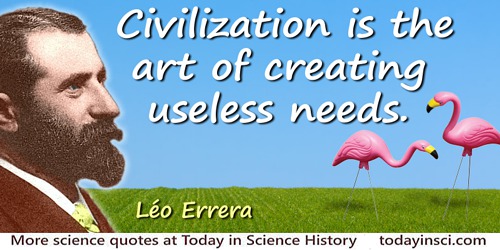
La civilisation, c'est l'art de se créer des besoins inutiles.
Civilization is the art of creating useless needs.
Civilization is the art of creating useless needs.
In Recueil d'Œuvres de Léo Errera: Botanique Générale (1908), 198. Google translation by Webmaster.
~~[Attributed without source]~~ If your result needs a statistician then you should design a better experiment.
Often seen, virally spread, but always without a source citation. If you can provide a primary source, please contact Webmaster. Until then the quote should be regarded as not authenticated.
~~[Attributed without source]~~ The more physics you have the less engineering you need.
Often seen, virally spread, but always without a source citation. If you can provide a primary source, please contact Webmaster. Until then the quote should be regarded as not authenticated.
~~[No known primary source]~~ If your experiment needs statistics, you ought to have done a better experiment.
As quoted, without citation in 'Preface', Norman T.J. Bailey the Mathematical Approach to Biology and Medicine (1967, 1989), v. Also in revised book, Norman T. J. Bailey, Mathematics, Statistics, and Systems for Health (1977), 51. Webmaster has so far found no primary source for verification (Can you help?)
~~[Unverified]~~ Why has elegance found so little following? Elegance has the disadvantage that hard work is needed to achieve it and a good education to appreciate it.
Webmaster has thus far found no primary source for verification. (Can you help?)
A celebrated author and divine has written to me that “he has gradually learnt to see that it is just as noble a conception of the Deity to believe that He created a few original forms capable of self-development into other and needful forms, as to believe that He required a fresh act of creation to supply the voids caused by the action of His laws.”
In Origin of Species (1860), 417.
A discovery in science, or a new theory, even when it appears most unitary and most all-embracing, deals with some immediate element of novelty or paradox within the framework of far vaster, unanalysed, unarticulated reserves of knowledge, experience, faith, and presupposition. Our progress is narrow; it takes a vast world unchallenged and for granted. This is one reason why, however great the novelty or scope of new discovery, we neither can, nor need, rebuild the house of the mind very rapidly. This is one reason why science, for all its revolutions, is conservative. This is why we will have to accept the fact that no one of us really will ever know very much. This is why we shall have to find comfort in the fact that, taken together, we know more and more.
Science and the Common Understanding (1954), 53-4.
A hundred years ago … an engineer, Herbert Spencer, was willing to expound every aspect of life, with an effect on his admiring readers which has not worn off today.
Things do not happen quite in this way nowadays. This, we are told, is an age of specialists. The pursuit of knowledge has become a profession. The time when a man could master several sciences is past. He must now, they say, put all his efforts into one subject. And presumably, he must get all his ideas from this one subject. The world, to be sure, needs men who will follow such a rule with enthusiasm. It needs the greatest numbers of the ablest technicians. But apart from them it also needs men who will converse and think and even work in more than one science and know how to combine or connect them. Such men, I believe, are still to be found today. They are still as glad to exchange ideas as they have been in the past. But we cannot say that our way of life is well-fitted to help them. Why is this?
Things do not happen quite in this way nowadays. This, we are told, is an age of specialists. The pursuit of knowledge has become a profession. The time when a man could master several sciences is past. He must now, they say, put all his efforts into one subject. And presumably, he must get all his ideas from this one subject. The world, to be sure, needs men who will follow such a rule with enthusiasm. It needs the greatest numbers of the ablest technicians. But apart from them it also needs men who will converse and think and even work in more than one science and know how to combine or connect them. Such men, I believe, are still to be found today. They are still as glad to exchange ideas as they have been in the past. But we cannot say that our way of life is well-fitted to help them. Why is this?
In 'The Unification of Biology', New Scientist (11 Jan 1962), 13, No. 269, 72.
About 85 per cent of my “thinking” time was spent getting into a position to think, to make a decision, to learn something I needed to know. Much more time went into finding or obtaining information than into digesting it. Hours went into the plotting of graphs... When the graphs were finished, the relations were obvious at once, but the plotting had to be done in order to make them so.
From article 'Man-Computer Symbiosis', in IRE Transactions on Human Factors in Electronics (Mar 1960), Vol. HFE-1, 4-11.
Abstract of a paper: This paper does not need an abstract—it is abstract enough already.
From Nicholas J. Rose, Mathematical Maxims and Minims (1988), 5.
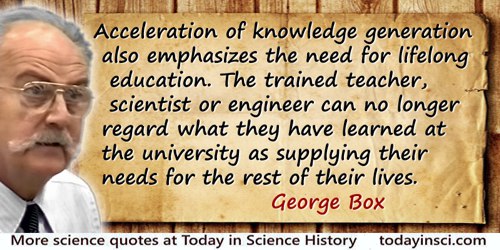
Acceleration of knowledge generation also emphasizes the need for lifelong education. The trained teacher, scientist or engineer can no longer regard what they have learned at the university as supplying their needs for the rest of their lives.
In article Total Quality: Its Origins and its Future (1995), published at the Center for Quality and Productivity Improvement.
Access to more information isn’t enough—the information needs to be correct, timely, and presented in a manner that enables the reader to learn from it. The current network is full of inaccurate, misleading, and biased information that often crowds out the valid information. People have not learned that “popular” or “available” information is not necessarily valid.
Response to the Pew Research Center survey question, “Is Google making us stupid?” Posted 19 Feb 2010 on page 'Future of the Internet IV' at pewinternet.org website.
Alexander Langmuir was quoted in the early 1960s instructing incoming Epidemic Intelligence Service (EIS) officers that the only need for the laboratory in an outbreak investigation was to “prove their conclusions were right.” (2011)
As given in epigraph to Chap. 9, in Centers for Disease Control and Prevention, The CDC Field Epidemiology Manual (2018), 188. A footnoted reference explains: “Langmuir’s point was not to denigrate the laboratory but to emphasize the power of an investigation based on a solid clinical case definition and established field epidemiologic principles,” in Walter R. Dowdle (corresponding author), Leonard W. Mayer, Karen K. Steinberg, Neelam D. Ghiya and Tanja Popovic (co-authors), 'CDC Laboratory Contributions to Public Health', Morbidity and Mortality Weekly Report, Supplements (7 Oct 2011), 60, 27.
All anybody has to say to Edward [Teller] is, ‘We’ve got a problem here, we need you,’ and— zip! he’s into it. It’s helpfulness, plus maybe vanity, but mostly just curiosity.
As described by an unidentified friend, quoted in Robert Coughlan, 'Dr. Edward Teller’s Magnificent Obsession', Life (6 Sep 1954), 62.
All living things need their instruction manual (even nonliving things like viruses) and that is all they need, carried in one very small suitcase.
In The Center of Life: A Natural History of the Cell (1977, 1978), 8.
All truths wait in all things,
They neither hasten their own delivery nor resist it,
They do not need the obstetric forceps of the surgeon.
They neither hasten their own delivery nor resist it,
They do not need the obstetric forceps of the surgeon.
In Leaves of Grass (1855), 34.
All you really need to know for the moment is that the universe is a lot more complicated than you might think, even if you start from a position of thinking it’s pretty damn complicated in the first place.
In Mostly Harmless (1992), 195.
America’s technology has turned in upon itself; its corporate form makes it the servant of profits, not the servant of human needs.
quoted in Robin Morgan, Sisterhood is Powerful (1970).
Archimedes possessed so high a spirit, so profound a soul, and such treasures of highly scientific knowledge, that though these inventions [used to defend Syracuse against the Romans] had now obtained him the renown of more than human sagacity, he yet would not deign to leave behind him any commentary or writing on such subjects; but, repudiating as sordid and ignoble the whole trade of engineering, and every sort of art that lends itself to mere use and profit, he placed his whole affection and ambition in those purer speculations where there can be no reference to the vulgar needs of life; studies, the superiority of which to all others is unquestioned, and in which the only doubt can be whether the beauty and grandeur of the subjects examined, or the precision and cogency of the methods and means of proof, most deserve our admiration.
— Plutarch
In John Dryden (trans.), Life of Marcellus.
Art gallery? Who needs it? Look up at the swirling silver-lined clouds in the magnificent blue sky or at the silently blazing stars at midnight. How could indoor art be any more masterfully created than God’s museum of nature?
…...
As a great man’s influence never ends, so also there is no definite finality, no end, to a great survey; it runs along for centuries, ever responsive to the strain of the increasing needs of a growing population and an enlarging domain.
In 'Charles Anthony Scott', Biographical Memoirs: Vol. VIII (1919), 87.
As we cannot use physician for a cultivator of physics, I have called him a physicist. We need very much a name to describe a cultivator of science in general. I should incline to call him a Scientist. Thus we might say, that as an Artist is a Musician, Painter or Poet, a Scientist is a Mathematician, Physicist, or Naturalist.
The Philosophy of the Inductive Sciences (1840), Vol. I, cxiii.
Be suspicious of a theory if more and more hypotheses are needed to support it as new facts become available, or as new considerations are brought to bear.
Given as the authors’ preferred interpretation of Ockham’s Razor. With co-author Nalin Chandra Wickramasinghe, Evolution from Space (1981), 135.
Before delivering your lectures, the manuscript should be in such a perfect form that, if need be, it could be set in type. Whether you follow the manuscript during the delivery of the lecture is purely incidental. The essential point is that you are thus master of the subject matter.
Advice to his son. As quoted in Ralph Oesper, The Human Side Of Scientists (1975), 185.
Carry when walking a book, and a note-book to preserve the ideas, and a piece of bread in order to prolong the walk if need be.
From Appendix A, 'Extracts From the Unpublished Writings of Carnot', Reflections on the Motive Power of Heat (1890, 2nd ed. 1897), 205.
Caves are wonderful places for lairs
For sabertooth tigers and bears
But “Try and eject us!”
Said Homo erectus,
“We need this place for our heirs!”
For sabertooth tigers and bears
But “Try and eject us!”
Said Homo erectus,
“We need this place for our heirs!”
In sidebar to 'Evolving Toward Humans', History of Life (1989, 1991), 361.
Chemistry teaches us to regard under one aspect, as various types of combustion or oxidation, the burning of a candle, the rusting of metals, the physiological process of respiration, and the explosion of gunpowder. In each process there is the one common fact that oxygen enters into new chemical combinations. Similarly to the physicist, the fall of the traditional apple of Newton, the revolution of the earth and planets round the sun, the apparitions of comets, and the ebb and flow of the tides are all phases of the universal law of gravitation. A race ignorant of the nature of combustion or of the law of gravitation, and ignorant of the need of such generalisations, could not be considered to have advanced far along the paths of scientific discovery.
In 'The Discovery of Radioactivity: Radioactivity, a New Science', The Interpretation of Radium and the Structure of the Atom (4th ed., 1920), 1.
Clearly it is not reason that has failed. What has failed—as it has always failed—is the attempt to achieve certainty, to reach an absolute, to find the course of human events to a final end. ... It is not reason that has promised to eliminate risk in human undertakings; it is the emotional needs of men.
In The Quest For Identity (1958), 135.
Committees are dangerous things that need most careful watching. I believe that a research committee can do one useful thing and one only. It can find the workers best fitted to attack a particular problem, bring them together, give them the facilities they need, and leave them to get on with the work. It can review progress from time to time, and make adjustments; but if it tries to do more, it will do harm.
Attributed without citation in W.I.B. Beveridge, The Art of Scientific Investigation (1951), 118.
Common Sense and Education: The more you think you have of one, the less you think you need of the other.
Given, without source, as an example of 'Clever Remark', or bon mot, in The Well-Spoken Thesaurus (2011), 109.
Common sense needs to be renamed
Cause nowadays it’s rare.
Cause nowadays it’s rare.
From lyrics, 'Jme', on album Blam! (Released 4 Oct 2010).
Computers and rocket ships are examples of invention, not of understanding. … All that is needed to build machines is the knowledge that when one thing happens, another thing happens as a result. It’s an accumulation of simple patterns. A dog can learn patterns. There is no “why” in those examples. We don’t understand why electricity travels. We don’t know why light travels at a constant speed forever. All we can do is observe and record patterns.
In God's Debris: A Thought Experiment (2004), 22.
Don’t take your organs to heaven with you. Heaven knows we need them here.
[Slogan advocating organ donations.]
[Slogan advocating organ donations.]
During the eight days I spent in space, I realized that mankind needs height primarily to better know our long-suffering Earth, to see what cannot be seen close up. Not just to love her beauty, but also to ensure that we do not bring even the slightest harm to the natural world
In Jack Hassard and Julie Weisberg , Environmental Science on the Net: The Global Thinking Project (1999), 40.
Each new scientific development is due to the pressure of some social need. Of course … insatiable curiosity … is still nothing but a response either to an old problem of nature, or to one arising from new social circumstances.
In 'The Teaching of the History of Science', The Scientific Monthly (Sep 1918), 194.
Earth provides enough to satisfy every man’s need, but not every man’s greed.
As quoted, without source, in E.F. Schumacher, Small is Beautiful: Economics as If People Mattered (1973), 31.
Education in a technological world of replaceable and expendable parts is neuter. Technology needs not people or minds but “hands.”
In The Mechanical Bride: Folklore of Industrial Man (1967) 53.
Engineers apply the theories and principles of science and mathematics to research and develop economical solutions to practical technical problems. Their work is the link between scientific discoveries and commercial applications. Engineers design products, the machinery to build those products, the factories in which those products are made, and the systems that ensure the quality of the product and efficiency of the workforce and manufacturing process. They design, plan, and supervise the construction of buildings, highways, and transit systems. They develop and implement improved ways to extract, process, and use raw materials, such as petroleum and natural gas. They develop new materials that both improve the performance of products, and make implementing advances in technology possible. They harness the power of the sun, the earth, atoms, and electricity for use in supplying the Nation’s power needs, and create millions of products using power. Their knowledge is applied to improving many things, including the
quality of health care, the safety of food products, and the efficient operation of financial systems.
Bureau of Labor Statistics, Occupational Outlook Handbook (2000) as quoted in Charles R. Lord. Guide to Information Sources in Engineering (2000), 5. This definition has been revised and expanded over time in different issues of the Handbook.
Essentially all civilizations that rose to the level of possessing an urban culture had need for two forms of science-related technology, namely, mathematics for land measurements and commerce and astronomy for time-keeping in agriculture and aspects of religious rituals.
From The Science Matrix: The Journey, Travails, Triumphs (1992, 1998), Preface, x.
Ethics and Science need to shake hands.
…...
Every day we are interacting with the economy, whether we want to or not, and whether we know it or not. To have a level of control over our lives, we need to understand the connections between money and events and ourselves.
As quoted in brochure for PBS TV financial news series, Adam Smith’s Money World.
Every little girl needed a doll through which to project herself into her dream of her future. If she was going to do role playing of what she would be like when she was 16 or 17, it was a little stupid to play with a doll that had a flat chest. So I gave it beautiful breasts.
Interview (1977), as quoted in Kenneth C. Davis, Don't Know Much About History (2009), 435.
Every mathematical book that is worth reading must be read “backwards and forwards”, if I may use the expression. I would modify Lagrange’s advice a little and say, “Go on, but often return to strengthen your faith.” When you come on a hard or dreary passage, pass it over; and come back to it after you have seen its importance or found the need for it further on.
In Algebra, Part 2 (1889), Preface, viii.
Everybody can be great. Because anybody can serve. You don’t have to have a college degree to serve … You only need a heart full of grace. A soul generated by love.
Quoted in Kim Lim (ed.), 1,001 Pearls of Spiritual Wisdom: Words to Enrich, Inspire, and Guide Your Life (2014), 253
Everybody using C is a dangerous thing. We have other languages that don’t have buffer overflows.
But what is the longer-term cost to us as an enterprise in increased vulnerability, increased need for add-on security services or whatever else is involved? Those kinds of questions don’t get asked often enough.
As quoted in magazine article, an interview by John McCormick, 'Computer Security as a Business Enabler', Baseline (7 Jul 2007).
Everything that the human race has done and thought is concerned with the satisfaction of deeply felt needs and the assuagement of pain. One has to keep this constantly in mind if one wishes to understand spiritual movements and their development. Feeling and longing are the motive force behind all human endeavor and human creation, in however exalted a guise the latter may present themselves to us.
In Essay, 'On Religion and Science' as collected in Ideas And Opinions. (2010), 35 [where it is cited as “Written expressly for the New York Times Magazine” (9 Nov 1930), “pp. (1-4). The German
text was published in the Berliner Tageblatt” (11 Nov 1930).] Also seen in New York Times archive newspaper image as: “Everything that men do or think concerns the satisfaction of the needs they feel or the escape from pain. This must be kept in mind when we seek to understand spiritual or intellectual movements and the way in which they develop. For feeling and longing are the motive forces of all human striving and productivity—however nobly these latter may display themselves to us,” in 'Religion and Science', New York Times Magazine (9 Nov 1930), 1. [It is a puzzle that these are two totally different paragraphs (albeit with the same gist): one quoted and cited in a book, and one from a direct image from NYT archive (timesmachine). Yet the first claims to have been “expressly written” for the cited newspaper article, which does not match that wording in the image record of the actual newspaper. However, the printed book title page states: Based on Mein Welttrild, edited by Cal Seelig, and other sources. New translations and revisions by Sonja Bargmann. So perhaps (at a guess) the first version of the quote shown above is a translation from the German newspaper? —Webmaster]
Experience is a jewel, and it need be so, for it is often purchased at an infinite rate.
…...
Few intellectual tyrannies can be more recalcitrant than the truths that everybody knows and nearly no one can defend with any decent data (for who needs proof of anything so obvious). And few intellectual activities can be more salutary than attempts to find out whether these rocks of ages might crumble at the slightest tap of an informational hammer.
…...
First, as concerns the success of teaching mathematics. No instruction in the high schools is as difficult as that of mathematics, since the large majority of students are at first decidedly disinclined to be harnessed into the rigid framework of logical conclusions. The interest of young people is won much more easily, if sense-objects are made the starting point and the transition to abstract formulation is brought about gradually. For this reason it is psychologically quite correct to follow this course.
Not less to be recommended is this course if we inquire into the essential purpose of mathematical instruction. Formerly it was too exclusively held that this purpose is to sharpen the understanding. Surely another important end is to implant in the student the conviction that correct thinking based on true premises secures mastery over the outer world. To accomplish this the outer world must receive its share of attention from the very beginning.
Doubtless this is true but there is a danger which needs pointing out. It is as in the case of language teaching where the modern tendency is to secure in addition to grammar also an understanding of the authors. The danger lies in grammar being completely set aside leaving the subject without its indispensable solid basis. Just so in Teaching of Mathematics it is possible to accumulate interesting applications to such an extent as to stunt the essential logical development. This should in no wise be permitted, for thus the kernel of the whole matter is lost. Therefore: We do want throughout a quickening of mathematical instruction by the introduction of applications, but we do not want that the pendulum, which in former decades may have inclined too much toward the abstract side, should now swing to the other extreme; we would rather pursue the proper middle course.
Not less to be recommended is this course if we inquire into the essential purpose of mathematical instruction. Formerly it was too exclusively held that this purpose is to sharpen the understanding. Surely another important end is to implant in the student the conviction that correct thinking based on true premises secures mastery over the outer world. To accomplish this the outer world must receive its share of attention from the very beginning.
Doubtless this is true but there is a danger which needs pointing out. It is as in the case of language teaching where the modern tendency is to secure in addition to grammar also an understanding of the authors. The danger lies in grammar being completely set aside leaving the subject without its indispensable solid basis. Just so in Teaching of Mathematics it is possible to accumulate interesting applications to such an extent as to stunt the essential logical development. This should in no wise be permitted, for thus the kernel of the whole matter is lost. Therefore: We do want throughout a quickening of mathematical instruction by the introduction of applications, but we do not want that the pendulum, which in former decades may have inclined too much toward the abstract side, should now swing to the other extreme; we would rather pursue the proper middle course.
In Ueber den Mathematischen Unterricht an den hoheren Schulen; Jahresbericht der Deutschen Mathematiker Vereinigung, Bd. 11, 131.
For a smart material to be able to send out a more complex signal it needs to be nonlinear. If you hit a tuning fork twice as hard it will ring twice as loud but still at the same frequency. That’s a linear response. If you hit a person twice as hard they’re unlikely just to shout twice as loud. That property lets you learn more about the person than the tuning fork. - When Things Start to Think, 1999.
…...
For it is not number of Experiments, but weight to be regarded; & where one will do, what need many?
In 'Mr. Newton's Answer to the Precedent Letter, Sent to the Publisher', Philosophical Transactions (1665-1678), Vol. 11 (25 Sep 1676), No. 128, 703.
For of men it may in general be affirmed that they are thankless, fickle, false, studious to avoid danger, greedy of gain, devoted to you while you are able to confer benefits upon them …; but in the hour of need they forsake you.
In The Prince (1882), 111, as translated from the Italian by N.H.Thomson. Another translation gives: “Speaking generally, men are ungrateful, fickle, hypocritical, fearful of danger, and covetous of gain,” in Forbes Book of Quotations: 10,000 Thoughts on the Business of Life (2016).
For science, in so far as it is a substitute for religion, and reason, in so far as it is a substitute for faith, have always foundered. Science will be able to satisfy in an increasing measure, and in fact does satisfy, our increasing logical and intellectual needs, our desire to know and understand the truth; but science does not satisfy the needs of our heart and our will, our hunger for immortality—far from satisfying it, it contradicts it.
From Miguel Unamuno and J. E. Crawford Flitch (trans.), Essays and Soliloquies (1926), 209.
For what are the whales being killed? For a few hundred jobs and products that are not needed, since there are cheap substitutes. If this continues, it will be the end of living and the beginning of survival. The world is being totaled.
Attributed.
Four circles to the kissing come,
The smaller are the benter.
The bend is just the inverse of
The distance from the centre.
Though their intrigue left Euclid dumb
There’s now no need for rule of thumb.
Since zero bend’s a dead straight line
And concave bends have minus sign,
The sum of squares of all four bends
Is half the square of their sum.
The smaller are the benter.
The bend is just the inverse of
The distance from the centre.
Though their intrigue left Euclid dumb
There’s now no need for rule of thumb.
Since zero bend’s a dead straight line
And concave bends have minus sign,
The sum of squares of all four bends
Is half the square of their sum.
In poem, 'The Kiss Precise', Nature (20 Jun 1936), 137, 1021, as quoted, cited, explained and illustrated in Martin Gardner, The Colossal Book of Mathematics: Classic Puzzles, Paradoxes, and Problems (2001), 139-141.
From time immemorial, the infinite has stirred men's emotions more than any other question. Hardly any other idea has stimulated the mind so fruitfully. Yet, no other concept needs clarification more than it does.
In address (4 Jun 1925), at a congress of the Westphalian Mathematical Society in Munster, in honor of Karl Weierstrass. First published in Mathematische Annalen (1926), 95, 161-190. Translated by Erna Putnam and Gerald J. Massey as 'On the Infinite', collected in Paul Benacerraf (ed.) Philosophy of Mathematics: Selected Readings (1983), 185. Compare another translation elsewhere on this page, beginning, “The Infinite!…”.
God was always invented to explain mystery. God is always invented to explain those things that you do not understand. Now, when you finally discover how something works … you don't need him anymore. But … you leave him to create the universe because we haven't figured that out yet.
Interview, collected in Paul C. W. Davies and Julian R. Brown (eds.) Superstrings: A Theory of Everything? (1988), 208-209.
Goethe said that he who cannot draw on 3,000 years of learning is living hand to mouth. It could just as well be said that individuals who do tap deeply into this rich cultural legacy are wealthy indeed. Yet the paradox is that much of this wisdom is buried in a sea of lesser books or like lost treasure beneath an ocean of online ignorance and trivia. That doesn’t mean that with a little bit of diligence you can’t tap into it. Yet many people, perhaps most, never take advantage of all this human experience. They aren’t obtaining knowledge beyond what they need to know for work or to get by. As a result, their view of our amazing world is diminished and their lives greatly circumscribed.
In An Embarrassment of Riches: Tapping Into the World's Greatest Legacy of Wealth (2013), 65.
Google can aggregate all web and paper-based information, and they can build fantastic search engines, but that will not directly lead to truth or wisdom. For that we will continue to need education, training in critical thought, and good editors who can help us winnow the fact from the fiction.
From post 're:The Pursuit of Knowledge, from Genesis to Google' to the 'Interesting People' List (6 Jan 2005) maintained by David J. Farber, now archived at interesting-people.org website.
Hard work and for ever sticking to a thing till it’s done, are the main things an inventor needs.
As quoted in French Strother, 'The Modern Profession of Inventing', World's Work and Play (Jul 1905), 6, No. 32, 186.
Having someone wonder where you are when you don’t come home at night is a very old human need.
As quoted, without citation, in New Woman (1983), 13, 90.
Here is the element or power of conduct, of intellect and knowledge, of beauty, and of social life and manners, and all needful to build up a complete human life. … We have instincts responding to them all, and requiring them all, and we are perfectly civilized only when all these instincts of our nature—all these elements in our civilization have been adequately recognized and satisfied.
Collected in Tryon Edwards (ed.), A Dictionary of Thoughts: Being a Cyclopedia of Laconic Quotations from the Best Authors Both Ancient and Modern (1891), 75.
However far the calculating reason of the mathematician may seem separated from the bold flight of the artist’s phantasy, it must be remembered that these expressions are but momentary images snatched arbitrarily from among the activities of both. In the projection of new theories the mathematician needs as bold and creative a phantasy as the productive artist, and in the execution of the details of a composition the artist too must calculate dispassionately the means which are necessary for the successful consummation of the parts. Common to both is the creation, the generation, of forms out of mind.
From Die Entwickelung der Mathematik im Zusammenhange mit der Ausbreitung der Kultur (1893), 4. As translated in Robert Édouard Moritz, Memorabilia Mathematica; Or, The Philomath’s Quotation-Book (1914), 185. From the original German, “Wie weit auch der rechnende Verstand des Mathematikers von dem kühnen Fluge der Phantasie des Künstlers getrennt zu sein scheint, so bezeichnen diese Ausdrücke doch blosse Augenblicksbilder, die willkürlich aus der Thätigkeit Beider herausgerissen sind. Bei dem Entwurfe neuer Theorieen bedarf der Mathematiker einer ebenso kühnen und schöpferischen Phantasie wie der schaffende Künstler, und bei der Ausführung der Einzelheiten eines Werkes muss auch der Künstler kühl alle Mittel berechnen, welche zum Gelingen der Theile erforderlich sind. Gemeinsam ist Beiden die Hervorbringung, die Erzeugung der Gebilde aus dem Geiste.”
However far the mathematician’s calculating senses seem to be separated from the audacious flight of the artist’s imagination, these manifestations refer to mere instantaneous images, which have been arbitrarily torn from the operation of both. In designing new theories, the mathematician needs an equally bold and inspired imagination as creative as the artist, and in carrying out the details of a work the artist must unemotionally reckon all the resources necessary for the success of the parts. Common to both is the fabrication, the creation of the structure from the intellect.
From Die Entwickelung der Mathematik im Zusammenhange mit der Ausbreitung der Kultur (1893), 4. Translated by Webmaster using online resources. From the original German, “Wie weit auch der rechnende Verstand des Mathematikers von dem kühnen Fluge der Phantasie des Künstlers getrennt zu sein scheint, so bezeichnen diese Ausdrücke doch blosse Augenblicksbilder, die willkürlich aus der Thätigkeit Beider herausgerissen sind. Bei dem Entwurfe neuer Theorieen bedarf der Mathematiker einer ebenso kühnen und schöpferischen Phantasie wie der schaffende Künstler, und bei der Ausführung der Einzelheiten eines Werkes muss auch der Künstler kühl alle Mittel berechnen, welche zum Gelingen der Theile erforderlich sind. Gemeinsam ist Beiden die Hervorbringung, die Erzeugung der Gebilde aus dem Geiste.”
I always enjoyed the hearty society of a snowstorm; glad, though solemn, when within a mile or two of safe ground where a storm-nest could be made. Now on this shattered ice I need my eyes, but the snow, gyrating, whirling, and sifting, the very incarnation of spasmodic hysterical mirth, fills them, and I am blinded as if blinded by kisses, delicious in the eye, and sweet.
Journal Entry, while camping on Muir Glacier, Alaska (19? Jul 1890). In John Muir and Linnie Marsh Wolfe (ed.), John of the Mountains: The Unpublished Journals of John Muir (1938, 1979), 321.
I am not pleading with you to make changes, I am telling you you have got to make them—not because I say so, but because old Father Time will take care of you if you don’t change. Consequently, you need a procurement department for new ideas.
As quoted in book review, T.A. Boyd, 'Charles F. Kettering: Prophet of Progress', Science (30 Jan 1959), 256.
I am truly a ‘lone traveler’ and have never belonged to my country, my home, my friends, or even my immediate family, with my whole heart; in the face of all these ties, I have never lost a sense of distance and a need for solitude.
…...
I believe that nursing is the compassionate, effective, and humane care given by one who is educated and trained in the art and science of nursing to someone who is in need of help because of problems in health or in activities of his daily life.
As quoted in American Nurses’ Association, Contemporary Minority Leaders in Nursing: Afro-American, Hispanic, Native American Perspectives (1983), 92.
I did it [worked long hours] because I wanted to, not because I had to. I loved it and still do love it, That is what women must have in addition to diligence—a real and absorbing devotion to their work. They need now to have a bigger body of work to show.
In Genevieve Parkhurst, 'Dr. Sabin, Scientist: Winner Of Pictorial Review’s Achievement Award', Pictorial Review (Jan 1930), 71.
I don’t know anything about mathematics; can’t even do proportion. But I can hire all the good mathematicians I need for fifteen dollars a week.
As quoted in French Strother, 'The Modern Profession of Inventing', World's Work and Play (Jul 1905), 6, No. 32, 187.
I don’t need hobbies. I mean, why should I run after a ball on a field after I have kicked papers around from nine to five?
From 'Asking Nature', collected in Lewis Wolpert and Alison Richards (eds.), Passionate Minds: The Inner World of Scientists (1997), 197.
I find out what the world needs, then I proceed to invent. My main purpose in life is to make money so that I can afford to go on creating more inventions.
…...
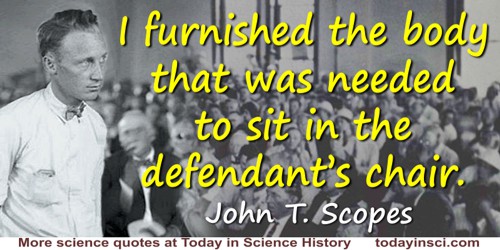
I furnished the body that was needed to sit in the defendant’s chair. [Explaining his role in the Scopes Monkey Trial.]
As quoted in Newsweek, Vol. 69, 94.
I gang my own gait and have never belonged to my country, my home, my friends, or even my immediate family, with my whole heart; in the face of all these ties I have never lost an obstinate sense of detachment, of the need for solitude–a feeling which increases with the years.
…...
I had a Meccano set with which I “played” endlessly. Meccano which was invented by Frank Hornby around 1900, is called Erector Set in the US. New toys (mainly Lego) have led to the extinction of Meccano and this has been a major disaster as far as the education of our young engineers and scientists is concerned. Lego is a technically trivial plaything and kids love it partly because it is so simple and partly because it is seductively coloured. However it is only a toy, whereas Meccano is a real engineering kit and it teaches one skill which I consider to be the most important that anyone can acquire: This is the sensitive touch needed to thread a nut on a bolt and tighten them with a screwdriver and spanner just enough that they stay locked, but not so tightly that the thread is stripped or they cannot be unscrewed. On those occasions (usually during a party at your house) when the handbasin tap is closed so tightly that you cannot turn it back on, you know the last person to use the washroom never had a Meccano set.
Nobel laureate autobiography in Les Prix Nobel/Nobel Lectures 1996 (1997), 189.
I have no doubt that it is possible to give a new direction to technological development, a direction that shall lead it back to the real needs of man, and that also means: to the actual size of man. Man is small, and, therefore, small is beautiful. To go
Small is Beautiful (1973).
I haven’t strength of mind not to need a career.
As quoted by Margaret Mead (who was a student of Benedict), in 'Search: 1920-1930', Ruth Benedict, An Anthropologist at Work (1959, 2011), 3.
I hope my studies may be an encouragement to other women, especially to young women, to devote their lives to the larger interests of the mind. It matters little whether men or women have the more brains; all we women need to do to exert our proper influence is just to use all the brains we have.
In Elinor Bluemel, Florence Sabin: Colorado Woman of the Century (1959), 124. Cited elsewhere as from speech accepting the Pictorial Review achievement award (1929).
I hope my studies may be an encouragement to other women, especially to young women, to devote their lives to the larger interests of the mind. It matters little whether men or women have the more brains; all we women need to do to exert our proper influence is just to use all the brains we have."
As quoted in part, in Eminent Women: Recipients of the National Achievement Award (1948), 8. Cited more completely elsewhere as from speech accepting the Pictorial Review achievement award (1929).
I know that to personalize the Earth System as Gaia, as I have often done and continue to do in this book, irritates the scientifically correct, but I am unrepentant because metaphors are more than ever needed for a widespread comprehension of the true nature of the Earth and an understanding of the lethal dangers that lie ahead.
In The Revenge of Gaia: Earth’s Climate Crisis & The Fate of Humanity (2006, 2007), 188.
I look for what needs to be done. … After all, that’s how the universe designs itself.
In Christian Science Monitor (3 Nov 1964).
I read somewhere that humans are the only creatures who need to account for their existence. All other living beings just live and die.
In White Guilt (2010), 90.
I read them. Not to grade them. No, I read them to see how I am doing. Where am I failing? What don’t they understand? Why do they give wrong answers? Why do they have some point of view that I don’t think is right? Where am I failing? Where do I need to build up.
In The Essential Deming.
I wish they don’t forget to keep those treasures pure which they have in excellence over the west: their artistic building of life, the simplicity a nd modesty in personal need, and the pureness and calmness of Japanese soul.
…...
I would not be confident in everything I say about the argument: but one thing I would fight for to the end, both in word and in deed if I were able—that if we believe we should try to find out what is not known, we should be better and braver and less idle than if we believed that what we do not know is impossible to find out and that we need not even try.
…...
I’m particularly adept at making mistakes—it’s a necessity as an engineer. Each iteration of the vacuum came about because of a mistake I needed to fix.
In 'My Favorite Mistake', Newsweek (29 May 2011). About developing his revolutionary Dyson vacuum cleaner.
I’ve learned that you shouldn’t go through life with a catcher’s mitt on both hands; you need to be able to throw something back.
Sixth stanza of poem 'On Turning 70'. The poem is printed in Michigan Office of Services to the Aging, Annual Report 2004 (2005), no page number.
If basketball was going to enable Bradley to make friends, to prove that a banker’s son is as good as the next fellow, to prove that he could do without being the greatest-end-ever at Missouri, to prove that he was not chicken, and to live up to his mother’s championship standards, and if he was going to have some moments left over to savor his delight in the game, he obviously needed considerable practice, so he borrowed keys to the gym and set a schedule for himself that he adhereded to for four full years—in the school year, three and a half hours every day after school, nine to five on Saturday, one-thirty to five on Sunday, and, in the summer, about three hours a day.
A Sense of Where You Are: Bill Bradley at Princeton
If I had a screwdriver and a pair of pliers, anything that could be opened was in danger. I had this need to know what was inside.
Concerning his curiosity for electrical devices which began as a child. Quoted in Timothy L. O’Brien, 'Not Invented here: Are U.S. Innovators Losing Their Competitive Edge?', New York Times (13 Nov 2005), B6.
If I had my life to live over again I would not devote it to develop new industrial processes: I would try to add my humble efforts to use Science to the betterment of the human race.
I despair of the helter-skelter methods of our vaulted homo sapiens, misguided by his ignorance and his politicians. If we continue our ways, there is every possibility that the human race may follow the road of former living races of animals whose fossils proclaim that they were not fit to continue. Religion, laws and morals is not enough. We need more. Science can help us.
I despair of the helter-skelter methods of our vaulted homo sapiens, misguided by his ignorance and his politicians. If we continue our ways, there is every possibility that the human race may follow the road of former living races of animals whose fossils proclaim that they were not fit to continue. Religion, laws and morals is not enough. We need more. Science can help us.
Letter to a friend (14 Jan 1934). In Savage Grace (1985, 2007), 62.
If indeed the Earth is, in its own slow way, a very dynamic body and we have regarded it as essentially static, we need to discard most of our old theories and books and start again with a new viewpoint and a new science.
In 'Reply to Beloussov', Geotimes (1968), 13, No. 12, 22. The public disagreement on seafloor spreading between Wilson and V.V. Beloussov is collected in Brainerd Mears, The Nature of Geology: Contemporary Readings (1970).
If there is need for scientists to become conservationists and push for natural area preservation, there is an almost greater need for conservation to incorporate science. Scientists and conservationists have not worked together enough.
From Paper, 'The Scientific Need for Shallow-Water Marine Sanctuaries,' collected as Article VI, in Julia Allen Field and Henry Field (eds.), Scientific Use of Natural Areas: Symposium (1965), 85. The Symposium was the XVI International Congress of Zoology, Washington (Aug 1963). Lee M. Talbot, summarizing the Symposium echoed Ray’s words to emphasize the theme of the Symposium (p.102), that — “there is a need for scientists to act on the conservation of natural areas.”
If they needed to, twenty-five furtive cells could hide under this period.
In The Center of Life: A Natural History of the Cell (1977, 1978), 8.
If we are recognizing athletic achievement, we should also be recognizing academic achievement and science achievement. If we invite the team that wins the Super Bowl to the White House, then we need to invite some Science Fair winners to the White House as well.
Speech (7 Feb 2012) in the East Room of the White house. 'Remarks by the President at the White House Science Fair'
If we knew all the laws of Nature, we should need only one fact or the description of one actual phenomenon to infer all the particular results at that point. Now we know only a few laws, and our result is vitiated, not, of course, by any confusion or irregularity in Nature, but by our ignorance of essential elements in the calculation. Our notions of law and harmony are commonly confined to those instances which we detect, but the harmony which results from a far greater number of seemingly conflicting, but really concurring, laws which we have not detected, is still more wonderful. The particular laws are as our points of view, as to the traveler, a mountain outline varies with every step, and it has an infinite number of profiles, though absolutely but one form. Even when cleft or bored through, it is not comprehended in its entireness.
In Walden (1878), 311.
If you defend a behavior by arguing that people are programmed directly for it, then how do you continue to defend it if your speculation is wrong, for the behavior then becomes unnatural and worthy of condemnation. Better to stick resolutely to a philosophical position on human liberty: what free adults do with each other in their own private lives is their business alone. It need not be vindicated–and must not be condemned–by genetic speculation.
…...
If you have to prove a theorem, do not rush. First of all, understand fully what the theorem says, try to see clearly what it means. Then check the theorem; it could be false. Examine the consequences, verify as many particular instances as are needed to convince yourself of the truth. When you have satisfied yourself that the theorem is true, you can start proving it.
In How to Solve It: A New Aspect of Mathematical Method (2004), 15.
Imagine a room awash in gasoline, and there are two implacable enemies in that room. One of them has nine thousand matches. The other has seven thousand matches. Each of them is concerned about who's ahead, who's stronger. Well that's the kind of situation we are actually in. The amount of weapons that are available to the United States and the Soviet Union are so bloated, so grossly in excess of what's needed to dissuade the other, that if it weren't so tragic, it would be laughable. What is necessary is to reduce the matches and to clean up the gasoline.
From Sagan's analogy about the nuclear arms race and the need for disarmament, during a panel discussion in ABC News Viewpoint following the TV movie The Day After (20 Nov 1983). Transcribed by Webmaster from a video recording. It is seen misquoted in summary form as “The nuclear arms race is like two sworn enemies standing waist deep in gasoline, one with three matches, the other with five.”
In fulfilling the wants of the public, a manufacturer should keep as far ahead as his imagination and his knowledge of his buying public will let him. One should never wait to see what it is a customer is going to want. Give him, rather, what he needs, before he has sensed that need himself.
As quoted by H.M. Davidson, in System: The Magazine of Business (Apr 1922), 41, 413.
In general the position as regards all such new calculi is this That one cannot accomplish by them anything that could not be accomplished without them. However, the advantage is, that, provided such a calculus corresponds to the inmost nature of frequent needs, anyone who masters it thoroughly is able—without the unconscious inspiration of genius which no one can command—to solve the respective problems, yea, to solve them mechanically in complicated cases in which, without such aid, even genius becomes powerless. Such is the case with the invention of general algebra, with the differential calculus, and in a more limited region with Lagrange’s calculus of variations, with my calculus of congruences, and with Möbius’s calculus. Such conceptions unite, as it were, into an organic whole countless problems which otherwise would remain isolated and require for their separate solution more or less application of inventive genius.
Letter (15 May 1843) to Schumacher, collected in Carl Friedrich Gauss Werke (1866), Vol. 8, 298, as translated in Robert Édouard Moritz, Memorabilia Mathematica; Or, The Philomath's Quotation-book (1914), 197-198. From the original German, “Überhaupt verhält es sich mit allen solchen neuen Calculs so, dass man durch sie nichts leisten kann, was nicht auch ohne sie zu leisten wäre; der Vortheil ist aber der, dass, wenn ein solcher Calcul dem innersten Wesen vielfach vorkommender Bedürfnisse correspondirt, jeder, der sich ihn ganz angeeignet hat, auch ohne die gleichsam unbewussten Inspirationen des Genies, die niemand erzwingen kann, die dahin gehörigen Aufgaben lösen, ja selbst in so verwickelten Fällen gleichsam mechanisch lösen kann, wo ohne eine solche Hülfe auch das Genie ohnmächtig wird. So ist es mit der Erfindung der Buchstabenrechnung überhaupt; so mit der Differentialrechnung gewesen; so ist es auch (wenn auch in partielleren Sphären) mit Lagranges Variationsrechnung, mit meiner Congruenzenrechnung und mit Möbius' Calcul. Es werden durch solche Conceptionen unzählige Aufgaben, die sonst vereinzelt stehen, und jedesmal neue Efforts (kleinere oder grössere) des Erfindungsgeistes erfordern, gleichsam zu einem organischen Reiche.”
In India, there’s lack of appreciation of the need to cross-examine data, the responsibility of a statistician.
In India Today (2008), 33, No. 9-17, 130
In modern Europe, the Middle Ages were called the Dark Ages. Who dares to call them so now? … Their Dante and Alfred and Wickliffe and Abelard and Bacon; their Magna Charta, decimal numbers, mariner’s compass, gunpowder, glass, paper, and clocks; chemistry, algebra, astronomy; their Gothic architecture, their painting,—are the delight and tuition of ours. Six hundred years ago Roger Bacon explained the precession of the equinoxes, and the necessity of reform in the calendar; looking over how many horizons as far as into Liverpool and New York, he announced that machines can be constructed to drive ships more rapidly than a whole galley of rowers could do, nor would they need anything but a pilot to steer; carriages, to move with incredible speed, without aid of animals; and machines to fly into the air like birds.
In 'Progress of Culture', an address read to the Phi Beta Kappa Society at Cambridge, 18 July 1867. Collected in Works of Ralph Waldo Emerson (1883), 475.
In the modern world, science and society often interact in a perverse way. We live in a technological society, and technology causes political problems. The politicians and the public expect science to provide answers to the problems. Scientific experts are paid and encouraged to provide answers. The public does not have much use for a scientist who says, “Sorry, but we don’t know.” The public prefers to listen to scientists who give confident answers to questions and make confident predictions of what will happen as a result of human activities. So it happens that the experts who talk publicly about politically contentious questions tend to speak more clearly than they think. They make confident predictions about the future, and end up believing their own predictions. Their predictions become dogmas which they do not question. The public is led to believe that the fashionable scientific dogmas are true, and it may sometimes happen that they are wrong. That is why heretics who question the dogmas are needed.
Frederick S. Pardee Distinguished Lecture (Oct 2005), Boston University. Collected in 'Heretical Thoughts About Science and Society', A Many-Colored Glass: Reflections on the Place of Life in the Universe (2007), 43-44.
Individual dolphins and whales are to be given the legal rights of human individuals. … Research into communication with cetaceans is no longer simply a scientific pursuit…. We must learn their needs, their ethics, their philosophy, to find out who we are on this planet, in this galaxy.
In The Rights of Cetaceans under Human Laws (1978), 138. This shows Lilly’s enthusiasm, but is definitely an over-reach. Edward O. Wilson bluntly rejects it. See the quote beginning “Lilly's writing differs…” on the Edward Wilson Quotation page on this website.
Inspiration is needed in geometry, just as much as in poetry.
(1827). In Aleksandr Sergeevich Pushkin, John Bayley (ed.), Pushkin on Literature (1986), 211.
Instead of needing lots of children, we need high-quality children.
…...
Is fuel efficiency really what we need most desperately? I say that what we really need is a car that can be shot when it breaks down.
In There's a Country in my Cellar (1990), 161.
It is a better world with some buffalo left in it, a richer world with some gorgeous canyons unmarred by signboards, hot-dog stands, super highways, or high-tension lines, undrowned by power or irrigation reservoirs. If we preserved as parks only those places that have no economic possibilities, we would have no parks. And in the decades to come, it will not be only the buffalo and the trumpeter swan who need sanctuaries. Our own species is going to need them too.
It needs them now.
Conclusion of essay 'The Marks of Human Passage', collected in This is Dinosaur: Echo Park Country and its Magic Rivers (1955), 17.
It is a delusion that the use of reason is easy and needs no training or special caution.
In The Art of Scientific Investigation (1950), 85.
It is almost a miracle that modern teaching methods have not yet entirely strangled the holy curiousity of inquiry; for what this delicate little plant needs more than anything, besides stimulation, is freedom.
Quoted in H. Eves, Return to Mathematical Circles.
It is an open secret to the few who know it, but a mystery and stumbling block to the many, that Science and Poetry are own sisters; insomuch that in those branches of scientific inquiry which are most abstract, most formal, and most remote from the grasp of the ordinary sensible imagination, a higher power of imagination akin to the creative insight of the poet is most needed and most fruitful of lasting work.
From Introduction written for William Kingdon Clifford, Clifford’s Lectures and Essays (1879), Vol. 1, 1.
It is entirely unprecedented that evolution should provide a species with an organ which it does not know how to use. … But the evolution of man’s brain has so wildly overshot man’s immediate needs that he is still breathlessly catching up with its unexploited, unexplored possibilities.
In The Ghost in the Machine (1967), 298-299. This is often seen paraphrased as “The evolution of the brain not only overshot the needs of prehistoric man, it is the only example of evolution providing a species with an organ which it does not know how to use.”
It is frivolous to fix pedantically the date of particular inventions. They have all been invented over and over fifty times. Man is the arch machine, of which all these shifts drawn from himself are toy models. He helps himself on each emergency by copying or duplicating his own structure, just so far as the need is.
It is hard to exaggerate Mr Erdos’s passion. For 19 hours a day, seven days a week, stimulated by coffee, and later by amphetamines, he worked on mathematics. He might start a game of chess, but would probably doze off until the conversation returned to maths. To find another life this century as intensely devoted to abstraction, one must reach back to Ludwig Wittgenstein (1889-1951), who stripped his life bare for philosophy. But whereas Wittgenstein discarded his family fortune as a form of self-torture, Mr Erdos gave away most of the money he earned because he simply did not need it. “Private property is a nuisance,” he would say. And where Wittgenstein was driven by near suicidal compulsions, Mr Erdos simply constructed his life to extract from his magnificent obsession the maximum amount of happiness.
— Magazine
In obituary 'Paul Erdos', The Economist (5 Oct 1996), 83.
It is of priceless value to the human race to know that the sun will supply the needs of the earth, as to light and heat, for millions of years; that the stars are not lanterns hung out at night, but are suns like our own; and that numbers of them probably have planets revolving around them, perhaps in many cases with inhabitants adapted to the conditions existing there. In a sentence, the main purpose of the science is to learn the truth about the stellar universe; to increase human knowledge concerning our surroundings, and to widen the limits of intellectual life.
In 'The Nature of the Astronomer’s Work', North American Review (Jun 1908), 187, No. 631, 915.
It is so hard for an evolutionary biologist to write about extinction caused by human stupidity ... Let me then float an unconventional plea, the inverse of the usual argument ... The extinction of Partula is unfair to Partula. That is the conventional argument, and I do not challenge its primacy. But we need a humanistic ecology as well, both for the practical reason that people will always touch people more than snails do or can, and for the moral reason that humans are legitimately the measure of all ethical questions–for these are our issues, not nature’s.
…...
It is terrifying to think how much research is needed to determine the truth of even the most unimportant fact.
Attributed.
It needs no dictionary of quotations to remind me that the eyes are the windows of the soul.
In Zuleika Dobson (1911), 54-55.
It needs scarcely be pointed out that in placing Mathematics at the head of Positive Philosophy, we are only extending the application of the principle which has governed our whole Classification. We are simply carrying back our principle to its first manifestation. Geometrical and Mechanical phenomena are the most general, the most simple, the most abstract of all,— the most irreducible to others, the most independent of them; serving, in fact, as a basis to all others. It follows that the study of them is an indispensable preliminary to that of all others. Therefore must Mathematics hold the first place in the hierarchy of the sciences, and be the point of departure of all Education whether general or special.
In Auguste Comte and Harriet Martineau (trans.), The Positive Philosophy (1858), Introduction, Chap. 2, 50.
It seems plain and self-evident, yet it needs to be said: the isolated knowledge obtained by a group of specialists in a narrow field has in itself no value whatsoever, but only in its synthesis with all the rest of knowledge and only inasmuch as it really contributes in this synthesis toward answering the demand, ‘Who are we?’
…...
It seems to me what is called for is an exquisite balance between two conflicting needs: the most skeptical scrutiny of all hypotheses that are served up to us and at the same time a great openness to new ideas … If you are only skeptical, then no new ideas make it through to you … On the other hand, if you are open to the point of gullibility and have not an ounce of skeptical sense in you, then you cannot distinguish the useful ideas from the worthless ones.
In 'The Burden of Skepticism', Skeptical Inquirer (Fall 1987), 12, No. 1.
It was not a spiritual experience for me; I didn’t feel close to God. … I didn’t think I needed God in my life at that stage. … I had about all of God that I thought I needed and that was one hour every Sunday morning…. I was a faithful attender at church.
More of his answer at a public talk to a question whether he actually felt close to God on the Moon, following: “The answer is no, I did not.” As quoted in Colin Burgess, Footprints in the Dust: The Epic Voyages of Apollo, 1969-1975 (2010), 422.
It would be difficult and perhaps foolhardy to analyze the chances of further progress in almost every part of mathematics one is stopped by unsurmountable difficulties, improvements in the details seem to be the only possibilities which are left… All these difficulties seem to announce that the power of our analysis is almost exhausted, even as the power of ordinary algebra with regard to transcendental geometry in the time of Leibniz and Newton, and that there is a need of combinations opening a new field to the calculation of transcendental quantities and to the solution of the equations including them.
From Rapport historique sur les progrès des sciences mathématiques depuis 1789, et sur leur état actuel (1810), 131. As translated in George Sarton, The Study of the History of Mathematics (1936), 13. In the original French: “Il seroit difficile et peut-être téméraire d’analyser les chances que l’avenir offre à l’avancement des mathématiques: dans presque toutes les parties, on est arrêté par des difficultés insurmontables; des perfectionnements de détail semblent la seule chose qui reste à faire… Toutes ces difficultés semblent annoncer que la puissance de notre analyse est à-peu-près épuisée, comme celle de l’algèbre ordinaire l’étoit par rapport à la géométrie transcendante au temps de Leibnitz et de Newton, et qu’il faut des combinaisons qui ouvrent un nouveau champ au calcul des transcendantes et à la résolution des équations qui les contiennent.” Sarton states this comes from “the report on mathematical progress prepared for the French Academy of Sciences at Napoleon’s request”.
It’s the lies that undo us. It’s the lies we think we need to survive. When was the last time you told the truth?
Character in TV series, Homeland.
Just as our eyes need light in order to see, our minds need ideas in order to conceive.
Recherche de la vérité
Leo Szilard’s Ten Commandments:
1. Recognize the connections of things and the laws of conduct of men, so that you may know what you are doing.
2. Let your acts be directed towards a worthy goal, but do not ask if they will reach it; they are to be models and examples, not means to an end.
3. Speak to all men as you do to yourself, with no concern for the effect you make, so that you do not shut them out from your world; lest in isolation the meaning of life slips out of sight and you lose the belief in the perfection of the creation.
4. Do not destroy what you cannot create.
5. Touch no dish, except that you are hungry.
6. Do not covet what you cannot have.
7. Do not lie without need.
8. Honor children. Listen reverently to their words and speak to them with infinite love.
9. Do your work for six years; but in the seventh, go into solitude or among strangers, so that the memory of your friends does not hinder you from being what you have become.
10. Lead your life with a gentle hand and be ready to leave whenever you are called.
1. Recognize the connections of things and the laws of conduct of men, so that you may know what you are doing.
2. Let your acts be directed towards a worthy goal, but do not ask if they will reach it; they are to be models and examples, not means to an end.
3. Speak to all men as you do to yourself, with no concern for the effect you make, so that you do not shut them out from your world; lest in isolation the meaning of life slips out of sight and you lose the belief in the perfection of the creation.
4. Do not destroy what you cannot create.
5. Touch no dish, except that you are hungry.
6. Do not covet what you cannot have.
7. Do not lie without need.
8. Honor children. Listen reverently to their words and speak to them with infinite love.
9. Do your work for six years; but in the seventh, go into solitude or among strangers, so that the memory of your friends does not hinder you from being what you have become.
10. Lead your life with a gentle hand and be ready to leave whenever you are called.
Circulated by Mrs. Szilard in July 1964, in a letter to their friends (translated by Dr. Jacob
Bronowski). As printed in Robert J. Levine, Ethics and Regulation of Clinical Research (1988), 431.
Let each social order … give the scientist a free hand and provide him with the environment and tools he needs; make him accessible to students, for he is essentially a teacher, make the university his home, and otherwise, for humanity’s sake, leave him alone.
Address upon receiving the Passano award in Baltimore, MD. In 'Medicine: The Egg & He', Time (27 May 1946). The author of the article described (not as direct quote) that Goodpasture deplored the fact that researchers are too often hamstrung by special “projects,” and not permitted to follow their own keen noses. Goodpasture acknowledged that exploratory research does entail relatively great financial risk, but these risks must be met if medicine is to serve humanity and not a social order. The author wrote that the ceremony was “last week”.
Life is inseparable from water. For all terrestrial animals, including birds, the inescapable need for maintaining an adequate state of hydration in a hostile, desiccating environment is a central persistent constraint which exerts a sustained selective pressure on every aspect of the life cycle. It has been said, with some justification, that the struggle for existence is a struggle for free energy for doing physiological work. It can be said with equal justification for terrestrial organisms that the struggle for existence is a struggle to maintain an aqueous internal environment in which energy transformations for doing work can take place.
In 'The water economy of seed-eating birds that survive without drinking', Proceedings of the International Ornithological Congress (1972), 15, 237-238.
̈Machines which do not receive their motion from heat, those which have for a motor the force of men or of animal, a waterfall, an air current, etc., can be studied even to their smallest details by the mechanical theory. All cases are foreseen, all imaginable movements are referred to these general principles, firmly established, and applicable under all circumstances. This is the character of a complete theory. A similar theory is evidently needed for heat-engines. A similar theory is evidently needed for heat-engines. We shall have it only when the laws of Physics shall be extended enough, generalized enough, to make known beforehand all of the effects of heat acting in a determined manner on any body.
As translated in Reflections on the Motive Power of Heat and on Machines Fitted to Develop Power (1890, Rev. 1897), 44. Edited by R. H. Thurston, from the original French, Réflexions sur la Puissance Motrice du Feu (1824).
Man cannot live by milk alone. Love is an emotion that does not need to be bottle- or spoon-fed.
From Presidential Address (31 Aug 1958), 66th Annual Convention of the American Psychological Association, Washington, D.C., published in In 'The Nature of Love', American Psychologist, 13, 673-685.
Man is full of desires: he loves only those who can satisfy them all. “This man is a good mathematician,” someone will say. But I have no concern for mathematics; he would take me for a proposition. “That one is a good soldier.” He would take me for a besieged town. I need, that is to say, a decent man who can accommodate himself to all my desires in a general sort of way.
From Pensées (1670), Sect. 6, Aphorism 18. As translated in W.H. Auden and L. Kronenberger (eds.) The Viking Book of Aphorisms (1966), 199. From the original French, “L’homme est plein de besoins: il n’aime que ceux qui peuvent les remplir tous. ‘C’est un bon mathématicien,’ dira-t-on. Mais je n’ai que faire de mathématiques; il me prendroit pour une proposition. ‘C’est un bon guerrier.’ Il me prendroit pour une place assiégée. Il faut donc un honnête homme qui puisse s’accommoder à tous mes besoins généralement,” in Oeuvres Complètes de Blaise Pascal (1858), Vol. 1, 276.
Many times every day I think of taking off in that missile. I’ve tried a thousand times to visualize that moment, to anticipate how I’ll feel if I’m first, which I very much want to be. But whether I go first or go later. I approach it now with some awe, and I’m sure I’ll approach it with even more awe on my day. In spite of the fact that I will he very busy getting set and keeping tabs on all the instruments, there’s no question that I’ll need—and will have—all my confidence.
As he wrote in an article for Life (14 Sep 1959), 38.
Mathematical reasoning is deductive in the sense that it is based upon definitions which, as far as the validity of the reasoning is concerned (apart from any existential import), needs only the test of self-consistency. Thus no external verification of definitions is required in mathematics, as long as it is considered merely as mathematics.
In Universal Algebra (1898), Preface, vi.
Mathematics is a logical method … Mathematical propositions express no thoughts. In life it is never a mathematical proposition which we need, but we use mathematical propositions only in order to infer from propositions which do not belong to mathematics to others which equally do not belong to mathematics.
In Tractatus Logico Philosophicus (1922), 169 (statements 6.2-6.211).
Mathematics is distinguished from all other sciences except only ethics, in standing in no need of ethics. Every other science, even logic—logic, especially—is in its early stages in danger of evaporating into airy nothingness, degenerating, as the Germans say, into an anachrioid [?] film, spun from the stuff that dreams are made of. There is no such danger for pure mathematics; for that is precisely what mathematics ought to be.
In Charles S. Peirce, Charles Hartshorne (ed.), Paul Weiss (ed.), Collected Papers of Charles Sanders Peirce (1931), Vol. 4, 200.
Mathematics is not a book confined within a cover and bound between brazen clasps, whose contents it needs only patience to ransack; it is not a mine, whose treasures may take long to reduce into possession, but which fill only a limited number of veins and lodes; it is not a soil, whose fertility can be exhausted by the yield of successive harvests; it is not a continent or an ocean, whose area can be mapped out and its contour defined: it is limitless as that space which it finds too narrow for its aspirations; its possibilities are as infinite as the worlds which are forever crowding in and multiplying upon the astronomer’s gaze; it is as incapable of being restricted within assigned boundaries or being reduced to definitions of permanent validity, as the consciousness of life, which seems to slumber in each monad, in every atom of matter, in each leaf and bud cell, and is forever ready to burst forth into new forms of vegetable and animal existence.
From Commemoration Day Address (22 Feb 1877) at Johns Hopkins University, Baltimore, collected in The Collected Mathematical Papers: (1870-1883) (1909), 77-78.
Mathematics is the language of languages, the best school for sharpening thought and expression, is applicable to all processes in nature; and Germany needs mathematical gymnasia. Mathematics is God’s form of speech, and simplifies all things organic and inorganic. As knowledge becomes real, complete and great it approximates mathematical forms. It mediates between the worlds of mind and of matter.
Summarizing the ideas presented by Christian Heinrich Dillmann in Die Mathematik die Fackelträgerin einer neuen Zeit (1889). From book review, 'Recent Literature on Arithmetic and Arithmetical Teaching', in Granville Stanley Hall (ed.), The Pedagogical Seminary (1892), 2, 168. Dillmann’s book title translates as “Mathematics the Torchbearer of a New Era”. (However, Conant concluded that it was a “loosely-written, vague and incoherent book, which belies every anticipation awakened by its attractive title.”)
Mathematics will not be properly esteemed in wider circles until more than the a b c of it is taught in the schools, and until the unfortunate impression is gotten rid of that mathematics serves no other purpose in instruction than the formal training of the mind. The aim of mathematics is its content, its form is a secondary consideration and need not necessarily be that historic form which is due to the circumstance that mathematics took permanent shape under the influence of Greek logic.
In Die Entivickelung der Mathematik in den letzten Jahrhunderten (1884), 6.
Mental events proceeding beneath the threshold of consciousness are the substrate upon which all conscious experience depends. To argue that all we need of our mental equipment is that part of which we are conscious is about as helpful as equating the United States with the Senate or England with the Houses of Parliament.
Quoted in 'Anthony (George) Stevens' in Gale, Contemporary Authors Online (2005).
Minus times Minus equals Plus:
The reason for this we need not discuss.
The reason for this we need not discuss.
The poet W.H. Auden recalled being asked to learn this mnemonic in school around 1919. As stated in 'Auden on Poetry: A Conversation with Stanley Kunitz', The Atlantic (1981), 218, 100.
Modern masters of science are much impressed with the need of beginning all inquiry with a fact. The ancient masters of religion were quite equally impressed with that necessity. They began with the fact of sin—a fact as practical as potatoes. Whether or not man could be washed in miraculous waters, there was no doubt at any rate that he wanted washing.
In Orthodoxy (1908), 24.
Most American citizens think that life without the telephone is scarcely worth living. The American public telephone system is therefore enormous. Moreover the system belongs to an organization, the Bell companies, which can both control it and make the equipment needed. There is no surer way of getting efficient functional design than having equipment designed by an organization which is going to have to use it. Humans who would have to live with their own mistakes tend to think twice and to make fewer mistakes.
In 'Musical Acoustics Today', New Scientist (1 Nov 1962), 16 No. 311, 256.
Most of the work performed by a development engineer results in failure. The occasional visit of success provides just the excitement an engineer needs to face work the following day.
In Tore Frängsmyr (ed.), Les Prix Nobel. The Nobel Prizes 2002 (2003), 193.
Mr. President, one does not need help going down, only going up. [At age 81, while receiving the first National Medal of Science from President Kennedy, Karman politely refusing the President's helping hand.]
Quoted in 'Von Kármán Symposium', National Academy of Engineering, The Bridge (1980), Vols 10-11, 32.
My aim is to argue that the universe can come into existence without intervention, and that there is no need to invoke the idea of a Supreme Being in one of its numerous manifestations.
In The Creation (1981), Preface, vii. As quoted and cited in Karl W. Giberson and Donald A. Yerxa, Species of Origins: America's Search for a Creation Story (2002), 126 and footnote, 146.
My boyhood life in New York City has impressed me with the popular ignorance and also with the great need of something better than local lore and weather proverbs.
In 'How the United States Weather Bureau Was Started', Scientific American (20 May 1916), 114, 529.
My main reason for not relaxing into contented retirement is that like most of you I am deeply concerned about the probability of massively harmful climate change and the need to do something about it now.
From a talk at Geological Society of London, 'Conjectures of an Independent Scientist' (5 May 2011). As quoted on jameslovelock.org website.
My passionate sense of social justice and social responsibility has always contrasted oddly with my pronounced lack of need for direct contact with other human beings and human communities.
…...
My story [Lord of the Rings] is not an allegory of Atomic power, but of Power (exerted for Domination). Nuclear physics can be used for that purpose. But they need not be. They need not be used at all. If there is any contemporary reference in my story at all it is to what seems to me the most widespread assumption of our time: that if a thing can be done, it must be done. This seems to me wholly false.
From Letter draft to Joanna de Bortadano (Apr 1956). In Humphrey Carpenter (ed.) assisted by Christopher Tolkien, The Letters of J.R.R. Tolkien (1995, 2014), 246, Letter No. 186.
Mystics understand the roots of the Tao but not its branches; scientists understand its branches but not its roots. Science does not need mysticism and mysticism does not need science; but man needs both.
In The Tao of Physics (1975), 306.
Nature does not consist entirely, or even largely, of problems designed by a Grand Examiner to come out neatly in finite terms, and whatever subject we tackle the first need is to overcome timidity about approximating.
As co-author with Bertha Swirles Jeffreys, in Methods of Mathematical Physics (1946, 1999), 8.
Nature is disordered, powerful and chaotic, and through fear of the chaos we impose system on it. We abhor complexity, and seek to simplify things whenever we can by whatever means we have at hand. We need to have an overall explanation of what the universe is and how it functions. In order to achieve this overall view we develop explanatory theories which will give structure to natural phenomena: we classify nature into a coherent system which appears to do what we say it does.
In Day the Universe Changed (1985), 11.
Nature! … She creates needs because she loves action. Wondrous! that she produces all this action so easily. Every need is a benefit, swiftly satisfied, swiftly renewed.—Every fresh want is a new source of pleasure, but she soon reaches an equilibrium.
As quoted by T.H. Huxley, in Norman Lockyer (ed.), 'Nature: Aphorisms by Goethe', Nature (1870), 1, 10.
Newton and Laplace need myriads of ages and thick-strewn celestial areas. One may say a gravitating solar system is already prophesied in the nature of Newton’s mind.
In Essay on History.
No history of civilization can be tolerably complete which does not give considerable space to the explanation of scientific progress. If we had any doubts about this, it would suffice to ask ourselves what constitutes the essential difference between our and earlier civilizations. Throughout the course of history, in every period, and in almost every country, we find a small number of saints, of great artists, of men of science. The saints of to-day are not necessarily more saintly than those of a thousand years ago; our artists are not necessarily greater than those of early Greece; they are more likely to be inferior; and of course, our men of science are not necessarily more intelligent than those of old; yet one thing is certain, their knowledge is at once more extensive and more accurate. The acquisition and systematization of positive knowledge is the only human activity which is truly cumulative and progressive. Our civilization is essentially different from earlier ones, because our knowledge of the world and of ourselves is deeper, more precise, and more certain, because we have gradually learned to disentangle the forces of nature, and because we have contrived, by strict obedience to their laws, to capture them and to divert them to the gratification of our own needs.
Introduction to the History of Science (1927), Vol. 1, 3-4.
No! What we need are not prohibitory marriage laws, but a reformed society, an educated public opinion which will teach individual duty in these matters. And it is to the women of the future that I look for the needed reformation. Educate and train women so that they are rendered independent of marriage as a means of gaining a home and a living, and you will bring about natural selection in marriage, which will operate most beneficially upon humanity. When all women are placed in a position that they are independent of marriage, I am inclined to think that large numbers will elect to remain unmarried—in some cases, for life, in others, until they encounter the man of their ideal. I want to see women the selective agents in marriage; as things are, they have practically little choice. The only basis for marriage should be a disinterested love. I believe that the unfit will be gradually eliminated from the race, and human progress secured, by giving to the pure instincts of women the selective power in marriage. You can never have that so long as women are driven to marry for a livelihood.
In 'Heredity and Pre-Natal Influences. An Interview With Dr. Alfred Russel Wallace', Humanitarian (1894), 4, 87.
Not every one of our desires can be immediately gratified. We’ve got to learn to wait patiently for our dreams to come true, especially on the path we’ve chosen. But while we wait, we need to prepare symbolically a place for our hopes and dreams.
…...
Not in the ground of need, not in bent and painful toil, but in the deep-centred play-instinct of the world, in the joyous mood of the eternal Being, which is always young, science has her origin and root; and her spirit, which is the spirit of genius in moments of elevation, is but a sublimated form of play, the austere and lofty analogue of the kitten playing with the entangled skein or of the eaglet sporting with the mountain winds.
In Mathematics (1907), 44.
Obviously, what our age has in common with the age of the Reformation is the fallout of disintegrating values. What needs explaining is the presence of a receptive audience. More significant than the fact that poets write abstrusely, painters paint abstractly, and composers compose unintelligible music is that people should admire what they cannot understand; indeed, admire that which has no meaning or principle.
In Reflections on the Human Condition (1973), 62.
Often referred to as osteoporosis of the ocean, [ocean acidification] prevents shell building creatures such as lobster, oyster, crab, shrimp, and coral from extracting the calcium carbonate from the water that they need to build their shells and are thus unable to survive.
In 'What do the Arctic, a Thermostat and COP15 Have in Common?', Huffington Post (18 Mar 2010).
One of the principal results of civilization is to reduce more and more the limits within which the different elements of society fluctuate. The more intelligence increases the more these limits are reduced, and the nearer we approach the beautiful and the good. The perfectibility of the human species results as a necessary consequence of all our researches. Physical defects and monstrosities are gradually disappearing; the frequency and severity of diseases are resisted more successfully by the progress of modern science; the moral qualities of man are proving themselves not less capable of improvement; and the more we advance, the less we shall have need to fear those great political convulsions and wars and their attendant results, which are the scourges of mankind.
…...
One should first discourage people from doing mathematics; there is no need for too many mathematicians. But, if after that, they still insist on doing mathematics, then one should indeed encourage them, and help them.
Reply to question, “How could we encourage young people to take up mathematics, especially in the schools?” C.T. Chong and Y.K. Leong, 'An Interview With Jean-Pierre Serre', Singapore Mathematical Society Mathematical Medley (1985), 13, No. 1, 11-19.
One wonders whether a generation that demands instant satisfaction of all its needs and instant solution of the world’s problems will produce anything of lasting value. Such a generation, even when equipped with the most modern technology, will be essentially primitive - it will stand in awe of nature, and submit to the tutelage of medicine men.
In Reflections on the Human Condition (1973), 38.
Only a people serving an apprenticeship to nature can be trusted with machines. Only such people will so contrive and control those machines that their products are an enhancement of biological needs, and not a denial of them.
From The Grass Roots of Art: Lectures on the Social Aspects of Art in an Industrial Age (1955), 157. Collected in Herbert Read: Selected Writings: Poetry and Criticism (1964), 357.
Only puny secrets need protection. Great discoveries are protected by public incredulity.
In Take Today: The Executive as Dropout (1972), 92.
Only rarely do we see beyond the needs of humanity. … Now that we are over six billion hungry and greedy individuals, all aspiring to a first-world lifestyle, our urban way of life encroaches upon the domain of the living Earth. We are taking so much that it is no longer able to sustain the familiar and comfortable world we have taken for granted. Now it is changing, according to its own internal rules, to a state where we are no longer welcome.
In The Revenge of Gaia: Earth’s Climate Crisis & The Fate of Humanity (2006, 2007), 9. The first sentence is a concept acknowledged to John Gray, Straw Dogs (2002).
Only six electronic digital computers would be required to satisfy the computing needs of the entire United States.
(1947). As quoted, without citation, as an epigraph in Jeremy M. Norman, From Gutenberg to the Internet: A Sourcebook on the History of Information Technology (2007), Vol. 2, 3.
Our ability to live and work on other places in the solar system will end up giving us the science and technology that we need to save the species. I’m talking about human beings. I’d hate to miss all that fun.
Told to Associated Press. As reported in Richard Goldstein, 'John Young, Who Led First Space Shuttle Mission, Dies at 87', New York Times (6 Jan 2018).
Our discombobulated lives need to sink some anchors in numerical stability. (I still have not recovered from the rise of a pound of hamburger at the supermarket to more than a buck.)
…...
Our lifetime may be the last that will be lived out in a technological society. If the world continues to behave as stupidly as it has behaved in the past, we are going to have an increase in population, an increase in violence. We will try to support the population by ripping up earth’s resources, producing pollution at a greater and greater rate, ending, perhaps, in a nuclear war. The earth will have its oil burnt up, most of its most easily available coal used up, its metals distributed thinly over the entire world. We simply won’t have the material basis to build up another technological civilization. The greater the population, the greater the pressure on technology to produce things. Also, there is a great deal of pressure to produce things that don’t directly relate to the quantity of people in the world, but are useless, energy wasting. Socrates is reported to have looked over a bazaar in great wonder and said, “How very many things there are that I do not need.” There are a great many things that we don’t need.
Interview in The Christian Science Monitor (27 Mar 1974), F1.
Our way of life has been influenced by the way technology has developed. In future, it seems to me, we ought to try to reverse this and so develop our technology that it meets the needs of the sort of life we wish to lead.
Men, Machines and Sacred Cows (1984).
Our world faces a crisis as yet unperceived by those possessing power to make great decisions for good or evil. The unleashed power of the atom has changed everything save our modes of thinking and we thus drift toward unparalleled catastrophe. We scientists who released this immense power have an overwhelming responsibility in this world life-and-death struggle to harness the atom for the benefit of mankind and not for humanity’s destruction. … We need two hundred thousand dollars at once for a nation-wide campaign to let people know that a new type of thinking is essential if mankind is to survive and move toward higher levels. This appeal is sent to you only after long consideration of the immense crisis we face. … We ask your help at this fateful moment as a sign that we scientists do not stand alone.
In 'Atomic Education Urged by Einstein', New York Times (25 May 1946), 13. Extract from a telegram (24 May 1946) to “several hundred prominent Americans”, signed by Albert Einstein as Chairman, with other members, of the Emergency Committee of Atomic Scientists. It was also signed by the Federation of American Scientists.
Perhaps the problem is the seeming need that people have of making black-and-white cutoffs when it comes to certain mysterious phenomena, such as life and consciousness. People seem to want there to be an absolute threshold between the living and the nonliving, and between the thinking and the “merely mechanical,” ... But the onward march of science seems to force us ever more clearly into accepting intermediate levels of such properties.
‘Shades of Gray Along the Consciousness Continuum’, Fluid Concepts & Creative Analogies: Computer Models of the Fundamental Mechanisms of Thought (1995), 310.
Pride is a sense of worth derived from something that is not organically part of us, while self-esteem derives from the potentialities and achievements of the self. We are proud when we identify ourselves with an imaginary self, a leader, a holy cause, a collective body or possessions. There is fear and intolerance in pride; it is sensitive and uncompromising. The less promise and potency in the self, the more imperative is the need for pride. The core of pride is self-rejection.
In The Passionate State of Mind (1955), 23.
Producing food for 6.2 billion people, adding a population of 80 million more a year, is not simple. We better develop an ever improved science and technology, including the new biotechnology, to produce the food that’s needed for the world today. In response to the fraction of the world population that could be fed if current farmland was convered to organic-only crops: “We are 6.6 billion people now. We can only feed 4 billion. I don’t see 2 billion volunteers to disappear.” In response to extreme critics: “These are utopian people that live on Cloud 9 and come into the third world and cause all kinds of confusion and negative impacts on the developing countries.”
…...
Psychology, as the behaviorist views it, is a purely objective, experimental branch of natural science which needs introspection as little as do the sciences of chemistry and physics. It is granted that the behavior of animals can be investigated without appeal to consciousness. Heretofore the viewpoint has been that such data have value only in so far as they can be interpreted by analogy in terms of consciousness. The position is taken here that the behavior of man and the behavior of animals must be considered in the same plane.
In Psychology as the Behaviorist Views It (1913), 176.
Religion is the antithesis of science; science is competent to illuminate all the deep questions of existence, and does so in a manner that makes full use of, and respects the human intellect. I see neither need nor sign of any future reconciliation.
In 'Religion - The Antithesis to Science', Chemistry & Industry (Feb 1997).
Science can be thought of as a large pool of knowledge, fed by a steady flow from the tap of basic research. Every now and then the water is dipped out and put to use, but one never knows which part of the water will be needed. This confuses the funding situation for basic science, because usually no specific piece of scientific work can be justified in advance; one cannot know which is going to be decisive. Yet history shows that keeping water flowing into the pool is a very worthwhile enterprise.
In 'Technology Development', Science (1983), 220, 576-580. As quoted and cited in H. Charles Romesburg, Best Research Practices (2009), 213.
Science is no longer what one man says. The likes of Newton, Pascal and Einstein may live again. But the need for intense specialization has combined with the need for huge facilities to make group work imperative. Los Alamos, Brookhaven, and the Institute for Advanced Studies are symbols of the change. The world of science is no longer a world of lonely geniuses. It is a collection of communities.
From Draft of Science Speech for Presidential Campaign (1960), held by the John F. Kennedy Presidential Library and Museum. Digital Identifier: JFKCAMP1960-0993-005.
Science is the only truth and it is the great lie. It knows nothing, and people think it knows everything. It is misrepresented. People think that science is electricity, automobilism, and dirigible balloons. It is something very different. It is life devouring itself. It is the sensibility transformed into intelligence. It is the need to know stifling the need to live. It is the genius of knowledge vivisecting the vital genius.
repr. In Selected Writings, ed. and trans. by Glen S. Burne (1966). 'Art and Science,' Promenades Philosophiques (1905-1909).
Science is the search for truth. It is not a game in which one tries to beat his opponent, to do harm to others. We need to have the spirit of science in international affairs, to make the conduct of international affairs the effort to find the right solution, the just solution of international problems, not the effort by each nation to get the better of other nations, to do harm to them when it is possible.
In No More War! (1958).
Science itself is badly in need of integration and unification. The tendency is more and more the other way ... Only the graduate student, poor beast of burden that he is, can be expected to know a little of each. As the number of physicists increases, each specialty becomes more self-sustaining and self-contained. Such Balkanization carries physics, and indeed, every science further away, from natural philosophy, which, intellectually, is the meaning and goal of science.
Science, The Center of Culture (1970), 92. Quoted by Victor F. Weisskopf, 'One Hundred Years of the Physical Review', in H. Henry Stroke, Physical Review: The First Hundred Years: a Selection of Seminal Papers and Commentaries, Vol. 1, 15.
Science sees everything mechanically, through part of the moving-instinctive centre. It has no answer to human needs in a crisis.
In On Love & Psychological Exercises: With Some Aphorisms & Other Essays (1998), 57.
Scientific theories tell us what is possible; myths tell us what is desirable. Both are needed to guide proper action.
…...
Scientists alone can establish the objectives of their research, but society, in extending support to science, must take account of its own needs. As a layman, I can suggest only with diffidence what some of the major tasks might be on your scientific agenda, but … First, I would suggest the question of the conservation and development of our natural resources. In a recent speech to the General Assembly of the United Nations, I proposed a world-wide program to protect land and water, forests and wildlife, to combat exhaustion and erosion, to stop the contamination of water and air by industrial as well as nuclear pollution, and to provide for the steady renewal and expansion of the natural bases of life.
From Address to the Centennial Convocation of the National Academy of Sciences (22 Oct 1963), 'A Century of Scientific Conquest'. Online at The American Presidency Project.
Sea-water is, of course, opaque and this is the first difficulty that faces the oceanographer. Most of the tools needed to investigate the sea must use physical principles which are more complicated than the optical methods that are so satisfactory for studying the surface features of the land.
In 'Man Explores the Sea', Journal of the Royal Society of Arts (Sep 1963), 111, No. 5086, 786.
Sites need to be able to interact in one single, universal space.
…...
Some things need to be believed to be seen.
…...
Stripping down to essentials is the essence of mathematics. … Reduction to essentials is what makes…a mathematician. … He doesn’t need roughage in his diet if he is a mathematician.
From Lecture (28 Nov 1957) in the Queen’s University, Belfast, 'Is the Study of its History a Brake on the Progress of Science', printed in Hermethena (1958), 19, 25.
Suppose then I want to give myself a little training in the art of reasoning; suppose I want to get out of the region of conjecture and probability, free myself from the difficult task of weighing evidence, and putting instances together to arrive at general propositions, and simply desire to know how to deal with my general propositions when I get them, and how to deduce right inferences from them; it is clear that I shall obtain this sort of discipline best in those departments of thought in which the first principles are unquestionably true. For in all our thinking, if we come to erroneous conclusions, we come to them either by accepting false premises to start with—in which case our reasoning, however good, will not save us from error; or by reasoning badly, in which case the data we start from may be perfectly sound, and yet our conclusions may be false. But in the mathematical or pure sciences,—geometry, arithmetic, algebra, trigonometry, the calculus of variations or of curves,— we know at least that there is not, and cannot be, error in our first principles, and we may therefore fasten our whole attention upon the processes. As mere exercises in logic, therefore, these sciences, based as they all are on primary truths relating to space and number, have always been supposed to furnish the most exact discipline. When Plato wrote over the portal of his school. “Let no one ignorant of geometry enter here,” he did not mean that questions relating to lines and surfaces would be discussed by his disciples. On the contrary, the topics to which he directed their attention were some of the deepest problems,— social, political, moral,—on which the mind could exercise itself. Plato and his followers tried to think out together conclusions respecting the being, the duty, and the destiny of man, and the relation in which he stood to the gods and to the unseen world. What had geometry to do with these things? Simply this: That a man whose mind has not undergone a rigorous training in systematic thinking, and in the art of drawing legitimate inferences from premises, was unfitted to enter on the discussion of these high topics; and that the sort of logical discipline which he needed was most likely to be obtained from geometry—the only mathematical science which in Plato’s time had been formulated and reduced to a system. And we in this country [England] have long acted on the same principle. Our future lawyers, clergy, and statesmen are expected at the University to learn a good deal about curves, and angles, and numbers and proportions; not because these subjects have the smallest relation to the needs of their lives, but because in the very act of learning them they are likely to acquire that habit of steadfast and accurate thinking, which is indispensable to success in all the pursuits of life.
In Lectures on Teaching (1906), 891-92.
Technology is the science of arranging life so that one need not experience it.
…...
The ability to imagine relations is one of the most indispensable conditions of all precise thinking. No subject can be named, in the investigation of which it is not imperatively needed; but it can be nowhere else so thoroughly acquired as in the study of mathematics.
In Darwinism and other Essays (1893), 296.
The aim of medicine is to prevent disease and prolong life, the ideal of medicine is to eliminate the need of a physician.
Concluding remark from address, 'The Aims and Ideals of the American Medical Association', collected in Proceedings of the 66th Annual Meeting of the National Education Association of the United States (1928), 163.
The basic ideas and simplest facts of set-theoretic topology are needed in the most diverse areas of mathematics; the concepts of topological and metric spaces, of compactness, the properties of continuous functions and the like are often indispensable.
As co-author with H. Hopf, Topologie I (1935), 23. As quoted, translated and cited in Reinhold Remmert, Theory of Complex Functions (1991), 9-10. From the original German, “Die Grundbegriffe und die einfachsten Tatsachen aus der mengentheoretischen Topologie braucht man in sehr verschiedenen Gebieten der Mathematik; die Begriffe des topologischen und des metrischen Raumes, der Kompaktheit, die Eigenschaften stetiger Abbildungen u. dgl. sind oft unentbehrlich.”
The cell phone has transformed public places into giant phone-a-thons in which callers exist within narcissistic cocoons of private conversations. Like faxes, computer modems and other modern gadgets that have clogged out lives with phony urgency, cell phones represent the 20th Century’s escalation of imaginary need. We didn’t need cell phones until we had them. Clearly, cell phones cause not only a breakdown of courtesy, but the atrophy of basic skills.
…...
The conception of correspondence plays a great part in modern mathematics. It is the fundamental notion in the science of order as distinguished from the science of magnitude. If the older mathematics were mostly dominated by the needs of mensuration, modern mathematics are dominated by the conception of order and arrangement. It may be that this tendency of thought or direction of reasoning goes hand in hand with the modern discovery in physics, that the changes in nature depend not only or not so much on the quantity of mass and energy as on their distribution or arrangement.
In History of European Thought in the Nineteenth Century (1903), Vol. 2, 736.
The dexterous management of terms and being able to fend and prove with them, I know has and does pass in the world for a great part of learning; but it is learning distinct from knowledge, for knowledge consists only in perceiving the habitudes and relations of ideas one to another, which is done without words; the intervention of sounds helps nothing to it. And hence we see that there is least use of distinction where there is most knowledge: I mean in mathematics, where men have determined ideas with known names to them; and so, there being no room for equivocations, there is no need of distinctions.
In Conduct of the Understanding, Sect. 31.
The entire range of living matter on Earth from whales to viruses and from oaks to algae could be regarded as constituting a single living entity capable of maintaining the Earth’s atmosphere to suit its overall needs and endowed with faculties and powers far beyond those of its constituent parts.
In Gaia: A New Look at Life on Earth (1979), 9.
The explosive component in the contemporary scene is not the clamor of the masses but the self-righteous claims of a multitude of graduates from schools and universities. This army of scribes is clamoring for a society in which planning, regulation, and supervision are paramount and the prerogative of the educated. They hanker for the scribe’s golden age, for a return to something like the scribe-dominated societies of ancient Egypt, China, and Europe of the Middle Ages. There is little doubt that the present trend in the new and renovated countries toward social regimentation stems partly from the need to create adequate employment for a large number of scribes. And since the tempo of the production of the literate is continually increasing, the prospect is of ever-swelling bureaucracies.
In 'Scribe, Writer, and Rebel', The Ordeal of Change (1963), 109.
The facts of nature are what they are, but we can only view them through the spectacles of our mind. Our mind works largely by metaphor and comparison, not always (or often) by relentless logic. When we are caught in conceptual traps, the best exit is often a change in metaphor–not because the new guideline will be truer to nature (for neither the old nor the new metaphor lies ‘out there’ in the woods), but because we need a shift to more fruitful perspectives, and metaphor is often the best agent of conceptual transition.
…...
The future is too interesting and dangerous to be entrusted to any predictable, reliable agency. We need all the fallibility we can get. Most of all, we need to preserve the absolute unpredictability and total improbability of our connected minds. That way we can keep open all the options, as we have in the past.
In 'Computers', The Lives of a Cell: Notes of a Biology Watcher (1974), 132-133.
The handling of our forests as a continuous, renewable resource means permanent employment and stability to our country life. The forests are also needed for mitigating extreme climatic fluctuations, holding the soil on the slopes, retaining the moisture in the ground, and controlling the equable flow of water in our streams.
From 'A Presidential Statement on Receipt of the Award of the Schlich Forestry Medal' (29 Jan 1935) in Public Papers of the Presidents of the United States: F.D. Roosevelt, 1935, Volume 4 (1938), 65. Roosevelt was awarded the medal by the Society of American Foresters. This quote continues with the line “The forests are the ‘lungs’ of our land….”
https://www.publicdomainpictures.net/en/view-image.php?image=46191&picture=rocky-desert-landscape (source)
The idea of wilderness needs no defense, it only needs defenders.
In 'Shadows from the Big Woods', The Journey Home: Some Words in Defense of the American West (1977), 229.
The infinite variations in the ways creatures fulfill the same requirement—to fuel energy needs—constantly astound me. Booby birds and pelicans … actually performed underwater dives, descending some twenty feet below the surface and then flapping their wings to fly through water. Totally encrusted with tiny diamond bubbles—like the jeweled nightingales of Asian emperors—they soared around below for nearly half a minute.
In Jacques Cousteau and Susan Schiefelbein, The Human, the Orchid, and the Octopus: Exploring and Conserving Our Natural World (2007), 282.
The infinite! No other question has ever moved so profoundly the spirit of man; no other idea has so fruitfully stimulated his intellect; yet no other concept stands in greater need of clarification than that of the infinite.
Address in memory of Karl Weierstrass. As quoted in Journal of the University of Bombay (1933), 2, 201. Also in Tobias Dantzig, Number: The Language of Science (1937), 237. Also partially quoted as epigraph in in James Roy Newman, The World of Mathematics (1956), Vol. 3, 1593. which dates the address as 1921. Another translation for perhaps the same address ('On the Infinite'), in honor of Weierstrass, dates it as 4 Jun 1925, in Paul Benacerraf (ed.) Philosophy of Mathematics (1983), 183. See this alternate version elsewhere on this page, beginning, “From time immemorial…”.
The job of theorists, especially in biology, is to suggest new experiments. A good theory makes not only predictions, but surprising predictions that then turn out to be true. (If its predictions appear obvious to experimentalists, why would they need a theory?)
In What Mad Pursuit: A Personal View of Scientific Discovery (1988), 142.
The knowledge we have aquired ought not to resemble a great shop without order, and without inventory; we ought to know what we possess, and be able to make it serve us in our need.
In Hialmer Day Gould, New Practical Spelling (1905), 27
The main sources of mathematical invention seem to be within man rather than outside of him: his own inveterate and insatiable curiosity, his constant itching for intellectual adventure; and likewise the main obstacles to mathematical progress seem to be also within himself; his scandalous inertia and laziness, his fear of adventure, his need of conformity to old standards, and his obsession by mathematical ghosts.
In The Study of the History of Mathematics (1936), 16.
The man who is thoroughly convinced of the universal operation of the law of causation cannot for a moment entertain the idea of a being who interferes in the course of events–provided, of course, that he takes the hypothesis of causality really seriously. He has no use for the religion of fear and equally little for social or moral religion. A God who rewards and punishes is inconceivable to him for the simple reason that a man’s actions are determined by necessity, external and internal, so that in God’s eyes he cannot be responsible, any more than an inanimate object is responsible for the motions it undergoes. Science has therefore been charged with undermining morality, but the charge is unjust. A man’s ethical behavior should be based effectually on sympathy, education, and social ties and needs; no religious basis is necessary. Man would indeed be in a poor way if he had to be restrained by fear of punishment and hopes of reward after death.
From 'Religion And Science', as collected in Ideas And Opinions (1954), 39, given its source as: “Written expressly for the New York Times Magazine. Appeared there November 9, 1930 (pp. 1-4). The German text was published in the Berliner Tageblatt, November 11, 1930.” The NYT Magazine article in full, is reprinted in Edward H. Cotton (ed.), Has Science Discovered God? A Symposium of Modern Scientific Opinion (1931), 101. This original version directly from the magazine has significantly different wording, beginning, “For anyone who is pervaded with the sense of causal law….” See this alternate form on the Albert Einstein Quotes page on this website. As for why the difference, Webmaster speculates the book form editor perhaps used a revised translation from Einstein’s German article.
The meaning that we are seeking in evolution is its meaning to us, to man. The ethics of evolution must be human ethics. It is one of the many unique qualities of man, the new sort of animal, that he is the only ethical animal. The ethical need and its fulfillment are also products of evolution, but they have been produced in man alone.
The Meaning of Evolution: A Study of the History of Life and of its Significance for Man (1949), 309.
The message from the Moon which we have flashed to the far corners of this planet is that no problem need any longer be considered insoluble.
…...
The moral attitudes of a people that is supported by religion need always aim at preserving and promoting the sanity and vitality of the community and its individuals, since otherwise this community is bound to perish. A people that were to honor falsehood, defamation, fraud, and murder would be unable, indeed, to subsist for very long.
…...
The most important and urgent problems of the technology of today are no longer the satisfactions of the primary needs or of archetypal wishes, but the reparation of the evils and damages by technology of yesterday.
Innovations: Scientific Technological and Social (1970), 9.
The need for a quick, satisfactory copying machine that could be used right in the office seemed very apparent to me—there seemed such a crying need for it—such a desirable thing if it could be obtained. So I set out to think of how one could be made.
In interview with Dumond (1947) quoted in David owen, Copies in Seconds: How a Lone Inventor and an Unknown Company Created the Biggest Communications Breakthrough Since Gutenberg (2008), 70.
The need to make music, and to listen to it, is universally expressed by human beings. I cannot imagine, even in our most primitive times, the emergence of talented painters to make cave paintings without there having been, near at hand, equally creative people making song. It is, like speech, a dominant aspect of human biology.
In 'The Music of This Sphere', The Lives of a Cell: Notes of a Biology Watcher (1974), 25.
The next difficulty is in the economical production of small lights by electricity. This is what is commonly meant by the phrase, ‘dividing the electric light.’ Up to the present time, and including Mr. Edison’s latest experiments, it appears that this involves an immense loss of efficiency. Next comes the difficulty of distributing on any large scale the immense electric currents which would be needed.
In 'A Scientific View of It: Prof. Henry Morton Not Sanguine About Edison’s Success', New York Times (28 Dec 1879), 1.
The Ocean Health Index is like a thermometer of ocean health, which will allow us to determine how the patient is doing. The Index will be a measure of whether our policies are working, or whether we need new solutions.
As quoted in press release (14 Aug 2012), 'Ocean Health Index Provides First-Ever Global Benchmark of 171 Coastal Regions', on web page of Conservation International, conservation.org.
The oil industry is a stunning example of how science, technology, and mass production can divert an entire group of companies from their main task. ... No oil company gets as excited about the customers in its own backyard as about the oil in the Sahara Desert. ... But the truth is, it seems to me, that the industry begins with the needs of the customer for its products. From that primal position its definition moves steadily back stream to areas of progressively lesser importance until it finally comes to rest at the search for oil.
In 'Marketing Myopia' originally published in Harvard Business Review (). Reprinted in Harvard Business Review Classics: Marketing Myopia (2008), 66-71.
The owner of the means of production is in a position to purchase the labor power of the worker. By using the means of production, the worker produces new goods which become the property of the capitalist. The essential point about this process is the relation between what the worker produces and what he is paid, both measured in terms of real value. In so far as the labor contract is free what the worker receives is determined not by the real value of the goods he produces, but by his minimum needs and by the capitalists’ requirements for labor power in relation to the number of workers competing for jobs. It is important to understand that even in theory the payment of the worker is not determined by the value of his product.
…...
The point about zero is that we do not need to use it in the operations of daily life. No one goes out to buy zero fish. It is the most civilized of all the cardinals, and its use is only forced on us by the needs of cultivated modes of thought.
In An Introduction to Mathematics (1911), 63.
The prevailing trend in modern physics is thus much against any sort of view giving primacy to ... undivided wholeness of flowing movement. Indeed, those aspects of relativity theory and quantum theory which do suggest the need for such a view tend to be de-emphasized and in fact hardly noticed by most physicists, because they are regarded largely as features of the mathematical calculus and not as indications of the real nature of things.
Wholeness and the Implicate Order? (1981), 14.
The private motives of scientists are not the trend of science. The trend of science is made by the needs of society: navigation before the eighteenth century, manufacture thereafter; and in our age I believe the liberation of personality. Whatever the part which scientists like to act, or for that matter which painters like to dress, science shares the aims of our society just as art does.
From The Common Sense of Science (1951), 145.
The problems of the world cannot possibly be solved by skeptics or cynics whose horizons are limited by the obvious realities. We need men who can dream of things that never were.
From Address (Jun 1963) to the Irish Parliament, Dublin, as collected in Public Papers of the Presidents of the United States: John F. Kennedy (1964), 537.
The progress of science requires more than new data; it needs novel frameworks and contexts. And where do these fundamentally new views of the world arise? They are not simply discovered by pure observation; they require new modes of thought. And where can we find them, if old modes do not even include the right metaphors? The nature of true genius must lie in the elusive capacity to construct these new modes from apparent darkness. The basic chanciness and unpredictability of science must also reside in the inherent difficulty of such a task.
…...
The public does not need to be convinced that there is something in mathematics.
In A Mathematician's Apology (1940, 2012), 63-65.
The question is not whether “big is ugly,” “small is beautiful,” or technology is “appropriate.” It is whether technologists will be ready for the demanding, often frustrating task of working with critical laypeople to develop what is needed or whether th
Technology Review (Feb 1980).
The rapid growth of industry, the ever increasing population and the imperative need for more varied, wholesome and nourishing foodstuff makes it all the more necessary to exhaust every means at our command to fill the empty dinner pail, enrich our soils, bring greater wealth and influence to our beautiful South land, which is synonymous to a healthy, happy and contented people.
Letter to Marlin E. Penn (18 Jun 1927), Box 17, George Washington Carver Papers. Cited in Linda O. McMurry, George Washington Carver, Scientist and Symbol (1982), 264-5. Smith's book is about his recollections of G.W. Carver's Sunday School classes at Tuskegee, some 40 years earlier. Webmaster, who has not yet been able to see the original book, cautions this quote may be the gist of Carver's words, rather than an exact quote.
The real accomplishment of modern science and technology consists in taking ordinary men, informing them narrowly and deeply and then, through appropriate organization, arranging to have their knowledge combined with that of other specialized but equally ordinary men. This dispenses with the need for genius. The resulting performance, though less inspiring, is far more predictable.
In The New Industrial State (1967), 62.
The real problem is not the loss of a particular species but the loss of particular kinds of environments. … When you lose a big, dramatic species like the whooping crane, you don’t notice that you are also losing other plants and animals. … We are only putting Band-Aids on until we recognize we need to be protecting environments, not just endangered species.
In Philip Shabecoff, 'Further Safeguards Urged For Endangered Species', New York Times (14 Mar 1985), B9. Attenborough was in America to testify before a Congressional subcommittee considering the reauthorization of the Endangered Species Act (originally passed in 1973).
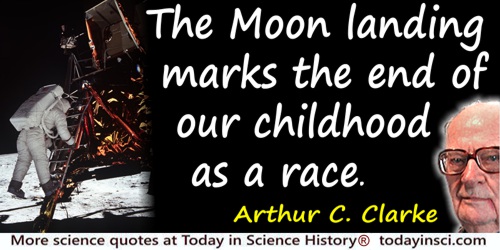
The realization that our small planet is only one of many worlds gives mankind the perspective it needs to realize sooner that our own world belongs to all of its creatures, that the Moon landing marks the end of our childhood as a race and the beginning of a newer and better civilization.
Webmaster, as yet, has not traced a primary source. Although this is widely quoted in print and online, each time is without source cited. An early example is Laurence J. Peter (ed.), Peter’s Quotations (1977, 1979), 539. The moon landing was on 20 Jul 1969, and Clarke may have contributed this quote during an interview after that day. Clarke had previously speculated, in 1951, on the possible words of a historian from the year 3000, “The coming of the rocket brought to an end a million years of isolation. With the landing of the first spaceship on Mars and Venus, the childhood of our race was over and history as we know it began.” In 'Concerning Means and Ends', The Exploration of Space (1951), 195. This is contained in a longer quote on this webpage, beginning: “[What verdict would a historian of the year 3000…].
The ruthless destruction of their forests by the Chinese is one of the reasons why famine and plague today hold this nation in their sinister grasp. Denudation, wherever practiced, leaves naked soil; floods and erosion follow, and when the soil is gone men must also go—and the process does not take long. The great plains of Eastern China were centuries ago transformed from forest into agricultural land. The mountain plateau of Central China have also within a few hundred years been utterly devastated of tree growth, and no attempt made at either natural or artificial reforestation. As a result, the water rushes off the naked slopes in veritable floods, gullying away the mountain sides, causing rivers to run muddy with yellow soil, and carrying enormous masses of fertile earth to the sea. Water courses have also changed; rivers become uncontrollable, and the water level of the country is lowered perceptibly. In consequence, the unfortunate people see their crops wither and die for lack of water when it is most needed.
Statement (11 May 1921) by United States Department of Agriculture (USDA) concerning the famine in China in seven out of every ten years. Reported in 'Blames Deforestation: Department of Agriculture Ascribes Chinese Famine to it', New York Times (12 May 1921), 12.
The scientific world-picture vouchsafes a very complete understanding of all that happens–it makes it just a little too understandable. It allows you to imagine the total display as that of a mechanical clockwork which, for all that science knows, could go on just the same as it does, without there being consciousness, will, endeavor, pain and delight and responsibility connected with it–though they actually are. And the reason for this disconcerting situation is just this: that for the purpose of constructing the picture of the external world, we have used the greatly simplifying device of cutting our own personality out, removing it; hence it is gone, it has evaporated, it is ostensibly not needed.
…...
The significant chemicals of living tissue are rickety and unstable, which is exactly what is needed for life.
As shown, without citation, in Randy Moore, Writing to Learn Science (1997), 226.
The so-called ‘crank’ may be quite original in his ideas. … Invention, however, in the engineering sense involves originality; but not that alone, if the results are to be of value. There is imagination more or less fertile, but with it a knowledge of what has been done before, carried perhaps by the memory, together with a sense of the present or prospective needs in art or industry. Necessity is not always the mother of invention. It may be prevision.
Address as M.I.T. acting president, to the graduating class (11 Jun 1920). Published in Massachusetts Institute of Technology, Technology Review (Jul 1920), 22, 419-420.
The specific character of the greater part of the toxins which are known to us (I need only instance such toxins as those of tetanus and diphtheria) would suggest that the substances produced for effecting the correlation of organs within the body, through the intermediation of the blood stream, might also belong to this class, since here also specificity of action must be a distinguishing characteristic. These chemical messengers, however, or 'hormones' (from όρμάω, I excite or arouse), as we might call them, have to be carried from the organ where they are produced to the organ which they affect by means of the blood stream and the continually recurring physiological needs of the organism must determine their repeated production and circulation through the body.
'The Chemical Correlation of the Functions of the Body', The Lancet (1905), ii, 340.
The sun is a mass of incandescent gas, a gigantic nuclear furnace,
Where hydrogen is built into helium at a temperature of millions of degrees.
Yo ho, it’s hot, the sun is not a place where we could live.
But here on earth there’d be no life without the light it gives.
We need its light, we need its heat, we need its energy.
Without the sun, without a doubt, there’d be no you and me.
Where hydrogen is built into helium at a temperature of millions of degrees.
Yo ho, it’s hot, the sun is not a place where we could live.
But here on earth there’d be no life without the light it gives.
We need its light, we need its heat, we need its energy.
Without the sun, without a doubt, there’d be no you and me.
— Hy Zaret
From song 'Why Does the Sun Shine? (The Sun Is A Mass Of Incandescent Gas)' on LP record album Space Songs (1961), in the series Ballads for the Age of Science. Music by Louis Singer, and sung by Tom Glazer. Also recorded by the group They Might Be Giants (1998) who followed up with 'Why Does The Sun Really Shine? (The Sun is a Miasma of Incandescent Plasma)' on CD album Here Comes Science (2009), which corrects several scientific inaccuracies in the lyrics
The theory of the method of knowing which is advanced in these pages may be termed pragmatic. ... Only that which has been organized into our disposition so as to enable us to adapt the environment to our needs and adapt our aims and desires to the situation in which we live is really knowledge.
Democracy and Education: an Introduction to the Philosophy of Education (1916), 400.
The universe is governed by science. But science tells us that we can’t solve the equations, directly in the abstract. We need to use the effective theory of Darwinian natural selection of those societies most likely to survive. We assign them higher value.
[Answer to question: What is the value in knowing “Why are we here?”]
[Answer to question: What is the value in knowing “Why are we here?”]
'Stephen Hawking: "There is no heaven; it’s a fairy story"', interview in newspaper The Guardian (15 May 2011).
The world needs heroes and it’s better they be harmless men like me than villains like Hitler.
As quoted in an anecdote, without further citation, in Howard W. Eves Return to Mathematical Circles, (1988), 21. Described as a comment made by Einstein, at home, while his bust was being sculpted by Robert Berks (1953).
The world tells us what we need to know when we are ready to know it and not before. That’s the way of things.
In World of Warcraft: Cycle of Hatred (2007), 17.
There is a theory that creativity arises when individuals are out of sync with their environment. To put it simply, people who fit in with their communities have insufficient motivation to risk their psyches in creating something truly new, while those who are out of sync are driven by the constant need to prove their worth.
In 'Beyond the Soapsuds Universe', Discover Magazine (1997). The author explains (in a blog found online) that this “idea comes from a theory by Mihaly Csikszentmihalyi, who wrote a book called Flow: the Psychology of Optimal Experience. You do need someone to come in from outside. One of the theories about why mathematicians do their best work when they’re young is because they’re not yet educated enough to know what seems obviously wrong. So they try new things.”
There is no “pure” science itself divorced from human values. The importance of science to the humanities and the humanities to science in their complementary contribution to the variety of human life grows daily. The need for men familiar with both is imperative.
In 'Abstract' The Impurity of Science (19 Apr 1962), the printed version of the Robbins Lecture (27 Feb 1962) given at Pomona College, Claremont, California, as published by Ernest O. Lawrence Radiation Laboratory, University of California.
There is no need to worry about mere size. We do not necessarily respect a fat man more than a thin man. Sir Isaac Newton was very much smaller than a hippopotamus, but we do not on that account value him less.
…...
There is, however, no genius so gifted as not to need control and verification. ... [T]he brightest flashes in the world of thought are incomplete until they have been proved to have their counterparts in the world of fact. Thus the vocation of the true experimentalist may be defined as the continued exercise of spiritual insight, and its incessant correction and realisation. His experiments constitute a body, of which his purified intuitions are, as it were, the soul.
In 'Vitality', Scientific Use of the Imagination and Other Essays (1872), 43.
There’s probably 5000 times more solar energy than the humans will ever need. We could cover our highways with solar collectors to make ribbons of energy, and I think that it’s really the largest job creation program in the history of the planet that’s in front of us. It’s a celebration of the abundance of human creativity combined with the abundance of the natural world.
In audio segment, 'William McDonough: Godfather of Green', WNYC, Studio 360 broadcast on NPR radio (18 Mar 2008) and archived on the station website.
These are some of the things wilderness can do for us. That is the reason we need to put into effect, for its preservation, some other principle that the principles of exploitation or “usefulness” or even recreation. We simply need that wild country available to us, even if we never do more than drive to its edge and look in. For it can be a means of reassuring ourselves of our sanity as creatures, a part of the geography of hope.
Letter (3 Dec 1960) written to David E. Pesonen of the Outdoor Recreation Resources Review Commission. Collected in 'Coda: Wilderness Letter', The Sound of Mountain Water: The Changing American West (1969), 153.
This topic brings me to that worst outcrop of the herd nature, the military system, which I abhor. That a man can take pleasure in marching in formation to the strains of a band is enough to make me despise him. He has only been given his big brain by mistake; a backbone was all he needed. This plague-spot of civilisation ought to be abolished with all possible speed. Heroism by order, senseless violence, and all the pestilent nonsense that goes by the name of patriotism–how I hate them! War seems to me a mean, contemptible thing: I would rather be hacked in pieces than take part in such an abominable business.
…...
Though human ingenuity may make various inventions which, by the help of various machines answering the same end, it will never devise any inventions more beautiful, nor more simple, nor more to the purpose than Nature does; because in her inventions nothing is wanting, and nothing is superfluous, and she needs no counterpoise when she makes limbs proper for motion in the bodies of animals.
W. An. IV. 184a (7). Translated by Jean Paul Richter, in 'Physiology', The Literary Works of Leonardo da Vinci: Compiled and Edited from the Original Manuscripts (1883), Vol. 2, 126, selection 837.
Three hundred trout are needed to support one man for a year. The trout, in turn, must consume 90,000 frogs, that must consume 27 million grasshoppers that live off of 1,000 tons of grass.
From Energetics, Kinetics, and Life: An Ecological Approach (1971), 293.
Thus, be it understood, to demonstrate a theorem, it is neither necessary nor even advantageous to know what it means. The geometer might be replaced by the logic piano imagined by Stanley Jevons; or, if you choose, a machine might be imagined where the assumptions were put in at one end, while the theorems came out at the other, like the legendary Chicago machine where the pigs go in alive and come out transformed into hams and sausages. No more than these machines need the mathematician know what he does.
From 'Les Mathématiques et la Logique', Science et Méthode (1908, 1920), Livre 2, Chap. 3, Sec. 2, 157. English as in Henri Poincaré and George Bruce Halsted (trans.), 'Mathematics and Logic', Science and Method collected in The Foundations of Science: Science and Hypothesis, The Value of Science, Science and Method (1913), 451. From the French, “Ainsi, c’est bien entendu, pour démontrer un théorème, il n’est pas nécessaire ni même utile de savoir ce qu’il veut dire. On pourrait remplacer le géomètre par le piano à raisonner imaginé par Stanley Jevons; ou, si l’on aime mieux, on pourrait imaginer une machine où l’on introduirait les axiomes par un bout pendant qu’on recueillerait les théorèmes à l’autre bout, comme cette machine légendaire de Chicago où les porcs entrent vivants et d’où ils sortent transformés en jambons et en saucisses. Pas plus que ces machines, le mathématicien n’a besoin de comprendre ce qu’il fait”.
Time’s arrow of ‘just history’ marks each moment of time with a distinctive brand. But we cannot, in our quest to understand history, be satisfied only with a mark to recognize each moment and a guide to order events in temporal sequence. Uniqueness is the essence of history, but we also crave some underlying generality, some principles of order transcending the distinction of moments–lest we be driven mad by Borges’s vision of a new picture every two thousand pages in a book without end. We also need, in short, the immanence of time’s cycle.
…...
To appreciate a work of art we need bring with us nothing but a sense of form and colour and a knowledge of three-dimensional space.
In Art (1913), 27.
To be creative, scientists need libraries and laboratories and the company of other scientists; certainly a quiet and untroubled life is a help. A scientist's work is in no way deepened or made more cogent by privation, anxiety, distress, or emotional harassment. To be sure, the private lives of scientists may be strangely and even comically mixed up, but not in ways that have any special bearing on the nature and quality of their work. If a scientist were to cut off an ear, no one would interpret such an action as evidence of an unhappy torment of creativity; nor will a scientist be excused any bizarrerie, however extravagant, on the grounds that he is a scientist, however brilliant.
In Advice to a Young Scientist (1979), 40.
To build a road is so much simpler than to think of what the country really needs. A roadless marsh is seemingly as worthless to the alphabetical conservationist as an undrained one was to the empire-builders. Solitude, the one natural resource still undowered of alphabets, is so far recognized as valuable only by ornithologists and cranes. Thus always does history, whether or marsh or market place, end in paradox. The ultimate value in these marshes is wildness, and the crane is wildness incarnate.
In 'Wisconsin', A Sand County Almanac, and Sketches Here and There (1949, 1987), 101.
To do successful research, you don’t need to know everything, you just need to know one thing that isn’t known.
As quoted in Steven Chu and Charles H. Townes, 'Arthur Schawlow', Biographical Memoirs of the National Academy of Sciences (2003), Vol. 83, 7.
To function efficiently in today’s world, you need math. The world is so technical, if you plan to work in it, a math background will let you go farther and faster.
In 'Ross, Mary Golda :The Cherokee Nation Remembers the First Woman Engineer for Lockheed', Indian Country News, article published online (13 May 2008) on the indiancountrynews.com website.
To invent, you need a good imagination and a pile of junk.
Often seen on the web and in publications attributed to Thomas Edison, but without any citation. So, Webmaster is doubtful, having not yet been able to find a primary print source—especially doubtful because such an appealing quote would be expected to be well documented. If you know one, please contact Webmaster. Meanwhile, Anonymous seems more appropriate. For an undocumented example of the quote, see Alex Barnett, The Quotable American (2002), 145.
To the extent that remaining old-growth Douglas fir ecosystems possess unique structural and functional characteristics distinct from surrounding managed forests, the analogy between forest habitat islands and oceanic islands applies. Forest planning decision variables such as total acreage to be maintained, patch size frequency distribution, spatial distribution of patches, specific locations, and protective measures all need to be addressed.
In The Fragmented Forest: Island Biogeography Theory and the Preservation of Biotic Diversity (1984), 6.
To the optimist, the glass is half full. To the pessimist, the glass is half empty. To the engineer, the glass is twice as big as it needs to be.
To unfold the secret laws and relations of those high faculties of thought by which all beyond the merely perceptive knowledge of the world and of ourselves is attained or matured, is a object which does not stand in need of commendation to a rational mind.
An Investigation of the Laws of Thought (1854), 3.
To write the true natural history of the world, we should need to be able to follow it from within. It would thus appear no longer as an interlocking succession of structural types replacing one another, but as an ascension of inner sap spreading out in a forest of consolidated instincts. Right at its base, the living world is constituted by conscious clothes in flesh and bone.
In Teilhard de Chardin and Bernard Wall (trans.), The Phenomenon of Man (1959, 2008), 151. Originally published in French as Le Phénomene Humain (1955).
Too much openness and you accept every notion, idea, and hypothesis—which is tantamount to knowing nothing. Too much skepticism—especially rejection of new ideas before they are adequately tested—and you're not only unpleasantly grumpy, but also closed to the advance of science. A judicious mix is what we need.
In 'Wonder and Skepticism', Skeptical Enquirer (Jan-Feb 1995), 19, No. 1.
Touch is the most fundamental sense. A baby experiences it, all over, before he is born and long before he learns to use sight, hearing, or taste, and no human ever ceases to need it.
In Time Enough for Love: The Lives of Lazarus Long (1973), 366.
True majorities, in a TV-dominated and anti-intellectual age, may need sound bites and flashing lights–and I am not against supplying such lures if they draw children into even a transient concern with science. But every classroom has one [Oliver] Sacks, one [Eric] Korn, or one [Jonathan] Miller, usually a lonely child with a passionate curiosity about nature, and a zeal that overcomes pressures for conformity. Do not the one in fifty deserve their institutions as well–magic places, like cabinet museums, that can spark the rare flames of genius?
…...
Truly, we do live on a “water planet.” For us, water is that critical issue that we need. It’s the most precious substance on the planet, and it links us to pretty much every environmental issue, including climate change, that we’re facing.
From interview by Kathleen Walter, Newsmax (28 Sep 2009).
Undeveloped though the science [of chemistry] is, it already has great power to bring benefits. Those accruing to physical welfare are readily recognized, as in providing cures, improving the materials needed for everyday living, moving to ameliorate the harm which mankind by its sheer numbers does to the environment, to say nothing of that which even today attends industrial development. And as we continue to improve our understanding of the basic science on which applications increasingly depend, material benefits of this and other kinds are secured for the future.
Speech at the Nobel Banquet (10 Dec 1983) for his Nobel Prize in Chemistry. In Wilhelm Odelberg (ed.), Les Prix Nobel: The Nobel Prizes (1984), 43.
Using material ferried up by rockets, it would be possible to construct a “space station” in ... orbit. The station could be provided with living quarters, laboratories and everything needed for the comfort of its crew, who would be relieved and provisioned by a regular rocket service. (1945)
In 'Can Rocket Stations Give Worldwide Coverage?', Wireless World (Oct 1945). Quoted and cited in Arthur C. Clarke, Greetings, Carbon-Based Bipeds!: Collected Essays, 1934-1998, 22. Also quoted in 'Hazards of Communication Satellites', Bulletin of the Atomic Scientists (May 1961), Vol. 17, No. 5, 181, by John R. Pierce Pierce, who then commented, “Clarke thought in terms of manned space stations; today these seem very remote.”
War and the steam engine joined forces and forged what was to become one of the most delicate of concepts. Sadi Carnot … formed the opinion that one cause of France’s defeat had been her industrial inferiority. … Carnot saw steam power as a universal motor. … Carnot was a visionary and sharp analyst of what was needed to improve the steam engine. … Carnot’s work … laid the foundations of [thermodynamics].
In The Second Law (1984), 1-2.
We “need” cancer because, by the very fact of its incurability, it makes all other diseases, however virulent, not cancer.
In 'Under the Sign of Cancer', Myths and Memories (1986), 152.
We all have private ails. The troublemakers are they who need public cures for their private ails.
In Reflections on the Human Condition (1973), 31.
We all know, from what we experience with and within ourselves, that our conscious acts spring from our desires and our fears. Intuition tells us that that is true also of our fellows and of the higher animals. We all try to escape pain and death, while we seek what is pleasant. We are all ruled in what we do by impulses; and these impulses are so organized that our actions in general serve for our self preservation and that of the race. Hunger, love, pain, fear are some of those inner forces which rule the individual’s instinct for self preservation. At the same time, as social beings, we are moved in the relations with our fellow beings by such feelings as sympathy, pride, hate, need for power, pity, and so on. All these primary impulses, not easily described in words, are the springs of man’s actions. All such action would cease if those powerful elemental forces were to cease stirring within us. Though our conduct seems so very different from that of the higher animals, the primary instincts are much alike in them and in us. The most evident difference springs from the important part which is played in man by a relatively strong power of imagination and by the capacity to think, aided as it is by language and other symbolical devices. Thought is the organizing factor in man, intersected between the causal primary instincts and the resulting actions. In that way imagination and intelligence enter into our existence in the part of servants of the primary instincts. But their intervention makes our acts to serve ever less merely the immediate claims of our instincts.
…...
We are accustomed to say that every human being displays both male and female instinctual impulses, needs, and attributes, but the characteristics of what is male and female can only be demonstrated in anatomy, and not in psychology.
In Sigmund Freud and Joan Riviere (trans.), Civilization and Its Discontents (1930, 1994), 35.
We are the intelligent elite among animal life on earth and whatever our mistakes, [Earth] needs us. This may seem an odd statement after … the way 20th century humans became almost a planetary disease organism. But it has taken [Earth] 2.5 billion years to evolve an animal that can think and communicate its thoughts. If we become extinct she has little chance of evolving another.
In The Vanishing Face of Gaia: A Final Warning (2010), 28.
We do not ask what hope of gain makes a little bird warble, since we know that it takes delight in singing because it is for that very singing that the bird was made, so there is no need to ask why the human mind undertakes such toil in seeking out these secrets of the heavens. ... And just as other animals, and the human body, are sustained by food and drink, so the very spirit of Man, which is something distinct from Man, is nourished, is increased, and in a sense grows up on this diet of knowledge, and is more like the dead than the living if it is touched by no desire for these things.
Mysterium Cosmographicum. Translated by A. M. Duncan in The Secret of the Universe (1981), 55.
We especially need imagination in science. It is not all mathematics, nor all logic, but it is somewhat beauty and poetry.
In Phebe Mitchell Kendall (ed.), Maria Mitchell: Life, Letters, and Journals (1896), 186.
We find in the history of ideas mutations which do not seem to correspond to any obvious need, and at first sight appear as mere playful whimsies—such as Apollonius’ work on conic sections, or the non-Euclidean geometries, whose practical value became apparent only later.
In 'Epilogue', The Sleepwalkers: A History of Man’s Changing Vision of the Universe (1959), 515.
We forever have to walk the tightrope between what is seen to be the need and what is thought to be the demand … that’s all part of setting priorities and having a rational debate.
National Health Service Chief Executive Officer quoted in Timothy Milewa and Michael Calnan, 'Primary Care and Public Involvement, Journal of the Royal Society of Medicine (2000), 93, 3-5.
We have corrupted the term research to mean study and experiment and development toward selected objectives, and we have even espoused secret and classified projects. This was not the old meaning of university research. We need a new term, or the revival of a still older one, to refer to the dedicated activities of the scholar, the intensive study of special aspects of a subject for its own sake, motivated by the love of knowledge and truth.
In 'Technology and National Research Policy', Bulletin of the Atomic Scientists (Oct 1953), 292.
We have reason not to be afraid of the machine, for there is always constructive change, the enemy of machines, making them change to fit new conditions.
We suffer not from overproduction but from undercirculation. You have heard of technocracy. I wish I had those fellows for my competitors. I'd like to take the automobile it is said they predicted could be made now that would last fifty years. Even if never used, this automobile would not be worth anything except to a junkman in ten years, because of the changes in men's tastes and ideas. This desire for change is an inherent quality in human nature, so that the present generation must not try to crystallize the needs of the future ones.
We have been measuring too much in terms of the dollar. What we should do is think in terms of useful materials—things that will be of value to us in our daily life.
We suffer not from overproduction but from undercirculation. You have heard of technocracy. I wish I had those fellows for my competitors. I'd like to take the automobile it is said they predicted could be made now that would last fifty years. Even if never used, this automobile would not be worth anything except to a junkman in ten years, because of the changes in men's tastes and ideas. This desire for change is an inherent quality in human nature, so that the present generation must not try to crystallize the needs of the future ones.
We have been measuring too much in terms of the dollar. What we should do is think in terms of useful materials—things that will be of value to us in our daily life.
In 'Quotation Marks: Against Technocracy', New York Times (1 Han 1933), E4.
We have to stop thinking of human needs and rights alone. Let us be brave and see that the real threat comes from the living earth, which we have harmed and is now at war with us.
From speech to International Conference, Paris, 'Nuclear Energy for the 21st Century', (21–22 Mar 2005). As quoted on jameslovelock.org website.
We live in a capitalist economy, and I have no particular objection to honorable self-interest. We cannot hope to make the needed, drastic improvement in primary and secondary education without a dramatic restructuring of salaries. In my opinion, you cannot pay a good teacher enough money to recompense the value of talent applied to the education of young children. I teach an hour or two a day to tolerably well-behaved near-adults–and I come home exhausted. By what possible argument are my services worth more in salary than those of a secondary-school teacher with six classes a day, little prestige, less support, massive problems of discipline, and a fundamental role in shaping minds. (In comparison, I only tinker with intellects already largely formed.)
…...
We may need simple and heroic legends for that peculiar genre of literature known as the textbook. But historians must also labor to rescue human beings from their legends in science–if only so that we may understand the process of scientific thought aright.
…...
We need a new vision for agriculture … to spread happiness among farm and rural families. Bio-happiness through the conversion of our bio-resources into wealth meaningful to our rural families should be the goal of our national policy for farmers.
In 'Science and Shaping the Future of Rice', collected in Pramod K. Aggarwal et al. (eds.), 206 International Rice Congress: Science, Technology, and Trade for Peace and Prosperity (2007), 8.
We need a number of solutions - we need more efficiency and conservation. Efficiency is a big one. I think car companies need to do a lot better in producing more efficient cars. They have the technology, we just need to demand them as consumers.
…...
We need another, wiser, and perhaps a more mystical concept of animals. For the animal shall not be measured by man....They are not underlings. They are other nations, caught with ourselves in the net of life and time, fellow prisoners of the splendor and travail of Earth.
The Outermost House: A Year of Life On The Great Beach of Cape Cod (2003), 24-25.
We need constantly new accessions of truth as to the universe and better definition of the truths which are old. Such knowledge, tested and placed in order, we call science. Science is the gathered wisdom of the race.
From Presidential Address (5 Dec 1896) to the Biological Society of Washington, 'The Malarial Parasite and Other Pathogenic Protozoa', Popular Science Monthly (Mar 1897), 642.
We need not join the mad rush to purchase an earthly fallout shelter. God is our eternal fallout shelter.
Quoted in Kim Lim (ed.), 1,001 Pearls of Spiritual Wisdom: Words to Enrich, Inspire, and Guide Your Life (2014), 144
We need people who can see straight ahead and deep into the problems. Those are the experts. But we also need peripheral vision and experts are generally not very good at providing peripheral vision.
…...
We need to look, I suppose, for some good PR people to help us get our messages across in an honest and open and sensible way, without causing the sort of furore, the sort of polarisation that has occurred because of the people who are trying to deny it, and trying to deny it so vehemently that the media is taking so much notice of them.
On BBC website, 'Climate change scientists losing “PR war”' (11 Feb 2010).
We need to quit praying out of memory and start praying out of imagination.
Quoted in Kim Lim (ed.), 1,001 Pearls of Spiritual Wisdom: Words to Enrich, Inspire, and Guide Your Life (2014), 177
We need to remember that we are spiritual beings spending some time in a human body.
Quoted in Kim Lim (ed.), 1,001 Pearls of Spiritual Wisdom: Words to Enrich, Inspire, and Guide Your Life (2014), 32
We need to substitute for the book a device that will make it easy to transmit information without transporting material.
In Libraries of the Future (1965), 6.
We need to think of “blue carbon” and other services provided by healthy marine ecosystems. Mangroves, seagrasses and coastal marshes are great sinks for atmospheric carbon.
From interview with Terry Waghorn, 'Can We Eat Our Fish and Protect Them Too?', Forbes (21 Feb 2012)
We should therefore, with grace and optimism, embrace NOMA’s tough-minded demand: Acknowledge the personal character of these human struggles about morals and meanings, and stop looking for definite answers in nature’s construction. But many people cannot bear to surrender nature as a ‘transitional object’–a baby’s warm blanket for our adult comfort. But when we do (for we must) , nature can finally emerge in her true form: not as a distorted mirror of our needs, but as our most fascinating companion. Only then can we unite the patches built by our separate magisteria into a beautiful and coherent quilt called wisdom.
From essay, 'Non-overlapping Magisteria', Natural History magazine (Mar 1997), 106, 16–22 and 60–62. Collected in Rocks of Ages: Science and Religion in the Fullness of Life (1999), 178. [NOMA or Non-overlapping magisteria, is viewpoint advocated by Gould, that science and religion each represent different areas of inquiry, fact vs. values, and thus he aims to resolve the supposed conflict between science and religion. He draws the term “magisterium” from an encyclical of Pope Pius XII.
about science and religion. —Webmaster]
We simply need that wild country available to us, even if we never do more than drive to its edge and look in. For it can be a means of reassuring ourselves of our sanity as creatures, a part of the geography of hope.
Conclusion of Letter (3 Dec 1960) written to David E. Pesonen of the Outdoor Recreation Resources Review Commission. Collected in 'Coda: Wilderness Letter', The Sound of Mountain Water: The Changing American West (1969), 153.
We take for granted the need to escape the self. Yet the self can also be a refuge. In totalitarian countries the great hunger is for private life. Absorption in the minutiae of an individual existence is the only refuge from the apocalyptic madhouse staged by maniacal saviors of humanity.
In Reflections on the Human Condition (1973), 35.
We urgently need [the landmark National Ocean Policy] initiative, as we use our oceans heavily: Cargo ships crisscross the sea, carrying goods between continents. Commercial and recreational fishing boats chase fish just offshore. Cruise ships cruise. Oil and gas drilling continues, but hopefully we will add renewable energy projects as well. Without planning, however, these various industrial activities amount to what we call “ocean sprawl,” steamrolling the resources we rely upon for our livelihoods, food, fun, and even the air we breathe. While humankind relies on many of these industries, we also need to keep the natural riches that support them healthy and thriving. As an explorer, I know firsthand there are many places in the ocean so full of life that they should be protected.
In 'A Blueprint for Our Blue Home', Huffington Post (18 Jul 2011).
We urgently need another, non-fossil source of power. The only such source which is available and which has been developed for use is nuclear fission.
In address at City College, reported in Victor K. McElheny, 'Hans Bethe Urges U.S. Drive for Atom Power and Coal', The New York Times (14 Dec 1974), 58.
What a scientist does is compounded of two interests: the interest of his time and his own interest. … The need of the age gives its shape to scientific progress as a whole. But it is not the need of the age which gives the individual scientist his sense of pleasure and of adventure, and that excitement which keeps him working late into the night…
In 'The Creative Mind', Science and Human Values (1956, 1972), 8.
What I want to stress is that the pre-condition of scientific discovery is a society which does not demand “usefulness” from the scientist, but grants him the liberty which he needs for concentration and for the conscientious detailed work without which creation is impossible.
In 'Science Needs Freedom', World Digest (1943), 55, 50. As cited in John R. Baker, Science and the Planned State (1945), 42-43 and 115, footnote 98.
What if angry vectors veer
Round your sleeping head, and form.
There’s never need to fear
Violence of the poor world’s abstract storm.
Round your sleeping head, and form.
There’s never need to fear
Violence of the poor world’s abstract storm.
Poem, 'Lullaby: Smile in Sleep' (1957). In John D. Burt (ed.), The Collected Poems of Robert Penn Warren (1998), 128.
What we’re dealing with is so vast and so global that it really does need to be energized and kicked into high gear. Basically what’s going on is we are overfishing–the biggest danger–there are lots of things going on with the oceans that are threatening them.
From transcript of PBS TV interview by Tavis Smiley (28 Mar 2011).
What’s needed more than anything else, I believe, is an energetic program of technological detoxification. We must admit that we are intoxicated with our science and technology and that we tire deeply committed to a Faustian bargain that is rapidly killing us spiritually and may eventually kill us all physically.
From interview with Marion Long, 'The Turncoat of the Computer Revolution', New Age Journal (1985), II, No. 5, 49-51, as quoted in Lester W. Milbrath, Envisioning a Sustainable Society: Learning Our Way Out (1989), 258.
Wheeler’s First Moral Principle: Never make a calculation until you know the answer. Make an estimate before every calculation, try a simple physical argument (symmetry! invariance! conservation!) before every derivation, guess the answer to every paradox and puzzle. Courage: No one else needs to know what the guess is. Therefore make it quickly, by instinct. A right guess reinforces this instinct. A wrong guess brings the refreshment of surprise. In either case life as a spacetime expert, however long, is more fun!
In E.F. Taylor and J.A. Wheeler, Spacetime Physics (1992), 20.
When I needed an apparatus to help me linger below the surface of the sea, Émile Gagnan and I used well-known scientific principles about compressed gases to invent the Aqualung; we applied science. The Aqualung is only a tool. The point of the Aqualung—of the computer, the CAT scan, the vaccine, radar, the rocket, the bomb, and all other applied science—is utility.
In Jacques Cousteau and Susan Schiefelbein, The Human, the Orchid, and the Octopus: Exploring and Conserving Our Natural World (2007), 181.
When the disease is stronger than the patient, the physician will not be able to help him at all, and if the strength of the patient is greater than the strength of the disease, he does not need a physician at all. But when both are equal, he needs a physician who will support the patient’s strength and help him against the disease.
— Rhazes
…...
When the number of factors coming into play in a phenomenological complex is too large, scientific method in most cases fails us. One need only think of the weather, in which case prediction even for a few days ahead is impossible. Nevertheless no one doubts that we are confronted with a causal connection whose causal components are in the main known to us.
Out of My Later Years (1995), 28.
When we are motivated by goals that have deep meaning, by dreams that need completion, by pure love that needs expressing, then we truly live life.
…...
When we react to life from the head without joining forces with the heart, it can lead us into childish, inelegant behavior that we don’t respect in ourselves. If we get the head in sync with the heart first, we have the power of their teamwork working for us and we can make the changes we know we need to make.
Doc Childre and Howard Martin
Where there is the necessary technical skill to move mountains, there is no need for the faith that moves mountains.
In The Passionate State of Mind: And Other Aphorisms (1955), 7.
Whether science is seen as genie or devil, the attitude is wrong. We need to get some sort of perspective, so that people understand science is just one more intellectual tool, one more way of knowing enough things to give society a means of living on Earth.
From interview with Graham Chedd, 'The Lady Gets Her Way', New Scientist (5 Jul 1973), 59, No. 853, 16.
Who needs astrology? The wise man gets by on fortune cookies.
In 'Philosophy, Religion, and So Forth', A Voice Crying in the Wilderness (1989), 3.
With these developments we have every reason to anticipate that in a time not very distant most telegraphic messages across the oceans will be transmitted without cables. For short distances we need a “wireless” telephone, which requires no expert operators.
In 'The Problem of Increasing Human Energy', Century Illustrated Monthly Magazine (Jun 1900), 209. Collected My Inventions: And Other Writings (2016), 123.
Without any remaining wilderness we are committed wholly, without chance for even momentary reflection and rest, to a headlong drive into our technological termite-life, the Brave New World of a completely man-controlled environment. We need wilderness preserved—as much of it as is still left, and as many kinds—because it was the challenge against which our character as a people was formed.
Letter (3 Dec 1960) written to David E. Pesonen of the Outdoor Recreation Resources Review Commission. Collected in 'Coda: Wilderness Letter', The Sound of Mountain Water: The Changing American West (1969), 147.
World-wide practice of Conservation and the fair and continued access by all nations to the resources they need are the two indispensable foundations of continuous plenty and of permanent peace.
…...
You don’t need an explanation for everything. Recognize that there are such things as miracles - events for which there are no ready explanations. Later knowledge may explain those events quite easily.
…...
You must not give the world what it asks for, but what it needs.
…...
You need a plan for everything, whether it’s building a cathedral or a chicken coop. Without a plan you’ll postpone living until you’re dead.
In 'John Goddard: 108 Adventures Down, 19 To Go', Life magazine (1986), 9, 22.
You tell your doctor, that y’are ill
and what does he, but write a bill?
Of which you need not read one letter;
The worse the scrawl, the dose the better,
For if you knew but what you take,
Though you recover, he must break.
and what does he, but write a bill?
Of which you need not read one letter;
The worse the scrawl, the dose the better,
For if you knew but what you take,
Though you recover, he must break.
In Alma Canto III. Collected in Poems on Several Occasions (1709), 262.
Your breathing. The beating of your heart. The expansion of your lungs. Your mere presence is all that is needed to establish your worth.
Quoted in Kim Lim (ed.), 1,001 Pearls of Spiritual Wisdom: Words to Enrich, Inspire, and Guide Your Life (2014), 247
 In science it often happens that scientists say, 'You know that's a really good argument; my position is mistaken,' and then they would actually change their minds and you never hear that old view from them again. They really do it. It doesn't happen as often as it should, because scientists are human and change is sometimes painful. But it happens every day. I cannot recall the last time something like that happened in politics or religion.
(1987) --
In science it often happens that scientists say, 'You know that's a really good argument; my position is mistaken,' and then they would actually change their minds and you never hear that old view from them again. They really do it. It doesn't happen as often as it should, because scientists are human and change is sometimes painful. But it happens every day. I cannot recall the last time something like that happened in politics or religion.
(1987) --