Necessity Quotes (198 quotes)
Necessitate Quotes
Necessitate Quotes
... in going over the history of all the inventions for which history could be obtained it became more and more clear that in addition to training and in addition to extensive knowledge, a natural quality of mind was also necessary.
Aphorism listed Frederick Seitz, The Cosmic Inventor: Reginald Aubrey Fessenden (1866-1932) (1999), 54, being Transactions of the American Philosophical Society, Held at Philadelphia For Promoting Useful Knowledge, Vol. 86, Pt. 6.
...for the animals, which we resemble and which would be our equals if we did not have reason, do not reflect upon the actions or the passions of their external or internal senses, and do not know what is color, odor or sound, or if there is any differences between these objects, to which they are moved rather than moving themselves there. This comes about by the force of the impression that the different objects make on their organs and on their senses, for they cannot discern if it is more appropriate to go and drink or eat or do something else, and they do not eat or drink or do anything else except when the presence of objects or the animal imagination [l'imagination brutalle], necessitates them and transports them to their objects, without their knowing what they do, whether good or bad; which would happen to us just as to them if we were destitute of reason, for they have no enlightenment except what they must have to take their nourishment and to serve us for the uses to which God has destined them.
[Arguing the uniqueness of man by regarding animals to be merely automatons.].
[Arguing the uniqueness of man by regarding animals to be merely automatons.].
Les Préludes de l'Harmonie Universelle (1634), 135-139. In Charles Coulston Gillespie (ed.), Dictionary of Scientific Biography (1974), Vol. 9, 318.
“Facts, facts, facts,” cries the scientist if he wants to emphasize the necessity of a firm foundation for science. What is a fact? A fact is a thought that is true. But the scientist will surely not recognize something which depends on men's varying states of mind to be the firm foundation of science.
From the first chapter of an unfinished book, The Thought: A Logical Inquiry (1918), collected in Arthur Sullivan (ed.), Logicism and the Philosophy of Language: Selections from Frege and Russell (2003), 215.
“Heaven helps those who help themselves” is a well-tried maxim, embodying in a small compass the results of vast human experience. The spirit of self-help is the root of all genuine growth in the individual; and, exhibited in the lives of many, it constitutes the true source of national vigour and strength. Help from without is often enfeebling in its effects, but help from within invariably invigorates. Whatever is done for men or classes, to a certain extent takes away the stimulus and necessity of doing for themselves; and where men are subjected to over-guidance and over-government, the inevitable tendency is to render them comparatively helpless.
In Self-help: With Illustrations of Character and Conduct (1859, 1861), 15.
“Hope springs eternal in the human breast,” and is as necessary to life as the act of breathing.
Quoted, without citation, in front matter to T. A. Edison Foundation, Lewis Howard Latimer: A Black Inventor: a Biography and Related Experiments You Can Do (1973). If you know the primary source, please contact Webmaster.
[Animals] do not so much act as be put into action, and that objects make an impression on their senses such that it is necessary for them to follow it just as it is necessary for the wheels of a clock to follow the weights and the spring that pulls them.
[In his philosophy, he regarded animals to be merely automatons.].
[In his philosophy, he regarded animals to be merely automatons.].
'Traitez de la voix', Harmonie Universelle (1637), Vol. 1, prop. lii, 79. In Charles Coulston Gillespie (ed.), Dictionary of Scientific Biography (1974), Vol. 9, 318.
[D]iscovery should come as an adventure rather than as the result of a logical process of thought. Sharp, prolonged thinking is necessary that we may keep on the chosen road but it does not itself necessarily lead to discovery. The investigator must be ready and on the spot when the light comes from whatever direction.
Letter to Dr. E. B. Krumhaar (11 Oct 1933), in Journal of Bacteriology (Jan 1934), 27, No. 1, 19.
[T]he small is great, the great is small; all is in equilibrium in necessity...
Victor Hugo and Charles E. Wilbour (trans.), Les Misérables (1862), 41.
'Causation' has been popularly used to express the condition of association, when applied to natural phenomena. There is no philosophical basis for giving it a wider meaning than partial or absolute association. In no case has it been proved that there is an inherent necessity in the laws of nature. Causation is correlation... [P]erfect correlation, when based upon sufficient experience, is causation in the scientific sense.
'Correlation, Causation and Wright's Theory of "Path Coefficients"', Genetics (7 May 1922), 7, 259-61.
Ath. There still remain three studies suitable for freemen. Calculation in arithmetic is one of them; the measurement of length, surface, and depth is the second; and the third has to do with the revolutions of the stars in reference to one another … there is in them something that is necessary and cannot be set aside, … if I am not mistaken, [something of] divine necessity; for as to the human necessities of which men often speak when they talk in this manner, nothing can be more ridiculous than such an application of the words.
Cle. And what necessities of knowledge are there, Stranger, which are divine and not human?
Ath. I conceive them to be those of which he who has no use nor any knowledge at all cannot be a god, or demi-god, or hero to mankind, or able to take any serious thought or charge of them.
Cle. And what necessities of knowledge are there, Stranger, which are divine and not human?
Ath. I conceive them to be those of which he who has no use nor any knowledge at all cannot be a god, or demi-god, or hero to mankind, or able to take any serious thought or charge of them.
— Plato
In Republic, Bk. 7, in Jowett, Dialogues of Plato (1897, 2010), Vol. 4, 331.
Entia/Essentia non sunt multiplicanda praeter necessitatem.
Entities should not be multiplied unnecessarily.
Entities should not be multiplied unnecessarily.
Attributed. Described as the form as handed down to posterity by Joseph Rickaby in Scholasticism (1908), 54.
Frustra fit per plura, quod fieri potest per pauciora.
It is vain to do with more what can be done with less.
It is vain to do with more what can be done with less.
Ockham’s Razor.Summa logicae (The Sum of All Logic)(prior to 1324), Part I, Chap. 12. [The village of Ockham is in Surrey. The saying (which was applied for diminishing the number of religious truths that can be proved by reason) is not Ockham's own. As given in Joseph Rickaby, Scholasticism (1908), 54, footnote, it is found a generation before Ockham in Petrus Aureolus, The Eloquent Doctor, 2 Sent. dist. 12, q.1.]
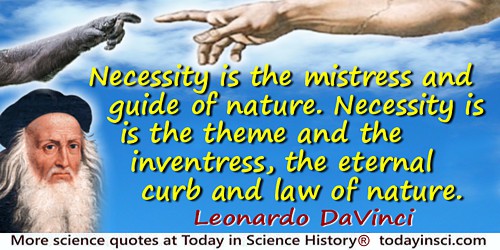
La necessità è maestra e tutrice della natura; La necessità è tema e inventrice della natura e freno e regola eterna.
Necessity is the mistress and guide of nature. Necessity is the theme and the inventress, the eternal curb and law of nature.
Necessity is the mistress and guide of nature. Necessity is the theme and the inventress, the eternal curb and law of nature.
S. K. M. III. 49a. As translated by Jean Paul Richter, in 'Philosophical Maxims', The Literary Works of Leonardo da Vinci: Compiled and Edited from the Original Manuscripts (1883), Vol. 2, 285, Maxim 1135.
Pluralitas non est ponenda sine necessitate.
A plurality (of reasons) should not be posited without necessity.
A plurality (of reasons) should not be posited without necessity.
Quodlibeta (Quodlibetal Questions) [1324-13], Quodlibet 6, q. 10, trans. A. Freddoso (1991), Vol. 2, 521.
Une idée anticipée ou une hypothèse est donc le point de départ nécessaire de tout raisonnement expérimental. Sans cela on ne saurait faire aucune investigation ni s’instruire ; on ne pourrait qu’entasser des observations stériles. Si l’on expérimentait sans idée préconçue, on irait à l’aventure; mais d’un autre côté, ainsi que nous l’avons dit ailleurs, si l’on observait avec des idées préconçues, on ferait de mauvaises observations.
An anticipative idea or an hypothesis is, then, the necessary starting point for all experimental reasoning. Without it, we could not make any investigation at all nor learn anything; we could only pile up sterile observations. If we experimented without a preconceived idea, we should move at random.
[Also seen translated as:] A hypothesis is … the obligatory starting point of all experimental reasoning. Without it no investigation would be possible, and one would learn nothing: one could only pile up barren observations. To experiment without a preconceived idea is to wander aimlessly.
An anticipative idea or an hypothesis is, then, the necessary starting point for all experimental reasoning. Without it, we could not make any investigation at all nor learn anything; we could only pile up sterile observations. If we experimented without a preconceived idea, we should move at random.
[Also seen translated as:] A hypothesis is … the obligatory starting point of all experimental reasoning. Without it no investigation would be possible, and one would learn nothing: one could only pile up barren observations. To experiment without a preconceived idea is to wander aimlessly.
Original work in French, Introduction à l'Étude de la Médecine Expérimentale (1865). English translation by Henry Copley Green in An Introduction to the Study of Experimental Medicine (1927, 1957), 32. Alternate translation in Peter Medawar, 'Hypothesis and Imagination', collected in The Strange Case of the Spotted Mice and Other Classic Essays on Science (1974), 30.
A man has a very insecure tenure of a property which another can carry away with his eyes. A few months reduced me to the cruel necessity either of destroying my machine, or of giving it to the public. To destroy it, I could not think of; to give up that for which I had laboured so long, was cruel. I had no patent, nor the means of purchasing one. In preference to destroying, I gave it to the public.
[On his inability to keep for himself a profitable income from his invention of the Spinning Mule.]
[On his inability to keep for himself a profitable income from his invention of the Spinning Mule.]
As quoted in James Mason, The Great Triumphs of Great Men (1875), 579.
A person who is religiously enlightened appears to me to be one who has, to the best of his ability, liberated himself from the fetters of his selfish desires and is preoccupied with thoughts, feelings, and aspirations to which he clings because of their superpersonal value. It seems to me that what is important is the force of this superpersonal content and the depth of the conviction concerning its overpowering meaningfulness, regardless of whether any attempt is made to unite this content with a divine Being, for otherwise it would not be possible to count Buddha and Spinoza as religious personalities. Accordingly, a religious person is devout in the sense that he has no doubt of the significance and loftiness of those superpersonal objects and goals which neither require nor are capable of rational foundation. They exist with the same necessity and matter-of-factness as he himself. In this sense religion is the age-old endeavor of mankind to become clearly and completely conscious of these values and goals and constantly to strengthen and extend their effect. If one conceives of religion and science according to these definitions then a conflict between them appears impossible. For science can only ascertain what is, but not what should be, and outside of its domain value judgments of all kinds remain necessary.
…...
A river is more than an amenity, it is a treasure. It offers a necessity of life that must be rationed among those who have power over it.
Writing for the Court, New Jersey v. New York, et al., 283 U.S. 336, 342 (1931), His ruling declared that the water of the Delaware River must be divided among states on a basis of need, rather than on the geographic mileage of the resource controlled by each state. Thus a river was to be regarded as a shared economic treasure. An upstream state must not willy-nilly deprive a downstream state of an important water resource. As quoted and explained in Tim Palmer, Endangered Rivers and the Conservation Movement (2004), 42.
A rock or stone is not a subject that, of itself, may interest a philosopher to study; but, when he comes to see the necessity of those hard bodies, in the constitution of this earth, or for the permanency of the land on which we dwell, and when he finds that there are means wisely provided for the renovation of this necessary decaying part, as well as that of every other, he then, with pleasure, contemplates this manifestation of design, and thus connects the mineral system of this earth with that by which the heavenly bodies are made to move perpetually in their orbits.
Theory of the Earth, with Proofs and l1lustrations, Vol. 1 (1795), 276.
A wealthy doctor who can help a poor man, and will not without a fee, has less sense of humanity than a poor ruffian who kills a rich man to supply his necessities. It is something monstrous to consider a man of a liberal education tearing out the bowels of a poor family by taking for a visit what would keep them a week.
In The Tatler: Or, Lucubrations of Isaac Bickerstaff, Esq (8 Oct 1709), collected in Harrison’s British Classicks (1785), Vol. 3, No. 78, 220. Isaac Bickerstaff was the nom de plume used by Richard Steele, who published it—with uncredited contributions from Joseph Addison under the same invented name. The original has no authorship indicated for the item, but (somehow?) later publications attribute it to Addison. For example, in Samuel Austin Allibone (ed.), Prose Quotations from Socrates to Macaulay (1876), 535.
Aesthetic considerations are a matter of luxury and indulgence rather than of necessity.
A New Jersey Court decision confirming an existing billboard to be exempted from retrospective application of a city ordinance restricting billboard location. From 'City of Passaic v. Paterson Bill Posting, Etc., Co. (Court of Errors and Appeals of New Jersey, November 20, 1905)', The New Jersey Law Journal (1906), 29, 244. The court wrote that the effect of the ordinance was to take private property without compensation, and could not be justified as an exercise of the police power because public safety was not unreasonably compromised by the billboard, and thus the ordinance exceeded necessity.
Algebra reverses the relative importance of the factors in ordinary language. It is essentially a written language, and it endeavors to exemplify in its written structures the patterns which it is its purpose to convey. The pattern of the marks on paper is a particular instance of the pattern to be conveyed to thought. The algebraic method is our best approach to the expression of necessity, by reason of its reduction of accident to the ghost-like character of the real variable.
In Science and Philosophy (1948), 116.
All discussion of the ultimate nature of things must necessarily be barren unless we have some extraneous standards against which to compare them.
In The Mysterious Universe (1930), 114.
All the events which occur upon the earth result from Law: even those actions which are entirely dependent on the caprices of the memory, or the impulse of the passions, are shown by statistics to be, when taken in the gross, entirely independent of the human will. As a single atom, man is an enigma; as a whole, he is a mathematical problem. As an individual, he is a free agent; as a species, the offspring of necessity.
In The Martyrdom of Man (1876), 185-186.
All things happen by virtue of necessity.
Diogenes Laertius IX, 45. Trans. R. D. Hicks (1925), Vol. 2, 455.
Although [Charles Darwin] would patiently go on repeating experiments where there was any good to be gained, he could not endure having to repeat an experiment which ought, if complete care had been taken, to have told its story at first—and this gave him a continual anxiety that the experiment should not be wasted; he felt the experiment to be sacred, however slight a one it was. He wished to learn as much as possible from an experiment, so that he did not confine himself to observing the single point to which the experiment was directed, and his power of seeing a number of other things was wonderful. ... Any experiment done was to be of some use, and ... strongly he urged the necessity of keeping the notes of experiments which failed, and to this rule he always adhered.
In Charles Darwin: His Life Told in an Autobiographical Chapter, and in a Selected Series of his Published Letters (1908), 92.
Among all highly civilized peoples the golden age of art has always been closely coincident with the golden age of the pure sciences, particularly with mathematics, the most ancient among them.
This coincidence must not be looked upon as accidental, but as natural, due to an inner necessity. Just as art can thrive only when the artist, relieved of the anxieties of existence, can listen to the inspirations of his spirit and follow in their lead, so mathematics, the most ideal of the sciences, will yield its choicest blossoms only when life’s dismal phantom dissolves and fades away, when the striving after naked truth alone predominates, conditions which prevail only in nations while in the prime of their development.
This coincidence must not be looked upon as accidental, but as natural, due to an inner necessity. Just as art can thrive only when the artist, relieved of the anxieties of existence, can listen to the inspirations of his spirit and follow in their lead, so mathematics, the most ideal of the sciences, will yield its choicest blossoms only when life’s dismal phantom dissolves and fades away, when the striving after naked truth alone predominates, conditions which prevail only in nations while in the prime of their development.
From Die Entwickelung der Mathematik im Zusammenhange mit der Ausbreitung der Kultur (1893), 4. As translated in Robert Édouard Moritz, Memorabilia Mathematica; Or, The Philomath’s Quotation-Book (1914), 191-192. From the original German, “Bei allen Kulturvölkern ist die Blüthezeit der Kunst auch immer zeitlich eng verbunden mit einer Blüthezeit der reinen Wissenschaften, insbesondere der ältesten unter ihnen, der Mathematik.
Dieses Zusammentreffen dürfte auch nicht ein zufälliges, sondern ein natürliches, ein Ergebniss innerer Notwendigkeit sein. Wie die Kunst nur gedeihen kann, wenn der Künstler, unbekümmert um die Bedrängnisse des Daseins, den Eingebungen seines Geistes lauschen und ihnen folgen kann, so kann die idealste Wissenschaft, die Mathematik, erst dann ihre schönsten Blüthen treiben, wenn des Erdenlebens schweres Traumbild sinkt und sinkt und sinkt, wenn das Streben nach der nackten Wahrheit allein bestimmend ist, was nur bei Nationen in der Vollkraft ihrer Entwickelung vorkommt.”
Dieses Zusammentreffen dürfte auch nicht ein zufälliges, sondern ein natürliches, ein Ergebniss innerer Notwendigkeit sein. Wie die Kunst nur gedeihen kann, wenn der Künstler, unbekümmert um die Bedrängnisse des Daseins, den Eingebungen seines Geistes lauschen und ihnen folgen kann, so kann die idealste Wissenschaft, die Mathematik, erst dann ihre schönsten Blüthen treiben, wenn des Erdenlebens schweres Traumbild sinkt und sinkt und sinkt, wenn das Streben nach der nackten Wahrheit allein bestimmend ist, was nur bei Nationen in der Vollkraft ihrer Entwickelung vorkommt.”
An evolution is a series of events that in itself as series is purely physical, — a set of necessary occurrences in the world of space and time. An egg develops into a chick; … a planet condenses from the fluid state, and develops the life that for millions of years makes it so wondrous a place. Look upon all these things descriptively, and you shall see nothing but matter moving instant after instant, each instant containing in its full description the necessity of passing over into the next. … But look at the whole appreciatively, historically, synthetically, as a musician listens to a symphony, as a spectator watches a drama. Now you shall seem to have seen, in phenomenal form, a story.
In The Spirit of Modern Philosophy: An Essay in the Form of Lectures (1892), 425.
And invention must still go on for it is necessary that we should completely control our circumstances. It is not sufficient that there should [only] be organization capable of providing food and shelter for all and organization to effect its proper distribution.
Aphorism listed Frederick Seitz, The Cosmic Inventor: Reginald Aubrey Fessenden (1866-1932) (1999), 54, being Transactions of the American Philosophical Society, Held at Philadelphia For Promoting Useful Knowledge, Vol. 86, Pt. 6.
And nature must obey necessity.
Julius Caesar (1599), IV, iii.
Art and religion are not professions: they are not occupations for which men can be paid. The artist and the saint do what they have to do, not to make a living, but in obedience to some mysterious necessity. They do not product to live - they live to produce.
In Art (1958), 172.
As compared with Europe, our climate and traditions all pre-dispose us to a life of inaction and ease. We are influenced either by religious sentiment, class patriotism or belief in kismet, whereas the activities of Western nations rest on an economic basis. While they think and act in conformity with economic necessities, we expect to prosper without acquiring the scientific precision, the inventive faculty, the thoroughness, the discipline and restraints of modern civilisation.
Speech (16 Mar 1912), at Central College Bangalore Visvesvaraya. Collected in Speeches: 1910-11 to 1916-17: by Sir Mokshagundam Visvesvaraya (1917), 23.
As science, of necessity, becomes more involved with itself, so also, of necessity, it becomes more international. I am impressed to know that of the 670 members of this Academy [National Academy of Sciences], 163 were born in other lands.
From Address to the Centennial Convocation of the National Academy of Sciences (22 Oct 1963), 'A Century of Scientific Conquest.' Online at The American Presidency Project.
Believing, as I do, in the continuity of nature, I cannot stop abruptly where our microscopes cease to be of use. Here the vision of the mind authoritatively supplements the vision of the eye. By a necessity engendered and justified by science I cross the boundary of the experimental evidence, and discern in that Matter which we, in our ignorance of its latent powers, and notwithstanding our professed reverence for its Creator, have hitherto covered with opprobrium, the promise and potency of all terrestrial Life.
'Address Delivered Before The British Association Assembled at Belfast', (19 Aug 1874). Fragments of Science for Unscientific People: A Series of Detached Essays, Lectures, and Reviews (1892), Vol. 2, 191.
But if any skillful minister of nature shall apply force to matter, and by design torture and vex it, in order to [effect] its annihilation, it, on the contrary being brought under this necessity, changes and transforms itself into a strange variety of shapes and appearances; for nothing but the power of the Creator can annihilate, or truly destroy it.
As quoted in M.J. Gorton, 'The Weather', Popular Science News (1889), 23, No. 8, 115.
But it is precisely mathematics, and the pure science generally, from which the general educated public and independent students have been debarred, and into which they have only rarely attained more than a very meagre insight. The reason of this is twofold. In the first place, the ascendant and consecutive character of mathematical knowledge renders its results absolutely insusceptible of presentation to persons who are unacquainted with what has gone before, and so necessitates on the part of its devotees a thorough and patient exploration of the field from the very beginning, as distinguished from those sciences which may, so to speak, be begun at the end, and which are consequently cultivated with the greatest zeal. The second reason is that, partly through the exigencies of academic instruction, but mainly through the martinet traditions of antiquity and the influence of mediaeval logic-mongers, the great bulk of the elementary text-books of mathematics have unconsciously assumed a very repellant form,—something similar to what is termed in the theory of protective mimicry in biology “the terrifying form.” And it is mainly to this formidableness and touch-me-not character of exterior, concealing withal a harmless body, that the undue neglect of typical mathematical studies is to be attributed.
In Editor’s Preface to Augustus De Morgan and Thomas J. McCormack (ed.), Elementary Illustrations of the Differential and Integral Calculus (1899), v.
But nothing of a nature foreign to the duties of my profession [clergyman] engaged my attention while I was at Leeds so much as the, prosecution of my experiments relating to electricity, and especially the doctrine of air. The last I was led into a consequence of inhabiting a house adjoining to a public brewery, where first amused myself with making experiments on fixed air [carbon dioxide] which found ready made in the process of fermentation. When I removed from that house, I was under the necessity making the fixed air for myself; and one experiment leading to another, as I have distinctly and faithfully noted in my various publications on the subject, I by degrees contrived a convenient apparatus for the purpose, but of the cheapest kind. When I began these experiments I knew very little of chemistry, and had in a manner no idea on the subject before I attended a course of chymical lectures delivered in the Academy at Warrington by Dr. Turner of Liverpool. But I have often thought that upon the whole, this circumstance was no disadvantage to me; as in this situation I was led to devise an apparatus and processes of my own, adapted to my peculiar views. Whereas, if I had been previously accustomed to the usual chemical processes, I should not have so easily thought of any other; and without new modes of operation I should hardly have discovered anything materially new.
Memoirs of Dr. Joseph Priestley, in the Year 1795 (1806), Vol. 1, 61-2.
But when you come right down to it, the reason that we did this job is because it was an organic necessity. If you are a scientist you cannot stop such a thing. If you are a scientist you believe that it is good to find out how the world works; that it is good to find out what the realities are; that it is good to turn over to mankind at large the greatest possible power to control the world and to deal with it according to its lights and values.
Regarding the atomic bomb project.
Regarding the atomic bomb project.
From speech at Los Alamos (17 Oct 1945). Quoted in David C. Cassidy, J. Robert Oppenheimer and the American Century (2009), 214.
Can any thoughtful person admit for a moment that, in a society so constituted that these overwhelming contrasts of luxury and privation are looked upon as necessities, and are treated by the Legislature as matters with which it has practically nothing do, there is the smallest probability that we can deal successfully with such tremendous social problems as those which involve the marriage tie and the family relation as a means of promoting the physical and moral advancement of the race? What a mockery to still further whiten the sepulchre of society, in which is hidden ‘all manner of corruption,’ with schemes for the moral and physical advancement of the race!
In 'Human Selection', Fortnightly Review (1890),48, 330.
Careful and correct use of language is a powerful aid to straight thinking, for putting into words precisely what we mean necessitates getting our own minds quite clear on what we mean.
In The Art of Scientific Investigation (1950,1957), 91.
Chance and necessity.
Title of Jacques Monod and Austryn Wainhouse (trans.), Chance and Necessity: An Essay on the Natural Philosophy of Modern Biology (1971). See also the source quote by Diogenes Laertius, “Everything existing in the Universe is the fruit of chance and necessity.”
During the last two centuries and a half, physical knowledge has been gradually made to rest upon a basis which it had not before. It has become mathematical. The question now is, not whether this or that hypothesis is better or worse to the pure thought, but whether it accords with observed phenomena in those consequences which can be shown necessarily to follow from it, if it be true
In Augustus De Morgan and Sophia Elizabeth De Morgan (ed.), A Budget of Paradoxes (1872), 2.
Education is an organic necessity of a human being.
In Thoughts Selected From the Writings of Horace Mann (1872), 235.
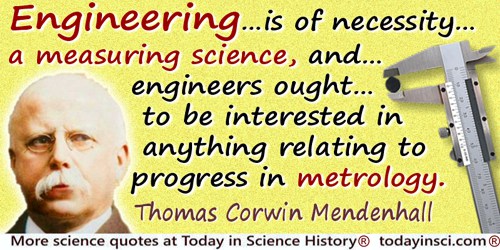
Engineering…is both an art and a science, and as a science it consists for the most part of mathematics applied to physics and mechanics. It is of necessity, therefore, a measuring science, and a congress of engineers ought, in the nature of things, to be interested in anything relating to progress in metrology.
From Address to the International Engineering Congress of the Columbia Exposition, Chicago, 1893. Published in Transactions of the American Society of Civil Engineers (Oct 1893), 120. Reprinted in 'Fundamental Units of Measure', Smithsonian Report for 1893 (1894), 135.
Environmentally friendly cars will soon cease to be an option...they will become a necessity.
Speaking as the President of Toyota Motors, at the North American International Auto Show (2004).
Everything existing in the Universe is the fruit of chance and necessity.
Diogenes Laertius IX. This was taken by Jacques Monod as the title of his book. As given by Alan L. Mackay, A Dictionary of Scientific Quotations (1992, 1994), 71.
Few will deny that even in the first scientific instruction in mathematics the most rigorous method is to be given preference over all others. Especially will every teacher prefer a consistent proof to one which is based on fallacies or proceeds in a vicious circle, indeed it will be morally impossible for the teacher to present a proof of the latter kind consciously and thus in a sense deceive his pupils. Notwithstanding these objectionable so-called proofs, so far as the foundation and the development of the system is concerned, predominate in our textbooks to the present time. Perhaps it will be answered, that rigorous proof is found too difficult for the pupil’s power of comprehension. Should this be anywhere the case,—which would only indicate some defect in the plan or treatment of the whole,—the only remedy would be to merely state the theorem in a historic way, and forego a proof with the frank confession that no proof has been found which could be comprehended by the pupil; a remedy which is ever doubtful and should only be applied in the case of extreme necessity. But this remedy is to be preferred to a proof which is no proof, and is therefore either wholly unintelligible to the pupil, or deceives him with an appearance of knowledge which opens the door to all superficiality and lack of scientific method.
In 'Stücke aus dem Lehrbuche der Arithmetik', Werke, Bd. 2 (1904), 296.
First of all, we ought to observe, that mathematical propositions, properly so called, are always judgments a priori, and not empirical, because they carry along with them necessity, which can never be deduced from experience. If people should object to this, I am quite willing to confine my statements to pure mathematics, the very concept of which implies that it does not contain empirical, but only pure knowledge a priori.
In Critique of Pure Reason (1900), 720.
Fish does not now—nor can it ever—feed the world. … Many developed, wealthy nations … dine on seafood more for taste than for necessity. … not one would on average incur any protein deficiency even if fish were completely removed from its dinner tables.
In Jacques Cousteau and Susan Schiefelbein, The Human, the Orchid, and the Octopus: Exploring and Conserving Our Natural World (2007), 153.
For any one who is pervaded with the sense of causal law in all that happens, who accepts in real earnest the assumption of causality, the idea of a Being who interferes with the sequence of events in the world is absolutely impossible! Neither the religion of fear nor the social-moral religion can have, any hold on him. A God who rewards and punishes is for him unthinkable, because man acts in accordance with an inner and outer necessity, and would, in the eyes of God, be as little responsible as an inanimate object is for the movements which it makes. Science, in consequence, has been accused of undermining morals—but wrongly. The ethical behavior of man is better based on sympathy, education and social relationships, and requires no support from religion. Man’s plight would, indeed, be sad if he had to be kept in order through fear of punishment and hope of rewards after death.
From 'Religion and Science', The New York Times Magazine, (9 Nov 1930), 1. Article in full, reprinted in Edward H. Cotton (ed.), Has Science Discovered God? A Symposium of Modern Scientific Opinion (1931), 101. The wording differs significantly from the version collected in 'Religion And Science', Ideas And Opinions (1954), 39, giving its source as: “Written expressly for the New York Times Magazine. Appeared there November 9, 1930 (pp. 1-4). The German text was published in the Berliner Tageblatt, November 11, 1930.” This variant form of the quote from the book begins, “The man who is thoroughly convinced of the universal operation of the law of causation….” and is also on the Albert Einstein Quotes page on this website. As for why the difference, Webmaster speculates the book form editor perhaps used a revised translation from Einstein’s German article.
For me, the idea of a creation is not conceivable without invoking the necessity of design. One cannot be exposed to the law and order of the universe without concluding that there must be design and purpose behind it all.
In letter to California State board of Education (14 Sep 1972).
From this fountain (the free will of God) it is those laws, which we call the laws of nature, have flowed, in which there appear many traces of the most wise contrivance, but not the least shadow of necessity. These therefore we must not seek from uncertain conjectures, but learn them from observations and experimental. He who is presumptuous enough to think that he can find the true principles of physics and the laws of natural things by the force alone of his own mind, and the internal light of his reason, must either suppose the world exists by necessity, and by the same necessity follows the law proposed; or if the order of Nature was established by the will of God, the [man] himself, a miserable reptile, can tell what was fittest to be done.
…...
Gas Lights - Without Oil, Tallow, Wicks or Smoke. It is not necessary to invite attention to the gas lights by which my salon of paintings is now illuminated; those who have seen the ring beset with gems of light are sufficiently disposed to spread their reputation; the purpose of this notice is merely to say that the Museum will be illuminated every evening until the public curiosity be gratified.
[Promoting the gas lights Peale installed to attract paying visitors to his museum of portraits and natural history exhibits.]
[Promoting the gas lights Peale installed to attract paying visitors to his museum of portraits and natural history exhibits.]
First advertisement for Peale's Baltimore Museum and Gallery of Fine Arts, American and Commercial Daily Advertiser (13 Jun 1816)
(source)
Geography is … only a branch of statistics, a knowledge of which is necessary to the well-understanding of the history of nations, as well as their situations relative to each other.
In The Statistical Breviary: Shewing, on a Principle Entirely New, the Resources of Every State and Kingdom in Europe (1801), 5.
Geometrical axioms are neither synthetic a priori conclusions nor experimental facts. They are conventions: our choice, amongst all possible conventions, is guided by experimental facts; but it remains free, and is only limited by the necessity of avoiding all contradiction. ... In other words, axioms of geometry are only definitions in disguise.
That being so what ought one to think of this question: Is the Euclidean Geometry true?
The question is nonsense. One might as well ask whether the metric system is true and the old measures false; whether Cartesian co-ordinates are true and polar co-ordinates false.
That being so what ought one to think of this question: Is the Euclidean Geometry true?
The question is nonsense. One might as well ask whether the metric system is true and the old measures false; whether Cartesian co-ordinates are true and polar co-ordinates false.
In George Edward Martin, The Foundations of Geometry and the Non-Euclidean Plane (1982), 110.
Having always observed that most of them who constantly took in the weekly Bills of Mortality made little other use of them than to look at the foot how the burials increased or decreased, and among the Casualties what had happened, rare and extraordinary, in the week current; so as they might take the same as a Text to talk upon in the next company, and withal in the Plague-time, how the Sickness increased or decreased, that the Rich might judg of the necessity of their removal, and Trades-men might conjecture what doings they were likely to have in their respective dealings.
From Natural and Political Observations Mentioned in a Following Index and Made upon Bills of Mortality (1662), Preface. Reproduced in Cornelius Walford, The Insurance Cyclopaedia (1871), Vol. 1, 286. Italicizations from another source.
How twins are born my discourse will explain thus. The cause is chiefly the nature of the womb in woman. For if it has grown equally on either side of its mouth, and if it opens equally, and also dries equally after menstruation, it can give nourishment, if it conceive the secretion of the man so that it immediately divides into both parts of the womb equally. Now if the seed secreted from both parents be abundant and strong, it can grow in both places, as it masters the nourishment that reaches it. In all other cases twins are not formed. Now when the secretion from both parents is male, of necessity boys are begotten in both places; but when from both it is female, girls are begotten. But when one secretion is female and the other male, whichever masters the other gives the embryo its sex. Twins are like one another for the following reasons. First, the places are alike in which they grow; then they were secreted together; then they grow by the same nourishment, and at birth they reach together the light of day.
Regimen, in Hippocrates, trans. W. H. S. Jones (1931), Vol. 4, 273.
Hubble's observations suggested that there was a time, called the big bang, when the universe was infinitesimally small and infinitely dense. Under such conditions all the laws of science, and therefore all ability to predict the future, would break down. If there were events earlier than this time, then they could not affect what happens at the present time. Their existence can be ignored because it would have no observational consequences. One may say that time had a beginning at the big bang, in the sense that earlier times simply would not be defined. It should be emphasized that this beginning in time is very different from those that had been considered previously. In an unchanging universe a beginning in time is something that has to be imposed by some being outside the universe; there is no physical necessity for a beginning. One can imagine that God created the universe at literally any time in the past. On the other hand, if the universe is expanding, there may be physical reasons why there had to be a beginning. One could still imagine that God created the universe at the instant of the big bang, or even afterwards in just such a way as to make it look as though there had been a big bang, but it would be meaningless to suppose that it was created before the big bang. An expanding universe does not preclude a creator, but it does place limits on when he might have carried out his job!
A Brief History of Time: From the Big Bang to Black Holes (1988), 8-9.
I am coming more and more to the conviction that the necessity of our geometry cannot be demonstrated, at least neither by, nor for, the human intellect...geometry should be ranked, not with arithmetic, which is purely aprioristic, but with mechanics.
Quoted in J Koenderink, Solid Shape (1990).
I am coming more and more to the conviction that the necessity of our geometry cannot be proved, at least neither by, nor for, the human intelligence … One would have to rank geometry not with arithmetic, which stands a priori, but approximately with mechanics.
From Letter (28 Apr 1817) to Olbers, as quoted in Guy Waldo Dunnington, Carl Friedrich Gauss, Titan of Science: A Study of His Life and Work (1955), 180.
I am not ... asserting that humans are either genial or aggressive by inborn biological necessity. Obviously, both kindness and violence lie with in the bounds of our nature because we perpetrate both, in spades. I only advance a structural claim that social stability rules nearly all the time and must be based on an overwhelmingly predominant (but tragically ignored) frequency of genial acts, and that geniality is therefore our usual and preferred response nearly all the time ... The center of human nature is rooted in ten thousand ordinary acts of kindness that define our days.
In Eight Little Piggies: Reflections in Natural History (1993), 282.
I believe natural beauty has a necessary place in the spiritual development of any individual or any society. I believe that whenever we substitute something man-made and artificial for a natural feature of the earth, we have retarded some part of man’s spiritual growth.
As quoted in Linda Lear, Rachel Carson: Witness for Nature (1997), 259.
I don’t think necessity is the mother of invention. Invention, in my opinion, arises directly from idleness, possibly also from laziness—to save oneself trouble.
In An Autobiography (1977, 19990), 121.
I had a dislike for [mathematics], and ... was hopelessly short in algebra. ... [One extraordinary teacher of mathematics] got the whole year's course into me in exactly six [after-school] lessons of half an hour each. And how? More accurately, why? Simply because he was an algebra fanatic—because he believed that algebra was not only a science of the utmost importance, but also one of the greatest fascination. ... [H]e convinced me in twenty minutes that ignorance of algebra was as calamitous, socially and intellectually, as ignorance of table manners—That acquiring its elements was as necessary as washing behind the ears. So I fell upon the book and gulped it voraciously. ... To this day I comprehend the binomial theorem.
In Prejudices: third series (1922), 261-262.
For a longer excerpt, see H. L. Mencken's Recollections of School Algebra.
For a longer excerpt, see H. L. Mencken's Recollections of School Algebra.
I have been driven to assume for some time, especially in relation to the gases, a sort of conducting power for magnetism. Mere space is Zero. One substance being made to occupy a given portion of space will cause more lines of force to pass through that space than before, and another substance will cause less to pass. The former I now call Paramagnetic & the latter are the diamagnetic. The former need not of necessity assume a polarity of particles such as iron has with magnetic, and the latter do not assume any such polarity either direct or reverse. I do not say more to you just now because my own thoughts are only in the act of formation, but this I may say: that the atmosphere has an extraordinary magnetic constitution, & I hope & expect to find in it the cause of the annual & diurnal variations, but keep this to yourself until I have time to see what harvest will spring from my growing ideas.
Letter to William Whewell, 22 Aug 1850. In L. Pearce Williams (ed.), The Selected Correspondence of Michael Faraday (1971), Vol. 2, 589.
I have been so constantly under the necessity of watching the movements of the most unprincipled set of pirates I have ever known, that all my time has been occupied in defense, in putting evidence into something like legal shape that I am the inventor of the Electro-Magnetic Telegraph.
From a letter to his brother describing the challenge of defending his patents (19 Apr 1848).
From a letter to his brother describing the challenge of defending his patents (19 Apr 1848).
Samuel F. B. Morse, His Letters and Journals (1914), vol.2, 283.
I have repeatedly had cause to refer to certain resemblances between the phenomena of irritability in the vegetable kingdom and those of the animal body, thus touching a province of investigation which has hitherto been far too little cultivated. In the last instance, indeed, I might say animal and vegetable life must of necessity agree in all essential points, including the phenomena of irritability also, since it is established that the animal organism is constructed entirely and simply from the properties of these substances that all vital movements both of plants and animals are to be explained.
Lectures on the Physiology of Plants (1887), 600.
I now think the answer is very simple: it’s true. God did create the universe about 13.7 billion years ago, and of necessity has involved Himself with His creation ever since. The purpose of this universe is something that only God knows for sure, but it is increasingly clear to modern science that the universe was exquisitely fine-tuned to enable human life.
In Letter (May 2005), sent to the Hope College 2005 Alumni Banquet, read in lieu of accepting an award in person, because of declining health from cancer.
I presume that few who have paid any attention to the history of the Mathematical Analysis, will doubt that it has been developed in a certain order, or that that order has been, to a great extent, necessary—being determined, either by steps of logical deduction, or by the successive introduction of new ideas and conceptions, when the time for their evolution had arrived. And these are the causes that operate in perfect harmony. Each new scientific conception gives occasion to new applications of deductive reasoning; but those applications may be only possible through the methods and the processes which belong to an earlier stage.
Explaining his choice for the exposition in historical order of the topics in A Treatise on Differential Equations (1859), Preface, v-vi.
I think it would be a very rash presumption to think that nowhere else in the cosmos has nature repeated the strange experiment which she has performed on earth—that the whole purpose of creation has been staked on this one planet alone. It is probable that dotted through the cosmos there are other suns which provide the energy for life to attendant planets. It is apparent, however, that planets with just the right conditions of temperature, oxygen, water and atmosphere necessary for life are found rarely.
But uncommon as a habitable planet may be, non-terrestrial life exists, has existed and will continue to exist. In the absence of information, we can only surmise that the chance that it surpasses our own is as good as that it falls below our level.
But uncommon as a habitable planet may be, non-terrestrial life exists, has existed and will continue to exist. In the absence of information, we can only surmise that the chance that it surpasses our own is as good as that it falls below our level.
As quoted by H. Gordon Garbedian in 'Ten Great Riddles That Call For Solution by Scientists', New York Times (5 Oct 1930), XX4. Garbedian gave no citation to a source for Shapley’s words. However, part of this quote is very similar to that of Sir Arthur Eddington: “It would indeed be rash to assume that nowhere else has Nature repeated the strange experiment which she has performed on the earth,” from 'Man’s Place in the Universe', Harper’s Magazine (Oct 1928), 157 573.
I would have you to observe that the difficulty & mystery which often appear in matters of science & learning are only owing to the terms of art used in them, & if many gentlemen had not been rebuted by the uncouth dress in which science was offered to them, we must believe that many of these who now shew an acute & sound judgement in the affairs of life would also in science have excelled many of those who are devoted to it & who were engaged in it only by necessity & a phlegmatic temper. This is particularly the case with respect to chemistry, which is as easy to be comprehended as any of the common affairs of life, but gentlemen have been kept from applying to it by the jargon in which it has been industriously involved.
Cullen MSS, No. 23, Glasgow University library. In A. L. Donovan, Philosophical Chemistry In the Scottish Enlightenment: The Doctrines and Discoveries of Wllliam Cullen and Joseph Black (1975), 111.
I’m particularly adept at making mistakes—it’s a necessity as an engineer. Each iteration of the vacuum came about because of a mistake I needed to fix.
In 'My Favorite Mistake', Newsweek (29 May 2011). About developing his revolutionary Dyson vacuum cleaner.
If a man is in any sense a real mathematician, then it is a hundred to one that his mathematics will be far better than anything else he can do, and that it would be silly if he surrendered any decent opportunity of exercising his one talent in order to do undistinguished work in other fields. Such a sacrifice could be justified only by economic necessity of age.
In A Mathematician's Apology (1940, 2012), 70.
If everything in chemistry is explained in a satisfactory manner without the help of phlogiston, it is by that reason alone infinitely probable that the principle does not exist; that it is a hypothetical body, a gratuitous supposition; indeed, it is in the principles of good logic, not to multiply bodies without necessity.
'Reflexions sur le phlogistique', Mémoires de l'Académie des Sciences, 1783, 505-38. Reprinted in Oeuvres de Lavoisier (1864), Vol. 2, 623, trans. M. P. Crosland.
If I exist, God exists. With me it is a necessity of my being as it is with millions. They may not be able to talk about it, but from their life you can see that it is a part of their life.
Quoted in Kim Lim (ed.), 1,001 Pearls of Spiritual Wisdom: Words to Enrich, Inspire, and Guide Your Life (2014), 141
If necessity is the mother of invention, scientifically developed production is the mother of scientific research.
In 'Scientific Research in the Engineering Schools', Electrical World (1920), 75, 150.
If physicists could not quote in the text, they would not feel that much was lost with respect to advancement of knowledge of the natural world. If historians could not quote, they would deem it a disastrous impediment to the communication of knowledge about the past. A luxury for physicists, quotation is a necessity for historians, indispensable to historiography.
Historiography (1968), 385.
If the term education may be understood in so large a sense as to include all that belongs to the improvement of the mind, either by the acquisition of the knowledge of others or by increase of it through its own exertions, we learn by them what is the kind of education science offers to man. It teaches us to be neglectful of nothing — not to despise the small beginnings, for they precede of necessity all great things in the knowledge of science, either pure or applied.
'Science as a Branch of Education', lecture to the Royal Institution, 11 Jun 1858. Reprinted in The Mechanics Magazine (1858), 49, 11.
If you wish to learn from the theoretical physicist anything about the methods which he uses, I would give you the following piece of advice: Don’t listen to his words, examine his achievements. For to the discoverer in that field, the constructions of his imagination appear so necessary and so natural that he is apt to treat them not as the creations of his thoughts but as given realities.
In Herbert Spencer Lecture at Oxford (10 Jun 1933), 'On the Methods of Theoretical Physics'. Printed inPhilosophy of Science (Apr 1934), 1, No. 2, 163.
If, in the course of a thousand or two thousand years, science arrives at the necessity of renewing its points of view, that will not mean that science is a liar. Science cannot lie, for it’s always striving, according to the momentary state of knowledge, to deduce what is true. When it makes a mistake, it does so in good faith. It’s Christianity that’s the liar. It’s in perpetual conflict with itself.
In Adolf Hitler, Hugh Redwald Trevor-Roper, translated by Norman Cameron and R. H. Stevens, '14 October 1941', Secret Conversations (1941 - 1944) (1953), 51
Imagine a room awash in gasoline, and there are two implacable enemies in that room. One of them has nine thousand matches. The other has seven thousand matches. Each of them is concerned about who's ahead, who's stronger. Well that's the kind of situation we are actually in. The amount of weapons that are available to the United States and the Soviet Union are so bloated, so grossly in excess of what's needed to dissuade the other, that if it weren't so tragic, it would be laughable. What is necessary is to reduce the matches and to clean up the gasoline.
From Sagan's analogy about the nuclear arms race and the need for disarmament, during a panel discussion in ABC News Viewpoint following the TV movie The Day After (20 Nov 1983). Transcribed by Webmaster from a video recording. It is seen misquoted in summary form as “The nuclear arms race is like two sworn enemies standing waist deep in gasoline, one with three matches, the other with five.”
In a word, to get the law from experiment, it is necessary to generalize; this is a necessity imposed upon the most circumspect observer.
From La Valeur de la Science (1908), 142, as translated by George Bruce Halsted in The Value of Science (1907), 77. From the original French, “En un mot, pour tirer la loi de l’expérience, il faut généraliser; c’est une nécessité qui s’impose à l’observateur le plus circonspect.” An alternate translation is given “approximately” as “In one word, to draw the rule from experience, one must generalize; this is a necessity that imposes itself on the most circumspect observer,” in Anton Bovier, Statistical Mechanics of Disordered Systems (2006), 186, footnote.
In answer to the question, “Was the development of the atomic bomb by the United States necessary?” I reply unequivocally, “Yes.” To the question, “Is atomic energy a force for good or for evil?” I can only say, “As mankind wills it.”
Final statements in And Now It Can Be Told: The Story Of The Manhattan Project (1962), 415.
In consequence of Darwin's reformed Theory of Descent, we are now in a position to establish scientifically the groundwork of a non-miraculous history of the development of the human race. ... If any person feels the necessity of conceiving the coming into existence of this matter as the work of a supernatural creative power, of the creative force of something outside of matter, we have nothing to say against it. But we must remark, that thereby not even the smallest advantage is gained for a scientific knowledge of nature. Such a conception of an immaterial force, which as the first creates matter, is an article of faith which has nothing whatever to do with human science.
In Ernst Haeckel and E. Ray Lankester (trans.), The History of Creation (1880), Vol. 1, 6-9.
In human freedom in the philosophical sense I am definitely a disbeliever. Everybody acts not only under external compulsion but also in accordance with inner necessity. Schopenhauer’s saying, that ‘a man can do what he wants, but not want what he wants,’ has been an inspiration to me since my youth up, and a continual consolation and unfailing well-spring of patience in the face of the hardships of life, my own and others. This feeling mercifully not only mitigates the sense of responsibility which so easily becomes paralysing, and it prevents us from taking ourselves and other people too seriously; it conduces to a view of life in which humour, above all, has its due place.
In The World As I See It (1934), 238.
In modern Europe, the Middle Ages were called the Dark Ages. Who dares to call them so now? … Their Dante and Alfred and Wickliffe and Abelard and Bacon; their Magna Charta, decimal numbers, mariner’s compass, gunpowder, glass, paper, and clocks; chemistry, algebra, astronomy; their Gothic architecture, their painting,—are the delight and tuition of ours. Six hundred years ago Roger Bacon explained the precession of the equinoxes, and the necessity of reform in the calendar; looking over how many horizons as far as into Liverpool and New York, he announced that machines can be constructed to drive ships more rapidly than a whole galley of rowers could do, nor would they need anything but a pilot to steer; carriages, to move with incredible speed, without aid of animals; and machines to fly into the air like birds.
In 'Progress of Culture', an address read to the Phi Beta Kappa Society at Cambridge, 18 July 1867. Collected in Works of Ralph Waldo Emerson (1883), 475.
In my youth I often asked what could be the use and necessity of smelting by putting powdered charcoal at the bottom of the furnace. Nobody could give me any other reason except that the metal and especially lead, could bury itself in the charcoal and so be protected against the action of the bellows which would calcine or dissipate it. Nevertheless it is evident that this does not answer the question. I accordingly examined the operation of a metallurgical furnace and how it was used. In assaying some litharge [lead oxide], I noticed each time a little charcoal fell into the crucible, I always obtained a bit of lead … I do not think up to the present time foundry-men ever surmised that in the operation of founding with charcoal there was something [phlogiston] which became corporeally united with the metal.
Traité de Soufre (1766), 64. French translation published 1766, first published in German in 1718.
In order to translate a sentence from English into French two things are necessary. First, we must understand thoroughly the English sentence. Second, we must be familiar with the forms of expression peculiar to the French language. The situation is very similar when we attempt to express in mathematical symbols a condition proposed in words. First, we must understand thoroughly the condition. Second, we must be familiar with the forms of mathematical expression.
In How to Solve It: A New Aspect of Mathematical Method (2004), 174.
In the dog two conditions were found to produce pathological disturbances by functional interference, namely, an unusually acute clashing of the excitatory and inhibitory processes, and the influence of strong and extraordinary stimuli. In man precisely similar conditions constitute the usual causes of nervous and psychic disturbances. Different conditions productive of extreme excitation, such as intense grief or bitter insults, often lead, when the natural reactions are inhibited by the necessary restraint, to profound and prolonged loss of balance in nervous and psychic activity.
Ivan Pavlov and G. V. Anrep (ed., trans.), Conditioned Reflexes—An Investigation of the Physiological Activity of the Cerebral Cortex (1927), 397.
In the last analysis the best guarantee that a thing should happen is that it appears to us as vitally necessary.
In Teilhard de Chardin and Sara Appleton-Weber (trans.), The Human Phenomenon (1999, 2003), 163. Originally published in French as Le Phénomene Humain (1955).
Instinct is defined as the untaught ability to perform actions of all kinds, and more especially such as are necessary or useful to the animal.
The Senses and the Intellect (1855, 1974), p. 246.
Invention is the mother of necessity.
In The Instinct of Workmanship: And the State of the Industrial Arts (1914), 316.
Inventive genius requires pleasurable mental activity as a condition for its vigorous exercise. “Necessity is the mother of invention” is a silly proverb. “Necessity is the mother of futile dodges” is much closer to the truth. The basis of growth of modern invention is science, and science is almost wholly the outgrowth of pleasurable intellectual curiosity.
In 'Technical Education and Its Relation to Science and Literature', The Aims of Education and Other Essays (1917), 69.
It is a good thing Heaven has not given us the power to change as much of our body as we would like to or as our theory would assert is necessary.
Aphorism 34 in Notebook D (1773-1775), as translated by R.J. Hollingdale in Aphorisms (1990). Reprinted as The Waste Books (2000), 48.
It is a peculiar feature in the fortune of principles of such high elementary generality and simplicity as characterise the laws of motion, that when they are once firmly established, or supposed to be so, men turn with weariness and impatience from all questionings of the grounds and nature of their authority. We often feel disposed to believe that truths so clear and comprehensive are necessary conditions, rather than empirical attributes of their subjects: that they are legible by their own axiomatic light, like the first truths of geometry, rather than discovered by the blind gropings of experience.
In An Introduction to Dynamics (1832), x.
It is characteristic of our age to endeavour to replace virtues by technology. That is to say, wherever possible we strive to use methods of physical or social engineering to achieve goals which our ancestors thought attainable only by the training of character. Thus, we try so far as possible to make contraception take the place of chastity, and anaesthetics to take the place of fortitude; we replace resignation by insurance policies and munificence by the Welfare State. It would be idle romanticism to deny that such techniques and institutions are often less painful and more efficient methods of achieving the goods and preventing the evils which unaided virtue once sought to achieve and avoid. But it would be an equal and opposite folly to hope that the take-over of virtue by technology may one day be complete, so that the necessity for the laborious acquisition of the capacity for rational choice by individuals can be replaced by the painless application of the fruits of scientific discovery over the whole field of human intercourse and enterprise.
'Mental Health in Plato's Republic', in The Anatomy of the Soul: Historical Essays in the Philosophy of Mind (1973), 26.
It is in this mutual dependence of the functions and the aid which they reciprocally lend one another that are founded the laws which determine the relations of their organs and which possess a necessity equal to that of metaphysical or mathematical laws, since it is evident that the seemly harmony between organs which interact is a necessary condition of existence of the creature to which they belong and that if one of these functions were modified in a manner incompatible with the modifications of the others the creature could no longer continue to exist.
Leçons d' anatomie comparée, Vol. I, 47. Trans. William Coleman, Georges Cuvier Zoologist: A Study in the History of Evolution Theory (1964), 67-8.
It is very desirable to have a word to express the Availability for work of the heat in a given magazine; a term for that possession, the waste of which is called Dissipation. Unfortunately the excellent word Entropy, which Clausius has introduced in this connexion, is applied by him to the negative of the idea we most naturally wish to express. It would only confuse the student if we were to endeavour to invent another term for our purpose. But the necessity for some such term will be obvious from the beautiful examples which follow. And we take the liberty of using the term Entropy in this altered sense ... The entropy of the universe tends continually to zero.
Sketch of Thermodynamics (1868), 100-2.
It must never be forgotten that education is not a process of packing articles in a trunk. Such a simile is entirely inapplicable. It is, of course, a process completely of its own peculiar genus. Its nearest analogue is the assimilation of food by a living organism: and we all know how necessary to health is palatable food under suitable conditions.
In 'The Rhythmic Claims of Freedom and Discipline', The Aims of Education and Other Essays (1929), 42.
It occurred to me that if I could invent a machine - a gun - which could by its rapidity of fire, enable one man to do as much battle duty as a hundred, that it would, to a large extent supersede the necessity of large armies, and consequently, exposure to battle and disease [would] be greatly diminished.
In P. Wahl and D. R. Toppel, The Gatling Gun (1966), 12.
It was badly received by the generation to which it was first addressed, and the outpouring of angry nonsense to which it gave rise is sad to think upon. But the present generation will probably behave just as badly if another Darwin should arise, and inflict upon them that which the generality of mankind most hate—the necessity of revising their convictions. Let them, then, be charitable to us ancients; and if they behave no better than the men of my day to some new benefactor, let them recollect that, after all, our wrath did not come to much, and vented itself chiefly in the bad language of sanctimonious scolds. Let them as speedily perform a strategic right-about-face, and follow the truth wherever it leads.
'On the Reception of the Origin of Species'. In F. Darwin (ed.), The Life and Letters of Charles Darwin, Including an Autobiographical Chapter (1888), Vol. 2, 204.
Man has never been a particularly modest or self-deprecatory animal, and physical theory bears witness to this no less than many other important activities. The idea that thought is the measure of all things, that there is such a thing as utter logical rigor, that conclusions can be drawn endowed with an inescapable necessity, that mathematics has an absolute validity and controls experience—these are not the ideas of a modest animal. Not only do our theories betray these somewhat bumptious traits of self-appreciation, but especially obvious through them all is the thread of incorrigible optimism so characteristic of human beings.
In The Nature of Physical Theory (1936), 135-136.
Man is not a machine, ... although man most certainly processes information, he does not necessarily process it in the way computers do. Computers and men are not species of the same genus. .... No other organism, and certainly no computer, can be made to confront genuine human problems in human terms. ... However much intelligence computers may attain, now or in the future, theirs must always be an intelligence alien to genuine human problems and concerns.
Computer Power and Human Reason: From Judgment to Calculation, (1976) 203 and 223. Also excerpted in Ronald Chrisley (ed.), Artificial Intelligence: Critical Concepts (2000), Vol. 3, 313 and 321. Note that the second ellipsis spans 8 pages.
Mathematics takes us still further from what is human, into the region of absolute necessity, to which not only the world, but every possible world, must conform.
In 'The Study of Mathematics', The New Quarterly (1907), reprinted in Philosophical Essays (1910). As quoted and cited in 'The Retreat From Pythagoras', The Basic Writings of Bertrand Russell, 1903-1959 (1992), 254.
Men who have excessive faith in their theories or ideas are not only ill prepared for making discoveries; they also make very poor observations. Of necessity, they observe with a preconceived idea, and when they devise an experiment, they can see, in its results,only a confirmation of their theory. In this way they distort observation and often neglect very important facts because they do not further their aim.
From An Introduction to the Study of Experimental Medicine (1927, 1957), as translated by Henry Copley Greene (1957), 38. From the original French by Claude Bernard: “Les hommes qui ont une foi excessive dans leurs théories ou dans leurs idées sont non-seulement mal disposés pour faire des découvertes, mais ils font aussi de très-mauvaises observations. Ils observent nécessairement avec une idée préconçue, et quand ils ont institué une expérience, ils ne veulent voir dans ses résultats qu'une confirmation de leur théorie. Ils défigurent ainsi l'observation et négligent souvent des faits très-importants, parce qu’ils ne concourent pas à leur but.” (1865), 68. A Google translation gives: “Men who have excessive faith in their theories or in their ideas are not only ill disposed to make discoveries, but they also make very bad observations. They necessarily observe with a preconceived idea, and when they have instituted an experiment, they only want to see in its results a confirmation of their theory. They thus disfigure observation and often neglect very important facts, because they do not contribute to their end.”
Metals are the great agents by which we can examine the recesses of nature; and their uses are so multiplied, that they have become of the greatest importance in every occupation of life. They are the instruments of all our improvements, of civilization itself, and are even subservient to the progress of the human mind towards perfection. They differ so much from each other, that nature seems to have had in view all the necessities of man, in order that she might suit every possible purpose his ingenuity can invent or his wants require.
From 'Classification of Simple Bodies', The Artist & Tradesman’s Guide: Embracing Some Leading Facts & Principles of Science, and a Variety of Matter Adapted to the Wants of the Artist, Mechanic, Manufacturer, and Mercantile Community (1827), 16.
Modern masters of science are much impressed with the need of beginning all inquiry with a fact. The ancient masters of religion were quite equally impressed with that necessity. They began with the fact of sin—a fact as practical as potatoes. Whether or not man could be washed in miraculous waters, there was no doubt at any rate that he wanted washing.
In Orthodoxy (1908), 24.
Nature, … in order to carry out the marvelous operations [that occur] in animals and plants has been pleased to construct their organized bodies with a very large number of machines, which are of necessity made up of extremely minute parts so shaped and situated as to form a marvelous organ, the structure and composition of which are usually invisible to the naked eye without the aid of a microscope. … Just as Nature deserves praise and admiration for making machines so small, so too the physician who observes them to the best of his ability is worthy of praise, not blame, for he must also correct and repair these machines as well as he can every time they get out of order.
'Reply to Doctor Sbaraglia' in Opera Posthuma (1697), in H. B. Adelmann (ed.), Marcello Malpighi and the Evolution of Embryology (1966), Vol. 1, 568.
Nature, the parent of all things, designed the human backbone to be like a keel or foundation. It is because we have a backbone that we can walk upright and stand erect. But this was not the only purpose for which Nature provided it; here, as elsewhere, she displayed great skill in turning the construction of a single member to a variety of different uses.
It Provides a Path for the Spinal Marrow, Yet is Flexible.
Firstly, she bored a hole through the posterior region of the bodies of all the vertebrae, thus fashioning a suitable pathway for the spinal marrow which would descend through them.
Secondly, she did not make the backbone out of one single bone with no joints. Such a unified construction would have afforded greater stability and a safer seat for the spinal marrow since, not having joints, the column could not have suffered dislocations, displacements, or distortions. If the Creator of the world had paid such attention to resistance to injury and had subordinated the value and importance of all other aims in the fabric of parts of the body to this one, he would certainly have made a single backbone with no joints, as when someone constructing an animal of wood or stone forms the backbone of one single and continuous component. Even if man were destined only to bend and straighten his back, it would not have been appropriate to construct the whole from one single bone. And in fact, since it was necessary that man, by virtue of his backbone, be able to perform a great variety of movements, it was better that it be constructed from many bones, even though as a result of this it was rendered more liable to injury.
It Provides a Path for the Spinal Marrow, Yet is Flexible.
Firstly, she bored a hole through the posterior region of the bodies of all the vertebrae, thus fashioning a suitable pathway for the spinal marrow which would descend through them.
Secondly, she did not make the backbone out of one single bone with no joints. Such a unified construction would have afforded greater stability and a safer seat for the spinal marrow since, not having joints, the column could not have suffered dislocations, displacements, or distortions. If the Creator of the world had paid such attention to resistance to injury and had subordinated the value and importance of all other aims in the fabric of parts of the body to this one, he would certainly have made a single backbone with no joints, as when someone constructing an animal of wood or stone forms the backbone of one single and continuous component. Even if man were destined only to bend and straighten his back, it would not have been appropriate to construct the whole from one single bone. And in fact, since it was necessary that man, by virtue of his backbone, be able to perform a great variety of movements, it was better that it be constructed from many bones, even though as a result of this it was rendered more liable to injury.
From De Humani Corporis Fabrica Libri Septem: (1543), Book I, 57-58, as translated by William Frank Richardson, in 'Nature’s Skill in Creating a Backbone to Hold Us Erect', On The Fabric of the Human Body: Book I: The Bones and Cartilages (1998), 138.
Necessity first mothered invention. Now invention has little ones of her own, and they look just like grandma.
In 'The Old and the New,' The New Yorker (19 Jun 1937), collected in Writings from The New Yorker, 1925-1976 (1976, 2006), 168.
Necessity is not the mother of invention. Knowledge and experiment are its parents. It sometimes happens that successful search is made for unknown materials to fill well-recognized and predetermined requirements. It more often happens that the acquirement of knowledge of the previously unknown properties of a material suggests its trial for some new use. These facts strongly indicate the value of knowledge of properties of materials and indicate
a way for research.
Quoted in Guy Suits, 'Willis Rodney Whitney', National Academy of Sciences, Biographical Memoirs (1960), 357.
Necessity is the mother of invention.
Collected in Henery George Bohn, A Handbook of Proverbs: Comprising Ray's Collection of English Proverbs (1855), 457. Sometimes attributed to Plato, as it appears in later translations of his The Republic, but also said to be perhaps a translator’s contemporary phrase rather than a literal version of Plato's words. In another translation, by by Paul Shorey (1969), Book II, Section 369c is given merely as “let us create a city from the beginning, in our theory. Its real creator, as it appears, will be our needs.”
Neither in the subjective nor in the objective world can we find a criterion for the reality of the number concept, because the first contains no such concept, and the second contains nothing that is free from the concept. How then can we arrive at a criterion? Not by evidence, for the dice of evidence are loaded. Not by logic, for logic has no existence independent of mathematics: it is only one phase of this multiplied necessity that we call mathematics.
How then shall mathematical concepts be judged? They shall not be judged. Mathematics is the supreme arbiter. From its decisions there is no appeal. We cannot change the rules of the game, we cannot ascertain whether the game is fair. We can only study the player at his game; not, however, with the detached attitude of a bystander, for we are watching our own minds at play.
How then shall mathematical concepts be judged? They shall not be judged. Mathematics is the supreme arbiter. From its decisions there is no appeal. We cannot change the rules of the game, we cannot ascertain whether the game is fair. We can only study the player at his game; not, however, with the detached attitude of a bystander, for we are watching our own minds at play.
In Number: The Language of Science; a Critical Survey Written for the Cultured Non-Mathematician (1937), 244-245.
No substantial part of the universe is so simple that it can be grasped and controlled without abstraction. Abstraction consists in replacing the part of the universe under consideration by a model of similar but simpler structure. Models, formal and intellectual on the one hand, or material on the other, are thus a central necessity of scientific procedure.
As coauthor with Norbert Wiener in 'The Role of Models in Science', Philosophy of Science (Oct 1945), 12, No. 4, 316.
Nobody, I suppose, could devote many years to the study of chemical kinetics without being deeply conscious of the fascination of time and change: this is something that goes outside science into poetry; but science, subject to the rigid necessity of always seeking closer approximations to the truth, itself contains many poetical elements.
From Nobel Lecture (11 Dec 1956), collected in Nobel Lectures in Chemistry (1999), 474.
Nor can it be supposed that the diversity of chemical structure and process stops at the boundary of the species, and that within that boundary, which has no real finality, rigid uniformity reigns. Such a conception is at variance with any evolutionary conception of the nature and origin of species. The existence of chemical individuality follows of necessity from that of chemical specificity, but we should expect the differences between individuals to be still more subtle and difficult of detection. Indications of their existence are seen, even in man, in the various tints of skin, hair, and eyes, and in the quantitative differences in those portions of the end-products of metabolism which are endogenous and are not affected by diet, such as recent researches have revealed in increasing numbers. Even those idiosyncrasies with regard to drugs and articles of food which are summed up in the proverbial saying that what is one man's meat is another man's poison presumably have a chemical basis.
Inborn Errors of Metabolism: The Croonian Lectures delivered before the Royal College of Physicians of London, in June, 1908 (1909), 2-3.
Nothing occurs at random, but everything for a reason and by necessity.
Aetius 1.25.4. In G. S. Kirk, J. E. Raven and M. Schofield (eds.), The Presocratic Philosophers (1983), 420.
On the 25th of this month I remove to the SchoolHouse beyond Gray’s Ferry to succeed the present Teacher there. I shall recommence that painful profession once more with the same gloomy sullen resignation that a prisoner re-enters his Dungeon or a Malefactor mounts the Scaffold; Fate urges him, necessity me. … I shall have many difficulties to overcome in establishing my own Rules and authority. But perseverance overcometh all things.
From Letter to Charles Orr (14 Feb 1802), collected in Clark Hunter (ed.), The Life and Letters of Alexander Wilson (1983), 191-192.
One most necessary function of the brain is to exert an inhibitory power over the nerve centres that lie below it, just as man exercises a beneficial control over his fellow animals of a lower order of dignity; and the increased irregular activity of the lower centres surely betokens a degeneration: it is like the turbulent, aimless action of a democracy without a head.
The Physiology and Pathology of Mind (1868), 94.
One of the most immediate consequences of the electrochemical theory is the necessity of regarding all chemical compounds as binary substances. It is necessary to discover in each of them the positive and negative constituents... No view was ever more fitted to retard the progress of organic chemistry. Where the theory of substitution and the theory of types assume similar molecules, in which some of the elements can be replaced by others without the edifice becoming modified either in form or outward behaviour, the electrochemical theory divides these same molecules, simply and solely, it may be said, in order to find in them two opposite groups, which it then supposes to be combined with each other in virtue of their mutual electrical activity... I have tried to show that in organic chemistry there exist types which are capable, without destruction, of undergoing the most singular transformations according to the nature of the elements.
Traité de Chemie Appliquée aux Arts, Vol. I (1828), 53. Trans. J. R. Partington, A History of Chemistry, Vol. 4, 366.
One thought I cannot forbear suggesting: we have long known that “one star differeth from another star in glory;” we have now the strongest evidence that they also differ in constituent materials,—some of them perhaps having no elements to be found in some other. What then becomes of that homogeneity of original diffuse matter which is almost a logical necessity of the nebular hypothesis?
L.M. Rutherfurd, 'Astronomical Observations with the Spectroscope' (4 Dec 1862), American Journal of Science and Arts (May 1863), 2nd Series, 35, No. 103, 77. His obituarist, John K. Rees, wrote (1892) “This paper was the first published work on star spectra.”
Organs, faculties, powers, capacities, or whatever else we call them; grow by use and diminish from disuse, it is inferred that they will continue to do so. And if this inference is unquestionable, then is the one above deduced from it—that humanity must in the end become completely adapted to its conditions—unquestionable also. Progress, therefore, is not an accident, but a necessity.
Social Statics: Or, The Conditions Essential to Human Happiness Specified, and the First of them Developed (1851), 65.
Physicists often quote from T. H. White’s epic novel The Once and Future King, where a society of ants declares, “Everything not forbidden is compulsory.” In other words, if there isn't a basic principle of physics forbidding time travel, then time travel is necessarily a physical possibility. (The reason for this is the uncertainty principle. Unless something is forbidden, quantum effects and fluctuations will eventually make it possible if we wait long enough. Thus, unless there is a law forbidding it, it will eventually occur.)
In Parallel Worlds: a Journey Through Creation, Higher Dimensions, and the Future of the Cosmos (2006), 136.
Progress on modern lines is a necessity. We cannot afford to ignore scientific discoveries which have almost vivified material nature. Past ideals were for past times. We must adapt ourselves to the everlasting conditions of existence or be content to be left behind in the race for material prosperity.
Speech (10 Mar 1912) at Bangalore Central College Day Meeting, collected in Speeches: 1910-11 to 1916-17: by Sir Mokshagundam Visvesvaraya (1917), 30.
Pure mathematics is, in its way, the poetry of logical ideas. One seeks the most general ideas of operation which will bring together in simple, logical and unified form the largest possible circle of formal relationships. In this effort toward logical beauty spiritual formulas are discovered necessary for the deeper penetration into the laws of nature.
In letter (1 May 1935), Letters to the Editor, 'The Late Emmy Noether: Professor Einstein Writes in Appreciation of a Fellow-Mathematician', New York Times (4 May 1935), 12.
Research has been called good business, a necessity, a gamble, a game. It is none of these—it’s a state of mind.
Martin H. Fischer, Howard Fabing (ed.) and Ray Marr (ed.), Fischerisms (1944).
Restlessness and discontent are the first necessities of Progress.
In Dagobert David Runes (ed.), The Diary and Sundry Observations of Thomas Alva Edison (1948), 110.
Science aims at constructing a world which shall be symbolic of the world of commonplace experience. It is not at all necessary that every individual symbol that is used should represent something in common experience or even something explicable in terms of common experience. The man in the street is always making this demand for concrete explanation of the things referred to in science; but of necessity he must be disappointed. It is like our experience in learning to read. That which is written in a book is symbolic of a story in real life. The whole intention of the book is that ultimately a reader will identify some symbol, say BREAD, with one of the conceptions of familiar life. But it is mischievous to attempt such identifications prematurely, before the letters are strung into words and the words into sentences. The symbol A is not the counterpart of anything in familiar life.
From 'Introduction', The Nature of the Physical World (1928), xiii.
Science has hitherto been proceeding without the guidance of any rational theory of logic, and has certainly made good progress. It is like a computer who is pursuing some method of arithmetical approximation. Even if he occasionally makes mistakes in his ciphering, yet if the process is a good one they will rectify themselves. But then he would approximate much more rapidly if he did not commit these errors; and in my opinion, the time has come when science ought to be provided with a logic. My theory satisfies me; I can see no flaw in it. According to that theory universality, necessity, exactitude, in the absolute sense of these words, are unattainable by us, and do not exist in nature. There is an ideal law to which nature approximates; but to express it would require an endless series of modifications, like the decimals expressing surd. Only when you have asked a question in so crude a shape that continuity is not involved, is a perfectly true answer attainable.
Letter to G. F. Becker, 11 June 1893. Merrill Collection, Library of Congress. Quoted in Nathan Reingold, Science in Nineteenth-Century America: A Documentary History (1966), 231-2.
Science is uncertain. Theories are subject to revision; observations are open to a variety of interpretations, and scientists quarrel amongst themselves. This is disillusioning for those untrained in the scientific method, who thus turn to the rigid certainty of the Bible instead. There is something comfortable about a view that allows for no deviation and that spares you the painful necessity of having to think.
The 'Threat' of Creationism. In Ashley Montagu (ed.), Science and Creationism (1984), 192.
Scientists and particularly the professional students of evolution are often accused of a bias toward mechanism or materialism, even though believers in vitalism and in finalism are not lacking among them. Such bias as may exist is inherent in the method of science. The most successful scientific investigation has generally involved treating phenomena as if they were purely materialistic, rejecting any metaphysical hypothesis as long as a physical hypothesis seems possible. The method works. The restriction is necessary because science is confined to physical means of investigation and so it would stultify its own efforts to postulate that its subject is not physical and so not susceptible to its methods.
The Meaning of Evolution: A Study of the History of Life and of its Significance for Man (1949), 127.
Secondly, the study of mathematics would show them the necessity there is in reasoning, to separate all the distinct ideas, and to see the habitudes that all those concerned in the present inquiry have to one another, and to lay by those which relate not to the proposition in hand, and wholly to leave them out of the reckoning. This is that which, in other respects besides quantity is absolutely requisite to just reasoning, though in them it is not so easily observed and so carefully practised. In those parts of knowledge where it is thought demonstration has nothing to do, men reason as it were in a lump; and if upon a summary and confused view, or upon a partial consideration, they can raise the appearance of a probability, they usually rest content; especially if it be in a dispute where every little straw is laid hold on, and everything that can but be drawn in any way to give color to the argument is advanced with ostentation. But that mind is not in a posture to find truth that does not distinctly take all the parts asunder, and, omitting what is not at all to the point, draws a conclusion from the result of all the particulars which in any way influence it.
In Conduct of the Understanding, Sect. 7.
Seeing therefore the variety of Motion which we find in the World is always decreasing, there is a necessity of conserving and recruiting it by active Principles, such as are the cause of Gravity, by which Planets and Comets keep their Motions in their Orbs, and Bodies acquire great Motion in falling; and the cause of Fermentation, by which the Heart and Blood of Animals are kept in perpetual Motion and Heat; the inward Parts of the Earth are constantly warm'd, and in some places grow very hot; Bodies burn and shine, Mountains take fire, the Caverns of the Earth are blown up, and the Sun continues violently hot and lucid, and warms all things by his Light. For we meet with very little Motion in the World, besides what is owing to these active Principles.
From Opticks, (1704, 2nd ed. 1718), Book 3, Query 31, 375.
Some experience of popular lecturing had convinced me that the necessity of making things plain to uninstructed people, was one of the very best means of clearing up the obscure corners in one's own mind.
'Preface'. In Man's Place in Nature and Other Anthropological Essays. Collected Essays (1894), Vol. 7, Preface, ix.
Somewhere in the arrangement of this world there seems to be a great concern about giving us delight, which shows that, in the universe, over and above the meaning of matter and forces, there is a message conveyed through the magic touch of personality. ...
Is it merely because the rose is round and pink that it gives me more satisfaction than the gold which could buy me the necessities of life, or any number of slaves. ... Somehow we feel that through a rose the language of love reached our hearts.
Is it merely because the rose is round and pink that it gives me more satisfaction than the gold which could buy me the necessities of life, or any number of slaves. ... Somehow we feel that through a rose the language of love reached our hearts.
The Religion of Man (1931), 102. Quoted in H. E. Hunter, The Divine Proportion (1970), 6.
That a woman should at present be almost driven from society, for an offence [illegitimate childbearing], which men commit nearly with impunity, seems to be undoubtedly a breach of natural justice… . What at first might be dictated by state necessity, is now supported by female delicacy; and operates with the greatest force on that part of society, where, if the original intention of the custom were preserved, there is the least real occasion for it.
In 'On Systems of Equality', An Essay on the Principle of Population (1890), 315-316.
The “hairy quadruped furnished with a tail and, pointed ears, probably arboreal in his habits,” this good fellow carried hidden in his nature, apparently, something destined to develop into a necessity for humane letters.
'Literature and Science', delivered as a lecture during Arnold's tour of the United States in 1883 and published in Discourses in America (1885). Taken from M. H. Abrams (ed.), The Norton Anthology of English Literature (1993), Vol. 2, 1441.
The beginning of civilisation is the discovery of some useful arts, by which men acquire property, comforts, or luxuries. The necessity or desire of preserving them leads to laws and social institutions. The discovery of peculiar arts gives superiority to particular nations ... to subjugate other nations, who learn their arts, and ultimately adopt their manners;— so that in reality the origin as well as the progress and improvement of civil society is founded in mechanical and chemical inventions.
Consolations In Travel; or, the Last Days of a Philosopher (1830), 228.
The bitterness of the potion, and the abhorrence of the patient are necessary circumstances to the operation. It must be something to trouble and disturb the stomach that must purge and cure it.
In Tryon Edwards (ed.), A Dictionary of Thoughts (1908), 339.
The city of Hiroshima stands as more than a monument to massive death and destruction. It stands as a living testament to the necessity for progress toward nuclear disarmament.
Speech (11 Jan 1978)). In Bill Adler (ed.), The Wit and Wisdom of Ted Kennedy (2011).
The constructions of the mathematical mind are at the same time free and necessary. The individual mathematician feels free to define his notions and set up his axioms as he pleases. But the question is will he get his fellow-mathematician interested in the constructs of his imagination. We cannot help the feeling that certain mathematical structures which have evolved through the combined efforts of the mathematical community bear the stamp of a necessity not affected by the accidents of their historical birth. Everybody who looks at the spectacle of modern algebra will be struck by this complementarity of freedom and necessity.
In 'A Half-Century of Mathematics',The American Mathematical Monthly (Oct 1951), 58, No. 8, 538-539.
The discovery of an interaction among the four hemes made it obvious that they must be touching, but in science what is obvious is not necessarily true. When the structure of hemoglobin was finally solved, the hemes were found to lie in isolated pockets on the surface of the subunits. Without contact between them how could one of them sense whether the others had combined with oxygen? And how could as heterogeneous a collection of chemical agents as protons, chloride ions, carbon dioxide, and diphosphoglycerate influence the oxygen equilibrium curve in a similar way? It did not seem plausible that any of them could bind directly to the hemes or that all of them could bind at any other common site, although there again it turned out we were wrong. To add to the mystery, none of these agents affected the oxygen equilibrium of myoglobin or of isolated subunits of hemoglobin. We now know that all the cooperative effects disappear if the hemoglobin molecule is merely split in half, but this vital clue was missed. Like Agatha Christie, Nature kept it to the last to make the story more exciting. There are two ways out of an impasse in science: to experiment or to think. By temperament, perhaps, I experimented, whereas Jacques Monod thought.
From essay 'The Second Secret of Life', collected in I Wish I'd Made You Angry Earlier (1998), 263-5.
The doctrine called Philosophical Necessity is simply this: that, given the motives which are present to an individual’s mind, and given likewise the character and disposition of the individual, the manner in which he will act might be unerringly inferred: that if we knew the person thoroughly, and knew all the inducements which are acting upon him, we could foretell his conduct with as much certainty as we can predict any physical event.
A System of Logic, Ratiocinative and Inductive (1858), 522.
The earth and its atmosphere constitute a vast distilling apparatus in which the equatorial ocean plays the part of the boiler, and the chill regions of the poles the part of the condenser. In this process of distillation heat plays quite as necessary a part as cold.
In Forms of Water in Clouds and Rivers, Ice and Glaciers (1872), 21.
The examining physician often hesitates to make the necessary examination because it involves soiling the finger.
Lancet (1915).
The existence of a first cause of the universe is a necessity of thought ... Amid the mysteries which become more mysterious the more they are thought about, there will remain the one absolute certainty that we are over in the presence of an Infinite, Eternal Energy from which all things proceed.
As quoted in John Murdoch, India's Needs: Material, Political, Social, Moral, and Religious (1886), 126.
The extraordinary development of modern science may be her undoing. Specialism, now a necessity, has fragmented the specialities themselves in a way that makes the outlook hazardous. The workers lose all sense of proportion in a maze of minutiae.
'The Old Humanities and the New Science' (1919). In G. L. Keynes (ed.), Selected Writings of Sir William Osler (1951), 27.
The first step in all physical investigations, even in those which admit of the application of mathematical reasoning and the deductive method afterwards, is the observation of natural phenomena; and the smallest error in such observation in the beginning is sufficient to vitiate the whole investigation afterwards. The necessity of strict and minute observation, then, is the first thing which the student of the physical sciences has to learn; and it is easy to see with what great advantage the habit thus acquired may be carried into everything else afterwards.
Presidential Address to Anniversary meeting of the Royal Society (30 Nov 1859), Proceedings of the Royal Society of London (1860), 10, 164-165.
The general statement that the mental faculties are class concepts, belonging to descriptive psychology, relieves us of the necessity of discussing them and their significance at the present stage of our inquiry.
The human understanding is unquiet; it cannot stop or rest, and still presses onward, but in vain. Therefore it is that we cannot conceive of any end or limit to the world, but always as of necessity it occurs to us that there is something beyond... But he is no less an unskilled and shallow philosopher who seeks causes of that which is most general, than he who in things subordinate and subaltern omits to do so
From Aphorism 48, Novum Organum, Book I (1620). Collected in James Spedding (ed.), The Works of Francis Bacon (1858), Vol. 4, 57.
The ideal of the supreme being is nothing but a regulative principle of reason which directs us to look upon all connection in the world as if it originated from an all-sufficient necessary cause.
Critique of Pure Reason (1781), trans. Norman Kemp Smith (1929), 517.
The increasing technicality of the terminology employed is also a serious difficulty. It has become necessary to learn an extensive vocabulary before a book in even a limited department of science can be consulted with much profit. This change, of course, has its advantages for the initiated, in securing precision and concisement of statement; but it tends to narrow the field in which an investigator can labour, and it cannot fail to become, in the future, a serious impediment to wide inductive generalisations.
Year Book of Science (1892), preface, from review in Chemical News and Journal of Physical Science (14 Apr 1892), 65, 190.
The laws expressing the relations between energy and matter are, however, not solely of importance in pure science. They necessarily come first in order ... in the whole record of human experience, and they control, in the last resort, the rise or fall of political systems, the freedom or bondage of nations, the movements of commerce and industry, the origin of wealth and poverty, and the general physical welfare of the race.
In Matter and Energy (1912), 10-11.
The man who is thoroughly convinced of the universal operation of the law of causation cannot for a moment entertain the idea of a being who interferes in the course of events–provided, of course, that he takes the hypothesis of causality really seriously. He has no use for the religion of fear and equally little for social or moral religion. A God who rewards and punishes is inconceivable to him for the simple reason that a man’s actions are determined by necessity, external and internal, so that in God’s eyes he cannot be responsible, any more than an inanimate object is responsible for the motions it undergoes. Science has therefore been charged with undermining morality, but the charge is unjust. A man’s ethical behavior should be based effectually on sympathy, education, and social ties and needs; no religious basis is necessary. Man would indeed be in a poor way if he had to be restrained by fear of punishment and hopes of reward after death.
From 'Religion And Science', as collected in Ideas And Opinions (1954), 39, given its source as: “Written expressly for the New York Times Magazine. Appeared there November 9, 1930 (pp. 1-4). The German text was published in the Berliner Tageblatt, November 11, 1930.” The NYT Magazine article in full, is reprinted in Edward H. Cotton (ed.), Has Science Discovered God? A Symposium of Modern Scientific Opinion (1931), 101. This original version directly from the magazine has significantly different wording, beginning, “For anyone who is pervaded with the sense of causal law….” See this alternate form on the Albert Einstein Quotes page on this website. As for why the difference, Webmaster speculates the book form editor perhaps used a revised translation from Einstein’s German article.
The mathematician may be compared to a designer of garments, who is utterly oblivious of the creatures whom his garments may fit. To be sure, his art originated in the necessity for clothing such creatures, but this was long ago; to this day a shape will occasionally appear which will fit into the garment as if the garment had been made for it. Then there is no end of surprise and delight.
Number: the Language of Science (1930), 231.
The most distinctive characteristic which differentiates mathematics from the various branches of empirical science, and which accounts for its fame as the queen of the sciences, is no doubt the peculiar certainty and necessity of its results.
First sentence of 'Geometry and Empirical Science', collected in Carl Hempel and James H. Fetzer (ed.), The Philosophy of Carl G. Hempel: Studies in Science, Explanation, and Rationality (2001), Chap. 2, 18. Also Carl Hempel, 'Geometry and Empirical Science', collected in J.R. Newman (ed.), The World of Mathematics (1956), Vol. 3, 1635.
The necessary has never been man’s top priority. The passionate pursuit of the nonessential and the extravagant is one of the chief traits of human uniqueness. Unlike other forms of life, man’s greatest exertions are made in the pursuit not of necessities but of superfluities. Man is the only creature that strives to surpass himself, and yearns for the impossible.
Commenting on the first moon landing. In 'Reactions to Man’s Landing on the Moon Show Broad Variations in Opinions', The New York Times (21 Jul 1969), 6.
The new mathematics is a sort of supplement to language, affording a means of thought about form and quantity and a means of expression, more exact, compact, and ready than ordinary language. The great body of physical science, a great deal of the essential facts of financial science, and endless social and political problems are only accessible and only thinkable to those who have had a sound training in mathematical analysis, and the time may not be very remote when it will be understood that for complete initiation as an efficient citizen of the great complex world-wide States that are now developing, it is as necessary to be able to compute, to think in averages and maxima and minima, as it is now to be able to read and write.
Mankind in the Making (1903), 204. This is seen in a shorter form, somewhat misquoted in a paraphrase as: “Statistical thinking will one day be as necessary for efficient citizenship as the ability to read and write.” However, note that in fact, Wells refers only to “mathematical analysis” such as “averages and maxima and minima” — and did not specify (more complex) “statistics” at all! For citation of the paraphrase, see Samuel Wilks Quotations on this site.
The other experiment (which I shall hardly, I confess, make again, because it was cruel) was with a dog, which, by means of a pair of bellows, wherewith I filled his lungs, and suffered them to empty again, I was able to preserve alive as long as I could desire, after I had wholly opened the thorax, and cut off all the ribs, and opened the belly. Nay, I kept him alive above an hour after I had cut off the pericardium and the mediastinum, and had handled and turned his lungs and heart and all the other parts of its body, as I pleased. My design was to make some enquiries into the nature of respiration. But though I made some considerable discovery of the necessity of fresh air, and the motion of the lungs for the continuance of the animal life, yet I could not make the least discovery in this of what I longed for, which was, to see, if I could by any means discover a passage of the air of the lungs into either the vessels or the heart; and I shall hardly be induced to make any further trials of this kind, because of the torture of this creature: but certainly the enquiry would be very noble, if we could any way find a way so to stupify the creature, as that it might not be sensible.
Letter from Robert Hooke to Robert Boyle (10 Nov 1664). In M. Hunter, A. Clericuzio and L. M. Principe (eds.), The Correspondence of Robert Boyle (2001), Vol. 2, 399.
The point [is] largely scientific in character …[concerning] the methods which can be invented or adopted or discovered to enable the Earth to control the Air, to enable defence from the ground to exercise control—indeed dominance—upon aeroplanes high above its surface. … science is always able to provide something. We were told that it was impossible to grapple with submarines, but methods were found … Many things were adopted in war which we were told were technically impossible, but patience, perseverance, and above all the spur of necessity under war conditions, made men’s brains act with greater vigour, and science responded to the demands.
[Remarks made in the House of Commons on 7 June 1935. His speculation was later proved correct with the subsequent development of radar during World War II, which was vital in the air defence of Britain.]
[Remarks made in the House of Commons on 7 June 1935. His speculation was later proved correct with the subsequent development of radar during World War II, which was vital in the air defence of Britain.]
Quoting himself in The Second World War: The Gathering Storm (1948, 1986), Vol. 1, 134.
The Primal Plant is going be the strangest creature in the world, which Nature herself must envy me. With this model and the key to it, it will be possible to go on for ever inventing plants and know that their existence is logical; that is to say, if they do not actually exist, they could, for they are not the shadowy phantoms of a vain imagination, but possess an inner necessity and truth. The same law will be applicable to all other living organisms.
To Herder, 17 May 1787. Italian Journey (1816-17), trans. W. H. Auden and Elizabeth Mayer (1970), 310-11.
The rapid growth of industry, the ever increasing population and the imperative need for more varied, wholesome and nourishing foodstuff makes it all the more necessary to exhaust every means at our command to fill the empty dinner pail, enrich our soils, bring greater wealth and influence to our beautiful South land, which is synonymous to a healthy, happy and contented people.
Letter to Marlin E. Penn (18 Jun 1927), Box 17, George Washington Carver Papers. Cited in Linda O. McMurry, George Washington Carver, Scientist and Symbol (1982), 264-5. Smith's book is about his recollections of G.W. Carver's Sunday School classes at Tuskegee, some 40 years earlier. Webmaster, who has not yet been able to see the original book, cautions this quote may be the gist of Carver's words, rather than an exact quote.
The recurrence of a phenomenon like Edison is not very likely. The profound change of conditions and the ever increasing necessity of theoretical training would seem to make it impossible. He will occupy a unique and exalted position in the history of his native land, which might well be proud of his great genius and undying achievements in the interest of humanity.
As quoted in 'Tesla Says Edison Was an Empiricist', The New York Times (19 Oct 1931), 25. In 1884, Tesla had moved to America to assist Edison in the designing of motors and generators.
The release of atomic energy has not created a new problem. It has merely made more urgent the necessity of solving an existing one … I do not believe that civilization will be wiped out in a war fought with the atomic bomb. Perhaps two thirds of the people of the Earth would be killed.
In interview with Raymond Swing, 'Einstein on the Atomic Bomb' Atlantic Monthly, (Nov 1945), 176, No. 5, 43.
The root of the matter the thing I mean is love, Christian love, or compassion. If you feel this, you have a motive for existence, a guide for action, a reason for courage, an imperative necessity for intellectual honesty.
…...
The so-called ‘crank’ may be quite original in his ideas. … Invention, however, in the engineering sense involves originality; but not that alone, if the results are to be of value. There is imagination more or less fertile, but with it a knowledge of what has been done before, carried perhaps by the memory, together with a sense of the present or prospective needs in art or industry. Necessity is not always the mother of invention. It may be prevision.
Address as M.I.T. acting president, to the graduating class (11 Jun 1920). Published in Massachusetts Institute of Technology, Technology Review (Jul 1920), 22, 419-420.
The starting point of Darwin’s theory of evolution is precisely the existence of those differences between individual members of a race or species which morphologists for the most part rightly neglect. The first condition necessary, in order that any process of Natural Selection may begin among a race, or species, is the existence of differences among its members; and the first step in an enquiry into the possible effect of a selective process upon any character of a race must be an estimate of the frequency with which individuals, exhibiting any given degree of abnormality with respect to that, character, occur. The unit, with which such an enquiry must deal, is not an individual but a race, or a statistically representative sample of a race; and the result must take the form of a numerical statement, showing the relative frequency with which the various kinds of individuals composing the race occur.
Biometrika: A Joumal for the Statistical Study of Biological Problems (1901), 1, 1-2.
The true order of learning should be first, what is necessary; second, what is useful, and third, what is ornamental. To reverse this arrangement is like beginning to build at the top of the edifice.
Tryon Edwards and William Buell Sprague, The World’s Laconics: or, The Best Thoughts of the Best Authors (1853), 153.
The truly wise ask what the thing is in itself and in relation to other things, and do not trouble themselves about the use of it,—in other words, about the way in which it may be applied to the necessities of existence and what is already known. This will soon be discovered by minds of a very different order—minds that feel the joy of living, and are keen, adroit, and practical.
In The Maxims and Reflections of Goethe (1906), 190.
The visible universe is subject to quantification, and is so by necessity. … Between you and me only reason will be the judge … since you proceed according to the rational method, so shall I. … I will also give reason and take it. … This generation has an innate vice. It can’t accept anything that has been discovered by a contemporary!
As quoted in James Burke, The Day the Universe Changed (1985), 41. Burke also quotes the first sentence in The Axemaker's Gift (1995), 112, but after the first ellipsis, is substituted “If you wish to hear more from me, give and take reason, because I am not the kind of man to satisfy his hunger on the picture of a steak!”
The whole of the developments and operations of analysis are now capable of being executed by machinery ... As soon as an Analytical Engine exists, it will necessarily guide the future course of science.
Passages From the Life of a Philosopher (1864), 136-137.
The wise are instructed by reason; ordinary minds by experience; the stupid, by necessity; and brutes by instinct.
In Charles Simmons, A Laconic Manual and Brief Remarker (1852), 273.
Theories are like a stairway; by climbing, science widens its horizon more and more, because theories embody and necessarily include proportionately more facts as they advance.
From An Introduction to the Study of Experimental Medicine (1865), as translated by Henry Copley Greene (1957), 165.
There are those who say we cannot afford to invest in science, that support for research is somehow a luxury at moments defined by necessities. I fundamentally disagree. Science is more essential for our prosperity, our security, our health, our environment, and our quality of life than it has ever been before. … we can't allow our nation to fall behind. Unfortunately, that's exactly what's happened. Federal funding in the physical sciences as a portion of our gross domestic product has fallen by nearly half over the past quarter century. Time and again we've allowed the research and experimentation tax credit, which helps businesses grow and innovate, to lapse.
Speech to the National Academy of Sciences Annual Meeting (27 Apr 2009).
There is no area in our minds reserved for superstition, such as the Greeks had in their mythology; and superstition, under cover of an abstract vocabulary, has revenged itself by invading the entire realm of thought. Our science is like a store filled with the most subtle intellectual devices for solving the most complex problems, and yet we are almost incapable of applying the elementary principles of rational thought. In every sphere, we seem to have lost the very elements of intelligence: the ideas of limit, measure, degree, proportion, relation, comparison, contingency, interdependence, interrelation of means and ends. To keep to the social level, our political universe is peopled exclusively by myths and monsters; all it contains is absolutes and abstract entities. This is illustrated by all the words of our political and social vocabulary: nation, security, capitalism, communism, fascism, order, authority, property, democracy. We never use them in phrases such as: There is democracy to the extent that… or: There is capitalism in so far as… The use of expressions like “to the extent that” is beyond our intellectual capacity. Each of these words seems to represent for us an absolute reality, unaffected by conditions, or an absolute objective, independent of methods of action, or an absolute evil; and at the same time we make all these words mean, successively or simultaneously, anything whatsoever. Our lives are lived, in actual fact, among changing, varying realities, subject to the casual play of external necessities, and modifying themselves according to specific conditions within specific limits; and yet we act and strive and sacrifice ourselves and others by reference to fixed and isolated abstractions which cannot possibly be related either to one another or to any concrete facts. In this so-called age of technicians, the only battles we know how to fight are battles against windmills.
From 'The Power of Words', collected in Siân Miles (ed.), Simone Weil: An Anthology (2000), 222-223.
This is the excellent foppery of the world: that when we are sick in fortune—often the surfeits of our own behaviour—we make guilty of our disasters the sun, the moon, and stars, as if we were villains on necessity, fools by heavenly compulsion, knaves, thieves, and treachers by spherical predominance, drunkards, liars, and adulterers, by an enforced obedience of planetary influence, and all that we are evil in, by a divine thrusting on. An admirable evasion of whoremaster man, to lay his goatish disposition on the charge of a star! My father compounded with my mother under the Dragon's tail and my nativity was under Ursa Major, so that it follows that I am rough and lecherous. Fut! I should have been that I am had the maidenliest star in the firmament twinkled on my bastardizing.
King Lear (1605-6), I, ii.
This is what writers mean when they say that the notion of cause involves the idea of necessity. If there be any meaning which confessedly belongs to the term necessity, it is unconditionalness. That which is necessary, that which must be, means that which will be, whatever supposition we may make in regard to all other things.
A System of Logic, Ratiocinative and Inductive (1858), 203.
Through the animal and vegetable kingdoms, Nature has scattered the seeds of life abroad with the most profuse and liberal hand; but has been comparatively sparing in the room and the nourishment necessary to rear them. The germs of existence contained in this spot of earth, if they could freely develop themselves, would fill millions of worlds in the course of a few thousand years. Necessity, that imperious all-pervading law of nature, restrains them within the prescribed bounds. The race of plants and the race of animals shrink under this great restrictive law; and man cannot by any efforts of reason escape from it.
In An Essay on the Principle of Population (1798), 14-15.
To eliminate the discrepancy between men's plans and the results achieved, a new approach is necessary. Morphological thinking suggests that this new approach cannot be realized through increased teaching of specialized knowledge. This morphological analysis suggests that the essential fact has been overlooked that every human is potentially a genius. Education and dissemination of knowledge must assume a form which allows each student to absorb whatever develops his own genius, lest he become frustrated. The same outlook applies to the genius of the peoples as a whole.
Halley Lecture for 1948, delivered at Oxford (12 May 1948). In "Morphological Astronomy", The Observatory (1948), 68, 143.
To halt the decline of an ecosystem, it is necessary to think like an ecosystem.
EPA Journal (SepOct 1990)
TO MY WIFE-who made the writing of my previous book a pleasure and writing of the present one a necessity.
Boranes in Organic Chemistry (1972), dedication.
Travel by canoe is not a necessity, and will nevermore be the most efficient way to get from one region to another, or even from one lake to another anywhere. A canoe trip has become simply a rite of oneness with certain terrain, a diversion off the field, an art performed not because it is a necessity but because there is value in the art itself.
…...
We may, I think, draw a yet higher and deeper teaching from the phenomena of degeneration. We seem to learn from it the absolute necessity of labour and effort, of struggle and difficulty, of discomfort and pain, as the condition of all progress, whether physical or mental, and that the lower the organism the more need there is of these ever-present stimuli, not only to effect progress, but to avoid retrogression. And if so, does not this afford us the nearest attainable solution of the great problem of the origin of evil? What we call evil is the essential condition of progress in the lower stages of the development of conscious organisms, and will only cease when the mind has become so thoroughly healthy, so well balanced, and so highly organised, that the happiness derived from mental activity, moral harmony, and the social affections, will itself be a sufficient stimulus to higher progress and to the attainment of a more perfect life.
In 'Two Darwinian Essays', Nature (1880), 22, 142.
We must painfully acknowledge that, precisely because of its great intellectual developments, the best of man's domesticated animals—the dog—most often becomes the victim of physiological experiments. Only dire necessity can lead one to experiment on cats—on such impatient, loud, malicious animals. During chronic experiments, when the animal, having recovered from its operation, is under lengthy observation, the dog is irreplaceable; moreover, it is extremely touching. It is almost a participant in the experiments conducted upon it, greatly facilitating the success of the research by its understanding and compliance.
'Vivisection' (1893), as translated in Daniel P. Todes, Pavlov’s Physiology Factory: Experiment, Interpretation, Laboratory Enterprise (2002), 123.
We need to be realistic. There is very little we can do now to stop the ice from disappearing from the North Pole in the Summer. And we probably cannot prevent the melting of the permafrost and the resulting release of methane. In addition, I fear that we may be too late to help the oceans maintain their ability to absorb carbon dioxide. But there is something we can do—and it could make the whole difference and buy us time to develop the necessary low carbon economies. We can halt the destruction of the world’s rainforests—and even restore parts of them—in order to ensure that the forests do what they are so good at—in other words storing carbon naturally. This is a far easier, cheaper and quicker option than imagining we can rely on as yet unproven technology to capture carbon at a cost of some $50 per tonne or, for that matter, imagining we can achieve what is necessary through plantation timber.
Presidential Lecture (3 Nov 2008) at the Presidential Palace, Jakarta, Indonesia. On the Prince of Wales website.
We set out, therefore, with the supposition that an organised body is not produced by a fundamental power which is guided in its operation by a definite idea, but is developed, according to blind laws of necessity, by powers which, like those of inorganic nature, are established by the very existence of matter. As the elementary materials of organic nature are not different from those of the inorganic kingdom, the source of the organic phenomena can only reside in another combination of these materials, whether it be in a peculiar mode of union of the elementary atoms to form atoms of the second order, or in the arrangement of these conglomerate molecules when forming either the separate morphological elementary parts of organisms, or an entire organism.
Mikroskopische Untersuchungen über die Uebereinstimmung in der Struktur und dem Wachsthum der Thiere und Pflanzen (1839). Microscopic Researches into the Accordance in the Structure and Growth of Animals and Plants, trans. Henry Smith (1847), 190-1.
We've been fighting from the beginning for organic architecture. That is, architecture where the whole is to the part as the part is to the whole, and where the nature of materials, the nature of the purpose, the nature of the entire performance becomes a necessity—architecture of democracy.
Quoted in Aline B. Louchheim, 'Wright Analyzes Architect's Need', New York Times (26 May 1953), 23. Wright was interviewed at age 83 for the opening of a small exhibition of his work at the gallery of the National Institute and the American Academy of Arts and Letters, New York.
Well: what we gain by science is, after all, sadness, as the Preacher saith. The more we know of the laws and nature of the Universe the more ghastly a business we perceive it all to be—and the non-necessity of it.
…...
What I have done is to show that it is possible for the way the universe began to be determined by the laws of science. In that case, it would not be necessary to appeal to God to decide how the universe began. This doesn't prove that there is no God, only that God is not necessary. (17 Oct 1988)
Der Spiegel (17 Oct 1988). Quoted in Clifford A. Pickover, Archimedes to Hawking (2008), 483.
What I’m really interested in is whether God could have made the world in a different way; that is, whether the necessity of logical simplicity leaves any freedom at all.
Told to Ernst Straus. As quoted in Gerald Holton, The Scientific Imagination: Case Studies (1978), xii.
What makes the beauty of this flower which blows?
Not nourishing earth, nor air, nor heaven’s blue,
Nor sun, nor soil, nor the translucent dew;
But that which held in combination grows
Whole in each part, and perfect at the close.
Chemist nor botanist no more than you
Can see that pure necessity wherethrough
Beauty is born—a rose within the rose.
Not nourishing earth, nor air, nor heaven’s blue,
Nor sun, nor soil, nor the translucent dew;
But that which held in combination grows
Whole in each part, and perfect at the close.
Chemist nor botanist no more than you
Can see that pure necessity wherethrough
Beauty is born—a rose within the rose.
In 'A Rose', Memorial Volume: Selections from the Prose and Poetical Writings of the Late John Savary (1912), 41. The quoted lines begin the first stanza, which ends similarly: “Upon the shooting of a seed
Our world depends for daily bread.”
Our world depends for daily bread.”
Whatever may happen to the latest theory of Dr. Einstein, his treatise represents a mathematical effort of overwhelming proportions. It is the more remarkable since Einstein is primarily a physicist and only incidentally a mathematician. He came to mathematics rather of necessity than by predilection, and yet he has here developed mathematical formulae and calculations springing from a colossal knowledge.
In 'Marvels at Einstein For His Mathematics', New York Times (4 Feb 1929), 3.
When all the discoveries [relating to the necessities and some to the pastimes of life] were fully developed, the sciences which relate neither to pleasure nor yet to the necessities of life were invented, and first in those places where men had leisure. Thus the mathematical sciences originated in the neighborhood of Egypt, because there the priestly class was allowed leisure.
In Metaphysics, 1-981b, as translated by Hugh Tredennick (1933). Also seen translated as “Now that practical skills have developed enough to provide adequately for material needs, one of these sciences which are not devoted to utilitarian ends [mathematics] has been able to arise in Egypt, the priestly caste there having the leisure necessary for disinterested research.”
Where there is much to learn, there of necessity will be much arguing, much writing, many opinions; for opinion in good men is but knowledge in the making.
In Areopagitica: A speech of Mr John Milton for the Liberty of Unlicenced printing to the Parliament of England (23 Nov 1644), 31.
Whereas there is nothing more necessary for promoting the improvement of Philosophical Matters, than the communicating to such, as apply their Studies and Endeavours that way, such things as are discovered or put in practice by others; it is therefore thought fit to employ the Press, as the most proper way to gratifie those, whose engagement in such Studies, and delight in the advancement of Learning and profitable Discoveries, doth entitle them to the knowledge of what this Kingdom, or other parts of the World, do, from time to time, afford as well of the progress of the Studies, Labours, and attempts of the Curious and learned in things of this kind, as of their compleat Discoveries and performances: To the end, that such Productions being clearly and truly communicated, desires after solid and usefull knowledge may be further entertained, ingenious Endeavours and Undertakings cherished, and those, addicted to and conversant in such matters, may be invited and encouraged to search, try, and find out new things, impart their knowledge to one another, and contribute what they can to the Grand design of improving Natural knowledge, and perfecting all Philosophical Arts, and Sciences. All for the Glory of God, the Honour and Advantage of these Kingdoms, and the Universal Good of Mankind.
'Introduction', Philosophical Transactions (1665), 1, 1-2.
While, on the one hand, the end of scientific investigation is the discovery of laws, on the other, science will have reached its highest goal when it shall have reduced ultimate laws to one or two, the necessity of which lies outside the sphere of our cognition. These ultimate laws—in the domain of physical science at least—will be the dynamical laws of the relations of matter to number, space, and time. The ultimate data will be number, matter, space, and time themselves. When these relations shall be known, all physical phenomena will be a branch of pure mathematics.
'Address to the section of Mathematical and Physical Science', Reports of the British Association for the Advancement of Science (1895), 595.
Without natural resources life itself is impossible. From birth to death, natural resources, transformed for human use, feed, clothe, shelter, and transport us. Upon them we depend for every material necessity, comfort, convenience, and protection in our lives. Without abundant resources prosperity is out of reach.
In Breaking New Ground (1947, 1998), 505.
Words well up freely from the breast, without necessity or intent, and there may well have been no wandering horde in any desert that did not already have its own songs. For man, as a species, is a singing creature, though the notes, in his case, are also coupled with thought.
On Language (1836), trans. Peter Heath (1988), 60.
 In science it often happens that scientists say, 'You know that's a really good argument; my position is mistaken,' and then they would actually change their minds and you never hear that old view from them again. They really do it. It doesn't happen as often as it should, because scientists are human and change is sometimes painful. But it happens every day. I cannot recall the last time something like that happened in politics or religion.
(1987) --
In science it often happens that scientists say, 'You know that's a really good argument; my position is mistaken,' and then they would actually change their minds and you never hear that old view from them again. They really do it. It doesn't happen as often as it should, because scientists are human and change is sometimes painful. But it happens every day. I cannot recall the last time something like that happened in politics or religion.
(1987) -- 





.jpg)

