Naturalist Quotes (79 quotes)
…cabinet naturalists [who] of nature saw almost nothing but what [that] is conserved in museums.
Arduino had an aversion to those authors inclined to empiricism and speculation, instead of field research. From Due Lettere del Sig Giovanni Arduino, lvi, 61. As quoted and cited by Francesco Luzzini, Lettere di Giovanni Arduino (edited by Ezio Vaccari) - Book Review (Jan 2011), published in Studi Veneziani (2010), LX, 294. As given by Google Translate, from the original: “naturalisti da gabinetto”, che “della naturaquasi altro non viddero che ciò [che] conservasi ne’ musei.”
[Alfred Russell] Wallace's sales agent, back in London, heard mutterings from some naturalists that young Mr. Wallace ought to quit theorizing and stick to gathering facts. Besides expressing their condescension toward him in particular, that criticism also reflected a common attitude that fact-gathering, not theory, was the proper business of all naturalists.
In The Song of the Dodo: Island Biogeography in an Age of Extinctions (1996), 41.
[Theodore Roosevelt] was a naturalist on the broadest grounds, uniting much technical knowledge with knowledge of the daily lives and habits of all forms of wild life. He probably knew tenfold more natural history than all the presidents who had preceded him, and, I think one is safe in saying, more human history also.
In 'Theodore Roosevelt', Natural History (Jan 1919), 19, No.1, 5.
[Writing this letter] has permitted me, for a moment, to abstract myself from the dry and dreary waste of politics, into which I have been impressed by the times on which I happened, and to indulge in the rich fields of nature, where alone I should have served as a volunteer, if left to my natural inclinations and partialties.
In letter to Caspar Wistar (21 Jun 1807), collected in Thomas Jefferson Randolph (ed.), Memoir, Correspondence, And Miscellanies, From The Papers Of Thomas Jefferson (1829), Vol. 4, 94.
A first step in the study of civilization is to dissect it into details, and to classify these in their proper groups. Thus, in examining weapons, they are to be classed under spear, club, sling, bow and arrow, and so forth; among textile arts are to be ranged matting, netting, and several grades of making and weaving threads; myths are divided under such headings as myths of sunrise and sunset, eclipse-myths, earthquake-myths, local myths which account for the names of places by some fanciful tale, eponymic myths which account for the parentage of a tribe by turning its name into the name of an imaginary ancestor; under rites and ceremonies occur such practices as the various kinds of sacrifice to the ghosts of the dead and to other spiritual beings, the turning to the east in worship, the purification of ceremonial or moral uncleanness by means of water or fire. Such are a few miscellaneous examples from a list of hundreds … To the ethnographer, the bow and arrow is the species, the habit of flattening children’s skulls is a species, the practice of reckoning numbers by tens is a species. The geographical distribution of these things, and their transmission from region to region, have to be studied as the naturalist studies the geography of his botanical and zoological species.
In Primitive Culture (1871), Vol. 1, 7.
A taste for natural enquiries is not only useful in the highest degree, but a neverfailing source of the most exalted enjoyment; a more rational pleasure cannot possibly occupy the attention or captivate the affections of mankind, than that which arises from a due consideration of the works of nature.
From Introduction to a Course of Lectures on Natural History: Delivered in the University of Pennsylvania, Nov. 16, 1799 (1800), 9.
Any true Sherlock Holmes of science, possest of an adequate knowledge of first principles, may unravel a very tangled web of mystery. The great naturalist requires but a few pieces of bone from any prehistoric monster in order to ascertain whether it was herbivorous or carnivorous, reptile or mammal, or even to construct a counterpart of its entire skeleton.
In The Science of Poetry and the Philosophy of Language (1910), ix.
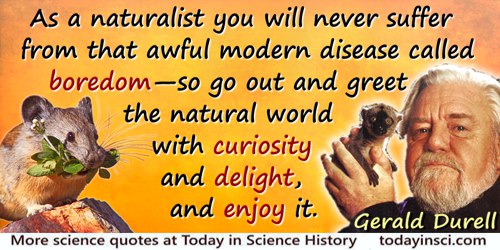
As a naturalist you will never suffer from that awful modern disease called boredom—so go out and greet the natural world with curiosity and delight, and enjoy it.
In The Amateur Naturalist (1989), 7.
As we cannot use physician for a cultivator of physics, I have called him a physicist. We need very much a name to describe a cultivator of science in general. I should incline to call him a Scientist. Thus we might say, that as an Artist is a Musician, Painter or Poet, a Scientist is a Mathematician, Physicist, or Naturalist.
The Philosophy of the Inductive Sciences (1840), Vol. I, cxiii.
But the World being once fram’d, and the course of Nature establish’d, the Naturalist, (except in some few cases, where God, or Incorporeal Agents interpose), has recourse to the first Cause but for its general and ordinary Support and Influence, whereby it preserves Matter and Motion from Annihilation or Desition; and in explicating particular phenomena, considers onely the Size, Shape, Motion, (or want of it) Texture, and the resulting Qualities and Attributes of the small particles of Matter.
The Origine of Formes and Qualities (1666), 194.
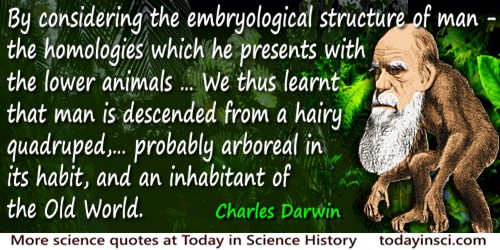
By considering the embryological structure of man - the homologies which he presents with the lower animals - the rudiments which he retains - and the reversions to which he is liable, we can partly recall in imagination the former condition of our early progenitors; and we can approximately place them in their proper position in the zoological series. We thus learnt that man is descended from a hairy quadruped, furnished with a tail and pointed ears, probably arboreal in its habit, and an inhabitant of the Old World. This creature, if its whole structure had been examined by a naturalist, would have been classed among the Quadrumana, as surely as would be the common and still more ancient progenitor of the Old and New World monkeys.
The Descent of Man (1871), Vol. 2, 389.
Darwin's characteristic perspicacity is nowhere better illustrated than in his prophecy of the reaction of the world of science. He admitted at once that it would be impossible to convince those older men '...whose minds are stocked with a multitude of facts, all viewed ... from a point of view directly opposite to mine ... A few naturalists endowed with much flexibility of mind and who have already begun to doubt the immutability of species, may be influenced by this volume; but I look with confidence to the young and rising naturalists, who will be able to view both sides with equal impartiality.
'The Reaction of American scientists to Darwinism', American Historical Review 1932), 38, 687. Quoted in David L. Hull, Science as Process (), 379.
Direct observation of the testimony of the earth … is a matter of the laboratory, of the field naturalist, of indefatigable digging among the ancient archives of the earth’s history. If Mr. Bryan, with an open heart and mind, would drop all his books and all the disputations among the doctors and study first hand the simple archives of Nature, all his doubts would disappear; he would not lose his religion; he would become an evolutionist.
'Evolution and Religion', New York Times (5 Mar 1922), 91. Written in response to an article a few days earlier in which William Jennings Bryan challenged the theory of evolution as lacking proof.
Great fleas have little fleas upon their backs to bite 'em,
And little fleas have lesser fleas, and so ad infinitum.
And the great fleas themselves, in turn have, greater fleas to go on;
While these again have greater still, and greater still, and so on.
[He was imitating: 'So, naturalists observe, a flea Has smaller fleas that on him prey; And these have smaller still to bite 'em; And so proceed ad infinitum.' Poetry, a Rhapsody, by Jonathan Swift.]
And little fleas have lesser fleas, and so ad infinitum.
And the great fleas themselves, in turn have, greater fleas to go on;
While these again have greater still, and greater still, and so on.
[He was imitating: 'So, naturalists observe, a flea Has smaller fleas that on him prey; And these have smaller still to bite 'em; And so proceed ad infinitum.' Poetry, a Rhapsody, by Jonathan Swift.]
A Budget of Paradoxes (1915), first published 1872, Vol. 2, 191.
Hands-on experience at the critical time, not systematic knowledge, is what counts in the making of a naturalist. Better to be an untutored savage for a while, not to know the names or anatomical detail. Better to spend long stretches of time just searching and dreaming.
In Naturalist (1994), 11-12.
He who contemplates nature finds an inexhaustible source of wonder and pleasure in considering, among the class of insects, their forms, their colours, the different offensive and defensive weapons with which they are provided, their curious habitudes, the bond of union which is shewn in some kinds, and the prudence and industry which they employ, less indeed for their individual preservation than with a view to secure the perpetuity of the species, while yielding to the soft and powerful impulse of nature. But if this innumerable family of little animals furnishes ample matter for the curious researches of the naturalist, it affords also a subject of meditation for public economy, since some kinds of these beings cause even national calamities, while on the contrary other species greatly contribute to the prosperity of states and individuals.
As translated (by uncredited trans.) in Chap. 1, 'Of Caterpillars Generally, Amongst Which is Comprised the Silk-Worm', The Art of Rearing Silk-Worms (1825), 1. Originally published in Italian as, Dell'arte di governare i bachi da seta (1815). Above quote from the original Italian, “Una sorgente inesausta di meraviglia e di piacere trova il contemplatore della natura nella classe degli insetti allorquando si fa a considerare l’abito esterno di çodesto iminenso popolo di esseri viventi, le tante differenti armi di offesa e di difesa loro prestate dalla provvida natura, le curiosissime loro abitudini, lo spirito di famiglia eminentissimo, che sì bene si mamifesta in alcune spezie, e la somma loro previdenza ed insdustria rispetto non tanto a’ mezzi che impiegano per la loro individuale conservazione, quanto a quelli cui, seguendo il dolce e possente invito della natura, mettono in opera, onde meglio assicurare la perpetuazione della spezie. Ma se questa innumerevole famiglia di animali fornisce ampia materia alle curiose indagini del naturalista, offre pur auco un soggetto di grande studio al pubblico economista, per la ragione che come alcune spezie di cotali esseri esercitano talvolta una influenza la più diretta sulle disgrazie dei popoli, così altre spezie per lo contrario l’hanno grandissima sulla prosperità degli Statie di quanti individui li compongono.” [Note: Whereas the printed translation gives “cause even national calamities”, the original Italian reads, “disgrazie dei popoli”—which might be translated less dramatically as, “misfortunes of the peoples.” —Webmaster
I am a naturalist rather than a scientist. Simply looking at a flower or a frog has always seemed to me to be just about the most interesting thing there is. Others say human beings are pretty interesting, which they are, but as a child you’re not interested in Auntie Flo’s psychology; you’re interested in how a dragonfly larva turns into a dragonfly.
From 'Interview: Of Mind and Matter: David Attenborough Meets Richard Dawkins', The Guardian (11 Sep 2010).
I am above the forest region, amongst grand rocks & such a torrent as you see in Salvator Rosa's paintings vegetation all a scrub of rhodods. with Pines below me as thick & bad to get through as our Fuegian Fagi on the hill tops, & except the towering peaks of P. S. [perpetual snow] that, here shoot up on all hands there is little difference in the mt scenery—here however the blaze of Rhod. flowers and various colored jungle proclaims a differently constituted region in a naturalists eye & twenty species here, to one there, always are asking me the vexed question, where do we come from?
Letter to Charles Darwin (24 Jun 1849). Quoted in The Correspondence of Charles Darwin (1988), Vol. 4, 1847-1850, 242.
I came to biochemistry through chemistry; I came to chemistry, partly by the labyrinthine routes that I have related, and partly through the youthful romantic notion that the natural sciences had something to do with nature. What I liked about chemistry was its clarity surrounded by darkness; what attracted me, slowly and hesitatingly, to biology was its darkness surrounded by the brightness of the givenness of nature, the holiness of life. And so I have always oscillated between the brightness of reality and the darkness of the unknowable. When Pascal speaks of God in hiding, Deus absconditus, we hear not only the profound existential thinker, but also the great searcher for the reality of the world. I consider this unquenchable resonance as the greatest gift that can be bestowed on a naturalist.
Heraclitean Fire: Sketches from a Life before Nature (1978), 55.
I have argued in this book [Biophilia] that we are human in good part because of the particular way we affiliate with other organisms. They are the matrix in which the human mind originated and is permanently rooted, and they offer the challenge and freedom innately sought. To the extent that each person can feel like a naturalist, the old excitement of the untrammeled world will be regained. I offer this as a formula of reenchantment to invigorate poetry and myth: mysterious and little known organisms live within walking distance of where you sit. Splendor awaits in minute proportions.
In Biophilia (1984, 2009), 139.
I only became fired up [deciding to become a scientist] in my second year of a science degree. … I was never a boy naturalist, to my regret. It was more the intellectual, philosophical questions that interested me.
From 'Interview: Of Mind and Matter: David Attenborough Meets Richard Dawkins', The Guardian (11 Sep 2010).
I well know what a spendidly great difference there is [between] a man and a bestia when I look at them from a point of view of morality. Man is the animal which the Creator has seen fit to honor with such a magnificent mind and has condescended to adopt as his favorite and for which he has prepared a nobler life; indeed, sent out for its salvation his only son; but all this belongs to another forum; it behooves me like a cobbler to stick to my last, in my own workshop, and as a naturalist to consider man and his body, for I know scarcely one feature by which man can be distinguished from apes, if it be not that all the apes have a gap between their fangs and their other teeth, which will be shown by the results of further investigation.
T. Fredbärj (ed.), Menniskans Cousiner (Valda Avhandlingar av Carl von Linné nr, 21) (1955), 4. Trans. Gunnar Broberg, 'Linnaeus's Classification of Man', in Tore Frängsmyr (ed.), Linnaeus: The Man and his Work (1983), 167.
If the juices of the body were more chymically examined, especially by a naturalist, that knows the ways of making fixed bodies volatile, and volatile fixed, and knows the power of the open air in promoting the former of those operations; it is not improbable, that both many things relating to the nature of the humours, and to the ways of sweetening, actuating, and otherwise altering them, may be detected, and the importance of such discoveries may be discerned.
Quoted In Barbara Kaplan (ed.) Divulging of Useful Truths in Physick: The Medical Agenda of Robert Boyle (1993), 92.
In all works on Natural History, we constantly find details of the marvellous adaptation of animals to their food, their habits, and the localities in which they are found. But naturalists are now beginning to look beyond this, and to see that there must be some other principle regulating the infinitely varied forms of animal life. It must strike every one, that the numbers of birds and insects of different groups having scarcely any resemblance to each other, which yet feed on the same food and inhabit the same localities, cannot have been so differently constructed and adorned for that purpose alone. Thus the goat-suckers, the swallows, the tyrant fly-catchers, and the jacamars, all use the same kind ‘Of food, and procure it in the same manner: they all capture insects on the wing, yet how entirely different is the structure and the whole appearance of these birds!
In A Narrative of Travels on the Amazon and Rio Negro (1853), 83-84.
In the enfranchised mind of the scientific naturalist, the usual feelings of repugnance simply do not exist. Curiosity conquers prejudice.
Under pen-name of W. N. P. Barbellion, Journal of a Disappointed Man (1919), 215
In the Life of Darwin by his son, there is related an incident of how the great naturalist once studied long as to just what a certain spore was. Finally he said, “It is this, for if it isn’t, then what is it?” And all during his life he was never able to forget that he had been guilty of this unscientific attitude, for science is founded on certitude, not assumption.
In Elbert Hubbard (ed. and publ.), The Philistine (May 1908), 26, No. 6, 172.
Is not Cuvier the great poet of our era? Byron has given admirable expression to certain moral conflicts, but our immortal naturalist has reconstructed past worlds from a few bleached bones; has rebuilt cities, like Cadmus, with monsters’ teeth; has animated forests with all the secrets of zoology gleaned from a piece of coal; has discovered a giant population from the footprints of a mammoth.
From 'La Peau de Chagrin' (1831). As translated by Ellen Marriage in The Wild Ass’s Skin (1906), 21-22.
Is not Cuvier the greatest poet of our age? Of course Lord Byron has set down in fine words certain of our souls’ longings; but our immortal naturalist has reconstructed whole worlds out of bleached bones. Like Cadmus, he has rebuilt great cities from teeth, repopulated thousands of forests with all the mysteries of zoology from a few pieces of coal, discovered races of giants in the foot of a mammoth.
From 'La Peau de Chagrin' (1831). As translated as by Helen Constantine The Wild Ass’s Skin (2012), 19.
It appears, nevertheless, that all such simple solutions of the problem of vertebrate ancestry are without warrant. They arise from a very common tendency of the mind, against which the naturalist has to guard himself,—a tendency which finds expression in the very widespread notion that the existing anthropoid apes, and more especially the gorilla, must be looked upon as the ancestors of mankind, if once the doctrine of the descent of man from ape-like forefathers is admitted. A little reflexion suffices to show that any given living form, such as the gorilla, cannot possibly be the ancestral form from which man was derived, since ex-hypothesi that ancestral form underwent modification and development, and in so doing, ceased to exist.
'Vertebrata', entry in Encyclopaedia Britannica, 9th edition (1899), Vol. 24, 180.
It has sometimes been said that the success of the Origin proved “that the subject was in the air,” or “that men's minds were prepared for it.” I do not think that this is strictly true, for I occasionally sounded not a few naturalists, and never happened to come across a single one who seemed to doubt about the permanence of species.
In Charles Darwin and Francis Darwin (ed.), Charles Darwin: His Life Told in an Autobiographical Chapter, and in a Selected Series of His Published Letters (1892), 42.
It is a wrong business when the younger cultivators of science put out of sight and deprecate what their predecessors have done; but obviously that is the tendency of Huxley and his friends … It is very true that Huxley was bitter against the Bishop of Oxford, but I was not present at the debate. Perhaps the Bishop was not prudent to venture into a field where no eloquence can supersede the need for precise knowledge. The young naturalists declared themselves in favour of Darwin’s views which tendency I saw already at Leeds two years ago. I am sorry for it, for I reckon Darwin’s book to be an utterly unphilosophical one.
Letter to James D, Forbes (24 Jul 1860). Trinity College Cambridge, Whewell Manuscripts.
It is for such inquiries the modern naturalist collects his materials; it is for this that he still wants to add to the apparently boundless treasures of our national museums, and will never rest satisfied as long as the native country, the geographical distribution, and the amount of variation of any living thing remains imperfectly known. He looks upon every species of animal and plant now living as the individual letters which go to make up one of the volumes of our earth’s history; and, as a few lost letters may make a sentence unintelligible, so the extinction of the numerous forms of life which the progress of cultivation invariably entails will necessarily render obscure this invaluable record of the past. It is, therefore, an important object, which governments and scientific institutions should immediately take steps to secure, that in all tropical countries colonised by Europeans the most perfect collections possible in every branch of natural history should be made and deposited in national museums, where they may be available for study and interpretation. If this is not done, future ages will certainly look back upon us as a people so immersed in the pursuit of wealth as to be blind to higher considerations. They will charge us with having culpably allowed the destruction of some of those records of Creation which we had it in our power to preserve; and while professing to regard every living thing as the direct handiwork and best evidence of a Creator, yet, with a strange inconsistency, seeing many of them perish irrecoverably from the face of the earth, uncared for and unknown.
In 'On the Physical Geography of the Malay Archipelago', Journal of the Royal Geographical Society (1863), 33, 234.
It is really laughable to see what different ideas are prominent in various naturalists’ minds, when they speak of “species”; in some, resemblance is everything and descent of little weight—in some, resemblance seems to go for nothing, and Creation the reigning idea—in some, descent is the key,—in some, sterility an unfailing test, with others it is not worth a farthing. It all comes, I believe, from trying to define the undefinable.
Letter to J. D. Hooker (24 Dec 1856). In Francis Darwin, The Life and Letters of Charles Darwin (1888), 446.
It seems to me that every phenomenon, every fact, itself is the really interesting object. Whoever explains it, or connects it with other events, usually only amuses himself or makes sport of us, as, for instance, the naturalist or historian. But a single action or event is interesting, not because it is explainable, but because it is true.
Quoted in translated from Unterhaltungen deutscher Ausgewanderten in Franz Boas, 'The Study of Geography', Science Supplement (11 Feb 1881), 9, No. 210, 139.
It wasn’t the finches that put the idea [of natural selection] in Darwin’s head, it was the tortoises. The reason he didn’t use the tortoises [in writing On the Origin of Species] was that, when he got back, he found he didn’t have localities on the tortoise specimens. Here the great god, the greatest naturalist we have records of, made a mistake. His fieldwork wasn’t absolutely perfect.
From interview with Brian Cox and Robert Ince, in 'A Life Measured in Heartbeats', New Statesman (21 Dec 2012), 141, No. 5138, 33.
Life, therefore, has been often disturbed on this earth by terrible events—calamities which, at their commencement, have perhaps moved and overturned to a great depth the entire outer crust of the globe, but which, since these first commotions, have uniformly acted at a less depth and less generally. Numberless living beings have been the victims of these catastrophes; some have been destroyed by sudden inundations, others have been laid dry in consequence of the bottom of the seas being instantaneously elevated. Their races even have become extinct, and have left no memorial of them except some small fragments which the naturalist can scarcely recognise.
'Preliminary discourse', to Recherches sur les Ossemens Fossiles (1812), trans. R. Kerr Essay on the Theory of the Earth (1813), 16-7.
Man cannot afford to be a naturalist, to look at Nature directly, but only with the side of his eye. He must look through and beyond her, to look at her is fatal as to look at the head of Medusa. It turns the man of science to stone. I feel that I am dissipated by so many observations. I should be the magnet in the midst of all this dust and filings.
From Journal entry (23 Mar 1953), in Henry David Thoreau and Bradford Torrey (ed.), Journal (1906), Vol. 5, 45.
None but a naturalist can understand the intense excitement I experienced when I at length captured it [a hitherto unknown species of butterfly]. On taking it out of my net and opening the glorious wings, my heart began to beat, violently, the blood rushed to my head, and I felt much more like fainting than I have done when in apprehension of immediate death. I had a headache the rest of the day, so great was the excitement produced by what will appear to most people a very inadequate cause.
The Malay Archipelago (1890), 257-258.
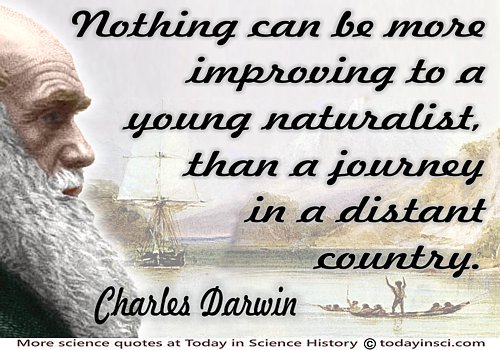
Nothing can be more improving to a young naturalist, than a journey in a distant country.
Journal of Researches: into the Natural History and Geology of the Countries Visited During the Voyage of H.M.S. Beagle Round the World (1839), ch. XXIII, 607.
Now when naturalists observe a close agreement in numerous small details of habits, tastes, and dispositions between two or more domestic races, or between nearly-allied natural forms, they use this fact as an argument that they are descended from a common progenitor who was thus endowed; and consequently that all should be classed under the same species. The same argument may be applied with much force to the races of man.
…...
Nowadays the field naturalist—who is usually at all points superior to the mere closet naturalist—follows a profession as full of hazard and interest as that of the explorer or of the big-game hunter in the remote wilderness.
African Game Trails (1910), 414-415.
Obviously we biologists should fit our methods to our materials. An interesting response to this challenge has been employed particularly by persons who have entered biology from the physical sciences or who are distressed by the variability in biology; they focus their research on inbred strains of genetically homogeneous laboratory animals from which, to the maximum extent possible, variability has been eliminated. These biologists have changed the nature of the biological system to fit their methods. Such a bold and forthright solution is admirable, but it is not for me. Before I became a professional biologist, I was a boy naturalist, and I prefer a contrasting approach; to change the method to fit the system. This approach requires that one employ procedures which allow direct scientific utilization of the successful long-term evolutionary experiments which are documented by the fascinating diversity and variability of the species of animals which occupy the earth. This is easy to say and hard to do.
In 'Scientific innovation and creativity: a zoologist’s point of view', American Zoologist (1982), 22, 232.
Of what use are the great number of petrifactions, of different species, shape and form which are dug up by naturalists? Perhaps the collection of such specimens is sheer vanity and inquisitiveness. I do not presume to say; but we find in our mountains the rarest animals, shells, mussels, and corals embalmed in stone, as it were, living specimens of which are now being sought in vain throughout Europe. These stones alone whisper in the midst of general silence.
Philosophia Botanica (1751), aphorism 132. Trans. Frans A. Stafleu, Linnaeus and the Linnaeans: The Spreading of their Ideas in Systematic Botany, 1735-1789 (1971), 56.
Organized Fossils are to the naturalist as coins to the antiquary; they are the antiquities of the earth; and very distinctly show its gradual regular formation, with the various changes inhabitants in the watery element.
Stratigraphical System of Organized Fossils (1817), ix-x.
OSTRICH, n. A large bird to which (for its sins, doubtless) nature has denied that hinder toe in which so many pious naturalists have seen a conspicuous evidence of design. The absence of a good working pair of wings is no defect, for, as has been ingeniously pointed out, the ostrich does not fly.
The Collected Works of Ambrose Bierce (1911), Vol. 7, The Devil's Dictionary, 241.
Savages have often been likened to children, and the comparison is not only correct but also highly instructive. Many naturalists consider that the early condition of the individual indicates that of the race,—that the best test of the affinities of a species are the stages through which it passes. So also it is in the case of man; the life of each individual is an epitome of the history of the race, and the gradual development of the child illustrates that of the species.
Pre-historic Times, as Illustrated by Ancient Remains, and the Manners and Customs of Modern Savages, (2nd. ed. 1869, 1878), 583.
Sheppey hath long been noted for producing large quantities of Sheep (whence probably its name is derived) as well as Corn; and exhibits to the Curious Naturalist a most desirable Spot, by affording many rare Plants, and more especially in the of its Northern Cliffs, so great a Quantity and Variety of Fossils, both native and extraneous are scarcely to be paralleled. These Cliffs length about six miles; Minster, Shurland and Warden are the Manors to which they appertain, the more elevated parts whereof reach about thirds of their extension, and are at the very highest of them not less than fifty yards perpendicular height above the Beach and Shore.
Quoted in Augustus A. Daly, History of the Isle of Sheppey (1975), 247.
So long as the fur of the beaver was extensively employed as a material for fine hats, it bore a very high price, and the chase of this quadruped was so keen that naturalists feared its speedy consideration. When a Parisian manufacturer invented the silk hat, which soon came into almost universal use, the demand for beavers' fur fell off, and this animal–whose habits, as we have seen, are an important agency in the formation of bogs and other modifications of forest nature–immediately began to increase, reappeared in haunts which we had long abandoned, and can no longer be regarded as rare enough to be in immediate danger of extirpation. Thus the convenience or the caprice of Parisian fashion has unconsciously exercised an influence which may sensibly affect the physical geography of a distant continent.
In Man and Nature, (1864), 84.
So-called extraordinary events always split into two extremes naturalists who have not witnessed them: those who believe blindly and those who do not believe at all. The latter have always in mind the story of the golden goose; if the facts lie slightly beyond the limits of their knowledge, they relegate them immediately to fables. The former have a secret taste for marvels because they seem to expand Nature; they use their imagination with pleasure to find explanations. To remain doubtful is given to naturalists who keep a middle path between the two extremes. They calmly examine facts; they refer to logic for help; they discuss probabilities; they do not scoff at anything, not even errors, because they serve at least the history of the human mind; finally, they report rather than judge; they rarely decide unless they have good evidence.
Quoted in Albert V. Carozzi, Histoire des sciences de la terre entre 1790 et 1815 vue à travers les documents inédités de la Societé de Physique et d'Histoire Naturelle de Genève, trans. Albert V. and Marguerite Carozzi. (1990), 175.
That no real Species of Living Creatures is so utterly extinct, as to be lost entirely out of the World, since it was first Created, is the Opinion of many Naturalists; and 'tis grounded on so good a Principle of Providence taking Care in general of all its Animal Productions, that it deserves our Assent. However great Vicissitudes may be observed to attend the Works of Nature, as well as Humane Affairs; so that some entire Species of Animals, which have been formerly Common, nay even numerous in certain Countries; have, in Process of time, been so perfectly soft, as to become there utterly unknown; tho' at the same time it cannot be denyed, but the kind has been carefully preserved in some other part of the World.
'A Discourse concerning the Large Horns frequently found under Ground in Ireland, Concluding from them that the great American Deer, call'd a Moose, was formerly common in that Island: With Remarks on some other things Natural to that Country', Philosophical Transactions of the Royal Society of London (1697), 19, 489.
The commonest forms of amateur natural history in the United States are probably gardening, bird watching, the maintenance of aquarium fish, and nature photography.
In The Nature of Natural History (1950, 1990), 265.
The discoveries of Darwin, himself a magnificent field naturalist, had the remarkable effect of sending the whole zoological world flocking indoors, where they remained hard at work for fifty years or more, and whence they are now beginning to put forth cautious heads into the open air.
(1960)
The fact which interests us most is the life of the naturalist. The purest science is still biographical.
In A Week on the Concord and Merrimack Rivers (1862), 382.
The great mathematician, like the great poet or naturalist or great administrator, is born. My contention shall be that where the mathematic endowment is found, there will usually be found associated with it, as essential implications in it, other endowments in generous measure, and that the appeal of the science is to the whole mind, direct no doubt to the central powers of thought, but indirectly through sympathy of all, rousing, enlarging, developing, emancipating all, so that the faculties of will, of intellect and feeling learn to respond, each in its appropriate order and degree, like the parts of an orchestra to the “urge and ardor” of its leader and lord.
In Lectures on Science, Philosophy and Art (1908), 22.
The growth of a naturalist is like the growth of a musician or athlete: excellence for the talented, lifelong enjoyment for the rest, benefit for humanity.
In The Creation: An Appeal to Save Life on Earth (2010), 147.
The idea of an atom has been so constantly associated with incredible assumptions of infinite strength, absolute rigidity, mystical actions at a distance, and individuality, that chemists and many other reasonable naturalists of modern times, losing all patience with it, have dismissed it to the realms of metaphysics, and made it smaller than ‘anything we can conceive.’ But if atoms are inconceivably small, why are not all chemical actions infinitely swift? Chemistry is powerless to deal with this question, and many others of paramount importance, if barred by the hardness of its fundamental assumptions, from contemplating the atom as a real portion of matter occupying a finite space, and forming not an immeasurably small constituent of any palpable body.
Sir William Thomson and Peter Guthrie Tait, A Treatise on Natural Philosophy (1883), Vol. I, Part 2, 495.
The interior parts of the earth and its internal depths are a region totally impervious to the eye of mortal man, and can least of all be approached by those ordinary paths of hypothesis adopted by naturalists and geologists. The region designed for the existence of man, and of every other creature endowed with organic life, as well as the sphere opened to the perception of man's senses, is confined to a limited space between the upper and lower parts of the earth, exceedingly small in proportion to the diameter, or even semi-diameter of the earth, and forming only the exterior surface, or outer skin, of the great body of the earth.
In Friedrich von Schlegel and James Burton Robertson (trans.), The Philosophy of History (1835), 20.
The modern naturalist must realize that in some of its branches his profession, while more than ever a science, has also become an art.
African Game Trails (1910), 17.
The more I learned about the use of pesticides, the more appalled I became. I realized that here was the material for a book. What I discovered was that everything which meant most to me as a naturalist was being threatened, and that nothing I could do would be more important.
Explaining her motivation for writing the book Silent Spring (1962), quoted in Always, Rachel: The Letters of Rachel Carson and Dorothy Freeman, 1952-1964 (1995), xxvii.
The naturalist is a civilized hunter.
In Biophilia (1984), 1.
The naturalists, you know, distribute the history of nature into three kingdoms or departments: zoology, botany, mineralogy. Ideology, or mind, however, occupies so much space in the field of science, that we might perhaps erect it into a fourth kingdom or department. But inasmuch as it makes a part of the animal construction only, it would be more proper to subdivide zoology into physical and moral.
Letter (24 Mar 1824) to Mr. Woodward. Collected in The Writings of Thomas Jefferson: Correspondence (1854), 339.
The ordinary naturalist is not sufficiently aware that when dogmatizing on what species are, he is grappling with the whole question of the organic world & its connection with the time past & with Man; that it involves the question of Man & his relation to the brutes, of instinct, intelligence & reason, of Creation, transmutation & progressive improvement or development. Each set of geological questions & of ethnological & zool. & botan. are parts of the great problem which is always assuming a new aspect.
Leonard G. Wilson (ed.), Sir Charles Lyell's Scientific Journals on the Species Question (1970), 164.
The rise of the ecologist almost exactly parallels the decline of the naturalist.
'Some Notes on the Ecology of Ecologists', The Scientific Monthly (1956), 3, 23.
The tendency of the sciences has long been an increasing proclivity of separation and dismemberment … The mathematician turns away from the chemist; the chemist from the naturalist; the mathematician, left to himself divides himself into a pure mathematician and a mixed mathematician, who soon part company … And thus science, even mere physical science, loses all traces of unity. A curious illustration of this result may be observed in the want of any name by which we can designate the students of the knowledge of the material world collectively. We are informed that this difficulty was felt very oppressively by the members of the British Association for the Advancement of Science, at their meetings at York, Oxford and Cambridge, in the last three summers. There was no general term by which these gentlemen could describe themselves with reference to their pursuits … some ingenious gentleman [William Whewell] proposed that, by analogy with artist, they might form Scientist, and added that there could be no scruple … when we have words such as sciolist, economist, and atheist—but this was not generally palatable.
In Review of Mrs Somerville, 'On the Connexion of the Physical Sciences', The Quarterly Review (1834), 51, 58-61.
The Vermin only teaze and pinch
Their foes superior by an Inch.
So, Naturalists observe, a Flea
Hath smaller Fleas that on him prey,
And these have smaller Fleas to bite 'em.
And so proceed ad infinitum.
Their foes superior by an Inch.
So, Naturalists observe, a Flea
Hath smaller Fleas that on him prey,
And these have smaller Fleas to bite 'em.
And so proceed ad infinitum.
On Poetry: A Rhapsody (1735), lines 339-44.
The whole inherent pride of human nature revolts at the idea that the lord of the creation is to be treated like any other natural object. No sooner does the naturalist discover the resemblance of some higher mammals, such as the ape, to man, than there is a general outcry against the presumptuous audacity that ventures to touch man in his inmost sanctuary. The whole fraternity of philosophers, who have never seen monkeys except in zoological gardens, at once mount the high horse, and appeal to the mind, the soul, to reason, to consciousness, and to all the rest of the innate faculties of man, as they are refracted in their own philosophical prisms.
From Carl Vogt and James Hunt (ed.), Lectures on Man: His Place in Creation, and in the History of the Earth (1861), 10.
The world is a museum in which all men are destined to be employed and amused, and they cannot be too much interested in the objects around them. Goldsmith the elegant imitator of Buffon, says “The mere uninformed spectator passes on in gloomy solitude; while the naturalist in every plant, in every insect, and in every pebble, finds something to entertain his curiosity and excite his speculation.”
From Introduction to a Course of Lectures on Natural History: Delivered in the University of Pennsylvania, Nov. 16, 1799 (1800), 19.
There is no art so difficult as the art of observation: it requires a skillful, sober spirit and a well-trained experience, which can only be acquired by practice; for he is not an observer who only sees the thing before him with his eyes, but he who sees of what parts the thing consists, and in what connexion the parts stand to the whole. One person overlooks half from inattention; another relates more than he sees while he confounds it with that which he figures to himself; another sees the parts of the whole, but he throws things together that ought to be separated. ... When the observer has ascertained the foundation of a phenomenon, and he is able to associate its conditions, he then proves while he endeavours to produce the phenomena at his will, the correctness of his observations by experiment. To make a series of experiments is often to decompose an opinion into its individual parts, and to prove it by a sensible phenomenon. The naturalist makes experiments in order to exhibit a phenomenon in all its different parts. When he is able to show of a series of phenomena, that they are all operations of the same cause, he arrives at a simple expression of their significance, which, in this case, is called a Law of Nature. We speak of a simple property as a Law of Nature when it serves for the explanation of one or more natural phenomena.
'The Study of the Natural Sciences: An Introductory Lecture to the Course of Experimental Chemistry in the University of Munich, for the Winter Session of 1852-53,' as translated and republished in The Medical Times and Gazette (22 Jan 1853), N.S. Vol. 6, 82.
Thinking, after a while, becomes the most pleasurable thing in the world. Give me a satchel and a fishing rod, and I could hie myself off and keep busy at thinking forever. I don't need anybody to amuse me. It is the same way with my friends John Burroughs, the naturalist, and Henry Ford, who is a natural-born mechanic. We can derive the most satisfying kind of joy from thinking and thinking and thinking.
As quoted from an interview by B.C. Forbes in The American Magazine (Jan 1921), 86.
This leads us to ask for the reasons which call for this new theory of transmutation. The beginning of things must needs lie in obscurity, beyond the bounds of proof, though within those of conjecture or of analogical inference. Why not hold fast to the customary view, that all species were directly, instead of indirectly, created after their respective kinds, as we now behold them,--and that in a manner which, passing our comprehension, we intuitively refer to the supernatural? Why this continual striving after “the unattained and dim,”—these anxious endeavors, especially of late years, by naturalists and philosophers of various schools and different tendencies, to penetrate what one of them calls “the mystery of mysteries,” the origin of species? To this, in general, sufficient answer may be found in the activity of the human intellect, “the delirious yet divine desire to know,” stimulated as it has been by its own success in unveiling the laws and processes of inorganic Nature,—in the fact that the principal triumphs of our age in physical science have consisted in tracing connections where none were known before, in reducing heterogeneous phenomena to a common cause or origin, in a manner quite analogous to that of the reduction of supposed independently originated species to a common ultimate origin,—thus, and in various other ways, largely and legitimately extending the domain of secondary causes. Surely the scientific mind of an age which contemplates the solar system as evolved from a common, revolving, fluid mass,— which, through experimental research, has come to regard light, heat, electricity, magnetism, chemical affinity, and mechanical power as varieties or derivative and convertible forms of one force, instead of independent species,—which has brought the so-called elementary kinds of matter, such as the metals, into kindred groups, and raised the question, whether the members of each group may not be mere varieties of one species,—and which speculates steadily in the direction of the ultimate unity of matter, of a sort of prototype or simple element which may be to the ordinary species of matter what the protozoa or component cells of an organism are to the higher sorts of animals and plants,—the mind of such an age cannot be expected to let the old belief about species pass unquestioned.
— Asa Gray
'Darwin on the Origin of Species', The Atlantic Monthly (Jul 1860), 112-3. Also in 'Natural Selection Not Inconsistent With Natural Theology', Darwiniana: Essays and Reviews Pertaining to Darwinism (1876), 94-95.
Three ways have been taken to account for it [racial differences]: either that they are the posterity of Ham, who was cursed; or that God at first created two kinds of men, one black and another white; or that by the heat of the sun the skin is scorched, and so gets the sooty hue. This matter has been much canvassed among naturalists, but has never been brought to any certain issue.
In James Boswell, London Journal, 1762-1763, as First Published in 1950 from the Original Manuscript (1956), 251.
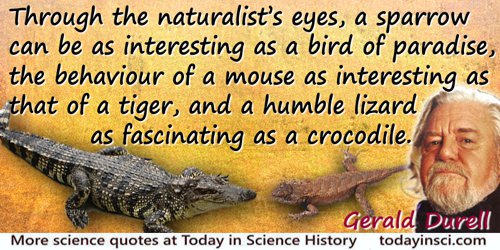
Through the naturalist’s eyes, a sparrow can be as interesting as a bird of paradise, the behaviour of a mouse as interesting as that of a tiger, and a humble lizard as fascinating as a crocodile. … Our planet is beautifully intricate, brimming over with enigmas to be solved and riddles to be unravelled.
In The Amateur Naturalist (1989), 7.
To be a Naturalist is better than to be King.
Journal entry (31 Dec 1893) at age 16. As given in Carol Grant Gould in The Remarkable Life of William Beebe: Explorer and Naturalist (2012), 26. It was the concluding remark the third year of his diaries.
We cannot, of course, give a definition of matter which will satisfy the metaphysician, but the naturalist may be content to know matter as that which can be perceived by the senses, or as that which can be acted upon by, or can exert, force.
In William Thomson and Peter Guthrie Tait, Treatise on Natural Philosophy (1867), Vol. 1, 161.
We talk about life as being dull as ditchwater, but is ditchwater dull? Naturalists with microscopes have told me that it teems with quiet fun.
'The Spice of Life', The Listener (1936). As cited, without initial phrase, in Bill Swainson (ed.), The Encarta Book of Quotations (2000), 201. Full sentences quote from Alzina Stone Dale, The Outline of Sanity: A Biography of G. K. Chesterton (2005), 288.
When I was a little over eight years old,… I was sent to a day-school…. [By this time] my taste for natural history, and more especially for collecting, was well developed. I tried to make out the names of plants, and collected all sorts of things, shells, seals, franks, coins, and minerals. The passion for collecting which leads a man to be a systematic naturalist, a virtuoso, or a miser, was very strong in me.
In Charles Darwin and Francis Darwin (ed.), 'Autobiography', The Life and Letters of Charles Darwin (1887, 1896), Vol. 1, 26.
When my parents moved to Washington with me as a 9-year-old, when my father had a temporary job in the government, I found myself five blocks from the National Zoo and just beyond Rock Creek Park. And so while I was going through the end of grammar school, I proceeded to spend all of my time in that zoo and then exploring Rock Creek Park. And I became then and there a lifetime professional scientific naturalist…. Seeing people who are actually engaged and studying it and treasuring it and making a lot of it was just enough to make me want to study any subject so that I could be like one of them.
From interview with National Geographic, in Andrew Revkin, 'Conservation Legend Has Big Plans For Future', on nationalgeographic.com website.
Where could the naturalist seek for more telling documents of the history of creation than in the fossils themselves?
Taschenbuch für Gesammte Mineralogie, 1813, 7, 2.
You cannot do without one specialty. You must have some base-line to measure the work and attainments of others. For a general view of the subject, study the history of the sciences. Broad knowledge of all Nature has been the possession of no naturalist except Humboldt, and general relations constituted his specialty.
Lecture at a teaching laboratory on Penikese Island, Buzzard's Bay. Quoted from the lecture notes by David Starr Jordan, Science Sketches (1911), 146.
 In science it often happens that scientists say, 'You know that's a really good argument; my position is mistaken,' and then they would actually change their minds and you never hear that old view from them again. They really do it. It doesn't happen as often as it should, because scientists are human and change is sometimes painful. But it happens every day. I cannot recall the last time something like that happened in politics or religion.
(1987) --
In science it often happens that scientists say, 'You know that's a really good argument; my position is mistaken,' and then they would actually change their minds and you never hear that old view from them again. They really do it. It doesn't happen as often as it should, because scientists are human and change is sometimes painful. But it happens every day. I cannot recall the last time something like that happened in politics or religion.
(1987) -- 





