Natural Quotes (810 quotes)
... in going over the history of all the inventions for which history could be obtained it became more and more clear that in addition to training and in addition to extensive knowledge, a natural quality of mind was also necessary.
Aphorism listed Frederick Seitz, The Cosmic Inventor: Reginald Aubrey Fessenden (1866-1932) (1999), 54, being Transactions of the American Philosophical Society, Held at Philadelphia For Promoting Useful Knowledge, Vol. 86, Pt. 6.
… just as the astronomer, the physicist, the geologist, or other student of objective science looks about in the world of sense, so, not metaphorically speaking but literally, the mind of the mathematician goes forth in the universe of logic in quest of the things that are there; exploring the heights and depths for facts—ideas, classes, relationships, implications, and the rest; observing the minute and elusive with the powerful microscope of his Infinitesimal Analysis; observing the elusive and vast with the limitless telescope of his Calculus of the Infinite; making guesses regarding the order and internal harmony of the data observed and collocated; testing the hypotheses, not merely by the complete induction peculiar to mathematics, but, like his colleagues of the outer world, resorting also to experimental tests and incomplete induction; frequently finding it necessary, in view of unforeseen disclosures, to abandon one hopeful hypothesis or to transform it by retrenchment or by enlargement:—thus, in his own domain, matching, point for point, the processes, methods and experience familiar to the devotee of natural science.
In Lectures on Science, Philosophy and Art (1908), 26
...[T]he natural history of the rat is tragically similar to that of man ... some of the more obvious qualities in which rats resemble men — ferocity, omnivorousness, and adaptability to all climates ... the irresponsible fecundity with which both species breed at all seasons of the year with a heedlessness of consequences, which subjects them to wholesale disaster on the inevitable, occasional failure of the food supply.... [G]radually, these two have spread across the earth, keeping pace with each other and unable to destroy each other, though continually hostile. They have wandered from East to West, driven by their physical needs, and — unlike any other species of living things — have made war upon their own kind. The gradual, relentless, progressive extermination of the black rat by the brown has no parallel in nature so close as that of the similar extermination of one race of man by another...
Rats, Lice and History(1935)
…The present revolution of scientific thought follows in natural sequence on the great revolutions at earlier epochs in the history of science. Einstein’s special theory of relativity, which explains the indeterminateness of the frame of space and time, crowns the work of Copernicus who first led us to give up our insistence on a geocentric outlook on nature; Einstein's general theory of relativity, which reveals the curvature or non-Euclidean geometry of space and time, carries forward the rudimentary thought of those earlier astronomers who first contemplated the possibility that their existence lay on something which was not flat. These earlier revolutions are still a source of perplexity in childhood, which we soon outgrow; and a time will come when Einstein’s amazing revelations have likewise sunk into the commonplaces of educated thought.
In The Theory of Relativity and its Influence on Scientific Thought (1922), 31-32
…tis a dangerous thing to ingage the authority of Scripture in disputes about the Natural World, in opposition to Reason; lest Time, which brings all things to light, should discover that to be evidently false which we had made Scripture to assert.
The Sacred Theory of the Earth (1681)
“Planning” is simply the result of experience read backward and projected into the future. To me the “purposive” action of a beehive is simply the summation and integration of its units, and Natural Selection has put higher and higher premiums on the most “purposeful” integration. It is the same way (to me) in the evolution of the middle ear, the steps in the Cynodonts (clearly shown by me in 1910 and by you later in Oudenodon) make it easier to see how such a wonderful device as the middle ear could arise without any predetermination or human-like planning, and in fact in the good old Darwinian way, if only we admit that as the “twig is bent the tree’s inclined” and that each stage conserves the advantages of its predecessors… The simple idea that planning is only experience read backward and combined by selection in suitable or successful combinations takes the mystery out of Nature and out of men’s minds.
Letter to Robert Broom [1933]. In Ronald Rainger, An Agenda for Antiquity (1991), 238.
“True is it, my incorporate friends,” quoth he, “That I receive the general food at first, Which you do live upon; and fit it is, Because I am the storehouse and the shop Of the whole body. But, if you do remember, I send it through the rivers of your blood, Even to the court, the heart, to th’ seat o’ th’ brain; And, through the cranks and offices of man, The strongest nerves and small inferior veins From me receive that natural competency Whereby they live. And though that all at once”— You, good friends, this says the belly, mark me.
[Told as a fable, this is the belly’s answer to a complaint from the other members of the body that it received all the food but did no work.] In Coriolanus (1623), Act 1, Scene 1, line 130-141. Webmaster’s note: The Fable of the Belly has its roots in antiquity. William Harvey delivered a lecture in Apr 1616 on his discovery the circulation of blood in the body, but did not publish until 1628.
[About any invention] (1) everything that’s already in the world when you’re born is just normal; (2) anything that gets invented between then and before you turn thirty is incredibly exciting and creative and with any luck you can make a career out of it; (3) anything that gets invented after you’re thirty is against the natural order of things and the beginning of the end of civilisation as we know it until it’s been around for about ten years when it gradually turns out to be alright really.
In News Review section, Sunday Times (29 Aug 1999).
[Am I vegetarian?] No. If you understand about the natural world, we’re a part of the system and you can’t feed lions grass. But because we have the intelligence to choose… But we haven’t got the gut to allow us to be totally vegetarian for a start. You can tell by the shape of our guts and the shape of our teeth that we evolved to be omnivores. We aren’t carnivores like lions but neither are we elephants.
Interview by Simon Gage in 'David Attenborough: I’m not an animal lover', Metro newspaper (29 Jan 2013, London).
[Beyond natural history] Other biological sciences take up the study at other levels of organization: dissecting the individual into organs and tissues and seeing how these work together, as in physiology; reaching down still further to the level of cells, as in cytology; and reaching the final biological level with the study of living molecules and their interactions, as in biochemistry. No one of these levels can be considered as more important than any other.
In The Nature of Natural History (1961, 2014), 7.
[For] men to whom nothing seems great but reason ... nature ... is a cosmos, so admirable, that to penetrate to its ways seems to them the only thing that makes life worth living. These are the men whom we see possessed by a passion to learn ... Those are the natural scientific men; and they are the only men that have any real success in scientific research.
From 'Lessons from the History of Science: The Scientific Attitude' (c.1896), in Collected Papers (1931), Vol. 1, 19.
[Herschel and Humboldt] stirred up in me a burning zeal to add even the most humble contribution to the noble structure of Natural Science. No one or a dozen other books influenced me nearly so much as these two. I copied out from Humboldt long passages about Teneriffe and read them aloud on one of [my walking excursions].
Autobiographies, (eds.) Michael Neve and Sharon Messenger (2002), Penguin edn., 36.
[I have a great] distaste for controversy…. I have often seen it do great harm, and yet remember few cases in natural knowledge where it has helped much either to pull down error or advance truth. Criticism, on the other hand, is of much value.
In letter (6 May 1841) to Robert Hare, an American Chemist, collected in Experimental Researches in Electricity (1844), Vol. 2, 275, as a footnote added to a reprint of 'On Dr. Hare’s Second Letter, and on the Chemical and Contact Theories of the Voltaic Battery', London and Edinburgh Philosophical Magazine (1843), 23.
[In plotting earthquake measurements] the range between the largest and smallest magnitudes seemed unmanageably large. Dr. Beno Gutenberg then made the natural suggestion to plot the amplitudes logarithmically.
From interview with Henry Spall, as in an abridged version of Earthquake Information Bulletin (Jan-Feb 1980), 12, No. 1, that is on the USGS website.
[In the Royal Society, there] has been, a constant Resolution, to reject all the amplifications, digressions, and swellings of style: to return back to the primitive purity, and shortness, when men deliver'd so many things, almost in an equal number of words. They have exacted from all their members, a close, naked, natural way of speaking; positive expressions; clear senses; a native easiness: bringing all things as near the Mathematical plainness, as they can: and preferring the language of Artizans, Countrymen, and Merchants, before that, of Wits, or Scholars.
The History of the Royal Society (1667), 113.
[Kepler] had to realize clearly that logical-mathematical theoretizing, no matter how lucid, could not guarantee truth by itself; that the most beautiful logical theory means nothing in natural science without comparison with the exactest experience. Without this philosophic attitude, his work would not have been possible.
From Introduction that Einstein wrote for Carola Baumgardt and Jamie Callan, Johannes Kepler Life and Letters (1953), 13.
[My dream dinner guest is] Charles Darwin. It’s an obvious answer, but it’s the truth. Think of any problem and before you start theorising, just check up whether Charles Darwin mentioned it in one of those green books sitting on your shelf. Whether it’s earthworms, human gestures or the origin of species, the observations that man made are unbelievable. He touched on so many subjects. Then, Alexander von Humboldt, the last polymath. There was no aspect of the natural world that he wasn’t curious about or didn’t write about in Kosmos, an extraordinary book.
From interview with Alice Roberts, 'Attenborough: My Life on Earth', The Biologist (Aug 2015), 62, No. 4, 16.
[My] numberless observations... made on the Strata... [have] made me confident of their uniformity throughout this Country & [have] led me to conclude that the same regularity... will be found to extend to every part of the Globe for Nature has done nothing by piecemeal. [T]here is no inconsistency in her productions. [T]he Horse never becomes an Ass nor the Crab an Apple by any intermixture or artificial combination whatever[. N]or will the Oak ever degenerate into an Ash or an Ash into an Elm. [H]owever varied by Soil or Climate the species will still be distinct on this ground. [T]hen I argue that what is found here may be found elsewhere[.] When proper allowances are made for such irregularities as often occur and the proper situation and natural agreement is well understood I am satisfied there will be no more difficulty in ascertaining the true quality of the Strata and the place of its possition [sic] than there is now in finding the true Class and Character of Plants by the Linean [sic] System.
Natural Order of the Strata in England and Wales Accurately Delineated and Described, unpublished manuscript, Department of Geology, University of Oxford, 1801, f. 7v.
[Simplicio] is much puzzled and perplexed. I think I hear him say, 'To whom then should we repair for the decision of our controversies if Aristotle were removed from the choir? What other author should we follow in the schools, academies, and studies? What philosopher has written all the divisions of Natural Philosophy, and so methodically, without omitting as much as a single conclusion? Shall we then overthrow the building under which so many voyagers find shelter? Shall we destroy that sanctuary, that Prytaneum, where so many students find commodious harbour; where without exposing himself to the injuries of the air, with only the turning over of a few leaves, one may learn all the secrets of Nature.'
Dialogue on the Great World Systems (1632). Revised and Annotated by Giorgio De Santillana (1953), 66.
[The natural world cleans water, pollinates plants and provides pharmaceuticals, among many other gifts.] Thirty trillion dollars worth of services, scot-free to humanity, every year.
From transcript of PBS TV program 'Religion and Ethics' (17 Nov 2006).
[The object of education is] to train the mind to ascertain the sequence of a particular conclusion from certain premises, to detect a fallacy, to correct undue generalisation, to prevent the growth of mistakes in reasoning. Everything in these must depend on the spirit and the manner in which the instruction itself is conveyed and honoured. If you teach scientific knowledge without honouring scientific knowledge as it is applied, you do more harm than good. I do think that the study of natural science is so glorious a school for the mind, that with the laws impressed on all these things by the Creator, and the wonderful unity and stability of matter, and the forces of matter, there cannot be a better school for the education of the mind.
Giving Evidence (18 Nov 1862) to the Public Schools Commission. As quoted in John L. Lewis, 125 Years: The Physical Society & The Institute of Physics (1999), 168-169.
[The steamboat] will answer for sea voyages as well as for inland navigation, in particular for packets, where there may be a great number of passengers. He is also of opinion, that fuel for a short voyage would not exceed the weight of water for a long one, and it would produce a constant supply of fresh water. ... [T]he boat would make head against the most violent tempests, and thereby escape the danger of a lee shore; and that the same force may be applied to a pump to free a leaky ship of her water. ... [T]he good effects of the machine, is the almost omnipotent force by which it is actuated, and the very simple, easy, and natural way by which the screws or paddles are turned to answer the purpose of oars.
[This letter was written in 1785, before the first steamboat carried a man (Fitch) on 27 Aug 1787.]
[This letter was written in 1785, before the first steamboat carried a man (Fitch) on 27 Aug 1787.]
Letter to Benjamin Franklin (12 Oct 1785), in The Works of Benjamin Franklin (1882), Vol. 10, 232.
[The teaching of Nature] is harsh and wasteful in its operation. Ignorance is visited as sharply as wilful disobedience—incapacity meets with the same punishment as crime. Nature’s discipline is not even a word and a blow, and the blow first; but the blow without the word. It is left to you to find out why your ears are boxed.
The object of what we commonly call education—that education in which man intervenes, and which I shall distinguish as artificial education—is to make good these defects in Nature’s methods; to prepare the child to receive Nature’s education, neither incapably, nor ignorantly, nor with wilful disobedience; and to understand the preliminary symptoms of her displeasure, without waiting for the box on the ear. In short, all artificial education ought to he an anticipation of natural education. And a liberal education is an artificial education, which has not only prepared a man to escape the great evils of disobedience to natural laws, but has trained him to appreciate and to seize upon the rewards, which Nature scatters with as free a hand as her penalties.
The object of what we commonly call education—that education in which man intervenes, and which I shall distinguish as artificial education—is to make good these defects in Nature’s methods; to prepare the child to receive Nature’s education, neither incapably, nor ignorantly, nor with wilful disobedience; and to understand the preliminary symptoms of her displeasure, without waiting for the box on the ear. In short, all artificial education ought to he an anticipation of natural education. And a liberal education is an artificial education, which has not only prepared a man to escape the great evils of disobedience to natural laws, but has trained him to appreciate and to seize upon the rewards, which Nature scatters with as free a hand as her penalties.
From Inaugural Address as Principal, South London Working Men’s College, in 'A Liberal Education; and Where to Find it', Macmillan's Magazine (Mar 1868), 17, 370.
[The] seminary spirit of minerals hath its proper wombs where it resides, and is like a Prince or Emperour, whose prescripts both Elements and matter must obey; and it is never idle, but always in action, producing and maintaining natural substances, untill they have fulfilled their destiny.
A Discourse of Natural Bathes, and Mineral Waters (1669), 104.
[Theodore Roosevelt] was a naturalist on the broadest grounds, uniting much technical knowledge with knowledge of the daily lives and habits of all forms of wild life. He probably knew tenfold more natural history than all the presidents who had preceded him, and, I think one is safe in saying, more human history also.
In 'Theodore Roosevelt', Natural History (Jan 1919), 19, No.1, 5.
[Tom Bombadil is] an exemplar, a particular embodying of pure (real) natural science: the spirit that desires knowledge of other things, their history and nature, because they are ‘other’ and wholly independent of the enquiring mind, a spirit coeval with the rational mind, and entirely unconcerned with ‘doing’ anything with the knowledge: Zoology and Botany not Cattle-breeding or Agriculture. Even the Elves hardly show this: they are primarily artists.
From Letter draft to Peter Hastings (manager of a Catholic bookshop in Oxford, who wrote about his enthusiasm for Lord of the Rings) (Sep 1954). In Humphrey Carpenter (ed.) assisted by Christopher Tolkien, The Letters of J.R.R. Tolkien (1995, 2014), 192, Letter No. 153.
[Trying to manipulate the salmon's natural migration is like] trying to replace Beethoven with Yanni.
As quoted in column by Sally Mauk, 'Sally Mauk: Author, angler, activist Duncan decries management of salmon', in Missoulian (29 Apr 2011).
[Watching natural history programs] brings a solace you can’t describe in words. It’s because we’re part of it fundamentally…. In moments of great grief, that’s where you look and immerse yourself. You realise you are not immortal, you are not a god, you are part of the natural world and you come to accept that.
Reflecting on the letters he received from newly bereaved people. While his series are running on TV, in dozens of letters daily (comprising the majority of the correspondence), they tell him that the only things they can face in their darkest moments are his natural-history programmes. From interview with Joe Shute, 'David Attenborough at 90: ‘I think about my mortality every day’', The Telegraph (29 Oct 2016).
[William Gull] endeavoured, above all things, to study the natural history of disease, uncomplicated by the action of unnecessary drugs, and he resented all useless interference with the course of nature. He would say of meddlesome poly-pharmacy—“Fools rush in, where angels fear to tread.”
Stated in Sir William Withey Gull and Theodore Dyke Acland (ed.), A Collection of the Published Writings of William Withey Gull (1896), xxv-xxvi.
[Writing this letter] has permitted me, for a moment, to abstract myself from the dry and dreary waste of politics, into which I have been impressed by the times on which I happened, and to indulge in the rich fields of nature, where alone I should have served as a volunteer, if left to my natural inclinations and partialties.
In letter to Caspar Wistar (21 Jun 1807), collected in Thomas Jefferson Randolph (ed.), Memoir, Correspondence, And Miscellanies, From The Papers Of Thomas Jefferson (1829), Vol. 4, 94.
'Causation' has been popularly used to express the condition of association, when applied to natural phenomena. There is no philosophical basis for giving it a wider meaning than partial or absolute association. In no case has it been proved that there is an inherent necessity in the laws of nature. Causation is correlation... [P]erfect correlation, when based upon sufficient experience, is causation in the scientific sense.
'Correlation, Causation and Wright's Theory of "Path Coefficients"', Genetics (7 May 1922), 7, 259-61.
Dinosaur: I plan to use punctuated equilibrium to turn this zit into a third eye.
Catbert: That's not a natural advantage. You'd better stay away from the fitter dinosaurs.
Catbert: That's not a natural advantage. You'd better stay away from the fitter dinosaurs.
Dilbert comic strip (30 Aug 2002).
Goldsmith: If you put a tub full of blood into a stable, the horses are like to go mad.
Johnson: I doubt that.
Goldsmith: Nay, sir, it is a fact well authenticated.
Thrale: You had better prove it before you put it into your book on natural history. You may do it in my stable if you will.
Johnson: Nay, sir, I would not have him prove it. If he is content to take his information from others, he may get through his book with little trouble, and without much endangering his reputation. But if he makes experiments for so comprehensive a book as his, there would be no end to them; his erroneous assertions would then fall upon himself: and he might be blamed for not having made experiments as to every particular.
Johnson: I doubt that.
Goldsmith: Nay, sir, it is a fact well authenticated.
Thrale: You had better prove it before you put it into your book on natural history. You may do it in my stable if you will.
Johnson: Nay, sir, I would not have him prove it. If he is content to take his information from others, he may get through his book with little trouble, and without much endangering his reputation. But if he makes experiments for so comprehensive a book as his, there would be no end to them; his erroneous assertions would then fall upon himself: and he might be blamed for not having made experiments as to every particular.
In James Boswell, The Life of Samuel Johnson, LL.D.: Comprehending an Account of His Studies and Numerous Works (1785, 1830), 229-230.
Il ne peut y avoir de langage plus universel et plus simple, plus exempt d’erreurs et d’obscurités, c'est-à-dire plus digne d'exprimer les rapports invariables des êtres naturels.
There cannot be a language more universal and more simple, more free from errors and obscurities, … more worthy to express the invariable relations of all natural things. [About mathematical analysis.]
There cannot be a language more universal and more simple, more free from errors and obscurities, … more worthy to express the invariable relations of all natural things. [About mathematical analysis.]
From Théorie Analytique de la Chaleur (1822), xiv, translated by Alexander Freeman in The Analytical Theory of Heat (1878), 7.
L’analyse mathématique … dans l’étude de tous les phénomènes; elle les interprète par le même langage, comme pour attester l’unité et la simplicité du plan de l’univers, et rendre encore plus manifeste cet ordre immuable qui préside à toutes les causes naturelles.
Mathematical analysis … in the study of all phenomena, interprets them by the same language, as if to attest the unity and simplicity of the plan of the universe, and to make still more evident that unchangeable order which presides over all natural causes.
Mathematical analysis … in the study of all phenomena, interprets them by the same language, as if to attest the unity and simplicity of the plan of the universe, and to make still more evident that unchangeable order which presides over all natural causes.
From Théorie Analytique de la Chaleur (1822), xv, translated by Alexander Freeman in The Analytical Theory of Heat (1878), 8.
L’art d’enseigner n’est que l’art d’éveiller la curiosité des jeunes âmes pour la satisfaire ensuite.
The whole art of teaching is only the art of awakening the natural curiosity of young minds for the purpose of satisfying it afterwards.
The whole art of teaching is only the art of awakening the natural curiosity of young minds for the purpose of satisfying it afterwards.
The Crime of Sylvestre Bonnard (1894) translated by Lafcadio Hearn, in The Works of Anatole France in an English Translation (1920), 198.
Les causes primordiales ne nous sont point connues; mais elles sont assujetties à des lois simples et constantes, que l’on peut découvrir par l’observation, et dont l’étude est l’objet de la philosophie naturelle.
Primary causes are unknown to us; but are subject to simple and constant laws, which may be discovered by observation, the study of them being the object of natural philosophy.
Primary causes are unknown to us; but are subject to simple and constant laws, which may be discovered by observation, the study of them being the object of natural philosophy.
Opening statement from 'Discours Préliminaire' to Théorie Analytique de la Chaleur (1822), i, translated by Alexander Freeman in The Analytical Theory of Heat (1878), 1.
Nunc naturalem causam quaerimus et assiduam, non raram fortuitam.
Now we are looking for a natural and constant cause, not a rare and accidental one.
Now we are looking for a natural and constant cause, not a rare and accidental one.
Found as an Epigraph on title page of John Playfair, Illustrations of the Huttonian Theory of the Earth (1802). The Latin form of this quote is found in 'Naturalium Questionum, Book 2', Oeuvres Complètes de Sénèque: Le Philosophe (1838), Vol. 8, 164. It is part of a discussion of the nature of thunder and lightning. A thought—that they are caused by fire extinguished in a cloud from a falling star—is dismissed with the statement in the quote.
On peut braver les lois humaines, mais non résister aux lois naturelles.
One can defy human laws, but cannot resist natural laws.
One can defy human laws, but cannot resist natural laws.
Original French in Les Voyages Extraordinaires par Jules Verne: Vingt Mille Lieues Sous Les Mers (1870), 359. (Twenty Thousand Leagues Under the Sea). Translation by Webmaster. The context is that Captain Nemo is describing how the submarine Nautilus had been trapped as a melting iceberg flipping to find a new equilibrium. Nemo regarded the accident as caused by “a caprice of nature, not from the ignorance of man.”
Primo enim paranda est Historia Naturalis et Experimentalis, suffidens et bona; quod fundamentum rei est: neque enim fingendum, aut excogitandum, sed inveniendum, quid natura faciat aut ferat.
For first of all we must prepare a Natural and Experimental History, sufficient and good; and this is the foundation of all; for we are not to imagine or suppose, but to discover, what nature does or may be made to do.
For first of all we must prepare a Natural and Experimental History, sufficient and good; and this is the foundation of all; for we are not to imagine or suppose, but to discover, what nature does or may be made to do.
In Novum Organum, Book 2, Aphorism 10. As translated in Francis Bacon and James Spedding with Robert Leslie Ellis (eds.), 'The New Organon', The Works of Francis Bacon: Translations of the Philosophical Works (1858), Vol. 4, 127. Also seen in epigraphs as a shorter quote, “Non fingendum, aut excogitandum, sed inveniendum, quid natura faciat aut ferat,” which can also be translated as “We have not to imagine or to think out, but to find out what Nature does or produces.”
Question: Explain why pipes burst in cold weather.
Answer: People who have not studied acoustics think that Thor bursts the pipes, but we know that is nothing of the kind for Professor Tyndall has burst the mythologies and has taught us that it is the natural behaviour of water (and bismuth) without which all fish would die and the earth be held in an iron grip. (1881)
Answer: People who have not studied acoustics think that Thor bursts the pipes, but we know that is nothing of the kind for Professor Tyndall has burst the mythologies and has taught us that it is the natural behaviour of water (and bismuth) without which all fish would die and the earth be held in an iron grip. (1881)
Genuine student answer* to an Acoustics, Light and Heat paper (1881), Science and Art Department, South Kensington, London, collected by Prof. Oliver Lodge. Quoted in Henry B. Wheatley, Literary Blunders (1893), 186-7, Question 10. (*From a collection in which Answers are not given verbatim et literatim, and some instances may combine several students' blunders.) Webmaster notes that “fish would die” may refer to being taught that water's greatest density is at 4°C, and sinks below a frozen surface, so bodies of water can remain liquid underneath, to the benefit of the fish. The student was likely taught that bismuth, like water, expands when it freezes.
Qui est de nous & qui seul peut nous égarer; à le mettre continuellement à épreuve de l'expérience; à ne conserver que les faits qui ne font que des données de la nature , & qui ne peuvent nous tromper; à ne chercher la vérité que dans l'enchaînement naturel des expériences & des observations
We must trust to nothing but facts: These are presented to us by Nature, and cannot deceive. We ought, in every instance, to submit our reasoning to the test of experiment, and never to search for truth but by the natural road of experiment and observation.
We must trust to nothing but facts: These are presented to us by Nature, and cannot deceive. We ought, in every instance, to submit our reasoning to the test of experiment, and never to search for truth but by the natural road of experiment and observation.
From the original French in Traité élémentaire de chimie (1789, 1793), discours préliminaire, x; and from edition translated into English by Robert Kerr, as Elements of Chemistry (1790), Preface, xviii.
A … difference between most system-building in the social sciences and systems of thought and classification of the natural sciences is to be seen in their evolution. In the natural sciences both theories and descriptive systems grow by adaptation to the increasing knowledge and experience of the scientists. In the social sciences, systems often issue fully formed from the mind of one man. Then they may be much discussed if they attract attention, but progressive adaptive modification as a result of the concerted efforts of great numbers of men is rare.
The Study of Man (1941), 19-20.
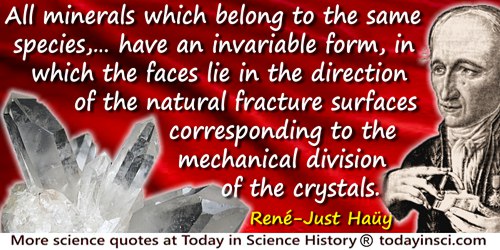
A casual glance at crystals may lead to the idea that they were pure sports of nature, but this is simply an elegant way of declaring one’s ignorance. With a thoughtful examination of them, we discover laws of arrangement. With the help of these, calculation portrays and links up the observed results. How variable and at the same time how precise and regular are these laws! How simple they are ordinarily, without losing anything of their significance! The theory which has served to develop these laws is based entirely on a fact, whose existence has hitherto been vaguely discerned rather than demonstrated. This fact is that in all minerals which belong to the same species, these little solids, which are the crystal elements and which I call their integrant molecules, have an invariable form, in which the faces lie in the direction of the natural fracture surfaces corresponding to the mechanical division of the crystals. Their angles and dimensions are derived from calculations combined with observation.
Traité de mineralogie … Publié par le conseil des mines (1801), Vol. 1, xiii-iv, trans. Albert V. and Marguerite Carozzi.
A famous name has this peculiarity that it becomes gradually smaller especially in natural sciences where each succeeding discovery invariably overshadows what precedes.
H. S. Van Klooster, 'Van't Hoff (1852-1911) in Retrospect', Journal of Chemical Education (1952), 29, 376.
A few days ago, a Master of Arts, who is still a young man, and therefore the recipient of a modern education, stated to me that until he had reached the age of twenty he had never been taught anything whatever regarding natural phenomena, or natural law. Twelve years of his life previously had been spent exclusively amongst the ancients. The case, I regret to say, is typical. Now we cannot, without prejudice to humanity, separate the present from the past.
'On the Study of Physics', From a Lecture delivered in the Royal Institution of Great Britain in the Spring of 1854. Fragments of Science for Unscientific People: A Series of Detached Essays, Lectures, and Reviews (1892), Vol. 1, 284-5.
A general State education is a mere contrivance for moulding people to be exactly like one another: and as the mould in which it casts them is that which pleases the predominant power in the government, whether this be a monarch, a priesthood, an aristocracy, or the majority of the existing generation in proportion as it is efficient and successful, it establishes a despotism over the mind, leading by a natural tendency to one over the body.
In On Liberty (1859), 190-191.
A great reform in geological speculation seems now to have become necessary. … It is quite certain that a great mistake has been made—that British popular geology at the present time is in direct opposition to the principles of Natural Philosophy.
From Sir W. Thomson, Address (27 Feb 1868), to the Geological Society of Glasgow, 'On Geological Time', Transactions of the Geological Society of Glasgow 3, collected in Popular Lectures and Addresses (1894), Vol. 2, 10 & 44. As Epigraph in Thomas Henry Huxley, 'Geological Reform' (1869), Collected Essays: Discourses, Biological and Geological (1894), 306.
A laboratory of natural history is a sanctuary where nothing profane should be tolerated. I feel less agony at improprieties in churches than in a scientific laboratory.
Lecture at a teaching laboratory on Penikese Island, Buzzard's Bay. Quoted from the lecture notes by David Starr Jordan, Science Sketches (1911), 147.
A man in twenty-four hours converts as much as seven ounces of carbon into carbonic acid; a milch cow will convert seventy ounces, and a horse seventy-nine ounces, solely by the act of respiration. That is, the horse in twenty-four hours burns seventy-nine ounces of charcoal, or carbon, in his organs of respiration to supply his natural warmth in that time ..., not in a free state, but in a state of combination.
In A Course of Six Lectures on the Chemical History of a Candle (1861), 117.
A man would have to be an idiot to write a book of laws for an apple tree telling it to bear apples and not thorns, seeing that the apple-tree will do it naturally and far better than any laws or teaching can prescribe.
On Secular Authority (1523). In Harro Höpfl (ed.), Luther and Calvin on Secular Authority (1991), 9.
A marveilous newtrality have these things mathematicall, and also a strange participation between things supernaturall, immortall, intellectuall, simple and indivisible, and things naturall, mortall, sensible, componded and divisible.
— John Dee
In Mathematicall Praeface to the Elements of Geometrie of Euclid of Megara (1570).
A natural law regulates the advance of science. Where only observation can be made, the growth of knowledge creeps; where laboratory experiments can be carried on, knowledge leaps forward.
[Attributed, probably incorrectly]
[Attributed, probably incorrectly]
Seen in various places, but Webmaster has found none with a source citation, and doubts the authenticity, because none found with attribution to Faraday prior to 1950. The earliest example Webmaster found is in 1929, by Walter Morley Fletcher in his Norman Lockyer Lecture. He refers to it as a “truism,” without mention of Faraday. He says “law of our state of being” rather than “natural law.” See the Walter Morley Fletcher page for more details.
A natural science is one whose propositions on limited domains of nature can have only a correspondingly limited validity; and that science is not a philosophy developing a world-view of nature as a whole or about the essence of things.
In The Physicist’s Conception of Nature (1958), 152. Translated by Arnold J. Pomerans from
Das Naturbild der Heutigen Physik (1955).
A physician’s subject of study is necessarily the patient, and his first field for observation is the hospital. But if clinical observation teaches him to know the form and course of diseases, it cannot suffice to make him understand their nature; to this end he must penetrate into the body to find which of the internal parts are injured in their functions. That is why dissection of cadavers and microscopic study of diseases were soon added to clinical observation. But to-day these various methods no longer suffice; we must push investigation further and, in analyzing the elementary phenomena of organic bodies, must compare normal with abnormal states. We showed elsewhere how incapable is anatomy alone to take account of vital phenenoma, and we saw that we must add study of all physico-chemical conditions which contribute necessary elements to normal or pathological manifestations of life. This simple suggestion already makes us feel that the laboratory of a physiologist-physician must be the most complicated of all laboratories, because he has to experiment with phenomena of life which are the most complex of all natural phenomena.
From An Introduction to the Study of Experimental Medicine (1865), as translated by Henry Copley Greene (1957), 140-141.
A precisian professor had the habit of saying: “… quartic polynomial ax4+bx3+cx2+dx+e, where e need not be the base of the natural logarithms.”
Given, without citation, in A Mathematician’s Miscellany (1953), reissued as Béla Bollobás (ed.), Littlewood’s Miscellany (1986), 60. [Note: a precisian is a rigidly precise or punctilious person. —Webmaster]
A superficial knowledge of mathematics may lead to the belief that this subject can be taught incidentally, and that exercises akin to counting the petals of flowers or the legs of a grasshopper are mathematical. Such work ignores the fundamental idea out of which quantitative reasoning grows—the equality of magnitudes. It leaves the pupil unaware of that relativity which is the essence of mathematical science. Numerical statements are frequently required in the study of natural history, but to repeat these as a drill upon numbers will scarcely lend charm to these studies, and certainly will not result in mathematical knowledge.
In Primary Arithmetic: First Year, for the Use of Teachers (1897), 26-27.
A superficial knowledge of mathematics may lead to the belief that this subject can be taught incidentally, and that exercises akin to counting the petals of flowers or the legs of a grasshopper are mathematical. Such work ignores the fundamental idea out of which quantitative reasoning grows—the equality of magnitudes. It leaves the pupil unaware of that relativity which is the essence of mathematical science. Numerical statements are frequently required in the study of natural history, but to repeat these as a drill upon numbers will scarcely lend charm to these studies, and certainly will not result in mathematical knowledge.
In Primary Arithmetic: First Year, for the Use of Teachers (1897), 26-27.
A weird happening has occurred in the case of a lansquenet named Daniel Burghammer, of the squadron of Captain Burkhard Laymann Zu Liebenau, of the honorable Madrucci Regiment in Piadena, in Italy. When the same was on the point of going to bed one night he complained to his wife, to whom he had been married by the Church seven years ago, that he had great pains in his belly and felt something stirring therein. An hour thereafter he gave birth to a child, a girl. When his wife was made aware of this, she notified the occurrence at once. Thereupon he was examined and questioned. … He confessed on the spot that he was half man and half woman and that for more than seven years he had served as a soldier in Hungary and the Netherlands… . When he was born he was christened as a boy and given in baptism the name of Daniel… . He also stated that while in the Netherlands he only slept once with a Spaniard, and he became pregnant therefrom. This, however, he kept a secret unto himself and also from his wife, with whom he had for seven years lived in wedlock, but he had never been able to get her with child… . The aforesaid soldier is able to suckle the child with his right breast only and not at all on the left side, where he is a man. He has also the natural organs of a man for passing water. Both are well, the child is beautiful, and many towns have already wished to adopt it, which, however, has not as yet been arranged. All this has been set down and described by notaries. It is considered in Italy to be a great miracle, and is to be recorded in the chronicles. The couple, however, are to be divorced by the clergy.
'From Piadena in Italy, the 26th day of May 1601'. As quoted in George Tennyson Matthews (ed.) The Fugger Newsletter (1970), 247-248. A handwritten collection of news reports (1568-1604) by the powerful banking and merchant house of Fugger in Ausburg. This was footnoted in The Story of the Secret Service (1937), 698.
https://books.google.com/books?id=YfssAAAAMAAJ
Richard Wilmer Rowan - 1937
Absorbed in the special investigation, I paid no heed to the edifice which was meanwhile unconsciously building itself up. Having however completed the comparison of the fossil species in Paris, I wanted, for the sake of an easy revision of the same, to make a list according to their succession in geological formations, with a view of determining the characteristics more exactly and bringing them by their enumeration into bolder relief. What was my joy and surprise to find that the simplest enumeration of the fossil fishes according to their geological succession was also a complete statement of the natural relations of the families among themselves; that one might therefore read the genetic development of the whole class in the history of creation, the representation of the genera and species in the several families being therein determined; in one word, that the genetic succession of the fishes corresponds perfectly with their zoological classification, and with just that classification proposed by me.
Quoted in Elizabeth Cary Agassiz (ed.), Louis Agassiz: His Life and Correspondence (1885), Vol. I, 203-4.
According to my derivative hypothesis, a change takes place first in the structure of the animal, and this, when sufficiently advanced, may lead to modifications of habits… . “Derivation” holds that every species changes, in time, by virtue of inherent tendencies thereto. “Natural Selection” holds that no such change can take place without the influence of altered external circumstances educing or selecting such change… . The hypothesis of “natural selection” totters on the extension of a conjectural condition, explanatory of extinction to the majority of organisms, and not known or observed to apply to the origin of any species.
In On the Anatomy of Vertebrates (1868), Vol. 3, 808.
According to the conclusion of Dr. Hutton, and of many other geologists, our continents are of definite antiquity, they have been peopled we know not how, and mankind are wholly unacquainted with their origin. According to my conclusions drawn from the same source, that of facts, our continents are of such small antiquity, that the memory of the revolution which gave them birth must still be preserved among men; and thus we are led to seek in the book of Genesis the record of the history of the human race from its origin. Can any object of importance superior to this be found throughout the circle of natural science?
An Elementary Treatise on Geology (1809), 82.
After what has been premised, I think we may lay down the following Conclusions. First, It is plain Philosophers amuse themselves in vain, when they inquire for any natural efficient Cause, distinct from a Mind or Spirit. Secondly, Considering the whole Creation is the Workmanship of a wise and good Agent, it should seem to become Philosophers, to employ their Thoughts (contrary to what some hold) about the final Causes of Things: And I must confess, I see no reason, why pointing out the various Ends, to which natural Things are adapted and for which they were originally with unspeakable Wisdom contrived, should not be thought one good way of accounting for them, and altogether worthy a Philosopher.
A Treatise Concerning the Principles of Human Knowledge [first published 1710], (1734), 126-7.
All appearances to the contrary, the only watchmaker in nature is the blind forces of physics, albeit deployed in very special way. A true watchmaker has foresight: he designs his cogs springs, and plans their interconnections, with a future purpose in his mind's eye. Natural selection, the blind, unconscious, automatic process which Darwin discovered, and which we now know is the explanation for the existence and apparently purposeful form of all life, has no purpose in mind. It has no mind and no mind's eye. It does not plan for the future. It has no vision, no foresight, no sight at all. If it can be said to play the role of watchmaker in nature, it is the blind watchmaker.
The Blind Watchmaker (1986), 5.
All interesting issues in natural history are questions of relative frequency, not single examples. Everything happens once amidst the richness of nature. But when an unanticipated phenomenon occurs again and again–finally turning into an expectation–then theories are overturned.
…...
All that science can achieve is a perfect knowledge and a perfect understanding of the action of natural and moral forces.
…...
All the different classes of beings which taken together make up the universe are, in the ideas of God who knows distinctly their essential gradations, only so many ordinates of a single curve so closely united that it would be impossible to place others between any two of them, since that would imply disorder and imperfection. Thus men are linked with the animals, these with the plants and these with the fossils which in turn merge with those bodies which our senses and our imagination represent to us as absolutely inanimate. And, since the law of continuity requires that when the essential attributes of one being approximate those of another all the properties of the one must likewise gradually approximate those of the other, it is necessary that all the orders of natural beings form but a single chain, in which the various classes, like so many rings, are so closely linked one to another that it is impossible for the senses or the imagination to determine precisely the point at which one ends and the next begins?all the species which, so to say, lie near the borderlands being equivocal, at endowed with characters which might equally well be assigned to either of the neighboring species. Thus there is nothing monstrous in the existence zoophytes, or plant-animals, as Budaeus calls them; on the contrary, it is wholly in keeping with the order of nature that they should exist. And so great is the force of the principle of continuity, to my thinking, that not only should I not be surprised to hear that such beings had been discovered?creatures which in some of their properties, such as nutrition or reproduction, might pass equally well for animals or for plants, and which thus overturn the current laws based upon the supposition of a perfect and absolute separation of the different orders of coexistent beings which fill the universe;?not only, I say, should I not be surprised to hear that they had been discovered, but, in fact, I am convinced that there must be such creatures, and that natural history will perhaps some day become acquainted with them, when it has further studied that infinity of living things whose small size conceals them for ordinary observation and which are hidden in the bowels of the earth and the depth of the sea.
Lettre Prétendue de M. De Leibnitz, à M. Hermann dont M. Koenig a Cité le Fragment (1753), cxi-cxii, trans. in A. O. Lovejoy, Great Chain of Being: A Study of the History of an Idea (1936), 144-5.
All the knowledge we have of nature depends upon facts; for without observations and experiments our natural philosophy would only be a science of terms and an unintelligible jargon.
First sentence of 'Preface', Course of Experimental Philosophy (1745), Vol. 1, v.
All the sciences have a relation, greater or less, to human nature; and...however wide any of them may seem to run from it, they still return back by one passage or another. Even Mathematics, Natural Philosophy, and Natural Religion, are in some measure dependent on the science of MAN; since they lie under the cognizance of men, and are judged of by their powers and faculties.
A Treatise on Human Nature (1739-40), ed. L. A. Selby-Bigge (1888), introduction, xix.
All your names I and my friend approve of or nearly all as to sense & expression, but I am frightened by their length & sound when compounded. As you will see I have taken deoxide and skaiode because they agree best with my natural standard East and West. I like Anode & Cathode better as to sound, but all to whom I have shewn them have supposed at first that by Anode I meant No way.
Letter (3 May 1834) to William Whewell, who coined the terms. In Frank A. J. L. James (ed.), The Correspondence of Michael Faraday (1993), Vol. 2, 181. Note: Here “No way” is presumably not an idiomatic exclamation, but a misinterpretation from the Greek prefix, -a “not”or “away from,” and hodos meaning “way.” The Greek ἄνοδος anodos means “way up” or “ascent.”
Almost all the world is natural chemicals, so it really makes you re-think everything. A cup of coffee is filled with chemicals. They've identified a thousand chemicals in a cup of coffee. But we only found 22 that have been tested in animal cancer tests out of this thousand. And of those, 17 are carcinogens. There are ten milligrams of known carcinogens in a cup of coffee and thats more carcinogens than youre likely to get from pesticide residues for a year!
Paper to the American Chemical Society, 'Pollution, Pesticides and Cancer Misconceptions.' As cited by Art Drysdale, 'Latest Insider News: Natural vs. Synthetic Chemical Pesticides' (14 Feb 1999), on the mitosyfraudes.org website. Bruce Ames has delivered a similar statistic in various other publications.
Almost everyone... seems to be quite sure that the differences between the methodologies of history and of the natural sciences are vast. For, we are assured, it is well known that in the natural sciences we start from observation and proceed by induction to theory. And is it not obvious that in history we proceed very differently? Yes, I agree that we proceed very differently. But we do so in the natural sciences as well.
In both we start from myths—from traditional prejudices, beset with error—and from these we proceed by criticism: by the critical elimination of errors. In both the role of evidence is, in the main, to correct our mistakes, our prejudices, our tentative theories—that is, to play a part in the critical discussion, in the elimination of error. By correcting our mistakes, we raise new problems. And in order to solve these problems, we invent conjectures, that is, tentative theories, which we submit to critical discussion, directed towards the elimination of error.
In both we start from myths—from traditional prejudices, beset with error—and from these we proceed by criticism: by the critical elimination of errors. In both the role of evidence is, in the main, to correct our mistakes, our prejudices, our tentative theories—that is, to play a part in the critical discussion, in the elimination of error. By correcting our mistakes, we raise new problems. And in order to solve these problems, we invent conjectures, that is, tentative theories, which we submit to critical discussion, directed towards the elimination of error.
The Myth of the Framework: In Defence of Science and Rationality (1993), 140.
Although man is not armed by nature nor is naturally swiftest in flight, yet he has something better by far—reason. For by the possession of this function he exceeds the beasts to such a degree that he subdues. … You see, therefore, how much the gift of reason surpasses mere physical equipment.
As given in Toby E. Huff, The Rise of Early Modern Science: Islam, China and the West (2003), 102, citing Tina Stiefel, Science, Reason, and Faith in the Twelfth Century (1976), 3.
Among all highly civilized peoples the golden age of art has always been closely coincident with the golden age of the pure sciences, particularly with mathematics, the most ancient among them.
This coincidence must not be looked upon as accidental, but as natural, due to an inner necessity. Just as art can thrive only when the artist, relieved of the anxieties of existence, can listen to the inspirations of his spirit and follow in their lead, so mathematics, the most ideal of the sciences, will yield its choicest blossoms only when life’s dismal phantom dissolves and fades away, when the striving after naked truth alone predominates, conditions which prevail only in nations while in the prime of their development.
This coincidence must not be looked upon as accidental, but as natural, due to an inner necessity. Just as art can thrive only when the artist, relieved of the anxieties of existence, can listen to the inspirations of his spirit and follow in their lead, so mathematics, the most ideal of the sciences, will yield its choicest blossoms only when life’s dismal phantom dissolves and fades away, when the striving after naked truth alone predominates, conditions which prevail only in nations while in the prime of their development.
From Die Entwickelung der Mathematik im Zusammenhange mit der Ausbreitung der Kultur (1893), 4. As translated in Robert Édouard Moritz, Memorabilia Mathematica; Or, The Philomath’s Quotation-Book (1914), 191-192. From the original German, “Bei allen Kulturvölkern ist die Blüthezeit der Kunst auch immer zeitlich eng verbunden mit einer Blüthezeit der reinen Wissenschaften, insbesondere der ältesten unter ihnen, der Mathematik.
Dieses Zusammentreffen dürfte auch nicht ein zufälliges, sondern ein natürliches, ein Ergebniss innerer Notwendigkeit sein. Wie die Kunst nur gedeihen kann, wenn der Künstler, unbekümmert um die Bedrängnisse des Daseins, den Eingebungen seines Geistes lauschen und ihnen folgen kann, so kann die idealste Wissenschaft, die Mathematik, erst dann ihre schönsten Blüthen treiben, wenn des Erdenlebens schweres Traumbild sinkt und sinkt und sinkt, wenn das Streben nach der nackten Wahrheit allein bestimmend ist, was nur bei Nationen in der Vollkraft ihrer Entwickelung vorkommt.”
Dieses Zusammentreffen dürfte auch nicht ein zufälliges, sondern ein natürliches, ein Ergebniss innerer Notwendigkeit sein. Wie die Kunst nur gedeihen kann, wenn der Künstler, unbekümmert um die Bedrängnisse des Daseins, den Eingebungen seines Geistes lauschen und ihnen folgen kann, so kann die idealste Wissenschaft, die Mathematik, erst dann ihre schönsten Blüthen treiben, wenn des Erdenlebens schweres Traumbild sinkt und sinkt und sinkt, wenn das Streben nach der nackten Wahrheit allein bestimmend ist, was nur bei Nationen in der Vollkraft ihrer Entwickelung vorkommt.”
Among natural bodies some have, and some have not, life; and by life we mean the faculties of self-nourishment, self-growth and self-decay. Thus every natural body partaking of life may be regarded as an essential existence; … but then it is an existence only in combination. … And since the organism is such a combination, being possessed of life, it cannot be the Vital Principle. Therefore it follows that the Vital Principle most be an essence, as being the form of a natural body, holding life in potentiality; but essence is a reality (entetechie). The Vital Principle is the original reality of a natural body endowed with potential life; this, however, is to be understood only of a body which may be organized. Thus the parts even of plants are organs, but they are organs that are altogether simple; as the leaf which is the covering of the pericarp, the pericarp of the fruit. If, then, there be any general formula for every kind of Vital Principle, it is—tthe primary reality of an organism.
In George Henry Lewes, Aristotle (1864), 231.
Among our sensations it is difficult not to confuse what comes from the part of objects with what comes from the part of our senses. … Supposing this, one clearly sees that it is not easy to say much about colors,… and that all one can expect in such a difficult subject is to give some general rules and to derive from them consequences that can be of some use in the arts and satisfy somewhat the natural desire we have to render account of everything that appears to us.
'De la Nature des Couleurs', collected in Oeuvres (1717), 196–197.
An Experiment, like every other event which takes place, is a natural phenomenon; but in a Scientific Experiment the circumstances are so arranged that the relations between a particular set of phenomena may be studied to the best advantage.
'General Considerations Concerning Scientific Apparatus', 1876. In W. D. Niven (ed.), The Scientific Papers of James Clerk Maxwell (1890), Vol. 2, 505.
An inducement must be offered to those who are engaged in the industrial exploitation of natural sources of power, as waterfalls, by guaranteeing greater returns on the capital invested than they can secure by local development of the property.
In 'The Problem of Increasing Human Energy', Century Illustrated Monthly Magazine (Jun 1900), 210. Collected in My Inventions: And Other Writings (2016), 125.
Analysis and natural philosophy owe their most important discoveries to this fruitful means, which is called induction. Newton was indebted to it for his theorem of the binomial and the principle of universal gravity.
In Frederick Wilson Truscott (trans.) and Frederick Lincoln Emory (trans.), A Philosophical Essay on Probabilities (1902), 176.
Anatomists have ever been engaged in contention. And indeed, if a man has not such a degree of enthusiasm, and love of the art, as will make him impatient of unreasonable opposition and of encroachments upon his discoveries and his reputation, he will hardly become considerable in Anatomy or in any branch of natural knowledge.
Medical Commentaries (1764), Introduction, iii. In Charles Coulston Gillespie (ed.), Dictionary of Scientific Biography (1972), Vol. 6, 569.
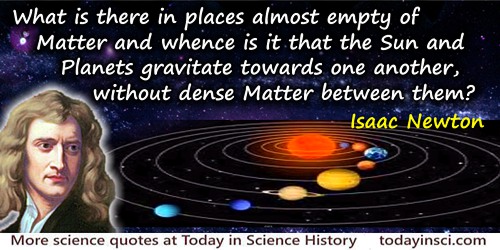
And for rejecting such a Medium, we have the Authority of those the oldest and most celebrated Philosophers of Greece and Phoenicia, who made a Vacuum, and Atoms, and the Gravity of Atoms, the first Principles of their Philosophy; tacitly attributing Gravity to some other Cause than dense Matter. Later Philosophers banish the Consideration of such a Cause out of natural Philosophy, feigning Hypotheses for explaining all things mechanically, and referring other Causes to Metaphysicks: Whereas the main Business of natural Philosophy is to argue from Phaenomena without feigning Hypotheses, and to deduce Causes from Effects, till we come to the very first Cause, which certainly is not mechanical; and not only to unfold the Mechanism of the World, but chiefly to resolve these and such like Questions. What is there in places almost empty of Matter, and whence is it that the Sun and Planets gravitate towards one another, without dense Matter between them? Whence is it that Nature doth nothing in vain; and whence arises all that Order and Beauty which we see in the World? ... does it not appear from phaenomena that there is a Being incorporeal, living, intelligent, omnipresent, who in infinite space, as it were in his Sensory, sees the things themselves intimately, and thoroughly perceives them, and comprehends them wholly by their immediate presence to himself.
In Opticks, (1704, 2nd. Ed. 1718), Book 3, Query 28, 343-5. Newton’s reference to “Nature does nothing in vain” recalls the axiom from Aristotle, which may be seen as “Natura nihil agit frustra” in the Aristotle Quotes on this web site.
And having thus passed the principles of arithmetic, geometry, astronomy, and geography, with a general compact of physics, they may descend in mathematics to the instrumental science of trigonometry, and from thence to fortification, architecture, engineering, or navigation. And in natural philosophy they may proceed leisurely from the history of meteors, minerals, plants, and living creatures, as far as anatomy. Then also in course might be read to them out of some not tedious writer the institution of physic. … To set forward all these proceedings in nature and mathematics, what hinders but that they may procure, as oft as shall be needful, the helpful experiences of hunters, fowlers, fishermen, shepherds, gardeners, apothecaries; and in other sciences, architects, engineers, mariners, anatomists.
In John Milton and Robert Fletcher (ed.), 'On Education', The Prose Works of John Milton: With an Introductory Review (1834), 100.
And so many think incorrectly that everything was created by the Creator in the beginning as it is seen, that not only the mountains, valleys, and waters, but also various types of minerals occurred together with the rest of the world, and therefore it is said that it is unnecessary to investigate the reasons why they differ in their internal properties and their locations. Such considerations are very dangerous for the growth of all the sciences, and hence for natural knowledge of the Earth, particularly the art of mining, though it is very easy for those clever people to be philosophers, having learnt by heart the three words 'God so created' and to give them in reply in place of all reasons.
About the Layers of the Earth and other Works on Geology (1757), trans. A. P. Lapov (1949), 55.
And there are absolutely no judgments (or rules) in Mechanics which do not also pertain to Physics, of which Mechanics is a part or type: and it is as natural for a clock, composed of wheels of a certain kind, to indicate the hours, as for a tree, grown from a certain kind of seed, to produce the corresponding fruit. Accordingly, just as when those who are accustomed to considering automata know the use of some machine and see some of its parts, they easily conjecture from this how the other parts which they do not see are made: so, from the perceptible effects and parts of natural bodies, I have attempted to investigate the nature of their causes and of their imperceptible parts.
Principles of Philosophy (1644), trans. V. R. and R. P. Miller (1983), 285-6.
And what a science Natural History will be, when we are in our graves, when all the laws of change are thought one of the most important parts of Natural History.
From Letter (1856) to J.D. Hooker, collected in in Francis Darwin, The Life and Letters of Charles Darwin (1896), 439. [Darwin was contemplating natural history as the synthesis of evolution (change) and forces of the environment.]
And yet I think that the Full House model does teach us to treasure variety for its own sake–for tough reasons of evolutionary theory and nature’s ontology, and not from a lamentable failure of thought that accepts all beliefs on the absurd rationale that disagreement must imply disrespect. Excellence is a range of differences, not a spot. Each location on the range can be occupied by an excellent or an inadequate representative– and we must struggle for excellence at each of these varied locations. In a society driven, of ten unconsciously, to impose a uniform mediocrity upon a former richness of excellence–where McDonald’s drives out the local diner, and the mega-Stop & Shop eliminates the corner Mom and Pop–an understanding and defense of full ranges as natural reality might help to stem the tide and preserve the rich raw material of any evolving system: variation itself.
…...
Anyone who has examined into the history of the theories of earth evolution must have been astounded to observe the manner in which the unique and the difficultly explainable has been made to take the place of the common and the natural in deriving the framework of these theories.
Earth Evolution and Facial Expression (1921), 174.
As a naturalist you will never suffer from that awful modern disease called boredom—so go out and greet the natural world with curiosity and delight, and enjoy it.
In The Amateur Naturalist (1989), 7.
As a second year high school chemistry student, I still have a vivid memory of my excitement when I first saw a chart of the periodic table of elements. The order in the universe seemed miraculous, and I wanted to study and learn as much as possible about the natural sciences.
In Tore Frängsmyr and Jan E. Lindsten (eds.), Nobel Lectures: Physiology Or Medicine: 1981-1990 (1993), 555.
As children we all possess a natural, uninhibited curiosity, a hunger for explanation, which seems to die slowly as we age—suppressed, I suppose, by the high value we place on conformity and by the need not to appear ignorant.
It betokens a conviction that somehow science is innately incomprehensible. It precludes reaching deeper, thereby denying the profound truth that understanding enriches experience, that explanation vastly enhances the beauty of the natural world in the eye of the beholder.
It betokens a conviction that somehow science is innately incomprehensible. It precludes reaching deeper, thereby denying the profound truth that understanding enriches experience, that explanation vastly enhances the beauty of the natural world in the eye of the beholder.
In Toward the Habit of Truth (1990).
As followers of natural science we know nothing of any relation between thoughts and the brain, except as a gross correlation in time and space.
Man on his Nature (1942), 290.
As for hailing [the new term] scientist as 'good', that was mere politeness: Faraday never used the word, describing himself as a natural philosopher to the end of his career.
Nineteenth-Century Attitudes: Men of Science (1991), 10.
As in Mathematicks, so in Natural Philosophy, the Investigation of difficult Things by the Method of Analysis, ought ever to precede the Method of Composition. This Analysis consists in making Experiments and Observations, and in drawing general Conclusions from them by Induction, and admitting of no Objections against the Conclusions, but such as are taken from Experiments, or other certain Truths. For Hypotheses are not to be regarded in experimental Philosophy.
From Opticks, (1704, 2nd ed. 1718), Book 3, Query 31, 380.
As natural selection works solely by and for the good of each being, all corporeal and mental endowments will tend to progress towards perfection.
On the Origin of Species by Means of Natural Selection (1866), 577.
As the prerogative of Natural Science is to cultivate a taste for observation, so that of Mathematics is, almost from the starting point, to stimulate the faculty of invention.
In 'A Plea for the Mathematician', Nature, 1, 261 in Collected Mathematical Papers, Vol. 2 (1908), 717.
As to a perfect Science of natural Bodies … we are, I think, so far from being capable of any such thing that I conclude it lost labour to seek after it.
In 'Extent of Human Knowledge', An Essay Concerning Humane Understanding (1700), Book 4, 335.
As to what Simplicius said last, that to contend whether the parts of the Sun, Moon, or other celestial body, separated from their whole, should naturally return to it, is a vanity, for that the case is impossible, it being clear by the demonstrations of Aristotle that the celestial bodies are impassible, impenetrable, unpartable, etc., I answer that none of the conditions whereby Aristotle distinguishes the celestial bodies from the elementary has any foundation other than what he deduces from the diversity of their natural motions; so that, if it is denied that the circular motion is peculiar to celestial bodies, and affirmed instead that it is agreeable to all naturally moveable bodies, one is led by necessary confidence to say either that the attributes of generated or ungenerated, alterable or unalterable, partable or unpartable, etc., equally and commonly apply to all bodies, as well to the celestial as to the elementary, or that Aristotle has badly and erroneously deduced those from the circular motion which he has assigned to celestial bodies.
Dialogue on the Great World Systems (1632). Revised and Annotated by Giorgio De Santillana (1953), 45.
Astronomy is, not without reason, regarded, by mankind, as the sublimest of the natural sciences. Its objects so frequently visible, and therefore familiar, being always remote and inaccessible, do not lose their dignity.
In Elements of Chemistry: In the Order of the Lectures Given in Yale College (1830), 11.
Astronomy was thus the cradle of the natural sciences and the starting point of geometrical theories. The stars themselves gave rise to the concept of a ‘point’; triangles, quadrangles and other geometrical figures appeared in the constellations; the circle was realized by the disc of the sun and the moon. Thus in an essentially intuitive fashion the elements of geometrical thinking came into existence.
In George Edward Martin, The Foundations of Geometry and the Non-Euclidean Plane (1982), 72.
At night I would return home, set out a lamp before me, and devote myself to reading and writing. Whenever sleep overcame me or I became conscious of weakening, I would turn aside to drink a cup of wine, so that my strength would return to me. Then I would return to reading. And whenever sleep seized me I would see those very problems in my dream; and many questions became clear to me in my sleep. I continued in this until all of the sciences were deeply rooted within me and I understood them as is humanly possible. Everything which I knew at the time is just as I know it now; I have not added anything to it to this day. Thus I mastered the logical, natural, and mathematical sciences, and I had now reached the science.
— Avicenna
W. E. Gohhnan, The Life of Ibn Sina: A Critical Edition and Annotated Translation (1974), 29-31.
Before his [Sir Astley Cooper’s] time, operations were too often frightful alternatives or hazardous compromises; and they were not seldom considered rather as the resource of despair than as a means of remedy; he always made them follow, as it were, in the natural course of treatment; he gave them a scientific character; and he moreover, succeeded, in a great degree, in divesting them of their terrors, by performing them unostentatiously, simply, confidently, and cheerfully, and thereby inspiring the patient with hope of relief, where previously resignation under misfortune had too often been all that could be expected from the sufferer.
In John Forbes (ed.), British and Foreign Medical Review (Jul 1840), 10, No. 19, 104. In Bransby Blake Cooper, The Life of Sir Astley Cooper (1843), Vol. 2, 37.
Biology as a discipline would benefit enormously if we could bring together the scientists working at the opposite ends of the biological spectrum. Students of organisms who know natural history have abundant questions to offer the students of molecules and cells. And molecular and cellular biologists with their armory of techniques and special insights have much to offer students of organisms and ecology.
In 'The role of natural history in contemporary biology', BioScience (1986), 36, 328-329.
Biology can be divided into the study of proximate causes, the study of the physiological sciences (broadly conceived), and into the study of ultimate (evolutionary) causes, the subject of natural history.
The Growth of Biological Thought: Diversity, Evolution and Inheritance (1982), 67.
Both history of nature and history of humanity are 'historical' and yet cannot dispense with uniformity. In both there is 'uniformity' ('science') as well as non-uniformity ('history'); in both 'history respects itself and 'history does not repeat itself. But, as even the history of humanity has its uniformitarian features, uniformity can still less be dispensed with in 'history' of nature, which, being one of the natural sciences, is less historical and, consequently, more uniformitarian.
Natural Law and Divine Miracle: The Principle of Uniformity in Geology, Biology and Theology (1963), 151.
Both religion and natural science require a belief in God for their activities, to the former He is the starting point, and to the latter the goal of every thought process. To the former He is the foundation, to the latter, the crown of the edifice of every generalized world view.
Lecture, 'Religion and Natural Science' (1937) In Max Planck and Frank Gaynor (trans.), Scientific Autobiography and Other Papers (1949), 184.
Brutes by their natural instinct have produced many discoveries, whereas men by discussion and the conclusions of reason have given birth to few or none.
Novum Organum, LXXIII
But as my conclusions have lately been much misrepresented, and it has been stated that I attribute the modification of species exclusively to natural selection, I may be permitted to remark that in the first edition of this work, and subsequently, I placed in a most conspicuous position—namely, at the close of the Introduction—the following words: “I am convinced that natural selection has been the main but not the exclusive means of modification.” This has been of no avail. Great is the power of steady misrepresentation; but the history of science shows that fortunately this power does not long endure.
In The Origin of Species by Means of Natural Selection with additions and corrections from sixth and last English edition (1899), Vol. 2, 293.
But as the wilderness areas are progressively exploited or “improve”, as the jeeps and bulldozers of uranium prospectors scar up the deserts and the roads are cut into the alpine timberlands, and as the remnants of the unspoiled and natural world are progressively eroded, every such loss is a little death in me. In us.
Letter (3 Dec 1960) written to David E. Pesonen of the Outdoor Recreation Resources Review Commission. Collected in 'Coda: Wilderness Letter', The Sound of Mountain Water: The Changing American West (1969), 150.
But for twenty years previous to 1847 a force had been at work in a little county town of Germany destined to effect the education of Christendom, and at the same time to enlarge the boundaries of human knowledge, first in chemistry and the allied branches, then in every other one of the natural sciences. The place was Giessen; the inventor Liebig; the method, a laboratory for instruction and research.
A Semi-Centennial Discourse, 1847-97' (28 Oct 1897), The Sheffield Scientific School of Yale University. Quoted in Daniel Coit Gilman, University Problems in the United States (1898), 120.
But having considered everything which has been said, one could by this believe that the earth and not the heavens is so moved, and there is no evidence to the contrary. Nevertheless, this seems prima facie as much, or more, against natural reason as are all or several articles of our faith. Thus, that which I have said by way of diversion (esbatement) in this manner can be valuable to refute and check those who would impugn our faith by argument.
On the Book of the Heavens and the World of Aristotle [1377], bk. II, ch. 25, sect. 10, trans. A. D. Menut and A. J. Denomy, quoted in Marshall Clagett, The Science of Mechanics in the Middle Ages (1959), 606.
But how is one to determine what is pleasing to God? ... Whatever is unpleasant to man is pleasant to God. The test is the natural instinct of man. If there arises within one’s dark recesses a hot desire to do this or that, then it is the paramount duty of a Christian to avoid doing this or that. And if, on the contrary, one cherishes an abhorrence of the business, then one must tackle it forthwith, all the time shouting ‘Hallelujah!’ A simple enough religion, surely–simple, satisfying and idiotic.
…...
But in nothing are swifts more singular than in their early retreat. They retire, as to the main body of them, by the tenth of August, and sometimes a few days sooner: and every straggler invariably withdraws by the twentieth, while their congeners, all of them, stay till the beginning of October; many of them all through that month, and some occasionally to the beginning of November. This early retreat is mysterious and wonderful, since that time is often the sweetest season in the year. But, what is more extraordinary, they begin to retire still earlier in the most southerly parts of Andalusia, where they can be no ways influenced by any defect of heat; or, as one might suppose, defect of food. Are they regulated in their motions with us by failure of food, or by a propensity to moulting, or by a disposition to rest after so rapid a life, or by what? This is one of those incidents in natural history that not only baffles our searches, but almost eludes our guesses!
In Letter to Daines Barrington, (28 Sep 1774), in The Natural History and Antiquities of Selborne (1789), 278.
But indeed, the English generally have been very stationary in latter times, and the French, on the contrary, so active and successful, particularly in preparing elementary books, in the mathematical and natural sciences, that those who wish for instruction, without caring from what nation they get it, resort universally to the latter language.
Letter (29 Jan 1824) to Patrick K. Rodgers. Collected in Andrew A. Lipscomb (ed.), The Writings of Thomas Jefferson (1904), Vol. 16, 2.
But the greatest error of all the rest is the mistaking or misplacing of the last or farthest end of knowledge: for men have entered into a desire of learning and knowledge, sometimes upon a natural curiosity and inquisitive appetite; sometimes to entertain their minds with variety and delight; sometimes for ornament and reputation; and sometimes to enable them to victory of wit and contradiction; and most times for lucre and profession; and seldom sincerely to give a true account of their gift of reason, to the benefit and use of men...
The First Book of Francis Bacon of the Proficience and Advancement of Learning (1605). In Francis Bacon and Basil Montagu, The Works of Francis Bacon, Lord Chancellor of England (1852), 174
But we must here state that we should not see anything if there were a vacuum. But this would not be due to some nature hindering species, and resisting it, but because of the lack of a nature suitable for the multiplication of species; for species is a natural thing, and therefore needs a natural medium; but in a vacuum nature does not exist.
Opus Majus [1266-1268], Part V, distinction 9, chapter 2, trans. R. B. Burke, The Opus Majus of Roger Bacon (1928), Vol. 2, 485.
But, as we consider the totality of similarly broad and fundamental aspects of life, we cannot defend division by two as a natural principle of objective order. Indeed, the ‘stuff’ of the universe often strikes our senses as complex and shaded continua, admittedly with faster and slower moments, and bigger and smaller steps, along the way. Nature does not dictate dualities, trinities, quarterings, or any ‘objective’ basis for human taxonomies; most of our chosen schemes, and our designated numbers of categories, record human choices from a cornucopia of possibilities offered by natural variation from place to place, and permitted by the flexibility of our mental capacities. How many seasons (if we wish to divide by seasons at all) does a year contain? How many stages shall we recognize in a human life?
…...
By natural selection our mind has adapted itself to the conditions of the external world. It has adopted the geometry most advantageous to the species or, in other words, the most convenient. Geometry is not true, it is advantageous.
Science and Hypothesis (1902), in The Foundations of Science: Science and Hypothesis, The Value of Science, Science and Method(1946), trans. by George Bruce Halsted, 91.
Certainly Lord Byron has expressed in words some aspects of spiritual turmoil; but our immortal natural historian has reconstructed worlds from bleached bones.
From 'La Peau de Chagrin' (1831). As translated as The Wild Ass’s Skin (1906) trans. Herbert J. Hunt, The Wild Ass’s Skin (1977), 40-1.
Chemical engineering is the profession in which a knowledge of mathematics, chemistry and other natural sciences gained by study, experience and practice is applied with judgment to develop economic ways of using materials and energy for the benefit of mankind.
— AIChE
In Article III, 'Definition of the Profession', Constitution of the American Institute of
Chemical Engineers (as amended 17 Jan 2003). The same wording is found in the 1983 Constitution, as quoted in Nicholas A. Peppas (ed.), One Hundred Years of Chemical Engineering: From Lewis M. Norton (M.I.T. 1888) to Present (2012), 334.
City wisdom became almost entirely centered on the problems of human relationships, in contrast to the wisdom of any natural tribal group, where relationships with the rest of the animate and inanimate world are still given due place.
In Gaia, a New Look at Life on Earth (1979), 135.
Communication of science as subject-matter has so far outrun in education the construction of a scientific habit of mind that to some extent the natural common sense of mankind has been interfered with to its detriment.
Address to Section L, Education, of the American Association for the Advancement of Science, at Boston (1909), 'Science as Subject-Matter and as Method'. Published in Science (28 Jan 1910), N.S. Vol. 31, No. 787, 126.
Conscientious and careful physicians allocate causes of disease to natural laws, while the ablest scientists go back to medicine for their first principles.
Attributed.
Conservation means development as much as it does protection. I recognize the right and duty of this generation to develop and use the natural resources of our land; but I do not recognize the right to waste them, or to rob, by wasteful use, the generations that come after us.
'The New Nationalism', speech at Osawatomie, Kansas, 31 Aug 1910. In Richard D. Heffner, A Documentary History of the United States: Seventh Revised Edition (2002), 272. This is one of the quotations inscribed in the Roosevelt Memorial rotunda at the American Museum of Natural History.
Consider the eighth category, which deals with stones. Wilkins divides them into the following classifications: ordinary (flint, gravel, slate); intermediate (marble, amber, coral); precious (pearl, opal); transparent (amethyst, sapphire); and insoluble (coal, clay, and arsenic). The ninth category is almost as alarming as the eighth. It reveals that metals can be imperfect (vermilion, quicksilver); artificial (bronze, brass); recremental (filings, rust); and natural (gold, tin, copper). The whale appears in the sixteenth category: it is a viviparous, oblong fish. These ambiguities, redundances, and deficiencies recall those attributed by Dr. Franz Kuhn to a certain Chinese encyclopedia entitled Celestial Emporium of Benevolent Knowledge. On those remote pages it is written that animals are divided into (a) those that belong to the Emperor, (b) embalmed ones, (c) those that are trained, (d) suckling pigs, (e) mermaids, (f) fabulous ones, (g) stray dogs, (h) those that are included in this classification, (i) those that tremble as if they were mad, (j) innumerable ones, (k) those drawn with a very fine camel's hair brush, (l) others, (m) those that have just broken a flower vase, (n) those that resemble flies from a distance.
Other Inquisitions 1937-1952 (1964), trans. Ruth L. C. Simms, 103.
Constant muscular activity was natural for the child, and, therefore, the immense effort of the drillmaster teachers to make children sit still was harmful and useless.
Quoted in Bill McKibben, Maybe One: A Personal and Enviromental Argument for Single-Child Families (1998), 19.
Contrary to popular parlance, Darwin didn't discover evolution. He uncovered one (most would say the) essential mechanism by which it operates: natural selection. Even then, his brainstorm was incomplete until the Modern Synthesis of the early/mid-20th century when (among other things) the complementary role of genetic heredity was fully realized. Thousands upon thousands of studies have followed, providing millions of data points that support this understanding of how life on Earth has come to be as it is.
In online article, 'The Day That Botany Took on Bobby Jindal by Just Being Itself', Huffington Post (5 Aug 2013).
Courtship, properly understood, is the process whereby both the male and the female are brought into that state of sexual tumescence which is a more or less necessary condition for sexual intercourse. The play of courtship cannot, therefore, be considered to be definitely brought to an end by the ceremony of marriage; it may more properly be regarded as the natural preliminary to every act of coitus.
Studies in the Psychology of Sex (1921), Vol. 3, 239.
Darwin abolished special creations, contributed the Origin of Species and hitched all life together in one unbroken procession of Siamese Twins, the whole evolved by natural and orderly processes from one microscopic parent germ.
'The Secret History of Eddypus', in Mark Twain and David Ketterer (ed.), Tales of Wonder (2003), 223.
Darwin was a biological evolutionist, because he was first a uniformitarian geologist. Biology is pre-eminent to-day among the natural sciences, because its younger sister, Geology, gave it the means.
Presidential Address to the Geology Section, Report of the British Association for the Advancement of Science (1892), 696.
Darwin’s book is very important and serves me as a basis in natural science for the class struggle in history. One has to put up with the crude English method of development, of course. Despite all deficiencies not only is the death-blow dealt here for the first time to “teleology” in the natural sciences, but their rational meaning is empirically explained.
Marx to Lasalle, 16 Jan 1861. In Marx-Engels Selected Correspondence, 1846-95, trans. Donna Torr (1934), 125.
Darwinists are right to say that selection favours the organisms that leave alive the most progeny, but vigorous growth takes place within a constrained space where feedback from the environment allows the emergence of natural self-regulation.
In The Revenge of Gaia: Earth’s Climate Crisis & The Fate of Humanity (2006, 2007), 35.
Defenders of the short-sighted men who in their greed and selfishness will, if permitted, rob our country of half its charm by their reckless extermination of all useful and beautiful wild things sometimes seek to champion them by saying the “the game belongs to the people.” So it does; and not merely to the people now alive, but to the unborn people. The “greatest good for the greatest number” applies to the number within the womb of time, compared to which those now alive form but an insignificant fraction. Our duty to the whole, including the unborn generations, bids us restrain an unprincipled present-day minority from wasting the heritage of these unborn generations. The movement for the conservation of wild life and the larger movement for the conservation of all our natural resources are essentially democratic in spirit, purpose, and method.
'Bird Reserves at the Mouth of the Mississippi', A Book-Lover's Holidays in the Open (1920), 300-301.
Despite the high long-term probability of extinction, every organism alive today, including every person reading this paper, is a link in an unbroken chain of parent-offspring relationships that extends back unbroken to the beginning of life on earth. Every living organism is a part of an enormously long success story—each of its direct ancestors has been sufficiently well adapted to its physical and biological environments to allow it to mature and reproduce successfully. Viewed thus, adaptation is not a trivial facet of natural history, but a biological attribute so central as to be inseparable from life itself.
In 'Integrative Biology: An Organismic Biologist’s Point of View', Integrative and Comparative Biology (2005), 45, 330.
Do not … keep children to their studies by compulsion but by play. That will also better enable you to discern the natural capacities of each
— Plato
From The Republic 7 536e-537a, as translated by Paul Shorey (1930).
Doubtless the reasoning faculty, the mind, is the leading and characteristic attribute of the human race. By the exercise of this, man arrives at the properties of the natural bodies. This is science, properly and emphatically so called. It is the science of pure mathematics; and in the high branches of this science lies the truly sublime of human acquisition. If any attainment deserves that epithet, it is the knowledge, which, from the mensuration of the minutest dust of the balance, proceeds on the rising scale of material bodies, everywhere weighing, everywhere measuring, everywhere detecting and explaining the laws of force and motion, penetrating into the secret principles which hold the universe of God together, and balancing worlds against worlds, and system against system. When we seek to accompany those who pursue studies at once so high, so vast, and so exact; when we arrive at the discoveries of Newton, which pour in day on the works of God, as if a second fiat had gone forth from his own mouth; when, further, we attempt to follow those who set out where Newton paused, making his goal their starting-place, and, proceeding with demonstration upon demonstration, and discovery upon discovery, bring new worlds and new systems of worlds within the limits of the known universe, failing to learn all only because all is infinite; however we may say of man, in admiration of his physical structure, that “in form and moving he is express and admirable,” it is here, and here without irreverence, we may exclaim, “In apprehension how like a god!” The study of the pure mathematics will of course not be extensively pursued in an institution, which, like this [Boston Mechanics’ Institute], has a direct practical tendency and aim. But it is still to be remembered, that pure mathematics lie at the foundation of mechanical philosophy, and that it is ignorance only which can speak or think of that sublime science as useless research or barren speculation.
In Works (1872), Vol. 1, 180.
Dr. Wallace, in his Darwinism, declares that he can find no ground for the existence of pure scientists, especially mathematicians, on the hypothesis of natural selection. If we put aside the fact that great power in theoretical science is correlated with other developments of increasing brain-activity, we may, I think, still account for the existence of pure scientists as Dr. Wallace would himself account for that of worker-bees. Their function may not fit them individually to survive in the struggle for existence, but they are a source of strength and efficiency to the society which produces them.
In Grammar of Science (1911), Part, 1, 221.
During the eight days I spent in space, I realized that mankind needs height primarily to better know our long-suffering Earth, to see what cannot be seen close up. Not just to love her beauty, but also to ensure that we do not bring even the slightest harm to the natural world
In Jack Hassard and Julie Weisberg , Environmental Science on the Net: The Global Thinking Project (1999), 40.
Electricity is often called wonderful, beautiful; but it is so only in common with the other forces of nature. The beauty of electricity or of any other force is not that the power is mysterious, and unexpected, touching every sense at unawares in turn, but that it is under law, and that the taught intellect can even govern it largely. The human mind is placed above, and not beneath it, and it is in such a point of view that the mental education afforded by science is rendered super-eminent in dignity, in practical application and utility; for by enabling the mind to apply the natural power through law, it conveys the gifts of God to man.
Notes for a Friday Discourse at the Royal Institution (1858).
ELECTRICITY, n. The power that causes all natural phenomena not known to be caused by something else. It is the same thing as lightning, and its famous attempt to strike Dr. Franklin is one of the most picturesque incidents in that great and good man's career. The memory of Dr. Franklin is justly held in great reverence, particularly in France, where a waxen effigy of him was recently on exhibition, bearing the following touching account of his life and services to science:
Monsieur Franqulin, inventor of electricity. This illustrious savant, after having made several voyages around the world, died on the Sandwich Islands and was devoured by savages, of whom not a single fragment was ever recovered.
Electricity seems destined to play a most important part in the arts and industries. The question of its economical application to some purposes is still unsettled, but experiment has already proved that it will propel a street car better than a gas jet and give more light than a horse.
Monsieur Franqulin, inventor of electricity. This illustrious savant, after having made several voyages around the world, died on the Sandwich Islands and was devoured by savages, of whom not a single fragment was ever recovered.
Electricity seems destined to play a most important part in the arts and industries. The question of its economical application to some purposes is still unsettled, but experiment has already proved that it will propel a street car better than a gas jet and give more light than a horse.
The Cynic's Word Book (1906), 87. Also published later as The Devil's Dictionary.
EMBALM, v.t. To cheat vegetation by locking up the gases upon which it feeds. By embalming their dead and thereby deranging the natural balance between animal and vegetable life, the Egyptians made their once fertile and populous country barren and incapable of supporting more than a meagre crew. The modern metallic burial casket is a step in the same direction, and many a dead man who ought now to be ornamenting his neighbor's lawn as a tree, or enriching his table as a bunch of radishes, is doomed to a long inutility. We shall get him after awhile if we are spared, but in the meantime the violet and rose are languishing for a nibble at his glutæus maximus.
The Cynic's Word Book (1906), 90. Also published later as The Devil's Dictionary.
Engineering is more closely akin to the arts than perhaps any other of the professions; first, because it requires the maximum of natural aptitude and of liking for the work in order to offset other factors; second, because it demands, like the arts, an almost selfless consecration to the job; and, third, because out of the hundreds who faithfully devote themselves to the task, only a few are destined to receive any significant reward—in either money or fame.
As coauthor with Frank W. Skinner, and Harold E. Wessman, 'Foreward', Vocational Guidance in Engineering Lines (1933), vi.
Engineering is the art of directing the great sources of power in nature for the use and the convenience of people. In its modern form engineering involves people, money, materials, machines, and energy. It is differentiated from science because it is primarily concerned with how to direct to useful and economical ends the natural phenomena which scientists discover and formulate into acceptable theories. Engineering therefore requires above all the creative imagination to innovate useful applications of natural phenomena. It seeks newer, cheaper, better means of using natural sources of energy and materials.
In McGraw Hill, Science and Technology Encyclopedia
Engineering is the profession in which a knowledge of the mathematical and natural sciences gained by study, experience, and practice is applied with judgment to develop ways to utilize, economically, the materials and forces of nature for the benefit of mankind.
— ABET
In EAC Criteria for 1999-2000 as cited in Charles R. Lord, Guide to Information Sources in Engineering (2000), 5. Found in many sources, and earlier, for example, Otis E. Lancaster, American Society for Engineering Education, Engineers' Council for Professional Development, Achieve Learning Objectives (1962), 8.
Engineering is the professional and systematic application of science to the efficient utilization of natural resources to produce wealth.
T. J. Hoover and John Charles Lounsbury (J.C.L.) Fish, The Engineering Profession (1941), 10.
Engineers apply the theories and principles of science and mathematics to research and develop economical solutions to practical technical problems. Their work is the link between scientific discoveries and commercial applications. Engineers design products, the machinery to build those products, the factories in which those products are made, and the systems that ensure the quality of the product and efficiency of the workforce and manufacturing process. They design, plan, and supervise the construction of buildings, highways, and transit systems. They develop and implement improved ways to extract, process, and use raw materials, such as petroleum and natural gas. They develop new materials that both improve the performance of products, and make implementing advances in technology possible. They harness the power of the sun, the earth, atoms, and electricity for use in supplying the Nation’s power needs, and create millions of products using power. Their knowledge is applied to improving many things, including the
quality of health care, the safety of food products, and the efficient operation of financial systems.
Bureau of Labor Statistics, Occupational Outlook Handbook (2000) as quoted in Charles R. Lord. Guide to Information Sources in Engineering (2000), 5. This definition has been revised and expanded over time in different issues of the Handbook.
England and all civilised nations stand in deadly peril of not having enough to eat. As mouths multiply, food resources dwindle. Land is a limited quantity, and the land that will grow wheat is absolutely dependent on difficult and capricious natural phenomena... I hope to point a way out of the colossal dilemma. It is the chemist who must come to the rescue of the threatened communities. It is through the laboratory that starvation may ultimately be turned into plenty... The fixation of atmospheric nitrogen is one of the great discoveries, awaiting the genius of chemists.
Presidential Address to the British Association for the Advancement of Science 1898. Published in Chemical News, 1898, 78, 125.
Essentially only one thing in life interests us: our psychical constitution, the mechanism of which was and is wrapped in darkness. All human resources, art, religion, literature, philosophy and historical sciences, all of them join in bringing lights in this darkness. But man has still another powerful resource: natural science with its strictly objective methods. This science, as we all know, is making huge progress every day. The facts and considerations which I have placed before you at the end of my lecture are one out of numerous attempts to employ a consistent, purely scientific method of thinking in the study of the mechanism of the highest manifestations of life in the dog, the representative of the animal kingdom that is man's best friend.
'Physiology of Digestion', Nobel Lecture (12 Dec 1904). In Nobel Lectures: Physiology or Medicine 1901-1921 (1967), 134
Even today a good many distinguished minds seem unable to accept or even to understand that from a source of noise natural selection alone and unaided could have drawn all the music of the biosphere. In effect natural selection operates upon the products of chance and can feed nowhere else; but it operates in a domain of very demanding conditions, and from this domain chance is barred. It is not to chance but to these conditions that eveloution owes its generally progressive cource, its successive conquests, and the impresssion it gives of a smooth and steady unfolding.
In Jacques Monod and Austryn Wainhouse (trans.), Chance and Necessity: An Essay on the Natural Philosophy of Modern Biology (1971), 118-119.
Every appearance in nature corresponds to some state of the mind, and that state of the mind can only be described by presenting that natural appearance as its picture. An enraged man is a lion, a cunning man is a fox, a firm man is a rock, a learned man is a torch. A lamb is innocence; a snake is subtle spite; flowers express to us the delicate affections. Light and darkness are our familiar expressions for knowledge and ignorance ; and heat for love. Visible distance behind and before us, is respectively our image of memory and hope.
In essay, 'Language', collected in Nature: An Essay ; And, Lectures on the Times (1844), 23-24.
Every chemical substance, whether natural or artificial, falls into one of two major categories, according to the spatial characteristic of its form. The distinction is between those substances that have a plane of symmetry and those that do not. The former belong to the mineral, the latter to the living world.
Pasteur Vallery-Radot (ed.), Oeuvres de Pasteur (1922-1939), Vol. I, 331. Quoted in Patrice Debré, Louis Pasteur, trans. Elborg Forster (1994), 261.
Every great advance in natural knowledge has involved the absolute rejection of authority.
'On the Advisableness of Improving Natural Knowledge', a lay sermon at St. Martin's Hall (Sunday 7 Jan 1866), The Fortnightly Review. In The Journal of Mental Science (1867), Vol. 12, No. 58, (Jul 1866), 279.
Every kid starts out as a natural-born scientist, and then we beat it out of them. A few trickle through the system with their wonder and enthusiasm for science intact.
Quoted in interview with magazine staff, Psychology Today (Jan 1996).
Every natural fact is a symbol of some spiritual fact.
In essay, 'Language', collected in Nature: An Essay ; And, Lectures on the Times (1844), 23.
Every natural scientist who thinks with any degree of consistency at all will, I think, come to the view that all those capacities that we understand by the phrase psychic activities (Seelenthiitigkeiten) are but functions of the brain substance; or, to express myself a bit crudely here, that thoughts stand in the same relation to the brain as gall does to the liver or urine to the kidneys. To assume a soul that makes use of the brain as an instrument with which it can work as it pleases is pure nonsense; we would then be forced to assume a special soul for every function of the body as well.
In Physiologische Briefe für Gelbildete aIle Stünde (1845-1847), 3 parts, 206. as translated in Frederick Gregory, Scientific Materialism in Nineteenth Century Germany (1977), 64.
Every occurrence in Nature is preceded by other occurrences which are its causes, and succeeded by others which are its effects. The human mind is not satisfied with observing and studying any natural occurrence alone, but takes pleasure in connecting every natural fact with what has gone before it, and with what is to come after it.
In Forms of Water in Clouds and Rivers, Ice and Glaciers (1872), 1.
Everything which comes to be, comes to be out of, and everything which passes away passes away into, its opposite or something in between. And the things in between come out of the opposites—thus colors come out of pale and dark. So the things which come to be naturally all are or are out of opposites.
In 'Physics', Book 1, Chapter 2, 188b22, as translated by William Charlton, Physics: Books I and II (1983), 12.
Evolution triumphs because it turns to natural selection, the plodding accumulation of error.
Almost Like a Whale: The Origin of Species Updated (1999), 9.
Examine Language; what, if you except some few primitive elements (of natural sound), what is it all but Metaphors, recognized as such, or no longer recognized?
Experience is never at fault; it is only your judgment that is in error in promising itself such results from experience as are not caused by our experiments. For having given a beginning, what follows from it must necessarily be a natural development of such a beginning, unless it has been subject to a contrary influence, while, if it is affected by any contrary influence, the result which ought to follow from the aforesaid beginning will be found to partake of this contrary influence in a greater or less degree in proportion as the said influence is more or less powerful than the aforesaid beginning.
'Philosophy', in The Notebooks of Leonardo da Vinci, trans. E. MacCurdy (1938), Vol. 1, 70.
Extinction has only separated groups: it has by no means made them; for if every form which has ever lived on this earth were suddenly to reappear, though it would be quite impossible to give definitions by which each group could be distinguished from other groups, as all would blend together by steps as fine as those between the finest existing varieties, nevertheless a natural classification, or at least a natural arrangement, would be possible.
From On the Origin of Species by Means of Natural Selection; or, The Preservation of Favoured Races in the Struggle for Life (1860), 431.
Factual assertions and fundamental principles are... merely parts of theories: they are given within the framework of a theory; they are chosen and valid within this framework; and subsequently they are dependent upon it. This holds for all empirical sciences—for the natural sciences as well as those pertaining to history.
Critique of Scientific Reason (1983), 106.
False interpretation of the Bible has often clashed with science, as false science has with true interpretation; but true science is the natural ally of religion, for both are from God.
…...
Fear of things invisible is the natural seed of that which every one in himself calleth religion.
Leviathan. In Marc J. Madou, Fundamentals of Microfabrication: the Science of Miniaturization (2nd ed., 2002), 183.
Felling a tree was possibly the original deed of appropriation of the natural earth by early mankind in Europe. Thousands of years ago,… man lifted a heavy flint tool and struck at the base of a tree. He may have wanted the tree for shelter and fuel, or possibly to make a bridge over a river or a path through a bog…. [E]ventually the tree crashed to the floor, and the first act in the slow possession of the land by its people was complete.
In The Man Who Made Things Out of Trees: The Ash in Human Culture and History (2015), Chap. 1.
Finally in a large population, divided and subdivided into partially isolated local races of small size, there is a continually shifting differentiation among the latter (intensified by local differences in selection but occurring under uniform and static conditions) which inevitably brings about an indefinitely continuing, irreversible, adaptive, and much more rapid evolution of the species. Complete isolation in this case, and more slowly in the preceding, originates new species differing for the most part in nonadaptive parallel orthogenetic lines, in accordance with the conditions. It is suggested, in conclusion, that the differing statistical situations to be expected among natural species are adequate to account for the different sorts of evolutionary processes which have been described, and that, in particular, conditions in nature are often such as to bring about the state of poise among opposing tendencies on which an indefinitely continuing evolutionary process depends.
In 'Evolution In Mendelian Populations', Genetics, (1931), 16, 158.
First of all a natural talent is required; for when Nature opposes, everything else is in vain; but when Nature leads the way to what is most excellent, instruction in the art takes place...
The Genuine Works of Hippocrates, trans. Francis Adams (1886), Vol. 2, 284.
For even they who compose treatises of medicine or natural philosophy in verse are denominated Poets: yet Homer and Empedocles have nothing in common except their metre; the former, therefore, justly merits the name of the Poet; while the other should rather be called a Physiologist than a Poet.
Aristotle’s Treatise on Poetry, I:2, trans. Thomas Twining (1957), 103
For I agree with you that there is a natural aristocracy among men. The grounds of this are virtue and talents.
Letter to John Adams, 28 Oct 1813. In Paul Witstach (ed.), Correspondence of John Adams and Thomas Jefferson 1812-1826 (1925), 92.
For it is too bad that there are so few who seek the truth and so few who do not follow a mistaken method in philosophy. This is not, however, the place to lament the misery of our century, but to rejoice with you over such beautiful ideas for proving the truth. So I add only, and I promise, that I shall read your book at leisure; for I am certain that I shall find the noblest things in it. And this I shall do the more gladly, because I accepted the view of Copernicus many years ago, and from this standpoint I have discovered from their origins many natural phenomena, which doubtless cannot be explained on the basis of the more commonly accepted hypothesis.
Letter (4 Aug 1597) to Kepler, expressing thanks and interest in the book Kepler sent him. As quoted in translation in Jackson J. Spielvogel, Western Civilization: Alternate Volume: Since 1300 (2010), Vol. 2, 494.
For it is too bad that there are so few who seek the truth and so few who do not follow a mistaken method in philosophy. This is not, however, the place to lament the misery of our century, but to rejoice with you over such beautiful ideas for proving the truth. So I add only, and I promise, that I shall read your book at leisure; for I am certain that I shall find the noblest things in it. And this I shall do the more gladly, because I accepted the view of Copernicus many years ago, and from this standpoint I have discovered from their origins many natural phenomena, which doubtless cannot be explained on the basis of the more commonly accepted hypothesis.
In Letter to Johannes Kepler. As quoted in The Portable Renaissance Reader (1968), 597.
For me, the study of these laws is inseparable from a love of Nature in all its manifestations. The beauty of the basic laws of natural science, as revealed in the study of particles and of the cosmos, is allied to the litheness of a merganser diving in a pure Swedish lake, or the grace of a dolphin leaving shining trails at night in the Gulf of California.
Nobel Banquet Speech (10 Dec 1969), in Wilhelm Odelberg (ed.),Les Prix Nobel en 1969 (1970).
For ourselves, we may take as a basic assumption, clear from a survey of particular cases, that natural things are some or all of them subject to change.
In 'Physics', Book 1, Chapter 2, 185a13, as translated by William Charlton, Physics: Books I and II (1983), 2.
For scientific endeavor is a natural whole the parts of which mutually support one another in a way which, to be sure, no one can anticipate.
…...
For terrestrial vertebrates, the climate in the usual meteorological sense of the term would appear to be a reasonable approximation of the conditions of temperature, humidity, radiation, and air movement in which terrestrial vertebrates live. But, in fact, it would be difficult to find any other lay assumption about ecology and natural history which has less general validity. … Most vertebrates are much smaller than man and his domestic animals, and the universe of these small creatures is one of cracks and crevices, holes in logs, dense underbrush, tunnels, and nests—a world where distances are measured in yards rather than miles and where the difference between sunshine and shadow may be the difference between life and death. Actually, climate in the usual sense of the term is little more than a crude index to the physical conditions in which most terrestrial animals live.
From 'Interaction of physiology and behavior under natural conditions', collected in R.I. Bowman (ed.), The Galapagos (1966), 40.
For that which can shewn only in a certain Light is questionable. Truth, ’tis suppos’d, may bear all Lights: and one of those principal Lights or natural Mediums, by which Things are to be view’d, in order to a thorow Recognition, is Ridicule it-self.
Also seen in short form: “Ridicule is the test of truth.”
Also seen in short form: “Ridicule is the test of truth.”
In 'An Essay on the Freedom of Wit and Humour', Characteristicks of Men, Manners, Opinions, Times (1723), Vol. 1, 61.
For the time of making Observations none can ever be amiss; there being no season, nor indeed hardly any place where in some Natural Thing or other does not present it self worthy of Remark: yea there are some things that require Observation all the Year round, as Springs, Rivers, &c. Nor is there any Season amiss for the gathering Natural Things. Bodies of one kind or other presenting themselves at all times, and in Winter as well as Summer.
In Brief Instructions for Making Observations in all Parts of the World (1696), 10-11.
For the harmony of the world is made manifest in Form and Number, and the heart and soul and all the poetry of Natural Philosophy are embodied in the concept of mathematical beauty.
In 'Epilogue', On Growth and Form (1917), 778-9.
For what is that which we call evil but the absence of good? In the bodies of animals, disease and wounds mean nothing but the absence of health; for when a cure is effected, that does not mean that the evils which were present—namely, the diseases and wounds—go away from the body and dwell elsewhere: they altogether cease to exist; for the wound or disease is not a substance, but a defect in the fleshly substance,—the flesh itself being a substance, and therefore something good, of which those evils—that is, privations of the good which we call health—are accidents. Just in the same way, what are called vices in the soul are nothing but privations of natural good. And when they are cured, they are not transferred elsewhere: when they cease to exist in the healthy soul, they cannot exist anywhere else.
In Marcus Dods (ed.), J.F. Shaw (trans.), The Enchiridion of Augustine, Chap. 9, collected in The Works of Aurelius Augustine, Bishop of Hippo: A new translation (1873), Vol. 9, 181-182.
Fractal is a word invented by Mandelbrot to bring together under one heading a large class of objects that have [played] … an historical role … in the development of pure mathematics. A great revolution of ideas separates the classical mathematics of the 19th century from the modern mathematics of the 20th. Classical mathematics had its roots in the regular geometric structures of Euclid and the continuously evolving dynamics of Newton. Modern mathematics began with Cantor’s set theory and Peano’s space-filling curve. Historically, the revolution was forced by the discovery of mathematical structures that did not fit the patterns of Euclid and Newton. These new structures were regarded … as “pathological,” .… as a “gallery of monsters,” akin to the cubist paintings and atonal music that were upsetting established standards of taste in the arts at about the same time. The mathematicians who created the monsters regarded them as important in showing that the world of pure mathematics contains a richness of possibilities going far beyond the simple structures that they saw in Nature. Twentieth-century mathematics flowered in the belief that it had transcended completely the limitations imposed by its natural origins.
Now, as Mandelbrot points out, … Nature has played a joke on the mathematicians. The 19th-century mathematicians may not have been lacking in imagination, but Nature was not. The same pathological structures that the mathematicians invented to break loose from 19th-century naturalism turn out to be inherent in familiar objects all around us.
Now, as Mandelbrot points out, … Nature has played a joke on the mathematicians. The 19th-century mathematicians may not have been lacking in imagination, but Nature was not. The same pathological structures that the mathematicians invented to break loose from 19th-century naturalism turn out to be inherent in familiar objects all around us.
From 'Characterizing Irregularity', Science (12 May 1978), 200, No. 4342, 677-678. Quoted in Benoit Mandelbrot, The Fractal Geometry of Nature (1977, 1983), 3-4.
Fragments of the natural method must be sought with the greatest care. This is the first and last desideratum among botanists.
Nature makes no jumps.
[Natura non facit saltus]
All taxa show relationships on all sides like the countries on a map of the world.
Nature makes no jumps.
[Natura non facit saltus]
All taxa show relationships on all sides like the countries on a map of the world.
Philosophia Botanica (1751), aphorism 77. Trans. Frans A. Stafleu, Linnaeus and the Linnaeans: The Spreading of their Ideas in Systematic Botany, 1735-1789 (1971), 45.
From my earliest childhood I nourished and cherished the desire to make a creditable journey in a new country, and write such a respectable account of its natural history as should give me a niche amongst the scientific explorers of the globe I inhabit, and hand my name down as a useful contributor of original matter.
Letter to Charles Darwin (1854), in Francis Darwin, More Letters of Charles Darwin (1903).
From the infinitely great down to the infinitely small, all things are subject to [the laws of nature]. The sun and the planets follow the laws discovered by Newton and Laplace, just as the atoms in their combinations follow the laws of chemistry, as living creatures follow the laws of biology. It is only the imperfections of the human mind which multiply the divisions of the sciences, separating astronomy from physics or chemistry, the natural sciences from the social sciences. In essence, science is one. It is none other than the truth.
From Cours d’Economie Politique (1896-97), as given in Archives Internationales d’Histoire des Sciences (1993), Issues 131-133, 67.
From the level of pragmatic, everyday knowledge to modern natural science, the knowledge of nature derives from man’s primary coming to grips with nature; at the same time it reacts back upon the system of social labour and stimulates its development.
…...
From this fountain (the free will of God) it is those laws, which we call the laws of nature, have flowed, in which there appear many traces of the most wise contrivance, but not the least shadow of necessity. These therefore we must not seek from uncertain conjectures, but learn them from observations and experimental. He who is presumptuous enough to think that he can find the true principles of physics and the laws of natural things by the force alone of his own mind, and the internal light of his reason, must either suppose the world exists by necessity, and by the same necessity follows the law proposed; or if the order of Nature was established by the will of God, the [man] himself, a miserable reptile, can tell what was fittest to be done.
…...
Future generations are unlikely to condone our lack of prudent concern for the integrity of the natural world that supports all life.
Silent Spring (1962), 13.
Gas Lights - Without Oil, Tallow, Wicks or Smoke. It is not necessary to invite attention to the gas lights by which my salon of paintings is now illuminated; those who have seen the ring beset with gems of light are sufficiently disposed to spread their reputation; the purpose of this notice is merely to say that the Museum will be illuminated every evening until the public curiosity be gratified.
[Promoting the gas lights Peale installed to attract paying visitors to his museum of portraits and natural history exhibits.]
[Promoting the gas lights Peale installed to attract paying visitors to his museum of portraits and natural history exhibits.]
First advertisement for Peale's Baltimore Museum and Gallery of Fine Arts, American and Commercial Daily Advertiser (13 Jun 1816)
(source)
Geology is intimately related to almost all the physical sciences, as is history to the moral. An historian should, if possible, be at once profoundly acquainted with ethics, politics, jurisprudence, the military art, theology; in a word, with all branches of knowledge, whereby any insight into human affairs, or into the moral and intellectual nature of man, can be obtained. It would be no less desirable that a geologist should be well versed in chemistry, natural philosophy, mineralogy, zoology, comparative anatomy, botany; in short, in every science relating to organic and inorganic nature. With these accomplishments the historian and geologist would rarely fail to draw correct and philosophical conclusions from the various monuments transmitted to them of former occurrences.
Principles of Geology (1830-3), Vol. 1, 2-3.
Geology, perhaps more than any other department of natural philosophy, is a science of contemplation. It requires no experience or complicated apparatus, no minute processes upon the unknown processes of matter. It demands only an enquiring mind and senses alive to the facts almost everywhere presented in nature. And as it may be acquired without much difficulty, so it may be improved without much painful exertion.
'Lectures on Geology, 1805 Lecture', in R. Siegfried and R. H. Dott (eds.), Humphry Davy on Geology (1980), 13.
Gifford Pinchot is the man to whom the nation owes most for what has been accomplished as regards the preservation of the natural resources of our country. He led, and indeed during its most vital period embodied, the fight for the preservation through use of our forests … He was the foremost leader in the great struggle to coordinate all our social and governmental forces in the effort to secure the adoption of a rational and far-seeing policy for securing the conservation of all our national resources. … I believe it is but just to say that among the many, many public officials who under my administration rendered literally invaluable service to the people of the United States, he, on the whole, stood first.
'The Natural Resources of the Nation' Autobiography (1913), ch. 11. Quoted in Douglas M. Johnston, The International Law of Fisheries (1987), 44
Gluttony is the source of all our infirmities, and the fountain of all our diseases. As a lamp is choked by a superabundance of oil, a fire extinguished by excess of fuel, so is the natural health of the body destroyed by intemperate diet.
In Louis Klopsch, Many Thoughts of Many Minds (1896), 110.
Good luck is science not yet classified; just as the supernatural is the natural not yet understood.
In Elbert Hubbard (ed. and publ.), The Philistine (Dec 1907), 26, No. 1, 10.
He who ascribes the movement of the seas to the movement of the earth assumes a purely forced movement; but he who lets the seas follow the moon makes this movement in a certain way a natural one.
As quoted in James Bruce Ross and Mary Martin McLaughlin, The Portable Renaissance Reader (1968), 603.
Heat is a universal solvent, melting out of things their power of resistance, and sucking away and removing their natural strength with its fiery exhalations so that they grow soft, and hence weak, under its glow.
In De Architectura, Book 1, Chap 4, Sec. 3. As translated in Morris Hicky Morgan (trans.), Vitruvius: The Ten Books on Architecture (1914), 18.
Heavy dependence on direct observation is essential to biology not only because of the complexity of biological phenomena, but because of the intervention of natural selection with its criterion of adequacy rather than perfection. In a system shaped by natural selection it is inevitable that logic will lose its way.
In 'Scientific innovation and creativity: a zoologist’s point of view', American Zoologist (1982), 22, 229.
Hence, even in the domain of natural science the aid of the experimental method becomes indispensable whenever the problem set is the analysis of transient and impermanent phenomena, and not merely the observation of persistent and relatively constant objects.
Higher Mathematics is the art of reasoning about numerical relations between natural phenomena; and the several sections of Higher Mathematics are different modes of viewing these relations.
In Higher Mathematics for Students of Chemistry and Physics (1902), Prologue, xvii.
Historians will have to face the fact that natural selection determined the evolution of cultures in the same manner as it did that of species.
On Aggression, trans. M. Latzke (1966), 260.
Historically [chemistry] arose from a constellation of interests: the empirically based technologies of early metallurgists, brewers, dyers, tanners, calciners and pharmacists; the speculative Greek philosphers' concern whether brute matter was invariant or transformable; the alchemists' real or symbolic attempts to achieve the transmutation of base metals into gold; and the iatrochemists' interst in the chemistry and pathology of animal and human functions. Partly because of the sheer complexity of chemical phenomena, the absence of criteria and standards of purity, and uncertainty over the definition of elements ... but above all because of the lack of a concept of the gaseous state of matter, chemistry remained a rambling, puzzling and chaotic area of natural philosophy until the middle of the eighteenth century.
The Chemical Tree: A History of Chemistry (2000), xxii.
Histories make men wise; poets, witty; the mathematics, subtle; natural philosophy, deep; moral, grave; logic and rhetoric, able to contend.
'L. Of Studies,' Essays (1597). In Francis Bacon and Basil Montagu, The Works of Francis Bacon, Lord Chancellor of England (1852), 55.
How can altruism, which by definition reduces personal fitness, possibly evolve by natural selection? The answer is kinship: if the genes causing the altruism are shared by two organisms because of common descent, and if the altruistic act by one organism increases the joint contribution of these genes to the next generation, the propensity to altruism will spread through the gene pool. This occurs even though the altruist makes less of a solitary contribution to the gene pool as the price of its altruistic act.
In Sociobiology (1975), 3-4.
How does it happen that a properly endowed natural scientist comes to concern himself with epistemology?
…...
However much we may enlarge our ideas of the time which has elapsed since the Niagara first began to drain the waters of the upper lakes, we have seen that this period was one only of a series, all belonging to the present zoological epoch; or that in which the living testaceous fauna, whether freshwater or marine, had already come into being. If such events can take place while the zoology of the earth remains almost stationary and unaltered, what ages may not be comprehended in those successive tertiary periods during which the Flora and Fauna of the globe have been almost entirely changed. Yet how subordinate a place in the long calendar of geological chronology do the successive tertiary periods themselves occupy! How much more enormous a duration must we assign to many antecedent revolutions of the earth and its inhabitants! No analogy can be found in the natural world to the immense scale of these divisions of past time, unless we contemplate the celestial spaces which have been measured by the astronomer.
Travels in North America (1845), Vol. 1, 51-2.
Human behaviour reveals uniformities which constitute natural laws. If these uniformities did not exist, then there would be neither social science nor political economy, and even the study of history would largely be useless. In effect, if the future actions of men having nothing in common with their past actions, our knowledge of them, although possibly satisfying our curiosity by way of an interesting story, would be entirely useless to us as a guide in life.
In Cours d’Economie Politique (1896-7), Vol. 2, 397.
Human evolution is nothing else but the natural continuation, at a collective level, of the perennial and cumulative process of “psychogenetic” arrangement of matter which we call life. … The whole history of mankind has been nothing else (and henceforth it will never be anything else) but an explosive outburst of ever-growing cerebration. … Life, if fully understood, is not a freak in the universe—nor man a freak in life. On the contrary, life physically culminates in man, just as energy physically culminates in life.
(1952). As quoted in Stephen Jay Gould, Hen's Teeth and Horse's Toes: Further Reflections in Natural History (1984, 1994), 246.
Human language is in some ways similar to, but in other ways vastly different from, other kinds of animal communication. We simply have no idea about its evolutionary history, though many people have speculated about its possible origins. There is, for instance, the “bow-bow” theory, that language started from attempts to imitate animal sounds. Or the “ding-dong” theory, that it arose from natural sound-producing responses. Or the “pooh-pooh” theory, that it began with violent outcries and exclamations.
We have no way of knowing whether the kinds of men represented by the earliest fossils could talk or not…
Language does not leave fossils, at least not until it has become written.
We have no way of knowing whether the kinds of men represented by the earliest fossils could talk or not…
Language does not leave fossils, at least not until it has become written.
Man in Nature (1961), 10.
Human societies are glued together with conversation and friendship. Conversation is the natural and characteristic activity of human beings. Friendship is the milieu within which we function.
In From Eros to Gaia (1992), 197.
Hyper-selectionism has been with us for a long time in various guises; for it represents the late nineteenth century’s scientific version of the myth of natural harmony–all is for the best in the best of all possible worlds (all structures well designed for a definite purpose in this case). It is, indeed, the vision of foolish Dr. Pangloss, so vividly satirized by Voltaire in Candide–the world is not necessarily good, but it is the best we could possibly have.
…...
I accepted the Copernican position several years ago and discovered from thence the causes of many natural effects which are doubtless inexplicable by the current theories. I have written up many reasons and refutations on the subject, but I have not dared until now to bring them into the open, being warned by the fortunes of Copernicus himself, our master, who procured for himself immortal fame among a few but stepped down among the great crowd (for this is how foolish people are to be numbered), only to be derided and dishonoured. I would dare publish my thoughts if there were many like you; but since there are not, I shall forbear.
Letter to Johannes Kepler, 4 Aug 1597. Quoted in G. de Santillana, Crime of Galileo (1955), 11.
I admitted, that the world had existed millions of years. I am astonished at the ignorance of the masses on these subjects. Hugh Miller has it right when he says that 'the battle of evidences must now be fought on the field of the natural sciences.'
Letter to Burke A. Hinsdale, president of Hiram College (10 Jan 1859), commenting on the audience at Garfield's debate with William Denton. Quoted in John Clark Ridpath, The Life and Work of James A. Garfield (1881), 80.
I also maintain that clear knowledge of natural science must be acquired, in the first instance, through mastery of medicine alone.
In Fielding Hudson Garrison, An Introduction to the History of Medicine (1929), 14.
I am about to discuss the disease called “sacred”. It is not, in my opinion, any more divine or more sacred that other diseases, but has a natural cause, and its supposed divine origin is due to men's inexperience, and to their wonder at its peculiar character.
From 'The Sacred Disease', in Hippocrates, trans. W.H.S. Jones (1923), Vol. 2, 139.
I am among those who think that science has great beauty. A scientist in his laboratory is not only a technician: he is also a child placed before natural phenomena which impress him like a fairy tale. We should not allow it to be believed that all scientific progress can be reduced to mechanisms, machines, gearings, even though such machinery has its own beauty.
During a debate in Madrid, ',The Future of Culture' (1933). In Eve Curie Labouisse, Eve Curie and Vincent Sheean, Madame Curie (1937), 341
I am not insensible to natural beauty, but my emotional joys center on the improbable yet sometimes wondrous works of that tiny and accidental evolutionary twig called Homo sapiens. And I find, among these works, nothing more noble than the history of our struggle to understand nature—a majestic entity of such vast spatial and temporal scope that she cannot care much for a little mammalian afterthought with a curious evolutionary invention, even if that invention has, for the first time in so me four billion years of life on earth, produced recursion as a creature reflects back upon its own production and evolution. Thus, I love nature primarily for the puzzles and intellectual delights that she offers to the first organ capable of such curious contemplation.
…...
I am of opinion, then, ... that, if there is any circumstance thoroughly established in geology, it is, that the crust of our globe has been subjected to a great and sudden revolution, the epoch of which cannot be dated much farther back than five or six thousand years ago; that this revolution had buried all the countries which were before inhabited by men and by the other animals that are now best known; that the same revolution had laid dry the bed of the last ocean, which now forms all the countries at present inhabited; that the small number of individuals of men and other animals that escaped from the effects of that great revolution, have since propagated and spread over the lands then newly laid dry; and consequently, that the human race has only resumed a progressive state of improvement since that epoch, by forming established societies, raising monuments, collecting natural facts, and constructing systems of science and of learning.
'Preliminary discourse', to Recherches sur les Ossemens Fossiles (1812), trans. R. Kerr Essay on the Theory of the Earth (1813), 171-2.
I am of the African race, and in the colour which is natural to them of the deepest dye; and it is under a sense of the most profound gratitude to the Supreme Ruler of the Universe.
Letter to Thomas Jefferson included with a copy of Banneker’s first almanacs. In George Washington Williams, History of the Negro Race in America from 1619 to 1880 (1882), Vol. 1, 395.
I am quite sure that our views on evolution would be very different had biologists studied genetics and natural selection before and not after most of them were convinced that evolution had occurred.
Attributed.
I believe natural beauty has a necessary place in the spiritual development of any individual or any society. I believe that whenever we substitute something man-made and artificial for a natural feature of the earth, we have retarded some part of man’s spiritual growth.
As quoted in Linda Lear, Rachel Carson: Witness for Nature (1997), 259.
I believe that natural history has lost much by the vague general treatment that is so common.
From 'Note to the Reader', introducing Wild Animals I Have Known (1898), 9. The author explains this is his motivation for writing true stories about individual animals as real characters.
I believed that, instead of the multiplicity of rules that comprise logic, I would have enough in the following four, as long as I made a firm and steadfast resolution never to fail to observe them.
The first was never to accept anything as true if I did not know clearly that it was so; that is, carefully to avoid prejudice and jumping to conclusions, and to include nothing in my judgments apart from whatever appeared so clearly and distinctly to my mind that I had no opportunity to cast doubt upon it.
The second was to subdivide each on the problems I was about to examine: into as many parts as would be possible and necessary to resolve them better.
The third was to guide my thoughts in an orderly way by beginning, as if by steps, to knowledge of the most complex, and even by assuming an order of the most complex, and even by assuming an order among objects in! cases where there is no natural order among them.
And the final rule was: in all cases, to make such comprehensive enumerations and such general review that I was certain not to omit anything.
The long chains of inferences, all of them simple and easy, that geometers normally use to construct their most difficult demonstrations had given me an opportunity to think that all the things that can fall within the scope of human knowledge follow from each other in a similar way, and as long as one avoids accepting something as true which is not so, and as long as one always observes the order required to deduce them from each other, there cannot be anything so remote that it cannot be reached nor anything so hidden that it cannot be uncovered.
The first was never to accept anything as true if I did not know clearly that it was so; that is, carefully to avoid prejudice and jumping to conclusions, and to include nothing in my judgments apart from whatever appeared so clearly and distinctly to my mind that I had no opportunity to cast doubt upon it.
The second was to subdivide each on the problems I was about to examine: into as many parts as would be possible and necessary to resolve them better.
The third was to guide my thoughts in an orderly way by beginning, as if by steps, to knowledge of the most complex, and even by assuming an order of the most complex, and even by assuming an order among objects in! cases where there is no natural order among them.
And the final rule was: in all cases, to make such comprehensive enumerations and such general review that I was certain not to omit anything.
The long chains of inferences, all of them simple and easy, that geometers normally use to construct their most difficult demonstrations had given me an opportunity to think that all the things that can fall within the scope of human knowledge follow from each other in a similar way, and as long as one avoids accepting something as true which is not so, and as long as one always observes the order required to deduce them from each other, there cannot be anything so remote that it cannot be reached nor anything so hidden that it cannot be uncovered.
Discourse on Method in Discourse on Method and Related Writings (1637), trans. Desmond M. Clarke, Penguin edition (1999), Part 2, 16.
I came by the horror naturally. Surgery is the one branch of medicine that is the most violent. After all, it’s violent to take up a knife and cut open a person’s body and rummage around with your hands. I think I was attracted to the horrific.
As quoted in Randy Hutter Epstein, 'Richard Selzer, Who Fictionalized Medicine’s Absurdity and Gore, Dies at 87', New York Times (15 Jun 2016). Explaining why his first fiction writing was horror stories.
I came to biochemistry through chemistry; I came to chemistry, partly by the labyrinthine routes that I have related, and partly through the youthful romantic notion that the natural sciences had something to do with nature. What I liked about chemistry was its clarity surrounded by darkness; what attracted me, slowly and hesitatingly, to biology was its darkness surrounded by the brightness of the givenness of nature, the holiness of life. And so I have always oscillated between the brightness of reality and the darkness of the unknowable. When Pascal speaks of God in hiding, Deus absconditus, we hear not only the profound existential thinker, but also the great searcher for the reality of the world. I consider this unquenchable resonance as the greatest gift that can be bestowed on a naturalist.
Heraclitean Fire: Sketches from a Life before Nature (1978), 55.
I can assure you, reader, that in a very few hours, even during the first day, you will learn more natural philosophy about things contained in this book, than you could learn in fifty years by reading the theories and opinions of the ancient philosophers. Enemies of science will scoff at the astrologers: saying, where is the ladder on which they have climbed to heaven, to know the foundation of the stars? But in this respect I am exempt from such scoffing; for in proving my written reason, I satisfy sight, hearing, and touch: for this reason, defamers will have no power over me: as you will see when you come to see me in my little Academy.
The Admirable Discourses (1580), trans. Aurele La Rocque (1957), 27.
I can no more explain why I like “natural history” than why I like California canned peaches; nor why I do not care for that enormous brand of natural history which deals with invertebrates any more than why I do not care for brandied peaches. All I can say is that almost as soon as I began to read at all I began to like to read about the natural history of beasts and birds and the more formidable or interesting reptiles and fishes.
In 'My Life as a Naturalist', American Museum Journal (May 1918), 18, 321. As cited in Maurice Garland Fulton (ed.) Roosevelt's Writings: Selections from the Writings of Theodore Roosevelt (1920), 247.
I consider it extremely doubtful whether the happiness of the human race has been enhanced by the technical and industrial developments that followed in the wake of rapidly progressing natural science.
…...
I consider then, that generally speaking, to render a reason of an effect or Phaenomenon, is to deduce It from something else in Nature more known than it self, and that consequently there may be divers kinds of Degrees of Explication of the same thing. For although such Explications be the most satisfactory to the Understanding, wherein ’tis shewn how the effect is produc’d by the more primitive and Catholick Affection of Matter, namely bulk, shape and motion, yet are not these Explications to be despis’d, wherein particular effects are deduc’d from the more obvious and familiar Qualities or States of Bodies, … For in the search after Natural Causes, every new measure of Discovery does both instinct and gratifie the Understanding.
Physiological Essays (1669), 20.
I devoted myself to studying the texts—the original and commentaries—in the natural sciences and metaphysics, and the gates of knowledge began opening for me. Next I sought to know medicine, and so read the books written on it. Medicine is not one of the difficult sciences, and therefore, I excelled in it in a very short time, to the point that distinguished physicians began to read the science of medicine under me. I cared for the sick and there opened to me some of the doors of medical treatment that are indescribable and can be learned only from practice. In addition I devoted myself to jurisprudence and used to engage in legal disputations, at that time being sixteen years old.
— Avicenna
W. E. Gohhnan, The Life of Ibn Sina: A Critical Edition and Annotated Translation (1974), 25-7.
I do not approve of anything that tampers with natural ignorance. Ignorance is like a delicate exotic fruit; touch it and the bloom is gone. The whole theory of modern education is radically unsound. Fortunately in England, at any rate, education produces no effect whatsoever. If it did, it would prove a serious danger to the upper classes.
Lines for fictional Lady Bracknell in play, The Importance of Being Earnest. Collected in Plays (1898), 293-294. [Wilde is speaking his mind through her voice, in characteristic trenchant style, about the mind-boggling stupidity of the British aristocratic leisure class. Wilde is making a serious social and political point. Effective education could threaten the established order. If the English downtrodden poor knew anything about anything they probably would overthrow the ruling class. —condensed from sparknotes.com]
I do not think that, practically or morally, we can defend a policy of saving every distinctive local population of organisms. I can cite a good rationale for the preservation of species, for each species is a unique and separate natural object that, once lost, can never be reconstituted. But subspecies are distinctive local populations of species with broader geographic range. Subspecies are dynamic, interbreedable, and constantly changing: what then are we saving by declaring them all inviolate?
…...
I do not think the division of the subject into two parts - into applied mathematics and experimental physics a good one, for natural philosophy without experiment is merely mathematical exercise, while experiment without mathematics will neither sufficiently discipline the mind or sufficiently extend our knowledge in a subject like physics.
to Henry Roscoe, Professor of Chemistry at Owens College (2 Jun 1870), B.C.S Archive Quoted in R.H. Kargon, Science in Victorian Manchester (1977), 215.
I fully agree with all that you say on the advantages of H. Spencer's excellent expression of 'the survival of the fittest.' This, however, had not occurred to me till reading your letter. It is, however, a great objection to this term that it cannot be used as a substantive governing a verb; and that this is a real objection I infer from H. Spencer continually using the words, natural selection.
Letter to A. R. Wallace July 1866. In Francis Darwin (ed.), The Life and Letters of Charles Darwin, Including an Autobiographical Chapter (1887), Vol. 3, 45-6.
I grew up in Leicestershire, in Leicester, which is on the Jurassic, and it’s full of lovely fossils. Ammonites, belemnites, brachiopods—very beautiful. How did they get there, in the middle of the rocks, in the middle of England, and so on? And I had the collecting bug, which I still have, actually, which is the basis of so much of natural history, really, and so much of science. And so collecting all these things, and discovering what they were, and how they lived, and when they had lived, and all that, was abiding fascination to me from the age of I suppose about eight. And I still feel that way, actually.
Speaking about fossils that first inspired his love of natural history. In video by Royal Society of Biology, 'Sir David Attenborough, Biology: Changing the World Interview,' published on YouTube (13 Feb 2015).
I have a friendly feeling towards pigs generally, and consider them the most intelligent of beasts, not excepting the elephant and the anthropoid ape—the dog is not to be mentioned in this connection. I also like his disposition and attitude towards all other creatures, especially man. He is not suspicious, or shrinkingly submissive, like horses, cattle, and sheep; nor an impudent devil-may-care like the goat; nor hostile like the goose; nor condescending like the cat; nor a flattering parasite like the dog. He views us from a totally different, a sort of democratic, standpoint as fellow-citizens and brothers, and takes it for granted, or grunted, that we understand his language, and without servility or insolence he has a natural, pleasant, camerados-all or hail-fellow-well-met air with us.
In The Book of a Naturalist (1919), 295-296.
I have always looked upon alchemy in natural philosophy to be like enthusiasm in divinity, and to have troubled the world much to the same.
In The Works of Sir William Temple, Bart (1814), 506.
I have been described on more than one occasion as belonging to something called the 'Functional School of Social Anthropology' and even as being its leader, or one of its leaders. This Functional School does not really exist; it is a myth invented by Professor Malinowski ... There is no place in natural science for 'schools' in this sense, and I regard social anthropology as a branch of natural science. ... I conceive of social anthropology as the theoretical natural science of human society, that is, the investigation of social phenomena by methods essentially similar to those used in the physical and biological sciences. I am quite willing to call the subject 'comparative sociology', if anyone so wishes.
In A. Kuper, Anthropologists and Anthropology: The Modern British School (1983), 36.
I have been so electrically occupied of late that I feel as if hungry for a little chemistry: but then the conviction crosses my mind that these things hang together under one law & that the more haste we make onwards each in his own path the sooner we shall arrive, and meet each other, at that state of knowledge of natural causes from which all varieties of effects may be understood & enjoyed.
Letter to Eilhard Mitscherlich, 24 Jan 1838. In Frank A. J. L. James (ed.), The Correspondence of Michael Faraday (1993), Vol. 2, 488.
I have called this principle, by which each slight variation, if useful, is preserved, by the term Natural Selection, in order to mark its relation to man's power of selection. But the expression often used by Mr. Herbert Spencer of the Survival of the Fittest is more accurate, and is sometimes equally convenient.
from Origin of Species (1859, 1888), 49.
I have long held an opinion, almost amounting to conviction, in common I believe with many other lovers of natural knowledge, that the various forms under which the forces of matter are made manifest have one common origin; or, in other words, are so directly related and mutually dependent, that they are convertible, as it were, one into another, and possess equivalents of power in their action.
Paper read to the Royal Institution (20 Nov 1845). 'On the Magnetization of Light and the Illumination of Magnetic Lines of Force', Series 19. In Experimental Researches in Electricity (1855), Vol. 3, 1. Reprinted from Philosophical Transactions (1846), 1.
I have long recognized the theory and aesthetic of such comprehensive display: show everything and incite wonder by sheer variety. But I had never realized how power fully the decor of a cabinet museum can promote this goal until I saw the Dublin [Natural History Museum] fixtures redone right ... The exuberance is all of one piece–organic and architectural. I write this essay to offer my warmest congratulations to the Dublin Museum for choosing preservation–a decision not only scientifically right, but also ethically sound and decidedly courageous. The avant-garde is not an exclusive locus of courage; a principled stand within a reconstituted rear unit may call down just as much ridicule and demand equal fortitude. Crowds do not always rush off in admirable or defendable directions.
…...
I have now reached the point where I may indicate briefly what to me constitutes the essence of the crisis of our time. It concerns the relationship of the individual to society. The individual has become more conscious than ever of his dependence upon society. But he does not experience this dependence as a positive asset, as an organic tie, as a protective force, but rather as a threat to his natural rights, or even to his economic existence. Moreover, his position in society is such that the egotistical drives of his make-up are constantly being accentuated, while his social drives, which are by nature weaker, progressively deteriorate. All human beings, whatever their position in society, are suffering from this process of deterioration. Unknowingly prisoners of their own egotism, they feel insecure, lonely, and deprived of the naive, simple, and unsophisticated enjoyment of life. Man can find meaning in life, short and perilous as it is, only through devoting himself to society.
…...
I have reviewed this work elsewhere under the title 'Natural Products Chemistry 1950 to 1980-A Personal View.' It is with some relish that I recall the flood of reprint requests prompted by the following footnote on the title page: 'Selected personal statements by the author were removed by the editor without Professor Djerassi's consent. An uncensored version of this paper can be obtained by writing to Professor C. Djerassi'.
Steroids Made it Possible (1990), 14.
I know of no department of natural science more likely to reward a man who goes into it thoroughly than anthropology. There is an immense deal to be done in the science pure and simple, and it is one of those branches of inquiry which brings one into contact with the great problems of humanity in every direction.
…...
I know well there are those who would have the Study of Nature restrained wholly to Observations; without ever proceeding further. But due Consideration, and a deeper Insight into Things, would soon have undeceived and made them sensible of their error. Assuredly, that man who should spend his whole life in amassing together stone, timber, and other materials for building, without ever at the making any use, or raising any fabrick out of them, might well be reputed very fantastic and extravagant. And a like censure would be his due, who should be perpetually heaping up of natural collections without design. building a structure of philosophy out of them, or advancing some propositions that might turn to the benefit and advantage of the world. This is in reality the true and only proper end of collections, of observations, and natural history: and they are of no manner of use or value without it.
In An Attempt Toward a Natural History of the Fossils of England (1729), xiii-xiv.
I maintain that in every special natural doctrine only so much science proper is to be met with as mathematics; for… science proper, especially [science] of nature, requires a pure portion, lying at the foundation of the empirical, and based upon a priori knowledge of natural things. … To the possibility of a determinate natural thing, and therefore to cognise it à priori, is further requisite that the intuition corresponding à priori to the conception should be given; in other words, that the conception should be constructed. But the cognition of the reason through construction of conceptions is mathematical. A pure philosophy of nature in general, namely, one that only investigates what constitutes a nature in general, may thus be possible without mathematics; but a pure doctrine of nature respecting determinate natural things (corporeal doctrine and mental doctrine), is only possible by means of mathematics; and as in every natural doctrine only so much science proper is to be met with therein as there is cognition à priori, a doctrine of nature can only contain so much science proper as there is in it of applied mathematics.
From Preface to The Metaphysical Foundations of Natural Science (1786), as translated by Ernest Belford Boax, in Kant’s Prolegomena: And The Metaphysical Foundations of Natural Science (1883), 140.
I myself consider that gravity is merely a certain natural inclination with which parts are imbued by the architect of all things for gathering themselves together into a unity and completeness by assembling into the form of a globe. It is easy to believe that the Sun, Moon and other luminaries among the wandering stars have this tendency also, so that by its agency they retain the rounded shape in which they reveal themselves, but nevertheless go round their orbits in various ways. If then the Earth also performs other motions, as for example the one about the centre, they must necessarily be like those which are similarly apparent in many external bodies in which we find an annual orbit.
'Book One. Chapter IX. Whether several motions can be attributed to the Earth, and on the centre of the universe', in Copernicus: On the Revolutions of the Heavenly Spheres (1543), trans. A. M. Duncan (1976), 46.
I never know whether to be more surprised at Darwin himself for making so much of natural selection, or at his opponents for making so little of it.
Selections from His Notebook. Reprinted in Memories and Portraits, Memoirs of Himself and Selections from His Notebook (1924, 2003), 184.
I purpose, in return for the honour you do us by coming to see what are our proceedings here, to bring before you, in the course of these lectures, the Chemical History of a Candle. I have taken this subject on a former occasion; and were it left to my own will, I should prefer to repeat it almost every year—so abundant is the interest that attaches itself to the subject, so wonderful are the varieties of outlet which it offers into the various departments of philosophy. There is not a law under which any part of this universe is governed which does not come into play, and is touched upon in these phenomena. There is no better, there is no more open door by which you can enter the study of natural philosophy, than by considering the physical phenomena of a candle.
A Course of Six Lectures on the Chemical History of a Candle (1861), 13-4.
I see no good reason why the views given this volume [The Origin of Species] should shock the religious feelings of any one. It is satisfactory, as showing how transient such impressions are, to remember that the greatest discovery ever made by man, namely, the law of attraction of gravity, was also attacked by Leibnitz, “as subversive of natural, and inferentially of revealed, religion.”
The Origin of Species (1909), 520.
I shall conclude, for the time being, by saying that until Philosophers make observations (especially of mountains) that are longer, more attentive, orderly, and interconnected, and while they fail to recognize the two great agents, fire and water, in their distinct affects, they will not be able to understand the causes of the great natural variety in the disposition, structure, and other matter that can be observed in the terrestrial globe in a manner that truly corresponds to the facts and to the phenomena of Nature.
'Aleune Osservazioni Orittologiche fatte nei Monti del Vicentino', Giomale d’Italia, 1769, 5, 411, trans. Ezio Vaccari.
I should like to urge some arguments for wilderness preservation that involve recreation,…. Hunting, fishing, hiking, mountain-climbing, camping, photography, and the enjoyment of natural scenery will all, surely, figure in your report. So will the wilderness as a genetic reserve, a scientific yardstick by which we may measure the world in its natural balance against the world in its man-made imbalance.
Letter (3 Dec 1960) written to David E. Pesonen of the Outdoor Recreation Resources Review Commission. Collected in 'Coda: Wilderness Letter', The Sound of Mountain Water: The Changing American West (1969), 145-146.
I should rejoice to see mathematics taught with that life and animation which the presence and example of her young and buoyant sister [natural and experimental science] could not fail to impart, short roads preferred to long ones.
From Presidential Address (1869) to the British Association, Exeter, Section A, collected in Collected Mathematical Papers of Lames Joseph Sylvester (1908), Vol. 2, 657.
I think every child born on this planet up to the age of about four or five is fascinated by the natural world. If they aren’t it’s because we deprive them of the opportunity. Over half the world’s population is urbanised and the thought that some children may grow up not looking at a pond or knowing how plants grow is a terrible thing. If you lose that delight and joy and intoxication, you’ve lost something hugely precious.
From interview with Alice Roberts, 'Attenborough: My Life on Earth', The Biologist (Aug 2015), 62, No. 4, 14.
I think, too, that we've got to recognize that where the preservation of a natural resource like the redwoods is concerned, that there is a common sense limit. I mean, if you've looked at a hundred thousand acres or so of trees—you know, a tree is a tree, how many more do you need to look at?
Speech, pandering for support, while candidate for governor of California, to the Western Wood Products Association, San Francisco (12 Mar 1966), opposing expansion of Redwood National Park. Commonly seen paraphrased as “If you’ve seen one redwood tree, you’ve seen them all,” but Reagan did not himself express this wording.
I trust and believe that the time spent in this voyage … will produce its full worth in Natural History; and it appears to me the doing what little we can to increase the general stock of knowledge is as respectable an object of life, as one can in any likelihood pursue.
In Charles Darwin and Francis Darwin (ed.), The Life and Letters of Charles Darwin (1888), 245.
I was a reasonably good student in college ... My chief interests were scientific. When I entered college, I was devoted to out-of-doors natural history, and my ambition was to be a scientific man of the Audubon, or Wilson, or Baird, or Coues type—a man like Hart Merriam, or Frank Chapman, or Hornaday, to-day.
In Theodore Roosevelt: An Autobiography (1913), 23.
I wept when I saw the color of the sea—how can a mere color make one cry? Or moonlight, or the luminescence of the sea in a pitch black night? … But if there is one thing which is more worthy of our admiration than natural beauty, it is the art of men who have conquered this never-ending sea so Fully in a struggle that has been going since the time of the Phoenicians.
In an article 'Voyage of a German Professor to Eldorado' describing his summer 1905 travels for a series of lectures at Berkeley in America. As quoted in, George Greenstein, 'The Bulldog: A Profile of Ludwig Boltzmann', The American Scholar (1 Jan 1999), 102.
I will simply express my strong belief, that that point of self-education which consists in teaching the mind to resist its desires and inclinations, until they are proved to be right, is the most important of all, not only in things of natural philosophy, but in every department of dally life.
'Observations On Mental Education', a lecture before the Prince Consort and the Royal Institution, 6 May 1854. Experimental researches in chemistry and physics (1859), 477.
I wish the lecturers to treat their subject as a strictly natural science, the greatest of all possible sciences, indeed, in one sense, the only science, that of Infinite Being, without reference to or reliance upon any supposed special exception or so-called miraculous revelation. I wish it considered just as astronomy or chemistry is.
Statement in deed of foundation of the Gifford Lectures on natural theology (1885).
Statement in deed of foundation of the Gifford Lectures on natural theology (1885).
Quoted in Michael A. Arbib and Mary B. Hesse, The Construction of Reality (1986), 1.
I would “like” to be positivistic, [and do] research; but I can’t impress myself sufficiently by the “importance” of any possible research which I can imagine, to embark upon it.… The terrible secret is that I don’t believe in natural science. And yet I do, I do.
From notebook K12 manuscript, 2-3. As quoted and cited in Allan Beveridge, Portrait of the Psychiatrist as a Young Man: The Early Writing and Work of R.D. Laing, 1927-1960 (2011), 45.
I would liken science and poetry in their natural independence to those binary stars, often different in colour, which Herschel’s telescope discovered to revolve round each other. “There is one light of the sun,” says St. Paul, “and another of the moon, and another of the stars: star differeth from star in glory.” It is so here. That star or sun, for it is both, with its cold, clear, white light, is SCIENCE: that other, with its gorgeous and ever-shifting hues and magnificent blaze, is POETRY. They revolve lovingly round each other in orbits of their own, pouring forth and drinking in the rays which they exchange; and they both also move round and shine towards that centre from which they came, even the throne of Him who is the Source of all truth and the Cause of all beauty.
'The Alleged Antagonism between Poetry and Chemistry.' In Jesse Aitken Wilson, Memoirs of George Wilson. Quoted in Natural History Society of Montreal, 'Reviews and Notices of Books,' The Canadian Naturalist and Geologist (1861) Vol. 6, 393.
I’d disband NASA for 10 years and take half its budget to avert natural disasters. We could do it, we’ve got the technology. I'd take the other half to deal with disease and suffering. The time has come to do something bold instead of buying wheelchairs.
Quoted in Jennifer Kay 'Neurosurgeon Barth Green: Football player's treatment available to all', Associated Press news report, USA Today website (posted 27 Sep 2007).
If any person thinks the examination of the rest of the animal kingdom an unworthy task, he must hold in like disesteem the study of man. For no one can look at the primordia of the human frame—blood, flesh, bones, vessels, and the like—without much repugnance. Moreover, in every inquiry, the examination of material elements and instruments is not to be regarded as final, but as ancillary to the conception of the total form. Thus, the true object of architecture is not bricks, mortar or timber, but the house; and so the principal object of natural philosophy is not the material elements, but their composition, and the totality of the form to which they are subservient, and independently of which they have no existence.
On Parts of Animals, Book 1, Chap 5, 645a, 26-36. In W. Ogle (trans.), Aristotle on the Parts of Animals (1882), 17. Alternate translations: “primodia” = “elements”; “Moreover ... Thus” = “Moreover, when anyone of the parts or structures, be it which it may, is under discussion, it must not be supposed that it is its material composition to which attention is being directed or which is the object of the discussion, but rather the total form. Similarly”; “form ... subservient, and” = “totality of the substance.” See alternate translation in Jonathan Barnes (ed.), The Complete Works of Aristotle (1984), Vol. 1, 1004.
If conservation of natural resources goes wrong, nothing else will go right.
Quoted in India Today (Apr 2008), 33, No 16, 130.
If I were entering adulthood now instead of in the environment of fifty years ago, I would choose a career that kept me in touch with nature more than science. … Too few natural areas remain; both by intent and by indifference we have insulated ourselves from the wilderness that produced us.
In 'The Wisdom of Wilderness', Life (22 Dec 1967), 63, No. 25, 10.
If I were working in astrophysics I would find it quite hard to explain to people what I was doing. Natural history is a pretty easy thing to explain. It does have its complexities, but nowhere do you speak about things that are outside people’s experience. You might speak about a species that is outside their experience, but nothing as remote as astrophysics.
From interview with Michael Bond, 'It’s a Wonderful Life', New Scientist (14 Dec 2002), 176, No. 2373, 48.
If in a given community unchecked popular rule means unlimited waste and destruction of the natural resources—soil, fertility, waterpower, forests, game, wild-life generally—which by right belong as much to subsequent generations as to the present generation, then it is sure proof that the present generation is not yet really fit for self-control, that it is not yet really fit to exercise the high and responsible privilege of a rule which shall be both by the people and for the people. The term “for the people” must always include the people unborn as well as the people now alive, or the democratic ideal is not realized.
In A Book-Lover's Holidays in the Open (1916), 319.
If it is impossible to judge merit and guilt in the field of natural science, then it is not possible in any field, and historical research becomes an idle, empty activity.
Reden und Abhandlungen (1874). Trans. W. H. Brock.
If it is possible to have a linear unit that depends on no other quantity, it would seem natural to prefer it. Moreover, a mensural unit taken from the earth itself offers another advantage, that of being perfectly analogous to all the real measurements that in ordinary usage are also made upon the earth, such as the distance between two places or the area of some tract, for example. It is far more natural in practice to refer geographical distances to a quadrant of a great circle than to the length of a pendulum.
'Histoire'. Histoire et Memoires de l’Academie Royale des Science de Paris (1788/1791), 9-10. In Charles Coulston Gillispie, Pierre-Simon Laplace, 1749-1827: A Life in Exact Science (2nd Ed., 2000), 151.
If it were customary to send daughters to school like sons, and if they were then taught the natural sciences, they would learn as thoroughly and understand the subtleties of all the arts and sciences as well as sons. And by chance there happen to be such women, for, as I touched on before, just as women have more delicate bodies than men, weaker and less able to perform many tasks, so do they have minds that are freer and sharper whenever they apply themselves.
The Book of the City of Ladies (1405), part 1, section 27. Trans. Earl Jeffrey Richards (1982), 63.
If Nicolaus Copernicus, the distinguished and incomparable master, in this work had not been deprived of exquisite and faultless instruments, he would have left us this science far more well-established. For he, if anybody, was outstanding and had the most perfect understanding of the geometrical and arithmetical requisites for building up this discipline. Nor was he in any respect inferior to Ptolemy; on the contrary, he surpassed him greatly in certain fields, particularly as far as the device of fitness and compendious harmony in hypotheses is concerned. And his apparently absurd opinion that the Earth revolves does not obstruct this estimate, because a circular motion designed to go on uniformly about another point than the very center of the circle, as actually found in the Ptolemaic hypotheses of all the planets except that of the Sun, offends against the very basic principles of our discipline in a far more absurd and intolerable way than does the attributing to the Earth one motion or another which, being a natural motion, turns out to be imperceptible. There does not at all arise from this assumption so many unsuitable consequences as most people think.
From Letter (20 Jan 1587) to Christopher Rothman, chief astronomer of the Landgrave of Hesse. Webmaster seeks more information to better cite this source — please contact if you can furnish more. Webmaster originally found this quote introduced by an uncredited anonymous commentary explaining the context: “It was not just the Church that resisted the heliocentrism of Copernicus. Many prominent figures, in the decades following the 1543 publication of De Revolutionibus, regarded the Copernican model of the universe as a mathematical artifice which, though it yielded astronomical predictions of superior accuracy, could not be considered a true representation of physical reality.”
If one of these elements, heat, becomes predominant in any body whatsoever, it destroys and dissolves all the others with its violence. …Again if too much moisture enters the channels of a body, and thus introduces disproportion, the other elements, adulterated by the liquid, are impaired, and the virtues of the mixture dissolved. This defect, in turn, may arise from the cooling properties of moist winds and breezes blowing upon the body. In the same way, increase or diminution of the proportion of air or of the earthy which is natural to the body may enfeeble the other elements.
In De Architectura, Book 1, Chap 4, Sec. 6. As translated in Morris Hicky Morgan (trans.), Vitruvius: The Ten Books on Architecture (1914), 18-19.
If physicists could not quote in the text, they would not feel that much was lost with respect to advancement of knowledge of the natural world. If historians could not quote, they would deem it a disastrous impediment to the communication of knowledge about the past. A luxury for physicists, quotation is a necessity for historians, indispensable to historiography.
Historiography (1968), 385.
If you ask ... the man in the street ... the human significance of mathematics, the answer of the world will be, that mathematics has given mankind a metrical and computatory art essential to the effective conduct of daily life, that mathematics admits of countless applications in engineering and the natural sciences, and finally that mathematics is a most excellent instrumentality for giving mental discipline... [A mathematician will add] that mathematics is the exact science, the science of exact thought or of rigorous thinking.
Address (28 Mar 1912), Michigan School Masters' Club, Ann Arbor, 'The Humanization of the Teaching of Mathematics. Printed in Science (26 Apr 1912). Collected in The Human Worth of Rigorous Thinking: Essays and Addresses (1916), 65-66.
If you want to achieve conservation, the first thing you have to do is persuade people that the natural world is precious, beautiful, worth saving and complex. If people don’t understand that and don’t believe that in their hearts, conservation doesn't stand a chance. That’s the first step, and that is what I do.
From interview with Michael Bond, 'It’s a Wonderful Life', New Scientist (14 Dec 2002), 176, No. 2373, 48.
If you want to find out anything from the theoretical physicists about the methods they use, I advise you to stick closely to one principle: don't listen to their words, fix your attention on their deeds. To him who is a discoverer in this field the products of his imagination appear so necessary and natural that he regards them, and would like to have them regarded by others, not as creations of thought but as given realities.
From 'On the Method of Theoretical Physics', in Essays in Science (1934, 2004), 12.
If you wish to learn from the theoretical physicist anything about the methods which he uses, I would give you the following piece of advice: Don’t listen to his words, examine his achievements. For to the discoverer in that field, the constructions of his imagination appear so necessary and so natural that he is apt to treat them not as the creations of his thoughts but as given realities.
In Herbert Spencer Lecture at Oxford (10 Jun 1933), 'On the Methods of Theoretical Physics'. Printed inPhilosophy of Science (Apr 1934), 1, No. 2, 163.
If, as a chemist, I see a flower, I know all that is involved in synthesizing a flower’s elements. And I know that even the fact that it exists is not something that is natural. It is a miracle.
In Pamela Weintraub (ed.), 'Through the Looking Glass', The Omni Interviews (1984), 161.
In 1847 I gave an address at Newton, Mass., before a Teachers’ Institute conducted by Horace Mann. My subject was grasshoppers. I passed around a large jar of these insects, and made every teacher take one and hold it while I was speaking. If any one dropped the insect, I stopped till he picked it up. This was at that time a great innovation, and excited much laughter and derision. There can be no true progress in the teaching of natural science until such methods become general.
In 1975, ... [speaking with Shiing Shen Chern], I told him I had finally learned ... the beauty of fiber-bundle theory and the profound Chern-Weil theorem. I said I found it amazing that gauge fields are exactly connections on fiber bundles, which the mathematicians developed without reference to the physical world. I added, “this is both thrilling and puzzling, since you mathematicians dreamed up these concepts out of nowhere.” He immediately protested: “No, no. These concepts were not dreamed up. They were natural and real.”
In 'Einstein's Impact on Theoretical Physics', collected in Jong-Ping Hsu, Leonard Hsu (eds.), JingShin Theoretical Physics Symposium in Honor of Professor Ta-You Wu (1998), 70. Reprinted from Physics Today (Jun 1980), 49. The article was adapted from a talk given at the Second Marcel Grossman meeting, held in Trieste, Italy (Jul 1979), in honor of the 100th anniversary of the birth of Albert Einstein.
In a way, cancer is so simple and so natural. The older you get, this is just one of the things that happens as the clock ticks.
As quoted in Eric Berger, Houston Chronicle (28 Oct 2005)
In a world created by natural selection, homogeneity means vulnerability.
In 'Unmined Riches', The Diversity of Life (1992), 301.
In all spheres of science, art, skill, and handicraft it is never doubted that, in order to master them, a considerable amount of trouble must be spent in learning and in being trained. As regards philosophy, on the contrary, there seems still an assumption prevalent that, though every one with eyes and fingers is not on that account in a position to make shoes if he only has leather and a last, yet everybody understands how to philosophize straight away, and pass judgment on philosophy, simply because he possesses the criterion for doing so in his natural reason.
From Phänomenologie des Geistes (1807) as translated by J.B. Baillie in 'Preface', The Phenomenology of Mind (1910), Vol. 1, 67.
In all works on Natural History, we constantly find details of the marvellous adaptation of animals to their food, their habits, and the localities in which they are found. But naturalists are now beginning to look beyond this, and to see that there must be some other principle regulating the infinitely varied forms of animal life. It must strike every one, that the numbers of birds and insects of different groups having scarcely any resemblance to each other, which yet feed on the same food and inhabit the same localities, cannot have been so differently constructed and adorned for that purpose alone. Thus the goat-suckers, the swallows, the tyrant fly-catchers, and the jacamars, all use the same kind ‘Of food, and procure it in the same manner: they all capture insects on the wing, yet how entirely different is the structure and the whole appearance of these birds!
In A Narrative of Travels on the Amazon and Rio Negro (1853), 83-84.
In both social and natural sciences, the body of positive knowledge grows by the failure of a tentative hypothesis to predict phenomena the hypothesis professes to explain; by the patching up of that hypothesis until someone suggests a new hypothesis that more elegantly or simply embodies the troublesome phenomena, and so on ad infinitum. In both, experiment is sometimes possible, sometimes not (witness meteorology). In both, no experiment is ever completely controlled, and experience often offers evidence that is the equivalent of controlled experiment. In both, there is no way to have a self-contained closed system or to avoid interaction between the observer and the observed. The Gödel theorem in mathematics, the Heisenberg uncertainty principle in physics, the self-fulfilling or self-defeating prophecy in the social sciences all exemplify these limitations.
Inflation and Unemployment (1976), 348.
In every branch of Natural Science progress is now so rapid that few accepted conclusions can be regarded as more than provisional; and this is especially true of prehistoric Archaeology.
In Ancient Hunters and Their Modern Representatives (1911), Preface, viii.
In fact, many of the finest discoveries … are made in museum drawers. Some of the most important natural sites require no more than a pleasant stroll or a leisurely drive; you can almost walk to Mazon Creek from downtown Chicago.
In Wonderful Life: The Burgess Shale and the Nature of History (1990), 65.
In its earliest development knowledge is self-sown. Impressions force themselves upon men’s senses whether they will or not, and often against their will. The amount of interest in which these impressions awaken is determined by the coarser pains and pleasures which they carry in their train or by mere curiosity; and reason deals with the materials supplied to it as far as that interest carries it, and no further. Such common knowledge is rather brought than sought; and such ratiocination is little more than the working of a blind intellectual instinct. It is only when the mind passes beyond this condition that it begins to evolve science. When simple curiosity passes into the love of knowledge as such, and the gratification of the æsthetic sense of the beauty of completeness and accuracy seems more desirable that the easy indolence of ignorance; when the finding out of the causes of things becomes a source of joy, and he is accounted happy who is successful in the search, common knowledge passes into what our forefathers called natural history, whence there is but a step to that which used to be termed natural philosophy, and now passes by the name of physical science.
In this final state of knowledge the phenomena of nature are regarded as one continuous series of causes and effects; and the ultimate object of science is to trace out that series, from the term which is nearest to us, to that which is at the farthest limit accessible to our means of investigation.
The course of nature as it is, as it has been, and as it will be, is the object of scientific inquiry; whatever lies beyond, above, or below this is outside science. But the philosopher need not despair at the limitation on his field of labor; in relation to the human mind Nature is boundless; and, though nowhere inaccessible, she is everywhere unfathomable.
In this final state of knowledge the phenomena of nature are regarded as one continuous series of causes and effects; and the ultimate object of science is to trace out that series, from the term which is nearest to us, to that which is at the farthest limit accessible to our means of investigation.
The course of nature as it is, as it has been, and as it will be, is the object of scientific inquiry; whatever lies beyond, above, or below this is outside science. But the philosopher need not despair at the limitation on his field of labor; in relation to the human mind Nature is boundless; and, though nowhere inaccessible, she is everywhere unfathomable.
The Crayfish: an Introduction to the Study of Zoölogy (1880), 2-3. Excerpted in Popular Science (Apr 1880), 16, 789-790.
In its essence, the theory of natural selection is primarily an attempt to give an account of the probable mechanism of the origin of the adaptations of the organisms to their environment, and only secondarily an attempt to explain evolution at large. Some modern biologists seem to believe that the word 'adaptation' has teleological connotations, and should therefore be expunged from the scientific lexicon. With this we must emphatically disagree. That adaptations exist is so evident as to be almost a truism, although this need not mean that ours is the best of all possible worlds. A biologist has no right to close his eyes to the fact that the precarious balance between a living being and its environment must be preserved by some mechanism or mechanisms if life is to endure.
Genetics and Origin of Species (1937), 150.
In mathematics, … and in natural philosophy since mathematics was applied to it, we see the noblest instance of the force of the human mind, and of the sublime heights to which it may rise by cultivation. An acquaintance with such sciences naturally leads us to think well of our faculties, and to indulge sanguine expectations concerning the improvement of other parts of knowledge. To this I may add, that, as mathematical and physical truths are perfectly uninteresting in their consequences, the understanding readily yields its assent to the evidence which is presented to it; and in this way may be expected to acquire the habit of trusting to its own conclusions, which will contribute to fortify it against the weaknesses of scepticism, in the more interesting inquiries after moral truth in which it may afterwards engage.
In Elements of the Philosophy of the Human Mind (1827), Vol. 3, Chap. 1, Sec. 3, 182.
In my understanding of God I start with certain firm beliefs. One is that the laws of nature are not broken. We do not, of course, know all these laws yet, but I believe that such laws exist. I do not, therefore, believe in the literal truth of some miracles which are featured in the Christian Scriptures, such as the Virgin Birth or water into wine. ... God works, I believe, within natural laws, and, according to natural laws, these things happen.
Essay 'Science Will Never Give Us the Answers to All Our Questions', collected in Henry Margenau, and Roy Abraham Varghese (eds.), Cosmos, Bios, Theos (1992), 66.
In natural history, great discovery often requires a map to a hidden mine filled with gems then easily gathered by conventional tools, not a shiny new space-age machine for penetrating previously inaccessible worlds.
…...
In natural science the principles of truth ought to be confirmed by observation.
Philosophia Botanica (1751), final sentence. Trans. Frans A. Stafleu, Linnaeus and the Linneans: The Spreading of their Ideas in Systematic Botany, 1735-1789 (1971), 31.
In order to discover Truth in this manner by observation and reason, it is requisite we should fix on some principles whose certainty and effects are demonstrable to our senses, which may serve to explain the phenomena of natural bodies and account for the accidents that arise in them; such only are those which are purely material in the human body with mechanical and physical experiments … a physician may and ought to furnish himself with, and reason from, such things as are demonstrated to be true in anatomy, chemistry, and mechanics, with natural and experimental philosophy, provided he confines his reasoning within the bounds of truth and simple experiment.
As quoted in selection from the writings of Herman Boerhaave, collected in Oliver Joseph Thatcher (ed.), The Ideas that Have Influenced Civilization, in the Original Documents (1800), Vol. 6, 242.
In order to turn natural history into a true science, one would have to devote oneself to investigations capable of telling us not the particular shape of such and such an animal, but the general procedures of nature in the animal's production and preservation.
'Lettre sur le progress des sciences' in Oeuvres de Mr. De Maupertuis (1756), Vol. 2, 386. Quoted in Jacques Roger, The Life Sciences in Eighteenth-Century French Thought, ed. Keith R. Benson and trans. Robert Ellrich (1997), 392.
In reality, all Arguments from Experience are founded on the Similarity which we discover among natural Objects, and by which we are induc'd to expect effects similar to those which we have found to follow from such Objects. And tho' none but a Fool or Madman will ever pretend to dispute the Authority of Experience, or to reject that great Guide of human Life, it may surely be allow'd a Philosopher to have so much Curiosity at least as to examine the Principle of human Nature, which gives this mighty Authority to Experience, and makes us draw Advantage from that Similarity which Nature has plac'd among different Objects. From Causes which appear similar we expect similar Effects. This is the Sum of our experimental Conclusions.
An Enquiry Concerning Human Understanding (1748), 63.
In science its main worth is temporary, as a stepping-stone to something beyond. Even the Principia, as Newton with characteristic modesty entitled his great work, is truly but the beginning of a natural philosophy, and no more an ultimate work, than Watt’s steam-engine, or Arkwright's spinning-machine.
Co-author with his brother Augustus William Hare Guesses At Truth, By Two Brothers: Second Edition: With Large Additions (1848), Second Series, 46. (The volume is introduced as “more than three fourths new.” This quote is identified as by Julius; Augustus had died in 1833.)
In shades of black and blue the skies do bow as darkness falls the lights go out.
Nature softly immersed in glee as all mankind drifts off to sleep.
Water breathes a sigh of relief now aquatic creatures can do as they please.
Animals whether large or small regain the natural instincts that man has fought.
The moon shines bright he’s happy too people can’t over-ride his rules.
Midnight calms the wounds of the world the break of dawn disperses new hope...
Nature softly immersed in glee as all mankind drifts off to sleep.
Water breathes a sigh of relief now aquatic creatures can do as they please.
Animals whether large or small regain the natural instincts that man has fought.
The moon shines bright he’s happy too people can’t over-ride his rules.
Midnight calms the wounds of the world the break of dawn disperses new hope...
…...
In so far as such developments utilise the natural energy running to waste, as in water power, they may be accounted as pure gain. But in so far as they consume the fuel resources of the globe they are very different. The one is like spending the interest on a legacy, and the other is like spending the legacy itself. ... [There is] a still hardly recognised coming energy problem.
Matter and Energy (1911), 139.
In studying the fate of our forest king, we have thus far considered the action of purely natural causes only; but, unfortunately, man is in the woods, and waste and pure destruction are making rapid headway. If the importance of the forests were even vaguely understood, even from an economic standpoint, their preservation would call forth the most watchful attention of government
In The Mountains of California (1894), 198.
In the 1940s when I did my natural sciences degree in zoology it was very much laboratory-based. … I was not keen on the idea of spending the rest of my life in the lab. I also don’t think I would have been particularly good at it. I don't think I have as analytical a mind or the degree of application that one would need to become a first-rate research scientist.
From interview with Michael Bond, 'It’s a Wonderful Life', New Scientist (14 Dec 2002), 176, No. 2373, 48.
In the animal world we have seen that the vast majority of species live in societies, and that they find in association the best arms for the struggle for life: understood, of course, in its wide Darwinian sense—not as a struggle for the sheer means of existence, but as a struggle against all natural conditions unfavourable to the species. The animal species, in which individual struggle has been reduced to its narrowest limits, and the practice of mutual aid has attained the greatest development, are invariably the most numerous, the most prosperous, and the most open to further progress. The mutual protection which is obtained in this case, the possibility of attaining old age and of accumulating experience, the higher intellectual development, and the further growth of sociable habits, secure the maintenance of the species, its extension, and its further progressive evolution. The unsociable species, on the contrary, are doomed to decay.
Mutual Aid: A Factor of Evolution (1902), 293.
In the beginning, there was benzene!
[Written over Thiele’s office door. His former student Heinrich Otto Wieland said it expressed Thiele’s disdain for the chemistry of natural products.]
[Written over Thiele’s office door. His former student Heinrich Otto Wieland said it expressed Thiele’s disdain for the chemistry of natural products.]
Quoted in R. Huisgen, 'The Wieland Memorial Lecture: Heinrich Wieland', Proceedings of the Chemical Society (1958), 214.
In the discovery of lemmas the best aid is a mental aptitude for it. For we may see many who are quick at solutions and yet do not work by method ; thus Cratistus in our time was able to obtain the required result from first principles, and those the fewest possible, but it was his natural gift which helped him to the discovery.
— Proclus
As given in Euclid, The Thirteen Books of Euclid's Elements, translated from the text of Johan Ludvig Heiberg by Sir Thomas Little Heath, Vol. 1, Introduction and Books 1,2 (1908), 133. The passage also states that Proclus gives the definition of the term lemma as a proposition not proved beforehand. Glenn Raymond Morrow in A Commentary on the First Book of Euclid's Elements (1992), 165, states nothing more seems to be known of Cratistus.
In the dog two conditions were found to produce pathological disturbances by functional interference, namely, an unusually acute clashing of the excitatory and inhibitory processes, and the influence of strong and extraordinary stimuli. In man precisely similar conditions constitute the usual causes of nervous and psychic disturbances. Different conditions productive of extreme excitation, such as intense grief or bitter insults, often lead, when the natural reactions are inhibited by the necessary restraint, to profound and prolonged loss of balance in nervous and psychic activity.
Ivan Pavlov and G. V. Anrep (ed., trans.), Conditioned Reflexes—An Investigation of the Physiological Activity of the Cerebral Cortex (1927), 397.
In the last fifteen years we have witnessed an event that, I believe, is unique in the history of the natural sciences: their subjugation to and incorporation into the whirls and frenzies of disgusting publicity and propaganda. This is no doubt symptomatic of the precarious position assigned by present-day society to any form of intellectual activity. Such intellectual pursuits have at all times been both absurd and fragile; but they become ever more ludicrous when, as is now true of science, they become mass professions and must, as homeless pretentious parasites, justify their right to exist in a period devoted to nothing but the rapid consumption of goods and amusements. These sciences were always a divertissement in the sense in which Pascal used the word; but what is their function in a society living under the motto lunam et circenses? Are they only a band of court jesters in search of courts which, if they ever existed, have long lost their desire to be amused?
Voices in the Labyrinth: Nature, Man, and Science (1979), 27.
In the natural sciences, and particularly in chemistry, generalities must come after the detailed knowledge of each fact and not before it.
Maurice Crosland, Gay-Lussac, Scientist and Bourgeois (1978), 69.
In the process of natural selection, then, any device that can insert a higher proportion of certain genes into subsequent generations will come to characterize the species.
'The Morality of the Gene'.; Sociobiology: The New Synthesis (1975, 1980), 3.
In the real changes which animals undergo during their embryonic growth, in those external transformations as well as in those structural modifications within the body, we have a natural scale to measure the degree or the gradation of those full grown animals which corresponds in their external form and in their structure, to those various degrees in the metamorphoses of animals, as illustrated by embryonic changes, a real foundation for zoological classification.
From Lecture 4, collected in Twelve Lectures on Comparative Embryology: Delivered Before the Lowell Institute in Boston: December and January 1848-9 (1849), 29.
In the sphere of natural science let us remember that we have always to deal with an insoluble problem. Let us prove keen and honest in attending to anything which is in any way brought to our notice, most of all when it does not fit in with our previous ideas. For it is only thereby that we perceive the problem, which does indeed lie in nature, but still more in man.
In The Maxims and Reflections of Goethe (1906), 183.
In the study of this membrane [the retina] I for the first time felt my faith in Darwinism (hypothesis of natural selection) weakened, being amazed and confounded by the supreme constructive ingenuity revealed not only in the retina and in the dioptric apparatus of the vertebrates but even in the meanest insect eye. ... I felt more profoundly than in any other subject of study the shuddering sensation of the unfathomable mystery of life.
Recollections of My Life (1898), 576. Quoted in Sidney Perkowitz, Empire of Light (1999), 16.
In the world of science different levels of esteem are accorded to different kinds of specialist. Mathematicians have always been eminently respectable, and so are those who deal with hard lifeless theories about what constitutes the physical world: the astronomers, the physicists, the theoretical chemists. But the more closely the scientist interests himself in matters which are of direct human relevance, the lower his social status. The real scum of the scientific world are the engineers and the sociologists and the psychologists. Indeed, if a psychologist wants to rate as a scientist he must study rats, not human beings. In zoology the same rules apply. It is much more respectable to dissect muscle tissues in a laboratory than to observe the behaviour of a living animal in its natural habitat.
From transcript of BBC radio Reith Lecture (12 Nov 1967), 'A Runaway World', on the bbc.co.uk website.
In this communication I wish first to show in the simplest case of the hydrogen atom (nonrelativistic and undistorted) that the usual rates for quantization can be replaced by another requirement, in which mention of “whole numbers” no longer occurs. Instead the integers occur in the same natural way as the integers specifying the number of nodes in a vibrating string. The new conception can be generalized, and I believe it touches the deepest meaning of the quantum rules.
'Quantisierung als Eigenwertproblem', Annalen der Physik (1926), 79, 361. Trans. Walter Moore, Schrödinger: Life and Thought (1989), 200-2.
In this great celestial creation, the catastrophy of a world, such as ours, or even the total dissolution of a system of worlds, may possibly be no more to the great Author of Nature, than the most common accident in life with us, and in all probability such final and general Doomsdays may be as frequent there, as even Birthdays or mortality with us upon the earth. This idea has something so cheerful in it, that I know I can never look upon the stars without wondering why the whole world does not become astronomers; and that men endowed with sense and reason should neglect a science they are naturally so much interested in, and so capable of enlarging their understanding, as next to a demonstration must convince them of their immortality, and reconcile them to all those little difficulties incident to human nature, without the least anxiety. All this the vast apparent provision in the starry mansions seem to promise: What ought we then not to do, to preserve our natural birthright to it and to merit such inheritance, which alas we think created all to gratify alone a race of vain-glorious gigantic beings, while they are confined to this world, chained like so many atoms to a grain of sand.
In The Universe and the Stars: Being an Original Theory on the Visible Creation, Founded on the Laws of Nature (1750, 1837), 132.
In true natural selection, if a body has what it takes to survive, its genes automatically survive because they are inside it. So the genes that survive tend to be, automatically, those genes that confer on bodies the qualities that assist them to survive.
The Blind Watchmaker (1996), 57
Incandescent carbon particles, by the tens of millions, leap free of the log and wave like banners, as flame. Several hundred significantly different chemical reactions are now going on. For example, a carbon atom and four hydrogen atoms, coming out of the breaking cellulose, may lock together and form methane, natural gas. The methane, burning (combining with oxygen), turns into carbon dioxide and water, which also go up the flue. If two carbon atoms happen to come out of the wood with six hydrogen atoms, they are, agglomerately, ethane, which bums to become, also, carbon dioxide and water. Three carbons and eight hydrogens form propane, and propane is there, too, in the fire. Four carbons and ten hydrogens—butane. Five carbons … pentane. Six … hexane. Seven … heptane. Eight carbons and eighteen hydrogens—octane. All these compounds come away in the breaking of the cellulose molecule, and burn, and go up the chimney as carbon dioxide and water. Pentane, hexane, heptane, and octane have a collective name. Logs burning in a fireplace are making and burning gasoline.
In 'Firewood', Pieces of the Frame (1975), 205-206.
It can hardly be pressed forcibly enough on the attention of the student of nature, that there is scarcely any natural phenomenon which can be fully and completely explained, in all its circumstances, without a union of several, perhaps of all, the sciences.
In A Preliminary Discourse on the Study of Natural Philosophy (1831), 174.
It has been asserted … that the power of observation is not developed by mathematical studies; while the truth is, that; from the most elementary mathematical notion that arises in the mind of a child to the farthest verge to which mathematical investigation has been pushed and applied, this power is in constant exercise. By observation, as here used, can only be meant the fixing of the attention upon objects (physical or mental) so as to note distinctive peculiarities—to recognize resemblances, differences, and other relations. Now the first mental act of the child recognizing the distinction between one and more than one, between one and two, two and three, etc., is exactly this. So, again, the first geometrical notions are as pure an exercise of this power as can be given. To know a straight line, to distinguish it from a curve; to recognize a triangle and distinguish the several forms—what are these, and all perception of form, but a series of observations? Nor is it alone in securing these fundamental conceptions of number and form that observation plays so important a part. The very genius of the common geometry as a method of reasoning—a system of investigation—is, that it is but a series of observations. The figure being before the eye in actual representation, or before the mind in conception, is so closely scrutinized, that all its distinctive features are perceived; auxiliary lines are drawn (the imagination leading in this), and a new series of inspections is made; and thus, by means of direct, simple observations, the investigation proceeds. So characteristic of common geometry is this method of investigation, that Comte, perhaps the ablest of all writers upon the philosophy of mathematics, is disposed to class geometry, as to its method, with the natural sciences, being based upon observation. Moreover, when we consider applied mathematics, we need only to notice that the exercise of this faculty is so essential, that the basis of all such reasoning, the very material with which we build, have received the name observations. Thus we might proceed to consider the whole range of the human faculties, and find for the most of them ample scope for exercise in mathematical studies. Certainly, the memory will not be found to be neglected. The very first steps in number—counting, the multiplication table, etc., make heavy demands on this power; while the higher branches require the memorizing of formulas which are simply appalling to the uninitiated. So the imagination, the creative faculty of the mind, has constant exercise in all original mathematical investigations, from the solution of the simplest problems to the discovery of the most recondite principle; for it is not by sure, consecutive steps, as many suppose, that we advance from the known to the unknown. The imagination, not the logical faculty, leads in this advance. In fact, practical observation is often in advance of logical exposition. Thus, in the discovery of truth, the imagination habitually presents hypotheses, and observation supplies facts, which it may require ages for the tardy reason to connect logically with the known. Of this truth, mathematics, as well as all other sciences, affords abundant illustrations. So remarkably true is this, that today it is seriously questioned by the majority of thinkers, whether the sublimest branch of mathematics,—the infinitesimal calculus—has anything more than an empirical foundation, mathematicians themselves not being agreed as to its logical basis. That the imagination, and not the logical faculty, leads in all original investigation, no one who has ever succeeded in producing an original demonstration of one of the simpler propositions of geometry, can have any doubt. Nor are induction, analogy, the scrutinization of premises or the search for them, or the balancing of probabilities, spheres of mental operations foreign to mathematics. No one, indeed, can claim preeminence for mathematical studies in all these departments of intellectual culture, but it may, perhaps, be claimed that scarcely any department of science affords discipline to so great a number of faculties, and that none presents so complete a gradation in the exercise of these faculties, from the first principles of the science to the farthest extent of its applications, as mathematics.
In 'Mathematics', in Henry Kiddle and Alexander J. Schem, The Cyclopedia of Education, (1877.) As quoted and cited in Robert Édouard Moritz, Memorabilia Mathematica; Or, The Philomath’s Quotation-book (1914), 27-29.
It has been my misfortune never to have had any neighbours whose studies have led them towards the pursuit of natural knowledge; so that, for want of a companion to quicken my industry and sharpen my attention, I have made but slender progress in a kind of information to which I have been attached from my childhood.
In Letter to Thomas Pennant (4 Aug 1767), in The Natural History and Antiquities of Selborne (1789), 27.
It has hitherto been a serious impediment to the progress of knowledge, that is in investigating the origin or causes of natural productions, recourse has generally been had to the examination, both by experiment and reasoning, of what might be rather than what is. The laws or processes of nature we have every reason to believe invariable. Their results from time to time vary, according to the combinations of influential circumstances; but the process remains the same. Like the poet or the painter, the chemist may, and no doubt often' does, create combinations which nature never produced; and the possibility of such and such processes giving rise to such and such results, is no proof whatever that they were ever in natural operation.
Considerations on Volcanoes (1825), 243.
It is a great pity Aristotle had not understood mathematics as well as Mr. Newton, and made use of it in his natural philosophy with good success: his example had then authorized the accommodating of it to material things.
In Second Reply to the Bishop of Worcester.
It is a natural inquiry to ask—To what most nearly are these new phenomena [the newly-born science of radioactivity and the spontaneous disintegration of elements] correlated? Is it possible to give, by the help of an analogy to familiar phenomena, any correct idea of the nature of this new phenomenon “Radioactivity”? The answer may surprise those who hold to the adage that there is nothing new under the sun. Frankly, it is not possible, because in these latest developments science has broken fundamentally new ground, and has delved one distinct step further down into the foundations of knowledge.
In The Interpretation of Radium: Being the Substance of Six Free Popular Lectures Delivered at the University of Glasgow (1909, 1912), 2. The original lectures of early 1908, were greatly edited, rearranged and supplemented by the author for the book form.
It is admitted by all that a finished or even a competent reasoner is not the work of nature alone; the experience of every day makes it evident that education develops faculties which would otherwise never have manifested their existence. It is, therefore, as necessary to learn to reason before we can expect to be able to reason, as it is to learn to swim or fence, in order to attain either of those arts. Now, something must be reasoned upon, it matters not much what it is, provided it can be reasoned upon with certainty. The properties of mind or matter, or the study of languages, mathematics, or natural history, may be chosen for this purpose. Now of all these, it is desirable to choose the one which admits of the reasoning being verified, that is, in which we can find out by other means, such as measurement and ocular demonstration of all sorts, whether the results are true or not. When the guiding property of the loadstone was first ascertained, and it was necessary to learn how to use this new discovery, and to find out how far it might be relied on, it would have been thought advisable to make many passages between ports that were well known before attempting a voyage of discovery. So it is with our reasoning faculties: it is desirable that their powers should be exerted upon objects of such a nature, that we can tell by other means whether the results which we obtain are true or false, and this before it is safe to trust entirely to reason. Now the mathematics are peculiarly well adapted for this purpose, on the following grounds:
1. Every term is distinctly explained, and has but one meaning, and it is rarely that two words are employed to mean the same thing.
2. The first principles are self-evident, and, though derived from observation, do not require more of it than has been made by children in general.
3. The demonstration is strictly logical, taking nothing for granted except self-evident first principles, resting nothing upon probability, and entirely independent of authority and opinion.
4. When the conclusion is obtained by reasoning, its truth or falsehood can be ascertained, in geometry by actual measurement, in algebra by common arithmetical calculation. This gives confidence, and is absolutely necessary, if, as was said before, reason is not to be the instructor, but the pupil.
5. There are no words whose meanings are so much alike that the ideas which they stand for may be confounded. Between the meaning of terms there is no distinction, except a total distinction, and all adjectives and adverbs expressing difference of degrees are avoided.
1. Every term is distinctly explained, and has but one meaning, and it is rarely that two words are employed to mean the same thing.
2. The first principles are self-evident, and, though derived from observation, do not require more of it than has been made by children in general.
3. The demonstration is strictly logical, taking nothing for granted except self-evident first principles, resting nothing upon probability, and entirely independent of authority and opinion.
4. When the conclusion is obtained by reasoning, its truth or falsehood can be ascertained, in geometry by actual measurement, in algebra by common arithmetical calculation. This gives confidence, and is absolutely necessary, if, as was said before, reason is not to be the instructor, but the pupil.
5. There are no words whose meanings are so much alike that the ideas which they stand for may be confounded. Between the meaning of terms there is no distinction, except a total distinction, and all adjectives and adverbs expressing difference of degrees are avoided.
In On the Study and Difficulties of Mathematics (1898), chap. 1.
It is an astonishing feat of deciphering that we should have been able to infer an orderly scheme of natural knowledge from such indirect communication.
Swarthmore Lecture (1929) at Friends’ House, London, printed in Science and the Unseen World (1929), 34.
It is as natural to die as to be born; and to a little infant, perhaps, the one is as painful as the other.
‘Of Death’, Essays.
It is as natural to man to die as to be born; and to a little infant, perhaps, the one is as painful as the other.
Of Death. In Carl Sagan, Broca’s Brain: Reflections on the Romance of Science (1979, 1986), 206.
It is by mathematical formulation of its observations and measurements that a science is able to form mathematically expressed hypotheses, and it is through its hypotheses that a natural science is able to make predictions.
The Nature of Science, and Other Essays (1971), 14.
It is customary to connect Medicine with Botany, yet scientific treatment demands that we should consider each separately. For the fact is that in every art, theory must be disconnected and separated from practice, and the two must be dealt with singly and individually in their proper order before they are united. And for that reason, in order that Botany, which is, as it were, a special branch of Natural Philosophy [Physica], may form a unit by itself before it can be brought into connection with other sciences, it must be divided and unyoked from Medicine.
Methodi herbariae libri tres (1592), translated in Agnes Arber, Herbals: Their Origin and Evolution, 2nd edition (1938), 144.
It is easy without any very profound logical analysis to perceive the difference between a succession of favorable deviations from the laws of chance, and on the other hand, the continuous and cumulative action of these laws. It is on the latter that the principle of Natural Selection relies.
In The Genetical Theory of Natural Selection (1930), 37. Reprinted as A Complete Variorum Edition (2003), 37.
It is essential for genetic material to be able to make exact copies of itself; otherwise growth would produce disorder, life could not originate, and favourable forms would not be perpetuated by natural selection.
Nobel Lecture (11 Dec 1962). In Nobel Lectures, Physiology or Medicine, 1942-1962 (1999, 762.
It is for such inquiries the modern naturalist collects his materials; it is for this that he still wants to add to the apparently boundless treasures of our national museums, and will never rest satisfied as long as the native country, the geographical distribution, and the amount of variation of any living thing remains imperfectly known. He looks upon every species of animal and plant now living as the individual letters which go to make up one of the volumes of our earth’s history; and, as a few lost letters may make a sentence unintelligible, so the extinction of the numerous forms of life which the progress of cultivation invariably entails will necessarily render obscure this invaluable record of the past. It is, therefore, an important object, which governments and scientific institutions should immediately take steps to secure, that in all tropical countries colonised by Europeans the most perfect collections possible in every branch of natural history should be made and deposited in national museums, where they may be available for study and interpretation. If this is not done, future ages will certainly look back upon us as a people so immersed in the pursuit of wealth as to be blind to higher considerations. They will charge us with having culpably allowed the destruction of some of those records of Creation which we had it in our power to preserve; and while professing to regard every living thing as the direct handiwork and best evidence of a Creator, yet, with a strange inconsistency, seeing many of them perish irrecoverably from the face of the earth, uncared for and unknown.
In 'On the Physical Geography of the Malay Archipelago', Journal of the Royal Geographical Society (1863), 33, 234.
It is high time that laymen abandoned the misleading belief that scientific enquiry is a cold dispassionate enterprise, bleached of imaginative qualities, and that a scientist is a man who turns the handle of discovery; for at every level of endeavour scientific research is a passionate undertaking and the Promotion of Natural Knowledge depends above all on a sortee into what can be imagined but is not yet known.
The Times Literary Supplement (London), 1963 October 25 (p. 850)
It is impossible to disassociate language from science or science from language, because every natural science always involves three things: the sequence of phenomena on which the science is based; the abstract concepts which call these phenomena to mind; and the words in which the concepts are expressed. To call forth a concept a word is needed; to portray a phenomenon a concept is needed. All three mirror one and the same reality.
In Traite Elementaire de Chimie (1789).
It is indeed an Opinion strangely prevailing amongst Men, that Houses, Mountains, Rivers, and in a word all sensible Objects have an Existence Natural or Real, distinct from their being perceived by the Understanding. But with how great an Assurance and Acquiescence soever this Principle may be entertained in the World; yet whoever shall find in his Heart to call it in Question, may, if I mistake not, perceive it to involve a manifest Contradiction. For what are the forementioned Objects but the things we perceive by Sense, and what do we perceive besides our own Ideas or Sensations; and is it not plainly repugnant that anyone of these or any Combination of them should exist unperceived?
A Treatise Concerning the Principles of Human Knowledge [first published 1710], (1734),38.
It is interesting to note how many fundamental terms which the social sciences are trying to adopt from physics have as a matter of historical fact originated in the social field. Take, for instance, the notion of cause. The Greek aitia or the Latin causa was originally a purely legal term. It was taken over into physics, developed there, and in the 18th century brought back as a foreign-born kind for the adoration of the social sciences. The same is true of the concept of law of nature. Originally a strict anthropomorphic conception, it was gradually depersonalized or dehumanized in the natural sciences and then taken over by the social sciences in an effort to eliminate final causes or purposes from the study of human affairs. It is therefore not anomalous to find similar transformations in the history of such fundamental concepts of statistics as average and probability. The concept of average was developed in the Rhodian laws as to the distribution of losses in maritime risks. After astronomers began to use it in correcting their observations, it spread to other physical sciences; and the prestige which it thus acquired has given it vogue in the social field. The term probability, as its etymology indicates, originates in practical and legal considerations of probing and proving.
The Statistical View of Nature (1936), 327-8.
It is mathematics that offers the exact natural sciences a certain measure of security which, without mathematics, they could not attain.
…...
It is most true that a natural and secret hatred and aversation towards society, in any man, hath somewhat of the savage beast.
In 'Of Friendship', Mary Augusta Scott (ed.), Essays of Francis Bacon (1908), 117. A footnote indicates “aversation towards” used in the translation means “aversion to”.
It is natural for man to relate the units of distance by which he travels to the dimensions of the globe that he inhabits. Thus, in moving about the earth, he may know by the simple denomination of distance its proportion to the whole circuit of the earth. This has the further advantage of making nautical and celestial measurements correspond. The navigator often needs to determine, one from the other, the distance he has traversed from the celestial arc lying between the zeniths at his point of departure and at his destination. It is important, therefore, that one of these magnitudes should be the expression of the other, with no difference except in the units. But to that end, the fundamental linear unit must be an aliquot part of the terrestrial meridian. ... Thus, the choice of the metre was reduced to that of the unity of angles.
Lecture at the École Normale to the Year III (Apr 1795), Oeuvres Completes de Laplace (1878-1912), Vol. 14, 141. In Charles Coulston Gillispie, Dictionary of Scientific Biography (1978), Vol. 15, 335.
It is natural selection that gives direction to changes, orients chance, and slowly, progressively produces more complex structures, new organs, and new species. Novelties come from previously unseen association of old material. To create is to recombine.
In 'Evolution and Tinkering', Science (10 Jun 1977), 196, 1163.
It is necessary that a surgeon should have a temperate and moderate disposition. That he should have well-formed hands, long slender fingers, a strong body, not inclined to tremble and with all his members trained to the capable fulfilment of the wishes of his mind. He should be of deep intelligence and of a simple, humble, brave, but not audacious disposition. He should be well grounded in natural science, and should know not only medicine but every part of philosophy; should know logic well, so as to be able to understand what is written, to talk properly, and to support what he has to say by good reasons.
Chirurgia Magna (1296, printed 1479), as translated by James Joseph Walsh in Old-Time Makers of Medicine (1911), 261.
It is not Cayley’s way to analyze concepts into their ultimate elements. … But he is master of the empirical utilization of the material: in the way he combines it to form a single abstract concept which he generalizes and then subjects to computative tests, in the way the newly acquired data are made to yield at a single stroke the general comprehensive idea to the subsequent numerical verification of which years of labor are devoted. Cayley is thus the natural philosopher among mathematicians.
In Mathematische Annalen, Bd. 46 (1895), 479. As quoted and cited in Robert Édouard Moritz, Memorabilia Mathematica; Or, The Philomath’s Quotation-book (1914), 146.
It is not possible to find in all geometry more difficult and more intricate questions or more simple and lucid explanations [than those given by Archimedes]. Some ascribe this to his natural genius; while others think that incredible effort and toil produced these, to all appearance, easy and unlaboured results. No amount of investigation of yours would succeed in attaining the proof, and yet, once seen, you immediately believe you would have discovered it; by so smooth and so rapid a path he leads you to the conclusion required.
— Plutarch
In John Dryden (trans.), Life of Marcellus.
It is not, indeed, strange that the Greeks and Romans should not have carried ... any ... experimental science, so far as it has been carried in our time; for the experimental sciences are generally in a state of progression. They were better understood in the seventeenth century than in the sixteenth, and in the eighteenth century than in the seventeenth. But this constant improvement, this natural growth of knowledge, will not altogether account for the immense superiority of the modern writers. The difference is a difference not in degree, but of kind. It is not merely that new principles have been discovered, but that new faculties seem to be exerted. It is not that at one time the human intellect should have made but small progress, and at another time have advanced far; but that at one time it should have been stationary, and at another time constantly proceeding. In taste and imagination, in the graces of style, in the arts of persuasion, in the magnificence of public works, the ancients were at least our equals. They reasoned as justly as ourselves on subjects which required pure demonstration.
History (May 1828). In Samuel Austin Allibone, Prose Quotations from Socrates to Macaulay (1880), 36.
It is possible to read books on Natural History with intelligence and profit, and even to make good observations, without a scientific groundwork of biological instruction; and it is possible to arrive at empirical facts of hygiene and medical treatment without any physiological instruction. But in all three cases the absence of a scientific basis will render the knowledge fragmentary and incomplete; and this ought to deter every one from offering an opinion on debatable questions which pass beyond the limit of subjective observations. The psychologist who has not prepared himself by a study of the organism has no more right to be heard on the genesis of the psychical states, or of the relations between body and mind, than one of the laity has a right to be heard on a question of medical treatment.
The Physical Basis of Mind (1877), 4.
It is probably no exaggeration to suppose that in order to improve such an organ as the eye at all, it must be improved in ten different ways at once. And the improbability of any complex organ being produced and brought to perfection in any such way is an improbability of the same kind and degree as that of producing a poem or a mathematical demonstration by throwing letters at random on a table.
[Expressing his reservations about Darwin's proposed evolution of the eye by natural selection.]
[Expressing his reservations about Darwin's proposed evolution of the eye by natural selection.]
Opening address to the Belfast Natural History Society, as given in the 'Belfast Northern Whig,' (19 Nov 1866). As cited by Charles Darwin in The Variation of Animals & Plants Under Domestication (1868), 222.
It is said that the composing of the Lilavati was occasioned by the following circumstance. Lilavati was the name of the author’s daughter, concerning whom it appeared, from the qualities of the ascendant at her birth, that she was destined to pass her life unmarried, and to remain without children. The father ascertained a lucky hour for contracting her in marriage, that she might be firmly connected and have children. It is said that when that hour approached, he brought his daughter and his intended son near him. He left the hour cup on the vessel of water and kept in attendance a time-knowing astrologer, in order that when the cup should subside in the water, those two precious jewels should be united. But, as the intended arrangement was not according to destiny, it happened that the girl, from a curiosity natural to children, looked into the cup, to observe the water coming in at the hole, when by chance a pearl separated from her bridal dress, fell into the cup, and, rolling down to the hole, stopped the influx of water. So the astrologer waited in expectation of the promised hour. When the operation of the cup had thus been delayed beyond all moderate time, the father was in consternation, and examining, he found that a small pearl had stopped the course of the water, and that the long-expected hour was passed. In short, the father, thus disappointed, said to his unfortunate daughter, I will write a book of your name, which shall remain to the latest times—for a good name is a second life, and the ground-work of eternal existence.
In Preface to the Persian translation of the Lilavati by Faizi (1587), itself translated into English by Strachey and quoted in John Taylor (trans.) Lilawati, or, A Treatise on Arithmetic and Geometry by Bhascara Acharya (1816), Introduction, 3. [The Lilavati is the 12th century treatise on mathematics by Indian mathematician, Bhaskara Acharya, born 1114.]
It is the intact and functioning organism on which natural selection operates. Organisms are therefore the central element of concern to the biologist who aspires to a broad and integrated understanding of biology.
From 'Interspecific comparison as a tool for ecological physiologists', collected in M.E. Feder, A.F. Bennett, W.W. Burggren, and R.B. Huey, (eds.), New Directions in Ecological Physiology (1987), 15.
It is the reciprocity of these appearances—that each party should think the other has contracted—that is so difficult to realise. Here is a paradox beyond even the imagination of Dean Swift. Gulliver regarded the Lilliputians as a race of dwarfs; and the Lilliputians regarded Gulliver as a giant. That is natural. If the Lilliputians had appeared dwarfs to Gulliver, and Gulliver had appeared a dwarf to the Lilliputians—but no! that is too absurd for fiction, and is an idea only to be found in the sober pages of science. …It is not only in space but in time that these strange variations occur. If we observed the aviator carefully we should infer that he was unusually slow in his movements; and events in the conveyance moving with him would be similarly retarded—as though time had forgotten to go on. His cigar lasts twice as long as one of ours. …But here again reciprocity comes in, because in the aviator’s opinion it is we who are travelling at 161,000 miles a second past him; and when he has made all allowances, he finds that it is we who are sluggish. Our cigar lasts twice as long as his.
In Space, Time and Gravitation: An Outline of the General Relativity Theory (1920, 1921), 23-24.
It is the triumph of civilization that at last communities have obtained such a mastery over natural laws that they drive and control them. The winds, the water, electricity, all aliens that in their wild form were dangerous, are now controlled by human will, and are made useful servants.
In Tryon Edwards, A Dictionary of Thoughts (1908), 75.
It is time, therefore, to abandon the superstition that natural science cannot be regarded as logically respectable until philosophers have solved the problem of induction. The problem of induction is, roughly speaking, the problem of finding a way to prove that certain empirical generalizations which are derived from past experience will hold good also in the future.
Language, Truth and Logic (1960), 49.
It is true that Fourier had the opinion that the principal end of mathematics was public utility and the explanation of natural phenomena; but a philosopher as he is should have known that the unique end of science is the honor of the human mind and that from this point of view a question of [the theory of] number is as important as a question of the system of the world.
From letter to Legendre, translation as given in F.R. Moulton, 'The Influence of Astronomy on Mathematics', Science (10 Mar 1911), N.S. Vol. 33, No. 845, 359. A different translation begins, “It is true that M. Fourier believed…” on the Karl Jacobi Quotes web page on this site.
It is true that M. Fourier believed that the main aim of mathematics was public utility and the explanation of natural phenomena; but a philosopher of his ability ought to have known that the sole aim of science is the honour of the human intellect, and that on this ground a problem in numbers is as important as a problem on the system of the world.
In Letter to Legendre, as quoted in an Address by Emile Picard to the Congress of Science and Art, St. Louis (22 Sep 1904), translated in 'Development of Mathematical Analysis', The Mathematical Gazette (Jul 1905), 3, No. 52, 200. A different translation begins, “It is true that Fourier had the opinion…” on the Karl Jacobi Quotes web page on this site.
It is well-known that both rude and civilized peoples are capable of showing unspeakable, and as it is erroneously termed, inhuman cruelty towards each other. These acts of cruelty, murder and rapine are often the result of the inexorable logic of national characteristics, and are unhappily truly human, since nothing like them can be traced in the animal world. It would, for instance, be a grave mistake to compare a tiger with the bloodthirsty exectioner of the Reign of Terror, since the former only satisfies his natural appetite in preying on other mammals. The atrocities of the trials for witchcraft, the indiscriminate slaughter committed by the negroes on the coast of Guinea, the sacrifice of human victims made by the Khonds, the dismemberment of living men by the Battas, find no parallel in the habits of animals in their savage state. And such a comparision is, above all, impossible in the case of anthropoids, which display no hostility towards men or other animals unless they are first attacked. In this respect the anthropid ape stands on a higher plane than many men.
Robert Hartmann, Anthropoid Apes, 294-295.
It is, however, an argument of no weight to say that natural bodies are first generated or compounded out of those things into which they are at the last broken down or dissolved.
Disputations Touching the Generation of Animals (1651), trans. Gweneth Whitteridge (1981), Chapter 72, 389.
It may metaphorically be said that natural selection is daily and hourly scrutinising, throughout the world, the slightest variations; rejecting those that are bad, preserving and adding up all that are good; silently and insensibly working, whenever and wherever opportunity offers, at the improvement of each organic being in relation to its organic and inorganic conditions of life. We see nothing of these slow changes in progress, until the hand of time has marked the lapse of ages...
The Origin of Species (1870), 80.
It may very properly be asked whether the attempt to define distinct species, of a more or less permanent nature, such as we are accustomed to deal with amongst the higher plants and animals, is not altogether illusory amongst such lowly organised forms of life as the bacteria. No biologist nowadays believes in the absolute fixity of species … but there are two circumstances which here render the problem of specificity even more difficult of solution. The bacteriologist is deprived of the test of mutual fertility or sterility, so valuable in determining specific limits amongst organisms in which sexual reproduction prevails. Further, the extreme rapidity with which generation succeeds generation amongst bacteria offers to the forces of variation and natural selection a field for their operation wholly unparalleled amongst higher forms of life.
'The Evolution of the Streptococci', The Lancet, 1906, 2, 1415-6.
It might be argued that a genetically enhanced athlete, like a drug-enhanced one, would have an unfair advantage over his unenhanced competitors. But the fairness argument against enhancement has a fatal flaw: it has always been the case that some athletes are better endowed genetically than others, and yet we do not consider this to undermine the fairness of competitive sports. From the standpoint of fairness, enhanced genetic differences would be no worse than natural ones, assuming they were safe and made available to all. If genetic enhancement in sports is morally objectionable, it must be for reasons other than fairness.
Michael J. Sandel, 'The Case Against Perfection', The Atlantic Monthly (Apr 2004).
It must happen that in some cases the author is not understood, or is very imperfectly understood; and the question is what is to be done. After giving a reasonable amount of attention to the passage, let the student pass on, reserving the obscurity for future efforts. … The natural tendency of solitary students, I believe, is not to hurry away prematurely from a hard passage, but to hang far too long over it; the just pride that does not like to acknowledge defeat, and the strong will that cannot endure to be thwarted, both urge to a continuance of effort even when success seems hopeless. It is only by experience we gain the conviction that when the mind is thoroughly fatigued it has neither the power to continue with advantage its course in .an assigned direction, nor elasticity to strike out a new path; but that, on the other hand, after being withdrawn for a time from the pursuit, it may return and gain the desired end.
In 'Private Study of Mathematics', Conflict of Studies and other Essays (1873), 68.
It often happens that men, even of the best understandings and greatest circumspection, are guilty of that fault in reasoning which the writers on logick call the insufficient, or imperfect enumeration of parts, or cases: insomuch that I will venture to assert, that this is the chief, and almost the only, source of the vast number of erroneous opinions, and those too very often in matters of great importance, which we are apt to form on all the subjects we reflect upon, whether they relate to the knowledge of nature, or the merits and motives of human actions. It must therefore be acknowledged, that the art which affords a cure to this weakness, or defect, of our understandings, and teaches us to enumerate all the possible ways in which a given number of things may be mixed and combined together, that we may be certain that we have not omitted anyone arrangement of them that can lead to the object of our inquiry, deserves to be considered as most eminently useful and worthy of our highest esteem and attention. And this is the business of the art, or doctrine of combinations ... It proceeds indeed upon mathematical principles in calculating the number of the combinations of the things proposed: but by the conclusions that are obtained by it, the sagacity of the natural philosopher, the exactness of the historian, the skill and judgement of the physician, and the prudence and foresight of the politician, may be assisted; because the business of all these important professions is but to form reasonable conjectures concerning the several objects which engage their attention, and all wise conjectures are the results of a just and careful examination of the several different effects that may possibly arise from the causes that are capable of producing them.
Ars conjectandi (1713). In F. Maseres, The Doctrine of Permutations and Combinations (1795), 36.
It reveals to me the causes of many natural phenomena that are entirely incomprehensible in the light of the generally accepted hypotheses. To refute the latter I collected many proofs, but I do not publish them ... I would dare to publish my speculations if there were people men like you.
[Declaring his belief in the heliocentric theory of Copernicus.]
[Declaring his belief in the heliocentric theory of Copernicus.]
Letter to Kepler (1596). Quoted in Will Durant, Ariel Duran, The Age of Reason Begins (1961), 603. From Hermann Kesten, Copernicus and His World, translated by E.B. Ashton (pseud.) and Norbert Guterman (1945), 348-349.
It then came into my mind what that most careful observer of natural phenomena [Amontons] had written about the correction of the barometer; for he had observed that the height of the column of mercury in the barometer was a little (though sensibly enough) altered by the varying temperature of the mercury. From this I gathered that a thermometer might be perhaps constructed with mercury.
From 'Experimenta circa gradum caloris liquorum nonnullorum ebullientium instituta', Philosophical Transactions (1724), 33, 1, as translated in William Francis Magie, A Source Book in Physics (1935), 131.
It was Darwin’s chief contribution, not only to Biology but to the whole of natural science, to have brought to light a process by which contingencies a priori improbable are given, in the process of time, an increasing probability, until it is their non-occurrence, rather than their occurrence, which becomes highly improbable.
From essay 'Retrospect of the Criticisms of the Theory of Natural Selection', reproduced in Julian Huxley, A.C. Hardy, and E.B. Ford (eds.), Evolution as a Process (1954), 91, as cited in Elizabeth Knowles, What They Didn't Say: A Book of Misquotations (2006), 79-80. “Natural selection is a mechanism for generating an exceedingly high degree of improbability,” which is seen more often, is a summary form of Fisher’s idea (not a verbatim quote) written by Julian Huxley, ibid, 5.
It wasn’t the finches that put the idea [of natural selection] in Darwin’s head, it was the tortoises. The reason he didn’t use the tortoises [in writing On the Origin of Species] was that, when he got back, he found he didn’t have localities on the tortoise specimens. Here the great god, the greatest naturalist we have records of, made a mistake. His fieldwork wasn’t absolutely perfect.
From interview with Brian Cox and Robert Ince, in 'A Life Measured in Heartbeats', New Statesman (21 Dec 2012), 141, No. 5138, 33.
It’s as important an event as would be the transfer of the Vatican from Rome to the New World. The Pope of Physics has moved and the United States will now become the center of the natural sciences.
on Albert Einstein’s move to Princeton, New Jersey, from Germany in 1933, in Brighter Than a Thousand Suns by Robert Jungk (1958).
It’s important natural history isn’t seen as something that is “out there”, which you have to travel to. It’s right there in your garden. Public awareness of the natural history of the world as a whole has never been as great. But it’s important to know about species close to home.
As reported by Adam Lusher in 'Sir David Attenborough', Daily Mail (28 Feb 2014).
Its [mathematical analysis] chief attribute is clearness; it has no means for expressing confused ideas. It compares the most diverse phenomena and discovers the secret analogies which unite them. If matter escapes us, as that of air and light because of its extreme tenuity, if bodies are placed far from us in the immensity of space, if man wishes to know the aspect of the heavens at successive periods separated by many centuries, if gravity and heat act in the interior of the solid earth at depths which will forever be inaccessible, mathematical analysis is still able to trace the laws of these phenomena. It renders them present and measurable, and appears to be the faculty of the human mind destined to supplement the brevity of life and the imperfection of the senses, and what is even more remarkable, it follows the same course in the study of all phenomena; it explains them in the same language, as if in witness to the unity and simplicity of the plan of the universe, and to make more manifest the unchangeable order which presides over all natural causes.
From Théorie Analytique de la Chaleur (1822), Discours Préliminaire, xiv, (Theory of Heat, Introduction), as translated by Alexander Freeman in The Analytical Theory of Heat (1878), 7.
Japan’s only natural resources are water, fish, sunlight and brains. We must create or die.
As quoted by Franz Lidz in 'Dr. NakaMats, the Man With 3300 Patents to His Name', Smithsonian Magazine (Dec 2012).
John Bahcall, an astronomer on the Institute of Advanced Study faculty since 1970 likes to tell the story of his first faculty dinner, when he found himself seated across from Kurt Gödel, … a man dedicated to logic and the clean certainties of mathematical abstraction. Bahcall introduced himself and mentioned that he was a physicist. Gödel replied, “I don’t believe in natural science.”
As stated in Adam Begley, 'The Lonely Genius Club', New York Magazine (30 Jan 1995), 63.
Johnson said that he could repeat a complete chapter of The Natural History of Iceland from the Danish of Horrebow, the whole of which was exactly thus: “There are no snakes to meet with throughout the whole island.
Judged superficially, a progressive saturation of the germ plasm of a species with mutant genes a majority of which are deleterious in their effects is a destructive process, a sort of deterioration of the genotype which threatens the very existence of the species and can finally lead only to its extinction. The eugenical Jeremiahs keep constantly before our eyes the nightmare of human populations accumulating recessive genes that produce pathological effects when homozygous. These prophets of doom seem to be unaware of the fact that wild species in the state of nature fare in this respect no better than man does with all the artificality of his surroundings, and yet life has not come to an end on this planet. The eschatological cries proclaiming the failure of natural selection to operate in human populations have more to do with political beliefs than with scientific findings.
Genetics and Origin of Species (1937), 126.
Just as, in civil History, one consults title-deeds, one studies coins, one deciphers ancient inscriptions, in order to determine the epochs of human revolutions and to fix the dates of moral [i.e. human] events; so, in Natural History, one must excavate the archives of the world, recover ancient monuments from the depths of the earth, collect their remains, and assemble in one body of proofs all the evidence of physical changes that enable us to reach back to the different ages of Nature. This, then, is the order of the times indicated by facts and monuments: these are six epochs in the succession of the first ages of Nature; six spaces of duration, the limits of which although indeterminate are not less real; for these epochs are not like those of civil History ... that we can count and measure exactly; nevertheless we can compare them with each other and estimate their relative duration.
'Des Époques de la Nature', Histoire Naturelle, Générale et Particulière contenant les Époques de la Nature (1778), Supplement Vol. 9, 1-2, 41. Trans. Martin J. Rudwick.
Knowing what we know from X-ray and related studies of the fibrous proteins, how they are built from long polypeptide chains with linear patterns drawn to a grand scale, how these chains can contract and take up different configurations by intramolecular folding, how the chain- groups are penetrated by, and their sidechains react with, smaller co-operating molecules, and finally how they can combine so readily with nucleic acid molecules and still maintain the fibrous configuration, it is but natural to assume, as a first working hypothesis at least, that they form the long scroll on which is written the pattern of life. No other molecules satisfy so many requirements.
William Thomas Astbury and Florence O. Bell. 'Some Recent Developments in the X-Ray Study of Proteins and Related Structures', Cold Spring Harbor Symposia on Quantitative Biology, 1938, 6, 1144.
Knowledge of Nature is an account at bank, where each dividend is added to the principal and the interest is ever compounded; and hence it is that human progress, founded on natural knowledge, advances with ever increasing speed.
Concluding sentence of Address (11 Dec 1895) as President of the Geological Society, 'The Origin of Hypotheses, illustrated by the Discussion of a Topographical Problem', printed as Presidential Address of Grove Karl Gilbert (1896), 24. Also collected in Science (1896), 3, 13.
Laws are important and valuable in the exact natural sciences, in the measure that those sciences are universally valid.
In Max Weber with translation by Edward Shils and Henry A. Finch (eds.), The Methodology of the Social Sciences (1949), 80.
Let us follow the natural order and begin with the primary facts.
In Ingram Bywater (trans.), Aristotle, On the Art of Poetry (1909), 3.
Let us not fear that the issues of natural science shall be scepticism or anarchy. Through all God's works there runs a beautiful harmony. The remotest truth in his universe is linked to that which lies nearest the Throne.
Living Words (1861), 117.
Life is not a miracle. It is a natural phenomenon, and can be expected to appear whenever there is a planet whose conditions duplicate those of the earth.
[Stating his belief that planets supporting life cannot be rare.]
[Stating his belief that planets supporting life cannot be rare.]
Lecture at New York Academy of Medicine. Quoted in article, 'Life Begins,' Time (24 Nov 1952).
Like water, be gentle and strong. Be gentle enough to follow the natural paths of the earth, and strong enough to rise up and reshape the world.
…...
Look, first of all, the climate is changing. I don’t think the science is clear what percentage is man-made and what percentage is natural. It’s convoluted. And for the people to say the science is decided on, this is just really arrogant, to be honest with you, it’s this intellectual arrogance that now you can’t have a conversation about it, even. The climate is changing, and we need to adapt to that reality.
— Jeb Bush
As quoted by Carrie Dann, 'Jeb Bush Blasts ‘Intellectual Arrogance’ in Climate Change Debate', in article accompanying NBC News video (21 May 2015) on nbcnews.com website. Responding in a statement, Democratic National Committee press secretary Holly Shulman said, “Ninety-seven percent of climate scientists agree that human activity has led to climate change. Ninety-seven percent. But Jeb Bush thinks they’re wrong. Who’s being intellectually arrogant now?”
Looking down on this great metropolis, the ingenuity with which we continue to reshape our planet is very striking. It’s also sobering. It reminds me of just how easy it is for us to lose our connection with the natural world. Yet it is on this connection that the future of both humanity and the natural world will depend.
From BBC TV series Planet Earth II, while at London from the top of a skyscraper. As quoted in interview with Joe Shute, 'David Attenborough at 90: ‘I think about my mortality every day’', The Telegraph (29 Oct 2016).
Man cannot change a single law of nature, but can put himself into such relations to natural laws that he can profit by them.
In Heredity and Environment in the Development of Men (1920), 275.
Man cannot have an effect on nature, cannot adopt any of her forces, if he does not know the natural laws in terms of measurement and numerical relations. Here also lies the strength of the national intelligence, which increases and decreases according to such knowledge. Knowledge and comprehension are the joy and justification of humanity; they are parts of the national wealth, often a replacement for the materials that nature has too sparcely dispensed. Those very people who are behind us in general industrial activity, in application and technical chemistry, in careful selection and processing of natural materials, such that regard for such enterprise does not permeate all classes, will inevitably decline in prosperity; all the more so were neighbouring states, in which science and the industrial arts have an active interrelationship, progress with youthful vigour.
Kosmos (1845), vol.1, 35. Quoted in C. C. Gillispie (ed.), Dictionary of Scientific Biography (1970), vol. 6, 552.
Man carries the world in his head, the whole astronomy and chemistry suspended in a thought. Because the history of nature is charactered in his brain, therefore he is the prophet and discoverer of her secrets. Every known fact in natural science was divined by the presentiment of somebody, before it was actually verified.
Essay, 'Nature', in Ralph Waldo Emerson, Alfred Riggs Ferguson (ed.) and Jean Ferguson Carr (ed.), The Collected Works of Ralph Waldo Emerson, Volume III, Essays: Second Series (1984), 106-107.
Man embraces in his makeup all the natural orders; he’s a squid, a mollusk, a sucker and a buzzard; sometimes he’s a cerebrate.
Man is merely a frequent effect, a monstrosity is a rare one, but both are equally natural, equally inevitable, equally part of the universal and general order. And what is strange about that? All creatures are involved in the life of all others, consequently every species... all nature is in a perpetual state of flux. Every animal is more or less a human being, every mineral more or less a plant, every plant more or less an animal... There is nothing clearly defined in nature.
D'Alembert's Dream (1769), in Rameau's Nephew and D' Alembert's Dream, trans. Leonard Tancock (Penguin edition 1966), 181.
Man is naturally metaphysical and arrogant, and is thus capable of believing that the ideal creations of his mind, which express his feelings, are identical with reality. From this it follows that the experimental method is not really natural to him.
Man is the result of a purposeless and natural process that did not have him in mind.
In The Meaning of Evolution (Rev.Ed. 1967), 345.
Man tries to make for himself in the fashion that suits him best a simplified and intelligible picture of the world; he then tries to some extent to substitute this cosmos of his for the world of experience, and thus to overcome it. This is what the painter, the poet, the speculative philosopher, and the natural scientist do, each in his own fashion. Each makes this cosmos and its construction the pivot of his emotional life, in order to find in this way the peace and security which he cannot find in the narrow whirlpool of personal experience.
Address at The Physical Society, Berlin (1918) for Max Planck’s 60th birthday, 'Principles of Research', collected in Essays in Science (1934, 2004) 3.
Man, so far as natural science by itself is able to teach us, is no longer the final cause of the universe, the heaven-descended heir of all the ages. His very existence is an accident, his story a brief and discreditable episode in the life of one of the meanest of the planets. Of the combination of causes which first converted a piece or pieces of unorganised jelly into the living progenitors of humanity, science indeed, as yet, knows nothing.
In 'The Religion of Humanity', Essays and Addresses by the Right Hon. Arthur J. Balfour (1893), 307.
Many quite nefarious ideologies pass for common sense. For decades of American history, it was common sense in some quarters for white people to own slaves and for women not to vote. … If common sense sometimes preserves the social status quo, and that status quo sometimes treats unjust social hierarchies as natural, it makes good sense on such occasions to find ways of challenging common sense.
In 'A “Bad Writer” Bites Back', The New York Times (20 Mar 1999), A15.
Many scientists are atheists or agnostics who want to believe that the natural world they study is all there is, and being only human, they try to persuade themselves that science gives them grounds for that belief. It’s an honorable belief, but it isn’t a research finding.
In 'Oppressed by Evolution', Discover (Mar 1998), 83. Cited in Eugenie Carol Scott, Evolution vs. Creationism: an Introduction (2005), 67.
Many Species of Animals have been lost out of the World, which Philosophers and Divines are unwilling to admit, esteeming the Destruction of anyone Species a Dismembring of the Universe, and rendring the World imperfect; whereas they think the Divine Providence is especially concerned, and solicitous to secure and preserve the Works of the Creation. And truly so it is, as appears, in that it was so careful to lodge all Land Animals in the Ark at the Time of the general Deluge; and in that, of all Animals recorded in Natural Histories, we cannot say that there hath been anyone Species lost, no not of the most infirm, and most exposed to Injury and Ravine. Moreover, it is likely, that as there neither is nor can be any new Species of Animals produced, all proceeding from Seeds at first created; so Providence, without which one individual Sparrow falls not to the ground, doth in that manner watch over all that are created, that an entire Species shall not be lost or destroyed by any Accident. Now, I say, if these Bodies were sometimes the Shells and Bones of Fish, it will thence follow, that many Species have been lost out of the World... To which I have nothing to reply, but that there may be some of them remaining some where or other in the Seas, though as yet they have not come to my Knowledge. Far though they may have perished, or by some Accident been destroyed out of our Seas, yet the Race of them may be preserved and continued still in others.
— John Ray
Three Physico-Theological Discourses (1713), Discourse II, 'Of the General Deluge, in the Days of Noah; its Causes and Effects', 172-3.
Mathematic is either Pure or Mixed: To Pure Mathematic belong those sciences which handle Quantity entirely severed from matter and from axioms of natural philosophy. These are two, Geometry and Arithmetic; the one handling quantity continued, the other dissevered. … Mixed Mathematic has for its subject some axioms and parts of natural philosophy, and considers quantity in so far as it assists to explain, demonstrate and actuate these.
In De Augmentis, Bk. 3; Advancement of Learning, Bk. 2.
Mathematicians are inexorably drawn to nature, not just describing what is to be found there, but in creating echoes of natural laws.
In Gary William Flake, The Computational Beauty of Nature (2000), 361.
Mathematics … is necessarily the foundation of exact thought as applied to natural phenomena.
In An Introduction to Mathematics (1911), 8.
Mathematics accomplishes really nothing outside of the realm of magnitude; marvellous, however, is the skill with which it masters magnitude wherever it finds it. We recall at once the network of lines which it has spun about heavens and earth; the system of lines to which azimuth and altitude, declination and right ascension, longitude and latitude are referred; those abscissas and ordinates, tangents and normals, circles of curvature and evolutes; those trigonometric and logarithmic functions which have been prepared in advance and await application. A look at this apparatus is sufficient to show that mathematicians are not magicians, but that everything is accomplished by natural means; one is rather impressed by the multitude of skilful machines, numerous witnesses of a manifold and intensely active industry, admirably fitted for the acquisition of true and lasting treasures.
In Werke [Kehrbach] (1890), Bd. 5, 101. As quoted, cited and translated in Robert Édouard Moritz, Memorabilia Mathematica; Or, The Philomath’s Quotation-Book (1914), 13.
Mathematics gives the young man a clear idea of demonstration and habituates him to form long trains of thought and reasoning methodically connected and sustained by the final certainty of the result; and it has the further advantage, from a purely moral point of view, of inspiring an absolute and fanatical respect for truth. In addition to all this, mathematics, and chiefly algebra and infinitesimal calculus, excite to a high degree the conception of the signs and symbols—necessary instruments to extend the power and reach of the human mind by summarizing an aggregate of relations in a condensed form and in a kind of mechanical way. These auxiliaries are of special value in mathematics because they are there adequate to their definitions, a characteristic which they do not possess to the same degree in the physical and mathematical [natural?] sciences.
There are, in fact, a mass of mental and moral faculties that can be put in full play only by instruction in mathematics; and they would be made still more available if the teaching was directed so as to leave free play to the personal work of the student.
There are, in fact, a mass of mental and moral faculties that can be put in full play only by instruction in mathematics; and they would be made still more available if the teaching was directed so as to leave free play to the personal work of the student.
In 'Science as an Instrument of Education', Popular Science Monthly (1897), 253.
Mathematics in gross, it is plain, are a grievance in natural philosophy, and with reason…Mathematical proofs are out of the reach of topical arguments, and are not to be attacked by the equivocal use of words or declamation, that make so great a part of other discourses; nay, even of controversies.
In 'Mr Locke’s Reply to the Bishop of Worcester’s Answer to his Second Letter', collected in The Works of John Locke (1824), Vol. 3, 428.
![Carl Friedrich Gauss quote: Mathematics is the queen of the sciences and arithmetic [number theory] is the queen of mathematics.](https://todayinsci.com/G/Gauss_Carl/GaussCarl-QueenThm.jpg)
Mathematics is the queen of the sciences and arithmetic [number theory] is the queen of mathematics. She often condescends to render service to astronomy and other natural sciences, but in all relations, she is entitled to first rank.
I>Sartorius von
Waltershausen: Gauss zum Gedächtniss (1856), 79. Quoted in Robert Edouard Moritz, Memorabilia
Mathematica (1914), 271.
Mathematics make the mind attentive to the objects which it considers. This they do by entertaining it with a great variety of truths, which are delightful and evident, but not obvious. Truth is the same thing to the understanding as music to the ear and beauty to the eye. The pursuit of it does really as much gratify a natural faculty implanted in us by our wise Creator as the pleasing of our senses: only in the former case, as the object and faculty are more spiritual, the delight is more pure, free from regret, turpitude, lassitude, and intemperance that commonly attend sensual pleasures.
In An Essay on the Usefulness of Mathematical Learning (1701), 3-4.
Mathematics, among all school subjects, is especially adapted to further clearness, definite brevity and precision in expression, although it offers no exercise in flights of rhetoric. This is due in the first place to the logical rigour with which it develops thought, avoiding every departure from the shortest, most direct way, never allowing empty phrases to enter. Other subjects excel in the development of expression in other respects: translation from foreign languages into the mother tongue gives exercise in finding the proper word for the given foreign word and gives knowledge of laws of syntax, the study of poetry and prose furnish fit patterns for connected presentation and elegant form of expression, composition is to exercise the pupil in a like presentation of his own or borrowed thoughtsand their development, the natural sciences teach description of natural objects, apparatus and processes, as well as the statement of laws on the grounds of immediate sense-perception. But all these aids for exercise in the use of the mother tongue, each in its way valuable and indispensable, do not guarantee, in the same manner as mathematical training, the exclusion of words whose concepts, if not entirely wanting, are not sufficiently clear. They do not furnish in the same measure that which the mathematician demands particularly as regards precision of expression.
In Anleitung zum mathematischen Unterricht in höheren Schulen (1906), 17.
Mathematics, including not merely Arithmetic, Algebra, Geometry, and the higher Calculus, but also the applied Mathematics of Natural Philosophy, has a marked and peculiar method or character; it is by preeminence deductive or demonstrative, and exhibits in a
nearly perfect form all the machinery belonging to this mode of obtaining truth. Laying down a very small number of first principles, either self-evident or requiring very little effort to prove them, it evolves a vast number of deductive truths and applications, by a procedure in the highest degree mathematical and systematic.
In Education as a Science (1879), 148.
Men are impatient, and for precipitating things; but the Author of Nature appears deliberate throughout His operations, accomplishing His natural ends by slow, successive steps. And there is a plan of things beforehand laid out, which, from the nature of it, requires various systems of means, as well as length of time, in order to the carrying on its several parts into execution.
Analogy of Religion (1860), 239-240.
Men fear death as children fear to go in the dark; and as that natural fear in children is increased with tales, so is the other.
From 'Of Truth', Essays or Counsels Civil and Moral (1625). As translated in James Spedding, Robert Ellis and Douglas Heath (eds.), The Works of Francis Bacon (1857), Vol. 6, 379.
Men fear Death, as children fear to go in the dark; and as that natural fear in children is increased with tales, so is the other.
Essays.
Metaphorical language is a species of natural language which we construct out of arbitrary but concrete words. That is why it is so pleasing.
Aphorism 78 in Notebook D (1773-1775), as translated by R.J. Hollingdale in Aphorisms (1990). Reprinted as The Waste Books (2000), 56.
Modern science has vindicated the natural equality of man.
Sybil: Or, the Two Nations (1907), 263
Mr. Dalton's aspect and manner were repulsive. There was no gracefulness belonging to him. His voice was harsh and brawling; his gait stiff and awkward; his style of writing and conversation dry and almost crabbed. In person he was tall, bony, and slender. He never could learn to swim: on investigating this circumstance he found that his spec. grav. as a mass was greater than that of water; and he mentioned this in his lectures on natural philosophy in illustration of the capability of different persons for attaining the art of swimming. Independence and simplicity of manner and originality were his best qualities. Though in comparatively humble circumstances he maintained the dignity of the philosophical character. As the first distinct promulgator of the doctrine that the elements of bodies unite in definite proportions to form chemical compounds, he has acquired an undying fame.
Dr John Davy's (brother of Humphry Davy) impressions of Dalton written in c.1830-31 in Malta.
Dr John Davy's (brother of Humphry Davy) impressions of Dalton written in c.1830-31 in Malta.
Quoted in W. C. Henry, Memoirs of the Life and Scientific Researches of John Dalton (1854), 217-8.
Mutation is random; natural selection is the very opposite of random
The Blind Watchmaker (1996), 41
My father, the practicing physician, … was a passionate collector of natural objects (amber, shells, minerals, beetles, etc.) and a great friend of the natural sciences. … To my energetic and intellectually vigorous mother I owe an infinite debt.
As quoted in Paul Forman and Armin Hermann, 'Sommerfeld, Arnold (Johannes Wilhelm)', Biography in Dictionary of Scientific Biography (1975), Vol. 12, 525. Cited from 'Autobiographische Skizze', Gesammelte Schriften, Vol 4, 673–682.
Natural abilities are like natural plants; they need pruning by study.
'L. Of Studies,' Essays (1597). In Francis Bacon and Basil Montagu, The Works of Francis Bacon, Lord Chancellor of England (1852), 55.
Natural ability without education has more often attained to glory and virtue than education without natural ability.
In M. P. Singh, Quote Unquote (2005), 1.
Natural bodies are divided into three kingdoms of nature: viz. the mineral, vegetable, and animal kingdoms. Minerals grow, Plants grow and live, Animals grow, live, and have feeling.
'Observations on the Three Kingdoms of Nature', Nos 14-15. Systema Naturae (1735). As quoted (translated) in Étienne Gilson, From Aristotle to Darwin and Back Again: A Journey in Final Causality (2009), 42-43.
Natural causes, as we know, are at work, which tend to modify, if they do not at length destroy, all the arrangements and dimensions of the earth and the whole solar system. But though in the course of ages catastrophes have occurred and may yet occur in the heavens, though ancient systems may be dissolved and new systems evolved out of their ruins, the molecules [i.e. atoms] out of which these systems are built—the foundation stones of the material universe—remain unbroken and unworn. They continue to this day as they were created—perfect in number and measure and weight.
Lecture to the British Association at Bradford, 'Molecules', Nature (1873), 8, 437-441. Reprinted in James Clerk Maxwell and W. D. Niven, editor, The Scientific Papers of James Clerk Maxwell (2003), 377.
By
Natural conservatism and dislike of innovation appear in the ranks of science more strongly than most people are aware.
In 'The Discovery of Radioactivity: Radioactivity, a New Science', The Interpretation of Radium and the Structure of the Atom (4th ed., 1920), 3.
Natural forces within us are the true healers of disease.
…...
Natural historians tend to avoid tendentious preaching in this philosophical mode (although I often fall victim to such temptations in these essays). Our favored style of doubting is empirical: if I wish to question your proposed generality, I will search for a counterexample in flesh and blood. Such counterexamples exist in abundance, for the form a staple in a standard genre of writing in natural history–the “wonderment of oddity” or “strange ways of the beaver” tradition.
In 'Reversing Established Orders', Leonardo’s Mountain of Clams and the Diet of Worms (2011), 394.
Natural history is a matter of observation; it is a harvest which you gather when and where you find it growing. Birds and squirrels and flowers are not always in season, but philosophy we have always with us. It is a crop which we can grow and reap at all times and in all places and it has its own value and brings its own satisfaction.
From Under the Apple-Trees (1916), Preface.
Natural history is not equivalent to biology. Biology is the study of life. Natural history is the study of animals and plants—of organisms. Biology thus includes natural history, and much else besides.
In The Nature of Natural History (1961, 2014), 7.
Natural knowledge has not forgone emotion. It has simply taken for itself new ground of emotion, under impulsion from and in sacrifice to that one of its 'values', Truth.
Man on His Nature (1940), 404.
Natural law is not applicable to the unseen world behind the symbols, because it is unadapted to anything except symbols, and its perfection is a perfection of symbolic linkage. You cannot apply such a scheme to the parts of our personality which are not measurable by symbols any more than you can extract the square root of a sonnet.
Swarthmore Lecture (1929) at Friends’ House, London, printed in Science and the Unseen World (1929), 53.
Natural Magick is taken to be nothing else, but the chief power of all the natural Sciences; which therefore they call the top and perfection of Natural Philosophy, and which is indeed the active part of the same; which by the assistance of natural forces and faculties, through their mutual & opportune application, performs those things that are above Humane Reason.
In The Vanity of the Arts and Sciences (1530), translation (1676), 110.
Natural Magick therefore is that, which considering well the strength and force of Natural and Celestial beings, and with great curiosity labouring to discover their affections, produces into open Act the hidden and concealed powers of Nature.
In The Vanity of the Arts and Sciences (1530), translation (1676), 111.
Natural powers, principally those of steam and falling water, are subsidized and taken into human employment Spinning-machines, power-looms, and all the mechanical devices, acting, among other operatives, in the factories and work-shops, are but so many laborers. They are usually denominated labor-saving machines, but it would be more just to call them labor-doing machines. They are made to be active agents; to have motion, and to produce effect; and though without intelligence, they are guided by laws of science, which are exact and perfect, and they produce results, therefore, in general, more accurate than the human hand is capable of producing.
Speech in Senate (12 Mar 1838). In The Writings and Speeches of Daniel Webster (1903), Vol. 8, 177.
Natural science does not simply describe and explain nature; it is part of the interplay between nature and ourselves; it describes nature as exposed to our method of questioning.
In Physics and Philosophy: The Revolution in Modern Science (1959, 1962), 81.
Natural science has outstripped moral and political science. That is too bad; but it is a fact, and the fact does not disappear because we close our eyes to it.
In War or Peace (1950).
Natural science is founded on minute critical views of the general order of events taking place upon our globe, corrected, enlarged, or exalted by experiments, in which the agents concerned are placed under new circumstances, and their diversified properties separately examined. The body of natural science, then, consists of facts; is analogy,—the relation of resemblance of facts by which its different parts are connected, arranged, and employed, either for popular use, or for new speculative improvements.
'Introductory Lecture to the Chemistry of Nature' (1807), in J. Davy (ed.), The Collected Works of Sir Humphry Davy (1839-40), Vol 8, 167-8.
Natural science is one of man’s weapons in his fight for freedom. For the purpose of attaining freedom in the world of nature, man must use natural science to understand, conquer, and change nature and thus attain freedom from nature.
In Speech (5 Feb 1940) to the Natural Science Research Society for the Border Regions, The Thoughts of Chairman Mao Tse-tung (1967) 127.
Natural Science treats of motion and force. Many of its teachings remain as part of an educated man's permanent equipment in life.
Such are:
(a) The harder you shove a bicycle the faster it will go. This is because of natural science.
(b) If you fall from a high tower, you fall quicker and quicker and quicker; a judicious selection of a tower will ensure any rate of speed.(c) If you put your thumb in between two cogs it will go on and on, until the wheels are arrested, by your suspenders. This is machinery.
(d) Electricity is of two kinds, positive and negative. The difference is, I presume, that one kind comes a little more expensive, but is more durable; the other is a cheaper thing, but the moths get into it.
Such are:
(a) The harder you shove a bicycle the faster it will go. This is because of natural science.
(b) If you fall from a high tower, you fall quicker and quicker and quicker; a judicious selection of a tower will ensure any rate of speed.
(d) Electricity is of two kinds, positive and negative. The difference is, I presume, that one kind comes a little more expensive, but is more durable; the other is a cheaper thing, but the moths get into it.
In Literary Lapses (1918), 130.
Natural science will in time incorporate into itself the science of man, just as the science of man will incorporate into itself natural science: there will be one science.
Economic and Philosophic Manuscripts of 1844 (1975),304. In Terence Ball and James Farr, After Marx (1984), 229.
Natural selection based on the differential multiplication of variant types cannot exist before there is material capable of replicating itself and its own variations, that is, before the origination of specifically genetic material or gene-material.
'Genetic Nucleic Acid', Perspectives in Biology and Medicine (1961), 5, 7.
Natural selection is a mechanism for generating an exceedingly high degree of improbability.
This is not a verbatim quote, but it is a summary of Fisher’s idea, as appearing without quotation marks in the words of the editor, Julian Huxley, in J.S. Huxley, A.C. Hardy and E.B. Ford (eds.), Evolution as a Process (1954), 5. The lengthier quote is from Fisher’s full essay 'Retrospect of the Criticisms of the Theory of Natural Selection' which appears in the same book on p.91. See it elsewhere in this site’s collection, as the Fisher quote that begins: “It was Darwin’s chief contribution…”.
Natural selection is a theory of local adaptation to changing environments. It proposes no perfecting principles, no guarantee of general improvement,
Ever Since Darwin: Reflections in Natural History (1977), 45.
Natural selection is not the wind which propels the vessel, but the rudder which, by friction, now on this side and now on that, shapes the course.
— Asa Gray
Illustrating the Darwinian Doctrine, in his essay 'Evolutionary Teleology,' in Darwiniana: Essays and Reviews Pertaining to Darwinism (1876), 386.
Natural selection produces systems that function no better than necessary. It results in ad hoc adaptive solutions to immediate problems. Whatever enhances fitness is selected. The product of natural selection is not perfection but adequacy, not final answers but limited, short-term solutions.
In 'The role of natural history in contemporary biology', BioScience (1986), 36, 325.
Natural species are the library from which genetic engineers can work. Genetic engineers don’t make new genes, they rearrange existing ones.
Speaking as World Wildlife Fund Executive Vice President, stating the need to conserve biodiversity, even plants and animals having no immediate use, as a unique repository of genes for possible future bioengineering applications. Quoted in Jamie Murphy and Andrea Dorfman, `The Quiet Apocalypse,' Time (13 Oct 1986), 128, No. 15, 80.
Nature is disordered, powerful and chaotic, and through fear of the chaos we impose system on it. We abhor complexity, and seek to simplify things whenever we can by whatever means we have at hand. We need to have an overall explanation of what the universe is and how it functions. In order to achieve this overall view we develop explanatory theories which will give structure to natural phenomena: we classify nature into a coherent system which appears to do what we say it does.
In Day the Universe Changed (1985), 11.
Nearly everybody agrees that, whatever other troubles the advancement of science may have brought in its wake, it has released us from some age-long fears and insecurities. The natural sciences have undoubtedly given us a large measure of control over many of our traditional [natural] enemies.
In Ch. 1, 'Prescientific Thoughtways in a Technological Age', Can Science Save Us? (1947, 2nd ed. 1961), 1-2.
No body can desire more ardently than myself to concur in whatever may promote useful science, and I view no science with more partiality than Natural history.
Letter (24 May 1807) from Jefferson in Washington to G.C. de la Coste.
No comfort should be drawn from the spurious belief that because extinction is a natural process, man is merely another Darwinian agent.
In 'Edward O. Wilson: The Biological Diversity Crisis: A Challenge to Science', Issues in Science and Technology (Fall 1985), 2, No. 1, 25.
No despot ever flung forth his legions to die in foreign conquest, no privilege-ruled nation ever erupted across its borders, to lock in death embrace with another, but behind them loomed the driving power of a population too large for its boundaries and its natural resources.
In 'Woman's Error and Her Debt', The Birth Control Review (Aug 1921), 5, 18.
No irrational exaggeration of the claims of Mathematics can ever deprive that part of philosophy of the property of being the natural basis of all logical education, through its simplicity, abstractness, generality, and freedom from disturbance by human passion. There, and there alone, we find in full development the art of reasoning, all the resources of which, from the most spontaneous to the most sublime, are continually applied with far more variety and fruitfulness than elsewhere;… The more abstract portion of mathematics may in fact be regarded as an immense repository of logical resources, ready for use in scientific deduction and co-ordination.
In Auguste Comte and Harriet Martineau (trans.), Positive Philosophy (1854), Vol. 2, 528-529.
No isolated experiment, however significant in itself, can suffice for the experimental demonstration of any natural phenomenon; for the “one chance in a million” will undoubtedly occur, with no less and no more than its appropriate frequency, however surprised we may be that it should occur to us.
The Design of Experiments (1935, 1971), 13-14.
No man can run up the natural line of Evolution without coming to Christianity at the top.
The Ascent of Man (1894), 439.
No more causes of natural things should be admitted than are both true, and sufficient to explain their phenomena.
The Principia: Mathematical Principles of Natural Philosophy (1687), 3rd edition (1726), trans. I. Bernard Cohen and Anne Whitman (1999), Book 3, Rules of Reasoning in Philosophy, Rule 1, 794. Cause;Explanation;Principle;Phenomenon
No occupation is more worthy of an intelligent and enlightened mind, than the study of Nature and natural objects; and whether we labour to investigate the structure and function of the human system, whether we direct our attention to the classification and habits of the animal kingdom, or prosecute our researches in the more pleasing and varied field of vegetable life, we shall constantly find some new object to attract our attention, some fresh beauties to excite our imagination, and some previously undiscovered source of gratification and delight.
In A Practical Treatise on the Cultivation of the Dahlia (1838), 1-2.
No other explanation of living forms is allowed than heredity, and any which is founded on another basis must be rejected. The present fashion requires that even the smallest and most indifferent inquiry must be dressed in phylogenetic costume, and whilst in former centuries authors professed to read in every natural detail some intention of the creator mundi, modern scientists have the aspiration to pick out from every occasional observation a fragment of the ancestral history of the living world.
'On the Principles of Animal Morphology', Proceedings of the Royal Society of Edinburgh (2 Apr 1888), 15, 294. Original as Letter to Mr John Murray, communicated to the Society by Professor Sir William Turner. Page given as in collected volume published 1889.
No video, no photographs, no verbal descriptions, no lectures can provide the enchantment that a few minutes out-of-doors can: watch a spider construct a web; observe a caterpillar systematically ravaging the edge of a leaf; close your eyes, cup your hands behind your ears, and listen to aspen leaves rustle or a stream muse about its pools and eddies. Nothing can replace plucking a cluster of pine needles and rolling them in your fingers to feel how they’re put together, or discovering that “sedges have edges and grasses are round,” The firsthand, right-and-left-brain experience of being in the out-of-doors involves all the senses including some we’ve forgotten about, like smelling water a mile away. No teacher, no student, can help but sense and absorb the larger ecological rhythms at work here, and the intertwining of intricate, varied and complex strands that characterize a rich, healthy natural world.
Into the Field: A Guide to Locally Focused Teaching
No! What we need are not prohibitory marriage laws, but a reformed society, an educated public opinion which will teach individual duty in these matters. And it is to the women of the future that I look for the needed reformation. Educate and train women so that they are rendered independent of marriage as a means of gaining a home and a living, and you will bring about natural selection in marriage, which will operate most beneficially upon humanity. When all women are placed in a position that they are independent of marriage, I am inclined to think that large numbers will elect to remain unmarried—in some cases, for life, in others, until they encounter the man of their ideal. I want to see women the selective agents in marriage; as things are, they have practically little choice. The only basis for marriage should be a disinterested love. I believe that the unfit will be gradually eliminated from the race, and human progress secured, by giving to the pure instincts of women the selective power in marriage. You can never have that so long as women are driven to marry for a livelihood.
In 'Heredity and Pre-Natal Influences. An Interview With Dr. Alfred Russel Wallace', Humanitarian (1894), 4, 87.
Not all is doom and gloom. We are beginning to understand the natural world and are gaining a reverence for life - all life.
Source unverified. Please contact Webmaster if you know the primary source.
Not only such Actions as were at first Indifferent to us, but even such as were Painful, will by Custom and Practice become Pleasant. Sir Francis Bacon observes in his Natural Philosophy, that our Taste is never pleased better, than with those things which at first created a Disgust in it. He gives particular Instances of Claret, Coffee, and other Liquors, which the Palate seldom approves upon the first Taste; but when it has once got a Relish of them, generally retains it for Life.
In The Spectator (2 Aug 1712), No. 447, collected in The Spectator (9th ed., 1728), Vol. 6, 225-226.
Nothing drives progress like the imagination. The idea precedes the deed. The only exceptions
are accidents and natural selection.
In The Marketing Imagination (1983, 1986), 127.
Now it must be asked if we can comprehend why comets signify the death of magnates and coming wars, for writers of philosophy say so. The reason is not apparent, since vapor no more rises in a land where a pauper lives than where a rich man resides, whether he be king or someone else. Furthermore, it is evident that a comet has a natural cause not dependent on anything else; so it seems that it has no relation to someone’s death or to war. For if it be said that it does relate to war or someone’s death, either it does so as a cause or effect or sign.
De Cometis (On Comets) [before 1280], trans. Lynn Thorndike, from ed. Borgnet, IV, 499-508, quoted in Lynn Thorndike (ed.), Latin Treatises on Comets between 1238 and 1368 A.D. (1950), 75.
Now the American eagle is verging on extinction. Even the polar bear on its ice floes has become easy game for flying sportsmen. A peninsula named Udjung Kulon holds the last two or three dozen Javan rhinoceroses. The last known herd of Arabian oryx has been machine-gunned by a sheik. Blue whales have nearly been harpooned out of their oceans. Pollution ruins bays and rivers. Refuse litters beaches. Dam projects threaten Colorado canyons, Hudson valleys, every place of natural beauty that can be a reservoir for power. Obviously the scientific progress so alluring to me is destroying qualities of greater worth.
In 'The Wisdom of Wilderness', Life (22 Dec 1967), 63, No. 25, 8-9. (Note: the Arabian oryx is no longer listed as extinct.)
Now when naturalists observe a close agreement in numerous small details of habits, tastes, and dispositions between two or more domestic races, or between nearly-allied natural forms, they use this fact as an argument that they are descended from a common progenitor who was thus endowed; and consequently that all should be classed under the same species. The same argument may be applied with much force to the races of man.
…...
Now, all causes of natural effects must be expressed by means of lines, angles and figures, for otherwise it is impossible to grasp their explanation. This is evident as follows. A natural agent multiplies its power from itself to the recipient, whether it acts on sense or on matter. This power is sometimes called species, sometimes a likeness, and it is the same thing whatever it may be called; and the agent sends the same power into sense and into matter, or into its own contrary, as heat sends the same thing into the sense of touch and into a cold body. For it does not act, by deliberation and choice, and therefore it acts in a single manner whatever it encounters, whether sense or something insensitive, whether something animate or inanimate. But the effects are diversified by the diversity of the recipient, for when this power is received by the senses, it produces an effect that is somehow spiritual and noble; on the other hand, when it is received by matter, it produces a material effect. Thus the sun produces different effects in different recipients by the same power, for it cakes mud and melts ice.
De Uneis, Angulis et Figuris seu Fractionibus Reflexionibus Radiorum (On Lines, Angles and Figures or On the Refraction and Reflection of Rays) [1230/31], trans. D. C. Lindberg, quoted in E. Grant (ed.), A Source Book in Medieval Science (1974), 385-6.
Now, rather than human development occurring in a matrix of natural landscape, natural areas occur in a matrix of human-dominated landscape.
[Co-author with J. Scheck]
[Co-author with J. Scheck]
As cited in Anthony B. Anderson and Clinton N. Jenkins, Applying Nature's Design: Corridors As A Strategy For Biodiversity Conservation (2006), 1.
Objections to religious mysticism lose their force if they can equally be turned against natural mysticism.
Swarthmore Lecture (1929) at Friends’ House, London, printed in Science and the Unseen World (1929), 47.
Oersted would never have made his great discovery of the action of galvanic currents on magnets had he stopped in his researches to consider in what manner they could possibly be turned to practical account; and so we would not now be able to boast of the wonders done by the electric telegraphs. Indeed, no great law in Natural Philosophy has ever been discovered for its practical implications, but the instances are innumerable of investigations apparently quite useless in this narrow sense of the word which have led to the most valuable results.
From Silvanus Phillips Thompson, 'Introductory Lecture to the Course on Natural Philosophy', The Life of Lord Kelvin (1910), Vol. 1, Appendix to Chap. 5, 249.
Of all the concepts which the natural inquirer employs, the simplest are the concepts of space and time.
In Ernst Mach and Thomas J. McCormack (trans.), 'Space and Geometry from the Point of View of Physical Inquiry', Space and Geometry in the Light of Physiological, Psychological and Physical Inquiry (1906), 137. Originally written as an article for The Monist (1 Oct 1903), 14, No. 1, Mach believed the realm of science should include only phenomena directly observable by the senses, and rejected theories of unseeable atomic orbitals.
Of all the constituents of the human body, bone is the hardest, the driest, the earthiest, and the coldest; and, excepting only the teeth, it is devoid of sensation. God, the great Creator of all things, formed its substance to this specification with good reason, intending it to be like a foundation for the whole body; for in the fabric of the human body bones perform the same function as do walls and beams in houses, poles in tents, and keels and ribs in boats.
Bones Differentiated by Function
Some bones, by reason of their strength, form as it were props for the body; these include the tibia, the femur, the spinal vertebrae, and most of the bony framework. Others are like bastions, defense walls, and ramparts, affording natural protection to other parts; examples are the skull, the spines and transverse processes of the vertebrae, the breast bone, the ribs. Others stand in front of the joints between certain bones, to ensure that the joint does not move too loosely or bend to too acute an angle. This is the function of the tiny bones, likened by the professors of anatomy to the size of a sesame seed, which are attached to the second internode of the thumb, the first internode of the other four fingers and the first internodes of the five toes. The teeth, on the other hand, serve specifically to cut, crush, pound and grind our food, and similarly the two ossicles in the organ of hearing perform a specifically auditory function.
Bones Differentiated by Function
Some bones, by reason of their strength, form as it were props for the body; these include the tibia, the femur, the spinal vertebrae, and most of the bony framework. Others are like bastions, defense walls, and ramparts, affording natural protection to other parts; examples are the skull, the spines and transverse processes of the vertebrae, the breast bone, the ribs. Others stand in front of the joints between certain bones, to ensure that the joint does not move too loosely or bend to too acute an angle. This is the function of the tiny bones, likened by the professors of anatomy to the size of a sesame seed, which are attached to the second internode of the thumb, the first internode of the other four fingers and the first internodes of the five toes. The teeth, on the other hand, serve specifically to cut, crush, pound and grind our food, and similarly the two ossicles in the organ of hearing perform a specifically auditory function.
From De Humani Corporis Fabrica Libri Septem: (1543), Book I, 1, as translated by William Frank Richardson, in 'Nature of Bone; Function of Bones', On The Fabric of the Human Body: Book I: The Bones and Cartilages (1998), 1.
Of all the intellectual faculties, judgment is the last to arrive at maturity. The child should give its attention either to subjects where no error is possible at all, such as mathematics, or to those in which there is no particular danger in making a mistake, such as languages, natural science, history, and so on.
In Arthur Schopenhauer and T. Bailey (ed., trans.) Essays of Arthur Schopenhauer (1902), 67.
Of all the works of civilization that interfere with the natural water distribution system, irrigation has been by far the most pervasive and powerful. (1992)
— Al Gore
Earth in the Balance: Ecology and the Human Spirit (2006), 111.
Of possible quadruple algebras the one that had seemed to him by far the most beautiful and remarkable was practically identical with quaternions, and that he thought it most interesting that a calculus which so strongly appealed to the human mind by its intrinsic beauty and symmetry should prove to be especially adapted to the study of natural phenomena. The mind of man and that of Nature’s God must work in the same channels.
As quoted in W. E. Byerly (writing as a Professor Emeritus at Harvard University, but a former student at a Peirce lecture on Hamilton’s new calculus of quaternions), 'Benjamin Peirce: II. Reminiscences', The American Mathematical Monthly (Jan 1925), 32, No. 1, 6.
Of Science generally we can remark, first, that it is the most perfect embodiment of Truth, and of the ways of getting at Truth. More than anything else does it impress the mind with the nature of Evidence, with the labour and precautions necessary to prove a thing. It is the grand corrective of the laxness of the natural man in receiving unaccredited facts and conclusions. It exemplifies the devices for establishing a fact, or a law, under every variety of circumstances; it saps the credit of everything that is affirmed without being properly attested.
In Education as a Science (1879), 147-148.
On the theory of natural selection we can clearly understand the full meaning of that old canon in natural history, “Natura non facit saltum.” This canon, if we look only to the present inhabitants of the world, is not strictly correct, but if we include all those of past times, it must by my theory be strictly true.
From On the Origin of Species by Means of Natural Selection; or, The Preservation of Favoured Races in the Struggle for Life (1861), 183.
Once a molecule is asymmetric, its extension proceeds also in an asymmetrical sense. This concept completely eliminates the difference between natural and artificial synthesis. The advance of science has removed the last chemical hiding place for the once so highly esteemed vis vitalis.
‘Synthesen in der Zuckergruppe', Berichte der deutschen Chemischen Gesellschaft, 1894, 27, 3189.
Once in a while you find yourself in an odd situation. You get into it by degrees and in the most natural way but, when you are right in the midst of it, you are suddenly astonished and ask yourself how in the world it all came about.
Opening sentences in Kon-Tiki: Across the Pacific by Raft (1990), 9.
Once regarded as the herald of enlightenment in all spheres of knowledge, science is now increasingly seen as a strictly instrumental system of control. Its use as a means of social manipulation and its role in restricting human freedom now parallel in every detail its use as a means of natural manipulation.
In The Ecology of Freedom (1982).
One can truly say that the irresistible progress of natural science since the time of Galileo has made its first halt before the study of the higher parts of the brain, the organ of the most complicated relations of the animal to the external world. And it seems, and not without reason, that now is the really critical moment for natural science; for the brain, in its highest complexity—the human brain—which created and creates natural science, itself becomes the object of this science.
Natural Science and Brain (1909), 120.
One dictionary that I consulted remarks that “natural history” now commonly means the study of animals and plants “in a popular and superficial way,” meaning popular and superficial to be equally damning adjectives. This is related to the current tendency in the biological sciences to label every subdivision of science with a name derived from the Greek. “Ecology” is erudite and profound; while “natural history” is popular and superficial. Though, as far as I can see, both labels apply to just about the same package of goods.
In The Nature of Natural History (1961, 2014), 7.
One of the differences between the natural and the social sciences is that in the natural sciences, each succeeding generation stands on the shoulders of those that have gone before, while in the social sciences, each generation steps in the faces of its predecessors.
Skinner's Theory of Teaching Machines (1959), 167.
One of the first and foremost duties of the teacher is not to give his students the impression that mathematical problems have little connection with each other, and no connection at all with anything else. We have a natural opportunity to investigate the connections of a problem when looking back at its solution.
In How to Solve It: A New Aspect of Mathematical Method (2004), 15.
One of the greatest gifts science has brought to the world is continuing elimination of the supernatural, and it was a lesson that my father passed on to me, that knowledge liberates mankind from superstition. We can live our lives without the constant fear that we have offended this or that deity who must be placated by incantation or sacrifice, or that we are at the mercy of devils or the Fates. With increasing knowledge, the intellectual darkness that surrounds us is illuminated and we learn more of the beauty and wonder of the natural world.
…...
One of the largest promises of science is, that the sum of human happiness will be increased, ignorance destroyed, and, with ignorance, prejudice and superstition, and that great truth taught to all, that this world and all it contains were meant for our use and service; and that where nature by her own laws has defined the limits of original unfitness, science may by extract so modify those limits as to render wholesome that which by natural wildness was hurtful, and nutritious that which by natural poverty was unnourishing. We do not yet know half that chemistry may do by way of increasing our food.
'Common Cookery'. Household Words (26 Jan 1856), 13, 45. An English weekly magazine edited by Charles Dickens.
One rarely hears of the mathematical recitation as a preparation for public speaking. Yet mathematics shares with these studies [foreign languages, drawing and natural science] their advantages, and has another in a higher degree than either of them.
Most readers will agree that a prime requisite for healthful experience in public speaking is that the attention of the speaker and hearers alike be drawn wholly away from the speaker and concentrated upon the thought. In perhaps no other classroom is this so easy as in the mathematical, where the close reasoning, the rigorous demonstration, the tracing of necessary conclusions from given hypotheses, commands and secures the entire mental power of the student who is explaining, and of his classmates. In what other circumstances do students feel so instinctively that manner counts for so little and mind for so much? In what other circumstances, therefore, is a simple, unaffected, easy, graceful manner so naturally and so healthfully cultivated? Mannerisms that are mere affectation or the result of bad literary habit recede to the background and finally disappear, while those peculiarities that are the expression of personality and are inseparable from its activity continually develop, where the student frequently presents, to an audience of his intellectual peers, a connected train of reasoning. …
One would almost wish that our institutions of the science and art of public speaking would put over their doors the motto that Plato had over the entrance to his school of philosophy: “Let no one who is unacquainted with geometry enter here.”
Most readers will agree that a prime requisite for healthful experience in public speaking is that the attention of the speaker and hearers alike be drawn wholly away from the speaker and concentrated upon the thought. In perhaps no other classroom is this so easy as in the mathematical, where the close reasoning, the rigorous demonstration, the tracing of necessary conclusions from given hypotheses, commands and secures the entire mental power of the student who is explaining, and of his classmates. In what other circumstances do students feel so instinctively that manner counts for so little and mind for so much? In what other circumstances, therefore, is a simple, unaffected, easy, graceful manner so naturally and so healthfully cultivated? Mannerisms that are mere affectation or the result of bad literary habit recede to the background and finally disappear, while those peculiarities that are the expression of personality and are inseparable from its activity continually develop, where the student frequently presents, to an audience of his intellectual peers, a connected train of reasoning. …
One would almost wish that our institutions of the science and art of public speaking would put over their doors the motto that Plato had over the entrance to his school of philosophy: “Let no one who is unacquainted with geometry enter here.”
In A Scrap-book of Elementary Mathematics: Notes, Recreations, Essays (1908), 210-211.
One should not wrongly reify “cause” and “effect,” as the natural scientists do (and whoever, like them, now “naturalizes” in his thinking), according to the prevailing mechanical doltishness which makes the cause press and push until it “effects” its end; one should use “cause” and “effect” only as pure concepts, that is to say, as conventional fictions for the purpose of designation and communication—not for explanation.
In Beyond Good and Evil (1886). Trans. W. Kaufmann (ed.), Basic Writings of Nietzsche (1968), 219.
One word characterises the most strenuous of the efforts for the advancement of science that I have made perseveringly during fifty-five years; that word is failure. I know no more of electric and magnetic force, or of the relation between ether, electricity and ponderable matter, or of chemical affinity, than I knew and tried to teach to my students of natural philosophy fifty years ago in my first session as Professor.
Address (16 Jun 1896), at Celebration for his Jubilee as Professor, at Glasgow University. Printed in The Electrician (19 Jun 1896), 37, 247.
Only human beings were given the power of speech, because only to them was it necessary. It was not necessary that either angels or the lower animals should be able to speak; rather, this power would have been wasted on them, and nature, of course, hates to do anything superfluous. …
As for the lower animals, since they are guided only by their natural instinct, it was not necessary for them to be given the power of speech. For all animals that belong to the same species are identical in respect of action and feeling; and thus they can know the actions and feelings of others by knowing their own. Between creatures of different species, on the other hand, not only was speech unnecessary, but it would have been injurious, since there could have been no friendly exchange between them.
In Dante Alighieri and Steven Botterill (trans.), De Vulgari Eloquentia (1305), Book 1, Chap 2. from the Latin original.
Our [scientists] enterprise, the exploration of nature’s secrets, had no beginning and will have no end. Exploration is as natural an activity for human beings as conversation.
In From Eros to Gaia (1992), 197.
Our natural way of thinking about these coarser emotions is that the mental perception of some fact excites the mental affection called the emotion, and that this latter state of mind gives rise to the bodily expression. My theory, on the contrary, is that the bodily changes follow directly the perception of the exciting fact, and that our feeling of the same changes as they occur IS the emotion. Common-sense says, we lose our fortune, are sorry and weep; we meet a bear, are frightened and run; we are insulted by a rival, are angry and strike. The hypothesis here to be defended says that this order of sequence is incorrect, that the one mental state is not immediately induced by the other, that the bodily manifestations must first be interposed between, and that the more rational statement is that we feel sorry because we cry, angry because we strike, afraid because we tremble, and not that we cry, strike, or tremble, because we are sorry, angry, or fearful, as the case may be. Without the bodily states following on the perception, the latter would be purely cognitive in form, pale, colorless, destitute of emotional warmth. We might then see the bear, and judge it best to run, receive the insult and deem it right to strike, but we should not actually feel afraid or angry.
The Principles or Psychology (1890), Vol. 2, 449-50.
Our science is a drop, our ignorance a sea. Whatever else be certain, this at least is certain—that the world of our present natural knowledge is enveloped in a larger world of some sort of whose residual properties we at present can frame no positive idea.
In Address to Harvard Young Men’s Christian Association, 'Is Life Worth Living?', collected in The Will to Believe and other Essays in Popular Philosophy, (1897, 2006), 54. Published earlier in International Journal of Ethics (Oct 1895).
Our science, in contrast with others, is not founded on a single period of human history, but has accompanied the development of culture through all its stages. Mathematics is as much interwoven with Greek culture as with the most modern problems in Engineering. She not only lends a hand to the progressive natural sciences but participates at the same time in the abstract investigations of logicians and philosophers.
In Klein und Riecke: Ueber angewandte Mathematik und Physik (1900), 228.
Painting is a science, and should be pursued as an inquiry into the laws of nature. Why, then, may not landscape painting be considered as a branch of natural philosophy, of which pictures are but the experiments?
'The History of Landscape Painting', quoted in Charles Tomlinson, Collected Poems (1985), 33.
Pavlov’s data on the two fundamental antagonistic nervous processes—stimulation and inhibition—and his profound generalizations regarding them, in particular, that these processes are parts of a united whole, that they are in a state of constant conflict and constant transition of the one to the other, and his views on the dominant role they play in the formation of the higher nervous activity—all those belong to the most established natural—scientific validation of the Marxist dialectal method. They are in complete accord with the Leninist concepts on the role of the struggle between opposites in the evolution, the motion of matter.
In E. A. Asratyan, I. P. Pavlov: His Life and Work (1953), 153.
People make the mistake of talking about “natural laws.” There are no natural laws. There are only temporary habits of nature.
In Alfred North Whitehead and Lucien Price (ed.), Dialogues of Alfred North Whitehead (1954), 267.
People make the mistake of talking about “natural laws”. There are no natural laws. There are only temporary habits of nature.
In Dialogues of Alfred North Whitehead, as recorded by Lucien Price (1954), 367. As cited in G. Debrock (ed.), Process Pragmatism: Essays on a Quiet Philosophical Revolution (2003), 94.
Perhaps bacteria may tentatively be regarded as biochemical experiments; owing to their relatively small size and rapid growth, variations must arise much more frequently than in more differentiated forms of life, and they can in addition afford to occupy more precarious positions in natural economy than larger organisms with more exacting requirements.
Bacterial Metabolism (1930). In 'Obituary Notice: Marjory Stephenson, 1885–1948', Biochemistry Journal (1950), 46:4, 377.
Philosophers say, that Man is a Microcosm, or little World, resembling in Miniature every Part of the Great: And, in my Opinion, the Body Natural may be compared to the Body Politic: and if this be so, how can the Epicureans Opinion be true, that the Universe was formed by a fortuitous Concourse of Atoms; which I will no more believe, than that the accidental Jumbling of the Letters of the Alphabet, could fall by Chance into a most ingenious and learned Treatise of Philosophy. Risum teneatis Amici, Hor.
In 'A Tritical Essay Upon the Faculties of the Mind' (6 Aug 1707), collected in various volumes and editions, for example, The Works of J.S, D.D, D.S.P.D.: Volume 1: Miscellanies in Prose (1739), 173. An earlier, undated, fourth volume of Miscellanies gives the 6 Aug 1707 date the essay was written. The final Latin phrase can be translated as, “Can you help laughing, friends?” attributed to Horace. In Jonathan Swift and Temple Scott (ed.), The Prose Works of Jonathan Swift: A Tale of a Tub: the Battle of the Books, and Other Early Works (1897, reprint 1907), Vol. 1, 291, the editor footnotes that “this essay is a parody on the pseudo-philosophical essays of the time, in which all sense was lost in the maze of inconsequential quotations.” Indeed, the rest of the essay is, by design, a jumble of disjointed thoughts and makes next to no sense.
Plenty of mathematicians, Hardy knew, could follow a step-by-step discursus unflaggingly—yet counted for nothing beside Ramanujan. Years later, he would contrive an informal scale of natural mathematical ability on which he assigned himself a 25 and Littlewood a 30. To David Hilbert, the most eminent mathematician of the day, he assigned an 80. To Ramanujan he gave 100.
In The Man who Knew Infinity: A Life of the Genius Ramanujan (1975), 226.
POTABLE, n. Suitable for drinking. Water is said to be potable; indeed, some declare it our natural beverage, although even they find it palatable only when suffering from the recurrent disorder known as thirst, for which it is a medicine. Upon nothing has so great and diligent ingenuity been brought to bear in all ages and in all countries, except the most uncivilized, as upon the invention of substitutes for water. To hold that this general aversion to that liquid has no basis in the preservative instinct of the race is to be unscientific—and without science we are as the snakes and toads.
The Collected Works of Ambrose Bierce (1911), Vol. 7, The Devil's Dictionary, 260-261.
Probably the simple facts about health are that all of us form bad dietary habits when we have young stomachs, and continue in them when our stomachs show the natural wear of long use. Stomachs weaken, as do eyes; but we cannot buy spectacles for our stomachs.
In Sinner Sermons: A Selection of the Best Paragraphs of E. W. Howe (1926), 12.
Prophetic of infidel times, and indicating the unsoundness of our general education, “The Vestiges of the Natural History of Creation,” has started into public favour with a fair chance of poisoning the fountains of science, and sapping the foundations of religion.
Review of the 4th edition of Chambers’ Book, 'Vestiges of the Natural History of Creation', The North British Review, 1845, 3, 471.
Psychology, as the behaviorist views it, is a purely objective, experimental branch of natural science which needs introspection as little as do the sciences of chemistry and physics. It is granted that the behavior of animals can be investigated without appeal to consciousness. Heretofore the viewpoint has been that such data have value only in so far as they can be interpreted by analogy in terms of consciousness. The position is taken here that the behavior of man and the behavior of animals must be considered in the same plane.
In Psychology as the Behaviorist Views It (1913), 176.
Public health is purchasable. Within a few natural and important limitations any community can determine its own health.
Pure mathematics … reveals itself as nothing but symbolic or formal logic. It is concerned with implications, not applications. On the other hand, natural science, which is empirical and ultimately dependent upon observation and experiment, and therefore incapable of absolute exactness, cannot become strictly mathematical. The certainty of geometry is thus merely the certainty with which conclusions follow from non-contradictory premises. As to whether these conclusions are true of the material world or not, pure mathematics is indifferent.
In 'Non-Euclidian Geometry of the Fourth Dimension', collected in Henry Parker Manning (ed.), The Fourth Dimension Simply Explained (1910), 58.
Quantitative work shows clearly that natural selection is a reality, and that, among other things, it selects Mendelian genes, which are known to be distributed at random through wild populations, and to follow the laws of chance in their distribution to offspring. In other words, they are an agency producing variation of the kind which Darwin postulated as the raw material on which selection acts.
'Natural Selection', Nature, 1929, 124, 444.
Quite likely the twentieth century is destined to see the natural forces which will enable us to fly from continent to continent with a speed far exceeding that of a bird.
'The Outlook for the Flying Machine'. The Independent: A Weekly Magazine (22 Oct 1903), 2510.
Read no newspapers, try to find a few friends who think as you do, read the wonderful writers of earlier times, Kant, Goethe, Lessing, and the classics of other lands, and enjoy the natural beauties of Munich’s surroundings. Make believe all the time that you are living, so to speak, on Mars among alien creatures and blot out any deeper interest in the actions of those creatures. Make friends with a few animals. Then you will become a cheerful man once more and nothing will be able to trouble you.
Letter (5 Apr 1933). As quoted in Jamie Sayen, Einstein in America: The Scientist’s Conscience in the Age of Hitler and Hiroshima (1985), 12. This is part of Einstein’s reply to a letter from a troubled, unemployed musician, presumably living in Munich.
Real knowledge goes into natural man in tidbits. A scrap here, a scrap there; always pertinent, linked to safety or nutrition or pleasure. Human curiosity survives and is catered for, by the twopenny weeklies, 24 lines on chromosomes, six lines on a three-headed calf.
From Culture (1938). Reprinted as Guide to Kulchur (1952, 1970), 99.
Reason may be employed in two ways to establish a point: first for the purpose of furnishing sufficient proof of some principle, as in natural science, where sufficient proof can be brought to show that the movement of the heavens is always of uniform velocity. Reason is employed in another way, not as furnishing a sufficient proof of a principle, but as confirming an already established principle, by showing the congruity of its results, as in astrology the theory of eccentrics and epicycles is considered as established because thereby the sensible appearances of the heavenly movements can be explained; not, however, as if this reason were sufficient, since some other theory might explain them.
Summa Theologica [1266-1273], Part I, question 32, article 2 (reply to objection 2), trans. Fathers of the English Dominican Province (i.e. L. Shapeote), revised D. J. Sullivan (1952), Vol. I, 177.
Reason must approach nature with the view, indeed, of receiving information from it, not, however, in the character of a pupil, who listens to all that his master chooses to tell him, but in that of a judge, who compels the witnesses to reply to those questions which he himself thinks fit to propose. To this single idea must the revolution be ascribed, by which, after groping in the dark for so many centuries, natural science was at length conducted into the path of certain progress.
Critique of Pure Reason, translated by J.M.D. Meiklejohn (1855), Preface to the Second Edition, xxvii.
Remote from human passions, remote even from the pitiful facts of nature, the generations have gradually created an ordered cosmos [mathematics], where pure thought can dwell in its natural home...
'The Study of Mathematics', Philosophical Essays (1910), 73-74. In J. E. Creighton (Ed.), Evander Bradley McGilvary, 'Reviews of Books', The Philosophical Review (1911), Vol 20, 422.
Restoring nature to its natural state … is a cause of particular concern to young Americans, because they more than we will reap the grim consequences of our failure to act on programs which are needed now if we are to prevent disaster later.
In State of the Union Address (22 Jan 1970).
Rumour has it that the gardens of natural history museums are used for surreptitious burial of those intermediate forms between species which might disturb the orderly classifications of the taxonomist.
Darwin's Finches (1947), 23.
Said M. Waldman, “…Chemistry is that branch of natural philosophy in which the greatest improvements have been and may be made; it is on that account that I have made it my peculiar study; but at the same time, I have not neglected the other branches of science. A man would make but a very sorry chemist if he attended to that department of human knowledge alone. If your wish is to become really a man of science and not merely a petty experimentalist, I should advise you to apply to every branch of natural philosophy, including mathematics.”
In Frankenstein: Or, The Modern Prometheus (1823), Vol. 1, 73-74. Webmaster note: In the novel, when the fictional characters meet, M. Waldman, professor of chemistry, sparks Victor Frankenstein’s interest in science. Shelley was age 20 when the first edition of the novel was published anonymously (1818).
Science advances through tentative answers to a series of more and more subtle questions which reach deeper and deeper into the essence of natural phenomena.
…...
Science and technology were developing at a prodigious speed, and it seemed natural to assume that they would go on developing. This failed to happen, partly because of the impoverishment caused by a long series of wars and revolutions, partly because scientific and technical progress depended on the empirical habit of thought, which could not survive in a strictly regimented society.
In 1984 (1949), Book 2, Chapter 9.
Science can be defined as “the observation, identification, description, experimental investigation and theoretical explanation of natural phenomena.”
In Bernice Zeldin Schacter, Issues and Dilemmas of Biotechnology: A Reference Guide (1999), 1, citing the American Heritage Dictionary, 2nd College Edition.
Science has sometimes been said to be opposed to faith and inconsistent with it. But all science in fact rests on a basis of faith for it assumes the permanence and uniformity of natural laws—a thing which can never be demonstrated.
In Tryon Edwards (ed.), A Dictionary of Thoughts: Being a Cyclopedia of Laconic Quotations from the Best Authors of the World, Both Ancient and Modern (1891), 165.
Science is a method for testing claims about the natural world, not an immutable compendium of absolute truths. The fundamentalists, by ‘knowing’ the answers before they start, and then forcing nature into the straitjacket of their discredited preconceptions, lie outside the domain of science–or of any honest intellectual inquiry.
…...
Science is really about describing the way the universe works in one aspect or another in all branches of science—how a life-form works, how this works, how that works. ... You have to have a natural curiosity for that.
Quoted in press release 'Steven Chu Named Sixth Lab Director' (2004) on Lawrence Berkeley National Laboratory websire.
Science is the knowledge of many, orderly and methodically digested and arranged, so as to become attainable by one. The knowledge of reasons and their conclusions constitutes abstract, that of causes and their effects, and of the laws of nature, natural science.
A Preliminary Discourse on the Study of Natural Philosophy (1830).
Science is the natural ally of religion.
Theodore Parker and Samuel Atkins Eliot (Ed.), Sermons of Religion (1908), 35.
Science is the way—a powerful way, indeed—to study the natural world. Science is not particularly effective—in fact, it’s rather ineffective—in making commentary about the supernatural world. Both worlds, for me, are quite real and quite important. They are investigated in different ways. They coexist. They illuminate each other.
From transcript of interview by Bob Abernathy with Francis Collins on PBS TV program 'Religion and Ethics'(16 Jun 2000).
Science itself is badly in need of integration and unification. The tendency is more and more the other way ... Only the graduate student, poor beast of burden that he is, can be expected to know a little of each. As the number of physicists increases, each specialty becomes more self-sustaining and self-contained. Such Balkanization carries physics, and indeed, every science further away, from natural philosophy, which, intellectually, is the meaning and goal of science.
Science, The Center of Culture (1970), 92. Quoted by Victor F. Weisskopf, 'One Hundred Years of the Physical Review', in H. Henry Stroke, Physical Review: The First Hundred Years: a Selection of Seminal Papers and Commentaries, Vol. 1, 15.
Science makes people reach selflessly for truth and objectivity; it teaches people to accept reality, with wonder and admiration, not to mention the deep awe and joy that the natural order of things brings to the true scientist.
Lecture, Austrian UNESCO Commision (30 Mar 1953), in Atomenergie und Frieden: Lise Meitner und Otto Hahn (1953), 23-4. Trans. Ruth Sime, Lise Meitner: A Life in Physics (1996), 375.
Science, especially natural and medical science, is always undergoing evolution, and one can never hope to have said the last word upon any branch of it.
From Introduction to Alphonse Laveran and Felix Etienne Pierre Mesnil Trypanosomes and Trypanosomiasis (1904). English edition translated and much enlarged by David Nabarro, (1907), xvii.
Scientific observation has established that education is not what the teacher gives; education is a natural process spontaneously carried out by the human individual, and is acquired not by listening to words but by experiences upon the environment. The task of the teacher becomes that of preparing a series of motives of cultural activity, spread over a specially prepared environment, and then refraining from obtrusive interference. Human teachers can only help the great work that is being done, as servants help the master. Doing so, they will be witnesses to the unfolding of the human soul and to the rising of a New Man who will not be a victim of events, but will have the clarity of vision to direct and shape the future of human society.
In Education For a New World (1946), 4.
Scientific wealth tends to accumulate according to the law of compound interest. Every addition to knowledge of the properties of matter supplies the physical scientist with new instrumental means for discovering and interpreting phenomena of nature, which in their turn afford foundations of fresh generalisations, bringing gains of permanent value into the great storehouse of natural philosophy.
From Inaugural Address of the President to British Association for the Advancement of Science, Edinburgh (2 Aug 1871). Printed in The Chemical News (4 Aug 1871), 24, No. 610., 53.
Scientists alone can establish the objectives of their research, but society, in extending support to science, must take account of its own needs. As a layman, I can suggest only with diffidence what some of the major tasks might be on your scientific agenda, but … First, I would suggest the question of the conservation and development of our natural resources. In a recent speech to the General Assembly of the United Nations, I proposed a world-wide program to protect land and water, forests and wildlife, to combat exhaustion and erosion, to stop the contamination of water and air by industrial as well as nuclear pollution, and to provide for the steady renewal and expansion of the natural bases of life.
From Address to the Centennial Convocation of the National Academy of Sciences (22 Oct 1963), 'A Century of Scientific Conquest'. Online at The American Presidency Project.
Scientists are not robotic inducing machines that infer structures of explanation only from regularities observed in natural phenomena (assuming, as I doubt, that such a style of reasoning could ever achieve success in principle). Scientists are human beings, immersed in culture, and struggling with all the curious tools of inference that mind permits ... Culture can potentiate as well as constrain–as Darwin’s translation of Adam Smith’s laissez-faire economic models into biology as the theory of natural selection. In any case, objective minds do not exist outside culture, so we must make the best of our ineluctable embedding.
…...
Selborne is the secret, private parish inside each one of us.
Alluding to the Hampshire village of Selborne about which curate Gilbert White wrote A Natural History of Selborne, one of the most frequently published books in the English language.
Alluding to the Hampshire village of Selborne about which curate Gilbert White wrote A Natural History of Selborne, one of the most frequently published books in the English language.
The Naturalist in Britain: A Social History (1976), 51.
Several very eminent living paleontologists frequently emphasise the abruptness of some of the major changes that have occurred, and seek for an external cause. This is a heady wine and has intoxicated palaeontologists since the days when they could blame it all on Noah's flood. In fact, books are still being published by the lunatic fringe with the same explanation. In case this book should be read by some fundamentalist searching for straws to prop up his prejudices, let me state categorically that all my experience (such as it is) has led me to an unqualified acceptance of evolution by natural selection as a sufficient explanation for what I have seen in the fossil record
In The Nature of the Stratigraphical Record (1973), 19-20.
Sex is a natural function. You can’t make it happen, but you can teach people to let it happen.
NY Times 29 Oct 84
Since Copernicus, man seems to have got himself on an inclined plane—now he is slipping faster and faster away from the center into—what? into nothingness? into a 'penetrating sense of his nothingness?' ... all science, natural as well as unnatural—which is what I call the self-critique of knowledge—has at present the object of dissuading man from his former respect for himself, as if this had been but a piece of bizarre conceit.
On the Genealogy of Morals (1887), trans. W. Kaufmann and R. J. Hollingdale (1969), 155-6.
Since natural selection demands only adequacy, elegance of design is not relevant; any combination of behavioural adjustment, physiological regulation, or anatomical accommodation that allows survival and reproduction may be favoured by selection. Since all animals are caught in a phylogenetic trap by the nature of past evolutionary adjustments, it is to be expected that a given environmental challenge will be met in a variety of ways by different animals. The delineation of the patterns of the accommodations of diverse types of organisms to the environment contributes much of the fascination of ecologically relevant physiology.
In 'The roles of physiology and behaviour in the maintenance of homeostasis in the desert environment.', Symposia of the Society for Experimental Biology (1964), 11.
So true is it that unnatural generally means only uncustomary, and that everything which is usual appears natural. The subjection of women to men being a universal custom, any departure from it quite naturally appears unnatural.
The Subjection of Women (1869), 270.
So when light generates itself in one direction drawing matter with it, it produces local motion; and when the light within matter is sent out and what is outside is sent in, it produces qualitative change. From this it is clear that corporeal motion is a multiplicative power of light, and this is a corporeal and natural appetite.
As quoted in Alistair Cameron Crombie, Robert Grosseteste and the Origins of Experimental Science, 1100-1700 (1971), 107.
Sociobiology is not just any statement that biology, genetics, and evolutionary theory have something to do with human behavior. Sociobiology is a specific theory about the nature of genetic and evolutionary input into human behavior. It rests upon the view that natural selection is a virtually omnipotent architect, constructing organisms part by part as best solutions to problems of life in local environments. It fragments organisms into “traits,” explains their existence as a set of best solutions, and argues that each trait is a product of natural selection operating “for” the form or behavior in question. Applied to humans, it must view specific behaviors (not just general potentials) as adaptations built by natural selection and rooted in genetic determinants, for natural selection is a theory of genetic change. Thus, we are presented with unproved and unprovable speculations about the adaptive and genetic basis of specific human behaviors: why some (or all) people are aggressive, xenophobic, religious, acquisitive, or homosexual.
In Hen's Teeth and Horses Toes (1983, 2010), 242-243.
Solitude in the presence of natural beauty and grandeur is the cradle of thought and aspirations which are not only good for the individual, but which society can ill do without.
John Stuart Mill and Sir William James Ashley (ed.), Principles of Political Economy (1848, 1917), 750.
Some authors seem to believe that hypotheses are the natural product of observations as is the case for a pear tree which produces pears; therefore only one exists which is ‘the real and the good one’.
In 'Anatomie comparée des hypothèses sur les plissements de couverture (Ie jura plissée)', The Bulletin of the Geological Institutions of the University of Uppsala (1961), Vol. 40, 180-181, trans. Albert V. and Marguerite Carozzi.
Some books are to be tasted, others to be swallowed, and some few to be chewed and digested; that is, some books are to be read only in parts; other to be read, but not curiously; and some few to be read wholly, and with diligence and attention. Some books also may be read by deputy, and extracts made of them by others; but that would be only in the less important arguments, and the meaner sort of books; else distilled books are like common distilled waters, flashy things. Reading maketh a full man; conference a ready man; and writing an exact man. And therefore, if a man write little, he had need have a great memory; if he confer little, he had need have a present wit: and if he read little, he had need have much cunning, to seem to know that he doth not. Histories make men wise; poets witty; the mathematics subtile; natural philosophy deep; moral grave; logic and rhetoric able to contend. Abeunt studia in mores. [The studies pass into the manners.]
'Of Studies' (1625) in James Spedding, Robert Ellis and Douglas Heath (eds.), The Works of Francis Bacon (1887-1901), Vol. 6, 498.
Somebody is always reflectively monkeying with some of the parts of an infinite universe – monkeying as distinct from aping.
[About natural curiosity.]
[About natural curiosity.]
In 'What Curiosity Can Do For You', Boys Life (Jun 1942), 29
Somehow we believe it is normal and natural for us to be alone in the world. Yet in fact, if you look at the fossil record, you find that this is totally unusual—this may be the first time that we have ever had just one species of humans in the world. We have a history of diversity and competition among human species which began some five million years ago and came to an end with the emergence of modern humans. Two million years ago, for example, there were at least four human species on the same landscape.
In interview with Amy Otchet, 'The Humans We Left Behind', UNESCO Courier (Dec 2000), 53, No. 12, 47.
Something is as little explained by means of a distinctive vital force as the attraction between iron and magnet is explained by means of the name magnetism. We must therefore firmly insist that in the organic natural sciences, and thus also in botany, absolutely nothing has yet been explained and the entire field is still open to investigation as long as we have not succeeded in reducing the phenomena to physical and chemical laws.
Grundzüge der Wissenschaftlichen Botanik nebst einer Methodologischen Einleitung als Anleitung zum Studium der Planze [Principles of Scientific Botany] (1842-3), Vol. 1, 49. Trans. Kenneth L. Caneva, Robert Mayer and the Conservation of Energy (1993), 108.
Spaceflights can’t be stopped. This isn't the work of any one man or even a group of men. It is a historical process which mankind is carrying out in accordance with the natural laws of human development.
As quoted in Space World (1974), 10.
Such biological ideas as the “survival of the fittest,” whatever their doubtful value in natural science, are utterly useless in attempting to understand society … The life of a man in society, while it is incidentally a biological fact, has characteristics that are not reducible to biology and must be explained in the distinctive terms of a cultural analysis … the physical well-being of men is a result of their social organization and not vice versa … Social improvement is a product of advances in technology and social organization, not of breeding or selective elimination … Judgments as to the value of competition between men or enterprises or nations must be based upon social and not allegedly biological consequences; and … there is nothing in nature or a naturalistic philosophy of life to make impossible the acceptance of moral sanctions that can be employed for the common good.
Social Darwinism in American Thought 1860-1915 (1945), 176.
Tait dubbed Maxwell dp/dt, for according to thermodynamics dp/dt = JCM (where C denotes Carnot’s function) the initials of (J.C.) Maxwell’s name. On the other hand Maxwell denoted Thomson by T and Tait by T'; so that it became customary to quote Thomson and Tait’s Treatise on Natural Philosophy as T and T'.
In Bibliotheca Mathematica (1903), 3, 187. As cited in Robert Édouard Moritz, Memorabilia Mathematica; Or, The Philomath’s Quotation-Book (1914), 178. [Note: Thomson is William Thomson, later Lord Kelvin. —Webmaster.]
Taking … the mathematical faculty, probably fewer than one in a hundred really possess it, the great bulk of the population having no natural ability for the study, or feeling the slightest interest in it*. And if we attempt to measure the amount of variation in the faculty itself between a first-class mathematician and the ordinary run of people who find any kind of calculation confusing and altogether devoid of interest, it is probable that the former could not be estimated at less than a hundred times the latter, and perhaps a thousand times would more nearly measure the difference between them.
[* This is the estimate furnished me by two mathematical masters in one of our great public schools of the proportion of boys who have any special taste or capacity for mathematical studies. Many more, of course, can be drilled into a fair knowledge of elementary mathematics, but only this small proportion possess the natural faculty which renders it possible for them ever to rank high as mathematicians, to take any pleasure in it, or to do any original mathematical work.]
[* This is the estimate furnished me by two mathematical masters in one of our great public schools of the proportion of boys who have any special taste or capacity for mathematical studies. Many more, of course, can be drilled into a fair knowledge of elementary mathematics, but only this small proportion possess the natural faculty which renders it possible for them ever to rank high as mathematicians, to take any pleasure in it, or to do any original mathematical work.]
In Darwinism, chap. 15.
Taxonomy (the science of classification) is often undervalued as a glorified form of filing—with each species in its folder, like a stamp in its prescribed place in an album; but taxonomy is a fundamental and dynamic science, dedicated to exploring the causes of relationships and similarities among organisms. Classifications are theories about the basis of natural order, not dull catalogues compiled only to avoid chaos.
Wonderful Life (1989), 98.
Technology and production can be great benefactors of man, but they are mindless instruments, and if undirected they careen along with a momentum of their own. In our country, they pulverize everything in their path—the landscape, the natural environment,
The Greening of America (1970).
Technology, when misused, poisons air, soil, water and lives. But a world without technology would be prey to something worse: the impersonal ruthlessness of the natural order, in which the health of a species depends on relentless sacrifice of the weak.
Editorial, 'Nature As Demon', (29 Aug 1986), A26.
That a free, or at least an unsaturated acid usually exists in the stomachs of animals, and is in some manner connected with the important process of digestion, seems to have been the general opinion of physiologists till the time of SPALLANZANI. This illustrious philosopher concluded, from his numerous experiments, that the gastric fluids, when in a perfectly natural state, are neither acid nor alkaline. Even SPALLANZANI, however, admitted that the contents of the stomach are very generally acid; and this accords not only with my own observation, but with that, I believe, of almost every individual who has made any experiments on the subject. ... The object of the present communication is to show, that the acid in question is the muriatic [hydrochloric] acid, and that the salts usually met with in the stomach, are the alkaline muriates.
'On the Nature of the Acid and Saline Matters Usually Existing in the Stomachs of Animals', Philosophical Transactions of the Royal Society of London (1824), 114, 45-6.
That a woman should at present be almost driven from society, for an offence [illegitimate childbearing], which men commit nearly with impunity, seems to be undoubtedly a breach of natural justice… . What at first might be dictated by state necessity, is now supported by female delicacy; and operates with the greatest force on that part of society, where, if the original intention of the custom were preserved, there is the least real occasion for it.
In 'On Systems of Equality', An Essay on the Principle of Population (1890), 315-316.
That alone is worthy to be called Natural History, which investigates and records the condition of living things, of things in a state of nature; if animals, of living animals:— which tells of their 'sayings and doings,' their varied notes and utterances, songs and cries; their actions, in ease and under the pressure of circumstances; their affections and passions, towards their young, towards each other, towards other animals, towards man: their various arts and devices, to protect their progeny, to procure food, to escape from their enemies, to defend themselves from attacks; their ingenious resources for concealment; their stratagems to overcome their victims; their modes of bringing forth, of feeding, and of training, their offspring; the relations of their structure to their wants and habits; the countries in which they dwell; their connexion with the intimate world around them, mountain or plain, forest or field, barren heath or bushy dell, open savanna or wild hidden glen, river, lake, or sea:— this would be indeed zoology, i.e. the science of living creatures.
A Naturalist's Sojourn in Jamaica (1851), vi-vii.
That is as natural to man as thinking or throwing snowballs.
Aphorism 18 in Notebook C (1772-1773), as translated by R.J. Hollingdale in Aphorisms (1990). Reprinted as The Waste Books (2000), 34.
The achievements of the Beagle did not just depend on FitzRoy’s skill as a hydrographer, nor on Darwin’s skill as a natural scientist, but on the thoroughly effective fashion in which everyone on board pulled together. Of course Darwin and FitzRoy had their quarrels, but all things considered, they were remarkably infrequent. To have shared such cramped quarters for nearly five years with a man often suffering from serious depression, prostrate part of the time with sea sickness, with so little friction, Darwin must have been one of the best-natured
people ever! This is, indeed, apparent in his letters. And anyone who has participated in a scientific expedition will agree that when he wrote from Valparaiso in July 1834 that ‘The Captain keeps all smooth by rowing everyone in turn, which of course he has as much right to do as a gamekeeper to shoot partridges on the first of September’, he was putting a finger on an important ingredient in the Beagle’s success.
From Introduction to The Beagle Record (1979, 2012), 9.
The aim of natural science is to obtain connections among phenomena. Theories, however, are like withered leaves, which drop off after having enabled the organism of science to breathe for a time.
As quoted in Philipp Frank, Modern Science and its Philosophy (1949), 62, which cites Die Geschichte und die Wurzel des Satzes von der Erhaltung der Arbeit (1871) and English translation, History and Root of the Principle of the Conservation of Energy (1911).
The aim of science is to seek the simplest explanations of complex facts. We are apt to fall into the error of thinking that the facts are simple because simplicity is the goal of our quest. The guiding motto in the life of every natural philosopher should be, Seek simplicity and distrust it.
In The Concept of Nature: Tarner Lectures Delivered in Trinity College, November 1919 (1920), 163.
The analysis of Nature into its individual parts, the grouping of the different natural processes and natural objects in definite classes, the study of the internal anatomy of organic bodies in their manifold forms—these were the fundamental conditions of the gigantic strides in our knowledge of Nature which have been made during the last four hundred years. But this method of investigation has also left us as a legacy the habit of observing natural objects and natural processes in their isolation, detached from the whole vast interconnection of things; and therefore not in their motion, but in their repose; not as essentially changing, but fixed constants; not in their life, but in their death.
Herr Eugen Dühring's Revolution in Science (Anti-Dühring), First Publication (1878). Trans. Emile Burns and ed. C.P. Dutt (1935), 27-8.
The Archetypal idea was manifested in the flesh, under divers such modifications, upon this planet, long prior to the existence of those animal species that actually exemplify it. To what natural laws or secondary causes the orderly succession and progression of such organic phaenomena may have been committed we as yet are ignorant. But if, without derogation of the Divine power, we may conceive the existence of such ministers, and personify them by the term 'Nature,' we learn from the past history of our globe that she has advanced with slow and stately steps, guided by the archetypal light, amidst the wreck of worlds, from the first embodiment of the Vertebrate idea under its old Ichthyic vestment, until it became arrayed in the glorious garb of the Human form.
On the Nature of Limbs (1849), 86.
The beauty of natural history programmes is that you can be straightforward and fascinate the 7s and the 70s. If you just present it as it is, all kinds of people of all ages and all educational backgrounds love it. That’s the joy of natural history—it’s a godsend for blokes like me.
In Rowan Hooper, 'One Minute With… David Attenborough', New Scientist (2 Feb 2013), 217, No. 2902, 25.
The belief that mathematics, because it is abstract, because it is static and cold and gray, is detached from life, is a mistaken belief. Mathematics, even in its purest and most abstract estate, is not detached from life. It is just the ideal handling of the problems of life, as sculpture may idealize a human figure or as poetry or painting may idealize a figure or a scene. Mathematics is precisely the ideal handling of the problems of life, and the central ideas of the science, the great concepts about which its stately doctrines have been built up, are precisely the chief ideas with which life must always deal and which, as it tumbles and rolls about them through time and space, give it its interests and problems, and its order and rationality. That such is the case a few indications will suffice to show. The mathematical concepts of constant and variable are represented familiarly in life by the notions of fixedness and change. The concept of equation or that of an equational system, imposing restriction upon variability, is matched in life by the concept of natural and spiritual law, giving order to what were else chaotic change and providing partial freedom in lieu of none at all. What is known in mathematics under the name of limit is everywhere present in life in the guise of some ideal, some excellence high-dwelling among the rocks, an “ever flying perfect” as Emerson calls it, unto which we may approximate nearer and nearer, but which we can never quite attain, save in aspiration. The supreme concept of functionality finds its correlate in life in the all-pervasive sense of interdependence and mutual determination among the elements of the world. What is known in mathematics as transformation—that is, lawful transfer of attention, serving to match in orderly fashion the things of one system with those of another—is conceived in life as a process of transmutation by which, in the flux of the world, the content of the present has come out of the past and in its turn, in ceasing to be, gives birth to its successor, as the boy is father to the man and as things, in general, become what they are not. The mathematical concept of invariance and that of infinitude, especially the imposing doctrines that explain their meanings and bear their names—What are they but mathematicizations of that which has ever been the chief of life’s hopes and dreams, of that which has ever been the object of its deepest passion and of its dominant enterprise, I mean the finding of the worth that abides, the finding of permanence in the midst of change, and the discovery of a presence, in what has seemed to be a finite world, of being that is infinite? It is needless further to multiply examples of a correlation that is so abounding and complete as indeed to suggest a doubt whether it be juster to view mathematics as the abstract idealization of life than to regard life as the concrete realization of mathematics.
In 'The Humanization of Teaching of Mathematics', Science, New Series, 35, 645-46.
The Big Idea that had been developed in the seventeenth century ... is now known as the scientific method. It says that the way to proceed when investigating how the world works is to first carry out experiments and/or make observations of the natural world. Then, develop hypotheses to explain these observations, and (crucially) use the hypothesis to make predictions about the future outcome of future experiments and/or observations. After comparing the results of those new observations with the predictions of the hypotheses, discard those hypotheses which make false predictions, and retain (at least, for the time being) any hypothesis that makes accurate predictions, elevating it to the status of a theory. Note that a theory can never be proved right. The best that can be said is that it has passed all the tests applied so far.
In The Fellowship: the Story of a Revolution (2005), 275.
The chemist studies the effects produced by heat and by mixture, in all bodies, or mixtures of bodies, natural or artificial, and studies them with a view to the improvement of arts, and the knowledge of nature.
Restating his own definition in fewer words, from the first of a series of lectures on chemistry, collected in John Robison (ed.), Lectures on the Elements of Chemistry: Delivered in the University of Edinburgh (1807), Vol. 1, 11.
The Christians who engaged in infamous persecutions and shameful inquisitions were not evil men but misguided men. The churchmen who felt they had an edict from God to withstand the progress of science, whether in the form of a Copernican revolution or a Darwinian theory of natural selection, were not mischievous men but misinformed men. And so Christ’s words from the cross are written in sharp-edged terms across some of the most inexpressible tragedies of history: 'They know not what they do'.
'Love in Action', Strength To Love (1963, 1981), 43.
The combination in time and space of all these thoughtful conceptions [of Nature] exhibits not only thought, it shows also premeditation, power, wisdom, greatness, prescience, omniscience, providence. In one word, all these facts in their natural connection proclaim aloud the One God, whom man may know, adore, and love; and Natural History must in good time become the analysis of the thoughts of the Creator of the Universe….
In Essay on Classification (1851), 205.
The commonest forms of amateur natural history in the United States are probably gardening, bird watching, the maintenance of aquarium fish, and nature photography.
In The Nature of Natural History (1950, 1990), 265.
The concepts of ‘soul’ or ‘life’ do not occur in atomic physics, and they could not, even indirectly, be derived as complicated consequences of some natural law. Their existence certainly does not indicate the presence of any fundamental substance other than energy, but it shows only the action of other kinds of forms which we cannot match with the mathematical forms of modern atomic physics ... If we want to describe living or mental processes, we shall have to broaden these structures. It may be that we shall have to introduce yet other concepts.
…...
The conclusion forced upon me in the course of a life devoted to natural science is that the universe as it is assumed to be in physical science is only an idealized world, while the real universe is the spiritual universe in which spiritual values count for everything.
The Sciences and Philosophy: Gifford Lectures, University of Glasgow, 1927 & 1925 (1929), 273.
The conditions that direct the order of the whole of the living world around us, are marked by their persistence in improving the birthright of successive generations. They determine, at much cost of individual comfort, that each plant and animal shall, on the general average, be endowed at its birth with more suitable natural faculties than those of its representative in the preceding generation.
In 'The Observed Order of Events', Inquiries Into Human Faculty and Its Development (1882), 229.
The conservation of natural resources is the fundamental problem. Unless we solve that problem it will avail us little to solve all others.
'Our National Inland Waterways Policy', Address to the Deep Waterway Convention, Memphis, Tennessee, 4 Oct 1907. In American Waterways (1908), 9.
The consideration of mathematics is at the base of knowledge of the mind as it is at the base of the natural sciences, and for the same reason: the free and fertile work of thought dates from that epoch when mathematics brought to man the true norm of truth.
As translated in James Byrnie Shaw, Lectures on the Philosophy of Mathematics (1918), 193. From Léon Brunschvicg, Les Étapes de La Philosophie Mathématique (1912), 577, “La considération de la mathématique est à la base de la connaissance de l’esprit comme elle est à la
base des sciences de la nature, et pour une même raison: l’œuvre libre et féconde de la pensée date de l’époque où la mathématique vint apporter à l’homme la norme véritable de la vérité.”
The deep study of nature is the most fruitful source of mathematical discoveries. By offering to research a definite end, this study has the advantage of excluding vague questions and useless calculations; besides it is a sure means of forming analysis itself and of discovering the elements which it most concerns us to know, and which natural science ought always to conserve.
Théorie Analytique de la Chaleur, Discours Préliminaire. Translation as in Robert Édouard Moritz, Memorabilia Mathematica; Or, The Philomath's Quotation-book (1914), 89.
The demand for certainty is one which is natural to man, but is nevertheless an intellectual vice. If you take your children for a picnic on a doubtful day, they will demand a dogmatic answer as to whether it will be fine or wet, and be disappointed in you when you cannot be sure.
From 'Philosophy For Laymen', collected in Unpopular Essays (1950, 1996), 38. This idea may be summarized as “What men want is not knowledge, but certainty” — a widely circulated aphorism attributed to Russell, but for which Webmaster has so far found no citation. (Perhaps it is a summary, never expressed in those exact words, but if you know the primary source, please contact Webmaster.)
The development of mathematics is largely a natural, not a purely logical one: mathematicians are continually answering questions suggested by astronomers or physicists; many essential mathematical theories are but the reflex outgrowth from physical puzzles.
In 'The Teaching of the History of Science', The Scientific Monthly (Sep 1918), 194.
The disaster was caused neither by carelessness nor human failure. Unknown natural factors that we are still unable to explain today have made a mockery of all our efforts. The very substance intended to provide food and life to millions of our countrymen and which we have produced and supplied for years has suddenly become a cruel enemy for reasons we are as yet unable to fathom. It has reduced our site to rubble.
From the memorial service for the hundreds of people killed by the explosion of the ammonia fertilizer factory at Oppau, Germany. At the time, the explosive nature of ammonium nitrate was not understood.
From the memorial service for the hundreds of people killed by the explosion of the ammonia fertilizer factory at Oppau, Germany. At the time, the explosive nature of ammonium nitrate was not understood.
BASF corporate history webpage.
The discovery of natural law is a meeting with God.
Philosophie der Technik (1927), 31. In Marike Finlay, Powermatics: a discursive critique of new communications technology (1987), 68. Finlay's translation uses the word 'technics' in place of 'the discovery of natural law.'
The dispute between evolutionists and creation scientists offers textbook writers and teachers a wonderful opportunity to provide students with insights into the philosophy and methods of science. … What students really need to know is … how scientists judge the merit of a theory. Suppose students were taught the criteria of scientific theory evaluation and then were asked to apply these criteria … to the two theories in question. Wouldn’t such a task qualify as authentic science education? … I suspect that when these two theories are put side by side, and students are given the freedom to judge their merit as science, creation theory will fail ignominiously (although natural selection is far from faultless). … It is not only bad science to allow disputes over theory to go unexamined, but also bad education.
In Building a Bridge to the 18th Century: How the Past Can Improve Our Future (1999), 168.
The diversity of life is extraordinary. There is said to be a million or so different kinds of living animals, and hundreds of thousands of kinds of plants. But we don’t need to think of the world at large. It is amazing enough to stop and look at a forest or at a meadow—at the grass and trees and caterpillars and hawks and deer. How did all these different kinds of things come about; what forces governed their evolution; what forces maintain their numbers and determine their survival or extinction; what are their relations to each other and to the physical environment in which they live? These are the problems of natural history.
In The Nature of Natural History (1950), 8.
The double horror of two Japanese city names [Hiroshima and Nagasaki] grew for me into another kind of double horror; an estranging awareness of what the United States was capable of, the country that five years before had given me its citizenship; a nauseating terror at the direction the natural sciences were going. Never far from an apocalyptic vision of the world, I saw the end of the essence of mankind an end brought nearer, or even made, possible, by the profession to which I belonged. In my view, all natural sciences were as one; and if one science could no longer plead innocence, none could.
Heraclitean Fire: Sketches from a Life before Nature (1978), 3.
The effort to eliminate synthetic pesticides because of unsubstantiated fears about residues in food will make fruits and vegetables more expensive, decrease consumption, and thus increase cancer rates. The levels of synthetic pesticide residues are trivial in comparison to natural chemicals, and thus their potential for cancer causation is extremely low. [Ames believes that “to eat your veggies” is the best way to prevent cancer.]
Paper to the American Chemical Society, 'Pollution, Pesticides and Cancer Misconceptions.' As cited by Art Drysdale, 'Latest Insider News: Natural vs. Synthetic Chemical Pesticides' (14 Feb 1999), on the mitosyfraudes.org website. Bruce Ames has written a similar sentiment in various other publications.
The empirical basis of objective science has nothing “absolute” about it. Science does not rest upon solid bedrock. The bold structure of its theories rises, as it were, above a swamp. It is like a building erected on piles. The piles are driven down from above into the swamp, but not down to any natural or “given” base; and when we cease our attempts to drive our piles into a deeper layer, it is not because we have reached firm ground. We simply stop when we are satisfied that they are firm enough to carry the structure, at least for the time being.
The Logic of Scientific Discovery: Logik Der Forschung (1959, 2002), 94.
The employment of mathematical symbols is perfectly natural when the relations between magnitudes are under discussion; and even if they are not rigorously necessary, it would hardly be reasonable to reject them, because they are not equally familiar to all readers and because they have sometimes been wrongly used, if they are able to facilitate the exposition of problems, to render it more concise, to open the way to more extended developments, and to avoid the digressions of vague argumentation.
From Recherches sur les Principes Mathématiques de la Théorie des Richesses (1838), as translated by Nathaniel T. Bacon in 'Preface', Researches Into Mathematical Principles of the Theory of Wealth (1897), 3-4. From the original French, “L’emploi des signes mathématiques est chose naturelle toutes les fois qu'il s'agit de discuter des relations entre des grandeurs ; et lors même qu’ils ne seraient pas rigoureusement nécessaires, s’ils peuvent faciliter l’exposition, la rendre plus concise, mettre sur la voie de développements plus étendus, prévenir les écarts d’une vague argumentation, il serait peu philosophique de les rebuter, parce qu'ils ne sont pas également familiers à tous les lecteurs et qu'on s'en est quelquefois servi à faux.”
The ends of scientific classification are best answered, when the objects are formed into groups respecting which a greater number of general propositions can be made, and those propositions more important, than could be made respecting any other groups into which the same things could be distributed. ... A classification thus formed is properly scientific or philosophical, and is commonly called a Natural, in contradistinction to a Technical or Artificial, classification or arrangement.
A System of Logic, Ratiocinative and Inductive (1843), Vol. 2, Book 4, Chapter 7, 302-3.
The entire cosmos is made out of one and the same world-stuff, operated by the same energy as we ourselves. “Mind” and “matter” appears as two aspects of our unitary mind-bodies. There is no separate supernatural realm: all phenomena are part of one natural process of evolution. There is no basic cleavage between science and religion; they are both organs of evolving humanity.
In essay, 'The New Divinity', originally published in The Twentieth Century (1962), 170, 9. Collected in Essays of a Humanist (1964), 218.
The experimental verification of a theory concerning any natural phenomenon generally rests on the result of an integration.
Epigraph in Higher Mathematics for Students of Chemistry and Physics: With Special Reference to Practical Work (1902), Chap 4, 150.
The fact that the regions of nature actually covered by known laws are few and fragmentary is concealed by the natural tendency to crowd our experience into those particular regions and to leave the others to themselves. We seek out those parts that are known and familiar and avoid those that are unknown and unfamiliar. This is simply what is called 'Applied Science.'
Scientific Method: An Inquiry into the Character and Validy of Natural Law (1923), 201.
The first step in all physical investigations, even in those which admit of the application of mathematical reasoning and the deductive method afterwards, is the observation of natural phenomena; and the smallest error in such observation in the beginning is sufficient to vitiate the whole investigation afterwards. The necessity of strict and minute observation, then, is the first thing which the student of the physical sciences has to learn; and it is easy to see with what great advantage the habit thus acquired may be carried into everything else afterwards.
Presidential Address to Anniversary meeting of the Royal Society (30 Nov 1859), Proceedings of the Royal Society of London (1860), 10, 164-165.
The first successes were such that one might suppose all the difficulties of science overcome in advance, and believe that the mathematician, without being longer occupied in the elaboration of pure mathematics, could turn his thoughts exclusively to the study of natural laws.
From Preface to Traité de calcul différentiel et de calcul intégral (1864-70), i. Quoted in address to the section of Algebra and Analysis, International Congress of Arts and Sciences, St. Louis (22 Sep 1904), 'On the Development of Mathematical Analysis and its Relation to Certain Other Sciences,' as translated by M.W. Haskell in Bulletin of the American Mathematical Society (May 1905), 11, 408.
The framing of hypotheses is, for the enquirer after truth, not the end, but the beginning of his work. Each of his systems is invented, not that he may admire it and follow it into all its consistent consequences, but that he may make it the occasion of a course of active experiment and observation. And if the results of this process contradict his fundamental assumptions, however ingenious, however symmetrical, however elegant his system may be, he rejects it without hesitation. He allows no natural yearning for the offspring of his own mind to draw him aside from the higher duty of loyalty to his sovereign, Truth, to her he not only gives his affections and his wishes, but strenuous labour and scrupulous minuteness of attention.
Philosophy of the Inductive Sciences (1847), Vol. 2, 57.
The frequent allegation that the selective processes in the human species are no longer 'natural' is due to persistence of the obsolete nineteenth-century concept of 'natural' selection. The error of this view is made clear when we ask its proponents such questions as, why should the 'surviving fittest' be able to withstand cold and inclement weather without the benefit of fire and clothing? Is it not ludicrous to expect selection to make us good at defending ourselves against wild beasts when wild beasts are getting to be so rare that it is a privilege to see one outside of a zoo? Is it necessary to eliminate everyone who has poor teeth when our dentists stand ready to provide us with artificial ones? Is it a great virtue to be able to endure pain when anaesthetics are available?
[Co-author with American statistician Gordon Allen]
[Co-author with American statistician Gordon Allen]
Theodosius Dobzhansky and Gordon Allen, 'Does Natural Selection Continue to Operate in Modern Mankind?', American Anthropologist, 1956, 58, 595.
The fundamental biological variant is DNA. That is why Mendel's definition of the gene as the unvarying bearer of hereditary traits, its chemical identification by Avery (confirmed by Hershey), and the elucidation by Watson and Crick of the structural basis of its replicative invariance, are without any doubt the most important discoveries ever made in biology. To this must be added the theory of natural selection, whose certainty and full significance were established only by those later theories.
In Jacques Monod and Austryn Wainhouse (trans.), Chance and Necessity: An Essay on the Natural Philosophy of Modern Biology (1971), 104.
The great heroes and heroines of our society are of course the teachers, and in particular the teachers of kids in their first years. Once a child has been shown what the natural world is, it will live with them forever.
As quoted in Alexandra Pope, 'Attenborough Awarded RCGS Gold', Canadian Geographic, (May 2017), 137, No. 3, 73.
The great mathematician fully, almost ruthlessly, exploits the domain of permissible reasoning and skirts the impermissible. … [I]t is hard to believe that our reasoning power was brought, by Darwin’s process of natural selection, to the perfection which it seems to possess.
In 'The Unreasonable Effectiveness of Mathematics in the Natural Sciences,' Communications in Pure and Applied Mathematics (Feb 1960), 13, No. 1 (February 1960). Collected in Eugene Paul Wigner, A.S. Wightman (ed.), Jagdish Mehra (ed.), The Collected Works of Eugene Paul Wigner (1955), Vol. 6, 536.
The great question of the seventies is, shall we surrender to our surroundings, or shall we make our peace with nature and begin to make reparations for the damage we have done to our air, our land, our water? Restoring nature to its natural state is a cause beyond party and beyond factions. It has become a common cause of all the people of this country [America].
In State of the Union Address (22 Jan 1970).
The growth of our knowledge is the result of a process closely resembling what Darwin called “natural selection”; that is, the natural selection of hypotheses: our knowledge consists, at every moment, of those hypotheses which have shown their (comparative) fitness by surviving so far in their struggle for existence, a competitive struggle which eliminates those hypotheses which are unfit.
From Objective Knowledge: An Evolutionary Approach (1971), 261. As quoted in Dean Keith Simonton, Origins of Genius: Darwinian Perspectives on Creativity (1999), 26.
The highest object at which the natural sciences are constrained to aim, but which they will never reach, is the determination of the forces which are present in nature, and of the state of matter at any given moment—in one word, the reduction of all the phenomena of nature to mechanics.
In Über das Ziel der Naturwissenschaften (1865), 9. As translated in John Bernhard Stallo, The Concepts and Theories of Modern Physics (1882), 18. From the original German, “Das höchste Ziel, welches die Naturwissenschaften zu erstreben haben, ist die Verwirklichung der eben gemachten Voraussetzung, also die Ermittelung der Kräfte, welche in der Natur vorhanden sind, und des Zustandes, in dem die Materie in einem Augenblicke sich befindet, mit einem Worte, die Zurückführung aller Naturerscheinungen auf die Mechanik.”
The history of a species, or any natural phenomenon that requires unbroken continuity in a world of trouble, works like a batting streak. All are games of a gambler playing with a limited stake against a house with infinite resources. The gambler must eventually go bust. His aim can only be to stick around as long as possible, to have some fun while he’s at it, and, if he happens to be a moral agent as well, to worry about staying the course with honor.
In Bully for Brontosaurus: Reflections in Natural History (1991), 471-472.
The history of chemistry is properly divided into the mythologic, the obscure, and the certain. The first period exhibits it from its infancy, deformed by fictions, until the destruction of the library of Alexandria by the Arabs. —The second, though freed in some measure from these absurdities, yet is still clothed in numberless enigmas and allegorical expressions.— The third period commences at the middle of the seventeenth century, with the first establishment of societies and academies of science; of which the wise associates, in many places uniting their efforts, determined to pursue the study of Natural Philosophy by observation and experiments, and candidly to publish their attempts in a general account of their transactions.
In Essays, Physical and Chemical (1791), 4, translated from the original Latin.
The history of science shows so many examples of the 'irrational' notions and theories of to-day becoming the 'rational' notions and theories of to-morrow, that it seems largely a matter of being accustomed to them whether they are considered rational or not, natural or not.
Natural Law and Divine Miracle: The Principle of Uniformity in Geology, Biology and Theology (1963),167.
The human brain became large by natural selection (who knows why, but presumably for good cause). Yet surely most ‘things’ now done by our brains, and essential both to our cultures and to our very survival, are epiphenomena of the computing power of this machine, not genetically grounded Darwinian entities created specifically by natural selection for their current function.
…...
The human mind has a natural tendency to explore what has passed in distant ages in scenes with which it is familiar: hence the taste for National and Local Antiquities. Geology gratifies a larger taste of this kind; it inquires into what may appropriately be termed the Antiquities of the Globe itself, and collects and deciphers what may be considered as the monuments and medals of its remoter eras.
Vindiciae Geologicae (1820), 6.
The human soul is like a bird that is born in a cage. Nothing can deprive it of its natural longings, or obliterate the mysterious remembrance of its heritage.
Quoted in Kim Lim (ed.), 1,001 Pearls of Spiritual Wisdom: Words to Enrich, Inspire, and Guide Your Life (2014), 6
The idea that our natural resources were inexhaustible still obtained, and there was as yet no real knowledge of their extent and condition. The relation of the conservation of natural resources to the problems of National welfare and National efficiency had not yet dawned on the public mind. The reclamation of arid public lands in the West was still a matter for private enterprise alone; and our magnificent river system, with its superb possibilities for public usefulness, was dealt with by the National Government not as a unit, but as a disconnected series of pork-barrel problems, whose only real interest was in their effect on the re-election or defeat of a Congressman here and there —a theory which, I regret to say, still obtains.
The Works of Theodore Roosevelt. Vol. 20: Theodore Roosevelt, An Autobiography (1926), 386.
The improver of natural knowledge absolutely refuses to acknowledge authority as such. For him, scepticism is the highest of duties, blind faith the one unpardonable sin. The man of science has learned to believe in justification, not by faith, but by verification.
In Lecture (7 Jan 1866), a Lay Sermon delivered at St. Martin’s Hall, 'Advisableness of Improving Natural Knowledge', Lay Sermons, Addresses, and Reviews (1872), 18. Previously published in Fortnightly Review.
The ingenious but nevertheless somewhat artificial assumptions of [Bohr’s model of the atom], …
are replaced by a much more natural assumption in de Broglie’s wave phenomena. The wave phenomenon forms the real “body” of the atom. It replaces the individual punctiform electrons, which in Bohr’s model swarm around the nucleus.
From 'Our Image of Matter', collected in Werner Heisenberg, Max Born, Erwin Schrödinger, Pierre Auger, On Modern Physics (1961), 50. Webmaster note: “punctiform” means composed of points.
The integrals which we have obtained are not only general expressions which satisfy the differential equation, they represent in the most distinct manner the natural effect which is the object of the phenomenon… when this condition is fulfilled, the integral is, properly speaking, the equation of the phenomenon; it expresses clearly the character and progress of it, in the same manner as the finite equation of a line or curved surface makes known all the properties of those forms.
Théorie Analytique de la Chaleur (1822), Art. 428, trans. Ivor Grattan-Guinness.
The knowledge of Natural-History, being Observation of Matters of Fact, is more certain than most others, and in my slender Opinion, less subject to Mistakes than Reasonings, Hypotheses, and Deductions are; ... These are things we are sure of, so far as our Senses are not fallible; and which, in probability, have been ever since the Creation, and will remain to the End of the World, in the same Condition we now find them.
A Voyage to the Islands Madera, Barbados, Nieves, S. Christophers and Jamaica: With the Natural History of the Herbs and Trees, Four-footed Beasts, Fishes, Birds, Insects, Reptiles, &c. of the Last of those Islands (1707), Vol. 1, 1.
The known is finite, the unknown infinite; intellectually we stand on an islet in the midst of an illimitable ocean of inexplicability. Our business in every generation is to reclaim a little more land, to add something to the extent and the solidity of our possessions. And even a cursory glance at the history of the biological sciences during the last quarter of a century is sufficient to justify the assertion, that the most potent instrument for the extension of the realm of natural knowledge which has come into men’s hands, since the publication of Newton's ‘Principia’, is Darwin's ‘Origin of Species.’
From concluding remarks to a chapter by Thomas Huxley, 'On the Reception of the ‘Origin of Species’', the last chapter in Charles Darwin and Francis Darwin (ed.), The Life and Letters of Charles Darwin (1887), Vol. 1, 557.
The laws of Coexistence;—the adaptation of structure to function; and to a certain extent the elucidation of natural affinities may be legitimately founded upon the examination of fully developed species;—But to obtain an insight into the laws of development,—the signification or bedeutung, of the parts of an animal body demands a patient examination of the successive stages of their development, in every group of Animals.
'Lecture Four, 9 May 1837', The Hunterian Lectures in Comparative Anatomy, May-June 1837, ed. Phillip Reid Sloan (1992), 191.
The laws of nature, as we understand them, are the foundation of our knowledge in natural things. So much as we know of them has been developed by the successive energies of the highest intellects, exerted through many ages. After a most rigid and scrutinizing examination upon principle and trial, a definite expression has been given to them; they have become, as it were, our belief or trust. From day to day we still examine and test our expressions of them. We have no interest in their retention if erroneous. On the contrary, the greatest discovery a man could make would be to prove that one of these accepted laws was erroneous, and his greatest honour would be the discovery.
Experimental researches in chemistry and physics (1859), 469.
The life work of the engineer consists in the systematic application of natural forces and the systematic development of natural resources in the service of man.
Paper presented (15 Nov 1905) to the Association of American Agricultural Colleges and Experiment Stations, Washington, D.C., Proceedings of the 19th Annual Convention of the Association of American Agricultural Colleges and Experiment Stations (1906), Vol. 19-24, 90. Initials only given in this paper for H.W. Tyler (of Massachussetts); Webmaster tentatively matched with Harry Walter Tyler of M.I.T.
The losses of the natural world are our loss, their silence silences something within the human mind. Human language is lit with animal life: we play cats-cradle or have hare-brained ideas; we speak of badgering, or outfoxing someone; to squirrel something away and to ferret it out. … When our experience of the wild world shrinks, we no longer fathom the depths of our own words; language loses its lustre and vividness.
In 'Fifty Years On, the Silence of Rachel Carson’s Spring Consumes Us', The Guardian (25 Sep 2012),
The main Business of Natural Philosophy is to argue from Phænomena without feigning Hypotheses, and to deduce Causes from Effects till we come to the very first Cause, which certainly is not mechanical; and not only to unfold the Mechanism of the World, but chiefly to resolve these, and to such like Questions.
From 'Query 31', Opticks (1704, 2nd ed., 1718), 344.
The main purpose of a significance test is to inhibit the natural enthusiasm of the investigator.
Selected Quantitative Techniques (1954), 331-332. Co-author with American physicist turned psychologist and statistician, Robert R. Bush (1920-71). Quoted in Eugene B. Zechmeister and Emil J. Posavac, Data Analysis and Interpretation in the Behavioral Sciences (2003), 390.
The main steps of my argument may be summarized thus:
1. Organisms are highly coordinated structures.
2. Only certain avenues of change are compatible with their conditions of coordination.
3. The formative and selective action of these internal conditions is theoretically and empirically different from that of Darwinian selection.
4. Mutations in the mode of coordination of the genetic system lie outside the scope of the classical arguments purporting to show that natural selection is the only directive agency.
5. The coordinative conditions constitute a second directive agency.
1. Organisms are highly coordinated structures.
2. Only certain avenues of change are compatible with their conditions of coordination.
3. The formative and selective action of these internal conditions is theoretically and empirically different from that of Darwinian selection.
4. Mutations in the mode of coordination of the genetic system lie outside the scope of the classical arguments purporting to show that natural selection is the only directive agency.
5. The coordinative conditions constitute a second directive agency.
In Internal Factors in Evolution (1965), 73.
The majority of mathematical truths now possessed by us presuppose the intellectual toil of many centuries. A mathematician, therefore, who wishes today to acquire a thorough understanding of modern research in this department, must think over again in quickened tempo the mathematical labors of several centuries. This constant dependence of new truths on old ones stamps mathematics as a science of uncommon exclusiveness and renders it generally impossible to lay open to uninitiated readers a speedy path to the apprehension of the higher mathematical truths. For this reason, too, the theories and results of mathematics are rarely adapted for popular presentation … This same inaccessibility of mathematics, although it secures for it a lofty and aristocratic place among the sciences, also renders it odious to those who have never learned it, and who dread the great labor involved in acquiring an understanding of the questions of modern mathematics. Neither in the languages nor in the natural sciences are the investigations and results so closely interdependent as to make it impossible to acquaint the uninitiated student with single branches or with particular results of these sciences, without causing him to go through a long course of preliminary study.
In Mathematical Essays and Recreations (1898), 32.
The materials of wealth are in the earth, in the seas, and in their natural and unaided productions.
Speech in Senate (12 Mar 1838). In The Writings and Speeches of Daniel Webster (1903), Vol. 8, 177.
The mathematician … stands between areas of study, especially between the humanities and the natural sciences … The object of his research is more spiritual than that of the natural scientist, and more sentient than that of the humanist.
— Max Dehn
Address (18 Jan 1928) at the University of Frankfurt am Main, Germany. Trans. by Abe Schenitzer, and published in 'The Mentality of the Mathematician: A Characterization', The Mathematical Intelligencer (1983), 5, No. 2. As quoted in Michael Fitzgerald and Ioan James, The Mind of the Mathematician (2007), 6.
The mathematician knows that he owes to the natural sciences his most important stimulations.
— Max Dehn
Address (18 Jan 1928) at the University of Frankfurt am Main, Germany. Trans. by Abe Schenitzer, and published in 'The Mentality of the Mathematician: A Characterization', The Mathematical Intelligencer (1983), 5, No. 2. As quoted in Michael Fitzgerald and Ioan James, The Mind of the Mathematician (2007), 6.
The mere man of pleasure is miserable in old age, and the mere drudge in business is but little better, whereas, natural philosophy, mathematical and mechanical science, are a continual source of tranquil pleasure, and in spite of the gloomy dogmas of priests and of superstition, the study of these things is the true theology; it teaches man to know and admire the Creator, for the principles of science are in the creation, and are unchangeable and of divine origin.
Age of Reason (1794, 1818), 35.
The mind has an outlook which transcends the natural law by which it functions.
Swarthmore Lecture (1929) at Friends’ House, London, printed in Science and the Unseen World (1929), 56.
The modern, and to my mind true, theory is that mathematics is the abstract form of the natural sciences; and that it is valuable as a training of the reasoning powers not because it is abstract, but because it is a representation of actual things.
From 'Introduction', Mathematical Teaching and its Modern Methods (1886), 9-10.
The more a man is imbued with the ordered regularity of all events the firmer becomes his conviction that there is no room left by the side of this ordered regularity for causes of a different nature. For him neither the rule of human nor the rule of divine will exists as an independent cause of natural events. To be sure, the doctrine of a personal God interfering with natural events could never be refuted, in the real sense, by science, for this doctrine can always take refuge in those domains in which scientific knowledge has not yet been able to set foot.
…...
The more efficient causes of progress seem to consist of a good education during youth whilst the brain is impressible, and of a high standard of excellence, inculcated by the ablest and best men, embodied in the laws, customs and traditions of the nation, and enforced by public opinion. It should, however, be borne in mind, that the enforcement of public opinion depends on our appreciation of the approbation and disapprobation of others; and this appreciation is founded on our sympathy, which it can hardly be doubted was originally developed through natural selection as one of the most important elements of the social instincts.
…...
The morphological characteristics of plant and animal species form the chief subject of the descriptive natural sciences and are the criteria for their classification. But not until recently has it been recognized that in living organisms, as in the realm of crystals, chemical differences parallel the variation in structure.
The Specificity of Serological Reactions (1936), 3.
The most important object of Civil Engineering is to improve the means of production and of traffic in states, both for external and internal trade. It is applied in the construction and management of roads, bridges, railroads, aqueducts, canals, river navigation, docks and storehouses, for the convenience of internal intercourse and exchange; and in the construction of ports, harbours, moles, breakwaters and lighthouses; and in the navigation by artificial power for the purposes of commerce. It is applied to the protection of property where natural powers are the sources of injury, as by embankments forthe defence of tracts of country from the encroachments of the sea, or the overflowing of rivers; it also directs the means of applying streams and rivers to use, either as powers to work machines, or as supplies for the use of cities and towns, or for irrigation; as well as the means of removing noxious accumulations, as by the drainage of towns and districts to ... secure the public health.
1828
The nation behaves well if it treats the natural resources as assets which it must turn over to the next generation increased, and not impaired in value. Conservation means development as much as it does protection.
Speech before Colorado Livestock Association, Denver, Colorado, 29 Aug 1910. The New Nationalism (1910), 52. In Suzy Platt, Respectfully Quoted (1993), 64. This is one of the quotations inscribed in the Roosevelt Memorial rotunda at the American Museum of Natural History. It is also in the artwork on Cox Corridor II, first floor House wing, U.S. Capitol.
The natural attitude of inspection is prone; we do not often observe accurately any object that rises much above the level of the eye.
Concerning observing human nature. In The Characters of Theophrastus: Illustrated With Physionomical Sketches (1881), 7.
The natural history of these islands is eminently curious, and well deserves attention. Most of the organic productions are aboriginal creations, found nowhere else; there is even a difference between the inhabitants of the different islands; yet all show a marked relationship with those of America, though separated from that continent by an open space of ocean, between 500 and 600 miles in width. The archipelago is a little world within itself, or rather a satellite attached to America, whence it has derived a few stray colonists, and has received the general character of its indigenous productions. Considering the small size of these islands, we feel the more astonished at the number of their aboriginal beings, and at their confined range. Seeing every height crowned with its crater, and the boundaries of most of the lava-streams still distinct, we are led to believe that within a period, geologically recent, the unbroken ocean was here spread out. Hence, both in space and time, we seem to be brought somewhere near to that great fact—that mystery of mysteries—the first appearance of new beings on this earth.
Journal of Researches into the Natural History and Geology of the Countries Visited During the Voyage of H.M.S. Beagle Round the World, 2nd edn. (1845), 377-8.
The natural man has only two primal passions, to get and to beget.
The Ingersoll Lecture, published as Science and Immortality (1904, 1906), 20.
The natural philosophers are mostly gone. We modern scientists are adding too many decimals.
The natural sciences are sometimes said to have no concern with values, nor to seek morality and goodness, and therefore belong to an inferior order of things. Counter-claims are made that they are the only living and dynamic studies... Both contentions are wrong. Language, Literature and Philosophy express, reflect and contemplate the world. But it is a world in which men will never be content to stay at rest, and so these disciplines cannot be cut off from the great searching into the nature of things without being deprived of life-blood.
Presidential Address to Classical Association, 1959. In E. J. Bowen's obituary of Hinshelwood, Chemistry in Britain (1967), Vol. 3, 536.
The natural scientist is concerned with a particular kind of phenomena … he has to confine himself to that which is reproducible … I do not claim that the reproducible by itself is more important than the unique. But I do claim that the unique exceeds the treatment by scientific method. Indeed it is the aim of this method to find and test natural laws…
In Aufsätze und Vorträge über Physik und Erkenntnistheorie (1961), 94. Quoted in Erhard Scheibe and Brigitte Falkenburg (ed), Between Rationalism and Empiricism: Selected Papers in the Philosophy of Physics (2001), 276
The natural scientists of the previous age knew less than we do and believed they were very close to the goal: we have taken very great steps in its direction and now discover we are still very far away from it. With the most rational philosophers an increase in their knowledge is always attended by an increased conviction of their ignorance.
Aphorisms, trans. R. J. Hollingdale (1990), 89.
The natural world in which we live is nothing short of entrancing—wondrous really. Personally, I take great joy in sharing a world with the shimmering variety of life on earth. Nor can I believe any of us really want a planet which is a lonely wasteland.
In Reith Lecture, 'Biodiversity', BBC Radio 4 (19 Apr 2000). Audio on BBC website.
The nature of things betrays itself more readily under the vexations of art than in its natural freedom.
The Great Instauration. In James Spedding, The Works of Francis Bacon: Translations of the Philosophical Works (1869), 48.
The next care to be taken, in respect of the Senses, is a supplying of their infirmities with Instruments, and, as it were, the adding of artificial Organs to the natural; this in one of them has been of late years accomplisht with prodigious benefit to all sorts of useful knowledge, by the invention of Optical Glasses. By the means of Telescopes, there is nothing so far distant but may be represented to our view; and by the help of Microscopes, there is nothing so small, as to escape our inquiry; hence there is a new visible World discovered to the understanding. By this means the Heavens are open'd, and a vast number of new Stars, and new Motions, and new Productions appear in them, to which all the ancient Astronomers were utterly Strangers. By this the Earth it self, which lyes so neer us, under our feet, shews quite a new thing to us, and in every little particle of its matter, we now behold almost as great a variety of creatures as we were able before to reckon up on the whole Universe it self.
Micrographia, or some Physiological Descriptions of Minute Bodies made by Magnifying Glasses with Observations and Inquiries thereupon (1665), preface, sig. A2V.
The only distinct meaning of the word “natural” is stated, fixed, or
settled; since what is natural as much requires and presupposes an intelligent agent to render it so, i.e. to effect it continually or at stated times, as what is supernatural or miraculous does to effect it for once.
In The Analogy of Revealed Religion, Natural and Revealed, to the Constitution and Course of Nature (1791), 43. Charles Darwin placed this quote on the title page of his On the Origin of Species.
The only level of the hierarchy [of biological communities] that is both necessary and sufficient to meet all objectives is the ecosystem or some higher-level approach. The strategy selected should not only ensure the conservation of spotted owls, but all the intricate linkages that are associated with natural populations of spotted owls in naturally functioning ecosystems. Many of these are as yet unknown.
In The Fragmented Forest: Island Biogeography Theory and the Preservation of Biotic Diversity (1984), 107.
The opinion appears to be gaining ground that this very general conception of functionality, born on mathematical ground, is destined to supersede the narrower notion of causation, traditional in connection with the natural sciences. As an abstract formulation of the idea of determination in its most general sense, the notion of functionality includes and transcends the more special notion of causation as a one-sided determination of future phenomena by means of present conditions; it can be used to express the fact of the subsumption under a general law of past, present, and future alike, in a sequence of phenomena. From this point of view the remark of Huxley that Mathematics “knows nothing of causation” could only be taken to express the whole truth, if by the term “causation” is understood “efficient causation.” The latter notion has, however, in recent times been to an increasing extent regarded as just as irrelevant in the natural sciences as it is in Mathematics; the idea of thorough-going determinancy, in accordance with formal law, being thought to be alone significant in either domain.
In Presidential Address British Association for the Advancement of Science, Sheffield, Section A,
Nature (1 Sep 1910), 84, 290.
The opinion of Bacon on this subject [geometry] was diametrically opposed to that of the ancient philosophers. He valued geometry chiefly, if not solely, on account of those uses, which to Plato appeared so base. And it is remarkable that the longer Bacon lived the stronger this feeling became. When in 1605 he wrote the two books on the Advancement of Learning, he dwelt on the advantages which mankind derived from mixed mathematics; but he at the same time admitted that the beneficial effect produced by mathematical study on the intellect, though a collateral advantage, was “no less worthy than that which was principal and intended.” But it is evident that his views underwent a change. When near twenty years later, he published the De Augmentis, which is the Treatise on the Advancement of Learning, greatly expanded and carefully corrected, he made important alterations in the part which related to mathematics. He condemned with severity the pretensions of the mathematicians, “delidas et faslum mathematicorum.” Assuming the well-being of the human race to be the end of knowledge, he pronounced that mathematical science could claim no higher rank than that of an appendage or an auxiliary to other sciences. Mathematical science, he says, is the handmaid of natural philosophy; she ought to demean herself as such; and he declares that he cannot conceive by what ill chance it has happened that she presumes to claim precedence over her mistress.
In 'Lord Bacon', Edinburgh Review (Jul 1837). Collected in Critical and Miscellaneous Essays: Contributed to the Edinburgh Review (1857), Vol. 1, 395.
The origin of species is therefore simply the evolution of some difference—any difference at all—that prevents the production of fertile hybrids between populations under natural conditions.
In 'Biodiversity Rising', The Diversity of Life (1992), 56.
The outlook seems grim. Natural selection under civilized conditions may lead mankind to evolve towards a state of genetic overspecialization for living in gadget-ridden environments. It is certainly up to man to decide whether this direction of his evolution is or is not desirable. If it is not, man has, or soon will have, the knowledge requisite to redirect the evolution of his species pretty much as he sees fit. Perhaps we should not be too dogmatic about this choice of direction. We may be awfully soft compared to paleolithic men when it comes to struggling, unaided by gadgets, with climatic difficulties and wild beasts. Most of us feel most of the time that this is not a very great loss. If our remote descendants grow to be even more effete than we are, they may conceivably be compensated by acquiring genotypes conducive to kindlier dispositions and greater intellectual capacities than those prevalent in mankind today.
[Co-author with American statistician Gordon Allen.]
[Co-author with American statistician Gordon Allen.]
Theodosius Dobzhansky and Gordon Allen, 'Does Natural Selection Continue to Operate in Modern Mankind?', American Anthropologist, 1956, 58 599.
The philosophy that I have worked under most of my life is that the serious study of natural history is an activity which has far-reaching effects in every aspect of a person’s life. It ultimately makes people protective of the environment in a very committed way. It is my opinion that the study of natural history should be the primary avenue for creating environmentalists.
As quoted in William V. Mealy, Peter Friederici and Roger Tory Peterson Institute, Value in American Wildlife Art: Proceedings of the 1992 Forum (1992), 3.
The physicians surely are the natural advocates of the poor and the social problem largely falls within their scope.
Introductory article, 'The Aims of the Journal “Medical Reform”', in the first edition of Die medizinische Reform (10 Jul 1848). From the original in German, “Die Ärzte sind die natürlichen Anwälte der Armen und die sociale Frage fallt zu einem erheblichen Theil in ihre Jurisdiction.” As translated in Rudolf Virchow and L.J. Rather (ed.), Collected Essays on Public Health and Epidemiology (1985), Vol. 1, 4. Elsewhere seen translated as “Physicians are the natural attorneys of the poor, and the social problems should largely be solved by them,” or “The physicians are the natural attorneys of the poor, and social problems fall to a large extent within their jurisdiction.”
The physicist, in his study of natural phenomena, has two methods of making progress: (1) the method of experiment and observation, and (2) the method of mathematical reasoning. The former is just the collection of selected data; the latter enables one to infer results about experiments that have not been performed. There is no logical reason why the second method should be possible at all, but one has found in practice that it does work and meets with reasonable success.
From Lecture delivered on presentation of the James Scott prize, (6 Feb 1939), 'The Relation Between Mathematics And Physics', printed in Proceedings of the Royal Society of Edinburgh (1938-1939), 59, Part 2, 122.
The physicist’s problem is the problem of ultimate origins and ultimate natural laws. The biologist's problem is the problem of complexity.
In The Blind Watchmaker (1996), 15.
The picture of the natural world we all take for granted today, has one remarkable feature, which cannot be ignored in any study of the ancestry of science: it is a historical picture.
[Co-author with June Coodfield]
[Co-author with June Coodfield]
In Stephen Toulmin and CoodfieldThe Discovery of Time (1965), Reissued in paperback (1967), 17. Coodfield is a British historian (1927-)
The planned and orderly development and conservation of our natural resources is the first duty of the United States. It is the only form of insurance that will certainly protect us against disasters that lack of foresight has repeatedly brought down on nations since passed away.
In 'The Conservation of Natural Resources', The Outlook (12 Oct 1907), 87, 294.
The present gigantic development of the mathematical faculty is wholly unexplained by the theory of natural selection, and must be due to some altogether distinct cause.
In Darwinism, chap. 15.
The problems of the infinite have challenged man’s mind and have fired his imagination as no other single problem in the history of thought. The infinite appears both strange and familiar, at times beyond our grasp, at times easy and natural to understand. In conquering it, man broke the fetters that bound him to earth. All his faculties were required for this conquest—his reasoning powers, his poetic fancy, his desire to know.
With co-author James R Newman, in 'Beyond the Google', Mathematics and the Imagination (1940), 35.
The process of mutation is the only known source of the raw materials of genetic variability, and hence of evolution. It is subject to experimental study, and considerable progress has been accomplished in this study in recent years. An apparent paradox has been disclosed. Although the living matter becomes adapted to its environment through formation of superior genetic patterns from mutational components, the process of mutation itself is not adaptive. On the contrary, the mutants which arise are, with rare exceptions, deleterious to their carriers, at least in the environments which the species normally encounters. Some of them are deleterious apparently in all environments. Therefore, the mutation process alone, not corrected and guided by natural selection, would result in degeneration and extinction rather than in improved adaptedness.
'On Methods of Evolutionary Biology and Anthropology', American Scientist, 1957, 45, 385.
The process of natural selection has been summed up in the phrase “survival of the fittest.” This, however, tells only part of the story. “Survival of the existing” in many cases covers more of the truth. For in hosts of cases the survival of characters rests not on any special usefulness or fitness, but on the fact that individuals possessing these characters have inhabited or invaded a certain area. The principle of utility explains survivals among competing structures. It rarely accounts for qualities associated with geographic distribution.
The nature of animals which first colonize a district must determine what the future fauna will be. From their specific characters, which are neither useful nor harmful, will be derived for the most part the specific characters of their successors.
It is not essential to the meadow lark that he should have a black blotch on the breast or the outer tail-feather white. Yet all meadow larks have these characters just as all shore larks have the tiny plume behind the ear. Those characters of the parent stock, which may be harmful in the new relations, will be eliminated by natural selection. Those especially helpful will be intensified and modified, but the great body of characters, the marks by which we know the species, will be neither helpful nor hurtful. These will be meaningless streaks and spots, variations in size of parts, peculiar relations of scales or hair or feathers, little matters which can neither help nor hurt, but which have all the persistence heredity can give.
The nature of animals which first colonize a district must determine what the future fauna will be. From their specific characters, which are neither useful nor harmful, will be derived for the most part the specific characters of their successors.
It is not essential to the meadow lark that he should have a black blotch on the breast or the outer tail-feather white. Yet all meadow larks have these characters just as all shore larks have the tiny plume behind the ear. Those characters of the parent stock, which may be harmful in the new relations, will be eliminated by natural selection. Those especially helpful will be intensified and modified, but the great body of characters, the marks by which we know the species, will be neither helpful nor hurtful. These will be meaningless streaks and spots, variations in size of parts, peculiar relations of scales or hair or feathers, little matters which can neither help nor hurt, but which have all the persistence heredity can give.
Foot-notes to Evolution. A Series of Popular Addresses on the Evolution of Life (1898), 218.
The progress of mankind is due exclusively to the progress of natural sciences, not to morals, religion or philosophy.
Letter to Schoenbein (1 Aug 1866). In Liebig und Schoenbein: Briefwechsel (1900), 221. Trans. W. H. Brock.
The progress of synthesis, or the building up of natural materials from their constituent elements, proceeds apace. Even some of the simpler albuminoids, a class of substances of great importance in the life process, have recently been artificially prepared. ... Innumerable entirely new compounds have been produced in the last century. The artificial dye-stuffs, prepared from materials occurring in coal-tar, make the natural colours blush. Saccharin, which is hundreds of times sweeter than sugar, is a purely artificial substance. New explosives, drugs, alloys, photographic substances, essences, scents, solvents, and detergents are being poured out in a continuous stream.
In Matter and Energy (1912), 45-46.
The progress of the individual mind is not only an illustration, but an indirect evidence of that of the general mind. The point of departure of the individual and of the race being the same, the phases of the mind of a man correspond to the epochs of the mind of the race. Now, each of us is aware, if he looks back upon his own history, that he was a theologian in his childhood, a metaphysician in his youth, and a natural philosopher in his manhood. All men who are up to their age can verify this for themselves.
The Positive Philosophy, trans. Harriet Martineau (1853), Vol. 1, 3.
The pursuit of natural knowledge, the investigation of the world – mental and material – in which we live, is not a dull and spiritless affair: rather is it a voyage of adventure of the human mind, a holiday for reckless and imaginative souls.
In speech at Nobel Banquet, Stockholm (10 Dec 1923). Collected in Carl Gustaf Santesson (ed.), Les Prix Nobel en 1921-1922 (1923).
The Question is what is The Question?
Is it all a Magic Show?
Is Reality an Illusion?
What is the framework of The Machine?
Darwin’s Puzzle: Natural Selection?
Where does Space-Time come from?
Is there any answer except that it comes from consciousness?
What is Out There?
T’is Ourselves?
Or, is IT all just a Magic Show?
Einstein told me:
“If you would learn, teach!”
Is it all a Magic Show?
Is Reality an Illusion?
What is the framework of The Machine?
Darwin’s Puzzle: Natural Selection?
Where does Space-Time come from?
Is there any answer except that it comes from consciousness?
What is Out There?
T’is Ourselves?
Or, is IT all just a Magic Show?
Einstein told me:
“If you would learn, teach!”
Speaking at the American Physical Society, Philadelphia (Apr 2003). As quoted and cited in Jack Sarfatti, 'Wheeler's World: It From Bit?', collected in Frank H. Columbus and Volodymyr Krasnoholovets (eds.), Developments in Quantum Physics (2004), 42.
The rate of extinction is now about 400 times that recorded through recent geological time and is accelerating rapidly. If we continue on this path, the reduction of diversity seems destined to approach that of the great natural catastrophes at the end of the Paleozoic and Mesozoic Eras, in other words, the most extreme for 65 million years. And in at least one respect, this human-made hecatomb is worse than any time in the geological past. In the earlier mass extinctions… most of the plant diversity survived even though animal diversity was severely reduced. Now, for the first time ever, plant diversity too is declining sharply.
In 'Edward O. Wilson: The Biological Diversity Crisis: A Challenge to Science', Issues in Science and Technology (Fall 1985), 2, No. 1, 25.
The religious conservatives make an important point when they oppose presenting evolution in a manner that suggests it has been proved to be entirely determined by random, mechanistic events, but they are wrong to oppose the teaching of evolution itself. Its occurrence, on Earth and in the Universe, is by now indisputable. Not so its processes, however. In this, there is need for a nuanced approach, with evidence of creative ordering presented as intrinsic both to what we call matter and to the unfolding story, which includes randomness and natural selection.
Epigraph, without citation, in Michael Dowd, Thank God for Evolution: How the Marriage of Science and Religion Will Transform Your Life and Our World (2008), 109.
The result is that a generation of physicists is growing up who have never exercised any particular degree of individual initiative, who have had no opportunity to experience its satisfactions or its possibilities, and who regard cooperative work in large teams as the normal thing. It is a natural corollary for them to feel that the objectives of these large teams must be something of large social significance.
In 'Science and Freedom: Reflections of a Physicist', Isis, 1947, 37, 130.
The ridge of the Lammer-muir hills... consists of primary micaceous schistus, and extends from St Abb's head westward... The sea-coast affords a transverse section of this alpine tract at its eastern extremity, and exhibits the change from the primary to the secondary strata... Dr HUTTON wished particularly to examine the latter of these, and on this occasion Sir JAMES HALL and I had the pleasure to accompany him. We sailed in a boat from Dunglass ... We made for a high rocky point or head-land, the SICCAR ... On landing at this point, we found that we actually trode [sic] on the primeval rock... It is here a micaceous schistus, in beds nearly vertical, highly indurated, and stretching from S.E. to N. W. The surface of this rock... has thin covering of red horizontal sandstone laid over it, ... Here, therefore, the immediate contact of the two rocks is not only visible, but is curiously dissected and laid open by the action of the waves... On us who saw these phenomena for the first time, the impression will not easily be forgotten. The palpable evidence presented to us, of one of the most extraordinary and important facts in the natural history of the earth, gave a reality and substance to those theoretical speculations, which, however probable had never till now been directly authenticated by the testimony of the senses... What clearer evidence could we have had of the different formation of these rocks, and of the long interval which separated their formation, had we actually seen them emerging from the bosom of the deep? ... The mind seemed to grow giddy by looking so far into the abyss of time; and while we listened with earnestness and admiration to the philosopher who was now unfolding to us the order and series of these wonderful events, we became sensible how much farther reason may sometimes go than imagination can venture to follow.
'Biographical Account of the Late Dr James Hutton, F.R.S. Edin.' (read 1803), Transactions of the Royal Society of Edinburgh (1805), 5, 71-3.
The ruins of Machu Picchu are perched on top of a steep ridge in the most inaccessible corner of the most inaccessible section of the central Andes. No part of the highlands of Peru has been better defended by natural bulwarks—a stupendous canyon whose rim is more than a mile above the river, whose rock is granite, and whose precipices are frequently a thousand feet sheer.
As quoted in Mark Collins Jenkins (ed.), National Geographic 125 Years: Legendary Photographs, Adventures, and Discoveries (2012), 70, citing Machu Picchu: A Citadel of the Incas (1930).
The ruthless destruction of their forests by the Chinese is one of the reasons why famine and plague today hold this nation in their sinister grasp. Denudation, wherever practiced, leaves naked soil; floods and erosion follow, and when the soil is gone men must also go—and the process does not take long. The great plains of Eastern China were centuries ago transformed from forest into agricultural land. The mountain plateau of Central China have also within a few hundred years been utterly devastated of tree growth, and no attempt made at either natural or artificial reforestation. As a result, the water rushes off the naked slopes in veritable floods, gullying away the mountain sides, causing rivers to run muddy with yellow soil, and carrying enormous masses of fertile earth to the sea. Water courses have also changed; rivers become uncontrollable, and the water level of the country is lowered perceptibly. In consequence, the unfortunate people see their crops wither and die for lack of water when it is most needed.
Statement (11 May 1921) by United States Department of Agriculture (USDA) concerning the famine in China in seven out of every ten years. Reported in 'Blames Deforestation: Department of Agriculture Ascribes Chinese Famine to it', New York Times (12 May 1921), 12.
/AdamsJohn(1735-1826)-StudyThm.jpg)
The science of government is my duty. … I must study politics and war that my sons may have liberty to study mathematics and philosophy. My sons ought to study mathematics and philosophy, geography, natural history, naval architecture, navigation, commerce, and agriculture, in order to give their children a right to study painting, poetry, music, architecture, statuary, tapestry, and porcelain.
Letter to Abigail Adams, (1780). In John Adams and Charles Francis Adams, Letters of John Adams, Addressed to His Wife (1841), 68.
The science of the geologist seems destined to exert a marked influence on that of the natural theologian... Not only—to borrow from Paley's illustration—does it enable him to argue on the old grounds, from the contrivance exhibited in the watch found on the moor, that the watch could not have lain upon the moor for ever; but it establishes further, on different and more direct evidence, that there was a time when absolutely the watch was not there; nay, further, so to speak, that there was a previous time in which no watches existed at all, but only water-clocks; yet further, that there was at time in which there we not even water-clocks, but only sun-dials; and further, an earlier time still in which sun-dials were not, nor an measurers of time of any kind.
Lecture to the Edinburgh Philosophical Institution, 'Geology in its Bearings on the Two Theologies, Part 1', collected in The Testimony of the Rocks: or, Geology in Its Bearings on the Two Theologies, Natural and Revealed (1857), 211.
The sciences are taught in following order: morality, arithmetic, accounts, agriculture, geometry, longimetry, astronomy, geomancy, economics, the art of government, physic, logic, natural philosophy, abstract mathematics, divinity, and history.
From Ain-i-Akbery (c.1590). As translated from the original Persian, by Francis Gladwin in 'Akbar’s Conduct and Administrative Rules', 'Regulations For Teaching in the Public Schools', Ayeen Akbery: Or, The Institutes of the Emperor Akber (1783), Vol. 1, 290. Note: Akbar (Akber) was a great ruler; he was an enlightened statesman. He instituted a great system for general education.
The sciences have sworn among themselves an inviolable partnership; it is almost impossible to separate them, for they would rather suffer than be torn apart; and if anyone persists in doing so, he gets for his trouble only imperfect and confused fragments. Yet they do not arrive all together, but they hold each other by the hand so that they follow one another in a natural order which it is dangerous to change, because they refuse to enter in any other way where they are called. ...
Les Préludes de l'Harmonie Universelle (1634), 135-139. In Charles Coulston Gillespie (ed.), Dictionary of Scientific Biography (1974), Vol. 9, 316.
The sciences of Natural History and Botany require so much time to be devoted to them that, however pleasing, they may be justly considered as improper objects for the man of business to pursue scientifically, so as to enter into the exact arrangement and classification of the different bodies of the animal, vegetable, and mineral kingdoms. But reading and personal observation will supply him with ample matter for reflection and admiration.
'On the Advantages of Literature and Philosophy in general and especially on the Consistency of Literary and Philosophical with Commercial Pursuits' (Read 3 Oct 1781). As quoted in Robert Angus Smith, A Centenary of Science in Manchester (1883), 79.
The scientific method is a potentiation of common sense, exercised with a specially firm determination not to persist in error if any exertion of hand or mind can deliver us from it. Like other exploratory processes, it can be resolved into a dialogue between fact and fancy, the actual and the possible; between what could be true and what is in fact the case. The purpose of scientific enquiry is not to compile an inventory of factual information, nor to build up a totalitarian world picture of Natural Laws in which every event that is not compulsory is forbidden. We should think of it rather as a logically articulated structure of justifiable beliefs about nature. It begins as a story about a Possible World—a story which we invent and criticise and modify as we go along, so that it ends by being, as nearly as we can make it, a story about real life.
Induction and Intuition in Scientific Thought (1969), 59.
The scientific value of truth is not, however, ultimate or absolute. It rests partly on practical, partly on aesthetic interests. As our ideas are gradually brought into conformity with the facts by the painful process of selection,—for intuition runs equally into truth and into error, and can settle nothing if not controlled by experience,—we gain vastly in our command over our environment. This is the fundamental value of natural science
In The Sense of Beauty: Being the Outlines of Aesthetic Theory (1896), 22.
The scientist explores the world of phenomena by successive approximations. He knows that his data are not precise and that his theories must always be tested. It is quite natural that he tends to develop healthy skepticism, suspended judgment, and disciplined imagination.
In Commencement Address, California Institute of Technology (10 Jun 1938), 'Experiment and Experience'. Collected in abridged form in The Huntington Library Quarterly (Apr 1939), 2, No. 3, 245
The starting point of Darwin’s theory of evolution is precisely the existence of those differences between individual members of a race or species which morphologists for the most part rightly neglect. The first condition necessary, in order that any process of Natural Selection may begin among a race, or species, is the existence of differences among its members; and the first step in an enquiry into the possible effect of a selective process upon any character of a race must be an estimate of the frequency with which individuals, exhibiting any given degree of abnormality with respect to that, character, occur. The unit, with which such an enquiry must deal, is not an individual but a race, or a statistically representative sample of a race; and the result must take the form of a numerical statement, showing the relative frequency with which the various kinds of individuals composing the race occur.
Biometrika: A Joumal for the Statistical Study of Biological Problems (1901), 1, 1-2.
The still unanswered question is, do lions and tigers hybridize freely where they meet under natural conditions?
In 'Biodiversity Rising', The Diversity of Life (1992), 38.
The study of taxonomy in its broadest sense is probably the oldest branch of biology or natural history as well as the basis for all the other branches, since the first step in obtaining any knowledge of things about us is to discriminate between them and to learn to recognize them.
From paper presented to New York Entomological Society (12 Dec 1939), 'Some Aspects of Modern Taxonomy', published in Journal of the New York Entomological Society (Sep 1940), 48, No. 3, 245.
The subject matter of the scientist is a crowd of natural events at all times; he presupposes that this crowd is not real but apparent, and seeks to discover the true place of events in the system of nature. The subject matter of the poet is a crowd of historical occasions of feeling recollected from the past; he presupposes that this crowd is real but should not be, and seeks to transform it into a community. Both science and art are primarily spiritual activities, whatever practical applications may be derived from their results. Disorder, lack of meaning, are spiritual not physical discomforts, order and sense spiritual not physical satisfactions.
The Dyer’s Hand and Other Essays (1965), 66.
The technology [semiconductors] which has transformed practical existence is largely an application of what was discovered by these allegedly irresponsible [natural] philosophers.
Address on the Tercentenary of the Royal Society (1960). In Michael Dudley Sturge, Statistical and Thermal Physics (2003), 251.
The teens are emotionally unstable and pathic. It is a natural impulse to experience hot and perfervid psychic states, and it is characterized by emotionalism. We see here the instability and fluctuations now so characteristic. The emotions develop by contrast and reaction into the opposite.
Hall, GS (1904b). Adolescence: Its psychology and its relations to physiology, anthropology, sociology, sex, crime, religion and education (1904), Vol. 2, 74-75.
The theoretical side of physical chemistry is and will probably remain the dominant one; it is by this peculiarity that it has exerted such a great influence upon the neighboring sciences, pure and applied, and on this ground physical chemistry may be regarded as an excellent school of exact reasoning for all students of the natural sciences.
In Theories of Solutions (1912), xx.
The theory of evolution by natural selection is an ecological theory—founded on ecological observation by perhaps the greatest of all ecologists. It has been adopted by and brought up by the science of genetics, and ecologists, being modest people, are apt to forget their distinguished parenthood.
'A Darwinian Approach to Plant Ecology', Journal of Ecology, 1967, 55, 247.
The understanding must not however be allowed to jump and fly from particulars to axioms remote and of almost the highest generality (such as the first principles, as they are called, of arts and things), and taking stand upon them as truths that cannot be shaken, proceed to prove and frame the middle axioms by reference to them; which has been the practice hitherto, the understanding being not only carried that way by a natural impulse, but also by the use of syllogistic demonstration trained and inured to it. But then, and then only, may we hope well of the sciences when in a just scale of ascent, and by successive steps not interrupted or broken, we rise from particulars to lesser axioms; and then to middle axioms, one above the other; and last of all to the most general. For the lowest axioms differ but slightly from bare experience, while the highest and most general (which we now have) are notional and abstract and without solidity. But the middle are the true and solid and living axioms, on which depend the affairs and fortunes of men; and above them again, last of all, those which are indeed the most general; such, I mean, as are not abstract, but of which those intermediate axioms are really limitations.
The understanding must not therefore be supplied with wings, but rather hung with weights, to keep it from leaping and flying. Now this has never yet been done; when it is done, we may entertain better hopes of science.
The understanding must not therefore be supplied with wings, but rather hung with weights, to keep it from leaping and flying. Now this has never yet been done; when it is done, we may entertain better hopes of science.
From Novum Organum (1620), Book 1, Aphorism 104. Translated as The New Organon: Aphorisms Concerning the Interpretation of Nature and the Kingdom of Man), collected in James Spedding, Robert Ellis and Douglas Heath (eds.), The Works of Francis Bacon (1857), Vol. 4, 97.
The universe is governed by science. But science tells us that we can’t solve the equations, directly in the abstract. We need to use the effective theory of Darwinian natural selection of those societies most likely to survive. We assign them higher value.
[Answer to question: What is the value in knowing “Why are we here?”]
[Answer to question: What is the value in knowing “Why are we here?”]
'Stephen Hawking: "There is no heaven; it’s a fairy story"', interview in newspaper The Guardian (15 May 2011).
The vulgar opinion, then, which, on health reasons, condemns vegetable food and so much praises animal food, being so ill-founded, I have always thought it well to oppose myself to it, moved both by experience and by that refined knowledge of natural things which some study and conversation with great men have given me. And perceiving now that such my constancy has been honoured by some learned and wise physicians with their authoritative adhesion (della autorevole sequela), I have thought it my duty publicly to diffuse the reasons of the Pythagorean diet, regarded as useful in medicine, and, at the same time, as full of innocence, of temperance, and of health. And it is none the less accompanied with a certain delicate pleasure, and also with a refined and splendid luxury (non è privo nemmeno d’una certa delicate voluttà e d’un lusso gentile e splendido ancora), if care and skill be applied in selection and proper supply of the best vegetable food, to which the fertility and the natural character of our beautiful country seem to invite us. For my part I have been so much the more induced to take up this subject, because I have persuaded myself that I might be of service to intending diet-reformers, there not being, to my knowledge, any book of which this is the sole subject, and which undertakes exactly to explain the origin and the reasons of it.
From Dell Vitto Pitagorico (1743), (The Pythagorean Diet: for the Use of the Medical Faculty), as translated quotes in Howard Williams, The Ethics of Diet: A Catena of Authorities Deprecatory of the Practice of Flesh-Eating (1883), 158.
The whole inherent pride of human nature revolts at the idea that the lord of the creation is to be treated like any other natural object. No sooner does the naturalist discover the resemblance of some higher mammals, such as the ape, to man, than there is a general outcry against the presumptuous audacity that ventures to touch man in his inmost sanctuary. The whole fraternity of philosophers, who have never seen monkeys except in zoological gardens, at once mount the high horse, and appeal to the mind, the soul, to reason, to consciousness, and to all the rest of the innate faculties of man, as they are refracted in their own philosophical prisms.
From Carl Vogt and James Hunt (ed.), Lectures on Man: His Place in Creation, and in the History of the Earth (1861), 10.
The wonderful structure of the animal system will probably never permit us to look upon it as a merely physical apparatus, yet the demands of science require that the evidently magnified principles of vitality should be reduced to their natural spheres, or if truth requires, wholly subverted in favor of those more cognizable by the human understanding. The spirit of the age will not tolerate in the devotee of science a quiet indifference. ...
In 'An Inquiry, Analogical and Experimental, into the Different Electrical conditions of Arterial and Venous Blood', New Orleans Medical and Surgical Journal (1853-4), 10, 584-602 & 738-757. As cited in George B. Roth, 'Dr. John Gorrie—Inventor of Artificial Ice and Mechanical Refrigeration', The Scientific Monthly (May 1936) 42 No. 5, 464-469.
The world of organisms, of animals and plants, is built up of individuals. I like to think, then, of natural history as the study of life at the level of the individual—of what plants and animals do, how they react to each other and their environment, how they are organized into larger groupings like populations and communities.
In The Nature of Natural History (1961, 2014), 7.
The world's forests need to be seen for what they are—giant global utilities, providing essential public services to humanity on a vast scale. They store carbon, which is lost to the atmosphere when they burn, increasing global warming. The life they support cleans the atmosphere of pollutants and feeds it with moisture. They act as a natural thermostat, helping to regulate our climate and sustain the lives of 1.4 billion of the poorest people on this Earth. And they do these things to a degree that is all but impossible to imagine.
Speech (25 Oct 2007) at the World Wildlife Fund gala dinner, Hampton Court Palace, announcing the Prince's Rainforests Project. On the Prince of Wales website.
The worst thing that will probably happen—in fact is already well underway—is not energy depletion, economic collapse, conventional war, or the expansion of totalitarian governments. As terrible as these catastrophes would be for us, they can be repaired in a few generations. The one process now going on that will take millions of years to correct is loss of genetic and species diversity by the destruction of natural habitats. This is the folly our descendants are least likely to forgive us.
Biophilia (1984), 121.(1990), 182.
There are certain general Laws that run through the whole Chain of natural Effects: these are learned by the Observation and Study of Nature, and are by Men applied as well to the framing artificial things for the Use and Ornament of Life, as to the explaining the various Phænomena: Which Explication consists only in shewing the Conformity any particular Phænomenon hath to the general Laws of Nature, or, which is the same thing, in discovering the Uniformity there is in the production of natural Effects; as will be evident to whoever shall attend to the several Instances, wherin Philosophers pretend to account for Appearances.
A Treatise Concerning the Principles of Human Knowledge [first published 1710], (1734), 87-8.
There are few humanities that could surpass in discipline, in beauty, in emotional and aesthetic satisfaction, those humanities which are called mathematics, and the natural sciences.
'Scientist and Citizen', Speech to the Empire Club of Canada (29 Jan 1948), The Empire Club of Canada Speeches (29 Jan 1948), 209-221.
There are no better terms available to describe the difference between the approach of the natural and the social sciences than to call the former ‘objective’ and the latter ‘subjective.’ ... While for the natural scientist the contrast between objective facts and subjective opinions is a simple one, the distinction cannot as readily be applied to the object of the social sciences. The reason for this is that the object, the ‘facts’ of the social sciences are also opinions—not opinions of the student of the social phenomena, of course, but opinions of those whose actions produce the object of the social scientist.
…...
There are, I believe, very few maxims in philosophy that have laid firmer hold upon the mind, than that air, meaning atmospherical air (free from various foreign matters, which were always supposed to be dissolved, and intermixed with it) is a simple elementary substance, indestructible, and unalterable, at least as much so as water is supposed to be. In the course of my enquiries, I was, however, soon satisfied that atmospherical air is not an unalterable thing; for that the phlogiston with which it becomes loaded from bodies burning in it, and animals breathing it, and various other chemical processes, so far alters and depraves it, as to render it altogether unfit for inflammation, respiration, and other purposes to which it is subservient; and I had discovered that agitation in water, the process of vegetation, and probably other natural processes, by taking out the superfluous phlogiston, restore it to its original purity.
'On Dephlogisticated Air, and the Constitution of the Atmosphere', in The Discovery of Oxygen, Part I, Experiments by Joseph Priestley 1775 (Alembic Club Reprint, 1894), 6.
There can be no doubt that science is in many ways the natural enemy of language. Language, either literary or colloquial, demands a rich store of living and vivid words—words that are “thoughtpictures,” and appeal to the senses, and also embody our feelings about the objects they describe. But science cares nothing about emotion or vivid presentation; her ideal is a kind of algebraic notation, to be used simply as an instrument of analysis; and for this she rightly prefers dry and abstract terms, taken from some dead language, and deprived of all life and personality.
In The English Language (1912), 124-125.
There can be no greater issue than that of conservation in this country. Just as we must conserve our men, women and children, so we must conserve the resources of the land on which they live. We must conserve the soil so that our children shall have a land that is more and not less fertile than our fathers dwelt in. We must conserve the forests, not by disuse, but by use, making them more valuable at the same time that we use them. We must conserve the mines. Moreover, we must insure so far as possible the use of certain types of great natural resources for the benefit of the people as a whole.
Confession of Faith Speech, Progressive National Convention, Chicago, Illinois, 6 Aug 1912. In Marion Mills Miller (Ed.) Great Debates in American History (1913), Vol. 10, 111-112.
There could not be a language more universal and more simple, more exempt from errors and obscurities, that is to say, more worthy of expressing the invariable relations of natural objects. Considered from this point of view, it is coextensive with nature itself; it defines all the sensible relations, measures the times, the spaces, the forces, the temperatures; this difficult science is formed slowly, but it retains all the principles it has once acquired. It grows and becomes more certain without limit in the midst of so many errors of the human mind.
From Théorie Analytique de la Chaleur, Discours Préliminaire (Theory of Heat, Introduction), quoted as translated in F.R. Moulton, 'The Influence of Astronomy on Mathematics', Science (10 Mar 1911), N.S. Vol. 33, No. 845, 359.
There exists a passion for comprehension, just as there exists a passion for music. That passion is rather common in children but gets lost in most people later on. Without this passion, there would be neither mathematics nor natural science.
'On the Generalized Theory of Gravitation', Scientific American (Apr 1950). Collected in David H. Levy (ed.), The Scientific American Book of the Cosmos (2000), 13.
There is a finite number of species of plants and animals—even of insects—upon the earth. … Moreover, the universality of the genetic code, the common character of proteins in different species, the generality of cellular structure and cellular reproduction, the basic similarity of energy metabolism in all species and of photosynthesis in green plants and bacteria, and the universal evolution of living forms through mutation and natural selection all lead inescapably to a conclusion that, although diversity may be great, the laws of life, based on similarities, are finite in number and comprehensible to us in the main even now.
Presidential Address (28 Dec 1970) to the American Association for the Advancement of Science. 'Science: Endless Horizons or Golden Age?', Science (8 Jan 1971), 171, No. 3866, 24.
There is no art so difficult as the art of observation: it requires a skillful, sober spirit and a well-trained experience, which can only be acquired by practice; for he is not an observer who only sees the thing before him with his eyes, but he who sees of what parts the thing consists, and in what connexion the parts stand to the whole. One person overlooks half from inattention; another relates more than he sees while he confounds it with that which he figures to himself; another sees the parts of the whole, but he throws things together that ought to be separated. ... When the observer has ascertained the foundation of a phenomenon, and he is able to associate its conditions, he then proves while he endeavours to produce the phenomena at his will, the correctness of his observations by experiment. To make a series of experiments is often to decompose an opinion into its individual parts, and to prove it by a sensible phenomenon. The naturalist makes experiments in order to exhibit a phenomenon in all its different parts. When he is able to show of a series of phenomena, that they are all operations of the same cause, he arrives at a simple expression of their significance, which, in this case, is called a Law of Nature. We speak of a simple property as a Law of Nature when it serves for the explanation of one or more natural phenomena.
'The Study of the Natural Sciences: An Introductory Lecture to the Course of Experimental Chemistry in the University of Munich, for the Winter Session of 1852-53,' as translated and republished in The Medical Times and Gazette (22 Jan 1853), N.S. Vol. 6, 82.
There is no counting the unsolved problems of Natural History.
In Riddles of Science (1932), 102.
There is no generation from an egg in the Mineral Kingdom. Hence no vascular circulation of the humours as in the remaining Natural Kingdoms.
Systema Naturae (1735), trans. M. S. J. Engel-Ledeboer and H. Engel (1964), 20.
There is no waste in functioning natural ecosystems. All organisms, dead or alive, are potential sources of food for other organisms. A caterpillar eats a leaf; a robin eats the caterpillar; a hawk eats the robin. When the plant, caterpillar, robin, and hawk die, they are in turn consumed by decomposers.
From Resource Conservation and Management (1990), 101.
There is only one nature—the division into science and engineering is a human imposition, not a natural one. Indeed, the division is a human failure; it reflects our limited capacity to comprehend the whole.
from Recent Development of Physical Science (p. 10)
There may be as many classifications of any series of natural, or of other, bodies, as they have properties or relations to one another, or to other things; or, again, as there are modes in which they may be regarded by the mind: so that, with respect to such classifications as we are here concerned with, it might be more proper to speak of a classification than of the classification of the animal kingdom.
In Lecture (Spring 1863) to the Royal College of Surgeons of England, 'On the Classification of Animals', Lectures on the Elements of Comparative Anatomy (1864), 1.
There seems to be a feeling that anything that is natural must be good. Strychnine is natural.
Epigraph in Isaac Asimov’s Book of Science and Nature Quotations (1988), 171.
There were taken apples, and … closed up in wax. … After a month's space, the apple inclosed in was was as green and fresh as the first putting in, and the kernals continued white. The cause is, for that all exclusion of open air, which is ever predatory, maintaineth the body in its first freshness and moisture.
[In the U.S., since the 1920s, (to replace the fruit's original wax coating that is lost in the cleaning process after harvesting), natural waxes, such as carnauba wax, are applied in an extremely thin coating, to reduce loss of moisture and maintain crispness and appearance.]
[In the U.S., since the 1920s, (to replace the fruit's original wax coating that is lost in the cleaning process after harvesting), natural waxes, such as carnauba wax, are applied in an extremely thin coating, to reduce loss of moisture and maintain crispness and appearance.]
Sylva Sylvarum; or a Natural History in Ten Centuries (1627), Century 4, Experiment 350-317. Collected in The Works of Francis Bacon (1826), Vol 1, 350-351.
There’s no such thing as a natural-born pilot.
There’s probably 5000 times more solar energy than the humans will ever need. We could cover our highways with solar collectors to make ribbons of energy, and I think that it’s really the largest job creation program in the history of the planet that’s in front of us. It’s a celebration of the abundance of human creativity combined with the abundance of the natural world.
In audio segment, 'William McDonough: Godfather of Green', WNYC, Studio 360 broadcast on NPR radio (18 Mar 2008) and archived on the station website.
Therefore to the same natural effects we must, as far as possible, assign the same causes.
From Isaac Newton, Rules of Reasoning in Philosophy, Rule 2, as translated by Andrew Motte in The Mathematical Principles of Natural Philosophy (1803), Vol. 2, 160.
Therefore, the causes assigned to natural effects of the same kind must be, so far as possible, the same.
The Principia: Mathematical Principles of Natural Philosophy (1687), 3rd edition (1726), trans. I. Bernard Cohen and Anne Whitman (1999), Book 3, Rule. of Reasoning in Philosophy, Rule 2, 795.
Think, for a moment, of a cheetah, a sleek, beautiful animal, one of the fastest on earth, which roams freely on the savannas of Africa. In its natural habitat, it is a magnificent animal, almost a work of art, unsurpassed in speed or grace by any other animal. Now, think of a cheetah that has been captured and thrown into a miserable cage in a zoo. It has lost its original grace and beauty, and is put on display for our amusement. We see only the broken spirit of the cheetah in the cage, not its original power and elegance. The cheetah can be compared to the laws of physics, which are beautiful in their natural setting. The natural habitat of the laws of physics is a higher-dimensional space-time. However, we can only measure the laws of physics when they have been broken and placed on display in a cage, which is our three-dimensional laboratory. We only see the cheetah when its grace and beauty have been stripped away.
In Hyperspace by Michio Kaku (1994).
Thinking, after a while, becomes the most pleasurable thing in the world. Give me a satchel and a fishing rod, and I could hie myself off and keep busy at thinking forever. I don't need anybody to amuse me. It is the same way with my friends John Burroughs, the naturalist, and Henry Ford, who is a natural-born mechanic. We can derive the most satisfying kind of joy from thinking and thinking and thinking.
As quoted from an interview by B.C. Forbes in The American Magazine (Jan 1921), 86.
This also explains how it is that truths which have been recognised are at first tacitly admitted, and then gradually spread, so that the very thing which was obstinately denied appears at last as something quite natural.
In The Maxims and Reflections of Goethe (1906), 187.
This brings me to the final point of my remarks, the relation between creativity and aging, a topic with which I have had substantial experience. Scientific research, until it has gone through the grueling and sometimes painful process of publication, is just play, and play is characteristic of young vertebrates, particularly young mammals. In some ways, scientific creativity is related to the exuberant behavior of young mammals. Indeed, creativity seems to be a natural characteristic of young humans. If one is fortunate enough to be associated with a university, even as one ages, teaching allows one to contribute to, and vicariously share, in the creativity of youth.”
In 'Integrative Biology: An Organismic Biologist’s Point of View', Integrative and Comparative Biology (2005), 45, 331.
This compassion, or sympathy with the pains of others, ought also to extend to the brute creation, as far as our necessities will admit; for we cannot exist long without the destruction of other animal or vegetable beings either in their mature or embryon state. Such is the condition of mortality, that the first law of nature is “eat, or be eaten.” Hence for the preservation of our existence we may be supposed to have a natural right to kill those brute creatures, which we want to eat, or which want to eat us; but to destroy even insects wantonly shows an unreflecting mind, or a depraved heart.
In A Plan for the Conduct of Female Education in Boarding Schools (1797), 48.
This frustration of reading the tabloid press… it would easy to become convinced that the human race is on a mission to divide things into two clean columns… Good or evil, healthy or deadly or natural or chemical… everything organic and natural is good, ignoring the fact that organic natural substances include arsenic… Everything chemical is bad, ignoring that fact the everything is chemicals. Everything is chemicals! The day they discover yoga mats are carcinogenic will be the happiest day of my life.
Introducing his song, 'The Fence', on DVD, Live at the Royal Albert Hall (2011).
This incomparable Author having at length been prevailed upon to appear in public, has in this Treatise given a most notable instance of the extent of the powers of the Mind; and has at once shown what are the Principles of Natural Philosophy, and so far derived from them their consequences, that he seems to have exhausted his Argument, and left little to be done by those that shall succeed him.a
Attributed.
This interpretation of the atomic number [as the number of orbital electrons] may be said to signify an important step toward the solution of the boldest dreams of natural science, namely to build up an understanding of the regularities of nature upon the consideration of pure number.
Atomic Theory and the Description of Nature (1934), 103-104Cited in Gerald James Holton, Thematic Origins of Scientific Thought: Kepler to Einstein (1985), 74.
This preservation of favourable variations and the destruction of injurious variations, I call Natural Selection, or the Survival of the Fittest. Variations neither useful nor injurious would not be affected by natural selection and would be left a fluctuating element.
From Origin of Species (fifth edition, 1869), 81. The phrase “survival of the fittest” was not added until the fifth edition (1869), and is absent from earlier editions. Also in the fifth edition, the word “destruction” replaced “rejection” used in the earlier editions (1859, 1860, 1861, 1866) to the fourth edition.
This preservation of favourable variations and the rejection of injurious variations, I call Natural Selection. Variations neither useful nor injurious would not be affected by natural selection and would be left a fluctuating element.
From Origin of Species (first edition, 1859), 81. The phrase “survival of the fittest” was not added until the fifth edition (1869), when also “rejection” was replaced with “destruction.”
This relation logical implication is probably the most rigorous and powerful of all the intellectual enterprises of man. From a properly selected set of the vast number of prepositional functions a set can be selected from which an infinitude of prepositional functions can be implied. In this sense all postulational thinking is mathematics. It can be shown that doctrines in the sciences, natural and social, in history, in jurisprudence and in ethics are constructed on the postulational thinking scheme and to that extent are mathematical. Together the proper enterprise of Science and the enterprise of Mathematics embrace the whole knowledge-seeking activity of mankind, whereby “knowledge” is meant the kind of knowledge that admits of being made articulate in the form of propositions.
In Mathematics as a Culture Clue: And Other Essays (1947), 127.
This sense of the unfathomable beautiful ocean of existence drew me into science. I am awed by the universe, puzzled by it and sometimes angry at a natural order that brings such pain and suffering, Yet an emotion or feeling I have toward the cosmos seems to be reciprocated by neither benevolence nor hostility but just by silence. The universe appears to be a perfectly neutral screen unto which I can project any passion or attitude, and it supports them all.
…...
This survival of the fittest which I have here sought to express in mechanical terms, is that which Mr. Darwin has called “natural selection, or the preservation of favoured races in the struggle for life.”
Principles of Biology (1865, 1872), Vol. 1, 444-445.
Those who consider James Watt only as a great practical mechanic form a very erroneous idea of his character: he was equally distinguished as a natural philosopher and a chemist, and his inventions demonstrate his profound knowledge of those sciences, and that peculiar characteristic of genius, the union of them for practical application.
As reported in Proceedings of the Public Meeting held at Preemasons' Hall, on the 18th June, 1824, for Erecting a Monument to the Late James Watt (1824), 8.
Those who have handled sciences have been either men of experiment or men of dogmas. The men of experiment are like the ant; they only collect and use; the reasoners resemble spiders, who make cobwebs out of their own substance. But the bee takes a middle course; it gathers its material from the flowers of the garden and of the field, but transforms and digests it by a power of its own. Not unlike this is the true business of philosophy; for it neither relies solely or chiefly on the powers of the mind, nor does it take the matter which it gathers from natural history and mechanical experiments and lay it up in the memory whole, as it finds it; but lays it up in the understanding altered and digested. Therefore from a closer and purer league between these two faculties, the experimental and the rational (such as has never yet been made), much may be hoped.
From Novum Organum (1620), Book 1, Aphorism 95. Translated as The New Organon: Aphorisms Concerning the Interpretation of Nature and the Kingdom of Man), collected in James Spedding, Robert Ellis and Douglas Heath (eds.), The Works of Francis Bacon (1857), Vol. 4, 92-3.
Thought-economy is most highly developed in mathematics, that science which has reached the highest formal development, and on which natural science so frequently calls for assistance. Strange as it may seem, the strength of mathematics lies in the avoidance of all unnecessary thoughts, in the utmost economy of thought-operations. The symbols of order, which we call numbers, form already a system of wonderful simplicity and economy. When in the multiplication of a number with several digits we employ the multiplication table and thus make use of previously accomplished results rather than to repeat them each time, when by the use of tables of logarithms we avoid new numerical calculations by replacing them by others long since performed, when we employ determinants instead of carrying through from the beginning the solution of a system of equations, when we decompose new integral expressions into others that are familiar,—we see in all this but a faint reflection of the intellectual activity of a Lagrange or Cauchy, who with the keen discernment of a military commander marshalls a whole troop of completed operations in the execution of a new one.
In Populär-wissenschafliche Vorlesungen (1903), 224-225.
Throughout all of human history, we have taken, taken, taken, from the natural world. All creatures, however large or small, do this as a way of making a living. Humans, though, have gone way beyond what elephants have done to the planet or what birds or what any fish in the sea is capable of doing.
In interview with Pierce Nahigyan, 'Dr. Sylvia Earle: “We’re Literally Destroying The Systems That Keep Us Alive”', Huffington Post (6 Jan 2016).
Throughout his last half-dozen books, for example, Arthur Koestler has been conducting a campaign against his own misunderstanding of Darwinism. He hopes to find some ordering force, constraining evolution to certain directions and overriding the influence of natural selection ... Darwinism is not the theory of capricious change that Koestler imagines. Random variation may be the raw material of change, but natural selection builds good design by rejecting most variants while accepting and accumulating the few that improve adaptation to local environments.
In The Panda’s Thumb: More Reflections in Natural History (1990, 2010), 38.
Throughout the last four hundred years, during which the growth of science had gradually shown men how to acquire knowledge of the ways of nature and mastery over natural forces, the clergy have fought a losing battle against science, in astronomy and geology, in anatomy and physiology, in biology and psychology and sociology. Ousted from one position, they have taken up another. After being worsted in astronomy, they did their best to prevent the rise of geology; they fought against Darwin in biology, and at the present time they fight against scientific theories of psychology and education. At each stage, they try to make the public forget their earlier obscurantism, in order that their present obscurantism may not be recognized for what it is.
From An Outline of Intellectual Rubbish (1937, 1943), 6. Collected in The Basic Writings of Bertrand Russell (2009), 47.
Thus ordered thinking arises out of the ordered course of nature in which man finds himself, and this thinking is from the beginning nothing more than the subjective reproduction of the regularity according to the law of natural phenomena. On the other hand, this reproduction is only possible by means of the will that controls the concatenation of ideas.
An Introduction to Psychology (1912)
Time, which measures everything in our idea, and is often deficient to our schemes, is to nature endless and as nothing; it cannot limit that by which alone it had existence; and as the natural course of time, which to us seems infinite, cannot be bounded by any operation that may have an end, the progress of things upon this globe, that is, the course of nature, cannot be limited by time, which must proceed in a continual succession.
'Theory of the Earth', Transactions of the Royal Society of Edinburgh (1788), 1, 215.
To a person uninstructed in natural history, his country or sea-side stroll is a walk through a gallery filled with wonderful works of art, nine-tenths of which have their faces turned to the wall. Teach him something of natural history, and you place in his hands a catalogue of those which are worth turning around. Surely our innocent pleasures are not so abundant in this life, that we can afford to despise this or any other source of them.
On the Educational Value of the Natural History Sciences' (1854). In Collected Essays (1893). Vol. 3, 63.
To ask what qualities distinguish good from routine scientific research is to address a question that should be of central concern to every scientist. We can make the question more tractable by rephrasing it, “What attributes are shared by the scientific works which have contributed importantly to our understanding of the physical world—in this case the world of living things?” Two of the most widely accepted characteristics of good scientific work are generality of application and originality of conception. . These qualities are easy to point out in the works of others and, of course extremely difficult to achieve in one’s own research. At first hearing novelty and generality appear to be mutually exclusive, but they really are not. They just have different frames of reference. Novelty has a human frame of reference; generality has a biological frame of reference. Consider, for example, Darwinian Natural Selection. It offers a mechanism so widely applicable as to be almost coexistent with reproduction, so universal as to be almost axiomatic, and so innovative that it shook, and continues to shake, man’s perception of causality.
In 'Scientific innovation and creativity: a zoologist’s point of view', American Zoologist (1982), 22, 230.
To be worthy of the name, an experimenter must be at once theorist and practitioner. While he must completely master the art of establishing experimental facts, which are the materials of science, he must also clearly understand the scientific principles which guide his reasoning through the varied experimental study of natural phenomena. We cannot separate these two things: head and hand. An able hand, without a head to direct it, is a blind tool; the head is powerless without its executive hand.
In Claude Bernard and Henry Copley Greene (trans.), An Introduction to the Study of Experimental Medicine (1927, 1957), 3.
To communicate wonder, we must have a spirit of wonder. A leader who’s filled with wonder, joy and love for the natural world draws these good feelings out of others.
Sharing the Joy of Nature
To emphasize this opinion that mathematicians would be unwise to accept practical issues as the sole guide or the chief guide in the current of their investigations, ... let me take one more instance, by choosing a subject in which the purely mathematical interest is deemed supreme, the theory of functions of a complex variable. That at least is a theory in pure mathematics, initiated in that region, and developed in that region; it is built up in scores of papers, and its plan certainly has not been, and is not now, dominated or guided by considerations of applicability to natural phenomena. Yet what has turned out to be its relation to practical issues? The investigations of Lagrange and others upon the construction of maps appear as a portion of the general property of conformal representation; which is merely the general geometrical method of regarding functional relations in that theory. Again, the interesting and important investigations upon discontinuous two-dimensional fluid motion in hydrodynamics, made in the last twenty years, can all be, and now are all, I believe, deduced from similar considerations by interpreting functional relations between complex variables. In the dynamics of a rotating heavy body, the only substantial extension of our knowledge since the time of Lagrange has accrued from associating the general properties of functions with the discussion of the equations of motion. Further, under the title of conjugate functions, the theory has been applied to various questions in electrostatics, particularly in connection with condensers and electrometers. And, lastly, in the domain of physical astronomy, some of the most conspicuous advances made in the last few years have been achieved by introducing into the discussion the ideas, the principles, the methods, and the results of the theory of functions. … the refined and extremely difficult work of Poincare and others in physical astronomy has been possible only by the use of the most elaborate developments of some purely mathematical subjects, developments which were made without a thought of such applications.
In Presidential Address British Association for the Advancement of Science, Section A, (1897), Nature, 56, 377.
To know the natural progress of diseases is to know more than half of medicine.
In Armand Trousseau, as translated by P. Victor and John Rose Cormack, Lectures on Clinical Medicine: Delivered at the Hôtel-Dieu, Paris (1873), Vol. 1, 40.
To suppose that the eye, with all its inimitable contrivances for adjusting the focus to different distances, for admitting different amounts of light, and for the correction of spherical and chromatic aberration, could have been formed by natural selection, seems, I freely confess, absurd in the highest possible degree. When it was first said that the sun stood still and the world turned round, the common sense of mankind declared the doctrine false; but the old saying of Vox populi, vox Dei, as every philosopher knows, cannot be trusted in science. Reason tells me, that if numerous gradations from a perfect and complex eye to one very imperfect and simple, each grade being useful to its possessor, can be shown to exist; if further, the eye does vary ever so slightly, and the variations be inherited, which is certainly the case; and if any variation or modification in the organ be ever useful to an animal under changing conditions of life, then the difficulty of believing that a perfect and complex eye could be formed by natural selection, though insuperable by our imagination, can hardly be considered real.
On The Origin of Species by Means of Natural Selection (1859, 1882), 143-144.
To the natural philosopher, to whom the whole extent of nature belongs, all the individual branches of science constitute the links of an endless chain, from which not a single link can be detached without destroying the harmony of the whole.
'Astronomy', Friedrich Schoedler and Henry Medlock (trans.) The Book of Nature (1858), 140.
To throw in a fair game at Hazards only three-spots, when something great is at stake, or some business is the hazard, is a natural occurrence and deserves to be so deemed; and even when they come up the same way for a second time if the throw be repeated. If the third and fourth plays are the same, surely there is occasion for suspicion on the part of a prudent man.
from De Vita Propria Liber
To what purpose should People become fond of the Mathematicks and Natural Philosophy? … People very readily call Useless what they do not understand. It is a sort of Revenge… One would think at first that if the Mathematicks were to be confin’d to what is useful in them, they ought only to be improv'd in those things which have an immediate and sensible Affinity with Arts, and the rest ought to be neglected as a Vain Theory. But this would be a very wrong Notion. As for Instance, the Art of Navigation hath a necessary Connection with Astronomy, and Astronomy can never be too much improv'd for the Benefit of Navigation. Astronomy cannot be without Optics by reason of Perspective Glasses: and both, as all parts of the Mathematicks are grounded upon Geometry … .
Of the Usefulness of Mathematical Learning (1699)
To write about history or language is supposed to be within the reach of every man. To write about natural science is allowed to be within the reach only of those who have mastered the subjects on which they write.
The Methods of Historical Study (1886), 91.
To write the true natural history of the world, we should need to be able to follow it from within. It would thus appear no longer as an interlocking succession of structural types replacing one another, but as an ascension of inner sap spreading out in a forest of consolidated instincts. Right at its base, the living world is constituted by conscious clothes in flesh and bone.
In Teilhard de Chardin and Bernard Wall (trans.), The Phenomenon of Man (1959, 2008), 151. Originally published in French as Le Phénomene Humain (1955).
True physics was founded the day when Galileo, rejecting fruitless speculations, conceived the idea … of defining the general form to give to experiments, by assigning for their immediate purpose the measure of all that can be measurable in natural phenomena.
From the original French, “La vraie physique a été fondée le jour où Galilée, rejetant des spéculations depuis si longtemps stériles, a conçu l’idée … de préciser la forme générale à donner aux expériences, en leur assignant pour objet immédiat la mesure de tout ce qui peut être mesurable dans les phénomènes naturels,” in De l’origine et des limites de la correspondance entre l’algèbre et la géométrie (1847), 375. English version by Webmaster using Google translate. This may be the basis of Thomas-Henri Martin describing Galileo’s experimental method , often translated as Measure what is measurable, and make measurable what is not so, from the original French in Galilée: Les droits de la science et la méthode des sciences physiques (1868), 289. Note that in both cases, the words were narrative by the authors, not quoting actual words by Galileo. What the authors wrote was in their own words, and should not be attributed to Galileo with quotation marks.
Twin sister of natural and revealed religion, and of heavenly birth, science will never belie her celestial origin, nor cease to sympathize with all that emanates from the same pure home. Human ignorance and prejudice may for a time seem to have divorced what God has joined together; but human ignorance and prejudice shall at length pass away, and then science and religion shall be seen blending their particolored rays into one beautiful bow of light, linking heaven to earth and earth to heaven.
…...
Unless social sciences can be as creative as natural science, our new tools are not likely to be of much use to us.
Proceedings of the 3rd Congress of Psychiatry, Montreal, 1961, 42
Until I became a published writer, I remained completely ignorant of books on how to write and courses on the subject ... they would have spoiled my natural style; made me observe caution; would have hedged me with rules.
In Isaac Asimov and Janet Asimov (ed.), It's Been a Good Life (2002), 38.
Very few, even among those who have taken the keenest interest in the progress of the revolution in natural knowledge set afoot by the publication of the “Origin of Species”; and who have watched, not without astonishment, the rapid and complete change which has been effected both inside and outside the boundaries of the scientific world in the attitude of men’s minds towards the doctrines which are expounded in that great work, can have been prepared for the extraordinary manifestation of affectionate regard for the man, and of profound reverence for the philosopher, which followed the announcement, on Thursday last, of the death of Mr Darwin.
'Obituary [of Charles Darwin]' (1882). In Collected Essays (1893), Vol. 2, 244.
Very little comes easily to our poor, benighted species (the first creature, after all, to experiment with the novel evolutionary inventions of self-conscious philosophy and art). Even the most ‘obvious,’ ‘accurate,’ and ‘natural’ style of thinking or drawing must be regulated by history and won by struggle. Solutions must therefore arise within a social context and record the complex interactions of mind and environment that define the possibility of human improvement.
…...
Voluntary attention is … a habit, an imitation of natural attention, which … serves, at the same time, as its point of departure and point of support. … Attention … creates nothing; and if the brain be sterile, if the associations are poor, it will act its part in vain.
As translated in The Psychology of Attention (1890), 45 & 65. Also translated as, “Voluntary attention is a habit, an imitation of natural attention, which is its starting-point and its basis. … Attention creates nothing; and if the brain is barren, if the associations are meagre, it functions in vain”, in William W. Speer, Primary Arithmetic: First Year, for the Use of Teachers (1902), 2-3.
By
Water is the most precious, limited natural resource we have in this country… But because water belongs to no one—except the people—special interests, including government polluters, use it as their private sewers.
In Nader’s Foreword to David Zwick, Marcy Benstock and Ralph Nader, Water wasteland: Ralph Nader's Study Group Report on Water Pollution (1971), xiii.
We admit as many genera as there are different groups of natural species of which the fructification has the same structure.
Fundamenta Botanica (1736), 159. Trans. Gunnar Eriksson, 'Linnaeus the Botanist', in Tore Frängsmyr (ed.), Linnaeus: The Man and his Work (1983), 86.
We are a plague on the Earth. It’s coming home to roost over the next 50 years or so. It’s not just climate change; it’s sheer space, places to grow food for this enormous horde. Either we limit our population growth or the natural world will do it for us, and the natural world is doing it for us right now.
As quoted and cited from Radio Times in Louise Gray, 'David Attenborough - Humans are Plague on Earth', The Telegraph (22 Jan 2013).
We are to admit no more causes of natural things than such as are both true and sufficient to explain their appearances.
From Isaac Newton, Rules of Reasoning in Philosophy, Rule 1, as translated by Andrew Motte in The Mathematical Principles of Natural Philosophy (1803), Vol. 2, 160.
We come therefore now to that knowledge whereunto the ancient oracle directeth us, which is the knowledge of ourselves; which deserveth the more accurate handling, by how much it toucheth us more nearly. This knowledge, as it is the end and term of natural philosophy in the intention of man, so notwithstanding it is but a portion of natural philosophy in the continent of nature. And generally let this be a rule, that all partitions of knowledges be accepted rather for lines and veins, than for sections and separations; and that the continuance and entireness of knowledge be preserved. For the contrary hereof hath made particular sciences to become barren, shallow, and erroneous; while they have not been nourished and maintained from the common fountain. So we see Cicero the orator complained of Socrates and his school, that he was the first that separated philosophy and rhetoric; whereupon rhetoric became an empty and verbal art. So we may see that the opinion of Copernicus touching the rotation of the earth, which astronomy itself cannot correct because it is not repugnant to any of the phenomena, yet natural philosophy may correct. So we see also that the science of medicine, if it be destituted and forsaken by natural philosophy, it is not much better than an empirical practice. With this reservation therefore we proceed to Human Philosophy or Humanity, which hath two parts: the one considereth man segregate, or distributively; the other congregate, or in society. So as Human Philosophy is either Simple and Particular, or Conjugate and Civil. Humanity Particular consisteth of the same parts whereof man consisteth; that is, of knowledges that respect the Body, and of knowledges that respect the Mind. But before we distribute so far, it is good to constitute. For I do take the consideration in general and at large of Human Nature to be fit to be emancipate and made a knowledge by itself; not so much in regard of those delightful and elegant discourses which have been made of the dignity of man, of his miseries, of his state and life, and the like adjuncts of his common and undivided nature; but chiefly in regard of the knowledge concerning the sympathies and concordances between the mind and body, which, being mixed, cannot be properly assigned to the sciences of either.
The Advancement of Learning (1605) in James Spedding, Robert Ellis and Douglas Heath (eds.), The Works of Francis Bacon (1887-1901), Vol. 3, 366-7.
We divide the world…
Into chemical and natural,
Into fictional and factual.
Into science and supernatural
. But it’s actually naturally not that white and black.
Into chemical and natural,
Into fictional and factual.
Into science and supernatural
. But it’s actually naturally not that white and black.
From song, 'The Fence' (2010).
We do not inhabit a perfected world where natural selection ruthlessly scrutinizes all organic structures and then molds them for optimal utility. Organisms inherit a body form and a style of embryonic development; these impose constraint s upon future change and adaptation. In many cases, evolutionary pathways reflect inherited patterns more than current environmental demands. These inheritances constrain, but they also provide opportunity. A potentially minor genetic change ... entails a host of complex, nonadaptive consequences ... What ‘play’ would evolution have if each structure were built for a restricted purpose and could be used for nothing else? How could humans learn to write if our brain had not evolved for hunting, social cohesion, or whatever, and could not transcend the adaptive boundaries of its original purpose?
…...
We have the satisfaction to find, that in nature there is wisdom, system and consistency. For having, in the natural history of this earth, seen a succession of worlds, we may from this conclude that, there is a system in nature; in like manner as, from seeing revolutions of the planets, it is concluded, that there is a system by which they are intended to continue those revolutions. But if the succession of worlds is established in the system of nature, it is vain to look for anything higher in the origin of the earth. The result, therefore, of our present enquiry is, that we find no vestige of a beginning,-no prospect of an end.
'Theory of the Earth', Transactions of the Royal Society of Edinburgh, 1788, 1, 304.
We live in a cultural milieu ... The idea that culture is our ecological niche is still applicable. The impact and force of natural selection on the human physique are conditioned by the dimensions of culture.
Interview with Pat Shipman, 21 January 1991. Quoted in Erik Trinkaus and Pat Shipman, The Neanderthals: Changing the Image of Mankind (1993), 334.
We may conclude, that the flux and reflux of the ocean have produced all the mountains, valleys, and other inequalities on the surface of the earth; that currents of the sea have scooped out the valleys, elevated the hills, and bestowed on them their corresponding directions; that that same waters of the ocean, by transporting and depositing earth, &c., have given rise to the parallel strata; that the waters from the heavens gradually destroy the effects of the sea, by continually diminishing the height of the mountains, filling up the valleys, and choking the mouths of rivers; and, by reducing every thing to its former level, they will, in time, restore the earth to the sea, which, by its natural operations, will again create new continents, interspersed with mountains and valleys, every way similar to those we inhabit.
'Second Discours: Histoire et Théorie de la Terre', Histoire Naturelle, Générale et Particulière, Avec la Description du Cabinet du Roi (1749), Vol. I, 124; Natural History, General and Particular (1785), Vol. I, Irans. W. Smellie, 57-8.
We may consequently regard it as certain that, neither by natural agencies of inanimate matter, nor by the operations arbitrarily effected by animated Creatures, can there be any change produced in the amount of mechanical energy in the Universe.
In Draft of 'On a Universal Tendency … ', PA 137, Kelvin Collection, Cambridge Univ Library. As cited in Crosbie Smith, The Science of Energy: A Cultural History of Energy Physics in Victorian Britain (1998), 139.
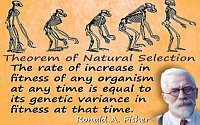
We may consequently state the fundamental theorem of Natural Selection in the form: The rate of increase in fitness of any organism at any time is equal to its genetic variance in fitness at that time.
The Genetical Theory of Natural Selection (1930), 35.
We must be part not only of the human community, but of the whole community; we must acknowledge some sort of oneness not only with our neighbors, our countrymen and our civilization but also some respect for the natural as well as for the man-made community. Ours is not only “one world” in the sense usually implied by that term. It is also “one earth”. Without some acknowledgement of that fact, men can no more live successfully than they can if they refuse to admit the political and economic interdependency of the various sections of the civilized world. It is not a sentimental but a grimly literal fact that unless we share this terrestrial globe with creatures other than ourselves, we shall not be able to live on it for long.
The Voice of the Desert (1956), 194-5.
We must draw our standards from the natural world. … We must honor with the humility of the wise the bounds of that natural world and the mystery which lies beyond them, admitting that there is something in the order of being which evidently exceeds all our competence.
In speech 'Politics and Conscience' written upon receiving an honorary degree from the University of Toulouse, delivered by Tom Stoppard because Havel was forbidden to travel abroad. First published in Czech, collected in The Natural World as Political Problem: Essays on Modern Man (1984). As translated by Erazim Kohák and Roger Scruton in Salisbury Review (Jan 1985), No. 2.
We need to be realistic. There is very little we can do now to stop the ice from disappearing from the North Pole in the Summer. And we probably cannot prevent the melting of the permafrost and the resulting release of methane. In addition, I fear that we may be too late to help the oceans maintain their ability to absorb carbon dioxide. But there is something we can do—and it could make the whole difference and buy us time to develop the necessary low carbon economies. We can halt the destruction of the world’s rainforests—and even restore parts of them—in order to ensure that the forests do what they are so good at—in other words storing carbon naturally. This is a far easier, cheaper and quicker option than imagining we can rely on as yet unproven technology to capture carbon at a cost of some $50 per tonne or, for that matter, imagining we can achieve what is necessary through plantation timber.
Presidential Lecture (3 Nov 2008) at the Presidential Palace, Jakarta, Indonesia. On the Prince of Wales website.
We no longer can talk of unearned “rights.” We’ll have to get back to working for “rights” to adequate food, housing, education, opportunity, a place in the sun—and not everybody is going to make the grade. I don’t see this obsession with the lowest strata of humanity, against all natural biologic experience. We must accept that life is unfair.
In Raymond Mungo, 'Dixy Lee Ray: How Madame Nuke Took Over Washington', Mother Jones (May 1977), 2, No. 4, 31.
We receive it as a fact, that some minds are so constituted as absolutely to require for their nurture the severe logic of the abstract sciences; that rigorous sequence of ideas which leads from the premises to the conclusion, by a path, arduous and narrow, it may be, and which the youthful reason may find it hard to mount, but where it cannot stray; and on which, if it move at all, it must move onward and upward… . Even for intellects of a different character, whose natural aptitude is for moral evidence and those relations of ideas which are perceived and appreciated by taste, the study of the exact sciences may be recommended as the best protection against the errors into which they are most likely to fall. Although the study of language is in many respects no mean exercise in logic, yet it must be admitted that an eminently practical mind is hardly to be formed without mathematical training.
In Orations and Speeches (1870), Vol. 8, 510.
We say that, in very truth the productive cause is a mineralizing power which is active in forming stones… . This power, existing in the particular material of stones, has two instruments according to different natural conditions.
One of these is heat, which is active in drawing out moisture and digesting the material and bringing about its solidification into the form of stone, in Earth that has been acted upon by unctuous moisture… .
The other instrument is in watery moist material that has been acted upon by earthy dryness; and this [instrument] is cold, which … is active in expelling moisture.
One of these is heat, which is active in drawing out moisture and digesting the material and bringing about its solidification into the form of stone, in Earth that has been acted upon by unctuous moisture… .
The other instrument is in watery moist material that has been acted upon by earthy dryness; and this [instrument] is cold, which … is active in expelling moisture.
From De Mineralibus (c.1261-1263), as translated by Dorothy Wyckoff, Book of Minerals (1967), 22.
We should remember that there was once a discipline called natural philosophy. Unfortunately, this discipline seems not to exist today. It has been renamed science, but science of today is in danger of losing much of the natural philosophy aspect.
[Pointing out the increasing specialization of science during the century to explain the resistance to his ideas,]
[Pointing out the increasing specialization of science during the century to explain the resistance to his ideas,]
(1986) Quoted in Anthony L. Peratt, 'Dean of the Plasma Dissidents', Washington Times, supplement: The World and I (May 1988),192.
We speak erroneously of “artificial” materials, “synthetics”, and so forth. The basis for this erroneous terminology is the notion that Nature has made certain things which we call natural, and everything else is “man-made”, ergo artificial. But what one learns in chemistry is that Nature wrote all the rules of structuring; man does not invent chemical structuring rules; he only discovers the rules. All the chemist can do is find out what Nature permits, and any substances that are thus developed or discovered are inherently natural. It is very important to remember that.
From 'The Comprehensive Man', Ideas and Integrities: A Spontaneous Autobiographical Disclosure (1963), 75-76.
We urgently need [the landmark National Ocean Policy] initiative, as we use our oceans heavily: Cargo ships crisscross the sea, carrying goods between continents. Commercial and recreational fishing boats chase fish just offshore. Cruise ships cruise. Oil and gas drilling continues, but hopefully we will add renewable energy projects as well. Without planning, however, these various industrial activities amount to what we call “ocean sprawl,” steamrolling the resources we rely upon for our livelihoods, food, fun, and even the air we breathe. While humankind relies on many of these industries, we also need to keep the natural riches that support them healthy and thriving. As an explorer, I know firsthand there are many places in the ocean so full of life that they should be protected.
In 'A Blueprint for Our Blue Home', Huffington Post (18 Jul 2011).
Were I to make the announcement and to run, the reasons I would run is because I have a great belief in this country [America]. … There’s more natural resources than any nation in the world; the greatest education population in the world; the greatest technology of any country in the world; the greatest capacity for innovation in the world; and the greatest political system in the world.
Answer to “Why do you want to be President,” interview with Roger Mudd, CBS TV documentary (12 Oct 1979). In Jim Lehrer and James Lehrer, Tension City: Inside the Presidential Debates (2011), 184.
What others strive to see dimly and blindly, like bats in twilight, he [Petrus Peregrinus] gazes at in the full light of day, because he is a master of experiment. Through experiment he gains knowledge of natural things, medical, chemical, and indeed of everything in the heavens or earth. … He has even taken note of the remedies, lot casting, and charms used by old women and by wizards and magicians, and of the deceptions and devices of conjurors, so that nothing which deserves inquiry should escape him, and that he may be able to expose the falsehoods of magicians.
What remains to be learned may indeed dwarf imagination. Nevertheless, the universe itself is closed and finite. … The uniformity of nature and the general applicability of natural laws set limits to knowledge. If there are just 100, or 105, or 110 ways in which atoms may form, then when one has identified the full range of properties of these, singly and in combination, chemical knowledge will be complete.
Presidential Address (28 Dec 1970) to the American Association for the Advancement of Science. 'Science: Endless Horizons or Golden Age?', Science (8 Jan 1971), 171, No. 3866, 24.
What the founders of modern science, among them Galileo, had to do, was not to criticize and to combat certain faulty theories, and to correct or to replace them by better ones. They had to do something quite different. They had to destroy one world and to replace it by another. They had to reshape the framework of our intellect itself, to restate and to reform its concepts, to evolve a new approach to Being, a new concept of knowledge, a new concept of science—and even to replace a pretty natural approach, that of common sense, by another which is not natural at all.
In 'Galileo and Plato', Journal of the History of Ideas (1943), 405.
Whatever is Natural doth by that appear, adorned with all imaginable Elegance and Beauty. There are such inimitable gildings and embroideries in the smallest seeds of Plants, but especially in the parts of Animals, in the head or eye of a small Fly: such accurate order and symmetry in the frame of the most minute creatures, a Lowse or a Mite, as no man were able to conceive without seeing of them. Whereas the most curious works of Art, the sharpest finest Needle, doth appear as a blunt rough bar of iron, coming from the furnace or the forge. The most accurate engravings or embossments, seem such rude bungling deformed works, as if they had been done with a Mattock or a Trowel.
In Of the Principles and Duties of Natural Religion (1675, 1699), 80.
Whatever plan of classification, founded on the natural relations of the elements, be adopted, in the practical study of chemistry, it will always be found most advantageous to commence with the consideration of the great constituents of the ocean and the atmosphere.
Introducing sections on oxygen and hydrogen, in Elementary Chemistry, Theoretical and Practical (1854), 104.
Whatever State of the Human Body doth disorder the Vital, the natural, or even the Animal Functions of the same is call’d a Disease.
Aphorism No. 1 in Boerhaave’s Aphorisms: Concerning The Knowledge and Cure of Diseases (1715), 1
When a Parliament, acting against the declared Sense of the Nation, would have appeared as surprising a phœnomenon in the moral World, as a retrograde Motion of the Sun, or any other signal Deviation of Things from their ordinary Course in the natural World.
In A Dissertation Upon Parties: In Several Letters to Caleb D’Anvers, Esq. (1733, 1735), 39.
When an accident at sea releases huge volumes of crude oil onto beaches, rocks and coves we see it as an environmental disaster, and not long ago we tried vainly to wash it away with detergents. Now, with greater common sense, we leave the clean-up to the natural organisms that regard the spillage as food.
In The Revenge of Gaia: Earth’s Climate Crisis & The Fate of Humanity (2006, 2007), 92.
When Bonner writes that ‘natural selection for optimal feeding is then presumed to be the cause of non-motility in all forms,’ I can’t help suspecting that some plants might do even better if they could walk from shade to sun–but the inherited constraints of design never permitted a trial of this intriguing option.
…...
When I observe the luminous progress and expansion of natural science in modern times, I seem to myself like a traveller going eastwards at dawn, and gazing at the growing light with joy, but also with impatience; looking forward with longing to the advent of the full and final light, but, nevertheless, having to turn away his eyes when the sun appeared, unable to bear the splendour he had awaited with so much desire.
In The Maxims and Reflections of Goethe (1906), 197-198.
When I was a little over eight years old,… I was sent to a day-school…. [By this time] my taste for natural history, and more especially for collecting, was well developed. I tried to make out the names of plants, and collected all sorts of things, shells, seals, franks, coins, and minerals. The passion for collecting which leads a man to be a systematic naturalist, a virtuoso, or a miser, was very strong in me.
In Charles Darwin and Francis Darwin (ed.), 'Autobiography', The Life and Letters of Charles Darwin (1887, 1896), Vol. 1, 26.
When important decisions have to be taken, the natural anxiety to come to a right decision will often keep us awake. Nothing, however, is more conducive to healthful sleep than plenty of open air.
The Pleasures of Life (1887, 2007), 87.
When men are ignorant of the natural causes producing things, and cannot even explain them by analogy with similar things, they attribute their own nature to them. The vulgar, for example, say the magnet loves the iron.
In The New Science (3rd ed., 1744), Book 1, Para. 185, as translated by Thomas Goddard Bergin and Max Harold Fisch, The New Science of Giambattista Vico (1948), 63.
When men die of disease they are said to die from natural causes. When they recover (and mostly they do) the doctor gets the credit of curing them.
…...
When Newton saw an apple fall, he found
In that slight startle from his contemplation—
'Tis said (for I'll not answer above ground
For any sage's creed or calculation)—
A mode of proving that the earth turn'd round
In a most natural whirl, called 'gravitation';
And this is the sole mortal who could grapple,
Since Adam, with a fall, or with an apple.
In that slight startle from his contemplation—
'Tis said (for I'll not answer above ground
For any sage's creed or calculation)—
A mode of proving that the earth turn'd round
In a most natural whirl, called 'gravitation';
And this is the sole mortal who could grapple,
Since Adam, with a fall, or with an apple.
Don Juan (1821), Canto 10, Verse I. In Jerome J. McGann (ed.), Lord Byron: The Complete Poetical Works (1986), Vol. 5, 437.
When one ponders on the tremendous journey of evolution over the past three billion years or so, the prodigious wealth of structures it has engendered, and the extraordinarily effective teleonomic performances of living beings from bacteria to man, one may well find oneself beginning to doubt again whether all this could conceiveably be the product of an enormous lottery presided over by natural selection, blindly picking the rare winners from among numbers drawn at random. [Nevertheless,] a detailed review of the accumulated modern evidence [shows] that this conception alone is compatible with the facts.
In Jacques Monod and Austryn Wainhouse (trans.), Chance and Necessity: An Essay on the Natural Philosophy of Modern Biology (1971), 138.
When the first mathematical, logical, and natural uniformities, the first laws, were discovered, men were so carried away by the clearness, beauty and simplification that resulted, that they believed themselves to have deciphered authentically the eternal thoughts of the Almighty.
From Lecture (Nov 1906) at the Lowell Institute, Boston. Published in 'The Present Dilemma in Philosophy',Pragmatism: A New Name for Some Old Ways of Thinking: Popular Lectures on Philosophy (1907), 56.
When the state is shaken to its foundations by internal or external events, when commerce, industry and all trades shall be at a stand, and perhaps on the brink of ruin; when the property and fortune of all are shaken or changed, and the inhabitants of towns look forward with dread and apprehension to the future, then the agriculturalist holds in his hand the key to the money chest of the rich, and the savings-box of the poor; for political events have not the slightest influence on the natural law, which forces man to take into his system, daily, a certain number of ounces of carbon and nitrogen.
Reflecting on events of 1848.
Reflecting on events of 1848.
Familiar Letters on Chemistry (1851), 3rd edn., 483.
When the views entertained in this volume on the origin of species, or when analogous views are generally admitted, we can dimly forsee that there will be a considerable revolution in natural history.
The Origin of Species (1859), Penguin edn , J. W. Burrow (ed.) (1968), 455.
When we burn fossil fuel for energy we are, in qualitative terms, doing nothing more wrong than burning wood. Our wrongdoing, if that is an appropriate term, is taking energy from Gaia hundreds of times faster than it is naturally made available. We are sinning in a quantitative not a qualitative way.
In The Revenge of Gaia: Earth’s Climate Crisis & The Fate of Humanity (2006, 2007), 92.
When we no longer look at an organic being as a savage looks at a ship, as something wholly beyond his comprehension; when we regard every production of nature as one which has had a long history; when we contemplate every complex structure and instinct as the summing up of many contrivances, each useful to the possessor, in the same way as any great mechanical invention is the summing up of the labour, the experience, the reason, and even the blunders of numerous workmen; when we thus view each organic being, how far more interesting, I speak from experience, does the study of natural history become!
From the Conclusion of Origin of Species by Means of Natural Selection, Or the Preservation of Favoured Races in the Struggle for Life (3rd. ed., 1861), 521.
When we see a natural style, we are astonished and delighted; for we expected to see an author, and we find a man.
In Pensées (1670), Section 7, No. 28. As translated in Blaise Pascal and W.F. Trotter (trans.), 'Thoughts', No. 29, collected in Charles W. Eliot (ed.), The Harvard Classics (1910), Vol. 48, 16. Translated as “When we encounter a natural style we are always surprised and delighted, for we thought to see an author and found a man,” in W.H. Auden and L. Kronenberger (eds.) The Viking Book of Aphorisms (1966), 277. From the original French, “Quand on voit le style naturel, on est tout étonné et ravi, car on s’attendait de voir un auteur, et on trouve un homme,” in Ernest Havet (ed.), Pensées de Pascal (1892), 222.
When we understand how animals are resistant to chemicals, the mechanisms are all independent of whether its natural or synthetic. And in fact, when you look at natural chemicals, half of those tested come out positive.
Paper to the American Chemical Society, 'Pollution, Pesticides and Cancer Misconceptions.' As cited by Art Drysdale, 'Latest Insider News: Natural vs. Synthetic Chemical Pesticides' (14 Feb 1999), on the mitosyfraudes.org website. Bruce Ames has written a similar sentiment in various other publications.
When you see the natural and almost universal craving in English sick for their 'tea,' you cannot but feel that nature knows what she is about. … [A] little tea or coffee restores them. … [T]here is nothing yet discovered which is a substitute to the English patient for his cup of tea.
'Tea, Coffee, and Cocoa for the Sick', Scientific American (2 Jul 1860), New Series, 3, No. 1, 3.
When you study natural science and the miracles of creation, if you don’t turn into a mystic you are not a natural scientist.
Quoted in Kim Lim (ed.), 1,001 Pearls of Spiritual Wisdom: Words to Enrich, Inspire, and Guide Your Life (2014), 39
When... the biologist is confronted with the fact that in the organism the parts are so adapted to each other as to give rise to a harmonious whole; and that the organisms are endowed with structures and instincts calculated to prolong their life and perpetuate their race, doubts as to the adequacy of a purely physiochemical viewpoint in biology may arise. The difficulties besetting the biologist in this problem have been rather increased than diminished by the discovery of Mendelian heredity, according to which each character is transmitted independently of any other character. Since the number of Mendelian characters in each organism is large, the possibility must be faced that the organism is merely a mosaic of independent hereditary characters. If this be the case the question arises: What moulds these independent characters into a harmonious whole? The vitalist settles this question by assuming the existence of a pre-established design for each organism and of a guiding 'force' or 'principle' which directs the working out of this design. Such assumptions remove the problem of accounting for the harmonious character of the organism from the field of physics or chemistry. The theory of natural selection invokes neither design nor purpose, but it is incomplete since it disregards the physiochemical constitution of living matter about which little was known until recently.
The Organism as a Whole: From a Physiochemical Viewpoint (1916), v-vi.
Whereas there is nothing more necessary for promoting the improvement of Philosophical Matters, than the communicating to such, as apply their Studies and Endeavours that way, such things as are discovered or put in practice by others; it is therefore thought fit to employ the Press, as the most proper way to gratifie those, whose engagement in such Studies, and delight in the advancement of Learning and profitable Discoveries, doth entitle them to the knowledge of what this Kingdom, or other parts of the World, do, from time to time, afford as well of the progress of the Studies, Labours, and attempts of the Curious and learned in things of this kind, as of their compleat Discoveries and performances: To the end, that such Productions being clearly and truly communicated, desires after solid and usefull knowledge may be further entertained, ingenious Endeavours and Undertakings cherished, and those, addicted to and conversant in such matters, may be invited and encouraged to search, try, and find out new things, impart their knowledge to one another, and contribute what they can to the Grand design of improving Natural knowledge, and perfecting all Philosophical Arts, and Sciences. All for the Glory of God, the Honour and Advantage of these Kingdoms, and the Universal Good of Mankind.
'Introduction', Philosophical Transactions (1665), 1, 1-2.
Wherefore also these Kinds [elements] occupied different places even before the universe was organised and generated out of them. Before that time, in truth, all these were in a state devoid of reason or measure, but when the work of setting in order this Universe was being undertaken, fire and water and earth and air, although possessing some traces of their known nature, were yet disposed as everything is likely to be in the absence of God; and inasmuch as this was then their natural condition, God began by first marking them out into shapes by means of forms and numbers.
— Plato
Timaeus 53ab, trans. R. G. Bury, in Plato: Timaeus, Critias, Cleitophon, Menexenus, Epistles (1929), 125-7.
While all bodies are composed of the four elements, that is, of heat, moisture, the earthy, and air, yet there are mixtures according to natural temperament which make up the natures of all the different animals of the world, each after its kind.
In De Architectura, Book 1, Chap 4, Sec. 5. As translated in Morris Hicky Morgan (trans.), Vitruvius: The Ten Books on Architecture (1914), 16.
While natural science up to the end of the last century was predominantly a collecting science, a science of finished things, in our century it is essentially a classifying science, a science of processes, of the origin and development of these things and of the interconnection which binds these processes into one great whole.
Speaking of the 18th (last) and 19th (our) centuries, in Ludwig Feuerbach and the Outcome of Classical German Philosophy (1886, 1941).
While natural selection drives Darwinian evolution, the growth of human culture is largely Lamarckian: new generations of humans inherit the acquired discoveries of generations past, enabling cosmic insight to grow slowly, but without limit.
In magazine article, 'The Beginning of Science', Natural History (Mar 2001). Collected in Death by Black Hole: And Other Cosmic Quandaries (2007), 20.
While the method of the natural sciences is... analytic, the method of the social sciences is better described as compositive or synthetic. It is the so-called wholes, the groups of elements which are structurally connected, which we learn to single out from the totality of observed phenomena... Insofar as we analyze individual thought in the social sciences the purpose is not to explain that thought, but merely to distinguish the possible types of elements with which we shall have to reckon in the construction of different patterns of social relationships. It is a mistake... to believe that their aim is to explain conscious action ... The problems which they try to answer arise only insofar as the conscious action of many men produce undesigned results... If social phenomena showed no order except insofar as they were consciously designed, there would indeed be no room for theoretical sciences of society and there would be, as is often argued, only problems of psychology. It is only insofar as some sort of order arises as a result of individual action but without being designed by any individual that a problem is raised which demands a theoretical explanation... people dominated by the scientistic prejudice are often inclined to deny the existence of any such order... it can be shown briefly and without any technical apparatus how the independent actions of individuals will produce an order which is no part of their intentions... The way in which footpaths are formed in a wild broken country is such an instance. At first everyone will seek for himself what seems to him the best path. But the fact that such a path has been used once is likely to make it easier to traverse and therefore more likely to be used again; and thus gradually more and more clearly defined tracks arise and come to be used to the exclusion of other possible ways. Human movements through the region come to conform to a definite pattern which, although the result of deliberate decision of many people, has yet not be consciously designed by anyone.
…...
While we keep an open mind on this question of vitalism, or while we lean, as so many of us now do, or even cling with a great yearning, to the belief that something other than the physical forces animates the dust of which we are made, it is rather the business of the philosopher than of the biologist, or of the biologist only when he has served his humble and severe apprenticeship to philosophy, to deal with the ultimate problem. It is the plain bounden duty of the biologist to pursue his course unprejudiced by vitalistic hypotheses, along the road of observation and experiment, according to the accepted discipline of the natural and physical sciences. … It is an elementary scientific duty, it is a rule that Kant himself laid down, that we should explain, just as far as we possibly can, all that is capable of such explanation, in the light of the properties of matter and of the forms of energy with which we are already acquainted.
From Presidential Address to Zoological Section of the British Association for the Advancement of Science. As quoted in H.V. Neal, 'The Basis of Individuality in Organisms: A Defense of Vitalism', Science (21 Jul 1916), 44 N.S., No. 1125, 82.
Who—aside from certain big children who are indeed found in the natural sciences—still believes that the findings of astronomy, biology, physics, or chemistry could teach us anything about the meaning of the world?
From a Speech (1918) presented at Munich University, published in 1919, and collected in 'Wissenschaft als Beruf', Gessammelte Aufsätze zur Wissenschaftslehre (1922), 524-525. As given in H.H. Gerth and C. Wright-Mills (translators and eds.), 'Science as a Vocation', Max Weber: Essays in Sociology (1946), 142.
Whoever is to acquire a competent knowledge of medicine, ought to be possessed of the following advantages: a natural disposition; instructionl a favorable place for the study; early tuition, love of labor; leisure.
The Genuine Works of Hippocrates, trans. Francis Adams (1886), Vol. 2, 284.
Why does man regret, even though he may endeavour to banish any such regret, that he has followed the one natural impulse, rather than the other; and why does he further feel that he ought to regret his conduct? Man in this respect differs profoundly from the lower animals.
Descent of Man
Why is it that showers and even storms seem to come by chance, so that many people think it quite natural to pray for rain or fine weather, though they would consider it ridiculous to ask for an eclipse by prayer.
Science and Method (1908), trans. Francis Maitland (1914), 68.
Why then does science work? The answer is that nobody knows. It is a complete mystery—perhaps the complete mystery&mdashwhy the human mind should be able to understand anything at all about the wider universe. ... Perhaps it is because our brains evolved through the working of natural law that they somehow resonate with natural law. ... But the mystery, really, is not that we are at one with the universe, but that we are so to some degree at odds with it, different from it, and yet can understand something about it. Why is this so?
Coming of Age in the Milky Way (1988), 385. In Vinoth Ramachandra, Subverting Global Myths: Theology and the Public Issues Shaping our World (2008), 185.
Wind, earthquake, fire—meteorology, seismology, physics—pass in review, as we have been reviewing the natural forces of evolution; the Lord was not in them. Afterwards, a stirring, an awakening in the organ of the brain, a voice which asks “What doest thou here?”
Swarthmore Lecture (1929) at Friends’ House, London, printed in Science and the Unseen World (1929), 26.
With highly civilised nations continued progress depends in a subordinate degree on natural selection; for such nations do not supplant and exterminate one another as do savage tribes. Nevertheless the more intelligent members within the same community will succeed better in the long run than the inferior, and leave a more numerous progeny, and this is a form of natural selection.
…...
Without an acquaintance with chemistry, the statesman must remain a stranger to the true vital interests of the state, to the means of its organic development and improvement; ... The highest economic or material interests of a country, the increased and more profitable production of food for man and animals, ... are most closely linked with the advancement and diffusion of the natural sciences, especially of chemistry.
Familiar Letters on Chemistry (1851), 3rd edn., 19.
Without my attempts in natural science, I should never have learned to know mankind such as it is. In nothing else can we so closely approach pure contemplation and thought, so closely observe the errors of the senses and of the understanding, the weak and strong points of character.
Fri 13 Feb 1829. Johann Peter Eckermann, Conversations with Goethe, ed. J. K. Moorhead and trans. J. Oxenford (1971), 293.
Without natural resources life itself is impossible. From birth to death, natural resources, transformed for human use, feed, clothe, shelter, and transport us. Upon them we depend for every material necessity, comfort, convenience, and protection in our lives. Without abundant resources prosperity is out of reach.
In Breaking New Ground (1947, 1998), 505.
Women have absolutely no sense of art, though they may have of poetry. They have no natural disposition for the sciences, though they may have for philosophy. They are by no means wanting in power of speculation and intuitive perception of the infinite; they lack only power of abstraction, which is far more easy to be learned.
From Selected Aphorisms from the Lyceum (1797-1800). As translated by Luis H. Gray in Kuno Francke and Isidore Singer (eds.), The German Classics: Masterpieces of German Literature Translated Into English (1913), Vol. 4, 177.
Yes, gentlemen, give me the map of any country, its configuration, its climate, its waters, its winds, and the whole of its physical geography; give me its natural productions, its flora, its zoology, &c., and I pledge myself to tell you, a priori, what will be the quality of man in history:—not accidentally, but necessarily; not at any particular epoch, but in all; in short, —what idea he is called to represent.
Introduction to the History of Philosophy (1832), trans. by Henning Gotfried Linberg, 240.
Yet man does recognise himself [as an animal]. But I ask you and the whole world for a generic differentia between man and ape which conforms to the principles of natural history, I certainly know of none... If I were to call man ape or vice versa, I should bring down all the theologians on my head. But perhaps I should still do it according to the rules of science.
Letter to Johann Gmelon (14 Jan 1747), quoted in Mary Gribbin, Flower Hunters (2008), 56.
You can be a thorough-going Neo-Darwinian without imagination, metaphysics, poetry, conscience, or decency. For “Natural Selection” has no moral significance: it deals with that part of evolution which has no purpose, no intelligence, and might more appropriately be called accidental selection, or better still, Unnatural Selection, since nothing is more unnatural than an accident. If it could be proved that the whole universe had been produced by such Selection, only fools and rascals could bear to live.
Back to Methuselah: A Metabiological Pentateuch (1921), lxi-lxii.
Zoocentrism is the primary fallacy of human sociobiology, for this view of human behavior rests on the argument that if the actions of ‘lower’ animals with simple nervous systems arise as genetic products of natural selection, then human behavior should have a similar basis.
…...
 In science it often happens that scientists say, 'You know that's a really good argument; my position is mistaken,' and then they would actually change their minds and you never hear that old view from them again. They really do it. It doesn't happen as often as it should, because scientists are human and change is sometimes painful. But it happens every day. I cannot recall the last time something like that happened in politics or religion.
(1987) --
In science it often happens that scientists say, 'You know that's a really good argument; my position is mistaken,' and then they would actually change their minds and you never hear that old view from them again. They really do it. It doesn't happen as often as it should, because scientists are human and change is sometimes painful. But it happens every day. I cannot recall the last time something like that happened in politics or religion.
(1987) -- 





.jpg)

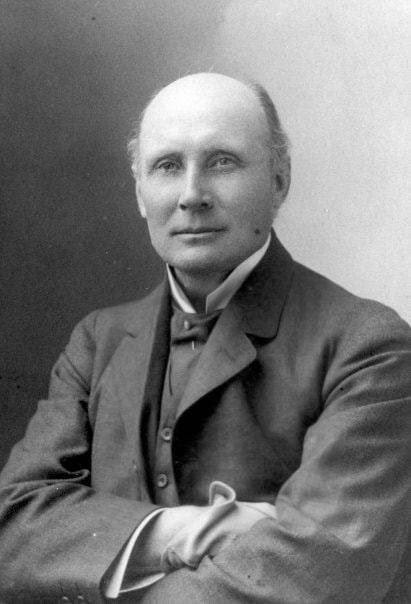

.jpg)


