Myth Quotes (58 quotes)
[In the beginning, before creation] There was neither Aught nor Naught, no air nor sky beyond. …
[There was only]
A self-supporting mass beneath, and energy above.
Who knows, who ever told, from whence this vast creation rose?
No gods had yet been born—who then can e’er the truth disclose?
[There was only]
A self-supporting mass beneath, and energy above.
Who knows, who ever told, from whence this vast creation rose?
No gods had yet been born—who then can e’er the truth disclose?
— Rigveda
In Rigveda. In John Robson, Hinduism and Its Relations to Christianity (1893), 17.
[Newton is the] British physicist linked forever in the schoolboy mind with an apple that fell and bore fruit throughout physics.
As given in Patricia Fara, Newton: The Making of Genius (2004), 192.
[The biggest myth in business is that] bigger is better. A business should be judged not by its size but its impact.
In Issie Lapowsky, 'Scott Belsky', Inc. (Nov 2013), 140. Biography in Context,
[In refutation of evolution] You know what, evolution is a myth. … Why aren’t monkeys still evolving into humans?
From interview on TV show, Politically Incorrect (15 Oct 1998).
A first step in the study of civilization is to dissect it into details, and to classify these in their proper groups. Thus, in examining weapons, they are to be classed under spear, club, sling, bow and arrow, and so forth; among textile arts are to be ranged matting, netting, and several grades of making and weaving threads; myths are divided under such headings as myths of sunrise and sunset, eclipse-myths, earthquake-myths, local myths which account for the names of places by some fanciful tale, eponymic myths which account for the parentage of a tribe by turning its name into the name of an imaginary ancestor; under rites and ceremonies occur such practices as the various kinds of sacrifice to the ghosts of the dead and to other spiritual beings, the turning to the east in worship, the purification of ceremonial or moral uncleanness by means of water or fire. Such are a few miscellaneous examples from a list of hundreds … To the ethnographer, the bow and arrow is the species, the habit of flattening children’s skulls is a species, the practice of reckoning numbers by tens is a species. The geographical distribution of these things, and their transmission from region to region, have to be studied as the naturalist studies the geography of his botanical and zoological species.
In Primitive Culture (1871), Vol. 1, 7.
A myth is, of course, not a fairy story. It is the presentation of facts belonging to one category in the idioms appropriate to another. To explode a myth is accordingly not to deny the facts but to re-allocate them.
In The Concept of Mind (1949), 8.
A paradigm is an all-encompassing idea, a model providing a way of looking at the world such that an array of diverse observations is united under one umbrella of belief, and a series of related questions are thus answered. Paradigms provide broad understanding, a certain “comfort level,” the psychological satisfaction associated with a mystery solved. What is important here, and perhaps surprising at first glance, is that a paradigm need not have much to do with reality. It does not have to be factual. It just needs to be satisfying to those whom it serves. For example, all creation myths, including the Judeo-Christian story of Adam and Eve in the Garden of Eden, are certainly paradigms, at least to those who subscribe to the particular faith that generated the myth.
From John Krichter, The Balance of Nature: Ecology's Enduring Myth (2009), 20.
According to the Boshongo people of central Africa, in the beginning, there was only darkness, water, and the great god Bumba. One day Bumba, in pain from a stomach ache, vomited up the sun. The sun dried up some of the water, leaving land. Still in pain, Bumba vomited up the moon, the stars, and then some animals. The leopard, the crocodile, the turtle, and finally, man. This creation myth, like many others, tries to answer the questions we all ask. Why are we here? Where did we come from?
Lecture (1987), 'The Origin of the Universe', collected in Black Holes And Baby Universes And Other Essays (1993), 99.
Almost everyone... seems to be quite sure that the differences between the methodologies of history and of the natural sciences are vast. For, we are assured, it is well known that in the natural sciences we start from observation and proceed by induction to theory. And is it not obvious that in history we proceed very differently? Yes, I agree that we proceed very differently. But we do so in the natural sciences as well.
In both we start from myths—from traditional prejudices, beset with error—and from these we proceed by criticism: by the critical elimination of errors. In both the role of evidence is, in the main, to correct our mistakes, our prejudices, our tentative theories—that is, to play a part in the critical discussion, in the elimination of error. By correcting our mistakes, we raise new problems. And in order to solve these problems, we invent conjectures, that is, tentative theories, which we submit to critical discussion, directed towards the elimination of error.
In both we start from myths—from traditional prejudices, beset with error—and from these we proceed by criticism: by the critical elimination of errors. In both the role of evidence is, in the main, to correct our mistakes, our prejudices, our tentative theories—that is, to play a part in the critical discussion, in the elimination of error. By correcting our mistakes, we raise new problems. And in order to solve these problems, we invent conjectures, that is, tentative theories, which we submit to critical discussion, directed towards the elimination of error.
The Myth of the Framework: In Defence of Science and Rationality (1993), 140.
As an empiricist I continue to think of the conceptual scheme of science as a tool, ultimately, for predicting future experience in the light of past experience. Physical objects are conceptually imported into the situation as convenient intermediaries—not by definition in terms of experience, but simply as irreducible posits comparable, epistemologically, to the gods of Homer. For my part I do, qua lay physicist, believe in physical objects and not in Homer's gods; and I consider it a scientific error to believe otherwise. But in point of epistemological footing the physical objects and the gods differ only in degree and not in kind. Both sorts of entities enter our conception only as cultural posits. The myth of physical objects is epistemologically superior to most in that it has proved more efficacious than other myths as a device for working a manageable structure into the flux of experience.
From A Logical Point of View (1953), 44. [Note: “qua” means “in the character or role of,” thus “qua lay physicist” means “in the role of lay physicist,” or perhaps even (?) “putting on my lay physicist hat.” —Webmaster]
As regards religion, on the other hand, one is generally agreed that it deals with goals and evaluations and, in general, with the emotional foundation of human thinking and acting, as far as these are not predetermined by the inalterable hereditary disposition of the human species. Religion is concerned with man’s attitude toward nature at large, with the establishing of ideals for the individual and communal life, and with mutual human relationship. These ideals religion attempts to attain by exerting an educational influence on tradition and through the development and promulgation of certain easily accessible thoughts and narratives (epics and myths) which are apt to influence evaluation and action along the lines of the accepted ideals.
Replying to the Liberal Ministers’ Club of New York City. Published in >The Christian Register, (Jun 1948). As given in Albert Einstein, Cal Seelig (ed.) and Sonja Bargmann (trans., ed.), Ideas and Opinions (1954, 2010), 50.
Children are told that an apple fell on Isaac Newton’s head and he was led to state the law of gravity. This, of course, is pure foolishness. What Newton discovered was that any two particles in the universe attract each other with a force that is proportional to the product of their masses and inversely proportional to the square of the distance between them. This is not learned from a falling apple, but by observing quantities of data and developing a mathematical theory that can be verified by additional data. Data gathered by Galileo on falling bodies and by Johannes Kepler on motions of the planets were invaluable aids to Newton. Unfortunately, such false impressions about science are not universally outgrown like the Santa Claus myth, and some people who don’t study much science go to their graves thinking that the human race took until the mid-seventeenth century to notice that objects fall.
In How to Tell the Liars from the Statisticians (1983), 127.
Creationists have also changed their name ... to intelligent design theorists who study 'irreducible complexity' and the 'abrupt appearance' of life—yet more jargon for 'God did it.' ... Notice that they have no interest in replacing evolution with native American creation myths or including the Code of Hammarabi alongside the posting of the Ten Commandments in public schools.
'75 Years and Still No Peace'. Humanist (Sep 2000)
Even if the open windows of science at first make us shiver after the cozy indoor warmth of traditional humanizing myths, in the end the fresh air brings vigor, and the great spaces have a splendor of their own.
What I Believe (1925). In The Basic Writings of Bertrand Russell, 1903-1959 (1992), 370.
Everybody is pathological to a certain degree... the more so the elevated his standing... only myth and cliche have that a person must be either sane or crazy.
In Ausgewahlte Werke, Vol. I (1909), xi.
Everything that can be invented, has been invented. [A myth, attributed - almost certainly falsely - to Duell.]
A classic example of a zombie-type quote. It should be long dead, but keeps living on as a myth, impossible to extirpate. For example, it is glibly recited and attributed (as always, without a valid primary source), to a Commissioner ("Director") of U.S. Patent Office, urging President McKinley to abolish his office, in Chris Morgan and David Langford, Facts and Fallacies (1981). (Duell held the office 1898-1901.) It has a long history of being debunked, for example, see Eber Jeffery, Journal of the Patent Office Society (July 1940), and Samuel Sass, 'A Patently False Patent Myth', Skeptical Inquirer (Spring 1989), 13, 310-313.
For it is owing to their wonder that men now both begin and at first began to philosophize; they wondered originally at the obvious difficulties, then advanced little by little and stated difficulties about the greater matters, e.g. about the phenomena of the moon and those of the sun and the stars, and about the genesis of the universe. And a man who is puzzled and wonders thinks himself ignorant (whence even the lover of myth is in a sense a lover of wisdom, for myth is composed of wonders); therefore since they philosophized in order to escape from ignorance, evidently they were pursuing science in order to know, and not for any utilitarian end. And this is confirmed by the facts; for it was when almost all the necessities of life and the things that make for comfort and recreation were present, that such knowledge began to be sought. Evidently then we do not seek it for the sake of any advantage; but as the man is free, we say, who exists for himself and not for another, so we pursue this as the only free science, for it alone exists for itself.
Metaphysics, 982b, 12-27. In Jonathan Baines (ed.), The Complete Works of Aristotle (1984), Vol. 2, 1554.
Freud becomes one of the dramatis personae, in fact, as discoverer of the great and beautiful modern myth of psychoanalysis. By myth, I mean a poetic, dramatic expression of a hidden truth; and in placing this emphasis, I do not intend to put into question the scientific validity of psychoanalysis.
The White Hotel (1981,1993), vii.
Freudian psychoanalytical theory is a mythology that answers pretty well to Levi-Strauss's descriptions. It brings some kind of order into incoherence; it, too, hangs together, makes sense, leaves no loose ends, and is never (but never) at a loss for explanation. In a state of bewilderment it may therefore bring comfort and relief … give its subject a new and deeper understanding of his own condition and of the nature of his relationship to his fellow men. A mythical structure will be built up around him which makes sense and is believable-in, regardless of whether or not it is true.
From 'Science and Literature', The Hope of Progress: A Scientist Looks at Problems in Philosophy, Literature and Science (1973), 29.
Hyper-selectionism has been with us for a long time in various guises; for it represents the late nineteenth century’s scientific version of the myth of natural harmony–all is for the best in the best of all possible worlds (all structures well designed for a definite purpose in this case). It is, indeed, the vision of foolish Dr. Pangloss, so vividly satirized by Voltaire in Candide–the world is not necessarily good, but it is the best we could possibly have.
…...
I believe in everything until it’s disproved. So I believe in fairies, the myths, dragons… . Who’s to say that dreams and nightmares aren’t as real as the here and now?
Quoted in Kim Lim (ed.), 1,001 Pearls of Spiritual Wisdom: Words to Enrich, Inspire, and Guide Your Life (2014), 10
I have been described on more than one occasion as belonging to something called the 'Functional School of Social Anthropology' and even as being its leader, or one of its leaders. This Functional School does not really exist; it is a myth invented by Professor Malinowski ... There is no place in natural science for 'schools' in this sense, and I regard social anthropology as a branch of natural science. ... I conceive of social anthropology as the theoretical natural science of human society, that is, the investigation of social phenomena by methods essentially similar to those used in the physical and biological sciences. I am quite willing to call the subject 'comparative sociology', if anyone so wishes.
In A. Kuper, Anthropologists and Anthropology: The Modern British School (1983), 36.
I was there when Abbe Georges Lemaître first proposed this [Big Bang] theory. ... There is no rational reason to doubt that the universe has existed indefinitely, for an infinite time. .... It is only myth that attempts to say how the universe came to be, either four thousand or twenty billion years ago.
[Expressing his belief that the Big Bang is a myth devised to explain creation. He said he heard Lemaître (who was, at the time both a member of the Catholic hierarchy and an accomplished scientist) say in private that this theory was a way to reconcile science with St. Thomas Aquinas' theological dictum of creatio ex nihilo—creation out of nothing.]
[Expressing his belief that the Big Bang is a myth devised to explain creation. He said he heard Lemaître (who was, at the time both a member of the Catholic hierarchy and an accomplished scientist) say in private that this theory was a way to reconcile science with St. Thomas Aquinas' theological dictum of creatio ex nihilo—creation out of nothing.]
Quoted in Anthony L. Peratt, 'Dean of the Plasma Dissidents', Washington Times, supplement: The World and I (May 1988),196.
If science fiction is the mythology of modern technology, then its myth is tragic
…...
In a great number of the cosmogonic myths the world is said to have developed from a great water, which was the prime matter. In many cases, as for instance in an Indian myth, this prime matter is indicated as a solution, out of which the solid earth crystallized out.
In Theories of Solutions (1912), 1.
In the beginning was the myth. God, in his search for self-expression, invested the souls of Hindus, Greeks, and Germans with poetic shapes and continues to invest each child’s soul with poetry every day.
Quoted in Kim Lim (ed.), 1,001 Pearls of Spiritual Wisdom: Words to Enrich, Inspire, and Guide Your Life (2014), 8
It is a myth that the success of science in our time is mainly due to the huge amounts of money that have been spent on big machines. What really makes science grow is new ideas, including false ideas.
As quoted by Adam Gopnik, writing about his meeting with Popper at home, in 'The Porcupine: A Pilgrimage to Popper' in The New Yorker (1 Apr 2002).
It is we, we alone, who have dreamed up the causes, the one-thing-after-another, the one-thing-reciprocating-another, the relativity, the constraint, the numbers, the laws, the freedom, the ‘reason why,’ the purpose. ... We are creating myths.
…...
It... [can] be easily shown:
1. That all present mountains did not exist from the beginning of things.
2. That there is no growing of mountains.
3. That the rocks or mountains have nothing in common with the bones of animals except a certain resemblance in hardness, since they agree in neither matter nor manner of production, nor in composition, nor in function, if one may be permitted to affirm aught about a subject otherwise so little known as are the functions of things.
4. That the extension of crests of mountains, or chains, as some prefer to call them, along the lines of certain definite zones of the earth, accords with neither reason nor experience.
5. That mountains can be overthrown, and fields carried over from one side of a high road across to the other; that peaks of mountains can be raised and lowered, that the earth can be opened and closed again, and that other things of this kind occur which those who in their reading of history wish to escape the name of credulous, consider myths.
1. That all present mountains did not exist from the beginning of things.
2. That there is no growing of mountains.
3. That the rocks or mountains have nothing in common with the bones of animals except a certain resemblance in hardness, since they agree in neither matter nor manner of production, nor in composition, nor in function, if one may be permitted to affirm aught about a subject otherwise so little known as are the functions of things.
4. That the extension of crests of mountains, or chains, as some prefer to call them, along the lines of certain definite zones of the earth, accords with neither reason nor experience.
5. That mountains can be overthrown, and fields carried over from one side of a high road across to the other; that peaks of mountains can be raised and lowered, that the earth can be opened and closed again, and that other things of this kind occur which those who in their reading of history wish to escape the name of credulous, consider myths.
The Prodromus of Nicolaus Steno's Dissertation Concerning a Solid Body enclosed by Process of Nature within a Solid (1669), trans. J. G. Winter (1916), 232-4.
Just as the introduction of the irrational numbers … is a convenient myth [which] simplifies the laws of arithmetic … so physical objects are postulated entities which round out and simplify our account of the flux of existence… The conceptional scheme of physical objects is [likewise] a convenient myth, simpler than the literal truth and yet containing that literal truth as a scattered part.
In J. Koenderink Solid Shape (1990.), 16.
Let us see how high we can fly before the sun melts the wax in our wings.
About the ambitious pursuit of knowledge, alluding to Icarus of the Greek myth.
About the ambitious pursuit of knowledge, alluding to Icarus of the Greek myth.
Consilience: The Unity of Knowledge (1999), 7.
My thesis is that what we call 'science' is differentiated from the older myths not by being something distinct from a myth, but by being accompanied by a second-order tradition—that of critically discussing the myth. … In a certain sense, science is myth-making just as religion is.
Conjectures and Refutations: the Growth of Scientific Knowledge (2002), 170-171.
Myths and science fulfill a similar function: they both provide human beings with a representation of the world and of the forces that are supposed to govern it. They both fix the limits of what is considered as possible.
The Possible and the Actual (1982), 9.
No one can read the Gospels without feeling the actual presence of Jesus. His personality pulsates in every word. No myth is filled with such life.
…...
Our enmity to the serpent, which often exists together with a mythic and anthropomorphic belief in the serpent’s enmity to us, might be regarded as purely traditional, having its origin in the Scriptural narrative of man’s disobedience and expulsion from Paradise.
In The Book of a Naturalist (1919), 178.
Peasants have believed in dowsing, and scientists used to believe that dowsing was only a belief of peasants. Now there are so many scientists who believe in dowsing that the suspicion comes to me that it may only be a myth after all.
Wild Talents (1932). In The Complete Books of Charles Fort (1975), 1049.
Religion and science ... constitute deep-rooted and ancient efforts to find richer experience and deeper meaning than are found in the ordinary biological and social satisfactions. As pointed out by Whitehead, religion and science have similar origins and are evolving toward similar goals. Both started from crude observations and fanciful concepts, meaningful only within a narrow range of conditions for the people who formulated them of their limited tribal experience. But progressively, continuously, and almost simultaneously, religious and scientific concepts are ridding themselves of their coarse and local components, reaching higher and higher levels of abstraction and purity. Both the myths of religion and the laws of science, it is now becoming apparent, are not so much descriptions of facts as symbolic expressions of cosmic truths.
'On Being Human,' A God Within, Scribner (1972).
Science and technology revolutionize our lives, but memory, tradition and myth frame our response. Expelled from individual consciousness by the rush of change, history finds its revenge by stamping the collective unconsciousness with habits, values, expectations, dreams. The dialectic between past and future will continue to form our lives.
…...
Science surpasses the old miracles of mythology.
'Progress of Culture', an address read to the Phi Beta Kappa Society at Cambridge, 18 July 1867. In Emerson's Complete Works (1883), Vol. 8, 197.
Science, that gives man hope to live without lies
Or blast himself off the earth; curb science
Until morality catches up?
But look:
At present morality is running rapidly retrograde.
You’d have to turn science, too, back to the witch doctors,
the myth drunkards. Besides that,
Morality is not an end in itself; truth is an end.
To seek the truth is
better than good works, better than survival
Holier than innocence, and higher than love.
Or blast himself off the earth; curb science
Until morality catches up?
But look:
At present morality is running rapidly retrograde.
You’d have to turn science, too, back to the witch doctors,
the myth drunkards. Besides that,
Morality is not an end in itself; truth is an end.
To seek the truth is
better than good works, better than survival
Holier than innocence, and higher than love.
Poem, 'Curb Science?', in The Collected Poetry of Robinson Jeffers: 1938-1962 (1988), 199. The poem was suppressed until 1977.
Scientific theories tell us what is possible; myths tell us what is desirable. Both are needed to guide proper action.
…...
Since religion intrinsically rejects empirical methods, there should never be any attempt to reconcile scientific theories with religion. [An infinitely old universe, always evolving may not be compatible with the Book of Genesis. However, religions such as Buddhism get along without having any explicit creation mythology and are in no way contradicted by a universe without a beginning or end.] Creatio ex nihilo, even as religious doctrine, only dates to around AD 200. The key is not to confuse myth and empirical results, or religion and science.
Quoted in Anthony L. Peratt, 'Dean of the Plasma Dissidents', Washington Times, supplement: The World and I (May 1988),196.
Some say that science dictates, or at least its old rules said, that it is impossible for bumblebees to fly. This may be a myth, but wouldn't you like to think that every time you look at the bees, you are seeing that there is no such thing as the impossible?
Look at the Bees (2006).
The difference between myth and science is the difference between divine inspiration of “unaided reason” (as Bertrand Russell put it) on the one hand and theories developed in observational contact with the real world on the other. It is the difference between the belief in prophets and critical thinking, between Credo quia absurdum (I believe because it is absurd–Tertullian) and De omnibus est dubitandum (Everything should be questioned–Descartes). To try to write a grand cosmical drama leads necessarily to myth. To try to let knowledge substitute ignorance in increasingly large regions of space and time is science.
In 'Cosmology: Myth or Science?' Journal of Astrophysics and Astronomy (1984), 5, 79-98.
The dogma of Christianity gets worn away before the advances of science. Religion will have to make more and more concessions. Gradually the myths crumble.
In Adolf Hitler, Hugh Redwald Trevor-Roper, translated by Norman Cameron and R.H. Stevens, '14 October 1941', Secret Conversations (1941 - 1944) (1953), 49-50.
The foundation of morality should not be made dependent on myth nor tied to any authority lest doubt about the myth or about the legitimacy of the authority imperil the foundation of sound judgment and action.
In a letter to a minister in Brooklyn, N.Y. (20 Nov 1950), third paragraph, as quoted in Helen Dukas and Banesh Hoffmann (eds.), Albert Einstein: The Human Side (1979, 1981), 95.
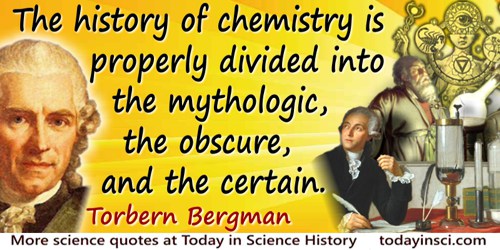
The history of chemistry is properly divided into the mythologic, the obscure, and the certain. The first period exhibits it from its infancy, deformed by fictions, until the destruction of the library of Alexandria by the Arabs. —The second, though freed in some measure from these absurdities, yet is still clothed in numberless enigmas and allegorical expressions.— The third period commences at the middle of the seventeenth century, with the first establishment of societies and academies of science; of which the wise associates, in many places uniting their efforts, determined to pursue the study of Natural Philosophy by observation and experiments, and candidly to publish their attempts in a general account of their transactions.
In Essays, Physical and Chemical (1791), 4, translated from the original Latin.
The more we study Art, the less we care for Nature. What Art really reveals to us is Nature’s lack of design, her curious crudities, her extraordinary monotony, her absolutely unfinished condition. … It is fortunate for us, however, that Nature is so imperfect, as otherwise we should have had no art at all. Art is our spirited protest, our gallant attempt to teach Nature her proper place. As for the infinite variety of Nature, that is a pure myth. It is not to be found in Nature herself. It resides in the imagination, or fancy, or cultivated blindness of the man who looks at her.
In 'Decay of Lying', The Writings of Oscar Wilde: Epigrams, Phrases and Philosophies For the Use of the Young (1907), 5.
The philosophical study of nature rises above the requirements of mere delineation, and does not consist in the sterile accumulation of isolated facts. The active and inquiring spirit of man may therefore be occasionally permitted to escape from the present into the domain of the past, to conjecture that which cannot yet be clearly determined, and thus to revel amid the ancient and ever-recurring myths of geology.
Views of Nature: Or Contemplation of the Sublime Phenomena of Creation (1850), trans. E. C. Otte and H. G. Bohn, 375.
The programmer, like the poet, works only slightly removed from pure thought-stuff. He builds his castles in the air, from air, creating by exertion of the imagination. Few media of creation are so flexible, so easy to polish and rework, so readily capable of realizing grand conceptual structures.…
Yet the program construct, unlike the poet's words, is real in the sense that it moves and works, producing visible outputs separate from the construct itself. […] The magic of myth and legend has come true in our time. One types the correct incantation on a keyboard, and a display screen comes to life, showing things that never were nor could be.
Yet the program construct, unlike the poet's words, is real in the sense that it moves and works, producing visible outputs separate from the construct itself. […] The magic of myth and legend has come true in our time. One types the correct incantation on a keyboard, and a display screen comes to life, showing things that never were nor could be.
In The Mythical Man-Month: Essays on Software Engineering (1975), 7.
The scientific doctrine of progress is destined to replace not only the myth of progress, but all other myths of human earthly destiny. It will inevitably become one of the cornerstones of man's theology, or whatever may be the future substitute for theology, and the most important external support for human ethics.
New Bottles for New Wine (1957), 21.
The sixth pre-Christian century—the miraculous century of Buddha, Confucius and Lâo-Tse, of the Ionian philosophers and Pythagoras—was a turning point for the human species. A March breeze seemed to blow across the planet from China to Samos, stirring man into awareness, like the breath of Adam's nostrils. In the Ionian school of philosophy, rational thought was emerging from the mythological dream-world. …which, within the next two thousand years, would transform the species more radically than the previous two hundred thousand had done.
In The Sleepwalkers: A History of Man’s Changing Vision of the Universe (1959), 21-22.
There is no area in our minds reserved for superstition, such as the Greeks had in their mythology; and superstition, under cover of an abstract vocabulary, has revenged itself by invading the entire realm of thought. Our science is like a store filled with the most subtle intellectual devices for solving the most complex problems, and yet we are almost incapable of applying the elementary principles of rational thought. In every sphere, we seem to have lost the very elements of intelligence: the ideas of limit, measure, degree, proportion, relation, comparison, contingency, interdependence, interrelation of means and ends. To keep to the social level, our political universe is peopled exclusively by myths and monsters; all it contains is absolutes and abstract entities. This is illustrated by all the words of our political and social vocabulary: nation, security, capitalism, communism, fascism, order, authority, property, democracy. We never use them in phrases such as: There is democracy to the extent that… or: There is capitalism in so far as… The use of expressions like “to the extent that” is beyond our intellectual capacity. Each of these words seems to represent for us an absolute reality, unaffected by conditions, or an absolute objective, independent of methods of action, or an absolute evil; and at the same time we make all these words mean, successively or simultaneously, anything whatsoever. Our lives are lived, in actual fact, among changing, varying realities, subject to the casual play of external necessities, and modifying themselves according to specific conditions within specific limits; and yet we act and strive and sacrifice ourselves and others by reference to fixed and isolated abstractions which cannot possibly be related either to one another or to any concrete facts. In this so-called age of technicians, the only battles we know how to fight are battles against windmills.
From 'The Power of Words', collected in Siân Miles (ed.), Simone Weil: An Anthology (2000), 222-223.
Therefore, these [geotectonic] models cannot be expected to assume that the deeper parts of the earth’s crust were put together and built in a simpler way. The myth about the increasing simplicity with depth results from a general pre-scientific trend according to which the unknown or little known has to be considered simpler than the known. Many examples of this myth occur in the history of geology as, for instance, the development of views on the nature of the seafloor from the past to the present.
In 'Stockwerktektonik und Madelle van Esteinsdifferentiation', in Geotektonisches Symposium zu Ehren von Hans Stille, als Festschrift zur Vollendung seines 80, Lebensjahres (1956), 17, trans. Albert V. and Marguerite Carozzi.
Thus science must begin with myths, and with the criticism of myths; neither with the collection of observations, nor with the invention of experiments, but with the critical discussion of myths, and of magical techniques and practices.
In Conjectures and Refutations: the Growth of Scientific Knowledge (1963, 2002), 66.
Today the function of the artist is to bring imagination to science and science to imagination, where they meet, in the myth.
…...
Unanimity of opinion may be fitting for a church, for the frightened or greedy victims of some (ancient, or modern) myth, or for the weak and willing followers of some tyrant. Variety of opinion is necessary for objective knowledge. And a method that encourages variety is also the only method that is comparable with a humanitarian outlook.
Against Method: Outline of an Anarchistic Theory of Knowledge (1975, 1993), 31-32.
When someone admits one and rejects another which is equally in accordance with the appearances, it is clear that he has quitted all physical explanation and descended into myth.
— Epicurus
Letter to Pythocles, 87. Trans. R. W. Sharples.
 In science it often happens that scientists say, 'You know that's a really good argument; my position is mistaken,' and then they would actually change their minds and you never hear that old view from them again. They really do it. It doesn't happen as often as it should, because scientists are human and change is sometimes painful. But it happens every day. I cannot recall the last time something like that happened in politics or religion.
(1987) --
In science it often happens that scientists say, 'You know that's a really good argument; my position is mistaken,' and then they would actually change their minds and you never hear that old view from them again. They really do it. It doesn't happen as often as it should, because scientists are human and change is sometimes painful. But it happens every day. I cannot recall the last time something like that happened in politics or religion.
(1987) -- 





