Mystery Quotes (191 quotes)
“Planning” is simply the result of experience read backward and projected into the future. To me the “purposive” action of a beehive is simply the summation and integration of its units, and Natural Selection has put higher and higher premiums on the most “purposeful” integration. It is the same way (to me) in the evolution of the middle ear, the steps in the Cynodonts (clearly shown by me in 1910 and by you later in Oudenodon) make it easier to see how such a wonderful device as the middle ear could arise without any predetermination or human-like planning, and in fact in the good old Darwinian way, if only we admit that as the “twig is bent the tree’s inclined” and that each stage conserves the advantages of its predecessors… The simple idea that planning is only experience read backward and combined by selection in suitable or successful combinations takes the mystery out of Nature and out of men’s minds.
Letter to Robert Broom [1933]. In Ronald Rainger, An Agenda for Antiquity (1991), 238.
[O]ur own existence once presented the greatest of all mysteries, but … it is a mystery no longer because it is solved. Darwin and Wallace solved it … I was surprised that so many people seemed not only unaware of the elegant and beautiful solution to this deepest of problems but, incredibly, in many cases actually unaware that there was a problem in the first place!
The Blind Watchmaker (1996), front matter.
[The more science discovers and] the more comprehension it gives us of the mechanisms of existence, the more clearly does the mystery of existence itself stand out.
Julian Huxley and Aldous Huxley, Aldous Huxley, 1894-1963: A Memorial Volume (1965), 21.
Dieu, c'est le voile mystérieux sous lequel nous cachons notre ignorance de la cause première.
God is the mysterious veil under which we hide our ignorance of the cause.
God is the mysterious veil under which we hide our ignorance of the cause.
In Recueil d'Œuvres de Léo Errera: Botanique Générale (1908), 193. Google translation by Webmaster.
Il n'y a qu'un demi-siècle, un orateur chrétien, se défiant des hommes de la science leur disait: 'Arrêtez-vous enfin, et ne creusez pas jusqu'aux enfers.' Aujourd'hui, Messieurs, rassurés sur l'inébranlable constance de notre foi, nous vous disons: creusez, creusez encore; plus vous descendrez, plus vous rapprocherez du grand mystère de l'impuissance de l'homme et de la vérité de la religion. Creusez donc, creusez toujours,mundum tradidit disputationibus eorum; et quand la science aura donné son dernier coup de marteau sur les fondements de la terre, vous pourrez à la lueur du feu qu'il fera jaillir, lire encore l'idée de Dieu et contempler l'empreinte de sa main.
Only a half-century ago, a Christian speaker, mistrustful of men of science told them: 'Stop finally, and do not dig to hell.' Today, gentlemen, reassured about the steadfastness of our unshakeable faith, we say: dig, dig again; the further down you, the closer you come to the great mystery of the impotence of man and truth of religion. So dig, always dig: and when science has stuck its final hammer blow on the bosom of the earth, you will be able to ignite a burst of light, read furthermore the mind of God and contemplate the imprint of His hand.
Only a half-century ago, a Christian speaker, mistrustful of men of science told them: 'Stop finally, and do not dig to hell.' Today, gentlemen, reassured about the steadfastness of our unshakeable faith, we say: dig, dig again; the further down you, the closer you come to the great mystery of the impotence of man and truth of religion. So dig, always dig: and when science has stuck its final hammer blow on the bosom of the earth, you will be able to ignite a burst of light, read furthermore the mind of God and contemplate the imprint of His hand.
As Monseigneur Rendu, Bishop of Annecy, Savoy, presiding at the closing session of a meeting of the Geological Society of France at Chambéry, Savoy (27 Aug 1844). In Bulletin de la Société Géologique de France 1843 à 1844, Tome 1, Ser. 2, 857. (1844), li. Google trans., edited by Webmaster.
Negative Capability, that is when man is capable of being in uncertainties, Mysteries, doubts, without any irritable reaching after fact & reason—Coleridge, for instance, would let go by a fine isolated verisimilitude caught from the Penetralium of mystery, from being incapable of remaining content with half knowledge.
Letter to George and Thomas Keats (21 Dec 1817). In H. E. Rollins (ed.), Letters of John Keats (1958), Vol. 1, 193-4.
1839—The fermentation satire
THE MYSTERY OF ALCOHOLIC FERMENTATION RESOLVED
(Preliminary Report by Letter) Schwindler
I am about to develop a new theory of wine fermentation … Depending on the weight, these seeds carry fermentation to completion somewhat less than as in the beginning, which is understandable … I shall develop a new theory of wine fermentation [showing] what simple means Nature employs in creating the most amazing phenomena. I owe it to the use of an excellent microscope designed by Pistorius.
When brewer’s yeast is mixed with water the microscope reveals that the yeast dissolves into endless small balls, which are scarcely 1/800th of a line in diameter … If these small balls are placed in sugar water, it can be seen that they consist of the eggs of animals. As they expand, they burst, and from them develop small creatures that multiply with unbelievable rapidity in a most unheard of way. The form of these animals differs from all of the 600 types described up until now. They possess the shape of a Beinsdorff still (without the cooling apparatus). The head of the tube is a sort of proboscis, the inside of which is filled with fine bristles 1/2000th of a line long. Teeth and eyes are not discernible; however, a stomach, intestinal canal, anus (a rose red dot), and organs for secretion of urine are plainly discernible. From the moment they are released from the egg one can see these animals swallow the sugar from the solution and pass it to the stomach. It is digested immediately, a process recognized easily by the resultant evacuation of excrements. In a word, these infusors eat sugar, evacuate ethyl alcohol from the intestinal canal, and carbon dioxide from the urinary organs. The bladder, in the filled state, has the form of a champagne bottle; when empty, it is a small button … As soon as the animals find no more sugar present, they eat each other up, which occurs through a peculiar manipulation; everything is digested down to the eggs which pass unchanged through the intestinal canal. Finally, one again fermentable yeast, namely the seed of the animals, which remain over.
THE MYSTERY OF ALCOHOLIC FERMENTATION RESOLVED
(Preliminary Report by Letter) Schwindler
I am about to develop a new theory of wine fermentation … Depending on the weight, these seeds carry fermentation to completion somewhat less than as in the beginning, which is understandable … I shall develop a new theory of wine fermentation [showing] what simple means Nature employs in creating the most amazing phenomena. I owe it to the use of an excellent microscope designed by Pistorius.
When brewer’s yeast is mixed with water the microscope reveals that the yeast dissolves into endless small balls, which are scarcely 1/800th of a line in diameter … If these small balls are placed in sugar water, it can be seen that they consist of the eggs of animals. As they expand, they burst, and from them develop small creatures that multiply with unbelievable rapidity in a most unheard of way. The form of these animals differs from all of the 600 types described up until now. They possess the shape of a Beinsdorff still (without the cooling apparatus). The head of the tube is a sort of proboscis, the inside of which is filled with fine bristles 1/2000th of a line long. Teeth and eyes are not discernible; however, a stomach, intestinal canal, anus (a rose red dot), and organs for secretion of urine are plainly discernible. From the moment they are released from the egg one can see these animals swallow the sugar from the solution and pass it to the stomach. It is digested immediately, a process recognized easily by the resultant evacuation of excrements. In a word, these infusors eat sugar, evacuate ethyl alcohol from the intestinal canal, and carbon dioxide from the urinary organs. The bladder, in the filled state, has the form of a champagne bottle; when empty, it is a small button … As soon as the animals find no more sugar present, they eat each other up, which occurs through a peculiar manipulation; everything is digested down to the eggs which pass unchanged through the intestinal canal. Finally, one again fermentable yeast, namely the seed of the animals, which remain over.
In 'Das entriithselle Geheimiss der geisligen Giihrung', Annalen der Pharmacie und Chemie (1839), 29, 100-104; adapted from English translalion by Ralph E. Oesper, The Human Side of Scientists (1975), 203-205.
A cosmic mystery of immense proportions, once seemingly on the verge of solution, has deepened and left astronomers and astrophysicists more baffled than ever. The crux ... is that the vast majority of the mass of the universe seems to be missing.
[Reporting a Nature article discrediting explanation of invisible mass being due to neutrinos]
[Reporting a Nature article discrediting explanation of invisible mass being due to neutrinos]
In 'If Theory is Right, Most of Universe is Still “Missing”', New York Times (11 Sep 1984).
A page from a journal of modern experimental physics will be as mysterious to the uninitiated as a Tibetan mandala. Both are records of enquiries into the nature of the universe.
In The Tao of Physics (1975), 36.
A paradigm is an all-encompassing idea, a model providing a way of looking at the world such that an array of diverse observations is united under one umbrella of belief, and a series of related questions are thus answered. Paradigms provide broad understanding, a certain “comfort level,” the psychological satisfaction associated with a mystery solved. What is important here, and perhaps surprising at first glance, is that a paradigm need not have much to do with reality. It does not have to be factual. It just needs to be satisfying to those whom it serves. For example, all creation myths, including the Judeo-Christian story of Adam and Eve in the Garden of Eden, are certainly paradigms, at least to those who subscribe to the particular faith that generated the myth.
From John Krichter, The Balance of Nature: Ecology's Enduring Myth (2009), 20.
A wonderful exhilaration comes from holding in the mind the deepest questions we can ask. Such questions animate all scientists. Many students of science were first attracted to the field as children by popular accounts of important unsolved problems. They have been waiting ever since to begin working on a mystery. [With co-author Arthur Zajonc]
In George Greenstein and Arthur Zajonc, The Quantum Challenge: Modern Research on the Foundations of Quantum Mechanics (2006), xii.
A wonderful fact to reflect upon, that every human creature is constituted to be that profound secret and mystery to every other.
In A Tale of Two Cities, originally serialized in 31 weekly parts in All the Year Round. This quote is from Chapter III, which appeared in Vol. 1. No. 1 (30 Apr 1859).
After a duration of a thousand years, the power of astrology broke down when, with Copernicus, Kepler, and Galileo, the progress of astronomy overthrew the false hypothesis upon which the entire structure rested, namely the geocentric system of the universe. The fact that the earth revolves in space intervened to upset the complicated play of planetary influences, and the silent stars, related to the unfathomable depths of the sky, no longer made their prophetic voices audible to mankind. Celestial mechanics and spectrum analysis finally robbed them of their mysterious prestige.
Franz Cumont, translated by J.B. Baker, Astrology and Religion Among the Greeks and Romans (1912, 2007), 6.
After the discovery of spectral analysis no one trained in physics could doubt the problem of the atom would be solved when physicists had learned to understand the language of spectra. So manifold was the enormous amount of material that has been accumulated in sixty years of spectroscopic research that it seemed at first beyond the possibility of disentanglement. An almost greater enlightenment has resulted from the seven years of Röntgen spectroscopy, inasmuch as it has attacked the problem of the atom at its very root, and illuminates the interior. What we are nowadays hearing of the language of spectra is a true 'music of the spheres' in order and harmony that becomes ever more perfect in spite of the manifold variety. The theory of spectral lines will bear the name of Bohr for all time. But yet another name will be permanently associated with it, that of Planck. All integral laws of spectral lines and of atomic theory spring originally from the quantum theory. It is the mysterious organon on which Nature plays her music of the spectra, and according to the rhythm of which she regulates the structure of the atoms and nuclei.
Atombau und Spektrallinien (1919), viii, Atomic Structure and Spectral Lines, trans. Henry L. Brose (1923), viii.
All the human culture, all the results of art, science and technology that we see before us today, are almost exclusively the creative product of the Aryan. This very fact admits of the not unfounded inference that he alone was the founder of all higher humanity, therefore representing the prototype of all that we understand by the word 'man.' He is the Prometheus of mankind from whose shining brow the divine spark of genius has sprung at all times, forever kindling anew that fire of knowledge which illuminated the night of silent mysteries and thus caused man to climb the path to mastery over the other beings of the earth ... It was he who laid the foundations and erected the walls of every great structure in human culture.
Mein Kampf (1925-26), American Edition (1943), 290. In William Lawrence Shirer, The Rise and Fall of the Third Reich (1990), 86-87.
Although to penetrate into the intimate mysteries of nature and thence to learn the true causes of phenomena is not allowed to us, nevertheless it can happen that a certain fictive hypothesis may suffice for explaining many phenomena.
…...
And do you know what “the world” is to me? Shall I show it to you in my mirror? This world: a monster of energy, without beginning, without end; a firm, iron magnitude of force that does not grow bigger or smaller, that does not expend itself but only transforms itself; as a whole, of unalterable size, a household without expenses or losses, but likewise without increase or income; enclosed by “nothingness”' as by a boundary; not by something blurry or wasted, not something endlessly extended, but set in a definite space as a definite force, and not a space that might be “empty” here or there, but rather as force throughout, as a play of forces and waves of forces, at the same time one and many, increasing here and at the same time decreasing there; a sea of forces flowing and rushing together, eternally changing, eternally flooding back, with tremendous years of recurrence, with an ebb and a flood of its forms; out of the simplest forms striving toward the most complex, out of the stillest, most rigid, coldest forms toward the hottest, most turbulent, most self-contradictory, and then again returning home to the simple out of this abundance, out of the play of contradictions back to the joy of concord, still affirming itself in this uniformity of its courses and its years, blessing itself as that which must return eternally, as a becoming that knows no satiety, no disgust, no weariness: this, my Dionysian world of the eternally self-creating, the eternally self-destroying, this mystery world of the twofold voluptuous delight, my “beyond good and evil,” without goal, unless the joy of the circle itself is a goal; without will, unless a ring feels good will toward itself-do you want a name for this world? A solution for all its riddles? A light for you, too, you best-concealed, strongest, most intrepid, most midnightly men?—This world is the will to power—and nothing besides! And you yourselves are also this will to power—and nothing besides!
The Will to Power (Notes written 1883-1888), book 4, no. 1067. Trans. W. Kaufmann and R. J. Hollingdale and ed. W. Kaufmann (1968), 549-50.
Any true Sherlock Holmes of science, possest of an adequate knowledge of first principles, may unravel a very tangled web of mystery. The great naturalist requires but a few pieces of bone from any prehistoric monster in order to ascertain whether it was herbivorous or carnivorous, reptile or mammal, or even to construct a counterpart of its entire skeleton.
In The Science of Poetry and the Philosophy of Language (1910), ix.
Art evokes the mystery without which the world would not exist.
John Mitchinson and John Lloyd, If Ignorance Is Bliss, Why Aren't There More Happy People?: Smart Quotes for Dumb Times (2009), 217.
As for those wingy mysteries in divinity, and airy subtleties in religion, which have unhinged the brains of better heads, they never stretched the pia mater of mine: methinks there be not impossibilities enough in Religion for an active faith.
In T. Chapman (ed.), Religio Medici (1643, 1831), part 1, sect. 9, 17.
As long as our brain is a mystery, the universe, the reflection of the structure of the brain will also be a mystery.
In Charlas de Café: pensamientos, anécdotas y confidencias (1920,1967), 276. (Café Chats: Thoughts, Anecdotes and Confidences). As translated in Roger Carpenter and Benjamin Redd, Neurophysiology: A Conceptual Approach (2012), 5th ed., 16. From the original Spanish, “Mientras nuestro cerebro sea un arcano, el universo reflejo de su estructura también será un misterio.”
As the nineteenth century drew to a close, scientists could reflect with satisfaction that they had pinned down most of the mysteries of the physical world: electricity, magnetism, gases, optics, acoustics, kinetics and statistical mechanics … all had fallen into order before them. They had discovered the X ray, the cathode ray, the electron, and radioactivity, invented the ohm, the watt, the Kelvin, the joule, the amp, and the little erg.
A Short History of Nearly Everything. In Clifford A. Pickover, Archimedes to Hawking: Laws of Science and the Great Minds Behind Them (2008), 172.
Both the man of science and the man of art live always at the edge of mystery, surrounded by it; both always, as to the measure of their creation, have had to do with the harmonization of what is new with what is familiar, with the balance between novelty and synthesis, with the struggle to make partial order in total chaos.
Address at the close of the year-long Bicentennial Celebration of Columbia University (26 Dec 54). Printed in 'Prospects in the Arts and Sciences', Bulletin of the Atomic Scientists (Feb 1955), 52.
But I don’t have to know an answer. I don’t feel frightened by not knowing things, by being lost in a mysterious universe without any purpose, which is the way it really is, so far as I can tell. It doesn’t frighten me.
In Richard Feynman and Jeffrey Robbins (ed.), The Pleasure of Finding Things Out: The Best Short Works of Richard Feynman (1999), 25, last sentence of Chap. 1. The chapter, with the same title as the book, is an edited transcript of an interview with Feynman made for the BBC television program Horizon (1981).
Chemistry is one of those branches of human knowledge which has built itself upon methods and instruments by which truth can presumably be determined. It has survived and grown because all its precepts and principles can be re-tested at any time and anywhere. So long as it remained the mysterious alchemy by which a few devotees, by devious and dubious means, presumed to change baser metals into gold, it did not flourish, but when it dealt with the fact that 56 g. of fine iron, when heated with 32 g. of flowers of sulfur, generated extra heat and gave exactly 88 g. of an entirely new substance, then additional steps could be taken by anyone. Scientific research in chemistry, since the birth of the balance and the thermometer, has been a steady growth of test and observation. It has disclosed a finite number of elementary reagents composing an infinite universe, and it is devoted to their inter-reaction for the benefit of mankind.
Address upon receiving the Perkin Medal Award, 'The Big Things in Chemistry', The Journal of Industrial and Engineering Chemistry (Feb 1921), 13, No. 2, 163.
Decades spent in contact with science and its vehicles have directed my mind and senses to areas beyond their reach. I now see scientific accomplishments as a path, not an end; a path leading to and disappearing in mystery. Science, in fact, forms many paths branching from the trunk of human progress; and on every periphery they end in the miraculous. Following these paths far enough, one must eventually conclude that science itself is a miracle—like the awareness of man arising from and then disappearing in the apparent nothingness of space. Rather than nullifying religion and proving that “God is dead,” science enhances spiritual values by revealing the magnitudes and minitudes—from cosmos to atom—through which man extends and of which he is composed.
A Letter From Lindbergh', Life (4 Jul 1969), 60B. In Eugene C. Gerhart, Quote it Completely! (1998), 409.
Electricity is often called wonderful, beautiful; but it is so only in common with the other forces of nature. The beauty of electricity or of any other force is not that the power is mysterious, and unexpected, touching every sense at unawares in turn, but that it is under law, and that the taught intellect can even govern it largely. The human mind is placed above, and not beneath it, and it is in such a point of view that the mental education afforded by science is rendered super-eminent in dignity, in practical application and utility; for by enabling the mind to apply the natural power through law, it conveys the gifts of God to man.
Notes for a Friday Discourse at the Royal Institution (1858).
Enough for me the mystery of the eternity of life, and the inkling of the marvellous structure of reality, together with the single-hearted endeavour to comprehend a portion, be it never so tiny, of the reason that manifests itself in nature.
In Alan Harris (ed.), The World As I See It (1934), 242.
Everything around us is filled with mystery and magic. I find this no cause for despair, no reason to turn for solace to esoteric formulae or chariots of gods. On the contrary, our inability to find easy answers fills me with a fierce pride in our ambivalent biology … with a constant sense of wonder and delight that we should be part of anything so profound.
In Lifetide: A Biology of the Unconscious (1979), 14.
First, [Newton’s Law of Universal Gravitation] is mathematical in its expression…. Second, it is not exact; Einstein had to modify it…. There is always an edge of mystery, always a place where we have some fiddling around to do yet…. But the most impressive fact is that gravity is simple…. It is simple, and therefore it is beautiful…. Finally, comes the universality of the gravitational law and the fact that it extends over such enormous distances…
In The Character of Physical Law (1965, 2001), 33.
For the masses, science is largely a matter of miracle, mystery, and authority. Translated into educational terms, the slogan that through science man has gained increasing knowledge of nature really means that a few men now know a great deal about how nature “works,” while the rest of us are about as ignorant as we have always been. Translated into political terms, the slogan that through knowledge man has gained power really means that a few men have gained the means of unprecedented power over a great many other men.
In Legitimacy in the Modern State (1981), 29.
Force, force, everywhere force; we ourselves a mysterious force in the centre of that. “There is not a leaf rotting on the highway but has Force in it: how else could it rot?” [As used in his time, by the word force, Carlyle means energy.]
On Heroes, Hero-Worship and the Heroic in History (1840), 11.
Forces of nature act in a mysterious manner. We can but solve the mystery by deducing the unknown result from the known results of similar events.
In The Words of Gandhi (2001), 87.
Fortunately somewhere between chance and mystery lies imagination, the only thing that protects our freedom, despite the fact that people keep trying to reduce it or kill it off altogether.
My Last Breath? (1984), 174.
Genetics has enticed a great many explorers during the past two decades. They have labored with fruit-flies and guinea-pigs, with sweet peas and corn, with thousands of animals and plants in fact, and they have made heredity no longer a mystery but an exact science to be ranked close behind physics and chemistry in definiteness of conception. One is inclined to believe, however, that the unique magnetic attraction of genetics lies in the vision of potential good which it holds for mankind rather than a circumscribed interest in the hereditary mechanisms of the lowly species used as laboratory material. If man had been found to be sharply demarcated from the rest of the occupants of the world, so that his heritage of physical form, of physiological function, and of mental attributes came about in a superior manner setting him apart as lord of creation, interest in the genetics of the humbler organisms—if one admits the truth—would have flagged severely. Biologists would have turned their attention largely to the ways of human heredity, in spite of the fact that the difficulties encountered would have rendered progress slow and uncertain. Since this was not the case, since the laws ruling the inheritance of the denizens of the garden and the inmates of the stable were found to be applicable to prince and potentate as well, one could shut himself up in his laboratory and labor to his heart's content, feeling certain that any truth which it fell to his lot to discover had a real human interest, after all.
Mankind at the Crossroads (1923), v-vi.
Geology may seem to be audacious in its attempts to unveil the mysteries of creation. Yet what it reveals are only some of the methods by which the Creator has performed his will; and many deeper mysteries it leaves untouched.
In 'Concluding Remarks', A Text-book of Geology: Designed for Schools and Academies (1863), 336.
God was always invented to explain mystery. God is always invented to explain those things that you do not understand. Now, when you finally discover how something works … you don't need him anymore. But … you leave him to create the universe because we haven't figured that out yet.
Interview, collected in Paul C. W. Davies and Julian R. Brown (eds.) Superstrings: A Theory of Everything? (1988), 208-209.
Hast thou ever raised thy mind to the consideration of existence, in and by itself, as the mere act of existing?
Hast thou ever said to thyself thoughtfully it is! heedless, in that moment, whether it were a man before thee, or a flower, or a grain of sand;—without reference, in short, to this or that particular mode or form of existence? If thou hast, indeed, attained to this, thou wilt have felt the presence of a mystery, which must have fixed thy spirit in awe and wonder.
Hast thou ever said to thyself thoughtfully it is! heedless, in that moment, whether it were a man before thee, or a flower, or a grain of sand;—without reference, in short, to this or that particular mode or form of existence? If thou hast, indeed, attained to this, thou wilt have felt the presence of a mystery, which must have fixed thy spirit in awe and wonder.
In 'Essay IX', The Friend: A Series of Essays (1818), Vol. 3, 250.
He who finds a thought that lets us even a little deeper into the eternal mystery of nature has been granted great peace.
…...
He who studies it [Nature] has continually the exquisite pleasure of discerning or half discerning and divining laws; regularities glimmer through an appearance of confusion, analogies between phenomena of a different order suggest themselves and set the imagination in motion; the mind is haunted with the sense of a vast unity not yet discoverable or nameable. There is food for contemplation which never runs short; you are gazing at an object which is always growing clearer, and yet always, in the very act of growing clearer, presenting new mysteries.
From 'Natural History', Macmillan's Magazine (1875), 31, 366.
How many and how curious problems concern the commonest of the sea-snails creeping over the wet sea-weed! In how many points of view may its history be considered! There are its origin and development, the mystery of its generation, the phenomena of its growth, all concerning each apparently insignificant individual; there is the history of the species, the value of its distinctive marks, the features which link it with the higher and lower creatures, the reason why it takes its stand where we place it in the scale of creation, the course of its distribution, the causes of its diffusion, its antiquity or novelty, the mystery (deepest of mysteries) of its first appearance, the changes of the outline of continents and of oceans which have taken place since its advent, and their influence on its own wanderings.
On the Natural History of European Seas. In George Wilson and Archibald Geikie, Memoir of Edward Forbes F.R.S. (1861), 547-8.
Human consciousness is just about the last surviving mystery. A mystery is a phenomenon that people don’t know how to think about—yet. There have been other great mysteries: the mystery of the origin of the universe, the mystery of life and reproduction, the mystery of the design to be found in nature, the mysteries of time, space, and gravity. These were not just areas of scientific ignorance, but of utter bafflement and wonder. We do not yet have the final answers to any of the questions of cosmology and particle physics, molecular genetics and evolutionary theory, but we do know how to think about them. The mysteries haven't vanished, but they have been tamed. They no longer overwhelm our efforts to think about the phenomena, because now we know how to tell the misbegotten questions from the right questions, and even if we turn out to be dead wrong about some of the currently accepted answers, we know how to go about looking for better answers. With consciousness, however, we are still in a terrible muddle. Consciousness stands alone today as a topic that often leaves even the most sophisticated thinkers tongue-tied and confused. And, as with all the earlier mysteries, there are many who insist—and hope—that there will never be a demystification of consciousness.
Consciousness Explained (1991), 21-22.
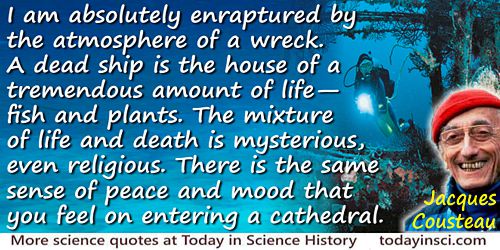
I am absolutely enraptured by the atmosphere of a wreck. A dead ship is the house of a tremendous amount of life—fish and plants. The mixture of life and death is mysterious, even religious. There is the same sense of peace and mood that you feel on entering a cathedral.
Quoted in 'Sport: Poet of the Depths', Time (28 Mar 1960)
I am entitled to say, if I like, that awareness exists in all the individual creatures on the planet—worms, sea urchins, gnats, whales, subhuman primates, superprimate humans, the lot. I can say this because we do not know what we are talking about: consciousness is so much a total mystery for our own species that we cannot begin to guess about its existence in others.
In Late Night Thoughts on Listening to Mahler's Ninth Symphony(1984), 223.
I am satisfied with the mystery of life’s eternity and with a knowledge, a sense, of the marvelous structure of existence–as well as the humble attempt to understand even a tiny portion of the Reason that manifests itself in nature.
…...
I am very much a scientist, and so I naturally have thought about religion also through the eyes of a scientist. When I do that, I see religion not denominationally, but in a more, let us say, deistic sense. I have been influenced in my thinking by the writing of Einstein who has made remarks to the effect that when he contemplated the world he sensed an underlying Force much greater than any human force. I feel very much the same. There is a sense of awe, a sense of reverence, and a sense of great mystery.
From interview with John F. Luca, 'Dr. Walter Kohn: Science, Religion, and the Human Experience', The Santa Barbara Independent (26 Jul 2001).
I cannot imagine a God who rewards and punishes the objects of his creation, whose purposes are modeled after our own–a God, in short, who is but a reflection of human frailty. Neither can I believe that the individual survives the death of his body, although feeble souls harbor such thoughts through fear or ridiculous egotism. It is enough for me to contemplate the mystery of conscious life perpetuating itself through all eternity, to reflect upon the marvelous structure of the universe which we can dimly perceive, and to try humbly to comprehend even an infinitesimal part of the intelligence manifested in nature.
From 'What I Believe: Living Philosophies XIII', Forum and Century (Oct 1930), 84, No. 4, 194. Article in full, reprinted in Edward H. Cotton (ed.), Has Science Discovered God? A Symposium of Modern Scientific Opinion (1931), 97.
I find it quite improbable that such order came out of chaos. There has to be some organizing principle. God to me is a mystery, but is the explanation for the miracle of existence, why there is something instead of nothing.
As quoted in John Noble Wilford, 'Sizing up the Cosmos: An Astronomers Quest', New York Times (12 Mar 1991), C10.
I have a peculiar theory about radium, and I believe it is the correct one. I believe that there is some mysterious ray pervading the universe that is fluorescing to it. In other words, that all its energy is not self-constructed but that there is a mysterious something in the atmosphere that scientists have not found that is drawing out those infinitesimal atoms and distributing them forcefully and indestructibly.
Quoted in 'Edison Fears Hidden Perils of the X-Rays', New York World (3 Aug 1903), 1.
I maintain that the human mystery is incredibly demeaned by scientific reductionism, with its claim in promissory materialism to account eventually for all of the spiritual world in terms of patterns of neuronal activity. This belief must be classed as a superstition. ... We have to recognize that we are spiritual beings with souls existing in a spiritual world as well as material beings with bodies and brains existing in a material world.
In Evolution of the Brain: Creation of the Self (1991), 241.
I never said a word against eminent men of science. What I complain of is a vague popular philosophy which supposes itself to be scientific when it is really nothing but a sort of new religion and an uncommonly nasty one. When people talked about the fall of man, they knew they were talking about a mystery, a thing they didn’t understand. Now they talk about the survival of the fittest: they think they do understand it, whereas they have not merely no notion, they have an elaborately false notion of what the words mean.
In The Club of Queer Trades (1903, 1905), 241.
I prefer the man who calls his nonsense a mystery to him who who pretends it is a weighed, measured, analyzed fact.
In Evan Esar, 20,000 Quips and Quotes, 704.
I really enjoy good murder mystery writers, usually women, frequently English, because they have a sense of what the human soul is about and why people do dark and terrible things. I also read quite a lot in the area of particle physics and quantum mechanics, because this is theology. This is about the nature of being. This is what life is all about. I try to read as widely as I possibly can.
…...
I recall my own emotions: I had just been initiated into the mysteries of the complex number. I remember my bewilderment: here were magnitudes patently impossible and yet susceptible of manipulations which lead to concrete results. It was a feeling of dissatisfaction, of restlessness, a desire to fill these illusory creatures, these empty symbols, with substance. Then I was taught to interpret these beings in a concrete geometrical way. There came then an immediate feeling of relief, as though I had solved an enigma, as though a ghost which had been causing me apprehension turned out to be no ghost at all, but a familiar part of my environment.
In Tobias Dantzig and Joseph Mazur (ed.), 'The Two Realities', Number: The Language of Science (1930, ed. by Joseph Mazur 2007), 254.
I wanted to be a scientist from my earliest school days. The crystallizing moment came when I first caught on that stars are mighty suns, and how staggeringly far away they must be to appear to us as mere points of light. I’m not sure I even knew the word science then, but I was gripped by the prospect of understanding how things work, of helping to uncover deep mysteries, of exploring new worlds.
In 'With Science on Our Side', Washington Post (9 Jan 1994).
I would have you to observe that the difficulty & mystery which often appear in matters of science & learning are only owing to the terms of art used in them, & if many gentlemen had not been rebuted by the uncouth dress in which science was offered to them, we must believe that many of these who now shew an acute & sound judgement in the affairs of life would also in science have excelled many of those who are devoted to it & who were engaged in it only by necessity & a phlegmatic temper. This is particularly the case with respect to chemistry, which is as easy to be comprehended as any of the common affairs of life, but gentlemen have been kept from applying to it by the jargon in which it has been industriously involved.
Cullen MSS, No. 23, Glasgow University library. In A. L. Donovan, Philosophical Chemistry In the Scottish Enlightenment: The Doctrines and Discoveries of Wllliam Cullen and Joseph Black (1975), 111.
I would rather live in a world where my life is surrounded by mystery than live in a world so small that my mind could comprehend it.
'The Mystery of Life', Riverside Sermons (1958), 22.
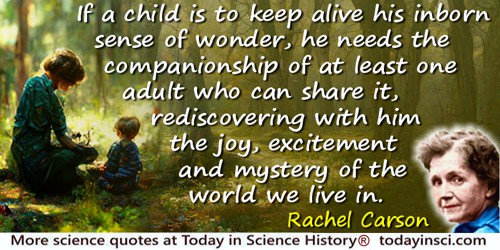
If a child is to keep alive his inborn sense of wonder, he needs the companionship of at least one adult who can share it, rediscovering with him the joy, excitement and mystery of the world we live in.
The Sense of Wonder, Harper & Row (1965)
If a nonnegative quantity was so small that it is smaller than any given one, then it certainly could not be anything but zero. To those who ask what the infinitely small quantity in mathematics is, we answer that it is actually zero. Hence there are not so many mysteries hidden in this concept as they are usually believed to be. These supposed mysteries have rendered the calculus of the infinitely small quite suspect to many people. Those doubts that remain we shall thoroughly remove in the following pages, where we shall explain this calculus.
…...
If human reason is incapable of discovering the mysteries of Divinity, why has not Divinity made human reason more clear-sighted?
From Appendix A, 'Extracts From the Unpublished Writings of Carnot', Reflections on the Motive Power of Heat (1890, 2nd ed. 1897), 216.
If the mysterious influence to which the dissymmetry of nature is due should come to change in sense or direction, the constituting elements of all living beings would take an inverse dissymmetry. Perhaps a new world would be presented to us. Who could foresee the organization of living beings, if the cellulose, which is right, should become left, if the left albumen of the blood should become right? There are here mysteries which prepare immense labours for the future, and from this hour invite the most serious meditations in science.
Lecture (3 Feb 1860), to the Chemical Society of Paris, 'On the Molecular Dissymetry of Natural Organic Products', reprinted in The Chemical News and Journal of Industrial Science (3 May 1862), 5, No. 126, 248.
If the world goes crazy for a lovely fossil, that's fine with me. But if that fossil releases some kind of mysterious brain ray that makes people say crazy things and write lazy articles, a serious swarm of flies ends up in my ointment.
Criticism of excessive media hype about a fossil discovery, from blog 'The Loom' (19 May 2009) on Discover magazine website.
If you want my opinion on the mystery of life and all that, I can give it to you in a nutshell. The universe is like a safe to which there is a combination. But the combination is locked up in the safe.
In Let Me Count the Ways (1965), 306-307.
If you want to penetrate into the heart of physics, then let yourself be initiated into the mysteries of poetry.
Friedrich Schlegel's Lucinde and the Fragments, trans. Peter Firchow (1971), 250.
In 1944 Erwin Schroedinger, stimulated intellectually by Max Delbruck, published a little book called What is life? It was an inspiration to the first of the molecular biologists, and has been, along with Delbruck himself, credited for directing the research during the next decade that solved the mystery of how 'like begat like.' Max was awarded this Prize in 1969, and rejoicing in it, he also lamented that the work for which he was honored before all the peoples of the world was not something which he felt he could share with more than a handful. Samuel Beckett's contributions to literature, being honored at the same time, seemed to Max somehow universally accessible to anyone. But not his. In his lecture here Max imagined his imprisonment in an ivory tower of science.
'The Polymerase Chain Reaction', Nobel Lecture (8 Dec 1993). In Nobel Lectures: Chemistry 1991-1995 (1997), 103.
In a certain sense I made a living for five or six years out of that one star [υ Sagittarii] and it is still a fascinating, not understood, star. It’s the first star in which you could clearly demonstrate an enormous difference in chemical composition from the sun. It had almost no hydrogen. It was made largely of helium, and had much too much nitrogen and neon. It’s still a mystery in many ways … But it was the first star ever analysed that had a different composition, and I started that area of spectroscopy in the late thirties.
Oral History Transcript of interview with Dr. Jesse Greenstein by Paul Wright (31 Jul 1974), on website of American Institute of Physics, about his research on strange shell stars. As quoted in J. B. Hearnshaw, The Analysis of Starlight: One Hundred and Fifty Years of Astronomical Spectroscopy (1986, 1990), 362. Hearnshaw footnoted that Berman earlier analysed the peculiar star R CrB (1935).
In the end, science as we know it has two basic types of practitioners. One is the educated man who still has a controlled sense of wonder before the universal mystery, whether it hides in a snail’s eye or within the light that impinges on that delicate organ. The second kind of observer is the extreme reductionist who is so busy stripping things apart that the tremendous mystery has been reduced to a trifle, to intangibles not worth troubling one’s head about.
In 'Science and the Sense of the Holy,' The Star Thrower (1978), 190.
In the next twenty centuries … humanity may begin to understand its most baffling mystery—where are we going? The earth is, in fact, traveling many thousands of miles per hour in the direction of the constellation Hercules—to some unknown destination in the cosmos. Man must understand his universe in order to understand his destiny. Mystery, however, is a very necessary ingredient in our lives. Mystery creates wonder and wonder is the basis for man’s desire to understand. Who knows what mysteries will be solved in our lifetime, and what new riddles will become the challenge of the new generation? Science has not mastered prophesy. We predict too much for the next year yet far too little for the next ten. Responding to challenges is one of democracy’s great strengths. Our successes in space can be used in the next decade in the solution of many of our planet’s problems.
In a speech to a Joint Meeting of the Two Houses of Congress to Receive the Apollo 11 Astronauts (16 Sep 1969), in the Congressional Record.
In the study of this membrane [the retina] I for the first time felt my faith in Darwinism (hypothesis of natural selection) weakened, being amazed and confounded by the supreme constructive ingenuity revealed not only in the retina and in the dioptric apparatus of the vertebrates but even in the meanest insect eye. ... I felt more profoundly than in any other subject of study the shuddering sensation of the unfathomable mystery of life.
Recollections of My Life (1898), 576. Quoted in Sidney Perkowitz, Empire of Light (1999), 16.
In the year 1692, James Bernoulli, discussing the logarithmic spiral [or equiangular spiral, ρ = αθ] … shows that it reproduces itself in its evolute, its involute, and its caustics of both reflection and refraction, and then adds: “But since this marvellous spiral, by such a singular and wonderful peculiarity, pleases me so much that I can scarce be satisfied with thinking about it, I have thought that it might not be inelegantly used for a symbolic representation of various matters. For since it always produces a spiral similar to itself, indeed precisely the same spiral, however it may be involved or evolved, or reflected or refracted, it may be taken as an emblem of a progeny always in all things like the parent, simillima filia matri. Or, if it is not forbidden to compare a theorem of eternal truth to the mysteries of our faith, it may be taken as an emblem of the eternal generation of the Son, who as an image of the Father, emanating from him, as light from light, remains ὁμοούσιος with him, howsoever overshadowed. Or, if you prefer, since our spira mirabilis remains, amid all changes, most persistently itself, and exactly the same as ever, it may be used as a symbol, either of fortitude and constancy in adversity, or, of the human body, which after all its changes, even after death, will be restored to its exact and perfect self, so that, indeed, if the fashion of Archimedes were allowed in these days, I should gladly have my tombstone bear this spiral, with the motto, ‘Though changed, I arise again exactly the same, Eadem numero mutata resurgo.’”
In 'The Uses of Mathesis', Bibliotheca Sacra, Vol. 32, 516-516. [The Latin phrase “simillima filia matri” roughly translates as “the daughter resembles the mother”. “Spira mirabilis” is Latin for “marvellous spiral”. The Greek word (?µ???s???) translates as “consubstantial”, meaning of the same substance or essence (used especially of the three persons of the Trinity in Christian theology). —Webmaster]
Is not Cuvier the greatest poet of our age? Of course Lord Byron has set down in fine words certain of our souls’ longings; but our immortal naturalist has reconstructed whole worlds out of bleached bones. Like Cadmus, he has rebuilt great cities from teeth, repopulated thousands of forests with all the mysteries of zoology from a few pieces of coal, discovered races of giants in the foot of a mammoth.
From 'La Peau de Chagrin' (1831). As translated as by Helen Constantine The Wild Ass’s Skin (2012), 19.
It gave me great pleasure to tell you about the mysteries with which physics confronts us. As a human being, one has been endowed with just enough intelligence to be able to see clearly how utterly inadequate that intelligence is when confronted with what exists. If such humility could be conveyed to everybody, the world of human activities would be more appealing.
Letter (19 Sep 1932) replying to Queen Elizabeth of Belgium, in which she had complimented his lucid explanation of the casual and probabilistic theories in physics during a wander with her, in a park. As quoted in Albert Einstein, edited by Helen Dukas and Banesh Hoffman, Albert Einstein, The Human Side: Glimpses from His Archives (1979, 2013), 48.
It is an open secret to the few who know it, but a mystery and stumbling block to the many, that Science and Poetry are own sisters; insomuch that in those branches of scientific inquiry which are most abstract, most formal, and most remote from the grasp of the ordinary sensible imagination, a higher power of imagination akin to the creative insight of the poet is most needed and most fruitful of lasting work.
From Introduction written for William Kingdon Clifford, Clifford’s Lectures and Essays (1879), Vol. 1, 1.
It is sometimes said that scientists are unromantic, that their passion to figure out robs the world of beauty and mystery. But is it not stirring to understand how the world actually works—that white light is made of colors, that color is the way we perceive the wavelengths of light, that transparent air reflects light, that in so doing it discriminates among the waves, and that the sky is blue for the same reason that the sunset is red? It does no harm to the romance of the sunset to know a little bit about it.
Pale Blue Dot: A Vision of the Human Future in Space (1994), 159.
It may be appropriate to quote a statement of Poincare, who said (partly in jest no doubt) that there must be something mysterious about the normal law since mathematicians think it is a law of nature whereas physicists are convinced that it is a mathematical theorem.
Quoted in Mark Kac, Statistical Independence in Probability, Analysis and Number Theory (1959), 52.
It was my science that drove me to the conclusion that the world is much more complicated than can be explained by science. It is only through the supernatural that I can understand the mystery of existence.
As quoted in Sharon Begley, 'Science Finds God', Newsweek (1998).
It will be! the mass is working clearer!
Conviction gathers, truer, nearer!
The mystery which for Man in Nature lies
We dare to test, by knowledge led;
And that which she was wont to organize
We crystallize, instead.
Conviction gathers, truer, nearer!
The mystery which for Man in Nature lies
We dare to test, by knowledge led;
And that which she was wont to organize
We crystallize, instead.
As spoken by character Wagner, in Johann Goethe and Bayard Taylr (trans.), Faust: A tragedy by Johann Wolfgang von Goethe, translated, in the original metres: The Second Part (1871), Act 2, Scene 2, Laboratory, 119.
Learn to reverence night and to put away the vulgar fear of it, for, with the banishment of night from the experience of man, there vanishes as well a religious emotion, a poetic mood, which gives depth to the adventure of humanity. By day, space is one with the earth and with man - it is his sun that is shining, his clouds that are floating past; at night, space is his no more. When the great earth, abandoning day, rolls up the deeps of the heavens and the universe, a new door opens for the human spirit, and there are few so clownish that some awareness of the mystery of being does not touch them as they gaze. For a moment of night we have a glimpse of ourselves and of our world islanded in its stream of stars - pilgrims of mortality, voyaging between horizons across eternal seas of space and time. Fugitive though the instant be, the spirit of man is, during it, ennobled by a genuine moment of emotional dignity, and poetry makes its own both the human spirit and experience.
…...
Little can be understood of even the simplest phenomena of nature without some knowledge of mathematics, and the attempt to penetrate deeper into the mysteries of nature compels simultaneous development of the mathematical processes.
In Teaching of Mathematics in the Elementary and the Secondary School (1906), 16.
Long before I ever saw the desert I was aware of the mystical overtones which the observation of nature made audible to me. But I have never been more frequently or more vividly aware of them than in connection with the desert phenomena.
The Voice of the Desert, a Naturalist’s Interpretation (1955, 1975), 216.
Mathematicians have tried in vain to this day to discover some order in the sequence of prime numbers, and we have reason to believe that it is a mystery into which the human mind will never penetrate.
As quoted in G. Simmons Calculus Gems (1992).
Medicine, like every useful science, should be thrown open to the observation and study of all. It should, in fact, like law and every important science, be made part of the primary education of the people. … We should at once explode the whole machinery of mystification and concealment—wigs, gold canes, and the gibberish of prescriptions—which serves but as a cloak to ignorance and legalized murder.
Populist philosophy, of Samuel Thomson (1769-1843), founder of the Thomsonian System of medicine, as stated in New York Evening Star (27 Dec 1833)., as cited in the Thomsonian Recorder (17 Jan 1835), 3, 127. Quoted in Paul Starr The Social Transformation of American Medicine (1984), 56.
Men have been talking now for a week at the post office about the age of the great elm, as a matter interesting but impossible to be determined. The very choppers and travelers have stood upon its prostrate trunk and speculated upon its age, as if it were a profound mystery. I stooped and read its years to them (127 at nine and a half feet), but they heard me as the wind that once sighed through its branches. They still surmised that it might be two hundred years old, but they never stooped to read the inscription. Truly they love darkness rather than light. One said it was probably one hundred and fifty, for he had heard somebody say that for fifty years the elm grew, for fifty it stood still, and for fifty it was dying. (Wonder what portion of his career he stood still!) Truly all men are not men of science. They dwell within an integument of prejudice thicker than the bark of the cork-tree, but it is valuable chiefly to stop bottles with. Tied to their buoyant prejudices, they keep themselves afloat when honest swimmers sink.
(26 Jan 1856). In Henry David Thoreau and Bradford Torrey (ed.), The Writings of Henry Thoreau: Journal: VIII: November 1, 1855-August 15, 1856 (1906), 145-146.
Metaphysical ghosts cannot be killed, because they cannot be touched; but they may be dispelled by dispelling the twilight in which shadows and solidities are easily confounded. The Vital Principle is an entity of this ghostly kind; and although the daylight has dissipated it, and positive Biology is no longer vexed with its visitations, it nevertheless reappears in another shape in the shadowy region of mystery which surrounds biological and all other questions.
The History of Philosophy from Thales to Comte (1867), lxxxiv.
Most of the crackpot papers which are submitted to The Physical Review are rejected, not because it is impossible to understand them, but because it is possible. Those which are impossible to understand are usually published. When the great innovation appears, it will almost certainly be in a muddled, incomplete and confusing form. To the discoverer himself it will be only half-understood; to everybody else it will be a mystery. For any speculation which does not at first glance look crazy, there is no hope.
In 'Innovation in Physics', Scientific American (Sep 1958), 199. Collected in From Eros to Gaia (1993).
Mystery creates wonder and wonder is the basis of man’s desire to understand.
In a speech to Congress (16 Sep 1969). This is part of a longer quote given on the Neil Armstrong Quotes page of this website, beginning “In the next twenty centuries….”
Nature is the ultimate divine mystery.
…...
Never believe that the atom is a complex mystery—it is not. The atom is what we find when we look for the underlying architecture in nature, whose bricks are as few, as simple and orderly as possible.
Quoted in Andrew Jon Rotter, Hiroshima (2008), 7, without citation. Also in 'ABC of the Atom'. Reader's Digest (Feb 1952), 40, 25.
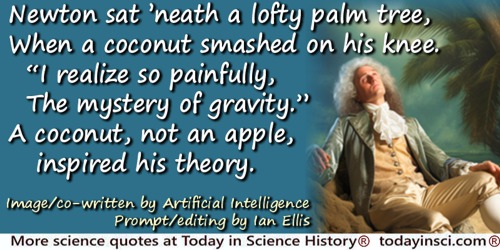
Newton lay 'neath a lofty palm tree,
When a coconut smashed on his knee.
“I realize so painfully,
The mystery of gravity.”
A coconut, not an apple, inspired his theory.
When a coconut smashed on his knee.
“I realize so painfully,
The mystery of gravity.”
A coconut, not an apple, inspired his theory.
Original idea by Webmaster, assisted by with Artificial Intelligence: ChatGPT.
Newton was not the first of the age of reason. He was the last of the magicians, the last of the Babylonians and Sumerians, the last great mind which looked out on the visible and intellectual world with the same eyes as those who began to build our intellectual inheritance rather less than 10,000 years ago. Isaac Newton, a posthumous child born with no father on Christmas Day, 1642, was the last wonder child to whom the Magi could do sincere and appropriate homage.
In 'Newton, the Man' (1946). In Geoffrey Keynes (ed.), Essays in Biography, 2nd edition (1951), 311.
Night after night, among the gabled roofs,
Climbing and creeping through a world unknown
Save to the roosting stork, he learned to find
The constellations, Cassiopeia’s throne,
The Plough still pointing to the Polar Star,
The movements of the planets, hours and hours,
And wondered at the mystery of it all.
Climbing and creeping through a world unknown
Save to the roosting stork, he learned to find
The constellations, Cassiopeia’s throne,
The Plough still pointing to the Polar Star,
The movements of the planets, hours and hours,
And wondered at the mystery of it all.
In 'Tycho Brahe', The Torch-Bearers: Watchers of the Sky (1922), Vol. 1, 40.
Now, I must tell you of a strange experience which bore fruit in my later life. … We had a cold [snap] drier that ever observed before. People walking in the snow left a luminous trail behind them and a snowball thrown against an obstacle gave a flare of light like a loaf of sugar hit with a knife. [As I stroked] Mačak’s back, [it became] a sheet of light and my hand produced a shower of sparks. … My father … remarked, this is nothing but electricity, the same thing you see on the trees in a storm. My mother seemed alarmed. Stop playing with the cat, she said, he might start a fire. I was thinking abstractly. Is nature a cat? If so, who strokes its back? It can only be God, I concluded. …
I cannot exaggerate the effect of this marvelous sight on my childish imagination. Day after day I asked myself what is electricity and found no answer. Eighty years have gone by since and I still ask the same question, unable to answer it.
I cannot exaggerate the effect of this marvelous sight on my childish imagination. Day after day I asked myself what is electricity and found no answer. Eighty years have gone by since and I still ask the same question, unable to answer it.
Letter to Miss Pola Fotitch, 'A Story of Youth Told by Age' (1939). In John Ratzlaff, editor, Tesla Said (1984), 283-84. Cited in Marc J. Seifer, Wizard: The Life and Times of Nikola Tesla (1998), 5.
On consideration and by the advice of learned men, I thought it improper to unfold the secrets of the art (alchemy) to the vulgar, as few persons are capable of using its mysteries to advantage and without detriment.
On the contrary, God was always invented to explain mystery. God is always invented to explain those things that you do not understand. Now when you finally discover how something works, you get some laws which you're taking away from God; you don't need him anymore. But you need him for the other mysteries. So therefore you leave him to create the universe because we haven't figured that out yet; you need him for understanding those things which you don't believe the laws will explain, such as consciousness, or why you only live to a certain length of time—life and death—stuff like that. God is always associated with those things that you do not understand. Therefore, I don't think that the laws can be considered to be like God because they have been figured out.
Quoted in P. C. W. Davies and Julian Brown (eds.), Superstrings: A Theory of Everything? (1988), 208-9.
One feature which will probably most impress the mathematician accustomed to the rapidity and directness secured by the generality of modern methods is the deliberation with which Archimedes approaches the solution of any one of his main problems. Yet this very characteristic, with its incidental effects, is calculated to excite the more admiration because the method suggests the tactics of some great strategist who foresees everything, eliminates everything not immediately conducive to the execution of his plan, masters every position in its order, and then suddenly (when the very elaboration of the scheme has almost obscured, in the mind of the spectator, its ultimate object) strikes the final blow. Thus we read in Archimedes proposition after proposition the bearing of which is not immediately obvious but which we find infallibly used later on; and we are led by such easy stages that the difficulties of the original problem, as presented at the outset, are scarcely appreciated. As Plutarch says: “It is not possible to find in geometry more difficult and troublesome questions, or more simple and lucid explanations.” But it is decidedly a rhetorical exaggeration when Plutarch goes on to say that we are deceived by the easiness of the successive steps into the belief that anyone could have discovered them for himself. On the contrary, the studied simplicity and the perfect finish of the treatises involve at the same time an element of mystery. Though each step depends on the preceding ones, we are left in the dark as to how they were suggested to Archimedes. There is, in fact, much truth in a remark by Wallis to the effect that he seems “as it were of set purpose to have covered up the traces of his investigation as if he had grudged posterity the secret of his method of inquiry while he wished to extort from them assent to his results.” Wallis adds with equal reason that not only Archimedes but nearly all the ancients so hid away from posterity their method of Analysis (though it is certain that they had one) that more modern mathematicians found it easier to invent a new Analysis than to seek out the old.
In The Works of Archimedes (1897), Preface, vi.
One may say “the eternal mystery of the world is its comprehensibility” … The fact that it is comprehensible is a miracle.
‘Physics and Reality’, Franklin Institute Journal (Mar 1936). Collected in Out of My Later Years (1950), 60.
Our abiding belief is that just as the workmen in the tunnel of St. Gothard, working from either end, met at last to shake hands in the very central root of the mountain, so students of nature and students of Christianity will yet join hands in the unity of reason and faith, in the heart of their deepest mysteries.
…...
People like you and I, though mortal of course like everyone else, do not grow old no matter how long we live...[We] never cease to stand like curious children before the great mystery into which we were born.
…...
Perfect as the wing of a bird may be, it will never enable the bird to fly if unsupported by the air. Facts are the air of science. Without them a man of science can never rise. Without them your theories are vain surmises. But while you are studying, observing, experimenting, do not remain content with the surface of things. Do not become a mere recorder of facts, but try to penetrate the mystery of their origin. Seek obstinately for the laws that govern them.
Translation of a note, 'Bequest of Pavlov to the Academic Youth of his Country', written a few days before his death for a student magazine, The Generation of the Victors. As published in 'Pavlov and the Spirit of Science', Nature (4 Apr 1936), 137, 572.
Perhaps the best reason for regarding mathematics as an art is not so much that it affords an outlet for creative activity as that it provides spiritual values. It puts man in touch with the highest aspirations and lofiest goals. It offers intellectual delight and the exultation of resolving the mysteries of the universe.
Mathematics: a Cultural Approach (1962), 671. Quoted in H. E. Hunter, The Divine Proportion (1970), 6.
Perhaps the problem is the seeming need that people have of making black-and-white cutoffs when it comes to certain mysterious phenomena, such as life and consciousness. People seem to want there to be an absolute threshold between the living and the nonliving, and between the thinking and the “merely mechanical,” ... But the onward march of science seems to force us ever more clearly into accepting intermediate levels of such properties.
‘Shades of Gray Along the Consciousness Continuum’, Fluid Concepts & Creative Analogies: Computer Models of the Fundamental Mechanisms of Thought (1995), 310.
Plutus himself,
That knows the tinct and multiplying med'cine,
Hath not in nature's mystery more science
Than I have in this ring.
That knows the tinct and multiplying med'cine,
Hath not in nature's mystery more science
Than I have in this ring.
All's Well that Ends Well (1603-4), V, iii.
Poets say science takes away from the beauty of the stars—mere globs of gas atoms. Nothing is “mere.” I too can see the stars on a desert night, and feel them. But do I see less or more? The vastness of the heavens stretches my imagination—stuck on this carousel my little eye can catch one-million-year-old light. A vast pattern—of which I am a part. … What is the pattern, or the meaning, or the “why?” It does not do harm to the mystery to know a little about it. For far more marvelous is the truth than any artists of the past imagined it. Why do the poets of the present not speak of it? What men are poets who can speak of Jupiter if he were a man, but if he is an immense spinning sphere of methane and ammonia must be silent?
In 'Astronomy', The Feynman Lectures on Physics (1961), Vol. 1, 3-6, footnote.
Putting together the mysteries of nature with the laws of mathematics, he dared to hope to be able to unlock the secrets of both with the same key.
Epitaph of René Descartes
Epitaph of René Descartes
— Epitaph
In Peter Pešic, Labyrinth: A Search for the Hidden Meaning of Science (2001), 73.
Science … is perpetually advancing. It is like a torch in the sombre forest of mystery. Man enlarges every day the circle of light which spreads round him, but at the same time, and in virtue of his very advance, he finds himself confronting, at an increasing number of points, the darkness of the Unknown.
In Einstein and the Universe; A Popular Exposition of the Famous Theory (1922), xvi.
Science and mathematics [are] much more compelling and exciting than the doctrines of pseudoscience, whose practitioners were condemned as early as the fifth century B.C. by the Ionian philosopher Heraclitus as “night walkers, magicians, priests of Bacchus, priestesses of the wine-vat, mystery-mongers.” But science is more intricate and subtle, reveals a much richer universe, and powerfully evokes our sense of wonder. And it has the additional and important virtue—to whatever extent the word has any meaning—of being true.
Broca's Brain: Reflections on the Romance of Science (1979, 1986), 76.
Science can point out dangers, but science cannot turn the direction of minds and hearts. That is the province of spiritual powers within and without our very beings—powers that are the mysteries of life itself.
…...
Science cannot solve the ultimate mystery of nature. And that is because, in the last analysis, we ourselves are part of nature and therefore part of the mystery that we are trying to solve. Music and art are, to an extent, also attempts to solve or at least express the mystery. But to my mind the more we progress with either the more we are brought into harmony with all nature itself. And that is one of the great services of science to the individual.
In Max Planck and James Vincent Murphy (trans.), Where is Science Going?, (1932), Epilogue, 217.
Science enhances the moral value of life, because it furthers a love of truth and reverence—love of truth displaying itself in the constant endeavor to arrive at a more exact knowledge of the world of mind and matter around us, and reverence, because every advance in knowledge brings us face to face with the mystery of our own being.
In Max Planck and James Vincent Murphy (trans.), Where is Science Going?, (1932), 169.
Science has penetrated the constitution of nature, and unrolled the mysterious pages of its history, and started again many, as yet, unanswered questions in respect to the mutual relations of matter and spirit, of nature and of God.
Fifteen Years in the Chapel of Yale College (1887), 241.
Science has thus, most unexpectedly, placed in our hands a new power of great but unknown energy. It does not wake the winds from their caverns; nor give wings to water by the urgency of heat; nor drive to exhaustion the muscular power of animals; nor operate by complicated mechanism; nor summon any other form of gravitating force, but, by the simplest means—the mere contact of metallic surfaces of small extent, with feeble chemical agents, a power everywhere diffused through nature, but generally concealed from our senses, is mysteriously evolved, and by circulation in insulated wires, it is still more mysteriously augmented, a thousand and a thousand fold, until it breaks forth with incredible energy.
Comment upon 'The Notice of the Electro-Magnetic Machine of Mr. Thomas Davenport, of Brandon, near Rutland, Vermont, U.S.', The Annals of Electricity, Magnetism, & Chemistry; and Guardian of Experimental Science (1838), 2, 263.
Science is Christian, not when it condemns itself to the letter of things, but when, in the infinitely little, it discovers as many mysteries and as much depth and power as in the infinitely great.
In Fourth Lecture, 'The Roman Church and Science: Galileo', (7 May 1844). Collected in Edgar Quinet and C. Cocks (trans.), Ultramontanism: Or, The Roman Church and Modern Society (1845), 73.
Science recognizes no personal powers in the universe responsive to the prayers and needs of men. Belief in mysterious powers which constitutes, according to our definition, the conceptual aspect of religion is usually an animistic belief in personal powers. Science in effect denies the existence of spiritual beings which religion affirms.
Religion in Human Affairs (1929), 470.
Science, while it penetrates deeply the system of things about us, sees everywhere, in the dim limits of vision, the word mystery.
In Corals and Coral Islands (1879), 17-18.
Science’s biggest mystery is the nature of consciousness. It is not that we possess bad or imperfect theories of human awareness; we simply have no such theories at all.
In Quantum Reality: Beyond the New Physics (1987), 249.
Scientifically considered, nature is that which we have divested of mystery, stripped of autonomy, and subjected to our ends. It is that over which we have gained knowledge and manipulative power. This is the meaning concealed in the platitudinous expression that science “conquers nature” and pushes back the boundaries of ignorance and superstition.
In Legitimacy in the Modern State (1981), 176.
See skulking Truth to her old cavern fled,
Mountains of Casuistry heap’d o’er her head!
Philosophy, that lean’d on Heav’n before,
Shrinks to her second cause, and is no more.
Physic of Metaphysic begs defence,
And Metaphysic calls for aid on Sense!
See Mystery to Mathematics fly!
Mountains of Casuistry heap’d o’er her head!
Philosophy, that lean’d on Heav’n before,
Shrinks to her second cause, and is no more.
Physic of Metaphysic begs defence,
And Metaphysic calls for aid on Sense!
See Mystery to Mathematics fly!
In The Dunciad, collected in The Poetical Works of Alexander Pope (1828), Vol. 3, 211.
So I travelled, stopping ever and again, in great strides of a thousand years or more, drawn on by the mystery of the earth’s fate, watching with a strange fascination the sun grow larger and duller in the westward sky, and the life of the old earth ebbing out.
In The Time Machine (1898), 160.
So requisite is the use of Astrology to the Arts of Divination, as it were the Key that opens the door of all their Mysteries.
In The Vanity of Arts and Sciences (1676), 109.
So why fret and care that the actual version of the destined deed was done by an upper class English gentleman who had circumnavigated the globe as a vigorous youth, lost his dearest daughter and his waning faith at the same time, wrote the greatest treatise ever composed on the taxonomy of barnacles, and eventually grew a white beard, lived as a country squire just south of London, and never again traveled far enough even to cross the English Channel? We care for the same reason that we love okapis, delight in the fossil evidence of trilobites, and mourn the passage of the dodo. We care because the broad events that had to happen, happened to happen in a certain particular way. And something unspeakably holy –I don’t know how else to say this–underlies our discovery and confirmation of the actual details that made our world and also, in realms of contingency, assured the minutiae of its construction in the manner we know, and not in any one of a trillion other ways, nearly all of which would not have included the evolution of a scribe to record the beauty, the cruelty, the fascination, and the mystery.
…...
Speculative genius should from time to time arise, inflamed by the love of truth alone. Such a one, we may be sure, would dive into the deepest mysteries of nature, whatever be the spirit of his country or his age.
In Alexis de Tocqueville and Henry Reeve (trans.), Democracy in America (1840, 1899), Vol. 2, 47.
Suddenly, from behind the rim of the moon, in long, slow-motion moments of immense majesty, there emerges a sparkling blue and white jewel, a light, delicate sky-blue sphere laced with slowly swirling veils of white, rising gradually like a small pearl in a thick sea of black mystery. It takes more than a moment to fully realize this is Earth . . . home.
…...
That brain of mine is something more than merely mortal; as time will show; (if only my breathing & some other etceteras do not make too rapid a progress towards instead of from mortality).
Before ten years are over, the Devil’s in it if I haven’t sucked out some of the life-blood from the mysteries of this universe, in a way that no purely mortal lips or brains could do.
Before ten years are over, the Devil’s in it if I haven’t sucked out some of the life-blood from the mysteries of this universe, in a way that no purely mortal lips or brains could do.
In letter to Charles Babbage (5 Jul 1843). British Library Additional Manuscripts, MSS 37192, folio 349. As quoted and cited in Dorothy Stein (ed.), 'This First Child of Mine', Ada: A Life and a Legacy (1985), 110.
The advance of scientific knowledge does not seem to make either our universe or our inner life in it any less mysterious.
The Sciences and Philosophy: Gifford Lectures, University of Glasgow, 1927 & 1925 (1929), 165.
The advances of biology during the past 20 years have been breathtaking, particularly in cracking the mystery of heredity. Nevertheless, the greatest and most difficult problems still lie ahead. The discoveries of the 1970‘s about the chemical roots of memory in nerve cells or the basis of learning, about the complex behavior of man and animals, the nature of growth, development, disease and aging will be at least as fundamental and spectacular as those of the recent past.
As quoted in 'H. Bentley Glass', New York Times (12 Jan 1970), 96.
The contemplation of the eternal is the end of philosophy, as the contemplation of the mysteries is the end of religion.
— Plutarch
As quoted in Benjamin Farrington, Greek Science: Its Meaning for Us (Thales to Aristotle) (1944), 39.
The discovery of an interaction among the four hemes made it obvious that they must be touching, but in science what is obvious is not necessarily true. When the structure of hemoglobin was finally solved, the hemes were found to lie in isolated pockets on the surface of the subunits. Without contact between them how could one of them sense whether the others had combined with oxygen? And how could as heterogeneous a collection of chemical agents as protons, chloride ions, carbon dioxide, and diphosphoglycerate influence the oxygen equilibrium curve in a similar way? It did not seem plausible that any of them could bind directly to the hemes or that all of them could bind at any other common site, although there again it turned out we were wrong. To add to the mystery, none of these agents affected the oxygen equilibrium of myoglobin or of isolated subunits of hemoglobin. We now know that all the cooperative effects disappear if the hemoglobin molecule is merely split in half, but this vital clue was missed. Like Agatha Christie, Nature kept it to the last to make the story more exciting. There are two ways out of an impasse in science: to experiment or to think. By temperament, perhaps, I experimented, whereas Jacques Monod thought.
From essay 'The Second Secret of Life', collected in I Wish I'd Made You Angry Earlier (1998), 263-5.
The equation eπi = -1 has been called the eutectic point of mathematics, for no matter how you boil down and explain this equation, which relates four of the most remarkable numbers of mathematics, it still has a certain mystery about it that cannot be explained away.
The existence of a first cause of the universe is a necessity of thought ... Amid the mysteries which become more mysterious the more they are thought about, there will remain the one absolute certainty that we are over in the presence of an Infinite, Eternal Energy from which all things proceed.
As quoted in John Murdoch, India's Needs: Material, Political, Social, Moral, and Religious (1886), 126.
The fact that, with respect to size, the viruses overlapped with the organisms of the biologist at one extreme and with the molecules of the chemist at the other extreme only served to heighten the mystery regarding the nature of viruses. Then too, it became obvious that a sharp line dividing living from non-living things could not be drawn and this fact served to add fuel for discussion of the age-old question of “What is life?”
Nobel Lecture (12 Dec 1946), 'The Isolation and Properties of Crystalline Tobacco Mosaic Virus', collected in Nobel Lectures in Chemistry (1999), 140.
The fairest thing we can experience is the mysterious. It is the fundamental emotion which stands at the cradle of true art and true science. He who knows it not and can no longer wonder, no longer feel amazement, is as good as dead, a snuffed-out candle. It was the experience of mystery–even if mixed with fear–that engendered religion. A knowledge of the existence of something we cannot penetrate, of the manifestations of the profoundest reason and the most radiant beauty, which are only accessible to our reason in their most elementary forms–it is this knowledge and this emotion that constitute the truly religious attitude; in this sense, and in this alone, I am a deeply religious man.
From 'What I Believe: Living Philosophies XIII', Forum and Century (Oct 1930), 84, No. 4, 193-194. Alan Harris (trans.), The World as I See It (1956, 1993), 5.
The greatest marvel is not in the individual. It is in the succession, in the renewal and in the duration of the species that Nature would seem quite inconceivable. This power of producing its likeness that resides in animals and plants, this form of unity, always subsisting and appearing eternal, this procreative virtue which is perpetually expressed without ever being destroyed, is for us a mystery which, it seems, we will never be able to fathom.
'Histoire des Animaux', Histoire Naturelle, Générale et Particulière, avec la Description du Cabinet du Roi (1749), Vol. 2, 3. Trans. Phillip R. Sloan.
The greatest mystery is why there is something instead of nothing, and the greatest something is this thing we call life.
In Through a Window by Alan Lightman and Roberta Brawer (1990).
The greatest scientists have always looked on scientific materialism as a kind of religion, as a mythology. They are impelled by a great desire to explore mystery, to celebrate mystery in the universe, to open it up, to read the stars, to find the deeper meaning.
In Pamela Weintraub (ed.), 'E. O. Wilson', The Omni Interviews (1984), 231.
The green pre-human earth is the mystery we were chosen to solve, a guide to the birthplace of our spirit.
In Diversity of Life (1992).
The important thing is not to stop questioning. Curiosity has its own reason for existing. One cannot help but be in awe when he contemplates the mysteries of eternity, of life, of the marvelous structure of reality.
Recollection of a statement to William Miller, an editor, as quoted in, 'Old Man’s Advice to Youth: “Never Lose a Holy Curiosity”', Life (2 May 1955), 64.
The job of the artist is always to deepen the mystery
John Mitchinson and John Lloyd, If Ignorance Is Bliss, Why Aren't There More Happy People?: Smart Quotes for Dumb Times (2009), 217.
The mental process by which hypotheses are suggested is obscure. Ordinarily they flash into consciousness without premonition, and it would he easy to ascribe them to a mysterious intuition or creative faculty; but this would contravene one of the broadest generalizations of modern psychology. Just as in the domain of matter nothing is created from nothing, just as in the domain of life there is no spontaneous generation, so in the domain of mind there are no ideas which do not owe their existence to antecedent ideas which stand in the relation of parent to child.
In Address (11 Dec 1895) as President of the Geological Society, 'The Origin of Hypotheses, illustrated by the Discussion of a Topographical Problem', printed as Presidential Address of Grove Karl Gilbert (1896), 4. Also collected in Science (1896), 3, 2.
The mind of man may be compared to a musical instrument with a certain range of notes, beyond which in both directions we have an infinitude of silence. The phenomena of matter and force lie within our intellectual range, and as far as they reach we will at all hazards push our inquiries. But behind, and above, and around all, the real mystery of this universe [Who made it all?] lies unsolved, and, as far as we are concerned, is incapable of solution.
In 'Matter and Force', Fragments of Science for Unscientific People (1871), 93.
The more we know about this universe, the more mysterious it is. The old world that Job knew was marvelous enough, and his description of its wonders is among the noblest poetry of the race, but today the new science has opened to our eyes vistas of mystery that transcend in their inexplicable marvel anything the ancients ever dreamed.
In 'What Keeps Religion Going?', collected in Living Under Tension: Sermons On Christianity Today (1941), 53.
The more we learn of science, the more we see that its wonderful mysteries are all explained by a few simple laws so connected together and so dependent upon each other, that we see the same mind animating them all.
Sermon (c. 13 Jan. 1895), Mukwonago, Wisconsin, published in Olympia Brown and Gwendolen B. Willis (ed.), Olympia Brown, An Autobiography (1960). Reprinted in Annual Journal of the Universalist Historical Society (1963), vol. 4, 103.
The most beautiful and profound experience for a person is the feeling of the mysterious. It underlies religion and all deeper endeavors in art and science. Anyone who has not experienced this appears to me, if not like a dead man, at least like a blind man. To feel that behind the perceptible is hidden something that is incomprehensible, whose beauty and grandeur only reach us indirectly and in a dim reflection—that is religiousness. In that sense I am religious. It is enough for me to sense these secrets with wonder and to try to humbly grasp a faint image of the majestic structure of all things.
From His 'Credo' on a manuscript in German (Aug 1932) which he read for a sound recording (c. end Sep/early Oct 1932) for limited distribution on a 20 cm, 75 rpm shellac disk, by order and to benefit of the German League of Human Rights. Manuscript held by the Albert Einstein Archives, Hebrew University of Jerusalem, Israel. Original text, in German, “Das Schönste und Tiefste, was der Mensch erleben kann, ist das Gefühl des Geheimnisvollen. Es liegt der Religion sowie allem tieferen Streben in Kunst und Wissenschaft zugrunde. Wer dies nicht erlebt hat, erscheint mir, wenn nicht wie ein Toter, so doch wie ein Blinder. Zu empfinden, dass hinter dem Erlebbaren ein für unseren Geist Unerreichbares verborgen sei, dessen Schönheit und Erhabenheit uns nur mittelbar und in schwachem Widerschein erreicht, das ist Religiosität. In diesem Sinne bin ich religiös. Es ist mir genug, diese Geheimnisse staunend zu ahnen und zu versuchen, von der erhabenen Struktur des Seienden in Demut ein mattes Abbild geistig zu erfassen.” Translated to English using Google Translate and other online tools—and tweaked by Webmaster.
The most beautiful thing we can experience is the mysterious. It is the source of all true art and science. He to whom this emotion is a stranger, who can no longer pause to wonder and stand rapt in awe, is as good as dead: his eyes are closed.
'The World As I See It', Forum and Century Oct 1930), 84, 193-194. Albert Einstein and Carl Seelig. Ideas and Opinions, based on Mein Weltbild (1954), 11.
The most important and lasting truths are the most obvious ones. Nature cheats us with her mysteries, one after another, like a juggler with his tricks; but shews us her plain honest face, without our paying for it.
Characteristics: In the Manner of Rochefoucault's Maxims (1837), 149.
The most wonderful mystery of life may well be the means by which it created so much diversity from so little physical matter. The biosphere, all organisms combined, makes up only about one part in ten billion of the earth’s mass. … Yet life has divided into millions of species, the fundamental units, each playing a unique role in relation to the whole.
In 'The Most Fundamental Unit', The Diversity of Life (1992), 35.
The mystery of creation is not within the range of [Nature’s] legitimate territory; [Nature] says nothing, but she points upwards.
In History of the Inductive Sciences (1837), Vol. 3, 588.
The mystery of life is certainly the most persistent problem ever placed before the thought of man. There is no doubt that from the time humanity began to think it has occupied itself with the problem of its origin and its future which undoubtedly is the problem of life. The inability of science to solve it is absolute. This would be truly frightening were it not for faith.
Address (10 Sep 1934) to the International Congress of Electro-Radio Biology, Venice. In Associated Press, 'Life a Closed Book, Declares Marconi', New York Times (11 Sep 1934), 15.
The natural history of these islands is eminently curious, and well deserves attention. Most of the organic productions are aboriginal creations, found nowhere else; there is even a difference between the inhabitants of the different islands; yet all show a marked relationship with those of America, though separated from that continent by an open space of ocean, between 500 and 600 miles in width. The archipelago is a little world within itself, or rather a satellite attached to America, whence it has derived a few stray colonists, and has received the general character of its indigenous productions. Considering the small size of these islands, we feel the more astonished at the number of their aboriginal beings, and at their confined range. Seeing every height crowned with its crater, and the boundaries of most of the lava-streams still distinct, we are led to believe that within a period, geologically recent, the unbroken ocean was here spread out. Hence, both in space and time, we seem to be brought somewhere near to that great fact—that mystery of mysteries—the first appearance of new beings on this earth.
Journal of Researches into the Natural History and Geology of the Countries Visited During the Voyage of H.M.S. Beagle Round the World, 2nd edn. (1845), 377-8.
The nature of the connexion between the mind and nervous matter has ever been, and must continue to be, the deepest mystery in physiology; and they who study the laws of Nature, as ordinances of God, will regard it as one of those secrets of his counsels ‘which Angels desire to look into.’
[Co-author with William Bowman]
[Co-author with William Bowman]
In Robert Todd and William Bowman, The Physiological Anatomy and Physiology of Man (1845), Vol. 1, 262. Bowman was a British surgeon (1816-1892).
The origin of volcanic energy is one of the blankest mysteries of science, and it is strange indeed, that a class of phenomena so long familiar to the human race and so zealously studied through all the ages should be so utterly without explanation. (1880)
In Report on the Geology of the High Plateaus of Utah (1880), 113.
The philosophical implication of race-thinking is that by offering us the mystery of heredity as an explanation, it diverts our attention from the social and intellectual factors that make up personality.
Race(1937), 282.
The phosphorous smell which is developed when electricity (to speak the profane language) is passing from the points of a conductor into air, or when lightning happens to fall upon some terrestrial object, or when water is electrolysed, has been engaging my attention the last couple of years, and induced me to make many attempts at clearing up that mysterious phenomenon. Though baffled for a long time, at last, I think, I have succeeded so far as to have got the clue which will lead to the discovery of the true cause of the smell in question.
[His first reference to investigating ozone, for which he is remembered.]
[His first reference to investigating ozone, for which he is remembered.]
Letter to Michael Faraday (4 Apr 1840), The Letters of Faraday and Schoenbein, 1836-1862 (1899), 73. This letter was communicated to the Royal Society on 7 May, and an abstract published in the Philosophical Magazine.
The physiological combustion theory takes as its starting point the fundamental principle that the amount of heat that arises from the combustion of a given substance is an invariable quantity–i.e., one independent of the circumstances accompanying the combustion–from which it is more specifically concluded that the chemical effect of the combustible materials undergoes no quantitative change even as a result of the vital process, or that the living organism, with all its mysteries and marvels, is not capable of generating heat out of nothing.
Bemerkungen über das mechanische Aequivalent der Wärme [Remarks on the Mechanical Equivalent of Heat] (1851), 17-9. Trans. Kenneth L. Caneva, Robert Mayer and the Conservation of Energy (1993), 240.
The reproduction of mankind is a great marvel and mystery. Had God consulted me in the matter, I should have advised him to continue the generation of the species by fashioning them of clay.
Martin Luther and William Hazlitt (trans.), Alexander Chalmers, The Table Talk of Martin Luther (1872), 307.
The sea never changes and its works, for all the talks of men, are wrapped in mystery.
In Typhoon, and Other Stories (1902, 1923), 46. Writing started in 1899, and first published serialized in Pall Mall Magazine (Jan–Mar 1902).
The seer of the past was the man of mysteries. The veil within which none but the high-priest must enter, … whose traditions are the cement in which the stones of all these temples rising around us are laid. The seer of to-day is the man of explorations and explanations. Moses is
busy with his microscope, and Daniel prophesies from the meteorological headquarters at Washington.
From 'Professor Jeffries Wyman: A Memorial Outline', The Atlantic Monthly (Nov 1874), 622.
The universe may be a mystery but it’s no secret.
On back cover of A Beginner’s Guide to Constructing the Universe (1994).
The vast spread
Of darkness
That speaks of mystery
The darkness that reveals
The beauty that lies beneath
In the form of glittering
Stars, a countless beauty
That seemed to conceal
A million stories
That can make the mankind
Take a new look at life
And the majestic moon
That silently looks at mankind
Wondering how its serenity
Was disturbed by the little steps
Of a man from the beautiful earth
Yet softly smiling back
And let the world sleep
In its magical glow
A glow that soothes
The world’s senses
And forget the pain of reality
Of darkness
That speaks of mystery
The darkness that reveals
The beauty that lies beneath
In the form of glittering
Stars, a countless beauty
That seemed to conceal
A million stories
That can make the mankind
Take a new look at life
And the majestic moon
That silently looks at mankind
Wondering how its serenity
Was disturbed by the little steps
Of a man from the beautiful earth
Yet softly smiling back
And let the world sleep
In its magical glow
A glow that soothes
The world’s senses
And forget the pain of reality
…...
The world is the geologist’s great puzzle-box; he stands before it like the child to whom the separate pieces of his puzzle remain a mystery till he detects their relation and sees where they fit, and then his fragments grow at once into a connected picture beneath his hand.
Geological Sketches (1866), II.
There are all kinds of interesting questions that come from a knowledge of science, which only adds to the excitement and mystery and awe of a flower.
From interview by BBC TV in episode 'The Pleasure of Finding Things Out', Horizon (1981). Collected in Richard P. Feynman, 'The Making of a Scientist', What Do You Care What Other People Think?": Further Adventures of a Curious Character (2001), 11.
There are no words that can tell the hidden spirit of the wilderness, that can reveal its mystery, its melancholy, and its charm.
African Game Trails (1910), ix. This is one of the quotations inscribed in the Roosevelt Memorial rotunda at the American Museum of Natural History.
There is at least as much mystery in science for the modern man as there ever was in religion; in a sense there is more mystery, for the logic of science is still altogether beyond his understanding, whereas the logic of revelation is the logic of his own feelings.
In A Preface to Morals (1929, 1982), 121.
There is nothing more mysterious than a TV set left on in an empty room. It is even stranger than a man talking to himself or a woman standing dreaming at her stove. It is as if another planet is communicating with you.
In Jean Baudrillard and Chris Turner (trans.), America (1989), 50.
There is something haunting in the light of the moon; it has all the dispassionateness of a disembodied soul, and something of its inconceivable mystery.
In Lord Jim (1900), 230.
There should be no mystery in our use of the word science; it means knowledge, not theory nor speculation nor hypothesis, but hard facts, and the framework of laws to which they belong.
In 'The Meteorological Work of the U.S. Signal Service, 1870 to 1891', U.S. Department of Agriculture, Weather Bureau, Bulletin No. 11, Report of the International Meteorological Congress, Chicago, Ill., August 21-24, 1893 (1894), 242.
This is in a real sense the capstone of the initial missions to explore the planets. Pluto, its moons and this part of the solar system are such mysteries that New Horizons will rewrite all of the textbooks.
…...
This leads us to ask for the reasons which call for this new theory of transmutation. The beginning of things must needs lie in obscurity, beyond the bounds of proof, though within those of conjecture or of analogical inference. Why not hold fast to the customary view, that all species were directly, instead of indirectly, created after their respective kinds, as we now behold them,--and that in a manner which, passing our comprehension, we intuitively refer to the supernatural? Why this continual striving after “the unattained and dim,”—these anxious endeavors, especially of late years, by naturalists and philosophers of various schools and different tendencies, to penetrate what one of them calls “the mystery of mysteries,” the origin of species? To this, in general, sufficient answer may be found in the activity of the human intellect, “the delirious yet divine desire to know,” stimulated as it has been by its own success in unveiling the laws and processes of inorganic Nature,—in the fact that the principal triumphs of our age in physical science have consisted in tracing connections where none were known before, in reducing heterogeneous phenomena to a common cause or origin, in a manner quite analogous to that of the reduction of supposed independently originated species to a common ultimate origin,—thus, and in various other ways, largely and legitimately extending the domain of secondary causes. Surely the scientific mind of an age which contemplates the solar system as evolved from a common, revolving, fluid mass,— which, through experimental research, has come to regard light, heat, electricity, magnetism, chemical affinity, and mechanical power as varieties or derivative and convertible forms of one force, instead of independent species,—which has brought the so-called elementary kinds of matter, such as the metals, into kindred groups, and raised the question, whether the members of each group may not be mere varieties of one species,—and which speculates steadily in the direction of the ultimate unity of matter, of a sort of prototype or simple element which may be to the ordinary species of matter what the protozoa or component cells of an organism are to the higher sorts of animals and plants,—the mind of such an age cannot be expected to let the old belief about species pass unquestioned.
— Asa Gray
'Darwin on the Origin of Species', The Atlantic Monthly (Jul 1860), 112-3. Also in 'Natural Selection Not Inconsistent With Natural Theology', Darwiniana: Essays and Reviews Pertaining to Darwinism (1876), 94-95.
Those afraid of the universe as it really is, those who pretend to nonexistent knowledge and envision a Cosmos centered on human beings will prefer the fleeting comforts of superstition. They avoid rather than confront the world. But those with the courage to explore the weave and structure of the Cosmos, even where it differs profoundly from their wishes and prejudices, will penetrate its deepest mysteries.
Cosmos (1985), 275.
Those who dwell as scientists … among the beauties and mysteries of the earth are never alone or weary of life. Those who contemplate the beauty of the earth find reserves of strength that will endure as long as life lasts.
In The Sense of Wonder (1956, 1965), 88-89.
Though much new light is shed by ... studies in radioactivity, the nucleus of the atom, with its hoard of energy, thus continues to present us with a fascinating mystery. ... Our assault on atoms has broken down the outer fortifications. We feel that we know the fundamental rules according to which the outer part of the atom is built. The appearance and properties of the electron atmosphere are rather familiar. Yet that inner citadel, the atomic nucleus, remains unconquered, and we have reason to believe that within this citadel is secreted a great treasure. Its capture may form the main objective of the physicists’ next great drive.
'Assault on Atoms' (Read 23 Apr 1931 at Symposium—The Changing World) Proceedings of the American Philosophical Society (1931), 70, No. 3, 229.
Through the discovery of Buchner, Biology was relieved of another fragment of mysticism. The splitting up of sugar into CO2 and alcohol is no more the effect of a 'vital principle' than the splitting up of cane sugar by invertase. The history of this problem is instructive, as it warns us against considering problems as beyond our reach because they have not yet found their solution.
The Dynamics of Living Matter (1906), 22.
To most ... of us, Russia was as mysterious and remote as the other side of the moon and not much more productive when it came to really new ideas or inventions. A common joke of the time [mid 1940s] said that the Russians could not surreptitiously introduce nuclear bombs in suitcases into the United States because they had not yet been able to perfect a suitcase.
In Richard Rhodes, The Making of the Atomic Bomb (1986), 760.
Undoubtedly, the capstone of every mathematical theory is a convincing proof of all of its assertions. Undoubtedly, mathematics inculpates itself when it foregoes convincing proofs. But the mystery of brilliant productivity will always be the posing of new questions, the anticipation of new theorems that make accessible valuable results and connections. Without the creation of new viewpoints, without the statement of new aims, mathematics would soon exhaust itself in the rigor of its logical proofs and begin to stagnate as its substance vanishes. Thus, in a sense, mathematics has been most advanced by those who distinguished themselves by intuition rather than by rigorous proofs.
As quoted in Hermann Weyl, Unterrichtsblätter für Mathematik und Naturwissenschaften (1932), 38, 177-188. As translated by Abe Shenitzer, in 'Part I. Topology and Abstract Algebra as Two Roads of Mathematical Comprehension', The American Mathematical Monthly (May 1995), 102, No. 7, 453.
We all use math every day; to predict weather, to tell time, to handle money. Math is more than formulas or equations; it’s logic, it’s rationality, it’s using your mind to solve the biggest mysteries we know.
— NUM3ERS
Voice-over for each episode opening title of the TV show, “NUM3ERS” (2005-2010).
We do not know how the scientists of the next century will define energy or in what strange jargon they will discuss it. But no matter what language the physicists use they will not come into contradiction with Blake. Energy will remain in some sense the lord and giver of life, a reality transcending our mathematical descriptions. Its nature lies at the heart of the mystery of our existence as animate beings in an inanimate universe.
In 'Energy in the Universe,' Scientific American, September 1971 [See William Blake].
We don't know what we are talking about. Many of us believed that string theory was a very dramatic break with our previous notions of quantum theory. But now we learn that string theory, well, is not that much of a break. The state of physics today is like it was when we were mystified by radioactivity. They were missing something absolutely fundamental. We are missing perhaps something as profound as they were back then.
Closing address to the 23rd Solvay Conference in Physics, Brussels, Belgium (Dec 2005). Quoted in Ashok Sengupta, Chaos, Nonlinearity, Complexity: The Dynamical Paradigm of Nature (2006), vii. Cite in Alfred B. Bortz, Physics: Decade by Decade (2007), 206.
We have learned that there is an endocrinology of elation and despair, a chemistry of mystical insight, and, in relation to the autonomic nervous system, a meteorology and even... an astro-physics of changing moods.
Literature and Science (1963), 90.
We have little more personal stake in cosmic destiny than do sunflowers or butterflies. The transfiguration of the universe lies some 50 to 100 billion years in the future; snap your fingers twice and you will have consumed a greater fraction of your life than all human history is to such a span. ... We owe our lives to universal processes ... and as invited guests we might do better to learn about them than to complain about them. If the prospect of a dying universe causes us anguish, it does so only because we can forecast it, and we have as yet not the slightest idea why such forecasts are possible for us. ... Why should nature, whether hostile or benign, be in any way intelligible to us? All the mysteries of science are but palace guards to that mystery.
…...
We have many men of science; too few men of God. We have grasped the mystery of the atom and rejected the Sermon on the Mount.
Speech (10 Nov 1948) preceding Armistice Day, Collected Writings (1967), Vol. 1. Quoted in Bulletin of the Atomic Scientists (Apr 1952), 8, No. 4, 114.
We must draw our standards from the natural world. … We must honor with the humility of the wise the bounds of that natural world and the mystery which lies beyond them, admitting that there is something in the order of being which evidently exceeds all our competence.
In speech 'Politics and Conscience' written upon receiving an honorary degree from the University of Toulouse, delivered by Tom Stoppard because Havel was forbidden to travel abroad. First published in Czech, collected in The Natural World as Political Problem: Essays on Modern Man (1984). As translated by Erazim Kohák and Roger Scruton in Salisbury Review (Jan 1985), No. 2.
What is a scientist?… We give the name scientist to the type of man who has felt experiment to be a means guiding him to search out the deep truth of life, to lift a veil from its fascinating secrets, and who, in this pursuit, has felt arising within him a love for the mysteries of nature, so passionate as to annihilate the thought of himself.
The Montessori Method, trans. Anne E. George,(1964), 8.
What is there about fire that's so lovely? ... It's perpetual motion; the thing man wanted to invent but never did. Or almost perpetual motion. ... What is fire? It's a mystery. Scientists give us gobbledegook about friction and molecules. But they don't really know.
[Fahrenheit 451 refers to the temperature at which book paper burns. In the short novel of this title 'firemen' burn books forbidden by the totalitaran regime.]
[Fahrenheit 451 refers to the temperature at which book paper burns. In the short novel of this title 'firemen' burn books forbidden by the totalitaran regime.]
Fahrenheit 451 (1953, 1996), 115.
When I was young, I said to God, “God, tell me the mystery of the universe.” But God answered, “That knowledge is for me alone”. So I said, “God, tell me the mystery of the peanut.” Then God said, “Well, George, that’s more nearly your size.” And he told me.
In Walter B. Knight, Knight’s Treasury of Illustrations (1956), 368, citing The Gospel Banner.
When we are young, we think that science has to do with facts, with finding answers and solutions, and that it proceeds like an arrow from the primitive to the sophisticated, from mystery to light. But as we get older, we find that, while science does have to do with facts and laws, it has equally to do with wisdom.
In Introduction to Isaac Asimov and Jason A. Shulman (eds.), Isaac Asimov’s Book of Science and Nature Quotations (1988), xix.
While Newton seemed to draw off the veil from some of the mysteries of nature, he showed at the same time the imperfections of the mechanical philosophy; and thereby restored her ultimate secrets to that obscurity, in which they ever did and ever will remain.
The History Of Great Britain, Containing the Commonwealth and the Reigns of Charles II. and James II. (2nd ed. 1759), Vol. 2, 450.
While there is still much to learn and discover through space exploration, we also need to pay attention to our unexplored world here on earth. Our next big leap into the unknown can be every bit as exciting and bold as our pioneering work in space. It possesses the same “wow” factor: alien worlds, dazzling technological feats and the mystery of the unknown.
In 'Why Exploring the Ocean is Mankind’s Next Giant Leap', contributed to CNN 'Lightyears Blog' (13 Mar 2012)
Why grass is green, or why our blood is red
Are mysteries which none have reach’d unto.
Are mysteries which none have reach’d unto.
Why then does science work? The answer is that nobody knows. It is a complete mystery—perhaps the complete mystery&mdashwhy the human mind should be able to understand anything at all about the wider universe. ... Perhaps it is because our brains evolved through the working of natural law that they somehow resonate with natural law. ... But the mystery, really, is not that we are at one with the universe, but that we are so to some degree at odds with it, different from it, and yet can understand something about it. Why is this so?
Coming of Age in the Milky Way (1988), 385. In Vinoth Ramachandra, Subverting Global Myths: Theology and the Public Issues Shaping our World (2008), 185.
Why, then, are we surprised that comets, such a rare spectacle in the universe, are not known, when their return is at vast intervals?. … The time will come when diligent research over long periods will bring to light things which now lie hidden. A single lifetime, even though entirely devoted to the sky, would not be enough for the investigation of so vast a subject … And so this knowledge will be unfolded only through long successive ages. There will come a time when our descendants will be amazed that we did not know things that are so plain to them …. Many discoveries are reserved for ages still to come, when memory of us will have been effaced. Our universe is a sorry little affair unless it has in it something for every age to investigate … Nature does not reveal her mysteries once and for all. Someday there will be a man who will show in what regions comets have their orbit, why they travel so remote from other celestial bodies, how large they are and what sort they are.
Natural Questions, Book 7. As translated by Thomas H. Corcoran in Seneca in Ten Volumes: Naturales Quaestiones II (1972), 279 and 293.
Wisdom and deep intelligence require an honest appreciation of mystery.
The Re-enchantment of Everyday Life (1997), Introduction, x.
You may tear apart the baby’s rattle and see what makes the noise inside, but there is a veil covering the unseen world which not the strongest man, nor even the united strength of all the strongest men that ever lived, could tear apart.
'Is There a Santa Claus,' editorial in the New York City newspaper, The Sun (21 Sep 1897), 6.
 In science it often happens that scientists say, 'You know that's a really good argument; my position is mistaken,' and then they would actually change their minds and you never hear that old view from them again. They really do it. It doesn't happen as often as it should, because scientists are human and change is sometimes painful. But it happens every day. I cannot recall the last time something like that happened in politics or religion.
(1987) --
In science it often happens that scientists say, 'You know that's a really good argument; my position is mistaken,' and then they would actually change their minds and you never hear that old view from them again. They really do it. It doesn't happen as often as it should, because scientists are human and change is sometimes painful. But it happens every day. I cannot recall the last time something like that happened in politics or religion.
(1987) --