Music Quotes (134 quotes)
…the simplicity, the indispensableness of each word, each letter, each little dash, that among all artists raises the mathematician nearest to the World-creator; it establishes a sublimity which is equalled in no other art,—Something like it exists at most in symphonic music.
As quoted in Robert E. Moritz, 'Meaning, Methods and Mission of Modern Mathematics', The Scientific Monthly (May 1928), 26, No. 5, 424.
[In an inventor’s life] Everything is stacked against you, but for some reason some silly chaps seem to be driven to it (rather like a painter of a composer of music), which is perhaps just as well or we should still be living in the Stone Age.
As quoted in Michael T. Kaufman, 'Christopher Cockerell, 88, Inventor, Dies; Father of Hovercraft and Marconi Devices', New York Times (4 Jun 1999), 19.
[L]et us not overlook the further great fact, that not only does science underlie sculpture, painting, music, poetry, but that science is itself poetic. The current opinion that science and poetry are opposed is a delusion. … On the contrary science opens up realms of poetry where to the unscientific all is a blank. Those engaged in scientific researches constantly show us that they realize not less vividly, but more vividly, than others, the poetry of their subjects. Whoever will dip into Hugh Miller’s works on geology, or read Mr. Lewes's “Seaside Studies,” will perceive that science excites poetry rather than extinguishes it. And whoever will contemplate the life of Goethe will see that the poet and the man of science can co-exist in equal activity. Is it not, indeed, an absurd and almost a sacrilegious belief that the more a man studies Nature the less he reveres it? Think you that a drop of water, which to the vulgar eye is but a drop of water, loses anything in the eye of the physicist who knows that its elements are held together by a force which, if suddenly liberated, would produce a flash of lightning? Think you that what is carelessly looked upon by the uninitiated as a mere snow-flake, does not suggest higher associations to one who has seen through a microscope the wondrously varied and elegant forms of snow-crystals? Think you that the rounded rock marked with parallel scratches calls up as much poetry in an ignorant mind as in the mind of a geologist, who knows that over this rock a glacier slid a million years ago? The truth is, that those who have never entered upon scientific pursuits know not a tithe of the poetry by which they are surrounded. Whoever has not in youth collected plants and insects, knows not half the halo of interest which lanes and hedge-rows can assume. Whoever has not sought for fossils, has little idea of the poetical associations that surround the places where imbedded treasures were found. Whoever at the seaside has not had a microscope and aquarium, has yet to learn what the highest pleasures of the seaside are. Sad, indeed, is it to see how men occupy themselves with trivialities, and are indifferent to the grandest phenomena—care not to understand the architecture of the Heavens, but are deeply interested in some contemptible controversy about the intrigues of Mary Queen of Scots!—are learnedly critical over a Greek ode, and pass by without a glance that grand epic written by the finger of God upon the strata of the Earth!
In Education: Intellectual, Moral, and Physical (1889), 82-83.
[Music as a] language may be the best we have for explaining what we are like to others in space, with least ambiguity. I would vote for Bach, all of Bach, streamed out into space, over and over again … to put the best possible face on at the beginning of such an acquaintance. We can tell the harder truths later.
In 'Ceti', The Lives of a Cell: Notes of a Biology Watcher (1974), 53.
[There was] in some of the intellectual leaders a great aspiration to demonstrate that the universe ran like a piece of clock-work, but this was was itself initially a religious
aspiration. It was felt that there would be something defective in Creation itself—something not quite worthy of God—unless the whole system of the universe could be shown to be interlocking, so that it carried the pattern of reasonableness and orderliness. Kepler, inaugurating the scientist’s quest for a mechanistic universe in the seventeenth century, is significant here—his mysticism, his music of the spheres, his rational deity demand a system which has the beauty of a piece of mathematics.
In The Origins of Modern Science (1950), 105.
[At a musical concert:]
…the music’s pure algebra of enchantment.
…the music’s pure algebra of enchantment.
In Louis Untermeyer, Modern American Poetry (1962), 430.
Question: If you walk on a dry path between two walls a few feet apart, you hear a musical note or “ring” at each footstep. Whence comes this?
Answer: This is similar to phosphorescent paint. Once any sound gets between two parallel reflectors or walls, it bounds from one to the other and never stops for a long time. Hence it is persistent, and when you walk between the walls you hear the sounds made by those who walked there before you. By following a muffin man down the passage within a short time you can hear most distinctly a musical note, or, as it is more properly termed in the question, a “ring” at every (other) step.
Answer: This is similar to phosphorescent paint. Once any sound gets between two parallel reflectors or walls, it bounds from one to the other and never stops for a long time. Hence it is persistent, and when you walk between the walls you hear the sounds made by those who walked there before you. By following a muffin man down the passage within a short time you can hear most distinctly a musical note, or, as it is more properly termed in the question, a “ring” at every (other) step.
Genuine student answer* to an Acoustics, Light and Heat paper (1880), Science and Art Department, South Kensington, London, collected by Prof. Oliver Lodge. Quoted in Henry B. Wheatley, Literary Blunders (1893), 175-6, Question 2. (*From a collection in which Answers are not given verbatim et literatim, and some instances may combine several students' blunders.)
A fateful process is set in motion when the individual is released “to the freedom of his own impotence” and left to justify his existence by his own efforts. The autonomous individual, striving to realize himself and prove his worth, has created all that is great in literature, art, music, science and technology. The autonomous individual, also, when he can neither realize himself nor justify his existence by his own efforts, is a breeding call of frustration, and the seed of the convulsions which shake our world to its foundations.
In The Passionate State of Mind (1955), 18.
A large number of areas of the brain are involved when viewing equations, but when one looks at a formula rated as beautiful it activates the emotional brain—the medial orbito-frontal cortex—like looking at a great painting or listening to a piece of music. … Neuroscience can’t tell you what beauty is, but if you find it beautiful the medial orbito-frontal cortex is likely to be involved; you can find beauty in anything.
As quoted in James Gallagher, 'Mathematics: Why The Brain Sees Maths As Beauty,' BBC News (13 Feb 2014), on bbc.co.uk web site.
A surprising proportion of mathematicians are accomplished musicians. Is it because music and mathematics share patterns that are beautiful?
In 'Introduction' contributed to Donald J. Albers and Gerald L. Alexanderson, More Mathematical People: Contemporary Conversations (1990), xi.
A work of genius is something like the pie in the nursery song, in which the four and twenty blackbirds are baked. When the pie is opened, the birds begin to sing. Hereupon three fourths of the company run away in a fright; and then after a time, feeling ashamed, they would fain excuse themselves by declaring, the pie stank so, they could not sit near it. Those who stay behind, the men of taste and epicures, say one to another, We came here to eat. What business have birds, after they have been baked, to be alive and singing? This will never do. We must put a stop to so dangerous an innovation: for who will send a pie to an oven, if the birds come to life there? We must stand up to defend the rights of all the ovens in England. Let us have dead birds..dead birds for our money. So each sticks his fork into a bird, and hacks and mangles it a while, and then holds it up and cries, Who will dare assert that there is any music in this bird’s song?
Co-author with his brother Augustus William Hare Guesses At Truth, By Two Brothers: Second Edition: With Large Additions (1848), Second Series, 86. (The volume is introduced as “more than three fourths new.” This quote is identified as by Julius; Augustus had died in 1833.)
After the discovery of spectral analysis no one trained in physics could doubt the problem of the atom would be solved when physicists had learned to understand the language of spectra. So manifold was the enormous amount of material that has been accumulated in sixty years of spectroscopic research that it seemed at first beyond the possibility of disentanglement. An almost greater enlightenment has resulted from the seven years of Röntgen spectroscopy, inasmuch as it has attacked the problem of the atom at its very root, and illuminates the interior. What we are nowadays hearing of the language of spectra is a true 'music of the spheres' in order and harmony that becomes ever more perfect in spite of the manifold variety. The theory of spectral lines will bear the name of Bohr for all time. But yet another name will be permanently associated with it, that of Planck. All integral laws of spectral lines and of atomic theory spring originally from the quantum theory. It is the mysterious organon on which Nature plays her music of the spectra, and according to the rhythm of which she regulates the structure of the atoms and nuclei.
Atombau und Spektrallinien (1919), viii, Atomic Structure and Spectral Lines, trans. Henry L. Brose (1923), viii.
Again, it [the Analytical Engine] might act upon other things besides number, were objects found whose mutual fundamental relations could be expressed by those of the abstract science of operations, and which should be also susceptible of adaptations to the action of the operating notation and mechanism of the engine. Supposing for instance, that the fundamental relations of pitched sounds in the science of harmony and of musical composition were susceptible of such expression and adaptations, the engine might compose elaborate and scientific pieces of music of any degree of complexity or extent.
In Richard Taylor (ed.), 'Translator’s Notes to M. Menabrea’s Memoir', Scientific Memoirs, Selected from the Transactions of Foreign Academies and Learned Societies and from Foreign Journals (1843), 3, Note A, 694. Her notes were appended to L.F. Menabrea, of Turin, Officer of the Military Engineers, 'Article XXIX: Sketch of the Analytical Engine invented by Charles Babbage Esq.', Bibliothèque Universelle de Gnve (Oct 1842), No. 82.
Among the memoirs of Kirchhoff are some of uncommon beauty. … Can anything be beautiful, where the author has no time for the slightest external embellishment?—But—; it is this very simplicity, the indispensableness of each word, each letter, each little dash, that among all artists raises the mathematician nearest to the World-creator; it establishes a sublimity which is equalled in no other art, something like it exists at most in symphonic music. The Pythagoreans recognized already the similarity between the most subjective and the most objective of the arts.
In Ceremonial Speech (15 Nov 1887) celebrating the 301st anniversary of the Karl-Franzens-University Graz. Published as Gustav Robert Kirchhoff: Festrede zur Feier des 301. Gründungstages der Karl-Franzens-Universität zu Graz (1888), 28-29, as translated in Robert Édouard Moritz, Memorabilia Mathematica; Or, The Philomath’s Quotation-book (1914), 186. From the original German, “Gerade unter den zuletzt erwähnten Abhandlungen Kirchhoff’s sind einige von ungewöhnlicher Schönheit. … kann etwas schön sein, wo dem Autor auch zur kleinsten äusseren Ausschmückung die Zeit fehlt?–Doch–; gerade durch diese Einfachheit, durch diese Unentbehrlichkeit jedes Wortes, jedes Buchstaben, jedes Strichelchens kömmt der Mathematiker unter allen Künstlern dem Weltenschöpfer am nächsten; sie begründet eine Erhabenheit, die in keiner Kunst ein Gleiches,–Aehnliches höchstens in der symphonischen Musik hat. Erkannten doch schon die Pythagoräer die Aehnlichkeit der subjectivsten und der objectivsten der Künste.”
Architecture is geometry made visible in the same sense that music is number made audible.
In The Beautiful Necessity: Seven Essays on Theosophy and Architecture (1910),
Aristotle ... imputed this symphony of the heavens ... this music of the spheres to Pythagorus. ... But Pythagoras alone of mortals is said to have heard this harmony ... If our hearts were as pure, as chaste, as snowy as Pythagoras' was, our ears would resound and be filled with that supremely lovely music of the wheeling stars.
'On the Music of the Spheres'. Second Prolusion. In John Milton and Merritt Yerkes Hughes (ed.), Complete Poems and Major Prose (1957, 2003), 603-604.
Away, away, from men and towns,
To the wild wood and the downs,—
To the silent wilderness,
Where the soul need not repress
Its music.
To the wild wood and the downs,—
To the silent wilderness,
Where the soul need not repress
Its music.
Poem, 'The Invitation' (1822), collected in The Poetical Works (1844), 306.
Bolyai [Janos] projected a universal language for speech as we have it for music and mathematics.
In János Bolyai, Science Absolute of Space, translated from the Latin by George Bruce Halsted (1896), Translator's Introduction, xxix.
By profession a biologist, [Thomas Henry Huxley] covered in fact the whole field of the exact sciences, and then bulged through its four fences. Absolutely nothing was uninteresting to him. His curiosity ranged from music to theology and from philosophy to history. He didn't simply know something about everything; he knew a great deal about everything.
'Thomas Henry Huxley.' In the Baltimore Evening Sun (4 May 1925). Reprinted in A Second Mencken Chrestomathy: A New Selection from the Writings of America's Legendary Editor, Critic, and Wit (2006), 157.
DNA neither cares nor knows. DNA just is. And we dance to its music.
River Out of Eden: A Darwinian View of Life(1995), 133.
Do you remember what Darwin says about music? He claims that the power of producing and appreciating it existed among the human race long before the power of speech was arrived at. Perhaps that is why we are so subtly influenced by it. There are vague memories in our souls of those misty centuries when the world was in its childhood.
Spoken by character, Sherlock Holmes, in A Study in Scarlet (1887), Chap. 5. Collected in Works of Arthur Conan Doyle (1902), Vol. 11, 68-69.
Euler’s Tentamen novae theorae musicae had no great success, as it contained too much geometry for musicians, and too much music for geometers.
Paraphrase by Brewster to describe Fuss’ opinion of Euler’s 'Attempt at a New Theory of Music' (1739). In David Brewster, Letters of Euler on Different Subjects in Natural Philosophy (1872), Vol. 1, 26. The remark by Fuss appears in his eulogy, read at the Imperial Academy of Sciences of Saint Petersburg (23 Oct 1783). Published in the original French in 'Éloge de Léonard Euler, Prononcé en Français par Nicolas Fuss'. Collected in Leonard Euler, Oeuvres Complètes en Français de L. Euler (1839), Vol. 1, xii.
Even today a good many distinguished minds seem unable to accept or even to understand that from a source of noise natural selection alone and unaided could have drawn all the music of the biosphere. In effect natural selection operates upon the products of chance and can feed nowhere else; but it operates in a domain of very demanding conditions, and from this domain chance is barred. It is not to chance but to these conditions that eveloution owes its generally progressive cource, its successive conquests, and the impresssion it gives of a smooth and steady unfolding.
In Jacques Monod and Austryn Wainhouse (trans.), Chance and Necessity: An Essay on the Natural Philosophy of Modern Biology (1971), 118-119.
For all their wealth of content, for all the sum of history and social institution invested in them, music, mathematics, and chess are resplendently useless (applied mathematics is a higher plumbing, a kind of music for the police band). They are metaphysically trivial, irresponsible. They refuse to relate outward, to take reality for arbiter. This is the source of their witchery.
In 'A Death of Kings', George Steiner at The New Yorker (2009), 209.
For just as musical instruments are brought to perfection of clearness in the sound of their strings by means of bronze plates or horn sounding boards, so the ancients devised methods of increasing the power of the voice in theaters through the application of the science of harmony.
In Vitruvius Pollio and Morris Hicky Morgan (trans.), 'Book V: Chapter III', Vitruvius, the Ten Books on Architecture (1914), 139. From the original Latin, “Ergo veteres Architecti, naturae vestigia persecuti, indagationibus vocis scandentes theatrorum perfecerunt gradationes: & quaesiuerunt per canonicam mathematicorum,& musicam rationem, ut quaecunq; vox effet in scena, clarior & suauior ad spectatorum perueniret aures. Uti enim organa in aeneis laminis, aut corneis, diesi ad chordarum sonituum claritatem perficiuntur: sic theatrorum, per harmonicen ad augendam vocem, ratiocinationes ab antiquis sunt constitutae.” In De Architectura libri decem (1552), 175.
For many parts of Nature can neither be invented with sufficient subtlety, nor demonstrated with sufficient perspicuity, nor accommodated to use with sufficient dexterity, without the aid and intervention of Mathematic: of which sort are Perspective, Music, Astronomy, cosmography, Architecture, Machinery, and some others.
In De Augmentis, Bk. 3; The Advancement of Learning (1605), Book 3. As translated in Francis Bacon, James Spedding and Robert Leslie Ellis, 'Of the great Appendix of Natural Philosophy, both Speculative and Operative, namely Mathematic; and that it ought rather
to be placed among Appendices than among Substantive Sciences. Division of Mathematic into Pure and Mixed', The Works of Francis Bacon (1858), Vol. 4, Chap. 6, 371.
Fractal is a word invented by Mandelbrot to bring together under one heading a large class of objects that have [played] … an historical role … in the development of pure mathematics. A great revolution of ideas separates the classical mathematics of the 19th century from the modern mathematics of the 20th. Classical mathematics had its roots in the regular geometric structures of Euclid and the continuously evolving dynamics of Newton. Modern mathematics began with Cantor’s set theory and Peano’s space-filling curve. Historically, the revolution was forced by the discovery of mathematical structures that did not fit the patterns of Euclid and Newton. These new structures were regarded … as “pathological,” .… as a “gallery of monsters,” akin to the cubist paintings and atonal music that were upsetting established standards of taste in the arts at about the same time. The mathematicians who created the monsters regarded them as important in showing that the world of pure mathematics contains a richness of possibilities going far beyond the simple structures that they saw in Nature. Twentieth-century mathematics flowered in the belief that it had transcended completely the limitations imposed by its natural origins.
Now, as Mandelbrot points out, … Nature has played a joke on the mathematicians. The 19th-century mathematicians may not have been lacking in imagination, but Nature was not. The same pathological structures that the mathematicians invented to break loose from 19th-century naturalism turn out to be inherent in familiar objects all around us.
Now, as Mandelbrot points out, … Nature has played a joke on the mathematicians. The 19th-century mathematicians may not have been lacking in imagination, but Nature was not. The same pathological structures that the mathematicians invented to break loose from 19th-century naturalism turn out to be inherent in familiar objects all around us.
From 'Characterizing Irregularity', Science (12 May 1978), 200, No. 4342, 677-678. Quoted in Benoit Mandelbrot, The Fractal Geometry of Nature (1977, 1983), 3-4.
Fractals are patterns which occur on many levels. This concept can be applied to any musical parameter. I make melodic fractals, where the pitches of a theme I dream up are used to determine a melodic shape on several levels, in space and time. I make rhythmic fractals, where a set of durations associated with a motive get stretched and compressed and maybe layered on top of each other. I make loudness fractals, where the characteristic loudness of a sound, its envelope shape, is found on several time scales. I even make fractals with the form of a piece, its instrumentation, density, range, and so on. Here I’ve separated the parameters of music, but in a real piece, all of these things are combined, so you might call it a fractal of fractals.
Interview (1999) on The Discovery Channel. As quoted by Benoit B. Manelbrot and Richard Hudson in The (Mis)Behaviour of Markets: A Fractal View of Risk, Ruin and Reward (2010), 133.
From Pythagoras (ca. 550 BC) to Boethius (ca AD 480-524), when pure mathematics consisted of arithmetic and geometry while applied mathematics consisted of music and astronomy, mathematics could be characterized as the deductive study of “such abstractions as quantities and their consequences, namely figures and so forth” (Aquinas ca. 1260). But since the emergence of abstract algebra it has become increasingly difficult to formulate a definition to cover the whole of the rich, complex and expanding domain of mathematics.
In 100 Years of Mathematics: a Personal Viewpoint (1981), 2.
Gauss was not the son of a mathematician; Handel’s father was a surgeon, of whose musical powers nothing is known; Titian was the son and also the nephew of a lawyer, while he and his brother, Francesco Vecellio, were the first painters in a family which produced a succession of seven other artists with diminishing talents. These facts do not, however, prove that the condition of the nerve-tracts and centres of the brain, which determine the specific talent, appeared for the first time in these men: the appropriate condition surely existed previously in their parents, although it did not achieve expression. They prove, as it seems to me, that a high degree of endowment in a special direction, which we call talent, cannot have arisen from the experience of previous generations, that is, by the exercise of the brain in the same specific direction.
In 'On Heredity', Essays upon Heredity and Kindred Biological Problems (1889), Vol. 1, 96.
Gradually, at various points in our childhoods, we discover different forms of conviction. There’s the rock-hard certainty of personal experience (“I put my finger in the fire and it hurt,”), which is probably the earliest kind we learn. Then there’s the logically convincing, which we probably come to first through maths, in the context of Pythagoras’s theorem or something similar, and which, if we first encounter it at exactly the right moment, bursts on our minds like sunrise with the whole universe playing a great chord of C Major.
In short essay, 'Dawkins, Fairy Tales, and Evidence', 2.
He who joyfully marches to music in rank and file has already earned my contempt. He has been given a large brain by mistake, since for him the spinal cord would fully suffice. This disgrace to civilisation should be done away with at once. Heroism at command, senseless brutality, deplorable love-of-country stance, how violently I hate all this, how despicable and ignoble war is; I would rather be torn to shreds than be part of so base an action! It is my conviction that killing under the cloak of war is nothing but an act of murder.
…...
How can a man sit down and quietly pare his nails, while the earth goes gyrating ahead amid such a din of sphere music, whirling him along about her axis some twenty-four thousand miles between sun and sun, but mainly in a circle some two millions of miles actual progress? And then such a hurly-burly on the surface …. Can man do less than get up and shake himself?
(6 Mar 1838). In Henry David Thoreau and Bradford Torrey (ed.), The Writings of Henry Thoreau: Journal: I: 1837-1846 (1906), 35.
Hunting, fishing, drawing, and music occupied my every moment. ... Cares I knew not, and cared naught about them.
[Recalling his time spent at his father's property, Mill Grove, during his first visit to America.]
[Recalling his time spent at his father's property, Mill Grove, during his first visit to America.]
In John James Audubon and Lucy Audubon (editor), The Life of John James Audubon: the Naturalist (1869), 17.
I conclude that the musical notes and rhythms were first acquired by the male or female progenitors of mankind for the sake of charming the opposite sex.
Descent of Man
I do present you with a man of mine
Cunning in music and the mathematics
To instruct her fully in those sciences.
Cunning in music and the mathematics
To instruct her fully in those sciences.
Referring to Hortensio in The Taming of the Shrew (1594), Act 2, Scene 1, in The Plays of William Shakespeare (1813), 242.
I shuddered when I saw a crimson flame through the porthole instead of the usual starry sky at the night horizon of the planet. Vast pillars of light were bursting into the sky, melting into it, and flooding over with all the colors of the rainbow. An area of red luminescence merged smoothly into the black of the cosmos. The intense and dynamic changes in the colors and forms of the pillars and garlands made me think of visual music. Finally, we saw that we had entered directly into the aurora borealis.
…...
I think it would be desirable that this form of word [mathematics] should be reserved for the applications of the science, and that we should use mathematic in the singular to denote the science itself, in the same way as we speak of logic, rhetoric, or (own sister to algebra) music.
In Presidential Address to the British Association, Exeter British Association Report (1869); Collected Mathematical Papers, Vol. 2, 669.
I was reading in an article on Bizet not long ago that music has ceased to be an art and has become a science—in which event it must have a mathematical future!
In letter to H.E. Krehbiel (1887), collected in Elizabeth Bisland The Writings of Lafcadio Hearn (1922), Vol. 14, 8.
If a child left school at ten, knowing nothing of detailed information, but knowing the pleasure that comes from agreeable music, from reading, from making things, from finding things out, it would be better off than a man who left university at twenty-two, full of facts but without any desire to enquire further into such dry domains.
In Mathematician's Delight (1943), 9.
If a man does not keep pace with his companions, perhaps it is because he hears a different drummer. Let him step to the music which he hears, however measured and far away.
In Walden: Or, Life in the Woods (1854, 1906), 358.
If a person sweeps streets for a living, he should sweep them as Michelangelo painted, as Beethoven composed music, as Shakespeare wrote his plays.
As quoted, without citation, in Patricia J. Raskin, Pathfinding: Seven Principles for Positive Living (2002), 102.
If I choose to impose individual blame for all past social ills, there will be no one left to like in some of the most fascinating periods of our history. For example ... if I place every Victorian anti-Semite beyond the pale of my attention, my compass of available music and literature will be pitifully small. Though I hold no shred of sympathy for active persecution, I cannot excoriate individuals who acquiesced passively in a standard societal judgment. Rail instead against the judgment, and try to understand what motivates men of decent will.
…...
If I were not a physicist, I would probably be a musician. I often think in music. I live my dreams in music. I see my life in terms of music... I get most joy in life out of music.
In 'What Life Means to Einstein: An Interview by George Sylvester Viereck', Saturday Evening Post (26 Oct 1929), 113.
In addition to this it [mathematics] provides its disciples with pleasures similar to painting and music. They admire the delicate harmony of the numbers and the forms; they marvel when a new discovery opens up to them an unexpected vista; and does the joy that they feel not have an aesthetic character even if the senses are not involved at all? … For this reason I do not hesitate to say that mathematics deserves to be cultivated for its own sake, and I mean the theories which cannot be applied to physics just as much as the others.
(1897) From the original French, “Et surtout, leurs adeptes y trouvent des jouissances analogues á celles que donnent la peinture et la musique. Ils admirent la délicate harmonie des nombres et des formes; ils s’émerveillent quand une découverte nouvelle leur ouvre une perspective inattendue; et la joie qu’ils éprouvent ainsi n’a-t-elle pas le caractère esthétique, bien que les sens n’y prennent aucune part?...C’est pourquoi je n’hésite pas à dire que les mathématiques méritent d’être cultivées pour elles-mêmes et que les théories qui ne peuvent être appliquées á la physique doivent l’être comme les autres.” Address read for him at the First International Congress of Mathematicians in Zurich: '‘Sur les rapports de l’analyse pure et de la physique', in Proceedings of that Congress 81-90, (1898). Also published as 'L’Analyse et la Physique', in La Valeur de la Science (1905), 137-151. As translated in Armand Borel, 'On the Place of Mathematics in Culture', in Armand Borel: Œvres: Collected Papers (1983), Vol. 4, 420-421.
Is no one inspired by our present picture of the universe? This value of science remains unsung by singers: you are reduced to hearing not a song or poem, but an evening lecture about it. This is not yet a scientific age.
Perhaps one of the reasons for this silence is that you have to know how to read music. For instance, the scientific article may say, “The radioactive phosphorus content of the cerebrum of the rat decreases to one-half in a period of two weeks.” Now what does that mean?
It means that phosphorus that is in the brain of a rat—and also in mine, and yours—is not the same phosphorus as it was two weeks ago. It means the atoms that are in the brain are being replaced: the ones that were there before have gone away.
So what is this mind of ours: what are these atoms with consciousness? Last week’s potatoes! They now can remember what was going on in my mind a year ago—a mind which has long ago been replaced. To note that the thing I call my individuality is only a pattern or dance, that is what it means when one discovers how long it takes for the atoms of the brain to be replaced by other atoms. The atoms come into my brain, dance a dance, and then go out—there are always new atoms, but always doing the same dance, remembering what the dance was yesterday.
Perhaps one of the reasons for this silence is that you have to know how to read music. For instance, the scientific article may say, “The radioactive phosphorus content of the cerebrum of the rat decreases to one-half in a period of two weeks.” Now what does that mean?
It means that phosphorus that is in the brain of a rat—and also in mine, and yours—is not the same phosphorus as it was two weeks ago. It means the atoms that are in the brain are being replaced: the ones that were there before have gone away.
So what is this mind of ours: what are these atoms with consciousness? Last week’s potatoes! They now can remember what was going on in my mind a year ago—a mind which has long ago been replaced. To note that the thing I call my individuality is only a pattern or dance, that is what it means when one discovers how long it takes for the atoms of the brain to be replaced by other atoms. The atoms come into my brain, dance a dance, and then go out—there are always new atoms, but always doing the same dance, remembering what the dance was yesterday.
'What do You Care What Other People Think?' Further Adventures of a Curious Character (1988), 244.
It [mathematics] is in the inner world of pure thought, where all entia dwell, where is every type of order and manner of correlation and variety of relationship, it is in this infinite ensemble of eternal verities whence, if there be one cosmos or many of them, each derives its character and mode of being,—it is there that the spirit of mathesis has its home and its life.
Is it a restricted home, a narrow life, static and cold and grey with logic, without artistic interest, devoid of emotion and mood and sentiment? That world, it is true, is not a world of solar light, not clad in the colours that liven and glorify the things of sense, but it is an illuminated world, and over it all and everywhere throughout are hues and tints transcending sense, painted there by radiant pencils of psychic light, the light in which it lies. It is a silent world, and, nevertheless, in respect to the highest principle of art—the interpenetration of content and form, the perfect fusion of mode and meaning—it even surpasses music. In a sense, it is a static world, but so, too, are the worlds of the sculptor and the architect. The figures, however, which reason constructs and the mathematic vision beholds, transcend the temple and the statue, alike in simplicity and in intricacy, in delicacy and in grace, in symmetry and in poise. Not only are this home and this life thus rich in aesthetic interests, really controlled and sustained by motives of a sublimed and supersensuous art, but the religious aspiration, too, finds there, especially in the beautiful doctrine of invariants, the most perfect symbols of what it seeks—the changeless in the midst of change, abiding things hi a world of flux, configurations that remain the same despite the swirl and stress of countless hosts of curious transformations.
Is it a restricted home, a narrow life, static and cold and grey with logic, without artistic interest, devoid of emotion and mood and sentiment? That world, it is true, is not a world of solar light, not clad in the colours that liven and glorify the things of sense, but it is an illuminated world, and over it all and everywhere throughout are hues and tints transcending sense, painted there by radiant pencils of psychic light, the light in which it lies. It is a silent world, and, nevertheless, in respect to the highest principle of art—the interpenetration of content and form, the perfect fusion of mode and meaning—it even surpasses music. In a sense, it is a static world, but so, too, are the worlds of the sculptor and the architect. The figures, however, which reason constructs and the mathematic vision beholds, transcend the temple and the statue, alike in simplicity and in intricacy, in delicacy and in grace, in symmetry and in poise. Not only are this home and this life thus rich in aesthetic interests, really controlled and sustained by motives of a sublimed and supersensuous art, but the religious aspiration, too, finds there, especially in the beautiful doctrine of invariants, the most perfect symbols of what it seeks—the changeless in the midst of change, abiding things hi a world of flux, configurations that remain the same despite the swirl and stress of countless hosts of curious transformations.
In 'The Universe and Beyond', Hibbert Journal (1904-1906), 3, 314.
It is agreed that all sound which is the material of music is of three sorts. First is harmonica, which consists of vocal music; second is organica, which is formed from the breath; third is rhythmica, which receives its numbers from the beat of the fingers. For sound is produced either by the voice, coming through the throat; or by the breath, coming through the trumpet or tibia, for example; or by touch, as in the case of the cithara or anything else that gives a tuneful sound on being struck.
Etymologies [c.600], Book III, chapter 19, quoted in E. Grant (ed.), A Source Book in Medieval Science (1974), trans. E. Brehaut (1912), revised by E. Grant, 10.
It is only by introducing the young to great literature, drama and music, and to the excitement of great science that we open to them the possibilities that lie within the human spirit—enable them to see visions and dream dreams.
Quoted, without citation in Reader's Digest Quotable Quotes (1997), 144. This quote, usually seen attributed as 'Eric Anderson' is here tentatively linked to Sir Eric Anderson. If you can confirm this with a primary source, please contact Webmaster.
It is with mathematics not otherwise than it is with music, painting or poetry. Anyone can become a lawyer, doctor or chemist, and as such may succeed well, provided he is clever and industrious, but not every one can become a painter, or a musician, or a mathematician: general cleverness and industry alone count here for nothing.
In Ueber die Anlage zur Mathematik (1900), 5. As translated in Robert Édouard Moritz, Memorabilia Mathematica; Or, The Philomath’s Quotation-Book (1914), 184.
It was a felicitous expression of Goethe’s to call a noble cathedral “frozen music,” but it might even better be called “petrified mathematics.”
In The Teaching of Mathematics in the Elementary and the Secondary School (1906), 44.
It was during my enchanted days of travel that the idea came to me, which, through the years, has come into my thoughts again and again and always happily—the idea that geology is the music of the earth.
In 'Prologue', Conversation with the Earth (1954), 3. As translated by E.B. Garside from Gespräch mit der Erde (1947).
Let the surgeon take care to regulate the whole regimen of the patient's life for joy and happiness by promising that he will soon be well, by allowing his relatives and special friends to cheer him and by having someone tell him jokes, and let him be solaced also by music on the viol or psaltery. The surgeon must forbid anger, hatred, and sadness in the patient, and remind him that the body grows fat from joy and thin from sadness.
In James Joseph Walsh, Old-Time Makers of Medicine (1911), 270.
Mathematical research, with all its wealth of hidden treasure, is all too apt to yield nothing to our research: for it is haunted by certain ignes fatui—delusive phantoms, that float before us, and seem so fair, and are all but in our grasp, so nearly that it never seems to need more than one step further, and the prize shall be ours! Alas for him who has been turned aside from real research by one of these spectres—who has found a music in its mocking laughter—and who wastes his life and energy on the desperate chase!
Written without pseudonym as Charles L. Dodgson, in Introduction to A New Theory of Parallels (1888, 1890), xvi. Note: Ignes fatui, the plural of ignes fatuus (foolish fire), refers to a will-o'-the-wisp: something deceptive or deluding.
Mathematics and music, the most sharply contrasted fields of scientific activity which can be found, and yet related, supporting each other, as if to show forth the secret connection which ties together all the activities of our mind, and which leads us to surmise that the manifestations of the artist’s genius are but the unconscious expressions of a mysteriously acting rationality.
In Vorträge und Reden (1884, 1896), Vol 1, 122. As translated in Robert Édouard Moritz, Memorabilia Mathematica; Or, The Philomath’s Quotation-book (1914), 191. From the original German, “Mathematik und Musik, der schärfste Gegensatz geistiger Thätigkeit, den man auffinden kann, und doch verbunden, sich unterstützend, als wollten sie die geheime Consequenz nachweisen, die sich durch alle Thätigkeiten unseres Geistes hinzieht, und die auch in den Offenbarungen des künstlerischen Genius uns unbewusste Aeusserungen geheimnissvoll wirkender Vernunftmässigkeit ahnen lässt.”
Mathematics is music for the mind; music is mathematics for the soul.
In Nat Shapiro (ed.) An Encyclopedia of Quotations About Music (1981), 3.
Mathematics is, as it were, a sensuous logic, and relates to philosophy as do the arts, music, and plastic art to poetry.
Aphorism 365 from Selected Aphorisms from the Lyceum (1797-1800). In Friedrich Schlegel, translated by Ernst Behler and Roman Struc, Dialogue on Poetry and Literary Aphorisms (trans. 1968), 147.
Mathematics make the mind attentive to the objects which it considers. This they do by entertaining it with a great variety of truths, which are delightful and evident, but not obvious. Truth is the same thing to the understanding as music to the ear and beauty to the eye. The pursuit of it does really as much gratify a natural faculty implanted in us by our wise Creator as the pleasing of our senses: only in the former case, as the object and faculty are more spiritual, the delight is more pure, free from regret, turpitude, lassitude, and intemperance that commonly attend sensual pleasures.
In An Essay on the Usefulness of Mathematical Learning (1701), 3-4.
Mathematics may, like poetry or music, “promote and sustain a lofty habit of mind.”
In A Mathematician's Apology (1940, 2012), 116.
Mathematics, as much as music or any other art, is one of the means by which we rise to a complete self-consciousness. The significance of mathematics resides precisely in the fact that it is an art; by informing us of the nature of our own minds it informs us of much that depends on our minds.
In Aspects of Science: Second Series (1926), 94.
Mathematics, rightly viewed, possesses not only truth, but supreme beauty—a beauty cold and austere, like that of sculpture, without appeal to any part of our weaker nature, without the gorgeous trappings of painting or music, yet sublimely pure, and capable of a stern perfection such as only the greatest art can show.
Essay, 'The Study of Mathematics' (1902), collected in Philosophical Essays (1910), 73-74. Also collected in Mysticism and Logic: And Other Essays (1918), 60.
May not Music be described as the Mathematic of sense, Mathematic as Music of the reason? the soul of each the same! Thus the musician feels Mathematic, the mathematician thinks Music, Music the dream, Mathematic the working life each to receive its consummation from the other when the human intelligence, elevated to its perfect type, shall shine forth glorified in some future Mozart-Dirichlet or Beethoven-Gauss a union already not indistinctly foreshadowed in the genius and labours of a Helmholtz!
In paper read 7 Apr 1864, printed in 'Algebraical Researches Containing a Disquisition On Newton’s Rule for the Discovery of Imaginary Roots', Philosophical Transactions of the Royal Society of London (1865), 154, 613, footnote. Also in Collected Mathematical Papers, Vol. 2, 419.
Modern music, headstrong, wayward, tragically confused as to what to say and how to say it, has mounted its horse, as the joke goes, and ridden off in all directions. If we require of an art that it be unified as a whole and expressed in a universal language known to all, if it must be a consistent symbolization of the era, then modern music is a disastrous failure. It has many voices, many symbolizations. It it known to one, unknown to another. But if an art may be as variable and polyvocal as the different individuals and emotional regions from which it comes in this heterogeneous modern world, then the diversity and contradiction of modern music may be acceptable.
In Art Is Action: A Discussion of Nine Arts in a Modern World (1939), 81.
Modern war, even from the consideration of physical welfare, is not creative. Soldiers and civilians alike are supposed to put on mental khaki. … War means the death of that fertile war which consists of the free, restless conflict of ideas. The war which matters is that of the scientist with nature; of the farmer with the tawny desert; of … philosopher against … mob stupidity. Such war is creative. … Inventions that further life and joy; freedom; new knowledge, whether Luther Burbank’s about the breeding of fruits or Einstein's about relativity; great cathedrals and Beethoven's music: these modern mechanical war can destroy but never produce. At its most inventive height, war creates the Maxim gun, the submarine, disseminable germs of disease, life-blasting gases. Spiritually and intellectually, modern war is not creative.
From ‘The Stagnation of War’, in Allen D. Hole (ed.) The Messenger of Peace (Nov 1924), 49, No. 11, 162-163.
Most of the arts, as painting, sculpture, and music, have emotional appeal to the general public. This is because these arts can be experienced by some one or more of our senses. Such is not true of the art of mathematics; this art can be appreciated only by mathematicians, and to become a mathematician requires a long period of intensive training. The community of mathematicians is similar to an imaginary community of musical composers whose only satisfaction is obtained by the interchange among themselves of the musical scores they compose.
In Anton Z. Capri, Quips, Quotes and Quanta: An Anecdotal History of Physics (2007), 151. The author described Lanczos invited up on the platform at the Trieste Conference to celebrate Dirac’s 70th birthday, and gave an impromptu quote by Lanczos speaking about Pauli. The author followed that unrelated topic with another beginning, “Here is a comment by Lanczos…” followed by the subject quote above.
Music and language are both uniquely human activities; they set us apart from the other creatures of this planet.
In 'Music and Language: A New Look at an Old Analogy', Music Educators Journal (Mar 1972), 58, No. 7, 60.
Music and poesy use to quicken you;
The mathematics and the metaphysics—
Fall to them as you find your stomach serves you.
No profit grows where is no pleasure ta’en:
In brief, sir, study what you most affect.
The mathematics and the metaphysics—
Fall to them as you find your stomach serves you.
No profit grows where is no pleasure ta’en:
In brief, sir, study what you most affect.
In Taming of the Shrew, Act 1, Scene 1.
Music has much resemblance to algebra.
From Ludwig Tieck and Fr. Schlegel (eds.) Novalis schriften (1837), Vol. 2, 313. As translated in Robert Édouard Moritz, Memorabilia Mathematica; Or, The Philomath’s Quotation-book (1914), 190, from the original German, “Die Musik hat viel Aehnlichkeit mit der Algebra.”
Music is the effort we make to explain to ourselves how our brains work. We listen to Bach transfixed because this is listening to a human mind.
The Medusa and the Snail: More Notes of a Biology Watcher (1980), 154.
Music is the pleasure the human soul experiences from counting without being aware that it is counting.
As quoted, without citation, in William L. Schaaf, 'The Highest Rung', National Mathematics Magazine (May 1942), 16, 8, 395.
Music may be called the sister of painting, for she is dependent upon hearing, the sense which comes second and her harmony is composed of the union of proportional parts sounded simultaneously, rising and falling in one or more harmonic rhythms.
…...
My first view - a panorama of brilliant deep blue ocean, shot with shades of green and gray and white - was of atolls and clouds. Close to the window I could see that this Pacific scene in motion was rimmed by the great curved limb of the Earth. It had a thin halo of blue held close, and beyond, black space. I held my breath, but something was missing - I felt strangely unfulfilled. Here was a tremendous visual spectacle, but viewed in silence. There was no grand musical accompaniment; no triumphant, inspired sonata or symphony. Each one of us must write the music of this sphere for ourselves.
…...
My mind seems to have become a kind of machine for grinding general laws out of large collections of facts, but why this should have caused the atrophy of that part of the brain that alone on which the higher tastes depend, I cannot conceive. A man with a mind more highly organised or better constituted than mine would not, I suppose, have thus suffered, and if I had to live my life over again, I would have made a rule to read some poetry and listen to some music at least once every week; for perhaps the parts of my brain now atrophied would thus have been kept alive through use.
In Charles Darwin and Francis Darwin (ed.), Charles Darwin: His Life Told in an Autobiographical Chapter, and in a Selected Series of His Published Letters (1892), 51.
My mother, my dad and I left Cuba when I was two [January, 1959]. Castro had taken control by then, and life for many ordinary people had become very difficult. My dad had worked [as a personal bodyguard for the wife of Cuban president Batista], so he was a marked man. We moved to Miami, which is about as close to Cuba as you can get without being there. It’s a Cuba-centric society. I think a lot of Cubans moved to the US thinking everything would be perfect. Personally, I have to say that those early years were not particularly happy. A lot of people didn’t want us around, and I can remember seeing signs that said: “No children. No pets. No Cubans.” Things were not made easier by the fact that Dad had begun working for the US government. At the time he couldn’t really tell us what he was doing, because it was some sort of top-secret operation. He just said he wanted to fight against what was happening back at home. [Estefan’s father was one of the many Cuban exiles taking part in the ill-fated, anti-Castro Bay of Pigs invasion to overthrow dictator Fidel Castro.] One night, Dad disappeared. I think he was so worried about telling my mother he was going that he just left her a note. There were rumors something was happening back home, but we didn’t really know where Dad had gone. It was a scary time for many Cubans. A lot of men were involved—lots of families were left without sons and fathers. By the time we found out what my dad had been doing, the attempted coup had taken place, on April 17, 1961. Initially he’d been training in Central America, but after the coup attempt he was captured and spent the next two years as a political prisoner in Cuba. That was probably the worst time for my mother and me. Not knowing what was going to happen to Dad. I was only a kid, but I had worked out where my dad was. My mother was trying to keep it a secret, so she used to tell me Dad was on a farm. Of course, I thought that she didn’t know what had really happened to him, so I used to keep up the pretense that Dad really was working on a farm. We used to do this whole pretending thing every day, trying to protect each other. Those two years had a terrible effect on my mother. She was very nervous, just going from church to church. Always carrying her rosary beads, praying her little heart out. She had her religion, and I had my music. Music was in our family. My mother was a singer, and on my father’s side there was a violinist and a pianist. My grandmother was a poet.
…...
Nearly every subject has a shadow, or imitation. It would, I suppose, be quite possible to teach a deaf and dumb child to play the piano. When it played a wrong note, it would see the frown of its teacher, and try again. But it would obviously have no idea of what it was doing, or why anyone should devote hours to such an extraordinary exercise. It would have learnt an imitation of music. and it would fear the piano exactly as most students fear what is supposed to be mathematics.
In Mathematician's Delight (1943), 8.
Newton was probably responsible for the concept that there are seven primary colours in the spectrum—he had a strong interest in musical harmonies and, since there are seven distinct notes in the musical scale, he divided up the spectrum into spectral bands with widths corresponding to the ratios of the small whole numbers found in the just scale.
In 'Light and Colour', Trevor Lamb and Janine Bourriau, Colour: Art & Science (1995), 72.
No one really understood music unless he was a scientist, her father had declared, and not just a scientist, either, oh, no, only the real ones, the theoreticians, whose language mathematics. She had not understood mathematics until he had explained to her that it was the symbolic language of relationships. “And relationships,” he had told her, “contained the essential meaning of life.”
In The Goddess Abides, (1972), 20.
Obviously, what our age has in common with the age of the Reformation is the fallout of disintegrating values. What needs explaining is the presence of a receptive audience. More significant than the fact that poets write abstrusely, painters paint abstractly, and composers compose unintelligible music is that people should admire what they cannot understand; indeed, admire that which has no meaning or principle.
In Reflections on the Human Condition (1973), 62.
Of all my inventions, I liked the phonograph best. Life’s most soothing things are sweet music and a child’s goodnight.
…...
One of Euler’s main recreations was music, and by cultivating it he brought with it all his geometrical spirit; … he rested his serious researches and composed his Essay of a New Theory of Music, published in 1739; a book full of new ideas presented in a new point of view, but that did not have a great success, apparently for the sole reason that it contains too much of geometry for the musician and too much music for the geometer.
From his Eulogy of Leonhard Euler, read at the Imperial Academy of Sciences of Saint Petersburg (23 Oct 1783). Published in 'Éloge de Léonard Euler, Prononcé en Français par Nicolas Fuss'. Collected in Leonard Euler, Oeuvres Complètes en Français de L. Euler (1839), Vol. 1, xii. From the original French, “Un des principaux délassements d'Euler était la musique, et en la cultivant il y apporta tout son esprit géométrique; … il accordait à ses recherches profondes, il composa son Essai d'une nouvelle théorie de la musique, publié en 1739; ouvrage rempli d'idées neuves ou présentées sous un nouveau point de vue, mais qui n’eut pas un grand succès, apparemment par la seule raison qu’il renferme trop de géométrie pour le musicien et trop de musique pour le géomètre.” English version by Webmaster using Google translate.
Our methods of communication with our fellow men take many forms. We share with other animals the ability to transmit information by such diverse means as the posture of our bodies, by the movements of our eyes, head, arms, and hands, and by our utterances of non-specific sounds. But we go far beyond any other species on earth in that we have evolved sophisticated forms of pictorial representation, elaborate spoken and written languages, ingenious methods of recording music and language on discs, on magnetic tape and in a variety of other kinds of code.
As quoted in epigraph before title page in John Wolfenden, Hermann Bondi, et al., The Languages of Science: A Survey of Techniques of Communication (1963), i.
Physical Science and Industrialism may be conceived as a pair of dancers, both of whom know their steps and have an ear for the rhythm of the music. If the partner who has been leading chooses to change parts and to follow instead, there is perhaps no reason to expect that he will dance less correctly than before.
From 'Introduction: The Geneses of Civilizations', A Study of History (1948), Vol. 1, 3, footnote.
Religion shows a pattern of heredity which I think is similar to genetic heredity. ... There are hundreds of different religious sects, and every religious person is loyal to just one of these. ... The overwhelming majority just happen to choose the one their parents belonged to. Not the sect that has the best evidence in its favour, the best miracles, the best moral code, the best cathedral, the best stained-glass, the best music when it comes to choosing from the smorgasbord of available religions, their potential virtues seem to count for nothing compared to the matter of heredity.
From edited version of a speech, at the Edinburgh International Science Festival (15 Apr 1992), as reprinted from the Independent newspaper in Alec Fisher, The Logic of Real Arguments (2004), 82-83.
Science cannot solve the ultimate mystery of nature. And that is because, in the last analysis, we ourselves are part of nature and therefore part of the mystery that we are trying to solve. Music and art are, to an extent, also attempts to solve or at least express the mystery. But to my mind the more we progress with either the more we are brought into harmony with all nature itself. And that is one of the great services of science to the individual.
In Max Planck and James Vincent Murphy (trans.), Where is Science Going?, (1932), Epilogue, 217.
Science cannot tell us a word about why music delights us, of why and how an old song can move us to tears.
…...
Science would not be what it is if there had not been a Galileo, a Newton or a Lavoisier, any more than music would be what it is if Bach, Beethoven and Wagner had never lived. The world as we know it is the product of its geniuses—and there may be evil as well as beneficent genius—and to deny that fact, is to stultify all history, whether it be that of the intellectual or the economic world.
What is Science? (1921), 73.
Science, ships, policies, cities, factories, are not nothing,
Like a grand procession to music of distant bugles pouring, triumphantly moving, and grander heaving in sight,
They stand for realities—all is as it should be.
Like a grand procession to music of distant bugles pouring, triumphantly moving, and grander heaving in sight,
They stand for realities—all is as it should be.
In poem, 'As I Walk These Broad Majestic Days', Leaves of Grass (1892), 379.
Sound travels farthest as music; the most telling form of truth is poetry.
From chapter 'Jottings from a Note-book', in Canadian Stories (1918), 167.
Sport is an international phenomenon, like science or music.
…...
Surely the claim of mathematics to take a place among the liberal arts must now be admitted as fully made good. Whether we look at the advances made in modern geometry, in modern integral calculus, or in modern algebra, in each of these three a free handling of the material employed is now possible, and an almost unlimited scope is left to the regulated play of fancy. It seems to me that the whole of aesthetic (so far as at present revealed) may be regarded as a scheme having four centres, which may be treated as the four apices of a tetrahedron, namely Epic, Music, Plastic, and Mathematic. There will be found a common plane to every three of these, outside of which lies the fourth; and through every two may be drawn a common axis opposite to the axis passing through the other two. So far is certain and demonstrable. I think it also possible that there is a centre of gravity to each set of three, and that the line joining each such centre with the outside apex will intersect in a common point the centre of gravity of the whole body of aesthetic; but what that centre is or must be I have not had time to think out.
In 'Proof of the Hitherto Undemonstrated Fundamental Theorem of Invariants', Collected Mathematical Papers (1909), Vol. 3, 123.
Tests conducted before I graduated predicted a future for me in journalism, forestry or the teaching of music.
In 'J. Michael Bishop: Biographical', website of nobelprize.org.
The canons of art depend on what they appeal to. Painting appeals to the eye, and is founded on the science of optics. Music appeals to the ear and is founded on the science of acoustics. The drama appeals to human nature, and must have as its ultimate basis the science of psychology and physiology.
In Letter (Jul 1883) to Marie Prescott, in Oscar Wilde, Jules Barbey d'Aurevilly, Lady Wilde, The Writings of Oscar Wilde (1907), Vol. 15, 153-154.
The capacity to blunder slightly is the real marvel of DNA. Without this special attribute, we would still be anaerobic bacteria and there would be no music.
In The Medusa and the Snail: More Notes of a Biology Watcher (1974, 1979), 28.
the Courts of Justice had once ruled that a man carrying bagpipes was a man carrying a weapon—so inspiring was the music of the pipers to the clans in battle.
The Reader
The eighth element, starting from a given one, is a kind of repetition of the first, like the eighth note of an octave in music.
'Letter to the Editor', Chemical News (1864), 10, 94.
The fact is that there are few more “popular” subjects than mathematics. Most people have some appreciation of mathematics, just as most people can enjoy a pleasant tune; and there are probably more people really interested in mathematics than in music. Appearances may suggest the contrary, but there are easy explanations. Music can be used to stimulate mass emotion, while mathematics cannot; and musical incapacity is recognized (no doubt rightly) as mildly discreditable, whereas most people are so frightened of the name of mathematics that they are ready, quite unaffectedly, to exaggerate their own mathematical stupidity.
In A Mathematician's Apology (1940, reprint with Foreward by C.P. Snow 1992), 86.
The fact remains that, if the supply of energy failed, modern civilization would come to an end as abruptly as does the music of an organ deprived of wind.
Matter and Energy (1911), 251.
The game of status seeking, organized around committees, is played in roughly the same fashion in Africa and in America and in the Soviet Union. Perhaps the aptitude for this game is a part of our genetic inheritance, like the aptitude for speech and for music. The game has had profound consequences for science. In science, as in the quest for a village water supply, big projects bring enhanced status; small projects do not. In the competition for status, big projects usually win, whether or not they are scientifically justified. As the committees of academic professionals compete for power and influence, big science becomes more and more preponderant over small science. The large and fashionable squeezes out the small and unfashionable. The space shuttle squeezes out the modest and scientifically more useful expendable launcher. The Great Observatory squeezes out the Explorer. The centralized adduction system squeezes out the village well. Fortunately, the American academic system is pluralistic and chaotic enough that first-rate small science can still be done in spite of the committees. In odd corners, in out-of the-way universities, and in obscure industrial laboratories, our Fulanis are still at work.
From a Danz lecture at University of Washington, 'Six Cautionary Tales for Scientists' (1988), collected in From Eros to Gaia (1992), Vol. 5, 19.
The Grand Canyon, is a land of song. Mountains of music swell in the rivers, hills of music billow in the creeks, and meadows of music murmur in the rills that ripple over the rocks. Altogether it is a symphony of multitudinous melodies. All this is the music of waters. The adamant foundations of the earth have been wrought into a sublime harp, upon which the clouds of the heavens play with mighty tempests or with gentle showers.
In Canyons of the Colorado (1895), 394-397.
The law of conservation rigidly excludes both creation and annihilation. Waves may change to ripples, and ripples to waves,—magnitude may be substituted for number, and number for magnitude,—asteroids may aggregate to suns, suns may resolve themselves into florae and faunae, and florae and faunae melt in air,—the flux of power is eternally the same. It rolls in music through the ages, and all terrestrial energy,—the manifestations of life, as well as the display of phenomena, are but the modulations of its rhythm.
Conclusion to lecture 12 (10 Apr 1862) at the Royal Institution, collected in Heat Considered as a Mode of Motion: Being a Course of Twelve Lectures (1863), 449.
The mind of God we believe is cosmic music, the music of strings resonating through 11 dimensional hyperspace. That is the mind of God.
From online article with video 'Math is the Mind of God', (29 Dec 2012) on website of bigthink.com.
The mind of man may be compared to a musical instrument with a certain range of notes, beyond which in both directions we have an infinitude of silence. The phenomena of matter and force lie within our intellectual range, and as far as they reach we will at all hazards push our inquiries. But behind, and above, and around all, the real mystery of this universe [Who made it all?] lies unsolved, and, as far as we are concerned, is incapable of solution.
In 'Matter and Force', Fragments of Science for Unscientific People (1871), 93.
The need to make music, and to listen to it, is universally expressed by human beings. I cannot imagine, even in our most primitive times, the emergence of talented painters to make cave paintings without there having been, near at hand, equally creative people making song. It is, like speech, a dominant aspect of human biology.
In 'The Music of This Sphere', The Lives of a Cell: Notes of a Biology Watcher (1974), 25.
The only true voyage of discovery, the only fountain of Eternal Youth, would be not to visit strange lands but to possess other eyes, to behold the universe through the eyes of another, of a hundred others, to behold the hundred universes that each of them beholds, that each of them is.
From La Prisonnière (1923), a volume in the series of novels À la Recherche du Temps Perdu (Remembrance of Things Past). Translated by C.K. Moncrief as The Captive (1929, 1949), 70-71. This text is often seen paraphrased as “The real voyage of discovery consists not in seeing new sights, but in looking with new eyes.” [Note that the context refers to the “eyes” of artists (including composers), and their ability to transport the viewer or listener with “a pair of wings, … which would enable us to traverse infinite space” to see new vistas through their art.]
The poets did well to conjoin music and medicine, in Apollo, because the office of medicine is but to tune the curious harp of man's body and reduce it to harmony.
The Advancement of Learning (1605), Book 2. Reprinted in The Two Books of Francis Bacon: Of the Proficience and Advancement of Learning, Divine and Human (2009), 106.
The process of preparing programs for a digital computer is especially attractive, not only because it can be economically and scientifically rewarding, but also because it can be an aesthetic experience much like composing poetry or music.
The Art of Computer Programming (1968), Vol. 1, v.
/AdamsJohn(1735-1826)-Study500x250px.jpg)
The science of government is my duty. … I must study politics and war that my sons may have liberty to study mathematics and philosophy. My sons ought to study mathematics and philosophy, geography, natural history, naval architecture, navigation, commerce, and agriculture, in order to give their children a right to study painting, poetry, music, architecture, statuary, tapestry, and porcelain.
Letter to Abigail Adams, (1780). In John Adams and Charles Francis Adams, Letters of John Adams, Addressed to His Wife (1841), 68.
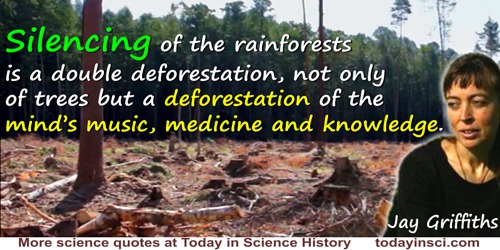
The silencing of the rainforests is a double deforestation, not only of trees but a deforestation of the mind’s music, medicine and knowledge.
In 'Fifty Years On, the Silence of Rachel Carson’s Spring Consumes Us', The Guardian (25 Sep 2012),
The sky seems to be a pure, a cooler blue, the trees a deeper green. The whole world is charged with the glory of God and I feel fire and music under my feet.
On reading the scriptures. Quoted in Kim Lim (ed.), 1,001 Pearls of Spiritual Wisdom: Words to Enrich, Inspire, and Guide Your Life (2014), 166
The spirit of science arises from the habit of seeking food; the spirit of art arises from the habit of imitation, by which the young animal first learns to feed; the spirit of music arises from primeval speech, by means of which males and females are attracted to each other.
In The Martyrdom of Man (1876), 443.
The wind makes music in the woods, but the tune changes with the seasons.
In 'Why We Should Celebrate Winter Woodland–Not Just the Christmas Tree', The Guardian (12 Dec 2015).
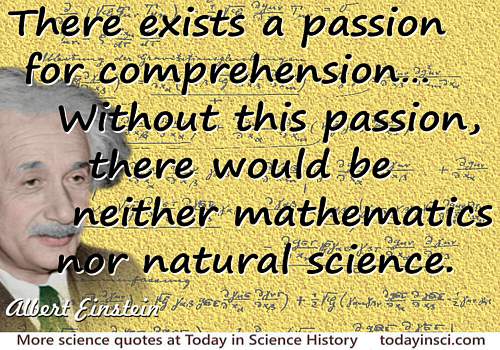
There exists a passion for comprehension, just as there exists a passion for music. That passion is rather common in children but gets lost in most people later on. Without this passion, there would be neither mathematics nor natural science.
'On the Generalized Theory of Gravitation', Scientific American (Apr 1950). Collected in David H. Levy (ed.), The Scientific American Book of the Cosmos (2000), 13.
There is a pleasure in the pathless woods, there is a rapture on the lonely shore, there is society, where none intrudes. By the deep sea, and music in its roars; I love not man the less, but nature more.
…...
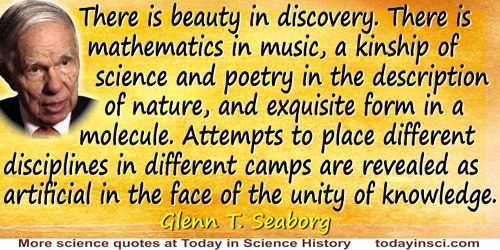
There is beauty in discovery. There is mathematics in music, a kinship of science and poetry in the description of nature, and exquisite form in a molecule. Attempts to place different disciplines in different camps are revealed as artificial in the face of the unity of knowledge. All illiterate men are sustained by the philosopher, the historian, the political analyst, the economist, the scientist, the poet, the artisan, and the musician.
From address (1958), upon being appointed Chancellor of the University of California.
There is geometry in the humming of the strings. There is music in the spacing of the spheres.
Quoted by Aristotle in Metaphysics. In The Houghton Mifflin Dictionary of Biography (2003), 1250.
There is in the chemist a form of thought by which all ideas become visible in the mind as strains of an imagined piece of music. This form of thought is developed in Faraday in the highest degree, whence it arises that to one who is not acquainted with this method of thinking, his scientific works seem barren and dry, and merely a series of researches strung together, while his oral discourse when he teaches or explains is intellectual, elegant, and of wonderful clearness.
Autobiography, 257-358. Quoted in William H. Brock, Justus Von Liebig (2002), 9.
There is plenty of room left for exact experiment in art, and the gate has been opened for some time. What had been accomplished in music by the end of the eighteenth century has only begun in the fine arts. Mathematics and physics have given us a clue in the form of rules to be strictly observed or departed from, as the case may be. Here salutary discipline is come to grips first of all with the function of forms, and not with form as the final result … in this way we learn how to look beyond the surface and get to the root of things.
Quoted in The Bulletin of the Atomic Scientists (Feb 1959), 59, citing Bauhaus-Zeitschrijt (1928).
There were details like clothing, hair styles and the fragile objects that hardly ever survive for the archaeologist—musical instruments, bows and arrows, and body ornaments depicted as they were worn. … No amounts of stone and bone could yield the kinds of information that the paintings gave so freely
As quoted in Current Biography Yearbook (1985), 259.
This is the question
Marry
Children—(if it Please God)—Constant companion (& friend in old age) who will feel interested in one—object to be beloved and played with—better than a dog anyhow. Home, & someone to take care of house—Charms of music and female chit-chat.—These things good for one’s health.—but terrible loss of time.—
My God, it is Intolerable to think of spending ones whole life, like a neuter bee, working, working—& nothing after all.—No, no, won’t do. Imagine living all one’s day solitary in smoky dirty London House.—Only picture to yourself a nice soft wife on a sofa with good fire, & books & music perhaps-—Compare this vision with the dingy reality of Grt. Marlbro’ Street.
Not Marry
Freedom to go where one liked—choice of Society and little of it. —Conversation of clever men at clubs—Not forced to visit relatives, & to bend in every trifle. —to have the expense and anxiety of children—perhaps quarreling—Loss of time. —cannot read in the Evenings—fatness & idleness—Anxiety & responsibility—less money for books &c—if many children forced to gain one’s bread. —(but then it is very bad for ones health to work too much)
Perhaps my wife won’t like London; then the sentence is banishment & degradation into indolent, idle fool.
Marry—Marry—Marry Q.E.D.
It being proved necessary to Marry When? Soon or late?
Marry
Children—(if it Please God)—Constant companion (& friend in old age) who will feel interested in one—object to be beloved and played with—better than a dog anyhow. Home, & someone to take care of house—Charms of music and female chit-chat.—These things good for one’s health.—but terrible loss of time.—
My God, it is Intolerable to think of spending ones whole life, like a neuter bee, working, working—& nothing after all.—No, no, won’t do. Imagine living all one’s day solitary in smoky dirty London House.—Only picture to yourself a nice soft wife on a sofa with good fire, & books & music perhaps-—Compare this vision with the dingy reality of Grt. Marlbro’ Street.
Not Marry
Freedom to go where one liked—choice of Society and little of it. —Conversation of clever men at clubs—Not forced to visit relatives, & to bend in every trifle. —to have the expense and anxiety of children—perhaps quarreling—Loss of time. —cannot read in the Evenings—fatness & idleness—Anxiety & responsibility—less money for books &c—if many children forced to gain one’s bread. —(but then it is very bad for ones health to work too much)
Perhaps my wife won’t like London; then the sentence is banishment & degradation into indolent, idle fool.
Marry—Marry—Marry Q.E.D.
It being proved necessary to Marry When? Soon or late?
Notes on Marriage, July 1838. In F. Burkhardt and S. Smith (eds.), The Correspondence of Charles Darwin 1837-1843 (1986), Vol. 2, 444.
Those who danced were thought to be quite insane by those who could not hear the music.
…...
Through and through the world is infected with quantity: To talk sense is to talk quantities. It is not use saying the nation is large—How large? It is no use saying the radium is scarce—How scarce? You cannot evade quantity. You may fly to poetry and music, and quantity and number will face you in your rhythms and your octaves.
In 'The Aims of Education', The Aims of Education: & Other Essays (1917), 11.
Till the fifteenth century little progress appears to have been made in the science or practice of music; but since that era it has advanced with marvelous rapidity, its progress being curiously parallel with that of mathematics, inasmuch as great musical geniuses appeared suddenly among different nations, equal in their possession of this special faculty to any that have since arisen. As with the mathematical so with the musical faculty it is impossible to trace any connection between its possession and survival in the struggle for existence.
In 'Darwinism Applied to Man', Darwinism: An Exposition of the Theory of Natural Selection with Some of Its Applications (1901), Chap. 15, 468.
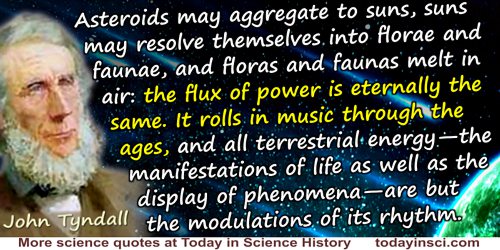
To Nature nothing can be added; from Nature nothing can be taken away; the sum of her energies is constant, and the utmost man can do in the pursuit of physical truth, or in the applications of physical knowledge, is to shift the constituents of the never-varying total. The law of conservation rigidly excludes both creation and annihilation. Waves may change to ripples, and ripples to waves; magnitude may be substituted for number, and number for magnitude; asteroids may aggregate to suns, suns may resolve themselves into florae and faunae, and floras and faunas melt in air: the flux of power is eternally the same. It rolls in music through the ages, and all terrestrial energy—the manifestations of life as well as the display of phenomena—are but the modulations of its rhythm.
Conclusion of Heat Considered as a Mode of Motion: Being a Course of Twelve Lectures Delivered at the Royal Institution of Great Britain in the Season of 1862 (1863), 449.
Vary the mental and bodily exercises with dancing, horsemanship, swimming, fencing with sword and with sabre, shooting with gun and pistol, skating, the sling, stilts, tennis, bowls; hop on one foot, cross the arms, jump high and far, turn on one foot propped against the wall, exercise in shirt in the evening to get up a perspiration before going to bed; turning, joinery, gardening, reading while walking, declamation, singing, violin, versification, musical composition; eight hours of sleep; a walk on awakening, before and after eating; great sobriety; eat slowly, little, and often; avoid idleness and useless meditation.
From Appendix A, 'Extracts From the Unpublished Writings of Carnot', Reflections on the Motive Power of Heat (1890, 2nd ed. 1897), 205-206.
We had various kinds of tape-recorded concerts and popular music. But by the end of the flight what we listened to most was Russian folk songs. We also had recordings of nature sounds: thunder, rain, the singing of birds. We switched them on most frequently of all, and we never grew tired of them. It was as if they returned us to Earth.
…...
We pass the word around; we ponder how the case is put by different people, we read the poetry; we meditate over the literature; we play the music; we change our minds; we reach an understanding. Society evolves this way. Not by shouting each other down, but by the unique capacity of unique, individual human beings to comprehend each other.
Essay, 'On Committees' collected in The Medusa and the Snail: More Notes of a Biology Watcher (1974, 1979), 120.
We rest in the immense and complete order of the earth. And then it may well happen that what we have been seeing as beautiful repose changes into motions; lines seem to rise and fall, surfaces wave and swing. Folding, which long ago buckled horizontal strata into huge subterranean waves of stone (folds) is revived. The rounded crests of folds rise and fall rhythmically. Giant smoking volcanoes stand in a row like the pipes of a cosmic organ through which the earth’s mighty breath blows its roaring music. Granite domes in the deserts, the broadly arched shields of the Rocky Mountains become the chimes waiting only for the earthquake’s stroke to awaken the mighty symphony that drowns out all human tones and resounds throughout the world.
In 'Prologue', Conversation with the Earth (1954), 4. As translated by E.B. Garside from Gespräch mit der Erde (1947).
We say that knowing begins in our intrigue about some subject, but that intrigue is the result of the subject’s action upon us: geologists are people who hear rocks speak, historians are people who hear the voices of the long dead, writers are people who hear the music of words.
In The Courage to Teach: Exploring the Inner Landscape of a Teacher’s Life (1998), 105.
When the sexes differ in beauty, in the power of singing, or in producing what I have called instrumental music, it is almost invariably the male which excels the female.
The Descent of Man (1871), Vol. 2, 99.
Where we reach the sphere of mathematics we are among processes which seem to some the most inhuman of all human activities and the most remote from poetry. Yet it is just here that the artist has the fullest scope for his imagination. … We are in the imaginative sphere of art, and the mathematician is engaged in a work of creation which resembles music in its orderliness, … It is not surprising that the greatest mathematicians have again and again appealed to the arts in order to find some analogy to their own work. They have indeed found it in the most varied arts, in poetry, in painting, and in sculpture, although it would certainly seem that it is in music, the most abstract of all the arts, the art of number and time, that we find the closest analogy.
In The Dance of Life (1923), 138-139.
Which do I consider my greatest invention? … I like the phonograph best … because I love music. And then it has brought so much joy into millions of homes all over this country, and, indeed, all over the world.
As quoted from an interview by B.C. Forbes in The American Magazine (Jan 1921), 86.
Who does not know Maxwell’s dynamic theory of gases? At first there is the majestic development of the variations of velocities, then enter from one side the equations of condition and from the other the equations of central motions, higher and higher surges the chaos of formulas, suddenly four words burst forth: “Put n = 5.” The evil demon V disappears like the sudden ceasing of the basso parts in music, which hitherto wildly permeated the piece; what before seemed beyond control is now ordered as by magic. There is no time to state why this or that substitution was made, he who cannot feel the reason may as well lay the book aside; Maxwell is no program-musician who explains the notes of his composition. Forthwith the formulas yield obediently result after result, until the temperature-equilibrium of a heavy gas is reached as a surprising final climax and the curtain drops.
In Ceremonial Speech (15 Nov 1887) celebrating the 301st anniversary of the Karl-Franzens-University Graz. Published as Gustav Robert Kirchhoff: Festrede zur Feier des 301. Gründungstages der Karl-Franzens-Universität zu Graz (1888), 29-30, as translated in Robert Édouard Moritz, Memorabilia Mathematica; Or, The Philomath’s Quotation-book (1914), 187. From the original German, “Wer kennt nicht seine dynamische Gastheorie? – Zuerst entwickeln sich majestätisch die Variationen der Geschwindigkeiten, dann setzen von der einen Seite die Zustands-Gleichungen, von der anderen die Gleichungen der Centralbewegung ein, immer höher wogt das Chaos der Formeln; plötzlich ertönen die vier Worte: „Put n=5.“Der böse Dämon V verschwindet, wie in der Musik eine wilde, bisher alles unterwühlende Figur der Bässe plötzlich verstummt; wie mit einem Zauberschlage ordnet sich, was früher unbezwingbar schien. Da ist keine Zeit zu sagen, warum diese oder jene Substitution gemacht wird; wer das nicht fühlt, lege das Buch weg; Maxwell ist kein Programmmusiker, der über die Noten deren Erklärung setzen muss. Gefügig speien nun die Formeln Resultat auf Resultat aus, bis überraschend als Schlusseffect noch das Wärme-Gleichgewicht eines schweren Gases gewonnen wird und der Vorhang sinkt.” A condensed alternate translation also appears on the Ludwig Boltzmann Quotes page of this website.
Why, only last term we sent a man who had never been in a laboratory in his life as a senior Science Master to one of our leading public schools. He came [to our agency] wanting to do private coaching in music. He’s doing very well, I believe.
In Decline and Fall (1928), 1962 edn., 25.
With a tone control at a single touch
I can make Caruso sound like Hutch,
I never did care for music much—
It’s the high fidelity!
I can make Caruso sound like Hutch,
I never did care for music much—
It’s the high fidelity!
A parody of the hi-fi addict. From lyrics of 'Song of Reproduction', in the Michael Flanders and Donald Swann revue, At the Drop of a Hat (1959). As quoted in Steven D. Lubar, InfoCulture: The Smithsonian Book of Information Age Inventions (1993), 186. “Hutch” was the popularly used name of Leslie Hutchinson (1900-1969), one of the biggest London cabaret entertainers of the 1920s-30s.
 In science it often happens that scientists say, 'You know that's a really good argument; my position is mistaken,' and then they would actually change their minds and you never hear that old view from them again. They really do it. It doesn't happen as often as it should, because scientists are human and change is sometimes painful. But it happens every day. I cannot recall the last time something like that happened in politics or religion.
(1987) --
In science it often happens that scientists say, 'You know that's a really good argument; my position is mistaken,' and then they would actually change their minds and you never hear that old view from them again. They really do it. It doesn't happen as often as it should, because scientists are human and change is sometimes painful. But it happens every day. I cannot recall the last time something like that happened in politics or religion.
(1987) -- 





