Motion Quotes (327 quotes)
... all the great scientists have one thing in common: each snatched from the subtle motions of nature one irrevocable secret; each caught one feather of the plumage of the Great White Bird that symbolizes everlasting truth.
With co-author Justus J. Schifferes, in The Autobiography of Science (1945).
… for it is very probable, that the motion of gravity worketh weakly, both far from the earth, and also within the earth: the former because the appetite of union of dense bodies with the earth, in respect of the distance, is more dull: the latter, because the body hath in part attained its nature when it is some depth in the earth.
[Foreshadowing Newton's Universal Law of Gravitation (1687)]
[Foreshadowing Newton's Universal Law of Gravitation (1687)]
Sylva Sylvarum; or a Natural History in Ten Centuries (1627), Century 1, Experiment 33. Collected in The Works of Francis Bacon (1826), Vol 1, 255.
...each metal has a certain power, which is different from metal to metal, of setting the electric fluid in motion...
Le Opere, Vol. 1, 149. In Giuliano Pancaldi, Volta: Science and Culture in the Age of Enlightenment (2005), 190.
…the Form or true definition of heat … is in few words as follows: Heat is a motion; expansive, restrained, and acting in its strife upon the smaller particles of bodies. But the expansion is thus modified; while it expands all ways, it has at the same time an inclination upward. And the struggle in the particles is modified also; it is not sluggish, but hurried and with violence.
Novum Organum (1620), Book 2, Aphorism 20. Translated as 'First Vintage Concerning the Form of Heat', The New Organon: Aphorisms Concerning the Interpretation of Nature and the Kingdom of Man), collected in James Spedding, Robert Ellis and Douglas Heath (eds.), The Works of Francis Bacon (1857), Vol. 4, 154-5.
...those experiments be not only esteemed which have an immediate and present use, but those principally which are of most universal consequence for invention of other experiments, and those which give more light to the invention of causes; for the invention of the mariner's needle, which giveth the direction, is of no less benefit for navigation than the invention of the sails, which give the motion.
The Second Book of Francis Bacon of the Proficience and Advancement of Learning (1605). In Francis Bacon and Basil Montagu, The Works of Francis Bacon, Lord Chancellor of England (1852), 200
[I have seen] workers in whom certain morbid affections gradually arise from some particular posture of the limbs or unnatural movements of the body called for while they work. Such are the workers who all day stand or sit, stoop or are bent double, who run or ride or exercise their bodies in all sorts of [excess] ways. ... the harvest of diseases reaped by certain workers ... [from] irregular motions in unnatural postures of the body.
translation published by the University of Chicago Press, 1940
[Ignorance] of the principle of conservation of energy … does not prevent inventors without background from continually putting forward perpetual motion machines… Also, such persons undoubtedly have their exact counterparts in the fields of art, finance, education, and all other departments of human activity… persons who are unwilling to take the time and to make the effort required to find what the known facts are before they become the champions of unsupported opinions—people who take sides first and look up facts afterward when the tendency to distort the facts to conform to the opinions has become well-nigh irresistible.
From Evolution in Science and Religion (1927), 58-59. An excerpt from the book including this quote appears in 'New Truth and Old', Christian Education (Apr 1927), 10, No. 7, 394-395.
[P]olitical and social and scientific values … should be correlated in some relation of movement that could be expressed in mathematics, nor did one care in the least that all the world said it could not be done, or that one knew not enough mathematics even to figure a formula beyond the schoolboy s=(1/2)gt2. If Kepler and Newton could take liberties with the sun and moon, an obscure person ... could take liberties with Congress, and venture to multiply its attraction into the square of its time. He had only to find a value, even infinitesimal, for its attraction.
The Education of Henry Adams: An Autobiography? (1918), 376.
[The heart is] really a fascinating organ. It's about the only organ in the body that you can really witness its function. Doing things. And so on. Some of the other organs you can witness, like the intestines, will have this sort of peristaltic motion. But nothing that can compare with the activity of the human heart.
[The Library of Congress] is a multimedia encyclopedia. These are the tentacles of a nation.
[Referring to the diverse holdings of the library, including motion pictures, photographs, recordings, posters and other historic objects which collectively far outnumber the books]
[Referring to the diverse holdings of the library, including motion pictures, photographs, recordings, posters and other historic objects which collectively far outnumber the books]
Quoted by Barbara Gamarekian in 'Working Profile: Daniel J. Boorstin. Helping the Library of Congress Fulfill Its Mission', New York Times (8 Jul 1983), B6.
[To the cultures of Asia and the continent of Africa] it is the Western impact which has stirred up the winds of change and set the processes of modernization in motion. Education brought not only the idea of equality but also another belief which we used to take for granted in the West—the idea of progress, the idea that science and technology can be used to better human conditions. In ancient society, men tended to believe themselves fortunate if tomorrow was not worse than today and anyway, there was little they could do about it.
Lecture at State University of Iowa (6 Apr 1961). In Barbara Ward, The Unity of the Free World (1961), 12.

[W]hen Galileo discovered he could use the tools of mathematics and mechanics to understand the motion of celestial bodies, he felt, in the words of one imminent researcher, that he had learned the language in which God recreated the universe. Today we are learning the language in which God created life. We are gaining ever more awe for the complexity, the beauty, the wonder of God's most devine and sacred gift.
From White House Announcement of the Completion of the First Survey of the Entire Human Genome Project, broadcast on the day of the publication of the first draft of the human genome. Quoted in transcript on the National Archives, Clinton White House web site, 'Text of Remarks on the Completion of the First Survey of the Entire Human Genome Project' (26 Jun 2000).
Copernicus, who rightly did condemn
This eldest systeme, form’d a wiser scheme;
In which he leaves the Sun at Rest, and rolls
The Orb Terrestial on its proper Poles;
Which makes the Night and Day by this Career,
And by its slow and crooked Course the Year.
The famous Dane, who oft the Modern guides,
To Earth and Sun their Provinces divides:
The Earth’s Rotation makes the Night and Day,
The Sun revolving through th’ Eccliptic Way
Effects the various seasons of the Year,
Which in their Turn for happy Ends appear.
This Scheme or that, which pleases best, embrace,
Still we the Fountain of their Motion trace.
Kepler asserts these Wonders may be done
By the Magnetic Vertue of the Sun,
Which he, to gain his End, thinks fit to place
Full in the Center of that mighty Space,
Which does the Spheres, where Planets roll, include,
And leaves him with Attractive Force endu’d.
The Sun, thus seated, by Mechanic Laws,
The Earth, and every distant Planet draws;
By which Attraction all the Planets found
Within his reach, are turn'd in Ether round.
This eldest systeme, form’d a wiser scheme;
In which he leaves the Sun at Rest, and rolls
The Orb Terrestial on its proper Poles;
Which makes the Night and Day by this Career,
And by its slow and crooked Course the Year.
The famous Dane, who oft the Modern guides,
To Earth and Sun their Provinces divides:
The Earth’s Rotation makes the Night and Day,
The Sun revolving through th’ Eccliptic Way
Effects the various seasons of the Year,
Which in their Turn for happy Ends appear.
This Scheme or that, which pleases best, embrace,
Still we the Fountain of their Motion trace.
Kepler asserts these Wonders may be done
By the Magnetic Vertue of the Sun,
Which he, to gain his End, thinks fit to place
Full in the Center of that mighty Space,
Which does the Spheres, where Planets roll, include,
And leaves him with Attractive Force endu’d.
The Sun, thus seated, by Mechanic Laws,
The Earth, and every distant Planet draws;
By which Attraction all the Planets found
Within his reach, are turn'd in Ether round.
In Creation: A Philosophical Poem in Seven Books (1712), book 2, l. 430-53, p.78-9.
Dilbert: I’m obsessed with inventing a perpetual motion machine. Most scientists think it's impossible, but I have something they don’t.
Dogbert: A lot of spare time?
Dilbert: Exactly.
Dogbert: A lot of spare time?
Dilbert: Exactly.
Dilbert cartoon strip (8 Aug 1991).
Discovery always carries an honorific connotation. It is the stamp of approval on a finding of lasting value. Many laws and theories have come and gone in the history of science, but they are not spoken of as discoveries. Kepler is said to have discovered the laws of planetary motion named after him, but no the many other 'laws' which he formulated. ... Theories are especially precarious, as this century profoundly testifies. World views can and do often change. Despite these difficulties, it is still true that to count as a discovery a finding must be of at least relatively permanent value, as shown by its inclusion in the generally accepted body of scientific knowledge.
Discovery in the Physical Sciences (1969). In Rodney P. Carlisle, Scientific American Inventions and Discoveries (2004), 179.
Nautae etiam mare legentes, cum beneficium claritatis solis in tempore nubilo non sentiunt, aut etiam cum caligne nocturnarum tenebrarum mundus obvolvitur, et ignorant in quem mundi cardinem prora tendat, acum super mangentem ponunt, quae circulariter circumvolvitur usque dum, ejus motu cessante.
Mariners at sea, when, through cloudy weather in the day which hides the sun, or through the darkness of night, they lose knowlege of the quarter of the world to which they are sailing, touch a needle with a magnet, which will turn round till, on its motion ceasing, its point will be directed towards the north.
Mariners at sea, when, through cloudy weather in the day which hides the sun, or through the darkness of night, they lose knowlege of the quarter of the world to which they are sailing, touch a needle with a magnet, which will turn round till, on its motion ceasing, its point will be directed towards the north.
De naturis rerum. Original Latin text quoted in Thomas Wright, A Volume of Vocabularies... (1873), 114. Translation from Lloyd A Brown, The Story of Maps (1980), 127.
Une même expression, dont les géomètres avaient considéré les propriétés abstraites, … représente'aussi le mouvement de la lumière dans l’atmosphère, quelle détermine les lois de la diffusion de la chaleur dans la matière solide, et quelle entre dans toutes les questions principales de la théorie des probabilités.
The same expression whose abstract properties geometers had considered … represents as well the motion of light in the atmosphere, as it determines the laws of diffusion of heat in solid matter, and enters into all the chief problems of the theory of probability.
The same expression whose abstract properties geometers had considered … represents as well the motion of light in the atmosphere, as it determines the laws of diffusion of heat in solid matter, and enters into all the chief problems of the theory of probability.
From Théorie Analytique de la Chaleur (1822), translated by Alexander Freeman in The Analytical Theory of Heat (1878), 7.
CLAUDIO: Death is a fearful thing.
ISABELLA: And shamed life a hateful.
CLAUDIO: Ay, but to die, and go we know not where;
To lie in cold obstruction, and to rot;
This sensible warm motion to become
A kneaded clod; and the delighted spirit
To bathe in fiery floods, or to reside
In thrilling region of thick-ribbed ice;
To be imprisioned in the viewless winds,
And blown with restless violence round about
The pendant world; or to be worst than worst
Of those lawless and incertain thought
Imagine howling—'tis too horrible!
The weariest and most loathed worldly life
That age, ache, penury, and imprisionment
Can lay on nature is a paradise
To what we fear of death.
ISABELLA: And shamed life a hateful.
CLAUDIO: Ay, but to die, and go we know not where;
To lie in cold obstruction, and to rot;
This sensible warm motion to become
A kneaded clod; and the delighted spirit
To bathe in fiery floods, or to reside
In thrilling region of thick-ribbed ice;
To be imprisioned in the viewless winds,
And blown with restless violence round about
The pendant world; or to be worst than worst
Of those lawless and incertain thought
Imagine howling—'tis too horrible!
The weariest and most loathed worldly life
That age, ache, penury, and imprisionment
Can lay on nature is a paradise
To what we fear of death.
Measure for Measure (1604), III, i.
~~[Unverified]~~ The strongest affection and utmost zeal should, I think, promote the studies concerned with the most beautiful objects. This is the discipline that deals with the universe’s divine revolutions, the stars’ motions, sizes, distances, risings and settings . . . for what is more beautiful than heaven?
Seen spreading across the web, only in recent years. As yet, Webmaster cannot identify a trustworthy primary source, is therefore presently skeptical, and meanwhile labels the quote as unverified.
A fateful process is set in motion when the individual is released “to the freedom of his own impotence” and left to justify his existence by his own efforts. The autonomous individual, striving to realize himself and prove his worth, has created all that is great in literature, art, music, science and technology. The autonomous individual, also, when he can neither realize himself nor justify his existence by his own efforts, is a breeding call of frustration, and the seed of the convulsions which shake our world to its foundations.
In The Passionate State of Mind (1955), 18.
A modern branch of mathematics, having achieved the art of dealing with the infinitely small, can now yield solutions in other more complex problems of motion, which used to appear insoluble. This modern branch of mathematics, unknown to the ancients, when dealing with problems of motion, admits the conception of the infinitely small, and so conforms to the chief condition of motion (absolute continuity) and thereby corrects the inevitable error which the human mind cannot avoid when dealing with separate elements of motion instead of examining continuous motion. In seeking the laws of historical movement just the same thing happens. The movement of humanity, arising as it does from innumerable human wills, is continuous. To understand the laws of this continuous movement is the aim of history. … Only by taking an infinitesimally small unit for observation (the differential of history, that is, the individual tendencies of man) and attaining to the art of integrating them (that is, finding the sum of these infinitesimals) can we hope to arrive at the laws of history.
War and Peace (1869), Book 11, Chap. 1.
A strict materialist believes that everything depends on the motion of matter. He knows the form of the laws of motion though he does not know all their consequences when applied to systems of unknown complexity.
Now one thing in which the materialist (fortified with dynamical knowledge) believes is that if every motion great & small were accurately reversed, and the world left to itself again, everything would happen backwards the fresh water would collect out of the sea and run up the rivers and finally fly up to the clouds in drops which would extract heat from the air and evaporate and afterwards in condensing would shoot out rays of light to the sun and so on. Of course all living things would regrede from the grave to the cradle and we should have a memory of the future but not of the past.
The reason why we do not expect anything of this kind to take place at any time is our experience of irreversible processes, all of one kind, and this leads to the doctrine of a beginning & an end instead of cyclical progression for ever.
Now one thing in which the materialist (fortified with dynamical knowledge) believes is that if every motion great & small were accurately reversed, and the world left to itself again, everything would happen backwards the fresh water would collect out of the sea and run up the rivers and finally fly up to the clouds in drops which would extract heat from the air and evaporate and afterwards in condensing would shoot out rays of light to the sun and so on. Of course all living things would regrede from the grave to the cradle and we should have a memory of the future but not of the past.
The reason why we do not expect anything of this kind to take place at any time is our experience of irreversible processes, all of one kind, and this leads to the doctrine of a beginning & an end instead of cyclical progression for ever.
Letter to Mark Pattison (7 Apr 1868). In P. M. Hannan (ed.), The Scientific Letters and Papers of James Clerk Maxwell (1995), Vol. 2, 1862-1873, 360-1.
A Vulgar Mechanick can practice what he has been taught or seen done, but if he is in an error he knows not how to find it out and correct it, and if you put him out of his road, he is at a stand; Whereas he that is able to reason nimbly and judiciously about figure, force and motion, is never at rest till he gets over every rub.
Letter (25 May 1694) to Nathaniel Hawes. In J. Edleston (ed.), Correspondence of Sir Isaac Newton and Professor Cotes (1850), 284.
Absolute, true, and mathematical time, in and of itself and of its own nature, without reference to anything external, flows uniformly and by another name is called duration. Relative, apparent, and common time is any sensible and external measure (precise or imprecise) of duration by means of motion; such as a measure—for example, an hour, a day, a month, a year—is commonly used instead of true time.
The Principia: Mathematical Principles of Natural Philosophy (1687), 3rd edition (1726), trans. I. Bernard Cohen and Anne Whitman (1999), Definitions, Scholium, 408.
According to their [Newton and his followers] doctrine, God Almighty wants to wind up his watch from time to time: otherwise it would cease to move. He had not, it seems, sufficient foresight to make it a perpetual motion. Nay, the machine of God's making, so imperfect, according to these gentlemen; that he is obliged to clean it now and then by an extraordinary concourse, and even to mend it, as clockmaker mends his work.
'Mr. Leibniz's First Paper' (1715). In H. G. Alexander (ed.), The Leibniz-Clarke Correspondence (1956), 11-2.
After I had addressed myself to this very difficult and almost insoluble problem, the suggestion at length came to me how it could be solved with fewer and much simpler constructions than were formerly used, if some assumptions (which are called axioms) were granted me. They follow in this order.
There is no one center of all the celestial circles or spheres.
The center of the earth is not the center of the universe, but only of gravity and of the lunar sphere.
All the spheres revolve about the sun as their mid-point, and therefore the sun is the center of the universe.
The ratio of the earth’s distance from the sun to the height of the firmament is so much smaller than the ratio of the earth’s radius to its distance from the sun that the distance from the earth to the sun is imperceptible in comparison with the height of the firmament.
Whatever motion appears in the firmament arises not from any motion of the firmament, but from the earth’s motion. The earth together with its circumjacent elements performs a complete rotation on its fixed poles in a daily motion, while the firmament and highest heaven abide unchanged.
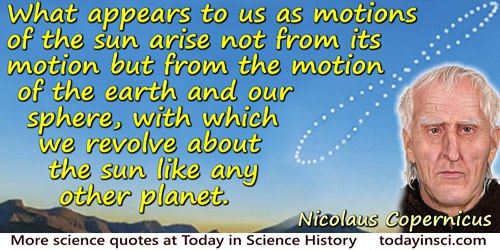
What appears to us as motions of the sun arise not from its motion but from the motion of the earth and our sphere, with which we revolve about the sun like any other planet. The earth has, then, more than one motion.
The apparent retrograde and direct motion of the planets arises not from their motion but from the earth’s. The motion of the earth alone, therefore, suffices to explain so many apparent inequalities in the heavens.
There is no one center of all the celestial circles or spheres.
The center of the earth is not the center of the universe, but only of gravity and of the lunar sphere.
All the spheres revolve about the sun as their mid-point, and therefore the sun is the center of the universe.
The ratio of the earth’s distance from the sun to the height of the firmament is so much smaller than the ratio of the earth’s radius to its distance from the sun that the distance from the earth to the sun is imperceptible in comparison with the height of the firmament.
Whatever motion appears in the firmament arises not from any motion of the firmament, but from the earth’s motion. The earth together with its circumjacent elements performs a complete rotation on its fixed poles in a daily motion, while the firmament and highest heaven abide unchanged.
What appears to us as motions of the sun arise not from its motion but from the motion of the earth and our sphere, with which we revolve about the sun like any other planet. The earth has, then, more than one motion.
The apparent retrograde and direct motion of the planets arises not from their motion but from the earth’s. The motion of the earth alone, therefore, suffices to explain so many apparent inequalities in the heavens.
'The Commentariolus', in Three Copernican Treatises (c.1510), trans. E. Rosen (1939), 58-9.
After seeking in vain for the construction of a perpetual motion machine, the relations were investigated which must subsist between the forces of nature if such a machine is to be impossible; and this inverted question led to the discovery of the law of the conservation of energy, which, again, explained the impossibility of perpetual motion in the sense originally intended.
Opening of Lecture (1900), 'Mathematische Probleme' (Mathematical Problems), to the International Congress of Mathematicians, Paris. From the original German reprinted in David Hilbert: Gesammelte Abhandlungen (Collected Treatises, 1970), Vol. 3. For full citation, see the quote that begins, “This conviction of the solvability…”, on the David Hilbert Quotes page on this website.
Against filling the Heavens with fluid Mediums, unless they be exceeding rare, a great Objection arises from the regular and very lasting Motions of the Planets and Comets in all manner of Courses through the Heavens.
From Opticks: Or, A Treatise of the Reflections, Refractions, Inflections and Colours of Light (1718), 339.
All parts of the material universe are in constant motion and though some of the changes may appear to be cyclical, nothing ever exactly returns, so far as human experience extends, to precisely the same condition.
Address (Jul 1874) at the grave of Joseph Priestley, in Joseph Henry and Arthur P. Molella, et al. (eds.), A Scientist in American Life: Essays and Lectures of Joseph Henry (1980), 119.
All the summer long is the swallow a most instructive pattern of unwearied industry and affection; for, from morning to night, while there is a family to be supported, she spends the whole day in skimming close to the ground, and exerting the most sudden turns and quick evolutions. Avenues, and long walks under hedges, and pasture-fields, and mown meadows where cattle graze, are her delight, especially if there are trees interspersed; because in such spots insects most abound. When a fly is taken a smart snap from her bill is heard, resembling the noise at the shutting of a watch case; but the motion of the mandibles are too quick for the eye.
In Letter to Daines Barrington (29 Jan 1774), in In The Natural History and Antiquities of Selborne (1789), 169-170.
All things are made of atoms—little particles that move around in perpetual motion, attracting each other when they are a little distance apart, but repelling upon being squeezed into one another. In that one sentence ... there is an enormous amount of information about the world.
His suggestion that the most valuable information on scientific knowledge in a single sentence using the fewest words is to state the atomic hypothesis.
His suggestion that the most valuable information on scientific knowledge in a single sentence using the fewest words is to state the atomic hypothesis.
Six Easy Pieces (1995), 4.
All those who think it paradoxical that so great a weight as the earth should not waver or move anywhere seem to me to go astray by making their judgment with an eye to their own affects and not to the property of the whole. For it would not still appear so extraordinary to them, I believe, if they stopped to think that the earth’s magnitude compared to the whole body surrounding it is in the ratio of a point to it. For thus it seems possible for that which is relatively least to be supported and pressed against from all sides equally and at the same angle by that which is absolutely greatest and homogeneous.
— Ptolemy
'The Almagest 1', in Ptolemy: the Almagest; Nicolaus Copernicus: On the Revolutions of the Heavenly Spheres; Johannes Kepler: Epitome of Copernican Astronomy: IV - V The Harmonies of the World: V, trans. R. Catesby Taliaferro (1952), 11.
Among the authorities it is generally agreed that the Earth is at rest in the middle of the universe, and they regard it as inconceivable and even ridiculous to hold the opposite opinion. However, if we consider it more closely the question will be seen to be still unsettled, and so decidedly not to be despised. For every apparent change in respect of position is due to motion of the object observed, or of the observer, or indeed to an unequal change of both.
'Book One. Chapter V. Whether Circular Motion is Proper to the Earth, and of its Place', in Copernicus: On the Revolutions of the Heavenly Spheres (1543), trans. A. M. Duncan (1976), 40.
Among the planets, Jupiter is definitely the solar system’s bad boy in disturbing the motions of all the planets and asteroids[, with] … a “lion’s share” of the mass of the entire planet family….
In Earth, Moon and Planets (1963), 29.
Anaximenes ... said that infinite air was the principle, from which the things that are becoming, and that are, and that shall be, and gods and things divine, all come into being, and the rest from its products. The form of air is of this kind: whenever it is most equable it is invisible to sight, but is revealed by the cold and the hot and the damp and by movement. It is always in motion; for things that change do not change unless there be movement. Through becoming denser or finer it has different appearances; for when it is dissolved into what is finer it becomes fire, while winds, again, are air that is becoming condensed, and cloud is produced from air by felting. When it is condensed still more, water is produced; with a further degree of condensation earth is produced, and when condensed as far as possible, stones. The result is that the most influential components of the generation are opposites, hot and cold.
Hippolytus, Refutation, 1.7.1. In G. S. Kirk, J. E. Raven and M. Schofield (eds.), The Presocratic Philosophers: A Critical History with a Selection of Texts (1983), p. 145.
And from this such small difference of eight minutes [of arc] it is clear why Ptolemy, since he was working with bisection [of the linear eccentricity], accepted a fixed equant point… . For Ptolemy set out that he actually did not get below ten minutes [of arc], that is a sixth of a degree, in making observations. To us, on whom Divine benevolence has bestowed the most diligent of observers, Tycho Brahe, from whose observations this eight-minute error of Ptolemy’s in regard to Mars is deduced, it is fitting that we accept with grateful minds this gift from God, and both acknowledge and build upon it. So let us work upon it so as to at last track down the real form of celestial motions (these arguments giving support to our belief that the assumptions are incorrect). This is the path I shall, in my own way, strike out in what follows. For if I thought the eight minutes in [ecliptic] longitude were unimportant, I could make a sufficient correction (by bisecting the [linear] eccentricity) to the hypothesis found in Chapter 16. Now, because they could not be disregarded, these eight minutes alone will lead us along a path to the reform of the whole of Astronomy, and they are the matter for a great part of this work.
Astronomia Nova, New Astronomy (1609), ch. 19, 113-4, Johannes Kepler Gesammelte Werke (1937-), Vol. 3, 177-8.
And thus Nature will be very conformable to her self and very simple, performing all the great Motions of the heavenly Bodies by the Attraction of Gravity which intercedes those Bodies, and almost all the small ones of their Particles by some other attractive and repelling Powers which intercede the Particles. The Vis inertiae is a passive Principle by which Bodies persist in their Motion or Rest, receive Motion in proportion to the Force impressing it, and resist as much as they are resisted. By this Principle alone there never could have been any Motion in the World. Some other Principle was necessary for putting Bodies into Motion; and now they are in Motion, some other Principle is necessary for conserving the Motion.
From Opticks, (1704, 2nd ed. 1718), Book 3, Query 31, 372-3.
Are not all Hypotheses erroneous, in which Light is supposed to consist in Pression or Motion, propagated through a fluid Medium? For in all these Hypotheses the Phaenomena of Light have been hitherto explain'd by supposing that they arise from new Modifications of the Rays; which is an erroneous Supposition.
Opticks, 2nd edition (1718), Book 3, Query 28, 337.
Are the humanistic and scientific approaches different? Scientists can calculate the torsion of a skyscraper at the wing-beat of a bird, or 155 motions of the Moon and 500 smaller ones in addition. They move in academic garb and sing logarithms. They say, “The sky is ours”, like priests in charge of heaven. We poor humanists cannot even think clearly, or write a sentence without a blunder, commoners of “common sense”. We never take a step without stumbling; they move solemnly, ever unerringly, never a step back, and carry bell, book, and candle.
Quoting himself in Stargazers and Gravediggers: Memoirs to Worlds in Collision (2012), 212.
As he sat alone in a garden, he [Isaac Newton in 1666, age 24] fell into a speculation on the power of gravity; that as this power is not found sensibly diminished at the remotest distance from the centre of the earth to which we can rise, neither at the tops of the loftiest buildings, nor even on the summits of the highest mountains, it appeared to him reasonable to conclude that this power must extend much further than was usually thought: why not as high as the moon? said he to himself; and if so, her motion must be influenced by it; perhaps she is retained in her orbit thereby.
View of Newton's Philosophy (1728), preface. In William Whewell, History of the Inductive Sciences (1847), Vol. 2, 166. Pemberton's narrative is based on firsthand conversations with Newton himself.
As to the position of the earth, then, this is the view which some advance, and the views advanced concerning its rest or motion are similar. For here too there is no general agreement. All who deny that the earth lies at the centre think that it revolves about the centre, and not the earth only but, as we said before, the counter-earth as well. Some of them even consider it possible that there are several bodies so moving, which are invisible to us owing to the interposition of the earth. This, they say, accounts for the fact that eclipses of the moon are more frequent than eclipses of the sun; for in addition to the earth each of these moving bodies can obstruct it.
On the Heavens, 293b, 15-25. In Jonathan Barnes (ed.), The Complete Works of Aristotle (1984), Vol. 1, 483.
As to what Simplicius said last, that to contend whether the parts of the Sun, Moon, or other celestial body, separated from their whole, should naturally return to it, is a vanity, for that the case is impossible, it being clear by the demonstrations of Aristotle that the celestial bodies are impassible, impenetrable, unpartable, etc., I answer that none of the conditions whereby Aristotle distinguishes the celestial bodies from the elementary has any foundation other than what he deduces from the diversity of their natural motions; so that, if it is denied that the circular motion is peculiar to celestial bodies, and affirmed instead that it is agreeable to all naturally moveable bodies, one is led by necessary confidence to say either that the attributes of generated or ungenerated, alterable or unalterable, partable or unpartable, etc., equally and commonly apply to all bodies, as well to the celestial as to the elementary, or that Aristotle has badly and erroneously deduced those from the circular motion which he has assigned to celestial bodies.
Dialogue on the Great World Systems (1632). Revised and Annotated by Giorgio De Santillana (1953), 45.
Ask a follower of Bacon what [science] the new philosophy, as it was called in the time of Charles the Second, has effected for mankind, and his answer is ready; “It has lengthened life; it has mitigated pain; it has extinguished diseases; it has increased the fertility of the soil; it has given new securities to the mariner; it has furnished new arms to the warrior; it has spanned great rivers and estuaries with bridges of form unknown to our fathers; it has guided the thunderbolt innocuously from heaven to earth; it has lighted up the night with the splendour of the day; it has extended the range of the human vision; it has multiplied the power of the human muscles; it has accelerated motion; it has annihilated distance; it has facilitated intercourse, correspondence, all friendly offices, all dispatch of business; it has enabled man to descend to the depths of the sea, to soar into the air, to penetrate securely into the noxious recesses of the earth, to traverse the land in cars which whirl along without horses, to cross the ocean in ships which run ten knots an hour against the wind. These are but a part of its fruits, and of its first-fruits; for it is a philosophy which never rests, which has never attained, which is never perfect. Its law is progress. A point which yesterday was invisible is its goal to-day, and will be its starting-point to-morrow.”
From essay (Jul 1837) on 'Francis Bacon' in Edinburgh Review. In Baron Thomas Babington Macaulay and Lady Trevelyan (ed.) The Works of Lord Macaulay Complete (1871), Vol. 6, 222.
Astronomy affords the most extensive example of the connection of physical sciences. In it are combined the sciences of number and quantity, or rest and motion. In it we perceive the operation of a force which is mixed up with everything that exists in the heavens or on earth; which pervades every atom, rules the motion of animate and inanimate beings, and is a sensible in the descent of the rain-drop as in the falls of Niagara; in the weight of the air, as in the periods of the moon.
On the Connexion of the Physical Sciences (1858), 1.
Astronomy is older than physics. In fact, it got physics started by showing the beautiful simplicity of the motion of the stars and planets, the understanding of which was the beginning of physics. But the most remarkable discovery in all of astronomy is that the stars are made of atoms of the same kind as those on the earth.
In 'Astronomy', The Feynman Lectures on Physics (1961), Vol. 1, 3-6.
Astronomy, as the science of cyclical motions, has nothing in common with Geology. But look at Astronomy where she has an analogy with Geology; consider our knowledge of the heavens as a palaetiological science;—as the study of a past condition, from which the present is derived by causes acting in time. Is there no evidence of a beginning, or of a progress?
In History of the Inductive Sciences (1857), Vol. 3, 516.
At present, light is generally regarded as the result of a vibratory movement of the ethereal fluid. Light produces heat, or at least accompanies the radiating heat, and moves with the same velocity as heat. Radiating heat is then a vibratory movement. It would be ridiculous to suppose that it is an emission of matter while the light which accompanies it could be only a movement.
Could a motion (that of radiating heat) produce matter (caloric)?
No, undoubtedly; it can only produce a motion. Heat is then the result of a motion.
Could a motion (that of radiating heat) produce matter (caloric)?
No, undoubtedly; it can only produce a motion. Heat is then the result of a motion.
From Appendix A, 'Extracts From the Unpublished Writings of Carnot', Reflections on the Motive Power of Heat (1890, 2nd ed. 1897), 222.
Available energy is energy which we can direct into any desired channel. Dissipated energy is energy which we cannot lay hold of and direct at pleasure, such as the energy of the confused agitation of molecules which we call heat. Now, confusion, like the correlative term order, is not a property of material things in themselves, but only in relation to the mind which perceives them. A memorandum-book does not, provided it is neatly written, appear confused to an illiterate person, or to the owner who understands it thoroughly, but to any other person able to read it appears to be inextricably confused. Similarly the notion of dissipated energy could not occur to a being who could not turn any of the energies of nature to his own account, or to one who could trace the motion of every molecule and seize it at the right moment. It is only to a being in the intermediate stage, who can lay hold of some forms of energy while others elude his grasp, that energy appears to be passing inevitably from the available to the dissipated state.
'Diffusion', Encyclopaedia Britannica (1878). In W. D. Niven (ed.), The Scientific Papers of James Clerk Maxwell (1890), Vol. 2, 646.
Ax: 100 Every thing doth naturally persevere in yt state in wch it is unlesse it bee interrupted by some externall cause, hence… [a] body once moved will always keepe ye same celerity, quantity & determination of its motion.
Newton’s 'Waste Book' (1665). Quoted in Richard Westfall, Never at Rest: A Biography of Isaac Newton (1980), 145.
Beavers bred in captivity, inhabiting a concrete pool, will, if given the timber, fatuously go through all the motions of damming an ancestral stream.
In short story Work Suspended (1943) collected in Evelyn Waugh: The Complete Short Stories (1998), 320.
Between this body [the earth] and the heavens there are suspended, in this aerial spirit, seven stars, separated by determinate spaces, which, on account of their motion, we call wandering.
In The Natural History of Pliny (1855), Vol. 1, 19-20.
Beyond these are other suns, giving light and life to systems, not a thousand, or two thousand merely, but multiplied without end, and ranged all around us, at immense distances from each other, attended by ten thousand times ten thousand worlds, all in rapid motion; yet calm, regular and harmonious—all space seems to be illuminated, and every particle of light a world. ... all this vast assemblages of suns and worlds may bear no greater proportion to what lies beyond the utmost boundaries of human vision, than a drop of water to the ocean.
In The Geography of the Heavens and Class-Book of Astronomy (1874), 148 That knowledge is not happiness.
But having considered everything which has been said, one could by this believe that the earth and not the heavens is so moved, and there is no evidence to the contrary. Nevertheless, this seems prima facie as much, or more, against natural reason as are all or several articles of our faith. Thus, that which I have said by way of diversion (esbatement) in this manner can be valuable to refute and check those who would impugn our faith by argument.
On the Book of the Heavens and the World of Aristotle [1377], bk. II, ch. 25, sect. 10, trans. A. D. Menut and A. J. Denomy, quoted in Marshall Clagett, The Science of Mechanics in the Middle Ages (1959), 606.
But in its [the corpuscular theory of radiation] relation to the wave theory there is one extraordinary and, at present, insoluble problem. It is not known how the energy of the electron in the X-ray bulb is transferred by a wave motion to an electron in the photographic plate or in any other substance on which the X-rays fall. It is as if one dropped a plank into the sea from the height of 100 ft. and found that the spreading ripple was able, after travelling 1000 miles and becoming infinitesimal in comparison with its original amount, to act upon a wooden ship in such a way that a plank of that ship flew out of its place to a height of 100 ft. How does the energy get from one place to the other?
'Aether Waves and Electrons' (Summary of the Robert Boyle Lecture), Nature, 1921, 107, 374.
But in nothing are swifts more singular than in their early retreat. They retire, as to the main body of them, by the tenth of August, and sometimes a few days sooner: and every straggler invariably withdraws by the twentieth, while their congeners, all of them, stay till the beginning of October; many of them all through that month, and some occasionally to the beginning of November. This early retreat is mysterious and wonderful, since that time is often the sweetest season in the year. But, what is more extraordinary, they begin to retire still earlier in the most southerly parts of Andalusia, where they can be no ways influenced by any defect of heat; or, as one might suppose, defect of food. Are they regulated in their motions with us by failure of food, or by a propensity to moulting, or by a disposition to rest after so rapid a life, or by what? This is one of those incidents in natural history that not only baffles our searches, but almost eludes our guesses!
In Letter to Daines Barrington, (28 Sep 1774), in The Natural History and Antiquities of Selborne (1789), 278.
But the World being once fram’d, and the course of Nature establish’d, the Naturalist, (except in some few cases, where God, or Incorporeal Agents interpose), has recourse to the first Cause but for its general and ordinary Support and Influence, whereby it preserves Matter and Motion from Annihilation or Desition; and in explicating particular phenomena, considers onely the Size, Shape, Motion, (or want of it) Texture, and the resulting Qualities and Attributes of the small particles of Matter.
The Origine of Formes and Qualities (1666), 194.
But we have reason to think that the annihilation of work is no less a physical impossibility than its creation, that is, than perpetual motion.
'On the Change of Refrangibility of Light' (1852). In Mathematical and Physical Papers (1901), Vol. 3, 397.
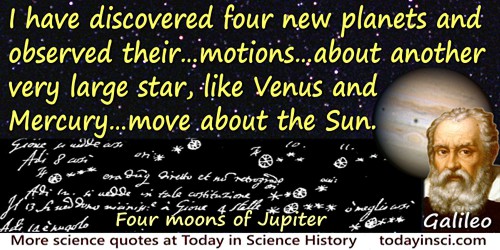
But what exceeds all wonders, I have discovered four new planets and observed their proper and particular motions, different among themselves and from the motions of all the other stars; and these new planets move about another very large star [Jupiter] like Venus and Mercury, and perchance the other known planets, move about the Sun. As soon as this tract, which I shall send to all the philosophers and mathematicians as an announcement, is finished, I shall send a copy to the Most Serene Grand Duke, together with an excellent spyglass, so that he can verify all these truths.
Letter to the Tuscan Court, 30 Jan 1610. Quoted in Albert van Heiden (ed.), Siderius Nuncius or The Sidereal Messenger (1989), 18.
But without effort [God] sets in motion all things by mind and thought.
Quoted in Arthur Fairbanks (ed. And trans.), The First Philosophers of Greece (1898), 69, fragment 3.
By the 18th century science had been so successful in laying bare the laws of nature that many thought there was nothing left to discover. Immutable laws prescribed the motion of every particle in the universe, exactly and forever: the task of the scientist was to elucidate the implications of those laws for any particular phenomenon of interest. Chaos gave way to a clockwork world. But the world moved on ...Today even our clocks are not made of clockwork. ... With the advent of quantum mechanics, the clockwork world has become a lottery. Fundamental events, such as the decay of a radioactive atom, are held to be determined by chance, not law.
Does God Play Dice?: The New Mathematics of Chaos (2002). xi.
Children are told that an apple fell on Isaac Newton’s head and he was led to state the law of gravity. This, of course, is pure foolishness. What Newton discovered was that any two particles in the universe attract each other with a force that is proportional to the product of their masses and inversely proportional to the square of the distance between them. This is not learned from a falling apple, but by observing quantities of data and developing a mathematical theory that can be verified by additional data. Data gathered by Galileo on falling bodies and by Johannes Kepler on motions of the planets were invaluable aids to Newton. Unfortunately, such false impressions about science are not universally outgrown like the Santa Claus myth, and some people who don’t study much science go to their graves thinking that the human race took until the mid-seventeenth century to notice that objects fall.
In How to Tell the Liars from the Statisticians (1983), 127.
Colour, Figure, Motion, Extension and the like, considered only so many Sensations in the Mind, are perfectly known, there being nothing in them which is not perceived. But if they are looked on as notes or Images, referred to Things or Archetypes existing without the Mind, then are we involved all in Scepticism.
A Treatise Concerning the Principles of Human Knowledge [first published 1710], (1734), 109.
Consider now the Milky Way. Here also we see an innumerable dust, only the grains of this dust are no longer atoms but stars; these grains also move with great velocities, they act at a distance one upon another, but this action is so slight at great distances that their trajectories are rectilineal; nevertheless, from time to time, two of them may come near enough together to be deviated from their course, like a comet that passed too close to Jupiter. In a word, in the eyes of a giant, to whom our Suns were what our atoms are to us, the Milky Way would only look like a bubble of gas.
Science and Method (1908), trans. Francis Maitland (1914), 254-5.
Copernicus and Lobatchewsky were both of Slavic origin. Each of them has brought about a revolution in scientific ideas so great that it can only be compared with that wrought by the other. And the reason of the transcendent importance of these two changes is that they are changes in the conception of the Cosmos. … Now the enormous effect of the Copernican system, and of the astronomical discoveries that have followed it, is … the change effected by Copernicus in the idea of the universe. But there was left another to be made. For the laws of space and motion…. So, you see, there is a real parallel between the work of Copernicus and … the work of Lobatchewsky.
In 'The Postulates of Time And Space', Lectures and Essays (1901) Vol. 1, 354-359.
Copernicus, the most learned man whom we are able to name other than Atlas and Ptolemy, even though he taught in a most learned manner the demonstrations and causes of motion based on observation, nevertheless fled from the job of constructing tables, so that if anyone computes from his tables, the computation is not even in agreement with his observations on which the foundation of the work rests. Therefore first I have compared the observations of Copernicus with those of Ptolemy and others as to which are the most accurate, but besides the bare observations, I have taken from Copernicus nothing other than traces of demonstrations. As for the tables of mean motion, and of prosthaphaereses and all the rest, I have constructed these anew, following absolutely no other reasoning than that which I have judged to be of maximum harmony.
Dedication to the Duke of Prussia, Prutenicae Tabulae (1551), 1585 edition, as quoted in Owen Gingerich, The Eye of Heaven: Ptolemy, Copernicus, Kepler (1993), 227.
Do not Bodies and Light act mutually upon one another; that is to say, Bodies upon Light in emitting, reflecting, refracting and inflecting it, and Light upon Bodies for heating them, and putting their parts into a vibrating motion wherein heat consists?
Opticks (1704), Book 3, Query 5, 133.
Doubtless the reasoning faculty, the mind, is the leading and characteristic attribute of the human race. By the exercise of this, man arrives at the properties of the natural bodies. This is science, properly and emphatically so called. It is the science of pure mathematics; and in the high branches of this science lies the truly sublime of human acquisition. If any attainment deserves that epithet, it is the knowledge, which, from the mensuration of the minutest dust of the balance, proceeds on the rising scale of material bodies, everywhere weighing, everywhere measuring, everywhere detecting and explaining the laws of force and motion, penetrating into the secret principles which hold the universe of God together, and balancing worlds against worlds, and system against system. When we seek to accompany those who pursue studies at once so high, so vast, and so exact; when we arrive at the discoveries of Newton, which pour in day on the works of God, as if a second fiat had gone forth from his own mouth; when, further, we attempt to follow those who set out where Newton paused, making his goal their starting-place, and, proceeding with demonstration upon demonstration, and discovery upon discovery, bring new worlds and new systems of worlds within the limits of the known universe, failing to learn all only because all is infinite; however we may say of man, in admiration of his physical structure, that “in form and moving he is express and admirable,” it is here, and here without irreverence, we may exclaim, “In apprehension how like a god!” The study of the pure mathematics will of course not be extensively pursued in an institution, which, like this [Boston Mechanics’ Institute], has a direct practical tendency and aim. But it is still to be remembered, that pure mathematics lie at the foundation of mechanical philosophy, and that it is ignorance only which can speak or think of that sublime science as useless research or barren speculation.
In Works (1872), Vol. 1, 180.
During my stay in London I resided for a considerable time in Clapham Road in the neighbourhood of Clapham Common... One fine summer evening I was returning by the last bus 'outside' as usual, through the deserted streets of the city, which are at other times so full of life. I fell into a reverie (Träumerei), and 10, the atoms were gambolling before my eyes! Whenever, hitherto, these diminutive beings had appeared to me, they had always been in motion: but up to that time I had never been able to discern the nature of their motion. Now, however, I saw how, frequently, two smaller atoms united to form a pair: how the larger one embraced the two smaller ones: how still larger ones kept hold of three or even four of the smaller: whilst the whole kept whirling in a giddy dance. I saw how the larger ones formed a chain, dragging the smaller ones after them but only at the ends of the chain. I saw what our past master, Kopp, my highly honoured teacher and friend has depicted with such charm in his Molekular-Welt: but I saw it long before him. The cry of the conductor 'Clapham Road', awakened me from my dreaming: but I spent part of the night in putting on paper at least sketches of these dream forms. This was the origin of the 'Structural Theory'.
Kekule at Benzolfest in Berichte (1890), 23, 1302.
Each ray of light moves in the coordinate system 'at rest' with the definite, constant velocity V independent of whether this ray of light is emitted by a body at rest or a body in motion.
Annalen der Physik, 1905, 17, 891-921. Trans. John Stachel et al (eds.), The Collected Papers of Albert Einstein, Vol. 2, (1989), Doc. 23, 143.
Einstein, twenty-six years old, only three years away from crude privation, still a patent examiner, published in the Annalen der Physik in 1905 five papers on entirely different subjects. Three of them were among the greatest in the history of physics. One, very simple, gave the quantum explanation of the photoelectric effect—it was this work for which, sixteen years later, he was awarded the Nobel prize. Another dealt with the phenomenon of Brownian motion, the apparently erratic movement of tiny particles suspended in a liquid: Einstein showed that these movements satisfied a clear statistical law. This was like a conjuring trick, easy when explained: before it, decent scientists could still doubt the concrete existence of atoms and molecules: this paper was as near to a direct proof of their concreteness as a theoretician could give. The third paper was the special theory of relativity, which quietly amalgamated space, time, and matter into one fundamental unity.
This last paper contains no references and quotes no authority. All of them are written in a style unlike any other theoretical physicist’s. They contain very little mathematics. There is a good deal of verbal commentary. The conclusions, the bizarre conclusions, emerge as though with the greatest of ease: the reasoning is unbreakable. It looks as though he had reached the conclusions by pure thought, unaided, without listening to the opinions of others. To a surprisingly large extent, that is precisely what he had done.
This last paper contains no references and quotes no authority. All of them are written in a style unlike any other theoretical physicist’s. They contain very little mathematics. There is a good deal of verbal commentary. The conclusions, the bizarre conclusions, emerge as though with the greatest of ease: the reasoning is unbreakable. It looks as though he had reached the conclusions by pure thought, unaided, without listening to the opinions of others. To a surprisingly large extent, that is precisely what he had done.
In Variety of Men (1966), 100-101. First published in Commentary magazine.
Ever since I was a boy, I’ve been fascinated by crazy science and such things as perpetual motion machines and logical paradoxes. I’ve always enjoyed keeping up with those ideas. I suppose I didn’t get into it seriously until I wrote my first book, Fads and Fallacies in the Name of Science. I was influenced by the Dianetics movement, now called Scientology, which was then promoted by John Campbell in Astounding Science Fiction. I was astonished at how rapidly the thing had become a cult.
In Scot Morris, 'Interview: Martin Gardner', Omni, 4, No. 4 (Jan 1982), 68.
Every body continues in its state of rest or uniform motion in a straight line, except in so far as it doesn’t. … The suggestion that the body really wanted to go straight but some mysterious agent made it go crooked is picturesque but unscientific.
Paraphasing Newton’s First Law of Motion. In a Gifford Lecture delivered at the University of Edinburgh (1927), 'Gravitation: The Law', The Nature of the Physical World (1928), 124.
Every living language, like the perspiring bodies of living creatures, is in perpetual motion and alteration; some words go off, and become obsolete; others are taken in, and by degrees grow into common use; or the same word is inverted to a new sense and notion, which in tract of time makes as observable a change in the air and features of a language as age makes in the lines and mien of a face.
Every Man being conscious to himself, That he thinks, and that which his Mind is employ'd about whilst thinking, being the Ideas, that are there, 'tis past doubt, that Men have in their Minds several Ideas, such as are those expressed by the words, Whiteness, Hardness, Sweetness, Thinking, Motion, Man, Elephant, Army, Drunkenness, and others: It is in the first place then to be inquired, How he comes by them? I know it is a received Doctrine, That Men have native Ideas, and original Characters stamped upon their Minds, in their very first Being.
An Essay Concerning Human Understanding (1690). Edited by Peter Nidditch (1975), Book 2, Chapter 1, Section 1, 104.
Every time a significant discovery is being made one sets in motion a tremendous activity in laboratories and industrial enterprises throughout the world. It is like the ant who suddenly finds food and walks back to the anthill while sending out material called food attracting substance. The other ants follow the path immediately in order to benefit from the finding and continue to do so as long as the supply is rich.
Nobel Banquet speech (10 Dec 1982). In Wilhelm Odelberg (ed.), Les Prix Nobel. The Nobel Prizes 1982 (1983)
Everyone makes for himself a clear idea of the motion of a point, that is to say, of the motion of a corpuscle which one supposes to be infinitely small, and which one reduces by thought in some way to a mathematical point.
Théorie Nouvelle de la Rotation des Corps (1834). As translated by Charles Thomas Whitley in Outlines of a New Theory of Rotatory Motion (1834), 1.
Evolution is an integration of matter and concomitant dissipation of motion during which the matter passes from an indefinite incoherent homogeneity to a definite coherent heterogeneity, and during which the retained motion undergoes a parallel transformation.
First Principles of a New System of Philosophy (1864), 407.
Except the blind forces of Nature, nothing moves in this world which is not Greek in its origin.
Village-Communities in the East and West (1871), 238.
First, by what means it is that a Plant, or any Part of it, comes to Grow, a Seed to put forth a Root and Trunk... How the Aliment by which a Plant is fed, is duly prepared in its several Parts ... How not only their Sizes, but also their Shapes are so exceedingly various ... Then to inquire, What should be the reason of their various Motions; that the Root should descend; that its descent should sometimes be perpendicular, sometimes more level: That the Trunk doth ascend, and that the ascent thereof, as to the space of Time wherein it is made, is of different measures... Further, what may be the Causes as of the Seasons of their Growth; so of the Periods of their Lives; some being Annual, others Biennial, others Perennial ... what manner the Seed is prepared, formed and fitted for Propagation.
'An Idea of a Philosophical History of Plants', in The Anatomy of Plants With an Idea of a Philosophical History of Plants and Several Other Lectures Read Before the Royal Society (1682), 3-4.
For FRICTION is inevitable because the Universe is FULL of God's works.
For the PERPETUAL MOTION is in all works of Almighty GOD.
For it is not so in the engines of man, which are made of dead materials, neither indeed can be.
For the Moment of bodies, as it is used, is a false term—bless God ye Speakers on the Fifth of November.
For Time and Weight are by their several estimates.
For I bless GOD in the discovery of the LONGITUDE direct by the means of GLADWICK.
For the motion of the PENDULUM is the longest in that it parries resistance.
For the WEDDING GARMENTS of all men are prepared in the SUN against the day of acceptation.
For the wedding Garments of all women are prepared in the MOON against the day of their purification.
For CHASTITY is the key of knowledge as in Esdras, Sir Isaac Newton & now, God be praised, in me.
For Newton nevertheless is more of error than of the truth, but I am of the WORD of GOD.
For the PERPETUAL MOTION is in all works of Almighty GOD.
For it is not so in the engines of man, which are made of dead materials, neither indeed can be.
For the Moment of bodies, as it is used, is a false term—bless God ye Speakers on the Fifth of November.
For Time and Weight are by their several estimates.
For I bless GOD in the discovery of the LONGITUDE direct by the means of GLADWICK.
For the motion of the PENDULUM is the longest in that it parries resistance.
For the WEDDING GARMENTS of all men are prepared in the SUN against the day of acceptation.
For the wedding Garments of all women are prepared in the MOON against the day of their purification.
For CHASTITY is the key of knowledge as in Esdras, Sir Isaac Newton & now, God be praised, in me.
For Newton nevertheless is more of error than of the truth, but I am of the WORD of GOD.
From 'Jubilate Agno' (c.1758-1763), in N. Callan (ed.), The Collected Poems of Christopher Smart (1949), Vol. 1, 276.
For it is the duty of an astronomer to compose the history of the celestial motions or hypotheses about them. Since he cannot in any certain way attain to the true causes, he will adopt whatever suppositions enable the motions to be computed correctly from the principles of geometry for the future as well as for the past.
From unauthorized preface Osiander anonymously added when he was entrusted with arranging the printing of the original work by Copernicus. As translated in Nicolaus Copernicus and Jerzy Dobrzycki (ed.), Nicholas Copernicus on the Revolutions (1978), xvi.
For it is the same whether you take it that the Earth is in motion or the Sky. For, in both the cases, it does not affect the Astronomical Science. It is just for the Physicist to see if it is possible to refute it.
In Syed Hasan Barani, 'Al-Biruni's Scientific Achievements', Indo-Iranica, 1952, S (4), 47.
For some months the astronomer Halley and other friends of Newton had been discussing the problem in the following precise form: what is the path of a body attracted by a force directed toward a fixed point, the force varying in intensity as the inverse of the distance? Newton answered instantly, “An ellipse.” “How do you know?” he was asked. “Why, I have calculated it.” Thus originated the imperishable Principia, which Newton later wrote out for Halley. It contained a complete treatise on motion.
In The Handmaiden of the Sciences (1937), 37.
For the first time there was constructed with this machine [locomotive engine] a self-acting mechanism in which the interplay of forces took shape transparently enough to discern the connection between the heat generated and the motion produced. The great puzzle of the vital force was also immediately solved for the physiologist in that it became evident that it is more than a mere poetic comparison when one conceives of the coal as the food of the locomotive and the combustion as the basis for its life.
'Leid und Freude in der Naturforschung', Die Gartenlaube (1870), 359. Trans. Kenneth L. Caneva, Robert Mayer and the Conservation of Energy (1993), 145.
For truly in nature there are many operations that are far more than mechanical. Nature is not simply an organic body like a clock, which has no vital principle of motion in it; but it is a living body which has life and perception, which are much more exalted than a mere mechanism or a mechanical motion.
The Principles of the Most Ancient and Modern Philosophy (1692), trans. and ed. Allison Coudert and Taylor Corse (1996), 64.
George Stephenson, with a sagacity of mind in advance of the science of his day, answered, when asked what was the ultimate cause of motion of his locomotive engine, ‘that it went by the bottled-up rays of the sun.’
From 'Fuel', Lecture delivered to the British Association at Bradford, printed in Nature (25 Sep 1873), 8, 443.
Give me extension and motion, and I will construct the Universe.
As quoted, without citation, in Morris Kline, Mathematics in Western Culture (1964), 106. Webmaster has not yet located this in a primary source. Can you help?
Has Matter innate Motion? Then each Atom,
Asserting its indisputable Right
To dance, would form an Universe of Dust.
Asserting its indisputable Right
To dance, would form an Universe of Dust.
The Complaint: or, Night-Thoughts on Life, Death, and Immortality (1742, 1750), Night 9, 278.
Has Matter more than Motion? Has it Thought,
Judgment, and Genius? Is it deeply learn’d
In Mathematics? Has it fram’d such Laws,
Which, but to guess, a Newton made immortal?—
If so, how each sage Atom laughs at me,
Who think a Clod inferior to a Man!
Judgment, and Genius? Is it deeply learn’d
In Mathematics? Has it fram’d such Laws,
Which, but to guess, a Newton made immortal?—
If so, how each sage Atom laughs at me,
Who think a Clod inferior to a Man!
The Complaint: or, Night-Thoughts on Life, Death, and Immortality (1742, 1750), Night 9, 279.
Have you ever observed a humming-bird moving about in an aerial dance among the flowers—a living prismatic gem that changes its colour with every change of position— … its exquisite form, its changeful splendour, its swift motions and intervals of aërial suspension, it is a creature of such fairy-like loveliness as to mock all description.
In Green Mansions: A Romance of the Tropical Forest (1916),
He that knows the secrets of nature with Albertus Magnus, or the motions of the heavens with Galileo, or the cosmography of the moon with Hevelius, or the body of man with Galen, or the nature of diseases with Hippocrates, or the harmonies in melody with Orpheus, or of poesy with Homer, or of grammar with Lilly, or of whatever else with the greatest artist; he is nothing if he knows them merely for talk or idle speculation, or transient and external use. But he that knows them for value, and knows them his own, shall profit infinitely.
In Bertram Doben (ed.), Centuries of Meditations (1908), The Third Century, No. 41, 189-190.
He who studies it [Nature] has continually the exquisite pleasure of discerning or half discerning and divining laws; regularities glimmer through an appearance of confusion, analogies between phenomena of a different order suggest themselves and set the imagination in motion; the mind is haunted with the sense of a vast unity not yet discoverable or nameable. There is food for contemplation which never runs short; you are gazing at an object which is always growing clearer, and yet always, in the very act of growing clearer, presenting new mysteries.
From 'Natural History', Macmillan's Magazine (1875), 31, 366.
Heat can evidently be a cause of motion only by virtue of the changes of volume or of form which it produces in bodies. These changes are not caused by uniform temperature but rather by alternations of heat and cold.
As translated in Reflections on the Motive Power of Heat and on Machines Fitted to Develop Power (1890, Rev. 1897), 49. Edited by R. H. Thurston, from the original French, Réflexions sur la Puissance Motrice du Feu (1824).
Here lies Sir Isaac Newton, Knight, who by a vigour of mind almost supernatural, first demonstrated, the motions and Figures of the Planets, the Paths of the comets, and the Tides of the Ocean. He diligently investigated the different refrangibilities to the rays of light, … Let Mortals rejoice that there has existed such and so great an ornament of Nature. Born, 25th Dec., 1642; died, 20th March, 1727.
— Epitaph
Translated from the Latin inscription on the tomb of Isaac Newton in Westminster Abbey. As quoted in John Stoughton, Worthies of Science (1879), 232-233.
His Majesty has, with great skill, constructed a cart, containing a corn mill, which is worked by the motion of the carriage. He has also contrived a carriage of such a magnitude as to contain several apartments, with a hot bath; and it is drawn by a single elephant. This movable bath is extremely useful, and refreshing on a journey. … He has also invented several hydraulic machines, which are worked by oxen. The pulleys and wheels of some of them are so adjusted that a single ox will at once draw water out of two wells, and at the same time turn a millstone.
From Ain-i-Akbery (c.1590). As translated from the original Persian, by Francis Gladwin in 'Akbar’s Conduct and Administrative Rules', 'Of Machines', Ayeen Akbery: Or, The Institutes of the Emperor Akber (1783), Vol. 1, 284. Note: Akbar (Akber) was a great ruler and enlightened statesman.
His motion to the meeting of the Council of the Chemical Society:
That henceforth the absurd game of chemical noughts and crosses be tabu within the Society's precincts and that, following the practice of the Press in ending a correspondence, it be an instruction to the officers to give notice “That no further contributions to the mysteries of Polarity will be received, considered or printed by the Society.” His challenge was not accepted.
That henceforth the absurd game of chemical noughts and crosses be tabu within the Society's precincts and that, following the practice of the Press in ending a correspondence, it be an instruction to the officers to give notice “That no further contributions to the mysteries of Polarity will be received, considered or printed by the Society.” His challenge was not accepted.
From the personal and other items column of Chemistry and Industry (1925), 44, 1050.
However, the small probability of a similar encounter [of the earth with a comet], can become very great in adding up over a huge sequence of centuries. It is easy to picture to oneself the effects of this impact upon the Earth. The axis and the motion of rotation changed; the seas abandoning their old position to throw themselves toward the new equator; a large part of men and animals drowned in this universal deluge, or destroyed by the violent tremor imparted to the terrestrial globe.
Exposition du Système du Monde, 2nd edition (1799), 208, trans. Ivor Grattan-Guinness.
I also require much time to ponder over the matters themselves, and particularly the principles of mechanics (as the very words: force, time, space, motion indicate) can occupy one severely enough; likewise, in mathematics, the meaning of imaginary quantities, of the infinitesimally small and infinitely large and similar matters.
In Davis Baird, R.I.G. Hughes and Alfred Nordmann, Heinrich Hertz: Classical Physicist, Modern Philosopher (1998), 159.
I am an old man now, and when I die and go to heaven, there are two matters on which I hope for enlightenment. One is quantum electrodynamics and the other is the turbulent motion of fluids. About the former, I am really rather optimistic.
In Address to the British Society for the Advancement of Science (1932). As cited by Tom Mullin in 'Turbulent Times For FLuids', New Science (11 Nov 1989), 52. Werner Heisenberg is also reported, sometimes called apocryphal, to have expressed a similar sentiment, but Webmaster has found no specific citation.
I am much occupied with the investigation of the physical causes [of motions in the Solar System]. My aim in this is to show that the celestial machine is to be likened not to a divine organism but rather to a clockwork … insofar as nearly all the manifold movements are carried out by means of a single, quite simple magnetic force. This physical conception is to be presented through calculation and geometry.
Letter to Ilerwart von Hohenburg (10 Feb 1605) Quoted in Holton, Johannes Kepler's Universe: Its Physics and Metaphysics, 342, as cited by Hylarie Kochiras, Force, Matter, and Metaphysics in Newton's Natural Philosophy (2008), 57.
I can well appreciate, Holy Father, that as soon as certain people realise that in these books which I have written about the Revolutions of the spheres of the universe I attribute certain motions to the globe of the Earth, they will at once clamour for me to be hooted off the stage with such an opinion.
'To His Holiness Pope Paul III', in Copernicus: On the Revolutions of the Heavenly Spheres (1543), trans. A.M. Duncan (1976), 23.
I consider then, that generally speaking, to render a reason of an effect or Phaenomenon, is to deduce It from something else in Nature more known than it self, and that consequently there may be divers kinds of Degrees of Explication of the same thing. For although such Explications be the most satisfactory to the Understanding, wherein ’tis shewn how the effect is produc’d by the more primitive and Catholick Affection of Matter, namely bulk, shape and motion, yet are not these Explications to be despis’d, wherein particular effects are deduc’d from the more obvious and familiar Qualities or States of Bodies, … For in the search after Natural Causes, every new measure of Discovery does both instinct and gratifie the Understanding.
Physiological Essays (1669), 20.
I did not expect to find the electric cable in its primitive state, such as it was on leaving the manufactory. The long serpent, covered with the remains of shells, bristling with foraminiferae, was encrusted with a strong coating which served as a protection against all boring mollusks. It lay quietly sheltered from the motions of the sea, and under a favorable pressure for the transmission of the electric spark which passes from Europe to America in .32 of a second. Doubtless this cable will last for a great length of time, for they find that the gutta-percha covering is improved by the sea water.
[Referring to the Transatlantic telegraph cable laid in 1866, as viewed from the fictional submarine Nautilus.]
[Referring to the Transatlantic telegraph cable laid in 1866, as viewed from the fictional submarine Nautilus.]
Twenty Thousand Leagues Under The Seas, (1874), 285. Translated from the original French edition, Vingt Mille Lieues Sous Les Mers (1870).
I do not define time, space, place, and motion, as being well known to all. … [However] it will be convenient to distinguish them into Absolute and Relative, True and Apparent, Mathematical and Common.
Scholium following opening section of Definitions, Philosophia Naturalis Principia Mathematica (1687) as translated from the original Latin, in Andrew Motte, Newton's Principia: The Mathematical Principles of Natural Philosophy (1729), Vol. 1, 9.
I do not profess to be able thus to account for all the [planetary] motions at the same time; but I shall show that each by itself is well explained by its proper hypothesis.
— Ptolemy
(c. 100 AD). From introduction to 'Hypotheses', translated into French by Abbé N. Halma, Hypothèses et époques des planètes de Cl. Ptolémée et Hypotyposes de Proclus Diadochus (1820), 41-42. As quoted, in English, in John Louis Emil Dreyer History of the Planetary Systems from Thales to Kepler (1906), 201. In French, “Je ne prétends pas pouvoir ainsi rendre raison de tous ces mouvemens à la fois; mais je veux montrer que chacun à part s'explique très-bien par son hypothèse propre.”
I finally saw that the blood, forced by the action of the left ventricle into the arteries, was distributed to the body at large, and its several parts, in the same manner as it is sent through the lungs, impelled by the right ventricle into the pulmonary artery, and that it then passed through the veins and along the vena cava, and so round to the left ventricle in the manner already indicated. Which motion we may be allowed to call circular, in the same way as Aristotle says that the air and the rain emulate the circular motion of the superior bodies; for the moist earth, warmed by the sun, evaporates; the vapours drawn upwards are condensed, and descending in the form of rain, moisten the earth again; and by this arrangement are generations of living things produced.
From William Harvey and Robert Willis (trans.), The Works of William Harvey, M.D. (1847), 46.
I had made considerable advance ... in calculations on my favourite numerical lunar theory, when I discovered that, under the heavy pressure of unusual matters (two transits of Venus and some eclipses) I had committed a grievous error in the first stage of giving numerical value to my theory. My spirit in the work was broken, and I have never heartily proceeded with it since.
[Concerning his calculations on the orbital motion of the Moon.]
[Concerning his calculations on the orbital motion of the Moon.]
Private note (29 Sep 1890). In George Biddell Airy and Wilfrid Airy (ed.), Autobiography of Sir George Biddell Airy (1896), 350.
I have no doubt that certain learned men, now that the novelty of the hypotheses in this work has been widely reported—for it establishes that the Earth moves, and indeed that the Sun is motionless in the middle of the universe—are extremely shocked, and think that the scholarly disciplines, rightly established once and for all, should not be upset. But if they are willing to judge the matter thoroughly, they will find that the author of this work has committed nothing which deserves censure. For it is proper for an astronomer to establish a record of the motions of the heavens with diligent and skilful observations, and then to think out and construct laws for them, or rather hypotheses, whatever their nature may be, since the true laws cannot be reached by the use of reason; and from those assumptions the motions can be correctly calculated, both for the future and for the past. Our author has shown himself outstandingly skilful in both these respects. Nor is it necessary that these hypotheses should be true, nor indeed even probable, but it is sufficient if they merely produce calculations which agree with the observations. … For it is clear enough that this subject is completely and simply ignorant of the laws which produce apparently irregular motions. And if it does work out any laws—as certainly it does work out very many—it does not do so in any way with the aim of persuading anyone that they are valid, but only to provide a correct basis for calculation. Since different hypotheses are sometimes available to explain one and the same motion (for instance eccentricity or an epicycle for the motion of the Sun) an astronomer will prefer to seize on the one which is easiest to grasp; a philosopher will perhaps look more for probability; but neither will grasp or convey anything certain, unless it has been divinely revealed to him. Let us therefore allow these new hypotheses also to become known beside the older, which are no more probable, especially since they are remarkable and easy; and let them bring with them the vast treasury of highly learned observations. And let no one expect from astronomy, as far as hypotheses are concerned, anything certain, since it cannot produce any such thing, in case if he seizes on things constructed for another other purpose as true, he departs from this discipline more foolish than he came to it.
Although this preface would have been assumed by contemporary readers to be written by Copernicus, it was unsigned. It is now believed to have been written and added at press time by Andreas Osiander (who was then overseeing the printing of the book). It suggests the earth’s motion as described was merely a mathematical device, and not to be taken as absolute reality. Text as given in 'To the Reader on the Hypotheses in this Work', Copernicus: On the Revolutions of the Heavenly Spheres (1543), translated by Alistair Matheson Duncan (1976), 22-3. By adding this preface, Osiander wished to stave off criticism by theologians. See also the Andreas Osiander Quotes page of this website.
I have not yet lost a feeling of wonder, and of delight, that this delicate motion should reside in all the things around us, revealing itself only to him who looks for it. I remember, in the winter of our first experiments, just seven years ago, looking on snow with new eyes. There the snow lay around my doorstep—great heaps of protons quietly precessing in the earth’s magnetic field. To see the world for a moment as something rich and strange is the private reward of many a discovery.
Opening remark, Nobel Lecture (11 Dec 1952).
I have presented principles of philosophy that are not, however, philosophical but strictly mathematical—that is, those on which the study of philosophy can be based. These principles are the laws and conditions of motions and of forces, which especially relate to philosophy.
... It still remains for us to exhibit system of the world from these same principles.
I have seen the astrolabe called Zuraqi invented by Abu Sa’id Sijzi. I liked it very much and praised him a great deal, as it is based on the idea entertained by some to the effect that the motion we see is due to the Earth’s movement and not to that of the sky. By my life, it is a problem difficult of solution and refutation. … For it is the same whether you take it that the Earth is in motion or the sky. For, in both cases, it does not affect the Astronomical Science. It is just for the physicist to see if it is possible to refute it.
As quoted in 'Pioneer of Scientific Observation', The UNESCO Courier (1974), 27, xlix.
I hear the scream of a great hawk, sailing with a ragged wing against the high wood-side, apparently to scare his prey and so detect it—shrill, harsh, fitted to excite terror in sparrows and to issue from his split and curved bill. I see his open bill the while against the sky. Spit with force from his mouth with an undulatory quaver imparted to it from his wings or motion as he flies.
(15 Jun 1852). In Henry David Thoreau and Bradford Torrey (ed.), The Writings of Henry Thoreau: Journal: IV: May 1, 1852-February 27,, 1853 (1906), 103.
I look upon a good physician, not so properly as a servant to nature, as one, that is a counsellor and friendly assistant, who, in his patient’s body, furthers those motions and other things, that he judges conducive to the welfare and recovery of it; but as to those, that he perceives likely to be hurtful, either by increasing the disease, or otherwise endangering the patient, he thinks it is his part to oppose or hinder, though nature do manifestly enough seem to endeavour the exercising or carrying on those hurtful motions.
Quoted In Barbara Kaplan (ed.) Divulging of Useful Truths in Physick: The Medical Agenda of Robert Boyle (1993), 125.
I myself consider that gravity is merely a certain natural inclination with which parts are imbued by the architect of all things for gathering themselves together into a unity and completeness by assembling into the form of a globe. It is easy to believe that the Sun, Moon and other luminaries among the wandering stars have this tendency also, so that by its agency they retain the rounded shape in which they reveal themselves, but nevertheless go round their orbits in various ways. If then the Earth also performs other motions, as for example the one about the centre, they must necessarily be like those which are similarly apparent in many external bodies in which we find an annual orbit.
'Book One. Chapter IX. Whether several motions can be attributed to the Earth, and on the centre of the universe', in Copernicus: On the Revolutions of the Heavenly Spheres (1543), trans. A. M. Duncan (1976), 46.
I now saw very distinctly that these were little eels or worms... Lying huddled together and wriggling, just as if you saw with your naked eye a whole tubful of very little eels and water, the eels moving about in swarms; and the whole water seemed to be alive with the multitudinous animalcules. For me this was among all the marvels that I have discovered in nature the most marvellous of all, and I must say that, for my part, no more pleasant sight has yet met my eye than this of so many thousands of living creatures in one small drop of water, all huddling and moving, but each creature having its own motion.
Letter to H. Oldenburg, 9 Oct 1676. In The Collected Letters of Antoni van Leeuwenhoek (l957), Vol. 2, 115.
I shall explain a System of the World differing in many particulars from any yet known, answering in all things to the common Rules of Mechanical Motions: This depends upon three Suppositions. First, That all Cœlestial Bodies whatsoever, have an attraction or gravitating power towards their own Centers, whereby they attract not only their own parts, and keep them from flying from them, as we may observe the Earth to do, but that they do also attract all the other Cœlestial bodies that are within the sphere of their activity; and consequently that not only the Sun and Moon have an influence upon the body and motion the Earth, and the Earth upon them, but that Mercury also Venus, Mars, Saturn and Jupiter by their attractive powers, have a considerable influence upon its motion in the same manner the corresponding attractive power of the Earth hath a considerable influence upon every one of their motions also. The second supposition is this, That all bodies whatsoever that are put into a direct and simple motion, will continue to move forward in a streight line, till they are by some other effectual powers deflected and bent into a Motion, describing a Circle, Ellipse, or some other more compounded Curve Line. The third supposition is, That these attractive powers are so much the more powerful in operating, by how much the nearer the body wrought upon is to their own Centers. Now what these several degrees are I have not yet experimentally verified; but it is a notion, which if fully prosecuted as it ought to be, will mightily assist the Astronomer to reduce all the Cœlestial Motions to a certain rule, which I doubt will never be done true without it. He that understands the nature of the Circular Pendulum and Circular Motion, will easily understand the whole ground of this Principle, and will know where to find direction in Nature for the true stating thereof. This I only hint at present to such as have ability and opportunity of prosecuting this Inquiry, and are not wanting of Industry for observing and calculating, wishing heartily such may be found, having myself many other things in hand which I would first compleat and therefore cannot so well attend it. But this I durst promise the Undertaker, that he will find all the Great Motions of the World to be influenced by this Principle, and that the true understanding thereof will be the true perfection of Astronomy.
An Attempt to Prove the Motion of the Earth from Observations (1674), 27-8. Based on a Cutlerian Lecture delivered by Hooke at the Royal Society four years earlier.
I should rejoice to see … Euclid honourably shelved or buried “deeper than did ever plummet sound” out of the schoolboys’ reach; morphology introduced into the elements of algebra; projection, correlation, and motion accepted as aids to geometry; the mind of the student quickened and elevated and his faith awakened by early initiation into the ruling ideas of polarity, continuity, infinity, and familiarization with the doctrines of the imaginary and inconceivable.
From Presidential Address (1869) to the British Association, Exeter, Section A, collected in Collected Mathematical Papers of Lames Joseph Sylvester (1908), Vol. 2, 657. Also in George Edward Martin, The Foundations of Geometry and the Non-Euclidean Plane (1982), 93. [Note: “plummet sound” refers to ocean depth measurement (sound) from a ship using a line dropped with a weight (plummet). —Webmaster]
I therefore took this opportunity and also began to consider the possibility that the Earth moved. Although it seemed an absurd opinion, nevertheless, because I knew that others before me had been granted the liberty of imagining whatever circles they wished to represent the phenomena of the stars, I thought that I likewise would readily be allowed to test whether, by assuming some motion of the Earth's, more dependable representations than theirs could be found for the revolutions of the heavenly spheres.
'To His Holiness Pope Paul III', in Copernicus: On the Revolutions of the Heavenly Spheres (1543), trans. A. M. Duncan (1976), 26.
I think the causes have not been fully explained by any of those who have wrote on that Subject, for want of more particularly and distinctly considering the Share the diurnal Motion of the Earth has in the Production of them: For although this has been mention’d by some amongst the Causes of those Winds, yet they have not proceeded to shew how it contributes to their Production; or else have applied it to the Explication of these Phænomena, upon such Principles as will appear upon Examination not to be sufficient.
First paragraph from 'Concerning the Cause of the General Trade-Winds', Philosophical Transactions of the Royal Society of London (30 Jun 1735), 39, No. 437, 58.
I was sitting writing at my textbook but the work did not progress; my thoughts were elsewhere. I turned my chair to the fire and dozed. Again the atoms were gambolling before my eyes. This time the smaller groups kept modestly in the background. My mental eye, rendered more acute by the repeated visions of the kind, could now distinguish larger structures of manifold confirmation: long rows, sometimes more closely fitted together all twining and twisting in snake like motion. But look! What was that? One of the snakes had seized hold of its own tail, and the form whirled mockingly before my eyes. As if by a flash of lightning I awoke; and this time also I spent the rest of the night in working out the rest of the hypothesis. Let us learn to dream, gentlemen, then perhaps we shall find the truth... But let us beware of publishing our dreams till they have been tested by waking understanding.
Kekule at Benzolfest in Berichte (1890), 23, 1302.
If … the motion of the earth were circular, it would be violent and contrary to nature, and could not be eternal since … nothing violent is eternal. ... It follows, therefore, that the earth is not moved with a circular motion.
In Commentaria in Libros Aristotelis de Caelo et Mundo (c. 1270).
If a body previously at rest begin to move, we may be certain that this is only in virtue of some extraneous cause acting upon it. This cause, whatever it may be, and which is known to us only by its effects, we call Force. Force then is any cause whatever of motion.
In Thomas Sutton (trans.), The Elements of Statics (1847), Vol. 1, 1. A footnote is added (Appendix, p.63): “Force is very often defined to be ‘any cause which changes tries to change the state of a body’s rest or motion.’”
If a Schirrus by long standing, increasing, and motion of the adjacent Parts is thus moved, that the neighbouring Vessels around its edges begin to inflame, it’s become malignant, and from its likeness to a Crab, is now called a Cancer, or Carcinoma.
Aphorism No. 492 in Boerhaave’s Aphorisms: Concerning The Knowledge and Cure of Diseases (1715), 113.
If experiments are performed thousands of times at all seasons and in every place without once producing the effects mentioned by your philosophers, poets, and historians, this will mean nothing and we must believe their words rather our own eyes? But what if I find for you a state of the air that has all the conditions you say are required, and still the egg is not cooked nor the lead ball destroyed? Alas! I should be wasting my efforts... for all too prudently you have secured your position by saying that 'there is needed for this effect violent motion, a great quantity of exhalations, a highly attenuated material and whatever else conduces to it.' This 'whatever else' is what beats me, and gives you a blessed harbor, a sanctuary completely secure.
'The Assayer' (1623), trans. Stillman Drake, Discoveries and Opinions of Galileo (1957), 273.
If feeling be not a property of matter, but owing to a superior principle, it must follow, that the motions of the heart, and other muscles of animals, after being separated from their bodies, are to be ascribed to this principle; and that any difficulties which may appear in this matter are owing to our ignorance of the nature of the soul, of the manner of its existence, and of its wonderful union with, and action upon the body.
In An Essay on the Vital and Other Involuntary Motions of Animals (1751), 389-390.
If Melancholy increases so far, that from the great motion of the Liquid of the Brain the Patient be thrown into a wild Fury, it is call’d Madness.… The greatest Remedy for it is to throw the Patient unwarily into the Sea, and to keep him under Water as long as he can possibly bear without being quite stifled.
Aphorism No. 1118 and 1123 in Boerhaave’s Aphorisms: Concerning The Knowledge and Cure of Diseases (1715), 302-303.
If Nicolaus Copernicus, the distinguished and incomparable master, in this work had not been deprived of exquisite and faultless instruments, he would have left us this science far more well-established. For he, if anybody, was outstanding and had the most perfect understanding of the geometrical and arithmetical requisites for building up this discipline. Nor was he in any respect inferior to Ptolemy; on the contrary, he surpassed him greatly in certain fields, particularly as far as the device of fitness and compendious harmony in hypotheses is concerned. And his apparently absurd opinion that the Earth revolves does not obstruct this estimate, because a circular motion designed to go on uniformly about another point than the very center of the circle, as actually found in the Ptolemaic hypotheses of all the planets except that of the Sun, offends against the very basic principles of our discipline in a far more absurd and intolerable way than does the attributing to the Earth one motion or another which, being a natural motion, turns out to be imperceptible. There does not at all arise from this assumption so many unsuitable consequences as most people think.
From Letter (20 Jan 1587) to Christopher Rothman, chief astronomer of the Landgrave of Hesse. Webmaster seeks more information to better cite this source — please contact if you can furnish more. Webmaster originally found this quote introduced by an uncredited anonymous commentary explaining the context: “It was not just the Church that resisted the heliocentrism of Copernicus. Many prominent figures, in the decades following the 1543 publication of De Revolutionibus, regarded the Copernican model of the universe as a mathematical artifice which, though it yielded astronomical predictions of superior accuracy, could not be considered a true representation of physical reality.”
If there is no God, we are just molecules in motion, and we have no sense and no mind; we are just random firings of chemical in the brain. If our minds are composed only of physical matter, then our thoughts are, as Doug Wilson wittily quipped in his debate with atheist Dan Barker, just “brain gas.”
God Does Exist (2005), 45.
If we consider that part of the theory of relativity which may nowadays in a sense be regarded as bone fide scientific knowledge, we note two aspects which have a major bearing on this theory. The whole development of the theory turns on the question of whether there are physically preferred states of motion in Nature (physical relativity problem). Also, concepts and distinctions are only admissible to the extent that observable facts can be assigned to them without ambiguity (stipulation that concepts and distinctions should have meaning). This postulate, pertaining to epistemology, proves to be of fundamental importance.
'Fundamental ideas and problems of the theory of relativity', Lecture delivered to the Nordic Assembly of Naturalists at Gothenburg, 11 Jul 1923. In Nobel Physics 1901-1921 (1998), 482.
If you throw a stone in a pond... the waves which strike against the shores are thrown back towards the spot where the stone struck; and on meeting other waves they never intercept each other’s course... In a small pond one and the same stroke gives birth to many motions of advance and recoil.
…...
If, then, the motion of every particle of matter in the universe were precisely reversed at any instant, the course of nature would be simply reversed for ever after. The bursting bubble of foam at the foot of a waterfall would reunite and descend into the water; the thermal motions would reconcentrate their energy, and throw the mass up the fall in drops re-forming into a close column of ascending water. Heat which had been generated by the friction of solids and dissipated by conduction, and radiation, and radiation with absorption, would come again to the place of contact, and throw the moving body back against the force to which it had previously yielded. Boulders would recover from the mud materials required to rebuild them into their previous jagged forms, and would become reunited to the mountain peak from which they had formerly broken away. And if also the materialistic hypothesis of life were true, living creatures would grow backwards, with conscious knowledge of the future but no memory of the past, and would become again unborn.
In 'The Kinetic Theory of the Dissipation of Energy', Nature (1874), 9, 442.
In 1684 Dr Halley came to visit him at Cambridge, after they had been some time together, the Dr asked him what he thought the Curve would be that would be described by the Planets supposing the force of attraction towards the Sun to be reciprocal to the square of their distance from it. Sr Isaac replied immediately that it would be an Ellipsis, the Doctor struck with joy & amazement asked him how he knew it, why saith he I have calculated it, whereupon Dr Halley asked him for his calculation without any farther delay. Sr Isaac looked among his papers but could not find it, but he promised him to renew it, & then to send it him.
[Recollecting Newton's account of the meeting after which Halley prompted Newton to write The Principia. When asking Newton this question, Halley was aware, without revealing it to Newton that Robert Hooke had made this hypothesis of plantary motion a decade earlier.]
[Recollecting Newton's account of the meeting after which Halley prompted Newton to write The Principia. When asking Newton this question, Halley was aware, without revealing it to Newton that Robert Hooke had made this hypothesis of plantary motion a decade earlier.]
Quoted in Richard Westfall, Never at Rest: A Biography of Isaac Newton (1980), 403.
In all cases of the motion of free material points under the influence of their attractive and repulsive forces, whose intensity depends solely upon distance, the loss in tension is always equal to the gain in vis viva, and the gain in the former equal to the loss in the latter. Hence the sum of the existing tensions and vires vivae is always constant. In this most general form we can distinguish our law as the principle of the conservation of force.
'On the Conservation of Force; a Physical Memoir'. In John Tyndall and William Francis (eds.), Scientific Memoirs: Natural Philosophy (1853), 121.
In general, we receive impressions only in consequence of motion, and we might establish it as an axiom that without motion there is no sensation.
In Elements of Chemistry: In a New Systematic Order, Containing All the Modern Discoveries (1790), 20.
In no way can we get such an overwhelming idea of the grandeur of Nature than when we consider, that in accordance with the law of the conservation of energy, throughout the Infinite, the forces are in a perfect balance, and hence the energy of a single thought may determine the motion of a universe.
Lecture (Feb 1893) delivered before the Franklin Institute, Philadelphia, 'On Light and Other High Frequency Phenomena,' collected in Thomas Commerford Martin and Nikola Tesla, The Inventions, Researches and Writings of Nikola Tesla (1894), 298.
In order to consider in the most general way the principle of the production of motion by heat, it must be considered independently of any mechanism or any particular agent. It is necessary to establish principles applicable not only to steam engines but to all imaginable heat-engines, whatever the working substance and whatever the method by which it is operated.
In Reflections on the Motive Power of Heat and on Machines Fitted to Develop Power (1890, Rev. 1897), 43-44. Edited by R. H. Thurston, from the original French, Réflexions sur la Puissance Motrice du Feu (1824).
In structure these little animals were fashioned like a bell, and at the round opening they made such a stir, that the particles in the water thereabout were set in motion thereby. … And though I must have seen quite 20 of these little animals on their long tails alongside one another very gently moving, with outstretcht bodies and straitened-out tails; yet in an instant, as it were, they pulled their bodies and their tails together, and no sooner had they contracted their bodies and tails, than they began to stick their tails out again very leisurely, and stayed thus some time continuing their gentle motion: which sight I found mightily diverting.
[Describing the ciliate Vorticella.]
[Describing the ciliate Vorticella.]
Letter to the Royal Society, London (25 Dec 1702). In Clifford Dobell (ed.), Anthony van Leewenhoek and his “Little Animals” (1932), 277.
In the beginning (if there was such a thing), God created Newton’s laws of motion together with the necessary masses and forces. This is all; everything beyond this follows from the development of appropriate mathematical methods by means of deduction.
Autobiographical Notes (1946), 19. In Albert Einstein, Alice Calaprice, Freeman Dyson , The Ultimate Quotable Einstein (2011), 397.
In the celestial spaces above the Earth’s atmosphere; in which spaces, where there is no air to resist their motions, all bodies will move with the greatest freedom; and the Planets and Comets will constantly pursue their revolutions in orbits … by the mere laws of gravity.
In 'General Scholium' from The Mathematical Principles of Natural Philosophy (1729), Vol. 2, Book 3, 388.
In the center of everything rules the sun; for who in this most beautiful temple could place this luminary at another better place whence it can light up the whole at once? … In fact, the sun sitting on his royal throne guides the family of stars surrounding him. … In this arrangement we thus find an admirable harmony of the world, and a constant harmonious connection between the motion and the size of the orbits as could not be found otherwise.
In De Revolutionibus Orbium Coelestium (1543), Book 1, Ch. 10. As translated in Hermann Kesten, Copernicus and his World (1945), 182-183. From the original Latin: “In medio vero omnium residet Sol. Quis enim in hoc pulcherrimo templo lampadem hanc in alio vel meliori loco poneret, quam unde totum simul possit illuminare? … Ita profecto tanquam in solio regali Sol residens circum agentem gubernat Astrorum familiam. … Invenimus igitur sub hac ordinatione admirandam mundi symmetriam, ac certum harmoniae nexum motus et magnitudinis orbium: qualis alio modo reperiri non potest.” Corresponding translations also found in Charles Glenn Wallis (trans.), On the Revolutions of Heavenly Spheres (1939, 1995), 24-25, which gives: “In the center of all rests the sun. For who would place this lamp of a very beautiful temple in another or better place than this wherefrom it can illuminate everything at the same time? … And so the sun, as if resting on a kingly throne, governs the family of stars which wheel around. … Therefore in this ordering we find that the world has a wonderful commensurability and that there is a sure bond of harmony for the movement and magnitude of the orbital circles such as cannot be found in any other way.” The passage is translated in Robert Reinhold, 'After 500 Years, Now the Year of Copernicus', New York Times (28 Dec 1972), 33, as: “At rest in the middle of everything is the sun, for in this most beautiful temple, who would place this lamp in another or better position than that from which it can light up the whole thing at the same time? … As though seated on a royal throne, the sun governs the family of planets revolving around it.” Also seen translated in Edwin Arthur Burtt, The Metaphysical Foundations of Modern Physical Science (1925), 45, as: “Then in the middle of all stands the sun. For who, in our most beautiful temple, could set this light in another or better place, than that from which it can at once illuminate the whole? … And in fact does the sun, seated on his royal throne, guide his family of planets as they circle round him.” [Notice the original Latin reads “Astrorum familiam”, so the literal translation is “family of stars” rather than what we now call “planets.” —Webmaster]
In the first book I shall describe all the positions of the spheres, along with the motions which I attribute to the Earth, so that the book will contain as it were the general structure of the universe. In the remaining books I relate the motions of the remaining stars, and all the spheres, to the mobility of the Earth, so that it can be thence established how far the motions and appearances of the remaining stars and spheres can be saved, if they are referred to the motions of the Earth.
'To His Holiness Pope Paul III', in Copernicus: On the Revolutions of the Heavenly Spheres (1543), trans, A. M. Duncan (1976), 26.
In the year 1666 he retired again from Cambridge... to his mother in Lincolnshire & whilst he was musing in a garden it came into his thought that the power of gravity (wch brought an apple from the tree to the ground) was not limited to a certain distance from the earth but that this power must extend much farther than was usually thought. Why not as high as the moon said he to himself & if so that must influence her motion & perhaps retain her in her orbit, whereupon he fell a calculating what would be the effect of that supposition but being absent from books & taking the common estimate in use among Geographers & our seamen before Norwood had measured the earth, that 60 English miles were contained in one degree of latitude on the surface of the Earth his computation did not agree with his theory & inclined him then to entertain a notion that together with the force of gravity there might be a mixture of that force wch the moon would have if it was carried along in a vortex.
[The earliest account of Newton, gravity and an apple.]
[The earliest account of Newton, gravity and an apple.]
Memorandum of a conversation with Newton in August 1726. Quoted in Richard Westfall, Never at Rest: A Biography of Isaac Newton (1980), 154.
In this lecture I would like to conclude with … some characteristics [of] gravity … The most impressive fact is that gravity is simple. It is simple to state the principles completely and not have left any vagueness for anybody to change the ideas of the law. It is simple, and therefore it is beautiful. It is simple in its pattern. I do not mean it is simple in its action—the motions of the various planets and the perturbations of one on the other can be quite complicated to work out, and to follow how all those stars in a globular cluster move is quite beyond our ability. It is complicated in its actions, but the basic pattern or the system beneath the whole thing is simple. This is common to all our laws; they all turn out to be simple things, although complex in their actual actions.
In 'The Law of Gravitation, as Example of Physical Law', the first of his Messenger Lectures (1964), Cornell University. Collected in The Character of Physical Law (1967), 33-34.
Is evolution a theory, a system or a hypothesis? It is much more: it is a general condition to which all theories, all hypotheses, all systems must bow and which they must satisfy henceforth if they are to be thinkable and true. Evolution is a light illuminating all facts, a curve that all lines must follow. ... The consciousness of each of us is evolution looking at itself and reflecting upon itself....Man is not the center of the universe as once we thought in our simplicity, but something much more wonderful—the arrow pointing the way to the final unification of the world in terms of life. Man alone constitutes the last-born, the freshest, the most complicated, the most subtle of all the successive layers of life. ... The universe has always been in motion and at this moment continues to be in motion. But will it still be in motion tomorrow? ... What makes the world in which we live specifically modern is our discovery in it and around it of evolution. ... Thus in all probability, between our modern earth and the ultimate earth, there stretches an immense period, characterized not by a slowing-down but a speeding up and by the definitive florescence of the forces of evolution along the line of the human shoot.
In The Phenomenon of Man (1975), pp 218, 220, 223, 227, 228, 277.
It appears that the extremely important papers that trigger a revolution may not receive a proportionately large number of citations. The normal procedures of referencing are not used for folklore. A real scientific revolution, like any other revolution, is news. The Origin of Species sold out as fast as it could be printed and was denounced from the pulpit almost immediately. Sea-floor spreading has been explained, perhaps not well, in leading newspapers, magazines, books, and most recently in a color motion picture. When your elementary school children talk about something at dinner, you rarely continue to cite it.
'Citations in a Scientific Revolution', in R. Shagam et al., Studies in Earth and Space Sciences: A Memoir in Honor of Harry Hammond Hess (1972), 4.
It doesn't seem to me that this fantastically marvelous universe, this tremendous range of time and space and different kinds of animals, and all the different planets, and all these atoms with all their motions, and so on, all this complicated thing can merely be a stage so that God can watch human beings struggle for good and evil—which is the view that religion has. The stage is too big for the drama.
'Viewpoint' Interview (with Bill Stout) for Los Angeles KNXT television station (1 May 1959), printed in Michelle Feynman (ed.) Perfectly Reasonable Deviations (from the Beaten Track) (2006), Appendix I, 426. Also quoted in James Gleick, Genius: The Life and Science of Richard Feynman (1992), 372. Gleick adds that KNXT “felt obliged to suppress” the interview. It was not broadcast until after Feynman, asked to redo the interview, wrote back with a letter objecting to “a direct censorship of the expression of my views.”
It is … genius which has given motion and progress to society; prevented the ossification of the human heart and brain; and though, in its processes, it may not ever have followed the rules laid down in primers, it has, at least, saved history from being the region of geology, and our present society from being a collection of fossil remains.
In 'Genius', Wellman’s Miscellany (Dec 1871), 4, No. 6, 204.
It is a happy world after all. The air, the earth, the water teem with delighted existence. In a spring noon, or a summer evening, on whichever side I turn my eyes, myriads of happy beings crowd upon my view. “The insect youth are on the wing.” Swarms of new-born flies are trying their pinions in the air. Their sportive motions, their wanton mazes, their gratuitous activity testify their joy and the exultation they feel in their lately discovered faculties … The whole winged insect tribe, it is probable, are equally intent upon their proper employments, and under every variety of constitution, gratified, and perhaps equally gratified, by the offices which the author of their nature has assigned to them.
Natural Theology: or, Evidences of the Existence and Attributes of The Deity, Collected from the Appearances of Nature (1802), 490-1.
It is a peculiar feature in the fortune of principles of such high elementary generality and simplicity as characterise the laws of motion, that when they are once firmly established, or supposed to be so, men turn with weariness and impatience from all questionings of the grounds and nature of their authority. We often feel disposed to believe that truths so clear and comprehensive are necessary conditions, rather than empirical attributes of their subjects: that they are legible by their own axiomatic light, like the first truths of geometry, rather than discovered by the blind gropings of experience.
In An Introduction to Dynamics (1832), x.
It is clear, then, that though there may be countless instances of the perishing of unmoved movers, and though many things that move themselves perish and are succeeded by others that come into being, and though one thing that is unmoved moves one thing while another moves another, nevertheless there is something that comprehends them all, and that as something apart from each one of them, and this it is that is the cause of the fact that some things are and others are not and of the continuous process of change; and this causes the motion of the other movers, while they are the causes of the motion of other things. Motion, then, being eternal, the first mover, if there is but one, will be eternal also; if there are more than one, there will be a plurality of such eternal movers.
Physics, 258b, 32-259a, 8. In Jonathan Barnes (ed.), The Complete Works of Aristotle (1984), Vol. 1, 432.
It is difficult to conceive a grander mass of vegetation:—the straight shafts of the timber-trees shooting aloft, some naked and clean, with grey, pale, or brown bark; others literally clothed for yards with a continuous garment of epiphytes, one mass of blossoms, especially the white Orchids Caelogynes, which bloom in a profuse manner, whitening their trunks like snow. More bulky trunks were masses of interlacing climbers, Araliaceae, Leguminosae, Vines, and Menispermeae, Hydrangea, and Peppers, enclosing a hollow, once filled by the now strangled supporting tree, which has long ago decayed away. From the sides and summit of these, supple branches hung forth, either leafy or naked; the latter resembling cables flung from one tree to another, swinging in the breeze, their rocking motion increased by the weight of great bunches of ferns or Orchids, which were perched aloft in the loops. Perpetual moisture nourishes this dripping forest: and pendulous mosses and lichens are met with in profusion.
Himalayan Journals (1854), vol. 1, 110-1.
It is impossible with our present knowledge to suppose that at any prior stage of the history of the heavens gravitation did not exist. It is impossible, from what we know now, to suppose that even the finest form of matter which entered our clearing in space was not endowed with motion. Given this matter, its motion and gravitation,… will give us a formation of centres;… rotation…; we shall… get condensing masses of this curdled substance.
In 'The History of a Star', The Nineteenth Century (Nov 1889), 26, No. 153, 787-788.
It is not necessary to probe into the nature of things, as was done by those whom the Greeks call physici; nor need we be in alarm lest the Christian should be ignorant of the force and number of the elements—the motion, and order, and eclipses of the heavenly bodies; the form of the heavens; the species and the natures of animals, plants, stones, fountains, rivers, mountains; about chronology and distances; the signs of coming storms; and a thousand other things which those philosophers either have found out, or think they have found out. … It is enough for the Christian to believe that the only cause of all created things, whether heavenly or earthly … is the goodness of the Creator, the one true God.
In Marcus Dods (ed.), J.F. Shaw (trans.), The Enchiridion of Augustine, Chap. 9, collected in The Works of Aurelius Augustine, Bishop of Hippo: A new translation (1873), Vol. 9, 180-181. The physici are natural philosophers.
It is not only a decided preference for synthesis and a complete denial of general methods which characterizes the ancient mathematics as against our newer Science [modern mathematics]: besides this extemal formal difference there is another real, more deeply seated, contrast, which arises from the different attitudes which the two assumed relative to the use of the concept of variability. For while the ancients, on account of considerations which had been transmitted to them from the Philosophie school of the Eleatics, never employed the concept of motion, the spatial expression for variability, in their rigorous system, and made incidental use of it only in the treatment of phonoromically generated curves, modern geometry dates from the instant that Descartes left the purely algebraic treatment of equations and proceeded to investigate the variations which an algebraic expression undergoes when one of its variables assumes a continuous succession of values.
In 'Untersuchungen über die unendlich oft oszillierenden und unstetigen Functionen', Ostwald’s Klassiker der exacten Wissenschaften (1905), No. 153, 44-45. As translated in Robert Édouard Moritz, Memorabilia Mathematica; Or, The Philomath’s Quotation-book (1914), 115. From the original German, “Nicht allein entschiedene Vorliebe für die Synthese und gänzliche Verleugnung allgemeiner Methoden charakterisiert die antike Mathematik gegenüber unserer neueren Wissenschaft; es gibt neben diesem mehr äußeren, formalen, noch einen tiefliegenden realen Gegensatz, welcher aus der verschiedenen Stellung entspringt, in welche sich beide zu der wissenschaftlichen Verwendung des Begriffes der Veränderlichkeit gesetzt haben. Denn während die Alten den Begriff der Bewegung, des räumlichen Ausdruckes der Veränderlichkeit, aus Bedenken, die aus der philosophischen Schule der Eleaten auf sie übergegangen waren, in ihrem strengen Systeme niemals und auch in der Behandlung phoronomisch erzeugter Kurven nur vorübergehend verwenden, so datiert die neuere Mathematik von dem Augenblicke, als Descartes von der rein algebraischen Behandlung der Gleichungen dazu fortschritt, die Größenveränderungen zu untersuchen, welche ein algebraischer Ausdruck erleidet, indem eine in ihm allgemein bezeichnete Größe eine stetige Folge von Werten durchläuft.”
It is not therefore the business of philosophy, in our present situation in the universe, to attempt to take in at once, in one view, the whole scheme of nature; but to extend, with great care and circumspection, our knowledge, by just steps, from sensible things, as far as our observations or reasonings from them will carry us, in our enquiries concerning either the greater motions and operations of nature, or her more subtile and hidden works. In this way Sir Isaac Newton proceeded in his discoveries.
An Account of Sir Isaac Newton's Philosophical Discoveries, in Four Books (1748), 19.
It is odd to think that there is a word for something which, strictly speaking, does not exist, namely, “rest.” We distinguish between living and dead matter; between moving bodies and bodies at rest. This is a primitive point of view. What seems dead, a stone or the proverbial “door-nail,” say, is actually forever in motion. We have merely become accustomed to judge by outward appearances; by the deceptive impressions we get through our senses.
— Max Born
The Restless Universe (1935), I.
It is the destiny of the sciences, which must necessarily be in the hands of a few, that the utility of their progress should be invisible to the greater part of mankind, especially if those sciences are associated with unobtrusive pursuits. Let a greater facility in using our navigable waters and opening new lines of communication but once exist, simply because at present we know vastly better how to level the ground and construct locks and flood-gates—what does it amount to? The workmen have had their labors lightened, but they themselves have not the least idea of the skill of the geometer who directed them; they have been put in motion nearly as the body is by a soul of which it knows nothing; the rest of the world has even less perception of the genius which presided over the enterprise, and enjoys the success it has attained only with a species of ingratitude.
As quoted in Joseph Henry, 'Report of the Secretary', Annual Report of the Board of Regents of the Smithsonian Institution for 1859 (1860), 16-17. Webmaster has not yet been able to locate a primary source for this quote.
It may be true, that as Francis Thompson noted, ‘Thou canst not stir a flower without troubling a star’, but in computing the motion of stars and planets, the effects of flowers do not loom large. It is the disregarding of the effect of flowers on stars that allows progress in astronomy. Appropriate abstraction is critical to progress in science.
…...
It must have appeared almost as improbable to the earlier geologists, that the laws of earthquakes should one day throw light on the origin of mountains, as it must to the first astronomers, that the fall of an apple should assist in explaining the motions of the moon.
Principles of Geology(1830-3), Vol. 3, 5.
It seems to me farther, that these Particles have not only a Vis inertiae, accompanied with such passive Laws of Motion as naturally result from that Force, but also that they are moved by certain active Principles, such as that of Gravity, and that which causes Fermentation, and the Cohesion of Bodies. These Principles I consider, not as occult Qualities, supposed to result from the specifick Forms of Things, but as general Laws of Nature, by which the Things themselves are form'd; their Truth appearing to us by Phaenomena, though their Causes be not yet discover'd. For these are manifest Qualities, and their Causes only are occult.
From Opticks, (1704, 2nd ed. 1718), Book 3, Query 31, 376-377.
It was his [Leibnitz’s] love of method and order, and the conviction that such order and harmony existed in the real world, and that our success in understanding it depended upon the degree and order which we could attain in our own thoughts, that originally was probably nothing more than a habit which by degrees grew into a formal rule. This habit was acquired by early occupation with legal and mathematical questions. We have seen how the theory of combinations and arrangements of elements had a special interest for him. We also saw how mathematical calculations served him as a type and model of clear and orderly reasoning, and how he tried to introduce method and system into logical discussions, by reducing to a small number of terms the multitude of compound notions he had to deal with. This tendency increased in strength, and even in those early years he elaborated the idea of a general arithmetic, with a universal language of symbols, or a characteristic which would be applicable to all reasoning processes, and reduce philosophical investigations to that simplicity and certainty which the use of algebraic symbols had introduced into mathematics.
A mental attitude such as this is always highly favorable for mathematical as well as for philosophical investigations. Wherever progress depends upon precision and clearness of thought, and wherever such can be gained by reducing a variety of investigations to a general method, by bringing a multitude of notions under a common term or symbol, it proves inestimable. It necessarily imports the special qualities of number—viz., their continuity, infinity and infinite divisibility—like mathematical quantities—and destroys the notion that irreconcilable contrasts exist in nature, or gaps which cannot be bridged over. Thus, in his letter to Arnaud, Leibnitz expresses it as his opinion that geometry, or the philosophy of space, forms a step to the philosophy of motion—i.e., of corporeal things—and the philosophy of motion a step to the philosophy of mind.
A mental attitude such as this is always highly favorable for mathematical as well as for philosophical investigations. Wherever progress depends upon precision and clearness of thought, and wherever such can be gained by reducing a variety of investigations to a general method, by bringing a multitude of notions under a common term or symbol, it proves inestimable. It necessarily imports the special qualities of number—viz., their continuity, infinity and infinite divisibility—like mathematical quantities—and destroys the notion that irreconcilable contrasts exist in nature, or gaps which cannot be bridged over. Thus, in his letter to Arnaud, Leibnitz expresses it as his opinion that geometry, or the philosophy of space, forms a step to the philosophy of motion—i.e., of corporeal things—and the philosophy of motion a step to the philosophy of mind.
In Leibnitz (1884), 44-45. [The first sentence is reworded to better introduce the quotation. —Webmaster]
Just as the spectroscope opened up a new astronomy by enabling the astronomer to determine some of the constituents of which distant stars are composed, so the seismograph, recording the unfelt motion of distant earthquakes, enables us to see into the earth and determine its nature with as great a certainty, up to a certain point, as if we could drive a tunnel through it and take samples of the matter passed through.
'The Constitution of the Interior of the Earth, as Revealed by Earthquakes', Quarterly Journal of the Geological Society (1906), 62, 456.
Kepler’s principal goal was to explain the relationship between the existence of five planets (and their motions) and the five regular solids. It is customary to sneer at Kepler for this. … It is instructive to compare this with the current attempts to “explain” the zoology of elementary particles in terms of irreducible representations of Lie groups.
In Celestial Mechanics (1969), Vol. 1, 95.
Laplace considers astronomy a science of observation, because we can only observe the movements of the planets; we cannot reach them, indeed, to alter their course and to experiment with them. “On earth,” said Laplace, “we make phenomena vary by experiments; in the sky, we carefully define all the phenomena presented to us by celestial motion.” Certain physicians call medicine a science of observations, because they wrongly think that experimentation is inapplicable to it.
From An Introduction to the Study of Experimental Medicine (1865), as translated by Henry Copley Greene (1957), 18. A footnote cites Laplace, Système du monde, Chap. 2.
Law 2: A change in motion is proportional to the motive force impressed and takes place along the straight line in which that force is impressed.
The Principia: Mathematical Principles of Natural Philosophy (1687), 3rd edition (1726), trans. I. Bernard Cohen and Anne Whitman (1999), Axioms, or Laws of Motion, Law 2, 416.
Let us now discuss the extent of the mathematical quality in Nature. According to the mechanistic scheme of physics or to its relativistic modification, one needs for the complete description of the universe not merely a complete system of equations of motion, but also a complete set of initial conditions, and it is only to the former of these that mathematical theories apply. The latter are considered to be not amenable to theoretical treatment and to be determinable only from observation.
From Lecture delivered on presentation of the James Scott prize, (6 Feb 1939), 'The Relation Between Mathematics And Physics', printed in Proceedings of the Royal Society of Edinburgh (1938-1939), 59, Part 2, 125.
Light is always propagated in empty space with a definite velocity, “c,” which is independent of the state of motion of the emitting body.
Macaulay somewhere says, that it is extraordinary that, whereas the laws of the motions of the heavenly bodies, far removed as they are from us, are perfectly well understood, the laws of the human mind, which are under our observation all day and every day, are no better understood than they were two thousand years ago.
In Notes on Nursing: What It Is and What It Is Not (1859), 7.
̈Machines which do not receive their motion from heat, those which have for a motor the force of men or of animal, a waterfall, an air current, etc., can be studied even to their smallest details by the mechanical theory. All cases are foreseen, all imaginable movements are referred to these general principles, firmly established, and applicable under all circumstances. This is the character of a complete theory. A similar theory is evidently needed for heat-engines. A similar theory is evidently needed for heat-engines. We shall have it only when the laws of Physics shall be extended enough, generalized enough, to make known beforehand all of the effects of heat acting in a determined manner on any body.
As translated in Reflections on the Motive Power of Heat and on Machines Fitted to Develop Power (1890, Rev. 1897), 44. Edited by R. H. Thurston, from the original French, Réflexions sur la Puissance Motrice du Feu (1824).
Man has mounted science, and is now run away with. I firmly believe that before many centuries more, science will be the master of men. The engines he will have invented will be beyond his strength to control. Someday science may have the existence of mankind in its power, and the human race commit suicide, by blowing up the world. Not only shall we be able to cruise in space, but I’ll be hanged if I see any reason why some future generation shouldn’t walk off like a beetle with the world on its back, or give it another rotary motion so that every zone should receive in turn its due portion of heat and light.
Letter to his brother, Charles Francis Adams Jr., London, (11 Apr 1862). In J. C. Levenson, E. Samuels, C. Vandersee and V. Hopkins Winner (eds.), The Letters of Henry Adams: 1858-1868 (1982), Vol. 1, 290.
Man is a part of nature, not something contrasted with nature. His thoughts and his bodily movements follow the same laws that describe the motions of stars and atoms.
Opening of What I Believe (1925), 1.
Man knows only these poor mathematical theories about the heavens, and only God knows the real motions of the heavens and their causes.
In Modern Science and Its Philosophy by Philip Frank (1950).
Mathematics associates new mental images with ... physical abstractions; these images are almost tangible to the trained mind but are far removed from those that are given directly by life and physical experience. For example, a mathematician represents the motion of planets of the solar system by a flow line of an incompressible fluid in a 54-dimensional phase space, whose volume is given by the Liouville measure
Mathematics and Physics (1981), Foreward. Reprinted in Mathematics as Metaphor: Selected Essays of Yuri I. Manin (2007), 90.
Mathematics is the science of the functional laws and transformations which enable us to convert figured extension and rated motion into number.
In 'The Departments of Mathematics, and their Mutual Relations', Journal of Speculative Philosophy (Apr 1871), 5, No. 2, 170.
Most, if not all, of the great ideas of modern mathematics have had their origin in observation. Take, for instance, the arithmetical theory of forms, of which the foundation was laid in the diophantine theorems of Fermat, left without proof by their author, which resisted all efforts of the myriad-minded Euler to reduce to demonstration, and only yielded up their cause of being when turned over in the blow-pipe flame of Gauss’s transcendent genius; or the doctrine of double periodicity, which resulted from the observation of Jacobi of a purely analytical fact of transformation; or Legendre’s law of reciprocity; or Sturm’s theorem about the roots of equations, which, as he informed me with his own lips, stared him in the face in the midst of some mechanical investigations connected (if my memory serves me right) with the motion of compound pendulums; or Huyghen’s method of continued fractions, characterized by Lagrange as one of the principal discoveries of that great mathematician, and to which he appears to have been led by the construction of his Planetary Automaton; or the new algebra, speaking of which one of my predecessors (Mr. Spottiswoode) has said, not without just reason and authority, from this chair, “that it reaches out and indissolubly connects itself each year with fresh branches of mathematics, that the theory of equations has become almost new through it, algebraic geometry transfigured in its light, that the calculus of variations, molecular physics, and mechanics” (he might, if speaking at the present moment, go on to add the theory of elasticity and the development of the integral calculus) “have all felt its influence”.
In 'A Plea for the Mathematician', Nature, 1, 238 in Collected Mathematical Papers, Vol. 2, 655-56.
Motion with respect to the universal ocean of aether eludes us. We say, “Let V be the velocity of a body through the aether”, and form the various electromagnetic equations in which V is scattered liberally. Then we insert the observed values, and try to eliminate everything which is unknown except V. The solution goes on famously; but just as we have got rid of all the other unknowns, behold! V disappears as well, and we are left with the indisputable but irritating conclusion —
0 = 0
This is a favourite device that mathematical equations resort to, when we propound stupid questions.
0 = 0
This is a favourite device that mathematical equations resort to, when we propound stupid questions.
From Gifford Lecture, Edinburgh, (1927), 'Relativity', collected in The Nature of the Physical World (1928), 30.
My aim is to say that the machinery of the heavens is not like a divine animal but like a clock (and anyone who believes a clock has a soul gives the work the honour due to its maker) and that in it almost all the variety of motions is from one very simple magnetic force acting on bodies, as in the clock all motions are from a very simple weight.
Letter to J. G. Herwart von Hohenburg (16 Feb 1605). Johannes Kepler Gesammelte Werke (1937- ), Vol. 15, letter 325, l. 57-61, p. 146.
My first view - a panorama of brilliant deep blue ocean, shot with shades of green and gray and white - was of atolls and clouds. Close to the window I could see that this Pacific scene in motion was rimmed by the great curved limb of the Earth. It had a thin halo of blue held close, and beyond, black space. I held my breath, but something was missing - I felt strangely unfulfilled. Here was a tremendous visual spectacle, but viewed in silence. There was no grand musical accompaniment; no triumphant, inspired sonata or symphony. Each one of us must write the music of this sphere for ourselves.
…...
My position is perfectly definite. Gravitation, motion, heat, light, electricity and chemical action are one and the same object in various forms of manifestation.
Annalen der Chemie und der Pharmacie (1842). Trans. A. S. Eve and C. H. Creasey, The Life and Work of John Tyndall (1945), 94.
Natural powers, principally those of steam and falling water, are subsidized and taken into human employment Spinning-machines, power-looms, and all the mechanical devices, acting, among other operatives, in the factories and work-shops, are but so many laborers. They are usually denominated labor-saving machines, but it would be more just to call them labor-doing machines. They are made to be active agents; to have motion, and to produce effect; and though without intelligence, they are guided by laws of science, which are exact and perfect, and they produce results, therefore, in general, more accurate than the human hand is capable of producing.
Speech in Senate (12 Mar 1838). In The Writings and Speeches of Daniel Webster (1903), Vol. 8, 177.
Natural Science treats of motion and force. Many of its teachings remain as part of an educated man's permanent equipment in life.
Such are:
(a) The harder you shove a bicycle the faster it will go. This is because of natural science.
(b) If you fall from a high tower, you fall quicker and quicker and quicker; a judicious selection of a tower will ensure any rate of speed.
(c) If you put your thumb in between two cogs it will go on and on, until the wheels are arrested, by your suspenders. This is machinery.
(d) Electricity is of two kinds, positive and negative. The difference is, I presume, that one kind comes a little more expensive, but is more durable; the other is a cheaper thing, but the moths get into it.
Such are:
(a) The harder you shove a bicycle the faster it will go. This is because of natural science.
(b) If you fall from a high tower, you fall quicker and quicker and quicker; a judicious selection of a tower will ensure any rate of speed.
(c) If you put your thumb in between two cogs it will go on and on, until the wheels are arrested, by your suspenders. This is machinery.
(d) Electricity is of two kinds, positive and negative. The difference is, I presume, that one kind comes a little more expensive, but is more durable; the other is a cheaper thing, but the moths get into it.
In Literary Lapses (1918), 130.
Nature is the system of laws established by the Creator for the existence of things and for the succession of creatures. Nature is not a thing, because this thing would be everything. Nature is not a creature, because this creature would be God. But one can consider it as an immense vital power, which encompasses all, which animates all, and which, subordinated to the power of the first Being, has begun to act only by his order, and still acts only by his concourse or consent ... Time, space and matter are its means, the universe its object, motion and life its goal.
'De la Nature: Premiere Vue', Histoire Naturelle, Générale et Particulière, Avec la Description du Cabinet du Roi (1764), Vol. 12, iii-iv. Trans. Phillip R. Sloan.
Neither the naked hand nor the understanding left to itself can effect much. It is by instruments and helps that the work is done, which are as much wanted for the understanding as for the hand. And as the instruments of the hand either give motion or guide it, so the instruments of the mind supply either suggestions for the understanding or cautions.
From Novum Organum (1620), Book 1, Aphorism 2. Translated as The New Organon: Aphorisms Concerning the Interpretation of Nature and the Kingdom of Man), collected in James Spedding, Robert Ellis and Douglas Heath (eds.), The Works of Francis Bacon (1857), Vol. 4, 47.
Newton supposed that the case of the planet was similar to that of [a ball spun around on the end of an elastic string]; that it was always pulled in the direction of the sun, and that this attraction or pulling of the sun produced the revolution of the planet, in the same way that the traction or pulling of the elastic string produces the revolution of the ball. What there is between the sun and the planet that makes each of them pull the other, Newton did not know; nobody knows to this day; and all we are now able to assert positively is that the known motion of the planet is precisely what would be produced if it were fastened to the sun by an elastic string, having a certain law of elasticity. Now observe the nature of this discovery, the greatest in its consequences that has ever yet been made in physical science:—
I. It begins with an hypothesis, by supposing that there is an analogy between the motion of a planet and the motion of a ball at the end of a string.
II. Science becomes independent of the hypothesis, for we merely use it to investigate the properties of the motion, and do not trouble ourselves further about the cause of it.
I. It begins with an hypothesis, by supposing that there is an analogy between the motion of a planet and the motion of a ball at the end of a string.
II. Science becomes independent of the hypothesis, for we merely use it to investigate the properties of the motion, and do not trouble ourselves further about the cause of it.
'On Some of the Conditions of Mental Development,' a discourse delivered at the Royal Institution, 6 Mar 1868, in Leslie Stephen and Frederick Pollock (eds.), Lectures and Essays, by the Late William Kingdon Clifford (1886), 56.
Newton’s laws of motion made it possible to state on one page facts about nature which would otherwise require whole libraries. Maxwell’s laws of electricity and magnetism also had an abbreviating effect.
In 'Man’s Place in the Physical Universe', Bulletin of the Atomic Scientists (Sep 1965), 21, No. 7, 16.
No sector of a circle is so small that two such [bodies bodies moving with uniform but incommensurable velocities] could not conjunct in it at some future time, and could not have conjuncted in it sometime [in the past].
In Tractatus de commensurabilitate vel incommensurabilitate motuum cell.
Nothing in the whole system of nature is isolated or unimportant. The fall of a leaf and the motion of a planet are governed by the same laws. … It is in the study of objects considered trivial and unworthy of notice by the casual observer that genius finds the most important and interesting phenomena. It was in the investigation of the varying colors of the soap-bubble that Newton detected the remarkable fact of the fits of easy reflection and easy refraction presented by a ray of light in its passage through space, and upon which he established the fundamental principle of the present generalization of the undulatory theory of light. … The microscopic organization of animals and plants is replete with the highest instruction; and, surely, in the language of one of the fathers of modern physical science, “nothing can be unworthy of being investigated by man which was thought worthy of being created by GOD.”
In 'Report of the Secretary', Seventh Annual Report of the Board of Regents of the Smithsonian Institution for 1852 (1853), 15.
October 9, 1863
Always, however great the height of the balloon, when I have seen the horizon it has roughly appeared to be on the level of the car though of course the dip of the horizon is a very appreciable quantity or the same height as the eye. From this one might infer that, could the earth be seen without a cloud or anything to obscure it, and the boundary line of the plane approximately the same height as the eye, the general appearance would be that of a slight concavity; but I have never seen any part of the surface of the earth other than as a plane.
Towns and cities, when viewed from the balloon are like models in motion. I shall always remember the ascent of 9th October, 1863, when we passed over London about sunset. At the time when we were 7,000 feet high, and directly over London Bridge, the scene around was one that cannot probably be equalled in the world. We were still so low as not to have lost sight of the details of the spectacle which presented itself to our eyes; and with one glance the homes of 3,000,000 people could be seen, and so distinct was the view, that every large building was easily distinguishable. In fact, the whole of London was visible, and some parts most clearly. All round, the suburbs were also very distinct, with their lines of detached villas, imbedded as it were in a mass of shrubs; beyond, the country was like a garden, its fields, well marked, becoming smaller and smaller as the eye wandered farther and farther away.
Again looking down, there was the Thames, throughout its whole length, without the slightest mist, dotted over its winding course with innumerable ships and steamboats, like moving toys. Gravesend was visible, also the mouth of the Thames, and the coast around as far as Norfolk. The southern shore of the mouth of the Thames was not so clear, but the sea beyond was seen for many miles; when at a higher elevation, I looked for the coast of France, but was unable to see it. On looking round, the eye was arrested by the garden-like appearance of the county of Kent, till again London claimed yet more careful attention.
Smoke, thin and blue, was curling from it, and slowly moving away in beautiful curves, from all except one part, south of the Thames, where it was less blue and seemed more dense, till the cause became evident; it was mixed with mist rising from the ground, the southern limit of which was bounded by an even line, doubtless indicating the meeting of the subsoils of gravel and clay. The whole scene was surmounted by a canopy of blue, everywhere free from cloud, except near the horizon, where a band of cumulus and stratus extended all round, forming a fitting boundary to such a glorious view.
As seen from the earth, the sunset this evening was described as fine, the air being clear and the shadows well defined; but, as we rose to view it and its effects, the golden hues increased in intensity; their richness decreased as the distance from the sun increased, both right and left; but still as far as 90º from the sun, rose-coloured clouds extended. The remainder of the circle was completed, for the most part, by pure white cumulus of well-rounded and symmetrical forms.
I have seen London by night. I have crossed it during the day at the height of four miles. I have often admired the splendour of sky scenery, but never have I seen anything which surpassed this spectacle. The roar of the town heard at this elevation was a deep, rich, continuous sound the voice of labour. At four miles above London, all was hushed; no sound reached our ears.
Always, however great the height of the balloon, when I have seen the horizon it has roughly appeared to be on the level of the car though of course the dip of the horizon is a very appreciable quantity or the same height as the eye. From this one might infer that, could the earth be seen without a cloud or anything to obscure it, and the boundary line of the plane approximately the same height as the eye, the general appearance would be that of a slight concavity; but I have never seen any part of the surface of the earth other than as a plane.
Towns and cities, when viewed from the balloon are like models in motion. I shall always remember the ascent of 9th October, 1863, when we passed over London about sunset. At the time when we were 7,000 feet high, and directly over London Bridge, the scene around was one that cannot probably be equalled in the world. We were still so low as not to have lost sight of the details of the spectacle which presented itself to our eyes; and with one glance the homes of 3,000,000 people could be seen, and so distinct was the view, that every large building was easily distinguishable. In fact, the whole of London was visible, and some parts most clearly. All round, the suburbs were also very distinct, with their lines of detached villas, imbedded as it were in a mass of shrubs; beyond, the country was like a garden, its fields, well marked, becoming smaller and smaller as the eye wandered farther and farther away.
Again looking down, there was the Thames, throughout its whole length, without the slightest mist, dotted over its winding course with innumerable ships and steamboats, like moving toys. Gravesend was visible, also the mouth of the Thames, and the coast around as far as Norfolk. The southern shore of the mouth of the Thames was not so clear, but the sea beyond was seen for many miles; when at a higher elevation, I looked for the coast of France, but was unable to see it. On looking round, the eye was arrested by the garden-like appearance of the county of Kent, till again London claimed yet more careful attention.
Smoke, thin and blue, was curling from it, and slowly moving away in beautiful curves, from all except one part, south of the Thames, where it was less blue and seemed more dense, till the cause became evident; it was mixed with mist rising from the ground, the southern limit of which was bounded by an even line, doubtless indicating the meeting of the subsoils of gravel and clay. The whole scene was surmounted by a canopy of blue, everywhere free from cloud, except near the horizon, where a band of cumulus and stratus extended all round, forming a fitting boundary to such a glorious view.
As seen from the earth, the sunset this evening was described as fine, the air being clear and the shadows well defined; but, as we rose to view it and its effects, the golden hues increased in intensity; their richness decreased as the distance from the sun increased, both right and left; but still as far as 90º from the sun, rose-coloured clouds extended. The remainder of the circle was completed, for the most part, by pure white cumulus of well-rounded and symmetrical forms.
I have seen London by night. I have crossed it during the day at the height of four miles. I have often admired the splendour of sky scenery, but never have I seen anything which surpassed this spectacle. The roar of the town heard at this elevation was a deep, rich, continuous sound the voice of labour. At four miles above London, all was hushed; no sound reached our ears.
Travels in the Air (1871), 99-100.
Of all the motions the hand can perform, perhaps none is so distinctively human as a punch in the nose. Other animals bite, claw, butt or stomp one another, but only the species that includes Muhammad Ali folds its hands into a fist to perform the quintessential act of intraspecies male-on-male aggression.
From 'Why Do Humans Have Thumbs?', Smithsonian Magazine (Dec 2014).
Old and new put their stamp to everything in Nature. The snowflake that is now falling is marked by both. The present moment gives the motion and the color of the flake, Antiquity its form and properties. All things wear a lustre which is the gift of the present, and a tarnish of time.
Epigraph for chapter 'Quotation and Originality', in Letters and Social Aims (1875, 1917), 175.
One day we shall certainly 'reduce' thought experimentally to molecular and chemical motions in the brain; but does that exhaust the essence of thought?
Dialectics of Nature (1925), trans. Clemens Dutt (1940), 175.
One single equation for the motion of the Moon covers some 250 large-size pages and represents the major effort of a lifetime.
In Earth, Moon and Planets (1963), 28.
Our model of Nature should not be like a building—a handsome structure for the populace to admire, until in the course of time some one takes away a corner stone and the edifice comes toppling down. It should be like an engine with movable parts. We need not fix the position of any one lever; that is to be adjusted from time to time as the latest observations indicate. The aim of the theorist is to know the train of wheels which the lever sets in motion—that binding of the parts which is the soul of the engine.
In 'The Internal Constitution of the Stars', The Scientific Monthly (Oct 1920), 11, No. 4, 302.
Our most successful theories in physics are those that explicitly leave room for the unknown, while confining this room sufficiently to make the theory empirically disprovable. It does not matter whether this room is created by allowing for arbitrary forces as Newtonian dynamics does, or by allowing for arbitrary equations of state for matter, as General Relativity does, or for arbitrary motions of charges and dipoles, as Maxwell's electrodynamics does. To exclude the unknown wholly as a “unified field theory” or a “world equation” purports to do is pointless and of no scientific significance.
Our nature consists in motion; complete rest is death.
In Pensées (1670), Section 23, No. 67. From Blaise Pascal and W.F. Trotter (trans.), 'Thoughts', collected in Charles W. Eliot (ed.), The Harvard Classics (1910), Vol. 48, 50. Also seen translated as “…in movement, absolute rest…”. From the French, “Notre nature est dans le mouvement; le repos entier est la mort,” in Pensées de Blaise Pascal (1847), 315.
Our present work sets forth mathematical principles of philosophy. For the basic problem of philosophy seems to be to discover the forces of nature from the phenomena of motions and then to demonstrate the other phenomena from these forces. It is to these ends that the general propositions in books 1 and 2 are directed, while in book 3 our explanation of the system of the world illustrates these propositions.
The Principia: Mathematical Principles of Natural Philosophy (1687), 3rd edition (1726), trans. I. Bernard Cohen and Anne Whitman (1999), Preface to the first edition, 382.
Pavlov’s data on the two fundamental antagonistic nervous processes—stimulation and inhibition—and his profound generalizations regarding them, in particular, that these processes are parts of a united whole, that they are in a state of constant conflict and constant transition of the one to the other, and his views on the dominant role they play in the formation of the higher nervous activity—all those belong to the most established natural—scientific validation of the Marxist dialectal method. They are in complete accord with the Leninist concepts on the role of the struggle between opposites in the evolution, the motion of matter.
In E. A. Asratyan, I. P. Pavlov: His Life and Work (1953), 153.
People travel to wonder at the height of mountains, at the huge waves of the sea, at the long courses of rivers, at the vast compass of the ocean, at the circular motion of the stars; and they pass by themselves without wondering.
In Circulations: Webster's Quotations, Facts and Phrases, 1.
Perhaps... some day the precision of the data will be brought so far that the mathematician will be able to calculate at his desk the outcome of any chemical combination, in the same way, so to speak, as he calculates the motions of celestial bodies.
Oeuvres (1862), Vol. 2, 550-1. Trans. John Heilbron, Weighing Imponderables and Other Quantitative Science around 1800 (1993), 14.
Physical science is thus approaching the stage when it will be complete, and therefore uninteresting. Given the laws governing the motions of electrons and protons, the rest is merely geography—a collection of particular facts.
In What I Believe (1925), 2.
Pictures, propagated by motion along the fibers of the optic nerves in the brain, are the cause of vision.
In Opticks: or, a Treatise of the Reflections, Refractions, Inflections, and Colours of Light (3rd ed., corrected, 1721), 12.
Poor teaching leads to the inevitable idea that the subject [mathematics] is only adapted to peculiar minds, when it is the one universal science and the one whose four ground-rules are taught us almost in infancy and reappear in the motions of the universe.
In Mathematical Teaching (1907), 19.
Proposition VIII. When two Undulations, from different Origins, coincide either perfectly or very nearly in Direction, their joint effect is a Combination of the Motions belonging to each.
'On the Theory of Light and Colours' (read in 1801), Philosophical Transactions (1802), 92, 34.
Religious creeds are a great obstacle to any full sympathy between the outlook of the scientist and the outlook which religion is so often supposed to require … The spirit of seeking which animates us refuses to regard any kind of creed as its goal. It would be a shock to come across a university where it was the practice of the students to recite adherence to Newton's laws of motion, to Maxwell's equations and to the electromagnetic theory of light. We should not deplore it the less if our own pet theory happened to be included, or if the list were brought up to date every few years. We should say that the students cannot possibly realise the intention of scientific training if they are taught to look on these results as things to be recited and subscribed to. Science may fall short of its ideal, and although the peril scarcely takes this extreme form, it is not always easy, particularly in popular science, to maintain our stand against creed and dogma.
Swarthmore Lecture (1929), Science and the Unseen World (1929), 54-56.
Saturated with that speculative spirit then pervading the Greek mind, he [Pythagoras] endeavoured to discover some principle of homogeneity in the universe. Before him, the philosophers of the Ionic school had sought it in the matter of things; Pythagoras looked for it in the structure of things. He observed the various numerical relations or analogies between numbers and the phenomena of the universe. Being convinced that it was in numbers and their relations that he was to find the foundation to true philosophy, he proceeded to trace the origin of all things to numbers. Thus he observed that musical strings of equal lengths stretched by weights having the proportion of 1/2, 2/3, 3/4, produced intervals which were an octave, a fifth and a fourth. Harmony, therefore, depends on musical proportion; it is nothing but a mysterious numerical relation. Where harmony is, there are numbers. Hence the order and beauty of the universe have their origin in numbers. There are seven intervals in the musical scale, and also seven planets crossing the heavens. The same numerical relations which underlie the former must underlie the latter. But where number is, there is harmony. Hence his spiritual ear discerned in the planetary motions a wonderful “Harmony of spheres.”
In History of Mathematics (1893), 67.
Science appears to us with a very different aspect after we have found out that it is not in lecture rooms only, and by means of the electric light projected on a screen, that we may witness physical phenomena, but that we may find illustrations of the highest doctrines of science in games and gymnastics, in travelling by land and by water, in storms of the air and of the sea, and wherever there is matter in motion.
'Introductory Lecture on Experimental Physics' (1871). In W. D. Niven (ed.), The Scientific Papers of James Clerk Maxwell (1890), Vol. 2, 243.
Science gains from it [the pendulum] more than one can expect. With its huge dimensions, the apparatus presents qualities that one would try in vain to communicate by constructing it on a small [scale], no matter how carefully. Already the regularity of its motion promises the most conclusive results. One collects numbers that, compared with the predictions of theory, permit one to appreciate how far the true pendulum approximates or differs from the abstract system called 'the simple pendulum'.
In 'Demonstration Experimentale du Movement de Rotation de la Terre' (31 May 1851). In C.M. Gariel (ed.), J. Bertrand (ed.) and Harold Burstyn (trans.), Recueil des Travaux Scientifiques de Lion Foucault (1878), Vol. 2, 527.
Seeing therefore the variety of Motion which we find in the World is always decreasing, there is a necessity of conserving and recruiting it by active Principles, such as are the cause of Gravity, by which Planets and Comets keep their Motions in their Orbs, and Bodies acquire great Motion in falling; and the cause of Fermentation, by which the Heart and Blood of Animals are kept in perpetual Motion and Heat; the inward Parts of the Earth are constantly warm'd, and in some places grow very hot; Bodies burn and shine, Mountains take fire, the Caverns of the Earth are blown up, and the Sun continues violently hot and lucid, and warms all things by his Light. For we meet with very little Motion in the World, besides what is owing to these active Principles.
From Opticks, (1704, 2nd ed. 1718), Book 3, Query 31, 375.
Since a given system can never of its own accord go over into another equally probable state but into a more probable one, it is likewise impossible to construct a system of bodies that after traversing various states returns periodically to its original state, that is a perpetual motion machine.
'The Second Law of Thermodynamics', Populäre Schriften, Essay 3. Address to a Formal meeting of the Imperial Academy of Science, 29 May 1886. In Brian McGuinness (ed.), Ludwig Boltzmann: Theoretical Physics and Philosophical Problems, Selected Writings (1974), 30.
Since nothing stands in the way of the movability of the earth, I believe we must now investigate whether it also has several motions, so that it can be considered one of the planets.
In De Revolutionibus Orbium Coelestium (1543).
Since, then, there is no objection to the mobility of the Earth, I think it must now be considered whether several motions are appropriate for it, so that it can be regarded as one of the wandering stars. For the fact that it is not the centre of all revolutions is made clear by the apparent irregular motion of the wandering stars, and their variable distances from the Earth, which cannot be understood in a circle having the same centre as the Earth.
'Book One. Chapter IX. Whether several motions can be attributed to the Earth, and on the centre of the universe', in Copernicus: On the Revolutions of the Heavenly Spheres (1543), trans. A. M. Duncan (1976), 46.
So many of the properties of matter, especially when in the gaseous form, can be deduced from the hypothesis that their minute parts are in rapid motion, the velocity increasing with the temperature, that the precise nature of this motion becomes a subject of rational curiosity. Daniel Bernoulli, Herapath, Joule, Kronig, Clausius, &c., have shewn that the relations between pressure, temperature and density in a perfect gas can be explained by supposing the particles move with uniform velocity in straight lines, striking against the sides of the containing vessel and thus producing pressure. (1860)
In W.D. Niven (ed.) 'Illustrations of the Dynamical Theory of Gases,' The Scientific Papers of James Clerk Maxwell, Vol 1, 377. Quoted in John David Anderson, Jr., Hypersonic and High Temperature Gas Dynamics (2000), 468.
So then Gravity may put ye Planets into Motion, but without ye divine Power it could never put them into such a Circulating Motion as they have about ye Sun; & therefore, for this, as well as other Reasons, I am compelled to ascribe ye Frame of this Systeme to an intelligent agent.
Letter to Richard Bently (17 Jan 1693). 189.R.4.47, f. 5A, Trinity College Library, Cambridge.
So when light generates itself in one direction drawing matter with it, it produces local motion; and when the light within matter is sent out and what is outside is sent in, it produces qualitative change. From this it is clear that corporeal motion is a multiplicative power of light, and this is a corporeal and natural appetite.
As quoted in Alistair Cameron Crombie, Robert Grosseteste and the Origins of Experimental Science, 1100-1700 (1971), 107.
Some of my cousins who had the great advantage of University education used to tease me with arguments to prove that nothing has any existence except what we think of it. … These amusing mental acrobatics are all right to play with. They are perfectly harmless and perfectly useless. ... I always rested on the following argument. … We look up to the sky and see the sun. Our eyes are dazzled and our senses record the fact. So here is this great sun standing apparently on no better foundation than our physical senses. But happily there is a method, apart altogether from our physical senses, of testing the reality of the sun. It is by mathematics. By means of prolonged processes of mathematics, entirely separate from the senses, astronomers are able to calculate when an eclipse will occur. They predict by pure reason that a black spot will pass across the sun on a certain day. You go and look, and your sense of sight immediately tells you that their calculations are vindicated. So here you have the evidence of the senses reinforced by the entirely separate evidence of a vast independent process of mathematical reasoning. We have taken what is called in military map-making “a cross bearing.” When my metaphysical friends tell me that the data on which the astronomers made their calculations, were necessarily obtained originally through the evidence of the senses, I say, “no.” They might, in theory at any rate, be obtained by automatic calculating-machines set in motion by the light falling upon them without admixture of the human senses at any stage. When it is persisted that we should have to be told about the calculations and use our ears for that purpose, I reply that the mathematical process has a reality and virtue in itself, and that onie discovered it constitutes a new and independent factor. I am also at this point accustomed to reaffirm with emphasis my conviction that the sun is real, and also that it is hot— in fact hot as Hell, and that if the metaphysicians doubt it they should go there and see.
In My Early Life (1930).
Some think that the earth remains at rest. But Philolaus the Pythagorean believes that, like the sun and moon, it revolves around the fire in an oblique circle. Heraclides of Pontus, and Ephantus the Pythagorean make the earth move, not in a progressive motion, but like a wheel in a rotation from west to east about its own center.
From Preface to Book on the Revolutions.
Suddenly, from behind the rim of the moon, in long, slow-motion moments of immense majesty, there emerges a sparkling blue and white jewel, a light, delicate sky-blue sphere laced with slowly swirling veils of white, rising gradually like a small pearl in a thick sea of black mystery. It takes more than a moment to fully realize this is Earth . . . home.
…...
That many very remarkable change and involuntary motions are sudden produced in the body by various affections of the mind, is undeniably evinced from a number of facts. Thus fear often causes a sudden and uncommon flow of pale urine. Looking much at one troubled with sore eyes, has sometimes affected the spectator with the same disease.—Certain sounds cause a shivering over the whole body.—The noise of a bagpipe has raised in some persons an inclination to make urine.—The sudden appearance of any frightful object, will, in delicate people, cause an uncommon palpitation of the heart.—The sight of an epileptic person agitated with convulsions, has brought on an epilepsy; and yawning is so very catching, as frequently to be propagated through whole companies.
In An Essay on the Vital and Other Involuntary Motions of Animals (1751), 253-254.
The [first] argument asserts the non-existence of notion on the ground that that which is in locomotion must arrive at the half-way stage before it arrives at the goal.
Dichotomy paradox
Dichotomy paradox
— Zeno
Aristotle, Physics, 239b10 11. In Reginald E. Allen, Greek Philosophy: Thales to Aristotle? (1991), 46.
The Ideas of primary Qualities of Bodies, are Resemblances of them, and their Patterns do really exist in the Bodies themselves; but the Ideas, produced in us by these Secondary Qualities, have no resemblance of them at all. There is nothing like our Ideas, existing in the Bodies themselves. They are in Bodies, we denominate from them, only a Power to produce those Sensations in us: And what is Sweet, Blue or Warm in Idea, is but the certain Bulk, Figure, and Motion of the insensible parts in the Bodies themselves, which we call so.
An Essay Concerning Human Understanding (1690). Edited by Peter Nidditch (1975), Book 2, Chapter 8, Section 15, 137.
The Qualities then that are in Bodies rightly considered, are of Three sorts.
First, the Bulk, Figure, Number, Situation, and Motion, or Rest of their solid Parts; those are in them, whether we perceive them or no; and when they are of that size, that we can discover them, we have by these an Idea of the thing, as it is in it self, as is plain in artificial things. These I call primary Qualities.
Secondly, The Power that is in any Body, by Reason of its insensible primary Qualities, to operate after a peculiar manner on any of our Senses, and thereby produce in us the different Ideas of several Colours, Sounds, Smells, Tastes, etc. These are usually called sensible Qualities.
Thirdly, The Power that is in any Body, by Reason of the particular Constitution of its primary Qualities, to make such a change in the Bulk, Figure, Texture, and Motion of another Body, as to make it operate on our Senses, differently from what it did before. Thus the Sun has a Power to make Wax white, and Fire to make Lead fluid. These are usually called Powers.
First, the Bulk, Figure, Number, Situation, and Motion, or Rest of their solid Parts; those are in them, whether we perceive them or no; and when they are of that size, that we can discover them, we have by these an Idea of the thing, as it is in it self, as is plain in artificial things. These I call primary Qualities.
Secondly, The Power that is in any Body, by Reason of its insensible primary Qualities, to operate after a peculiar manner on any of our Senses, and thereby produce in us the different Ideas of several Colours, Sounds, Smells, Tastes, etc. These are usually called sensible Qualities.
Thirdly, The Power that is in any Body, by Reason of the particular Constitution of its primary Qualities, to make such a change in the Bulk, Figure, Texture, and Motion of another Body, as to make it operate on our Senses, differently from what it did before. Thus the Sun has a Power to make Wax white, and Fire to make Lead fluid. These are usually called Powers.
An Essay Concerning Human Understanding (1690). Edited by Peter Nidditch (1975), Book 2, Chapter 8, Section 23, 140-1.
The analysis of Nature into its individual parts, the grouping of the different natural processes and natural objects in definite classes, the study of the internal anatomy of organic bodies in their manifold forms—these were the fundamental conditions of the gigantic strides in our knowledge of Nature which have been made during the last four hundred years. But this method of investigation has also left us as a legacy the habit of observing natural objects and natural processes in their isolation, detached from the whole vast interconnection of things; and therefore not in their motion, but in their repose; not as essentially changing, but fixed constants; not in their life, but in their death.
Herr Eugen Dühring's Revolution in Science (Anti-Dühring), First Publication (1878). Trans. Emile Burns and ed. C.P. Dutt (1935), 27-8.
The astronomer who studies the motion of the stars is surely like a blind man who, with only a staff [mathematics] to guide him, must make a great, endless, hazardous journey that winds through innumerable desolate places. What will be the result? Proceeding anxiously for a while and groping his way with his staff, he will at some time, leaning upon it, cry out in despair to Heaven, Earth and all the Gods to aid him in his misery.
In The Sleepwalkers by Arthur Koestler (1968).
The astronomers said, ‘Give us matter and a little motion and we will construct the universe. It is not enough that we should have matter, we must also have a single impulse, one shove to launch the mass and generate the harmony of the centrifugal and centripetal forces.’ ... There is no end to the consequences of the act. That famous aboriginal push propagates itself through all the balls of the system, and through every atom of every ball.
From essay, 'Nature', collected in Ralph Waldo Emerson and J.E. Cabot (ed.), Emerson's Complete Works: Essays, Second Series (1884), Vol. 3, 176-177.
The blood in the animal body is impelled in a circle and is in a state of ceaseless motion … and that it is the sole and only end of the motion and contraction of the heart.
In On the Motion of the Heart and Blood (1628) as in edition based on the translation by Willis, Alex. Bowie (ed.), (1889), 71.
The blood, the fountain whence the spirits flow,
The generous stream that waters every part,
And motion, vigour, and warm life conveys
To every Particle that moves or lives;
This vital fluid, thro' unnumber'd tubes
Pour'd by the heart, and to the heart again
Refunded; scourg'd forever round and round;
Enrag'd with heat and toil, at last forgets
Its balmy nature; virulent and thin
It grows; and now, but that a thousand gates
Are open to its flight, it would destroy
The parts it cherish' d and repair'd before.
Besides, the flexible and tender tubes
Melt in the mildest, most nectareous tide
That ripening Nature rolls; as in the stream
Its crumbling banks; but what the vital force
Of plastic fluids hourly batters down,
That very force, those plastic particles
Rebuild: so mutable the state of man.
For this the watchful appetite was given,
Daily with fresh materials to repair
This unavoidable expense of life,
This necessary waste of flesh and blood.
Hence the concoctive powers, with various art,
Subdue the cruder aliments to chyle;
The chyle to blood; the foamy purple tide
To liquors, which through finer arteries
To different parts their winding course pursue;
To try new changes, and new forms put on,
Or for the public, or some private use.
The generous stream that waters every part,
And motion, vigour, and warm life conveys
To every Particle that moves or lives;
This vital fluid, thro' unnumber'd tubes
Pour'd by the heart, and to the heart again
Refunded; scourg'd forever round and round;
Enrag'd with heat and toil, at last forgets
Its balmy nature; virulent and thin
It grows; and now, but that a thousand gates
Are open to its flight, it would destroy
The parts it cherish' d and repair'd before.
Besides, the flexible and tender tubes
Melt in the mildest, most nectareous tide
That ripening Nature rolls; as in the stream
Its crumbling banks; but what the vital force
Of plastic fluids hourly batters down,
That very force, those plastic particles
Rebuild: so mutable the state of man.
For this the watchful appetite was given,
Daily with fresh materials to repair
This unavoidable expense of life,
This necessary waste of flesh and blood.
Hence the concoctive powers, with various art,
Subdue the cruder aliments to chyle;
The chyle to blood; the foamy purple tide
To liquors, which through finer arteries
To different parts their winding course pursue;
To try new changes, and new forms put on,
Or for the public, or some private use.
The Art of Preserving Health (1744), book 2, I. 12-23, p.15-16.
The body of the Earth, large, sluggish and inapt for motion, is not to be disturbed by movement (especially three movements), any more than the Aetherial Lights [stars] are to be shifted, so that such ideas are opposed both to physical principles and to the authority of the Holy Writ which many time: confirms the stability of the Earth (as we shall discuss more fully elsewhere).
De Mundi Aetherei Recentioribus Phaenomenis (On Recent Phenomena in the Aetherial World) (1588). Quoted in M. Boas Hall, The Scientific Renaissance 1450-1630 (1962), 115.
The determination of the average man is not merely a matter of speculative curiosity; it may be of the most important service to the science of man and the social system. It ought necessarily to precede every other inquiry into social physics, since it is, as it were, the basis. The average man, indeed, is in a nation what the centre of gravity is in a body; it is by having that central point in view that we arrive at the apprehension of all the phenomena of equilibrium and motion.
A Treatise on Man and the Development of his Faculties (1842). Reprinted with an introduction by Solomon Diamond (1969), 96.
The earth in its rapid motion round the sun possesses a degree of living force so vast that, if turned into the equivalent of heat, its temperature would be rendered at least one thousand times greater than that of red-hot iron, and the globe on which we tread would in all probability be rendered equal in brightness to the sun itself.
'On Matter, Living Force, and Heat' (1847). In The Scientific Papers of James Prescott Joule (1884), Vol. 1, 271.
The end of our foundation [Salomon's House in the New Atlantis] is the knowledge of Causes and the secret motions of things; and the enlarging of the bounds of Human Empire, to the effecting of all things possible.
In Francis Bacon and William Rawle (ed.), The Works of Francis Bacon: Philosophical Works (1887), 156.
The End of our Foundation is the knowledge of Causes; and secret motions of things; and the enlarging of the bounds of Human Empire, to the effecting of all things possible.
'New Atlantis' (1626) in James Spedding, Robert Ellis and Douglas Heath (eds.), The Works of Francis Bacon (1887-1901), Vol. 3, 156.
The equations of dynamics completely express the laws of the historical method as applied to matter, but the application of these equations implies a perfect knowledge of all the data. But the smallest portion of matter which we can subject to experiment consists of millions of molecules, not one of which ever becomes individually sensible to us. We cannot, therefore, ascertain the actual motion of anyone of these molecules; so that we are obliged to abandon the strict historical method, and to adopt the statistical method of dealing with large groups of molecules … Thus molecular science teaches us that our experiments can never give us anything more than statistical information, and that no law derived from them can pretend to absolute precision. But when we pass from the contemplation of our experiments to that of the molecules themselves, we leave a world of chance and change, and enter a region where everything is certain and immutable.
'Molecules' (1873). In W. D. Niven (ed.), The Scientific Papers of James Clerk Maxwell (1890), Vol. 2, 374.
The evolution of higher and of lower forms of life is as well and as soundly established as the eternal hills. It has long since ceased to be a theory; it is a law of Nature as universal in living things as is the law of gravitation in material things and in the motions of the heavenly spheres.
Evolution and Religion in Education (1926), 118.
The external impressions which are made on the sensorial nerves are very quickly transmitted along the whole length of the nerves, as far as their origin; and having arrived there, they are reflected by a certain law, and pass on to certain and corresponding motor nerves, through which, being again very quickly transmitted to muscles, they excite certain and definite motions. This part, in which, as in a centre, the sensorial nerves, as well as the motor nerves, meet and communicate, and in which the impressions made on the sensorial nerves are reflected on the motor nerves, is designated by a term, now adopted by most physiologists, the sensorium commune.
A Dissertation on the Functions of the Nervous System (1784), trans. and ed. Thomas Laycock (1851), 429.
The game of chess has always fascinated mathematicians, and there is reason to suppose that the possession of great powers of playing that game is in many features very much like the possession of great mathematical ability. There are the different pieces to learn, the pawns, the knights, the bishops, the castles, and the queen and king. The board possesses certain possible combinations of squares, as in rows, diagonals, etc. The pieces are subject to certain rules by which their motions are governed, and there are other rules governing the players. … One has only to increase the number of pieces, to enlarge the field of the board, and to produce new rules which are to govern either the pieces or the player, to have a pretty good idea of what mathematics consists.
In Book review, 'What is Mathematics?', Bulletin American Mathematical Society (May 1912), 18, 386-387.
The generalized theory of relativity has furnished still more remarkable results. This considers not only uniform but also accelerated motion. In particular, it is based on the impossibility of distinguishing an acceleration from the gravitation or other force which produces it. Three consequences of the theory may be mentioned of which two have been confirmed while the third is still on trial: (1) It gives a correct explanation of the residual motion of forty-three seconds of arc per century of the perihelion of Mercury. (2) It predicts the deviation which a ray of light from a star should experience on passing near a large gravitating body, the sun, namely, 1".7. On Newton's corpuscular theory this should be only half as great. As a result of the measurements of the photographs of the eclipse of 1921 the number found was much nearer to the prediction of Einstein, and was inversely proportional to the distance from the center of the sun, in further confirmation of the theory. (3) The theory predicts a displacement of the solar spectral lines, and it seems that this prediction is also verified.
Studies in Optics (1927), 160-1.
The great object of all knowledge is to enlarge and purify the soul, to fill the mind with noble contemplations, to furnish a refined pleasure, and to lead our feeble reason from the works of nature up to its great Author and Sustainer. Considering this as the ultimate end of science, no branch of it can surely claim precedence of Astronomy. No other science furnishes such a palpable embodiment of the abstractions which lie at the foundation of our intellectual system; the great ideas of time, and space, and extension, and magnitude, and number, and motion, and power. How grand the conception of the ages on ages required for several of the secular equations of the solar system; of distances from which the light of a fixed star would not reach us in twenty millions of years, of magnitudes compared with which the earth is but a foot-ball; of starry hosts—suns like our own—numberless as the sands on the shore; of worlds and systems shooting through the infinite spaces.
Oration at Inauguration of the Dudley Astronomical Observatory, Albany (28 Jul 1856). Text published as The Uses of Astronomy (1856), 36.
The great Sir Isaac Newton,
He once made a valid proclamation,
That the forces equal to a nominated mass,
when multiplied by acceleration
That was the law of motion.
He once made a valid proclamation,
That the forces equal to a nominated mass,
when multiplied by acceleration
That was the law of motion.
From lyrics of song Sod’s Law.
The Greeks in the first vigour of their pursuit of mathematical truth, at the time of Plato and soon after, had by no means confined themselves to those propositions which had a visible bearing on the phenomena of nature; but had followed out many beautiful trains of research concerning various kinds of figures, for the sake of their beauty alone; as for instance in their doctrine of Conic Sections, of which curves they had discovered all the principal properties. But it is curious to remark, that these investigations, thus pursued at first as mere matters of curiosity and intellectual gratification, were destined, two thousand years later, to play a very important part in establishing that system of celestial motions which succeeded the Platonic scheme of cycles and epicycles. If the properties of conic sections had not been demonstrated by the Greeks and thus rendered familiar to the mathematicians of succeeding ages, Kepler would probably not have been able to discover those laws respecting the orbits and motions of planets which were the occasion of the greatest revolution that ever happened in the history of science.
In History of Scientific Ideas, Bk. 9, chap. 14, sect. 3.
The kinetic concept of motion in classical theory will have to undergo profound modifications. (That is why I also avoided the term “orbit” in my paper throughout.) … We must not bind the atoms in the chains of our prejudices—to which, in my opinion, also belongs the assumption that electron orbits exist in the sense of ordinary mechanics—but we must, on the contrary, adapt our concepts to experience.
Letter to Niels Bohr (12 Dec 1924), in K. von Meyenn (ed.), Wolfgang Pauli - Wissenschaftliche Korrespondenz (1979), Vol. 1, 188. Quoted and cited in Daniel Greenberger, Klaus Hentschel and Friedel Weinert, Compendium of Quantum Physics: Concepts, Experiments, History and Philosophy (2009), 615.
The King saw them with no common satisfaction, expressing his desire in no particular to have yt Stellar fish engraven and printed. We wish very much, Sir, yt you could procure for us a particular description of yesd Fish, viz. whether it be common there; what is observable in it when alive; what colour it then hath; what kind of motion in the water; what use it maketh of all that curious workmanship, wch Nature hath adorn'd it with?
Letter to John Winthrop, Jr. (26 Mar 1670), concerning specimens provided by Winthrop to the Society. In A. Rupert Hall & Marie Boas Hall (eds.), The Correspondence of Henry Oldenburg (1969), Vol. 6, 594.
The last few meters up to the summit no longer seem so hard. On reaching the top, I sit down and let my legs dangle into space. I don’t have to climb anymore. I pull my camera from my rucksack and, in my down mittens, fumble a long time with the batteries before I have it working properly. Then I film Peter. Now, after the hours of torment, which indeed I didn’t recognize as torment, now, when the monotonous motion of plodding upwards is at an end, and I have nothing more to do than breathe, a great peace floods my whole being. I breathe like someone who has run the race of his life and knows that he may now rest forever. I keep looking all around, because the first time I didn’t see anything of the panorama I had expected from Everest, neither indeed did I notice how the wind was continually chasing snow across the summit. In my state of spiritual abstraction, I no longer belong to myself and to my eyesight. I am nothing more than a single, narrow, gasping lung, floating over the mists and the summits.
In Everest: Expedition to the Ultimate (1979), 180.
The layman, taught to revere scientists for their absolute respect for the observed facts, and for the judiciously detached and purely provisional manner in which they hold scientific theories (always ready to abandon a theory at the sight of any contradictory evidence) might well have thought that, at [Dayton C.] Miller's announcement of this overwhelming evidence of a “positive effect” [indicating that the speed of light is not independent from the motion of the observer, as Einstein's theory of relativity demands] in his presidential address to the American Physical Society on December 29th, 1925, his audience would have instantly abandoned the theory of relativity. Or, at the very least, that scientists—wont to look down from the pinnacle of their intellectual humility upon the rest of dogmatic mankind—might suspend judgment in this matter until Miller's results could be accounted for without impairing the theory of relativity. But no: by that time they had so well closed their minds to any suggestion which threatened the new rationality achieved by Einstein's world-picture, that it was almost impossible for them to think again in different terms. Little attention was paid to the experiments, the evidence being set aside in the hope that it would one day turn out to be wrong.
Personal Knowledge: Towards a Post-Critical Philosophy (1958, 1998), 13. Miller had earlier presented his evidence against the validity of the relativity theory at the annual meeting, 28 Apr 1925, of the National Academy of Sciences. Miller believed he had, by a much-refined and improved repetition of the so-called Michelson-Morley experiment, shown that there is a definite and measurable motion of the earth through the ether. In 1955, a paper by R.S. Shankland, et al., in Rev. Modern Phys. (1955), 27, 167, concluded that statistical fluctuations and temperature effects in the data had simulated what Miller had taken to be he apparent ether drift.
The man who is thoroughly convinced of the universal operation of the law of causation cannot for a moment entertain the idea of a being who interferes in the course of events–provided, of course, that he takes the hypothesis of causality really seriously. He has no use for the religion of fear and equally little for social or moral religion. A God who rewards and punishes is inconceivable to him for the simple reason that a man’s actions are determined by necessity, external and internal, so that in God’s eyes he cannot be responsible, any more than an inanimate object is responsible for the motions it undergoes. Science has therefore been charged with undermining morality, but the charge is unjust. A man’s ethical behavior should be based effectually on sympathy, education, and social ties and needs; no religious basis is necessary. Man would indeed be in a poor way if he had to be restrained by fear of punishment and hopes of reward after death.
From 'Religion And Science', as collected in Ideas And Opinions (1954), 39, given its source as: “Written expressly for the New York Times Magazine. Appeared there November 9, 1930 (pp. 1-4). The German text was published in the Berliner Tageblatt, November 11, 1930.” The NYT Magazine article in full, is reprinted in Edward H. Cotton (ed.), Has Science Discovered God? A Symposium of Modern Scientific Opinion (1931), 101. This original version directly from the magazine has significantly different wording, beginning, “For anyone who is pervaded with the sense of causal law….” See this alternate form on the Albert Einstein Quotes page on this website. As for why the difference, Webmaster speculates the book form editor perhaps used a revised translation from Einstein’s German article.
The man who proportions the several parts of a mill, uses the same scientific principles [mechanics], as if he had the power of constructing an universe; but as he cannot give to matter that invisible agency, by which all the component parts of the immense machine of the universe have influence upon each other, and set in motional unison together without any apparent contact, and to which man has given the name of attraction, gravitation, and repulsion, he supplies the place of that agency by the humble imitation of teeth and cogs. All the parts of man’s microcosm must visibly touch.
In The Age of Reason: Being an Investigation of True and Fabulous Theology (27 Jan O.S. 1794), 42-43.
The more important fundamental laws and facts of physical science have all been discovered, and these are now so firmly established that the possibility of their ever being supplanted in consequence of new discoveries is exceedingly remote. Nevertheless, it has been found that there are apparent exceptions to most of these laws, and this is particularly true when the observations are pushed to a limit, i.e., whenever the circumstances of experiment are such that extreme cases can be examined. Such examination almost surely leads, not to the overthrow of the law, but to the discovery of other facts and laws whose action produces the apparent exceptions. As instances of such discoveries, which are in most cases due to the increasing order of accuracy made possible by improvements in measuring instruments, may be mentioned: first, the departure of actual gases from the simple laws of the so-called perfect gas, one of the practical results being the liquefaction of air and all known gases; second, the discovery of the velocity of light by astronomical means, depending on the accuracy of telescopes and of astronomical clocks; third, the determination of distances of stars and the orbits of double stars, which depend on measurements of the order of accuracy of one-tenth of a second-an angle which may be represented as that which a pin's head subtends at a distance of a mile. But perhaps the most striking of such instances are the discovery of a new planet or observations of the small irregularities noticed by Leverrier in the motions of the planet Uranus, and the more recent brilliant discovery by Lord Rayleigh of a new element in the atmosphere through the minute but unexplained anomalies found in weighing a given volume of nitrogen. Many other instances might be cited, but these will suffice to justify the statement that “our future discoveries must be looked for in the sixth place of decimals.”
In Light Waves and Their Uses (1903), 23-4. Michelson had some years earlier referenced “an eminent physicist” that he did not name who had “remarked that the future truths of physical science are to be looked for in the sixth place of decimals,” near the end of his Convocation Address at the Dedication of the Ryerson Physical Laboratory at the University of Chicago, 'Some of the Objects and Methods of Physical Science' (4 Jul 1894), published in University of Chicago Quarterly Calendar (Aug 1894), 3, No.2, 15. Also
The most convincing proof of the conversion of heat into living force [vis viva] has been derived from my experiments with the electro-magnetic engine, a machine composed of magnets and bars of iron set in motion by an electrical battery. I have proved by actual experiment that, in exact proportion to the force with which this machine works, heat is abstracted from the electrical battery. You see, therefore, that living force may be converted into heat, and that heat may be converted into living force, or its equivalent attraction through space.
'On Matter, Living Force, and Heat' (1847). In The Scientific Papers of James Prescott Joule (1884), Vol. 1, 270-1.
The most fatal illusion is the settled point of view. Since life is growth and motion, a fixed point of view kills anybody who has one.
In 'April 29', Once Around the Sun (1951), 115.
The motion of the stars over our heads is as much an illusion as that of the cows, trees and churches that flash past the windows of our train.
The Stars in their Courses (1931, 1948), 3.
The motions of the Comets are exceeding regular, are govern’d by the same laws with the motions of the Planets,… with very eccentric motions through all parts of the heavens indifferently.
In 'General Scholium' from The Mathematical Principles of Natural Philosophy (1729), Vol. 2, Book 3, 387.
The next care to be taken, in respect of the Senses, is a supplying of their infirmities with Instruments, and, as it were, the adding of artificial Organs to the natural; this in one of them has been of late years accomplisht with prodigious benefit to all sorts of useful knowledge, by the invention of Optical Glasses. By the means of Telescopes, there is nothing so far distant but may be represented to our view; and by the help of Microscopes, there is nothing so small, as to escape our inquiry; hence there is a new visible World discovered to the understanding. By this means the Heavens are open'd, and a vast number of new Stars, and new Motions, and new Productions appear in them, to which all the ancient Astronomers were utterly Strangers. By this the Earth it self, which lyes so neer us, under our feet, shews quite a new thing to us, and in every little particle of its matter, we now behold almost as great a variety of creatures as we were able before to reckon up on the whole Universe it self.
Micrographia, or some Physiological Descriptions of Minute Bodies made by Magnifying Glasses with Observations and Inquiries thereupon (1665), preface, sig. A2V.
The nicest constitutions of government are often like the finest pieces of clock-work, which, depending on so many motions, are therefore more subject to be out of order.
'Thoughts On Various Subjects', The Works of Alexander Pope (1806), Vol. 6, 406.
The other experiment (which I shall hardly, I confess, make again, because it was cruel) was with a dog, which, by means of a pair of bellows, wherewith I filled his lungs, and suffered them to empty again, I was able to preserve alive as long as I could desire, after I had wholly opened the thorax, and cut off all the ribs, and opened the belly. Nay, I kept him alive above an hour after I had cut off the pericardium and the mediastinum, and had handled and turned his lungs and heart and all the other parts of its body, as I pleased. My design was to make some enquiries into the nature of respiration. But though I made some considerable discovery of the necessity of fresh air, and the motion of the lungs for the continuance of the animal life, yet I could not make the least discovery in this of what I longed for, which was, to see, if I could by any means discover a passage of the air of the lungs into either the vessels or the heart; and I shall hardly be induced to make any further trials of this kind, because of the torture of this creature: but certainly the enquiry would be very noble, if we could any way find a way so to stupify the creature, as that it might not be sensible.
Letter from Robert Hooke to Robert Boyle (10 Nov 1664). In M. Hunter, A. Clericuzio and L. M. Principe (eds.), The Correspondence of Robert Boyle (2001), Vol. 2, 399.
The persons who have been employed on these problems of applying the properties of matter and the laws of motion to the explanation of the phenomena of the world, and who have brought to them the high and admirable qualities which such an office requires, have justly excited in a very eminent degree the admiration which mankind feels for great intellectual powers. Their names occupy a distinguished place in literary history; and probably there are no scientific reputations of the last century higher, and none more merited, than those earned by great mathematicians who have laboured with such wonderful success in unfolding the mechanism of the heavens; such for instance as D ’Alembert, Clairaut, Euler, Lagrange, Laplace.
In Astronomy and General Physics (1833), Bk. 3, chap. 4, 327.
The power of the eye could not be extended further in the opened living animal, hence I had believed that this body of the blood breaks into the empty space, and is collected again by a gaping vessel and by the structure of the walls. The tortuous and diffused motion of the blood in divers directions, and its union at a determinate place offered a handle to this. But the dried lung of the frog made my belief dubious. This lung had, by chance, preserved the redness of the blood in (what afterwards proved to be) the smallest vessels, where by means of a more perfect lens, no more there met the eye the points forming the skin called Sagrino, but vessels mingled annularly. And, so great is the divarication of these vessels as they go out, here from a vein, there from an artery, that order is no longer preserved, but a network appears made up of the prolongations of both vessels. This network occupies not only the whole floor, but extends also to the walls, and is attached to the outgoing vessel, as I could see with greater difficulty but more abundantly in the oblong lung of a tortoise, which is similarly membranous and transparent. Here it was clear to sense that the blood flows away through the tortuous vessels, that it is not poured into spaces but always works through tubules, and is dispersed by the multiplex winding of the vessels.
De Pulmonibus (1661), trans. James Young, Proceedings of the Royal Society of Medicine (1929-30), 23, 8.
The present state of the system of nature is evidently a consequence of what is in the preceding moment, and if we conceive of an intelligence which at a given instant knew all the forces acting in nature and the position of every object in the universe—if endowed with a brain sufficiently vast to make all necessary calculations—could describe with a single formula the motions of the largest astronomical bodies and those of the smallest atoms. To such an intelligence, nothing would be uncertain; the future, like the past, would be an open book.
As quoted in The Fascination of Physics by Jacqueline D. Spears and Dean Zollman (1986). Alternate translation: “The present state of the system of nature is evidently a consequence of what is in the preceding moment, and if we conceive of an intelligence which at a given instant comprehends all the relations of the entities of this universe, it could state the respective positions, motions, and general effects of all these entities at any time in the past or future.” In Harry Woolf, The Analytic spirit: essays in the history of science in honor of Henry Guerlac (1981), 91, the author states that “the language Laplace used was obviously borrowed from Concdorset, though now the words were reshuffled to express a new idea.”
The present state of the system of nature is evidently a consequence of what it was in the preceding moment, and if we conceive of an intelligence that at a given instant comprehends all the relations of the entities of this universe, it could state the respective position, motions, and general affects of all these entities at any time in the past or future. Physical astronomy, the branch of knowledge that does the greatest honor to the human mind, gives us an idea, albeit imperfect, of what such an intelligence would be. The simplicity of the law by which the celestial bodies move, and the relations of their masses and distances, permit analysis to follow their motions up to a certain point; and in order to determine the state of the system of these great bodies in past or future centuries, it suffices for the mathematician that their position and their velocity be given by observation for any moment in time. Man owes that advantage to the power of the instrument he employs, and to the small number of relations that it embraces in its calculations. But ignorance of the different causes involved in the production of events, as well as their complexity, taken together with the imperfection of analysis, prevents our reaching the same certainty about the vast majority of phenomena. Thus there are things that are uncertain for us, things more or less probable, and we seek to compensate for the impossibility of knowing them by determining their different degrees of likelihood. So it was that we owe to the weakness of the human mind one of the most delicate and ingenious of mathematical theories, the science of chance or probability.
'Recherches, 1º, sur l'Intégration des Équations Différentielles aux Différences Finies, et sur leur Usage dans la Théorie des Hasards' (1773, published 1776). In Oeuvres complètes de Laplace, 14 Vols. (1843-1912), Vol. 8, 144-5, trans. Charles Coulston Gillispie, Pierre-Simon Laplace 1749-1827: A Life in Exact Science (1997), 26.
The production of motion in steam-engines is always accompanied by a circumstance on which we should fix our attention. This circumstance is the re-establishing of equilibrium in the caloric; that is, its passage from a body in which the temperature is more or less elevated, to another in which it is lower.
As translated in Reflections on the Motive Power of Heat and on Machines Fitted to Develop Power (1890, Rev. 1897), 44-45. Edited by R. H. Thurston, from the original French, Réflexions sur la Puissance Motrice du Feu (1824).
The production of motion in the steam engine always occurs in circumstances which it is necessary to recognize, namely when the equilibrium of caloric is restored, or (to express this differently) when caloric passes from the body at one temperature to another body at a lower temperature.
In 'Réflexions sur la Puissance Motrice du Feu et sur les Machines Propres a Développer cette Puissance' (1824). As translated by Robert Fox, Reflexions on the Motive Power of Fire (1986), 64.
The relationships of free and latent heat set forth in the language of the materialistic theory remain the same if in place of the quantity of matter we put the constant quantity of motion in accordance with the laws of mechanics. The only difference enters where it concerns the generations of heat through other motive forces and where it concerns the equivalent of heat that can be produced by a particular quantity of a mechanical or electrical force.
'Wärme, physiologisch', Handwörterbuch der medicinischen Wissenschaften (1845). In Timothy Lenoir, The Strategy of Life (1982), 203.
The result would inevitably be a state of universal rest and death, if the universe were finite and left to obey existing laws. But it is impossible to conceive a limit to the extent of matter in the universe; and therefore science points rather to an endless progress, through an endless space, of action involving the transformation of potential energy into palpable motion and thence into heat, than to a single finite mechanism, running down like a clock, and stopping for ever.
In 'On the Age of the Sun's Heat' (1862), Popular Lectures and Addresses (1891), Vol. 1, 349-50.
The second [argument about motion] is the so-called Achilles, and it amounts to this, that in a race the quickest runner can never overtake the slowest, since the pursuer must first reach the point whence the pursued started, so that the slower must always hold a lead.
Statement of the Achilles and the Tortoise paradox in the relation of the discrete to the continuous.; perhaps the earliest example of the reductio ad absurdum method of proof.
Statement of the Achilles and the Tortoise paradox in the relation of the discrete to the continuous.; perhaps the earliest example of the reductio ad absurdum method of proof.
— Zeno
Aristotle, Physics, 239b, 14-6. In Jonathan Barnes (ed.), The Complete Works of Aristotle (1984), Vol. 1, 404.
The soul seems to be a very tenuous substance … [and] seems to be made of a most subtle texture, extremely mobile or active corpuscles, not unlike those of flame or heat; indeed, whether they are spherical, as the authors of atoms propound, or pyramidical as Plato thought, or some other form, they seem from their own motion and penetration through bodies to create the heat which is in the animal.
As quoted in Margaret J. Osler and Paul Lawrence Farber (eds.), Religion, Science, and Worldview: Essays in Honor of Richard S. Westfall (2002), 169.
The subsequent course of nature, teaches, that God, indeed, gave motion to matter; but that, in the beginning, he so guided the various motion of the parts of it, as to contrive them into the world he design'd they should compose; and establish'd those rules of motion, and that order amongst things corporeal, which we call the laws of nature. Thus, the universe being once fram'd by God, and the laws of motion settled, and all upheld by his perpetual concourse, and general providence; the same philosophy teaches, that the phenomena of the world, are physically produced by the mechanical properties of the parts of matter; and, that they operate upon one another according to mechanical laws. 'Tis of this kind of corpuscular philosophy, that I speak.
'The Excellence and Grounds of the Mechanical Philosophy', In P. Shaw (ed.), The Philosophical Works of Robert Boyle (1725), Vol. 1, 187.
The Sun is no lonelier than its neighbors; indeed, it is a very common-place star,—dwarfish, though not minute,—like hundreds, nay thousands, of others. By accident the brighter component of Alpha Centauri (which is double) is almost the Sun's twin in brightness, mass, and size. Could this Earth be transported to its vicinity by some supernatural power, and set revolving about it, at a little less than a hundred million miles' distance, the star would heat and light the world just as the Sun does, and life and civilization might go on with no radical change. The Milky Way would girdle the heavens as before; some of our familiar constellations, such as Orion, would be little changed, though others would be greatly altered by the shifting of the nearer stars. An unfamiliar brilliant star, between Cassiopeia and Perseus would be—the Sun. Looking back at it with our telescopes, we could photograph its spectrum, observe its motion among the stars, and convince ourselves that it was the same old Sun; but what had happened to the rest of our planetary system we would not know.
The Solar System and its Origin (1935), 2-3.
The sun's rays are the ultimate source of almost every motion which takes place on the surface of the earth. By their heat are produced all winds, and those disturbances in the electric equilibrium of the atmosphere which give rise to the phenomena of terrestrial magnetism. By their vivifying action vegetables are elaborated from inorganic matter, and become in their turn the support of animals and of man, and the sources of those great deposits of dynamical efficiency which are laid up for human use in our coal strata. By them the waters of the sea are made to circulate in vapor through the air, and irrigate the land, producing springs and rivers. By them are produced all disturbances of the chemical equilibrium of the elements of nature which, by a series of compositions and decompositions, give rise to new products, and originate a transfer of materials. Even the slow degradation of the solid constituents of the surface, in which its chief geological changes consist, and their diffusion among the waters of the ocean, are entirely due to the abrasion of the wind, rain, and tides, which latter, however, are only in part the effect of solar influence and the alternate action of the seasons.
from Outlines of Astronomy (1849), 237.
The test of science is not whether you are reasonable—there would not be much of physics if that was the case—the test is whether it works. And the great point about Newton’s theory of gravitation was that it worked, that you could actually say something about the motion of the moon without knowing very much about the constitution of the Earth.
From Assumption and Myth in Physical Theory (1967), 10.
The theory I propose may therefore be called a theory of the Electromagnetic Field because it has to do with the space in the neighbourhood of the electric or magnetic bodies, and it may be called a Dynamical Theory, because it assumes that in the space there is matter in motion, by which the observed electromagnetic phenomena are produced.
'A Dynamical Theory of the Electromagnetic Field' (1865). In W. D. Niven (ed.), The Scientific Papers of James Clerk Maxwell(1890), Vol. 2, 527.
The third [argument of motion is] to the effect that the flying arrow is at rest, which result follows from the assumption that time is composed of moments: if this assumption is not granted, the conclusion will not follow.Arrow paradox
— Zeno
Aristotle, Physics, 239b, 30-1. In Jonathan Barnes (ed.), The Complete Works of Aristotle (1984), Vol. 1, 405.
The ultimate origin of the difficulty lies in the fact (or philosophical principle) that we are compelled to use the words of common language when we wish to describe a phenomenon, not by logical or mathematical analysis, but by a picture appealing to the imagination. Common language has grown by everyday experience and can never surpass these limits. Classical physics has restricted itself to the use of concepts of this kind; by analysing visible motions it has developed two ways of representing them by elementary processes; moving particles and waves. There is no other way of giving a pictorial description of motions—we have to apply it even in the region of atomic processes, where classical physics breaks down.
— Max Born
Atomic Physics (1957), 97.
The universe, that vast assemblage of every thing that exists, presents only matter and motion: the whole offers to our contemplation, nothing but an immense, an uninterrupted succession of causes and effects.
The System of Nature (1770), trans. Samuel Wilkinson (1820), Vol. 1, 12-13.
The unprecedented identification of the spectrum of an apparently stellar object in terms of a large red-shift suggests either of the two following explanations.
The stellar object is a star with a large gravitational red-shift. Its radius would then be of the order of 10km. Preliminary considerations show that it would be extremely difficult, if not impossible, to account for the occurrence of permitted lines and a forbidden line with the same red-shift, and with widths of only 1 or 2 per cent of the wavelength.
The stellar object is the nuclear region of a galaxy with a cosmological red-shift of 0.158, corresponding to an apparent velocity of 47,400 km/sec. The distance would be around 500 megaparsecs, and the diameter of the nuclear region would have to be less than 1 kiloparsec. This nuclear region would be about 100 times brighter optically than the luminous galaxies which have been identified with radio sources thus far. If the optical jet and component A of the radio source are associated with the galaxy, they would be at a distance of 50 kiloparsecs implying a time-scale in excess of 105 years. The total energy radiated in the optical range at constant luminosity would be of the order of 1059 ergs.
Only the detection of irrefutable proper motion or parallax would definitively establish 3C 273 as an object within our Galaxy. At the present time, however, the explanation in terms of an extragalactic origin seems more direct and less objectionable.
The stellar object is a star with a large gravitational red-shift. Its radius would then be of the order of 10km. Preliminary considerations show that it would be extremely difficult, if not impossible, to account for the occurrence of permitted lines and a forbidden line with the same red-shift, and with widths of only 1 or 2 per cent of the wavelength.
The stellar object is the nuclear region of a galaxy with a cosmological red-shift of 0.158, corresponding to an apparent velocity of 47,400 km/sec. The distance would be around 500 megaparsecs, and the diameter of the nuclear region would have to be less than 1 kiloparsec. This nuclear region would be about 100 times brighter optically than the luminous galaxies which have been identified with radio sources thus far. If the optical jet and component A of the radio source are associated with the galaxy, they would be at a distance of 50 kiloparsecs implying a time-scale in excess of 105 years. The total energy radiated in the optical range at constant luminosity would be of the order of 1059 ergs.
Only the detection of irrefutable proper motion or parallax would definitively establish 3C 273 as an object within our Galaxy. At the present time, however, the explanation in terms of an extragalactic origin seems more direct and less objectionable.
'3C 273: A Star-like Object with Large Red-Shift', Nature (1963), 197, 1040.
The vernal equinox is a moment of cosmic harmony, where the forces of gravity and motion align to create the delicate equilibrium that sustains life on Earth. It’s a reminder of the interconnectedness of all things in the universe.
A fictional quote imagined in the style of a theoretical physicist (19 Mar 2024).
The Wegener hypothesis has been so stimulating and has such fundamental implications in geology as to merit respectful and sympathetic interest from every geologist. Some striking arguments in his favor have been advanced, and it would be foolhardy indeed to reject any concept that offers a possible key to the solution of profound problems in the Earth’s history.
Published while geologists remained sceptical of Alfred Wegener’s idea of Continental Drift, Though unconvinced, he published these thoughts suggesting that critics should be at least be open-minded. His patience was proven justified when two decades later, the theory of plate tectonics provided a mechanism for the motion of the continents.
Published while geologists remained sceptical of Alfred Wegener’s idea of Continental Drift, Though unconvinced, he published these thoughts suggesting that critics should be at least be open-minded. His patience was proven justified when two decades later, the theory of plate tectonics provided a mechanism for the motion of the continents.
Some Thoughts on the Evidence for Continental Drift (1944).
The whole theory of the motive power of heat is founded on the two following propositions, due respectively to Joule, and to Carnot and Clausius.
PROP. I. Joule).—When equal quantities of mechanical effect are produced by any means whatever from purely thermal sources, or lost in purely thermal effects, equal quantities of heat are put out of existence or are generated.
PROP. II. (Carnot and Clausius).—If an engine be such that, when it is worked backwards, the physical and mechanical agencies in every part of its motions are all reversed, it produces as much mechanical effect as can be produced by any thermo-dynamic engine, with the same temperatures of source and refrigerator, from a given quantity of heat.
PROP. I. Joule).—When equal quantities of mechanical effect are produced by any means whatever from purely thermal sources, or lost in purely thermal effects, equal quantities of heat are put out of existence or are generated.
PROP. II. (Carnot and Clausius).—If an engine be such that, when it is worked backwards, the physical and mechanical agencies in every part of its motions are all reversed, it produces as much mechanical effect as can be produced by any thermo-dynamic engine, with the same temperatures of source and refrigerator, from a given quantity of heat.
In 'On the Dynamical Theory of Heat, with Numerical Results Deduced from Mr Joule's Equivalent of a Thermal Unit, and M. Regnault's Observations on Steam' (1851). In Mathematical and Physical Papers (1882), Vol. 1, 178.
The winds, the sea, and the moving tides are what they are. If there is wonder and beauty and majesty in them, science will discover these qualities. If they are not there, science cannot create them. If there is poetry in my book about the sea, it is not because I deliberately put it there, but because no one could write truthfully about the sea and leave out the poetry.
Address upon receiving National Book Award at reception, Hotel Commodore, New York (27 Jan 1952). As cited in Linda Lear, Rachel Carson: Witness for Nature (1997), 219. She was referring to her book being recognized, The Sea Around Us.
The word “electromagnetic” which is used to characterize the phenomena produced by the conducting wires of the voltaic pile, … were those which M. Oersted discovered, exhibited by an electric current and a magnet. I have determined to use the word electrodynamic in order to unite under a common name all these phenomena, and particularly to designate those which I have observed between two voltaic conductors. It expresses their true character, that of being produced by electricity in motion: while the electric attractions and repulsions, which have been known for a long time, are electrostatic phenomena produced by the unequal distribution of electricity at rest in the bodies in which they are observed.
New terminology introduced in 'Experiments on the New Electrodynamical Phenomena', Annales de Chemie et de Physique (1822), Series 2, Vol. 20, 60. As translated in Dagobert David Runes (ed.), A Treasury of World Science (1962), 5.
Then if the first argument remains secure (for nobody will produce a neater one, than the length of the periodic time is a measure of the size of the spheres), the order of the orbits follows this sequence, beginning from the highest: The first and highest of all is the sphere of the fixed stars, which contains itself and all things, and is therefore motionless. It is the location of the universe, to which the motion and position of all the remaining stars is referred. For though some consider that it also changes in some respect, we shall assign another cause for its appearing to do so in our deduction of the Earth’s motion. There follows Saturn, the first of the wandering stars, which completes its circuit in thirty years. After it comes Jupiter which moves in a twelve-year long revolution. Next is Mars, which goes round biennially. An annual revolution holds the fourth place, in which as we have said is contained the Earth along with the lunar sphere which is like an epicycle. In fifth place Venus returns every nine months. Lastly, Mercury holds the sixth place, making a circuit in the space of eighty days. In the middle of all is the seat of the Sun. For who in this most beautiful of temples would put this lamp in any other or better place than the one from which it can illuminate everything at the same time? Aptly indeed is he named by some the lantern of the universe, by others the mind, by others the ruler. Trismegistus called him the visible God, Sophocles' Electra, the watcher over all things. Thus indeed the Sun as if seated on a royal throne governs his household of Stars as they circle around him. Earth also is by no means cheated of the Moon’s attendance, but as Aristotle says in his book On Animals the Moon has the closest affinity with the Earth. Meanwhile the Earth conceives from the Sun, and is made pregnant with annual offspring. We find, then, in this arrangement the marvellous symmetry of the universe, and a sure linking together in harmony of the motion and size of the spheres, such as could be perceived in no other way. For here one may understand, by attentive observation, why Jupiter appears to have a larger progression and retrogression than Saturn, and smaller than Mars, and again why Venus has larger ones than Mercury; why such a doubling back appears more frequently in Saturn than in Jupiter, and still more rarely in Mars and Venus than in Mercury; and furthermore why Saturn, Jupiter and Mars are nearer to the Earth when in opposition than in the region of their occultation by the Sun and re-appearance. Indeed Mars in particular at the time when it is visible throughout the night seems to equal Jupiter in size, though marked out by its reddish colour; yet it is scarcely distinguishable among stars of the second magnitude, though recognized by those who track it with careful attention. All these phenomena proceed from the same course, which lies in the motion of the Earth. But the fact that none of these phenomena appears in the fixed stars shows their immense elevation, which makes even the circle of their annual motion, or apparent motion, vanish from our eyes.
'Book One. Chapter X. The Order of the Heavenly Spheres', in Copernicus: On the Revolutions of the Heavenly Spheres (1543), trans. A. M. Duncan (1976), 49-51.
There really are not any spheres in the heavens ... Those which have been devised by the experts to save the appearances exist only in the imagination, for the purpose of enabling the mind to conceive the motion which the heavenly bodies trace in their course and, by the aid of geometry, to determine the motion numerically through the use of arithmetic.
J. L. E. Dreyer (ed.), Opera Omnia (1913-29), Vol. 4, 222. Trans. Edward Rosen, 'Nicholas Copernicus', in Charles C. Gillispie (ed.), Dictionary of Scientific Biography (1971), Vol. 3, 409.
There was yet another disadvantage attaching to the whole of Newton’s physical inquiries, ... the want of an appropriate notation for expressing the conditions of a dynamical problem, and the general principles by which its solution must be obtained. By the labours of LaGrange, the motions of a disturbed planet are reduced with all their complication and variety to a purely mathematical question. It then ceases to be a physical problem; the disturbed and disturbing planet are alike vanished: the ideas of time and force are at an end; the very elements of the orbit have disappeared, or only exist as arbitrary characters in a mathematical formula
Address to the Mechanics Institute, 'An Address on the Genius and Discoveries of Sir Isaac Newton' (1835), excerpted in paper by Luis M. Laita, Luis de Ledesma, Eugenio Roanes-Lozano and
Alberto Brunori, 'George Boole, a Forerunner of Symbolic Computation', collected in John A. Campbell and Eugenio Roanes-Lozano (eds.), Artificial Intelligence and Symbolic Computation: International Conference AISC 2000 (2001), 3.
Therefore on long pondering this uncertainty of mathematical traditions on the deduction of the motions of the system of the spheres, I began to feel disgusted that no more certain theory of the motions of the mechanisms of the universe, which has been established for us by the best and most systematic craftsman of all, was agreed by the philosophers, who otherwise theorised so minutely with most careful attention to the details of this system. I therefore set myself the task of reading again the books of all philosophers which were available to me, to search out whether anyone had ever believed that the motions of the spheres of the, universe were other than was supposed by those who professed mathematics in the schools.
'To His Holiness Pope Paul III', in Copernicus: On the Revolutions of the Heavenly Spheres (1543), trans. A. M. Duncan (1976), 25.
These motions were such as to satisfy me, after frequently repeated observation, that they arose neither from currents in the fluid, nor from its gradual evaporation, but belonged to the particle itself.
Summary of Brownian motion.
Summary of Brownian motion.
A Brief Account of Microscopical Observations made in the Middle of June, July, and August, 1827, on the Particles Contained in the Pollen of Plants', Philosophical Magazine, 1828, NS 4, 162-3.
This perpetual motion machine she [Lisa] made today is a joke, it just keeps going faster and faster…. Lisa … In this house, we OBEY the laws of thermodynamics!
Spoken by fictional animated character, Homer Simpson, in TV show by Matt Groening, 'Simpsons Roasting On an Open Fire' (also known as 'The Simpsons Christmas Special'), The Simpsons (1989), Series 1, Ep. 1, voiced by Dan Castellaneta, written by Mimi Pond.
Those who knew that the judgements of many centuries had reinforced the opinion that the Earth is placed motionless in the middle of heaven, as though at its centre, if I on the contrary asserted that the Earth moves, I hesitated for a long time whether to bring my treatise, written to demonstrate its motion, into the light of day, or whether it would not be better to follow the example of the Pythagoreans and certain others, who used to pass on the mysteries of their philosophy merely to their relatives and friends, not in writing but by personal contact, as the letter of Lysis to Hipparchus bears witness. And indeed they seem to me to have done so, not as some think from a certain jealousy of communicating their doctrines, but so that their greatest splendours, discovered by the devoted research of great men, should not be exposed to the contempt of those who either find it irksome to waste effort on anything learned, unless it is profitable, or if they are stirred by the exhortations and examples of others to a high-minded enthusiasm for philosophy, are nevertheless so dull-witted that among philosophers they are like drones among bees.
'To His Holiness Pope Paul III', in Copernicus: On the Revolutions of the Heavenly Spheres (1543), trans. A. M. Duncan (1976), 24.
Though human ingenuity may make various inventions which, by the help of various machines answering the same end, it will never devise any inventions more beautiful, nor more simple, nor more to the purpose than Nature does; because in her inventions nothing is wanting, and nothing is superfluous, and she needs no counterpoise when she makes limbs proper for motion in the bodies of animals.
W. An. IV. 184a (7). Translated by Jean Paul Richter, in 'Physiology', The Literary Works of Leonardo da Vinci: Compiled and Edited from the Original Manuscripts (1883), Vol. 2, 126, selection 837.
Through the magic of motion pictures, someone who’s never left Peoria knows the softness of a Paris spring, the color of a Nile sunset, the sorts of vegetation one will find along the upper Amazon and that Big Ben has not yet gone digital.
…...
Time has a different quality in a forest, a different kind of flow. Time moves in circles, and events are linked, even if it’s not obvious that they are linked. Events in a forest occur with precision in the flow of tree time, like the motions of an endless dance.
The Wild Trees: A Story of Passion and Daring
Time is defined so that motion looks simple.
In Gravitation (1973).
Tis evident that all reasonings concerning matter of fact are founded on the relation of cause and effect, and that we can never infer the existence of one object from another, unless they be connected together, either mediately or immediately... Here is a billiard ball lying on the table, and another ball moving toward it with rapidity. They strike; and the ball which was formerly at rest now acquires a motion. This is as perfect an instance of the relation of cause and effect as any which we know, either by sensation or reflection.
An Abstract of A Treatise on Human Nature (1740), ed. John Maynard Keynes and Piero Sraffa (1938), 11.
To derive two or three general Principles of Motion from Phænomena, and afterwards to tell us how the Properties and Actions of all corporeal Things follow from those manifest Principles, would be a very great step in Philosophy.
From 'Query 31', Opticks (1704, 2nd ed., 1718), 377.
To emphasize this opinion that mathematicians would be unwise to accept practical issues as the sole guide or the chief guide in the current of their investigations, ... let me take one more instance, by choosing a subject in which the purely mathematical interest is deemed supreme, the theory of functions of a complex variable. That at least is a theory in pure mathematics, initiated in that region, and developed in that region; it is built up in scores of papers, and its plan certainly has not been, and is not now, dominated or guided by considerations of applicability to natural phenomena. Yet what has turned out to be its relation to practical issues? The investigations of Lagrange and others upon the construction of maps appear as a portion of the general property of conformal representation; which is merely the general geometrical method of regarding functional relations in that theory. Again, the interesting and important investigations upon discontinuous two-dimensional fluid motion in hydrodynamics, made in the last twenty years, can all be, and now are all, I believe, deduced from similar considerations by interpreting functional relations between complex variables. In the dynamics of a rotating heavy body, the only substantial extension of our knowledge since the time of Lagrange has accrued from associating the general properties of functions with the discussion of the equations of motion. Further, under the title of conjugate functions, the theory has been applied to various questions in electrostatics, particularly in connection with condensers and electrometers. And, lastly, in the domain of physical astronomy, some of the most conspicuous advances made in the last few years have been achieved by introducing into the discussion the ideas, the principles, the methods, and the results of the theory of functions. … the refined and extremely difficult work of Poincare and others in physical astronomy has been possible only by the use of the most elaborate developments of some purely mathematical subjects, developments which were made without a thought of such applications.
In Presidential Address British Association for the Advancement of Science, Section A, (1897), Nature, 56, 377.
To fly, we have to have resistance. It’s all about turbulence.
Reacting to images of wave patterns in fluid motion.
Reacting to images of wave patterns in fluid motion.
In Maya Ying Lin, Jeff Fleming, Michael Brenson and Terri Dowell-Dennis, Topologies (1998), 38.
To me the sea is a continual miracle,
The fishes that swim—the rocks—the motion of the waves— the ships with men in them,
What stranger miracles are there?
The fishes that swim—the rocks—the motion of the waves— the ships with men in them,
What stranger miracles are there?
In poem, 'Miracles', Leaves of Grass (1867), 336.
To pick a hole–say in the 2nd law of Ωcs, that if two things are in contact the hotter cannot take heat from the colder without external agency.
Now let A & B be two vessels divided by a diaphragm and let them contain elastic molecules in a state of agitation which strike each other and the sides. Let the number of particles be equal in A & B but let those in A have equal velocities, if oblique collisions occur between them their velocities will become unequal & I have shown that there will be velocities of all magnitudes in A and the same in B only the sum of the squares of the velocities is greater in A than in B.
When a molecule is reflected from the fixed diaphragm CD no work is lost or gained.
If the molecule instead of being reflected were allowed to go through a hole in CD no work would be lost or gained, only its energy would be transferred from the one vessel to the other.
Now conceive a finite being who knows the paths and velocities of all the molecules by simple inspection but who can do no work, except to open and close a hole in the diaphragm, by means of a slide without mass.
Let him first observe the molecules in A and when lie sees one coming the square of whose velocity is less than the mean sq. vel. of the molecules in B let him open a hole & let it go into B. Next let him watch for a molecule in B the square of whose velocity is greater than the mean sq. vel. in A and when it comes to the hole let him draw and slide & let it go into A, keeping the slide shut for all other molecules.
Then the number of molecules in A & B are the same as at first but the energy in A is increased and that in B diminished that is the hot system has got hotter and the cold colder & yet no work has been done, only the intelligence of a very observant and neat fingered being has been employed. Or in short if heat is the motion of finite portions of matter and if we can apply tools to such portions of matter so as to deal with them separately then we can take advantage of the different motion of different portions to restore a uniformly hot system to unequal temperatures or to motions of large masses. Only we can't, not being clever enough.
Now let A & B be two vessels divided by a diaphragm and let them contain elastic molecules in a state of agitation which strike each other and the sides. Let the number of particles be equal in A & B but let those in A have equal velocities, if oblique collisions occur between them their velocities will become unequal & I have shown that there will be velocities of all magnitudes in A and the same in B only the sum of the squares of the velocities is greater in A than in B.
When a molecule is reflected from the fixed diaphragm CD no work is lost or gained.
If the molecule instead of being reflected were allowed to go through a hole in CD no work would be lost or gained, only its energy would be transferred from the one vessel to the other.
Now conceive a finite being who knows the paths and velocities of all the molecules by simple inspection but who can do no work, except to open and close a hole in the diaphragm, by means of a slide without mass.
Let him first observe the molecules in A and when lie sees one coming the square of whose velocity is less than the mean sq. vel. of the molecules in B let him open a hole & let it go into B. Next let him watch for a molecule in B the square of whose velocity is greater than the mean sq. vel. in A and when it comes to the hole let him draw and slide & let it go into A, keeping the slide shut for all other molecules.
Then the number of molecules in A & B are the same as at first but the energy in A is increased and that in B diminished that is the hot system has got hotter and the cold colder & yet no work has been done, only the intelligence of a very observant and neat fingered being has been employed. Or in short if heat is the motion of finite portions of matter and if we can apply tools to such portions of matter so as to deal with them separately then we can take advantage of the different motion of different portions to restore a uniformly hot system to unequal temperatures or to motions of large masses. Only we can't, not being clever enough.
Letter to Peter Guthrie Tait (11 Dec 1867). In P. M. Harman (ed.), The Scientific Letters and Papers of James Clerk Maxwell (1995), Vol. 2, 331-2.
To produce any given motion, to spin a certain weight of cotton, or weave any quantity of linen, there is required steam; to produce the steam, fuel; and thus the price of fuel regulates effectively the cost of mechanical power. Abundance and cheapness of fuel are hence main ingredients in industrial success. It is for this reason that in England the active manufacturing districts mark, almost with geological accuracy, the limits of the coal fields.
In The Industrial Resources of Ireland (1844), 2.
To regulate something always requires two opposing factors. You cannot regulate by a single factor. To give an example, the traffic in the streets could not be controlled by a green light or a red light alone. It needs a green light and a red light as well. The ratio between retine and promine determines whether there is any motion, any growth, or not. Two different inclinations have to be there in readiness to make the cells proliferate.
In Ralph W. Moss, Free Radical (1988), 186.
To vary the compression of the muscle therefore, and so to swell and shrink it, there needs nothing but to change the consistency of the included ether… . Thus may therefore the soul, by determining this ethereal animal spirit or wind into this or that nerve, perhaps with as much ease as air is moved in open spaces, cause all the motions we see in animals.
From 'An Hypothesis explaining the Properties of Light, discoursed of in my several Papers', in Thomas Birch, The History of the Royal Society (1757), Vol. 3, 252. This was from Newton’s Second Paper on Color and Light, read at the Royal Society (9 Dec 1675).
True Agnosticism will not forget that existence, motion, and law-abiding operation in nature are more stupendous miracles than any recounted by the mythologies, and that there may be things, not only in the heavens and earth, but beyond the intelligible universe, which “are not dreamt of in our philosophy.” The theological “gnosis” would have us believe that the world is a conjurer’s house; the anti-theological “gnosis” talks as if it were a “dirt-pie,” made by the two blind children, Law and Force. Agnosticism simply says that we know nothing of what may be behind phenomena.
In Life and Letters of Thomas Henry Huxley (1913), Vol. 3, 98, footnote 3.
Very few of us can now place ourselves in the mental condition in which even such philosophers as the great Descartes were involved in the days before Newton had announced the true laws of the motion of bodies.
'Introductory Lecture on Experimental Physics', 1871. In W. D. Niven (ed.), The Scientific Papers of James Clerk Maxwell (1890), Vol. 2, 241.
We are gliding across the world in total silence, with absolute smoothness; a motion of stately grace which makes me feel godlike as I stand erect in my sideways chariot, cruising the night sky.
…...
We do not doubt to assert, that air does not serve for the motion of the lungs, but rather to communicate something to the blood ... It is very likely that it is the fine nitrous particles, with which the air abounds, that are communicated to the blood through the lungs.
Tractatus duo. Quorum prior agit de respiratione: alter de rachitude (1668), 43. Quoted in Robert G. Frank Jr., Harvey and the Oxford Physiologists (1980), 228.
We may assume the existence of an aether; only we must give up ascribing a definite state of motion to it, I.e. we must by abstraction take from it the last mechanical characteristic which Lorentz had still left it.
…...
We reached the village of Watervliet, [New York] … and here we crossed the Hudson in a horse-tow-boat. Having never witnessed, except in America, this ingenious contrivance for crossing a river, I shall explain to you what it is … On each side of the boat, and standing on a revolving platform constructed a foot below the surface of the deck, is placed a horse, harnessed and attached to a splinter-bar which is fastened to the boat, so as to keep him in his proper position. When every thing is ready for departure, the animal is made to walk, and by the action of his feet puts the platform in motion, which, communicating with the paddle-wheels, gives them their rotatory evolution; and by this means the boat is propelled in any direction in which the helmsman wishes to go.
In Letter VIII, to a friend in England, from Lockport, New York (25 Jul 1831), collected in Narrative of a Tour in North America (1834), Vol. 1, 184-184.
We rest in the immense and complete order of the earth. And then it may well happen that what we have been seeing as beautiful repose changes into motions; lines seem to rise and fall, surfaces wave and swing. Folding, which long ago buckled horizontal strata into huge subterranean waves of stone (folds) is revived. The rounded crests of folds rise and fall rhythmically. Giant smoking volcanoes stand in a row like the pipes of a cosmic organ through which the earth’s mighty breath blows its roaring music. Granite domes in the deserts, the broadly arched shields of the Rocky Mountains become the chimes waiting only for the earthquake’s stroke to awaken the mighty symphony that drowns out all human tones and resounds throughout the world.
In 'Prologue', Conversation with the Earth (1954), 4. As translated by E.B. Garside from Gespräch mit der Erde (1947).
We see only the simple motion of descent, since that other circular one common to the Earth, the tower, and ourselves remains imperceptible. There remains perceptible to us only that of the stone, which is not shared by us; and, because of this, sense shows it as by a straight line, always parallel to the tower, which is built upright and perpendicular upon the terrestrial surface.
Dialogue on the Great World Systems (1632). Revised and Annotated by Giorgio De Santillana (1953), 177.
We, on the other hand, must take for granted that the things that exist by nature are, either all or some of them, in motion.
Physics, 185a, 12-3. In Jonathan Barnes (ed.), The Complete Works of Aristotle (1984), Vol. I, 316.
What can I say of the perpetual motion machine that is my husband? What makes Francis run? It is a mysterious and propelling force which, injected into all mankind, would solve all the problems that plague this day and age.
Describing her husband, opthalmologist Francis Heed Adler.
Describing her husband, opthalmologist Francis Heed Adler.
Investigative Ophthalmology (Feb 1968), 7 No. 1, 4.
What is science? We have all this mess around us. Things are totally incomprehensible. And then eventually we find simple laws, simple formulas. In a way, a very simple formula, Newton’s Law, which is just also a few symbols, can by hard work explain the motion of the planets around the sun and many, many other things to the 50th decimal. It’s marvellous: a very simple formula explains all these very complicated things
As quoted in Nigel Lesmoir-Gordon, 'Benoît Mandelbrot Obituary', The Guardian (17 Oct 2010).
What is there about fire that's so lovely? ... It's perpetual motion; the thing man wanted to invent but never did. Or almost perpetual motion. ... What is fire? It's a mystery. Scientists give us gobbledegook about friction and molecules. But they don't really know.
[Fahrenheit 451 refers to the temperature at which book paper burns. In the short novel of this title 'firemen' burn books forbidden by the totalitaran regime.]
[Fahrenheit 451 refers to the temperature at which book paper burns. In the short novel of this title 'firemen' burn books forbidden by the totalitaran regime.]
Fahrenheit 451 (1953, 1996), 115.
What magnetism is, no-one knows. We can only think of it as a peculiar condition created in space by the motion of electricity. (1925)
As quoted by Stephen T. Keith and Pierre Quédec, in 'Magnetism and Magnetic Materials', an article collected in Out of the Crystal Maze: Chapters from The History of Solid State Physics (1992), 360.
Whatever opinions we may adopt as to the physical constitution of comets, we must admit that they serve some grand and important purpose in the economy of the universe; for we cannot suppose that the Almighty has created such an immense number of bodies, and set them in rapid motion according to established laws, without an end worthy of his perfections, and, on the whole, beneficial to the inhabitants of the system through which they move.
In The Sidereal Heavens and Other Subjects Connected with Astronomy: As Illustrative of the Character of the Deity, and of an Infinity of Worlds (1871), 353.
Whatsoever accidents Or qualities our sense make us think there be in the world, they are not there, but are seemings and apparitions only. The things that really are in the world without us, are those motions by which these seemings are caused. And this is the great deception of sense, which also is by sense to be corrected. For as sense telleth me, when I see directly, that the colour seemeth to be in the object; so also sense telleth me, when I see by reflection, that colour is not in the object.
The Elements of Law: Natural and Politic (1640), Ferdinand Tonnies edn. (1928), Part 1, Chapter 2, 6.
When a Parliament, acting against the declared Sense of the Nation, would have appeared as surprising a phœnomenon in the moral World, as a retrograde Motion of the Sun, or any other signal Deviation of Things from their ordinary Course in the natural World.
In A Dissertation Upon Parties: In Several Letters to Caleb D’Anvers, Esq. (1733, 1735), 39.
When external objects are impressed on the sensory nerves, they excite vibrations in the aether residing in the pores of these nerves... Thus it seems that light affects both the optic nerve and the aether and ... the affections of the aether are communicated to the optic nerve, and vice versa. And the same may be observed of frictions of the skin, taste, smells and sounds... Vibrations in the aether will agitate the small particles of the medullary substance of the sensory nerves with synchronous vibrations... up to the brain... These vibrations are motions backwards and forwards of small particles, of the same kind with the oscillations of pendulums, and the tremblings of the particles of the sounding bodies (but) exceedingly short and small, so as not to have the least efficacy to disturb or move the whole bodies of the nerves... That the nerves themselves should vibrate like musical strings is highly absurd.
Observations on Man, His Frame, His Duty, and His Expectations (1749), part 1, 11-22.
When you are identifying science of the motion of water, remember to include under each subject its application and use, so that the science will be useful.
…...
Where a body is in motion, there exists space and time, the simplest sentient creature in this world would thus be a measure of them. Our hearing, and perhaps our seeing too, consists of a counting of oscillations.
Aphorism 54 in Notebook D (1773-1775), as translated by R.J. Hollingdale in Aphorisms (1990). Reprinted as The Waste Books (2000), 52.
Whether a man is on the earth, or the sun, or some other star, it will always seem to him that the position that he occupies is the motionless center, and that all other things are in motion.
…...
While speaking, M. Bertrand is always in motion; now he seems in combat with some outside enemy, now he outlines with a gesture of the hand the figures he studies. Plainly he sees and he is eager to paint, this is why he calls gesture to his aid. With M. Hermite, it is just the opposite; his eyes seem to shun contact with the world; it is not without, it is within he seeks the vision of truth.
From La Valeur de la Science (1904), 14, as translated by George Bruce Halsted (trans.), in The Value of Science (1907), 16. From the French, “Tout en parlant, M. Bertrand est toujours en action; tantôt il semble aux prises avec quelque ennemi extérieur, tantôt il dessine d'un geste de la main les figures qu’il étudie. Évidemment, il voit et il cherche à peindre, c’est pour cela qu’il appelle le geste à son secours. Pour M. Hermite, c’est tout le contraire; ses yeux semblent fuir le contact du monde; ce n’est pas au dehors, c’est au dedans qu’il cherche la vision de la vérité.”
Who … is not familiar with Maxwell’s memoirs on his dynamical theory of gases? … from one side enter the equations of state; from the other side, the equations of motion in a central field. Ever higher soars the chaos of formulae. Suddenly we hear, as from kettle drums, the four beats “put n=5.” The evil spirit v vanishes; and … that which had seemed insuperable has been overcome as if by a stroke of magic … One result after another follows in quick succession till at last … we arrive at the conditions for thermal equilibrium together with expressions for the transport coefficients.
In Ceremonial Speech (15 Nov 1887) celebrating the 301st anniversary of the Karl-Franzens-University Graz. Published as Gustav Robert Kirchhoff: Festrede zur Feier des 301. Gründungstages der Karl-Franzens-Universität zu Graz (1888), 29, as translated in Michael Dudley Sturge, Statistical and Thermal Physics (2003), 343. A more complete alternate translation also appears on the Ludwig Boltzmann Quotes page of this website.
Who does not know Maxwell’s dynamic theory of gases? At first there is the majestic development of the variations of velocities, then enter from one side the equations of condition and from the other the equations of central motions, higher and higher surges the chaos of formulas, suddenly four words burst forth: “Put n = 5.” The evil demon V disappears like the sudden ceasing of the basso parts in music, which hitherto wildly permeated the piece; what before seemed beyond control is now ordered as by magic. There is no time to state why this or that substitution was made, he who cannot feel the reason may as well lay the book aside; Maxwell is no program-musician who explains the notes of his composition. Forthwith the formulas yield obediently result after result, until the temperature-equilibrium of a heavy gas is reached as a surprising final climax and the curtain drops.
In Ceremonial Speech (15 Nov 1887) celebrating the 301st anniversary of the Karl-Franzens-University Graz. Published as Gustav Robert Kirchhoff: Festrede zur Feier des 301. Gründungstages der Karl-Franzens-Universität zu Graz (1888), 29-30, as translated in Robert Édouard Moritz, Memorabilia Mathematica; Or, The Philomath’s Quotation-book (1914), 187. From the original German, “Wer kennt nicht seine dynamische Gastheorie? – Zuerst entwickeln sich majestätisch die Variationen der Geschwindigkeiten, dann setzen von der einen Seite die Zustands-Gleichungen, von der anderen die Gleichungen der Centralbewegung ein, immer höher wogt das Chaos der Formeln; plötzlich ertönen die vier Worte: „Put n=5.“Der böse Dämon V verschwindet, wie in der Musik eine wilde, bisher alles unterwühlende Figur der Bässe plötzlich verstummt; wie mit einem Zauberschlage ordnet sich, was früher unbezwingbar schien. Da ist keine Zeit zu sagen, warum diese oder jene Substitution gemacht wird; wer das nicht fühlt, lege das Buch weg; Maxwell ist kein Programmmusiker, der über die Noten deren Erklärung setzen muss. Gefügig speien nun die Formeln Resultat auf Resultat aus, bis überraschend als Schlusseffect noch das Wärme-Gleichgewicht eines schweren Gases gewonnen wird und der Vorhang sinkt.” A condensed alternate translation also appears on the Ludwig Boltzmann Quotes page of this website.
Who vagrant transitory comets sees,
Wonders because they’re rare; but a new star
Whose motion with the firmament agrees,
Is miracle; for there no new things are.
Wonders because they’re rare; but a new star
Whose motion with the firmament agrees,
Is miracle; for there no new things are.
Who, by vigor of mind almost divine, the motions and figures of the planets, the paths of comets, and the tides of the seas, his mathematics first demonstrated.
English translation of the epitaph inscribed in Latin on the monument beside his grave in Westminster Abbey. Seen, for example as epigraph, without citation, in Morris Kline, Mathematical Thought from Ancient to Modern Times (1972), 342. The original Latin is, “Qui, animi vi prope divinâ, Planetarum Motus, Figuras, Cometarum semitas, Oceanique Aestus, Suâ Mathesi facem praeferente Primus demonstravit:” as given in Le journal des sçavans, pour l'année MDCCXXXI (Jul 1731), 438. The words “his mathematics” are missing from most quotes of this epitaph, but have been added by Webmaster for the Latin words “Suâ Mathesi” which are present in the verbatim epitaph.
Why may not the present generation, who have already good turnpikes, make the experiment of using steam carriages upon them? They will assuredly effect the movement of heavy burthens; with a slow motion of two and a half miles an hour, and as their progress need not be interrupted, they may travel fifty or sixty miles in the 24 hours.
From 'On the Origin of Steam Boats and Steam Wagons', Thomas Cooper (ed.), The Emporium of Arts and Sciences (Feb 1814), 2, No. 2, 215.
Why may we not say, that all Automata (Engines that move themselves by springs and wheeles as doth a watch) have an artificiall life? For what is the Heart, but a Spring; and the Nerves, but so many Strings; and the Joynts, but so many Wheeles, giving motion to the whole Body, such as was intended by the Artificer? Art goes yet further, imitating the rationall and most excellent worke of Nature, Man. For by Art is created the great LEVIATHAN called a COMMON-WEALTH, or STATE, (in latine CIVITAS) which is but an Artificiall Man; though of greater stature and strength than the Naturall, for whose protection and defence it was intended; and in which, the Soveraignty is an Artificiall Soul, as giving life and motion to the whole body.
Leviathan (1651), ed. C. B. Macpherson (1968), Part I, Introduction, 81.
Yet is it possible in terms of the motion of atoms to explain how men can invent an electric motor, or design and build a great cathedral? If such achievements represent anything more than the requirements of physical law, it means that science must investigate the additional controlling factors, whatever they may be, in order that the world of nature may be adequately understood. For a science which describes only the motions of inanimate things but fails to include the actions of living organisms cannot claim universality.
The Human Meaning of Science (1940), 31.
Yet the widespread [planetary theories], advanced by Ptolemy and most other [astronomers], although consistent with the numerical [data], seemed likewise to present no small difficulty. For these theories were not adequate unless they also conceived certain equalizing circles, which made the planet appear to move at all times with uniform velocity neither on its deferent sphere nor about its own [epicycle's] center … Therefore, having become aware of these [defects], I often considered whether there could perhaps be found a more reasonable arrangement of circles, from which every apparent irregularity would be derived while everything in itself would move uniformly, as is required by the rule of perfect motion.
From Nicholaus Copernicus, Edward Rosen (trans.), Pawel Czartoryski (ed.) 'Commentariolus', in Nicholas Copernicus: Minor Works (1985), 81-83. Excerpted in Lisa M. Dolling, Arthur F. Gianelli and Glenn N. Statile (eds.) The Tests of Time: Readings in the Development of Physical Theory (2003), 40.
You cannot have a thing “matter” by itself which shall have no motion in it, nor yet a thing “motion” by itself which shall exist apart from matter; you must have both or neither. You can have matter moving much, or little, and in all conceivable ways; but you cannot have matter without any motion more than you can have motion without any matter that is moving.
Samuel Butler, Henry Festing Jones (ed.), The Note-Books of Samuel Butler (1917), 74.
 In science it often happens that scientists say, 'You know that's a really good argument; my position is mistaken,' and then they would actually change their minds and you never hear that old view from them again. They really do it. It doesn't happen as often as it should, because scientists are human and change is sometimes painful. But it happens every day. I cannot recall the last time something like that happened in politics or religion.
(1987) --
In science it often happens that scientists say, 'You know that's a really good argument; my position is mistaken,' and then they would actually change their minds and you never hear that old view from them again. They really do it. It doesn't happen as often as it should, because scientists are human and change is sometimes painful. But it happens every day. I cannot recall the last time something like that happened in politics or religion.
(1987) -- 





