Monster Quotes (34 quotes)
...the genes almost always accurately reproduce. If they don't, you get one of the following results: One, monsters—that is, grossly malformed babies resulting from genetic mistakes. Years ago most monsters died, but now many can be saved. This has made possible the National Football League.
Found widely quoted on the web, but without a print source. Please contact webmaster if you know the primary source.
[Is the Loch Ness Monster] a magnified newt, a long‐necked variety of giant seal, an unextinct Elasmosaurus?
In 'Pieces of the Frame', The Atlantic (1970), collected in Pieces of the Frame (1975), 103.
A mouse can fall down a mine shaft a third of a mile deep without injury. A rat falling the same distance would break his bones; a man would simply splash ... Elephants have their legs thickened to an extent that seems disproportionate to us, but this is necessary if their unwieldly bulk is to be moved at all ... A 60-ft. man would weigh 1000 times as much as a normal man, but his thigh bone would have its area increased by only 100 times ... Consequently such an unfortunate monster would break his legs the moment he tried to move.
Expressing, in picturesque terms, the strength of an organism relative to its bulk.
Expressing, in picturesque terms, the strength of an organism relative to its bulk.
Address at the annual congress of the British Association for the Advancement of Science. Quoted in 'On the Itchen', Time Magazine (Mon. 14 Sep 1925).
And do you know what “the world” is to me? Shall I show it to you in my mirror? This world: a monster of energy, without beginning, without end; a firm, iron magnitude of force that does not grow bigger or smaller, that does not expend itself but only transforms itself; as a whole, of unalterable size, a household without expenses or losses, but likewise without increase or income; enclosed by “nothingness”' as by a boundary; not by something blurry or wasted, not something endlessly extended, but set in a definite space as a definite force, and not a space that might be “empty” here or there, but rather as force throughout, as a play of forces and waves of forces, at the same time one and many, increasing here and at the same time decreasing there; a sea of forces flowing and rushing together, eternally changing, eternally flooding back, with tremendous years of recurrence, with an ebb and a flood of its forms; out of the simplest forms striving toward the most complex, out of the stillest, most rigid, coldest forms toward the hottest, most turbulent, most self-contradictory, and then again returning home to the simple out of this abundance, out of the play of contradictions back to the joy of concord, still affirming itself in this uniformity of its courses and its years, blessing itself as that which must return eternally, as a becoming that knows no satiety, no disgust, no weariness: this, my Dionysian world of the eternally self-creating, the eternally self-destroying, this mystery world of the twofold voluptuous delight, my “beyond good and evil,” without goal, unless the joy of the circle itself is a goal; without will, unless a ring feels good will toward itself-do you want a name for this world? A solution for all its riddles? A light for you, too, you best-concealed, strongest, most intrepid, most midnightly men?—This world is the will to power—and nothing besides! And you yourselves are also this will to power—and nothing besides!
The Will to Power (Notes written 1883-1888), book 4, no. 1067. Trans. W. Kaufmann and R. J. Hollingdale and ed. W. Kaufmann (1968), 549-50.
Any true Sherlock Holmes of science, possest of an adequate knowledge of first principles, may unravel a very tangled web of mystery. The great naturalist requires but a few pieces of bone from any prehistoric monster in order to ascertain whether it was herbivorous or carnivorous, reptile or mammal, or even to construct a counterpart of its entire skeleton.
In The Science of Poetry and the Philosophy of Language (1910), ix.
Complicated things, everywhere, deserve a very special kind of explanation. We want to know how they came into existence and why they are so complicated. The explanation, … is likely to be broadly the same for complicated things everywhere in the universe; the same for us, for chimpanzees, worms, oak trees and monsters from outer space. On the other hand, it will not be the same for what I shall call ‘simple’ things, such as rocks, clouds, rivers, galaxies and quarks. These are the stuff of physics. Chimps and dogs and bats and cockroaches and people and worms and dandelions and bacteria and galactic aliens are the stuff of biology.
In The Blind Watchmaker (1986, 1996), 1.
Evolution is a blind giant who rolls a snowball down a hill. The ball is made of flakes—circumstances. They contribute to the mass without knowing it. They adhere without intention, and without foreseeing what is to result. When they see the result they marvel at the monster ball and wonder how the contriving of it came to be originally thought out and planned. Whereas there was no such planning, there was only a law: the ball once started, all the circumstances that happened to lie in its path would help to build it, in spite of themselves.
'The Secret History of Eddypus', in Mark Twain and David Ketterer (ed.), Tales of Wonder (2003), 222-23.
Fractal is a word invented by Mandelbrot to bring together under one heading a large class of objects that have [played] … an historical role … in the development of pure mathematics. A great revolution of ideas separates the classical mathematics of the 19th century from the modern mathematics of the 20th. Classical mathematics had its roots in the regular geometric structures of Euclid and the continuously evolving dynamics of Newton. Modern mathematics began with Cantor’s set theory and Peano’s space-filling curve. Historically, the revolution was forced by the discovery of mathematical structures that did not fit the patterns of Euclid and Newton. These new structures were regarded … as “pathological,” .… as a “gallery of monsters,” akin to the cubist paintings and atonal music that were upsetting established standards of taste in the arts at about the same time. The mathematicians who created the monsters regarded them as important in showing that the world of pure mathematics contains a richness of possibilities going far beyond the simple structures that they saw in Nature. Twentieth-century mathematics flowered in the belief that it had transcended completely the limitations imposed by its natural origins.
Now, as Mandelbrot points out, … Nature has played a joke on the mathematicians. The 19th-century mathematicians may not have been lacking in imagination, but Nature was not. The same pathological structures that the mathematicians invented to break loose from 19th-century naturalism turn out to be inherent in familiar objects all around us.
Now, as Mandelbrot points out, … Nature has played a joke on the mathematicians. The 19th-century mathematicians may not have been lacking in imagination, but Nature was not. The same pathological structures that the mathematicians invented to break loose from 19th-century naturalism turn out to be inherent in familiar objects all around us.
From 'Characterizing Irregularity', Science (12 May 1978), 200, No. 4342, 677-678. Quoted in Benoit Mandelbrot, The Fractal Geometry of Nature (1977, 1983), 3-4.
He [a student] liked to look at the … remains of queer animals: funny little skulls and bones and disjointed skeletons of strange monsters that must have been remarkable when they were alive … [he] wondered if the long one with the flat, triangular head used to crawl, or hop, or what.
In 'The Great Paste-pot Handicap' Maroon Tales: University of Chicago Stories (1910), 289. Note: the fictional student is in the University of Chicago’s Walker Museum.
I abide in a goodly Museum,
Frequented by sages profound:
'Tis a kind of strange mausoleum,
Where the beasts that have vanished abound.
There's a bird of the ages Triassic,
With his antediluvian beak,
And many a reptile Jurassic,
And many a monster antique.
Frequented by sages profound:
'Tis a kind of strange mausoleum,
Where the beasts that have vanished abound.
There's a bird of the ages Triassic,
With his antediluvian beak,
And many a reptile Jurassic,
And many a monster antique.
'Ballad of the Ichthyosaurus', Dreams to Sell (1887), 14.
I beheld the wretch—the miserable monster whom I had created.
In Frankenstein (1818, 1823), 100.
I have to be a two-headed monster—scientist and public-relations man.
On being a salesman for the space dreams. Quoted in 'Reach For The Stars', Time (17 Feb 1958), 71, 22.
I pull a flower from the woods,
A monster with a glass
Computes the stamens in a breath,
And has her in a class.
A monster with a glass
Computes the stamens in a breath,
And has her in a class.
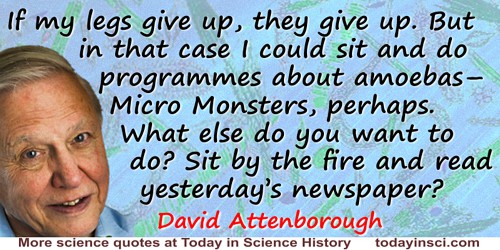
If my legs give up, they give up. But in that case I could sit and do programmes about amoebas—Micro Monsters, perhaps. What else do you want to do? Sit by the fire and read yesterday’s newspaper?
Stating his intent to never retire. Reported by Adam Lusher in 'Sir David Attenborough', Daily Mail (28 Feb 2014).
If we evolved a race of Isaac Newtons, that would not be progress. For the price Newton had to pay for being a supreme intellect was that he was incapable of friendship, love, fatherhood, and many other desirable things. As a man he was a failure; as a monster he was superb.
Interview with J.W.N. Sullivan, Contemporary Mind, London, 1934. As cited in James Roy Newman, The World of Mathematics (1956), Vol. 4, 2222.
Indeed, the ideal for a well-functioning democratic state is like the ideal for a gentleman’s well-cut suit—it is not noticed. For the common people of Britain, Gestapo and concentration camps have approximately the same degree of reality as the monster of Loch Ness. Atrocity propaganda is helpless against this healthy lack of imagination.
In 'A Challenge to “Knights in Rusty Armor”', The New York Times (14 Feb 1943), Sunday Magazine, 5.
Is not Cuvier the great poet of our era? Byron has given admirable expression to certain moral conflicts, but our immortal naturalist has reconstructed past worlds from a few bleached bones; has rebuilt cities, like Cadmus, with monsters’ teeth; has animated forests with all the secrets of zoology gleaned from a piece of coal; has discovered a giant population from the footprints of a mammoth.
From 'La Peau de Chagrin' (1831). As translated by Ellen Marriage in The Wild Ass’s Skin (1906), 21-22.
It is one of the little ironies of our times that while the layman was being indoctrinated with the stereotype image of black holes as the ultimate cookie monsters, the professionals have been swinging round to the almost directly opposing view that black holes, like growing old, are really not so bad when you consider the alternative.
…...
It was the German schoolhouse which destroyed Napoleon III. France, since then, is making monster cannon and drilling soldiers still, but she is also building schoolhouses.
Louis Klopsch, Many Thoughts of Many Minds (1896), 77.
Logic sometimes breeds monsters.
In Science and Method (1952), 125.
Money, mechanization, algebra. The three monsters of contemporary civilization. Complete analogy.
In Gravity and Grace (1952), 209.
ORGANIC LIFE beneath the shoreless waves
Was born and nurs'd in Ocean's pearly caves;
First, forms minute, unseen by spheric glass,
Move on the mud, or pierce the watery mass;
These, as successive generations bloom,
New powers acquire, and larger limbs assume;
Whence countless groups of vegetation spring,
And breathing realms of fin, and feet, and wing.
Thus the tall Oak, the giant of the wood,
Which bears Britannia's thunders on the flood;
The Whale, unmeasured monster of the main,
The lordly Lion, monarch of the plain,
The Eagle soaring in the realms of air,
Whose eye undazzled drinks the solar glare,
Imperious man, who rules the bestial crowd,
Of language, reason, and reflection proud,
With brow erect, who scorns this earthy sod,
And styles himself the image of his God;
Arose from rudiments of form and sense,
An embryon point, or microscopic ens!
Was born and nurs'd in Ocean's pearly caves;
First, forms minute, unseen by spheric glass,
Move on the mud, or pierce the watery mass;
These, as successive generations bloom,
New powers acquire, and larger limbs assume;
Whence countless groups of vegetation spring,
And breathing realms of fin, and feet, and wing.
Thus the tall Oak, the giant of the wood,
Which bears Britannia's thunders on the flood;
The Whale, unmeasured monster of the main,
The lordly Lion, monarch of the plain,
The Eagle soaring in the realms of air,
Whose eye undazzled drinks the solar glare,
Imperious man, who rules the bestial crowd,
Of language, reason, and reflection proud,
With brow erect, who scorns this earthy sod,
And styles himself the image of his God;
Arose from rudiments of form and sense,
An embryon point, or microscopic ens!
The Temple of Nature (1803), canto 1, lines 295-314, pages 26-8.
Science has blown to atoms, as she can rend and rive in the rocks themselves; but in those rocks she has found, and read aloud, the great stone book which is the history of the earth, even when darkness sat upon the face of the deep. Along their craggy sides she has traced the footprints of birds and beasts, whose shapes were never seen by man. From within them she has brought the bones, and pieced together the skeletons, of monsters that would have crushed the noted dragons of the fables at a blow.
Book review of Robert Hunt, Poetry of Science (1848), in the London Examiner (1848). Although uncredited in print, biographers identified his authorship from his original handwritten work. Collected in Charles Dickens and Frederic George Kitton (ed.) Old Lamps for New Ones: And Other Sketches and Essays (1897), 87.
So God created the great sea monsters and every living creature that moves, with which the waters swarm, according to their kinds.
— Bible
(circa 725 B.C.)
Society is becoming increasingly aware of the power of science to bring weal or woe to mankind. But now when it is seen that the same science that brings prosperity and comfort may lead to depression and discomfort, men are beginning to look with mixed feelings at this monster which society may exalt or persecute, but cannot view with indifference. Perhaps my topic today should have read “Ought Scientists to be Burnt at the Stake?” I shall not attempt to decide this question, but only to present in a cursory way some of the pros and cons … But if scientists are to be destroyed, let them not alone by the victims; every creative thought must be extirpated. A philosopher’s epigram may kindle a world war. So scientist, inventor, artist, poet and every sort of troublous enthusiast must together be brought before the bar of the new inquisition
As quoted in Lecture (1981), American Chemical Society, Symposium of the Division of Chemical Education on Gilbert Newton Lewis Melvin Calvin, 'Gilbert Newton Lewis: His Influence on Physical-Organic Chemists at Berkeley', published in Chemical Biodynamics Division, Lawrence Berkeley Laboratory, Proceedings (Mar 1982).
The book of Nature is the book of Fate. She turns the gigantic pages,—leaf after leaf,—never re-turning one. One leaf she lays down, a floor of granite; then a thousand ages, and a bed of slate; a thousand ages, and a measure of coal; a thousand ages, and a layer of marl and mud: vegetable forms appear; her first misshapen animals, zoophyte, trilobium, fish; then, saurians,—rude forms, in which she has only blocked her future statue, concealing under these unwieldy monsters the fine type of her coming king. The face of the planet cools and dries, the races meliorate, and man is born. But when a race has lived its term, it comes no more again.
From 'Fate', collected in The Complete Works of Ralph Waldo Emerson, Volume 6: The Conduct of Life (1860), 15. This paragraph is the prose version of his poem, 'Song of Nature'.
The rigid electron is in my view a monster in relation to Maxwell's equations, whose innermost harmony is the principle of relativity... the rigid electron is no working hypothesis, but a working hindrance. Approaching Maxwell's equations with the concept of the rigid electron seems to me the same thing as going to a concert with your ears stopped up with cotton wool. We must admire the courage and the power of the school of the rigid electron which leaps across the widest mathematical hurdles with fabulous hypotheses, with the hope to land safely over there on experimental-physical ground.
In Arthur I. Miller, Albert Einstein's Special Theory of Relativity (1981), 350.
The robot is going to lose. Not by much. But when the final score is tallied, flesh and blood is going to beat the damn monster.
In The Money Game (1967), 154.
There is no area in our minds reserved for superstition, such as the Greeks had in their mythology; and superstition, under cover of an abstract vocabulary, has revenged itself by invading the entire realm of thought. Our science is like a store filled with the most subtle intellectual devices for solving the most complex problems, and yet we are almost incapable of applying the elementary principles of rational thought. In every sphere, we seem to have lost the very elements of intelligence: the ideas of limit, measure, degree, proportion, relation, comparison, contingency, interdependence, interrelation of means and ends. To keep to the social level, our political universe is peopled exclusively by myths and monsters; all it contains is absolutes and abstract entities. This is illustrated by all the words of our political and social vocabulary: nation, security, capitalism, communism, fascism, order, authority, property, democracy. We never use them in phrases such as: There is democracy to the extent that… or: There is capitalism in so far as… The use of expressions like “to the extent that” is beyond our intellectual capacity. Each of these words seems to represent for us an absolute reality, unaffected by conditions, or an absolute objective, independent of methods of action, or an absolute evil; and at the same time we make all these words mean, successively or simultaneously, anything whatsoever. Our lives are lived, in actual fact, among changing, varying realities, subject to the casual play of external necessities, and modifying themselves according to specific conditions within specific limits; and yet we act and strive and sacrifice ourselves and others by reference to fixed and isolated abstractions which cannot possibly be related either to one another or to any concrete facts. In this so-called age of technicians, the only battles we know how to fight are battles against windmills.
From 'The Power of Words', collected in Siân Miles (ed.), Simone Weil: An Anthology (2000), 222-223.
They look a little like the monster in ‘Alien.’ They’re horrifying to look at up close. That’s sort of what makes them fun. [About his microscopic study of ants.]
As quoted by Lindsay Whitehurst in 'University of Utah Scientist Discovers Terrifying Ant Species', The Salt Lake Tribune (31 Jul 2013)
This world was once a fluid haze of light,
Till toward the centre set the starry tides,
And eddied into suns, that wheeling cast
The planets: then the monster, then the man.
Till toward the centre set the starry tides,
And eddied into suns, that wheeling cast
The planets: then the monster, then the man.
&039;The Princess&039; (1847), part 2, collected in Alfred Tennyson and William James Rolfe (ed.) The Poetic and Dramatic Works of Alfred, Lord Tennyson (1898), 124.
Visualize yourself confronted with the task of killing, one after the other, a cabbage, a fly, a fish, a lizard, a guinea pig, a cat, a dog, a monkey and a baby chimpanzee. In the unlikely case that you should experience no greater inhibitions in killing the chimpanzee than in destroying the cabbage or the fly, my advice to you is to commit suicide at your earliest possible convenience, because you are a weird monstrosity and a public danger.
'The Enmity Between Generations and Its Probable Ethological Causes'. In Richard I. Evans, Konrad Lorenz: The Man and his Ideas (1975), 227.
What a chimera ... is man ! What a novelty, what a monster, what a chaos, what a subject of contradiction, what a prodigy! A judge of all things, feeble worm of the earth, depository of the truth, cloacae of uncertainty and error, the glory and the shame of the universe!
…...
Whereas you have a very expensive dept. for destroying human life, would it not be for the honour of the New World to have a little national establishment for the preservation of human life; more especially as the devouring monster, small pox, has already destroyed many millions (some say 40) more lives than there are people now on the face of the earth.
(Conclusion of a letter (14 Dec 1826) to Massachusetts Congressman Edward Everett (1794-1865), in which he outlined his experience with vaccination.)
(Conclusion of a letter (14 Dec 1826) to Massachusetts Congressman Edward Everett (1794-1865), in which he outlined his experience with vaccination.)
 In science it often happens that scientists say, 'You know that's a really good argument; my position is mistaken,' and then they would actually change their minds and you never hear that old view from them again. They really do it. It doesn't happen as often as it should, because scientists are human and change is sometimes painful. But it happens every day. I cannot recall the last time something like that happened in politics or religion.
(1987) --
In science it often happens that scientists say, 'You know that's a really good argument; my position is mistaken,' and then they would actually change their minds and you never hear that old view from them again. They really do it. It doesn't happen as often as it should, because scientists are human and change is sometimes painful. But it happens every day. I cannot recall the last time something like that happened in politics or religion.
(1987) -- 




