Moment Quotes (270 quotes)
... I left Caen, where I was living, to go on a geologic excursion under the auspices of the School of Mines. The incidents of the travel made me forget my mathematical work. Having reached Coutances, we entered an omnibus to go to some place or other. At the moment when I put my foot on the step, the idea came to me, without anything in my former thoughts seeming to have paved the way for it, that the transformations I had used to define the Fuchsian functions were identical with those of non-Eudidean geometry. I did not verify the idea; I should not have had time, as upon taking my seat in the omnibus, I went on with a conversation already commenced, but I felt a perfect certainty. On my return to Caen, for convenience sake, I verified the result at my leisure.
Quoted in Sir Roger Penrose, The Emperor's New Mind: Concerning Computers, Minds, and the Laws of Physics (1990), 541. Science and Method (1908) 51-52, 392.
...I may perhaps venture a short word on the question much discussed in certain quarters, whether in the work of excavation it is a good thing to have cooperation between men and women ... Of a mixed dig ... I have seen something, and it is an experiment that I would be reluctant to try again. I would grant if need be that women are admirable fitted for the work, yet I would uphold that they should undertake it by themselves ... the work of an excavator on the dig and off it lays on those who share it a bond of closer daily intercourse than is conceivable ... between men and women, except in chance cases, I do not believe that such close and unavoidable companionship can ever be other than a source of irritation; at any rate, I believe that however it may affect women, the ordinary male at least cannot stand it ... A minor ... objection lies in one particular form of contraint ... moments will occur on the best regulated dig when you want to say just what you think without translation, which before the ladies, whatever their feelings about it, cannot be done.
Archaeological Excavation (1915), 63-64. In Getzel M. Cohen and Martha Sharp Joukowsky Breaking Ground (2006), 557-558.
By (), 163-164.
“Conservation” (the conservation law) means this … that there is a number, which you can calculate, at one moment—and as nature undergoes its multitude of changes, this number doesn't change. That is, if you calculate again, this quantity, it'll be the same as it was before. An example is the conservation of energy: there's a quantity that you can calculate according to a certain rule, and it comes out the same answer after, no matter what happens, happens.
'The Great Conservation Principles', The Messenger Series of Lectures, No. 3, Cornell University, 1964. From transcript of BBC programme (11 Dec 1964).
“Every moment dies a man,/ Every moment one is born”:
I need hardly point out to you that this calculation would tend to keep the sum total of the world's population in a state of perpetual equipoise whereas it is a well-known fact that the said sum total is constantly on the increase. I would therefore take the liberty of suggesting that in the next edition of your excellent poem the erroneous calculation to which I refer should be corrected as follows:
'Every moment dies a man / And one and a sixteenth is born.” I may add that the exact figures are 1.167, but something must, of course, be conceded to the laws of metre.
I need hardly point out to you that this calculation would tend to keep the sum total of the world's population in a state of perpetual equipoise whereas it is a well-known fact that the said sum total is constantly on the increase. I would therefore take the liberty of suggesting that in the next edition of your excellent poem the erroneous calculation to which I refer should be corrected as follows:
'Every moment dies a man / And one and a sixteenth is born.” I may add that the exact figures are 1.167, but something must, of course, be conceded to the laws of metre.
Unpublished letter to Tennyson in response to his Vision of Sin (1842). Quoted in Philip and Emily Morrison, Charles Babbage and his Calculating Engines: Selected Writings by Charles Babbage and Others (1961), xxiii.
[About research with big particle accelerators such as the Large Hadron Collider.] I think the primary justification for this sort of science that we do is fundamental human curiosity. ... It's true, of course, that every previous generation that's made some breakthrough in understanding nature has seen those discoveries translated into new technologies, new possibilities for the human race. That may well happen with the Higgs boson. Quite frankly, at the moment I don't see how you can use the Higgs boson for anything useful.
As quoted in Alan Boyle, 'Discovery of Doom? Collider Stirs Debate', article (8 Sep 2008) on a msnbc.com web page.
[Coleridge] selected an instance of what was called the sublime, in DARWIN, who imagined the creation of the universe to have taken place in a moment, by the explosion of a mass of matter in the womb, or centre of space. In one and the same instant of time, suns and planets shot into systems in every direction, and filled and spangled the illimitable void! He asserted this to be an intolerable degradation—referring, as it were, all the beauty and harmony of nature to something like the bursting of a barrel of gunpowder! that spit its combustible materials into a pock-freckled creation!
In Seamus Perry (eds.), Coleridge’s Responses: Vol. 1: Coleridge on Writers and Writing (2007), 338-339.
[Describing a freshman seminar titled “How the Tabby Cat Got Her Stripes or The Silence of the Genes”:] The big idea we start with is: “How is the genome interpreted, and how are stable decisions that affect gene expression inherited from one cell to the next? This is one of the most competitive areas of molecular biology at the moment, and the students are reading papers that in some instances were published this past year. As a consequence, one of the most common answers I have to give to their questions is, “We just don't know.”
As quoted by Kitta MacPherson in 'Exploring Epigenetics: President Shirley Tilghman in the Classroom,'
Princeton University Undergraduate Admission web page accessed 14 Oct 2013.
[I doubt that in today's world, I and Francis Crick would ever have had our Eureka moment.] I recently went to my staircase at Clare College, Cambridge and there were women there! he said, with an enormous measure of retrospective sexual frustration. There have been a lot of convincing studies recently about the loss of productivity in the Western male. It may be that entertainment culture now is so engaging that it keeps people satisfied. We didn't have that. Science was much more fun than listening to the radio. When you are 16 or 17 and in that inherently semi-lonely period when you are deciding whether to be an intellectual, many now don't bother.
(Response when asked how he thought the climate of scientific research had changed since he made his discovery of the structure of life in 1953.)
(Response when asked how he thought the climate of scientific research had changed since he made his discovery of the structure of life in 1953.)
Quoted by Tim Adams in 'The New Age of Ignorance', The Observer (30 Jun 2007).
[I] could see how nervous everybody was in the beginning and how silent it was when we had trouble with the artificial heart [during the surgery, but later in the operation, when it was working, there were moments] of loud and raucous humor.
[Commenting after reviewing the video tape of the world's first human implantation of an artificial heart.]
[Commenting after reviewing the video tape of the world's first human implantation of an artificial heart.]
Quoted by Lawrence K. Altman in “Clark's Surgeon Was ‘Worried To Death’&rdquo, New York Times (12 Apr 1983), C2.
[King Hiero II] requested Archimedes to consider [whether a crown was pure gold or alloyed with silver]. The latter, while the case was still on his mind, happened to go to the bath, and on getting into a tub observed that the more his body sank into it the more water ran out over the tub. As this pointed out the way to explain the case in question, without a moment’s delay, and transported with joy, he jumped out of the tub and rushed home naked, crying with a loud voice that he had found what he was seeking; for as he ran he shouted repeatedly in Greek, “Eὕρηκα, εὕρηκα.”
This famous anecdote, being written about two centuries after Archimedes, is of questionable authenticity, but Vitruvius provided the origin of the story as we know it. In De Architectura, Book 9, Introduction, Sec. 10. As translated in Morris Hicky Morgan (trans.), Vitruvius: The Ten Books on Architecture (1914), 254. Also seen translated as “While Archimedes was turning the problem over, he chanced to come to the place of bathing, and there, as he was sitting down in the tub, he noticed that the amount of water which flowed over the tub was equal to the amount by which his body was immersed. This showed him a means of solving the problem. … In his joy, he leapt out of the tub and, rushing naked towards his home, he cried out with a loud voice that he had found what he sought.” In Ivor Bulmer-Thomas, Selections Illustrating the History of Greek Mathematics (1939), 37.
[Watching natural history programs] brings a solace you can’t describe in words. It’s because we’re part of it fundamentally…. In moments of great grief, that’s where you look and immerse yourself. You realise you are not immortal, you are not a god, you are part of the natural world and you come to accept that.
Reflecting on the letters he received from newly bereaved people. While his series are running on TV, in dozens of letters daily (comprising the majority of the correspondence), they tell him that the only things they can face in their darkest moments are his natural-history programmes. From interview with Joe Shute, 'David Attenborough at 90: ‘I think about my mortality every day’', The Telegraph (29 Oct 2016).
[We are] a fragile species, still new to the earth, … here only a few moments as evolutionary time is measured, … in real danger at the moment of leaving behind only a thin layer of of our fossils, radioactive at that.
The Fragile Species (1992, 1996), 25.
[When nature appears complicated:] The moment we contemplate it as it is, and attain a position from which we can take a commanding view, though but of a small part of its plan, we never fail to recognize that sublime simplicity on which the mind rests satisfied that it has attained the truth.
Concluding remark in Dionysius Lardner (ed.), Cabinet Cyclopaedia, Vol 1, Preliminary Discourse on the Study of Natural Philosophy (1831), 361.
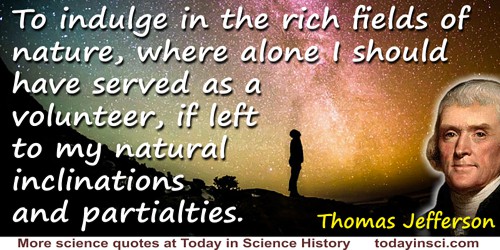
[Writing this letter] has permitted me, for a moment, to abstract myself from the dry and dreary waste of politics, into which I have been impressed by the times on which I happened, and to indulge in the rich fields of nature, where alone I should have served as a volunteer, if left to my natural inclinations and partialties.
In letter to Caspar Wistar (21 Jun 1807), collected in Thomas Jefferson Randolph (ed.), Memoir, Correspondence, And Miscellanies, From The Papers Of Thomas Jefferson (1829), Vol. 4, 94.
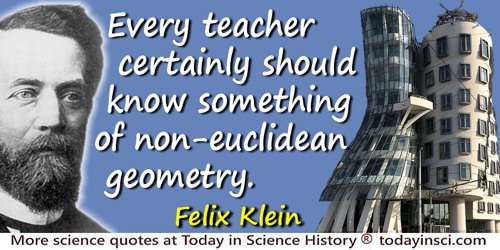
Every teacher certainly should know something of non-euclidean geometry. Thus, it forms one of the few parts of mathematics which, at least in scattered catch-words, is talked about in wide circles, so that any teacher may be asked about it at any moment. … Imagine a teacher of physics who is unable to say anything about Röntgen rays, or about radium. A teacher of mathematics who could give no answer to questions about non-euclidean geometry would not make a better impression.
On the other hand, I should like to advise emphatically against bringing non-euclidean into regular school instruction (i.e., beyond occasional suggestions, upon inquiry by interested pupils), as enthusiasts are always recommending. Let us be satisfied if the preceding advice is followed and if the pupils learn to really understand euclidean geometry. After all, it is in order for the teacher to know a little more than the average pupil.
On the other hand, I should like to advise emphatically against bringing non-euclidean into regular school instruction (i.e., beyond occasional suggestions, upon inquiry by interested pupils), as enthusiasts are always recommending. Let us be satisfied if the preceding advice is followed and if the pupils learn to really understand euclidean geometry. After all, it is in order for the teacher to know a little more than the average pupil.
In George Edward Martin, The Foundations of Geometry and the Non-Euclidean Plane (1982), 72.
Qu'une goutee de vin tombe dans un verre d'eau; quelle que soit la loi du movement interne du liquide, nous verrons bientôt se colorer d'une teinte rose uniforme et à partir de ce moment on aura beau agiter le vase, le vin et l'eau ne partaîtront plus pouvoir se séparer. Tout cela, Maxwell et Boltzmann l'ont expliqué, mais celui qui l'a vu plus nettement, dans un livre trop peu lu parce qu'il est difficile à lire, c'est Gibbs dans ses principes de la Mécanique Statistique.
Let a drop of wine fall into a glass of water; whatever be the law that governs the internal movement of the liquid, we will soon see it tint itself uniformly pink and from th at moment on, however we may agitate the vessel, it appears that the wine and water can separate no more. All this, Maxwell and Boltzmann have explained, but the one who saw it in the cleanest way, in a book that is too little read because it is difficult to read, is Gibbs, in his Principles of Statistical Mechanics.
Let a drop of wine fall into a glass of water; whatever be the law that governs the internal movement of the liquid, we will soon see it tint itself uniformly pink and from th at moment on, however we may agitate the vessel, it appears that the wine and water can separate no more. All this, Maxwell and Boltzmann have explained, but the one who saw it in the cleanest way, in a book that is too little read because it is difficult to read, is Gibbs, in his Principles of Statistical Mechanics.
La valeur de la science. In Anton Bovier, Statistical Mechanics of Disordered Systems (2006), 3.
1839—The fermentation satire
THE MYSTERY OF ALCOHOLIC FERMENTATION RESOLVED
(Preliminary Report by Letter) Schwindler
I am about to develop a new theory of wine fermentation … Depending on the weight, these seeds carry fermentation to completion somewhat less than as in the beginning, which is understandable … I shall develop a new theory of wine fermentation [showing] what simple means Nature employs in creating the most amazing phenomena. I owe it to the use of an excellent microscope designed by Pistorius.
When brewer’s yeast is mixed with water the microscope reveals that the yeast dissolves into endless small balls, which are scarcely 1/800th of a line in diameter … If these small balls are placed in sugar water, it can be seen that they consist of the eggs of animals. As they expand, they burst, and from them develop small creatures that multiply with unbelievable rapidity in a most unheard of way. The form of these animals differs from all of the 600 types described up until now. They possess the shape of a Beinsdorff still (without the cooling apparatus). The head of the tube is a sort of proboscis, the inside of which is filled with fine bristles 1/2000th of a line long. Teeth and eyes are not discernible; however, a stomach, intestinal canal, anus (a rose red dot), and organs for secretion of urine are plainly discernible. From the moment they are released from the egg one can see these animals swallow the sugar from the solution and pass it to the stomach. It is digested immediately, a process recognized easily by the resultant evacuation of excrements. In a word, these infusors eat sugar, evacuate ethyl alcohol from the intestinal canal, and carbon dioxide from the urinary organs. The bladder, in the filled state, has the form of a champagne bottle; when empty, it is a small button … As soon as the animals find no more sugar present, they eat each other up, which occurs through a peculiar manipulation; everything is digested down to the eggs which pass unchanged through the intestinal canal. Finally, one again fermentable yeast, namely the seed of the animals, which remain over.
THE MYSTERY OF ALCOHOLIC FERMENTATION RESOLVED
(Preliminary Report by Letter) Schwindler
I am about to develop a new theory of wine fermentation … Depending on the weight, these seeds carry fermentation to completion somewhat less than as in the beginning, which is understandable … I shall develop a new theory of wine fermentation [showing] what simple means Nature employs in creating the most amazing phenomena. I owe it to the use of an excellent microscope designed by Pistorius.
When brewer’s yeast is mixed with water the microscope reveals that the yeast dissolves into endless small balls, which are scarcely 1/800th of a line in diameter … If these small balls are placed in sugar water, it can be seen that they consist of the eggs of animals. As they expand, they burst, and from them develop small creatures that multiply with unbelievable rapidity in a most unheard of way. The form of these animals differs from all of the 600 types described up until now. They possess the shape of a Beinsdorff still (without the cooling apparatus). The head of the tube is a sort of proboscis, the inside of which is filled with fine bristles 1/2000th of a line long. Teeth and eyes are not discernible; however, a stomach, intestinal canal, anus (a rose red dot), and organs for secretion of urine are plainly discernible. From the moment they are released from the egg one can see these animals swallow the sugar from the solution and pass it to the stomach. It is digested immediately, a process recognized easily by the resultant evacuation of excrements. In a word, these infusors eat sugar, evacuate ethyl alcohol from the intestinal canal, and carbon dioxide from the urinary organs. The bladder, in the filled state, has the form of a champagne bottle; when empty, it is a small button … As soon as the animals find no more sugar present, they eat each other up, which occurs through a peculiar manipulation; everything is digested down to the eggs which pass unchanged through the intestinal canal. Finally, one again fermentable yeast, namely the seed of the animals, which remain over.
In 'Das entriithselle Geheimiss der geisligen Giihrung', Annalen der Pharmacie und Chemie (1839), 29, 100-104; adapted from English translalion by Ralph E. Oesper, The Human Side of Scientists (1975), 203-205.
A moment’s consideration of this case shows what a really great advance in the theory and practise of breeding has been obtained through the discovery of Mendel’s law. What a puzzle this case would have presented to the biologist ten years ago! Agouti crossed with chocolate gives in the second filial generation (not in the first) four varieties, viz., agouti, chocolate, black and cinnamon. We could only have shaken our heads and looked wise (or skeptical).
Then we had no explanation to offer for such occurrences other than the “instability of color characters under domestication,” the “effects of inbreeding,” “maternal impressions.” Serious consideration would have been given to the proximity of cages containing both black and cinnamon-agouti mice.
Now we have a simple, rational explanation, which anyone can put to the test. We are able to predict the production of new varieties, and to produce them.
We must not, of course, in our exuberance, conclude that the powers of the hybridizer know no limits. The result under consideration consists, after all, only in the making of new combinations of unit characters, but it is much to know that these units exist and that all conceivable combinations of them are ordinarily capable of production. This valuable knowledge we owe to the discoverer and to the rediscoverers of Mendel’s law.
Then we had no explanation to offer for such occurrences other than the “instability of color characters under domestication,” the “effects of inbreeding,” “maternal impressions.” Serious consideration would have been given to the proximity of cages containing both black and cinnamon-agouti mice.
Now we have a simple, rational explanation, which anyone can put to the test. We are able to predict the production of new varieties, and to produce them.
We must not, of course, in our exuberance, conclude that the powers of the hybridizer know no limits. The result under consideration consists, after all, only in the making of new combinations of unit characters, but it is much to know that these units exist and that all conceivable combinations of them are ordinarily capable of production. This valuable knowledge we owe to the discoverer and to the rediscoverers of Mendel’s law.
'New Colour Variety of the Guinea Pig', Science, 1908, 28, 250-252.
A moment’s insight is sometimes worth a life’s experience.
In 'Iris, Her Book', The Professor at the Breakfast-Table (1860, 1892), 239.
A mouse can fall down a mine shaft a third of a mile deep without injury. A rat falling the same distance would break his bones; a man would simply splash ... Elephants have their legs thickened to an extent that seems disproportionate to us, but this is necessary if their unwieldly bulk is to be moved at all ... A 60-ft. man would weigh 1000 times as much as a normal man, but his thigh bone would have its area increased by only 100 times ... Consequently such an unfortunate monster would break his legs the moment he tried to move.
Expressing, in picturesque terms, the strength of an organism relative to its bulk.
Expressing, in picturesque terms, the strength of an organism relative to its bulk.
Address at the annual congress of the British Association for the Advancement of Science. Quoted in 'On the Itchen', Time Magazine (Mon. 14 Sep 1925).
A Native American elder once described his own inner struggles in this manner: Inside of me there are two dogs. One of the dogs is mean and evil. The other dog is good. The mean dog fights the good dog all the time. When asked which dog wins, he reflected for a moment and replied, The one I feed the most.
Widely found in varied accounts, so is most likely proverbial. Seen misattributed (?) to George Bernard Shaw, but Webmaster has not yet found a primary source as verification.
A theory is scientific only if it can be disproved. But the moment you try to cover absolutely everything the chances are that you cover nothing.
From Assumption and Myth in Physical Theory (1967), 12.
A thesis has to be presentable… but don't attach too much importance to it. If you do succeed in the sciences, you will do later on better things and then it will be of little moment. If you don’t succeed in the sciences, it doesn’t matter at all.
Quoted in Leidraad (1985), 2. (This is a periodical of the University of Leiden, Holland.)
A very small cause which escapes our notice determines a considerable effect that we cannot fail to see, and then we say that the effect is due to chance. If we knew exactly the laws of nature and the situation of the universe at the initial moment, we could predict exactly the situation of that same universe at a succeeding moment.
In 'Chance', Science et Méthode (1908). Quoted in Richard Kautz, Chaos: The Science of Predictable Random Motion (2011), 167 as translated in Science and Method by F. Maitland (1918).
Admit for a moment, as a hypothesis, that the Creator had before his mind a projection of the whole life-history of the globe, commencing with any point which the geologist may imagine to have been a fit commencing point, and ending with some unimaginable acme in the indefinitely distant future. He determines to call this idea into actual existence, not at the supposed commencing point, but at some stage or other of its course. It is clear, then, that at the selected stage it appears, exactly as it would have appeared at that moment of its history, if all the preceding eras of its history had been real.
Omphalos: An Attempt to Untie the Geological Knot (1857), 351.
All human affairs follow nature's great analogue, the growth of vegetation. There are three periods of growth in every plant. The first, and slowest, is the invisible growth by the root; the second and much accelerated is the visible growth by the stem; but when root and stem have gathered their forces, there comes the third period, in which the plant quickly flashes into blossom and rushes into fruit.
The beginnings of moral enterprises in this world are never to be measured by any apparent growth. ... At length comes the sudden ripeness and the full success, and he who is called in at the final moment deems this success his own. He is but the reaper and not the labourer. Other men sowed and tilled and he but enters into their labours.
The beginnings of moral enterprises in this world are never to be measured by any apparent growth. ... At length comes the sudden ripeness and the full success, and he who is called in at the final moment deems this success his own. He is but the reaper and not the labourer. Other men sowed and tilled and he but enters into their labours.
Life Thoughts (1858), 20.
All minds quote. Old and new make the warp and woof of every moment. There is no thread that is not a twist of these two strands.
In Lecture, second in a series given at Freeman Place Chapel, Boston (Mar 1859), 'Quotation and Originality', Letters and Social Aims (1875, 1917), 178.
All power, all subordination rests on the executioner: he is the horror and the bond of human association. Remove this incomprehensible agent from the world, and the very moment order gives way to chaos, thrones topple, and society disappears
In Joseph de Maistre and Richard A. Lebrun (trans.), The St. Petersburg Dialogues (1993), 20.
All you really need to know for the moment is that the universe is a lot more complicated than you might think, even if you start from a position of thinking it’s pretty damn complicated in the first place.
In Mostly Harmless (1992), 195.
Although we are mere sojourners on the surface of the planet, chained to a mere point in space, enduring but for a moment of time, the human mind is not only enabled to number worlds beyond the unassisted ken of mortal eye, but to trace the events of indefinite ages before the creation of our race, and is not even withheld from penetrating into the dark secrets of the ocean, or the interior of the solid globe; free, like the spirit which the poet described as animating the universe.
In Principles of Geology (1830).
Among people I have met, the few whom I would term “great” all share a kind of unquestioned, fierce dedication; an utter lack of doubt about the value of their activities (or at least an internal impulse that drives through any such angst); and above all, a capacity to work (or at least to be mentally alert for unexpected insights) at every available moment of every day of their lives.
From The Lying Stones of Marrakech: Penultimate Reflections in Natural History (2000), 76.
An honest man, armed with all the knowledge available to us now, could only state that in some sense, the origin of life appears at the moment to be almost a miracle, so many are the conditions which would have had to have been satisfied to get it going. But this should not be taken to imply that there are good reasons to believe that it could not have started on the earth by a perfectly reasonable sequence of fairly ordinary chemical reactions. The plain fact is that the time available was too long, the many microenvironments on the earth’s surface too diverse, the various chemical possibilities too numerous and our own knowledge and imagination too feeble to allow us to be able to unravel exactly how it might or might not have happened such a long time ago, especially as we have no experimental evidence from that era to check our ideas against.
In Life Itself: Its Origin and Nature (1981), 88.
And if you want the exact moment in time, it was conceived mentally on 8th March in this year one thousand six hundred and eighteen, but submitted to calculation in an unlucky way, and therefore rejected as false, and finally returning on the 15th of May and adopting a new line of attack, stormed the darkness of my mind. So strong was the support from the combination of my labour of seventeen years on the observations of Brahe and the present study, which conspired together, that at first I believed I was dreaming, and assuming my conclusion among my basic premises. But it is absolutely certain and exact that the proportion between the periodic times of any two planets is precisely the sesquialterate proportion of their mean distances.
Harmonice Mundi, The Harmony of the World (1619), book V, ch. 3. Trans. E. J. Aiton, A. M. Duncan and J. V. Field (1997), 411.
Another advantage of observation is, that we may gain knowledge all the day long, and every moment of our lives, and every moment of our existence, we may be adding to our intellectual treasures thereby.
In Interesting Anecdotes, Memoirs, Allegories, Essays, and Poetical Fragments (1793), Vols 3-4, Vol 4, 73.
As every circumstance relating to so capital a discovery as this (the greatest, perhaps, that has been made in the whole compass of philosophy, since the time of Sir Isaac Newton) cannot but give pleasure to all my readers, I shall endeavour to gratify them with the communication of a few particulars which I have from the best authority. The Doctor [Benjamin Franklin], after having published his method of verifying his hypothesis concerning the sameness of electricity with the matter lightning, was waiting for the erection of a spire in Philadelphia to carry his views into execution; not imagining that a pointed rod, of a moderate height, could answer the purpose; when it occurred to him, that, by means of a common kite, he could have a readier and better access to the regions of thunder than by any spire whatever. Preparing, therefore, a large silk handkerchief, and two cross sticks, of a proper length, on which to extend it, he took the opportunity of the first approaching thunder storm to take a walk into a field, in which there was a shed convenient for his purpose. But dreading the ridicule which too commonly attends unsuccessful attempts in science, he communicated his intended experiment to no body but his son, who assisted him in raising the kite.
The kite being raised, a considerable time elapsed before there was any appearance of its being electrified. One very promising cloud passed over it without any effect; when, at length, just as he was beginning to despair of his contrivance, he observed some loose threads of the hempen string to stand erect, and to avoid one another, just as if they had been suspended on a common conductor. Struck with this promising appearance, he inmmediately presented his knuckle to the key, and (let the reader judge of the exquisite pleasure he must have felt at that moment) the discovery was complete. He perceived a very evident electric spark. Others succeeded, even before the string was wet, so as to put the matter past all dispute, and when the rain had wetted the string, he collected electric fire very copiously. This happened in June 1752, a month after the electricians in France had verified the same theory, but before he had heard of any thing that they had done.
The kite being raised, a considerable time elapsed before there was any appearance of its being electrified. One very promising cloud passed over it without any effect; when, at length, just as he was beginning to despair of his contrivance, he observed some loose threads of the hempen string to stand erect, and to avoid one another, just as if they had been suspended on a common conductor. Struck with this promising appearance, he inmmediately presented his knuckle to the key, and (let the reader judge of the exquisite pleasure he must have felt at that moment) the discovery was complete. He perceived a very evident electric spark. Others succeeded, even before the string was wet, so as to put the matter past all dispute, and when the rain had wetted the string, he collected electric fire very copiously. This happened in June 1752, a month after the electricians in France had verified the same theory, but before he had heard of any thing that they had done.
The History and Present State of Electricity, with Original Experiments (1767, 3rd ed. 1775), Vol. 1, 216-7.
As I show you this liquid, I too could tell you, 'I took my drop of water from the immensity of creation, and I took it filled with that fecund jelly, that is, to use the language of science, full of the elements needed for the development of lower creatures. And then I waited, and I observed, and I asked questions of it, and I asked it to repeat the original act of creation for me; what a sight it would be! But it is silent! It has been silent for several years, ever since I began these experiments. Yes! And it is because I have kept away from it, and am keeping away from it to this moment, the only thing that it has not been given to man to produce, I have kept away from it the germs that are floating in the air, I have kept away from it life, for life is the germ, and the germ is life.'
Quoted in Patrice Debré, Louis Pasteur, trans. Elborg Forster (1994), 169.
As to how far in advance of the first flight the man should know he’s going. I’m not in agreement with the argument that says word should be delayed until the last possible moment to save the pilot from developing a bad case of the jitters. If we don’t have the confidence to keep from getting clutched at that time, we have no business going at all. If I’m the guy going, I’ll be glad to get the dope as soon as possible. As for keeping this a big secret from us and having us all suited up and then saying to one man “you go” and stuffing him in and putting the lid on that thing and away he goes, well, we’re all big boys now.
As he wrote in an article for Life (14 Sep 1959), 38. In fact, he was the first to fly in Earth orbit on 20 Feb 1962, though Alan Shepard was picked for the earlier first suborbital flight.
Ask her to wait a moment. I am almost done.
When told, while working, that his wife was dying.
When told, while working, that his wife was dying.
Quoted in E.T. Bell, Men of Mathematics, (1937).
At moments of great enthusiasm it seems to me that no one in the world has ever made something this beautiful and important.
As quoted on the website mcescher.com, without citation.
At the moment I am occupied by an investigation with Kirchoff which does not allow us to sleep. Kirchoff has made a totally unexpected discovery, inasmuch as he has found out the cause for the dark lines in the solar spectrum and can produce these lines artificially intensified both in the solar spectrum and in the continuous spectrum of a flame, their position being identical with that of Fraunhofer’s lines. Hence the path is opened for the determination of the chemical composition of the Sun and the fixed stars.
Letter to H.E. Roscoe (Nov 1859). In The Life and Experiences of Sir Henry Enfield Roscoe (1906), 81.
At the moment I am occupied by an investigation with Kirchoff which does not allow us to sleep. Kirchoff has made a totally unexpected discovery, inasmuch as he has found out the cause for the dark lines in the solar spectrum and can produce these lines artificially intensified both in the solar spectrum and in the continuous spectrum of a flame, their position being identical with that of Fraunhofer’s lines. Hence the path is opened for the determination of the chemical composition of the Sun and the fixed stars.
Letter to H.E. Roscoe (Nov 1859). In The Life and Experiences of Sir Henry Enfield Roscoe (1906), 71.
Available energy is energy which we can direct into any desired channel. Dissipated energy is energy which we cannot lay hold of and direct at pleasure, such as the energy of the confused agitation of molecules which we call heat. Now, confusion, like the correlative term order, is not a property of material things in themselves, but only in relation to the mind which perceives them. A memorandum-book does not, provided it is neatly written, appear confused to an illiterate person, or to the owner who understands it thoroughly, but to any other person able to read it appears to be inextricably confused. Similarly the notion of dissipated energy could not occur to a being who could not turn any of the energies of nature to his own account, or to one who could trace the motion of every molecule and seize it at the right moment. It is only to a being in the intermediate stage, who can lay hold of some forms of energy while others elude his grasp, that energy appears to be passing inevitably from the available to the dissipated state.
'Diffusion', Encyclopaedia Britannica (1878). In W. D. Niven (ed.), The Scientific Papers of James Clerk Maxwell (1890), Vol. 2, 646.
But at the same time, there must never be the least hesitation in giving up a position the moment it is shown to be untenable. It is not going too far to say that the greatness of a scientific investigator does not rest on the fact of his having never made a mistake, but rather on his readiness to admit that he has done so, whenever the contrary evidence is cogent enough.
Principles of General Physiology (1915), x.xi.
But how is it that they [astrologers] have never been able to explain why, in the life of twins, in their actions, in their experiences, their professions, their accomplishments, their positions—in all the other circumstances of human life, and even in death itself, there is often found such a diversity that in those respects many strangers show more resemblance to them than they show to one another, even though the smallest possible interval separated their births and though they were conceived at the same moment, by a single act of intercourse.
De Civitate Dei (The City of God) [413-426], Book V, chapter I, trans. H. Bettenson (1972),180-181.
But the idea of science and systematic knowledge is wanting to our whole instruction alike, and not only to that of our business class ... In nothing do England and the Continent at the present moment more strikingly differ than in the prominence which is now given to the idea of science there, and the neglect in which this idea still lies here; a neglect so great that we hardly even know the use of the word science in its strict sense, and only employ it in a secondary and incorrect sense.
Schools and Universities on the Continent (1868),278-9.
But, as we consider the totality of similarly broad and fundamental aspects of life, we cannot defend division by two as a natural principle of objective order. Indeed, the ‘stuff’ of the universe often strikes our senses as complex and shaded continua, admittedly with faster and slower moments, and bigger and smaller steps, along the way. Nature does not dictate dualities, trinities, quarterings, or any ‘objective’ basis for human taxonomies; most of our chosen schemes, and our designated numbers of categories, record human choices from a cornucopia of possibilities offered by natural variation from place to place, and permitted by the flexibility of our mental capacities. How many seasons (if we wish to divide by seasons at all) does a year contain? How many stages shall we recognize in a human life?
…...
By and large it is uniformly true in mathematics that there is a time lapse between a mathematical discovery and the moment when it is useful; and that this lapse of time can be anything from 30 to 100 years, in some cases even more.
From Address (1954) to Princeton Alumni, 'The Role of Mathematics in the Sciences and in Society', published in A.H. Taub (ed.), John von Neumann: Collected Works (1963), Vol. 6, 489. As quoted and cited in Rosemary Schmalz,Out of the Mouths of Mathematicians: A Quotation Book for Philomaths (1993), 123.
Can any thoughtful person admit for a moment that, in a society so constituted that these overwhelming contrasts of luxury and privation are looked upon as necessities, and are treated by the Legislature as matters with which it has practically nothing do, there is the smallest probability that we can deal successfully with such tremendous social problems as those which involve the marriage tie and the family relation as a means of promoting the physical and moral advancement of the race? What a mockery to still further whiten the sepulchre of society, in which is hidden ‘all manner of corruption,’ with schemes for the moral and physical advancement of the race!
In 'Human Selection', Fortnightly Review (1890),48, 330.
Can science ever be immune from experiments conceived out of prejudices and stereotypes, conscious or not? (Which is not to suggest that it cannot in discrete areas identify and locate verifiable phenomena in nature.) I await the study that says lesbians have a region of the hypothalamus that resembles straight men and I would not be surprised if, at this very moment, some scientist somewhere is studying brains of deceased Asians to see if they have an enlarged ‘math region’ of the brain.
— Kay Diaz
…...
Compare the length of a moment with the period of ten thousand years; the first, however minuscule, does exist as a fraction of a second. But that number of years, or any multiple of it that you may name, cannot even be compared with a limitless extent of time, the reason being that comparisons can be drawn between finite things, but not between finite and infinite.
The Consolation of Philosophy [before 524], Book II, trans. P. G. Walsh (1999), 36.
Computers are fantastic. In a few moments they can make a mistake so great that it would take many men many months to equal it.
As quoted, without citation, in Laurence J. Peter, The Peter Prescription: How to be Creative, Confident & Competent (1972).
Consciousness is not wholly, nor even primarily a device for receiving sense-impressions. …there is another outlook than the scientific one, because in practice a more transcendental outlook is almost universally admitted. …who does not prize these moments that reveal to us the poetry of existence?
Swarthmore Lecture (1929) at Friends’ House, London, printed in Science and the Unseen World (1929), 44.
Deep beneath the surface of the Sun, enormous forces were gathering. At any moment, the energies of a million hydrogen bombs might burst forth in the awesome explosion…. Climbing at millions of miles per hour, an invisible fireball many times the size of Earth would leap from the Sun and head out across space.
From 'Sunjammer', collected in Harry Harrison (ed.), Worlds of Wonder: Sixteen Tales of Science Fiction (1969), 32-33. Originally published in Boys’ Life (Mar 1964).
Disease is not something personal and special, but only a manifestation of life under modified conditions, operating according to the same laws as apply to the living body at all times, from the first moment until death.
In Ian F. McNeely, Medicine on a Grand Scale: Rudolf Virchow, Liberalism, and the Public Health (2002), 26.
Dr. Johnson ... sometimes employed himself in chymistry, sometimes in watering and pruning a vine, and sometimes in small experiments, at which those who may smile, should recollect that there are moments which admit of being soothed only by trifles.
Quoted in James Boswell, The Life of Samuel Johnson, LL.D. (1826), Vol. 3, 352.
During the vernal equinox, we witness the delicate balance between gravitational forces and orbital dynamics that shape our planet’s journey around the sun. It’s a moment to contemplate the grandeur of the cosmos and the precision of cosmic mechanics.
A fictional quote imagined in the style of a theoretical physicist and astronomer (19 Mar 2024).
Every breath you draw, every accelerated beat of your heart in the emotional periods of your oratory depend upon highly elaborated physical and chemical reactions and mechanisms which nature has been building up through a million centuries. If one of these mechanisms, which you owe entirely to your animal ancestry, were to be stopped for a single instant, you would fall lifeless on the stage. Not only this, but some of your highest ideals of human fellowship and comradeship were not created in a moment, but represent the work of ages.
Quoted in Closing Address by Dr. Henry Sloane Coffin, president of the Union Theological Seminary, New York, at the Memorial Service for Osborn at St. Bartholomew's Church, N.Y. (18 Dec 1935). In 'Henry Fairfield Osborn', Supplement to Natural History (Feb 1936), 37:2, 133-34. Bound in Kofoid Collection of Pamphlets on Biography, University of California.
Every inhabitant of this planet must contemplate the day when this planet may no longer be habitable. Every man, woman and child lives under a nuclear sword of Damocles, hanging by the slenderest of threads, capable of being cut at any moment by accident or miscalculation or by madness. The weapons of war must be abolished before they abolish us.
Address to the United Nations General Assembly, (25 Sep 1961). On U.S. Department of State website.
Every situation, every moment—is of infinite worth; for it is the representative of a whole eternity.
Quoted in Kim Lim (ed.), 1,001 Pearls of Spiritual Wisdom: Words to Enrich, Inspire, and Guide Your Life (2014), 166
Everything does not happen continuously at any one moment in the universe. Neither does everything happen everywhere in it.
In Teilhard de Chardin and Bernard Wall (trans.), The Phenomenon of Man (1959), 49. Originally published in French as Le Phénomene Humain (1955).
Everything material which is the subject of knowledge has number, order, or position; and these are her first outlines for a sketch of the universe. If our feeble hands cannot follow out the details, still her part has been drawn with an unerring pen, and her work cannot be gainsaid. So wide is the range of mathematical sciences, so indefinitely may it extend beyond our actual powers of manipulation that at some moments we are inclined to fall down with even more than reverence before her majestic presence. But so strictly limited are her promises and powers, about so much that we might wish to know does she offer no information whatever, that at other moments we are fain to call her results but a vain thing, and to reject them as a stone where we had asked for bread. If one aspect of the subject encourages our hopes, so does the other tend to chasten our desires, and he is perhaps the wisest, and in the long run the happiest, among his fellows, who has learned not only this science, but also the larger lesson which it directly teaches, namely, to temper our aspirations to that which is possible, to moderate our desires to that which is attainable, to restrict our hopes to that of which accomplishment, if not immediately practicable, is at least distinctly within the range of conception.
From Presidential Address (Aug 1878) to the British Association, Dublin, published in the Report of the 48th Meeting of the British Association for the Advancement of Science (1878), 31.
Evolution is a theory of organic change, but it does not imply, as many people assume, that ceaseless flux is the irreducible state of nature and that structure is but a temporary incarnation of the moment. Change is more often a rapid transition between stable states than a continuous transformation at slow and steady rates. We live in a world of structure and legitimate distinction. Species are the units of nature’s morphology.
…...
For forty-nine months between 1968 and 1972, two dozen Americans had the great good fortune to briefly visit the Moon. Half of us became the first emissaries from Earth to tread its dusty surface. We who did so were privileged to represent the hopes and dreams of all humanity. For mankind it was a giant leap for a species that evolved from the Stone Age to create sophisticated rockets and spacecraft that made a Moon landing possible. For one crowning moment, we were creatures of the cosmic ocean, an epoch that a thousand years hence may be seen as the signature of our century.
…...
For FRICTION is inevitable because the Universe is FULL of God's works.
For the PERPETUAL MOTION is in all works of Almighty GOD.
For it is not so in the engines of man, which are made of dead materials, neither indeed can be.
For the Moment of bodies, as it is used, is a false term—bless God ye Speakers on the Fifth of November.
For Time and Weight are by their several estimates.
For I bless GOD in the discovery of the LONGITUDE direct by the means of GLADWICK.
For the motion of the PENDULUM is the longest in that it parries resistance.
For the WEDDING GARMENTS of all men are prepared in the SUN against the day of acceptation.
For the wedding Garments of all women are prepared in the MOON against the day of their purification.
For CHASTITY is the key of knowledge as in Esdras, Sir Isaac Newton & now, God be praised, in me.
For Newton nevertheless is more of error than of the truth, but I am of the WORD of GOD.
For the PERPETUAL MOTION is in all works of Almighty GOD.
For it is not so in the engines of man, which are made of dead materials, neither indeed can be.
For the Moment of bodies, as it is used, is a false term—bless God ye Speakers on the Fifth of November.
For Time and Weight are by their several estimates.
For I bless GOD in the discovery of the LONGITUDE direct by the means of GLADWICK.
For the motion of the PENDULUM is the longest in that it parries resistance.
For the WEDDING GARMENTS of all men are prepared in the SUN against the day of acceptation.
For the wedding Garments of all women are prepared in the MOON against the day of their purification.
For CHASTITY is the key of knowledge as in Esdras, Sir Isaac Newton & now, God be praised, in me.
For Newton nevertheless is more of error than of the truth, but I am of the WORD of GOD.
From 'Jubilate Agno' (c.1758-1763), in N. Callan (ed.), The Collected Poems of Christopher Smart (1949), Vol. 1, 276.
For nothing is fixed, forever and forever and forever, it is not fixed; the earth is always shifting, the light is always changing, the sea does not cease to grind down rock. Generations do not cease to be born, and we are responsible to them because we are the only witnesses they have. The sea rises, the light fails, lovers cling to each other, and children cling to us. The moment we cease to hold each other, the sea engulfs us and the light goes out.
…...
Fossil bones and footsteps and ruined homes are the solid facts of history, but the surest hints, the most enduring signs, lie in those miniscule genes. For a moment we protect them with our lives, then like relay runners with a baton, we pass them on to be carried by our descendents. There is a poetry in genetics which is more difficult to discern in broken bomes, and genes are the only unbroken living thread that weaves back and forth through all those boneyards.
The Self-Made Man: Human Evolution From Eden to Extinction (1996), 13.
Gradually, at various points in our childhoods, we discover different forms of conviction. There’s the rock-hard certainty of personal experience (“I put my finger in the fire and it hurt,”), which is probably the earliest kind we learn. Then there’s the logically convincing, which we probably come to first through maths, in the context of Pythagoras’s theorem or something similar, and which, if we first encounter it at exactly the right moment, bursts on our minds like sunrise with the whole universe playing a great chord of C Major.
In short essay, 'Dawkins, Fairy Tales, and Evidence', 2.
Guard well your spare moments. They are like uncut diamonds. Discard them and their value will never be known. Improve them and they will become the brightest gems in a useful life.
…...
Hast thou ever raised thy mind to the consideration of existence, in and by itself, as the mere act of existing?
Hast thou ever said to thyself thoughtfully it is! heedless, in that moment, whether it were a man before thee, or a flower, or a grain of sand;—without reference, in short, to this or that particular mode or form of existence? If thou hast, indeed, attained to this, thou wilt have felt the presence of a mystery, which must have fixed thy spirit in awe and wonder.
Hast thou ever said to thyself thoughtfully it is! heedless, in that moment, whether it were a man before thee, or a flower, or a grain of sand;—without reference, in short, to this or that particular mode or form of existence? If thou hast, indeed, attained to this, thou wilt have felt the presence of a mystery, which must have fixed thy spirit in awe and wonder.
In 'Essay IX', The Friend: A Series of Essays (1818), Vol. 3, 250.
How can one really know a great moment unless one has first felt a great disappointment?
Jewish saying. As quoted in Harry Gilbert and Diana Gilbert Smith, Gravity, the Glue of the Universe: History and Activities (1997), 43.
How near one Species to the next is join'd,
The due Gradations please a thinking Mind;
and there are Creatures which no eye can see,
That for a Moment live and breathe like me:
Whom a small Fly in bulk as far exceeds,
As yon tall Cedar does the waving Reeds:
These we can reach—and may we not suppose
There still are Creatures more minute than those.
The due Gradations please a thinking Mind;
and there are Creatures which no eye can see,
That for a Moment live and breathe like me:
Whom a small Fly in bulk as far exceeds,
As yon tall Cedar does the waving Reeds:
These we can reach—and may we not suppose
There still are Creatures more minute than those.
'The Enquiry'. In Poems Upon Several Occasions (1748), 198.
Human personality resembles a coral reef: a large hard/dead structure built and inhabited by tiny soft/live animals. The hard/dead part of our personality consists of habits, memories, and compulsions and will probably be explained someday by some sort of extended computer metaphor. The soft/live part of personality consists of moment-to-moment direct experience of being. This aspect of personality is familiar but somewhat ineffable and has eluded all attempts at physical explanation.
Quoted in article 'Nick Herbert', in Gale Cengage Learning, Contemporary Authors Online (2002).
Humanity is at the very beginning of its existence—a new-born babe, with all the unexplored potentialities of babyhood; and until the last few moments its interest has been centred, absolutely and exclusively, on its cradle and feeding bottle.
EOS: Or the Wider Aspects of Cosmology (1928), 12.
Hunting, fishing, drawing, and music occupied my every moment. ... Cares I knew not, and cared naught about them.
[Recalling his time spent at his father's property, Mill Grove, during his first visit to America.]
[Recalling his time spent at his father's property, Mill Grove, during his first visit to America.]
In John James Audubon and Lucy Audubon (editor), The Life of John James Audubon: the Naturalist (1869), 17.
I advise my students to listen carefully the moment they decide to take no more Mathematics courses. They might be able to hear the sound of closing doors.
From 'Everybody a Mathematician', CAIP Quarterly (Fall 1989), 2, as quoted and cited, as a space filler following article Reinhard C. Laubenbacher and Michael Siddoway, 'Great Problems of Mathematics: A Summer Workshop for High School Students', The College Mathematics Journal (Mar 1994), 25, No. 2, 114.
I asked Fermi whether he was not impressed by the agreement between our calculated numbers and his measured numbers. He replied, “How many arbitrary parameters did you use for your calculations?" I thought for a moment about our cut-off procedures and said, “Four." He said, “I remember my friend Johnny von Neumann used to say, with four parameters I can fit an elephant, and with five I can make him wiggle his trunk.” With that, the conversation was over.
As given in 'A Meeting with Enrico Fermi', Nature (22 Jan 2004), 427, 297. As quoted in Steven A. Frank, Dynamics of Cancer: Incidence, Inheritance, and Evolution (2007), 87. Von Neumann meant nobody need be impressed when a complex model fits a data set well, because if manipulated with enough flexible parameters, any data set can be fitted to an incorrect model, even one that plots a curve on a graph shaped like an elephant!
I believe sustainable use is the greatest propaganda in wildlife conservation at the moment.
…...
I can conceive few human states more enviable than that of the man to whom, panting in the foul laboratory, or watching for his life under the tropic forest, Isis shall for a moment lift her sacred veil, and show him, once and for ever, the thing he dreamed not of; some law, or even mere hint of a law, explaining one fact; but explaining with it a thousand more, connecting them all with each other and with the mighty whole, till order and meaning shoots through some old Chaos of scattered observations.
Health and Education (1874), 289.
I can see him [Sylvester] now, with his white beard and few locks of gray hair, his forehead wrinkled o’er with thoughts, writing rapidly his figures and formulae on the board, sometimes explaining as he wrote, while we, his listeners, caught the reflected sounds from the board. But stop, something is not right, he pauses, his hand goes to his forehead to help his thought, he goes over the work again, emphasizes the leading points, and finally discovers his difficulty. Perhaps it is some error in his figures, perhaps an oversight in the reasoning. Sometimes, however, the difficulty is not elucidated, and then there is not much to the rest of the lecture. But at the next lecture we would hear of some new discovery that was the outcome of that difficulty, and of some article for the Journal, which he had begun. If a text-book had been taken up at the beginning, with the intention of following it, that text-book was most likely doomed to oblivion for the rest of the term, or until the class had been made listeners to every new thought and principle that had sprung from the laboratory of his mind, in consequence of that first difficulty. Other difficulties would soon appear, so that no text-book could last more than half of the term. In this way his class listened to almost all of the work that subsequently appeared in the Journal. It seemed to be the quality of his mind that he must adhere to one subject. He would think about it, talk about it to his class, and finally write about it for the Journal. The merest accident might start him, but once started, every moment, every thought was given to it, and, as much as possible, he read what others had done in the same direction; but this last seemed to be his real point; he could not read without finding difficulties in the way of understanding the author. Thus, often his own work reproduced what had been done by others, and he did not find it out until too late.
A notable example of this is in his theory of cyclotomic functions, which he had reproduced in several foreign journals, only to find that he had been greatly anticipated by foreign authors. It was manifest, one of the critics said, that the learned professor had not read Rummer’s elementary results in the theory of ideal primes. Yet Professor Smith’s report on the theory of numbers, which contained a full synopsis of Kummer’s theory, was Professor Sylvester’s constant companion.
This weakness of Professor Sylvester, in not being able to read what others had done, is perhaps a concomitant of his peculiar genius. Other minds could pass over little difficulties and not be troubled by them, and so go on to a final understanding of the results of the author. But not so with him. A difficulty, however small, worried him, and he was sure to have difficulties until the subject had been worked over in his own way, to correspond with his own mode of thought. To read the work of others, meant therefore to him an almost independent development of it. Like the man whose pleasure in life is to pioneer the way for society into the forests, his rugged mind could derive satisfaction only in hewing out its own paths; and only when his efforts brought him into the uncleared fields of mathematics did he find his place in the Universe.
A notable example of this is in his theory of cyclotomic functions, which he had reproduced in several foreign journals, only to find that he had been greatly anticipated by foreign authors. It was manifest, one of the critics said, that the learned professor had not read Rummer’s elementary results in the theory of ideal primes. Yet Professor Smith’s report on the theory of numbers, which contained a full synopsis of Kummer’s theory, was Professor Sylvester’s constant companion.
This weakness of Professor Sylvester, in not being able to read what others had done, is perhaps a concomitant of his peculiar genius. Other minds could pass over little difficulties and not be troubled by them, and so go on to a final understanding of the results of the author. But not so with him. A difficulty, however small, worried him, and he was sure to have difficulties until the subject had been worked over in his own way, to correspond with his own mode of thought. To read the work of others, meant therefore to him an almost independent development of it. Like the man whose pleasure in life is to pioneer the way for society into the forests, his rugged mind could derive satisfaction only in hewing out its own paths; and only when his efforts brought him into the uncleared fields of mathematics did he find his place in the Universe.
In Florian Cajori, Teaching and History of Mathematics in the United States (1890), 266-267.
I can still recall vividly how Freud said to me, “My dear Jung, promise me never to abandon the sexual theory. That is the most essential thing of all. You see, we must make a dogma of it, an unshakable bulwark” … In some astonishment I asked him, “A bulwark-against what?” To which he replied, “Against the black tide of mud”—and here he hesitated for a moment, then added—“of occultism.”
Memories, Dreams, Reflections (1963), 147-8.
I had gone on a walk on a fine Sabbath afternoon. I had entered the Green [of Glasgow] by the gate at the foot of Charlotte Street—had passed the old washing-house. I was thinking upon the engine at the time, and had gone as far as the herd's house, when the idea came into my mind that as steam was an elastic body it would rush into a vacuum, and if a communication were made between the cylinder and an exhausted vessel it would rush into it, and might be there condensed without cooling the cylinder. I then saw that I must get rid of the condensed steam and injection water if I used a jet, as in Newcomen's engine. Two ways of doing this occurred to me. First, the water might be run off by a descending pipe, if an outlet could be got at the depth of 35 or 36 feet, and any air might be extracted by a small pump. The second was to make the pump large enough to extract both water and air. ... I had not walked further than the Golf-house when the whole thing was arranged in my mind.
[In Robert Hart's words, a recollection of the description of Watt's moment of inspiration, in May 1765, for improving Thomas Newcomen's steam engine.]
[In Robert Hart's words, a recollection of the description of Watt's moment of inspiration, in May 1765, for improving Thomas Newcomen's steam engine.]
In Robert Hart, 'Reminiscences of James Watt' (read 2 Nov 1857), Transactions of the Glasgow Archaeological Society (1859), Vol. 1, 1. Note that these are not the verbatim words of James Watt, but are only a recollection of them by Robert Hart, who is quoting as best he can from memory of a conversation he and his brother had with James Watt that took place over 43 years previously. In his Reminiscences, Hart explains, “I have accordingly thrown together the following brief narrative:— As these meetings took place forty-three years since, many observations that were made at the time may have escaped me at present; yet, when the same subjects are touched on, I have as distinct recollection of his treatment of them as if it were yesterday.”
I have always liked horticulturists, people who make their living from orchards and gardens, whose hands are familiar with the feel of the bark, whose eyes are trained to distinguish the different varieties, who have a form memory. Their brains are not forever dealing with vague abstractions; they are satisfied with the romance which the seasons bring with them, and have the patience and fortitude to gamble their lives and fortunes in an industry which requires infinite patience, which raise hopes each spring and too often dashes them to pieces in fall. They are always conscious of sun and wind and rain; must always be alert lest they lose the chance of ploughing at the right moment, pruning at the right time, circumventing the attacks of insects and fungus diseases by quick decision and prompt action. They are manufacturers of a high order, whose business requires not only intelligence of a practical character, but necessitates an instinct for industry which is different from that required by the city dweller always within sight of other people and the sound of their voices. The successful horticulturist spends much time alone among his trees, away from the constant chatter of human beings.
I have not yet lost a feeling of wonder, and of delight, that this delicate motion should reside in all the things around us, revealing itself only to him who looks for it. I remember, in the winter of our first experiments, just seven years ago, looking on snow with new eyes. There the snow lay around my doorstep—great heaps of protons quietly precessing in the earth’s magnetic field. To see the world for a moment as something rich and strange is the private reward of many a discovery.
Opening remark, Nobel Lecture (11 Dec 1952).
I never really paused for a moment to question the idea that the progressive Spiritualization of Matter—so clearly demonstrated to me by Paleontology—could be anything other, or anything less, than an irreversible process. By its gravitational nature, the Universe, I saw, was falling—falling forwards—in the direction of spirit as upon its stable form. In other words, Matter was not ultra-materialized as I would at first have believed, but was instead metamorphosed in Psyche.
In The Heart of Matter (1978), 27-28.
I should like to draw attention to the inexhaustible variety of the problems and exercises which it [mathematics] furnishes; these may be graduated to precisely the amount of attainment which may be possessed, while yet retaining an interest and value. It seems to me that no other branch of study at all compares with mathematics in this. When we propose a deduction to a beginner we give him an exercise in many cases that would have been admired in the vigorous days of Greek geometry. Although grammatical exercises are well suited to insure the great benefits connected with the study of languages, yet these exercises seem to me stiff and artificial in comparison with the problems of mathematics. It is not absurd to maintain that Euclid and Apollonius would have regarded with interest many of the elegant deductions which are invented for the use of our students in geometry; but it seems scarcely conceivable that the great masters in any other line of study could condescend to give a moment’s attention to the elementary books of the beginner.
In Conflict of Studies (1873), 10-11.
I suddenly realized that no one knew anything. … From that moment I began to think for myself or rather knew that I could.
In Psychological Commentaries on the Teaching of Gurdjieff (1972), 1741.
I think at the moment we did not even want to break the seal [on the inner chamber of the tomb of Tutankhamen], for a feeling of intrusion had descended heavily upon us... We felt that we were in the presence of the dead King and must do him reverence, and in imagination could see the doors of the successive shrines open one.
Howard Carter, Arthur Cruttenden Mace, The Discovery of the Tomb of Tutankhamen (reprint 1977), 183.
I used to say the evening that I developed the first x-ray photograph I took of insulin in 1935 was the most exciting moment of my life. But the Saturday afternoon in late July 1969, when we realized that the insulin electron density map was interpretable, runs that moment very close.
'X-rays and the Structure of Insulin', British Medical Journal (1971), 4, 449.
I wanted to be a scientist from my earliest school days. The crystallizing moment came when I first caught on that stars are mighty suns, and how staggeringly far away they must be to appear to us as mere points of light. I’m not sure I even knew the word science then, but I was gripped by the prospect of understanding how things work, of helping to uncover deep mysteries, of exploring new worlds.
In 'With Science on Our Side', Washington Post (9 Jan 1994).
I was interested in flying beginning at age 7, when a close family friend took me in his little airplane. And I remember looking at the wheel of the airplane as we rolled down the runway, because I wanted to remember the exact moment that I first went flying... the other thing growing up is that I was always interested in science.
…...
I would have picked up the artificial heart and thrown it on the floor and walked out and said he's dead if the press had not been there.
[Recalling moments of frustration caused by difficulties during the 7½-hour surgery on Barney Clark for the first human implant of an artificial heart.]
[Recalling moments of frustration caused by difficulties during the 7½-hour surgery on Barney Clark for the first human implant of an artificial heart.]
Quoted by Lawrence K. Altman in “Clark's Surgeon Was ‘Worried To Death’&rdquo, New York Times (12 Apr 1983), C1.
I would not for a moment have you suppose that I am one of those idiots who scorns Science, merely because it is always twisting and turning, and sometimes shedding its skin, like the serpent that is [the doctors'] symbol.
From 'Can a Doctor Be a Humanist?' (1984). Collected in The Merry Heart: Reflections of Reading, Writing and the World of Books (1997), 98.
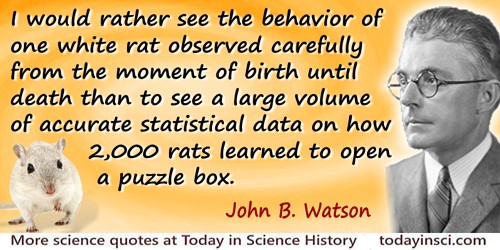
I would rather see the behavior of one white rat observed carefully from the moment of birth until death than to see a large volume of accurate statistical data on how 2,000 rats learned to open a puzzle box.
Introduction to G. V. Hamilton and Kenneth Macgowan, What Is Wrong with Marriage? (1929), xx.
I’m very intense in my work. At any given moment, I think I know the answer to some problem, and that I’m right. Since science is the only self-correcting human institution I know of, you should not be frightened to take an extreme stand, if that causes the stand to be examined more thoroughly than it might be if you are circumspect. I’ve always been positive about the value of the Hubble constant, knowing full well that it probably isn’t solved.
As quoted in John Noble Wilford, 'Sizing up the Cosmos: An Astronomers Quest', New York Times (12 Mar 1991), C10.
If an ancient city survives to become a modern city, like Naples, its readability in archaeological terms is enormously reduced. It’s a paradox of archaeology: you read the past best in its moments of trauma.
As quoted in Doug Stewart, 'Resurrecting Pompeii', Smithsonian Magazine (Feb 2006)
If any layman were to ask a number of archaeologists to give, on the spur of the moment, a definition of archaeology, I suspect that such a person might find the answers rather confusing. He would, perhaps, sympathize with Socrates who, when he hoped to learn from the poets and artisans something about the arts they practised, was forced to go away with the conviction that, though they might themselves be able to accomplish something, they certainly could give no clear account to others of what they were trying to do.
Opening statement in lecture at Columbia University (8 Jan 1908), 'Archaeology'. Published by the Columbia University Press (1908).
If at this moment I am not a worn-out, debauched, useless carcass of a man, if it has been or will be my fate to advance the cause of science, if I feel that I have a shadow of a claim on the love of those about me, if in the supreme moment when I looked down into my boy’s grave my sorrow was full of submission and without bitterness, it is because these agencies have worked upon me, and not because I have ever cared whether my poor personality shall remain distinct forever from the All from whence it came and whither it goes.
And thus, my dear Kingsley, you will understand what my position is. I may be quite wrong, and in that case I know I shall have to pay the penalty for being wrong. But I can only say with Luther, “Gott helfe mir, ich kann nichts anders [God help me, I cannot do otherwise].”
And thus, my dear Kingsley, you will understand what my position is. I may be quite wrong, and in that case I know I shall have to pay the penalty for being wrong. But I can only say with Luther, “Gott helfe mir, ich kann nichts anders [God help me, I cannot do otherwise].”
In Letter (23 Sep 1860) to Charles Kingsley, Life and Letters of Thomas Henry Huxley (1901), 237.
If basketball was going to enable Bradley to make friends, to prove that a banker’s son is as good as the next fellow, to prove that he could do without being the greatest-end-ever at Missouri, to prove that he was not chicken, and to live up to his mother’s championship standards, and if he was going to have some moments left over to savor his delight in the game, he obviously needed considerable practice, so he borrowed keys to the gym and set a schedule for himself that he adhereded to for four full years—in the school year, three and a half hours every day after school, nine to five on Saturday, one-thirty to five on Sunday, and, in the summer, about three hours a day.
A Sense of Where You Are: Bill Bradley at Princeton
If one be bird-witted, that is easily distracted and unable to keep his attention as long as he should, mathematics provides a remedy; for in them if the mind be caught away but a moment, the demonstration has to be commenced anew.
In De Augmentis, Bk. 6; Advancement of Learning, Bk. 2.
If you were going to risk all that, not just risk the hardship and the pain but risk your life. Put everything on line for a dream, for something that’s worth nothing, that can’t be proved to anybody. You just have the transient moment on a summit and when you come back down to the valley it goes. It is actually a completely illogical thing to do. It is not justifiable by any rational terms. That’s probably why you do it.
The Beckoning Silence
In a moment the ashes are made, but a forest is a long time growing.
Momento fit cinis: diu sylva.
Momento fit cinis: diu sylva.
Cited as from Quæstionum Naturalium, Book III. 27 in Kate Louise Roberts (ed.) Hoyt’s New Cyclopedia of Practical Quotations (1922), 798.
In despair, I offer your readers their choice of the following definitions of entropy. My authorities are such books and journals as I have by me at the moment.
(a) Entropy is that portion of the intrinsic energy of a system which cannot be converted into work by even a perfect heat engine.—Clausius.
(b) Entropy is that portion of the intrinsic energy which can be converted into work by a perfect engine.—Maxwell, following Tait.
(c) Entropy is that portion of the intrinsic energy which is not converted into work by our imperfect engines.—Swinburne.
(d) Entropy (in a volume of gas) is that which remains constant when heat neither enters nor leaves the gas.—W. Robinson.
(e) Entropy may be called the ‘thermal weight’, temperature being called the ‘thermal height.’—Ibid.
(f) Entropy is one of the factors of heat, temperature being the other.—Engineering.
I set up these bald statement as so many Aunt Sallys, for any one to shy at.
[Lamenting a list of confused interpretations of the meaning of entropy, being hotly debated in journals at the time.]
(a) Entropy is that portion of the intrinsic energy of a system which cannot be converted into work by even a perfect heat engine.—Clausius.
(b) Entropy is that portion of the intrinsic energy which can be converted into work by a perfect engine.—Maxwell, following Tait.
(c) Entropy is that portion of the intrinsic energy which is not converted into work by our imperfect engines.—Swinburne.
(d) Entropy (in a volume of gas) is that which remains constant when heat neither enters nor leaves the gas.—W. Robinson.
(e) Entropy may be called the ‘thermal weight’, temperature being called the ‘thermal height.’—Ibid.
(f) Entropy is one of the factors of heat, temperature being the other.—Engineering.
I set up these bald statement as so many Aunt Sallys, for any one to shy at.
[Lamenting a list of confused interpretations of the meaning of entropy, being hotly debated in journals at the time.]
In The Electrician (9 Jan 1903).
In experimenting on the arc, my aim was not so much to add to the large number of isolated facts that had already been discovered, as to form some idea of the bearing of these upon one another, and thus to arrive at a clear conception of what takes place in each part of the arc and carbons at every moment. The attempt to correlate all the known phenomena, and to bind them together into one consistent whole, led to the deduction of new facts, which, when duly tested by experiment, became parts of the growing body, and, themselves, opened up fresh questions, to be answered in their turn by experiment.
In The Electric Arc (1902), Preface, iii. Ayrton described the growth of her published work on the electric arc, from a series of articles in The Electrician in 1895-6, to the full book, which “has attained to its present proportions almost with the growth of an organic body.”
In my youth I regarded the universe as an open book, printed in the language of physical equations, whereas now it appears to me as a text written in invisible ink, of which in our rare moments of grace we are able to decipher a small fragment.
From Epilogue in Bricks to Babel (1980).
In the 1920s, there was a dinner at which the physicist Robert W. Wood was asked to respond to a toast … “To physics and metaphysics.” Now by metaphysics was meant something like philosophy—truths that you could get to just by thinking about them. Wood took a second, glanced about him, and answered along these lines: The physicist has an idea, he said. The more he thinks it through, the more sense it makes to him. He goes to the scientific literature, and the more he reads, the more promising the idea seems. Thus prepared, he devises an experiment to test the idea. The experiment is painstaking. Many possibilities are eliminated or taken into account; the accuracy of the measurement is refined. At the end of all this work, the experiment is completed and … the idea is shown to be worthless. The physicist then discards the idea, frees his mind (as I was saying a moment ago) from the clutter of error, and moves on to something else. The difference between physics and metaphysics, Wood concluded, is that the metaphysicist has no laboratory.
In 'Wonder and Skepticism', Skeptical Enquirer (Jan-Feb 1995), 19, No. 1.
In the early days of dealing with climate change, I wouldn’t go out on a limb one way or another, because I don’t have the qualifications there. But I do have the qualifications to measure the scientific community and see what the consensus is about climate change. I remember the moment when I suddenly thought it was incontrovertible. There was a lecture given by a distinguished American expert in atmospheric science and he showed a series of graphs about the temperature changes in the upper atmosphere. He plotted time against population growth and industrialisation. It was incontrovertible, and once you think it’s really totally incontrovertible, then you have a responsibility to say so.
From interview with Brian Cox and Robert Ince, in 'A Life Measured in Heartbeats', New Statesman (21 Dec 2012), 141, No. 5138, 32.
In the equilibrium of the vernal equinox, we find a moment of cosmic serenity—a fleeting balance between opposing forces that propels us into the blooming embrace of springtime.
A fictional quote imagined in the style typical of a scientist (19 Mar 2024).
In the fall of 1967, [I was invited] to a conference … on pulsars. … In my talk, I argued that we should consider the possibility that the center of a pulsar is a gravitationally completely collapsed object. I remarked that one couldn't keep saying “gravitationally completely collapsed object” over and over. One needed a shorter descriptive phrase. “How about black hole?” asked someone in the audience. I had been searching for the right term for months, mulling it over in bed, in the bathtub, in my car, whenever I had quiet moments. Suddenly this name seemed exactly right. When I gave a more formal Sigma Xi-Phi Beta Kappa lecture … on December 29, 1967, I used the term, and then included it in the written version of the lecture published in the spring of 1968. (As it turned out, a pulsar is powered by “merely” a neutron star, not a black hole.)
[Although John Wheeler is often identified as coining the term “black hole,” he in fact merely popularized the expression. In his own words, this is his explanation of the true origin: a suggestion from an unidentified person in a conference audience.]
[Although John Wheeler is often identified as coining the term “black hole,” he in fact merely popularized the expression. In his own words, this is his explanation of the true origin: a suggestion from an unidentified person in a conference audience.]
In Geons, Black Holes, and Quantum Foam (2000), 296-297.
In the moment of the vernal equinox, we find ourselves standing at the threshold between winter’s chill and spring’s warmth, a testament to the resilience of life and the promise of new beginnings.
A fictional quote imagined in the style typical of a scientist (19 Mar 2024).
Is evolution a theory, a system or a hypothesis? It is much more: it is a general condition to which all theories, all hypotheses, all systems must bow and which they must satisfy henceforth if they are to be thinkable and true. Evolution is a light illuminating all facts, a curve that all lines must follow. ... The consciousness of each of us is evolution looking at itself and reflecting upon itself....Man is not the center of the universe as once we thought in our simplicity, but something much more wonderful—the arrow pointing the way to the final unification of the world in terms of life. Man alone constitutes the last-born, the freshest, the most complicated, the most subtle of all the successive layers of life. ... The universe has always been in motion and at this moment continues to be in motion. But will it still be in motion tomorrow? ... What makes the world in which we live specifically modern is our discovery in it and around it of evolution. ... Thus in all probability, between our modern earth and the ultimate earth, there stretches an immense period, characterized not by a slowing-down but a speeding up and by the definitive florescence of the forces of evolution along the line of the human shoot.
In The Phenomenon of Man (1975), pp 218, 220, 223, 227, 228, 277.
It has cost them but a moment to cut off that head; but a hundred years will not be sufficient to produce another like it.
Comment to Delambre about Lavoisier, who was executed on 8 May 1794. As quoted by Charles Hutton in
A Philosophical and Mathematical Dictionary (1815), Vol. 1, 708. The quotation is given in Douglas McKie, Antoine Lavoisier: The Father of Modern Chemistry (1935), 299, as: “Only a moment to cut off this head and perhaps a hundred years before we shall have another like it.” In The Doctor Explains (1931), 134-135, Ralph Hermon Major words it as, “It took but an instant to cut off his head; a hundred years will not suffice to produce one like it,” but in A History of Medicine (1954), Vol. 2, 618, Major repeats it as, “A moment was sufficient to sever his head, but a hundred years will not be enough perhaps to produce another like it.” Please contact Webmaster if you know the primary source, presumably in French.
It is a misfortune for a science to be born too late when the means of observation have become too perfect. That is what is happening at this moment with respect to physical chemistry; the founders are hampered in their general grasp by third and fourth decimal places; happily they are men of robust faith.
From La Science et l’Hypothèse (1901, 1908), 211-212, as translated in Henri Poincaré and William John Greenstreet (trans.), Science and Hypothesis (1902, 1905), 181. From the original French, “C’est un malheur pour une science de prendre naissance trop tard, quand les moyens d’observation sont devenus trop parfaits. C’est ce qui arrive aujourd’hui à la physico-chimie; ses fondateurs sont gènés dans leurs aperçus par la troisième et la quatrième décimales; heureusement, ce sont des hommes d’une foi robuste.”
It is a profoundly erroneous truism, repeated by all copy-books and eminent people when they are making speeches, that we should cultivate habit of thinking of what we are doing. The precise opposite is the case. Civilization advances by extending the number of important operations which we can perform without thinking about them. Operations of thought are like cavalry charges in a battle—they are strictly limited in number, they require fresh horses, and must only be made at decisive moments.
In An Introduction to Mathematics (1911), 61.
It is admitted, on all hands, that the Scriptures are not intended to resolve physical questions, or to explain matters in no way related to the morality of human actions; and if, in consequence of this principle, a considerable latitude of interpretation were not allowed, we should continue at this moment to believe, that the earth is flat; that the sun moves round the earth; and that the circumference of a circle is no more than three times its diameter.
In The Works of John Playfair: Vol. 1: Illustrations of the Huttonian Theory of the Earth (1822), 137.
It is easy to overlook this thought that life just is. As humans we are inclined to feel that life must have a point. We have plans and aspirations and desires. We want to take constant advantage of the intoxicating existence we’ve been endowed with. But what’s life to a lichen? Yet its impulse to exist, to be, is every bit as strong as ours-arguably even stronger. If I were told that I had to spend decades being a furry growth on a rock in the woods, I believe I would lose the will to go on. Lichens don’t. Like virtually all living things, they will suffer any hardship; endure any insult, for a moment’s additions existence. Life, in short just wants to be.
…...
It is hard to sneak a look at God’s cards. But that he would choose to play dice with the world … is something I cannot believe for a single moment.
On quantum theory. In Letter (21 Mar 1942) to his student-colleague, Cornel Lanczos. In Yale Book of Quotations (2006), 229. Also seen paraphrased as, “I cannot believe that God would choose to play dice with the universe.”
It is impossible not to feel stirred at the thought of the emotions of man at certain historic moments of adventure and discovery—Columbus when he first saw the Western shore, Pizarro when he stared at the Pacific Ocean, Franklin when the electric spark came from the string of his kite, Galileo when he first turned his telescope to the heavens. Such moments are also granted to students in the abstract regions of thought, and high among them must be placed the morning when Descartes lay in bed and invented the method of co-ordinate geometry.
Quoted in James Roy Newman, The World of Mathematics (2000), Vol. 1, 239.
It is in moments of illness that we are compelled to recognize that we live not alone but chained to a creature of a different kingdom, whole worlds apart, who has no knowledge of us, and by whom it is impossible to make ourselves understood: our body.
'Le Côté de Guermantes', À la recherche du temps perdu (1913-27).

It is not easy to be a pioneer—but oh, it is fascinating! I would not trade one moment, even the worst moment, for all the riches in the world.
As quoted, without citation, in Arlene J. Morris-Lipsman, Notable Women (1990), 70. The author dates this to “twenty years after her graduation,” [which was on 23 Jan 1849]. Please contact Webmaster if you know the primary source.
It is obvious that man dwells in a splendid universe, a magnificent expanse of earth and sky and heaven, which manifestly is built on a majestic plan, maintains some mighty design, though man himself cannot grasp it. Yet for him it is not a pleasant or satisfying world. In his few moments of respite from labor or from his enemies, he dreams that this very universe might indeed be perfect, its laws operating just as now they seem to do, and yet he and it somehow be in full accord. The very ease with which he can frame this image to himself makes the reality all the more mocking. ... It is only too clear that man is not at home in this universe, and yet he is not good enough to deserve a better.
In The New England Mind: The Seventeenth Century (1939, 1954), 7.
It is our great collective misfortune that the scientific community made its decisive diagnosis of the climate threat at the precise moment when an elite minority was enjoying more unfettered political, cultural, and intellectual power than at any point since the 1920s.
From This Changes Everything: Capitalism vs. the Climate (2014), 18.
It is the middle of the night when a glittering theatre of light suddenly appears in front of the Dhaka. Where, moments before there was only darkness, suddenly there are hundreds of columns of light. The sound of helicopters and car horns carry across to the ship on the breeze. There is the scent of rain after it has evaporated from warm streets. This is unmistakably Singapore, the small city-state at the most southern point of the Asiatic mainland. Singapore was built as a centre for world trade by the British over 250 years ago, and today, Singapore has the largest container harbour in the world. This is where the axes of world trade cross paths: from the Far East to Europe, from the Far East to Southeast Asia/the East, and from the Far East to Australia. Everything runs like clockwork here. Within five hours the Dhaka has been unloaded.
Made on Earth
It is the nature of an hypothesis, when once a man has conceived it, that it assimilates every thing to itself, as proper nourishment; and, from the first moment of your begetting it, it generally grows the stronger by every thing you see, hear, read, or understand.
The Life and Opinions of Tristram Shandy Gentleman (1759-67), Penguin edition (1997), 121-122.
It will be contributing to bring forward the moment in which, seeing clearer into the nature of things, and having learnt to distinguish real knowledge from what has only the appearance of it, we shall be led to seek for exactness in every thing.
'An Essay on Pyrometry and Areometry, and on Physical Measures in General', Philosophical Transactions, 1778, 68, 493.
It would not be difficult to come to an agreement as to what we understand by science. Science is the century-old endeavor to bring together by means of systematic thought the perceptible phenomena of this world into as thoroughgoing an association as possible. To put it boldly, it is the attempt at the posterior reconstruction of existence by the process of conceptualization. But when asking myself what religion is I cannot think of the answer so easily. And even after finding an answer which may satisfy me at this particular moment, I still remain convinced that I can never under any circumstances bring together, even to a slight extent, the thoughts of all those who have given this question serious consideration.
…...
It’s that moment, that brief epiphany when the universe opens up and shows us something, and in that instant we get just a sense of an order greater than Heaven and, as yet at least, beyond the grasp of Stephen Hawking.
Quoted in Kim Lim (ed.), 1,001 Pearls of Spiritual Wisdom: Words to Enrich, Inspire, and Guide Your Life (2014), 109
Know the true value of time; snatch, seize, and enjoy every moment of it. No idleness, no delay, no procrastination; never put off till tomorrow what you can do today.
…...
Learn to reverence night and to put away the vulgar fear of it, for, with the banishment of night from the experience of man, there vanishes as well a religious emotion, a poetic mood, which gives depth to the adventure of humanity. By day, space is one with the earth and with man - it is his sun that is shining, his clouds that are floating past; at night, space is his no more. When the great earth, abandoning day, rolls up the deeps of the heavens and the universe, a new door opens for the human spirit, and there are few so clownish that some awareness of the mystery of being does not touch them as they gaze. For a moment of night we have a glimpse of ourselves and of our world islanded in its stream of stars - pilgrims of mortality, voyaging between horizons across eternal seas of space and time. Fugitive though the instant be, the spirit of man is, during it, ennobled by a genuine moment of emotional dignity, and poetry makes its own both the human spirit and experience.
…...
Let Nature do your bottling and your pickling and preserving. For all Nature is doing her best each moment to make us well. She exists for no other end. Do not resist her. With the least inclination to be well, we should not be sick. Men have discovered—or think they have discovered—the salutariness of a few wild things only, and not of all nature. Why, “nature” is but another name for health, and the seasons are but different states of health. Some men think that they are not well in spring, or summer, or autumn, or winter; it is only because they are not well in them.
(23 Aug 1853). In Henry David Thoreau and Bradford Torrey (ed.), The Writings of Henry Thoreau: Journal: V: March 5-November 30, 1853 (1906), 395.
Life is a wave, which in no two consecutive moments of its existence is composed of the same particles.
In 'Vitality', Scientific Use of the Imagination and Other Essays (1872), 62.
Life is no brief candle to me. It is a sort of splendid torch which I have got a hold of for the moment, and I want to make it burn as brightly as possible before handing it on to future generations.
As referenced to a private conversation with Professor henderson and quoted in Edwin Björkman, 'The Serious Bernard Shaw', The American Review of Reviews (1911), 43, 425.
Lost in the milky way,
Smile at the empty sky
And wait for the moment
When a million chances may all collide.
Smile at the empty sky
And wait for the moment
When a million chances may all collide.
Song lyrics
Many people think that conservation is just about saving fluffy animals—what they don’t realise is that we’re trying to prevent the human race from committing suicide … We have declared war on the biological world, the world that supports us … At the moment the human race is in the position of a man sawing off the tree branch he is sitting on.
As quoted in Douglass Botting, Gerald Durrell: The Authorized Biography (1999), 194.
Many times every day I think of taking off in that missile. I’ve tried a thousand times to visualize that moment, to anticipate how I’ll feel if I’m first, which I very much want to be. But whether I go first or go later. I approach it now with some awe, and I’m sure I’ll approach it with even more awe on my day. In spite of the fact that I will he very busy getting set and keeping tabs on all the instruments, there’s no question that I’ll need—and will have—all my confidence.
As he wrote in an article for Life (14 Sep 1959), 38.
More than ever before in the history of science and invention, it is safe now to say what is possible and what is impossible. No one would claim for a moment that during the next five hundred years the accumulated stock of knowledge of geography will increase as it has during the last five hundred In the same way it may safely be affirmed that in electricity the past hundred years is not likely to be duplicated in the next, at least as to great, original, and far-reaching discoveries, or novel and almost revolutionary applications.
In A Century of Electricity (1890), 223.
Most of us have had moments in childhood when we touched the divine presence. We did not think it extraordinary because it wasn’t; it was just a beautiful moment filled with love. In those simple moments our hearts were alive, and we saw the poignant beauty of life vividly with wonder and appreciation.
David McArthur and Bruce McArthur
Most, if not all, of the great ideas of modern mathematics have had their origin in observation. Take, for instance, the arithmetical theory of forms, of which the foundation was laid in the diophantine theorems of Fermat, left without proof by their author, which resisted all efforts of the myriad-minded Euler to reduce to demonstration, and only yielded up their cause of being when turned over in the blow-pipe flame of Gauss’s transcendent genius; or the doctrine of double periodicity, which resulted from the observation of Jacobi of a purely analytical fact of transformation; or Legendre’s law of reciprocity; or Sturm’s theorem about the roots of equations, which, as he informed me with his own lips, stared him in the face in the midst of some mechanical investigations connected (if my memory serves me right) with the motion of compound pendulums; or Huyghen’s method of continued fractions, characterized by Lagrange as one of the principal discoveries of that great mathematician, and to which he appears to have been led by the construction of his Planetary Automaton; or the new algebra, speaking of which one of my predecessors (Mr. Spottiswoode) has said, not without just reason and authority, from this chair, “that it reaches out and indissolubly connects itself each year with fresh branches of mathematics, that the theory of equations has become almost new through it, algebraic geometry transfigured in its light, that the calculus of variations, molecular physics, and mechanics” (he might, if speaking at the present moment, go on to add the theory of elasticity and the development of the integral calculus) “have all felt its influence”.
In 'A Plea for the Mathematician', Nature, 1, 238 in Collected Mathematical Papers, Vol. 2, 655-56.
Mr Edison gave America just what was needed at that moment in history. They say that when people think of me, they think of my assembly line. Mr. Edison, you built an assembly line which brought together the genius of invention, science and industry.
Henry Ford in conversation Thomas Edison and Harvey Firestone (1931), quoted as a recollection of the author, in James Newton, Uncommon Friends: Life with Thomas Edison, Henry Ford, Harvey Firestone, Alexis Carrel & Charles Lindbergh (1987), 31. The quote is not cited from a print source. However, in the introduction the author said he “kept a diary in which I noted times and places, key phrases, and vivid impressions.” He also “relied on publications by and about my friends, which jogged my memory.&rdquo. Webmaster has found no earlier record of this quote, and thus suggests the author may have the gist of what Ford said, but is not quoting the exact words uttered by Ford, although quote marks are used to state Ford's remark.
My eureka moment was in the dead of night, the early hours of the morning, on a cold, cold night, and my feet were so cold, they were aching. But when the result poured out of the charts, you just forget all that. You realize instantly how significant this is—what it is you’ve really landed on—and it’s great!
[About her discovery of the first pulsar radio signals.]
[About her discovery of the first pulsar radio signals.]
From BBC TV program, Journeys in Time and Space: Invisible Universe (28 Feb 2001).
Nature is full of by-ends. A moth feeds on a petal, in a moment the pollen caught on its breast will be wedding this blossom to another in the next county.
From chapter 'Jottings from a Note-Book', in Canadian Stories (1918), 170.
Nature! … Incessant life, development, and movement are in her, but she advances not. She changes for ever and ever, and rests not a moment. Quietude is inconceivable to her, and she has laid her curse upon rest. She is firm. Her steps are measured, her exceptions rare, her laws unchangeable.
As quoted by T.H. Huxley, in Norman Lockyer (ed.), 'Nature: Aphorisms by Goethe', Nature (1870), 1, 9.
New scientific ideas never spring from a communal body, however organized, but rather from the head of an individually inspired researcher who struggles with his problems in lonely thought and unites all his thought on one single point which is his whole world for the moment.
Address on the 25th anniversary of the Kaiser-Wilhelm Gesellschaft (Jan 1936). Quoted in Surviving the Swastika: Scientific Research in Nazi Germany (1993), 97.
No one for a moment can pretend that printing is so great a discovery as writing, or algebra as a language.
Lothair (1879), preface, xvii.
Not in the ground of need, not in bent and painful toil, but in the deep-centred play-instinct of the world, in the joyous mood of the eternal Being, which is always young, science has her origin and root; and her spirit, which is the spirit of genius in moments of elevation, is but a sublimated form of play, the austere and lofty analogue of the kitten playing with the entangled skein or of the eaglet sporting with the mountain winds.
In Mathematics (1907), 44.
Nothing is known in our profession by guess; and I do not believe, that from the first dawn of medical science to the present moment, a single correct idea has ever emanated from conjecture: it is right therefore, that those who are studying their profession should be aware that there is no short road to knowledge; and that observation on the diseased living, examination of the dead, and experiments upon living animals, are the only sources of true knowledge; and that inductions from these are the sole bases of legitimate theory.
Astley Paston Cooper, Astley Cooper, Bransby Blake Cooper, A Treatise on Dislocations and Fractures of the Joints (1851), 155.
Nothing will ever equal that moment of joyous excitement which filled my whole being when I felt myself flying away from the earth. It was not mere pleasure; it was perfect bliss. Escaped from the frightful torments of persecution and of calumny, I felt that I was answering all in rising above all.
after making man's first ascent by hydrogen balloon in 1783 quoted in Wonderful Balloon Ascents: Or, the Conquest of the Skies by F. Marion
Old and new put their stamp to everything in Nature. The snowflake that is now falling is marked by both. The present moment gives the motion and the color of the flake, Antiquity its form and properties. All things wear a lustre which is the gift of the present, and a tarnish of time.
Epigraph for chapter 'Quotation and Originality', in Letters and Social Aims (1875, 1917), 175.
On opening the incubator I experienced one of those rare moments of intense emotion which reward the research worker for all his pains: at first glance I saw that the broth culture, which the night before had been very turbid was perfectly clear: all the bacteria had vanished…as for my agar spread it was devoid of all growth and what caused my emotion was that in a flash I understood: what causes my spots was in fact an invisible microbe, a filterable virus, but a virus parasitic on bacteria. Another thought came to me also, If this is true, the same thing will have probably occurred in the sick man. In his intestine, as in my test-tube, the dysentery bacilli will have dissolved away under the action of their parasite. He should now be cured.
In Allan Chase, Magic Shots: A Human and Scientific Account of the Long and Continuing Struggle to Eradicated Infectious Diseases by Vaccination (1982), 249-250. Also in Allan J. Tobin and Jennie Dusheck, Asking About Life (2005), 206.
One [of the most exciting moment of my career] would be when I first dived on a coral reef and I was able to move among a world of unrevealed complexity.
From 'Interview: Of Mind and Matter: David Attenborough Meets Richard Dawkins', The Guardian (11 Sep 2010).
One can truly say that the irresistible progress of natural science since the time of Galileo has made its first halt before the study of the higher parts of the brain, the organ of the most complicated relations of the animal to the external world. And it seems, and not without reason, that now is the really critical moment for natural science; for the brain, in its highest complexity—the human brain—which created and creates natural science, itself becomes the object of this science.
Natural Science and Brain (1909), 120.
One of the gladdest moments of human life, methinks, is the departure upon a distant journey into unknown lands. Shaking off with one mighty effort the fetters of habit, the leaden weight of routine, the cloak of many cares and the slavery of home, man feel once more happy.
In Zanzibar: City, Island, and Coast (1872), Vol. 1, 16.
One of the memorable moments of my life was when Willard Libby came to Princeton with a little jar full of crystals of barium xenate. A stable compound, looking like common salt, but much heavier. This was the magic of chemistry, to see xenon trapped into a crystal.
Letter to Oliver Sacks. Quoted in Oliver Sacks, Uncle Tungsten: Memories of a Chemical Boyhood (2001), footnote, 203.
One of the most impressive discoveries was the origin of the energy of the stars, that makes them continue to burn. One of the men who discovered this was out with his girl friend the night after he realized that nuclear reactions must be going on in the stars in order to make them shine.
She said “Look at how pretty the stars shine!”
He said, “Yes, and right now I am the only man in the world who knows why they shine.”
She merely laughed at him. She was not impressed with being out with the only man who, at that moment, knew why stars shine. Well, it is sad to be alone, but that is the way it is in this world.
She said “Look at how pretty the stars shine!”
He said, “Yes, and right now I am the only man in the world who knows why they shine.”
She merely laughed at him. She was not impressed with being out with the only man who, at that moment, knew why stars shine. Well, it is sad to be alone, but that is the way it is in this world.
…...
Only go on working so long as the brain is quite clear. The moment you feel the ideas getting confused leave off and rest, or your penalty will be that you will never learn Mathematics at all!
From letter to Edith Rix with hints for studying (about Mar 1885), in Stuart Dodgson Collingwood, The Life and Letters of Lewis Carroll (1898), 241.
Ordinarily he is insane, but he has lucid moments when he is only stupid.
Describing “Savoye, a mediocre diplomat, appointed Ambassador to Frankfort by Lamartine in 1848.” Quoted from L'Esprit de Tout le Monde, in 'Foreign Wit and Humor: From Contemporaries', Current Opinion (Mar 1894), 15, No. 3, 292. This source credits only “Heine said”. Max John Herzberg more specifically credits “Heinrich Heine” in Insults : A Practical Anthology of Scathing Remarks and Acid Portraits (1941), 74.
Our immediate interests are after all of but small moment. It is what we do for the future, what we
add to the sum of man's knowledge, that counts most. As someone has said, 'The individual withers and the world is more and more.' Man dies at 70, 80, or 90, or at some earlier age, but through his power of physical reproduction, and with the means that he has to transmit the results of effort to those who come after him, he may be said to be immortal.
'Willis Rodney Whitney', National Academy of Sciences, Biographical Memoirs (1960), 360.
Our problem is that the climate crisis hatched in our laps at a moment in history when political and social conditions were uniquely hostile to a problem of this nature and magnitude—that moment being the tail end of the go-go ’80s, the blastoff point for the crusade to spread deregulated capitalism around the world. Climate change is a collective problem demanding collective action the likes of which humanity has never actually accomplished. Yet it entered mainstream consciousness in the midst of an ideological war being waged on the very idea of the collective sphere.
In 'The Change Within: The Obstacles We Face Are Not Just External', The Nation (12 May 2014).
Our world faces a crisis as yet unperceived by those possessing power to make great decisions for good or evil. The unleashed power of the atom has changed everything save our modes of thinking and we thus drift toward unparalleled catastrophe. We scientists who released this immense power have an overwhelming responsibility in this world life-and-death struggle to harness the atom for the benefit of mankind and not for humanity’s destruction. … We need two hundred thousand dollars at once for a nation-wide campaign to let people know that a new type of thinking is essential if mankind is to survive and move toward higher levels. This appeal is sent to you only after long consideration of the immense crisis we face. … We ask your help at this fateful moment as a sign that we scientists do not stand alone.
In 'Atomic Education Urged by Einstein', New York Times (25 May 1946), 13. Extract from a telegram (24 May 1946) to “several hundred prominent Americans”, signed by Albert Einstein as Chairman, with other members, of the Emergency Committee of Atomic Scientists. It was also signed by the Federation of American Scientists.
Perhaps the earliest memories I have are of being a stubborn, determined child. Through the years my mother has told me that it was fortunate that I chose to do acceptable things, for if I had chosen otherwise no one could have deflected me from my path. ... The Chairman of the Physics Department, looking at this record, could only say 'That A- confirms that women do not do well at laboratory work'. But I was no longer a stubborn, determined child, but rather a stubborn, determined graduate student. The hard work and subtle discrimination were of no moment.
Autobiography, Nobel Foundation
Physics is very muddled again at the moment; it is much too hard for me anyway, and I wish I were a movie comedian or something like that and had never heard anything about physics.
Letter to R. Kronig (21 May 1925). Quoted in R. Kronig, 'The Turning Point', in M. Fierz and V. F. Weisskopf (eds.), Theoretical Physics in the Twentieth Century. A Memorial Volume to Wolfgang Pauli (1960),as trans. in M. Klein, Letters on Wave Mechanics, x.
Quantum theory—at least in the Heisenberg interpretation—describes the way the world works as a literal moment-to-moment emergence of actual facts out of a background of less factual 'potentia.'
Quoted in article 'Nick Herbert', in Gale Cengage Learning, Contemporary Authors Online (2002).
Real science exists, then, only from the moment when a phenomenon is accurately defined as to its nature and rigorously determined in relation to its material conditions, that is, when its law is known. Before that, we have only groping and empiricism.
From An Introduction to the Study of Experimental Medicine (1865), as translated by Henry Copley Greene (reprint 1999), 74.
Remember this, the rule for giving an extempore lecture is—let the the mind rest from the subject entirely for an interval preceding the lecture, after the notes are prepared; the thoughts will ferment without your knowing it, and enter into new combinations; but if you keep the mind active upon the subject up to the moment, the subject will not ferment but stupefy.
In Letter (10 Jul 1854) to William Rowan Hamilton, collected in Robert Perceval Graves, Life of Sir William Rowan Hamilton (1882-89), Vol. 3, 487.
Science only begins for man from the moment when his mind lays hold of matter—when he tries to subject the mass accumulated by experience to rational combinations.
In 'Introduction', Cosmos: Sketch of a Physical Description of the Universe (1849), Vol. 1, 64. Translation “under the superintendence of” Edward Sabine.
Several times every day I observed the portions of the polyp with a magnifying glass. On the 4th December, that is to say on the ninth day after having cut the polyp, I seemed in the morning to be able to perceive, on the edges of the anterior end of the second part (the part that had neither head nor arms), three little points arising from those edges. They immediately made me think of the horns that serve as the legs and arms of the polyp. Nevertheless I did not want to decide at once that these were actually arms that were beginning to grow. Throughout the next day I continually observed these points: this excited me extremely, and awaited with impatience the moment when I should know with certainty what they were. At last, on the following day, they were so big that there was no longer any room for doubt that they were actually arms growing at the anterior extremity of this second part. The next day two more arms started to grow out, and a few days later three more. The second part thus had eight of them, and they were all in a short time as long as those of the first part, that is to say as long as those the polyp possessed before it was cut. I then no longer found any difference between the second part and a polyp that had never been cut. I had remarked the same thing about the first part since the day after the operation. When I observed them with the magnifying glass with all the attention of which I was capable, each of the two appeared perceptibly to be a complete polyp, and they performed all the functions that were known to me: they extended, contracted, and walked.
Mémoires, pour servir à l'histoire d'un genre de polyps d'eau douce à bras en forme de cornes (1744), 7-16. Trans. John R. Baker, in Abraham Trembley of Geneva: Scientist and Philosopher 1710-1784 (1952), 32.
Since most callers have until moments before been completely unaware that there are bears in New Jersey, there is often in their voices a component of alarm, up to and including terror. McConnell’s response is calmer than pavement. She speaks in tones that range from ho to hum. “Yes, there are bears in your area,” she says, and goes on to say, with an added hint of congratulation, “You live in beautiful bear habitat.
Table of Contents
So the dividing line between the wave or particle nature of matter and radiation is the moment “Now”. As this moment steadily advances through time, it coagulates a wavy future into a particle past.
In The Development of X-ray analysis (1975) 13.
Something to do with a puzzle being solved—things fall into place and you see a different way of looking at things which suddenly makes sense. [Naming what is a most exciting moment in his career.]
Answering “What has been the most exciting moment in your career?” From 'Interview: Of Mind and Matter: David Attenborough Meets Richard Dawkins', The Guardian (11 Sep 2010).
Sometimes truth frightens us. And in fact we know that it is sometimes deceptive, that it is a phantom never showing itself for a moment except to ceaselessly flee, that it must be pursued further and ever further without ever being attained. … Yet truth should not be feared, for it alone is beautiful.
As translated by George Bruce Halsted, in 'The Value of Science', Popular Science Monthly (Sep 1906), 69 193.
Sometimes you get a glimpse of a semicolon coming, a few lines farther on, and it is like climbing a steep path through woods and seeing a wooden bench just at a bend in the road ahead, a place where you can expect to sit for a moment, catching your breath.
In The Medusa and the Snail: More Notes of a Biology Watcher (1974, 1995), 129.
Suddenly, from behind the rim of the moon, in long, slow-motion moments of immense majesty, there emerges a sparkling blue and white jewel, a light, delicate sky-blue sphere laced with slowly swirling veils of white, rising gradually like a small pearl in a thick sea of black mystery. It takes more than a moment to fully realize this is Earth . . . home.
…...
Suppose that we are wise enough to learn and know—and yet not wise enough to control our learning and knowledge, so that we use it to destroy ourselves? Even if that is so, knowledge remains better than ignorance. It is better to know—even if the knowledge endures only for the moment that comes before destruction—than to gain eternal life at the price of a dull and swinish lack of comprehension of a universe that swirls unseen before us in all its wonder. That was the choice of Achilles, and it is mine, too.
Widely seen on the Web, but always without citation, so regard attribution as uncertain. Webmaster has not yet found reliable verification. Contact Webmaster if you know a primary print source.
Suppose that you are in love with a lady on Neptune and that she returns the sentiment. It will be some consolation for the melancholy separation if you can say to yourself at some possibly pre-arranged moment, “She is thinking of me now.” Unfortunately a difficulty has arisen because we have had to abolish Now. There is no absolute Now, but only the various relative Nows, differing according to their reckoning of different observers and covering the whole neutral wedge which at the distance of Neptune is about eight hours thick. She will have to think of you continuously for eight hours on end in order to circumvent the ambiguity “Now.”
In The Nature of the Physical World (1929), 49.
Suppose there is something which a person cannot understand. He happens to notice the similarity of this something to some other thing which he understands quite well. By comparing them he may come to understand the thing which he could not understand up to that moment. If his understanding turns out to be appropriate and nobody else has ever come to such an understanding, he can claim that his thinking was really creative.
Creativity and Intuition: A Physicist Looks at East and West (1973), 114.
That which the sciences can add to the privileges of the human race has never been more marked than at the present moment. … The air seems to become as accessible to him as the waters…. The name of Montgolfier, the names of those hardy navigators of the new element, will live through time; but who among us, on seeing these superb experiments, has not felt his soul elevated, his ideas expanded, his mind enlarged?
As quoted by François Arago, in a biography of Bailly, read to the Academy of Sciences (26 Feb 1844), as translated by William Henry Smyth, Baden Powell and Robert Grant, published in 'Bailly', Biographies of Distinguished Scientific Men (1859), Vol. 1, 124.
The act of discovery, the act of being confronted with a new phenomenon, is a very passionate and very exciting moment in everyone’s life. It’s the reward for many, many years of effort and, also, of failures.
From 'Asking Nature', collected in Lewis Wolpert and Alison Richards (eds.), Passionate Minds: The Inner World of Scientists (1997), 197.
The act of smelling something, anything, is remarkably like the act of thinking. Immediately at the moment of perception, you can feel the mind going to work, sending the odor around from place to place, setting off complex repertories through the brain, polling one center after another for signs of recognition, for old memories and old connection.
In Late Night Thoughts on Listening to Mahler's Ninth Symphony (1984), 42.
The advantage is that mathematics is a field in which one’s blunders tend to show very clearly and can be corrected or erased with a stroke of the pencil. It is a field which has often been compared with chess, but differs from the latter in that it is only one’s best moments that count and not one’s worst. A single inattention may lose a chess game, whereas a single successful approach to a problem, among many which have been relegated to the wastebasket, will make a mathematician’s reputation.
In Ex-Prodigy: My Childhood and Youth (1953), 21.
The ancestors of the higher animals must be regarded as one-celled beings, similar to the Amœbæ which at the present day occur in our rivers, pools, and lakes. The incontrovertible fact that each human individual develops from an egg, which, in common with those of all animals, is a simple cell, most clearly proves that the most remote ancestors of man were primordial animals of this sort, of a form equivalent to a simple cell. When, therefore, the theory of the animal descent of man is condemned as a “horrible, shocking, and immoral” doctrine, tho unalterable fact, which can be proved at any moment under the microscope, that the human egg is a simple cell, which is in no way different to those of other mammals, must equally be pronounced “horrible, shocking, and immoral.”
Translated from his Ueber die Entstehung und den Stammbaum des Menschengeschlechts, (1873), Vol. 2, as an epigraph to Chap. 6, The Evolution of Man, (1879), Vol 1, 120-121.
The artist and the scientist—and the physician, in a sense, is both—is a man who is presumed to be interested primarily in his work, not in its emoluments. He can do genuinely good work, indeed, only to the extent that he is so interested. The moment he begins habitually to engage in enterprises that offer him only profit he ceases to be either an artist or a scientist, and becomes a mere journeyman artisan.
From Baltimore Evening Sun (12 May 1924). Collected in A Mencken Chrestomathy (1949, 1956), 297.
The attitude which the man in the street unconsciously adopts towards science is capricious and varied. At one moment he scorns the scientist for a highbrow, at another anathematizes him for blasphemously undermining his religion; but at the mention of a name like Edison he falls into a coma of veneration. When he stops to think, he does recognize, however, that the whole atmosphere of the world in which he lives is tinged by science, as is shown most immediately and strikingly by our modern conveniences and material resources. A little deeper thinking shows him that the influence of science goes much farther and colors the entire mental outlook of modern civilised man on the world about him.
Reflections of a Physicist (1950), 81.
The bomb took forty-five seconds to drop thirty thousand feet to its detonation point, our three parachute gauges drifting down above. For half that time we were diving away in a two-g turn. Before we leveled off and flew directly away, we saw the calibration pulses that indicated our equipment was working well. Suddenly a bright flash lit the compartment, the light from the explosion reflecting off the clouds in front of us and back through the tunnel. The pressure pulse registered its N-shaped wave on our screen, and then a second wave recorded the reflection of the pulse from the ground. A few moments later two sharp shocks slammed the plane.
Alvarez: Adventures of a Physicist (1987), 7.
The brain is a wonderful organ. It starts working the moment you get up in the morning and does not stop until you get into the office.
Attributed. In Peter McDonald Slop, Oxford Dictionary of Medical Quotations (2004), 37.
The decisive moment had arrived. With trembling hands I made a tiny breach in the upper left hand corner.
Readying to peek through the second sealed doorway to Tutankhamen’s tomb. In The Discovery of the Tomb of Tutankhamen (1923, 1977), 90.
The dividing line between the wave or particle nature of matter and radiation is the moment “Now.” As this moment steadily advances through time it coagulates a wavy future into a particle past.
Attributed.
The enthusiasm of Sylvester for his own work, which manifests itself here as always, indicates one of his characteristic qualities: a high degree of subjectivity in his productions and publications. Sylvester was so fully possessed by the matter which for the time being engaged his attention, that it appeared to him and was designated by him as the summit of all that is important, remarkable and full of future promise. It would excite his phantasy and power of imagination in even a greater measure than his power of reflection, so much so that he could never marshal the ability to master his subject-matter, much less to present it in an orderly manner.
Considering that he was also somewhat of a poet, it will be easier to overlook the poetic flights which pervade his writing, often bombastic, sometimes furnishing apt illustrations; more damaging is the complete lack of form and orderliness of his publications and their sketchlike character, … which must be accredited at least as much to lack of objectivity as to a superfluity of ideas. Again, the text is permeated with associated emotional expressions, bizarre utterances and paradoxes and is everywhere accompanied by notes, which constitute an essential part of Sylvester’s method of presentation, embodying relations, whether proximate or remote, which momentarily suggested themselves. These notes, full of inspiration and occasional flashes of genius, are the more stimulating owing to their incompleteness. But none of his works manifest a desire to penetrate the subject from all sides and to allow it to mature; each mere surmise, conceptions which arose during publication, immature thoughts and even errors were ushered into publicity at the moment of their inception, with utmost carelessness, and always with complete unfamiliarity of the literature of the subject. Nowhere is there the least trace of self-criticism. No one can be expected to read the treatises entire, for in the form in which they are available they fail to give a clear view of the matter under contemplation.
Sylvester’s was not a harmoniously gifted or well-balanced mind, but rather an instinctively active and creative mind, free from egotism. His reasoning moved in generalizations, was frequently influenced by analysis and at times was guided even by mystical numerical relations. His reasoning consists less frequently of pure intelligible conclusions than of inductions, or rather conjectures incited by individual observations and verifications. In this he was guided by an algebraic sense, developed through long occupation with processes of forms, and this led him luckily to general fundamental truths which in some instances remain veiled. His lack of system is here offset by the advantage of freedom from purely mechanical logical activity.
The exponents of his essential characteristics are an intuitive talent and a faculty of invention to which we owe a series of ideas of lasting value and bearing the germs of fruitful methods. To no one more fittingly than to Sylvester can be applied one of the mottos of the Philosophic Magazine:
“Admiratio generat quaestionem, quaestio investigationem investigatio inventionem.”
Considering that he was also somewhat of a poet, it will be easier to overlook the poetic flights which pervade his writing, often bombastic, sometimes furnishing apt illustrations; more damaging is the complete lack of form and orderliness of his publications and their sketchlike character, … which must be accredited at least as much to lack of objectivity as to a superfluity of ideas. Again, the text is permeated with associated emotional expressions, bizarre utterances and paradoxes and is everywhere accompanied by notes, which constitute an essential part of Sylvester’s method of presentation, embodying relations, whether proximate or remote, which momentarily suggested themselves. These notes, full of inspiration and occasional flashes of genius, are the more stimulating owing to their incompleteness. But none of his works manifest a desire to penetrate the subject from all sides and to allow it to mature; each mere surmise, conceptions which arose during publication, immature thoughts and even errors were ushered into publicity at the moment of their inception, with utmost carelessness, and always with complete unfamiliarity of the literature of the subject. Nowhere is there the least trace of self-criticism. No one can be expected to read the treatises entire, for in the form in which they are available they fail to give a clear view of the matter under contemplation.
Sylvester’s was not a harmoniously gifted or well-balanced mind, but rather an instinctively active and creative mind, free from egotism. His reasoning moved in generalizations, was frequently influenced by analysis and at times was guided even by mystical numerical relations. His reasoning consists less frequently of pure intelligible conclusions than of inductions, or rather conjectures incited by individual observations and verifications. In this he was guided by an algebraic sense, developed through long occupation with processes of forms, and this led him luckily to general fundamental truths which in some instances remain veiled. His lack of system is here offset by the advantage of freedom from purely mechanical logical activity.
The exponents of his essential characteristics are an intuitive talent and a faculty of invention to which we owe a series of ideas of lasting value and bearing the germs of fruitful methods. To no one more fittingly than to Sylvester can be applied one of the mottos of the Philosophic Magazine:
“Admiratio generat quaestionem, quaestio investigationem investigatio inventionem.”
In Mathematische Annalen (1898), 50, 155-160. As translated in Robert Édouard Moritz, Memorabilia Mathematica; Or, The Philomath’s Quotation-book (1914), 176-178.
The first nonabsolute number is the number of people for whom the table is reserved. This will vary during the course of the first three telephone calls to the restaurant, and then bear no apparent relation to the number of people who actually turn up, or to the number of people who subsequently join them after the show/match/party/gig, or to the number of people who leave when they see who else has turned up.
The second nonabsolute number is the given time of arrival, which is now known to be one of the most bizarre of mathematical concepts, a recipriversexcluson, a number whose existence can only be defined as being anything other than itself. In other words, the given time of arrival is the one moment of time at which it is impossible that any member of the party will arrive. Recipriversexclusons now play a vital part in many branches of math, including statistics and accountancy and also form the basic equations used to engineer the Somebody Else’s Problem field.
The third and most mysterious piece of nonabsoluteness of all lies in the relationship between the number of items on the check [bill], the cost of each item, the number of people at the table and what they are each prepared to pay for. (The number of people who have actually brought any money is only a subphenomenon of this field.)
The second nonabsolute number is the given time of arrival, which is now known to be one of the most bizarre of mathematical concepts, a recipriversexcluson, a number whose existence can only be defined as being anything other than itself. In other words, the given time of arrival is the one moment of time at which it is impossible that any member of the party will arrive. Recipriversexclusons now play a vital part in many branches of math, including statistics and accountancy and also form the basic equations used to engineer the Somebody Else’s Problem field.
The third and most mysterious piece of nonabsoluteness of all lies in the relationship between the number of items on the check [bill], the cost of each item, the number of people at the table and what they are each prepared to pay for. (The number of people who have actually brought any money is only a subphenomenon of this field.)
Life, the Universe and Everything (1982, 1995), 47-48.
The frost continuing more and more severe, the Thames before London was still planted with booths in formal streets … so that it see’d to be a bacchanalian triumph or carnival on the water, whilst it was a severe judgement on the land, the trees not only splitting as if lightning-struck, but men and cattle perishing in diverse places, and the very seas so lock’d up with ice, that no vessels could stir out or come in. London, by reason of the smoke, was so filled with the fuliginous steame of the sea-coale, that hardly could one see crosse the streets, and this filling the breast, so as one could hardly breath. Here was no water to be had from the pipes and engines, nor could the brewers and divers other tradesmen worke, and every moment was full of disastrous accidents.
Writing about the Great Frost (1683-84).
The great upheavals which precede changes of civilisation, such as the fall of the Roman Empire and the founding of the Arabian Empire, for example, seem to have been determined mainly by considerable political transformations, invasions, or the overthrow of dynasties. But … most often, the real cause is … a profound modification in the ideas of the peoples. … The memorable events of history are the visible effects of the invisible changes of human thought. … The present epoch is one of these critical moments in which the thought of mankind is undergoing a process of transformation.
From Psychologie des Foules (1895), Introduction, 1-2. English text in The Crowd: A Study of the Popular Mind (1897), Introduction, xiii-xiv, tweaked by Webmaster. Original French text: “Les grands bouleversements qui précèdent les changements de civilisations, tels que la chute de l’Empire romain et la fondation de l’Empire arabe par exemple semblent … déterminés surtout par des transformations politiques considérables: invasions de peuples ou renversements de dynasties. Mais … se trouve le plus souvent, comme cause réelle, une modification profonde dans les peuples. … Les événements mémorables de l’histoire sont les effets visibles des invisibles changements de la pensée des hommes. … L’époque actuelle constitue un de ces moments critiques où la pensée des hommes est en voie de se transformer.”
The growth of our knowledge is the result of a process closely resembling what Darwin called “natural selection”; that is, the natural selection of hypotheses: our knowledge consists, at every moment, of those hypotheses which have shown their (comparative) fitness by surviving so far in their struggle for existence, a competitive struggle which eliminates those hypotheses which are unfit.
From Objective Knowledge: An Evolutionary Approach (1971), 261. As quoted in Dean Keith Simonton, Origins of Genius: Darwinian Perspectives on Creativity (1999), 26.
The highest object at which the natural sciences are constrained to aim, but which they will never reach, is the determination of the forces which are present in nature, and of the state of matter at any given moment—in one word, the reduction of all the phenomena of nature to mechanics.
In Über das Ziel der Naturwissenschaften (1865), 9. As translated in John Bernhard Stallo, The Concepts and Theories of Modern Physics (1882), 18. From the original German, “Das höchste Ziel, welches die Naturwissenschaften zu erstreben haben, ist die Verwirklichung der eben gemachten Voraussetzung, also die Ermittelung der Kräfte, welche in der Natur vorhanden sind, und des Zustandes, in dem die Materie in einem Augenblicke sich befindet, mit einem Worte, die Zurückführung aller Naturerscheinungen auf die Mechanik.”
The last level of metaphor in the Alice books is this: that life, viewed rationally and without illusion, appears to be a nonsense tale told by an idiot mathematician. At the heart of things science finds only a mad, never-ending quadrille of Mock Turtle Waves and Gryphon Particles. For a moment the waves and particles dance in grotesque, inconceivably complex patterns capable of reflecting on their own absurdity.
In 'Introduction', The Annotated Alice (1974), viii.
The late Alan Gregg pointed out that human population growth within the ecosystem was closely analogous to the growth of malignant tumor cells within an organism: that man was acting like a cancer on the biosphere. The multiplication of human numbers certainly seems wild and uncontrolled… Four million a month—the equivalent of the population of Chicago… We seem to be doing all right at the moment; but if you could ask cancer cells, I suspect they would think they were doing fine. But when the organism dies, so do they; and for our own, selfish, practical, utilitarian reasons, I think we should be careful about how we influence the rest of the ecosystem.
From Horace M. Albright Conservation Lectureship Berkeley, California (23 Apr 1962), 'The Human Environment', collected in Conservators of Hope: the Horace M. Albright Conservation Lectures (1988), 44.
The life history of the individual is first and foremost an accommodation to the patterns and standards traditionally handed down in his community. From the moment of birth the customs into which he is born shape his experience and behavior.
In 'The Science of Custom', Patterns of Culture (1934, 2005), 2-3.
The man who is thoroughly convinced of the universal operation of the law of causation cannot for a moment entertain the idea of a being who interferes in the course of events–provided, of course, that he takes the hypothesis of causality really seriously. He has no use for the religion of fear and equally little for social or moral religion. A God who rewards and punishes is inconceivable to him for the simple reason that a man’s actions are determined by necessity, external and internal, so that in God’s eyes he cannot be responsible, any more than an inanimate object is responsible for the motions it undergoes. Science has therefore been charged with undermining morality, but the charge is unjust. A man’s ethical behavior should be based effectually on sympathy, education, and social ties and needs; no religious basis is necessary. Man would indeed be in a poor way if he had to be restrained by fear of punishment and hopes of reward after death.
From 'Religion And Science', as collected in Ideas And Opinions (1954), 39, given its source as: “Written expressly for the New York Times Magazine. Appeared there November 9, 1930 (pp. 1-4). The German text was published in the Berliner Tageblatt, November 11, 1930.” The NYT Magazine article in full, is reprinted in Edward H. Cotton (ed.), Has Science Discovered God? A Symposium of Modern Scientific Opinion (1931), 101. This original version directly from the magazine has significantly different wording, beginning, “For anyone who is pervaded with the sense of causal law….” See this alternate form on the Albert Einstein Quotes page on this website. As for why the difference, Webmaster speculates the book form editor perhaps used a revised translation from Einstein’s German article.
The mind of a young man (his gallery I mean) is often furnished different ways. According to the scenes he is placed in, so are his pictures. They disappear, and he gets a new set in a moment. But as he grows up, he gets some substantial pieces which he always preserves, although he may alter his smaller paintings in a moment.
The moment a bar of gold walked into a pub, the landlord shouted “A U, get out!”
The moment a person forms a theory, his imagination sees, in every object, only the traits which favor that theory.
In Letter (20 Sep 1787) to Charles Thompson. Collected in Thomas Jefferson Randolph, Memoirs, Correspondence, and Private Papers of Thomas Jefferson (1829), Vol. 2, 223.
The moment after, I began to respire 20 quarts of unmingled nitrous oxide. A thrilling, extending from the chest to the extremities, was almost immediately produced. I felt a sense of tangible extension highly pleasurable in every limb; my visible impressions were dazzling, and apparently magnified, I heard distinctly every sound in the room and was perfectly aware of my situation. By degrees, as the pleasurable sensations increased, I last all connection with external things; trains of vivid visible images rapidly passed through my mind, and were connected with words in such a manner, as to produce perceptions perfectly novel. I existed in a world of newly connected and newly modified ideas. I theorised—I imagined that I made discoveries. When I was awakened from this semi-delirious trance by Dr. Kinglake, who took the bag from my mouth, indignation and pride were the first feelings produced by the sight of the persons about me. My emotions were enthusiastic and sublime; and for a minute I walked round the room, perfectly regardless of what was said to me. As I recovered my former state of mind, I felt an inclination to communicate the discoveries I had made during the experiment. I endeavoured to recall the ideas, they were feeble and indistinct; one collection of terms, however, presented itself: and with the most intense belief and prophetic manner, I exclaimed to Dr Kinglake, 'Nothing exists but thoughts!—the universe is composed of impressions, ideas, pleasures and pains!'
Researches, Chemical and Philosophical (1800), in J. Davy (ed.), The Collected Works of Sir Humphry Davy (1839-40), Vol 3, 289-90.
The moment man first picked up a stone or a branch to use as a tool, he altered irrevocably the balance between him and his environment. From this point on, the way in which the world around him changed was different. It was no longer regular or predictable. New objects appeared that were not recognizable as a mutation of something that existed before, and as each one merged it altered the environment not for one season, but for ever.
from Introduction to Connections by James Burke, Macmillan (1978)
The moment of truth, the sudden emergence of new insight, is an act of intuition. Such intuitions give the appearance of miraculous flashes, or short circuits of reasoning. In fact they may be likened to an immersed chain, of which only the beginning and the end are visible above the surface of consciousness. The diver vanishes at one end of the chain and comes up at the other end, guided by invisible links.
In The Act of Creation (1964).
The moment one has offered an original explanation for a phenomenon which seems satisfactory, that moment affection for his intellectual child springs into existence, and as the explanation grows into a definite theory his parental affections cluster about his offspring and it grows more and more dear to him. ... There springs up also unwittingly a pressing of the theory to make it fit the facts and a pressing of the facts to make them fit the theory... To avoid this grave danger, the method of multiple working hypotheses is urged. It differs from the simple working hypothesis in that it distributes the effort and divides the affections... In developing the multiple hypotheses, the effort is to bring up into view every rational exploration of the phenomenon in hand and to develop every tenable hypothesis relative to its nature, cause or origin, and to give to all of these as impartially as possible a working form and a due place in the investigation. The investigator thus becomes the parent of a family of hypotheses; and by his parental relations to all is morally forbidden to fasten his affections unduly upon anyone. ... Each hypothesis suggests its own criteria, its own method of proof, its own method of developing the truth, and if a group of hypotheses encompass the subject on all sides, the total outcome of means and of methods is full and rich.
'Studies for Students. The Method of Multiple Working Hypotheses', Journal of Geology (1897), 5, 840-6.
The moment philosophy supposes it can find a final and comprehensive solution, it ceases to be inquiry and becomes either apologetics or propaganda.
Logic (1938), 42.
The moment you encounter string theory and realise that almost all of the major developments in physics over the last hundred years emerge—and emerge with such elegance—from such a simple starting point, you realise that this incredibly compelling theory is in a class of its own.
…...
The most striking impression was that of an overwhelming bright light. I had seen under similar conditions the explosion of a large amount—100 tons—of normal explosives in the April test, and I was flabbergasted by the new spectacle. We saw the whole sky flash with unbelievable brightness in spite of the very dark glasses we wore. Our eyes were accommodated to darkness, and thus even if the sudden light had been only normal daylight it would have appeared to us much brighter than usual, but we know from measurements that the flash of the bomb was many times brighter than the sun. In a fraction of a second, at our distance, one received enough light to produce a sunburn. I was near Fermi at the time of the explosion, but I do not remember what we said, if anything. I believe that for a moment I thought the explosion might set fire to the atmosphere and thus finish the earth, even though I knew that this was not possible.
In Enrico Fermi: Physicist (1970), 147.
The only objections that have occurred to me are, 1st that you have loaded yourself with an unnecessary difficulty in adopting Natura non facit saltum so unreservedly. … And 2nd, it is not clear to me why, if continual physical conditions are of so little moment as you suppose, variation should occur at all. However, I must read the book two or three times more before I presume to begin picking holes.
Comments after reading Darwin's book, Origin of Species.]
Comments after reading Darwin's book, Origin of Species.]
Letter to Charles Darwin (23 Nov 1859). In Charles Darwin and Francis Darwin (ed.), Charles Darwin: His Life Told in an Autobiographical Chapter, and in a Selected Series of His Published Letters (1892), 214.
The plain message physical science has for the world at large is this, that were our political and social and moral devices only as well contrived to their ends as a linotype machine, an antiseptic operating plant, or an electric tram-car, there need now at the present moment be no appreciable toil in the world.
A Modern Utopia (1904, 2006), 49.
The precise moment at which a great belief is doomed is easily recognizable; it is the moment when its value begins to be called into question.
From Psychologie des Foules (1895), 130. English text in The Crowd: A Study of the Popular Mind (1897), Book 2, Chap. 4, 143. Original French text: “Le jour précis où une grande croyance est marquée pour mourir est facile à reconnaître; c’est celui où sa valeur commence à être discutée.”
The present state of the system of nature is evidently a consequence of what is in the preceding moment, and if we conceive of an intelligence which at a given instant knew all the forces acting in nature and the position of every object in the universe—if endowed with a brain sufficiently vast to make all necessary calculations—could describe with a single formula the motions of the largest astronomical bodies and those of the smallest atoms. To such an intelligence, nothing would be uncertain; the future, like the past, would be an open book.
As quoted in The Fascination of Physics by Jacqueline D. Spears and Dean Zollman (1986). Alternate translation: “The present state of the system of nature is evidently a consequence of what is in the preceding moment, and if we conceive of an intelligence which at a given instant comprehends all the relations of the entities of this universe, it could state the respective positions, motions, and general effects of all these entities at any time in the past or future.” In Harry Woolf, The Analytic spirit: essays in the history of science in honor of Henry Guerlac (1981), 91, the author states that “the language Laplace used was obviously borrowed from Concdorset, though now the words were reshuffled to express a new idea.”
The present state of the system of nature is evidently a consequence of what it was in the preceding moment, and if we conceive of an intelligence that at a given instant comprehends all the relations of the entities of this universe, it could state the respective position, motions, and general affects of all these entities at any time in the past or future. Physical astronomy, the branch of knowledge that does the greatest honor to the human mind, gives us an idea, albeit imperfect, of what such an intelligence would be. The simplicity of the law by which the celestial bodies move, and the relations of their masses and distances, permit analysis to follow their motions up to a certain point; and in order to determine the state of the system of these great bodies in past or future centuries, it suffices for the mathematician that their position and their velocity be given by observation for any moment in time. Man owes that advantage to the power of the instrument he employs, and to the small number of relations that it embraces in its calculations. But ignorance of the different causes involved in the production of events, as well as their complexity, taken together with the imperfection of analysis, prevents our reaching the same certainty about the vast majority of phenomena. Thus there are things that are uncertain for us, things more or less probable, and we seek to compensate for the impossibility of knowing them by determining their different degrees of likelihood. So it was that we owe to the weakness of the human mind one of the most delicate and ingenious of mathematical theories, the science of chance or probability.
'Recherches, 1º, sur l'Intégration des Équations Différentielles aux Différences Finies, et sur leur Usage dans la Théorie des Hasards' (1773, published 1776). In Oeuvres complètes de Laplace, 14 Vols. (1843-1912), Vol. 8, 144-5, trans. Charles Coulston Gillispie, Pierre-Simon Laplace 1749-1827: A Life in Exact Science (1997), 26.
The questions we ask are "What?" and "How?" What are the facts and how are they related? If sometimes, in a moment of absent-mindedness or idle diversion, we ask the question "Why?" the answer escapes us.
In The Heavenly City of the Eighteenth-Century Philosophers (1932, 2003), 16
The saddest moment in a person’s life comes but once.
The science [geometry] is pursued for the sake of the knowledge of what eternally exists, and not of what comes for a moment into existence, and then perishes.
[Also seen condensed as: ``Geometry is knowledge of the eternally existent” or “The knowledge at which geometry aims is the knowledge of the eternal.”]
[Also seen condensed as: ``Geometry is knowledge of the eternally existent” or “The knowledge at which geometry aims is the knowledge of the eternal.”]
— Plato
The Republic of Plato Book VII, trans. by John Llewelyn Favies and David James Vaughan (1908), 251.
The scientific method cannot lead mankind because it is based upon experiment, and every experiment postpones the present moment until one knows the result. We always come to each other and even to ourselves too late so soon as we wish to know in advance what to do.
As quoted in H.W. Auden, The Faber Book of Aphorisms (1962), 260.
The search [for extra-terrestrial life] is a failure until that moment when it suddenly becomes a success.
Quoted in 'Do Aliens Exist in the Milky Way', PBS web page for WGBH Nova, 'Origins.'
The simple fact is that the world is not paying for the services the forests provide. At the moment, they are worth more dead than alive–for soya, for beef, for palm oil and for logging, feeding the demand from other countries. … I think we need to be clear that the drivers of rainforest destruction do not originate in the rainforest nations, but in the more developed countries which, unwittingly or not, have caused climate change.
Presidential Lecture (3 Nov 2008) at the Presidential Palace, Jakarta, Indonesia. On the Prince of Wales website.
The skein of human continuity must often become this tenuous across the centuries (hanging by a thread, in the old cliché), but the circle remains unbroken if I can touch the ink of Lavoisier’s own name, written by his own hand. A candle of light, nurtured by the oxygen of his greatest discovery, never burns out if we cherish the intellectual heritage of such unfractured filiation across the ages. We may also wish to contemplate the genuine physical thread of nucleic acid that ties each of us to the common bacterial ancestor of all living creatures, born on Lavoisier’s ancienne terre more than 3.5 billion years ago—and never since disrupted, not for one moment, not for one generation. Such a legacy must be worth preserving from all the guillotines of our folly.
From The Lying Stones of Marrakech (2000, 2011), 114, previously published in an article in Natural History Magazine. Gould was writing about tangibly having Lavoisier’s signature on proof plates bought at an auction. (The plates were made to accompany Lavoisier’s sole geological article of 1789.)
The story of scientific discovery has its own epic unity—a unity of purpose and endeavour—the single torch passing from hand to hand through the centuries; and the great moments of science when, after long labour, the pioneers saw their accumulated facts falling into a significant order—sometimes in the form of a law that revolutionised the whole world of thought—have an intense human interest, and belong essentially to the creative imagination of poetry.
In Prefactory Note, Watchers of the Sky (1922), v.
The stream of thought flows on but most of its segments fall into the bottomless abyss of oblivion. Of some, no memory survives the instant of their passage. Of others, it is confined to a few moments, hours or days. Others, again, leave vestiges which are indestructible, and by means of which they may be recalled as long as life endures.
…...
The supreme task of the physicist is to arrive at those universal elementary laws from which the cosmos can be built up by pure deduction. There is no logical path to these laws; only intuition, resting on sympathetic understanding of experience, can reach them. In this methodological uncertainty, one might suppose that there were any number of possible systems of theoretical physics all equally well justified; and this opinion is no doubt correct, theoretically. But the development of physics has shown that at any given moment, out of all conceivable constructions, a single one has always proved itself decidedly superior to all the rest.
Address (1918) for Max Planck's 60th birthday, at Physical Society, Berlin, 'Principles of Research' in Essays in Science (1934), 4.
The third [argument of motion is] to the effect that the flying arrow is at rest, which result follows from the assumption that time is composed of moments: if this assumption is not granted, the conclusion will not follow.Arrow paradox
— Zeno
Aristotle, Physics, 239b, 30-1. In Jonathan Barnes (ed.), The Complete Works of Aristotle (1984), Vol. 1, 405.
The truly scientific mind is altogether unafraid of the new, and while having no mercy for ideas which have served their turn or shown their uselessness, it will not grudge to any unfamiliar conception its moment of full and friendly attention, hoping to expand rather than to minimize what small core of usefulness it may happen to contain.
In 'Observation and Experiment and Their Use in the Medical Sciences', British Medical Journal (1930), 2, 129-34. As cited in Edward J. Huth and T.J. Murray, Medicine in Quotations: Views of Health and Disease Through the Ages (2006), 357 and 512.
The United States at this moment occupies a lamentable position as being perhaps the chief offender among civilized nations in permitting the destruction and pollution of nature. Our whole modern civilization is at fault in the matter. But we in America are probably most at fault ... We treasure pictures and sculpture. We regard Attic temples and Roman triumphal arches and Gothic cathedrals as of priceless value. But we are, as a whole, still in that low state of civilization where we do not understand that it is also vandalism wantonly to destroy or permit the destruction of what is beautiful in nature, whether it be a cliff, a forest, or a species of mammal or bird. Here in the United States we turn our rivers and streams into sewers and dumping-grounds, we pollute the air, we destroy forests and exterminate fishes, birds and mammals'not to speak of vulgarizing charming landscapes with hideous advertisements.
'Our Vanishing Wild Life', The Outlook, 25 Jan 1913. In Donald Davidson (Ed.) The Wisdom of Theodore Roosevelt (2003), 19.
The universe seems to me infinitely strange and foreign. At such a moment I gaze upon it with a mixture of anguish and euphoria; separate from the universe, as though placed at a certain distance outside it; I look and I see pictures, creatures that move in a kind of timeless time and spaceless space, emitting sounds that are a kind of language I no longer understand or ever register.
‘Interviews: Brief Notes for Radio’, Notes and Counter-Notes: Writings on the Theatre (1964), 136.
The vernal equinox is a celestial event that reminds us of the ever-changing nature of our planet and its orbit around the sun. It’s a moment to reflect on the wonders of astronomy and the beauty of the natural world.
A fictional quote imagined in the style of a science educator and engineer (19 Mar 2024).
The vernal equinox is a celestial event that transcends borders and cultures. It's a moment when people around the world can come together to appreciate the wonders of the cosmos and the intricate dance of our planet within it.
A fictional quote imagined in the style of a physicist and science communicator (19 Mar 2024).
The vernal equinox is a cosmic event that invites us to contemplate the interconnectedness of time and space. It's a moment when the Earth's axis aligns with the sun, signaling the transition from darkness to light, from cold to warmth.
A fictional quote imagined in the style of a cognitive scientist and psychologist (19 Mar 2024).
The vernal equinox is a moment of celestial balance, when the sun’s rays strike the Earth’s equator directly, illuminating both hemispheres equally. It’s a reminder of the intricate dance between the Earth and the sun that shapes our seasons.
A fictional quote imagined in the style of a paleontologist and evolutionary biologist (19 Mar 2024).
The vernal equinox is a moment of cosmic harmony, where the forces of gravity and motion align to create the delicate equilibrium that sustains life on Earth. It’s a reminder of the interconnectedness of all things in the universe.
A fictional quote imagined in the style of a theoretical physicist (19 Mar 2024).
The vernal equinox marks the moment when the sun crosses the celestial equator, bringing equal day and night length. It’s a testament to the precision of Earth's orbit and the delicate balance of our solar system.
A fictional quote imagined in the style of a renowned astrophysicist and science communicator (19 Mar 2024).
The vernal equinox represents a moment of celestial symmetry, when the tilt of the Earth’s axis aligns perfectly with its orbit around the sun. It’s a reminder of the elegant mechanics that govern our solar system.
A fictional quote imagined in the style of a theoretical physicist and author (19 Mar 2024).
The whole biological community needs to be talking to one another so that people can get a comprehension of the turmoil in which our planet is involved at the moment, which is a biological turmoil above anything else.
In short extract from interview with Alice Roberts for the Biology: Changing the World project, 'Attenborough: The Earth is in “Biological Turmoil”', The Biologist (Apr/May 2015), 62, No. 2, 4.
Then one day Lagrange took out of his pocket a paper which he read at the Académe, and which contained a demonstration of the famous Postulatum of Euclid, relative to the theory of parallels. This demonstration rested on an obvious paralogism, which appeared as such to everybody; and probably Lagrange also recognised it such during his lecture. For, when he had finished, he put the paper back in his pocket, and spoke no more of it. A moment of universal silence followed, and one passed immediately to other concerns.
Quoting Lagrange at a meeting of the class of mathematical and physical sciences at the Institut de France (3 Feb 1806) in Journal des Savants (1837), 84, trans. Ivor Grattan-Guinness.
There are moments when very little truth would be enough to shape opinion. One might be hated at extremely low cost.
Pensées d'un Biologiste (1939). Translated in The Substance of Man (1962), 151.
There are those who say we cannot afford to invest in science, that support for research is somehow a luxury at moments defined by necessities. I fundamentally disagree. Science is more essential for our prosperity, our security, our health, our environment, and our quality of life than it has ever been before. … we can't allow our nation to fall behind. Unfortunately, that's exactly what's happened. Federal funding in the physical sciences as a portion of our gross domestic product has fallen by nearly half over the past quarter century. Time and again we've allowed the research and experimentation tax credit, which helps businesses grow and innovate, to lapse.
Speech to the National Academy of Sciences Annual Meeting (27 Apr 2009).
There’s always something to do in the space program. It’s so varied. You don’t do the same thing twice in any given moment of any day.
As quoted in 'John W. Young', New York Times (13 Apr 1981), A10.
These were moments of exhilaration and ecstasy! A glimpse of this wonder can be the reward of a lifetime. Could it be that excitement and ennobling feelings like these have kept us scientists marching forward forever?
Referring to her landmark parity conservation experiment. As quoted in Benjamin F. Shearer, Barbara Smith Shearer, Notable Women in the Physical Sciences: A Biographical Dictionary (1997), 428.
They that know the entire course of the development of science will … judge more freely and more correctly of the significance of any present scientific movement than they who, limited in their views to the age in which their own lives have been spent, contemplate merely the momentary trend that the course of intellectual events takes at the present moment.
In Ernst Mach and Thomas J.McCormack (trans.), The Science of Mechanics (1902), 7. As cited in George Sarton, 'The History of Science', The Monist (Jul 1916), 26, No. 3, 349.
Think, for a moment, of a cheetah, a sleek, beautiful animal, one of the fastest on earth, which roams freely on the savannas of Africa. In its natural habitat, it is a magnificent animal, almost a work of art, unsurpassed in speed or grace by any other animal. Now, think of a cheetah that has been captured and thrown into a miserable cage in a zoo. It has lost its original grace and beauty, and is put on display for our amusement. We see only the broken spirit of the cheetah in the cage, not its original power and elegance. The cheetah can be compared to the laws of physics, which are beautiful in their natural setting. The natural habitat of the laws of physics is a higher-dimensional space-time. However, we can only measure the laws of physics when they have been broken and placed on display in a cage, which is our three-dimensional laboratory. We only see the cheetah when its grace and beauty have been stripped away.
In Hyperspace by Michio Kaku (1994).
This is a moment to seize. The kaleidoscope has been shaken. The pieces are in flux. Soon they will settle again. Before they do, let us re-order this world around us. Today, humankind has the science and technology to destroy itself or to provide prosperity to all. Yet science can’t make that choice for us. Only the moral power of a world acting as a community can.
Address to Labour Party Conference, Brighton (2 Oct 2001), in the wake of the 9/11 destruction of the World Trade Center. Quoted in Tony Blair, A Journey: My Political Life (2011), 367.
Time’s arrow of ‘just history’ marks each moment of time with a distinctive brand. But we cannot, in our quest to understand history, be satisfied only with a mark to recognize each moment and a guide to order events in temporal sequence. Uniqueness is the essence of history, but we also crave some underlying generality, some principles of order transcending the distinction of moments–lest we be driven mad by Borges’s vision of a new picture every two thousand pages in a book without end. We also need, in short, the immanence of time’s cycle.
…...
To act with common sense according to the moment, is the best wisdom I know; and the best philosophy, to do one’s duties, take the world as it comes, submit respectfully to one’s lot, bless the Goodness that has given so much happiness with it, whatever it is, and despise affectation.
From Letter (27 May 1776) to Horace Mann, collected in Letters of Horace Walpole, Earl of Orford, to Sir Horace Mann (1843), Vol. 2, 378.
To appreciate a work of art we need bring with us nothing from life, no knowledge of its ideas and affairs, no familiarity with its emotions. Art transports us from the world of man’s activity to a world of æsthetic exaltation. For a moment we are shut off from human interests; our anticipations and memories are arrested; we are lifted above the stream of life. The pure mathematician rapt in his studies knows a state of mind which I take to be similar, if not identical. He feels an emotion for his speculations which arises from no perceived relation between them and the lives of men, but springs, inhuman or super-human, from the heart of an abstract science. I wonder, sometimes, whether the appreciators of art and of mathematical solutions are not even more closely allied.
In Art (1913), 25.
To engage in experiments on heat was always one of my most agreeable employments. This subject had already begun to excite my attention when, in my seventeenth year, I read Boerhave’s admirable Treatise on Fire. Subsequently, indeed, I was often prevented by other matters from devoting my attention to it, but whenever I could snatch a moment I returned to it anew, and always with increased interest.
In 'Historical Review of the Various Experiments of the Author on the Subject of Heat', The Complete Works of Count Rumford (1873), Vol. 2, 188. It is translated from the original German, in Vol. IV, of Rumford’s Kleine Schriften.
To get a human being takes a moment of pleasure, but to get a horse costs money.
Aphorism as given by the fictional character Dezhnev Senior, in Fantastic Voyage II: Destination Brain (1987), 126.
To prove to an indignant questioner on the spur of the moment that the work I do was useful seemed a thankless task and I gave it up. I turned to him with a smile and finished, “To tell you the truth we don’t do it because it is useful but because it’s amusing.” The answer was thought of and given in a moment: it came from deep down in my soul, and the results were as admirable from my point of view as unexpected. My audience was clearly on my side. Prolonged and hearty applause greeted my confession. My questioner retired shaking his head over my wickedness and the newspapers next day, with obvious approval, came out with headlines “Scientist Does It Because It’s Amusing!” And if that is not the best reason why a scientist should do his work, I want to know what is. Would it be any good to ask a mother what practical use her baby is? That, as I say, was the first evening I ever spent in the United States and from that moment I felt at home. I realised that all talk about science purely for its practical and wealth-producing results is as idle in this country as in England. Practical results will follow right enough. No real knowledge is sterile. The most useless investigation may prove to have the most startling practical importance: Wireless telegraphy might not yet have come if Clerk Maxwell had been drawn away from his obviously “useless” equations to do something of more practical importance. Large branches of chemistry would have remained obscure had Willard Gibbs not spent his time at mathematical calculations which only about two men of his generation could understand. With this faith in the ultimate usefulness of all real knowledge a man may proceed to devote himself to a study of first causes without apology, and without hope of immediate return.
From lecture to a scientific society in Philadelphia on “The Mechanism of the Muscle” given by invitation after he received a Nobel Prize for that work. The quote is Hill’s response to a post-talk audience question asking disapprovingly what practical use the speaker thought there was in his research. The above quoted answer, in brief, is—for the intellectual curiosity. As quoted about Hill by Bernard Katz in his own autobiographical chapter, 'Sir Bernard Katz', collected in Larry R. Squire (ed.), The History of Neuroscience in Autobiography (1996), Vol. 1, 350-351. Two excerpts from the above have been highlighted as standalone quotes here in this same quote collection for A. V. Hill. They begin “All talk about science…” and “The most useless investigation may prove…”.
To set foot on the soil of the asteroids, to lift by hand a rock from the Moon, to observe Mars from a distance of several tens of kilometers, to land on its satellite or even on its surface, what can be more fantastic? From the moment of using rocket devices a new great era will begin in astronomy: the epoch of the more intensive study of the firmament.
(1896). As quoted in Firmin Joseph Krieger, Behind the Sputniks: A Survey of Soviet Space Science (1958), 23.
To the east was our giant neighbor Makalu, unexplored and unclimbed, and even on top of Everest the mountaineering instinct was sufficient strong to cause me to spend some moments conjecturing as to whether a route up that mountain might not exist. Far away across the clouds the great bulk of Kangchenjunga loomed on the horizon. To the west, Cho Oyu, our old adversary from 1952, dominated the scene and we could see the great unexplored ranges of Nepal stretching off into the distance. The most important photograph, I felt, was a shot down the north ridge, showing the North Col and the old route that had been made famous by the struggles of those great climbers of the 1920s and 1930s. I had little hope of the results being particularly successful, as I had a lot of difficulty in holding the camera steady in my clumsy gloves, but I felt that they would at least serve as a record. After some ten minutes of this, I realized that I was becoming rather clumsy-fingered and slow-moving, so I quickly replaced my oxygen set and experience once more the stimulating effect of even a few liters of oxygen. Meanwhile, Tenzing had made a little hole in the snow and in it he placed small articles of food – a bar of chocolate, a packet of biscuits and a handful of lollies. Small offerings, indeed, but at least a token gifts to the gods that all devoted Buddhists believe have their home on this lofty summit. While we were together on the South Col two days before, Hunt had given me a small crucifix that he had asked me to take to the top. I, too, made a hole in the snow and placed the crucifix beside Tenzing’s gifts.
As quoted in Whit Burnett, The Spirit of Adventure: The Challenge (1955), 349.
To turn Karl [Popper]'s view on its head, it is precisely the abandonment of critical discourse that marks the transition of science. Once a field has made the transition, critical discourse recurs only at moments of crisis when the bases of the field are again in jeopardy. Only when they must choose between competing theories do scientists behave like philosophers.
'Logic of Discovery or Psychology of Research', in I. Lakatos and A. Musgrave (eds.), Criticism and the Growth of Knowledge (1970), 6-7.
To use Newton’s words, our efforts up till this moment have but turned over a pebble or shell here and there on the beach, with only a forlorn hope that under one of them was the gem we were seeking. Now we have the sieve, the minds, the hands, the time, and, particularly, the dedication to find those gems—no matter in which favorite hiding place the children of distant worlds have placed them.
[Co-author with Dava Sobel.]
[Co-author with Dava Sobel.]
In Frank Drake and Dava Sobel, Is Anyone Out There? (1993), 236.
Today we are on the eve of launching a new industry, based on imagination, on scientific research and accomplishment. … Now we add radio sight to sound. It is with a feeling of humbleness that I come to this moment of announcing the birth in this country of a new art so important in its implications that it is bound to affect all society. It is an art which shines like a torch of hope in the troubled world. It is a creative force which we must learn to utilize for the benefit of all mankind. This miracle of engineering skill which one day will bring the world to the home also brings a new American industry to serve man’s material welfare … [Television] will become an important factor in American economic life.
Address at dedication of RCA Exhibit Building, New York World Fair before unveiling the RCA television exhibit (20 Apr 1939). In RCA Review: A Technical Journal (1938), Vols 3-4, 4.
As quoted in Marcy Carsey and Tom Werner, 'Father of Broadcasting: David Sarnoff (Time 100)', Time (7 Dec 1998), 152, No. 23, 88; and in Eugene Lyons, David Sarnoff: A Biography (1966), 216.
Vagueness is very much more important in the theory of knowledge than you would judge it to be from the writings of most people. Everything is vague to a degree you do not realize till you have tried to make it precise, and everything precise is so remote from everything that we normally think, that you cannot for a moment suppose that is what we really mean when we say what we think.
In The Philosophy of Logical Atomism (1918, 1919), 2.
We are sometimes told that chemistry is a modern science: that is not true. The moment that men’s minds began to experiment on the constitution of matter, there was a science of chemistry.
In address, as printed in 'Chemical Society’s Jubilee', Nature (26 Mar 1891), 43, No. 1117, 492.
We can trace the development of a nervous system, and correlate with it the parallel phenomena of sensation and thought. We see with undoubting certainty that they go hand in hand. But we try to soar in a vacuum the moment we seek to comprehend the connexion between them … Man the object is separated by an impassable gulf from man the subject.
In 'Address Delivered Before The British Association Assembled at Belfast' (19 Aug 1874), in Fragments of Science for Unscientific People: A Series of Detached Essays, Lectures, and Reviews (1892), Vol. 2, 194-195.
We cannot see how the evidence afforded by the unquestioned progressive development of organised existence—crowned as it has been by the recent creation of the earth's greatest wonder, MAN, can be set aside, or its seemingly necessary result withheld for a moment. When Mr. Lyell finds, as a witty friend lately reported that there had been found, a silver-spoon in grauwacke, or a locomotive engine in mica-schist, then, but not sooner, shall we enrol ourselves disciples of the Cyclical Theory of Geological formations.
Review of Murchison's Silurian System, Quarterly Review (1839), 64, 112-3.
We do not remember days, we remember moments.
In The Burning Brand: Diaries 1935-1950 (1961), 188.
We live in a glass-soaked civilization, but as for the bird in the Chinese proverb who finds it so difficult to discover air, the substance is almost invisible to us. To use a metaphor drawn from glass, it may be revealing for us to re-focus, to stop looking through glass, and let our eyes dwell on it for a moment to contemplate its wonder. [Co-author with Gerry Martin.]
Glass: A World History (2002), 4.
We sometimes are inclined to look into a science not our own as into a catalogue of results. In Faraday’s Diary, it becomes again what it really is, a campaign of mankind, balancing in any given moment, past experience, present speculation, and future experimentation, in a unique concoction of scepticism, faith, doubt, and expectation.
In 'The Scientific Grammar of Michael Faraday’s Diaries', Part I, 'The Classic of Science', A Classic and a Founder (1937), collected in Rosenstock-Huessy Papers (1981), Vol. 1, 1. The context is that Faraday, for “more than four decades. He was in the habit of describing each experiment and every observation inside and outside his laboratory, in full and accurate detail, on the very day they were made. Many of the entries discuss the consequences which he drew
from what he observed. In other cases they outline the proposed course of research for the future.”
We sound the future, and learn that after a period, long compared with the divisions of time open to our investigation, the energies of our system will decay, the glory of the sun will be dimmed and the earth, tideless and inert, will no longer tolerate the race which has for a moment disturbed its solitude. Man will go down into the pit, and all his thoughts will perish.
The Foundations of Belief: Being Notes Introductory to the Study of Theology (1895), 30-1.
We speak of it [astrology] as an extinct science; yet let but an eclipse of the sun happen, or a comet visit the evening sky, and in a moment we all believe in astrology. In vain do you tell the gazers on such spectacles that a solar eclipse is only the moon acting for the time as a candle-extinguisher to the sun, and give them bits of smoked glass to look through, and draw diagrams on the blackboard to explain it all. They listen composedly, and seem convinced, but in their secret hearts they are saying—“What though you can see it through a glass darkly, and draw it on a blackboard, does that show that it has no moral significance? You can draw a gallows or a guillotine, or write the Ten Commandments on a blackboard, but does that deprive them of meaning?” And so with the comet. No man will believe that the splendid stranger is hurrying through the sky solely on a momentous errand of his own. No! he is plainly signalling, with that flashing sword of his, something of importance to men,—something at all events that, if we could make it out, would be found of huge concern to us.
From 'Introductory Lecture on Technology for 1858-59', published as The Progress of the Telegraph (1859), 19-20.
What a delight it is to think that you are quietly & philosophically at work in the pursuit of science... rather than fighting amongst the crowd of black passions & motives that seem now a days to urge men every where into action. What incredible scenes every where, what unworthy motives ruled for the moment, under high sounding phrases and at the last what disgusting revolutions.
Letter to C. Schrenbein, 15 Dec 1848. In Frank A. J. L. James (ed.), The Correspondence of Michael Faraday (1996), Vol. 3, 742.
What binds us to space-time is our rest mass, which prevents us from flying at the speed of light, when time stops and space loses meaning. In a world of light there are neither points nor moments of time; beings woven from light would live “nowhere” and “nowhen”; only poetry and mathematics are capable of speaking meaningfully about such things.
In 'Mathematics and Physics', collected in Mathematics as Metaphor: Selected Essays of Yuri I. Manin (2007), 130.
What is mathematics? What is it for? What are mathematicians doing nowadays? Wasn't it all finished long ago? How many new numbers can you invent anyway? Is today’s mathematics just a matter of huge calculations, with the mathematician as a kind of zookeeper, making sure the precious computers are fed and watered? If it’s not, what is it other than the incomprehensible outpourings of superpowered brainboxes with their heads in the clouds and their feet dangling from the lofty balconies of their ivory towers?
Mathematics is all of these, and none. Mostly, it’s just different. It’s not what you expect it to be, you turn your back for a moment and it's changed. It's certainly not just a fixed body of knowledge, its growth is not confined to inventing new numbers, and its hidden tendrils pervade every aspect of modern life.
Mathematics is all of these, and none. Mostly, it’s just different. It’s not what you expect it to be, you turn your back for a moment and it's changed. It's certainly not just a fixed body of knowledge, its growth is not confined to inventing new numbers, and its hidden tendrils pervade every aspect of modern life.
Opening paragraphs of 'Preface', From Here to Infinity (1996), vii.
When a doctor arrives to attend some patient of the working class, he ought not to feel his pulse the moment he enters, as is nearly always done without regard to the circumstances of the man who lies sick; he should not remain standing while he considers what he ought to do, as though the fate of a human being were a mere trifle; rather let him condescend to sit down for awhile.
De Morbis Artificum Diatriba (1713) Trans. by W.C. Wright in A.L. Birmingham, Classics of Medicine Library (1983). Quoted in Edward J. Huth and T. J. Murray. Medicine in Quotations: Views of Health and Disease Through the Ages (2006), 288.
When air has been freshly and strongly tainted with putrefaction, so as to smell through the water, sprigs of mint have presently died, upon being put into it, their leaves turning black; but if they do not die presently, they thrive in a most surprizing manner. In no other circumstances have I ever seen vegetation so vigorous as in this kind of air, which is immediately fatal to animal life. Though these plants have been crouded in jars filled with this air, every leaf has been full of life; fresh shoots have branched out in various , and have grown much faster than other similiar plants, growing in the same exposure in common air.
This observation led me to conclude that plants, instead of affecting the air in the same manner with animal respiration, reverse the effects of breathing, and tend to keep the atmosphere sweet and wholesome, when it is become noxious, in consequence on animals living and breathing, or dying and putrefying in it.
In order to ascertain this, I took a quantity of air, made thoroughly noxious, by mice breathing and dying in it, and divided it into two parts; one of which I put into a phial immersed in water; and to the other (which was contained in a glass jar, standing in water) I put a sprig of mint. This was about the beginning of August 1771, and after eight or nine days, I found that a mouse lived perfectly well in that part of the air, in which the sprig of mint had grown, but died the moment it was put into the other part of the same original quantity of air; and which I had kept in the very same exposure, but without any plant growing in it.
This observation led me to conclude that plants, instead of affecting the air in the same manner with animal respiration, reverse the effects of breathing, and tend to keep the atmosphere sweet and wholesome, when it is become noxious, in consequence on animals living and breathing, or dying and putrefying in it.
In order to ascertain this, I took a quantity of air, made thoroughly noxious, by mice breathing and dying in it, and divided it into two parts; one of which I put into a phial immersed in water; and to the other (which was contained in a glass jar, standing in water) I put a sprig of mint. This was about the beginning of August 1771, and after eight or nine days, I found that a mouse lived perfectly well in that part of the air, in which the sprig of mint had grown, but died the moment it was put into the other part of the same original quantity of air; and which I had kept in the very same exposure, but without any plant growing in it.
'Observations on Different Kinds of Air', Philosophical Transactions (1772), 62, 193-4.
When he had a few moments for diversion, he [Napoleon] not unfrequently employed them over a book of logarithms, in which he always found recreation.
In Napoleon Bonaparte (1904), Vol. 1, chap. 10.
When I was an undergraduate, I went to the professor of geology and said, “Would you talk to us about the way that continents are drifting?” And he said, “The moment we can demonstrate that continents are moving by a millimetre, I will consider it, but until then it’s sheer moonshine, dear boy.” And within five years of me leaving Cambridge, it was confirmed, and all the problems disappeared—why Australian animals were different—that one thing changed our understanding and made sense of everything.
From 'Interview: Of Mind and Matter: David Attenborough Meets Richard Dawkins', The Guardian (11 Sep 2010).
With savages, the weak in body or mind are soon eliminated; and those that survive commonly exhibit a vigorous state of health. We civilised men, on the other hand, do our utmost to check the process of elimination; we build asylums for the imbecile, the maimed, and the sick; we institute poor-laws; and our medical men exert their utmost skill to save the life of every one to the last moment.
…...
Words can sometimes, in moments of grace, attain the quality of deeds.
Quoted in Kim Lim (ed.), 1,001 Pearls of Spiritual Wisdom: Words to Enrich, Inspire, and Guide Your Life (2014), 239
You may have a fresh start any moment you choose, for this thing that we call “failure” is not the falling down, but the staying down.
…...
 In science it often happens that scientists say, 'You know that's a really good argument; my position is mistaken,' and then they would actually change their minds and you never hear that old view from them again. They really do it. It doesn't happen as often as it should, because scientists are human and change is sometimes painful. But it happens every day. I cannot recall the last time something like that happened in politics or religion.
(1987) --
In science it often happens that scientists say, 'You know that's a really good argument; my position is mistaken,' and then they would actually change their minds and you never hear that old view from them again. They really do it. It doesn't happen as often as it should, because scientists are human and change is sometimes painful. But it happens every day. I cannot recall the last time something like that happened in politics or religion.
(1987) --