Modification Quotes (57 quotes)
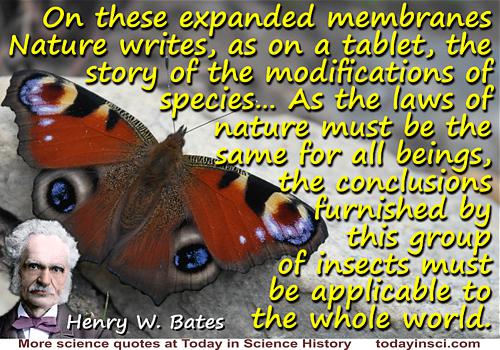
… on these expanded membranes [butterfly wings] Nature writes, as on a tablet, the story of the modifications of species, so truly do all changes of the organisation register themselves thereon. Moreover, the same colour-patterns of the wings generally show, with great regularity, the degrees of blood-relationship of the species. As the laws of nature must be the same for all beings, the conclusions furnished by this group of insects must be applicable to the whole world.
From The Naturalist on the River Amazons: A record of Adventures, Habits of Animals, Sketches of Brazilian and Indian life, and Aspects of Nature under the Equator, During Eleven Years of Travel (1864), 413.
“Pieces” almost always appear 'as parts' in whole processes. ... To sever a “'part” from the organized whole in which it occurs—whether it itself be a subsidiary whole or an “element”—is a very real process usually involving alterations in that “part”. Modifications of a part frequently involve changes elsewhere in the whole itself. Nor is the nature of these alterations arbitrary, for they too are determined by whole-conditions.
From 'Untersuchungen zur Lehre von der Gestalt, I', Psychol. Forsch. (1922), 1, 47-58. As translated in 'The General Theoretical Situation' (1922), collected in W. D. Ellis (ed.), A Source Book of Gestalt Psychology (1938, 1967), Vol. 2, 14.
A … difference between most system-building in the social sciences and systems of thought and classification of the natural sciences is to be seen in their evolution. In the natural sciences both theories and descriptive systems grow by adaptation to the increasing knowledge and experience of the scientists. In the social sciences, systems often issue fully formed from the mind of one man. Then they may be much discussed if they attract attention, but progressive adaptive modification as a result of the concerted efforts of great numbers of men is rare.
The Study of Man (1941), 19-20.
According to my derivative hypothesis, a change takes place first in the structure of the animal, and this, when sufficiently advanced, may lead to modifications of habits… . “Derivation” holds that every species changes, in time, by virtue of inherent tendencies thereto. “Natural Selection” holds that no such change can take place without the influence of altered external circumstances educing or selecting such change… . The hypothesis of “natural selection” totters on the extension of a conjectural condition, explanatory of extinction to the majority of organisms, and not known or observed to apply to the origin of any species.
In On the Anatomy of Vertebrates (1868), Vol. 3, 808.
All organs of an animal form a single system, the parts of which hang together, and act and re-act upon one another; and no modifications can appear in one part without bringing about corresponding modifications in all the rest.
Histoire des Progrès des Sciences naturelles depuis (1789), Vol. I, 310. Quoted in E. S. Russell, Form and Function(1916), 35.
Are not all Hypotheses erroneous, in which Light is supposed to consist in Pression or Motion, propagated through a fluid Medium? For in all these Hypotheses the Phaenomena of Light have been hitherto explain'd by supposing that they arise from new Modifications of the Rays; which is an erroneous Supposition.
Opticks, 2nd edition (1718), Book 3, Query 28, 337.
Because intelligence is our own most distinctive feature, we may incline to ascribe superior intelligence to the basic primate plan, or to the basic plan of the mammals in general, but this point requires some careful consideration. There is no question at all that most mammals of today are more intelligent than most reptiles of today. I am not going to try to define intelligence or to argue with those who deny thought or consciousness to any animal except man. It seems both common and scientific sense to admit that ability to learn, modification of action according to the situation, and other observable elements of behavior in animals reflect their degrees of intelligence and permit us, if only roughly, to compare these degrees. In spite of all difficulties and all the qualifications with which the expert (quite properly) hedges his conclusions, it also seems sensible to conclude that by and large an animal is likely to be more intelligent if it has a larger brain at a given body size and especially if its brain shows greater development of those areas and structures best developed in our own brains. After all, we know we are intelligent, even though we wish we were more so.
In The Meaning of Evolution: A Study of the History of Life and of its Significance for Man (1949), 78.
But as my conclusions have lately been much misrepresented, and it has been stated that I attribute the modification of species exclusively to natural selection, I may be permitted to remark that in the first edition of this work, and subsequently, I placed in a most conspicuous position—namely, at the close of the Introduction—the following words: “I am convinced that natural selection has been the main but not the exclusive means of modification.” This has been of no avail. Great is the power of steady misrepresentation; but the history of science shows that fortunately this power does not long endure.
In The Origin of Species by Means of Natural Selection with additions and corrections from sixth and last English edition (1899), Vol. 2, 293.
Considered as a mere question of physics, (and keeping all moral considerations entirely out of sight,) the appearance of man is a geological phenomenon of vast importance, indirectly modifying the whole surface of the earth, breaking in upon any supposition of zoological continuity, and utterly unaccounted for by what we have any right to call the laws of nature.
'Address to the Geological Society, delivered on the Evening of the 18th of February 1831', Proceedings of the Geological Society (1834), 1, 306.
Disused methods, cleverly modified, may be rendered efficient again. When it is understood in this way, the history of science becomes really a research method. A great scientist of our own
time, Ostwald, has even gone so far as to say that “It is nothing but a research method.”
In 'The History of Science', The Monist (July 1916), 26, No. 3, 344.
Every form of life can be produced by physical forces in one of two ways: either by coming into being out of formless matter, or by the modification of an already existing form by a continued process of shaping. In the latter case the cause of this modification may lie either in the influence of a dissimilar male generative matter upon the female germ, or in the influence of other powers which operate only after procreation.
From Gottfried Reinhold Treviranus, The Biology or Philosophy of Animate Nature, as quoted in translation of Ernst Heinrich Philipp August Haeckel's 8th German edition with E. Ray Lankester (ed.), The History of Creation, or, the Development of the Earth and its Inhabitants by the Action of Natural Causes (1892), 95.
Exercising the right of occasional suppression and slight modification, it is truly absurd to see how plastic a limited number of observations become, in the hands of men with preconceived ideas.
Meteorographica (1863), 5.
Exper. I. I made a small hole in a window-shutter, and covered it with a piece of thick paper, which I perforated with a fine needle. For greater convenience of observation I placed a small looking-glass without the window-shutter, in such a position as to reflect the sun's light, in a direction nearly horizontal, upon the opposite wall, and to cause the cone of diverging light to pass over a table on which were several little screens of card-paper. I brought into the sunbeam a slip of card, about one-thirtieth of an inch in breadth, and observed its shadow, either on the wall or on other cards held at different distances. Besides the fringes of colour on each side of the shadow, the shadow itself was divided by similar parallel fringes, of smaller dimensions, differing in number, according to the distance at which the shadow was observed, but leaving the middle of the shadow always white. Now these fringes were the joint effects of the portions of light passing on each side of the slip of card and inflected, or rather diffracted, into the shadow. For, a little screen being placed a few inches from the card, so as to receive either edge of the shadow on its margin, all the fringes which had before been observed in the shadow on the wall, immediately disappeared, although the light inflected on the other side was allowed to retain its course, and although this light must have undergone any modification that the proximity of the other edge of the slip of card might have been capable of occasioning... Nor was it for want of a sufficient intensity of light that one of the two portions was incapable of producing the fringes alone; for when they were both uninterrupted, the lines appeared, even if the intensity was reduced to one-tenth or one-twentieth.
'Experiments and Calculations Relative to Physical Optics' (read in 1803), Philosophical Transactions (1804), 94, 2-3.
Fertilization of mammalian eggs is followed by successive cell divisions and progressive differentiation, first into the early embryo and subsequently into all of the cell types that make up the adult animal. Transfer of a single nucleus at a specific stage of development, to an enucleated unfertilized egg, provided an opportunity to investigate whether cellular differentiation to that stage involved irreversible genetic modification. The first offspring to develop from a differentiated cell were born after nuclear transfer from an embryo-derived cell line that had been induced to became quiescent. Using the same procedure, we now report the birth of live lambs from three new cell populations established from adult mammary gland, fetus and embryo. The fact that a lamb was derived from an adult cell confirms that differentiation of that cell did not involve the irreversible modification of genetic material required far development to term. The birth of lambs from differentiated fetal and adult cells also reinforces previous speculation that by inducing donor cells to became quiescent it will be possible to obtain normal development from a wide variety of differentiated cells.
[Co-author of paper announcing the cloned sheep, ‘Dolly’.]
[Co-author of paper announcing the cloned sheep, ‘Dolly’.]
In I. Wilmut, A. E. Schnieke, J. McWhir, et al., 'Viable Offspring Derived from Petal and Adult Mammalian Cells', Nature (1997), 385, 810.
Finite systems of deterministic ordinary nonlinear differential equations may be designed to represent forced dissipative hydrodynamic flow. Solutions of these equations can be identified with trajectories in phase space. For those systems with bounded solutions, it is found that nonperiodic solutions are ordinarily unstable with respect to small modifications, so that slightly differing initial states can evolve into considerably different states. Systems with bounded solutions are shown to possess bounded numerical solutions.
A simple system representing cellular convection is solved numerically. All of the solutions are found to be unstable, and almost all of them are nonperiodic.
The feasibility of very-long-range weather prediction is examined in the light of these results
A simple system representing cellular convection is solved numerically. All of the solutions are found to be unstable, and almost all of them are nonperiodic.
The feasibility of very-long-range weather prediction is examined in the light of these results
Abstract from his landmark paper introducing Chaos Theory in relation to weather prediction, 'Deterministic Nonperiodic Flow', Journal of the Atmospheric Science (Mar 1963), 20, 130.
Grand telegraphic discovery today … Transmitted vocal sounds for the first time ... With some further modification I hope we may be enabled to distinguish … the “timbre” of the sound. Should this be so, conversation viva voce by telegraph will be a fait accompli.
Postscript (P.S.) on page 3 of letter to Sarah Fuller (1 Jul 1875). Bell Papers, Library of Congress.
I prefer a God who once and for all impressed his will upon creation, to one who continually busied about modifying what he had already done.
Attributed. As stated in W.F. Bynum and Roy Porter, Oxford Dictionary of Scientific Quotations (2005), 575.
If it could be demonstrated that any complex organ existed which could not possibly have been formed by numerous, successive slight modifications, my theory would absolutely break down.
From On the Origin of Species by Means of Natural Selection; or, The Preservation of Favoured Races in the Struggle for Life (1861), 171.
If you can modify a cell, it’s only a short step to modifying a mouse, and if you can modify a mouse, it’s only a step to modifying a higher animal, even man.
Reported in 1981, expressing concern for the future of gene-splicing.
Reported in 1981, expressing concern for the future of gene-splicing.
In 'Shaping Life in the Lab', Time (9 Mar 1981).
In science the important thing is to modify and change one's ideas as science advances.
As given by in Bertha McCool, 'The Development of Embryology', Bios (Oct 1935), 6, No. 3, 303. Also in Rudolf Franz Flesch, The Art of Clear Thinking (1951), 122. Webmaster has also seen this attributed to Herbert Spencer, but has yet found such examples date only after 1997. If you know the primary source from Bernard, please contact Webmaster.
In science the important thing is to modify and change one's ideas as science advances.
[Misattributed? See instead Claude Bernard]
[Misattributed? See instead Claude Bernard]
Webmaster believes this is a quote by Claude Bernard, for whom examples date back to at least 1935, whereas Webmaster has found attribution to Spencer only as early as 1997. If you know the primary source from either Spencer or Bernard, please contact Webmaster.
In the real changes which animals undergo during their embryonic growth, in those external transformations as well as in those structural modifications within the body, we have a natural scale to measure the degree or the gradation of those full grown animals which corresponds in their external form and in their structure, to those various degrees in the metamorphoses of animals, as illustrated by embryonic changes, a real foundation for zoological classification.
From Lecture 4, collected in Twelve Lectures on Comparative Embryology: Delivered Before the Lowell Institute in Boston: December and January 1848-9 (1849), 29.
In truth, we know causes only by their effects; and in order to learn the nature of the causes which modify the earth, we must study them through all ages of their action, and not select arbitrarily the period in which we live as the standard for all other epochs.
In History of the Inductive Sciences (1857), Vol. 3, 514.
Increased knowledge of heredity means increased power of control over the living thing, and as we come to understand more and more the architecture of the plant or animal we realize what can and what cannot be done towards modification or improvement.
Reginald C. Punnett, in article 'Mendelism', from Hugh Chisholm (ed.) The Encyclopædia Britannica (1911), Vol. 18, 120.
Is man a peculiar organism? Does he originate in a wholly different way from a dog, bird, frog, or fish? and does he thereby justify those who assert that he has no place in nature, and no real relationship with the lower world of animal life? Or does he develop from a similar embryo, and undergo the same slow and gradual progressive modifications? The answer is not for an instant doubtful, and has not been doubtful for the last thirty years. The mode of man’s origin and the earlier stages of his development are undoubtedly identical with those of the animals standing directly below him in the scale; without the slightest doubt, he stands in this respect nearer the ape than the ape does to the dog. (1863)
As quoted in Ernst Haeckel and E. Ray Lankester (trans.) as epigraph for Chap. 12, The History of Creation (1886), Vol. 1, 364.
It appears, nevertheless, that all such simple solutions of the problem of vertebrate ancestry are without warrant. They arise from a very common tendency of the mind, against which the naturalist has to guard himself,—a tendency which finds expression in the very widespread notion that the existing anthropoid apes, and more especially the gorilla, must be looked upon as the ancestors of mankind, if once the doctrine of the descent of man from ape-like forefathers is admitted. A little reflexion suffices to show that any given living form, such as the gorilla, cannot possibly be the ancestral form from which man was derived, since ex-hypothesi that ancestral form underwent modification and development, and in so doing, ceased to exist.
'Vertebrata', entry in Encyclopaedia Britannica, 9th edition (1899), Vol. 24, 180.
It is an error to imagine that evolution signifies a constant tendency to increased perfection. That process undoubtedly involves a constant remodeling of the organism in adaptation to new conditions; but it depends on the nature of those conditions whether the direction of the modifications effected shall be upward or downward.
'The Struggle for Existence in Human Society' (1888). In Collected Essays (1894), Vol. 9, 199.
It is in this mutual dependence of the functions and the aid which they reciprocally lend one another that are founded the laws which determine the relations of their organs and which possess a necessity equal to that of metaphysical or mathematical laws, since it is evident that the seemly harmony between organs which interact is a necessary condition of existence of the creature to which they belong and that if one of these functions were modified in a manner incompatible with the modifications of the others the creature could no longer continue to exist.
Leçons d' anatomie comparée, Vol. I, 47. Trans. William Coleman, Georges Cuvier Zoologist: A Study in the History of Evolution Theory (1964), 67-8.
It is reasonable to suppose that if we could apply selection to the human race we could also produce modifications or variations of men.
From Paper (13 Nov 1883) presented to the National Academy of Sciences at New Haven, printed in ed in 'Upon the Formation of a Deaf variety of the Human Race', Memoirs of the National Academy of Sciences (1884), 2, 179.
It seems to me that the evidence ... is opposed to the view that the spirals are individual galaxies comparable with our own. In fact, there appears as yet no reason for modifying the tentative hypothesis that the spirals are not composed of typical stars at all, but are truly nebulous objects.
[Contradicting the view of Heber Curtis during the Shapley-Curtis debate on 26 Apr 1920 to the National Academy of Sciences.]
[Contradicting the view of Heber Curtis during the Shapley-Curtis debate on 26 Apr 1920 to the National Academy of Sciences.]
In Aleksandr Sergeevich Sharov and Igor Dmitrievich Novikov, Edwin Hubble: The Discoverer of the Big Bang Universe (1993), 27.
It would be an easy task to show that the characteristics in the organization of man, on account of which the human species and races are grouped as a distinct family, are all results of former changes of occupation, and of acquired habits, which have come to be distinctive of individuals of his kind. When, compelled by circumstances, the most highly developed apes accustomed themselves to walking erect, they gained the ascendant over the other animals. The absolute advantage they enjoyed, and the new requirements imposed on them, made them change their mode of life, which resulted in the gradual modification of their organization, and in their acquiring many new qualities, and among them the wonderful power of speech.
Quoted in Ernst Heinrich Philipp August Haeckel The Evolution of Man (1897), Vol. 1, 70.
Lakatos (1978) coined the term immunization for a methodological decision to deflect a falsification from the hard core of a research program by making modifications in the protective belt.
In section, 'From Falsification to Methodological Caution', Ceteris Paribus in Conservative Belief Revision (2009), 71.
Let us now discuss the extent of the mathematical quality in Nature. According to the mechanistic scheme of physics or to its relativistic modification, one needs for the complete description of the universe not merely a complete system of equations of motion, but also a complete set of initial conditions, and it is only to the former of these that mathematical theories apply. The latter are considered to be not amenable to theoretical treatment and to be determinable only from observation.
From Lecture delivered on presentation of the James Scott prize, (6 Feb 1939), 'The Relation Between Mathematics And Physics', printed in Proceedings of the Royal Society of Edinburgh (1938-1939), 59, Part 2, 125.
Now it is a well-known principle of zoological evolution that an isolated region, if large and sufficiently varied in its topography, soil, climate and vegetation, will give rise to a diversified fauna according to the law of adaptive radiation from primitive and central types. Branches will spring off in all directions to take advantage of every possible opportunity of securing food. The modifications which animals undergo in this adaptive radiation are largely of mechanical nature, they are limited in number and kind by hereditary, stirp or germinal influences, and thus result in the independent evolution of similar types in widely-separated regions under the law of parallelism or homoplasy. This law causes the independent origin not only of similar genera but of similar families and even of our similar orders. Nature thus repeats herself upon a vast scale, but the similarity is never complete and exact.
'The Geological and Faunal Relations of Europe and America during the Tertiary Period and the Theory of the Successive Invasions of an African Fauna', Science (1900), 11, 563-64.
One of Darwin’s reviewers put the alternative strongly by asking “whether we are to believe that man is modified mud or modified monkey”.
In Letter to Thomas S. Spedding (19 May 1863), Life, Letters and Journals of Sir Charles Lyell (1881), Vol. 2, 376. [The mud is a reference to the Bible’s description in Genesis (2:7) that God formed man of the dust of the ground.]
Plants, in a state of nature, are always warring with one another, contending for the monopoly of the soil,—the stronger ejecting the weaker,—the more vigorous overgrowing and killing the more delicate. Every modification of climate, every disturbance of the soil, every interference with the existing vegetation of an area, favours some species at the expense of others.
(With Thomas Thomson) Flora Indica: A Systematic Account of the Plants of British India (1855), 41.
Science has hitherto been proceeding without the guidance of any rational theory of logic, and has certainly made good progress. It is like a computer who is pursuing some method of arithmetical approximation. Even if he occasionally makes mistakes in his ciphering, yet if the process is a good one they will rectify themselves. But then he would approximate much more rapidly if he did not commit these errors; and in my opinion, the time has come when science ought to be provided with a logic. My theory satisfies me; I can see no flaw in it. According to that theory universality, necessity, exactitude, in the absolute sense of these words, are unattainable by us, and do not exist in nature. There is an ideal law to which nature approximates; but to express it would require an endless series of modifications, like the decimals expressing surd. Only when you have asked a question in so crude a shape that continuity is not involved, is a perfectly true answer attainable.
Letter to G. F. Becker, 11 June 1893. Merrill Collection, Library of Congress. Quoted in Nathan Reingold, Science in Nineteenth-Century America: A Documentary History (1966), 231-2.
Science will continue to surprise us with what it discovers and creates; then it will astound us by devising new methods to surprise us. At the core of science’s self-modification is technology. New tools enable new structures of knowledge and new ways of discovery. The achievement of science is to know new things; the evolution of science is to know them in new ways. What evolves is less the body of what we know and more the nature of our knowing.
'Speculations on the Future of Science'. In Clifford A. Pickover, Archimedes to Hawking: Laws of Science and the Great Minds Behind Them (2008), 172.
Second Law
All the acquisitions or losses wrought by nature on individuals, through the influence of the environment in which their race has long been placed, and hence through the influence of the predominant use or permanent disuse of any organ; all these are preserved by reproduction to the new individuals which arise, provided that the acquired modifications are common to both sexes, or at least to the individuals which produce the young.
All the acquisitions or losses wrought by nature on individuals, through the influence of the environment in which their race has long been placed, and hence through the influence of the predominant use or permanent disuse of any organ; all these are preserved by reproduction to the new individuals which arise, provided that the acquired modifications are common to both sexes, or at least to the individuals which produce the young.
Philosophie Zoologique (1809), Vol. 1, 235, trans. Hugh Elliot (1914), 113.
Since many cases are known in which the specificities of antigens and enzymes appear to bear a direct relation to gene specificities, it seems reasonable to suppose that the gene’s primary and possibly sole function is in directing the final configurations of protein molecules.
Assuming that each specific protein of the organism has its unique configuration copied from that of a gene, it follows that every enzyme whose specificity depends on a protein should be subject to modification or inactivation through gene mutation. This would, of course, mean that the reaction normally catalyzed by the enzyme in question would either have its rate or products modified or be blocked entirely.
Such a view does not mean that genes directly “make” proteins. Regardless of precisely how proteins are synthesized, and from what component parts, these parts must themselves be synthesized by reactions which are enzymatically catalyzed and which in turn depend on the functioning of many genes. Thus in the synthesis of a single protein molecule, probably at least several hundred different genes contribute. But the final molecule corresponds to only one of them and this is the gene we visualize as being in primary control.
Assuming that each specific protein of the organism has its unique configuration copied from that of a gene, it follows that every enzyme whose specificity depends on a protein should be subject to modification or inactivation through gene mutation. This would, of course, mean that the reaction normally catalyzed by the enzyme in question would either have its rate or products modified or be blocked entirely.
Such a view does not mean that genes directly “make” proteins. Regardless of precisely how proteins are synthesized, and from what component parts, these parts must themselves be synthesized by reactions which are enzymatically catalyzed and which in turn depend on the functioning of many genes. Thus in the synthesis of a single protein molecule, probably at least several hundred different genes contribute. But the final molecule corresponds to only one of them and this is the gene we visualize as being in primary control.
In 'Genetics and Metabolism in Neurospora', Physiological Reviews, 1945, 25, 660.
So long as the fur of the beaver was extensively employed as a material for fine hats, it bore a very high price, and the chase of this quadruped was so keen that naturalists feared its speedy consideration. When a Parisian manufacturer invented the silk hat, which soon came into almost universal use, the demand for beavers' fur fell off, and this animal–whose habits, as we have seen, are an important agency in the formation of bogs and other modifications of forest nature–immediately began to increase, reappeared in haunts which we had long abandoned, and can no longer be regarded as rare enough to be in immediate danger of extirpation. Thus the convenience or the caprice of Parisian fashion has unconsciously exercised an influence which may sensibly affect the physical geography of a distant continent.
In Man and Nature, (1864), 84.
The Archetypal idea was manifested in the flesh, under divers such modifications, upon this planet, long prior to the existence of those animal species that actually exemplify it. To what natural laws or secondary causes the orderly succession and progression of such organic phaenomena may have been committed we as yet are ignorant. But if, without derogation of the Divine power, we may conceive the existence of such ministers, and personify them by the term 'Nature,' we learn from the past history of our globe that she has advanced with slow and stately steps, guided by the archetypal light, amidst the wreck of worlds, from the first embodiment of the Vertebrate idea under its old Ichthyic vestment, until it became arrayed in the glorious garb of the Human form.
On the Nature of Limbs (1849), 86.
The brain seems a thoroughfare for nerve-action passing its way to the motor animal. It has been remarked that Life's aim is an act not a thought. To-day the dictum must be modified to admit that, often, to refrain from an act is no less an act than to commit one, because inhibition is coequally with excitation a nervous activity.
The Brain and its Mechanism (1933), 10.
The great upheavals which precede changes of civilisation, such as the fall of the Roman Empire and the founding of the Arabian Empire, for example, seem to have been determined mainly by considerable political transformations, invasions, or the overthrow of dynasties. But … most often, the real cause is … a profound modification in the ideas of the peoples. … The memorable events of history are the visible effects of the invisible changes of human thought. … The present epoch is one of these critical moments in which the thought of mankind is undergoing a process of transformation.
From Psychologie des Foules (1895), Introduction, 1-2. English text in The Crowd: A Study of the Popular Mind (1897), Introduction, xiii-xiv, tweaked by Webmaster. Original French text: “Les grands bouleversements qui précèdent les changements de civilisations, tels que la chute de l’Empire romain et la fondation de l’Empire arabe par exemple semblent … déterminés surtout par des transformations politiques considérables: invasions de peuples ou renversements de dynasties. Mais … se trouve le plus souvent, comme cause réelle, une modification profonde dans les peuples. … Les événements mémorables de l’histoire sont les effets visibles des invisibles changements de la pensée des hommes. … L’époque actuelle constitue un de ces moments critiques où la pensée des hommes est en voie de se transformer.”
The kinetic concept of motion in classical theory will have to undergo profound modifications. (That is why I also avoided the term “orbit” in my paper throughout.) … We must not bind the atoms in the chains of our prejudices—to which, in my opinion, also belongs the assumption that electron orbits exist in the sense of ordinary mechanics—but we must, on the contrary, adapt our concepts to experience.
Letter to Niels Bohr (12 Dec 1924), in K. von Meyenn (ed.), Wolfgang Pauli - Wissenschaftliche Korrespondenz (1979), Vol. 1, 188. Quoted and cited in Daniel Greenberger, Klaus Hentschel and Friedel Weinert, Compendium of Quantum Physics: Concepts, Experiments, History and Philosophy (2009), 615.
The name chronic alcoholism applies to the collective symptoms of a disordered condition of the mental, motor, and sensory functions of the nervous system, these symptoms assuming a chronic form, and without their being immediately connected with any of those (organic) modifications of the central or peripheric portions of the nervous system which may be detected during life, or discovered after death by ocular inspection; such symptoms, moreover, affecting individuals who have persisted for a considerable length of time in the abuse of alcoholic liquors.
Published in Swedish in 1849. Translation quoted in William Marcet On Chronic Alcoholic Intoxication (1868), 21.
The night before Easter Sunday of that year (1920) I awoke, turned on the light, and jotted down a few notes on a tiny slip of thin paper. Then I fell asleep again. It occurred to me at six o’clock in the morning that during the night I had written down something most important, but I was unable to decipher the scrawl. The next night, at three o’clock, the idea returned. It was the design of an experiment to determine whether the hypothesis of chemical transmission that I had uttered seventeen years ago was correct. I got up immediately, went to the laboratory, and performed a simple experiment on a frog heart according to the nocturnal design. I have to describe this experiment briefly since its results became the foundation of the theory of chemical transmission of the nervous impulse. The hearts of two frogs were isolated, the first with its nerves, the second without. Both hearts were attached to Straub cannulas filled with a little Ringer solution. The vagus nerve of the first heart was stimulated for a few minutes. Then the Ringer solution that had been in the first heart during the stimulation of the vagus was transferred to the second heart. It slowed and its beats diminished just as if its vagus had been stimulated. Similarly, when the accelerator nerve was stimulated and the Ringer from this period transferred, the second heart speeded up and its beats increased. These results unequivocally proved that the nerves do not influence the heart directly but liberate from their terminals specific chemical substances which, in their turn, cause the well-known modifications of the function of the heart characteristic of the stimulation of its nerves.
'An Autobiographic Sketch', Perspectives in Biology and Medicine (1960), 4, 17.
The origin of a science is usually to be sought for not in any systematic treatise, but in the investigation and solution of some particular problem. This is especially the case in the ordinary history of the great improvements in any department of mathematical science. Some problem, mathematical or physical, is proposed, which is found to be insoluble by known methods. This condition of insolubility may arise from one of two causes: Either there exists no machinery powerful enough to effect the required reduction, or the workmen are not sufficiently expert to employ their tools in the performance of an entirely new piece of work. The problem proposed is, however, finally solved, and in its solution some new principle, or new application of old principles, is necessarily introduced. If a principle is brought to light it is soon found that in its application it is not necessarily limited to the particular question which occasioned its discovery, and it is then stated in an abstract form and applied to problems of gradually increasing generality.
Other principles, similar in their nature, are added, and the original principle itself receives such modifications and extensions as are from time to time deemed necessary. The same is true of new applications of old principles; the application is first thought to be merely confined to a particular problem, but it is soon recognized that this problem is but one, and generally a very simple one, out of a large class, to which the same process of investigation and solution are applicable. The result in both of these cases is the same. A time comes when these several problems, solutions, and principles are grouped together and found to produce an entirely new and consistent method; a nomenclature and uniform system of notation is adopted, and the principles of the new method become entitled to rank as a distinct science.
Other principles, similar in their nature, are added, and the original principle itself receives such modifications and extensions as are from time to time deemed necessary. The same is true of new applications of old principles; the application is first thought to be merely confined to a particular problem, but it is soon recognized that this problem is but one, and generally a very simple one, out of a large class, to which the same process of investigation and solution are applicable. The result in both of these cases is the same. A time comes when these several problems, solutions, and principles are grouped together and found to produce an entirely new and consistent method; a nomenclature and uniform system of notation is adopted, and the principles of the new method become entitled to rank as a distinct science.
In A Treatise on Projections (1880), Introduction, xi. Published as United States Coast and Geodetic Survey, Treasury Department Document, No. 61.
The steady progress of physics requires for its theoretical formulation a mathematics which get continually more advanced. ... it was expected that mathematics would get more and more complicated, but would rest on a permanent basis of axioms and definitions, while actually the modern physical developments have required a mathematics that continually shifts its foundation and gets more abstract. Non-euclidean geometry and noncommutative algebra, which were at one time were considered to be purely fictions of the mind and pastimes of logical thinkers, have now been found to be very necessary for the description of general facts of the physical world. It seems likely that this process of increasing abstraction will continue in the future and the advance in physics is to be associated with continual modification and generalisation of the axioms at the base of mathematics rather than with a logical development of any one mathematical scheme on a fixed foundation.
Introduction to a paper on magnetic monopoles, 'Quantised singularities in the electromagnetic field', Proceedings of the Royal Society of Lonndon (1931), A, 133 60. In Helge Kragh, Dirac: a Scientific Biography (1990), 208.
The succession of individuals, connected by reproduction and belonging to a species, makes it possible for the specific form itself to last for ages. In the end, however, the species is temporary; it has no “eternal life.” After existing for a certain period, it either dies or is converted by modification into other forms.
As translated by Joseph McCabe in Haeckel's The Wonders of Life: a Popular Study of Biological Philosophy (1904), 248.
The world is not as it was when it came from its Maker’s hands. It has been modified by many great revolutions, brought about by an inner mechanism of which we very imperfectly comprehend the movements; but of which we gain a glimpse by studying their effects: and their many causes still acting on the surface of our globe with undiminished power, which are changing, and will continue to change it, as long as it shall last.
Letter 1 to William Wordsworth. Quoted in the appendix to W. Wordsworth, A Complete Guide to the Lakes, Comprising Minute Direction for the Tourist, with Mr Wordsworth's Description of the Scenery of the County and Three Letters upon the Geology of the Lake District (1841), 6.
Thou shalt not let thy cattle gender with a diverse kind; thou shalt not sow thy field with mingled seed.
An early injunction against genetic modification.
An early injunction against genetic modification.
— Bible
Leviticus 19:19. In 'Shaping Life in the Lab', Time (9 Mar 1981).
To suppose that the eye, with all its inimitable contrivances for adjusting the focus to different distances, for admitting different amounts of light, and for the correction of spherical and chromatic aberration, could have been formed by natural selection, seems, I freely confess, absurd in the highest possible degree. When it was first said that the sun stood still and the world turned round, the common sense of mankind declared the doctrine false; but the old saying of Vox populi, vox Dei, as every philosopher knows, cannot be trusted in science. Reason tells me, that if numerous gradations from a perfect and complex eye to one very imperfect and simple, each grade being useful to its possessor, can be shown to exist; if further, the eye does vary ever so slightly, and the variations be inherited, which is certainly the case; and if any variation or modification in the organ be ever useful to an animal under changing conditions of life, then the difficulty of believing that a perfect and complex eye could be formed by natural selection, though insuperable by our imagination, can hardly be considered real.
On The Origin of Species by Means of Natural Selection (1859, 1882), 143-144.
We find that light acquires properties which are relative only to the sides of the ray,–which are the same for the north and south sides of the ray, (using the points of the compass for description’s sake only) and which are different when we go from the north and south to the east or to the west sides of the ray. I shall give the name of poles to these sides of the ray, and shall call polarization the modification which gives to light these properties relative to these poles.
(1811). As quoted in William Whewell, The Philosophy of the Inductive Sciences (1840), 336.
We may be sure, that if Lyell were now living he would frankly recognize new facts, as soon as they were established, and would not shrink from any modification of his theory which these might demand. Great as were his services to geology, this, perhaps, is even greater—for the lesson applies to all sciences and to all seekers alter knowledge—that his career, from first to lost, was the manifestation of a judicial mind, of a noble spirit, raised far above all party passions and petty considerations, of an intellect great in itself, but greater still in its grand humility; that he was a man to whom truth was as the “pearl of price,” worthy of the devotion and, if need be, the sacrifice of a life.
Conclusion in Charles Lyell and Modern Geology (1895), 213.
We may lay it down as an incontestible axiom, that, in all the operations of art and nature, nothing is created; an equal quantity of matter exists both before and after the experiment; the quality and quantity of the elements remain precisely the same; and nothing takes place beyond changes and modifications in the combination of these elements. Upon this principle the whole art of performing chemical experiments depends: We must always suppose an exact equality between the elements of the body examined and those of the products of its analysis.
Elements of Chemistry trans. Robert. Kerr, (1790, 5th Ed. 1802), Vol. 1, 226.
Why can the chemist not take the requisite numbers of atoms and simply put them together? The answer is that the chemist never has atoms at his disposal, and if he had, the direct combination of the appropriate numbers of atoms would lead only to a Brobdingnagian potpourri of different kinds of molecules, having a vast array of different structures. What the chemist has at hand always consists of substances, themselves made up of molecules, containing defined numbers of atoms in ordered arrangements. Consequently, in order to synthesize anyone substance, his task is that of combining, modifying, transforming, and tailoring known substances, until the total effect of his manipulations is the conversion of one or more forms of matter into another.
In 'Art and Science in the Synthesis of Organic Compounds: Retrospect and Prospect', in Maeve O'Connor (ed.), Pointers and Pathways in Research (1963), 28.
 In science it often happens that scientists say, 'You know that's a really good argument; my position is mistaken,' and then they would actually change their minds and you never hear that old view from them again. They really do it. It doesn't happen as often as it should, because scientists are human and change is sometimes painful. But it happens every day. I cannot recall the last time something like that happened in politics or religion.
(1987) --
In science it often happens that scientists say, 'You know that's a really good argument; my position is mistaken,' and then they would actually change their minds and you never hear that old view from them again. They really do it. It doesn't happen as often as it should, because scientists are human and change is sometimes painful. But it happens every day. I cannot recall the last time something like that happened in politics or religion.
(1987) -- 





