Model Quotes (106 quotes)
... one of the main functions of an analogy or model is to suggest extensions of the theory by considering extensions of the analogy, since more is known about the analogy than is known about the subject matter of the theory itself … A collection of observable concepts in a purely formal hypothesis suggesting no analogy with anything would consequently not suggest either any directions for its own development.
'Operational Definition and Analogy in Physical Theories', British Journal for the Philosophy of Science (Feb 1952), 2, No. 8, 291.
…all models are approximations. Essentially, all models are wrong, but some are useful. However, the approximate nature of the model must always be borne in mind… [Co-author with Norman R. Draper]
In George E.P. Box, Norman R. Draper, Response Surfaces, Mixtures, and Ridge Analyses (2nd ed. 2007), 414.
“That’s another thing we’ve learned from your Nation,” said Mein Herr, “map-making. But we’ve carried it much further than you. What do you consider the largest map that would be really useful?”
“About six inches to the mile.”
“Only six inches!” exclaimed Mein Herr. “We very soon got to six yards to the mile. Then we tried a hundred yards to the mile. And then came the grandest idea of all! We actually made a map of the country, on the scale of a mile to the mile!”
“Have you used it much?” I enquired.
“It has never been spread out, yet,” said Mein Herr: “the farmers objected: they said it would cover the whole country, and shut out the sunlight! So we now use the country itself, as its own map, and I assure you it does nearly as well.”
“About six inches to the mile.”
“Only six inches!” exclaimed Mein Herr. “We very soon got to six yards to the mile. Then we tried a hundred yards to the mile. And then came the grandest idea of all! We actually made a map of the country, on the scale of a mile to the mile!”
“Have you used it much?” I enquired.
“It has never been spread out, yet,” said Mein Herr: “the farmers objected: they said it would cover the whole country, and shut out the sunlight! So we now use the country itself, as its own map, and I assure you it does nearly as well.”
From Sylvie and Bruno Concluded (1893), 169.
[My favourite fellow of the Royal Society is the Reverend Thomas Bayes, an obscure 18th-century Kent clergyman and a brilliant mathematician who] devised a complex equation known as the Bayes theorem, which can be used to work out probability distributions. It had no practical application in his lifetime, but today, thanks to computers, is routinely used in the modelling of climate change, astrophysics and stock-market analysis.
Quoted in Max Davidson, 'Bill Bryson: Have faith, science can solve our problems', Daily Telegraph (26 Sep 2010)
[Our work on the structure of DNA] was fairly fast, but you know, we were lucky. One must remember, it was based on the X-ray work done here in London started off by Morris Wilkins and carried on by Rosalind Franklin, and we wouldn’t have got to the stage of at least having a molecular model, if it hadn't been for their work.
Quoted and cited from BBC radio (1999) in transcript of Australian ABC radio program PM (30 Jul 2004) on the ABC website.
[To elucidate using models] the different combining powers in elementary atoms, I … select my illustrations from that most delightful of games, croquet. Let the croquet balls represent our atoms, and let us distinguish the atoms of different elements by different colours. The white balls are hydrogen, the green ones chlorine atoms; the atoms of fiery oxygen are red, those of nitrogen, blue; the carbon atoms, lastly, are naturally represented by black balls. But we have, in addition, exhibit the different combining powers of these atoms … by screwing into the balls a number of metallic arms (tubes and pins), which correspond respectively to the combining powers of the atoms represented … to join the balls … in imitation of the atomic edifices represented.
Paper presented at the Friday Discourse of the the Royal Institution (7 Apr 1865). 'On the Combining Power of Atoms', Proceedings of the Royal Institution (1865), 4, No. 42, 416.
[Using mice as model systems for genetic engineering in biomedicine, instead of bacterial or yeast systems matters because] this transition will have as big an impact on the future of biology as the shift from printing presses to video technology has had on pop culture. A mouse-based world looks and feels different from one viewed through microorganisms.
Quoted in Michael Schrage, 'Biomedical Researchers Scurry to Make Genetically Altered Mice', San Jose Mercury News (8 Feb 1993), 3D. In Donna Jeanne Haraway and Lynn M. Randolph, [email protected]: Feminism and Technoscience (1996), 98.
[We should] abandon all attempts to construct perceptual models of atomic processes.
In Physics and Beyond (1971), 76.
[About describing atomic models in the language of classical physics:] We must be clear that when it comes to atoms, language can be used only as in poetry. The poet, too, is not nearly so concerned with describing facts as with creating images and establishing mental connections.
As quoted by Werner Heisenberg, as translated by Arnold J. Pomerans, in Physics and Beyond: Encounters and Conversations (1971), 41. The words are not verbatim, but as later recollected by Werner Heisenberg describing his early encounter with Bohr in 1920.
Les Leucocytes Et L'esprit De Sacrifice. — Il semble, d'après les recherches de De Bruyne (Phagocytose, 1895) et de ceux qui le citent, que les leucocytes des Lamellibranches — probablement lorsqu'ils ont phagocyté, qu'ils se sont chargés de résidus et de déchets, qu'ils ont, en un mot, accompli leur rôle et bien fait leur devoir — sortent du corps de l'animal et vont mourir dans le milieu ambiant. Ils se sacrifient. Après avoir si bien servi l'organisme par leur activité, ils le servent encore par leur mort en faisant place aux cellules nouvelles, plus jeunes.
N'est-ce pas la parfaite image du désintéressement le plus noble, et n'y a-t-il point là un exemple et un modèle? Il faut s'en inspirer: comme eux, nous sommes les unités d'un grand corps social; comme eux, nous pouvons le servir et envisager la mort avec sérénité, en subordonnant notre conscience individuelle à la conscience collective. (30 Jan 1896)
Leukocytes and The Spirit Of Sacrifice. - It seems, according to research by De Bruyne (Phagocytosis, 1885) and those who quote it, that leukocytes of Lamellibranches [bivalves] - likely when they have phagocytized [ingested bacteria], as they become residues and waste, they have, in short, performed their role well and done their duty - leave the body of the animal and will die in the environment. They sacrifice themselves. Having so well served the body by their activities, they still serve in their death by making room for new younger cells.
Isn't this the perfect image of the noblest selflessness, and thereby presents an example and a model? It should be inspiring: like them, we are the units of a great social body, like them, we can serve and contemplate death with equanimity, subordinating our individual consciousness to collective consciousness.
N'est-ce pas la parfaite image du désintéressement le plus noble, et n'y a-t-il point là un exemple et un modèle? Il faut s'en inspirer: comme eux, nous sommes les unités d'un grand corps social; comme eux, nous pouvons le servir et envisager la mort avec sérénité, en subordonnant notre conscience individuelle à la conscience collective. (30 Jan 1896)
Leukocytes and The Spirit Of Sacrifice. - It seems, according to research by De Bruyne (Phagocytosis, 1885) and those who quote it, that leukocytes of Lamellibranches [bivalves] - likely when they have phagocytized [ingested bacteria], as they become residues and waste, they have, in short, performed their role well and done their duty - leave the body of the animal and will die in the environment. They sacrifice themselves. Having so well served the body by their activities, they still serve in their death by making room for new younger cells.
Isn't this the perfect image of the noblest selflessness, and thereby presents an example and a model? It should be inspiring: like them, we are the units of a great social body, like them, we can serve and contemplate death with equanimity, subordinating our individual consciousness to collective consciousness.
In Recueil d'Œuvres de Léo Errera: Botanique Générale (1908), 194. Google translation by Webmaster. Please give feedback if you can improve it.
A paradigm is an all-encompassing idea, a model providing a way of looking at the world such that an array of diverse observations is united under one umbrella of belief, and a series of related questions are thus answered. Paradigms provide broad understanding, a certain “comfort level,” the psychological satisfaction associated with a mystery solved. What is important here, and perhaps surprising at first glance, is that a paradigm need not have much to do with reality. It does not have to be factual. It just needs to be satisfying to those whom it serves. For example, all creation myths, including the Judeo-Christian story of Adam and Eve in the Garden of Eden, are certainly paradigms, at least to those who subscribe to the particular faith that generated the myth.
From John Krichter, The Balance of Nature: Ecology's Enduring Myth (2009), 20.
A theory has only the alternative of being right or wrong. A model has a third possibility: it may be right, but irrelevant.
Manfred Eigen, 'The Origin of Biological Information', in Jagdish Mehra (ed.), The Physicists's Conception of Nature (1973), 618.
About 6 or 8 years ago My Ingenious friend Mr John Robinson having [contrived] conceived that a fire engine might be made without a Lever—by Inverting the Cylinder & placing it above the mouth of the pit proposed to me to make a model of it which was set about by having never Compleated & I [being] having at that time Ignorant little knoledge of the machine however I always thought the Machine Might be applied to [more] other as valuable purposes [than] as drawing Water.
Entry in notebook (1765). The bracketed words in square brackets were crossed out by Watt. in Eric Robinson and Douglas McKie (eds.), Partners in Science: Letters of James Watt and Joseph Black (1970), 434.
And yet I think that the Full House model does teach us to treasure variety for its own sake–for tough reasons of evolutionary theory and nature’s ontology, and not from a lamentable failure of thought that accepts all beliefs on the absurd rationale that disagreement must imply disrespect. Excellence is a range of differences, not a spot. Each location on the range can be occupied by an excellent or an inadequate representative– and we must struggle for excellence at each of these varied locations. In a society driven, of ten unconsciously, to impose a uniform mediocrity upon a former richness of excellence–where McDonald’s drives out the local diner, and the mega-Stop & Shop eliminates the corner Mom and Pop–an understanding and defense of full ranges as natural reality might help to stem the tide and preserve the rich raw material of any evolving system: variation itself.
…...
As a boy I had liked both drawing and physics, and I always abhorred the role of being a spectator. In 1908, when I was 15, I designed, built and flew a toy model airplane which won the then-famous James Gordon Bennett Cup. By 16 I had discovered that design could be fun and profitable, and this lesson has never been lost on me.
On the official Raymond Loewry website.
As I look back over my efforts, I would characterize my contributions as being largely in the realm of model building. ... I perceive myself as rather uninhibited, with a certain mathematical facility and more interest in the broad aspect of a problem than the delicate nuances. I am more interested in discovering what is over the next rise than in assiduously cultivating the beautiful garden close at hand.
'Men, Mines and Molecules', Annual Review of Physical Chemistry, 1977, 28, 13.
As regards the co-ordination of all ordinary properties of matter, Rutherford’s model of the atom puts before us a task reminiscent of the old dream of philosophers: to reduce the interpretation of the laws of nature to the consideration of pure numbers.
In Faraday Lecture (1930), Journal of the Chemical Society (Feb 1932), 349. As quoted and cited in Chen Ning Yang, Elementary Particles (1961), 7.
Astronomy teaches the correct use of the sun and the planets. These may be put on a frame of little sticks and turned round. This causes the tides. Those at the ends of the sticks are enormously far away. From time to time a diligent searching of the sticks reveals new planets. The orbit of the planet is the distance the stick goes round in going round. Astronomy is intensely interesting; it should be done at night, in a high tower at Spitzbergen. This is to avoid the astronomy being interrupted. A really good astronomer can tell when a comet is coming too near him by the warning buzz of the revolving sticks.
In Literary Lapses (1928), 128.
Because of the way it came into existence, the solar system has only one-way traffic—like Piccadilly Circus. … If we want to make a model to scale, we must take a very tiny object, such as a pea, to represent the sun. On the same scale the nine planets will be small seeds, grains of sand and specks of dust. Even so, Piccadilly Circus is only just big enough to contain the orbit of Pluto. … The whole of Piccadilly Circus was needed to represent the space of the solar system, but a child can carry the whole substance of the model in its hand. All the rest is empty space.
In The Stars in Their Courses (1931, 1954), 49-50 & 89.
Behold the mighty dinosaur,
Famous in prehistoric lore,
Not only for his power and strength
But for his intellectual length.
You will observe by these remains
The creature had two sets of brains—
One in his head (the usual place),
The other at his spinal base.
Thus he could reason 'A priori'
As well as 'A posteriori'.
No problem bothered him a bit
He made both head and tail of it.
So wise was he, so wise and solemn,
Each thought filled just a spinal column.
If one brain found the pressure strong
It passed a few ideas along.
If something slipped his forward mind
'Twas rescued by the one behind.
And if in error he was caught
He had a saving afterthought.
As he thought twice before he spoke
He had no judgment to revoke.
Thus he could think without congestion
Upon both sides of every question.
Oh, gaze upon this model beast
Defunct ten million years at least.
Famous in prehistoric lore,
Not only for his power and strength
But for his intellectual length.
You will observe by these remains
The creature had two sets of brains—
One in his head (the usual place),
The other at his spinal base.
Thus he could reason 'A priori'
As well as 'A posteriori'.
No problem bothered him a bit
He made both head and tail of it.
So wise was he, so wise and solemn,
Each thought filled just a spinal column.
If one brain found the pressure strong
It passed a few ideas along.
If something slipped his forward mind
'Twas rescued by the one behind.
And if in error he was caught
He had a saving afterthought.
As he thought twice before he spoke
He had no judgment to revoke.
Thus he could think without congestion
Upon both sides of every question.
Oh, gaze upon this model beast
Defunct ten million years at least.
'The Dinosaur: A Poem' (1912). In E. H. Colbert (ed.), The Dinosaur Book (1951), 78.
Besides science museums, which hold stocks of artifacts, there are science centres which show
manufactured models. Everyone knows that the best way to teach science is by doing experiments.
Science centres are in effect public science laboratories … that enable the public to try scientific experiments with their own hands.
In 'Early Days in University Geophysics', Annual Review of Earth and Planetary Sciences (1982), 10, 13.
But it is necessary to insist more strongly than usual that what I am putting before you is a model—the Bohr model atom—because later I shall take you to a profounder level of representation in which the electron instead of being confined to a particular locality is distributed in a sort of probability haze all over the atom.
Messenger Lectures (1934), New Pathways in Science (1935), 34.
Confined to its true domain, mathematical reasoning is admirably adapted to perform the universal office of sound logic: to induce in order to deduce, in order to construct. … It contents itself to furnish, in the most favorable domain, a model of clearness, of precision, and consistency, the close contemplation of which is alone able to prepare the mind to render other conceptions also as perfect as their nature permits. Its general reaction, more negative than positive, must consist, above all, in inspiring us everywhere with an invincible aversion for vagueness, inconsistency, and obscurity, which may always be really avoided in any reasoning whatsoever, if we make sufficient effort.
In Synthèse Subjective (1856), 98. As translated in Robert Édouard Moritz, Memorabilia Mathematica; Or, The Philomath’s Quotation-Book (1914), 202-203. From the original French, “Bornée à son vrai domaine, la raison mathématique y peut admirablement remplir l’office universel de la saine logique: induire pour déduire, afin de construire. … Elle se contente de former, dans le domaine le plus favorable, un type de clarté, de précision, et de consistance, dont la contemplation familière peut seule disposer l’esprit à rendre les autres conceptions aussi parfaites que le comporte leur nature. Sa réaction générale, plus négative que positive, doit surtout consister à nous inspirer partout une invincible répugnance pour le vague, l’incohérence, et l’obscurité, que nous pouvons réellement éviter envers des pensées quelconques, si nous y faisons assez d’efforts.”
Da Vinci was as great a mechanic and inventor as were Newton and his friends. Yet a glance at his notebooks shows us that what fascinated him about nature was its variety, its infinite adaptability, the fitness and the individuality of all its parts. By contrast what made astronomy a pleasure to Newton was its unity, its singleness, its model of a nature in which the diversified parts were mere disguises for the same blank atoms.
From The Common Sense of Science (1951), 25.
Do these models give a pointer to God? The steady-state universe, the Hawking model... and the infinitely oscillating model decidedly do not. One might almost regard them as models manufactured for a Society of Atheists.
'From Entropy to God', in K. Martinas, L. Ropolyi and P. Szegedi (eds.) Thermodynamics: History and Philosophy: Facts, Trends, Debates (1991), 386.
Even if a scientific model, like a car, has only a few years to run before it is discarded, it serves its purpose for getting from one place to another.
In 'Complex Clocks', Digestive Diseases and Sciences (1983), 28, 1139.
Even if there is only one possible unified theory, it is just a set of rules and equations. What is it that breathes fire into the equations and makes a universe for them to describe? The usual approach of science of constructing a mathematical model cannot answer the questions of why there should be a universe for the model to describe. Why does the universe go to all the bother of existing?
A Brief History of Time (1998), 190.
Former arbiters of taste must have felt (as so many apostles of ‘traditional values’ and other highminded tags for restriction and conformity do today) that maintaining the social order required a concept of unalloyed heroism. Human beings so designated as role models had to embody all virtues of the paragon–which meant, of course, that they could not be described in their truly human and ineluctably faulted form.
…...
From man or angel the great Architect did wisely to conceal, and not divulge his secrets to be scanned by them who ought rather admire; or if they list to try conjecture, he his fabric of the heavens left to their disputes, perhaps to move his laughter at their quaint opinions wide hereafter, when they come to model heaven calculate the stars, how they will wield the mighty frame, how build, unbuild, contrive to save appearances, how gird the sphere with centric and eccentric scribbled o’er, and epicycle, orb in orb.
Paradise Lost (1674, 1754), Book 8, 231.
Had I been present at the Creation, I would have given some useful hints for the better ordering of the universe.
Remarking on the complexity of Ptolemaic model of the universe after it was explained to him.
Footnote: Carlyle says, in his History of Frederick the Great, book ii. chap. vii. that this saying of Alphonso about Ptolemy's astronomy, 'that it seemed a crank machine; that it was pity the Creator had not taken advice,' is still remembered by mankind, — this and no other of his many sayings.
Remarking on the complexity of Ptolemaic model of the universe after it was explained to him.
Footnote: Carlyle says, in his History of Frederick the Great, book ii. chap. vii. that this saying of Alphonso about Ptolemy's astronomy, 'that it seemed a crank machine; that it was pity the Creator had not taken advice,' is still remembered by mankind, — this and no other of his many sayings.
In John Bartlett and Nathan Haskell Dole (Ed.), Familiar Quotations: A Collection of Passages, Phrases, and Proverbs Traced to Their Sources (1914), 954.
Have you ever seen one?
About the electron. As Mach called out from the audience, in German (“Hab’s aans g’sehn?”), at one of Ludwig Boltzmann’s lectures on atoms. This was Mach’s frequent retort upon any mention of the atom having electron orbits. He was a fierce critic and held that science should stick to only phenomena directly observable by the senses. This quote is seen widely, without citation. For example, in Daniel Greenberger, Klaus Hentschel and Friedel Weinert, Compendium of Quantum Physics: Concepts, Experiments, History and Philosophy (2009), 615.
His [Marvin Minsky’s] basic interest seemed to be in the workings of the human mind and in making machine models of the mind. Indeed, about that time he and a friend made one of the first electronic machines that could actually teach itself to do something interesting. It monitored electronic “rats” that learned to run mazes. It was being financed by the Navy. On one notable occasion, I remember descending to the basement of Memorial Hall, while Minsky worked on it. It had an illuminated display panel that enabled one to follow the progress of the “rats.” Near the machine was a hamster in a cage. When the machine blinked, the hamster would run around its cage happily. Minsky, with his characteristic elfin grin, remarked that on a previous day the Navy contract officer had been down to see the machine. Noting the man’s interest in the hamster, Minsky had told him laconically, “The next one we build will look like a bird.”
How then did we come to the “standard model”? And how has it supplanted other theories, like the steady state model? It is a tribute to the essential objectivity of modern astrophysics that this consensus has been brought about, not by shifts in philosophical preference or by the influence of astrophysical mandarins, but by the pressure of empirical data.
In The First Three Minutes: A Modern View of the Origin of the Universe (1977), 9.
Human nature is not a machine to be built after a model, and set to do exactly the work prescribed for it, but a tree, which requires to grow and develop itself on all sides, according to the tendency of the inward forces which make it a living thing.
In 'Elements of Well-Being', On Liberty (1859), 107.
I am never content until I have constructed a mechanical model of the subject I am studying. If I succeed in making one, I understand. Otherwise, I do not. [Attributed; source unverified.]
Note: Webmaster has been unable to verify this quotation allegedly from his Baltimore Lectures. Is is widely quoted, usually without citation. A few instances indicate the quote came from a guest lecture, Johns Hopkins University, Baltimore (1884). The lecture notes were published in Baltimore Lectures on Molecular Dynamics and the Wave Theory of Light (1904). Webmaster has found no citation giving a page number, and has been unable to find the quote in that text. Anyone with more specific information, please contact Webmaster.
I argued that it was important not to place too much reliance on any single piece of experimental evidence. It might turn out to be misleading, as the 5.1 Å reflection undoubtedly was. Jim was a little more brash, stating that no good model ever accounted for all the facts, since some data was bound to be misleading if not plain wrong. A theory that did fit all the data would have been “carpentered” to do so and would thus be open to suspicion.
In What Mad Pursuit: A Personal View of Scientific Discovery (1988), 59-60.
I believe the best test of a model is how well can the modeller answer the questions, ‘What do you know now that you did not know before?’ and ‘How can you find out if it is true?’
In Francis Crick, The Astonishing Hypothesis: the Scientific Search for the Soul (1995), 177.
I can never satisfy myself until I can make a mechanical model of a thing. If I can make a mechanical model, I can understand it. As long as I cannot make a mechanical model all the way through I cannot understand.
From stenographic report by A.S. Hathaway of the Lecture 20 Kelvin presented at Johns Hopkins University, Baltimore, on 'Molecular Dynamics and the Wave Theory of Light' (1884), 270-271. (Hathaway was a Mathematics fellow there.) This remark is not included in the first typeset publication—a revised version, printed twenty years later, in 1904, as Lord Kelvin’s Baltimore Lectures on Molecular Dynamics and the Wave Theory of Light. The original notes were reproduced by the “papyrograph” process. They are excerpted in Pierre Maurice Marie Duhem, Essays in the History and Philosophy of Science (1996), 55.
I cannot imagine a God who rewards and punishes the objects of his creation, whose purposes are modeled after our own–a God, in short, who is but a reflection of human frailty. Neither can I believe that the individual survives the death of his body, although feeble souls harbor such thoughts through fear or ridiculous egotism. It is enough for me to contemplate the mystery of conscious life perpetuating itself through all eternity, to reflect upon the marvelous structure of the universe which we can dimly perceive, and to try humbly to comprehend even an infinitesimal part of the intelligence manifested in nature.
From 'What I Believe: Living Philosophies XIII', Forum and Century (Oct 1930), 84, No. 4, 194. Article in full, reprinted in Edward H. Cotton (ed.), Has Science Discovered God? A Symposium of Modern Scientific Opinion (1931), 97.
I felt an awesome responsibility, and I took the responsibility very seriously, of being a role model and opening another door to black Americans, but the important thing is not that I am black, but that I did a good job as a scientist and an astronaut. There will be black astronauts flying in later missions … and they, too, will be people who excel, not simply who are black … who can ably represent their people, their communities, their country.
I grew up in Japan and Hong Kong and then came to the States. Japan was a huge influence on me because, as a child, I would hear the oxcarts come and collect our sewage at night out of our house from the latrine and then take it off to the farms as fertilizer. And then the food would come back in oxcarts during the day. I always had this sort of “our poop became food” mental model. The idea of “waste equals food” was pretty inculcated, that everything was precious and the systems were coherent and cyclical.
In interview with Kerry A. Dolan, 'William McDonough On Cradle-to-Cradle Design', Forbes (4 Aug 2010)
I really see no harm which can come of giving our children a little knowledge of physiology. ... The instruction must be real, based upon observation, eked out by good explanatory diagrams and models, and conveyed by a teacher whose own knowledge has been acquired by a study of the facts; and not the mere catechismal parrot-work which too often usurps the place of elementary teaching.
Science and Culture (1882), 92.
I should like to compare this rearrangement which the proteins undergo in the animal or vegetable organism to the making up of a railroad train. In their passage through the body parts of the whole may be left behind, and here and there new parts added on. In order to understand fully the change we must remember that the proteins are composed of Bausteine united in very different ways. Some of them contain Bausteine of many kinds. The multiplicity of the proteins is determined by many causes, first through the differences in the nature of the constituent Bausteine; and secondly, through differences in the arrangement of them. The number of Bausteine which may take part in the formation of the proteins is about as large as the number of letters in the alphabet. When we consider that through the combination of letters an infinitely large number of thoughts may be expressed, we can understand how vast a number of the properties of the organism may be recorded in the small space which is occupied by the protein molecules. It enables us to understand how it is possible for the proteins of the sex-cells to contain, to a certain extent, a complete description of the species and even of the individual. We may also comprehend how great and important the task is to determine the structure of the proteins, and why the biochemist has devoted himself with so much industry to their analysis.
'The Chemical Composition of the Cell', The Harvey Lectures (1911), 7, 45.
I’m very good at integral and differential calculus,
I know the scientific names of beings animalculous:
In short, in matters vegetable, animal, and mineral,
I am the very model of a modern Major-General.
I know the scientific names of beings animalculous:
In short, in matters vegetable, animal, and mineral,
I am the very model of a modern Major-General.
In The Pirates of Penzance (1879), Act 1.
If a mathematician of the past, an Archimedes or even a Descartes, could view the field of geometry in its present condition, the first feature to impress him would be its lack of concreteness. There are whole classes of geometric theories which proceed not only without models and diagrams, but without the slightest (apparent) use of spatial intuition. In the main this is due, to the power of the analytic instruments of investigations as compared with the purely geometric.
In 'The Present Problems in Geometry', Bulletin American Mathematical Society (1906), 286.
If Nicolaus Copernicus, the distinguished and incomparable master, in this work had not been deprived of exquisite and faultless instruments, he would have left us this science far more well-established. For he, if anybody, was outstanding and had the most perfect understanding of the geometrical and arithmetical requisites for building up this discipline. Nor was he in any respect inferior to Ptolemy; on the contrary, he surpassed him greatly in certain fields, particularly as far as the device of fitness and compendious harmony in hypotheses is concerned. And his apparently absurd opinion that the Earth revolves does not obstruct this estimate, because a circular motion designed to go on uniformly about another point than the very center of the circle, as actually found in the Ptolemaic hypotheses of all the planets except that of the Sun, offends against the very basic principles of our discipline in a far more absurd and intolerable way than does the attributing to the Earth one motion or another which, being a natural motion, turns out to be imperceptible. There does not at all arise from this assumption so many unsuitable consequences as most people think.
From Letter (20 Jan 1587) to Christopher Rothman, chief astronomer of the Landgrave of Hesse. Webmaster seeks more information to better cite this source — please contact if you can furnish more. Webmaster originally found this quote introduced by an uncredited anonymous commentary explaining the context: “It was not just the Church that resisted the heliocentrism of Copernicus. Many prominent figures, in the decades following the 1543 publication of De Revolutionibus, regarded the Copernican model of the universe as a mathematical artifice which, though it yielded astronomical predictions of superior accuracy, could not be considered a true representation of physical reality.”
If the Lord Almighty had consulted me before embarking upon his creation, I should have recommended something simpler.
Remarking on the complexity of Ptolemaic model of the universe after it was explained to him.
Remarking on the complexity of Ptolemaic model of the universe after it was explained to him.
(circa 1250 A.D.) As atttributed, in John Esten Keller, Alfonso X, El Sabio (1967), Preface.
In the summer after kindergarten, a friend introduced me to the joys of building plastic model airplanes and warships. By the fourth grade, I graduated to an erector set and spent many happy hours constructing devices of unknown purpose where the main design criterion was to maximize the number of moving parts and overall size. The living room rug was frequently littered with hundreds of metal “girders” and tiny nuts and bolts surrounding half-finished structures. An understanding mother allowed me to keep the projects going for days on end.
Autobiography in Gösta Ekspong (ed.), Nobel Lectures: Physics 1996-2000 (2002), 116.
In this model, the sun is a very tiny speck of dust indeed—a speck less than a three-thousandth of an inch in diameter ... Think of the sun as something less than a speck of dust in a vast city, of the earth as less than a millionth part of such a speck of dust, and we have perhaps as vivid a picture as the mind can really grasp of the relation of our home in space to the rest of the universe.
In The Universe Around Us (1953), 96.
It is frivolous to fix pedantically the date of particular inventions. They have all been invented over and over fifty times. Man is the arch machine, of which all these shifts drawn from himself are toy models. He helps himself on each emergency by copying or duplicating his own structure, just so far as the need is.
It seems to me, he says, that the test of “Do we or not understand a particular subject in physics?” is, “Can we make a mechanical model of it?” I have an immense admiration for Maxwell’s model of electromagnetic induction. He makes a model that does all the wonderful things that electricity docs in inducing currents, etc., and there can be no doubt that a mechanical model of that kind is immensely instructive and is a step towards a definite mechanical theory of electromagnetism.
From stenographic report by A.S. Hathaway of the Lecture 20 Kelvin presented at Johns Hopkins University, Baltimore, on 'Molecular Dynamics and the Wave Theory of Light' (1884), 132. (Hathaway was a Mathematics fellow there.) This remark is not included in the first typeset publication—a revised version, printed twenty years later, in 1904, as Lord Kelvin’s Baltimore Lectures on Molecular Dynamics and the Wave Theory of Light. The original notes were reproduced by the “papyrograph” process. They are excerpted in Pierre Maurice Marie Duhem, Essays in the History and Philosophy of Science (1996), 54-55.
It was his [Leibnitz’s] love of method and order, and the conviction that such order and harmony existed in the real world, and that our success in understanding it depended upon the degree and order which we could attain in our own thoughts, that originally was probably nothing more than a habit which by degrees grew into a formal rule. This habit was acquired by early occupation with legal and mathematical questions. We have seen how the theory of combinations and arrangements of elements had a special interest for him. We also saw how mathematical calculations served him as a type and model of clear and orderly reasoning, and how he tried to introduce method and system into logical discussions, by reducing to a small number of terms the multitude of compound notions he had to deal with. This tendency increased in strength, and even in those early years he elaborated the idea of a general arithmetic, with a universal language of symbols, or a characteristic which would be applicable to all reasoning processes, and reduce philosophical investigations to that simplicity and certainty which the use of algebraic symbols had introduced into mathematics.
A mental attitude such as this is always highly favorable for mathematical as well as for philosophical investigations. Wherever progress depends upon precision and clearness of thought, and wherever such can be gained by reducing a variety of investigations to a general method, by bringing a multitude of notions under a common term or symbol, it proves inestimable. It necessarily imports the special qualities of number—viz., their continuity, infinity and infinite divisibility—like mathematical quantities—and destroys the notion that irreconcilable contrasts exist in nature, or gaps which cannot be bridged over. Thus, in his letter to Arnaud, Leibnitz expresses it as his opinion that geometry, or the philosophy of space, forms a step to the philosophy of motion—i.e., of corporeal things—and the philosophy of motion a step to the philosophy of mind.
A mental attitude such as this is always highly favorable for mathematical as well as for philosophical investigations. Wherever progress depends upon precision and clearness of thought, and wherever such can be gained by reducing a variety of investigations to a general method, by bringing a multitude of notions under a common term or symbol, it proves inestimable. It necessarily imports the special qualities of number—viz., their continuity, infinity and infinite divisibility—like mathematical quantities—and destroys the notion that irreconcilable contrasts exist in nature, or gaps which cannot be bridged over. Thus, in his letter to Arnaud, Leibnitz expresses it as his opinion that geometry, or the philosophy of space, forms a step to the philosophy of motion—i.e., of corporeal things—and the philosophy of motion a step to the philosophy of mind.
In Leibnitz (1884), 44-45. [The first sentence is reworded to better introduce the quotation. —Webmaster]
Leo Szilard’s Ten Commandments:
1. Recognize the connections of things and the laws of conduct of men, so that you may know what you are doing.
2. Let your acts be directed towards a worthy goal, but do not ask if they will reach it; they are to be models and examples, not means to an end.
3. Speak to all men as you do to yourself, with no concern for the effect you make, so that you do not shut them out from your world; lest in isolation the meaning of life slips out of sight and you lose the belief in the perfection of the creation.
4. Do not destroy what you cannot create.
5. Touch no dish, except that you are hungry.
6. Do not covet what you cannot have.
7. Do not lie without need.
8. Honor children. Listen reverently to their words and speak to them with infinite love.
9. Do your work for six years; but in the seventh, go into solitude or among strangers, so that the memory of your friends does not hinder you from being what you have become.
10. Lead your life with a gentle hand and be ready to leave whenever you are called.
1. Recognize the connections of things and the laws of conduct of men, so that you may know what you are doing.
2. Let your acts be directed towards a worthy goal, but do not ask if they will reach it; they are to be models and examples, not means to an end.
3. Speak to all men as you do to yourself, with no concern for the effect you make, so that you do not shut them out from your world; lest in isolation the meaning of life slips out of sight and you lose the belief in the perfection of the creation.
4. Do not destroy what you cannot create.
5. Touch no dish, except that you are hungry.
6. Do not covet what you cannot have.
7. Do not lie without need.
8. Honor children. Listen reverently to their words and speak to them with infinite love.
9. Do your work for six years; but in the seventh, go into solitude or among strangers, so that the memory of your friends does not hinder you from being what you have become.
10. Lead your life with a gentle hand and be ready to leave whenever you are called.
Circulated by Mrs. Szilard in July 1964, in a letter to their friends (translated by Dr. Jacob
Bronowski). As printed in Robert J. Levine, Ethics and Regulation of Clinical Research (1988), 431.
Let us dismiss the question, “Have you proven that your model is valid?” with a quick NO. Then let us take up the more rewarding and far more challenging question: “Have you proven that your model is useful for learning more… ” [Co-author]
In J.B. Mankin, R.V. O’Neill, H.H. Shugart and B.W. Rust, 'The Importance of Validation in Ecosystem Analysis', in: G.S. Innis (ed.), New Directions in the Analysis of Ecological Systems (1977), Part I, 69.
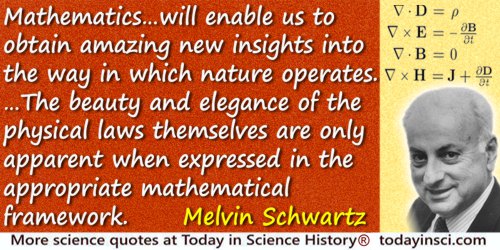
Mathematics is much more than a language for dealing with the physical world. It is a source of models and abstractions which will enable us to obtain amazing new insights into the way in which nature operates. Indeed, the beauty and elegance of the physical laws themselves are only apparent when expressed in the appropriate mathematical framework.
In Principles of Electrodynamics (1972, 1987), 105.
Melvin Calvin was a fearless scientist, totally unafraid to venture into new fields such as hot atom chemistry, carcinogenesis, chemical evolution and the origin of life, organic geochemistry, immunochemistry, petroleum production from plants, farming, Moon rock analysis, and development of novel synthetic biomembrane models for plant photosystems.
Co-author with Andrew A. Benson, 'Melvin Calvin', Biographical Memoirs of the US National Academy of Science.
Miss Stevens’s work is characterized by its precision, and by a caution that seldom ventures far from the immediate observation. Her contributions are models of brevity—a brevity amounting at times almost to meagerness.
In obituary, 'The Scientific Work of Miss N.M. Steves', Science (11 Oct 1912), 36, No. 928, 470.
Model-making, the imaginative and logical steps which precede the experiment, may be judged the most valuable part of scientific method because skill and insight in these matters are rare. Without them we do not know what experiment to do. But it is the experiment which provides the raw material for scientific theory. Scientific theory cannot be built directly from the conclusions of conceptual models.
Introduction to the Study of Animal Population (1961), 181.
Models so constructed, though of no practical value, serve a useful academic function. The oldest problem in economic education is how to exclude the incompetent. The requirement that there be an ability to master difficult models, including ones for which mathematical competence is required, is a highly useful screening device.
In Economics, Peace, and Laughter (1981), 40-41.
Much scientific truth proved to be as hypothetical as poetic allegory. The relationshiip of those rod-connected blue and red balls to an actual atomic structure was about the same as the relationship of Christianity to the fish or the Lamb.
Another Roadside Attraction (1990), 240.
My picture of the world is drawn in perspective and not like a model to scale. The foreground is occupied by human beings and the stars are all as small as three-penny bits. I don't really believe in astronomy, except as a complicated description of part of the course of human and possibly animal sensation. I apply my perspective not merely to space but also to time. In time the world will cool and everything will die; but that is a long time off still and its present value at compound discount is almost nothing.
From a paper read to the Apostles, a Cambridge discussion society (1925). In 'The Foundations of Mathematics' (1925), collected in Frank Plumpton Ramsey and D.H. Mellor (ed.), Philosophical Papers (1990), Epilogue, 249. Citation to the paper, in Nils-Eric Sahlin, The Philosophy of F.P. Ramsey (1990), 225.
No one believes the results of the computational modeler except the modeler, for only he understands the premises. No one doubts the experimenter’s results except the experimenter, for only he knows his mistakes.
See a similar idea expressed by W.I.B. Beveredge, beginning “No one believes an hypothesis…” on the W.I.B. Beveredge Quotes web page on this site.
No substantial part of the universe is so simple that it can be grasped and controlled without abstraction. Abstraction consists in replacing the part of the universe under consideration by a model of similar but simpler structure. Models, formal and intellectual on the one hand, or material on the other, are thus a central necessity of scientific procedure.
As coauthor with Norbert Wiener in 'The Role of Models in Science', Philosophy of Science (Oct 1945), 12, No. 4, 316.
Not only do wild species supply materials for our direct use, but they provide “models” for researchers to draw on when they are devising synthetic medicines or designing industrial products. Scientists would have had a hard time devising synthetic rubber if they had not had a “blueprint” to copy, in the molecular structure of natural rubber.
A Wealth Of Wild Species: Storehouse For Human Welfare (1983), Prologue, 5.
October 9, 1863
Always, however great the height of the balloon, when I have seen the horizon it has roughly appeared to be on the level of the car though of course the dip of the horizon is a very appreciable quantity or the same height as the eye. From this one might infer that, could the earth be seen without a cloud or anything to obscure it, and the boundary line of the plane approximately the same height as the eye, the general appearance would be that of a slight concavity; but I have never seen any part of the surface of the earth other than as a plane.
Towns and cities, when viewed from the balloon are like models in motion. I shall always remember the ascent of 9th October, 1863, when we passed over London about sunset. At the time when we were 7,000 feet high, and directly over London Bridge, the scene around was one that cannot probably be equalled in the world. We were still so low as not to have lost sight of the details of the spectacle which presented itself to our eyes; and with one glance the homes of 3,000,000 people could be seen, and so distinct was the view, that every large building was easily distinguishable. In fact, the whole of London was visible, and some parts most clearly. All round, the suburbs were also very distinct, with their lines of detached villas, imbedded as it were in a mass of shrubs; beyond, the country was like a garden, its fields, well marked, becoming smaller and smaller as the eye wandered farther and farther away.
Again looking down, there was the Thames, throughout its whole length, without the slightest mist, dotted over its winding course with innumerable ships and steamboats, like moving toys. Gravesend was visible, also the mouth of the Thames, and the coast around as far as Norfolk. The southern shore of the mouth of the Thames was not so clear, but the sea beyond was seen for many miles; when at a higher elevation, I looked for the coast of France, but was unable to see it. On looking round, the eye was arrested by the garden-like appearance of the county of Kent, till again London claimed yet more careful attention.
Smoke, thin and blue, was curling from it, and slowly moving away in beautiful curves, from all except one part, south of the Thames, where it was less blue and seemed more dense, till the cause became evident; it was mixed with mist rising from the ground, the southern limit of which was bounded by an even line, doubtless indicating the meeting of the subsoils of gravel and clay. The whole scene was surmounted by a canopy of blue, everywhere free from cloud, except near the horizon, where a band of cumulus and stratus extended all round, forming a fitting boundary to such a glorious view.
As seen from the earth, the sunset this evening was described as fine, the air being clear and the shadows well defined; but, as we rose to view it and its effects, the golden hues increased in intensity; their richness decreased as the distance from the sun increased, both right and left; but still as far as 90º from the sun, rose-coloured clouds extended. The remainder of the circle was completed, for the most part, by pure white cumulus of well-rounded and symmetrical forms.
I have seen London by night. I have crossed it during the day at the height of four miles. I have often admired the splendour of sky scenery, but never have I seen anything which surpassed this spectacle. The roar of the town heard at this elevation was a deep, rich, continuous sound the voice of labour. At four miles above London, all was hushed; no sound reached our ears.
Always, however great the height of the balloon, when I have seen the horizon it has roughly appeared to be on the level of the car though of course the dip of the horizon is a very appreciable quantity or the same height as the eye. From this one might infer that, could the earth be seen without a cloud or anything to obscure it, and the boundary line of the plane approximately the same height as the eye, the general appearance would be that of a slight concavity; but I have never seen any part of the surface of the earth other than as a plane.
Towns and cities, when viewed from the balloon are like models in motion. I shall always remember the ascent of 9th October, 1863, when we passed over London about sunset. At the time when we were 7,000 feet high, and directly over London Bridge, the scene around was one that cannot probably be equalled in the world. We were still so low as not to have lost sight of the details of the spectacle which presented itself to our eyes; and with one glance the homes of 3,000,000 people could be seen, and so distinct was the view, that every large building was easily distinguishable. In fact, the whole of London was visible, and some parts most clearly. All round, the suburbs were also very distinct, with their lines of detached villas, imbedded as it were in a mass of shrubs; beyond, the country was like a garden, its fields, well marked, becoming smaller and smaller as the eye wandered farther and farther away.
Again looking down, there was the Thames, throughout its whole length, without the slightest mist, dotted over its winding course with innumerable ships and steamboats, like moving toys. Gravesend was visible, also the mouth of the Thames, and the coast around as far as Norfolk. The southern shore of the mouth of the Thames was not so clear, but the sea beyond was seen for many miles; when at a higher elevation, I looked for the coast of France, but was unable to see it. On looking round, the eye was arrested by the garden-like appearance of the county of Kent, till again London claimed yet more careful attention.
Smoke, thin and blue, was curling from it, and slowly moving away in beautiful curves, from all except one part, south of the Thames, where it was less blue and seemed more dense, till the cause became evident; it was mixed with mist rising from the ground, the southern limit of which was bounded by an even line, doubtless indicating the meeting of the subsoils of gravel and clay. The whole scene was surmounted by a canopy of blue, everywhere free from cloud, except near the horizon, where a band of cumulus and stratus extended all round, forming a fitting boundary to such a glorious view.
As seen from the earth, the sunset this evening was described as fine, the air being clear and the shadows well defined; but, as we rose to view it and its effects, the golden hues increased in intensity; their richness decreased as the distance from the sun increased, both right and left; but still as far as 90º from the sun, rose-coloured clouds extended. The remainder of the circle was completed, for the most part, by pure white cumulus of well-rounded and symmetrical forms.
I have seen London by night. I have crossed it during the day at the height of four miles. I have often admired the splendour of sky scenery, but never have I seen anything which surpassed this spectacle. The roar of the town heard at this elevation was a deep, rich, continuous sound the voice of labour. At four miles above London, all was hushed; no sound reached our ears.
Travels in the Air (1871), 99-100.
One of the most insidious and nefarious properties of scientific models is their tendency to take over, and sometimes supplant, reality.
Quoted in J. J. Zuckerman, 'The Coming Renaissance of Descriptive Chemistry', Journal of Chemical Education, 1986, 63, 830.
Our model of Nature should not be like a building—a handsome structure for the populace to admire, until in the course of time some one takes away a corner stone and the edifice comes toppling down. It should be like an engine with movable parts. We need not fix the position of any one lever; that is to be adjusted from time to time as the latest observations indicate. The aim of the theorist is to know the train of wheels which the lever sets in motion—that binding of the parts which is the soul of the engine.
In 'The Internal Constitution of the Stars', The Scientific Monthly (Oct 1920), 11, No. 4, 302.
Pauling was shocked by the freedom with which the X-ray crystallographers of the time, including particularly Astbury, played with the intimate chemical structure of their models. They seemed to think that if the atoms were arranged in the right order and about the right distance apart, that was all that mattered, that no further restrictions need to be put on them.
Quoted by John Law in 'The Case of X-ray Protein Crystallography', collected in Gerard Lemaine (ed.), Perspectives on the Emergence of Scientific Disciplines, 1976, 140.
Reality is what kicks back when you kick it. This is just what physicists do with their particle accelerators. We kick reality and feel it kick back. From the intensity and duration of thousands of those kicks over many years, we have formed a coherent theory of matter and forces, called the standard model, that currently agrees with all observations.
In Has Science Found God?: The Latest Results in the Search for Purpose in the Universe (2003), 41.
Remember that all models are wrong; the practical question is how wrong do they have to be to not be useful. [Co-author with Norman R. Draper]
In George E.P. Box and Norman R. Draper, Empirical Model-Building and Response Surfaces (1987), 74.
Science is really in the business of disproving current models or changing them to conform to new information. In essence, we are constantly proving our latest ideas wrong.
John Mitchinson and John Lloyd, If Ignorance Is Bliss, Why Aren't There More Happy People?: Smart Quotes for Dumb Times (2009), 274.
Science is the art of the appropriate approximation. While the flat earth model is usually spoken of with derision it is still widely used. Flat maps, either in atlases or road maps, use the flat earth model as an approximation to the more complicated shape.
In 'On the Nature of Science', Physics in Canada (Jan/Feb 2007), 63, No. 1, 13.
Science is the construction of parsimonious, internally consistent models that can reliably predict future observations.
As quoted in Mark Buchanan, 'Thesis: Madness in the Method', Nature Physics (1 Feb 2009), 5, No. 2, 83.
Scientists are not robotic inducing machines that infer structures of explanation only from regularities observed in natural phenomena (assuming, as I doubt, that such a style of reasoning could ever achieve success in principle). Scientists are human beings, immersed in culture, and struggling with all the curious tools of inference that mind permits ... Culture can potentiate as well as constrain–as Darwin’s translation of Adam Smith’s laissez-faire economic models into biology as the theory of natural selection. In any case, objective minds do not exist outside culture, so we must make the best of our ineluctable embedding.
…...
String theorists can explain plausible models of a unified universe, but unfortunately they cannot explain why we inhabit a particular one
In Book Review 'Pulling the Strings,' of Lawrence Krauss's Hiding in the Mirror: The Mysterious Lure of Extra Dimensions, from Plato to String Theory and Beyond in Nature (22 Dec 2005), 438, 1082.
Students should learn to study at an early stage the great works of the great masters instead of making their minds sterile through the everlasting exercises of college, which are of no use whatever, except to produce a new Arcadia where indolence is veiled under the form of useless activity. … Hard study on the great models has ever brought out the strong; and of such must be our new scientific generation if it is to be worthy of the era to which it is born and of the struggles to which it is destined.
In Giornale di matematiche, Vol. 11, 153.
Thanks to the freedom of our press and the electronic media, the voices of cranks are often louder and clearer than the voices of genuine scientists. Crank books—on how to lose weight without cutting down on calories, on how to talk to plants, on how to cure your ailments by rubbing your feet, on how to apply horoscopes to your pets, on how to use ESP in making business decisions, on how to sharpen razor blades by putting them under little models of the great Pyramid of Egypt—far outsell many books… I reserve the right of moral indignation.
As quoted, without citation, in obituary by Morton Schatzman, 'Martin Gardner: Scientific and Philosophical Writer Celebrated for his Ingenious Mathematical Puzzles and Games', Independent (28 May 2010).
The best material model of a cat is another, or preferably the same, cat.
As coauthor with Norbert Wiener, in 'The Role of Models in Science', Philosophy of Science (Oct 1945), 12, 320.
The ingenious but nevertheless somewhat artificial assumptions of [Bohr’s model of the atom], …
are replaced by a much more natural assumption in de Broglie’s wave phenomena. The wave phenomenon forms the real “body” of the atom. It replaces the individual punctiform electrons, which in Bohr’s model swarm around the nucleus.
From 'Our Image of Matter', collected in Werner Heisenberg, Max Born, Erwin Schrödinger, Pierre Auger, On Modern Physics (1961), 50. Webmaster note: “punctiform” means composed of points.
The kinetic concept of motion in classical theory will have to undergo profound modifications. (That is why I also avoided the term “orbit” in my paper throughout.) … We must not bind the atoms in the chains of our prejudices—to which, in my opinion, also belongs the assumption that electron orbits exist in the sense of ordinary mechanics—but we must, on the contrary, adapt our concepts to experience.
Letter to Niels Bohr (12 Dec 1924), in K. von Meyenn (ed.), Wolfgang Pauli - Wissenschaftliche Korrespondenz (1979), Vol. 1, 188. Quoted and cited in Daniel Greenberger, Klaus Hentschel and Friedel Weinert, Compendium of Quantum Physics: Concepts, Experiments, History and Philosophy (2009), 615.
The legends of fieldwork locate all important sites deep in inaccessible jungles inhabited by fierce beasts and restless natives, and surrounded by miasmas of putrefaction and swarms of tsetse flies. (Alternative models include the hundredth dune after the death of all camels, or the thousandth crevasse following the demise of all sled dogs.)
In Wonderful Life: The Burgess Shale and the Nature of History (1990), 65.
The mathematical framework of quantum theory has passed countless successful tests and is now universally accepted as a consistent and accurate description of all atomic phenomena. The verbal interpretation, on the other hand – i.e., the metaphysics of quantum theory – is on far less solid ground. In fact, in more than forty years physicists have not been able to provide a clear metaphysical model.
In The Tao of Physics (1975), 132.
The mathematical framework of quantum theory has passed countless successful tests and is now universally accepted as a consistent and accurate description of all atomic phenomena. The verbal interpretation, on the other hand, i.e. the metaphysics of quantum physics, is on far less solid ground. In fact, in more than forty years physicists have not been able to provide a clear metaphysical model.
In The Tao of Physics: An Exploration of the Parallels Between Modern Physics (1975), 132.
The people of Sydney who can speak of my work [on flying-machine models] without a smile are very scarce; it is doubtless the same with American workers. I know that success is dead sure to come, and therefore do not waste time and words in trying to convince unbelievers.
As quoted in Octave Chanute, Progress in Flying Machines (1894), 231.
The preeminent transnational community in our culture is science. With the release of nuclear energy in the first half of the twentieth century that model commonwealth decisively challenged the power of the nation-state.
As quoted in Book Review titled 'The Men Who Made the Sun Rise' (about the book, Richard Rhodes, The Making of the Atomic Bomb (1986)) in William J. Broad, New York Times (8 Feb 1987), BR1.
The Primal Plant is going be the strangest creature in the world, which Nature herself must envy me. With this model and the key to it, it will be possible to go on for ever inventing plants and know that their existence is logical; that is to say, if they do not actually exist, they could, for they are not the shadowy phantoms of a vain imagination, but possess an inner necessity and truth. The same law will be applicable to all other living organisms.
To Herder, 17 May 1787. Italian Journey (1816-17), trans. W. H. Auden and Elizabeth Mayer (1970), 310-11.
The purpose of models is not to fit the data but to sharpen the questions.
Quoted in several several sources as from “11th R.A. Fisher Memorial Lecture, to the Royal Society (20 April 1983)”. For example, see Alan L. Mackay, A Dictionary of Scientific Quotations (1991), 138. However, Webmaster has read, and searched, but cannot find such words in the printed record in 'The Eleventh R. A. Fisher Memorial Lecture: Kin Selection and Altruism', in S. Karlin and C. Matessi, Proceedings of the Royal Society of London. Series B, Biological Sciences (22 Oct 1983), 219, No. 1216, Mathematical Genetics, 327-353. So, as yet, although the article does discuss various models relevant to the titled subject, Webmaster cannot document a verification of this quote. Perhaps it was a verbal comment spoken from the podium, but not included in the printed prepared lecture? Perplexing. Can you help?
The sciences do not try to explain, they hardly even try to interpret, they mainly make models. By a model is meant a mathematical construct which, with the addition of certain verbal interpretations, describes observed phenomena. The justification of such a mathematical construct is solely and precisely that it is expected to work—that is, correctly to describe phenomena from a reasonably wide area. Furthermore, it must satisfy certain esthetic criteria—that is, in relation to how much it describes, it must be rather simple.
From 'Method in the Physical Sciences', in John von Neumann and L. Leary (ed.), The Unity of Knowledge (1955), 158. Reprinted in John Von Neumann, F. Bródy (ed.) and Tibor Vámos (ed.), The Neumann Compendium (2000), 628.
The shell model, although proposed by theoreticians, really corresponds to the experimentalist’s approach. It was born from a thorough study of the experimental data, plotting them in different ways, and looking for interconnections.
The Shell Model, Nobel Lecture.
The universe flows, carrying with it milky ways and worlds, Gondwanas and Eurasias, inconsistent visions and clumsy systems. But the good conceptual models, these serena templa of intelligence on which several masters have worked, never disappear entirely. They are the great legacy of the past. They linger under more and more harmonious forms and actually never cease to grow. They bring solace by the great art that is inseparable from them. Their permanence relies on the immortal poetry of truth, of the truth that is given to us in minute amounts, foretelling an order whose majesty dominates time.
In Tectonics of Asia (1924, 1977), 164, trans. Albert V. and Marguerite Carozzi.
There are 60 sub-atomic particles they’ve discovered that can explain the thousands of other sub-atomic particles, and the model is too ugly. This is my analogy: it’s like taking Scotch tape and taping a giraffe to a mule to a whale to a tiger and saying this is the ultimate theory of particles. … We have so many particles that Oppenheimer once said you could give a Nobel Prize to the physicist that did not discover a particle that year. We were drowning in sub-atomic particles.
Now we realize that this whole zoo of sub-atomic particles, thousands of them coming out of our accelerators, can be explained by little vibrating strings.
Now we realize that this whole zoo of sub-atomic particles, thousands of them coming out of our accelerators, can be explained by little vibrating strings.
Quoted in Nina L. Diamond, Voices of Truth (2000), 334.
There is in Nature a general prototype in each species on which each individual is modeled, but which seems, in realizing itself, to alter itself or perfect itself according to circumstances. So that, relative to certain qualities, this is an extraordinary appearing variation in the succession of these individuals, and at the same time a constancy which appears wonderful in the entire species. The first animal, the first horse, for example, has been the external model and the interieur mold on which all horses which have been born, all those which now exist, and all those which will be born have been formed.
'Le Cheval', Histoire Naturelle, Générale et Particulière, Avec la Description du Cabinet du Roi (1753), Vol. 4, 215-6. Trans. Phillip R. Sloan.
There is no end of hypotheses about consciousness, particularly by philosophers. But most of these are not what we might call principled scientific theories, based on observables and related to the functions of the brain and body. Several theories of consciousness based on functionalism and on the machine model of the mind... have recently been proposed. These generally come in two flavors: one in which consciousness is assumed to be efficacious, and another in which it is considered an epiphenomenon. In the first, consciousness is likened to the executive in a computer systems program, and in the second, to a fascinating but more or less useless by-product of computation.
Bright and Brilliant Fire, On the Matters of the Mind (1992), 112.
There's antimony, arsenic, aluminium, selenium,
And hydrogen and oxygen and nitrogen and rhenium,
And nickel, neodymium, neptunium, germanium,
And iron, americium, ruthenium, uranium,
Europium, zirconium, lutetium, vanadium,
And lanthanum and osmium and astatine and radium,
And gold and protactinium and indium and gallium,
And iodine and thorium and thulium and thallium.
There's yttrium, ytterbium, actinium, rubidium,
And boron, gadolinium, niobium, iridium,
And strontium and silicon and silver and samarium,
And bismuth, bromine, lithium, beryllium and barium.
There's holmium and helium and hafnium and erbium,
And phosphorus and francium and fluorine and terbium,
And manganese and mercury, molybdenum, magnesium,
Dysprosium and scandium and cerium and cesium,
And lead, praseodymium and platinum, plutonium,
Palladium, promethium, potassium, polonium,
And tantalum, technetium, titanium, tellurium,
And cadmium and calcium and chromium and curium.
There's sulfur, californium and fermium, berkelium,
And also mendelevium, einsteinium, nobelium,
And argon, krypton, neon, radon, xenon, zinc and rhodium,
And chlorine, cobalt, carbon, copper, tungsten, tin and sodium.
These are the only ones of which the news has come to Harvard,
And there may be many others, but they haven't been discarvard.
[To the tune of I am the Very Model of a Modern Major General.]
And hydrogen and oxygen and nitrogen and rhenium,
And nickel, neodymium, neptunium, germanium,
And iron, americium, ruthenium, uranium,
Europium, zirconium, lutetium, vanadium,
And lanthanum and osmium and astatine and radium,
And gold and protactinium and indium and gallium,
And iodine and thorium and thulium and thallium.
There's yttrium, ytterbium, actinium, rubidium,
And boron, gadolinium, niobium, iridium,
And strontium and silicon and silver and samarium,
And bismuth, bromine, lithium, beryllium and barium.
There's holmium and helium and hafnium and erbium,
And phosphorus and francium and fluorine and terbium,
And manganese and mercury, molybdenum, magnesium,
Dysprosium and scandium and cerium and cesium,
And lead, praseodymium and platinum, plutonium,
Palladium, promethium, potassium, polonium,
And tantalum, technetium, titanium, tellurium,
And cadmium and calcium and chromium and curium.
There's sulfur, californium and fermium, berkelium,
And also mendelevium, einsteinium, nobelium,
And argon, krypton, neon, radon, xenon, zinc and rhodium,
And chlorine, cobalt, carbon, copper, tungsten, tin and sodium.
These are the only ones of which the news has come to Harvard,
And there may be many others, but they haven't been discarvard.
[To the tune of I am the Very Model of a Modern Major General.]
Song, 'The Elements' (1959). In Tom Lehrer,Too Many Songs by Tom Lehrer: With Not Enough Drawings by Ronald Searle (1981), 151.
Therefore, these [geotectonic] models cannot be expected to assume that the deeper parts of the earth’s crust were put together and built in a simpler way. The myth about the increasing simplicity with depth results from a general pre-scientific trend according to which the unknown or little known has to be considered simpler than the known. Many examples of this myth occur in the history of geology as, for instance, the development of views on the nature of the seafloor from the past to the present.
In 'Stockwerktektonik und Madelle van Esteinsdifferentiation', in Geotektonisches Symposium zu Ehren von Hans Stille, als Festschrift zur Vollendung seines 80, Lebensjahres (1956), 17, trans. Albert V. and Marguerite Carozzi.
This whole theory of electrostatics constitutes a group of abstract ideas and general propositions, formulated in the clear and precise language of geometry and algebra, and connected with one another by the rules of strict logic. This whole fully satisfies the reason of a French physicist and his taste for clarity, simplicity and order. The same does not hold for the Englishman. These abstract notions of material points, force, line of force, and equipotential surface do not satisfy his need to imagine concrete, material, visible, and tangible things. 'So long as we cling to this mode of representation,' says an English physicist, 'we cannot form a mental representation of the phenomena which are really happening.' It is to satisfy the need that he goes and creates a model.
The French or German physicist conceives, in the space separating two conductors, abstract lines of force having no thickness or real existence; the English physicist materializes these lines and thickens them to the dimensions of a tube which he will fill with vulcanised rubber. In place of a family of lines of ideal forces, conceivable only by reason, he will have a bundle of elastic strings, visible and tangible, firmly glued at both ends to the surfaces of the two conductors, and, when stretched, trying both to contact and to expand. When the two conductors approach each other, he sees the elastic strings drawing closer together; then he sees each of them bunch up and grow large. Such is the famous model of electrostatic action imagined by Faraday and admired as a work of genius by Maxwell and the whole English school.
The employment of similar mechanical models, recalling by certain more or less rough analogies the particular features of the theory being expounded, is a regular feature of the English treatises on physics. Here is a book* [by Oliver Lodge] intended to expound the modern theories of electricity and to expound a new theory. In it are nothing but strings which move around pulleys, which roll around drums, which go through pearl beads, which carry weights; and tubes which pump water while others swell and contract; toothed wheels which are geared to one another and engage hooks. We thought we were entering the tranquil and neatly ordered abode of reason, but we find ourselves in a factory.
*Footnote: O. Lodge, Les Théories Modernes (Modern Views on Electricity) (1889), 16.
The French or German physicist conceives, in the space separating two conductors, abstract lines of force having no thickness or real existence; the English physicist materializes these lines and thickens them to the dimensions of a tube which he will fill with vulcanised rubber. In place of a family of lines of ideal forces, conceivable only by reason, he will have a bundle of elastic strings, visible and tangible, firmly glued at both ends to the surfaces of the two conductors, and, when stretched, trying both to contact and to expand. When the two conductors approach each other, he sees the elastic strings drawing closer together; then he sees each of them bunch up and grow large. Such is the famous model of electrostatic action imagined by Faraday and admired as a work of genius by Maxwell and the whole English school.
The employment of similar mechanical models, recalling by certain more or less rough analogies the particular features of the theory being expounded, is a regular feature of the English treatises on physics. Here is a book* [by Oliver Lodge] intended to expound the modern theories of electricity and to expound a new theory. In it are nothing but strings which move around pulleys, which roll around drums, which go through pearl beads, which carry weights; and tubes which pump water while others swell and contract; toothed wheels which are geared to one another and engage hooks. We thought we were entering the tranquil and neatly ordered abode of reason, but we find ourselves in a factory.
*Footnote: O. Lodge, Les Théories Modernes (Modern Views on Electricity) (1889), 16.
The Aim and Structure of Physical Theory (1906), 2nd edition (1914), trans. Philip P. Wiener (1954), 70-1.
To suppose that so perfect a system as that of Euclid’s Elements was produced by one man, without any preceding model or materials, would be to suppose that Euclid was more than man. We ascribe to him as much as the weakness of human understanding will permit, if we suppose that the inventions in geometry, which had been made in a tract of preceding ages, were by him not only carried much further, but digested into so admirable a system, that his work obscured all that went before it, and made them be forgot and lost.
In Essay on the Powers of the Human Mind (1812), Vol. 2, 368.
To try to make a model of an atom by studying its spectrum is like trying to make a model of a grand piano by listening to the noise it makes when thrown downstairs.
In Oliver Lodge in Atoms and Rays (1924), 74.
To-day we not only have no perfect model [of the atom] but we know that it is of no use to search for one.
In Physics and Philosophy (1942, 1955), 10.
Until now, physical theories have been regarded as merely models with approximately describe the reality of nature. As the models improve, so the fit between theory and reality gets closer. Some physicists are now claiming that supergravity is the reality, that the model and the real world are in mathematically perfect accord.
Superforce (1984, 1985), 149.
We developed a computer program, based on tests of a quarter-scale model of the lunar module, and we ran the program through some 400 different [moon] landing conditions.
From interview with Technology Review, quoted in Douglas Martin, 'Joseph Gavin, Who Helped Put First Man on Moon, Dies at 90', New York Times (4 Nov 2010).
We must remember that all our [models of flying machine] inventions are but developments of crude ideas; that a commercially successful result in a practically unexplored field cannot possibly be got without an enormous amount of unremunerative work. It is the piled-up and recorded experience of many busy brains that has produced the luxurious travelling conveniences of to-day, which in no way astonish us, and there is no good reason for supposing that we shall always be content to keep on the agitated surface of the sea and air, when it is possible to travel in a superior plane, unimpeded by frictional disturbances.
Paper to the Royal Society of New South Wales (4 Jun 1890), as quoted in Octave Chanute, Progress in Flying Machines (1894), 2226.
We sleep, and at length awake to the still reality of a winter morning. The snow lies warm as cotton or down upon the window-sill; the broadened sash and frosted panes admit a dim and private light, which enhances the snug cheer within. The stillness of the morning is impressive... From the eaves and fences hang stalactites of snow, and in the yard stand stalagmites covering some concealed core. The trees and shrubs rear white arms to the sky on every side; and where were walls and fences we see fantastic forms stretching in the frolic gambols across the dusky landscape, as if nature had strewn her fresh designs over the fields by night as models for man’s art.
…...
While seeing any number of black crows does not prove all the crows are black, seeing one white crow disproves it. Thus science proceeds not by proving models correct but by discarding false ones or improving incomplete ones.
In 'On the Nature of Science', Physics in Canada (Jan/Feb 2007), 63, No. 1, 7.
Why waste words? Geometry existed before the Creation, is co-eternal with the mind of God, is God himself (what exists in God that is not God himself?); geometry provided God with a model for the Creation and was implanted into man, together with God’s own likeness—and not merely conveyed to his mind through the eyes.
From Harmonice Mundi, Lib. IV, Cap. I, Gesammelte Werke, Vol. VI, as quoted and cited in an epigraph, Jagdish Mehra, Einstein, Hilbert, and The Theory of Gravitation: Historical Origins (1974), 1.
You gentlemen are really carrying out the third of three experiments. We have tried it out on model dams, also a dam one-fifth in the size of the Mohne dam. I cannot guarantee it will come off, but I hope it will.
To flight crews setting off to drop “dambuster” bombs during World War II. As quoted in W. B. Bartlett, Dam Busters: In the Words of the Bomber Crews (2011, 2013), 103.
 In science it often happens that scientists say, 'You know that's a really good argument; my position is mistaken,' and then they would actually change their minds and you never hear that old view from them again. They really do it. It doesn't happen as often as it should, because scientists are human and change is sometimes painful. But it happens every day. I cannot recall the last time something like that happened in politics or religion.
(1987) --
In science it often happens that scientists say, 'You know that's a really good argument; my position is mistaken,' and then they would actually change their minds and you never hear that old view from them again. They really do it. It doesn't happen as often as it should, because scientists are human and change is sometimes painful. But it happens every day. I cannot recall the last time something like that happened in politics or religion.
(1987) -- 





