Mistake Quotes (180 quotes)
... in real life mistakes are likely to be irrevocable. Computer simulation, however, makes it economically practical to make mistakes on purpose. If you are astute, therefore, you can learn much more than they cost. Furthermore, if you are at all discreet, no one but you need ever know you made a mistake.
With co-author John Osborn, in Natural Automata and Useful Simulations edited by H. H. Pattee et al. (1966).
... the besetting danger is not so much of embracing falsehood for truth, as of mistaking a part of the truth for the whole.
'Coleridge', essay in Dissertations and Discussions: Political, Philosophical, and Historical (1864), Vol. 2, 11.
...the genes almost always accurately reproduce. If they don't, you get one of the following results: One, monsters—that is, grossly malformed babies resulting from genetic mistakes. Years ago most monsters died, but now many can be saved. This has made possible the National Football League.
Found widely quoted on the web, but without a print source. Please contact webmaster if you know the primary source.
[Benjamin Peirce's] lectures were not easy to follow. They were never carefully prepared. The work with which he rapidly covered the blackboard was very illegible, marred with frequent erasures, and not infrequent mistakes (he worked too fast for accuracy). He was always ready to digress from the straight path and explore some sidetrack that had suddenly attracted his attention, but which was likely to have led nowhere when the college bell announced the close of the hour and we filed out, leaving him abstractedly staring at his work, still with chalk and eraser in his hands, entirely oblivious of his departing class.
Writing as a Professor Emeritus at Harvard University, a former student of Peirce, in 'Benjamin Peirce: II. Reminiscences', The American Mathematical Monthly (Jan 1925), 32, No. 1, 6.
[In mathematics] There are two kinds of mistakes. There are fatal mistakes that destroy a theory, but there are also contingent ones, which are useful in testing the stability of a theory.
In 'Ten Lessons I Wish I Had Been Taught', Indiscrete Thoughts (2008), 202.
[The object of education is] to train the mind to ascertain the sequence of a particular conclusion from certain premises, to detect a fallacy, to correct undue generalisation, to prevent the growth of mistakes in reasoning. Everything in these must depend on the spirit and the manner in which the instruction itself is conveyed and honoured. If you teach scientific knowledge without honouring scientific knowledge as it is applied, you do more harm than good. I do think that the study of natural science is so glorious a school for the mind, that with the laws impressed on all these things by the Creator, and the wonderful unity and stability of matter, and the forces of matter, there cannot be a better school for the education of the mind.
Giving Evidence (18 Nov 1862) to the Public Schools Commission. As quoted in John L. Lewis, 125 Years: The Physical Society & The Institute of Physics (1999), 168-169.
[Two college boys on the Flambeau River in a canoe]…their first…taste of freedom … The elemental simplicities of wilderness travel were thrills not only because of their novelty, but because they represented complete freedom to make mistakes. The wilderness gave them their first taste of those rewards and penalties for wise and foolish acts which every woodsman faces daily, but against which civilization has built a thousand buffers. These boys were “on their own” in this particular sense. Perhaps every youth needs an occasional wilderness trip, in order to learn the meaning of this particular freedom.
In 'Wisconsin: Flambeau', A Sand County Almanac, and Sketches Here and There (1949, 1987), 112-113.
Ath. There still remain three studies suitable for freemen. Calculation in arithmetic is one of them; the measurement of length, surface, and depth is the second; and the third has to do with the revolutions of the stars in reference to one another … there is in them something that is necessary and cannot be set aside, … if I am not mistaken, [something of] divine necessity; for as to the human necessities of which men often speak when they talk in this manner, nothing can be more ridiculous than such an application of the words.
Cle. And what necessities of knowledge are there, Stranger, which are divine and not human?
Ath. I conceive them to be those of which he who has no use nor any knowledge at all cannot be a god, or demi-god, or hero to mankind, or able to take any serious thought or charge of them.
Cle. And what necessities of knowledge are there, Stranger, which are divine and not human?
Ath. I conceive them to be those of which he who has no use nor any knowledge at all cannot be a god, or demi-god, or hero to mankind, or able to take any serious thought or charge of them.
— Plato
In Republic, Bk. 7, in Jowett, Dialogues of Plato (1897, 2010), Vol. 4, 331.
Ein Fachmann ist ein Mann, der einige der gröbsten Fehler kennt, die man in dem betreffenden Fach machen kann, und der sie deshalb zu vermeiden versteht.
An expert is someone who knows some of the worst mistakes that can be made in his subject, and how to avoid them.
An expert is someone who knows some of the worst mistakes that can be made in his subject, and how to avoid them.
From the original German, “Ein Fachmann ist ein Mann, der einige der gröbsten Fehler kennt, die man in dem betreffenden Fach machen kann, und der sie deshalb zu vermeiden versteht”, in Der Teil und das Ganze: Gespräche im Umkreis der Atomphysik (The Part and the Whole: Conversations in the Atomic Physics) (1969, 2001), 247. Excerpt in magazine article, 'Kein Chaos, aus dem nicht wieder Ordnung würde,' Die Zeit (22 August 1969), 34. English version in Werner Heisenberg and Arnold J. Pomerans (trans.), Physics and Beyond: Encounters and Conversations (1971), 210.
Non enim omnis error stultitia est dicenda
We must not say every mistake is a foolish one.
We must not say every mistake is a foolish one.
De Divinatione II., 22, 79. In Thomas Benfield Harbottle, Dictionary of Quotations (classical) (3rd Ed., 1906), 169.
That was excellently observ'd, say I, when I read a Passage in an Author, where his Opinion agrees with mine. When we differ, there I pronounce him to be mistaken.
In 'Thoughts On Various Subjects' (1727), collected in The Works of Jonathan Swift (1746), Vol. 1, 318.
A common mistake that people make when trying to design something completely foolproof is to underestimate the ingenuity of complete fools.
In Mostly Harmless (1992), 135.
A computer lets you make more mistakes faster than any invention in human history—with the possible exceptions of handguns and tequila.
…...
A doctor can bury his mistakes but an architect can only advise his client to plant vines.
…...
A great reform in geological speculation seems now to have become necessary. … It is quite certain that a great mistake has been made—that British popular geology at the present time is in direct opposition to the principles of Natural Philosophy.
From Sir W. Thomson, Address (27 Feb 1868), to the Geological Society of Glasgow, 'On Geological Time', Transactions of the Geological Society of Glasgow 3, collected in Popular Lectures and Addresses (1894), Vol. 2, 10 & 44. As Epigraph in Thomas Henry Huxley, 'Geological Reform' (1869), Collected Essays: Discourses, Biological and Geological (1894), 306.
A harmless and a buoyant cheerfulness are not infrequent concomitants of genius; and we are never more deceived than when we mistake gravity for greatness, solemnity for science, and pomposity for erudition.
Lacon: Or, Many Things in Few Words (1865), 57.
A just society must strive with all its might to right wrongs even if righting wrongs is a highly perilous undertaking. But if it is to survive, a just society must be strong and resolute enough to deal swiftly and relentlessly with those who would mistake its good will for weakness.
In 'Thoughts on the Present', First Things, Last Things (1971), 101.
A life spent in making mistakes is not only more honorable but more useful than a life spent doing nothing.
In 'Preface on Doctors', The Doctor's Dilemma (1909, 1911), lxxxv.
A man of genius makes no mistakes. His errors are volitional and are the portals of discovery.
In Ulysses (1920), 190.
A scientist strives to understand the work of Nature. But with our insufficient talents as scientists, we do not hit upon the truth all at once. We must content ourselves with tracking it down, enveloped in considerable darkness, which leads us to make new mistakes and errors. By diligent examination, we may at length little by little peel off the thickest layers, but we seldom get the core quite free, so that finally we have to be satisfied with a little incomplete knowledge.
Lecture to the Royal Swedish Academy of Science, 23 May 1764. Quoted in J. A. Schufle 'Torbern Bergman, Earth Scientist', Chymia, 1967, 12, 78.
A theory is a supposition which we hope to be true, a hypothesis is a supposition which we expect to be useful; fictions belong to the realm of art; if made to intrude elsewhere, they become either make-believes or mistakes.
As quoted by William Ramsay, in 'Radium and Its Products', Harper’s Magazine (Dec 1904), 52. The first part, about suppositions, appears in a paper read by G. Johnson Stoney to the American Philosophical Society, Philadelphia (3 Apr 1903), printed in 'On the Dependence of What Apparently Takes Place in Nature Upon What Actually Occurs in the Universe of Real Existences', Proceedings of the American Philosophical Society Held at Philadelphia for Promoting Useful Knowledge (Apr-May 1903) 42, No. 173, 107. If you know a primary source for the part on fictions and mistakes, please contact Webmaster.
All err the more dangerously because each follows a truth. Their mistake lies not in following a falsehood but in not following another truth.
From Pensées, as translated in W.H. Auden and L. Kronenberger (eds.) The Viking Book of Aphorisms (1966), 325. From the original French, “Tous errent d'autant plus dangereusement qu’ils suivent chacun une vérité. Leur faute n’est pas de suivre une fausseté, mais de ne pas suivre une autre vérité,” in Oeuvres Complètes (1864), Vol. 1, 363.
All the inventions that the world contains,
Were not by reason first found out, nor brains;
But pass for theirs who had the luck to light
Upon them by mistake or oversight.
Were not by reason first found out, nor brains;
But pass for theirs who had the luck to light
Upon them by mistake or oversight.
Under 'Butler's Poems: Miscellaneous Thoughts', in Samuel Johnson (ed.), The Works of the English Poets from Chaucer to Cowper(1810), Vol. 8, 227.
Almost everyone... seems to be quite sure that the differences between the methodologies of history and of the natural sciences are vast. For, we are assured, it is well known that in the natural sciences we start from observation and proceed by induction to theory. And is it not obvious that in history we proceed very differently? Yes, I agree that we proceed very differently. But we do so in the natural sciences as well.
In both we start from myths—from traditional prejudices, beset with error—and from these we proceed by criticism: by the critical elimination of errors. In both the role of evidence is, in the main, to correct our mistakes, our prejudices, our tentative theories—that is, to play a part in the critical discussion, in the elimination of error. By correcting our mistakes, we raise new problems. And in order to solve these problems, we invent conjectures, that is, tentative theories, which we submit to critical discussion, directed towards the elimination of error.
In both we start from myths—from traditional prejudices, beset with error—and from these we proceed by criticism: by the critical elimination of errors. In both the role of evidence is, in the main, to correct our mistakes, our prejudices, our tentative theories—that is, to play a part in the critical discussion, in the elimination of error. By correcting our mistakes, we raise new problems. And in order to solve these problems, we invent conjectures, that is, tentative theories, which we submit to critical discussion, directed towards the elimination of error.
The Myth of the Framework: In Defence of Science and Rationality (1993), 140.
An expert is a man who has made all the mistakes, which can be made, in a very narrow field.
recalled on his death, November 18, 1962.
An expert is a person who has made all the mistakes that can be made in a very narrow field.
As quoted by Edward Teller, in Robert Coughlan, 'Dr. Edward Teller’s Magnificent Obsession', Life (6 Sep 1954), 62.
And, to prevent mistakes, I must advertize you, that I now mean by elements, as those chymists that speak plainest do by their principles, certain primitive or simple, or perfectly unmingled bodies; which not being made of any other bodies, or of one another, are the ingredients of which all those called perfectly mixt bodies are immediately compounded, and into which they are ultimately resolved: now whether there be any such body to be constantly met with in all, and each, of those that are said to be elemented bodies, is the thing I now question.
The Sceptical Chemist (2nd ed., 1661), Appendix, 354. As given in Henry M. Leicester and Herbert S. Klickstein, A Source Book in Chemistry 1400-1900 (1952), 42.
Any man who says he doesn’t like applause and recognition is either a fool or a liar. You learn from mistakes, but success gives you the courage to go on and do even more.
As quoted in Lawrence K. Altman, 'Christiaan Barnard, 78, Surgeon For First Heart Transplant, Dies', New York Times (3 Sep 2001)
Anyone who has never made a mistake has never tried anything new.
…...
As for your doctrines I am prepared to go to the Stake if requisite ... I trust you will not allow yourself to be in any way disgusted or annoyed by the considerable abuse & misrepresentation which unless I greatly mistake is in store for you... And as to the curs which will bark and yelp - you must recollect that some of your friends at any rate are endowed with an amount of combativeness which (though you have often & justly rebuked it) may stand you in good stead - I am sharpening up my claws and beak in readiness.
Letter (23 Nov 1859) to Charles Darwin a few days after the publication of Origin of Species. In Charles Darwin, Frederick Burkhardt, Sydney Smith, The Correspondence of Charles Darwin: 1858-1859 (1992), Vol. 19, 390-391.
But at the same time, there must never be the least hesitation in giving up a position the moment it is shown to be untenable. It is not going too far to say that the greatness of a scientific investigator does not rest on the fact of his having never made a mistake, but rather on his readiness to admit that he has done so, whenever the contrary evidence is cogent enough.
Principles of General Physiology (1915), x.xi.
Common sense always speaks too late. Common sense is the guy who tells you you ought to have had your brakes relined last week before you smashed a front end this week. Common sense is the Monday morning quarterback who could have won the ball game if he had been on the team. But he never is. He’s high up in the stands with a flask on his hip. Common sense is the little man in a grey suit who never makes a mistake in addition. But it’s always somebody else’s money he’s adding up.
In novel, Playback (1958), Chap. 14, 95.
Computers are fantastic. In a few moments they can make a mistake so great that it would take many men many months to equal it.
As quoted, without citation, in Laurence J. Peter, The Peter Prescription: How to be Creative, Confident & Competent (1972).
Concentrate only on the achievements, and ignore the mistakes. When judging a mathematician you should only integrate f+ (the positive part of his function) and ignore the negative part. Perhaps this should apply more generally to all evaluations of your fellow men.
On his philosophy of writing letters of recommendation. As given in essay, Ronald Coifman and Robert S. Strichartz, 'The School of Antoni Zygmund', collected in Peter Duren (ed.), A Century of Mathematics in America (1989), 348. The authors acknowledge students of Zygmund provided personal recollections to them for the essay in general. Webmaster speculates the quote is from a student recollection, and not necessarily verbatim.
Do not mistake a crowd of big wage-earners for the leisure class.
As quoted, without citation, in William Safire and Leonard Safir, Words of Wisdom (1990), 251.
Does the evolutionary doctrine clash with religious faith? It does not. It is a blunder to mistake the Holy Scriptures for elementary textbooks of astronomy, geology, biology, and anthropology. Only if symbols are construed to mean what they are not intended to mean can there arise imaginary, insoluble conflicts. ... the blunder leads to blasphemy: the Creator is accused of systematic deceitfulness.
In 'Nothing in Biology Makes Sense Except in the Light of Evolution', The American Biology Teacher (Mar 1973), 125-129.
Even mistaken hypotheses and theories are of use in leading to discoveries. This remark is true in all the sciences. The alchemists founded chemistry by pursuing chimerical problems and theories which are false. In physical science, which is more advanced than biology, we might still cite men of science who make great discoveries by relying on false theories. It seems, indeed, a necessary weakness of our mind to be able to reach truth only across a multitude of errors and obstacles.
An Introduction to the Study of Experimental Medicine (1865, translation 1927, 1957), 170.
Even when the experts all agree, they may well be mistaken.
…...
First, In showing in how to avoid attempting impossibilities. Second, In securing us from important mistakes in attempting what is, in itself possible, by means either inadequate or actually opposed to the end in view. Thirdly, In enabling us to accomplish our ends in the easiest, shortest, most economical, and most effectual manner. Fourth, In inducing us to attempt, and enabling us to accomplish, object which, but for such knowledge, we should never have thought of understanding.
On the ways that a knowledge of the order of nature can be of use.
On the ways that a knowledge of the order of nature can be of use.
Quoted in Robert Routledge, Discoveries and Inventions of the 19th Century (1890), 665.
For all these years you were merely
A smear of light through our telescopes
On the clearest, coldest night; a hint
Of a glint, just a few pixels wide
On even your most perfectly-framed portraits.
But now, now we see you!
Swimming out of the dark - a great
Stone shark, your star-tanned skin pitted
And pocked, scarred after eons of drifting
Silently through the endless ocean of space.
Here on Earth our faces lit up as we saw
You clearly for the first time; eyes wide
With wonder we traced the strangely familiar
Grooves raked across your sides,
Wondering if Rosetta had doubled back to Mars
And raced past Phobos by mistake –
Then you were gone, falling back into the black,
Not to be seen by human eyes again for a thousand
Blue Moons or more. But we know you now,
We know you; you’ll never be just a speck of light again.
A smear of light through our telescopes
On the clearest, coldest night; a hint
Of a glint, just a few pixels wide
On even your most perfectly-framed portraits.
But now, now we see you!
Swimming out of the dark - a great
Stone shark, your star-tanned skin pitted
And pocked, scarred after eons of drifting
Silently through the endless ocean of space.
Here on Earth our faces lit up as we saw
You clearly for the first time; eyes wide
With wonder we traced the strangely familiar
Grooves raked across your sides,
Wondering if Rosetta had doubled back to Mars
And raced past Phobos by mistake –
Then you were gone, falling back into the black,
Not to be seen by human eyes again for a thousand
Blue Moons or more. But we know you now,
We know you; you’ll never be just a speck of light again.
…...
For it is too bad that there are so few who seek the truth and so few who do not follow a mistaken method in philosophy. This is not, however, the place to lament the misery of our century, but to rejoice with you over such beautiful ideas for proving the truth. So I add only, and I promise, that I shall read your book at leisure; for I am certain that I shall find the noblest things in it. And this I shall do the more gladly, because I accepted the view of Copernicus many years ago, and from this standpoint I have discovered from their origins many natural phenomena, which doubtless cannot be explained on the basis of the more commonly accepted hypothesis.
Letter (4 Aug 1597) to Kepler, expressing thanks and interest in the book Kepler sent him. As quoted in translation in Jackson J. Spielvogel, Western Civilization: Alternate Volume: Since 1300 (2010), Vol. 2, 494.
Formerly, when religion was strong and science weak, men mistook magic for medicine; now, when science is strong and religion weak, men mistake medicine for magic.
The Second Sin (1973), 115.
FORTRAN —’the infantile disorder’—, by now nearly 20 years old, is hopelessly inadequate for whatever computer application you have in mind today: it is now too clumsy, too risky, and too expensive to use. PL/I —’the fatal disease’— belongs more to the problem set than to the solution set. It is practically impossible to teach good programming to students that have had a prior exposure to BASIC: as potential programmers they are mentally mutilated beyond hope of regeneration. The use of COBOL cripples the mind; its teaching should, therefore, be regarded as a criminal offence. APL is a mistake, carried through to perfection. It is the language of the future for the programming techniques of the past: it creates a new generation of coding bums.
…...
He that believes, without having any Reason for believing, may be in love with his own Fancies; but neither seeks Truth as he ought, nor pays the Obedience due to his Maker, who would have him use those discerning Faculties he has given him, to keep him out of Mistake and Errour.
In 'Of Reason', Essay Concerning Humane Understanding (1690), Book 4, Ch. 17, Sec. 24, 347.
He who joyfully marches to music in rank and file has already earned my contempt. He has been given a large brain by mistake, since for him the spinal cord would fully suffice. This disgrace to civilisation should be done away with at once. Heroism at command, senseless brutality, deplorable love-of-country stance, how violently I hate all this, how despicable and ignoble war is; I would rather be torn to shreds than be part of so base an action! It is my conviction that killing under the cloak of war is nothing but an act of murder.
…...
How often natural processes produce objects mistaken for the work of humans.
As quoted in Sharman Apt Russell, When the Land Was Young: Reflections on American Archaeology (2001), 23. Russell adds that Haynes coined the term “geofact” to describe such objects. [To distinguish from a valid “artifact❞. -Webmaster]
Hypotheses are the scaffolds which are erected in front of a building and removed when the building is completed. They are indispensable to the worker; but the worker must not mistake the scaffolding for the building.
In Maxims and Reflections (1893), as quoted in Philipp Frank, Modern Science and its Philosophy (1949), 62.
I am particularly fond of his [Emmanuel Mendes da Costa’s] Natural History of Fossils because this treatise, more than any other work written in English, records a short episode expressing one of the grand false starts in the history of natural science–and nothing can be quite so informative and instructive as a juicy mistake.
In Leonardo's Mountain of Clams and the Diet of Worms: Essays on Natural History (1998, 2011), 93. [Gould uses the spelling “Emmanuel”, but it is usually seen as “Emanuel”. —Webmaster]
I am willing to believe that my unobtainable sixty seconds within a sponge or a flatworm might not reveal any mental acuity that I would care to ca ll consciousness. But I am also confident ... that vultures and sloths, as close evolutionary relatives with the same basic set of organs, lie on our side of any meaningful (and necessarily fuzzy) border–and that we are therefore not mistaken when we look them in the eye and see a glimmer of emotional and conceptual affinity.
…...
I beseech you in the bowels of Christ, think it possible you may be mistaken.
Letter, to General Assembly of the Church of Scotland (1650). In The Parliamentary or Constitutional History of England (1763), Vol. 19, 322.
I consider that a man’s brain originally is like a little empty attic, and you have to stock it with such furniture as you choose. A fool takes in all the lumber of every sort that he comes across, so that the knowledge which might be useful to him gets crowded out, or at best is jumbled up with a lot of other things so that he has a difficulty in laying his hands upon it. Now the skilful workman is very careful indeed as to what he takes into his brain-attic. He will have nothing but the tools which may help him in doing his work, but of these he has a large assortment, and all in the most perfect order. It is a mistake to think that that little room has elastic walls and can distend to any extent. Depend upon it there comes a time when for every addition of knowledge you forget something that you knew before. It is of the highest importance, therefore, not to have useless facts elbowing out the useful ones.
In 'The Science Of Deduction', A Study In Scarlet (1887, 1904), 15-16.
I do hate sums. There is no greater mistake than to call arithmetic an exact science. There are permutations and aberrations discernible to minds entirely noble like mine; subtle variations which ordinary accountants fail to discover; hidden laws of number which it requires a mind like mine to perceive. For instance, if you add a sum from the bottom up, and then from the top down, the result is always different. Again if you multiply a number by another number before you have had your tea, and then again after, the product will be different. It is also remarkable that the Post-tea product is more likely to agree with other people’s calculations than the Pre-tea result.
Letter to Mrs Arthur Severn (Jul 1878), collected in The Letters of a Noble Woman (Mrs. La Touche of Harristown) (1908), 50. Also in 'Gleanings Far and Near', Mathematical Gazette (May 1924), 12, 95.
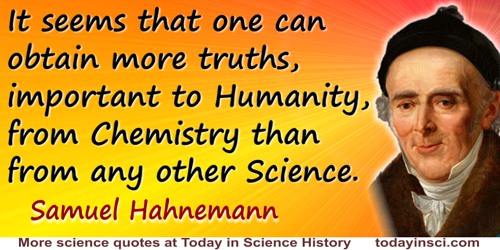
I do not know if I am mistaken, but it seems that one can obtain more truths, important to Humanity, from Chemistry than from any other Science.
In Chemische Annalen (Crell;s) I:291-305, 1788. As cited in Israel S. Kleiner, 'Hahnemann as a Chemist', The Scientific Monthly (May 1938), 46, 450. The quote is the opening words of an article describing his test for lead and iron in wine.
I have been a sore-headed occupant of a file drawer labeled ‘‘Science Fiction’’; and I would like out, particularly since so many serious critics regularly mistake the drawer for a urinal
…...
I have been able to solve a few problems of mathematical physics on which the greatest mathematicians since Euler have struggled in vain … But the pride I might have held in my conclusions was perceptibly lessened by the fact that I knew that the solution of these problems had almost always come to me as the gradual generalization of favorable examples, by a series of fortunate conjectures, after many errors. I am fain to compare myself with a wanderer on the mountains who, not knowing the path, climbs slowly and painfully upwards and often has to retrace his steps because he can go no further—then, whether by taking thought or from luck, discovers a new track that leads him on a little till at length when he reaches the summit he finds to his shame that there is a royal road by which he might have ascended, had he only the wits to find the right approach to it. In my works, I naturally said nothing about my mistake to the reader, but only described the made track by which he may now reach the same heights without difficulty.
(1891) As quoted in translation in Leo Koenigsberger and Frances A. Welby (trans.), Hermann von Helmholtz (1906), 180-181.
I have made many mistakes myself; in learning the anatomy of the eye I dare say, I have spoiled a hatfull; the best surgeon, like the best general, is he who makes the fewest mistakes.
Quoted in James Anthony Froude, John Tulloch and Thomas Carlyle, Fraser's Magazine (Nov 1862), 66, 574.
I read … that geometry is the art of making no mistakes in long calculations. I think that this is an underestimation of geometry. Our brain has two halves: one is responsible for the multiplication of polynomials and languages, and the other half is responsible for orientation of figures in space and all the things important in real life. Mathematics is geometry when you have to use both halves.
In S.H. Lui, 'An Interview with Vladimir Arnol’d', Notices of the AMS (Apr 1997) 44, No. 4, 438. Reprinted from the Hong Kong Mathematics Society (Feb 1996).
I think I’ve had more failures than successes, but I don’t see the failures as mistakes because I always learned something from those experiences. I see them as having not achieved the initial goal, nothing more than that.
Quoted in Timothy L. O’Brien, 'Not Invented here: Are U.S. Innovators Losing Their Competitive Edge?', New York Times (13 Nov 2005), B6.
I think it’s a mistake to ever look for hope outside of one’s self.
After the Fall. Quoted in Kim Lim (ed.), 1,001 Pearls of Spiritual Wisdom: Words to Enrich, Inspire, and Guide Your Life (2014), 250
I’m not afraid of facts, I welcome facts but a congeries of fact is not equivalent to an idea. This is the essential fallacy of the so-called “scientific” mind. People who mistake facts for ideas are incomplete thinkers; they are gossips.
In 'We Are the Crazy Lady and Other Feisty Feminist Fables,' in The First Ms. Reader edited by Francine Klagsburn (1972).
I’m particularly adept at making mistakes—it’s a necessity as an engineer. Each iteration of the vacuum came about because of a mistake I needed to fix.
In 'My Favorite Mistake', Newsweek (29 May 2011). About developing his revolutionary Dyson vacuum cleaner.
I’m sorry to say that the subject I most disliked was mathematics. I have thought about it. I think the reason was that mathematics leaves no room for argument. If you made a mistake, that was all there was to it.
The Autobiography of Malcolm X (1965, 1999), 34.
If the matter is one that can be settled by observation, make the observation yourself. Aristotle could have avoided the mistake of thinking that women have fewer teeth than men, by the simple device of asking Mrs. Aristotle to keep her mouth open while he counted.
In An Outline of Intellectual Rubbish (1943), 22.
If there ever was a misnomer, it is “exact science.” Science has always been full of mistakes. The present day is no exception. And our mistakes are good mistakes; they require a genius to correct. Of course, we do not see our own mistakes.
In Edward Teller, Wendy Teller and Wilson Talley, Conversations on the Dark Secrets of Physics (1991, 2013), 37.
If we had had more time for discussing we should probably have made a great many more mistakes.
In My Life (1930).
If we look at the problems raised by Aristotle, we are astonished at his gift of observation. What wonderful eyes the Greeks had for many things! Only they committed the mistake of being overhasty, of passing straightway from the phenomenon to the explanation of it, and thereby produced certain theories that are quite inadequate. But this is the mistake of all times, and still made in our own day.
In The Maxims and Reflections of Goethe (1906), 195.
If you must pull a tooth, it is mistaken kindness to pull it slowly.
Aphorism as given by the fictional character Dezhnev Senior, in Fantastic Voyage II: Destination Brain (1987), 53.
If, in the course of a thousand or two thousand years, science arrives at the necessity of renewing its points of view, that will not mean that science is a liar. Science cannot lie, for it’s always striving, according to the momentary state of knowledge, to deduce what is true. When it makes a mistake, it does so in good faith. It’s Christianity that’s the liar. It’s in perpetual conflict with itself.
In Adolf Hitler, Hugh Redwald Trevor-Roper, translated by Norman Cameron and R. H. Stevens, '14 October 1941', Secret Conversations (1941 - 1944) (1953), 51
Imagination only rarely leads one to a correct answer, and most of our ideas have to be discarded. Research workers ought not to be afraid of making mistakes provided they correct them in good time.
In The Art of Scientific Investigation (1950), 67.
In 1768, some peasants, near Luce in France, heard a thunderclap and saw a large stone fall from the sky. Reports of this strange phenomenon reached the French Academy of Sciences. The Academy asked Lavoisier, the premier chemist, to investigate. Lavoisier knew that stones do not fall out of the sky; so, in his knowledgeable arrogance, he reported that the witnesses were either lying or mistaken. The academy did not accept the fact of meteorites until the following century.
In 'Forum: A Case of Spontaneous Human Combustion', New Scientist (15 May 1986), 70.
In a few minutes a computer can make a mistake so great that it would have taken many men many months to equal.
In Civilization's Quotations: Life's Ideal (2002), 315.
In a sense Shapley’s telling me that space was transparent, which I shouldn’t have believed, illustrates a fundamental problem in science, believing what people tell you. Go and find it out for yourself. That same error has persisted in my life and in many other people’s. Authorities are not always authorities on everything; they often cling to their own mistakes.
Oral History Transcript of interview with Dr. Jesse Greenstein by Paul Wright (31 Jul 1974), on website of American Institute of Physics.
In experimental science it’s always a mistake not to doubt when facts do not compel you to affirm.
…...
In my considered opinion the peer review system, in which proposals rather than proposers are reviewed, is the greatest disaster visited upon the scientific community in this century. No group of peers would have approved my building the 72-inch bubble chamber. Even Ernest Lawrence told me he thought I was making a big mistake. He supported me because he knew my track record was good. I believe that U.S. science could recover from the stultifying effects of decades of misguided peer reviewing if we returned to the tried-and-true method of evaluating experimenters rather than experimental proposals. Many people will say that my ideas are elitist, and I certainly agree. The alternative is the egalitarianism that we now practice and I’ve seen nearly kill basic science in the USSR and in the People's Republic of China.
Alvarez: Adventures of a Physicist (1987), 200-1.
In reality, I have sometimes thought that we do not go on sufficiently slowly in the removal of diseases, and that it would he better if we proceeded with less haste, and if more were often left, to Nature than is the practice now-a-days. It is a great mistake to suppose that Nature always stands in need of the assistance of Art. If that were the case, site would have made less provision for the safety of mankind than the preservation of the species demands; seeing that there is not the least proportion between the host of existing diseases and the powers possessed by man for their removal, even in those ages wherein the healing art was at the highest pitch, and most extensively cultivated.
As quoted by Gavin Milroy in 'On the Writings of Sydenham', The Lancet (14 Nov 1846), 524.
In the higher walks of politics the same sort of thing occurs. The statesman who has gradually concentrated all power within himself … may have had anything but a public motive… The phrases which are customary on the platform and in the Party Press have gradually come to him to seem to express truths, and he mistakes the rhetoric of partisanship for a genuine analysis of motives… He retires from the world after the world has retired from him.
In The Conquest of Happiness (1930, 2006), 79.
It has been said that computing machines can only carry out the processes that they are instructed to do. This is certainly true in the sense that if they do something other than what they were instructed then they have just made some mistake. It is also true that the intention in constructing these machines in the first instance is to treat them as slaves, giving them only jobs which have been thought out in detail, jobs such that the user of the machine fully understands what in principle is going on all the time. Up till the present machines have only been used in this way. But is it necessary that they should always be used in such a manner? Let us suppose we have set up a machine with certain initial instruction tables, so constructed that these tables might on occasion, if good reason arose, modify those tables. One can imagine that after the machine had been operating for some time, the instructions would have altered out of all recognition, but nevertheless still be such that one would have to admit that the machine was still doing very worthwhile calculations. Possibly it might still be getting results of the type desired when the machine was first set up, but in a much more efficient manner. In such a case one would have to admit that the progress of the machine had not been foreseen when its original instructions were put in. It would be like a pupil who had learnt much from his master, but had added much more by his own work. When this happens I feel that one is obliged to regard the machine as showing intelligence.
Lecture to the London Mathematical Society, 20 February 1947. Quoted in B. E. Carpenter and R. W. Doran (eds.), A. M. Turing's Ace Report of 1946 and Other Papers (1986), 122-3.
It has often been said that, to make discoveries, one must be ignorant. This opinion, mistaken in itself, nevertheless conceals a truth. It means that it is better to know nothing than to keep in mind fixed ideas based on theories whose confirmation we constantly seek, neglecting meanwhile everything that fails to agree with them.
From An Introduction to the Study of Experimental Medicine (1865), as translated by Henry Copley Greene (1957), 37.
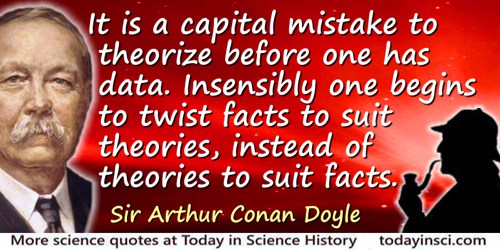
It is a capital mistake to theorize before one has data. Insensibly one begins to twist facts to suit theories, instead of theories to suit facts.
A Scandal in Bohemia (1891) in Adventures of Sherlock Holmes (1892), 5.
It is a capital mistake to theorize before you have all the evidence. It biases the judgment.
A Study in Scarlet (1887), in Works of Arthur Conan Doyle (1902), Vol. 11, 39.
It is as great a mistake to maintain that a high development of the imagination is not essential to progress in mathematical studies as to hold with Ruskin and others that science and poetry are antagonistic pursuits.
In Sphere of Science (1898), 107.
It is impossible for the strength of an elderly person to be great. Some physicians think that
children also do not have great strength, but they are mistaken in their opinion.
As quoted in Robert Taylor, White Coat Tales: Medicine's Heroes, Heritage, and Misadventures (2010), 125.
It is indeed an Opinion strangely prevailing amongst Men, that Houses, Mountains, Rivers, and in a word all sensible Objects have an Existence Natural or Real, distinct from their being perceived by the Understanding. But with how great an Assurance and Acquiescence soever this Principle may be entertained in the World; yet whoever shall find in his Heart to call it in Question, may, if I mistake not, perceive it to involve a manifest Contradiction. For what are the forementioned Objects but the things we perceive by Sense, and what do we perceive besides our own Ideas or Sensations; and is it not plainly repugnant that anyone of these or any Combination of them should exist unperceived?
A Treatise Concerning the Principles of Human Knowledge [first published 1710], (1734),38.
It is nothing short of scandalous that we probably only know one out of every ten species on earth, let alone where they are or, various aspects of their biology, and … unless we really know what there is, and where it is, we’re gonna make some mistakes without even knowing we’ve made them.
From Reith Lecture, 'Biodiversity', on BBC Radio 4 (19 Apr 2000). Transcript and audio on BBC website.
It is well-known that both rude and civilized peoples are capable of showing unspeakable, and as it is erroneously termed, inhuman cruelty towards each other. These acts of cruelty, murder and rapine are often the result of the inexorable logic of national characteristics, and are unhappily truly human, since nothing like them can be traced in the animal world. It would, for instance, be a grave mistake to compare a tiger with the bloodthirsty exectioner of the Reign of Terror, since the former only satisfies his natural appetite in preying on other mammals. The atrocities of the trials for witchcraft, the indiscriminate slaughter committed by the negroes on the coast of Guinea, the sacrifice of human victims made by the Khonds, the dismemberment of living men by the Battas, find no parallel in the habits of animals in their savage state. And such a comparision is, above all, impossible in the case of anthropoids, which display no hostility towards men or other animals unless they are first attacked. In this respect the anthropid ape stands on a higher plane than many men.
Robert Hartmann, Anthropoid Apes, 294-295.
It might be thought … that evolutionary arguments would play a large part in guiding biological research, but this is far from the case. It is difficult enough to study what is happening now. To figure out exactly what happened in evolution is even more difficult. Thus evolutionary achievements can be used as hints to suggest possible lines of research, but it is highly dangerous to trust them too much. It is all too easy to make mistaken inferences unless the process involved is already very well understood.
In What Mad Pursuit: A Personal View of Scientific Discovery (1988), 138-139.
It wasn’t the finches that put the idea [of natural selection] in Darwin’s head, it was the tortoises. The reason he didn’t use the tortoises [in writing On the Origin of Species] was that, when he got back, he found he didn’t have localities on the tortoise specimens. Here the great god, the greatest naturalist we have records of, made a mistake. His fieldwork wasn’t absolutely perfect.
From interview with Brian Cox and Robert Ince, in 'A Life Measured in Heartbeats', New Statesman (21 Dec 2012), 141, No. 5138, 33.
It would be a mistake to suppose that a science consists entirely of strictly proved theses, and it would be unjust to require this. Only a disposition with a passion for authority will raise such a demand, someone with a craving to replace his religious catechism by another, though it is a scientific one. Science has only a few apodeictic propositions in its catechism: the rest are assertions promoted by it to some particular degree of probability. It is actually a sign of a scientific mode of thought to find satisfaction in these approximations to certainty and to be able to pursue constructive work further in spite of the absence of final confirmation.
In Introductory Lectures on Psycho-Analysis (1916-17). Also seen translated as: “It is a mistake to believe that a science consists in nothing but conclusively proved propositions, and it is unjust to demand that it should. It is a demand only made by those who feel a craving for authority in some form and a need to replace the religious catechism by something else, even if it be a scientific one.”
Knowledge and ability must be combined with ambition as well as with a sense of honesty and a severe conscience. Every analyst occasionally has doubts about the accuracy of his results, and also there are times when he knows his results to be incorrect. Sometimes a few drops of the solution were spilt, or some other slight mistake made. In these cases it requires a strong conscience to repeat the analysis and to make a rough estimate of the loss or apply a correction. Anyone not having sufficient will-power to do this is unsuited to analysis no matter how great his technical ability or knowledge. A chemist who would not take an oath guaranteeing the authenticity, as well as the accuracy of his work, should never publish his results, for if he were to do so, then the result would be detrimental not only to himself, but to the whole of science.
Anleitung zur Quantitativen Analyse (1847), preface. F. Szabadvary, History of Analytical Chemistry (1966), trans. Gyula Svehla, 176.
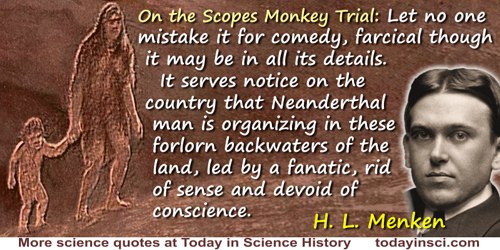
Let no one mistake it for comedy, farcical though it may be in all its details. It serves notice on the country that Neanderthal man is organizing in these forlorn backwaters of the land, led by a fanatic, rid of sense and devoid of conscience.
[Commenting on the Scopes Monkey Trial, while reporting for the Baltimore Sun.]
[Commenting on the Scopes Monkey Trial, while reporting for the Baltimore Sun.]
In Michael Shermer, Why Darwin Matters (2006), 26.
Like taxes, radioactivity has long been with us and in increasing amounts; it is not to be hated and feared, but accepted and controlled. Radiation is dangerous, let there be no mistake about that—but the modern world abounds in dangerous substances and situations too numerous to mention. ... Consider radiation as something to be treated with respect, avoided when practicable, and accepted when inevitable.
Recommending the same view towards radiation as the risks of automobile travel.
Recommending the same view towards radiation as the risks of automobile travel.
While in the Office of Naval Research. In Must we Hide? (1949), 44.
Living is like working out a long addition sum, and if you make a mistake in the first two totals you will never find the right answer. It means involving oneself in a complicated chain of circumstances.
In The Burning Brand: Diaries 1935-1950 (1961), 56.
Looking back … over the long and labyrinthine path which finally led to the discovery [of the quantum theory], I am vividly reminded of Goethe’s saying that men will always be making mistakes as long as they are striving after something.
From Nobel Prize acceptance speech (2 Jun 1920), as quoted and translated by James Murphy in 'Introduction: Max Planck: a Biographical Sketch', in Max Planck and James Murphy (trans.), Where is Science Going (1932), 23. This passage of Planck’s speech is translated very differently for the Nobel Committee. See elsewhere on this web page, beginning, “When I look back…”.
Looking back over the geological record it would seem that Nature made nearly every possible mistake before she reached her greatest achievement Man—or perhaps some would say her worst mistake of all. ... At last she tried a being of no great size, almost defenseless, defective in at least one of the more important sense organs; one gift she bestowed to save him from threatened extinction—a certain stirring, a restlessness, in the organ called the brain.
…...
Lucy, dear child, mind your arithmetic. You know in the first sum of yours I ever saw there was a mistake. You had carried two (as a cab is licensed to do), and you ought, dear Lucy, to have carried but one. Is this a trifle? What would life be without arithmetic, but a scene of horrors.
Letter to a child (22 Jul 1835). In Sydney Smith, Saba Holland, with Sarah Austin (ed.), A Memoir of the Reverend Sydney Smith by his Daughter, Lady Holland (4th ed. 1855), Vol. 2, 364.
Many orthodox people speak as though it were the business of sceptics to disprove received dogmas rather than of dogmatists to prove them. This is, of course, a mistake.
In unpublished manuscript, 'Is There a God', (5 Mar 1952) written for the magazine, Illustrated. Collected in Bertrand Russell, John G. Slater (ed.) and Peter Köllner (ed.) The Collected Papers of Bertrand Russell: Volume II: Last Philosophical Testament: 1943-68 (1997), 547.
Men are more apt to be mistaken in their generalizations than in their particular observations.
Attributed (?). Widely seen, without citation. Webmaster has not yet found a satisfactory primary source, but finds the quote used as an epigraph as early as C. E. Rhoad, The Problem Method of Teaching: Operator’s Manual (1950), 43. A University of Nebraska Publication. Notably, this quote does not seem to appear in any 19th century quote collection volumes. If you know a primary source, contact Webmaster.
Men of science have made abundant mistakes of every kind; their knowledge has improved only because of their gradual abandonment of ancient errors, poor approximations, and premature conclusions.
In A History of Science: Volume 2: Hellenistic Science and Culture in the Last Three Centuries B.C. (1959), xi.
Men ought to know that from the brain, and from the brain only, arise our pleasures, joys, laughter and jests, as well as our sorrows, pains, griefs and tears. Through it, in particular, we think, see, hear, and distinguish the ugly from the beautiful, the bad from the good, the pleasant from the unpleasant, in some cases using custom as a test, in others perceiving them from their utility. It is the same thing which makes us mad or delirious, inspires us with dread or fear, whether by night or by day, brings sleeplessness, inopportune mistakes, aimless anxieties, absent-mindedness, and acts that are contrary to habit. These things that we suffer all come from the brain, when it is not healthy, but becomes abnormally hot, cold, moist, or dry, or suffers any other unnatural affection to which it was not accustomed. Madness comes from its moistness.
The Sacred Disease, in Hippocrates, trans. W. H. S. Jones (1923), Vol. 2, 175.
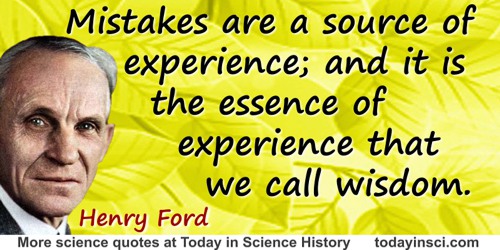
Mistakes are a source of experience; and it is the essence of experience that we call wisdom.
From Henry Ford and Ralph Waldo Trine, The Power that Wins (1929), 25-26.
Mistakes are at the very base of human thought feeding the structure like root nodules. If we were not provided with the knack of being wrong, we could never get anything useful done.
In The Medusa and the Snail (1979), 37.
Most American citizens think that life without the telephone is scarcely worth living. The American public telephone system is therefore enormous. Moreover the system belongs to an organization, the Bell companies, which can both control it and make the equipment needed. There is no surer way of getting efficient functional design than having equipment designed by an organization which is going to have to use it. Humans who would have to live with their own mistakes tend to think twice and to make fewer mistakes.
In 'Musical Acoustics Today', New Scientist (1 Nov 1962), 16 No. 311, 256.
My Lord said that he who knew men only in this way [from history] was like one who had got the theory of anatomy perfectly, but who in practice would find himself very awkward and liable to mistakes. That he again who knew men by observation was like one who picked up anatomy by practice, but who like all empirics would for a long time be liable to gross errors.
Never promote a man who hasn’t made some bad mistakes, because you would be promoting someone who hasn’t done much.
As quoted, without citation, in Ken Fisher and Aaron Anderson (ed.), 'The Other Dow Theory: January 4, 1993', The Making of a Market Guru: Forbes Presents 25 Years of Ken Fisher (2010), 187. The author, Ken Fisher, writes that when young and caught doing something wrong, his father “would quote Dow to me and then insist on analyzing what I had done wrong in the interest of learning from it.”
No one wants to learn by mistakes, but we cannot learn enough from successes to go beyond the state of the art
To Engineer is Human: The Role of Failure in Successful Design (1992), 62.
No one believes the results of the computational modeler except the modeler, for only he understands the premises. No one doubts the experimenter’s results except the experimenter, for only he knows his mistakes.
See a similar idea expressed by W.I.B. Beveredge, beginning “No one believes an hypothesis…” on the W.I.B. Beveredge Quotes web page on this site.
Nowadays most people die of a sort of creeping common sense, and discover when it is too late that the only things one never regrets are one’s mistakes.
In The Picture of Dorian Gray (1891), Ch. 3, 61.
Of all the intellectual faculties, judgment is the last to arrive at maturity. The child should give its attention either to subjects where no error is possible at all, such as mathematics, or to those in which there is no particular danger in making a mistake, such as languages, natural science, history, and so on.
In Arthur Schopenhauer and T. Bailey (ed., trans.) Essays of Arthur Schopenhauer (1902), 67.
On my tests, I [had] … what I called a “two and fifty question.” Two points if they got it right; 50 points off if they missed it.
Now this isn’t as unfair as it seems because much of life is that way. You can do right all your life and nobody says anything. But you go out and make one little mistake and everybody censures you.
Now this isn’t as unfair as it seems because much of life is that way. You can do right all your life and nobody says anything. But you go out and make one little mistake and everybody censures you.
In address, to the Economic Club of Detroit (14 Jan 1990), 'Where Do We Go From Here?' on the massiechairs.com website.
Once a mathematical result is proven to the satisfaction of the discipline, it doesn’t need to be re-evaluated in the light of new evidence or refuted, unless it contains a mistake. If it was true for Archimedes, then it is true today.
In 'The Unplanned Impact of Mathematics', Nature (14 Jul 2011), 475, No. 7355, 166.
One Form of Failure. From a worldly point of view there is no mistake so great as that of being always right.
Samuel Butler, Henry Festing Jones (ed.), The Note-Books of Samuel Butler (1917), 224.
One of the main purposes of scientific inference is to justify beliefs which we entertain already; but as a rule they are justified with a difference. Our pre-scientific general beliefs are hardly ever without exceptions; in science, a law with exceptions can only be tolerated as a makeshift. Scientific laws, when we have reason to think them accurate, are different in form from the common-sense rules which have exceptions: they are always, at least in physics, either differential equations, or statistical averages. It might be thought that a statistical average is not very different from a rule with exceptions, but this would be a mistake. Statistics, ideally, are accurate laws about large groups; they differ from other laws only in being about groups, not about individuals. Statistical laws are inferred by induction from particular statistics, just as other laws are inferred from particular single occurrences.
The Analysis of Matter (1927), 191.
One's instinct is at first to try and get rid of a discrepancy, but I believe that experience shows such an endeavour to be a mistake. What one ought to do is to magnify a small discrepancy with a view to finding out the explanation.
General Monthly Meeting, on Argon, (1 Apr 1895), Proceedings of the Royal Institution (1895), 14, 525.
Our great mistake in education is ... the worship of book-learning—the confusion of instruction and education. We strain the memory instead of cultivating the mind. … We ought to follow exactly the opposite course with children—to give them a wholesome variety of mental food, and endeavour to cultivate their tastes, rather than to fill their minds with dry facts.
The Pleasures of Life (Appleton, 1887), 183-184, or (2007), 71.
Our mistake is that we doubt what is certain and want to establish what is uncertain. My maxim in the study of Nature is this: hold fast what is certain and keep a watch on what is uncertain.
In The Maxims and Reflections of Goethe (1906), 196.
People make the mistake of talking about “natural laws.” There are no natural laws. There are only temporary habits of nature.
In Alfred North Whitehead and Lucien Price (ed.), Dialogues of Alfred North Whitehead (1954), 267.
People make the mistake of talking about “natural laws”. There are no natural laws. There are only temporary habits of nature.
In Dialogues of Alfred North Whitehead, as recorded by Lucien Price (1954), 367. As cited in G. Debrock (ed.), Process Pragmatism: Essays on a Quiet Philosophical Revolution (2003), 94.
Philosophers, if they have much imagination, are apt to let it loose as well as other people, and in such cases are sometimes led to mistake a fancy for a fact. Geologists, in particular, have very frequently amused themselves in this way, and it is not a little amusing to follow them in their fancies and their waking dreams. Geology, indeed, in this view, may be called a romantic science.
Conversations on Geology (1840), 5.
Probably the most important skill that children learn is how to learn. … Too often we give children answers to remember rather than problems to solve. This is a mistake.
In 'Observing the Brain Through a Cat's Eyes', Saturday Review World (1974), 2, 132.
Psychologism is, I believe, correct only in so far as it insists upon what may be called “methodological individualism” as opposed to “methodological collectivism”; it rightly insists that the “behaviour” and the “actions” of collectives, such as states or social groups, must be reduced to the behaviour and to the actions of human individuals. But the belief that the choice of such an individualist method implies the choice of a psychological method is mistaken.
In The Open Society and Its Enemies (1945), Vol. 22, 87.
Realistic thinking accrues only after mistake making, which is the cosmic wisdom's most cogent way of teaching each of us how to carry on.
In Buckminster Fuller and Answar Dil, Humans in Universe (1983), 218.
REST IN PEACE. THE MISTAKE SHALL NOT BE REPEATED.
Inscription on the cenotaph at Hiroshima, Japan. Quoted in Alan L. Mackay, The Harvest of a Quiet Eye (1977. In Robert Andrews Famous Lines: a Columbia Dictionary of Familiar Quotations (1997), 340.
Science has hitherto been proceeding without the guidance of any rational theory of logic, and has certainly made good progress. It is like a computer who is pursuing some method of arithmetical approximation. Even if he occasionally makes mistakes in his ciphering, yet if the process is a good one they will rectify themselves. But then he would approximate much more rapidly if he did not commit these errors; and in my opinion, the time has come when science ought to be provided with a logic. My theory satisfies me; I can see no flaw in it. According to that theory universality, necessity, exactitude, in the absolute sense of these words, are unattainable by us, and do not exist in nature. There is an ideal law to which nature approximates; but to express it would require an endless series of modifications, like the decimals expressing surd. Only when you have asked a question in so crude a shape that continuity is not involved, is a perfectly true answer attainable.
Letter to G. F. Becker, 11 June 1893. Merrill Collection, Library of Congress. Quoted in Nathan Reingold, Science in Nineteenth-Century America: A Documentary History (1966), 231-2.
Science is like society and trade, in resting at bottom upon a basis of faith. There are some things here, too, that we can not prove, otherwise there would be nothing we can prove. Science is busy with the hither-end of things, not the thither-end. It is a mistake to contrast religion and science in this respect, and to think of religion as taking everything for granted, and science as doing only
clean work, and having all the loose ends gathered up and tucked in. We never reach the roots of things in science more than in religion.
From 'Walking by Faith', The Pattern in the Mount: And Other Sermons (1885), 49. The sentence “Science is busy with the hither-end of things, not the thither-end” is quoted alone in collections such as James Wood, Dictionary of Quotations from Ancient and Modern, English and Foreign Sources (1893), 382:35.
Science is properly more scrupulous than dogma. Dogma gives a charter to mistake, but the very breath of science is a contest with mistake, and must keep the conscience alive.
In Middlemarch: A Study of Provincial Life (1873), 255.
Science, by itself, cannot supply us with an ethic. It can show us how to achieve a given end, and it may show us that some ends cannot be achieved. But among ends that can be achieved our choice must be decided by other than purely scientific considerations. If a man were to say, “I hate the human race, and I think it would be a good thing if it were exterminated,” we could say, “Well, my dear sir, let us begin the process with you.” But this is hardly argument, and no amount of science could prove such a man mistaken.
'The Science to Save us from Science', New York Times Magazine (19 Mar 1950). Collected in M. Gardner (ed.), Great Essays in Science (1950), 396-397.
Scientists are supposed to make predictions, probably to prove they are human and can be as mistaken as anyone else. Long-range predictions are better to make because the audience to whom the prediction was made is no longer around to ask questions. The alternative... is to make conflicting predictions, so that one prediction may prove right.
'Fossils—The How and Why of Collecting and Storing', Proceedings of the Biological Society of Washington (1969), 82, 597.
Success…seems to be connected with action. Successful men keep moving. They make mistakes, but they don’t quit.
…...
Suppose [an] imaginary physicist, the student of Niels Bohr, is shown an experiment in which a virus particle enters a bacterial cell and 20 minutes later the bacterial cell is lysed and 100 virus particles are liberated. He will say: “How come, one particle has become 100 particles of the same kind in 20 minutes? That is very interesting. Let us find out how it happens! How does the particle get in to the bacterium? How does it multiply? Does it multiply like a bacterium, growing and dividing, or does it multiply by an entirely different mechanism ? Does it have to be inside the bacterium to do this multiplying, or can we squash the bacterium and have the multiplication go on as before? Is this multiplying a trick of organic chemistry which the organic chemists have not yet discovered ? Let us find out. This is so simple a phenomenon that the answers cannot be hard to find. In a few months we will know. All we have to do is to study how conditions will influence the multiplication. We will do a few experiments at different temperatures, in different media, with different viruses, and we will know. Perhaps we may have to break into the bacteria at intermediate stages between infection and lysis. Anyhow, the experiments only take a few hours each, so the whole problem can not take long to solve.”
[Eight years later] he has not got anywhere in solving the problem he set out to solve. But [he may say to you] “Well, I made a slight mistake. I could not do it in a few months. Perhaps it will take a few decades, and perhaps it will take the help of a few dozen other people. But listen to what I have found, perhaps you will be interested to join me.”
[Eight years later] he has not got anywhere in solving the problem he set out to solve. But [he may say to you] “Well, I made a slight mistake. I could not do it in a few months. Perhaps it will take a few decades, and perhaps it will take the help of a few dozen other people. But listen to what I have found, perhaps you will be interested to join me.”
From 'Experiments with Bacterial Viruses (Bacteriophages)', Harvey Lecture (1946), 41, 161-162. As cited in Robert Olby, The Path of the Double Helix: The Discovery of DNA (1974, 1994), 237.
Suppose it were perfectly certain that the life and fortune of every one of us would, one day or other, depend upon his winning or losing a game of chess. Don't you think that we should all consider it to be a primary duty to learn at least the names and the moves of the pieces; to have a notion of a gambit, and a keen eye for all the means of giving and getting out of check? Do you not think that we should look with a disapprobation amounting to scorn upon the father who allowed his son, or the state which allowed its members, to grow up without knowing a pawn from a knight?
Yet, it is a very plain and elementary truth that the life, the fortune, and the happiness of every one of us, and, more or less, of those who are connected with us, do depend upon our knowing something of the rules of a game infinitely more difficult and complicated than chess. It is a game which has been played for untold ages, every man and woman of us being one of the two players in a game of his or her own. The chess-board is the world, the pieces are the phenomena of the universe, the rules of the game are what we call the laws of nature. The player on the other side is hidden from us. We know that his play is always fair, just, and patient. But also we know, to our cost, that he never overlooks a mistake, or makes the smallest allowance for ignorance. To the man who plays well the highest stakes are paid with that sort of overflowing generosity with which the strong shows delight in strength. And one who plays ill is checkmated—without haste, but without remorse.
Yet, it is a very plain and elementary truth that the life, the fortune, and the happiness of every one of us, and, more or less, of those who are connected with us, do depend upon our knowing something of the rules of a game infinitely more difficult and complicated than chess. It is a game which has been played for untold ages, every man and woman of us being one of the two players in a game of his or her own. The chess-board is the world, the pieces are the phenomena of the universe, the rules of the game are what we call the laws of nature. The player on the other side is hidden from us. We know that his play is always fair, just, and patient. But also we know, to our cost, that he never overlooks a mistake, or makes the smallest allowance for ignorance. To the man who plays well the highest stakes are paid with that sort of overflowing generosity with which the strong shows delight in strength. And one who plays ill is checkmated—without haste, but without remorse.
Address to the South London Working Men’s College. 'A Liberal Education; and Where to Find It', in David Masson, (ed.), Macmillan’s Magazine (Mar 1868), 17, 369. Also in 'A Liberal Education and Where to Find it' (1868). In Collected Essays (1893), Vol. 3, 82.
Take risks. Ask big questions. Don't be afraid to make mistakes; if you don't make mistakes, you're not reaching far enough.
In Monterey Bay Aquarium Research Institute, MBARI's First Decade: A Retrospective (1997), 3, withoug citation. If you know the primary source, please contact Webmaster.
The argument of the ‘long view’ may be correct in some meaninglessly abstract sense, but it represents a fundamental mistake in categories and time scales. Our only legitimate long view extends to our children and our children’s children’s children–hundreds or a few thousands of years down the road. If we let the slaughter continue, they will share a bleak world with rats, dogs, cockroaches, pigeons, and mosquitoes. A potential recovery millions of years later has no meaning at our appropriate scale.
…...
The average English author [of mathematical texts] leaves one under the impression that he has made a bargain with his reader to put before him the truth, the greater part of the truth, and nothing but the truth; and that if he has put the facts of his subject into his book, however difficult it may be to unearth them, he has fulfilled his contract with his reader. This is a very much mistaken view, because effective teaching requires a great deal more than a bare recitation of facts, even if these are duly set forth in logical order—as in English books they often are not. The probable difficulties which will occur to the student, the objections which the intelligent student will naturally and necessarily raise to some statement of fact or theory—these things our authors seldom or never notice, and yet a recognition and anticipation of them by the author would be often of priceless value to the student. Again, a touch of humour (strange as the contention may seem) in mathematical works is not only possible with perfect propriety, but very helpful; and I could give instances of this even from the pure mathematics of Salmon and the physics of Clerk Maxwell.
In Perry, Teaching of Mathematics (1902), 59-61.
The belief that mathematics, because it is abstract, because it is static and cold and gray, is detached from life, is a mistaken belief. Mathematics, even in its purest and most abstract estate, is not detached from life. It is just the ideal handling of the problems of life, as sculpture may idealize a human figure or as poetry or painting may idealize a figure or a scene. Mathematics is precisely the ideal handling of the problems of life, and the central ideas of the science, the great concepts about which its stately doctrines have been built up, are precisely the chief ideas with which life must always deal and which, as it tumbles and rolls about them through time and space, give it its interests and problems, and its order and rationality. That such is the case a few indications will suffice to show. The mathematical concepts of constant and variable are represented familiarly in life by the notions of fixedness and change. The concept of equation or that of an equational system, imposing restriction upon variability, is matched in life by the concept of natural and spiritual law, giving order to what were else chaotic change and providing partial freedom in lieu of none at all. What is known in mathematics under the name of limit is everywhere present in life in the guise of some ideal, some excellence high-dwelling among the rocks, an “ever flying perfect” as Emerson calls it, unto which we may approximate nearer and nearer, but which we can never quite attain, save in aspiration. The supreme concept of functionality finds its correlate in life in the all-pervasive sense of interdependence and mutual determination among the elements of the world. What is known in mathematics as transformation—that is, lawful transfer of attention, serving to match in orderly fashion the things of one system with those of another—is conceived in life as a process of transmutation by which, in the flux of the world, the content of the present has come out of the past and in its turn, in ceasing to be, gives birth to its successor, as the boy is father to the man and as things, in general, become what they are not. The mathematical concept of invariance and that of infinitude, especially the imposing doctrines that explain their meanings and bear their names—What are they but mathematicizations of that which has ever been the chief of life’s hopes and dreams, of that which has ever been the object of its deepest passion and of its dominant enterprise, I mean the finding of the worth that abides, the finding of permanence in the midst of change, and the discovery of a presence, in what has seemed to be a finite world, of being that is infinite? It is needless further to multiply examples of a correlation that is so abounding and complete as indeed to suggest a doubt whether it be juster to view mathematics as the abstract idealization of life than to regard life as the concrete realization of mathematics.
In 'The Humanization of Teaching of Mathematics', Science, New Series, 35, 645-46.
The best class of scientific mind is the same as the best class of business mind. The great desideratum in either case is to know how much evidence is enough to warrant action. It is as unbusiness-like to want too much evidence before buying or selling as to be content with too little. The same kind of qualities are wanted in either case. The difference is that if the business man makes a mistake, he commonly has to suffer for it, whereas it is rarely that scientific blundering, so long as it is confined to theory, entails loss on the blunderer. On the contrary it very often brings him fame, money and a pension. Hence the business man, if he is a good one, will take greater care not to overdo or underdo things than the scientific man can reasonably be expected to take.
Samuel Butler, Henry Festing Jones (ed.), The Note-Books of Samuel Butler (1917), 217.
The chess-board is the world; the pieces are the phenomena of the universe; the rules of the game are what we call the laws of Nature. The player on the other side is hidden from us. We know that his play is always fair, just and patient. But we know, to our cost, that he never overlooks a mistake, or makes the slightest allowance for ignorance.
From an address to the South London Working Men’s College (4 Jan 1868), 'A Liberal Education, and Where to Find It'. Printed in David Masson, (ed.), Macmillan’s Magazine (Mar 1868), 17, 369. Also collected in Chap. 3, 'The Physical Basis of Life', Select Works of Thomas H. Huxley (1886), 497.
The computer is a great invention. There are as many mistakes as ever, but now they're nobody's fault.
In E.C. McKenzie, 14,000 Quips and Quotes for Speakers, Writers, Editors, Preachers, and Teachers (1990), 338.
The enemy is not fundamentalism; it is intolerance. In this case, the intolerance is perverse since it masquerades under the ‘liberal’ rhetoric of ‘equal time.’ But mistake it not.
…...
The history of science, like the history of all human ideas, is a history of irresponsible dreams, of obstinacy, and of error. But science is one of the very few human activities—perhaps the only one—in which errors are systematically criticized and fairly often, in time, corrected. This is why we can say that, in science, we often learn from our mistakes, and why we can speak clearly and sensibly about making progress there. In most other fields of human endeavour there is change, but rarely progress ... And in most fields we do not even know how to evaluate change.
From Conjectures and Refutations: The Growth of Scientific Knowledge (1963), 216. Reproduced in Karl Popper, Truth, Rationality and the Growth of Scientific Knowledge (1979), 9.
The human mind delights in finding pattern–so much so that we often mistake coincidence or forced analogy for profound meaning. No other habit of thought lies so deeply within the soul of a small creature trying to make sense of a complex world not constructed for it.
…...
The knowledge of Natural-History, being Observation of Matters of Fact, is more certain than most others, and in my slender Opinion, less subject to Mistakes than Reasonings, Hypotheses, and Deductions are; ... These are things we are sure of, so far as our Senses are not fallible; and which, in probability, have been ever since the Creation, and will remain to the End of the World, in the same Condition we now find them.
A Voyage to the Islands Madera, Barbados, Nieves, S. Christophers and Jamaica: With the Natural History of the Herbs and Trees, Four-footed Beasts, Fishes, Birds, Insects, Reptiles, &c. of the Last of those Islands (1707), Vol. 1, 1.
The old fashioned family physician and general practitioner ... was a splendid figure and useful person in his day; but he was badly trained, he was often ignorant, he made many mistakes, for one cannot by force of character and geniality of person make a diagnosis of appendicitis, or recognize streptococcus infection.
New York Medical Journal (1913), 97, 1.
The only biodiversity we’re going to have left is Coke versus Pepsi. … We’re landscaping the whole world one stupid mistake at a time.
In Lullaby: A Novel (2002), 115.
The operative definition of an expert … someone who doesn’t make small mistakes.
In Seeing Red: Redshifts, Cosmology and Academic Science (1998), 274.
The professional standards of conduct for engineers set a very high bar for the professional engineer. Sure, there have been engineering mistakes. Sure, there has been liability ascribed to faulty engineering design. Sure, there are some “bad apples” in the profession. However, considering the scope of the work that engineers have addressed over the last century, their collective performance has been superior.
In 'Engineering Ethics: Only Your Reputation is at Risk' (10 Jul 2015) article on Brigham Young University Wheatley Institution wheatley.byu.edu website. Originally published in Pittsburgh Engineer (Spring 2013).
The reformer [of the body of law] who would seek to improve such a system in any material degree, mistakes his vocation. That task had better be left to time and experience. He will often find it impossible to know what to eradicate and what to spare, and in plucking up the tares, the wheat may sometimes be destroyed. “The pound of flesh” may be removed, indeed, but with it will come, gushing forth, the blood of life.
From biographical preface by T. Bigelow to Austin Abbott (ed.), Official Report of the Trial of Henry Ward Beecher (1875), Vol. 1, xii.
The researcher might be tempted again and again to abandon his efforts as vain and fruitless, except that every now and then a light strikes across his path which furnishes him with irrefutable proof that, after all his mistakes in taking one by-path after another, he has at least made one step forward towards the discovery of the truth that he is seeking.
From Nobel Prize acceptance speech (2 Jun 1920), as quoted and translated by James Murphy in 'Introduction: Max Planck: a Biographical Sketch' to Max Planck (trans.), Where is Science Going (1932), 24. This passage of Planck’s speech is translated very differently for the Nobel Committee. See elsewhere on this web page, beginning, “The whole strenuous…”.
The Scientific Revolution turns us away from the older sayings to discover the lost authorization in Nature. What we have been through in these last four millennia is the slow inexorable profaning of our species. And in the last part of the second millennium A.D., that process is apparently becoming complete. It is the Great Human Irony of our noblest and greatest endeavor on this planet that in the quest for authorization, in our reading of the language of God in Nature, we should read there so clearly that we have been so mistaken.
…...
The search for historical laws is, I maintain, mistaken in principle.
'Historical Science', C. C. Albritton (ed.), The Fabric of Geology (1963), 29.
The thinker makes a great mistake when he asks after cause and effect. They both together make up the invisible phenomenon.
…...
The thought that we’re in competition with Russians or with Chinese is all a mistake, and trivial. We are one species, with a world to win. There’s life all over this universe, but the only life in the solar system is on earth, and in the whole universe we are the only men.
From speech given at an anti-war teach-in at the Massachusetts Institute of Technology, (4 Mar 1969) 'A Generation in Search of a Future', as edited by Ron Dorfman for Chicago Journalism Review, (May 1969).
The world is full of signals that we don’t perceive. Tiny creatures live in a different world of unfamiliar forces. Many animals of our scale greatly exceed our range of perception for sensations familiar to us ... What an imperceptive lot we are. Surrounded by so much, so fascinating and so real, that we do not see (hear, smell, touch, taste) in nature, yet so gullible and so seduced by claims for novel power that we mistake the tricks of mediocre magicians for glimpses of a psychic world beyond our ken. The paranormal may be a fantasy; it is certainly a haven for charlatans. But ‘parahuman’ powers of perception lie all about us in birds, bees, and bacteria.
…...
There are no mistakes. The events we bring upon ourselves, no matter how unpleasant, are necessary in order to learn what we need to learn; whatever steps we take, they're necessary to reach the places we've chosen to go.
The Bridge across Forever (1984). In Gary Westfahl, Science Fiction Quotations: From the Inner Mind to the Outer Limits (2006), 2.
There cannot be a greater mistake than that of looking superciliously upon practical applications of science. The life and soul of science is its practical application .
In Lecture 'Electrical Units of Measurement' delivered at the Institution of Civil Engineers (3 May 1883). Collected in Popular Lectures and Addresses (1889), Vol. 1, 79.
There is a moral or metaphysical part of nature as well as a physical. A man who denies this is deep in the mire of folly. ’Tis the crown and glory of organic science that it does through final cause, link material and moral; and yet does not allow us to mingle them in our first conception of laws, and our classification of such laws, whether we consider one side of nature or the other. You have ignored this link; and, if I do not mistake your meaning, you have done your best in one or two pregnant cases to break it. Were it possible (which, thank God, it is not) to break it, humanity, in my mind, would suffer a damage that might brutalize it, and sink the human race into a lower grade of degradation than any into which it has fallen since its written records tell us of its history.
Letter to Charles Darwin (Nov 1859). In Charles Darwin and Francis Darwin (ed.), Charles Darwin: His Life Told in an Autobiographical Chapter, and in a Selected Series of His Published Letters (1892), 217.
There is an insistent tendency among serious social scientists to think of any institution which features rhymed and singing commercials, intense and lachrymose voices urging highly improbable enjoyment, caricatures of the human esophagus in normal and impaired operation, and which hints implausibly at opportunities for antiseptic seduction as inherently trivial. This is a great mistake. The industrial system is profoundly dependent on commercial television and could not exist in its present form without it.
In The New Industrial State (1967), 208.
This is often the way it is in physics—our mistake is not that we take our theories too seriously, but that we do not take them seriously enough. It is always hard to realize that these numbers and equations we play with at our desks have something to do with the real world.
In The First Three Minutes: A Modern View of the Origin of the Universe (1977, Rev. ed. 1993), 131-132.
This topic brings me to that worst outcrop of the herd nature, the military system, which I abhor. That a man can take pleasure in marching in formation to the strains of a band is enough to make me despise him. He has only been given his big brain by mistake; a backbone was all he needed. This plague-spot of civilisation ought to be abolished with all possible speed. Heroism by order, senseless violence, and all the pestilent nonsense that goes by the name of patriotism–how I hate them! War seems to me a mean, contemptible thing: I would rather be hacked in pieces than take part in such an abominable business.
…...
To judge in this [utilitarian] way demonstrates … how small, narrow and indolent our minds are; it shows a disposition always to calculate the reward before the work, a cold heart and a lack of feeling for everything that is great and honours mankind. Unfortunately one cannot deny that such a mode of thinking is common in our age, and I am convinced that this is closely connected with the catastrophes which have befallen many countries in recent times; do not mistake me, I do not talk of the general lack of concern for science, but of the source from which all this has come, of the tendency to look out everywhere for one’s advantage and to relate everything to one’s physical well being, of indifference towards great ideas, of aversion to any effort which derives from pure enthusiasm.
Epigraph before title page, T. W. Körner, The Pleasures of Counting (1996).
To regard such a positive mental science [psychology] as rising above the sphere of history, and establishing the permanent and unchanging laws of human nature, is therefore possible only to a person who mistakes the transient conditions of a certain historical age for the permanent conditions of human life.
The Idea of History (1946), 224.
We are built to make mistakes, coded for error.
In The Medusa and the Snail: More Notes of a Biology Watcher (1974, 1995), 38.
We are concerned to understand the motivation for the development of pure mathematics, and it will not do simply to point to aesthetic qualities in the subject and leave it at that. It must be remembered that there is far more excitement to be had from creating something than from appreciating it after it has been created. Let there be no mistake about it, the fact that the mathematician is bound down by the rules of logic can no more prevent him from being creative than the properties of paint can prevent the artist. … We must remember that the mathematician not only finds the solutions to his problems, he creates the problems themselves.
In A Signpost to Mathematics (1951), 19. As quoted and cited in William L. Schaaf, 'Memorabilia Mathematica', The Mathematics Teacher (Mar 1957), 50, No. 3, 230. Note that this paper incorrectly attributes “A.H. Head”.
We are the intelligent elite among animal life on earth and whatever our mistakes, [Earth] needs us. This may seem an odd statement after … the way 20th century humans became almost a planetary disease organism. But it has taken [Earth] 2.5 billion years to evolve an animal that can think and communicate its thoughts. If we become extinct she has little chance of evolving another.
In The Vanishing Face of Gaia: A Final Warning (2010), 28.
We can found no scientific discipline, nor a hearty profession, on the technical mistakes of the Department of Defense and, mainly, one computer manufacturer.
…...
We have to keep trying things we’re not sure we can pull off. If we just do the things we know we can do... you don’t grow as much. You gotta take those chances on making those big mistakes.
…...
We learn wisdom from failure much more than from success. We often discover what will do, by finding out what will not do; and probably he who never made a mistake never made a discovery.
In Self-help: With Illustrations of Character and Conduct (1859, 1861), 349.
We make a lot of mistakes in the environmental space. … We don’t do a good-enough job of asking, “What are the fundamentals of telling a good story?” And that is not statistics, it’s usually not science, or at least complex science. It’s people stories. … It’s got to have adventure, it’s got to be funny, it’s got to pull my heart strings, it’s got to have conflict, setting, character. It’s a story. And if it doesn’t have those things, it can be the best-meaning story in the world, and nobody’s going to buy it.
From interview with Dan Conover, 'A Conversation with Philippe Cousteau Jr.', Charleston City Paper (27 Jul 2012).
We more readily confess to errors, mistakes, and shortcomings in our conduct than in our thought.
In The Maxims and Reflections of Goethe (1906), 187.
We must not put mistakes into programs because of sloppiness, we have to do it systematically and with care.
…...
We need to engage and inspire today’s youth to do a much better job of protecting the planet and our future than we have. My grandfather raised me believing in the power of youth to change the world. … Education and young people are key to making sure we don’t keep repeating our mistakes.
In 'Gulf Dispatch: Time to Tap Power of Teens', CNN Blog (23 Jul 2010).
We think we understand the regular reflection of light and X rays - and we should understand the reflections of electrons as well if electrons were only waves instead of particles ... It is rather as if one were to see a rabbit climbing a tree, and were to say ‘Well, that is rather a strange thing for a rabbit to be doing, but after all there is really nothing to get excited about. Cats climb trees - so that if the rabbit were only a cat, we would understand its behavior perfectly.’ Of course, the explanation might be that what we took to be a rabbit was not a rabbit at all but was actually a cat. Is it possible that we are mistaken all this time in supposing they are particles, and that actually they are waves?
Franklin Institute Journal Vol. 205, 597. Cited in New Scientist (14 Apr 1977), 66.
What is peculiar and new to the [19th] century, differentiating it from all its predecessors, is its technology. It was not merely the introduction of some great isolated inventions. It is impossible not to feel that something more than that was involved. … The process of change was slow, unconscious, and unexpected. In the nineteeth century, the process became quick, conscious, and expected. … The whole change has arisen from the new scientific information. Science, conceived not so much in its principles as in its results, is an obvious storehouse of ideas for utilisation. … Also, it is a great mistake to think that the bare scientific idea is the required invention, so that it has only to be picked up and used. An intense period of imaginative design lies between. One element in the new method is just the discovery of how to set about bridging the gap between the scientific ideas, and the ultimate product. It is a process of disciplined attack upon one difficulty after another This discipline of knowledge applies beyond technology to pure science, and beyond science to general scholarship. It represents the change from amateurs to professionals. … But the full self-conscious realisation of the power of professionalism in knowledge in all its departments, and of the way to produce the professionals, and of the importance of knowledge to the advance of technology, and of the methods by which abstract knowledge can be connected with technology, and of the boundless possibilities of technological advance,—the realisation of all these things was first completely attained in the nineteeth century.
In Science and the Modern World (1925, 1997), 96.
Whatever you can teach him from the nature of things themselves, do not teach him by words. Leave him to himself to see, hear, find, stumble, rise again, and be mistaken. Give no words when action or deed is possible. What he can do for himself, let him do.
…...
When entering on new ground we must not be afraid to express even risky ideas so as to stimulate research in all directions. As Priestley put it, we must not remain inactive through false modesty based on fear of being mistaken.
From An Introduction to the Study of Experimental Medicine (1865), as translated by Henry Copley Greene (1957), 164-165.
When I find myself in the company of scientists, I feel like a shabby curate who has strayed by mistake into a drawing room full of dukes.
In 'The Poet and the City' (1962), collected in The Dyer’s Hand and Other Essays (1965), 81.
When you make a mistake, don’t look back at it long. Take the reason of the thing into your mind, and then look forward. Mistakes are lessons of wisdom. The past cannot be changed. The future is yet in your power.
…...
When you're talking deaths in clinical trials, mistakes are not an option. It's just an area where we have to have absolute, foolproof reporting in place.
Stephanie Saul, 'U.S. Not Told of 2 Deaths During Study of Heart Drug ', New York Times (4 Jan 2006).
While the method of the natural sciences is... analytic, the method of the social sciences is better described as compositive or synthetic. It is the so-called wholes, the groups of elements which are structurally connected, which we learn to single out from the totality of observed phenomena... Insofar as we analyze individual thought in the social sciences the purpose is not to explain that thought, but merely to distinguish the possible types of elements with which we shall have to reckon in the construction of different patterns of social relationships. It is a mistake... to believe that their aim is to explain conscious action ... The problems which they try to answer arise only insofar as the conscious action of many men produce undesigned results... If social phenomena showed no order except insofar as they were consciously designed, there would indeed be no room for theoretical sciences of society and there would be, as is often argued, only problems of psychology. It is only insofar as some sort of order arises as a result of individual action but without being designed by any individual that a problem is raised which demands a theoretical explanation... people dominated by the scientistic prejudice are often inclined to deny the existence of any such order... it can be shown briefly and without any technical apparatus how the independent actions of individuals will produce an order which is no part of their intentions... The way in which footpaths are formed in a wild broken country is such an instance. At first everyone will seek for himself what seems to him the best path. But the fact that such a path has been used once is likely to make it easier to traverse and therefore more likely to be used again; and thus gradually more and more clearly defined tracks arise and come to be used to the exclusion of other possible ways. Human movements through the region come to conform to a definite pattern which, although the result of deliberate decision of many people, has yet not be consciously designed by anyone.
…...
Wise [persons] learn by others’ mistakes, fools by their own.
…...
With or without us, the wild will return. … … It seems that, however grave our mistakes, nature will be able to overcome them, given the chance. The living world has survived mass extinctions several times before. But we humans cannot assume that we will do the same.
In 'Conclusion', A Life on Our Planet: My Witness Statement and a Vision for the Future (2020), 218-219.
 In science it often happens that scientists say, 'You know that's a really good argument; my position is mistaken,' and then they would actually change their minds and you never hear that old view from them again. They really do it. It doesn't happen as often as it should, because scientists are human and change is sometimes painful. But it happens every day. I cannot recall the last time something like that happened in politics or religion.
(1987) --
In science it often happens that scientists say, 'You know that's a really good argument; my position is mistaken,' and then they would actually change their minds and you never hear that old view from them again. They really do it. It doesn't happen as often as it should, because scientists are human and change is sometimes painful. But it happens every day. I cannot recall the last time something like that happened in politics or religion.
(1987) -- 





