Meteorology Quotes (36 quotes)
… the icy layers of the upper atmosphere contain conundrums enough to be worthy of humanity's greatest efforts.
Begrüssungsworte', Fourth conference of the International Commission for Scientific Aeronautics, St. Petersberg, 1904 (1905), 28-35. Quoted in Peter Lynch, The Emergence of Numerical Weather Prediction (2006), 97.
Prospero: Hast thou, spirit,
Performed, to point, the tempest that I bade thee?
Ariel: To every article.
I boarded the king’s ship. Now on the beak,
Now in the waist, the deck, in every cabin,
I flamed amazement.
Sometime I’d divide
And burn in many places; on the topmast,
The yards, and bowsprit would I flame distinctly,
Then meet and join. Jove’s lightnings, the precursors
O’ th’ dreadful thunderclaps, more momentary
And sight-outrunning were not. The fire and cracks
Of sulphurous roaring the most mighty Neptune
Seem to besiege, and make his bold waves tremble;
Yea, his dread trident shake.
Performed, to point, the tempest that I bade thee?
Ariel: To every article.
I boarded the king’s ship. Now on the beak,
Now in the waist, the deck, in every cabin,
I flamed amazement.
Sometime I’d divide
And burn in many places; on the topmast,
The yards, and bowsprit would I flame distinctly,
Then meet and join. Jove’s lightnings, the precursors
O’ th’ dreadful thunderclaps, more momentary
And sight-outrunning were not. The fire and cracks
Of sulphurous roaring the most mighty Neptune
Seem to besiege, and make his bold waves tremble;
Yea, his dread trident shake.
In The Tempest (1611), Act 1, Scene 2, line 193-206.
1122 … Thereafter there were many sailors on the sea and on inland water who said that they had seen a great and extensive fire near the ground in the northeast which continuously increased in width as it mounted to the sky. And the heavens opened into four parts and fought against it as if determined to put it out, and the fire stopped rising upwards. They saw that fire at the first streak of dawn, and it lasted until full daylight: this happened on 7 December.
From the 'Peterborough Chronicle (Laud Manuscript)', The Anglo-Saxon Chronicle, as translated in The Anglo-Saxon Chronicle, Issue 1624 (1975), 250. The Chronicle is the work of many successive hands at several monasteries across England.
A sky without clouds is a meadow without flowers, a sea without sails.
(24 Jun 1852). In Henry David Thoreau and Bradford Torrey (ed.), The Writings of Henry Thoreau: Journal: IV: May 1, 1852-February 27, 1853 (1906), 139.
A sound Physics of the Earth should include all the primary considerations of the earth's atmosphere, of the characteristics and continual changes of the earth's external crust, and finally of the origin and development of living organisms. These considerations naturally divide the physics of the earth into three essential parts, the first being a theory of the atmosphere, or Meteorology, the second, a theory of the earth's external crust, or Hydrogeology, and the third, a theory of living organisms, or Biology.
Hydrogéologie (1802), trans. A. V. Carozzi (1964), 18.
All stable processes we shall predict. All unstable processes we shall control.
Describing John von Neumann's aspiration for the application of computers sufficiently large to solve the problems of meteorology, despite the sensitivity of the weather to small perturbations.
Describing John von Neumann's aspiration for the application of computers sufficiently large to solve the problems of meteorology, despite the sensitivity of the weather to small perturbations.
Infinite in All Directions (2004), 182. Dyson wrote his recollection of a talk given by Neumann at Princeton around 1950. The words are not a direct quotation, merely Dyson's description of Neumann's idea.
Among those whom I could never pursuade to rank themselves with idlers, and who speak with indignation of my morning sleeps and nocturnal rambles, one passes the day in catching spiders, that he may count their eyes with a microscope; another exhibits the dust of a marigold separated from the flower with a dexterity worthy of Leuwenhoweck himself. Some turn the wheel of electricity; some suspend rings to a lodestone, and find that what they did yesterday, they can do again to-day.—Some register the changes of the wind, and die fully convinced that the wind is changeable.—There are men yet more profound, who have heard that two colorless liquors may produce a color by union, and that two cold bodies will grow hot of they are mingled: they mingle them, and produce the effect expected, say it is strange, and mingle them again.
In Tryon Edwards, A Dictionary of Thoughts (1908), 243.
Every dew-drop and rain-drop had a whole heaven within it.
In 'Hyperion', The Prose Works of Henry Wadsworth Longfellow (1851), 137.
Everything on this earth iz bought and sold, except air and water, and they would be if a kind Creator had not made the supply too grate for the demand.
In The Complete Works of Josh Billings (1876), 277.
How to start on my adventure—how to become a forester—was not so simple. There were no schools of Forestry in America. … Whoever turned his mind toward Forestry in those days thought little about the forest itself and more about its influences, and about its influence on rainfall first of all. So I took a course in meteorology, which has to do with weather and climate. and another in botany, which has to do with the vegetable kingdom—trees are unquestionably vegetable. And another in geology, for forests grow out of the earth. Also I took a course in astronomy, for it is the sun which makes trees grow. All of which is as it should be, because science underlies the forester’s knowledge of the woods. So far I was headed right. But as for Forestry itself, there wasn’t even a suspicion of it at Yale. The time for teaching Forestry as a profession was years away.
In Breaking New Ground (1947, 1998), 3.
If the observation of the amount of heat the sun sends the earth is among the most important and difficult in astronomical physics, it may also be termed the fundamental problem of meteorology, nearly all whose phenomena would become predictable, if we knew both the original quantity and kind of this heat.
In Report of the Mount Whitney Expedition, quoted in Charles Greeley Abbot, Adventures in the World of Science (1958), 17. Also quoted and cited in David H. Devorkin, 'Charles Greeley Abbot', Biographical Memoirs (1998), 4.
In both social and natural sciences, the body of positive knowledge grows by the failure of a tentative hypothesis to predict phenomena the hypothesis professes to explain; by the patching up of that hypothesis until someone suggests a new hypothesis that more elegantly or simply embodies the troublesome phenomena, and so on ad infinitum. In both, experiment is sometimes possible, sometimes not (witness meteorology). In both, no experiment is ever completely controlled, and experience often offers evidence that is the equivalent of controlled experiment. In both, there is no way to have a self-contained closed system or to avoid interaction between the observer and the observed. The Gödel theorem in mathematics, the Heisenberg uncertainty principle in physics, the self-fulfilling or self-defeating prophecy in the social sciences all exemplify these limitations.
Inflation and Unemployment (1976), 348.
Iris from sea brings wind or mighty rain.
Fragment 50. In The Fragments of Empedocles, translated by William Ellery Leonard, (1908), 35.
It is the flash which appears, the thunderbolt will follow.
Translation of the original French, “C'est l'éclair qui paraît, la foudre va partir.” From the play, Oreste, Act 2, Scene 7. Accompanied with the translation in Craufurd Tait Ramage, Beautiful Thoughts from French and Italian Authors (1866), 365.
Meteorology has ever been an apple of contention, as if the violent commotions of the atmosphere induced a sympathetic effect on the minds of those who have attempted to study them.
'Meteorology in its Connection with Agriculture', US Patent Office Annual Report Agricultural, 1858. In J. R. Fleming, Meteorology in America: 1800-1870 (1990), 23.
Methane is released by bogs, and some 45 million tons of the same gas, it has been calculated, are added to the atmosphere each year by the venting of intestinal gases by cattle and other large animals.
In The Intelligent Man's Guide to the Physical Sciences (1960, 1968), 120. Also in Isaac Asimov’s Book of Science and Nature Quotations (1988), 155.
No one has a sorrier lot than the weatherman. He is ignored when he is right, but execrated when he is wrong.
Epigraph in Isaac Asimov’s Book of Science and Nature Quotations (1988), 151.
Of all the departments of science no one seems to have been less advanced for the last hundred years than that of meteorology.
Letter (5 Sep 1822) to George F. Hopkins. Collected in The Writings of Thomas Jefferson (1854), Vol. 7, 259.
Once I dipt into the future far as human eye could see,
And I saw the Chief Forecaster, dead as any one can be-
Dead and damned and shut in Hades as a liar from his birth,
With a record of unreason seldom paralleled on earth.
While I looked he reared him solemnly, that incandescent youth,
From the coals that he’s preferred to the advantages of truth.
He cast his eyes about him and above him; then he wrote
On a slab of thin asbestos what I venture here to quote-
For I read it in the rose-light of the everlasting glow:
Cloudy; variable winds, with local showers; cooler; snow.
And I saw the Chief Forecaster, dead as any one can be-
Dead and damned and shut in Hades as a liar from his birth,
With a record of unreason seldom paralleled on earth.
While I looked he reared him solemnly, that incandescent youth,
From the coals that he’s preferred to the advantages of truth.
He cast his eyes about him and above him; then he wrote
On a slab of thin asbestos what I venture here to quote-
For I read it in the rose-light of the everlasting glow:
Cloudy; variable winds, with local showers; cooler; snow.
Perhaps some day in the dim future it will be possible to advance the computations faster than the weather advances and at a cost less than the saving to mankind due to the information gained. But that is a dream.
Weather Prediction by Numerical Process (1922), 66. Quoted in Peter Lynch, The Emergence of Numerical Weather Prediction (2006), vii.
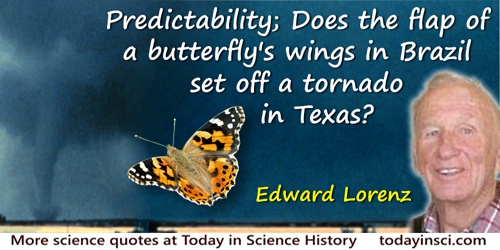
Predictability: Does the flap of a butterfly’s wings in Brazil set off a tornado in Texas?
Title of paper presented at the 139th Annual Meeting in Washington, D.C. of the American Association for the Advancement of Science (29 Dec 1972). The text of the talk, in its original form, as then prepared for press release but unpublished, is in Edward Lorenz, Essence of Chaos (1995), Appendix 1, 181. Note: Webmaster has been unable to find a verbatim source for a widely circulated variant, namely: The fluttering of a butterfly’s wing in Rio de Janeiro, amplified by atmospheric currents, could cause a tornado in Texas two weeks later. That form is given in Laura Nader, Naked Science: Anthropological Inquiry Into Boundaries (1996), 209. However, it appears in a sentence as narrative, without quotation marks, and has no citation. Webmaster believes it may be the concept restated by Nader in her own words. Webmaster has not yet found any earlier printed, cited or verbatim example in the wording of the variant. If you know a primary source for this variant, please contact Webmaster.
The astronomer is, in some measure, independent of his fellow astronomer; he can wait in his observatory till the star he wishes to observe comes to his meridian; but the meteorologist has his observations bounded by a very limited horizon, and can do little without the aid of numerous observers furnishing him contemporaneous observations over a wide-extended area.
Second Report on Meteorology to the Secretary of the Navy (1849), US Senate Executive Document 39, 31st Congress, 1st session. Quoted in J. R. Fleming, Meteorology in America: 1800-1870 (1990), vii.
The frost continuing more and more severe, the Thames before London was still planted with booths in formal streets … so that it see’d to be a bacchanalian triumph or carnival on the water, whilst it was a severe judgement on the land, the trees not only splitting as if lightning-struck, but men and cattle perishing in diverse places, and the very seas so lock’d up with ice, that no vessels could stir out or come in. London, by reason of the smoke, was so filled with the fuliginous steame of the sea-coale, that hardly could one see crosse the streets, and this filling the breast, so as one could hardly breath. Here was no water to be had from the pipes and engines, nor could the brewers and divers other tradesmen worke, and every moment was full of disastrous accidents.
Writing about the Great Frost (1683-84).
The frost is God’s plough which he drives through every inch of ground in the world, opening each clod, and pulverizing the whole.
As quoted in Henry Southgate (ed.), Many Thoughts of Many Minds (1862), 237.
The observed phenomena of meteorology and the well-established laws of physics are the two extremes of the science of meteorology between which we trace the connection of cause and effect; in so far as we can do this successfully meteorology becomes an exact deductive science.
In 'The Meteorological Work of the U.S. Signal Service, 1870 to 1891', U.S. Department of Agriculture, Weather Bureau, Bulletin No. 11, Report of the International Meteorological Congress, Chicago, Ill., August 21-24, 1893 (1894), 242.
The overwhelming astonishment, the queerest structure we know about so far in the whole universe, the greatest of all cosmological scientific puzzles, confounding all our efforts to comprehend it, is the earth. We are only now beginning to appreciate how strange and splendid it is, how it catches the breath, the loveliest object afloat around the sun, enclosed in its own blue bubble of atmosphere, manufacturing and breathing its own oxygen, fixing its own nitrogen from the air into its own soil, generating its own weather at the surface of its rain forests, constructing its own carapace from living parts: chalk cliffs, coral reefs, old fossils from earlier forms of life now covered by layers of new life meshed together around the globe, Troy upon Troy.
In Late Night Thoughts on Listening to Mahler’s Ninth Symphony (1984), 22-23.
The rainbow is the repercussion or refraction of rays of the sun in a concave aqueous cloud.
As quoted in Alistair Cameron Crombie, Robert Grosseteste and the Origins of Experimental Science, 1100-1700 (1971), 113.
The seer of the past was the man of mysteries. The veil within which none but the high-priest must enter, … whose traditions are the cement in which the stones of all these temples rising around us are laid. The seer of to-day is the man of explorations and explanations. Moses is
busy with his microscope, and Daniel prophesies from the meteorological headquarters at Washington.
From 'Professor Jeffries Wyman: A Memorial Outline', The Atlantic Monthly (Nov 1874), 622.
The sun, moving as it does, sets up processes of change and becoming and decay, and by its agency the finest and sweetest water is every day carried up and is dissolved into vapour and rises to the upper region, where it is condensed again by the cold and so returns to the earth. This, as we have said before, is the regular course of nature.
Meteorology (350 B.C.), Book II, translated by E. W. Webster. Internet Classics Archive, (classics.mit.edu).
The wind goeth toward the south, and turneth about unto the north; it whirleth about continually, and the wind returneth again according to his circuits.
— Bible
King James Version, Ecclesiastes 1:6.
These days at ten o’clock at night a most alarming wonder has manifested itself in the skies. The firmament was rent asunder and through this gap one could distinguish chariots and armies, riders with yellow, white, red and black standards, though to do battle against each other. This awesome and unusual vision continued from ten at night till about two of the morning, and was witnessed with alarm and dismay by many honest and trustworthy people. The significance thereof is known but to God Almighty, Who may graciously prevent the shedding of innocent blood.
'Frightful Apparition in the Sky at Vienna. From Vienna, the 11th day of August 1590'. As quoted in George Tennyson Matthews (ed.) News and Rumor in Renaissance Europe: The Fugger Newsletters (1959), 188. A handwritten collection of news reports (1568-1604) by the powerful banking and merchant house of Fugger in Ausburg.
We have learned that there is an endocrinology of elation and despair, a chemistry of mystical insight, and, in relation to the autonomic nervous system, a meteorology and even... an astro-physics of changing moods.
Literature and Science (1963), 90.
We should scarcely be excused in concluding this essay without calling the reader's attention to the beneficent and wise laws established by the author of nature to provide for the various exigencies of the sublunary creation, and to make the several parts dependent upon each other, so as to form one well-regulated system or whole.
'Experiments and Observations to Determine whether the Quantity of Rain and Dew is Equal to the Quantity of Water carried off by the Rivers and Raised by Evaporation', Memoirs Manchester Literary and Philosophical Society, 1803, 5, part 2, 372.
Weather forecast for tonight: dark. Continued dark overnight, with widely scattered light by morning.
On recorded album, as character Al Sleet, weatherman, FM & AM: The 11 O'Clock News. Also found in a number of books, without citation, for example, Manoranjan Kumar (ed.), Dictionary of Quotations (2008), 251.
When chemists have brought their knowledge out of their special laboratories into the laboratory of the world, where chemical combinations are and have been through all time going on in such vast proportions,—when physicists study the laws of moisture, of clouds and storms, in past periods as well as in the present,—when, in short, geologists and zoologists are chemists and physicists, and vice versa,—then we shall learn more of the changes the world has undergone than is possible now that they are separately studied.
Geological Sketches (1866), 73.
Wind, earthquake, fire—meteorology, seismology, physics—pass in review, as we have been reviewing the natural forces of evolution; the Lord was not in them. Afterwards, a stirring, an awakening in the organ of the brain, a voice which asks “What doest thou here?”
Swarthmore Lecture (1929) at Friends’ House, London, printed in Science and the Unseen World (1929), 26.
 In science it often happens that scientists say, 'You know that's a really good argument; my position is mistaken,' and then they would actually change their minds and you never hear that old view from them again. They really do it. It doesn't happen as often as it should, because scientists are human and change is sometimes painful. But it happens every day. I cannot recall the last time something like that happened in politics or religion.
(1987) --
In science it often happens that scientists say, 'You know that's a really good argument; my position is mistaken,' and then they would actually change their minds and you never hear that old view from them again. They really do it. It doesn't happen as often as it should, because scientists are human and change is sometimes painful. But it happens every day. I cannot recall the last time something like that happened in politics or religion.
(1987) -- 




