Mercury Quotes (54 quotes)
Mercurys Quotes
Mercurys Quotes
’Tis evident, that as common Air when reduc’d to half Its wonted extent, obtained near about twice as forcible a Spring as it had before; so this thus- comprest Air being further thrust into half this narrow room, obtained thereby a Spring about as strong again as that It last had, and consequently four times as strong as that of the common Air. And there is no cause to doubt, that If we had been here furnisht with a greater quantity of Quicksilver and a very long Tube, we might by a further compression of the included Air have made It counter-balance “the pressure” of a far taller and heavier Cylinder of Mercury. For no man perhaps yet knows how near to an infinite compression the Air may be capable of, If the compressing force be competently increast.
A Defense of the Doctrine Touching the Spring and Weight of the Air (1662), 62.
[Alchemists] finde out men so covetous of so much happiness, whom they easily perswade that they shall finde greater Riches in Hydargyrie [mercury], than Nature affords in Gold. Such, whom although they have twice or thrice already been deluded, yet they have still a new Device wherewith to deceive um again; there being no greater Madness…. So that the smells of Coles, Sulphur, Dung, Poyson, and Piss, are to them a greater pleasure than the taste of Honey; till their Farms, Goods, and Patrimonies being wasted, and converted into Ashes and Smoak, when they expect the rewards of their Labours, births of Gold, Youth, and Immortality, after all their Time and Expences; at length, old, ragged, famisht, with the continual use of Quicksilver [mercury] paralytick, onely rich in misery, … a laughing-stock to the people: … compell’d to live in the lowest degree of poverty, and … at length compell’d thereto by Penury, they fall to Ill Courses, as Counterfeiting of Money.
In The Vanity of the Arts and Sciences (1530), translation (1676), 313.
[Mercurial medicines] affect the human constitution in a peculiar manner, taking, so to speak, an iron grasp of all its systems, and penetrating even to the bones, by which they not only change the healthy action of its vessels, and general structure, but greatly impair and destroy its energies; so that their abuse is rarely overcome. When the tone of the stomach, intestines, or nervous system generally, has been once injured by this mineral ... it could seldom be restored.
Quoted in Wooster Beach, A Treatise on Anatomy, Physiology, and Health (1848), 177.
[On gold, silver, mercury, platinum, palladium, rhodium, iridium, osmium:] As in their physical properties so in their chemical properties. Their affinities being weaker, (the noble metals) do not present that variety of combinations, belonging to the more common metals, which renders them so extensively useful in the arts; nor are they, in consequence, so necessary and important in the operations of nature. They do not assist in her hands in breaking down rocks and strata into soil, nor do they help man to make that soil productive or to collect for him its products.
From 13th Lecture in 1818, in Bence Jones, The Life and Letters of Faraday (1870), Vol. 1, 254.
[On the future of Chemistry:] Chemistry is not the preservation hall of old jazz that it sometimes looks like. We cannot know what may happen tomorrow. Someone may oxidize mercury (II), francium (I), or radium (II). A mineral in Nova Scotia may contain an unsaturated quark per 1020 nucleons. (This is still 6000 per gram.) We may pick up an extraterrestrial edition of Chemical Abstracts. The universe may be a 4-dimensional soap bubble in an 11-dimensional space as some supersymmetry theorists argued in May of 1983. Who knows?
In George B. Kaufmann, 'Interview with Jannik Bjerrum and Christian Klixbull Jørgensen', Journal of Chemical Education (1985), 62, No. 11, 1005.
~~[Misattributed]~~ That little vernier on whose slender lines
The midnight taper trembles as it shines,
A silent index, tracks the planets’ march
In all their wanderings through the ethereal arch;
Tells through the mist where dazzled Mercury burns,
And marks the spot where Uranus returns.
The midnight taper trembles as it shines,
A silent index, tracks the planets’ march
In all their wanderings through the ethereal arch;
Tells through the mist where dazzled Mercury burns,
And marks the spot where Uranus returns.
This is too often seen online attributed incorrectly to Samuel Pierpont Langley, who merely quoted these lines in his The New Astronomy (1888), without naming its actual original author. The poem was actually written decades earlier by Oliver Wendell Holmes, published as Urania: A Rhymed Lesson (1846), 9-10. Holmes delivered it at the Boston Mercantile Library Association (14 Oct 1846).
A barbarous practice, the inconsistency, folly, and injury of which no words can sufficiently describe.
Condemning the use of mercurial medicines.
Condemning the use of mercurial medicines.
Quoted in Wooster Beach, A Treatise on Anatomy, Physiology, and Health (1848), 177.
A most vile face! and yet she spends me forty pound a year in Mercury and Hogs Bones. All her teeth were made in the Black-Fryars, both her Eyebrows i’ the Strand, and her Hair in Silver-street. Every part of Town owns a Piece of her.
A reference to artificial teeth by character Otter, speaking of his wife, in Epicoene: or, The Silent Woman (1609), Act IV, Sc. 2, 64. Also, True-wit makes a specific reference to “false Teeth” in Act I, Sc. 1, 10.
A night with Venus, a lifetime with Mercury.
[For centuries mercury was used as a treatment for syphilis.]
[For centuries mercury was used as a treatment for syphilis.]
Saying. In Michael J. O'Dowd and Elliot Philipp, The History of Obstetrics and Gynaecology (2000), 227.
Albertus [Magnus] ... debased the doctrine of Aristotle with the itch of the chemists flowing with the bloody flux of quicksilver and the stench of sulphur.
De Orta et Causis Subterraneorum Lib. V (1546), 46, trans. John Howes.
Almost all of the space program’s important advances in scientific knowledge have been accomplished by hundreds of robotic spacecraft in orbit about Earth and on missions to the distant planets Mercury, Venus, Mars, Jupiter, Saturn, Uranus, and Neptune. Robotic exploration of the planets and their satellites as well as of comets and asteroids has truly revolutionized our knowledge of the solar system.
In 'Is Human Spaceflight Obsolete?', Issues in Science and Technology (Summer 2004).
As there are six kinds of metals, so I have also shown with reliable experiments… that there are also six kinds of half-metals. I through my experiments, had the good fortune … to be the discoverer of a new half-metal, namely cobalt regulus, which had formerly been confused with bismuth.
The six metals were gold, silver, copper, iron, lead, tin. The semimetals, in addition to cobalt, were mercury, bismuth, zinc, and the reguluses of antimony and arsenic. Cited as “According to Zenzén, Brandt stated in his diary for 1741,” in Mary Elvira Weeks and Henry M. Leicester (ed.), Discovery of the Elements (6th edition, revised and enlarged 1960). Brandt presented his work to the Royal Academy of Sciences, Upsala, as printed in 'Dissertatio de semimetallis' (Dissertation on semi-metals) in Acta Literaria et Scientiarum Sveciae (Journal of Swedish literature and sciences) (1735), 4 1-10.
But that which will excite the greatest astonishment by far, and which indeed especially moved me to call the attention of all astronomers and philosophers, is this: namely, that I have observed four planets, neither known nor observed by any one of the astronomers before my time, which have their orbits round a certain bright star [Jupiter], one of those previously known, like Venus or Mercury round the sun, and are sometimes in front of it, sometimes behind it, though they never depart from it beyond certain limits. All of which facts were discovered and observed a few days ago by the help of a telescope devised by me, through God’s grace first enlightening my mind.
In pamphlet, The Sidereal Messenger (1610), reprinted in The Sidereal Messenger of Galileo Galilei: And a Part of the Preface to the Preface to Kepler's Dioptrics Containing the Original Account of Galileo's Astronomical Discoveries (1880), 9.
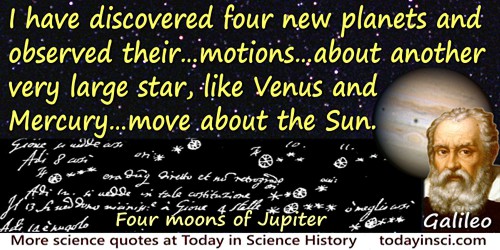
But what exceeds all wonders, I have discovered four new planets and observed their proper and particular motions, different among themselves and from the motions of all the other stars; and these new planets move about another very large star [Jupiter] like Venus and Mercury, and perchance the other known planets, move about the Sun. As soon as this tract, which I shall send to all the philosophers and mathematicians as an announcement, is finished, I shall send a copy to the Most Serene Grand Duke, together with an excellent spyglass, so that he can verify all these truths.
Letter to the Tuscan Court, 30 Jan 1610. Quoted in Albert van Heiden (ed.), Siderius Nuncius or The Sidereal Messenger (1989), 18.
Chemistry works with an enormous number of substances, but cares only for some few of their properties; it is an extensive science. Physics on the other hand works with rather few substances, such as mercury, water, alcohol, glass, air, but analyses the experimental results very thoroughly; it is an intensive science. Physical chemistry is the child of these two sciences; it has inherited the extensive character from chemistry. Upon this depends its all-embracing feature, which has attracted so great admiration. But on the other hand it has its profound quantitative character from the science of physics.
In Theories of Solutions (1912), xix.
Concerning the alchemist, Mamugnano, no one harbors doubts any longer about his daily experiments in changing quicksilver into gold. It was realized that his craft did not go beyond one pound of quicksilver… . Thus the belief is now held that his allegations to produce a number of millions have been a great fraud.
'Further Successes by Bragadini. From Vienna on the 26th day of January 1590'. As quoted in George Tennyson Matthews (ed.) News and Rumor in Renaissance Europe: The Fugger Newsletters (1959), 179. A handwritten collection of news reports (1568-1604) by the powerful banking and merchant house of Fugger in Ausburg.
Consider the eighth category, which deals with stones. Wilkins divides them into the following classifications: ordinary (flint, gravel, slate); intermediate (marble, amber, coral); precious (pearl, opal); transparent (amethyst, sapphire); and insoluble (coal, clay, and arsenic). The ninth category is almost as alarming as the eighth. It reveals that metals can be imperfect (vermilion, quicksilver); artificial (bronze, brass); recremental (filings, rust); and natural (gold, tin, copper). The whale appears in the sixteenth category: it is a viviparous, oblong fish. These ambiguities, redundances, and deficiencies recall those attributed by Dr. Franz Kuhn to a certain Chinese encyclopedia entitled Celestial Emporium of Benevolent Knowledge. On those remote pages it is written that animals are divided into (a) those that belong to the Emperor, (b) embalmed ones, (c) those that are trained, (d) suckling pigs, (e) mermaids, (f) fabulous ones, (g) stray dogs, (h) those that are included in this classification, (i) those that tremble as if they were mad, (j) innumerable ones, (k) those drawn with a very fine camel's hair brush, (l) others, (m) those that have just broken a flower vase, (n) those that resemble flies from a distance.
Other Inquisitions 1937-1952 (1964), trans. Ruth L. C. Simms, 103.
Few people doubt that the Apollo missions to the Moon as well as the precursory Mercury and Gemini missions not only had a valuable role for the United States in its Cold War with the Soviet Union but also lifted the spirits of humankind. In addition, the returned samples of lunar surface material fueled important scientific discoveries.
In 'Is Human Spaceflight Obsolete?', Issues in Science and Technology (Summer 2004).
Go to yon tower, where busy science plies
Her vast antennae, feeling through the skies
That little vernier on whose slender lines
The midnight taper trembles as it shines,
A silent index, tracks the planets’ march
In all their wanderings through the ethereal arch;
Tells through the mist where dazzled Mercury burns,
And marks the spot where Uranus returns.
Her vast antennae, feeling through the skies
That little vernier on whose slender lines
The midnight taper trembles as it shines,
A silent index, tracks the planets’ march
In all their wanderings through the ethereal arch;
Tells through the mist where dazzled Mercury burns,
And marks the spot where Uranus returns.
From poem, pronounced to the Boston Mercantile Library Association (14 Oct, 1846), published as Urania: A Rhymed Lesson (1846), 9-10. [Note: This is too often seen online attributed incorrectly to Samuel Pierpont Langley, who quoted several lines from the poem in his New Astronomy (1888), without naming its actual original author. —Webmaster]
He, who for an ordinary cause, resigns the fate of his patient to mercury, is a vile enemy to the sick; and, if he is tolerably popular, will, in one successful season, have paved the way for the business of life, for he has enough to do, ever afterward, to stop the mercurial breach of the constitutions of his dilapidated patients. He has thrown himself in fearful proximity to death, and has now to fight him at arm's length as long as the patient maintains a miserable existence.
Quoted by William M. Scribner, 'Treatment of Pneumonia and Croup, Once More, Etc,' in The Medical World (1885), 3, 187.
I had rather be Mercury, the smallest among seven [planets], revolving round the sun, than the first among five [moons] revolving round Saturn.
In James Wood, Dictionary of Quotations from Ancient and Modern, English and Foreign Sources (1893), 166:23.
I shall explain a System of the World differing in many particulars from any yet known, answering in all things to the common Rules of Mechanical Motions: This depends upon three Suppositions. First, That all Cœlestial Bodies whatsoever, have an attraction or gravitating power towards their own Centers, whereby they attract not only their own parts, and keep them from flying from them, as we may observe the Earth to do, but that they do also attract all the other Cœlestial bodies that are within the sphere of their activity; and consequently that not only the Sun and Moon have an influence upon the body and motion the Earth, and the Earth upon them, but that Mercury also Venus, Mars, Saturn and Jupiter by their attractive powers, have a considerable influence upon its motion in the same manner the corresponding attractive power of the Earth hath a considerable influence upon every one of their motions also. The second supposition is this, That all bodies whatsoever that are put into a direct and simple motion, will continue to move forward in a streight line, till they are by some other effectual powers deflected and bent into a Motion, describing a Circle, Ellipse, or some other more compounded Curve Line. The third supposition is, That these attractive powers are so much the more powerful in operating, by how much the nearer the body wrought upon is to their own Centers. Now what these several degrees are I have not yet experimentally verified; but it is a notion, which if fully prosecuted as it ought to be, will mightily assist the Astronomer to reduce all the Cœlestial Motions to a certain rule, which I doubt will never be done true without it. He that understands the nature of the Circular Pendulum and Circular Motion, will easily understand the whole ground of this Principle, and will know where to find direction in Nature for the true stating thereof. This I only hint at present to such as have ability and opportunity of prosecuting this Inquiry, and are not wanting of Industry for observing and calculating, wishing heartily such may be found, having myself many other things in hand which I would first compleat and therefore cannot so well attend it. But this I durst promise the Undertaker, that he will find all the Great Motions of the World to be influenced by this Principle, and that the true understanding thereof will be the true perfection of Astronomy.
An Attempt to Prove the Motion of the Earth from Observations (1674), 27-8. Based on a Cutlerian Lecture delivered by Hooke at the Royal Society four years earlier.
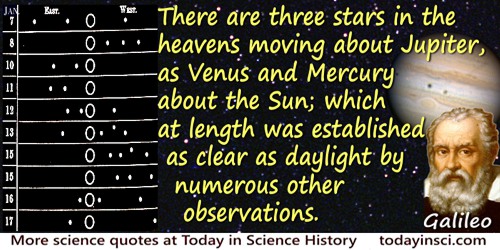
I therefore concluded, and decided unhesitatingly, that there are three stars in the heavens moving about Jupiter, as Venus and Mercury about the Sun; which at length was established as clear as daylight by numerous other observations.
Referring to his pioneering telescope observations.
Referring to his pioneering telescope observations.
The Starry Messenger (Mar 1610). Quoted in Edmund Blair Bolles, Galileo's Commandment (1999), 104.
I wol yow telle, as was me taught also,
The foure spirites and the bodies sevene,
By ordre, as ofte I herde my lord hem nevene.
The firste spirit quiksilver called is,
The second orpiment, the thridde, ywis,
Sal armoniak, and the firthe brimstoon.
The bodies sevene eek, lo! hem heer anoon:
Sol gold is, and Luna silver we threpe,
Mars yron, Mercurie quiksilver we clepe,
Saturnus leed, and Jupiter is tin,
And Venus coper, by my fader kin!
The foure spirites and the bodies sevene,
By ordre, as ofte I herde my lord hem nevene.
The firste spirit quiksilver called is,
The second orpiment, the thridde, ywis,
Sal armoniak, and the firthe brimstoon.
The bodies sevene eek, lo! hem heer anoon:
Sol gold is, and Luna silver we threpe,
Mars yron, Mercurie quiksilver we clepe,
Saturnus leed, and Jupiter is tin,
And Venus coper, by my fader kin!
The Canon's Yeoman's Tale, lines 819-29. In Larry D. Benson (ed.), The Riverside Chaucer (1988), 273.
If coal plants release mercury—and mercury is a neurotoxin that damages children's brains—then reducing the amount of mercury in emissions doesn’t stop that. It just says, “We’ll tell you at what rate you can dispense death.”
In interview article, 'Designing For The Future', Newsweek (15 May 2005).
If you could see what I almost daily see in my practice … persons … in the very last stages of wretched existence, emaciated to a skeleton, with both tables of the skull almost completely perforated in many places, half the nose gone, with rotten jaws, ulerated throats, breaths most pestiferous more intolerable than poisonous upas, limbs racked with the pains of the Inquisition, minds as imbecile as the puling babe, a grievous burden to themselves and a disgusting spectacle to others, you would exclaim as I have often done, 'O! the lamentable want of science that dictates the abuse (use) of that noxious drug calomel!'
[Calomel is the mercury compound, Hg2Cl2.]
[Calomel is the mercury compound, Hg2Cl2.]
Quoted in Wooster Beach, A Treatise on Anatomy, Physiology, and Health (1848), 177.
In 1810, the Triumph man-of-war and Phipps schooner received on board several tons of quicksilver, saved from the wreck of a vessel near Cadiz. In consequence of the rolling of the bags the mercury escaped, and the whole of the crews became more or less affected. In the space of three weeks, two hundred men were salivated, two died, and all the animals—cats, dogs, sheep, fowls, a canary bird, nay, even the rats, mice and cockroaches were destroyed.
[The leather bags of mercury had been salvaged and stored without the original wooden cases. Some were stowed in sleeping quarters, and the in same hold as spirit rations.]
[The leather bags of mercury had been salvaged and stored without the original wooden cases. Some were stowed in sleeping quarters, and the in same hold as spirit rations.]
The Edinburgh Medical And Surgical Journal, 6. Quoted in Alva Curtis, A Fair Examination and Criticism of All the Medical Systems in Vogue (1855), 38. For more information on the incident, see John Emsley, The Elements of Murder (2006), 38-9.
It is very interesting to observe how high the rank may be in the world of science, without the aid of wealth. I have before me a letter of the late Dr. Dalton, who, notwithstanding his great reputation as a chemist, until a late period of his life was a teacher of mathematics. He remarks in this note, that if the price of mercury continues so dear he shall not be able to afford the expense of filling the barometers which he requires for some experiments.
In Education and Manufactures (1863), 44-45.
It seeming impossible in any other manner to properly restrict the use of this powerful agent [calomel, a mercury compound, mercurous chloride], it is directed that it be struck from the supply table, and that no further requisitions for this medicine be approved by Medical Directors. ... modern pathology has proved the impropriety of the use of mercury in very many of those diseases in which it was formerly unfailingly administered. ... No doubt can exist that more harm has resulted from the misuse [of this agent], in the treatment of disease, than benefit from their proper administration.
W.A. Hammond, Surgeon General, Washington D.C., 4 May 1863
W.A. Hammond, Surgeon General, Washington D.C., 4 May 1863
'Circular No. 6,', in William Grace, The Army Surgeon's Manual (1864), 121.
It then came into my mind what that most careful observer of natural phenomena [Amontons] had written about the correction of the barometer; for he had observed that the height of the column of mercury in the barometer was a little (though sensibly enough) altered by the varying temperature of the mercury. From this I gathered that a thermometer might be perhaps constructed with mercury.
From 'Experimenta circa gradum caloris liquorum nonnullorum ebullientium instituta', Philosophical Transactions (1724), 33, 1, as translated in William Francis Magie, A Source Book in Physics (1935), 131.
Learning is like mercury, one of the most powerful and excellent things in the world in skillful hands; in unskillful, the most mischievous.
'Thoughts On Various Subjects', The Works of Alexander Pope (1806), Vol. 6, 406.
On the 1st of August, 1774, I endeavoured to extract air from mercurius calcinates per se [mercury oxide]; and I presently found that, by means of this lens, air was expelled from it very readily. … I admitted water to it [the extracted air], and found that it was not imbibed by it. But what surprized me more than I can well express, was, that a candle burned in this air with a remarkably vigorous flame… I was utterly at a loss how to account for it.
From Experiments and Observations on Different Kinds of Air (1775) Vol. 2, 34.
Satire is a composition of salt and mercury; and it depends upon the different mixture and preparation of those ingredients, that it comes out a noble medicine, or a rank poison.
In Tryon Edwards (ed.), A Dictionary of Thoughts (1908), 502.
The experiment left no doubt that, as far as accuracy of measurement went, the resistance disappeared. At the same time, however, something unexpected occurred. The disappearance did not take place gradually but abruptly. From 1/500 the resistance at 4.2K, it could be established that the resistance had become less than a thousand-millionth part of that at normal temperature. Thus the mercury at 4.2K has entered a new state, which, owing to its particular electrical properties, can be called the state of superconductivity.
'Investigations into the Properties of Substances at low Temperatures, which have led, amongst other Things, to the Preparation of Liquid Helium', Nobel Lecture (11 Dec 1913). In Nobel Lectures in Physics 1901-1921 (1967), 333.
The external resistance may also be varied. For instance, let mercury or some other liquid form part of a voltaic circuit, then the more deeply the conducting wire is immersed in the mercury or other liquid the less resistance does the liquid offer to the passage of the current Hence the vibration of the conducting wire in mercury or other liquid included in the circuit occasions undulations in the current…
Specification of Patent (filed 14 Feb 1876), United States Patent Office, 'Improvement in Telegraphy', No. 174, 465. Also quoted in George Bartlett Prescott, 'The Speaking Telephone, Talking Phonograph, and Other Novelties', Electric Engineering (1878), 212.
The footprints at Tranquility base belong to more than the crew of Apollo 11. They were put there by hundreds of thousands of people across this country, people in government, industry and universities, the teams and crews that preceded us, all who strived throughout the years with Mercury, Gemini and Apollo. Those footprints belong to the American people.
In Address to Joint Session of Congress (16 Sep 1969). Printed in 'Transcript of Astronauts’ Addresses to Congress', New York Times (17 Sep 1969), 30.
The generalized theory of relativity has furnished still more remarkable results. This considers not only uniform but also accelerated motion. In particular, it is based on the impossibility of distinguishing an acceleration from the gravitation or other force which produces it. Three consequences of the theory may be mentioned of which two have been confirmed while the third is still on trial: (1) It gives a correct explanation of the residual motion of forty-three seconds of arc per century of the perihelion of Mercury. (2) It predicts the deviation which a ray of light from a star should experience on passing near a large gravitating body, the sun, namely, 1".7. On Newton's corpuscular theory this should be only half as great. As a result of the measurements of the photographs of the eclipse of 1921 the number found was much nearer to the prediction of Einstein, and was inversely proportional to the distance from the center of the sun, in further confirmation of the theory. (3) The theory predicts a displacement of the solar spectral lines, and it seems that this prediction is also verified.
Studies in Optics (1927), 160-1.
The mercury light doesn't show red. It makes the blood in your skin look blue-black. But see how splendidly it brings out the green in the plants.
From George MacAdam, 'Steinmetz, Electricity's Mastermind, Enters Politics', New York Times (2 Nov 1913), SM3. Answering the reporter’s question about why he lit the cactus collection in his conservatory with the blue light from a mercury lamp, which makes a man look like a corpse.
The prominent reason why a mathematician can be judged by none but mathematicians, is that he uses a peculiar language. The language of mathesis is special and untranslatable. In its simplest forms it can be translated, as, for instance, we say a right angle to mean a square corner. But you go a little higher in the science of mathematics, and it is impossible to dispense with a peculiar language. It would defy all the power of Mercury himself to explain to a person ignorant of the science what is meant by the single phrase “functional exponent.” How much more impossible, if we may say so, would it be to explain a whole treatise like Hamilton’s Quaternions, in such a wise as to make it possible to judge of its value! But to one who has learned this language, it is the most precise and clear of all modes of expression. It discloses the thought exactly as conceived by the writer, with more or less beauty of form, but never with obscurity. It may be prolix, as it often is among French writers; may delight in mere verbal metamorphoses, as in the Cambridge University of England; or adopt the briefest and clearest forms, as under the pens of the geometers of our Cambridge; but it always reveals to us precisely the writer’s thought.
In North American Review (Jul 1857), 85, 224-225.
The ratio of the expanded air to the volume of that left above the mercury before the experiment is the same as that of twenty-eight inches of mercury, which is the whole weight of the atmosphere, to the excess of twenty-eight inches over the height at which [the mercury] remains after the experiment. This makes known sufficiently for one to take it as a certain rule of nature that air is condensed in proportion to the weight with which it is charged.
'De la Nature l’Air', collected in Oeuvres (1717), 152.
The Religion that is afraid of science dishonours God and commits suicide. It acknowledges that it is not equal to the whole of truth, that it legislates, tyrannizes over a village of God's empires but is not the immutable universal law. Every influx of atheism, of skepticism is thus made useful as a mercury pill assaulting and removing a diseased religion and making way for truth.
(4 Mar 1831). In William H. Gilman (ed.) The Journals and Miscellaneous Notebooks of Ralph Waldo Emerson: Vol III, 1826-1832 (1963), 239.
The vacuum-apparatus requires that its manipulators constantly handle considerable amounts of mercury. Mercury is a strong poison, particularly dangerous because of its liquid form and noticeable volatility even at room temperature. Its poisonous character has been rather lost sight of during the present generation. My co-workers and myself found from personal experience-confirmed on many sides when published—that protracted stay in an atmosphere charged with only 1/100 of the amount of mercury required for its saturation, sufficed to induce chronic mercury poisoning. This first reveals itself as an affection of the nerves, causing headaches, numbness, mental lassitude, depression, and loss of memory; such are very disturbing to one engaged in intellectual occupations.
Hydrides of Boron and Silicon (1933), 203.
The venereal Disease first invaded the Spaniards and Italians, before the Efficacy of Mercury was known. … By the Use of Mercury, given with Discretion, so as to raise a Salivation; after the Use of which the whole Body, in a manner, seems to grow young again.
In Dr. Boerhaave's Academical Lectures on the Theory of Physic (1746), Vol. 6, 266-267.
Then if the first argument remains secure (for nobody will produce a neater one, than the length of the periodic time is a measure of the size of the spheres), the order of the orbits follows this sequence, beginning from the highest: The first and highest of all is the sphere of the fixed stars, which contains itself and all things, and is therefore motionless. It is the location of the universe, to which the motion and position of all the remaining stars is referred. For though some consider that it also changes in some respect, we shall assign another cause for its appearing to do so in our deduction of the Earth’s motion. There follows Saturn, the first of the wandering stars, which completes its circuit in thirty years. After it comes Jupiter which moves in a twelve-year long revolution. Next is Mars, which goes round biennially. An annual revolution holds the fourth place, in which as we have said is contained the Earth along with the lunar sphere which is like an epicycle. In fifth place Venus returns every nine months. Lastly, Mercury holds the sixth place, making a circuit in the space of eighty days. In the middle of all is the seat of the Sun. For who in this most beautiful of temples would put this lamp in any other or better place than the one from which it can illuminate everything at the same time? Aptly indeed is he named by some the lantern of the universe, by others the mind, by others the ruler. Trismegistus called him the visible God, Sophocles' Electra, the watcher over all things. Thus indeed the Sun as if seated on a royal throne governs his household of Stars as they circle around him. Earth also is by no means cheated of the Moon’s attendance, but as Aristotle says in his book On Animals the Moon has the closest affinity with the Earth. Meanwhile the Earth conceives from the Sun, and is made pregnant with annual offspring. We find, then, in this arrangement the marvellous symmetry of the universe, and a sure linking together in harmony of the motion and size of the spheres, such as could be perceived in no other way. For here one may understand, by attentive observation, why Jupiter appears to have a larger progression and retrogression than Saturn, and smaller than Mars, and again why Venus has larger ones than Mercury; why such a doubling back appears more frequently in Saturn than in Jupiter, and still more rarely in Mars and Venus than in Mercury; and furthermore why Saturn, Jupiter and Mars are nearer to the Earth when in opposition than in the region of their occultation by the Sun and re-appearance. Indeed Mars in particular at the time when it is visible throughout the night seems to equal Jupiter in size, though marked out by its reddish colour; yet it is scarcely distinguishable among stars of the second magnitude, though recognized by those who track it with careful attention. All these phenomena proceed from the same course, which lies in the motion of the Earth. But the fact that none of these phenomena appears in the fixed stars shows their immense elevation, which makes even the circle of their annual motion, or apparent motion, vanish from our eyes.
'Book One. Chapter X. The Order of the Heavenly Spheres', in Copernicus: On the Revolutions of the Heavenly Spheres (1543), trans. A. M. Duncan (1976), 49-51.
There are reported to be six species of metals, namely, gold, silver, iron, copper, tin, and lead. Actually there are more. Mercury is a metal although we differ on this point with the chemists. Plumbum cinereum (gray lead) which we call bisemutum was unknown to the older Greek writers. On the other hand, Ammonius writes correctly many metals are unknown to us, as well as many plants and animals.
As translated by Mark Chance Bandy and Jean A. Bandy from the first Latin Edition of 1546 in De Natura Fossilium: (Textbook of Mineralogy) (2004), 19. Originally published by Geological Society of America as a Special Paper (1955). There are other translations with different wording.
There's antimony, arsenic, aluminium, selenium,
And hydrogen and oxygen and nitrogen and rhenium,
And nickel, neodymium, neptunium, germanium,
And iron, americium, ruthenium, uranium,
Europium, zirconium, lutetium, vanadium,
And lanthanum and osmium and astatine and radium,
And gold and protactinium and indium and gallium,
And iodine and thorium and thulium and thallium.
There's yttrium, ytterbium, actinium, rubidium,
And boron, gadolinium, niobium, iridium,
And strontium and silicon and silver and samarium,
And bismuth, bromine, lithium, beryllium and barium.
There's holmium and helium and hafnium and erbium,
And phosphorus and francium and fluorine and terbium,
And manganese and mercury, molybdenum, magnesium,
Dysprosium and scandium and cerium and cesium,
And lead, praseodymium and platinum, plutonium,
Palladium, promethium, potassium, polonium,
And tantalum, technetium, titanium, tellurium,
And cadmium and calcium and chromium and curium.
There's sulfur, californium and fermium, berkelium,
And also mendelevium, einsteinium, nobelium,
And argon, krypton, neon, radon, xenon, zinc and rhodium,
And chlorine, cobalt, carbon, copper, tungsten, tin and sodium.
These are the only ones of which the news has come to Harvard,
And there may be many others, but they haven't been discarvard.
[To the tune of I am the Very Model of a Modern Major General.]
And hydrogen and oxygen and nitrogen and rhenium,
And nickel, neodymium, neptunium, germanium,
And iron, americium, ruthenium, uranium,
Europium, zirconium, lutetium, vanadium,
And lanthanum and osmium and astatine and radium,
And gold and protactinium and indium and gallium,
And iodine and thorium and thulium and thallium.
There's yttrium, ytterbium, actinium, rubidium,
And boron, gadolinium, niobium, iridium,
And strontium and silicon and silver and samarium,
And bismuth, bromine, lithium, beryllium and barium.
There's holmium and helium and hafnium and erbium,
And phosphorus and francium and fluorine and terbium,
And manganese and mercury, molybdenum, magnesium,
Dysprosium and scandium and cerium and cesium,
And lead, praseodymium and platinum, plutonium,
Palladium, promethium, potassium, polonium,
And tantalum, technetium, titanium, tellurium,
And cadmium and calcium and chromium and curium.
There's sulfur, californium and fermium, berkelium,
And also mendelevium, einsteinium, nobelium,
And argon, krypton, neon, radon, xenon, zinc and rhodium,
And chlorine, cobalt, carbon, copper, tungsten, tin and sodium.
These are the only ones of which the news has come to Harvard,
And there may be many others, but they haven't been discarvard.
[To the tune of I am the Very Model of a Modern Major General.]
Song, 'The Elements' (1959). In Tom Lehrer,Too Many Songs by Tom Lehrer: With Not Enough Drawings by Ronald Searle (1981), 151.
We have made many glass vessels... with tubes two cubits long. These were filled with mercury, the open end was closed with the finger, and the tubes were then inverted in a vessel where there was mercury. We saw that an empty space was formed and that nothing happened in the vessel where this space was formed ... I claim that the force which keeps the mercury from falling is external and that the force comes from outside the tube. On the surface of the mercury which is in the bowl rests the weight of a column of fifty miles of air. Is it a surprise that into the vessel, in which the mercury has no inclination and no repugnance, not even the slightest, to being there, it should enter and should rise in a column high enough to make equilibrium with the weight of the external air which forces it up?
Quoted in Archana Srinivasan, Great Inventors (2007), 27-28.
What now, dear reader, shall we make of our telescope? Shall we make a Mercury’s magic wand to cross the liquid aether with, and like Lucian lead a colony to the uninhabitied evening star, allured by the sweetness of the place?
In Preface to Dioptrics (1611), 86. Collected in Galileo Galilei, Johannes Kepler and Edward Stafford Carlos (trans.), The Sidereal Messenger of Galileo Galilei: And a Part of the Preface to Kepler’s Dioptrics (1880), 103.
When a [mercury] thermometer … was made (perhaps imperfect in many ways) the result answered to my prayer; and with great pleasure of mind I observed the truth [that water boils at a fixed degree of heat].
From 'Experimenta circa gradum caloris liquorum nonnullorum ebullientium instituta', Philosophical Transactions (1724), 33, 1, as translated in William Francis Magie, A Source Book in Physics (1935), 131.
When it is considered that this light, when obtained with mercury gas, has an efficiency at least eight times as great as that obtained by an ordinary incandescent lamp, it will be appreciated that it has its use in places where lack of red is not important, for the economy of operation will much more than compensate for the somewhat unnatural color given to illuminated objects.
'Electric Gas Lamps and Gas Electrical Resistance Phenomena', a paper read at the 150th AIEE meeting 3 Jan 1902. In Transactions of the American Institute of Electrical Engineers (1902), 61.
When Lord Kelvin was in this country [U.S.], he said that nothing interested him so much as Mr. Hewitt's work and his vacuum lamp.
Referring to the mercury lamp invention.
Referring to the mercury lamp invention.
Quoting Kelvin in McClure's Magazine (Jun 1903). In Albert Shaw (Ed.), The American Monthly Review of Reviews (1903), 27, 724.
Yet in this my stars were not Mercury as morning star in the angle of the seventh house, in quartile with Mars, but they were Copernicus, they were Tycho Brahe, without whose books of observations everything which has now been brought by me into the brightest daylight would lie buried in darkness.
Harmonice Mundi, The Harmony of the World (1619), book IV, Epilogue on Sublunary Nature. Trans. E. J. Aiton, A. M. Duncan and J. V. Field (1997), 377.
You see, if the height of the mercury [barometer] column is less on the top of a mountain than at the foot of it (as I have many reasons for believing, although everyone who has so far written about it is of the contrary opinion), it follows that the weight of the air must be the sole cause of the phenomenon, and not that abhorrence of a vacuum, since it is obvious that at the foot of the mountain there is more air to have weight than at the summit, and we cannot possibly say that the air at the foot of the mountain has a greater aversion to empty space than at the top.
In letter to brother-in-law Perier (Nov 1647) as given in Daniel Webster Hering, Physics: the Science of the Forces of Nature (1922), 114. As also stated by Hering, Perier conducted an experiment on 19 Sep 1648 comparing readings on two barometers, one at the foot, and another at the top of 4,000-ft Puy-de-Dôme neighboring mountain.
Your Grace will no doubt have learnt from the weekly reports of one Marco Antonio Bragadini, called Mamugnano. … He is reported to be able to turn base metal into gold… . He literally throws gold about in shovelfuls. This is his recipe: he takes ten ounces of quicksilver, puts it into the fire, and mixes it with a drop of liquid, which he carries in an ampulla. Thus it promptly turns into good gold. He has no other wish but to be of good use to his country, the Republic. The day before yesterday he presented to the Secret Council of Ten two ampullas with this liquid, which have been tested in his absence. The first test was found to be successful and it is said to have resulted in six million ducats. I doubt not but that this will appear mighty strange to your Grace.
'The Famous Alchemist Bragadini. From Vienna on the 1st day of November 1589'. As quoted in George Tennyson Matthews (ed.) News and Rumor in Renaissance Europe: The Fugger Newsletters (1959), 173. A handwritten collection of news reports (1568-1604) by the powerful banking and merchant house of Fugger in Ausburg.
 In science it often happens that scientists say, 'You know that's a really good argument; my position is mistaken,' and then they would actually change their minds and you never hear that old view from them again. They really do it. It doesn't happen as often as it should, because scientists are human and change is sometimes painful. But it happens every day. I cannot recall the last time something like that happened in politics or religion.
(1987) --
In science it often happens that scientists say, 'You know that's a really good argument; my position is mistaken,' and then they would actually change their minds and you never hear that old view from them again. They really do it. It doesn't happen as often as it should, because scientists are human and change is sometimes painful. But it happens every day. I cannot recall the last time something like that happened in politics or religion.
(1987) -- 




