Measurement Quotes (179 quotes)
[After the flash of the atomic bomb test explosion] Fermi got up and dropped small pieces of paper … a simple experiment to measure the energy liberated by the explosion … [W]hen the front of the shock wave arrived (some seconds after the flash) the pieces of paper were displaced a few centimeters in the direction of propagation of the shock wave. From the distance of the source and from the displacement of the air due to the shock wave, he could calculate the energy of the explosion. This Fermi had done in advance having prepared himself a table of numbers, so that he could tell immediately the energy liberated from this crude but simple measurement. … It is also typical that his answer closely approximated that of the elaborate official measurements. The latter, however, were available only after several days’ study of the records, whereas Fermi had his within seconds.
In Enrico Fermi: Physicist (1970), 147-148.
[In plotting earthquake measurements] the range between the largest and smallest magnitudes seemed unmanageably large. Dr. Beno Gutenberg then made the natural suggestion to plot the amplitudes logarithmically.
From interview with Henry Spall, as in an abridged version of Earthquake Information Bulletin (Jan-Feb 1980), 12, No. 1, that is on the USGS website.
[Louis Rendu, Bishop of Annecy] collects observations, makes experiments, and tries to obtain numerical results; always taking care, however, so to state his premises and qualify his conclusions that nobody shall be led to ascribe to his numbers a greater accuracy than they merit. It is impossible to read his work, and not feel that he was a man of essentially truthful mind and that science missed an ornament when he was appropriated by the Church.
In The Glaciers of the Alps (1860), 299.
[Mathematics is] the study of the measurement, properties, and relationships of quantities and sets, using numbers and symbols.
Definition of Mathematics in William morris (ed.), American Heritage Dictionary (2000).
[Mathematics] has for its object the indirect measurement of magnitudes, and it proposes to determine magnitudes by each other, according to the precise relations which exist between them.
In The Positive Philosophy of Auguste Comte, translated by Harriet Martineau, (1896), Vol. 1, 40.
[The scientist] believes passionately in facts, in measured facts. He believes there are no bad facts, that all facts are good facts, though they may be facts about bad things, and his intellectual satisfaction can come only from the acquisition of accurately known facts, from their organization into a body of knowledge, in which the inter-relationship of the measured facts is the dominant consideration.
'Scientist and Citizen', Speech to the Empire Club of Canada (29 Jan 1948), The Empire Club of Canada Speeches (29 Jan 1948), 209-221.
[W]e are prone to forget that the planet may be measured by man, but not according to man.
The Face of the Earth (1904), Vol. 1, 17.
[We] can easily distinguish what relates to Mathematics in any question from that which belongs to the other sciences. But as I considered the matter carefully it gradually came to light that all those matters only were referred to Mathematics in which order and measurements are investigated, and that it makes no difference whether it be in numbers, figures, stars, sounds or any other object that the question of measurement arises. I saw consequently that there must be some general science to explain that element as a whole which gives rise to problems about order and measurement, restricted as these are to no special subject matter. This, I perceived was called “Universal Mathematics,” not a far-fetched asignation, but one of long standing which has passed into current use, because in this science is contained everything on account of which the others are called parts of Mathematics.
Rules for the Direction of the Mind (written 1628). As translated by Elizabeth Sanderson Haldane and George Robert Thomson Ross in The Philosophical Works of Descartes (1911, 1931), 13.
[Probably not a direct quote] Experimental confirmation of a prediction is merely a measurement. An experiment disproving a prediction is a discovery.
Attributed. Found without source, for example, in Jon, Michael and Deborah Fripp, Speaking of Science: Notable Quotes on Science, Engineering, and the Environment. The quote appears to be a rephrasing of: “There are two possible outcomes: If the result confirms the hypothesis, then you’ve made a measurement. If the result is contrary to the hypothesis, then you’ve made a discovery”, as seen elsewhere on this page. Webmaster has been unable to find an original source for a direct quote either wording.
Ath. There still remain three studies suitable for freemen. Calculation in arithmetic is one of them; the measurement of length, surface, and depth is the second; and the third has to do with the revolutions of the stars in reference to one another … there is in them something that is necessary and cannot be set aside, … if I am not mistaken, [something of] divine necessity; for as to the human necessities of which men often speak when they talk in this manner, nothing can be more ridiculous than such an application of the words.
Cle. And what necessities of knowledge are there, Stranger, which are divine and not human?
Ath. I conceive them to be those of which he who has no use nor any knowledge at all cannot be a god, or demi-god, or hero to mankind, or able to take any serious thought or charge of them.
Cle. And what necessities of knowledge are there, Stranger, which are divine and not human?
Ath. I conceive them to be those of which he who has no use nor any knowledge at all cannot be a god, or demi-god, or hero to mankind, or able to take any serious thought or charge of them.
— Plato
In Republic, Bk. 7, in Jowett, Dialogues of Plato (1897, 2010), Vol. 4, 331.
Ce qui est admirable, ce n'est pas que le champ des étoiles soit si vaste, c'est que l'homme l'ait mesuré.
The wonder is, not that the field of the stars is so vast, but that man has measured it.
The wonder is, not that the field of the stars is so vast, but that man has measured it.
The Garden of Epicurus (1894) translated by Alfred Allinson, in The Works of Anatole France in an English Translation (1920), 16.
Tolle numerum omnibus rebus et omnia pereunt.
Take from all things their number and all shall perish.
Take from all things their number and all shall perish.
Etymologies [c.600], Book III, chapter 4, quoted in E. Grant (ed.), A Source Book in Medieval Science (1974), trans. E. Brehaut (1912), revised by E. Grant, 5.
A careful analysis of the process of observation in atomic physics has shown that the subatomic particles have no meaning as isolated entities, but can only be understood as interconnections between the preparation of an experiment and the subsequent measurement.
The Tao of Physics: An Exploration of the Parallels Between Modern Physics (1975), 68.
A parable: A man was examining the construction of a cathedral. He asked a stone mason what he was doing chipping the stones, and the mason replied, “I am making stones.” He asked a stone carver what he was doing. “I am carving a gargoyle.” And so it went, each person said in detail what they were doing. Finally he came to an old woman who was sweeping the ground. She said. “I am helping build a cathedral.”
...Most of the time each person is immersed in the details of one special part of the whole and does not think of how what they are doing relates to the larger picture.
[For example, in education, a teacher might say in the next class he was going to “explain Young's modulus and how to measure it,” rather than, “I am going to educate the students and prepare them for their future careers.”]
...Most of the time each person is immersed in the details of one special part of the whole and does not think of how what they are doing relates to the larger picture.
[For example, in education, a teacher might say in the next class he was going to “explain Young's modulus and how to measure it,” rather than, “I am going to educate the students and prepare them for their future careers.”]
In The Art of Doing Science and Engineering: Learning to Learn (1975, 2005), 195.
A poet is, after all, a sort of scientist, but engaged in a qualitative science in which nothing is measurable. He lives with data that cannot be numbered, and his experiments can be done only once. The information in a poem is, by definition, not reproducible. ... He becomes an equivalent of scientist, in the act of examining and sorting the things popping in [to his head], finding the marks of remote similarity, points of distant relationship, tiny irregularities that indicate that this one is really the same as that one over there only more important. Gauging the fit, he can meticulously place pieces of the universe together, in geometric configurations that are as beautiful and balanced as crystals.
In The Medusa and the Snail: More Notes of a Biology Watcher (1974, 1995), 107.
Absolute space, of its own nature without reference to anything external, always remains homogenous and immovable. Relative space is any movable measure or dimension of this absolute space; such a measure or dimension is determined by our senses from the situation of the space with respect to bodies and is popularly used for immovable space, as in the case of space under the earth or in the air or in the heavens, where the dimension is determined from the situation of the space with respect to the earth. Absolute and relative space are the same in species and in magnitude, but they do not always remain the same numerically. For example, if the earth moves, the space of our air, which in a relative sense and with respect to the earth always remains the same, will now be one part of the absolute space into which the air passes, now another part of it, and thus will be changing continually in an absolute sense.
The Principia: Mathematical Principles of Natural Philosophy (1687), 3rd edition (1726), trans. I. Bernard Cohen and Anne Whitman (1999), Definitions, Scholium, 408-9.
Absolute, true, and mathematical time, in and of itself and of its own nature, without reference to anything external, flows uniformly and by another name is called duration. Relative, apparent, and common time is any sensible and external measure (precise or imprecise) of duration by means of motion; such as a measure—for example, an hour, a day, a month, a year—is commonly used instead of true time.
The Principia: Mathematical Principles of Natural Philosophy (1687), 3rd edition (1726), trans. I. Bernard Cohen and Anne Whitman (1999), Definitions, Scholium, 408.
According to my views, aiming at quantitative investigations, that is at establishing relations between measurements of phenomena, should take first place in the experimental practice of physics. By measurement to knowledge [door meten tot weten] I should like to write as a motto above the entrance to every physics laboratory.
'The Significance of Quantitative Research in Physics', Inaugural Address at the University of Leiden (1882). In Hendrik Casimir, Haphazard Reality: Half a Century of Science (1983), 160-1.
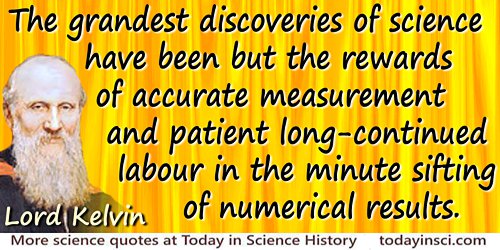
Accurate and minute measurement seems to the non-scientific imagination, a less lofty and dignified work than looking for something new. But nearly all the grandest discoveries of science have been but the rewards of accurate measurement and patient long-continued labour in the minute sifting of numerical results.
Presidential inaugural address, to the General Meeting of the British Association, Edinburgh (2 Aug 1871). In Report of the Forty-First Meeting of the British Association for the Advancement of Science (1872), xci.
All human affairs follow nature's great analogue, the growth of vegetation. There are three periods of growth in every plant. The first, and slowest, is the invisible growth by the root; the second and much accelerated is the visible growth by the stem; but when root and stem have gathered their forces, there comes the third period, in which the plant quickly flashes into blossom and rushes into fruit.
The beginnings of moral enterprises in this world are never to be measured by any apparent growth. ... At length comes the sudden ripeness and the full success, and he who is called in at the final moment deems this success his own. He is but the reaper and not the labourer. Other men sowed and tilled and he but enters into their labours.
The beginnings of moral enterprises in this world are never to be measured by any apparent growth. ... At length comes the sudden ripeness and the full success, and he who is called in at the final moment deems this success his own. He is but the reaper and not the labourer. Other men sowed and tilled and he but enters into their labours.
Life Thoughts (1858), 20.
All the modern higher mathematics is based on a calculus of operations, on laws of thought. All mathematics, from the first, was so in reality; but the evolvers of the modern higher calculus have known that it is so. Therefore elementary teachers who, at the present day, persist in thinking about algebra and arithmetic as dealing with laws of number, and about geometry as dealing with laws of surface and solid content, are doing the best that in them lies to put their pupils on the wrong track for reaching in the future any true understanding of the higher algebras. Algebras deal not with laws of number, but with such laws of the human thinking machinery as have been discovered in the course of investigations on numbers. Plane geometry deals with such laws of thought as were discovered by men intent on finding out how to measure surface; and solid geometry with such additional laws of thought as were discovered when men began to extend geometry into three dimensions.
In Lectures on the Logic of Arithmetic (1903), Preface, 18-19.
Although this may seem a paradox, all exact science is dominated by the idea of approximation. When a man tells you that he knows the exact truth about anything, you are safe in infering that he is an inexact man. Every careful measurement in science is always given with the probable error ... every observer admits that he is likely wrong, and knows about how much wrong he is likely to be.
In The Scientific Outlook (1931, 2009), 42.
An astronomer must be the wisest of men; his mind must be duly disciplined in youth; especially is mathematical study necessary; both an acquaintance with the doctrine of number, and also with that other branch of mathematics, which, closely connected as it is with the science of the heavens, we very absurdly call geometry, the measurement of the earth.
— Plato
From the 'Epilogue to the Laws' (Epinomis), 988-990. As quoted in William Whewell, History of the Inductive Sciences from the Earliest to the Present Time (1837), Vol. 1, 161. (Although referenced to Plato’s Laws, the Epinomis is regarded as a later addition, not by Plato himself.)

An experiment is a question which science poses to Nature, and a measurement is the recording of Nature's answer.
'The Meaning and Limits of Exact Science', Science (30 Sep 1949), 110, No. 2857, 325. Advance reprinting of chapter from book Max Planck, Scientific Autobiography (1949), 110.
And from this such small difference of eight minutes [of arc] it is clear why Ptolemy, since he was working with bisection [of the linear eccentricity], accepted a fixed equant point… . For Ptolemy set out that he actually did not get below ten minutes [of arc], that is a sixth of a degree, in making observations. To us, on whom Divine benevolence has bestowed the most diligent of observers, Tycho Brahe, from whose observations this eight-minute error of Ptolemy’s in regard to Mars is deduced, it is fitting that we accept with grateful minds this gift from God, and both acknowledge and build upon it. So let us work upon it so as to at last track down the real form of celestial motions (these arguments giving support to our belief that the assumptions are incorrect). This is the path I shall, in my own way, strike out in what follows. For if I thought the eight minutes in [ecliptic] longitude were unimportant, I could make a sufficient correction (by bisecting the [linear] eccentricity) to the hypothesis found in Chapter 16. Now, because they could not be disregarded, these eight minutes alone will lead us along a path to the reform of the whole of Astronomy, and they are the matter for a great part of this work.
Astronomia Nova, New Astronomy (1609), ch. 19, 113-4, Johannes Kepler Gesammelte Werke (1937-), Vol. 3, 177-8.
As evolutionary time is measured, we have only just turned up and have hardly had time to catch breath, still marveling at our thumbs, still learning to use the brand-new gift of language. Being so young, we can be excused all sorts of folly and can permit ourselves the hope that someday, as a species, we will begin to grow up.
From 'Introduction' written by Lewis Thomas for Horace Freeland Judson, The Search for Solutions (1980, 1987), xvii.
As there is not in human observation proper means for measuring the waste of land upon the globe, it is hence inferred, that we cannot estimate the duration of what we see at present, nor calculate the period at which it had begun; so that, with respect to human observation, this world has neither a beginning nor an end.
Abstract of a Dissertation... Concerning the System of the Earth, its Duration, and Stability (1785), 28.
Astronomy may be revolutionized more than any other field of science by observations from above the atmosphere. Study of the planets, the Sun, the stars, and the rarified matter in space should all be profoundly influenced by measurements from balloons, rockets, probes and satellites. ... In a new adventure of discovery no one can foretell what will be found, and it is probably safe to predict that the most important new discovery that will be made with flying telescopes will be quite unexpected and unforeseen. (1961)
Opening and closing of 'Flying Telescopes', Bulletin of the Atomic Scientists (May 1961), Vol. 17, No. 5, 191 and 194.
Before an experiment can be performed, it must be planned—the question to nature must be formulated before being posed. Before the result of a measurement can be used, it must be interpreted—nature's answer must be understood properly. These two tasks are those of the theorist, who finds himself always more and more dependent on the tools of abstract mathematics. Of course, this does not mean that the experimenter does not also engage in theoretical deliberations. The foremost classical example of a major achievement produced by such a division of labor is the creation of spectrum analysis by the joint efforts of Robert Bunsen, the experimenter, and Gustav Kirchoff, the theorist. Since then, spectrum analysis has been continually developing and bearing ever richer fruit.
'The Meaning and Limits of Exact Science', Science (30 Sep 1949), 110, No. 2857, 325. Advance reprinting of chapter from book Max Planck, Scientific Autobiography (1949), 110.
By science, then, I understand the consideration of all subjects, whether of a pure or mixed nature, capable of being reduced to measurement and calculation. All things comprehended under the categories of space, time and number properly belong to our investigations; and all phenomena capable of being brought under the semblance of a law are legitimate objects of our inquiries.
In Report of the British Association for the Advancement of Science (1833), xxviii.
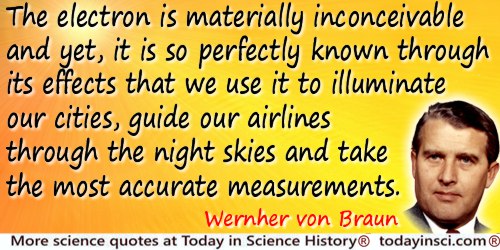
Can a physicist visualize an electron? The electron is materially inconceivable and yet, it is so perfectly known through its effects that we use it to illuminate our cities, guide our airlines through the night skies and take the most accurate measurements. What strange rationale makes some physicists accept the inconceivable electrons as real while refusing to accept the reality of a Designer on the ground that they cannot conceive Him?
In letter to California State board of Education (14 Sep 1972).
Cosmology is a science which has only a few observable facts to work with. The discovery of the cosmic microwave background radiation added one—the present radiation temperature of the universe. This, however, was a significant increase in our knowledge since it requires a cosmology with a source for the radiation at an early epoch and is a new probe of that epoch. More sensitive measurements of the background radiation in the future will allow us to discover additional facts about the universe.
'Discovery of the Cosmic Microwave Background', in B. Bertotti (ed.) Modern Cosmology in Retrospect (1990), 304.
Essentially all civilizations that rose to the level of possessing an urban culture had need for two forms of science-related technology, namely, mathematics for land measurements and commerce and astronomy for time-keeping in agriculture and aspects of religious rituals.
From The Science Matrix: The Journey, Travails, Triumphs (1992, 1998), Preface, x.
Eventually, we reach … the utmost limits of our telescopes. There, we measure shadows, and we search among ghostly errors of measurement for landmarks that are scarcely more substantial.
In Realm of the Nebulae: The Silliman Memorial Lectures Series (1936), 201-202. The lecture series was delivered at Yale University in Fall 1935. Part of a longer quote on this page that begins: “The explorations of space…”.
For the better part of my last semester at Garden City High, I constructed a physical pendulum and used it to make a “precision” measurement of gravity. The years of experience building things taught me skills that were directly applicable to the construction of the pendulum. Twenty-five years later, I was to develop a refined version of this measurement using laser-cooled atoms in an atomic fountain interferometer.
[Outcome of high school physics teacher, Thomas Miner, encouraging Chu's ambitious laboratory project.]
[Outcome of high school physics teacher, Thomas Miner, encouraging Chu's ambitious laboratory project.]
Autobiography in Gösta Ekspong (ed.), Nobel Lectures: Physics 1996-2000 (2002), 116.
For, however much we may clench our teeth in anger, we cannot but confess, in opposition to Galen’s teaching but in conformity with the might of Aristotle’s opinion, that the size of the orifice of the hollow vein at the right chamber of the heart is greater than that of the body of the hollow vein, no matter where you measure the latter. Then the following chapter will show the falsity of Galen’s view that the hollow vein is largest at the point where it joins the hump of the liver.
From De Humani Corporis Fabrica Libri Septem (1543), Book III, 275, as translated by William Frank Richardson and John Burd Carman, in 'The Arguments Advanced by Galen in Opposition to Aristotl’s Views about the Origin of the Hollow Vein Do Not Have Oracular Authority', On The Fabric of the Human Body: Book III: The Veins And Arteries; Book IV: The Nerves (1998), 45.
From him [Wilard Bennett] I learned how different a working laboratory is from a student laboratory. The answers are not known!
[While an undergraduate, doing experimental measurements in the laboratory of his professor, at Ohio State University.]
[While an undergraduate, doing experimental measurements in the laboratory of his professor, at Ohio State University.]
From autobiography on Nobel Prize website.
Geometry is founded in mechanical practice, and is nothing but that part of universal mechanics which accurately proposes and demonstrates the art of measuring.
In Principia (1687), Preface, translated by Andrew Motte (1729), in Florian Cajori (ed.), Sir Isaac Newton's Mathematical Principles of Natural Philosophy (1934), xvii.
Give 'em 2.5 cm, and they'll take 1.6 km.
Go, wondrous creature, mount where science guides.
Go, measure earth, weigh air, and state the tides;
Instruct the planets in what orbs to run,
Correct old Time, and regulate the sun;
Go, teach Eternal Wisdom how to rule,
Then drop into thyself and be a fool.
Go, measure earth, weigh air, and state the tides;
Instruct the planets in what orbs to run,
Correct old Time, and regulate the sun;
Go, teach Eternal Wisdom how to rule,
Then drop into thyself and be a fool.
Quoted in James Wood Dictionary of Quotations from Ancient and Modern, English and Foreign Sources (1893), 125.
His [Henry Cavendish’s] Theory of the Universe seems to have been, that it consisted solely of a multitude of objects which could be weighed, numbered, and measured; and the vocation to which he considered himself called was, to weigh, number and measure as many of those objects as his allotted three-score years and ten would permit. This conviction biased all his doings, alike his great scientific enterprises, and the petty details of his daily life.
In George Wilson, The Life of the Honourable Henry Cavendish: Including the Abstracts of his Important Scientific Papers (1851), 186.
I believe in evidence. I believe in observation, measurement, and reasoning, confirmed by independent observers. I’ll believe anything, no matter how wild and ridiculous, if there is evidence for it. The wilder and more ridiculous something is, however, the firmer and more solid the evidence will have to be.
After stating he did definitely not believe in flying saucers, ancient astronauts, Bermuda Triangle or life after death, he explained what he would believe in. From editorial, 'Don’t You Believe?', Isaac Asimov's Science Fiction Magazine (18 Jan 1982), 6, No. 1, 6.
Collected in The Roving Mind (1983), 43.
I belong to those theoreticians who know by direct observation what it means to make a measurement. Methinks it were better if there were more of them.
Referring to his laboratory experience during his assistantship in experimental physics, as quoted in Walter Moore, Schrödinger: Life and Thought (1989, 1998), 58-59. Moore describes that Schrödinger in his early days in the laboratory, “learned to believe that physics is not based upon mathematical fantasies but on a solid ground of experimental observations.”
I have no patience with attempts to identify science with measurement, which is but one of its tools, or with any definition of the scientist which would exclude a Darwin, a Pasteur or a Kekulé. The scientist is a practical man and his are practical aims. He does not seek the ultimate but the proximate. He does not speak of the last analysis but rather of the next approximation. His are not those beautiful structures so delicately designed that a single flaw may cause the collapse of the whole. The scientist builds slowly and with a gross but solid kind of masonry. If dissatisfied with any of his work, even if it be near the very foundations, he can replace that part without damage to the remainder. On the whole, he is satisfied with his work, for while science may never be wholly right it certainly is never wholly wrong; and it seems to be improving from decade to decade.
The Anatomy of Science (1926), 6-7.
I have seen the sea lashed into fury and tossed into spray, and its grandeur moves the soul of the dullest man; but I remember that it is not the billows, but the calm level of the sea from which all heights and depths are measured.
Speech (5 Jun 1880) at the 7th Republican National Convention, Chicago to nominate John Sherman to be President. In John Tweedy, A History of the Republican National Conventions from 1856 to 1908 (1910), 191. The Convention subsequently nominated Garfield to run for President. He won the election, and was inaugurated on 4 Mar 1881.
I learned, and later had to unlearn in order to become a scientist myself, that science is simply measurement and the answers are in print.
This View of Life: the World of an Evolutionist (1964), 27.
I think that a particle must have a separate reality independent of the measurements. That is an electron has spin, location and so forth even when it is not being measured. I like to think that the moon is there even if I am not looking at it.
…...
I used to measure the Heavens, now I measure the shadows of Earth. The mind belonged to Heaven, the body’s shadow lies here.
Epitaph that Kepler wrote for himself, a few months before he died. As translated from the original Latin, “Mensus eram coelos, nunc Terrae metior umbras. Mens coelestis erat, corporis umbra jacet.” In M. Caspar et al. (eds.), Johannes Kepler Gesammelte Werke (1937), 19, 393.
I would by all means have men beware, lest Æsop’s pretty fable of the fly that sate [sic] on the pole of a chariot at the Olympic races and said, “What a dust do I raise,” be verified in them. For so it is that some small observation, and that disturbed sometimes by the instrument, sometimes by the eye, sometimes by the calculation, and which may be owing to some real change in the heaven, raises new heavens and new spheres and circles.
'Of Vain Glory' (1625) in James Spedding, Robert Ellis and Douglas Heath (eds.), The Works of Francis Bacon (1887-1901), Vol. 6, 503.
If and when all the laws governing physical phenomena are finally discovered, and all the empirical constants occurring in these laws are finally expressed through the four independent basic constants, we will be able to say that physical science has reached its end, that no excitement is left in further explorations, and that all that remains to a physicist is either tedious work on minor details or the self-educational study and adoration of the magnificence of the completed system. At that stage physical science will enter from the epoch of Columbus and Magellan into the epoch of the National Geographic Magazine!
'Any Physics Tomorrow', Physics Today, January 1949, 2, 17.
If it can’t be expressed in figures, it is not science; it is opinion.
In Time Enough For Love: the Lives of Lazarus Long (1973), 257.
If it is possible to have a linear unit that depends on no other quantity, it would seem natural to prefer it. Moreover, a mensural unit taken from the earth itself offers another advantage, that of being perfectly analogous to all the real measurements that in ordinary usage are also made upon the earth, such as the distance between two places or the area of some tract, for example. It is far more natural in practice to refer geographical distances to a quadrant of a great circle than to the length of a pendulum.
'Histoire'. Histoire et Memoires de l’Academie Royale des Science de Paris (1788/1791), 9-10. In Charles Coulston Gillispie, Pierre-Simon Laplace, 1749-1827: A Life in Exact Science (2nd Ed., 2000), 151.
If someone separated the art of counting and measuring and weighing from all the other arts, what was left of each (of the others) would be, so to speak, insignificant.
— Plato
Philebus 55e. Trans. R. W. Sharples.
If there is an underlying oneness of all things, it does not matter where we begin, whether with stars, or laws of supply and demand, or frogs, or Napoleon Bonaparte. One measures a circle, beginning anywhere.
Lo! (1931, 1941), 8.
If they should make the standard for the measure, we call a Chancellor’s foot; what an uncertain measure would this be? One Chancellor has a long foot, another a short foot, a third an indifferent foot.
In John Selden, Richard Milward (ed.), 'Equity', Table-Talk of John Selden (1689), 18.
If we consider what science already has enabled men to know—the immensity of space, the fantastic philosophy of the stars, the infinite smallness of the composition of atoms, the macrocosm whereby we succeed only in creating outlines and translating a measure into numbers without our minds being able to form any concrete idea of it—we remain astounded by the enormous machinery of the universe.
Address (10 Sep 1934) to the International Congress of Electro-Radio Biology, Venice. In Associated Press, 'Life a Closed Book, Declares Marconi', New York Times (11 Sep 1934), 15.
If we take quantum theory seriously as a picture of what’s really going on, each measurement does more than disturb: it profoundly reshapes the very fabric of reality.
…...
If you cannot measure it you cannot control it.
Ray Boundy and J. Laurence Amos (eds.), A History of the Dow Chemical Physics Lab, The Freedom to Be Creative (1990), 53.
If you haven’t measured something, you really don’t know very much about it.
Attributed. As quoted in Arthur R. Upgren, Weather: How It Works and Why It Matters (2008), 7.
Imagination is a contagious disease. It cannot be measured by the yard, or weighed by the pound, and then delivered to the students by members of the faculty. It can only be communicated by a faculty whose members themselves wear their learning with imagination.
In 'Universities and Their Function', The Aims of Education: & Other Essays (1917), 139.
In 1905, a physicist measuring the thermal conductivity of copper would have faced, unknowingly, a very small systematic error due to the heating of his equipment and sample by the absorption of cosmic rays, then unknown to physics. In early 1946, an opinion poller, studying Japanese opinion as to who won the war, would have faced a very small systematic error due to the neglect of the 17 Japanese holdouts, who were discovered later north of Saipan. These cases are entirely parallel. Social, biological and physical scientists all need to remember that they have the same problems, the main difference being the decimal place in which they appear.
In William G. Cochran, Frederick Mosteller and John W. Tukey, 'Principles of Sampling', Journal of the American Statistical Society, 1954, 49, 31. Collected in Selected Papers of Frederick Mosteller (2006), 290.
In a class I was taking there was one boy who was much older than the rest. He clearly had no motive to work. I told him that, if he could produce for me, accurately to scale, drawings of the pieces of wood required to make a desk like the one he was sitting at, I would try to persuade the Headmaster to let him do woodwork during the mathematics hours—in the course of which, no doubt, he would learn something about measurement and numbers. Next day, he turned up with this task completed to perfection. This I have often found with pupils; it is not so much that they cannot do the work, as that they see no purpose in it.
In Mathematician's Delight (1943), 52.
In an enterprise such as the building of the atomic bomb the difference between ideas, hopes, suggestions and theoretical calculations, and solid numbers based on measurement, is paramount. All the committees, the politicking and the plans would have come to naught if a few unpredictable nuclear cross sections had been different from what they are by a factor of two.
Epigraph in Richard Rhodes, The Making of the Atomic Bomb (1986), 8.
In comparison with the great size of the earth the protrusion of mountains is not sufficient to deprive it of its spherical shape or to invalidate measurements based on its spherical shape. For Eratosthenes shows that the perpendicular distance from the highest mountain tops to the lowest regions is ten stades [c.5,000-5,500 feet]. This he shows with the help of dioptras which measure magnitudes at a distance.
Simplicius, Commentary On Aristotle's De Caelo, pp. 549.32-550.4 (Heiberg). Quoted in Morris R. Cohen and I. E. Drabkin, A Sourcebook in Greek Science (1948), 160 n.2.
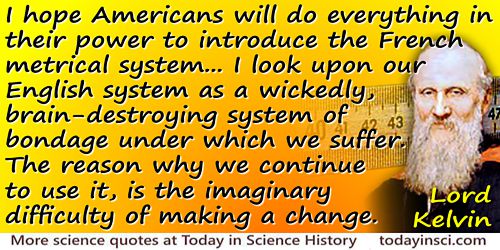
In physical science a first essential step in the direction of learning any subject is to find principles of numerical reckoning and practicable methods for measuring some quality connected with it. I often say that when you can measure what you are speaking about, and express it in numbers, you know something about it; but when you cannot measure it, when you cannot express it in numbers, your knowledge is of a meagre and unsatisfactory kind; it may be the beginning of knowledge, but you have scarcely in your thoughts advanced to the stage of science, whatever the matter may be.
Often seen quoted in a condensed form: If you cannot measure it, then it is not science.
Often seen quoted in a condensed form: If you cannot measure it, then it is not science.
From lecture to the Institution of Civil Engineers, London (3 May 1883), 'Electrical Units of Measurement', Popular Lectures and Addresses (1889), Vol. 1, 80-81.
In the 1920s, there was a dinner at which the physicist Robert W. Wood was asked to respond to a toast … “To physics and metaphysics.” Now by metaphysics was meant something like philosophy—truths that you could get to just by thinking about them. Wood took a second, glanced about him, and answered along these lines: The physicist has an idea, he said. The more he thinks it through, the more sense it makes to him. He goes to the scientific literature, and the more he reads, the more promising the idea seems. Thus prepared, he devises an experiment to test the idea. The experiment is painstaking. Many possibilities are eliminated or taken into account; the accuracy of the measurement is refined. At the end of all this work, the experiment is completed and … the idea is shown to be worthless. The physicist then discards the idea, frees his mind (as I was saying a moment ago) from the clutter of error, and moves on to something else. The difference between physics and metaphysics, Wood concluded, is that the metaphysicist has no laboratory.
In 'Wonder and Skepticism', Skeptical Enquirer (Jan-Feb 1995), 19, No. 1.
In the heavens we discover [stars] by their light, and by their light alone ... the sole evidence of the existence of these distant worlds ... that each of them is built up of molecules of the same kinds we find on earth. A molecule of hydrogen, for example, whether in Sirius or in Arcturus, executes its vibrations in precisely the same time. Each molecule therefore throughout the universe bears impressed upon it the stamp of a metric system as distinctly as does the metre of the Archives at Paris, or the royal cubit of the Temple of Karnac.
[Footnote: Where Maxwell uses the term “molecule” we now use the term “atom.”]
[Footnote: Where Maxwell uses the term “molecule” we now use the term “atom.”]
Lecture to the British Association at Bradford (1873), 'Atoms and Molecules'. Quoted by Ernest Rutherford, in 'The Constitution of Matter and the Evolution of the Elements', The Popular Science Monthly (Aug 1915), 112.
It can happen to but few philosophers, and but at distant intervals, to snatch a science, like Dalton, from the chaos of indefinite combination, and binding it in the chains of number, to exalt it to rank amongst the exact. Triumphs like these are necessarily 'few and far between.'
Reflections on the Decline of Science in England (1830), 22.
It is admitted by all that a finished or even a competent reasoner is not the work of nature alone; the experience of every day makes it evident that education develops faculties which would otherwise never have manifested their existence. It is, therefore, as necessary to learn to reason before we can expect to be able to reason, as it is to learn to swim or fence, in order to attain either of those arts. Now, something must be reasoned upon, it matters not much what it is, provided it can be reasoned upon with certainty. The properties of mind or matter, or the study of languages, mathematics, or natural history, may be chosen for this purpose. Now of all these, it is desirable to choose the one which admits of the reasoning being verified, that is, in which we can find out by other means, such as measurement and ocular demonstration of all sorts, whether the results are true or not. When the guiding property of the loadstone was first ascertained, and it was necessary to learn how to use this new discovery, and to find out how far it might be relied on, it would have been thought advisable to make many passages between ports that were well known before attempting a voyage of discovery. So it is with our reasoning faculties: it is desirable that their powers should be exerted upon objects of such a nature, that we can tell by other means whether the results which we obtain are true or false, and this before it is safe to trust entirely to reason. Now the mathematics are peculiarly well adapted for this purpose, on the following grounds:
1. Every term is distinctly explained, and has but one meaning, and it is rarely that two words are employed to mean the same thing.
2. The first principles are self-evident, and, though derived from observation, do not require more of it than has been made by children in general.
3. The demonstration is strictly logical, taking nothing for granted except self-evident first principles, resting nothing upon probability, and entirely independent of authority and opinion.
4. When the conclusion is obtained by reasoning, its truth or falsehood can be ascertained, in geometry by actual measurement, in algebra by common arithmetical calculation. This gives confidence, and is absolutely necessary, if, as was said before, reason is not to be the instructor, but the pupil.
5. There are no words whose meanings are so much alike that the ideas which they stand for may be confounded. Between the meaning of terms there is no distinction, except a total distinction, and all adjectives and adverbs expressing difference of degrees are avoided.
1. Every term is distinctly explained, and has but one meaning, and it is rarely that two words are employed to mean the same thing.
2. The first principles are self-evident, and, though derived from observation, do not require more of it than has been made by children in general.
3. The demonstration is strictly logical, taking nothing for granted except self-evident first principles, resting nothing upon probability, and entirely independent of authority and opinion.
4. When the conclusion is obtained by reasoning, its truth or falsehood can be ascertained, in geometry by actual measurement, in algebra by common arithmetical calculation. This gives confidence, and is absolutely necessary, if, as was said before, reason is not to be the instructor, but the pupil.
5. There are no words whose meanings are so much alike that the ideas which they stand for may be confounded. Between the meaning of terms there is no distinction, except a total distinction, and all adjectives and adverbs expressing difference of degrees are avoided.
In On the Study and Difficulties of Mathematics (1898), chap. 1.
It is by mathematical formulation of its observations and measurements that a science is able to form mathematically expressed hypotheses, and it is through its hypotheses that a natural science is able to make predictions.
The Nature of Science, and Other Essays (1971), 14.
It is natural for man to relate the units of distance by which he travels to the dimensions of the globe that he inhabits. Thus, in moving about the earth, he may know by the simple denomination of distance its proportion to the whole circuit of the earth. This has the further advantage of making nautical and celestial measurements correspond. The navigator often needs to determine, one from the other, the distance he has traversed from the celestial arc lying between the zeniths at his point of departure and at his destination. It is important, therefore, that one of these magnitudes should be the expression of the other, with no difference except in the units. But to that end, the fundamental linear unit must be an aliquot part of the terrestrial meridian. ... Thus, the choice of the metre was reduced to that of the unity of angles.
Lecture at the École Normale to the Year III (Apr 1795), Oeuvres Completes de Laplace (1878-1912), Vol. 14, 141. In Charles Coulston Gillispie, Dictionary of Scientific Biography (1978), Vol. 15, 335.
It is possible that the deepest meaning and aim of Newtonianism, or rather, of the whole scientific revolution of the seventeenth century, of which Newton is the heir and the highest expression, is just to abolish the world of the 'more or less', the world of qualities and sense perception, the world of appreciation of our daily life, and to replace it by the (Archimedean) universe of precision, of exact measures, of strict determination ... This revolution [is] one of the deepest, if not the deepest, mutations and transformations accomplished—or suffered—by the human mind since the invention of the cosmos by the Greeks, two thousand years before.
'The Significance of the Newtonian Synthesis' (1950). In Newtonian Studies (1965), 4-5.
It is really just as bad technique to make a measurement more accurately than is necessary as it is to make it not accurately enough.
Scientific Method: An Inquiry into the Character and Validy of Natural Law (1923), 113.
It may be said of many palaeontologists, as Professor Hugh Trevor-Roper said recently of 18th century historians: “Their most serious error was to measure the past by the present”.
In The Nature of the Stratigraphical Record (1973), 26.
It seemed as though the main framework had been put together once and for all, and that little remained to be done but to measure physical constants to the increased accuracy represented by another decimal point.
A History of Science and Its Relations with Philosophy and Religion (1931), 882.
It was a great step in science when men became convinced that, in order to understand the nature of things, they must begin by asking, not whether a thing is good or bad, noxious or beneficial, but of what kind it is? And how much is there of it? Quality and Quantity were then first recognised as the primary features to be observed in scientific inquiry.
'Address to the Mathematical and Physical Sections of the British Association, Liverpool, 15 Sep 1870', The Scientific Papers of James Clerk Maxwell (1890 edition, reprint 2003), Vol. 2, 217.
It’s a common occurrence in a forefront area of science, where the questions are tough and the measurements extremely difficult. You have different groups using different methods and they get different answers. You see it all the time, and the public rarely notices. But when it happens to be in cosmology, it makes headlines.
As quoted in John Moble Wilford, 'Astronomers Debate Conflicting Answers for the Age of the Universe', New York Times (27 Dec 1994), C9.
Just as it will never be successfully challenged that the French language, progressively developing and growing more perfect day by day, has the better claim to serve as a developed court and world language, so no one will venture to estimate lightly the debt which the world owes to mathematicians, in that they treat in their own language matters of the utmost importance, and govern, determine and decide whatever is subject, using the word in the highest sense, to number and measurement.
In 'Sprüche in Prosa', Natur, III, 868.
Let him who so wishes take pleasure in boring us with all the wonders of nature: let one spend his life observing insects, another counting the tiny bones in the hearing membrane of certain fish, even in measuring, if you will, how far a flea can jump, not to mention so many other wretched objects of study; for myself, who am curious only about philosophy, who am sorry only not to be able to extend its horizons, active nature will always be my sole point of view; I love to see it from afar, in its breadth and its entirety, and not in specifics or in little details, which, although to some extent necessary in all the sciences, are generally the mark of little genius among those who devote themselves to them.
'L'Homme Plante', in Oeuvres Philosophiques de La Mettrie (1796), Vol. 2, 70-1. Jacques Roger, The Life Sciences in Eighteenth-Century French Thought, edited by Keith R. Benson and trans. Robert Ellrich (1997), 377.
Let us keep the discoveries and indisputable measurements of physics. But ... A more complete study of the movements of the world will oblige us, little by little, to turn it upside down; in other words, to discover that if things hold and hold together, it is only by reason of complexity, from above.
In Teilhard de Chardin and Bernard Wall (trans.), The Phenomenon of Man (1959, 2008), 43. Originally published in French as Le Phénomene Humain (1955).
Life through many long periods has been manifested in a countless host of varying structures, all circumscribed by one general plan, each appointed to a definite place, and limited to an appointed duration. On the whole the earth has been thus more and more covered by the associated life of plants and animals, filling all habitable space with beings capable of enjoying their own existence or ministering to the enjoyment of others; till finally, after long preparation, a being was created capable of the wonderful power of measuring and weighing all the world of matter and space which surrounds him, of treasuring up the past history of all the forms of life, and considering his own relation to the whole. When he surveys this vast and co-ordinated system, and inquires into its history and origin, can he be at a loss to decide whether it be a work of Divine thought and wisdom, or the fortunate offspring of a few atoms of matter, warmed by the anima mundi, a spark of electricity, or an accidental ray of sunshine?
Life on the Earth: Its Origin and Succession (1860), 216-7.
Long ago it was said: If Tycho had had instruments ten times as precise, we would never have had a Kepler, or a Newton, or Astronomy.
In La Science et l’Hypothèse (1901, 1908), 211, as translated in Henri Poincaré and William John Greenstreet (trans.), Science and Hypothesis (1902, 1905), 181. From the original French, “Il y a longtemps qu’on l’a dit: Si Tycho avait eu des instruments dix fois plus précis, il n’y aurait jamais eu ni Képler, ni Newton, ni Astronomie.”
Lord Kelvin was so satisfied with this triumph of science that he declared himself to be as certain of the existence of the ether as a man can be about anything.... “When you can measure what you are speaking about, and express it in numbers, you know something about it....” Thus did Lord Kelvin lay down the law. And though quite wrong, this time he has the support of official modern Science. It is NOT true that when you can measure what you are speaking about, you know something about it. The fact that you can measure something doesn't even prove that that something exists.... Take the ether, for example: didn't they measure the ratio of its elasticity to its density?
In Science is a Sacred Cow (1950), 69-70; 85.
Man cannot have an effect on nature, cannot adopt any of her forces, if he does not know the natural laws in terms of measurement and numerical relations. Here also lies the strength of the national intelligence, which increases and decreases according to such knowledge. Knowledge and comprehension are the joy and justification of humanity; they are parts of the national wealth, often a replacement for the materials that nature has too sparcely dispensed. Those very people who are behind us in general industrial activity, in application and technical chemistry, in careful selection and processing of natural materials, such that regard for such enterprise does not permeate all classes, will inevitably decline in prosperity; all the more so were neighbouring states, in which science and the industrial arts have an active interrelationship, progress with youthful vigour.
Kosmos (1845), vol.1, 35. Quoted in C. C. Gillispie (ed.), Dictionary of Scientific Biography (1970), vol. 6, 552.
Man is the measure of all things.
Protagoras, fr. 4, quoted in E. Hussey, The Pre-Socratics(1972), 109.
Many scientists have tried to make determinism and complementarity the basis of conclusions that seem to me weak and dangerous; for instance, they have used Heisenberg’s uncertainty principle to bolster up human free will, though his principle, which applies exclusively to the behavior of electrons and is the direct result of microphysical measurement techniques, has nothing to do with human freedom of choice. It is far safer and wiser that the physicist remain on the solid ground of theoretical physics itself and eschew the shifting sands of philosophic extrapolations.
In New Perspectives in Physics (1962), viii.
Mathematics … certainly would never have come into existence if mankind had known from the beginning that in all nature there is no perfectly straight line, no true circle, no standard of measurement.
From 'Of the First and Last Things', All Too Human: A Book For Free Spirits (1878, 1908), Part 1, section 11, 31.
Mathematics is that peculiar science in which the importance of a work can be measured by the number of earlier publications rendered superfluous by it.
As stated in narrative, without quotation marks, in Joong Fang, Bourbaki (1970), 18, citing “as Hilbert declared at the end of his famous paper on the twenty-three unsolved problems.” Webmaster has not identified this in that paper, however. Also quoted, without citation, in Harold Eves, Mathematical Circles Revisited (1971), as “One can measure the importance of a scientific work by the number of earlier publications rendered superfluous by it.”
May every young scientist remember … and not fail to keep his eyes open for the possibility that an irritating failure of his apparatus to give consistent results may once or twice in a lifetime conceal an important discovery.
Commenting on the discovery of thoron gas because one of Rutherford’s students had found his measurements of the ionizing property of thorium were variable. His results even seemed to relate to whether the laboratory door was closed or open. After considering the problem, Rutherford realized a radioactive gas was emitted by thorium, which hovered close to the metal sample, adding to its radioactivity—unless it was dissipated by air drafts from an open door. (Thoron was later found to be argon.)
Commenting on the discovery of thoron gas because one of Rutherford’s students had found his measurements of the ionizing property of thorium were variable. His results even seemed to relate to whether the laboratory door was closed or open. After considering the problem, Rutherford realized a radioactive gas was emitted by thorium, which hovered close to the metal sample, adding to its radioactivity—unless it was dissipated by air drafts from an open door. (Thoron was later found to be argon.)
In Barbara Lovett Cline, Men Who Made a New Physics (1987), 21.
May the Gods confound that man who first disclosed the hours, and who first, in fact, erected a sun-dial here; who, for wretched me, minced the day up into pieces. For when I was a boy, this stomach was the sun-dial, one much better and truer than all of these; when that used to warn me to eat. Except when there was nothing to eat. Now, even when there is something to eat, it’s not eaten, unless the sun chooses; and to such a degree now, in fact, is the city filled with sun-dials, that the greater part of the people are creeping along the streets shrunk up with famine.
— Plautus
A fragment, preserved in the works of Aulus Gellius, as translated by Henry Thomas Riley, in The Comedies of Plautus (1890), Vol. 2, 517.
Measurement has too often been the leitmotif of many investigations rather than the experimental examination of hypotheses. Mounds of data are collected, which are statistically decorous and methodologically unimpeachable, but conclusions are often trivial and rarely useful in decision making. This results from an overly rigorous control of an insignificant variable and a widespread deficiency in the framing of pertinent questions. Investigators seem to have settled for what is measurable instead of measuring what they would really like to know.
'Patient Care—Mystical Research or Researchable Mystique/', Clinical Research (1964), 12, no. 4, 422.
Medical statistics will be our standard of measurement: we will weigh life for life and see where the dead lie thicker, among the workers or among the privileged.
Inaugurating his journal, Die Medizinische Reform (1848), 182, in which he asked scholars to collect medical statistics. (The Medical Reform.) As quoted in Paul Farmer, Infections and Inequalities: The Modern Plagues (2001), 1. Cited in David L. Brunsma, Keri E. Iyall Smith and Brian K. Gran (eds.), Institutions Unbound: Social Worlds and Human Rights (2016), 10 & 207 footnote.
Men can construct a science with very few instruments, or with very plain instruments; but no one on earth could construct a science with unreliable instruments. A man might work out the whole of mathematics with a handful of pebbles, but not with a handful of clay which was always falling apart into new fragments, and falling together into new combinations. A man might measure heaven and earth with a reed, but not with a growing reed.
Heretics (1905), 146-7.
Nature vibrates with rhythms, climatic and diastrophic, those finding stratigraphic expression ranging in period from the rapid oscillation of surface waters, recorded in ripple-mark, to those long-deferred stirrings of the deep imprisoned titans which have divided earth history into periods and eras. The flight of time is measured by the weaving of composite rhythms- day and night, calm and storm, summer and winter, birth and death such as these are sensed in the brief life of man. But the career of the earth recedes into a remoteness against which these lesser cycles are as unavailing for the measurement of that abyss of time as would be for human history the beating of an insect's wing. We must seek out, then, the nature of those longer rhythms whose very existence was unknown until man by the light of science sought to understand the earth. The larger of these must be measured in terms of the smaller, and the smaller must be measured in terms of years.
'Rhythm and the Measurement of Geologic Time', Bulletin of the Geological Society of America, 1917, 28,746.
No effect that requires more than 10 percent accuracy in measurement is worth investigating.
…...
No person will deny that the highest degree of attainable accuracy is an object to be desired, and it is generally found that the last advances towards precision require a greater devotion of time, labour, and expense, than those which precede them.
Reflections on the Decline of Science in England (1830), 167.
On careful examination the physicist finds that in the sense in which he uses language no meaning at all can be attached to a physical concept which cannot ultimately be described in terms of some sort of measurement. A body has position only in so far as its position can be measured; if a position cannot in principle be measured, the concept of position applied to the body is meaningless, or in other words, a position of the body does not exist. Hence if both the position and velocity of electron cannot in principle be measured, the electron cannot have the same position and velocity; position and velocity as expressions of properties which an electron can simultaneously have are meaningless.
Reflections of a Physicist (1950), 90.
Our clocks do not measure time. ... Time is defined to be what our clocks measure.
Unnamed person at the National Institute of Standards and Technology in Boulder, U.S.A., quoted by Tim Folger in 'Newsflash: Time May Not Exist', Discover Magazine (Jun 2007).
Our experience shows that not everything that is observable and measurable is predictable, no matter how complete our past observations may have been.
In Presidential Address (8 Feb 1963), Quarterly Journal of the Royal Astronomical Society (Mar 1963), 4, 197.
Our mind, by virtue of a certain finite, limited capability, is by no means capable of putting a question to Nature that permits a continuous series of answers. The observations, the individual results of measurements, are the answers of Nature to our discontinuous questioning.
…...
Philosophically, I liked the steady-state cosmology. So I thought that we should report our results as a simple measurement; the measurement might be true after the cosmology was no longer true!
Remarking on the measurement he made with Arno Penzias of the 3 K cosmic background radiation. From Proceedings of workshop, National Radio Astronomy Observatory, Green Bank, West Virginia (4-6 May 1983), 'Discovery of the Cosmic Microwave Background', Serendipitous Discoveries in Radio Astronomy (1983), 195. Also collected in B. Bertotti (ed.) Modern Cosmology in Retrospect (1990), 303.
Placed in a universe of constant change, on an isolated globe surrounded by distant celestial objects on all sides, subjected to influences of various kinds, it is a sublime occupation to measure the earth and weigh the planets, to predict their changes, and even to discover the materials of which they are composed; to investigate the causes of the tempest and volcano; to bring the lightning from the clouds; to submit it to experiment by which it shall reveal its character; and to estimate the size and weight of those invisible atoms which constitute the universe of things.
In Letter (3 Feb 1873) to the Committee of Arrangements, in Proceedings of the Farewell Banquet to Professor Tyndall (4 Feb 1873), 19. Reprinted as 'On the Importance of the Cultivation of Science', The Popular Science Monthly (1873), Vol. 2, 645.
Refining is inevitable in science when you have made measurements of a phenomenon for a long period of time.
From interview with Henry Spall, as in an abridged version of Earthquake Information Bulletin (Jan-Feb 1980), 12, No. 1, that is on the USGS website.
Research is four things: brains with which to think, eyes with which to see, machines with which to measure, and fourth, money.
Quoted in obituary by Walter Sullivan, 'Albert Szent-Gyorgyi Dead; Research Isolated Vitamin C', New York Times (25 Oct 1986), 9.
Scholarship, save by accident, is never the measure of a man's power.
Plain Talks on Familiar Subjects: a Series of Popular Lectures (1873), 19.
Science has taught us to think the unthinkable. Because when nature is the guide—rather than a priori prejudices, hopes, fears or desires—we are forced out of our comfort zone. One by one, pillars of classical logic have fallen by the wayside as science progressed in the 20th century, from Einstein's realization that measurements of space and time were not absolute but observer-dependent, to quantum mechanics, which not only put fundamental limits on what we can empirically know but also demonstrated that elementary particles and the atoms they form are doing a million seemingly impossible things at once.
In op-ed, 'A Universe Without Purpose', Los Angeles Times (1 Apr 2012).
Science is measurement. If I cannot make measurements, I cannot study a problem scientifically.
In 'Musical Acoustics Today', New Scientist (1 Nov 1962), 16 No. 311, 257.
Science that jumps to measurement too soon is as unsound as science that ignore measurement too long.
From Jacob Morton Braude, Speaker's Desk Book of Quips, Quotes, & Anecdotes (1966), 295. Also in Science Digest (1954), 36, 55.
Since science's competence extends to observable and measurable phenomena, not to the inner being of things, and to the means, not to the ends of human life, it would be nonsense to expect that the progress of science will provide men with a new type of metaphysics, ethics, or religion.
'Science and Ontology', Bulletin of Atomic Scientists (1949), 5, 200.
Subatomic particles have no meaning as isolated entities, but can only be understood as interconnections between the preparation of an experiment and the subsequent measurement.
In The Tao of Physics (1975), 68.
Such pretensions to nicety in experiments of this nature, are truly laughable! They will be telling us some day of the WEIGHT of the MOON, even to drams, scruples and grains—nay, to the very fraction of a grain!—I wish there were infallible experiments to ascertain the quantum of brains each man possesses, and every man's integrity and candour:—This is a desideratum in science which is most of all wanted.
The Death Warrant of the French Theory of Chemistry (1804), 217.
Take the living human brain endowed with mind and thought. …. The physicist brings his tools and commences systematic exploration. All that he discovers is a collection of atoms and electrons and fields of force arranged in space and time, apparently similar to those found in inorganic objects. He may trace other physical characteristics, energy, temperature, entropy. None of these is identical with thought. … How can this collection of ordinary atoms be a thinking machine? … The Victorian physicist felt that he knew just what he was talking about when he used such terms as matter and atoms. … But now we realize that science has nothing to say as to the intrinsic nature of the atom. The physical atom is, like everything else in physics, a schedule of pointer readings.
From a Gifford Lecture, University of Edinburgh (1927), published in 'Pointer Readings: Limits of Physical Knowledge', The Nature of the Physical World (1929), 258-259.
That hemisphere of the moon which faces us is better known than the earth itself; its vast desert plains have been surveyed to within a few acres; its mountains and craters have been measured to within a few yards; while on the earth's surface there are 30,000,000 square kilometres (sixty times the extent of France), upon which the foot of man has never trod, which the eye of man has never seen.
In 'Mars, by the Latest Observations', Popular Science (Dec 1873), 4, 187.
The chemists work with inaccurate and poor measuring services, but they employ very good materials. The physicists, on the other hand, use excellent methods and accurate instruments, but they apply these to very inferior materials. The physical chemists combine both these characteristics in that they apply imprecise methods to impure materials.
Quoted in Ralph Oesper, The Human Side of Scientists (1975), 116.
The comparatively small progress toward universal acceptance made by the metric system seems to be due not altogether to aversion to a change of units, but also to a sort of irrepressible conflict between the decimal and binary systems of subdivision.
[Remarking in 1892 (!) that although decimal fractions were introduced about 1585, America retains measurements in halves, quarters, eights and sixteenths in various applications such as fractions of an inch, the compass or used by brokers.]
[Remarking in 1892 (!) that although decimal fractions were introduced about 1585, America retains measurements in halves, quarters, eights and sixteenths in various applications such as fractions of an inch, the compass or used by brokers.]
'Octonary Numeration', Bulletin of the New York Mathematical Society (1892),1, 1.
The determination of the relationship and mutual dependence of the facts in particular cases must be the first goal of the Physicist; and for this purpose he requires that an exact measurement may be taken in an equally invariable manner anywhere in the world… Also, the history of electricity yields a well-known truth—that the physicist shirking measurement only plays, different from children only in the nature of his game and the construction of his toys.
In 'Mémoire sur la mesure de force de l'électricité', Journal de Physique (1782), 21, 191. English version by Google Translate tweaked by Webmaster. From the original French, “La determination de la relation & de la dépendance mutuelle de ces données dans certains cas particuliers, doit être le premier but du Physicien; & pour cet effet, il falloit one mesure exacte qui indiquât d’une manière invariable & égale dans tous les lieux de la terre, le degré de l'électricité au moyen duquel les expéiences ont été faites… Aussi, l’histoire de l'électricité prouve une vérité suffisamment reconnue; c’est que le Physicien sans mesure ne fait que jouer, & qu’il ne diffère en cela des enfans, que par la nature de son jeu & la construction de ses jouets.”
The end of the eighteenth and the beginning of the nineteenth century were remarkable for the small amount of scientific movement going on in this country, especially in its more exact departments. ... Mathematics were at the last gasp, and Astronomy nearly so—I mean in those members of its frame which depend upon precise measurement and systematic calculation. The chilling torpor of routine had begun to spread itself over all those branches of Science which wanted the excitement of experimental research.
Quoted in Sophia Elizabeth De Morgan, Memoir of Augustus De Morgan (1882), 41
The experiment left no doubt that, as far as accuracy of measurement went, the resistance disappeared. At the same time, however, something unexpected occurred. The disappearance did not take place gradually but abruptly. From 1/500 the resistance at 4.2K, it could be established that the resistance had become less than a thousand-millionth part of that at normal temperature. Thus the mercury at 4.2K has entered a new state, which, owing to its particular electrical properties, can be called the state of superconductivity.
'Investigations into the Properties of Substances at low Temperatures, which have led, amongst other Things, to the Preparation of Liquid Helium', Nobel Lecture (11 Dec 1913). In Nobel Lectures in Physics 1901-1921 (1967), 333.
The explorations of space end on a note of uncertainty. And necessarily so. … We know our immediate neighborhood rather intimately. With increasing distance our knowledge fades, and fades rapidly. Eventually, we reach the dim boundary—the utmost limits of our telescopes. There, we measure shadows, and we search among ghostly errors of measurement for landmarks that are scarcely more substantial. The search will continue. Not until the empirical resources are exhausted, need we pass on to the dreamy realms of speculation.
From conclusion of The Silliman Memorial Lectures Series delivered at Yale University (Fall 1935). Collected in The Realm of the Nebulae: The Silliman Memorial Lectures Series (1936), 201-202.
The farther researches we make into this admirable scene of things, the more beauty and harmony we see in them: And the stronger and clearer convictions they give us, of the being, power and wisdom of the divine Architect, who has made all things to concur with a wonderful conformity, in carrying on, by various and innumerable combinations of matter, such a circulation of causes, and effects, as was necessary to the great ends of nature. And since we are assured that the all-wise Creator has observed the most exact proportions, of number, weight and measure, in the make of all things; the most likely way therefore, to get any insight into the nature of those parts of the creation, which come within our observation, must in all reason be to number, weigh and measure. And we have much encouragement to pursue this method, of searching into the nature of things, from the great success that has attended any attempts of this kind.
Vegetable Staticks (1727), xxxi.
The first steps in the path of discovery, and the first approximate measures, are those which add most to the existing knowledge of mankind.
Reflections on the Decline of Science in England (1830), 167.
The generalized theory of relativity has furnished still more remarkable results. This considers not only uniform but also accelerated motion. In particular, it is based on the impossibility of distinguishing an acceleration from the gravitation or other force which produces it. Three consequences of the theory may be mentioned of which two have been confirmed while the third is still on trial: (1) It gives a correct explanation of the residual motion of forty-three seconds of arc per century of the perihelion of Mercury. (2) It predicts the deviation which a ray of light from a star should experience on passing near a large gravitating body, the sun, namely, 1".7. On Newton's corpuscular theory this should be only half as great. As a result of the measurements of the photographs of the eclipse of 1921 the number found was much nearer to the prediction of Einstein, and was inversely proportional to the distance from the center of the sun, in further confirmation of the theory. (3) The theory predicts a displacement of the solar spectral lines, and it seems that this prediction is also verified.
Studies in Optics (1927), 160-1.
The importance of C.F. Gauss for the development of modern physical theory and especially for the mathematical fundament of the theory of relativity is overwhelming indeed; also his achievement of the system of absolute measurement in the field of electromagnetism. In my opinion it is impossible to achieve a coherent objective picture of the world on the basis of concepts which are taken more or less from inner psychological experience.
Quoted in G. Waldo Dunnington, Carl Friedrich Gauss: Titan of Science (2004), 350.
The inventor and the research man are confused because they both examine results of physical or chemical operations. But they are exact opposites, mirror images of one another. The research man does something and does not care [exactly] what it is that happens, he measures whatever it is. The inventor wants something to happen, but does not care how it happens or what it is that happens if it is not what he wants.
Aphorism listed Frederick Seitz, The Cosmic Inventor: Reginald Aubrey Fessenden (1866-1932) (1999), 54, being Transactions of the American Philosophical Society, Held at Philadelphia For Promoting Useful Knowledge, Vol. 86, Pt. 6.
The laboratory routine, which involves a great deal of measurement, filing, and tabulation, is either my lifeline or my chief handicap, I hardly know which.
(1949). Epigraph in Susan Elizabeth Hough, Richter's Scale: Measure of an Earthquake, Measure of a Man (2007), 62.
The laboratory work was the province of Dr Searle, an explosive, bearded Nemesis who struck terror into my heart. If one made a blunder one was sent to ‘stand in the corner’ like a naughty child. He had no patience with the women students. He said they disturbed the magnetic equipment, and more than once I heard him shout ‘Go and take off your corsets!’ for most girls wore these garments then, and steel was beginning to replace whalebone as a stiffening agent. For all his eccentricities, he gave us excellent training in all types of precise measurement and in the correct handling of data.
In Cecilia Payne-Gaposchkin: An Autobiography and Other Recollections (1996), 116.
The law of the heart is thus the same as the law of muscular tissue generally, that the energy of contraction, however measured, is a function of the length of the muscle fibre.
The Linacre Lecture on the Law of the Heart (1918), 142.
The Lord demands accurate scales and balances; He set the standards for fairness.
— Bible
Proverbs 16:11, as given in The Swindoll Study Bible NLT (New Living Translation), 760. In the King James Version, this is given as: “A just weight and balance are the Lord’s: all the weights of the bag are his work.”
The mind comprehends a thing the more correctly the closer the thing approaches toward pure quantity as its origin.
Letter to Mästlin (19 Apr 1597). In Gerald James Holton, Thematic Origins of Scientific Thought: Kepler to Einstein (1985), 74.
The more important fundamental laws and facts of physical science have all been discovered, and these are now so firmly established that the possibility of their ever being supplanted in consequence of new discoveries is exceedingly remote. Nevertheless, it has been found that there are apparent exceptions to most of these laws, and this is particularly true when the observations are pushed to a limit, i.e., whenever the circumstances of experiment are such that extreme cases can be examined. Such examination almost surely leads, not to the overthrow of the law, but to the discovery of other facts and laws whose action produces the apparent exceptions. As instances of such discoveries, which are in most cases due to the increasing order of accuracy made possible by improvements in measuring instruments, may be mentioned: first, the departure of actual gases from the simple laws of the so-called perfect gas, one of the practical results being the liquefaction of air and all known gases; second, the discovery of the velocity of light by astronomical means, depending on the accuracy of telescopes and of astronomical clocks; third, the determination of distances of stars and the orbits of double stars, which depend on measurements of the order of accuracy of one-tenth of a second-an angle which may be represented as that which a pin's head subtends at a distance of a mile. But perhaps the most striking of such instances are the discovery of a new planet or observations of the small irregularities noticed by Leverrier in the motions of the planet Uranus, and the more recent brilliant discovery by Lord Rayleigh of a new element in the atmosphere through the minute but unexplained anomalies found in weighing a given volume of nitrogen. Many other instances might be cited, but these will suffice to justify the statement that “our future discoveries must be looked for in the sixth place of decimals.”
In Light Waves and Their Uses (1903), 23-4. Michelson had some years earlier referenced “an eminent physicist” that he did not name who had “remarked that the future truths of physical science are to be looked for in the sixth place of decimals,” near the end of his Convocation Address at the Dedication of the Ryerson Physical Laboratory at the University of Chicago, 'Some of the Objects and Methods of Physical Science' (4 Jul 1894), published in University of Chicago Quarterly Calendar (Aug 1894), 3, No.2, 15. Also
The most commonly used measure of biodiversity is species richness, which simply means the number of species in one place. But that measure alone does not tell us how healthy an ecosystem is. For example, think of a pristine coral reef and an overfished coral reef. The pristine reef might have dozens of gray reef sharks, whereas the overfished reef could have just one shark left.
From The Nature of Nature: Why We Need the Wild (2020), Ch. 9.
The most striking impression was that of an overwhelming bright light. I had seen under similar conditions the explosion of a large amount—100 tons—of normal explosives in the April test, and I was flabbergasted by the new spectacle. We saw the whole sky flash with unbelievable brightness in spite of the very dark glasses we wore. Our eyes were accommodated to darkness, and thus even if the sudden light had been only normal daylight it would have appeared to us much brighter than usual, but we know from measurements that the flash of the bomb was many times brighter than the sun. In a fraction of a second, at our distance, one received enough light to produce a sunburn. I was near Fermi at the time of the explosion, but I do not remember what we said, if anything. I believe that for a moment I thought the explosion might set fire to the atmosphere and thus finish the earth, even though I knew that this was not possible.
In Enrico Fermi: Physicist (1970), 147.
The new painters do not propose, any more than did their predecessors, to be geometers. But it may be said that geometry is to the plastic arts what grammar is to the art of the writer. Today, scholars no longer limit themselves to the three dimensions of Euclid. The painters have been lead quite naturally, one might say by intuition, to preoccupy themselves with the new possibilities of spatial measurement which, in the language of the modern studios, are designated by the term fourth dimension.
The Cubist Painters: Aesthetic Meditations (1913) translated by Lionel Abel (1970), 13. Quoted in Michele Emmer, The Visual Mind II (2005), 352.
The only man who behaved sensibly was my tailor; he took my measurement anew every time he saw me, while all the rest went on with their old measurements and expected them to fit me.
…...
The progress of science is often affected more by the frailties of humans and their institutions than by the limitations of scientific measuring devices. The scientific method is only as effective as the humans using it. It does not automatically lead to progress.
Chemistry (1989), 6.
The radiation of radium was “contagious”—Contagious like a persistent scent or a disease. It was impossible for an object, a plant, an animal or a person to be left near a tube of radium without immediately acquiring a notable “activity” which a sensitive apparatus could detect.
In Eve Curie, Madame Curie: a Biography by Eve Curie (1937, 2007), 196.
The same applies to the concept of force as does to any other physical concept: Verbal definitions are meaningless; real definitions are given through a measuring process.
As given in epigraph, without citation, in Eberhard Zeidler and Juergen Quandt (trans.), Nonlinear Functional Analysis and its Applications: IV: Applications to Mathematical Physics (2013), 9.
The saying often quoted from Lord Kelvin… that “where you cannot measure your knowledge is meagre and unsatisfactory,” as applied in mental and social science, is misleading and pernicious. This is another way of saying that these sciences are not science in the sense of physical science and cannot attempt to be such without forfeiting their proper nature and function. Insistence on a concretely quantitative economics means the use of statistics of physical magnitudes, whose economic meaning and significance is uncertain and dubious. (Even wheat is approximately homogeneous only if measured in economic terms.) And a similar statement would even apply more to other social sciences. In this field, the Kelvin dictum very largely means in practice, “if you cannot measure, measure anyhow!”
'What is Truth' in Economics? (1956), 166.
The science of genetics is in a transition period, becoming an exact science just as the chemistry in the times of Lavoisier, who made the balance an indispensable implement in chemical research.
The Genotype Conception of Heredity', The American Naturalist (1911), 45, 131.
The science of the geologist seems destined to exert a marked influence on that of the natural theologian... Not only—to borrow from Paley's illustration—does it enable him to argue on the old grounds, from the contrivance exhibited in the watch found on the moor, that the watch could not have lain upon the moor for ever; but it establishes further, on different and more direct evidence, that there was a time when absolutely the watch was not there; nay, further, so to speak, that there was a previous time in which no watches existed at all, but only water-clocks; yet further, that there was at time in which there we not even water-clocks, but only sun-dials; and further, an earlier time still in which sun-dials were not, nor an measurers of time of any kind.
Lecture to the Edinburgh Philosophical Institution, 'Geology in its Bearings on the Two Theologies, Part 1', collected in The Testimony of the Rocks: or, Geology in Its Bearings on the Two Theologies, Natural and Revealed (1857), 211.
The sciences are taught in following order: morality, arithmetic, accounts, agriculture, geometry, longimetry, astronomy, geomancy, economics, the art of government, physic, logic, natural philosophy, abstract mathematics, divinity, and history.
From Ain-i-Akbery (c.1590). As translated from the original Persian, by Francis Gladwin in 'Akbar’s Conduct and Administrative Rules', 'Regulations For Teaching in the Public Schools', Ayeen Akbery: Or, The Institutes of the Emperor Akber (1783), Vol. 1, 290. Note: Akbar (Akber) was a great ruler; he was an enlightened statesman. He instituted a great system for general education.
The seventeenth century witnessed the birth of modern science as we know it today. This science was something new, based on a direct confrontation of nature by experiment and observation. But there was another feature of the new science—a dependence on numbers, on real numbers of actual experience.
From The Triumph of Numbers: How Counting Shaped Modern Life (2005), 37.
The strength and weakness of physicists is that we believe in what we can measure. And if we can't measure it, then we say it probably doesn't exist. And that closes us off to an enormous amount of phenomena that we may not be able to measure because they only happened once. For example, the Big Bang. ... That's one reason why they scoffed at higher dimensions for so many years. Now we realize that there's no alternative...
Quoted in Nina L. Diamond, Voices of Truth (2000), 333-334.
The truth is that other systems of geometry are possible, yet after all, these other systems are not spaces but other methods of space measurements. There is one space only, though we may conceive of many different manifolds, which are contrivances or ideal constructions invented for the purpose of determining space.
In Science (1903), 18, 106. In Robert Édouard Moritz, Memorabilia Mathematica (1914), 352.
The velocity of light is one of the most important of the fundamental constants of Nature. Its measurement by Foucault and Fizeau gave as the result a speed greater in air than in water, thus deciding in favor of the undulatory and against the corpuscular theory. Again, the comparison of the electrostatic and the electromagnetic units gives as an experimental result a value remarkably close to the velocity of light–a result which justified Maxwell in concluding that light is the propagation of an electromagnetic disturbance. Finally, the principle of relativity gives the velocity of light a still greater importance, since one of its fundamental postulates is the constancy of this velocity under all possible conditions.
Studies in Optics (1927), 120.
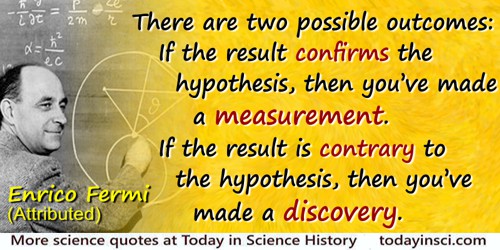
There are two possible outcomes: If the result confirms the hypothesis, then you’ve made a measurement. If the result is contrary to the hypothesis, then you’ve made a discovery.
Attributed. Found in various sources, but without citation, for example in Nancy Trautmann, Assessing Toxic Risk: Teacher Edition (2001), 29. Also rephrased as “Experimental confirmation of a prediction is merely a measurement. An experiment disproving a prediction is a discovery,” as given elsewhere on this page. Webmaster has been unable to find an original source for a direct quote with either wording. If you know the primary source, please contact Webmaster.
There have been many authorities who have asserted that the basis of science lies in counting or measuring, i.e. in the use of mathematics. Neither counting nor measuring can however be the most fundamental processes in our study of the material universe—before you can do either to any purpose you must first select what you propose to count or measure, which presupposes a classification.
Classification and Biology (1970), 2.
There is no instrument for measuring the pressure of the Ether, which is probably millions of times greater: it is altogether too uniform for direct apprehension. A deep-sea fish has probably no means of apprehending the existence of water, it is too uniformly immersed in it: and that is our condition in regard to the Ether.
Ether and Reality: A Series of Discourses on the Many Functions of the Ether of Space (1925), 28.
There is nothing new to be discovered in physics now. All that remains is more and more precise measurement.
Webmaster has searched for a primary print source without success. Walter Isaacson likewise found no direct evidence, as he reports in Einstein (2007), 575. However, these sentences are re-quoted in a variety of books and other sources (often citing them as a remark reportedly made by Kelvin in an Address at the British Association for the Advancement of Science in 1900). Although the quote appears noteworthy, it is not included in the major biographical work, the two volumes by Silvanus P. Thomson, The Life of Lord Kelvin (1976). The quote is included here so that this caveat should be read with it.
There may be some interest in one of my own discoveries in physics, entitled, “A Method of Approximating the Importance of a Given Physicist.” Briefly stated, after elimination of all differentials, the importance of a physicist can be measured by observation in the lobby of a building where the American Physical Society is in session. The importance of a given physicist varies inversely with his mean free path as he moves from the door of the meeting-room toward the street. His progress, of course, is marked by a series of scattering collisions with other physicists, during which he remains successively in the orbit of other individuals for a finite length of time. A good physicist has a mean free path of 3.6 ± 0.3 meters. The shortest m.f.p. measured in a series of observations between 1445 and 1947 was that of Oppenheimer (New York, 1946), the figure being 2.7 centimeters. I know. I was waiting for him on the street.
In 'A Newsman Looks at Physicists', Physics Today (May 1948), 1, No. 1, 33.
Think of the image of the world in a convex mirror. ... A well-made convex mirror of moderate aperture represents the objects in front of it as apparently solid and in fixed positions behind its surface. But the images of the distant horizon and of the sun in the sky lie behind the mirror at a limited distance, equal to its focal length. Between these and the surface of the mirror are found the images of all the other objects before it, but the images are diminished and flattened in proportion to the distance of their objects from the mirror. ... Yet every straight line or plane in the outer world is represented by a straight line or plane in the image. The image of a man measuring with a rule a straight line from the mirror, would contract more and more the farther he went, but with his shrunken rule the man in the image would count out exactly the same results as in the outer world, all lines of sight in the mirror would be represented by straight lines of sight in the mirror. In short, I do not see how men in the mirror are to discover that their bodies are not rigid solids and their experiences good examples of the correctness of Euclidean axioms. But if they could look out upon our world as we look into theirs without overstepping the boundary, they must declare it to be a picture in a spherical mirror, and would speak of us just as we speak of them; and if two inhabitants of the different worlds could communicate with one another, neither, as far as I can see, would be able to convince the other that he had the true, the other the distorted, relation. Indeed I cannot see that such a question would have any meaning at all, so long as mechanical considerations are not mixed up with it.
In 'On the Origin and Significance of Geometrical Axioms,' Popular Scientific Lectures< Second Series (1881), 57-59. In Robert Édouard Moritz, Memorabilia Mathematica (1914), 357-358.
This characteristic of modern experiments–that they consist principally of measurements,–is so prominent, that the opinion seems to have got abroad, that in a few years all the great physical constants will have been approximately estimated, and that the only occupation which will then be left to men of science will be to carry these measurements to another place of decimals … But we have no right to think thus of the unsearchable riches of creation, or of the untried fertility of those fresh minds into which these riches will continue to be poured.
Maxwell strongly disagreed with the prominent opinion, and was attacking it. Thus, he was saying he did not believe in such a future of merely making “measurements to another place of decimals.” In 'Introductory Lecture on Experimental Physics', (Oct 1871). In W.D. Niven (ed.), The Scientific Papers of James Clerk Maxwell (1890), Vol. 2, 244. Note that his reference to making measurements to another place of decimals is often seen extracted as a short quote without the context showing - obscuring the fact that he actually despised that opinion.
This king [Sesostris] divided the land among all Egyptians so as to give each one a quadrangle of equal size and to draw from each his revenues, by imposing a tax to be levied yearly. But everyone from whose part the river tore anything away, had to go to him to notify what had happened; he then sent overseers who had to measure out how much the land had become smaller, in order that the owner might pay on what was left, in proportion to the entire tax imposed. In this way, it appears to me, geometry originated, which passed thence to Hellas.
(II. c. 109) As quoted in Florian Cajori, A History of Elementary Mathematics (1893), 10, footnoted to C.A. Bretschneider, Die Geometrie und die Geometer vor Eukides (1870). Note that the word geometry itself means “land measurement.”
Those who are unacquainted with the details of scientific investigation have no idea of the amount of labour expended in the determination of those numbers on which important calculations or inferences depend. They have no idea of the patience shown by a Berzelius in determining atomic weights; by a Regnault in determining coefficients of expansion; or by a Joule in determining the mechanical equivalent of heat.
In Sound: A Course of Eight Lectures Delivered at the Royal Institution of Great Britain (1867), 26.
Those who think “Science is Measurement” should search Darwin’s works for numbers and equations.
From his autobiographical chapter, 'David H. Hubel', collected in Larry R. Squire (ed.), The History of Neuroscience in Autobiography (1996), Vol. 1, 313.
Thou shalt not have in thy bag divers weights, a great and a small. Thou shalt not have in thine house divers measures, a great and a small. But thou shalt have a perfect and just weight, a perfect and just measure shalt thou have.
— Bible
Book of Deuteronomy.
Though he may not always recognise his bondage, modern man lives under a tyranny of numbers.
The Tyranny of Numbers; Mismeasurement and Misrule (1995), 1.
Time is that which is measured by a clock. This is a sound way of looking at things. A quantity like time, or any other physical measurement, does not exist in a completely abstract way. We find no sense in talking about something unless we specify how we measure it. It is the definition by the method of measuring a quantity that is the one sure way of avoiding talking nonsense about this kind of thing.
From Relativity and Common Sense: A New Approach to Einstein (1980), 65.
Time, inexhaustible and ever accumulating his efficacy, can undoubtedly do much for the theorist in geology; but Force, whose limits we cannot measure, and whose nature we cannot fathom, is also a power never to be slighted: and to call in the one to protect us from the other, is equally presumptuous, to whichever of the two our superstition leans. To invoke Time, with ten thousand earthquakes, to overturn and set on edge a mountain-chain, should the phenomena indicate the change to have been sudden and not successive, would be ill excused by pleading the obligation of first appealing to known causes.
In History of the Inductive Sciences (1857), Vol. 3, 513-514.
Time, which measures everything in our idea, and is often deficient to our schemes, is to nature endless and as nothing; it cannot limit that by which alone it had existence; and as the natural course of time, which to us seems infinite, cannot be bounded by any operation that may have an end, the progress of things upon this globe, that is, the course of nature, cannot be limited by time, which must proceed in a continual succession.
'Theory of the Earth', Transactions of the Royal Society of Edinburgh (1788), 1, 215.
To see every day how people get the name “genius” just as the wood-lice in the
cellar the name “millipede”—not because they have that many feet, but because most people don't want to count to 14—this has had the result that I don't believe anyone any more without checking.
Lichtenberg: Aphorisms & Letters (1969), 48, translated by Franz H. Mautner and Henry Hatfield.
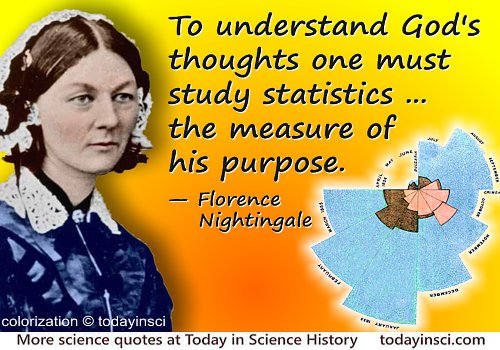
To understand God’s thoughts, one must study statistics, for these are the measure of His purpose.
This is expressed in narrative form, not within quotation marks, in Karl Pearson in The Life, Letters and Labours of Francis Galton (1924), Vol 2, 415. [Pearson writes, without quotes: But to understand God’s thoughts, she held we must study statistics, for these are the measure of his purpose. Thus the study of statistics was for her a religious duty.] Pearson elsewhere does use quotation marks when providing a direct quote for illustration from other speakers. Thus, Webmaster cautions that the subject quote above perhaps should not be regarded as verbatim; Pearson was expressing Nightingale’s outlook in his own words.
To-day, science has withdrawn into realms that are hardly understanded of the people. Biology means very largely histology, the study of the cell by difficult and elaborate microscopical processes. Chemistry has passed from the mixing of simple substances with ascertained reactions, to an experimentation of these processes under varying conditions of temperature, pressure, and electrification—all requiring complicated apparatus and the most delicate measurement and manipulation. Similarly, physics has outgrown the old formulas of gravity, magnetism, and pressure; has discarded the molecule and atom for the ion, and may in its recent generalizations be followed only by an expert in the higher, not to say the transcendental mathematics.
‘Exit the Amateur Scientist.’ Editorial, The Nation, 23 August 1906, 83, 160.
Uniformity in the currency, weights, and measures of the United States is an object of great importance, and will, I am persuaded, be duly attended to.
First Annual Message to Congress on the State of the Union (8 Jan 1790).
We are apt to think we know what time is because we can measure it, but no sooner do we reflect upon it than that illusion goes. So it appears that the range of the measureable is not the range of the knowable. There are things we can measure, like time, but yet our minds do not grasp their meaning. There are things we cannot measure, like happiness or pain, and yet their meaning is perfectly clear to us.
The Elements of Social Science (1921), 15-16
We find no sense in talking about something unless we specify how we measure it; a definition by the method of measuring a quantity is the one sure way of avoiding talking nonsense...
in Relativity and Common Sense (1964)
We have reason not to be afraid of the machine, for there is always constructive change, the enemy of machines, making them change to fit new conditions.
We suffer not from overproduction but from undercirculation. You have heard of technocracy. I wish I had those fellows for my competitors. I'd like to take the automobile it is said they predicted could be made now that would last fifty years. Even if never used, this automobile would not be worth anything except to a junkman in ten years, because of the changes in men's tastes and ideas. This desire for change is an inherent quality in human nature, so that the present generation must not try to crystallize the needs of the future ones.
We have been measuring too much in terms of the dollar. What we should do is think in terms of useful materials—things that will be of value to us in our daily life.
We suffer not from overproduction but from undercirculation. You have heard of technocracy. I wish I had those fellows for my competitors. I'd like to take the automobile it is said they predicted could be made now that would last fifty years. Even if never used, this automobile would not be worth anything except to a junkman in ten years, because of the changes in men's tastes and ideas. This desire for change is an inherent quality in human nature, so that the present generation must not try to crystallize the needs of the future ones.
We have been measuring too much in terms of the dollar. What we should do is think in terms of useful materials—things that will be of value to us in our daily life.
In 'Quotation Marks: Against Technocracy', New York Times (1 Han 1933), E4.
We never really see time. We see only clocks. If you say this object moves, what you really mean is that this object is here when the hand of your clock is here, and so on. We say we measure time with clocks, but we see only the hands of the clocks, not time itself. And the hands of a clock are a physical variable like any other. So in a sense we cheat because what we really observe are physical variables as a function of other physical variables, but we represent that as if everything is evolving in time.
Quoted by Tim Folger in 'Newsflash: Time May Not Exist', Discover Magazine (Jun 2007).
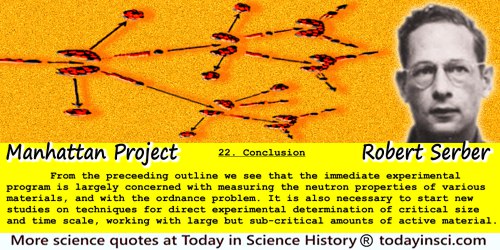
We see that the immediate experimental program is largely concerned with measuring the neutron properties of various materials, and with the ordnance problem. It is also necessary to start new studies on techniques for direct experimental determination of critical size and time scale, working with large but sub-critical amounts of active material.
From notes (written up by Edward U. Condon) of introductory lectures by Robert Serber (Apr 1943) at the start-up of the Los Alamos Project. For distribution to new arrivals, the notes were mimeographed as The Los Alamos Primer. See 'Conclusion', Sec.22, p.24. Declassified in 1965. Published with an Introduction and extensive notations added by the editor, in Robert Serber and Richard Rhodes (ed.), The Los Alamos Primer: The First Lectures on How To Build an Atomic Bomb (1992), 63.
When I heard the learn’d astronomer,
When the proofs, the figures, were ranged in columns before me,
When I was shown the charts and diagrams, to add, divide, and measure them,
When I sitting heard the astronomer where he lectured with much applause in the lecture-room,
How soon unaccountable I became tired and sick,
Till rising and gliding out I wander’d by myself,
In the mystical moist night-air, and from time to time,
Look’d up in perfect silence at the stars.
When the proofs, the figures, were ranged in columns before me,
When I was shown the charts and diagrams, to add, divide, and measure them,
When I sitting heard the astronomer where he lectured with much applause in the lecture-room,
How soon unaccountable I became tired and sick,
Till rising and gliding out I wander’d by myself,
In the mystical moist night-air, and from time to time,
Look’d up in perfect silence at the stars.
In Leaves of Grass (1881, 1882), 214.
When one studies strongly radioactive substances special precautions must be taken if one wishes to be able to take delicate measurements. The various objects used in a chemical laboratory and those used in a chemical laboratory, and those which serve for experiments in physics, become radioactive in a short time and act upon photographic plates through black paper. Dust, the air of the room, and one’s clothes all become radioactive.
Notebook entry. In Eve Curie, Madame Curie: a Biography by Eve Curie (1937, 2007), 196.
When young Galileo, then a student at Pisa, noticed one day during divine service a chandelier swinging backwards and forwards, and convinced himself, by counting his pulse, that the duration of the oscillations was independent of the arc through which it moved, who could know that this discovery would eventually put it in our power, by means of the pendulum, to attain an accuracy in the measurement of time till then deemed impossible, and would enable the storm-tossed seaman in the most distant oceans to determine in what degree of longitude he was sailing?
Hermann von Helmholtz, Edmund Atkinson (trans.), Popular Lectures on Scientific Subjects: First Series (1883), 29.
Whenever you can, count.
Quoted in James R. Newman, Commentary on Sir Francis Galton (1956), 1169.
Where a body is in motion, there exists space and time, the simplest sentient creature in this world would thus be a measure of them. Our hearing, and perhaps our seeing too, consists of a counting of oscillations.
Aphorism 54 in Notebook D (1773-1775), as translated by R.J. Hollingdale in Aphorisms (1990). Reprinted as The Waste Books (2000), 52.
Whereas at the outset geometry is reported to have concerned herself with the measurement of muddy land, she now handles celestial as well as terrestrial problems: she has extended her domain to the furthest bounds of space.
In The Story of Euclid. (1902) 14-15.
While it is never safe to affirm that the future of Physical Science has no marvels in store even more astonishing than those of the past, it seems probable that most of the grand underlying principles have been firmly established, and that further advances are to be sought chiefly in the rigorous applications of these principles to all the phenomena which come under our notice. It is here that the science of measurement shows its importance—where the quantitative results are more to be desired than qualitative work. An eminent physicist has remarked that the future truths of Physical Science are to be looked for in the sixth place of decimals.
University of Chicago, Annual Register 1894-1895 (1894), 150. Michelson also incorporated these lines in his address, 'Some of the Objects and Methods of Physical Science', at the opening of the Physics and Electrical Engineering Laboratory at the University of Kansas, reprinted in The Electrical Engineer (1 Jan 1896), 21, No. 400, 9.
While the unique crystal stands on its shelf unmeasured by the goniometer, unslit by the optical lapidary, unanalysed by the chemist,—it is merely a piece of furniture, and has no more right to be considered as anything pertaining to science, than a curious china tea-cup on a chimney-piece.
In 'Report on the Progress and Present State of Mineralogy', Report of the British Association for the Advancement of Science (1831 -32), 364-365.
With a single exception, it may be affirmed that units of volume now [1893] in use were originally in no way related to units of length, most of them being of accidental and now unknown origin. That a legal bushel in the United States must contain 2150.42 cubic inches is convincing evidence that the foot or the yard has no place in its ancestry.
From Address to the International Engineering Congress of the Columbia Exposition, Chicago, 1893. Published in Transactions of the American Society of Civil Engineers (Oct 1893), 121. Reprinted in 'Fundamental Units of Measure', Smithsonian Report for 1893 (1894), 136.
You, in this country [the USA], are subjected to the British insularity in weights and measures; you use the foot, inch and yard. I am obliged to use that system, but must apologize to you for doing so, because it is so inconvenient, and I hope Americans will do everything in their power to introduce the French metrical system. ... I look upon our English system as a wickedly, brain-destroying system of bondage under which we suffer. The reason why we continue to use it, is the imaginary difficulty of making a change, and nothing else; but I do not think in America that any such difficulty should stand in the way of adopting so splendidly useful a reform.
Journal of the Franklin Institute, Nov 1884, 118, 321-341
 In science it often happens that scientists say, 'You know that's a really good argument; my position is mistaken,' and then they would actually change their minds and you never hear that old view from them again. They really do it. It doesn't happen as often as it should, because scientists are human and change is sometimes painful. But it happens every day. I cannot recall the last time something like that happened in politics or religion.
(1987) --
In science it often happens that scientists say, 'You know that's a really good argument; my position is mistaken,' and then they would actually change their minds and you never hear that old view from them again. They really do it. It doesn't happen as often as it should, because scientists are human and change is sometimes painful. But it happens every day. I cannot recall the last time something like that happened in politics or religion.
(1987) -- 





.jpg)