Meaning Quotes (247 quotes)
Meanings Quotes
Meanings Quotes
...it is not to be taken in the sense of our day, which we reckon by the course of the sun; but it must have another meaning, applicable to the
three days mentioned before the creation of the heavenly bodies.
three days mentioned before the creation of the heavenly bodies.
iv.26
“It's absolutely clear that the function of the world is to declare the glory of God.” I thought, what does that sentence mean?!
Quoting and reacting to a letter he saw in a newspaper about Stephen Hawking’s comments on the nonexistence of God. From 'Interview: Of Mind and Matter: David Attenborough Meets Richard Dawkins', The Guardian (11 Sep 2010).
[Culture] denotes an historically transmitted pattern of meanings embodied in symbols, a system of inherited conceptions expressed in symbolic forms, by means of which men communicate, perpetuate, and develop their knowledge about and attitudes toward life.
The Interpretation of Cultures (1977), 89.
[In] the realm of science, … what we have achieved will be obsolete in ten, twenty or fifty years. That is the fate, indeed, that is the very meaning of scientific work. … Every scientific “fulfillment” raises new “questions” and cries out to be surpassed and rendered obsolete. Everyone who wishes to serve science has to resign himself to this.
From a Speech (1918) presented at Munich University, published in 1919, and collected in 'Wissenschaft als Beruf', Gessammelte Aufsätze zur Wissenschaftslehre (1922), 524-525. As translated by Rodney Livingstone in David Owen (ed.), The Vocation Lectures: Science as a Vocation: Politics as a Vocation (2004), 11. A different translation of a longer excerpt for this quote, beginning “In science, each of us knows …”, is also on the Max Weber Quotes web page on this site.
[Radius]: You will work. You will build ... You will serve them... Robots of the world... The power of man has fallen... A new world has arisen. The rule of the Robots... March!
The word 'robot' was coined in this play for a new working class of automatons (from the Czech word robota meaning compulsory labour)
The word 'robot' was coined in this play for a new working class of automatons (from the Czech word robota meaning compulsory labour)
R.U.R. (1920), 89-90 in 1961 ed.
[Scientists] define these [terms] in tight phrases which convey a meaning only to those who already understand it.
In Science is a Sacred Cow (1950), 31.
[Two college boys on the Flambeau River in a canoe]…their first…taste of freedom … The elemental simplicities of wilderness travel were thrills not only because of their novelty, but because they represented complete freedom to make mistakes. The wilderness gave them their first taste of those rewards and penalties for wise and foolish acts which every woodsman faces daily, but against which civilization has built a thousand buffers. These boys were “on their own” in this particular sense. Perhaps every youth needs an occasional wilderness trip, in order to learn the meaning of this particular freedom.
In 'Wisconsin: Flambeau', A Sand County Almanac, and Sketches Here and There (1949, 1987), 112-113.
'Causation' has been popularly used to express the condition of association, when applied to natural phenomena. There is no philosophical basis for giving it a wider meaning than partial or absolute association. In no case has it been proved that there is an inherent necessity in the laws of nature. Causation is correlation... [P]erfect correlation, when based upon sufficient experience, is causation in the scientific sense.
'Correlation, Causation and Wright's Theory of "Path Coefficients"', Genetics (7 May 1922), 7, 259-61.
Question: If you were to pour a pound of molten lead and a pound of molten iron, each at the temperature of its melting point, upon two blocks of ice, which would melt the most ice, and why?
Answer: This question relates to diathermancy. Iron is said to be a diathermanous body (from dia, through, and thermo, I heat), meaning that it gets heated through and through, and accordingly contains a large quantity of real heat. Lead is said to be an athermanous body (from a, privative, and thermo, I heat), meaning that it gets heated secretly or in a latent manner. Hence the answer to this question depends on which will get the best of it, the real heat of the iron or the latent heat of the lead. Probably the iron will smite furthest into the ice, as molten iron is white and glowing, while melted lead is dull.
Answer: This question relates to diathermancy. Iron is said to be a diathermanous body (from dia, through, and thermo, I heat), meaning that it gets heated through and through, and accordingly contains a large quantity of real heat. Lead is said to be an athermanous body (from a, privative, and thermo, I heat), meaning that it gets heated secretly or in a latent manner. Hence the answer to this question depends on which will get the best of it, the real heat of the iron or the latent heat of the lead. Probably the iron will smite furthest into the ice, as molten iron is white and glowing, while melted lead is dull.
Genuine student answer* to an Acoustics, Light and Heat paper (1880), Science and Art Department, South Kensington, London, collected by Prof. Oliver Lodge. Quoted in Henry B. Wheatley, Literary Blunders (1893), 180-1, Question 14. (*From a collection in which Answers are not given verbatim et literatim, and some instances may combine several students' blunders.)
A careful analysis of the process of observation in atomic physics has shown that the subatomic particles have no meaning as isolated entities, but can only be understood as interconnections between the preparation of an experiment and the subsequent measurement.
The Tao of Physics: An Exploration of the Parallels Between Modern Physics (1975), 68.
A chemical name should not be a phrase, it ought not to require circumlocutions to become definite; it should not be of the type “Glauber’s salt”, which conveys nothing about the composition of the substance; it should recall the constituents of a compound; it should be non-committal if nothing is known about the substance; the names should preferably be coined from Latin or Greek, so that their meaning can be more widely and easily understood; the form of the words should be such that they fit easily into the language into which they are to be incorporated.
(1782) As quoted in Archibald Clow, Chemical Revolution: A Contribution to Social Technology (1952, 1992), 618.
A great surgeon performs operations for stone by a single method; later he makes a statistical summary of deaths and recoveries, and he concludes from these statistics that the mortality law for this operation is two out of five. Well, I say that this ratio means literally nothing scientifically and gives us no certainty in performing the next operation; for we do not know whether the next case will be among the recoveries or the deaths. What really should be done, instead of gathering facts empirically, is to study them more accurately, each in its special determinism. We must study cases of death with great care and try to discover in them the cause of mortal accidents so as to master the cause and avoid the accidents.
From An Introduction to the Study of Experimental Medicine (1865), as translated by Henry Copley Greene (1957), 137-138. (Note that Bernard overlooks how the statistical method can be useful: a surgeon announcing a mortality rate of 40% invites comparison. A surgeon with worse outcomes should adopt this method. If a surgeon has a better results, that method should be adopted.)
A number of years ago, when I was a freshly-appointed instructor, I met, for the first time, a certain eminent historian of science. At the time I could only regard him with tolerant condescension.
I was sorry of the man who, it seemed to me, was forced to hover about the edges of science. He was compelled to shiver endlessly in the outskirts, getting only feeble warmth from the distant sun of science-in-progress; while I, just beginning my research, was bathed in the heady liquid heat up at the very center of the glow.
In a lifetime of being wrong at many a point, I was never more wrong. It was I, not he, who was wandering in the periphery. It was he, not I, who lived in the blaze.
I had fallen victim to the fallacy of the “growing edge;” the belief that only the very frontier of scientific advance counted; that everything that had been left behind by that advance was faded and dead.
But is that true? Because a tree in spring buds and comes greenly into leaf, are those leaves therefore the tree? If the newborn twigs and their leaves were all that existed, they would form a vague halo of green suspended in mid-air, but surely that is not the tree. The leaves, by themselves, are no more than trivial fluttering decoration. It is the trunk and limbs that give the tree its grandeur and the leaves themselves their meaning.
There is not a discovery in science, however revolutionary, however sparkling with insight, that does not arise out of what went before. “If I have seen further than other men,” said Isaac Newton, “it is because I have stood on the shoulders of giants.”
I was sorry of the man who, it seemed to me, was forced to hover about the edges of science. He was compelled to shiver endlessly in the outskirts, getting only feeble warmth from the distant sun of science-in-progress; while I, just beginning my research, was bathed in the heady liquid heat up at the very center of the glow.
In a lifetime of being wrong at many a point, I was never more wrong. It was I, not he, who was wandering in the periphery. It was he, not I, who lived in the blaze.
I had fallen victim to the fallacy of the “growing edge;” the belief that only the very frontier of scientific advance counted; that everything that had been left behind by that advance was faded and dead.
But is that true? Because a tree in spring buds and comes greenly into leaf, are those leaves therefore the tree? If the newborn twigs and their leaves were all that existed, they would form a vague halo of green suspended in mid-air, but surely that is not the tree. The leaves, by themselves, are no more than trivial fluttering decoration. It is the trunk and limbs that give the tree its grandeur and the leaves themselves their meaning.
There is not a discovery in science, however revolutionary, however sparkling with insight, that does not arise out of what went before. “If I have seen further than other men,” said Isaac Newton, “it is because I have stood on the shoulders of giants.”
Adding A Dimension: Seventeen Essays on the History of Science (1964), Introduction.
Absolute space, that is to say, the mark to which it would be necessary to refer the earth to know whether it really moves, has no objective existence…. The two propositions: “The earth turns round” and “it is more convenient to suppose the earth turns round” have the same meaning; there is nothing more in the one than in the other.
From La Science et l’Hypothèse (1908), 141, as translated by George Bruce Halsted in Science and Hypothesis (1905), 85-86. From the original French, “L’espace absolu, c’est-à-dire le repère auquel il faudrait rapporter la terre pour savoir si réellement elle tourne, n’a aucune existence objective. … Ces deux propositions: ‘la terre tourne’, et: ‘il est plus commode de supposer que la terre tourne’, ont un seul et même sens; il n’y a rien de plus dans l’une que dans l’autre.”
Acute [diseases] meaning those of which God is the author, chronic meaning those that originate in ourselves.
'Epistolary Dissertation to Dr. Cole', in The Works of Thomas Sydenham, M.D. (1850), trans. by R. G. Latham, Vol. 2, 68.
Again and again in reading even his [William Thomson] most abstract writings one is struck by the tenacity with which physical ideas control in him the mathematical form in which he expressed them. An instance of this is afforded by … an example of a mathematical result that is, in his own words, “not instantly obvious from the analytical form of my solution, but which we immediately see must be the case by thinking of the physical meaning of the result.”
As given in Life of Lord Kelvin (1910), Vol. 2, 1136. The ellipsis gives the reference to the quoted footnote, to a passage in his Mathematical and Physical Papers, Vol. 1, 457. [Note: William Thomson, later became Lord Kelvin. —Webmaster]
Among all the liberal arts, the first is logic, and specifically that part of logic which gives initial instruction about words. … [T]he word “logic” has a broad meaning, and is not restricted exclusively to the science of argumentative reasoning. [It includes] Grammar [which] is “the science of speaking and writing correctly—the starting point of all liberal studies.”
In John of Salisbury and Daniel D. McGarry (trans.), 'Whence grammar gets its name', The Metalogicon (2009), 37. It is footnoted: Isidore, Etym., i, 5, §1.
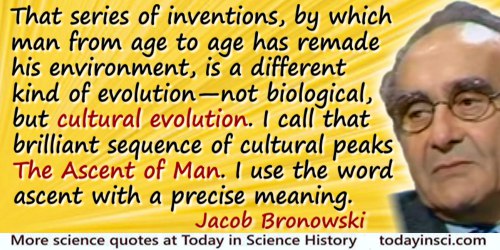
Among the multitude of animals which scamper, fly, burrow and swim around us, man is the only one who is not locked into his environment. His imagination, his reason, his emotional subtlety and toughness, make it possible for him not to accept the environment, but to change it. And that series of inventions, by which man from age to age has remade his environment, is a different kind of evolution—not biological, but cultural evolution. I call that brilliant sequence of cultural peaks The Ascent of Man. I use the word ascent with a precise meaning. Man is distinguished from other animals by his imaginative gifts. He makes plans, inventions, new discoveries, by putting different talents together; and his discoveries become more subtle and penetrating, as he learns to combine his talents in more complex and intimate ways. So the great discoveries of different ages and different cultures, in technique, in science, in the arts, express in their progression a richer and more intricate conjunction of human faculties, an ascending trellis of his gifts.
The Ascent of Man (1973), 19-20.
Among the older records, we find chapter after chapter of which we can read the characters, and make out their meaning: and as we approach the period of man’s creation, our book becomes more clear, and nature seems to speak to us in language so like our own, that we easily comprehend it. But just as we begin to enter on the history of physical changes going on before our eyes, and in which we ourselves bear a part, our chronicle seems to fail us—a leaf has been torn out from nature's record, and the succession of events is almost hidden from our eyes.
Letter 1 to William Wordsworth. Quoted in the appendix to W. Wordsworth, A Complete Guide to the Lakes, Comprising Minute Direction for the Tourist, with Mr Wordsworth's Description of the Scenery of the County and Three Letters upon the Geology of the Lake District (1842), 14.
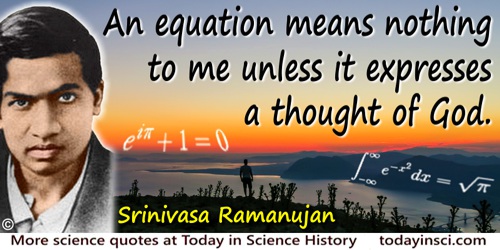
An equation means nothing to me unless it expresses a thought of God.
Quoted in Clifford A. Pickover, A Passion for Mathematics (2005), 1; but with no footnote to primary source.
As an Art, Mathematics has its own standard of beauty and elegance which can vie with the more decorative arts. In this it is diametrically opposed to a Baroque art which relies on a wealth of ornamental additions. Bereft of superfluous addenda, Mathematics may appear, on first acquaintance, austere and severe. But longer contemplation reveals the classic attributes of simplicity relative to its significance and depth of meaning.
In The Skeleton Key of Mathematics (1949), 12.
As far as the meaning of life in general, or in the abstract, as far as I can see, there is none. If all of life were suddenly to disappear from earth and anywhere else it may exist, or if none had ever formed in the first place, I think the Universe would continue to exist without perceptible change. However, it is always possible for an individual to invest his own life with meaning that he can find significant. He can so order his life that he may find as much beauty and wisdom in it as he can, and spread as much of that to others as possible.
In a book proposal for The Meaning of Life edited by Hugh S. Moorhead, 1989.
As I strayed into the study of an eminent physicist, I observed hanging against the wall, framed like a choice engraving, several dingy, ribbon-like strips of, I knew not what... My curiosity was at once aroused. What were they? ... They might be shreds of mummy-wraps or bits of friable bark-cloth from the Pacific, ... [or] remnants from a grandmother’s wedding dress... They were none of these... He explained that they were carefully-prepared photographs of portions of the Solar Spectrum. I stood and mused, absorbed in the varying yet significant intensities of light and shade, bordered by mystic letters and symbolic numbers. As I mused, the pale legend began to glow with life. Every line became luminous with meaning. Every shadow was suffused with light shining from behind, suggesting some mighty achievement of knowledge; of knowledge growing more daring in proportion to the remoteness of the object known; of knowledge becoming more positive in its answers, as the questions which were asked seemed unanswerable. No Runic legend, no Babylonish arrowhead, no Egyptian hieroglyph, no Moabite stone, could present a history like this, or suggest thoughts of such weighty import or so stimulate and exalt the imagination.
The Sciences of Nature Versus the Science of Man: A Plea for the Science of Man (1871), 7-9.
At first it seems obvious, but the more you think about it the stranger the deductions from this axiom seem to become; in the end you cease to understand what is meant by it.
As quoted, without citation, in Stories about Sets (1968), 84.
Attaching significance to invariants is an effort to recognize what, because of its form or colour or meaning or otherwise, is important or significant in what is only trivial or ephemeral. A simple instance of failing in this is provided by the poll-man at Cambridge, who learned perfectly how to factorize a²-b² but was floored because the examiner unkindly asked for the factors of p²–q².
In 'Recent Developments in Invariant Theory', The Mathematical Gazette (Dec 1926), 13, No. 185, 217. [Note: A poll-man is a student who takes the ordinary university degree, without honours. -Webmaster]
But although in theory physicists realize that their conclusions are ... not certainly true, this ... does not really sink into their consciousness. Nearly all the time ... they ... act as if Science were indisputably True, and what's more, as if only science were true.... Any information obtained otherwise than by the scientific method, although it may be true, the scientists will call “unscientific,” using this word as a smear word, by bringing in the connotation from its original [Greek] meaning, to imply that the information is false, or at any rate slightly phony.
In Science is a Sacred Cow (1950), 176-77.
But does Man have any “right” to spread through the universe? Man is what he is, a wild animal with the will to survive, and (so far) the ability, against all competition. Unless one accepts that, anything one says about morals, war, politics, you name it, is nonsense. Correct morals arise from knowing what man is, not what do-gooders and well-meaning old Aunt Nellies would like him to be. The Universe will let us know—later—whether or not Man has any “right” to expand through it.
In Starship Troopers (1959), 186.
By far the most important consequence of the conceptual revolution brought about in physics by relativity and quantum theory lies not in such details as that meter sticks shorten when they move or that simultaneous position and momentum have no meaning, but in the insight that we had not been using our minds properly and that it is important to find out how to do so.
'Quo Vadis'. In Gerald Holton (ed.), Science and the Modern Mind (1971), 84.
Cayley was singularly learned in the work of other men, and catholic in his range of knowledge. Yet he did not read a memoir completely through: his custom was to read only so much as would enable him to grasp the meaning of the symbols and understand its scope. The main result would then become to him a subject of investigation: he would establish it (or test it) by algebraic analysis and, not infrequently, develop it so to obtain other results. This faculty of grasping and testing rapidly the work of others, together with his great knowledge, made him an invaluable referee; his services in this capacity were used through a long series of years by a number of societies to which he was almost in the position of standing mathematical advisor.
In Proceedings of London Royal Society (1895), 58, 11-12.
Curiosity that inborn property of man, daughter of ignorance and mother of knowledge when wonder wakens our minds, has the habit, wherever it sees some extraordinary phenomenon of nature, a comet for example, a sun-dog, or a midday star, of asking straightway what it means.
In The New Science (3rd ed., 1744), Book 1, Para. 189, as translated by Thomas Goddard Bergin and Max Harold Fisch, The New Science of Giambattista Vico (1948), 64.
Darwin grasped the philosophical bleakness with his characteristic courage. He argued that hope and morality cannot, and should not, be passively read in the construction of nature. Aesthetic and moral truths, as human concepts, must be shaped in human terms, not ‘discovered’ in nature. We must formulate these answers for ourselves and then approach nature as a partner who can answer other kinds of questions for us–questions about the factual state of the universe, not about the meaning of human life. If we grant nature the independence of her own domain–her answers unframed in human terms–then we can grasp her exquisite beauty in a free and humble way. For then we become liberated to approach nature without the burden of an inappropriate and impossible quest for moral messages to assuage our hopes and fears. We can pay our proper respect to nature’s independence and read her own ways as beauty or inspiration in our different terms.
…...
Darwin’s book is very important and serves me as a basis in natural science for the class struggle in history. One has to put up with the crude English method of development, of course. Despite all deficiencies not only is the death-blow dealt here for the first time to “teleology” in the natural sciences, but their rational meaning is empirically explained.
Marx to Lasalle, 16 Jan 1861. In Marx-Engels Selected Correspondence, 1846-95, trans. Donna Torr (1934), 125.
Death is what gives life meaning. To know your days are numbered. Your time is short.
— Movie
Spoken by character The Ancient One (actress Tilda Swinton), in movie Doctor Strange (2016).
Divers of Hermetic Books have such involv’d Obscuritys that they may justly be compar’d to Riddles written in Cyphers. For after a Man has surmounted the difficulty of decyphering the Words & Terms, he finds a new & greater difficulty to discover ye meaning of the seemingly plain Expression.
Fragment In Boyle papers. Cited by Lawrence Principe, 'Boyle's Alchemical Pursuits', In M. Hunter (ed.), Robert Boyle Reconsidered (1994), 95
Does there truly exist an insuperable contradiction between religion and science? Can religion be superseded by science? The answers to these questions have, for centuries, given rise to considerable dispute and, indeed, bitter fighting. Yet, in my own mind there can be no doubt that in both cases a dispassionate consideration can only lead to a negative answer. What complicates the solution, however, is the fact that while most people readily agree on what is meant by “science,” they are likely to differ on the meaning of “religion.”
Replying to the Liberal Ministers’ Club of New York City. Published in >The Christian Register, (Jun 1948). As given in Ideas and Opinions (1954, 2010), 49-50.
Dr. Paget was conducting a school examination, and in the course of his questions he happened to ask a small child the meaning of “Average.” He was utterly bewildered by the reply, “The thing that hens lay on,” until the child explained that he had read in a book that hens lay on an average so many eggs a year.
Anecdote jotted down by Lewis Carroll to possibly send to the magazine Punch, as given in Stuart Dodgson Collingwood, The Life and Letters of Lewis Carroll (1898), 157.
During the three years which I spent at Cambridge my time was wasted, as far as the academical studies were concerned…. I attempted mathematics, … but I got on very slowly. The work was repugnant to me, chiefly from my not being able to see any meaning in the early steps in algebra. This impatience was very foolish…
In Charles Darwin and Francis Darwin (ed.), 'Autobiography', The Life and Letters of Charles Darwin (1887, 1896), Vol. 1, 40.
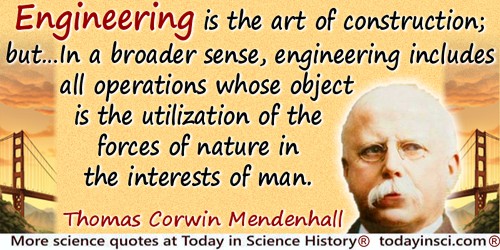
Engineering is the art of construction; but to limit it to this would be to restrict its meaning much within the range of the ordinary use of the word. In a broader sense, engineering includes all operations whose object is the utilization of the forces of nature in the interests of man.
From Address to the International Engineering Congress of the Columbia Exposition, Chicago, 1893. Published in Transactions of the American Society of Civil Engineers (Oct 1893), 120. Reprinted in 'Fundamental Units of Measure', Smithsonian Report for 1893 (1894), 135.
Error is often nourished by good sense. … The meaning is, that the powers of the understanding are frequently employed to defend favourite errors; and that a man of sense frequently fortifies himself in his prejudices, or in false opinions which he received without examination, by such arguments as would not have occurred to a fool.
In Maxims, Characters, and Reflections, Critical, Satyrical and Moral (2nd ed., 1757), 9. The meaning is given as a footnote.
Every time we get slapped down, we can say, “Thank you Mother Nature,” because it means we’re about to learn something important.
Quoted at end of article of Michael D. Lemonick and J. Madeleine Nash, 'Unraveling Universe', Time (6 Mar 1995), 145, 84.
Face this world. Learn its ways, watch it, be careful of too hasty guesses at its meaning. In the end you will find clues to it all.
In The Time Machine (1898), 90.
For the holy Bible and the phenomena of nature proceed alike from the divine Word, the former as the dictate of the Holy Ghost and the latter as the observant executrix of God's commands. It is necessary for the Bible, in order to be accommodated to the understanding of every man, to speak many things which appear to differ from the absolute truth so far as the bare meaning of the words is concerned. But Nature, on the other hand, is inexorable and immutable; she never transgresses the laws imposed upon her, or cares a whit whether her abstruse reasons and methods of operation are understandable to men. For that reason it appears that nothing physical which sense-experience sets before our eyes, or which necessary demonstrations prove to us, ought to be called in question (much less condemned) upon the testimony of biblical passages which may have some different meaning beneath their words.
Letter to Madame Christina of Lorraine, Grand Duchess of Tuscany: Concerning the Use of Biblical Quotations in Matters of Science (1615), trans. Stillman Drake, Discoveries and Opinions of Galileo (1957), 182-3.
For, in mathematics or symbolic logic, reason can crank out the answer from the symboled equations—even a calculating machine can often do so—but it cannot alone set up the equations. Imagination resides in the words which define and connect the symbols—subtract them from the most aridly rigorous mathematical treatise and all meaning vanishes. Was it Eddington who said that we once thought if we understood 1 we understood 2, for 1 and 1 are 2, but we have since found we must learn a good deal more about “and”?
In 'The Biological Basis of Imagination', American Thought: 1947 (1947), 81.
Gentlemen, that is surely true, it is absolutely paradoxical; we cannot understand it, and we don’t know what it means. But we have proved it, and therefore we know it is the truth.
In a lecture, after establishing the relation eπ/2 = i√i in a lecture, “which evidently had a strong hold on his imagination. He dropped his chalk and rubber, put his hands in his pockets, and after contemplating the formula a few minutes turned to his class and said [this quote] very slowly and impressively.” As quoted in W. E. Byerly (writing as a Professor Emeritus at Harvard University, but a former student of Peirce), 'Benjamin Peirce: II. Reminiscences', The American Mathematical Monthly (Jan 1925), 32, No. 1, 6.
Godless science reads nature only as Milton's daughters did Hebrew, rightly syllabling the sentences, but utterly ignorant of the meaning.
Lecture, 'The Blessed Life', collected in Lectures Delivered Before the Young Men's Christian Association (1861), Vol. 16, 347.
Good applied science in medicine, as in physics, requires a high degree of certainty about the basic facts at hand, and especially about their meaning, and we have not yet reached this point for most of medicine.
The Medusa and the Snail (1979), 143.
He who has never been deceived by a lie does not know the meaning of bliss.
In a letter to Elsa Lowenthal, April 30, 1912.
Here are the most important pieces of advice that I’ve passed on to my children. One, remember to look up at the stars and not down at your feet. Two, never give up work. Work gives you meaning and purpose and life is empty without it. Three, if you are lucky enough to find love, remember it is rare and don’t throw it away.
From Interview with Diane Sawyer on ABC TV, World News Tonight (2010). As quoted in 'The Most Important Pieces of Advice Stephen Hawking Gave to his Children' (14 Mar 2018), on abcnews.go.com webpage.
How indispensable to a correct study of Nature is a perception of her true meaning. The fact will one day flower out into a truth. The season will mature and fructify what the understanding had cultivated. Mere accumulators of facts—collectors of materials for the master-workmen—are like those plants growing in dark forests, which “put forth only leaves instead of blossoms.”
(16 Dec 1837). In Henry David Thoreau and Bradford Torrey (ed.), The Writings of Henry Thoreau: Journal: I: 1837-1846 (1906), 18.
I also require much time to ponder over the matters themselves, and particularly the principles of mechanics (as the very words: force, time, space, motion indicate) can occupy one severely enough; likewise, in mathematics, the meaning of imaginary quantities, of the infinitesimally small and infinitely large and similar matters.
In Davis Baird, R.I.G. Hughes and Alfred Nordmann, Heinrich Hertz: Classical Physicist, Modern Philosopher (1998), 159.
I can conceive few human states more enviable than that of the man to whom, panting in the foul laboratory, or watching for his life under the tropic forest, Isis shall for a moment lift her sacred veil, and show him, once and for ever, the thing he dreamed not of; some law, or even mere hint of a law, explaining one fact; but explaining with it a thousand more, connecting them all with each other and with the mighty whole, till order and meaning shoots through some old Chaos of scattered observations.
Health and Education (1874), 289.
I can hear the sizzle of newborn stars, and know anything of meaning, of the fierce magic emerging here. I am witness to flexible eternity, the evolving past, and I know we will live forever, as dust or breathe in the face of stars, in the shifting pattern of winds.
In Secrets from the Center of the World (1989), 56.
I despise Birth-Control first because it is ... an entirely meaningless word; and is used so as to curry favour even with those who would first recoil from its real meaning. The proceeding these quack doctors recommend does not control any birth. ... But these people know perfectly well that they dare not write the plain word Birth-Prevention, in any one of the hundred places where they write the hypocritical word Birth-Control. They know as well as I do that the very word Birth-Prevention would strike a chill into the public... Therefore they use a conventional and unmeaning word, which may make the quack medicine sound more innocuous. ... A child is the very sign and sacrament of personal freedom. He is a fresh will added to the wills of the world; he is something that his parents have freely chosen to produce ... he is their own creative contribution to creation.
In 'Babies and Distributism', The Well and the Shadows (1935). Collected in G. K. Chesterton and Dale Ahlquist (ed.), In Defense of Sanity: The Best Essays of G.K. Chesterton (2011), 272.
I have now reached the point where I may indicate briefly what to me constitutes the essence of the crisis of our time. It concerns the relationship of the individual to society. The individual has become more conscious than ever of his dependence upon society. But he does not experience this dependence as a positive asset, as an organic tie, as a protective force, but rather as a threat to his natural rights, or even to his economic existence. Moreover, his position in society is such that the egotistical drives of his make-up are constantly being accentuated, while his social drives, which are by nature weaker, progressively deteriorate. All human beings, whatever their position in society, are suffering from this process of deterioration. Unknowingly prisoners of their own egotism, they feel insecure, lonely, and deprived of the naive, simple, and unsophisticated enjoyment of life. Man can find meaning in life, short and perilous as it is, only through devoting himself to society.
…...
I maintain there is much more wonder in science than in pseudoscience. And in addition, to whatever measure this term has any meaning, science has the additional virtue, and it is not an inconsiderable one, of being true.
Concluding remarks of keynote address at CSICOP conference, Pasadena, California (3 Apr 1987). Printed in 'The Burden of Skepticism', Skeptical Inquirer (1987), 12, No. 1. Collected in Kendrick Frazier (ed.), The Hundredth Monkey: And Other Paradigms of the Paranormal (1991), 9.
I must confess, I am dreading today’s elections, … because no matter what the outcome, our government will still be a giant bonfire of partisanship. It is ironic since whenever I have met with our elected officials they are invariably thoughtful, well-meaning people. And yet collectively 90% of their effort seems to be focused on how to stick it to the other party.
On Sergey Brin’s Google+ page (6 Nov 2012).
I myself, a professional mathematician, on re-reading my own work find it strains my mental powers to recall to mind from the figures the meanings of the demonstrations, meanings which I myself originally put into the figures and the text from my mind. But when I attempt to remedy the obscurity of the material by putting in extra words, I see myself falling into the opposite fault of becoming chatty in something mathematical.
Astronomia Nova, New Astronomy, (1609), Introduction, second paragraph.
I once spoke to a human geneticist who declared that the notion of intelligence was quite meaningless, so I tried calling him unintelligent. He was annoyed, and it did not appease him when I went on to ask how he came to attach such a clear meaning to the notion of lack of intelligence. We never spoke again.
In Advice to a Young Scientist (1979), 25, footnote 2.
I require a term to express those bodies which can pass to the electrodes, or, as they are usually called, the poles. Substances are frequently spoken of as being electro-negative, or electro-positive, according as they go under the supposed influence of a direct attraction to the positive or negative pole. But these terms are much too significant for the use to which I should have to put them; for though the meanings are perhaps right, they are only hypothetical, and may be wrong; and then, through a very imperceptible, but still very dangerous, because continual, influence, they do great injury to science, by contracting and limiting the habitual view of those engaged in pursuing it. I propose to distinguish these bodies by calling those anions which go to the anode of the decomposing body; and those passing to the cathode, cations; and when I have occasion to speak of these together, I shall call them ions.
Philosophical Transactions of the Royal Society of London, 1834, 124, 79.
I specifically paused to show that, if there were such machines with the organs and shape of a monkey or of some other non-rational animal, we would have no way of discovering that they are not the same as these animals. But if there were machines that resembled our bodies and if they imitated our actions as much as is morally possible, we would always have two very certain means for recognizing that, none the less, they are not genuinely human. The first is that they would never be able to use speech, or other signs composed by themselves, as we do to express our thoughts to others. For one could easily conceive of a machine that is made in such a way that it utters words, and even that it would utter some words in response to physical actions that cause a change in its organs—for example, if someone touched it in a particular place, it would ask what one wishes to say to it, or if it were touched somewhere else, it would cry out that it was being hurt, and so on. But it could not arrange words in different ways to reply to the meaning of everything that is said in its presence, as even the most unintelligent human beings can do. The second means is that, even if they did many things as well as or, possibly, better than anyone of us, they would infallibly fail in others. Thus one would discover that they did not act on the basis of knowledge, but merely as a result of the disposition of their organs. For whereas reason is a universal instrument that can be used in all kinds of situations, these organs need a specific disposition for every particular action.
Discourse on Method in Discourse on Method and Related Writings (1637), trans. Desmond M. Clarke, Penguin edition (1999), Part 5, 40.
I think it is a peculiarity of myself that I like to play about with equations, just looking for beautiful mathematical relations which maybe don’t have any physical meaning at all. Sometimes they do.
At age 60.
At age 60.
"Interview with T. Kuhn (7 May 1963), Niels Bohr Library, American Intitute of Physics, New York. In A. Pais, 'Playing With Equations, the Dirac Way'. Behram N. Kursunoglu (Ed.) and Eugene Paul Wigner (Ed.), Paul Adrien Maurice Dirac: Reminiscences about a Great Physicist (1990), 109.
I venture to assert that the feelings one has when the beautiful symbolism of the infinitesimal calculus first gets a meaning, or when the delicate analysis of Fourier has been mastered, or while one follows Clerk Maxwell or Thomson into the strange world of electricity, now growing so rapidly in form and being, or can almost feel with Stokes the pulsations of light that gives nature to our eyes, or track with Clausius the courses of molecules we can measure, even if we know with certainty that we can never see them I venture to assert that these feelings are altogether comparable to those aroused in us by an exquisite poem or a lofty thought.
In paper (May 1891) read before Bath Branch of the Teachers’ Guild, published in The Practical Teacher (July 1891), reprinted as 'Geometry', in Frederic Spencer, Chapters on the Aims and Practice of Teaching (1897), 194.
If a specific question has meaning, it must be possible to find operations by which an answer may be given to it ... I believe that many of the questions asked about social and philosophical subjects will be found to be meaningless when examined from the point of view of operations.
The Logic of Modern Physics (1960), 28.
If any philosopher had been asked for a definition of infinity, he might have produced some unintelligible rigmarole, but he would certainly not have been able to give a definition that had any meaning at all.
…...
If education really educates, there will, in time, be more and more citizens who understand that relics of the old West add meaning and value to the new. Youth yet unborn will pole up the Missouri with Lewis and Clark, or climb the Sierras with James Capen Adams, and each generation in turn will ask: Where is the big white bear? It will be a sorry answer to say he went under while conservationists weren’t looking.
Conclusion from article 'The Grizzly—A Problem in Land Planning', in Outdoor America (6 Apr 1942), 7, 12.
If I am given a sign [formula], and I am ignorant of its meaning, it cannot teach me anything, but if I already know it what does the formula teach me?
In De Magistro (400s), Book 1, chap 10, 23. As quoted in Ettore Carruccio, Mathematics And Logic in History And in Contemporary Thought (1964), 152.
If I were asked to name the most needed of all reforms in the spirit of education, I should say: “Cease conceiving of education as mere preparation for later life, and make it the full meaning of the present life.”
[This is widely seen quoted in a paraphrased form: Education is not preparation for life; education is life itself.]
[This is widely seen quoted in a paraphrased form: Education is not preparation for life; education is life itself.]
In essay, 'Self-Realization as the Moral Ideal', collected in John Dewey and Jo Ann Boydston (ed.), The Early Works, 1882-1898: Volume 4: 1893-1894: Early Essays and The Study of Ethics (1967, 2008), 50.
If Louis Pasteur were to come out of his grave because he heard that the cure for cancer still had not been found, NIH would tell him, “Of course we'll give you assistance. Now write up exactly what you will be doing during the three years of your grant.” Pasteur would say, “Thank you very much,” and would go back to his grave. Why? Because research means going into the unknown. If you know what you are going to do in science, then you are stupid! This is like telling Michelangelo or Renoir that he must tell you in advance how many reds and how many blues he will buy, and exactly how he will put those colors together.
Interview for Saturday Evening Post (Jan/Feb 1981), 30.
If the question were, “What ought to be the next objective in science?” my answer would be the teaching of science to the young, so that when the whole population grew up there would be a far more general background of common sense, based on a knowledge of the real meaning of the scientific method of discovering truth.
Marion Savin Selections from the Scientific Correspondence of Elihu Thomson (1971), v.
If the universe is not meaningless, what is its meaning? For me, this meaning is to be found in the structure of the universe, which happens to be such as to produce thought by way of life and mind. Thought, in turn, is a faculty whereby the universe can reflect upon itself, discover its own structure, and apprehend such immanent entities as truth, beauty, goodness, and love. Such is the meaning of the universe, as I see it.
In Vital Dust: Life as a Cosmic Imperative (1995), 301.
If the whole universe has no meaning, we should never have found out that it has no meaning: just as, if there were no light in the universe and therefore no creatures with eyes, we should never know it was dark. Dark would be without meaning.
…...
If the world has begun with a single quantum, the notions of space and would altogether fail to have any meaning at the beginning; they would only begin to have a sensible meaning when the original quantum had been divided into a sufficient number of quanta. If this suggestion is correct, the beginning of the world happened a little before the beginning of space and time. I think that such a beginning of the world is far enough from the present order of Nature to be not at all repugnant. It may be difficult to follow up the idea in detail as we are not yet able to count the quantum packets in every case. For example, it may be that an atomic nucleus must be counted as a unique quantum, the atomic number acting as a kind of quantum number. If the future development of quantum theory happens to turn in that direction, we could conceive the beginning of the universe in the form of a unique atom, the atomic weight of which is the total mass of the universe. This highly unstable atom would divide in smaller and smaller atoms by a kind of super-radioactive process.
In a seminal short letter (457 words), 'The Beginning of the World from the Point of View of Quantum Theory', Nature (9 May 1931), 127, 706.
If there is no solace in the fruits of our research, there is at least some consolation in the research itself. Men and women are not content to comfort themselves with tales of gods and giants, or to confine their thoughts to the daily affairs of life; they also build telescopes and satellites and accelerators and sit at their desks for endless hours working out the meaning of the data they gather.
In The First Three Minutes (1977), 154-155.
If we consider that part of the theory of relativity which may nowadays in a sense be regarded as bone fide scientific knowledge, we note two aspects which have a major bearing on this theory. The whole development of the theory turns on the question of whether there are physically preferred states of motion in Nature (physical relativity problem). Also, concepts and distinctions are only admissible to the extent that observable facts can be assigned to them without ambiguity (stipulation that concepts and distinctions should have meaning). This postulate, pertaining to epistemology, proves to be of fundamental importance.
'Fundamental ideas and problems of the theory of relativity', Lecture delivered to the Nordic Assembly of Naturalists at Gothenburg, 11 Jul 1923. In Nobel Physics 1901-1921 (1998), 482.
If you have to prove a theorem, do not rush. First of all, understand fully what the theorem says, try to see clearly what it means. Then check the theorem; it could be false. Examine the consequences, verify as many particular instances as are needed to convince yourself of the truth. When you have satisfied yourself that the theorem is true, you can start proving it.
In How to Solve It: A New Aspect of Mathematical Method (2004), 15.
In 1963, when I assigned the name “quark” to the fundamental constituents of the nucleon, I had the sound first, without the spelling, which could have been “kwork.” Then, in one of my occasional perusals of Finnegans Wake, by James Joyce, I came across the word “quark” in the phrase “Three quarks for Muster Mark.” Since “quark” (meaning, for one thing, the cry of a gull) was clearly intended to rhyme with “Mark,” as well as “bark” and other such words, I had to find an excuse to pronounce it as “kwork.” But the book represents the dreams of a publican named Humphrey Chimpden Earwicker. Words in the text are typically drawn from several sources at once, like the “portmanteau words” in Through the Looking Glass. From time to time, phrases occur in the book that are partially determined by calls for drinks at the bar. I argued, therefore, that perhaps one of the multiple sources of the cry “Three quarks for Muster Mark” might be pronunciation for “Three quarts for Mister Mark,” in which case the pronunciation “kwork” would not be totally unjustified. In any case, the number three fitted perfectly the way quarks occur in nature.
The Quark and the Jaguar (1994), 180.
In despair, I offer your readers their choice of the following definitions of entropy. My authorities are such books and journals as I have by me at the moment.
(a) Entropy is that portion of the intrinsic energy of a system which cannot be converted into work by even a perfect heat engine.—Clausius.
(b) Entropy is that portion of the intrinsic energy which can be converted into work by a perfect engine.—Maxwell, following Tait.
(c) Entropy is that portion of the intrinsic energy which is not converted into work by our imperfect engines.—Swinburne.
(d) Entropy (in a volume of gas) is that which remains constant when heat neither enters nor leaves the gas.—W. Robinson.
(e) Entropy may be called the ‘thermal weight’, temperature being called the ‘thermal height.’—Ibid.
(f) Entropy is one of the factors of heat, temperature being the other.—Engineering.
I set up these bald statement as so many Aunt Sallys, for any one to shy at.
[Lamenting a list of confused interpretations of the meaning of entropy, being hotly debated in journals at the time.]
(a) Entropy is that portion of the intrinsic energy of a system which cannot be converted into work by even a perfect heat engine.—Clausius.
(b) Entropy is that portion of the intrinsic energy which can be converted into work by a perfect engine.—Maxwell, following Tait.
(c) Entropy is that portion of the intrinsic energy which is not converted into work by our imperfect engines.—Swinburne.
(d) Entropy (in a volume of gas) is that which remains constant when heat neither enters nor leaves the gas.—W. Robinson.
(e) Entropy may be called the ‘thermal weight’, temperature being called the ‘thermal height.’—Ibid.
(f) Entropy is one of the factors of heat, temperature being the other.—Engineering.
I set up these bald statement as so many Aunt Sallys, for any one to shy at.
[Lamenting a list of confused interpretations of the meaning of entropy, being hotly debated in journals at the time.]
In The Electrician (9 Jan 1903).
In my work on Fossil Bones, I set myself the task of recognizing to which animals the fossilized remains which fill the surface strata of the earth belong. ... As a new sort of antiquarian, I had to learn to restore these memorials to past upheavals and, at the same time, to decipher their meaning. I had to collect and put together in their original order the fragments which made up these animals, to reconstruct the ancient creatures to which these fragments belonged, to create them once more with their proportions and characteristics, and finally to compare them to those alive today on the surface of the earth. This was an almost unknown art, which assumed a science hardly touched upon up until now, that of the laws which govern the coexistence of forms
of the various parts in organic beings.
Discours sur les révolutions du globe, (Discourse on the Revolutions of the Surface of the Globe), originally the introduction to Recherches sur les ossemens fossiles des quadrupèdes (1812). Translated by Ian Johnston from the 1825 edition. Online at Vancouver Island University website.
In physics we deal with states of affairs much simpler than those of psychology and yet we again and again learn that our task is not to investigate the essence of things—we do not at all know what this would mean&mash;but to develop those concepts that allow us to speak with each other about the events of nature in a fruitful manner.
Letter to H.P.E. Hansen (20 Jul 1935), Niels Bohr Archive. In Jan Faye, Henry J. Folse, Niels Bohr and Contemporary Philosophy (1994), 83.
In science, each of us knows that what he has accomplished will be antiquated in ten, twenty, fifty years. That is the fate to which science is subjected; it is the very meaning of scientific work, to which it is devoted in a quite specific sense, as compared with other spheres of culture for which in general the same holds. Every scientific “fulfilment” raises new “questions”; it asks to be “surpassed” and outdated. Whoever wishes to serve science has to resign himself to this fact. Scientific works certainly can last as “gratifications” because of their artistic quality, or they may remain important as a means of training. Yet they will be surpassed scientifically—let that be repeated—for it is our common fate and, more our common goal. We cannot work without hoping that others will advance further than we have. In principle, this progress goes on ad infinitum.
From a Speech (1918) presented at Munich University, published in 1919, and collected in 'Wissenschaft als Beruf', Gessammelte Aufsätze zur Wissenschaftslehre (1922), 524-525. As given in H.H. Gerth and C. Wright-Mills (translators and eds.), 'Science as a Vocation', Max Weber: Essays in Sociology (1946), 138. A different translation of a shorter excerpt from this quote, beginning “[In] the realm of science, …” is also on the Max Weber Quotes web page on this site.
In the case of the Sun, we have a new understanding of the cosmological meaning of sacrifice. The Sun is, with each second, transforming four million tons of itself into light—giving itself over to become energy that we, with every meal, partake of. The Sun converts itself into a flow of energy that photosynthesis changes into plants that are consumed by animals. Humans have been feasting on the Sun’s energy stored in the form of wheat or maize or reindeer as each day the Sun dies as Sun and is reborn as the vitality of Earth. These solar flares are in fact the very power of the vast human enterprise. Every child of ours needs to learn the simple truth: she is the energy of the Sun. And we adults should organize things so her face shines with the same radiant joy.
In The Hidden Heart of the Cosmos: Humanity and the New Story (1996), 40-41.
In the printed page the only real things are the paper and the ink; the white spaces play the same part in aiding the eye to take in the meaning of the print as do the black letters.
From Under the Apple-Trees (1916), 302.
In the world of human thought generally, and in physical science particularly, the most important and fruitful concepts are those to which it is impossible to attach a well-defined meaning.
In M. Dresen, H. A. Kramers: Between Tradition and Revolution (1987), 539. In Magdolna Hargittai, In Our Own Image (2000), 3.
In this communication I wish first to show in the simplest case of the hydrogen atom (nonrelativistic and undistorted) that the usual rates for quantization can be replaced by another requirement, in which mention of “whole numbers” no longer occurs. Instead the integers occur in the same natural way as the integers specifying the number of nodes in a vibrating string. The new conception can be generalized, and I believe it touches the deepest meaning of the quantum rules.
'Quantisierung als Eigenwertproblem', Annalen der Physik (1926), 79, 361. Trans. Walter Moore, Schrödinger: Life and Thought (1989), 200-2.
In this respect mathematics fails to reproduce with complete fidelity the obvious fact that experience is not composed of static bits, but is a string of activity, or the fact that the use of language is an activity, and the total meanings of terms are determined by the matrix in which they are embedded.
In The Nature of Physical Theory (1936), 58.
Inspiration plays no less a role in science than it does in the realm of art. It is a childish notion to think that a mathematician attains any scientifically valuable results by sitting at his desk with a ruler, calculating machines or other mechanical means. The mathematical imagination of a Weierstrass is naturally quite differently oriented in meaning and result than is the imagination of an artist, and differs basically in quality. But the psychological processes do not differ. Both are frenzy (in the sense of Plato’s “mania”) and “inspiration.”
From a Speech (1918) presented at Munich University, published in 1919, and collected in 'Wissenschaft als Beruf', Gessammelte Aufsätze zur Wissenschaftslehre (1922), 524-525. As given in H.H. Gerth and C. Wright-Mills (translators and eds.), 'Science as a Vocation', Max Weber: Essays in Sociology (1946), 136.
It [mathematics] is in the inner world of pure thought, where all entia dwell, where is every type of order and manner of correlation and variety of relationship, it is in this infinite ensemble of eternal verities whence, if there be one cosmos or many of them, each derives its character and mode of being,—it is there that the spirit of mathesis has its home and its life.
Is it a restricted home, a narrow life, static and cold and grey with logic, without artistic interest, devoid of emotion and mood and sentiment? That world, it is true, is not a world of solar light, not clad in the colours that liven and glorify the things of sense, but it is an illuminated world, and over it all and everywhere throughout are hues and tints transcending sense, painted there by radiant pencils of psychic light, the light in which it lies. It is a silent world, and, nevertheless, in respect to the highest principle of art—the interpenetration of content and form, the perfect fusion of mode and meaning—it even surpasses music. In a sense, it is a static world, but so, too, are the worlds of the sculptor and the architect. The figures, however, which reason constructs and the mathematic vision beholds, transcend the temple and the statue, alike in simplicity and in intricacy, in delicacy and in grace, in symmetry and in poise. Not only are this home and this life thus rich in aesthetic interests, really controlled and sustained by motives of a sublimed and supersensuous art, but the religious aspiration, too, finds there, especially in the beautiful doctrine of invariants, the most perfect symbols of what it seeks—the changeless in the midst of change, abiding things hi a world of flux, configurations that remain the same despite the swirl and stress of countless hosts of curious transformations.
Is it a restricted home, a narrow life, static and cold and grey with logic, without artistic interest, devoid of emotion and mood and sentiment? That world, it is true, is not a world of solar light, not clad in the colours that liven and glorify the things of sense, but it is an illuminated world, and over it all and everywhere throughout are hues and tints transcending sense, painted there by radiant pencils of psychic light, the light in which it lies. It is a silent world, and, nevertheless, in respect to the highest principle of art—the interpenetration of content and form, the perfect fusion of mode and meaning—it even surpasses music. In a sense, it is a static world, but so, too, are the worlds of the sculptor and the architect. The figures, however, which reason constructs and the mathematic vision beholds, transcend the temple and the statue, alike in simplicity and in intricacy, in delicacy and in grace, in symmetry and in poise. Not only are this home and this life thus rich in aesthetic interests, really controlled and sustained by motives of a sublimed and supersensuous art, but the religious aspiration, too, finds there, especially in the beautiful doctrine of invariants, the most perfect symbols of what it seeks—the changeless in the midst of change, abiding things hi a world of flux, configurations that remain the same despite the swirl and stress of countless hosts of curious transformations.
In 'The Universe and Beyond', Hibbert Journal (1904-1906), 3, 314.
It has become a cheap intellectual pastime to contrast the infinitesimal pettiness of man with the vastnesses of the stellar universes. Yet all such comparisons are illicit. We cannot compare existence and meaning; they are disparate. The characteristic life of a man is itself the meaning of vast stretches of existences, and without it the latter have no value or significance. There is no common measure of physical existence and conscious experience because the latter is the only measure there is of the former. The significance of being, though not its existence, is the emotion it stirs, the thought it sustains.
Philosophy and Civilization (1931), reprinted in David Sidorsky (ed.), John Dewey: The Essential Writings (1977), 7.
It is admitted by all that a finished or even a competent reasoner is not the work of nature alone; the experience of every day makes it evident that education develops faculties which would otherwise never have manifested their existence. It is, therefore, as necessary to learn to reason before we can expect to be able to reason, as it is to learn to swim or fence, in order to attain either of those arts. Now, something must be reasoned upon, it matters not much what it is, provided it can be reasoned upon with certainty. The properties of mind or matter, or the study of languages, mathematics, or natural history, may be chosen for this purpose. Now of all these, it is desirable to choose the one which admits of the reasoning being verified, that is, in which we can find out by other means, such as measurement and ocular demonstration of all sorts, whether the results are true or not. When the guiding property of the loadstone was first ascertained, and it was necessary to learn how to use this new discovery, and to find out how far it might be relied on, it would have been thought advisable to make many passages between ports that were well known before attempting a voyage of discovery. So it is with our reasoning faculties: it is desirable that their powers should be exerted upon objects of such a nature, that we can tell by other means whether the results which we obtain are true or false, and this before it is safe to trust entirely to reason. Now the mathematics are peculiarly well adapted for this purpose, on the following grounds:
1. Every term is distinctly explained, and has but one meaning, and it is rarely that two words are employed to mean the same thing.
2. The first principles are self-evident, and, though derived from observation, do not require more of it than has been made by children in general.
3. The demonstration is strictly logical, taking nothing for granted except self-evident first principles, resting nothing upon probability, and entirely independent of authority and opinion.
4. When the conclusion is obtained by reasoning, its truth or falsehood can be ascertained, in geometry by actual measurement, in algebra by common arithmetical calculation. This gives confidence, and is absolutely necessary, if, as was said before, reason is not to be the instructor, but the pupil.
5. There are no words whose meanings are so much alike that the ideas which they stand for may be confounded. Between the meaning of terms there is no distinction, except a total distinction, and all adjectives and adverbs expressing difference of degrees are avoided.
1. Every term is distinctly explained, and has but one meaning, and it is rarely that two words are employed to mean the same thing.
2. The first principles are self-evident, and, though derived from observation, do not require more of it than has been made by children in general.
3. The demonstration is strictly logical, taking nothing for granted except self-evident first principles, resting nothing upon probability, and entirely independent of authority and opinion.
4. When the conclusion is obtained by reasoning, its truth or falsehood can be ascertained, in geometry by actual measurement, in algebra by common arithmetical calculation. This gives confidence, and is absolutely necessary, if, as was said before, reason is not to be the instructor, but the pupil.
5. There are no words whose meanings are so much alike that the ideas which they stand for may be confounded. Between the meaning of terms there is no distinction, except a total distinction, and all adjectives and adverbs expressing difference of degrees are avoided.
In On the Study and Difficulties of Mathematics (1898), chap. 1.
It is difficult even to attach a precise meaning to the term “scientific truth.” So different is the meaning of the word “truth” according to whether we are dealing with a fact of experience, a mathematical proposition or a scientific theory. “Religious truth” conveys nothing clear to me at all.
From 'Scientific Truth' in Essays in Science (1934, 2004), 11.
It is evident that scientists and philosophers can help each other. For the scientist sometimes wants a new idea, and the philosopher is enlightened as to meanings by the study of the scientific consequences.
From Epilogue to a collection of lectures, 'The Aim of Philosophy', Modes of Thought (1938), 235.
It is not failure but success that is forcing man off this earth. It is not sickness but the triumph of health... Our capacity to survive has expanded beyond the capacity of Earth to support us. The pains we are feeling are growing pains. We can solve growth problems in direct proportion to our capacity to find new worlds... If man stays on Earth, his extinction is sure even if he lasts till the sun expands and destroys him... It is no longer reasonable to assume that the meaning of life lies on this earth alone. If Earth is all there is for man, we are reaching the foreseeable end of man.
…...
It is possible that the deepest meaning and aim of Newtonianism, or rather, of the whole scientific revolution of the seventeenth century, of which Newton is the heir and the highest expression, is just to abolish the world of the 'more or less', the world of qualities and sense perception, the world of appreciation of our daily life, and to replace it by the (Archimedean) universe of precision, of exact measures, of strict determination ... This revolution [is] one of the deepest, if not the deepest, mutations and transformations accomplished—or suffered—by the human mind since the invention of the cosmos by the Greeks, two thousand years before.
'The Significance of the Newtonian Synthesis' (1950). In Newtonian Studies (1965), 4-5.
It is sages and grey-haired philosophers who ought to sit up all night reading Alice in Wonderland in order to study that darkest problem of metaphysics, the borderland between reason and unreason, and the nature of the most erratic of spiritual forces, humour, which eternally dances between the two. That we do find a pleasure in certain long and elaborate stories, in certain complicated and curious forms of diction, which have no intelligible meaning whatever, is not a subject for children to play with; it is a subject for psychologists to go mad over.
In 'The Library of the Nursery', in Lunacy and Letters (1958), 26.
It is the constant aim of the mathematician to reduce all his expressions to their lowest terms, to retrench every superfluous word and phrase, and to condense the Maximum of meaning into the Minimum of language.
In Address (22 Feb 1877) for Commemoration Day at Johns Hopkins University. Published as a pamphlet, and reprinted in The Collected Mathematical Papers of James Joseph Sylvester: (1870-1883) (1909), Vol. 3, 72-73.
It will be noticed that the fundamental theorem proved above bears some remarkable resemblances to the second law of thermodynamics. Both are properties of populations, or aggregates, true irrespective of the nature of the units which compose them; both are statistical laws; each requires the constant increase of a measurable quantity, in the one case the entropy of a physical system and in the other the fitness, measured by m, of a biological population. As in the physical world we can conceive the theoretical systems in which dissipative forces are wholly absent, and in which the entropy consequently remains constant, so we can conceive, though we need not expect to find, biological populations in which the genetic variance is absolutely zero, and in which fitness does not increase. Professor Eddington has recently remarked that “The law that entropy always increases—the second law of thermodynamics—holds, I think, the supreme position among the laws of nature.” It is not a little instructive that so similar a law should hold the supreme position among the biological sciences. While it is possible that both may ultimately be absorbed by some more general principle, for the present we should note that the laws as they stand present profound differences—-(1) The systems considered in thermodynamics are permanent; species on the contrary are liable to extinction, although biological improvement must be expected to occur up to the end of their existence. (2) Fitness, although measured by a uniform method, is qualitatively different for every different organism, whereas entropy, like temperature, is taken to have the same meaning for all physical systems. (3) Fitness may be increased or decreased by changes in the environment, without reacting quantitatively upon that environment. (4) Entropy changes are exceptional in the physical world in being irreversible, while irreversible evolutionary changes form no exception among biological phenomena. Finally, (5) entropy changes lead to a progressive disorganization of the physical world, at least from the human standpoint of the utilization of energy, while evolutionary changes are generally recognized as producing progressively higher organization in the organic world.
The Genetical Theory of Natural Selection (1930), 36.
It would be possible to describe absolutely everything scientifically, but it would make no sense. It would be without meaning, as if you described a Beethoven symphony as a variation of wave pressure.
Attributed to Einstein by Frau Born. Paraphrased words as given in Ronald William Clark, Einstein (1984), 243.
Just finding out something new is not by itself sufficient justification for research. It needs to mean something when we find it.
From a statement (21 Nov 1963) to the Select Committee on Government Research of the U.S. House of Representatives. Excerpted in 'Vannevar Bush Speaks', Science (27 Dec 1963), New Series, 142, No. 3600, 1623.
Language is simply alive, like an organism. We all tell each other this, in fact, when we speak of living languages, and I think we mean something more than an abstract metaphor. We mean alive. Words are the cells of language, moving the great body, on legs. Language grows and evolves, leaving fossils behind. The individual words are like different species of animals. Mutations occur. Words fuse, and then mate. Hybrid words and wild varieties or compound words are the progeny. Some mixed words are dominated by one parent while the other is recessive. The way a word is used this year is its phenotype, but it has deeply immutable meanings, often hidden, which is its genotype.... The separate languages of the Indo-European family were at one time, perhaps five thousand years ago, maybe much longer, a single language. The separation of the speakers by migrations had effects on language comparable to the speciation observed by Darwin on various islands of the Galapagos. Languages became different species, retaining enough resemblance to an original ancestor so that the family resemblance can still be seen.
in 'Living Language,' The Lives of a Cell: Notes of a Biology Watcher, (1974, 1984), 106.
Leo Szilard’s Ten Commandments:
1. Recognize the connections of things and the laws of conduct of men, so that you may know what you are doing.
2. Let your acts be directed towards a worthy goal, but do not ask if they will reach it; they are to be models and examples, not means to an end.
3. Speak to all men as you do to yourself, with no concern for the effect you make, so that you do not shut them out from your world; lest in isolation the meaning of life slips out of sight and you lose the belief in the perfection of the creation.
4. Do not destroy what you cannot create.
5. Touch no dish, except that you are hungry.
6. Do not covet what you cannot have.
7. Do not lie without need.
8. Honor children. Listen reverently to their words and speak to them with infinite love.
9. Do your work for six years; but in the seventh, go into solitude or among strangers, so that the memory of your friends does not hinder you from being what you have become.
10. Lead your life with a gentle hand and be ready to leave whenever you are called.
1. Recognize the connections of things and the laws of conduct of men, so that you may know what you are doing.
2. Let your acts be directed towards a worthy goal, but do not ask if they will reach it; they are to be models and examples, not means to an end.
3. Speak to all men as you do to yourself, with no concern for the effect you make, so that you do not shut them out from your world; lest in isolation the meaning of life slips out of sight and you lose the belief in the perfection of the creation.
4. Do not destroy what you cannot create.
5. Touch no dish, except that you are hungry.
6. Do not covet what you cannot have.
7. Do not lie without need.
8. Honor children. Listen reverently to their words and speak to them with infinite love.
9. Do your work for six years; but in the seventh, go into solitude or among strangers, so that the memory of your friends does not hinder you from being what you have become.
10. Lead your life with a gentle hand and be ready to leave whenever you are called.
Circulated by Mrs. Szilard in July 1964, in a letter to their friends (translated by Dr. Jacob
Bronowski). As printed in Robert J. Levine, Ethics and Regulation of Clinical Research (1988), 431.
Lives with no more sense of spiritual meaning than that provided by shopping malls, ordinary television, and stagnant workplaces are barren lives indeed.
Quoted in Kim Lim (ed.), 1,001 Pearls of Spiritual Wisdom: Words to Enrich, Inspire, and Guide Your Life (2014), 29
Man does not limit himself to seeing; he thinks and insists on learning the meaning of phenomena whose existence has been revealed to him by observation. So he reasons, compares facts, puts questions to them, and by the answers which he extracts, tests one by another. This sort of control, by means of reasoning and facts, is what constitutes experiment, properly speaking; and it is the only process that we have for teaching ourselves about the nature of things outside us.
In Claude Bernard and Henry Copley Greene (trans.), An Introduction to the Study of Experimental Medicine (1927, 1957), 5.
Mathematicians are only dealing with the structure of reasoning, and they do not really care what they are talking about. They do not even need to know what they are talking about … But the physicist has meaning to all his phrases. … In physics, you have to have an understanding of the connection of words with the real world.
In The Character of Physical Law (1965), 55.
Mathematics is a structure providing observers with a framework upon which to base healthy, informed, and intelligent judgment. Data and information are slung about us from all directions, and we are to use them as a basis for informed decisions. … Ability to critically analyze an argument purported to be logical, free of the impact of the loaded meanings of the terms involved, is basic to an informed populace.
In 'Mathematics Is an Edifice, Not a Toolbox', Notices of the AMS (Oct 1996), 43, No. 10, 1108.
Mathematics is the study of analogies between analogies. All science is. Scientists want to show that things that don’t look alike are really the same. That is one of their innermost Freudian motivations. In fact, that is what we mean by understanding.
In 'A Mathematician's Gossip', Indiscrete Thoughts (2008), 214.
My life has been a continuous fulfillment of dreams. It appears that everything I saw and did has a new, and perhaps, more significant meaning, every time I see it. The earth is good. It is a privilege to live thereon.
In The National Gardener (1952?), 7.
No more harmful nonsense exists than the common supposition that deepest insight into great questions about the meaning of life or the structure of reality emerges most readily when a free, undisciplined, and uncluttered (read, rather, ignorant and uneducated) mind soars above mere earthly knowledge and concern.
…...
No one really understood music unless he was a scientist, her father had declared, and not just a scientist, either, oh, no, only the real ones, the theoreticians, whose language mathematics. She had not understood mathematics until he had explained to her that it was the symbolic language of relationships. “And relationships,” he had told her, “contained the essential meaning of life.”
In The Goddess Abides, (1972), 20.
No one thinks of concealing the truth from a cardiac patient: there is nothing shameful about a heart attack. Cancer patients are lied to, not just because the disease is (or is thought to be) a death sentence, but because it is felt to be obscene—in the original meaning of that word: ill-omened, abominable, repugnant to the senses.
In Illness as a Metaphor (1978), 8,
Not only are there meaningless questions, but many of the problems with which the human intellect has tortured itself turn out to be only 'pseudo problems,' because they can be formulated only in terms of questions which are meaningless. Many of the traditional problems of philosophy, of religion, or of ethics, are of this character. Consider, for example, the problem of the freedom of the will. You maintain that you are free to take either the right- or the left-hand fork in the road. I defy you to set up a single objective criterion by which you can prove after you have made the turn that you might have made the other. The problem has no meaning in the sphere of objective activity; it only relates to my personal subjective feelings while making the decision.
The Nature of Physical Theory (1936), 12.
Not that we may not, to explain any Phenomena of Nature, make use of any probable Hypothesis whatsoever: Hypotheses, if they are well made, are at least great helps to the Memory, and often direct us to new discoveries. But my Meaning is, that we should not take up anyone too hastily, (which the Mind, that would always penetrate into the Causes of Things, and have Principles to rest on, is very apt to do,) till we have very well examined Particulars, and made several Experiments, in that thing which we would explain by our Hypothesis, and see whether it will agree to them all; whether our Principles will carry us quite through, and not be as inconsistent with one Phenomenon of Nature, as they seem to accommodate and explain another.
An Essay Concerning Human Understanding (1690). Edited by Peter Nidditch (1975), Book 4, Chapter 12, Section 13, 648.
Now it came to me: … the independence of the gravitational acceleration from the nature of the falling substance, may be expressed as follows: In a gravitational field (of small spatial extension) things behave as they do in a space free of gravitation. … This happened in 1908. Why were another seven years required for the construction of the general theory of relativity? The main reason lies in the fact that it is not so easy to free oneself from the idea that coordinates must have an immediate metrical meaning.
In Paul Arthur Schilpp, 'Autobiographical Notes', Albert Einstein: Philosopher-Scientist (1949), 65-67.
Numbers have neither substance, nor meaning, nor qualities. They are nothing but marks, and all that is in them we have put into them by the simple rule of straight succession.
In 'Mathematics and the Laws of Nature', The Armchair Science Reader (1959), 301.
Objective Science is that which has as its conscious purpose the investigating of the meaning and aim of existence.
In On Love & Psychological Exercises: With Some Aphorisms & Other Essays (1998), 57.
Obviously, what our age has in common with the age of the Reformation is the fallout of disintegrating values. What needs explaining is the presence of a receptive audience. More significant than the fact that poets write abstrusely, painters paint abstractly, and composers compose unintelligible music is that people should admire what they cannot understand; indeed, admire that which has no meaning or principle.
In Reflections on the Human Condition (1973), 62.
On careful examination the physicist finds that in the sense in which he uses language no meaning at all can be attached to a physical concept which cannot ultimately be described in terms of some sort of measurement. A body has position only in so far as its position can be measured; if a position cannot in principle be measured, the concept of position applied to the body is meaningless, or in other words, a position of the body does not exist. Hence if both the position and velocity of electron cannot in principle be measured, the electron cannot have the same position and velocity; position and velocity as expressions of properties which an electron can simultaneously have are meaningless.
Reflections of a Physicist (1950), 90.
On the theory of natural selection we can clearly understand the full meaning of that old canon in natural history, “Natura non facit saltum.” This canon, if we look only to the present inhabitants of the world, is not strictly correct, but if we include all those of past times, it must by my theory be strictly true.
From On the Origin of Species by Means of Natural Selection; or, The Preservation of Favoured Races in the Struggle for Life (1861), 183.
One cannot ignore half of life for the purposes of science, and then claim that the results of science give a full and adequate picture of the meaning of life. All discussions of “life” which begin with a description of man's place on a speck of matter in space, in an endless evolutionary scale, are bound to be half-measures, because they leave out most of the experiences which are important to use as human beings.
In Religion and the Rebel (1957), 309.
One dictionary that I consulted remarks that “natural history” now commonly means the study of animals and plants “in a popular and superficial way,” meaning popular and superficial to be equally damning adjectives. This is related to the current tendency in the biological sciences to label every subdivision of science with a name derived from the Greek. “Ecology” is erudite and profound; while “natural history” is popular and superficial. Though, as far as I can see, both labels apply to just about the same package of goods.
In The Nature of Natural History (1961, 2014), 7.
One of the hardest things in the world is to convey a meaning accurately from one mind to another.
Letter to Miss Dora Abdy (1896). Quoted in Stuart Dodgson Collingwood, The Life and Letters of Lewis Carroll (1898), 331.
One of the principal obstacles to the rapid diffusion of a new idea lies in the difficulty of finding suitable expression to convey its essential point to other minds. Words may have to be strained into a new sense, and scientific controversies constantly resolve themselves into differences about the meaning of words. On the other hand, a happy nomenclature has sometimes been more powerful than rigorous logic in allowing a new train of thought to be quickly and generally accepted.
Opening Address to the Annual Meeting of the British Association by Prof. Arthur Schuster, in Nature (4 Aug 1892), 46, 325.
Only for you, children of doctrine and learning, have we written this work. Examine this book, ponder the meaning we have dispersed in various places and gathered again; what we have concealed in one place we have disclosed in another, that it may be understood by your wisdom.
In De Occulta Philosophia (1531), Vol. 3, 65. As quoted and cited in epigraph, Umberto Eco and William Weaver (trans.), Foucault’s Pendulum (2007), Front matter before title page.
Our story of evolution ended with a stirring in the brain-organ of the latest of Nature’s experiments; but that stirring of consciousness transmutes the whole story and gives meaning to its symbolism. Symbolically it is the end, but looking behind the symbolism it is the beginning.
Swarthmore Lecture (1929) at Friends’ House, London, printed in Science and the Unseen World (1929), 38.
Physical concepts are free creations of the human mind, and are not, however it may seem, uniquely determined by the external world. In our endeavour to understand reality we are somewhat like a man trying to understand the mechanism of a closed watch. He sees the face and the moving hands, even hears its ticking, but he has no way of opening the case. If he is ingenious he may form some picture of a mechanism which could be responsible for all the things he observes, but he may never be quite sure his picture is the only one which could explain his observations. He will never be able to compare his picture with the real mechanism and he cannot even imagine the possibility or the meaning of such a comparison. But he certainly believes that, as his knowledge increases, his picture of reality will become simpler and simpler and will explain a wider and wider range of his sensuous impressions. He may also believe in the existence of the ideal limit of knowledge and that it is approached by the human mind. He may call this ideal limit the objective truth.
Albert Einstein and Leopold Infeld, The Evolution of Physics (1938), 33.
Physical misery is great everywhere out here [Africa]. Are we justified in shutting our eyes and ignoring it because our European newspapers tell us nothing about it? We civilised people have been spoilt. If any one of us is ill the doctor comes at once. Is an operation necessary, the door of some hospital or other opens to us immediately. But let every one reflect on the meaning of the fact that out here millions and millions live without help or hope of it. Every day thousands and thousands endure the most terrible sufferings, though medical science could avert them. Every day there prevails in many and many a far-off hut a despair which we could banish. Will each of my readers think what the last ten years of his family history would have been if they had been passed without medical or surgical help of any sort? It is time that we should wake from slumber and face our responsibilities!
In On the Edge of the Primeval Forest, trans. C. T. Campion (1948, 1998), 126-127.
Physics tries to discover the pattern of events which controls the phenomena we observe. But we can never know what this pattern means or how it originates; and even if some superior intelligence were to tell us, we should find the explanation unintelligible.
In Physics And Philosophy: the Revolution In Modern Science (1942), 16.
Poets say science takes away from the beauty of the stars—mere globs of gas atoms. Nothing is “mere.” I too can see the stars on a desert night, and feel them. But do I see less or more? The vastness of the heavens stretches my imagination—stuck on this carousel my little eye can catch one-million-year-old light. A vast pattern—of which I am a part. … What is the pattern, or the meaning, or the “why?” It does not do harm to the mystery to know a little about it. For far more marvelous is the truth than any artists of the past imagined it. Why do the poets of the present not speak of it? What men are poets who can speak of Jupiter if he were a man, but if he is an immense spinning sphere of methane and ammonia must be silent?
In 'Astronomy', The Feynman Lectures on Physics (1961), Vol. 1, 3-6, footnote.
Positive, objective knowledge is public property. It can be transmitted directly from one person to another, it can be pooled, and it can be passed on from one generation to the next. Consequently, knowledge accumulates through the ages, each generation adding its contribution. Values are quite different. By values, I mean the standards by which we judge the significance of life. The meaning of good and evil, of joy and sorrow, of beauty, justice, success-all these are purely private convictions, and they constitute our store of wisdom. They are peculiar to the individual, and no methods exist by which universal agreement can be obtained. Therefore, wisdom cannot be readily transmitted from person to person, and there is no great accumulation through the ages. Each man starts from scratch and acquires his own wisdom from his own experience. About all that can be done in the way of communication is to expose others to vicarious experience in the hope of a favorable response.
The Nature of Science and Other Lectures (1954), 7.
Positivism stands or falls with the principle of scientism, that is that the meaning of knowledge is defined by what the sciences do and can thus be adequately explicated through the methodological analysis of scientific procedures.
Knowledge and Human Interests (1968), 67.
Probability is the most important concept in modern science, especially as nobody has the slightest notion of what it means.
In Lecture (1929), as quoted in E.T. Bell (ed.), Development of Mathematics (1940), 540.
Quantity is that which is operated with according to fixed mutually consistent laws. Both operator and operand must derive their meaning from the laws of operation. In the case of ordinary algebra these are the three laws already indicated [the commutative, associative, and distributive laws], in the algebra of quaternions the same save the law of commutation for multiplication and division, and so on. It may be questioned whether this definition is sufficient, and it may be objected that it is vague; but the reader will do well to reflect that any definition must include the linear algebras of Peirce, the algebra of logic, and others that may be easily imagined, although they have not yet been developed. This general definition of quantity enables us to see how operators may be treated as quantities, and thus to understand the rationale of the so called symbolical methods.
In 'Mathematics', Encyclopedia Britannica (9th ed.).
Relativity was a highly technical new theory that gave new meanings to familiar concepts and even to the nature of the theory itself. The general public looked upon relativity as indicative of the seemingly incomprehensible modern era, educated scientists despaired of ever understanding what Einstein had done, and political ideologues used the new theory to exploit public fears and anxieties—all of which opened a rift between science and the broader culture that continues to expand today.
'The Cultural Legacy of Relativity Theory' in Albert Einstein, Robert W. Lawson, Robert Geroch, Roger Penrose and David C. Cassidy, Relativity (2005), 226.
Religion and science ... constitute deep-rooted and ancient efforts to find richer experience and deeper meaning than are found in the ordinary biological and social satisfactions. As pointed out by Whitehead, religion and science have similar origins and are evolving toward similar goals. Both started from crude observations and fanciful concepts, meaningful only within a narrow range of conditions for the people who formulated them of their limited tribal experience. But progressively, continuously, and almost simultaneously, religious and scientific concepts are ridding themselves of their coarse and local components, reaching higher and higher levels of abstraction and purity. Both the myths of religion and the laws of science, it is now becoming apparent, are not so much descriptions of facts as symbolic expressions of cosmic truths.
'On Being Human,' A God Within, Scribner (1972).
Religion reveals the meaning of life, and science only applies this meaning to the course of circumstances.
My Religion, translated by Huntington Smith (3rd Ed., 1885), 121.
Science and mathematics [are] much more compelling and exciting than the doctrines of pseudoscience, whose practitioners were condemned as early as the fifth century B.C. by the Ionian philosopher Heraclitus as “night walkers, magicians, priests of Bacchus, priestesses of the wine-vat, mystery-mongers.” But science is more intricate and subtle, reveals a much richer universe, and powerfully evokes our sense of wonder. And it has the additional and important virtue—to whatever extent the word has any meaning—of being true.
Broca's Brain: Reflections on the Romance of Science (1979, 1986), 76.
Science develops best when its concepts and conclusions are integrated into the broader human culture and its concerns for ultimate meaning and value. Scientists cannot, therefore, hold themselves entirely aloof from the sorts of issues dealt with by philosophers and theologians. By devoting to these issues something of the energy and care they give to their research in science, they can help others realize more fully the human potentialities of their discoveries. They can also come to appreciate for themselves that these discoveries cannot be a genuine substitute for knowledge of the truly ultimate.
In Letter (1 Jun 1988) to Father George V. Coyne, Director of the Vatican Observatory. On vatican.va website.
Science gives us the grounds of premises from which religious truths are to be inferred; but it does not set about inferring them, much less does it reach the inference; that is not its province. It brings before us phenomena, and it leaves us, if we will, to call them works of design, wisdom, or benevolence; and further still, if we will, to proceed to confess an Intelligent Creator. We have to take its facts, and to give them a meaning, and to draw our own conclusions from them. First comes Knowledge, then a view, then reasoning, then belief. This is why Science has so little of a religious tendency; deductions have no power of persuasion. The heart is commonly reached, not through the reason, but through the imagination, by means of direct impressions, by the testimony of facts and events, by history, by description. Persons influence us, voices melt us, looks subdue us, deeds inflame us. Many a man will live and die upon a dogma; no man will be a martyr for a conclusion.
Letter collected in Tamworth Reading Room: Letters on an Address Delivered by Sir Robert Peel, Bart., M.P. on the Establishment of a Reading Room at Tamworth (1841), 32. Excerpted in John Henry Newman, An Essay in Aid of a Grammar of Assent (1870), 89 & 94 footnote.
Science itself is badly in need of integration and unification. The tendency is more and more the other way ... Only the graduate student, poor beast of burden that he is, can be expected to know a little of each. As the number of physicists increases, each specialty becomes more self-sustaining and self-contained. Such Balkanization carries physics, and indeed, every science further away, from natural philosophy, which, intellectually, is the meaning and goal of science.
Science, The Center of Culture (1970), 92. Quoted by Victor F. Weisskopf, 'One Hundred Years of the Physical Review', in H. Henry Stroke, Physical Review: The First Hundred Years: a Selection of Seminal Papers and Commentaries, Vol. 1, 15.
Science repudiates philosophy. In other words, it has never cared to justify its truth or explain its meaning.
Lowell Lecture (Feb 1925), 'The Origins of Modern Science', collected in Science and the Modern World (1925), 17.
Science, then, is the attentive consideration of common experience; it is common knowledge extended and refined. Its validity is of the same order as that of ordinary perception; memory, and understanding. Its test is found, like theirs, in actual intuition, which sometimes consists in perception and sometimes in intent. The flight of science is merely longer from perception to perception, and its deduction more accurate of meaning from meaning and purpose from purpose. It generates in the mind, for each vulgar observation, a whole brood of suggestions, hypotheses, and inferences. The sciences bestow, as is right and fitting, infinite pains upon that experience which in their absence would drift by unchallenged or misunderstood. They take note, infer, and prophesy. They compare prophesy with event, and altogether they supply—so intent are they on reality—every imaginable background and extension for the present dream.
The Life of Reason, or the Phases of Human Progress (1954), 393.
Scientific modes of thought cannot be developed and become generally accepted unless people renounce their primary, unreflecting, and spontaneous attempt to understand all their experience in terms of its purpose and meaning for themselves. The development that led to more adequate knowledge and increasing control of nature was therefore, considered from one aspect, also a development toward greater self-control by men.
The Civilizing Process: The Development of Manners—Changes in the Code of Conduct and Feeling in Early Modern Times (1939), trans. Edmund Jephcott (1978), 225. Originally published as Über den Prozess der Zivilisation.
Scientifically considered, nature is that which we have divested of mystery, stripped of autonomy, and subjected to our ends. It is that over which we have gained knowledge and manipulative power. This is the meaning concealed in the platitudinous expression that science “conquers nature” and pushes back the boundaries of ignorance and superstition.
In Legitimacy in the Modern State (1981), 176.
Scientists don’t really ever grow up. I read, as a 10-or-so-year-old, a book for kids by Einstein. I think it was The Meaning of Relativity. It was exciting! Science was compared to a detective story, replete with clues, and the solution was the search for a coherent account of all the known events. Then I remember some very entrapping biographies: Crucibles, by Bernard Jaffe, was the story of chemistry told through the lives of great chemists; Microbe Hunters, by Paul de Kruif, did the same for biologists. Also, the novel Arrowsmith, by Sinclair Lewis, about a medical researcher. These books were a crucial component of getting hooked into science.
When asked by Discover magazine what books helped inspire his passion as a scientist.
When asked by Discover magazine what books helped inspire his passion as a scientist.
In 'The 1998 Discover Science Gift Guide: Fantastic Voyages Children's Books That Mattered', Discover (Dec 1998).
Scientists often invent words to fill the holes in their understanding.These words are meant as conveniences until real understanding can be found. … Words such as dimension and field and infinity … are not descriptions of reality, yet we accept them as such because everyone is sure someone else knows what the words mean.
In God’s Debris: A Thought Experiment (2004), 20-21.
Shall an invention be patented or donated to the public freely? I have known some well-meaning scientific men to look askance at the patenting of inventions, as if it were a rather selfish and ungracious act, essentially unworthy. The answer is very simple. Publish an invention freely, and it will almost surely die from lack of interest in its development. It will not be developed and the world will not be benefited. Patent it, and if valuable, it will be taken up and developed into a business.
Address as M.I.T. acting president, to the graduating class (11 Jun 1920). Published in Massachusetts Institute of Technology, Technology Review (Jul 1920), 22, 420.
Some things mankind can finish and be done with, but not ... science, that persists, and changes from ancient Chaldeans studying the stars to a new telescope with a 200-inch reflector and beyond; not religion, that persists, and changes from old credulities and world views to new thoughts of God and larger apprehensions of his meaning.
In 'What Keeps Religion Going?', collected in Living Under Tension: Sermons On Christianity Today (1941), 51-52.
Somewhere in the arrangement of this world there seems to be a great concern about giving us delight, which shows that, in the universe, over and above the meaning of matter and forces, there is a message conveyed through the magic touch of personality. ...
Is it merely because the rose is round and pink that it gives me more satisfaction than the gold which could buy me the necessities of life, or any number of slaves. ... Somehow we feel that through a rose the language of love reached our hearts.
Is it merely because the rose is round and pink that it gives me more satisfaction than the gold which could buy me the necessities of life, or any number of slaves. ... Somehow we feel that through a rose the language of love reached our hearts.
The Religion of Man (1931), 102. Quoted in H. E. Hunter, The Divine Proportion (1970), 6.
Strictly speaking, it is really scandalous that science has not yet clarified the nature of number. It might be excusable that there is still no generally accepted definition of number, if at least there were general agreement on the matter itself. However, science has not even decided on whether number is an assemblage of things, or a figure drawn on the blackboard by the hand of man; whether it is something psychical, about whose generation psychology must give information, or whether it is a logical structure; whether it is created and can vanish, or whether it is eternal. It is not known whether the propositions of arithmetic deal with those structures composed of calcium carbonate [chalk] or with non-physical entities. There is as little agreement in this matter as there is regarding the meaning of the word “equal” and the equality sign. Therefore, science does not know the thought content which is attached to its propositions; it does not know what it deals with; it is completely in the dark regarding their proper nature. Isn’t this scandalous?
From opening paragraph of 'Vorwort', Über die Zahlen des Herrn H. Schubert (1899), iii. ('Foreword', On the Numbers of Mr. H. Schubert). Translated by Theodore J. Benac in Friedrich Waismann, Introduction to Mathematical Thinking: The Formation of Concepts in Modern Mathematics (1959, 2003), 107. Webmaster added “[chalk]”.
Subatomic particles have no meaning as isolated entities, but can only be understood as interconnections between the preparation of an experiment and the subsequent measurement.
In The Tao of Physics (1975), 68.
Symmetry, as wide or as narrow as you may define its meaning, is one idea by which man through the ages has tried to comprehend and create order, beauty and perfection.
Symmetry (1952), 5.
That is how the atom is split. But what does it mean? To us who think in terms of practical use it means—Nothing!
Deity Htreld (June 27, |»J2)
In Daily Herald (27 Jun 1932).
That small word “Force,” they make a barber's block,
Ready to put on
Meanings most strange and various, fit to shock
Pupils of Newton....
The phrases of last century in this
Linger to play tricks—
Vis viva and Vis Mortua and Vis Acceleratrix:—
Those long-nebbed words that to our text books still
Cling by their titles,
And from them creep, as entozoa will,
Into our vitals.
But see! Tait writes in lucid symbols clear
One small equation;
And Force becomes of Energy a mere
Space-variation.
Ready to put on
Meanings most strange and various, fit to shock
Pupils of Newton....
The phrases of last century in this
Linger to play tricks—
Vis viva and Vis Mortua and Vis Acceleratrix:—
Those long-nebbed words that to our text books still
Cling by their titles,
And from them creep, as entozoa will,
Into our vitals.
But see! Tait writes in lucid symbols clear
One small equation;
And Force becomes of Energy a mere
Space-variation.
'Report on Tait's Lecture on Force:— B.A., 1876', reproduced in Bruce Clarke, Energy Forms: Allegory and Science in the Era of Classical Thermodynamics (2001), 19. Maxwell's verse was inspired by a paper delivered at the British Association (B.A.. He was satirizing a “considerable cofusion of nomenclature” at the time, and supported his friend Tait's desire to establish a redefinition of energy on a thermnodynamic basis.
The ‘mad idea’ which will lie at the basis of a future fundamental physical theory will come from a realization that physical meaning has some mathematical form not previously associated with reality. From this point of view the problem of the ‘mad idea’ is the problem of choosing, not of generating, the right idea. One should not understand that too literally. In the 1960s it was said (in a certain connection) that the most important discovery of recent years in physics was the complex numbers. The author [Yuri Manin] has something like that in mind.
Mathematics and Physics (1981), Foreward. Reprinted in Mathematics as Metaphor: Selected Essays of Yuri I. Manin (2007), 90.
The arithmetization of mathematics … which began with Weierstrass … had for its object the separation of purely mathematical concepts, such as number and correspondence and aggregate, from intuitional ideas, which mathematics had acquired from long association with geometry and mechanics. These latter, in the opinion of the formalists, are so firmly entrenched in mathematical thought that in spite of the most careful circumspection in the choice of words, the meaning concealed behind these words, may influence our reasoning. For the trouble with human words is that they possess content, whereas the purpose of mathematics is to construct pure thought. But how can we avoid the use of human language? The … symbol. Only by using a symbolic language not yet usurped by those vague ideas of space, time, continuity which have their origin in intuition and tend to obscure pure reason—only thus may we hope to build mathematics on the solid foundation of logic.
In Tobias Dantzig and Joseph Mazur (ed.), Number: The Language of Science (1930, ed. by Joseph Mazur 2007), 99.
The anxious precision of modern mathematics is necessary for accuracy, … it is necessary for research. It makes for clearness of thought and for fertility in trying new combinations of ideas. When the initial statements are vague and slipshod, at every subsequent stage of thought, common sense has to step in to limit applications and to explain meanings. Now in creative thought common sense is a bad master. Its sole criterion for judgment is that the new ideas shall look like the old ones, in other words it can only act by suppressing originality.
In Introduction to Mathematics (1911), 157.
The argument of the ‘long view’ may be correct in some meaninglessly abstract sense, but it represents a fundamental mistake in categories and time scales. Our only legitimate long view extends to our children and our children’s children’s children–hundreds or a few thousands of years down the road. If we let the slaughter continue, they will share a bleak world with rats, dogs, cockroaches, pigeons, and mosquitoes. A potential recovery millions of years later has no meaning at our appropriate scale.
…...
The assumption we have made … is that marriages and the union of gametes occur at random. The validity of this assumption may now be examined. “Random mating” obviously does not mean promiscuity; it simply means, as already explained above, that in the choice of mates for marriage there is neither preference for nor aversion to the union of persons similar or dissimilar with respect to a given trait or gene. Not all gentlemen prefer blondes or brunettes. Since so few people know what their blood type is, it is even safer to say that the chances of mates being similar or dissimilar in blood type are determined simply by the incidence of these blood types in a given Mendelian population.
[Co-author with Theodosius Dobzhansky]
[Co-author with Theodosius Dobzhansky]
In Radiation, Genes and Man (1960), 107.
The belief that mathematics, because it is abstract, because it is static and cold and gray, is detached from life, is a mistaken belief. Mathematics, even in its purest and most abstract estate, is not detached from life. It is just the ideal handling of the problems of life, as sculpture may idealize a human figure or as poetry or painting may idealize a figure or a scene. Mathematics is precisely the ideal handling of the problems of life, and the central ideas of the science, the great concepts about which its stately doctrines have been built up, are precisely the chief ideas with which life must always deal and which, as it tumbles and rolls about them through time and space, give it its interests and problems, and its order and rationality. That such is the case a few indications will suffice to show. The mathematical concepts of constant and variable are represented familiarly in life by the notions of fixedness and change. The concept of equation or that of an equational system, imposing restriction upon variability, is matched in life by the concept of natural and spiritual law, giving order to what were else chaotic change and providing partial freedom in lieu of none at all. What is known in mathematics under the name of limit is everywhere present in life in the guise of some ideal, some excellence high-dwelling among the rocks, an “ever flying perfect” as Emerson calls it, unto which we may approximate nearer and nearer, but which we can never quite attain, save in aspiration. The supreme concept of functionality finds its correlate in life in the all-pervasive sense of interdependence and mutual determination among the elements of the world. What is known in mathematics as transformation—that is, lawful transfer of attention, serving to match in orderly fashion the things of one system with those of another—is conceived in life as a process of transmutation by which, in the flux of the world, the content of the present has come out of the past and in its turn, in ceasing to be, gives birth to its successor, as the boy is father to the man and as things, in general, become what they are not. The mathematical concept of invariance and that of infinitude, especially the imposing doctrines that explain their meanings and bear their names—What are they but mathematicizations of that which has ever been the chief of life’s hopes and dreams, of that which has ever been the object of its deepest passion and of its dominant enterprise, I mean the finding of the worth that abides, the finding of permanence in the midst of change, and the discovery of a presence, in what has seemed to be a finite world, of being that is infinite? It is needless further to multiply examples of a correlation that is so abounding and complete as indeed to suggest a doubt whether it be juster to view mathematics as the abstract idealization of life than to regard life as the concrete realization of mathematics.
In 'The Humanization of Teaching of Mathematics', Science, New Series, 35, 645-46.
The central task of science is to arrive, stage by stage, at a clearer comprehension of nature, but this does not mean, as it is sometimes claimed to mean, a search for mastery over nature.
In Late Night Thoughts on Listening to Mahler's Ninth Symphony(1984), 153.
The century after the Civil War was to be an Age of Revolution—of countless, little-noticed revolutions, which occurred not in the halls of legislatures or on battlefields or on the barricades but in homes and farms and factories and schools and stores, across the landscape and in the air—so little noticed because they came so swiftly, because they touched Americans everywhere and every day. Not merely the continent but human experience itself, the very meaning of community, of time and space, of present and future, was being revised again and again, a new democratic world was being invented and was being discovered by Americans wherever they lived.
In The Americans: The Democratic Experience (1973, 1974), ix.
The constant conditions which are maintained in the body might be termed equilibria. That word, however, has come to have fairly exact meaning as applied to relatively simple physico-chemical states, in closed systems, where known forces are balanced. The coordinated physiological processes which maintain most of the steady states in the organism are so complex and so peculiar to living beings—involving, as they may, the brain and nerves, the heart, lungs, kidneys and spleen, all working cooperatively—that I have suggested a special designation for these states, homeostasis. The word does not imply something set and immobile, a stagnation. It means a condition—a condition which may vary, but which is relatively constant.
In The Wisdom of the Body (1932), 24.
The cosmogonist has finished his task when he has described to the best of his ability the inevitable sequence of changes which constitute the history of the material universe. But the picture which he draws opens questions of the widest interest not only to science, but also to humanity. What is the significance of the vast processes it portrays? What is the meaning, if any there be which is intelligible to us, of the vast accumulations of matter which appear, on our present interpretations of space and time, to have been created only in order that they may destroy themselves.
In Astronomy and Cosmogony (1961).
The dependence on computers is merely the most recent—and the most extreme—example of how man relies on technology in order to escape the burden of acting as an independent agent. It helps him avoid the task of giving meaning to his life, of deciding and pursuing what is truly valuable.
From interview with New Age journal (1985), as quoted in obituary (2008) on M.I.T. News website.
The difference between science and Congress is that in science facts mean everything and the illusions mean nothing. And in politics, it’s just the opposite.
Seen attributed on the NPR website to perhaps congressman Rush Holt (Verification pending). Also seen recalled by NPR’s Ira Flatow as: “I think it was Rush Holt who was quoted when he got into Congress, his saying, when I was a scientist, facts meant everything and illusions meant nothing. When I became a politician, illusions meant everything and facts meant nothing.” From program transcript for Science Friday (11 May 2012).
The extensive literature addressed to the definition or characterization of science is filled with inconsistent points of view and demonstrates that an adequate definition is not easy to attain. Part of the difficulty arises from the fact that the meaning of science is not fixed, but is dynamic. As science has evolved, so has its meaning. It takes on a new meaning and significance with successive ages.
Opening statement on 'The Meaning of “Science”', in Scientific Method: Optimizing Applied Research Decisions (1962), 1.
The faith of scientists in the power and truth of mathematics is so implicit that their work has gradually become less and less observation, and more and more calculation. The promiscuous collection and tabulation of data have given way to a process of assigning possible meanings, merely supposed real entities, to mathematical terms, working out the logical results, and then staging certain crucial experiments to check the hypothesis against the actual empirical results. But the facts which are accepted by virtue of these tests are not actually observed at all. With the advance of mathematical technique in physics, the tangible results of experiment have become less and less spectacular; on the other hand, their significance has grown in inverse proportion. The men in the laboratory have departed so far from the old forms of experimentation—typified by Galileo's weights and Franklin's kite—that they cannot be said to observe the actual objects of their curiosity at all; instead, they are watching index needles, revolving drums, and sensitive plates. No psychology of 'association' of sense-experiences can relate these data to the objects they signify, for in most cases the objects have never been experienced. Observation has become almost entirely indirect; and readings take the place of genuine witness.
Philosophy in a New Key; A Study in Inverse the Symbolism of Reason, Rite, and Art (1942), 19-20.
The fish trap exists because of the fish; once you’ve gotten the fish, you can forget the trap. The rabbit snare exists because of the rabbit; once you’ve gotten the rabbit, you can forget the snare. Words exist because of meaning; once you’ve gotten the meaning, you can forget the words.
As translated from the Chinese original by Burton Watson in The Complete Works Of Chuang Tzu (1968, 2013), 233.
The Grand Cañon of the Colorado is a great innovation in modern ideas of scenery, and in our conceptions of the grandeur, beauty, and power of nature. As with all great innovations it is not to be comprehended in a day or a week, nor even in a month. It must be dwelt upon and studied, and the study must comprise the slow acquisition of the meaning and spirit of that marvelous scenery which characterizes the Plateau Country, and of which the great chasm is the superlative manifestation.
In Tertiary History of the Grand Cañon District: With Atlas (1882), Vol. 2, 141.
The greatest scientists have always looked on scientific materialism as a kind of religion, as a mythology. They are impelled by a great desire to explore mystery, to celebrate mystery in the universe, to open it up, to read the stars, to find the deeper meaning.
In Pamela Weintraub (ed.), 'E. O. Wilson', The Omni Interviews (1984), 231.
The human mind delights in finding pattern–so much so that we often mistake coincidence or forced analogy for profound meaning. No other habit of thought lies so deeply within the soul of a small creature trying to make sense of a complex world not constructed for it.
…...
The imaginary expression √(-a) and the negative expression -b, have this resemblance, that either of them occurring as the solution of a problem indicates some inconsistency or absurdity. As far as real meaning is concerned, both are imaginary, since 0 - a is as inconceivable as √(-a).
The imagination is … the most precious faculty with which a scientist can be equipped. It is a risky possession, it is true, for it leads him astray a hundred times for once that it conducts him to truth; but without it he has no chance at all of getting at the meaning of the facts he has learned or discovered.
In Respiratory Proteids: Researches in Biological Chemistry (1897), Preface, iv.
The little girl had the baking of a poet in her who, being told to be sure of her meaning before she spoke, said ‘How can I know what I think till I see what I say?’
In The Art of Thought (1926), 106.
The majority of evolutive movements are degenerative. Progressive cases are exceptional. Characters appear suddenly that have no meaning in the atavistic series. Evolution in no way shows a general tendency toward progress… . The only thing that could be accomplished by slow changes would be the accumulation of neutral characteristics without value for survival. Only important and sudden mutations can furnish the material which can be utilized by selection.
As quoted in Isaac Asimov's Book of Science and Nature Quotations (1988), 91. Please contact Webmaster if you know the primary source.
The man in the street will, therefore, twist the statement that the scientist has come to the end of meaning into the statement that the scientist has penetrated as far as he can with the tools at his command, and that there is something beyond the ken of the scientist. This imagined beyond, which the scientist has proved he cannot penetrate, will become the playground of the imagination of every mystic and dreamer. The existence of such a domain will be made the basis of an orgy of rationalizing. It will be made the substance of the soul; the spirits of the dead will populate it; God will lurk in its shadows; the principle of vital processes will have its seat here; and it will be the medium of telepathic communication. One group will find in the failure of the physical law of cause and effect the solution of the age-long problem of the freedom of the will; and on the other hand the atheist will find the justification of his contention that chance rules the universe.
Reflections of a Physicist (1950),102-3.
The meaning of geography is as much a sealed book to the person of ordinary intelligence and education as the meaning of a great cathedral would be to a backwoodsman, and yet no cathedral can be more suggestive of past history in its many architectural forms than is the land about us, with its innumerable and marvellously significant geographic forms. It makes one grieve to think of opportunity for mental enjoyment that is last because of the failure of education in this respect.
'Geographic Methods in Geologic Investigation', The National Geographic Magazine, 1889, 1, 23.
The meaning of human life and the destiny of man cannot be separable from the meaning and destiny of life in general. 'What is man?' is a special case of 'What is life?' Probably the human species is not intelligent enough to answer either question fully, but even such glimmerings as are within our powers must be precious to us. The extent to which we can hope to understand ourselves and to plan our future depends in some measure on our ability to read the riddles of the past. The present, for all its awesome importance to us who chance to dwell in it, is only a random point in the long flow of time. Terrestrial life is one and continuous in space and time. Any true comprehension of it requires the attempt to view it whole and not in the artificial limits of any one place or epoch. The processes of life can be adequately displayed only in the course of life throughout the long ages of its existence.
The Meaning of Evolution: A Study of the History of Life and of its Significance for Man (1949), 9.
The meaning of life is 'the ultimate questioner's vanity.'
Quotations: Superultramodern Science and Philosophy (2005).
The meaning of life is contained in every single expression of life. It is present in the infinity of forms and phenomena that exist in all of creation.
…...
The meaning of the evolution of culture is no longer a riddle to us. It must present to us the struggle between Eros and Death, between the instincts of life and the instincts of destruction, as it works itself out in the human species.
In Sigmund Freud and Joan Riviere (trans.), Civilization and Its Discontents (1930, 1994), 49.
The meaning of time has become terribly problematic in contemporary physics. The situation is so uncomfortable that by far the best thing to do is declare oneself an agnostic.
Quoted by Tim Folger in 'Newsflash: Time May Not Exist', Discover Magazine (Jun 2007).
The meaning that we are seeking in evolution is its meaning to us, to man. The ethics of evolution must be human ethics. It is one of the many unique qualities of man, the new sort of animal, that he is the only ethical animal. The ethical need and its fulfillment are also products of evolution, but they have been produced in man alone.
The Meaning of Evolution: A Study of the History of Life and of its Significance for Man (1949), 309.
The most striking characteristic of the written language of algebra and of the higher forms of the calculus is the sharpness of definition, by which we are enabled to reason upon the symbols by the mere laws of verbal logic, discharging our minds entirely of the meaning of the symbols, until we have reached a stage of the process where we desire to interpret our results. The ability to attend to the symbols, and to perform the verbal, visible changes in the position of them permitted by the logical rules of the science, without allowing the mind to be perplexed with the meaning of the symbols until the result is reached which you wish to interpret, is a fundamental part of what is called analytical power. Many students find themselves perplexed by a perpetual attempt to interpret not only the result, but each step of the process. They thus lose much of the benefit of the labor-saving machinery of the calculus and are, indeed, frequently incapacitated for using it.
In 'Uses of Mathesis', Bibliotheca Sacra (Jul 1875), 32, 505.
The nineteenth century is a turning point in history, simply on account of the work of two men, Darwin and Renan, the one the critic of the Book of Nature, the other the critic of the books of God. Not to recognise this is to miss the meaning of one of the most important eras in the progress of the world.
In Essay, 'The Critic as Artist With Some Remarks Upon the Importance of Doing Nothing and Discussing Everything', published in essay collection Intentions (1891), 174.
The only distinct meaning of the word “natural” is stated, fixed, or
settled; since what is natural as much requires and presupposes an intelligent agent to render it so, i.e. to effect it continually or at stated times, as what is supernatural or miraculous does to effect it for once.
In The Analogy of Revealed Religion, Natural and Revealed, to the Constitution and Course of Nature (1791), 43. Charles Darwin placed this quote on the title page of his On the Origin of Species.
The path of a cosmonaut is not an easy, triumphant march to glory, as some people make it out to be. You have to put in a lot of work, a lot of sweat, and have to get to know the meaning not just of joy but also of grief, before being allowed in the spacecraft cabin.
In First Man in Space: The Life and Achievement of Yuri Gagarin: a Collection (1984), 104. Cited as written as a foreword of a book at the request of the author.

The path towards sustainable energy sources will be long and sometimes difficult. But America cannot resist this transition, we must lead it. We cannot cede to other nations the technology that will power new jobs and new industries, we must claim its promise. That’s how we will maintain our economic vitality and our national treasure—our forests and waterways, our crop lands and snow-capped peaks. That is how we will preserve our planet, commanded to our care by God. That’s what will lend meaning to the creed our fathers once declared.
In Second Inaugural Address (21 Jan 2013) at the United States Capitol.
The popular and scientific views of “race” no longer coincide. The word “race,” as applied scientifically to human groupings, has lost any sharpness of meaning. To-day it is hardly definable in scientific terms, except as an abstract concept which may, under certain conditions, very different from those now prevalent, have been realized approximately in the past and might, under certain other but equally different conditions, be realized in the distant future.
Co-author with British anthropologist Alfred Cort Haddon (1855-1940).
Co-author with British anthropologist Alfred Cort Haddon (1855-1940).
In Julian S. Huxley and A.C. Haddon, We Europeans: A survey of “Racial” Problems (1935), 107.
The process that I want to call scientific is a process that involves the continual apprehension of meaning, the constant appraisal of significance accompanied by a running act of checking to be sure that I am doing what I want to do, and of judging correctness or incorrectness. This checking and judging and accepting, that together constitute understanding, are done by me and can be done for me by no one else. They are as private as my toothache, and without them science is dead.
Reflections of a Physicist (1950), 50.

The psychiatric interviewer is supposed to be doing three things: considering what the patient could mean by what he says; considering how he himself can best phrase what he wishes to communicate to the patient; and, at the same time, observing the general pattern of the events being communicated. In addition to that, to make notes which will be of more than evocative value, or come anywhere near being a verbatim record of what is said, in my opinion is beyond the capacity of most human beings.
From The Psychiatric Interview (1954, 1970), 48.
The recent ruling by the Supreme Court restricting obscenity in books, magazines and movies, requires that we re-examine our own journals for lewd contents. The recent chemical literature provides many examples of words and concepts whose double meaning and thinly veiled overtones are an affront to all clean chemists. What must a layman think of ‘coupling constants’, ‘tickling techniques’, or indeed ‘increased overlap’? The bounds of propriety are surely exceeded when heterocyclic chemists discuss homoenolization.
In Chemical Engineering News (8 Oct 1973), 68.
The saying of Protagoras is like the views we have mentioned; he said that man is the measure of all things, meaning simply that that which seems to each man assuredly is. If this is so, it follows that the same thing both is and is not, and is bad and good, and that the contents of all other opposite statements are true, because often a particular thing appears beautiful to some and ugly to others, and that which appears to each man is the measure
Metaphysics, 1062b, 12- I 9. In Jonathan Barnes (ed.), The Complete Works of Aristotle (1984), Vol. 2, 1678.
The saying often quoted from Lord Kelvin… that “where you cannot measure your knowledge is meagre and unsatisfactory,” as applied in mental and social science, is misleading and pernicious. This is another way of saying that these sciences are not science in the sense of physical science and cannot attempt to be such without forfeiting their proper nature and function. Insistence on a concretely quantitative economics means the use of statistics of physical magnitudes, whose economic meaning and significance is uncertain and dubious. (Even wheat is approximately homogeneous only if measured in economic terms.) And a similar statement would even apply more to other social sciences. In this field, the Kelvin dictum very largely means in practice, “if you cannot measure, measure anyhow!”
'What is Truth' in Economics? (1956), 166.
The sense that the meaning of the universe had evaporated was what seemed to escape those who welcomed Darwin as a benefactor of mankind. Nietzsche considered that evolution presented a correct picture of the world, but that it was a disastrous picture. His philosophy was an attempt to produce a new world-picture which took Darwinism into account but was not nullified by it.
In Nietzsche: the Man and his Philosophy (1965), 90.
The student should read his author with the most sustained attention, in order to discover the meaning of every sentence. If the book is well written, it will endure and repay his close attention: the text ought to be fairly intelligible, even without illustrative examples. Often, far too often, a reader hurries over the text without any sincere and vigorous effort to understand it; and rushes to some example to clear up what ought not to have been obscure, if it had been adequately considered. The habit of scrupulously investigating the text seems to me important on several grounds. The close scrutiny of language is a very valuable exercise both for studious and practical life. In the higher departments of mathematics the habit is indispensable: in the long investigations which occur there it would be impossible to interpose illustrative examples at every stage, the student must therefore encounter and master, sentence by sentence, an extensive and complicated argument.
In 'Private Study of Mathematics', Conflict of Studies and other Essays (1873), 67.
The subject matter of the scientist is a crowd of natural events at all times; he presupposes that this crowd is not real but apparent, and seeks to discover the true place of events in the system of nature. The subject matter of the poet is a crowd of historical occasions of feeling recollected from the past; he presupposes that this crowd is real but should not be, and seeks to transform it into a community. Both science and art are primarily spiritual activities, whatever practical applications may be derived from their results. Disorder, lack of meaning, are spiritual not physical discomforts, order and sense spiritual not physical satisfactions.
The Dyer’s Hand and Other Essays (1965), 66.
The Theory of Relativity confers an absolute meaning on a magnitude which in classical theory has only a relative significance: the velocity of light. The velocity of light is to the Theory of Relativity as the elementary quantum of action is to the Quantum Theory: it is its absolute core.
'A Scientific Autobiography' (1948), in Scientific Autobiography and Other Papers, trans. Frank Gaynor (1950), 47.
The traditional mathematics professor of the popular legend is absentminded. He usually appears in public with a lost umbrella in each hand. He prefers to face a blackboard and to turn his back on the class. He writes a, he says b, he means c, but it should be d. Some of his sayings are handed down from generation to generation:
“In order to solve this differential equation you look at it till a solution occurs to you.”
“This principle is so perfectly general that no particular application of it is possible.”
“Geometry is the science of correct reasoning on incorrect figures.”
“My method to overcome a difficulty is to go round it.”
“What is the difference between method and device? A method is a device which you used twice.”
“In order to solve this differential equation you look at it till a solution occurs to you.”
“This principle is so perfectly general that no particular application of it is possible.”
“Geometry is the science of correct reasoning on incorrect figures.”
“My method to overcome a difficulty is to go round it.”
“What is the difference between method and device? A method is a device which you used twice.”
In How to Solve It: A New Aspect of Mathematical Method (2004), 208.
The word “dis-aster,” in fact, means “bad star.”
As quoted in Douglas Martin, 'Kenneth Franklin, Astronomer, Dies at 84', New York Times (21 Jun 2007), C13. This is etymologically correct. The word comes from late 16th century Italian disastro ‘ill-starred event,’ the prefix dis expresses negation + astro from Latin for 'star.'
The word “mathematics” is a Greek word and, by origin, it means “something that has been learned or understood,” or perhaps “acquired knowledge,” or perhaps even, somewhat against grammar, “acquirable knowledge,” that is, “learnable knowledge,” that is, “knowledge acquirable by learning.”
'Why Mathematics Grows', Journal of the History of Ideas (Jan-Mar 1965), 26, No. 1, 4. In Salomon Bochner and Robert Clifford Gunning (ed.) Collected Papers of Salomon Bochner (1992), Vol. 4, 192.
Then I have more than an impression—it amounts to a certainty—that algebra is made repellent by the unwillingness or inability of teachers to explain why we suddenly start using a and b, what exponents mean apart from their handling, and how the paradoxical behavior of + and — came into being. There is no sense of history behind the teaching, so the feeling is given that the whole system dropped down readymade from the skies, to be used only by born jugglers. This is what paralyzes—with few exceptions—the infant, the adolescent, or the adult who is not a juggler himself.
In Teacher in America (1945), 82.
Theory and fact are equally strong and utterly interdependent; one has no meaning without the other. We need theory to organize and interpret facts, even to know what we can or might observe. And we need facts to validate theories and give them substance.
Leonardo's Mountain of Clams and the Diet of Worms: Essays on Natural History (1998), 155.
There are, I believe, very few maxims in philosophy that have laid firmer hold upon the mind, than that air, meaning atmospherical air (free from various foreign matters, which were always supposed to be dissolved, and intermixed with it) is a simple elementary substance, indestructible, and unalterable, at least as much so as water is supposed to be. In the course of my enquiries, I was, however, soon satisfied that atmospherical air is not an unalterable thing; for that the phlogiston with which it becomes loaded from bodies burning in it, and animals breathing it, and various other chemical processes, so far alters and depraves it, as to render it altogether unfit for inflammation, respiration, and other purposes to which it is subservient; and I had discovered that agitation in water, the process of vegetation, and probably other natural processes, by taking out the superfluous phlogiston, restore it to its original purity.
'On Dephlogisticated Air, and the Constitution of the Atmosphere', in The Discovery of Oxygen, Part I, Experiments by Joseph Priestley 1775 (Alembic Club Reprint, 1894), 6.
There is a moral or metaphysical part of nature as well as a physical. A man who denies this is deep in the mire of folly. ’Tis the crown and glory of organic science that it does through final cause, link material and moral; and yet does not allow us to mingle them in our first conception of laws, and our classification of such laws, whether we consider one side of nature or the other. You have ignored this link; and, if I do not mistake your meaning, you have done your best in one or two pregnant cases to break it. Were it possible (which, thank God, it is not) to break it, humanity, in my mind, would suffer a damage that might brutalize it, and sink the human race into a lower grade of degradation than any into which it has fallen since its written records tell us of its history.
Letter to Charles Darwin (Nov 1859). In Charles Darwin and Francis Darwin (ed.), Charles Darwin: His Life Told in an Autobiographical Chapter, and in a Selected Series of His Published Letters (1892), 217.
There should be no mystery in our use of the word science; it means knowledge, not theory nor speculation nor hypothesis, but hard facts, and the framework of laws to which they belong.
In 'The Meteorological Work of the U.S. Signal Service, 1870 to 1891', U.S. Department of Agriculture, Weather Bureau, Bulletin No. 11, Report of the International Meteorological Congress, Chicago, Ill., August 21-24, 1893 (1894), 242.
These microscopic organisms form an entire world composed of species, families and varieties whose history, which has barely begun to be written, is already fertile in prospects and findings of the highest importance. The names of these organisms are very numerous and will have to be defined and in part discarded. The word microbe which has the advantage of being shorter and carrying a more general meaning, and of having been approved by my illustrious friend, M. Littré, the most competent linguist in France, is one we will adopt.
In paper read to the Académie de Medecine (Mar 1878). In Charles-Emile Sedillot, 'Influence de M. Pasteur sur les progres de la chirurgie' [Influence of Pasteur on the progress of surgery].
Think of the image of the world in a convex mirror. ... A well-made convex mirror of moderate aperture represents the objects in front of it as apparently solid and in fixed positions behind its surface. But the images of the distant horizon and of the sun in the sky lie behind the mirror at a limited distance, equal to its focal length. Between these and the surface of the mirror are found the images of all the other objects before it, but the images are diminished and flattened in proportion to the distance of their objects from the mirror. ... Yet every straight line or plane in the outer world is represented by a straight line or plane in the image. The image of a man measuring with a rule a straight line from the mirror, would contract more and more the farther he went, but with his shrunken rule the man in the image would count out exactly the same results as in the outer world, all lines of sight in the mirror would be represented by straight lines of sight in the mirror. In short, I do not see how men in the mirror are to discover that their bodies are not rigid solids and their experiences good examples of the correctness of Euclidean axioms. But if they could look out upon our world as we look into theirs without overstepping the boundary, they must declare it to be a picture in a spherical mirror, and would speak of us just as we speak of them; and if two inhabitants of the different worlds could communicate with one another, neither, as far as I can see, would be able to convince the other that he had the true, the other the distorted, relation. Indeed I cannot see that such a question would have any meaning at all, so long as mechanical considerations are not mixed up with it.
In 'On the Origin and Significance of Geometrical Axioms,' Popular Scientific Lectures< Second Series (1881), 57-59. In Robert Édouard Moritz, Memorabilia Mathematica (1914), 357-358.
This is the element that distinguishes applied science from basic. Surprise is what makes the difference. When you are organized to apply knowledge, set up targets, produce a usable product, you require a high degree of certainty from the outset. All the facts on which you base protocols must be reasonably hard facts with unambiguous meaning. The challenge is to plan the work and organize the workers so that it will come out precisely as predicted. For this, you need centralized authority, elaborately detailed time schedules, and some sort of reward system based on speed and perfection. But most of all you need the intelligible basic facts to begin with, and these must come from basic research. There is no other source. In basic research, everything is just the opposite. What you need at the outset is a high degree of uncertainty; otherwise it isn’t likely to be an important problem. You start with an incomplete roster of facts, characterized by their ambiguity; often the problem consists of discovering the connections between unrelated pieces of information. You must plan experiments on the basis of probability, even bare possibility, rather than certainty.
The Planning of Science, The Lives of a Cell: Notes of a Biology Watcher, (1974) .
This is what writers mean when they say that the notion of cause involves the idea of necessity. If there be any meaning which confessedly belongs to the term necessity, it is unconditionalness. That which is necessary, that which must be, means that which will be, whatever supposition we may make in regard to all other things.
A System of Logic, Ratiocinative and Inductive (1858), 203.
Though a little one, the master-word looms large in meaning. It is the open sesame to every portal, the great equalizer in the world, the true philosopher’s stone which transmutes all the base metal of humanity into gold. … The master-word is Work.
In Harvey Cushing, The Life of Sir William Osler (1926), Vol. 1, 617. 'The Master-Word in Medicine' was written for a festival (1903) for inauguration of new laboratories at the University of Toronto. It was published as No. 18 in Aequanimitas and other Addresses (1904, 1906), 373-374.
Through science or an artform—through creativity—the individual genius seems to live at the exhilarating edge of what it means to have our human mind.
In Fire in the Crucible: Understanding the Process of Creative Genius (2002), Prologue, xiii.
Thus, be it understood, to demonstrate a theorem, it is neither necessary nor even advantageous to know what it means. The geometer might be replaced by the logic piano imagined by Stanley Jevons; or, if you choose, a machine might be imagined where the assumptions were put in at one end, while the theorems came out at the other, like the legendary Chicago machine where the pigs go in alive and come out transformed into hams and sausages. No more than these machines need the mathematician know what he does.
From 'Les Mathématiques et la Logique', Science et Méthode (1908, 1920), Livre 2, Chap. 3, Sec. 2, 157. English as in Henri Poincaré and George Bruce Halsted (trans.), 'Mathematics and Logic', Science and Method collected in The Foundations of Science: Science and Hypothesis, The Value of Science, Science and Method (1913), 451. From the French, “Ainsi, c’est bien entendu, pour démontrer un théorème, il n’est pas nécessaire ni même utile de savoir ce qu’il veut dire. On pourrait remplacer le géomètre par le piano à raisonner imaginé par Stanley Jevons; ou, si l’on aime mieux, on pourrait imaginer une machine où l’on introduirait les axiomes par un bout pendant qu’on recueillerait les théorèmes à l’autre bout, comme cette machine légendaire de Chicago où les porcs entrent vivants et d’où ils sortent transformés en jambons et en saucisses. Pas plus que ces machines, le mathématicien n’a besoin de comprendre ce qu’il fait”.
To be anthropocentric is to remain unaware of the limits of human nature, the significance of biological processes underlying human behavior, and the deeper meaning of long-term genetic evolution.
Tanner Lecture on Human Values, University of Michigan, 'Comparative Social Theory' (30 Mar 1979).
To be whole. To be complete. Wildness reminds us what it means to be human, what we are connected to rather than what we are separate from.
Testimony before the Senate Subcommittee on Forest & Public Lands Management regarding the Utah Public Lands Management Act of 1995, Washington, D.C. (13 Jul 1995).
To illustrate the apparent contrast between statistics and truth … may I quote a remark I once overheard: “There are three kinds of lies: white lies, which are justifiable; common lies—these have no justification; and statistics.” Our meaning is similar when we say: “Anything can be proved by figures”; or, modifying a well-known quotation from Goethe, with numbers “all men may contend their charming systems to defend.”
In Probability, Statistics, and Truth (1939), 1.
To me, science is an expression of the human spirit, which reaches every sphere of human culture. It gives an aim and meaning to existence as well as a knowledge, understanding, love, and admiration for the world. It gives a deeper meaning to morality and another dimension to esthetics.
From a letter to his long-time associate, Jerrold Zacharias. Quoted in A tribute to I. I. Rabi, Department of Physics, Columbia University, June 1970. In John S. Rigden, in Rabi, Scientist and Citizen (2000), xxi.
To pray is to think about the meaning of life.
Quoted in Kim Lim (ed.), 1,001 Pearls of Spiritual Wisdom: Words to Enrich, Inspire, and Guide Your Life (2014), 178
To the solid ground Of Nature trusts the mind which builds for aye.
[From the first issue, and for over one hundred years, this quote appeared under the masthead of Nature journal. 'Aye' is an archaic word meaning 'always'.]
[From the first issue, and for over one hundred years, this quote appeared under the masthead of Nature journal. 'Aye' is an archaic word meaning 'always'.]
From Sonnet 36, Poetical Works (1827), Vol. 2, 290. Reference to masthead from nature.com website.
We are apt to think we know what time is because we can measure it, but no sooner do we reflect upon it than that illusion goes. So it appears that the range of the measureable is not the range of the knowable. There are things we can measure, like time, but yet our minds do not grasp their meaning. There are things we cannot measure, like happiness or pain, and yet their meaning is perfectly clear to us.
The Elements of Social Science (1921), 15-16
We can’t define anything precisely. If we attempt to, we get into that paralysis of thought that comes to philosophers… one saying to the other: “You don’t know what you are talking about!” The second one says: “What do you mean by know? What do you mean by talking? What do you mean by you?”
In 'Motion', The Feynman Lectures on Physics (1961), Vol. 1, 8-2.
We have corrupted the term research to mean study and experiment and development toward selected objectives, and we have even espoused secret and classified projects. This was not the old meaning of university research. We need a new term, or the revival of a still older one, to refer to the dedicated activities of the scholar, the intensive study of special aspects of a subject for its own sake, motivated by the love of knowledge and truth.
In 'Technology and National Research Policy', Bulletin of the Atomic Scientists (Oct 1953), 292.
We make a lot of mistakes in the environmental space. … We don’t do a good-enough job of asking, “What are the fundamentals of telling a good story?” And that is not statistics, it’s usually not science, or at least complex science. It’s people stories. … It’s got to have adventure, it’s got to be funny, it’s got to pull my heart strings, it’s got to have conflict, setting, character. It’s a story. And if it doesn’t have those things, it can be the best-meaning story in the world, and nobody’s going to buy it.
From interview with Dan Conover, 'A Conversation with Philippe Cousteau Jr.', Charleston City Paper (27 Jul 2012).
We may see how unexpectedly recondite parts of pure mathematics may bear upon physical science, by calling to mind the circumstance that Fresnel obtained one of the most curious confirmations of the theory (the laws of Circular Polarization by reflection) through an interpretation of an algebraical expression, which, according to the original conventional meaning of the symbols, involved an impossible quantity.
In History of Scientific Ideas, Bk. 2, chap. 14, sect. 8.
We may summarize … the fundamental characteristics and limitations of mathematics as follows: mathematics is ultimately an experimental science, for freedom from contradiction cannot be proved, but only postulated and checked by observation, and similarly existence can only be postulated and checked by observation. Furthermore, mathematics requires the fundamental device of all thought, of analyzing experience into static bits with static meanings.
In The Nature of Physical Theory (1936), 58.
We might call it the transformational content of the body … But as I hold it better to borrow terms for important magnitudes from the ancient languages, so that they may be adopted unchanged in all modern languages, I propose to call [it] the entropy of the body, from the Greek word “trope” for “transformation” I have intentionally formed the word “entropy” to be as similar as possible to the word “energy”; for the two magnitudes to be denoted by these words are so nearly allied in their physical meanings, that a certain similarity in designation appears to be desirable.
In 'The Bulldog: A Profile of Ludwig Boltzmann', The American Scholar (1 Jan 1999), 99.
We never attempted to decipher the meaning of life; we wanted only to testify to the miracle of life.
In Jacques Cousteau and Susan Schiefelbein, The Human, the Orchid, and the Octopus: Exploring and Conserving Our Natural World (2007), 39.
We should therefore, with grace and optimism, embrace NOMA’s tough-minded demand: Acknowledge the personal character of these human struggles about morals and meanings, and stop looking for definite answers in nature’s construction. But many people cannot bear to surrender nature as a ‘transitional object’–a baby’s warm blanket for our adult comfort. But when we do (for we must) , nature can finally emerge in her true form: not as a distorted mirror of our needs, but as our most fascinating companion. Only then can we unite the patches built by our separate magisteria into a beautiful and coherent quilt called wisdom.
From essay, 'Non-overlapping Magisteria', Natural History magazine (Mar 1997), 106, 16–22 and 60–62. Collected in Rocks of Ages: Science and Religion in the Fullness of Life (1999), 178. [NOMA or Non-overlapping magisteria, is viewpoint advocated by Gould, that science and religion each represent different areas of inquiry, fact vs. values, and thus he aims to resolve the supposed conflict between science and religion. He draws the term “magisterium” from an encyclical of Pope Pius XII.
about science and religion. —Webmaster]
We speak of it [astrology] as an extinct science; yet let but an eclipse of the sun happen, or a comet visit the evening sky, and in a moment we all believe in astrology. In vain do you tell the gazers on such spectacles that a solar eclipse is only the moon acting for the time as a candle-extinguisher to the sun, and give them bits of smoked glass to look through, and draw diagrams on the blackboard to explain it all. They listen composedly, and seem convinced, but in their secret hearts they are saying—“What though you can see it through a glass darkly, and draw it on a blackboard, does that show that it has no moral significance? You can draw a gallows or a guillotine, or write the Ten Commandments on a blackboard, but does that deprive them of meaning?” And so with the comet. No man will believe that the splendid stranger is hurrying through the sky solely on a momentous errand of his own. No! he is plainly signalling, with that flashing sword of his, something of importance to men,—something at all events that, if we could make it out, would be found of huge concern to us.
From 'Introductory Lecture on Technology for 1858-59', published as The Progress of the Telegraph (1859), 19-20.
We will be able to depart this life with the quiet peace-giving notion, that we were permitted to contribute to the happiness of many who will live after us. In our long lives we endeavored to unfold the collective consciousness. In our lives we have known hell and heaven; the final balance, however, is that we helped pave the way to dynamic harmony in this earthly house. That, I believe, is the meaning of this life.
Letter to old unnamed friend (Jul 1981), quoted in Willem J. M. van der Linden, 'In Memoriam: R. W. van Bemmelen', Netherlands Journal of Geosciences, Geologie en Mijnbouw (1984), 63, No. 1.
What binds us to space-time is our rest mass, which prevents us from flying at the speed of light, when time stops and space loses meaning. In a world of light there are neither points nor moments of time; beings woven from light would live “nowhere” and “nowhen”; only poetry and mathematics are capable of speaking meaningfully about such things.
In 'Mathematics and Physics', collected in Mathematics as Metaphor: Selected Essays of Yuri I. Manin (2007), 130.
What is the meaning of human life, or for that matter, of the life of any creature? To know an answer to this question means to be religious. Does it make any sense, then, to pose this question? I answer: The man who regards his own life and that of his fellow creatures as meaningless is not merely unhappy but hardly fit for life.
In Ideas and Opinions (1954), 11. A different translation is given in The World As I See It (1935), 1. From the original German in Mein Weltbild (1934).
What is the meaning of human life, or of organic life altogether? To answer this question at all implies a religion. Is there any sense then, you ask, in putting it? I answer, the man who regards his own life and that of his fellow creatures as meaningless is not merely unfortunate but almost disqualified for life.
In The World As I See It (1935), 1. A different translation is given in Ideas and Opinions (1954), 11. From the original German in Mein Weltbild (1934).
What was once called the objective world is a sort of Rorschach ink blot, into which each culture, each system of science and religion, each type of personality, reads a meaning only remotely derived from the shape and color of the blot itself.
In 'Orientation to Life,' The Conduct of Life (1951).
What we call recycling is typically the product losing its quality. Paper gets mixed with other papers, re-chlorinated and contaminated with toxic inks. The fiber length gets shorter…and you end up with gray, fuzzy stuff that doesn't really work for you. That's downcycling. Michael Braungart and I coined the term upcycling, meaning that the product could actually get better as it comes through the system.
In interview article, 'Designing For The Future', Newsweek (15 May 2005).
Whatever answers faith gives.. .such answers always give an infinite meaning to the finite existence of man; a meaning that is not destroyed by suffering, deprivation or death. This means only in faith can we find the meaning and possibility of life.
Quoted in Kim Lim (ed.), 1,001 Pearls of Spiritual Wisdom: Words to Enrich, Inspire, and Guide Your Life (2014), 19
When God said “Let there be light” he surely must have meant perfectly coherent light.
[co-author with Willis Lamb, Wolfgang Schleich and Marlan Scully]
[co-author with Willis Lamb, Wolfgang Schleich and Marlan Scully]
Article, 'Laser Physics: Quantum Controversy in Action', in Benjamin Bederson (ed.) More Things in Heaven and Earth: a Celebration of Physics at the Millennium (1999), 443.
When I use the phrase “Cosmic Facts,” the reader is asked not to assume too rigid a meaning for the word “facts”; what is considered factual today is tomorrow recognized as capable of further refinement.
From Of Stars and Men: The Human Response to an Expanding Universe (1958 Rev. Ed. 1964), Foreword.
When I was a small boy [my father] used to sit me on his lap and read to me from the [Encyclopaedia] Britannica … say, about … the Tyrannosaurus rex, and it would say something like, “This dinosaur is twenty-five feet high and its head is six feet across.” My father would stop reading and say, “Now, let’s see what that means. That would mean that if he stood in our front yard, he would be tall enough to put his head through our window up here.” (We were on the second floor.) “But his head would be too wide to fit in the window.” Everything he read to me he would translate as best he could into some reality. …
In 'The Making of a Scientist', What Do You Care What Other People Think?": Further Adventures of a Curious Character (2001), 12-13. I learned from my father to translate: everything I read I try to figure out what it really means, what it’s really saying.
When two minds of a high order, interested in kindred subjects, come together, their conversation is chiefly remarkable for the summariness of its allusions and the rapidity of its transitions. Before one of them is half through a sentence the other knows his meaning and replies. ... His mental lungs breathe more deeply, in an atmosphere more broad and vast...
In The Principles of Psychology (1918), Vol. 2, 370.
When we are motivated by goals that have deep meaning, by dreams that need completion, by pure love that needs expressing, then we truly live life.
…...
While reading in a textbook of chemistry, … I came across the statement, “nitric acid acts upon copper.” I was getting tired of reading such absurd stuff and I determined to see what this meant. Copper was more or less familiar to me, for copper cents were then in use. I had seen a bottle marked “nitric acid” on a table in the doctor’s office where I was then “doing time.” I did not know its peculiarities, but I was getting on and likely to learn. The spirit of adventure was upon me. Having nitric acid and copper, I had only to learn what the words “act upon” meant … I put one of them [cent] on the table, opened the bottle marked “nitric acid”; poured some of the liquid on the copper; and prepared to make an observation. But what was this wonderful thing which I beheld? The cent was already changed, and it was no small change either. A greenish blue liquid foamed and fumed over the cent and over the table. The air in the neighborhood of the performance became colored dark red. A great colored cloud arose. This was disagreeable and suffocating—how should I stop this? I tried to get rid of the objectionable mess by picking it up and throwing it out of the window, which I had meanwhile opened. I learned another fact—nitric acid not only acts upon copper but it acts upon fingers. The pain led to another unpremeditated experiment. I drew my fingers across my trousers and another fact was discovered. Nitric acid acts upon trousers. Taking everything into consideration, that was the most impressive experiment, and, relatively, probably the most costly experiment I have ever performed.
In F.H. Getman, The Life of Ira Remsen (1940), 9.
Who—aside from certain big children who are indeed found in the natural sciences—still believes that the findings of astronomy, biology, physics, or chemistry could teach us anything about the meaning of the world?
From a Speech (1918) presented at Munich University, published in 1919, and collected in 'Wissenschaft als Beruf', Gessammelte Aufsätze zur Wissenschaftslehre (1922), 524-525. As given in H.H. Gerth and C. Wright-Mills (translators and eds.), 'Science as a Vocation', Max Weber: Essays in Sociology (1946), 142.
Without initiation into the scientific spirit one is not in possession of the best tools humanity has so far devised for effectively directed reflection. [Without these one] fails to understand the full meaning of knowledge.
Democracy and Education: an Introduction to the Philosophy of Education (1916), 223.
Without meaning to belittle the wonders of science, I do not think they can absolve mankind of suffering, desire, madness, and death.
In a speech at Northwestern Medical School, June 1987.
Without theory, experience has no meaning. Without theory, one has no questions to ask. Hence without theory there is no learning.
In The New Economics for Industry, Government, Education (1993), 103.
Words change their meanings, just as organism s evolve. We would impose an enormous burden on our economy if we insisted on payment in cattle every time we identified a bonus as a pecuniary advantage (from the Latin pecus, or cattle, a verbal fossil from a former commercial reality).
…...
Words differently arranged have a different meaning, and meanings differently arranged have different effects.
In Pensées. As translated by W.F. Trotter in Blaise Pascal: Thoughts, Letters, and Minor Works (1910), 15.
 In science it often happens that scientists say, 'You know that's a really good argument; my position is mistaken,' and then they would actually change their minds and you never hear that old view from them again. They really do it. It doesn't happen as often as it should, because scientists are human and change is sometimes painful. But it happens every day. I cannot recall the last time something like that happened in politics or religion.
(1987) --
In science it often happens that scientists say, 'You know that's a really good argument; my position is mistaken,' and then they would actually change their minds and you never hear that old view from them again. They really do it. It doesn't happen as often as it should, because scientists are human and change is sometimes painful. But it happens every day. I cannot recall the last time something like that happened in politics or religion.
(1987) --