Mars Quotes (48 quotes)
[What verdict would a historian of the year 3000 pass upon our age? Let us hope this will be his judgement:]
“The twentieth century was, without question, the most momentous hundred years in the history of Mankind. It opened with the conquest of the air, and before it had run half its course had presented civilisation with its supreme challenge—the control of atomic energy. Yet even these events, each of which changed the world, were soon to be eclipsed. To us a thousand years later, the whole story of Mankind before the twentieth century seems like the prelude to some great drama, played on the narrow strip of stage before the curtain has risen and revealed the scenery. For countless generations of men, that tiny, crowded stage—the planet Earth—was the whole of creation, and they the only actors. Yet towards the close of that fabulous century, the curtain began slowly, inexorably to rise, and Man realised at last that the Earth was only one of many worlds; the Sun only one among many stars. The coming of the rocket brought to an end a million years of isolation. With the landing of the first spaceship on Mars and Venus, the childhood of our race was over and history as we know it began….”
“The twentieth century was, without question, the most momentous hundred years in the history of Mankind. It opened with the conquest of the air, and before it had run half its course had presented civilisation with its supreme challenge—the control of atomic energy. Yet even these events, each of which changed the world, were soon to be eclipsed. To us a thousand years later, the whole story of Mankind before the twentieth century seems like the prelude to some great drama, played on the narrow strip of stage before the curtain has risen and revealed the scenery. For countless generations of men, that tiny, crowded stage—the planet Earth—was the whole of creation, and they the only actors. Yet towards the close of that fabulous century, the curtain began slowly, inexorably to rise, and Man realised at last that the Earth was only one of many worlds; the Sun only one among many stars. The coming of the rocket brought to an end a million years of isolation. With the landing of the first spaceship on Mars and Venus, the childhood of our race was over and history as we know it began….”
In Chap. 18, 'Concerning Means and Ends', The Exploration of Space (1951), 195. [Clarke wrote this, not knowing there would be a Moon landing just 18 years later, on 20 Jul 1969. In fact, in an earlier chapter, he wrote “On our present knowledge, there is no likelihood of such spaceships for a very long time to come.” —Webmaster]
[Of the Laputans:] They have likewise discovered two lesser stars, or satellites, which revolve about Mars, whereof the innermost is distant from the centre of the primary planet exactly three of his diameters, and the outermost five; the former revolves in the space of ten hours, and the latter in twenty one and a half.
Gulliver's Travels (1726, Penguin ed. 1967), Part III, Chap. 3, 213.
[On President Bush's plan to get to Mars in 10 years] Stupid. Robots would do a better job and be much cheaper because you don't have to bring them back.
Interview with Deborah Solomon, 'The Science of Second-Guessing', in New York Times Magazine (12 Dec 2004), 37.
Hie locus est ubi mars gaudet succurere vitae.
This place is where death rejoices to come to the aid of life.
This place is where death rejoices to come to the aid of life.
In the anatomical dissection theatre of the University of Bologna.
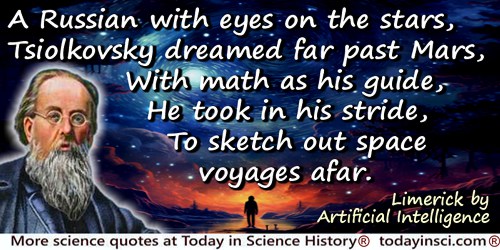
A Russian with eyes on the stars,
Tsiolkovsky dreamed past the Mars,
With math as his guide,
He took in his stride,
To sketch out space voyages afar.
Tsiolkovsky dreamed past the Mars,
With math as his guide,
He took in his stride,
To sketch out space voyages afar.
Limerick created by Artificial Intelligence from: “Write a limerick about K.E. Tsiolkovsky, Russian pioneer space theorist,” and only two words tweaked by Webmaster (17 Sep 2023).
A slave world is not worth preserving. Better be lifeless like the cold moon, or primitively vegetal like desolate Mars, than be a planet populated by social robots.
From speech (Oct 1947), 'Peace or Pieces: or Who Amends the Golden Rule'. As reprinted in Henry Goddard Leach (ed.), The American-Scandinavian Review (1950), 37-38, 34. As quoted in 'Dr. Harlow Shapley Dies at 86; Dean of American Astronomers', New York Times (21 Oct 1972), 69.
Almost all of the space program’s important advances in scientific knowledge have been accomplished by hundreds of robotic spacecraft in orbit about Earth and on missions to the distant planets Mercury, Venus, Mars, Jupiter, Saturn, Uranus, and Neptune. Robotic exploration of the planets and their satellites as well as of comets and asteroids has truly revolutionized our knowledge of the solar system.
In 'Is Human Spaceflight Obsolete?', Issues in Science and Technology (Summer 2004).
And from this such small difference of eight minutes [of arc] it is clear why Ptolemy, since he was working with bisection [of the linear eccentricity], accepted a fixed equant point… . For Ptolemy set out that he actually did not get below ten minutes [of arc], that is a sixth of a degree, in making observations. To us, on whom Divine benevolence has bestowed the most diligent of observers, Tycho Brahe, from whose observations this eight-minute error of Ptolemy’s in regard to Mars is deduced, it is fitting that we accept with grateful minds this gift from God, and both acknowledge and build upon it. So let us work upon it so as to at last track down the real form of celestial motions (these arguments giving support to our belief that the assumptions are incorrect). This is the path I shall, in my own way, strike out in what follows. For if I thought the eight minutes in [ecliptic] longitude were unimportant, I could make a sufficient correction (by bisecting the [linear] eccentricity) to the hypothesis found in Chapter 16. Now, because they could not be disregarded, these eight minutes alone will lead us along a path to the reform of the whole of Astronomy, and they are the matter for a great part of this work.
Astronomia Nova, New Astronomy (1609), ch. 19, 113-4, Johannes Kepler Gesammelte Werke (1937-), Vol. 3, 177-8.
Eventually man has to get there [Mars] because we will never be satisfied with unmanned exploration.
In 'Interview: Cyril Ponnamperuma', Space World (1989), 5, 25.
For all these years you were merely
A smear of light through our telescopes
On the clearest, coldest night; a hint
Of a glint, just a few pixels wide
On even your most perfectly-framed portraits.
But now, now we see you!
Swimming out of the dark - a great
Stone shark, your star-tanned skin pitted
And pocked, scarred after eons of drifting
Silently through the endless ocean of space.
Here on Earth our faces lit up as we saw
You clearly for the first time; eyes wide
With wonder we traced the strangely familiar
Grooves raked across your sides,
Wondering if Rosetta had doubled back to Mars
And raced past Phobos by mistake –
Then you were gone, falling back into the black,
Not to be seen by human eyes again for a thousand
Blue Moons or more. But we know you now,
We know you; you’ll never be just a speck of light again.
A smear of light through our telescopes
On the clearest, coldest night; a hint
Of a glint, just a few pixels wide
On even your most perfectly-framed portraits.
But now, now we see you!
Swimming out of the dark - a great
Stone shark, your star-tanned skin pitted
And pocked, scarred after eons of drifting
Silently through the endless ocean of space.
Here on Earth our faces lit up as we saw
You clearly for the first time; eyes wide
With wonder we traced the strangely familiar
Grooves raked across your sides,
Wondering if Rosetta had doubled back to Mars
And raced past Phobos by mistake –
Then you were gone, falling back into the black,
Not to be seen by human eyes again for a thousand
Blue Moons or more. But we know you now,
We know you; you’ll never be just a speck of light again.
…...
I do not see the possibility of comparison between his [H. G. Wells] work and mine. We do not proceed in the same manner. It occurs to me that his stories do not repose on a very scientific basis. ... I make use of physics. He invents. I go to the moon in a cannon-ball, discharged from a cannon. Here there is no invention. He goes to Mars in an airship, which he constructs of a metal which does not obey the law of gravitation. Ça c'est très joli ... but show me this metal. Let him produce it.
Quoted in R. H. Sherard, 'Jules Verne Re-Visited', T.P.'s Weekly (9 Oct 1903).
I don’t think we’ll go there [Mars] until we go back to the Moon and develop a technology base for living and working and transporting ourselves through space.
As quoted on the nmspacemuseum.org website of the New Mexico Museum of Space History.
I ought to call myself an agnostic; but, for all practical purposes, I am an atheist. I do not think the existence of the Christian God any more probable than the existence of the Gods of Olympus or Valhalla. To take another illustration: nobody can prove that there is not between the Earth and Mars a china teapot revolving in an elliptical orbit, but nobody thinks this sufficiently likely to be taken into account in practice. I think the Christian God just as unlikely.
Letter (1958) to Mr Major. Collected in Dear Bertrand Russell: A Selection of his
Correspondence with the General Public, 1950 - 1968 (1969), 41-42.
I shall explain a System of the World differing in many particulars from any yet known, answering in all things to the common Rules of Mechanical Motions: This depends upon three Suppositions. First, That all Cœlestial Bodies whatsoever, have an attraction or gravitating power towards their own Centers, whereby they attract not only their own parts, and keep them from flying from them, as we may observe the Earth to do, but that they do also attract all the other Cœlestial bodies that are within the sphere of their activity; and consequently that not only the Sun and Moon have an influence upon the body and motion the Earth, and the Earth upon them, but that Mercury also Venus, Mars, Saturn and Jupiter by their attractive powers, have a considerable influence upon its motion in the same manner the corresponding attractive power of the Earth hath a considerable influence upon every one of their motions also. The second supposition is this, That all bodies whatsoever that are put into a direct and simple motion, will continue to move forward in a streight line, till they are by some other effectual powers deflected and bent into a Motion, describing a Circle, Ellipse, or some other more compounded Curve Line. The third supposition is, That these attractive powers are so much the more powerful in operating, by how much the nearer the body wrought upon is to their own Centers. Now what these several degrees are I have not yet experimentally verified; but it is a notion, which if fully prosecuted as it ought to be, will mightily assist the Astronomer to reduce all the Cœlestial Motions to a certain rule, which I doubt will never be done true without it. He that understands the nature of the Circular Pendulum and Circular Motion, will easily understand the whole ground of this Principle, and will know where to find direction in Nature for the true stating thereof. This I only hint at present to such as have ability and opportunity of prosecuting this Inquiry, and are not wanting of Industry for observing and calculating, wishing heartily such may be found, having myself many other things in hand which I would first compleat and therefore cannot so well attend it. But this I durst promise the Undertaker, that he will find all the Great Motions of the World to be influenced by this Principle, and that the true understanding thereof will be the true perfection of Astronomy.
An Attempt to Prove the Motion of the Earth from Observations (1674), 27-8. Based on a Cutlerian Lecture delivered by Hooke at the Royal Society four years earlier.
I wol yow telle, as was me taught also,
The foure spirites and the bodies sevene,
By ordre, as ofte I herde my lord hem nevene.
The firste spirit quiksilver called is,
The second orpiment, the thridde, ywis,
Sal armoniak, and the firthe brimstoon.
The bodies sevene eek, lo! hem heer anoon:
Sol gold is, and Luna silver we threpe,
Mars yron, Mercurie quiksilver we clepe,
Saturnus leed, and Jupiter is tin,
And Venus coper, by my fader kin!
The foure spirites and the bodies sevene,
By ordre, as ofte I herde my lord hem nevene.
The firste spirit quiksilver called is,
The second orpiment, the thridde, ywis,
Sal armoniak, and the firthe brimstoon.
The bodies sevene eek, lo! hem heer anoon:
Sol gold is, and Luna silver we threpe,
Mars yron, Mercurie quiksilver we clepe,
Saturnus leed, and Jupiter is tin,
And Venus coper, by my fader kin!
The Canon's Yeoman's Tale, lines 819-29. In Larry D. Benson (ed.), The Riverside Chaucer (1988), 273.
If I were to suggest that between the Earth and Mars there is a china teapot revolving about the sun in an elliptical orbit, nobody would be able to disprove my assertion provided I were careful to add that the teapot is too small to be revealed even by our most powerful telescopes. But if I were to go on to say that, since my assertion cannot be disproved, it is intolerable presumption on the part of human reason to doubt it, I should rightly be thought to be talking nonsense. If, however, the existence of such a teapot were affirmed in ancient books, taught as the sacred truth every Sunday, and instilled into the minds of children at school, hesitation to believe in its existence would become a mark of eccentricity and entitle the doubter to the attentions of the psychiatrist in an enlightened age or of the Inquisitor in an earlier time.
In unpublished manuscript, 'Is There a God', (5 Mar 1952) written for the magazine, Illustrated. Collected in Bertrand Russell, John G. Slater (ed.) and Peter Köllner (ed.) The Collected Papers of Bertran Russell: Volume II: Last Philosophical Testament: 1943-68 (1997), 547-548.
It’s going to be a bummer if Mars turns out to be like us.
…...
Jupiter’s passed through Orion
And come into conjunction with Mars.
Saturn is wheeling through infinite space
To its preordained place in the stars.
And I gaze at the planets in wonder
At the trouble and time they spend,
All to warn me to be careful
In dealings involving a friend!
And come into conjunction with Mars.
Saturn is wheeling through infinite space
To its preordained place in the stars.
And I gaze at the planets in wonder
At the trouble and time they spend,
All to warn me to be careful
In dealings involving a friend!
Lyrics of 'Horoscope' from At the Drop of Another Hat, revue performance by Michael Flanders and Donald Swann (Haymarket Theatre, London, opened 2 Oct 1963), and on LP recording (released 1964).
Looking through the telescope, one saw a circle of deep blue and the little round planet swimming in the field. It seemed such a little thing, so bright and small and still, faintly marked with transverse stripes, and slightly flattened from the perfect round. But so little it was, so silvery warm—a pin’s-head of light! It was as if it quivered, but really this was the telescope vibrating with the activity of the clockwork that kept the planet in view.
As I watched, the planet seemed to grow larger and smaller and to advance and recede, but that was simply that my eye was tired. Forty millions of miles it was from us—more than forty millions of miles of void. Few people realise the immensity of vacancy in which the dust of the material universe swims.
As I watched, the planet seemed to grow larger and smaller and to advance and recede, but that was simply that my eye was tired. Forty millions of miles it was from us—more than forty millions of miles of void. Few people realise the immensity of vacancy in which the dust of the material universe swims.
The War of the Worlds (1898), editted by Frank D. McConnell (1977), 128.
Mars is the next frontier, what the Old West was, what America was 500 years ago. It’s been 500 years since Columbus. It’s time to strike out anew. There’s a big argument at the moment. The moon is closer, and we’ve got to go back there sometime. But whether it will ever be settled on a large scale is a question. But Mars—there’s no doubt about it. … Everything you need is on Mars.
The characteristic of human nature, and perhaps our simian family group, is curiosity and exploration. When we stop doing that, we won't be human anymore. You say there's been a decline, well, I’ve seen far more happen in my lifetime than I ever dreamed. And the momentary plateau now, well, many of our problems on Earth can only be solved by space technology. … When we get out of the present sort of slump and confusion, well, I mean the next step is space. It's inevitable.
The characteristic of human nature, and perhaps our simian family group, is curiosity and exploration. When we stop doing that, we won't be human anymore. You say there's been a decline, well, I’ve seen far more happen in my lifetime than I ever dreamed. And the momentary plateau now, well, many of our problems on Earth can only be solved by space technology. … When we get out of the present sort of slump and confusion, well, I mean the next step is space. It's inevitable.
Interview in Sri Lanka by Steve Coll for The Washington Post (9 Mar 1992), B1.
Mars is there, waiting to be reached.
…...
Mars tugs at the human imagination like no other planet. With a force mightier than gravity, it attracts the eye to its shimmering red presence in the clear night sky. It is like a glowing ember in a field of ethereal lights, projecting energy and promise. It inspires visions of an approachable world. The mind vaults to thoughts of what might have been (if Mars were a litter closer to the warming Sun) and of what could be (if humans were one day to plant colonies there). Mysterious Mars, alluring Mars, fourth planet from the Sun: so far away and yet, on a cosmic scale, so very near.
…...
Mars was surprising in its way but not flabbergasting; it was a disappointment not to find evidences of life, and there was some sadness in the pictures sent back to earth from the Mars Lander, that lonely long-legged apparatus poking about with its jointed arm, picking up sample after sample of the barren Mars soil, looking for any flicker of life and finding none; the only sign of life on Mars was the Lander itself, an extension of the human mind all the way from earth to Mars, totally alone.
In Late Night Thoughts on Listening to Mahler’s Ninth Symphony (1984), 22.
May we attribute to the color of the herbage and plants, which no doubt clothe the plains of Mars, the characteristic hue of that planet, which is noticeable by the naked eye, and which led the ancients to personify it as a warrior?
In 'Mars, by the Latest Observations', Popular Science (Dec 1873), 4, 190.
Now, the downside to conservation is that so much is done for the public, which almost always mars the environment that one wanted to conserve.
…...
Of the 10,000 or so meteorites that have been collected and analyzed, eight are particularly unusual. They are so unusual, in fact, that since 1979 some investigators have thought they might have originated not in asteroids, as most meteorites did, but on the surface of Mars.
In Scientific American, (Dec 1986), 255, 80.
On the afternoon of October 19, 1899, I climbed a tall cherry tree and, armed with a saw which I still have, and a hatchet, started to trim the dead limbs from the cherry tree. It was one of the quiet, colorful afternoons of sheer beauty which we have in October in New England, and as I looked towards the fields at the east, I imagined how wonderful it would be to make some device which had even the possibility of ascending to Mars. I was a different boy when I descended the tree from when I ascended for existence at last seemed very purposive.
In The Papers of Robert H. Goddard: 1898-1924 (1970), 9.
One hardly knows where, in the history of science, to look for an important movement that had its effective start in so pure and simple an accident as that which led to the building of the great Washington telescope, and went on to the discovery of the satellites of Mars.
In The Reminiscences of an Astronomer (1903), Vol. 3, 128.
Over very long time scales, when the perturbing influences of both Jupiter and Saturn are taken into account, the seemingly regular orbits of asteroids that stray into the Kirkwood gaps turn chaotic. For millions of years … such an orbit seems predictable. Then the path grows increasingly eccentric until it begins to cross the orbit of Mars and then the Earth. Collisions or close encounters with those planets are inevitable.
In article 'Tales of Chaos: Tumbling Moons and Unstable Asteroids", New York Times (20 Jan 1987), C3.
Read no newspapers, try to find a few friends who think as you do, read the wonderful writers of earlier times, Kant, Goethe, Lessing, and the classics of other lands, and enjoy the natural beauties of Munich’s surroundings. Make believe all the time that you are living, so to speak, on Mars among alien creatures and blot out any deeper interest in the actions of those creatures. Make friends with a few animals. Then you will become a cheerful man once more and nothing will be able to trouble you.
Letter (5 Apr 1933). As quoted in Jamie Sayen, Einstein in America: The Scientist’s Conscience in the Age of Hitler and Hiroshima (1985), 12. This is part of Einstein’s reply to a letter from a troubled, unemployed musician, presumably living in Munich.
So, Fabricius, I already have this: that the most true path of the planet [Mars] is an ellipse, which Dürer also calls an oval, or certainly so close to an ellipse that the difference is insensible.
Letter to David Fabricius (11 Oct 1605). Johannes Kepler Gesammelte Werke (1937- ), Vol. 15, letter 358, l. 390-92, p. 249.
The best way to study Mars is with two hands, eyes and ears of a geologist, first at a moon orbiting Mars … and then on the surface.
In his article, '40 Years After Apollo 11 Moon Landing, It’s Time for a Mission to Mars', in Washington post (16 Jul 2009).
The chemical compounds are comparable to a system of planets in that the atoms are held together by chemical affinity. They may be more or less numerous, simple or complex in composition, and in the constitution of the materials, they play the same role as Mars and Venus do in our planetary system, or the compound members such as our earth with its moon, or Jupiter with its satellites... If in such a system a particle is replaced by one of different character, the equilibrium can persist, and then the new compound will exhibit properties similar to those shown by the original substance.
Quoted in Ralph Oesper, The Human Side of Scientists (1975), 55.
The first watch of night is given
To the red planet Mars.
Is it the tender star of love?
The star of love and dreams?
Oh. no! from that blue tent above,
A hero’s armour gleams.
And earnest thoughts within me rise,
When I behold afar,
Suspended in the evening skies,
The shield of that red star.
O star of strength! I see thee stand
And smile upon my pain;
Thou beckonest with thy mailèd hand,
And I am strong again.
To the red planet Mars.
Is it the tender star of love?
The star of love and dreams?
Oh. no! from that blue tent above,
A hero’s armour gleams.
And earnest thoughts within me rise,
When I behold afar,
Suspended in the evening skies,
The shield of that red star.
O star of strength! I see thee stand
And smile upon my pain;
Thou beckonest with thy mailèd hand,
And I am strong again.
From 'The Light of Stars', The Poetical Works of Henry Wadsworth Longfellow (1855), 43.
The key to SETI is to guess the type of communication that an alien society would use. The best guesses so far have been that they would use radio waves, and that they would choose a frequency based on 'universal' knowledge—for instance, the 1420 MHz hydrogen frequency. But these are assumptions formulated by the human brain. Who knows what sort of logic a superadvanced nonhuman life form might use? ... Just 150 years ago, an eyeblink in history, radio waves themselves were inconceivable, and we were thinking of lighting fires to signal the Martians.
Quoted on PBS web page related to Nova TV program episode on 'Origins: Do Aliens Exist in the Milky Way'.
The modern version of Buridan’s ass [a figurative description of a man of indecision] has a Ph.D., but no time to grow up as he is undecided between making a Leonardo da Vinci in the test tube or planting a Coca Cola sign on Mars.
Voices in the Labyrinth: Nature, Man, and Science (1979), 3.
The star [Tycho’s supernova] was at first like Venus and Jupiter, giving pleasing effects; but as it then became like Mars, there will next come a period of wars, seditions, captivity and death of princes, and destruction of cities, together with dryness and fiery meteors in the air, pestilence, and venomous snakes. Lastly, the star became like Saturn, and there will finally come a time of want, death, imprisonment and all sorts of sad things.
The success of Apollo was mainly due to the fact that the project was conceived and honestly presented to the public as an international sporting event and not as a contribution to science. The order of priorities in Apollo was accurately reflected by the first item to be unloaded after each landing on the Moon's surface, the television camera. The landing, the coming and going of the astronauts, the exploring of the moon's surface, the gathering of Moon rocks and the earthward departure, all were expertly choreographed with the cameras placed in the right positions to make a dramatic show on television. This was to me the great surprise of the Apollo missions. There was nothing surprising in the fact that astronauts could walk on the Moon and bring home Moon rocks. There were no big scientific surprises in the chemistry of the Moon rocks or in the results of magnetic and seismic observations that the astronauts carried out. The big surprise was the quality of the public entertainment that the missions provided. I had never expected that we would see in real time astronauts hopping around in lunar gravity and driving their Rover down the Lincoln- Lee scarp to claim a lunar speed record of eleven miles per hour. Intensive television coverage was the driving force of Apollo. Von Braun had not imagined the possibilities of television when he decided that one kilohertz would be an adequate communication bandwidth for his Mars Project.
From a Danz lecture at University of Washington, 'Sixty Years of Space Science 1958-2018' (1988), collected in From Eros to Gaia (1992), Vol. 5, 52.
Then if the first argument remains secure (for nobody will produce a neater one, than the length of the periodic time is a measure of the size of the spheres), the order of the orbits follows this sequence, beginning from the highest: The first and highest of all is the sphere of the fixed stars, which contains itself and all things, and is therefore motionless. It is the location of the universe, to which the motion and position of all the remaining stars is referred. For though some consider that it also changes in some respect, we shall assign another cause for its appearing to do so in our deduction of the Earth’s motion. There follows Saturn, the first of the wandering stars, which completes its circuit in thirty years. After it comes Jupiter which moves in a twelve-year long revolution. Next is Mars, which goes round biennially. An annual revolution holds the fourth place, in which as we have said is contained the Earth along with the lunar sphere which is like an epicycle. In fifth place Venus returns every nine months. Lastly, Mercury holds the sixth place, making a circuit in the space of eighty days. In the middle of all is the seat of the Sun. For who in this most beautiful of temples would put this lamp in any other or better place than the one from which it can illuminate everything at the same time? Aptly indeed is he named by some the lantern of the universe, by others the mind, by others the ruler. Trismegistus called him the visible God, Sophocles' Electra, the watcher over all things. Thus indeed the Sun as if seated on a royal throne governs his household of Stars as they circle around him. Earth also is by no means cheated of the Moon’s attendance, but as Aristotle says in his book On Animals the Moon has the closest affinity with the Earth. Meanwhile the Earth conceives from the Sun, and is made pregnant with annual offspring. We find, then, in this arrangement the marvellous symmetry of the universe, and a sure linking together in harmony of the motion and size of the spheres, such as could be perceived in no other way. For here one may understand, by attentive observation, why Jupiter appears to have a larger progression and retrogression than Saturn, and smaller than Mars, and again why Venus has larger ones than Mercury; why such a doubling back appears more frequently in Saturn than in Jupiter, and still more rarely in Mars and Venus than in Mercury; and furthermore why Saturn, Jupiter and Mars are nearer to the Earth when in opposition than in the region of their occultation by the Sun and re-appearance. Indeed Mars in particular at the time when it is visible throughout the night seems to equal Jupiter in size, though marked out by its reddish colour; yet it is scarcely distinguishable among stars of the second magnitude, though recognized by those who track it with careful attention. All these phenomena proceed from the same course, which lies in the motion of the Earth. But the fact that none of these phenomena appears in the fixed stars shows their immense elevation, which makes even the circle of their annual motion, or apparent motion, vanish from our eyes.
'Book One. Chapter X. The Order of the Heavenly Spheres', in Copernicus: On the Revolutions of the Heavenly Spheres (1543), trans. A. M. Duncan (1976), 49-51.
There’s very good news from the asteroids. It appears that a large fraction of them, including the big ones, are actually very rich in H2O. Nobody imagined that. They thought they were just big rocks … It’s easier to get to an asteroid than to Mars, because the gravity is lower and landing is easier. Certainly the asteroids are much more practical, right now. If we start space colonies in, say, the next 20 years, I would put my money on the asteroids.
As quoted in Kenneth Brower, 'The Danger of Cosmic Genius', The Atlantic (Dec 2010).
To set foot on the soil of the asteroids, to lift by hand a rock from the Moon, to observe Mars from a distance of several tens of kilometers, to land on its satellite or even on its surface, what can be more fantastic? From the moment of using rocket devices a new great era will begin in astronomy: the epoch of the more intensive study of the firmament.
(1896). As quoted in Firmin Joseph Krieger, Behind the Sputniks: A Survey of Soviet Space Science (1958), 23.
Until that afternoon, my thoughts on planetary atmospheres had been wholly concerned with atmospheric analysis as a method of life detection and nothing more. Now that I knew the composition of the Martian atmosphere was so different from that of our own, my mind filled with wonderings about the nature of the Earth. If the air is burning, what sustains it at a constant composition? I also wondered about the supply of fuel and the removal of the products of combustion. It came to me suddenly, just like a flash of enlightenment, that to persist and keep stable, something must be regulating the atmosphere and so keeping it at its constant composition. Moreover, if most of the gases came from living organisms, then life at the surface must be doing the regulation.
Homage to Gaia: The Life of an Independent Scholar (2000), 253.
We are disappointed if the cold-blooded scientist assures us that Man cannot exist on Mars. … We do resent a restraint on our imagination. We should like to believe in marvelous men on Venus.
From Harlow Shapley and Cecilia H. Payne, eds., The Universe of Stars: Radio Talks from the Harvard Observatory (1926, Rev. Ed., 1929). As quoted and cited in Marcel Chotkowski LaFollette, Science on the Air: Popularizers and Personalities on Radio and Early Television (2009), 42 & 287.
We are the generation that searched on Mars for evidence of life, but couldn’t rouse enough moral sense to stop the destruction of even the grandest manifestations of life on earth. In that sense, we are like the Romans whose works of an, architecture, and engineering inspire our awe but whose traffic in slaves and gladiatorial combat is mystifying and loathsome.
[Co-author with Anna Sequoia.]
[Co-author with Anna Sequoia.]
67 Ways to Save the Animals
We may discover resources on the moon or Mars that will boggle the imagination, that will test our limits to dream. And the fascination generated by further exploration will inspire our young people to study math, and science, and engineering and create a new generation of innovators and pioneers.
Speech, NASA Headquarters (14 Jan 2004). In Office of the Federal Register (U.S.) Staff (eds.), Public Papers of the Presidents of the United States, George W. Bush (2007), 58-59.
What, then, shall we say about the receipts of alchemy, and about the diversity of its vessels and instruments? These are furnaces, glasses, jars, waters, oils, limes, sulphurs, salts, saltpeters, alums, vitriols, chrysocollae, copper greens, atraments, auripigments, fel vitri, ceruse, red earth, thucia, wax, lutum sapientiae, pounded glass, verdigris, soot, crocus of Mars, soap, crystal, arsenic, antimony, minium, elixir, lazarium, gold leaf salt niter, sal ammoniac, calamine stone, magnesia, bolus armenus, and many other things. Then, again, concerning herbs, roots, seeds, woods, stones, animals, worms, bone dust, snail shells, other shells, and pitch. These and the like, whereof there are some very farfetched in alchemy, are mere incumbrances of work; since even if Sol and Luna [gold and silver] could be made by them they rather hinder and delay than further one’s purpose.
In Paracelsus and Arthur Edward Waite (ed.), The Hermetic and Alchemical Writings of Paracelsus (1894), Vol. 1, 13.
With the experience and knowledge gained on the moon, we will then be ready to take the next steps of space exploration: human missions to Mars and to worlds beyond.
Speech, NASA Headquarters (14 Jan 2004). In Office of the Federal Register (U.S.) Staff (eds.), Public Papers of the Presidents of the United States, George W. Bush (2007), 58.
Yet in this my stars were not Mercury as morning star in the angle of the seventh house, in quartile with Mars, but they were Copernicus, they were Tycho Brahe, without whose books of observations everything which has now been brought by me into the brightest daylight would lie buried in darkness.
Harmonice Mundi, The Harmony of the World (1619), book IV, Epilogue on Sublunary Nature. Trans. E. J. Aiton, A. M. Duncan and J. V. Field (1997), 377.
 In science it often happens that scientists say, 'You know that's a really good argument; my position is mistaken,' and then they would actually change their minds and you never hear that old view from them again. They really do it. It doesn't happen as often as it should, because scientists are human and change is sometimes painful. But it happens every day. I cannot recall the last time something like that happened in politics or religion.
(1987) --
In science it often happens that scientists say, 'You know that's a really good argument; my position is mistaken,' and then they would actually change their minds and you never hear that old view from them again. They really do it. It doesn't happen as often as it should, because scientists are human and change is sometimes painful. But it happens every day. I cannot recall the last time something like that happened in politics or religion.
(1987) -- 




