Man Quotes (2250 quotes)
... [I]nfectious disease is merely a disagreeable instance of a widely prevalent tendency of all living creatures to save themselves the bother of building, by their own efforts, the things they require. Whenever they find it possible to take advantage of the constructive labors of others, this is the path of least resistance. The plant does the work with its roots and its green leaves. The cow eats the plant. Man eats both of them; and bacteria (or investment bankers) eat the man. ...
Rats, Lice and History (1935).
... If I let myself believe anything on insufficient evidence, there may be no great harm done by the mere belief; it may be true after all, or I may never have occasion to exhibit it in outward acts. But I cannot help doing this great wrong towards Man, that I make myself credulous. The danger to society is not merely that it should believe wrong things, though that is great enough; but that it should become credulous, and lose the habit of testing things and inquiring into them; for then it must sink back into savagery.
The Scientific Basis of Morals (1884), 28.
… man-midwifery, with other “indecencies,” is a great system of fashionable prostitution; a primary school of infamy—as the fashionable hotel and parlor wine glass qualify candidates for the two-penny grog-shop and the gutter.
Man-midwifery Exposed and Corrected (1848)
… scientific thought does not mean thought about scientific subjects with long names. There are no scientific subjects. The subject of science is the human universe; that is to say, everything that is, or has been, or may be related to man.
'On the Aims and Instruments of Scientific Thought,' a Lecture delivered before the members of the British Association, at Brighton, on 19 Aug 1872, in Leslie Stephen and Frederick Pollock (eds.), Lectures and Essays, by the Late William Kingdon Clifford (1886), 86.
… the truth is that the knowledge of external nature and of the sciences which that knowledge requires or includes, is not the great or the frequent business of the human mind. Whether we provide for action or conversation, whether we wish to be useful or pleasing, the first requisite is the religious and moral knowledge of right and wrong; the next is an acquaintance with the history of mankind, and with those examples which may be said to embody truth, and prove by events the reasonableness of opinions. Prudence and justice are virtues, and excellencies, of all times and of all places; we are perpetually moralists, but we are geometricians only by chance. Our intercourse with intellectual nature is necessary; our speculations upon matter are voluntary, and at leisure. Physical knowledge is of such rare emergence, that one man may know another half his life without being able to estimate his skill in hydrostatics or astronomy; but his moral and prudential character immediately appears.
In Lives of the Poets (1779-81).
… There can be no doubt about faith and not reason being the ultima ratio. Even Euclid, who has laid himself as little open to the charge of credulity as any writer who ever lived, cannot get beyond this. He has no demonstrable first premise. He requires postulates and axioms which transcend demonstration, and without which he can do nothing. His superstructure indeed is demonstration, but his ground his faith. Nor again can he get further than telling a man he is a fool if he persists in differing from him. He says “which is absurd,” and declines to discuss the matter further. Faith and authority, therefore, prove to be as necessary for him as for anyone else.
In The Way of All Flesh (1917), 319-320.
... there is an external world which can in principle be exhaustively described in scientific language. The scientist, as both observer and language-user, can capture the external facts of the world in prepositions that are true if they correspond to the facts and false if they do not. Science is ideally a linguistic system in which true propositions are in one-to-one relation to facts, including facts that are not directly observed because they involve hidden entities or properties, or past events or far distant events. These hidden events are described in theories, and theories can be inferred from observation, that is the hidden explanatory mechnism of the world can be discovered from what is open to observation. Man as scientist is regarded as standing apart from the world and able to experiment and theorize about it objectively and dispassionately.
'Introduction', Revolutions and Reconstructions in the Philosophy of Science (1981), xii. In John Templeton and Robert L. Herrmann, Is God the Only Reality (1994), 11-12.
...[T]he natural history of the rat is tragically similar to that of man ... some of the more obvious qualities in which rats resemble men — ferocity, omnivorousness, and adaptability to all climates ... the irresponsible fecundity with which both species breed at all seasons of the year with a heedlessness of consequences, which subjects them to wholesale disaster on the inevitable, occasional failure of the food supply.... [G]radually, these two have spread across the earth, keeping pace with each other and unable to destroy each other, though continually hostile. They have wandered from East to West, driven by their physical needs, and — unlike any other species of living things — have made war upon their own kind. The gradual, relentless, progressive extermination of the black rat by the brown has no parallel in nature so close as that of the similar extermination of one race of man by another...
Rats, Lice and History(1935)
...a man estimable for his learning, amiable for his life, and venerable for his piety. Arbuthnot was a man of great comprehension, skilful in his profession, versed in the sciences, acquainted with ancient literature, and able to animate his mass of knowledge by a bright and active imagination; a scholar with great brilliance of wit; a wit who, in the crowd of life, retained and discovered a noble ardour of religious zeal.
The Lives of the English Poets (1826), vol. 2, 257.
...after my first feeling of revulsion had passed, I spent three of the most entertaining and instructive weeks of my life studying the fascinating molds which appeared one by one on the slowly disintegrating mass of horse-dung. Microscopic molds are both very beautiful and absorbingly interesting. The rapid growth of their spores, the way they live on each other, the manner in which the different forms come and go, is so amazing and varied that I believe a man could spend his life and not exhaust the forms or problems contained in one plate of manure.
The World Was My Garden (1938, 1941), 55.
...for the animals, which we resemble and which would be our equals if we did not have reason, do not reflect upon the actions or the passions of their external or internal senses, and do not know what is color, odor or sound, or if there is any differences between these objects, to which they are moved rather than moving themselves there. This comes about by the force of the impression that the different objects make on their organs and on their senses, for they cannot discern if it is more appropriate to go and drink or eat or do something else, and they do not eat or drink or do anything else except when the presence of objects or the animal imagination [l'imagination brutalle], necessitates them and transports them to their objects, without their knowing what they do, whether good or bad; which would happen to us just as to them if we were destitute of reason, for they have no enlightenment except what they must have to take their nourishment and to serve us for the uses to which God has destined them.
[Arguing the uniqueness of man by regarding animals to be merely automatons.].
[Arguing the uniqueness of man by regarding animals to be merely automatons.].
Les Préludes de l'Harmonie Universelle (1634), 135-139. In Charles Coulston Gillespie (ed.), Dictionary of Scientific Biography (1974), Vol. 9, 318.
…the ideal doctor would be a man endowed with profound knowledge of life and of the soul, intuitively divining any suffering or disorder of whatever kind, and restoring peace by his mere presence.
Amiel's Journal The Journal Intime of Henri-Frederic Amiel (22 Aug 1873), trans. By Mrs Humphry Ward (1889), Vol 2., 153.
…the longest-domesticated of all species, man.
— Asa Gray
'Notice of Dr. Hooker's Flora of New Zealand', American Journal of Science (May 1854), 2nd. series, 17, No 51, 336. Asa Gray, acknowledged on the journal's title page, is indicated as this article's author by the initials “A.G.” at the end of the article. On pages 335-336, the full quote, for context, is: “Perhaps if zoologists would contemplate the wide variations presented by many plants of indubitably one and the same species, and the still wider diversities of long cultivated races from an original stock, they would find more than one instructive parallel to the case of the longest domesticated of all species, man.”
...the scientific attitude implies what I call the postulate of objectivity—that is to say, the fundamental postulate that there is no plan, that there is no intention in the universe. Now, this is basically incompatible with virtually all the religious or metaphysical systems whatever, all of which try to show that there is some sort of harmony between man and the universe and that man is a product—predictable if not indispensable—of the evolution of the universe.
Quoted in John C. Hess, 'French Nobel Biologist Says World Based On Chance', New York Times (15 Mar 1971), 6. Cited in Herbert Marcuse, Counter-Revolution and Revolt (1972), 66.
…what is man in the midst of nature? A nothing in comparison with the infinite, an all in comparison with nothingness: a mean between nothing and all. Infinitely far from comprehending the extremes, the end of things and their principle are for him inevitably concealed in an impenetrable secret; equally incapable of seeing the nothingness whence he is derived, and the infinity in which he is swallowed up.
Pensées. Collected in Blaise Pascal and O.W. Wright (trans.), The Thoughts, Letters and Opuscules of Blaise Pascal (1859), 160. There are versions by other translators. For example, an alternate translation for the last sentence is: [Man is] “equally incapable of seeing the nothingness from which he emerges and the infinity in which he is engulfed.”
'Tis certain that a serious attention to the sciences and liberal arts softens and humanizes the temper, and cherishes those fine emotions in which true virtue and honor consist. It rarely, very rarely happens that a man of taste and learning is not, at least, an honest man, whatever frailties may attend him.
Essay XVIII, 'The Sceptic', Essays and Treatises on Several Subjects (1742, New ed. 1767), Vol. 1, 193.
‘I was reading an article about “Mathematics”. Perfectly pure mathematics. My own knowledge of mathematics stops at “twelve times twelve,” but I enjoyed that article immensely. I didn’t understand a word of it; but facts, or what a man believes to be facts, are always delightful. That mathematical fellow believed in his facts. So do I. Get your facts first, and’—the voice dies away to an almost inaudible drone—’then you can distort ‘em as much as you please.’
In 'An Interview with Mark Twain', in Rudyard Kipling, From Sea to Sea (1899), Vol. 2, 180.
’Tis evident, that as common Air when reduc’d to half Its wonted extent, obtained near about twice as forcible a Spring as it had before; so this thus- comprest Air being further thrust into half this narrow room, obtained thereby a Spring about as strong again as that It last had, and consequently four times as strong as that of the common Air. And there is no cause to doubt, that If we had been here furnisht with a greater quantity of Quicksilver and a very long Tube, we might by a further compression of the included Air have made It counter-balance “the pressure” of a far taller and heavier Cylinder of Mercury. For no man perhaps yet knows how near to an infinite compression the Air may be capable of, If the compressing force be competently increast.
A Defense of the Doctrine Touching the Spring and Weight of the Air (1662), 62.
’Tis late; the astronomer in his lonely height
Exploring all the dark, descries from far
Orbs that like distant isles of splendor are,
And mornings whitening in the infinite.…
He summons one disheveled, wandering star,—
Return ten centuries hence on such a night.
That star will come. It dare not by one hour
Cheat science, or falsify her calculation;
Men will have passed, but watchful in the tower
Man shall remain in sleepless contemplation;
And should all men have perished there in turn,
Truth in their stead would watch that star’s return.
Exploring all the dark, descries from far
Orbs that like distant isles of splendor are,
And mornings whitening in the infinite.…
He summons one disheveled, wandering star,—
Return ten centuries hence on such a night.
That star will come. It dare not by one hour
Cheat science, or falsify her calculation;
Men will have passed, but watchful in the tower
Man shall remain in sleepless contemplation;
And should all men have perished there in turn,
Truth in their stead would watch that star’s return.
From poem, 'The Appointment', as translated by Arthur O’Shaughnessy, collected in Samuel Waddington (ed.), The Sonnets of Europe (1886), 154.
“Endow scientific research and we shall know the truth, when and where it is possible to ascertain it;” but the counterblast is at hand: “To endow research is merely to encourage the research for endowment; the true man of science will not be held back by poverty, and if science is of use to us, it will pay for itself.” Such are but a few samples of the conflict of opinion which we find raging around us.
From The Grammar of Science (1892), 5.
“Every moment dies a man,/ Every moment one is born”:
I need hardly point out to you that this calculation would tend to keep the sum total of the world's population in a state of perpetual equipoise whereas it is a well-known fact that the said sum total is constantly on the increase. I would therefore take the liberty of suggesting that in the next edition of your excellent poem the erroneous calculation to which I refer should be corrected as follows:
'Every moment dies a man / And one and a sixteenth is born.” I may add that the exact figures are 1.167, but something must, of course, be conceded to the laws of metre.
I need hardly point out to you that this calculation would tend to keep the sum total of the world's population in a state of perpetual equipoise whereas it is a well-known fact that the said sum total is constantly on the increase. I would therefore take the liberty of suggesting that in the next edition of your excellent poem the erroneous calculation to which I refer should be corrected as follows:
'Every moment dies a man / And one and a sixteenth is born.” I may add that the exact figures are 1.167, but something must, of course, be conceded to the laws of metre.
Unpublished letter to Tennyson in response to his Vision of Sin (1842). Quoted in Philip and Emily Morrison, Charles Babbage and his Calculating Engines: Selected Writings by Charles Babbage and Others (1961), xxiii.
“Facts speak for themselves.” Illusion! Facts are ventriloquists’ dummies. Sitting on a wise man’s knee they may be made to utter words of wisdom; elsewhere, they say nothing, or talk nonsense, or indulge in sheer diabolism.
In Time Must Have A Stop (1916), 295.
“If there are two theories, one simpler man the other, the simpler one is to be preferred.” At first sight this does not seem quite so bad, but a little thought shows that our tendency to prefer the simpler possibility is psychological rather than scientific. It is less trouble to think that way. Experience invariably shows that the more correct a theory becomes, the more complex does it seem. … So this … interpretation of [Ockham’s Razor] is … worthless.
With co-author Nalin Chandra Wickramasinghe, Evolution from Space (1981), 135.
“On earth there is nothing great but man; and in man there is nothing great but mind.”
A favorite quote by Phavorinus which Hamilton used as a motto posted in his classroom.
A favorite quote by Phavorinus which Hamilton used as a motto posted in his classroom.
As translated from a reported quote by Phavorinus. Hamilton showed his fondness for this motto by having it painted in gold letters on a green board posted on his classroom wall, behind the chair. However, he did not originate it. He made this clear during a lecture, when he stated, “‘On earth’ says a forgotten philosopher, ‘there is nothing great but man; and in man there is nothing great but mind.’” This was in Lecture II, 'Philosophy—Its Absolute Utility (B) Objective' (1836), part of Hamilton’s Biennial Course while Chair of Logic and Mathematics, University of Edinburgh. The lectures were collected and annotated by editors Henry L. Mansel and John Veitch, in Lectures on Metaphysics and Logic (1858, 6th ed. 1877), 24. The epigraph following the title page of this book also reads, “On earth, there is nothing great but man, and in man there is nothing great but Mind.” Since the collection was published posthumously, Webmaster speculates this was the choice of the editors, as Hamilton’s motto. In the book, a footnote to the quote identifies the philosopher as “Phavorinus, quoted by Joannes Picus Mirandulanus, In Astrologiam, lib. iii p.351*, Basil, ed.” This information was found by an editor in Hamilton’s Commonplace-Book or fragmentary papers. An editor’s own addition to the footnote gives “For notice of Phavorinus, see Vossius, De Hist. Grœc, lib. ii c. 10.” Thus, although this quote is widely seen attributed to Sir William Hamilton, and although he may have been very fond of repeating it, his own notes reveal the original author was the ancient philosopher, Phavorinus. In the Latin written in Basil’s work, Mirandula stated that Phavorinus said “Nihil magnum in terra praeter hominem, nihil magnum in homine praeter mentem & animum.” A footnote points this out in Lester Frank Ward, Pure Sociology: A Treatise on the Origin and Spontaneous Development of Society (1921), 496. *Ward corrects the page number to 529, not 351, and notes the passage also occurs in an earlier 1498 edition.
“Science studies everything,” say the scientists. But, really, everything is too much. Everything is an infinite quantity of objects; it is impossible at one and the same time to study all. As a lantern cannot light up everything, but only lights up the place on which it is turned or the direction in which the man carrying it is walking, so also science cannot study everything, but inevitably only studies that to which its attention is directed. And as a lantern lights up most strongly the place nearest to it, and less and less strongly objects that are more and more remote from it, and does not at all light up those things its light does not reach, so also human science, of whatever kind, has always studied and still studies most carefully what seems most important to the investigators, less carefully what seems to them less important, and quite neglects the whole remaining infinite quantity of objects. ... But men of science to-day ... have formed for themselves a theory of “science for science's sake,” according to which science is to study not what mankind needs, but everything.
In 'Modern Science', Essays and Letters (1903), 223.
“There is no expedient to which a man will not resort to avoid the real labor of thinking.
Sir Joshua Reynolds.”
Sir Joshua Reynolds.”
Sign motto used by Edison in his plant. It is a compacted paraphrase of an original quote by the painter, Joshua Reynolds, (which can been seen on the Reynolds quote page on this site). This form of the quote, was published by B.C. Forbes in The American Magazine (Jan 1921), 10. Forbes wrote about his visit to the Edison’s office, where he was shown a placard bearing the motto and attribution to Sir Joshua Reynolds, and told by Edison that he intended to have copies “put all over the plant.”
“They were apes only yesterday. Give them time.”
“Once an ape—always an ape.”…
“No, it will be different. … Come back here in an age or so and you shall see. …”
[The gods, discussing the Earth, in the movie version of Wells’ The Man Who Could Work Miracles (1936).]
“Once an ape—always an ape.”…
“No, it will be different. … Come back here in an age or so and you shall see. …”
[The gods, discussing the Earth, in the movie version of Wells’ The Man Who Could Work Miracles (1936).]
The Man Who Could Work Miracles: a film by H.G. Wells based on the short story (1936), 105-106. Quoted in Carl Sagan, Broca’s Brain (1979, 1986), 3.
“True is it, my incorporate friends,” quoth he, “That I receive the general food at first, Which you do live upon; and fit it is, Because I am the storehouse and the shop Of the whole body. But, if you do remember, I send it through the rivers of your blood, Even to the court, the heart, to th’ seat o’ th’ brain; And, through the cranks and offices of man, The strongest nerves and small inferior veins From me receive that natural competency Whereby they live. And though that all at once”— You, good friends, this says the belly, mark me.
[Told as a fable, this is the belly’s answer to a complaint from the other members of the body that it received all the food but did no work.] In Coriolanus (1623), Act 1, Scene 1, line 130-141. Webmaster’s note: The Fable of the Belly has its roots in antiquity. William Harvey delivered a lecture in Apr 1616 on his discovery the circulation of blood in the body, but did not publish until 1628.
[1157] The man who blames the supreme certainty of mathematics feeds on confusion, and can never silence the contradictions of sophistical sciences which lead to an eternal quackery.
W. An. III. 241 a. From the original Italian: “Chi biasima la soma certezza della matematica, si pasce di confusione mai porrà silentio alle contraditioni delle soffistiche sciētie, colle quali s’inpara vno eterno gridore.” English and Italian in Jean Paul Richter (trans.), 'Philosophical Maxims: Of Mechanics', The Literary Works of Leonardo da Vinci (1883), Vol. 1, Part 2, 289, Aphorism 1157. [Note: Da Vinci writes ē=en.] Also translated beginning, “Those who condemn…”. Also seen translated as “Whoever despises the high wisdom of mathematics nourishes himself on delusion and will never still the sophistic sciences whose only product is an eternal uproar,” in Nicholas J. Rose Mathematical Maxims and Minims (1988).
[1665-06-17] It stroke me very deep this afternoon, going with a hackney-coach from my Lord Treasurer's down Holborne - the coachman I found to drive easily and easily; at last stood still, and came down hardly able to stand; and told me that he was suddenly stroke very sick and almost blind. So I light and went into another coach, with a sad heart for the poor man and trouble for myself, lest he should have been stroke with the plague - being at that end of the town that I took him up. But God have mercy upon us all.
Diary of Samuel Pepys (17 Jun 1665)
[1665-10-16] But Lord, how empty the streets are, and melancholy, so many poor sick people in the streets, full of sores, and so many sad stories overheard as I walk, everybody talking of this dead, and that man sick, and so many in this place, and so many in that. And they tell me that in Westminster there is never a physitian, and but one apothecary left, all being dead - but that there are great hopes of a great decrease this week. God send it.
Diary of Samuel Pepys (16 Oct 1665)
[A man] must learn to understand the motives of human beings, their illusions, and their sufferings human beings, their illusions, and their sufferings in order to acquire a proper relationship to individual fellow-men and to the community. These precious things … primarily constitutes and preserves culture. This is what I have in mind when I recommend the “humanities” as important, not just dry specialized knowledge in the fields of history and philosophy.
From interview with Benjamin Fine, 'Einstein Stresses Critical Thinking', New York Times (5 Oct 1952), 37.
[About the great synthesis of atomic physics in the 1920s:] It was a heroic time. It was not the doing of any one man; it involved the collaboration of scores of scientists from many different lands. But from the first to last the deeply creative, subtle and critical spirit of Niels Bohr guided, restrained, deepened and finally transmuted the enterprise.
Quoted in Bill Becker, 'Pioneer of the Atom', New York Times Sunday Magazine (20 Oct 1957), 54.
[After science lost] its mystical inspiration … man’s destiny was no longer determined from “above” by a super-human wisdom and will, but from “below” by the sub-human agencies of glands, genes, atoms, or waves of probability. … A puppet of the Gods is a tragic figure, a puppet suspended on his chromosomes is merely grotesque.
In 'Epilogue', The Sleepwalkers: A History of Man’s Changing Vision of the Universe (1959), 539.
[At the end of the story, its main character, Tom] is now a great man of science, and can plan railroads, and steam-engines, and electric telegraphs, and rifled guns, and so forth; and knows everything about everything, except why a hen's egg don't turn into a crocodile, and two or three other little things that no one will know till the coming of the Cocqcigrues.
The Water-babies (1886), 368-9.
[Davy's] March of Glory, which he has run for the last six weeks—within which time by the aid and application of his own great discovery, of the identity of electricity and chemical attractions, he has placed all the elements and all their inanimate combinations in the power of man; having decomposed both the Alkalies, and three of the Earths, discovered as the base of the Alkalies a new metal... Davy supposes there is only one power in the world of the senses; which in particles acts as chemical attractions, in specific masses as electricity, & on matter in general, as planetary Gravitation... when this has been proved, it will then only remain to resolve this into some Law of vital Intellect—and all human knowledge will be Science and Metaphysics the only Science.
In November 1807 Davy gave his famous Second Bakerian Lecture at the Royal Society, in which he used Voltaic batteries to “decompose, isolate and name” several new chemical elements, notably sodium and potassium.
In November 1807 Davy gave his famous Second Bakerian Lecture at the Royal Society, in which he used Voltaic batteries to “decompose, isolate and name” several new chemical elements, notably sodium and potassium.
Letter to Dorothy Wordsworth, 24 November 1807. In Earl Leslie Griggs (ed.), The Collected Letters of Samuel Taylor Coleridge (1956), Vol. 3, 38.
[Edison] definitely ended the distinction between the theoretical man of science and the practical man of science, so that today we think of scientific discoveries in connection with their possible present or future application to the needs of man. He took the old rule-of-thumb methods out of industry and substituted exact scientific knowledge, while, on the other hand, he directed scientific research into useful channels.
In My Friend Mr. Edison (1930). Quoted in Dyson Carter, If You Want to Invent (1939), 110.
[Edward Teller is a conceptual thinker,] an ‘order of magnitude’ man. That’s his language. He’s like the architect who likes to make the big drawing, the broad sketch, and not worry himself about the plumbing details.
As quoted in Robert Coughlan, 'Dr. Edward Teller’s Magnificent Obsession', Life (6 Sep 1954), 62.
[Euclid's Elements] has been for nearly twenty-two centuries the encouragement and guide of that scientific thought which is one thing with the progress of man from a worse to a better state. The encouragement; for it contained a body of knowledge that was really known and could be relied on, and that moreover was growing in extent and application. For even at the time this book was written—shortly after the foundation of the Alexandrian Museum—Mathematics was no longer the merely ideal science of the Platonic school, but had started on her career of conquest over the whole world of Phenomena. The guide; for the aim of every scientific student of every subject was to bring his knowledge of that subject into a form as perfect as that which geometry had attained. Far up on the great mountain of Truth, which all the sciences hope to scale, the foremost of that sacred sisterhood was seen, beckoning for the rest to follow her. And hence she was called, in the dialect of the Pythagoreans, ‘the purifier of the reasonable soul.’
From a lecture delivered at the Royal Institution (Mar 1873), collected postumously in W.K. Clifford, edited by Leslie Stephen and Frederick Pollock, Lectures and Essays, (1879), Vol. 1, 296.
[Florence Nightingale] was a great administrator, and to reach excellence here is impossible without being an ardent student of statistics. Florence Nightingale has been rightly termed the “Passionate Statistician.” Her statistics were more than a study, they were indeed her religion. For her, Quetelet was the hero as scientist, and the presentation copy of his Physique Sociale is annotated by her on every page. Florence Nightingale believed—and in all the actions of her life acted upon that belief—that the administrator could only be successful if he were guided by statistical knowledge. The legislator—to say nothing of the politician—too often failed for want of this knowledge. Nay, she went further: she held that the universe—including human communities—was evolving in accordance with a divine plan; that it was man's business to endeavour to understand this plan and guide his actions in sympathy with it. But to understand God's thoughts, she held we must study statistics, for these are the measure of his purpose. Thus the study of statistics was for her a religious duty.
In Karl Pearson, The Life, Letters and Labours of Francis Galton (1924), Vol. 2, 414-5.
[I] grew up as a disciple of science. I know its fascination. I have felt the godlike power man derives from his machines.
Quoted in 'Antiseptic Christianity', book review of Lindbergh, Of Flight and Life in Time magazine, (6 Sep 1948).
[In 1909,] Paris was the center of the aviation world. Aeronautics was neither an industry nor even a science; both were yet to come. It was an “art” and I might say a “passion”. Indeed, at that time it was a miracle. It meant the realization of legends and dreams that had existed for thousands of years and had been pronounced again and again as impossible by scientific authorities. Therefore, even the brief and unsteady flights of that period were deeply impressive. Many times I observed expressions of joy and tears in the eyes of witnesses who for the first time watched a flying machine carrying a man in the air.
In address (16 Nov 1964) presented to the Wings Club, New York City, Recollections and Thoughts of a Pioneer (1964), 5.
[In] death at least there would be one profit; it would no longer be necessary to eat, to drink, to pay taxes, or to [offend] others; and as a man lies in his grave not one year, but hundreds and thousands of years, the profit was enormous. The life of man was, in short, a loss, and only his death a profit.
In short story, Rothschild’s Fiddle (1894). Collected in The Black Monk and Other Stories (1915), 138.
[It has been ascertained by statistical observation that in engineering enterprises one man is killed for every million francs that is spent on the works.] Supposing you have to build a bridge at an expense of one hundred million francs, you must be prepared for the death of one hundred men. In building the Eiffel Tower, which was a construction costing six million and a half, we only lost four men, thus remaining below the average. In the construction of the Forth Bridge, 55 men were lost in over 45,000,000 francs’ worth of work. That would appear to be a large number according to the general rule, but when the special risks are remembered, this number shows as a very small one.
As quoted in 'M. Eiffel and the Forth Bridge', The Tablet (15 Mar 1890), 75, 400. Similarly quoted in Robert Harborough Sherard, Twenty Years in Paris: Being Some Recollections of a Literary Life (1905), 169, which adds to the end “, and reflects very great credit on the engineers for the precautions which they took on behalf of their men.” Sherard gave the context that Eiffel was at the inauguration [4 Mar 1890] of the Forth Bridge, and gave this compliment when conversing there with the Prince of Wales.
[It] is not the nature of things for any one man to make a sudden, violent discovery; science goes step by step and every man depends on the work of his predecessors. When you hear of a sudden unexpected discovery—a bolt from the blue—you can always be sure that it has grown up by the influence of one man or another, and it is the mutual influence which makes the enormous possibility of scientific advance. Scientists are not dependent on the ideas of a single man, but on the combined wisdom of thousands of men, all thinking of the same problem and each doing his little bit to add to the great structure of knowledge which is gradually being erected.
Concluding remark in Lecture ii (1936) on 'Forty Years of Physics', revised and prepared for publication by J.A. Ratcliffe, collected in Needham and Pagel (eds.), Background to Modern Science: Ten Lectures at Cambridge Arranged by the History of Science Committee, (1938), 73-74. Note that the words as prepared for publication may not be verbatim as spoken in the original lecture by the then late Lord Rutherford.
[John] Dalton was a man of regular habits. For fifty-seven years he walked out of Manchester every day; he measured the rainfall, the temperature—a singularly monotonous enterprise in this climate. Of all that mass of data, nothing whatever came. But of the one searching, almost childlike question about the weights that enter the construction of these simple molecules—out of that came modern atomic theory. That is the essence of science: ask an impertinent question, and you are on the way to the pertinent answer.
The Ascent of Man (1973), 153.
[L]et us not overlook the further great fact, that not only does science underlie sculpture, painting, music, poetry, but that science is itself poetic. The current opinion that science and poetry are opposed is a delusion. … On the contrary science opens up realms of poetry where to the unscientific all is a blank. Those engaged in scientific researches constantly show us that they realize not less vividly, but more vividly, than others, the poetry of their subjects. Whoever will dip into Hugh Miller’s works on geology, or read Mr. Lewes's “Seaside Studies,” will perceive that science excites poetry rather than extinguishes it. And whoever will contemplate the life of Goethe will see that the poet and the man of science can co-exist in equal activity. Is it not, indeed, an absurd and almost a sacrilegious belief that the more a man studies Nature the less he reveres it? Think you that a drop of water, which to the vulgar eye is but a drop of water, loses anything in the eye of the physicist who knows that its elements are held together by a force which, if suddenly liberated, would produce a flash of lightning? Think you that what is carelessly looked upon by the uninitiated as a mere snow-flake, does not suggest higher associations to one who has seen through a microscope the wondrously varied and elegant forms of snow-crystals? Think you that the rounded rock marked with parallel scratches calls up as much poetry in an ignorant mind as in the mind of a geologist, who knows that over this rock a glacier slid a million years ago? The truth is, that those who have never entered upon scientific pursuits know not a tithe of the poetry by which they are surrounded. Whoever has not in youth collected plants and insects, knows not half the halo of interest which lanes and hedge-rows can assume. Whoever has not sought for fossils, has little idea of the poetical associations that surround the places where imbedded treasures were found. Whoever at the seaside has not had a microscope and aquarium, has yet to learn what the highest pleasures of the seaside are. Sad, indeed, is it to see how men occupy themselves with trivialities, and are indifferent to the grandest phenomena—care not to understand the architecture of the Heavens, but are deeply interested in some contemptible controversy about the intrigues of Mary Queen of Scots!—are learnedly critical over a Greek ode, and pass by without a glance that grand epic written by the finger of God upon the strata of the Earth!
In Education: Intellectual, Moral, and Physical (1889), 82-83.
[Louis Rendu, Bishop of Annecy] collects observations, makes experiments, and tries to obtain numerical results; always taking care, however, so to state his premises and qualify his conclusions that nobody shall be led to ascribe to his numbers a greater accuracy than they merit. It is impossible to read his work, and not feel that he was a man of essentially truthful mind and that science missed an ornament when he was appropriated by the Church.
In The Glaciers of the Alps (1860), 299.
[Magic] enables man to carry out with confidence his important tasks, to maintain his poise and his mental integrity in fits of anger, in the throes of hate, of unrequited love, of despair and anxiety. The function of magic is to ritualize man's optimism, to enhance his faith in the victory of hope over fear. Magic expresses the greater value for man of confidence over doubt, of steadfastness over vacillation, of optimism over pessimism.
Magic, Science and Religion (1925), 90.
[Man] … his origin, his growth, his hopes and fears, his loves and his beliefs are but the outcome of accidental collocations of atoms; that no fire, no heroism, no intensity of thought and feeling can preserve an individual life beyond the grave; that all the labour of the ages, all the devotion, all the inspiration, all the noonday brightness of human genius are destined to extinction in the vast death of the solar system, and that the whole temple of Man's achievement must inevitably be buried beneath the debris of a universe in ruins…
From 'A Free Man's Worship', Independent Review (Dec 1903). Collected in Mysticism and Logic: And Other Essays (1918), 47-48.
[My dream dinner guest is] Charles Darwin. It’s an obvious answer, but it’s the truth. Think of any problem and before you start theorising, just check up whether Charles Darwin mentioned it in one of those green books sitting on your shelf. Whether it’s earthworms, human gestures or the origin of species, the observations that man made are unbelievable. He touched on so many subjects. Then, Alexander von Humboldt, the last polymath. There was no aspect of the natural world that he wasn’t curious about or didn’t write about in Kosmos, an extraordinary book.
From interview with Alice Roberts, 'Attenborough: My Life on Earth', The Biologist (Aug 2015), 62, No. 4, 16.
[Niels Bohr] is a national pride to his fellow Danes. In Denmark, Bohr’s standing is only slightly less than that of the royal family and Hans Christian Anderson. When the wife of an American physicist casually told a gentleman seated next to her on a Copenhagen streetcar that her husband was studying under Professor Bohr, the old man jumped to his feet, swept off his hat with a flourish and bowed deeply.
Quoted in Bill Becker, 'Pioneer of the Atom', New York Times Sunday Magazine (20 Oct 1957), 52.
[On gold, silver, mercury, platinum, palladium, rhodium, iridium, osmium:] As in their physical properties so in their chemical properties. Their affinities being weaker, (the noble metals) do not present that variety of combinations, belonging to the more common metals, which renders them so extensively useful in the arts; nor are they, in consequence, so necessary and important in the operations of nature. They do not assist in her hands in breaking down rocks and strata into soil, nor do they help man to make that soil productive or to collect for him its products.
From 13th Lecture in 1818, in Bence Jones, The Life and Letters of Faraday (1870), Vol. 1, 254.
[Radius]: You will work. You will build ... You will serve them... Robots of the world... The power of man has fallen... A new world has arisen. The rule of the Robots... March!
The word 'robot' was coined in this play for a new working class of automatons (from the Czech word robota meaning compulsory labour)
The word 'robot' was coined in this play for a new working class of automatons (from the Czech word robota meaning compulsory labour)
R.U.R. (1920), 89-90 in 1961 ed.
[Richard Leakey is] a robust hero of a man, who actually lives up to the cliché, “a big man in every sense of the word.” Like other big men he is loved by many, feared by some, and not over-preoccupied with the judgments of any.
The Oxford Book of Modern Science Writing (2008), 190.
[Scientific research reveals] the majestic spectacle of the order of nature gradually unfolding itself to man’s consciousness and placing in his hands the implements of ever augmenting power to control his destinies and attain that ultimate comprehension of the universe which has in all ages constituted the supreme aspiration of man.
As quoted in book review by Ian Clunies Ross, "The Spirit of Research', The Australian Quarterly (Dec 1931), 3, No. 12, 126.
[Someone] remarked to me once: Physicians should not say, I have cured this man, but, This man didn’t die in my care. In physics too one might say, For such and such a phenomenon I have determined causes whose absurdity cannot finally be proved, instead of saying, I have explained it.
As quoted in Joseph Peter Stern, Lichtenberg: A Doctrine of Scattered Occasions: Reconstructed From His Aphorisms and Reflections (1959), 297.
[T]here shall be love between the poet and the man of demonstrable science. In the beauty of poems are the tuft and final applause of science.
In Walt Whitman and William Michael Rossetti (ed.), 'Preface to the First Edition of Leaves of Grass', Poems By Walt Whitman (1868), 46.
[The Book of Genesis is] [p]rofoundly interesting and indeed pathetic to me are those attempts of the opening mind of man to appease its hunger for a Cause. But the Book of Genesis has no voice in scientific questions. It is a poem, not a scientific treatise. In the former aspect it is for ever beautiful; in the latter it has been, and it will continue to be, purely obstructive and hurtful.'
In 'Professor Virchow and Evolution', Fragments of Science (1879), Vol. 2, 377. Tyndall is quoting himself from “four years ago”&mdashthus c.1875.
[The religion of science was] an implicit faith that by the methods of physical science, and by these methods alone, could be solved all the problems arising out of the relation of man to man and of man towards the universe.
In My Apprenticeship (1926), 89.
[The steamboat] will answer for sea voyages as well as for inland navigation, in particular for packets, where there may be a great number of passengers. He is also of opinion, that fuel for a short voyage would not exceed the weight of water for a long one, and it would produce a constant supply of fresh water. ... [T]he boat would make head against the most violent tempests, and thereby escape the danger of a lee shore; and that the same force may be applied to a pump to free a leaky ship of her water. ... [T]he good effects of the machine, is the almost omnipotent force by which it is actuated, and the very simple, easy, and natural way by which the screws or paddles are turned to answer the purpose of oars.
[This letter was written in 1785, before the first steamboat carried a man (Fitch) on 27 Aug 1787.]
[This letter was written in 1785, before the first steamboat carried a man (Fitch) on 27 Aug 1787.]
Letter to Benjamin Franklin (12 Oct 1785), in The Works of Benjamin Franklin (1882), Vol. 10, 232.
[The teaching of Nature] is harsh and wasteful in its operation. Ignorance is visited as sharply as wilful disobedience—incapacity meets with the same punishment as crime. Nature’s discipline is not even a word and a blow, and the blow first; but the blow without the word. It is left to you to find out why your ears are boxed.
The object of what we commonly call education—that education in which man intervenes, and which I shall distinguish as artificial education—is to make good these defects in Nature’s methods; to prepare the child to receive Nature’s education, neither incapably, nor ignorantly, nor with wilful disobedience; and to understand the preliminary symptoms of her displeasure, without waiting for the box on the ear. In short, all artificial education ought to he an anticipation of natural education. And a liberal education is an artificial education, which has not only prepared a man to escape the great evils of disobedience to natural laws, but has trained him to appreciate and to seize upon the rewards, which Nature scatters with as free a hand as her penalties.
The object of what we commonly call education—that education in which man intervenes, and which I shall distinguish as artificial education—is to make good these defects in Nature’s methods; to prepare the child to receive Nature’s education, neither incapably, nor ignorantly, nor with wilful disobedience; and to understand the preliminary symptoms of her displeasure, without waiting for the box on the ear. In short, all artificial education ought to he an anticipation of natural education. And a liberal education is an artificial education, which has not only prepared a man to escape the great evils of disobedience to natural laws, but has trained him to appreciate and to seize upon the rewards, which Nature scatters with as free a hand as her penalties.
From Inaugural Address as Principal, South London Working Men’s College, in 'A Liberal Education; and Where to Find it', Macmillan's Magazine (Mar 1868), 17, 370.
[There is] one distinctly human thing - the story. There can be as good science about a turnip as about a man. ... [Or philosophy, or theology] ...There can be, without any question at all, as good higher mathematics about a turnip as about a man. But I do not think, though I speak in a manner somewhat tentative, that there could be as good a novel written about a turnip as a man.
In 'A Much Repeated Repetition', Daily News (26 Mar 1904). Collected in G. K. Chesterton and Dale Ahlquist (ed.), In Defense of Sanity: The Best Essays of G.K. Chesterton (2011), 84.
[Thomas Henry] Huxley, I believe, was the greatest Englishman of the Nineteenth Century—perhaps the greatest Englishman of all time. When one thinks of him, one thinks inevitably of such men as Goethe and Aristotle. For in him there was that rich, incomparable blend of intelligence and character, of colossal knowledge and high adventurousness, of instinctive honesty and indomitable courage which appears in mankind only once in a blue moon. There have been far greater scientists, even in England, but there has never been a scientist who was a greater man.
'Thomas Henry Huxley.' In the Baltimore Evening Sun (4 May 1925). Reprinted in A Second Mencken Chrestomathy: A New Selection from the Writings of America's Legendary Editor, Critic, and Wit (2006), 157.
[To a man expecting a scientific proof of the impossibility of flying saucers] I might have said to him: “Listen, I mean that from my knowledge of the world that I see around me, I think that it is much more likely that the reports of flying saucers are the results of the known irrational characteristics of terrestrial intelligence than of the unknown rational efforts of extra-terrestrial intelligence.” It is just more likely, that is all. It is a good guess. And we always try to guess the most likely explanation, keeping in the back of the mind the fact that if it does not work we must discuss the other possibilities.
In The Character of Physical Law (1965, 2001), 166.
[W]e are prone to forget that the planet may be measured by man, but not according to man.
The Face of the Earth (1904), Vol. 1, 17.
[W]e have made a thing, a most terrible weapon, that has altered abruptly and profoundly the nature of the world. We have made a thing that, by all standards of the world we grew up in, is an evil thing. And by doing so, by our participation in making it possible to make these things, we have raised again the question of whether science is good for man, of whether it is good to learn about the world, to try to understand it, to try to control it, to help give to the world of men increased insight, increased power. Because we are scientists, we must say an unalterable yes to these questions; it is our faith and our commitment, seldom made explicit, even more seldom challenged, that knowledge is a good in itself, knowledge and such power as must come with it.
Speech to the American Philosophical Society (Jan 1946). 'Atomic Weapons', printed in Proceedings of the American Philosophical Society, 90(1), 7-10. In Deb Bennett-Woods, Nanotechnology: Ethics and Society (2008), 23. Identified as a speech to the society in Kai Bird, Martin J. Sherwin, American Prometheus: the Triumph and Tragedy of J. Robert Oppenheimer (2005), 323.
[William Rushton was] a man with great personal magnetism and considerable charm… [although] There were those who misjudged all of this as arrogance.
In obituary, 'Some Recollections of William Rushton and his Contributions to Neurophysiology', Vision Research (1982), 22, 614.
[You are] A healthy man out of health.
Told to cheer and encourage an over-anxious patient, as stated by the Editor in Preface to Sir William Withey Gull and Theodore Dyke Acland (ed.), A Collection of the Published Writings of William Withey Gull (1896), xvii.
πολλὰ τὰ δεινὰ κοὐδὲν ἀνθρώπου δεινότερον πέλει.
Wonders are many, and none is more wonderful than man.
Wonders are many, and none is more wonderful than man.
First line of a choral ode in Antigone, line 332, translated by R.C. Jebb (1891). This may not be the closest translation of ambiguous words. Walter Arnold Kaufmann suggests a closer meaning would be “Much is awesome, but nothing more awesome than man” in Tragedy and Philosophy (1992), 237. Alternate word translations could be terrors, danger, misfortune or distress. Hence the variation in other standard translations on this web page.
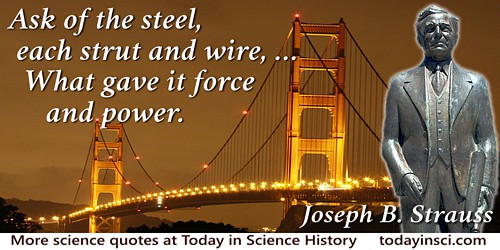
The Mighty Task is Done
At last the mighty task is done;
Resplendent in the western sun
The Bridge looms mountain high;
Its titan piers grip ocean floor,
Its great steel arms link shore with shore,
Its towers pierce the sky.
On its broad decks in rightful pride,
The world in swift parade shall ride,
Throughout all time to be;
Beneath, fleet ships from every port,
Vast landlocked bay, historic fort,
And dwarfing all the sea.
To north, the Redwood Empires gates;
To south, a happy playground waits,
In Rapturous appeal;
Here nature, free since time began,
Yields to the restless moods of man,
Accepts his bonds of steel.
Launched midst a thousand hopes and fears,
Damned by a thousand hostile sneers,
Yet Neer its course was stayed,
But ask of those who met the foe
Who stood alone when faith was low,
Ask them the price they paid.
Ask of the steel, each strut and wire,
Ask of the searching, purging fire,
That marked their natal hour;
Ask of the mind, the hand, the heart,
Ask of each single, stalwart part,
What gave it force and power.
An Honored cause and nobly fought
And that which they so bravely wrought,
Now glorifies their deed,
No selfish urge shall stain its life,
Nor envy, greed, intrigue, nor strife,
Nor false, ignoble creed.
High overhead its lights shall gleam,
Far, far below lifes restless stream,
Unceasingly shall flow;
For this was spun its lithe fine form,
To fear not war, nor time, nor storm,
For Fate had meant it so.
At last the mighty task is done;
Resplendent in the western sun
The Bridge looms mountain high;
Its titan piers grip ocean floor,
Its great steel arms link shore with shore,
Its towers pierce the sky.
On its broad decks in rightful pride,
The world in swift parade shall ride,
Throughout all time to be;
Beneath, fleet ships from every port,
Vast landlocked bay, historic fort,
And dwarfing all the sea.
To north, the Redwood Empires gates;
To south, a happy playground waits,
In Rapturous appeal;
Here nature, free since time began,
Yields to the restless moods of man,
Accepts his bonds of steel.
Launched midst a thousand hopes and fears,
Damned by a thousand hostile sneers,
Yet Neer its course was stayed,
But ask of those who met the foe
Who stood alone when faith was low,
Ask them the price they paid.
Ask of the steel, each strut and wire,
Ask of the searching, purging fire,
That marked their natal hour;
Ask of the mind, the hand, the heart,
Ask of each single, stalwart part,
What gave it force and power.
An Honored cause and nobly fought
And that which they so bravely wrought,
Now glorifies their deed,
No selfish urge shall stain its life,
Nor envy, greed, intrigue, nor strife,
Nor false, ignoble creed.
High overhead its lights shall gleam,
Far, far below lifes restless stream,
Unceasingly shall flow;
For this was spun its lithe fine form,
To fear not war, nor time, nor storm,
For Fate had meant it so.
Written upon completion of the building of the Golden Gate Bridge, May 1937. In Allen Brown, Golden Gate: biography of a Bridge (1965), 229.
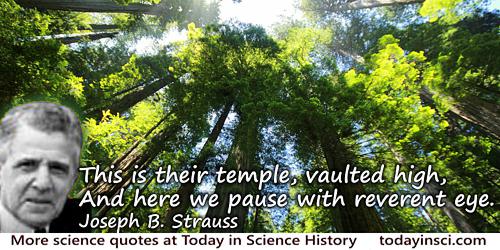
The Redwoods
Here, sown by the Creator's hand,
In serried ranks, the Redwoods stand;
No other clime is honored so,
No other lands their glory know.
The greatest of Earth's living forms,
Tall conquerors that laugh at storms;
Their challenge still unanswered rings,
Through fifty centuries of kings.
The nations that with them were young,
Rich empires, with their forts far-flung,
Lie buried now—their splendor gone;
But these proud monarchs still live on.
So shall they live, when ends our day,
When our crude citadels decay;
For brief the years allotted man,
But infinite perennials' span.
This is their temple, vaulted high,
And here we pause with reverent eye,
With silent tongue and awe-struck soul;
For here we sense life's proper goal;
To be like these, straight, true and fine,
To make our world, like theirs, a shrine;
Sink down, oh traveler, on your knees,
God stands before you in these trees.
Here, sown by the Creator's hand,
In serried ranks, the Redwoods stand;
No other clime is honored so,
No other lands their glory know.
The greatest of Earth's living forms,
Tall conquerors that laugh at storms;
Their challenge still unanswered rings,
Through fifty centuries of kings.
The nations that with them were young,
Rich empires, with their forts far-flung,
Lie buried now—their splendor gone;
But these proud monarchs still live on.
So shall they live, when ends our day,
When our crude citadels decay;
For brief the years allotted man,
But infinite perennials' span.
This is their temple, vaulted high,
And here we pause with reverent eye,
With silent tongue and awe-struck soul;
For here we sense life's proper goal;
To be like these, straight, true and fine,
To make our world, like theirs, a shrine;
Sink down, oh traveler, on your knees,
God stands before you in these trees.
In The Record: Volumes 60-61 (1938), 39.
..und Juwele wägt man nicht mit der Krämerwaage
... and jewels are not weighed on a grocery scale.
Comment on Dirichlet's publication as being not prolific, but profound.
... and jewels are not weighed on a grocery scale.
Comment on Dirichlet's publication as being not prolific, but profound.
Letter to Alexander von Humbolt (9 Jul 1845). In Jagdish Mehra and Helmut Rechenberg, The Historical Development of Quantum Theory, 267.
By
“Ye, sire,” I seide,
“By so no man were greved,
Alle the sciences under sonne,
And alle sotile craftes,
Ich wolde ich knewe and kouthe
Kyndely in myn harte.”
“Yes, sir,” I said, “so long as no one minds. All science under the sun, and all subtle arts. Were it possible, I would know and hold naturally within my heart!”
“By so no man were greved,
Alle the sciences under sonne,
And alle sotile craftes,
Ich wolde ich knewe and kouthe
Kyndely in myn harte.”
“Yes, sir,” I said, “so long as no one minds. All science under the sun, and all subtle arts. Were it possible, I would know and hold naturally within my heart!”
In William Langland and B. Thomas Wright (ed.) The Vision and Creed of Piers Ploughman (1842), 297. Modern translation by Terrence Tiller in Piers Plowman (1981, 1999), 157.
[About Pierre de Fermat] It cannot be denied that he has had many exceptional ideas, and that he is a highly intelligent man. For my part, however, I have always been taught to take a broad overview of things, in order to be able to deduce from them general rules, which might be applicable elsewhere.
Quoted, without source, in The Grolier Library of Science Biographies (1996), Vol. 3, 191.
[Bibendum, the iconic Michelin Man, was inspired upon seeing a pile of tires resemble the body of a man.] All it needed was arms, for, being a Frenchman, it wanted to speak!
As quoted by H.M. Davidson, in System: The Magazine of Business (Apr 1922), 41, 446. The comment by Édouard Michelin, a former artist, refers to the idea that Frenchmen speak with hand gestures.
[Describing the effects of over-indulgence in wine:]
But most too passive, when the blood runs low
Too weakly indolent to strive with pain,
And bravely by resisting conquer fate,
Try Circe's arts; and in the tempting bowl
Of poisoned nectar sweet oblivion swill.
Struck by the powerful charm, the gloom dissolves
In empty air; Elysium opens round,
A pleasing frenzy buoys the lightened soul,
And sanguine hopes dispel your fleeting care;
And what was difficult, and what was dire,
Yields to your prowess and superior stars:
The happiest you of all that e'er were mad,
Or are, or shall be, could this folly last.
But soon your heaven is gone: a heavier gloom
Shuts o'er your head; and, as the thundering stream,
Swollen o'er its banks with sudden mountain rain,
Sinks from its tumult to a silent brook,
So, when the frantic raptures in your breast
Subside, you languish into mortal man;
You sleep, and waking find yourself undone,
For, prodigal of life, in one rash night
You lavished more than might support three days.
A heavy morning comes; your cares return
With tenfold rage. An anxious stomach well
May be endured; so may the throbbing head;
But such a dim delirium, such a dream,
Involves you; such a dastardly despair
Unmans your soul, as maddening Pentheus felt,
When, baited round Citheron's cruel sides,
He saw two suns, and double Thebes ascend.
But most too passive, when the blood runs low
Too weakly indolent to strive with pain,
And bravely by resisting conquer fate,
Try Circe's arts; and in the tempting bowl
Of poisoned nectar sweet oblivion swill.
Struck by the powerful charm, the gloom dissolves
In empty air; Elysium opens round,
A pleasing frenzy buoys the lightened soul,
And sanguine hopes dispel your fleeting care;
And what was difficult, and what was dire,
Yields to your prowess and superior stars:
The happiest you of all that e'er were mad,
Or are, or shall be, could this folly last.
But soon your heaven is gone: a heavier gloom
Shuts o'er your head; and, as the thundering stream,
Swollen o'er its banks with sudden mountain rain,
Sinks from its tumult to a silent brook,
So, when the frantic raptures in your breast
Subside, you languish into mortal man;
You sleep, and waking find yourself undone,
For, prodigal of life, in one rash night
You lavished more than might support three days.
A heavy morning comes; your cares return
With tenfold rage. An anxious stomach well
May be endured; so may the throbbing head;
But such a dim delirium, such a dream,
Involves you; such a dastardly despair
Unmans your soul, as maddening Pentheus felt,
When, baited round Citheron's cruel sides,
He saw two suns, and double Thebes ascend.
The Art of Preserving Health: a Poem in Four Books (2nd. ed., 1745), Book IV, 108-110.
[When asked “Dr. Einstein, why is it that when the mind of man has stretched so far as to discover the structure of the atom we have been unable to devise the political means to keep the atom from destroying us?”] That is simple, my friend. It is because politics is more difficult than physics.
Einstein’s answer to a conferee at a meeting at Princeton, N.J. (Jan 1946), as recalled by Greenville Clark in 'Letters to the Times', in New York Times (22 Apr 1955), 24.
[When questioned on his longevity] First of all, I selected my ancestors very wisely. ... They were long-lived, healthy people. Then, as a chemist, I know how to eat, how to exercise, keep my blood circulating. ... I don't worry. I don't get angry at people. I don't worry about things I can't help. I do what I can to make the world a better place to live, but I don't complain if things aren't right. As a scientist I take the world as I find it.
[About celebrating his 77th birthday by swimming a half mile in 22 minutes] I used swim fins and webbed gloves because a man of intelligence should apply his power efficiently, not just churn the water.
[About celebrating his 77th birthday by swimming a half mile in 22 minutes] I used swim fins and webbed gloves because a man of intelligence should apply his power efficiently, not just churn the water.
As quoted in obituary by Wallace Turner, 'Joel Hildebrand, 101', New York Times (3 May 1983), D27.
A famous anecdote concerning Cuvier involves the tale of his visitation from the devil—only it was not the devil but one of his students dressed up with horns on his head and shoes shaped like cloven hooves. This frightening apparition burst into Cuvier’s bedroom when he was fast asleep and claimed:
“Wake up thou man of catastrophes. I am the Devil. I have come to devour you!”
Cuvier studied the apparition carefully and critically said,
“I doubt whether you can. You have horns and hooves. You eat only plants.”
“Wake up thou man of catastrophes. I am the Devil. I have come to devour you!”
Cuvier studied the apparition carefully and critically said,
“I doubt whether you can. You have horns and hooves. You eat only plants.”
Quoted in Glyn Daniel, The Idea of Pre-History (1962), 34.
A l’aide de ces sciences expérimentales actives, l’homme devient un inventeur de phénomènes, un véritable contremaître de la création; et l'on ne saurait, sous ce rapport, assigner de limites à la puissance qu’il peut acquérir sur la nature, par les progrès futurs des sciences expérimentales
With the aid of these active experimental sciences man becomes an inventor of phenomena, a real foreman of creation; and under this head we cannot set limits to the power that he may gain over nature through future progress of the experimental sciences.
With the aid of these active experimental sciences man becomes an inventor of phenomena, a real foreman of creation; and under this head we cannot set limits to the power that he may gain over nature through future progress of the experimental sciences.
Original French text in Introduction à l'Étude de la Médecine Expérimentale (1898), 32. English version from An Introduction to the Study of Experimental Medicine (1865), as translated by Henry Copley Greene (1957), 18.
Alles Gescheite ist schon gedacht worden; man muss nur versuchen, es noch einmal zu denken.
Everything that is worth thinking has already been thought; one must only try to think it again.
Everything that is worth thinking has already been thought; one must only try to think it again.
As translated in William Francis Henry King (ed.), Classical and Foreign Quotations: A Polyglot Manual of Historical (1904), 234.
Ce qui est admirable, ce n'est pas que le champ des étoiles soit si vaste, c'est que l'homme l'ait mesuré.
The wonder is, not that the field of the stars is so vast, but that man has measured it.
The wonder is, not that the field of the stars is so vast, but that man has measured it.
The Garden of Epicurus (1894) translated by Alfred Allinson, in The Works of Anatole France in an English Translation (1920), 16.
Considerate la vostra semenza:
Fatti non foste a viver come bruti,
Ma per seguir virtute e conoscenza.
Consider your origins: you were not made to live as brutes, but to follow virtue and knowledge.
Fatti non foste a viver come bruti,
Ma per seguir virtute e conoscenza.
Consider your origins: you were not made to live as brutes, but to follow virtue and knowledge.
Divina Commedia 'Inferno', canto 26, l.118.
Dans l’étude de la nature, comme dans la pratique de l’art, il n’est pas donné a l’homme d’arriver au but sans laisser des traces des fausses routes qu’il a tenues.
In the study of nature, as in the practice of art, it is not given to man to achieve the goal without leaving a trail of dead ends he had pursued.
In the study of nature, as in the practice of art, it is not given to man to achieve the goal without leaving a trail of dead ends he had pursued.
French version in Encyclopédie Méthodique (1786), Vol. 1, Introduction, iv. English by Webmaster assisted by Google Translate.
Decus et pretium recte petit experiens vir.
The man who makes the attempt justly aims at honour and reward.
The man who makes the attempt justly aims at honour and reward.
— Horace
Epistles bk. 1, no. 17, 1. 42. In Satires, Epistles and Ars Poetiea, trans. H. Rushton Fairclough (1926), 364-5.
Die Mathematiker sind eine Art Franzosen. Spricht man zu ihnen, so übersetzen sie alles in ihre eigene Sprache, und so wird es alsobald etwas ganz anderes.
Mathematicians are a kind of Frenchmen. Whenever you say anything or talk to them, they translate it into their own language, and right away it is something completely different.
Mathematicians are a kind of Frenchmen. Whenever you say anything or talk to them, they translate it into their own language, and right away it is something completely different.
Quoted by Christiane Senn-Fennell, 'Oral and Written Communication', in Ian Westbury et al. (eds.), Teaching as a Reflective Practice (2000), 225.
Die Wissenschaft ist ein Land, welches die Eigenschaft hat, um so mehr Menschen beherbergen zu können, je mehr Bewohner sich darin sammeln; sie ist ein Schatz, der um so grösser wird, je mehr man ihn teilt. Darum kann jeder von uns in seiner Art seine Arbeit tun, und die Gemeinsamkeit bedeutet nicht Gleichförmigkeit.
Science is one land, having the ability to accommodate even more people, as more residents gather in it; it is a treasure that is the greater the more it is shared. Because of that, each of us can do his work in his own way, and the common ground does not mean conformity.
Science is one land, having the ability to accommodate even more people, as more residents gather in it; it is a treasure that is the greater the more it is shared. Because of that, each of us can do his work in his own way, and the common ground does not mean conformity.
Speaking (in German) at the Banquet to Past Presidents, the Chemical Society, as published in William Crookes (ed.) The Chemical News (16 Dec 1898), 78, 298. Also used as epigraph, in Paul Walden, Wilhelm Ostwald (1904), 1. Translation by Webmaster.
Ein Fachmann ist ein Mann, der einige der gröbsten Fehler kennt, die man in dem betreffenden Fach machen kann, und der sie deshalb zu vermeiden versteht.
An expert is someone who knows some of the worst mistakes that can be made in his subject, and how to avoid them.
An expert is someone who knows some of the worst mistakes that can be made in his subject, and how to avoid them.
From the original German, “Ein Fachmann ist ein Mann, der einige der gröbsten Fehler kennt, die man in dem betreffenden Fach machen kann, und der sie deshalb zu vermeiden versteht”, in Der Teil und das Ganze: Gespräche im Umkreis der Atomphysik (The Part and the Whole: Conversations in the Atomic Physics) (1969, 2001), 247. Excerpt in magazine article, 'Kein Chaos, aus dem nicht wieder Ordnung würde,' Die Zeit (22 August 1969), 34. English version in Werner Heisenberg and Arnold J. Pomerans (trans.), Physics and Beyond: Encounters and Conversations (1971), 210.
Enlightenment is man’s emergence from his self-incurred immaturity. Immaturity is the inability to use one's own understanding without the guidance of another. This immaturity is self-incurred if its cause is not lack of understanding, but lack of resolution and courage to use it without the guidance of another. The motto of enlightenment is therefore: Sapere aude! Have courage to use your own understanding!
'An Answer to the Question: What is Enlightenment?', (1784). In Hans Reiss (ed.), Kant: Political Writings, trans. H. B. Nisbet (1970), 54.
Error has made man so deep, sensitive, and inventive that he has put forth such blossoms as religions and arts. Pure knowledge could not have been capable of it.
Human, All-To-Human, Vol. 1, 44-45. (1878), 140. In Willard Huntington Wright, What Nietzsche Taught? (1917), 78.
Homo hominem arreptum a tellure, et utcunque exigua impulsum vi, vel uno etiam oris flatu impetitum, ab hominum omnium commercio in infinitum expelleret, nunquam per totam aeternitatem rediturum.
Were it not for gravity one man might hurl another by a puff of his breath into the depths of space, beyond recall for all eternity.
Were it not for gravity one man might hurl another by a puff of his breath into the depths of space, beyond recall for all eternity.
Philosophiae Naturalis Theoria (1758), Vol. 1, para. DXLIII, 293.
Il n'y a qu'un demi-siècle, un orateur chrétien, se défiant des hommes de la science leur disait: 'Arrêtez-vous enfin, et ne creusez pas jusqu'aux enfers.' Aujourd'hui, Messieurs, rassurés sur l'inébranlable constance de notre foi, nous vous disons: creusez, creusez encore; plus vous descendrez, plus vous rapprocherez du grand mystère de l'impuissance de l'homme et de la vérité de la religion. Creusez donc, creusez toujours,mundum tradidit disputationibus eorum; et quand la science aura donné son dernier coup de marteau sur les fondements de la terre, vous pourrez à la lueur du feu qu'il fera jaillir, lire encore l'idée de Dieu et contempler l'empreinte de sa main.
Only a half-century ago, a Christian speaker, mistrustful of men of science told them: 'Stop finally, and do not dig to hell.' Today, gentlemen, reassured about the steadfastness of our unshakeable faith, we say: dig, dig again; the further down you, the closer you come to the great mystery of the impotence of man and truth of religion. So dig, always dig: and when science has stuck its final hammer blow on the bosom of the earth, you will be able to ignite a burst of light, read furthermore the mind of God and contemplate the imprint of His hand.
Only a half-century ago, a Christian speaker, mistrustful of men of science told them: 'Stop finally, and do not dig to hell.' Today, gentlemen, reassured about the steadfastness of our unshakeable faith, we say: dig, dig again; the further down you, the closer you come to the great mystery of the impotence of man and truth of religion. So dig, always dig: and when science has stuck its final hammer blow on the bosom of the earth, you will be able to ignite a burst of light, read furthermore the mind of God and contemplate the imprint of His hand.
As Monseigneur Rendu, Bishop of Annecy, Savoy, presiding at the closing session of a meeting of the Geological Society of France at Chambéry, Savoy (27 Aug 1844). In Bulletin de la Société Géologique de France 1843 à 1844, Tome 1, Ser. 2, 857. (1844), li. Google trans., edited by Webmaster.
Imprimisque hominis est propria veri inquisitio atque investigatio.
The first duty of man is the seeking after and the investigation of truth.
The first duty of man is the seeking after and the investigation of truth.
De Officiis I., 4, 18. In Thomas Benfield Harbottle, Dictionary of Quotations (classical) (3rd Ed., 1906), 98.
In primis, hominis est propria VERI inquisitio atque investigato. Itaque cum sumus negotiis necessariis, curisque vacui, tum avemus aliquid videre, audire, ac dicere, cognitionemque rerum, aut occultarum aut admirabilium, ad benè beatéque vivendum necessariam ducimus; —ex quo intelligitur, quod VERUM, simplex, sincerumque sit, id esse naturæ hominis aptissimum. Huic veri videndi cupiditati adjuncta est appetitio quædam principatûs, ut nemini parere animus benè a naturâ informatus velit, nisi præcipienti, aut docenti, aut utilitatis causâ justè et legitimè imperanti: ex quo animi magnitudo existit, et humanarum rerum contemtio.
Before all other things, man is distinguished by his pursuit and investigation of TRUTH. And hence, when free from needful business and cares, we delight to see, to hear, and to communicate, and consider a knowledge of many admirable and abstruse things necessary to the good conduct and happiness of our lives: whence it is clear that whatsoever is TRUE, simple, and direct, the same is most congenial to our nature as men. Closely allied with this earnest longing to see and know the truth, is a kind of dignified and princely sentiment which forbids a mind, naturally well constituted, to submit its faculties to any but those who announce it in precept or in doctrine, or to yield obedience to any orders but such as are at once just, lawful, and founded on utility. From this source spring greatness of mind and contempt of worldly advantages and troubles.
Before all other things, man is distinguished by his pursuit and investigation of TRUTH. And hence, when free from needful business and cares, we delight to see, to hear, and to communicate, and consider a knowledge of many admirable and abstruse things necessary to the good conduct and happiness of our lives: whence it is clear that whatsoever is TRUE, simple, and direct, the same is most congenial to our nature as men. Closely allied with this earnest longing to see and know the truth, is a kind of dignified and princely sentiment which forbids a mind, naturally well constituted, to submit its faculties to any but those who announce it in precept or in doctrine, or to yield obedience to any orders but such as are at once just, lawful, and founded on utility. From this source spring greatness of mind and contempt of worldly advantages and troubles.
In De Officiis, Book 1. Sect. 13. As given in epigraph to John Frederick William Herschel, A Preliminary Discourse on the Study of Natural Philosophy (1830), viii.
In primis, hominis est propria VERI inquisitio atque investigato.
Before all other things, man is distinguished by his pursuit and investigation of TRUTH.
Before all other things, man is distinguished by his pursuit and investigation of TRUTH.
In De Officiis, Book 1. Sect. 13. As given in epigraph to John Frederick William Herschel, A Preliminary Discourse on the Study of Natural Philosophy (1830), viii. This is the start of a longer quote on the Cicero quotes page.
L'homme est bien insensé. Il ne saurait forger un ciron, et forge des Dieux à douzaines.
Man is certainly crazy. He could not make a mite, and he makes gods by the dozen.
Man is certainly crazy. He could not make a mite, and he makes gods by the dozen.
The Complete Essays of Montaigne, trans. Donald M. Frame (1958), 834.
L'homme moyen.
The average man.
The emergence of the concept.
The average man.
The emergence of the concept.
A Treatise on Man and the Development of his Faculties (1842). Reprinted with an introduction by Solomon Diamond (1969), 96.
L’Astronomie est utile, parce qu’elle nous élève au-dessus de nous-mêmes; elle est utile, parce qu’elle est grande; elle est utile, parce qu’elle est belle… C’est elle qui nous montre combien l’homme est petit par le corps et combien il est grand par l’esprit, puisque cette immensité éclatante où son corps n’est qu’un point obscur, son intelligence peut l’embrasser tout entière et en goûter la silencieuse harmonie.
Astronomy is useful because it raises us above ourselves; it is useful because it is grand[; it is useful because it is beautiful]… It shows us how small is man’s body, how great his mind, since his intelligence can embrace the whole of this dazzling immensity, where his body is only an obscure point, and enjoy its silent harmony.
Astronomy is useful because it raises us above ourselves; it is useful because it is grand[; it is useful because it is beautiful]… It shows us how small is man’s body, how great his mind, since his intelligence can embrace the whole of this dazzling immensity, where his body is only an obscure point, and enjoy its silent harmony.
In La Valeur de la Science (1904), 276, translated by George Bruce Halsted, in The Value of Science (1907), 84. Webmaster added the meaning of “elle est utile, parce qu’elle est belle,” in brackets, which was absent in Halsted’s translation.
L’homme n’est qu’un roseau, le plus faible de la nature, mais c’est un roseau pensant. Il ne faut pas que l’univers entier s’arme pour l’écraser; une vapeur, une goutte d’eau suffit pour le tuer. Mais quand l’univers l’écraserait, l’homme serait encore plus noble que ce qui le tue, parce qu’il sait qu’il meurt et l’avantage que l’univers a sur lui; l’univers n'en sait rien.
Man is a reed, the feeblest thing in nature. But a reed that can think. The whole universe need not fly to arms to kill him ; for a little heat or a drop of water can slay a man. But, even then, man would be nobler than his destroyer, for he would know he died, while the whole universe would know nothing of its victory.
Man is a reed, the feeblest thing in nature. But a reed that can think. The whole universe need not fly to arms to kill him ; for a little heat or a drop of water can slay a man. But, even then, man would be nobler than his destroyer, for he would know he died, while the whole universe would know nothing of its victory.
Pensées. As given and translated in Hugh Percy Jones (ed.), Dictionary of Foreign Phrases and Classical Quotations (1908), 292.
L’homme n’est qu’un roseau, le plus faible de la nature; mais c’est un roseau pensant.
Man is but a reed, the weakest thing in nature; but a thinking reed.
Man is but a reed, the weakest thing in nature; but a thinking reed.
Pensées (1670), Section 1, aphorism 160. In H.F. Stewart (ed.), Pascal’s Pensées (1950), 83.
L’homme ne poursuit que des chimères.
Man follows only phantoms.
Man follows only phantoms.
His true last words, according to De Morgan. As quoted in Augustus De Morgan, Budget of Paradoxes (1915), Vol. 2, 3.
La vraye science et le vray étude de l'homme c'est l'homme.
The true science and study of mankind is man.
The true science and study of mankind is man.
De la Sagesse (1601), 1991 edn, Preface.
Le premier regard de l’homme jeté sur l’univers n’y découvre que variété, diversité, multiplicité des phénomènes. Que ce regard soit illuminé par la science,—par la science qui rapproche l’homme de Dieu,—et la simplicité et l’unité brillent de toutes parts.
Man’s first glance at the universe discovers only variety, diversity, multiplicity of phenomena. Let that glance be illuminated by science—by the science which brings man closer to God,—and simplicity and unity shine on all sides.
Man’s first glance at the universe discovers only variety, diversity, multiplicity of phenomena. Let that glance be illuminated by science—by the science which brings man closer to God,—and simplicity and unity shine on all sides.
Original French quoted in René Vallery-Radot, La Vie de Pasteur (1901), 209. Translation by Google translate, tweaked by Webmaster. The English version of the book, omits this passage, except for “Science, which brings man nearer to God.” In The Life of Pasteur (1902), Vol. 1, 194.
Lepidoptera are for children to play with, pretty to look at, so some think. Give me the Coleoptera, and the kings of the Coleoptera are the beetles! Lepidoptera and Neuroptera for little folks; Coleoptera for men, sir!
In 'The Poet at the Breakfast Table: III', The Atlantic Monthly (Mar 1872), 29, 344.
Male secum agit æger, medicum qui hæredem ficit.Br>That sick man does ill for himself, who makes his physician his heir.
In 'Ornamenta Rationalia, or, Elegant Sentences' (1625). As given in Essays, Moral, Economical, and Political: A New Edition, With the Latin Quotations Translated (1813), No. 31, 364. A century later, Benjamin Franklin included this in his Poor Richard’s Almanac as “He’s a Fool that makes his Doctor his Heir.”
Man is the result of slow growth; that is why he occupies the position he does in animal life. What does a pup amount to that has gained its growth in a few days or weeks, beside a man who only attains it in as many years.
In Orison Swett Marden, 'Bell Telephone Talk: Hints on Success by Alexander G. Bell', How They Succeeded: Life Stories of Successful Men Told by Themselves (1901), 35.
Man muss immer generalisieren
One must always generalize.
One must always generalize.
Quoted, without citation, in Arnold Dresden, An Invitation to Mathematics (1936), 231. Dresden states this is a “principle usually attributed to Jacobi”.
Negative Capability, that is when man is capable of being in uncertainties, Mysteries, doubts, without any irritable reaching after fact & reason—Coleridge, for instance, would let go by a fine isolated verisimilitude caught from the Penetralium of mystery, from being incapable of remaining content with half knowledge.
Letter to George and Thomas Keats (21 Dec 1817). In H. E. Rollins (ed.), Letters of John Keats (1958), Vol. 1, 193-4.
Nullius in Verba.
On no man’s word.
Motto of the Royal Society
On no man’s word.
Motto of the Royal Society
Alternate translation: “nothing upon trust.” Based upon Horace: Nullius addictus iurare in verba magistri (“not bound to swear by the words of any master”).
On rencontre sa destinée souvent par des chemins qu’on prend pour l’éviter.
Man meets his destiny oft by the roads he takes to escape it.
Man meets his destiny oft by the roads he takes to escape it.
In 'L’Horoscope', Fables, Vol. 8, 16. (1668–1679). Reprinted in Fables Choisies de La Fontaine (1730), 198. As translated in Thomas Benfield Harbottle and Colonel Philip Hugh Dalbiac, Dictionary of Quotations (1901), 172.
On tue un homme, on est un assassin. On tue des millions d’hommes, on est un conquérant. On les tue tous, on est un dieu.
Kill a man, and you are an assassin. Kill millions of men and you are a conqueror. Kill everyone, and you are a god.
Kill a man, and you are an assassin. Kill millions of men and you are a conqueror. Kill everyone, and you are a god.
Pensées d'un biologiste (1939), 116.
Primas sum: primatum nihil a me alienum puto
I am a primate; nothing about primates is alien to me.
Paraphrasing Latin playwright Terence's words: Homo sum: humani nil a me alienum puto (I am a man; nothing about men is alien to me).
I am a primate; nothing about primates is alien to me.
Paraphrasing Latin playwright Terence's words: Homo sum: humani nil a me alienum puto (I am a man; nothing about men is alien to me).
Attributed. (Caution: presently widely found quoted on the internet, but without a source.) Please contact webmaster if you know a primary print source.
Question: If you walk on a dry path between two walls a few feet apart, you hear a musical note or “ring” at each footstep. Whence comes this?
Answer: This is similar to phosphorescent paint. Once any sound gets between two parallel reflectors or walls, it bounds from one to the other and never stops for a long time. Hence it is persistent, and when you walk between the walls you hear the sounds made by those who walked there before you. By following a muffin man down the passage within a short time you can hear most distinctly a musical note, or, as it is more properly termed in the question, a “ring” at every (other) step.
Answer: This is similar to phosphorescent paint. Once any sound gets between two parallel reflectors or walls, it bounds from one to the other and never stops for a long time. Hence it is persistent, and when you walk between the walls you hear the sounds made by those who walked there before you. By following a muffin man down the passage within a short time you can hear most distinctly a musical note, or, as it is more properly termed in the question, a “ring” at every (other) step.
Genuine student answer* to an Acoustics, Light and Heat paper (1880), Science and Art Department, South Kensington, London, collected by Prof. Oliver Lodge. Quoted in Henry B. Wheatley, Literary Blunders (1893), 175-6, Question 2. (*From a collection in which Answers are not given verbatim et literatim, and some instances may combine several students' blunders.)
Responding to the Bishop of Oxford, Samuel Wilberforce's question whether he traced his descent from an ape on his mother's or his father's side:
If then, said I, the question is put to me would I rather have a miserable ape for a grandfather or a man highly endowed by nature and possessing great means and influence and yet who employs those faculties for the mere purpose of introducing ridicule into a grave scientific discussion—I unhesitatingly affirm my preference for the ape.
If then, said I, the question is put to me would I rather have a miserable ape for a grandfather or a man highly endowed by nature and possessing great means and influence and yet who employs those faculties for the mere purpose of introducing ridicule into a grave scientific discussion—I unhesitatingly affirm my preference for the ape.
Letter to Dr. Dyster (9 Sep 1860), Huxley Papers, Imperial College of Science and Technology. Quoted in D.J. Foskett, 'Wilberforce and Huxley on Evolution' in a letter to Nature, 1953, 172, 920.
The Charms of Statistics.—It is difficult to understand why statisticians commonly limit their inquiries to Averages, and do not revel in more comprehensive views. Their souls seem as dull to the charm of variety as that of the native of one of our flat English counties, whose retrospect of Switzerland was that, if its mountains could be thrown into its lakes, two nuisances would be got rid of at once. An Average is but a solitary fact, whereas if a single other fact be added to it, an entire Normal Scheme, which nearly corresponds to the observed one, starts potentially into existence. Some people hate the very name of statistics, but I find them full of beauty and interest. Whenever they are not brutalised, but delicately handled by the higher methods, and are warily interpreted, their power of dealing with complicated phenomena is extraordinary. They are the only tools by which an opening can be cut through the formidable thicket of difficulties that bars the path of those who pursue the Science of man.
Natural Inheritance (1889), 62-3.
The Word Reason in the English Language has different Significances: sometimes it is taken for true, and clear Principles: Sometimes for clear, and fair deductions from those Principles: and sometimes for Cause, and particularly the final Cause: but the Consideration I shall have of it here, is in a Signification different from all these; and that is, as it stands for a Faculty of Man, That Faculty, whereby Man is supposed to be distinguished from Beasts; and wherein it is evident he much surpasses them.
In 'Of Reason', Essay Concerning Humane Understanding (1690), Book 4, Ch. 17, Sec. 1, 341.
Von Theorie wild man nicht heller.
Gott geb' täglich unsern Teller.
When theory's light is less than stellar.
Give us, O Lord, our daily Teller.
This rhyme from an alphabet ditty describing various physicists was written for a party at Göttingen.
Gott geb' täglich unsern Teller.
When theory's light is less than stellar.
Give us, O Lord, our daily Teller.
This rhyme from an alphabet ditty describing various physicists was written for a party at Göttingen.
Quoted in Edward Teller with Judith L. Shoolery, Memoirs: A Twentieth-Century Journey in Science and Politics (2001), 75. The first clause, translated more literally than poetically, is given as, 'When theory does not enlighten us,' in Nina Byers and Gary Williams, Out of the Shadows (2006),130.
Where faith commences, science ends. Both these arts of the human mind must be strictly kept apart from each other. Faith has its origin in the poetic imagination; knowledge, on the other hand, originates in the reasoning intelligence of man. Science has to pluck the blessed fruits from the tree of knowledge, unconcerned whether these conquests trench upon the poetical imaginings of faith or not.
In Ernst Haeckel and E. Ray Lankester (trans.), The History of Creation (1880), Vol. 1, 9.
Wij zien daar den wereldburger Christiaan Huygens, den man, die als devies had kunnen voeren “the World is my country, to promote Science my religion.”
We see there the cosmopolitan Christiaan Huygens, the man whose motto could have been “the World is my country, to promote Science my religion."
We see there the cosmopolitan Christiaan Huygens, the man whose motto could have been “the World is my country, to promote Science my religion."
Original Dutch from Spinoza en Zijn Kring (1896), 258. The title translates as Spinosa and his Circle. English by Webmaster using Google Translate. Notice that this clearly indicates that Meinsma, using the words “had kunnen” (might have been) created the fictitious motto to describe Huygens. Thus it is a false attribution when the motto is seen some sources as being a quote directly by Christiaan Huygens. Notice that the author Meinsma and Huygens were both Dutch, but the Dutch text gives the motto in English, a clue to its real source. Meinsma likely adapted it from the well-known quote, “The world is my country, and to do good is my religion,” the common paraphrase of “My country is the world, and my religion is to do good,” as written by Thomas Paine in Rights of Man: Being an Answer to Mr. Burke's Attack on the French Revolution (1791, 1792), 50.
Wovon man nicht sprechen kann, darüber muss man schweigen.
Whereof one cannot speak, thereof one must be silent.
Whereof one cannot speak, thereof one must be silent.
In Tractatus logico-philosophicus (1921, 1955), Sec. 7, 189.
GLENDOWER: I can call spirits from the vasty deep.
HOTSPUR: Why, so can I, or so can any man;
But will they come when you do call for them?
HOTSPUR: Why, so can I, or so can any man;
But will they come when you do call for them?
Henry IV, Part I (1597), III, i.
~~[Attributed without source]~~ That man is an Euclidian point: position without substance.
Often seen, virally spread, but always without a source citation. If you can provide a primary source, please contact Webmaster. Until then the quote should be regarded as not authenticated.
~~[Attributed]~~ A man who has never gone to school may steal from a freight car; but if he has a university education, he may steal the whole railroad.
As quoted, without citation, in William Joseph Grace, Art of Communicating Ideas (1952), 389. Sadly, much searching produces no primary source. Can you help?
~~[Attributed]~~ You cannot teach a man anything, you can only help him find it within himself.
Doubtful that this was said by Galileo because it is never cited with a primary source, and does not seem to appear in 19th century collections of quotations. The earliest Webmaster has found so far is a passing mention (without citation) in a weekly paper by J. Vila Blake, 'Compensation', in Benjamin Franklin Underwood (ed.), The Index (6 Apr 1882), 2, Volume 2, new series, No. 40, 476.
~~[Paraphrased version]~~ Man’s mind once stretched by a new idea, never regains its original dimension.
Although seen very widely quoted in these or very similar, sometimes as by his son Oliver Wendell Holmes, Jr., this is probably actually shorter paraphrased variation of “Every now and then a man’s mind is stretched by a new idea or sensation, and never shrinks back to its former dimensions.” In The Autocrat of the Breakfast Table (1858), 311.
~~[Questionable attribution]~~ What a strange creature man is that he fouls his own nest.
Widely seen quoted, but Webmaster, as yet, has not found a reliable primary source to verify this attribution to Nixon. Since one cannot prove a negative, it can not be stated Nixon did not say this, but if he did, he is a millennium too late. Blogger Michael Gilleland states online, “As far as is known, the proverb, ‘It is an ill bird that fouls its own nest,’ was first recorded in Latin [around 1023] by Egbert von Lüttich in verse 148 of his 'Fecunda Ratis': nidos commaculans immundus habebitur ales.”
A … difference between most system-building in the social sciences and systems of thought and classification of the natural sciences is to be seen in their evolution. In the natural sciences both theories and descriptive systems grow by adaptation to the increasing knowledge and experience of the scientists. In the social sciences, systems often issue fully formed from the mind of one man. Then they may be much discussed if they attract attention, but progressive adaptive modification as a result of the concerted efforts of great numbers of men is rare.
The Study of Man (1941), 19-20.
A “critic” is a man who creates nothing and thereby feels qualified to judge the work of creative men. There is logic in this; he is unbiased—he hates all creative people equally.
In Time Enough for Love: The Lives of Lazarus Long (1973), 365.
A Law of Nature, (Lex Naturalis) is a Precept, or generall Rule, found out by Reason, by which a man is forbidden to do, that, which is destructive of his life, or taketh away the means of preserving the same; and to omit, that, by which he thinketh it may be best preserved.
In Leviathan (1651), 64. Hobbes is identifying a precept of morality that men should naturally observe, as contrasted with a law set by politics of government.
A bacteriologist is a man whose conversation always starts with the germ of an idea.
Quoted in M. Goran, A Treasury of Science Jokes (1986), 37.
A bird is an instrument working according to mathematical law, which instrument it is within the capacity of man to reproduce with all its movements, but not with a corresponding degree of strength, though it is deficient only in the power of maintaining equilibrium. We may therefore say that such an instrument constructed by man is lacking in nothing except the life of the bird, and this life must needs be supplied from that of man.
'Of the Bird's Movement' from Codice Atlantico 161 r.a., in Leonardo da Vinci's Notebooks, trans. E. MacCurdy (1906), Vol. 1, 153.
A body of work such as Pasteur’s is inconceivable in our time: no man would be given a chance to create a whole science. Nowadays a path is scarcely opened up when the crowd begins to pour in.
Pensées d’un Biologiste (1939). Translated in The Substance of Man (1962), Chap. 6.
A certain author defines a doctor to be a man who writes prescriptions till the patient either dies or is cured by nature.
The Reflector: Representing Human Affairs As They Are (1750). In The Pocket Lacon (1839), Vol. 1, 59.
A circumstance which influenced my whole career more than any other … was my friendship with Professor Henslow … a man who knew every branch of science…. During the latter half of my time at Cambridge [I] took long walks with him on most days; so that I was called by some of the dons “the man who walks with Henslow.”
In Charles Darwin and Francis Darwin (ed.), 'Autobiography', The Life and Letters of Charles Darwin (1887, 1896), Vol. 1, 44.
A complete and generous education fits a man to perform justly, skilfully and magnanimously all the offices of peace and war.
Louis Klopsch, Many Thoughts of Many Minds (1896), 78.
A consultant is a man sent in after the battle to bayonet the wounded.
Penguin Dictionary of Modern Humorous Quotations (2001),.60.
A cynic is a man who, when he smells flowers, looks around for a coffin.
…...
A depressing number of people seem to process everything literally. They are to wit as a blind man is to a forest, able to find every tree, but each one coming as a surprise.
Quoted in Kim Lim (ed.), 1,001 Pearls of Spiritual Wisdom: Words to Enrich, Inspire, and Guide Your Life (2014), 32
A desire to take medicine is, perhaps, the great feature which distinguishes man from other animals.
'Recent Advances in Medicine', Science (1891), 17, 170.
A doctor is a man who writes prescriptions till the patient either dies or is cured by nature.
…...
A doctor is the only man who can suffer from good health.
In Edward Jewitt Wheeler, et al., The Literary Digest (1931),13.
A few days ago, a Master of Arts, who is still a young man, and therefore the recipient of a modern education, stated to me that until he had reached the age of twenty he had never been taught anything whatever regarding natural phenomena, or natural law. Twelve years of his life previously had been spent exclusively amongst the ancients. The case, I regret to say, is typical. Now we cannot, without prejudice to humanity, separate the present from the past.
'On the Study of Physics', From a Lecture delivered in the Royal Institution of Great Britain in the Spring of 1854. Fragments of Science for Unscientific People: A Series of Detached Essays, Lectures, and Reviews (1892), Vol. 1, 284-5.
A few of the results of my activities as a scientist have become embedded in the very texture of the science I tried to serve—this is the immortality that every scientist hopes for. I have enjoyed the privilege, as a university teacher, of being in a position to influence the thought of many hundreds of young people and in them and in their lives I shall continue to live vicariously for a while. All the things I care for will continue for they will be served by those who come after me. I find great pleasure in the thought that those who stand on my shoulders will see much farther than I did in my time. What more could any man want?
In 'The Meaning of Death,' in The Humanist Outlook edited by A. J. Ayer (1968) [See Gerald Holton and Sir Isaac Newton].
A fool sees not the same tree that a wise man sees.
In 'Proverbs', The Poems: With Specimens of the Prose Writings of William Blake (1885), 279.
A formative influence on my undergraduate self was the response of a respected elder statesmen of the Oxford Zoology Department when an American visitor had just publicly disproved his favourite theory. The old man strode to the front of the lecture hall, shook the American warmly by the hand and declared in ringing, emotional tones: “My dear fellow, I wish to thank you. I have been wrong these fifteen years.” And we clapped our hands red. Can you imagine a Government Minister being cheered in the House of Commons for a similar admission? “Resign, Resign” is a much more likely response!
From a talk, 'Science, Delusion and the Appetite for Wonder', (21 Dec 1996), published on edge.org website.
A good farmer is nothing more nor less than a handy man with a sense of humus.
In 'The Practical Farmer' (Oct 1940), collected in One Man’s Meat (1942), 218.
A good scare is worth more to a man than advice.
Seen, for example, in Edgar Watson Howe, Country Town Sayings: A Collection of Paragraphs From the Atchison Globe (1911), 141. It is not made clear in the book, whether Howe originated this, or collected it as a saying.
A good theoretical physicist today might find it useful to have a wide range of physical viewpoints and mathematical expressions of the same theory (for example, of quantum electrodynamics) available to him. This may be asking too much of one man. Then new students should as a class have this. If every individual student follows the same current fashion in expressing and thinking about electrodynamics or field theory, then the variety of hypotheses being generated to understand strong interactions, say, is limited. Perhaps rightly so, for possibly the chance is high that the truth lies in the fashionable direction. But, on the off-chance that it is in another direction—a direction obvious from an unfashionable view of field theory—who will find it?
In his Nobel Prize Lecture (11 Dec 1965), 'The Development of the Space-Time View of Quantum Electrodynamics'. Collected in Stig Lundqvist, Nobel Lectures: Physics, 1963-1970 (1998), 177.
A government, at bottom, is nothing more than a gang of men, and as a practical matter most of them are inferior men ... Government is actually the worst failure of civilized man. There has never been a really good one, and even those that are most tolerable are arbitrary, cruel, grasping and unintelligent. Indeed, it would not be far wrong to describe the best as the common enemy of all decent citizens.
…...
A great deal of the universe does not need any explanation. Elephants, for instance. Once molecules have learnt to compete and to create other molecules in their own image, elephants, and things resembling elephants, will in due course be found roaming around the countryside ... Some of the things resembling elephants will be men.
The Creation (1981), 3.
A great man quotes bravely, and will not draw on his invention when his memory serves him with a word as good.
In Lecture, second in a series given at Freeman Place Chapel, Boston (Mar 1859), 'Quotation and Originality', collected in Letters and Social Aims (1875, 1917), 183.
A great man, [who] was convinced that the truths of political and moral science are capable of the same certainty as those that form the system of physical science, even in those branches like astronomy that seem to approximate mathematical certainty.
He cherished this belief, for it led to the consoling hope that humanity would inevitably make progress toward a state of happiness and improved character even as it has already done in its knowledge of the truth.
He cherished this belief, for it led to the consoling hope that humanity would inevitably make progress toward a state of happiness and improved character even as it has already done in its knowledge of the truth.
Describing administrator and economist Anne-Robert-Jacques Turgot in Essai sur l’application de l’analyse à la probabilité des décisions rendues à la pluralité des voix (1785), i. Cited epigraph in Charles Coulston Gillispie, Science and Polity in France: The End of the Old Regime (2004), 3
A great nation is any mob of people which produces at least one honest man a century.
…...
A happy man is too satisfied with the present to dwell too much on the future.
First sentence written in a French essay, 'Mes Projets d'Avenir' (18 Sep 1896), at age 17. From original French, “Un homme heureux est trop content du présent pour trop se soucier de l'avenir.” In 'Document 22, Matura Examination (B) French: “My Future Plans”', The Collected Papers of Albert Einstein: The Early Years, 1879-1902 (1987), Vol. 1, Document 22, 28.
A humanitarian is a man who believes that no human being should be sacrificed to a project—especially to the project of perfecting nuclear weapons to kill hundreds of millions of people.
From 'A Nobel Scientist Speaks: Every Test Kills', Liberation (Feb 1958), 2, No. 11. Also quoted in Barbara Marinacci and Ramesh Saligrama Krishnamurthy, Linus Pauling on Peace: A Scientist Speaks Out on Humanism and World Survival: Writings and Talks by Linus Pauling (1998), 118.
A hundred years ago … an engineer, Herbert Spencer, was willing to expound every aspect of life, with an effect on his admiring readers which has not worn off today.
Things do not happen quite in this way nowadays. This, we are told, is an age of specialists. The pursuit of knowledge has become a profession. The time when a man could master several sciences is past. He must now, they say, put all his efforts into one subject. And presumably, he must get all his ideas from this one subject. The world, to be sure, needs men who will follow such a rule with enthusiasm. It needs the greatest numbers of the ablest technicians. But apart from them it also needs men who will converse and think and even work in more than one science and know how to combine or connect them. Such men, I believe, are still to be found today. They are still as glad to exchange ideas as they have been in the past. But we cannot say that our way of life is well-fitted to help them. Why is this?
Things do not happen quite in this way nowadays. This, we are told, is an age of specialists. The pursuit of knowledge has become a profession. The time when a man could master several sciences is past. He must now, they say, put all his efforts into one subject. And presumably, he must get all his ideas from this one subject. The world, to be sure, needs men who will follow such a rule with enthusiasm. It needs the greatest numbers of the ablest technicians. But apart from them it also needs men who will converse and think and even work in more than one science and know how to combine or connect them. Such men, I believe, are still to be found today. They are still as glad to exchange ideas as they have been in the past. But we cannot say that our way of life is well-fitted to help them. Why is this?
In 'The Unification of Biology', New Scientist (11 Jan 1962), 13, No. 269, 72.
A hundred years ago the study of life was often pursued, and also presented to the public, in a highly unified way. Darwin, as everyone knows, in addressing the world at large began his story with the history of pigeons and ended it with the breeding of primroses, having made excursions on the way into the origins of coral reefs and of the races of Man.
In 'The Unification of Biology', New Scientist (11 Jan 1962), 13, No. 269, 72.
A learned man is an idler who kills time with study. Beware of his false knowledge: it is more dangerous than ignorance.
In 'Maxims for Revolutionists: Education', in Man and Superman (1905), 230.
A life is either all spiritual or not spiritual at all. No man can serve two masters.
Quoted in Kim Lim (ed.), 1,001 Pearls of Spiritual Wisdom: Words to Enrich, Inspire, and Guide Your Life (2014), 11
A light supper, a good night’s sleep, and a fine morning have often made a hero of the same man, who, by indigestion, a restless night, and a rainy morning would have proved a coward.
A machine is not a genie, it does not work by magic, it does not possess a will, and … nothing comes out which has not been put in, barring of course, an infrequent case of malfunctioning. … The “intentions” which the machine seems to manifest are the intentions of the human programmer, as specified in advance, or they are subsidiary intentions derived from these, following rules specified by the programmer. … The machine will not and cannot do any of these things until it has been instructed as to how to proceed. ... To believe otherwise is either to believe in magic or to believe that the existence of man’s will is an illusion and that man’s actions are as mechanical as the machine’s.
In Science, September 16, 1960.
A man avails himself of the truth so long as it is serviceable; but he seizes on what is false with a passionate eloquence as soon as he can make a momentary use of it; whether it be to dazzle others with it as a kind of half-truth, or to employ it as a stopgap for effecting all apparent union between things that have been disjointed.
In The Maxims and Reflections of Goethe (1906), 193.
A man can do his best only by confidently seeking (and perpetually missing) an unattainable perfection.
In Forbes (1946), 57, 46.
A man cannot be professor of zoölogy on one day and of chemistry on the next, and do good work in both. As in a concert all are musicians,—one plays one instrument, and one another, but none all in perfection.
Lecture at a teaching laboratory on Penikese Island, Buzzard's Bay. Quoted from the lecture notes by David Starr Jordan, Science Sketches (1911), 146.
A man cannot marry before he has studied anatomy and has dissected at the least one woman.
The Physiology of Marriage (1826), trans. Sharon Marcus (1997), Aphorism XXVII, 63.
A man cannot well stand by himself, and so he is glad to join a party; because if he does not find rest there, he at any rate finds quiet and safety.
In The Maxims and Reflections of Goethe (1906), 183.
A man ceases to be a beginner in any given science and becomes a master in that science when he has learned that ... he is going to be a beginner all his life.
The New Leviathan: or Man, Society, Civilization and Barbarism (1942, 1999) Pt. 1, Ch. 1, Aph. 46, 3.
A man does not attain the status of Galileo merely because he is persecuted; he must also be right.
In essay 'Velikovsky in Collision', Natural History (Mar 1975), collected in Ever Since Darwin: Reflections in Natural History (1977, 1992), 154.
A man does what he must—in spite of personal consequences, in spite of obstacles and dangers and pressures—and that is the basis of all human morality.
In Profiles in Courage (1956), 246.
A man has a very insecure tenure of a property which another can carry away with his eyes. A few months reduced me to the cruel necessity either of destroying my machine, or of giving it to the public. To destroy it, I could not think of; to give up that for which I had laboured so long, was cruel. I had no patent, nor the means of purchasing one. In preference to destroying, I gave it to the public.
[On his inability to keep for himself a profitable income from his invention of the Spinning Mule.]
[On his inability to keep for himself a profitable income from his invention of the Spinning Mule.]
As quoted in James Mason, The Great Triumphs of Great Men (1875), 579.
A man has no reason to be ashamed of having an ape for his grandfather. If there were an ancestor whom I should feel shame in recalling it would rather be a man—a man of restless and versatile intellect—who … plunges into scientific questions with which he has no real acquaintance, only to obscure them by an aimless rhetoric, and distract the attention of his hearers from the real point at issue by eloquent digressions and skilled appeals to religious prejudice.
As recollected in a letter written by an undergraduate, John Richard Green, writing to his friend, afterwards Professor Boyd Dawkins. This was Huxley's rebuttal to Bishop Samuel Wilberforce who ridiculed Darwin's theory of evolution at a meeting of the British Association at Oxford (30 Jun 1860). After hearing Wilberforce's speech, and before rising himself, Huxley is said to have remarked, “The Lord has delivered him into my hands!” (No transcript was taken at the time, so the words are not verbatim. The version above is commonly seen, and was said by Huxley to be fair in substance, if not wholely accurate. The letter excerpt is in Leonard Huxley (ed.), Life and Letters of Thomas Henry Huxley (1916), Vol. 1, 199. Additional accounts of the debate are given in the book.
A man in twenty-four hours converts as much as seven ounces of carbon into carbonic acid; a milch cow will convert seventy ounces, and a horse seventy-nine ounces, solely by the act of respiration. That is, the horse in twenty-four hours burns seventy-nine ounces of charcoal, or carbon, in his organs of respiration to supply his natural warmth in that time ..., not in a free state, but in a state of combination.
From the concluding lecture (8 Jan 1861) given to a juvenile audience at the Royal Institution, as published in A Course of Six Lectures on the Chemical History of a Candle (1861), 177.
A man is a poor physician who has not two or three remedies ready for use in every case of illness.
Attributed.
A man is as old as his arteries.
A man is flying in a hot air balloon and realizes he is lost. He reduces height, spots a man down below and asks,“Excuse me, can you help me? I promised to return the balloon to its owner, but I don’t know where I am.”
The man below says: “You are in a hot air balloon, hovering approximately 350 feet above mean sea level and 30 feet above this field. You are between 40 and 42 degrees north latitude, and between 58 and 60 degrees west longitude.”
“You must be an engineer,” says the balloonist.
“I am,” replies the man.“How did you know?”
“Well,” says the balloonist, “everything you have told me is technically correct, but I have no idea what to make of your information, and the fact is I am still lost.”
The man below says, “You must be a manager.”
“I am,” replies the balloonist,“but how did you know?”
“Well,” says the engineer,“you don’t know where you are, or where you are going. You have made a promise which you have no idea how to keep, and you expect me to solve your problem.The fact is you are in the exact same position you were in before we met, but now it is somehow my fault.”
The man below says: “You are in a hot air balloon, hovering approximately 350 feet above mean sea level and 30 feet above this field. You are between 40 and 42 degrees north latitude, and between 58 and 60 degrees west longitude.”
“You must be an engineer,” says the balloonist.
“I am,” replies the man.“How did you know?”
“Well,” says the balloonist, “everything you have told me is technically correct, but I have no idea what to make of your information, and the fact is I am still lost.”
The man below says, “You must be a manager.”
“I am,” replies the balloonist,“but how did you know?”
“Well,” says the engineer,“you don’t know where you are, or where you are going. You have made a promise which you have no idea how to keep, and you expect me to solve your problem.The fact is you are in the exact same position you were in before we met, but now it is somehow my fault.”
In Jon Fripp, Michael Fripp and Deborah Fripp, Speaking of Science (2000), 199.
A man is like a fraction whose numerator is what he is and whose denominator is what he thinks of himself. The larger the denominator the smaller the fraction.
Quoted, without citation, in Howard Whitley Eves, Return to Mathematical Circles (1988), 81.
A man is likely to mind his own business when it is worth minding. When it is not, he takes his mind off his own meaningless affairs by minding other people’s business.
In The True Believer: Thoughts on the Nature of Mass Movements (1951), 14.
A man loses his fortune; he gains earnestness. His eyesight goes; it leads him to a spirituality... We think we are pushing our own way bravely, but there is a great Hand in ours all the time.
Quoted in Kim Lim (ed.), 1,001 Pearls of Spiritual Wisdom: Words to Enrich, Inspire, and Guide Your Life (2014), 20
A man may be born a jackass; but it is his business if he makes himself a double one.
A man may be in as just possession of truth as of a city, and yet be forced to surrender.
In T. Chapman (ed.), Religio Medici (1643, 1831), part 1, sect. 6, 11.
A man may fulfill the object of his existence by asking a question he cannot answer, and attempting a task he cannot achieve.
Quoted in Kim Lim (ed.), 1,001 Pearls of Spiritual Wisdom: Words to Enrich, Inspire, and Guide Your Life (2014), 121
A Man may Smoak, or Drink, or take Snuff, ’till he is unable to pass away his Time without
it.
In The Spectator (2 Aug 1712), No. 447, collected in The Spectator (9th ed., 1728), Vol. 6, 225.
A man must cling to the belief that the incomprehensible is comprehensible; otherwise he would not try to fathom it.
In The Maxims and Reflections of Goethe (1906), 194.
A man of about fifty-four years of age, had begun, five or six months before, to be somewhat emaciated in his whole body...a troublesome vomiting came on, of a fluid which resembl’d water, tinctur’d with soot.... Death took place.... In the stomach...was an ulcerated cancerous tumour.... Betwixt the stomach and the spleen were two glandular bodies, of the bigness of a bean, and in their colour, and substance, not much unlike that tumour which I have describ’d in the stomach.
About stomach cancer. In De Sedibus Causis Morborum (1761). Translated by Benjamin Alexander in The Seats and Causes of Diseases (1960), 43
A Man of Knowledge like a rich Soil, feeds
If not a world of Corn, a world of Weeds.
If not a world of Corn, a world of Weeds.
In Poor Richard's Almanack (1739).
A man of science rises ever, in seeking truth; and if he never finds it in its wholeness, he discovers nevertheless very significant fragments; and these fragments of universal truth are precisely what constitutes science.
From An Introduction to the Study of Experimental Medicine (1927, 1957), as translated by Henry Copley Greene (1927, 1957), 222. From the original French by Claude Bernard: “le savant monte toujours en cherchant la vérité, et s'il ne la trouve jamais tout entière, il en découvre néanmoins des fragments très-importants, et ce sont précisément ces fragments de la vérité générale qui constituent la science.” (1865), 389. A Google translation gives: “The scientist always rises by seeking the truth, and if he never finds it entirely, he nevertheless discovers very important fragments of it, and it is precisely these fragments of the general truth which constitute science.”
A man of very moderate ability may be a good physician, if he devotes himself faithfully to the work.
In Teaching From the Chair and at the Bedside: An Introductory Lecture Delivered Before the Medical Class of Harvard University, November 6, 1867 (1867), 33. Collected in Medical essays, 1842-1882 (1883), 300.
A man reserves his true and deepest love not for the species of woman in whose company he finds himself electrified and enkindled, but for that one in whose company he may feel tenderly drowsy.
…...
A man said to the universe,
“Sir, I exist.”
“However,” replied the universe,
“the fact has not created in me
a sense of obligation.”
“Sir, I exist.”
“However,” replied the universe,
“the fact has not created in me
a sense of obligation.”
In 'A Man Said to the Universe', Poem 21 in War Is Kind (1899). In Stephen Crane and Joseph Katz (ed.), The Complete Poems by Stephen Crane (1972), 139.
A man should abandon that country wherein there is neither respect, nor employment, nor connections, nor the advancement of science.
In Charles Wilkins (trans.) Fables and Proverbs from the Sanskrit: being the Hitopadesa (1885), 62.
A man should carry nature in his head.
'Concord Walks'. The Complete Works of Ralph Waldo Emerson (1904), Vol. 12, 176.
A man should look for what is, and not for what he thinks should be.
…...
A man that is young in years may be old in hours, if he has lost no time.
‘Of Youth and Age’, Essays.
A man was famous according as he had lifted up axes upon the thick trees.
— Bible
Psalms 74:5 in Church of Scotland, The Book of Common-Prayer, and Administration of the Sacraments; and Other Parts of Divine Service For the Use of the Church of Scotland. With A Praphrase of the Psalms in Metre by King James the VI (1637), 250.
A man who cannot work without his hypodermic needle is a poor doctor. The amount of narcotic you use is inversely proportional to your skill.
Martin H. Fischer, Howard Fabing (ed.) and Ray Marr (ed.), Fischerisms (1944).
A man who has been the indisputable favorite of his mother keeps for life the feeling of a conqueror, that confidence of success that often induces real success.
Quoted in Ernest Jones, The Life and Work of Sigmund Freud (1957), Vol. 1, 5.
A man who has once looked with the archaeological eye will never see quite normally. He will be wounded by what other men call trifles. It is possible to refine the sense of time until an old shoe in the bunch grass or a pile of nineteenth century beer bottles in an abandoned mining town tolls in one’s head like a hall clock.
The Night Country (1971), 81.
A man who is ‘of sound mind’ is one who keeps the inner madman under lock and key.
…...

A man who is all theory is like “a rudderless ship on a shoreless sea.” … Theories and speculations may be indulged in with safety only as long as they are based on facts that we can go back to at all times and know that we are on solid ground.
In Nature's Miracles: Familiar Talks on Science (1899), Vol. 1, Introduction, vii.
A man who is convinced of the truth of his religion is indeed never tolerant. At the least, he is to feel pity for the adherent of another religion but usually it does not stop there. The faithful adherent of a religion will try first of all to convince those that believe in another religion and usually he goes on to hatred if he is not successful. However, hatred then leads to persecution when the might of the majority is behind it.
…...
A man who is master of himself can end a sorrow as easily as he can invent a pleasure.
In 'Dorian Gray', The Writings of Oscar Wilde: Epigrams, Phrases and Philosophies For the Use of the Young (1907), 49.
A man who keeps company with glaciers comes to feel tolerably insignificiant by and by. The Alps and the glaciers together are able to take every bit of conceit out of a man and reduce his self-importance to zero if he will only remain within the influence of their sublime presence long enough to give it a fair and reasonable chance to do its work.
In A Tramp Abroad (1880), 466.
A man who sets out to justify his existence and his activities has to distinguish two different questions. The first is whether the work which he does is worth doing; and the second is why he does it (whatever its value may be).
In A Mathematician's Apology (1940, 2012), 66.
A man who speaks out honestly and fearlessly that which he knows, and that which he believes, will always enlist the good will and the respect, however much he may fail in winning the assent, of his fellow men.
Reflection #295, Thomas Henry Huxley and Henrietta A. Huxley (ed.), Aphorisms and Reflections from the Works of T.H. Huxley (1907).
A man who writes a great deal and says little that is new writes himself into a daily declining reputation. When he wrote less he stood higher in people’s estimation, even though there was nothing in what he wrote. The reason is that then they still expected better things of him in the future, whereas now they can view the whole progression.
Aphorism 43 in Notebook D (1773-1775), as translated by R.J. Hollingdale in Aphorisms (1990). Reprinted as The Waste Books (2000), 50.
A man with a conviction is a hard man to change. Tell him you disagree and he turns away. Show him facts or figures and he questions your sources. Appeal to logic and he fails to see your point.
First sentences in When Prophecy Fails (1956), 3.
A man with a new idea is a crank until he succeeds.
In 'Pudd’nhead Wilson’s New Calendar,' Following the Equator (1897), 297.
A man with God is always in the majority.
Quoted in Kim Lim (ed.), 1,001 Pearls of Spiritual Wisdom: Words to Enrich, Inspire, and Guide Your Life (2014), 144
A man would have to be an idiot to write a book of laws for an apple tree telling it to bear apples and not thorns, seeing that the apple-tree will do it naturally and far better than any laws or teaching can prescribe.
On Secular Authority (1523). In Harro Höpfl (ed.), Luther and Calvin on Secular Authority (1991), 9.
A man, as a general rule, owes very little to what he is born with—a man is what he makes of himself.
In Orison Swett Marden, 'Bell Telephone Talk: Hints on Success by Alexander G. Bell', How They Succeeded: Life Stories of Successful Men Told by Themselves (1901), 39.
A man, in his books, may be said to walk the earth a long time after he is gone.
Quoted, without citation, in John Muir and Edwin Way Teale (ed.) The Wilderness World of John Muir (1954, 2001), Introduction, xx.
A man's own addition to what he learns is cement to bind an otherwise loose heap of stones into a structure of unity, strength, and use.
From chapter 'Jottings from a Note-Book', in Canadian Stories (1918), 180.
A man’s dreams are an index to his greatness.
…...
A man’s errors are what make him amiable.
As quoted in Adam Wooléver (ed.), A Treasury of Wisdom, Wit and Humor, Odd Comparisons and Proverbs (1876), 128. The quote is identified as from last number of his Journal of Art in his 77th year, in François duc de La Rochefoucauld, Moral Reflections, Sentences and Maxims (1851), 70, footnote.
A man’s first duty, a young man’s at any rate, is to be ambitious … the noblest ambition is that of leaving behind one something of permanent value.
In A Mathematician's Apology (1940, 2012), 77.
A man’s indebtedness … is not virtue; his repayment is. Virtue begins when he dedicates himself actively to the job of gratitude.
In The Chrysanthemum and the Sword (1946, 2006), 114.
A man’s interest in the world is only the overflow from his interest in himself.
From script for character Captain Shotover in play Heartbreak House. In Heartbreak House, Great Catherine, and Playlets of the War (1919), 78.
A man’s liver is his carburettor.
A man’s value to the community depends primarily on how far his feelings, thoughts, and actions are directed towards promoting the good of his fellows. We call him good or bad according to how he stands in this matter. It looks at first sight as if our estimate of a man depended entirely on his social qualities.
…...
A man’s worst difficulties begin when he is able to do as he likes.
Address at the formal opening of the Johns Hopkins University, Baltimore (12 Sep 1876), collected in 'University Education', American Addresses: With a Lecture on the Study of Biology (1877), 100.
A marine protozoan is an aqueous salty system in an aqueous salty medium, but a man is an aqueous salty system in a medium in which there is but little water and most of that poor in salts.
Quoted in Larry R. Squire (ed.), The History of Neuroscience in Autobiography (1996), Vol. 1, 558.
A mathematical theory is not to be considered complete until you have made it so clear that you can explain it to the first man whom you meet on the street.
…...
A mathematician is a blind man in a dark room looking for a black cat that doesn’t exist. [Misattributed to Charles Darwin.]
Traced by quoteinvestigator.com to Tomlinson Fort, 'Mathematics and the Sciences', The American Mathematical Monthly (Nov 1940), 47, No. 9, 606. The article writer skeptically noted that: “I have heard it said that Charles Darwin gave the following. (He probably never did.)” Quote Investigator cites a number of wide variations of the metaphor, from various authors and sources, going back to at least 1846.
A mind which has once imbibed a taste for scientific enquiry, and has learnt the habit of applying its principles readily to the cases which occur, has within itself an inexhaustable source of pure and exciting contemplations:— One would think that Shakespeare had such a mind in view when he describes a contemplative man as finding
“Tongues in trees—books in running brooks—
Sermons in stones—and good in everything.”
Accustomed to trace the operations of general causes and the exemplification of general laws, in circumstances where the uninformed and uninquiring eye, perceives neither novelty nor beauty, he walks in the midst of wonders; every object which falls in his way elucidates some principle, affords some instruction and impresses him with a sense of harmony and order. Nor is it a mere passive pleasure which is thus communicated. A thousand questions are continually arising in his mind, a thousand objects of enquiry presenting themselves, which keep his faculties in constant exercise, and his thoughts perpetually on the wing, so that lassitude is excluded from his life, and that craving after artificial excitement and dissipation of the mind, which leads so many into frivolous, unworthy, and destructive pursuits, is altogether eradicated from his bosom.
“Tongues in trees—books in running brooks—
Sermons in stones—and good in everything.”
Accustomed to trace the operations of general causes and the exemplification of general laws, in circumstances where the uninformed and uninquiring eye, perceives neither novelty nor beauty, he walks in the midst of wonders; every object which falls in his way elucidates some principle, affords some instruction and impresses him with a sense of harmony and order. Nor is it a mere passive pleasure which is thus communicated. A thousand questions are continually arising in his mind, a thousand objects of enquiry presenting themselves, which keep his faculties in constant exercise, and his thoughts perpetually on the wing, so that lassitude is excluded from his life, and that craving after artificial excitement and dissipation of the mind, which leads so many into frivolous, unworthy, and destructive pursuits, is altogether eradicated from his bosom.
In Dionysius Lardner (ed.), Cabinet Cyclopaedia, Vol 1, Preliminary Discourse on the Study of Natural Philosophy (1831), 14-15.
A modern branch of mathematics, having achieved the art of dealing with the infinitely small, can now yield solutions in other more complex problems of motion, which used to appear insoluble. This modern branch of mathematics, unknown to the ancients, when dealing with problems of motion, admits the conception of the infinitely small, and so conforms to the chief condition of motion (absolute continuity) and thereby corrects the inevitable error which the human mind cannot avoid when dealing with separate elements of motion instead of examining continuous motion. In seeking the laws of historical movement just the same thing happens. The movement of humanity, arising as it does from innumerable human wills, is continuous. To understand the laws of this continuous movement is the aim of history. … Only by taking an infinitesimally small unit for observation (the differential of history, that is, the individual tendencies of man) and attaining to the art of integrating them (that is, finding the sum of these infinitesimals) can we hope to arrive at the laws of history.
War and Peace (1869), Book 11, Chap. 1.
A mouse can fall down a mine shaft a third of a mile deep without injury. A rat falling the same distance would break his bones; a man would simply splash ... Elephants have their legs thickened to an extent that seems disproportionate to us, but this is necessary if their unwieldly bulk is to be moved at all ... A 60-ft. man would weigh 1000 times as much as a normal man, but his thigh bone would have its area increased by only 100 times ... Consequently such an unfortunate monster would break his legs the moment he tried to move.
Expressing, in picturesque terms, the strength of an organism relative to its bulk.
Expressing, in picturesque terms, the strength of an organism relative to its bulk.
Address at the annual congress of the British Association for the Advancement of Science. Quoted in 'On the Itchen', Time Magazine (Mon. 14 Sep 1925).
A multidisciplinary study group ... estimated that it would be 1980 before developments in artificial intelligence make it possible for machines alone to do much thinking or problem solving of military significance. That would leave, say, five years to develop man-computer symbiosis and 15 years to use it. The 15 may be 10 or 500, but those years should be intellectually the most creative and exciting in the history of mankind.
From article 'Man-Computer Symbiosis', in IRE Transactions on Human Factors in Electronics (Mar 1960), Vol. HFE-1, 4-11.
A neurotic is a man who builds a castle in the air. A psychotic is the man who lives in it. A psychiatrist is the man who collects the rent.
Collected Papers
A noteworthy and often-remarked similarity exists between the facts and methods of geology and those of linguistic study. The science of language is, as it were, the geology of the most modern period, the Age of the Man, having for its task to construct the history of development of the earth and its inhabitants from the time when the proper geological record remains silent … The remains of ancient speech are like strata deposited in bygone ages, telling of the forms of life then existing, and of the circumstances which determined or affected them; while words are as rolled pebbles, relics of yet more ancient formations, or as fossils, whose grade indicates the progress of organic life, and whose resemblances and relations show the correspondence or sequence of the different strata; while, everywhere, extensive denudation has marred the completeness of the record, and rendered impossible a detailed exhibition of the whole course of development.
In Language and the Study of Language (1867), 47.
A number of years ago, when I was a freshly-appointed instructor, I met, for the first time, a certain eminent historian of science. At the time I could only regard him with tolerant condescension.
I was sorry of the man who, it seemed to me, was forced to hover about the edges of science. He was compelled to shiver endlessly in the outskirts, getting only feeble warmth from the distant sun of science-in-progress; while I, just beginning my research, was bathed in the heady liquid heat up at the very center of the glow.
In a lifetime of being wrong at many a point, I was never more wrong. It was I, not he, who was wandering in the periphery. It was he, not I, who lived in the blaze.
I had fallen victim to the fallacy of the “growing edge;” the belief that only the very frontier of scientific advance counted; that everything that had been left behind by that advance was faded and dead.
But is that true? Because a tree in spring buds and comes greenly into leaf, are those leaves therefore the tree? If the newborn twigs and their leaves were all that existed, they would form a vague halo of green suspended in mid-air, but surely that is not the tree. The leaves, by themselves, are no more than trivial fluttering decoration. It is the trunk and limbs that give the tree its grandeur and the leaves themselves their meaning.
There is not a discovery in science, however revolutionary, however sparkling with insight, that does not arise out of what went before. “If I have seen further than other men,” said Isaac Newton, “it is because I have stood on the shoulders of giants.”
I was sorry of the man who, it seemed to me, was forced to hover about the edges of science. He was compelled to shiver endlessly in the outskirts, getting only feeble warmth from the distant sun of science-in-progress; while I, just beginning my research, was bathed in the heady liquid heat up at the very center of the glow.
In a lifetime of being wrong at many a point, I was never more wrong. It was I, not he, who was wandering in the periphery. It was he, not I, who lived in the blaze.
I had fallen victim to the fallacy of the “growing edge;” the belief that only the very frontier of scientific advance counted; that everything that had been left behind by that advance was faded and dead.
But is that true? Because a tree in spring buds and comes greenly into leaf, are those leaves therefore the tree? If the newborn twigs and their leaves were all that existed, they would form a vague halo of green suspended in mid-air, but surely that is not the tree. The leaves, by themselves, are no more than trivial fluttering decoration. It is the trunk and limbs that give the tree its grandeur and the leaves themselves their meaning.
There is not a discovery in science, however revolutionary, however sparkling with insight, that does not arise out of what went before. “If I have seen further than other men,” said Isaac Newton, “it is because I have stood on the shoulders of giants.”
Adding A Dimension: Seventeen Essays on the History of Science (1964), Introduction.
A parable: A man was examining the construction of a cathedral. He asked a stone mason what he was doing chipping the stones, and the mason replied, “I am making stones.” He asked a stone carver what he was doing. “I am carving a gargoyle.” And so it went, each person said in detail what they were doing. Finally he came to an old woman who was sweeping the ground. She said. “I am helping build a cathedral.”
...Most of the time each person is immersed in the details of one special part of the whole and does not think of how what they are doing relates to the larger picture.
[For example, in education, a teacher might say in the next class he was going to “explain Young's modulus and how to measure it,” rather than, “I am going to educate the students and prepare them for their future careers.”]
...Most of the time each person is immersed in the details of one special part of the whole and does not think of how what they are doing relates to the larger picture.
[For example, in education, a teacher might say in the next class he was going to “explain Young's modulus and how to measure it,” rather than, “I am going to educate the students and prepare them for their future careers.”]
In The Art of Doing Science and Engineering: Learning to Learn (1975, 2005), 195.
A paranoid man is a man who knows a little about what’s going on.
Cited as in Friends magazine, by Jonathon Green, The Cynic’s Lexicon: A Dictionary of Amoral Advice (1984), 36. Possibly this refers to issue No. 9 (10 Jul 1970). Webmaster has been unable to access a copy to verify.
A patient pursuit of facts, and cautious combination and comparison of them, is the drudgery to which man is subjected by his Maker, if he wishes to attain sure knowledge.
In 'Productions Mineral, Vegetable and Animal', Notes on the State of Virginia (1787), 112.
A perfectionist is a man who takes infinite pains and gives them to others.
In Ashton Applewhite, William R. Evans and Andrew Frothingham, And I Quote (2003), 31.
A physician is obligated to consider more than a diseased organ, more than even the whole man—he must view the man in his world.
Attributed by Rene Dubos, Man Adapting (1965, 1980), Chap. 12, 342. Dubos introduces the quote with “is reported to have taught” and no other citation.
A plain, reasonable working man supposes, in the old way which is also the common-sense way, that if there are people who spend their lives in study, whom he feeds and keeps while they think for him—then no doubt these men are engaged in studying things men need to know; and he expects of science that it will solve for him the questions on which his welfare, and that of all men, depends. He expects science to tell him how he ought to live: how to treat his family, his neighbours and the men of other tribes, how to restrain his passions, what to believe in and what not to believe in, and much else. And what does our science say to him on these matters?
It triumphantly tells him: how many million miles it is from the earth to the sun; at what rate light travels through space; how many million vibrations of ether per second are caused by light, and how many vibrations of air by sound; it tells of the chemical components of the Milky Way, of a new element—helium—of micro-organisms and their excrements, of the points on the hand at which electricity collects, of X rays, and similar things.
“But I don't want any of those things,” says a plain and reasonable man—“I want to know how to live.”
It triumphantly tells him: how many million miles it is from the earth to the sun; at what rate light travels through space; how many million vibrations of ether per second are caused by light, and how many vibrations of air by sound; it tells of the chemical components of the Milky Way, of a new element—helium—of micro-organisms and their excrements, of the points on the hand at which electricity collects, of X rays, and similar things.
“But I don't want any of those things,” says a plain and reasonable man—“I want to know how to live.”
In 'Modern Science', Essays and Letters (1903), 221-222.
A process which led from the amoeba to man appeared to the philosophers to be obviously a progress—though whether the amoeba would agree with this opinion is not known.
From 'Current Tendencies', delivered as the first of a series of Lowell Lectures in Boston (Mar 1914). Collected in Our Knowledge of the External World (1914), 12.
A psychiatrist is a man who goes to the Folies-Bergère and looks at the audience.
In Robert Andrews, The Columbia Dictionary of Quotations (1993), 747.
A reference to the two sorts of doctors is also found in the Republic: “Now you know that when patients do not require medicine, but have only to be put under a regimen, the inferior sort of practitioner is deemed to be good enough; but when medicine has to be given, then the doctor should be more of a man.”
Osler is referring to Plato’s Dialogues, iii, 153. In Address (1893) to the Johns Hopkins Hospital Historical Club, 'Physic and Physicians as Depicted in Plato', collected in Aequanimitas: With Other Addresses to Medical Students, Nurses and Practitioners of Medicine (1904), 70.
A research problem is not solved by apparatus; it is solved in a man's head.
A scientific man ought to have no wishes, no affections, a mere heart of stone.
Letter to T. H. Huxley (9 Jul 1857). In Charles Darwin, Francis Darwin (ed.), Albert Charles Seward (ed.), More letters of Charles Darwin (1903), Vol. 1, 98.
A scientist is a man who changes his beliefs according to reality; a theist is a man who changes reality to match his beliefs.
In Dave Lane, Isn’t Religion Weird? Quotations for Atheists (2008), 10, with no citation. If you know the primary source, please contact Webmaster, who has meanwhile only tentatively assumed that the quote comes from Volker Braun the German playwright (but has confirmed it is not from Volker Braun the physicist).
A scientist is as weak and human as any man, but the pursuit of science may ennoble him even against his will.
Unverified. Contact webmaster if you know a primary source.
A scientist reads many books in his lifetime, and knows he still has a lot to learn. A religious man barely reads one book, and thinks he knows everything.
A short, broad man of tremendous vitality, the physical type of Hereward, the last of the English, and his brother-in-arms, Winter, Sylvester’s capacious head was ever lost in the highest cloud-lands of pure mathematics. Often in the dead of night he would get his favorite pupil, that he might communicate the very last product of his creative thought. Everything he saw suggested to him something new in the higher algebra. This transmutation of everything into new mathematics was a revelation to those who knew him intimately. They began to do it themselves. His ease and fertility of invention proved a constant encouragement, while his contempt for provincial stupidities, such as the American hieroglyphics for π and e, which have even found their way into Webster’s Dictionary, made each young worker apply to himself the strictest tests.
In Florian Cajori, Teaching and History of Mathematics in the United States (1890), 265.
A sick man talks obsessively about his illness; a healthy man never talks about his health; for as Pirandello points out, we take happiness for granted, and only begin to question life when we are unhappy.
In Introduction to the New Existentialism (1966), 15.
A society grows great when old men plant trees whose shade they know they shall never sit in.
In recent years, this has been widely quoted and cited as an (ancient?) Greek proverb. Seen, for example in, Violence on Television: Hearings Before the House Committee on Energy and Commerce, Subcommittee on Telecommunications and Finance (1994), 340. Webmaster however has so far found no example of this wording in, say, 19th century quotation collections. Which leaves the authenticity of the citation in question. Variations exist (for example “The beginning of wisdom comes when a person plants trees, the shade under which they know they will never sit.” (1993) or “Thoughtless men might ask why an old man plants a tree when he may never hope to sit in its shade” (1954).) However, the general sentiment has indeed existed for a long time. For example, “He that plants Trees, loves others besides himself,” collected in Thomas Fuller, Gnomologia: Adagies and Proverbs (1731), 91, No. 2248.
A spiritual man is happy with the whole existence. He says “yes” to the whole existence.
Quoted in Kim Lim (ed.), 1,001 Pearls of Spiritual Wisdom: Words to Enrich, Inspire, and Guide Your Life (2014), 12
A star is drawing on some vast reservoir of energy by means unknown to us. This reservoir can scarcely be other than the subatomic energy which, it is known exists abundantly in all matter; we sometimes dream that man will one day learn how to release it and use it for his service. The store is well nigh inexhaustible, if only it could be tapped. There is sufficient in the Sun to maintain its output of heat for 15 billion years.
Address to the British Association in Cardiff, (24 Aug 1920), in Observatory (1920), 43 353. Reprinted in Foreward to Arthur S. Eddington, The Internal Constitution of the Stars (1926, 1988), x.
A strange enigma is man! Someone calls him a soul concealed in an animal.
Remark by the fictional Sherlock Holmes and Dr. Watson’s reply. In The Sign of the Four (1890), 196.
A study of Disease—of Pestilences methodically prepared and deliberately launched upon man and beast—is certainly being pursued in the laboratories of more than one great country. Blight to destroy crops, Anthrax to slay horses and cattle, Plague to poison not armies but whole districts—such are the lines along which military science is remorselessly advancing.
'Shall We All Commit Suicide?'. Pall Mall (Sep 1924). Reprinted in Thoughts and Adventures (1932), 250.
A tool is but the extension of a man’s hand, and a machine is but a complex tool. He that invents a machine augments the power of a man and the well being of mankind.
In Proverbs from Plymouth Pulpit (1887), 44. It appears as one of the quotations featured in one of the hallways of the first floor of the U.S. Capitols House wing, which are known as the Cox Corridors, after Allyn Cox, the artist who decorated them.
A troubling question for those of us committed to the widest application of intelligence in the study and solution of the problems of men is whether a general understanding of the social sciences will be possible much longer. Many significant areas of these disciplines have already been removed by the advances of the past two decades beyond the reach of anyone who does not know mathematics; and the man of letters is increasingly finding, to his dismay, that the study of mankind proper is passing from his hands to those of technicians and specialists. The aesthetic effect is admittedly bad: we have given up the belletristic “essay on man” for the barbarisms of a technical vocabulary, or at best the forbidding elegance of mathematical syntax.
Opening paragraph of 'The Study of Man: Sociology Learns the Language of Mathematics' in Commentary (1 Sep 1952). Reprinted in James Roy Newman, The World of Mathematics (1956), Vol. 2, 1294.
A true conservationist is a man who knows that the world is not given by his fathers, but borrowed from his children. [Misattributed?]
Probably not an authentic quote by Audubon. For example, attributed without citation, in Guy Dauncey and Patrick Mazza, Stormy Weather: 101 Solutions to Global Climate Change (2001), 211. Compare with how Wendell Berry quotes the idea in 1971, “I am speaking of the life of a man who knows the world is not given by his fathers, but borrowed from his children.” (See elsewhere on this site). So far, Webmaster has found no instance of the quote contemporary with Audubon. If you know a primary print source exists, please contact webmaster.
A vision of the whole of life!. Could any human undertaking be ... more grandiose? This attempt stands without rival as the most audacious enterprise in which the mind of man has ever engaged ... Here is man, surrounded by the vastness of a universe in which he is only a tiny and perhaps insignificant part—and he wants to understand it.
…...
A wealthy doctor who can help a poor man, and will not without a fee, has less sense of humanity than a poor ruffian who kills a rich man to supply his necessities. It is something monstrous to consider a man of a liberal education tearing out the bowels of a poor family by taking for a visit what would keep them a week.
In The Tatler: Or, Lucubrations of Isaac Bickerstaff, Esq (8 Oct 1709), collected in Harrison’s British Classicks (1785), Vol. 3, No. 78, 220. Isaac Bickerstaff was the nom de plume used by Richard Steele, who published it—with uncredited contributions from Joseph Addison under the same invented name. The original has no authorship indicated for the item, but (somehow?) later publications attribute it to Addison. For example, in Samuel Austin Allibone (ed.), Prose Quotations from Socrates to Macaulay (1876), 535.
A weird happening has occurred in the case of a lansquenet named Daniel Burghammer, of the squadron of Captain Burkhard Laymann Zu Liebenau, of the honorable Madrucci Regiment in Piadena, in Italy. When the same was on the point of going to bed one night he complained to his wife, to whom he had been married by the Church seven years ago, that he had great pains in his belly and felt something stirring therein. An hour thereafter he gave birth to a child, a girl. When his wife was made aware of this, she notified the occurrence at once. Thereupon he was examined and questioned. … He confessed on the spot that he was half man and half woman and that for more than seven years he had served as a soldier in Hungary and the Netherlands… . When he was born he was christened as a boy and given in baptism the name of Daniel… . He also stated that while in the Netherlands he only slept once with a Spaniard, and he became pregnant therefrom. This, however, he kept a secret unto himself and also from his wife, with whom he had for seven years lived in wedlock, but he had never been able to get her with child… . The aforesaid soldier is able to suckle the child with his right breast only and not at all on the left side, where he is a man. He has also the natural organs of a man for passing water. Both are well, the child is beautiful, and many towns have already wished to adopt it, which, however, has not as yet been arranged. All this has been set down and described by notaries. It is considered in Italy to be a great miracle, and is to be recorded in the chronicles. The couple, however, are to be divorced by the clergy.
'From Piadena in Italy, the 26th day of May 1601'. As quoted in George Tennyson Matthews (ed.) The Fugger Newsletter (1970), 247-248. A handwritten collection of news reports (1568-1604) by the powerful banking and merchant house of Fugger in Ausburg. This was footnoted in The Story of the Secret Service (1937), 698.
https://books.google.com/books?id=YfssAAAAMAAJ
Richard Wilmer Rowan - 1937
A wise man in China asked his gardener to plant a shrub. The gardener objected that it only flowered once in a hundred years. “In that case,” said the wise man, “plant it immediately.” [On the importance of fundamental research.]
'A Scientist and the World He Lives In', Speech to the Empire Club of Canada (27 Nov 1986) in C. Frank Turner and Tim Dickson (eds.), The Empire Club of Canada Speeches 1986-1987 (1987), 149-161.
A wise man’s day is worth a fool’s life
Arabic proverb. In Hialmer Day Gould, New Practical Spelling (1905), 27
A wise system of education will at least teach us how little man yet knows, how much he has still to learn.
The Pleasures of Life (Appleton, 1887), 132, or (2007), 73.
A wonder then it must needs be,—that there should be any Man found so stupid and forsaken of reason as to persuade himself, that this most beautiful and adorned world was or could be produced by the fortuitous concourse of atoms.
— John Ray
The Wisdom of God Manifested in the Works of the Creation (1691), 21-2.
A young man once asked [Erasmus Darwin] in, as he thought, an offensive manner, whether he did not find stammering very inconvenient. He answered, 'No, Sir, it gives me time for reflection, and saves me from asking impertinent questions.'
C. Darwin, The Life of Erasmus Darwin (1887), 40.
A young man passes from our public schools to the universities, ignorant almost of the elements of every branch of useful knowledge.
Reflections on the Decline of Science in England and on Some of its Causes (1830), 3.
About thirty years ago there was much talk that geologists ought only to observe and not theorise; and I well remember some one saying that at this rate a man might as well go into a gravel-pit and count the pebbles and describe the colours. How odd it is that anyone should not see that all observation must be for or against some view if it is to be of any service!
Letter to Henry Fawcett (18 Sep 1861). In Charles Darwin, Francis Darwin, Albert Charles Seward, More Letters of Charles Darwin (1903), Vol. 1, 195.
About two million years ago, man appeared. He has become the dominant species on the earth. All other living things, animal and plant, live by his sufferance. He is the custodian of life on earth, and in the solar system. It’s a big responsibility.
From speech given at an anti-war teach-in at the Massachusetts Institute of Technology, (4 Mar 1969) 'A Generation in Search of a Future', as edited by Ron Dorfman for Chicago Journalism Review, (May 1969).
Above, far above the prejudices and passions of men soar the laws of nature. Eternal and immutable, they are the expression of the creative power they represent what is, what must be, what otherwise could not be. Man can come to understand them: he is incapable of changing them.
From Cours d’Economie Politique (1896-97), as given in Archives Internationales d’Histoire des Sciences (1993), Issues 131-133, 67.
According to the Boshongo people of central Africa, in the beginning, there was only darkness, water, and the great god Bumba. One day Bumba, in pain from a stomach ache, vomited up the sun. The sun dried up some of the water, leaving land. Still in pain, Bumba vomited up the moon, the stars, and then some animals. The leopard, the crocodile, the turtle, and finally, man. This creation myth, like many others, tries to answer the questions we all ask. Why are we here? Where did we come from?
Lecture (1987), 'The Origin of the Universe', collected in Black Holes And Baby Universes And Other Essays (1993), 99.
Adam is fading out. It is on account of Darwin and that crowd. I can see that he is not going to last much longer. There's a plenty of signs. He is getting belittled to a germ—a little bit of a speck that you can't see without a microscope powerful enough to raise a gnat to the size of a church. They take that speck and breed from it: first a flea; then a fly, then a bug, then cross these and get a fish, then a raft of fishes, all kinds, then cross the whole lot and get a reptile, then work up the reptiles till you've got a supply of lizards and spiders and toads and alligators and Congressmen and so on, then cross the entire lot again and get a plant of amphibiums, which are half-breeds and do business both wet and dry, such as turtles and frogs and ornithorhyncuses and so on, and cross-up again and get a mongrel bird, sired by a snake and dam'd by a bat, resulting in a pterodactyl, then they develop him, and water his stock till they've got the air filled with a million things that wear feathers, then they cross-up all the accumulated animal life to date and fetch out a mammal, and start-in diluting again till there's cows and tigers and rats and elephants and monkeys and everything you want down to the Missing Link, and out of him and a mermaid they propagate Man, and there you are! Everything ship-shape and finished-up, and nothing to do but lay low and wait and see if it was worth the time and expense.
'The Refuge of the Derelicts' collected in Mark Twain and John Sutton Tuckey, The Devil's Race-Track: Mark Twain's Great Dark Writings (1980), 340-41.
- 1980
Adam, the first man, didn’t know anything about the nucleus but Dr. George Gamow, visiting professor from George Washington University, pretends he does. He says for example that the nucleus is 0.00000000000003 feet in diameter. Nobody believes it, but that doesn't make any difference to him.
He also says that the nuclear energy contained in a pound of lithium is enough to run the United States Navy for a period of three years. But to get this energy you would have to heat a mixture of lithium and hydrogen up to 50,000,000 degrees Fahrenheit. If one has a little stove of this temperature installed at Stanford, it would burn everything alive within a radius of 10,000 miles and broil all the fish in the Pacific Ocean.
If you could go as fast as nuclear particles generally do, it wouldn’t take you more than one ten-thousandth of a second to go to Miller's where you could meet Gamow and get more details.
He also says that the nuclear energy contained in a pound of lithium is enough to run the United States Navy for a period of three years. But to get this energy you would have to heat a mixture of lithium and hydrogen up to 50,000,000 degrees Fahrenheit. If one has a little stove of this temperature installed at Stanford, it would burn everything alive within a radius of 10,000 miles and broil all the fish in the Pacific Ocean.
If you could go as fast as nuclear particles generally do, it wouldn’t take you more than one ten-thousandth of a second to go to Miller's where you could meet Gamow and get more details.
'Gamow interviews Gamow' Stanford Daily, 25 Jun 1936. In Helge Kragh, Cosmology and Controversy: The Historica1 Development of Two Theories of the Universe (1996), 90.
After an honest day’s work a mathematician goes off duty. Mathematics is very hard work, and dons tend to be above average in health and vigor. Below a certain threshold a man cracks up; but above it, hard mental work makes for health and vigor (also—on much historical evidence throughout the ages—for longevity). I have noticed lately that when I am working really hard I wake around 5.30 a.m. ready and eager to start; if I am slack, I sleep till I am called.
In 'The Mathematician’s Art of Work' (1967), collected in Béla Bollobás (ed.), Littlewood’s Miscellany (1986), 195.
After innumerable dynasties of giant creatures, after endless generations of fish and families of molluscs, man finally arrives, the degenerate product of a grandiose type, his mould perhaps broken by his Creator. Fired by his retrospection, these timid humans, born but yesterday, can now leap across chaos, sing an endless hymn, and configure the history of the universe in a sort of retrograde Apocalypse.
From 'La Peau de Chagrin' (1831). As translated as by Helen Constantine The Wild Ass’s Skin (2012), 19.
Agnosticism is of the essence of science, whether ancient or modern. It simply means that a man shall not say he knows or believes that for which he has no grounds for professing to believe.
In Life and Letters of Thomas Henry Huxley (1913), Vol. 3, 98, footnote 2.
Alcmaeon was the first to define the difference between man and animals, saying that man differs from the latter in the fact that he alone has the power of understanding.
On Sense Perceptions, section 25. In Edwin Clarke and C. D. O'Malley, The Human Brain and Spinal Cord (1968), 3.
Alexander the king of the Macedonians, began like a wretch to learn geometry, that he might know how little the earth was, whereof he had possessed very little. Thus, I say, like a wretch for this, because he was to understand that he did bear a false surname. For who can be great in so small a thing? Those things that were delivered were subtile, and to be learned by diligent attention: not which that mad man could perceive, who sent his thoughts beyond the ocean sea. Teach me, saith he, easy things. To whom his master said: These things be the same, and alike difficult unto all. Think thou that the nature of things saith this. These things whereof thou complainest, they are the same unto all: more easy things can be given unto none; but whosoever will, shall make those things more easy unto himself. How? With uprightness of mind.
In Thomas Lodge (trans.), 'Epistle 91', The Workes of Lucius Annaeus Seneca: Both Morrall and Naturall (1614), 383. Also in Robert Édouard Moritz, Memorabilia Mathematica (1914), 135.
Alike in the external and the internal worlds, the man of science sees himself in the midst of perpetual changes of which he can discover neither the beginning nor the end.
In First Principles (1864, 1898), 68.
All change is relative. The universe is expanding relatively to our common material standards; our material standards are shrinking relatively to the size of the universe. The theory of the “expanding universe” might also be called the theory of the “shrinking atom”. …
:Let us then take the whole universe as our standard of constancy, and adopt the view of a cosmic being whose body is composed of intergalactic spaces and swells as they swell. Or rather we must now say it keeps the same size, for he will not admit that it is he who has changed. Watching us for a few thousand million years, he sees us shrinking; atoms, animals, planets, even the galaxies, all shrink alike; only the intergalactic spaces remain the same. The earth spirals round the sun in an ever-decreasing orbit. It would be absurd to treat its changing revolution as a constant unit of time. The cosmic being will naturally relate his units of length and time so that the velocity of light remains constant. Our years will then decrease in geometrical progression in the cosmic scale of time. On that scale man’s life is becoming briefer; his threescore years and ten are an ever-decreasing allowance. Owing to the property of geometrical progressions an infinite number of our years will add up to a finite cosmic time; so that what we should call the end of eternity is an ordinary finite date in the cosmic calendar. But on that date the universe has expanded to infinity in our reckoning, and we have shrunk to nothing in the reckoning of the cosmic being.
We walk the stage of life, performers of a drama for the benefit of the cosmic spectator. As the scenes proceed he notices that the actors are growing smaller and the action quicker. When the last act opens the curtain rises on midget actors rushing through their parts at frantic speed. Smaller and smaller. Faster and faster. One last microscopic blurr of intense agitation. And then nothing.
:Let us then take the whole universe as our standard of constancy, and adopt the view of a cosmic being whose body is composed of intergalactic spaces and swells as they swell. Or rather we must now say it keeps the same size, for he will not admit that it is he who has changed. Watching us for a few thousand million years, he sees us shrinking; atoms, animals, planets, even the galaxies, all shrink alike; only the intergalactic spaces remain the same. The earth spirals round the sun in an ever-decreasing orbit. It would be absurd to treat its changing revolution as a constant unit of time. The cosmic being will naturally relate his units of length and time so that the velocity of light remains constant. Our years will then decrease in geometrical progression in the cosmic scale of time. On that scale man’s life is becoming briefer; his threescore years and ten are an ever-decreasing allowance. Owing to the property of geometrical progressions an infinite number of our years will add up to a finite cosmic time; so that what we should call the end of eternity is an ordinary finite date in the cosmic calendar. But on that date the universe has expanded to infinity in our reckoning, and we have shrunk to nothing in the reckoning of the cosmic being.
We walk the stage of life, performers of a drama for the benefit of the cosmic spectator. As the scenes proceed he notices that the actors are growing smaller and the action quicker. When the last act opens the curtain rises on midget actors rushing through their parts at frantic speed. Smaller and smaller. Faster and faster. One last microscopic blurr of intense agitation. And then nothing.
In The Expanding Universe (1933) , 90-92.
All creation is a mine, and every man a miner.
The whole earth, and all within it, upon it, and round about it, including himself … are the infinitely various “leads” from which, man, from the first, was to dig out his destiny.
The whole earth, and all within it, upon it, and round about it, including himself … are the infinitely various “leads” from which, man, from the first, was to dig out his destiny.
Opening sentences of lecture 'Discoveries and Inventions', (1860) in Discoveries and Inventions (1915).
All fossil anthropoids found hitherto have been known only from mandibular or maxillary fragments, so far as crania are concerned, and so the general appearance of the types they represented had been unknown; consequently, a condition of affairs where virtually the whole face and lower jaw, replete with teeth, together with the major portion of the brain pattern, have been preserved, constitutes a specimen of unusual value in fossil anthropoid discovery. Here, as in Homo rhodesiensis, Southern Africa has provided documents of higher primate evolution that are amongst the most complete extant. Apart from this evidential completeness, the specimen is of importance because it exhibits an extinct race of apes intermediate between living anthropoids and man ... Whether our present fossil is to be correlated with the discoveries made in India is not yet apparent; that question can only be solved by a careful comparison of the permanent molar teeth from both localities. It is obvious, meanwhile, that it represents a fossil group distinctly advanced beyond living anthropoids in those two dominantly human characters of facial and dental recession on one hand, and improved quality of the brain on the other. Unlike Pithecanthropus, it does not represent an ape-like man, a caricature of precocious hominid failure, but a creature well advanced beyond modern anthropoids in just those characters, facial and cerebral, which are to be anticipated in an extinct link between man and his simian ancestor. At the same time, it is equally evident that a creature with anthropoid brain capacity and lacking the distinctive, localised temporal expansions which appear to be concomitant with and necessary to articulate man, is no true man. It is therefore logically regarded as a man-like ape. I propose tentatively, then, that a new family of Homo-simidæ be created for the reception of the group of individuals which it represents, and that the first known species of the group be designated Australopithecus africanus, in commemoration, first, of the extreme southern and unexpected horizon of its discovery, and secondly, of the continent in which so many new and important discoveries connected with the early history of man have recently been made, thus vindicating the Darwinian claim that Africa would prove to be the cradle of mankind.
'Australopithicus africanus: The Man-Ape of South Africa', Nature, 1925, 115, 195.
All government, in its essence, is organized exploitation, and in virtually all its existing forms it is the implacable enemy of every industrious and well-disposed man ... The typical politician is not only a rascal but also a jackass, so he greatly values the puerile notoriety and adulation that sensible men try to avoid.
…...
All great scientists have, in a certain sense, been great artists; the man with no imagination may collect facts, but he cannot make great discoveries.
From The Grammar of Science (1892), 37.
All knowledge attains its ethical value and its human significance only by the human sense with which it is employed. Only a good man can be a great physician.
Inaugural address (1882), quoted in Johann Hermann Baas, Henry Ebenezer Handerson (trans.), Outlines of the History of Medicine and the Medical Profession (1889), 966.
All men seek to be enlightened. Religion is but the most ancient and honorable way in which men have striven to make sense out of God's universe. Scientists seek the lawfulness of events. It is the task of Religion to fit man into this lawfulness.
Dune (1965), 406
All other men, being born of woman, have a navel, by reason of the umbilical vessels inserted into it, which from the placenta carry nourishment to children in the womb of their mothers; but it could not be so with our first parents. It cannot be believed that God gave them navels which would have been altogether useless.
A Treatise of Laws of Nature (1727).
All our knowledge has been built communally; there would be no astrophysics, there would be no history, there would not even be language, if man were a solitary animal. What follows? It follows that we must be able to rely on other people; we must be able to trust their word. That is, it follows that there is a principle, which binds society together because without it the individual would be helpless to tell the truth from the false. This principle is truthfulness.
In Lecture at M.I.T. (19 Mar 1953), collected in 'The Sense of Human Dignity', Science and Human Values (1956, 1990), 57.
All over the world there lingers on the memory of a giant tree, the primal tree, rising up from the centre of the Earth to the heavens and ordering the universe around it. It united the three worlds: its roots plunged down into subterranean abysses, Its loftiest branches touched the empyrean. Thanks to the Tree, it became possible to breathe the air; to all the creatures that then appeared on Earth it dispensed its fruit, ripened by the sun and nourished by the water which it drew from the soil. From the sky it attracted the lightning from which man made fire and, beckoning skyward, where clouds gathered around its fall. The Tree was the source of all life, and of all regeneration. Small wonder then that tree-worship was so prevalent in ancient times.
From 'L'Arbre Sacre' ('The Sacred Tree'), UNESCO Courier (Jan 1989), 4. Epigraph to Chap 1, in Kenton Miller and Laura Tangley, Trees of Life: Saving Tropical Forests and Their Biological Wealt (1991), 1.
All religions, arts and sciences are branches of the same tree. All these aspirations are directed toward ennobling man’s life, lifting it from the sphere of mere physical existence and leading the individual towards freedom.
'Moral Decay', Out of My Later Years (1937, 1995), 9.
All science is concerned with the relationship of cause and effect. Each scientific discovery increases man’s ability to predict the consequences of his actions and thus his ability to control future events.
…...
All science, even the divine science, is a sublime detective story. Only it is not set to detect why a man is dead; but the darker secret of why he is alive.
From 'What Do They Think', The Thing: Why I Am Catholic (1929), 78. In Collected Works (1990), Vol. 3, 191.
All sorts of computer errors are now turning up. You'd be surprised to know the number of doctors who claim they are treating pregnant men.
Official of the Quebec Health Insurance Board, on Use of Computers in Quebec Province's Comprehensive Medical-care system. F. 19, 4:5. In Barbara Bennett and Linda Amster, Who Said What (and When, and Where, and How) in 1971: December-June, 1971 (1972), Vol. 1, 38. (Later sources cite Isaac Asimov.)
All that Anatomie can doe is only to shew us the gross and sensible parts of the body, or the vapid and dead juices all which, after the most diligent search, will be noe more able to direct a physician how to cure a disease than how to make a man; for to remedy the defects of a part whose organicall constitution and that texture whereby it operates, he cannot possibly know, is alike hard, as to make a part which he knows not how is made. Now it is certaine and beyond controversy that nature performs all her operations on the body by parts so minute and insensible that I thinke noe body will ever hope or pretend, even by the assistance of glasses or any other intervention, to come to a sight of them, and to tell us what organicall texture or what kinde offerment (for whether it be done by one or both of these ways is yet a question and like to be soe always notwithstanding all the endeavours of the most accurate dissections) separate any part of the juices in any of the viscera, or tell us of what liquors the particles of these juices are, or if this could be donne (which it is never like to be) would it at all contribute to the cure of the diseases of those very parts which we so perfectly knew.
'Anatomie' (1668). Quoted in Kenneth Dewhurst (ed.), Dr. Thomas Sydenham (1624-1689): His Life and Original Writings (1966), 85-6.
All that can accurately be said about a man who thinks he is a poached egg is that he is in the minority.
In Day the Universe Changed (1985), 310.
![Charles Lapworth quote: All that comes above the surface [of the globe] lies within the province of Geography; all that comes be](https://todayinsci.com/L/Lapworth_Charles/LapworthCharles-GeographyThm.jpg)
All that comes above that surface [of the globe] lies within the province of Geography. All that comes below that surface lies inside the realm of Geology. The surface of the earth is that which, so to speak, divides them and at the same time “binds them together in indissoluble union.” We may, perhaps, put the case metaphorically. The relationships of the two are rather like that of man and wife. Geography, like a prudent woman, has followed the sage advice of Shakespeare and taken unto her “an elder than herself;” but she does not trespass on the domain of her consort, nor could she possibly maintain the respect of her children were she to flaunt before the world the assertion that she is “a woman with a past.”
From Anniversary Address to Geological Society of London (20 Feb 1903), 'The Relations of Geology', published in Quarterly Journal of the Geological Society of London (22 May 1903), 59, Part 2, lxxviii. As reprinted in Annual Report of the Board of Regents of the Smithsonian Institution (1904), 373.
All that concerns the Mediterranean is of the deepest interest to civilized man, for the history of its progress is the history of the development of the world; the memory of the great men who have lived and died around its banks; the recollection of the undying works that have come thence to delight us for ever; the story of patient research and brilliant discoveries connected with every physical phenomenon presented by its waves and currents, and with every order of creatures dwelling in and around its waters.
From Literary Papers (1855), 106. As quoted in On Early Explorations in the Mediterranean.In George Wilson and Archibald Geikie, Memoir of Edward Forbes F.R.S. (1861), 279. Geike introduces the Forbes quote as “the recollection of these, his earliest explorations in the Mediterranean,” as written down years later.
All the conditions of happiness are realized in the life of the man of science.
The Conquest of Happiness (1930), 146.
All the events which occur upon the earth result from Law: even those actions which are entirely dependent on the caprices of the memory, or the impulse of the passions, are shown by statistics to be, when taken in the gross, entirely independent of the human will. As a single atom, man is an enigma; as a whole, he is a mathematical problem. As an individual, he is a free agent; as a species, the offspring of necessity.
In The Martyrdom of Man (1876), 185-186.
All the human culture, all the results of art, science and technology that we see before us today, are almost exclusively the creative product of the Aryan. This very fact admits of the not unfounded inference that he alone was the founder of all higher humanity, therefore representing the prototype of all that we understand by the word 'man.' He is the Prometheus of mankind from whose shining brow the divine spark of genius has sprung at all times, forever kindling anew that fire of knowledge which illuminated the night of silent mysteries and thus caused man to climb the path to mastery over the other beings of the earth ... It was he who laid the foundations and erected the walls of every great structure in human culture.
Mein Kampf (1925-26), American Edition (1943), 290. In William Lawrence Shirer, The Rise and Fall of the Third Reich (1990), 86-87.
All the sciences have a relation, greater or less, to human nature; and...however wide any of them may seem to run from it, they still return back by one passage or another. Even Mathematics, Natural Philosophy, and Natural Religion, are in some measure dependent on the science of MAN; since they lie under the cognizance of men, and are judged of by their powers and faculties.
A Treatise on Human Nature (1739-40), ed. L. A. Selby-Bigge (1888), introduction, xix.
Almighty God, to whose efficacious Word all things owe their original, abounding in his own glorious Essence with infinite goodness and fecundity, did in the beginning Create Man after his own likeness, Male and Female, created he them; the true distinction of which Sexes, consists merely in the different site of those parts of the body, wherein Generation necessarily requires a Diversity: for both Male and Female he impartially endued with the same, and altogether indifferent form of Soul, the Woman being possess’d of no less excellent Faculties of Mind, Reason, and Speech, than the Man, and equally with him aspiring to those Regions of Bliss and Glory, where there shall be no exception of Sex.
In Female Pre-eminence: Or, The Dignity and Excellency of that Sex above the Male, translation (1670).
Alphonse of Castile is reported to have said that if he had had the making of the universe he would have done it much better. And I think so too. Instead of making a man go through the degradation of faculties and death, he should continually improve with age, and then be translated from this world to a superior planet, where he should begin life with the knowledge gained here, and so on. That would be to my mind, as an old man, a more satisfactory way of conducting affairs
Address, in 'Report to the Chemical Society's Jubilee', Nature (26 Mar 1891), 43, 493.
Already at the origin of the species man was equal to what he was destined to become.
Can Man Be Modified? (1959), 76.
Although man is not armed by nature nor is naturally swiftest in flight, yet he has something better by far—reason. For by the possession of this function he exceeds the beasts to such a degree that he subdues. … You see, therefore, how much the gift of reason surpasses mere physical equipment.
As given in Toby E. Huff, The Rise of Early Modern Science: Islam, China and the West (2003), 102, citing Tina Stiefel, Science, Reason, and Faith in the Twelfth Century (1976), 3.
Although the works of the Creator may be in themselves all equally perfect, the animal is, as I see it, the most complete work of nature, and man is her masterpiece.
'Histoire des Animaux', Histoire Naturelle, Générale et Particulière, Avec la Description du Cabinet du Roi (1749), Vol. 2, 2. Quoted in Jacques Roger, The Life Sciences in Eighteenth -Century French Thought, ed. Keith R. Benson and trans. Robert Ellrich (1997), 437.
Although this may seem a paradox, all exact science is dominated by the idea of approximation. When a man tells you that he knows the exact truth about anything, you are safe in infering that he is an inexact man. Every careful measurement in science is always given with the probable error ... every observer admits that he is likely wrong, and knows about how much wrong he is likely to be.
In The Scientific Outlook (1931, 2009), 42.
Among the current discussions, the impact of new and sophisticated methods in the study of the past occupies an important place. The new 'scientific' or 'cliometric' history—born of the marriage contracted between historical problems and advanced statistical analysis, with economic theory as bridesmaid and the computer as best man—has made tremendous advances in the last generation.
Co-author with Geoffrey Rudolph Elton (1921-94), British historian. Which Road to the Past? Two Views of History (1983), 2.
Among the multitude of animals which scamper, fly, burrow and swim around us, man is the only one who is not locked into his environment. His imagination, his reason, his emotional subtlety and toughness, make it possible for him not to accept the environment, but to change it. And that series of inventions, by which man from age to age has remade his environment, is a different kind of evolution—not biological, but cultural evolution. I call that brilliant sequence of cultural peaks The Ascent of Man. I use the word ascent with a precise meaning. Man is distinguished from other animals by his imaginative gifts. He makes plans, inventions, new discoveries, by putting different talents together; and his discoveries become more subtle and penetrating, as he learns to combine his talents in more complex and intimate ways. So the great discoveries of different ages and different cultures, in technique, in science, in the arts, express in their progression a richer and more intricate conjunction of human faculties, an ascending trellis of his gifts.
The Ascent of Man (1973), 19-20.
Among the older records, we find chapter after chapter of which we can read the characters, and make out their meaning: and as we approach the period of man’s creation, our book becomes more clear, and nature seems to speak to us in language so like our own, that we easily comprehend it. But just as we begin to enter on the history of physical changes going on before our eyes, and in which we ourselves bear a part, our chronicle seems to fail us—a leaf has been torn out from nature's record, and the succession of events is almost hidden from our eyes.
Letter 1 to William Wordsworth. Quoted in the appendix to W. Wordsworth, A Complete Guide to the Lakes, Comprising Minute Direction for the Tourist, with Mr Wordsworth's Description of the Scenery of the County and Three Letters upon the Geology of the Lake District (1842), 14.
Among the scenes which are deeply impressed on my mind, none exceed in sublimity the primeval [tropical] forests, ... temples filled with the varied productions of the God of Nature. No one can stand in these solitudes unmoved, and not feel that there is more in man than the mere breath of his body.
In What Mr. Darwin Saw in His Voyage Round the World in the Ship “Beagle” 1879, 170.
Among the scenes which are deeply impressed on my mind, none exceed in sublimity the primeval forests undefaced by the hand of man; whether those of Brazil, where the powers of Life are predominant, or those of Tierra del Fuego, where Death and Decay prevail. Both are temples filled with the varied productions of the God of Nature: no one can stand in these solitudes unmoved, and not feel that there is more in man than the mere breath of his body.
Journal of Researches: into the Natural History and Geology of the Countries Visited During the Voyage of H.M.S. Beagle Round the World (1839), ch. XXIII, 604-5.
An alcoholic has been lightly defined as a man who drinks more than his own doctor.
Journal of the American Medical Association (1962), 181, 393.
An error that ascribes to a man what was actually the work of a woman has more lives than a cat.
In Letter, Westminster Gazette (14 Mar 1909). As cited in Joan Mason, 'Hertha Ayrton (1854-1923) and the Admission of Women to the Royal Society of London', Notes and Records of the Royal Society of London (Jul 1991), 45, No. 2, 201-220. Ayrton wrote so that Marie Curie should be recognized for the discovery of radium, rather than being attributed to Pierre Curie.
An essential [of an inventor] is a logical mind that sees analogies. No! No! not mathematical. No man of a mathematical habit of mind ever invented anything that amounted to much. He hasn’t the imagination to do it. He sticks too close to the rules, and to the things he is mathematically sure he knows, to create anything new.
As quoted in French Strother, 'The Modern Profession of Inventing', World's Work and Play (Jul 1905), 6, No. 32, 187.
An expert is a man who has made all the mistakes, which can be made, in a very narrow field.
recalled on his death, November 18, 1962.
An expert is a man who understands everything, and nothing else.
Speech, London (16 Dec 1970), 'Israel's International Relations in an Era of Peace', (1979), 22.
An honest man, armed with all the knowledge available to us now, could only state that in some sense, the origin of life appears at the moment to be almost a miracle, so many are the conditions which would have had to have been satisfied to get it going. But this should not be taken to imply that there are good reasons to believe that it could not have started on the earth by a perfectly reasonable sequence of fairly ordinary chemical reactions. The plain fact is that the time available was too long, the many microenvironments on the earth’s surface too diverse, the various chemical possibilities too numerous and our own knowledge and imagination too feeble to allow us to be able to unravel exactly how it might or might not have happened such a long time ago, especially as we have no experimental evidence from that era to check our ideas against.
In Life Itself: Its Origin and Nature (1981), 88.
An insane man is a sick man. Please don’t forget that, gentlemen.
Martin H. Fischer, Howard Fabing (ed.) and Ray Marr (ed.), Fischerisms (1944).
An institution is the lengthened shadow of one man.
From 'Self-Reliance', collected in The Complete Works of Ralph Waldo Emerson (1903), 61.
An inventor is an opportunist, one who takes occasion by the hand; who, having seen where some want exists, successfully applies the right means to attain the desired end. The means may be largely, or even wholly, something already known, or there may be a certain originality or discovery in the means employed. But in every case the inventor uses the work of others. If I may use a metaphor, I should liken him to the man who essays the conquest of some virgin alp. At the outset he uses the beaten track, and, as he progresses in the ascent, he uses the steps made by those who have preceded him, whenever they lead in the right direction; and it is only after the last footprints have died out that he takes ice-axe in hand and cuts the remaining steps, few or many, that lift him to the crowning height which is his goal.
In Kenneth Raydon Swan, Sir Joseph Swan (1946), 44.
An irrefutable proof that such single-celled primaeval animals really existed as the direct ancestors of Man, is furnished according to the fundamental law of biogeny by the fact that the human egg is nothing more than a simple cell.
Natürlche Schöpfungsgeschichte, trans. E. R. Lankester, The History of Creation (1892), Vol. 2, 381.
An old French geometer used to say that a mathematical theory was never to be considered complete till you had made it so clear that you could explain it to the first man you met in the street.
In Nature (1873), 8, 458.
An old writer says that there are four sorts of readers: “Sponges which attract all without distinguishing; Howre-glasses which receive and powre out as fast; Bagges which only retain the dregges of the spices and let the wine escape, and Sives which retaine the best onely.” A man wastes a great many years before he reaches the ‘sive’ stage.
Address for the Dedication of the New Building of the Boston Medical Library (12 Jan 1901). Printed as 'Books and Men', The Boston Medical and Surgical Journal (17 Jan 1901), 144, No. 3, 60. [Presumably “Howre-glasses” refers to Hour-glasses. -Webmaster]
An unelectrified atom is so elusive that unless more than a million million are present we have no means sufficiently sensitive to detect them, or, to put it another way, unless we had a better test for a man than for an unelectrified molecule, we should be unable to find out that the earth was inhabited. … A billion unelectrified atoms may escape our observation, whereas a dozen or so electrified ones are detected without difficulty.
From the Romanes Lecture (10 Jun 1914) delivered in the Sheldonian Theatre, published as The Atomic Theory (1914), 9.
Anatomists have ever been engaged in contention. And indeed, if a man has not such a degree of enthusiasm, and love of the art, as will make him impatient of unreasonable opposition and of encroachments upon his discoveries and his reputation, he will hardly become considerable in Anatomy or in any branch of natural knowledge.
Medical Commentaries (1764), Introduction, iii. In Charles Coulston Gillespie (ed.), Dictionary of Scientific Biography (1972), Vol. 6, 569.
Anaximander the Milesian, a disciple of Thales, first dared to draw the inhabited world on a tablet; after him Hecataeus the Milesian, a much-travelled man, made the map more accurate, so that it became a source of wonder.
Agathemerus 1.1. In G. S. Kirk, J. E. Raven and M. Schofield (eds.), The Presocratic Philosophers: A Critical History with a Selection of Texts (1983), p. 104.
And above all things, never think that you’re not good enough yourself. A man should never think that. My belief is that in life people will take you at your own reckoning.
…...
And God made two great lights, great for their use
To man, the greater to have rule by day, The less by night…
To man, the greater to have rule by day, The less by night…
Paradise Lost: A poem, in Twelve Books (1750), Book 7, 36-37.
And I believe there are many Species in Nature, which were never yet taken notice of by Man, and consequently of no use to him, which yet we are not to think were created in vain; but it’s likely … to partake of the overflowing Goodness of the Creator, and enjoy their own Beings. But though in this sense it be not true, that all things were made for Man; yet thus far it is, that all the Creatures in the World may be some way or other useful to us, at least to exercise our Wits and Understandings, in considering and contemplating of them, and so afford us Subject of Admiring and Glorifying their and our Maker. Seeing them, we do believe and assert that all things were in some sense made for us, we are thereby obliged to make use of them for those purposes for which they serve us, else we frustrate this End of their Creation.
— John Ray
The Wisdom of God Manifested in the Works of the Creation (1691), 169-70.
And men ought to know that from nothing else but thence [from the brain] come joys, delights, laughter and sports, and sorrows, griefs, despondency, and lamentations. And by this, in an especial manner, we acquire wisdom and knowledge, and see and hear, and know what are foul and hat are fair, what are bad and what are good, what are sweet, and what unsavory... And by the same organ we become mad and delirious, and fears and terrors assail us... All these things we endure from the brain, when it is not healthy... In these ways I am of the opinion that the brain exercises the greatest power in the man. This is the interpreter to us of those things which emanate from the air, when it [the brain] happens to be in a sound state.
The Genuine Works of Hippocrates, trans. Francis Adams (1886), Vol. 2, 344-5.
And new philosophy calls all in doubt,
The Element of fire is quite put out;
The Sun is lost, and th’earth, and no mans wit
Can well direct him where to look for it.
And freely men confesse that this world’s spent,
When in the Planets, and the Firmament
They seeke so many new; and then see that this
Is crumbled out againe to his Atomies.
’Tis all in pieces, all cohaerence gone;
All just supply, and all Relation;
Prince, Subject, Father, Sonne, are things forgot,
For every man alone thinkes he hath got
To be a phoenix, and that then can bee
None of that kinde, of which he is, but hee.
The Element of fire is quite put out;
The Sun is lost, and th’earth, and no mans wit
Can well direct him where to look for it.
And freely men confesse that this world’s spent,
When in the Planets, and the Firmament
They seeke so many new; and then see that this
Is crumbled out againe to his Atomies.
’Tis all in pieces, all cohaerence gone;
All just supply, and all Relation;
Prince, Subject, Father, Sonne, are things forgot,
For every man alone thinkes he hath got
To be a phoenix, and that then can bee
None of that kinde, of which he is, but hee.
An Anatomie of the World, I. 205-18. The Works of John Donne (Wordsworth edition 1994), 177.
And so the great truth, now a paradox, may become a commonplace, that man is greater than his surroundings, and that the production of a breed of men and women, even in our great cities, less prone to disease, and pain, more noble in aspect, more rational in habits, more exultant in the pure joy of living, is not only scientifically possible, but that even the partial fulfillment of this dream, if dream it be, is the most worthy object towards which the lover of his kind can devote the best energies of his life.
In 'The Breed of Man', The Nineteenth Century, (Oct 1900), 669, as collected in Martin Polley (ed.), The History of Sport in Britain, 1880-1914: Sport, Education, and Improvement (2004), Vol. 2, 181.
And this is the ultimate lesson that our knowledge of the mode of transmission of typhus has taught us: Man carries on his skin a parasite, the louse. Civilization rids him of it. Should man regress, should he allow himself to resemble a primitive beast, the louse begins to multiply again and treats man as he deserves, as a brute beast. This conclusion would have endeared itself to the warm heart of Alfred Nobel. My contribution to it makes me feel less unworthy of the honour which you have conferred upon me in his name.
'Investigations on Typhus', Nobel Lecture, 1928. In Nobel Lectures: Physiology or Medicine 1922-1941 (1965), 187.
And when statesmen or others worry him [the scientist] too much, then he should leave with his possessions. With a firm and steadfast mind one should hold under all conditions, that everywhere the earth is below and the sky above and to the energetic man, every region is his fatherland.
Attributed (1597). As quoted, without citation, in Morris Herbert Goran, Science and Anti-science, (1974), 13.
And ye who wish to represent by words the form of man and all the aspects of his membrification, get away from that idea. For the more minutely you describe, the more you will confuse the mind of the reader and the more you will prevent him from a knowledge of the thing described. And so it is necessary to draw and describe.
From Notebooks (AnA, 14v; Cf. QII, 1), as translated by J. Playfair McMurrich, in Leonardo da Vinci the Anatomist (1930), 76, (Institution Publication 411, Carnegie Institution of Washington).
And yet surely to alchemy this right is due, that it may be compared to the husbandman whereof Æsop makes the fable, that when he died he told his sons that he had left unto them gold buried under the ground in his vineyard: and they digged over the ground, gold they found none, but by reason of their stirring and digging the mould about the roots of their vines, they had a great vintage the year following: so assuredly the search and stir to make gold hath brought to light a great number of good and fruitful inventions and experiments, as well for the disclosing of nature as for the use of man's life.
The Advancement of Learning (1605, 1712), Vol. 1, 15.
Anglesey has two deserts, one made by Nature, the other made by Man: Newborough and Parys
Mountain.
Parys Mountain was despoiled over centuries by copper mining. In A Hand Through Time (1938), Vol. 1, 293.
Another argument of hope may be drawn from this–that some of the inventions already known are such as before they were discovered it could hardly have entered any man's head to think of; they would have been simply set aside as impossible. For in conjecturing what may be men set before them the example of what has been, and divine of the new with an imagination preoccupied and colored by the old; which way of forming opinions is very fallacious, for streams that are drawn from the springheads of nature do not always run in the old channels.
Translation of Novum Organum, XCII. In Francis Bacon, James Spedding, The Works of Francis Bacon (1864), Vol. 8, 128.
Another error is a conceit that … the best has still prevailed and suppressed the rest: so as, if a man should begin the labor of a new search, he were but like to light upon somewhat formerly rejected, and by rejection brought into oblivion; as if the multitude, or the wisest for the multitude’s sake, were not ready to give passage rather to that which is popular and superficial, than to that which is substantial and profound: for the truth is, that time seemeth to be of the nature of a river or stream, which carrieth down to us that which is light and blown up, and sinketh and drowneth that which is weighty and solid.
Advancement of Learning, Book 1. Collected in The Works of Francis Bacon (1826), Vol 1, 36.
Any country that wants to make full use of all its potential scientists and technologists … must not expect to get the women quite so simply as it gets the men. It seems to me that marriage and motherhood are at least as socially important as military service. Government regulations are framed to ensure (in the United Kingdom) that a man returning to work from military service is not penalized by his absence. Is it utopian, then, to suggest that any country that really wants a woman to return to a scientific career when her children no longer need her physical presence should make special arrangements to encourage her to do so?
In Impact of Science on Society (1970), 20 58. Commenting how for men who went to war, their jobs were held for them pending their return.
Any fool can destroy trees. They cannot run away; and if they could, they would still be destroyed,—chased and hunted down as long as fun or a dollar could be got out of their bark hides, branching horns, or magnificent bole backbones. Few that fell trees plant them; nor would planting avail much towards getting back anything like the noble primeval forests. During a man’s life only saplings can be grown, in the place of the old trees—tens of centuries old—that have been destroyed.
In 'The American Forests', Atlantic Monthly (Aug 1897), Vol. 80, 157.
Any man who can drive safely while kissing a pretty girl is simply not giving the kiss the attention it deserves.
…...
Any man who does not make himself proficient in at least two languages other than his own is a fool.
Martin H. Fischer, Howard Fabing (ed.) and Ray Marr (ed.), Fischerisms (1944).
Any man who is intelligent must, on considering that health is of the utmost value to human beings, have the personal understanding necessary to help himself in diseases, and be able to understand and to judge what physicians say and what they administer to his body, being versed in each of these matters to a degree reasonable for a layman.
Affections, in Hippocrates, trans. P. Potter (1988), Vol. 5, 7.
Any man who says he doesn’t like applause and recognition is either a fool or a liar. You learn from mistakes, but success gives you the courage to go on and do even more.
As quoted in Lawrence K. Altman, 'Christiaan Barnard, 78, Surgeon For First Heart Transplant, Dies', New York Times (3 Sep 2001)
Apart from the hostile influence of man, the organic and the inorganic world are … bound together by such mutual relations and adaptations as secure, if not the absolute permanence and equilibrium of both … at least a very slow and gradual succession of changes in those conditions. But man is everywhere a disturbing agent. Wherever he plants his foot, the harmonies of nature are turned to discords.
In Man and Nature, (1864), 35-36.
Apparently the anti-evolutionist expects to see a monkey or an ass transformed into a man, though he must be familiar enough with the reverse process.
As quoted by E. Newton Harvey, in 'Edwin Grant Conklin: A Biographical Memoir', Biographical Memoirs of the National Academy of Sciences(1958), Vol. 31, 59.
Archaeology is the science that proves you can’t keep a good man down.
In Bob Phillips, Phillips' Book of Great Thoughts & Funny Sayings (1993), 24.
Archaeology is the science that proves you can't keep a good man down.
In Bob Phillips, Phillips' Book of Great Thoughts and Funny Sayings (1993), 25
Ardent desire for knowledge, in fact, is the one motive attracting and supporting investigators in their efforts; and just this knowledge, really grasped and yet always flying before them, becomes at once their sole torment and their sole happiness. Those who do not know the torment of the unknown cannot have the joy of discovery which is certainly the liveliest that the mind of man can ever feel.
From An Introduction to the Study of Experimental Medicine (1927, 1957), 221-222, as translated by Henry Copley Greene. From the original French by Claude Bernard: “Le désir ardent de la connaissance est l’unique mobile qui attire et soutient l’investigateur dans ses efforts; et c’est précisément cette connaissance qu’il saisit réellement et qui fuit cependant toujours devant lui, qui devient à la fois son seul tourment et son seul bonheur. Celui qui ne connaît pas les tourments de l’inconnu doit ignorer les joies de la découverte qui sont certainement les plus vives que l’esprit de l’homme puisse jamais ressentir.” (1865), 388. A Google translation gives: “The ardent desire for knowledge is the only motive which attracts and sustains the inquirer in his efforts; and it is precisely this knowledge which he really grasps and which nevertheless always flees before him, which becomes at the same time his only torment and his only happiness. He who does not know the torments of the unknown must ignore the joys of discovery which are certainly the most vivid that the mind of man can ever experience.”
Are God and Nature then at strife,
That Nature lends such evil dreams?
So careful of the type she seems,
So careless of the single life; ...
'So careful of the type', but no.
From scarped cliff and quarried stone
She cries, 'A thousand types are gone:
I care for nothing, all shall go' ...
Man, her last work, who seemed so fair,
Such splendid purpose in his eyes,
Who rolled the psalm to wintry skies,
Who built him fanes of fruitless prayer,
Who trusted God was love indeed
And love Creation's final law—
Tho’ Nature red in tooth and claw
With ravine, shrieked against his creed...
That Nature lends such evil dreams?
So careful of the type she seems,
So careless of the single life; ...
'So careful of the type', but no.
From scarped cliff and quarried stone
She cries, 'A thousand types are gone:
I care for nothing, all shall go' ...
Man, her last work, who seemed so fair,
Such splendid purpose in his eyes,
Who rolled the psalm to wintry skies,
Who built him fanes of fruitless prayer,
Who trusted God was love indeed
And love Creation's final law—
Tho’ Nature red in tooth and claw
With ravine, shrieked against his creed...
In Memoriam A. H. H. (1850), Cantos 56-57. Collected in Alfred Tennyson and William James Rolfe (ed.) The Poetic and Dramatic works of Alfred, Lord Tennyson (1898), 176.
Armed with all the powers, enjoying all the wealth they owe to science, our societies are still trying to practice and to teach systems of values already destroyed at the roots by that very science. Man knows at last that he is alone in the indifferent immensity of the universe, whence which he has emerged by chance. His duty, like his fate, is written nowhere.
In Jacques Monod and Austryn Wainhouse (trans.), Chance and Necessity: An Essay on the Natural Philosophy of Modern Biology (1971), 171.
Art thou the bird whom Man loves best,
The pious bird with the scarlet breast,
Our little English Robin;
The bird that comes about our doors
When autumn winds are sobbing?
The pious bird with the scarlet breast,
Our little English Robin;
The bird that comes about our doors
When autumn winds are sobbing?
From poem, 'The Redbreast and Butterfly', collected in The Poetical Works of William Wordsworth: Complete in One Volume (1828), 72.
As a doctor, as a man of science, I can tell you there is no such thing as curses Everything just happens as a question of probability. The statistical likelihood of a specific event.
…...
As a general rule, the most successful man in life is the man who has the best information.
Endymion (1880), 156.
As a man who has devoted his whole life to the most clear headed science, to the study of matter, I can tell you as a result of my research about atoms this much: There is no matter as such. All matter originates and exists only by virtue of a force which brings the particle of an atom to vibration and holds this most minute solar system of the atom together. … We must assume behind this force the existence of a conscious and intelligent mind. This mind is the matrix of all matter.
Lecture, 'Das Wesen der Materie' [The Essence/Nature/Character of Matter], Florence, Italy (1944). Archiv zur Geschichte der Max-Planck-Gesellschaft, Abt. Va, Rep. 11 Planck, Nr. 1797. Original German and this English translation, as in Gregg Braden, The Spontaneous Healing of Belief: Shattering the Paradigm of False Limits (2009), 334-35. Note: a number of books showing this quote cite it as from Planck’s Nobel Prize acceptance speech (1918), which the Webmaster has checked, and does not see this quote therein. The original German excerpt, and a slightly more complete translation is also on this web page, beginning: “As a physicist who devoted ….”
As a nation, we are too young to have true mythic heroes, and we must press real human beings into service. Honest Abe Lincoln the legend is quite a different character from Abraham Lincoln the man. And so should they be. And so should both be treasured, as long as they are distinguished. In a complex and confusing world, the perfect clarity of sports provides a focus for legitimate, utterly unambiguous support or disdain. The Dodgers are evil, the Yankees good. They really are, and have been for as long as anyone in my family can remember.
…...
As an investigator [Robert Bunsen] was great, as a teacher he was greater, as a man and friend he was greatest.
Concluding remark in obituary, "Professor Bunsen', Nature, (31 Aug 1899), 60, No. 1557, 425.
As an undergraduate who believed himself destined to be a mathematician I happened upon “Man and Superman” and as I read it at a library table I felt like Saul of Tarsus when the light broke. “If literature,” I said to myself, “can be like this then literature is the stuff for me.” And to this day I never see a differential equation written out without breathing a prayer of thanks.
In 'An Open Letter to George Bernard Shaw', Saturday Review (21 Jul 1956), 39, 12. ollected in If You Don't Mind My Saying So: Essays on Man and Nature (1964), 391.
As crude a weapon as the cave man’s club, the chemical barrage has been hurled against the fabric of life—a fabric on the one hand delicate and destructible, on the other miraculously tough and resilient, and capable of striking back in unexpected ways. [On the effect of chemical insecticides and fertilizers.]
In Silent Spring, (1962), 297.
As Crystallography was born of a chance observation by Haüy of the cleavage-planes of a single fortunately fragile specimen, … so out of the slender study of the Norwich Spiral has sprung the vast and interminable Calculus of Cyclodes, which strikes such far-spreading and tenacious roots into the profoundest strata of denumeration, and, by this and the multitudinous and multifarious dependent theories which cluster around it, reminds one of the Scriptural comparison of the Kingdom of Heaven “to a grain of mustard-seed which a man took and cast into his garden, and it grew and waxed a great tree, and the fowls of the air lodged in the branches of it.”
From 'Outline Trace of the Theory of Reducible Cyclodes', Proceedings of the London Mathematical Society (1869), 2, 155, collected in Collected Mathematical Papers of James Joseph Sylvester (1908), Vol. 2, 683-684.
As far as we know in the universe, man is unique. He happens to represent the highest form of organization of matter and energy that has ever appeared.
In The Meaning of Evolution (Rev.Ed. 1967), 345.
As for a future life, every man must judge for himself between conflicting vague probabilities.
In The Life and Letters of Charles Darwin edited by Sir Francis Darwin (1887).
As geologists, we learn that it is not only the present condition of the globe that has been suited to the accommodation of myriads of living creatures, but that many former states also have been equally adapted to the organization and habits of prior races of beings. The disposition of the seas, continents, and islands, and the climates have varied; so it appears that the species have been changed, and yet they have all been so modelled, on types analogous to those of existing plants and animals, as to indicate throughout a perfect harmony of design and unity of purpose. To assume that the evidence of the beginning or end of so vast a scheme lies within the reach of our philosophical inquiries, or even of our speculations, appears to us inconsistent with a just estimate of the relations which subsist between the finite powers of man and the attributes of an Infinite and Eternal Being.
Concluding remark, Principles of Geology(1833), Vol. 3, 384-5.
As I show you this liquid, I too could tell you, 'I took my drop of water from the immensity of creation, and I took it filled with that fecund jelly, that is, to use the language of science, full of the elements needed for the development of lower creatures. And then I waited, and I observed, and I asked questions of it, and I asked it to repeat the original act of creation for me; what a sight it would be! But it is silent! It has been silent for several years, ever since I began these experiments. Yes! And it is because I have kept away from it, and am keeping away from it to this moment, the only thing that it has not been given to man to produce, I have kept away from it the germs that are floating in the air, I have kept away from it life, for life is the germ, and the germ is life.'
Quoted in Patrice Debré, Louis Pasteur, trans. Elborg Forster (1994), 169.
As man advances in civilisation, and small tribes are united into larger communities, the simplest reason would tell each individual that he ought to extend his social instincts and sympathies to all the members of the same nation, though personally unknown to him. This point being once reached, there is only an artificial barrier to prevent his sympathies extending to the men of all nations and races.
…...
As one penetrates from seam to seam, from stratum to stratum and discovers, under the quarries of Montmartre or in the schists of the Urals, those animals whose fossilized remains belong to antediluvian civilizations, the mind is startled to catch a vista of the milliards of years and the millions of peoples which the feeble memory of man and an indestructible divine tradition have forgotten and whose ashes heaped on the surface of our globe, form the two feet of earth which furnish us with bread and flowers.
From 'La Peau de Chagrin' (1831). As translated as The Wild Ass’s Skin (1906) trans. Herbert J. Hunt, The Wild Ass's Skin (1977), 40-1.
As one recalls some of the monstrous situations under which human beings have lived and live their lives, one marvels at man’s meekness and complacency. It can only be explained by the quality of flesh to become calloused to situations that if faced suddenly would provoke blisters and revolt.
From Why We Behave Like Human Beings (1925), 469
As our researches have made clear, an animal high in the organic scale only reaches this rank by passing through all the intermediate states which separate it from the animals placed below it. Man only becomes man after traversing transitional organisatory states which assimilate him first to fish, then to reptiles, then to birds and mammals.
Annales des Sciences Naturelles (1834), 2 (ii), 248. Trans. in E. S. Russell, Form and Function (1916), 82.
As plants convert the minerals into food for animals, so each man converts some raw material in nature to human use. The inventors of fire, electricity, magnetism, iron, lead, glass, linen, silk, cotton; the makers of tools; the inventor of decimal notation, the geometer, the engineer, the musician, severally make an easy way for all, through unknown and impossible confusions.
In 'Uses of Great Men', Representative Men (1850), 5-6.
As regards authority I so proceed. Boetius says in the second prologue to his Arithmetic, “If an inquirer lacks the four parts of mathematics, he has very little ability to discover truth.” And again, “Without this theory no one can have a correct insight into truth.” And he says also, “I warn the man who spurns these paths of knowledge that he cannot philosophize correctly.” And Again, “It is clear that whosoever passes these by, has lost the knowledge of all learning.”
Opus Majus [1266-1268], Part IV, distinction I, chapter I, trans. R. B. Burke, The Opus Majus of Roger Bacon (1928), Vol. I, 117.
As regards religion, on the other hand, one is generally agreed that it deals with goals and evaluations and, in general, with the emotional foundation of human thinking and acting, as far as these are not predetermined by the inalterable hereditary disposition of the human species. Religion is concerned with man’s attitude toward nature at large, with the establishing of ideals for the individual and communal life, and with mutual human relationship. These ideals religion attempts to attain by exerting an educational influence on tradition and through the development and promulgation of certain easily accessible thoughts and narratives (epics and myths) which are apt to influence evaluation and action along the lines of the accepted ideals.
Replying to the Liberal Ministers’ Club of New York City. Published in >The Christian Register, (Jun 1948). As given in Albert Einstein, Cal Seelig (ed.) and Sonja Bargmann (trans., ed.), Ideas and Opinions (1954, 2010), 50.
As scientific men we have all, no doubt, felt that our fellow men have become more and more satisfying as fish have taken up their work which has been put often to base uses, which must lead to disaster. But what sin is to the moralist and crime to the jurist so to the scientific man is ignorance. On our plane, knowledge and ignorance are the immemorial adversaries. Scientific men can hardly escape the charge of ignorance with regard to the precise effect of the impact of modern science upon the mode of living of the people and upon their civilisation. For them, such a charge is worse than that of crime.
From Banquet Speech (10 Dec 1922), Nobel Prize in Chemistry, collected in Carl Gustaf Santesson (ed.), Les Prix Nobel en 1921-1922 (1923).
As soon as somebody demonstrates the art of flying, settlers from our species of man will not be lacking [on the moon and Jupiter]… Given ships or sails adapted to the breezes of heaven, there will be those who will not shrink from even that vast expanse.
(1610) As translated by Edward Rosen in Kepler’s Conversation with Galileo’s Sidereal Messenger (1965), 39.
As the brain of man is the speck of dust in the universe that thinks, so the leaves—the fern and the needled pine and the latticed frond and the seaweed ribbon—perceive the light in a fundamental and constructive sense. … Their leaves see the light, as my eyes can never do. … They impound its stellar energy, and with that force they make life out of the elements.
In Flowering Earth (1939), 4.
As the skies appear to a man, so is his mind. Some see only clouds there; some, prodigies and portents; some rarely look up at all; their heads, like the brutes, are directed toward Earth. Some behold there serenity, purity, beauty ineffable. The world runs to see the panorama, when there is a panorama in the sky which few go to see.
…...
As the sun eclipses the stars by his brilliancy, so the man of knowledge will eclipse the fame of others in assemblies of the people if he proposes algebraic problems, and still more if he solves them.
In Florian Cajori, History of Mathematics (1893), 92.
As to how far in advance of the first flight the man should know he’s going. I’m not in agreement with the argument that says word should be delayed until the last possible moment to save the pilot from developing a bad case of the jitters. If we don’t have the confidence to keep from getting clutched at that time, we have no business going at all. If I’m the guy going, I’ll be glad to get the dope as soon as possible. As for keeping this a big secret from us and having us all suited up and then saying to one man “you go” and stuffing him in and putting the lid on that thing and away he goes, well, we’re all big boys now.
As he wrote in an article for Life (14 Sep 1959), 38. In fact, he was the first to fly in Earth orbit on 20 Feb 1962, though Alan Shepard was picked for the earlier first suborbital flight.
As to the Christian religion, Sir, … there is a balance in its favor from the number of great men who have been convinced of its truth after a serious consideration of the question. Grotius was an acute man, a lawyer, a man accustomed to examine evidence, and he was convinced. Grotius was not a recluse, but a man of the world, who surely had no bias on the side of religion. Sir Isaac Newton set out an infidel, and came to be a very firm believer.
(1763). In George Birkbeck Hill (ed.), Boswell’s Life of Johnson (1799), Vol. 1, 524.
As was the case for Nobel's own invention of dynamite, the uses that are made of increased knowledge can serve both beneficial and potentially harmful ends. Increased knowledge clearly implies increased responsibility. We reject the notion advocated in some quarters that man should stop eating from the tree of knowledge, as if that were humanly possible.
From Nobel Banquet Speech (10 Dec 1981), in Wilhelm Odelberg (ed.), Les Prix Nobel 1981 (1981), 44.
As yet, if a man has no feeling for art he is considered narrow-minded, but if he has no feeling for science this is considered quite normal. This is a fundamental weakness.
In Kermit Lansner, Second-Rate Brains: A Factual, Perceptive Report by Top Scientists, Educators, Journalists, and Their Urgent Recommendations (1958), 31. Note: Dr. I.I. Rabi was chairman of President Eisenhower's Science Advisory Committee.
Ask a follower of Bacon what [science] the new philosophy, as it was called in the time of Charles the Second, has effected for mankind, and his answer is ready; “It has lengthened life; it has mitigated pain; it has extinguished diseases; it has increased the fertility of the soil; it has given new securities to the mariner; it has furnished new arms to the warrior; it has spanned great rivers and estuaries with bridges of form unknown to our fathers; it has guided the thunderbolt innocuously from heaven to earth; it has lighted up the night with the splendour of the day; it has extended the range of the human vision; it has multiplied the power of the human muscles; it has accelerated motion; it has annihilated distance; it has facilitated intercourse, correspondence, all friendly offices, all dispatch of business; it has enabled man to descend to the depths of the sea, to soar into the air, to penetrate securely into the noxious recesses of the earth, to traverse the land in cars which whirl along without horses, to cross the ocean in ships which run ten knots an hour against the wind. These are but a part of its fruits, and of its first-fruits; for it is a philosophy which never rests, which has never attained, which is never perfect. Its law is progress. A point which yesterday was invisible is its goal to-day, and will be its starting-point to-morrow.”
From essay (Jul 1837) on 'Francis Bacon' in Edinburgh Review. In Baron Thomas Babington Macaulay and Lady Trevelyan (ed.) The Works of Lord Macaulay Complete (1871), Vol. 6, 222.
Astronomers have built telescopes which can show myriads of stars unseen before; but when a man looks through a tear in his own eye, that is a lens which opens reaches into the unknown, and reveals orbs which no telescope, however skilfully constructed, could do.
Life Thoughts (1858), 20.
Astronomy is perhaps the science whose discoveries owe least to chance, in which human understanding appears in its whole magnitude, and through which man can best learn how small he is.
Aphorism 23 in Notebook C (1772-1773), as translated by R.J. Hollingdale in Aphorisms (1990). Reprinted as The Waste Books (2000), 35.
At first he who invented any art that went beyond the common perceptions of man was naturally admired by men, not only because there was something useful in the inventions, but because he was thought wise and superior to the rest. But as more arts were invented, and some were directed to the necessities of life, others to its recreation, the inventors of the latter were always regarded as wiser than the inventors of the former, because their branches of knowledge did not aim at utility.
Metaphysics, 981b, 13-20. In Jonathan Barnes (ed.), The Complete Works of Aristotle (1984), Vol. 2, 1553.
At first sight nothing seems more obvious than that everything has a beginning and an end, and that everything can be subdivided into smaller parts. Nevertheless, for entirely speculative reasons the philosophers of Antiquity, especially the Stoics, concluded this concept to be quite unnecessary. The prodigious development of physics has now reached the same conclusion as those philosophers, Empedocles and Democritus in particular, who lived around 500 B.C. and for whom even ancient man had a lively admiration.
'Development of the Theory of Electrolytic Dissociation', Nobel Lecture, 11 December 1903. In Nobel Lectures: Chemistry 1901-1921 (1966), 45.
At some future period, not very distant as measured by centuries, the civilised races of man will almost certainly exterminate, and replace the savage races throughout the world.
In The Descent of Man and Selection in Relation to Sex (1871), Vol. 1, 193.
At the present time all property is personal; the man owns his own ponies and other belongings he has personally acquired; the woman owns her horses, dogs, and all the lodge equipments; children own their own articles; and parents do not control the possessions of their children. There is no family property as we use the term. A wife is as independent as the most independent man in our midst. If she chooses to give away or sell all of her property, there is no one to gainsay her.
Speech on 'The Legal Conditions of Indian Women', delivered to Evening Session (Thur 29 Mar 1888), collected in Report of the International Council of Women: Assembled by the National Woman Suffrage Association, Washington, D.C., U.S. of America, March 25 to April 1, 1888 (1888), Vol. 1, 239-240.
At the present time the fishing industry is, in some ways, at the stage at which primitive man was many centuries ago—we hunt the fish that Nature provides, just as our ancestors hunted animals for food. We have not yet begun to herd fish or to improve their quality—but one day we shall be forced to farm the seas as we do the land.
In 'Man Explores the Sea', Journal of the Royal Society of Arts (Sep 1963), 111, No. 5086, 787.
At their best, at their most creative, science and engineering are attributes of liberty—noble expressions of man’s God-given right to investigate and explore the universe without fear of social or political or religious reprisals.
From 'Sarnoff Honored by I.R.E.', in Department of Information of the Radio Corporation of America, Radio Age: Research, Manufacturing, Communications, Broadcasting (Apr 1953), 12, No. 2, 32.
Atomic energy bears that same duality that has faced man from time immemorial, a duality expressed in the Book of Books thousands of years ago: “See, I have set before thee this day life and good and death and evil … therefore choose life.”
In This I Do Believe edited by Edward R. Murrow (1949).
Atoms for peace. Man is still the greatest miracle and the greatest problem on earth. [Message tapped out by Sarnoff using a telegraph key in a tabletop circuit demonstrating an RCA atomic battery as a power source.]
The Wisdom of Sarnoff and the World of RCA (1967), 251.
Attaching significance to invariants is an effort to recognize what, because of its form or colour or meaning or otherwise, is important or significant in what is only trivial or ephemeral. A simple instance of failing in this is provided by the poll-man at Cambridge, who learned perfectly how to factorize a²-b² but was floored because the examiner unkindly asked for the factors of p²–q².
In 'Recent Developments in Invariant Theory', The Mathematical Gazette (Dec 1926), 13, No. 185, 217. [Note: A poll-man is a student who takes the ordinary university degree, without honours. -Webmaster]
Authority. Man cannot exist without it, and yet it brings in its train just as much of error as of truth. It perpetuates one by one things which should pass away one by one; it rejects that which should be preserved and allows it to pass away; and it is chiefly to blame for mankind’s want of progress.
In The Maxims and Reflections of Goethe (1906), 188.
Basic research may seem very expensive. I am a well-paid scientist. My hourly wage is equal to that of a plumber, but sometimes my research remains barren of results for weeks, months or years and my conscience begins to bother me for wasting the taxpayer’s money. But in reviewing my life’s work, I have to think that the expense was not wasted.
Basic research, to which we owe everything, is relatively very cheap when compared with other outlays of modern society. The other day I made a rough calculation which led me to the conclusion that if one were to add up all the money ever spent by man on basic research, one would find it to be just about equal to the money spent by the Pentagon this past year.
Basic research, to which we owe everything, is relatively very cheap when compared with other outlays of modern society. The other day I made a rough calculation which led me to the conclusion that if one were to add up all the money ever spent by man on basic research, one would find it to be just about equal to the money spent by the Pentagon this past year.
In The Crazy Ape (1971).
Be a Philosopher; but, amidst all your Philosophy, be still a Man.
An Enquiry Concerning Human Understanding (1748), 7.
Beasts have not the high advantages which we possess; but they have some which we have not. They have not our hopes, but then they have not our fears; they are subject like us to death, but it is without being aware of it; most of them are better able to preserve themselves than we are, and make a less bad use of their passions.
In Edwin Davies, Other Men's Minds, Or, Seven Thousand Choice Extracts (1800), 55.
Because intelligence is our own most distinctive feature, we may incline to ascribe superior intelligence to the basic primate plan, or to the basic plan of the mammals in general, but this point requires some careful consideration. There is no question at all that most mammals of today are more intelligent than most reptiles of today. I am not going to try to define intelligence or to argue with those who deny thought or consciousness to any animal except man. It seems both common and scientific sense to admit that ability to learn, modification of action according to the situation, and other observable elements of behavior in animals reflect their degrees of intelligence and permit us, if only roughly, to compare these degrees. In spite of all difficulties and all the qualifications with which the expert (quite properly) hedges his conclusions, it also seems sensible to conclude that by and large an animal is likely to be more intelligent if it has a larger brain at a given body size and especially if its brain shows greater development of those areas and structures best developed in our own brains. After all, we know we are intelligent, even though we wish we were more so.
In The Meaning of Evolution: A Study of the History of Life and of its Significance for Man (1949), 78.
Behind every man’s busy-ness there should be a level of undisturbed serenity and industry, as within the reef encircling a coral isle there is always an expanse of still water, where the depositions are going on which will finally raise it above the surface.
In A Week on the Concord and Merrimack Rivers (1862), 380.
Better to hunt in fields, for health unbought, Than fee the doctor for a nauseous draught, The wise, for cure, on exercise depend; God never made his work for man to mend.
'To my Honoured Kinsman, John Dryden', The English Poets (1901), Vol. 2, 491.
Between men of different studies and professions, may be observed a constant reciprocation of reproaches. The collector of shells and stones derides the folly of him who pastes leaves and flowers upon paper, pleases himself with colours that are perceptibly fading, and amasses with care what cannot be preserved. The hunter of insects stands amazed that any man can waste his short time upon lifeless matter, while many tribes of animals yet want their history. Every one is inclined not only to promote his own study, but to exclude all others from regard, and having heated his imagination with some favourite pursuit, wonders that the rest of mankind are not seized with the same passion.
From 'Numb. 83, Tuesday, January 1, 1750', The Rambler (1756), Vol. 2, 150.
Beware of old Linnaeus,
The Man of the Linden-tree,
So beautiful, bright and early
He brushed away the dews
He found the wicked wild-flowers
All courting there in twos.
The Man of the Linden-tree,
So beautiful, bright and early
He brushed away the dews
He found the wicked wild-flowers
All courting there in twos.
In 'Tycho Brahe', The Torch-Bearers: The Book of Earth (1925), Vol. 2, 174.
Bile makes man passionate and sick; but without bile man could not live.
Translation of the original French, “La bile rend colère et malade; mais sans la bile l’homme ne saurait vivre.” From Zadig. Accompanied with the translation in Craufurd Tait Ramage, Beautiful Thoughts from French and Italian Authors (1866), 371.
Biology occupies a position among the sciences both marginal and central. Marginal because, the living world, constituting only a tiny and very “special” part of the universe, it does not seem likely that the study of living beings will ever uncover general laws applicable outside the biosphere. But if the ultimate aim of the whole of science is indeed, as I believe, to clarify man's relationship to the universe, then biology must be accorded a central position, since of all the disciplines it is the one that endeavours to go most directly to the heart of the problems that must be resolved before that of “human nature” can even be framed in other than metaphysical terms.
In Jacques Monod and Austryn Wainhouse (trans.), Chance and Necessity: An Essay on the Natural Philosophy of Modern Biology (1971), xi.
BIRTH, n. The first and direst of all disasters. As to the nature of it there appears to be no uniformity. Castor and Pollux were born from the egg. Pallas came out of a skull. Galatea was once a block of stone. Peresilis, who wrote in the tenth century, avers that he grew up out of the ground where a priest had spilled holy water. It is known that Arimaxus was derived from a hole in the earth, made by a stroke of lightning. Leucomedon was the son of a cavern in Mount Etna, and I have myself seen a man come out of a wine cellar.
The Collected Works of Ambrose Bierce (1911), Vol. 7, The Devil's Dictionary, 38.
Blessed is the man who, having nothing to say, abstains from giving in words evidence of the fact.
(Mary Ann Evans, English Novelist)
Blow, winds, and crack your cheeks! Rage, blow,
You cataracts and hurricanoes, spout
Till you have drench’d our steeples, drowned the cocks!
You sulph'rous and thought-executing fires,
Vaunt-couriers of oak-cleaving thunderbolts,
Singe my white head; and thou all-shaking thunder,
Strike flat the thick rotundity o'th' world,
Crack nature’s moulds, all germens spill at once
That makes ingrateful man.
You cataracts and hurricanoes, spout
Till you have drench’d our steeples, drowned the cocks!
You sulph'rous and thought-executing fires,
Vaunt-couriers of oak-cleaving thunderbolts,
Singe my white head; and thou all-shaking thunder,
Strike flat the thick rotundity o'th' world,
Crack nature’s moulds, all germens spill at once
That makes ingrateful man.
King Lear (1605-61, III, ii.
Body and mind, like man and wife, do not always agree to die together.
Reflection 324, in Lacon: Or Many Things in Few Words, Addressed to Those who Think (1820), 153.
Books are fatal: they are the curse of the human race. Nine-tenths of existing books are nonsense, and the clever books are the refutation of that nonsense. The greatest misfortune that ever befell man was the invention of printing.
In Lothair (1879), Chap. 29, 137.
Both the man of science and the man of art live always at the edge of mystery, surrounded by it; both always, as to the measure of their creation, have had to do with the harmonization of what is new with what is familiar, with the balance between novelty and synthesis, with the struggle to make partial order in total chaos.
Address at the close of the year-long Bicentennial Celebration of Columbia University (26 Dec 54). Printed in 'Prospects in the Arts and Sciences', Bulletin of the Atomic Scientists (Feb 1955), 52.
BRAIN, n. An apparatus with which we think that we think. That which distinguishes the man who is content to be something from the man who wishes to do something. A man of great wealth, or one who has been pitchforked into high station, has commonly such a headful of brain that his neighbors cannot keep their hats on. In our civilization, and under our republican form of government, brain is so highly honored that it is rewarded by exemption from the cares of office.
The Collected Works of Ambrose Bierce (1911), Vol. 7, The Devil's Dictionary, 41.
Break the chains of your prejudices and take up the torch of experience, and you will honour nature in the way she deserves, instead of drawing derogatory conclusions from the ignorance in which she has left you. Simply open your eyes and ignore what you cannot understand, and you will see that a labourer whose mind and knowledge extend no further than the edges of his furrow is no different essentially from the greatest genius, as would have been proved by dissecting the brains of Descartes and Newton; you will be convinced that the imbecile or the idiot are animals in human form, in the same way as the clever ape is a little man in another form; and that, since everything depends absolutely on differences in organisation, a well-constructed animal who has learnt astronomy can predict an eclipse, as he can predict recovery or death when his genius and good eyesight have benefited from some time at the school of Hippocrates and at patients' bedsides.
Machine Man (1747), in Ann Thomson (ed.), Machine Man and Other Writings (1996), 38.
Buoyed by water, he can fly in any direction—up, down, sideways—by merely flipping his hand. Under water, man becomes an archangel.
Quoted in 'Sport: Poet of the Depths', Time (28 Mar 1960)
Business men are to be pitied who do not recognize the fact that the largest side of their secular business is benevolence. ... No man ever manages a legitimate business in this life without doing indirectly far more for other men than he is trying to do for himself.
Defining what makes a business legitimate. In Proverbs from Plymouth Pulpit (1887), 44.
But as a philosopher said, one day after mastering the winds, the waves, the tides and gravity, after all the scientific and technological achievements, we shall harness for God the energies of love. And then, for the second time in the history of the world, man will have discovered fire.
Speech accepting nomination as candidate for vice president, Democratic National Committee, Washington, D.C. (8 Aug 1972) as reported in New York Times (9 Aug 1972), 18. Shriver slightly paraphrased the similar sentiment written in 1934 by Pierre Teilhard de Chardin, translated by René Hague in 'The Evolution of Chastity', Toward the Future (1975), 86-87.
But does Man have any “right” to spread through the universe? Man is what he is, a wild animal with the will to survive, and (so far) the ability, against all competition. Unless one accepts that, anything one says about morals, war, politics, you name it, is nonsense. Correct morals arise from knowing what man is, not what do-gooders and well-meaning old Aunt Nellies would like him to be. The Universe will let us know—later—whether or not Man has any “right” to expand through it.
In Starship Troopers (1959), 186.
But how is one to determine what is pleasing to God? ... Whatever is unpleasant to man is pleasant to God. The test is the natural instinct of man. If there arises within one’s dark recesses a hot desire to do this or that, then it is the paramount duty of a Christian to avoid doing this or that. And if, on the contrary, one cherishes an abhorrence of the business, then one must tackle it forthwith, all the time shouting ‘Hallelujah!’ A simple enough religion, surely–simple, satisfying and idiotic.
…...
But I think that in the repeated and almost entire changes of organic types in the successive formations of the earth—in the absence of mammalia in the older, and their very rare appearance (and then in forms entirely. unknown to us) in the newer secondary groups—in the diffusion of warm-blooded quadrupeds (frequently of unknown genera) through the older tertiary systems—in their great abundance (and frequently of known genera) in the upper portions of the same series—and, lastly, in the recent appearance of man on the surface of the earth (now universally admitted—in one word, from all these facts combined, we have a series of proofs the most emphatic and convincing,—that the existing order of nature is not the last of an uninterrupted succession of mere physical events derived from laws now in daily operation: but on the contrary, that the approach to the present system of things has been gradual, and that there has been a progressive development of organic structure subservient to the purposes of life.
'Address to the Geological Society, delivered on the Evening of the 18th of February 1831', Proceedings of the Geological Society (1834), 1, 305-6.
But in science the credit goes to the man who convinces the world, not to the man to whom the idea first occurs. Not the man who finds a grain of new and precious quality but to him who sows it, reaps it, grinds it and feeds the world on it.
First Galton Lecture before the Eugenics Society', Eugenics Review, 1914, 6, 9.
But of all environments, that produced by man’s complex technology is perhaps the most unstable and rickety. In its present form, our society is not two centuries old, and a few nuclear bombs will do it in.
To be sure, evolution works over long periods of time and two centuries is far from sufficient to breed Homo technikos… .
The destruction of our technological society in a fit of nuclear peevishness would become disastrous even if there were many millions of immediate survivors.
The environment toward which they were fitted would be gone, and Darwin’s demon would wipe them out remorselessly and without a backward glance.
To be sure, evolution works over long periods of time and two centuries is far from sufficient to breed Homo technikos… .
The destruction of our technological society in a fit of nuclear peevishness would become disastrous even if there were many millions of immediate survivors.
The environment toward which they were fitted would be gone, and Darwin’s demon would wipe them out remorselessly and without a backward glance.
Asimov on Physics (1976), 151. Also in Isaac Asimov’s Book of Science and Nature Quotations (1988), 181.
But the dreams about the modes of creation, enquiries whether our globe has been formed by the agency of fire or water, how many millions of years it has cost Vulcan or Neptune to produce what the fiat of the Creator would effect by a single act of will, is too idle to be worth a single hour of any man’s life.
Letter (2 May 1826) to Doctor John P. Emmet. Collected in The Writings of Thomas Jefferson (1854), Vol. 7, 443.
But the idea that any of the lower animals have been concerned in any way with the origin of man—is not this degrading? Degrading is a term, expressive of a notion of the human mind, and the human mind is liable to prejudices which prevent its notions from being invariably correct. Were we acquainted for the first time with the circumstances attending the production of an individual of our race, we might equally think them degrading, and be eager to deny them, and exclude them from the admitted truths of nature.
But the life of a man is of no greater importance to the universe than that of an oyster.
'On Suicide' (written 1755, published postumously). In Essays On Suicide And The Immortality Of The Soul: (1777, New Ed. 1799), 7.
But the Presidence of that mighty Power … its particular Agency and Concern therein: and its Purpose and Design … will more evidently appear, when I shall have proved … That the said Earth, though not indifferently and alike fertil in all parts of it, was yet generally much more fertil than ours is … That its Soil was more luxuriant, and teemed forth its Productions in far greater plenty and abundance than the present Earth does … That when Man was fallen, and had abandoned his primitive Innocence, the Case was much altered: and a far different Scene of Things presented; that generous Vertue, masculine Bravery, and prudent Circumspection which he was before Master of, now deserting him … and a strange imbecility immediately seized and laid hold of him: he became pusillanimous, and was easily ruffled with every little Passion within: supine, and as openly exposed to any Temptation or Assault from without. And now these exuberant Productions of the Earth became a continued Decoy and Snare unto him.
In An Essay Toward A Natural History of the Earth (1695), 84-86.
But to proceed; as in order and place, so also in matter of her Creation, Woman far excells Man. things receive their value from the matter they are made of, and the excellent skill of their maker: Pots of common clay must not contend with China-dishes, nor pewter utensils vye dignity with those of silver…. Woman was not composed of any inanimate or vile dirt, but of a more refined and purified substance, enlivened and actuated by a Rational Soul, whose operations speak it a beam, or bright ray of Divinity.
In Female Pre-eminence: Or, The Dignity and Excellency of that Sex above the Male, translation (1670).
But why, it has been asked, did you go there [the Antarctic]? Of what use to civilization can this lifeless continent be? ... [Earlier] expeditions contributed something to the accumulating knowledge of the Antarctic ... that helps us thrust back further the physical and spiritual shadows enfolding our terrestrial existence. Is it not true that one of the strongest and most continuously sustained impulses working in civilization is that which leads to discovery? As long as any part of the world remains obscure, the curiosity of man must draw him there, as the lodestone draws the mariner's needle, until he comprehends its secret.
In 'Hoover Presents Special Medal to Byrd...', New York Times (21 Jun 1930), 1.
But, on the other hand, every one who is seriously involved in the pursuit of science becomes convinced that a spirit is manifest in the laws of the Universe—a spirit vastly superior to that of man, and one in the face of which we with our modest powers must feel humble.
Letter (24 Jan 1936). Quoted in Helen Dukas and Banesh Hoffman, Albert Einstein: The Human Side (1981), 33.
By an application of the theory of relativity to the taste of readers, today in Germany I am called a German man of science, and in England I am represented as a Swiss Jew. If I come to be regarded as a bête noire the descriptions will be reversed, and I shall become a Swiss Jew for the Germans and a German man of science for the English!
Times (28 Nov 1919). In Robert Andrews Famous Lines: a Columbia Dictionary of Familiar Quotations (1997), 414. Variations of this quote were made by Einstein on other occasions.
By considering the embryological structure of man - the homologies which he presents with the lower animals - the rudiments which he retains - and the reversions to which he is liable, we can partly recall in imagination the former condition of our early progenitors; and we can approximately place them in their proper position in the zoological series. We thus learnt that man is descended from a hairy quadruped, furnished with a tail and pointed ears, probably arboreal in its habit, and an inhabitant of the Old World. This creature, if its whole structure had been examined by a naturalist, would have been classed among the Quadrumana, as surely as would be the common and still more ancient progenitor of the Old and New World monkeys.
The Descent of Man (1871), Vol. 2, 389.
By destroying the biological character of phenomena, the use of averages in physiology and medicine usually gives only apparent accuracy to the results. From our point of view, we may distinguish between several kinds of averages: physical averages, chemical averages and physiological and pathological averages. If, for instance, we observe the number of pulsations and the degree of blood pressure by means of the oscillations of a manometer throughout one day, and if we take the average of all our figures to get the true or average blood pressure and to learn the true or average number of pulsations, we shall simply have wrong numbers. In fact, the pulse decreases in number and intensity when we are fasting and increases during digestion or under different influences of movement and rest; all the biological characteristics of the phenomenon disappear in the average. Chemical averages are also often used. If we collect a man's urine during twenty-four hours and mix all this urine to analyze the average, we get an analysis of a urine which simply does not exist; for urine, when fasting, is different from urine during digestion. A startling instance of this kind was invented by a physiologist who took urine from a railroad station urinal where people of all nations passed, and who believed he could thus present an analysis of average European urine! Aside from physical and chemical, there are physiological averages, or what we might call average descriptions of phenomena, which are even more false. Let me assume that a physician collects a great many individual observations of a disease and that he makes an average description of symptoms observed in the individual cases; he will thus have a description that will never be matched in nature. So in physiology, we must never make average descriptions of experiments, because the true relations of phenomena disappear in the average; when dealing with complex and variable experiments, we must study their various circumstances, and then present our most perfect experiment as a type, which, however, still stands for true facts. In the cases just considered, averages must therefore be rejected, because they confuse, while aiming to unify, and distort while aiming to simplify. Averages are applicable only to reducing very slightly varying numerical data about clearly defined and absolutely simple cases.
From An Introduction to the Study of Experimental Medicine (1865), as translated by Henry Copley Greene (1957), 134-135.
By God’s mercy British and American science outpaced all German efforts. … This revelation of the secrets of nature, long mercifully withheld from man, should arouse the most solemn reflections in the mind and conscience of every human being capable of comprehension. We must indeed pray that these awful agencies will be made to conduce to peace among the nations, and that instead of wreaking measureless havoc upon the entire globe, may become a perennial fountain of world prosperity.
[Concerning use of the atomic bomb.]
[Concerning use of the atomic bomb.]
Statement drafted by Churchill following the use of an atomic bomb on Hiroshima. Due to the change in government, the statement was released by Clement Attlee (6 Aug 1945). In Sir Winston Churchill, Victory: War Speeches by the Right Hon. Winston Churchill (1946), 289.
By his very success in inventing labor-saving devices, modern man has manufactured an abyss of boredom that only the privileged classes in earlier civilizations have ever fathomed.
The Conduct of Life (1951), 14.
By the data to date, there is only one animal in the Galaxy dangerous to man—man himself. So he must supply his own indispensable competition. He has no enemy to help him.
In 'From the Notebooks of Lazarus Long', Time Enough for Love: The Lives of Lazarus Long (1973), 256.
By the year 2070 we cannot say, or it would be imbecile to do so, that any man alive could understand Shakespearean experience better than Shakespeare, whereas any decent eighteen-year-old student of physics will know more physics than Newton.
'The Case of Leavis and the Serious Case’, Times Literary Supplement (9 Jul 1970), 737-740. Collected in Public Affairs (1971), 95.
Can I pay any higher tribute to a man [George Gaylord Simpson] than to state that his work both established a profession and sowed the seeds for its own revision? If Simpson had reached final truth, he either would have been a priest or would have chosen a dull profession. The history of life cannot be a dull profession.
From 'G.G. Simpson, Paleontology, and the Modern Synthesis', collected in Ernst Mayr, William B. Provine (eds.), The Evolutionary Synthesis: Perspectives on the Unification of Biology (1998), 171.
Cauchy is mad, and there is no way of being on good terms with him, although at present he is the only man who knows how mathematics should be treated. What he does is excellent, but very confused…
In Oeuvres (1826), Vol. 2, 259. As quoted and cited in Ernst Hairer and Gerhard Wanner Analysis by Its History (2008), 188. From the original French, “Cauchy est fou, et avec lui il n’y a pas moyen de s’entendre, bien que pour le moment il soit celui qui sait comment les mathématiques doivent être traitées. Ce qu’il fait est excellent, mais très brouillé….”
Cavendish was a great Man with extraordinary singularities—His voice was squeaking his manner nervous He was afraid of strangers & seemed when embarrassed to articulate with difficulty—He wore the costume of our grandfathers. Was enormously rich but made no use of his wealth... He Cavendish lived latterly the life of a solitary, came to the Club dinner & to the Royal Society: but received nobody at his home. He was acute sagacious & profound & I think the most accomplished British Philosopher of his time.
Quoted in J. Z. Fullmer, 'Davy's Sketches of his Contemporaries', Chymia, 1967, 12, 133.
Certainly, it is heaven upon earth, to have a man's mind move in charity, rest in providence, and turn upon the poles of truth.
'Essays or Counsels: Civil and Moral. I. Of Truth'. In Francis Bacon, James Spedding, The Works of Francis Bacon (1864), Vol. 6, 378.
Chaos was the law of nature; order was the dream of man.
From his autobiography, The Education of Henry Adams (1907, 1918), 451.
Chief Seattle, of the Indians that inhabited the Seattle area, wrote a wonderful paper that has to do with putting oneself in tune with the universe. He said, “Why should I lament the disappearance of my people! All things end, and the white man will find this out also.” And this goes for the universe. One can be at peace with that. This doesn’t mean that one shouldn’t participate in efforts to correct the situation. But underlying the effort to change must be an “at peace.” To win a dog sled race is great. To lose is okay too.
In Diane K. Osbon (ed.), A Joseph Campbell Companion: Reflections on the Art of Living (Collected Works of Joseph Campbell) (1991, 1995), 98-99.
Circles to square and cubes to double
Would give a man excessive trouble.
The longitude uncertain roams,
In spite of Whiston and his bombs.
Would give a man excessive trouble.
The longitude uncertain roams,
In spite of Whiston and his bombs.
In 'Alma', Canto III, in Samuel Johnson, The Works of the English Poets, from Chaucer to Cowper (1810), 203. The reference to longitude reflects the difficulty of its determination at sea, and the public interest in the attempts to win the prize instituted by the British government in 1714 for a successful way to find longitude at sea (eventually won by John Harrison's chronometer). In this poem, William Whiston (who succeeded Isaac Newton as Lucasian Professor at Cambridge) is being satirized for what many thought was a crack-brained scheme to find the longitude. This proposed, with Humphrey Ditton, the use of widely separated ships firing off shells programmed to explode at a set time, and calculation of distance between them made from the time-lag between the observed sounds of the explosions using the known speed of sound.
Coastal sailing as long as it is perfectly safe and easy commands no magic. Overseas expeditions are invariably bound up with ceremonies and ritual. Man resorts to magic only where chance and circumstances are not fully controlled by knowledge.
Culture (1931), 636.
Come forth into the light of things,
Let Nature be your teacher. …
One impulse from a vernal wood
May teach you more of man,
Of moral evil and of good,
Than all the sages can.
Let Nature be your teacher. …
One impulse from a vernal wood
May teach you more of man,
Of moral evil and of good,
Than all the sages can.
From poem, 'The Tables Turned', collected in Lyrical Ballads, With a Few Other Poems (1798), 187.
Common sense always speaks too late. Common sense is the guy who tells you you ought to have had your brakes relined last week before you smashed a front end this week. Common sense is the Monday morning quarterback who could have won the ball game if he had been on the team. But he never is. He’s high up in the stands with a flask on his hip. Common sense is the little man in a grey suit who never makes a mistake in addition. But it’s always somebody else’s money he’s adding up.
In novel, Playback (1958), Chap. 14, 95.
Common sense is the most widely shared commodity in the world, for every man is convinced that he is well supplied with it.
Epigraph in Ian Glynn, An Anatomy of Thought: The Origin and Machinery of the Mind (), Chap. 2, 7. A more freely translated version of the Descartes (longer) quote beginning, “Good sense is, of all things among men…” also on the René Descartes Quotes page on this website.
Confucius once said that a bear could not fart at the North Pole without causing a big wind in Chicago.
By this he meant that all events, therefore, all men, are interconnected in an unbreakable web. What man does, no matter how seemingly insignificant, vibrates through the strands and affects every man.
By this he meant that all events, therefore, all men, are interconnected in an unbreakable web. What man does, no matter how seemingly insignificant, vibrates through the strands and affects every man.
Riders of the Purple Wage (1967). In Gary Westfahl, Science Fiction Quotations: From the Inner Mind to the Outer Limits (2006), 1.
Conservation and rural-life policies are really two sides of the same policy; and down at the bottom this policy rests upon the fundamental law that neither man nor nation can prosper unless, in dealing with the present, thought is steadily given for the future.
'Rural Life' (originally published in The Outlook, 27 Aug 1910). In The Works of Theodore Roosevelt. Vol. 16: American Problems (1926), 146.
Conservation is getting nowhere because it is incompatible with our Abrahamic concept of land. We abuse land because we regard it as a commodity belonging to us. When we see land as a community to which we belong, we may begin to use it with love and respect. There is no other way for land to survive the impact of mechanized man, nor for us to reap from it the esthetic harvest it is capable, under science, of contributing to culture.
In 'Foreword', A Sand County Almanac, and Sketches Here and There (1949, 1987), viii.
Considered as a mere question of physics, (and keeping all moral considerations entirely out of sight,) the appearance of man is a geological phenomenon of vast importance, indirectly modifying the whole surface of the earth, breaking in upon any supposition of zoological continuity, and utterly unaccounted for by what we have any right to call the laws of nature.
'Address to the Geological Society, delivered on the Evening of the 18th of February 1831', Proceedings of the Geological Society (1834), 1, 306.
Copernicus, the most learned man whom we are able to name other than Atlas and Ptolemy, even though he taught in a most learned manner the demonstrations and causes of motion based on observation, nevertheless fled from the job of constructing tables, so that if anyone computes from his tables, the computation is not even in agreement with his observations on which the foundation of the work rests. Therefore first I have compared the observations of Copernicus with those of Ptolemy and others as to which are the most accurate, but besides the bare observations, I have taken from Copernicus nothing other than traces of demonstrations. As for the tables of mean motion, and of prosthaphaereses and all the rest, I have constructed these anew, following absolutely no other reasoning than that which I have judged to be of maximum harmony.
Dedication to the Duke of Prussia, Prutenicae Tabulae (1551), 1585 edition, as quoted in Owen Gingerich, The Eye of Heaven: Ptolemy, Copernicus, Kepler (1993), 227.
Cosmic evolution may teach us how the good and evil tendencies of man may have come about; but, in itself, it is incompetent to furnish any better reason why what we call good is preferable to what we call evil than we had before. Some day, I doubt not, we shall arrive at an understanding of the evolution of the aesthetic faculty; but all the understanding in the world will neither increase nor diminish the force of the intuition that this is beautiful and that is ugly.
'Evolution and Ethics' (1893). In Collected Essays (1894), Vol. 9, 80.
Culture is activity of thought, and receptiveness to beauty and humane feeling. Scraps of information have nothing to do with it. A merely well informed man is the most useless bore on God’s earth. What we should aim at producing is men who possess both culture and expert knowledge in some special direction.
Opening sentences of Chapter 1,'The Aims of Education', in Aims of Education and Other Essays (1917), 1.
Curiosity that inborn property of man, daughter of ignorance and mother of knowledge when wonder wakens our minds, has the habit, wherever it sees some extraordinary phenomenon of nature, a comet for example, a sun-dog, or a midday star, of asking straightway what it means.
In The New Science (3rd ed., 1744), Book 1, Para. 189, as translated by Thomas Goddard Bergin and Max Harold Fisch, The New Science of Giambattista Vico (1948), 64.
Curiously enough man's body and his mind appear to differ in their climatic adaptations.
The Red Man's Continent: A Chronicle of Aboriginal America (1919), 10.
Cuvier had even in his address & manner the character of a superior Man, much general power & eloquence in conversation & great variety of information on scientific as well as popular subjects. I should say of him that he is the most distinguished man of talents I have ever known on the continent: but I doubt if He be entitled to the appellation of a Man of Genius.
J. Z. Fullmer, 'Davy's Sketches of his Contemporaries', Chymia, 1967, 12, 132.
Dam Hetch Hetchy! As well dam for water-tanks the people’s cathedrals and churches, for no holier temple has ever been consecrated by the heart of man.
[Muir was aghast that the Hetch Hetchy Valley in Yosemite was to be flooded by the O'Shaughnessy Dam to provide water for San Francisco. Muir lost this land conservation battle; the dam was completed in 1914.]
[Muir was aghast that the Hetch Hetchy Valley in Yosemite was to be flooded by the O'Shaughnessy Dam to provide water for San Francisco. Muir lost this land conservation battle; the dam was completed in 1914.]
Closing remark in The Yosemite (1912), 262.
Decades spent in contact with science and its vehicles have directed my mind and senses to areas beyond their reach. I now see scientific accomplishments as a path, not an end; a path leading to and disappearing in mystery. Science, in fact, forms many paths branching from the trunk of human progress; and on every periphery they end in the miraculous. Following these paths far enough, one must eventually conclude that science itself is a miracle—like the awareness of man arising from and then disappearing in the apparent nothingness of space. Rather than nullifying religion and proving that “God is dead,” science enhances spiritual values by revealing the magnitudes and minitudes—from cosmos to atom—through which man extends and of which he is composed.
A Letter From Lindbergh', Life (4 Jul 1969), 60B. In Eugene C. Gerhart, Quote it Completely! (1998), 409.
Defeat never comes to any man until he admits it.
…...
Despite the continuing expansion or even explosion of information, there will forever be limits beyond which the devices of science cannot lead a man.
In Boundaries of the Soul (1972, 1994), 378.
Dissection … teaches us that the body of man is made up of certain kinds of material, so differing from each other in optical and other physical characters and so built up together as to give the body certain structural features. Chemical examination further teaches us that these kinds of material are composed of various chemical substances, a large number of which have this characteristic that they possess a considerable amount of potential energy capable of being set free, rendered actual, by oxidation or some other chemical change. Thus the body as a whole may, from a chemical point of view, be considered as a mass of various chemical substances, representing altogether a considerable capital of potential energy.
From Introduction to A Text Book of Physiology (1876, 1891), Book 1, 1.
Dissent is the native activity of the scientist, and it has got him into a good deal of trouble in the last years. But if that is cut off, what is left will not be a scientist. And I doubt whether it will be a man.
…...
Divers of Hermetic Books have such involv’d Obscuritys that they may justly be compar’d to Riddles written in Cyphers. For after a Man has surmounted the difficulty of decyphering the Words & Terms, he finds a new & greater difficulty to discover ye meaning of the seemingly plain Expression.
Fragment In Boyle papers. Cited by Lawrence Principe, 'Boyle's Alchemical Pursuits', In M. Hunter (ed.), Robert Boyle Reconsidered (1994), 95
Do you not know that a man is not dead while his name is still spoken?
In Going Postal (2004, 2009), 101.
Doctor says he would be a very sick man if were still alive today.
Doctor Thomas …
Said, “Cancer’s a funny thing.
Nobody knows what the cause is,
Though some pretend they do;
It’s like some hidden assassin
Waiting to strike at you.
Childless women get it.
And men when they retire;
It’s as if there had to be some outlet
For their foiled creative fire.”
Said, “Cancer’s a funny thing.
Nobody knows what the cause is,
Though some pretend they do;
It’s like some hidden assassin
Waiting to strike at you.
Childless women get it.
And men when they retire;
It’s as if there had to be some outlet
For their foiled creative fire.”
In 'Miss Gee', in Collected Shorter Poems, 1930-1944 (1950), 242.
Doubtless it is true that while consciousness is occupied in the scientific interpretation of a thing, which is now and again “a thing of beauty,” it is not occupied in the aesthetic appreciation of it. But it is no less true that the same consciousness may at another time be so wholly possessed by the aesthetic appreciation as to exclude all thought of the scientific interpretation. The inability of a man of science to take the poetic view simply shows his mental limitation; as the mental limitation of a poet is shown by his inability to take the scientific view. The broader mind can take both.
In An Autobiography (1904), Vol. 1, 485.
Doubtless the reasoning faculty, the mind, is the leading and characteristic attribute of the human race. By the exercise of this, man arrives at the properties of the natural bodies. This is science, properly and emphatically so called. It is the science of pure mathematics; and in the high branches of this science lies the truly sublime of human acquisition. If any attainment deserves that epithet, it is the knowledge, which, from the mensuration of the minutest dust of the balance, proceeds on the rising scale of material bodies, everywhere weighing, everywhere measuring, everywhere detecting and explaining the laws of force and motion, penetrating into the secret principles which hold the universe of God together, and balancing worlds against worlds, and system against system. When we seek to accompany those who pursue studies at once so high, so vast, and so exact; when we arrive at the discoveries of Newton, which pour in day on the works of God, as if a second fiat had gone forth from his own mouth; when, further, we attempt to follow those who set out where Newton paused, making his goal their starting-place, and, proceeding with demonstration upon demonstration, and discovery upon discovery, bring new worlds and new systems of worlds within the limits of the known universe, failing to learn all only because all is infinite; however we may say of man, in admiration of his physical structure, that “in form and moving he is express and admirable,” it is here, and here without irreverence, we may exclaim, “In apprehension how like a god!” The study of the pure mathematics will of course not be extensively pursued in an institution, which, like this [Boston Mechanics’ Institute], has a direct practical tendency and aim. But it is still to be remembered, that pure mathematics lie at the foundation of mechanical philosophy, and that it is ignorance only which can speak or think of that sublime science as useless research or barren speculation.
In Works (1872), Vol. 1, 180.
Dr. [Allan] Sandage was a man of towering passions and many moods, and for years, you weren't anybody in astronomy if he had not stopped speaking to you.
In Obituary, 'Allan Sandage, 84, Astronomer, Dies; Charted Cosmos’s Age and Expansion', New York Times (17 Nov 2010), B19.
Dr. M.L. von Franz has explained the circle (or sphere) as a symbol of Self. It expresses the totality of the psyche in all its aspects, including the relationship between man and the whole of nature. It always points to the single most vital aspect of life, its ultimate wholeness.
In Aniela Jaffé, 'Symbolism in the Visual Arts', collected in Carl Jung (ed.), Man and His Symbols (1964, 1968), 266.
During the century after Newton, it was still possible for a man of unusual attainments to master all fields of scientific knowledge. But by 1800, this had become entirely impracticable.
The Intelligent Man's Guide to Science (1960), 19.
During the long ages of class rule, which are just beginning to cease, only one form of sovereignty has been assigned to all men—that, namely, over all women. Upon these feeble and inferior companions all men were permitted to avenge the indignities they suffered from so many men to whom they were forced to submit.
In “Common Sense” Applied to Woman Suffrage (1894), 180.
Early to bed and early to rise, makes a man healthy wealthy and wise.
In Poor Richard's Almanack (1735).
Earth provides enough to satisfy every man’s need, but not every man’s greed.
As quoted, without source, in E.F. Schumacher, Small is Beautiful: Economics as If People Mattered (1973), 31.
EDIBLE, adj. Good to eat, and wholesome to digest, as a worm to a toad, a toad to a snake, a snake to a pig, a pig to a man, and a man to a worm.
The Collected Works of Ambrose Bierce (1911), Vol. 7, The Devil's Dictionary, 79.
Elaborate apparatus plays an important part in the science of to-day, but I sometimes wonder if we are not inclined to forget that the most important instrument in research must always be the mind of man.
The Art of Scientific Investigation (1951), ix.
Electricity is often called wonderful, beautiful; but it is so only in common with the other forces of nature. The beauty of electricity or of any other force is not that the power is mysterious, and unexpected, touching every sense at unawares in turn, but that it is under law, and that the taught intellect can even govern it largely. The human mind is placed above, and not beneath it, and it is in such a point of view that the mental education afforded by science is rendered super-eminent in dignity, in practical application and utility; for by enabling the mind to apply the natural power through law, it conveys the gifts of God to man.
Notes for a Friday Discourse at the Royal Institution (1858).
ELECTRICITY, n. The power that causes all natural phenomena not known to be caused by something else. It is the same thing as lightning, and its famous attempt to strike Dr. Franklin is one of the most picturesque incidents in that great and good man's career. The memory of Dr. Franklin is justly held in great reverence, particularly in France, where a waxen effigy of him was recently on exhibition, bearing the following touching account of his life and services to science:
Monsieur Franqulin, inventor of electricity. This illustrious savant, after having made several voyages around the world, died on the Sandwich Islands and was devoured by savages, of whom not a single fragment was ever recovered.
Electricity seems destined to play a most important part in the arts and industries. The question of its economical application to some purposes is still unsettled, but experiment has already proved that it will propel a street car better than a gas jet and give more light than a horse.
Monsieur Franqulin, inventor of electricity. This illustrious savant, after having made several voyages around the world, died on the Sandwich Islands and was devoured by savages, of whom not a single fragment was ever recovered.
Electricity seems destined to play a most important part in the arts and industries. The question of its economical application to some purposes is still unsettled, but experiment has already proved that it will propel a street car better than a gas jet and give more light than a horse.
The Cynic's Word Book (1906), 87. Also published later as The Devil's Dictionary.
Electronic calculators can solve problems which the man who made them cannot solve but no government-subsidized commission of engineers and physicists could create a worm.
In 'March', The Twelve Seasons: A Perpetual Calendar for the Country (1949), 184.
EMBALM, v.t. To cheat vegetation by locking up the gases upon which it feeds. By embalming their dead and thereby deranging the natural balance between animal and vegetable life, the Egyptians made their once fertile and populous country barren and incapable of supporting more than a meagre crew. The modern metallic burial casket is a step in the same direction, and many a dead man who ought now to be ornamenting his neighbor's lawn as a tree, or enriching his table as a bunch of radishes, is doomed to a long inutility. We shall get him after awhile if we are spared, but in the meantime the violet and rose are languishing for a nibble at his glutæus maximus.
The Cynic's Word Book (1906), 90. Also published later as The Devil's Dictionary.
ENGINEER, in the military art, an able expert man, who, by a perfect knowledge in mathematics, delineates upon paper, or marks upon the ground, all sorts of forts, and other works proper for offence and defence. He should understand the art of fortification, so as to be able, not only to discover the defects of a place, but to find a remedy proper for them; as also how to make an attack upon, as well as to defend, the place. Engineers are extremely necessary for these purposes: wherefore it is requisite that, besides being ingenious, they should be brave in proportion. When at a siege the engineers have narrowly surveyed the place, they are to make their report to the general, by acquainting him which part they judge the weakest, and where approaches may be made with most success. Their business is also to delineate the lines of circumvallation and contravallation, taking all the advantages of the ground; to mark out the trenches, places of arms, batteries, and lodgments, taking care that none of their works be flanked or discovered from the place. After making a faithful report to the general of what is a-doing, the engineers are to demand a sufficient number of workmen and utensils, and whatever else is necessary.
In Encyclopaedia Britannica or a Dictionary of Arts and Sciences (1771), Vol. 2, 497.
Engineering is the art of directing the great sources of power in nature for the use and convenience of man.
(1828) At a meeting of the Council of the Institution of Civil Engineers of Great Britain (29 Dec 1827), by resolution, Honorary Member Thomas Tredgold was asked for a description of what a Civil Engineer is, in order that it could be put in the petition for a charter. (As cited by F.R. Hutton, in 'The Field of the Mechanical Engineer', The Engineering Digest (1908), Vol. 3 , 10.) The wording was repeated in the Charter of the Institution. (Reported in 'Society of Civil Engineers', The Gentleman's Magazine (1828), 143, 628.) The quote is excerpted from the longer definition therein.
Engineering is the science of economy, of conserving the energy, kinetic and potential, provided and stored up by nature for the use of man. It is the business of engineering to utilize this energy to the best advantage, so that there may be the least possible waste.
(1908). Quoted, without source, in Appendix A, 'Some Definitions of Engineering' in Theodore Jesse Hoover and John Charles Lounsbury Fish, The Engineering Profession (1941), 463.
Engineers participate in the activities which make the resources of nature available in a form beneficial to man and provide systems which will perform optimally and economically.
1957
Environment counts for a great deal. A man’s particular idea may have no chance for growth or encouragement in his community. Real success is denied that man, until he finds a proper environment.
In Orison Swett Marden, 'Bell Telephone Talk: Hints on Success by Alexander G. Bell', How They Succeeded: Life Stories of Successful Men Told by Themselves (1901), 39.
Equipped with his five senses, man explores the universe around him and calls the adventure science.
In The Nature of Science, and Other Lectures (1954), 6.
Error is often nourished by good sense. … The meaning is, that the powers of the understanding are frequently employed to defend favourite errors; and that a man of sense frequently fortifies himself in his prejudices, or in false opinions which he received without examination, by such arguments as would not have occurred to a fool.
In Maxims, Characters, and Reflections, Critical, Satyrical and Moral (2nd ed., 1757), 9. The meaning is given as a footnote.
Essentially only one thing in life interests us: our psychical constitution, the mechanism of which was and is wrapped in darkness. All human resources, art, religion, literature, philosophy and historical sciences, all of them join in bringing lights in this darkness. But man has still another powerful resource: natural science with its strictly objective methods. This science, as we all know, is making huge progress every day. The facts and considerations which I have placed before you at the end of my lecture are one out of numerous attempts to employ a consistent, purely scientific method of thinking in the study of the mechanism of the highest manifestations of life in the dog, the representative of the animal kingdom that is man's best friend.
'Physiology of Digestion', Nobel Lecture (12 Dec 1904). In Nobel Lectures: Physiology or Medicine 1901-1921 (1967), 134
Ethnologists regard man as the primitive element of tribes, races, and peoples. The anthropologist looks at him as a member of the fauna of the globe, belonging to a zoölogical classification, and subject to the same laws as the rest of the animal kingdom. To study him from the last point of view only would be to lose sight of some of his most interesting and practical relations; but to be confined to the ethnologist’s views is to set aside the scientific rule which requires us to proceed from the simple to the compound, from the known to the unknown, from the material and organic fact to the functional phenomenon.
'Paul Broca and the French School of Anthropology'. Lecture delivered in the National Museum, Washington, D.C., 15 April 1882, by Dr. Robert Fletcher. In The Saturday Lectures (1882), 118.
ETHNOLOGY, n. The science that treats of the various tribes of Man, as robbers, thieves, swindlers, dunces, lunatics, idiots and ethnologists.
The Collected Works of Ambrose Bierce (1911), Vol. 7, The Devil's Dictionary, 88.
Even happiness itself may become habitual. There is a habit of looking at the bright side of things, and also of looking at the dark side. Dr. Johnson has said that the habit of looking at the best side of a thing is worth more to a man than a thousand pounds a year. And we possess the power, to a great extent, of so exercising the will as to direct the thoughts upon objects calculated to yield happiness and improvement rather than their opposites.
In Self-help: With Illustrations of Character and Conduct (1859, 1861), 405-406.
Even in Europe a change has sensibly taken place in the mind of man. Science has liberated the ideas of those who read and reflect, and the American example has kindled feelings of right in the people. An insurrection has consequently begun of science talents and courage against rank and birth, which have fallen into contempt. It has failed in its first effort, because the mobs of the cities, the instrument used for its accomplishment, debased by ignorance, poverty and vice, could not be restrained to rational action. But the world will soon recover from the panic of this first catastrophe.
Letter to John Adams (Monticello, 1813). In Thomas Jefferson and John P. Foley (ed.), The Jeffersonian Cyclopedia (1900), 49. From Paul Leicester Ford (ed.), The Writings of Thomas Jefferson (1892-99). Vol 4, 439.
Even in populous districts, the practice of medicine is a lonely road which winds up-hill all the way and a man may easily go astray and never reach the Delectable Mountains unless he early finds those shepherd guides of whom Bunyan tells, Knowledge, Experience, Watchful, and Sincere.
In Aequanimitas (1904), 299.
Even in science the object of research is no longer nature itself, but man’s investigation of nature.
In The Physicist's Conception of Nature (1958), 24.
Even more difficult to explain, than the breaking-up of a single mass into fragments, and the drifting apart of these blocks to form the foundations of the present-day continents, is the explanation of the original production of the single mass, or PANGAEA, by the concentration of the former holosphere of granitic sial into a hemisphere of compressed and crushed gneisses and schists. Creep and the effects of compression, due to shrinking or other causes, have been appealed to but this is hardly a satisfactory explanation. The earth could no more shrug itself out of its outer rock-shell unaided, than an animal could shrug itself out of its hide, or a man wriggle out of his skin, or even out of his closely buttoned coat, without assistance either of his own hands or those of others.
The Rhythm of Ages (1940), 9-10.
Even now, the imprisoned winds which the earliest poet made the Grecian warrior bear for the protection of his fragile bark; or those which, in more modern times, the Lapland wizards sold to the deluded sailors;—these, the unreal creations of fancy or of fraud, called, at the command of science, from their shadowy existence, obey a holier spell: and the unruly masters of the poet and the seer become the obedient slaves of civilized man.
In 'Future Prospects', On the Economy of Machinery and Manufactures (1st ed., 1832), chap. 32, 280.
Even when all is known, the care of a man is not yet complete, because eating alone will not keep a man well; he must also take exercise. For food and exercise, while possessing opposite qualities, yet work together to produce health.
Regimen, in Hippocrates, trans. W. H. S. Jones (1931), Vol. 4, 229.
Eventually man has to get there [Mars] because we will never be satisfied with unmanned exploration.
In 'Interview: Cyril Ponnamperuma', Space World (1989), 5, 25.
Every appearance in nature corresponds to some state of the mind, and that state of the mind can only be described by presenting that natural appearance as its picture. An enraged man is a lion, a cunning man is a fox, a firm man is a rock, a learned man is a torch. A lamb is innocence; a snake is subtle spite; flowers express to us the delicate affections. Light and darkness are our familiar expressions for knowledge and ignorance ; and heat for love. Visible distance behind and before us, is respectively our image of memory and hope.
In essay, 'Language', collected in Nature: An Essay ; And, Lectures on the Times (1844), 23-24.
Every book is a quotation; and every house is a quotation out of all forests and mines and stone-quarries; and every man is a quotation from all his ancestors.
Epigraph for chapter 'Quotation and Originality', in Letters and Social Aims (1875, 1917), 176.
Every creature has its own food, and an appropriate alchemist with the task of dividing it ... The alchemist takes the food and changes it into a tincture which he sends through the body to become blood and flesh. This alchemist dwells in the stomach where he cooks and works. The man eats a piece of meat, in which is both bad and good. When the meat reaches the stomach, there is the alchemist who divides it. What does not belong to health he casts away to a special place, and sends the good wherever it is needed. That is the Creator's decree... That is the virtue and power of the alchemist in man.
Volumen Medicinae Paramirum (c. 1520), in Paracelsus: Essential Readings, edited by Nicholas Goodrick-Clarke (1990), 50-1.
Every discovery in science is a tacit criticism of things as they are. That is why the wise man is invariably called a fool.
Martin H. Fischer, Howard Fabing (ed.) and Ray Marr (ed.), Fischerisms (1944).
Every failure teaches a man something, to wit, that he will probably fail again next time.
In A Mencken Chrestomathy (1949, 1956), 617.
Every great scientist becomes a great scientist because of the inner self-abnegation with which he stands before truth, saying: “Not my will, but thine, be done.” What, then, does a man mean by saying, Science displaces religion, when in this deep sense science itself springs from religion?
In 'The Real Point of Conflict between Science and Religion', collected in Living Under Tension: Sermons On Christianity Today (1941), 148.
Every inhabitant of this planet must contemplate the day when this planet may no longer be habitable. Every man, woman and child lives under a nuclear sword of Damocles, hanging by the slenderest of threads, capable of being cut at any moment by accident or miscalculation or by madness. The weapons of war must be abolished before they abolish us.
Address to the United Nations General Assembly, (25 Sep 1961). On U.S. Department of State website.
Every Man being conscious to himself, That he thinks, and that which his Mind is employ'd about whilst thinking, being the Ideas, that are there, 'tis past doubt, that Men have in their Minds several Ideas, such as are those expressed by the words, Whiteness, Hardness, Sweetness, Thinking, Motion, Man, Elephant, Army, Drunkenness, and others: It is in the first place then to be inquired, How he comes by them? I know it is a received Doctrine, That Men have native Ideas, and original Characters stamped upon their Minds, in their very first Being.
An Essay Concerning Human Understanding (1690). Edited by Peter Nidditch (1975), Book 2, Chapter 1, Section 1, 104.
Every man has his little weakness. It often takes the form of a desire to get something for nothing.
Aphorism in The Philistine (Apr 1905), 20, No. 5, 160.
Every man has some forte something he can do better than he can do anything else. Many men, however, never find the job they are best fitted for. And often this is because they do not think enough. Too many men drift lazily into any job, suited or unsuited for them; and when they don’t get along well they blame everybody and everything except themselves.
As quoted from an interview by B.C. Forbes in The American Magazine (Jan 1921), 10.
Every man is ready to join in the approval or condemnation of a philosopher or a statesman, a poet or an orator, an artist or an architect. But who can judge of a mathematician? Who will write a review of Hamilton’s Quaternions, and show us wherein it is superior to Newton’s Fluxions?
In 'Imagination in Mathematics', North American Review, 85, 224.
Every man looks at his wood-pile with a kind of affection. … [T]hey warmed me twice, once while I was splitting them, and again when they were on the fire, so that no fuel could give out more heat.
In Walden: or, Life in the Woods (1854, 1899), 263.
Every man should eat and drink and enjoy the fruit of all his labor; it is the gift of God.
— Bible
(circa 725 B.C.)
Every man takes the limits of his own field of vision for the limits of the world.
In Arthur Schopenhauer and T. Bailey Saunders (ed., trans.), 'Further Psychological Observations', Studies in Pessimism: A Series of Essays (1891), 69.
Every man will be a poet if he can; otherwise a philosopher or man of science. This proves the superiority of the poet.
Odell Shepard (Ed.), The Heart of Thoreau's Journals (1961), 84.
Every physical fact, every expression of nature, every feature of the earth, the work of any and all of those agents which make the face of the world what it is, and as we see it, is interesting and instructive. Until we get hold of a group of physical facts, we do not know what practical bearings they may have, though right-minded men know that they contain many precious jewels, which science, or the expert hand of philosophy will not fail top bring out, polished, and bright, and beautifully adapted to man's purposes.
In The Physical Geography of the Sea (1855), 209-210. Maury was in particular referring to the potential use of deep-sea soundings.
Every science has for its basis a system of principles as fixed and unalterable as those by which the universe is regulated and governed. Man cannot make principles; he can only discover them.
In The Age of Reason (1794, 1834), 30-31.
Every thoughtful man who hopes for the creation of a contemporary culture knows that this hinges on one central problem: to find a coherent relation between science and the humanities.
With co-author Bruce Mazlish, in The Western Intellectual Tradition (1960).
Every variety of philosophical and theological opinion was represented there [The Metaphysical Society], and expressed itself with entire openness; most of my colleagues were -ists of one sort or another; and, however kind and friendly they might be, I, the man without a rag of a label to cover himself with, could not fail to have some of the uneasy feelings which must have beset the historical fox when, after leaving the trap in which his tail remained, he presented himself to his normally elongated companions. So I took thought, and invented what I conceived to be the appropriate title of “agnostic” .
'Agnosticism' (1889). In Collected Essays (1894), Vol. 5, 239.
Every vision is a joke until the first man accomplishes it; once realized, it becomes commonplace.
His reaction to a harsh, inaccurate, article in the New York Times that questioned the practicality of his goals in rocket research, (1920). As quoted by Dr. Kurt Debus, Director of Kennedy Space Center, NASA, in address (15 Jul 1965) at First World Exhibition of Transport and communications, Munich, collected in Chronology on Astronautics and Aeronautics in 1965 (1966), 332. This is the earliest evidence of this quote that Webmaster, as yet, has found. Please contact Webmaster if you know the primary source.
Every year the inventions of science weave more inextricably the web that binds man to man, group to group, nation to nation.
In 'The Free Spirit Confronts the World's Coercion', collected in Living Under Tension: Sermons On Christianity Today (1941), 137.
Everybody likes to hear about a man laying down his life for his country, but nobody wants to hear about a country giving her shirt for her planet.
In 'The Wild Flag', The New Yorker (9 Sep 1944), 35. Quote collected in In the Words of E.B. White: Quotations from America’s Most Companionable of Writers (2011), 150.
Everybody loves a fat man.
American saying
Everything in nature is a puzzle until it finds its solution in man, who solves it in some way with God, and so completes the circle of creation.
The Appeal to Life (1891), 315.
Examinations are formidable even to the best prepared, for the greatest fool may ask more than the wisest man can answer.
Lacon: Or, Many Things in Few Words (1865), 97.
Excellence is never granted to man, but as the reward of labour.
From 'A Discourse Delivered to the Students of the Royal Academy, on the Distribution of Prizes' (11 Dec 1769), in Seven Discourses Delivered in the Royal Academy (1778), 52.
Experience is a comb that Nature gives man after he has gone bald.
Thai saying. In Dr. N Sreedharan, Quotations of Wit and Wisdom (2007), 24.
Faced with the challenge of an endless universe, Man will be forced to mature further, just as the Neanderthal—faced with an entire planet—had no choice but to grow away from the tradition of savagery.
That Moon Plaque: Comments by Science Fiction Writers (1969)
Facts are to the mind the same thing as food to the body. On the due digestion of facts depends the strength and wisdom of the one, just as vigor and health depend on the other. The wisest in council, the ablest in debate, and the most agreeable in the commerce of life is that man who has assimilated to his understanding the greatest number of facts.
Falling in love is not at all the most stupid thing that people do, but gravitation cannot be held responsible for it.
Scribbled by Einstein on a letter received during a visit to England (1933) from a man who suggested that gravity meant that as the world rotated people were sometimes upside down, horizontal, or at 'left angles' and that perhaps, this disorientation explained why people do foolish things like falling in love.
Scribbled by Einstein on a letter received during a visit to England (1933) from a man who suggested that gravity meant that as the world rotated people were sometimes upside down, horizontal, or at 'left angles' and that perhaps, this disorientation explained why people do foolish things like falling in love.
In Helen Dukas and Banesh Hoffmann (editors.), Einstein: The Human Side (1981), 56.
Famine seems to be the last, the most dreadful resource of nature. The power of population is so superior to the power in the earth to produce subsistence for man, that premature death must in some shape or other visit the human race. The vices of mankind are active and able ministers of depopulation. They are the precursors in the great army of destruction; and often finish the dreadful work themselves. But should they fail in this war of extermination, sickly seasons, epidemics, pestilence, and plague, advance in terrific array, and sweep off their thousands and ten thousands. Should success be still incomplete, gigantic inevitable famine stalks in the rear, and with one mighty blow, levels the population with the food of the world.
In An Essay on the Principle of Population (1798), 140, and in new enlarged edition (1803), 350.
Far from becoming discouraged, the philosopher should applaud nature, even when she appears miserly of herself or overly mysterious, and should feel pleased that as he lifts one part of her veil, she allows him to glimpse an immense number of other objects, all worthy of investigation. For what we already know should allow us to judge of what we will be able to know; the human mind has no frontiers, it extends proportionately as the universe displays itself; man, then, can and must attempt all, and he needs only time in order to know all. By multiplying his observations, he could even see and foresee all phenomena, all of nature's occurrences, with as much truth and certainty as if he were deducing them directly from causes. And what more excusable or even more noble enthusiasm could there be than that of believing man capable of recognizing all the powers, and discovering through his investigations all the secrets, of nature!
'Des Mulets', Oeuvres Philosophiques, ed. Jean Piveteau (1954), 414. Quoted in Jacques Roger, The Life Sciences in Eighteenth-Century French Thought, ed. Keith R. Benson and trans. Robert Ellrich (1997), 458.
Felling a tree was possibly the original deed of appropriation of the natural earth by early mankind in Europe. Thousands of years ago,… man lifted a heavy flint tool and struck at the base of a tree. He may have wanted the tree for shelter and fuel, or possibly to make a bridge over a river or a path through a bog…. [E]ventually the tree crashed to the floor, and the first act in the slow possession of the land by its people was complete.
In The Man Who Made Things Out of Trees: The Ash in Human Culture and History (2015), Chap. 1.
Fertile soil, level plains, easy passage across the mountains, coal, iron, and other metals imbedded in the rocks, and a stimulating climate, all shower their blessings upon man.
The Red Man's Continent: A Chronicle of Aboriginal America (1919), 87.
Fifty years from now if an understanding of man’s origins, his evolution, his history, his progress is not in the common place of the school books we shall not exist.
In Ch. 13, 'The Long Childhood', The Ascent of Man, (2011), 328
First I would like to wash Bunsen, and then I would like to kiss him because he is such a charming man.
Remark by the wife of Emil Fischer, upon meeting Bunsen for the first time, perhaps noticing a lasting chemical odour from his work.
Remark by the wife of Emil Fischer, upon meeting Bunsen for the first time, perhaps noticing a lasting chemical odour from his work.
Quoted in E. Fischer, Aus meinem Leben (1923). Trans. W. H. Brock.
First let a man teach himself, and then he will be taught by others.
In The Maxims and Reflections of Goethe (1906), 184.
Fishing has been styled “a contemplative man’s recreation,” … and science is only a more contemplative man’s recreation.
In A Week on the Concord and Merrimack Rivers (1862), 28.
Flower in the crannied wall,
I pluck you out of the crannies;—
I hold you here, root and all, in my hand,
Little flower—but if I could understand
What you are, root and all, and all in all,
I should know what God and man is.
I pluck you out of the crannies;—
I hold you here, root and all, in my hand,
Little flower—but if I could understand
What you are, root and all, and all in all,
I should know what God and man is.
In The Holy Grail: and Other Poems (1870), 165.
For a billion years the patient earth amassed documents and inscribed them with signs and pictures which lay unnoticed and unused. Today, at last, they are waking up, because man has come to rouse them. Stones have begun to speak, because an ear is there to hear them. Layers become history and, released from the enchanted sleep of eternity, life’s motley, never-ending dance rises out of the black depths of the past into the light of the present.
In 'Prologue', Conversation with the Earth (1954), 4. As translated by E.B. Garside from Gespräch mit der Erde (1947).
![Christiaan Barnard quote: For a dying man it is not a difficult decision [to agree to become the world’s first heart transplant]](https://todayinsci.com/B/Barnard_Christiaan/BarnardChristiaan-DecisionThm.jpg)
For a dying man it is not a difficult decision [to agree to become the world's first heart transplant] … because he knows he is at the end. If a lion chases you to the bank of a river filled with crocodiles, you will leap into the water convinced you have a chance to swim to the other side. But you would not accept such odds if there were no lion.
In Janie B. Butts and Karen Rich, Nursing Ethics (2005), 59.
For a modern ruler the laws of conservation and transformation of energy, when the vivifing stream takes its source, the ways it wends its course in nature, and how, under wisdom and knowledge, it may be intertwined with human destiny, instead of careering headlong to the ocean, are a study at least as pregnant with consequences to life as any lesson taught by the long unscientific history of man.
Science and Life (1920), 5.
For any one who is pervaded with the sense of causal law in all that happens, who accepts in real earnest the assumption of causality, the idea of a Being who interferes with the sequence of events in the world is absolutely impossible! Neither the religion of fear nor the social-moral religion can have, any hold on him. A God who rewards and punishes is for him unthinkable, because man acts in accordance with an inner and outer necessity, and would, in the eyes of God, be as little responsible as an inanimate object is for the movements which it makes. Science, in consequence, has been accused of undermining morals—but wrongly. The ethical behavior of man is better based on sympathy, education and social relationships, and requires no support from religion. Man’s plight would, indeed, be sad if he had to be kept in order through fear of punishment and hope of rewards after death.
From 'Religion and Science', The New York Times Magazine, (9 Nov 1930), 1. Article in full, reprinted in Edward H. Cotton (ed.), Has Science Discovered God? A Symposium of Modern Scientific Opinion (1931), 101. The wording differs significantly from the version collected in 'Religion And Science', Ideas And Opinions (1954), 39, giving its source as: “Written expressly for the New York Times Magazine. Appeared there November 9, 1930 (pp. 1-4). The German text was published in the Berliner Tageblatt, November 11, 1930.” This variant form of the quote from the book begins, “The man who is thoroughly convinced of the universal operation of the law of causation….” and is also on the Albert Einstein Quotes page on this website. As for why the difference, Webmaster speculates the book form editor perhaps used a revised translation from Einstein’s German article.
For between true Science, and erroneous Doctrines, Ignorance is in the middle. Naturall sense and imagination, are not subject to absurdity. Nature it selfe cannot erre: and as men abound in copiousnesses of language; so they become more wise, or more mad than ordinary. Nor is it possible without Letters for any man to become either excellently wise, or (unless his memory be hurt by disease, or ill constitution of organs) excellently foolish. For words are wise men's counters, they do but reckon by them; but they are the money of fools that value them by the authority of an Aristotle, a Cicero, or a Thomas, or any other Doctor whatsoever, if but a man.
Leviathan (1651), ed. C. B. Macpherson (1968), Part 1, Chapter 4, 106.
For FRICTION is inevitable because the Universe is FULL of God's works.
For the PERPETUAL MOTION is in all works of Almighty GOD.
For it is not so in the engines of man, which are made of dead materials, neither indeed can be.
For the Moment of bodies, as it is used, is a false term—bless God ye Speakers on the Fifth of November.
For Time and Weight are by their several estimates.
For I bless GOD in the discovery of the LONGITUDE direct by the means of GLADWICK.
For the motion of the PENDULUM is the longest in that it parries resistance.
For the WEDDING GARMENTS of all men are prepared in the SUN against the day of acceptation.
For the wedding Garments of all women are prepared in the MOON against the day of their purification.
For CHASTITY is the key of knowledge as in Esdras, Sir Isaac Newton & now, God be praised, in me.
For Newton nevertheless is more of error than of the truth, but I am of the WORD of GOD.
For the PERPETUAL MOTION is in all works of Almighty GOD.
For it is not so in the engines of man, which are made of dead materials, neither indeed can be.
For the Moment of bodies, as it is used, is a false term—bless God ye Speakers on the Fifth of November.
For Time and Weight are by their several estimates.
For I bless GOD in the discovery of the LONGITUDE direct by the means of GLADWICK.
For the motion of the PENDULUM is the longest in that it parries resistance.
For the WEDDING GARMENTS of all men are prepared in the SUN against the day of acceptation.
For the wedding Garments of all women are prepared in the MOON against the day of their purification.
For CHASTITY is the key of knowledge as in Esdras, Sir Isaac Newton & now, God be praised, in me.
For Newton nevertheless is more of error than of the truth, but I am of the WORD of GOD.
From 'Jubilate Agno' (c.1758-1763), in N. Callan (ed.), The Collected Poems of Christopher Smart (1949), Vol. 1, 276.
For I am actually not at all a man of science, not an observer, nor an experimenter, not a thinker. I am by temperament nothing but a conquistador—an adventurer... with all the curiosity, daring, and tenacity characteristic of a man of this sort.
Letter to Wilhelm Fliess, 1 Feb 1900. In Jeffrey Moussaieff Masson (ed.), The Complete Letters of Sigmund Freud to Wilhelm Fliess (1985), 398.
For it being the nature of the mind of man (to the extreme prejudice of knowledge) to delight in the spacious liberty of generalities, as in a champion region, and not in the enclosures of particularity; the Mathematics were the goodliest fields to satisfy that appetite.
In De Augmentis, Bk. 8; Advancement of Learning, Bk. 2.
For it is owing to their wonder that men now both begin and at first began to philosophize; they wondered originally at the obvious difficulties, then advanced little by little and stated difficulties about the greater matters, e.g. about the phenomena of the moon and those of the sun and the stars, and about the genesis of the universe. And a man who is puzzled and wonders thinks himself ignorant (whence even the lover of myth is in a sense a lover of wisdom, for myth is composed of wonders); therefore since they philosophized in order to escape from ignorance, evidently they were pursuing science in order to know, and not for any utilitarian end. And this is confirmed by the facts; for it was when almost all the necessities of life and the things that make for comfort and recreation were present, that such knowledge began to be sought. Evidently then we do not seek it for the sake of any advantage; but as the man is free, we say, who exists for himself and not for another, so we pursue this as the only free science, for it alone exists for itself.
Metaphysics, 982b, 12-27. In Jonathan Baines (ed.), The Complete Works of Aristotle (1984), Vol. 2, 1554.
For man being the minister and interpreter of nature, acts and understands so far as he has observed of the order, the works and mind of nature, and can proceed no further; for no power is able to loose or break the chain of causes, nor is nature to be conquered but by submission: whence those twin intentions, human knowledge and human power, are really coincident; and the greatest hindrance to works is the ignorance of causes.
In The Great lnstauration.
For most of history, man has had to fight nature to survive; in this century he is beginning to realize that, in order to survive, he must protect it.
…...
For myself, I found that I was fitted for nothing so well as for the study of Truth; as having a mind nimble and versatile enough to catch the resemblances of things (which is the chief point) , and at the same time steady enough to fix and distinguish their subtler differences; as being gifted by nature with desire to seek, patience to doubt, fondness to meditate, slowness to assert, readiness to reconsider, carefulness to dispose and set in order; and as being a man that neither affects what is new nor admires what is old, and that hates every kind of imposture. So I thought my nature had a kind of familiarity and relationship with Truth.
From 'Progress of philosophical speculations. Preface to intended treatise De Interpretatione Naturæ (1603), in Francis Bacon and James Spedding (ed.), Works of Francis Bacon (1868), Vol. 3, 85.
For several years this great man [Isaac Newton] was intensely occupied in endeavoring to discover a way of changing the base metals into gold. … There were periods when his furnace fires were not allowed to go out for six weeks; he and his secretary sitting up alternate nights to replenish them.
In 'Sir Isaac Newton', People’s Book of Biography: Or, Short Lives of the Most Interesting Persons of All Ages and Countries (1868), 256.
For some years I have been afflicted with the belief that flight is possible to man. My disease has increased in severity and I feel that it will soon cost me an increased amount of money if not my life.
Opening line his first letter (13 May 1900) to Octave Chanute. In Marvin W. McFarland (ed.) The Papers of Wilbur and Orville Wright: 1899-1905 (1953), Vol. 1, 13.
For terrestrial vertebrates, the climate in the usual meteorological sense of the term would appear to be a reasonable approximation of the conditions of temperature, humidity, radiation, and air movement in which terrestrial vertebrates live. But, in fact, it would be difficult to find any other lay assumption about ecology and natural history which has less general validity. … Most vertebrates are much smaller than man and his domestic animals, and the universe of these small creatures is one of cracks and crevices, holes in logs, dense underbrush, tunnels, and nests—a world where distances are measured in yards rather than miles and where the difference between sunshine and shadow may be the difference between life and death. Actually, climate in the usual sense of the term is little more than a crude index to the physical conditions in which most terrestrial animals live.
From 'Interaction of physiology and behavior under natural conditions', collected in R.I. Bowman (ed.), The Galapagos (1966), 40.
For the holy Bible and the phenomena of nature proceed alike from the divine Word, the former as the dictate of the Holy Ghost and the latter as the observant executrix of God's commands. It is necessary for the Bible, in order to be accommodated to the understanding of every man, to speak many things which appear to differ from the absolute truth so far as the bare meaning of the words is concerned. But Nature, on the other hand, is inexorable and immutable; she never transgresses the laws imposed upon her, or cares a whit whether her abstruse reasons and methods of operation are understandable to men. For that reason it appears that nothing physical which sense-experience sets before our eyes, or which necessary demonstrations prove to us, ought to be called in question (much less condemned) upon the testimony of biblical passages which may have some different meaning beneath their words.
Letter to Madame Christina of Lorraine, Grand Duchess of Tuscany: Concerning the Use of Biblical Quotations in Matters of Science (1615), trans. Stillman Drake, Discoveries and Opinions of Galileo (1957), 182-3.
For there are two modes of acquiring knowledge, namely, by reasoning and experience. Reasoning draws a conclusion and makes us grant the conclusion, but does not make the conclusion certain, nor does it remove doubt so that the mind may rest on the intuition of truth, unless the mind discovers it by the path of experience; since many have the arguments relating to what can be known, but because they lack experience they neglect the arguments, and neither avoid what is harmful nor follow what is good. For if a man who has never seen fire should prove by adequate reasoning that fire burns and injures things and destroys them, his mind would not be satisfied thereby, nor would he avoid fire, until he placed his hand or some combustible substance in the fire, so that he might prove by experience that which reasoning taught. But when he has had actual experience of combustion his mind is made certain and rests in the full light of truth. Therefore reasoning does not suffice, but experience does.
Opus Majus [1266-1268], Part VI, chapter I, trans. R. B. Burke, The Opus Majus of Roger Bacon (1928), Vol. 2, 583.
For thousands of years men have striven and suffered and begotten and woman have brought forth in pain. A hundred years ago, perhaps, another man sat on this spot; like you he gazed with awe and yearning in his heart at the dying light on the glaciers. Like you he was begotten of man and born of woman. He felt pain and brief joy as you do. Was he someone else? Was it not you yourself? What is this Self of yours? What was the necessary condition for making the thing conceived this time into you, just you and not someone else?
In Seek for the Road (1925). Quoted in Ken Wilber, Quantum Questions (1984), 96-97.
For too much learning makes no man mad!
From poem, 'An Essay on Mind' (1826), line 584. In Elizabeth Barrett Browning and Harriet Waters Preston (ed.), 'Appendix: Juvenilia', The Complete Poetical Works of Mrs. Browning (1900), 505.
For what shall it profit a man, if he shall gain the whole world, and lose his own soul?
— Bible
Mark 8:36. Quoted in Kim Lim (ed.), 1,001 Pearls of Spiritual Wisdom: Words to Enrich, Inspire, and Guide Your Life (2014), 17
For when I look at the moon I do not see a hostile, empty world. I see … a radiant body where man has taken his first steps into an endless frontier.
In David Scott and Alexei Leonov, Two Sides of the Moon: Our Story of the Cold War Space Race (2004), 390.
For, Mathematical Demonstrations being built upon the impregnable Foundations of Geometry and Arithmetick, are the only Truths, that can sink into the Mind of Man, void of all Uncertainty; and all other Discourses participate more or less of Truth, according as their Subjects are more or less capable of Mathematical Demonstration.
Inaugural lecture of Christopher Wren in his chair of astronomy at Gresham College (1657). From Parentelia (1741, 1951), 200-201.
Formerly one sought the feeling of the grandeur of man by pointing to his divine origin: this has now become a forbidden way, for at its portal stands the ape, together with other gruesome beasts, grinning knowingly as if to say: no further in this direction! One therefore now tries the opposite direction: the way mankind is going shall serve as proof of his grandeur and kinship with God. Alas this, too, is vain! At the end of this way stands the funeral urn of the last man and gravedigger (with the inscription “nihil humani a me alienum puto”). However high mankind may have evolved—and perhaps at the end it will stand even lower than at the beginning!— it cannot pass over into a higher order, as little as the ant and the earwig can at the end of its “earthly course” rise up to kinship with God and eternal life. The becoming drags the has-been along behind it: why should an exception to this eternal spectacle be made on behalf of some little star or for any little species upon it! Away with such sentimentalities!
Daybreak: Thoughts on the Prejudices of Morality (1881), trans. R. J. Hollingdale (1982), 32.
From a man’s hat, or a horse’s tail, we can reconstruct the age we live in, like that scientist, you remember, who reconstructed a mastodon from its funny-bone.
In paper, 'For Love of Beasts', Pall Mall Gazette (1912). Collected and cited in A Sheaf (1916), 26.
From birth, man carries the weight of gravity on his shoulders. He is bolted to earth. But man has only to sink beneath the surface and he is free.
Quoted in 'Sport: Poet of the Depths', Time (28 Mar 1960)
From man or angel the great Architect did wisely to conceal, and not divulge his secrets to be scanned by them who ought rather admire; or if they list to try conjecture, he his fabric of the heavens left to their disputes, perhaps to move his laughter at their quaint opinions wide hereafter, when they come to model heaven calculate the stars, how they will wield the mighty frame, how build, unbuild, contrive to save appearances, how gird the sphere with centric and eccentric scribbled o’er, and epicycle, orb in orb.
Paradise Lost (1674, 1754), Book 8, 231.
From now on we live in a world where man has walked on the Moon. It’s not a miracle; we just decided to go.
…...
From now on, we live in a world where man has walked on the moon. It wasn’t a miracle, we just decided to go.
…...
From religion comes a man's purpose; from science, his power to achieve it. Sometimes people ask if religion and science are not opposed to one another. They are: in the sense that the thumb and fingers of my hands are opposed to one another. It is an opposition by means of which anything can be grasped.
In Sir Kerr Grant, The Life and Work of Sir William Bragg (1952), 43.
From that night on, the electron—up to that time largely the plaything of the scientist—had clearly entered the field as a potent agent in the supplying of man's commercial and industrial needs… The electronic amplifier tube now underlies the whole art of communications, and this in turn is at least in part what has made possible its application to a dozen other arts. It was a great day for both science and industry when they became wedded through the development of the electronic amplifier tube.
The Autobiography of Robert A. Millikan (1951), 136.
From the level of pragmatic, everyday knowledge to modern natural science, the knowledge of nature derives from man’s primary coming to grips with nature; at the same time it reacts back upon the system of social labour and stimulates its development.
…...
From the point of view of a tapeworm, man was created by God to serve the appetite of the tapeworm.
In 'Philosophy, Religion, and So Forth', A Voice Crying in the Wilderness (1989), 4.
From the time of Aristotle it had been said that man is a social animal: that human beings naturally form communities. I couldn’t accept it. The whole of history and pre-history is against it. The two dreadful world wars we have recently been through, and the gearing of our entire economy today for defensive war belie it. Man's loathsome cruelty to man is his most outstanding characteristic; it is explicable only in terms of his carnivorous and cannibalistic origin. Robert Hartmann pointed out that both rude and civilised peoples show unspeakable cruelty to one another. We call it inhuman cruelty; but these dreadful things are unhappily truly human, because there is nothing like them in the animal world. A lion or tiger kills to eat, but the indiscriminate slaughter and calculated cruelty of human beings is quite unexampled in nature, especially among the apes. They display no hostility to man or other animals unless attacked. Even then their first reaction is to run away.
In Africa's Place In the Emergence of Civilisation (1959), 41.
From this fountain (the free will of God) it is those laws, which we call the laws of nature, have flowed, in which there appear many traces of the most wise contrivance, but not the least shadow of necessity. These therefore we must not seek from uncertain conjectures, but learn them from observations and experimental. He who is presumptuous enough to think that he can find the true principles of physics and the laws of natural things by the force alone of his own mind, and the internal light of his reason, must either suppose the world exists by necessity, and by the same necessity follows the law proposed; or if the order of Nature was established by the will of God, the [man] himself, a miserable reptile, can tell what was fittest to be done.
…...
Further, it will not be amiss to distinguish the three kinds and, as it were, grades of ambition in mankind. The first is of those who desire to extend their own power in their native country, a vulgar and degenerate kind. The second is of those who labor to extend the power and dominion of their country among men. This certainly has more dignity, though not less covetousness. But if a man endeavor to establish and extend the power and dominion of the human race itself over the universe, his ambition (if ambition it can be called) is without doubt both a more wholesome and a more noble thing than the other two. Now the empire of man over things depends wholly on the arts and sciences. For we cannot command nature except by obeying her.
From Novum Organum (1620), Book 1, Aphorism 129. Translated as The New Organon: Aphorisms Concerning the Interpretation of Nature and the Kingdom of Man), collected in James Spedding, Robert Ellis and Douglas Heath (eds.), The Works of Francis Bacon (1857), Vol. 4, 114.
Gather round while I sing you of Wernher von Braun,
A man whose allegiance
Is ruled by expedience.
Call him a Nazi, he won't even frown.
“ha, Nazi sch-mazi,” says Wernher von Braun.
A man whose allegiance
Is ruled by expedience.
Call him a Nazi, he won't even frown.
“ha, Nazi sch-mazi,” says Wernher von Braun.
Stanza from song, 'Wernher von Braun' on record That Was the Year That Was (Jul 1965). Collected in script to musical, Tom Foolery: The Words and Music of Tom Lehrer (1986), 35.
Genetics has enticed a great many explorers during the past two decades. They have labored with fruit-flies and guinea-pigs, with sweet peas and corn, with thousands of animals and plants in fact, and they have made heredity no longer a mystery but an exact science to be ranked close behind physics and chemistry in definiteness of conception. One is inclined to believe, however, that the unique magnetic attraction of genetics lies in the vision of potential good which it holds for mankind rather than a circumscribed interest in the hereditary mechanisms of the lowly species used as laboratory material. If man had been found to be sharply demarcated from the rest of the occupants of the world, so that his heritage of physical form, of physiological function, and of mental attributes came about in a superior manner setting him apart as lord of creation, interest in the genetics of the humbler organisms—if one admits the truth—would have flagged severely. Biologists would have turned their attention largely to the ways of human heredity, in spite of the fact that the difficulties encountered would have rendered progress slow and uncertain. Since this was not the case, since the laws ruling the inheritance of the denizens of the garden and the inmates of the stable were found to be applicable to prince and potentate as well, one could shut himself up in his laboratory and labor to his heart's content, feeling certain that any truth which it fell to his lot to discover had a real human interest, after all.
Mankind at the Crossroads (1923), v-vi.
Genius and science have burst the limits of space, and few observations, explained by just reasoning, have unveiled the mechanism of the universe. Would it not also be glorious for man to burst the limits of time, and, by a few observations, to ascertain the history of this world, and the series of events which preceded the birth of the human race?
'Preliminary discourse', to Recherches sur les Ossemens Fossiles (1812), trans. R. Kerr Essay on the Theory of the Earth (1813), 3-4.
Geology differs as widely from cosmogony, as speculations concerning the creation of man differ from history.
Principles of Geology (1830-3), Vol. 1, 4.
Geology is intimately related to almost all the physical sciences, as is history to the moral. An historian should, if possible, be at once profoundly acquainted with ethics, politics, jurisprudence, the military art, theology; in a word, with all branches of knowledge, whereby any insight into human affairs, or into the moral and intellectual nature of man, can be obtained. It would be no less desirable that a geologist should be well versed in chemistry, natural philosophy, mineralogy, zoology, comparative anatomy, botany; in short, in every science relating to organic and inorganic nature. With these accomplishments the historian and geologist would rarely fail to draw correct and philosophical conclusions from the various monuments transmitted to them of former occurrences.
Principles of Geology (1830-3), Vol. 1, 2-3.
Geology is part of that remarkable dynamic process of the human mind which is generally called science and to which man is driven by an inquisitive urge. By noticing relationships in the results of his observations, he attempts to order and to explain the infinite variety of phenomena that at first sight may appear to be chaotic. In the history of civilization this type of progressive scientist has been characterized by Prometheus stealing the heavenly fire, by Adam eating from the tree of knowledge, by the Faustian ache for wisdom.
In 'The Scientific Character of Geology', The Journal of Geology (Jul 1961), 69, No. 4, 454.
Geology is rapidly taking its place as an introduction to the higher history of man. If the author has sought to exalt a favorite science, it has been with the desire that man—in whom geological history had its consummation, the prophecies of the successive ages their fulfilment—might better comprehend his own nobility and the true purpose of his existence.
Concluding remark in Preface (1 Nov 1862), in Manual of Geology, Treating of the Principles of the Science (1863), ix.
GEOLOGY, n. The science of the earth's crust —to which, doubtless, will be added that of its interior whenever a man shall come up garrulous out of a well. The geological formations of the globe already noted are catalogued thus: The Primary, or lower one, consists of rocks, bones of mired mules, gas-pipes, miners' tools, antique statues minus the nose, Spanish doubloons and ancestors. The Secondary is largely made up of red worms and moles. The Tertiary comprises railway tracks, patent pavements, grass, snakes, mouldy boots, beer bottles, tomato cans, intoxicated citizens, garbage, anarchists, snap-dogs and fools.
The Collected Works of Ambrose Bierce (1911), Vol. 7, The Devil's Dictionary, 115.
Geometry is one and eternal shining in the mind of God. That share in it accorded to men is one of the reasons that Man is the image of God.
Conversation with the Sidereal Messenger [an open letter to Galileo Galilei], Dissertatio cum Nuncio Sidereo (1610), in Johannes Kepler Gesammelte Werke (1937- ), Vol. 4, 308, ll. 9-10.
Geometry is unique and eternal, a reflection of the mind of God. That men are able to participate in it is one of the reasons why man is an image of God.
As quoted in Epilogue, The Sleepwalkers: A History of Man’s Changing Vision of the Universe (1959), 524, citing Letter (9 or 10 April 1599) to Herwart von Hohenburg.
Geometry, which before the origin of things was coeternal with the divine mind and is God himself (for what could there be in God which would not be God himself?), supplied God with patterns for the creation of the world, and passed over to Man along with the image of God; and was not in fact taken in through the eyes.
Harmonice Mundi, The Harmony of the World (1619), book IV, ch. 1. Trans. E. J. Aiton, A. M. Duncan and J. V. Field (1997), 304.
Gifford Pinchot is the man to whom the nation owes most for what has been accomplished as regards the preservation of the natural resources of our country. He led, and indeed during its most vital period embodied, the fight for the preservation through use of our forests … He was the foremost leader in the great struggle to coordinate all our social and governmental forces in the effort to secure the adoption of a rational and far-seeing policy for securing the conservation of all our national resources. … I believe it is but just to say that among the many, many public officials who under my administration rendered literally invaluable service to the people of the United States, he, on the whole, stood first.
'The Natural Resources of the Nation' Autobiography (1913), ch. 11. Quoted in Douglas M. Johnston, The International Law of Fisheries (1987), 44

Give me a dozen healthy infants, well-formed, and my own specified world to bring them up in and I’ll guarantee to take any one at random and train him to become any type of specialist I might select—doctor, lawyer, artist, merchant-chief and, yes, even beggar-man and thief, regardless of his talents, penchants, tendencies, abilities, vocations, and race of his ancestors. (1930)
Behaviorism (1998), 82.
Given one has before oneself a strong, healthy, youth rich in spirited blood and a powerless, weak, cachectic old man scarcely capable of breathing. If now the physician wishes to practise the rejuvenating art on the latter, he should make silver tubes which fit into each other: open then the artery of the healthy person and introduce one of the tubes into it and fasten it into the artery; thereupon he opens also the artery of the ill person...
[First detailed description of blood transfusion (1615)]
[First detailed description of blood transfusion (1615)]
In N.S.R. Maluf, 'History of Blood Transfusion', Journal of the History of Medicine and Allied Sciences (1954), 9, No. 1, 59.
God asks no man whether he will accept life. That is not the choice. You must accept it. The only choice is how.
Quoted in Kim Lim (ed.), 1,001 Pearls of Spiritual Wisdom: Words to Enrich, Inspire, and Guide Your Life (2014), 24
God created man in his own image, says the Bible; the philosophers do the exact opposite, they create God in theirs.
Aphorism 48 in Notebook D (1773-1775), as translated by R.J. Hollingdale in Aphorisms (1990). Reprinted as The Waste Books (2000), 51.
God has no intention of setting a limit to the efforts of man to conquer space.
— Pius XII
…...
God has not revealed all things to man and has entrusted us with but a fragment of His mighty work. But He who directs all things, who has established and laid the foundation of the world, who has clothed Himself with Creation, He is greater and better than that which He has wrought. Hidden from our eyes, He can only be reached by the spirit.
From Quaestiones Naturales as translated in Charles Singer, From Magic to Science (1958), 57.
God having designed man for a sociable creature, furnished him with language, which was to be the great instrument and tie of society.
In An Essay Concerning Human Understanding (1849), Book 3, Chap 1, Sec. 1, 288.
God help the teacher, if a man of sensibility and genius, when a booby father presents him with his booby son, and insists on lighting up the rays of science in a fellow's head whose skull is impervious and inaccessible by any other way than a positive fracture with a cudgel.
In a letter to Mr. Cunningham, 11 Jun 1791. Quoted in James Wood Dictionary of Quotations from Ancient and Modern, English and Foreign Sources (1893), 126:18.
God is a child; and when he began to play, he cultivated mathematics. It is the most godly of man’s games.
Said by the fictional character, mathematics teacher, Professor Hirt, in Das Blinde Spiel (The Blind Game, 1954), 253. As translated in an epigraph, Stanley Gudder, A Mathematical Journey (1976), 269. From the original German, “Gott ist ein Kind, und als er zu spielen begann, trieb er Mathematik. Die Mathematik ist göttlichste Spielerei unter den Menschen”, as quoted in Herbert Meschkowski, Hundert Jahre Mengenlehre (1973), 119.
God is able to do more than man can understand.
Quoted in Kim Lim (ed.), 1,001 Pearls of Spiritual Wisdom: Words to Enrich, Inspire, and Guide Your Life (2014), 156
God pity the man of science who believes in nothing but what he can prove by scientific methods; for if ever a human being needed divine pity, he does.
Every-Day Topics, a Book of Briefs (1882), 5.
God said, “Let the earth produce vegetation… . Let the earth produce every kind of living creature. …” God said, “Let us make man in our image, in the likeness of ourselves, and let them be masters of the fish of the sea, the birds of heaven, the cattle, all the wild beasts, and all the reptiles that crawl upon the earth. “
— Bible
(circa 725 B.C.)
Good work is no done by “humble” men. It is one of the first duties of a professor, for example, in any subject, to exaggerate a little both the importance of his subject and his own importance in it. A man who is always asking “Is what I do worth while?” and “Am I the right person to do it?” will always be ineffective himself and a discouragement to others. He must shut his eyes a little and think a little more of his subject and himself than they deserve. This is not too difficult: it is harder not to make his subject and himself ridiculous by shutting his eyes too tightly.
In A Mathematician’s Apology (1940, 1967), 66.
Gradually the sunken land begins to rise again, and falls perhaps again, and rises again after that, more and more gently each time, till as it were the panting earth, worn out with the fierce passions of her fiery youth, has sobbed herself to sleep once more, and this new world of man is made.
'Thoughts in a Gravel Pit', a lecture delivered at the Mechanics' Institute, Odiham (1857). The Works of Charles Kingsley (1880), 282.
Gravity, a mere nuisance to Christian, was a terror to Pope, Pagan, and Despair. You can drop a mouse down a thousand-yard mine shaft; and, on arriving at the bottom, it gets a slight shock and walks away, provided that the ground is fairly soft. A rat is killed, a man is broken, a horse splashes.
Essay, 'On Being the Right Size', collected in Possible Worlds: And Other Essays (1927, 1945), 19. (Note: Christian appears in John Bunyan, Pilgrim’s Progress, in which Pope, Pagan and Despair are giants — Webmaster.)
Great men are they who see that spiritual is stronger than any material force—that thoughts rule the world.
In James Elliot Cabot (ed.), Emerson's Complete Works: Letters and Social Aims (1883), Vol. 8, 217.
Great spirits have always found violent opposition from mediocrities. The latter cannot understand it when a man does not thoughtlessly submit to hereditary prejudices but honestly and courageously uses his intelligence and fulfills the duty to express the results of his thoughts in clear form.
…...
Had you or I been born at the Bay of Soldania, possibly our Thoughts, and Notions, had not exceeded those brutish ones of the Hotentots that inhabit there: And had the Virginia King Apochancana, been educated in England, he had, perhaps been as knowing a Divine, and as good a Mathematician as any in it. The difference between him, and a more improved English-man, lying barely in this, That the exercise of his Facilities was bounded within the Ways, Modes, and Notions of his own Country, and never directed to any other or farther Enquiries.
An Essay Concerning Human Understanding (1690). Edited by Peter Nidditch (1975), Book I, Chapter 4, Section 12, 92.
Hail, Gastronome, Apostle of Excess,
Well skilled to overeat without distress!
Thy great invention, the unfatal feast,
Shows Man’s superiority to Beast.
Well skilled to overeat without distress!
Thy great invention, the unfatal feast,
Shows Man’s superiority to Beast.
Happy Birthday Mrs Chown! Tell your son to stop trying to fill your head with science—for to fill your heart with love is enough. Richard P. Feynman (the man you watched on BBC Horizon).
Note to the mother of Marcus Chown. Reproduced in Christopher Simon Sykes, No Ordinary Genius: The Illustrated Richard Feynman (1996), 161. Chown's mother, though usually disinterested in science, had given close attention to a 1981 BBC Horizon science documentary that profiled Feynman. This was Feynman’s own choice of a birthday message, although Chown (then a physics graduate student at Caltech) had anticipated that the scientist would have helped him interest his mother in scientific things. Marcus Chown was a radio astronomer at Caltech and is now a writer and broadcaster.
Has Matter more than Motion? Has it Thought,
Judgment, and Genius? Is it deeply learn’d
In Mathematics? Has it fram’d such Laws,
Which, but to guess, a Newton made immortal?—
If so, how each sage Atom laughs at me,
Who think a Clod inferior to a Man!
Judgment, and Genius? Is it deeply learn’d
In Mathematics? Has it fram’d such Laws,
Which, but to guess, a Newton made immortal?—
If so, how each sage Atom laughs at me,
Who think a Clod inferior to a Man!
The Complaint: or, Night-Thoughts on Life, Death, and Immortality (1742, 1750), Night 9, 279.
Hast thou ever raised thy mind to the consideration of existence, in and by itself, as the mere act of existing?
Hast thou ever said to thyself thoughtfully it is! heedless, in that moment, whether it were a man before thee, or a flower, or a grain of sand;—without reference, in short, to this or that particular mode or form of existence? If thou hast, indeed, attained to this, thou wilt have felt the presence of a mystery, which must have fixed thy spirit in awe and wonder.
Hast thou ever said to thyself thoughtfully it is! heedless, in that moment, whether it were a man before thee, or a flower, or a grain of sand;—without reference, in short, to this or that particular mode or form of existence? If thou hast, indeed, attained to this, thou wilt have felt the presence of a mystery, which must have fixed thy spirit in awe and wonder.
In 'Essay IX', The Friend: A Series of Essays (1818), Vol. 3, 250.
He [said of one or other eminent colleagues] is a very busy man, and half of what he publishes is true, but I don't know which half.
'Triviality in Science: A Brief Meditation on Fashions', Perspectives in Biology and Medicine, 1976, 19, 324.
He had seen too much of the cosmos to have any great faith in man's ability to understand it.
Ghetto (1954)
He is a learned man that understands one subject, a very learned man that understands two.
In Hialmer Day Gould, New Practical Spelling (1905), 14.
He is not a true man of science who does not bring some sympathy to his studies, and expect to learn something by behavior as well as by application. It is childish to rest in the discovery of mere coincidences, or of partial and extraneous laws.
In A Week on the Concord and Merrimack Rivers (1862), 381.
He is unworthy of the name of man who is ignorant of the fact that the diagonal of a square is incommensurable with its side.
— Plato
Quoted by Sophie Germain: Mémorie sur les Surfaces Élastiques. In Robert Édouard Moritz, Memorabilia Mathematica (1914), 211
He leads a new crusade, his bald head glistening... One somehow pities him, despite his so palpable imbecilities... But let no one, laughing at him, underestimate the magic that lies in his black, malignant eye, his frayed but still eloquent voice. He can shake and inflame these poor ignoramuses as no other man among us...
[Describing William Jennings Bryan, orator, at the Scopes Monkey Trial.]
[Describing William Jennings Bryan, orator, at the Scopes Monkey Trial.]
Henry Louis Mencken and S.T. Joshi (ed.), H.L. Mencken on Religion (2002), 18.
He that knows the secrets of nature with Albertus Magnus, or the motions of the heavens with Galileo, or the cosmography of the moon with Hevelius, or the body of man with Galen, or the nature of diseases with Hippocrates, or the harmonies in melody with Orpheus, or of poesy with Homer, or of grammar with Lilly, or of whatever else with the greatest artist; he is nothing if he knows them merely for talk or idle speculation, or transient and external use. But he that knows them for value, and knows them his own, shall profit infinitely.
In Bertram Doben (ed.), Centuries of Meditations (1908), The Third Century, No. 41, 189-190.
He that would look with contempt on the pursuits of the farmer, is not worthy of the name of a man.
He uses statistics as a drunken man uses lamp-posts—for support rather than illumination.
Attributed.
He who is ignorant of the art of arithmetic is but half a man.
As quoted in, without source, in John Holmes Agnew, 'Pleasures, Objects, and Advantages of Literature Indicated', The Eclectic Museum of Foreign Literature, Science and Art (Dec 1843), 499. Reprinted from Frazier’s Magazine. The quote alone is seen earlier, attributed to only “a writer of other times” in Ezra Sampson, The Brief Remarker on the Ways of Man (1818), 411.
He who knows what sweets and virtues are in the ground, the waters, the plants, the heavens, and how to come at these enchantments, is the rich and royal man.
From 'Nature', collected in Essays, Second Series (1844), 188.
He who would lead a Christ-like life is he who is perfectly and absolutely himself. He may be a great poet, or a great man of science, or a young student at the University, or one who watches sheep upon a moor, or a maker of dramas like Shakespeare, or a thinker about God, like Spinoza. or a child who plays in a garden, or a fisherman who throws his nets into the sea. It does not matter what he is as long as he realises the perfection of the soul that is within him.
In 'The Critic As Artist', Oscariana: Epigrams (1907), 27-28
Heaven forming each on other to depend,
A master, or a servant, or a friend,
Bids each on other for assistance call,
Till one man’s weakness grows the strength of all.
A master, or a servant, or a friend,
Bids each on other for assistance call,
Till one man’s weakness grows the strength of all.
In 'Epistle II: Of the Nature and State of Man', collected in Samuel Johnson (ed.), The Works of the Poets of Great Britain and Ireland: Vol. 6: The Whole Poetical Works of Alexander Pope,
Esq. (1800), Vol. 6, 374.
Heraclitus son of Bloson (or, according to some, of Herakon) of Ephesus. This man was at his prime in the 69th Olympiad. He grew up to be exceptionally haughty and supercilious, as is clear also from his book, in which he says: “Learning of many things does not teach intelligence; if so it would have taught Hesiod and Pythagoras, and again Xenophanes and Hecataeus.” … Finally he became a misanthrope, withdrew from the world, and lived in the mountains feeding on grasses and plants. However, having fallen in this way into a dropsy he came down to town and asked the doctors in a riddle if they could make a drought out of rainy weather. When they did not understand he buried himself in a cow-stall, expecting that the dropsy would be evaporated off by the heat of the manure; but even so he failed to effect anything, and ended his life at the age of sixty.
Diogenes Laertius 9.1. In G. S. Kirk, E. Raven, and M. Schofield (eds.), The Presocratic philosophers: A Critical History with a Selection of Texts (1983), 181.
Here are a few things to keep in mind the next time ants show up in the potato salad. The 8,800 known species of the family Formicidae make up from 10% to 15% of the world's animal biomass, the total weight of all fauna. They are the most dominant social insect in the world, found almost everywhere except in the polar regions. Ants turn more soil than earthworms; they prune, weed and police most of the earth’s carrion. Among the most gregarious of creatures, they are equipped with a sophisticated chemical communications system. To appreciate the strength and speed of this pesky invertebrate, consider that a leaf cutter the size of a man could run repeated four-minute miles while carrying 750 lbs. of potato salad.
From book review, 'Nature: Splendor in The Grass', Time (3 Sep 1990).
Here is this vast, savage, howling mother of ours, Nature, lying all around, with such beauty, and such affection for her children, as the leopard; and yet we are so early weaned from her breast to society, to that, culture which is exclusively an interaction of man on man.
Remarking how society becomes divorces individuals from nature. In essay, Walking (1862). Collected in The Writings of Henry David Thoreau (1893), Vol. 9, 291.
Here man is no longer the center of the world, only a witness, but a witness who is also a partner in the silent life of nature, bound by secret affinities to the trees.
From Presidential Address (20 Dec 1957), to the Annual Meeting of the Swedish Academy, 'The Linnaeus Tradition and Our Time', collected in Servant of Peace: A Selection of the Speeches and Statements of Dag Hammarskjöld, Secretary-General of the United Nations, 1953-1961 (1962), 153. Also in Public Papers of the Secretaries-General of the United Nations (1973), Vol. 3, 703.
Here the most sublime scene ever witnessed in the operating room was presented when the patient placed himself voluntarily upon the table, which was to become the altar of future fame. … The heroic bravery of the man who voluntarily placed himself upon the table, a subject for the surgeon’s knife, should be recorded and his name enrolled upon parchment, which should be hung upon the walls of the surgical amphitheatre in which the operation was performed. His name was Gilbert Abbott.
Description of the first public demonstration of ether at the Massachussetts General Hospital (16 Oct 1846).
Description of the first public demonstration of ether at the Massachussetts General Hospital (16 Oct 1846).
From the Semi-Centennial of Anesthesia, Massachusetts General Hospital (1897). In Logan Clendening, Source Book of Medical History (1960), 373.
Heresies are experiments in man’s unsatisfied search for truth.
Crux Ansata: An Indictment of the Roman Catholic Church (1943, 2000), 15.
His [Marvin Minsky’s] basic interest seemed to be in the workings of the human mind and in making machine models of the mind. Indeed, about that time he and a friend made one of the first electronic machines that could actually teach itself to do something interesting. It monitored electronic “rats” that learned to run mazes. It was being financed by the Navy. On one notable occasion, I remember descending to the basement of Memorial Hall, while Minsky worked on it. It had an illuminated display panel that enabled one to follow the progress of the “rats.” Near the machine was a hamster in a cage. When the machine blinked, the hamster would run around its cage happily. Minsky, with his characteristic elfin grin, remarked that on a previous day the Navy contract officer had been down to see the machine. Noting the man’s interest in the hamster, Minsky had told him laconically, “The next one we build will look like a bird.”
History in its broadest aspect is a record of man's migrations from one environment to another.
The Red Man's Continent: A Chronicle of Aboriginal America (1919), 2.
History, as it lies at the root of all science, is also the first distinct product of man’s spiritual nature, his earliest expression of what may be called thought.
In James Wood, Dictionary of Quotations from Ancient and Modern, English and Foreign Sources (1893), 154:24.
Hitherto man had to live with the idea of death as an individual; from now onward mankind will have to live with the idea of its death as a species.
As excerpted in Paul S. Burtness, 'Arthur Koestler (1905-)', The Contemporary University Reader (1963), 286.
How can a man sit down and quietly pare his nails, while the earth goes gyrating ahead amid such a din of sphere music, whirling him along about her axis some twenty-four thousand miles between sun and sun, but mainly in a circle some two millions of miles actual progress? And then such a hurly-burly on the surface …. Can man do less than get up and shake himself?
(6 Mar 1838). In Henry David Thoreau and Bradford Torrey (ed.), The Writings of Henry Thoreau: Journal: I: 1837-1846 (1906), 35.
How could science be any enemy of religion when God commanded man to be a scientist the day He told him to rule the earth and subject it?
In The Life of All Living: the philosophy of life (1929, 1942), 212.
How does it arise that, while the statements of geologists that other organic bodies existed millions of years ago are tacitly accepted, their conclusions as to man having existed many thousands of years ago should be received with hesitation by some geologists, and be altogether repudiated by a not inconsiderable number among the other educated classes of society?
'Anniversary Address of the Geological Society of London', Proceedings of the Geological Society of London (1861), 17, lxvii.
How greatly would the heroes and statesmen of antiquity have despised the labours of that man who devoted his life to investigate the properties of the magnet! Little could they anticipate that this humble mineral was destined to change the very form and condition of human society in every quarter of the globe.
In 'Observations on the Study of Mineralogy', The Philosophical Magazine and Journal (Jul 1819), 54, 46. Slightly edited and used by Joseph Henry in 'Introductory Lecture on Chemistry' (Jan-Mar 1832), The Papers of Joseph Henry, Vol. 1, 396.
How have people come to be taken in by The Phenomenon of Man? Just as compulsory primary education created a market catered for by cheap dailies and weeklies, so the spread of secondary and latterly of tertiary education has created a large population of people, often with well-developed literary and scholarly tastes who have been educated far beyond their capacity to undertake analytical thought … [The Phenomenon of Man] is written in an all but totally unintelligible style, and this is construed as prima-facie evidence of profundity.
Medawar’s book review of The Phenomenon of Man by Teilhard de Chardin first appeared as 'Critical Notice' in the journal Mind (1961), 70, No. 277, 105. The book review was reprinted in The Art of the Soluble: Creativity and Originality in Science (1967).
How I hate the man who talks about the “brute creation”, with an ugly emphasis on Brute. Only Christians are capable of it. As for me, I am proud of my close kinship with other animals. I take a jealous pride in my Simian ancestry. I like to think that I was once a magnificent hairy fellow living in the trees and that my frame has come down through geological time via sea jelly and worms and Amphioxus, Fish, Dinosaurs, and Apes. Who would exchange these for the pallid couple in the Garden of Eden?
In W.N.P. Barbellion, The Journal of a Disappointed Man (1919), 27-28.
How many famous men be there in this our age, which make scruple to condemne these old witches, thinking it to bee nothing but a melancholike humour which corrupteth thei imagination, and filleth them with all these vaines toyes. I will not cast my selfe any further into the depth of this question, the matter craveth a man of more leisure.
Describing melancholy as the innocent affliction of those regarded as witches instead of Satanic influence, while distancing himself from the controversy.
Describing melancholy as the innocent affliction of those regarded as witches instead of Satanic influence, while distancing himself from the controversy.
Discours de la conservation de la veue; des maladies mélancholiques, des catarrhes, et de la vieillese (1594). In Richard Surphlet (trans.) A Discourse of the Preservation of the Sight: of Melancholike Diseases; of Rheumes, and of Old Age (1599), 98-9. Quoted in Michael Heyd, Be sober and Reasonable (), 58.
How much do I love that noble man / More than I could tell with words / I fear though he’ll remain alone / With a holy halo of his own.
…...
How often might a man, after he had jumbled a set of letters in a bag, fling them out upon the ground before they would fall into an exact poem, yea, or so much as make a good discourse in prose. And may not a little book be as easily made by chance as this great volume of the world.
In The Works of the Most Reverend Dr. John Tillotson (1714), 15.
How twins are born my discourse will explain thus. The cause is chiefly the nature of the womb in woman. For if it has grown equally on either side of its mouth, and if it opens equally, and also dries equally after menstruation, it can give nourishment, if it conceive the secretion of the man so that it immediately divides into both parts of the womb equally. Now if the seed secreted from both parents be abundant and strong, it can grow in both places, as it masters the nourishment that reaches it. In all other cases twins are not formed. Now when the secretion from both parents is male, of necessity boys are begotten in both places; but when from both it is female, girls are begotten. But when one secretion is female and the other male, whichever masters the other gives the embryo its sex. Twins are like one another for the following reasons. First, the places are alike in which they grow; then they were secreted together; then they grow by the same nourishment, and at birth they reach together the light of day.
Regimen, in Hippocrates, trans. W. H. S. Jones (1931), Vol. 4, 273.
However, if we consider that all the characteristics which have been cited are only differences in degree of structure, may we not suppose that this special condition of organization of man has been gradually acquired at the close of a long period of time, with the aid of circumstances which have proved favorable? What a subject for reflection for those who have the courage to enter into it!
In Recherches sur l'Organization des corps vivans (1802), as translated in Alpheus Spring Packard, Lamarck, the Founder of Evolution: His Life and Work (1901), 363. Packard's italics.
However, the small probability of a similar encounter [of the earth with a comet], can become very great in adding up over a huge sequence of centuries. It is easy to picture to oneself the effects of this impact upon the Earth. The axis and the motion of rotation changed; the seas abandoning their old position to throw themselves toward the new equator; a large part of men and animals drowned in this universal deluge, or destroyed by the violent tremor imparted to the terrestrial globe.
Exposition du Système du Monde, 2nd edition (1799), 208, trans. Ivor Grattan-Guinness.
Human behaviour reveals uniformities which constitute natural laws. If these uniformities did not exist, then there would be neither social science nor political economy, and even the study of history would largely be useless. In effect, if the future actions of men having nothing in common with their past actions, our knowledge of them, although possibly satisfying our curiosity by way of an interesting story, would be entirely useless to us as a guide in life.
In Cours d’Economie Politique (1896-7), Vol. 2, 397.
Human evolution is nothing else but the natural continuation, at a collective level, of the perennial and cumulative process of “psychogenetic” arrangement of matter which we call life. … The whole history of mankind has been nothing else (and henceforth it will never be anything else) but an explosive outburst of ever-growing cerebration. … Life, if fully understood, is not a freak in the universe—nor man a freak in life. On the contrary, life physically culminates in man, just as energy physically culminates in life.
(1952). As quoted in Stephen Jay Gould, Hen's Teeth and Horse's Toes: Further Reflections in Natural History (1984, 1994), 246.
Humanity is about to learn that a lunatic (touched by the moon) is not a crazy man but one so sane, well-informed, well-coordinated, self-disciplined, cooperative and fearless as to be the first earthian human to have been ferried to a physical landing upon the moon, and thereafter to have been returned safely to reboard his mother space vehicle earth.
In 'Reactions to Man’s Landing on the Moon Show Broad Variations in Opinions', The New York Times (21 Jul 1969), 6.
Humanity, in the course of time, had to endure from the hands of science two great outrages against its naive self-love. The first was when humanity discovered that our earth was not the center of the universe…. The second occurred when biological research robbed man of his apparent superiority under special creation, and rebuked him with his descent from the animal kingdom, and his ineradicable animal nature.
From a series of 28 lectures for laymen, Part Three, 'General Theory of the Neurons', Lecture 18, 'Traumatic Fixation—the Unconscious' collected in Sigmund Freud and G. Stanley Hall (trans.), A General Introduction to Psychoanalysis (1920), 246-247.
Husserl has shown that man’s prejudices go a great deal deeper than his intellect or his emotions. Consciousness itself is “prejudiced”—that is to say, intentional.
In Introduction to the New Existentialism (1966), 54.
Huts they made then, and fire, and skins for clothing,
And a woman yielded to one man in wedlock...
… Common, to see the offspring they had made;
The human race began to mellow then.
Because of fire their shivering forms no longer
Could bear the cold beneath the covering sky.
And a woman yielded to one man in wedlock...
… Common, to see the offspring they had made;
The human race began to mellow then.
Because of fire their shivering forms no longer
Could bear the cold beneath the covering sky.
On the Nature of Things, trans. Authony M. Esolen (1995), Book 5, lines 1008-13, 187.
I [Man] the heir of all the ages, in the foremost files of time.
In 'Locksley Hall', Poems (1842), Vol. 1, 110.
I always dreamed that man was a stranger on this planet.
As quoted in Jon, Michael and Deborah Fripp, Speaking of Science (2000), 167, citing “in conversation with Bill Smollers.”
I always love geology. In winter, particularly, it is pleasant to listen to theories about the great mountains one visited in the summer; or about the Flood or volcanoes; about great catastrophes or about blisters; above all about fossils … Everywhere there are hypotheses, but nowhere truths; many workmen, but no experts; priests, but no God. In these circumstances each man can bring his hypothesis like a candle to a burning altar, and on seeing his candle lit declare ‘Smoke for smoke, sir, mine is better than yours’. It is precisely for this reason that I love geology.
In Nouvelles Genevoises (1910), 306. First edition, 1841.
I always rejoice to hear of your being still employed in experimental researches into nature, and of the success you meet with. The rapid progress true science now makes, occasions my regretting sometimes that I was born so soon: it is impossible to imagine the height to which may be carried, in a thousand years, the power of man over matter; we may perhaps learn to deprive large masses of their gravity, and give them absolute levity for the sake of easy transport. Agriculture may diminish its labour and double its produce; all diseases may by sure means be prevented or cured (not excepting even that of old age), and our lives lengthened at pleasure even beyond the antediluvian standard. Oh! that moral science were in as fair a way of improvement; that men would cease to be wolves to one another; and that human beings would at length learn what they now improperly call humanity!
Letter to Dr Priestley, 8 Feb 1780. In Memoirs of Benjamin Franklin (1845), Vol. 2, 152.
I am a simple man and I want simple answers.
Said to be a favorite line a favorite line of his when challenging his students. As stated, without citation in Robert Slater, Portraits in Silicon (1987), 88.
I am always surprised when a young man tells me he wants to work at cosmology. I think of cosmology as something that happens to one, not something one can choose.
In Presidential Address (8 Feb 1963), Quarterly Journal of the Royal Astronomical Society (Mar 1963), 4, 185.
I am an old man now, and when I die and go to heaven, there are two matters on which I hope for enlightenment. One is quantum electrodynamics and the other is the turbulent motion of fluids. About the former, I am really rather optimistic.
In Address to the British Society for the Advancement of Science (1932). As cited by Tom Mullin in 'Turbulent Times For FLuids', New Science (11 Nov 1989), 52. Werner Heisenberg is also reported, sometimes called apocryphal, to have expressed a similar sentiment, but Webmaster has found no specific citation.
I am aware that those hateful persons called Original Researchers now maintain that Raleigh was not the man; but to them I turn a deaf ear.
On who offered his coat for Queen Elizabeth I.
On who offered his coat for Queen Elizabeth I.
My Lady Nicotine (1890), 107.
I am born into an environment–I know not whence I came nor whither I go nor who I am. This is my situation as yours, every single one of you. The fact that everyone always was in this same situation, and always will be, tells me nothing. Our burning question as to the whence and whither–all we can ourselves observe about it is the present environment. That is why we are eager to find out about it as much as we can. That is science, learning, knowledge; it is the true source of every spiritual endeavour of man. We try to find out as much as we can about the spatial and temporal surroundings of the place in which we find ourselves put by birth.
…...
I am not, personally, a believer or a religious man in any sense of institutional commitment or practice. But I have a great respect for religion, and the subject has always fascinated me, beyond almost all others (with a few exceptions, like evolution and paleontology).
Leonardo's Mountain of Clams and the Diet of Worms: Essays on Natural History (1998), 281.
I am of opinion, then, ... that, if there is any circumstance thoroughly established in geology, it is, that the crust of our globe has been subjected to a great and sudden revolution, the epoch of which cannot be dated much farther back than five or six thousand years ago; that this revolution had buried all the countries which were before inhabited by men and by the other animals that are now best known; that the same revolution had laid dry the bed of the last ocean, which now forms all the countries at present inhabited; that the small number of individuals of men and other animals that escaped from the effects of that great revolution, have since propagated and spread over the lands then newly laid dry; and consequently, that the human race has only resumed a progressive state of improvement since that epoch, by forming established societies, raising monuments, collecting natural facts, and constructing systems of science and of learning.
'Preliminary discourse', to Recherches sur les Ossemens Fossiles (1812), trans. R. Kerr Essay on the Theory of the Earth (1813), 171-2.
I am perhaps more proud of having helped to redeem the character of the cave-man than of any other single achievement of mine in the field of anthropology.
Quoted in Closing Address by Dr. Henry Sloane Coffin, president of the Union Theological Seminary, New York, at the Memorial Service for Osborn at St. Bartholomew's Church, N.Y. (18 Dec 1935). In 'Henry Fairfield Osborn', Supplement to Natural History (Feb 1936), 37:2, 134. Bound in Kofoid Collection of Pamphlets on Biography, University of California.
I beg to present Columbus as a man of science and a man of faith. As a scientist, considering the time in which he lived, he eminently deserves our respect. Both in theory and in practice he was one of the best geographers and cosmographers of the age.
Address, in Chicago (12 Oct 1892). In E.S. Werner (ed.), Werner's Readings and Recitations (1908), 71.
I believe as a matter of faith that the extension of space travel to the limits of the solar system will probably be accomplished in several decades, perhaps before the end of the century. Pluto is 4000 million miles from the sun. The required minimum launching velocity is about 10 miles per second and the transit time is 46 years. Thus we would have to make the velocity considerably higher to make the trip interesting to man. Travel to the stars is dependent on radically new discoveries in science and technology. The nearest star is 25 million million miles way and requires a travel time of more than four years at the speed of light. Prof. Dr. Ing. E. Sanger has speculated that velocities comparable with the speed of light might be attained in the next century, but such extrapolation of current technology is probably not very reliable.
In Popular Mechanics (Sep 1961), 262.
I believe it to be of particular importance that the scientist have an articulate and adequate social philosophy, even more important than the average man should have a philosophy. For there are certain aspects of the relation between science and society that the scientist can appreciate better than anyone else, and if he does not insist on this significance no one else will, with the result that the relation of science to society will become warped, to the detriment of everybody.
Reflections of a Physicist (1950), 287.
I believe natural beauty has a necessary place in the spiritual development of any individual or any society. I believe that whenever we substitute something man-made and artificial for a natural feature of the earth, we have retarded some part of man’s spiritual growth.
As quoted in Linda Lear, Rachel Carson: Witness for Nature (1997), 259.
I believe that this Nation should commit itself to achieving the goal, before this decade is out, of landing a man on the moon and returning him safely to earth.
Address to Joint Session of Congress, on Urgent National Needs (25 May 1961). On web site of John F. Kennedy Presidential Library and Museum. Also in Vital Speeches of the Day (15 Jun 1961), Vol. 27, No. 17, 518-9.
I believe—and human psychologists, particularly psychoanalysts should test this—that present-day civilized man suffers from insufficient discharge of his aggressive drive. It is more than probable that the evil effects of the human aggressive drives, explained by Sigmund Freud as the results of a special death wish, simply derive from the fact that in prehistoric times intra-specific selection bred into man a measure of aggression drive for which in the social order today he finds no adequate outlet.
On Aggression, trans. M. Latzke (1966), 209.
I can conceive few human states more enviable than that of the man to whom, panting in the foul laboratory, or watching for his life under the tropic forest, Isis shall for a moment lift her sacred veil, and show him, once and for ever, the thing he dreamed not of; some law, or even mere hint of a law, explaining one fact; but explaining with it a thousand more, connecting them all with each other and with the mighty whole, till order and meaning shoots through some old Chaos of scattered observations.
Health and Education (1874), 289.
I can see him [Sylvester] now, with his white beard and few locks of gray hair, his forehead wrinkled o’er with thoughts, writing rapidly his figures and formulae on the board, sometimes explaining as he wrote, while we, his listeners, caught the reflected sounds from the board. But stop, something is not right, he pauses, his hand goes to his forehead to help his thought, he goes over the work again, emphasizes the leading points, and finally discovers his difficulty. Perhaps it is some error in his figures, perhaps an oversight in the reasoning. Sometimes, however, the difficulty is not elucidated, and then there is not much to the rest of the lecture. But at the next lecture we would hear of some new discovery that was the outcome of that difficulty, and of some article for the Journal, which he had begun. If a text-book had been taken up at the beginning, with the intention of following it, that text-book was most likely doomed to oblivion for the rest of the term, or until the class had been made listeners to every new thought and principle that had sprung from the laboratory of his mind, in consequence of that first difficulty. Other difficulties would soon appear, so that no text-book could last more than half of the term. In this way his class listened to almost all of the work that subsequently appeared in the Journal. It seemed to be the quality of his mind that he must adhere to one subject. He would think about it, talk about it to his class, and finally write about it for the Journal. The merest accident might start him, but once started, every moment, every thought was given to it, and, as much as possible, he read what others had done in the same direction; but this last seemed to be his real point; he could not read without finding difficulties in the way of understanding the author. Thus, often his own work reproduced what had been done by others, and he did not find it out until too late.
A notable example of this is in his theory of cyclotomic functions, which he had reproduced in several foreign journals, only to find that he had been greatly anticipated by foreign authors. It was manifest, one of the critics said, that the learned professor had not read Rummer’s elementary results in the theory of ideal primes. Yet Professor Smith’s report on the theory of numbers, which contained a full synopsis of Kummer’s theory, was Professor Sylvester’s constant companion.
This weakness of Professor Sylvester, in not being able to read what others had done, is perhaps a concomitant of his peculiar genius. Other minds could pass over little difficulties and not be troubled by them, and so go on to a final understanding of the results of the author. But not so with him. A difficulty, however small, worried him, and he was sure to have difficulties until the subject had been worked over in his own way, to correspond with his own mode of thought. To read the work of others, meant therefore to him an almost independent development of it. Like the man whose pleasure in life is to pioneer the way for society into the forests, his rugged mind could derive satisfaction only in hewing out its own paths; and only when his efforts brought him into the uncleared fields of mathematics did he find his place in the Universe.
A notable example of this is in his theory of cyclotomic functions, which he had reproduced in several foreign journals, only to find that he had been greatly anticipated by foreign authors. It was manifest, one of the critics said, that the learned professor had not read Rummer’s elementary results in the theory of ideal primes. Yet Professor Smith’s report on the theory of numbers, which contained a full synopsis of Kummer’s theory, was Professor Sylvester’s constant companion.
This weakness of Professor Sylvester, in not being able to read what others had done, is perhaps a concomitant of his peculiar genius. Other minds could pass over little difficulties and not be troubled by them, and so go on to a final understanding of the results of the author. But not so with him. A difficulty, however small, worried him, and he was sure to have difficulties until the subject had been worked over in his own way, to correspond with his own mode of thought. To read the work of others, meant therefore to him an almost independent development of it. Like the man whose pleasure in life is to pioneer the way for society into the forests, his rugged mind could derive satisfaction only in hewing out its own paths; and only when his efforts brought him into the uncleared fields of mathematics did he find his place in the Universe.
In Florian Cajori, Teaching and History of Mathematics in the United States (1890), 266-267.
I cannot anyhow be contented to view this wonderful universe, and especially the nature of man, and to conclude that everything is the result of brute force. I am inclined to look at everything as resulting from designed laws, with the details, whether good or bad, left to the working out of what we call chance. Not that this notion at all satisfies me. I feel most deeply that the whole subject is too profound for the human intellect. A dog might as well speculate on the mind of Newton. Let each man hope and believe what he can.
Letter to Asa Gray (22 May 1860). In Charles Darwin and Francis Darwin (ed.), Charles Darwin: His Life Told in an Autobiographical Chapter, and in a Selected Series of His Published Letters (1892), 236.
I cannot see of what use these slides can be to a field man. I don't believe in looking at a mountain through a microscope.
In Archibald Geikie, Memoir of Sir Andrew Crombie Ramsey (1895), 343.
I cannot shut my eyes to the fact that the production of wealth is not the work of any one man, and the acquisition of great fortunes is not possible without the co-operation of multitudes of men.
Address (31 May 1871) to the 12th annual commencement at the Cooper Union, honoring his 80th birthday, in New York City Mission and Tract Society, Annual report of the New York City Mission and Tract Society (1872), 69.
I confess that in 1901, I said to my brother Orville that man would not fly for fifty years...Ever since, I have distrusted myself and avoided all predictions.
…...
I consider that a man’s brain originally is like a little empty attic, and you have to stock it with such furniture as you choose. A fool takes in all the lumber of every sort that he comes across, so that the knowledge which might be useful to him gets crowded out, or at best is jumbled up with a lot of other things so that he has a difficulty in laying his hands upon it. Now the skilful workman is very careful indeed as to what he takes into his brain-attic. He will have nothing but the tools which may help him in doing his work, but of these he has a large assortment, and all in the most perfect order. It is a mistake to think that that little room has elastic walls and can distend to any extent. Depend upon it there comes a time when for every addition of knowledge you forget something that you knew before. It is of the highest importance, therefore, not to have useless facts elbowing out the useful ones.
In 'The Science Of Deduction', A Study In Scarlet (1887, 1904), 15-16.
I consider the differences between man and animals in propensities, feelings, and intellectual faculties, to be the result of the same cause as that which we assign for the variations in other functions, viz. difference of organization; and that the superiority of man in rational endowments is not greater than the more exquisite, complicated, and perfectly developed structure of his brain, and particularly of his ample cerebral hemispheres, to which the rest of the animal kingdom offers no parallel, nor even any near approximation, is sufficient to account for.
Lectures on Physiology, Zoology, and the Natural History of Man (1819), 237.
I died as mineral and became a plant,
I died as plant and rose to animal,
I died as animal and I became man.
Why should I fear? When was I less by dying?
I died as plant and rose to animal,
I died as animal and I became man.
Why should I fear? When was I less by dying?
'I Died as a Mineral', in Arthur John Arberry, Classical Persian Literature (1994), 241.
I do believe that a scientist is a freelance personality. We’re driven by an impulse which is one of curiosity, which is one of the basic instincts that a man has. So we are … driven … not by success, but by a sort of passion, namely the desire of understanding better, to possess, if you like, a bigger part of the truth. I do believe that science, for me, is very close to art.
From 'Asking Nature', collected in Lewis Wolpert and Alison Richards (eds.), Passionate Minds: The Inner World of Scientists (1997), 197.
I do not … reject the use of statistics in medicine, but I condemn not trying to get beyond them and believing in statistics as the foundation of medical science. … Statistics … apply only to cases in which the cause of the facts observed is still [uncertain or] indeterminate. … There will always be some indeterminism … in all the sciences, and more in medicine than in any other. But man’s intellectual conquest consists in lessening and driving back indeterminism in proportion as he gains ground for determinism by the help of the experimental method..
From An Introduction to the Study of Experimental Medicine (1865), as translated by Henry Copley Greene (1957), 138-140.
I do not believe in freedom of the will. Schopenhauer’s words: ‘Man can do what he wants, but he cannot will what he wills’ accompany me in all situations throughout my life and reconcile me with the actions of others even if they are rather painful to me. This awareness of the lack of freedom of will preserves me from taking too seriously myself and my fellow men as acting and deciding individuals and from losing my temper.
…...
I do not believe that God ever created a man and then got so “put out” over the job that He damned him.
Aphorism in The Philistine (Apr 1905), 20, No. 5, 160.
I do not conceive of any manifestation of culture, of science, of art, as purposes in themselves. I think the purpose of science and culture is man.
In G. Barry Golson (ed.) The Playboy Interview (1981), 254.
I do not see how a man can work on the frontiers of physics and write poetry at the same time. They are in opposition. In science you want to say something that nobody knew before, in words which everyone can understand. In poetry you are bound to say ... something that everyone knows already in words that nobody can understand.
Commenting to him about the poetry J. Robert Oppenheimer wrote.
Commenting to him about the poetry J. Robert Oppenheimer wrote.
Quoted in Steven George Krantz, Mathematical Apocrypha Redux: More Stories and Anecdotes of Mathematicians (2005), 169
I do not think there is any thrill that can go through the human heart like that felt by the inventor as he sees some creation of the brain unfolding to success... Such emotions make a man forget food, sleep, friends, love, everything.
Quoted by Cleveland Moffitt, 'A Talk With Tesla', Atlanta Constitution (7 Jun 1896)
I do not think we can impose limits on research. Through hundreds of thousands of years, man’s intellectual curiosity has been essential to all the gains we have made. Although in recent times we have progressed from chance and hit-or-miss methods to consciously directed research, we still cannot know in advance what the results may be. It would be regressive and dangerous to trammel the free search for new forms of truth.
In Margaret Mead and Rhoda Bubendey Métraux (ed.), Margaret Mead, Some Personal Views (1979), 89.
I do not think words alone will solve humanity’s present problems. The sound of bombs drowns out
men’s voices. In times of peace I have great faith in the communication of ideas among thinking men, but today, with brute force dominating so many millions of lives, I fear that the appeal to
man’s intellect is fast becoming virtually meaningless.
In 'I Am an American' (22 Jun 1940), Einstein Archives 29-092. Excerpted in David E. Rowe and Robert J. Schulmann, Einstein on Politics: His Private Thoughts and Public Stands on Nationalism, Zionism, War, Peace, and the Bomb (2007), 470. It was during a radio broadcast for the Immigration and Naturalization Service, interviewed by a State Department Official. Einstein spoke following an examination on his application for American citizenship in Trenton, New Jersey. The attack on Pearl Harbor and America’s declaration of war on Japan was still over a year in the future.
I do not value any view of the universe into which man and the institutions of man enter very largely and absorb much of the attention. Man is but the place where I stand, and the prospect hence is infinite.
Journal, April 2, 1852.
I do present you with a man of mine
Cunning in music and the mathematics
To instruct her fully in those sciences.
Cunning in music and the mathematics
To instruct her fully in those sciences.
Referring to Hortensio in The Taming of the Shrew (1594), Act 2, Scene 1, in The Plays of William Shakespeare (1813), 242.
I do see the difference now between me and other men. When a disaster happens, I act and they make excuses.
Letter (1861) to Miss H. Bonham Carter, transcribed in Edward Cook, The Life of Florence Nightingale (1913, 1914), Vol. 1, 506. The “disaster” that resulted in this remark was when her dressing-room was flooded by a bad pipe from a water cistern. She had first been given an excuse that it resulted from a frost, but she persisted until the real cause was determined and remedied.
I don’t know if I would call it a miracle. I would call it a spectacular example of what people can do. To me, it’s like putting the first man on the moon or splitting the atom. We’ve shown that if the right treatment is given to people who have a catastrophic injury that they could walk away from it.
Expressing optimism for further recovery for Kevin Everett, a Buffalo Bills football player who suffered a paralyzing spinal injury during a game (9 Sep 2007), but after two days of hospital treatment had begun voluntarily moving his arms and legs. Green credits as significant to the recovery was that within minutes of his injury, the patient was quickly treated with intravenous ice-cold saline solution to induce hypothermia.
Expressing optimism for further recovery for Kevin Everett, a Buffalo Bills football player who suffered a paralyzing spinal injury during a game (9 Sep 2007), but after two days of hospital treatment had begun voluntarily moving his arms and legs. Green credits as significant to the recovery was that within minutes of his injury, the patient was quickly treated with intravenous ice-cold saline solution to induce hypothermia.
Quoted in John Wawrow, 'Bills' Everett Improves, May Walk Again', Associated Press news report, Washington Post (12 Sep 2007).
I feel the development of space should continue. It is of tremendous importance. … Along with this development of space, which is really a flowering of civilization toward the stars, you might say, we must protect the surface of the earth. That’s even more important. Our environment on the surface is where man lives.
In 'Reactions to Man’s Landing on the Moon Show Broad Variations in Opinions', The New York Times (21 Jul 1969), 6.
I feel, sometimes, as the renaissance man must have felt in finding new riches at every point and in the certainty that unexplored areas of knowledge and experience await at every turn.
Address to the University Students (10 Dec 1956 ) in Göran Liljestrand (ed.), Les Prix Nobel en 1955 (1956).
I had fallen in love with a young man..., and we were planning to get married. And then he died of subacute bacterial endocarditis... Two years later with the advent of penicillin, he would have been saved. It reinforced in my mind the importance of scientific discovery...
Quoted in Susan Ambrose et al., Journeys of Women in Science and Engineering: No Universal Constants (1997)
I had fought on behalf of man against the sea, but I realised that it had become more urgent to fight on behalf of the sea against men.
From an interview on the 50th anniversary of his voyage, when asked about his avid support for environmentalism in later years. As quoted in 'Alain Bombard: Transatlantic Adventurer Who Survived on the Fruits of the Sea', The Times (19 Jul 2005).
I had made up my mind to find that for which I was searching even if it required the remainder of my life. After innumerable failures I finally uncovered the principle for which I was searching, and I was astounded at its simplicity. I was still more astounded to discover the principle I had revealed not only beneficial in the construction of a mechanical hearing aid but it served as well as means of sending the sound of the voice over a wire. Another discovery which came out of my investigation was the fact that when a man gives his order to produce a definite result and stands by that order it seems to have the effect of giving him what might be termed a second sight which enables him to see right through ordinary problems. What this power is I cannot say; all I know is that it exists and it becomes available only when a man is in that state of mind in which he knows exactly what he wants and is fully determined not to quit until he finds it.
As quoted, without citation, in Mack R. Douglas, Making a Habit of Success: How to Make a Habit of Succeeding, How to Win With High Self-Esteem (1966, 1994), 38. Note: Webmaster is dubious of a quote which seems to appear in only one source, without a citation, decades after Bell’s death. If you know a primary source, please contact Webmaster.
I had no more conception of what it meant to be a forester than the man in the moon. ... But at least a forester worked in the woods and with the woods - and I loved the woods and everything about them.
Gifford's thoughts, when upon entering Yale (1885) his father asked 'How would you like to be a forester?'
Gifford's thoughts, when upon entering Yale (1885) his father asked 'How would you like to be a forester?'
In Breaking New Ground (1947, 1998), 2.
I had rather believe all the Fables in the Legend, and the Talmud, and the Alcoran, then that this universall Frame, is without a Minde. And therefore, God never wrought Miracle, to convince Atheisme, because his Ordinary Works Convince it. It is true, that a little Philosophy inclineth Mans Minde to Atheisme; But depth in Philosophy, bringeth Mens Mindes about to Religion.
'Of Atheisme' (1625) in James Spedding, Robert Ellis and Douglas Heath (eds.), The Works of Francis Bacon (1887-1901), Vol. 6, 413.
I had the ambition to not only go farther than man had gone before, but to go as far as it was possible to go.
…...
I happen to be a kind of monkey. I have a monkeylike curiosity that makes me want to feel, smell, and taste things which arouse my curiosity, then to take them apart. It was born in me. Not everybody is like that, but a scientific researchist should be. Any fool can show me an experiment is useless. I want a man who will try it and get something out of it.
Quoted in Guy Suits, ''Willis Rodney Whitney', National Academy of Sciences, Biographical Memoirs (1960), 357.
I hate science. It denies a man’s responsibility for his own deeds, abolishes the brotherhood that springs from God’s fatherhood. It is a hectoring, dictating expertise, which makes the least lovable of the Church Fathers seem liberal by contrast. It is far easier for a Hitler or a Stalin to find a mock-scientific excuse for persecution than it was for Dominic to find a mock-Christian one.
…...
I have a friendly feeling towards pigs generally, and consider them the most intelligent of beasts, not excepting the elephant and the anthropoid ape—the dog is not to be mentioned in this connection. I also like his disposition and attitude towards all other creatures, especially man. He is not suspicious, or shrinkingly submissive, like horses, cattle, and sheep; nor an impudent devil-may-care like the goat; nor hostile like the goose; nor condescending like the cat; nor a flattering parasite like the dog. He views us from a totally different, a sort of democratic, standpoint as fellow-citizens and brothers, and takes it for granted, or grunted, that we understand his language, and without servility or insolence he has a natural, pleasant, camerados-all or hail-fellow-well-met air with us.
In The Book of a Naturalist (1919), 295-296.
I have always played with the fancy that some contagion from outer space had been the seed of man. Our passionate preoccupation with the sky, the stars, and a God somewhere in outer space is a homing impulse. We are drawn back to where we came from.
Commenting on the first moon landing. In 'Reactions to Man’s Landing on the Moon Show Broad Variations in Opinions', The New York Times (21 Jul 1969), 6.
I have been arranging certain experiments in reference to the notion that Gravity itself may be practically and directly related by experiment to the other powers of matter and this morning proceeded to make them. It was almost with a feeling of awe that I went to work, for if the hope should prove well founded, how great and mighty and sublime in its hitherto unchangeable character is the force I am trying to deal with, and how large may be the new domain of knowledge that may be opened up to the mind of man.
In Thomas Martin (ed.) Faraday’s Diary: Sept. 6, 1847 - Oct. 17, 1851 (1934), 156.
I have been scientifically studying the traits and dispositions of the “lower animals” (so-called,) and contrasting them with the traits and dispositions of man. I find the result profoundly humiliating to me. For it obliges me to renounce my allegiance to the Darwinian theory of the Ascent of Man from the Lower Animals; since it now seems plain to me that that theory ought to be vacated in favor of a new and truer one, this new and truer one to be named the Descent of Man from the Higher Animals.
From 'Man's Place in the Animal World' (1896) in What is Man?: and Other Philosophical Writings (1973), 81.
I have been speculating last night what makes a man a discoverer of undiscovered things; and a most perplexing problem it is. Many men who are very clever - much cleverer than the discoverers - never originate anything.
A Century of Family Letters, 1792-1896
I have before mentioned mathematics, wherein algebra gives new helps and views to the understanding. If I propose these it is not to make every man a thorough mathematician or deep algebraist; but yet I think the study of them is of infinite use even to grown men; first by experimentally convincing them, that to make anyone reason well, it is not enough to have parts wherewith he is satisfied, and that serve him well enough in his ordinary course. A man in those studies will see, that however good he may think his understanding, yet in many things, and those very visible, it may fail him. This would take off that presumption that most men have of themselves in this part; and they would not be so apt to think their minds wanted no helps to enlarge them, that there could be nothing added to the acuteness and penetration of their understanding.
In The Conduct of the Understanding, Sect. 7.
I have called this principle, by which each slight variation, if useful, is preserved, by the term Natural Selection, in order to mark its relation to man's power of selection. But the expression often used by Mr. Herbert Spencer of the Survival of the Fittest is more accurate, and is sometimes equally convenient.
from Origin of Species (1859, 1888), 49.
I have divers times examined the same matter (human semen) from a healthy man... not from a sick man... nor spoiled by keeping... for a long time and not liquefied after the lapse of some time... but immediately after ejaculation before six beats of the pulse had intervened; and I have seen so great a number of living animalcules... in it, that sometimes more than a thousand were moving about in an amount of material the size of a grain of sand... I saw this vast number of animalcules not all through the semen, but only in the liquid matter adhering to the thicker part.
Letter to W. Brouncker, President of the Royal Society, undated, Nov 1677. In The Collected Letters of Antoni van Leeuwenhoek (1957), Vol. 2, 283-4.
I have from my childhood, in conformity with the precepts of a mother void of all imaginary fear, been in the constant habit of taking toads in my hand, and applying them to my nose and face as it may happen. My motive for doing this very frequently is to inculcate the opinion I have held, since I was told by my mother, that the toad is actually a harmless animal; and to whose manner of life man is certainly under some obligation as its food is chiefly those insects which devour his crops and annoy him in various ways.
Letter to an unknown correspondent, quoted by Bowdler Sharpe, The Natural History and Antiquities of Selborne (1900), Vol. 1, 69. In Averil M. Lysaght, Joseph Banks in Newfoundland and Labrador, 1766: his Diary, Manuscripts, and Collections (1971), 44.
I have indeed lived and worked to my taste either in art or science. What more could a man desire? Knowledge has always been my goal. There is much that I shall leave behind undone…but something at least I was privileged to leave for the world to use, if it so intends…As the Latin poet said I will leave the table of the living like a guest who has eaten his fill. Yes, if I had another life to spend, I certainly would not waste it. But that cannot be, so why complain?
Letter to R. C. Craw, quoted in Tuatara (1984) Vol. 27 (1): 5-7
I have never seen the Philosopher's Stone that turns lead into Gold, but I have known the pursuit of it turn a Man's Gold into Lead.
In Poor Richard's Almanack (1738).
I have no doubt that it is possible to give a new direction to technological development, a direction that shall lead it back to the real needs of man, and that also means: to the actual size of man. Man is small, and, therefore, small is beautiful. To go
Small is Beautiful (1973).
I have no patience with attempts to identify science with measurement, which is but one of its tools, or with any definition of the scientist which would exclude a Darwin, a Pasteur or a Kekulé. The scientist is a practical man and his are practical aims. He does not seek the ultimate but the proximate. He does not speak of the last analysis but rather of the next approximation. His are not those beautiful structures so delicately designed that a single flaw may cause the collapse of the whole. The scientist builds slowly and with a gross but solid kind of masonry. If dissatisfied with any of his work, even if it be near the very foundations, he can replace that part without damage to the remainder. On the whole, he is satisfied with his work, for while science may never be wholly right it certainly is never wholly wrong; and it seems to be improving from decade to decade.
The Anatomy of Science (1926), 6-7.
I have now reached the point where I may indicate briefly what to me constitutes the essence of the crisis of our time. It concerns the relationship of the individual to society. The individual has become more conscious than ever of his dependence upon society. But he does not experience this dependence as a positive asset, as an organic tie, as a protective force, but rather as a threat to his natural rights, or even to his economic existence. Moreover, his position in society is such that the egotistical drives of his make-up are constantly being accentuated, while his social drives, which are by nature weaker, progressively deteriorate. All human beings, whatever their position in society, are suffering from this process of deterioration. Unknowingly prisoners of their own egotism, they feel insecure, lonely, and deprived of the naive, simple, and unsophisticated enjoyment of life. Man can find meaning in life, short and perilous as it is, only through devoting himself to society.
…...
I have seen the sea lashed into fury and tossed into spray, and its grandeur moves the soul of the dullest man; but I remember that it is not the billows, but the calm level of the sea from which all heights and depths are measured.
Speech (5 Jun 1880) at the 7th Republican National Convention, Chicago to nominate John Sherman to be President. In John Tweedy, A History of the Republican National Conventions from 1856 to 1908 (1910), 191. The Convention subsequently nominated Garfield to run for President. He won the election, and was inaugurated on 4 Mar 1881.
I have spent much time in the study of the abstract sciences; but the paucity of persons with whom you can communicate on such subjects disgusted me with them. When I began to study man, I saw that these abstract sciences are not suited to him, and that in diving into them, I wandered farther from my real object than those who knew them not, and I forgave them for not having attended to these things. I expected then, however, that I should find some companions in the study of man, since it was so specifically a duty. I was in error. There are fewer students of man than of geometry.
Thoughts of Blaise Pascal (1846), 137.
I have taken your advice, and the names used are anode cathode anions cations and ions; the last I shall have but little occasion for. I had some hot objections made to them here and found myself very much in the condition of the man with his son and ass who tried to please every body; but when I held up the shield of your authority, it was wonderful to observe how the tone of objection melted away.
Letter to William Whewell, 15 May 1834. In Frank A. J. L. James (ed.), The Correspondence of Michael Faraday (1993), Vol. 2, 186.
I have to be a two-headed monster—scientist and public-relations man.
On being a salesman for the space dreams. Quoted in 'Reach For The Stars', Time (17 Feb 1958), 71, 22.
I have tried to show why I believe that the biologist is the most romantic figure on earth at the present day. At first sight he seems to be just a poor little scrubby underpaid man, groping blindly amid the mazes of the ultra-microscopic, engaging in bitter and lifelong quarrels over the nephridia of flatworms, waking perhaps one morning to find that someone whose name he has never heard has demolished by a few crucial experiments the work which he had hoped would render him immortal.
Daedalus or Science and the Future (1924), 77.
I hold every man a debtor to his profession; from the which as men of course do seek to receive countenance and profit, so ought they of duty to endeavour themselves, by way of amends, to be a help and ornament thereunto. This is performed, in some degree, by the honest and liberal practice of a profession; where men shall carry a respect not to descend into any course that is corrupt and unworthy thereof, and preserve themselves free from the abuses wherewith the same profession is noted to be infected: but much more is this performed, if a man be able to visit and strengthen the roots and foundation of the science itself; thereby not only gracing it in reputation and dignity, but also amplifying it in profession and substance.
Opening sentences of Preface, Maxims of Law (1596), in The Works of Francis Bacon: Law tracts. Maxims of the Law (1803), Vol. 4, 10.
I invite you to entertain some new beliefs about dolphins … [that] these Cetacea with huge brains are more intelligent than any man or woman..
A statement showing his enthusiasm, but overstating the intelligence of dolphins. In Communication between Man and Dolphin: The Possibilities of Talking with Other Species (1978), 1.
I know no study which is so unutterably saddening as that of the evolution of humanity, as it is set forth in the annals of history. Out of the darkness of prehistoric ages man emerges with the marks of his lowly origin strong upon him. He is a brute, only more intelligent than the other brutes, a blind prey to impulses, which as often as not led him to destruction; a victim to endless illusions, which make his mental existence a terror and a burden, and fill his physical life with barren toil and battle.
'Agnosticism' (1889). In Collected Essays (1894), Vol. 5, 256.
I know of no department of natural science more likely to reward a man who goes into it thoroughly than anthropology. There is an immense deal to be done in the science pure and simple, and it is one of those branches of inquiry which brings one into contact with the great problems of humanity in every direction.
…...
I know well there are those who would have the Study of Nature restrained wholly to Observations; without ever proceeding further. But due Consideration, and a deeper Insight into Things, would soon have undeceived and made them sensible of their error. Assuredly, that man who should spend his whole life in amassing together stone, timber, and other materials for building, without ever at the making any use, or raising any fabrick out of them, might well be reputed very fantastic and extravagant. And a like censure would be his due, who should be perpetually heaping up of natural collections without design. building a structure of philosophy out of them, or advancing some propositions that might turn to the benefit and advantage of the world. This is in reality the true and only proper end of collections, of observations, and natural history: and they are of no manner of use or value without it.
In An Attempt Toward a Natural History of the Fossils of England (1729), xiii-xiv.
I know with sure and certain knowledge that a man’s work is nothing but this slow trek to rediscover, through the detours of art, those two or three great and simple images in whose presence his heart first opened.
In Lyrical and Critical Essays (1967), 14.
I love not Man the less, but Nature more.
In 'Childe Harold’s Pilgrimage' (1818), The Complete Works of Lord Byron: Reprinted from the Last London Edition (1841), Canto IV, CLXXVIII, 146.
I love to read the dedications of old books written in monarchies—for they invariably honor some (usually insignificant) knight or duke with fulsome words of sycophantic insincerity, praising him as the light of the universe (in hopes, no doubt, for a few ducats to support future work); this old practice makes me feel like such an honest and upright man, by comparison, when I put a positive spin, perhaps ever so slightly exaggerated, on a grant proposal.
From essay 'The Razumovsky Duet', collected in The Dinosaur in a Haystack: Reflections in Natural History (1995, 1997), 263.
I much prefer the sharpest criticism of a single intelligent man to the thoughtless approval of the great masses.
Letter (13 Oct 1597) to Galileo, who had just replied with thanks for the book Kepler sent him. As quoted in translation in Jackson J. Spielvogel, Western Civilization: Alternate Volume: Since 1300 (2010), Vol. 2, 494.
I must not pass by Dr. Young called Phaenomenon Young at Cambridge. A man of universal erudition, & almost universal accomplishments. Had he limited himself to anyone department of knowledge, he must have been first in that department. But as a mathematician, a scholar, a hieroglyphist, he was eminent; & he knew so much that it is difficult to say what he did not know. He was a most amiable & good-tempered man; too fond, perhaps, of the society of persons of rank for a true philosopher.
J. Z. Fullmer, 'Davy's Sketches of his Contemporaries', Chymia (1967), 12, 135.
I never said a word against eminent men of science. What I complain of is a vague popular philosophy which supposes itself to be scientific when it is really nothing but a sort of new religion and an uncommonly nasty one. When people talked about the fall of man, they knew they were talking about a mystery, a thing they didn’t understand. Now they talk about the survival of the fittest: they think they do understand it, whereas they have not merely no notion, they have an elaborately false notion of what the words mean.
In The Club of Queer Trades (1903, 1905), 241.
I prefer the man who calls his nonsense a mystery to him who who pretends it is a weighed, measured, analyzed fact.
In Evan Esar, 20,000 Quips and Quotes, 704.
I read somewhere that some people believe that the entire universe is a matrix of living thought. And I said, “Man, if that’s not a definition of God, I don’t know what is.”
Quoted in Kim Lim (ed.), 1,001 Pearls of Spiritual Wisdom: Words to Enrich, Inspire, and Guide Your Life (2014), 33
I remember my first look at the great treatise of Maxwell’s when I was a young man… I saw that it was great, greater and greatest, with prodigious possibilities in its power… I was determined to master the book and set to work. I was very ignorant. I had no knowledge of mathematical analysis (having learned only school algebra and trigonometry which I had largely forgotten) and thus my work was laid out for me. It took me several years before I could understand as much as I possibly could. Then I set Maxwell aside and followed my own course. And I progressed much more quickly… It will be understood that I preach the gospel according to my interpretation of Maxwell.
From translations of a letter (24 Feb 1918), cited in Paul J. Nahin, Oliver Heaviside: The Life, Work, and Times of an Electrical Genius of the Victorian Age (2002), 24. Nahin footnotes that the words are not verbatim, but are the result of two translations. Heaviside's original letter in English was quoted, translated in to French by J. Bethenode, for the obituary he wrote, "Oliver Heaviside", in Annales des Posies Telegraphs (1925), 14, 521-538. The quote was retranslated back to English in Nadin's book. Bethenode footnoted that he made the original translation "as literally as possible in order not to change the meaning." Nadin assures that the retranslation was done likewise. Heaviside studyied Maxwell's two-volume Treatise on Electricity and Magnetism.
I respect Kirkpatrick both for his sponges and for his numinous nummulosphere. It is easy to dismiss a crazy theory with laughter that debars any attempt to understand a man’s motivation–and the nummulosphere is a crazy theory. I find that few men of imagination are not worth my attention. Their ideas may be wrong, even foolish, but their methods often repay a close study ... The different drummer often beats a fruitful tempo.
…...
I said that there is something every man can do, if he can only find out what that something is. Henry Ford has proved this. He has installed in his vast organization a system for taking hold of a man who fails in one department, and giving him a chance in some other department. Where necessary every effort is made to discover just what job the man is capable of filling. The result has been that very few men have had to be discharged, for it has been found that there was some kind of work each man could do at least moderately well. This wonderful system
adopted by my friend Ford has helped many a man to find himself. It has put many a fellow on his feet. It has taken round pegs out of square holes and found a round hole for them. I understand that last year only 120 workers out of his force of 50,000 were discharged.
As quoted from an interview by B.C. Forbes in The American Magazine (Jan 1921), 10.
I saw [Linus Pauling] as a brilliant lecturer and a man with a fantastic memory, and a great, great showman. I think he was the century’s greatest chemist. No doubt about it.
From transcript of audio of Max Perutz in BBC programme, 'Lifestory: Linus Pauling' (1997). On 'Linus Pauling and the Race for DNA' webpage 'I Wish I Had Made You Angry Earlier.'
I see no good reason why the views given this volume [The Origin of Species] should shock the religious feelings of any one. It is satisfactory, as showing how transient such impressions are, to remember that the greatest discovery ever made by man, namely, the law of attraction of gravity, was also attacked by Leibnitz, “as subversive of natural, and inferentially of revealed, religion.”
The Origin of Species (1909), 520.
I shall devote only a few lines to the expression of my belief in the importance of science for mankind…. … [I]t is by…daily striving after knowledge that man has raised himself to the unique position he occupies on earth, and that his power and well-being have continually increased.
In opening paragraph of 'Memorandum by Madame Curie, Member of the Committee, on the Question of International Scolarships for the Advancement of the Sciences and the Development of Laboratories' published by the League of Nations, Committee on Intellectual Co-operation, Geneva (16 Jun 1926)
I should like to urge some arguments for wilderness preservation that involve recreation,…. Hunting, fishing, hiking, mountain-climbing, camping, photography, and the enjoyment of natural scenery will all, surely, figure in your report. So will the wilderness as a genetic reserve, a scientific yardstick by which we may measure the world in its natural balance against the world in its man-made imbalance.
Letter (3 Dec 1960) written to David E. Pesonen of the Outdoor Recreation Resources Review Commission. Collected in 'Coda: Wilderness Letter', The Sound of Mountain Water: The Changing American West (1969), 145-146.
I should not think of devoting less than 20 years to an Epic Poem. Ten to collect materials and warm my mind with universal science. I would be a tolerable Mathematician, I would thoroughly know Mechanics, Hydrostatics, Optics, and Astronomy, Botany, Metallurgy, Fossilism, Chemistry, Geology, Anatomy, Medicine—then the mind of man—then the minds of men—in all Travels, Voyages and Histories. So I would spend ten years—the next five to the composition of the poem—and the five last to the correction of it. So I would write haply not unhearing of the divine and rightly-whispering Voice, which speaks to mighty minds of predestinated Garlands, starry and unwithering.
Letter to Joseph Cottle, early April 1797. In Earl Leslie Griggs (ed.), The Collected Letters of Samuel Taylor Coleridge (1956), Vol. 1, 320-1.
I sometimes hear preachers speak of the sad condition of men who live without God in the world, but a scientist who lives without God in the world seems to me worse off than ordinary men.
As quoted in E.P. Whipple, 'Recollections of Agassiz', in Henry Mills Alden (ed.), Harper's New Monthly Magazine (June 1879), 59, 103.
I stand almost with the others. They believe the world was made for man, I believe it likely that it was made for man; they think there is proof, astronomical mainly, that it was made for man, I think there is evidence only, not proof, that it was made for him. It is too early, yet, to arrange the verdict, the returns are not all in. When they are all in, I think that they will show that the world was made for man; but we must not hurry, we must patiently wait till they are all in.
Attributed.
I suppose I should be run after for a professorship if I had studied at Giessen, as it seems to be a settled point that no young man can be expected to know anything of chemistry unless he has studied with Liebig; while the truth is, that any one who goes there and does not afterwards correct the bad habits acquired there, in some other laboratory, is almost unfitted for doing things in Chemistry. No doubt Liebig is a remarkable man, who has done much for organic Chemistry, not to speak of his having quarreled with all the Chemists in Europe...
Letter to his brother, William Dwight Whitney (25 Apr 1846). In Edwin Tenney Brewster and Josiah Dwight Whitney, Life and Letters of Josiah Dwight Whitney (1909), 79-80.
I suspect that the changes that have taken place during the last century in the average man's fundamental beliefs, in his philosophy, in his concept of religion. in his whole world outlook, are greater than the changes that occurred during the preceding four thousand years all put together. ... because of science and its applications to human life, for these have bloomed in my time as no one in history had had ever dreamed could be possible.
In The Autobiography of Robert A. Millikan (1951, 1980), xii.
I think I may fairly make two postulata. First, That food is necessary to the existence of man. Secondly, That the passion between the sexes is necessary and will remain nearly in its present state. These two laws ever since we have had any knowledge of mankind, appear to have been fixed laws of our nature; and, as we have not hitherto seen any alteration in them, we have no right to conclude that they will ever cease to be what they are now, without an immediate act of power in that Being who first arranged the system of the universe; and for the advantage of his creatures, still executes, according to fixed laws, all its various operations.
First 'Essay on the Principle of Population' (1798), reprinted in Parallel Chapters from the First and Second editions of An Essay on the Principle of Population (1895), 6.
I think we are beginning to suspect that man is not a tiny cog that doesn’t really make much difference to the running of the huge machine but rather that there is a much more intimate tie between man and the universe than we heretofore suspected. … [Consider if] the particles and their properties are not somehow related to making man possible. Man, the start of the analysis, man, the end of the analysis—because the physical world is, in some deep sense, tied to the human being.
In The Intellectual Digest (Jun 1973), as quoted and cited in Mark Chandos, 'Philosophical Essay: Story Theory", Kosmoautikon: Exodus From Sapiens (2015).
I understood that you would take the human race in the concrete, have exploded the absurd notion of Pope’s Essay on Man, [Erasmus] Darwin, and all the countless believers even (strange to say) among Christians of man’s having progressed from an ouran-outang state—so contrary to all History, to all religion, nay, to all possibility—to have affirmed a Fall in some sense as a fact….
Letter to William Wordsworth (30 May 1815). In William Knight, The Life of William Wordsworth (1889), Vol. 2, 259. [Note: “ouran” is as written. Erasmus identified in footnote.]
I was a kind of a one-man army. I could solder circuits together, I could turn out things on the lathe, I could work with rockets and balloons. I’m a kind of a hybrid between an engineer and a physicist and astronomer.
Characterizing the self-reliance of scientists of his day, contrasted to the complexities of scientific undertakings today, when “the pattern is much more a team of people” who are “backed up by a technical staff that does most of these things.” In interview, Rushworth M. Kidder, 'Grounded in Space Science', Christian Science Monitor (22 Dec 1989).
I was a reasonably good student in college ... My chief interests were scientific. When I entered college, I was devoted to out-of-doors natural history, and my ambition was to be a scientific man of the Audubon, or Wilson, or Baird, or Coues type—a man like Hart Merriam, or Frank Chapman, or Hornaday, to-day.
In Theodore Roosevelt: An Autobiography (1913), 23.
I was introduced to Mr. Davy, who has rooms adjoining mine (in the Royal Institution); he is a very agreeable and intelligent young man, and we have interesting conversation in an evening; the principal failing in his character as a philosopher is that he does not smoke.
Letter to John Rothwell, January 1804. Quoted in J. P. Millington, John Dalton (1906), 141.
I was often humiliated to see men disputing for a piece of bread, just as animals might have done. My feelings on this subject have very much altered since I have been personally exposed to the tortures of hunger. I have discovered, in fact, that a man, whatever may have been his origin, his education, and his habits, is governed, under certain circumstances, much more by his stomach than by his intelligence and his heart.
In François Arago, trans. by William Henry Smyth, Baden Powell and Robert Grant, 'The History of My Youth: An Autobiography of Francis Arago', Biographies of Distinguished Scientific Men (1859), Vol. 1, 55.
I well know what a spendidly great difference there is [between] a man and a bestia when I look at them from a point of view of morality. Man is the animal which the Creator has seen fit to honor with such a magnificent mind and has condescended to adopt as his favorite and for which he has prepared a nobler life; indeed, sent out for its salvation his only son; but all this belongs to another forum; it behooves me like a cobbler to stick to my last, in my own workshop, and as a naturalist to consider man and his body, for I know scarcely one feature by which man can be distinguished from apes, if it be not that all the apes have a gap between their fangs and their other teeth, which will be shown by the results of further investigation.
T. Fredbärj (ed.), Menniskans Cousiner (Valda Avhandlingar av Carl von Linné nr, 21) (1955), 4. Trans. Gunnar Broberg, 'Linnaeus's Classification of Man', in Tore Frängsmyr (ed.), Linnaeus: The Man and his Work (1983), 167.
I will build a motor car for the great multitude … constructed of the best materials, by the best men to be hired, after the simplest designs that modern engineering can devise … so low in price that no man making a good salary will be unable to own one—and enjoy with his family the blessing of pleasure in God’s great open spaces.
(1909). In My Life and Work (1922), 73.
I will frankly tell you that my experience in prolonged scientific investigations convinces me that a belief in God—a God who is behind and within the chaos of vanishing points of human knowledge—adds a wonderful stimulus to the man who attempts to penetrate into the regions of the unknown.
As quoted in E.P. Whipple, 'Recollections of Agassiz', in Henry Mills Alden (ed.), Harper's New Monthly Magazine (June 1879), 59, 103.
I will paint for [man] not only the visible universe, but all that he can conceive of nature’s immensity in the womb of an atom.
In 'The Misery of Man Without God', Blaise Pascal (1910), Vol. 48, 27, as translated by W.F. Trotter.
I wished to show that Pythagoras, the first founder of the vegetable regimen, was at once a very great physicist and a very great physician; that there has been no one of a more cultured and discriminating humanity; that he was a man of wisdom and of experience; that his motive in commending and introducing the new mode of living was derived not from any extravagant superstition, but from the desire to improve the health and the manners of men.
From Dell Vitto Pitagorico (1743), (The Pythagorean Diet: for the Use of the Medical Faculty), as translated quotes in Howard Williams, The Ethics of Diet: A Catena of Authorities Deprecatory of the Practice of Flesh-Eating (1883), 158.
I would be the last to deny that the greatest scientific pioneers belonged to an aristocracy of the spirit and were exceptionally intelligent, something that we as modest investigators will never attain, no matter how much we exert ourselves. Nevertheless … I continue to believe that there is always room for anyone with average intelligence … to utilize his energy and … any man could, if he were so inclined, be the sculptor of his own brain, and that even the least gifted may, like the poorest land that has been well-cultivated and fertilized, produce an abundant harvest..
From Preface to the second edition, Reglas y Consejos sobre Investigacíon Cientifica: Los tónicos de la voluntad. (1897), as translated by Neely and Larry W. Swanson, in Advice for a Young Investigator (1999), xv.
I would feel more optimistic about a bright future for man if he spent less time proving that he can outwit Nature and more time tasting her sweetness and respecting her seniority.
In An E.B. White Reader (1966), 259.
I would have my son mind and understand business, read little history, study the mathematics and cosmography; these are good, with subordination to the things of God. … These fit for public services for which man is born.
In Letters and Speeches of Oliver Cromwell (1899), Vol. 1, 371.
I would not have it inferred ... that I am, as yet, an advocate for the hypothesis of chemical life. The doctrine of the vitality of the blood, stands in no need of aid from that speculative source. If it did, I would certainly abandon it. For, notwithstanding the fashionableness of the hypothesis in Europe, and the ascendancy it has gained over some minds in this country [USA], it will require stubborn facts to convince me that man with all his corporeal and intellectual attributes is nothing but hydro-phosphorated oxyde of azote ... When the chemist declares, that the same laws which direct the crystallization of spars, nitre and Glauber's salts, direct also the crystallization of man, he must pardon me if I neither understand him, nor believe him.
Medical Theses (1805), 391-2, footnote.
I would not leave anything to a man of action; as he would be tempted to give up work. On the other hand I would like to help dreamers as they find it difficult to get on in life.
A few months before his death. As translated and stated in H. Schück and Ragnar Sohlman, The Life of Alfred Nobel (1929), 241.
I would rather be ashes than dust!
I would rather that my spark should burn out in a brilliant blaze than it should be stifled by dry-rot.
I would rather be a superb meteor, every atom of me in magnificent glow, than a sleepy and permanent planet.
The proper function of man is to live, not to exist.
I shall not waste my days in trying to prolong them.
I shall use my time.
I would rather that my spark should burn out in a brilliant blaze than it should be stifled by dry-rot.
I would rather be a superb meteor, every atom of me in magnificent glow, than a sleepy and permanent planet.
The proper function of man is to live, not to exist.
I shall not waste my days in trying to prolong them.
I shall use my time.
'Jack London Credo' quoted, without citing a source, in Irving Shepard (ed.), Jack London’s Tales of Adventure (1956), Introduction, vii. (Irving Shepard was London's literary executor.) This sentiment, expressed two months before his death, was quoted by journalist Ernest J. Hopkins in the San Francisco Bulletin (2 Dec 1916), Pt. 2, 1. No direct source in London's writings has been found, though he wrote “I would rather be ashes than dust&rdquo. as an inscription in an autograph book. Biographer Clarice Stasz cautions that although Hopkins had visited the ranch just weeks before London's death, the journalist's quote (as was not uncommon in his time) is not necessarily reliable, or may be his own invention. See this comment in 'Apocrypha' appended to Jack London, The Call Of The Wild (eBookEden.com).
I, however, believe that for the ripening of experience the light of an intelligent theory is required. People are amused by the witticism that the man with a theory forces from nature that answer to his question which he wishes to have but nature never answers unless she is questioned, or to speak more accurately, she is always talking to us and with a thousand tongues but we only catch the answer to our own question.
Quoted in Major Greenwood, Epidemiology Historical and Experimental. The Herter Lectures for 1931 (1932), 13.
I've come loaded with statistics, for I've noticed that a man can't prove anything without statistics. No man can.
Speech at the Republican Rally, Hartford Opera House (26 Oct 1880). In Mark Twain and Paul Fatout (ed.,) Mark Twain Speaking (2006), 140.
Ideas are like stars: You will not succeed in touching them with your hands, but like the seafaring man on the ocean desert of waters, you choose them as your guides, and following them, you reach your destiny.
…...
If [a man] is sent to a hospital, he is supplied with a topic of conversation, and often is boastful.
In 'Nature's Supreme Desire', Cosmopolitan Magazine (Oct 1912), 53, No. 5, 579.
If [a man's] wit be not apt to distinguish or find differences, let him study the schoolmen; for they are cymini sectores, [splitters of hairs,]
Translation in Francis Bacon, James Spedding (ed.) et al., Works of Francis Bacon (1858) Vol. 6, 498. (Note: The translation of cymini sectores, 'splitters of hairs,' is provided in the translated work cited. 'If [a man's]' has been added to clarify context of this quote from that work.)
If a child left school at ten, knowing nothing of detailed information, but knowing the pleasure that comes from agreeable music, from reading, from making things, from finding things out, it would be better off than a man who left university at twenty-two, full of facts but without any desire to enquire further into such dry domains.
In Mathematician's Delight (1943), 9.
If a man can have only one kind of sense, let him have common sense. If he has that an uncommon sense too, he is not far from genius.
In Hialmer Day Gould, New Practical Spelling (1905), 13.
If a man devotes himself to the promotion of science, he is firstly opposed, and then he is informed that his ground is already occupied. At first men will allow no value to what we tell them, and then they behave as if they knew it all themselves.
In The Maxims and Reflections of Goethe (1906), 199.
If a man dies of cancer in fear and despair, then cry for his pain and celebrate his life. The other man, who fought like hell and laughed in the end, but also died, may have had an easier time in his final months, but took his leave with no more humanity.
…...
If a man does not keep pace with his companions, perhaps it is because he hears a different drummer. Let him step to the music which he hears, however measured and far away.
In Walden: Or, Life in the Woods (1854, 1906), 358.
If a man empties his purse into his head, no man can take it away from him. An investment in knowledge always pays the best interest.
…...
If a man has a science to learn he must regularly and resolutely advance.
Quoted in James Boswell, The Life of Samuel Johnson, LL.D. (1826), Vol. 3, 35.
If a man has a tent made of linen of which the apertures have all been stopped up, and be it twelve bracchia across (over twenty-five feet) and twelve in depth, he will be able to throw himself down from any height without sustaining injury. [His concept of the parachute.]
In Isaac Asimov and Jason A. Shulman, Isaac Asimov’s Book of Science and Nature Quotations (1988), 3-4, which notes twelve bracchia is over 25 feet. There are other translations with different units. Da Vinci’s illustration in his notebook showed a pyramid-shaped parachute below which hung a man suspended by a few short cords.
If a man is in any sense a real mathematician, then it is a hundred to one that his mathematics will be far better than anything else he can do, and that it would be silly if he surrendered any decent opportunity of exercising his one talent in order to do undistinguished work in other fields. Such a sacrifice could be justified only by economic necessity of age.
In A Mathematician's Apology (1940, 2012), 70.
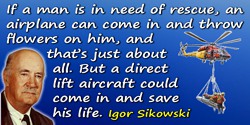
If a man is in need of rescue, an airplane can come in and throw flowers on him, and that’s just about all. But a direct lift aircraft could come in and save his life.
From 'Igor Sikorsky the Aviation Pioneer Speaks', Igor I. Sikorsky Historical Archives, sikorskyarchives.com.
If a man is not bound down, he is sure to succeed.
In Orison Swett Marden, 'Bell Telephone Talk: Hints on Success by Alexander G. Bell', How They Succeeded: Life Stories of Successful Men Told by Themselves (1901), 36.
If a man walked in the woods for love of them half of each day, he is in danger of being regarded as a loafer, but if he spends his whole day as a speculator shearing of those woods and making earth bald before her time, he is estimated as an industrious and enterprising citizen—as if a town had no interest in forests but to cut them down.
Walden. Quoted in Dr. N Sreedharan, Quotations of Wit and Wisdom (2007), 19.
If a man will begin with certainties, he shall end in doubts; but if he will be content to begin with doubts, he shall end in certainties.
The Advancement of Learning (1605) in James Spedding, Robert Ellis and Douglas Heath (eds.), The Works of Francis Bacon (1887-1901), Vol. 3, 293.
If a man will comprehend the richness and variety of the universe, and inspire his mind with a due measure of wonder and awe, he must contemplate the human intellect not only on its heights of genius but in its abysses of ineptitude...
M. Manilii Astronomicon. Liber Primus Recensuit et enarravit A.E. Housman. Editio Altera (1937), i, xix. Quoted in David Womersley, 'Dulness and Pope', British Academy, 2004 Lectures, (2005), 233.
If a man would be alone, let him look at the stars. … One might think the atmosphere was made transparent with this design, to give man, in the heavenly bodies, the perpetual presence of the sublime.
In 'Nature', The Prose Works of Ralph Waldo Emerson (1870), Vol. 1, Chap 1, 7.
If a man write a better book, preach a better sermon, or make a better mouse-trap than his neighbour, tho' he build his house in the woods, the world will make a beaten path to his door.
Attributed to Emerson by Sarah S. B. Yule, in her book Borrowings (compiled 1889, published 1893). Mrs Yule was quoted in The Docket (Feb 1912), that she wrote this in her notebook of memorable statements during an Emerson address. The Docket thus disproved Elbert Hubbard's claim to its authorship.
If a man, holding a belief which he was taught in childhood or persuaded of afterwards, keeps down and pushes away any doubts which arise about it in his mind, purposely avoids the reading of books and the company of men that call in question or discuss it, and regards as impious those questions which cannot easily be asked without disturbing it—the life of that man is one long sin against mankind.
In 'The Ethics of Belief', Contemporary Review (Jan 1877), collected in Leslie Stephen and Frederick Pollock (eds.), Lectures and Essays: By the Late William Kingdon Clifford, F.R.S. (1886), 346.
If a man's wit be wandering, let him study the mathematics; for in demonstrations, if his wit be called away never so little, he must begin again.
Translation in Francis Bacon, James Spedding (ed.) et al., Works of Francis Bacon (1858) Vol. 6, 498.
If a mathematician wishes to disparage the work of one of his colleagues, say, A, the most effective method he finds for doing this is to ask where the results can be applied. The hard pressed man, with his back against the wall, finally unearths the researches of another mathematician B as the locus of the application of his own results. If next B is plagued with a similar question, he will refer to another mathematician C. After a few steps of this kind we find ourselves referred back to the researches of A, and in this way the chain closes.
From final remarks in 'The Semantic Conception of Truth and the Foundations of Semantics' (1944), collected in Leonard Linsky (ed.), Semantics and the Philosophy of Language: A Collection of Readings (1952), 41.
If a physician make a large incision with an operating knife and cure it, or if he open a tumor (over the eye) with an operating knife, and saves the eye, he shall receive ten shekels in money. …
If a physician make a large incision with an operating knife, and kill him, or open a tumor with an operating knife, and cut out the eye, his hands shall be cut off. ...
If a physician heal the broken bone or diseased soft part of a man, the patient shall pay the physician five shekels in money.
[The Code of Hammurabi (a king of ancient Babylon), the earliest well-preserved ancient law code, circa 1760 B.C.]
If a physician make a large incision with an operating knife, and kill him, or open a tumor with an operating knife, and cut out the eye, his hands shall be cut off. ...
If a physician heal the broken bone or diseased soft part of a man, the patient shall pay the physician five shekels in money.
[The Code of Hammurabi (a king of ancient Babylon), the earliest well-preserved ancient law code, circa 1760 B.C.]
In L. W. King (trans.), The Code of Hammurabi (1910), 22, No. 215, 218 and 221.
If a single cell, under appropriate conditions, becomes a man in the space of a few years, there can surely be no difficulty in understanding how, under appropriate conditions, a cell may, in the course of untold millions of years, give origin to the human race.
Principles of Biology (1865, 1872), 350.
If all boys could be made to know that with every breath of cigarette smoke they inhale imbecility and exhale manhood … and that the cigarette is a maker of invalids, criminals and fools—not men—it ought to deter them some. The yellow finger stain is an emblem of deeper degradation and enslavement than the ball and chain.
In Hudson Maxim and Clifton Johnson, 'Smoking, Swearing, and Perfumery', Hudson Maxim: Reminiscences and Comments (1924), 234. The quote is as reported by Clifton Johnson, based on interviews with Hudson Maxim.
If any person thinks the examination of the rest of the animal kingdom an unworthy task, he must hold in like disesteem the study of man. For no one can look at the primordia of the human frame—blood, flesh, bones, vessels, and the like—without much repugnance. Moreover, in every inquiry, the examination of material elements and instruments is not to be regarded as final, but as ancillary to the conception of the total form. Thus, the true object of architecture is not bricks, mortar or timber, but the house; and so the principal object of natural philosophy is not the material elements, but their composition, and the totality of the form to which they are subservient, and independently of which they have no existence.
On Parts of Animals, Book 1, Chap 5, 645a, 26-36. In W. Ogle (trans.), Aristotle on the Parts of Animals (1882), 17. Alternate translations: “primodia” = “elements”; “Moreover ... Thus” = “Moreover, when anyone of the parts or structures, be it which it may, is under discussion, it must not be supposed that it is its material composition to which attention is being directed or which is the object of the discussion, but rather the total form. Similarly”; “form ... subservient, and” = “totality of the substance.” See alternate translation in Jonathan Barnes (ed.), The Complete Works of Aristotle (1984), Vol. 1, 1004.
If any woman were to hang a man for stealing her picture, although it were set in gold, it would be a new case in law; but, if he carried off the setting, and left the portrait, I would not answer for his safety.
Reflection 557, in Lacon: or Many things in Few Words; Addressed to Those Who Think (1820), 234.
If at this moment I am not a worn-out, debauched, useless carcass of a man, if it has been or will be my fate to advance the cause of science, if I feel that I have a shadow of a claim on the love of those about me, if in the supreme moment when I looked down into my boy’s grave my sorrow was full of submission and without bitterness, it is because these agencies have worked upon me, and not because I have ever cared whether my poor personality shall remain distinct forever from the All from whence it came and whither it goes.
And thus, my dear Kingsley, you will understand what my position is. I may be quite wrong, and in that case I know I shall have to pay the penalty for being wrong. But I can only say with Luther, “Gott helfe mir, ich kann nichts anders [God help me, I cannot do otherwise].”
And thus, my dear Kingsley, you will understand what my position is. I may be quite wrong, and in that case I know I shall have to pay the penalty for being wrong. But I can only say with Luther, “Gott helfe mir, ich kann nichts anders [God help me, I cannot do otherwise].”
In Letter (23 Sep 1860) to Charles Kingsley, Life and Letters of Thomas Henry Huxley (1901), 237.
If each of us can be helped by science to live a hundred years, what will it profit us if our hates and fears, our loneliness and our remorse will not permit us to enjoy them? What use is an extra year or two to the man who “kills” what time he has?
If every man waz a genius, mankind would be az bad oph az the heavens would be, with every star a comet, things would git hurt badly, and noboddy tew blame.
In The Complete Works of Josh Billings (1876), 79.
If God wanted man to become a space faring species, He would have given man a moon.
…...
If I were a medical man, I should prescribe a holiday to any patient who considered his work important.
In The Conquest of Happiness (1930), 74.
If I wished to express the basic principle of my ideas in a somewhat strongly worded sentence, I would say that man, in his bodily development, is a primate fetus that has become sexually mature [einen zur Geschlechsreife gelangten Primatenfetus].
Das Problem der Menschwerdung (1926), 8. Trans. in Stephen Jay Gould, Ontogeny and Phylogeny (1977), 361.
If I would be a young man again and had to decide how to make my living, I would not try to become a scientist or scholar or teacher. I would rather choose to be a plumber or a peddler in the hope to find that modest degree of independence still available under present circumstances.
According to Ralph Keyes, The Quote Verifier: Who Said What, Where, and When (2006), 53, on other occasions Einstein said “he might rather have been a musician, or light-house keeper”; however it is a “popular misquotation” that refers to being a watchmaker.
If in a community of the blind one man suddenly received the gift of sight, he would have much to tell which would not be at all scientific.
Swarthmore Lecture (1929) at Friends’ House, London, printed in Science and the Unseen World (1929), 79.
If it be true, that some Chymists have now and then converted Lead into Gold, it was by just such a hazard, as if a man should let fall a handful of sand upon a table and the particles of it should be so ranged that we could read distinctly on it a whole page of Virgil’s Ænead.
In Traité de Physique, (1671, 1676), Part. 3, Chap. 6, 186. As translated in Rohault’s System of Natural Philosophy (1723), Part 3, Chap. 6, 154. From the original French, “Que s’il est vray que quelques Chymistes ayent autrefois converty du plomb en or, ça esté par un hazard aussi grand, que si ayant laissé tomber de haut une poignée de sable sur une table, ses gains s'estoient tellement rangez, qu'on y pût lire distinctement une page de l'Eneide de Virgile.”
If it were possible for a metaphysician to be a golfer, he might perhaps occasionally notice that his ball, instead of moving forward in a vertical plane (like the generality of projectiles, such as brickbats and cricket balls), skewed away gradually to the right. If he did notice it, his methods would naturally lead him to content himself with his caddies’s remark-“ye heeled that yin,” or “Ye jist sliced it.” … But a scientific man is not to be put off with such flimsy verbiage as that. He must know more. What is “Heeling”, what is “slicing”, and why would either operation (if it could be thoroughly carried out) send a ball as if to cover point, thence to long slip, and finally behind back-stop? These, as Falstaff said, are “questions to be asked.”
In 'The Unwritten Chapter on Golf, Nature (1887), 36, 502.
If it were possible for us to have so deep an insight into a man's character as shown both in inner and in outer actions, that every, even the least, incentive to these actions and all external occasions which affect them were so known to us that his future conduct could be predicted with as great a certainty as the occurrence of a solar or lunar eclipse, we could nevertheless still assert that the man is free.
Critique of Practical Reason (1788). In L. W. Beck (ed. & trans.), Critique of Practical Reason and Other Writings in Moral Philosophy (1949), 204-5.
If it were possible to transfer the methods of physical or of biological science directly to the study of man, the transfer would long ago have been made ... We have failed not for lack of hypotheses which equate man with the rest of the universe, but for lack of a hypothesis (short of animism) which provides for the peculiar divergence of man ... Let me now state my belief that the peculiar factor in man which forbids our explaining his actions upon the ordinary plane of biology is a highly specialized and unstable biological complex, and that this factor is none other than language.
Linguistics as a Science (1930), 555.
If man evolved from monkeys and apes, why do we still have monkeys and apes?
Usually seen without any source. Although sometimes attributed to George Carlin or Stephen Wright, Webmaster has, so far, identified no primary source. Can you help?
If man were by nature a solitary animal, the passions of the soul by which he was conformed to things so as to have knowledge of them would be sufficient for him; but since he is by nature a political and social animal it was necessary that his conceptions be made known to others. This he does through vocal sound. Therefore there had to be significant vocal sounds in order that men might live together. Whence those who speak different languages find it difficult to live together in social unity.
As quoted in Jeffrey J. Maciejewski, Thomas Aquinas on Persuasion: Action, Ends, and Natural Rhetoric (2013), 36.
If many a man did not feel obliged to repeat what is untrue, because he has said it once, the world would have been quite different.
In The Maxims and Reflections of Goethe (1906), 196.
If one looks with a cold eye at the mess man has made of history, it is difficult to avoid the conclusion that he has been afflicted by some built-in mental disorder which drives him towards self-destruction.
In The Ghost in the Machine (1967).
If one of these people, in whom the chance-worship of our remoter ancestors thus strangely survives, should be within reach of the sea when a heavy gale is blowing, let him betake himself to the shore and watch the scene. Let him note the infinite variety of form and size of the tossing waves out at sea; or against the curves of their foam-crested breakers, as they dash against the rocks; let him listen to the roar and scream of the shingle as it is cast up and torn down the beach; or look at the flakes of foam as they drive hither and thither before the wind: or note the play of colours, which answers a gleam of sunshine as it falls upon their myriad bubbles. Surely here, if anywhere, he will say that chance is supreme, and bend the knee as one who has entered the very penetralia of his divinity. But the man of science knows that here, as everywhere, perfect order is manifested; that there is not a curve of the waves, not a note in the howling chorus, not a rainbow-glint on a bubble, which is other than a necessary consequence of the ascertained laws of nature; and that with a sufficient knowledge of the conditions, competent physico-mathematical skill could account for, and indeed predict, every one of these 'chance' events.
In 'On the Reception of the Origin of Species'. In Francis Darwin (ed.), The Life and Letters of Charles Darwin, Including an Autobiographical Chapter (1888), Vol. 2, 200-1.
If our intention had been merely to bring back a handful of soil and rocks from the lunar gravel pit and then forget the whole thing, we would certainly be history's biggest fools. But that is not our intention now—it never will be. What we are seeking in tomorrow's [Apollo 11] trip is indeed that key to our future on earth. We are expanding the mind of man. We are extending this God-given brain and these God-given hands to their outermost limits and in so doing all mankind will benefit. All mankind will reap the harvest…. What we will have attained when Neil Armstrong steps down upon the moon is a completely new step in the evolution of man.
Banquet speech on the eve of the Apollo 11 launch, Royal Oaks Country Club, Titusville (15 Jul 1969). In "Of a Fire on the Moon", Life (29 Aug 1969), 67, No. 9, 34.
If seeds in the black Earth can turn into such beautiful roses what might not the heart of man become in its long journey towards the stars?
As quoted in Maisie Ward, Return to Chesterton (1952), 161.
If someday they say of me that in my work I have contributed something to the welfare and happiness of my fellow man, I shall be satisfied.
In Quentin R. Skrabec, Jr., George Westinghouse: Gentle Genius (2007), 237.
If the [Vestiges] be true, the labours of sober induction are in vain; religion is a lie; human law is a mass of folly, and a base injustice; morality is moonshine; our labours for the black people of Africa were works of madmen; and man and woman are only better beasts!
Letter to Charles Lyell (9 Apr 1845). In John Willis Clark and Thomas McKenny Hughes (eds.), The Life and Letters of the Reverend Adam Sedgwick (1890), Vol. 2, 84.
If the average man in the street were asked to name the benefits derived from sunshine, he would probably say “light and warmth” and there he would stop. But, if we analyse the matter a little more deeply, we will soon realize that sunshine is the one great source of all forms of life and activity on this old planet of ours. … [M]athematics underlies present-day civilization in much the same far-reaching manner as sunshine underlies all forms of life, and that we unconsciously share the benefits conferred by the mathematical achievements of the race just as we unconsciously enjoy the blessings of the sunshine.
From Address (25 Feb 1928) to National Council of Teachers of Mathematics, Boston. Abstract published in 'Mathematics and Sunshine', The Mathematics Teacher (May 1928), 21, No. 5, 245.
If the bee disappeared off the face of the earth, man would only have four years left to live.
This is regarded as probably NOT a quote by Einstein.
This is regarded as probably NOT a quote by Einstein.
This is something Einstein most probably did NOT say! Since scholarly search for this quote has thus far found no reliable source for it, it must at least be classed as undetermined. Furthermore, since its first appearance is 40 years after his death, in dubious context for authenticity, it deserves to be regarded as spurious. See snopes.com article. It is added here to serve as a caution to the reader.
If the doors of perception were cleansed, everything would appear as it is, infinite. For man has closed himself up, till he sees all things thro’ narrow chinks of his cavern.
In The Marriage of Heaven and Hell: And A Song of Liberty (1793, 1911), 62.
If the germ plasm wants to swim in the ocean, it makes itself a fish; if the germ plasm wants to fly in the air, it makes itself a bird. If it wants to go to Harvard, it makes itself a man. The strangest thing of all is that the germ plasm that we carry around within us has done all those things. There was a time, hundreds of millions of years ago, when it was making fish. Then … amphibia … reptiles … mammals, and now it’s making men.
In talk, 'Origin of Death' (1970). Wald gave the context whereby the most one-celled organisms continued to reproduce by cell division.
If the kind of controversy which so often springs up between modernism and traditionalism in religion were applied to more commonplace affairs of life we might see some strange results. …It arises, let us say, from a passage in an obituary notice which mentions that the deceased had loved to watch the sunsets from his peaceful country home.. …it is forgotten that what the deceased man looked out for each evening was an experience and not a creed.
Swarthmore Lecture (1929) at Friends’ House, London, printed in Science and the Unseen World (1929), 84-85.
If the man doesn’t believe as we do, we say he is a crank, and that settles it. I mean, it does nowadays, because now we can’t burn him.
In Following the Equator: A Journey Around the World (1898), 514.
If the man of science chose to follow the example of historians and pulpit-orators, and to obscure strange and peculiar phenomena by employing a hollow pomp of big and sounding words, this would be his opportunity; for we have approached one of the greatest mysteries which surround the problem of animated nature and distinguish it above all other problems of science. To discover the relations of man and woman to the egg-cell would be almost equivalent of the egg-cell in the body of the mother, the transfer to it by means of the seed, of the physical and mental characteristics of the father, affect all the questions which the human mind has ever raised in regard to existence.
Quoted in Ernst Heinrich Philipp August Haeckel, The Evolution of Man (1897), vol 1, 148.
If the term education may be understood in so large a sense as to include all that belongs to the improvement of the mind, either by the acquisition of the knowledge of others or by increase of it through its own exertions, we learn by them what is the kind of education science offers to man. It teaches us to be neglectful of nothing — not to despise the small beginnings, for they precede of necessity all great things in the knowledge of science, either pure or applied.
'Science as a Branch of Education', lecture to the Royal Institution, 11 Jun 1858. Reprinted in The Mechanics Magazine (1858), 49, 11.
If the words of a wise man are few, they are nevertheless worth listening to.
Aphorism as given by the fictional character Dezhnev Senior, in Fantastic Voyage II: Destination Brain (1987), 242.
If there are any gods whose chief concern is man, they cannot be very important gods.
In 'Space Flight and the Spirit of Man', Voices from Sky: Previews of the Coming Space Age (1965), 17.
If there be one man, more than another, who deserves to succeed in flying through the air, that man is Mr. Laurence Hargrave, of Sydney, New South Wales.
In Progress in Flying Machines (1894), 218.
If there is anything that can bind the heavenly mind of man to this dreary exile of our earthly home and can reconcile us with our fate so that one can enjoy living,—then it is verily the enjoyment of the mathematical sciences and astronomy.
In a letter to his son-in-law, Jakob Bartsch. Quoted in Norman Davidson, Sky Phenomena (2004), 131. Also see Johannes Kepler and Carola Baumgardt (ed.), Johannes Kepler: Life and Letters (1951), 190.
If there were some solitary or feral man, the passions of the soul would be sufficient for him; by them he would be conformed to things in order that he might have knowledge of them. But because man is naturally political and social, there is need for one man to make his conceptions known to others, which is done with speech. So significant speech was needed if men were to live together. Which is why those of different tongues do not easily live together.
Sententia super libri Perihermeneias (Commentary on Aristotle’s On Interpretation) [1270-1271], Book I, lesson 2, number 2, trans. R. McInerny, quoted in R. McInerny (ed.) Thomas Aquinas, Selected Writings (1998), 460.
If thou examinest a man having a break in the column of his nose, his nose being disfigured, and a [depression] being in it, while the swelling that is on it protrudes, [and] he had discharged blood from both his nostrils, thou shouldst say concerning him: “One having a break in the column of his nose. An ailment which I will treat. “Thou shouldst cleanse [it] for him [with] two plugs of linen. Thou shouldst place two [other] plugs of linen saturated with grease in the inside of his two nostrils. Thou shouldst put [him] at his mooring stakes until the swelling is drawn out. Thou shouldst apply for him stiff rolls of linen by which his nose is held fast. Thou shouldst treat him afterward [with] lint, every day until he recovers.
(circa 1700 B.C.) From “The Edwin Smith Surgical Papyrus”, an ancient Egyptian document regarded as the earliest known historical record of scientific thought. As translated in James Henry Breasted, The Edwin Smith Surgical Papyrus: Published in Facsimile and Hieroglyphic Transliteration with Translation and Commentary (1930), 440.
If today you can take a thing like evolution and make it a crime to teach it in the public schools, tomorrow you can make it a crime to teach it in the private schools, and next year you can make it a crime to teach it to the hustings or in the church. At the next session you may ban books and the newspapers. Soon you may set Catholic against Protestant and Protestant against Protestant, and try to foist your own religion upon the minds of men. If you can do one you can do the other. Ignorance and fanaticism are ever busy and need feeding. Always it is feeding and gloating for more. Today it is the public school teachers; tomorrow the private. The next day the preachers and the lecturers, the magazines, the books, the newspapers. After a while, Your Honor, it is the setting of man against man and creed against creed until with flying banners and beating drums we are marching backward to the glorious ages of the sixteenth century when bigots lighted fagots to burn the men who dared to bring any intelligence and enlightenment and culture to the human mind.
Darrow’s concluding remarks before adjournment of the second day of the Scopes Monkey Trial, Dayton, Tennessee (Monday, 13 Jul 1925). In The World's Most Famous Court Trial: Tennessee Evolution Case: a Complete Stenographic Report of the Famous Court Test of the Tennessee Anti-Evolution Act, at Dayton, July 10 to 21, 1925 (1925), Second Day's Proceedings, 87.
If we betake ourselves to the statistical method, we do so confessing that we are unable to follow the details of each individual case, and expecting that the effects of widespread causes, though very different in each individual, will produce an average result on the whole nation, from a study of which we may estimate the character and propensities of an imaginary being called the Mean Man.
'Does the Progress of Physical Science tend to give any advantage to the opinion of necessity (or determinism) over that of the continuency of Events and the Freedom of the Will?' In P. M. Hannan (ed.), The Scientific Letters and Papers of James Clerk Maxwell (1995), Vol. 2, 1862-1873, 818.
If we can combine our knowledge of science with the wisdom of wildness, if we can nurture civilization through roots in the primitive, man’s potentialities appear to be unbounded, Through this evolving awareness, and his awareness of that awareness, he can emerge with the miraculous—to which we can attach what better name than “God”? And in this merging, as long sensed by intuition but still only vaguely perceived by rationality, experience may travel without need for accompanying life.
A Letter From Lindbergh', Life (4 Jul 1969), 61. In Eugene C. Gerhart, Quote it Completely! (1998), 409.
If we evolved a race of Isaac Newtons, that would not be progress. For the price Newton had to pay for being a supreme intellect was that he was incapable of friendship, love, fatherhood, and many other desirable things. As a man he was a failure; as a monster he was superb.
Interview with J.W.N. Sullivan, Contemporary Mind, London, 1934. As cited in James Roy Newman, The World of Mathematics (1956), Vol. 4, 2222.
If we examine the accomplishments of man in his most advanced endeavors, in theory and in practice, we find that the cell has done all this long before him, with greater resourcefulness and much greater efficiency.
Nobel Lecture, The Coming Age of the Cell, 12 Dec 1974
If we had a thorough knowledge of all the parts of the seed of any animal (e.g., man), we could from that alone, by reasons entirely mathematical and certain, deduce the whole conformation and figure of each of its members, and, conversely, if we knew several peculiarities of this conformation, we would from those deduce the nature of its seed.
If we make a couple of discoveries here and there we need not believe things will go like this for ever. An acrobat can leap higher than a farm-hand, and one acrobat higher than another, yet the height no man can overleap is still very low. Just as we hit water when we dig in the earth, so we discover the incomprehensible sooner or later.
Aphorisms, trans. R. J. Hollingdale (1990), 92.
If we may believe our logicians, man is distinguished from all other creatures by the faculty of laughter.
In The Spectator (26 Sep 1712), No. 494, as collected in Vol. 7 (1729, 10th ed.), 84.
If we ought not to fear mortal truth, still less should we dread scientific truth. In the first place it can not conflict with ethics? But if science is feared, it is above all because it can give no happiness? Man, then, can not be happy through science but today he can much less be happy without it.
Henri Poincaré and George Bruce Halsted (trans.), The Value of Science (1907), 12.
If we thus go very far back to the source of the Mammalian type of organisation; it is extremely improbable that any of [his relatives shall likewise] the successors of his relations now exist,—In same manner, if we take [a man from] any large family of 12 brothers & sisters [in a state which does not increase] it will be chances against anyone [of them] having progeny living ten thousand years hence; because at present day many are relatives so that tracing back the [descen] fathers would be reduced to small percentage.—& [in] therefore the chances are excessively great against, any two of the 12, having progeny, after that distant period.
P. H. Barrett et al. (eds.), Charles Darwin's Notebooks, 1836-1844: Geology, Transmutation of the Species and Metaphysical Enquiries (1987), Notebook B, 40-1.
If worms have the power of acquiring some notion, however rude, of the shape of an object and over their burrows, as seems the case, they deserve to be called intelligent; for they act in nearly the same manner as would man under similar circumstances.
Formation of Vegetable Mould, Through the Action of Worms
If you advertise to tell lies, it will ruin you, but if you advertise to tell the public the truth, and particularly to give information, it will bring you success. I learned early that to tell a man how best to use tires, and to make him want them, was far better than trying to tell him that your tire is the best in the world. If you believe that yours is, let your customer find it out.
As quoted by H.M. Davidson, in System: The Magazine of Business (Apr 1922), 41, 446.
If you ask ... the man in the street ... the human significance of mathematics, the answer of the world will be, that mathematics has given mankind a metrical and computatory art essential to the effective conduct of daily life, that mathematics admits of countless applications in engineering and the natural sciences, and finally that mathematics is a most excellent instrumentality for giving mental discipline... [A mathematician will add] that mathematics is the exact science, the science of exact thought or of rigorous thinking.
Address (28 Mar 1912), Michigan School Masters' Club, Ann Arbor, 'The Humanization of the Teaching of Mathematics. Printed in Science (26 Apr 1912). Collected in The Human Worth of Rigorous Thinking: Essays and Addresses (1916), 65-66.
If you can fill the unforgiving minute
With sixty seconds’ worth of distance run,
Yours is the Earth and everything that’s in it,
And—which is more—you’ll be a Man, my son.
With sixty seconds’ worth of distance run,
Yours is the Earth and everything that’s in it,
And—which is more—you’ll be a Man, my son.
In 'If', Rewards and Fairies (1910), 182.
If you can modify a cell, it’s only a short step to modifying a mouse, and if you can modify a mouse, it’s only a step to modifying a higher animal, even man.
Reported in 1981, expressing concern for the future of gene-splicing.
Reported in 1981, expressing concern for the future of gene-splicing.
In 'Shaping Life in the Lab', Time (9 Mar 1981).
If you confine yourself to this Skinnerian technique, you study nothing but the learning apparatus and you leave out everything that is different in octopi, crustaceans, insects and vertebrates. In other words, you leave out everything that makes a pigeon a pigeon, a rat a rat, a man a man, and, above all, a healthy man healthy and a sick man sick.
'Some Psychological Concepts and Issues. A Discussion between Konrad Lorenz and Richard I Evans'. In Richard I. Evans, Konrad Lorenz: The Man and his Ideas (1975), 60.
If you enquire about him [J.J. Sylvester], you will hear his genius universally recognized but his power of teaching will probably be said to be quite deficient. Now there is no man living who is more luminary in his language, to those who have the capacity to comprehend him than Sylvester, provided the hearer is in a lucid interval. But as the barn yard fowl cannot understand the flight of the eagle, so it is the eaglet only who will be nourished by his instruction.
Letter (18 Sep 1875) to Daniel C. Gilman. In Daniel C. Gilman Papers, Ms. 1, Special Collections Division, Milton S. Eisenhower Library, Johns Hopkins University. As quoted in Karen Hunger Parshall, 'America’s First School of Mathematical Research: James Joseph Sylvester at The Johns Hopkins University 1876—1883', Archive for History of Exact Sciences (1988), 38, No. 2, 167.
If you intend to give a sick man medicine, let him get very ill first, so that he may see the benefit of your medicine.
African proverb, Nupe
If you would make a man happy, do not add to his possessions but subtract from the sum of his desires.
Quoted, without citation, in Harris Elliott Kirk, A Man of Property: Or, The Jacob Saga (1935), 45. Also in Howard W. Eves, Return to Mathematical Circles, (1988), 68.
If, unwarned by my example, any man shall undertake and shall succeed in really constructing an engine embodying in itself the whole of the executive department of mathematical analysis upon different principles or by simpler mechanical means, I have no fear of leaving my reputation in his charge, for he alone will be fully able to appreciate the nature of my efforts and the value of their results.
In Passages from the Life of a Philosopher (1864), 450.
In 1810, the Triumph man-of-war and Phipps schooner received on board several tons of quicksilver, saved from the wreck of a vessel near Cadiz. In consequence of the rolling of the bags the mercury escaped, and the whole of the crews became more or less affected. In the space of three weeks, two hundred men were salivated, two died, and all the animals—cats, dogs, sheep, fowls, a canary bird, nay, even the rats, mice and cockroaches were destroyed.
[The leather bags of mercury had been salvaged and stored without the original wooden cases. Some were stowed in sleeping quarters, and the in same hold as spirit rations.]
[The leather bags of mercury had been salvaged and stored without the original wooden cases. Some were stowed in sleeping quarters, and the in same hold as spirit rations.]
The Edinburgh Medical And Surgical Journal, 6. Quoted in Alva Curtis, A Fair Examination and Criticism of All the Medical Systems in Vogue (1855), 38. For more information on the incident, see John Emsley, The Elements of Murder (2006), 38-9.
In 1945, therefore, I proved a sentimental fool; and Mr. Truman could safely have classified me among the whimpering idiots he did not wish admitted to the presidential office. For I felt that no man has the right to decree so much suffering, and that science, in providing and sharpening the knife and in upholding the ram, had incurred a guilt of which it will never get rid. It was at that time that the nexus between science and murder became clear to me. For several years after the somber event, between 1947 and 1952, I tried desperately to find a position in what then appeared to me as a bucolic Switzerland,—but I had no success.
Heraclitean Fire: Sketches from a Life before Nature (1978), 4.
In a few minutes a computer can make a mistake so great that it would have taken many men many months to equal.
In Civilization's Quotations: Life's Ideal (2002), 315.
In a manner of speaking, I can no longer hold my chemical water. I must tell you that I can make urea without the use of kidneys of any animal, be it man or dog. Ammonium cyanate is urea.
Letter from Wohler to Berzelius (22 Feb 1828). In O. Wallach (ed.), Briefwechsel zwischen J. Berzelius und F. Wohler (1901), Vol. 1, 206. Trans. W. H. Brock.
In all that has to do with the relations between man and the supernatural, we have to seek for a more than mathematical precision; this should be more exact than science.
In Gravity and Grace, (1947, 1952), 186.
In all times and epochs the greatest happiness for man has been to take part in new discoveries.
First;Enter;Cosmos;Single-Handed;Unprecedented;Duel;Nature;Dream
In an age of egoism, it is so difficult to persuade man that of all studies, the most important is that of himself. This is because egoism, like all passions, is blind. The attention of the egoist is directed to the immediate needs of which his senses give notice, and cannot be raised to those reflective needs that reason discloses to us; his aim is satisfaction, not perfection. He considers only his individual self; his species is nothing to him. Perhaps he fears that in penetrating the mysteries of his being he will ensure his own abasement, blush at his discoveries, and meet his conscience. True philosophy, always at one with moral science, tells a different tale. The source of useful illumination, we are told, is that of lasting content, is in ourselves. Our insight depends above all on the state of our faculties; but how can we bring our faculties to perfection if we do not know their nature and their laws! The elements of happiness are the moral sentiments; but how can we develop these sentiments without considering the principle of our affections, and the means of directing them? We become better by studying ourselves; the man who thoroughly knows himself is the wise man. Such reflection on the nature of his being brings a man to a better awareness of all the bonds that unite us to our fellows, to the re-discovery at the inner root of his existence of that identity of common life actuating us all, to feeling the full force of that fine maxim of the ancients: 'I am a man, and nothing human is alien to me.'
Considerations sur les diverses méthodes à suivre dans l'observation des peuples sauvages (1800) The Observation of Savage Peoples, trans. F. C. T. Moore (1969), 61.
In ancient days two aviators procured to themselves wings. Daedalus flew safely through the middle air and was duly honored on his landing. Icarus soared upwards to the sun till the wax melted which bound his wings and his flight ended in fiasco. In weighing their achievements, there is something to be said for Icarus. The classical authorities tell us that he was only “doing a stunt,” but I prefer to think of him as the man who brought to light a serious constructional defect in the flying machines of his day.
In any conceivable method ever invented by man, an automaton which produces an object by copying a pattern, will go first from the pattern to a description to the object. It first abstracts what the thing is like, and then carries it out. It’s therefore simpler not to extract from a real object its definition, but to start from the definition.
From lecture series on self-replicating machines at the University of Illinois, Lecture 5 (Dec 1949), 'Re-evaluation of the Problems of Complicated Automata—Problems of Hierarchy and Evolution', Theory of Self-Reproducing Automata (1966).
In attempting to understand the elements out of which mental phenomena are compounded, it is of the greatest importance to remember that from the protozoa to man there is nowhere a very wide gap either in structure or in behaviour. From this fact it is a highly probable inference that there is also nowhere a very wide mental gap.
Lecture II, 'Instinct and Habit', The Analysis of Mind
In consequence of Darwin's reformed Theory of Descent, we are now in a position to establish scientifically the groundwork of a non-miraculous history of the development of the human race. ... If any person feels the necessity of conceiving the coming into existence of this matter as the work of a supernatural creative power, of the creative force of something outside of matter, we have nothing to say against it. But we must remark, that thereby not even the smallest advantage is gained for a scientific knowledge of nature. Such a conception of an immaterial force, which as the first creates matter, is an article of faith which has nothing whatever to do with human science.
In Ernst Haeckel and E. Ray Lankester (trans.), The History of Creation (1880), Vol. 1, 6-9.
In early times, when the knowledge of nature was small, little attempt was made to divide science into parts, and men of science did not specialize. Aristotle was a master of all science known in his day, and wrote indifferently treatises on physics or animals. As increasing knowledge made it impossible for any one man to grasp all scientific subjects, lines of division were drawn for convenience of study and of teaching. Besides the broad distinction into physical and biological science, minute subdivisions arose, and, at a certain stage of development, much attention was, given to methods of classification, and much emphasis laid on the results, which were thought to have a significance beyond that of the mere convenience of mankind.
But we have reached the stage when the different streams of knowledge, followed by the different sciences, are coalescing, and the artificial barriers raised by calling those sciences by different names are breaking down. Geology uses the methods and data of physics, chemistry and biology; no one can say whether the science of radioactivity is to be classed as chemistry or physics, or whether sociology is properly grouped with biology or economics. Indeed, it is often just where this coalescence of two subjects occurs, when some connecting channel between them is opened suddenly, that the most striking advances in knowledge take place. The accumulated experience of one department of science, and the special methods which have been developed to deal with its problems, become suddenly available in the domain of another department, and many questions insoluble before may find answers in the new light cast upon them. Such considerations show us that science is in reality one, though we may agree to look on it now from one side and now from another as we approach it from the standpoint of physics, physiology or psychology.
But we have reached the stage when the different streams of knowledge, followed by the different sciences, are coalescing, and the artificial barriers raised by calling those sciences by different names are breaking down. Geology uses the methods and data of physics, chemistry and biology; no one can say whether the science of radioactivity is to be classed as chemistry or physics, or whether sociology is properly grouped with biology or economics. Indeed, it is often just where this coalescence of two subjects occurs, when some connecting channel between them is opened suddenly, that the most striking advances in knowledge take place. The accumulated experience of one department of science, and the special methods which have been developed to deal with its problems, become suddenly available in the domain of another department, and many questions insoluble before may find answers in the new light cast upon them. Such considerations show us that science is in reality one, though we may agree to look on it now from one side and now from another as we approach it from the standpoint of physics, physiology or psychology.
In article 'Science', Encyclopedia Britannica (1911), 402.
In fact, the history of North America has been perhaps more profoundly influenced by man's inheritance from his past homes than by the physical features of his present home.
The Red Man's Continent: A Chronicle of Aboriginal America (1919), 3.
In going on with these Experiments, how many pretty systems do we build, which we soon find ourselves oblig’d to destroy! If there is no other Use discover’d of Electricity, this, however, is something considerable, that it may help to make a vain Man humble.
Letter to Peter Collinson, 14 Aug 1747. In I. Bernard Cohen (ed.), Benjamin Franklin’s Experiments (1941), 63.
In honoring the Wright Brothers, it is customary and proper to recognize their contribution to scientific progress. But I believe it is equally important to emphasize the qualities in their pioneering life and the character in man that such a life produced. The Wright Brothers balanced sucess with modesty, science with simplicity. At Kitty Hawk their intellects and senses worked in mutual support. They represented man in balance, and from that balance came wings to lift a world.
Speech, quoted in Leonard Mosley, Lindbergh (2000), 347. In 1949, Lindbergh gave a speech when he received the Wright Brothers Memorial Trophy.
In human freedom in the philosophical sense I am definitely a disbeliever. Everybody acts not only under external compulsion but also in accordance with inner necessity. Schopenhauer’s saying, that ‘a man can do what he wants, but not want what he wants,’ has been an inspiration to me since my youth up, and a continual consolation and unfailing well-spring of patience in the face of the hardships of life, my own and others. This feeling mercifully not only mitigates the sense of responsibility which so easily becomes paralysing, and it prevents us from taking ourselves and other people too seriously; it conduces to a view of life in which humour, above all, has its due place.
In The World As I See It (1934), 238.
In knowledge that man only is to be condemned and despised who is not in a state of transition.
As quoted, without citation in Lecture, 'The Study of History' (11 Jun 1895) delivered at Cambridge, published as Lord Acton, A Lecture on The Study of History (1895), 54.
In Man the brain presents an ascensive step in development, higher and more strongly marked than that by which the preceding subclass was distinguished from the one below it. Not only do the cerebral hemispheres overlap the olfactory lobes and cerebellum, but they extend in advance of the one, and further back than the other. Their posterior development is so marked, that anatomists have assigned to that part the character of a third lobe; it is peculiar to the genus Homo, and equally peculiar is the 'posterior horn of the lateral ventricle,' and the 'hippocampus minor,' which characterize the hind lobe of each hemisphere. The superficial grey matter of the cerebrum, through the number and depth of the convolutions, attains its maximum of extent in Man. Peculiar mental powers are associated with this highest form of brain, and their consequences wonderfully illustrate the value of the cerebral character; according to my estimate of which, I am led to regard the genus Homo, as not merely a representative of a distinct order, but of a distinct subclass of the Mammalia, for which I propose a name of 'ARCHENCEPHALA.'
'On the Characters, Principles of Division, and Primary Groups of the Class MAMMALIA' (1857), Journal of the Proceedings of the Linnean Society of London (1858), 2, 19-20.
In man, population structure reaches its greatest complexity. Mankind—the human species, Homo sapiens—is the most inclusive Mendelian population, one which inhabits nearly the whole globe.
In Radiation, Genes, and Man (1959), 102.
In man, then, let us take the amount that is extruded by the individual beats, and that cannot return into the heart because of the barrier set in its way by the valves, as half an ounce, or three drachms, or at least one drachm. In half an hour the heart makes over a thousand beats; indeed, in some individuals, and on occasion, two, three, or four thousand. If you multiply the drachms per beat by the number of beats you will see that in half an hour either a thousand times three drachms or times two drachms, or five hundred ounces, or other such proportionate quantity of blood has been passed through the heart into the arteries, that is, in all cases blood in greater amount than can be found in the whole of the body. Similarly in the sheep or the dog. Let us take it that one scruple passes in a single contraction of the heart; then in half an hour a thousand scruples, or three and a half pounds of blood, do so. In a body of this size, as I have found in the sheep, there is often not more than four pounds of blood.
In the above sort of way, by calculating the amount of blood transmitted [at each heart beat] and by making a count of the beats, let us convince ourselves that the whole amount of the blood mass goes through the heart from the veins to the arteries and similarly makes the pulmonary transit.
Even if this may take more than half an hour or an hour or a day for its accomplishment, it does nevertheless show that the beat of the heart is continuously driving through that organ more blood than the ingested food can supply, or all the veins together at any time contain.
In the above sort of way, by calculating the amount of blood transmitted [at each heart beat] and by making a count of the beats, let us convince ourselves that the whole amount of the blood mass goes through the heart from the veins to the arteries and similarly makes the pulmonary transit.
Even if this may take more than half an hour or an hour or a day for its accomplishment, it does nevertheless show that the beat of the heart is continuously driving through that organ more blood than the ingested food can supply, or all the veins together at any time contain.
De Motu Cordis (1628), The Circulation of the Blood and Other Writings, trans. Kenneth J. Franklin (1957), Chapter 9, 62-3.
In man’s brain the impressions from outside are not merely registered; they produce concepts and ideas. They are the imprint of the external world upon the human brain. Therefore, it is not surprising that, after a long period of searching and erring, some of the concepts and ideas in human thinking should have come gradually closer to the fundamental laws of the world, that some of our thinking should reveal the true structure of atoms and the true movements of the stars. Nature, in the form of man, begins to recognize itself.
In Knowledge and Wonder (1962).
In medical practice a man may die when, scientifically speaking, he ought to have lived. I have actually known a man to die of a disease from which he was, scientifically speaking, immune. But that does not affect the fundamental truth of science.
B.B. character in The Doctor's Dilemma, Act 3 (First produced in 1906). In The Doctor's Dilemma: With a Preface on Doctors (1911), 70.
In no sense can the Neanderthal bones be regarded as the remains of a human being intermediate between men and apes.
In Evidence as to Man's Place in Nature (1863), 157.
In order that an inventory of plants may be begun and a classification of them correctly established, we must try to discover criteria of some sort for distinguishing what are called “species”. After a long and considerable investigation, no surer criterion for determining species had occurred to me than distinguishing features that perpetuate themselves in propagation from seed. Thus, no matter what variations occur in the individuals or the species, if they spring from the seed of one and the same plant, they are accidental variations and not such as to distinguish a species. For these variations do not perpetuate themselves in subsequent seeding. Thus, for example, we do not regard caryophylli with full or multiple blossoms as a species distinct from caryophylli with single blossoms, because the former owe their origin to the seed of the latter and if the former are sown from their own seed, they once more produce single-blossom caryophylli. But variations that never have as their source seed from one and the same species may finally be regarded as distinct species. Or, if you make a comparison between any two plants, plants which never spring from each other's seed and never, when their seed is sown, are transmuted one into the other, these plants finally are distinct species. For it is just as in animals: a difference in sex is not enough to prove a difference of species, because each sex is derived from the same seed as far as species is concerned and not infrequently from the same parents; no matter how many and how striking may be the accidental differences between them; no other proof that bull and cow, man and woman belong to the same species is required than the fact that both very frequently spring from the same parents or the same mother. Likewise in the case of plants, there is no surer index of identity of species than that of origin from the seed of one and the same plant, whether it is a matter of individuals or species. For animals that differ in species preserve their distinct species permanently; one species never springs from the seed of another nor vice versa.
— John Ray
Historia Plantarum (1686), Vol. 1, 40. Trans. Edmund Silk. Quoted in Barbara G. Beddall, 'Historical Notes on Avian Classification', Systematic Zoology (1957), 6, 133-4.
In order to survive, an animal must be born into a favoring or at least tolerant environment. Similarly, in order to achieve preservation and recognition, a specimen of fossil man must be discovered in intelligence, attested by scientific knowledge, and interpreted by evolutionary experience. These rigorous prerequisites have undoubtedly caused many still-births in human palaeontology and are partly responsible for the high infant mortality of discoveries of geologically ancient man.
Apes, Men and Morons (1938), 106.
In our days everything seems pregnant with its contrary. Machinery, gifted with the wonderful power of shortening and fructifying human labor, we behold starving and overworking it… . At the same pace that mankind masters nature, man seems to become enslaved to other men or his own infamy. Even the pure light of science seems unable to shine but on the dark background of ignorance.
In Speech (14 Apr 1856) on the 4th Anniversary of the People’s Paper, collected in David McLellan (ed.), Karl Marx: Selected Writings (2000), 368.
In our educational institutions applied science may almost be described as a “no-man's land.”
Referring to the need to improve the quality and status of applied science. From his essay contributed to the National Academy of Sciences Committee Report to the House Committee on Science and Astronautics (Mar 1965). Reprinted in 'The Role of Applied Science', Bulletin of the Atomic Scientists (Mar 1966).
In physiology, as in all other sciences, no discovery is useless, no curiosity misplaced or too ambitious, and we may be certain that every advance achieved in the quest of pure knowledge will sooner or later play its part in the service of man.
The Linacre Lecture on the Law of the Heart (1918), 147.
In practical talk, a man’s common sense means his good judgement, his freedom from eccentricity, his gumption.
In Lecture (1907/1908), 'Pragmatism and Common Sense', collected in 'Lecture 5: Pragmatism and Common Sense', Pragmatism: A New Name for Some Old Ways of Thinking (1907, 1910), 171.
In reality, I have sometimes thought that we do not go on sufficiently slowly in the removal of diseases, and that it would he better if we proceeded with less haste, and if more were often left, to Nature than is the practice now-a-days. It is a great mistake to suppose that Nature always stands in need of the assistance of Art. If that were the case, site would have made less provision for the safety of mankind than the preservation of the species demands; seeing that there is not the least proportion between the host of existing diseases and the powers possessed by man for their removal, even in those ages wherein the healing art was at the highest pitch, and most extensively cultivated.
As quoted by Gavin Milroy in 'On the Writings of Sydenham', The Lancet (14 Nov 1846), 524.
In recent years it has become impossible to talk about man’s relation to nature without referring to “ecology” … such leading scientists in this area as Rachel Carson, Barry Commoner, Eugene Odum, Paul Ehrlich and others, have become our new delphic voices … so influential has their branch of science become that our time might well be called the “Age of Ecology”.
In opening paragraph of Preface, Nature’s Economy: A History of Ecological Ideas (1994), 14.
In science men have discovered an activity of the very highest value in which they are no longer, as in art, dependent for progress upon the appearance of continually greater genius, for in science the successors stand upon the shoulders of their predecessors; where one man of supreme genius has invented a method, a thousand lesser men can apply it. … In art nothing worth doing can be done without genius; in science even a very moderate capacity can contribute to a supreme achievement.
Essay, 'The Place Of Science In A Liberal Education.' In Mysticism and Logic: and Other Essays (1919), 41.
In scientific thought we adopt the simplest theory which will explain all the facts under consideration and enable us to predict new facts of the same kind. The catch in this criterion lies in the world “simplest.” It is really an aesthetic canon such as we find implicit in our criticisms of poetry or painting. The layman finds such a law as dx/dt = κ(d²x/dy²) much less simple than “it oozes,” of which it is the mathematical statement. The physicist reverses this judgment, and his statement is certainly the more fruitful of the two, so far as prediction is concerned. It is, however, a statement about something very unfamiliar to the plain man, namely the rate of change of a rate of change.
In 'Science and Theology as Art-Forms', Possible Worlds (1927), 227.
In shades of black and blue the skies do bow as darkness falls the lights go out.
Nature softly immersed in glee as all mankind drifts off to sleep.
Water breathes a sigh of relief now aquatic creatures can do as they please.
Animals whether large or small regain the natural instincts that man has fought.
The moon shines bright he’s happy too people can’t over-ride his rules.
Midnight calms the wounds of the world the break of dawn disperses new hope...
Nature softly immersed in glee as all mankind drifts off to sleep.
Water breathes a sigh of relief now aquatic creatures can do as they please.
Animals whether large or small regain the natural instincts that man has fought.
The moon shines bright he’s happy too people can’t over-ride his rules.
Midnight calms the wounds of the world the break of dawn disperses new hope...
…...
In some sense man is a microcosm of the universe: therefore what man is, is a clue to the universe. We are enfolded in the universe.
Quoted in Renée Weber, Dialogues with scientists and sages: the search for unity (1986),
In studying the fate of our forest king, we have thus far considered the action of purely natural causes only; but, unfortunately, man is in the woods, and waste and pure destruction are making rapid headway. If the importance of the forests were even vaguely understood, even from an economic standpoint, their preservation would call forth the most watchful attention of government
In The Mountains of California (1894), 198.
In teaching man, experimental science results in lessening his pride more and more by proving to him every day that primary causes, like the objective reality of things, will be hidden from him forever and that he can only know relations.
…...
In the arts of life main invents nothing; but in the arts of death he outdoes Nature herself, and produces by chemistry and machinery all the slaughter of plague, pestilence and famine. … There is nothing in Man's industrial machinery but his greed and sloth: his heart is in his weapons.
Play, Man and Superman: A Comedy and a Philosophy (1903)
In the case of chemical investigations known as decompositions or analyses, it is first important to determine exactly what ingredients you are dealing with, or chemically speaking, what substances are contained in a given mixture or composite. For this purpose we use reagents, i.e., substances that possess certain properties and characteristics, which we well know from references or personal experience, such that the changes which they bring about or undergo, so to say the language that they speak thereby inform the researcher that this or that specific substance is present in the mixture in question.
From Zur Farben-Chemie Musterbilder für Freunde des Schönen und zum Gebrauch für Zeichner, Maler, Verzierer und Zeugdrucker [On Colour Chemistry...] (1850), Introduction. Translation tweaked by Webmaster from version in Herbert and W. Roesky and Klaud Möckel, translated by T.N. Mitchell and W.E. Russey, Chemical Curiosities: Spectacular Experiments and Inspired Quotes (1996), 1. From the original German, “Bei solchen chemischen Untersuchungen, die man zersetzende oder zergliedernde nennt, kommt es zunächst darauf an, zu ermitteln, mit welchen Stoffen man es zu thun hat, oder um chemisch zu reden, welche Stoffe in einem bestimmten Gemenge oder Gemisch enthalten sind. Hierzu bedient man sich sogenannter gegenwirkender Mittel, d. h. Stoffe, die bestimmte Eigenschaften und Eigenthümlichkeiten besitzen und die man aus Ueberlieferung oder eigner Erfahrung genau kennt, so daß die Veränderungen, welche sie bewirken oder erleiden, gleichsam die Sprache sind, mit der sie reden und dadurch dem Forscher anzeigen, daß der und der bestimmte Stoff in der fraglichen Mischung enthalten sei.”
In the country of the blind the one-eyed man is lucky to escape with his life.
In The Decline and Fall of Science (1976), 171.
In the course of centuries the naïve self-love of men has had to submit to two major blows at the hands of science. The first was when they learnt that our earth was not the centre of the universe but only a tiny fragment of a cosmic system of scarcely imaginable vastness… the second blow fell when biological research destroyed man’s supposedly privileged place in creation and proved his descent from the animal kingdom and his ineradicable animal nature… But human megalomania will have suffered its third and most wounding blow from the psychological research of the present time which seeks to prove to the ego that it is not even master in its own house, but must content itself with scanty information of what is going on unconsciously in its mind.
Introductory Lectures on Psychoanalyis (1916), in James Strachey (ed.), The Standard Edition of the Complete Psychological Works of Sigmund Freud (1963), Vol. 16, 284-5.
In the distant future I see open fields for far more important researches. Psychology will be based on a new foundation, that of the necessary acquirement of each mental power and capacity by gradation. Light will be thrown on the origin of man and his history.
On The Origin of Species by Means of Natural Selection (1859, 1882), 428
.
In the dog two conditions were found to produce pathological disturbances by functional interference, namely, an unusually acute clashing of the excitatory and inhibitory processes, and the influence of strong and extraordinary stimuli. In man precisely similar conditions constitute the usual causes of nervous and psychic disturbances. Different conditions productive of extreme excitation, such as intense grief or bitter insults, often lead, when the natural reactions are inhibited by the necessary restraint, to profound and prolonged loss of balance in nervous and psychic activity.
Ivan Pavlov and G. V. Anrep (ed., trans.), Conditioned Reflexes—An Investigation of the Physiological Activity of the Cerebral Cortex (1927), 397.
In the end, science as we know it has two basic types of practitioners. One is the educated man who still has a controlled sense of wonder before the universal mystery, whether it hides in a snail’s eye or within the light that impinges on that delicate organ. The second kind of observer is the extreme reductionist who is so busy stripping things apart that the tremendous mystery has been reduced to a trifle, to intangibles not worth troubling one’s head about.
In 'Science and the Sense of the Holy,' The Star Thrower (1978), 190.
In the following pages I offer nothing more than simple facts, plain arguments, and common sense; and have no other preliminaries to settle with the reader, than that he will divest himself of prejudice and repossession, and suffer his reason and feelings to determine for themselves; and that he will put on, or rather that he will not put off, the true character of man, and generously enlarge his view beyond the present day.
In Common Sense: Addressed to the Inhabitants of America (1792), 15.
In the human body the central point is naturally the navel. For if a man be placed flat on his back, with his hands and feet extended, and a pair of compasses centered at his navel, the fingers and toes of his two hands and feet will touch the circumference of a circle described therefrom.
Leonardo da Vinci’s depiction of a man with outstretched limbs inscribed in a circle is thus called the Vitruvian Man (c. 1490). In De Architectura, Book 3, Chap 1, Sec. 3. As translated in Morris Hicky Morgan (trans.), Vitruvius: The Ten Books on Architecture (1914), 73.
In the laboratory there are no fustian ranks, no brummagem aristocracies; the domain of Science is a republic, and all its citizens are brothers and equals, its princes of Monaco and its stonemasons of Cromarty meeting, barren of man-made gauds and meretricious decorations, upon the one majestic level!
'Three Thousand Years Among the Microbes.' In Mark Twain and John Sutton Tuckey (ed.), Which Was the Dream? and Other Symbolic Writings of the Later Years (1966), 446
In the main, Bacon prophesied the direction of subsequent progress. But he “anticipated” the advance. He did not see that the new science was for a long time to be worked in the interest of old ends of human exploitation. He thought that it would rapidly give man new ends. Instead, it put at the disposal of a class the means to secure their old ends of aggrandizement at the expense of another class. The industrial revolution followed, as he foresaw, upon a revolution in scientific method. But it is taking the revolution many centuries to produce a new mind.
In Democracy and Education: An Introduction to the Philosophy of Education (1916), 330-331.
In the morning, we carry the world like Atlas; at noon, we stoop and bend beneath it; and at night, it crushes us flat to the ground.
In Proverbs from Plymouth Pulpit (1887), 13.
In the Mortality Bills, pneumonia is an easy second, to tuberculosis; indeed in many cities the death-rate is now higher and it has become, to use the phrase of Bunyan 'the captain of the men of death.'
'Medicine in the Nineteenth Century' (1904). In Aequanimitas with Other Addresses to Medical Students, Nurses and Practitioners of Medicine (1904), 260.
In the next twenty centuries … humanity may begin to understand its most baffling mystery—where are we going? The earth is, in fact, traveling many thousands of miles per hour in the direction of the constellation Hercules—to some unknown destination in the cosmos. Man must understand his universe in order to understand his destiny. Mystery, however, is a very necessary ingredient in our lives. Mystery creates wonder and wonder is the basis for man’s desire to understand. Who knows what mysteries will be solved in our lifetime, and what new riddles will become the challenge of the new generation? Science has not mastered prophesy. We predict too much for the next year yet far too little for the next ten. Responding to challenges is one of democracy’s great strengths. Our successes in space can be used in the next decade in the solution of many of our planet’s problems.
In a speech to a Joint Meeting of the Two Houses of Congress to Receive the Apollo 11 Astronauts (16 Sep 1969), in the Congressional Record.
In the presence of infinite might and infinite wisdom, the strength of the strongest man is but weakness, and the keenest of mortal eyes see but dimly.
Quoted in Kim Lim (ed.), 1,001 Pearls of Spiritual Wisdom: Words to Enrich, Inspire, and Guide Your Life (2014), 167
In the school of political projectors, I was but ill entertained, the professors appearing, in my judgment, wholly out of their senses; which is a scene that never fails to make me melancholy. These unhappy people were proposing schemes for persuading monarchs to choose favourites upon the score of their wisdom, capacity, and virtue; of teaching ministers to consult the public good; of rewarding merit, great abilities, and eminent services; of instructing princes to know their true interest, by placing it on the same foundation with that of their people; of choosing for employment persons qualified to exercise them; with many other wild impossible chimeras, that never entered before into the heart of man to conceive, and confirmed in me the old observation, that there is nothing so extravagant and irrational which some philosophers have not maintained for truth.
Gulliver's Travels (1726, Penguin ed. 1967), Part III, Chap. 6, 232.
In the search for truth there are certain questions that are not important. Of what material is the universe constructed? Is the universe eternal? Are there limits or not to the universe? ... If a man were to postpone his search and practice for Enlightenment until such questions were solved, he would die before he found the path.
— Budha
…...
In the sphere of natural science let us remember that we have always to deal with an insoluble problem. Let us prove keen and honest in attending to anything which is in any way brought to our notice, most of all when it does not fit in with our previous ideas. For it is only thereby that we perceive the problem, which does indeed lie in nature, but still more in man.
In The Maxims and Reflections of Goethe (1906), 183.
In the spring of 1760, [I] went to William and Mary college, where I continued two years. It was my great good fortune, and what probably fixed the destinies of my life, that Dr. William Small of Scotland, was then Professor of Mathematics, a man profound in most of the useful branches of science, with a happy talent of communication, correct and gentlemanly manners, and an enlarged and liberal mind. He, most happily for me, became soon attached to me, and made me his daily companion when not engaged in the school; and from his conversation I got my first views of the expansion of science, and of the system of things in which we are placed.
In Thomas Jefferson and Andrew Adgate Lipscomb (ed.), The Writings of Thomas Jefferson (1904), Vol. 1, 3.
In the wilderness, people think of danger from Indians, alligators, and jaguars. They are not the things you mind. It is the mosquitoes, the poisonous ants, the maribondo wasps that are perfectly awful. It is the borrachudos and plum flies—like the black flies of the north woods,
only worse … The day after I threw away my spare clothing ants ate up all my underwear. These were white ants. The driver ants try to eat the man instead of his clothes.
In National Geographic, Great Adventures with National Geographic: Exploring Land, Sea, and Sk (1963), 109. The last sentences about the white and driver ants, with slightly different wording, also appear in Theodore Roosevelt, 'A Journey in Central Brazil', The Geographical Journey (Feb 1915), 45, No. 2, 104, previously read to the Royal Geographic Society (16 Jun 1914).
In the years since man unlocked the power stored up within the atom, the world has made progress, halting, but effective, toward bringing that power under human control. The challenge may be our salvation. As we begin to master the destructive potentialities of modern science, we move toward a new era in which science can fulfill its creative promise and help bring into existence the happiest society the world has ever known.
From Address to the Centennial Convocation of the National Academy of Sciences (22 Oct 1963), 'A Century of Scientific Conquest.' Online at The American Presidency Project.
In this country all a man need to do is to attain a little eminence and immediately he begins to talk. Usually his eminence is financial, and the greater this eminence the more he talks and the further his voice reaches. I don't blame the rich people for talking; many of them don’t know what else to do with themselves. The fault is with these who listen. If no one would listen
no harm would he done. But the American people are willing to listen to any one who has attained prominence. The main fact is that we've heard a man's name a great many times; that makes us ready to accept whatever he says. … We listen to the one who talks the most and loudest.
As quoted in 'Electricity Will Keep The World From Freezing Up', New York Times (12 Nov 1911), SM4.
In those days in the South, the only professional jobs that seemed to be open to a black man were a teacher, a preacher, a doctor or a lawyer.
About his youth. Quoted in Johns Hopkins University News Release (9 Jan 2003) on jh.edu web site.
In truth, ideas and principles are independent of men; the application of them and their illustration is man's duty and merit. The time will come when the author of a view shall be set aside, and the view only taken cognizance of. This will be the millennium of Science.
Notes of hints to Mr Ramsey, Professor of Geology, University College London, 1847. In George Wilson and Archibald Geikie, Memoir of Edward Forbes F.R.S. (1861), 429.
In war, science has proven itself an evil genius; it has made war more terrible than it ever was before. Man used to be content to slaughter his fellowmen on a single plane—the earth’s surface. Science has taught him to go down into the water and shoot up from below and to go up into the clouds and shoot down from above, thus making the battlefield three times as bloody as it was before; but science does not teach brotherly love. Science has made war so hellish that civilization was about to commit suicide; and now we are told that newly discovered instruments of destruction will make the cruelties of the late war seem trivial in comparison with the cruelties of wars that may come in the future.
Proposed summation written for the Scopes Monkey Trial (1925), in Genevieve Forbes Herrick and John Origen Herrick, The Life of William Jennings Bryan (1925), 405. This speech was prepared for delivery at the trial, but was never heard there, as both sides mutually agreed to forego arguments to the jury.
In working out an invention, the most important quality is persistence. Nearly every man who develops an idea works it up to the point where it looks impossible, and then he gets discouraged. That’s not the place to become discouraged, that's the place to get interested.
As quoted in French Strother, 'The Modern Profession of Inventing', World's Work and Play (Jul 1905), 6, No. 32, 186.
In-depth studies have an influence on general ideas, whereas theories, in turn, in order to maintain themselves, push their spectators to search for new evidence. The mind’s activity that is maintained by the debates about these works, is probably the source of the greatest joys given to man to experience on Earth.
La théorie des glaciers et ses progrès les plus récents. Bibl. universelle de Geneve, (3), Vol. 41, p. 139. Trans. Karin Verrecchia.
Inanimate objects are classified scientifically into three categories—those that don't work, those that break down, and those that get lost. The goal of all inanimate objects is to resist man and ultimately to defeat him, and the three major classifications are based on the method each object uses to achieve its purpose
'Observer: The Plot Against People', New York Times (18 Jun 1968), 46.
Indeed, we need not look back half a century to times which many now living remember well, and see the wonderful advances in the sciences and arts which have been made within that period. Some of these have rendered the elements themselves subservient to the purposes of man, have harnessed them to the yoke of his labors and effected the great blessings of moderating his own, of accomplishing what was beyond his feeble force, and extending the comforts of life to a much enlarged circle, to those who had before known its necessaries only.
From paper 'Report of the Commissioners Appointed to Fix the Site of the University of Virginia' (Dec 1818), reprinted in Annual Report of the Board of Visitors of the University of Virginia for the Fiscal Year Ending May 31, 1879 (1879), 10. Collected in Commonwealth of Virginia, Annual Reports of Officers, Boards, and Institutions of the Commonwealth of Virginia, for the Year Ending September 30, 1879 (1879).
Industrial Society is not merely one containing 'industry,' large-scale productive units capable of supplying man's material needs in a way which can eliminate poverty: it is also a society in which knowledge plays a part wholly different from that which it played in earlier social forms, and which indeed possesses a quite different type of knowledge. Modern science is inconceivable outside an industrial society: but modern industrial society is equally inconceivable without modern science. Roughly, science is the mode of cognition of industrial society, and industry is the ecology of science.
Thought and Change (1965), 179.
Inexact method of observation, as I believe, is one flaw in clinical pathology to-day. Prematurity of conclusion is another, and in part follows from the first; but in chief part an unusual craving and veneration for hypothesis, which besets the minds of most medical men, is responsible. Except in those sciences which deal with the intangible or with events of long past ages, no treatises are to be found in which hypothesis figures as it does in medical writings. The purity of a science is to be judged by the paucity of its recorded hypotheses. Hypothesis has its right place, it forms a working basis; but it is an acknowledged makeshift, and, at the best, of purpose unaccomplished. Hypothesis is the heart which no man with right purpose wears willingly upon his sleeve. He who vaunts his lady love, ere yet she is won, is apt to display himself as frivolous or his lady a wanton.
The Mechanism and Graphic Registration of the Heart Beat (1920), vii.
Injustice or oppression in the next street...or any spot inhabited by men was a personal affront to Thomas Addis and his name, from its early alphabetical place, was conspicuous on lists of sponsors of scores of organizations fighting for democracy and against fascism. He worked on more committees than could reasonably have been expected of so busy a man... Tom Addis was happy to have a hand in bringing to the organization of society some of the logic of science and to further that understanding and to promote that democracy which are the only enduring foundations of human dignity.
Kevin V. Lemley and Linus Pauling, 'Thomas Addis: 1881-1949', Biographical Memoirs, National Academy of Sciences, 63, 27-29.
Instead of saying that a man behaves because of the consequences which are to follow his behavior, we simply say that he behaves because of the consequences which have followed similar behavior in the past. This is, of course, the Law of Effect or operant conditioning.
In Science and Human Behavior (1953), 87.
Into whatsoever houses I enter, I will enter to help the sick, and I will abstain from all intentional wrong-doing and harm, especially from abusing the bodies of man or woman, bond or free. And whatsoever I shall see or hear in the course of my profession, as well as outside my profession in my intercourse with men, if it be what should not be published abroad, I will never divulge, holding such things to be holy secrets.
Oath, in Hippocrates, trans. W. H. S. Jones (1923), Vol. 1, 301.
Inventions and discoveries are of two kinds. The one which we owe to chance, such as those of the mariner’s compass, gunpowder, and in general almost all the discoveries we have made in the arts. The other which we owe to genius: and here we ought to understand by the word discovery, a new combination, or a new relation perceived between certain objects or ideas. A person obtains the title of a man of genius, if the ideas which result from this combination form one grand whole, are fruitful in truths, and are of importance with respect to mankind.
From the original French, “Les inventions ou les découvertes sont de deux espèces. Il en est que nous devons au hazard; telles sont la boussole, la poudre à canon, & généralement presque toutes les découvertes que nous avons faites dans les arts. Il en est d'autres que nous devons au génie: &, par ce mot de découverte, on doit alors entendre une nouvelle combinaison, un rapport nouveau aperçu entre certains objets ou certaines idées. On obtient le titre d'homme de génie, si les idées qui résultent de ce rapport forment un grand ensemble, sont fécondes en vérités & intéressantes pour l'humanité,” in 'Du Génie', L’Esprit (1758), Discourse 4, 476. English version from Claude Adrien Helvétius and William Mudford (trans.), 'Of Genius', De l’Esprit or, Essays on the Mind and its several Faculties (1759), Essay 4, Chap. 1, 241-242.
IODINE
It was Courtois discover'd Iodine
(In the commencement of this century),
Which, with its sisters, bromine and chlorine,
Enjoys a common parentage - the sea;
Although sometimes 'tis found, with other things,
In minerals and many saline springs.
But yet the quantity is so minute
In the great ocean, that a chemist might,
With sensibilities the most acute,
Have never brought this element to light,
Had he not thought it were as well to try
Where ocean's treasures concentrated lie.
And Courtois found that several plants marine,
Sponges, et cetera, exercise the art
Of drawing from the sea its iodine
In quantities sufficient to impart
Its properties; and he devised a plan
Of bringing it before us - clever man!
It was Courtois discover'd Iodine
(In the commencement of this century),
Which, with its sisters, bromine and chlorine,
Enjoys a common parentage - the sea;
Although sometimes 'tis found, with other things,
In minerals and many saline springs.
But yet the quantity is so minute
In the great ocean, that a chemist might,
With sensibilities the most acute,
Have never brought this element to light,
Had he not thought it were as well to try
Where ocean's treasures concentrated lie.
And Courtois found that several plants marine,
Sponges, et cetera, exercise the art
Of drawing from the sea its iodine
In quantities sufficient to impart
Its properties; and he devised a plan
Of bringing it before us - clever man!
Discursive Chemical Notes in Rhyme (1876) by the Author of the Chemical Review, a B.
Is evolution a theory, a system or a hypothesis? It is much more: it is a general condition to which all theories, all hypotheses, all systems must bow and which they must satisfy henceforth if they are to be thinkable and true. Evolution is a light illuminating all facts, a curve that all lines must follow. ... The consciousness of each of us is evolution looking at itself and reflecting upon itself....Man is not the center of the universe as once we thought in our simplicity, but something much more wonderful—the arrow pointing the way to the final unification of the world in terms of life. Man alone constitutes the last-born, the freshest, the most complicated, the most subtle of all the successive layers of life. ... The universe has always been in motion and at this moment continues to be in motion. But will it still be in motion tomorrow? ... What makes the world in which we live specifically modern is our discovery in it and around it of evolution. ... Thus in all probability, between our modern earth and the ultimate earth, there stretches an immense period, characterized not by a slowing-down but a speeding up and by the definitive florescence of the forces of evolution along the line of the human shoot.
In The Phenomenon of Man (1975), pp 218, 220, 223, 227, 228, 277.
Is it absurd to imagine that our social behavior, from amoeba to man, is also planned and dictated, from stored Information, by the cells? And that the time has come for men to be entrusted with the task, through heroic efforts, of bringing life to other worlds?
From Nobel Prize Lecture (Dec 1974), 'The Coming Age of the Cell'. Collected in Jan Lindsten (ed.) Nobel Lectures, Physiology or Medicine 1971-1980 (1992).
Is man a peculiar organism? Does he originate in a wholly different way from a dog, bird, frog, or fish? and does he thereby justify those who assert that he has no place in nature, and no real relationship with the lower world of animal life? Or does he develop from a similar embryo, and undergo the same slow and gradual progressive modifications? The answer is not for an instant doubtful, and has not been doubtful for the last thirty years. The mode of man’s origin and the earlier stages of his development are undoubtedly identical with those of the animals standing directly below him in the scale; without the slightest doubt, he stands in this respect nearer the ape than the ape does to the dog. (1863)
As quoted in Ernst Haeckel and E. Ray Lankester (trans.) as epigraph for Chap. 12, The History of Creation (1886), Vol. 1, 364.
It [space travel] will free man from his remaining chains, the chains of gravity which still tie him to this planet. It will open to him the gates of heaven.
Attributed.
It appears to be law that you cannot have a deep sympathy with both man and nature.
Journal entry (11 Apr 1852).
It appears, nevertheless, that all such simple solutions of the problem of vertebrate ancestry are without warrant. They arise from a very common tendency of the mind, against which the naturalist has to guard himself,—a tendency which finds expression in the very widespread notion that the existing anthropoid apes, and more especially the gorilla, must be looked upon as the ancestors of mankind, if once the doctrine of the descent of man from ape-like forefathers is admitted. A little reflexion suffices to show that any given living form, such as the gorilla, cannot possibly be the ancestral form from which man was derived, since ex-hypothesi that ancestral form underwent modification and development, and in so doing, ceased to exist.
'Vertebrata', entry in Encyclopaedia Britannica, 9th edition (1899), Vol. 24, 180.
It be urged that the wild and uncultivated tree, hitherto yielding sour and bitter fruit only, can never be made to yield better; yet we know that the grafting art implants a new tree on the savage stock, producing what is most estimable in kind and degree. Education, in like manner, engrafts a new man on the native stock, and improves what in his nature was vicious and perverse into qualities of virtue and social worth.
From paper 'Report of the Commissioners Appointed to Fix the Site of the University of Virginia', included in Annual Report of the Board of Visitors of the University of Virginia for the Fiscal Year Ending May 31, 1879 (1879), 10. Collected in Commonwealth of Virginia, Annual Reports of Officers, Boards, and Institutions of the Commonwealth of Virginia, for the Year Ending September 30, 1879 (1879).
It can even be thought that radium could become very dangerous in criminal hands, and here the question can be raised whether mankind benefits from knowing the secrets of Nature, whether it is ready to profit from it or whether this knowledge will not be harmful for it. The example of the discoveries of Nobel is characteristic, as powerful explosives have enabled man to do wonderful work. They are also a terrible means of destruction in the hands of great criminals who lead the peoples towards war. I am one of those who believe with Nobel that mankind will derive more good than harm from the new discoveries.
Nobel Lecture (6 June 1905), 'Radioactive Substances, Especially Radium', collected in Stig Lundqvist (ed.), Nobel Lectures: Physics 1901-1921 (1998), 78.
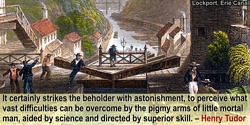
It certainly strikes the beholder with astonishment, to perceive what vast difficulties can be overcome by the pigmy arms of little mortal man, aided by science and directed by superior skill.
About his visit to Lockport on the Erie Canal, in Letter IX, to a friend in England from Lockport, New York (25 Jul 1831), collected in Narrative of a Tour in North America (1834), Vol. 1, 233-234,
It did not take atomic weapons to make man want peace. But the atomic bomb was the turn of the screw. The atomic bomb made the prospect of future war unendurable. It has led us up those last few steps to the mountain pass; and beyond there is a different country.
Commencement address (1946). As quoted in book review (of Richard Rhodes, The Making of the Atomic Bomb), by William J. Broad, ‘The Men Who Made the Sun Rise', New York Times Book Review (8 Feb 1987), 39. Cited as from 'The Atomic Bomb and College Education' (1946), in Bartlett's Familiar Quotations (18th ed., 2014).
as quoted, without citation, in . Please contact Webmaster if you know a primary source.
It does not matter what men say in words, so long as their activities are controlled by settled instincts. The words may ultimately destroy the instincts. But until this has occurred, words do not count.
In Science and the Modern World (1925), 4.
It doesn’t matter whether you’re talking about bombs or the intelligence quotients of one race as against another; if a man is a scientist, like me, he’ll always say “Publish and be damned.”
Quoted by George Steiner giving the first Bronowski Memorial Lecture, 'Has Truth a Future?' (1978) in London. As cited in Robert Andrews (ed.), The Columbia Dictionary of Quotations (1993), 812.
It follows from the theory of relativity that mass and energy are both different manifestations of the same thing—a somewhat unfamiliar conception for the average man. Furthermore E=MC2, in which energy is put equal to mass multiplied with the square of the velocity of light, showed that a very small amount of mass may be converted into a very large amount of energy... the mass and energy were in fact equivalent.
As expressed in the Einstein film, produced by Nova Television (1979). Quoted in Alice Calaprice, The Quotable Einstein (1996), 183.
It goes so heavily with my disposition that this goodly frame, the earth, seems to me a sterile promontory. This most excellent canopy the air, look you, this brave o'erhanging, this majestic roof fretted with golden fire—why, it appears no other thing to me than a foul and pestilent congregation of vapours. What a piece of work is a man. How noble in reason, how infinite in faculty, in form and moving, how express and admirable, in action, how like an angel! in apprehension, how like a god—the beauty of the world, the paragon of animals! And yet to me, what is this quintessence of dust? Man delights not me—no, nor woman neither, though by your smiling you seem to say so.
Hamlet (1601), II, ii.
It has become a cheap intellectual pastime to contrast the infinitesimal pettiness of man with the vastnesses of the stellar universes. Yet all such comparisons are illicit. We cannot compare existence and meaning; they are disparate. The characteristic life of a man is itself the meaning of vast stretches of existences, and without it the latter have no value or significance. There is no common measure of physical existence and conscious experience because the latter is the only measure there is of the former. The significance of being, though not its existence, is the emotion it stirs, the thought it sustains.
Philosophy and Civilization (1931), reprinted in David Sidorsky (ed.), John Dewey: The Essential Writings (1977), 7.
It has become accepted doctrine that we must attempt to study the whole man. Actually we cannot study even a whole tree or a whole guinea pig. But it is a whole tree and a whole guinea pig that have survived and evolved, and we must make the attempt.
Personality (1947), 5.
It has been said by a distinguished philosopher that England is “usually the last to enter into the general movement of the European mind.” The author of the remark probably meant to assert that a man or a system may have become famous on the continent, while we are almost ignorant of the name of the man and the claims of his system. Perhaps, however, a wider range might be given to the assertion. An exploded theory or a disadvantageous practice, like a rebel or a patriot in distress, seeks refuge on our shores to spend its last days in comfort if not in splendour.
Opening from essay, 'Elementary Geometry', included in The Conflict of Studies and Other Essays (1873), 136.
It has been said repeatedly that one can never, try as he will, get around to the front of the universe. Man is destined to see only its far side, to realize nature only in retreat.
In 'The Innocent Fox,' The Star Thrower (1978), 63.
It has been said that he who was the first to abuse his fellow-man instead of knocking out his brains without a word, laid thereby the basis of civilisation.
'On affections of Speech from the Disease of the Brain' (1878). In James Taylor (ed.), Selected Writings of John Hughlings Jackson, Vol. 2 (1932), 179.
It has never been man’s gift to make wildernesses. But he can make deserts, and has.
Last line of article, 'The War Between the Rough Riders and the Bird Watchers', Sierra Club Bulletin (May 1959). Quoted in Wallace Stegner: His Life and Work (2009), 231.
It has often been said, and certainly not without justification, that the man of science is a poor philosopher. Why then should it not be the right thing for the physicist to let the philosopher do the philosophising? Such might indeed be the right thing to do a time when the physicist believes he has at his disposal a rigid system of fundamental laws which are so well that waves of doubt can't reach them; but it cannot be right at a time when the very foundations of physics itself have become problematic as they are now … when experience forces us to seek a newer and more solid foundation.
‘Physics and Reality’, Franklin Institute Journal (Mar 1936). Collected in Out of My Later Years (1950), 58.
It is a good thing from an uneducated man to read books of quotations.
In My Early Life: A Roving Commission (1930, 1987), 116.
It is a right, yes a duty, to search in cautious manner for the numbers, sizes, and weights, the norms for everything [God] has created. For He himself has let man take part in the knowledge of these things ... For these secrets are not of the kind whose research should be forbidden; rather they are set before our eyes like a mirror so that by examining them we observe to some extent the goodness and wisdom of the Creator.
Epitome of Copernican Astronomy. In Michael B. Foster, Mystery and Philosophy, 61. Cited by Max Casper and Doris Hellman, trans., ed. Kepler (1954), 381. Cited by Gerald J. Galgan, Interpreting the Present: Six Philosophical Essays (1993), 105.
Gerald J. Galgan
It is a very strange thing to reflect that but for the invention of Professor Haber the Germans could not have continued the War after their original stack of nitrates was exhausted. The invention of this single man has enabled them, utilising the interval in which their accumulations were used up, not only to maintain an almost unlimited supply of explosives for all purposes, but to provide amply for the needs of agriculture in chemical manures. It is a remarkable fact, and shows on what obscure and accidental incidents the fortunes of possible the whole world may turn in these days of scientific discovery.
[During World War I, Fritz Haber and Karl Bosch invented a large scale process to cause the direct combination of hydrogen and nitrogen gases to chemically synthesize ammonia, thus providing a replacement for sodium nitrate in the manufacture of explosives and fertilizers.]
[During World War I, Fritz Haber and Karl Bosch invented a large scale process to cause the direct combination of hydrogen and nitrogen gases to chemically synthesize ammonia, thus providing a replacement for sodium nitrate in the manufacture of explosives and fertilizers.]
Parliamentary debate (25 Apr 1918). In Winston Churchill, Richard Langworth (ed.), Churchill by Himself: The Definitive Collection of Quotations (2008), 469.
by Winston Churchill, Richard Langworth
It is a vulgar belief that our astronomical knowledge dates only from the recent century when it was rescued from the monks who imprisoned Galileo; but Hipparchus…who among other achievements discovered the precession of the eqinoxes, ranks with the Newtons and the Keplers; and Copernicus, the modern father of our celestial science, avows himself, in his famous work, as only the champion of Pythagoras, whose system he enforces and illustrates. Even the most modish schemes of the day on the origin of things, which captivate as much by their novelty as their truth, may find their precursors in ancient sages, and after a careful analysis of the blended elements of imagination and induction which charaterise the new theories, they will be found mainly to rest on the atom of Epicurus and the monad of Thales. Scientific, like spiritual truth, has ever from the beginning been descending from heaven to man.
Lothair (1879), preface, xvii.
It is almost a universal fact that the rattlesnake will do all that it reasonably can to avoid man. The rattler's first wish is to get away from anything as large and as potentially dangerous as man. If the snake strikes, it is because it is cornered or frightened for its own safety.
It is almost as difficult to make a man unlearn his errors, as his knowledge. Mal-information is more hopeless than non-information: for error is always more busy than ignorance. Ignorance is a blank sheet on which we may write; but error is a scribbled one on which we first erase. Ignorance is contented to stand still with her back to the truth; but error is more presumptuous, and proceeds, in the same direction. Ignorance has no light, but error follows a false one. The consequence is, that error, when she retraces her footsteps, has farther to go, before we can arrive at the truth, than ignorance.
Reflection 1, in Lacon: or Many things in Few Words; Addressed to Those Who Think (1820), 15.
It is among the psychoanalysts in particular that man is defined as a human being and woman as a female—whenever she behaves as a human being she is said to imitate the male.
The Second Sex (1949). Trans. H. M. Parshley (1953), 83.
It is an irony of fate that I myself have been the recipient of excessive admiration and reverence from my fellow-beings, through no fault, and no merit, of my own. The cause of this may well be the desire, unattainable for many, to understand the few ideas to which I have with my feeble powers attained through ceaseless struggle. I am quite aware that for any organisation to reach its goals, one man must do the thinking and directing and generally bear the responsibility. But the led must not be coerced, they must be able to choose their leader.
In 'What I Believe', Forum and Century (1930), 84, 193-194.
It is as natural to man to die as to be born; and to a little infant, perhaps, the one is as painful as the other.
Of Death. In Carl Sagan, Broca’s Brain: Reflections on the Romance of Science (1979, 1986), 206.
It is because of his brain that [modern man] has risen above the animals. Guess which animals he has risen above.
The Great Bustard and Other People (1944), 30.
It is by the aid of iron that we construct houses, cleave rocks, and perform so many other useful offices of life. But it is with iron also that wars, murders, and robberies are effected, and this, not only hand to hand, but from a distance even, by the aid of missiles and winged weapons, now launched from engines, now hurled by the human arm, and now furnished with feathery wings. This last I regard as the most criminal artifice that has been devised by the human mind; for, as if to bring death upon man with still greater rapidity, we have given wings to iron and taught it to fly. ... Nature, in conformity with her usual benevolence, has limited the power of iron, by inflicting upon it the punishment of rust; and has thus displayed her usual foresight in rendering nothing in existence more perishable, than the substance which brings the greatest dangers upon perishable mortality.
Natural History of Pliny, translation (1857, 1898) by John Bostock and H. T. Riley, 205-6.
It is clear that all the valuable things, material, spiritual, and moral, which we receive from society can be traced back through countless generations to certain creative individuals. The use of fire, the cultivation of edible plants, the steam engine–each was discovered by one man.
…...
It is clear that we cannot go up another two orders of magnitude as we have climbed the last five. If we did, we should have two scientists for every man, woman, child, and dog in the population, and we should spend on them twice as much money as we had. Scientific doomsday is therefore less than a century distant.
Little Science, Big Science (1963), 19.
It is clear, then, that the idea of a fixed method, or of a fixed theory of rationality, rests on too naive a view of man and his social surroundings. To those who look at the rich material provided by history, and who are not intent on impoverishing it in order to please their lower instincts, their craving for intellectual security in the form of clarity, precision, “objectivity”, “truth”, it will become clear that there is only one principle that can be defended under all circumstances and in all stages of human development. It is the principle: anything goes.
Against Method: Outline of an Anarchistic Theory of Knowledge (1975, 1993), 18-19.
It is common wonder of all men, how among so many millions of faces, there should be none alike.
Religio Medici (1642), Part 2, Section 2. In L. C. Martin (ed.), Thomas Browne: Religio Medki and Other Works (1964), 57.
It is difficult to know how to treat the errors of the age. If a man oppose them, he stands alone; if he surrender to them, they bring him neither joy nor credit.
In The Maxims and Reflections of Goethe (1906), 185.
It is easier to denature plutonium than to denature the evil spirit of man.
…...
It is easier to understand mankind in general than any individual man.
Maxims (1678), no. 436, trans. F. G. Stevens (1939), 137.
It is entirely unprecedented that evolution should provide a species with an organ which it does not know how to use. … But the evolution of man’s brain has so wildly overshot man’s immediate needs that he is still breathlessly catching up with its unexploited, unexplored possibilities.
In The Ghost in the Machine (1967), 298-299. This is often seen paraphrased as “The evolution of the brain not only overshot the needs of prehistoric man, it is the only example of evolution providing a species with an organ which it does not know how to use.”
It is frequently the tragedy of the great artist, as it is of the great scientist, that he frightens the ordinary man.
In The Night Country (1971, 1997), 208.
It is frivolous to fix pedantically the date of particular inventions. They have all been invented over and over fifty times. Man is the arch machine, of which all these shifts drawn from himself are toy models. He helps himself on each emergency by copying or duplicating his own structure, just so far as the need is.
It is hard to believe that a man is telling the truth when you know that you would lie if you were in his place.
…...
It is hard to think of fissionable materials when fashioned into bombs as being a source of happiness. However this may be, if with such destructive weapons men are to survive, they must grow rapidly in human greatness. A new level of human understanding is needed. The reward for using the atom’s power towards man’s welfare is great and sure. The punishment for its misuse would seem to be death and the destruction of the civilization that has been growing for a thousand years. These are the alternatives that atomic power, as the steel of Daedalus, presents to mankind. We are forced to grow to greater manhood.
Atomic Quest: A Personal Narrative (1956), xix.
It is high time that laymen abandoned the misleading belief that scientific enquiry is a cold dispassionate enterprise, bleached of imaginative qualities, and that a scientist is a man who turns the handle of discovery; for at every level of endeavour scientific research is a passionate undertaking and the Promotion of Natural Knowledge depends above all on a sortee into what can be imagined but is not yet known.
The Times Literary Supplement (London), 1963 October 25 (p. 850)
It is impossible not to feel stirred at the thought of the emotions of man at certain historic moments of adventure and discovery—Columbus when he first saw the Western shore, Pizarro when he stared at the Pacific Ocean, Franklin when the electric spark came from the string of his kite, Galileo when he first turned his telescope to the heavens. Such moments are also granted to students in the abstract regions of thought, and high among them must be placed the morning when Descartes lay in bed and invented the method of co-ordinate geometry.
Quoted in James Roy Newman, The World of Mathematics (2000), Vol. 1, 239.
It is in man's heart that the life of nature's spectacle exists; to see it, one must feel it.
Emile (1762).
It is in scientific honesty that I endorse the presentation of alternative theories for the origin of the universe, life and man in the science classroom. It would be an error to overlook the possibility that the universe was planned rather than happening by chance.
In letter to California State board of Education (14 Sep 1972).
It is in the name of Moses that Bellarmin thunderstrikes Galileo; and this great vulgarizer of the great seeker Copernicus, Galileo, the old man of truth, the magian of the heavens, was reduced to repeating on his knees word for word after the inquisitor this formula of shame: “Corde sincera et fide non ficta abjuro maledico et detestor supradictos errores et hereses.” Falsehood put an ass's hood on science.
[With a sincere heart, and of faith unfeigned, I deny by oath, condemn and detest the aforesaid errors and heresies.]
[With a sincere heart, and of faith unfeigned, I deny by oath, condemn and detest the aforesaid errors and heresies.]
In Victor Hugo and Lorenzo O'Rourke (trans.) Victor Hugo's Intellectual Autobiography: (Postscriptum de ma vie) (1907), 313.
It is inconceivable, that inanimate brute matter should, without the mediation of something else, which is not material, operate upon and affect other matter without mutual contact … That gravity should be innate, inherent, and essential to matter, so that one body may act upon another at a distance, through a vacuum, without the mediation of anything else, by and through which their action and force may be conveyed from one to another, is to me so great an absurdity, that I believe no man who has in philosophical matters a competent faculty of thinking, can ever fall into it. Gravity must be caused by an agent, acting constantly according to certain laws; but whether this agent be material or immaterial, I have left to the consideration of my readers.
Third letter to Bentley, 25 Feb 1693. Quoted in The Works of Richard Bentley, D.D. (1838), Vol. 3, 212-3.
It is like the man who became short-sighted and refused to wear glasses, saying there was nothing wrong with him, but that the trouble was that the recent papers were so badly printed.
In Psychological Commentaries on the Teaching of Gurdjieff (1972), 98.
It is most interesting to observe into how small a field the whole of the mysteries of nature thus ultimately resolve themselves. The inorganic has one final comprehensive law, GRAVITATION. The organic, the other great department of mundane things, rests in like manner on one law, and that is,—DEVELOPMENT. Nor may even these be after all twain, but only branches of one still more comprehensive law, the expression of that unity which man's wit can scarcely separate from Deity itself.
Vestiges of the Natural History of Creation (1844), 360.
It is most true that a natural and secret hatred and aversation towards society, in any man, hath somewhat of the savage beast.
In 'Of Friendship', Mary Augusta Scott (ed.), Essays of Francis Bacon (1908), 117. A footnote indicates “aversation towards” used in the translation means “aversion to”.
It is natural for man to relate the units of distance by which he travels to the dimensions of the globe that he inhabits. Thus, in moving about the earth, he may know by the simple denomination of distance its proportion to the whole circuit of the earth. This has the further advantage of making nautical and celestial measurements correspond. The navigator often needs to determine, one from the other, the distance he has traversed from the celestial arc lying between the zeniths at his point of departure and at his destination. It is important, therefore, that one of these magnitudes should be the expression of the other, with no difference except in the units. But to that end, the fundamental linear unit must be an aliquot part of the terrestrial meridian. ... Thus, the choice of the metre was reduced to that of the unity of angles.
Lecture at the École Normale to the Year III (Apr 1795), Oeuvres Completes de Laplace (1878-1912), Vol. 14, 141. In Charles Coulston Gillispie, Dictionary of Scientific Biography (1978), Vol. 15, 335.
It is not enough that you should understand about applied science in order that your work may increase man's blessings. Concern for man himself and his fate must always form the chief interest of all technical endeavours... in order that the creations of our minds shall be a blessing and not a curse to mankind. Never forget this in the midst of your diagrams and equations.
Address to students of the California Institute of Technology, Pasadena, California (16 Feb 1931). In New York Times (17 Feb 1931), p. 6.
It is not enough to teach man a specialty. Through it he may become a kind of useful machine, but not a harmoniously developed personality. It is essential that the student acquire an understanding of and a lively feeling for values. He must acquire a vivid sense of the beautiful and of the morally good. Otherwise he—with his specialized knowledge—more closely resembles a well-trained dog than a harmoniously developed person.
From interview with Benjamin Fine, 'Einstein Stresses Critical Thinking', New York Times (5 Oct 1952), 37.
It is not failure but success that is forcing man off this earth. It is not sickness but the triumph of health... Our capacity to survive has expanded beyond the capacity of Earth to support us. The pains we are feeling are growing pains. We can solve growth problems in direct proportion to our capacity to find new worlds... If man stays on Earth, his extinction is sure even if he lasts till the sun expands and destroys him... It is no longer reasonable to assume that the meaning of life lies on this earth alone. If Earth is all there is for man, we are reaching the foreseeable end of man.
…...
It is not his possession of knowledge, of irrefutable truth, that makes the man of science, but his persistent and recklessly critical quest for truth.
In The Logic of Scientific Discovery (1959, 1972), 281.
It is not I who seek to base Man's dignity upon his great toe, or insinuate that we are lost if an Ape has a hippocampus minor. On the contrary, I have done my best to sweep away this vanity. I have endeavoured to show that no absolute structural line of demarcation, wider than that between the animals which immediately succeed us in the scale, can be drawn between the animal world and ourselves; and I may add the expression of my belief that the attempt to draw a physical distinction is equally futile, and that even the highest facuities of feeling and of intellect begin to germinate in lower forms of life. At the same time, no one is more strongly convinced than I am of the vastness of the gulf between civilized man and the brutes; or is more certain that whether from them or not, he is assuredly not of them.
'On the Relations of Man to the Lower Animals' (1863). In Collected Essays (1894), Vol. 7. 152-3.
It is not knowing, but the love of learning, that characterizes the scientific man.
From 'Lessons from the History of Science: The Scientific Attitude' (c.1896), in Collected Papers (1931), Vol. 1, 20.
It is not knowledge, but the act of learning, not possession but the act of getting there, which grants the greatest enjoyment. When I have clarified and exhausted a subject, then I turn away from it, in order to go into darkness again; the never-satisfied man is so strange if he has completed a structure, then it is not in order to dwell in it peacefully,but in order to begin another. I imagine the world conqueror must feel thus, who, after one kingdom is scarcely conquered, stretches out his arms for others.
Letter to Farkas Wolfgang Bolyai (2 Sep 1808). Quoted in G. Waldo Dunnington, Carl Friedrich Gauss: Titan of Science (2004), 416.
It is not merely as an investigator and discoverer, but as a high-principled and unassuming man, that Scheele merits our warmest admiration. His aim and object was the discovery of truth. The letters of the man reveal to us in the most pleasant way his high scientific ideal, his genuinely philosophic temper, and his simple mode of thought. “It is the truth alone that we desire to know, and what joy there is in discovering it!” With these words he himself characterizes his own efforts.
From History of Chemistry (1899). As quoted in Victor Robinson, Pathfinders in Medicine (1912), 121.
It is not the business of science to inherit the earth, but to inherit the moral imagination; because without that, man and beliefs and science will perish together.
In The Ascent of Man (1973, 2011), 323.
It is not the conscience which raises a blush, for a man may sincerely regret some slight fault committed in solitude, or he may suffer the deepest remorse for an undetected crime, but he will not blush... It is not the sense of guilt, but the thought that others think or know us to be guilty which crimsons the face.
The Expression of Emotions in Man and Animals
It is not the fruits of scientific research that elevate man and enrich his nature but the urge to understand, the intellectual work, creative or receptive.
…...
It is not worth a first class man’s time to express a majority opinion. By definition, there are already enough people to do that.
Quoted in the foreward to A Mathematician's Apology (1941, reprint with Foreward by C.P. Snow 1992), 46.
It is obvious that man dwells in a splendid universe, a magnificent expanse of earth and sky and heaven, which manifestly is built on a majestic plan, maintains some mighty design, though man himself cannot grasp it. Yet for him it is not a pleasant or satisfying world. In his few moments of respite from labor or from his enemies, he dreams that this very universe might indeed be perfect, its laws operating just as now they seem to do, and yet he and it somehow be in full accord. The very ease with which he can frame this image to himself makes the reality all the more mocking. ... It is only too clear that man is not at home in this universe, and yet he is not good enough to deserve a better.
In The New England Mind: The Seventeenth Century (1939, 1954), 7.
It is of man’s essence to create materially and morally, to fabricate things and to fabricate himself. Homo faber is the definition I propose … Homo faber, Homo sapiens, I pay my respects to both, for they tend to merge.
The Creative Mind (1946), 84-5.
It is often more convenient to possess the ashes of great men than to possess the men themselves during their lifetime.
Commenting on the return of Descartes’ remains to France. Quoted, without citation, in Eric Temple Bell Men of Mathematics (1937), 52.
It is often said that experiments should be made without preconceived ideas. That is impossible. Not only would it make every experiment fruitless, but even if we wished to do so, it could not be done. Every man has his own conception of the world, and this he cannot so easily lay aside. We must, example, use language, and our language is necessarily steeped in preconceived ideas. Only they are unconscious preconceived ideas, which are a thousand times the most dangerous of all.
Science and Hypothesis (1902), trans. W.J.G. (1905), 143.
It is one of the laws of life that each acquisition has its cost. No organism can exercise power without yielding up part of its substance. The physiological law of Transfer of Energy is the basis of human success and happiness. There is no action without expenditure of energy and if energy be not expended the power to generate it is lost. This law shows itself in a thousand ways in the life of man. The arm which is not used becomes palsied. The wealth which comes by chance weakens and destroys. The good which is unused turns to evil. The charity which asks no effort cannot relieve the misery she creates.
In The Strength of Being Clean: A Study of the Quest for Unearned Happiness (1900), 6.
It is one thing to say, “Some men shall rule,” quite another to declare, “All men shall rule,” and that in virtue of the most primitive, the most rudimentary attribute they possess, that namely of sex.
In “Common Sense” Applied to Woman Suffrage (1894), 84.
It is one thing, to shew a Man that he is in an Error; and another, to put him in possession of Truth.
An Essay Concerning Human Understanding (1690). Edited by Peter Nidditch (1975), Book 4, Chapter 7, Section 11, 602.
It is only by historical analysis that we can discover what makes up man, since it is only in the course of history that he is formed.
'The Dualism of Human Nature and its Social Conditions' (1914), trans. Charles Blend, in Kurt H. Wolff (ed.), Emile Durkheim, 1858-1917 (1960), 325.
It is only those who know a little of nature, who fancy they know much. I have heard a young man say, after hearing a few popular chemical lectures, and seeing a few bottle and squirt experiments: Oh, water—water is only oxygen and hydrogen!—as if he knew all about it. While the true chemist would smile sadly enough at the the youth's hasty conceit, and say in his heart: 'Well, he is a lucky fellow.'
'Thoughts in a Gravel Pit', a lecture delivered at the Mechanics' Institute, Odiham (1857). The Works of Charles Kingsley (1880), 284.
It is open to every man to choose the direction of his striving; and also every man may draw comfort from Lessing's fine saying, that the search for truth is more precious than its possession.
From 'E=mc2', in Science Illustrated (Apr 1946). In Albert Einstein, The Einstein Reader (2006), 99.
It is perfectly possible to be objective about an angry man, but it is inadvisable, for it will only make him angrier.
In Science is a Sacred Cow (1950), 120.
It is primarily through the growth of science and technology that man has acquired those attributes which distinguish him from the animals, which have indeed made it possible for him to become human.
In The Human Meaning of Science (1940), 2.
It is probable that all heavy matter possesses—latent and bound up with the structure of the atom—a similar quantity of energy to that possessed by radium. If it could be tapped and controlled, what an agent it would be in shaping the world's destiny! The man who puts his hand on the lever by which a parsimonious nature regulates so jealously the output of this store of energy would possess a weapon by which he could destroy the Earth if he chose.
A prescient remark on atomic energy after the discovery of radioactivity, but decades before the harnessing of nuclear fission in an atomic bomb became a reality.
A prescient remark on atomic energy after the discovery of radioactivity, but decades before the harnessing of nuclear fission in an atomic bomb became a reality.
Lecture to the Corps of Royal Engineers, Britain (19040. In Rodney P. Carlisle, Scientific American Inventions and Discoveries (2004), 373.
It is related of the Socratic philosopher Aristippus that, being shipwrecked and cast ashore on the coast of the Rhodians, he observed geometrical figures drawn thereon, and cried out to his companions:"Let us be of good cheer, for I see the traces of man."
In Vitruvius Pollio and Morris Hicky Morgan (trans.), 'Book VI: Introduction', Vitruvius, the Ten Books on Architecture (1914), 167. From the original Latin, “Aristippus philosophus Socraticus, naufragio cum ejectus ad Rhodiensium litus animaduertisset Geometrica schemata descripta, exclama uisse ad comites ita dicitur, Bene speremus, hominum enim vestigia video.” In De Architectura libri decem (1552), 218.
It is so very difficult for a sick man not to be a scoundrel.
…...
It is still false to conclude that man is nothing but the highest animal, or the most progressive product of organic evolution. He is also a fundamentally new sort of animal and one in which, although organic evolution continues on its way, a fundamentally new sort of evolution has also appeared. The basis of this new sort of evolution is a new sort of heredity, the inheritance of learning. This sort of heredity appears modestly in other mammals and even lower in the animal kingdom, but in man it has incomparably fuller development and it combines with man's other characteristics unique in degree with a result that cannot be considered unique only in degree but must also be considered unique in kind.
In The Meaning of Evolution: A Study of the History of Life and of its Significance for Man (1949), 286.
It is strange, but the longer I live the more I am governed by the feeling of Fatalism, or rather predestination. The feeling or free-will, said to be innate in man, fails me more and more. I feel so deeply that however much I may struggle, I cannot change fate one jot. I am now almost resigned. I work because I feel I am at the worst. I can neither wish nor hope for anything. You have no idea how indifferent I am to everything.
In Letter to Anna Carlotta, collected in Anna Charlotte Leffler, Sonya Kovalevsky: A Biography (1895), 133, as translated by A. De Furuhjelm and A.M. Clive Bayley.
It is supposed that the ancients were ignorant of the law in hydraulics, by which water, in a tube, will rise as high as the fountain-head; and hence they carried their stupendous aqueducts horizontally, from hill-top to hill-top, upon lofty arches, with an incredible expenditure of labor and money. The knowledge of a single law, now familiar to every well-instructed school-boy,— namely, that water seeks a level, and, if not obstructed, will find it,—enables the poorest man of the present day to do what once demanded the wealth of an empire. The beautiful fragments of the ancient Roman aqueducts, which have survived the ravage of centuries, are often cited to attest the grandeur and power of their builders. To me, they are monuments, not of their power, but of their weakness.
In Thoughts Selected From the Writings of Horace Mann (1872), 231.
It is the man not the method that solves the problem.
In 'Present Problems of Algebra and Analysis', Congress of Arts and Sciences: Universal Exposition, St. Louis, 1904 (1905), Vol. 1, 530.
It is the duty of every man of good will to strive steadfastly in his own little world to make this teaching of pure humanity a living force, so far as he can. If he makes an honest attempt in this direction without being crushed and trampled under foot by his contemporaries, he may consider himself and the community to which he belongs lucky.
…...
It is the man of science, eager to have his every opinion regenerated, his every idea rationalised, by drinking at the fountain of fact, and devoting all the energies of his life to the cult of truth, not as he understands it, but as he does not understand it, that ought properly to be called a philosopher. To an earlier age knowledge was power—merely that and nothing more—to us it is life and the summum bonum.
As quoted in Sir Richard Gregory, Discovery: Or, The Spirit and Service of Science (1916), 24.
It is the nature of an hypothesis, when once a man has conceived it, that it assimilates every thing to itself, as proper nourishment; and, from the first moment of your begetting it, it generally grows the stronger by every thing you see, hear, read, or understand.
The Life and Opinions of Tristram Shandy Gentleman (1759-67), Penguin edition (1997), 121-122.
It is the structure of the universe that has taught this knowledge to man. That structure is an ever existing exhibition of every principle upon which every part of mathematical science is founded. The offspring of this science is mechanics; for mechanics are no other than the principles of science appplied practically.
In The Age of Reason: Being an Investigation of True and Fabulous Theology (27 Jan O.S. 1794), 42.
It is therefore easy to see why the churches have always fought science and persecuted its devotees. On the other hand, I maintain that the cosmic religious feeling is the strongest and noblest motive for scientific research. Only those who realize the immense efforts and, above all, the devotion without which pioneer work in theoretical science cannot be achieved are able to grasp the strength of the emotion out of which alone such work, remote as it is from the immediate realities of life, can issue. What a deep conviction of the rationality of the universe and what a yearning to understand, were it but a feeble reflection of the mind revealed in this world, Kepler and Newton must have had to enable them to spend years of solitary labor in disentangling the principles of celestial mechanics! Those whose acquaintance with scientific research is derived chiefly from its practical results easily develop a completely false notion of the mentality of the men who, surrounded by a skeptical world, have shown the way to kindred spirits scattered wide through the world and through the centuries. Only one who has devoted his life to similar ends can have a vivid realization of what has inspired these men and given them the strength to remain true to their purpose in spite of countless failures. It is cosmic religious feeling that gives a man such strength. A contemporary has said, not unjustly, that in this materialistic age of ours the serious scientific workers are the only profoundly religious people.
…...
It is time that science, having destroyed the religious basis for morality, accepted the obligation to provide a new and rational basis for human behavior—a code of ethics concerned with man’s needs on earth, not his rewards in heaven.
In 'Toward a New Morality,' IEEE Spectrum, 1972.
It is well known that the man who first made public the theory of irrationals perished in a shipwreck in order that the inexpressible and unimaginable should ever remain veiled. And so the guilty man, who fortuitously touched on and revealed this aspect of living things, was taken to the place where he began and there is for ever beaten by the waves.
— Proclus
In scholium to Book X of Euclid t. V, 417 as quoted and cited in Ettore Carruccio and Isabel Quigly (trans.), Mathematics And Logic in History And in Contemporary Thought (1964), 27.
It is worthy the observing, that there is no passion in the mind of man, so weak, but it mates, and masters, the fear of death; and therefore, death is no such terrible enemy, when a man hath so many attendants about him, that can win the combat of him. Revenge triumphs over death; love slights it; honor aspireth to it; grief flieth to it; fear preoccupieth it.
In 'Of Death', Essays (1625, 1883), 10.
It is, however, a most astonishing but incontestable fact, that the history of the evolution of man as yet constitutes no part of general education. Indeed, our so-called “educated classes” are to this day in total ignorance of the most important circumstances and the most remarkable phenomena which Anthropogeny has brought to light.
From Oliver Joseph Thatcher, The Library Of Original Sources (1907), 345.
It must be admitted that science has its castes. The man whose chief apparatus is the differential equation looks down upon one who uses a galvanometer, and he in turn upon those who putter about with sticky and smelly things in test tubes. But all of these, and most biologists too, join together in their contempt for the pariah who, not through a glass darkly, but with keen unaided vision, observes the massing of a thundercloud on the horizon, the petal as it unfolds, or the swarming of a hive of bees. And yet sometimes I think that our laboratories are but little earthworks which men build about themselves, and whose puny tops too often conceal from view the Olympian heights; that we who work in these laboratories are but skilled artisans compared with the man who is able to observe, and to draw accurate deductions from the world about him.
The Anatomy of Science (1926), 170- 1.
It must be for truth’s sake, and not for the sake of its usefulness to humanity, that the scientific man studies Nature. The application of science to the useful arts requires other abilities, other qualities, other tools than his; and therefore I say that the man of science who follows his studies into their practical application is false to his calling. The practical man stands ever ready to take up the work where the scientific man leaves it, and adapt it to the material wants and uses of daily life.
Methods of Study in Natural History (1863),24.
It must be granted that in every syllogism, considered as an argument to prove the conclusion, there is a petitio principii. When we say, All men are mortal Socrates is a man therefore Socrates is mortal; it is unanswerably urged by the adversaries of the syllogistic theory, that the proposition, Socrates is mortal.
A System of Logic, Ratiocinative and Inductive (1858), 122.
It must not be forgotten that although a high standard of morality gives a slight or no advantage to each individual man and his children over the other men of the same tribe, yet an advancement in the standard of morality will certainly give an immense advantage to one tribe over another.
…...
It occurred to me that if I could invent a machine - a gun - which could by its rapidity of fire, enable one man to do as much battle duty as a hundred, that it would, to a large extent supersede the necessity of large armies, and consequently, exposure to battle and disease [would] be greatly diminished.
In P. Wahl and D. R. Toppel, The Gatling Gun (1966), 12.
It seemed that animals always behave in a manner showing the rightness of the philosophy entertained by the man who observes them… . Throughout the reign of Queen Victoria all apes were virtuous monogamists, but during the dissolute twenties their morals underwent a disastrous deterioration.
From 'Theory of Knowledge', My Philosophical Development (1959), collected in Robert E. Egner and Lester E. Denonn (eds), The Basic Writings of Bertrand Russell (1961), 225.
It seems to me that you are solving a problem which goes beyond the limits of physiology in too simple a way. Physiology has realized its problem with fortitude, breaking man down into endless actions and counteractions and reducing him to a crossing, a vortex of reflex acts. Let it now permit sociology to restore him as a whole. Sociology will wrest man from the anatomical theatre and return him to history.
Letter to his son, Alexander, July-Aug 1868. Trans. Roger Smith, Inhibition: History and Meaning in the Sciences of Mind and Brain (1992), 223.
It stands to the everlasting credit of science that by acting on the human mind it has overcome man's insecurity before himself and before nature.
Out of My Later Years (1995), 137.
It took less than an hour to make the atoms, a few hundred million years to make the stars and planets, but five billion years to make man!
In The Creation of the Universe (1952), 139.
It was a great thing to open the eyes of a blind man, but it is a greater thing to open the eyes of a blind soul.
Quoted in Kim Lim (ed.), 1,001 Pearls of Spiritual Wisdom: Words to Enrich, Inspire, and Guide Your Life (2014), 17
It was a profound saying of Wilhelm Humboldt, that 'Man is man only by means of speech, but in order to invent speech he must be already man.'
The Antiquity of Man (1863), 468.
It was to Hofmeister, working as a young man, an amateur and enthusiast, in the early morning hours of summer months, before business, at Leipzig in the years before 1851, that the vision first appeared of a common type of Life-Cycle, running through Mosses and Ferns to Gymnosperms and Flowering Plants, linking the whole series in one scheme of reproduction and life-history.
(1919). As quoted in E.J.H. Corner, The Life of Plants (1964).
It will be found that those contained in one article [class of nebulae], are so closely allied to those in the next, that there is perhaps not so much difference between them, if I may use the comparison, as there would be in an annual description of the human figure, were it given from the birth of a child till he comes to be a man in his prime.
'Astronomical Observations... ' Philosophical Transactions (1811), 101, 271.
It will be! the mass is working clearer!
Conviction gathers, truer, nearer!
The mystery which for Man in Nature lies
We dare to test, by knowledge led;
And that which she was wont to organize
We crystallize, instead.
Conviction gathers, truer, nearer!
The mystery which for Man in Nature lies
We dare to test, by knowledge led;
And that which she was wont to organize
We crystallize, instead.
As spoken by character Wagner, in Johann Goethe and Bayard Taylr (trans.), Faust: A tragedy by Johann Wolfgang von Goethe, translated, in the original metres: The Second Part (1871), Act 2, Scene 2, Laboratory, 119.
It would be an easy task to show that the characteristics in the organization of man, on account of which the human species and races are grouped as a distinct family, are all results of former changes of occupation, and of acquired habits, which have come to be distinctive of individuals of his kind. When, compelled by circumstances, the most highly developed apes accustomed themselves to walking erect, they gained the ascendant over the other animals. The absolute advantage they enjoyed, and the new requirements imposed on them, made them change their mode of life, which resulted in the gradual modification of their organization, and in their acquiring many new qualities, and among them the wonderful power of speech.
Quoted in Ernst Heinrich Philipp August Haeckel The Evolution of Man (1897), Vol. 1, 70.
It would be difficult to name a man more remarkable for the greatness and the universality of his intellectual powers than Leibnitz.
In System of Logic, Bk. 2, chap. 5, sect. 6.
It’s easier for a woman to go into a strange village than a man. If a strange man wanders in, the natives are afraid he’ll take their wives away, but a woman can work with the mothers and children.
Explaining her ability in observing Pacific Island cultures. As quoted in interview with Frances Glennon, 'Student and Teacher of Human Ways', Life (14 Sep 1959), 143.
It’s not the critic who counts; not the man which points out how the strong man stumbles or where the doer of deeds could have done them better. The credit belongs to the man who is actually in the arena, whose face is marred by dust and sweat and blood; who strives valiantly; who errs, who comes short again and again … who knows great enthusiasms, the great devotions; who spends himself in a worthy cause; who at the best knows in the end the triumph of high achievement, and who at the worst, if he fails, at least fails while daring greatly, so that his place shall never be with those cold and timid souls who neither know victory nor defeat.
In Joseph A. Califano, Jr., Inside: A Public and Private Life (2005), 356.
Its [mathematical analysis] chief attribute is clearness; it has no means for expressing confused ideas. It compares the most diverse phenomena and discovers the secret analogies which unite them. If matter escapes us, as that of air and light because of its extreme tenuity, if bodies are placed far from us in the immensity of space, if man wishes to know the aspect of the heavens at successive periods separated by many centuries, if gravity and heat act in the interior of the solid earth at depths which will forever be inaccessible, mathematical analysis is still able to trace the laws of these phenomena. It renders them present and measurable, and appears to be the faculty of the human mind destined to supplement the brevity of life and the imperfection of the senses, and what is even more remarkable, it follows the same course in the study of all phenomena; it explains them in the same language, as if in witness to the unity and simplicity of the plan of the universe, and to make more manifest the unchangeable order which presides over all natural causes.
From Théorie Analytique de la Chaleur (1822), Discours Préliminaire, xiv, (Theory of Heat, Introduction), as translated by Alexander Freeman in The Analytical Theory of Heat (1878), 7.
Jesus is too colossal for the pen of phrasemongers, however artful. No man can dispose of Christianity with a bon mot.
…...
John Bahcall, an astronomer on the Institute of Advanced Study faculty since 1970 likes to tell the story of his first faculty dinner, when he found himself seated across from Kurt Gödel, … a man dedicated to logic and the clean certainties of mathematical abstraction. Bahcall introduced himself and mentioned that he was a physicist. Gödel replied, “I don’t believe in natural science.”
As stated in Adam Begley, 'The Lonely Genius Club', New York Magazine (30 Jan 1995), 63.
John Dalton was a very singular Man, a quaker by profession & practice: He has none of the manners or ways of the world. A tolerable mathematician He gained his livelihood I believe by teaching the mathematics to young people. He pursued science always with mathematical views. He seemed little attentive to the labours of men except when they countenanced or confirmed his own ideas... He was a very disinterested man, seemed to have no ambition beyond that of being thought a good Philosopher. He was a very coarse Experimenter & almost always found the results he required.—Memory & observation were subordinate qualities in his mind. He followed with ardour analogies & inductions & however his claims to originality may admit of question I have no doubt that he was one of the most original philosophers of his time & one of the most ingenious.
J. Z. Fullmer, 'Davy's Sketches of his Contemporaries', Chymia, 1967, 12, 133-134.
Judged superficially, a progressive saturation of the germ plasm of a species with mutant genes a majority of which are deleterious in their effects is a destructive process, a sort of deterioration of the genotype which threatens the very existence of the species and can finally lead only to its extinction. The eugenical Jeremiahs keep constantly before our eyes the nightmare of human populations accumulating recessive genes that produce pathological effects when homozygous. These prophets of doom seem to be unaware of the fact that wild species in the state of nature fare in this respect no better than man does with all the artificality of his surroundings, and yet life has not come to an end on this planet. The eschatological cries proclaiming the failure of natural selection to operate in human populations have more to do with political beliefs than with scientific findings.
Genetics and Origin of Species (1937), 126.
Just as a tree constitutes a mass arranged in a definite manner, in which, in every single part, in the leaves as in the root, in the trunk as in the blossom, cells are discovered to be the ultimate elements, so is it also with the forms of animal life. Every animal presents itself as a sum of vital unities, every one of which manifests all the characteristics of life. The characteristics and unity of life cannot be limited to anyone particular spot in a highly developed organism (for example, to the brain of man), but are to be found only in the definite, constantly recurring structure, which every individual element displays. Hence it follows that the structural composition of a body of considerable size, a so-called individual, always represents a kind of social arrangement of parts, an arrangement of a social kind, in which a number of individual existences are mutually dependent, but in such a way, that every element has its own special action, and, even though it derive its stimulus to activity from other parts, yet alone effects the actual performance of its duties.
In Lecture I, 'Cells and the Cellular Theory' (1858), Rudolf Virchow and Frank Chance (trans.) ,Cellular Pathology (1860), 13-14.
Just as the individual is not alone in the group, nor anyone in society alone among the others, so man is not alone in the universe.
In Tristes Tropiques (1955, 1974), 414.
Kant, discussing the various modes of perception by which the human mind apprehends nature, concluded that it is specially prone to see nature through mathematical spectacles. Just as a man wearing blue spectacles would see only a blue world, so Kant thought that, with our mental bias, we tend to see only a mathematical world.
In The Mysterious Universe (1930), 115.
Killing one man is murder. Killing millions is a statistic
Address to the Joint Defense Appeal of the American Jewish Committee and the Anti-Defamation League of B'nai B'rith, Chicago (21 Jun1961). In Sue G. Hall (ed.), The Quotable Robert F. Kennedy (1967), 120.
Kin Hubbard is dead. To us folks that attempt to write a little humor his death is just like Edison's would be to the world of invention. No man in our generation was within a mile of him, and I am so glad that I didn't wait for him to go to send flowers. I have said it from the stage and in print for twenty years. … Just think — only two lines a day, yet he expressed more original philosophy in ’em than all the rest of the paper combined. What a kick Twain and all that gang will get out of Kin.
In 'Will Rogers Pays Tribute To Hubbard and His Humor', The New York Times (27 Dec 1930), 15.
Know then thyself, presume not God to scan;
The proper study of Mankind is Man.
Plac'd on this isthmus of a middle state,
A being darkly wise, and rudely great:
With too much knowledge for the Sceptic side,
With too much weakness for the Stoic's pride,
He hangs between; in doubt to act, or rest;
In doubt to deem himself a God, or Beast;
In doubt his Mind or Body to prefer,
Born but to die, and reas'ning but to err;
Alike in ignorance, his reason such,
Whether he thinks too little, or too much:
Chaos of Thought and Passion, all confus'd;
Still by himself abus'd, or disabus'd;
Created half to rise, and half to fall;
Great lord of all things, yet a prey to all;
Sole judge of Truth, in endless Error hurl'd:
The glory, jest, and riddle of the world!
... Superior beings, when of late they saw
A mortal Man unfold all Nature's law,
Admir'd such wisdom in an earthly shape,
And shew'd a NEWTON as we shew an Ape.
The proper study of Mankind is Man.
Plac'd on this isthmus of a middle state,
A being darkly wise, and rudely great:
With too much knowledge for the Sceptic side,
With too much weakness for the Stoic's pride,
He hangs between; in doubt to act, or rest;
In doubt to deem himself a God, or Beast;
In doubt his Mind or Body to prefer,
Born but to die, and reas'ning but to err;
Alike in ignorance, his reason such,
Whether he thinks too little, or too much:
Chaos of Thought and Passion, all confus'd;
Still by himself abus'd, or disabus'd;
Created half to rise, and half to fall;
Great lord of all things, yet a prey to all;
Sole judge of Truth, in endless Error hurl'd:
The glory, jest, and riddle of the world!
... Superior beings, when of late they saw
A mortal Man unfold all Nature's law,
Admir'd such wisdom in an earthly shape,
And shew'd a NEWTON as we shew an Ape.
'An Essay on Man' (1733-4), Epistle II. In John Butt (ed.), The Poems of Alexander Pope (1965), 516-7.
Know thyself! This is the source of all wisdom, said the great thinkers of the past, and the sentence was written in golden letters on the temple of the gods. To know himself, Linnæus declared to be the essential indisputable distinction of man above all other creatures. I know, indeed, in study nothing more worthy of free and thoughtful man than the study of himself. For if we look for the purpose of our existence, we cannot possibly find it outside ourselves. We are here for our own sake.
As translated and quoted in Ernst Haeckel and E. Ray Lankester (trans.) as epigraph for Chap. 9, The History of Creation (1886), Vol. 1, 244.
Knowledge and wisdom are indeed not identical; and every man’s experience must have taught him that there may be much knowledge with little wisdom, and much wisdom with little knowledge. But with imperfect knowledge it is difficult or impossible to arrive at right conclusions. Many of the vices, many of the miseries, many of the follies and absurdities by which human society has been infested and disgraced may be traced to a want of knowledge.
Presidential Address to Anniversary meeting of the Royal Society (30 Nov 1859), Proceedings of the Royal Society of London (1860), 10, 163.
Knowledge conceald and not broached for a publicke use, is like to a pearelesse gemme interred in the center of the earth, whereof no man knows but he that hid it.
In 'To the Reader', The Optick Glass of Humors (1607), 10.
Knowledge is like a knife. In the hands of a well-balanced adult it is an instrument for good of inestimable value; but in the hands of a child, an idiot, a criminal, a drunkard or an insane man, it may cause havoc, misery, suffering and crime. Science and religion have this in common, that their noble aims, their power for good, have often, with wrong men, deteriorated into a boomerang to the human race.
In 'Applied Chemistry', Science (22 Oct 1915), New Series, 42, No. 1086, 548.
Language is a form of human reason and has its reasons which are unknown to man.
In La Pensée Sauvage (1962), translated as The Savage Mind (1966), Ch. 9.
Laws alone can not secure freedom of expression; in order that every man present his views without penalty there must be spirit of tolerance in the entire population.
…...
Laws, in their most general signification, are the necessary relations arising from the nature of things. In this sense all beings have their laws: the Deity His laws, the material world its laws, the intelligences superior to man their laws, the beasts their laws, man his laws.
The Spirit of the Laws (1748), Vol. 1, book 1, 1.
Leakey’s work on the Olduvai Canyon man has depended a great deal on the observance of a notched break in the shinbones of good-sized animals, which is assumed to have been made by striking a bone with a sharp rock before breaking it over the knee to expose the bone marrow which is edible and nourishing. When he found broken bones with the tell-tale notch, he knew that man must have been there and so began his search.
In 'Man’s Place in the Physical Universe', Bulletin of the Atomic Scientists (Sep 1965), 21, No. 7, 15.
Learn to reverence night and to put away the vulgar fear of it, for, with the banishment of night from the experience of man, there vanishes as well a religious emotion, a poetic mood, which gives depth to the adventure of humanity. By day, space is one with the earth and with man - it is his sun that is shining, his clouds that are floating past; at night, space is his no more. When the great earth, abandoning day, rolls up the deeps of the heavens and the universe, a new door opens for the human spirit, and there are few so clownish that some awareness of the mystery of being does not touch them as they gaze. For a moment of night we have a glimpse of ourselves and of our world islanded in its stream of stars - pilgrims of mortality, voyaging between horizons across eternal seas of space and time. Fugitive though the instant be, the spirit of man is, during it, ennobled by a genuine moment of emotional dignity, and poetry makes its own both the human spirit and experience.
…...
Learning begets humility because the more a man knows, the more he discovers his ignorance.
In Hialmer Day Gould, New Practical Spelling (1905), 27
Learning makes a man fit company for himself.
Saying, collected in Thomas Fuller (ed.), Gnomologia: Adagies and Proverbs; Wise Sentences and Witty Sayings (1732), 135. Attributed to Edward Young in Tryon Edwards (ed.), A Dictionary of Thoughts (1891), 295, and other quote collections of the period. Webmaster has not yet found a specific work by Young that includes the quote. Note that in recent use, the quote is widely attributed to Fuller, but he did not write it, just collected it. Fuller included in this compilation interesting adages he had found from books, but did not identify specific sources. Young was a contemporary.
Let any man reflect on the revolution produced in society by two simple and common things, glass and gunpowder.
Reflection 328, in Lacon: or Many things in Few Words; Addressed to Those Who Think (1820), 155.
Let him look at that dazzling light hung aloft as an eternal lamp to lighten the universe; let him behold the earth, a mere dot compared with the vast circuit which that orb describes, and stand amazed to find that the vast circuit itself is but a very fine point compared with the orbit traced by the stars as they roll their course on high. But if our vision halts there, let imagination pass beyond; it will fail to form a conception long before Nature fails to supply material. The whole visible world is but an imperceptible speck in the ample bosom of Nature. No notion comes near it. Though we may extend our thought beyond imaginable space, yet compared with reality we bring to birth mere atoms. Nature is an infinite sphere whereof the centre is everywhere, the circumference nowhere. In short, imagination is brought to silence at the thought, and that is the most perceptible sign of the all-power of God.
Let man reawake and consider what he is compared with the reality of things; regard himself lost in this remote corner of Nature; and from the tiny cell where he lodges, to wit the Universe, weigh at their true worth earth, kingdoms, towns, himself. What is a man face to face with infinity?
Let man reawake and consider what he is compared with the reality of things; regard himself lost in this remote corner of Nature; and from the tiny cell where he lodges, to wit the Universe, weigh at their true worth earth, kingdoms, towns, himself. What is a man face to face with infinity?
Pensées (1670), Section 1, aphorism 43. In H. F. Stewart (ed.), Pascal’s Pensées (1950), 19.
Let no one mistake it for comedy, farcical though it may be in all its details. It serves notice on the country that Neanderthal man is organizing in these forlorn backwaters of the land, led by a fanatic, rid of sense and devoid of conscience.
[Commenting on the Scopes Monkey Trial, while reporting for the Baltimore Sun.]
[Commenting on the Scopes Monkey Trial, while reporting for the Baltimore Sun.]
In Michael Shermer, Why Darwin Matters (2006), 26.
Let truth be a banner big enough to hide the man who holds it up.
From chapter 'Jottings from a Note-Book', in Canadian Stories (1918), 169.
Let us only imagine that birds had studied their own development and that it was they in turn who investigated the structure of the adult mammal and of man. Wouldn’t their physiological textbooks teach the following? “Those four and two-legged animals bear many resemblances to embryos, for their cranial bones are separated, and they have no beak, just as we do in the first live or six days of incubation; their extremities are all very much alike, as ours are for about the same period; there is not a single true feather on their body, rather only thin feather-shafts, so that we, as fledglings in the nest, are more advanced than they shall ever be … And these mammals that cannot find their own food for such a long time after their birth, that can never rise freely from the earth, want to consider themselves more highly organized than we?”
Über Entwicklungsgeschichte der Thiere: Beobachtung und Reflexion (1828), 203. Trans. Stephen Jay Gould, Ontogeny and Phylogeny (1977), 54.
Let us then suppose the Mind to be, as we say, white Paper, void of all Characters, without any Ideas; How comes it to be furnished? Whence comes it by that vast store, which the busy and boundless Fancy of Man has painted on it, with an almost endless variety? Whence has it all the materials of Reason and Knowledge? To this I answer, in one word, from Experience: In that, all our Knowledge is founded; and from that it ultimately derives it self. Our Observation employ’d either about external, sensible Objects; or about the internal Operations of our Minds, perceived and reflected on by our selves, is that, which supplies our Understandings with all the materials of thinking.
In 'Of Ideas in general, and their Original', An Essay Concerning Human Understanding (1690), Book 2, Chap. 1, Sec. 2, 37.
Life arose as a living molecule or protogene, the progression from this stage to that of the ameba is at least as great as from ameba to man. All the essential problems of living organisms are already solved in the one-celled (or, as many now prefer to say, noncellular) protozoan and these are only elaborated in man or the other multicellular animals. The step from nonlife to life may not have been so complex, after all, and that from cell to multicellular organism is readily comprehensible. The change from protogene to protozoan was probably the most complex that has occurred in evolution, and it may well have taken as long as the change from protozoan to man.
The Meaning of Evolution: A Study of the History of Life and of its Significance for Man (1949), 16
Like all sciences and all valuations, the psychology of women has hitherto been considered only from the point of view of men. (1926)
The Flight from Womanhood', Femine Psychology (1967). Quoted in Elaine Partnow, The Quotable Woman, 1800-1975 (1977), 197.
Like other departments of philosophy, medicine began with an age of wonder. The accidents of disease and the features of death aroused surprise and stimulated interest, and a beginning was made when man first asked in astonishment, Why should these things be?
In 'The Evolution of Internal Medicine', Modern Medicine: Its Theory and Practice, (1907), Vol. 1, xvi.
Literature stands related to Man as Science stands to Nature; it is his history.
Discourses on the Scope and Nature of University Education. Addressed to the Catholics of Dublin (1852), Discourse 10, 353.
Littlewood, on Hardy’s own estimate, is the finest mathematician he has ever known. He was the man most likely to storm and smash a really deep and formidable problem; there was no one else who could command such a combination of insight, technique and power.
(1943). In Béla Bollobás, Littlewood's Miscellany (1986), Foreward, 22.
Lives of great men remind us
We can make our lives sublime,
And departing leave behind us
Footprints on the sands of time.
We can make our lives sublime,
And departing leave behind us
Footprints on the sands of time.
From poem, 'A Psalm of Life', collected in Poetical Works of Henry Wadsworth Longfellow (1855), 42.
Lo! Men have become the tools of their tools.
Walden: or, Life in the Woods (1906), 41
LOGIC, n. The art of thinking and reasoning in strict accordance with the limitations and incapacities of the human misunderstanding. The basic of logic is the syllogism, consisting of a major and a minor premise and a conclusion—thus:
Major Premise: Sixty men can do a piece of work sixty times as quickly as one man.
Minor Premise: One man can dig a post-hole in sixty seconds; therefore—
Conclusion: Sixty men can dig a post-hole in one second.
This may be called the syllogism arithmetical, in which, by combining logic and mathematics, we obtain a double certainty and are twice blessed.
Major Premise: Sixty men can do a piece of work sixty times as quickly as one man.
Minor Premise: One man can dig a post-hole in sixty seconds; therefore—
Conclusion: Sixty men can dig a post-hole in one second.
This may be called the syllogism arithmetical, in which, by combining logic and mathematics, we obtain a double certainty and are twice blessed.
The Collected Works of Ambrose Bierce (1911), Vol. 7, The Devil's Dictionary, 196.
Logicians have but ill defined
As rational the human mind;
Reason, they say, belongs to man,
But let them prove it if they can.
As rational the human mind;
Reason, they say, belongs to man,
But let them prove it if they can.
In 'The Logicians Refuted', The Poems and Plays of Oliver Goldsmith (1818), 58.
Look for God. Look for God like a man with his head on fire looks for water.
Eat, Pray, Love. Quoted in Kim Lim (ed.), 1,001 Pearls of Spiritual Wisdom: Words to Enrich, Inspire, and Guide Your Life (2014), 155
Looking at the thunder machine which had been set up, I saw not the slightest indication of the presence of electricity. However, while they were putting the food on the table, I obtained extraordinary electric sparks from the wire. My wife and others approached from it, for the reason that I wished to have witnesses see the various colors of fire about which the departed Professor Richmann used to argue with me. Suddenly it thundered most violently at the exact time that I was holding my hand to the metal, and sparks crackled. All fled away from me, and my wife implored that I go away. Curiosity kept me there two or three minutes more, until they told me that the soup was getting cold. By that time the force of electricity greatly subsided. I had sat at table only a few minutes when the man servant of the departed Richmann suddenly opened the door, all in tears and out of breath from fear. I thought that some one had beaten him as he was on his way to me, but he said, with difficulty, that the professor had been injured by thunder… . Nonetheless, Mr. Richmann died a splendid death, fulfilling a duty of his profession.
As quoted in Boris Menshutkin, 'Lomonosov: Excerpts', collected in Thomas Riha (ed.), Readings for Introduction to Russian Civilization (1963), Vol. 2, 30.
Looking back over the geological record it would seem that Nature made nearly every possible mistake before she reached her greatest achievement Man—or perhaps some would say her worst mistake of all. ... At last she tried a being of no great size, almost defenseless, defective in at least one of the more important sense organs; one gift she bestowed to save him from threatened extinction—a certain stirring, a restlessness, in the organ called the brain.
…...
Lord Kelvin was so satisfied with this triumph of science that he declared himself to be as certain of the existence of the ether as a man can be about anything.... “When you can measure what you are speaking about, and express it in numbers, you know something about it....” Thus did Lord Kelvin lay down the law. And though quite wrong, this time he has the support of official modern Science. It is NOT true that when you can measure what you are speaking about, you know something about it. The fact that you can measure something doesn't even prove that that something exists.... Take the ether, for example: didn't they measure the ratio of its elasticity to its density?
In Science is a Sacred Cow (1950), 69-70; 85.
Malthus argued a century and a half ago that man, by using up all his available resources, would forever press on the limits of subsistence, thus condemning humanity to an indefinite future of misery and poverty. We can now begin to hope and, I believe, know that Malthus was expressing not a law of nature, but merely the limitation then of scientific and social wisdom. The truth or falsity of his prediction will depend now, with the tools we have, on our own actions, now and in the years to come.
From Address to the Centennial Convocation of the National Academy of Sciences (22 Oct 1963), 'A Century of Scientific Conquest'. Online at The American Presidency Project.
Mammals in general seem to live, at best, as long as it takes their hearts to count a billion. To this general rule, man himself is the most astonishing exception.
(1965). In Isaac Asimov’s Book of Science and Nature Quotations (1988), 336.
Man … begins life as an ambiguous speck of matter which can in no way be distinguished from the original form of the lowest animal or plant. He next becomes a cell; his life is precisely that of the animalcule. Cells cluster round this primordial cell, and the man is so far advanced that he might be mistaken for an undeveloped oyster; he grows still more, and it is clear that he might even be a fish; he then passes into a stage which is common to all quadrupeds, and next assumes a form which can only belong to quadrupeds of the higher type. At last the hour of birth approaches; coiled within the dark womb he sits, the image of an ape; a caricature of the man that is to be. He is born, and for some time he walks only on all fours; he utters only inarticulate sounds; and even in his boyhood his fondness for climbing trees would seem to be a relic of the old arboreal life.
In The Martyrdom of Man (1876), 393.
Man alone amongst the animals speaks and has gestures and expression which we call rational, because he alone has reason in him. And if anyone should say in contradiction that certain birds talk, as seems to be the case with some, especially the magpie and the parrot, and that certain beasts have expression or gestures, as the ape and some others seem to have, I answer that it is not true that they speak, nor that they have gestures, because they have no reason, from which these things need proceed; nor do they purpose to signify anything by them, but they merely reproduce what they see and hear.
In 'The Third Treatise', The Convivio of Dante Alighieri (1903), Chap. 7, 175. This footnoted: Compare De Vulgari Eloquentia, Book 1, Chap 2: 43-65.
Man and science are two concave mirrors continually reflecting each other.
In Science and Humanity (1968).
Man appears to be the missing link between anthropoid apes and human beings.
Quoted by John Pfeiffer in 'When Man First Stood Up', New York Times (11 Apr 1965), Sunday magazine, 83.
Man armed with science is like a baby with a box of matches.
Daedalus or Science and the Future (1924), 82.
Man at last knows that he is alone in the unfeeling immensity of the universe, out of which he emerged only by chance. Neither his destiny nor his duty have been written down. The kingdom above or the darkness below: it is for him to choose.
Concluding remarks in Jacques Monod and Austryn Wainhouse (trans.), Chance and Necessity: An Essay on the Natural Philosophy of Modern Biology (1972), 180. Also seen translated as, “The ancient covenant is in pieces; man knows at last that he is alone in the universe’s unfeeling immensity, out of which he emerged only by chance. His destiny is nowhere spelled out, nor is his duty. The kingdom above or the darkness below: it is time for him to choose.”
Man cannot afford to be a naturalist, to look at Nature directly, but only with the side of his eye. He must look through and beyond her, to look at her is fatal as to look at the head of Medusa. It turns the man of science to stone. I feel that I am dissipated by so many observations. I should be the magnet in the midst of all this dust and filings.
From Journal entry (23 Mar 1953), in Henry David Thoreau and Bradford Torrey (ed.), Journal (1906), Vol. 5, 45.
Man cannot change a single law of nature, but can put himself into such relations to natural laws that he can profit by them.
In Heredity and Environment in the Development of Men (1920), 275.
Man cannot have an effect on nature, cannot adopt any of her forces, if he does not know the natural laws in terms of measurement and numerical relations. Here also lies the strength of the national intelligence, which increases and decreases according to such knowledge. Knowledge and comprehension are the joy and justification of humanity; they are parts of the national wealth, often a replacement for the materials that nature has too sparcely dispensed. Those very people who are behind us in general industrial activity, in application and technical chemistry, in careful selection and processing of natural materials, such that regard for such enterprise does not permeate all classes, will inevitably decline in prosperity; all the more so were neighbouring states, in which science and the industrial arts have an active interrelationship, progress with youthful vigour.
Kosmos (1845), vol.1, 35. Quoted in C. C. Gillispie (ed.), Dictionary of Scientific Biography (1970), vol. 6, 552.
Man cannot live by milk alone. Love is an emotion that does not need to be bottle- or spoon-fed.
From Presidential Address (31 Aug 1958), 66th Annual Convention of the American Psychological Association, Washington, D.C., published in In 'The Nature of Love', American Psychologist, 13, 673-685.
Man carries the world in his head, the whole astronomy and chemistry suspended in a thought. Because the history of nature is charactered in his brain, therefore he is the prophet and discoverer of her secrets. Every known fact in natural science was divined by the presentiment of somebody, before it was actually verified.
Essay, 'Nature', in Ralph Waldo Emerson, Alfred Riggs Ferguson (ed.) and Jean Ferguson Carr (ed.), The Collected Works of Ralph Waldo Emerson, Volume III, Essays: Second Series (1984), 106-107.
Man chooses either life or death, but he chooses; everything he does, from going to the toilet to mathematical speculation, is an act of religious worship, either of God or of himself.
Quoted in Kim Lim (ed.), 1,001 Pearls of Spiritual Wisdom: Words to Enrich, Inspire, and Guide Your Life (2014), 15
Man continues to be the only 150 pound nonlinear servomechanism that can be wholly mass-produced by unskilled labor.
In 'Mechanisms in Anxiety', Journal of Neuropsychiatry (Sep-Oct 1963), 5, 416. Also appears as “Man is the only…reproduced…” for the opening sentence by Ashley Montagu in 'Forward: Origin of the Specious' for Robin Fox, The Passionate Mind: Sources of Destruction and Creativity (2000), xxi.
Man could not stay there forever. He was bound to spread to new regions, partly because of his innate migratory tendency and partly because of Nature's stern urgency.
The Red Man's Continent: A Chronicle of Aboriginal America (1919), 12.
Man differs from the animal only a little; most men throw that little away.
…...
Man does not limit himself to seeing; he thinks and insists on learning the meaning of phenomena whose existence has been revealed to him by observation. So he reasons, compares facts, puts questions to them, and by the answers which he extracts, tests one by another. This sort of control, by means of reasoning and facts, is what constitutes experiment, properly speaking; and it is the only process that we have for teaching ourselves about the nature of things outside us.
In Claude Bernard and Henry Copley Greene (trans.), An Introduction to the Study of Experimental Medicine (1927, 1957), 5.
Man does not live by bread alone, there are other wants to be supplied, and even in a practical point of view, a single thought may be fraught with a thousand useful inventions.
Presidential Address (Aug 1853) to the American Association for the Advancement of Education, in Proceedings of the Third Session of the American Association for the Advancement of Education (1854), 29.
Man embraces in his makeup all the natural orders; he’s a squid, a mollusk, a sucker and a buzzard; sometimes he’s a cerebrate.
Man has an inalienable right to die of something.
'Quack cures for cancer', Cardiff Mail (20 Oct 1923).
Man has an intense desire for assured knowledge.
Quoted in P. A. Schilpp (ed.), The Philosophy of Bertrand Russell (1971), Vol. 1, 285.
Man has become a superman ... because he not only disposes of innate, physical forces, but because he is in command ... of latent forces in nature he can put them to his service. ... But the essential fact we must surely all feel in our hearts ... is that we are becoming inhuman in proportion as we become supermen.
Speech (4 Nov 1954) upon receiving the Nobel Peace Prize. In 'Excerpts From the Nobel Prize Address Dr. Schweitzer in Oslo', New York Times (5 Nov 1954), 4.
Man has been here 32,000 years. That it took a hundred million years to prepare the world for him is proof that that is what it was done for. I suppose it is, I dunno. If The Eiffel Tower were now to represent the world's age, the skin of paint on the pinnacle knob at its summit would represent man’s share of that age; and anybody would perceive that the skin was what the tower was built for. I reckon they would, I dunno.
Declaiming Alfred Russel Wallace's 'anthropocentric' theory, that the universe was created specifically for the evolution of mankind. From 'Was the World Made for Man?' (1903) collected in What is Man?: and Other Philosophical Writings (1973), 106. Twain used the age of the earth accepted in his time; it is now estimated as 4,500 million years. Man’s origin is now estimated as 250,000 years.
For the complete essay, see Was The World Made For Man?.
For the complete essay, see Was The World Made For Man?.
Man has generally been preoccupied with obtaining as much “production” from the landscape as possible, by developing and maintaining early successional types of ecosystems, usually monocultures. But, of course, man does not live by food and fiber alone; he also needs a balanced CO2-O2 atmosphere, the climactic buffer provided by oceans and masses of vegetation, and clean (that is, unproductive) water for cultural and industrial uses. Many essential life-cycle resources, not to mention recreational and esthetic needs, are best provided man by the less 'productive' landscapes. In other words, the landscape is not just a supply depot but is also the oikos—the home—in which we must live.
'The Strategy of Ecosystem Development. An Understanding of Ecological Succession Provides a Basis for Resolving Man's Conflict with Nature', Science (1969), 164, 266.
Man has made use of his intelligence; he invented stupidity.
In Lily Splane, Quantum Consciousness (2004), 309
Man has mounted science, and is now run away with. I firmly believe that before many centuries more, science will be the master of men. The engines he will have invented will be beyond his strength to control. Someday science may have the existence of mankind in its power, and the human race commit suicide, by blowing up the world. Not only shall we be able to cruise in space, but I’ll be hanged if I see any reason why some future generation shouldn’t walk off like a beetle with the world on its back, or give it another rotary motion so that every zone should receive in turn its due portion of heat and light.
Letter to his brother, Charles Francis Adams Jr., London, (11 Apr 1862). In J. C. Levenson, E. Samuels, C. Vandersee and V. Hopkins Winner (eds.), The Letters of Henry Adams: 1858-1868 (1982), Vol. 1, 290.
Man has never been a particularly modest or self-deprecatory animal, and physical theory bears witness to this no less than many other important activities. The idea that thought is the measure of all things, that there is such a thing as utter logical rigor, that conclusions can be drawn endowed with an inescapable necessity, that mathematics has an absolute validity and controls experience—these are not the ideas of a modest animal. Not only do our theories betray these somewhat bumptious traits of self-appreciation, but especially obvious through them all is the thread of incorrigible optimism so characteristic of human beings.
In The Nature of Physical Theory (1936), 135-136.
Man has risen, not fallen. He can choose to develop his capacities as the highest animal and to try to rise still farther, or he can choose otherwise. The choice is his responsibility, and his alone. There is no automatism that will carry him upward without choice or effort and there is no trend solely in the right direction. Evolution has no purpose; man must supply this for himself. The means to gaining right ends involve both organic evolution and human evolution, but human choice as to what are the right ends must be based on human evolution.
The Meaning of Evolution: A Study of the History of Life and of its Significance for Man (1949), 310.
Man has to awaken to wonder—and so perhaps do peoples. Science is a way of sending him to sleep again.
in Culture and Value (1984), 5e.
Man has too long forgotten that the earth was given to him for usufruct alone, not for consumption, still less for profligate waste.
Man and Nature, (1864), 35. The word usufruct comes from Latin words in Roman law, usus et fructus for use and fruit (enjoyment), now meaning the temporary right to the use and enjoyment of the property of another, without changing the character of the property.
Man has two conditions of existence in the body. Hardly two creatures can be less alike than an infant and a man. The whole fetal state is a preparation for birth ... The human brain, in its earlier stage, resembles that of a fish: as it is developed, it resembles more the cerebral mass of a reptile; in its increase, it is like that of a bird, and slowly, and only after birth, does it assume the proper form and consistence of the human encephalon.
Attributed.
Man has undergone agonizing decentralization. He has waged a steady struggle against decentralization , but at the same time—paradoxically—his accumulated knowledge has gradually forced him to abandon all illusions about his centrality.
…...
Man is a classifying animal: in one sense it may be said that the whole process of speaking is nothing but distributing phenomena, of which no two are alike in every respect, into different classes on the strength of perceived similarities and dissimilarities. In the name-giving process we witness the same ineradicable and very useful tendency to see likenesses and to express similarity in the phenomena through similarity in name.
Language: Its Nature, Development and Origin (1922), 388-9.
Man is a creature composed of countless millions of cells: a microbe is composed of only one, yet throughout the ages the two have been in ceaseless conflict.
…...
Man is a creature who lives not upon bread alone, but principally by catchwords...
…...
Man is a credulous animal, and must believe something; in the absence of good grounds for belief, he will be satisfied with bad ones.
…...
Man is a free moral agent and can be magnanimous and deal disinterestedly, humanity is a definite goal, social justice is desirable and possible, individual lives may be gloriously diversified, uniquely individualized, and yet socially useful; or, these are mere phrases, snares to catch gulls, soothing syrup for our troubled souls.
From Why We Behave Like Human Beings (1925), 476.
Man is a god to his fellow-man, if he know his duty.
From the original Latin, “Homo homini deus est, si suum officium sciat,” in Fragment XVI. As translated in Thomas Benfield Harbottle, Dictionary of Quotations (Classical) (1897), 44.
Man is a little germ that lives on an unimportant rock ball that revolves about a small star at the outskirts of an ordinary galaxy. ... I am absolutely amazed to discover myself on this rock ball rotating around a spherical fire. It’s a very odd situation. And the more I look at things I cannot get rid of the feeling that existence is quite weird.
From lecture, 'Images of God,' available as a podcast, and part of The Tao of Philosophy six-CD collection of lectures by Watts.
Man is a megalomaniac among animals—if he sees mountains he will try to imitate them by pyramids, and if he sees some grand process like evolution, and thinks it would be at all possible for him to be in on that game, he would irreverently have to have his whack at that too. That daring megalomania of his—has it not brought him to his present place?
'Application and Prospects', unpublished lecture, 1916. In Philip J. Pauly, Controlling Life: Jacques Loeb and the Engineering idea in Biology (1987), 179.
Man is a noisome bacillus whom Our Heavenly Father created because he was disappointed in the monkey.
In Bernard DeVoto, Mark Twain in Eruption: Hitherto Unpublished Pages About Men and Events(1922, 1940), xxvii.
Man is a part of nature, not something contrasted with nature. His thoughts and his bodily movements follow the same laws that describe the motions of stars and atoms.
Opening of What I Believe (1925), 1.
Man is a rational animal—so at least I have been told. … Aristotle, so far as I know, was the first man to proclaim explicitly that man is a rational animal. His reason for this view was … that some people can do sums. … It is in virtue of the intellect that man is a rational animal. The intellect is shown in various ways, but most emphatically by mastery of arithmetic. The Greek system of numerals was very bad, so that the multiplication table was quite difficult, and complicated calculations could only be made by very clever people.
From An Outline of Intellectual Rubbish (1937, 1943), 5. Collected in The Basic Writings of Bertrand Russell (2009), 45.
Man is a seed and the world is his apple; and just as the seed fares in the apple, so does man fare in the world, which surrounds him.
'Man in the Cosmos', in J. Jacobi (ed.), Paracelus: Selected Writings (1951), 112.
Man is a singular creature. He has a set of gifts which make him unique among the animals: so that, unlike them, he is not a figure in the landscape—he is a shaper of the landscape.
In The Ascent of Man (1973, 2011), 19.
Man is a small thing, and the night is large and full of wonder.
In Plays of Gods and Men (1917), 102.
Man is a social animal formed to please in society.
In Day's Collacon: An Encyclopaedia of Prose Quotations (1884), 875.
Man is a tool-using animal [Handthierendes Tier] ... Without tools he is nothing, with tools he is all.
Sarlor Resartus: The Life and Opinions of Herr Teufelsdröckh (1889), 36-7.
Man is a tool-using animal.
Man is an animal with primary instincts of survival. Consequently his ingenuity has developed first and his soul afterwards. The progress of science is far ahead of man's ethical behavior.
My Autobiography (1964), 471.
Man is an artifact designed for space travel. He is not designed to remain in his present biologic state any more than a tadpole is designed to remain a tadpole.
From essay, 'Civilian Defense', collected in The Adding Machine (1985, 2013), 105.
Man is an eating animal, a drinking animal, and a sleeping animal, and one placed in a material world, which alone furnishes all the human animal can desire. He is gifted besides with knowing faculties, practically to explore and to apply the resources of this world to his use. These are realities. All else is nothing; conscience and sentiment are mere figments of the imagination. Man has but five gates of knowledge, the five senses; he can know nothing but through them; all else is a vain fancy, and as for the being of a God, the existence of a soul, or a world to come, who can know anything about them? Depend upon it, my dear madam, these are only the bugbears by which men of sense govern fools.
Attributed to Darwin by Mary Anne Schimmelpennick. Quoted in Christiana C. Hankin (ed.) Life of Mary Anne Schimmelpenninck (1858), Vol. I, 241-2.
Man is an imitative creature, and whoever is the foremost leads the herd.
As quoted, without citation, in John Walker, A Fork in the Road: Answers to Daily Dilemmas from the Teachings of Jesus Christ (2005), 137.
Man is an imperceptible atom always trying to become one with God.
Mont-Saint-Michel and Chartres (1904, 1913), 332.
Man is born, not to solve the problems of the universe, but to find out where the problem applies, and then to restrain himself within the limits of the comprehensible.
Wed. 12 Oct 1825. Johann Peter Eckermann, Conversations with Goethe, ed. J. K. Moorhead and trans. J. Oxenford (1971), 120.
Man is but a perambulating tool-box and workshop or office, fashioned for itself by a piece of very clever slime, as the result of long experience. ... Hence we speak of man's body as his “trunk.”
Samuel Butler, Henry Festing Jones (ed.), The Note-Books of Samuel Butler (1917), 18.
Man is but a reed, the most feeble thing in nature; but he is a thinking reed.
In Pensees (1670).
Man is developed from an ovule, about 125th of an inch in diameter, which differs in no respect from the ovules of other animals.
The Descent of Man (1871, 1902), 25.
Man is full of desires: he loves only those who can satisfy them all. “This man is a good mathematician,” someone will say. But I have no concern for mathematics; he would take me for a proposition. “That one is a good soldier.” He would take me for a besieged town. I need, that is to say, a decent man who can accommodate himself to all my desires in a general sort of way.
From Pensées (1670), Sect. 6, Aphorism 18. As translated in W.H. Auden and L. Kronenberger (eds.) The Viking Book of Aphorisms (1966), 199. From the original French, “L’homme est plein de besoins: il n’aime que ceux qui peuvent les remplir tous. ‘C’est un bon mathématicien,’ dira-t-on. Mais je n’ai que faire de mathématiques; il me prendroit pour une proposition. ‘C’est un bon guerrier.’ Il me prendroit pour une place assiégée. Il faut donc un honnête homme qui puisse s’accommoder à tous mes besoins généralement,” in Oeuvres Complètes de Blaise Pascal (1858), Vol. 1, 276.
Man is made for science; he reasons from effects to causes, and from causes to effects; but he does not always reason without error. In reasoning, therefore, from appearances which are particular, care must be taken how we generalize; we should be cautious not to attribute to nature, laws which may perhaps be only of our own invention.
'Theory of the Earth', Transactions of the Royal Society of Edinburgh, 1788, 1, 273.
Man is merely a frequent effect, a monstrosity is a rare one, but both are equally natural, equally inevitable, equally part of the universal and general order. And what is strange about that? All creatures are involved in the life of all others, consequently every species... all nature is in a perpetual state of flux. Every animal is more or less a human being, every mineral more or less a plant, every plant more or less an animal... There is nothing clearly defined in nature.
D'Alembert's Dream (1769), in Rameau's Nephew and D' Alembert's Dream, trans. Leonard Tancock (Penguin edition 1966), 181.
Man is naturally metaphysical and arrogant, and is thus capable of believing that the ideal creations of his mind, which express his feelings, are identical with reality. From this it follows that the experimental method is not really natural to him.
Man is no new-begot child of the ape, bred of a struggle for existence upon brutish lines—nor should the belief that such is his origin, oft dinned into his ears by scientists, influence his conduct. Were he to regard himself as an extremely ancient type, distinguished chiefly by the qualities of his mind, and to look upon the existing Primates as the failures of his line, as his misguided and brutish collaterals, rather than as his ancestors, I think it would be something gained for the ethical outlook of Homo—and also it would be consistent with present knowledge.
The Origin of Man (1918), a pamphlet published by The Society for the Promotion of Christian Knowledge, reprinted in Arthur Dendy (ed.), Animal Life and Human Progress (1919), 131.
Man is not a machine, ... although man most certainly processes information, he does not necessarily process it in the way computers do. Computers and men are not species of the same genus. .... No other organism, and certainly no computer, can be made to confront genuine human problems in human terms. ... However much intelligence computers may attain, now or in the future, theirs must always be an intelligence alien to genuine human problems and concerns.
Computer Power and Human Reason: From Judgment to Calculation, (1976) 203 and 223. Also excerpted in Ronald Chrisley (ed.), Artificial Intelligence: Critical Concepts (2000), Vol. 3, 313 and 321. Note that the second ellipsis spans 8 pages.
Man is not born to solve the problem of the universe, but to find out where the problem begins and then restrain himself within the limits of the comprehensible.
The Homiletic Review, Vol. 83-84 (1922), Vol. 84, 290.
Man is not only part of a field, but a part and member of his group. When people are together, as when they are at work, then the most unnatural behavior, which only appears in late stages or abnormal cases, would be to behave as separate Egos. Under normal circumstances they work in common, each a meaningfully functioning part of the whole.
Lecture at the Kantgesellschaft (Kant Society), Berlin (17 Dec 1924), 'Über Gestalttheorie', as taken down in shorthand. Translated by N. Nairn-Allison in Social Research (1944), 11, 91.
Man is not the creature of circumstances, circumstances are the creatures of man. We are free agents, and man is more powerful than matter.
…...
Man is not the only animal who labors; but he is the only one who improves his workmanship.
Lecture 'Discoveries and Inventions', (1860) in Discoveries and Inventions (1915).
Man is occupied and has been persistently occupied since his separate evolution, with three kinds of struggle: first with the massive unintelligent forces of nature, heat and cold, winds, rivers, matter and energy; secondly, with the things closer to him, animals and plants, his own body, its health and disease; and lastly, with his desires and fears, his imaginations and stupidities.
In The World, the Flesh and the Devil (1929).
Man is only a moral being because he lives in society, since morality consists in solidarity with the group, and varies according to that solidarity. Cause all social life to vanish, and moral life would vanish at the same time, having no object to cling to.
The Division of Labour in Society (1893), trans. W. D. Halls (1984), 331.
Man is perhaps half spirit and half matter, as the polyp is half plant and half animal. The strangest of creatures lie always at the boundary.
Aphorism 30 in Notebook D (1773-1775), as translated by R.J. Hollingdale in Aphorisms (1990). Reprinted as The Waste Books (2000), 48.
Man is programmed to find the programmer.
Quotations: Superultramodern Science and Philosophy (2005).
Man is slightly nearer to the atom than to the star. … From his central position man can survey the grandest works of Nature with the astronomer, or the minutest works with the physicist. … [K]nowledge of the stars leads through the atom; and important knowledge of the atom has been reached through the stars.
Lecture 1. Stars and Atoms (1928, 2007), 9.
Man is still by instinct a predatory animal given to devilish aggression.
The discoveries of science have immensely increased productivity of material things. They have increased the standards of living and comfort. They have eliminated infinite drudgery. They have increased leisure. But that gives more time for devilment.
The work of science has eliminated much disease and suffering. It has increased the length of life. That, together with increase in productivity, has resulted in vastly increased populations. Also it increased the number of people engaged in devilment.
The discoveries of science have immensely increased productivity of material things. They have increased the standards of living and comfort. They have eliminated infinite drudgery. They have increased leisure. But that gives more time for devilment.
The work of science has eliminated much disease and suffering. It has increased the length of life. That, together with increase in productivity, has resulted in vastly increased populations. Also it increased the number of people engaged in devilment.
Address delivered to Annual Meeting of the York Bible Class, Toronto, Canada (22 Nov 1938), 'The Imperative Need for Moral Re-armament', collected in America's Way Forward (1939), 50.
Man is still the most extraordinary computer of all.
Remarks upon presenting the NASA Distinguished Service Medal to astronaut L. Gordon Cooper, in the Flower Garden, at the White House, Washington, D.C. (21 May 1963). From John T. Woolley and Gerhard Peters, The American Presidency Project [online].
Man is the highest product of his own history. The discoverer finds nothing so grand or tall as himself, nothing so valuable to him. The greatest star is at the small end of the telescope, the star that is looking, not looked after nor looked at.
In Theodore Parker and Rufus Leighton (ed.), Lessons from the World of Matter and the World of Man: Selected from Notes of Unpublished Sermons (1865), 70.
Man is the Interpreter of Nature, Science the right interpretation.
Aphorism 1, 'Aphorisms Concerning Ideas', The Philosophy of the Inductive Sciences (1840), Vol. 1, xvii.
Man is the measure of all things.
Protagoras, fr. 4, quoted in E. Hussey, The Pre-Socratics(1972), 109.
Man is the only animal that fouls its own nest.
Used about man's pollution of his own environment. Webmaster has not found its original source. An example of its use is in the American Public Works Yearbook 1966 (1966), 326: “As you have heard too often, man is the only animal that fouls its own nest. One of the major accomplishments of civilization has been to bring that fouling process to a high degree of perfection. We foul the air we breath, the water we drink, the food we eat, the land we stand on, the landscape we look at, and the minds we think with.” Webmaster notes the similarity to an English proverb in use at least as early as 1839 concerning criticism of speech or social actions: “It is an ill bird that fouls its own nest.” See example in 'Craven' (ed.), The Sporting Review (Aug 1839), 132. (There may be an early example of Lewis Mumford using the subject quote. If you know it, please contact Webmaster.)
Man is the Reasoning Animal. Such is the claim. I think it is open to dispute. Indeed, my experiments have proven to me that he is the Unreasoning Animal. … It seems plain to me that whatever he is he is not a reasoning animal. His record is the fantastic record of a maniac. I consider that the strongest count against his intelligence is the fact that with that record back of him he blandly sets himself up as the head animal of the lot: whereas by his own standards he is the bottom one.
In truth, man is incurably foolish. Simple things which the other animals easily learn, he is incapable of learning. Among my experiments was this. In an hour I taught a cat and a dog to be friends. I put them in a cage. In another hour I taught them to be friends with a rabbit. In the course of two days I was able to add a fox, a goose, a squirrel and some doves. Finally a monkey. They lived together in peace; even affectionately.
Next, in another cage I confined an Irish Catholic from Tipperary, and as soon as he seemed tame I added a Scotch Presbyterian from Aberdeen. Next a Turk from Constantinople; a Greek Christian from Crete; an Armenian; a Methodist from the wilds of Arkansas; a Buddhist from China; a Brahman from Benares. Finally, a Salvation Army Colonel from Wapping. Then I stayed away two whole days. When I came back to note results, the cage of Higher Animals was all right, but in the other there was but a chaos of gory odds and ends of turbans and fezzes and plaids and bones and flesh—not a specimen left alive. These Reasoning Animals had disagreed on a theological detail and carried the matter to a Higher Court.
In truth, man is incurably foolish. Simple things which the other animals easily learn, he is incapable of learning. Among my experiments was this. In an hour I taught a cat and a dog to be friends. I put them in a cage. In another hour I taught them to be friends with a rabbit. In the course of two days I was able to add a fox, a goose, a squirrel and some doves. Finally a monkey. They lived together in peace; even affectionately.
Next, in another cage I confined an Irish Catholic from Tipperary, and as soon as he seemed tame I added a Scotch Presbyterian from Aberdeen. Next a Turk from Constantinople; a Greek Christian from Crete; an Armenian; a Methodist from the wilds of Arkansas; a Buddhist from China; a Brahman from Benares. Finally, a Salvation Army Colonel from Wapping. Then I stayed away two whole days. When I came back to note results, the cage of Higher Animals was all right, but in the other there was but a chaos of gory odds and ends of turbans and fezzes and plaids and bones and flesh—not a specimen left alive. These Reasoning Animals had disagreed on a theological detail and carried the matter to a Higher Court.
In Mark Twain and Bernard DeVoto (ed.), Letters from the Earth: Uncensored Writings (1962), 180-181. [Note: As a humorous, irreverent consideration of Man and Christianity, these essays (written c.1909) remained unpublished for over 50 years after Twain’s death (1910), because his daughter and literary executor (Clara Clemens Samossoud) felt that some of the pieces did not accurately represent her father’s beliefs, but eventually, she consented to their publication.]
Man is the result of a purposeless and natural process that did not have him in mind.
In The Meaning of Evolution (Rev.Ed. 1967), 345.
Man is the summit, the crown of nature's development, and must comprehend everything that has preceded him, even as the fruit includes within itself all the earlier developed parts of the plant. In a word, Man must represent the whole world in miniature.
In Lorenz Oken, trans. by Alfred Tulk, Elements of Physiophilosophy (1847), 2.
Man is uncanny, yet nothing
uncannier than man bestirs itself, rising up beyond him.
uncannier than man bestirs itself, rising up beyond him.
First line of a choral ode in Antigone, line 332, as translated from a French translation. One of several variations given in Bernard Stiegler, Technics and Time, 3, (2010), 237.
Man is unique not because he does science, and he is unique not because he does art, but because science and art equally are expressions of his marvelous plasticity of mind.
In The Ascent of Man (1973), 412.
Man is what he reads.
In essay 'Pendulum’s Song', Less Than One: Selected Essays (1983), 365. The subject of his essay was Constantine Cavafy.
Man knows only these poor mathematical theories about the heavens, and only God knows the real motions of the heavens and their causes.
In Modern Science and Its Philosophy by Philip Frank (1950).
Man lives for science as well as bread.
In Essay, 'Vivisection' (1875), reprinted in Essays, Comments, and Reviews (1987), 11.
Man looks aloft, and with erected eyes, beholds his hereditary skies.
…...
Man masters nature not by force but by understanding. That is why science has succeeded where magic failed: because it has looked for no spell to cast on nature.
Lecture, 'The Creative Mind' (26 Feb 1953) at Massachusetts Institute of Technology. Printed in Science and Human Values (1959), 18.
Man may be excused for feeling some pride at having risen, though not through his own exertions, to the very summit of the organic scale; and the fact of his having thus risen, instead of having been aboriginally placed there, may give him hopes for a still higher destiny in the distant future. But we are not here concerned with hopes or fears, only with the truth as far as our reason allows us to discover it. I have given the evidence to the best of my ability; and we must acknowledge, as it seems to me, that man with all his noble qualities, with sympathy which feels for the most debased, with benevolence which extends not only to other men but to the humblest living creature, with his god-like intellect which has penetrated into the movements and constitution of the solar system—with all these exalted powers—Man still bears in his bodily frame the indelible stamp of his lowly origin.
Concluding remarks. The Descent of Man (1871), Vol. 2, 405.
Man may be the captain of his fate, but he is also the victim of his blood sugar.
Indicating the burden of diabetes.
Indicating the burden of diabetes.
Transactions of the Medical Society of London (1962), 78:16.
Man must at all costs overcome the Earth’s gravity and have, in reserve, the space at least of the Solar System. All kinds of danger wait for him on the Earth… We are talking of disaster that can destroy the whole of mankind or a large part of it… For instance, a cloud of bolides [meteors] or a small planet a few dozen kilometers in diameter could fall on the Earth, with such an impact that the solid, liquid or gaseous blast produced by it could wipe off the face of the Earth all traces of man and his buildings. The rise of temperature accompanying it could alone scorch or kill all living beings… We are further compelled to take up the struggle against gravity, and for the utilization of celestial space and all its wealth, because of the overpopulation of our planet. Numerous other terrible dangers await mankind on the Earth, all of which suggest that man should look for a way into the Cosmos. We have said a great deal about the advantages of migration into space, but not all can be said or even imagined.
Man not only survives and functions in his environment, he shapes it and he is shaped by it.
In Barbara Ward and René Jules Dubos, Only One Earth: the Care and Maintenance of a Small Planet: an unofficial report commissioned by the Secretary-General of the United Nations Conference on the Human Environment (1972), 30. This is similar to the quote, “Man shapes himself through decisions that shape his environment,” which is commonly seen attributed to Dubos, but without citation. If you know the primary source of this wording of that quote, please contact webmaster.
Man now presides
In power, where once he trembled in his weakness;
Science advances with gigantic strides;
But are we aught enriched in love and meekness?
In power, where once he trembled in his weakness;
Science advances with gigantic strides;
But are we aught enriched in love and meekness?
In To the Planet Venus (1838). In The Works of William Wordsworth (1994), Book 4, 281.
Man occasionally stumbles on the truth, but then just picks himself up and hurries on regardless.
Saying.
Man perfected by society is the best of all animals; he is the most terrible of all when he lives without law and without justice.
In Politics, Book 1, 1253a. As given in Maturin Murray Ballou (ed.), Treasury of Thought: Forming an Encyclopædia of Quotations from Ancient and Modern Authors (1872), 323. As translated by Benjamin Jowett, The Politics of Aristotle (1899), 4: “For man, when perfected, is the best of animals, but, when separated from law and justice, he is the worst of all.” As translated by Harris Rackham in Aristotle: Politics, 13: “For as man is the best of the animals when perfected, so he is the worst of all when sundered from law and justice.”
Man studied birds for centuries, trying to learn how to make a machine to fly like them. He never did do the trick; his final success came when he broke away entirely and tried new methods.
Published under the name Don A. Stuart, 'Who Goes There?', Astounding Stories (Aug 1938). In Robert Silverberg, Ben Bova and Science Fiction Writers of America, The Science Fiction Hall of Fame (1973), Vol. 2, 62.
Man tries to make for himself in the fashion that suits him best a simplified and intelligible picture of the world; he then tries to some extent to substitute this cosmos of his for the world of experience, and thus to overcome it. This is what the painter, the poet, the speculative philosopher, and the natural scientist do, each in his own fashion. Each makes this cosmos and its construction the pivot of his emotional life, in order to find in this way the peace and security which he cannot find in the narrow whirlpool of personal experience.
Address at The Physical Society, Berlin (1918) for Max Planck’s 60th birthday, 'Principles of Research', collected in Essays in Science (1934, 2004) 3.
Man was made to try. Afterward he’s free to keep or throw away what pleasures or what promise that he’s found. What knowledge gained or stumbled on can be discarded or retained.
In 'Reactions to Man’s Landing on the Moon Show Broad Variations in Opinions', The New York Times (21 Jul 1969), 6.
Man will not always stay on earth; the pursuit of light and space will lead him to penetrate the bounds of the atmosphere, timidly at first, but in the end to conquer the whole of solar space.
Epitaph he wrote for himself, engraved in bronze letters on the tall grey stone obelisk raised over his grave. As translated by Kenneth Syers and given in the English edition, Beyond the Planet Earth (1960) of K. Tsiolkovsky’s original Russian book (1920). Also seen translated as, “Mankind will not remain on the earth forever, but, in search of light and space, will at first timidly penetrate beyond the limits of the atmosphere and then finally conquer the spaces of the solar system.”
MAN, n. An animal so lost in rapturous contemplation of what he thinks he is as to overlook what he indubitably ought to be. His chief occupation is extermination of other animals and his own species, which, however, multiplies with such insistent rapidity as to infest the whole habitable earth and Canada.
The Collected Works of Ambrose Bierce (1911), Vol. 7, The Devil's Dictionary, 212.
Man, as the minister and interpreter of nature, is limited in act and understanding by his observation of the order of nature; neither his understanding nor his power extends further.
Novum Organum, Aphor I. Quoted in Robert Routledge, Discoveries and Inventions of the 19th Century (1890), 696
Man, being the servant and interpreter of Nature, can do and understand so much and so much only as he has observed in fact or thought of the course of nature; beyond this he neither knows anything nor can do anything.
From Novum Organum (1620), Book 1, Aphorism 1. As translated from the original Latin, “Homo enim naturae minister et interpres tantum facit et intelligit, quantum de naturae ordine, opere vel mente, observaverit: nec amplius scit, aut potest.” in The New Organon: Aphorisms Concerning the Interpretation of Nature and the Kingdom of Man), collected in James Spedding, Robert Ellis and Douglas Heath (eds.), The Works of Francis Bacon (1857), Vol. 4, 47. Also seen translated as “Man, as the minister and interpreter of nature, is limited in act and understanding by his observation of the order of nature; neither his understanding nor his power extends farther,” in Robert Routledge, Discoveries and Inventions of the 19th Century (1891), 697.
Man, biologically considered, and whatever else he may be into the bargain, is simply the most formidable of all the beasts of prey, and, indeed, the only one that preys systematically on its own species.
From 'Remarks at The Peace Banquet' (7 Oct 1904), Boston, on the closing day of the World’s Peace Congress. Printed in Atlantic Monthly (Dec 1904), 845-846. Collected in Essays in Religion and Morality (1982), Vol. 9, 121.
Man, by reason of his greater intellect, can more reasonably hope to equal birds in knowledge than to equal nature in the perfection of her machinery.
In The Papers of Wilbur and Orville Wright: 1899-1905 (1953), 15.
Man, in his quest for knowledge and progress, is determined and cannot be deterred. The exploration of space will go ahead, whether we join in or not, and it is one of the great adventures of all time, and no nation which expects to be the leader of other nations can expect to stay behind in this race for space.
Address at Rice University in Houston (12 Sep 1962). On website of John F. Kennedy Presidential Library and Museum.
Man, so far as natural science by itself is able to teach us, is no longer the final cause of the universe, the heaven-descended heir of all the ages. His very existence is an accident, his story a brief and discreditable episode in the life of one of the meanest of the planets. Of the combination of causes which first converted a piece or pieces of unorganised jelly into the living progenitors of humanity, science indeed, as yet, knows nothing.
In 'The Religion of Humanity', Essays and Addresses by the Right Hon. Arthur J. Balfour (1893), 307.
Man, some modern philosophers tell us, is alienated from his world: he is a stranger and afraid in a world he never made. Perhaps he is; yet so are animals, and even plants. They too were born, long ago, into a physico-chemical world, a world they never made.
'A Realist View of Logic Physics', in Wolfgang Yourgrau, et al., Physics, Logic, and History: based on the First International Colloquium held at the University of Denver, May 16-20, 1966 (1970), 1.
Man, the cutting edge of terrestrial life, has no rational alternative but to expand the environmental and resource base beyond earth.
On the 'extraterrestrial imperative,' recalled on his death 11 Dec 84
Man, the molecule of society, is the subject of social science.
The Unity of Law: As exhibited in the relations of physical, social, mental and moral science (1872), 77.
Man, whose organization is regarded as the highest, departs from the vertebrate archetype; and it is because the study of anatomy is usually commenced from, and often confined to, his structure, that a knowledge of the archetype has been so long hidden from anatomists.
'The Lexington Papers', The Quarterly Review (1851), 89, 450-1.
Man's chief enemy and danger is his own unruly nature and the dark forces pent up within him.
In The Life and Work of Sigmund Freud (1957), Vol. 3, 441.
Man's health and well-being depends upon, among many things, the proper functioning of the myriad proteins that participate in the intricate synergisms of living systems.
Nobel Prize Banquet Speech (10 Dec 1972).
Man’s history has been graven on the rock of Egypt, stamped on the brick of Assyria, enshrined in the marble of the Parthenon—it rises before us a majestic presence in the piled up arches of the Coliseum—it lurks an unsuspected treasure amid the oblivious dust of archives and monasteries—it is embodied in all the looms of religions, of races, of families.
In Lecture to the Oxford meeting of the Archaeological Institute (18 Jun 1850), printed in 'On the Study of Achaeology', Archaeological Journal (1851), 8, 1.
Man’s law changes with his understanding of man. Only the laws of the spirit remain always the same.
— Crow
Proverb. Quoted in Kim Lim (ed.), 1,001 Pearls of Spiritual Wisdom: Words to Enrich, Inspire, and Guide Your Life (2014), 19
Man’s Place in Nature.
From the title of Evidence as to Man’s Place in Nature (1863).
Man’s respect for knowledge is one of his most peculiar characteristics. Knowledge in Latin is scientia, and science came to be the name of the most respectable kind of knowledge.
In Radio Lecture (30 Jun 1973) broadcast by the Open University, collected in Imre Lakatos, John Worrall (ed.) and Gregory Currie (ed.), 'Introduction: Science and Pseudoscience', The Methodology of Scientific Research Programmes (1978, 1980), Vol. 1, 1.
Man’s unconscious… contains all the patterns of life and behaviour inherited from his ancestors, so that every human child, prior to consciousness, is possessed of a potential system of adapted psychic functioning.
The Basic Postulates of Analytical Psychology (1931), 186.
Man’s usurpation over nature is an egotism that will destroy human as well as whale kingdoms. … Academies should return to wisdom study in tree groves rather than robot study in plastic cells…
Resolution at World Poetry Conference in Stony Brook, Long Island, New York by Beat Bard, Allen Ginsberg and 35 others. Quoted in Time (12 Jul 1968).
Mankind cannot survive without technology. But unless technology becomes a true servant of man, the survival of mankind is in jeopardy. And if technology is to be the servant, then the engineer’s paramount loyalty must be to society.
In 'Preface', Conference on Engineering Ethics, May 18-19, 1975, Baltimore, Md. (1975), 1.
Many arts there are which beautify the mind of man; of all other none do more garnish and beautify it than those arts which are called mathematical.
The Elements of Geometric of the most ancient Philosopher Euclide of Megara (1570), Note to the Reader. In Robert Édouard Moritz, Memorabilia Mathematica; Or, The Philomath's Quotation-book (1914), 44.
Many errors, of a truth, consist merely in the application of the wrong names of things. For if a man says that the lines which are drawn from the centre of the circle to the circumference are not equal, he understands by the circle, at all events for the time, something else than mathematicians understand by it.
In 'Prop. 47: The human mind possesses an adequate knowledge of the eternal and infinite essence of God', Ethic, translated by William Hale White (1883), 93-94. Collected in The English and Foreign Philosophical Library, Vol. 21.
Many people think that conservation is just about saving fluffy animals—what they don’t realise is that we’re trying to prevent the human race from committing suicide … We have declared war on the biological world, the world that supports us … At the moment the human race is in the position of a man sawing off the tree branch he is sitting on.
As quoted in Douglass Botting, Gerald Durrell: The Authorized Biography (1999), 194.
Many scientific theories have, for very long periods of time, stood the test of experience until they had to be discarded owing to man’s decision, not merely to make other experiments, but to have different experiences.
In The Disinherited Mind: Essays in Modern German Literature and Thought (1952), 20.
Many the forms of life,
Fearful and strange to see,
But man supreme stands out
For strangeness and for fear.
Fearful and strange to see,
But man supreme stands out
For strangeness and for fear.
First line of a choral ode in Antigone, line 332, as translated in Harvard Classics. One of several variations given in Bernard Stiegler, Technics and Time, 3, (2010), 237.
Many the wonders but nothing walks stranger than man.
First line of a choral ode in Antigone, line 332, as translated by Elizabeth Wyckoff (1954) in David Grene and Richmond Lattimore (eds.)The Complete Greek Tragedies: Sophocles (1957), Vol. 2, 170.
Many things cause terror and wonder, yet nothing
is more terrifying and wonderful than man.
is more terrifying and wonderful than man.
First line of a choral ode in Antigone, line 332, as translated by M. Blake Tyrrell and Larry J. Bennett. One of several variations given in Bernard Stiegler, Technics and Time, 3, (2010), 237.
Many years ago the great British explorer George Mallory, who was to die on Mount Everest, was asked why did he want to climb it. He said, “Because it is there.” Well, space is there, and we’re going to climb it, and the moon and the planets are there, and new hopes for knowledge and peace are there. And, therefore, as we set sail we ask God’s blessing on the most hazardous and dangerous and greatest adventure on which man has ever embarked.
From Address at Rice Stadium (12 Sep 1962). On website of John F. Kennedy Presidential Library and Museum. [This go-to-the-moon speech was largely written by presidential advisor and speechwriter Ted Sorensen.]
Mapping the human genome has been compared with putting a man on the moon, but I believe it is more than that. This is the outstanding achievement not only of our lifetime, but in terms of human history. A few months ago I compared the project to the invention of the wheel. On reflection, it is more than that. I can well imagine technology making the wheel obsolete. But this code is the essence of mankind, and as long as humans exists, this code is going to be important and will be used.
Quoted in the press release 'The first draft of the Book of Humankind has been read', 26 Jun 2000. On the Sanger Institute web site at www.sanger.ac.uk/HGP/draft2000/mainrelease.shtml
March 24, 1672. I saw the surgeon cut off the leg of a wounded sailor, the stout and gallant man enduring it with incredible patience without being bound to his chair as usual on such painful occasions. I had hardly courage enough to be present. Not being cut off high enough, the gangrene prevailed, and the second operation cost the poor creature his life.
Mathematic stands forth as that which unites, mediates between Man and Nature, Inner and Outer world, Thought and Perception, [as no other subject does].
In Die Erziehung der Menschheit (1826). Adapted and translated in William Henry Herford, 'The School: Mathematic', The Student’s Froebel (1894), Vol. 1, 84.
Mathematics … is man’s own handiwork, subject only to the limitations imposed by the laws of thought.
With co-author James R. Newman, in Mathematics and the Imagination (1940), 359.
Mathematics began to seem too much like puzzle solving. Physics is puzzle solving, too, but of puzzles created by nature, not by the mind of man.
Quoted in Joan Dash, 'Maria Goeppert-Mayer', A Life of One's Own, 252.
Mathematics gives the young man a clear idea of demonstration and habituates him to form long trains of thought and reasoning methodically connected and sustained by the final certainty of the result; and it has the further advantage, from a purely moral point of view, of inspiring an absolute and fanatical respect for truth. In addition to all this, mathematics, and chiefly algebra and infinitesimal calculus, excite to a high degree the conception of the signs and symbols—necessary instruments to extend the power and reach of the human mind by summarizing an aggregate of relations in a condensed form and in a kind of mechanical way. These auxiliaries are of special value in mathematics because they are there adequate to their definitions, a characteristic which they do not possess to the same degree in the physical and mathematical [natural?] sciences.
There are, in fact, a mass of mental and moral faculties that can be put in full play only by instruction in mathematics; and they would be made still more available if the teaching was directed so as to leave free play to the personal work of the student.
There are, in fact, a mass of mental and moral faculties that can be put in full play only by instruction in mathematics; and they would be made still more available if the teaching was directed so as to leave free play to the personal work of the student.
In 'Science as an Instrument of Education', Popular Science Monthly (1897), 253.
Mathematics, from the earliest times to which the history of human reason can reach, has followed, among that wonderful people of the Greeks, the safe way of science. But it must not be supposed that it was as easy for mathematics as for logic, in which reason is concerned with itself alone, to find, or rather to make for itself that royal road. I believe, on the contrary, that there was a long period of tentative work (chiefly still among the Egyptians), and that the change is to be ascribed to a revolution, produced by the happy thought of a single man, whose experiments pointed unmistakably to the path that had to be followed, and opened and traced out for the most distant times the safe way of a science. The history of that intellectual revolution, which was far more important than the passage round the celebrated Cape of Good Hope, and the name of its fortunate author, have not been preserved to us. … A new light flashed on the first man who demonstrated the properties of the isosceles triangle (whether his name was Thales or any other name), for he found that he had not to investigate what he saw in the figure, or the mere concepts of that figure, and thus to learn its properties; but that he had to produce (by construction) what he had himself, according to concepts a priori, placed into that figure and represented in it, so that, in order to know anything with certainty a priori, he must not attribute to that figure anything beyond what necessarily follows from what he has himself placed into it, in accordance with the concept.
In Critique of Pure Reason, Preface to the Second Edition, (1900), 690.
May the Gods confound that man who first disclosed the hours, and who first, in fact, erected a sun-dial here; who, for wretched me, minced the day up into pieces. For when I was a boy, this stomach was the sun-dial, one much better and truer than all of these; when that used to warn me to eat. Except when there was nothing to eat. Now, even when there is something to eat, it’s not eaten, unless the sun chooses; and to such a degree now, in fact, is the city filled with sun-dials, that the greater part of the people are creeping along the streets shrunk up with famine.
— Plautus
A fragment, preserved in the works of Aulus Gellius, as translated by Henry Thomas Riley, in The Comedies of Plautus (1890), Vol. 2, 517.
Measured objectively, what a man can wrest from Truth by passionate striving is utterly infinitesimal. But the striving frees us from the bonds of the self and makes us comrades of those who are the best and the greatest.
…...
Medicine cures the man who is fated not to die.
Chinese proverb.
Medicine has been defined to be the art or science of amusing a sick man with frivolous speculations about his disorder, and of tampering ingeniously, till nature either kills or cures him.
In Tryon Edwards (ed.), A Dictionary of Thoughts (1908), 339.
Men always fool themselves when they give up experience for systems born of the imagination. Man is the work of nature, he exists in nature, he is subject to its laws, he can not break free, he can not leave even in thought; it is in vain that his spirit wants to soar beyond the bounds of the visible world, he is always forced to return.
Opening statement of first chapter of Système de la Nature (1770), Vol. 1, 1. Translation by Webmaster using Google Translate. From the original French, “Les hommes se tromperont toujours, quand ils abandonneront l'expérience pour des systèmes enfantés par l’imagination. L’homme est l’ouvrage de la nature, il existe dans la nature, il est soumis à ses lois, il ne peut s’en affranchir, il ne peut même par la pensée en sortir; c’est en vain que son esprit veut s’élancer au delà des bornes du monde visible, il est toujours forcé d’y rentrer.” In the English edition (1820-21), Samuel Wilkinson gives this as “Man has always deceived himself when he abandoned experience to follow imaginary systems.—He is the work of nature.—He exists in Nature.—He is submitted to the laws of Nature.—He cannot deliver himself from them:—cannot step beyond them even in thought. It is in vain his mind would spring forward beyond the visible world: direful and imperious necessity ever compels his return.”
Men are noisy, narrow-band devices, but their nervous systems have very many parallel and simultaneously active channels. Relative to men, computing machines are very fast and very accurate, but they are constrained to perform only one or a few elementary operations at a time. Men are flexible, capable of “programming themselves contingently” on the basis of newly received information. Computing machines are single-minded, constrained by their “pre-programming.”
From article 'Man-Computer Symbiosis', in IRE Transactions on Human Factors in Electronics (Mar 1960), Vol. HFE-1, 4-11.

Men argue, nature acts.
Voltaire and H.I. Woolf (trans.), Voltaire's Philosophical Dictionary? (1924), 281.
Men can construct a science with very few instruments, or with very plain instruments; but no one on earth could construct a science with unreliable instruments. A man might work out the whole of mathematics with a handful of pebbles, but not with a handful of clay which was always falling apart into new fragments, and falling together into new combinations. A man might measure heaven and earth with a reed, but not with a growing reed.
Heretics (1905), 146-7.
Men fear thought as they fear nothing else on earth more than ruin more even than death. Thought is subversive and revolutionary, destructive and terrible, thought is merciless to privilege, established institutions, and comfortable habit. Thought looks into the pit of hell and is not afraid. Thought is great and swift and free, the light of the world, and the chief glory of man.
…...
Men have brought their powers of subduing the forces of nature to such a pitch that by using them they could now very easily exterminate one another to the last man.
In Sigmund Freud and Joan Riviere (trans.), Civilization and Its Discontents (1930, 1994), 70.
Men make the gods; women worship them.
In Adonis, Attis, Osiris: Studies in the History of Oriental Religion (1907), 393.
Men of science, fit to teach, hardly exist. There is no demand for such men. The sciences make up life; they are important to life. The highly educated man fails to understand the simplest things of science, and has no peculiar aptitude for grasping them. I find the grown-up mind coming back to me with the same questions over and over again.
Giving Evidence (18 Nov 1862) to the Public Schools Commission. As quoted in John L. Lewis, 125 Years: The Physical Society & The Institute of Physics (1999), 168.
Men that looke no further than their outsides thinke health an appertinance unto life, and quarrell with their constitutions for being sick; but I that have examined the parts of man, and know upon what tender filaments that Fabrick hangs, doe wonder what we are not alwayes so; and considering the thousand dores that lead to death doe thanke my God that we can die but once.
Religio Medici (1642), Part I, Section 44. In L. C. Martin (ed.), Thomas Browne: Religio Medici and Other Works (1964), 42.
Men, it has been well said, think in herds; it will be seen that they go mad in herds, while they only recover their senses slowly, one by one.
From Memoirs of Extraordinary Popular Delusions (1841), Vol. 1, 3.
Men, my brothers, men the workers, ever reaping something new,
That which they have done but earnest of the things which they shall do.
That which they have done but earnest of the things which they shall do.
Stanza in poem 'Locksley Hall' (1842) in The Complete Works of Alfred Tennyson (1880), 64.
Mere poets are sottish as mere drunkards are, who live in a continual mist, without seeing or judging anything clearly. A man should be learned in several sciences, and should have a reasonable, philosophical and in some measure a mathematical head, to be a complete and excellent poet.
In Notes and Observations on The Empress of Morocco (1674), 70.
Metals are the great agents by which we can examine the recesses of nature; and their uses are so multiplied, that they have become of the greatest importance in every occupation of life. They are the instruments of all our improvements, of civilization itself, and are even subservient to the progress of the human mind towards perfection. They differ so much from each other, that nature seems to have had in view all the necessities of man, in order that she might suit every possible purpose his ingenuity can invent or his wants require.
From 'Classification of Simple Bodies', The Artist & Tradesman’s Guide: Embracing Some Leading Facts & Principles of Science, and a Variety of Matter Adapted to the Wants of the Artist, Mechanic, Manufacturer, and Mercantile Community (1827), 16.
Microbiology is usually regarded as having no relevance to the feelings and aspirations of the man of flesh and bone. Yet, never in my professional life do I find myself far removed from the man of flesh and bone. It is not only because microbes are ubiquitous in our environment, and therefore must be studied for the sake of human welfare. More interesting, and far more important in the long run, is the fact that microbes exhibit profound resemblances to man. They resemble him in their physical makeup, in their properties, in their responses to various stimuli; they also display associations with other living things which have perplexing and illuminating analogies with human societies.
Middle age has been said to be the time of a man’s life when, if he has two choices for an evening, he takes the one that gets him home earlier.
Journal of the American Medical Association (1962), 181, 393.
Millions of our race are now supported by lands situated where deep seas once prevailed in earlier ages. In many districts not yet occupied by man, land animals and forests now abound where the anchor once sank into the oozy bottom.
Principles of Geology (1837), Vol. 1, 237.
Modern anthropology has taught us, through comparative investigation of so-called primitive cultures, that the social behavior of human beings may differ greatly, depending upon prevailing cultural patterns and the types of organisation which predominate in society. It is on this that those who are striving to improve the lot of man may ground their hopes: human beings are not condemned, because of their biological constitution, to annihilate each other or to be at the mercy of a cruel, self-inflicted fate.
…...
Modern civilization depends on science … James Smithson was well aware that knowledge should not be viewed as existing in isolated parts, but as a whole, each portion of which throws light on all the other, and that the tendency of all is to improve the human mind, and give it new sources of power and enjoyment … narrow minds think nothing of importance but their own favorite pursuit, but liberal views exclude no branch of science or literature, for they all contribute to sweeten, to adorn, and to embellish life … science is the pursuit above all which impresses us with the capacity of man for intellectual and moral progress and awakens the human intellect to aspiration for a higher condition of humanity.
[Joseph Henry was the first Secretary of the Smithsonian Institution, named after its benefactor, James Smithson.]
[Joseph Henry was the first Secretary of the Smithsonian Institution, named after its benefactor, James Smithson.]
The first clause is inscribed on the National Museum of American History, Washington, D.C. In Library of Congress, Respectfully Quoted: A Dictionary of Quotations (1989), 313. From 'On the Smithsonian Institution', (Aug 1853), Proceedings of the Third Session of the American Association for the Advancement of Education (1854), 101.
Modern man is weighed down more by the burden of responsibility than by the burden of sin. We think him more a savior who shoulders our responsibilities than him who shoulders our sins. If instead of making decisions we have but to obey and do our duty, we feel it as a sort of salvation.
In The Passionate State of Mind (1955), 53.
Modern masters of science are much impressed with the need of beginning all inquiry with a fact. The ancient masters of religion were quite equally impressed with that necessity. They began with the fact of sin—a fact as practical as potatoes. Whether or not man could be washed in miraculous waters, there was no doubt at any rate that he wanted washing.
In Orthodoxy (1908), 24.
Modern science gives lectures on botany, to show there is no such thing as a flower; on humanity, to show there is no such thing as a man; and on theology, to show there is no such thing as a God. No such thing as a man, but only a mechanism, No such thing as a God, but only a series of forces.
Letter V (1 May 1871) collected in Fors Clavigera: Letters to the Workmen and Labourers of Great Britain (1894), Vol. 1, 61.
Modern Science has along with the theory that the Earth dated its beginning with the advent of man, swept utterly away this beautiful imagining. We can, indeed, find no beginning of the world. We trace back events and come to barriers which close our vistabarriers which, for all we know, may for ever close it. They stand like the gates of ivory and of horn; portals from which only dreams proceed; and Science cannot as yet say of this or that dream if it proceeds from the gate of horn or from that of ivory.
In short, of the Earth's origin we have no certain knowledge; nor can we assign any date to it. Possibly its formation was an event so gradual that the beginning was spread over immense periods. We can only trace the history back to certain events which may with considerable certainty be regarded as ushering in our geological era.
In short, of the Earth's origin we have no certain knowledge; nor can we assign any date to it. Possibly its formation was an event so gradual that the beginning was spread over immense periods. We can only trace the history back to certain events which may with considerable certainty be regarded as ushering in our geological era.
Lecture at the Royal Dublin Society, 6 Feb 1914. Published in Science Progress, Vol. 9, 37. Republished in The Birth-Time of the World and Other Scientific Essays, (1915), 2.
Modern science has vindicated the natural equality of man.
Sybil: Or, the Two Nations (1907), 263
Money never made a man happy yet, nor will it. There is nothing in its nature to produce happiness. The more a man has, the more he wants. Instead of filling a vacuum, it makes one.
…...
Money. It has such an inherent power to run itself clear of taint that human ingenuity cannot devise the means of making it work permanent mischief, any more than means can be found of torturing people beyond what they can bear. Even if a man founds a College of Technical Instruction, the chances are ten to one that no one will be taught anything and that it will have been practically left to a number of excellent professors who will know very well what to do with it.
Samuel Butler, Henry Festing Jones (ed.), The Note-Books of Samuel Butler (1917), 221.
More than the diamond Koh-i-noor, which glitters among their crown jewels, they prize the dull pebble which is wiser than a man, whose poles turn themselves to the poles of the world, and whose axis is parallel to the axis of the world. Now, their toys are steam and galvanism.
English Traits (1856), 47. The “dull pebble” refers to lodestone and its magnetic properties.
Most inventors who have an idea never stop to think whether their invention will be saleable when they get it made. Unless a man has plenty of money to throw away, he will find that making inventions is about the costliest amusement he can find.
As quoted in French Strother, 'The Modern Profession of Inventing', World's Work and Play (Jul 1905), 6, No. 32, 186.
Most of the dangerous aspects of technological civilization arise, not from its complexities, but from the fact that modern man has become more interested in the machines and industrial goods themselves than in their use to human ends.
In A God Within (1972).
Most people … do not know that when the white man came Honolulu was a treeless, sandy plain, with a fringe of cocoanut trees along the shore. Honolulu, as it is to-day, is the creation of the foreigner. It is his handiwork. Walk into one of the numerous yards where plants and trees and vines are growing, as though on their native soil, and you will find that every one of them has been imported within a comparatively recent period. … Here is the rubber tree, the banyan, the baobab, the litchee, the avocado, the mango, and palms innumerable.
In John Leavitt Stevens and W.B. Oleson, 'Honolulu, and Other Places of Interest', Picturesque Hawaii (1894), 50.
Mr Hooke sent, in his next letter [to Sir Isaac Newton] the whole of his Hypothesis, scil that the gravitation was reciprocall to the square of the distance: ... This is the greatest Discovery in Nature that ever was since the World's Creation. It was never so much as hinted by any man before. I wish he had writt plainer, and afforded a little more paper.
Brief Lives (1680), edited by Oliver Lawson Dick (1949), 166-7.
Mr Justus Liebig is no doubt a very clever gentleman and a most profound chemist, but in our opinion he knows as much of agriculture as the horse that ploughs the ground, and there is not an old man that stands between the stilts of a plough in Virginia, that cannot tell him of facts totally at variance with his finest spun theories.
— Magazine
The Southern Planter (1845), 3, 23.
Much is said about the progress of science in these centuries. I should say that the useful results of science had accumulated, but that there had been no accumulation of knowledge, strictly speaking, for posterity; for knowledge is to be acquired only by corresponding experience. How can be know what we are told merely? Each man can interpret another’s experience only by his own.
In A Week on the Concord and Merrimack Rivers (1862), 384.
MUMMY, n. An ancient Egyptian, formerly in universal use among modern civilized nations as medicine, and now engaged in supplying art with an excellent pigment. He is handy, too, in museums in gratifying the vulgar curiosity that serves to distinguish man from the lower animals.
The Collected Works of Ambrose Bierce (1911), Vol. 7, The Devil's Dictionary, 226.
Muscles are in a most intimate and peculiar sense the organs of the will. They have built all the roads, cities and machines in the world, written all the books, spoken all the words, and, in fact done everything that man has accomplished with matter. Character might be a sense defined as a plexus of motor habits.
Youth, Its Education, Regimen and Hygiene (1907), 7.
My definition of an educated man is the fellow who knows the right thing to do at the time it has to be done. You can be sincere and still be stupid.
My ideal man is Benjamin Franklin—the figure in American history most worthy of emulation ... Franklin is my ideal of a whole man. ... Where are the life-size—or even pint-size—Benjamin Franklins of today?
Describing his personal hero, in a lecture (1964). In Gerald James Holton, Victory and Vexation in Science: Einstein, Bohr, Heisenberg, and Others (2005), 92. In John S. Rigden,Science: The Center of Culture (1970), 111-112. In Rabi, Scientist and Citizen (2000), xxv, the author states that a portrait of Benjamin Franklin hung in Rabi's office.
My mind seems to have become a kind of machine for grinding general laws out of large collections of facts, but why this should have caused the atrophy of that part of the brain that alone on which the higher tastes depend, I cannot conceive. A man with a mind more highly organised or better constituted than mine would not, I suppose, have thus suffered, and if I had to live my life over again, I would have made a rule to read some poetry and listen to some music at least once every week; for perhaps the parts of my brain now atrophied would thus have been kept alive through use.
In Charles Darwin and Francis Darwin (ed.), Charles Darwin: His Life Told in an Autobiographical Chapter, and in a Selected Series of His Published Letters (1892), 51.
My mother, my dad and I left Cuba when I was two [January, 1959]. Castro had taken control by then, and life for many ordinary people had become very difficult. My dad had worked [as a personal bodyguard for the wife of Cuban president Batista], so he was a marked man. We moved to Miami, which is about as close to Cuba as you can get without being there. It’s a Cuba-centric society. I think a lot of Cubans moved to the US thinking everything would be perfect. Personally, I have to say that those early years were not particularly happy. A lot of people didn’t want us around, and I can remember seeing signs that said: “No children. No pets. No Cubans.” Things were not made easier by the fact that Dad had begun working for the US government. At the time he couldn’t really tell us what he was doing, because it was some sort of top-secret operation. He just said he wanted to fight against what was happening back at home. [Estefan’s father was one of the many Cuban exiles taking part in the ill-fated, anti-Castro Bay of Pigs invasion to overthrow dictator Fidel Castro.] One night, Dad disappeared. I think he was so worried about telling my mother he was going that he just left her a note. There were rumors something was happening back home, but we didn’t really know where Dad had gone. It was a scary time for many Cubans. A lot of men were involved—lots of families were left without sons and fathers. By the time we found out what my dad had been doing, the attempted coup had taken place, on April 17, 1961. Initially he’d been training in Central America, but after the coup attempt he was captured and spent the next two years as a political prisoner in Cuba. That was probably the worst time for my mother and me. Not knowing what was going to happen to Dad. I was only a kid, but I had worked out where my dad was. My mother was trying to keep it a secret, so she used to tell me Dad was on a farm. Of course, I thought that she didn’t know what had really happened to him, so I used to keep up the pretense that Dad really was working on a farm. We used to do this whole pretending thing every day, trying to protect each other. Those two years had a terrible effect on my mother. She was very nervous, just going from church to church. Always carrying her rosary beads, praying her little heart out. She had her religion, and I had my music. Music was in our family. My mother was a singer, and on my father’s side there was a violinist and a pianist. My grandmother was a poet.
…...
My Opinion is this—that deep Thinking is attainable only by a man of deep Feeling, and that all Truth is a species of Revelation. The more I understand of Sir Isaac Newton’s works, the more boldly I dare utter to my own mind … that I believe the Souls of 500 Sir Isaac Newtons would go to the making up of a Shakspere [sic] or a Milton… Mind in his system is always passive—a lazy Looker-on on an external World. If the mind be not passive, if it be indeed made in God's Image, & that too in the sublimest sense—the image of the Creator—there is ground for suspicion, that any system built on the passiveness of the mind must be false, as a system.
Letter to Thomas Poole, 23 March 1801. In Earl Leslie Griggs (ed.), The Collected Letters of Samuel Taylor Coleridge (1956), Vol. 2, 709.
My original decision to devote myself to science was a direct result of the discovery which has never ceased to fill me with enthusiasm since my early youth—the comprehension of the far from obvious fact that the laws of human reasoning coincide with the laws governing the sequences of the impressions we receive from the world about us; that, therefore, pure reasoning can enable man to gain an insight into the mechanism of the latter. In this connection, it is of paramount importance that the outside world is something independent from man, something absolute, and the quest for the laws which apply to this absolute appeared to me as the most sublime scientific pursuit in life.
'A Scientific Autobiography' (1948), in Scientific Autobiography and Other Papers, trans. Frank Gaynor (1950), 13.
My political ideal is democracy. Let every man be respected as an individual and no man idolized.
…...
My reading of Aristotle leads me to believe that in all his work he had always before him the question; What light does this throw on man? But the question was not phrased in his mind—at least, so it appears to me—in the sense of “What light does this throw upon the origin of man,” but rather in the sense “What light does this throw on the way in which man functions and behaves here and now?”
Considering Aristotle as an anthropologist. In 'Review: The Discovery of Man by Stanley Casson', Isis (Jun 1941), 33, No. 2, 303.
Mystery creates wonder and wonder is the basis of man’s desire to understand.
In a speech to Congress (16 Sep 1969). This is part of a longer quote given on the Neil Armstrong Quotes page of this website, beginning “In the next twenty centuries….”
Mystics understand the roots of the Tao but not its branches; scientists understand its branches but not its roots. Science does not need mysticism and mysticism does not need science; but man needs both.
In The Tao of Physics (1975), 306.
Natural science is one of man’s weapons in his fight for freedom. For the purpose of attaining freedom in the world of nature, man must use natural science to understand, conquer, and change nature and thus attain freedom from nature.
In Speech (5 Feb 1940) to the Natural Science Research Society for the Border Regions, The Thoughts of Chairman Mao Tse-tung (1967) 127.
Natural Science treats of motion and force. Many of its teachings remain as part of an educated man's permanent equipment in life.
Such are:
(a) The harder you shove a bicycle the faster it will go. This is because of natural science.
(b) If you fall from a high tower, you fall quicker and quicker and quicker; a judicious selection of a tower will ensure any rate of speed.
(c) If you put your thumb in between two cogs it will go on and on, until the wheels are arrested, by your suspenders. This is machinery.
(d) Electricity is of two kinds, positive and negative. The difference is, I presume, that one kind comes a little more expensive, but is more durable; the other is a cheaper thing, but the moths get into it.
Such are:
(a) The harder you shove a bicycle the faster it will go. This is because of natural science.
(b) If you fall from a high tower, you fall quicker and quicker and quicker; a judicious selection of a tower will ensure any rate of speed.
(c) If you put your thumb in between two cogs it will go on and on, until the wheels are arrested, by your suspenders. This is machinery.
(d) Electricity is of two kinds, positive and negative. The difference is, I presume, that one kind comes a little more expensive, but is more durable; the other is a cheaper thing, but the moths get into it.
In Literary Lapses (1918), 130.
Natural science will in time incorporate into itself the science of man, just as the science of man will incorporate into itself natural science: there will be one science.
Economic and Philosophic Manuscripts of 1844 (1975),304. In Terence Ball and James Farr, After Marx (1984), 229.
Nature is man’s teacher. She unfolds her treasures to his search, unseals his eye, illumes his mind, and purifies his heart; an influence breathes from all the sights and sounds of her existence.
…...
Nature is neutral. Man has wrested from nature the power to make the world a desert or make the deserts bloom. There is no evil in the atom; only in men’s souls.
Speech (18 Sep 1952), in Hartford, Connecticut, 'The Atomic Future', collected in Richard Harrity (ed.) A. Stevenson, Speeches (1953), 129.
Nature never “fails.” Nature complies with its own laws. Nature is the law. When Man lacks understanding of Nature’s laws and a Man-contrived structure buckles unexpectedly, it does not fail. It only demonstrates that Man did not understand Nature’s laws and behaviors. Nothing failed. Man’s knowledge or estimating was inadequate.
In "How Little I Know", in Saturday Review (12 Nov 1966), 152. Excerpted in Buckminster Fuller and Answar Dil, Humans in Universe (1983), 31.
Nature never wears a mean appearance. Neither does the wisest man extort her secret, and lose his curiosity by finding out all her perfection.
In Emerson’s Complete Works: Volume 1, Nature, Addresses and Lectures (1855, 1889), 13-14.
Nature vibrates with rhythms, climatic and diastrophic, those finding stratigraphic expression ranging in period from the rapid oscillation of surface waters, recorded in ripple-mark, to those long-deferred stirrings of the deep imprisoned titans which have divided earth history into periods and eras. The flight of time is measured by the weaving of composite rhythms- day and night, calm and storm, summer and winter, birth and death such as these are sensed in the brief life of man. But the career of the earth recedes into a remoteness against which these lesser cycles are as unavailing for the measurement of that abyss of time as would be for human history the beating of an insect's wing. We must seek out, then, the nature of those longer rhythms whose very existence was unknown until man by the light of science sought to understand the earth. The larger of these must be measured in terms of the smaller, and the smaller must be measured in terms of years.
'Rhythm and the Measurement of Geologic Time', Bulletin of the Geological Society of America, 1917, 28,746.
Nature, the parent of all things, designed the human backbone to be like a keel or foundation. It is because we have a backbone that we can walk upright and stand erect. But this was not the only purpose for which Nature provided it; here, as elsewhere, she displayed great skill in turning the construction of a single member to a variety of different uses.
It Provides a Path for the Spinal Marrow, Yet is Flexible.
Firstly, she bored a hole through the posterior region of the bodies of all the vertebrae, thus fashioning a suitable pathway for the spinal marrow which would descend through them.
Secondly, she did not make the backbone out of one single bone with no joints. Such a unified construction would have afforded greater stability and a safer seat for the spinal marrow since, not having joints, the column could not have suffered dislocations, displacements, or distortions. If the Creator of the world had paid such attention to resistance to injury and had subordinated the value and importance of all other aims in the fabric of parts of the body to this one, he would certainly have made a single backbone with no joints, as when someone constructing an animal of wood or stone forms the backbone of one single and continuous component. Even if man were destined only to bend and straighten his back, it would not have been appropriate to construct the whole from one single bone. And in fact, since it was necessary that man, by virtue of his backbone, be able to perform a great variety of movements, it was better that it be constructed from many bones, even though as a result of this it was rendered more liable to injury.
It Provides a Path for the Spinal Marrow, Yet is Flexible.
Firstly, she bored a hole through the posterior region of the bodies of all the vertebrae, thus fashioning a suitable pathway for the spinal marrow which would descend through them.
Secondly, she did not make the backbone out of one single bone with no joints. Such a unified construction would have afforded greater stability and a safer seat for the spinal marrow since, not having joints, the column could not have suffered dislocations, displacements, or distortions. If the Creator of the world had paid such attention to resistance to injury and had subordinated the value and importance of all other aims in the fabric of parts of the body to this one, he would certainly have made a single backbone with no joints, as when someone constructing an animal of wood or stone forms the backbone of one single and continuous component. Even if man were destined only to bend and straighten his back, it would not have been appropriate to construct the whole from one single bone. And in fact, since it was necessary that man, by virtue of his backbone, be able to perform a great variety of movements, it was better that it be constructed from many bones, even though as a result of this it was rendered more liable to injury.
From De Humani Corporis Fabrica Libri Septem: (1543), Book I, 57-58, as translated by William Frank Richardson, in 'Nature’s Skill in Creating a Backbone to Hold Us Erect', On The Fabric of the Human Body: Book I: The Bones and Cartilages (1998), 138.
Nature, with equal mind,
Sees all her sons at play,
Sees man control the wind,
The wind sweep man away.
Sees all her sons at play,
Sees man control the wind,
The wind sweep man away.
From dramatic poem, 'Empedocles on Etna', first published anonymously, collected in Empedocles on Etna, and Other Poems (1852). As quoted in The Contemporary Review (1867), Vol. 6, 344. Also in The Poems of Matthew Arnold, 1840-1867 (1909), 94.
Nature. As the word is now commonly used it excludes nature's most interesting productions—the works of man. Nature is usually taken to mean mountains, rivers, clouds and undomesticated animals and plants. I am not indifferent to this half of nature, but it interests me much less than the other half.
Samuel Butler, Henry Festing Jones (ed.), The Note-Books of Samuel Butler (1917), 220.
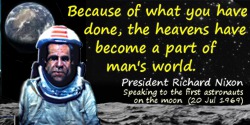
Neil and Buzz, I am talking to you by telephone from the Oval Office at the White House, and this certainly has to be the most historic telephone call ever made. Because of what you have done, the heavens have become a part of man’s world. As you talk to us from the Sea of Tranquility, it inspires us to redouble our efforts to bring peace and tranquility to Earth.
Speaking to the first astronauts while they were standing on the Moon (20 Jul 1969).
Neither had Watt of the Steam engine a heroic origin, any kindred with the princes of this world. The princes of this world were shooting their partridges… While this man with blackened fingers, with grim brow, was searching out, in his workshop, the Fire-secret.
From Chartism, collected in James Wood (ed.) The Carlyle Reader (1894), 73.
Neither physical science nor psychology can ever ‘explain’ human consciousness. To me then, human consciousness lies outside science, and it is here that I seek the relationship between God and man.
In Can scientists believe? (1991), 8.
Neither the absolute nor the relative size of the brain can be used to measure the degree of mental ability in animal or in man. So far as man is concerned, the weights of the brains or the volumes of the cranial cavities of a hundred celebrities of all branches of knowledge all over the world have been listed. … At the bottom of those lists are Gall, the famous phrenologist, Anatole France, the French novelist, and Gambetta, the French statesman, each with about 1,100 cc brain mass. The lists are topped by Dean Jonathan Swift, the English writer, Lord Byron, the English poet, and Turgenev, the Russian novelist, all with about 2,000 cc … Now our mental test! Had Turgenev really twice the mental ability of Anatole France?
In 'The Human Brain in the Light of Its Phylogenetic Development', Scientific Monthly (Aug 1948), 67, No. 2, 104-105. Collected in Sherwood Larned Washburn and Davida Wolffson (eds.), The Shorter Anthropological Papers of Franz Weidenreich Published in the Period 1939-1948: A Memorial Volume (1949), 18.
Never forget that it is not a pneumonia, but a pneumonic man who is your patient.
In Sir William Withey Gull and Theodore Dyke Acland (ed.), A Collection of the Published Writings of William Withey Gull (1896), xxiii.
Never promote a man who hasn’t made some bad mistakes, because you would be promoting someone who hasn’t done much.
As quoted, without citation, in Ken Fisher and Aaron Anderson (ed.), 'The Other Dow Theory: January 4, 1993', The Making of a Market Guru: Forbes Presents 25 Years of Ken Fisher (2010), 187. The author, Ken Fisher, writes that when young and caught doing something wrong, his father “would quote Dow to me and then insist on analyzing what I had done wrong in the interest of learning from it.”
Nevertheless, it is even harder for the average ape to believe that he has descended from man.
In a collection of his own work, which he selected, A Mencken Chrestomathy (1949, 1956), 618. He specifies the epigrams are his work, on p. 615. First appeared as a page-bottom filler, without attribution (there), in George Jean Nathan and H.L. Mencken (eds.), The Smart Set: A Magazine of Cleverness (1916), 48, No. 1, 200.
New sources of power … will surely be discovered. Nuclear energy is incomparably greater than the molecular energy we use today. The coal a man can get in a day can easily do five hundred times as much work as himself. Nuclear energy is at least one million times more powerful still. If the hydrogen atoms in a pound of water could be prevailed upon to combine and form helium, they would suffice to drive a thousand-horsepower engine for a whole year. If the electrons, those tiny planets of the atomic systems, were induced to combine with the nuclei in hydrogen, the horsepower would be 120 times greater still. There is no question among scientists that this gigantic source of energy exists. What is lacking is the match to set the bonfire alight, or it may be the detonator to cause the dynamite to explode. The scientists are looking for this.
[In his last major speech to the House of Commons on 1 Mar 1955, Churchill quoted from his original printed article, nearly 25 years earlier.]
[In his last major speech to the House of Commons on 1 Mar 1955, Churchill quoted from his original printed article, nearly 25 years earlier.]
'Fifty Years Hence'. Strand Magazine (Dec 1931). Reprinted in Popular Mechanics (Mar 1932), 57:3, 395.
Next came the patent laws. These began in England in 1624, and in this country with the adoption of our Constitution. Before then any man [might] instantly use what another man had invented, so that the inventor had no special advantage from his own invention. The patent system changed this, secured to the inventor for a limited time exclusive use of his inventions, and thereby added the fuel of interest to the fire of genius in the discovery and production of new and useful things.
Lecture 'Discoveries, Inventions and Improvements' (22 Feb 1860) in John George Nicolay and John Hay (eds.), Complete Works of Abraham Lincoln (1894), Vol. 5, 113. In Eugene C. Gerhart, Quote it Completely! (1998), 802.
Next to the promulgation of the truth, the best thing I can conceive that man can do is the public recantation of an error.
In Collected Papers of Joseph Baron Lister (1909), Vol. 1, 366. As quoted and cited in Sir Rickman John Godlee, Lord Lister (1918), 278.
Nirvana is a state of pure blissful knowledge ... It has nothing to do with the individual. The ego or its separation is an illusion. Indeed in a certain sense two ‘I’s are identical namely when one disregards all special contents–their Karma. The goal of man is to preserve his Karma and to develop it further ... when man dies his Karma lives and creates for itself another carrier.
…...
No man, not even a doctor, ever gives any other definition of what a nurse should be than this—“devoted and obedient.” This definition would do just as well for a porter. It might even do for a horse. It would not do for a policeman.
Notes on Nursing: what it is and what it is not (1860), 200.
No comfort should be drawn from the spurious belief that because extinction is a natural process, man is merely another Darwinian agent.
In 'Edward O. Wilson: The Biological Diversity Crisis: A Challenge to Science', Issues in Science and Technology (Fall 1985), 2, No. 1, 25.
No conclusion is more fully established, than the important fact of the total absence of any vestiges of the human species throughout the entire series of geological formations.
Geology and Mineralogy, Considered with Reference to Natural Theology (1836), Vol. I, 103.
No creature is too bulky or formidable for man's destructive energies—none too minute and insignificant for his keen detection and skill of capture. It was ordained from the beginning that we should be the masters and subduers of all inferior animals. Let us remember, however, that we ourselves, like the creatures we slay, subjugate, and modify, are the results of the same Almighty creative will—temporary sojourners here, and co-tenants with the worm and the whale of one small planet. In the exercise, therefore, of those superior powers that have been intrusted to us, let us ever bear in mind that our responsibilities are heightened in proportion.
Lecture to the London Society of Arts, 'The Raw Materials of the Animal Kingdom', collected in Lectures on the Results of the Great Exhibition of 1851' (1852), 131.
No doubt science cannot admit of compromises, and can only bring out the complete truth. Hence there must be controversy, and the strife may be, and sometimes must be, sharp. But must it even then be personal? Does it help science to attack the man as well as the statement? On the contrary, has not science the noble privilege of carrying on its controversies without personal quarrels?
In his collected writings of 1861, preface. Quoted in Proceedings of the Royal Society of London, Vol. 75, 300.
No existing form of anthropoid ape is even remotely related to the stock which has given rise to man.
In Henry Fairfield Osborn, 'Osborn States the Case For Evolution', New York Times (12 Jul 1925), XX1. Written in rebuttal to the anti-evolution publicity by William Jennings Bryan at the time of the Scopes Monkey Trial.
No great man ever complains of want of opportunity.
…...
No knowledge can be more satisfactory to a man than that of his own frame, its parts, their functions and actions.
Letter (7 Oct 1814) to Thomas Cooper. Collected in The Writings of Thomas Jefferson: Correspondence (1854), 390.
No man can be a pure specialist without being in the strict sense an idiot.
In 'Maxims for Revolutionists: Education', in Man and Superman (1905), 230.
No man can be truly called an entomologist, sir; the subject is too vast for any single human
intelligence to grasp.
In 'The Poet at the Breakfast Table: II', The Atlantic Monthly (Feb 1872), 29, 231.
No man can reveal to you aught but that which already lies half asleep in the dawning of your knowledge.
In Kahlil Gibran: The Collected Works (2007), 134.
No man can run up the natural line of Evolution without coming to Christianity at the top.
The Ascent of Man (1894), 439.
No man can thoroughly master more than one art or science.
The Round Table: a Collection of Essays on Literature, Men, and Manners (1817), Vol. 2, 40.
No man ever looks at the world with pristine eyes. He sees it edited by a definite set of customs and institutions and ways of thinking.
In 'The Science of Custom', Patterns of Culture (1934, 2005), 2.
No man fully capable of his own language ever masters another.
In 'Maxims for Revolutionists' (1903), The Works of Bernard Shaw (1930), Vol. 10, 219.
No man is a good doctor who has never been sick himself.
Chinese proverb.
No man is a good physician who has never been sick.
Arabic proverb.
No Man is the wiser for his Learning: it may administer Matter to work in, or Objects to work upon; but Wit and Wisdom are born with a man.
In John Selden, Richard Milward (ed.), 'Learning', Table-Talk of John Selden (1689, 1856), 85.
No man of science wants merely to know. He acquires knowledge to appease his passion for discovery. He does not discover in order to know, he knows in order to discover.
In 'Technical Education and Its Relation to Science and Literature', The Aims of Education: & Other Essays (1917), 74.
No man should marry until he has studied anatomy and dissected at least one woman.
The Physiology of Marriage (2000), Meditation V, Aphorism 28, 41.
No man that does not see visions will ever realize any high hope or undertake any high enterprise.
Address, Convention Hall, Philadelphia (10 May 1915). In 'Text of President’s Speech: Tells New Citizens, They Must Think Themselves Only Americans', New York Times (11 May 1915), 1.
No man who has not a decently skeptical mind can claim to be civilized. Euclid taught me that without assumptions there is no proof. Therefore, in any argument, examine the assumptions. Then, in the alleged proof, be alert for inexplicit assumptions. Euclid’s notorious oversights drove this lesson home. Thanks to him, I am (I hope!) immune to all propaganda, including that of mathematics itself.
In 'What Mathematics Has Meant to Me', Mathematics Magazine (Jan-Feb 1951), 24, 161.
No Man’s Knowledge here, can go beyond his Experience.
An Essay Concerning Human Understanding (1690). Edited by Peter Nidditch (1975), Book 2, Chapter 1, Section 19, 115.
No mathematician should ever allow him to forget that mathematics, more than any other art or science, is a young man's game. … Galois died at twenty-one, Abel at twenty-seven, Ramanujan at thirty-three, Riemann at forty. There have been men who have done great work later; … [but] I do not know of a single instance of a major mathematical advance initiated by a man past fifty. … A mathematician may still be competent enough at sixty, but it is useless to expect him to have original ideas.
In A Mathematician's Apology (1941, reprint with Foreward by C.P. Snow 1992), 70-71.
No mathematician should ever allow himself to forget that mathematics, more than any other art or science, is a young man's game.
A Mathematician's Apology (1940), 10.
No nation can be really great unless it is great in peace, in industry, integrity, honesty. Skilled intelligence in civic affairs and industrial enterprises alike; the special ability of the artist, the man of letters, the man of science, and the man of business; the rigid determination to wrong no man, and to stand for righteousness—all these are necessary in a great nation.
Address (2 Jun 1897) at U.S. Naval War College, Newport, Rhode Island. In 'Washington's Forgotten Maxim', United States Naval Institute Proceedings (1897), 23, 450.
No one can read the history of astronomy without perceiving that Copernicus, Newton, Laplace, are not new men, or a new kind of men, but that Thales, Anaximenes, Hipparchus, Empodocles, Aristorchus, Pythagorus, Oenipodes, had anticipated them.
In The Conduct of Life (1904), 18.
No one, it has been said, will ever look at the Moon in the same way again. More significantly can one say that no one will ever look at the earth in the same way. Man had to free himself from earth to perceive both its diminutive place in a solar system and its inestimable value as a life-fostering planet. As earthmen, we may have taken another step into adulthood. We can see our planet earth with detachment, with tenderness, with some shame and pity, but at last also with love.
In Earth Shine (1969). As quoted and cited in Joseph J. Kerski, Interpreting Our World: 100 Discoveries That Revolutionized Geography (2016), 93.
No other animals have ever lighted fires as far as we can tell. In field archeology, a charcoal deposit found in such a location that it could not have been made by a forest fire is taken as conclusive evidence of man. A circular dark disk in the soil five or six feet in diameter is such a find. … With … modern radioactive dating methods, we can trace man’s history.
In 'Man’s Place in the Physical Universe', Bulletin of the Atomic Scientists (Sep 1965), 21, No. 7, 15.
No theory of physics that deals only with physics will ever explain physics. I believe that as we go on trying to understand the universe, we are at the same time trying to understand man.
In The Intellectual Digest (June 1973), as quoted and cited in Mark Chandos, 'Philosophical Essay: Story Theory", Kosmoautikon: Exodus From Sapiens (2015).
No! What we need are not prohibitory marriage laws, but a reformed society, an educated public opinion which will teach individual duty in these matters. And it is to the women of the future that I look for the needed reformation. Educate and train women so that they are rendered independent of marriage as a means of gaining a home and a living, and you will bring about natural selection in marriage, which will operate most beneficially upon humanity. When all women are placed in a position that they are independent of marriage, I am inclined to think that large numbers will elect to remain unmarried—in some cases, for life, in others, until they encounter the man of their ideal. I want to see women the selective agents in marriage; as things are, they have practically little choice. The only basis for marriage should be a disinterested love. I believe that the unfit will be gradually eliminated from the race, and human progress secured, by giving to the pure instincts of women the selective power in marriage. You can never have that so long as women are driven to marry for a livelihood.
In 'Heredity and Pre-Natal Influences. An Interview With Dr. Alfred Russel Wallace', Humanitarian (1894), 4, 87.
Nobody loves a fat man.
American saying
Nobody since Newton has been able to use geometrical methods to the same extent for the like purposes; and as we read the Principia we feel as when we are in an ancient armoury where the weapons are of gigantic size; and as we look at them we marvel what manner of man he was who could use as a weapon what we can scarcely lift as a burthen.
From Speech delivered at the Dejeuner, after the Inauguration of the statue of Isaac Newton at Grantham. Collected in Edmund Fillingham King, A biographical sketch of Sir Isaac Newton (1858), 105.
Nobody, certainly, will deny that the idea of the existence of an omnipotent, just, and omnibeneficent personal God is able to accord man solace, help, and guidance; also, by virtue of its simplicity it is accessible to the most undeveloped mind. But, on the other hand, there are decisive weaknesses attached to this idea in its elf, which have been painfully felt since the beginning of history. That is, if this being is omnipotent, then every occurrence, including every human action, every human thought, and every human feeling and aspiration is also His work; how is it possible to think of holding men responsible for their deeds and thoughts before such an almighty Being? In giving out punishment and rewards He would to a certain extent be passing judgment on Himself. How can this be combined with the goodness and righteousness ascribed to Him?
…...
None of Darwin’s particular doctrines will necessarily endure the test of time and trial. Into the melting-pot must they go as often as any man of science deems it fitting. But Darwinism as the touch of nature that makes the whole world kin can hardly pass away.
Anthropology (1912), 11.
Nor can it be supposed that the diversity of chemical structure and process stops at the boundary of the species, and that within that boundary, which has no real finality, rigid uniformity reigns. Such a conception is at variance with any evolutionary conception of the nature and origin of species. The existence of chemical individuality follows of necessity from that of chemical specificity, but we should expect the differences between individuals to be still more subtle and difficult of detection. Indications of their existence are seen, even in man, in the various tints of skin, hair, and eyes, and in the quantitative differences in those portions of the end-products of metabolism which are endogenous and are not affected by diet, such as recent researches have revealed in increasing numbers. Even those idiosyncrasies with regard to drugs and articles of food which are summed up in the proverbial saying that what is one man's meat is another man's poison presumably have a chemical basis.
Inborn Errors of Metabolism: The Croonian Lectures delivered before the Royal College of Physicians of London, in June, 1908 (1909), 2-3.
Not all the winds, and storms, and earthquakes, and seas, and seasons of the world, have done so much to revolutionize the earth as Man, the power of an endless life, has done since the day he came forth upon it, and received dominion over it.
From Sermon on the Power of Endless Life, and Other Sermons (1876), 310.
Not every collision,
not every punctilious trajectory
by which billiard-ball complexes
arrive at their calculable meeting places
lead to reaction. ...
Men (and women) are not
as different from molecules
as they think.
not every punctilious trajectory
by which billiard-ball complexes
arrive at their calculable meeting places
lead to reaction. ...
Men (and women) are not
as different from molecules
as they think.
Hoffmann, as a chemist-turned-poet is making the analogy of random intermolecular interactions to those of humans. From poem, 'Men and Molecules', The Metamict State (1984), 43. Cited as an epigraph in William L. Masterton and Cecile N. Hurley Chemistry: Principles and Reactions, Updated Edition (2005), 282.
Not greatly moved with awe am I
To learn that we may spy
Five thousand firmaments beyond our own.
The best that's known
Of the heavenly bodies does them credit small.
View'd close, the Moon's fair ball
Is of ill objects worst,
A corpse in Night's highway, naked, fire-scarr'd, accurst;
And now they tell
That the Sun is plainly seen to boil and burst
Too horribly for hell.
So, judging from these two,
As we must do,
The Universe, outside our living Earth,
Was all conceiv'd in the Creator's mirth,
Forecasting at the time Man's spirit deep,
To make dirt cheap.
Put by the Telescope!
Better without it man may see,
Stretch'd awful in the hush'd midnight,
The ghost of his eternity.
To learn that we may spy
Five thousand firmaments beyond our own.
The best that's known
Of the heavenly bodies does them credit small.
View'd close, the Moon's fair ball
Is of ill objects worst,
A corpse in Night's highway, naked, fire-scarr'd, accurst;
And now they tell
That the Sun is plainly seen to boil and burst
Too horribly for hell.
So, judging from these two,
As we must do,
The Universe, outside our living Earth,
Was all conceiv'd in the Creator's mirth,
Forecasting at the time Man's spirit deep,
To make dirt cheap.
Put by the Telescope!
Better without it man may see,
Stretch'd awful in the hush'd midnight,
The ghost of his eternity.
'The Two Deserts' (1880-85). Poems, Introduction Basil Champneys (1906), 302.
Not one idiot in a thousand has been entirely refractory to treatment, not one in a hundred has not been made more happy and healthy; more than thirty per cent have been taught to conform to social and moral law, and rendered capable of order, of good feeling, and of working like the third of a man; more than forty per cent have become capable of the ordinary transactions of life under friendly control, of understanding moral and social abstractions, of working like two-thirds of a man.
Quoted in Appleton's Cyclopedia of American Biography
Not only is science fiction an idea of tremendous import, but it is to be an important factor in making the world a better place to live in, through educating the public to the possibilities of science and the influence of science on life which, even today, are not appreciated by the man on the street. … If every man, woman, boy and girl, could be induced to read science fiction right along, there would certainly be a great resulting benefit to the community, in that the educational standards of its people would be raised tremendously. Science fiction would make people happier, give them a broader understanding of the world, make than more tolerant.
Editorial, Science Fiction Week (1930). In Gary Westfahl, Hugo Gernsback and the Century of Science Fiction (2007), 166.
Note the saying of Protagoras that man is the measure of things. With the senses man measures perceptible things, with the intellect he measures intelligible things, and he attains unto supra-intelligible things transcendently
Dialog, 'De Beryllo' (1458). As translated in Jasper Hopkins, Complete Philosophical and Theological Treatises of Nicholas of Cusa: De visione Dei (2001), Vol. 2, 793.
Nothing can be unworthy of being investigated by man, which was thought worthy of being created by God.
In 'Report of the Secretary', Seventh Annual Report of the Board of Regents of the Smithsonian Institution for 1852 (1853), 15.
Nothing ever built ... arose to touch the skies unless some man dreamed that it should, some man believed that it could, and some man willed that it must.
Nothing has afforded me so convincing a proof of the unity of the Deity as these purely mental conceptions of numerical and mathematical science which have been by slow degrees vouchsafed to man, and are still granted in these latter times by the Differential Calculus, now superseded by the Higher Algebra, all of which must have existed in that sublimely omniscient Mind from eternity.
Martha Somerville (ed.) Personal Recollections, from Early Life to Old Age, of Mary Somerville (1874), 140-141.
Nothing in the whole system of nature is isolated or unimportant. The fall of a leaf and the motion of a planet are governed by the same laws. … It is in the study of objects considered trivial and unworthy of notice by the casual observer that genius finds the most important and interesting phenomena. It was in the investigation of the varying colors of the soap-bubble that Newton detected the remarkable fact of the fits of easy reflection and easy refraction presented by a ray of light in its passage through space, and upon which he established the fundamental principle of the present generalization of the undulatory theory of light. … The microscopic organization of animals and plants is replete with the highest instruction; and, surely, in the language of one of the fathers of modern physical science, “nothing can be unworthy of being investigated by man which was thought worthy of being created by GOD.”
In 'Report of the Secretary', Seventh Annual Report of the Board of Regents of the Smithsonian Institution for 1852 (1853), 15.
Nothing inspires more reverence and awe in me than an old man who knows how to change his mind.
In Pensamientos Escogidos (1924), 58. Translated from the original Spanish, “Nada me inspira más veneración y asombro que un anciano que sabe cambiar de opinión.”
Nothing is more flatly contradicted by experience than the belief that a man, distinguished in one of the departments of science is more likely to think sensibly about ordinary affairs than anyone else.
In 'Has the Intellect A Function?', The Collected Papers of Wilfred Trotter, FRS (1941), 181.
Nothing is useless for the man of sense; he turns everything to account.
In Hialmer Day Gould, New Practical Spelling (1905), 13.
Nothing, however, is more common than energy in money-making, quite independent of any higher object than its accumulation. A man who devotes himself to this pursuit, body and soul, can scarcely fail to become rich. Very little brains will do; spend less than you earn; add guinea to guinea; scrape and save; and the pile of gold will gradually rise.
In Self-help: With Illustrations of Character and Conduct (1859, 1861), 301-302.
Now an’ then an innocent man is sent t’ th’ legislature.
In Kin Hubbard and David S. Hawes (ed.), The Best of Kin Hubbard: Abe Martin's Sayings and Wisecracks, Abe’s Neighbors, his Almanack, Comic Drawings (1984), 14.
Now and then, in the course of the century, a great man of science, like Darwin; a great poet, like Keats; a fine critical spirit, like M. Renan; a supreme artist, like Flaubert, has been able to isolate himself, to keep himself out of reach of the clamorous claims of others, to stand “under the shelter of the wall,” as Plato puts it, and so to realise the perfection of what was in him, to his own incomparable gain, and to the incomparable and lasting gain of the whole world.
In Sebastian Melmoth (1908), 133-134.
Now Einstein was a very clever man,
with us all his philosophies he shared,
He gave us the theory of relativity,
which is E equals M C squared.
with us all his philosophies he shared,
He gave us the theory of relativity,
which is E equals M C squared.
From lyrics of song Sod’s Law.
Now I must take you to a very interesting part of our subject—to the relation between the combustion of a candle and that living kind of combustion which goes on within us. In every one of us there is a living process of combustion going on very similar to that of a candle, and I must try to make that plain to you. For it is not merely true in a poetical sense—the relation of the life of man to a taper; and if you will follow, I think I can make this clear.
From the concluding lecture (8 Jan 1861) given to a juvenile audience at the Royal Institution, as published in A Course of Six Lectures on the Chemical History of a Candle (1861), 167.
Now it must be asked if we can comprehend why comets signify the death of magnates and coming wars, for writers of philosophy say so. The reason is not apparent, since vapor no more rises in a land where a pauper lives than where a rich man resides, whether he be king or someone else. Furthermore, it is evident that a comet has a natural cause not dependent on anything else; so it seems that it has no relation to someone’s death or to war. For if it be said that it does relate to war or someone’s death, either it does so as a cause or effect or sign.
De Cometis (On Comets) [before 1280], trans. Lynn Thorndike, from ed. Borgnet, IV, 499-508, quoted in Lynn Thorndike (ed.), Latin Treatises on Comets between 1238 and 1368 A.D. (1950), 75.
Now when naturalists observe a close agreement in numerous small details of habits, tastes, and dispositions between two or more domestic races, or between nearly-allied natural forms, they use this fact as an argument that they are descended from a common progenitor who was thus endowed; and consequently that all should be classed under the same species. The same argument may be applied with much force to the races of man.
…...
Nowadays the clinical history too often weighs more than the man.
In Jess M. Brallier, Medical Wit & Wisdom (1993), 29.
Nowhere can man find a quieter or more untroubled retreat than in his own soul.
Meditations.
Occasionally and frequently the exercise of the judgment ought to end in absolute reservation. It may be very distasteful, and great fatigue, to suspend a conclusion; but as we are not infallible, so we ought to be cautious; we shall eventually find our advantage, for the man who rests in his position is not so far from right as he who, proceeding in a wrong direction, is ever increasing his distance.
Lecture at the Royal Institution, 'Observations on the Education of the Judgment'. Collected in Edward Livingston Youmans (ed)., Modern Culture (1867), 219.
Occasionally he stumbled over the truth but he always picked himself up and hurried on as if nothing had happened.
As given in 'Picturesque Speech', Reader’s Digest (April 1942), 40, 92. Churchill was describing his political adversary Prime Minister Stanley Baldwin, according to an “ear-witness”, estimated as said “around 1936”, printed in Kay Halle, Irrepressible Churchill: A Treasury of Winston Churchill's Wit (1966), 133; therein given as: “Occasionally he stumbled over the truth, but hastily picked himself up and hurried on as if nothing had happened.” Also seen variously misquoted for example, such as: “man will occasionally stumble over the truth, but usually manages to pick himself up, walk over or around it, and carry on.” There is a full discussion on the quoteinvestigator.com website. [Note: the date estimate may have been inferred from Baldwin’s 1935-1937 term in office. —Webmaster.
Occurrences that other men would have noted only with the most casual interest became for Whitney exciting opportunities to experiment. Once he became disturbed by a scientist's seemingly endless pursuit of irrelevant details in the course of an experiment, and criticized this as being as pointless as grabbing beans out of a pot, recording the numbers, and then analyzing the results. Later that day, after he had gone home, his simile began to intrigue him, and he asked himself whether it would really be pointless to count beans gathered in such a random manner. Another man might well have dismissed this as an idle fancy, but to Whitney an opportunity to conduct an experiment was not to be overlooked. Accordingly, he set a pot of beans beside his bed, and for several days each night before retiring he would take as many beans as he could grasp in one hand and make a note of how many were in the handful. After several days had passed he was intrigued to find that the results were not as unrewarding as he had expected. He found that each handful
contained more beans than the one before, indicating that with practice he was learning to grasp more and more beans. “This might be called research in morphology, the science of animal structure,” he mused. “My hand was becoming webbed … so I said to myself: never label a real experiment useless, it may reveal something unthought of but worth knowing.”
'Willis Rodney Whitney', National Academy of Sciences, Biographical Memoirs (1960), 358-359.
OCEAN, n. A body of water occupying about two-thirds of a world made for man—who has no gills.
The Collected Works of Ambrose Bierce (1911), Vol. 7, The Devil's Dictionary, 235.
Of all man’s works of art, a cathedral is greatest. A vast and majestic tree is greater than that.
In Proverbs from Plymouth Pulpit (1887), 8.
Of all the animals on earth, man is closest to the ape.
Aphorism 19 in Notebook B (1768-1771), as translated by R.J. Hollingdale in Aphorisms (1990). Reprinted as The Waste Books (2000), 21.
Of all the supervised conditions for life offered man, those under U.S.A.’s constitution have proved the best. Wherefore, be sure when you start modifying, corrupting or abrogating it.
Of all the trees that have ever been cultivated by man, the genealogical tree is the driest. It is one, we may be sure, that had no place in the garden of Eden. Its root is in the grave; its produce mere Dead Sea fruit—apples of dust and ashes.
In novel, Half a Million of Money (1865), Vol. 1, 18.
Of beasts, it is confess’d, the ape
Comes nearest us in human shape;
Like man he imitates each fashion,
And malice is his ruling passion.
Comes nearest us in human shape;
Like man he imitates each fashion,
And malice is his ruling passion.
In Poetical Essay, 'The Logicians Refuted', The Scots Magazine (1759),-21, 525.
Of beasts, it is confess’d, the ape
Comes nearest us in human shape;
Like man he imitates each fashion,
And malice is his ruling passion.
Comes nearest us in human shape;
Like man he imitates each fashion,
And malice is his ruling passion.
In Poetical Essay, 'The Logicians Refuted', The Scots Magazine (1759),-21, 525.
Of course we have no means of staying back for any length of Time, any more than a savage or an animal has of staying six feet above the ground. But a civilized man is better off than the savage in this respect. He can go up against gravitation in a balloon, and why should he not hope that ultimately he may be able to stop or accelerate his drift along the Time-Dimension, or even turn about and travel the other way?
In The Time Machine (1898), 13.
Of possible quadruple algebras the one that had seemed to him by far the most beautiful and remarkable was practically identical with quaternions, and that he thought it most interesting that a calculus which so strongly appealed to the human mind by its intrinsic beauty and symmetry should prove to be especially adapted to the study of natural phenomena. The mind of man and that of Nature’s God must work in the same channels.
As quoted in W. E. Byerly (writing as a Professor Emeritus at Harvard University, but a former student at a Peirce lecture on Hamilton’s new calculus of quaternions), 'Benjamin Peirce: II. Reminiscences', The American Mathematical Monthly (Jan 1925), 32, No. 1, 6.
Of power does Man possess no particle:
Of knowledge—just so much as show that still
It ends in ignorance on every side…
Of knowledge—just so much as show that still
It ends in ignorance on every side…
'With Francis Furini', The Complete Poetic and Dramatic Works of Robert Browning (1895), 967.
Of science and logic he chatters,
As fine and as fast as he can;
Though I am no judge of such matters,
I’m sure he’s a talented man.
As fine and as fast as he can;
Though I am no judge of such matters,
I’m sure he’s a talented man.
'The Talented Man.' In Winthrop Mackworth Praed, Ferris Greenslet, The Poems of Winthrop Mackworth Praed (1909), 122.
by - 1909
Of Science generally we can remark, first, that it is the most perfect embodiment of Truth, and of the ways of getting at Truth. More than anything else does it impress the mind with the nature of Evidence, with the labour and precautions necessary to prove a thing. It is the grand corrective of the laxness of the natural man in receiving unaccredited facts and conclusions. It exemplifies the devices for establishing a fact, or a law, under every variety of circumstances; it saps the credit of everything that is affirmed without being properly attested.
In Education as a Science (1879), 147-148.
Oh, most magnificent and noble Nature!
Have I not worshipped thee with such a love
As never mortal man before displayed?
Adored thee in thy majesty of visible creation,
And searched into thy hidden and mysterious ways
As Poet, as Philosopher, as Sage?
Have I not worshipped thee with such a love
As never mortal man before displayed?
Adored thee in thy majesty of visible creation,
And searched into thy hidden and mysterious ways
As Poet, as Philosopher, as Sage?
A late fragment, probably written when he knew he was dying, in Fragmentary Remains (1858), 14.
Ohm found that the results could be summed up in such a simple law that he who runs may read it, and a schoolboy now can predict what a Faraday then could only guess at roughly. By Ohm's discovery a large part of the domain of electricity became annexed by Coulomb's discovery of the law of inverse squares, and completely annexed by Green's investigations. Poisson attacked the difficult problem of induced magnetisation, and his results, though differently expressed, are still the theory, as a most important first approximation. Ampere brought a multitude of phenomena into theory by his investigations of the mechanical forces between conductors supporting currents and magnets. Then there were the remarkable researches of Faraday, the prince of experimentalists, on electrostatics and electrodynamics and the induction of currents. These were rather long in being brought from the crude experimental state to a compact system, expressing the real essence. Unfortunately, in my opinion, Faraday was not a mathematician. It can scarely be doubted that had he been one, he would have anticipated much later work. He would, for instance, knowing Ampere's theory, by his own results have readily been led to Neumann’s theory, and the connected work of Helmholtz and Thomson. But it is perhaps too much to expect a man to be both the prince of experimentalists and a competent mathematician.
From article 'Electro-magnetic Theory II', in The Electrician (16 Jan 1891), 26, No. 661, 331.
Old age is the most unexpected of all things that happen to a man.
Diary entry (8 May 1936), collected in Diary in Exile (1959).
On all levels primary, and secondary and undergraduate - mathematics is taught as an isolated subject with few, if any, ties to the real world. To students, mathematics appears to deal almost entirely with things whlch are of no concern at all to man.
In editorial in Focus, a Journal of the Mathematical Association of America (1986), quoted in obituary by Eric Pace, New York Times (11 Jun 1992).
On all questions where his passions are strongly engaged, man prizes certitude and fears knowledge. Dispassionate inquiry is welcomed only when the result is indifferent.
In Aspects of Science (1925), 9.
On becoming very intimate with Fitz-Roy, I heard that I had run a very narrow risk of being rejected, on account of the shape of my nose! He was an ardent disciple of Lavater, and was convinced that he could judge a man's character by the outline of his features. He doubted whether anyone with my nose could possess sufficient energy and determination for the voyage. I think he was well-satisfied that my nose had spoken falsely.
In Charles Darwin and Francis Darwin (ed.), The Life and Letters of Charles Darwin: Including an Autobiographical Chapter (1896), 50.
On earth there is nothing great but man… in man there is nothing great but mind.
In 'Appendix', Lectures on Metaphysics and Logic (1860), Vol. 2, 261. Attributed in a Latin form to Favorinus in Pico di Mirandola (1463–94) Disputationes Adversus Astrologiam Divinatricem.
On graduating from school, a studious young man who would withstand the tedium and monotony of his duties has no choice but to lose himself in some branch of science or literature completely irrelevant to his assignment.
From memorandum 'Mémoire sur le service des officiers du Corps du Génie' (1776) to the minister of war, the comte de Saint-Germain. Reproduced as Appendix C in C. Stewart Gillmor, Coulomb and the Evolution of Physics and Engineering in Eighteenth Century France (1971), 255-261. Coulomb proposed (unsuccessfully) that the corps of military engineers in peacetime engage their skills in construction of public works. As cited in Charles Coulston Gillispie, Science and Polity in France: The End of the Old Regime (1980, 2004), 530.
On opening the incubator I experienced one of those rare moments of intense emotion which reward the research worker for all his pains: at first glance I saw that the broth culture, which the night before had been very turbid was perfectly clear: all the bacteria had vanished…as for my agar spread it was devoid of all growth and what caused my emotion was that in a flash I understood: what causes my spots was in fact an invisible microbe, a filterable virus, but a virus parasitic on bacteria. Another thought came to me also, If this is true, the same thing will have probably occurred in the sick man. In his intestine, as in my test-tube, the dysentery bacilli will have dissolved away under the action of their parasite. He should now be cured.
In Allan Chase, Magic Shots: A Human and Scientific Account of the Long and Continuing Struggle to Eradicated Infectious Diseases by Vaccination (1982), 249-250. Also in Allan J. Tobin and Jennie Dusheck, Asking About Life (2005), 206.
On the one hand, then, in the reproductive functions proper—menstruation, defloration, pregnancy and parturition—woman is biologically doomed to suffer. Nature seems to have no hesitation in administering to her strong doses of pain, and she can do nothing but submit passively to the regimen prescribed. On the other hand, as regards sexual attraction, which is necessary for the act of impregnation, and as regards the erotic pleasures experienced during the act itself, the woman may be on an equal footing with the man.
'Passivity, Masochism and Femininity', Journal of Psychoanalysis, 1935, 16, 327.
Once it happened that all the other members of a man mutinied against the stomach, which they accused as the single, idle, uncontributing part in the entire body, while the rest were put to hardships and the expense of much labor to supply and minister to its appetites. However, the stomach merely ridiculed the fatuity of the members, who appeared not to be aware that the stomach certainly does receive the general nourishment, but only to return it again and distribute it amongst the rest.
Fable related by Menenius Agrippa to resolve a grievance of plebeians against the social hierarchy, described in 'Life of Coriolanus', collected in A.H. Clough (ed.), Plutarch’s Lives of Illustrious Men (1859, 1881), 155.
One cannot help a man to come to accept his impending death if he remains in severe pain, one cannot give spiritual counsel to a woman who is vomiting, or help a wife and children say their goodbyes to a father who is so drugged that he cannot respond.
'The Principles of Symptom Control', in Ina Ajemian, Balfour M. Mount. (eds.) The R.V.H. Manual on Palliative/Hospice Care (1980), 176.
One cannot ignore half of life for the purposes of science, and then claim that the results of science give a full and adequate picture of the meaning of life. All discussions of “life” which begin with a description of man's place on a speck of matter in space, in an endless evolutionary scale, are bound to be half-measures, because they leave out most of the experiences which are important to use as human beings.
In Religion and the Rebel (1957), 309.
One day when the whole family had gone to a circus to see some extraordinary performing apes, I remained alone with my microscope, observing the life in the mobile cells of a transparent star-fish larva, when a new thought suddenly flashed across my brain. It struck me that similar cells might serve in the defence of the organism against intruders. Feeling that there was in this something of surpassing interest, I felt so excited that I began striding up and down the room and even went to the seashore in order to collect my thoughts.
I said to myself that, if my supposition was true, a splinter introduced into the body of a star-fish larva, devoid of blood-vessels or of a nervous system, should soon be surrounded by mobile cells as is to be observed in a man who runs a splinter into his finger. This was no sooner said than done.
There was a small garden to our dwelling, in which we had a few days previously organised a 'Christmas tree' for the children on a little tangerine tree; I fetched from it a few rose thorns and introduced them at once under the skin of some beautiful star-fish larvae as transparent as water.
I was too excited to sleep that night in the expectation of the result of my experiment, and very early the next morning I ascertained that it had fully succeeded.
That experiment formed the basis of the phagocyte theory, to the development of which I devoted the next twenty-five years of my life.
I said to myself that, if my supposition was true, a splinter introduced into the body of a star-fish larva, devoid of blood-vessels or of a nervous system, should soon be surrounded by mobile cells as is to be observed in a man who runs a splinter into his finger. This was no sooner said than done.
There was a small garden to our dwelling, in which we had a few days previously organised a 'Christmas tree' for the children on a little tangerine tree; I fetched from it a few rose thorns and introduced them at once under the skin of some beautiful star-fish larvae as transparent as water.
I was too excited to sleep that night in the expectation of the result of my experiment, and very early the next morning I ascertained that it had fully succeeded.
That experiment formed the basis of the phagocyte theory, to the development of which I devoted the next twenty-five years of my life.
In Olga Metchnikoff, Life of Elie Metchnikoff 1845-1916 (1921), 116-7.
One definition of man is “an intelligence served by organs.”
From 'Works and Days' in Society and Solitude (1870). Collected in Emerson's Complete Works (1883), Vol. 7, 151.
One is hard pressed to think of universal customs that man has successfully established on earth. There is one, however, of which he can boast the universal adoption of the Hindu-Arabic numerals to record numbers. In this we perhaps have man’s unique worldwide victory of an idea.
In Mathematical Circles Squared (1972), 13.
One machine can do the work of fifty ordinary men. No machine can do the work of one extraordinary man.
In A Thousand and One Epigrams (1911), 151.
One man is as good as another until he has written a book.
In Evelyn Abbott and Lewis Campbell (eds.), The Letters of Benjamin Jowett (1897), Vol. 1, 248.
One man that has a mind and knows it can always beat ten men who havn’t and don’t.
Character Proteus, in The Apple Cart (1929), Act 1. Collected in The Collected Works of Bernard Shaw (1930), Vol. 17, 212. Note: Apostrophes in the last words were not used in the text.
One man’s “magic” is another man’s engineering. “Supernatural” is a null word.
In Time Enough for Love: The Lives of Lazarus Long (1973), 269.
One more word on “designed laws” and “undesigned results.” - I see a bird which I want for food, take my gun and kill it, I do this designedly.—An innocent and good man stands under a tree and is killed by a flash of lightning. Do you believe (& I really should like to hear) that God designedly killed this man? Many or most persons do believe this; I can’t and don’t.—If you believe so, do you believe that when a swallow snaps up a gnat that God designed that that particular swallow should snap up that particular gnat at that particular instant? I believe that the man and the gnat are in the same predicament. If the death of neither man nor gnat are designed, I see no good reason to believe that their first birth or production should be necessarily designed.
Letter to Asa Gray, 3 July 1860. In F. Burkhardt and S. Smith (eds.), The Correspondence of Charles Darwin 1860 (1993), Vol. 8, 275.
One most necessary function of the brain is to exert an inhibitory power over the nerve centres that lie below it, just as man exercises a beneficial control over his fellow animals of a lower order of dignity; and the increased irregular activity of the lower centres surely betokens a degeneration: it is like the turbulent, aimless action of a democracy without a head.
The Physiology and Pathology of Mind (1868), 94.
One of Darwin’s reviewers put the alternative strongly by asking “whether we are to believe that man is modified mud or modified monkey”.
In Letter to Thomas S. Spedding (19 May 1863), Life, Letters and Journals of Sir Charles Lyell (1881), Vol. 2, 376. [The mud is a reference to the Bible’s description in Genesis (2:7) that God formed man of the dust of the ground.]
One of my friends, reading the title of these lectures [The Whence and Whither of Man] said: “Of man's origin you know nothing, of his future you know less.”
From the Introduction to The Whence and Whither of Man; a Brief History of his Origin and Development through Conformity to Environment; being the Morse Lectures of 1895. (1896), ix. The Morse lectureship was founded by Prof. Samuel F.B. Morse in 1865 at Union Theological Seminary, the lectures to deal with “the relation of the Bible to any of the sciences.”
One of the gladdest moments of human life, methinks, is the departure upon a distant journey into unknown lands. Shaking off with one mighty effort the fetters of habit, the leaden weight of routine, the cloak of many cares and the slavery of home, man feel once more happy.
In Zanzibar: City, Island, and Coast (1872), Vol. 1, 16.
One of the greatest discoveries a man makes, one of his great surprises, is to find he can do what he was afraid he couldn’t do.
…...
One of the most impressive discoveries was the origin of the energy of the stars, that makes them continue to burn. One of the men who discovered this was out with his girl friend the night after he realized that nuclear reactions must be going on in the stars in order to make them shine.
She said “Look at how pretty the stars shine!”
He said, “Yes, and right now I am the only man in the world who knows why they shine.”
She merely laughed at him. She was not impressed with being out with the only man who, at that moment, knew why stars shine. Well, it is sad to be alone, but that is the way it is in this world.
She said “Look at how pretty the stars shine!”
He said, “Yes, and right now I am the only man in the world who knows why they shine.”
She merely laughed at him. She was not impressed with being out with the only man who, at that moment, knew why stars shine. Well, it is sad to be alone, but that is the way it is in this world.
…...
One of the principal results of civilization is to reduce more and more the limits within which the different elements of society fluctuate. The more intelligence increases the more these limits are reduced, and the nearer we approach the beautiful and the good. The perfectibility of the human species results as a necessary consequence of all our researches. Physical defects and monstrosities are gradually disappearing; the frequency and severity of diseases are resisted more successfully by the progress of modern science; the moral qualities of man are proving themselves not less capable of improvement; and the more we advance, the less we shall have need to fear those great political convulsions and wars and their attendant results, which are the scourges of mankind.
…...
One should guard against inculcating a young man with the idea that success is the aim of life, for a successful man normally receives from his peers an incomparably greater portion than the services he has been able to render them deserve. The value of a man resides in what he gives and not in what he is capable of receiving. The most important motive for study at school, at the university, and in life is the pleasure of working and thereby obtaining results which will serve the community. The most important task for our educators is to awaken and encourage these psychological forces in a young man {or woman}. Such a basis alone can lead to the joy of possessing one of the most precious assets in the world - knowledge or artistic skill.
…...
One should guard against preaching to the young man success in the customary sense as the aim in life. ... The most important motive for work in school and in life is pleasure in work, pleasure in its result, and the knowledge of the value of the result to the community.
'On Education', address at the State University of New York, Albany (15 Oct 1936) in celebration of the Tercentenary of Higher Education in America, translation prepared by Lina Arronet. In Albert Einstein, The Einstein Reader (2006), 30.
One would like to see mankind spend the balance of the century in a total effort to clean up and groom the surface of the globe – wipe out the jungles, turn deserts and swamps into arable land, terrace barren mountains, regulate rivers, eradicate all pests, control the weather, and make the whole land mass a fit habitation for Man. The globe should be our and not nature’s home, and we no longer nature’s guests.
In The Temper of Our Time (1967), 94.
Only an inventor knows how to borrow, and every man is or should be an inventor.
Only science, exact science about human nature itself, and the most sincere approach to it by the aid of the omnipotent scientific method, will deliver man from his present gloom and will purge him from his contemporary share in the sphere of interhuman relations.
In Ivan Pavlov and William Horsley Gantt (trans.), Lectures on Conditioned Reflexes (1928, 1941), Preface, 41.
Only those works which are well-written will pass to posterity: the amount of knowledge, the uniqueness of the facts, even the novelty of the discoveries are no guarantees of immortality ... These things are exterior to a man but style is the man himself.
'Discours prononcé dans l'Académie française, Le Samedi 25 Aout 1753', Histoire Naturelle, Générale et Particulière, Avec la Description du Cabinet du Roi (1753), Vol. 7, xvi-xvii.
ORGANIC LIFE beneath the shoreless waves
Was born and nurs'd in Ocean's pearly caves;
First, forms minute, unseen by spheric glass,
Move on the mud, or pierce the watery mass;
These, as successive generations bloom,
New powers acquire, and larger limbs assume;
Whence countless groups of vegetation spring,
And breathing realms of fin, and feet, and wing.
Thus the tall Oak, the giant of the wood,
Which bears Britannia's thunders on the flood;
The Whale, unmeasured monster of the main,
The lordly Lion, monarch of the plain,
The Eagle soaring in the realms of air,
Whose eye undazzled drinks the solar glare,
Imperious man, who rules the bestial crowd,
Of language, reason, and reflection proud,
With brow erect, who scorns this earthy sod,
And styles himself the image of his God;
Arose from rudiments of form and sense,
An embryon point, or microscopic ens!
Was born and nurs'd in Ocean's pearly caves;
First, forms minute, unseen by spheric glass,
Move on the mud, or pierce the watery mass;
These, as successive generations bloom,
New powers acquire, and larger limbs assume;
Whence countless groups of vegetation spring,
And breathing realms of fin, and feet, and wing.
Thus the tall Oak, the giant of the wood,
Which bears Britannia's thunders on the flood;
The Whale, unmeasured monster of the main,
The lordly Lion, monarch of the plain,
The Eagle soaring in the realms of air,
Whose eye undazzled drinks the solar glare,
Imperious man, who rules the bestial crowd,
Of language, reason, and reflection proud,
With brow erect, who scorns this earthy sod,
And styles himself the image of his God;
Arose from rudiments of form and sense,
An embryon point, or microscopic ens!
The Temple of Nature (1803), canto 1, lines 295-314, pages 26-8.
Origin of man now proved.— Metaphysics must flourish.—He who understands baboon would do more towards metaphysics than Locke.
In a notebook not intended for publication, Notebook M (1838), 84. Reproduced in P. H. Barrett et al. (eds.), Charles Darwin's Notebooks, 1836-1844: Geology, Transmutation of the Species and Metaphysical Enquiries (1987), 539. Also reproduced at the Darwin Online website.
Orthodoxy can be as stubborn in science as in religion. I do not know how to shake it except by vigorous imagination that inspires unconventional work and contains within itself an elevated potential for inspired error. As the great Italian economist Vilfredo Pareto wrote: ‘Give me a fruitful error any time, full of seeds, bursting with its own corrections. You can keep your sterile truth for yourself.’ Not to mention a man named Thomas Henry Huxley who, when not in the throes of grief or the wars of parson hunting, argued that ‘irrationally held truths may be more harmful than reasoned errors.’
…...
Ostwald was a great protagonist and an inspiring teacher. He had the gift of saying the right thing in the right way. When we consider the development of chemistry as a whole, Ostwald's name like Abou ben Adhem's leads all the rest ... Ostwald was absolutely the right man in the right place. He was loved and followed by more people than any chemist of our time.
'Ostwald', Journal of Chemical Education, 1933, 10, 612, as cited by Erwin N. Hiebert and Hans-Gunther Korber in article on Ostwald in Charles Coulston Gillespie (ed.), Dictionary of Scientific Biography Supplement 1, Vol 15-16, 466, which also says Wilder Bancroft "received his doctorate under Ostwald in 1892."
Our advice is that every man should remain in the path he has struck out for himself, and refuse to be overawed by authority, hampered by prevalent opinion, or carried away by fashion.
In The Maxims and Reflections of Goethe (1906), 188-189.
Our children will enjoy in their homes electrical energy too cheap to meter. … Transmutation of the elements, unlimited power, ability to investigate the working of living cells by tracer atoms, the secret of photosynthesis about to be uncovered, these and a host of other results, all in about fifteen short years. It is not too much to expect that our children will know of great periodic regional famines in the world only as matters of history, will travel effortlessly over the seas and under the and through the air with a minimum of danger and at great speeds, and will experience a life span far longer than ours, as disease yields and man comes to understand what causes him to age.
Speech at the 20th anniversary of the National Association of Science Writers, New York City (16 Sep 1954), as quoted in 'Abundant Power From Atom Seen', New York Times (17 Sep 1954) 5.
Our civilization is an engineering civilization, and the prosperous life of the large population, which our earth now supports has become possible only by the work of the engineer. Engineering, however, is the application of science to the service of man, and so to-day science is the foundation, not only of our prosperity, but of our very existence, and thus necessarily has become the dominant power in our human society.
In 'Religion and Modern Science', The Christian Register (16 Nov 1922), 101, 1089. The article is introduced as “the substance of an address to the Laymen’s League in All Soul’s Church (5 Nov 1922).
Our enmity to the serpent, which often exists together with a mythic and anthropomorphic belief in the serpent’s enmity to us, might be regarded as purely traditional, having its origin in the Scriptural narrative of man’s disobedience and expulsion from Paradise.
In The Book of a Naturalist (1919), 178.
Our immediate interests are after all of but small moment. It is what we do for the future, what we
add to the sum of man's knowledge, that counts most. As someone has said, 'The individual withers and the world is more and more.' Man dies at 70, 80, or 90, or at some earlier age, but through his power of physical reproduction, and with the means that he has to transmit the results of effort to those who come after him, he may be said to be immortal.
'Willis Rodney Whitney', National Academy of Sciences, Biographical Memoirs (1960), 360.
Our knowledge of the external world must always consist of numbers, and our picture of the universe—the synthesis of our knowledge—must necessarily be mathematical in form. All the concrete details of the picture, the apples, the pears and bananas, the ether and atoms and electrons, are mere clothing that we ourselves drape over our mathematical symbols— they do not belong to Nature, but to the parables by which we try to make Nature comprehensible. It was, I think, Kronecker who said that in arithmetic God made the integers and man made the rest; in the same spirit, we may add that in physics God made the mathematics and man made the rest.
From Address (1934) to the British Association for the Advancement of Science, Aberdeen, 'The New World—Picture of Modern Physics'. Printed in Nature (Sep 1934) 134, No. 3384, 356. As quoted and cited in Wilbur Marshall Urban, Language and Reality: The Philosophy of Language and the Principles of Symbolism (2004), Vol. 15, 542.
Our most distinguished “man of science” was the then veteran John Dalton. He was rarely absent from his seat in a warm corner of the room during the meetings of the Literary and Philosophical Society. Though a sober-minded Quaker, he was not devoid of some sense of fun; and there was a tradition amongst us, not only that he had once been a poet, but that, although a bachelor, two manuscript copies were still extant of his verses on the subject of matrimonial felicity; and it is my belief there was foundation for the tradition. The old man was sensitive on the subject of his age. Dining one day ... he was placed between two ladies ... [who] resolved to extract from him some admission on the tender point, but in vain. Though never other than courteous, Dalton foiled all their feminine arts and retained his secret. ... Dalton's quaint and diminutive figure was a strongly individualized one.
In Reminiscences of a Yorkshire Naturalist (1896), 73-74.
Our nature consists in motion; complete rest is death.
In Pensées (1670), Section 23, No. 67. From Blaise Pascal and W.F. Trotter (trans.), 'Thoughts', collected in Charles W. Eliot (ed.), The Harvard Classics (1910), Vol. 48, 50. Also seen translated as “…in movement, absolute rest…”. From the French, “Notre nature est dans le mouvement; le repos entier est la mort,” in Pensées de Blaise Pascal (1847), 315.
Our problems lie not in the genes of the common man but in the ambitions of those with power.
In An Introduction to Anthropology: Volume 2, Ethnology (1971).
Our situation on this earth seems strange. Every one of us appears here involuntarily and uninvited for a short stay, without knowing the whys and the wherefore. In our daily lives we only feel that man is here for the sake of others, for those whom we love and for many other beings whose fate is connected with our own. I am often worried at the thought that my life is based to such a large extent on the work of my fellow human beings and I am aware of my great indebtedness to them.
…...
Out of man’s mind in free play comes the creation Science. It renews itself, like the generations, thanks to an activity which is the best game of homo ludens: science is in the strictest and best sense a glorious entertainment.
Science: The Glorious Entertainment (1964), 110.
Owing to his lack of knowledge, the ordinary man cannot attempt to resolve conflicting theories of conflicting advice into a single organized structure. He is likely to assume the information available to him is on the order of what we might think of as a few pieces of an enormous jigsaw puzzle. If a given piece fails to fit, it is not because it is fraudulent; more likely the contradictions and inconsistencies within his information are due to his lack of understanding and to the fact that he possesses only a few pieces of the puzzle. Differing statements about the nature of things, differing medical philosophies, different diagnoses and treatments—all of these are to be collected eagerly and be made a part of the individual's collection of puzzle pieces. Ultimately, after many lifetimes, the pieces will fit together and the individual will attain clear and certain knowledge.
'Strategies of Resort to Curers in South India', contributed in Charles M. Leslie (ed.), Asian Medical Systems: A Comparative Study (1976), 185.
Paris ... On this side of the ocean it is difficult to understand the susceptibility of American citizens on the subject and precisely why they should so stubbornly cling to the biblical version. It is said in Genesis the first man came from mud and mud is not anything very clean. In any case if the Darwinian hypothesis should irritate any one it should only be the monkey. The monkey is an innocent animal—a vegetarian by birth. He never placed God on a cross, knows nothing of the art of war, does not practice lynch law and never dreams of assassinating his fellow beings. The day when science definitely recognizes him as the father of the human race the monkey will have no occasion to be proud of his descendants. That is why it must be concluded that the American Association which is prosecuting the teacher of evolution can be no other than the Society for Prevention of Cruelty to Animals.
[A cynical article in the French press on the Scopes Monkey Trial, whether it will decide “a monkey or Adam was the grandfather of Uncle Sam.”]
[A cynical article in the French press on the Scopes Monkey Trial, whether it will decide “a monkey or Adam was the grandfather of Uncle Sam.”]
Article from a French daily newspaper on the day hearings at the Scopes Monkey Trial began, Paris Soir (13 Jul 1925), quoted in 'French Satirize the Case', New York Times (14 Jul 1925), 3.
People have wracked their brains for an explanation of benzene and how the celebrated man [Kekulé] managed to come up with the concept of the benzene theory. With regard to the last point especially, a friend of mine who is a farmer and has a lively interest in chemistry has asked me a question which I would like to share with you. My “agricultural friend” apparently believes he has traced the origins of the benzene theory. “Has Kekulé,” so ran the question, “once been a bee-keeper? You certainly know that bees too build hexagons; they know well that they can store the greatest amount of honey that way with the least amount of wax. I always liked it,” my agricultural friend went on, “When I received a new issue of the Berichte; admittedly, I don't read the articles, but I like the pictures very much. The patterns of benzene, naphthalene and especially anthracene are indeed wonderful. When I look at the pictures I always have to think of the honeycombs of my bee hives.”
A. W. Hofmann, after-dinner speech at Kekulé Benzolfest (Mar 1890). Trans. in W. H. Brock, O. Theodor Benfrey and Susanne Stark, 'Hofmann's Benzene Tree at the Kekulé Festivities', Journal of Chemical Education (1991), 68, 888.
People must understand that science is inherently neither a potential for good nor for evil. It is a potential to be harnessed by man to do his bidding.
Interview, Associated Press (29 Sep 1964). In Bill Swainson, Encarta Book of Quotations (2000), 833.
Perfect as the wing of a bird may be, it will never enable the bird to fly if unsupported by the air. Facts are the air of science. Without them a man of science can never rise. Without them your theories are vain surmises. But while you are studying, observing, experimenting, do not remain content with the surface of things. Do not become a mere recorder of facts, but try to penetrate the mystery of their origin. Seek obstinately for the laws that govern them.
Translation of a note, 'Bequest of Pavlov to the Academic Youth of his Country', written a few days before his death for a student magazine, The Generation of the Victors. As published in 'Pavlov and the Spirit of Science', Nature (4 Apr 1936), 137, 572.
Perhaps five or even ten per cent of men can do something rather well. It is a tiny minority who can do anything really well, and the number of men who can do two things well is negligible. If a man has any genuine talent, he should be ready to make almost any sacrifice in order to cultivate it to the full.
In A Mathematician's Apology (1940, 2012), 53.
Perhaps the best reason for regarding mathematics as an art is not so much that it affords an outlet for creative activity as that it provides spiritual values. It puts man in touch with the highest aspirations and lofiest goals. It offers intellectual delight and the exultation of resolving the mysteries of the universe.
Mathematics: a Cultural Approach (1962), 671. Quoted in H. E. Hunter, The Divine Proportion (1970), 6.
Perseverance is the chief, but perseverance must have some practical end, or it does not avail the man possessing it. A person without a practical end in view becomes a crank or an idiot. Such persons fill our asylums.
In Orison Swett Marden, 'Bell Telephone Talk: Hints on Success by Alexander G. Bell', How They Succeeded: Life Stories of Successful Men Told by Themselves (1901), 32.
Personally I think there is no doubt that sub-atomic energy is available all around us, and that one day man will release and control its almost infinite power. We cannot prevent him from doing so and can only hope that he will not use it exclusively in blowing up his next door neighbour. (1936)
Concluding remark in Lecture (1936) on 'Forty Years of Atomic Theory', collected in Needham and Pagel (eds.) in Background to Modern Science: Ten Lectures at Cambridge Arranged by the History of Science Committee, (1938), 114.
Philosophers say, that Man is a Microcosm, or little World, resembling in Miniature every Part of the Great: And, in my Opinion, the Body Natural may be compared to the Body Politic: and if this be so, how can the Epicureans Opinion be true, that the Universe was formed by a fortuitous Concourse of Atoms; which I will no more believe, than that the accidental Jumbling of the Letters of the Alphabet, could fall by Chance into a most ingenious and learned Treatise of Philosophy. Risum teneatis Amici, Hor.
In 'A Tritical Essay Upon the Faculties of the Mind' (6 Aug 1707), collected in various volumes and editions, for example, The Works of J.S, D.D, D.S.P.D.: Volume 1: Miscellanies in Prose (1739), 173. An earlier, undated, fourth volume of Miscellanies gives the 6 Aug 1707 date the essay was written. The final Latin phrase can be translated as, “Can you help laughing, friends?” attributed to Horace. In Jonathan Swift and Temple Scott (ed.), The Prose Works of Jonathan Swift: A Tale of a Tub: the Battle of the Books, and Other Early Works (1897, reprint 1907), Vol. 1, 291, the editor footnotes that “this essay is a parody on the pseudo-philosophical essays of the time, in which all sense was lost in the maze of inconsequential quotations.” Indeed, the rest of the essay is, by design, a jumble of disjointed thoughts and makes next to no sense.
Philosophy is such an impertinently litigious Lady that a man had as good be engaged in Law suits as have to do with her.
Letter to Edmond Halley (20 Jun 1686). In H. W. Turnbull (ed.), The Correspondence of Isaac Newton, 1676-1687 (1960), Vol. 2, 437.
Physic is of little use to a temperate person, for a man's own observation on what he finds does him good or what hurts him, is the best physic to preserve health.
In James Wood, Dictionary of Quotations from Ancient and Modern, English and Foreign Sources (1893), 348:17.
Physical concepts are free creations of the human mind, and are not, however it may seem, uniquely determined by the external world. In our endeavour to understand reality we are somewhat like a man trying to understand the mechanism of a closed watch. He sees the face and the moving hands, even hears its ticking, but he has no way of opening the case. If he is ingenious he may form some picture of a mechanism which could be responsible for all the things he observes, but he may never be quite sure his picture is the only one which could explain his observations. He will never be able to compare his picture with the real mechanism and he cannot even imagine the possibility or the meaning of such a comparison. But he certainly believes that, as his knowledge increases, his picture of reality will become simpler and simpler and will explain a wider and wider range of his sensuous impressions. He may also believe in the existence of the ideal limit of knowledge and that it is approached by the human mind. He may call this ideal limit the objective truth.
Albert Einstein and Leopold Infeld, The Evolution of Physics (1938), 33.
Physical investigation, more than anything besides, helps to teach us the actual value and right use of the Imagination—of that wondrous faculty, which, left to ramble uncontrolled, leads us astray into a wilderness of perplexities and errors, a land of mists and shadows; but which, properly controlled by experience and reflection, becomes the noblest attribute of man; the source of poetic genius, the instrument of discovery in Science, without the aid of which Newton would never have invented fluxions, nor Davy have decomposed the earths and alkalies, nor would Columbus have found another Continent.
Presidential Address to Anniversary meeting of the Royal Society (30 Nov 1859), Proceedings of the Royal Society of London (1860), 10, 165.
Physically, a man is a man for a much longer time than a woman is a woman.
The Complete Works of Honoré de Balzac: The Physiology of Marriage (1901), 39.
Physick, says Sydenham, is not to bee learned by going to Universities, but hee is for taking apprentices; and says one had as good send a man to Oxford to learn shoemaking as practising physick.
Diary of the Rev. John Ward, M. A. (1648-1769), ed. Charles Severn (1839), 242.
Physics does not change the nature of the world it studies, and no science of behavior can change the essential nature of man, even though both sciences yield technologies with a vast power to manipulate their subject matters.
In article 'Man', Proceedings of the American Philosophical Society (1964), 108, 482-85. Collected in Cumulative Record: Definitive Edition (2015).
Physio-philosophy has to show how, and in accordance indeed with what laws, the Material took its origin; and, therefore, how something derived its existence from nothing. It has to portray the first periods of the world's development from nothing; how the elements and heavenly bodies originated; in what method by self-evolution into higher and manifold forms, they separated into minerals, became finally organic, and in Man attained self-consciousness.
In Lorenz Oken, trans. by Alfred Tulk, Elements of Physiophilosophy (1847), 1.
Physiological response to thinking and to pain is the same; and man is not given to hurting himself.
Placed as the fossils are in their several tiers of burial-places the one over the other; we have in them true witnesses of successive existences, whilst the historian of man is constantly at fault as to dates and even the sequence of events, to say nothing of the contradicting statements which he is forced to reconcile.
Siluria (1872), 476.
Plans to protect air and water, wilderness and wildlife are in fact plans to protect man.
…...
Plants, again, inasmuch as they are without locomotion, present no great variety in their heterogeneous pacts. For, when the functions are but few, few also are the organs required to effect them. ... Animals, however, that not only live but perceive, present a great multiformity of pacts, and this diversity is greater in some animals than in others, being most varied in those to whose share has fallen not mere life but life of high degree. Now such an animal is man.
Parts of Animals, 655b, 37-656a, 7. In Jonathan Barnes (ed.), The Complete Works of Aristotle (1984), Vol. I, 1021-2.
Poetry, mythology, and religion represent the world as man would like to have it, while science represents the world as he gradually comes to discover it.
In The Modern Temper: a Study and a Confession (1929), 6.
Poets say science takes away from the beauty of the stars—mere globs of gas atoms. Nothing is “mere.” I too can see the stars on a desert night, and feel them. But do I see less or more? The vastness of the heavens stretches my imagination—stuck on this carousel my little eye can catch one-million-year-old light. A vast pattern—of which I am a part. … What is the pattern, or the meaning, or the “why?” It does not do harm to the mystery to know a little about it. For far more marvelous is the truth than any artists of the past imagined it. Why do the poets of the present not speak of it? What men are poets who can speak of Jupiter if he were a man, but if he is an immense spinning sphere of methane and ammonia must be silent?
In 'Astronomy', The Feynman Lectures on Physics (1961), Vol. 1, 3-6, footnote.
Poincaré was the last man to take practically all mathematics, pure and applied, as his province. … Few mathematicians have had the breadth of philosophic vision that Poincaré had, and none is his superior in the gift of clear exposition.
In Eric Temple Bell, Men of Mathematics (1937, 1986), 527.
Poore soule, in this thy flesh what do'st thou know?
Thou know'st thy selfe so little, as thou know'st not.
How thou did'st die, nor how thou wast begot.
Thou neither know'st how thou at first camest in,
Nor how thou took'st the poyson of mans sin.
Nor dost thou, (though thou know'st, that thou art so)
By what way thou art made immortall, know.
Thou art too narrow, wretch, to comprehend
Even thy selfe; yea though thou wouldst but bend
To know thy body. Have not all soules thought
For many ages, that our body'is wrought
Of Ayre, and Fire, and other Elements?
And now they thinke of new ingredients,
And one soule thinkes one, and another way
Another thinkes, and 'tis an even lay.
Knowst thou but how the stone doth enter in
The bladder's Cave, and never breake the skin?
Knowst thou how blood, which to the hart doth flow,
Doth from one ventricle to th'other go?
And for the putrid stuffe, which thou dost spit,
Knowst thou how thy lungs have attracted it?
There are no passages, so that there is
(For aught thou knowst) piercing of substances.
And of those many opinions which men raise
Of Nailes and Haires, dost thou know which to praise?
What hope have we to know our selves, when wee
Know not the least things, which for our use bee?
Thou know'st thy selfe so little, as thou know'st not.
How thou did'st die, nor how thou wast begot.
Thou neither know'st how thou at first camest in,
Nor how thou took'st the poyson of mans sin.
Nor dost thou, (though thou know'st, that thou art so)
By what way thou art made immortall, know.
Thou art too narrow, wretch, to comprehend
Even thy selfe; yea though thou wouldst but bend
To know thy body. Have not all soules thought
For many ages, that our body'is wrought
Of Ayre, and Fire, and other Elements?
And now they thinke of new ingredients,
And one soule thinkes one, and another way
Another thinkes, and 'tis an even lay.
Knowst thou but how the stone doth enter in
The bladder's Cave, and never breake the skin?
Knowst thou how blood, which to the hart doth flow,
Doth from one ventricle to th'other go?
And for the putrid stuffe, which thou dost spit,
Knowst thou how thy lungs have attracted it?
There are no passages, so that there is
(For aught thou knowst) piercing of substances.
And of those many opinions which men raise
Of Nailes and Haires, dost thou know which to praise?
What hope have we to know our selves, when wee
Know not the least things, which for our use bee?
Of the Progresse of the Soule. The Second Anniversarie, I. 254-280. The Works of John Donne (Wordsworth edition 1994), 196-7.
Pope has elegantly said a perfect woman's but a softer man. And if we take in the consideration, that there can be but one rule of moral excellence for beings made of the same materials, organized after the same manner, and subjected to similar laws of Nature, we must either agree with Mr. Pope, or we must reverse the proposition, and say, that a perfect man is a woman formed after a coarser mold.
Letter XXII. 'No Characteristic Difference in Sex'. In Letters on Education with Observations on Religious and Metaphysical Subjects (1790), 128.
Positive, objective knowledge is public property. It can be transmitted directly from one person to another, it can be pooled, and it can be passed on from one generation to the next. Consequently, knowledge accumulates through the ages, each generation adding its contribution. Values are quite different. By values, I mean the standards by which we judge the significance of life. The meaning of good and evil, of joy and sorrow, of beauty, justice, success-all these are purely private convictions, and they constitute our store of wisdom. They are peculiar to the individual, and no methods exist by which universal agreement can be obtained. Therefore, wisdom cannot be readily transmitted from person to person, and there is no great accumulation through the ages. Each man starts from scratch and acquires his own wisdom from his own experience. About all that can be done in the way of communication is to expose others to vicarious experience in the hope of a favorable response.
The Nature of Science and Other Lectures (1954), 7.
Prayers for the condemned man will be offered on an adding machine. Numbers … constitute the only universal language.
In Miss Lonelyhearts (1933), 15.
Presumably, technology has made man increasingly independent of his environment. But, in fact, technology has merely substituted nonrenewable resources for renewables, which is more an increase than a decrease in dependence.
Steady-State Economics (1977).
Printer’s ink has been running a race against gunpowder these many, many years. Ink is handicapped, in a way, because you can blow up a man with gunpowder in half a second, while it may take twenty years to blow him up with a book. But the gunpowder destroys itself along with its victim, while a book can keep on exploding for centuries.
The Haunted Bookshop (1919), 127.
Professor Bethe … is a man who has this characteristic: If there’s a good experimental number you’ve got to figure it out from theory. So, he forced the quantum electrodynamics of the day to give him an answer [for the experimentally measured Lamb-shift of hydrogen], … and thus, made
the most important discovery in the history of the theory of quantum electrodynamics. He worked this out on the train from Ithaca, New York to Schenectady.
Bethe calculated, what Lamb had experimentally just measured, for the separation of the 2S½ and 2P½ of hydrogen. Both theory and measurement yielded about one thousand megacycles for the Lamb-shift. Feynman was at the time associated with Bethe at Cornell. In Feynman’s Nobel Prize Lecture (11 Dec 1965), 'The Development of the Space-Time View of Quantum Electrodynamics'. Collected in Stig Lundqvist, Nobel Lectures: Physics, 1963-1970 (1998), 170.
Professor Cayley has since informed me that the theorem about whose origin I was in doubt, will be found in Schläfli’s De Eliminatione. This is not the first unconscious plagiarism I have been guilty of towards this eminent man whose friendship I am proud to claim. A more glaring case occurs in a note by me in the Comptes Rendus, on the twenty-seven straight lines of cubic surfaces, where I believe I have followed (like one walking in his sleep), down to the very nomenclature and notation, the substance of a portion of a paper inserted by Schlafli in the Mathematical Journal, which bears my name as one of the editors upon the face.
In Philosophical Transactions of the Royal Society (1864), 642.
Professor Dewar
Is a better man than you are,
None of you asses
Can condense gases.
Is a better man than you are,
None of you asses
Can condense gases.
E. C. Bentley, Biography for Beginners (1905). Collected in Complete Clerihews (2008), 39.
Professor Tyndall once said the finest inspiration he ever received was from an old man who could scarcely read. This man acted as his servant. Each morning the old man would knock on the door of the scientist and call, “Arise, Sir: it is near seven o'clock and you have great work to do today.”
A Thousand & One Epigrams: Selected from the Writings of Elbert Hubbard (1911), 72.
Progress can…be defined as man’s ability to complicate simplicity.
In Fatu-Hiva, (1974), 262. Slightly paraphrased as, “Progress is man’s ability to complicate simplicity,” by Richard R. Lineman when reviewing the book Fatu-Hiva, in 'Two-Way Ticket to Paradise', New York Times (29 Aug 1975), 58.
Psychiatrist: A man who asks you a lot of expensive questions your wife asks you for nothing.
Attributed.
Psychogenesis has led to man. Now it effaces itself, relieved or absorbed by another and a higher function—the engendering and subsequent development of the mind, in one word noogenesis. When for the first time in a living creature instinct perceived itself in its own mirror, the whole world took a pace forward.
In Teilhard de Chardin and Bernard Wall (trans.), The Phenomenon of Man (1959, 2008), 181. Originally published in French as Le Phénomene Humain (1955).
Psychology, as the behaviorist views it, is a purely objective, experimental branch of natural science which needs introspection as little as do the sciences of chemistry and physics. It is granted that the behavior of animals can be investigated without appeal to consciousness. Heretofore the viewpoint has been that such data have value only in so far as they can be interpreted by analogy in terms of consciousness. The position is taken here that the behavior of man and the behavior of animals must be considered in the same plane.
In Psychology as the Behaviorist Views It (1913), 176.
Qualified scientists in Washington believe that the atom-blasting of Japan is the start toward heating plants the size of telephone booths for great factories, and motor-car trips of 1,000 hours on one gram of fuel. One expert estimated that with a few grams of uranium it might be possible to power the Queen Mary from Europe to the U.S. and back again. One of America’s leading scientists, Doctor Vollrath, said that the new discovery brings man’s attempt to reach the moon within bounds of possibility.
The Maple Leaf (8 Aug 1945), 4.
Quite recently the human descent theory has been stigmatized as the “gorilla theory of human ancestry.” All this despite the fact that Darwin himself, in the days when not a single bit of evidence regarding the fossil ancestors of man was recognized, distinctly stated that none of the known anthropoid apes, much less any of the known monkeys, should be considered in any way as ancestral to the human stock.
In Henry Fairfield Osborn, 'Osborn States the Case For Evolution', New York Times (12 Jul 1925), XX1. Written at the time of the Scopes Monkey Trial, in rebuttal of the anti-evolution position publicized by William Jennings Bryan.
Reaching the Moon by three-man vessels in one long bound from Earth is like casting a thin thread across space. The main effort, in the coming decades, will be to strengthen this thread; to make it a cord, a cable, and, finally, a broad highway.
In 'The Coming Decades in Space', Boy’s Life (Jun 1972), 8. Reprinted in The Beginning and the End (1977), 203.
Read no newspapers, try to find a few friends who think as you do, read the wonderful writers of earlier times, Kant, Goethe, Lessing, and the classics of other lands, and enjoy the natural beauties of Munich’s surroundings. Make believe all the time that you are living, so to speak, on Mars among alien creatures and blot out any deeper interest in the actions of those creatures. Make friends with a few animals. Then you will become a cheerful man once more and nothing will be able to trouble you.
Letter (5 Apr 1933). As quoted in Jamie Sayen, Einstein in America: The Scientist’s Conscience in the Age of Hitler and Hiroshima (1985), 12. This is part of Einstein’s reply to a letter from a troubled, unemployed musician, presumably living in Munich.
Reading, after a certain age, diverts the mind too much from its creative pursuits. Any man who reads too much and uses his own brain too little falls into lazy habits of thinking.
…...
Real knowledge goes into natural man in tidbits. A scrap here, a scrap there; always pertinent, linked to safety or nutrition or pleasure. Human curiosity survives and is catered for, by the twopenny weeklies, 24 lines on chromosomes, six lines on a three-headed calf.
From Culture (1938). Reprinted as Guide to Kulchur (1952, 1970), 99.
Reason is always a kind of brute force; those who appeal to the head rather than the heart, however pallid and polite, are necessarily men of violence. We speak of “touching” a man’s heart, but we can do nothing to his head but hit it.
From 'Charles II', Twelve Types (1906), 98.
Recollections [his autobiographical work] might possibly interest my children or their children. I know that it would have interested me greatly to have read even so short and dull a sketch of the mind of my grandfather, written by himself, and what he thought and did, and how he worked. I have attempted to write the following account of myself as if I were a dead man in another world looking back at my own life. Nor have I found this difficult, for life is nearly over with me.
Regardless of communication between man and man, speech is a necessary condition for the thinking of the individual in solitary seclusion. In appearance, however, language develops only socially, and man understands himself only once he has tested the intelligibility of his words by trial upon others.
On Language (1836), trans. Peter Heath (1988), 56.
Restore a man to his health, his purse lies open to thee.
The Anatomy of Melancholy (1857), 431.
Results! Why, man, I have gotten a lot of results. I know several thousand things that won’t work.
…...
Revenge is a kind of wild justice; which the more man’s nature runs to, the more ought law to weed it out.
…...
Right in the Hart of the Africn Jungel a small wite man lives. Now there is one xtrordenry fackt about him that he is the frind of all animals.
At age 10 (1935). As quoted in Douglass Botting, Gerald Durrell: The Authorized Biography (1999), 43.
Rudeness is the weak man’s imitation of strength.
In The Passionate State of Mind (1955), 138.
Rutherford was as straightforward and unpretentious as a physicist as he was elsewhere in life, and that no doubt was one of the secrets of his success. “I was always a believer in simplicity, being a simple man myself,” he said. If a principle of physics could not be explained to a barmaid, he insisted, the problem was with the principle, not the barmaid.
In Great Physicists (2001), 328.
Said M. Waldman, “…Chemistry is that branch of natural philosophy in which the greatest improvements have been and may be made; it is on that account that I have made it my peculiar study; but at the same time, I have not neglected the other branches of science. A man would make but a very sorry chemist if he attended to that department of human knowledge alone. If your wish is to become really a man of science and not merely a petty experimentalist, I should advise you to apply to every branch of natural philosophy, including mathematics.”
In Frankenstein: Or, The Modern Prometheus (1823), Vol. 1, 73-74. Webmaster note: In the novel, when the fictional characters meet, M. Waldman, professor of chemistry, sparks Victor Frankenstein’s interest in science. Shelley was age 20 when the first edition of the novel was published anonymously (1818).
Sauntering silently among the healthful groves, concerning yourself about every thing worthy a wise and good man?
— Horace
Epistle IV, to Albius Tibullus, translated by Christopher Smart in The Works of Horace (1861), 237. Also seen translated as, “To linger silently among the healthful woods, musing on such things as are worthy of a wise and good man.”
Savages have often been likened to children, and the comparison is not only correct but also highly instructive. Many naturalists consider that the early condition of the individual indicates that of the race,—that the best test of the affinities of a species are the stages through which it passes. So also it is in the case of man; the life of each individual is an epitome of the history of the race, and the gradual development of the child illustrates that of the species.
Pre-historic Times, as Illustrated by Ancient Remains, and the Manners and Customs of Modern Savages, (2nd. ed. 1869, 1878), 583.
Scholarship, save by accident, is never the measure of a man's power.
Plain Talks on Familiar Subjects: a Series of Popular Lectures (1873), 19.
Science … has no consideration for ultimate purposes, any more than Nature has, but just as the latter occasionally achieves things of the greatest suitableness without intending to do so, so also true science, as the imitator of nature in ideas, will occasionally and in many ways further the usefulness and welfare of man,—but also without intending to do so.
Human, All Too Human (1878), Vol. 1, 58. Quoted in Willard Huntington Wright, What Nietzsche Taught (1915), 57.
Science … is perpetually advancing. It is like a torch in the sombre forest of mystery. Man enlarges every day the circle of light which spreads round him, but at the same time, and in virtue of his very advance, he finds himself confronting, at an increasing number of points, the darkness of the Unknown.
In Einstein and the Universe; A Popular Exposition of the Famous Theory (1922), xvi.
Science affects the average man and woman in two ways already. He or she benefits by its application driving a motor-car or omnibus instead of a horse-drawn vehicle, being treated for disease by a doctor or surgeon rather than a witch, and being killed with an automatic pistol or shell in place of a dagger or a battle-axe.
'The Scientific Point of View' In R.C. Prasad (ed.), Modern Essays: Studying Language Through Literature (1987), 26.
Science aims at constructing a world which shall be symbolic of the world of commonplace experience. It is not at all necessary that every individual symbol that is used should represent something in common experience or even something explicable in terms of common experience. The man in the street is always making this demand for concrete explanation of the things referred to in science; but of necessity he must be disappointed. It is like our experience in learning to read. That which is written in a book is symbolic of a story in real life. The whole intention of the book is that ultimately a reader will identify some symbol, say BREAD, with one of the conceptions of familiar life. But it is mischievous to attempt such identifications prematurely, before the letters are strung into words and the words into sentences. The symbol A is not the counterpart of anything in familiar life.
From 'Introduction', The Nature of the Physical World (1928), xiii.
Science always goes abreast with the just elevation of the man, keeping step with religion and metaphysics; or, the state of science is an index of our self-knowledge.
In James Wood, Dictionary of Quotations from Ancient and Modern, English and Foreign Sources (1893), 382:23.
Science bestowed immense new powers on man, and, at the same time, created conditions which were largely beyond his comprehension.
Science by itself produces a very badly deformed man who becomes rounded out into a useful creative being only with great difficulty and large expenditure of time. … It is a much smaller matter to both teach and learn pure science than it is to intelligently apply this science to the solution of problems as they arise in daily life.
As quoted in Gary W. Matkin, Technology Transfer and the University (1990), 24.
Science can give us only the tools in the box, these mechanical miracles that it has already given us. But of what use to us are miraculous tools until we have mastered the humane, cultural use of them? We do not want to live in a world where the machine has mastered the man; we want to live in a world where man has mastered the machine.
Frank Lloyd Wright on Architecture: Selected Writings 1894-1940 (1941), 258.
Science contributes to our culture in many ways, as a creative intellectual activity in its own right, as the light which has served to illuminate man's place in the universe, and as the source of understanding of man's own nature.
From Address to the Centennial Convocation of the National Academy of Sciences (22 Oct 1963), 'A Century of Scientific Conquest.' Online at The American Presidency Project.
Science distinguishes a Man of Honor from one of those Athletic Brutes whom undeservedly we call Heroes.
Science does not present itself to man until mind conquers matter in striving to subject the result of experimental investigation to rational combinations.
In Alexander Humboldt and E.C. Otté (trans.), 'Introduction', Cosmos: Sketch of a Physical Description of the Universe (1852), Vol. 1, 76. The translator’s preface is dated 1844.
Science emerges from the other progressive activities of man to the extent that new concepts arise from experiments and observations, and that the new concepts in turn lead to further experiments and observations.
From On Understanding Science (1947), 24 as quoted and cited in Naomi Oreskes and John Krige (eds.), Science and Technology in the Global Cold War (2014), 380 & footnote 30 on 391.
Science gives us the grounds of premises from which religious truths are to be inferred; but it does not set about inferring them, much less does it reach the inference; that is not its province. It brings before us phenomena, and it leaves us, if we will, to call them works of design, wisdom, or benevolence; and further still, if we will, to proceed to confess an Intelligent Creator. We have to take its facts, and to give them a meaning, and to draw our own conclusions from them. First comes Knowledge, then a view, then reasoning, then belief. This is why Science has so little of a religious tendency; deductions have no power of persuasion. The heart is commonly reached, not through the reason, but through the imagination, by means of direct impressions, by the testimony of facts and events, by history, by description. Persons influence us, voices melt us, looks subdue us, deeds inflame us. Many a man will live and die upon a dogma; no man will be a martyr for a conclusion.
Letter collected in Tamworth Reading Room: Letters on an Address Delivered by Sir Robert Peel, Bart., M.P. on the Establishment of a Reading Room at Tamworth (1841), 32. Excerpted in John Henry Newman, An Essay in Aid of a Grammar of Assent (1870), 89 & 94 footnote.
Science has a simple faith, which transcends utility. Nearly all men of science, all men of learning for that matter, and men of simple ways too, have it in some form and in some degree. It is the faith that it is the privilege of man to learn to understand, and that this is his mission. If we abandon that mission under stress we shall abandon it forever, for stress will not cease. Knowledge for the sake of understanding, not merely to prevail, that is the essence of our being. None can define its limits, or set its ultimate boundaries.
Science is Not Enough (1967), 191.
Science has blown to atoms, as she can rend and rive in the rocks themselves; but in those rocks she has found, and read aloud, the great stone book which is the history of the earth, even when darkness sat upon the face of the deep. Along their craggy sides she has traced the footprints of birds and beasts, whose shapes were never seen by man. From within them she has brought the bones, and pieced together the skeletons, of monsters that would have crushed the noted dragons of the fables at a blow.
Book review of Robert Hunt, Poetry of Science (1848), in the London Examiner (1848). Although uncredited in print, biographers identified his authorship from his original handwritten work. Collected in Charles Dickens and Frederic George Kitton (ed.) Old Lamps for New Ones: And Other Sketches and Essays (1897), 87.
Science has gone a long way toward helping man to free himself from the burden of hard labor; yet, science itself is not a liberator. It creates means, not goals. It is up to men to utilize those means to achieve reasonable goals.
In 'I Am an American' (22 Jun 1940), Einstein Archives 29-092. Excerpted in David E. Rowe and Robert J. Schulmann, Einstein on Politics: His Private Thoughts and Public Stands on Nationalism, Zionism, War, Peace, and the Bomb (2007), 470. The British Library Sound Archive holds a recording of this statement by Einstein. It was during a radio broadcast for the Immigration and Naturalization Service, interviewed by a State Department Official. Einstein spoke following an examination on his application for American citizenship in Trenton, New Jersey. The attack on Pearl Harbor and America’s declaration of war on Japan was still over a year in the future.
Science in England, in America, is jealous of theory, hates the name of love and moral purpose. There's revenge for this humanity. What manner of man does science make? The boy is not attracted. He says, I do not wish to be such a kind of man as my professor is.
In essay. 'Beauty', collected in The Conduct of Life (1860), 250.
Science investigates; religion interprets. Science gives man knowledge which is power; religion gives man wisdom which is control. Science deals mainly with facts; religion deals mainly with values. The two are not rivals. They are complementary.
In 'A Tough Mind and a Tender Heart', Strength To Love (1963), 3.
Science is a capital or fund perpetually reinvested; it accumulates, rolls up, is carried forward by every new man. Every man of science has all the science before him to go upon, to set himself up in business with. What an enormous sum Darwin availed himself of and reinvested! Not so in literature; to every poet, to every artist, it is still the first day of creation, so far as the essentials of his task are concerned. Literature is not so much a fund to be reinvested as it is a crop to be ever new-grown.
Indoor Studies, vol. 12, Collected Works, Houghton (1913).
Science is a first-rate piece of furniture for a man’s upper chamber, if he has common sense on the ground floor. But if a man hasn’t got plenty of good common sense, the more science he has the worse for his patient.
'The Poet at the Breakfast-Table', Chapter 5. The Atlantic Monthly (May 1872), 29, 607.
Science is a game—but a game with reality, a game with sharpened knives … If a man cuts a picture carefully into 1000 pieces, you solve the puzzle when you reassemble the pieces into a picture; in the success or failure, both your intelligences compete. In the presentation of a scientific problem, the other player is the good Lord. He has not only set the problem but also has devised the rules of the game—but they are not completely known, half of them are left for you to discover or to deduce. The experiment is the tempered blade which you wield with success against the spirits of darkness—or which defeats you shamefully. The uncertainty is how many of the rules God himself has permanently ordained, and how many apparently are caused by your own mental inertia, while the solution generally becomes possible only through freedom from its limitations.
Quoted in Walter Moore, Schrödinger: Life and Thought (1989), 348.
Science is a progressive activity. The outstanding peculiarity of man is that he stumbled onto the possibility of progressive activities. Such progress, the accumulation of experience from generation to generation, depended first on the development of language, then of writing and finally of printing. These allowed the accumulation of tradition and of knowledge, of the whole aura of cultural inheritance that surrounds us. This has so conditioned our existence that it is almost impossible for us to stop and examine the nature of our culture. We accept it as we accept the air we breathe; we are as unconscious of our culture as a fish, presumably, is of water.
In The Nature of Natural History (1950, 1961), 4.
Science is an ocean. It is as open to the cockboat as the frigate. One man carries across it a freightage of ingots, another may fish there for herrings.
In James Wood, Dictionary of Quotations from Ancient and Modern, English and Foreign Sources (1893), 382:34.
Science is analytical, descriptive, informative. Man does not live by bread alone, but by science he attempts to do so. Hence the deadliness of all that is purely scientific.
'Art', Essays (1948), Sec. 2, 13.
Science is not gadgetry. The desirable adjuncts of modern living, although in many instances made possible by science, certainly do not constitute science. Basic scientific knowledge often (but not always) is a prerequisite to such developments, but technology primarily deserves the credit for having the financial courage, the ingenuity, and the driving energy to see to it that so-called ‘pure knowledge’ is in fact brought to the practical service of man. And it should also be recognized that those who have the urge to apply knowledge usefully have themselves often made significant contribution to pure knowledge and have even more often served as a stimulation to the activities of a pure researcher.
Warren Weaver (1894–1978), U.S. mathematician, scientist, educator. Science and Imagination, ch. 1, Basic Books (1967).
Science is rooted in the will to truth. With the will to truth it stands or falls. Lower the standard even slightly and science becomes diseased at the core. Not only science, but man. The will to truth, pure and unadulterated, is among the essential conditions of his existence; if the standard is compromised he easily becomes a kind of tragic caricature of himself.
Opening statement in 'On Truth', Social Research (May 1934), 1, No. 2, 135.
Science is teaching man to know and reverence truth, and to believe that only so far as he knows and loves it can he live worthily on earth, and vindicate the dignity of his spirit.
In Where are We and Whither Tending?: Three Lectures on the Reality and Worth of Human Progress (1886), 26.
Science is the attempt to discern the order that underlies the chaos of nature; art is the attempt to discern the order that underlies the chaos of man.
In The Strength To Dream: Literature and the Imagination (1961), 197.
Science is the language of the temporal world; love is that of the spiritual world. Man, indeed, describes more than he explains; while the angelic spirit sees and understands. Science saddens man; love enraptures the angel; science is still seeking; love has found.
The Works of Honoré de Balzac (1896), Vol. 19, 80.
Science is the power of Man.
Neon Genesis Evangelion
Science must be your passion. Remember that science claims a man’s whole life. Had he two lives they would not suffice. Science demands an undivided allegiance from its followers. In your work and in your research there must always be passion.
Translation of a note, 'Bequest of Pavlov to the Academic Youth of his Country', written a few days before his death for a student magazine, The Generation of the Victors. As published in 'Pavlov and the Spirit of Science', Nature (4 Apr 1936), 137, 572.
Science no longer is in the position of observer of nature, but rather recognizes itself as part of the interplay between man and nature. The scientific method ... changes and transforms its object: the procedure can no longer keep its distance from the object.
The Representation of Nature in Contemporary Physics', Symbolism in Religion and Literature (1960), 231. Cited in John J. Stuhr, Philosophy and the Reconstruction of Culture (1993), 139.
Science only begins for man from the moment when his mind lays hold of matter—when he tries to subject the mass accumulated by experience to rational combinations.
In 'Introduction', Cosmos: Sketch of a Physical Description of the Universe (1849), Vol. 1, 64. Translation “under the superintendence of” Edward Sabine.
Science seldom renders men amiable; women, never.
Attributed, but not verified. Found with this wording in quote collections at least as early as Notable Thoughts about Women: A Literary Mosaic (1882), 28. This and various later quote collections, almost never give the source. Cited as from Maximes, Réflexions et Pensées Diverses by Alan L. Mackay, A Dictionary of Scientific Quotations (1991), 24, but without identifying the specific page. Webmaster has not be able to identify within that book, when looking for a close match in the original French in the 3rd edition (1819) chapters on Women and on Science. (Other editions were not checked). If you can help improve this citation, please contact Webmaster.
Science studies the relations of things to each other: but art studies only their relations to man.
From Stones of Venice (1851, 1886), Vol. 3, 36.
Science tries to answer the question: ‘How?’ How do cells act in the body? How do you design an airplane that will fly faster than sound? How is a molecule of insulin constructed? Religion, by contrast, tries to answer the question: ‘Why?’ Why was man created? Why ought I to tell the truth? Why must there be sorrow or pain or death? Science attempts to analyze how things and people and animals behave; it has no concern whether this behavior is good or bad, is purposeful or not. But religion is precisely the quest for such answers: whether an act is right or wrong, good or bad, and why.
Science and Imagination, ch. 4, Basic Books (1967).
Science was false by being unpoetical. It assumed to explain a reptile or a mollusk, and isolated it—which is hunting for life in graveyards. Reptile or mollusk or man or angel only exists in system, in relation.
In 'Letters and Social Aims: Poetry and Imagination', Prose works of Ralph Waldo Emerson (1880), Vol. 3, 199.
Science would have us believe that such accuracy, leading to certainty, is the only criterion of knowledge, would make the trial of Galileo the paradigm of the two points of view which aspire to truth, would suggest, that is, that the cardinals represent only superstition and repression, while Galileo represents freedom. But there is another criterion which is systematically neglected in this elevation of science. Man does not now—and will not ever—live by the bread of scientific method alone. He must deal with life and death, with love and cruelty and despair, and so must make conjectures of great importance which may or may not be true and which do not lend themselves to experimentation: It is better to give than to receive; Love thy neighbor as thyself; Better to risk slavery through non-violence than to defend freedom with murder. We must deal with such propositions, must decide whether they are true, whether to believe them, whether to act on them—and scientific method is no help for by their nature these matters lie forever beyond the realm of science.
In The End of the Modern Age (1973), 89.
Science, being human enquiry, can hear no answer except an answer couched somehow in human tones. Primitive man stood in the mountains and shouted against a cliff; the echo brought back his own voice, and he believed in a disembodied spirit. The scientist of today stands counting out loud in the face of the unknown. Numbers come back to him—and he believes in the Great Mathematician.
Concluding paragraph of chapter, 'Physics, Astronomy, and Mathematics: Or Beyond Common-Sense', contributed to Naomi Mitchison (ed.), An Outline For Boys And Girls And Their Parents (1932), 357.
Science, by itself, cannot supply us with an ethic. It can show us how to achieve a given end, and it may show us that some ends cannot be achieved. But among ends that can be achieved our choice must be decided by other than purely scientific considerations. If a man were to say, “I hate the human race, and I think it would be a good thing if it were exterminated,” we could say, “Well, my dear sir, let us begin the process with you.” But this is hardly argument, and no amount of science could prove such a man mistaken.
'The Science to Save us from Science', New York Times Magazine (19 Mar 1950). Collected in M. Gardner (ed.), Great Essays in Science (1950), 396-397.
Science, that gives man hope to live without lies
Or blast himself off the earth; curb science
Until morality catches up?
But look:
At present morality is running rapidly retrograde.
You’d have to turn science, too, back to the witch doctors,
the myth drunkards. Besides that,
Morality is not an end in itself; truth is an end.
To seek the truth is
better than good works, better than survival
Holier than innocence, and higher than love.
Or blast himself off the earth; curb science
Until morality catches up?
But look:
At present morality is running rapidly retrograde.
You’d have to turn science, too, back to the witch doctors,
the myth drunkards. Besides that,
Morality is not an end in itself; truth is an end.
To seek the truth is
better than good works, better than survival
Holier than innocence, and higher than love.
Poem, 'Curb Science?', in The Collected Poetry of Robinson Jeffers: 1938-1962 (1988), 199. The poem was suppressed until 1977.
Science, which now offers us a golden age with one hand, offers at the same time with the other the doom of all that we have built up inch by inch since the Stone Age and the dawn of any human annals. My faith is in the high progressive destiny of man. I do not believe we are to be flung back into abysmal darkness by those fiercesome discoveries which human genius has made. Let us make sure that they are servants, but not our masters.
In The Wit & Wisdom of Winston Churchill by James C. Humes (1994).
Sciences … voluntary relapse into errors. … The scientist is like a man who purposely marches many steps backward before he jumps a trench.
In 'The Scientific Grammar of Michael Faraday’s Diaries', Part I, 'The Classic of Science', A Classic and a Founder (1937), collected in Rosenstock-Huessy Papers (1981), Vol. 1, 2.
Scientific observation has established that education is not what the teacher gives; education is a natural process spontaneously carried out by the human individual, and is acquired not by listening to words but by experiences upon the environment. The task of the teacher becomes that of preparing a series of motives of cultural activity, spread over a specially prepared environment, and then refraining from obtrusive interference. Human teachers can only help the great work that is being done, as servants help the master. Doing so, they will be witnesses to the unfolding of the human soul and to the rising of a New Man who will not be a victim of events, but will have the clarity of vision to direct and shape the future of human society.
In Education For a New World (1946), 4.
Scientific training gives its votaries freedom from the impositions of modern quackery. Those who know nothing of the laws and processes of Nature fall an easy prey to quacks and impostors. Perfectionism in the realm of religion; a score of frauds in the realm of medicine, as electric shoe soles, hair brushes and belts, electropises, oxydonors, insulating bed casters, and the like; Christian science, in the presence of whose unspeakable stillness and self-stultifying idealism a wise man knows not whether to laugh or cry; Prof. Weltmer’s magnetic treatment of disease; divine healing and miracle working by long-haired peripatetics—these and a score of other contagious fads and rank impostures find their followers among those who have no scientific training. Among their deluded victims are thousands of men and women of high character, undoubted piety, good intentions, charitable impulses and literary culture, but none trained to scientific research. Vaccinate the general public with scientific training and these epidemics will become a thing of the past.
As quoted by S.D. Van Meter, Chairman, closing remarks for 'Report of Committee on Public Policy and Legislation', to the Colorado State Medical Society in Denver, printed in Colorado Medicine (Oct 1904), 1, No. 12, 363. Van Meter used the quote following his statement, “In conclusion, allow me to urge once more the necessity of education of the public as well as the profession if we ever expect to correct the evils we are striving to reach by State and Society legislation. Much can be accomplished toward this end by the publication of well edited articles in the secular press upon medical subjects the public is eager to know about.” Prof. Weltmer is presumably Sidney A. Weltmer, founder of The Weltmer Institute of Suggestive Therapeutics, who offered a Course in Magnetic Healing by mail order correspondence (1899). [The word printed as “electropises” in the article is presumably a typo for “electropoises”. —Webmaster]
Scientific, like spiritual truth, has ever from the beginning been descending from heaven to man.
In James Wood, Dictionary of Quotations from Ancient and Modern, English and Foreign Sources (1893), 383:6.
Scientists [still] refuse to consider man as an object of scientific scrutiny except through his body. The time has come to realise that an interpretation of the universe—even a positivist one—remains unsatisfying unless it covers the interior as well as the exterior of things; mind as well as matter. The true physics is that which will, one day, achieve the inclusion of man in his wholeness in a coherent picture of the world.
In Teilhard de Chardin and Bernard Wall (trans.), The Phenomenon of Man (1959, 2008), 36. Originally published in French as Le Phénomene Humain (1955).
Scientists constantly get clobbered with the idea that we spent 27 billion dollars on the Apollo programs, and are asked “What more do you want?” We didn't spend it; it was done for political reasons. ... Apollo was a response to the Bay of Pigs fiasco and to the successful orbital flight of Yuri Gagarin. President Kennedy's objective was not to find out the origin of the moon by the end of the decade; rather it was to put a man on the moon and bring him back, and we did that.
Quoted by Dennis Meredith, in 'Carl Sagan's Cosmic Connection and Extraterrestrial Life-Wish', Science Digest (Jun 1979), 85, 38 & 89. Reproduced in Carl Sagan and Tom Head, Conversations With Sagan (2006), 55-56.
Scientists do the work of God, engineers do the work of man.
In Lee Dye, 'On Science: Who Leads the Parade of Invention, Scientist or Engineer?', Los Angeles Times (3 Sep 1990) it is stated (without any quotation marks) that: A number of years ago, when Caltech planetary scientist Bruce Murray was the director of the Jet Propulsion Laboratory, he is said to have told his colleague, engineer John Casani, that scientists do the work of God; engineers do the work of man.
Scientists like myself merely use their gifts to show up that which already exists, and we look small compared to the artists who create works of beauty out of themselves. If a good fairy came and offered me back my youth, asking me which gifts I would rather have, those to make visible a thing which exists but which no man has ever seen before, or the genius needed to create, in a style of architecture never imagined before, the great Town Hall in which we are dining tonight, I might be tempted to choose the latter.
Nobel Banquet Speech (10 Dec 1962).
Scientists today … have to be able to interpret their findings just as skillfully as they conduct their research. If not, a lot of priceless new knowledge will have to wait for a better man.
In his Introduction for Dagobert David Runes (ed.), A Treasury of World Science (1962), viii.
Season’d life of man preserv’d and stor’d up in Books.
In Areopagitica: A speech of Mr John Milton for the Liberty of Unlicenced printing to the Parliament of England (23 Nov 1644), 35. Or, without apostrophes, “Seasoned life of man preserved and stored up in books.”
See with what force yon river’s crystal stream
Resists the weight of many a massy beam.
To sink the wood the more we vainly toil,
The higher it rebounds, with swift recoil.
Yet that the beam would of itself ascend
No man will rashly venture to contend.
Thus too the flame has weight, though highly rare,
Nor mounts but when compelled by heavier air.
Resists the weight of many a massy beam.
To sink the wood the more we vainly toil,
The higher it rebounds, with swift recoil.
Yet that the beam would of itself ascend
No man will rashly venture to contend.
Thus too the flame has weight, though highly rare,
Nor mounts but when compelled by heavier air.
De Rerum Natura, second book, as quoted in translation in Thomas Young, A Course of Lectures on Natural Philosophy and the Mechanical Arts (1845), 12.
See, thro' this air, this ocean, and this earth,
All matter quick, and bursting into birth.
Above, how high progressive life may go!
Around, how wide! how deep extend below!
Vast chain of being, which from God began,
Natures ethereal, human, angel, man,
Beast, bird, fish, insect! what no eye can see,
No glass can reach! from Infinite to thee,
From thee to Nothing—On superior pow'rs
Were we to press, inferior might on ours:
Or in the full creation leave a void,
Where, one step broken, the great scale's destroy'd:
From Nature's chain whatever link you strike,
Tenth or ten thousandth, breaks the chain alike.
All matter quick, and bursting into birth.
Above, how high progressive life may go!
Around, how wide! how deep extend below!
Vast chain of being, which from God began,
Natures ethereal, human, angel, man,
Beast, bird, fish, insect! what no eye can see,
No glass can reach! from Infinite to thee,
From thee to Nothing—On superior pow'rs
Were we to press, inferior might on ours:
Or in the full creation leave a void,
Where, one step broken, the great scale's destroy'd:
From Nature's chain whatever link you strike,
Tenth or ten thousandth, breaks the chain alike.
'An Essay on Man' (1733-4), Epistle I. In John Butt (ed.), The Poems of Alexander Pope (1965), 513.
Seeing and thinking have done much for human progress; in the sphere of mind and morals everything, and could the world have been saved by armchair philosophy, the Greeks would have done it; but only a novum organon could do this, the powerful possibilities of which were only revealed when man began to search our the secrets of nature by way of experiment, to use the words of Harvey.
Address at the opening of the new Pathological Institute of the Royal Infirmary, Glasgow (4 Oct 1911). Printed in 'The Pathological Institute of a General Hospital', Glasgow Medical Journal (1911), 76, 326.
Segregationalists will even argue that God was the first segregationalist. “Red birds and blue birds don't fly together”, they contend. … They turn to some pseudo-scientific writing and argue that the Negro’s brain is smaller than the white man’s brain. They do not know, or they refuse to know that the idea of an inferior or superior race has been refuted by the best evidence of the science of anthropology. Great anthropologists, like Ruth Benedict, Margaret Mead, and Melville J. Herskovits, agree that, although there may be inferior and superior individuals within all races, there is no superior or inferior race. And segregationalists refuse to acknowledge that there are four types of blood, and these four types are found within every racial group.
'Love in Action', Strength To Love (1963, 1981), 45-46.
Should a young scientist working with me come to me after two years of such work and ask me what to do next, I would advise him to get out of science. After two years of work, if a man does not know what to do next, he will never make a real scientist.
Quoted in Ralph Oesper, The Human Side of Scientists (1975), 165.
Show me an archaeologist, and I'll show you a man who practices skull drugery.
In Bob Phillips, Phillips' Book of Great Thoughts & Funny Sayings (1993), 24.
Show me an archaeologist, and I’ll show you a man who practices skull drudgery.
In Bob Phillips, Phillips' Book of Great Thoughts and Funny Sayings (1993), 25
Simple as the law of gravity now appears, and beautifully in accordance with all the observations of past and of present times, consider what it has cost of intellectual study. Copernicus, Galileo, Kepler, Euler, Lagrange, Laplace, all the great names which have exalted the character of man, by carrying out trains of reasoning unparalleled in every other science; these, and a host of others, each of whom might have been the Newton of another field, have all labored to work out, the consequences which resulted from that single law which he discovered. All that the human mind has produced—the brightest in genius, the most persevering in application, has been lavished on the details of the law of gravity.
in The Ninth Bridgewater Treatise: A Fragment (1838), 57.
Since [World War I] we have seen the atomic age, the computer age, the space age, and the bio-engineering age, each as epochal as the Bronze Age, the Iron Age, the Renaissance and the Industrial Revolution. And all these have occurred in one generation. Man has stood on the moon and looked back on the earth, that small planet now reduced to a neighbourhood. But our material achievements have exceeded the managerial capacities of our human minds and institutions.
As quoted in Colin Bingham (ed.), Wit and Wisdom: A Public Affairs Miscellany (1982), 227.
Since Copernicus, man seems to have got himself on an inclined plane—now he is slipping faster and faster away from the center into—what? into nothingness? into a 'penetrating sense of his nothingness?' ... all science, natural as well as unnatural—which is what I call the self-critique of knowledge—has at present the object of dissuading man from his former respect for himself, as if this had been but a piece of bizarre conceit.
On the Genealogy of Morals (1887), trans. W. Kaufmann and R. J. Hollingdale (1969), 155-6.
Since my first discussions of ecological problems with Professor John Day around 1950 and since reading Konrad Lorenz's “King Solomon's Ring,” I have become increasingly interested in the study of animals for what they might teach us about man, and the study of man as an animal. I have become increasingly disenchanted with what the thinkers of the so-called Age of Enlightenment tell us about the nature of man, and with what the formal religions and doctrinaire political theorists tell us about the same subject.
'Autobiography of Allan M. Cormack,' Les Prix Nobel/Nobel Lectures 1979, editted by Wilhelm Odelberg.
Since the Creator had made the facts of the after-life inaccessible to man, He must not have required that man understand death in order to live fruitfully.
In The Lost World of Thomas Jefferson (1948, 1993), 262.
Sir Hiram Maxim is a genuine and typical example of the man of science, romantic, excitable, full of real but somewhat obvious poetry, a little hazy in logic and philosophy, but full of hearty enthusiasm and an honorable simplicity. He is, as he expresses it, “an old and trained engineer,” and is like all of the old and trained engineers I have happened to come across, a man who indemnifies himself for the superhuman or inhuman concentration required for physical science by a vague and dangerous romanticism about everything else.
In G.K. Chesterton, 'The Maxims of Maxim', Daily News (25 Feb 1905). Collected in G. K. Chesterton and Dale Ahlquist (ed.), In Defense of Sanity: The Best Essays of G.K. Chesterton (2011), 87.
Slavery in America was perpetuated not merely by human badness but also by human blindness. … Men convinced themselves that a system that was so economically profitable must be morally justifiable. … Science was commandeered to prove the biological inferiority of the Negro. Even philosophical logic was manipulated [exemplified by] an Aristotlian syllogism:
All men are made in the image of God;
God, as everyone knows, is not a Negro;
Therefore, the Negro is not a man.
All men are made in the image of God;
God, as everyone knows, is not a Negro;
Therefore, the Negro is not a man.
'Love in Action', Strength To Love (1963, 1981), 44.
So erst the Sage [Pythagoras] with scientific truth
In Grecian temples taught the attentive youth;
With ceaseless change how restless atoms pass
From life to life, a transmigrating mass;
How the same organs, which to-day compose
The poisonous henbane, or the fragrant rose,
May with to-morrow's sun new forms compile,
Frown in the Hero, in the Beauty smile.
Whence drew the enlighten'd Sage the moral plan,
That man should ever be the friend of man;
Should eye with tenderness all living forms,
His brother-emmets, and his sister-worms.
In Grecian temples taught the attentive youth;
With ceaseless change how restless atoms pass
From life to life, a transmigrating mass;
How the same organs, which to-day compose
The poisonous henbane, or the fragrant rose,
May with to-morrow's sun new forms compile,
Frown in the Hero, in the Beauty smile.
Whence drew the enlighten'd Sage the moral plan,
That man should ever be the friend of man;
Should eye with tenderness all living forms,
His brother-emmets, and his sister-worms.
The Temple of Nature (1803), canto 4, lines 417-28, page 163.
So far from having a materialistic tendency, the supposed introduction into the earth at successive geological periods of life,—sensation,—instinct,—the intelligence of the higher mammalia bordering on reason,—and lastly the improvable reason of Man himself, presents us with a picture of the ever-increasing dominion of mind over matter.
The Antiquity of Man (1863), 506.
So long as a man remains a gregarious and sociable being, he cannot cut himself off from the gratification of the instinct of imparting what he is learning, of propagating through others the ideas and impressions seething in his own brain, without stunting and atrophying his moral nature and drying up the surest sources of his future intellectual replenishment.
In Address (22 Feb 1877) for Commemoration Day at Johns Hopkins University. Published as a pamphlet, and reprinted in The Collected Mathematical Papers of James Joseph Sylvester: (1870-1883) (1909), Vol. 3, 77.
So out of the ground the Lord God formed every beast of the field and every bird of the air, and brought them to the man to see what he would call them; and whatever the man called every living creature, that was its name. The man gave names to all cattle, and to the birds of the air, and to every beast of the field… .
— Bible
(circa 725 B.C.)
So says the most ancient book of the Earth; thus it is written on its leaves of marble, lime, sand, slate, and clay: ... that our Earth has fashioned itself, from its chaos of substances and powers, through the animating warmth of the creative spirit, to a peculiar and original whole, by a series of preparatory revolutions, till at last the crown of its creation, the exquisite and tender creature man, was enabled to appear.
Outlines of a Philosophy of the History of Man (1803). Translated from 1784 Original, Vol. I, Book 10, 465-6.
So that in the nature of man, we find three principal causes of quarrel. First, competition; secondly, diffidence; thirdly, glory.
In Leviathan: Or, The Matter, Form and Power of a Commonwealth, Ecclesiastical and Civil (1886), 64.
So the Lord God caused a deep sleep to fall upon the man, and while he slept took one of his ribs and closed up its place with flesh; and the rib which the Lord God had taken from the man he made into a woman and brought her to the man.
— Bible
(circa 725 B.C.)
So there he is at last. Man on the moon. The poor magnificent bungler! He can't even get to the office without undergoing the agonies of the damned, but give him a little metal, a few chemicals, some wire and twenty or thirty billion dollars and, vroom! there he is, up on a rock a quarter of a million miles up in the sky.
[Written when the first manned mission to the Moon, Apollo 11, landed (20 Jul 1969).]
[Written when the first manned mission to the Moon, Apollo 11, landed (20 Jul 1969).]
'Why on Earth Are We There? Because It's Impossible', New York Times (21 Jul 1969), 17.
Society is the union of men and not the men themselves.
In The Spirit of Laws (1750), Vol. 1, 196.
Socrates said, our only knowledge was
“To know that nothing could be known;” a pleasant
Science enough, which levels to an ass
Each Man of Wisdom, future, past, or present.
Newton, (that Proverb of the Mind,) alas!
Declared, with all his grand discoveries recent,
That he himself felt only “like a youth
Picking up shells by the great Ocean—Truth.”
“To know that nothing could be known;” a pleasant
Science enough, which levels to an ass
Each Man of Wisdom, future, past, or present.
Newton, (that Proverb of the Mind,) alas!
Declared, with all his grand discoveries recent,
That he himself felt only “like a youth
Picking up shells by the great Ocean—Truth.”
From poem, 'Don Juan,' (1822), canto 7, verse V. In Lord Byron, Don Juan: Cantos VI, VII and VIII (1823), 67.
Some books are to be tasted, others to be swallowed, and some few to be chewed and digested; that is, some books are to be read only in parts; other to be read, but not curiously; and some few to be read wholly, and with diligence and attention. Some books also may be read by deputy, and extracts made of them by others; but that would be only in the less important arguments, and the meaner sort of books; else distilled books are like common distilled waters, flashy things. Reading maketh a full man; conference a ready man; and writing an exact man. And therefore, if a man write little, he had need have a great memory; if he confer little, he had need have a present wit: and if he read little, he had need have much cunning, to seem to know that he doth not. Histories make men wise; poets witty; the mathematics subtile; natural philosophy deep; moral grave; logic and rhetoric able to contend. Abeunt studia in mores. [The studies pass into the manners.]
'Of Studies' (1625) in James Spedding, Robert Ellis and Douglas Heath (eds.), The Works of Francis Bacon (1887-1901), Vol. 6, 498.
Some day science may have the existence of man in its power, and the human race may commit suicide by blowing up the world.
Letter to his brother Charles Francis Adams, Jr. (11 Apr 1862). In The Letters of Henry Adams: Vol 1: 1858-1868 (1982), 290.
Some of my youthful readers are developing wonderful imaginations. This pleases me. Imagination has brought mankind through the Dark Ages to its present state of civilization. Imagination led Columbus to discover America. Imagination led Franklin to discover electricity. Imagination has given us the steam engine, the telephone, the talking-machine and the automobile, for these things had to be dreamed of before they became realities. So I believe that dreams—day dreams, you know, with your eyes wide open and your brain-machinery whizzing—are likely to lead to the betterment of the world. The imaginative child will become the imaginative man or woman most apt to create, to invent, and therefore to foster civilization. A prominent educator tells me that fairy tales are of untold value in developing imagination in the young. I believe it.
Opening paragraph of preface, 'To My Readers', The Lost Princess of Oz (1917), 13.
Some people say there is a God out there. ... but in my travels around the earth all day long, I looked around and didn't see Him ... I saw no God or angels. The rocket was made by our own people. I don't believe in God. I believe in man, in his strength, his possibilities, and his reason.[After his return from a space flight orbitting the earth.]
As quoted, without citation, in H. T. Spence, Confronting Contemporary Christian Music: A Plain Account of Its History, Philosophy, and Future (2002), 7.
Someday man will harness the rise and fall of the tides, imprison the power of the sun, and release atomic power.
…...
Someday someone will write a pathology of experimental physics and bring to light all those swindles which subvert our reason, beguile our judgement and, what is worse, stand in the way of any practical progress. The phenomena must be freed once and for all from their grim torture chamber of empiricism, mechanism, and dogmatism; they must be brought before the jury of man's common sense.
Jeremy Naydler (ed.), Goethe On Science: An Anthology of Goethe's Scientific Writings (1996), 31.
Sooner or later for good or ill, a united mankind, equipped with science and power, will probably turn its attention to the other planets, not only for economic exploitation, but also as possible homes for man... The goal for the solar system would seem to be that it should become an interplanetary community of very diverse worlds... each contributing to the common experience its characteristic view of the universe. Through the pooling of this wealth of experience, through this “commonwealth of worlds,” new levels of mental and spiritual development should become possible, levels at present quite inconceivable to man.
…...
Sooner or later in every talk, [David] Brower describes the creation of the world. He invites his listeners to consider the six days of Genesis as a figure of speech for what has in fact been 4 billion years. On this scale, one day equals something like six hundred and sixty-six million years, and thus, all day Monday and until Tuesday noon, creation was busy getting the world going. Life began Tuesday noon, and the beautiful organic wholeness of it developed over the next four days. At 4 p.m. Saturday, the big reptiles came on. At three minutes before midnight on the last day, man appeared. At one-fourth of a second before midnight Christ arrived. At one-fortieth of a second before midnight, the Industrial Revolution began. We are surrounded with people who think that what we have been doing for that one-fortieth of a second can go on indefinitely. They are considered normal, but they are stark. raving mad.
In Encounters with the Archdruid (1971), 79-80.
Spaceflights can’t be stopped. This isn't the work of any one man or even a group of men. It is a historical process which mankind is carrying out in accordance with the natural laws of human development.
As quoted in Space World (1974), 10.
Specialist—A man who knows more and more about less and less.
Modern Hospital (Sep 1939). [Also attributed to Nicholas Butler.]
Srinivasa Ramanujan was the strangest man in all of mathematics, probably in the entire history of science. He has been compared to a bursting supernova, illuminating the darkest, most profound corners of mathematics, before being tragically struck down by tuberculosis at the age of
33... Working in total isolation from the main currents of his field, he was able to rederive 100 years’ worth of Western mathematics on his own. The tragedy of his life is that much of his work was wasted rediscovering known mathematics.
In Hyperspace:A Scientific Odyssey through Parallel Universes, Time Warps, and the Tenth Dimension (1994), 172.
Statistician: A man who believes figures don’t lie but admits that, under analysis some of them won’t stand up either.
In Esar’s Comic Dictionary (1943, 4th ed. 1983), 568.
Statistician: A man who believes figures don’t lie, but admits that under analysis some of them won’t stand up either.
From Evan Esar, Esar’s Comic Dictionary (1943), as cited in Raymond Rowe and Joseph Chamberlain, A Spoonful of Sugar: 1,001 Quotations (2007), 56.
Statistics, one may hope, will improve gradually, and become good for something. Meanwhile, it is to be feared the crabbed satirist was partly right, as things go: “A judicious man,” says he, “looks at Statistics, not to get knowledge, but to save himself from having ignorance foisted on him.”
In Chartism (1839, 1840), 10.
Strictly speaking, it is really scandalous that science has not yet clarified the nature of number. It might be excusable that there is still no generally accepted definition of number, if at least there were general agreement on the matter itself. However, science has not even decided on whether number is an assemblage of things, or a figure drawn on the blackboard by the hand of man; whether it is something psychical, about whose generation psychology must give information, or whether it is a logical structure; whether it is created and can vanish, or whether it is eternal. It is not known whether the propositions of arithmetic deal with those structures composed of calcium carbonate [chalk] or with non-physical entities. There is as little agreement in this matter as there is regarding the meaning of the word “equal” and the equality sign. Therefore, science does not know the thought content which is attached to its propositions; it does not know what it deals with; it is completely in the dark regarding their proper nature. Isn’t this scandalous?
From opening paragraph of 'Vorwort', Über die Zahlen des Herrn H. Schubert (1899), iii. ('Foreword', On the Numbers of Mr. H. Schubert). Translated by Theodore J. Benac in Friedrich Waismann, Introduction to Mathematical Thinking: The Formation of Concepts in Modern Mathematics (1959, 2003), 107. Webmaster added “[chalk]”.
Such biological ideas as the “survival of the fittest,” whatever their doubtful value in natural science, are utterly useless in attempting to understand society … The life of a man in society, while it is incidentally a biological fact, has characteristics that are not reducible to biology and must be explained in the distinctive terms of a cultural analysis … the physical well-being of men is a result of their social organization and not vice versa … Social improvement is a product of advances in technology and social organization, not of breeding or selective elimination … Judgments as to the value of competition between men or enterprises or nations must be based upon social and not allegedly biological consequences; and … there is nothing in nature or a naturalistic philosophy of life to make impossible the acceptance of moral sanctions that can be employed for the common good.
Social Darwinism in American Thought 1860-1915 (1945), 176.
Such instances of the almost infinite unpredictability of man are known to social scientists, but they are no more affected by them than the asylum inmate is by being told that he is not Napoleon.
In Science is a Sacred Cow (1950), 156.
Such philosophy as shall not vanish in the fume of subtile, sublime, or delectable speculation but shall be operative to the endowment and betterment of man’s life.
As quoted on title page of Lancelot Hogben, Science for the Citizen (1938).
Such pretensions to nicety in experiments of this nature, are truly laughable! They will be telling us some day of the WEIGHT of the MOON, even to drams, scruples and grains—nay, to the very fraction of a grain!—I wish there were infallible experiments to ascertain the quantum of brains each man possesses, and every man's integrity and candour:—This is a desideratum in science which is most of all wanted.
The Death Warrant of the French Theory of Chemistry (1804), 217.
Suppose it were perfectly certain that the life and fortune of every one of us would, one day or other, depend upon his winning or losing a game of chess. Don't you think that we should all consider it to be a primary duty to learn at least the names and the moves of the pieces; to have a notion of a gambit, and a keen eye for all the means of giving and getting out of check? Do you not think that we should look with a disapprobation amounting to scorn upon the father who allowed his son, or the state which allowed its members, to grow up without knowing a pawn from a knight?
Yet, it is a very plain and elementary truth that the life, the fortune, and the happiness of every one of us, and, more or less, of those who are connected with us, do depend upon our knowing something of the rules of a game infinitely more difficult and complicated than chess. It is a game which has been played for untold ages, every man and woman of us being one of the two players in a game of his or her own. The chess-board is the world, the pieces are the phenomena of the universe, the rules of the game are what we call the laws of nature. The player on the other side is hidden from us. We know that his play is always fair, just, and patient. But also we know, to our cost, that he never overlooks a mistake, or makes the smallest allowance for ignorance. To the man who plays well the highest stakes are paid with that sort of overflowing generosity with which the strong shows delight in strength. And one who plays ill is checkmated—without haste, but without remorse.
Yet, it is a very plain and elementary truth that the life, the fortune, and the happiness of every one of us, and, more or less, of those who are connected with us, do depend upon our knowing something of the rules of a game infinitely more difficult and complicated than chess. It is a game which has been played for untold ages, every man and woman of us being one of the two players in a game of his or her own. The chess-board is the world, the pieces are the phenomena of the universe, the rules of the game are what we call the laws of nature. The player on the other side is hidden from us. We know that his play is always fair, just, and patient. But also we know, to our cost, that he never overlooks a mistake, or makes the smallest allowance for ignorance. To the man who plays well the highest stakes are paid with that sort of overflowing generosity with which the strong shows delight in strength. And one who plays ill is checkmated—without haste, but without remorse.
Address to the South London Working Men’s College. 'A Liberal Education; and Where to Find It', in David Masson, (ed.), Macmillan’s Magazine (Mar 1868), 17, 369. Also in 'A Liberal Education and Where to Find it' (1868). In Collected Essays (1893), Vol. 3, 82.
Suppose then I want to give myself a little training in the art of reasoning; suppose I want to get out of the region of conjecture and probability, free myself from the difficult task of weighing evidence, and putting instances together to arrive at general propositions, and simply desire to know how to deal with my general propositions when I get them, and how to deduce right inferences from them; it is clear that I shall obtain this sort of discipline best in those departments of thought in which the first principles are unquestionably true. For in all our thinking, if we come to erroneous conclusions, we come to them either by accepting false premises to start with—in which case our reasoning, however good, will not save us from error; or by reasoning badly, in which case the data we start from may be perfectly sound, and yet our conclusions may be false. But in the mathematical or pure sciences,—geometry, arithmetic, algebra, trigonometry, the calculus of variations or of curves,— we know at least that there is not, and cannot be, error in our first principles, and we may therefore fasten our whole attention upon the processes. As mere exercises in logic, therefore, these sciences, based as they all are on primary truths relating to space and number, have always been supposed to furnish the most exact discipline. When Plato wrote over the portal of his school. “Let no one ignorant of geometry enter here,” he did not mean that questions relating to lines and surfaces would be discussed by his disciples. On the contrary, the topics to which he directed their attention were some of the deepest problems,— social, political, moral,—on which the mind could exercise itself. Plato and his followers tried to think out together conclusions respecting the being, the duty, and the destiny of man, and the relation in which he stood to the gods and to the unseen world. What had geometry to do with these things? Simply this: That a man whose mind has not undergone a rigorous training in systematic thinking, and in the art of drawing legitimate inferences from premises, was unfitted to enter on the discussion of these high topics; and that the sort of logical discipline which he needed was most likely to be obtained from geometry—the only mathematical science which in Plato’s time had been formulated and reduced to a system. And we in this country [England] have long acted on the same principle. Our future lawyers, clergy, and statesmen are expected at the University to learn a good deal about curves, and angles, and numbers and proportions; not because these subjects have the smallest relation to the needs of their lives, but because in the very act of learning them they are likely to acquire that habit of steadfast and accurate thinking, which is indispensable to success in all the pursuits of life.
In Lectures on Teaching (1906), 891-92.
Surgeon: A man who's always out for his cut.
Sylvester was incapable of reading mathematics in a purely receptive way. Apparently a subject either fired in his brain a train of active and restless thought, or it would not retain his attention at all. To a man of such a temperament, it would have been peculiarly helpful to live in an atmosphere in which his human associations would have supplied the stimulus which he could not find in mere reading. The great modern work in the theory of functions and in allied disciplines, he never became acquainted with …
What would have been the effect if, in the prime of his powers, he had been surrounded by the influences which prevail in Berlin or in Gottingen? It may be confidently taken for granted that he would have done splendid work in those domains of analysis, which have furnished the laurels of the great mathematicians of Germany and France in the second half of the present century.
What would have been the effect if, in the prime of his powers, he had been surrounded by the influences which prevail in Berlin or in Gottingen? It may be confidently taken for granted that he would have done splendid work in those domains of analysis, which have furnished the laurels of the great mathematicians of Germany and France in the second half of the present century.
In Address delivered at a memorial meeting at the Johns Hopkins University (2 May 1897), published in Bulletin of the American Mathematical Society (Jun 1897), 303. Also in Johns Hopkins University Circulars, 16 (1897), 54.
Symmetry, as wide or as narrow as you may define its meaning, is one idea by which man through the ages has tried to comprehend and create order, beauty and perfection.
Symmetry (1952), 5.
Take a man out of the trenches, make him a straw boss, and he develops a belly.
Tape playback in automobiles is going to be the next big thing. I’m going to be in the position of a man with a boat full of life jackets following a ship he knows is going to sink. He won’t have any trouble selling them.
About making 100,000 new eight-track tape units before having any orders for them. As quoted by C.P. Gilmore, 'Hard-Nosed Gambler in the Plane Game', (1966). Collected in Max Gunther, The Very, Very Rich and How They Got That Way: The Spectacular Success (1972, 2010) 182.
Technology and production can be great benefactors of man, but they are mindless instruments, and if undirected they careen along with a momentum of their own. In our country, they pulverize everything in their path—the landscape, the natural environment,
The Greening of America (1970).
Tell a man that there are 300 billion stars in the universe, and he’ll believe you. Tell him that a bench has wet paint upon it and he’ll have to touch it to be sure.
Occasionally seen attributed to Albert Einstein, but without citation, so it is most likely anonymous.
Ten builders rear an arch, each in turn lifting it higher; but it is the tenth man, who drops in the keystone, who hears our huzzas.
From chapter 'Jottings from a Note-book', in Canadian Stories (1918), 167.
Thanks to the sharp eyes of a Minnesota man, it is possible that two identical snowflakes may finally have been observed. While out snowmobiling, Oley Skotchgaard noticed a snowflake that looked familiar to him. Searching his memory, he realized it was identical to a snowflake he had seen as a child in Vermont. Weather experts, while excited, caution that the match-up will be difficult to verify.
In Napalm and Silly Putty (2002), 105.
That ability to impart knowledge … what does it consist of? … a deep belief in the interest and importance of the thing taught, a concern about it amounting to a sort of passion. A man who knows a subject thoroughly, a man so soaked in it that he eats it, sleeps it and dreams it—this man can always teach it with success, no matter how little he knows of technical pedagogy. That is because there is enthusiasm in him, and because enthusiasm is almost as contagious as fear or the barber’s itch. An enthusiast is willing to go to any trouble to impart the glad news bubbling within him. He thinks that it is important and valuable for to know; given the slightest glow of interest in a pupil to start with, he will fan that glow to a flame. No hollow formalism cripples him and slows him down. He drags his best pupils along as fast as they can go, and he is so full of the thing that he never tires of expounding its elements to the dullest.
This passion, so unordered and yet so potent, explains the capacity for teaching that one frequently observes in scientific men of high attainments in their specialties—for example, Huxley, Ostwald, Karl Ludwig, Virchow, Billroth, Jowett, William G. Sumner, Halsted and Osler—men who knew nothing whatever about the so-called science of pedagogy, and would have derided its alleged principles if they had heard them stated.
This passion, so unordered and yet so potent, explains the capacity for teaching that one frequently observes in scientific men of high attainments in their specialties—for example, Huxley, Ostwald, Karl Ludwig, Virchow, Billroth, Jowett, William G. Sumner, Halsted and Osler—men who knew nothing whatever about the so-called science of pedagogy, and would have derided its alleged principles if they had heard them stated.
In Prejudices: third series (1922), 241-2.
For a longer excerpt, see H.L. Mencken on Teaching, Enthusiasm and Pedagogy.
For a longer excerpt, see H.L. Mencken on Teaching, Enthusiasm and Pedagogy.
That alone is worthy to be called Natural History, which investigates and records the condition of living things, of things in a state of nature; if animals, of living animals:— which tells of their 'sayings and doings,' their varied notes and utterances, songs and cries; their actions, in ease and under the pressure of circumstances; their affections and passions, towards their young, towards each other, towards other animals, towards man: their various arts and devices, to protect their progeny, to procure food, to escape from their enemies, to defend themselves from attacks; their ingenious resources for concealment; their stratagems to overcome their victims; their modes of bringing forth, of feeding, and of training, their offspring; the relations of their structure to their wants and habits; the countries in which they dwell; their connexion with the intimate world around them, mountain or plain, forest or field, barren heath or bushy dell, open savanna or wild hidden glen, river, lake, or sea:— this would be indeed zoology, i.e. the science of living creatures.
A Naturalist's Sojourn in Jamaica (1851), vi-vii.
That hemisphere of the moon which faces us is better known than the earth itself; its vast desert plains have been surveyed to within a few acres; its mountains and craters have been measured to within a few yards; while on the earth's surface there are 30,000,000 square kilometres (sixty times the extent of France), upon which the foot of man has never trod, which the eye of man has never seen.
In 'Mars, by the Latest Observations', Popular Science (Dec 1873), 4, 187.
That is as natural to man as thinking or throwing snowballs.
Aphorism 18 in Notebook C (1772-1773), as translated by R.J. Hollingdale in Aphorisms (1990). Reprinted as The Waste Books (2000), 34.
That man can interrogate as well as observe nature was a lesson slowly learned in his evolution. Of the two methods by which he can do this, the mathematical and the experimental, both have been equally fruitful—by the one he has gauged the starry heights and harnessed the cosmic forces to his will; by the other he has solved many of the problems of life and lightened many of the burdens of humanity.
In 'The Evolution of the Idea of Experiment in Medicine', in C.G. Roland, Sir William Osler, 1849-1919: A Selection for Medical Students (1982), 103. As cited in William Osler and Mark E. Silverman (ed.), The Quotable Osler (2002), 249
That man is the noblest creature may also be inferred from the fact that no other creature has yet contested this claim.
Aphorism 58 in Notebook D (1773-1775), as translated by R.J. Hollingdale in Aphorisms (1990). Reprinted as The Waste Books (2000), 52.
That which lies before the human race is a constant struggle to maintain and improve, in opposition to State of Nature, the State of Art of an organized polity; in which, and by which, man may develop a worthy civilization
'Prolegomena', Evolution and Ethics, and Other Essays (1897), 45.
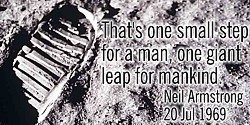
That’s one small step for a man, one giant leap for mankind.
[Transmission received and heard as “That’s one small step for man… one giant leap for mankind.”]
[Transmission received and heard as “That’s one small step for man… one giant leap for mankind.”]
Said as he stepped onto the Moon at 10.56 (G.M.T) on July 21st 1969. However, this is often misquoted as “That’s one small step for man, one giant leap for mankind.” This was due to static during Armstrong's transmission to earth. The 'a' was left out of his statement, ruining the contrast he had made between one man 'a man' and all mankind 'man'. Quoted in Nature, 1974, 250, 451. Information on the frequent misuse of this quote is given in Paul F. Boller and John George (eds.), They Never Said it: A Book of Fake Quotes, Misquotes and Misleading Attributions (1989), 4-5.
The “control of nature” is a phrase conceived in arrogance, born of the Neanderthal age of biology and the convenience of man.
In Silent Spring (1962), 297.
The [Moon] surface is fine and powdery. I can kick it up loosely with my toe. It does adhere in fine layers like powdered charcoal to the sole and sides of my boots. I only go in a small fraction of an inch, maybe an eighth of an inch, but I can see the footprints of my boots and the treads in the fine sandy particles.
[First report, immediately after stepping on to the Moon and saying “That's one small step for (a) man; one giant leap for mankind.”]
[First report, immediately after stepping on to the Moon and saying “That's one small step for (a) man; one giant leap for mankind.”]
NASA web site. Also in David Michael Harland, The First Men on the Moon: the Story of Apollo 11 (2007), 461.
The achievements of the Beagle did not just depend on FitzRoy’s skill as a hydrographer, nor on Darwin’s skill as a natural scientist, but on the thoroughly effective fashion in which everyone on board pulled together. Of course Darwin and FitzRoy had their quarrels, but all things considered, they were remarkably infrequent. To have shared such cramped quarters for nearly five years with a man often suffering from serious depression, prostrate part of the time with sea sickness, with so little friction, Darwin must have been one of the best-natured
people ever! This is, indeed, apparent in his letters. And anyone who has participated in a scientific expedition will agree that when he wrote from Valparaiso in July 1834 that ‘The Captain keeps all smooth by rowing everyone in turn, which of course he has as much right to do as a gamekeeper to shoot partridges on the first of September’, he was putting a finger on an important ingredient in the Beagle’s success.
From Introduction to The Beagle Record (1979, 2012), 9.
The advance of science has enabled man to communicate at twice the speed of sound while he still acts at half the speed of sense.
In Evan Esar, 20,000 Quips & Quotes (1968, 1995), 159.
The advances of biology during the past 20 years have been breathtaking, particularly in cracking the mystery of heredity. Nevertheless, the greatest and most difficult problems still lie ahead. The discoveries of the 1970‘s about the chemical roots of memory in nerve cells or the basis of learning, about the complex behavior of man and animals, the nature of growth, development, disease and aging will be at least as fundamental and spectacular as those of the recent past.
As quoted in 'H. Bentley Glass', New York Times (12 Jan 1970), 96.
The ages have been at work on it and man can only mar it.
…...
The air, the water and the ground are free gifts to man and no one has the power to portion them out in parcels. Man must drink and breathe and walk and therefore each man has a right to his share of each.
The Prairie (1827).
The Almighty lecturer, by displaying the principles of science in the structure of the universe, has invited man to study and to imitation. It is as if he had said to the inhabitants of this globe that we call ours, “I have made an earth for man to dwell upon, and I have rendered the starry heavens visible, to teach him science and the arts. He can now provide for his own comfort, and learn from my munificence to all, to be kind to all, to be kind to each other.”
In The Age of Reason: Being an Investigation of True and Fabulous Theology (27 Jan O.S. 1794), 44.
The alternating current will kill people, of course. So will gunpowder, and dynamite, and whisky, and lots of other things; but we have a system whereby the deadly electricity of the alternating current can do no harm unless a man is fool enough to swallow a whole dynamo.
(1884). As quoted in Francis Ellington Leupp, George Westinghouse: His Life and Achievements (1918), 149.
The analysis of man discloses three chemical elements - a job, a meal and a woman.
The anatomy of a little child, representing all parts thereof, is accounted a greater rarity than the skeleton of a man in full stature.
In The Church History of Britain (1842), Vol. 1, 165. Fuller’s context was to compare being studious in antiquity with after-ages when perfected.
The ancestors of the higher animals must be regarded as one-celled beings, similar to the Amœbæ which at the present day occur in our rivers, pools, and lakes. The incontrovertible fact that each human individual develops from an egg, which, in common with those of all animals, is a simple cell, most clearly proves that the most remote ancestors of man were primordial animals of this sort, of a form equivalent to a simple cell. When, therefore, the theory of the animal descent of man is condemned as a “horrible, shocking, and immoral” doctrine, tho unalterable fact, which can be proved at any moment under the microscope, that the human egg is a simple cell, which is in no way different to those of other mammals, must equally be pronounced “horrible, shocking, and immoral.”
Translated from his Ueber die Entstehung und den Stammbaum des Menschengeschlechts, (1873), Vol. 2, as an epigraph to Chap. 6, The Evolution of Man, (1879), Vol 1, 120-121.
The ancients thought as clearly as we do, had greater skills in the arts and in architecture, but they had never learned the use of the great instrument which has given man control over nature—experiment.
Address at the opening of the new Pathological Institute of the Royal Infirmary, Glasgow (4 Oct 1911). Printed in 'The Pathological Institute of a General Hospital', Glasgow Medical Journal (1911), 76, 327.
The animal kingdom exhibits a series of mental developments which may be regarded as antecedents to the mental development of man, for the mental life of animals shows itself to be throughout, in its elements and in the general laws governing the combination of the elements, the same as the mental life of man.
Outline of Psychology (1902)
The art of writing history is the art of emphasizing the significant facts at the expense of the insignificant. And it is the same in every field of knowledge. Knowledge is power only if a man knows what facts not to bother about.
In The Orange Tree: A Volume of Essays (1926), 60.
The artist and the scientist—and the physician, in a sense, is both—is a man who is presumed to be interested primarily in his work, not in its emoluments. He can do genuinely good work, indeed, only to the extent that he is so interested. The moment he begins habitually to engage in enterprises that offer him only profit he ceases to be either an artist or a scientist, and becomes a mere journeyman artisan.
From Baltimore Evening Sun (12 May 1924). Collected in A Mencken Chrestomathy (1949, 1956), 297.
The astronomer who studies the motion of the stars is surely like a blind man who, with only a staff [mathematics] to guide him, must make a great, endless, hazardous journey that winds through innumerable desolate places. What will be the result? Proceeding anxiously for a while and groping his way with his staff, he will at some time, leaning upon it, cry out in despair to Heaven, Earth and all the Gods to aid him in his misery.
In The Sleepwalkers by Arthur Koestler (1968).
The attainment of knowledge is the high and exclusive attribute of man, among the numberless myriads of animated beings, inhabitants of the terrestrial globe. On him alone is bestowed, by the bounty of the Creator of the universe, the power and the capacity of acquiring knowledge. Knowledge is the attribute of his nature which at once enables him to improve his condition upon earth, and to prepare him for the enjoyment of a happier existence hereafter.
Report, as chairman of a committee, on the establishment of the Smithsonian Institution (Jan 1836). In Josiah Quincy, Memoir of the life of John Quincy Adams (1858), 265.
The attempted synthesis of paleontology and genetics, an essential part of the present study, may be particularly surprising and possibly hazardous. Not long ago, paleontologists felt that a geneticist was a person who shut himself in a room, pulled down the shades, watched small flies disporting themselves in milk bottles, and thought that he was studying nature. A pursuit so removed from the realities of life, they said, had no significance for the true biologist. On the other hand, the geneticists said that paleontology had no further contributions to make to biology, that its only point had been the completed demonstration of the truth of evolution, and that it was a subject too purely descriptive to merit the name 'science'. The paleontologist, they believed, is like a man who undertakes to study the principles of the internal combustion engine by standing on a street corner and watching the motor cars whiz by.
Tempo and Mode in Evolution (1944), 1.
The attitude which the man in the street unconsciously adopts towards science is capricious and varied. At one moment he scorns the scientist for a highbrow, at another anathematizes him for blasphemously undermining his religion; but at the mention of a name like Edison he falls into a coma of veneration. When he stops to think, he does recognize, however, that the whole atmosphere of the world in which he lives is tinged by science, as is shown most immediately and strikingly by our modern conveniences and material resources. A little deeper thinking shows him that the influence of science goes much farther and colors the entire mental outlook of modern civilised man on the world about him.
Reflections of a Physicist (1950), 81.
The beautiful has its place in mathematics as elsewhere. The prose of ordinary intercourse and of business correspondence might be held to be the most practical use to which language is put, but we should be poor indeed without the literature of imagination. Mathematics too has its triumphs of the Creative imagination, its beautiful theorems, its proofs and processes whose perfection of form has made them classic. He must be a “practical” man who can see no poetry in mathematics.
In A Scrap-book of Elementary Mathematics: Notes, Recreations, Essays (1908), 208.
The belief that all things are created solely for the utility of man has stained with many errors that most noble part of physics which deals with the ends of things.
R.W. Home (ed.), Aepinus's Essay on the Theory of Electricity and Magnetism (1979), 399.
The belief that mathematics, because it is abstract, because it is static and cold and gray, is detached from life, is a mistaken belief. Mathematics, even in its purest and most abstract estate, is not detached from life. It is just the ideal handling of the problems of life, as sculpture may idealize a human figure or as poetry or painting may idealize a figure or a scene. Mathematics is precisely the ideal handling of the problems of life, and the central ideas of the science, the great concepts about which its stately doctrines have been built up, are precisely the chief ideas with which life must always deal and which, as it tumbles and rolls about them through time and space, give it its interests and problems, and its order and rationality. That such is the case a few indications will suffice to show. The mathematical concepts of constant and variable are represented familiarly in life by the notions of fixedness and change. The concept of equation or that of an equational system, imposing restriction upon variability, is matched in life by the concept of natural and spiritual law, giving order to what were else chaotic change and providing partial freedom in lieu of none at all. What is known in mathematics under the name of limit is everywhere present in life in the guise of some ideal, some excellence high-dwelling among the rocks, an “ever flying perfect” as Emerson calls it, unto which we may approximate nearer and nearer, but which we can never quite attain, save in aspiration. The supreme concept of functionality finds its correlate in life in the all-pervasive sense of interdependence and mutual determination among the elements of the world. What is known in mathematics as transformation—that is, lawful transfer of attention, serving to match in orderly fashion the things of one system with those of another—is conceived in life as a process of transmutation by which, in the flux of the world, the content of the present has come out of the past and in its turn, in ceasing to be, gives birth to its successor, as the boy is father to the man and as things, in general, become what they are not. The mathematical concept of invariance and that of infinitude, especially the imposing doctrines that explain their meanings and bear their names—What are they but mathematicizations of that which has ever been the chief of life’s hopes and dreams, of that which has ever been the object of its deepest passion and of its dominant enterprise, I mean the finding of the worth that abides, the finding of permanence in the midst of change, and the discovery of a presence, in what has seemed to be a finite world, of being that is infinite? It is needless further to multiply examples of a correlation that is so abounding and complete as indeed to suggest a doubt whether it be juster to view mathematics as the abstract idealization of life than to regard life as the concrete realization of mathematics.
In 'The Humanization of Teaching of Mathematics', Science, New Series, 35, 645-46.
The best class of scientific mind is the same as the best class of business mind. The great desideratum in either case is to know how much evidence is enough to warrant action. It is as unbusiness-like to want too much evidence before buying or selling as to be content with too little. The same kind of qualities are wanted in either case. The difference is that if the business man makes a mistake, he commonly has to suffer for it, whereas it is rarely that scientific blundering, so long as it is confined to theory, entails loss on the blunderer. On the contrary it very often brings him fame, money and a pension. Hence the business man, if he is a good one, will take greater care not to overdo or underdo things than the scientific man can reasonably be expected to take.
Samuel Butler, Henry Festing Jones (ed.), The Note-Books of Samuel Butler (1917), 217.
The best person to decide what research shall be done is the man who is doing the research. The next best is the head of the department. After that you leave the field of best persons and meet increasingly worse groups. The first of these is the research director, who is probably wrong more than half the time. Then comes a committee which is wrong most of the time. Finally there is a committee of company vice-presidents, which is wrong all the time.
1935, in Biographical Memoirs of Fellows of the Royal Society, 1961.
The Bible is like a telescope. If a man looks through his telescope, then he sees worlds beyond; but, if he looks at his telescope, then he does not see anything but that.
In Proverbs from Plymouth Pulpit (1887), 136.
The bird is a creature of the air, the fish is a creature of the water, and man is a creature of the mind.
In From Atlantis to the Sphinx (1996), 347.
The blood, the fountain whence the spirits flow,
The generous stream that waters every part,
And motion, vigour, and warm life conveys
To every Particle that moves or lives;
This vital fluid, thro' unnumber'd tubes
Pour'd by the heart, and to the heart again
Refunded; scourg'd forever round and round;
Enrag'd with heat and toil, at last forgets
Its balmy nature; virulent and thin
It grows; and now, but that a thousand gates
Are open to its flight, it would destroy
The parts it cherish' d and repair'd before.
Besides, the flexible and tender tubes
Melt in the mildest, most nectareous tide
That ripening Nature rolls; as in the stream
Its crumbling banks; but what the vital force
Of plastic fluids hourly batters down,
That very force, those plastic particles
Rebuild: so mutable the state of man.
For this the watchful appetite was given,
Daily with fresh materials to repair
This unavoidable expense of life,
This necessary waste of flesh and blood.
Hence the concoctive powers, with various art,
Subdue the cruder aliments to chyle;
The chyle to blood; the foamy purple tide
To liquors, which through finer arteries
To different parts their winding course pursue;
To try new changes, and new forms put on,
Or for the public, or some private use.
The generous stream that waters every part,
And motion, vigour, and warm life conveys
To every Particle that moves or lives;
This vital fluid, thro' unnumber'd tubes
Pour'd by the heart, and to the heart again
Refunded; scourg'd forever round and round;
Enrag'd with heat and toil, at last forgets
Its balmy nature; virulent and thin
It grows; and now, but that a thousand gates
Are open to its flight, it would destroy
The parts it cherish' d and repair'd before.
Besides, the flexible and tender tubes
Melt in the mildest, most nectareous tide
That ripening Nature rolls; as in the stream
Its crumbling banks; but what the vital force
Of plastic fluids hourly batters down,
That very force, those plastic particles
Rebuild: so mutable the state of man.
For this the watchful appetite was given,
Daily with fresh materials to repair
This unavoidable expense of life,
This necessary waste of flesh and blood.
Hence the concoctive powers, with various art,
Subdue the cruder aliments to chyle;
The chyle to blood; the foamy purple tide
To liquors, which through finer arteries
To different parts their winding course pursue;
To try new changes, and new forms put on,
Or for the public, or some private use.
The Art of Preserving Health (1744), book 2, I. 12-23, p.15-16.
The body [of man] is but a pair of pincers set over a bellows and a stew pan and the whole thing fixed on stilts.
Samuel Butler, Henry Festing Jones (ed.), The Note-Books of Samuel Butler (1917), 18.
The body of man has in itself blood, phlegm, yellow bile and black bile; these make up the nature of this body, and through these he feels pain or enjoys health. Now he enjoys the most perfect health when these elements are duly proportioned to one another in respect of compounding, power and bulk, and when they are perfectly mingled.
Nature of Man, in Hippocrates, trans. W. H. S. Jones (1931), Vol. 4, II.
The book of Nature is the book of Fate. She turns the gigantic pages,—leaf after leaf,—never re-turning one. One leaf she lays down, a floor of granite; then a thousand ages, and a bed of slate; a thousand ages, and a measure of coal; a thousand ages, and a layer of marl and mud: vegetable forms appear; her first misshapen animals, zoophyte, trilobium, fish; then, saurians,—rude forms, in which she has only blocked her future statue, concealing under these unwieldy monsters the fine type of her coming king. The face of the planet cools and dries, the races meliorate, and man is born. But when a race has lived its term, it comes no more again.
From 'Fate', collected in The Complete Works of Ralph Waldo Emerson, Volume 6: The Conduct of Life (1860), 15. This paragraph is the prose version of his poem, 'Song of Nature'.
The brain of man, like that of all animals is double, being parted down its centre by a thin membrane. For this reason pain is not always felt in the same part of the head, but sometimes on one side, sometimes on the other, and occasionally all over.
The Sacred Disease, in Hippocrates, trans. W. H. S. Jones (1923), Vol. 2, 153.
The brown and charred rags that hung from the sides of it, I presently recognized as the decaying vestiges of books. They had long since dropped to pieces, and every semblance of print had left them. … Had I been a literary man I might, perhaps, have moralized upon the futility of all ambition.
In The Time Machine (1898), 160.
The century of biology upon which we are now well embarked is no matter of trivialities. It is a movement of really heroic dimensions, one of the great episodes in man’s intellectual history. The scientists who are carrying the movement forward talk in terms of nucleo-proteins, of ultracentrifuges, of biochemical genetics, of electrophoresis, of the electron microscope, of molecular morphology, of radioactive isotopes. But do not be misled by these horrendous terms, and above all do not be fooled into thinking this is mere gadgetry. This is the dependable way to seek a solution of the cancer and polio problems, the problems of rheumatism and of the heart. This is the knowledge on which we must base our solution of the population and food problems. This is the understanding of life.
Letter to H. M. H. Carsan (17 Jun 1949). Quoted in Raymond B. Fosdick, The Story of the Rockefeller Foundation (1952), 166.
The chemist works along his own brilliant line of discovery and exposition; the astronomer has his special field to explore; the geologist has a well-defined sphere to occupy. It is manifest, however, that not one of these men can tell the whole tale, and make a complete story of creation. Another man is wanted. A man who, though not necessarily going into formal science, sees the whole idea, and speaks of it in its unity. This man is the theologian. He is not a chemist, an astronomer, a geologist, a botanist——he is more: he speaks of circles, not of segments; of principles, not of facts; of causes and purposes rather than of effects and appearances. Not that the latter are excluded from his study, but that they are so wisely included in it as to be put in their proper places.
In The People's Bible: Discourses Upon Holy Scripture: Vol. 1. Genesis (1885), 120.
The chief malady of man is restless curiosity about things which he cannot understand; and it is not so bad for him to be in error as to be curious to no purpose.
In Pensées. As translated by W.F. Trotter in Blaise Pascal: Thoughts, Letters, and Minor Works (1910), 13.
The childhood shows the man
As morning shows the day.
As morning shows the day.
From 'Paradise Regain’d', Book 4, collected in Samuel Johnson (ed.), The Works of the English Poets: Volume the Fourth: The Poems of Milton: Volume II (1779), 208.
The Chinese, who aspire to be thought an enlightened nation, to this day are ignorant of the circulation of the blood; and even in England the man who made that noble discovery lost all his practice in the consequence of his ingenuity; and Hume informs us that no physician in the United Kingdom who had attained the age of forty ever submitted to become a convert to Harvey’s theory, but went on preferring numpsimus to sumpsimus to the day of his death.
Reflection 352, in Lacon: or Many things in Few Words; Addressed to Those Who Think (1820), 164-165.
The Christian church, in its attitude toward science, shows the mind of a more or less enlightened man of the Thirteenth Century. It no longer believes that the earth is flat, but it is still convinced that prayer can cure after medicine fails.
…...
The cigar-box which the European calls a 'lift' needs but to be compared with our elevators to be appreciated. The lift stops to reflect between floors. That is all right in a hearse, but not in elevators. The American elevator acts like a man's patent purge—it works.
Speech to the St. Nicholas Society, New York, 'Municipal Government' (6 Dec 1900). In Mark Twain's Speeches (1910). In Mark Twain and Brian Collins (ed.), When in Doubt, Tell the Truth: and Other Quotations from Mark Twain (1996), 44.
The classification of facts and the formation of absolute judgments upon the basis of this classification—judgments independent of the idiosyncrasies of the individual mind—essentially sum up the aim and method of modern science. The scientific man has above all things to strive at self-elimination in his judgments, to provide an argument which is as true for each individual mind as for his own.
From The Grammar of Science (1892), 7-8.
The combination in time and space of all these thoughtful conceptions [of Nature] exhibits not only thought, it shows also premeditation, power, wisdom, greatness, prescience, omniscience, providence. In one word, all these facts in their natural connection proclaim aloud the One God, whom man may know, adore, and love; and Natural History must in good time become the analysis of the thoughts of the Creator of the Universe….
In Essay on Classification (1851), 205.
The concept of number is the obvious distinction between the beast and man. Thanks to number, the cry becomes a song, noise acquires rhythm, the spring is transformed into a dance, force becomes dynamic, and outlines figures.
Epigraph, without citation, in Corrective and Social Psychiatry and Journal of Behavior Technology Methods and Therapy (1966), Vol. 12, 409.
The conservative has but little to fear from the man whose reason is the servant of his passions, but let him beware of him in whom reason has become the greatest and most terrible of the passions.
In Daedalus, or Science and the Future (1923).
The consideration of mathematics is at the base of knowledge of the mind as it is at the base of the natural sciences, and for the same reason: the free and fertile work of thought dates from that epoch when mathematics brought to man the true norm of truth.
As translated in James Byrnie Shaw, Lectures on the Philosophy of Mathematics (1918), 193. From Léon Brunschvicg, Les Étapes de La Philosophie Mathématique (1912), 577, “La considération de la mathématique est à la base de la connaissance de l’esprit comme elle est à la
base des sciences de la nature, et pour une même raison: l’œuvre libre et féconde de la pensée date de l’époque où la mathématique vint apporter à l’homme la norme véritable de la vérité.”
The contemplation of celestial things will make a man both speak and think more sublimely and magnificently when he descends to human affairs.
In Louis Klopsch, Many Thoughts of Many Minds (1896), 18.
The cooperative forces are biologically the more important and vital. The balance between the cooperative and altruistic tendencies and those which are disoperative and egoistic is relatively close. Under many conditions the cooperative forces lose. In the long run, however, the group centered, more altruistic drives are slightly stronger. … human altruistic drives are as firmly based on an animal ancestry as is man himself. Our tendencies toward goodness, such as they are, are as innate as our tendencies toward intelligence; we could do well with more of both.
In 'Where Angels Fear to Tread: A Contribution From General Sociology to Human Ethics', Science (11 Jun 1943), 97, No. 2528, 521.
the Courts of Justice had once ruled that a man carrying bagpipes was a man carrying a weapon—so inspiring was the music of the pipers to the clans in battle.
The Reader
The creative element in the mind of man … emerges in as mysterious a fashion as those elementary particles which leap into momentary existence in great cyclotrons, only to vanish again like infinitesimal ghosts.
In The Night Country (1971, 1997), 215.
The creative life [is] the only one for a serious man.
In A Mathematician's Apology (1940, 2012), 53.
The crown and glory of life is Character. It is the noblest possession of a man, constituting a rank in itself, and an estate in the general goodwill; dignifying every station, and exalting every position in society. It exercises a greater power than wealth, and secures all the honour without the jealousies of fame. It carries with it an influence which always tells; for it is the result of proved honour, rectitude, and consistency—qualities which, perhaps more than any other, command the general confidence and respect of mankind.
In Self-help: With Illustrations of Character and Conduct (1859, 1861), 396.
The cultivation of the mind is a kind of food supplied for the soul of man.
From De Finibus Bonorum et Malorum (45-44 B.C.) Vol. 19. As quoted in Carl Sagan, Broca’s Brain: Reflections on the Romance of Science (1986), 38.
The day will come when some more powerful man will get fame and riches from my invention, but nobody will believe that poor John Fitch can do anything worthy of attention.
Quoted from his manuscript autobiography (cited as in the Franklin Library, Philadelphia), in James T. Lloyd, Lloyd's Steamboat Directory: And Disasters of the Western Waters (1856), 24.
The degree 48 … in my thermometers holds the middle between between the limit of the most intense cold obtained artificially in a mixture of water, of ice and of sal-ammoniac or even of sea-salt, and the limit of heat which is found in the blood of a healthy man.
From 'Experimenta circa gradum caloris liquorum nonnullorum ebullientium instituta', Philosophical Transactions (1724), 33, 1, as translated in William Francis Magie, A Source Book in Physics (1935), 131. Hence, Fahrenheit specified the upper and lower fixed points of his temperature scale, ranging from 0 to 96.
The demand for certainty is one which is natural to man, but is nevertheless an intellectual vice. If you take your children for a picnic on a doubtful day, they will demand a dogmatic answer as to whether it will be fine or wet, and be disappointed in you when you cannot be sure.
From 'Philosophy For Laymen', collected in Unpopular Essays (1950, 1996), 38. This idea may be summarized as “What men want is not knowledge, but certainty” — a widely circulated aphorism attributed to Russell, but for which Webmaster has so far found no citation. (Perhaps it is a summary, never expressed in those exact words, but if you know the primary source, please contact Webmaster.)
The design of a book is the pattern of reality controlled and shaped by the mind of the writer. This is completely understood about poetry or fiction, but it is too seldom realized about books of fact. And yet the impulse which drives a man to poetry will send a man into the tide pools and force him to report what he finds there. Why is an expedition to Tibet undertaken, or a sea bottom dredged? Why do men, sitting at the microscope, examine the calcareous plates of a sea cucumber and give the new species a name, and write about it possessively? It would be good to know the impulse truly, not to be confused by the “services to science” platitudes or the other little mazes into which we entice our minds so that they will not know what we are doing.
In John Steinbeck and Edward Flanders Ricketts, Introduction to Sea of Cortez: a Leisurely Journal of Travel and Research (1941), opening paragraph. John Steinbeck had an interest in marine science before he met Ricketts. This book is an account of their trip in the Gulf of California, once called the Sea of Cortez, and recording the marine life to be found there.
The determination of the average man is not merely a matter of speculative curiosity; it may be of the most important service to the science of man and the social system. It ought necessarily to precede every other inquiry into social physics, since it is, as it were, the basis. The average man, indeed, is in a nation what the centre of gravity is in a body; it is by having that central point in view that we arrive at the apprehension of all the phenomena of equilibrium and motion.
A Treatise on Man and the Development of his Faculties (1842). Reprinted with an introduction by Solomon Diamond (1969), 96.
The determination of the value of an item must not be based on its price, but rather on the utility it yields. The price of the item is dependent only on the thing itself and is equal for everyone; the utility, however, is dependent on the particular circumstances of the person making the estimate. Thus there is no doubt that a gain of one thousand ducats is more significant to a pauper than to a rich man though both gain the same amount.
Exposition of a New Theory on the Measurement of Risk (1738), 24.
The difference between an ordinary mind and the mind of Newton consists principally in this, that the one is capable of a more continuous attention than the other,—that a Newton is able, without fatigue, to connect inference with inference in one long series towards a determinate end; while the man of inferior capacity is soon obliged to break or let full the thread which lie had begun to spin.
In Lectures on Metaphysics and Logic (1860), Vol. 1, 178.
The difficulties connected with my criterion of demarcation (D) are important, but must not be exaggerated. It is vague, since it is a methodological rule, and since the demarcation between science and nonscience is vague. But it is more than sharp enough to make a distinction between many physical theories on the one hand, and metaphysical theories, such as psychoanalysis, or Marxism (in its present form), on the other. This is, of course, one of my main theses; and nobody who has not understood it can be said to have understood my theory.
The situation with Marxism is, incidentally, very different from that with psychoanalysis. Marxism was once a scientific theory: it predicted that capitalism would lead to increasing misery and, through a more or less mild revolution, to socialism; it predicted that this would happen first in the technically highest developed countries; and it predicted that the technical evolution of the 'means of production' would lead to social, political, and ideological developments, rather than the other way round.
But the (so-called) socialist revolution came first in one of the technically backward countries. And instead of the means of production producing a new ideology, it was Lenin's and Stalin's ideology that Russia must push forward with its industrialization ('Socialism is dictatorship of the proletariat plus electrification') which promoted the new development of the means of production.
Thus one might say that Marxism was once a science, but one which was refuted by some of the facts which happened to clash with its predictions (I have here mentioned just a few of these facts).
However, Marxism is no longer a science; for it broke the methodological rule that we must accept falsification, and it immunized itself against the most blatant refutations of its predictions. Ever since then, it can be described only as nonscience—as a metaphysical dream, if you like, married to a cruel reality.
Psychoanalysis is a very different case. It is an interesting psychological metaphysics (and no doubt there is some truth in it, as there is so often in metaphysical ideas), but it never was a science. There may be lots of people who are Freudian or Adlerian cases: Freud himself was clearly a Freudian case, and Adler an Adlerian case. But what prevents their theories from being scientific in the sense here described is, very simply, that they do not exclude any physically possible human behaviour. Whatever anybody may do is, in principle, explicable in Freudian or Adlerian terms. (Adler's break with Freud was more Adlerian than Freudian, but Freud never looked on it as a refutation of his theory.)
The point is very clear. Neither Freud nor Adler excludes any particular person's acting in any particular way, whatever the outward circumstances. Whether a man sacrificed his life to rescue a drowning, child (a case of sublimation) or whether he murdered the child by drowning him (a case of repression) could not possibly be predicted or excluded by Freud's theory; the theory was compatible with everything that could happen—even without any special immunization treatment.
Thus while Marxism became non-scientific by its adoption of an immunizing strategy, psychoanalysis was immune to start with, and remained so. In contrast, most physical theories are pretty free of immunizing tactics and highly falsifiable to start with. As a rule, they exclude an infinity of conceivable possibilities.
The situation with Marxism is, incidentally, very different from that with psychoanalysis. Marxism was once a scientific theory: it predicted that capitalism would lead to increasing misery and, through a more or less mild revolution, to socialism; it predicted that this would happen first in the technically highest developed countries; and it predicted that the technical evolution of the 'means of production' would lead to social, political, and ideological developments, rather than the other way round.
But the (so-called) socialist revolution came first in one of the technically backward countries. And instead of the means of production producing a new ideology, it was Lenin's and Stalin's ideology that Russia must push forward with its industrialization ('Socialism is dictatorship of the proletariat plus electrification') which promoted the new development of the means of production.
Thus one might say that Marxism was once a science, but one which was refuted by some of the facts which happened to clash with its predictions (I have here mentioned just a few of these facts).
However, Marxism is no longer a science; for it broke the methodological rule that we must accept falsification, and it immunized itself against the most blatant refutations of its predictions. Ever since then, it can be described only as nonscience—as a metaphysical dream, if you like, married to a cruel reality.
Psychoanalysis is a very different case. It is an interesting psychological metaphysics (and no doubt there is some truth in it, as there is so often in metaphysical ideas), but it never was a science. There may be lots of people who are Freudian or Adlerian cases: Freud himself was clearly a Freudian case, and Adler an Adlerian case. But what prevents their theories from being scientific in the sense here described is, very simply, that they do not exclude any physically possible human behaviour. Whatever anybody may do is, in principle, explicable in Freudian or Adlerian terms. (Adler's break with Freud was more Adlerian than Freudian, but Freud never looked on it as a refutation of his theory.)
The point is very clear. Neither Freud nor Adler excludes any particular person's acting in any particular way, whatever the outward circumstances. Whether a man sacrificed his life to rescue a drowning, child (a case of sublimation) or whether he murdered the child by drowning him (a case of repression) could not possibly be predicted or excluded by Freud's theory; the theory was compatible with everything that could happen—even without any special immunization treatment.
Thus while Marxism became non-scientific by its adoption of an immunizing strategy, psychoanalysis was immune to start with, and remained so. In contrast, most physical theories are pretty free of immunizing tactics and highly falsifiable to start with. As a rule, they exclude an infinity of conceivable possibilities.
'The Problem of Demarcation' (1974). Collected in David Miller (ed.) Popper Selections (1985), 127-128.
The dignity of this end of endowment of man's life with new commodity appeareth by the estimation that antiquity made of such as guided thereunto ; for whereas founders of states, lawgivers, extirpators of tyrants, fathers of the people, were honoured but with the titles of demigods, inventors ere ever consecrated among the gods themselves.
Bacon and Basil Montagu (Ed.), 'Fragments of Valerius Terminus, on the Interpretation of Nature', Works of Bacon (1825), vol. 1., 266. Quoted in The Origin and Progress of the Mechanical Inventions of James Watt (1854), Vol.1, 2.
The discerning man who acknowledges his limitations is not far off perfection.
In The Maxims and Reflections of Goethe (1906), 200.
The doctrine of Darwinism had been tritely summed up in the saying, “from mud to monkey, from monkey up to man.”
Quoted by J.J. Morse in a lecture at Cardiff, reported by A.J. Smith in 'Spiritualism in the Principality: Mr Morse at Cardiff', The Medium and Daybreak (17 May 1878), 307.
The doctrine of foods is of great ethical and political significance. Food becomes blood, blood becomes heart and brain, thoughts and mind stuff. Human fare is the foundation of human culture and thought. Would you improve a nation? Give it, instead of declamations against sin, better food. Man is what he eats [Der Mensch ist, was er isst].
Advertisement to Moleschott, Lehre der Nahrungsmittel: Für das Volk (1850).
The domain of mathematics is the sole domain of certainty. There and there alone prevail the standards by which every hypothesis respecting the external universe and all observation and all experiment must be finally judged. It is the realm to which all speculation and thought must repair for chastening and sanitation, the court of last resort, I say it reverently, for all intellection whatsoever, whether of demon, or man, or deity. It is there that mind as mind attains its highest estate.
In 'The Universe and Beyond', Hibbert Journal (1904-1906), 3, 314.
The doubter is a true man of science: he doubts only himself and his interpretations, but he believes in science.
In Fielding Hudson Garrison, An Introduction to the History of Medicine (1929), 14.
The drive behind life has lost none of its power; proof that, impelled by that drive, man can build as well as destroy; that in his nature is more of Vishnu the Creator than of Siva the Destroyer.
From Why We Behave Like Human Beings (1925), 479.
The dropping of the Atomic Bomb is a very deep problem… Instead of commemorating Hiroshima we should celebrate… man’s triumph over the problem [of transmutation], and not its first misuse by politicians and military authorities.
Address to New Europe Group meeting on the third anniversary of the Hiroshima bomb. Quoted in New Europe Group, In Commemoration of Professor Frederick Soddy (1956), 6-7.
The earliest of my childhood recollections is being taken by my grandfather when he set out in the first warm days of early spring with a grubbing hoe (we called it a mattock) on his shoulder to seek the plants, the barks and roots from which the spring medicine for the household was prepared. If I could but remember all that went into that mysterious decoction and the exact method of preparation, and with judicious advertisement put the product upon the market, I would shortly be possessed of wealth which might be made to serve the useful purpose of increasing the salaries of all pathologists. … But, alas! I remember only that the basic ingredients were dogwood bark and sassafras root, and to these were added q.s. bloodroot, poke and yellow dock. That the medicine benefited my grandfather I have every reason to believe, for he was a hale, strong old man, firm in body and mind until the infection came against which even spring medicine was of no avail. That the medicine did me good I well know, for I can see before me even now the green on the south hillside of the old pasture, the sunlight in the strip of wood where the dogwood grew, the bright blossoms and the delicate pale green of the leaf of the sanguinaria, and the even lighter green of the tender buds of the sassafras in the hedgerow, and it is good to have such pictures deeply engraved in the memory.
From address, 'A Medical Retrospect'. Published in Yale Medical Journal (Oct 1910), 17, No. 2, 57. [Note: q.s. in an abbreviation for quantum sufficit meaning “as much as is sufficient,” when used as a quantity specification in medicine and pharmacology. -Webmaster]
The Earth reminded us of a Christmas tree ornament hanging in the blackness of space. As we got farther and farther away it diminished in size. Finally it shrank to the size of a marble, the most beautiful marble you can imagine. That beautiful, warm, living object looked so fragile, so delicate, that if you touched it with a finger it would crumble and fall apart. Seeing this has to change a man, has to make a man appreciate the creation of God and the love of God.
…...
The educated man is a greater nuisance than the uneducated one.
Back to Methuselah: A Metabiological Pentateuch (1921), xii.
The enchanting charms of this sublime science reveal only to those who have the courage to go deeply into it. But when a woman, who because of her sex and our prejudices encounters infinitely more obstacles that an man in familiarizing herself with complicated problems, succeeds nevertheless in surmounting these obstacles and penetrating the most obscure parts of them, without doubt she must have the noblest courage, quite extraordinary talents and superior genius.
in a letter to Sophie Germain (c.April 1807)
The energy available for each individual man is his income, and the philosophy which can teach him to be content with penury should be capable of teaching him also the uses of wealth.
Science and Life: Aberdeen Addresses (1920), 6.
The engineer is the key figure in the material progress of the world. It is his engineering that makes a reality of the potential value of science by translating scientific knowledge into tools, resources, energy and labor to bring them to the service of man ... To make contribution of this kind the engineer requires the imagination to visualize the needs of society and to appreciate what is possible as well as the technological and broad social age understanding to bring his vision to reality.
In Philip Sporn, Foundations of Engineering: Cornell College of Engineering Lectures, Spring 1963 (1964), 22.
The errors of a wise man are literally more instructive than the truths of a fool. The wise man travels in lofty, far-seeing regions; the fool in low-lying, high-fenced lanes; retracing the footsteps of the former, to discover where he diviated, whole provinces of the universe are laid open to us; in the path of the latter, granting even that he has not deviated at all, little is laid open to us but two wheel-ruts and two hedges.
In James Wood, Dictionary of Quotations from Ancient and Modern, English and Foreign Sources (1893), 425:26.
The essence of modernity is that progress no longer waits on genius; instead we have learned to put our faith in the organized efforts of ordinary men. Science is as old as the race, but the effective organization of science is new. Ancient science, like placer mining, was a pursuit of solitary prospectors. Nuggets of truth were found, but the total wealth of knowledge increased slowly. Modern man began to transform this world when he began to mine the hidden veins of knowledge systematically.
In School and Society (1930), 31, 581.
The ethics of science regards the search for truth as one of the highest duties of man; it regards noble human character as the finest product of evolution; it considers the service of all mankind as the universal good; it teaches that human nature and humane nurture may be improved, that reason may replace unreason, cooperation supplement competition, and the progress of the human race through future ages be promoted by intelligence and goodwill.
From Address as retiring president before the American Association for the Advancement of Science, Indianapolis (27 Dec 1937). Published in 'Science and Ethics', Science (31 Dec 1937), 86, No. 2244, 602.
The evidence indicates that woman is, on the whole, biologically superior to man.
In The Natural Superiority of Women (1952, 1999), 91.
The evolution of the human race will not be accomplished in the ten thousand years of tame animals, but in the million years of wild animals, because man is, and always will be, a wild animal.
The Next Million Years (1953),133.
The exploration of space—by men and machines, for each complements the other—will be a continuing process with countless goals, but no final end.
In The View from Serendip (1977), 87.
The fact that human life can be prolonged with fewer physical problems requires that we give increasing attention to improving the quality of life. As the poet Edwin Markham stated: “We are all fools until we know that in the common plan, nothing is worth the building if it does not build the man; why build these temples glorious, if man unbuilded goes?”
In 'Millenial Musings', Chemical & Engineering News (6 Dec 1999), 77, No. 49, 48.
The fact that man knows right from wrong proves his intellectual superiority to other creatures; but the fact that he can do wrong proves his moral inferiority to any creature that cannot.
Spoken by Old Man in What is Man? In What is Man? and Other Essays (1917), 89.
The fact that man produces a concept ‘I’ besides the totality of his mental and emotional experiences or perceptions does not prove that there must be any specific existence behind such a concept. We are succumbing to illusions produced by our self-created language, without reaching a better understanding of anything. Most of so-called philosophy is due to this kind of fallacy.
…...
The fairest thing we can experience is the mysterious. It is the fundamental emotion which stands at the cradle of true art and true science. He who knows it not and can no longer wonder, no longer feel amazement, is as good as dead, a snuffed-out candle. It was the experience of mystery–even if mixed with fear–that engendered religion. A knowledge of the existence of something we cannot penetrate, of the manifestations of the profoundest reason and the most radiant beauty, which are only accessible to our reason in their most elementary forms–it is this knowledge and this emotion that constitute the truly religious attitude; in this sense, and in this alone, I am a deeply religious man.
From 'What I Believe: Living Philosophies XIII', Forum and Century (Oct 1930), 84, No. 4, 193-194. Alan Harris (trans.), The World as I See It (1956, 1993), 5.
The fateful question for the human species seems to me to be whether and to what extent their cultural development will succeed in mastering the disturbance of their communal life by the human instinct of aggression and self-destruction … One thing only do I know for certain and that is that man's judgements of value follow directly from his wihes for happiness—that, accordingly, they are an attempt to support his illusions with arguments. (1930)
Civilization and its Discontents (2005), 154.
The first [quality] to be named must always be the power of attention, of giving one's whole mind to the patient without the interposition of anything of oneself. It sounds simple but only the very greatest doctors ever fully attain it. … The second thing to be striven for is intuition. This sounds an impossibility, for who can control that small quiet monitor? But intuition is only interference from experience stored and not actively recalled. … The last aptitude I shall mention that must be attained by the good physician is that of handling the sick man's mind.
In 'Art and Science in Medicine', The Collected Papers of Wilfred Trotter, FRS (1941), 98.
The first attribute that characterizes the greater man from the moron is his thicker layer of inhibition."
The first business of a man of science is to proclaim the truth as he finds it, and let the world adjust itself as best it can to the new knowledge.
Letter to R. M. Hunter, 23 October 1919. In Maila L. Walter, Science and Cultural Crisis: An Intellectual Biography of Percy Williams Bridgman (1990), 32.
The first man of science was he who looked into a thing, not to learn whether it furnished him with food, or shelter, or weapons, or tools, armaments, or playwiths but who sought to know it for the gratification of knowing.
In Samuel Taylor Coleridge and Ernest Hartley Coleridge (ed.), 'Chapter IX: 1814-1818', Anima Poetæ from the Unpublished Note-books of Samuel Taylor Coleridge (1895),
The first man who said “fire burns” was employing scientific method, at any rate if he had allowed himself to be burnt several times. This man had already passed through the two stages of observation and generalization. He had not, however, what scientific technique demands—a careful choice of significant facts on the one hand, and, on the other hand, various means of arriving at laws otherwise than my mere generalization. (1931)
In The Scientific Outlook (1931, 2009), 3.
The first question which you will ask and which I must try to answer is this, “What is the use of climbing Mount Everest ?” and my answer must at once be, “It is no use.” There is not the slightest prospect of any gain whatsoever. Oh, we may learn a little about the behavior of the human body at high altitudes, and possibly medical men may turn our observation to some account for the purposes of aviation. But otherwise nothing will come of it. We shall not bring back a single bit of gold or silver, not a gem, nor any coal or iron. We shall not find a single foot of earth that can be planted with crops to raise food. It’s no use. So, if you cannot understand that there is something in man which responds to the challenge of this mountain and goes out to meet it, that the struggle is the struggle of life itself upward and forever upward, then you won’t see why we go. What we get from this adventure is just sheer joy. And joy is, after all, the end of life. We do not live to eat and make money. We eat and make money to be able to enjoy life. That is what life means and what life is for.
…...
The first thing the reasonable man must do is to be content with a very little knowledge and a very great deal of ignorance. The second thing he must do is to make the utmost possible use of the knowledge he has and not waste his energy crying for the moon. The third thing he must do is try and see clearly where his knowledge ends and his ignorance begins.
Scientific Method: An Inquiry into the Character and Validy of Natural Law (1923), 177.
The following general conclusions are drawn from the propositions stated above, and known facts with reference to the mechanics of animal and vegetable bodies:—
There is at present in the material world a universal tendency to the dissipation of mechanical energy.
Any restoration of mechanical energy, without more than an equivalent of dissipation, is impossible in inanimate material processes, and is probably never effected by means of organized matter, either endowed with vegetable life, or subjected to the will of an animated creature.
Within a finite period of time past the earth must have been, and within a finite period of time to come the earth must again be, unfit for the habitation of man as at present constituted, unless operations have been, or are to be performed, which are impossible under the laws to which the known operations going on at present in the material world are subject.
There is at present in the material world a universal tendency to the dissipation of mechanical energy.
Any restoration of mechanical energy, without more than an equivalent of dissipation, is impossible in inanimate material processes, and is probably never effected by means of organized matter, either endowed with vegetable life, or subjected to the will of an animated creature.
Within a finite period of time past the earth must have been, and within a finite period of time to come the earth must again be, unfit for the habitation of man as at present constituted, unless operations have been, or are to be performed, which are impossible under the laws to which the known operations going on at present in the material world are subject.
In 'On a Universal Tendency in Nature to the Dissipation of Mechanical Energy', Proceedings of the Royal Society of Edinburgh, 1852, 3, 141-142. In Mathematical and Physical Papers (1882-1911), Vol. 1, 513-514.
The following story (here a little softened from the vernacular) was narrated by Lord Kelvin himself when dining at Trinity Hall:
A certain rough Highland lad at the university had done exceedingly well, and at the close of the session gained prizes both in mathematics and in metaphysics. His old father came up from the farm to see his son receive the prizes, and visited the College. Thomson was deputed to show him round the place. “Weel, Mr. Thomson,” asked the old man, “and what may these mathematics be, for which my son has getten a prize?” “I told him,” replied Thomson, “that mathematics meant reckoning with figures, and calculating.” “Oo ay,” said the old man, “he’ll ha’ getten that fra’ me: I were ever a braw hand at the countin’.” After a pause he resumed: “And what, Mr. Thomson, might these metapheesics be?” “I endeavoured,” replied Thomson, “to explain how metaphysics was the attempt to express in language the indefinite.” The old Highlander stood still and scratched his head. “Oo ay: may be he’ll ha’ getten that fra’ his mither. She were aye a bletherin’ body."
A certain rough Highland lad at the university had done exceedingly well, and at the close of the session gained prizes both in mathematics and in metaphysics. His old father came up from the farm to see his son receive the prizes, and visited the College. Thomson was deputed to show him round the place. “Weel, Mr. Thomson,” asked the old man, “and what may these mathematics be, for which my son has getten a prize?” “I told him,” replied Thomson, “that mathematics meant reckoning with figures, and calculating.” “Oo ay,” said the old man, “he’ll ha’ getten that fra’ me: I were ever a braw hand at the countin’.” After a pause he resumed: “And what, Mr. Thomson, might these metapheesics be?” “I endeavoured,” replied Thomson, “to explain how metaphysics was the attempt to express in language the indefinite.” The old Highlander stood still and scratched his head. “Oo ay: may be he’ll ha’ getten that fra’ his mither. She were aye a bletherin’ body."
As given in Life of Lord Kelvin (1910), Vol. 2, 1124, footnote. [Note: William Thomson, later became Lord Kelvin. —Webmaster]
The fool rushed to certain conclusions.
The middling man approached them warily, and with circumspection.
And the wise man, perceiving them from afar, decided to go round another way.
The middling man approached them warily, and with circumspection.
And the wise man, perceiving them from afar, decided to go round another way.
'Discretion' in Little Stings (1907, 1908), 140.
The forests of America, however slighted by man, must have been a great delight to God; for they were the best he ever planted.
Opening sentence in magazine article, 'The American Forests', The Atlantic (Aug 1897), 80, No. 478, 145.
The fruit of the tree of knowledge, always drives man from some paradise or other.
From Romanes Lecture (27 May 1920), 'The Idea of Progress', collected in Outspoken Essays: Second Series (1922), 159.
The fuel in the earth will be exhausted in a thousand or more years, and its mineral wealth, but man will find substitutes for these in the winds, the waves, the sun's heat, and so forth. (1916)
From Under the Apple-Trees (1916), 308.
The full story of successful organ transplantation in man weaves together three separate pathways: the study of renal disease, skin grafting in twins, and surgical determination. A leitmotif permeates each of these pathways, i.e. a single event or report was critical for medical progress.
In Tore Frängsmyr and Jan E. Lindsten (eds.), Nobel Lectures: Physiology Or Medicine: 1981-1990 (1993), 558.
The fundamental hypothesis of genetic epistemology is that there is a parallelism between the progress made in the logical and rational organization of knowledge and the corresponding formative psychological processes. With that hypothesis, the most fruitful, most obvious field of study would be the reconstituting of human history—the history of human thinking in prehistoric man. Unfortunately, we are not very well informed in the psychology of primitive man, but there are children all around us, and it is in studying children that we have the best chance of studying the development of logical knowledge, physical knowledge, and so forth.
'Genetic Epistemology', Columbia Forum (1969), 12, 4.
The future does not belong to those who are content with today, apathetic toward common problems and their fellow man alike, timid and fearful in the face of bold projects and new ideas. Rather, it will belong to those who can blend passion, reason and courage in a personal commitment to the great enterprises and ideals of American society.
…...
The general knowledge of our author [Leonhard Euler] was more extensive than could well be expected, in one who had pursued, with such unremitting ardor, mathematics and astronomy as his favorite studies. He had made a very considerable progress in medical, botanical, and chemical science. What was still more extraordinary, he was an excellent scholar, and possessed in a high degree what is generally called erudition. He had attentively read the most eminent writers of ancient Rome; the civil and literary history of all ages and all nations was familiar to him; and foreigners, who were only acquainted with his works, were astonished to find in the conversation of a man, whose long life seemed solely occupied in mathematical and physical researches and discoveries, such an extensive acquaintance with the most interesting branches of literature. In this respect, no doubt, he was much indebted to an uncommon memory, which seemed to retain every idea that was conveyed to it, either from reading or from meditation.
In Philosophical and Mathematical Dictionary (1815), 493-494.
The genius of Man in our time has gone into jet-propulsion, atom-splitting, penicillin-curing, etc. There is left none over for works of imagination; of spiritual insight or mystical enlightenment. I asked for bread and was given a tranquilizer. It is important to recognize that in our time man has not written one word, thought one thought, put two notes or two bricks together, splashed color on to canvas or concrete into space, in a manner which will be of any conceivable imaginative interest to posterity.
The Most of Malcolm Muggeridge (1966), 70.
The genuine spirit of Mathesis is devout. No intellectual pursuit more truly leads to profound impressions of the existence and attributes of a Creator, and to a deep sense of our filial relations to him, than the study of these abstract sciences. Who can understand so well how feeble are our conceptions of Almighty Power, as he who has calculated the attraction of the sun and the planets, and weighed in his balance the irresistible force of the lightning? Who can so well understand how confused is our estimate of the Eternal Wisdom, as he who has traced out the secret laws which guide the hosts of heaven, and combine the atoms on earth? Who can so well understand that man is made in the image of his Creator, as he who has sought to frame new laws and conditions to govern imaginary worlds, and found his own thoughts similar to those on which his Creator has acted?
In 'The Imagination in Mathematics', North American Review, 85, 226.
The geologist, in those tables of stone which form his records, finds no examples of dynasties once passed away again returning. There has no repetition of the dynasty of the fish, of the reptile, of the mammal. The dynasty of the future is to have glorified man for its inhabitant; but it is to be the dynasty—“the kingdom”—not of glorified man made in the image of God, but of God himself in the form man.
The Testimony of the Rocks: or, Geology in Its Bearings on the Two Theologies, Natural and Revealed (1857), 178.
The glimpses of chemical industry's services to man afforded by this book could be presented only by utilizing innumerable chemical products. The first outline of its plan began to take shape on chemically produced notepaper with the aid of a chemically-treated graphite held in a synthetic resin pencil. Early corrections were made with erasers of chemically compounded rubber. In its ultimate haven on the shelves of your bookcase, it will rest on a coating of chemical varnish behind a pane of chemically produced glass. Nowhere has it been separated from that industry's products.
Man in a Chemical World (1937), L'Envoi, 284.
The good Christian should beware of mathematicians, and all those who make empty prophecies. The danger already exists that the mathematicians have made a covenant with the devil to darken the spirit and to confine man in the bonds of Hell.
Mathematician refers to astrologer. From De Genesi ad Litteram (400s), Book 2, xviii, 37. As quoted in Morris Kline, Mathematics in Western Culture (1953, 1964), 3.
The great age of the earth will appear greater to man when he understands the origin of living organisms and the reasons for the gradual development and improvement of their organization. This antiquity will appear even greater when he realizes the length of time and the particular conditions which were necessary to bring all the living species into existence. This is particularly true since man is the latest result and present climax of this development, the ultimate limit of which, if it is ever reached, cannot be known.
Hydrogéologie (1802), trans. A. V. Carozzi (1964), 77.
The great difference between science and technology is a difference of initial attitude. The scientific man follows his method whithersoever it may take him. He seeks acquaintance with his subjectmatter, and he does not at all care about what he shall find, what shall be the content of his knowledge when acquaintance-with is transformed into knowledge-about. The technologist moves in another universe; he seeks the attainment of some determinate end, which is his sole and obsessing care; and he therefore takes no heed of anything that he cannot put to use as means toward that end.
Systematic Psychology: Prolegomena (1929), 66.
The great error of the 19th century, in morality as well as in science and art, has been to mingle and confound man and nature without pausing to consider that in art as in science and morality he is a man only in so far as he distinguishes himself from nature and makes himself an exception to it.
As quoted in Working and Thinking on the Waterfront: A Journal, June 1958-May 1959 (1969), 122.
The great question, whether man is of nature or above her.
Man and Nature, (1864), 549.
The greater intellect one has, the more originality one finds in men. Ordinary persons find no difference between men.
In Pascal’s Pensées (1958), 4.
The greater the man, the more he is soaked in the atmosphere of his time; only thus can he get a wide enough grasp of it to be able to change substantially the pattern of knowledge and action.
Science in History (1954), 22.
The greatest inventions are those inquiries which tend to increase the power of man over matter.
Unverified. If you know a primary source for this quote, please contact Webmaster who searched and, as yet, found none.
The greatest possibility of evil in self-medication [with penicillin] is the use of too-small doses, so that, instead of clearing up the infection, the microbes are educated to resist penicillin and a host of penicillin-fast organisms is bred out which can be passed on to other individuals and perhaps from there to others until they reach someone who gets a septicemia or a pneumonia which penicillin cannot save. In such a case the thoughtless person playing with penicillin treatment is morally responsible for the death of the man who finally succumbs to infection with the penicillin-resistant organism. I hope this evil can be averted.
In 'Penicillin’s Finder Assays Its Future: Sir Alexander Fleming Says Improved Dosage Method is Needed to Extend Use', New York Times (26 Jun 1945), 21.
The greatest spiritual revolutionary Western history, Saint Francis, proposed what he thought was an alternative Christian view of nature and man’s relation to it: he tried to substitute the idea of the equality of creatures, including man, for the idea of man’s limitless rule of creation. He failed. Both our present science and our present technology are so tinctured with orthodox Christian arrogance toward nature that no solution for our ecologic crisis can be expected from them alone. Since the roots of our trouble are so largely religious, the remedy must also be essentially religious, whether we call it that or not. We must rethink and refeel our nature and destiny. The profoundly religious, but heretical, sense of the primitive Franciscans for the spiritual autonomy of all parts of nature may point a direction. I propose Francis as a patron saint for ecologists.
In The Historical Roots of our Ecologic Crisis (1967), 1207.

The heavens declare the glory of God; and the firmament sheweth his handy work. … In them hath he set a tabernacle for the sun, which is as a bridegroom coming out of his chamber, and rejoiceth as a strong man to run a race. His going forth is from the end of the heaven, and his circuit unto the ends of it: and there is nothing his from the heat thereof.
— Bible
Psalm 19, verse 1 from the King James Bible (translated 1611), as in The Holy Bible Containing the Old and New Testaments (1709), 347.

The history of man is dominated by, and reflects, the amount of available energy.
In Science and Life (1920), 7.
The horrors of Vivisection have supplanted the solemnity, the thrilling fascination, of the old unetherized operation upon the human sufferer. Their recorded phenomena, stored away by the physiological inquisitor on dusty shelves, are mostly of as little present use to man as the knowledge of a new comet or of a tungstate of zirconium … —contemptibly small compared with the price paid for it in agony and torture.
From address to the Massachusetts Medical Society (7 Jun 1871), 'Medical Education in America', collected in Surgical Anaesthesia: Addresses, and Other Papers (1894, 1900), 309.
The human organism inherits so delicate an adjustment to climate that, in spite of man's boasted ability to live anywhere, the strain of the frozen North eliminates the more nervous and active types of mind.
The Red Man's Continent: A Chronicle of Aboriginal America (1919), 20.
The human race has reached a turning point. Man has opened the secrets of nature and mastered new powers. If he uses them wisely, he can reach new heights of civilization. If he uses them foolishly, they may destroy him. Man must create the moral and legal framework for the world which will insure that his new powers are used for good and not for evil.
State of the Union Address (4 Jan 1950). In William J. Federer, A Treasury of Presidential Quotations (2004), 291.
The hypothesis that man is not free is essential to the application of scientific method to the study of human behavior. The free inner man who is held responsible for the behavior of the external biological organism is only a prescientific substitute for the kinds of causes which are discovered in the course of a scientific analysis.
In Science and Human Behavior (1953), 447.
The idea that the bumps or depressions on a man's head indicate the presence or absence of certain moral characteristics in his mental equipment is one of the absurdities developed from studies in this field that has long since been discarded by science. The ideas of the phrenologist Gall, however ridiculous they may now seem in the light of a century's progress, were nevertheless destined to become metamorphosed into the modern principles of cerebral localization.
From 'Looking for "The Face Within the Face" in Man', in the New York Times, 4 Mar 1906, SM page 3.
The improver of natural knowledge absolutely refuses to acknowledge authority as such. For him, scepticism is the highest of duties, blind faith the one unpardonable sin. The man of science has learned to believe in justification, not by faith, but by verification.
In Lecture (7 Jan 1866), a Lay Sermon delivered at St. Martin’s Hall, 'Advisableness of Improving Natural Knowledge', Lay Sermons, Addresses, and Reviews (1872), 18. Previously published in Fortnightly Review.
The Indian may now become a free man; free from the thralldom of the tribe; free from the domination of the reservation system; free to enter into the body of our citizens. This bill may therefore be considered as the Magna Carta of the Indians of our country.
On the General Allotment Act (The Dawes Severalty Act) passed 8 Feb 1887. The Act had tragic negative consequences for Indian tribal life. Quoted from David Phillips Hansen, Native Americans, The Mainline Church, and the Quest for Interracial Justice (2017), 62.
The individual feels the futility of human desires and aims and the sublimity and marvelous order which reveal themselves both in nature and in the world of thought. Individual existence impresses him as a sort of prison and he wants to experience the universe as a single significant whole. The beginnings of cosmic religious feeling already appear at an early stage of development, e.g., in many of the Psalms of David and in some of the Prophets. Buddhism, as we have learned especially from the wonderful writings of Schopenhauer, contains a much stronger element of this. The religious geniuses of all ages have been distinguished by this kind of religious feeling, which knows no dogma and no God conceived in man’s image; so that there can be no church whose central teachings are based on it. Hence it is precisely among the heretics of every age that we find men who were filled with this highest kind of religious feeling and were in many cases regarded by their contemporaries as atheists, sometimes also as saints. Looked at in this light, men like Democritus, Francis of Assisi, and Spinoza are closely akin to one another.
In 'Religion and Science', New York Times Magazine (9 Nov 1930), 136. Collected in Cal Seelig (ed.), Ideas and Opinions (1954, 1982), 38.
The infinite! No other question has ever moved so profoundly the spirit of man; no other idea has so fruitfully stimulated his intellect; yet no other concept stands in greater need of clarification than that of the infinite.
Address in memory of Karl Weierstrass. As quoted in Journal of the University of Bombay (1933), 2, 201. Also in Tobias Dantzig, Number: The Language of Science (1937), 237. Also partially quoted as epigraph in in James Roy Newman, The World of Mathematics (1956), Vol. 3, 1593. which dates the address as 1921. Another translation for perhaps the same address ('On the Infinite'), in honor of Weierstrass, dates it as 4 Jun 1925, in Paul Benacerraf (ed.) Philosophy of Mathematics (1983), 183. See this alternate version elsewhere on this page, beginning, “From time immemorial…”.
The influence of modern physics goes beyond technology. It extends to the realm of thought and culture where it has led to a deep revision in man’s conception of the universe and his relation to it
In The Tao of Physics (1975), 17.
The instinct for collecting, which began as in other animals as an adaptive property, could always in man spread beyond reason; it could become a hoarding mania. But in its normal form it provides a means of livelihood at the hunting and collecting stage of human evolution. It is then attached to a variety of rational aptitudes, above all in observing, classifying, and naming plants, animals and minerals, skills diversely displayed by primitive peoples. These skills with an instinctive beginning were the foundation of most of the civilised arts and sciences. Attached to other skills in advanced societies they promote the formation of museums and libraries; detached, they lead to acquisition and classification by eccentric individuals, often without any purpose or value at all.
As quoted in Richard Fifield, 'Cytologist Supreme', New Scientist (16 Apr 1981), 90, No. 1249, 179; citing C.D. Darlington, The Little Universe of Man (1978).
The instinct to command others, in its primitive essence, is a carnivorous, altogether bestial and savage instinct. Under the influence of the mental development of man, it takes on a somewhat more ideal form and becomes somewhat ennobled, presenting itself as the instrument of reason and the devoted servant of that abstraction, or political fiction, which is called the public good. But in its essence it remains just as baneful, and it becomes even more so when, with the application of science, it extends its scope and intensifies the power of its action. If there is a devil in history, it is this power principle.
In Mikhail Aleksandrovich Bakunin, Grigorii Petrovich Maksimov, Max Nettlau, The political philosophy of Bakunin (1953), 248.
The instinctive tendency of the scientific man is toward the existential substrate that appears when use and purpose—cosmic significance, artistic value, social utility, personal preference—have been removed. He responds positively to the bare “what” of things; he responds negatively to any further demand for interest or appreciation.
In Systemic Psychology: Prolegomena (1929), 32-33.
The institutional scene in which American man has developed has lacked that accumulation from intervening stages which has been so dominant a feature of the European landscape.
In The Lost World of Thomas Jefferson (1948, 1993), 6.
The interactions of man with his environment are so complex that only an ecological approach to nutrition permits an understanding of the whole spectrum of factors determining the nutritional problems that exist in human societies.
World Health Organization, Nutrition in Preventive Medicine, 13. From http://whqlibdoc.who.int/monograph/WHO_MONO_62_(chp1).pdf
The interior parts of the earth and its internal depths are a region totally impervious to the eye of mortal man, and can least of all be approached by those ordinary paths of hypothesis adopted by naturalists and geologists. The region designed for the existence of man, and of every other creature endowed with organic life, as well as the sphere opened to the perception of man's senses, is confined to a limited space between the upper and lower parts of the earth, exceedingly small in proportion to the diameter, or even semi-diameter of the earth, and forming only the exterior surface, or outer skin, of the great body of the earth.
In Friedrich von Schlegel and James Burton Robertson (trans.), The Philosophy of History (1835), 20.
The interpretations of science do not give us this intimate sense of objects as the interpretations of poetry give it; they appeal to a limited faculty, and not to the whole man. It is not Linnaeus or Cavendish or Cuvier who gives us the true sense of animals, or water, or plants, who seizes their secret for us, who makes us participate in their life; it is Shakspeare [sic] … Wordsworth … Keats … Chateaubriand … Senancour.
'Maurice de Guerin' Essays in Criticism (1865), in R.H. Super (ed.) The Complete Prose Works of Matthew Arnold: Lectures and Essays in Criticism (1962), Vol. 3, 13.
The intricate edifice of verifiable fact and tested theory that has been patiently created in just a brief few hundred years is man’s most solid achievement on earth.
In Francis Bello, Lawrence Lessing and George A.W. Boehm, Great American Scientists (1960, 1961), 117.
The inventor and the research man are confused because they both examine results of physical or chemical operations. But they are exact opposites, mirror images of one another. The research man does something and does not care [exactly] what it is that happens, he measures whatever it is. The inventor wants something to happen, but does not care how it happens or what it is that happens if it is not what he wants.
Aphorism listed Frederick Seitz, The Cosmic Inventor: Reginald Aubrey Fessenden (1866-1932) (1999), 54, being Transactions of the American Philosophical Society, Held at Philadelphia For Promoting Useful Knowledge, Vol. 86, Pt. 6.
The inventor is a man who looks upon the world and is not contented with things as they are. He wants to improve whatever he sees, he wants to benefit the world; he is haunted by an idea. The spirit of invention possesses him, seeking materialization.
From Speech to the Patent Congress (1891) in Washington, D.C., as quoted in Jean Lesage, 'Alexander Graham Bell Museum: Tribute to Genius', The National Geographic Magazine (Aug 1956), 110, No. 2, 232. The article notes that this statement is “prominently displayed near the foyer” of the Canadian museum opened that month to memorialize Bell, in Baddeck, Nova Scotia.
The knife is the most permanent, the most immortal, the most ingenious of man's creations. The knife was a guillotine; the knife is a universal means of resolving all knots...
We (1924), translated by Clarence Brown (1993), 113.
The largest land animal is the elephant, and it is the nearest to man in intelligence: it understands the language of its country and obeys orders, remembers duties that it has been taught, is pleased by affection and by marks of honour, nay more it possesses virtues rare even in man, honesty, wisdom, justice, also respect for the stars and reverence for the sun and moon.
Natural History, 8, I. Trans. H. Rackham, Pliny: Natural History (1947), Vol. 3, 3.
The last word in ignorance is the man who says of an animal or plant: “What good is it?” If the land mechanism as a whole is good, then every part is good, whether we understand it or not.
From 'Conservation' (c.1938), Round River: From the Journals of Aldo Leopold (1953), 141. Collected in The Essential Aldo Leopold: Quotations and Commentaries (1999), 142.
The late Alan Gregg pointed out that human population growth within the ecosystem was closely analogous to the growth of malignant tumor cells within an organism: that man was acting like a cancer on the biosphere. The multiplication of human numbers certainly seems wild and uncontrolled… Four million a month—the equivalent of the population of Chicago… We seem to be doing all right at the moment; but if you could ask cancer cells, I suspect they would think they were doing fine. But when the organism dies, so do they; and for our own, selfish, practical, utilitarian reasons, I think we should be careful about how we influence the rest of the ecosystem.
From Horace M. Albright Conservation Lectureship Berkeley, California (23 Apr 1962), 'The Human Environment', collected in Conservators of Hope: the Horace M. Albright Conservation Lectures (1988), 44.
The laws of nature, as we understand them, are the foundation of our knowledge in natural things. So much as we know of them has been developed by the successive energies of the highest intellects, exerted through many ages. After a most rigid and scrutinizing examination upon principle and trial, a definite expression has been given to them; they have become, as it were, our belief or trust. From day to day we still examine and test our expressions of them. We have no interest in their retention if erroneous. On the contrary, the greatest discovery a man could make would be to prove that one of these accepted laws was erroneous, and his greatest honour would be the discovery.
Experimental researches in chemistry and physics (1859), 469.
The less justified a man is in claiming excellence for his own self, the more ready he is to claim all excellence for his nation, his religion, his race or his holy cause.
In The True Believer: Thoughts on the Nature of Mass Movements (1951), 14.
The life work of the engineer consists in the systematic application of natural forces and the systematic development of natural resources in the service of man.
Paper presented (15 Nov 1905) to the Association of American Agricultural Colleges and Experiment Stations, Washington, D.C., Proceedings of the 19th Annual Convention of the Association of American Agricultural Colleges and Experiment Stations (1906), Vol. 19-24, 90. Initials only given in this paper for H.W. Tyler (of Massachussetts); Webmaster tentatively matched with Harry Walter Tyler of M.I.T.
The logic of the subject [algebra], which, both educationally and scientifically speaking, is the most important part of it, is wholly neglected. The whole training consists in example grinding. What should have been merely the help to attain the end has become the end itself. The result is that algebra, as we teach it, is neither an art nor a science, but an ill-digested farrago of rules, whose object is the solution of examination problems. … The result, so far as problems worked in examinations go, is, after all, very miserable, as the reiterated complaints of examiners show; the effect on the examinee is a well-known enervation of mind, an almost incurable superficiality, which might be called Problematic Paralysis—a disease which unfits a man to follow an argument extending beyond the length of a printed octavo page.
In Presidential Address British Association for the Advancement of Science (1885), Nature, 32, 447-448.
The longing to behold this pre-established harmony [of phenomena and theoretical principles] is the source of the inexhaustible patience and perseverance with which Planck has devoted himself ... The state of mind which enables a man to do work of this kind is akin to that of the religious worshiper or the lover; the daily effort comes from no deliberate intention or program, but straight from the heart.
Address (1918) for Max Planck's 60th birthday, at Physical Society, Berlin, 'Principles of Research' in Essays in Science (1934), 4-5.
The machine does not isolate man from the great problems of nature but plunges him more deeply into them.
Wind, Sand, and Stars (1939).
The main conclusion arrived at in this work, namely that man is descended from some lowly-organised form, will, I regret to think, be highly distasteful to many persons. But there can hardly be a doubt that we are descended from barbarians.
The Descent of Man (1871), Vol. 2, 404.
The main object of all science is the freedom and happiness of man.
Letter (26 Jan 1810) to General Kosciusko. Collected in Thomas Jefferson Randolph (ed.), Memoirs, Correspondence and Private Papers (1829), Vol. 4, 145.
The main objects of all science, the freedom and happiness of man. … [are] the sole objects of all legitimate government.
From Letter to General Thaddeus Kosciusko (26 Feb 1810), Andrew A. Lipscomb, The Writings of Thomas Jefferson (1904), Vol. 12, 369-70. A plaque with this quotation, with the first phrase omitted, is in the stairwell of the pedestal of the Statue of Liberty.
The main sources of mathematical invention seem to be within man rather than outside of him: his own inveterate and insatiable curiosity, his constant itching for intellectual adventure; and likewise the main obstacles to mathematical progress seem to be also within himself; his scandalous inertia and laziness, his fear of adventure, his need of conformity to old standards, and his obsession by mathematical ghosts.
In The Study of the History of Mathematics (1936), 16.
The major gift of science to the world is a mighty increase of power. Did science then create that power? Not a bit of it! Science discovered that power in the universe and set it free. Science found out the conditions, fulfilling which, the endless dynamic forces of the cosmos are liberated. Electricity is none of man’s making, but man has learned how to fulfill the conditions that release it. Atomic energy is a force that man did not create, but that some day man may liberate. Man by himself is still a puny animal; a gorilla is much the stronger. Man's significance lies in another realm—he knows how to fulfill conditions so that universal power not his own is set free. The whole universe as man now sees it is essentially a vast system of power waiting to be released.
In 'When Prayer Means Power', collected in Living Under Tension: Sermons On Christianity Today (1941), 78-79.
The man imbued with the proper spirit of science does not seek for immediate pecuniary reward from the practical applications of his discoveries, but derives sufficient gratification from his pursuit and the consciousness of enlarging the bounds of human contemplation, and the magnitude of human power, and leaves to others to gather the golden fruit he may strew along his pathway.
In Letter (3 Feb 1873) to the Committee of Arrangements, in Proceedings of the Farewell Banquet to Professor Tyndall (4 Feb 1873), 19. Reprinted as 'On the Importance of the Cultivation of Science', The Popular Science Monthly (1873), Vol. 2, 645.
The man in the street will, therefore, twist the statement that the scientist has come to the end of meaning into the statement that the scientist has penetrated as far as he can with the tools at his command, and that there is something beyond the ken of the scientist. This imagined beyond, which the scientist has proved he cannot penetrate, will become the playground of the imagination of every mystic and dreamer. The existence of such a domain will be made the basis of an orgy of rationalizing. It will be made the substance of the soul; the spirits of the dead will populate it; God will lurk in its shadows; the principle of vital processes will have its seat here; and it will be the medium of telepathic communication. One group will find in the failure of the physical law of cause and effect the solution of the age-long problem of the freedom of the will; and on the other hand the atheist will find the justification of his contention that chance rules the universe.
Reflections of a Physicist (1950),102-3.
The man is not of the woman; but the woman of the man. Neither was the man created for the woman; but the woman for the man.
— Bible
(circa 325 A.D.)
The man of perfect knowledge should not unsettle the foolish whose knowledge is imperfect.
In Bhagavad-gîtâ, third discourse, v.29, translation by Annie Wood Besant (1904), 49.
The man of science appears to be the only man who has something to say just now, and the only man who does not know how to say it.
In Fielding Hudson Garrison, An Introduction to the History of Medicine (1929), 16.
The man of science dissects the statement, verifies the facts, and demonstrates connection even where he cannot its purpose.
From 'The Great Lawsuit. Man versus Men. Woman versus Women,' in the Boston Dial (Jul 1843), 4, No. 1, 3, which she expanded (padded) to publish as Woman in the Nineteenth Century (1844).
The man of science has learned to believe in justification, not by faith, but by verification.
'On the Advisableness of Improving Natural knowledge' (1866). In Collected Essays (1893), Vol. 1, 41.
The man of science is nothing if not a poet gone wrong.
As given in James Geary, Geary's Guide to the World's Great Aphorists, (2008), 198. This is quoted with several other aphorisms identified as from the novel The Ordeal of Richard Feveral. However Webmaster has not yet located the subject quote in that book. If you can help specifically cite the source, please contact Webmaster.
The man of science multiples the points of contact between man and nature.
The Garden of Epicurus (1894) translated by Alfred Allinson, in The Works of Anatole France in an English Translation (1920), 49.
The man of science who cannot formulate a hypothesis is only an accountant of phenomena.
The Road to Reason (1948), 77.
The man of true genius never lives before his time, he never undertakes impossibilities, and always embarks on his enterprise at the suitable place and period. Though he may catch a glimpse of the coming light as it gilds the mountain top long before it reaches the eyes of his contemporaries, and he may hazard a prediction as to the future, he acts with the present.
Closing Address (19 Mar 1858) at the Exhibition of the Metropolitan Mechanics' Institute, of Washington. Published as a pamphlet by the M.M. Institute (1853). Collected in Smithsonian Miscellaneous Collections, Vol. 30.
The man or corporation who has not determined at the outset to do good to others while doing good to himself will fail in the end.
As quoted in Edward J. Wheeler (ed.), 'The Demeanor of John D. Rockefeller, Jr., Under Fire,' Current Opinion (Jul 1914), 57, No. 1, 21. This quote was one out of a collation in the article, “from his many talks to the Bible Class he formerly conducted and from various interviews.”
The man was such an intellectual he was of almost no use.
Aphorism 74 in Notebook D (1773-1775), as translated by R.J. Hollingdale in Aphorisms (1990). Reprinted as The Waste Books (2000), 55.
The man who classifies facts of any kind whatever, who sees their mutual relation and describes their sequence, is applying the scientific method and is a man of science.
From The Grammar of Science (1892), 15.
The man who discovers a new scientific truth has previously had to smash to atoms almost everything he had learnt, and arrives at the new truth with hands blood stained from the slaughter of a thousand platitudes.
The Revolt of the Masses: Authorised Translation From the Spanish (1950), 116
The man who has grit enough to bring about the afforestation or the irrigation of a country is not less worthy of honor than its conqueror.
As given in David Starr Jordan, War and the Breed: The Relation of War to the Downfall of Nations (1915), 83.
The man who inspired me most, I think, was Dr. Alfred Blalock, who was professor of surgery at Johns Hopkins. He was a rather simple man with a burning curiosity. It was through his curiosity that he made many real contributions to medical science.
The man who is thoroughly convinced of the universal operation of the law of causation cannot for a moment entertain the idea of a being who interferes in the course of events–provided, of course, that he takes the hypothesis of causality really seriously. He has no use for the religion of fear and equally little for social or moral religion. A God who rewards and punishes is inconceivable to him for the simple reason that a man’s actions are determined by necessity, external and internal, so that in God’s eyes he cannot be responsible, any more than an inanimate object is responsible for the motions it undergoes. Science has therefore been charged with undermining morality, but the charge is unjust. A man’s ethical behavior should be based effectually on sympathy, education, and social ties and needs; no religious basis is necessary. Man would indeed be in a poor way if he had to be restrained by fear of punishment and hopes of reward after death.
From 'Religion And Science', as collected in Ideas And Opinions (1954), 39, given its source as: “Written expressly for the New York Times Magazine. Appeared there November 9, 1930 (pp. 1-4). The German text was published in the Berliner Tageblatt, November 11, 1930.” The NYT Magazine article in full, is reprinted in Edward H. Cotton (ed.), Has Science Discovered God? A Symposium of Modern Scientific Opinion (1931), 101. This original version directly from the magazine has significantly different wording, beginning, “For anyone who is pervaded with the sense of causal law….” See this alternate form on the Albert Einstein Quotes page on this website. As for why the difference, Webmaster speculates the book form editor perhaps used a revised translation from Einstein’s German article.
The man who is too old to learn was probably always too old to learn.
In Meditations in Wall Street (1940), 74.
The man who listens to Reason is lost: Reason enslaves all whose minds are not strong enough to master her.
In 'Maxims for Revolutionists: Reason', in Man and Superman (1903), 238.
The man who proportions the several parts of a mill, uses the same scientific principles [mechanics], as if he had the power of constructing an universe; but as he cannot give to matter that invisible agency, by which all the component parts of the immense machine of the universe have influence upon each other, and set in motional unison together without any apparent contact, and to which man has given the name of attraction, gravitation, and repulsion, he supplies the place of that agency by the humble imitation of teeth and cogs. All the parts of man’s microcosm must visibly touch.
In The Age of Reason: Being an Investigation of True and Fabulous Theology (27 Jan O.S. 1794), 42-43.
The man who speaks with primordial images speaks with a thousand tongues.
…...
The mass of men lead lives of quiet desperation.
In 'Economy', in Walden: Or, Life in the Woods (1854, 1899), 10.
The mathematics of cooperation of men and tools is interesting. Separated men trying their individual experiments contribute in proportion to their numbers and their work may be called mathematically additive. The effect of a single piece of apparatus given to one man is also additive only, but when a group of men are cooperating, as distinct from merely operating, their work raises with some higher power of the number than the first power. It approaches the square for two men and the cube for three. Two men cooperating with two different pieces of apparatus, say a special furnace and a pyrometer or a hydraulic press and new chemical substances, are more powerful than their arithmetical sum. These facts doubtless assist as assets of a research laboratory.
Quoted from a speech delivered at the fiftieth anniversary of granting of M.I.T's charter, in Guy Suits, 'Willis Rodney Whitney', National Academy of Sciences, Biographical Memoirs (1960), 352.
The meaning of human life and the destiny of man cannot be separable from the meaning and destiny of life in general. 'What is man?' is a special case of 'What is life?' Probably the human species is not intelligent enough to answer either question fully, but even such glimmerings as are within our powers must be precious to us. The extent to which we can hope to understand ourselves and to plan our future depends in some measure on our ability to read the riddles of the past. The present, for all its awesome importance to us who chance to dwell in it, is only a random point in the long flow of time. Terrestrial life is one and continuous in space and time. Any true comprehension of it requires the attempt to view it whole and not in the artificial limits of any one place or epoch. The processes of life can be adequately displayed only in the course of life throughout the long ages of its existence.
The Meaning of Evolution: A Study of the History of Life and of its Significance for Man (1949), 9.
The meaning that we are seeking in evolution is its meaning to us, to man. The ethics of evolution must be human ethics. It is one of the many unique qualities of man, the new sort of animal, that he is the only ethical animal. The ethical need and its fulfillment are also products of evolution, but they have been produced in man alone.
The Meaning of Evolution: A Study of the History of Life and of its Significance for Man (1949), 309.
The mediocre mind is incapable of understanding the man who refuses to bow blindly to conventional prejudices and chooses instead to express his opinions courageously and honestly.
…...
The men you see waiting in the lobbies of doctors’ offices are, in a vast majority of cases, suffering through poisoning caused by an excess of food.
In Love, Life and Work (), 129.
The mere man of pleasure is miserable in old age, and the mere drudge in business is but little better, whereas, natural philosophy, mathematical and mechanical science, are a continual source of tranquil pleasure, and in spite of the gloomy dogmas of priests and of superstition, the study of these things is the true theology; it teaches man to know and admire the Creator, for the principles of science are in the creation, and are unchangeable and of divine origin.
Age of Reason (1794, 1818), 35.
The mind God is looking for in man is a doubting, questioning mind, not a dogmatic mind; dogmatic reasoning is wrong reasoning. Dogmatic reason ties a huge rock to a man’s foot and stops him forever from advancing.
From the play Galileo Galilei (2001) .
The mind of a young man (his gallery I mean) is often furnished different ways. According to the scenes he is placed in, so are his pictures. They disappear, and he gets a new set in a moment. But as he grows up, he gets some substantial pieces which he always preserves, although he may alter his smaller paintings in a moment.
The mind of man has perplexed itself with many hard questions. Is space infinite, and in what sense? Is the material world infinite in extent, and are all places within that extent equally full of matter? Do atoms exist or is matter infinitely divisible?
The Theory of Molecules', lecture to the British Association at Bradford. In The Popular Science Monthly (1874) vol. 4, 277.
The Mind of Man is, at first, … like a Tabula rasa; or like Wax, which while it is soft, is capable of any Impression, until Time hath hardened it.
In 'A Tritical Essay Upon the Faculties of the Mind' (6 Aug 1707). A tabula rasa means a “scraped tablet” or “blank slate” and refers to a kind of wax-surfaced tablet used to inscribe notes, that can be erased by heating the wax.
The mind of man may be compared to a musical instrument with a certain range of notes, beyond which in both directions we have an infinitude of silence. The phenomena of matter and force lie within our intellectual range, and as far as they reach we will at all hazards push our inquiries. But behind, and above, and around all, the real mystery of this universe [Who made it all?] lies unsolved, and, as far as we are concerned, is incapable of solution.
In 'Matter and Force', Fragments of Science for Unscientific People (1871), 93.
The miracle of man is not how far he has sunk but how magnificently he has risen. We are known among the stars by our poems, not our corpses. No creature who began as a mathematical improbability, who was selected through millions of years of unprecedented environmental hardship and change for ruggedness, ruthlessness, cunning, and adaptability, and who in the short ten thousand years of what we may call civilization has achieved such wonders as we find about us, may be regarded as a creature without promise.
African Genesis: A Personal Investigation into the Animal Origins and Nature of Man (1961), 348.
The modern version of Buridan’s ass [a figurative description of a man of indecision] has a Ph.D., but no time to grow up as he is undecided between making a Leonardo da Vinci in the test tube or planting a Coca Cola sign on Mars.
Voices in the Labyrinth: Nature, Man, and Science (1979), 3.
The moment man first picked up a stone or a branch to use as a tool, he altered irrevocably the balance between him and his environment. From this point on, the way in which the world around him changed was different. It was no longer regular or predictable. New objects appeared that were not recognizable as a mutation of something that existed before, and as each one merged it altered the environment not for one season, but for ever.
from Introduction to Connections by James Burke, Macmillan (1978)
The momentous laws of induction between currents and between currents and magnets were discovered by Michael Faraday in 1831-32. Faraday was asked: “What is the use of this discovery?” He answered: “What is the use of a child—it grows to be a man.” Faraday’s child has grown to be a man and is now the basis of all the modern applications of electricity.
In An Introduction to Mathematics (1911), 34-35.
The Moon and its phases gave man his first calendar. Trying to match that calendar with the seasons helped give him mathematics. The usefulness of the calendar helped give rise to the thought of beneficent gods. And with all that the Moon is beautiful, too.
Epigraph in Isaac Asimov’s Book of Science and Nature Quotations (1988), 164.
The moon landing will, no doubt, be an epoch-making event—a phenomena of awe, unrestrained excitement and sensation. But, the most wondrous event would be if man could relinquish all the stains and defilements of the untamed mind and progress toward achieving the real mental peace and satisfaction when he reaches the moon.
In 'Reactions to Man’s Landing on the Moon Show Broad Variations in Opinions', The New York Times (21 Jul 1969), 6.
The moon, which is a favorite of the poets and portrayed by the Buddhists as representing the esthetic qualities of peace, serenity and beauty, is now being conquered by man’s ever expanding knowledge of science and technology. What was a mere conceptional imagination is today a concrete reality. The American landing on the moon symbolizes the very acme of scientific achievement. It is indeed a phenomenal feat of far-reaching consequences for the world of science.
In 'Reactions to Man’s Landing on the Moon Show Broad Variations in Opinions', The New York Times (21 Jul 1969), 6.
The moral order of the universe will be maintained regardless of the individual power of any man.
As quoted in Edward J. Wheeler (ed.), 'The Demeanor of John D. Rockefeller, Jr., Under Fire,' Current Opinion (Jul 1914), 57, No. 1, 21. This quote was one out of a collation in the article, “from his many talks to the Bible Class he formerly conducted and from various interviews.”
The more a man is imbued with the ordered regularity of all events the firmer becomes his conviction that there is no room left by the side of this ordered regularity for causes of a different nature. For him neither the rule of human nor the rule of divine will exists as an independent cause of natural events. To be sure, the doctrine of a personal God interfering with natural events could never be refuted, in the real sense, by science, for this doctrine can always take refuge in those domains in which scientific knowledge has not yet been able to set foot.
…...
The more I see of men, the better I like my dog.
Webmaster has seen this quote attributed, without citation, to Blaise Pascal, in Howard W. Eves, Return to Mathematical Circles, (1988). Also seen attributed to Frederick the Great (said to have greyhounds). Until Webmaster finds an authentic primary source to verify it, it probably is best regarded as Anonymou. Can you help?
The more man inquires into the laws which regulate the material universe, the more he is convinced that all its varied forms arise from the action of a few simple principles. These principles themselves converge, with accelerating force, towards some still more comprehensive law to which all matter seems to be submitted. Simple as that law may possibly be, it must be remembered that it is only one amongst an infinite number of simple laws: that each of these laws has consequences at least as extensive as the existing one, and therefore that the Creator who selected the present law must have foreseen the consequences of all other laws.
In Passages from the Life of a Philosopher (1864), 402.
The more we study Art, the less we care for Nature. What Art really reveals to us is Nature’s lack of design, her curious crudities, her extraordinary monotony, her absolutely unfinished condition. … It is fortunate for us, however, that Nature is so imperfect, as otherwise we should have had no art at all. Art is our spirited protest, our gallant attempt to teach Nature her proper place. As for the infinite variety of Nature, that is a pure myth. It is not to be found in Nature herself. It resides in the imagination, or fancy, or cultivated blindness of the man who looks at her.
In 'Decay of Lying', The Writings of Oscar Wilde: Epigrams, Phrases and Philosophies For the Use of the Young (1907), 5.
The mortal enemies of man are not his fellows of another continent or race; they are the aspects of the physical world which limit or challenge his control, the disease germs that attack him and his domesticated plants and animals, and the insects that carry many of these germs as well as working notable direct injury. This is not even the age of man, however great his superiority in size and intelligence; it is literally the age of insects.
In Chap. 7, 'Some Human Implications', The Social Life of Animals (1938), 240-241. [Books that cite a source of The Social Life of Insects are incorrect. There is no such title in the Library of Congress catalog. —Webmaster]
The most beautiful and deepest experience a man can have is the sense of the mysterious. It is the underlying principle of religion as well as all serious endeavour in art and science. He who never had this experience seems to me, if not dead, then at least blind. To sense that behind anything that can be experienced there is a something that our mind cannot grasp and whose beauty and sublimity reaches us only indirectly and as a feeble reflection, this is religiousness.
…...
The most consequential change in man's view of the world, of living nature and of himself came with the introduction, over a period of some 100 years beginning only in the 18th century, of the idea of change itself, of change over periods of time: in a word, of evolution.
'Evolution', Scientific American (Jul 1978), 239:1, 47.
The most hopelessly stupid man is he who is not aware that he is wise.
In The Foundation Trilogy (1951), Vol. 2, 96.
The most powerful drive in the ascent of man is his pleasure in his own skill. He loves to do what he does well and, having done it well, he loves to do it better. You see it in his science. You see it in the magnificence with which he carves and builds, the loving care, the gaiety, the effrontery. The monuments are supposed to commemorate kings and religions, heroes, dogmas, but in the end the man they commemorate is the builder.
The Ascent of Man (1973), 116.
The most satisfactory definition of man from the scientific point of view is probably Man the Tool-maker.
'The Earliest Tool-makers', Antiquity (1956), II 7, 4.
The most successful men in the end are those whose success is the result of steady accretion. That intellectuality is more vigorous that has attained its strength gradually. It is the man who carefully advances step by step, with his mind becoming wider and wider—and progressively better able to grasp any theme or situation—persevering in what he knows to be practical, and concentrating his thought upon it, who is bound to succeed in the greatest degree.
In Orison Swett Marden, 'Bell Telephone Talk: Hints on Success by Alexander G. Bell', How They Succeeded: Life Stories of Successful Men Told by Themselves (1901), 35.
The most technologically efficient machine that man has invented is the book.
Quoted, without citation as epigraph in Claus Grupen, Astroparticle Physics (2005), ix. Need primary source. Can you help?
The mystery of life is certainly the most persistent problem ever placed before the thought of man. There is no doubt that from the time humanity began to think it has occupied itself with the problem of its origin and its future which undoubtedly is the problem of life. The inability of science to solve it is absolute. This would be truly frightening were it not for faith.
Address (10 Sep 1934) to the International Congress of Electro-Radio Biology, Venice. In Associated Press, 'Life a Closed Book, Declares Marconi', New York Times (11 Sep 1934), 15.
The natural man has only two primal passions, to get and to beget.
The Ingersoll Lecture, published as Science and Immortality (1904, 1906), 20.
The nearer man approaches mathematics the farther away he moves from the animals.
In Progress and Catastrophe: An Anatomy of Human Adventure (1937), 62.
The necessary has never been man’s top priority. The passionate pursuit of the nonessential and the extravagant is one of the chief traits of human uniqueness. Unlike other forms of life, man’s greatest exertions are made in the pursuit not of necessities but of superfluities. Man is the only creature that strives to surpass himself, and yearns for the impossible.
Commenting on the first moon landing. In 'Reactions to Man’s Landing on the Moon Show Broad Variations in Opinions', The New York Times (21 Jul 1969), 6.
The nineteenth century planted the words which the twentieth ripened into the atrocities of Stalin and Hitler. There is hardly an atrocity committed in the twentieth century that was not foreshadowed or even advocated by some noble man of words in the nineteenth.
In Reflections on the Human Condition (1973), 40.
The oceans are the planet’s last great living wilderness, man’s only remaining frontier on Earth, and perhaps his last chance to prove himself as a rational species.
The Forests of the Sea
The old metaphysical prejudice that man 'always thinks' has not yet entirely disappeared. I am myself inclined to hold that man really thinks very little and very seldom.
The one who stays in my mind as the ideal man of science is, not Huxley or Tyndall, Hooker or Lubbock, still less my friend, philosopher and guide Herbert Spencer, but Francis Galton, whom I used to observe and listen to—I regret to add, without the least reciprocity—with rapt attention. Even to-day. I can conjure up, from memory’s misty deep, that tall figure with its attitude of perfect physical and mental poise; the clean-shaven face, the thin, compressed mouth with its enigmatical smile; the long upper lip and firm chin, and, as if presiding over the whole personality of the man, the prominent dark eyebrows from beneath which gleamed, with penetrating humour, contemplative grey eyes. Fascinating to me was Francis Galton’s all-embracing but apparently impersonal beneficence. But, to a recent and enthusiastic convert to the scientific method, the most relevant of Galton’s many gifts was the unique contribution of three separate and distinct processes of the intellect; a continuous curiosity about, and rapid apprehension of individual facts, whether common or uncommon; the faculty for ingenious trains of reasoning; and, more admirable than either of these, because the talent was wholly beyond my reach, the capacity for correcting and verifying his own hypotheses, by the statistical handling of masses of data, whether collected by himself or supplied by other students of the problem.
In My Apprenticeship (1926), 134-135.
The only man we have any respect for, is he who uses all the endowment he has, and uses it until he bleeds.
The only man who behaved sensibly was my tailor; he took my measurement anew every time he saw me, while all the rest went on with their old measurements and expected them to fit me.
…...
The only part of evolution in which any considerable interest is felt is evolution applied to man. A hypothesis in regard to the rocks and plant life does not affect the philosophy upon which one's life is built. Evolution applied to fish, birds and beasts would not materially affect man's view of his own responsibilities except as the acceptance of an unsupported hypothesis as to these would be used to support a similar hypothesis as to man. The evolution that is harmful—distinctly so—is the evolution that destroys man’s family tree as taught by the Bible and makes him a descendant of the lower forms of life. This … is a very vital matter.
'God and Evolution', New York Times (26 Feb 1922), 84. Rebuttals were printed a few days later from Henry Fairfield Osborn and Edwin Grant Conklin.
The operations of the universe are unlimited, and in the great book of nature, man has scarcely read more than the title page or the preface.
Address (2 Jun 1874) at the Laying of the Cornerstone of the American Museum of Natural History, in Fifth and Sixth Annual Reports of the American Museum of Natural History (1 Dec 1874), 49.
The opportunities of man are limited only by his imagination. But so few have imagination that there are ten thousand fiddlers to one composer.
The oppressive weight of disaster and tragedy in our lives does not arise from a high percentage of evil among the summed total of all acts, but from the extraordinary power of exceedingly rare incidents of depravity to inflict catastrophic damage, especially in our technological age when airplanes can become powerful bombs. (An even more evil man, armed only with a longbow, could not have wreaked such havoc at the Battle of Agincourt in 1415.)
…...
The order of ... successive generations is indeed much more clearly proved than many a legend which has assumed the character of history in the hands of man; for the geological record is the work of God.
Siluria (1872), 476.
The ordinary man (or woman) thinks he knows what time is but cannot say. The learned man, physicist or philosopher, is not sure he knows but is ready to write volumes on the subject of his speculation and ignorance.
In Revolution in Time: Clocks and the Making of the Modern World (1983), 1.
The ordinary naturalist is not sufficiently aware that when dogmatizing on what species are, he is grappling with the whole question of the organic world & its connection with the time past & with Man; that it involves the question of Man & his relation to the brutes, of instinct, intelligence & reason, of Creation, transmutation & progressive improvement or development. Each set of geological questions & of ethnological & zool. & botan. are parts of the great problem which is always assuming a new aspect.
Leonard G. Wilson (ed.), Sir Charles Lyell's Scientific Journals on the Species Question (1970), 164.
The ordinary scientific man is strictly a sentimentalist. He is a sentimentalist in this essential sense, that he is soaked and swept away by mere associations.
In Orthodoxy (1918, 2008), 41.
The origin of an adaptive structure and the purposes it comes to fulfill are only chance combinations. Purposefulness is a very human conception for usefulness. It is usefulness looked at backwards. Hard as it is to imagine, inconceivably hard it may appear to many, that there is no direct relation between the origin of useful variations and the ends they come to serve, yet the modern zoologist takes his stand as a man of science on this ground. He may admit in secret to his father confessor, the metaphysician, that his poor intellect staggers under such a supposition, but he bravely carries forward his work of investigation along the only lines that he has found fruitful.
'For Darwin', The Popular Science Monthly (1909), 74, 380.
The other book you may have heard of and perhaps read, but it is not one perusal which will enable any man to appreciate it. I have read it through five or six times, each time with increasing admiration. It will live as long as the ‘Principia’ of Newton. It shows that nature is, as I before remarked to you, a study that yields to none in grandeur and immensity. The cycles of astronomy or even the periods of geology will alone enable us to appreciate the vast depths of time we have to contemplate in the endeavour to understand the slow growth of life upon the earth. The most intricate effects of the law of gravitation, the mutual disturbances of all the bodies of the solar system, are simplicity itself compared with the intricate relations and complicated struggle which have determined what forms of life shall exist and in what proportions. Mr. Darwin has given the world a new science, and his name should, in my opinion, stand above that of every philosopher of ancient or modem times. The force of admiration can no further go!!!
Letter to George Silk (1 Sep 1860), in My Life (1905), Vol. I, 372-373.
The outlook seems grim. Natural selection under civilized conditions may lead mankind to evolve towards a state of genetic overspecialization for living in gadget-ridden environments. It is certainly up to man to decide whether this direction of his evolution is or is not desirable. If it is not, man has, or soon will have, the knowledge requisite to redirect the evolution of his species pretty much as he sees fit. Perhaps we should not be too dogmatic about this choice of direction. We may be awfully soft compared to paleolithic men when it comes to struggling, unaided by gadgets, with climatic difficulties and wild beasts. Most of us feel most of the time that this is not a very great loss. If our remote descendants grow to be even more effete than we are, they may conceivably be compensated by acquiring genotypes conducive to kindlier dispositions and greater intellectual capacities than those prevalent in mankind today.
[Co-author with American statistician Gordon Allen.]
[Co-author with American statistician Gordon Allen.]
Theodosius Dobzhansky and Gordon Allen, 'Does Natural Selection Continue to Operate in Modern Mankind?', American Anthropologist, 1956, 58 599.
The pace of science forces the pace of technique. Theoretical physics forces atomic energy on us; the successful production of the fission bomb forces upon us the manufacture of the hydrogen bomb. We do not choose our problems, we do not choose our products; we are pushed, we are forced—by what? By a system which has no purpose and goal transcending it, and which makes man its appendix.
In The Sane Society (1955), 87.
The Pacific coral reef, as a kind of oasis in a desert, can stand as an object lesson for man who must now learn that mutualism between autotrophic and heterotrophic components, and between producers and consumers in the societal realm, coupled with efficient recycling of materials and use of energy, are the keys to maintaining prosperity in a world of limited resources.
'The Emergence of Ecology as a New Integrative Discipline', Science (1977), 195, 1290.
The part of the soul which desires meats and drinks and the other things of which it has need by reason of the bodily nature, they (the gods) placed between the midriff and the boundary of the navel, contriving in all this region a sort of manager for the food of the body, and that there they bound it down like a wild animal which was chained up with man, and must be nourished if man is to exist.
— Plato
In Plato and B. Jowett (trans.), The Dialogues of Plato: Republic (3rd ed., 1892), Vol. 3, 492.
The philosophical study of nature rises above the requirements of mere delineation, and does not consist in the sterile accumulation of isolated facts. The active and inquiring spirit of man may therefore be occasionally permitted to escape from the present into the domain of the past, to conjecture that which cannot yet be clearly determined, and thus to revel amid the ancient and ever-recurring myths of geology.
Views of Nature: Or Contemplation of the Sublime Phenomena of Creation (1850), trans. E. C. Otte and H. G. Bohn, 375.
The phrase 'nature and nurture' is a convenient jingle of words, for it separates under two distinct heads the innumerable elements of which personality is composed. Nature is all that a man brings with himself into the world; nurture is every influence without that affects him after his birth.
English Men of Science: Their Nature and Nurture (1874), 12.
The physician being, then, truly a blind man, armed with a club, who, as chance directs the weight of his blow, will be certain of annihilating nature or the disease.
…...
The physicists say that I am a mathematician, and the mathematicians say that I am a physicist. I am a completely isolated man and though everybody knows me, there are very few people who really know me.
…...
The picture of scientific method drafted by modern philosophy is very different from traditional conceptions. Gone is the ideal of a universe whose course follows strict rules, a predetermined cosmos that unwinds itself like an unwinding clock. Gone is the ideal of the scientist who knows the absolute truth. The happenings of nature are like rolling dice rather than like revolving stars; they are controlled by probability laws, not by causality, and the scientist resembles a gambler more than a prophet. He can tell you only his best posits—he never knows beforehand whether they will come true. He is a better gambler, though, than the man at the green table, because his statistical methods are superior. And his goal is staked higher—the goal of foretelling the rolling dice of the cosmos. If he is asked why he follows his methods, with what title he makes his predictions, he cannot answer that he has an irrefutable knowledge of the future; he can only lay his best bets. But he can prove that they are best bets, that making them is the best he can do—and if a man does his best, what else can you ask of him?
The Rise of Scientific Philosophy (1951, 1973), 248-9. Collected in James Louis Jarrett and Sterling M. McMurrin (eds.), Contemporary Philosophy: A Book of Readings (1954), 376.
The poets did well to conjoin music and medicine, in Apollo, because the office of medicine is but to tune the curious harp of man's body and reduce it to harmony.
The Advancement of Learning (1605), Book 2. Reprinted in The Two Books of Francis Bacon: Of the Proficience and Advancement of Learning, Divine and Human (2009), 106.
The ponderous instrument of synthesis, so effective in his [Newton’s] hands, has never since been grasped by one who could use it for such purposes; and we gaze at it with admiring curiosity, as on some gigantic implement of war, which stands idle among the memorials of ancient days, and makes us wonder what manner of man he was who could wield as a weapon what we can hardly lift as a burden.
In History of the Inductive Sciences (1857), Vol. 2, 128.
The poorest man would not part with health for money, but … the richest would gladly part with all their money for health.
Reflection 225, in Lacon: Or Many Things in Few Words, Addressed to Those who Think (1832), 118.
The power of man to do work—one man-power—is, in its purely physical sense, now an insignificant accomplishment, and could only again justify his existence if other sources of power failed. … Curious persons in cloisteral seclusion are experimenting with new sources of energy, which, if ever harnessed, would make coal and oil as useless as oars and sails. If they fail in their quest, or are too late, so that coal and oil, everywhere sought for, are no longer found, and the only hope of men lay in their time-honoured traps to catch the sunlight, who doubts that galley-slaves and helots would reappear in the world once more?
Science and Life (1920), 6.
The power that produced Man when the monkey was not up to the mark, can produce a higher creature than Man if Man does not come up to the mark. What it means is that if Man is to be saved, Man must save himself. There seems no compelling reason why he should be saved. He is by no means an ideal creature. At his present best many of his ways are so unpleasant that they are unmentionable in polite society, and so painful that he is compelled to pretend that pain is often a good. Nature holds no brief for the human experiment: it must stand or fall by its results. If Man will not serve, Nature will try another experiment.
Back to Methuselah: a Metabiological Pentateuch (1921), xvii.
The pre-Darwinian age had come to be regarded as a Dark Age in which men still believed that the book of Genesis was a standard scientific treatise, and that the only additions to it were Galileo’s demonstration of Leonardo da Vinci’s simple remark that the earth is a moon of the sun, Newton’s theory of gravitation, Sir Humphry Davy's invention of the safety-lamp, the discovery of electricity, the application of steam to industrial purposes, and the penny post.
Back to Methuselah: a Metabiological Pentateuch (1921), viii.
The present state of the system of nature is evidently a consequence of what it was in the preceding moment, and if we conceive of an intelligence that at a given instant comprehends all the relations of the entities of this universe, it could state the respective position, motions, and general affects of all these entities at any time in the past or future. Physical astronomy, the branch of knowledge that does the greatest honor to the human mind, gives us an idea, albeit imperfect, of what such an intelligence would be. The simplicity of the law by which the celestial bodies move, and the relations of their masses and distances, permit analysis to follow their motions up to a certain point; and in order to determine the state of the system of these great bodies in past or future centuries, it suffices for the mathematician that their position and their velocity be given by observation for any moment in time. Man owes that advantage to the power of the instrument he employs, and to the small number of relations that it embraces in its calculations. But ignorance of the different causes involved in the production of events, as well as their complexity, taken together with the imperfection of analysis, prevents our reaching the same certainty about the vast majority of phenomena. Thus there are things that are uncertain for us, things more or less probable, and we seek to compensate for the impossibility of knowing them by determining their different degrees of likelihood. So it was that we owe to the weakness of the human mind one of the most delicate and ingenious of mathematical theories, the science of chance or probability.
'Recherches, 1º, sur l'Intégration des Équations Différentielles aux Différences Finies, et sur leur Usage dans la Théorie des Hasards' (1773, published 1776). In Oeuvres complètes de Laplace, 14 Vols. (1843-1912), Vol. 8, 144-5, trans. Charles Coulston Gillispie, Pierre-Simon Laplace 1749-1827: A Life in Exact Science (1997), 26.
The Principle of Uncertainty is a bad name. In science or outside of it we are not uncertain; our knowledge is merely confined, within a certain tolerance. We should call it the Principle of Tolerance. And I propose that name in two senses: First, in the engineering sense, science has progressed, step by step, the most successful enterprise in the ascent of man, because it has understood that the exchange of information between man and nature, and man and man, can only take place with a certain tolerance. But second, I also use the word, passionately, about the real world. All knowledge, all information between human beings, can only be exchanged within a play of tolerance. And that is true whether the exchange is in science, or in literature, or in religion, or in politics, or in any form of thought that aspires to dogma. It’s a major tragedy of my lifetime and yours that scientists were refining, to the most exquisite precision, the Principle of Tolerance, and turning their backs on the fact that all around them, tolerance was crashing to the ground beyond repair. The Principle of Uncertainty or, in my phrase, the Principle of Tolerance, fixed once for all the realization that all knowledge is limited. It is an irony of history that at the very time when this was being worked out there should rise, under Hitler in Germany and other tyrants elsewhere, a counter-conception: a principle of monstrous certainty. When the future looks back on the 1930s it will think of them as a crucial confrontation of culture as I have been expounding it, the ascent of man, against the throwback to the despots’ belief that they have absolute certainty. It is said that science will dehumanize people and turn them into numbers. That is false: tragically false. Look for yourself. This is the concentration camp and crematorium at Auschwitz. This is where people were turned into numbers. Into this pond were flushed the ashes of four million people. And that was not done by gas. It was done by arrogance. It was done by dogma. It was done by ignorance. When people believe that they have absolute knowledge, with no test in reality this is how they behave. This is what men do when they aspire to the knowledge of gods. Science is a very human form of knowledge. We are always at the brink of the known; we always feel forward for what is to be hoped. Every judgment in science stands on the edge of error, and is personal. Science is a tribute to what we can know although we are fallible. In the end, the words were said by Oliver Cromwell: “I beseech you, in the bowels of Christ: Think it possible you may be mistaken.” We have to cure ourselves of the itch for absolute knowledge and power. We have to close the distance between the push-button order and the human act. We have to touch people. [Referring to Heisenberg’s Uncertainty Principle.]
'Knowledge or Certainty,' episode 11, The Ascent of Man (1972), BBC TV series.
The problem [evolution] presented itself to me, and something led me to think of the positive checks described by Malthus in his Essay on Population, a work I had read several years before, and which had made a deep and permanent impression on my mind. These checks—war, disease, famine, and the like—must, it occurred to me, act on animals as well as man. Then I thought of the enormously rapid multiplication of animals, causing these checks to be much more effective in them than in the case of man; and while pondering vaguely on this fact, there suddenly flashed upon me the idea of the survival of the fittest—that the individuals removed by these checks must be on the whole inferior to those that survived. I sketched the draft of my paper … and sent it by the next post to Mr. Darwin.
In 'Introductory Note to Chapter II in Present Edition', Natural Selection and Tropical Nature Essays on Descriptive and Theoretical Biology (1891, New ed. 1895), 20.
The problem of values arises only when men try to fit together their need to be social animals with their need to be free men. There is no problem, and there are no values, until men want to do both. If an anarchist wants only freedom, whatever the cost, he will prefer the jungle of man at war with man. And if a tyrant wants only social order, he will create the totalitarian state.
Science and Human Values (1961), 63.
The problems of the infinite have challenged man’s mind and have fired his imagination as no other single problem in the history of thought. The infinite appears both strange and familiar, at times beyond our grasp, at times easy and natural to understand. In conquering it, man broke the fetters that bound him to earth. All his faculties were required for this conquest—his reasoning powers, his poetic fancy, his desire to know.
With co-author James R Newman, in 'Beyond the Google', Mathematics and the Imagination (1940), 35.
The progress of biology in the next century will lead to a recognition of the innate inequality of man. This is today most obviously visible in the United States.
In The Inequality of Man (1932), 18.
The progress of the individual mind is not only an illustration, but an indirect evidence of that of the general mind. The point of departure of the individual and of the race being the same, the phases of the mind of a man correspond to the epochs of the mind of the race. Now, each of us is aware, if he looks back upon his own history, that he was a theologian in his childhood, a metaphysician in his youth, and a natural philosopher in his manhood. All men who are up to their age can verify this for themselves.
The Positive Philosophy, trans. Harriet Martineau (1853), Vol. 1, 3.
The progressive development of man is vitally dependent on invention. It is the most important product of his creative brain. Its ultimate purpose is the complete mastery of mind over the material world, the harnessing of the forces of nature to human needs. This is the difficult task of the inventor.
Opening lines of 'My Early Life, Part 1 of 'My Inventions', first of a series of articles in Electrical Experimenter (May 1919), 7, No. 73, 16. Collected in 'My Early Life', My Inventions: And Other Writings (2016), 1.
The public image of the scientist tends to be that of a magician, occasionally benevolent, though more often giving rise to disastrous inventions, or perhaps that of a man shutting himself into a laboratory and, in his lonely way, playing with retorts and test tubes, or perhaps leaning back in a comfortable armchair in a darkened room and thinking.
In 'Why Scientists Talk', collected in John Wolfenden, Hermann Bondi, et al., The Languages of Science: A Survey of Techniques of Communication (1963), 35.
The publication of the Darwin and Wallace papers in 1858, and still more that of the 'Origin' in 1859, had the effect upon them of the flash of light, which to a man who has lost himself in a dark night, suddenly reveals a road which, whether it takes him straight home or not, certainly goes his way. That which we were looking for, and could not find, was a hypothesis respecting the origin of known organic forms, which assumed the operation of no causes but such as could be proved to be actually at work. We wanted, not to pin our faith to that or any other speculation, but to get hold of clear and definite conceptions which could be brought face to face with facts and have their validity tested. The 'Origin' provided us with the working hypothesis we sought.
'On the Reception of the Origin of Species'. In F. Darwin (ed.), The Life and Letters of Charles Darwin, Including an Autobiographical Chapter (1888), Vol 2, 197.
The question is this: Is man an ape or an angel? I, my lord, am on the side of the angels.
[Debating Darwin's Origin of Species.]
[Debating Darwin's Origin of Species.]
Speech at the Diocesan Conference, Oxford (1864), chaired by Bishop Wilberforce. Quoted in James Anthony Froude, Lord Beaconsfield (4th ed. 1890), 176.
The question of questions for mankind—the problem which underlies all others, and is more deeply interesting than any other—is the ascertainment of the place which Man occupies in nature and of his relations to the universe of things.
'On the Relations of Man to the Lower Animals' (1863). In Collected Essays (1894). Vol. 7, 77.
The ravages committed by man subvert the relations and destroy the balance which nature had established between her organized and her inorganic creations; and she avenges herself upon the intruder, by letting loose upon her defaced provinces destructive energies hitherto kept in check by organic forces destined to be his best auxiliaries, but which he has unwisely dispersed and driven from the field of action. When the forest is gone, the great reservoir of moisture stored up in its vegetable mould is evaporated, and returns only in deluges of rain to wash away the parched dust into which that mould has been converted. The well-wooded and humid hills are turned to ridges of dry rock, which encumbers the low grounds and chokes the watercourses with its debris, and–except in countries favored with an equable distribution of rain through the seasons, and a moderate and regular inclination of surface–the whole earth, unless rescued by human art from the physical degradation to which it tends, becomes an assemblage of bald mountains, of barren, turfless hills, and of swampy and malarious plains. There are parts of Asia Minor, of Northern Africa, of Greece, and even of Alpine Europe, where the operation of causes set in action by man has brought the face of the earth to a desolation almost as complete as that of the moon; and though, within that brief space of time which we call “the historical period,” they are known to have been covered with luxuriant woods, verdant pastures, and fertile meadows, they are now too far deteriorated to be reclaimable by man, nor can they become again fitted for human use, except through great geological changes, or other mysterious influences or agencies of which we have no present knowledge, and over which we have no prospective control. The earth is fast becoming an unfit home for its noblest inhabitant, and another era of equal human crime and human improvidence, and of like duration with that through which traces of that crime and that improvidence extend, would reduce it to such a condition of impoverished productiveness, of shattered surface, of climatic excess, as to threaten the depravation, barbarism, and perhaps even extinction of the species.
Man and Nature, (1864), 42-3.
The real question is, Did God use evolution as His plan? If it could be shown that man, instead of being made in the image of God, is a development of beasts we would have to accept it, regardless of its effort, for truth is truth and must prevail. But when there is no proof we have a right to consider the effect of the acceptance of an unsupported hypothesis.
'God and Evolution', New York Times (26 Feb 1922), 84. Rebuttals were printed a few days later from Henry Fairfield Osborn and Edwin Grant Conklin.
The reason of ordinary man is the reason of knowledge. The reason of normal man is the reason of understanding. Knowledge is temporary, can be changed. Understanding is permanent—unchangeable.
In On Love & Psychological Exercises: With Some Aphorisms & Other Essays (1998), 52.
The reasonable man adapts himself to the world: the unreasonable one persists in trying to adapt the world to himself. Therefore all progress depends on the unreasonable man.
In 'Maxims for Revolutionists: Reason', in Man and Superman (1903), 238. Also seen misquoted (?) as “Reasonable people adapt themselves to the world. Unreasonable people attempt to adapt the world to themselves. All progress, therefore, depends on unreasonable people.”
The resources of the Deity cannot be so meagre, that, in order to create a human being endowed with reason, he must change a monkey into a man.
Methods of Study in Natural History (1863), Preface, iv.
The responsibility which rests upon man is proportional to the ability which he possesses and the opportunity which he faces. Perhaps that responsibility is no greater for him than was that of Notharctus or Eohippus or a trilobite, each in his own day, but because of man’s unique abilities it is the greatest responsibility that has ever rested upon any of the earth’s offspring.
In Sons of the Earth: The Geologist’s View of History (1930), 258.
The rich man, gasping for breath … feels at last the impotence of gold; that death which he dreaded at a distance as an enemy, he now hails when he is near, as a friend; a friend that alone can bring the peace his treasures cannot purchase, and remove the pain his physicians cannot cure.
In Lacon: Or Many Things in Few Words, Addressed to Those who Think (1832), 125. [Part of this quote (after the semicolon) is often seen attributed to Mortimer Collins, who was born in 1827. That date makes it clearly impossible for Collins to be the author of this quote, published in 1832 by Colton.]
The riddles of God are more satisfying than the solutions of man.
In 'The Book of Job: An Introduction', Putnam’s Magazine and the Critic (Jun 1907), 2, No. 3, 356.
The rise of every man he loved to trace,
Up to the very pod O!
And, in baboons, our parent race
Was found by old Monboddo.
Their A, B, C, he made them speak.
And learn their qui, quæ, quod, O!
Till Hebrew, Latin, Welsh, and Greek
They knew as well’s Monboddo!
Up to the very pod O!
And, in baboons, our parent race
Was found by old Monboddo.
Their A, B, C, he made them speak.
And learn their qui, quæ, quod, O!
Till Hebrew, Latin, Welsh, and Greek
They knew as well’s Monboddo!
From Ballad, 'The Memory of Monboddo', in Blackwood’s Magazine (Sep 1861), 90, No. 551, 363, Verse 2 (of 6). Written to the Air, The Looking Glass. It is footnoted to explain that Lord (James Burnett) Monboddo “has written a book about the origin of language, in which he traces monkeys up to men.” The note is quoted and cited from Boswell’s Life of Johnson, Vol. 4, 73.
The safest thing for a patient is to be in the hands of a man engaged in teaching medicine. In order to be a teacher of medicine the doctor must always be a student.
Proceedings of the Staff Meetings of the Mayo Clinic (1927).
The same society which receives the rewards of technology must, as a cooperating whole, take responsibility for control. To deal with these new problems will require a new conservation. We must not only protect the countryside and save it from destruction, we must restore what has been destroyed and salvage the beauty and charm of our cities. Our conservation must be not just the classic conservation of protection and development, but a creative conservation of restoration and innovation. Its concern is not with nature alone, but with the total relation between man and the world around him. Its object is not just man's welfare, but the dignity of man's spirit.
In his 'Message to Congress on Conservation and Restoration of Natural Beauty' written to Congress (8 Feb 1965). It was a broad initiative aimed at beautifying America, guaranteeing water and air quality, and preserving natural areas. In Lyndon B. Johnson: Containing the Public Messages, Speeches, and Statements of the President (1965), Vol.1, 156.
United States. President (1963-1969 : Johnson), Lyndon Baines Johnson, United States. Office of the Federal Register - 1970
The saying of Protagoras is like the views we have mentioned; he said that man is the measure of all things, meaning simply that that which seems to each man assuredly is. If this is so, it follows that the same thing both is and is not, and is bad and good, and that the contents of all other opposite statements are true, because often a particular thing appears beautiful to some and ugly to others, and that which appears to each man is the measure
Metaphysics, 1062b, 12- I 9. In Jonathan Barnes (ed.), The Complete Works of Aristotle (1984), Vol. 2, 1678.
The saying that a little knowledge is a dangerous thing is, to my mind, a very dangerous adage. If knowledge is real and genuine, I do not believe that it is other than a very valuable posession, however infinitesimal its quantity may be. Indeed, if a little knowledge is dangerous, where is a man who has so much as to be out of danger?
'Instruction in Physiology', in Science and Culture and Other Essays (1882), 91.
The science and technology which have advanced man safely into space have brought about startling medical advances for man on earth. Out of space research have come new knowledge, techniques and instruments which have enabled some bedridden invalids to walk, the totally deaf to hear, the voiceless to talk, and, in the foreseeable future, may even make it possible for the blind to “see.”
'From Outer Space—Advances For Medicine on Earth', contributed in Lillian Levy, Space, Its Impact on Man and Society (1965, reprinted 1973), 117.
The science of geology is enormously indebted to Lyell—more so, as I believe, than to any other man who has lived.
In Charles Darwin and Francis Darwin, The Life and Letters of Charles Darwin (1888), Vol. 1, 72.
The sciences of Natural History and Botany require so much time to be devoted to them that, however pleasing, they may be justly considered as improper objects for the man of business to pursue scientifically, so as to enter into the exact arrangement and classification of the different bodies of the animal, vegetable, and mineral kingdoms. But reading and personal observation will supply him with ample matter for reflection and admiration.
'On the Advantages of Literature and Philosophy in general and especially on the Consistency of Literary and Philosophical with Commercial Pursuits' (Read 3 Oct 1781). As quoted in Robert Angus Smith, A Centenary of Science in Manchester (1883), 79.
The scientific doctrine of progress is destined to replace not only the myth of progress, but all other myths of human earthly destiny. It will inevitably become one of the cornerstones of man's theology, or whatever may be the future substitute for theology, and the most important external support for human ethics.
New Bottles for New Wine (1957), 21.
The scientific man does not aim at an immediate result. He does not expect that his advanced ideas will be readily taken up. His work is like that of the planter—for the future. His duty is to lay the foundation for those who are to come, and point the way.
In 'The Problem of Increasing Human Energy', Century Illustrated Monthly Magazine (Jun 1900), 60, 211.
The scientist is indistinguishable from the common man in his sense of evidence, except that the scientist is more careful.
In 'The Scope and Language of Science' (1954), reprinted in The British Journal for the Philosophy of Science (1957), 8, 5.
The secret of science is to ask the right question, and it is the choice of problem more than anything else that marks the man of genius in the scientific world.
As quoted in the Inaugural Sir Henry Tizard Memorial Lecture at Westminster School (21 Feb 1963) by Sir George Thomson 'Research in Theory and Practice'. As cited Ray Corrigan, Digital Decision Making: Back to the Future (2007), 142.
The significance of man is that he is insignificant and is aware of it.
In Progress and Power: Three Lectures, April 1935 (1936), 101.
The Simiadae then branched off into two great stems, the New World and Old World monkeys; and from the latter at a remote period, Man, the wonder and the glory of the universe, proceeded.
In The Descent of Man, and Selection in Relation to Sex (1871), 213.
The sixth pre-Christian century—the miraculous century of Buddha, Confucius and Lâo-Tse, of the Ionian philosophers and Pythagoras—was a turning point for the human species. A March breeze seemed to blow across the planet from China to Samos, stirring man into awareness, like the breath of Adam's nostrils. In the Ionian school of philosophy, rational thought was emerging from the mythological dream-world. …which, within the next two thousand years, would transform the species more radically than the previous two hundred thousand had done.
In The Sleepwalkers: A History of Man’s Changing Vision of the Universe (1959), 21-22.
The skeptic does not mean him who doubts, but him who investigates or researches, as opposed to him who asserts and thinks that he has found. The one is the man who studies the problem and the other is the man who gives us a formula, correct or incorrect, as the solution of it.
'My Religion', Essays and Soliloquies, translated by John Ernest Crawford Flitch (1925), 56. In Robert Andrews, The Columbia Dictionary of Quotations (1993), 844:9.
The soft minded man always fears change. He feels security in the status quo and he has an almost morbid fear of the new. For him, the greatest pain is the pain of a new idea.
In Strength to Love (1963, 1977), 15. Compare the earlier quote by Walter Bagehot, “One of the greatest pains to human nature is the pain of a new idea,” in 'The Age of Discussion', Physics and Politics (1869, 1916), 163.
The soul of man is—objectively considered—essentially similar to that of all other vertebrates; it is the physiological action or function of the brain.
In Wonders of Life (1904), 12.
The space scientist is a most remarkable man: he has his feet on the ground and his head in the clouds.
In Evan Esar, 20,000 Quips and Quotes, 703.
The spark of a genius exists in the brain of the truly creative man from the hour of his birth. True genius is always inborn and never cultivated, let alone learned.
Mein Kampf (1925-26), American Edition (1943), 212-13. In William Lawrence Shirer, The Rise and Fall of the Third Reich (1990), 110.
The specialist is a man who fears the other subjects.
Martin H. Fischer, Howard Fabing (ed.) and Ray Marr (ed.), Fischerisms (1944).
The spirit of man is more important than mere physical strength, and the spiritual fiber of a nation than its wealth.
Quoted in Kim Lim (ed.), 1,001 Pearls of Spiritual Wisdom: Words to Enrich, Inspire, and Guide Your Life (2014), 17
The stakes are immense, the task colossal, the time is short. But we may hope–we must hope–that man’s own creation, man’s own genius, will not destroy him. Scholars, indeed all men, must move forward in the faith of that philosopher who held that there is no problem the human reason can propound which the human reason cannot reason out.
From 'Is Einstein Right?', in William Allison Shimer (ed.), The American Scholar (1946), 15, 476. Reprinted in American Thought 1947 (1947), 196. Gauss is commenting on an article by Einstein about the challenges following the creation of the atomic bomb, 'The Real Problem Is in the Hearts of Men', New York Times Magazine (23 Jun 1946), SM4.
The state is made for man, not man for the state. And in this respect science resembles the state.
…...
The state is made for man, not man for the state. The same may be said of science. These are old sayings, coined by men for whom human personality has the highest human value. I should shrink from repeating them, were it not that they are forever threatening to fall into oblivion, particularly in these days of organization and stereotypes.
Opening sentences from Speech at the Disarmament Conference of 1932. From The Nation (1931), 133, 300. Original German text published in Mein Weltbild (Amsterdam: Querido Verlag, 1934). As quoted and cited in Ideas and Opinions (1935, 2007), 95. Also seen in a slightly different translation: “The state exists for man, not man for the state. The same may be said of science. These are old phrases, coined by people who saw in human individuality the highest human value. I would hesitate to repeat them, were it not for the ever recurring danger that they may be forgotten, especially in these days of organization and stereotypes.” (Shown here as the primary quote until 29 Jan 2025. Please help if you know the primary source for this wording.)
The state of man is changeableness, ennui, anxiety.
Condition de l’homme, inconstance, ennui, inquietude.
Condition de l’homme, inconstance, ennui, inquietude.
From Pensées Art. vi, 46. In Craufurd Tait Ramage, Beautiful Thoughts from French and Italian Authors (1866), 239.
The statistician cannot excuse himself from the duty of getting his head clear on the principles of scientific inference, but equally no other thinking man can avoid a like obligation.
The Design of Experiments (1935), 2.
The stories of Whitney’s love for experimenting are legion. At one time he received a letter asking if insects could live in a vacuum. Whitney took the letter to one of the members of his staff and asked the man if he cared to run an experiment on the subject. The man replied that there was no point in it, since it was well established that life could not exist without a supply of oxygen. Whitney, who was an inveterate student of wild life, replied that on his farm he had seen turtles bury themselves in mud each fall, and, although the mud was covered with ice and snow for months, emerge again in the spring. The man exclaimed, “Oh, you mean hibernation!” Whitney answered, “I don’t know what I mean, but I want to know if bugs can live in a vacuum.”
He proceeded down the hall and broached the subject to another member of the staff. Faced with the same lack of enthusiasm for pursuing the matter further, Whitney tried another illustration. “I’ve been told that you can freeze a goldfish solidly in a cake of ice, where he certainly can’t get much oxygen, and can keep him there for a month or two. But if you thaw him out carefully he seems none the worse for his experience.” The second scientist replied, “Oh, you mean suspended animation.” Whitney once again explained that his interest was not in the terms but in finding an answer to the question.
Finally Whitney returned to his own laboratory and set to work. He placed a fly and a cockroach in a bell jar and removed the air. The two insects promptly keeled over. After approximately two hours, however, when he gradually admitted air again, the cockroach waved its feelers and staggered to its feet. Before long, both the cockroach and the fly were back in action.
He proceeded down the hall and broached the subject to another member of the staff. Faced with the same lack of enthusiasm for pursuing the matter further, Whitney tried another illustration. “I’ve been told that you can freeze a goldfish solidly in a cake of ice, where he certainly can’t get much oxygen, and can keep him there for a month or two. But if you thaw him out carefully he seems none the worse for his experience.” The second scientist replied, “Oh, you mean suspended animation.” Whitney once again explained that his interest was not in the terms but in finding an answer to the question.
Finally Whitney returned to his own laboratory and set to work. He placed a fly and a cockroach in a bell jar and removed the air. The two insects promptly keeled over. After approximately two hours, however, when he gradually admitted air again, the cockroach waved its feelers and staggered to its feet. Before long, both the cockroach and the fly were back in action.
'Willis Rodney Whitney', National Academy of Sciences, Biographical Memoirs (1960), 357-358.
The story is told of Lord Kelvin, a famous Scotch physicist of the last century, that after he had given a lecture on atoms and molecules, one of his students came to him with the question, “Professor, what is your idea of the structure of the atom.”
“What,” said Kelvin, “The structure of the atom? Why, don’t you know, the very word ‘atom’ means the thing that can’t be cut. How then can it have a structure?”
“That,” remarked the facetious young man, “shows the disadvantage of knowing Greek.”
“What,” said Kelvin, “The structure of the atom? Why, don’t you know, the very word ‘atom’ means the thing that can’t be cut. How then can it have a structure?”
“That,” remarked the facetious young man, “shows the disadvantage of knowing Greek.”
As described in 'Assault on Atoms' (Read 23 Apr 1931 at Symposium—The Changing World) Proceedings of the American Philosophical Society (1931), 70, No. 3, 219.
The story of civilization is, in a sense, the story of engineering—that long and arduous struggle to make the forces of nature work for man’s good.
In The Ancient Engineers (1963), 1.
The strength of all sciences is, as the strength of the old man’s faggot, in the band. For the harmony of a science, supporting each part the other, is and ought to be the true and brief confutation and suppression of all the smaller sort of objections; but, on the other side, if you take out every axiom, as the sticks of the faggot, one by one, you may quarrel with them and bend them and break them at your pleasure: so that, as was said of Seneca, Verborum minutiis rerum frangit pondera [that he broke up the weight and mass of the matter by verbal points and niceties], so a man may truly say of the schoolmen, Quaestionum minutiis scientiarum frangunt soliditatem [they broke up the solidarity and coherency of the sciences by the minuteness and nicety of their questions]. For were it not better for a man in fair room to set up one great light, or branching candlestick of lights, than to go about with a small watch-candle into every corner?
The Works of Francis Bacon (1864), Vol. 6, 123
The study of abstract science … offers unbounded fields of pleasurable, healthful, and ennobling exercise to the restless intellect of man, expanding his powers and enlarging his conceptions of the wisdom, the energy, and the beneficence of the Great Ruler of the universe
In 'Report of the Secretary', Annual Report of the Board of Regents of the Smithsonian Institution for 1859 (1860), 17.
The study of economics does not seem to require any specialised gifts of an unusually high order. Is it not, intellectually regarded, a very easy subject compared with the higher branches of philosophy and pure science? Yet good, or even competent, economists are the rarest of birds. An easy subject, at which very few excel! The paradox finds its explanation, perhaps, in that the master-economist must possess a rare combination of gifts. He must reach a high standard in several different directions and must combine talents not often found together. He must be mathematician, historian, statesman, philosopher—in some degree. He must understand symbols and speak in words. He must contemplate the particular in terms of the general, and touch abstract and concrete in the same flight of thought. He must study the present in the light of the past for the purposes of the future. No part of man's nature or his institutions must lie entirely outside his regard. He must be purposeful and disinterested in a simultaneous mood; as aloof and incorruptible as an artist, yet sometimes as near the earth as a politician.
'Alfred Marshall: 1842-1924' (1924). In Geoffrey Keynes (ed.), Essays in Biography (1933), 170.
The study of human anatomy is the basis of the investigation of the anatomy of all animals with a back-bone; and conversely, the anatomy of any animal of this class tends to throw light on that of man.
In 'Report of the Secretary', Seventh Annual Report of the Board of Regents of the Smithsonian Institution for 1852 (1853), 16.
The study of mathematics cannot be replaced by any other activity that will train and develop man’s purely logical faculties to the same level of rationality.
In The American Mathematical Monthly (1949), 56, 19. Excerpted in John Ewing (ed,), A Century of Mathematics: Through the Eyes of the Monthly (1996), 186.
The sublime can only be found in the great subjects. Poetry, history and philosophy all have the same object, and a very great object—Man and Nature. Philosophy describes and depicts Nature. Poetry paints and embellishes it. It also paints men, it aggrandizes them, it exaggerates them, it creates heroes and gods. History only depicts man, and paints him such as he is.
'Discours Prononcé a L' Académie française par M. De Buffon. Le Jour de sa Reception 25 Aout 1753'. Supplement a T.iv (1753), Histoire Naturelle, Générale et Particulière, Avec la Description du Cabinet du Roi (1777), 11. Trans. Phillip R. Sloan.
The successful launching of the Sputnik was a demonstration of one of the highest scientific and technological achievements of man—a tantalizing invitation both to the militarist in search of ever more devastating means of destruction and to the astronomer searching for new means of carrying his instruments away from their earthbound environment.
In BBC Reith Lecture (9 Nov 1958), 'Astronomy Breaks Free', published as The Individual and the Universe (1959, 1961), 72.
The sun's rays are the ultimate source of almost every motion which takes place on the surface of the earth. By their heat are produced all winds, and those disturbances in the electric equilibrium of the atmosphere which give rise to the phenomena of terrestrial magnetism. By their vivifying action vegetables are elaborated from inorganic matter, and become in their turn the support of animals and of man, and the sources of those great deposits of dynamical efficiency which are laid up for human use in our coal strata. By them the waters of the sea are made to circulate in vapor through the air, and irrigate the land, producing springs and rivers. By them are produced all disturbances of the chemical equilibrium of the elements of nature which, by a series of compositions and decompositions, give rise to new products, and originate a transfer of materials. Even the slow degradation of the solid constituents of the surface, in which its chief geological changes consist, and their diffusion among the waters of the ocean, are entirely due to the abrasion of the wind, rain, and tides, which latter, however, are only in part the effect of solar influence and the alternate action of the seasons.
from Outlines of Astronomy (1849), 237.
The suppression of crime is not entirely a legal question. It is a problem for the physician, the economist and the lawyer. We, as physicians, should encourage the criminologist by lending to him the surgeon, the internist and all of the rest of the resources of medicine, just as we have done in the case of the flea man, the fly man, the mosquito man, the bed-bug man and all the other ologists.
From paper read at the Section on State Medicine and Public Hygiene of the State Medical Association of Texas at El Paso (11 May 1922), 'The Use Of Scopolamine In Criminology', published in Texas State Journal of Medicine (Sep 1922). Reprinted in The American Journal of Police Science (Jul-Aug 1931), 2, No. 4, 328.
The surgeon is a man of action. By temperament and by training he prefers to serve the sick by operating on them, and he inwardly commiserates with a patient so unfortunate as to have a disease not suited to surgical treatment. Young surgeons, busy mastering the technicalities of the art, are particularly alert to seize every legitimate opportunity to practice technical maneuvers, the more complicated the better.
American Journal of Surgery.
The surprising thing about this paper is that a man who could write it would.
In A Mathematician’s Miscellany (1953), reissued as Béla Bollobás (ed.), Littlewood’s Miscellany (1986), 59.
The system of nature, of which man is a part, tends to be self-balancing, self-adjusting, self-cleansing. Not so with technology.
Small is Beautiful (1973).
The tears of the red, yellow, black, brown and white man are all the same.
The ten most important two-letter words in the English language: “if it is to be, it is up to me.” …
[Remember] the African parable of the sparrow who while flying through the sky heard a clap of thunder. He fell to the ground with his two little legs sticking up.
An eagle flying nearby saw the sparrow and asked “Hey, man, what’s happening?”
Replied the sparrow, “The sky is falling down.”
Mocked the eagle, “And what are you going to do, hold it up with those two little legs of yours?”
Replied the sparrow, “One does what one can with what one has.”
[Remember] the African parable of the sparrow who while flying through the sky heard a clap of thunder. He fell to the ground with his two little legs sticking up.
An eagle flying nearby saw the sparrow and asked “Hey, man, what’s happening?”
Replied the sparrow, “The sky is falling down.”
Mocked the eagle, “And what are you going to do, hold it up with those two little legs of yours?”
Replied the sparrow, “One does what one can with what one has.”
In address, to the Economic Club of Detroit (14 Jan 1990), 'Where Do We Go From Here?' on the massiechairs.com website.
The terror of the atom age is not the violence of the new power but the speed of man’s adjustment to it—the speed of his acceptance.
In 'The Age of Dust', collected in Second Tree From the Corner (1954), 115.
The terror of the thunderstorm led primitive man to the conception of a Supreme Being whose attribute was the thunderbolt. But when Franklin brought the lightning from the clouds and showed it to he a mere electric spark, when we learned to make the lightning harmless by the lightning-rod, and when finally we harnessed electricity to do our work, naturally our reverence for the thrower of the thunderbolt decayed. So the gods of experience vanished.
In 'Religion and Modern Science', The Christian Register (16 Nov 1922), 101, 1089. The article is introduced as “the substance of an address to the Laymen’s League in All Soul’s Church (5 Nov 1922).
The theory of evolution has often been perverted so as to indicate that what is merely animal and brutal must gain the ascendancy. The contrary seems to me to be the case, for in man it is the spirit, and not the body, which is the deciding factor.
In Proceedings of Linnean Society of London (1913), 36.
The time for offense is when a man, once he has cooled down, repeats an insult he has offered in his rage.
Aphorism as given by the fictional character Dezhnev Senior, in Fantastic Voyage II: Destination Brain (1987), 182.
The time is coming when man will be so well-versed in the earth’s habits that he will be able to anticipate earthquakes and prepare for them. When this happens, a unity between man and earth will have been achieved, a unity without which a consistent concept of the world is impossible.
In 'Prologue', Conversation with the Earth (1954), 9. As translated by E.B. Garside from Gespräch mit der Erde (1947).
The totality of our so-called knowledge or beliefs, from the most casual matters of geography and history to the profoundest laws of atomic physics or even of pure mathematics and logic, is a man-made fabric which impinges on experience only along the edges. Or, to change the figure, total science is like a field of force whose boundary conditions are experience. A conflict with experience at the periphery occasions readjustments in the interior of the field. Truth values have to be redistributed over some of our statements. Reevaluation of some statements entails reevaluation of others, because of their logical interconnections—the logical laws being in turn simply certain further statements of the system, certain further elements of the field.
'Two Dogmas of Experience,' in Philosophical Review (1951). Reprinted in From a Logical Point of View (1953), 42.
The tragedy of life is not that man loses, but that he almost wins.
…...
The trees are man’s best friends; but man has treated them as his worst enemies. The history of our race may be said to be the history of warfare upon the tree world. But while man has seemed to be the victor, his victories have brought upon him inevitable disasters.
'What We Owe to the Trees', Harper's New Monthly Magazine (Apr 1882), 46, No. 383, 675.
The trees have not only been regarded by man as his lawful plunder, but he has even seemed to find a positive pleasure in their destruction. He … has been reckless of the future. The supply has seemed to be abundant, and the future has been left to take care of itself.
'What We Owe to the Trees', Harper's New Monthly Magazine (Apr 1882), 46, No. 383, 675.
The true man of science will know nature better by his finer organization; he will smell, taste, see, hear, feel, better than other men. His will be a deeper and finer experience.
In 'Natural history of Massachusetts', The Dial: A Magazine for Literature, Philosophy, and Religion (Jul 1842), 3, No. 1, 40.
The true purpose of education is to teach a man to carry himself triumphant to the sunset.
In Philip Dorf, Liberty Hyde Bailey: An Informal Biography: a Pioneer Educator in Horticulture (1956), 227.
The true spirit of delight, the exaltation, the sense of being more than man, which is the touchstone of highest excellence, is to be found in mathematics as surely as in poetry.
Essay, 'The Study of Mathematics' (1902), collected in Philosophical Essays (1910), 73-74. Also collected in Mysticism and Logic: And Other Essays (1919), 60.
The two poles of social and political philosophy seem necessarily to be organization or anarchy; man’s intellect or the forces of nature.
In Mont-Saint-Michel and Chartres (1913), 344.
The ultimate test of man's conscience may be his willingness to sacrifice something today for future generations whose words of thanks will not be heard.
Former governor of Wisconsin, Founder of Earth Day.
The United States pledges before you—and therefore before the world—its determination to help solve the fearful atomic dilemma—to devote its entire heart and mind to find the way by which the miraculous inventiveness of man shall not be dedicated to his death, but consecrated to his life.
From address to the General Assembly of the United Nations (8 Dec 1953).
The United States this week will commit its national pride, eight years of work and $24 billion of its fortune to showing the world it can still fulfill a dream. It will send three young men on a human adventure of mythological proportions with the whole of the civilized world invited to watch—for better or worse.
In 'Prestige of U.S. Rides on Apollo', Los Angeles Times (13 Jul 1969). As quoted and cited in Michael Collins, Carrying the Fire: An Astronaut’s Journey (2001), 315.
The universality of parasitism as an offshoot of the predatory habit negatives the position taken by man that it is a pathological phenomenon or a deviation from the normal processes of nature. The pathological manifestations are only incidents in a developing parasitism. As human beings intent on maintaining man's domination over nature we may regard parasitism as pathological insofar as it becomes a drain upon human resources. In our efforts to protect ourselves we may make every kind of sacrifice to limit, reduce, and even eliminate parasitism as a factor in human life. Science attempts to define the terms on which this policy of elimination may or may not succeed. We must first of all thoroughly understand the problem, put ourselves in possession of all the facts in order to estimate the cost. Too often it has been assumed that parasitism was abnormal and that it needed only a slight force to reestablish what was believed to be a normal equilibrium without parasitism. On the contrary, biology teaches us that parasitism is a normal phenomenon and if we accept this view we shall be more ready to pay the price of freedom as a permanent and ever recurring levy of nature for immunity from a condition to which all life is subject. The greatest victory of man over nature in the physical realm would undoubtedly be his own delivery from the heavy encumbrance of parasitism with which all life is burdened.
Parasitism and Disease (1934), 4.
The universe is one great kindergarten for man. Everything that exists has brought with it its own peculiar lesson. The mountain teaches stability and grandeur; the ocean immensity and change. Forests, lakes, and rivers, clouds and winds, stars and flowers, stupendous glaciers and crystal snowflakes—every form of animate or inanimate existence, leaves its impress upon the soul of man.
…...
The utmost extent of man’s knowledge, is to know that he knows nothing.
In Interesting Anecdotes, Memoirs, Allegories, Essays, and Poetical Fragments (1793), Vols 3-4, Vol. 3, 226.
The value the world sets upon motives is often grossly unjust and inaccurate. Consider, for example, two of them: mere insatiable curiosity and the desire to do good. The latter is put high above the former, and yet it is the former that moves some of the greatest men the human race has yet produced: the scientific investigators. What animates a great pathologist? Is it the desire to cure disease, to save life? Surely not, save perhaps as an afterthought. He is too intelligent, deep down in his soul, to see anything praiseworthy in such a desire. He knows by life-long observation that his discoveries will do quite as much harm as good, that a thousand scoundrels will profit to every honest man, that the folks who most deserve to be saved will probably be the last to be saved. No man of self-respect could devote himself to pathology on such terms. What actually moves him is his unquenchable curiosity–his boundless, almost pathological thirst to penetrate the unknown, to uncover the secret, to find out what has not been found out before. His prototype is not the liberator releasing slaves, the good Samaritan lifting up the fallen, but the dog sniffing tremendously at an infinite series of rat-holes.
In 'Types of Men: The Scientist', Prejudices (1923), 269-70.
The various systems of doctrine that have held dominion over man have been demonstrated to be true beyond all question by rationalists of such power—to name only a few—as Aquinas and Calvin and Hegel and Marx. Guided by these master hands the intellect has shown itself more deadly than cholera or bubonic plague and far more cruel. The incompatibility with one another of all the great systems of doctrine might surely be have expected to provoke some curiosity about their nature.
In 'Has the Intellect A Function?', The Collected Papers of Wilfred Trotter, FRS (1941), 167.
The vast spread
Of darkness
That speaks of mystery
The darkness that reveals
The beauty that lies beneath
In the form of glittering
Stars, a countless beauty
That seemed to conceal
A million stories
That can make the mankind
Take a new look at life
And the majestic moon
That silently looks at mankind
Wondering how its serenity
Was disturbed by the little steps
Of a man from the beautiful earth
Yet softly smiling back
And let the world sleep
In its magical glow
A glow that soothes
The world’s senses
And forget the pain of reality
Of darkness
That speaks of mystery
The darkness that reveals
The beauty that lies beneath
In the form of glittering
Stars, a countless beauty
That seemed to conceal
A million stories
That can make the mankind
Take a new look at life
And the majestic moon
That silently looks at mankind
Wondering how its serenity
Was disturbed by the little steps
Of a man from the beautiful earth
Yet softly smiling back
And let the world sleep
In its magical glow
A glow that soothes
The world’s senses
And forget the pain of reality
…...
The veneration, wherewith Men are imbued for what they call Nature, has been a discouraging impediment to the Empire of Man over the inferior Creatures of God. For many have not only look’d upon it, as an impossible thing to compass, but as something impious to attempt.
A Free Enquiry into the Vulgarly Received Notion of Nature Made in an Essay, Address'd to a Friend (1686), 18-9.
The view that a peptic ulcer may be the hole in a man's stomach through which he crawls to escape from his wife has fairly wide acceptance.
A New Look at Social Medicine (1965)
The vital act is the act of participation. “Participator” is the incontrovertible new concept given by quantum mechanics. It strikes down the term “observer” of classical theory, the man who stands safely behind the thick glass wall and watches what goes on without taking part. It can’t be done, quantum mechanics says.
In Charles W. Misner, Kip S. Thorne, John Archibald Wheeler, 'Beyond the Edge of Time', Gravitation (1973), Part 3, 1217.
The voyager is always man, his vessel nothing less than all the world.
In 'Reactions to Man’s Landing on the Moon Show Broad Variations in Opinions', The New York Times (21 Jul 1969), 6.
The weakness of men in comparison with women lies in the great intensity of their sexual desires. Man becomes dependent upon woman, and the more, the weaker and more sensual he becomes; and this just in proportion as he becomes neuropathic.
Psychopathia Sexualis: With Special Reference to Contrary Sexual Instinct: A Medico-Legal Study (1886), trans. Charles Gilbert Chaddock (1892), 14.
The weeping philosopher too often impairs his eyesight by his woe, and becomes unable from his tears to see the remedies for the evils which he deplores. Thus it will often be found that the man of no tears is the truest philanthropist, as he is the best physician who wears a cheerful face, even in the worst of cases.
From Memoirs of Extraordinary Popular Delusions (1841), Vol. 1, 323.
The whole inherent pride of human nature revolts at the idea that the lord of the creation is to be treated like any other natural object. No sooner does the naturalist discover the resemblance of some higher mammals, such as the ape, to man, than there is a general outcry against the presumptuous audacity that ventures to touch man in his inmost sanctuary. The whole fraternity of philosophers, who have never seen monkeys except in zoological gardens, at once mount the high horse, and appeal to the mind, the soul, to reason, to consciousness, and to all the rest of the innate faculties of man, as they are refracted in their own philosophical prisms.
From Carl Vogt and James Hunt (ed.), Lectures on Man: His Place in Creation, and in the History of the Earth (1861), 10.
The whole numbers have been made by dear God, everything else is the work of man.
Also often seen as “God made the integers, all else is the work of man.” From the original German, “Die ganzen Zahlen hat der liebe Gott gemacht, alles andere ist Menschenwerk,” in Speech (1886) to the Berliner Naturforscher-Versammlung (Berlin Conference of Natural Scientists). As quoted by H. Weber, in obituary, 'Leopold Kronecker', Jahresbericht der Deutschen Mathematiker-Vereinigung (1893), 2, 19. (Yearbook of the German Mathematics Association.) In a message (26 May 1999) to the 'Historia Mathematica' mailing list, German mathematician Walter Felscher explained that “liebe Gott” (Dear God) is “a colloquial phrase usually used only when speaking to children.” When spoken to an adult audience, it signals that the statement is merely a witticism. Equally, it could have been expressed as “About the integers let us not ask, but all the rest came about by men.” Thus, the statement does not mean that Kronecker believed integers had a divine, pre-human origin. Therefore it should not be regarded as challenging “Dedekind’s viewpoint that also the integers are man-made (i.e. man-invented).”
The wise man should study the acquisition of science and riches as if he were not subject to sickness and death; but to the duties of religion he should attend as if death had seized him by the hair.
In Charles Wilkins (trans.) Fables and Proverbs from the Sanskrit: being the Hitopadesa (1885), 18.
The wise man, however, will avoid partial views of things. He will not, with the miser, look to gold and silver as the only blessings of life; nor will he, with the cynic, snarl at mankind for preferring them to copper and iron. … That which is convenient is that which is useful, and that which is useful is that which is valuable.
From 13th Lecture in 1818, in Bence Jones, The Life and Letters of Faraday (1870), Vol. 1, 255.
The word which God has written on the brow of every man is Hope.
Les Miserables. Quoted in Kim Lim (ed.), 1,001 Pearls of Spiritual Wisdom: Words to Enrich, Inspire, and Guide Your Life (2014), 142
The works which this man [Joseph Banks] leaves behind him occupy a few pages only; their importance is not greatly superior to their extent; and yet his name will shine out with lustre in the history of the sciences.
Funeral oration at the Academy of Sciences, Paris (2 Apr 1821). Quoted in Hector Charles Cameron, Sir Joseph Banks, K.B., P.R.S.: the Autocrat of the Philosophers (1952) 209.
The world is a very different one now. For man holds in his mortal hands the power to abolish all forms of human poverty, and all forms of human life.
Inaugural address (1961). Robert G. Torricelli and Andrew Carroll, In Our Own words: Extraordinary Speeches of the American Century (1999), 222.
The world is very complicated and it is clearly impossible for the human mind to understand it completely. Man has therefore devised an artifice which permits the complicated nature of the world to be blamed on something which is called accidental and thus permits him to abstract a domain in which simple laws can be found.
In Floyd Merrell, Unthinking Thinking: Jorge Luis Borges, Mathematics, and the New Physics (1991), 156.
The world of ideas which it [mathematics] discloses or illuminates, the contemplation of divine beauty and order which it induces, the harmonious connexion of its parts, the infinite hierarchy and absolute evidence of the truths with which it is concerned, these, and such like, are the surest grounds of the title of mathematics to human regard, and would remain unimpeached and unimpaired were the plan of the universe unrolled like a map at our feet, and the mind of man qualified to take in the whole scheme of creation at a glance.
In Presidential Address to British Association (19 Aug 1869), 'A Plea for the Mathematician', published in Nature (6 Jan 1870), 1, 262. Collected in Collected Mathematical Papers (1908), Vol. 2, 659.
The world of mathematics and theoretical physics is hierarchical. That was my first exposure to it. There's a limit beyond which one cannot progress. The differences between the limiting abilities of those on successively higher steps of the pyramid are enormous. I have not seen described anywhere the shock a talented man experiences when he finds, late in his academic life, that there are others enormously more talented than he. I have personally seen more tears shed by grown men and women over this discovery than I would have believed possible. Most of those men and women shift to fields where they can compete on more equal terms
Alvarez: Adventures of a Physicist (1987), 20.
The world over which early man wandered was to him the theatre of a never-ending conflict, in which were arrayed against him impassable seas, unscalable mountains, gloomy forests peopled by deadly beasts of prey, raging streams and foaming torrents, each and all the haunts of spirits luring him to doom.
In 'The Relations of Geology', Scottish Geographical Magazine (Aug 1902), 19, No. 8, 395-396.
The world probably being of much greater antiquity than physical science has thought to be possible, it is interesting and harmless to speculate whether man has shared with the world its more remote history. … Some of the beliefs and legends which have come down to us from antiquity are so universal and deep-rooted that we have are accustomed to consider them almost as old as the race itself. One is tempted to inquire how far the unsuspected aptness of some of these beliefs and sayings to the point of view so recently disclosed is the result of mere chance or coincidence, and how far it may be evidence of a wholly unknown and unsuspected ancient civilization of which all other relic has disappeared.
In 'The Elixir of Life', The Interpretation of Radium: Being the Substance of Six Free Popular Lectures Delivered at the University of Glasgow (1909, 1912), 248-250. The original lectures of early 1908, were greatly edited, rearranged and supplemented by the author for the book form.
The world’s first spaceship, Vostok (East), with a man on board was launched into orbit from the Soviet Union on April 12, 1961. The pilot space-navigator of the satellite-spaceship Vostok is a citizen of the U.S.S.R., Flight Major Yuri Gagarin.
The launching of the multistage space rocket was successful and, after attaining the first escape velocity and the separation of the last stage of the carrier rocket, the spaceship went in to free flight on around-the-earth orbit. According to preliminary data, the period of revolution of the satellite spaceship around the earth is 89.1 min. The minimum distance from the earth at perigee is 175 km (108.7 miles) and the maximum at apogee is 302 km (187.6 miles), and the angle of inclination of the orbit plane to the equator is 65º 4’. The spaceship with the navigator weighs 4725 kg (10,418.6 lb), excluding the weight of the final stage of the carrier rocket.
The first man in space was announced by the Soviet newsagency Tass on 12 April 1961, 9:59 a.m. Moscow time.
The launching of the multistage space rocket was successful and, after attaining the first escape velocity and the separation of the last stage of the carrier rocket, the spaceship went in to free flight on around-the-earth orbit. According to preliminary data, the period of revolution of the satellite spaceship around the earth is 89.1 min. The minimum distance from the earth at perigee is 175 km (108.7 miles) and the maximum at apogee is 302 km (187.6 miles), and the angle of inclination of the orbit plane to the equator is 65º 4’. The spaceship with the navigator weighs 4725 kg (10,418.6 lb), excluding the weight of the final stage of the carrier rocket.
The first man in space was announced by the Soviet newsagency Tass on 12 April 1961, 9:59 a.m. Moscow time.
— Tass
Quoted in John David Anderson, Jr., Hypersonic and High Temperature Gas Dynamics (2000), 2.
The young specialist in English Lit, having quoted me, went on to lecture me severely on the fact that in every century people have thought they understood the Universe at last, and in every century they were proved to be wrong. It follows that the one thing we can say about our modern “knowledge” is that it is wrong.
The young man then quoted with approval what Socrates had said on learning that the Delphic oracle had proclaimed him the wisest man in Greece. “If I am the wisest man,” said Socrates, “it is because I alone know that I know nothing.” The implication was that I was very foolish because I was under the impression I knew a great deal.
Alas, none of this was new to me. (There is very little that is new to me; I wish my correspondents would realize this.) This particular theme was addressed to me a quarter of a century ago by John Campbell, who specialized in irritating me. He also told me that all theories are proven wrong in time.
My answer to him was, “John, when people thought the Earth was flat, they were wrong. When people thought the Earth was spherical, they were wrong. But if you think that thinking the Earth is spherical is just as wrong as thinking the Earth is flat, then your view is wronger than both of them put together.”
The young man then quoted with approval what Socrates had said on learning that the Delphic oracle had proclaimed him the wisest man in Greece. “If I am the wisest man,” said Socrates, “it is because I alone know that I know nothing.” The implication was that I was very foolish because I was under the impression I knew a great deal.
Alas, none of this was new to me. (There is very little that is new to me; I wish my correspondents would realize this.) This particular theme was addressed to me a quarter of a century ago by John Campbell, who specialized in irritating me. He also told me that all theories are proven wrong in time.
My answer to him was, “John, when people thought the Earth was flat, they were wrong. When people thought the Earth was spherical, they were wrong. But if you think that thinking the Earth is spherical is just as wrong as thinking the Earth is flat, then your view is wronger than both of them put together.”
In The Relativity of Wrong (1989), 214.
There are four classes of Idols which beset men’s minds. To these for distinction’s sake I have assigned names,—calling the first class Idols of the Tribe; the second, Idols of the Cave; the third, Idols of the Market Place; the fourth, Idols of the Theatre …
The Idols of the Tribe have their foundation in human nature itself, and in the tribe or race of men. For it is a false assertion that the sense of man is the measure of things. On the contrary, all perceptions as well of the sense as of the mind are according to the measure of the individual and not according to the measure of the universe. And the human understanding is like a false mirror, which, receiving rays irregularly, distorts and discolours the nature of things by mingling its own nature with it.
The Idols of the Cave are the idols of the individual man. For every one (besides the errors common to human nature in general) has a cave or den of his own, which refracts and discolours the light of nature; owing either to his own proper and peculiar nature; or to his education and conversation with others; or to the reading of books, and the authority of those whom he esteems and admires; or to the differences of impressions, accordingly as they take place in a mind preoccupied and predisposed or in a mind indifferent and settled; or the like.
There are also Idols formed by the intercourse and association of men with each other, which I call Idols of the Market-place, on account of the commerce and consort of men there. For it is by discourse that men associate; and words are imposed according to the apprehension of the vulgar, and therefore the ill and unfit choice of words wonderfully obstructs the understanding. Nor do the definitions or explanations where with in some things learned men are wont to guard and defend themselves, by any means set the matter right. But words plainly force and overrule the understanding, and throw all into confusion, and lead men away into numberless empty controversies and idle fancies.
Lastly, there are Idols which have immigrated into men’s minds from the various dogmas of philosophies, and also from wrong laws of demonstration. These I call Idols of the Theatre; because in my judgment all the received systems are but so many stage-plays, representing worlds of their own creation after an unreal and scenic fashion.
The Idols of the Tribe have their foundation in human nature itself, and in the tribe or race of men. For it is a false assertion that the sense of man is the measure of things. On the contrary, all perceptions as well of the sense as of the mind are according to the measure of the individual and not according to the measure of the universe. And the human understanding is like a false mirror, which, receiving rays irregularly, distorts and discolours the nature of things by mingling its own nature with it.
The Idols of the Cave are the idols of the individual man. For every one (besides the errors common to human nature in general) has a cave or den of his own, which refracts and discolours the light of nature; owing either to his own proper and peculiar nature; or to his education and conversation with others; or to the reading of books, and the authority of those whom he esteems and admires; or to the differences of impressions, accordingly as they take place in a mind preoccupied and predisposed or in a mind indifferent and settled; or the like.
There are also Idols formed by the intercourse and association of men with each other, which I call Idols of the Market-place, on account of the commerce and consort of men there. For it is by discourse that men associate; and words are imposed according to the apprehension of the vulgar, and therefore the ill and unfit choice of words wonderfully obstructs the understanding. Nor do the definitions or explanations where with in some things learned men are wont to guard and defend themselves, by any means set the matter right. But words plainly force and overrule the understanding, and throw all into confusion, and lead men away into numberless empty controversies and idle fancies.
Lastly, there are Idols which have immigrated into men’s minds from the various dogmas of philosophies, and also from wrong laws of demonstration. These I call Idols of the Theatre; because in my judgment all the received systems are but so many stage-plays, representing worlds of their own creation after an unreal and scenic fashion.
From Novum Organum (1620), Book 1, Aphorisms 39, 41-44. Translated as The New Organon: Aphorisms Concerning the Interpretation of Nature and the Kingdom of Man), collected in James Spedding, Robert Ellis and Douglas Heath (eds.), The Works of Francis Bacon (1857), Vol. 4, 53-55.
There are hidden contradictions in the minds of people who “love Nature” while deploring the “artificialities” with which “Man has spoiled ‘Nature.’” The obvious contradiction lies in their choice of words, which imply that Man and his artifacts are not part of “Nature”—but beavers and their dams are.
In Time Enough for Love: The Lives of Lazarus Long (1973), 263.
There are many arts and sciences of which a miner should not be ignorant. First there is Philosophy, that he may discern the origin, cause, and nature of subterranean things; for then he will be able to dig out the veins easily and advantageously, and to obtain more abundant results from his mining. Secondly there is Medicine, that he may be able to look after his diggers and other workman ... Thirdly follows astronomy, that he may know the divisions of the heavens and from them judge the directions of the veins. Fourthly, there is the science of Surveying that he may be able to estimate how deep a shaft should be sunk … Fifthly, his knowledge of Arithmetical Science should be such that he may calculate the cost to be incurred in the machinery and the working of the mine. Sixthly, his learning must comprise Architecture, that he himself may construct the various machines and timber work required underground … Next, he must have knowledge of Drawing, that he can draw plans of his machinery. Lastly, there is the Law, especially that dealing with metals, that he may claim his own rights, that he may undertake the duty of giving others his opinion on legal matters, that he may not take another man’s property and so make trouble for himself, and that he may fulfil his obligations to others according to the law.
In De Re Metallica (1556), trans. H.C. and L.H. Hoover (1950), 3-4.
There are many strange and wonderful things, but nothing more strangely wonderful than man.
First line of a choral ode in Antigone, line 332, as translated by Ian Johnson. One of several variations given in Bernard Stiegler, Technics and Time, 3, (2010), 237.
There are no foolish questions and no man becomes a fool until he has stopped asking questions.
Quoted, without citation, in Frank Crane, American Magazine (May 1923), 95, 41.
There are no signposts in the sky to show a man has passed that way before. There are no channels marked. The flier breaks each second into new uncharted seas.
In North to the Orient (1935, 1963), 7.
There are no such things as incurables; there are only things for which man has not found a cure.
Address to the President's Committee on Employment of the Physically Handicapped (30 Apr 1954). In Alfred J. Kolatch, Great Jewish Quotations (1996), 38.
There are some arts which to those that possess them are painful, but to those that use them are helpful, a common good to laymen, but to those that practise them grievous. Of such arts there is one which the Greeks call medicine. For the medical man sees terrible sights, touches unpleasant things, and the misfortunes of others bring a harvest of sorrows that are peculiarly his; but the sick by means of the art rid themselves of the worst of evils, disease, suffering, pain and death.
Breaths, in Hippocrates, trans. W. H. S. Jones (1923), Vol. 2, 227.
There are three chief requisites for a successful business man. The first is honesty—absolute honesty … the second … is industry … [and] perseverance is the third.
From address to the Brown University YMCA, as quoted in 'Young Rockefeller: Defending Trusts, Uses American Beauty Similitude,' Cincinnati Enquirer (9 Feb 1902), 4, citing the New York Journal.
There are two things of which a man cannot be careful enough: of obstinacy if he confines himself to his own line of thought; of incompetency, if he goes beyond it.
In The Maxims and Reflections of Goethe (1906), 200.
There can be no final truth in ethics any more than in physics, until the last man has had his experience and his say.
In 'The Moral Philosopher and the Moral Life,' The Will to Believe and Other Essays in Popular Philosophy (1910).
There can be no real conflict between the two Books of the Great Author. Both are revelations made by Him to man,—the earlier telling of God-made harmonies coming up from the deep past, and rising to their height when man appeared, the later teaching man's relations to his Maker, and speaking of loftier harmonies in the eternal future.
Conclusion of 'Cosmogony', the last chapter in Manual of Geology, Treating of the Principles of the Science (1863), 746.
There has been no discovery like it in the history of man. It puts into man’s hands the key to using the fundamental energy of the universe.
Address to New Europe Group meeting on the third anniversary of the Hiroshima bomb. Quoted in New Europe Group, In Commemoration of Professor Frederick Soddy (1956), 7.
There is a demon in technology. It was put there by man and man will have to exorcise it before technological civilization can achieve the eighteenth-century ideal of humane civilized life.
A God Within (1972), 216.
There is a moral or metaphysical part of nature as well as a physical. A man who denies this is deep in the mire of folly. ’Tis the crown and glory of organic science that it does through final cause, link material and moral; and yet does not allow us to mingle them in our first conception of laws, and our classification of such laws, whether we consider one side of nature or the other. You have ignored this link; and, if I do not mistake your meaning, you have done your best in one or two pregnant cases to break it. Were it possible (which, thank God, it is not) to break it, humanity, in my mind, would suffer a damage that might brutalize it, and sink the human race into a lower grade of degradation than any into which it has fallen since its written records tell us of its history.
Letter to Charles Darwin (Nov 1859). In Charles Darwin and Francis Darwin (ed.), Charles Darwin: His Life Told in an Autobiographical Chapter, and in a Selected Series of His Published Letters (1892), 217.
There is a pleasure in the pathless woods, there is a rapture on the lonely shore, there is society, where none intrudes. By the deep sea, and music in its roars; I love not man the less, but nature more.
…...
There is a story that once, not long after he came to Berlin, Planck forgot which room had been assigned to him for a lecture and stopped at the entrance office of the university to find out. Please tell me, he asked the elderly man in charge, “In which room does Professor Planck lecture today?” The old man patted him on the shoulder “Don't go there, young fellow,” he said “You are much too young to understand the lectures of our learned Professor Planck.”
In Barbara Lovett Cline, Men Who Made a New Physics: Physicists and the Quantum Theory (1987), 46.
There is an attraction and a charm inherent in the colossal that is not subject to ordinary theories of art … The tower will be the tallest edifice ever raised by man. Will it therefore be imposing in its own way?
Quoted in J. Harriss, The Tallest Tower: Eiffel and the Belle Epoque (1975), 25. Cited by David P. Billington, 'Bridges and the New Art of Structural Engineering,' in National Research Council (U.S.). Transportation Research Board Subcommittee on Bridge Aesthetics, Bridge Aesthetics Around the World (1991), 67. From the original French in interview of Eiffel by Paul Bourde, in the newspaper Le Temps (14 Feb 1887). Reprinted in 'Au Jour le Jour: Les Artistes Contre la Tour Eiffel', Gazette Anecdotique, Littéraire, Artistique et Bibliographique (Feb 1887), 126, and in Gustave Eiffel, Travaux Scientifiques Exécutés à la Tour de 300 Mètres de 1889 à 1900 (1900), 14. “Il y a du reste dans le colossal une attraction, un charme propre auxquels les théories d’art ordinaires ne sont guère applicables. … Ma tour sera le plus haut édifice qu'aient jamais élevé les hommes. Ne serat-elle donc pas grandiose aussi a sa façon?
There is at least as much mystery in science for the modern man as there ever was in religion; in a sense there is more mystery, for the logic of science is still altogether beyond his understanding, whereas the logic of revelation is the logic of his own feelings.
In A Preface to Morals (1929, 1982), 121.
There is beauty in space, and it is orderly. There is no weather, and there is regularity. It is predictable…. Everything in space obeys the laws of physics. If you know these laws, and obey them, space will treat you kindly. And don't tell me that man doesn't belong out there. Man belongs wherever he wants to go—and he’ll do plenty well when he gets there.
Quoted in 'Reach For The Stars', Time (17 Feb 1958), 71, 25.
There is hardly a more common error than that of taking the man who has but one talent for a genius.
Louis Klopsch, Many Thoughts of Many Minds (1896), 105.
There is no art or science that is too difficult for industry to attain to; it is the gift of tongues, and makes a man understood and valued in all countries, and by all nations; it is the philosopher's stone, that turns all metals, and even stones, into gold, and suffers not want to break into its dwelling; it is the northwest passage, that brings the merchant's ships as soon to him as he can desire: in a word, it conquers all enemies, and makes fortune itself pay contribution.
'Essay on Industry' (1670). In Thomas Henry Lister, Life and Administration of Edward, first Earl of Clarendon (1838), Vol. 2, 566.
There is no better surgeon than a man with many scars.
In Richard Alan Krieger, Civilization's Quotations (2002), 313.
There is no curing a sick man who believes himself to be in health.
Amiel's Journal The Journal Intime of Henri-Frederic Amiel, (6 Feb 1877), trans. By Mrs Humphry Ward (1889),131.
There is no expedient to which a man will not resort to avoid the real labor of thinking.[Greatly abbreviated and paraphrased.]
The original 1784 version of this quote begins “A provision of endless apparatus…” (see elsewhere on this page). Over the years, the original 35-word quote has been paraphrased, re-paraphrased and abbreviated to these 18 words. In this form, it was published by B.C. Forbes in 'Why Do So Many Men Never Amount to Anything?',The American Magazine (Jan 1921). The journalist, having visited Thomas Edison’s laboratory, wrote that Edison showed him a placard inscribed with this quote, including the name of Joshua Reynolds, with the intention of having copies placed “all over the plant.” The quote was subsequently repeated by other writers, (describing Edison’s use of the sign), some of whom omitted the name of Joshua Reynolds incorrectly implying attribution to Edison.
There is no failure for the man who realizes his power, who never knows when he is beaten; there is no failure for the determined endeavor; the unconquerable will. There is no failure for the man who gets up every time he falls, who rebounds like a rubber ball, who persist when everyone else gives up, who pushes on when everyone else turns back.
…...
There is no fundamental difference between man and the higher animals in their mental faculties ... The lower animals, like man, manifestly feel pleasure and pain, happiness, and misery.
…...
There is no fundamental difference in the ways of thinking of primitive and civilized man. A close connection between race and personality has never been established.
The Mind of Primitive Man (1938), preface, v.
There is no more reason to believe that man descended from some inferior animal than there is to believe that a stately mansion has descended from a small cottage.
There is no need to worry about mere size. We do not necessarily respect a fat man more than a thin man. Sir Isaac Newton was very much smaller than a hippopotamus, but we do not on that account value him less.
…...
There is no permanence in doubt; it incites the mind to closer inquiry and experiment, from which, if rightly managed, certainty proceeds, and in this alone can man find thorough satisfaction.
In James Wood, Dictionary of Quotations from Ancient and Modern, English and Foreign Sources (1893), 474:2.
There is no question but that man’s heart outperforms all other hearts in existence. (The tortoise’s heart may last longer but it lives nowhere near as intensely.) Why man should be so long-lived is not known, but man, being what he is, is far more interested in asking why he does not live still longer.
In The Human Body: Its Structure and Operation (1963), 321. Also in Isaac Asimov’s Book of Science and Nature Quotations (1988), 216.
There is no thing as a man who does not create mathematics and yet is a fine mathematics teacher. Textbooks, course material—these do not approach in importance the communication of what mathematics is really about, of where it is going, and of where it currently stands with respect to the specific branch of it being taught. What really matters is the communication of the spirit of mathematics. It is a spirit that is active rather than contemplative—a spirit of disciplined search for adventures of the intellect. Only as adventurer can really tell of adventures.
Reflections: Mathematics and Creativity', New Yorker (1972), 47, No. 53, 39-45. In Douglas M. Campbell, John C. Higgins (eds.), Mathematics: People, Problems, Results (1984), Vol. 2, 7.
There is no vice that doth so cover a man with shame as to be found false and perfidious.
…...
There is nothing in which the birds differ more from man than the way in which they can build and yet leave a landscape as it was before.
In The Blue Lion, and Other Essays (1923), 29.
There is nothing more mysterious than a TV set left on in an empty room. It is even stranger than a man talking to himself or a woman standing dreaming at her stove. It is as if another planet is communicating with you.
In Jean Baudrillard and Chris Turner (trans.), America (1989), 50.
There is nothing wrong with electricity; nothing except that modern man is not a god who holds the thunderbolts but a savage who is struck by lightning.
There is scarce a single Humour in the Body of a Man, or of any other Animal, in which our Glasses do not discover Myriads of living Creatures.
In The Spectator (25 Oct 1712), No. 519, as collected in Vol. 7 (1729, 10th ed.), 84.
There is scarce any one invention, which this nation has produced in our age, but it has some way or other been set forward by his assistance. ... He is indeed a man born for the good of mankind, and for the honour of his country. ... So I may thank God, that Dr. Wilkins was an Englishman, for wherever he had lived, there had been the chief seat of generous knowledge and true philosophy.
In Micrographia, Preface. Cited in Charles Coulston Gillispie, Dictionary of Scientific Biography (1976), Vol. 14, 369-370.
There is something sublime in the secrecy in which the really great deeds of the mathematician are done. No popular applause follows the act; neither contemporary nor succeeding generations of the people understand it. The geometer must be tried by his peers, and those who truly deserve the title of geometer or analyst have usually been unable to find so many as twelve living peers to form a jury. Archimedes so far outstripped his competitors in the race, that more than a thousand years elapsed before any man appeared, able to sit in judgment on his work, and to say how far he had really gone. And in judging of those men whose names are worthy of being mentioned in connection with his,—Galileo, Descartes, Leibnitz, Newton, and the mathematicians created by Leibnitz and Newton’s calculus,—we are forced to depend upon their testimony of one another. They are too far above our reach for us to judge of them.
In 'Imagination in Mathematics', North American Review, 86, 223.
There is, then, one great purpose for man and for us today, and that is to try to discover man’s purpose by every means in our power. That is the ultimate relevance of science, and not only of science, but of every branch of learning which can improve our understanding. In the words of Tolstoy, “The highest wisdom has but one science, the science of the whole, the science explaining the Creation and man’s place in it.”
In The Times, June 21,1975.
There might have been a hundred or a thousand life-bearing planets, had the course of evolution of the universe been a little different, or there might have been none at all. They would probably add, that, as life and man have been produced, that shows that their production was possible; and therefore, if not now then at some other time, if not here then in some other planet of some other sun, we should be sure to have come into existence; or if not precisely the same as we are, then something a little better or a little worse.
From Conclusion to Man's Place in the Universe: A Study of the Results of Scientific Research (1903), 315.
There ought not to be anything in the whole universe that man can't poke his nose into—that’s the way we’re built and I assume that there's some reason for that.
Methuselah's Children, revised (1958). In The Past Through Tomorrow: 'Future History' Stories (1967), 666.
There seem to be but three ways for a nation to acquire wealth: the first is by war, as the Romans did, in plundering their conquered neighbors—this is robbery; the second by commerce, which is generally cheating; the third by agriculture, the only honest way, wherein man receives a real increase of the seed thrown into the ground, in a kind of continual miracle, wrought by the hand of God in his favor, as a reward for his innocent life and his virtuous industry.
In 'Positions to be Examined', The Works of Benjamin Franklin Consisting of Essays, Humorous, Moral and Literary (1824), 241.
There shall be wings! If the accomplishment be not for me, ’tis for some other. The spirit cannot die; and man, who shall know all and shall have wings...
…...
There still remain three studies suitable for free man. Arithmetic is one of them.
— Plato
As quoted in James R. Newman, The World of Mathematics (1956), Vol. 1, 212. This is part of a longer quote from Republic, Bk. 7, in Jowett, Dialogues of Plato (1897, 2010), Vol. 4, 331. The longer quote begins “Ath. There still remain three studies…”, on the Plato Quotes page of this website.
There was an ape in the days that were earlier,
Centuries passed and his hair became curlier;
Centuries more gave a thumb to his wrist—
Then he was a man and a Positivist.
Centuries passed and his hair became curlier;
Centuries more gave a thumb to his wrist—
Then he was a man and a Positivist.
In The British Birds: A Communication From the Ghost of Aristophanes (1872), 48-49. [Note: A positivist holds that experimental investigation and observation are the only sources of substantial knowledge. —Webmaster]
There was one quality of mind which seemed to be of special and extreme advantage in leading him [Charles Darwin] to make discoveries. It was the power of never letting exceptions pass unnoticed. Everybody notices a fact as an exception when it is striking or frequent, but he had a special instinct for arresting an exception. A point apparently slight and unconnected with his present work is passed over by many a man almost unconsciously with some half-considered explanation, which is in fact no explanation. It was just these things that he seized on to make a start from. In a certain sense there is nothing special in this procedure, many discoveries being made by means of it. I only mention it because, as I watched him at work, the value of this power to an experimenter was so strongly impressed upon me.
In Charles Darwin: His Life Told in an Autobiographical Chapter, and in a Selected Series of his Published Letters (1908), 94-95.
There was rock to the left and rock to the right, and low lean thorn between
And thrice he heard a breech bolt snick, tho never a man was seen.
And thrice he heard a breech bolt snick, tho never a man was seen.
In 'Ballad of East and West', Ballads and Barrack-Room Ballads (1893), 6.
There will one day spring from the brain of science a machine or force so fearful in its potentialities, so absolutely terrifying, that even man, the fighter, who will dare torture and death in order to inflict torture and death, will be appalled, and so abandon war forever.
…...
There’s something about a pious man such as he. He will cheerfully cut your throat if it suits him, but he will hesitate to endanger the welfare of your immaterial and problematical soul.
…...
There's nothing situate under heaven's eye
But hath his bond in earth, in sea, in sky.
The beasts, the fishes, and the winged fowls
Are their males' subjects and at their controls.
Man, more divine, the master of all these,
Lord of the wide world and wild wat'ry seas,
Indu'd with intellectual sense and souls,
Of more pre-eminence than fish and fowls,
Are masters to their females, and their lords;
Then let your will attend on their accords.
But hath his bond in earth, in sea, in sky.
The beasts, the fishes, and the winged fowls
Are their males' subjects and at their controls.
Man, more divine, the master of all these,
Lord of the wide world and wild wat'ry seas,
Indu'd with intellectual sense and souls,
Of more pre-eminence than fish and fowls,
Are masters to their females, and their lords;
Then let your will attend on their accords.
The Comedy of Errors (1594), II, i.
These duplicates in those parts of the body, without which a man might have very well subsisted, though not so well as with them, are a plain demonstration of an all-wise Contriver, as those more numerous copyings which are found among the vessels of the same body are evident demonstrations that they could not be the work of chance. This argument receives additional strength if we apply it to every animal and insect within our knowledge, as well as to those numberless living creatures that are objects too minute for a human eye: and if we consider how the several species in this whole world of life resemble one another in very many particulars, so far as is convenient for their respective states of existence, it is much more probable that a hundred millions of dice should be casually thrown a hundred millions of times in the same number than that the body of any single animal should be produced by the fortuitous concourse of matter.
In The Spectator (22 Nov 1712), No. 543, as collected in Vol. 4 (1721, 10th ed.), 48.
These rocks, these bones, these fossil forms and shells
Shall yet be touched with beauty and reveal
The secrets if the book of earth to man.
Shall yet be touched with beauty and reveal
The secrets if the book of earth to man.
In The Book of Earth (1925), 157.
They decided that all liars should be whipped.
And a man came along and told them the truth.
And they hanged him.
And a man came along and told them the truth.
And they hanged him.
'Truth be Hanged!' in Little Stings (1907, 1908), 19.
They may say what they like; everything is organized matter. The tree is the first link of the chain; man is the last. Men are young; the earth is old. Vegetable and animal chemistry are still in their infancy. Electricity, galvanism,—what discoveries in a few years!
…...
They say,
The solid earth whereon we tread
In tracts of fluent heat began,
And grew to seeming-random forms,
The seeming prey of cyclic storms,
Till at the last arose the Man. …
The solid earth whereon we tread
In tracts of fluent heat began,
And grew to seeming-random forms,
The seeming prey of cyclic storms,
Till at the last arose the Man. …
From poem, 'In Memoriam A.H.H.' written between 1833-50, and first published anonymously in 1850. Collected in Poetical Works of Alfred Tennyson (1860), Vol.2, 147.
Think of the image of the world in a convex mirror. ... A well-made convex mirror of moderate aperture represents the objects in front of it as apparently solid and in fixed positions behind its surface. But the images of the distant horizon and of the sun in the sky lie behind the mirror at a limited distance, equal to its focal length. Between these and the surface of the mirror are found the images of all the other objects before it, but the images are diminished and flattened in proportion to the distance of their objects from the mirror. ... Yet every straight line or plane in the outer world is represented by a straight line or plane in the image. The image of a man measuring with a rule a straight line from the mirror, would contract more and more the farther he went, but with his shrunken rule the man in the image would count out exactly the same results as in the outer world, all lines of sight in the mirror would be represented by straight lines of sight in the mirror. In short, I do not see how men in the mirror are to discover that their bodies are not rigid solids and their experiences good examples of the correctness of Euclidean axioms. But if they could look out upon our world as we look into theirs without overstepping the boundary, they must declare it to be a picture in a spherical mirror, and would speak of us just as we speak of them; and if two inhabitants of the different worlds could communicate with one another, neither, as far as I can see, would be able to convince the other that he had the true, the other the distorted, relation. Indeed I cannot see that such a question would have any meaning at all, so long as mechanical considerations are not mixed up with it.
In 'On the Origin and Significance of Geometrical Axioms,' Popular Scientific Lectures< Second Series (1881), 57-59. In Robert Édouard Moritz, Memorabilia Mathematica (1914), 357-358.
This Academy [at Lagado] is not an entire single Building, but a Continuation of several Houses on both Sides of a Street; which growing waste, was purchased and applied to that Use.
I was received very kindly by the Warden, and went for many Days to the Academy. Every Room hath in it ' one or more Projectors; and I believe I could not be in fewer than five Hundred Rooms.
The first Man I saw was of a meagre Aspect, with sooty Hands and Face, his Hair and Beard long, ragged and singed in several Places. His Clothes, Shirt, and Skin were all of the same Colour. He had been Eight Years upon a Project for extracting Sun-Beams out of Cucumbers, which were to be put into Vials hermetically sealed, and let out to warm the Air in raw inclement Summers. He told me, he did not doubt in Eight Years more, that he should be able to supply the Governor's Gardens with Sunshine at a reasonable Rate; but he complained that his Stock was low, and interested me to give him something as an Encouragement to Ingenuity, especially since this had been a very dear Season for Cucumbers. I made him a small Present, for my Lord had furnished me with Money on purpose, because he knew their Practice of begging from all who go to see them.
I saw another at work to calcine Ice into Gunpowder; who likewise shewed me a Treatise he had written concerning the Malleability of Fire, which he intended to publish.
There was a most ingenious Architect who had contrived a new Method for building Houses, by beginning at the Roof, and working downwards to the Foundation; which he justified to me by the life Practice of those two prudent Insects the Bee and the Spider.
In another Apartment I was highly pleased with a Projector, who had found a device of plowing the Ground with Hogs, to save the Charges of Plows, Cattle, and Labour. The Method is this: In an Acre of Ground you bury at six Inches Distance, and eight deep, a quantity of Acorns, Dates, Chestnuts, and other Masts or Vegetables whereof these Animals are fondest; then you drive six Hundred or more of them into the Field, where in a few Days they will root up the whole Ground in search of their Food, and make it fit for sowing, at the same time manuring it with their Dung. It is true, upon Experiment they found the Charge and Trouble very great, and they had little or no Crop. However, it is not doubted that this Invention may be capable of great Improvement.
I had hitherto seen only one Side of the Academy, the other being appropriated to the Advancers of speculative Learning.
Some were condensing Air into a dry tangible Substance, by extracting the Nitre, and letting the acqueous or fluid Particles percolate: Others softening Marble for Pillows and Pin-cushions. Another was, by a certain Composition of Gums, Minerals, and Vegetables outwardly applied, to prevent the Growth of Wool upon two young lambs; and he hoped in a reasonable Time to propagate the Breed of naked Sheep all over the Kingdom.
I was received very kindly by the Warden, and went for many Days to the Academy. Every Room hath in it ' one or more Projectors; and I believe I could not be in fewer than five Hundred Rooms.
The first Man I saw was of a meagre Aspect, with sooty Hands and Face, his Hair and Beard long, ragged and singed in several Places. His Clothes, Shirt, and Skin were all of the same Colour. He had been Eight Years upon a Project for extracting Sun-Beams out of Cucumbers, which were to be put into Vials hermetically sealed, and let out to warm the Air in raw inclement Summers. He told me, he did not doubt in Eight Years more, that he should be able to supply the Governor's Gardens with Sunshine at a reasonable Rate; but he complained that his Stock was low, and interested me to give him something as an Encouragement to Ingenuity, especially since this had been a very dear Season for Cucumbers. I made him a small Present, for my Lord had furnished me with Money on purpose, because he knew their Practice of begging from all who go to see them.
I saw another at work to calcine Ice into Gunpowder; who likewise shewed me a Treatise he had written concerning the Malleability of Fire, which he intended to publish.
There was a most ingenious Architect who had contrived a new Method for building Houses, by beginning at the Roof, and working downwards to the Foundation; which he justified to me by the life Practice of those two prudent Insects the Bee and the Spider.
In another Apartment I was highly pleased with a Projector, who had found a device of plowing the Ground with Hogs, to save the Charges of Plows, Cattle, and Labour. The Method is this: In an Acre of Ground you bury at six Inches Distance, and eight deep, a quantity of Acorns, Dates, Chestnuts, and other Masts or Vegetables whereof these Animals are fondest; then you drive six Hundred or more of them into the Field, where in a few Days they will root up the whole Ground in search of their Food, and make it fit for sowing, at the same time manuring it with their Dung. It is true, upon Experiment they found the Charge and Trouble very great, and they had little or no Crop. However, it is not doubted that this Invention may be capable of great Improvement.
I had hitherto seen only one Side of the Academy, the other being appropriated to the Advancers of speculative Learning.
Some were condensing Air into a dry tangible Substance, by extracting the Nitre, and letting the acqueous or fluid Particles percolate: Others softening Marble for Pillows and Pin-cushions. Another was, by a certain Composition of Gums, Minerals, and Vegetables outwardly applied, to prevent the Growth of Wool upon two young lambs; and he hoped in a reasonable Time to propagate the Breed of naked Sheep all over the Kingdom.
Gulliver's Travels (1726, Penguin ed. 1967), Part III, Chap. 5, 223.
This is a classical example of the process which we call, with Tinbergen, a redirected activity. It is characterized by the fact that an activity is released by one object but discharged at another, because the first one, while presenting stimuli specifically eliciting the response, simultaneously emits others which inhibit its discharge. A human example is furnished by the man who is very angry with someone and hits the table instead of the other man's jaw, because inhibition prevents him from doing so, although his pent-up anger, like the pressure within a volcano, demands outlet.
On Aggression, trans. M. Latzke (1966), 145.
This is all very fine, but it won’t do—Anatomy—botany—Nonsense! Sir, I know an old woman in Covent Garden, who understands botany better, and as for anatomy, my butcher can dissect a joint full as well; no, young man, all that is stuff; you must go to the bedside, it is there alone you can learn disease!
Comment to Hans Sloane on Robert Boyle’s letter of introduction describing Sloane as a “ripe scholar, a good botanist, a skilful anatomist”.
Comment to Hans Sloane on Robert Boyle’s letter of introduction describing Sloane as a “ripe scholar, a good botanist, a skilful anatomist”.
Quoted in John D. Comrie, 'Life of Thomas Sydenham, M. D.', in Comrie (ed.), Selected Works of Thomas Sydenham (1922), 2.
This is one of man's oldest riddles. How can the independence of human volition be harmonized with the fact that we are integral parts of a universe which is subject to the rigid order of nature's laws?
In Max Planck and James Vincent Murphy (trans.), Where is Science Going?, (1932), 107.
This is the excellent foppery of the world: that when we are sick in fortune—often the surfeits of our own behaviour—we make guilty of our disasters the sun, the moon, and stars, as if we were villains on necessity, fools by heavenly compulsion, knaves, thieves, and treachers by spherical predominance, drunkards, liars, and adulterers, by an enforced obedience of planetary influence, and all that we are evil in, by a divine thrusting on. An admirable evasion of whoremaster man, to lay his goatish disposition on the charge of a star! My father compounded with my mother under the Dragon's tail and my nativity was under Ursa Major, so that it follows that I am rough and lecherous. Fut! I should have been that I am had the maidenliest star in the firmament twinkled on my bastardizing.
King Lear (1605-6), I, ii.
This is the most beautiful place on Earth. There are many such places. Every man, every woman, carries in heart and mind the image of the ideal place, the right place, the one true home, known or unknown, actual or visionary.
Opening sentences in 'The First morning', Desert Solitaire (1968,1988), 1.
This man, one of the chief architects of the atomic bomb, so the story runs, was out wandering in the woods one day with a friend when he came upon a small tortoise. Overcome with pleasurable excitement, he took up the tortoise and started home, thinking to surprise his children with it. After a few steps he paused and surveyed the tortoise doubtfully.
“What's the matter?” asked his friend.
Without responding, the great scientist slowly retraced his steps as precisely as possible, and gently set the turtle down on the exact spot from which he had taken him.
Then he turned solemnly to his friend. “It just struck me,” he said, “that, perhaps for one man, I have tampered enough with the universe.” He turned, and left the turtle to wander on its way.
“What's the matter?” asked his friend.
Without responding, the great scientist slowly retraced his steps as precisely as possible, and gently set the turtle down on the exact spot from which he had taken him.
Then he turned solemnly to his friend. “It just struck me,” he said, “that, perhaps for one man, I have tampered enough with the universe.” He turned, and left the turtle to wander on its way.
From Benjamin Franklin Lecture (1958) at the University of Pennsylvania, printed as 'The Ethic of the Group', in Robert Ernest Spiller, Social Control in a Free Society (1958), 37. Also in The Firmament of Time (1960), 148. Eiseley states that because he cannot vouch for the authenticity of the story, he would not name the scientist, though he hopes “with all his heart that it is true. If it is not, then it ought to be, for it illustrates well what I mean by a growing self-awareness, as sense of responsibility about the universe.”
This notion that “science” is something that belongs in a separate compartment of its own, apart from everyday life, is one that I should like to challenge. We live in a scientific age; yet we assume that knowledge of science is the prerogative of only a small number of human beings, isolated and priest-like in their laboratories. This is not true. It cannot be true. The materials of science are the materials of life itself. Science is part of the reality of living; it is the what, the how, and the why of everything in our experience. It is impossible to understand man without understanding his environment and the forces that have molded him physically and mentally.
Address upon receiving National Book Award at reception, Hotel Commodore, New York (27 Jan 1952). As cited in Linda Lear, Rachel Carson: Witness for Nature (1997), 218-219.
This prime matter which is proper for the form of the Elixir is taken from a single tree which grows in the lands of the West. It has two branches, which are too high for whoso seeks to eat the fruit thereof to reach them without labour and trouble; and two other branches, but the fruit of these is drier and more tanned than that of the two preceding. The blossom of one of the two is red [corresponding to gold], and the blossom of the second is between white and black [corresponding to silver]. Then there are two other branches weaker and softer than the four preceding, and the blossom of one of them is black [referring to iron] and the other between white and yellow [probably tin]. And this tree grows on the surface of the ocean [the material prima from which all metals are formed] as plants grow on the surface of the earth. This is the tree of which whosoever eats, man and jinn obey him; it is also the tree of which Adam (peace be upon him!) was forbidden to eat, and when he ate thereof he was transformed from his angelic form to human form. And this tree may be changed into every animal shape.
'Cultivation of Gold', trans. E. J. Holmyard (1923), 23. Quoted and annotated in Seyyed Hossein Nasr, Science and Civilization in Islam (1968), 279.
This quality of genius is, sometimes, difficult to be distinguished from talent, because high genius includes talent. It is talent, and something more. The usual distinction between genius and talent is, that one represents creative thought, the other practical skill: one invents, the other applies. But the truth is, that high genius applies its own inventions better than talent alone can do. A man who has mastered the higher mathematics, does not, on that account, lose his knowledge of arithmetic. Hannibal, Napoleon, Shakespeare, Newton, Scott, Burke, Arkwright, were
they not men of talent as well as men of genius?
In 'Genius', Wellman’s Miscellany (Dec 1871), 4, No. 6, 203.
This relation logical implication is probably the most rigorous and powerful of all the intellectual enterprises of man. From a properly selected set of the vast number of prepositional functions a set can be selected from which an infinitude of prepositional functions can be implied. In this sense all postulational thinking is mathematics. It can be shown that doctrines in the sciences, natural and social, in history, in jurisprudence and in ethics are constructed on the postulational thinking scheme and to that extent are mathematical. Together the proper enterprise of Science and the enterprise of Mathematics embrace the whole knowledge-seeking activity of mankind, whereby “knowledge” is meant the kind of knowledge that admits of being made articulate in the form of propositions.
In Mathematics as a Culture Clue: And Other Essays (1947), 127.
This science, Geometry, is one of indispensable use and constant reference, for every student of the laws of nature; for the relations of space and number are the alphabet in which those laws are written. But besides the interest and importance of this kind which geometry possesses, it has a great and peculiar value for all who wish to understand the foundations of human knowledge, and the methods by which it is acquired. For the student of geometry acquires, with a degree of insight and clearness which the unmathematical reader can but feebly imagine, a conviction that there are necessary truths, many of them of a very complex and striking character; and that a few of the most simple and self-evident truths which it is possible for the mind of man to apprehend, may, by systematic deduction, lead to the most remote and unexpected results.
In The Philosophy of the Inductive Sciences Part 1, Bk. 2, chap. 4, sect. 8 (1868).
This single Stick, which you now behold ingloriously lying in that neglected Corner, I once knew in a flourishing State in a Forest: It was full of Sap, full of Leaves, and full of Boughs: But now, in vain does the busy Art of Man pretend to vie with Nature, by tying that withered Bundle of Twigs to its sapless Trunk: It is at best but the Reverse of what it was; a Tree turned upside down, the Branches on the Earth, and the Root in the Air.
'A Meditation Upon a Broom-stick: According to The Style and Manner of the Honorable Robert Boyle's Meditations' (1703), collected in 'Thoughts On Various Subjects', The Works of Jonathan Swift (1746), Vol. 1, 55-56.
This statistical regularity in moral affairs fully establishes their being under the presidency of law. Man is seen to be an enigma only as an individual: in the mass he is a mathematical problem.
Vestiges of the Natural History of Creation (1844), 331.
This topic brings me to that worst outcrop of the herd nature, the military system, which I abhor. That a man can take pleasure in marching in formation to the strains of a band is enough to make me despise him. He has only been given his big brain by mistake; a backbone was all he needed. This plague-spot of civilisation ought to be abolished with all possible speed. Heroism by order, senseless violence, and all the pestilent nonsense that goes by the name of patriotism–how I hate them! War seems to me a mean, contemptible thing: I would rather be hacked in pieces than take part in such an abominable business.
…...
This work should commence with the conception of man, and should describe the nature of the womb, and how the child inhabits it, and in what stage it dwells there, and the manner of its quickening and feeding, and its growth, and what interval there is between one stage of growth and another, and what thing drives it forth from the body of the mother, and for what reason it sometimes emerges from the belly of its mother before the due time.
'Anatomy', in The Notebooks of Leonardo da Vinci, trans. E. MacCurdy (1938), Vol. 1, 139.
This world was once a fluid haze of light,
Till toward the centre set the starry tides,
And eddied into suns, that wheeling cast
The planets: then the monster, then the man.
Till toward the centre set the starry tides,
And eddied into suns, that wheeling cast
The planets: then the monster, then the man.
&039;The Princess&039; (1847), part 2, collected in Alfred Tennyson and William James Rolfe (ed.) The Poetic and Dramatic Works of Alfred, Lord Tennyson (1898), 124.
Those of us who saw the dawn of the Atomic Age that early morning at Alamogordo … know now that when man is willing to make the effort, he is capable of accomplishing virtually anything.
In And Now It Can Be Told: The Story Of The Manhattan Project (1962), 415.
Those to whom the harmonious doors
Of Science have unbarred celestial stores,
To whom a burning energy has given
That other eye which darts thro’ earth and heaven,
Roams through all space and unconfined,
Explores the illimitable tracts of mind,
And piercing the profound of time can see
Whatever man has been and man can be.
Of Science have unbarred celestial stores,
To whom a burning energy has given
That other eye which darts thro’ earth and heaven,
Roams through all space and unconfined,
Explores the illimitable tracts of mind,
And piercing the profound of time can see
Whatever man has been and man can be.
In An Evening Walk (1793). In E. de Selincourt (ed.), The Poetical Works of William Wordsworth (1940), Vol. 1, 13.
Those who have occasion to enter into the depths of what is oddly, if generously, called the literature of a scientific subject, alone know the difficulty of emerging with an unsoured disposition. The multitudinous facts presented by each corner of Nature form in large part the scientific man's burden to-day, and restrict him more and more, willy-nilly, to a narrower and narrower specialism. But that is not the whole of his burden. Much that he is forced to read consists of records of defective experiments, confused statement of results, wearisome description of detail, and unnecessarily protracted discussion of unnecessary hypotheses. The publication of such matter is a serious injury to the man of science; it absorbs the scanty funds of his libraries, and steals away his poor hours of leisure.
'Physiology, including Experimental Pathology and Experimental Physiology', Reports of the British Association for the Advancement of Science, 1899, 891-2.
Though Darwin may proclaim the law,
And spread it far abroad, O!
The man that first the secret saw,
Was honest old Monboddo.
The Architect precedence takes
Of him that bears the hod, 0!
So up and at them, Land of Cakes!
We’ll vindicate Monboddo.
And spread it far abroad, O!
The man that first the secret saw,
Was honest old Monboddo.
The Architect precedence takes
Of him that bears the hod, 0!
So up and at them, Land of Cakes!
We’ll vindicate Monboddo.
From Ballad, 'The Memory of Monboddo', in Blackwood’s Magazine (Sep 1861), 90, No. 551, 364, Verse 5 (of 6). Written to the Air, The Looking Glass. It is footnoted to explain that Lord (James Burnett) Monboddo “has written a book about the origin of language, in which he traces monkeys up to men.” The note is quoted and cited from Boswell’s Life of Johnson, Vol. 4, 73.
Though he may not always recognise his bondage, modern man lives under a tyranny of numbers.
The Tyranny of Numbers; Mismeasurement and Misrule (1995), 1.
Thought once awakened does not again slumber; unfolds itself into a System of Thought; grows, in man after man, generation after generation,—till its full stature is reached, and such System of Thought can grow no farther, and must give place to another.
Lecture, 'The Hero As Divinity' (5 May 1840). In On Heroes, Hero-Worship and the Heroic in History: Six Lectures (1857), 19.
Thoughts, like fleas, jump from man to man. But they don’t bite everybody.
Unkempt Thoughts (1962), 46.
Three hundred trout are needed to support one man for a year. The trout, in turn, must consume 90,000 frogs, that must consume 27 million grasshoppers that live off of 1,000 tons of grass.
From Energetics, Kinetics, and Life: An Ecological Approach (1971), 293.
Through it [Science] we believe that man will be saved from misery and degradation, not merely acquiring new material powers, but learning to use and to guide his life with understanding. Through Science he will be freed from the fetters of superstition; through faith in Science he will acquire a new and enduring delight in the exercise of his capacities; he will gain a zest and interest in life such as the present phase of culture fails to supply.
'Biology and the State', The Advancement of Science: Occasional Essays & Addresses (1890), 108-9.
Through most of his existence man’s survival depended on his ability to cope with nature. If the mind evolved as an aid in human survival it was primarily as an instrument for the mastery of nature. The mind is still at its best when tinkering with the mathematics that rule nature.
In Before the Sabbath (1979), 26.
Through seven figures come sensations for a man; there is hearing for sounds, sight for the visible, nostril for smell, tongue for pleasant or unpleasant tastes, mouth for speech, body for touch, passages outwards and inwards for hot or cold breath. Through these come knowledge or lack of it.
Regimen, in Hippocrates, trans. W. H. S. Jones (1931), Vol. 4, 261.
Through the ages, man's main concern was life after death. Today, for the first time, we find we must ask questions about whether there will be life before death.
The Crazy Ape (1970), 18.
Through the animal and vegetable kingdoms, Nature has scattered the seeds of life abroad with the most profuse and liberal hand; but has been comparatively sparing in the room and the nourishment necessary to rear them. The germs of existence contained in this spot of earth, if they could freely develop themselves, would fill millions of worlds in the course of a few thousand years. Necessity, that imperious all-pervading law of nature, restrains them within the prescribed bounds. The race of plants and the race of animals shrink under this great restrictive law; and man cannot by any efforts of reason escape from it.
In An Essay on the Principle of Population (1798), 14-15.
Thus ordered thinking arises out of the ordered course of nature in which man finds himself, and this thinking is from the beginning nothing more than the subjective reproduction of the regularity according to the law of natural phenomena. On the other hand, this reproduction is only possible by means of the will that controls the concatenation of ideas.
An Introduction to Psychology (1912)
Thus we have given to man a pedigree of prodigious length, but not, it may be said, of noble quality.
The Descent of Man (1871), Vol. 1, 213.
Timorous readers, however, need entertain no feverish fear, on, visiting the Isle of Sheppey, of encountering either wild elephants, crocodiles, sharks, serpents, or man-eating birds of huge dimensions, bearing strange names, and armed with sets of teeth for masticating and digestive purposes, as the author can assure them that they all died out a million or so of years ago, before he undertook to look up their records and write the history of this wonderful little island. Visitors may, however, honestly deplore the absence of the feathery palm trees bearing the luscious date and the lacteous cocoa-nut; but by prosecuting a diligent search they may, at least, be consoled by procuring some of these, rare fossil remains, reminiscent of an incalculable period of time when our particular portion of this hemisphere performed its diurnal revolutions in the immediate zone of the tropics.
Quoted in Augustus A. Daly, History of the Isle of Sheppey (1975), 250.
Tis Man's to explore up and down, inch by inch, with the taper his reason.
'Apollo and the Fates', The Complete Poetic and Dramatic Works of Robert Browning (1895), 951.
To a man who has not eaten a globe fish, we cannot speak of its flavour.
— Taibai
…...
To appeal to contemporary man to revert, in this twentieth century, to a pagan-like nature worship in order to restrain technology from further encroachment and devastation of the resources of nature, is a piece of atavistic nonsense.
Faith and Doubt (1971).
To appreciate a work of art we need bring with us nothing from life, no knowledge of its ideas and affairs, no familiarity with its emotions. Art transports us from the world of man’s activity to a world of æsthetic exaltation. For a moment we are shut off from human interests; our anticipations and memories are arrested; we are lifted above the stream of life. The pure mathematician rapt in his studies knows a state of mind which I take to be similar, if not identical. He feels an emotion for his speculations which arises from no perceived relation between them and the lives of men, but springs, inhuman or super-human, from the heart of an abstract science. I wonder, sometimes, whether the appreciators of art and of mathematical solutions are not even more closely allied.
In Art (1913), 25.
To Archimedes once came a youth intent upon knowledge.
Said he “Initiate me into the Science divine,
Which to our country has borne glorious fruits in abundance,
And which the walls of the town ’gainst the Sambuca protects.”
“Callst thou the science divine? It is so,” the wise man responded;
“But so it was, my son, ere the state by her service was blest.
Would’st thou have fruit of her only? Mortals with that can provide thee,
He who the goddess would woo, seek not the woman in her.”
Said he “Initiate me into the Science divine,
Which to our country has borne glorious fruits in abundance,
And which the walls of the town ’gainst the Sambuca protects.”
“Callst thou the science divine? It is so,” the wise man responded;
“But so it was, my son, ere the state by her service was blest.
Would’st thou have fruit of her only? Mortals with that can provide thee,
He who the goddess would woo, seek not the woman in her.”
Poem, 'Archimedes und der Schuler', collected in Gedichte von Friedrich Schiller (1807), Vol. 1, 149. English version 'Archimedes and the Student', in Edgar A. Bowring (trans.), The Poems of Schiller (1875), 262-263. From the original German: Zu Archimedes kam einst ein wissbegieriger Jüngling. / “Weihe mich,” sprach er zu ihm, “ein in die gottliche Kunst, / Die so herrliche Frucht dem Vaterlande getragen, / Und die Mauern der Stadt vor der Sambuca beschützt!” / “Gottlieb nennst du die Kunst? Sie ists,” versetzte der Weise; / “Aber das war sie, mein Sohn, eh sie dem Staat noch gedient. / Willst du nur Früchte von ihr, die kann auch die Sterbliche zeugen; / Wer um die Göttin freit, suche in ihr nicht das Weib.” [Note: “Sambuca” is the name of a machine used in sieges, employed by Marcellus against Syracuse.]
To argue with a man who has renounced the use and authority of reason ... is like administering medicines to the dead.
In 'The American Crisis', No. V., to Gen. Sir William Howe (1 Mar 1778), collected in The Political and Miscellaneous Works of Thomas Paine (1819), 58.
To array a man's will against his sickness is the supreme art of medicine.
In Thomas Wallace Knox, Life and Work of Henry Ward Beecher: An Authentic, Impartial and Complete (1887), 274.
To ask what qualities distinguish good from routine scientific research is to address a question that should be of central concern to every scientist. We can make the question more tractable by rephrasing it, “What attributes are shared by the scientific works which have contributed importantly to our understanding of the physical world—in this case the world of living things?” Two of the most widely accepted characteristics of good scientific work are generality of application and originality of conception. . These qualities are easy to point out in the works of others and, of course extremely difficult to achieve in one’s own research. At first hearing novelty and generality appear to be mutually exclusive, but they really are not. They just have different frames of reference. Novelty has a human frame of reference; generality has a biological frame of reference. Consider, for example, Darwinian Natural Selection. It offers a mechanism so widely applicable as to be almost coexistent with reproduction, so universal as to be almost axiomatic, and so innovative that it shook, and continues to shake, man’s perception of causality.
In 'Scientific innovation and creativity: a zoologist’s point of view', American Zoologist (1982), 22, 230.
To be in a world which is a hell, to be of that world and neither to believe in or guess at anything but that world is not merely hell but the only possible damnation: the act of a man damning himself. It may be—I hope it is—redemption to guess and perhaps perceive that the universe, the hell which we see for all its beauty, vastness, majesty, is only part of a whole which is quite unimaginable.
Lecture (11 Apr 1980), Hamburg, Germany. Collected in 'Belief and Creativity',A Moving Target (1982), 201.
To call ourselves a Microcosme, or little world, I thought it onely a pleasant trope of Rhetorick, till my neare judgement and second thoughts told me there was a reall truth therein: for first wee are a rude masse, and in the ranke of creatures, which only are, and have a dull kinde of being not yet priviledged with life, or preferred to sense or reason; next we live the life of plants, the life of animals, the life of men, and at last the life of spirits, running on in one mysterious nature those five kinds of existence, which comprehend the creatures not onely of world, but of the Universe.
Religio Medici (1642), Part I, Section 34. In L. C. Martin (ed.), Thomas Browne: Religio Medici and Other Works (1964), 33.
To conclude, therefore, let no man out of a weak conceit of sobriety, or an ill-apply'd moderation, think or maintain, that a man can search too far or be too well studied in the book of God’s word, or in the book of God’s works; divinity or philosophy; but rather let men endeavour an endless progress or proficience in both.
In Of Proficience and Advancement of Learning Divine and Human (1605), collected in The Works of Francis Bacon (1711), Vol. 2, 417. Charles Darwin placed this quote on the title page of his On the Origin of Species.
To cross the seas, to traverse the roads, and to work machinery by galvanism, or rather electro-magnetism, will certainly, if executed, be the most noble achievement ever performed by man.
In Elements of Electro-Metallurgy: or The Art of Working in Metals by the Galvanic Fluid (1841), 147.
To deny, to believe, and to doubt well are to a man what the race is to a horse.
In Pensées (1670), Section 25, No. 49. As translated in Blaise Pascal and W.F. Trotter (trans.), 'Thoughts', No. 260, collected in Charles W. Eliot (ed.), The Harvard Classics (1910), Vol. 48, 95. A similar translation is in W.H. Auden and L. Kronenberger (eds.) The Viking Book of Aphorisms (1966), 354. From the original French, “Nier, croire, et douter bien, sont à l’homme ce que le courir est au cheval.” in Ernest Havet (ed.), Pensées de Pascal (1892), 513-514.
To discover the laws of operative power in material productions, whether formed by man or brought into being by Nature herself, is the work of a science, and is indeed what we more especially term Science.
Lecture (26 Nov 1851), to the London Society of Arts, 'The General Bearing of the Great Exhibition on the Progress of Art and Science', collected in Lectures on the Results of the Great Exhibition of 1851' (1852), 7.
To every man is given the key to the gates of heaven; the same key opens the gates of hell.
— Buddhist
Quoted in Kim Lim (ed.), 1,001 Pearls of Spiritual Wisdom: Words to Enrich, Inspire, and Guide Your Life (2014), 238
To have a railroad, there must have been first the discoverers, who found out the properties of wood and iron, fire and water, and their latent power to carry men over the earth; next the organizers, who put these elements together, surveyed the route, planned the structure, set men to grade the hill, to fill the valley, and pave the road with iron bars; and then the administrators, who after all that is done, procure the engines, engineers, conductors, ticket-distributors, and the rest of the “hands;” they buy the coal and see it is not wasted, fix the rates of fare, calculate the savings, and distribute the dividends. The discoverers and organizers often fare hard in the world, lean men, ill-clad and suspected, often laughed at, while the administrator is thought the greater man, because he rides over their graves and pays the dividends, where the organizer only called for the assessments, and the discoverer told what men called a dream. What happens in a railroad happens also in a Church, or a State.
Address at the Melodeon, Boston (5 Mar 1848), 'A Discourse occasioned by the Death of John Quincy Adams'. Collected in Discourses of Politics: The Collected Works of Theodore Parker: Part 4 (1863), 139. Note: Ralph Waldo Emerson earlier used the phrase “pave the road with iron bars,” in Nature (1836), 17.
To have doubted one’s own first principles is the mark of a civilized man.
'Ideals and Doubts,' Illinois Law Review (1915), 10. In Collected Legal Papers (1920), 307.
To Nature nothing can be added; from Nature nothing can be taken away; the sum of her energies is constant, and the utmost man can do in the pursuit of physical truth, or in the applications of physical knowledge, is to shift the constituents of the never-varying total. The law of conservation rigidly excludes both creation and annihilation. Waves may change to ripples, and ripples to waves; magnitude may be substituted for number, and number for magnitude; asteroids may aggregate to suns, suns may resolve themselves into florae and faunae, and floras and faunas melt in air: the flux of power is eternally the same. It rolls in music through the ages, and all terrestrial energy—the manifestations of life as well as the display of phenomena—are but the modulations of its rhythm.
Conclusion of Heat Considered as a Mode of Motion: Being a Course of Twelve Lectures Delivered at the Royal Institution of Great Britain in the Season of 1862 (1863), 449.
To one man a stream is so much water-power, to another a rendezvous for lovers.
In The Principles of Success in Literature (1901), 95.
To prove to an indignant questioner on the spur of the moment that the work I do was useful seemed a thankless task and I gave it up. I turned to him with a smile and finished, “To tell you the truth we don’t do it because it is useful but because it’s amusing.” The answer was thought of and given in a moment: it came from deep down in my soul, and the results were as admirable from my point of view as unexpected. My audience was clearly on my side. Prolonged and hearty applause greeted my confession. My questioner retired shaking his head over my wickedness and the newspapers next day, with obvious approval, came out with headlines “Scientist Does It Because It’s Amusing!” And if that is not the best reason why a scientist should do his work, I want to know what is. Would it be any good to ask a mother what practical use her baby is? That, as I say, was the first evening I ever spent in the United States and from that moment I felt at home. I realised that all talk about science purely for its practical and wealth-producing results is as idle in this country as in England. Practical results will follow right enough. No real knowledge is sterile. The most useless investigation may prove to have the most startling practical importance: Wireless telegraphy might not yet have come if Clerk Maxwell had been drawn away from his obviously “useless” equations to do something of more practical importance. Large branches of chemistry would have remained obscure had Willard Gibbs not spent his time at mathematical calculations which only about two men of his generation could understand. With this faith in the ultimate usefulness of all real knowledge a man may proceed to devote himself to a study of first causes without apology, and without hope of immediate return.
From lecture to a scientific society in Philadelphia on “The Mechanism of the Muscle” given by invitation after he received a Nobel Prize for that work. The quote is Hill’s response to a post-talk audience question asking disapprovingly what practical use the speaker thought there was in his research. The above quoted answer, in brief, is—for the intellectual curiosity. As quoted about Hill by Bernard Katz in his own autobiographical chapter, 'Sir Bernard Katz', collected in Larry R. Squire (ed.), The History of Neuroscience in Autobiography (1996), Vol. 1, 350-351. Two excerpts from the above have been highlighted as standalone quotes here in this same quote collection for A. V. Hill. They begin “All talk about science…” and “The most useless investigation may prove…”.
To save a man’s life against his will is the same as killing him.
— Horace
…...
To say that a man is made up of certain chemical elements is a satisfactory description only for those who intend to use him as a fertilizer.
…...
To say that, a scientific man puts forth a theory and, supports it and adheres to it, not because he thinks it true, but because he wishes it to be true, is the same thing as saying that he is not a seeker after truth at all, and is therefore a traitor to his profession.
In Reason and Belief (1910), 136.
To show, therefore, that we are capable of knowing, i.e. being certain that there is a God, and how we may come by this certainty, I think we need go no further than ourselves, and that undoubted knowledge we have of our own existence... For man knows that he himself exists... If any one pretends to be so sceptical as to deny his own existence, (for really to doubt of it is manifestly impossible,) let him for me enjoy his beloved happiness of being nothing, until hunger or some other pain convince him of the contrary... He knows also that nothing cannot produce a being; therefore something must have existed from eternity... Next, it is evident, that what had its being and beginning from another, must also have all that which is in and belongs to its being from another too. All the powers it has must be owing to and received from the same source. This eternal source, then, of all being must also be the source and original of all power; and so this eternal Being must be also the most powerful... And most knowing. Again, a man finds in himself perception and knowledge. We have then got one step further; and we are certain now that there is not only some being, but some knowing, intelligent being in the world. There was a time, then, when there was no knowing being, and when knowledge began to be; or else there has been also a knowing being from eternity...And therefore God.
Essay Concerning Human Understanding (1690), book 4, ch. 10, sec 19.
To study men, we must look close by; to study man, we must learn to look afar; if we are to discover essential characteristics, we must first observe differences.
Essai sur l'origine des langues (1781), 384
To sum up:
1. The cosmos is a gigantic fly-wheel making 10,000 revolutions a minute.
2. Man is a sick fly taking a dizzy ride on it.
3. Religion is the theory that the wheel was designed and set spinning to give him the ride.
1. The cosmos is a gigantic fly-wheel making 10,000 revolutions a minute.
2. Man is a sick fly taking a dizzy ride on it.
3. Religion is the theory that the wheel was designed and set spinning to give him the ride.
From The Smart Set (Dec 1920), 45. Collected in 'Coda', A Mencken Chrestomathy (1949, 1956), 9.
To suppose that so perfect a system as that of Euclid’s Elements was produced by one man, without any preceding model or materials, would be to suppose that Euclid was more than man. We ascribe to him as much as the weakness of human understanding will permit, if we suppose that the inventions in geometry, which had been made in a tract of preceding ages, were by him not only carried much further, but digested into so admirable a system, that his work obscured all that went before it, and made them be forgot and lost.
In Essay on the Powers of the Human Mind (1812), Vol. 2, 368.
To the eyes of the man of imagination, Nature is Imagination itself.
Letter to Rev. Dr. Trusler (23 Aug 1799). Collected in William Blake and Archibald George Blomefield Russell (ed.), The Letters of William Blake (1906), Vol. 1, 62.
To throw in a fair game at Hazards only three-spots, when something great is at stake, or some business is the hazard, is a natural occurrence and deserves to be so deemed; and even when they come up the same way for a second time if the throw be repeated. If the third and fourth plays are the same, surely there is occasion for suspicion on the part of a prudent man.
from De Vita Propria Liber
To understand this for sense it is not required that a man should be a geometrician or a logician, but that he should be mad.
In Thomas Hobbes and William Molesworth (ed.), 'Considerations Upon the Answer of Doctor Wallis to the Three Papers of Mr. Hobbes', Leviathan: Or the Matter, Form and Power of a Commonwealth Ecclesiastical and Civil (1845), Vol. 7, 445. What Hobbes refers to as “this” is described as “that the volume generated by revolving the region under 1/x from 1 to infinity has finite volume,” in In Nicholas J. Rose Mathematical Maxims and Minims (1988).
To what part of electrical science are we not indebted to Faraday? He has increased our knowledge of the hidden and unknown to such an extent, that all subsequent writers are compelled so frequently to mention his name and quote his papers, that the very repetition becomes monotonous. [How] humiliating it may be to acknowledge so great a share of successful investigation to one man...
In the Second Edition ofElements of Electro-Metallurgy: or The Art of Working in Metals by the Galvanic Fluid (143), 128.
To write about history or language is supposed to be within the reach of every man. To write about natural science is allowed to be within the reach only of those who have mastered the subjects on which they write.
The Methods of Historical Study (1886), 91.
Today the earth speaks with resonance and clearness and every ear in every civilized country of the world is attuned to its wonderful message of the creative evolution of man, except the ear of William Jennings Bryan; he alone remains stone-deaf, he alone by his own resounding voice drowns the eternal speech of nature.
In The Earth Speaks to Bryan (1925), 8.
Today there remain but a few small areas on the world’s map unmarked by explorers’ trails. Human courage and endurance have conquered the Poles; the secrets of the tropical jungles have been revealed. The highest mountains of the earth have heard the voice of man. But this does not mean that the youth of the future has no new worlds to vanquish. It means only that the explorer must change his methods.
On the Trail of Ancient Man (1926), 5.
Today we are on the eve of launching a new industry, based on imagination, on scientific research and accomplishment. … Now we add radio sight to sound. It is with a feeling of humbleness that I come to this moment of announcing the birth in this country of a new art so important in its implications that it is bound to affect all society. It is an art which shines like a torch of hope in the troubled world. It is a creative force which we must learn to utilize for the benefit of all mankind. This miracle of engineering skill which one day will bring the world to the home also brings a new American industry to serve man’s material welfare … [Television] will become an important factor in American economic life.
Address at dedication of RCA Exhibit Building, New York World Fair before unveiling the RCA television exhibit (20 Apr 1939). In RCA Review: A Technical Journal (1938), Vols 3-4, 4.
As quoted in Marcy Carsey and Tom Werner, 'Father of Broadcasting: David Sarnoff (Time 100)', Time (7 Dec 1998), 152, No. 23, 88; and in Eugene Lyons, David Sarnoff: A Biography (1966), 216.
Tragically isolated, imprisoned in his own “self,” man has made a desperate effort to “leap beyond his shadow,” to embrace the external world. From this effort was born science….
In Einstein and the Universe; A Popular Exposition of the Famous Theory (1922), 239.
True religion is rational: if it excludes reason, it is self-condemned. And reason without religion fails of its object; since, if philosophy can find no place for religion, it can not explain man.
'An Essay On The Christian Doctrine of God', Lux Mundi: A Series of Studies in the Religion of the Incarnation (1890), 82.
True that Huxley was attacked for teaching that men and monkeys were somewhat the same; but he was never exiled for refusing to teach that Jews and Gentiles were altogether different.
In To You, Mr. Chips (1938), in Goodbye, Mr. Chips; and, To You, Mr. Chips (1995), 148.
Truth and falsity, indeed understanding, is not necessarily something purely intellectual, remote from feelings and attitudes. ... It is in the total conduct of men rather than in their statements that truth or falsehood lives, more in what a man does, in his real reaction to other men and to things, in his will to do them justice, to live at one with them. Here lies the inner connection between truth and justice. In the realm of behavior and action, the problem recurs as to the difference between piece and part.
From 'On Truth', collected in Mary Henle (ed.), Documents of Gestalt Psychology (1961), 28.
Try not to become a man of success, but rather try to become a man of value. He is considered
successful in our day who gets more out of life than he puts in. But a man of value will give more than he receives."
In William Miller, 'Old Man's Advice to Youth: Never Lose a Holy Curiosity', Life (2 May 1955), 64.
Two contrary laws seem to be wrestling with each other nowadays: the one, a law of blood and of death, ever imagining new means of destruction and forcing nations to be constantly ready for the battlefield—the other, a law of peace, work and health, ever evolving new means for delivering man from he scourges which beset him. The one seeks violent conquests, the other the relief of humanity. The latter places one human life above any victory: while the former would sacrifice hundreds and thousands of lives to the ambition of one.
Address at the Inauguration of the Pasteur Institute. In René Vallery-Radot, The Life of Pasteur, translated by Mrs. R. L. Devonshire (1919), 444.
Two kinds of symbol must surely be distinguished. The algebraic symbol comes naked into the world of mathematics and is clothed with value by its masters. A poetic symbol—like the Rose, for Love, in Guillaume de Lorris—comes trailing clouds of glory from the real world, clouds whose shape and colour largely determine and explain its poetic use. In an equation, x and y will do as well as a and b; but the Romance of the Rose could not, without loss, be re-written as the Romance of the Onion, and if a man did not see why, we could only send him back to the real world to study roses, onions, and love, all of them still untouched by poetry, still raw.
C.S. Lewis and E.M. Tillyard, The Personal Heresy: A Controversy (1936), 97.
Tycho [Brahe] is a man with whom no one can live without exposing himself to the greatest indignities. The pay is splendid, but one can only extract the half of it. I have thought of turning to medicine.
As quoted in Willy Ley, Watchers of the Skies (1969) 92.
Underneath his sweetness and gentleness was the heat of a volcano. [Michael Faraday] was a man of excitable and fiery nature; but through high self-discipline he had converted the fire into a central glow and motive power of life, instead of permitting it to waste itself in useless passion.
In Faraday as a Discoverer (1868), 37.
Understanding a theory has, indeed, much in common with understanding a human personality. We may know or understand a man's system of dispositions pretty well; that is to say, we may be able to predict how he would act in a number of different situations. But since there are infinitely many possible situations, of infinite variety, a full understanding of a man's dispositions does not seem to be possible.
Objective Knowledge: an Evolutionary Approach (1972), 299.
Understanding the world for a man is reducing it to the human, stamping it with his seal.
…...
Unless a man has talents to make something of himself, freedom is an irksome burden. Of what avail is freedom to choose if the self be ineffectual? We join a mass movement to escape individual responsibility, or, in the words of the ardent young Nazi, “to be free from freedom.”
In The True Believer: Thoughts on the Nature of Mass Movements (1951), 30.
Unless man can make new and original adaptations to his environment as rapidly as his science can change the environment, our culture will perish.
On Becoming a Person: A Therapist's View of Psychotherapy (1961), 348.
Until man duplicates a blade of grass, nature can laugh at his so-called scientific knowledge.
Seen in several books, attributed without citation, for example, in Ann Wimore, The Wheatgrass Book (1985). If you know a primary source, please contact Webmaster.
Until the advent of modern science, man had always expressed his feelings of incapacity in the language of religion.
From transcript of BBC radio Reith Lecture (12 Nov 1967), 'A Runaway World', on the bbc.co.uk website.
Vanity is so anchored in the heart of man … and wishes to have his admirers. … Those who write against it want to have the glory of having written well, and those who read it desire the glory of having read it. I who write this have perhaps this desire, and perhaps those who will read it….
In Pensées (1670), Section 2, No. 3. As translated in Blaise Pascal and W.F. Trotter (trans.), 'Thoughts', No. 150, collected in Charles W. Eliot (ed.), The Harvard Classics (1910), Vol. 48, 60. A similar translation is in W.H. Auden and L. Kronenberger (eds.) The Viking Book of Aphorisms (1966), 40. From the original French, “La vanité est si ancrée dans le cœur de l’homme … et veut avoir ses admirateurs;… Ceux qui écrivent contre veulent avoir la gloire d’avoir bien écrit; et ceux qui le lisent veulent avoir la gloire de l’avoir lu; et moi qui écris ceci, ai peut-être cette envie; et peut-être que ceux qui le liront…” in Ernest Havet (ed.), Pensées de Pascal (1892), 122.
Vannevar Bush has said that there is no more thrilling experience for a man than to be able to state that he has learned something no other person in the world has ever known before him. … I have been lucky enough to be included in such an event.
From address to the 101st Meeting of the American Astronomical Society, Gainesville, Florida (27 Dec 1958). Printed in 'An Account of the Discovery of Jupiter as a Radio Source', The Astronomical Journal (Mar 1959), 64, No. 2, 37.
Very few, even among those who have taken the keenest interest in the progress of the revolution in natural knowledge set afoot by the publication of the “Origin of Species”; and who have watched, not without astonishment, the rapid and complete change which has been effected both inside and outside the boundaries of the scientific world in the attitude of men’s minds towards the doctrines which are expounded in that great work, can have been prepared for the extraordinary manifestation of affectionate regard for the man, and of profound reverence for the philosopher, which followed the announcement, on Thursday last, of the death of Mr Darwin.
'Obituary [of Charles Darwin]' (1882). In Collected Essays (1893), Vol. 2, 244.
Very old and wide-spread is the opinion that forests have an important impact on rainfall. ... If forests enhance the amount and frequency of precipitation simply by being there, deforestation as part of agricultural expansion everywhere, must necessarily result in less rainfall and more frequent droughts. This view is most poignantly expressed by the saying: Man walks the earth and desert follows his steps! ... It is not surprising that under such circumstances the issue of a link between forests and climate has ... been addressed by governments. Lately, the Italian government has been paying special attention to reforestation in Italy and its expected improvement of the climate. ... It must be prevented that periods of heavy rainfall alternate with droughts. ...In the Unites States deforestation plays an important role as well and is seen as the cause for a reduction in rainfall. ... committee chairman of the American Association for Advancement of Science demands decisive steps to extend woodland in order to counteract the increasing drought. ... some serious concerns. In 1873, in Vienna, the congress for agriculture and forestry discussed the problem in detail; and when the Prussian house of representatives ordered a special commission to examine a proposed law pertaining to the preservation and implementation of forests for safeguarding, it pointed out that the steady decrease in the water levels of Prussian rivers was one of the most serious consequences of deforestation only to be rectified by reforestation programs. It is worth mentioning that ... the same concerns were raised in Russia as well and governmental circles reconsidered the issue of deforestation.
as quoted in Eduard Brückner - The Sources and Consequences of Climate Change and Climate Variability in Historical Times editted by N. Stehr and H. von Storch (2000)
Von Neumann gave me an interesting idea: that you don’t have to be responsible for the world that you’re in. So I have developed a very powerful sense of social irresponsibility as a result of Von Neumann’s advice. It’s made me a very happy man ever since.
In 'Los Alamos From Below', “Surely You're Joking, Mr. Feynman!”: Adventures of a Curious Character (1997, 2010), 132, a collection of stories told to Ralph Leighton and edited by Edward Hutchings.
War rages on the teeming earth;
The hot and sanguinary fight
Begins with each new creature’s birth:
A dreadful war where might is right;
Where still the strongest slay and win,
Where weakness is the only sin.
The hot and sanguinary fight
Begins with each new creature’s birth:
A dreadful war where might is right;
Where still the strongest slay and win,
Where weakness is the only sin.
In The Ascent of Man (1889), 13.
Was man made for science, or was science made for man?
Tragic Sense of Life (1913), translated by John Ernest Crawford Flitch (1954), 12.
We all know, from what we experience with and within ourselves, that our conscious acts spring from our desires and our fears. Intuition tells us that that is true also of our fellows and of the higher animals. We all try to escape pain and death, while we seek what is pleasant. We are all ruled in what we do by impulses; and these impulses are so organized that our actions in general serve for our self preservation and that of the race. Hunger, love, pain, fear are some of those inner forces which rule the individual’s instinct for self preservation. At the same time, as social beings, we are moved in the relations with our fellow beings by such feelings as sympathy, pride, hate, need for power, pity, and so on. All these primary impulses, not easily described in words, are the springs of man’s actions. All such action would cease if those powerful elemental forces were to cease stirring within us. Though our conduct seems so very different from that of the higher animals, the primary instincts are much alike in them and in us. The most evident difference springs from the important part which is played in man by a relatively strong power of imagination and by the capacity to think, aided as it is by language and other symbolical devices. Thought is the organizing factor in man, intersected between the causal primary instincts and the resulting actions. In that way imagination and intelligence enter into our existence in the part of servants of the primary instincts. But their intervention makes our acts to serve ever less merely the immediate claims of our instincts.
…...
We are all but recent leaves on the same old tree of life and if this life has adapted itself to new functions and conditions, it uses the same old basic principles over and over again. There is no real difference between the grass and the man who mows it.
In Free Radical by R.W. Moss (1988).
We are disappointed if the cold-blooded scientist assures us that Man cannot exist on Mars. … We do resent a restraint on our imagination. We should like to believe in marvelous men on Venus.
From Harlow Shapley and Cecilia H. Payne, eds., The Universe of Stars: Radio Talks from the Harvard Observatory (1926, Rev. Ed., 1929). As quoted and cited in Marcel Chotkowski LaFollette, Science on the Air: Popularizers and Personalities on Radio and Early Television (2009), 42 & 287.
We are just beginning to understand how molecular reaction systems have found a way to “organize themselves”. We know that processes of this nature ultimately led to the life cycle, and that (for the time being?) Man with his central nervous system, i.e. his memory, his mind, and his soul, stands at the end of this development and feels compelled to understand this development. For this purpose he must penetrate into the smallest units of time and space, which also requires new ideas to make these familiar concepts from physics of service in understanding what has, right into our century, appeared to be beyond the confines of space and time.
Answering “Where Now?” as the conclusion of his Nobel Lecture (11 Dec 1967) on 'Immeasurably Fast Reactions', published in Nobel Lectures, Chemistry 1963-1970 (1972).
We are not at the end of our progress but at the beginning. We have but reached the shores of a great unexplored continent. We cannot turn back. … It is man’s destiny to ponder on the riddle
of existence and, as a by-product of his wonderment, to create a new life on this earth.
As quoted in book review, T.A. Boyd, 'Charles F. Kettering: Prophet of Progress', Science (30 Jan 1959), 255.
We are told that “Mathematics is that study which knows nothing of observation, nothing of experiment, nothing of induction, nothing of causation.” I think no statement could have been made more opposite to the facts of the case; that mathematical analysis is constantly invoking the aid of new principles, new ideas, and new methods, not capable of being defined by any form of words, but springing direct from the inherent powers and activities of the human mind, and from continually renewed introspection of that inner world of thought of which the phenomena are as varied and require as close attention to discern as those of the outer physical world (to which the inner one in each individual man may, I think, be conceived to stand somewhat in the same relation of correspondence as a shadow to the object from which it is projected, or as the hollow palm of one hand to the closed fist which it grasps of the other), that it is unceasingly calling forth the faculties of observation and comparison, that one of its principal weapons is induction, that it has frequent recourse to experimental trial and verification, and that it affords a boundless scope for the exercise of the highest efforts of the imagination and invention.
In Presidential Address to British Association, Exeter British Association Report (1869), pp. 1-9, in Collected Mathematical Papers, Vol. 2, 654.
We can see that there is only one substance in the universe and that man is the most perfect one. He is to the ape and the cleverest animals what Huygens's planetary clock is to one of Julien Leroy's watches. If it took more instruments, more cogs, more springs to show or tell the time, if it took Vaucanson more artistry to make his flautist than his duck, he would have needed even more to make a speaking machine, which can no longer be considered impossible, particularly at the hands of a new Prometheus. Thus, in the same way, nature needed more artistry and machinery to construct and maintain a machine which could continue for a whole century to tell all the beats of the heart and the mind; for we cannot tell the time from the pulse, it is at least the barometer of heat and liveliness, from which we can judge the nature of the soul.
Machine Man (1747), in Ann Thomson (ed.), Machine Man and Other Writings (1996), 33-4.
We can trace the development of a nervous system, and correlate with it the parallel phenomena of sensation and thought. We see with undoubting certainty that they go hand in hand. But we try to soar in a vacuum the moment we seek to comprehend the connexion between them … Man the object is separated by an impassable gulf from man the subject.
In 'Address Delivered Before The British Association Assembled at Belfast' (19 Aug 1874), in Fragments of Science for Unscientific People: A Series of Detached Essays, Lectures, and Reviews (1892), Vol. 2, 194-195.
We cannot see how the evidence afforded by the unquestioned progressive development of organised existence—crowned as it has been by the recent creation of the earth's greatest wonder, MAN, can be set aside, or its seemingly necessary result withheld for a moment. When Mr. Lyell finds, as a witty friend lately reported that there had been found, a silver-spoon in grauwacke, or a locomotive engine in mica-schist, then, but not sooner, shall we enrol ourselves disciples of the Cyclical Theory of Geological formations.
Review of Murchison's Silurian System, Quarterly Review (1839), 64, 112-3.
We come finally, however, to the relation of the ideal theory to real world, or “real” probability. If he is consistent a man of the mathematical school washes his hands of applications. To someone who wants them he would say that the ideal system runs parallel to the usual theory: “If this is what you want, try it: it is not my business to justify application of the system; that can only be done by philosophizing; I am a mathematician”. In practice he is apt to say: “try this; if it works that will justify it”. But now he is not merely philosophizing; he is committing the characteristic fallacy. Inductive experience that the system works is not evidence.
In A Mathematician’s Miscellany (1953). Reissued as Béla Bollobás (ed.), Littlewood’s Miscellany (1986), 73.
We come therefore now to that knowledge whereunto the ancient oracle directeth us, which is the knowledge of ourselves; which deserveth the more accurate handling, by how much it toucheth us more nearly. This knowledge, as it is the end and term of natural philosophy in the intention of man, so notwithstanding it is but a portion of natural philosophy in the continent of nature. And generally let this be a rule, that all partitions of knowledges be accepted rather for lines and veins, than for sections and separations; and that the continuance and entireness of knowledge be preserved. For the contrary hereof hath made particular sciences to become barren, shallow, and erroneous; while they have not been nourished and maintained from the common fountain. So we see Cicero the orator complained of Socrates and his school, that he was the first that separated philosophy and rhetoric; whereupon rhetoric became an empty and verbal art. So we may see that the opinion of Copernicus touching the rotation of the earth, which astronomy itself cannot correct because it is not repugnant to any of the phenomena, yet natural philosophy may correct. So we see also that the science of medicine, if it be destituted and forsaken by natural philosophy, it is not much better than an empirical practice. With this reservation therefore we proceed to Human Philosophy or Humanity, which hath two parts: the one considereth man segregate, or distributively; the other congregate, or in society. So as Human Philosophy is either Simple and Particular, or Conjugate and Civil. Humanity Particular consisteth of the same parts whereof man consisteth; that is, of knowledges that respect the Body, and of knowledges that respect the Mind. But before we distribute so far, it is good to constitute. For I do take the consideration in general and at large of Human Nature to be fit to be emancipate and made a knowledge by itself; not so much in regard of those delightful and elegant discourses which have been made of the dignity of man, of his miseries, of his state and life, and the like adjuncts of his common and undivided nature; but chiefly in regard of the knowledge concerning the sympathies and concordances between the mind and body, which, being mixed, cannot be properly assigned to the sciences of either.
The Advancement of Learning (1605) in James Spedding, Robert Ellis and Douglas Heath (eds.), The Works of Francis Bacon (1887-1901), Vol. 3, 366-7.
We do not ask what hope of gain makes a little bird warble, since we know that it takes delight in singing because it is for that very singing that the bird was made, so there is no need to ask why the human mind undertakes such toil in seeking out these secrets of the heavens. ... And just as other animals, and the human body, are sustained by food and drink, so the very spirit of Man, which is something distinct from Man, is nourished, is increased, and in a sense grows up on this diet of knowledge, and is more like the dead than the living if it is touched by no desire for these things.
Mysterium Cosmographicum. Translated by A. M. Duncan in The Secret of the Universe (1981), 55.
We do not draw conclusions with our eyes, but with our reasoning powers, and if the whole of the rest of living nature proclaims with one accord from all sides the evolution of the world of organisms, we cannot assume that the process stopped short of Man. But it follows also that the factors which brought about the development of Man from his Simian ancestry must be the same as those which have brought about the whole of evolution.
Translation of Weismann's work in German, by John Arthur Thomson and Margaret R. Thomson, The Evolution Theory (1904), Vol. 2, 393.
We do not listen with the best regard to the verses of a man who is only a poet, nor to his problems if he is only an algebraist; but if a man is at once acquainted with the geometric foundation of things and with their festal splendor, his poetry is exact and his arithmetic musical.
In 'Works and Days', Society and Solitude (1883), Chap. 7, 171.
We entered into shadow. Contact with Moscow was gone. Japan floated by beneath us and I could clearly see its cities ablaze with lights. We left Japan behind to face the dark emptiness of the Pacific Ocean. No moon. Only stars, bright and far away. I gripped the handle like a man hanging onto a streetcar. Very slowly, agonizingly, half an hour passed, and with that, dawn on Earth. First, a slim greenish-blue line on the farthest horizon turning within a couple of minutes into a rainbow that hugged the Earth and in turn exploded into a golden sun. You’re out of your mind, I told myself, hanging onto a ship in space, and to your life, and getting ready to admire a sunrise.
…...
We find it hard to picture to ourselves the state of mind of a man of older days who firmly believed that the Earth was the centre of the Universe, and that all the heavenly bodies revolved around it. He could feel beneath his feet the writhings of the damned amid the flames; very likely he had seen with his own eyes and smelt with his own nostrils the sulphurous fumes of Hell escaping from some fissure in the rocks. Looking upwards, he beheld ... the incorruptible firmament, wherein the stars hung like so many lamps.
The Garden of Epicurus (1894) translated by Alfred Allinson, in The Works of Anatole France in an English Translation (1920), 11.
We find that one of the most rewarding features of being scientists these days ... is the common bond which the search for truth provides to scholars of many tongues and many heritages. In the long run, that spirit will inevitably have a constructive effect on the benefits which man can derive from knowledge of himself and his environment.
Nobel Prize Banquet Speech (10 Dec 1972).
We greatly want a brief word to express the science of improving stock, which is by no means confined to questions of judicious mating, but which, especially in the case of man, takes cognisance of all influences that tend in however remote a degree to give to the more suitable races or strains of blood a better chance of prevailing speedily over the less suitable than they otherwise would have had. The word eugenics would sufficiently express the idea; it is at least a neater word and a more generalised one than viviculture, which I once ventured to use.
First use of the term Eugenics.
First use of the term Eugenics.
Inquiries into Human Faculty and its Development (1883), 25, footnote.
We hail science as man’s truest friend and noblest helper.
From 'Science and Religion', The Maritime Monthly (Nov 1873), 2, 479.
We have a right to expect that the best trained, the best educated men on the Pacific slope, the Rocky Mountains, and great plains States will take the lead in the preservation and right use of forests, in securing the right use of waters, and in seeing that our land policy is not twisted from its original purpose, but is perpetuated by amendment, by change when such change is necessary in the life of that purpose, the purpose being to turn the public domain into farms each to be the property of the man who actually tills it and makes his home in it.
Address at Leland Stanford, Jr., University, Palo Alto, California, 12 May 1903. Addresses and Presidential Messages of Theodore Roosevelt, 1902-1904 (1904), 198.
We have hitherto considered those Ideas, in the reception whereof, the Mind is only passive, which are those simple ones received from Sensation and Reflection before-mentioned, whereof the Mind cannot make anyone to it self, nor have any Idea which does not wholy consist of them. But as these simple Ideas are observed to exist in several Combinations united together; so the Mind has a power to consider several of them united together, as one Idea; and that not only as they are united in external Objects, but as it self has joined them. Ideas thus made up of several simple ones put together, I call Complex; such as are Beauty, Gratitude, a Man, an Army, the Universe; which tough complicated various simple Ideas, made up of simple ones, yet are, when the Mind pleases, considered each by if self, as one entire thing, and signified by one name.
An Essay Concerning Human Understanding (1690). Edited by Peter Nidditch (1975), Book 2, Chapter 12, Section 1, 163-4.
We have never had another man like him [Charles Kettering] in America. He is the most willing man to do things I have ever seen. Benjamin Franklin was a little like him. Both had horse sense and love of fun. If a fellow goes to school long enough he gets frozen in his thinking. He is not free any more. But Ket has always been free.
In book review, T.A. Boyd, 'Charles F. Kettering: Prophet of Progress', Science (30 Jan 1959), 256.
We have no knowledge, that is, no general principles drawn from the contemplation of particular facts, but what has been built up by pleasure, and exists in us by pleasure alone. The Man of Science, the Chemist and Mathematician, whatever difficulties and disgusts they may have had to struggle with, know and feel this. However painful may be the objects with which the Anatomist's knowledge is connected, he feels that his knowledge is pleasure; and where he has no pleasure he has no knowledge.
In Lyrical Ballads: With Pastoral and Other Poems (3rd Ed., 1802), Vol. 1, Preface, xxxiv.
We have taken to the Moon the wealth of this nation,
the vision of its political leaders,
the intelligence of its scientists,
the dedication of its engineers,
the careful craftsmanship of its workers,
and the enthusiastic support of its people.
We have brought back rocks, and I think it is a fair trade . . .
Man has always gone where he has been able to go. It’s that simple.
He will continue pushing back his frontier,
no matter how far it may carry him from his homeland.
the vision of its political leaders,
the intelligence of its scientists,
the dedication of its engineers,
the careful craftsmanship of its workers,
and the enthusiastic support of its people.
We have brought back rocks, and I think it is a fair trade . . .
Man has always gone where he has been able to go. It’s that simple.
He will continue pushing back his frontier,
no matter how far it may carry him from his homeland.
…...
We love to discover in the cosmos the geometrical forms that exist in the depths of our consciousness. The exactitude of the proportions of our monuments and the precision of our machines express a fundamental character of our mind. Geometry does not exist in the earthly world. It has originated in ourselves. The methods of nature are never so precise as those of man. We do not find in the universe the clearness and accuracy of our thought. We attempt, therefore, to abstract from the complexity of phenomena some simple systems whose components bear to one another certain relations susceptible of being described mathematically.
In Man the Unknown (1935), 8.
We may be sure, that if Lyell were now living he would frankly recognize new facts, as soon as they were established, and would not shrink from any modification of his theory which these might demand. Great as were his services to geology, this, perhaps, is even greater—for the lesson applies to all sciences and to all seekers alter knowledge—that his career, from first to lost, was the manifestation of a judicial mind, of a noble spirit, raised far above all party passions and petty considerations, of an intellect great in itself, but greater still in its grand humility; that he was a man to whom truth was as the “pearl of price,” worthy of the devotion and, if need be, the sacrifice of a life.
Conclusion in Charles Lyell and Modern Geology (1895), 213.
We may conclude that from what science teaches us, there is in nature an order independent of man's existence, a meaningful order to which nature and man are subordinate.
Sometimes seen attributed (doubtfully?) to Max Planck. Widely seen on the web, but always without citation. Webmaster has not yet found any evidence in print that this is a valid Planck quote, and must be skeptical that it is. Contact Webmaster if you know a primary source.
We may fairly claim for the study of Physics the recognition that it answers to an impulse implanted by nature in the constitution of man.
From 'On the Study of Physics', a Lecture delivered in the Royal Institution of Great Britain in the Spring of 1854. Collected in Fragments of Science for Unscientific People: A Series of Detached Essays, Lectures, and Reviews (1892), Vol. 1, 284.
We may observe in some of the abrupt grounds we meet with, sections of great masses of strata, where it is as easy to read the history of the sea, as it is to read the history of Man in the archives of any nation.
'Geological Letters, Addressed to Professor Blumenbach, Letter 2', The British Critic, 1794, 226.
We must be part not only of the human community, but of the whole community; we must acknowledge some sort of oneness not only with our neighbors, our countrymen and our civilization but also some respect for the natural as well as for the man-made community. Ours is not only “one world” in the sense usually implied by that term. It is also “one earth”. Without some acknowledgement of that fact, men can no more live successfully than they can if they refuse to admit the political and economic interdependency of the various sections of the civilized world. It is not a sentimental but a grimly literal fact that unless we share this terrestrial globe with creatures other than ourselves, we shall not be able to live on it for long.
The Voice of the Desert (1956), 194-5.
We must painfully acknowledge that, precisely because of its great intellectual developments, the best of man's domesticated animals—the dog—most often becomes the victim of physiological experiments. Only dire necessity can lead one to experiment on cats—on such impatient, loud, malicious animals. During chronic experiments, when the animal, having recovered from its operation, is under lengthy observation, the dog is irreplaceable; moreover, it is extremely touching. It is almost a participant in the experiments conducted upon it, greatly facilitating the success of the research by its understanding and compliance.
'Vivisection' (1893), as translated in Daniel P. Todes, Pavlov’s Physiology Factory: Experiment, Interpretation, Laboratory Enterprise (2002), 123.
We must study man as we have studied stars and rocks.
'Poet at the Breakfast-Table', The Atlantic Monthly (Oct 1872), 429.
We need another and a wiser and perhaps a more mystical concept of animals. Remote from universal nature, and living by complicated artifice, man in civilization surveys the creature through the glass of his knowledge and sees thereby a feather magnified and the whole image in distortion. We patronize them for their incompleteness, for their tragic fate of having taken form so far below ourselves. And therein we err, and greatly err. For the animal shall not be measured by man. In a world older and more complete than ours they move finished and complete, gifted with extensions of the senses we have lost or never attained, living by voices we shall never hear. They are not brethren, they are not underlings; they are other nations, caught with ourselves in the net of life and time, fellow prisoners of the splendour and travail of the earth.
The Outermost House (1928), 25.
We need another, wiser, and perhaps a more mystical concept of animals. For the animal shall not be measured by man....They are not underlings. They are other nations, caught with ourselves in the net of life and time, fellow prisoners of the splendor and travail of Earth.
The Outermost House: A Year of Life On The Great Beach of Cape Cod (2003), 24-25.
We need go back only a few centuries to find the great mass of people depending on religion for the satisfaction of practically all their wishes. From rain out of the sky to good health on earth, they sought their desires at the altars of their gods. Whether they wanted large families, good crops, freedom from pestilence, or peace of mind, they conceived themselves as dependent on the favor of heaven. Then science came with its alternative, competitive method of getting what we want. That is science’s most important attribute. As an intellectual influence it is powerful enough, but as a practical way of achieving man’s desires it is overwhelming.
In 'The Real Point of Conflict between Science and Religion', collected in Living Under Tension: Sermons On Christianity Today (1941), 140-141.
We need science education to produce scientists, but we need it equally to create literacy in the public. Man has a fundamental urge to comprehend the world about him, and science gives today the only world picture which we can consider as valid. It gives an understanding of the inside of the atom and of the whole universe, or the peculiar properties of the chemical substances and of the manner in which genes duplicate in biology. An educated layman can, of course, not contribute to science, but can enjoy and participate in many scientific discoveries which as constantly made. Such participation was quite common in the 19th century, but has unhappily declined. Literacy in science will enrich a person’s life.
In Popular Mechanics (Sep 1961), 256
We need to teach the highly educated man that it is not a disgrace to fail and that he must analyze every failure to find its cause. He must learn how to fail intelligently, for failing is one of the greatest arts in the world.
We of an older generation can get along with what we have, though with growing hardship; but in your full manhood and womanhood you will want what nature once so bountifully supplied and man so thoughtlessly destroyed; and because of that want you will reproach us, not for what we have used, but for what we have wasted...So any nation which in its youth lives only for the day, reaps without sowing, and consumes without husbanding, must expect the penalty of the prodigal whose labor could with difficulty find him the bare means of life.
'Arbor Day: A Message to the School-Children of the United States', 15 Apr 1907. In Presidential Addresses and State Papers (1910), Vol. 11, 1207-8.
We profess to teach the principles and practice of medicine, or, in other words, the science and art of medicine. Science is knowledge reduced to principles; art is knowledge reduced to practice. The knowing and doing, however, are distinct. ... Your knowledge, therefore, is useless unless you cultivate the art of healing. Unfortunately, the scientific man very often has the least amount of art, and he is totally unsuccessful in practice; and, on the other hand, there may be much art based on an infinitesimal amount of knowledge, and yet it is sufficient to make its cultivator eminent.
From H.G. Sutton, Abstract of Lecture delivered at Guy's Hospital by Samuel Wilks, 'Introductory to Part of a Course on the Theory and Practice of Medicine', The Lancet (24 Mar 1866), 1, 308
We see not only thought as participating in evolution as an anomaly or as an epiphenomenon; but evolution as so reducible to and identifiable with a progress towards thought that the movement of our souls expresses and measures the very stages of progress of evolution itself. Man discovers that he is nothing else than evolution become conscious of itself.
In Teilhard de Chardin and Bernard Wall (trans.), The Phenomenon of Man (1959, 2008), 221. Originally published in French as Le Phénomene Humain (1955).
We set sail on this new sea because there is new knowledge to be gained, and new rights to be won, and they must be won and used for the progress of all people. For space science, like nuclear science and technology, has no conscience of its own. Whether it will become a force for good or ill depends on man, and only if the United States occupies a position of preeminence can we help decide whether this new ocean will be a sea of peace or a new terrifying theater of war.
Address at Rice University in Houston (12 Sep 1962). On website of John F. Kennedy Presidential Library and Museum. [This go-to-the-moon speech was largely written by presidential advisor and speechwriter Ted Sorensen.]
We should not argue with the blind man who maintained that sight was an illusion to which some abnormal people were subject. Therefore in speaking of religious experience I do not attempt to prove the existence of religious experience…
Swarthmore Lecture (1929) at Friends’ House, London, printed in Science and the Unseen World (1929), 48-49.
We sleep, and at length awake to the still reality of a winter morning. The snow lies warm as cotton or down upon the window-sill; the broadened sash and frosted panes admit a dim and private light, which enhances the snug cheer within. The stillness of the morning is impressive... From the eaves and fences hang stalactites of snow, and in the yard stand stalagmites covering some concealed core. The trees and shrubs rear white arms to the sky on every side; and where were walls and fences we see fantastic forms stretching in the frolic gambols across the dusky landscape, as if nature had strewn her fresh designs over the fields by night as models for man’s art.
…...
We sound the future, and learn that after a period, long compared with the divisions of time open to our investigation, the energies of our system will decay, the glory of the sun will be dimmed and the earth, tideless and inert, will no longer tolerate the race which has for a moment disturbed its solitude. Man will go down into the pit, and all his thoughts will perish.
The Foundations of Belief: Being Notes Introductory to the Study of Theology (1895), 30-1.
We speak erroneously of “artificial” materials, “synthetics”, and so forth. The basis for this erroneous terminology is the notion that Nature has made certain things which we call natural, and everything else is “man-made”, ergo artificial. But what one learns in chemistry is that Nature wrote all the rules of structuring; man does not invent chemical structuring rules; he only discovers the rules. All the chemist can do is find out what Nature permits, and any substances that are thus developed or discovered are inherently natural. It is very important to remember that.
From 'The Comprehensive Man', Ideas and Integrities: A Spontaneous Autobiographical Disclosure (1963), 75-76.
We speak of it [astrology] as an extinct science; yet let but an eclipse of the sun happen, or a comet visit the evening sky, and in a moment we all believe in astrology. In vain do you tell the gazers on such spectacles that a solar eclipse is only the moon acting for the time as a candle-extinguisher to the sun, and give them bits of smoked glass to look through, and draw diagrams on the blackboard to explain it all. They listen composedly, and seem convinced, but in their secret hearts they are saying—“What though you can see it through a glass darkly, and draw it on a blackboard, does that show that it has no moral significance? You can draw a gallows or a guillotine, or write the Ten Commandments on a blackboard, but does that deprive them of meaning?” And so with the comet. No man will believe that the splendid stranger is hurrying through the sky solely on a momentous errand of his own. No! he is plainly signalling, with that flashing sword of his, something of importance to men,—something at all events that, if we could make it out, would be found of huge concern to us.
From 'Introductory Lecture on Technology for 1858-59', published as The Progress of the Telegraph (1859), 19-20.
We spend our years as a tale that is told, but the tale varies in a hundred different ways, varies between man and man, between year and year, between youth and age, sorrow and joy, laughter and tears. How different the story of the child’s year from the man’s; how much longer it seems; how far apart seem the vacations, and the Christmases, and the New Years! But let the child become a man, and he will find that he can tell full fast enough these stories of a year; that if he is disposed to make good use of them he has no hours to wish away; the plot develops very rapidly, and the conclusion gallops on the very heels of that first chapter which records the birth of a new year.
In Edward Parsons Day (ed.), Day’s Collacon: An Encyclopaedia of Prose Quotations (1884), 1050.
We think of something that has four legs and wags its tail as being alive. We look at a rock and say it’s not living. Yet when we get down to the no man’s land of virus particles and replicating molecules, we are hard put to define what is living and what is non-living.
From interview, 'The Seeds of Life', in The Omni Interviews (1984), 4.
We thus learn that man is descended from a hairy quadruped, furnished with a tail and pointed ears, probably arboreal in its habits, and an inhabitant of the Old World.
The Descent of Man (1871), Vol. 2, 389.
We were very privileged to leave on the Moon a plaque ... saying, ‘For all Mankind’. Perhaps in the third millennium a wayward stranger will read the plaque at Tranquility Base. We’ll let history mark that this was the age in which that became a fact. I was struck this morning in New York by a proudly waved but uncarefully scribbled sign. It said, ‘Through you we touched the Moon.’ It was our privilege today to touch America. I suspect perhaps the most warm, genuine feeling that all of us could receive came through the cheers and shouts and, most of all, the smiles of our fellow Americans. We hope and think that those people shared our belief that this is the beginning of a new era—the beginning of an era when man understands the universe around him, and the beginning of the era when man understands himself.
Acceptance speech (13 Aug 1969), upon receiving the Medal of Freedom as a member of the first manned moon-landing mission. In James R. Hansen, First Man: The Life of Neil A. Armstrong (2005), 569.
We would bear the cruelties of nature with equanimity, if to them were not added the brutalities of man.
Maxim 1886 in Maxims for a Modern Man (1965), 217.
We, however, maintain … that all animals whatsoever, even the viviparous, and man himself not excepted, are produced from ova; that the first conception, from which the foetus proceeds in all, is an ovum of one description or another, as well as the seeds of all kinds of plants.
As translated by Robert Willis in The Works of William Harvey (1847), Vol. 7, 170. Harvey’s doctrine, given herein, has been summarized in later literature as: omne vivum ex ovo omnia, (all life from an egg). Also see the quote “Ex ova omnia,” elsewhere on this webpage.
Well, basically, there was this little dot, right? And the dot went bang and the bang expanded. Energy formed into matter, matter cooled, matter lived, the amoeba to fish, to fish to fowl, to fowl to frog, to frog to mammal, the mammal to monkey, to monkey to man, amo amas amat, quid pro quo, memento mori, ad infinitum, sprinkle on a little bit of grated cheese and leave under the grill till Doomsday.
— Movie
Fictional characters, Johnny, replying to Louise’s question “How did you get here?” in the movie Naked (1993), written and directed by Mike Leigh. As quoted in Wendy Ellen Everett and Axel Goodbody (eds.), Revisiting Space: Space and Place in European Cinema (2005), 51.
Were I asked to define it, I should reply that archæology is that science which enables us to register and classify our knowledge of the sum of man’s achievement in those arts and handicrafts whereby he has, in time past, signalized his passage from barbarism to civilization.
In Pharaohs, Fellahs and Explorers (1891), 24.
What [man landing on the moon] is doing up there is indulging his obsession with the impossible. The impossible infuriates and tantalizes him. Show him an impossible job and he will reduce it to a possibility so trite that eventually it bores him.
'Why on Earth Are We There? Because It's Impossible', New York Times (21 Jul 1969), 17.
What a chimera ... is man ! What a novelty, what a monster, what a chaos, what a subject of contradiction, what a prodigy! A judge of all things, feeble worm of the earth, depository of the truth, cloacae of uncertainty and error, the glory and the shame of the universe!
…...
What a curious picture it is to find man, homo sapiens, of divine origin, we are told, seriously considering going underground to escape the consequences of his own folly. With a little wisdom and foresight, surely it is not yet necessary to forsake life in the fresh air and in the warmth of sunlight. What a paradox if our own cleverness in science should force us to live underground with the moles.
'The Effect of the Atomic Bomb on American Foreign Policy', address to the Foreign Policy Association, New York City, 20 Oct 1945. Congressional Record 2 Nov 1945, 91, Appendix, p. A4654.
What a master a man would be in his own subject if he taught nothing useless!
In The Maxims and Reflections of Goethe (1906), 196.
What a weak, credulous, incredulous, unbelieving, superstitious, bold, frightened, what a ridiculous world ours is, as far as concerns the mind of man. How full of inconsistencies, contradictions and absurdities it is. I declare that taking the average of many minds that have recently come before me … I should prefer the obedience, affections and instinct of a dog before it.
Letter to C. Schoenbein (25 Jul 1853). In Georg W.A. Kahlbaum and Francis V. Darbishire (eds.), The Letters of Faraday and Schoenbein, 1836-1862 (1899), 215.
What about the magical number seven? What about the seven wonders of the world, the seven seas, the seven deadly sins, the seven daughters of Atlas in the Pleiades, the seven ages of man, the seven levels of hell, the seven primary colors, the seven notes of the musical scale, and the seven days of the week? What about the seven-point rating scale, the seven categories for absolute judgment, the seven objects in the span of attention, and the seven digits in the span of immediate memory? For the present I propose to withhold judgment. Perhaps there is something deep and profound behind all these sevens, something just calling out for us to discover it. But I suspect that it is only a pernicious, Pythagorean coincidence.
The Magical Number Seven, Plus or Minus Two (1956), 42-3.
What animates a great pathologist? Is it the desire to cure disease, to save life? Surely not, save perhaps as an afterthought. He is too intelligent, deep in his soul, to see anything praiseworthy in such a desire. He knows from life-long observation that his discoveries will do quite as much harm as good, that a thousand scoundrels will profit to every honest man, that the folks who most deserve to be saved will probably be the last to be saved. ... What actually moves him is his unquenchable curiosity—his boundless, almost pathological thirst to penetrate the unknown, to uncover the secret, to find out what has not been found out before. ... [like] the dog sniffing tremendously at an infinite series of rat-holes. ... And yet he stands in the very front rank of the race
In 'The Scientist', Prejudices: third series (1922), 269-70.
What can be more curious than that the hand of a man, formed for grasping, that of a mole for digging, the leg of the horse, the paddle of the porpoise, and the wing of the bat, should all be constructed on the same pattern?
In Origin of Species (1869), 516.
What can you conceive more silly and extravagant than to suppose a man racking his brains, and studying night and day how to fly? ... wearying himself with climbing upon every ascent, ... bruising himself with continual falls, and at last breaking his neck? And all this, from an imagination that it would be glorious to have the eyes of people looking up at him, and mighty happy to eat, and drink, and sleep, at the top of the highest trees in the kingdom.
In A Serious Call to a Devout and Holy Life (1732), 168. This was written before Montgolfier brothers, pioneer balloonists, were born.
What certainty can there be in a Philosophy which consists in as many Hypotheses as there are Phaenomena to be explained. To explain all nature is too difficult a task for any one man or even for any one age. 'Tis much better to do a little with certainty, & leave the rest for others that come after you, than to explain all things by conjecture without making sure of any thing.
Quoted in Richard S. Westfall, The Life of Isaac Newton (1994), 256.
What fiction could match - in drama or suspense - man’s first walk on the Moon?
…...
What has been learned in physics stays learned. People talk about scientific revolutions. The social and political connotations of revolution evoke a picture of a body of doctrine being rejected, to be replaced by another equally vulnerable to refutation. It is not like that at all. The history of physics has seen profound changes indeed in the way that physicists have thought about fundamental questions. But each change was a widening of vision, an accession of insight and understanding. The introduction, one might say the recognition, by man (led by Einstein) of relativity in the first decade of this century and the formulation of quantum mechanics in the third decade are such landmarks. The only intellectual casualty attending the discovery of quantum mechanics was the unmourned demise of the patchwork quantum theory with which certain experimental facts had been stubbornly refusing to agree. As a scientist, or as any thinking person with curiosity about the basic workings of nature, the reaction to quantum mechanics would have to be: “Ah! So that’s the way it really is!” There is no good analogy to the advent of quantum mechanics, but if a political-social analogy is to be made, it is not a revolution but the discovery of the New World.
From Physics Survey Committee, U.S. National Academy of Sciences, National
Research Council, 'The Nature of Physics', in report Physics in Perspective (1973), 61-62. As cited in I. Bernard Cohen, Revolution in Science (1985), 554-555.
What induces you, oh man, to depart from your home in town, to leave parents and friends, and go to the countryside over mountains and valleys, if it is not for the beauty of the world of nature?
…...
What is a scientist after all? It is a curious man looking through a keyhole, the keyhole of nature, trying to know what’s going on.
In Christian Science Monitor (21 July 1971). As cited in Michael C. Thomsett, Linda Rose Thomsett, A Speaker's Treasury of Quotations: Maxims, Witticisms and Quips for Speeches and Presentations (2009), 102.
What is a scientist?… We give the name scientist to the type of man who has felt experiment to be a means guiding him to search out the deep truth of life, to lift a veil from its fascinating secrets, and who, in this pursuit, has felt arising within him a love for the mysteries of nature, so passionate as to annihilate the thought of himself.
The Montessori Method, trans. Anne E. George,(1964), 8.
What is education? Teaching a man what his powers and relations are, and how he can best extend, strengthen, and employ them.
In Sir William Withey Gull and Theodore Dyke Acland (ed.), A Collection of the Published Writings of William Withey Gull (1896), lxi.
What is it, that makes a man willing to sit up on top of an enormous Roman candle, such as a Redstone, Atlas, Titan or Saturn rocket, and wait for someone to light the fuse? (1979)
The Right Stuff (2001), xiii.
What is man in nature? A Nothing in comparison with the Infinite, an All in comparison with the
Nothing, a mean between nothing and everything.
In Pensées (1670), Section 1, No. 1. As translated in Blaise Pascal and W.F. Trotter (trans.), 'Thoughts', No. 72, collected in Charles W. Eliot (ed.), The Harvard Classics (1910), Vol. 48, 27. From the original French, “Qu’est-ce que l’homme dans la nature? Un néant à l’égard de l’infini, un tout à l’égard du néant, un milieu entre rien et tout,” in Ernest Havet (ed.), Pensées de Pascal (1892), 102-103.
What is man, when you come to think upon him, but a minutely set, ingenious machine for turning, with infinite artfulness, the red wine of Shiraz into urine?
'The Dreamers', Seven Gothic Tales (1943), 332.
What is the meaning of human life, or for that matter, of the life of any creature? To know an answer to this question means to be religious. Does it make any sense, then, to pose this question? I answer: The man who regards his own life and that of his fellow creatures as meaningless is not merely unhappy but hardly fit for life.
In Ideas and Opinions (1954), 11. A different translation is given in The World As I See It (1935), 1. From the original German in Mein Weltbild (1934).
What is the meaning of human life, or of organic life altogether? To answer this question at all implies a religion. Is there any sense then, you ask, in putting it? I answer, the man who regards his own life and that of his fellow creatures as meaningless is not merely unfortunate but almost disqualified for life.
In The World As I See It (1935), 1. A different translation is given in Ideas and Opinions (1954), 11. From the original German in Mein Weltbild (1934).
What is the question now placed before society with a glib assurance the most astounding? The question is this—Is man an ape or an angel? My Lord Bishop, I am on the side of the angels. … I repudiate with indignation and abhorrence those new fangled theories.
From Speech (25 Nov 1864) at Oxford Diocesan Conference, collected in Cornelius Brown (ed.), An Appreciative Life of the Earl of Beaconsfield (1881), Vol. 2, 58.
What is there about fire that's so lovely? ... It's perpetual motion; the thing man wanted to invent but never did. Or almost perpetual motion. ... What is fire? It's a mystery. Scientists give us gobbledegook about friction and molecules. But they don't really know.
[Fahrenheit 451 refers to the temperature at which book paper burns. In the short novel of this title 'firemen' burn books forbidden by the totalitaran regime.]
[Fahrenheit 451 refers to the temperature at which book paper burns. In the short novel of this title 'firemen' burn books forbidden by the totalitaran regime.]
Fahrenheit 451 (1953, 1996), 115.
What is truth ? A man may prove much that has no other truth but in him, and all be a turnip lantern leading to a precipice over the sea.
In Sir William Withey Gull and Theodore Dyke Acland (ed.), A Collection of the Published Writings of William Withey Gull (1896), li.
What is wanted in architecture, as in so many things, is a man. ... One suggestion might be made—no profession in England has done its duty until it has furnished a victim. ... Even our boasted navy never achieved a great victory until we shot an admiral. Suppose an architect were hanged? Terror has its inspiration, as well as competition.
Tancred: Or, The New Crusade (1907), 112.
What nature does blindly, slowly and ruthlessly, man may do providently, quickly and kindly.
In Nature (2 Feb 1911), 85, 444.
What progress individuals could make, and what progress the world would make, if thinking were given proper consideration! It seems to me that not one man in a thousand appreciates what can be accomplished by training the mind to think.
As quoted from an interview by B.C. Forbes in The American Magazine (Jan 1921), 10.
What shall we say of the intelligence, not to say religion, of those who are so particular to distinguish between fishes and reptiles and birds, but put a man with an immortal soul in the same circle with the wolf, the hyena, and the skunk? What must be the impression made upon children by such a degradation of man?
What was most significant about the lunar voyage was not that man set foot on the Moon but that they set eye on the earth.
…...
What we call man is a mechanism made up of … uncrystallized matter … all the colloid matter of his mechanism is concentrated in a countless number of small cells. … [T]hese cells [are] dwelling places, communes, a walled town within which are many citizens. ... [T]hese are the units of life and when they pass out into space man as we think we know him is dead, a mere machine from which the crew have left,so to speak. ... [T]hese units are endowed with great intelligence. They have memories, they must be divided into countless thousands of groups, most are workers, there are directing groups. Some are chemists, they manufacture the most complicated chemicals that are secreted by the glands.
Diary and Sundry Observations of Thomas Alva Edison (1948), 203-44. In Mark Seltzer, Serial Killers (1998), 215-6.
What, then, is it in particular that can be learned from teachers of special distinction? Above all, what they teach is high standards. We measure everything, including ourselves, by comparisons; and in the absence of someone with outstanding ability there is a risk that we easily come to believe that we are excellent and much better than the next man. Mediocre people may appear big to themselves (and to others) if they are surrounded by small circumstances. By the same token, big people feel dwarfed in the company of giants, and this is a most useful feeling. So what the giants of science teach us is to see ourselves modestly and not to overrate ourselves.
Reminiscences and Reflections (1981), 175.
What’s the best part of being a mathematician? I'm not a religious man, but it’s almost like being in touch with God when you’re thinking about mathematics. God is keeping secrets from us, and it’s fun to try to learn some of the secrets.
From interview with Donald J. Albers. In John H. Ewing and Frederick W. Gehring, Paul Halmos Celebrating 50 Years of Mathematics (1991), 21.
Whatever a man prays for, he prays for a miracle. Every prayer reduces itself to this: “Great God, grant that twice two be not four”.
First lines of 'Prayer' (Jul 1881), collected in Constance Garnett (trans.), 'Poems in Prose', Novels of Ivan Turgenev: Dream Tales and Prose Poems (1906), Vol. 10, 323.
Whatever answers faith gives.. .such answers always give an infinite meaning to the finite existence of man; a meaning that is not destroyed by suffering, deprivation or death. This means only in faith can we find the meaning and possibility of life.
Quoted in Kim Lim (ed.), 1,001 Pearls of Spiritual Wisdom: Words to Enrich, Inspire, and Guide Your Life (2014), 19
Whatever is Natural doth by that appear, adorned with all imaginable Elegance and Beauty. There are such inimitable gildings and embroideries in the smallest seeds of Plants, but especially in the parts of Animals, in the head or eye of a small Fly: such accurate order and symmetry in the frame of the most minute creatures, a Lowse or a Mite, as no man were able to conceive without seeing of them. Whereas the most curious works of Art, the sharpest finest Needle, doth appear as a blunt rough bar of iron, coming from the furnace or the forge. The most accurate engravings or embossments, seem such rude bungling deformed works, as if they had been done with a Mattock or a Trowel.
In Of the Principles and Duties of Natural Religion (1675, 1699), 80.
Whatsoever therefore is consequent to a time of Warre, where every man is Enemy to every man; the same is consequent to the time, wherein men live without other security, than what their own strength, and their own invention shall furnish them withall. In such condition, there is no place for Industry; because the fruit thereof is uncertain: and consequently no Culture of the Earth; no Navigation, nor use of the commodities that may be imported by Sea; no commodious Building; no Instruments of moving, and removing, such things as require much force; no Knowledge of the face of the Earth; no account of Time; no Arts; no Letters; no Society; and which is worst of all, continual fear, and danger of violent death; And the life of man, solitary, poore, nasty, brutish, and short.
Leviathan (1651), ed. C. B. Macpherson (1968), Part 1, Chapter 13, 186.
When a doctor arrives to attend some patient of the working class, he ought not to feel his pulse the moment he enters, as is nearly always done without regard to the circumstances of the man who lies sick; he should not remain standing while he considers what he ought to do, as though the fate of a human being were a mere trifle; rather let him condescend to sit down for awhile.
De Morbis Artificum Diatriba (1713) Trans. by W.C. Wright in A.L. Birmingham, Classics of Medicine Library (1983). Quoted in Edward J. Huth and T. J. Murray. Medicine in Quotations: Views of Health and Disease Through the Ages (2006), 288.
When a man lacks mental balance in pneumonia he is said to be delirious. When he lacks mental balance without the pneumonia, he is pronounced insane by all smart doctors.
Martin H. Fischer, Howard Fabing (ed.) and Ray Marr (ed.), Fischerisms (1944).
When a man of science speaks of his “data,” he knows very well in practice what he means. Certain experiments have been conducted, and have yielded certain observed results, which have been recorded. But when we try to define a “datum” theoretically, the task is not altogether easy. A datum, obviously, must be a fact known by perception. But it is very difficult to arrive at a fact in which there is no element of inference, and yet it would seem improper to call something a “datum” if it involved inferences as well as observation. This constitutes a problem. …
In The Analysis of Matter (1954).
When a man sees a phenomenon before him, his thoughts often range beyond it; when he hears it only talked about, he has no thoughts at all.
In The Maxims and Reflections of Goethe (1906), 188.
When a man sits with a pretty girl for an hour, it seems like a minute. But let him sit on a hot stove for a minute—and it’s longer than any hour. That’s relativity.
Explanation given to his secretary, Helen Dukas, to relay to reporters and laypersons.
Explanation given to his secretary, Helen Dukas, to relay to reporters and laypersons.
James B. Simpson, Best Quotes of '54, '55, '56 (1957), as cited in Fred R. Shapiro and Joseph Epstein, The Yale Book of Quotations (2006), 230. Also reprinted in Simpson's Contemporary Quotations (1988), 208, annotated merely as “recalled on his death 18 Apr 1955.” Compare with the News Chronicle (14 Mar 1949) as “When you are courting a nice girl an hour seems like a second. When you sit on a red-hot cinder a second seems like an hour. That’s relativity.”
When a man spends his life among the stars and planets, or lays out a twelvemonth on the spots of the sun, however noble his speculations may be, they are very apt to fall into burlesque.
In The Works of Joseph Addison: Including the Whole Contents of Bp. Hurd’s Edition, with Letters and Other Pieces Not Found in Any Previous Collection; and Macaulay’s Essay on His Life and Works (1854), Vol. 2, 9.
When a man teaches something he does not know to somebody else who has no aptitude for it, and gives him a certificate of proficiency, the latter has completed the education of a gentleman.
'Maxims for Revolutionists: Education', in Man and Superman (1903), 229-230.
When every fact, every present or past phenomenon of that universe, every phase of present or past life therein, has been examined, classified, and co-ordinated with the rest, then the mission of science will be completed. What is this but saying that the task of science can never end till man ceases to be, till history is no longer made, and development itself ceases?
From The Grammar of Science (1892), 15.
When experimental results are found to be in conflict with those of an earlier investigator, the matter is often taken too easily and disposed of for an instance by pointing out a possible source of error in the experiments of the predessessor, but without enquiring whether the error, if present, would be quantitatively sufficient to explain the discrepancy. I think that disagreement with former results should never be taken easily, but every effort should be made to find a true explanation. This can be done in many more cases than it actually is; and as a result, it can be done more easily by the man “on the spot” who is already familiar with the essential details. But it may require a great deal of imagination, and very often it will require supplementary experiments.
From 'August Krogh' in Festkrift Københavns Universitet 1950 (1950), 18, as cited by E. Snorrason, 'Krogh, Schack August Steenberg', in Charles Coulton Gillispie (ed.), Dictionary of Scientific Biography (1973), Vol 7, 501. The DSB quote is introduced, “All his life Krogh was more interested in physical than in chemiical problems in biology, and he explained his critical attitude thus.”
When he can render no further aid, the physician alone can mourn as a man with his incurable patient. This is the physician's sad lot.
Attributed
When I behold a fashionable table set out in all its magnificence, I fancy that I see gouts and dropsies, fevers and lethargies, with other innumerable distempers lying in ambuscade among the dishes. Nature delights in the most plain and simple diet. Every animal but man keeps to one dish. Herbs are the food of this species, fish of that, and flesh of a third. Man falls upon everything that comes in his way; not the smallest fruit or excrescence of the earth, scarce a berry or a mushroom can escape him.
Spectator, No. 195. In Samuel Austin Allibone, Prose Quotations from Socrates to Macaulay (1880), 363.
When I consider Thy heavens, the work of Thy fingers, the moon and the stars, which Thou hast ordained; What is man, that Thou art mindful of him? and the son of man, that Thou visitest him?
— Bible
Psalms VIII, verses 3-4, in The Book of Psalms: Containing the Prayer Book Version, The Authorized Version and The Revised Version: in Parallel Columns (1899), 8, Authorized Version column.
When I consider Thy heavens, the work of thy fingers, the moon and the stars, which thou hast ordained; What is man, that Thou art mindful of him? and the son of man, that thou visitest him?
— Bible
Psalm VIII, 3-4. In George D'Oyly and Richard Mant (eds.), The Holy Bible According to the Authorized Version (1839).
When I quitted business and took to science as a career, I thought I had left behind me all the petty meannesses and small jealousies which hinder man in his moral progress; but I found myself raised into another sphere, only to find poor human nature just the same everywhere—subject to the same weaknesses and the same self-seeking, however exalted the intellect.
As quoted “as well as I can recollect” by Mrs. Cornelia Crosse, wife of the scientist Andrew Crosse. She was with him during a visit by Andrew to see his friend Faraday at the Royal Institution, and she had some conversation with him. This was Faraday’s reply to her comment that he must be happy to have elevated himself (presumably, from his apprenticeship as a bookbinder) above all the “meaner aspects and lower aims of common life.” As stated in John Hall Gladstone, Michael Faraday (1872), 117.
When I was a child, I spake as a child, I understood as a child, I thought as a child: but when I became a man, I put away childish things.
— Bible
(circa 325 A.D.) From King James Version, Bible, 1 Corinthians 13:11.
When I was a little over eight years old,… I was sent to a day-school…. [By this time] my taste for natural history, and more especially for collecting, was well developed. I tried to make out the names of plants, and collected all sorts of things, shells, seals, franks, coins, and minerals. The passion for collecting which leads a man to be a systematic naturalist, a virtuoso, or a miser, was very strong in me.
In Charles Darwin and Francis Darwin (ed.), 'Autobiography', The Life and Letters of Charles Darwin (1887, 1896), Vol. 1, 26.
When I was living with the Indians, my hostess, a fine looking woman, who wore numberless bracelets, and rings in her ears and on her fingers, and painted her face like a brilliant sunset, one day gave away a very fine horse. I was surprised, for I knew there had been no family talk on the subject, so I asked: “Will your husband like to have you give the horse away?” Her eyes danced, and, breaking into a peal of laughter, she hastened to tell the story to the other women gathered in the tent, and I became the target of many merry eyes. I tried to explain how a white woman would act, but laughter and contempt met my explanation of the white man’s hold upon his wife’s property.
Speech on 'The Legal Conditions of Indian Women', delivered to Evening Session (Thur 29 Mar 1888), collected in Report of the International Council of Women: Assembled by the National Woman Suffrage Association, Washington, D.C., U.S. of America, March 25 to April 1, 1888 (1888), Vol. 1, 240.
When man seized the loadstone of science, the loadstar of superstition vanished in the clouds.
In James Wood, Dictionary of Quotations from Ancient and Modern, English and Foreign Sources (1893), 544:20.
When men are engaged in war and conquest, the tools of science become as dangerous as a razor in the hands of a child of three. We must not condemn man because his inventiveness and patient conquest of the forces of nature are being exploited for false and destructive purposes. Rather, we should remember that the fate of mankind hinges entirely upon man’s moral development.
In 'I Am an American' (22 Jun 1940), Einstein Archives 29-092. Excerpted in David E. Rowe and Robert J. Schulmann, Einstein on Politics: His Private Thoughts and Public Stands on Nationalism, Zionism, War, Peace, and the Bomb (2007), 470. The British Library Sound Archive holds a recording of this statement by Einstein. It was during a radio broadcast for the Immigration and Naturalization Service, interviewed by a State Department Official. Einstein spoke following an examination on his application for American citizenship in Trenton, New Jersey. The attack on Pearl Harbor and America’s declaration of war on Japan was still over a year in the future.
When not protected by law, by popular favor or superstition, or by other special circumstances, [birds] yield very readily to the influences of civilization, and, though the first operations of the settler are favorable to the increase of many species, the great extension of rural and of mechanical industry is, in a variety of ways, destructive even to tribes not directly warred upon by man.
In Man and Nature, (1864), 93-93.
When one ponders on the tremendous journey of evolution over the past three billion years or so, the prodigious wealth of structures it has engendered, and the extraordinarily effective teleonomic performances of living beings from bacteria to man, one may well find oneself beginning to doubt again whether all this could conceiveably be the product of an enormous lottery presided over by natural selection, blindly picking the rare winners from among numbers drawn at random. [Nevertheless,] a detailed review of the accumulated modern evidence [shows] that this conception alone is compatible with the facts.
In Jacques Monod and Austryn Wainhouse (trans.), Chance and Necessity: An Essay on the Natural Philosophy of Modern Biology (1971), 138.

When our thoughts—which bring actions—are filled with hate against anyone, Negro or white, we are in a living hell. That is as real as hell will ever be.
While hate for our fellow man puts us in a living hell, holding good thoughts for them brings us an opposite state of living, one of happiness, success, peace. We are then in heaven.
While hate for our fellow man puts us in a living hell, holding good thoughts for them brings us an opposite state of living, one of happiness, success, peace. We are then in heaven.
In Alvin D. Smith, George Washington Carver: Man of God (1954), 27-28. Cited in Linda O. McMurry, George Washington Carver, Scientist and Symbol (1982), 107. Smith's book is about his recollections of G.W. Carver's Sunday School classes at Tuskegee, some 40 years earlier. Webmaster, who has not yet been able to see the original book, cautions this quote may be the gist of Carver's words, rather than a verbatim quote.
When science makes minor mysteries disappear, greater mysteries stand confessed. For one object of delight whose emotional value science has inevitably lessened—as Newton damaged the rainbow for Keats—science gives back double. To the grand primary impressions of the worldpower, the immensities, the pervading order, and the universal flux, with which the man of feeling has been nurtured from of old, modern science has added thrilling impressions of manifoldness, intricacy, uniformity, inter-relatedness, and evolution. Science widens and clears the emotional window. There are great vistas to which science alone can lead, and they make for elevation of mind. The opposition between science and feeling is largely a misunderstanding. As one of our philosophers has remarked, science is in a true sense 'one of the humanities.'
J. Arthur Thomson (ed.), The Outline of Science: A Plain Story Simply Told (1921/2), Vol. 2, Science and Modern Thought, 787.
When science, art, literature, and philosophy are simply the manifestation of personality, they are on a level where glorious and dazzling achievements are possible, which can make a man’s name live for thousands of years. But above this level, far above, separated by an abyss, is the level where the highest things are achieved. These things are essentially anonymous.
In Simone Weil and Siân Miles (ed.), 'Human Personality', Simone Weil: An Anthology (2000), 55.
When the intensity of emotional conviction subsides, a man who is in the habit of reasoning will search for logical grounds in favor of the belief which he finds in himself.
In Mysticism and Logic (2004), 15.
When the last Puritan has disappeared from the earth, the man of science will take his place as a killjoy, and we shall be given the same old advice but for different reasons.
Attributed.
When the movement of the comets is considered and we reflect on the laws of gravity, it will be readily perceived that their approach to Earth might there cause the most woeful events, bring back the deluge, or make it perish in a deluge of fire, shatter it into small dust, or at least turn it from its orbit, drive away its Moon, or, still worse, the Earth itself outside the orbit of Saturn, and inflict upon us a winter several centuries long, which neither men nor animals would be able to bear. The tails even of comets would not be unimportant phenomena, if in taking their departure left them in whole or part in our atmosphere
From Cosmologische Briefe über die Einrichtung des Weltbaues (1761). As quoted in Carl Sagan, Broca’s Brain: Reflections on the Romance of Science (1986), 95.
When the president said, “We’re going to send a man to the moon and return him safely,” the safe part sounded pretty good. But they were using hydrogen, and the only thing I knew about hydrogen was that they used it with the Hindenburg, and that didn’t work out too good.
Interview (30 Sep 2004) with Morley Safer at luncheon after official reopening of Rocket Park. As quoted in Corey Kilgannon, 'The Rocket Park Reopens, And Cronkite Reminisces', New York Times (1 Oct 2004), B6.
When the principles of breeding and of inheritance are better understood, we shall not hear ignorant members of our legislature rejecting with scorn a plan for ascertaining by an easy method whether or not consanguineous marriages are injurious to man.
…...
When the state is shaken to its foundations by internal or external events, when commerce, industry and all trades shall be at a stand, and perhaps on the brink of ruin; when the property and fortune of all are shaken or changed, and the inhabitants of towns look forward with dread and apprehension to the future, then the agriculturalist holds in his hand the key to the money chest of the rich, and the savings-box of the poor; for political events have not the slightest influence on the natural law, which forces man to take into his system, daily, a certain number of ounces of carbon and nitrogen.
Reflecting on events of 1848.
Reflecting on events of 1848.
Familiar Letters on Chemistry (1851), 3rd edn., 483.
When the uncultured man sees a stone in the road it tells him no story other than the fact that he sees a stone … The scientist looking at the same stone perhaps will stop, and with a hammer break it open, when the newly exposed faces of the rock will have written upon them a history that is as real to him as the printed page.
In Nature’s Miracles: Familiar Talks on Science (1899), Vol. 1, 2.
When we have fully discovered the scientific laws that govern life, we shall realise that one person who has more illusions than the dreamer is the man of action.
In Epigrams of Oscar Wilde (2007), 111.
When we see a natural style, we are astonished and delighted; for we expected to see an author, and we find a man.
In Pensées (1670), Section 7, No. 28. As translated in Blaise Pascal and W.F. Trotter (trans.), 'Thoughts', No. 29, collected in Charles W. Eliot (ed.), The Harvard Classics (1910), Vol. 48, 16. Translated as “When we encounter a natural style we are always surprised and delighted, for we thought to see an author and found a man,” in W.H. Auden and L. Kronenberger (eds.) The Viking Book of Aphorisms (1966), 277. From the original French, “Quand on voit le style naturel, on est tout étonné et ravi, car on s’attendait de voir un auteur, et on trouve un homme,” in Ernest Havet (ed.), Pensées de Pascal (1892), 222.
When we think how narrow and devious this path of nature is, how dimly we can trace it, for all our lamps of science, and how from the darkness which girds it round great and terrible possibilities loom ever shadowly upwards, it is a bold and a confident man who will put a limit to the strange by-oaths into which the human spirit may wander.
Lot No. 249 (1892)
When you are called to a sick man, be sure you know what the matter is—if you do not know, nature can do a great deal better than you can guess.
…...
Whenever a man can get hold of numbers, they are invaluable: if correct, they assist in informing his own mind, but they are still more useful in deluding the minds of others. Numbers are the masters of the weak, but the slaves of the strong.
Passages From the Life of a Philosopher (1864), 410.
Whenever there is a hard job to be done I assign it to a lazy man; he is sure to find an easy way of doing it.
Where man is not, Nature is barren.
In 'Proverbs', The Poems: With Specimens of the Prose Writings of William Blake (1885), 281.
Where, then, must we look for primaeval Man? Was the oldest Homo sapiens pliocene or miocene, or yet more ancient? In still older strata do the fossilized bones of an ape more anthropoid, or a Man more pithecoid, than any yet known await the researches of some unborn paleontologist?
'On some Fossil Remains of Man' (1863). In Collected Essays (1894). Vol. 7, 208.
Whereas history, literature, art, and even religion, all have national characters and local attachments, science alone of man’s major intellectual interests has no frontiers and no national varieties; that science, like peace, is one and indivisible.
From Pilgrim Trust Lecture (22 Oct 1946) delivered at National Academy of Science Washington, DC. Published in 'The Freedom of Science', Proceedings of the American Philosophical Society (25 Feb 1947), 91, No. 1, 72.
Whereas the man of action binds his life to reason and its concepts so that he will not be swept away and lost, the scientific investigator builds his hut right next to the tower of science so that he will be able to work on it and to find shelter for himself beneath those bulwarks which presently exist.
On Truth and Lies in a Nonmoral Sense (1873). Collected in Keith Ansell-Pearson (ed.), and Duncan Large (ed.), The Nietzsche Reader (2006), 121.
Wherever man has left the stamp of mind on brute-matter; whether we designate his work as structure, texture, or mixture, mechanical or chymical; whether the result be a house, a ship, a garment, a piece of glass, or a metallic implement, these memorials of economy and invention will always be worthy of the attention of the Archaeologist.
In Lecture to the Oxford meeting of the Archaeological Institute (18 Jun 1850), printed in 'On the Study of Achaeology', Archaeological Journal (1851), 8, No. 29, 25.
Whether a man is on the earth, or the sun, or some other star, it will always seem to him that the position that he occupies is the motionless center, and that all other things are in motion.
…...
Whether one show one's self a man of genius in science or compose a song, the only point is, whether the thought, the discovery, the deed, is living and can live on.
In James Wood, Dictionary of Quotations from Ancient and Modern, English and Foreign Sources (1893), 549:41.
Whether the minds of men and women are or are not alike, are obviously psychological questions.
In 'Preparation in Psychology', The Study of Sociology (1896), 348. Also published in a series of articles in Contemporary Review (1873)
https://books.google.com/books?id=
Herbert Spencer - 1880
While it is true that scientific results are entirely independent from religious and moral considerations, those individuals to whom we owe the great creative achievements of science were all of them imbued with the truly religious conviction that this universe of ours is something perfect and susceptible to the rational striving for knowledge. If this conviction had not been a strongly emotional one and if those searching for knowledge had not been inspired by Spinoza's Amor Dei Intellectualis, they would hardly have been capable of that untiring devotion which alone enables man to attain his greatest achievements.
In response to a greeting sent by the Liberal Ministers’ Club of New York City, published in 'Religion and Science: Irreconcilable?' The Christian Register (Jun 1948). Collected in Albert Einstein, Cal Seelig (ed.) and Sonja Bargmann (trans., ed.), Ideas and Options (1954), 52.
Who needs astrology? The wise man gets by on fortune cookies.
In 'Philosophy, Religion, and So Forth', A Voice Crying in the Wilderness (1989), 3.
Who shall declare the time allotted to the human race, when the generations of the most insignificant insect also existed for unnumbered ages? Yet man is also to vanish in the ever-changing course of events. The earth is to be burnt up, and the elements are to melt with fervent heat—to be again reduced to chaos—possibly to be renovated and adorned for other races of beings. These stupendous changes may be but cycles in those great laws of the universe, where all is variable but the laws themselves and He who has ordained them.
Physical Geography (1848), Vol. 1, 2-3.
Whoever would not remain in complete ignorance of the resources which cause him to act; whoever would seize, at a single philosophical glance, the nature of man and animals, and their relations to external objects; whoever would establish, on the intellectual and moral functions, a solid doctrine of mental diseases, of the general and governing influence of the brain in the states of health and disease, should know, that it is indispensable, that the study of the organization of the brain should march side by side with that of its functions.
On the Organ of the Moral Qualities and Intellectual Faculties, and the Plurality of the Cerebral Organs (1835), 45-6.
Whoopie! Man, that may have been a small one for Neil but that’s a long one for me.
(Commenting as the third man to step on the lunar surface, though of smaller stature, 5' 6", than Neil Armstrong.)
(Commenting as the third man to step on the lunar surface, though of smaller stature, 5' 6", than Neil Armstrong.)
Spoken as Commander of the Apollo 12 lunar landing (1969). In British Broadcasting Corporation, The Listener (1969), 82, 729. On the previous Apollo 11 landing, Armstrong's famous remark had been "one small step for [a] man, one giant leap for mankind." At 5' 6", Conrad was six inches shorter than Armstrong.
Why do we study insects? Because, together with man, hummingbirds and the bristlecone pine, they are among the great achievements of organic evolution.
In The Insect Societies (1971), 1.
Why does a man want to be a scientist? There are many goals: fame, position, a thirst for understanding. The first two can be attained without intellectual integrity; the third cannot. … The thirst for knowledge, what Thomas Huxley called the ‘Divine dipsomania’, can only be satisfied by complete intellectual integrity. It seems to me the only one of the three goals that continues to reward the pursuer. He presses on, “knowing that Nature never did betray the heart that loved her”. Here is another kind of love, that has so many faces. Love is neither passion, nor pride, nor pity, nor blind adoration, but it can be any or all of these if they are transfigured by deep and unbiased understanding.
In Cecilia Payne-Gaposchkin: An Autobiography and Other Recollections (1996), 123.
Why does man behave like perfect idiot? This is the problem I wish to deal with.
The Crazy Ape (1970), 11.
Why does man regret, even though he may endeavour to banish any such regret, that he has followed the one natural impulse, rather than the other; and why does he further feel that he ought to regret his conduct? Man in this respect differs profoundly from the lower animals.
Descent of Man
Why had we come to the moon?
The thing presented itself to me as a perplexing problem. What is this spirit in man that urges him for ever to depart from happiness and security, to toil, to place himself in danger, to risk an even a reasonable certainty of death? It dawned upon me that there in the moon as a thing I ought always to have known, that man is not made to go about safe and comfortable and well fed and amused. ... against his interest, against his happiness, he is constantly being driven to do unreasonable things. Some force not himself impels him, and he must go.
The thing presented itself to me as a perplexing problem. What is this spirit in man that urges him for ever to depart from happiness and security, to toil, to place himself in danger, to risk an even a reasonable certainty of death? It dawned upon me that there in the moon as a thing I ought always to have known, that man is not made to go about safe and comfortable and well fed and amused. ... against his interest, against his happiness, he is constantly being driven to do unreasonable things. Some force not himself impels him, and he must go.
The First Men in the Moon (1901)
Why has not Man a microscopic eye?
For this plain reason, Man is not a Fly.
For this plain reason, Man is not a Fly.
An Essay on Man' (1733-4), Epistle I. In John Butt (ed.), The Poems of Alexander Pope (1965), 511.
Why may we not say, that all Automata (Engines that move themselves by springs and wheeles as doth a watch) have an artificiall life? For what is the Heart, but a Spring; and the Nerves, but so many Strings; and the Joynts, but so many Wheeles, giving motion to the whole Body, such as was intended by the Artificer? Art goes yet further, imitating the rationall and most excellent worke of Nature, Man. For by Art is created the great LEVIATHAN called a COMMON-WEALTH, or STATE, (in latine CIVITAS) which is but an Artificiall Man; though of greater stature and strength than the Naturall, for whose protection and defence it was intended; and in which, the Soveraignty is an Artificiall Soul, as giving life and motion to the whole body.
Leviathan (1651), ed. C. B. Macpherson (1968), Part I, Introduction, 81.
Why should we limit by dogma or otherwise man’s liberty to select his food and drink? … the great practical rule of life in regard of human diet will not be found in enforcing limitation of the sources of food which Nature has abundantly provided.
In Eating and Living: Diet in Relation to Age and Activity (1885), 16-17.
Why waste words? Geometry existed before the Creation, is co-eternal with the mind of God, is God himself (what exists in God that is not God himself?); geometry provided God with a model for the Creation and was implanted into man, together with God’s own likeness—and not merely conveyed to his mind through the eyes.
From Harmonice Mundi, Lib. IV, Cap. I, Gesammelte Werke, Vol. VI, as quoted and cited in an epigraph, Jagdish Mehra, Einstein, Hilbert, and The Theory of Gravitation: Historical Origins (1974), 1.
Why, only last term we sent a man who had never been in a laboratory in his life as a senior Science Master to one of our leading public schools. He came [to our agency] wanting to do private coaching in music. He’s doing very well, I believe.
In Decline and Fall (1928), 1962 edn., 25.
Why, then, are we surprised that comets, such a rare spectacle in the universe, are not known, when their return is at vast intervals?. … The time will come when diligent research over long periods will bring to light things which now lie hidden. A single lifetime, even though entirely devoted to the sky, would not be enough for the investigation of so vast a subject … And so this knowledge will be unfolded only through long successive ages. There will come a time when our descendants will be amazed that we did not know things that are so plain to them …. Many discoveries are reserved for ages still to come, when memory of us will have been effaced. Our universe is a sorry little affair unless it has in it something for every age to investigate … Nature does not reveal her mysteries once and for all. Someday there will be a man who will show in what regions comets have their orbit, why they travel so remote from other celestial bodies, how large they are and what sort they are.
Natural Questions, Book 7. As translated by Thomas H. Corcoran in Seneca in Ten Volumes: Naturales Quaestiones II (1972), 279 and 293.
William Blake called division the sin of man; Faraday was a great man because he was utterly undivided. His whole, very harmonious, very well balanced, … and used the brain in the limited
way in which it is useful…. [H]e built up his few but precious speculations. Their simplicity rivals with their forcefulness.
In 'The Scientific Grammar of Michael Faraday’s Diaries', Part I, 'The Classic of Science', A Classic and a Founder (1937), collected in Rosenstock-Huessy Papers (1981), Vol. 1, 7.
Winwood Reade … remarks that while a man is an insoluble puzzle, in the aggregate he becomes a mathematical certainty. You can, for example, never foretell what any one man will do, but you can say with precision what an average number will be up to. Individuals vary, but percentages remain constant. So says the statistician.
Character Sherlock Holmes recommends Winwood Reade’s book The Martyrdom of Man to Dr. Watson in The Sign of the Four (1890), 196. Earlier in the novel, Holmes calls Reade’s book “one of the most remarkable ever penned.” Reade is a real person and his book was published in 1872. The actual statement in it reads: “As a single atom man is an enigma: as a whole he is a mathematical problem.”
Wit is the best safety valve modern man has evolved; the more civilization, the more repression, the more the need there is for wit.
Attributed.
With equal passion I have sought knowledge. I have wished to understand the hearts of men. I have wished to know why the stars shine. And I have tried to apprehend the Pythagorean power by which numbers holds sway above the flux. A little of this, but not much, I have achieved.
In 'Prologue: What I Have Lived For', The Autobiography of Bertrand Russell (1969). 3-4.
With me the horrid doubt always arises whether the convictions of man’s mind, which has been developed from the mind of the lower animals, are of any value or at all trustworthy. Would any one trust in the convictions of a monkey’s mind, if there are any convictions in such a mind.
Letter to W. Graham (3 Jul 1881). In Francis Darwin (ed.) The Life and Letters of Charles Darwin (1959), 285. In Vinoth Ramachandra, Subverting Global Myths: Theology and the Public Issues Shaping our World (2008), 182-183.
With moth cytochrome C there are 30 differences and 74 identities. With bread yeast and humans, there are about 45 amino acids that are different and about 59 that are identical. Think how close together man and this other organism, bread yeast, are. What is the probability that in 59 positions the same choice out of 20 possibilities would have been made by accident? It is impossibly small. There is, there must be, a developmental explanation of this. The developmental explanation is that bread yeast and man have a common ancestor, perhaps two billion years ago. And so we see that not only are all men brothers, but men and yeast cells, too, are at least close cousins, to say nothing about men and gorillas or rhesus monkeys. It is the duty of scientists to dispel ignorance of such relationships.
'The Social Responsibilities of Scientists and Science', The Science Teacher (1933), 33, 15.
With old inflation riding the headlines, I have read till I am bleary-eyed, and I can’t get head from tails of the whole thing. ... Now we are living in an age of explanations—and plenty of ’em, too—but no two things that’s been done to us have been explained twice the same way, by even the same man. It’s and age of in one ear and out the other.
Newspaper column, for example in 'Complete Heads and Tails', St. Petersburgh Times (28 Jan 1934), 4. Collected in Will Rogers’ Weekly Articles: The Roosevelt Years (1933-1935) (1982), 91-92.
With respect to those who may ask why Nature does not produce new beings? We may enquire of them in turn, upon what foundation they suppose this fact? What it is that authorizes them to believe this sterility in Nature? Know they if, in the various combinations which she is every instant forming, Nature be not occupied in producing new beings, without the cognizance of these observers? Who has informed them that this Nature is not actually assembling, in her immense elaboratory, the elements suitable to bring to light, generations entirely new, that will have nothing in common with those of the species at present existing? What absurdity then, or what want of just inference would there be, to imagine that the man, the horse, the fish, the bird will be no more? Are these animals so indispensably requisite to Nature, that without them she cannot continue her eternal course? Does not all change around us? Do we not ourselves change? ... Nature contains no one constant form.
The System of Nature (1770), trans. Samuel Wilkinson (1820), Vol. 1, 94-95.
Without an acquaintance with chemistry, the statesman must remain a stranger to the true vital interests of the state, to the means of its organic development and improvement; ... The highest economic or material interests of a country, the increased and more profitable production of food for man and animals, ... are most closely linked with the advancement and diffusion of the natural sciences, especially of chemistry.
Familiar Letters on Chemistry (1851), 3rd edn., 19.
Without any remaining wilderness we are committed wholly, without chance for even momentary reflection and rest, to a headlong drive into our technological termite-life, the Brave New World of a completely man-controlled environment. We need wilderness preserved—as much of it as is still left, and as many kinds—because it was the challenge against which our character as a people was formed.
Letter (3 Dec 1960) written to David E. Pesonen of the Outdoor Recreation Resources Review Commission. Collected in 'Coda: Wilderness Letter', The Sound of Mountain Water: The Changing American West (1969), 147.
Without birds to feed on them, the insects would multiply catastrophically. ... The insects, not man or other proud species, are really the only ones fitted for survival in the nuclear age. ... The cockroach, a venerable and hardy species, will take over the habitats of the foolish humans, and compete only with other insects or bacteria.
As quoted in obituary by Douglas Martin, New York Times (20 Jan 2005).
Without seeking, truth cannot be known at all. It can neither be declared from pulpits, nor set down in articles, nor in any wise prepared and sold in packages ready for use. Truth must be ground for every man by itself out of its husk, with such help as he can get, indeed, but not without stern labor of his own.
…...
Without some kind of God, man is not even very interesting.
…...
Without the cultivation of the earth, [man] is, in all countries, a savage. Until he gives up the chase, and fixes himself in some place and seeks a living from the earth, he is a roaming barbarian. When tillage begins, other arts follow. The farmers, therefore, are the founders of human civilization.
Address to the Legislature of Massachussetts, Boston, On the Agriculture of England (13 Jan 1840). Collected in The Works of Daniel Webster (1851), Vol. 1, 457.
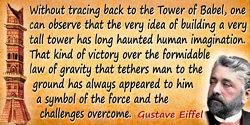
Without tracing back to the Tower of Babel, one can observe that the very idea of building a very tall tower has long haunted human imagination. That kind of victory over the formidable law of gravity that tethers man to the ground has always appeared to him a symbol of the force and the challenges overcome.
From the original French, “Sans remonter à la Tour de Babel, on peut observer que l’idée même de la construction d’une tour de très grande hauteur a depuis longtemps hanté l'imagination des hommes. Celle sorte de victoire sur cette terrible loi de la pesanteur qui attache l’homme au sol lui a toujours paru un symbole de la force et des difficultés vaincues.” First sentences of Chap. 1, in Travaux Scientifiques Exécutés à la Tour de 300 Mètres de 1889 à 1900 (1900), 1. English translation by Webmaster using online resources.
Wonder [admiratio astonishment, marvel] is a kind of desire for knowledge. The situation arises when one sees an effect and does not know its cause, or when the cause of the particular effect is one that exceeds his power of understanding. Hence, wonder is a cause of pleasure insofar as there is annexed the hope of attaining understanding of that which one wants to know. ... For desire is especially aroused by the awareness of ignorance, and consequently a man takes the greatest pleasure in those things which he discovers for himself or learns from the ground up.
From Summa Theologiae Question 32, 'The Causes of Pleasure,' Article 8, 'Is Pleasure Caused by Wondering.'(1a2ae 32.8). As translated in James Vincent Cunningham, Tragic Effect and Tragic Process in Some Plays of Shakespeare (1945). Also in The Collected Essays of J.V. Cunningham (1976), 72-73.
Wonder [admiratio astonishment, marvel] is a kind of desire for knowledge. The situation arises when one sees an effect and does not know its cause, or when the cause of the particular effect is one that exceeds his power of understanding. Hence, wonder is a cause of pleasure insofar as there is annexed the hope of attaining understanding of that which one wants to know. ... For desire is especially aroused by the awareness of ignorance, and consequently a man takes the greatest pleasure in those things which he discovers for himself or learns from the ground up.
From Summa Theologiae Question 32, 'The Causes of Pleasure,' Article 8, 'Is Pleasure Caused by Wondering.'(1a2ae 32.8). As translated in James Vincent Cunningham, Tragic Effect and Tragic Process in Some Plays of Shakespeare (1945). Also in The Collected Essays of J.V. Cunningham (1976), 72-73.
Words well up freely from the breast, without necessity or intent, and there may well have been no wandering horde in any desert that did not already have its own songs. For man, as a species, is a singing creature, though the notes, in his case, are also coupled with thought.
On Language (1836), trans. Peter Heath (1988), 60.
Words were originally magic, and the word retains much of its old magical power even to-day, With words one man can make another blessed, or drive him to despair;… Words call forth effects and are the universal means of influencing human beings. Therefore let us not underestimate the use of words in psychotherapy.
From a series of 28 lectures for laymen, Part One, 'The Psychology of Errors'. Lecture 1, 'Introduction' collected in Sigmund Freud and G. Stanley Hall (trans.), A General Introduction to Psychoanalysis (1920), 3.
Working is thinking, hence it is not always easy to give an exact accounting of one’s time. Usually I work about four to six hours a day. I am not a very diligent man.
In Cosmic Religion: With Other Opinions and Aphorisms (1931), 105.
Worry affects circulation, the heart, the glands, the whole nervous system, and profoundly affects the heart. I have never known a man who died from overwork, but many who died from doubt.
Leonard Louis Levinson, Bartlett's Unfamiliar Quotations (1972). Cited in Bill Swainson,
Encarta Book of Quotations (2000), 624.
Would you have a man reason well, you must use him to it betimes; exercise his mind in observing the connection between ideas, and following them in train. Nothing does this better than mathematics, which therefore, I think should be taught to all who have the time and opportunity, not so much to make them mathematicians, as to make them reasonable creatures; for though we all call ourselves so, because we are born to it if we please, yet we may truly say that nature gives us but the seeds of it, and we are carried no farther than industry and application have carried us.
In Conduct of the Understanding, Sect. 6.
Yes, gentlemen, give me the map of any country, its configuration, its climate, its waters, its winds, and the whole of its physical geography; give me its natural productions, its flora, its zoology, &c., and I pledge myself to tell you, a priori, what will be the quality of man in history:—not accidentally, but necessarily; not at any particular epoch, but in all; in short, —what idea he is called to represent.
Introduction to the History of Philosophy (1832), trans. by Henning Gotfried Linberg, 240.
Yet man does recognise himself [as an animal]. But I ask you and the whole world for a generic differentia between man and ape which conforms to the principles of natural history, I certainly know of none... If I were to call man ape or vice versa, I should bring down all the theologians on my head. But perhaps I should still do it according to the rules of science.
Letter to Johann Gmelon (14 Jan 1747), quoted in Mary Gribbin, Flower Hunters (2008), 56.
You bring me the deepest joy that can be felt by a man [Pasteur himself] whose invincible belief is that Science and Peace will triumph over Ignorance and War, that nations will unite, not to destroy, but to build, and that the future will belong to those who will have done most for suffering humanity. But whether our efforts are or are not favored by life, let us be able to say, when we come near to the great goal, “I have done what I could.”
Speech at the Sorbonne, Paris, France (27 Dec 1892) where his 70th birth was recognized. His son presented the speech due to the weakness of Pastuer's voice. In René Vallery-Radot, The Life of Pasteur, R. L. Devonshire (trans.) (1902), Vol. 2, 297.
You can hardly convince a man of error in a life-time, but must content yourself with the reflection that the progress of science is slow. If he is not convinced, his grand-children may be. The geologists tell us that it took one hundred years to prove that fossils are organic, and one hundred and fifty more, to prove that they are not to be referred to the Noachian deluge.
In A Week on the Concord and Merrimack Rivers (1862), 68.
You can send a message around the world in one-fifth of a second, yet it may take years for it to get from the outside of a man's head to the inside.
You cannot make a man by standing a sheep on its hind-legs. But by standing a flock of sheep in that position you can make a crowd of men.
In Zuleika Dobson (1911), 158.
You cannot teach a man anything; you can only help him find it within himself.
Unverified (even though seen attributed—without citation—to Galileo Galilei). Notably, Webmaster has, so far, been unable to found it in any old books of quotations. The earliest use Webmaster found was in a weekly paper, Benjamin Franklin Underwood (ed.), The Index (6 Apr 1881), New Series Vol. 2, 476. Webmaster found no primary evidence that it came from Galileo.
You could write the story of man’s growth in terms of his epic concerns with water.
Opening sentence of 'Our Need For Water', United States Department of Agriculture, The Yearbook of Agriculture, 1955 (1955), 1.
You look at science (or at least talk of it) as some sort of demoralising invention of man, something apart from real life, and which must be cautiously guarded and kept separate from everyday existence. But science and everyday life cannot and should not be separated.
Letter to her father, Ellis Franklin (undated, summer 1940? while she was an undergraduate at Cambridge). Excerpted in Brenda Maddox, The Dark Lady of DNA (2002), 60-61.
You may perceive something of the distinction which I think necessary to keep in view between art and science, between the artist and the man of knowledge, or the philosopher. The man of knowledge, the philosopher, is he who studies and acquires knowledge in order to improve his own mind; and with a desire of extending the department of knowledge to which he turns his attention, or to render it useful to the world, by discoveries, or by inventions, which may be the foundation of new arts, or of improvements in those already established. Excited by one or more of these motives, the philosopher employs himself in acquiring knowledge and in communicating it. The artist only executes and practises what the philosopher or man of invention has discovered or contrived, while the business of the trader is to retail the productions of the artist, exchange some of them for others, and transport them to distant places for that purpose.
From the first of a series of lectures on chemistry, collected in John Robison (ed.), Lectures on the Elements of Chemistry: Delivered in the University of Edinburgh (1807), Vol. 1, 3.
You may tear apart the baby’s rattle and see what makes the noise inside, but there is a veil covering the unseen world which not the strongest man, nor even the united strength of all the strongest men that ever lived, could tear apart.
'Is There a Santa Claus,' editorial in the New York City newspaper, The Sun (21 Sep 1897), 6.
You must not talk about “ain’t and can’t” when you speak of this great wonderful world round you, of which the wisest man knows only the very smallest corner, and is, as the great Sir Isaac Newton said, only a child picking up pebbles on the shore of a boundless ocean.
In The Water-babies (1886), 80.
You’re aware the boy failed my grade school math class, I take it? And not that many years later he’s teaching college. Now I ask you: Is that the sorriest indictment of the American educational system you ever heard? [pauses to light cigarette.] No aptitude at all for long division, but never mind. It’s him they ask to split the atom. How he talked his way into the Nobel prize is beyond me. But then, I suppose it’s like the man says, it’s not what you know...
Karl Arbeiter (former teacher of Albert Einstein)
Young man, if I could remember the names of these particles, I would have been a botanist.
Given as a reply to Leon M. Lederman (then a young researcher) when he asked Fermi for his opinion of the evidence of a particle named the K-zero-two, while standing next to him in a conference lunch line. Lederman wrote his recollection of the answer in his book, The God Particle: If the Universe is the Answer, what is the Question? (1993), 15. Lederman mentioned this statement much earlier, as “If I could remember the names of these particles, I would have been a botanist,” in a lecture (9 Jan 1963) on 'Neutrino Physics,' collected in Brookhaven Lecture Series (Dec 1963), 23, 1.
Your admission of the late appearance of the great intellectual crown of the whole animal race [man] strikes me as perfectly fatal to the analogy of your system of a continually recurring series of identical terms.
Letter to Charles Lyell February 1841. In M.J.S. Rudwick, 'A Critique of Uniformitarian Geology: A Letter from W. D. Conybeare to Charles Lyell', Proceedings of the American Philosophical Society, 1967, 111, 282.
 In science it often happens that scientists say, 'You know that's a really good argument; my position is mistaken,' and then they would actually change their minds and you never hear that old view from them again. They really do it. It doesn't happen as often as it should, because scientists are human and change is sometimes painful. But it happens every day. I cannot recall the last time something like that happened in politics or religion.
(1987) --
In science it often happens that scientists say, 'You know that's a really good argument; my position is mistaken,' and then they would actually change their minds and you never hear that old view from them again. They really do it. It doesn't happen as often as it should, because scientists are human and change is sometimes painful. But it happens every day. I cannot recall the last time something like that happened in politics or religion.
(1987) -- 





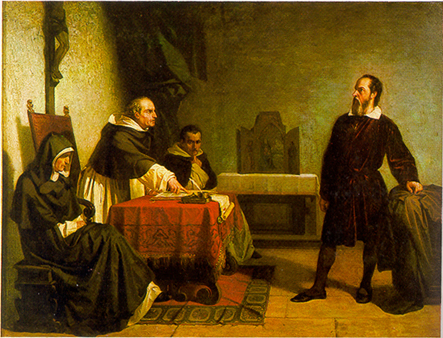



.jpg)






.jpg)


.jpg)