Magic Quotes (92 quotes)
Magical Quotes
Magical Quotes
[Magic] enables man to carry out with confidence his important tasks, to maintain his poise and his mental integrity in fits of anger, in the throes of hate, of unrequited love, of despair and anxiety. The function of magic is to ritualize man's optimism, to enhance his faith in the victory of hope over fear. Magic expresses the greater value for man of confidence over doubt, of steadfastness over vacillation, of optimism over pessimism.
Magic, Science and Religion (1925), 90.
[Richard P.] Feynman's cryptic remark, “no one is that much smarter ...,” to me, implies something Feynman kept emphasizing: that the key to his achievements was not anything “magical” but the right attitude, the focus on nature's reality, the focus on asking the right questions, the willingness to try (and to discard) unconventional answers, the sensitive ear for phoniness, self-deception, bombast, and conventional but unproven assumptions.
In book review of James Gleick's Genius, 'Complexities of Feynman', Science, 259 (22 Jan 1993), 22
Clarke's Third Law:. Any sufficiently advanced technology is indistinguishable from magic.
In Profiles of the Future: An Enquiry into the Limits of the Possible (1982), 36, footnote.
Occult sciences. Those imaginary sciences of the middle ages which related to the influence of supernatural powers, such as alchemy, magic, necromancy, and astrology.
In Noah Webster, Noah Porter (supervising ed.) and Dorsey Gardner (ed.), Webster's Condensed Dictionary: A Condensed Dictionary of the English Language (1884, 1887), 385.
A layman will no doubt find it hard to understand how pathological disorders of the body and mind can be eliminated by 'mere' words. He will feel that he is being asked to believe in magic. And he will not be so very wrong, for the words which we use in our everyday speech are nothing other than watered-down magic. But we shall have to follow a roundabout path in order to explain how science sets about restoring to words a part at least of their former magical power.
Psychical (or Mental) Treatment (1905), In James Strachey (ed.), The Standard Edition of the Complete Psychological Works of Sigmund Freud (1953), Vol. 7, 283.
A machine is not a genie, it does not work by magic, it does not possess a will, and … nothing comes out which has not been put in, barring of course, an infrequent case of malfunctioning. … The “intentions” which the machine seems to manifest are the intentions of the human programmer, as specified in advance, or they are subsidiary intentions derived from these, following rules specified by the programmer. … The machine will not and cannot do any of these things until it has been instructed as to how to proceed. ... To believe otherwise is either to believe in magic or to believe that the existence of man’s will is an illusion and that man’s actions are as mechanical as the machine’s.
In Science, September 16, 1960.
Alas! That partial Science should approve
The sly rectangle’s too licentious love!
From three bright Nymphs the wily wizard burns;-
Three bright-ey’d Nymphs requite his flame by turns.
Strange force of magic skill! Combined of yore.
The sly rectangle’s too licentious love!
From three bright Nymphs the wily wizard burns;-
Three bright-ey’d Nymphs requite his flame by turns.
Strange force of magic skill! Combined of yore.
'The Loves of the Triangles. A Mathematical and Philosophical Poem', in The Anti-Jacobean or Weekly Examiner, Monday 16 April 1798, 182. [Written by George Canning, Hookham Frere, and George Ellis].
Alchemy. The link between the immemorial magic arts and modern science. Humankind’s first systematic effort to unlock the secrets of matter by reproducible experiment.
In Good Words to You (1987), 6.
All scientific men were formerly accused of practicing magic. And no wonder, for each said to himself: “I have carried human intelligence as far as it will go, and yet So-and-so has gone further than I. Ergo, he has taken to sorcery.”
Tous les savants étoient autrefois accusés de magie. Je n’en suis point étonné. Chacun disoit en lui-même: J’ai porté les talents naturels aussi loin qu’ils peuvent aller; cependant un certain savant a des avantages sur moi: il faut bien qu’il y ait là quelque diablerie.
Tous les savants étoient autrefois accusés de magie. Je n’en suis point étonné. Chacun disoit en lui-même: J’ai porté les talents naturels aussi loin qu’ils peuvent aller; cependant un certain savant a des avantages sur moi: il faut bien qu’il y ait là quelque diablerie.
English translation from Isaac Asimov's Book of Science and Nature Quotations (1988), 296. Original French from Lettres Persanes de Montesquieu (1721, 1831), 382. Webmaster has not identified the source of the above translation (can you help?), but it is more fluent than ones published earlier. For example, “All scientific men were formerly accused of magic. I am not surprised at it. Each one said to himself, ‘I have carried human capacity as far as it can go; and yet a certain savant has distanced me: beyond doubt he deals in sorcery.’” by John Davidson (trans.), in Persian and Chinese Letters: Being the Lettres Persanes (1892), 173. Compare with the very early: “Formerly the Virtuosi were all accused of Magic; nor do I wonder at it; every one said to himself: I have carried the Talents of Nature as far as they can go; and yet a certain Virtuoso has the advantage of me, he must certainly deal with the Devil,” by John Ozell (trans), in Persian Letters (1736), Vol. 1, 257-258.
Almost every major systematic error which has deluded men for thousands of years relied on practical experience. Horoscopes, incantations, oracles, magic, witchcraft, the cures of witch doctors and of medical practitioners before the advent of modern medicine, were all firmly established through the centuries in the eyes of the public by their supposed practical successes. The scientific method was devised precisely for the purpose of elucidating the nature of things under more carefully controlled conditions and by more rigorous criteria than are present in the situations created by practical problems.
Personal Knowledge (1958), 183.
An inventive age
Has wrought, if not with speed of magic, yet
To most strange issues. I have lived to mark
A new and unforeseen creation rise
From out the labours of a peaceful Land:
Wielding her potent enginery to frame
And to produce, with appetite as keen
As that of war, which rests not night or day.
Has wrought, if not with speed of magic, yet
To most strange issues. I have lived to mark
A new and unforeseen creation rise
From out the labours of a peaceful Land:
Wielding her potent enginery to frame
And to produce, with appetite as keen
As that of war, which rests not night or day.
In The Excursion (1814). In The Works of William: Wordsworth (1994), Book 8, 875.
Art arises in those strange complexities of action that are called human beings. It is a kind of human behavior. As such it is not magic, except as human beings are magical. Nor is it concerned in absolutes, eternities, “forms,” beyond those that may reside in the context of the human being and be subject to his vicissitudes. Art is not an inner state of consciousness, whatever that may mean. Neither is it essentially a supreme form of communication. Art is human behavior, and its values are contained in human behavior.
In Art Is Action: A Discussion of Nine Arts in a Modern World (1939), 1.
As a scientist, I am not sure anymore that life can be reduced to a class struggle, to dialectical materialism, or any set of formulas. Life is spontaneous and it is unpredictable, it is magical. I think that we have struggled so hard with the tangible that we have forgotten the intangible.
…...
As he [Clifford] spoke he appeared not to be working out a question, but simply telling what he saw. Without any diagram or symbolic aid he described the geometrical conditions on which the solution depended, and they seemed to stand out visibly in space. There were no longer consequences to be deduced, but real and evident facts which only required to be seen. … So whole and complete was his vision that for the time the only strange thing was that anybody should fail to see it in the same way. When one endeavored to call it up again, and not till then, it became clear that the magic of genius had been at work, and that the common sight had been raised to that higher perception by the power that makes and transforms ideas, the conquering and masterful quality of the human mind which Goethe called in one word das Dämonische.
In Leslie Stephen and Frederick Pollock (eds.), Lectures and Essays by William Kingdon Clifford(1879), Vol. 1, Introduction, 4-5.
At first men try with magic charms
To fertilize the earth,
To keep their flocks and herds from harm
And bring new young to birth.
Then to capricious gods they turn
To save from fire or flood;
Their smoking sacrifices burn
On altars red with blood.
Next bold philosopher and sage
A settled plan decree
And prove by thought or sacred page
What Nature ought to be.
But Nature smiles—a Sphinx-like smile
Watching their little day
She waits in patience for a while—
Their plans dissolve away.
Then come those humbler men of heart
With no completed scheme,
Content to play a modest part,
To test, observe, and dream.
Till out of chaos come in sight
Clear fragments of a Whole;
Man, learning Nature’s ways aright
Obeying, can control.
To fertilize the earth,
To keep their flocks and herds from harm
And bring new young to birth.
Then to capricious gods they turn
To save from fire or flood;
Their smoking sacrifices burn
On altars red with blood.
Next bold philosopher and sage
A settled plan decree
And prove by thought or sacred page
What Nature ought to be.
But Nature smiles—a Sphinx-like smile
Watching their little day
She waits in patience for a while—
Their plans dissolve away.
Then come those humbler men of heart
With no completed scheme,
Content to play a modest part,
To test, observe, and dream.
Till out of chaos come in sight
Clear fragments of a Whole;
Man, learning Nature’s ways aright
Obeying, can control.
Epigraph in A History of Science and Its Relation with Philosophy & Religion (1968), vi.
Coastal sailing as long as it is perfectly safe and easy commands no magic. Overseas expeditions are invariably bound up with ceremonies and ritual. Man resorts to magic only where chance and circumstances are not fully controlled by knowledge.
Culture (1931), 636.
Courage and perseverance have a magical talisman, before which difficulties disappear and obstacles vanish into air.
From An Oration, Delivered at Plymouth, December 22, 1802, at the Anniversary Commemoration of the First Landing of our Ancestors at that Place (1802), 13.
Everything around us is filled with mystery and magic. I find this no cause for despair, no reason to turn for solace to esoteric formulae or chariots of gods. On the contrary, our inability to find easy answers fills me with a fierce pride in our ambivalent biology … with a constant sense of wonder and delight that we should be part of anything so profound.
In Lifetide: A Biology of the Unconscious (1979), 14.
Firefly meteorites blazed against a dark background, and sometimes the lightning was frighteningly brilliant. Like a boy, I gazed open-mouthed at the fireworks, and suddenly, before my eyes, something magical occurred. A greenish radiance poured from Earth directly up to the station, a radiance resembling gigantic phosphorescent organ pipes, whose ends were glowing crimson, and overlapped by waves of swirling green mist.
“Consider yourself very lucky, Vladimir,” I said to myself, “to have watched the northern lights.”
“Consider yourself very lucky, Vladimir,” I said to myself, “to have watched the northern lights.”
…...
Formerly, when religion was strong and science weak, men mistook magic for medicine; now, when science is strong and religion weak, men mistake medicine for magic.
The Second Sin (1973), 115.
He leads a new crusade, his bald head glistening... One somehow pities him, despite his so palpable imbecilities... But let no one, laughing at him, underestimate the magic that lies in his black, malignant eye, his frayed but still eloquent voice. He can shake and inflame these poor ignoramuses as no other man among us...
[Describing William Jennings Bryan, orator, at the Scopes Monkey Trial.]
[Describing William Jennings Bryan, orator, at the Scopes Monkey Trial.]
Henry Louis Mencken and S.T. Joshi (ed.), H.L. Mencken on Religion (2002), 18.
I can hear the sizzle of newborn stars, and know anything of meaning, of the fierce magic emerging here. I am witness to flexible eternity, the evolving past, and I know we will live forever, as dust or breathe in the face of stars, in the shifting pattern of winds.
In Secrets from the Center of the World (1989), 56.
I confess that Magic teacheth many superfluous things, and curious prodigies for ostentation; leave them as empty things, yet be not ignorant of their causes. But those things which are for the profit of men—for the turning away of evil events, for the destroying of sorceries, for the curing of diseases, for the exterminating of phantasms, for the preserving of life, honor, or fortune—may be done without offense to God or injury to religion, because they are, as profitable, so necessary.
In De Occulta Philosophia (1533), Vol. 1. Translation by J.F. (1651) reprinted as The Philosophy of Natural Magic (1913), 28.
I have lived myself to see the disciples of Hoffman, Boerhaave, Stalh, Cullen, Brown, succeed one another like the shifting figures of a magic lanthern, and their fancies, like the dresses of the annual doll-babies from Paris, becoming from their novelty, the vogue of the day, and yielding to the next novelty their ephemeral favor. The patient, treated on the fashionable theory, sometimes gets well in spite of the medicine.
In letter to Caspar Wistar (21 Jun 1807), collected in Thomas Jefferson Randolph (ed.), Memoir, Correspondence, And Miscellanies, From The Papers Of Thomas Jefferson (1829), Vol. 4, 93.
I have often admired the mystical way of Pythagoras, and the secret magick of numbers.
In Religio Medici (1642, 1754), pt. 1, sec. 12, 28.
I never got tired of watching the radar echo from an aircraft as it first appeared as a tiny blip in the noise on the cathode-ray tube, and then grew slowly into a big deflection as the aircraft came nearer. This strange new power to “see” things at great distances, through clouds or darkness, was a magical extension of our senses. It gave me the same thrill that I felt in the early days of radio when I first heard a voice coming out of a horn...
In Boffin: A Personal Story of the Early Days of Radar, Radio Astronomy and Quantum Optics (1991), 9.
If there is magic on this planet, it is contained in water.
From essay 'The Flow of the River', collected in The Immense Journey: An Imaginative Naturalist Explores the Mysteries of Man and Nature (1957, 1959), 15. The author is commenting on a rain pond on a flat roof seen from his office window, commenting on its “spatter of green algae” and a submarining water beetle representing how life can spring from even this puddle of water.
In place of science, the Eskimo has only magic to bridge the gap between what he can understand and what is not known. Without magic, his life would be one long panic.
In Man’s Rise to Civilization (1968), 48.
Is there perhaps some magical power in the subject [mathematics] that, although it had fought under the invincible banner of truth, has actually achieved its victories through some inner mysterious strength?
…...
It is requisite that we should here say something of Magick, which is so linked to Astrology, as being her near Kinswoman, that whoever professes Magick without Astrology, does nothing, but is altogether out of the way.
In The Vanity of the Arts and Sciences (1530), translation (1676), 109.
It is the business of scientists to explain away the magic in the world. The largest coherent body of magic remaining is the behavior of (humans) and animals.
In paper co-authored by William G. Quinn and James L. Gould, 'Nerves and genes', Nature (1 Mar 1979), 278, No. 5699, 23. As partially quoted in Michael F. Roberts and Anne E. Kruchten, Receptor Biology (2016), 238.
Just as knowing how a magic trick is done spoils its wonder, so let us be grateful that wherever science and reason turn they finally plunge into darkness.
John Mitchinson and John Lloyd, If Ignorance Is Bliss, Why Aren’t There More Happy People?: Smart Quotes for Dumb Times (2009), 274.
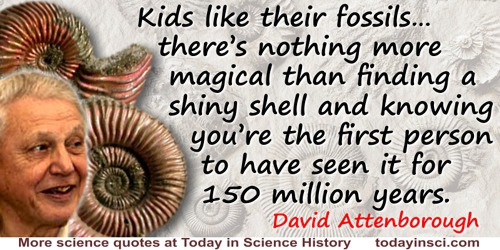
Kids like their fossils. I’ve taken my godson fossil-hunting and there’s nothing more magical than finding a shiny shell and knowing you’re the first person to have seen it for 150 million years.
As reported by Adam Lusher in 'Sir David Attenborough', Daily Mail (28 Feb 2014).
Magic … is a symbol for any process not understood.
In Chap 17, The Number of the Beast (1980), 160.
Magic and all that is ascribed to it is a deep presentiment of the powers of science. The shoes of swiftness, the sword of sharpness, the power of subduing the elements, of using the secret virtues of minerals, of understanding the voices of birds, are the obscure efforts of the mind in a right direction.
From 'History', collected in The Complete Works of Ralph Waldo Emerson (1903), 34.
Magic is a faculty of wonderful virtue, full of most high mysteries, containing the most profound contemplation of most secret things, together with the nature, power, quality, substance and virtues thereof, as also the knowledge of whole Nature, and it doth instruct us concerning the differing and agreement of things amongst themselves, whence it produceth its wonderful effects, by uniting the virtues of things through the application of them one to the other.
In De Occulta Philosophia (1533), Vol. 1. Translation by J.F. (1651) reprinted as The Philosophy of Natural Magic (1913), 38-39.
Magic is antiphysics, so it can't really exist. But is shares one thing with science. I can explain the principle behind a good science experiment in 15 seconds; the same way with magic.
As quoted in Eric Roston, The Carbon Age: How Life's Core Element Has Become Civilization's Greatest Threat (2009), 132. Nakaniski entertained with magic tricks for colleagues and to audiences at conferences.
Magic is not science, it is a collection of ways to do things — ways that work but often we don’t know why.
In Glory Road (1963, 1981), 156.
Make no little plans. They have no magic to stir men’s blood and probably themselves will not be realized. Make big plans; aim high in hope and work. … Let your watchword be order and your beacon beauty,
(1907) As quoted in 'Closing In', Charles Moore, Daniel H. Burnham, Architect, Planner of Cities (1921), Vol. 2, 147.
Man masters nature not by force but by understanding. That is why science has succeeded where magic failed: because it has looked for no spell to cast on nature.
Lecture, 'The Creative Mind' (26 Feb 1953) at Massachusetts Institute of Technology. Printed in Science and Human Values (1959), 18.
Mathematical magic combines the beauty of mathematical structure with the entertainment value of a trick.
In 'Preface', Mathematics, Magic, and Mystery (1956), ix. Webmaster checked the actual page, in the 1956 edition, and there Gardner plainly uses the beginning words “Mathematical magic.” On page 113, Gardner credits Royal V. Heath for originating the term “Mathemagic,” used as Heath’s book title in 1933. Anywhere you see the quote incorrectly beginning with “Mathemagical mathematics…” or saying Gardner coined the term “mathemagical” obviously did not check the primary source.
Modern technology has lost its magic. No longer do people stand in awe, thrilled by the onward rush of science, the promise of a new day. Instead, the new is suspect. It arouses our hostility as much as it used to excite our fancy. With each breakthrough there are recurrent fears and suspicion. How will the advance further pollute our lives; modern technology is not merely what it first appears to be. Behind the white coats, the disarming jargon, the elaborate instrumentation, and at the core of what has often seemed an automatic process, one finds what Dorothy found in Oz: modern technology is human after all.
In Science and Liberation edited by Rita Arditti, Pat Brennan, and Steve Cavrak (1980).
My father, and the father of my father, pitched their tents here before me. … For twelve hundred years have the true believers—and, praise be to God! all true wisdom is with them alone—been settled in this country, and not one of them ever heard of a palace underground. Neither did they who went before them. But lo! here comes a Frank from many days’ journey off, and he walks up to the very place, and he takes a stick … and makes a line here, and makes a line there. Here, says he, is the palace; there, says he, is the gate; and he shows us what has been all our lives beneath our feet, without our having known anything about it. Wonderful! Wonderful! Is it by books, is it by magic, is it by your prophets, that you have learnt wisdom?
(c. 1850) To Austin Layard, the English archaeologist who discovered and excavated Nineveh and Nimrud, 1845-1861.
Natural Magick is taken to be nothing else, but the chief power of all the natural Sciences; which therefore they call the top and perfection of Natural Philosophy, and which is indeed the active part of the same; which by the assistance of natural forces and faculties, through their mutual & opportune application, performs those things that are above Humane Reason.
In The Vanity of the Arts and Sciences (1530), translation (1676), 110.
Natural Magick therefore is that, which considering well the strength and force of Natural and Celestial beings, and with great curiosity labouring to discover their affections, produces into open Act the hidden and concealed powers of Nature.
In The Vanity of the Arts and Sciences (1530), translation (1676), 111.
Oh, my dear Kepler, how I wish that we could have one hearty laugh together. Here, at Padua, is the principal professor of philosophy, whom I have repeatedly and urgently requested to look at the moon and planets through my glass, [telescope] which he pertinaciously refuses to do. Why are you not here? what shouts of laughter we should have at this glorious folly! and to hear the professor of philosophy at Pisa laboring before the grand duke with logical arguments, as if with magical incantations, to charm the new planets out of the sky.
From Letter to Johannes Kepler. As translated in John Elliot Drinkwater Bethune, Life of Galileo Galilei: With Illustrations of the Advancement of Experimental Philosophy (1832), 92-93.
Oh! That the Chemist’s magic art
Could crystallize this sacred treasure!…
That very law which moulds a tear,
And bids it trickle from its source;
That law preserves the earth a sphere,
And guides the planets in their course.
Could crystallize this sacred treasure!…
That very law which moulds a tear,
And bids it trickle from its source;
That law preserves the earth a sphere,
And guides the planets in their course.
Referring to the Law of Gravitation. From Poem, 'On a Tear' (c.1813-15), in Samuel Rogers et al., The Poetical Works of Rogers, Campbell, J. Montombery, Lamb, and Kirke White (1836), 101.
One man’s “magic” is another man’s engineering. “Supernatural” is a null word.
In Time Enough for Love: The Lives of Lazarus Long (1973), 269.
One of the memorable moments of my life was when Willard Libby came to Princeton with a little jar full of crystals of barium xenate. A stable compound, looking like common salt, but much heavier. This was the magic of chemistry, to see xenon trapped into a crystal.
Letter to Oliver Sacks. Quoted in Oliver Sacks, Uncle Tungsten: Memories of a Chemical Boyhood (2001), footnote, 203.
Phony psychics like Uri Geller have had particular success in bamboozling scientists with ordinary stage magic, because only scientists are arrogant enough to think that they always observe with rigorous and objective scrutiny, and therefore could never be so fooled–while ordinary mortals know perfectly well that good performers can always find a way to trick people.
…...
Scarcely anyone who comprehends this theory can escape its magic.
Quoted, without citation, in Norman K. Glendenning, Our Place in the Universe (2007), 107. Webmaster has not found any other source for this quote, and cautions doubt about its authenticity. If you know a primary source, please contact Webmaster.
Science did not germinate and grow on a healthy prairie of ignorance but in a noisome jungle of magic and superstition, which again and again choked the seedlings of knowledge.
In A Shorter History of Science (1944), 5.
Science is always discovering odd scraps of magical wisdom and making a tremendous fuss about its cleverness.
Referring to Freudian theories.
Referring to Freudian theories.
The Confessions of Aleister Crowley, ch. 14 (1929, rev 1970).
Science is best defined as a careful, disciplined, logical search for knowledge about any and all aspects of the universe, obtained by examination of the best available evidence and always subject to correction and improvement upon discovery of better evidence. What's left is magic. And it doesn't work.
The Mask of Nostradamus: The Prophecies of the World’s Most Famous Seer (1993), 66.
Science is the organised attempt of mankind to discover how things work as causal systems. The scientific attitude of mind is an interest in such questions. It can be contrasted with other attitudes, which have different interests; for instance the magical, which attempts to make things work not as material systems but as immaterial forces which can be controlled by spells; or the religious, which is interested in the world as revealing the nature of God.
In The Scientific Attitude (1941), Foreword, 9.
Somewhere in the arrangement of this world there seems to be a great concern about giving us delight, which shows that, in the universe, over and above the meaning of matter and forces, there is a message conveyed through the magic touch of personality. ...
Is it merely because the rose is round and pink that it gives me more satisfaction than the gold which could buy me the necessities of life, or any number of slaves. ... Somehow we feel that through a rose the language of love reached our hearts.
Is it merely because the rose is round and pink that it gives me more satisfaction than the gold which could buy me the necessities of life, or any number of slaves. ... Somehow we feel that through a rose the language of love reached our hearts.
The Religion of Man (1931), 102. Quoted in H. E. Hunter, The Divine Proportion (1970), 6.
The curiosity remains… to grasp more clearly how the same matter, which in physics and chemistry displays orderly and reproducible and relatively simple properties, arranges itself in the most astounding fashions as soon as it is drawn into the orbit of the living organism. The closer one looks at these performances of matter in living organisms the more impressive the show becomes. The meanest living cell becomes a magic puzzle box full of elaborate and changing molecules.
From 'Life: The Magic Puzzle Box', Transactions of the Connecticut Academy of Arts and Sciences (Dec 1949), 38, 173-190.
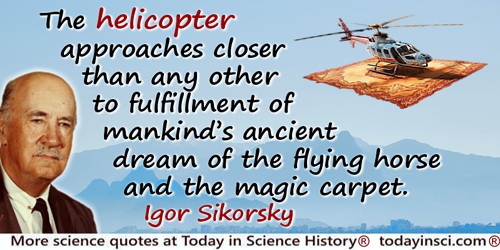
The helicopter approaches closer than any other [transport] to fulfillment of mankind’s ancient dream of the flying horse and the magic carpet.
In The Story of the Winged-S: The Autobiography of Igor I. Sikorsky (2011).
The history of thought should warn us against concluding that because the scientific theory of the world is the best that has yet been formulated, it is necessarily complete and final. We must remember that at bottom the generalizations of science or, in common parlance, the laws of nature are merely hypotheses devised to explain that ever-shifting phantasmagoria of thought which we dignify with the high-sounding names of the world and the universe. In the last analysis magic, religion, and science are nothing but theories of thought.
In The Golden Bough: A Study in Magic and Religion (1890, 1900), Vol. 3, 460.
The magic words are squeamish ossifrage.
With co-authors A. Shamir, and L. Adleman. This sentence is the decoded result from factoring a 129-digit composite number known as RSA-129. (RSA is formed from the initials of the authors’ last names.) The task required some 600 persons using 1,600 computers, linked by the Internet, that worked on the factoring for eight months. The coded message appeared in Martin Gardner, 'Mathematical Games: A New Kind of Cypher That Would Take Millions of Years to Break',Scientific American (Aug 1977), No. 237, 120-124. See Brian Hayes, American Scientist (Jul-Aug 1994), 82, No. 4, 312-316.
The programmer, like the poet, works only slightly removed from pure thought-stuff. He builds his castles in the air, from air, creating by exertion of the imagination. Few media of creation are so flexible, so easy to polish and rework, so readily capable of realizing grand conceptual structures.…
Yet the program construct, unlike the poet's words, is real in the sense that it moves and works, producing visible outputs separate from the construct itself. […] The magic of myth and legend has come true in our time. One types the correct incantation on a keyboard, and a display screen comes to life, showing things that never were nor could be.
Yet the program construct, unlike the poet's words, is real in the sense that it moves and works, producing visible outputs separate from the construct itself. […] The magic of myth and legend has come true in our time. One types the correct incantation on a keyboard, and a display screen comes to life, showing things that never were nor could be.
In The Mythical Man-Month: Essays on Software Engineering (1975), 7.
The Question is what is The Question?
Is it all a Magic Show?
Is Reality an Illusion?
What is the framework of The Machine?
Darwin’s Puzzle: Natural Selection?
Where does Space-Time come from?
Is there any answer except that it comes from consciousness?
What is Out There?
T’is Ourselves?
Or, is IT all just a Magic Show?
Einstein told me:
“If you would learn, teach!”
Is it all a Magic Show?
Is Reality an Illusion?
What is the framework of The Machine?
Darwin’s Puzzle: Natural Selection?
Where does Space-Time come from?
Is there any answer except that it comes from consciousness?
What is Out There?
T’is Ourselves?
Or, is IT all just a Magic Show?
Einstein told me:
“If you would learn, teach!”
Speaking at the American Physical Society, Philadelphia (Apr 2003). As quoted and cited in Jack Sarfatti, 'Wheeler's World: It From Bit?', collected in Frank H. Columbus and Volodymyr Krasnoholovets (eds.), Developments in Quantum Physics (2004), 42.
The rays of the sun
filter through the window
making me toasty
and warm
burning the paper
browning the plants
the magic you have
upon the world
through the summer
your always there
making us all so happy
a big ball of sunshine
for all to share
filter through the window
making me toasty
and warm
burning the paper
browning the plants
the magic you have
upon the world
through the summer
your always there
making us all so happy
a big ball of sunshine
for all to share
…...
The real name for 'science' is magic.
Jeffty is Five (1977). Quoted in Gary Westfahl, Science Fiction Quotations (2005), 322.
The sublime discoveries of Newton, and, together with these, his not less fruitful than wonderful application, of the higher mathesis to the movement of the celestial bodies, and to the laws of light, gave almost religious sanction to the corpuscular system and mechanical theory. It became synonymous with philosophy itself. It was the sole portal at which truth was permitted to enter. The human body was treated an hydraulic machine... In short, from the time of Kepler to that of Newton, and from Newton to Hartley, not only all things in external nature, but the subtlest mysteries of life, organization, and even of the intellect and moral being, were conjured within the magic circle of mathematical formulae.
Hints Towards the Formation of a more Comprehensive Theory of Life (1848). In The Collected Works of Samuel Taylor Coleridge: Shorter Works and Fragments (1995), H. J. Jackson and J. R. de J. Jackson (eds.), Vol. 11, 1, 498.
The universe is full of magical things patiently waiting for our wits to grow sharper.
A Shadow Passes (1919), 173.
The vast spread
Of darkness
That speaks of mystery
The darkness that reveals
The beauty that lies beneath
In the form of glittering
Stars, a countless beauty
That seemed to conceal
A million stories
That can make the mankind
Take a new look at life
And the majestic moon
That silently looks at mankind
Wondering how its serenity
Was disturbed by the little steps
Of a man from the beautiful earth
Yet softly smiling back
And let the world sleep
In its magical glow
A glow that soothes
The world’s senses
And forget the pain of reality
Of darkness
That speaks of mystery
The darkness that reveals
The beauty that lies beneath
In the form of glittering
Stars, a countless beauty
That seemed to conceal
A million stories
That can make the mankind
Take a new look at life
And the majestic moon
That silently looks at mankind
Wondering how its serenity
Was disturbed by the little steps
Of a man from the beautiful earth
Yet softly smiling back
And let the world sleep
In its magical glow
A glow that soothes
The world’s senses
And forget the pain of reality
…...
There are no peoples however primitive without religion and magic. Nor are there, it must be added at one, any savage races lacking in either the scientific attitude, or in science, though this lack has been frequently attributed to them.
Magic, Science and Religion (1954), 17.
There are still psychologists who, in a basic misunderstanding, think that gestalt theory tends to underestimate the role of past experience. Gestalt theory tries to differentiate between and-summative aggregates, on the one hand, and gestalten, structures, on the other, both in sub-wholes and in the total field, and to develop appropriate scientific tools for investigating the latter. It opposes the dogmatic application to all cases of what is adequate only for piecemeal aggregates. The question is whether an approach in piecemeal terms, through blind connections, is or is not adequate to interpret actual thought processes and the role of the past experience as well. Past experience has to be considered thoroughly, but it is ambiguous in itself; so long as it is taken in piecemeal, blind terms it is not the magic key to solve all problems.
In Productive Thinking (1959), 65.
There are three schools of magic. One: State a tautology, then ring the changes on its corollaries; that’s philosophy. Two: Record many facts. Try to find a pattern. Then make a wrong guess at the next fact; that’s science. Three: Be aware that you live in a malevolent Universe controlled by Murphy’s Law, sometimes offset by Brewster’s Factor; that’s engineering.
From the last chapter of The Number of the Beast (1980), 553.
There is a strange disparity between the sciences of inert matter and those of life. Astronomy, mechanics, and physics are based on concepts which can be expressed, tersely and elegantly, in mathematical language. They have built up a universe as harmonious as the monuments of ancient Greece. They weave about it a magnificent texture of calculations and hypotheses. They search for reality beyond the realm of common thought up to unutterable abstractions consisting only of equations of symbols. Such is not the position of biological sciences. Those who investigate the phenomena of life are as if lost in an inextricable jungle, in the midst of a magic forest, whose countless trees unceasingly change their place and their shape. They are crushed under a mass of facts, which they can describe but are incapable of defining in algebraic equations.
Man the Unknown (1935), 1.
This science [experimental science] alone, therefore, knows how to test perfectly what can be done by nature, what by the effort of art, what by trickery, what the incantations, conjurations, invocations, deprecations, sacrifices that belong to magic mean and dream of, and what is in them, so that all falsity may be removed and the truth alone of art and nature may be retained. This science alone teaches us how to view the mad acts of magicians, that they may be not ratified but shunned, just as logic considers sophistical reasoning.
In Opus Majus (1267).
This world, after all our science and sciences, is still a miracle; wonderful, inscrutable, magical and more, to whosoever will think of it.
In Lecture 1 (5 May 1840), collected in On Heroes, Hero-Worship and the Heroic in History (1841), 11.
Through the magic of motion pictures, someone who’s never left Peoria knows the softness of a Paris spring, the color of a Nile sunset, the sorts of vegetation one will find along the upper Amazon and that Big Ben has not yet gone digital.
…...
Thus you may multiply each stone 4 times & no more for they will then become oyles shining in ye dark and fit for magicall uses. You may ferment them with ☉ [gold] and [silver], by keeping the stone and metal in fusion together for a day, & then project upon metalls. This is the multiplication of ye stone in vertue. To multiply it in weight ad to it of ye first Gold whether philosophic or vulgar.
Praxis (c.1693), quoted in Betty Jo Teeter Dobbs, The Janus Faces of Genius: The Role of Alchemy In Newton's Thought (1991), 304.
To this I may add another form of temptation, manifold in its dangers … There exists in the soul … a cupidity which does not take delight in the carnal pleasure but in perceptions acquired through the flesh. It is a vain inquisitiveness dignified with the title of knowledge and science. As this is rooted in the appetite for knowing, and as among the senses the eyes play a leading role in acquiring knowledge, the divine word calls it “the lust of the eyes” (I John, 2: 16) … To satisfy this diseased craving … people study the operations of nature, which lie beyond our grasp when there is no advantage in knowing and the investigators simply desire knowledge for its own sake. This motive is again at work if, using a perverted science for the same end, people try to achieve things by magical arts.
From Confessions (c.397), Book X, Chap. 35 (54-55), as given in Henry Chadwick, Confessions: A New Translation by Henry Chadwick (1991), 210-212.
True majorities, in a TV-dominated and anti-intellectual age, may need sound bites and flashing lights–and I am not against supplying such lures if they draw children into even a transient concern with science. But every classroom has one [Oliver] Sacks, one [Eric] Korn, or one [Jonathan] Miller, usually a lonely child with a passionate curiosity about nature, and a zeal that overcomes pressures for conformity. Do not the one in fifty deserve their institutions as well–magic places, like cabinet museums, that can spark the rare flames of genius?
…...
Unfortunately, the study of organic remains is beset with two evils, which, though of an opposite character, do not neutralize each other so much as at first sight might be anticipated: the one consisting of a strong desire to find similar organic remains in supposed equivalent deposits, even at great distances; the other being an equally strong inclination to discover new species, often as it would seem for the sole purpose of appending the apparently magical word nobis.
In Geological Manual (1832), Preface, iii.
We are dabbling in what will always be considered the blackest of black magic. The day will come when people will want to string us up from the nearest lamppost.
His first remark at the first meeting of the Reactor Safety Committee of the Atomic Energy Commission (1947).
His first remark at the first meeting of the Reactor Safety Committee of the Atomic Energy Commission (1947).
Quoted in Edward Teller with Judith L. Shoolery, Memoirs: A Twentieth-Century Journey in Science and Politics (2001), 265.
We called the new [fourth] quark the “charmed quark” because we were pleased, and fascinated by the symmetry it brought to the subnuclear world. “Charm” also means a “a magical device to avert evil,” and in 1970 it was realized that the old three quark theory ran into very serious problems. ... As if by magic the existence of the charmed quark would [solve those problems].
From asppearance in the BBC-TV program written by Nigel Calder, 'The Key to the Universe,' (27 Jan 1977). As cited in Arthur Lewis Caso, 'The Production of New Scientific Terms', American Speech (Summer 1980), 55, No. 2, 102.
We nuclear people have made a Faustian bargain with society. On the one hand, we offer … an inexhaustible source of energy … But the price that we demand of society for this magical energy source is both a vigilance and a longevity of our social institutions that we are quite unaccustomed to.
In Social Institutions and Nuclear Energy (1972), 33.
We sign treaties with all nations agreeing to give up war as an instrument of national policy, and then relax as if war had been made unlikely. The premises and the reasoning are very much like those underlying magical rain-making. That is, we want it to rain, therefore it should rain, therefore it will rain. We have discovered the invalidity of this reasoning in the case of rain, and our schools for the most part no longer teach magical methods of influencing physical events.
In 'Education in a Scientific Age', Can Science Save Us? (1947, 2nd ed. 1961), 68.
What about the magical number seven? What about the seven wonders of the world, the seven seas, the seven deadly sins, the seven daughters of Atlas in the Pleiades, the seven ages of man, the seven levels of hell, the seven primary colors, the seven notes of the musical scale, and the seven days of the week? What about the seven-point rating scale, the seven categories for absolute judgment, the seven objects in the span of attention, and the seven digits in the span of immediate memory? For the present I propose to withhold judgment. Perhaps there is something deep and profound behind all these sevens, something just calling out for us to discover it. But I suspect that it is only a pernicious, Pythagorean coincidence.
The Magical Number Seven, Plus or Minus Two (1956), 42-3.
What now, dear reader, shall we make of our telescope? Shall we make a Mercury’s magic wand to cross the liquid aether with, and like Lucian lead a colony to the uninhabitied evening star, allured by the sweetness of the place?
In Preface to Dioptrics (1611), 86. Collected in Galileo Galilei, Johannes Kepler and Edward Stafford Carlos (trans.), The Sidereal Messenger of Galileo Galilei: And a Part of the Preface to Kepler’s Dioptrics (1880), 103.
What terrible questions we are learning to ask! The former men believed in magic, by which temples, cities, and men were swallowed up, and all trace of them gone. We are coming on the secret of a magic which sweeps out of men's minds all vestige of theism and beliefs which they and their fathers held and were framed upon.
In 'Illusions', The Atlantic Monthly (Nov 1858), 1, 60.
Whatever you can do or dream you can, begin it. Boldness has genius, power, and magic in it.
…...
When I was a boy, I read with great interest but skepticism about a magic lamp which was used with success by a certain Aladdin. Today I have no skepticism whatsoever about the magic of the xenon flash lamp which we use so effectively for many purposes.
In Electronic Flash, Strobe (1970), v.
Where lies the line between sorcery and science? It is only a matter of terminology, my friend.
Cyber Way (1990), 204.
Who … is not familiar with Maxwell’s memoirs on his dynamical theory of gases? … from one side enter the equations of state; from the other side, the equations of motion in a central field. Ever higher soars the chaos of formulae. Suddenly we hear, as from kettle drums, the four beats “put n=5.” The evil spirit v vanishes; and … that which had seemed insuperable has been overcome as if by a stroke of magic … One result after another follows in quick succession till at last … we arrive at the conditions for thermal equilibrium together with expressions for the transport coefficients.
In Ceremonial Speech (15 Nov 1887) celebrating the 301st anniversary of the Karl-Franzens-University Graz. Published as Gustav Robert Kirchhoff: Festrede zur Feier des 301. Gründungstages der Karl-Franzens-Universität zu Graz (1888), 29, as translated in Michael Dudley Sturge, Statistical and Thermal Physics (2003), 343. A more complete alternate translation also appears on the Ludwig Boltzmann Quotes page of this website.
Who does not know Maxwell’s dynamic theory of gases? At first there is the majestic development of the variations of velocities, then enter from one side the equations of condition and from the other the equations of central motions, higher and higher surges the chaos of formulas, suddenly four words burst forth: “Put n = 5.” The evil demon V disappears like the sudden ceasing of the basso parts in music, which hitherto wildly permeated the piece; what before seemed beyond control is now ordered as by magic. There is no time to state why this or that substitution was made, he who cannot feel the reason may as well lay the book aside; Maxwell is no program-musician who explains the notes of his composition. Forthwith the formulas yield obediently result after result, until the temperature-equilibrium of a heavy gas is reached as a surprising final climax and the curtain drops.
In Ceremonial Speech (15 Nov 1887) celebrating the 301st anniversary of the Karl-Franzens-University Graz. Published as Gustav Robert Kirchhoff: Festrede zur Feier des 301. Gründungstages der Karl-Franzens-Universität zu Graz (1888), 29-30, as translated in Robert Édouard Moritz, Memorabilia Mathematica; Or, The Philomath’s Quotation-book (1914), 187. From the original German, “Wer kennt nicht seine dynamische Gastheorie? – Zuerst entwickeln sich majestätisch die Variationen der Geschwindigkeiten, dann setzen von der einen Seite die Zustands-Gleichungen, von der anderen die Gleichungen der Centralbewegung ein, immer höher wogt das Chaos der Formeln; plötzlich ertönen die vier Worte: „Put n=5.“Der böse Dämon V verschwindet, wie in der Musik eine wilde, bisher alles unterwühlende Figur der Bässe plötzlich verstummt; wie mit einem Zauberschlage ordnet sich, was früher unbezwingbar schien. Da ist keine Zeit zu sagen, warum diese oder jene Substitution gemacht wird; wer das nicht fühlt, lege das Buch weg; Maxwell ist kein Programmmusiker, der über die Noten deren Erklärung setzen muss. Gefügig speien nun die Formeln Resultat auf Resultat aus, bis überraschend als Schlusseffect noch das Wärme-Gleichgewicht eines schweren Gases gewonnen wird und der Vorhang sinkt.” A condensed alternate translation also appears on the Ludwig Boltzmann Quotes page of this website.
Women decide the larger questions of life correctly and quickly, not because they are lucky guessers, not because they practise a magic inherited from savagery, but simply and solely because they have sense. They see at a glance what most men could not see with searchlights and telescopes.
…...
Words were originally magic, and the word retains much of its old magical power even to-day, With words one man can make another blessed, or drive him to despair;… Words call forth effects and are the universal means of influencing human beings. Therefore let us not underestimate the use of words in psychotherapy.
From a series of 28 lectures for laymen, Part One, 'The Psychology of Errors'. Lecture 1, 'Introduction' collected in Sigmund Freud and G. Stanley Hall (trans.), A General Introduction to Psychoanalysis (1920), 3.
 In science it often happens that scientists say, 'You know that's a really good argument; my position is mistaken,' and then they would actually change their minds and you never hear that old view from them again. They really do it. It doesn't happen as often as it should, because scientists are human and change is sometimes painful. But it happens every day. I cannot recall the last time something like that happened in politics or religion.
(1987) --
In science it often happens that scientists say, 'You know that's a really good argument; my position is mistaken,' and then they would actually change their minds and you never hear that old view from them again. They really do it. It doesn't happen as often as it should, because scientists are human and change is sometimes painful. But it happens every day. I cannot recall the last time something like that happened in politics or religion.
(1987) -- 





