Logic Quotes (315 quotes)
Logically Quotes
Logically Quotes
… just as the astronomer, the physicist, the geologist, or other student of objective science looks about in the world of sense, so, not metaphorically speaking but literally, the mind of the mathematician goes forth in the universe of logic in quest of the things that are there; exploring the heights and depths for facts—ideas, classes, relationships, implications, and the rest; observing the minute and elusive with the powerful microscope of his Infinitesimal Analysis; observing the elusive and vast with the limitless telescope of his Calculus of the Infinite; making guesses regarding the order and internal harmony of the data observed and collocated; testing the hypotheses, not merely by the complete induction peculiar to mathematics, but, like his colleagues of the outer world, resorting also to experimental tests and incomplete induction; frequently finding it necessary, in view of unforeseen disclosures, to abandon one hopeful hypothesis or to transform it by retrenchment or by enlargement:—thus, in his own domain, matching, point for point, the processes, methods and experience familiar to the devotee of natural science.
In Lectures on Science, Philosophy and Art (1908), 26
“Contrariwise”, continued Tweedledee, “if it was so, it might be, and if it were so, it would be; but as it isn’t, it ain’t. That’s logic!”
In Through the Looking Glass: And What Alice Found There (Dec 1871, 1897), 74.
“Logic” proved that airplanes can’t fly and that H-bombs won’t work and that stones don’t fall out of the sky. Logic is a way of saying that anything which didn't happen yesterday won't happen tomorrow.
In Glory Road (1963, 1981), 54.
[Aristotle formal logic thus far (1787)] has not been able to advance a single step, and hence is to all appearances closed and completed.
In Preface to second edition (1787) of Critique Of Pure Reason (1781) as translated by Werner Pluhar (1996), 15. An earlier translation by N. Kemp-Smith (1933) is similar, but ends with “appearance a closed and completed body of doctrine.”
[D]iscovery should come as an adventure rather than as the result of a logical process of thought. Sharp, prolonged thinking is necessary that we may keep on the chosen road but it does not itself necessarily lead to discovery. The investigator must be ready and on the spot when the light comes from whatever direction.
Letter to Dr. E. B. Krumhaar (11 Oct 1933), in Journal of Bacteriology (Jan 1934), 27, No. 1, 19.
[Kepler] had to realize clearly that logical-mathematical theoretizing, no matter how lucid, could not guarantee truth by itself; that the most beautiful logical theory means nothing in natural science without comparison with the exactest experience. Without this philosophic attitude, his work would not have been possible.
From Introduction that Einstein wrote for Carola Baumgardt and Jamie Callan, Johannes Kepler Life and Letters (1953), 13.
[Modern science] passed through a long period of uncertainty and inconclusive experiment, but as the instrumental aids to research improved, and the results of observation accumulated, phantoms of the imagination were exorcised, idols of the cave were shattered, trustworthy materials were obtained for logical treatment, and hypotheses by long and careful trial were converted into theories.
In The Present Relations of Science and Religion (1913, 2004), 3
[The body of law] has taxed the deliberative spirit of ages. The great minds of the earth have done it homage. It was the fruit of experience. Under it men prospered, all the arts flourished, and society stood firm. Every right and duty could be understood because the rules regulating each had their foundation in reason, in the nature and fitness of things; were adapted to the wants of our race, were addressed to the mind and to the heart; were like so many scraps of logic articulate with demonstration. Legislation, it is true occasionally lent its aid, but not in the pride of opinion, not by devising schemes inexpedient and untried, but in a deferential spirit, as a subordinate co-worker.
From biographical preface by T. Bigelow to Austin Abbott (ed.), Official Report of the Trial of Henry Ward Beecher (1875), Vol. 1, xii.
Dilbert: Evolution must be true because it is a logical conclusion of the scientific method.
Dogbert: But science is based on the irrational belief that because we cannot perceive reality all at once, things called “time” and “cause and effect” exist.
Dilbert: That’s what I was taught and that’s what I believe.
Dogbert: Sounds cultish.
Dogbert: But science is based on the irrational belief that because we cannot perceive reality all at once, things called “time” and “cause and effect” exist.
Dilbert: That’s what I was taught and that’s what I believe.
Dogbert: Sounds cultish.
Dilbert comic strip (8 Feb 1992).
Frustra fit per plura, quod fieri potest per pauciora.
It is vain to do with more what can be done with less.
It is vain to do with more what can be done with less.
Ockham’s Razor.Summa logicae (The Sum of All Logic)(prior to 1324), Part I, Chap. 12. [The village of Ockham is in Surrey. The saying (which was applied for diminishing the number of religious truths that can be proved by reason) is not Ockham's own. As given in Joseph Rickaby, Scholasticism (1908), 54, footnote, it is found a generation before Ockham in Petrus Aureolus, The Eloquent Doctor, 2 Sent. dist. 12, q.1.]
I believe in logic, the sequence of cause and effect, and in science its only begotten son our law, which was conceived by the ancient Greeks, thrived under Isaac Newton, suffered under Albert Einstein…
That fragment of a 'creed for materialism' which a friend in college had once shown him rose through Donald's confused mind.
That fragment of a 'creed for materialism' which a friend in college had once shown him rose through Donald's confused mind.
Stand on Zanzibar (1969)
~~[Attributed, authorship undocumented]~~ Mathematical demonstrations are a logic of as much or more use, than that commonly learned at schools, serving to a just formation of the mind, enlarging its capacity, and strengthening it so as to render the same capable of exact reasoning, and discerning truth from falsehood in all occurrences, even in subjects not mathematical. For which reason it is said, the Egyptians, Persians, and Lacedaemonians seldom elected any new kings, but such as had some knowledge in the mathematics, imagining those, who had not, men of imperfect judgments, and unfit to rule and govern.
From an article which appeared as 'The Usefulness of Mathematics', Pennsylvania Gazette (30 Oct 1735), No. 360. Collected, despite being without clear evidence of Franklin’s authorship, in The Works of Benjamin Franklin (1809), Vol. 4, 377. Evidence of actual authorship by Ben Franklin for the newspaper article has not been ascertained, and scholars doubt it. See Franklin documents at the website founders.archives.gov. The quote is included here to attach this caution.
A “critic” is a man who creates nothing and thereby feels qualified to judge the work of creative men. There is logic in this; he is unbiased—he hates all creative people equally.
In Time Enough for Love: The Lives of Lazarus Long (1973), 365.
A leg of mutton is better than nothing,
Nothing is better than Heaven,
Therefore a leg of mutton is better than Heaven.
Nothing is better than Heaven,
Therefore a leg of mutton is better than Heaven.
Aphorism 21 in Notebook C (1772-1773), as translated by R.J. Hollingdale in Aphorisms (1990). Reprinted as The Waste Books (2000), 35.
A man with a conviction is a hard man to change. Tell him you disagree and he turns away. Show him facts or figures and he questions your sources. Appeal to logic and he fails to see your point.
First sentences in When Prophecy Fails (1956), 3.
A mathematical science is any body of propositions which is capable of an abstract formulation and arrangement in such a way that every proposition of the set after a certain one is a formal logical consequence of some or all the preceding propositions. Mathematics consists of all such mathematical sciences.
In Lectures on Fundamental Concepts of Algebra and Geometry (1911), 222.
A principle of induction would be a statement with the help of which we could put inductive inferences into a logically acceptable form. In the eyes of the upholders of inductive logic, a principle of induction is of supreme importance for scientific method: “... this principle”, says Reichenbach, “determines the truth of scientific theories. To eliminate it from science would mean nothing less than to deprive science of the power to decide the truth or falsity of its theories. Without it, clearly, science would no longer have the right to distinguish its theories from the fanciful and arbitrary creations of the poet’s mind.” Now this principle of induction cannot be a purely logical truth like a tautology or an analytic statement. Indeed, if there were such a thing as a purely logical principle of induction, there would be no problem of induction; for in this case, all inductive inferences would have to be regarded as purely logical or tautological transformations, just like inferences in inductive logic. Thus the principle of induction must be a synthetic statement; that is, a statement whose negation is not self-contradictory but logically possible. So the question arises why such a principle should be accepted at all, and how we can justify its acceptance on rational grounds.
…...
A professor … may be to produce a perfect mathematical work of art, having every axiom stated, every conclusion drawn with flawless logic, the whole syllabus covered. This sounds excellent, but in practice the result is often that the class does not have the faintest idea of what is going on. … The framework is lacking; students do not know where the subject fits in, and this has a paralyzing effect on the mind.
In A Concrete Approach to Abstract Algebra (1959), 1-2.
A scientist works largely by intuition. Given enough experience, a scientist examining a problem can leap to an intuition as to what the solution ‘should look like.’ ... Science is ultimately based on insight, not logic.
…...
Against logic there is no armor like ignorance.
Editorial comment Peter added under a quotation in his Peter's Quotations: Ideas for Our Times (1993), 308.
Among all the liberal arts, the first is logic, and specifically that part of logic which gives initial instruction about words. … [T]he word “logic” has a broad meaning, and is not restricted exclusively to the science of argumentative reasoning. [It includes] Grammar [which] is “the science of speaking and writing correctly—the starting point of all liberal studies.”
In John of Salisbury and Daniel D. McGarry (trans.), 'Whence grammar gets its name', The Metalogicon (2009), 37. It is footnoted: Isidore, Etym., i, 5, §1.
Anyone who has had actual contact with the making of the inventions that built the radio art knows that these inventions have been the product of experiment and work based on physical reasoning, rather than on the mathematicians' calculations and formulae. Precisely the opposite impression is obtained from many of our present day text books and publications.
Attributed.
Aristotle... a mere bond-servant to his logic, thereby rendering it contentious and well nigh useless.
Rerum Novarum (1605)
As an individual opinion of mine, perhaps not as yet shared by many, I may be permitted to state, by the way, that I consider pure Mathematics to be only one branch of general Logic, the branch originating from the creation of Number, to the economical virtues of which is due the enormous development that particular branch has been favored with in comparison with the other branches of Logic that until of late almost remained stationary.
In Lecture (10 Aug 1898) present in German to the First International Congress of Mathematicians in Zürich, 'On Pasigraphy: Its Present State and the Pasigraphic Movement in Italy'. As translated and published in The Monist (1899), 9, No. 1, 46.
As in political revolutions, so in paradigm choice—there is no standard higher than the assent of the relevant community... this issue of paradigm choice can never be unequivocally settled by logic and experiment alone.
The Structure of Scientific Revolutions (1962), 93.
Both the physicist and the mystic want to communicate their knowledge, and when they do so with words their statements are paradoxical and full of logical contradictions.
In The Tao of Physics (1975), 46.
But it is precisely mathematics, and the pure science generally, from which the general educated public and independent students have been debarred, and into which they have only rarely attained more than a very meagre insight. The reason of this is twofold. In the first place, the ascendant and consecutive character of mathematical knowledge renders its results absolutely insusceptible of presentation to persons who are unacquainted with what has gone before, and so necessitates on the part of its devotees a thorough and patient exploration of the field from the very beginning, as distinguished from those sciences which may, so to speak, be begun at the end, and which are consequently cultivated with the greatest zeal. The second reason is that, partly through the exigencies of academic instruction, but mainly through the martinet traditions of antiquity and the influence of mediaeval logic-mongers, the great bulk of the elementary text-books of mathematics have unconsciously assumed a very repellant form,—something similar to what is termed in the theory of protective mimicry in biology “the terrifying form.” And it is mainly to this formidableness and touch-me-not character of exterior, concealing withal a harmless body, that the undue neglect of typical mathematical studies is to be attributed.
In Editor’s Preface to Augustus De Morgan and Thomas J. McCormack (ed.), Elementary Illustrations of the Differential and Integral Calculus (1899), v.
But nature is remarkably obstinate against purely logical operations; she likes not schoolmasters nor scholastic procedures. As though she took a particular satisfaction in mocking at our intelligence, she very often shows us the phantom of an apparently general law, represented by scattered fragments, which are entirely inconsistent. Logic asks for the union of these fragments; the resolute dogmatist, therefore, does not hesitate to go straight on to supply, by logical conclusions, the fragments he wants, and to flatter himself that he has mastered nature by his victorious intelligence.
'On the Principles of Animal Morphology', Proceedings of the Royal Society of Edinburgh (2 Apr 1888), 15, 289. Original as Letter to Mr John Murray, communicated to the Society by Professor Sir William Turner. Page given as in collected volume published 1889.
But, indeed, the science of logic and the whole framework of philosophical thought men have kept since the days of Plato and Aristotle, has no more essential permanence as a final expression of the human mind, than the Scottish Longer Catechism.
A Modern Utopia (1904, 2006), 14.
Catastrophe Theory is—quite likely—the first coherent attempt (since Aristotelian logic) to give a theory on analogy. When narrow-minded scientists object to Catastrophe Theory that it gives no more than analogies, or metaphors, they do not realise that they are stating the proper aim of Catastrophe Theory, which is to classify all possible types of analogous situations.
From 'La Théorie des catastrophes État présent et perspective', as quoted in Erick Christopher Zeeman, (ed.), Catastrophe Theory: Selected Papers, 1972-1977 (1977), 637, as cited in Martin Krampe (ed.), Classics of Semiotics (1987), 214.
Certain students of genetics inferred that the Mendelian units responsible for the selected character were genes producing only a single effect. This was careless logic. It took a good deal of hammering to get rid of this erroneous idea. As facts accumulated it became evident that each gene produces not a single effect, but in some cases a multitude of effects on the characters of the individual. It is true that in most genetic work only one of these character-effects is selected for study—the one that is most sharply defined and separable from its contrasted character—but in most cases minor differences also are recognizable that are just as much the product of the same gene as is the major effect.
'The Relation of Genetics to Physiology and Medicine', Nobel Lecture (4 Jun 1934). In Nobel Lectures, Physiology or Medicine 1922-1941 (1965), 317.
Common sense is science exactly in so far as it fulfills the ideal of common sense; that is, sees facts as they are, or at any rate, without the distortion of prejudice, and reasons from them in accordance with the dictates of sound judgment. And science is simply common sense at its best, that is, rigidly accurate in observation, and merciless to fallacy in logic.
The Crayfish: an Introduction to the Study of Zoölogy (1880), 2. Excerpted in Popular Science (Apr 1880), 16, 789.
Computers are composed of nothing more than logic gates stretched out to the horizon in a vast numerical irrigation system.
In State of the Art: A Photographic History of the Integrated Circuit (1983), vii.
Confined to its true domain, mathematical reasoning is admirably adapted to perform the universal office of sound logic: to induce in order to deduce, in order to construct. … It contents itself to furnish, in the most favorable domain, a model of clearness, of precision, and consistency, the close contemplation of which is alone able to prepare the mind to render other conceptions also as perfect as their nature permits. Its general reaction, more negative than positive, must consist, above all, in inspiring us everywhere with an invincible aversion for vagueness, inconsistency, and obscurity, which may always be really avoided in any reasoning whatsoever, if we make sufficient effort.
In Synthèse Subjective (1856), 98. As translated in Robert Édouard Moritz, Memorabilia Mathematica; Or, The Philomath’s Quotation-Book (1914), 202-203. From the original French, “Bornée à son vrai domaine, la raison mathématique y peut admirablement remplir l’office universel de la saine logique: induire pour déduire, afin de construire. … Elle se contente de former, dans le domaine le plus favorable, un type de clarté, de précision, et de consistance, dont la contemplation familière peut seule disposer l’esprit à rendre les autres conceptions aussi parfaites que le comporte leur nature. Sa réaction générale, plus négative que positive, doit surtout consister à nous inspirer partout une invincible répugnance pour le vague, l’incohérence, et l’obscurité, que nous pouvons réellement éviter envers des pensées quelconques, si nous y faisons assez d’efforts.”
Definition of Mathematics.—It has now become apparent that the traditional field of mathematics in the province of discrete and continuous number can only be separated from the general abstract theory of classes and relations by a wavering and indeterminate line. Of course a discussion as to the mere application of a word easily degenerates into the most fruitless logomachy. It is open to any one to use any word in any sense. But on the assumption that “mathematics” is to denote a science well marked out by its subject matter and its methods from other topics of thought, and that at least it is to include all topics habitually assigned to it, there is now no option but to employ “mathematics” in the general sense of the “science concerned with the logical deduction of consequences from the general premisses of all reasoning.”
In article 'Mathematics', Encyclopedia Britannica (1911, 11th ed.), Vol. 17, 880. In the 2006 DVD edition of the encyclopedia, the definition of mathematics is given as “The science of structure, order, and relation that has evolved from elemental practices of counting, measuring, and describing the shapes of objects.” [Premiss is a variant form of “premise”. —Webmaster]
Descartes' immortal conclusion cogito ergo sum was recently subjected to destruction testing by a group of graduate researchers at Princeton led by Professors Montjuic and Lauterbrunnen, and now reads, in the Shorter Harvard Orthodoxy:
(a) I think, therefore I am; or
(b) Perhaps I thought, therefore I was; but
(c) These days, I tend to leave that side of things to my wife.
(a) I think, therefore I am; or
(b) Perhaps I thought, therefore I was; but
(c) These days, I tend to leave that side of things to my wife.
— Tom Holt
Ye Gods! (1992), 223.
Development of Western science is based on two great achievements: the invention of the formal logical system (in Euclidean geometry) by the Greek philosophers, and the discovery of the possibility to find out causal relationships by systematic experiment (during the Renaissance). In my opinion, one has not to be astonished that the Chinese sages have not made these steps. The astonishing thing is that these discoveries were made at all.
Letter to J. S. Switzer, 23 Apr 1953, Einstein Archive 61-381. Quoted in Alice Calaprice, The Quotable Einstein (1996), 180.
Every new theory as it arises believes in the flush of youth that it has the long sought goal; it sees no limits to its applicability, and believes that at last it is the fortunate theory to achieve the 'right' answer. This was true of electron theory—perhaps some readers will remember a book called The Electrical Theory of the Universe by de Tunzelman. It is true of general relativity theory with its belief that we can formulate a mathematical scheme that will extrapolate to all past and future time and the unfathomed depths of space. It has been true of wave mechanics, with its first enthusiastic claim a brief ten years ago that no problem had successfully resisted its attack provided the attack was properly made, and now the disillusionment of age when confronted by the problems of the proton and the neutron. When will we learn that logic, mathematics, physical theory, are all only inventions for formulating in compact and manageable form what we already know, like all inventions do not achieve complete success in accomplishing what they were designed to do, much less complete success in fields beyond the scope of the original design, and that our only justification for hoping to penetrate at all into the unknown with these inventions is our past experience that sometimes we have been fortunate enough to be able to push on a short distance by acquired momentum.
The Nature of Physical Theory (1936), 136.
Every science that has thriven has thriven upon its own symbols: logic, the only science which is admitted to have made no improvements in century after century, is the only one which has grown no symbols.
Transactions Cambridge Philosophical Society, vol. X, 1864, p.184
Every work of science great enough to be well remembered for a few generations affords some exemplification of the defective state of the art of reasoning of the time when it was written; and each chief step in science has been a lesson in logic.
'The Fixation of Belief (1877). In Justus Buchler, The Philosophy of Pierce (1940), 6.
Everything is controlled by immutable mathematical laws, from which there is, and can be, no deviation whatsoever. We learn the complex from the simple. We arrive at the abstract by way of the concrete.
In The Science of Poetry and the Philosophy of Language (1910), xi.
Experience, the only logic sure to convince a diseased imagination and restore it to rugged health.
Written in 1892. In The American Claimant (1896), 203. In Mark Twain and Brian Collins (ed.), When in Doubt, Tell the Truth: and Other Quotations from Mark Twain (1996), 48.
Fiction is, indeed, an indispensable supplement to logic, or even a part of it; whether we are working inductively or deductively, both ways hang closely together with fiction: and axioms, though they seek to be primary verities, are more akin to fiction. If we had realized the nature of axioms, the doctrine of Einstein, which sweeps away axioms so familiar to us that they seem obvious truths, and substitutes others which seem absurd because they are unfamiliar, might not have been so bewildering.
In The Dance of Life (1923), 86.
First, as concerns the success of teaching mathematics. No instruction in the high schools is as difficult as that of mathematics, since the large majority of students are at first decidedly disinclined to be harnessed into the rigid framework of logical conclusions. The interest of young people is won much more easily, if sense-objects are made the starting point and the transition to abstract formulation is brought about gradually. For this reason it is psychologically quite correct to follow this course.
Not less to be recommended is this course if we inquire into the essential purpose of mathematical instruction. Formerly it was too exclusively held that this purpose is to sharpen the understanding. Surely another important end is to implant in the student the conviction that correct thinking based on true premises secures mastery over the outer world. To accomplish this the outer world must receive its share of attention from the very beginning.
Doubtless this is true but there is a danger which needs pointing out. It is as in the case of language teaching where the modern tendency is to secure in addition to grammar also an understanding of the authors. The danger lies in grammar being completely set aside leaving the subject without its indispensable solid basis. Just so in Teaching of Mathematics it is possible to accumulate interesting applications to such an extent as to stunt the essential logical development. This should in no wise be permitted, for thus the kernel of the whole matter is lost. Therefore: We do want throughout a quickening of mathematical instruction by the introduction of applications, but we do not want that the pendulum, which in former decades may have inclined too much toward the abstract side, should now swing to the other extreme; we would rather pursue the proper middle course.
Not less to be recommended is this course if we inquire into the essential purpose of mathematical instruction. Formerly it was too exclusively held that this purpose is to sharpen the understanding. Surely another important end is to implant in the student the conviction that correct thinking based on true premises secures mastery over the outer world. To accomplish this the outer world must receive its share of attention from the very beginning.
Doubtless this is true but there is a danger which needs pointing out. It is as in the case of language teaching where the modern tendency is to secure in addition to grammar also an understanding of the authors. The danger lies in grammar being completely set aside leaving the subject without its indispensable solid basis. Just so in Teaching of Mathematics it is possible to accumulate interesting applications to such an extent as to stunt the essential logical development. This should in no wise be permitted, for thus the kernel of the whole matter is lost. Therefore: We do want throughout a quickening of mathematical instruction by the introduction of applications, but we do not want that the pendulum, which in former decades may have inclined too much toward the abstract side, should now swing to the other extreme; we would rather pursue the proper middle course.
In Ueber den Mathematischen Unterricht an den hoheren Schulen; Jahresbericht der Deutschen Mathematiker Vereinigung, Bd. 11, 131.
For science, in so far as it is a substitute for religion, and reason, in so far as it is a substitute for faith, have always foundered. Science will be able to satisfy in an increasing measure, and in fact does satisfy, our increasing logical and intellectual needs, our desire to know and understand the truth; but science does not satisfy the needs of our heart and our will, our hunger for immortality—far from satisfying it, it contradicts it.
From Miguel Unamuno and J. E. Crawford Flitch (trans.), Essays and Soliloquies (1926), 209.
For, in mathematics or symbolic logic, reason can crank out the answer from the symboled equations—even a calculating machine can often do so—but it cannot alone set up the equations. Imagination resides in the words which define and connect the symbols—subtract them from the most aridly rigorous mathematical treatise and all meaning vanishes. Was it Eddington who said that we once thought if we understood 1 we understood 2, for 1 and 1 are 2, but we have since found we must learn a good deal more about “and”?
In 'The Biological Basis of Imagination', American Thought: 1947 (1947), 81.
Formal thought, consciously recognized as such, is the means of all exact knowledge; and a correct understanding of the main formal sciences, Logic and Mathematics, is the proper and only safe foundation for a scientific education.
In Number and its Algebra (1896), 134.
Frege has the merit of ... finding a third assertion by recognising the world of logic which is neither mental nor physical.
Our Knowledge of the External World (1914), 201.
From a drop of water a logician could predict an Atlantic or a Niagara without having seen or heard of one or the other. So all life is a great chain, the nature of which is known whenever we are shown a single link of it.
In A Study in Scarlet (1887, 1892), 27.
Gates is the ultimate programming machine. He believes everything can be defined, examined, reduced to essentials, and rearranged into a logical sequence that will achieve a particular goal.
Given any domain of thought in which the fundamental objective is a knowledge that transcends mere induction or mere empiricism, it seems quite inevitable that its processes should be made to conform closely to the pattern of a system free of ambiguous terms, symbols, operations, deductions; a system whose implications and assumptions are unique and consistent; a system whose logic confounds not the necessary with the sufficient where these are distinct; a system whose materials are abstract elements interpretable as reality or unreality in any forms whatsoever provided only that these forms mirror a thought that is pure. To such a system is universally given the name MATHEMATICS.
In 'Mathematics', National Mathematics Magazine (Nov 1937), 12, No. 2, 62.
Gradually, at various points in our childhoods, we discover different forms of conviction. There’s the rock-hard certainty of personal experience (“I put my finger in the fire and it hurt,”), which is probably the earliest kind we learn. Then there’s the logically convincing, which we probably come to first through maths, in the context of Pythagoras’s theorem or something similar, and which, if we first encounter it at exactly the right moment, bursts on our minds like sunrise with the whole universe playing a great chord of C Major.
In short essay, 'Dawkins, Fairy Tales, and Evidence', 2.
Heavy dependence on direct observation is essential to biology not only because of the complexity of biological phenomena, but because of the intervention of natural selection with its criterion of adequacy rather than perfection. In a system shaped by natural selection it is inevitable that logic will lose its way.
In 'Scientific innovation and creativity: a zoologist’s point of view', American Zoologist (1982), 22, 229.
Here I most violently want you to
Avoid one fearful error, a vicious flaw.
Don’t think that our bright eyes were made that we
Might look ahead; that hips and knees and ankles
So intricately bend that we might take
Big strides, and the arms are strapped to the sturdy shoulders
And hands are given for servants to each side
That we might use them to support our lives.
All other explanations of this sort
Are twisted, topsy-turvy logic, for
Nothing what is born produces its own use.
Sight was not born before the light of the eyes,
Nor were words and pleas created before the tongue
Rather the tongue's appearance long preceded
Speech, and the ears were formed far earlier than
The sound first heard. To sum up, all the members
Existed, I should think, before their use,
So use has not caused them to have grown.
Avoid one fearful error, a vicious flaw.
Don’t think that our bright eyes were made that we
Might look ahead; that hips and knees and ankles
So intricately bend that we might take
Big strides, and the arms are strapped to the sturdy shoulders
And hands are given for servants to each side
That we might use them to support our lives.
All other explanations of this sort
Are twisted, topsy-turvy logic, for
Nothing what is born produces its own use.
Sight was not born before the light of the eyes,
Nor were words and pleas created before the tongue
Rather the tongue's appearance long preceded
Speech, and the ears were formed far earlier than
The sound first heard. To sum up, all the members
Existed, I should think, before their use,
So use has not caused them to have grown.
On the Nature of Things, trans. Anthony M. Esolen (1995), Book 4, lines 820-8, 145.
Histories make men wise; poets, witty; the mathematics, subtle; natural philosophy, deep; moral, grave; logic and rhetoric, able to contend.
'L. Of Studies,' Essays (1597). In Francis Bacon and Basil Montagu, The Works of Francis Bacon, Lord Chancellor of England (1852), 55.
Humans are not by nature the fact-driven, rational beings we like to think we are. We get the facts wrong more often than we think we do. And we do so in predictable ways: we engage in wishful thinking. We embrace information that supports our beliefs and reject evidence that challenges them. Our minds tend to take shortcuts, which require some effort to avoid … [and] more often than most of us would imagine, the human mind operates in ways that defy logic.
As co-author with Kathleen Hall Jamieson, in unSpun: Finding Facts in a World of Disinformation (2007), 69.
I am opposed to looking upon logic as a kind of game. … One might think that it is a matter of choice or convention which logic one adopts. I disagree with this view.
Objective Knowledge: an Evolutionary Approach (1972), 304.
I approached the bulk of my schoolwork as a chore rather than an intellectual adventure. The tedium was relieved by a few courses that seem to be qualitatively different. Geometry was the first exciting course I remember. Instead of memorizing facts, we were asked to think in clear, logical steps. Beginning from a few intuitive postulates, far reaching consequences could be derived, and I took immediately to the sport of proving theorems.
Autobiography in Gösta Ekspong (ed.), Nobel Lectures: Physics 1996-2000 (2002), 115.
I assumed that nature would “evaluate” my work as I went along. If I was doing what nature wanted done, and if I was doing it in promising ways, permitted by nature’s principles, I would find my work being economically sustained—and vice versa, in which latter negative case I must quickly cease doing what I had been doing and seek logically alternative courses until I found the new course that nature signified her approval of by providing for its physical support.
In Critical Path (1982), 145.
I believe myself to possess a most singular combination of qualities exactly fitted to make me pre-eminently a discoverer of the hidden realities of nature… the belief has been forced upon me…
Firstly: Owing to some peculiarity in my nervous system, I have perceptions of some things, which no one else has… and intuitive perception of… things hidden from eyes, ears, & ordinary senses…
Secondly: my sense reasoning faculties;
Thirdly: my concentration faculty, by which I mean the power not only of throwing my whole energy & existence into whatever I choose, but also of bringing to bear on anyone subject or idea, a vast apparatus from all sorts of apparently irrelevant & extraneous sources…
Well, here I have written what most people would call a remarkably mad letter; & yet certainly one of the most logical, sober-minded, cool, pieces of composition, (I believe), that I ever framed.
Firstly: Owing to some peculiarity in my nervous system, I have perceptions of some things, which no one else has… and intuitive perception of… things hidden from eyes, ears, & ordinary senses…
Secondly: my sense reasoning faculties;
Thirdly: my concentration faculty, by which I mean the power not only of throwing my whole energy & existence into whatever I choose, but also of bringing to bear on anyone subject or idea, a vast apparatus from all sorts of apparently irrelevant & extraneous sources…
Well, here I have written what most people would call a remarkably mad letter; & yet certainly one of the most logical, sober-minded, cool, pieces of composition, (I believe), that I ever framed.
Lovelace Papers, Bodleian Library, Oxford University, 42, folio 12 (6 Feb 1841). As quoted and cited in Dorothy Stein (ed.), 'This First Child of Mine', Ada: A Life and a Legacy (1985), 86.
I believed that, instead of the multiplicity of rules that comprise logic, I would have enough in the following four, as long as I made a firm and steadfast resolution never to fail to observe them.
The first was never to accept anything as true if I did not know clearly that it was so; that is, carefully to avoid prejudice and jumping to conclusions, and to include nothing in my judgments apart from whatever appeared so clearly and distinctly to my mind that I had no opportunity to cast doubt upon it.
The second was to subdivide each on the problems I was about to examine: into as many parts as would be possible and necessary to resolve them better.
The third was to guide my thoughts in an orderly way by beginning, as if by steps, to knowledge of the most complex, and even by assuming an order of the most complex, and even by assuming an order among objects in! cases where there is no natural order among them.
And the final rule was: in all cases, to make such comprehensive enumerations and such general review that I was certain not to omit anything.
The long chains of inferences, all of them simple and easy, that geometers normally use to construct their most difficult demonstrations had given me an opportunity to think that all the things that can fall within the scope of human knowledge follow from each other in a similar way, and as long as one avoids accepting something as true which is not so, and as long as one always observes the order required to deduce them from each other, there cannot be anything so remote that it cannot be reached nor anything so hidden that it cannot be uncovered.
The first was never to accept anything as true if I did not know clearly that it was so; that is, carefully to avoid prejudice and jumping to conclusions, and to include nothing in my judgments apart from whatever appeared so clearly and distinctly to my mind that I had no opportunity to cast doubt upon it.
The second was to subdivide each on the problems I was about to examine: into as many parts as would be possible and necessary to resolve them better.
The third was to guide my thoughts in an orderly way by beginning, as if by steps, to knowledge of the most complex, and even by assuming an order of the most complex, and even by assuming an order among objects in! cases where there is no natural order among them.
And the final rule was: in all cases, to make such comprehensive enumerations and such general review that I was certain not to omit anything.
The long chains of inferences, all of them simple and easy, that geometers normally use to construct their most difficult demonstrations had given me an opportunity to think that all the things that can fall within the scope of human knowledge follow from each other in a similar way, and as long as one avoids accepting something as true which is not so, and as long as one always observes the order required to deduce them from each other, there cannot be anything so remote that it cannot be reached nor anything so hidden that it cannot be uncovered.
Discourse on Method in Discourse on Method and Related Writings (1637), trans. Desmond M. Clarke, Penguin edition (1999), Part 2, 16.
I don’t see the logic of rejecting data just because they seem incredible.
In Astronomy Transformed by D. O. Edge and M. J. Mulkay (1976).
I end with a word on the new symbols which I have employed. Most writers on logic strongly object to all symbols. ... I should advise the reader not to make up his mind on this point until he has well weighed two facts which nobody disputes, both separately and in connexion. First, logic is the only science which has made no progress since the revival of letters; secondly, logic is the only science which has produced no growth of symbols.
I have come to the conclusion that the exertion, without which a knowledge of mathematics cannot be acquired, is not materially increased by logical rigor in the method of instruction.
In Jahresbericht der Deutschen Mathematiker Vereinigung (1898), 143.
I have just received copies of “To-day” containing criticisms of my letter. I am in no way surprised to find that these criticisms are not only unfair and misleading in the extreme. They are misleading in so far that anyone reading them would be led to believe the exact opposite of the truth. It is quite possible that I, an old and trained engineer and chronic experimenter, should put an undue value upon truth; but it is common to all scientific men. As nothing but the truth is of any value to them, they naturally dislike things that are not true. ... While my training has, perhaps, warped my mind so that I put an undue value upon truth, their training has been such as to cause them to abhor exact truth and logic.
[Replying to criticism by Colonel Acklom and other religious parties attacking Maxim's earlier contribution to the controversy about the modern position of Christianity.]
[Replying to criticism by Colonel Acklom and other religious parties attacking Maxim's earlier contribution to the controversy about the modern position of Christianity.]
In G.K. Chesterton, 'The Maxims of Maxim', Daily News (25 Feb 1905). Collected in G. K. Chesterton and Dale Ahlquist (ed.), In Defense of Sanity: The Best Essays of G.K. Chesterton (2011), 86.
I have said that science is impossible without faith. … Inductive logic, the logic of Bacon, is rather something on which we can act than something which we can prove, and to act on it is a supreme assertion of faith … Science is a way of life which can only fluorish when men are free to have faith.
In Calyampudi Radhakrishna Rao, Statistics and Truth (1997), 31.
I never guess. It is a shocking habit—destructive to the logical faculty.
Spoken by fictitious character Sherlock Holmes in The Sign of Four (1890), 17.
I once knew an otherwise excellent teacher who compelled his students to perform all their demonstrations with incorrect figures, on the theory that it was the logical connection of the concepts, not the figure, that was essential.
In Ernst Mach and Thomas Joseph McCormack, Space and Geometry (1906), 93.
I presume that few who have paid any attention to the history of the Mathematical Analysis, will doubt that it has been developed in a certain order, or that that order has been, to a great extent, necessary—being determined, either by steps of logical deduction, or by the successive introduction of new ideas and conceptions, when the time for their evolution had arrived. And these are the causes that operate in perfect harmony. Each new scientific conception gives occasion to new applications of deductive reasoning; but those applications may be only possible through the methods and the processes which belong to an earlier stage.
Explaining his choice for the exposition in historical order of the topics in A Treatise on Differential Equations (1859), Preface, v-vi.
I think it would be desirable that this form of word [mathematics] should be reserved for the applications of the science, and that we should use mathematic in the singular to denote the science itself, in the same way as we speak of logic, rhetoric, or (own sister to algebra) music.
In Presidential Address to the British Association, Exeter British Association Report (1869); Collected Mathematical Papers, Vol. 2, 669.
I took biology in high school and didn't like it at all. It was focused on memorization. ... I didn't appreciate that biology also had principles and logic ... [rather than dealing with a] messy thing called life. It just wasn't organized, and I wanted to stick with the nice pristine sciences of chemistry and physics, where everything made sense. I wish I had learned sooner that biology could be fun as well.
Interview (23 May 1998), 'Creating the Code to Life', Academy of Achievement web site.
I transferred to … UCLA, … and I took several courses there. One was an acting class…; another was a course in television writing, which seemed practical. I also continued my studies in philosophy. I had done pretty well in symbolic logic at Long Beach, so I signed up for Advanced Symbolic Logic at my new school. Saying that I was studying Advanced Symbolic Logic at UCLA had a nice ring; what had been nerdy in high school now had mystique. However, I went to class the first day and discovered that UCLA used a different set of symbols from those I had learned at Long Beach. To catch
up, I added a class in Logic 101, which meant I was studying beginning logic and advanced logic at the same time. I was overwhelmed, and shocked to find that I couldn’t keep up. I had reached my math limit as well as my philosophy limit. I abruptly changed my major to theater and, free from the workload of my logic classes…. I realized that I was now investing in no other future but show business.
In Born Standing Up: A Comic’s Life (2007), 103.
I wanted to preserve the spontaneity of thought in speech… [and to] guard the spontaneity of the argument. A spoken argument is informal and heuristic; it singles out the heart of the matter and shows in what way it is crucial and new; and it gives the direction and line of the solution so that, simplified as it is, still the logic is right. For me, this philosophic form of argument is the foundation of science, and nothing should be allowed to obscure it.
On his philosophy in presenting the TV series, from which the book followed. In 'Foreward', The Ascent of Man, (1973), 14-15.
I was pretty good in science. But again, because of the small budget, in science class we couldn’t do experiments in order to prove theories. We just believed everything. Actually I think that class was call Religion. Religion was always an easy class. All you had to do was suspend the logic and reasoning you were taught in all the other classes.
In autobiography, Brain Droppings (1998), 227.
I’m supposed to be a scientific person but I use intuition more than logic in making basic decisions.
In transcript of a video history interview with Seymour Cray by David K. Allison at the National Museum of American History, Smithsonian Institution, (9 May 1995), 30.
If an idea presents itself to us, we must not reject it simply because it does not agree with the logical deductions of a reigning theory.
If everything in chemistry is explained in a satisfactory manner without the help of phlogiston, it is by that reason alone infinitely probable that the principle does not exist; that it is a hypothetical body, a gratuitous supposition; indeed, it is in the principles of good logic, not to multiply bodies without necessity.
'Reflexions sur le phlogistique', Mémoires de l'Académie des Sciences, 1783, 505-38. Reprinted in Oeuvres de Lavoisier (1864), Vol. 2, 623, trans. M. P. Crosland.
If human thought is a growth, like all other growths, its logic is without foundation of its own, and is only the adjusting constructiveness of all other growing things. A tree cannot find out, as it were, how to blossom, until comes blossom-time. A social growth cannot find out the use of steam engines, until comes steam-engine-time.
Lo! (1931, 1941), 20.
If I go out into nature, into the unknown, to the fringes of knowledge, everything seems mixed up and contradictory, illogical, and incoherent. This is what research does; it smooths out contradictions and makes things simple, logical, and coherent.
In 'Dionysians and Apollonians', Science (2 Jun 1972), 176, 966. Reprinted in Mary Ritchie Key, The Relationship of Verbal and Nonverbal Communication (1980), 318.
If logical training is to consist, not in repeating barbarous scholastic formulas or mechanically tacking together empty majors and minors, but in acquiring dexterity in the use of trustworthy methods of advancing from the known to the unknown, then mathematical investigation must ever remain one of its most indispensable instruments. Once inured to the habit of accurately imagining abstract relations, recognizing the true value of symbolic conceptions, and familiarized with a fixed standard of proof, the mind is equipped for the consideration of quite other objects than lines and angles. The twin treatises of Adam Smith on social science, wherein, by deducing all human phenomena first from the unchecked action of selfishness and then from the unchecked action of sympathy, he arrives at mutually-limiting conclusions of transcendent practical importance, furnish for all time a brilliant illustration of the value of mathematical methods and mathematical discipline.
In 'University Reform', Darwinism and Other Essays (1893), 297-298.
If materialism is true, it seems to me that we cannot know that it is true. If my opinions are the result of the chemical processes going on in my brain, they are determined by the laws of chemistry, not those of logic.
The Inequality of Man (1932), 162.
If scientific reasoning were limited to the logical processes of arithmetic, we should not get very far in our understanding of the physical world. One might as well attempt to grasp the game of poker entirely by the use of the mathematics of probability.
Endless Horizons (1946), 27.
If texts are unified by a central logic of argument, then their pictorial illustrations are integral to the ensemble, not pretty little trifles included only for aesthetic or commercial value. Primates are visual animals, and (particularly in science) illustration has a language and set of conventions all its own.
…...
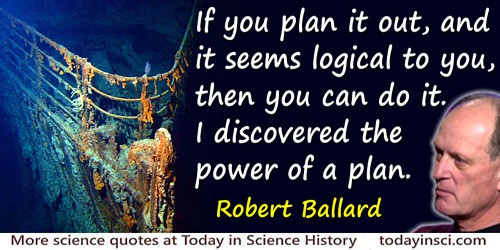
If you plan it out, and it seems logical to you, then you can do it. I discovered the power of a plan.
Quoted in biography on website of the National Geographic Channel, Australia.
In a training period I continue to believe that the best start is with the experimentally prepared situation. Principally because it is in this that it is easiest to illustrate controlled variability, but there is no compelling reason why all experiments should be shaped to the conventional forms of the psychophysical methods. In any case the psychologist must refuse to be limited by those formalised statements of scientific experiment, which grew up with the logical methodologists of the mid-19th century. There are no psychological experiments in which the conditions are all under control; in which one condition can be varied independently of the rest, or even in which the concomitant variation of two specified conditions alone can be arranged and considered.
From archive recording (3 Jun 1959) with to John C. Kenna, giving his recollection of his farewell speech to Cambridge Psychological Society (4 Mar 1952), in which he gave a summary of points he considered to be basic requirements for a good experimental psychologist. Part of point 3 of 7, from transcription of recording held at British Psychological Society History of Psychology Centre, London, as abridged on thepsychologist.bps.org.uk website.
In every enterprise … the mind is always reasoning, and, even when we seem to act without a motive, an instinctive logic still directs the mind. Only we are not aware of it, because we begin by reasoning before we know or say that we are reasoning, just as we begin by speaking before we observe that we are speaking, and just as we begin by seeing and hearing before we know what we see or what we hear.
From An Introduction to the Study of Experimental Medicine (1865), as translated by Henry Copley Greene (1957), 146.
In formal logic a contradiction is the signal of a defeat, but in the evolution of real knowledge it marks the first step in progress toward a victory. This is one great reason for the utmost toleration of variety of opinion. Once and forever, this duty of toleration has been summed up in the words, “Let both grow together until the harvest.”
In 'Religion and Science', The Atlantic (Aug 1925).
In logic, A asserts and B denies. Assertions being proverbially untrue, the presumption would be in favor of B’s innocence were it not that denials are notoriously false.
The Unabridged Devil’s Dictionary (2000), 5.
In mathematics two ends are constantly kept in view: First, stimulation of the inventive faculty, exercise of judgment, development of logical reasoning, and the habit of concise statement; second, the association of the branches of pure mathematics with each other and with applied science, that the pupil may see clearly the true relations of principles and things.
In 'Aim of the Mathematical Instruction', International Commission on Teaching of Mathematics, American Report: United States Bureau of Education: Bulletin 1912, No. 4, 7.
In my own view, some advice about what should be known, about what technical education should be acquired, about the intense motivation needed to succeed, and about the carelessness and inclination toward bias that must be avoided is far more useful than all the rules and warnings of theoretical logic.
From Reglas y Consejos sobre Investigacíon Cientifica: Los tónicos de la voluntad. (1897), as translated by Neely and Larry W. Swanson, in Advice for a Young Investigator (1999), 6.
In pure mathematics we have a great structure of logically perfect deductions which constitutes an integral part of that great and enduring human heritage which is and should be largely independent of the perhaps temporary existence of any particular geographical location at any particular time. … The enduring value of mathematics, like that of the other sciences and arts, far transcends the daily flux of a changing world. In fact, the apparent stability of mathematics may well be one of the reasons for its attractiveness and for the respect accorded it.
In Fundamentals of Mathematics (1941), 463.
In the application of inductive logic to a given knowledge situation, the total evidence available must be used as a basis for determining the degree of confirmation.
In Logical Foundations of Probability (1950, 1962), 211.
In the Vienna of the late 1920s and 1930s there throve an internationally famous philosophical bunch called the logical positivists. … They said that a key ingredient of knowledge was “sense data,” and proclaimed emphatically, in the words of … J.S.L. Gilmour, that sense data are “objective and unalterable.” …Good guess, but no cigar!
In 'A Trip Through the Perception Factory', Global Brain: The Evolution of Mass Mind from the Big Bang to the 21st Century (2000), 64.
Induction is the process of generalizing from our known and limited experience, and framing wider rules for the future than we have been able to test fully. At its simplest, then, an induction is a habit or an adaptation—the habit of expecting tomorrow’s weather to be like today’s, the adaptation to the unwritten conventions of community life.
Induction. The mental operation by which from a number of individual instances, we arrive at a general law. The process, according to Hamilton, is only logically valid when all the instances included in the law are enumerated. This being seldom, if ever, possible, the conclusion of an Induction is usually liable to more or less uncertainty, and Induction is therefore incapable of giving us necessary (general) truths.
Stated as narrative, not a direct quote, by his biographer W.H.S. Monck in 'Glossary of Philosophical Terms', appended in Sir William Hamilton (1881), 181.
Injustice or oppression in the next street...or any spot inhabited by men was a personal affront to Thomas Addis and his name, from its early alphabetical place, was conspicuous on lists of sponsors of scores of organizations fighting for democracy and against fascism. He worked on more committees than could reasonably have been expected of so busy a man... Tom Addis was happy to have a hand in bringing to the organization of society some of the logic of science and to further that understanding and to promote that democracy which are the only enduring foundations of human dignity.
Kevin V. Lemley and Linus Pauling, 'Thomas Addis: 1881-1949', Biographical Memoirs, National Academy of Sciences, 63, 27-29.
Intelligence is an extremely subtle concept. It’s a kind of understanding that flourishes if it’s combined with a good memory, but exists anyway even in the absence of good memory. It’s the ability to draw consequences from causes, to make correct inferences, to foresee what might be the result, to work out logical problems, to be reasonable, rational, to have the ability to understand the solution from perhaps insufficient information. You know when a person is intelligent, but you can be easily fooled if you are not yourself intelligent.
In Irv Broughton (ed.), The Writer's Mind: Interviews with American Authors (1990), Vol. 2, 57.
It [mathematics] is in the inner world of pure thought, where all entia dwell, where is every type of order and manner of correlation and variety of relationship, it is in this infinite ensemble of eternal verities whence, if there be one cosmos or many of them, each derives its character and mode of being,—it is there that the spirit of mathesis has its home and its life.
Is it a restricted home, a narrow life, static and cold and grey with logic, without artistic interest, devoid of emotion and mood and sentiment? That world, it is true, is not a world of solar light, not clad in the colours that liven and glorify the things of sense, but it is an illuminated world, and over it all and everywhere throughout are hues and tints transcending sense, painted there by radiant pencils of psychic light, the light in which it lies. It is a silent world, and, nevertheless, in respect to the highest principle of art—the interpenetration of content and form, the perfect fusion of mode and meaning—it even surpasses music. In a sense, it is a static world, but so, too, are the worlds of the sculptor and the architect. The figures, however, which reason constructs and the mathematic vision beholds, transcend the temple and the statue, alike in simplicity and in intricacy, in delicacy and in grace, in symmetry and in poise. Not only are this home and this life thus rich in aesthetic interests, really controlled and sustained by motives of a sublimed and supersensuous art, but the religious aspiration, too, finds there, especially in the beautiful doctrine of invariants, the most perfect symbols of what it seeks—the changeless in the midst of change, abiding things hi a world of flux, configurations that remain the same despite the swirl and stress of countless hosts of curious transformations.
Is it a restricted home, a narrow life, static and cold and grey with logic, without artistic interest, devoid of emotion and mood and sentiment? That world, it is true, is not a world of solar light, not clad in the colours that liven and glorify the things of sense, but it is an illuminated world, and over it all and everywhere throughout are hues and tints transcending sense, painted there by radiant pencils of psychic light, the light in which it lies. It is a silent world, and, nevertheless, in respect to the highest principle of art—the interpenetration of content and form, the perfect fusion of mode and meaning—it even surpasses music. In a sense, it is a static world, but so, too, are the worlds of the sculptor and the architect. The figures, however, which reason constructs and the mathematic vision beholds, transcend the temple and the statue, alike in simplicity and in intricacy, in delicacy and in grace, in symmetry and in poise. Not only are this home and this life thus rich in aesthetic interests, really controlled and sustained by motives of a sublimed and supersensuous art, but the religious aspiration, too, finds there, especially in the beautiful doctrine of invariants, the most perfect symbols of what it seeks—the changeless in the midst of change, abiding things hi a world of flux, configurations that remain the same despite the swirl and stress of countless hosts of curious transformations.
In 'The Universe and Beyond', Hibbert Journal (1904-1906), 3, 314.
It always bothers me that according to the laws as we understand them today, it takes a computing machine an infinite number of logical operations to figure out what goes on in no matter how tiny a region of space and no matter how tiny a region of time … I have often made the hypothesis that ultimately physics will not require a mathematical statement, that in the end the machinery will be revealed and the laws will turn out to be simple, like the chequer board with all its apparent complexities. But this speculation is of the same nature as those other people make—“I like it”,“I don't like it”—and it is not good to be too prejudiced about these things.
In The Character of Physical Law (1965, 2001), 57.
It has been asserted … that the power of observation is not developed by mathematical studies; while the truth is, that; from the most elementary mathematical notion that arises in the mind of a child to the farthest verge to which mathematical investigation has been pushed and applied, this power is in constant exercise. By observation, as here used, can only be meant the fixing of the attention upon objects (physical or mental) so as to note distinctive peculiarities—to recognize resemblances, differences, and other relations. Now the first mental act of the child recognizing the distinction between one and more than one, between one and two, two and three, etc., is exactly this. So, again, the first geometrical notions are as pure an exercise of this power as can be given. To know a straight line, to distinguish it from a curve; to recognize a triangle and distinguish the several forms—what are these, and all perception of form, but a series of observations? Nor is it alone in securing these fundamental conceptions of number and form that observation plays so important a part. The very genius of the common geometry as a method of reasoning—a system of investigation—is, that it is but a series of observations. The figure being before the eye in actual representation, or before the mind in conception, is so closely scrutinized, that all its distinctive features are perceived; auxiliary lines are drawn (the imagination leading in this), and a new series of inspections is made; and thus, by means of direct, simple observations, the investigation proceeds. So characteristic of common geometry is this method of investigation, that Comte, perhaps the ablest of all writers upon the philosophy of mathematics, is disposed to class geometry, as to its method, with the natural sciences, being based upon observation. Moreover, when we consider applied mathematics, we need only to notice that the exercise of this faculty is so essential, that the basis of all such reasoning, the very material with which we build, have received the name observations. Thus we might proceed to consider the whole range of the human faculties, and find for the most of them ample scope for exercise in mathematical studies. Certainly, the memory will not be found to be neglected. The very first steps in number—counting, the multiplication table, etc., make heavy demands on this power; while the higher branches require the memorizing of formulas which are simply appalling to the uninitiated. So the imagination, the creative faculty of the mind, has constant exercise in all original mathematical investigations, from the solution of the simplest problems to the discovery of the most recondite principle; for it is not by sure, consecutive steps, as many suppose, that we advance from the known to the unknown. The imagination, not the logical faculty, leads in this advance. In fact, practical observation is often in advance of logical exposition. Thus, in the discovery of truth, the imagination habitually presents hypotheses, and observation supplies facts, which it may require ages for the tardy reason to connect logically with the known. Of this truth, mathematics, as well as all other sciences, affords abundant illustrations. So remarkably true is this, that today it is seriously questioned by the majority of thinkers, whether the sublimest branch of mathematics,—the infinitesimal calculus—has anything more than an empirical foundation, mathematicians themselves not being agreed as to its logical basis. That the imagination, and not the logical faculty, leads in all original investigation, no one who has ever succeeded in producing an original demonstration of one of the simpler propositions of geometry, can have any doubt. Nor are induction, analogy, the scrutinization of premises or the search for them, or the balancing of probabilities, spheres of mental operations foreign to mathematics. No one, indeed, can claim preeminence for mathematical studies in all these departments of intellectual culture, but it may, perhaps, be claimed that scarcely any department of science affords discipline to so great a number of faculties, and that none presents so complete a gradation in the exercise of these faculties, from the first principles of the science to the farthest extent of its applications, as mathematics.
In 'Mathematics', in Henry Kiddle and Alexander J. Schem, The Cyclopedia of Education, (1877.) As quoted and cited in Robert Édouard Moritz, Memorabilia Mathematica; Or, The Philomath’s Quotation-book (1914), 27-29.
It has come to pass, I know not how, that Mathematics and Logic, which ought to be but the handmaids of Physic, nevertheless presume on the strength of the certainty which they possess to exercise dominion over it.
From De Augmentis Scientiaurum as translated in Francis Guy Selby, The Advancement of Learning (1893), Vol. 2, 73.
It hath been an old remark, that Geometry is an excellent Logic. And it must be owned that when the definitions are clear; when the postulata cannot be refused, nor the axioms denied; when from the distinct contemplation and comparison of figures, their properties are derived, by a perpetual well-connected chain of consequences, the objects being still kept in view, and the attention ever fixed upon them; there is acquired a habit of reasoning, close and exact and methodical; which habit strengthens and sharpens the mind, and being transferred to other subjects is of general use in the inquiry after truth.
In 'The Analyst', in The Works of George Berkeley (1898), Vol. 3, 10.
It is by logic that we prove, but by intuition that we discover.
In Science and Method (1908) translated by Francis Maitland (1914, 2007), 129.
It is commonly considered that mathematics owes its certainty to its reliance on the immutable principles of formal logic. This … is only half the truth imperfectly expressed. The other half would be that the principles of formal logic owe such a degree of permanence as they have largely to the fact that they have been tempered by long and varied use by mathematicians. “A vicious circle!” you will perhaps say. I should rather describe it as an example of the process known by mathematicians as the method of successive approximation.
In 'The Fundamental Conceptions And Methods Of Mathematics', Bulletin of the American Mathematical Society (3 Nov 1904), 11, No. 3, 120.
It is evidently equally foolish to accept probable reasoning from a mathematician and to demand from a rhetorician demonstrative proofs.
Nicomachean Ethics, 1094b, 25-7. In Jonathan Barnes (ed.), The Complete Works of Aristotle (1984), Vol. 2, 1730.
It is necessary that a surgeon should have a temperate and moderate disposition. That he should have well-formed hands, long slender fingers, a strong body, not inclined to tremble and with all his members trained to the capable fulfilment of the wishes of his mind. He should be of deep intelligence and of a simple, humble, brave, but not audacious disposition. He should be well grounded in natural science, and should know not only medicine but every part of philosophy; should know logic well, so as to be able to understand what is written, to talk properly, and to support what he has to say by good reasons.
Chirurgia Magna (1296, printed 1479), as translated by James Joseph Walsh in Old-Time Makers of Medicine (1911), 261.
It is not logic that makes men reasonable, nor the science of ethics that makes men good.
In Epigrams of Oscar Wilde (2007), 215.
It is perplexing to see the flexibility of the so-called 'exact sciences' which by cast-iron laws of logic and by the infallible help of mathematics can lead to conclusions which are diametrically opposite to one another.
In The Nature of Light: an Historical Survey (1970), 229
It is rigid dogma that destroys truth; and, please notice, my emphasis is not on the dogma, but on the rigidity. When men say of any question, “This is all there is to be known or said of the subject; investigation ends here,” that is death. It may be that the mischief comes not from the thinker but for the use made of his thinking by late-comers. Aristotle, for example, gave us our scientific technique … yet his logical propositions, his instruction in sound reasoning which was bequeathed to Europe, are valid only within the limited framework of formal logic, and, as used in Europe, they stultified the minds of whole generations of mediaeval Schoolmen. Aristotle invented science, but destroyed philosophy.
Dialogues of Alfred North Whitehead, as recorded by Lucien Price (1954, 2001), 165.
It is they who hold the secret of the mysterious property of the mind by which error ministers to truth, and truth slowly but irrevocably prevails. Theirs is the logic of discovery, the demonstration of the advance of knowledge and the development of ideas, which as the earthly wants and passions of men remain almost unchanged, are the charter of progress, and the vital spark in history.
Lecture, 'The Study of History' (11 Jun 1895) delivered at Cambridge, published as A Lecture on The Study of History (1895), 54-55.
It is time, therefore, to abandon the superstition that natural science cannot be regarded as logically respectable until philosophers have solved the problem of induction. The problem of induction is, roughly speaking, the problem of finding a way to prove that certain empirical generalizations which are derived from past experience will hold good also in the future.
Language, Truth and Logic (1960), 49.
It is true that mathematics, owing to the fact that its whole content is built up by means of purely logical deduction from a small number of universally comprehended principles, has not unfittingly been designated as the science of the self-evident [Selbstverständlichen]. Experience however, shows that for the majority of the cultured, even of scientists, mathematics remains the science of the incomprehensible [Unverständlichen].
In Ueber Wert und angeblichen Unwert der Mathematik, Jahresbericht der Deutschen Maihemaliker Vereinigung (1904), 357.
It is true that physics gives a wonderful training in precise, logical thinking-about physics. It really does depend upon accurate reproducible experiments, and upon framing hypotheses with the greatest possible freedom from dogmatic prejudice. And if these were the really important things in life, physics would be an essential study for everybody.
In Science is a Sacred Cow (1950), 90-91.
It is well-known that both rude and civilized peoples are capable of showing unspeakable, and as it is erroneously termed, inhuman cruelty towards each other. These acts of cruelty, murder and rapine are often the result of the inexorable logic of national characteristics, and are unhappily truly human, since nothing like them can be traced in the animal world. It would, for instance, be a grave mistake to compare a tiger with the bloodthirsty exectioner of the Reign of Terror, since the former only satisfies his natural appetite in preying on other mammals. The atrocities of the trials for witchcraft, the indiscriminate slaughter committed by the negroes on the coast of Guinea, the sacrifice of human victims made by the Khonds, the dismemberment of living men by the Battas, find no parallel in the habits of animals in their savage state. And such a comparision is, above all, impossible in the case of anthropoids, which display no hostility towards men or other animals unless they are first attacked. In this respect the anthropid ape stands on a higher plane than many men.
Robert Hartmann, Anthropoid Apes, 294-295.
It must be granted that in every syllogism, considered as an argument to prove the conclusion, there is a petitio principii. When we say, All men are mortal Socrates is a man therefore Socrates is mortal; it is unanswerably urged by the adversaries of the syllogistic theory, that the proposition, Socrates is mortal.
A System of Logic, Ratiocinative and Inductive (1858), 122.
It really is worth the trouble to invent a new symbol if we can thus remove not a few logical difficulties and ensure the rigour of the proofs. But many mathematicians seem to have so little feeling for logical purity and accuracy that they will use a word to mean three or four different things, sooner than make the frightful decision to invent a new word.
Grundgesetz der Arithmetik(1893), Vol. 2, Section 60, In P. Greach and M. Black (eds., Translations from the Philosophical Writings of Gottlob Frege (1952), 144.
It was not alone the striving for universal culture which attracted the great masters of the Renaissance, such as Brunellesco, Leonardo da Vinci, Raphael, Michelangelo and especially Albrecht Dürer, with irresistible power to the mathematical sciences. They were conscious that, with all the freedom of the individual fantasy, art is subject to necessary laws, and conversely, with all its rigor of logical structure, mathematics follows aesthetic laws.
From Lecture (5 Feb 1891) held at the Rathhaus, Zürich, printed as Ueber den Antheil der mathematischen Wissenschaft an der Kultur der Renaissance (1892), 19. (The Contribution of the Mathematical Sciences to the Culture of the Renaissance.) As translated in Robert Édouard Moritz, Memorabilia Mathematica; Or, The Philomath’s Quotation-Book (1914), 183.
John Bahcall, an astronomer on the Institute of Advanced Study faculty since 1970 likes to tell the story of his first faculty dinner, when he found himself seated across from Kurt Gödel, … a man dedicated to logic and the clean certainties of mathematical abstraction. Bahcall introduced himself and mentioned that he was a physicist. Gödel replied, “I don’t believe in natural science.”
As stated in Adam Begley, 'The Lonely Genius Club', New York Magazine (30 Jan 1995), 63.
Kurt Gödel’s achievement in modern logic is singular and monumental—indeed it is more than a monument, it is a landmark which will remain visible far in space and time. … The subject of logic has certainly completely changed its nature and possibilities with Gödel's achievement.
From remarks at the Presentation (Mar 1951) of the Albert Einstein Award to Dr. Gödel, as quoted in 'Tribute to Dr. Gödel', in Jack J. Bulloff, Thomas C. Holyok (eds.), Foundations of Mathematics: Symposium Papers Commemorating the Sixtieth Birthday of Kurt Gödel (1969), ix.
https://books.google.com/books?id=irZLAAAAMAAJ
Kurt Gödel, Jack J. Bulloff, Thomas C. Holyoke - 1969 -
Lakatos realized and admitted that the existing standards of rationality, standards of logic included, were too restrictive and would have hindered science had they been applied with determination. He therefore permitted the scientist to violate them (he admits that science is not “rational” in the sense of these standards). However, he demanded that research programmes show certain features in the long run—they must be progressive. … I have argued that this demand no longer restricts scientific practice. Any development agrees with it.
In Science in a Free Society (1978), 15.
Like Molière’s M. Jourdain, who spoke prose all his life without knowing it, mathematicians have been reasoning for at least two millennia without being aware of all the principles underlying what they were doing. The real nature of the tools of their craft has become evident only within recent times A renaissance of logical studies in modern times begins with the publication in 1847 of George Boole’s The Mathematical Analysis of Logic.
Co-authored with James R. Newman in Gödel's Proof (1986, 2005), 30.
Logic can be patient, for it is eternal.
Quoted without citation in Desmond MacHale, Comic Sections (1993), 146.
Logic does not pretend to teach the surgeon what are the symptoms which indicate a violent death. This he must learn from his own experience and observation, or from that of others, his predecessors in his peculiar science. But logic sits in judgment on the sufficiency of that observation and experience to justify his rules, and on the sufficiency of his rules to justify his conduct. It does not give him proofs, but teaches him what makes them proofs, and how he is to judge of them.
In A System of Logic, Ratiocinative and Inductive: Being a Connected View of the Principles of Evidence, and the Methods of Scientific Investigation (1843), Vol. 1, 11.
Logic doesn’t apply to the real world.
As quoted, without citation, as one of Minsky's “favorite claims”, in D.R. Hofstadter and D.C. Dennett (eds.) The Mind's I (1981), 343. The context by Hofstadter is that the “real world” is “chaotic and messy”.
Logic has borrowed the rules of geometry without understanding its power. … I am far from placing logicians by the side of geometers who teach the true way to guide the reason. … The method of avoiding error is sought by every one. The logicians profess to lead the way, the geometers alone reach it, and aside from their science there is no true demonstration.
From De l’Art de Persuader, (1657). Pensées de Pascal (1842), Part 1, Article 3, 41-42. As translated in Robert Édouard Moritz, Memorabilia Mathematica; Or, The Philomath’s Quotation-Book (1914), 202. From the original French, “La logique a peut-être emprunté les règles de la géométrie sans en comprendre la force … je serai bien éloigné de les mettre en parallèle avec les géomètres, qui apprennent la véritable méthode de conduire la raison. … La méthode de ne point errer est recherchée de tout le monde. Les logiciens font profession d'y conduire, les géomètres seuls y arrivent; et, hors de leur science …, il n'y a point de véritables démonstrations ….”
Logic is a wonderful thing but doesn't always beat actual thought.
The Last Continent (1998)
Logic is like the sword—those who appeal to it shall perish by it.
Samuel Butler, Henry Festing Jones (ed.), The Note-Books of Samuel Butler (1917), 330.
Logic is neither a science nor an art, but a dodge.
Quoted in Evelyn Abbott and Lewis Campbell, The Life and Letters of Benjamin Jowett, M.A., Master of Balliol College, Oxford (1897), Vol. 1, 131.
Logic is not concerned with human behavior in the same sense that physiology, psychology, and social sciences are concerned with it. These sciences formulate laws or universal statements which have as their subject matter human activities as processes in time. Logic, on the contrary, is concerned with relations between factual sentences (or thoughts). If logic ever discusses the truth of factual sentences it does so only conditionally, somewhat as follows: if such-and-such a sentence is true, then such-and-such another sentence is true. Logic itself does not decide whether the first sentence is true, but surrenders that question to one or the other of the empirical sciences.
Logic (1937). In The Language of Wisdom and Folly: Background Readings in Semantics (1967), 44.
Logic is only the art of going wrong with confidence.
This is a slightly reworded version of part of a quote by Joseph Wood Krutch (see the quote beginning “Metaphysics…”, on the Joseph Wood Krutch Quotes page of this website.) This note by Webmaster is included here to help readers identify that it is incorrectly cited when found attributed to Morris Kline, John Ralston Saul or W.H. Auden. In fact, the quote is simply attributed to Anonymous by Kline in his Mathematics: The Loss of Certainty (1980), 197; and as an “old conundrum” in Saul's On Equilibrium: The Six Qualities of the New Humanism (2004), 124.
Logic is the hygiene the mathematician practices to keep his ideas healthy and strong.
As quoted, without citation, in Morris Kline, 'Logic Versus Pedagogy', The American Mathematical Monthly (Mar 1970), 77, No. 3, 272.
Logic is the last scientific ingredient of Philosophy; its extraction leaves behind only a confusion of non-scientific, pseudo problems.
The Unity of Science, trans. Max Black (1934), 22.
Logic issues in tautologies, mathematics in identities, philosophy in definitions; all trivial, but all part of the vital work of clarifying and organising our thought.
'Last Papers: Philosophy' (1929), in The Foundations of Mathematics and Other Logical Essays (1931), 264.
Logic it is called [referring to Whitehead and Russell’s Principia Mathematica] and logic it is, the logic of propositions and functions and classes and relations, by far the greatest (not merely the biggest) logic that our planet has produced, so much that is new in matter and in manner; but it is also mathematics, a prolegomenon to the science, yet itself mathematics in its most genuine sense, differing from other parts of the science only in the respects that it surpasses these in fundamentally, generality and precision, and lacks traditionality. Few will read it, but all will feel its effect, for behind it is the urgence and push of a magnificent past: two thousand five hundred years of record and yet longer tradition of human endeavor to think aright.
In Science (1912), 35, 110, from his book review on Alfred North Whitehead and Bertrand Russell, Principia Mathematica.
Logic sometimes breeds monsters.
In Science and Method (1952), 125.
Logic teaches us that on such and such a road we are sure of not meeting an obstacle; it does not tell us which is the road that leads to the desired end. For this, it is necessary to see the end from afar, and the faculty which teaches us to see is intuition. Without it, the geometrician would be like a writer well up in grammar but destitute of ideas.
…...
LOGIC, n. The art of thinking and reasoning in strict accordance with the limitations and incapacities of the human misunderstanding. The basic of logic is the syllogism, consisting of a major and a minor premise and a conclusion—thus:
Major Premise: Sixty men can do a piece of work sixty times as quickly as one man.
Minor Premise: One man can dig a post-hole in sixty seconds; therefore—
Conclusion: Sixty men can dig a post-hole in one second.
This may be called the syllogism arithmetical, in which, by combining logic and mathematics, we obtain a double certainty and are twice blessed.
Major Premise: Sixty men can do a piece of work sixty times as quickly as one man.
Minor Premise: One man can dig a post-hole in sixty seconds; therefore—
Conclusion: Sixty men can dig a post-hole in one second.
This may be called the syllogism arithmetical, in which, by combining logic and mathematics, we obtain a double certainty and are twice blessed.
The Collected Works of Ambrose Bierce (1911), Vol. 7, The Devil's Dictionary, 196.
Logic, like whiskey, loses its beneficial effect when taken in too large quantities.
In 'Weeds and Moss', My Ireland (1937), Chap. 19, 186.
Logic, logic, logic. Logic is the beginning of wisdom, Valeris, not the end.
Spoken by character Dr. Spock in movie Star Trek VI: The Undiscovered Country (1992), screenwriters Nicholas Meyer and Denny Martin Flinn. As cited in Gary Westfahl (ed.), The Greenwood Encyclopedia of Science Fiction and Fantasy (2005), Vol. 2, 892.
Logical consequences are the scarecrows of fools and the beacons of wise men.
'On the Hypothesis that Animals are Automata', The Fortnightly (1874), 22, 577.
Man has never been a particularly modest or self-deprecatory animal, and physical theory bears witness to this no less than many other important activities. The idea that thought is the measure of all things, that there is such a thing as utter logical rigor, that conclusions can be drawn endowed with an inescapable necessity, that mathematics has an absolute validity and controls experience—these are not the ideas of a modest animal. Not only do our theories betray these somewhat bumptious traits of self-appreciation, but especially obvious through them all is the thread of incorrigible optimism so characteristic of human beings.
In The Nature of Physical Theory (1936), 135-136.
Mathematicians create by acts of insight and intuition. Logic then sanctions the conquests of intuition. It is the hygiene that mathematics practices to keep its ideas healthy and strong. Moreover, the whole structure rests fundamentally on uncertain ground, the intuition of humans. Here and there an intuition is scooped out and replaced by a firmly built pillar of thought; however, this pillar is based on some deeper, perhaps less clearly defined, intuition. Though the process of replacing intuitions with precise thoughts does not change the nature of the ground on which mathematics ultimately rests, it does add strength and height to the structure.
In Mathematics in Western Culture (1964), 408.
Mathematicians deal with possible worlds, with an infinite number of logically consistent systems. Observers explore the one particular world we inhabit. Between the two stands the theorist. He studies possible worlds but only those which are compatible with the information furnished by observers. In other words, theory attempts to segregate the minimum number of possible worlds which must include the actual world we inhabit. Then the observer, with new factual information, attempts to reduce the list further. And so it goes, observation and theory advancing together toward the common goal of science, knowledge of the structure and observation of the universe.
Lecture to Sigma Xi, 'The Problem of the Expanding Universe' (1941), printed in Sigma Xi Quarterly (1942), 30, 104-105. Reprinted in Smithsonian Institution Report of the Board of Regents (1943), 97, 123. As cited by Norriss S. Hetherington in 'Philosophical Values and Observation in Edwin Hubble's Choice of a Model of the Universe', Historical Studies in the Physical Sciences (1982), 13, No. 1, 63.
Mathematicians go mad, and cashiers; but creative artists very seldom. I am not, as will be seen, in any sense attacking logic: I only say that the danger does lie in logic, not in imagination.
In Orthodoxy (1908), 27.
Mathematics … belongs to every inquiry, moral as well as physical. Even the rules of logic, by which it is rigidly bound, could not be deduced without its aid. The laws of argument admit of simple statement, but they must be curiously transposed before they can be applied to the living speech and verified by observation. In its pure and simple form the syllogism cannot be directly compared with all experience, or it would not have required an Aristotle to discover it. It must be transmuted into all the possible shapes in which reasoning loves to clothe itself. The transmutation is the mathematical process in the establishment of the law.
From Memoir (1870) read before the National Academy of Sciences, Washington, printed in 'Linear Associative Algebra', American Journal of Mathematics (1881), 4, 97-98.
Mathematics as an expression of the human mind reflects the active will, the contemplative reason, and the desire for aesthetic perfection. Its basic elements are logic and intuition, analysis and construction, generality and individuality. Though different traditions may emphasize different aspects, it is only the interplay of these antithetic forces and the struggle for their synthesis that constitute the life, usefulness, and supreme value of mathematical science.
As co-author with Herbert Robbins, in What Is Mathematics?: An Elementary Approach to Ideas and Methods (1941, 1996), x.
Mathematics had never had more than a secondary interest for him [her husband, George Boole]; and even logic he cared for chiefly as a means of clearing the ground of doctrines imagined to be proved, by showing that the evidence on which they were supposed to give rest had no tendency to prove them. But he had been endeavoring to give a more active and positive help than this to the cause of what he deemed pure religion.
In Eleanor Meredith Cobham, Mary Everest Boole: Collected Works (1931), 40.
Mathematics has often been characterized as the most conservative of all sciences. This is true in the sense of the immediate dependence of new upon old results. All the marvellous new advancements presuppose the old as indispensable steps in the ladder. … Inaccessibility of special fields of mathematics, except by the regular way of logically antecedent acquirements, renders the study discouraging or hateful to weak or indolent minds.
In Number and its Algebra (1896), 136.
Mathematics is a logical method … Mathematical propositions express no thoughts. In life it is never a mathematical proposition which we need, but we use mathematical propositions only in order to infer from propositions which do not belong to mathematics to others which equally do not belong to mathematics.
In Tractatus Logico Philosophicus (1922), 169 (statements 6.2-6.211).
Mathematics is a structure providing observers with a framework upon which to base healthy, informed, and intelligent judgment. Data and information are slung about us from all directions, and we are to use them as a basis for informed decisions. … Ability to critically analyze an argument purported to be logical, free of the impact of the loaded meanings of the terms involved, is basic to an informed populace.
In 'Mathematics Is an Edifice, Not a Toolbox', Notices of the AMS (Oct 1996), 43, No. 10, 1108.
Mathematics is a study which, when we start from its most familiar portions, may be pursued in either of two opposite directions. The more familiar direction is constructive, towards gradually increasing complexity: from integers to fractions, real numbers, complex numbers; from addition and multiplication to differentiation and integration, and on to higher mathematics. The other direction, which is less familiar, proceeds, by analysing, to greater and greater abstractness and logical simplicity; instead of asking what can be defined and deduced from what is assumed to begin with, we ask instead what more general ideas and principles can be found, in terms of which what was our starting-point can be defined or deduced. It is the fact of pursuing this opposite direction that characterises mathematical philosophy as opposed to ordinary mathematics.
In Introduction to Mathematical Philosophy (1920), 1.
Mathematics is distinguished from all other sciences except only ethics, in standing in no need of ethics. Every other science, even logic—logic, especially—is in its early stages in danger of evaporating into airy nothingness, degenerating, as the Germans say, into an anachrioid [?] film, spun from the stuff that dreams are made of. There is no such danger for pure mathematics; for that is precisely what mathematics ought to be.
In Charles S. Peirce, Charles Hartshorne (ed.), Paul Weiss (ed.), Collected Papers of Charles Sanders Peirce (1931), Vol. 4, 200.
Mathematics is, as it were, a sensuous logic, and relates to philosophy as do the arts, music, and plastic art to poetry.
Aphorism 365 from Selected Aphorisms from the Lyceum (1797-1800). In Friedrich Schlegel, translated by Ernst Behler and Roman Struc, Dialogue on Poetry and Literary Aphorisms (trans. 1968), 147.
Mathematics will not be properly esteemed in wider circles until more than the a b c of it is taught in the schools, and until the unfortunate impression is gotten rid of that mathematics serves no other purpose in instruction than the formal training of the mind. The aim of mathematics is its content, its form is a secondary consideration and need not necessarily be that historic form which is due to the circumstance that mathematics took permanent shape under the influence of Greek logic.
In Die Entivickelung der Mathematik in den letzten Jahrhunderten (1884), 6.
Mathematics, from the earliest times to which the history of human reason can reach, has followed, among that wonderful people of the Greeks, the safe way of science. But it must not be supposed that it was as easy for mathematics as for logic, in which reason is concerned with itself alone, to find, or rather to make for itself that royal road. I believe, on the contrary, that there was a long period of tentative work (chiefly still among the Egyptians), and that the change is to be ascribed to a revolution, produced by the happy thought of a single man, whose experiments pointed unmistakably to the path that had to be followed, and opened and traced out for the most distant times the safe way of a science. The history of that intellectual revolution, which was far more important than the passage round the celebrated Cape of Good Hope, and the name of its fortunate author, have not been preserved to us. … A new light flashed on the first man who demonstrated the properties of the isosceles triangle (whether his name was Thales or any other name), for he found that he had not to investigate what he saw in the figure, or the mere concepts of that figure, and thus to learn its properties; but that he had to produce (by construction) what he had himself, according to concepts a priori, placed into that figure and represented in it, so that, in order to know anything with certainty a priori, he must not attribute to that figure anything beyond what necessarily follows from what he has himself placed into it, in accordance with the concept.
In Critique of Pure Reason, Preface to the Second Edition, (1900), 690.
Mathematics, or the science of magnitudes, is that system which studies the quantitative relations between things; logic, or the science of concepts, is that system which studies the qualitative (categorical) relations between things.
In 'The Axioms of Logic', Tertium Organum: The Third Canon of Thought; a Key to the Enigmas of the World (1922), 246.
Mathematics, that giant pincers of scientific logic…
From Address to the Ohio Academy of Science, 'Biology and Mathematics', printed in Science (11 Aug 1905), New Series 22, No. 554, 162.
Men are rather beholden ... generally to chance or anything else, than to logic, for the invention of arts and sciences.
The Advancement of Learning (1605) in James Spedding, Robert Ellis and Douglas Heath (eds.), The Works of Francis Bacon (1887-1901), Vol. 3, 386.
Men of science belong to two different types—the logical and the intuitive. Science owes its progress to both forms of minds. Mathematics, although a purely logical structure, nevertheless makes use of intuition. Among the mathematicians there are intuitives and logicians, analysts and geometricians. Hermite and Weierstrass were intuitives. Riemann and Bertrand, logicians. The discoveries of intuition have always to be developed by logic.
In Man the Unknown (1935), 123.
Metaphysics may be, after all, only the art of being sure of something that is not so and logic only the art of going wrong with confidence.
In The Modern Temper (1929), 228. The second part of this quote is often seen as a sentence by itself, and a number of authors cite it incorrectly. For those invalid attributions, see quote beginning “Logic is only the art…” on the Joseph Wood Krutch Quotes page of this website.
Neither in the subjective nor in the objective world can we find a criterion for the reality of the number concept, because the first contains no such concept, and the second contains nothing that is free from the concept. How then can we arrive at a criterion? Not by evidence, for the dice of evidence are loaded. Not by logic, for logic has no existence independent of mathematics: it is only one phase of this multiplied necessity that we call mathematics.
How then shall mathematical concepts be judged? They shall not be judged. Mathematics is the supreme arbiter. From its decisions there is no appeal. We cannot change the rules of the game, we cannot ascertain whether the game is fair. We can only study the player at his game; not, however, with the detached attitude of a bystander, for we are watching our own minds at play.
How then shall mathematical concepts be judged? They shall not be judged. Mathematics is the supreme arbiter. From its decisions there is no appeal. We cannot change the rules of the game, we cannot ascertain whether the game is fair. We can only study the player at his game; not, however, with the detached attitude of a bystander, for we are watching our own minds at play.
In Number: The Language of Science; a Critical Survey Written for the Cultured Non-Mathematician (1937), 244-245.
No deeply-rooted tendency was ever extirpated by adverse argument. Not having originally been founded on argument, it cannot be destroyed by logic.
In Problems of Life and Mind (1874), Vol. 1, 7.
Not everything is an idea. Otherwise psychology would contain all the sciences within it or at least it would be the highest judge over all the sciences. Otherwise psychology would rule over logic and mathematics. But nothing would be a greater misunderstanding of mathematics than its subordination to psychology.
In Elmer Daniel Klemke, Essays on Frege (1968), 531.
Numerical logistic is that which employs numbers; symbolic logistic that which uses symbols, as, say, the letters of the alphabet.
In Introduction to the Analytic Art (1591).
O Logic: born gatekeeper to the Temple of Science, victim of capricious destiny: doomed hitherto to be the drudge of pedants: come to the aid of thy master, Legislation.
In John Browning (ed.), 'Extracts from Bentham’s Commonplace Book: Logic', The Works of Jeremy Bentham (1843), Vol. 10, 145.
Of science and logic he chatters,
As fine and as fast as he can;
Though I am no judge of such matters,
I’m sure he’s a talented man.
As fine and as fast as he can;
Though I am no judge of such matters,
I’m sure he’s a talented man.
'The Talented Man.' In Winthrop Mackworth Praed, Ferris Greenslet, The Poems of Winthrop Mackworth Praed (1909), 122.
by - 1909
Oh, my dear Kepler, how I wish that we could have one hearty laugh together. Here, at Padua, is the principal professor of philosophy, whom I have repeatedly and urgently requested to look at the moon and planets through my glass, [telescope] which he pertinaciously refuses to do. Why are you not here? what shouts of laughter we should have at this glorious folly! and to hear the professor of philosophy at Pisa laboring before the grand duke with logical arguments, as if with magical incantations, to charm the new planets out of the sky.
From Letter to Johannes Kepler. As translated in John Elliot Drinkwater Bethune, Life of Galileo Galilei: With Illustrations of the Advancement of Experimental Philosophy (1832), 92-93.
One of the principal obstacles to the rapid diffusion of a new idea lies in the difficulty of finding suitable expression to convey its essential point to other minds. Words may have to be strained into a new sense, and scientific controversies constantly resolve themselves into differences about the meaning of words. On the other hand, a happy nomenclature has sometimes been more powerful than rigorous logic in allowing a new train of thought to be quickly and generally accepted.
Opening Address to the Annual Meeting of the British Association by Prof. Arthur Schuster, in Nature (4 Aug 1892), 46, 325.
One thought I cannot forbear suggesting: we have long known that “one star differeth from another star in glory;” we have now the strongest evidence that they also differ in constituent materials,—some of them perhaps having no elements to be found in some other. What then becomes of that homogeneity of original diffuse matter which is almost a logical necessity of the nebular hypothesis?
L.M. Rutherfurd, 'Astronomical Observations with the Spectroscope' (4 Dec 1862), American Journal of Science and Arts (May 1863), 2nd Series, 35, No. 103, 77. His obituarist, John K. Rees, wrote (1892) “This paper was the first published work on star spectra.”
Only mathematics and mathematical logic can say as little as the physicist means to say. (1931)
In The Scientific Outlook (1931, 2009), 57.
Ordinarily logic is divided into the examination of ideas, judgments, arguments, and methods. The two latter are generally reduced to judgments, that is, arguments are reduced to apodictic judgments that such and such conclusions follow from such and such premises, and method is reduced to judgments that prescribe the procedure that should be followed in the search for truth.
Ampére expresses how arguments have a logical structure which he expected should be applied to relate scientific theories to experimental evidence. In James R. Hofmann, André-Marie Ampère (1996), 158. Cites Académie des Sciences Ampère Archives, École Normale lecture 15 notes, box 261.
Ordinary language is totally unsuited for expressing what physics really asserts, since the words of everyday life are not sufficiently abstract. Only mathematics and mathematical logic can say as little as the physicist means to say.
In The Scientific Outlook (1931, 2001), 61.
Our Professor, which doth have tenure,
Feared be thy name.
Thy sets partition,
Thy maps commute,
In groups as in vector spaces.
Give us this day our daily notation,
And forgive us our obtuseness,
As we forgive tutors who cannot help us.
Lead us not into Lye rings,
But deliver us from eigenvalues,
For thine is the logic, the notation, and the accent,
That confuses us forever.
Amen.
Feared be thy name.
Thy sets partition,
Thy maps commute,
In groups as in vector spaces.
Give us this day our daily notation,
And forgive us our obtuseness,
As we forgive tutors who cannot help us.
Lead us not into Lye rings,
But deliver us from eigenvalues,
For thine is the logic, the notation, and the accent,
That confuses us forever.
Amen.
'Algebra Prayer' by an unnamed University of Toronto mathematics student. On the Department of Mathematics, University of Toronto web site.
Poincaré was a vigorous opponent of the theory that all mathematics can be rewritten in terms of the most elementary notions of classical logic; something more than logic, he believed, makes mathematics what it is.
In Men of Mathematics (1937), 552.
Professor [Max] Planck, of Berlin, the famous originator of the Quantum Theory, once remarked to me that in early life he had thought of studying economics, but had found it too difficult! Professor Planck could easily master the whole corpus of mathematical economics in a few days. He did not mean that! But the amalgam of logic and intuition and the wide knowledge of facts, most of which are not precise, which is required for economic interpretation in its highest form is, quite truly, overwhelmingly difficult for those whose gift mainly consists in the power to imagine and pursue to their furthest points the implications and prior conditions of comparatively simple facts which are known with a high degree of precision.
'Alfred Marshall: 1842-1924' (1924). In Geoffrey Keynes (ed.), Essays in Biography (1933), 191-2
Professor Whitehead has recently restored a seventeenth century phrase—"climate of opinion." The phrase is much needed. Whether arguments command assent or not depends less upon the logic that conveys them than upon the climate of opinion in which they are sustained.
In The Heavenly City of the Eighteenth-Century Philosophers (1932, 2003), 5
PROJECTILE, n. The final arbiter in international disputes. Formerly these disputes were settled by physical contact of the disputants, with such simple arguments as the rudimentary logic of the times could supply —the sword, the spear, and so forth. With the growth of prudence in military affairs the projectile came more and more into favor, and is now held in high esteem by the most courageous. Its capital defect is that it requires personal attendance at the point of propulsion.
The Collected Works of Ambrose Bierce (1911), Vol. 7, The Devil's Dictionary, 268.
Pure mathematics … reveals itself as nothing but symbolic or formal logic. It is concerned with implications, not applications. On the other hand, natural science, which is empirical and ultimately dependent upon observation and experiment, and therefore incapable of absolute exactness, cannot become strictly mathematical. The certainty of geometry is thus merely the certainty with which conclusions follow from non-contradictory premises. As to whether these conclusions are true of the material world or not, pure mathematics is indifferent.
In 'Non-Euclidian Geometry of the Fourth Dimension', collected in Henry Parker Manning (ed.), The Fourth Dimension Simply Explained (1910), 58.
Pure mathematics is a collection of hypothetical, deductive theories, each consisting of a definite system of primitive, undefined, concepts or symbols and primitive, unproved, but self-consistent assumptions (commonly called axioms) together with their logically deducible consequences following by rigidly deductive processes without appeal to intuition.
In 'Non-Euclidian Geometry of the Fourth Dimension', collected in Henry Parker Manning (ed.), The Fourth Dimension Simply Explained (1910), 58.
Pure Mathematics is the class of all propositions of the form “p implies q,” where p and q are propositions containing one or more variables, the same in the two propositions, and neither p nor q contains any constants except logical constants. And logical constants are all notions definable in terms of the following: Implication, the relation of a term to a class of which it is a member, the notion of such that, the notion of relation, and such further notions as may be involved in the general notion of propositions of the above form. In addition to these, mathematics uses a notion which is not a constituent of the propositions which it considers, namely the notion of truth.
In 'Definition of Pure Mathematics', Principles of Mathematics (1903), 3.
Pure mathematics is, in its way, the poetry of logical ideas. One seeks the most general ideas of operation which will bring together in simple, logical and unified form the largest possible circle of formal relationships. In this effort toward logical beauty spiritual formulas are discovered necessary for the deeper penetration into the laws of nature.
In letter (1 May 1935), Letters to the Editor, 'The Late Emmy Noether: Professor Einstein Writes in Appreciation of a Fellow-Mathematician', New York Times (4 May 1935), 12.
Pure mathematics was discovered by Boole in a work which he called “The Laws of Thought” (1854).… His book was in fact concerned with formal logic, and this is the same thing as mathematics.
In 'Recent Work on the Principles of Mathematics', The International Monthly (Jul-Dec 1901), 4, 83. Relevant context appears in a footnote in William Bragg Ewald, From Kant to Hilbert: A Source Book in the Foundations of Mathematics (1996), Vol. 1, 442, which gives: “Russell’s essay was written for a popular audience, and (as he notes) for an editor who asked
him to make the essay ‘as romantic as possible’. Russell’s considered appraisal of Boole was more
sober. For instance, in Our Knowledge of the External World, Lecture II, he says of Boole: ‘But in him and his successors, before Peano and Frege, the only thing really achieved, apart from certain details, was the invention of a mathematical symbolism for deducing consequences from the
premises which the newer methods shared with Aristotle.’”
Quantity is that which is operated with according to fixed mutually consistent laws. Both operator and operand must derive their meaning from the laws of operation. In the case of ordinary algebra these are the three laws already indicated [the commutative, associative, and distributive laws], in the algebra of quaternions the same save the law of commutation for multiplication and division, and so on. It may be questioned whether this definition is sufficient, and it may be objected that it is vague; but the reader will do well to reflect that any definition must include the linear algebras of Peirce, the algebra of logic, and others that may be easily imagined, although they have not yet been developed. This general definition of quantity enables us to see how operators may be treated as quantities, and thus to understand the rationale of the so called symbolical methods.
In 'Mathematics', Encyclopedia Britannica (9th ed.).
Science attempts to find logic and simplicity in nature. Mathematics attempts to establish order and simplicity in human thought.
The Pursuit of Simplicity (1980), 17.
Science derives its conclusions by the laws of logic from our sense perceptions, Thus it does not deal with the real world, of which we know nothing, but with the world as it appears to our senses. … All our sense perceptions are limited by and attached to the conceptions of time and space. … Modern physics has come to the same conclusion in the relativity theory, that absolute space and absolute time have no existence, but, time and space exist only as far as things or events fill them, that is, are forms of sense perception.
In 'Religion and Modern Science', The Christian Register (16 Nov 1922), 101, 1089. The article is introduced as “the substance of an address to the Laymen’s League in All Soul’s Church (5 Nov 1922).
Science has hitherto been proceeding without the guidance of any rational theory of logic, and has certainly made good progress. It is like a computer who is pursuing some method of arithmetical approximation. Even if he occasionally makes mistakes in his ciphering, yet if the process is a good one they will rectify themselves. But then he would approximate much more rapidly if he did not commit these errors; and in my opinion, the time has come when science ought to be provided with a logic. My theory satisfies me; I can see no flaw in it. According to that theory universality, necessity, exactitude, in the absolute sense of these words, are unattainable by us, and do not exist in nature. There is an ideal law to which nature approximates; but to express it would require an endless series of modifications, like the decimals expressing surd. Only when you have asked a question in so crude a shape that continuity is not involved, is a perfectly true answer attainable.
Letter to G. F. Becker, 11 June 1893. Merrill Collection, Library of Congress. Quoted in Nathan Reingold, Science in Nineteenth-Century America: A Documentary History (1966), 231-2.
Science has taught us to think the unthinkable. Because when nature is the guide—rather than a priori prejudices, hopes, fears or desires—we are forced out of our comfort zone. One by one, pillars of classical logic have fallen by the wayside as science progressed in the 20th century, from Einstein's realization that measurements of space and time were not absolute but observer-dependent, to quantum mechanics, which not only put fundamental limits on what we can empirically know but also demonstrated that elementary particles and the atoms they form are doing a million seemingly impossible things at once.
In op-ed, 'A Universe Without Purpose', Los Angeles Times (1 Apr 2012).
Science is a method of logical analysis of nature’s operations. It has lessened human anxiety about the cosmos by demonstrating the materiality of nature’s forces, and their frequent predictability.
In Sexual Personae: Art and Decadence from Nefertiti to Emily Dickinson (1990), 5.
Science is simply common sense at its best—that is, rigidly accurate in observation, and merciless to fallacy in logic.
In The Crayfish: An Introduction to the Study of Zoology (1880), 2.
Science seldom proceeds in the straightforward logical manner imagined by outsiders. Instead, its steps forward (and sometimes backward) are often very human events in which personalities and cultural traditions play major roles.
In The Double Helix: A Personal Account of the Discovery of the Structure of DNA (1968, 2001), Preface, xi.
Scientists are the easiest to fool. ... They think in straight, predictable, directable, and therefore misdirectable, lines. The only world they know is the one where everything has a logical explanation and things are what they appear to be. Children and conjurors—they terrify me. Scientists are no problem; against them I feel quite confident.
Code of the Lifemaker (1983, 2000),Chapter 1.
Simple molecules combine to make powerful chemicals. Simple cells combine to make powerful life-forms. Simple electronics combine to make powerful computers. Logically, all things are created by a combination of simpler, less capable components. Therefore, a supreme being must be in our future, not our origin. What if “God” is the consciousness that will be created when enough of us are connected by the Internet?!!
Thoughts by character Dogbert in Dilbert cartoon strip (11 Feb 1996).
Since my logic aims to teach and instruct the understanding, not that it may with the slender tendrils of the mind snatch at and lay hold of abstract notions (as the common logic does), but that it may in very truth dissect nature, and discover the virtues and actions of bodies, with their laws as determined in matter; so that this science flows not merely from the nature of the mind, but also from the nature of things.
In Novum Organum (1620), Book 2, Aphorism 42.
Since the examination of consistency is a task that cannot be avoided, it appears necessary to axiomatize logic itself and to prove that number theory and set theory are only parts of logic. This method was prepared long ago (not least by Frege’s profound investigations); it has been most successfully explained by the acute mathematician and logician Russell. One could regard the completion of this magnificent Russellian enterprise of the axiomatization of logic as the crowning achievement of the work of axiomatization as a whole.
Address (11 Sep 1917), 'Axiomatisches Denken' delivered before the Swiss Mathematical Society in
Zürich. Translated by Ewald as 'Axiomatic Thought', (1918), in William Bragg Ewald, From Kant to Hilbert (1996), Vol. 2, 1113.
Sir Hiram Maxim is a genuine and typical example of the man of science, romantic, excitable, full of real but somewhat obvious poetry, a little hazy in logic and philosophy, but full of hearty enthusiasm and an honorable simplicity. He is, as he expresses it, “an old and trained engineer,” and is like all of the old and trained engineers I have happened to come across, a man who indemnifies himself for the superhuman or inhuman concentration required for physical science by a vague and dangerous romanticism about everything else.
In G.K. Chesterton, 'The Maxims of Maxim', Daily News (25 Feb 1905). Collected in G. K. Chesterton and Dale Ahlquist (ed.), In Defense of Sanity: The Best Essays of G.K. Chesterton (2011), 87.
Slavery in America was perpetuated not merely by human badness but also by human blindness. … Men convinced themselves that a system that was so economically profitable must be morally justifiable. … Science was commandeered to prove the biological inferiority of the Negro. Even philosophical logic was manipulated [exemplified by] an Aristotlian syllogism:
All men are made in the image of God;
God, as everyone knows, is not a Negro;
Therefore, the Negro is not a man.
All men are made in the image of God;
God, as everyone knows, is not a Negro;
Therefore, the Negro is not a man.
'Love in Action', Strength To Love (1963, 1981), 44.
So-called extraordinary events always split into two extremes naturalists who have not witnessed them: those who believe blindly and those who do not believe at all. The latter have always in mind the story of the golden goose; if the facts lie slightly beyond the limits of their knowledge, they relegate them immediately to fables. The former have a secret taste for marvels because they seem to expand Nature; they use their imagination with pleasure to find explanations. To remain doubtful is given to naturalists who keep a middle path between the two extremes. They calmly examine facts; they refer to logic for help; they discuss probabilities; they do not scoff at anything, not even errors, because they serve at least the history of the human mind; finally, they report rather than judge; they rarely decide unless they have good evidence.
Quoted in Albert V. Carozzi, Histoire des sciences de la terre entre 1790 et 1815 vue à travers les documents inédités de la Societé de Physique et d'Histoire Naturelle de Genève, trans. Albert V. and Marguerite Carozzi. (1990), 175.
Some books are to be tasted, others to be swallowed, and some few to be chewed and digested; that is, some books are to be read only in parts; other to be read, but not curiously; and some few to be read wholly, and with diligence and attention. Some books also may be read by deputy, and extracts made of them by others; but that would be only in the less important arguments, and the meaner sort of books; else distilled books are like common distilled waters, flashy things. Reading maketh a full man; conference a ready man; and writing an exact man. And therefore, if a man write little, he had need have a great memory; if he confer little, he had need have a present wit: and if he read little, he had need have much cunning, to seem to know that he doth not. Histories make men wise; poets witty; the mathematics subtile; natural philosophy deep; moral grave; logic and rhetoric able to contend. Abeunt studia in mores. [The studies pass into the manners.]
'Of Studies' (1625) in James Spedding, Robert Ellis and Douglas Heath (eds.), The Works of Francis Bacon (1887-1901), Vol. 6, 498.
Some people say they cannot understand a million million. Those people cannot understand that twice two makes four. That is the way I put it to people who talk to me about the incomprehensibility of such large numbers. I say finitude is incomprehensible, the infinite in the universe is comprehensible. Now apply a little logic to this. Is the negation of infinitude incomprehensible? What would you think of a universe in which you could travel one, ten, or a thousand miles, or even to California, and then find it comes to an end? Can you suppose an end of matter or an end of space? The idea is incomprehensible. Even if you were to go millions and millions of miles the idea of coming to an end is incomprehensible. You can understand one thousand per second as easily as you can understand one per second. You can go from one to ten, and then times ten and then to a thousand without taxing your understanding, and then you can go on to a thousand million and a million million. You can all understand it.
In 'The Wave Theory of Light' (1884), Popular Lectures and Addresses (1891), Vol. 1, 322.
Strictly speaking, it is really scandalous that science has not yet clarified the nature of number. It might be excusable that there is still no generally accepted definition of number, if at least there were general agreement on the matter itself. However, science has not even decided on whether number is an assemblage of things, or a figure drawn on the blackboard by the hand of man; whether it is something psychical, about whose generation psychology must give information, or whether it is a logical structure; whether it is created and can vanish, or whether it is eternal. It is not known whether the propositions of arithmetic deal with those structures composed of calcium carbonate [chalk] or with non-physical entities. There is as little agreement in this matter as there is regarding the meaning of the word “equal” and the equality sign. Therefore, science does not know the thought content which is attached to its propositions; it does not know what it deals with; it is completely in the dark regarding their proper nature. Isn’t this scandalous?
From opening paragraph of 'Vorwort', Über die Zahlen des Herrn H. Schubert (1899), iii. ('Foreword', On the Numbers of Mr. H. Schubert). Translated by Theodore J. Benac in Friedrich Waismann, Introduction to Mathematical Thinking: The Formation of Concepts in Modern Mathematics (1959, 2003), 107. Webmaster added “[chalk]”.
Suppose then I want to give myself a little training in the art of reasoning; suppose I want to get out of the region of conjecture and probability, free myself from the difficult task of weighing evidence, and putting instances together to arrive at general propositions, and simply desire to know how to deal with my general propositions when I get them, and how to deduce right inferences from them; it is clear that I shall obtain this sort of discipline best in those departments of thought in which the first principles are unquestionably true. For in all our thinking, if we come to erroneous conclusions, we come to them either by accepting false premises to start with—in which case our reasoning, however good, will not save us from error; or by reasoning badly, in which case the data we start from may be perfectly sound, and yet our conclusions may be false. But in the mathematical or pure sciences,—geometry, arithmetic, algebra, trigonometry, the calculus of variations or of curves,— we know at least that there is not, and cannot be, error in our first principles, and we may therefore fasten our whole attention upon the processes. As mere exercises in logic, therefore, these sciences, based as they all are on primary truths relating to space and number, have always been supposed to furnish the most exact discipline. When Plato wrote over the portal of his school. “Let no one ignorant of geometry enter here,” he did not mean that questions relating to lines and surfaces would be discussed by his disciples. On the contrary, the topics to which he directed their attention were some of the deepest problems,— social, political, moral,—on which the mind could exercise itself. Plato and his followers tried to think out together conclusions respecting the being, the duty, and the destiny of man, and the relation in which he stood to the gods and to the unseen world. What had geometry to do with these things? Simply this: That a man whose mind has not undergone a rigorous training in systematic thinking, and in the art of drawing legitimate inferences from premises, was unfitted to enter on the discussion of these high topics; and that the sort of logical discipline which he needed was most likely to be obtained from geometry—the only mathematical science which in Plato’s time had been formulated and reduced to a system. And we in this country [England] have long acted on the same principle. Our future lawyers, clergy, and statesmen are expected at the University to learn a good deal about curves, and angles, and numbers and proportions; not because these subjects have the smallest relation to the needs of their lives, but because in the very act of learning them they are likely to acquire that habit of steadfast and accurate thinking, which is indispensable to success in all the pursuits of life.
In Lectures on Teaching (1906), 891-92.
SYLLOGISM, n. A logical formula consisting of a major and a minor assumption and an inconsequent. (See LOGIC.)
The Collected Works of Ambrose Bierce (1911), Vol. 7, The Devil's Dictionary, 335.
Symbolic Logic…has been disowned by many logicians on the plea that its interest is mathematical, and by many mathematicians on the plea that its interest is logical.
In 'Preface', A Treatise on Universal Algebra: With Applications (1898), Vol. 1, vi.
The arithmetization of mathematics … which began with Weierstrass … had for its object the separation of purely mathematical concepts, such as number and correspondence and aggregate, from intuitional ideas, which mathematics had acquired from long association with geometry and mechanics. These latter, in the opinion of the formalists, are so firmly entrenched in mathematical thought that in spite of the most careful circumspection in the choice of words, the meaning concealed behind these words, may influence our reasoning. For the trouble with human words is that they possess content, whereas the purpose of mathematics is to construct pure thought. But how can we avoid the use of human language? The … symbol. Only by using a symbolic language not yet usurped by those vague ideas of space, time, continuity which have their origin in intuition and tend to obscure pure reason—only thus may we hope to build mathematics on the solid foundation of logic.
In Tobias Dantzig and Joseph Mazur (ed.), Number: The Language of Science (1930, ed. by Joseph Mazur 2007), 99.
The arithmetic of life does not always have a logical answer.
Westfield State College
The body of science is not, as it is sometimes thought, a huge coherent mass of facts, neatly arranged in sequence, each one attached to the next by a logical string. In truth, whenever we discover a new fact it involves the elimination of old ones. We are always, as it turns out, fundamentally in error.
In 'On Science and Certainty', Discover Magazine (Oct 1980)
The book [Future of an Illusion] testifies to the fact that the genius of experimental science is not necessarily joined with the genius of logic or generalizing power.
…...
The computer—logical, linear, rule-governed—encourages a certain kind of thought process. Call it scientific rationality. The introduction of the computer has driven man to an ever more highly rationalist view of his society, and an ever more mechanistic view of himself.
From interview with Marion Long, 'The Turncoat of the Computer Revolution', New Age Journal (1985), II, No. 5, 49-51, as quoted in Lester W. Milbrath, Envisioning a Sustainable Society: Learning Our Way Out (1989), 257.
The distinction is, that the science or knowledge of the particular subject-matter furnishes the evidence, while logic furnishes the principles and rules of the estimation of evidence.
In A System of Logic, Ratiocinative and Inductive: Being a Connected View of the Principles of Evidence, and the Methods of Scientific Investigation (1843), Vol. 1, 11.
The distinctive Western character begins with the Greeks, who invented the habit of deductive reasoning and the science of geometry.
In 'Western Civilization', collected in In Praise of Idleness and Other Essays (1935), 161.
The doctrine that logical reasoning produces no new truths, but only unfolds and brings into view those truths which were, in effect, contained in the first principles of the reasoning, is assented to by almost all who, in modern times, have attended to the science of logic.
In
The Philosophy of the Inductive Sciences: Founded Upon Their History (1840), Vol. 1, 67.
The emancipation of logic from the yoke of Aristotle very much resembles the emancipation of geometry from the bondage of Euclid; and, by its subsequent growth and diversification, logic, less abundantly perhaps but not less certainly than geometry, has illustrated the blessings of freedom.
From Book Review in Science (19 Jan 1912), 35, No. 890, 108. Keyser was reviewing Alfred North Whitehead and Bertrand Russell, Principia Mathematica (1910).
The fact that all Mathematics is Symbolic Logic is one of the greatest discoveries of our age; and when this fact has been established, the remainder of the principles of mathematics consists of the analysis of Symbolic Logic itself.
In Bertrand Russell, The Principles of Mathematics (1903), 5.
The fact that the proof of a theorem consists in the application of certain simple rules of logic does not dispose of the creative element in mathematics, which lies in the choice of the possibilities to be examined.
As co-author with Herbert Robbins, in What Is Mathematics?: An Elementary Approach to Ideas and Methods (1941, 1996), 15.
The facts of nature are what they are, but we can only view them through the spectacles of our mind. Our mind works largely by metaphor and comparison, not always (or often) by relentless logic. When we are caught in conceptual traps, the best exit is often a change in metaphor–not because the new guideline will be truer to nature (for neither the old nor the new metaphor lies ‘out there’ in the woods), but because we need a shift to more fruitful perspectives, and metaphor is often the best agent of conceptual transition.
…...
The faith of scientists in the power and truth of mathematics is so implicit that their work has gradually become less and less observation, and more and more calculation. The promiscuous collection and tabulation of data have given way to a process of assigning possible meanings, merely supposed real entities, to mathematical terms, working out the logical results, and then staging certain crucial experiments to check the hypothesis against the actual empirical results. But the facts which are accepted by virtue of these tests are not actually observed at all. With the advance of mathematical technique in physics, the tangible results of experiment have become less and less spectacular; on the other hand, their significance has grown in inverse proportion. The men in the laboratory have departed so far from the old forms of experimentation—typified by Galileo's weights and Franklin's kite—that they cannot be said to observe the actual objects of their curiosity at all; instead, they are watching index needles, revolving drums, and sensitive plates. No psychology of 'association' of sense-experiences can relate these data to the objects they signify, for in most cases the objects have never been experienced. Observation has become almost entirely indirect; and readings take the place of genuine witness.
Philosophy in a New Key; A Study in Inverse the Symbolism of Reason, Rite, and Art (1942), 19-20.
The familiar idea of a god who is omniscient: someone who knows everything … does not immediately ring alarm bells in our brains; it is plausible that such a being could exist. Yet, when it is probed more closely one can show that omniscience of this sort creates a logical paradox and must, by the standards of human reason, therefore be judged impossible or be qualified in some way. To see this consider this test statement:
This statement is not known to be true by anyone. Now consider the plight of our hypothetical Omniscient Being (“Big O”). Suppose first that this statement is true and Big O does not know it. Then Big O would not be omniscient. So, instead, suppose our statement is false. This means that someone must know the statement to be true; hence it must be true. So regardless of whether we assume at the outset that this statement is true or false, we are forced to conclude that it must be true! And therefore, since the statement is true, nobody (including Big O) can know that it is true. This shows that there must always be true statements that no being can know to be true. Hence there cannot be an Omniscient Being who knows all truths. Nor, by the same argument, could we or our future successors, ever attain such a state of omniscience. All that can be known is all that can be known, not all that is true.
In Impossibility: The Limits of Science and the Science of Limits (1999), 11.
The focal points of our different reflections have been called “science”’ or “art” according to the nature of their “formal” objects, to use the language of logic. If the object leads to action, we give the name of “art” to the compendium of rules governing its use and to their technical order. If the object is merely contemplated under different aspects, the compendium and technical order of the observations concerning this object are called “science.” Thus metaphysics is a science and ethics is an art. The same is true of theology and pyrotechnics.
Definition of 'Art', Encyclopédie (1751). Translated by Nelly S. Hoyt and Thomas Cassirer (1965), 4.
The functional validity of a working hypothesis is not a priori certain, because often it is initially based on intuition. However, logical deductions from such a hypothesis provide expectations (so-called prognoses) as to the circumstances under which certain phenomena will appear in nature. Such a postulate or working hypothesis can then be substantiated by additional observations ... The author calls such expectations and additional observations the prognosis-diagnosis method of research. Prognosis in science may be termed the prediction of the future finding of corroborative evidence of certain features or phenomena (diagnostic facts). This method of scientific research builds up and extends the relations between the subject and the object by means of a circuit of inductions and deductions.
In 'The Scientific Character of Geology', The Journal of Geology (Jul 1961), 69, No. 4, 454-5.
The fundamental hypothesis of genetic epistemology is that there is a parallelism between the progress made in the logical and rational organization of knowledge and the corresponding formative psychological processes. With that hypothesis, the most fruitful, most obvious field of study would be the reconstituting of human history—the history of human thinking in prehistoric man. Unfortunately, we are not very well informed in the psychology of primitive man, but there are children all around us, and it is in studying children that we have the best chance of studying the development of logical knowledge, physical knowledge, and so forth.
'Genetic Epistemology', Columbia Forum (1969), 12, 4.
The fundamental principles and indispensable postulates of every genuinely productive science are not based on pure logic but rather on the metaphysical hypothesis–which no rules of logic can refute–that there exists an outer world which is entirely independent of ourselves. It is only through the immediate dictate of our consciousness that we know that this world exists. And that consciousness may to a certain degree be called a special sense.
In Max Planck and James Vincent Murphy (trans.), Where Is Science Going? (1932), 138-139.
The general mental qualification necessary for scientific advancement is that which is usually denominated “common sense,” though added to this, imagination, induction, and trained logic, either of common language or of mathematics, are important adjuncts.
From presidential address (24 Nov 1877) to the Philosophical Society of Washington. As cited by L.A. Bauer in his retiring president address (5 Dec 1908), 'The Instruments and Methods of Research', published in Philosophical Society of Washington Bulletin, 15, 103. Reprinted in William Crookes (ed.) The Chemical News and Journal of Industrial Science (30 Jul 1909), 59.
The greater the mind, the greater are the truths self-evident to it, and the greater also is its power to induce complex from simple truths—complex truths of which we may be as certain
as we are of the primary self-evident truths themselves.
In The Science of Poetry and the Philosophy of Language (1910), x.
The history of psychiatry to the present day is replete with examples of loose thinking and a failure to apply even the simplest rules of logic. “A Court of Statistical Appeal” has now been equated with scientific method.
— Myre Sim
Quoted in book review by Myre Sim about 'Ending the Cycle of Abuse', The Canadian Journal of Psychiatry (May 1997), 42:4, 425.
The influence of the mathematics of Leibnitz upon his philosophy appears chiefly in connection with his law of continuity and his prolonged efforts to establish a Logical Calculus. … To find a Logical Calculus (implying a universal philosophical language or system of signs) is an attempt to apply in theological and philosophical investigations an analytic method analogous to that which had proved so successful in Geometry and Physics. It seemed to Leibnitz that if all the complex and apparently disconnected ideas which make up our knowledge could be analysed into their simple elements, and if these elements could each be represented by a definite sign, we should have a kind of “alphabet of human thoughts.” By the combination of these signs (letters of the alphabet of thought) a system of true knowledge would be built up, in which reality would be more and more adequately represented or symbolized. … In many cases the analysis may result in an infinite series of elements; but the principles of the Infinitesimal Calculus in mathematics have shown that this does not necessarily render calculation impossible or inaccurate. Thus it seemed to Leibnitz that a synthetic calculus, based upon a thorough analysis, would be the most effective instrument of knowledge that could be devised. “I feel,” he says, “that controversies can never be finished, nor silence imposed upon the Sects, unless we give up complicated reasonings in favor of simple calculations, words of vague and uncertain meaning in favor of fixed symbols [characteres].” Thus it will appear that “every paralogism is nothing but an error of calculation.” “When controversies arise, there will be no more necessity of disputation between two philosophers than between two accountants. Nothing will be needed but that they should take pen in hand, sit down with their counting-tables, and (having summoned a friend, if they like) say to one another: Let us calculate.” This sounds like the ungrudging optimism of youth; but Leibniz was optimist enough to cherish the hope of it to his life’s end.
By Robert Latta in 'Introduction' to his translation of Gottfried Leibnitz, The Monadology and Other Philosophical Writings (1898), 85. Also quoted (omitting the last sentence) in Robert Édouard Moritz, Memorabilia Mathematica; Or, The Philomath’s Quotation-Book (1914), 205-206.
The ingenuity and effective logic that enabled chemists to determine complex molecular structures from the number of isomers, the reactivity of the molecule and of its fragments, the freezing point, the empirical formula, the molecular weight, etc., is one of the outstanding triumphs of the human mind.
'Trends in Chemistry', Chemical Engineering News, 7 Jan 1963, 5.
The key to SETI is to guess the type of communication that an alien society would use. The best guesses so far have been that they would use radio waves, and that they would choose a frequency based on 'universal' knowledge—for instance, the 1420 MHz hydrogen frequency. But these are assumptions formulated by the human brain. Who knows what sort of logic a superadvanced nonhuman life form might use? ... Just 150 years ago, an eyeblink in history, radio waves themselves were inconceivable, and we were thinking of lighting fires to signal the Martians.
Quoted on PBS web page related to Nova TV program episode on 'Origins: Do Aliens Exist in the Milky Way'.
The laws of logic and pure mathematics, by their very nature, cannot be used as a basis for a scientific explanation because they tell us nothing that distinguishes the actual world from some other possible world. When we ask for the explanation of a fact, a particular observation in the actual world, we must use of empirical laws. They do not possess the certainty of logical and mathematical laws, but they do tell us something about the structure of the world.
In An Introduction to the Philosophy of Science (1966, 1995), 11-12.
The laws of logic do not prescribe the way our minds think; they prescribe the way our minds ought to think.
Swarthmore Lecture (1929) at Friends’ House, London, printed in Science and the Unseen World (1929), 55.
The logic now in use serves rather to fix and give stability to the errors which have their foundation in commonly received notions than to help the search for truth. So it does more harm than good.
From Novum Organum (1620), Book 1, Aphorism 12. Translated as The New Organon: Aphorisms Concerning the Interpretation of Nature and the Kingdom of Man), collected in James Spedding, Robert Ellis and Douglas Heath (eds.), The Works of Francis Bacon (1857), Vol. 4, 48-49.
The logic of the subject [algebra], which, both educationally and scientifically speaking, is the most important part of it, is wholly neglected. The whole training consists in example grinding. What should have been merely the help to attain the end has become the end itself. The result is that algebra, as we teach it, is neither an art nor a science, but an ill-digested farrago of rules, whose object is the solution of examination problems. … The result, so far as problems worked in examinations go, is, after all, very miserable, as the reiterated complaints of examiners show; the effect on the examinee is a well-known enervation of mind, an almost incurable superficiality, which might be called Problematic Paralysis—a disease which unfits a man to follow an argument extending beyond the length of a printed octavo page.
In Presidential Address British Association for the Advancement of Science (1885), Nature, 32, 447-448.
The logical feebleness of science is not sufficiently borne in mind. It keeps down the weed of superstition, not by logic but by slowly rendering the mental soil unfit for its cultivation.
In 'Science and Spirits', Fragments of Science for Unscientific People (1871), 409.
The mathematical intellectualism is henceforth a positive doctrine, but one that inverts the usual doctrines of positivism: in place of originating progress in order, dynamics in statics, its goal is to make logical order the product of intellectual progress. The science of the future is not enwombed, as Comte would have had it, as Kant had wished it, in the forms of the science already existing; the structure of these forms reveals an original dynamism whose onward sweep is prolonged by the synthetic generation of more and more complicated forms. No speculation on number considered as a category a priori enables one to account for the questions set by modern mathematics … space affirms only the possibility of applying to a multiplicity of any elements whatever, relations whose type the intellect does not undertake to determine in advance, but, on the contrary, it asserts their existence and nourishes their unlimited development.
As translated in James Byrnie Shaw, Lectures on the Philosophy of Mathematics (1918), 193. From Léon Brunschvicg, Les Étapes de La Philosophie Mathématique (1912), 567-568, “L’intellectualisme mathématique est désormais une doctrine positive, mais qui intervertira les formules habituelles du positivisme: au lieu de faire sortir le progrès de l’ordre, ou le dynamique du statique, il tend à faire de l'ordre logique le produit du progrès intellectuel. La science à venir n'est pas enfermée, comme l’aurait voulu Comte, comme le voulait déjà Kant, dans les formes de la science déjà faite; la constitution de ces formes révèle un dynamisme originel dont l’élan se prolonge par la génération synthétique de notions de plus en plus compliquées. Aucune spéculation sur le nombre, considéré comme catégorie a priori, ne permet de rendre compte des questions qui se sont posées pour la mathématique moderne … … l’espace ne fait qu'affirmer la possibilité d'appliquer sur une multiplicité d’éléments quelconques des relations dont l’intelligence ne cherche pas à déterminer d’avance le type, dont elle constate, au contraire, dont elle suscite le développement illimité.”
The mathematician is entirely free, within the limits of his imagination, to construct what worlds he pleases. What he is to imagine is a matter for his own caprice; he is not thereby discovering the fundamental principles of the universe nor becoming acquainted with the ideas of God. If he can find, in experience, sets of entities which obey the same logical scheme as his mathematical entities, then he has applied his mathematics to the external world; he has created a branch of science.
Aspects of Science: Second Series (1926), 92.
The maxim is, that whatever can be affirmed (or denied) of a class, may be affirmed (or denied) of everything included in the class. This axiom, supposed to be the basis of the syllogistic theory, is termed by logicians the dictum de omni et nullo.
A System of Logic, Ratiocinative and Inductive (1858), 117.
The most obvious and easy things in mathematics are not those that come logically at the beginning; they are things that, from the point of view of logical deduction, come somewhere in the middle. Just as the easiest bodies to see are those that are neither very near nor very far…
In Introduction to Mathematical Philosophy (1920), 2.
The most ordinary things are to philosophy a source of insoluble puzzles. In order to explain our perceptions it constructs the concept of matter and then finds matter quite useless either for itself having or for causing perceptions in a mind. With infinite ingenuity it constructs a concept of space or time and then finds it absolutely impossible that there be objects in this space or that processes occur during this time ... The source of this kind of logic lies in excessive confidence in the so-called laws of thought.
'On Statistical Mechanics' (1904), in Theoretical Physics and Philosophical Problems (1974), 164-5.
The most striking characteristic of the written language of algebra and of the higher forms of the calculus is the sharpness of definition, by which we are enabled to reason upon the symbols by the mere laws of verbal logic, discharging our minds entirely of the meaning of the symbols, until we have reached a stage of the process where we desire to interpret our results. The ability to attend to the symbols, and to perform the verbal, visible changes in the position of them permitted by the logical rules of the science, without allowing the mind to be perplexed with the meaning of the symbols until the result is reached which you wish to interpret, is a fundamental part of what is called analytical power. Many students find themselves perplexed by a perpetual attempt to interpret not only the result, but each step of the process. They thus lose much of the benefit of the labor-saving machinery of the calculus and are, indeed, frequently incapacitated for using it.
In 'Uses of Mathesis', Bibliotheca Sacra (Jul 1875), 32, 505.
The name is not the thing named but is of different logical type, higher than that of the thing named.
In Angels Fear: Towards an Epistemology of the Sacred (1979, 1987), 209.
The New Logic—It would be nice if it worked. Ergo, it will work.
In A Mencken Chrestomathy (1949, 1956), 615.
The only hope [of science] ... is in genuine induction.
Aphorism 14. In Francis Bacon and Basil Montagu, The Works of Francis Bacon (1831), Vol. 14, 32.
The only hope of science is genuine induction.
In Maturin Murray Ballou, Edge-Tools of Speech (1899), 440.
The peculiar taste both in pure and in mixed nature of those relations about which it is conversant, from its simple and definite phraseology, and from the severe logic so admirably displayed in the concatenation of its innumerable theorems, are indeed immense, and well entitled to separate and ample illustration.
In Philosophy of the Human Mind (1816), Vol. 2, Chap. 2, Sec. 3, 157.
The philosopher of science is not much interested in the thought processes which lead to scientific discoveries; he looks for a logical analysis of the completed theory, including the establishing its validity. That is, he is not interested in the context of discovery, but in the context of justification.
'The Philosophical Significance of the Theory of Relativity' (1938). Collected in P.A. Schillp (ed.). Albert Einstein: Philosopher-Scientist (1949, 1970), 292. Cited in G. Holton, Thematic Origins of Scientific Thought (1973), 7.
The philosopher of science is not much interested in the thought processes which lead to scientific discoveries; he looks for a logical analysis of the completed theory, including the relationships establishing its validity. That is, he is not interested in the context of discovery, but in the context of justification.
In'The Philosophical Significance of the Theory of Relativity' (1949), collected in P.A. Schilpp (ed), Albert Einstein: Philosopher-Scientist (1969), 292. As quoted and cited in Stanley Goldberg, Understanding Relativity: Origin and Impact of a Scientific Revolution (1984, 2013), 306.
The principles of logic and mathematics are true universally simply because we never allow them to be anything else. And the reason for this is that we cannot abandon them without contradicting ourselves, without sinning against the rules which govern the use of language, and so making our utterances self-stultifying. In other words, the truths of logic and mathematics are analytic propositions or tautologies.
Language, Truth and Logic (1960), 77.
The purely formal sciences, logic and mathematics, deal with such relations which are independent of the definite content, or the substance of the objects, or at least can be. In particular, mathematics involves those relations of objects to each other that involve the concept of size, measure, number.
In Theorie der Complexen Zahlensysteme, (1867), 1. Translated by Webmaster using Google Translate from the original German, “Die rein formalen Wissenschaften, Logik und Mathematik, haben solche Relationen zu behandeln, welche unabhängig von dem bestimmten Inhalte, der Substanz der Objecte sind oder es wenigstens sein können.”
The purely formal Sciences, logic and mathematics, deal with those relations which are, or can be, independent of the particular content or the substance of objects. To mathematics in particular fall those relations between objects which involve the concepts of magnitude, of measure and of number.
In Theorie der Complexen Zahlensysteme (1867), 1. As translated in Robert Édouard Moritz, Memorabilia Mathematica; Or, The Philomath’s Quotation-book (1914), 4. From the original German, “Die rein formalen Wissenschaften, Logik und Mathematik, haben solche Relationen zu behandeln, welche unabhängig von dem bestimmten Inhalte, der Substanz der Objecte sind oder es wenigstens sein können. Der Mathematik fallen ins Besondere diejenigen Beziehungen der Objecte zu einander zu, die den Begriff der Grösse, des Maasses, der Zahl involviren.”
The sciences are taught in following order: morality, arithmetic, accounts, agriculture, geometry, longimetry, astronomy, geomancy, economics, the art of government, physic, logic, natural philosophy, abstract mathematics, divinity, and history.
From Ain-i-Akbery (c.1590). As translated from the original Persian, by Francis Gladwin in 'Akbar’s Conduct and Administrative Rules', 'Regulations For Teaching in the Public Schools', Ayeen Akbery: Or, The Institutes of the Emperor Akber (1783), Vol. 1, 290. Note: Akbar (Akber) was a great ruler; he was an enlightened statesman. He instituted a great system for general education.
The scientific method is a potentiation of common sense, exercised with a specially firm determination not to persist in error if any exertion of hand or mind can deliver us from it. Like other exploratory processes, it can be resolved into a dialogue between fact and fancy, the actual and the possible; between what could be true and what is in fact the case. The purpose of scientific enquiry is not to compile an inventory of factual information, nor to build up a totalitarian world picture of Natural Laws in which every event that is not compulsory is forbidden. We should think of it rather as a logically articulated structure of justifiable beliefs about nature. It begins as a story about a Possible World—a story which we invent and criticise and modify as we go along, so that it ends by being, as nearly as we can make it, a story about real life.
Induction and Intuition in Scientific Thought (1969), 59.
The scientist values research by the size of its contribution to that huge, logically articulated structure of ideas which is already, though not yet half built, the most glorious accomplishment of mankind.
In The Art of the Soluble (1967), 126. Also 'Two Conceptions of Science', collected in The Strange Case of the Spotted Mice and Other Classic Essays on Science (1996), 70.
The scientist, if he is to be more than a plodding gatherer of bits of information, needs to exercise an active imagination. The scientists of the past whom we now recognize as great are those who were gifted with transcendental imaginative powers, and the part played by the imaginative faculty of his daily life is as least as important for the scientist as it is for the worker in any other field—much more important than for most. A good scientist thinks logically and accurately when conditions call for logical and accurate thinking—but so does any other good worker when he has a sufficient number of well-founded facts to serve as the basis for the accurate, logical induction of generalizations and the subsequent deduction of consequences.
‘Imagination in Science’, Tomorrow (Dec 1943), 38-9. Quoted In Barbara Marinacci (ed.), Linus Pauling In His Own Words: Selected Writings, Speeches, and Interviews (1995), 82.
The self-fulfilling prophecy is, in the beginning, a false definition of the situation evoking a new behavior which makes the originally false conception come true. The specious validity of the self-fulfilling prophecy perpetuates a reign of error. For the prophet will cite the actual course of events as proof that he was right from the very beginning. … Such are the perversities of social logic.
In article, 'The Self-Fulfilling Prophecy', The Antioch Review (Summer 1948), 8, No. 2, 195-196. Included as Chap. 7 of Social Theory and Social Structure (1949), 181-195. Note: Merton coined the expression “self-fulfilling prophecy.”
The sense for style … is an aesthetic sense, based on admiration for the direct attainment of a foreseen end, simply and without waste. Style in art, style in literature, style in science, style in logic, style in practical execution have fundamentally the same aesthetic qualities, namely, attainment and restraint. The love of a subject in itself and for itself, where it is not the sleepy pleasure of pacing a mental quarter-deck, is the love of style as manifested in that study. Here we are brought back to the position from which we started, the utility of education. Style, in its finest sense, is the last acquirement of the educated mind; it is also the most useful. It pervades the whole being. The administrator with a sense for style hates waste; the engineer with a sense for style economises his material; the artisan with a sense for style prefers good work. Style is the ultimate morality of the mind.
In 'The Aims of Education', The Aims of Education and Other Essays (1929), 23.
The strength of the computer lies in its being a logic machine. It does precisely what it is programed to do. This makes it fast and precise. It also makes it a total moron; for logic is essentially stupid.
In The Effective Executive (2006), 159.
The study of mathematics is apt to commence in disappointment. The important applications of the science, the theoretical interest of its ideas, and the logical rigour of its methods all generate the expectation of a speedy introduction to processes of interest. We are told that by its aid the stars are weighed and the billions of molecules in a drop of water are counted. Yet, like the ghost of Hamlet's father, this great science eludes the efforts of our mental weapons to grasp it.
Opening to An Introduction to Mathematics (1911), 7.
The supreme task of the physicist is to arrive at those universal elementary laws from which the cosmos can be built up by pure deduction. There is no logical path to these laws; only intuition, resting on sympathetic understanding of experience, can reach them. In this methodological uncertainty, one might suppose that there were any number of possible systems of theoretical physics all equally well justified; and this opinion is no doubt correct, theoretically. But the development of physics has shown that at any given moment, out of all conceivable constructions, a single one has always proved itself decidedly superior to all the rest.
Address (1918) for Max Planck's 60th birthday, at Physical Society, Berlin, 'Principles of Research' in Essays in Science (1934), 4.
The Syllogism consists of propositions, propositions consist of words, words are symbols of notions. Therefore if the notions themselves (which is the root of the matter) are confused and over-hastily abstracted from the facts, there can be no firmness in the superstructure. Our only hope therefore lies in a true induction.
From Novum Organum (1620), Book 1, Aphorism 14. Translated as The New Organon: Aphorisms Concerning the Interpretation of Nature and the Kingdom of Man), collected in James Spedding, Robert Ellis and Douglas Heath (eds.), The Works of Francis Bacon (1857), Vol. 4, 49.
The theory that gravitational attraction is inversely proportional to the square of the distance leads by remorseless logic to the conclusion that the path of a planet should be an ellipse, … It is this logical thinking that is the real meat of the physical sciences. The social scientist keeps the skin and throws away the meat. … His theorems no more follow from his postulates than the hunches of a horse player follow logically from the latest racing news. The result is guesswork clad in long flowing robes of gobbledygook.
In Science is a Sacred Cow (1950), 149-150.
The totality of our so-called knowledge or beliefs, from the most casual matters of geography and history to the profoundest laws of atomic physics or even of pure mathematics and logic, is a man-made fabric which impinges on experience only along the edges. Or, to change the figure, total science is like a field of force whose boundary conditions are experience. A conflict with experience at the periphery occasions readjustments in the interior of the field. Truth values have to be redistributed over some of our statements. Reevaluation of some statements entails reevaluation of others, because of their logical interconnections—the logical laws being in turn simply certain further statements of the system, certain further elements of the field.
'Two Dogmas of Experience,' in Philosophical Review (1951). Reprinted in From a Logical Point of View (1953), 42.
The traditional disputes of philosophers are, for the most part, as unwarranted as they are unfruitful. The surest way to end them is to establish beyond question what should be the purpose and method of a philosophical enquiry. And this is by no means so difficult a task as the history of philosophy would lead one to suppose. For if there are any questions which science leaves it to philosophy to answer, a straightforward process of elimination must lead to their discovery.
Language, Truth and Logic (1960), 33.
The true logic of this world is the calculus of probabilities.
In James Clerk Maxwell and Peter Michael Harman (ed.), The Scientific Letters and Papers of James Clerk Maxwell, Vol. 1, 1846-1862- (1990), 197.
The understanding must not however be allowed to jump and fly from particulars to axioms remote and of almost the highest generality (such as the first principles, as they are called, of arts and things), and taking stand upon them as truths that cannot be shaken, proceed to prove and frame the middle axioms by reference to them; which has been the practice hitherto, the understanding being not only carried that way by a natural impulse, but also by the use of syllogistic demonstration trained and inured to it. But then, and then only, may we hope well of the sciences when in a just scale of ascent, and by successive steps not interrupted or broken, we rise from particulars to lesser axioms; and then to middle axioms, one above the other; and last of all to the most general. For the lowest axioms differ but slightly from bare experience, while the highest and most general (which we now have) are notional and abstract and without solidity. But the middle are the true and solid and living axioms, on which depend the affairs and fortunes of men; and above them again, last of all, those which are indeed the most general; such, I mean, as are not abstract, but of which those intermediate axioms are really limitations.
The understanding must not therefore be supplied with wings, but rather hung with weights, to keep it from leaping and flying. Now this has never yet been done; when it is done, we may entertain better hopes of science.
The understanding must not therefore be supplied with wings, but rather hung with weights, to keep it from leaping and flying. Now this has never yet been done; when it is done, we may entertain better hopes of science.
From Novum Organum (1620), Book 1, Aphorism 104. Translated as The New Organon: Aphorisms Concerning the Interpretation of Nature and the Kingdom of Man), collected in James Spedding, Robert Ellis and Douglas Heath (eds.), The Works of Francis Bacon (1857), Vol. 4, 97.
The validity of mathematical propositions is independent of the actual world—the world of existing subject-matters—is logically prior to it, and would remain unaffected were it to vanish from being. Mathematical propositions, if true, are eternal verities.
In The Pastures of Wonder: The Realm of Mathematics and the Realm of Science (1929), 99.
There are notable examples enough of demonstration outside of mathematics, and it may be said that Aristotle has already given some in his “Prior Analytics.” In fact logic is as susceptible of demonstration as geometry, … Archimedes is the first, whose works we have, who has practised the art of demonstration upon an occasion where he is treating of physics, as he has done in his book on Equilibrium. Furthermore, jurists may be said to have many good demonstrations; especially the ancient Roman jurists, whose fragments have been preserved to us in the Pandects.
In G.W. Leibniz and Alfred Gideon Langley (trans.), New Essay on Human Understanding (1896), Bk. 4, Chap. 2, Sec. 9, 414-415.
There are very few theorems in advanced analysis which have been demonstrated in a logically tenable manner. Everywhere one finds this miserable way of concluding from the special to the general and it is extremely peculiar that such a procedure has led to so few of the so-called paradoxes.
From letter to his professor Christoffer Hansteen (1826) in Oeuvres, 2, 263-65. In Morris Kline, Mathematical Thought from Ancient to Modern Times (1990), Vol. 3, 947.
There can never be surprises in logic.
In Tractatus Logico Philosophicus (1922), 165 (statement 6.1251).
There can be no scientific foundation of religion, and belief must always remain the foundation of religion, while that of science is logical reasoning from facts, that is, sense perceptions; and all that we can say is, that the two, science and religion, are not necessarily incompatible, but are different and unrelated activities of the human mind.
In 'Religion and Modern Science', The Christian Register (16 Nov 1922), 101, 1089. The article is introduced as “the substance of an address to the Laymen’s League in All Soul’s Church (5 Nov 1922).
There is at least as much mystery in science for the modern man as there ever was in religion; in a sense there is more mystery, for the logic of science is still altogether beyond his understanding, whereas the logic of revelation is the logic of his own feelings.
In A Preface to Morals (1929, 1982), 121.
There is no inductive method which could lead to the fundamental concepts of physics. Failure to understand this fact constituted the basic philosophical error of so many investigators of the nineteenth century.
Opening of section 4, 'The Theory of Relativity', in Physics and Reality (1936), collected in Essays in Physics (1950), 34.
There is no logical impossibility in the hypothesis that the world sprang into being five minutes ago, exactly as it then was, with a population that "remembered" a wholly unreal past. There is no logically necessary connection between events at different times; therefore nothing that is happening now or will happen in the future can disprove the hypothesis that the world began five minutes ago.
In The Analysis of Mind (1921) 159–160.
There is no logical way to the discovery of these elemental laws. There is only the way of intuition, which is helped by a feeling for the order lying behind the appearance.
In the 'Introduction' he wrote for Max Planck’s book, Where is Science Going (c.1932), 12, translated by James Murphy.
There is nothing distinctively scientific about the hypothetico-deductive process. It is not even distinctively intellectual. It is merely a scientific context for a much more general stratagem that underlies almost all regulative processes or processes of continuous control, namely feedback, the control of performance by the consequences of the act performed. In the hypothetico-deductive scheme the inferences we draw from a hypothesis are, in a sense, its logical output. If they are true, the hypothesis need not be altered, but correction is obligatory if they are false. The continuous feedback from inference to hypothesis is implicit in Whewell’s account of scientific method; he would not have dissented from the view that scientific behaviour can be classified as appropriately under cybernetics as under logic.
Induction and Intuition in Scientific Thought (1969), 54-5.
There is one thing even more vital to science than intelligent methods; and that is, the sincere desire to find out the truth, whatever it may be.
Pragmatism as a Principle and Method of Right Thinking (1997), 266.
There is probably no other science which presents such different appearances to one who cultivates it and to one who does not, as mathematics. To this person it is ancient, venerable, and complete; a body of dry, irrefutable, unambiguous reasoning. To the mathematician, on the other hand, his science is yet in the purple bloom of vigorous youth, everywhere stretching out after the “attainable but unattained” and full of the excitement of nascent thoughts; its logic is beset with ambiguities, and its analytic processes, like Bunyan’s road, have a quagmire on one side and a deep ditch on the other and branch off into innumerable by-paths that end in a wilderness.
In 'The Theory of Transformation Groups', (A review of Erster Abschnitt, Theorie der Transformationsgruppen (1888)), Bulletin New York Mathematical Society (1893), 2 (First series), 61.
This method is, to define as the number of a class the class of all classes similar to the given class. Membership of this class of classes (considered as a predicate) is a common property of all the similar classes and of no others; moreover every class of the set of similar classes has to the set of a relation which it has to nothing else, and which every class has to its own set. Thus the conditions are completely fulfilled by this class of classes, and it has the merit of being determinate when a class is given, and of being different for two classes which are not similar. This, then, is an irreproachable definition of the number of a class in purely logical terms.
The Principles of Mathematics (1903), 115.
This relation logical implication is probably the most rigorous and powerful of all the intellectual enterprises of man. From a properly selected set of the vast number of prepositional functions a set can be selected from which an infinitude of prepositional functions can be implied. In this sense all postulational thinking is mathematics. It can be shown that doctrines in the sciences, natural and social, in history, in jurisprudence and in ethics are constructed on the postulational thinking scheme and to that extent are mathematical. Together the proper enterprise of Science and the enterprise of Mathematics embrace the whole knowledge-seeking activity of mankind, whereby “knowledge” is meant the kind of knowledge that admits of being made articulate in the form of propositions.
In Mathematics as a Culture Clue: And Other Essays (1947), 127.
This science [experimental science] alone, therefore, knows how to test perfectly what can be done by nature, what by the effort of art, what by trickery, what the incantations, conjurations, invocations, deprecations, sacrifices that belong to magic mean and dream of, and what is in them, so that all falsity may be removed and the truth alone of art and nature may be retained. This science alone teaches us how to view the mad acts of magicians, that they may be not ratified but shunned, just as logic considers sophistical reasoning.
In Opus Majus (1267).
This whole theory of electrostatics constitutes a group of abstract ideas and general propositions, formulated in the clear and precise language of geometry and algebra, and connected with one another by the rules of strict logic. This whole fully satisfies the reason of a French physicist and his taste for clarity, simplicity and order. The same does not hold for the Englishman. These abstract notions of material points, force, line of force, and equipotential surface do not satisfy his need to imagine concrete, material, visible, and tangible things. 'So long as we cling to this mode of representation,' says an English physicist, 'we cannot form a mental representation of the phenomena which are really happening.' It is to satisfy the need that he goes and creates a model.
The French or German physicist conceives, in the space separating two conductors, abstract lines of force having no thickness or real existence; the English physicist materializes these lines and thickens them to the dimensions of a tube which he will fill with vulcanised rubber. In place of a family of lines of ideal forces, conceivable only by reason, he will have a bundle of elastic strings, visible and tangible, firmly glued at both ends to the surfaces of the two conductors, and, when stretched, trying both to contact and to expand. When the two conductors approach each other, he sees the elastic strings drawing closer together; then he sees each of them bunch up and grow large. Such is the famous model of electrostatic action imagined by Faraday and admired as a work of genius by Maxwell and the whole English school.
The employment of similar mechanical models, recalling by certain more or less rough analogies the particular features of the theory being expounded, is a regular feature of the English treatises on physics. Here is a book* [by Oliver Lodge] intended to expound the modern theories of electricity and to expound a new theory. In it are nothing but strings which move around pulleys, which roll around drums, which go through pearl beads, which carry weights; and tubes which pump water while others swell and contract; toothed wheels which are geared to one another and engage hooks. We thought we were entering the tranquil and neatly ordered abode of reason, but we find ourselves in a factory.
*Footnote: O. Lodge, Les Théories Modernes (Modern Views on Electricity) (1889), 16.
The French or German physicist conceives, in the space separating two conductors, abstract lines of force having no thickness or real existence; the English physicist materializes these lines and thickens them to the dimensions of a tube which he will fill with vulcanised rubber. In place of a family of lines of ideal forces, conceivable only by reason, he will have a bundle of elastic strings, visible and tangible, firmly glued at both ends to the surfaces of the two conductors, and, when stretched, trying both to contact and to expand. When the two conductors approach each other, he sees the elastic strings drawing closer together; then he sees each of them bunch up and grow large. Such is the famous model of electrostatic action imagined by Faraday and admired as a work of genius by Maxwell and the whole English school.
The employment of similar mechanical models, recalling by certain more or less rough analogies the particular features of the theory being expounded, is a regular feature of the English treatises on physics. Here is a book* [by Oliver Lodge] intended to expound the modern theories of electricity and to expound a new theory. In it are nothing but strings which move around pulleys, which roll around drums, which go through pearl beads, which carry weights; and tubes which pump water while others swell and contract; toothed wheels which are geared to one another and engage hooks. We thought we were entering the tranquil and neatly ordered abode of reason, but we find ourselves in a factory.
*Footnote: O. Lodge, Les Théories Modernes (Modern Views on Electricity) (1889), 16.
The Aim and Structure of Physical Theory (1906), 2nd edition (1914), trans. Philip P. Wiener (1954), 70-1.
Those of us who were familiar with the state of inorganic chemistry in universities twenty to thirty years ago will recall that at that time it was widely regarded as a dull and uninteresting part of the undergraduate course. Usually, it was taught almost entirely in the early years of the course and then chiefly as a collection of largely unconnected facts. On the whole, students concluded that, apart from some relationships dependent upon the Periodic table, there was no system in inorganic chemistry comparable with that to be found in organic chemistry, and none of the rigour and logic which characterised physical chemistry. It was widely believed that the opportunities for research in inorganic chemistry were few, and that in any case the problems were dull and uninspiring; as a result, relatively few people specialized in the subject... So long as inorganic chemistry is regarded as, in years gone by, as consisting simply of the preparations and analysis of elements and compounds, its lack of appeal is only to be expected. The stage is now past and for the purpose of our discussion we shall define inorganic chemistry today as the integrated study of the formation, composition, structure and reactions of the chemical elements and compounds, excepting most of those of carbon.
Inaugural Lecture delivered at University College, London (1 Mar 1956). In The Renaissance of Inorganic Chemistry (1956), 4-5.
Through the Middle Ages and down to the late eighteenth century, many philosophers, most men of science, and, indeed, most educated men, were to accept without question—the conception of the universe as a Great Chain of Being, composed of an immense, or—by the strict but seldom rigorously applied logic of the principle of continuity—of an infinite number of links ranging in hierarchical order from the meagerest kind of existents, which barely escape non-existence, through 'every possible' grade up to the ens perfectissimum—or, in a somewhat more orthodox version, to the highest possible kind of creature, between which and the Absolute Being the disparity was assumed to be infinite—every one of them differing from that immediately above and that immediately below it by the 'least possible' degree of difference.
The Great Chain of Being (1936), 59.
Thus, be it understood, to demonstrate a theorem, it is neither necessary nor even advantageous to know what it means. The geometer might be replaced by the logic piano imagined by Stanley Jevons; or, if you choose, a machine might be imagined where the assumptions were put in at one end, while the theorems came out at the other, like the legendary Chicago machine where the pigs go in alive and come out transformed into hams and sausages. No more than these machines need the mathematician know what he does.
From 'Les Mathématiques et la Logique', Science et Méthode (1908, 1920), Livre 2, Chap. 3, Sec. 2, 157. English as in Henri Poincaré and George Bruce Halsted (trans.), 'Mathematics and Logic', Science and Method collected in The Foundations of Science: Science and Hypothesis, The Value of Science, Science and Method (1913), 451. From the French, “Ainsi, c’est bien entendu, pour démontrer un théorème, il n’est pas nécessaire ni même utile de savoir ce qu’il veut dire. On pourrait remplacer le géomètre par le piano à raisonner imaginé par Stanley Jevons; ou, si l’on aime mieux, on pourrait imaginer une machine où l’on introduirait les axiomes par un bout pendant qu’on recueillerait les théorèmes à l’autre bout, comme cette machine légendaire de Chicago où les porcs entrent vivants et d’où ils sortent transformés en jambons et en saucisses. Pas plus que ces machines, le mathématicien n’a besoin de comprendre ce qu’il fait”.
To complete a PhD[,] I took courses in the history of philosophy. … As a result of my studies, I concluded that the traditional philosophy of science had little if anything to do with biology. … I had no use for a philosophy based on such an occult force as the vis vitalis. … But I was equally disappointed by the traditional philosophy of science, which was all based on logic, mathematics, and the physical sciences, and had adopted Descartes’ conclusion that an organism was nothing but a machine. This Cartesianism left me completely dissatisfied.
In 'Introduction', What Makes Biology Unique?: Considerations on the Autonomy of a Scientific Discipline (2007), 2.
To complete a PhD[,] I took courses in the history of philosophy. … As a result of my studies, I concluded that the traditional philosophy of science had little if anything to do with biology. … I had no use for a philosophy based on such an occult force as the vis vitalis. … But I was equally disappointed by the traditional philosophy of science, which was all based on logic, mathematics, and the physical sciences, and had adopted Descartes’ conclusion that an organism was nothing but a machine. This Cartesianism left me completely dissatisfied.
In 'Introduction', What Makes Biology Unique?: Considerations on the Autonomy of a Scientific Discipline (2007), 2.
To see the clear, logical ideas gradually being disentangled from vagueness and confusion is vastly more instructive than simply starting with the logical ideas.
In 'Projective Geometery', Prelude to Mathematics (1955), 145.
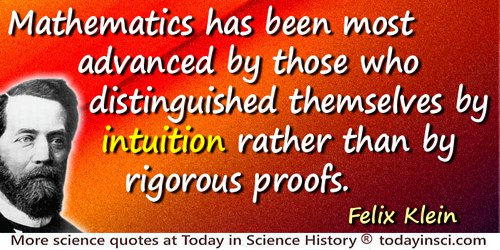
Undoubtedly, the capstone of every mathematical theory is a convincing proof of all of its assertions. Undoubtedly, mathematics inculpates itself when it foregoes convincing proofs. But the mystery of brilliant productivity will always be the posing of new questions, the anticipation of new theorems that make accessible valuable results and connections. Without the creation of new viewpoints, without the statement of new aims, mathematics would soon exhaust itself in the rigor of its logical proofs and begin to stagnate as its substance vanishes. Thus, in a sense, mathematics has been most advanced by those who distinguished themselves by intuition rather than by rigorous proofs.
As quoted in Hermann Weyl, Unterrichtsblätter für Mathematik und Naturwissenschaften (1932), 38, 177-188. As translated by Abe Shenitzer, in 'Part I. Topology and Abstract Algebra as Two Roads of Mathematical Comprehension', The American Mathematical Monthly (May 1995), 102, No. 7, 453.
We [may] answer the question: “Why is snow white?” by saying, “For the same reason that soap-suds or whipped eggs are white”—in other words, instead of giving the reason for a fact, we give another example of the same fact. This offering a similar instance, instead of a reason, has often been criticised as one of the forms of logical depravity in men. But manifestly it is not a perverse act of thought, but only an incomplete one. Furnishing parallel cases is the necessary first step towards abstracting the reason imbedded in them all.
In The Principles of Psychology (1918), Vol. 2, 363-364.
We are concerned to understand the motivation for the development of pure mathematics, and it will not do simply to point to aesthetic qualities in the subject and leave it at that. It must be remembered that there is far more excitement to be had from creating something than from appreciating it after it has been created. Let there be no mistake about it, the fact that the mathematician is bound down by the rules of logic can no more prevent him from being creative than the properties of paint can prevent the artist. … We must remember that the mathematician not only finds the solutions to his problems, he creates the problems themselves.
In A Signpost to Mathematics (1951), 19. As quoted and cited in William L. Schaaf, 'Memorabilia Mathematica', The Mathematics Teacher (Mar 1957), 50, No. 3, 230. Note that this paper incorrectly attributes “A.H. Head”.
We can only think by logic, for what is not in logic is not in thought.
In Samuel Butler and Henry Festing Jones (ed.), 'Reconciliation', The Note-books of Samuel Butler (1912, 1917), 346.
We come now to the question: what is a priori certain or necessary, respectively in geometry (doctrine of space) or its foundations? Formerly we thought everything; nowadays we think nothing. Already the distance-concept is logically arbitrary; there need be no things that correspond to it, even approximately.
In article he wrote, 'Space-Time', for Encyclopaedia Britannica (14th ed., 1929), Vol. 21, 106.
We especially need imagination in science. It is not all mathematics, nor all logic, but it is somewhat beauty and poetry.
In Phebe Mitchell Kendall (ed.), Maria Mitchell: Life, Letters, and Journals (1896), 186.
We have simply arrived too late in the history of the universe to see this primordial simplicity easily ... But although the symmetries are hidden from us, we can sense that they are latent in nature, governing everything about us. That's the most exciting idea I know: that nature is much simpler than it looks. Nothing makes me more hopeful that our generation of human beings may actually hold the key to the universe in our hands—that perhaps in our lifetimes we may be able to tell why all of what we see in this immense universe of galaxies and particles is logically inevitable.
Quoted in Nigel Calder, The Key to the Universe: A Report on the New Physics (1978), 185.
We know that mathematicians care no more for logic than logicians for mathematics. The two eyes of science are mathematics and logic; the mathematical set puts out the logical eye, the logical set puts out the mathematical eye; each believing that it sees better with one eye than with two.
Note that De Morgan, himself, only had sight with only one eye.
Note that De Morgan, himself, only had sight with only one eye.
Review of a book on geometry in the Athenaeum, 1868, Vol. 2, 71-73.
We may regard geometry as a practical logic, for the truths which it considers, being the most simple and most sensible of all, are, for this reason, the most susceptible to easy and ready application of the rules of reasoning.
From 'De la Géométrie', Pensées de Monsieur d’Alembert (1774), 137. As translated in Robert Édouard Moritz, Memorabilia Mathematica; Or, The Philomath’s Quotation-Book (1914), 203. From the original French, “On peut regarder la géométrie comme une logique pratique, parce que les vérités dont elle s'occupe, étant les plus simples et les plus sensibles de toutes, sont par cette raison, les plus susceptibles d'une application facile et palpable des règles du raisonnement.”
We receive it as a fact, that some minds are so constituted as absolutely to require for their nurture the severe logic of the abstract sciences; that rigorous sequence of ideas which leads from the premises to the conclusion, by a path, arduous and narrow, it may be, and which the youthful reason may find it hard to mount, but where it cannot stray; and on which, if it move at all, it must move onward and upward… . Even for intellects of a different character, whose natural aptitude is for moral evidence and those relations of ideas which are perceived and appreciated by taste, the study of the exact sciences may be recommended as the best protection against the errors into which they are most likely to fall. Although the study of language is in many respects no mean exercise in logic, yet it must be admitted that an eminently practical mind is hardly to be formed without mathematical training.
In Orations and Speeches (1870), Vol. 8, 510.
We reverence ancient Greece as the cradle of western science. Here for the first time the world witnessed the miracle of a logical system which proceeded from step to step with such precision that every single one of its propositions was absolutely indubitable—I refer to Euclid’s geometry. This admirable triumph of reasoning gave the human intellect the necessary confidence in itself for its subsequent achievements. If Euclid failed to kindle your youthful enthusiasm, then you were not born to be a scientific thinker.
From 'On the Method of Theoretical Physics', in Essays in Science (1934, 2004), 13.
What I’m really interested in is whether God could have made the world in a different way; that is, whether the necessity of logical simplicity leaves any freedom at all.
Told to Ernst Straus. As quoted in Gerald Holton, The Scientific Imagination: Case Studies (1978), xii.
What is a good definition? For the philosopher or the scientist, it is a definition which applies to all the objects to be defined, and applies only to them; it is that which satisfies the rules of logic. But in education it is not that; it is one that can be understood by the pupils.
Science and Method (1914, 2003), 117.
What is this subject, which may be called indifferently either mathematics or logic? Is there any way in which we can define it? Certain characteristics of the subject are clear. To begin with, we do not, in this subject, deal with particular things or particular properties: we deal formally with what can be said about any thing or any property. We are prepared to say that one and one are two, but not that Socrates and Plato are two, because, in our capacity of logicians or pure mathematicians, we have never heard of Socrates or Plato. A world in which there were no such individuals would still be a world in which one and one are two. It is not open to us, as pure mathematicians or logicians, to mention anything at all, because, if we do so we introduce something irrelevant and not formal.
In Introduction to Mathematical Philosophy (1920), 196-197.
What renders a problem definite, and what leaves it indefinite, may best be understood from mathematics. The very important idea of solving a problem within limits of error is an element of rational culture, coming from the same source. The art of totalizing fluctuations by curves is capable of being carried, in conception, far beyond the mathematical domain, where it is first learnt. The distinction between laws and co-efficients applies in every department of causation. The theory of Probable Evidence is the mathematical contribution to Logic, and is of paramount importance.
In Education as a Science (1879), 151-152.
Whatever advantage can be attributed to logic in directing and strengthening the action of the understanding is found in a higher degree in mathematical study, with the immense added advantage of a determinate subject, distinctly circumscribed, admitting of the utmost precision, and free from the danger which is inherent in all abstract logic—of leading to useless and puerile rules, or to vain ontological speculations. The positive method, being everywhere identical, is as much at home in the art of reasoning as anywhere else: and this is why no science, whether biology or any other, can offer any kind of reasoning, of which mathematics does not supply a simpler and purer counterpart. Thus, we are enabled to eliminate the only remaining portion of the old philosophy which could even appear to offer any real utility; the logical part, the value of which is irrevocably absorbed by mathematical science.
In Auguste Comte and Harriet Martineau (trans.), Positive Philosophy (1858), Vol. 1, 326-327.
When an apparent fact runs contrary to logic and common sense, it’s obvious that you have failed to interpret the fact correctly.
In Orphans of the Sky (1963, 1964), 169.
When introduced at the wrong time or place, good logic may be the worst enemy of good teaching.
Quoted, without citation, in The American Mathematical Monthly (Mar 1993), 100 No. 3, 286.
When the intensity of emotional conviction subsides, a man who is in the habit of reasoning will search for logical grounds in favor of the belief which he finds in himself.
In Mysticism and Logic (2004), 15.
When the logician has resolved each demonstration into a host of elementary operations, all of them correct, he will not yet be in possession of the whole reality, that indefinable something that constitutes the unity ... Now pure logic cannot give us this view of the whole; it is to intuition that we must look for it.
Science and Method (1914 edition, reprint 2003), 126.
When the mathematician says that such and such a proposition is true of one thing, it may be interesting, and it is surely safe. But when he tries to extend his proposition to everything, though it is much more interesting, it is also much more dangerous. In the transition from one to all, from the specific to the general, mathematics has made its greatest progress, and suffered its most serious setbacks, of which the logical paradoxes constitute the most important part. For, if mathematics is to advance securely and confidently, it must first set its affairs in order at home.
With co-author James R. Newman, in Mathematics and the Imagination (1940), 219.
When you say, “The burned child dreads the fire, “ you mean that he is already a master of induction.
Epigraph in Isaac Asimov’s Book of Science and Nature Quotations (1988), 132.
Whenever we pride ourselves upon finding a newer, stricter way of thought or exposition; whenever we start insisting too hard upon “operationalism” or symbolic logic or any other of these very essential systems of tramlines, we lose something of the ability to think new thoughts. And equally, of course, whenever we rebel against the sterile rigidity of formal thought and exposition and let our ideas run wild, we likewise lose. As I see it, the advances in scientific thought come from a combination of loose and strict thinking, and this combination is the most precious tool of science.
In 'Culture Contact and Schismogenesis' (1935), in Steps to an Ecology of Mind: Collected Essays in Anthropology, Psychiatry, Evolution, and Epistemology (1972).
Where the world ceases to be the scene of our personal hopes and wishes, where we face it as free beings admiring, asking and observing, there we enter the realm of Art and Science. If what is seen is seen and experienced is portrayed in the language of logic, we are engaged in science. If it is communicated through forms whose connections are not accessible to the conscious mind but are recognized intuitively as meaningful, then we are engaged in art.
'What Artistic and Scientific Experience Have in Common', Menschen (27 Jan 1921). In Albert Einstein, Helen Dukas, Banesh Hoffmann, Albert Einstein, The Human Side (1981), 37-38. The article was published in a German magazine on modern art, upon a request from the editor, Walter Hasenclever, for a few paragraphs on the idea that there was a close connection between the artistic developments and the scientific results belonging to a given epoch. (The magazine name, and editor's name are given by Ze'ev Rosenkranz, The Einstein Scrapbook (2002), 27.
While playing the part of the detective the investigator follows clues, but having captured his alleged fact, he turns judge and examines the case by means of logically arranged evidence. Both functions are equally essential but they are different.
In The Art of Scientific Investigation (1950, 1957), 92.
Why then be concerned about the conservation of wildlife when for all practical purposes we would be much better off if humans and their domestic animals and pets were the only living creatures on the face of the earth? There is no obvious and demolishing answer to this rather doubtful logic although in practice the destruction of all wild animals would certainly bring devastating changes to our existence on this planet as we know it today… The trouble is that everything in nature is completely interdependent. Tinker with one part of it and the repercussions ripple out in all directions… Wildlife—and that includes everything from microbes to blue whales and from a fungus to a redwood tree—has been so much part of life on the earth that we are inclined to take its continued existence for granted… Yet the wildlife of the world is disappearing, not because of a malicious and deliberate policy of slaughter and extermination, but simply because of a general and widespread ignorance and neglect.
World Wildlife Fund Dinner, York, (1969). As quoted and cited in 'The Mirror of a Duke', The Dorset Eye on dorseteye.com website
Why we love science. It’s more than a school subject, or the periodic table, or the properties of waves. It is an approach to the world, a critical way to understand and explore and engage with the world, and then have the capacity to change that world, and to share this accumulated knowledge. It’s a mindset that says we that can use reason and logic and honest inquiry to reach new conclusions and solve big problems.
From remarks at the fifth White House Science Fair, in Press Release (23 Mar 2015).
Without deductive logic science would be entirely useless. It is merely a barren game to ascend from the particular to the general, unless afterwards we can reverse the process and descend from the general to the particular, ascending and descending like angels on Jacob’s ladder.
In 'Technical Education and Its Relation to Science and Literature', The Aims of Education: & Other Essays (1917), 80.
You are wrong all along the line—wrong in your logic, wrong in your statecraft, wrong in your arithmetic, wrong even in your demagogy—right only in having at last the candour and courage to avow your true opinions.
From Speech in the House, (20 Feb 1907), 150.
You can only find truth with logic if you have already found truth without it.
In G.K. Chesterton, 'The Maxims of Maxim', Daily News (25 Feb 1905). Collected in G. K. Chesterton and Dale Ahlquist (ed.), In Defense of Sanity: The Best Essays of G.K. Chesterton (2011), 90.
 In science it often happens that scientists say, 'You know that's a really good argument; my position is mistaken,' and then they would actually change their minds and you never hear that old view from them again. They really do it. It doesn't happen as often as it should, because scientists are human and change is sometimes painful. But it happens every day. I cannot recall the last time something like that happened in politics or religion.
(1987) --
In science it often happens that scientists say, 'You know that's a really good argument; my position is mistaken,' and then they would actually change their minds and you never hear that old view from them again. They really do it. It doesn't happen as often as it should, because scientists are human and change is sometimes painful. But it happens every day. I cannot recall the last time something like that happened in politics or religion.
(1987) -- 






-LLNL.jpg)
.jpg)