Line Quotes (101 quotes)
[The famous attack of Sir William Hamilton on the tendency of mathematical studies] affords the most express evidence of those fatal lacunae in the circle of his knowledge, which unfitted him for taking a comprehensive or even an accurate view of the processes of the human mind in the establishment of truth. If there is any pre-requisite which all must see to be indispensable in one who attempts to give laws to the human intellect, it is a thorough acquaintance with the modes by which human intellect has proceeded, in the case where, by universal acknowledgment, grounded on subsequent direct verification, it has succeeded in ascertaining the greatest number of important and recondite truths. This requisite Sir W. Hamilton had not, in any tolerable degree, fulfilled. Even of pure mathematics he apparently knew little but the rudiments. Of mathematics as applied to investigating the laws of physical nature; of the mode in which the properties of number, extension, and figure, are made instrumental to the ascertainment of truths other than arithmetical or geometrical—it is too much to say that he had even a superficial knowledge: there is not a line in his works which shows him to have had any knowledge at all.
In Examination of Sir William Hamilton's Philosophy (1878), 607.
Question: Account for the delicate shades of colour sometimes seen on the inside of an oyster shell. State and explain the appearance presented when a beam of light falls upon a sheet of glass on which very fine equi-distant parallel lines have been scratched very close to one another.
Answer: The delicate shades are due to putrefaction; the colours always show best when the oyster has been a bad one. Hence they are considered a defect and are called chromatic aberration.
The scratches on the glass will arrange themselves in rings round the light, as any one may see at night in a tram car.
Answer: The delicate shades are due to putrefaction; the colours always show best when the oyster has been a bad one. Hence they are considered a defect and are called chromatic aberration.
The scratches on the glass will arrange themselves in rings round the light, as any one may see at night in a tram car.
Genuine student answer* to an Acoustics, Light and Heat paper (1880), Science and Art Department, South Kensington, London, collected by Prof. Oliver Lodge. Quoted in Henry B. Wheatley, Literary Blunders (1893), 182, Question 27. (*From a collection in which Answers are not given verbatim et literatim, and some instances may combine several students' blunders.)
A large part of the training of the engineer, civil and military, as far as preparatory studies are concerned; of the builder of every fabric of wood or stone or metal designed to stand upon the earth, or bridge the stream, or resist or float upon the wave; of the surveyor who lays out a building lot in a city, or runs a boundary line between powerful governments across a continent; of the geographer, navigator, hydrographer, and astronomer,—must be derived from the mathematics.
In 'Academical Education', Orations and Speeches on Various Occasions (1870), Vol. 3, 513.
A line is not made up of points. … In the same way, time is not made up of parts considered as indivisible “nows.”
Part of Aristotle’s reply to Zeno's paradox concerning continuity.
Part of Aristotle’s reply to Zeno's paradox concerning continuity.
A succinct summary, not a direct quotation of Aristotle's words. From Aristotle's Physics, Book VI. Sections 1 and 9 as given by Florian Cajori in part 2 of an article 'The History of Zeno's Arguments on Motion', in The American Mathematical Monthly (Feb 1915), 22:2, 41.
A mathematician thinks that two points are enough to define a straight line, while a physicist wants more data.
As regards religion, on the other hand, one is generally agreed that it deals with goals and evaluations and, in general, with the emotional foundation of human thinking and acting, as far as these are not predetermined by the inalterable hereditary disposition of the human species. Religion is concerned with man’s attitude toward nature at large, with the establishing of ideals for the individual and communal life, and with mutual human relationship. These ideals religion attempts to attain by exerting an educational influence on tradition and through the development and promulgation of certain easily accessible thoughts and narratives (epics and myths) which are apt to influence evaluation and action along the lines of the accepted ideals.
Replying to the Liberal Ministers’ Club of New York City. Published in >The Christian Register, (Jun 1948). As given in Albert Einstein, Cal Seelig (ed.) and Sonja Bargmann (trans., ed.), Ideas and Opinions (1954, 2010), 50.
As we discern a fine line between crank and genius, so also (and unfortunately) we must acknowledge an equally graded trajectory from crank to demagogue. When people learn no tools of judgment and merely follow their hopes, the seeds of political manipulation are sown.
…...
Being perpetually charmed by his familiar siren, that is, by his geometry, he [Archimedes] neglected to eat and drink and took no care of his person; that he was often carried by force to the baths, and when there he would trace geometrical figures in the ashes of the fire, and with his finger draws lines upon his body when it was anointed with oil, being in a state of great ecstasy and divinely possessed by his science.
— Plutarch
As translated in George Finlay Simmons, Calculus Gems: Brief Lives and Memorable Mathematics, (1992), 39.
Between animal and human medicine, there is no dividing line—nor should there be.
On the occasion of the centenary of the Veterinary College in Berlin (1856). Translation of original German, “Zwischen Tier und Menschenmedizin gibt es keine Trennlinie, noch sollte eine bestehen.” English translation quoted (without citation), as opening remark in J.V. Klauder, 'Interrelations of human and veterinary medicine', New England Journal of Medicine (23 Jan 1958), 258, No. 4, 170.
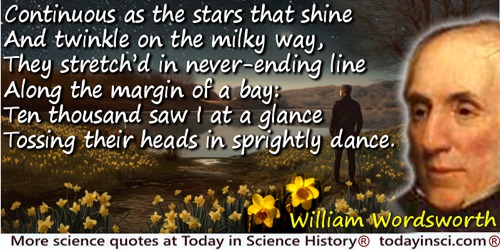
Continuous as the stars that shine
And twinkle on the milky way,
They stretch’d in never-ending line
Along the margin of a bay:
Ten thousand saw I at a glance
Tossing their heads in sprightly dance.
And twinkle on the milky way,
They stretch’d in never-ending line
Along the margin of a bay:
Ten thousand saw I at a glance
Tossing their heads in sprightly dance.
Second verse of poem, 'I Wandered Lonely as a Cloud', In Poems: Including Lyrical Ballads: In two Volumes (1815), Vol. 1, 328.
Despite the recurrence of events in which the debris-basin system fails in its struggle to contain the falling mountains, people who live on the front line are for the most part calm and complacent. It appears that no amount of front-page or prime-time attention will ever prevent such people from masking out the problem.
The Control of Nature
Does it seem all but incredible to you that intelligence should travel for two thousand miles, along those slender copper lines, far down in the all but fathomless Atlantic; never before penetrated … save when some foundering vessel has plunged with her hapless company to the eternal silence and darkness of the abyss? Does it seem … but a miracle … that the thoughts of living men … should burn over the cold, green bones of men and women, whose hearts, once as warm as ours, burst as the eternal gulfs closed and roared over them centuries ago?
A tribute to the Atlantic telegraph cable by Edward Everett, one of the topics included in his inauguration address at the Washington University of St. Louis (22 Apr 1857). In Orations and Speeches on Various Occasions: Volume 3 (1870), 509-511.
Equations are Expressions of Arithmetical Computation, and properly have no place in Geometry, except as far as Quantities truly Geometrical (that is, Lines, Surfaces, Solids, and Proportions) may be said to be some equal to others. Multiplications, Divisions, and such sort of Computations, are newly received into Geometry, and that unwarily, and contrary to the first Design of this Science. For whosoever considers the Construction of a Problem by a right Line and a Circle, found out by the first Geometricians, will easily perceive that Geometry was invented that we might expeditiously avoid, by drawing Lines, the Tediousness of Computation. Therefore these two Sciences ought not to be confounded. The Ancients did so industriously distinguish them from one another, that they never introduced Arithmetical Terms into Geometry. And the Moderns, by confounding both, have lost the Simplicity in which all the Elegance of Geometry consists. Wherefore that is Arithmetically more simple which is determined by the more simple Equation, but that is Geometrically more simple which is determined by the more simple drawing of Lines; and in Geometry, that ought to be reckoned best which is geometrically most simple.
In 'On the Linear Construction of Equations', Universal Arithmetic (1769), Vol. 2, 470.
Euclid always contemplates a straight line as drawn between two definite points, and is very careful to mention when it is to be produced beyond this segment. He never thinks of the line as an entity given once for all as a whole. This careful definition and limitation, so as to exclude an infinity not immediately apparent to the senses, was very characteristic of the Greeks in all their many activities. It is enshrined in the difference between Greek architecture and Gothic architecture, and between Greek religion and modern religion. The spire of a Gothic cathedral and the importance of the unbounded straight line in modern Geometry are both emblematic of the transformation of the modern world.
In Introduction to Mathematics (1911), 119.
Euler could repeat the Aeneid from the beginning to the end, and he could even tell the first and last lines in every page of the edition which he used. In one of his works there is a learned memoir on a question in mechanics, of which, as he himself informs us, a verse of Aeneid gave him the first idea. [“The anchor drops, the rushing keel is staid.”]
In Letters of Euler (1872), Vol. 1, 24.
Every creature alive on the earth today represents an unbroken line of life that stretches back to the first primitive organism to appear on this planet; and that is about three billion years.
In talk, 'Origin of Death' (1970).
Every individual alive today, even the very highest, is to be derived in an unbroken line from the first and lowest forms.
In Heredity (1892), Vol. 1, 161. As cited in James C. Fernald Scientific Side-lights: Illustrating Thousands of Topics by Selections from Standard Works of the Masters of Science Throughout the World (1903), 394.
Experimental investigation, to borrow a phrase employed by Kepler respecting the testing of hypotheses, is “a very great thief of time.” Sometimes it costs many days to determine a fact that can be stated in a line.
In preface to Scientific Memoirs (1878), xi.
For the first time in my life I saw the horizon as a curved line. It was accentuated by a thin seam of dark blue light - our atmosphere. Obviously this was not the ocean of air I had been told it was so many times in my life. I was terrified by its fragile appearance.
…...
From the point of view of the pure morphologist the recapitulation theory is an instrument of research enabling him to reconstruct probable lines of descent; from the standpoint of the student of development and heredity the fact of recapitulation is a difficult problem whose solution would perhaps give the key to a true understanding of the real nature of heredity.
Form and Function: A Contribution to the History of Animal Morphology (1916), 312-3.
Go to yon tower, where busy science plies
Her vast antennae, feeling through the skies
That little vernier on whose slender lines
The midnight taper trembles as it shines,
A silent index, tracks the planets’ march
In all their wanderings through the ethereal arch;
Tells through the mist where dazzled Mercury burns,
And marks the spot where Uranus returns.
Her vast antennae, feeling through the skies
That little vernier on whose slender lines
The midnight taper trembles as it shines,
A silent index, tracks the planets’ march
In all their wanderings through the ethereal arch;
Tells through the mist where dazzled Mercury burns,
And marks the spot where Uranus returns.
From poem, pronounced to the Boston Mercantile Library Association (14 Oct, 1846), published as Urania: A Rhymed Lesson (1846), 9-10. [Note: This is too often seen online attributed incorrectly to Samuel Pierpont Langley, who quoted several lines from the poem in his New Astronomy (1888), without naming its actual original author. —Webmaster]
Good composition is like a suspension bridge—each line adds strength and takes none away.
In The Art Spirit (1923, 1930), 212.
He seemed to approach the grave as an hyperbolic curve approaches a line, less directly as he got nearer, till it was doubtful if he would ever reach it at all.
In Far from the Madding Crowd (1874, 1909), Chap. 15, 117. In the 1874 edition, “—sheering off” were the original words, replaced by “less directly” by the 1909 edition.
I am the most travelled of all my contemporaries; I have extended my field of enquiry wider than anybody else, I have seen more countries and climes, and have heard more speeches of learned men. No one has surpassed me in the composition of lines, according to demonstration, not even the Egyptian knotters of ropes, or geometers.
In Alan L. Mackay, A Dictionary of Scientific Quotations (1992, 1994), 71.
I had observed that there were different lines exhibited in the spectra of different metals when ignited in the voltaic arc; and if I had had any reasonable amount of wit I ought to have seen the converse, viz., that by ignition different bodies show in their spectral lines the materials of which they are formed. If that thought had occured to my mind, I should have discovered the spectroscope before Kirchoff; but it didn’t.
Address, in 'Report to the Chemical Society's Jubilee', Nature (26 Mar 1891), 43, 493. Words as in original text, occured and Kirchoff are sic.
I have often thought that an interesting essay might be written on the influence of race on the selection of mathematical methods. methods. The Semitic races had a special genius for arithmetic
and algebra, but as far as I know have never produced a single geometrician of any eminence. The Greeks on the other hand adopted a geometrical procedure wherever it was possible, and they even treated arithmetic as a branch of geometry by means of the device of representing numbers by lines.
In A History of the Study of Mathematics at Cambridge (1889), 123
I shall devote only a few lines to the expression of my belief in the importance of science for mankind…. … [I]t is by…daily striving after knowledge that man has raised himself to the unique position he occupies on earth, and that his power and well-being have continually increased.
In opening paragraph of 'Memorandum by Madame Curie, Member of the Committee, on the Question of International Scolarships for the Advancement of the Sciences and the Development of Laboratories' published by the League of Nations, Committee on Intellectual Co-operation, Geneva (16 Jun 1926)
I should like to draw attention to the inexhaustible variety of the problems and exercises which it [mathematics] furnishes; these may be graduated to precisely the amount of attainment which may be possessed, while yet retaining an interest and value. It seems to me that no other branch of study at all compares with mathematics in this. When we propose a deduction to a beginner we give him an exercise in many cases that would have been admired in the vigorous days of Greek geometry. Although grammatical exercises are well suited to insure the great benefits connected with the study of languages, yet these exercises seem to me stiff and artificial in comparison with the problems of mathematics. It is not absurd to maintain that Euclid and Apollonius would have regarded with interest many of the elegant deductions which are invented for the use of our students in geometry; but it seems scarcely conceivable that the great masters in any other line of study could condescend to give a moment’s attention to the elementary books of the beginner.
In Conflict of Studies (1873), 10-11.
I strongly reject any conceptual scheme that places our options on a line, and holds that the only alternative to a pair of extreme positions lies somewhere between them. More fruitful perspectives often require that we step off the line to a site outside the dichotomy.
…...
I wanted to preserve the spontaneity of thought in speech… [and to] guard the spontaneity of the argument. A spoken argument is informal and heuristic; it singles out the heart of the matter and shows in what way it is crucial and new; and it gives the direction and line of the solution so that, simplified as it is, still the logic is right. For me, this philosophic form of argument is the foundation of science, and nothing should be allowed to obscure it.
On his philosophy in presenting the TV series, from which the book followed. In 'Foreward', The Ascent of Man, (1973), 14-15.
If logical training is to consist, not in repeating barbarous scholastic formulas or mechanically tacking together empty majors and minors, but in acquiring dexterity in the use of trustworthy methods of advancing from the known to the unknown, then mathematical investigation must ever remain one of its most indispensable instruments. Once inured to the habit of accurately imagining abstract relations, recognizing the true value of symbolic conceptions, and familiarized with a fixed standard of proof, the mind is equipped for the consideration of quite other objects than lines and angles. The twin treatises of Adam Smith on social science, wherein, by deducing all human phenomena first from the unchecked action of selfishness and then from the unchecked action of sympathy, he arrives at mutually-limiting conclusions of transcendent practical importance, furnish for all time a brilliant illustration of the value of mathematical methods and mathematical discipline.
In 'University Reform', Darwinism and Other Essays (1893), 297-298.
If you were going to risk all that, not just risk the hardship and the pain but risk your life. Put everything on line for a dream, for something that’s worth nothing, that can’t be proved to anybody. You just have the transient moment on a summit and when you come back down to the valley it goes. It is actually a completely illogical thing to do. It is not justifiable by any rational terms. That’s probably why you do it.
The Beckoning Silence
In mathematical analysis we call x the undetermined part of line a: the rest we don’t call y, as we do in common life, but a-x. Hence mathematical language has great advantages over the common language.
Lichtenberg: A Doctrine of Scattered Occasions: Reconstructed From: Reconstructed From His Aphorisms and Reflections (1959), 158.
Is evolution a theory, a system or a hypothesis? It is much more: it is a general condition to which all theories, all hypotheses, all systems must bow and which they must satisfy henceforth if they are to be thinkable and true. Evolution is a light illuminating all facts, a curve that all lines must follow. ... The consciousness of each of us is evolution looking at itself and reflecting upon itself....Man is not the center of the universe as once we thought in our simplicity, but something much more wonderful—the arrow pointing the way to the final unification of the world in terms of life. Man alone constitutes the last-born, the freshest, the most complicated, the most subtle of all the successive layers of life. ... The universe has always been in motion and at this moment continues to be in motion. But will it still be in motion tomorrow? ... What makes the world in which we live specifically modern is our discovery in it and around it of evolution. ... Thus in all probability, between our modern earth and the ultimate earth, there stretches an immense period, characterized not by a slowing-down but a speeding up and by the definitive florescence of the forces of evolution along the line of the human shoot.
In The Phenomenon of Man (1975), pp 218, 220, 223, 227, 228, 277.
Is it not true that for every person the course of life is along the line of least resistance, and that in this the movement of humanity is like the movement of material bodies?
In preface to Scientific Memoirs (1878), xiv.
It is tautological to say that an organism is adapted to its environment. It is even tautological to say that an organism is physiologically adapted to its environment. However, just as in the case of many morphological characters, it is unwarranted to conclude that all aspects of the physiology of an organism have evolved in reference to a specific milieu. It is equally gratuitous to assume that an organism will inevitably show physiological specializations in its adaptation to a particular set of conditions. All that can be concluded is that the functional capacities of an organism are sufficient to have allowed persistence within its environment. On one hand, the history of an evolutionary line may place serious constraints upon the types of further physiological changes that are readily feasible. Some changes might require excessive restructuring of the genome or might involve maladaptive changes in related functions. On the other hand, a taxon which is successful in occupying a variety of environments may be less impressive in individual physiological capacities than one with a far more limited distribution.
In W.R. Dawson, G.A. Bartholomew, and A.F. Bennett, 'A Reappraisal of the Aquatic Specializations of the Galapagos Marine Iguana (Amblyrhynchus cristatus)', Evolution (1977), 31, 891.
Kin Hubbard is dead. To us folks that attempt to write a little humor his death is just like Edison's would be to the world of invention. No man in our generation was within a mile of him, and I am so glad that I didn't wait for him to go to send flowers. I have said it from the stage and in print for twenty years. … Just think — only two lines a day, yet he expressed more original philosophy in ’em than all the rest of the paper combined. What a kick Twain and all that gang will get out of Kin.
In 'Will Rogers Pays Tribute To Hubbard and His Humor', The New York Times (27 Dec 1930), 15.
Line in Nature is not found;
Unit and Universe are round.
Unit and Universe are round.
Poem, 'Uriel', collected in The Complete Works of Ralph Waldo Emerson: Poems (), 14
Mathematics … certainly would never have come into existence if mankind had known from the beginning that in all nature there is no perfectly straight line, no true circle, no standard of measurement.
From 'Of the First and Last Things', All Too Human: A Book For Free Spirits (1878, 1908), Part 1, section 11, 31.
Mathematics accomplishes really nothing outside of the realm of magnitude; marvellous, however, is the skill with which it masters magnitude wherever it finds it. We recall at once the network of lines which it has spun about heavens and earth; the system of lines to which azimuth and altitude, declination and right ascension, longitude and latitude are referred; those abscissas and ordinates, tangents and normals, circles of curvature and evolutes; those trigonometric and logarithmic functions which have been prepared in advance and await application. A look at this apparatus is sufficient to show that mathematicians are not magicians, but that everything is accomplished by natural means; one is rather impressed by the multitude of skilful machines, numerous witnesses of a manifold and intensely active industry, admirably fitted for the acquisition of true and lasting treasures.
In Werke [Kehrbach] (1890), Bd. 5, 101. As quoted, cited and translated in Robert Édouard Moritz, Memorabilia Mathematica; Or, The Philomath’s Quotation-Book (1914), 13.
Mathematics associates new mental images with ... physical abstractions; these images are almost tangible to the trained mind but are far removed from those that are given directly by life and physical experience. For example, a mathematician represents the motion of planets of the solar system by a flow line of an incompressible fluid in a 54-dimensional phase space, whose volume is given by the Liouville measure
Mathematics and Physics (1981), Foreward. Reprinted in Mathematics as Metaphor: Selected Essays of Yuri I. Manin (2007), 90.
Nature has not arranged her productions on a single and direct line. They branch at every step, and in every direction, and he who attempts to reduce them into departments is left to do it by the lines of his own fancy.
In Letter (22 Feb 1814) to Dr. John Manners. Collected in The Writings of Thomas Jefferson (1905), Vol 13, 99.
Nearly anyone in this line of work would take a bullet for the last pregnant dodo. But should we not admire the person who, when faced with an overwhelmingly sad reality beyond and personal blame or control, strives valiantly to rescue what ever can be salvaged, rather than retreating to the nearest corner to weep or assign fault?
…...
No force however great can stretch a cord however fine into an horizontal line which is accurately straight: there will always be a bending downward.
In 'The Equilibrium of Forces on a Point', Elementary Treatise on Mechanics (1819), Vol. 1, 44. Note by Webmaster: …bending downward, however small.
No one has ever done this before, … What we are trying to do here is to create a stem cell line without injuring an embryo. Our cells can go on to become a healthy, kicking baby.
…...
People will work every bit as hard to fool themselves as they will to fool others—which makes it very difficult to tell just where the line between foolishness and fraud is located.
Voodoo Science. In Marc J. Madou, Fundamentals of Microfabrication: the Science of Miniaturization (2nd ed., 2002), 77.
Perspective is a most subtle discovery in mathematical studies, for by means of lines it causes to appear distant that which is near, and large that which is small.
Attributed.
Ploughing deep, your recipe for killing weeds, is also the recipe for almost every good thing in farming. … We now plough horizontally following the curvatures of the hills and hollows, on the dead level, however crooked the lines may be. Every furrow thus acts as a reservoir to receive and retain the waters, all of which go to the benefit of the growing plant, instead of running off into streams … In point of beauty nothing can exceed that of the waving lines and rows winding along the face of the hills and vallies.
In letter (17 Apr 1813) from Jefferson at Monticello to Charles Willson Peale. Collected in The Jefferson Papers: 1770-1826 (1900), 178-180.
Progress has not followed a straight ascending line, but a spiral with rhythms of progress and retrogression, of evolution and dissolution.
As given, without citation, in Kate Louise Roberts (ed.), Hoyt’s New Cyclopedia of Practical Quotations (1922), 635.
Returning now to the Malay Archipelago, we find that all the wide expanse of sea which divides Java, Sumatra, and Borneo from each other, and from Malacca and Siam, is so shallow that ships can anchor in any part of it, since it rarely exceeds forty fathoms in depth; and if we go as far as the line of a hundred fathoms, we shall include the Philippine Islands and Bali, east of Java. If, therefore, these islands have been separated from each other and the continent by subsidence of the intervening tracts of land, we should conclude that the separation has been comparatively recent, since the depth to which the land has subsided is so small. It is also to be remarked that the great chain of active volcanoes in Sumatra and Java furnishes us with a sufficient cause for such subsidence, since the enormous masses of matter they have thrown out would take away the foundations of the surrounding district; and this may be the true explanation of the often-noticed fact that volcanoes and volcanic chains are always near the sea. The subsidence they produce around them will, in time, make a sea, if one does not already exist.
Malay Archipelago
Suppose then I want to give myself a little training in the art of reasoning; suppose I want to get out of the region of conjecture and probability, free myself from the difficult task of weighing evidence, and putting instances together to arrive at general propositions, and simply desire to know how to deal with my general propositions when I get them, and how to deduce right inferences from them; it is clear that I shall obtain this sort of discipline best in those departments of thought in which the first principles are unquestionably true. For in all our thinking, if we come to erroneous conclusions, we come to them either by accepting false premises to start with—in which case our reasoning, however good, will not save us from error; or by reasoning badly, in which case the data we start from may be perfectly sound, and yet our conclusions may be false. But in the mathematical or pure sciences,—geometry, arithmetic, algebra, trigonometry, the calculus of variations or of curves,— we know at least that there is not, and cannot be, error in our first principles, and we may therefore fasten our whole attention upon the processes. As mere exercises in logic, therefore, these sciences, based as they all are on primary truths relating to space and number, have always been supposed to furnish the most exact discipline. When Plato wrote over the portal of his school. “Let no one ignorant of geometry enter here,” he did not mean that questions relating to lines and surfaces would be discussed by his disciples. On the contrary, the topics to which he directed their attention were some of the deepest problems,— social, political, moral,—on which the mind could exercise itself. Plato and his followers tried to think out together conclusions respecting the being, the duty, and the destiny of man, and the relation in which he stood to the gods and to the unseen world. What had geometry to do with these things? Simply this: That a man whose mind has not undergone a rigorous training in systematic thinking, and in the art of drawing legitimate inferences from premises, was unfitted to enter on the discussion of these high topics; and that the sort of logical discipline which he needed was most likely to be obtained from geometry—the only mathematical science which in Plato’s time had been formulated and reduced to a system. And we in this country [England] have long acted on the same principle. Our future lawyers, clergy, and statesmen are expected at the University to learn a good deal about curves, and angles, and numbers and proportions; not because these subjects have the smallest relation to the needs of their lives, but because in the very act of learning them they are likely to acquire that habit of steadfast and accurate thinking, which is indispensable to success in all the pursuits of life.
In Lectures on Teaching (1906), 891-92.
That mathematics “do not cultivate the power of generalization,”; … will be admitted by no person of competent knowledge, except in a very qualified sense. The generalizations of mathematics, are, no doubt, a different thing from the generalizations of physical science; but in the difficulty of seizing them, and the mental tension they require, they are no contemptible preparation for the most arduous efforts of the scientific mind. Even the fundamental notions of the higher mathematics, from those of the differential calculus upwards are products of a very high abstraction. … To perceive the mathematical laws common to the results of many mathematical operations, even in so simple a case as that of the binomial theorem, involves a vigorous exercise of the same faculty which gave us Kepler’s laws, and rose through those laws to the theory of universal gravitation. Every process of what has been called Universal Geometry—the great creation of Descartes and his successors, in which a single train of reasoning solves whole classes of problems at once, and others common to large groups of them—is a practical lesson in the management of wide generalizations, and abstraction of the points of agreement from those of difference among objects of great and confusing diversity, to which the purely inductive sciences cannot furnish many superior. Even so elementary an operation as that of abstracting from the particular configuration of the triangles or other figures, and the relative situation of the particular lines or points, in the diagram which aids the apprehension of a common geometrical demonstration, is a very useful, and far from being always an easy, exercise of the faculty of generalization so strangely imagined to have no place or part in the processes of mathematics.
In An Examination of Sir William Hamilton’s Philosophy (1878), 612-13.
The chemist works along his own brilliant line of discovery and exposition; the astronomer has his special field to explore; the geologist has a well-defined sphere to occupy. It is manifest, however, that not one of these men can tell the whole tale, and make a complete story of creation. Another man is wanted. A man who, though not necessarily going into formal science, sees the whole idea, and speaks of it in its unity. This man is the theologian. He is not a chemist, an astronomer, a geologist, a botanist——he is more: he speaks of circles, not of segments; of principles, not of facts; of causes and purposes rather than of effects and appearances. Not that the latter are excluded from his study, but that they are so wisely included in it as to be put in their proper places.
In The People's Bible: Discourses Upon Holy Scripture: Vol. 1. Genesis (1885), 120.
The clouds roll on.
Silent as sleepwalkers the clouds
keep coming from infinity
bank behind bank
and line after line,
and change colors on the earth.
Silent as sleepwalkers the clouds
keep coming from infinity
bank behind bank
and line after line,
and change colors on the earth.
As translated in Rolf Jacobsen and Roger Greenwald (ed., trans.), 'The Clouds', North in the World: Selected Poems of Rolf Jacobsen, A Bilingual Edition (1985, 2002), 9, from 'Earth and Iron' (1933). Collected in the original Norwegian edition (1999).
The colors are stunning. In a single view, I see - looking out at the edge of the earth: red at the horizon line, blending to orange and yellow, followed by a thin white line, then light blue, gradually turning to dark blue and various gradually darker shades of gray, then black and a million stars above. It’s breathtaking.
…...
The contributions of physiological knowledge to an understanding of distribution are necessarily inferential. Distribution is a historical phenomenon, and the data ordinarily obtained by students of physiology are essentially instantaneous. However, every organism has a line of ancestors which extends back to the beginning of life on earth and which, during this immensity of time, has invariably been able to avoid, to adapt to, or to compensate for environmental changes.
From 'The role of physiology in the distribution of terrestrial vertebrates', collected in C.L. Hubbs (ed.), Zoogeography: Publ. 51 (1958), 84.
The course of the line we indicated as forming our grandest terrestrial fold [along the shores of Japan] returns upon itself. It is an endless fold, an endless band, the common possession of two sciences. It is geological in origin, geographical in effect. It is the wedding ring of geology and geography, uniting them at once and for ever in indissoluble union.
Presidential Address to the Geology Section, Report of the British Association for the Advancement of Science (1892), 705.
The degree of exactness of the intuition of space may be different in different individuals, perhaps even in different races. It would seem as if a strong naive space-intuition were an attribute pre-eminently of the Teutonic race, while the critical, purely logical sense is more fully developed in the Latin and Hebrew races. A full investigation of this subject, somewhat on the lines suggested by Francis Gallon in his researches on heredity, might be interesting.
In The Evanston Colloquium Lectures (1894), 46.
The description of right lines and circles, upon which geometry is founded, belongs to mechanics. Geometry does not teach us to draw these lines, but requires them to be drawn.
From Principia Mathematica, Book 1, in Author’s Preface to the translation from the Latin by Andrew Motte, as The Mathematical Principles of Natural Philosophy (1729), Vol. 1, second unpaginated page of the Preface.
The difference between the long-term average of the graph and the ice age, 12,000 years ago, is just over 3°C. The IPCC 2001 report suggests that the line of the hockey stick graph might rise a further 5°C during this century. This is about twice as much as the temperature change from the ice age to pre-industrial times.
In The Revenge of Gaia: Earth’s Climate Crisis & The Fate of Humanity (2006, 2007), 67.
The divisions of science are not like different lines that meet in one angle, but rather like the branches of trees that join in one trunk.
The Works of Francis Bacon (1815), Vol. 6, 68.
The edge of the sea is a strange and beautiful place. All through the long history of Earth it has been an area of unrest where waves have broken heavily against the land, where the tides have pressed forward over the continents, receded, and then returned. For no two successive days is the shore line precisely the same. Not only do the tides advance and retreat in their eternal rhythms, but the level of the sea itself is never at rest. It rises or falls as the glaciers melt or grow, as the floor of the deep ocean basins shifts under its increasing load of sediments, or as the Earth’s crust along the continental margins warps up or down in adjustment to strain and tension. Today a little more land may belong to the sea, tomorrow a little less. Always the edge of the sea remains an elusive and indefinable boundary.
Opening paragraph in The Edge of the Sea (1955), 1.
The fact that, with respect to size, the viruses overlapped with the organisms of the biologist at one extreme and with the molecules of the chemist at the other extreme only served to heighten the mystery regarding the nature of viruses. Then too, it became obvious that a sharp line dividing living from non-living things could not be drawn and this fact served to add fuel for discussion of the age-old question of “What is life?”
Nobel Lecture (12 Dec 1946), 'The Isolation and Properties of Crystalline Tobacco Mosaic Virus', collected in Nobel Lectures in Chemistry (1999), 140.
The geometrical problems and theorems of the Greeks always refer to definite, oftentimes to rather complicated figures. Now frequently the points and lines of such a figure may assume very many different relative positions; each of these possible cases is then considered separately. On the contrary, present day mathematicians generate their figures one from another, and are accustomed to consider them subject to variation; in this manner they unite the various cases and combine them as much as possible by employing negative and imaginary magnitudes. For example, the problems which Apollonius treats in his two books De sectione rationis, are solved today by means of a single, universally applicable construction; Apollonius, on the contrary, separates it into more than eighty different cases varying only in position. Thus, as Hermann Hankel has fittingly remarked, the ancient geometry sacrifices to a seeming simplicity the true simplicity which consists in the unity of principles; it attained a trivial sensual presentability at the cost of the recognition of the relations of geometric forms in all their changes and in all the variations of their sensually presentable positions.
In 'Die Synthetische Geometrie im Altertum und in der Neuzeit', Jahresbericht der Deutschen Mathematiker Vereinigung (1902), 2, 346-347. As translated in Robert Édouard Moritz, Memorabilia Mathematica; Or, The Philomath’s Quotation-book (1914), 112. The spelling of the first “Apollonius” has been corrected from “Appolonius” in the original English text. From the original German, “Die geometrischen Probleme und Sätze der Griechen beziehen sich allemal auf bestimmte, oft recht komplizierte Figuren. Nun können aber die Punkte und Linien einer solchen Figur häufig sehr verschiedene Lagen zu einander annehmen; jeder dieser möglichen Fälle wird alsdann für sich besonders erörtert. Dagegen lassen die heutigen Mathematiker ihre Figuren aus einander entstehen und sind gewohnt, sie als veränderlich zu betrachten; sie vereinigen so die speziellen Fälle und fassen sie möglichst zusammen unter Benutzung auch negativer und imaginärer Gröfsen. Das Problem z. B., welches Apollonius in seinen zwei Büchern de sectione rationis behandelt, löst man heutzutage durch eine einzige, allgemein anwendbare Konstruktion; Apollonius selber dagegen zerlegt es in mehr als 80 nur durch die Lage verschiedene Fälle. So opfert, wie Hermann Hankel treffend bemerkt, die antike Geometrie einer scheinbaren Einfachheit die wahre, in der Einheit der Prinzipien bestehende; sie erreicht eine triviale sinnliche Anschaulichkeit auf Kosten der Erkenntnis vom Zusammenhang geometrischer Gestalten in aller Wechsel und in aller Veränderlichkeit ihrer sinnlich vorstellbaren Lage.”
The great companies did not know that the line between hunger and anger is a thin line. And money that might have gone to wages went for gas, for guns, for agents and spies, for blacklists, for drilling. On the highways the people moved like ants and searched for work, for food. And the anger began to ferment.
In The Grapes of Wrath (1939), 388.
The heavens themselves, the planets, and this centre
Observe degree, priority, and place,
Insisture, course, proportion, season, form,
Office and custom, in all line of order:
And therefore is the glorious planet Sol
In noble eminence enthroned and sphered.
Observe degree, priority, and place,
Insisture, course, proportion, season, form,
Office and custom, in all line of order:
And therefore is the glorious planet Sol
In noble eminence enthroned and sphered.
From play Troilus and Cressida, Act 1, Scene 3, lines 85-90. In, for example, William Shakespeare edited by William George Clark and William Aldis Wright, The Complete Works of William Shakespeare (1880), 627. [Insisture means: steady continuance, regularity. —Webmaster]
The history of our enterprise…is one of evolution. We started by printing one letter at a time and justifying the sentences afterwards; then we impressed into papier maché one word at a time, justified it, and made a type from it by after process. Next we impressed a whole line and justified it, still leaving the production of the type as a second operation; but now we compose a line, justify and cast it all in one machine and by one operator.
From short Speech at the Chamberlain Hotel, Washington, D.C. (Feb 1885), concluding the exhibition of his own Linotype invention. As given in Carl Schlesinger (ed.), 'Mr. Mergenthaler’s Speech', The Biography of Ottmar Merganthaler: Inventor of the Linotype (1989), 20. [Describing the evolution of his Linotype invention. The word “justifying”, when used specifically for typesetting, refers to increasing the spaces between words to achieve a uniform overall line length for each row in a column. —Webmaster]
The line between entertaining math and serious math is a blurry one.
His final retrospective article, 'A Quarter-Century of Recreational Mathematics', Scientific American (Aug 1998).
The line separating investment and speculation, which is never bright and clear, becomes blurred still further when most market participants have recently enjoyed triumphs. Nothing sedates rationality like large doses of effortless money. After a heady experience of that kind, normally sensible people drift into behavior akin to that of Cinderella at the ball. They know that overstaying the festivities—that is, continuing to speculate in companies that have gigantic valuations relative to the cash they are likely to generate in the future—will eventually bring on pumpkins and mice. But they nevertheless hate to miss a single minute of what is one helluva party. Therefore, the giddy participants all plan to leave just seconds before midnight. There’s a problem, though: They are dancing in a room in which the clocks have no hands.
…...
The Moving Finger writes; and, having writ,
Moves on: nor all thy Piety nor Wit
Shall lure it back to cancel half a Line,
Nor all thy Tears wash out a Word of it.
Moves on: nor all thy Piety nor Wit
Shall lure it back to cancel half a Line,
Nor all thy Tears wash out a Word of it.
Quatrain LI, as translated in Rubáiyát of Omar Khayyám: The Astronomer-poet of Persia (1859), 11.
The principles of Geology like those of geometry must begin at a point, through two or more of which the Geometrician draws a line and by thus proceeding from point to point, and from line to line, he constructs a map, and so proceeding from local to gen maps, and finally to a map of the world. Geometricians founded the science of Geography, on which is based that of Geology.
Abstract View of Geology, page proofs of unpublished work, Department of Geology, University of Oxford, 1.
The progress of Science is generally regarded as a kind of clean, rational advance along a straight ascending line; in fact it has followed a zig-zag course, at times almost more bewildering than the evolution of political thought. The history of cosmic theories, in particular, may without exaggeration be called a history of collective obsessions and controlled schizophrenias; and the manner in which some of the most important individual discoveries were arrived at reminds one more of a sleepwalker’s performance than an electronic brain’s.
From 'Preface', in The Sleepwalkers: A History of Man’s Changing Vision of the Universe (1959), 15.
The progress of the art of rational discovery depends in a great part upon the art of characteristic (ars characteristica). The reason why people usually seek demonstrations only in numbers and lines and things represented by these is none other than that there are not, outside of numbers, convenient characters corresponding to the notions.
Translated by Gerhard from Philosophische Schriften, 8, 198. As quoted in Robert Édouard Moritz, Memorabilia Mathematica; Or, The Philomath’s Quotation-Book (1914), 205.
The reasoning of mathematicians is founded on certain and infallible principles. Every word they use conveys a determinate idea, and by accurate definitions they excite the same ideas in the mind of the reader that were in the mind of the writer. When they have defined the terms they intend to make use of, they premise a few axioms, or self-evident principles, that every one must assent to as soon as proposed. They then take for granted certain postulates, that no one can deny them, such as, that a right line may be drawn from any given point to another, and from these plain, simple principles they have raised most astonishing speculations, and proved the extent of the human mind to be more spacious and capacious than any other science.
In Diary, Works (1850), Vol. 2, 21.
The speculative propositions of mathematics do not relate to facts; … all that we are convinced of by any demonstration in the science, is of a necessary connection subsisting between certain suppositions and certain conclusions. When we find these suppositions actually take place in a particular instance, the demonstration forces us to apply the conclusion. Thus, if I could form a triangle, the three sides of which were accurately mathematical lines, I might affirm of this individual figure, that its three angles are equal to two right angles; but, as the imperfection of my senses puts it out of my power to be, in any case, certain of the exact correspondence of the diagram which I delineate, with the definitions given in the elements of geometry, I never can apply with confidence to a particular figure, a mathematical theorem. On the other hand, it appears from the daily testimony of our senses that the speculative truths of geometry may be applied to material objects with a degree of accuracy sufficient for the purposes of life; and from such applications of them, advantages of the most important kind have been gained to society.
In Elements of the Philosophy of the Human Mind (1827), Vol. 3, Chap. 1, Sec. 3, 180.
The theory of ramification is one of pure colligation, for it takes no account of magnitude or position; geometrical lines are used, but these have no more real bearing on the matter than those employed in genealogical tables have in explaining the laws of procreation.
From 'On Recent Discoveries in Mechanical Conversion of Motion', Proceedings of the Royal Institution of Great Britain (1873-75), 7, 179-198, reprinted in The Collected Mathematical Papers of James Joseph Sylvester: (1870-1883) (1909), Vol. 3, 23.
The unprecedented identification of the spectrum of an apparently stellar object in terms of a large red-shift suggests either of the two following explanations.
The stellar object is a star with a large gravitational red-shift. Its radius would then be of the order of 10km. Preliminary considerations show that it would be extremely difficult, if not impossible, to account for the occurrence of permitted lines and a forbidden line with the same red-shift, and with widths of only 1 or 2 per cent of the wavelength.
The stellar object is the nuclear region of a galaxy with a cosmological red-shift of 0.158, corresponding to an apparent velocity of 47,400 km/sec. The distance would be around 500 megaparsecs, and the diameter of the nuclear region would have to be less than 1 kiloparsec. This nuclear region would be about 100 times brighter optically than the luminous galaxies which have been identified with radio sources thus far. If the optical jet and component A of the radio source are associated with the galaxy, they would be at a distance of 50 kiloparsecs implying a time-scale in excess of 105 years. The total energy radiated in the optical range at constant luminosity would be of the order of 1059 ergs.
Only the detection of irrefutable proper motion or parallax would definitively establish 3C 273 as an object within our Galaxy. At the present time, however, the explanation in terms of an extragalactic origin seems more direct and less objectionable.
The stellar object is a star with a large gravitational red-shift. Its radius would then be of the order of 10km. Preliminary considerations show that it would be extremely difficult, if not impossible, to account for the occurrence of permitted lines and a forbidden line with the same red-shift, and with widths of only 1 or 2 per cent of the wavelength.
The stellar object is the nuclear region of a galaxy with a cosmological red-shift of 0.158, corresponding to an apparent velocity of 47,400 km/sec. The distance would be around 500 megaparsecs, and the diameter of the nuclear region would have to be less than 1 kiloparsec. This nuclear region would be about 100 times brighter optically than the luminous galaxies which have been identified with radio sources thus far. If the optical jet and component A of the radio source are associated with the galaxy, they would be at a distance of 50 kiloparsecs implying a time-scale in excess of 105 years. The total energy radiated in the optical range at constant luminosity would be of the order of 1059 ergs.
Only the detection of irrefutable proper motion or parallax would definitively establish 3C 273 as an object within our Galaxy. At the present time, however, the explanation in terms of an extragalactic origin seems more direct and less objectionable.
'3C 273: A Star-like Object with Large Red-Shift', Nature (1963), 197, 1040.
The world, nature, human beings, do not move like machines. The edges are never clear-cut, but always frayed. Nature never draws a line without smudging it.
From Great Contemporaries (1937), 113. Writing about Herbert Henry Asquith, British Prime Minister (1908-16), the context of this quote was the necessity for a leader to have flexibility of judgment in the face of change.
There are two things of which a man cannot be careful enough: of obstinacy if he confines himself to his own line of thought; of incompetency, if he goes beyond it.
In The Maxims and Reflections of Goethe (1906), 200.
There is a fine line between genius and madness—and you can achieve a lot when people are never quite sure which side of the line you’re on today.
From 'Quotable Spaf' on his faculty webpage at purdue.com with note that it is his own original aphorism.
There is no such thing as absolute truth and absolute falsehood. The scientific mind should never recognise the perfect truth or the perfect falsehood of any supposed theory or observation. It should carefully weigh the chances of truth and error and grade each in its proper position along the line joining absolute truth and absolute error.
In 'The Highest Aim of the Physicist: Presidential Address Delivered at the 2nd Meeting of the Society, October 28th, 1899', Bulletin of the American Physical Society (1899), 1, 13.
There’s a fine line between a numerator and a denominator. Only a fraction of people know this.
These machines [used in the defense of the Syracusans against the Romans under Marcellus] he [Archimedes] had designed and contrived, not as matters of any importance, but as mere amusements in geometry; in compliance with king Hiero’s desire and request, some time before, that he should reduce to practice some part of his admirable speculation in science, and by accommodating the theoretic truth to sensation and ordinary use, bring it more within the appreciation of people in general. Eudoxus and Archytas had been the first originators of this far-famed and highly-prized art of mechanics, which they employed as an elegant illustration of geometrical truths, and as means of sustaining experimentally, to the satisfaction of the senses, conclusions too intricate for proof by words and diagrams. As, for example, to solve the problem, so often required in constructing geometrical figures, given the two extremes, to find the two mean lines of a proportion, both these mathematicians had recourse to the aid of instruments, adapting to their purpose certain curves and sections of lines. But what with Plato’s indignation at it, and his invectives against it as the mere corruption and annihilation of the one good of geometry,—which was thus shamefully turning its back upon the unembodied objects of pure intelligence to recur to sensation, and to ask help (not to be obtained without base supervisions and depravation) from matter; so it was that mechanics came to be separated from geometry, and, repudiated and neglected by philosophers, took its place as a military art.
— Plutarch
In John Dryden (trans.), Life of Marcellus.
They say that the best weapon is the one you never have to fire. I respectfully disagree. I prefer the weapon you only have to fire once. That’s how Dad did it, that’s how America does it... and it’s worked out pretty well so far. I present to you the newest in Stark Industries’ Freedom line. Find an excuse to let one of these off the chain, and I personally guarantee, the bad guys won’t even wanna come out of their caves. Ladies and gentlemen, for your consideration... the Jericho.
…...
Think of the image of the world in a convex mirror. ... A well-made convex mirror of moderate aperture represents the objects in front of it as apparently solid and in fixed positions behind its surface. But the images of the distant horizon and of the sun in the sky lie behind the mirror at a limited distance, equal to its focal length. Between these and the surface of the mirror are found the images of all the other objects before it, but the images are diminished and flattened in proportion to the distance of their objects from the mirror. ... Yet every straight line or plane in the outer world is represented by a straight line or plane in the image. The image of a man measuring with a rule a straight line from the mirror, would contract more and more the farther he went, but with his shrunken rule the man in the image would count out exactly the same results as in the outer world, all lines of sight in the mirror would be represented by straight lines of sight in the mirror. In short, I do not see how men in the mirror are to discover that their bodies are not rigid solids and their experiences good examples of the correctness of Euclidean axioms. But if they could look out upon our world as we look into theirs without overstepping the boundary, they must declare it to be a picture in a spherical mirror, and would speak of us just as we speak of them; and if two inhabitants of the different worlds could communicate with one another, neither, as far as I can see, would be able to convince the other that he had the true, the other the distorted, relation. Indeed I cannot see that such a question would have any meaning at all, so long as mechanical considerations are not mixed up with it.
In 'On the Origin and Significance of Geometrical Axioms,' Popular Scientific Lectures< Second Series (1881), 57-59. In Robert Édouard Moritz, Memorabilia Mathematica (1914), 357-358.
Vigorous writing is concise. A sentence should contain no unnecessary words, a paragraph no unnecessary sentences, for the same reason that a drawing should have no unnecessary lines and a machine no unnecessary parts.
In The Elements of Style (1918).
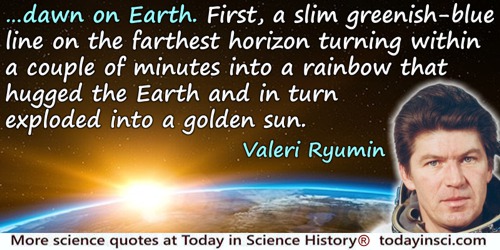
We entered into shadow. Contact with Moscow was gone. Japan floated by beneath us and I could clearly see its cities ablaze with lights. We left Japan behind to face the dark emptiness of the Pacific Ocean. No moon. Only stars, bright and far away. I gripped the handle like a man hanging onto a streetcar. Very slowly, agonizingly, half an hour passed, and with that, dawn on Earth. First, a slim greenish-blue line on the farthest horizon turning within a couple of minutes into a rainbow that hugged the Earth and in turn exploded into a golden sun. You’re out of your mind, I told myself, hanging onto a ship in space, and to your life, and getting ready to admire a sunrise.
…...
We knew the world would not be the same. A few people laughed, a few people cried. Most people were silent. I remembered the line from the Hindu scripture, the Bhagavad Gita: Vishnu is trying to pursue the Prince that he should do his duty and to impress him takes on his multi-armed form and says, “Now I am become Death, destroyer of worlds.” I suppose we all thought that one
way or another. There was a great deal of solemn talk that this was the end of the great wars of the century.
At the first atomic bomb test (16 Jul 1945), in Len Giovanitti and Fred Freed, The Decision to Drop the Bomb (1965), 197
We pass with admiration along the great series of mathematicians, by whom the science of theoretical mechanics has been cultivated, from the time of Newton to our own. There is no group of men of science whose fame is higher or brighter. The great discoveries of Copernicus, Galileo, Newton, had fixed all eyes on those portions of human knowledge on which their successors employed their labors. The certainty belonging to this line of speculation seemed to elevate mathematicians above the students of other subjects; and the beauty of mathematical relations and the subtlety of intellect which may be shown in dealing with them, were fitted to win unbounded applause. The successors of Newton and the Bernoullis, as Euler, Clairaut, D’Alembert, Lagrange, Laplace, not to introduce living names, have been some of the most remarkable men of talent which the world has seen.
In History of the Inductive Sciences, Vol. 1, Bk. 4, chap. 6, sect. 6.
We think the heavens enjoy their spherical
Their round proportion, embracing all;
But yet their various and perplexed course,
Observed in divers ages, doth enforce
Men to find out so many eccentric parts,
Such diverse downright lines, such overthwarts,
As disproportion that pure form.
Their round proportion, embracing all;
But yet their various and perplexed course,
Observed in divers ages, doth enforce
Men to find out so many eccentric parts,
Such diverse downright lines, such overthwarts,
As disproportion that pure form.
From poem, 'An Anatomy of the World: The First Anniversary', lines 251-257, as collected in The Poems of John Donne (1896), Vol. 2, 113.
We were able to see the plankton blooms resulting from the upwelling off the coast of Chile. The plankton itself extended along the coastline and had some long tenuous arms reaching out to sea. The arms or lines of plankton were pushed around in a random direction, fairly well-defined yet somewhat weak in color, in contrast with the dark blue ocean. The fishing ought to be good down there.
…...
We will build the roads and bridges, the electric grids and digital lines that feed our commerce and bind us together. We'll restore science to its rightful place, and wield technology's wonders to raise health care's quality and lower its cost. We will harness the sun and the winds and the soil to fuel our cars and run our factories. And we will transform our schools and colleges and universities to meet the demands of a new age. All this we can do. All this we will do.
From First Inaugural Address (20 Jan 2009)
Weight is caused by one element being situated in another; and it moves by the shortest line towards its centre, not by its own choice, not because the centre draws it to itself, but because the other intervening element cannot withstand it.
…...
What distinguishes the straight line and circle more than anything else, and properly separates them for the purpose of elementary geometry? Their self-similarity. Every inch of a straight line coincides with every other inch, and of a circle with every other of the same circle. Where, then, did Euclid fail? In not introducing the third curve, which has the same property—the screw. The right line, the circle, the screw—the representations of translation, rotation, and the two combined—ought to have been the instruments of geometry. With a screw we should never have heard of the impossibility of trisecting an angle, squaring the circle, etc.
From Letter (15 Feb 1852) to W.R. Hamilton, collected in Robert Perceval Graves, Life of W.R. Hamilton (1889), Vol. 3, 343.
What is art
But life upon the larger scale, the higher,
When, graduating up in a spiral line
Of still expanding and ascending gyres,
It pushed toward the intense significance
Of all things, hungry for the Infinite?
But life upon the larger scale, the higher,
When, graduating up in a spiral line
Of still expanding and ascending gyres,
It pushed toward the intense significance
Of all things, hungry for the Infinite?
From poem, 'Aurora Leigh' (1856), Book 4. In Elizabeth Barrett Browning and Harriet Waters Preston (ed.), The Complete Poetical Works of Mrs. Browning (1900), 323.
What quality is shared by all objects that provoke our aesthetic emotions? Only one answer seems possible—significant form. In each, lines and colors combined in a particular way; certain forms and relations of forms, stir our aesthetic emotions. These relations and combinations of lines and colours, these æsthetically moving forms, I call “Significant Form”; and “Significant Form” is the one quality common to all works of visual art.
In Art (1913), 8.
When in doubt, make a fool of yourself. There is a microscopically thin line between being brilliantly creative and acting like the most gigantic idiot on earth. So what the hell, leap.
…...
Why are you so sure parallel lines exist?
Believe nothing, merely because you have been told it, or because it is traditional, or because you have imagined it.
Believe nothing, merely because you have been told it, or because it is traditional, or because you have imagined it.
In George Edward Martin, The Foundations of Geometry and the Non-Euclidean Plane (1982), 47.
Why is geometry often described as “cold” and “dry?” One reason lies in its inability to describe the shape of a cloud, a mountain, a coastline, or a tree. Clouds are not spheres, mountains are not cones, coastlines are not circles, and bark is not smooth, nor does lightning travel in a straight line… Nature exhibits not simply a higher degree but an altogether different level of complexity.
From The Fractal Geometry of Nature (1977, 1983), Introduction, xiii.
Why is it so very important to know that the lines drawn from the extremities of the base of an isosceles triangle to the middle points of the opposite sides are equal!
In Letter (29 May 1898), at age almost 18, to Mrs. Lawrence Hutton, excerpted in The Story of My Life: With her Letters (1887-1901) (1903, 1921), 242.
Why the dinosaurs died out is not known, but it is supposed to be because they had minute brains and devoted themselves to the growth of weapons of offense in the shape of numerous horns. However that may be, it was not through their line that life developed.
In 'Men versus. Insects' (1933), collected in In Praise of Idleness and Other Essays (1935), 199.
 In science it often happens that scientists say, 'You know that's a really good argument; my position is mistaken,' and then they would actually change their minds and you never hear that old view from them again. They really do it. It doesn't happen as often as it should, because scientists are human and change is sometimes painful. But it happens every day. I cannot recall the last time something like that happened in politics or religion.
(1987) --
In science it often happens that scientists say, 'You know that's a really good argument; my position is mistaken,' and then they would actually change their minds and you never hear that old view from them again. They really do it. It doesn't happen as often as it should, because scientists are human and change is sometimes painful. But it happens every day. I cannot recall the last time something like that happened in politics or religion.
(1987) -- 





