Lifetime Quotes (40 quotes)
A discovery must be, by definition, at variance with existing knowledge. During my lifetime, I made two. Both were rejected offhand by the popes of the field. Had I predicted these discoveries in my applications, and had those authorities been my judges, it is evident what their decisions would have been.
In 'Dionysians and Apollonians', Science (2 Jun 1972), 176, 966. Reprinted in Mary Ritchie Key, The Relationship of Verbal and Nonverbal Communication (1980), 318.
A scientist reads many books in his lifetime, and knows he still has a lot to learn. A religious man barely reads one book, and thinks he knows everything.
A theoretical physicist can spend his entire lifetime missing the intellectual challenge of experimental work, experiencing none of the thrills and dangers — the overhead crane with its ten-ton load, the flashing skull and crossbones and danger, radioactivity signs. A theorist’s only real hazard is stabbing himself with a pencil while attacking a bug that crawls out of his calculations.
In Leon Lederman and Dick Teresi, The God Particle: If the Universe is the Answer, What is the
Question (1993), 15.
Few men during their lifetime come anywhere near exhausting the resources dwelling within them. There are deep wells of strength that are never used.
In Alone (1938), 189.
Give people facts and you feed their minds for an hour. Awaken curiosity and they feed their own minds for a lifetime.
Originally written for an ECSITE Newsletter, Food for Thought article, used for a long time as a personal e-mail signature, then posted on the website of interactives.co.uk
How strange it would be if the final theory were to be discovered in our lifetimes! The discovery of the final laws of nature will mark a discontinuity in human intellectual history, the sharpest that has occurred since the beginning of modern science in the seventeenth century. Can we now imagine what that would be like?
In Dreams of a Final Theory (1992), 235.
I believe in the not-too-distant future, people are going to learn to trust their information to the Net more than they now do, and be able to essentially manage very large amounts and perhaps their whole lifetime of information in the Net with the notion that they can access it securely and privately for as long as they want, and that it will persist over all the evolution and technical changes.
From transcript of interview by Steve Inskeep, 'Computing Pioneers Discuss the State of the Net', Morning Edition (22 Aug 2005) on npr.org website.
I spent most of a lifetime trying to be a mathematician—and what did I learn. What does it take to be one? I think I know the answer: you have to be born right, you must continually strive to become perfect, you must love mathematics more than anything else, you must work at it hard and without stop, and you must never give up.
In I Want to be a Mathematician: an Automathography (1985), 400.
If the Weismann idea triumphs, it will be in a sense a triumph of fatalism; for, according to it, while we may indefinitely improve the forces of our education and surroundings, and this civilizing nurture will improve the individuals of each generation, its actual effects will not be cumulative as regards the race itself, but only as regards the environment of the race; each new generation must start de novo, receiving no increment of the moral and intellectual advance made during the lifetime of its predecessors. It would follow that one deep, almost instinctive motive for a higher life would be removed if the race were only superficially benefited by its nurture, and the only possible channel of actual improvement were in the selection of the fittest chains of race plasma.
'The Present Problem of Heredity', The Atlantic Monthly (1891), 57, 363.
If we continue on our current course, the damage that has been the defining feature of my lifetime will be eclipsed by the damage coming in the next. … Science predicts that were I born today, I would be witness to the 2030s—The Amazon Rainforest, cut down until it can no longer produce enough moisture, degrades into a dry savannah, bringing catastrophic species loss—and altering the global water cycle.
From narration to Netflix TV program, A Life on Our Planet: My Witness Statement and a Vision for the Future (4 Oct 2020).
In the end, after a lifetime’s exploration of the living world, I’m certain of one thing. This is not about saving our planet… it’s about saving ourselves.
From narration to Netflix TV program, A Life on Our Planet: My Witness Statement and a Vision for the Future (4 Oct 2020).
In the next twenty centuries … humanity may begin to understand its most baffling mystery—where are we going? The earth is, in fact, traveling many thousands of miles per hour in the direction of the constellation Hercules—to some unknown destination in the cosmos. Man must understand his universe in order to understand his destiny. Mystery, however, is a very necessary ingredient in our lives. Mystery creates wonder and wonder is the basis for man’s desire to understand. Who knows what mysteries will be solved in our lifetime, and what new riddles will become the challenge of the new generation? Science has not mastered prophesy. We predict too much for the next year yet far too little for the next ten. Responding to challenges is one of democracy’s great strengths. Our successes in space can be used in the next decade in the solution of many of our planet’s problems.
In a speech to a Joint Meeting of the Two Houses of Congress to Receive the Apollo 11 Astronauts (16 Sep 1969), in the Congressional Record.
It is often more convenient to possess the ashes of great men than to possess the men themselves during their lifetime.
Commenting on the return of Descartes’ remains to France. Quoted, without citation, in Eric Temple Bell Men of Mathematics (1937), 52.
It is rare enough that a scientist sheds light on an area which nature has kept secret and then during his lifetime, sees that area illuminate in turn every corner of physiology and medicine. It is rarer still that one man can contribute concurrently almost as much to several other biological fields as well. That meanwhile he [August Krogh] should develop in addition a large school of devoted students who loved the man even more, if possible, than they venerated the scientist, spells the highest form of genius.
Commemorative words presented to the American Physiological Society (1950), describing Eugene Landis, his friend and colleague at Harvard University. As quoted and cited in Bodil Schmidt-Nielsen, August and Marie Krogh: Lives in Science (2013), 4.
It’s important to always bear in mind that life occurs in historical time. Everyone in every culture lives in some sort of historical time, though it might not be perceived in the same way an outside observer sees it. It’s an interesting question, “When is now?” “Now” can be drawn from some point like this hour, this day, this month, this lifetime, or this generation. “Now” can also have occurred centuries ago; things like unfair treaties, the Trail of Tears, and the Black Hawk War, for instance, remain part of the “Now” from which many Native Americans view their place in time today. Human beings respond today to people and events that actually occurred hundreds or even thousands of years ago. Ethnohistorians have played a major role in showing how now is a social concept of time, and that time is part of all social life. I can only hope that their work will further the understanding that the study of social life is a study of change over time.
From Robert S. Grumet, 'An Interview with Anthony F. C. Wallace', Ethnohistory (Winter 1998), 45, No. 1, 127.
Like almost every subject of human interest, this one [mathematics] is just as easy or as difficult as we choose to make it. A lifetime may be spent by a philosopher in discussing the truth of the simplest axiom. The simplest fact as to our existence may fill us with such wonder that our minds will remain overwhelmed with wonder all the time. A Scotch ploughman makes a working religion out of a system which appalls a mental philosopher. Some boys of ten years of age study the methods of the differential calculus; other much cleverer boys working at mathematics to the age of nineteen have a difficulty in comprehending the fundamental ideas of the calculus.
In Teaching of Mathematics (1902), 19-20.
Mars is the next frontier, what the Old West was, what America was 500 years ago. It’s been 500 years since Columbus. It’s time to strike out anew. There’s a big argument at the moment. The moon is closer, and we’ve got to go back there sometime. But whether it will ever be settled on a large scale is a question. But Mars—there’s no doubt about it. … Everything you need is on Mars.
The characteristic of human nature, and perhaps our simian family group, is curiosity and exploration. When we stop doing that, we won't be human anymore. You say there's been a decline, well, I’ve seen far more happen in my lifetime than I ever dreamed. And the momentary plateau now, well, many of our problems on Earth can only be solved by space technology. … When we get out of the present sort of slump and confusion, well, I mean the next step is space. It's inevitable.
The characteristic of human nature, and perhaps our simian family group, is curiosity and exploration. When we stop doing that, we won't be human anymore. You say there's been a decline, well, I’ve seen far more happen in my lifetime than I ever dreamed. And the momentary plateau now, well, many of our problems on Earth can only be solved by space technology. … When we get out of the present sort of slump and confusion, well, I mean the next step is space. It's inevitable.
Interview in Sri Lanka by Steve Coll for The Washington Post (9 Mar 1992), B1.
Microwildenesses exist in a handful of soil…. A lifetime can be spent in a Magellanic voyage around the trunk of a single tree.
From 'Biodiversity, Biophilia', Naturalist (1994, 2019), 364.
My only wish would be to have ten more lives to live on this planet. If that were possible, I’d spend one lifetime each in embryology, genetics, physics, astronomy and geology. The other lifetimes would be as a pianist, backwoodsman, tennis player, or writer for the National Geographic. … I’d like to keep open the option for another lifetime as a surgeon-scientist.
In Tore Frängsmyr and Jan E. Lindsten (eds.), Nobel Lectures: Physiology Or Medicine: 1981-1990 (1993), 557.
My own lifetime spans the Wright Brothers' Kitty Hawk flight and manned-satellite orbiting.
In 'The Wisdom of Wilderness', Life (22 Dec 1967), 63, No. 25, 8.
No thinking observer was there at the “beginning,” [of the universe] although most of our personal nucleons, borrowed only for our lifetime from the nuclide pool, must have been there shortly thereafter
As quoted in John Noble Wilford, 'Sizing up the Cosmos: An Astronomers Quest', New York Times (12 Mar 1991), C10.
Not one man in a thousand has accuracy of eye and judgment sufficient to become an eminent breeder. If gifted with these qualities, and he studies his subject for years, and devotes his lifetime to it with indomitable perseverance, he will succeed, and may make great improvements; if he wants any of these qualities, he will assuredly fail.
In On the Origin of Species by Means of Natural Selection (1859, 1860), 32.
One could say you can't do any experiment which exceeds the lifetime of a Ph.D. student.
In transcript of video interview story No. 45, 'Evolution experiments' on webofstories.com website.
One day at Fenner's (the university cricket ground at Cambridge), just before the last war, G. H. Hardy and I were talking about Einstein. Hardy had met him several times, and I had recently returned from visiting him. Hardy was saying that in his lifetime there had only been two men in the world, in all the fields of human achievement, science, literature, politics, anything you like, who qualified for the Bradman class. For those not familiar with cricket, or with Hardy's personal idiom, I ought to mention that “the Bradman class” denoted the highest kind of excellence: it would include Shakespeare, Tolstoi, Newton, Archimedes, and maybe a dozen others. Well, said Hardy, there had only been two additions in his lifetime. One was Lenin and the other Einstein.
Variety of Men (1966), 87. First published in Commentary magazine.
One single equation for the motion of the Moon covers some 250 large-size pages and represents the major effort of a lifetime.
In Earth, Moon and Planets (1963), 28.
Only by strict specialization can the scientific worker become fully conscious, for once and perhaps never again in his lifetime, that he has achieved something that will endure. A really definitive and good accomplishment is today always a specialized accomplishment.
From a Speech (1918) presented at Munich University, published in 1919, and collected in 'Wissenschaft als Beruf', Gessammelte Aufsätze zur Wissenschaftslehre (1922), 524-525. As given in H.H. Gerth and C. Wright-Mills (translators and eds.), 'Science as a Vocation', Max Weber: Essays in Sociology (1946), 135.
Our lifetime may be the last that will be lived out in a technological society.
Interview in The Christian Science Monitor (27 Mar 1974), F1.
Our lifetime may be the last that will be lived out in a technological society. If the world continues to behave as stupidly as it has behaved in the past, we are going to have an increase in population, an increase in violence. We will try to support the population by ripping up earth’s resources, producing pollution at a greater and greater rate, ending, perhaps, in a nuclear war. The earth will have its oil burnt up, most of its most easily available coal used up, its metals distributed thinly over the entire world. We simply won’t have the material basis to build up another technological civilization. The greater the population, the greater the pressure on technology to produce things. Also, there is a great deal of pressure to produce things that don’t directly relate to the quantity of people in the world, but are useless, energy wasting. Socrates is reported to have looked over a bazaar in great wonder and said, “How very many things there are that I do not need.” There are a great many things that we don’t need.
Interview in The Christian Science Monitor (27 Mar 1974), F1.
Owing to his lack of knowledge, the ordinary man cannot attempt to resolve conflicting theories of conflicting advice into a single organized structure. He is likely to assume the information available to him is on the order of what we might think of as a few pieces of an enormous jigsaw puzzle. If a given piece fails to fit, it is not because it is fraudulent; more likely the contradictions and inconsistencies within his information are due to his lack of understanding and to the fact that he possesses only a few pieces of the puzzle. Differing statements about the nature of things, differing medical philosophies, different diagnoses and treatments—all of these are to be collected eagerly and be made a part of the individual's collection of puzzle pieces. Ultimately, after many lifetimes, the pieces will fit together and the individual will attain clear and certain knowledge.
'Strategies of Resort to Curers in South India', contributed in Charles M. Leslie (ed.), Asian Medical Systems: A Comparative Study (1976), 185.
Technology is an inherent democratizer. Because of the evolution of hardware and software, you’re able to scale up almost anything you can think up. … We’ll have to see if in our lifetime that means that everybody has more or less tools that are of equal power.
Guest Lecture, UC Berkeley, 'Search Engines, Technology, and Business' (3 Oct 2005). At 10:37 in the YouTube video.
The ancients devoted a lifetime to the study of arithmetic; it required days to extract a square root or to multiply two numbers together. Is there any harm in skipping all that, in letting the school boy learn multiplication sums, and in starting his more abstract reasoning at a more advanced point? Where would be the harm in letting the boy assume the truth of many propositions of the first four books of Euclid, letting him assume their truth partly by faith, partly by trial? Giving him the whole fifth book of Euclid by simple algebra? Letting him assume the sixth as axiomatic? Letting him, in fact, begin his severer studies where he is now in the habit of leaving off? We do much less orthodox things. Every here and there in one’s mathematical studies one makes exceedingly large assumptions, because the methodical study would be ridiculous even in the eyes of the most pedantic of teachers. I can imagine a whole year devoted to the philosophical study of many things that a student now takes in his stride without trouble. The present method of training the mind of a mathematical teacher causes it to strain at gnats and to swallow camels. Such gnats are most of the propositions of the sixth book of Euclid; propositions generally about incommensurables; the use of arithmetic in geometry; the parallelogram of forces, etc., decimals.
In Teaching of Mathematics (1904), 12.
The fundamental characteristic of the scientific method is honesty. In dealing with any question, science asks no favors. ... I believe that constant use of the scientific method must in the end leave its impress upon him who uses it. ... A life spent in accordance with scientific teachings would be of a high order. It would practically conform to the teachings of the highest types of religion. The motives would be different, but so far as conduct is concerned the results would be practically identical.
Address as its retiring president, to the American Association for the Advancement of Science, St. Louis (28 Dec 1903). 'Scientific Investigation and Progress', Nature 928 Jan 1904), 69:1787, 309.
The very closest stars would require many years to visit, even traveling at the speed of light, which is impossible according to Einstein's theory of relativity. Today's fastest spaceships would require 200,000 years to travel to Alpha Centauri, our closest bright star. The energy required to send a hundred colonists to another star, as Frank Drake has pointed out, would be enough to meet the energy needs of the entire United States over a human lifetime. And these estimates are regarding nearby stars. When we consider the distances across the entire galaxy, and between galaxies, interstellar travel seems absolutely untenable.
As co-author with his son, Marshall Fisher, in Strangers in the Night: a Brief History of Life on Other Worlds (1998).
There is a poignant symbolism in the fact that the giant rockets now stand poised on the edge of the Pacific where the covered wagons halted only two lifetimes ago.
In 'Rocket to the Renaissance', republished in a collection of essays written in 1959-1961, Profiles of the Future (1962), 85.
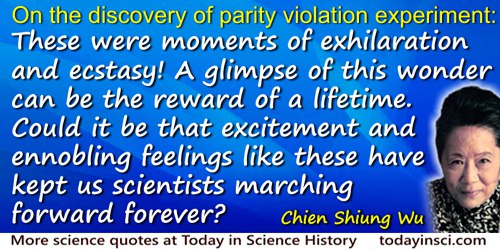
These were moments of exhilaration and ecstasy! A glimpse of this wonder can be the reward of a lifetime. Could it be that excitement and ennobling feelings like these have kept us scientists marching forward forever?
Referring to her landmark parity conservation experiment. As quoted in Benjamin F. Shearer, Barbara Smith Shearer, Notable Women in the Physical Sciences: A Biographical Dictionary (1997), 428.
Very few people realize the enormous bulk of contemporary mathematics. Probably it would be easier to learn all the languages of the world than to master all mathematics at present known. The languages could, I imagine, be learnt in a lifetime; mathematics certainly could not. Nor is the subject static.
In 'The Extent of Mathematics', Prelude to Mathematics (1955), 11.
We have simply arrived too late in the history of the universe to see this primordial simplicity easily ... But although the symmetries are hidden from us, we can sense that they are latent in nature, governing everything about us. That's the most exciting idea I know: that nature is much simpler than it looks. Nothing makes me more hopeful that our generation of human beings may actually hold the key to the universe in our hands—that perhaps in our lifetimes we may be able to tell why all of what we see in this immense universe of galaxies and particles is logically inevitable.
Quoted in Nigel Calder, The Key to the Universe: A Report on the New Physics (1978), 185.
When I first ventured into the Gulf of Mexico in the 1950s, the sea appeared to be a blue infinity too large, too wild to be harmed by anything that people could do. I explored powder white beaches, dense marshes, mangrove forests, and miles of sea grass meadows alive with pink sea urchins, tiny shrimps, and seahorses half the size of my little finger. … Then, in mere decades, not millennia, the blue wilderness of my childhood disappeared: biologic change in the space of a lifetime.
From 'My Blue Wilderness', National Geographic Magazine (Oct 2010), 76.
Why, then, are we surprised that comets, such a rare spectacle in the universe, are not known, when their return is at vast intervals?. … The time will come when diligent research over long periods will bring to light things which now lie hidden. A single lifetime, even though entirely devoted to the sky, would not be enough for the investigation of so vast a subject … And so this knowledge will be unfolded only through long successive ages. There will come a time when our descendants will be amazed that we did not know things that are so plain to them …. Many discoveries are reserved for ages still to come, when memory of us will have been effaced. Our universe is a sorry little affair unless it has in it something for every age to investigate … Nature does not reveal her mysteries once and for all. Someday there will be a man who will show in what regions comets have their orbit, why they travel so remote from other celestial bodies, how large they are and what sort they are.
Natural Questions, Book 7. As translated by Thomas H. Corcoran in Seneca in Ten Volumes: Naturales Quaestiones II (1972), 279 and 293.
You are not expected to complete the work in your lifetime. Nor must you refuse to do your unique part.
— Talmud
…...
 In science it often happens that scientists say, 'You know that's a really good argument; my position is mistaken,' and then they would actually change their minds and you never hear that old view from them again. They really do it. It doesn't happen as often as it should, because scientists are human and change is sometimes painful. But it happens every day. I cannot recall the last time something like that happened in politics or religion.
(1987) --
In science it often happens that scientists say, 'You know that's a really good argument; my position is mistaken,' and then they would actually change their minds and you never hear that old view from them again. They really do it. It doesn't happen as often as it should, because scientists are human and change is sometimes painful. But it happens every day. I cannot recall the last time something like that happened in politics or religion.
(1987) -- 




