Life Quotes (1884 quotes)
... in real life mistakes are likely to be irrevocable. Computer simulation, however, makes it economically practical to make mistakes on purpose. If you are astute, therefore, you can learn much more than they cost. Furthermore, if you are at all discreet, no one but you need ever know you made a mistake.
With co-author John Osborn, in Natural Automata and Useful Simulations edited by H. H. Pattee et al. (1966).
… the truth is that the knowledge of external nature and of the sciences which that knowledge requires or includes, is not the great or the frequent business of the human mind. Whether we provide for action or conversation, whether we wish to be useful or pleasing, the first requisite is the religious and moral knowledge of right and wrong; the next is an acquaintance with the history of mankind, and with those examples which may be said to embody truth, and prove by events the reasonableness of opinions. Prudence and justice are virtues, and excellencies, of all times and of all places; we are perpetually moralists, but we are geometricians only by chance. Our intercourse with intellectual nature is necessary; our speculations upon matter are voluntary, and at leisure. Physical knowledge is of such rare emergence, that one man may know another half his life without being able to estimate his skill in hydrostatics or astronomy; but his moral and prudential character immediately appears.
In Lives of the Poets (1779-81).
… to explore strange new worlds, to seek out new life and new civilizations, to boldly go where no one has gone before.
…...
...a man estimable for his learning, amiable for his life, and venerable for his piety. Arbuthnot was a man of great comprehension, skilful in his profession, versed in the sciences, acquainted with ancient literature, and able to animate his mass of knowledge by a bright and active imagination; a scholar with great brilliance of wit; a wit who, in the crowd of life, retained and discovered a noble ardour of religious zeal.
The Lives of the English Poets (1826), vol. 2, 257.
...after my first feeling of revulsion had passed, I spent three of the most entertaining and instructive weeks of my life studying the fascinating molds which appeared one by one on the slowly disintegrating mass of horse-dung. Microscopic molds are both very beautiful and absorbingly interesting. The rapid growth of their spores, the way they live on each other, the manner in which the different forms come and go, is so amazing and varied that I believe a man could spend his life and not exhaust the forms or problems contained in one plate of manure.
The World Was My Garden (1938, 1941), 55.
…by shortening the labours doubled the life of the astronomer.
On the benefit of Napier’s logarithms.
On the benefit of Napier’s logarithms.
Quoted in H. Eves, In Mathematical Circles (1969).
…resort to science has rendered modern war so destructive of life and property that it presents a new problem to mankind, such, that unless our civilization shall find some means of making an end to war, war will make an end to our civilization.
America and World Peace (1925), 37. In Edward C. Luck, Mixed Messages: American Politics and International Organization, 1919-1999 (1999), 143.
…the ideal doctor would be a man endowed with profound knowledge of life and of the soul, intuitively divining any suffering or disorder of whatever kind, and restoring peace by his mere presence.
Amiel's Journal The Journal Intime of Henri-Frederic Amiel (22 Aug 1873), trans. By Mrs Humphry Ward (1889), Vol 2., 153.
...the life of the planet began the long, slow process of modulating and regulating the physical conditions of the planet. The oxygen in today's atmosphere is almost entirely the result of photosynthetic living, which had its start with the appearance of blue-green algae among the microorganisms.
In Late Night Thoughts on Listening to Mahler's Ninth Symphony(1984), 74.
...those who sit at their work and are therefore called 'chair workers,' such as cobblers and tailors, suffer from their own particular diseases ... [T]hese workers ... suffer from general ill-health and an excessive accumulation of unwholesome humors caused by their sedentary life ... so to some extent counteract the harm done by many days of sedentary life.
On the association between chronic inactivity and poor health. Ramazzini urged that workers should at least exercise on holidays
On the association between chronic inactivity and poor health. Ramazzini urged that workers should at least exercise on holidays
'Sedentary Workers and Their Diseases', Diseases of Workers (1713) Translated by WC Wright (1964),281-285). Quoted in Physical Activity and Health: a Report of the Surgeon General (1996).
‘Be not afraid of life. Believe that life is worth living, and your belief will help create the fact.
Quoted in Kim Lim (ed.), 1,001 Pearls of Spiritual Wisdom: Words to Enrich, Inspire, and Guide Your Life (2014), 245
’Tis a short sight to limit our faith in laws to those of gravity, of chemistry, of botany, and so forth. Those laws do not stop where our eyes lose them, but push the same geometry and chemistry up into the invisible plane of social and rational life, so that, look where we will, in a boy's game, or in the strifes of races, a perfect reaction, a perpetual judgment keeps watch and ward.
From 'Worship', The Conduct of Life (1860) collected in The Complete Works of Ralph Waldo Emerson (1866), Vol.2, 401.
“Advance, ye mates! Cross your lances full before me. Well done! Let me touch the axis.” So saying, with extended arm, he grasped the three level, radiating lances at their crossed centre; while so doing, suddenly and nervously twitched them; meanwhile, glancing intently from Starbuck to Stubb; from Stubb to Flask. It seemed as though, by some nameless, interior volition, he would fain have shocked into them the same fiery emotion accumulated within the Leyden jar of his own magnetic life. The three mates quailed before his strong, sustained, and mystic aspect. Stubb and Flask looked sideways from him; the honest eye of Starbuck fell downright.
“In vain!&rsdquo; cried Ahab; “but, maybe, ’tis well. For did ye three but once take the full-forced shock, then mine own electric thing, that had perhaps expired from out me. Perchance, too, it would have dropped ye dead.…”
[Commentary by Henry Schlesinger: Electricity—mysterious and powerful as it seemed at the time—served as a perfect metaphor for Captain Ahab’s primal obsession and madness, which he transmits through the crew as if through an electrical circuit in Moby-Dick.]
“In vain!&rsdquo; cried Ahab; “but, maybe, ’tis well. For did ye three but once take the full-forced shock, then mine own electric thing, that had perhaps expired from out me. Perchance, too, it would have dropped ye dead.…”
[Commentary by Henry Schlesinger: Electricity—mysterious and powerful as it seemed at the time—served as a perfect metaphor for Captain Ahab’s primal obsession and madness, which he transmits through the crew as if through an electrical circuit in Moby-Dick.]
Extract from Herman Melville, Moby-Dick and comment by Henry Schlesinger from his The Battery: How Portable Power Sparked a Technological Revolution (2010), 64.
“Biodiversity” … is the key to the maintenance of the world as we know it. Life in a local site
struck down by a passing storm springs back quickly because enough diversity still exists. … This is the assembly of life that took a billion years to evolve. It has eaten the storms—folded them into its genes—and created the world that created us. It holds the world steady.
In The Diversity of Life (1992, 1999), 15.
“Cradle to Cradle” is in counterpoint to “Cradle to Grave.” It basically says that if we look at everything as a take, make and waste system, then it’s a one-way system. Whereas If we think about things having multiple lives, cradle to cradle, we could design things that can go back to either nature or back to industry forever.
In audio segment, 'William McDonough: Godfather of Green', WNYC, Studio 360 broadcast on NPR radio (18 Mar 2008) and archived on the station website.
“Crawling at your feet,” said the Gnat … “you may observe a Bread-and-Butterfly. …”
“And what does it live on?”
“Weak tea with cream in it.”
A new difficulty came into Alice's head. “Supposing it couldn't find any?” she suggested.
“Then it would die, of course.”
“But that must happen very often,” Alice remarked thoughtfully.
“It always happens,” said the Gnat.
“And what does it live on?”
“Weak tea with cream in it.”
A new difficulty came into Alice's head. “Supposing it couldn't find any?” she suggested.
“Then it would die, of course.”
“But that must happen very often,” Alice remarked thoughtfully.
“It always happens,” said the Gnat.
In Through the Looking Glass: And what Alice Found There (1893), 66-67.
“Hope springs eternal in the human breast,” and is as necessary to life as the act of breathing.
Quoted, without citation, in front matter to T. A. Edison Foundation, Lewis Howard Latimer: A Black Inventor: a Biography and Related Experiments You Can Do (1973). If you know the primary source, please contact Webmaster.
“I’m not so sure he’s wrong about automobiles,” he said, “With all their speed forward they may be a step backward for civilization—that is, spiritual civilization … But automobiles have come, and they bring a greater change in our life than most of us expect. They are here, and almost all outward things are going to be different because of what they bring. They are going to alter war, and they are going to alter peace.”
Spoken by character Eugene, in the novel, The Magnificent Ambersons (1918), 275
“These changes in the body,” he wrote in the review paper he sent to the American Journal of Physiology late in 1913, “are, each one of them, directly serviceable in making the organism more efficient in the struggle which fear or rage or pain may involve; for fear and rage are organic preparations for action, and pain is the most powerful known stimulus to supreme exertion. The organism which with the aid of increased adrenal secretion can best muster its energies, can best call forth sugar to supply the labouring muscles, can best lessen fatigue, and can best send blood to the parts essential in the run or the fight for life, is most likely to survive. Such, according to the view here propounded, is the function of the adrenal medulla at times of great emergency.”
Quoted in S. Benison, A. C. Barger and E. L. Wolfe, Walter B Cannon: The Life and Times of a Young Scientist (1987), 311.
“True is it, my incorporate friends,” quoth he, “That I receive the general food at first, Which you do live upon; and fit it is, Because I am the storehouse and the shop Of the whole body. But, if you do remember, I send it through the rivers of your blood, Even to the court, the heart, to th’ seat o’ th’ brain; And, through the cranks and offices of man, The strongest nerves and small inferior veins From me receive that natural competency Whereby they live. And though that all at once”— You, good friends, this says the belly, mark me.
[Told as a fable, this is the belly’s answer to a complaint from the other members of the body that it received all the food but did no work.] In Coriolanus (1623), Act 1, Scene 1, line 130-141. Webmaster’s note: The Fable of the Belly has its roots in antiquity. William Harvey delivered a lecture in Apr 1616 on his discovery the circulation of blood in the body, but did not publish until 1628.
[A contemporary study] predicted the loss of two-thirds of all tropical forests by the turn of the century. Hundreds of thousands of species will perish, and this reduction of 10 to 20 percent of the earth’s biota will occur in about half a human life span. … This reduction of the biological diversity of the planet is the most basic issue of our time.
Foreword, written for Michael Soulé and Bruce Wilcox (eds.), papers from the 1978 International Conference on Conservation Biology, collected as Conservation Biology (1980), ix. As quoted and cited in Timothy J. Farnham, Saving Nature's Legacy: Origins of the Idea of Biological Diversity (2007), 208.
[A friend at Cambridge] told me that Helmholtz had been a medical doctor before he became a physicist. It thereupon occurred to me that Helmholtz had eaten the meal of life in the wrong order, and that I would like to spend the first half of my life under the strict discipline of physics, and afterwards to apply that training to researches on living things.
As quoted in Stephen A. Richardson 'Lewis Fry Richardson (1881-1953): A Personal Biography', Conflict Resolution (Sep 1957), 1, No. 3, 301.
[A]s you know, scientific education is fabulously neglected … This is an evil that is inherited, passed on from generation to generation. The majority of educated persons are not interested in science, and are not aware that scientific knowledge forms part of the idealistic background of human life. Many believe—in their complete ignorance of what science really is—that it has mainly the ancillary task of inventing new machinery, or helping to invent it, for improving our conditions of life. They are prepared to leave this task to the specialists, as they leave the repairing of their pipes to the plumber. If persons with this outlook decide upon the curriculum of our children, the result is necessarily such as I have just described it.
Opening remarks of the second of four public lectures for the Dublin Institute for Advanced Studies at University College, Dublin (Feb 1950), The Practical Achievements of Science Tending to Obliterate its True Import', collected in Science and Humanism: Physics in Our Time (1951). Reprinted in 'Nature and the Greeks' and 'Science and Humanism' (1996), 113.
[About the structure of DNA] [T]he whole business was like a child's toy that you could buy at the dime store, all built in this wonderful way that you could explain in Life magazine so that really a five-year-old can understand what's going on...This was the greatest surprise for everyone.
Quoted in Horace Freeland Judson, Eighth Day of Creation (1979)
[At my secondary school] if you were very bright, you did classics; if you were pretty thick, you did woodwork; and if you were neither of those poles, you did science. The number of kids in my school who did science because they were excited by the notion of science was pretty small. You were allocated to those things, you weren’t asked. This was in the late 1930s/early 1940s … Science was seen as something more remote and less to do with everyday life.
From interview with Brian Cox and Robert Ince, in 'A Life Measured in Heartbeats', New Statesman (21 Dec 2012), 141, No. 5138, 32.
[Beyond natural history] Other biological sciences take up the study at other levels of organization: dissecting the individual into organs and tissues and seeing how these work together, as in physiology; reaching down still further to the level of cells, as in cytology; and reaching the final biological level with the study of living molecules and their interactions, as in biochemistry. No one of these levels can be considered as more important than any other.
In The Nature of Natural History (1961, 2014), 7.
[Concerning] mr Kirwan’s charming treatise on manures. Science never appears so beautiful as when applied to the uses of human life, nor any use of it so engaging as agriculture & domestic economy.
Letter (23 Mar 1798) from Jefferson in Philadelphia to William Strickland. In The Papers of Thomas Jefferson: 1 January 1798 to 31 January 1799 (2003), 211. Jefferson was thanking Strickland, who had sent him a copy of Kirwan’s treatise.
[Culture] denotes an historically transmitted pattern of meanings embodied in symbols, a system of inherited conceptions expressed in symbolic forms, by means of which men communicate, perpetuate, and develop their knowledge about and attitudes toward life.
The Interpretation of Cultures (1977), 89.
[Defining Life] The definite combination of heterogeneous changes, both simultaneous and successive, in correspondence with external co-existences and sequences.
Herbert Spencer, "Principles of Psychology" 1835, p. 354. Compare "Physiology of Common Life" 1860, ii., 426. In The British Controversialist and Literary Magazine (1865), 234.
[Defining Life] The special activity of organized beings.
Duges, "Physiologie Comparée." In The British Controversialist and Literary Magazine (1865), 234.
[Defining Life] the sum of the phenomena proper to organized beings. In consists essentially in this, that organized beings are all, during a certain time, the centres to which foreign substances penetrate and are appropriated, and from which others issue.
Béclard, "Anatomie Générale." In The British Controversialist and Literary Magazine (1865), 234.
[Engineering] is a great profession. There is the fascination of watching a figment of the imagination emerge through the aid of science to a plan on paper. Then it moves to realization in stone or metal or energy. Then it brings homes to men or women. Then it elevates the standards of living and adds to the comforts of life. That is the engineer’s high privilege.
Reprint of his 1916 statement in 'Engineering as a Profession', Engineer’s Week (1954).
[Everyone should know:] The unity of life that comes about through evolution, since we’re all descended from a single common ancestor. It’s almost too good to be true, that on one planet this extraordinary complexity of life should have come about by what is pretty much an intelligible process. And we're the only species capable of understanding it.
From 'Interview: Of Mind and Matter: David Attenborough Meets Richard Dawkins', The Guardian (11 Sep 2010),
[First use of the term science fiction:] We hope it will not be long before we may have other works of Science-Fiction [like Richard Henry Horne's The Poor Artist], as we believe such books likely to fulfil a good purpose, and create an interest, where, unhappily, science alone might fail.
[Thomas] Campbell says, that “Fiction in Poetry is not the reverse of truth, but her soft and enchanting resemblance.” Now this applies especially to Science-Fiction, in which the revealed truths of Science may be given interwoven with a pleasing story which may itself be poetical and true—thus circulating a knowledge of Poetry of Science, clothed in a garb of the Poetry of life.
[Thomas] Campbell says, that “Fiction in Poetry is not the reverse of truth, but her soft and enchanting resemblance.” Now this applies especially to Science-Fiction, in which the revealed truths of Science may be given interwoven with a pleasing story which may itself be poetical and true—thus circulating a knowledge of Poetry of Science, clothed in a garb of the Poetry of life.
In A Little Earnest Book Upon a Great Old Subject (1851), 137.
[Florence Nightingale] was a great administrator, and to reach excellence here is impossible without being an ardent student of statistics. Florence Nightingale has been rightly termed the “Passionate Statistician.” Her statistics were more than a study, they were indeed her religion. For her, Quetelet was the hero as scientist, and the presentation copy of his Physique Sociale is annotated by her on every page. Florence Nightingale believed—and in all the actions of her life acted upon that belief—that the administrator could only be successful if he were guided by statistical knowledge. The legislator—to say nothing of the politician—too often failed for want of this knowledge. Nay, she went further: she held that the universe—including human communities—was evolving in accordance with a divine plan; that it was man's business to endeavour to understand this plan and guide his actions in sympathy with it. But to understand God's thoughts, she held we must study statistics, for these are the measure of his purpose. Thus the study of statistics was for her a religious duty.
In Karl Pearson, The Life, Letters and Labours of Francis Galton (1924), Vol. 2, 414-5.
[For] men to whom nothing seems great but reason ... nature ... is a cosmos, so admirable, that to penetrate to its ways seems to them the only thing that makes life worth living. These are the men whom we see possessed by a passion to learn ... Those are the natural scientific men; and they are the only men that have any real success in scientific research.
From 'Lessons from the History of Science: The Scientific Attitude' (c.1896), in Collected Papers (1931), Vol. 1, 19.
[I doubt that in today's world, I and Francis Crick would ever have had our Eureka moment.] I recently went to my staircase at Clare College, Cambridge and there were women there! he said, with an enormous measure of retrospective sexual frustration. There have been a lot of convincing studies recently about the loss of productivity in the Western male. It may be that entertainment culture now is so engaging that it keeps people satisfied. We didn't have that. Science was much more fun than listening to the radio. When you are 16 or 17 and in that inherently semi-lonely period when you are deciding whether to be an intellectual, many now don't bother.
(Response when asked how he thought the climate of scientific research had changed since he made his discovery of the structure of life in 1953.)
(Response when asked how he thought the climate of scientific research had changed since he made his discovery of the structure of life in 1953.)
Quoted by Tim Adams in 'The New Age of Ignorance', The Observer (30 Jun 2007).
[In an inventor’s life] Everything is stacked against you, but for some reason some silly chaps seem to be driven to it (rather like a painter of a composer of music), which is perhaps just as well or we should still be living in the Stone Age.
As quoted in Michael T. Kaufman, 'Christopher Cockerell, 88, Inventor, Dies; Father of Hovercraft and Marconi Devices', New York Times (4 Jun 1999), 19.
[In research on bacteria metabolism] we have indeed much the same position as an observer trying to gain an idea of the life of a household by careful scrutiny of the persons and material arriving or leaving the house; we keep accurate records of the foods and commodities left at the door and patiently examine the contents of the dust-bin and endeavour to deduce from such data the events occurring within the closed doors.
Bacterial Metabolism (1930), Preface. In 'Obituary Notice: Marjory Stephenson, 1885–1948', Biochemistry Journal (1950), 46:4, 380.
[In] death at least there would be one profit; it would no longer be necessary to eat, to drink, to pay taxes, or to [offend] others; and as a man lies in his grave not one year, but hundreds and thousands of years, the profit was enormous. The life of man was, in short, a loss, and only his death a profit.
In short story, Rothschild’s Fiddle (1894). Collected in The Black Monk and Other Stories (1915), 138.
[John Scott Haldane] preferred to work on himself or other human beings who were sufficiently interested in the work to ignore pain or fear … [His] object was not to achieve this state of [pain or fear] but to achieve knowledge which could save other men's lives. His attitute was much more like a good soldier who will risk his life and endure wounds in order to gain victory than that of an ascetic who deliberately undergoes pain. The soldier does not get himself wounded deliberately, and my father did not seek pain in his work though he greeted pain which would have made some people writhe or groan, with laughter.
In R.W. Clark, JBS: The Life and Work of J.B.S. Haldane (1968), quoted in Lawrence K. Altman, Who Goes First? (1986), 215.
[Joseph Rotblat] was a towering figure in the search for peace in the world, who dedicated his life to trying to rid the world of nuclear weapons, and ultimately to rid the world of war itself.
Speaking as president of the Pugwash Conferences. As quoted in Associated Press syndicated to newspapers, for example in, 'Joseph Rotblat, Scientist Against Nuclear Arms, Dies', Sun Journal (2 Sep 2005), A5.
[L]et us not overlook the further great fact, that not only does science underlie sculpture, painting, music, poetry, but that science is itself poetic. The current opinion that science and poetry are opposed is a delusion. … On the contrary science opens up realms of poetry where to the unscientific all is a blank. Those engaged in scientific researches constantly show us that they realize not less vividly, but more vividly, than others, the poetry of their subjects. Whoever will dip into Hugh Miller’s works on geology, or read Mr. Lewes's “Seaside Studies,” will perceive that science excites poetry rather than extinguishes it. And whoever will contemplate the life of Goethe will see that the poet and the man of science can co-exist in equal activity. Is it not, indeed, an absurd and almost a sacrilegious belief that the more a man studies Nature the less he reveres it? Think you that a drop of water, which to the vulgar eye is but a drop of water, loses anything in the eye of the physicist who knows that its elements are held together by a force which, if suddenly liberated, would produce a flash of lightning? Think you that what is carelessly looked upon by the uninitiated as a mere snow-flake, does not suggest higher associations to one who has seen through a microscope the wondrously varied and elegant forms of snow-crystals? Think you that the rounded rock marked with parallel scratches calls up as much poetry in an ignorant mind as in the mind of a geologist, who knows that over this rock a glacier slid a million years ago? The truth is, that those who have never entered upon scientific pursuits know not a tithe of the poetry by which they are surrounded. Whoever has not in youth collected plants and insects, knows not half the halo of interest which lanes and hedge-rows can assume. Whoever has not sought for fossils, has little idea of the poetical associations that surround the places where imbedded treasures were found. Whoever at the seaside has not had a microscope and aquarium, has yet to learn what the highest pleasures of the seaside are. Sad, indeed, is it to see how men occupy themselves with trivialities, and are indifferent to the grandest phenomena—care not to understand the architecture of the Heavens, but are deeply interested in some contemptible controversy about the intrigues of Mary Queen of Scots!—are learnedly critical over a Greek ode, and pass by without a glance that grand epic written by the finger of God upon the strata of the Earth!
In Education: Intellectual, Moral, and Physical (1889), 82-83.
[Learning is] the actual process of broadening yourself, of knowing there’s a little extra facet of the universe you know about and can think about and can understand. It seems to me that when it’s time to die, and that will come to all of us, there’ll be a certain pleasure in thinking that you had utilized your life well, that you had learned as much as you could, gathered in as much as possible of the universe, and enjoyed it. I mean, there’s only this universe and only this one lifetime to try to grasp it. And, while it is inconceivable that anyone can grasp more than a tiny portion of it, at least do that much. What a tragedy to just pass through and get nothing out of it.
'Isaac Asimov Speaks' with Bill Moyers in The Humanist (Jan/Feb 1989), 49. Reprinted in Carl Howard Freedman (ed.), Conversations with Isaac Asimov (2005), 139.
[Man] … his origin, his growth, his hopes and fears, his loves and his beliefs are but the outcome of accidental collocations of atoms; that no fire, no heroism, no intensity of thought and feeling can preserve an individual life beyond the grave; that all the labour of the ages, all the devotion, all the inspiration, all the noonday brightness of human genius are destined to extinction in the vast death of the solar system, and that the whole temple of Man's achievement must inevitably be buried beneath the debris of a universe in ruins…
From 'A Free Man's Worship', Independent Review (Dec 1903). Collected in Mysticism and Logic: And Other Essays (1918), 47-48.
[May] this civic and social landmark [the Washington, D.C., Jewish Community Center] ... be a constant reminder of the inspiring service that has been rendered to civilization by men and women of the Jewish faith. May [visitors] recall the long array of those who have been eminent in statecraft, in science, in literature, in art, in the professions, in business, in finance, in philanthropy and in the spiritual life of the world.
Speech upon laying the cornerstone of the Jewish Community Center, Washington, D.C. (3 May 1925). In William J. Federer, A Treasury of Presidential Quotations (2004), 240.
[My grandmother] lived the latter years of her life in the horrible suspicion that electricity was dripping invisibly all over the house. It leaked, she contended, out of empty sockets if the wall switch had been left on. She would go around screwing in bulbs, and if they lighted up, she would fearfully turn off the wall switch and go back to her Pearson's or Everybody's, happy in the satisfaction that she had stopped not only a costly but dangerous leakage. nothing could ever clear this up for her.
In My Life and Hard Times (1937, 1999), 16.
[My study of the universe] leaves little doubt that life has occurred on other planets. I doubt if the human race is the most intelligent form of life.
Speech to University of Miami students. Quoted in article, 'Notions in Motion,' Time (24 Nov 1952).
[No one will be able to] deter the scientific mind from probing into the unknown any more than Canute could command the tides.
Comment upon the U.S. Supreme Court's 1980 decision permitting the patenting of life forms.
Comment upon the U.S. Supreme Court's 1980 decision permitting the patenting of life forms.
'Shaping Life in the Lab'. In Time (9 Mar 1981).
[Public cynicism towards professional expertise is] entirely wrong, and it’s the road back to the cave. The way we got out of the caves and into modern civilisation is through the process of understanding and thinking. Those things were not done by gut instinct. Being an expert does not mean that you are someone with a vested interest in something; it means you spend your life studying something. You’re not necessarily right–but you’re more likely to be right than someone who’s not spent their life studying it.
As quoted in interview with Decca Aitkenhead, 'Prof Brian Cox: Being anti-expert – that’s the way back to the cave', The Guardian (2 Jul 2016)
[Reporting after the now infamous 22 Jun 1969 burning of the Cuyahoga River:] Some River! Chocolate-brown, oily, bubbling with subsurface gases, it oozes rather than flows. “Anyone who falls into the Cuyahoga does not drown,” Cleveland’s citizens joke grimly. “He decays” … The Federal Water Pollution Control Administration dryly notes: “The lower Cuyahoga has no visible signs of life, not even low forms such as leeches and sludge worms that usually thrive on wastes.” It is also—literally—a fire hazard.
— Magazine
As reported in Time magazine (1 Aug 1969).
[Resist the temptation to] work so hard that there is no time left for serious thinking …[Scientists] should heed the saying, “A busy life is a wasted life.”
As quoted in J. Michael Bishop, How to Win the Nobel Prize: An Unexpected Life in Science (2009), 59. Citing What Mad Pursuit: A Personal View of Scientific Discovery (1988), 145.
[Shawn Lawrence Otto describes the damaging] strategy used to undermine science in the interest of those industries where science has pointed out the dangers of their products to individuals and human life in general … [It was] used a generation ago by the tobacco industry… First they manufacture uncertainty by raising doubts about even the most indisputable scientific evidence. Then they launder information by using seemingly independent front organizations to promote their desired message and thereby confuse the public. And finally they recruit unscrupulous scientific spokespeople to misrepresent peer-reviewed scientific findings and cherry-pick facts in an attempt to persuade the media and the public that there is still serious debate among scientists on the issue at hand.
In 'Science Is Politics', Huffington Post (28 May 2014).
[Some] philosophers have been of opinion that our immortal part acquires during this life certain habits of action or of sentiment, which become forever indissoluble, continuing after death in a future state of existence ... I would apply this ingenious idea to the generation, or production of the embryon, or new animal, which partakes so much of the form and propensities of the parent.
Zoonomia (1794), Vol. 1, 483-4.
[T]he phenomena of animal life correspond to one another, whether we compare their rank as determined by structural complication with the phases of their growth, or with their succession in past geological ages; whether we compare this succession with their relative growth, or all these different relations with each other and with the geographical distribution of animals upon the earth. The same series everywhere!
In Essay on Classification (1851), 196.
[T]he rapt philosopher, and he who contemplates a work of art, inhabit a world with an intense and peculiar significance of its own; that significance is unrelated to the significance of life.
In Art (1913), 26.
[The attitude of the Renaissance towards the antique world was that] Archaeology to them was not a mere science for the antiquarian; it was a means by which they could touch the dry dust of antiquity into the very breath and beauty of life, and fill with the new wine of romanticism forms that else had been old and out-worn.
In his essay 'The Truth of Masks', collected in Intentions (1904), 213.
[The chemical bond] First, it is related to the disposition of two electrons (remember, no one has ever seen an electron!): next, these electrons have their spins pointing in opposite directions (remember, no one can ever measure the spin of a particular electron!): then, the spatial distribution of these electrons is described analytically with some degree of precision (remember, there is no way of distinguishing experimentally the density distribution of one electron from another!): concepts like hybridization, covalent and ionic structures, resonance, all appear, not one of which corresponds to anything that is directly measurable. These concepts make a chemical bond seem so real, so life-like, that I can almost see it. Then I wake with a shock to the realization that a chemical bond does not exist; it is a figment of the imagination that we have invented, and no more real than the square root of - 1. I will not say that the known is explained in terms of the unknown, for that is to misconstrue the sense of intellectual adventure. There is no explanation: there is form: there is structure: there is symmetry: there is growth: and there is therefore change and life.
Quoted in his obituary, Biographical Memoirs of the Fellows of the Royal Society 1974, 20, 96.
[The error in the teaching of mathematics is that] mathematics is expected either to be immediately attractive to students on its own merits or to be accepted by students solely on the basis of the teacher’s assurance that it will be helpful in later life. [And yet,] mathematlcs is the key to understanding and mastering our physical, social and biological worlds.
In editorial in Focus, a Journal of the Mathematical Association of America (1986), quoted in obituary by Eric Pace, New York Times (11 Jun 1992).
[The nanotube] brings those properties you cannot get from other organic molecules. And it’s still carbon, so it has organic chemistry. Here is an object that has, to a superlative degree, the aspects that we hold most central to the inorganic world: hardness, toughness, terrific strength, thermal and electrical conductivity. Things you just can’t do with bone and wood. But it’s made out of carbon. It’s something that plays the game at the same level of perfection as molecules and life.
From interview in 'Wires of Wonder', Technology Review (Mar 2001), 104, No. 2, 88.
[The octopus has] an amazing skin, because there are up to 20 million of these chromatophore pigment cells and to control 20 million of anything is going to take a lot of processing power. ... These animals have extraordinarily large, complicated brains to make all this work. ... And what does this mean about the universe and other intelligent life? The building blocks are potentially there and complexity will arise. Evolution is the force that's pushing that. I would expect, personally, a lot of diversity and a lot of complicated structures. It may not look like us, but my personal view is that there is intelligent life out there.
From transcript of PBS TV program Nova episode 'Origins: Where are the Aliens?' (2004).
[Theodore Roosevelt] was a naturalist on the broadest grounds, uniting much technical knowledge with knowledge of the daily lives and habits of all forms of wild life. He probably knew tenfold more natural history than all the presidents who had preceded him, and, I think one is safe in saying, more human history also.
In 'Theodore Roosevelt', Natural History (Jan 1919), 19, No.1, 5.
[W]e might expect intelligent life and technological communities to have emerged in the universe billions of years ago. Given that human society is only a few thousand years old, and that human technological society is mere centuries old, the nature of a community with millions or even billions of years of technological and social progress cannot even be imagined. ... What would we make of a billion-year-old technological community?
In Are We Alone?(1995), 48.

[W]hen Galileo discovered he could use the tools of mathematics and mechanics to understand the motion of celestial bodies, he felt, in the words of one imminent researcher, that he had learned the language in which God recreated the universe. Today we are learning the language in which God created life. We are gaining ever more awe for the complexity, the beauty, the wonder of God's most devine and sacred gift.
From White House Announcement of the Completion of the First Survey of the Entire Human Genome Project, broadcast on the day of the publication of the first draft of the human genome. Quoted in transcript on the National Archives, Clinton White House web site, 'Text of Remarks on the Completion of the First Survey of the Entire Human Genome Project' (26 Jun 2000).
[Young] was afterwards accustomed to say, that at no period of his life was he particularly fond of repeating experiments, or even of very frequently attempting to originate new ones; considering that, however necessary to the advancement of science, they demanded a great sacrifice of time, and that when the fact was once established, that time was better employed in considering the purposes to which it might be applied, or the principles which it might tend to elucidate.
Hudson Gurney, Memoir of the Life of Thomas Young, M.D. F.R.S. (1831), 12-3.
[Zoophytes (Protists, or simple life forms) are] the primitive types from which all the organisms of the higher classes had arisen by gradual development.
Entry for Gottfried Reinhold Treviranus in Encyclopedia Britannica (1911), Vol. 27, 255-256.
ή γὰρ νοῡ ἐνέργεια ζωή
The energy or active exercise of the mind constitutes life.
The energy or active exercise of the mind constitutes life.
From The Metaphysic, book Λ, 1072b, [25], as literally translated from the Greek by Rev. John H. M'Mahon in The Metaphysics of Aristotle (1857), 332. Also widely seen quoted as “The energy of the mind is the essence of life,” without citation, for example in Eve Herold, George Daley, Stem Cell Wars (2007), 119. Note that in the initial meaning, energeia (energy) for Aristotle is the act or the realization of something.
Ode to The Amoeba
Recall from Time's abysmal chasm
That piece of primal protoplasm
The First Amoeba, strangely splendid,
From whom we're all of us descended.
That First Amoeba, weirdly clever,
Exists today and shall forever,
Because he reproduced by fission;
He split himself, and each division
And subdivision deemed it fitting
To keep on splitting, splitting, splitting;
So, whatsoe'er their billions be,
All, all amoebas still are he.
Zoologists discern his features
In every sort of breathing creatures,
Since all of every living species,
No matter how their breed increases
Or how their ranks have been recruited,
From him alone were evoluted.
King Solomon, the Queen of Sheba
And Hoover sprang from that amoeba;
Columbus, Shakespeare, Darwin, Shelley
Derived from that same bit of jelly.
So famed is he and well-connected,
His statue ought to be erected,
For you and I and William Beebe
Are undeniably amoebae!
Recall from Time's abysmal chasm
That piece of primal protoplasm
The First Amoeba, strangely splendid,
From whom we're all of us descended.
That First Amoeba, weirdly clever,
Exists today and shall forever,
Because he reproduced by fission;
He split himself, and each division
And subdivision deemed it fitting
To keep on splitting, splitting, splitting;
So, whatsoe'er their billions be,
All, all amoebas still are he.
Zoologists discern his features
In every sort of breathing creatures,
Since all of every living species,
No matter how their breed increases
Or how their ranks have been recruited,
From him alone were evoluted.
King Solomon, the Queen of Sheba
And Hoover sprang from that amoeba;
Columbus, Shakespeare, Darwin, Shelley
Derived from that same bit of jelly.
So famed is he and well-connected,
His statue ought to be erected,
For you and I and William Beebe
Are undeniably amoebae!
(1922). Collected in Gaily the Troubadour (1936), 18.
The Mighty Task is Done
At last the mighty task is done;
Resplendent in the western sun
The Bridge looms mountain high;
Its titan piers grip ocean floor,
Its great steel arms link shore with shore,
Its towers pierce the sky.
On its broad decks in rightful pride,
The world in swift parade shall ride,
Throughout all time to be;
Beneath, fleet ships from every port,
Vast landlocked bay, historic fort,
And dwarfing all the sea.
To north, the Redwood Empires gates;
To south, a happy playground waits,
In Rapturous appeal;
Here nature, free since time began,
Yields to the restless moods of man,
Accepts his bonds of steel.
Launched midst a thousand hopes and fears,
Damned by a thousand hostile sneers,
Yet Neer its course was stayed,
But ask of those who met the foe
Who stood alone when faith was low,
Ask them the price they paid.
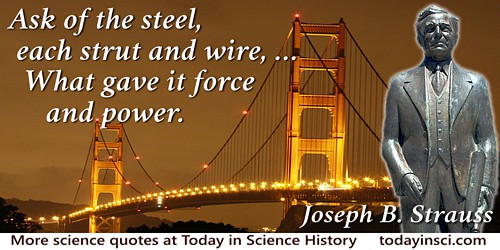
Ask of the steel, each strut and wire,
Ask of the searching, purging fire,
That marked their natal hour;
Ask of the mind, the hand, the heart,
Ask of each single, stalwart part,
What gave it force and power.
An Honored cause and nobly fought
And that which they so bravely wrought,
Now glorifies their deed,
No selfish urge shall stain its life,
Nor envy, greed, intrigue, nor strife,
Nor false, ignoble creed.
High overhead its lights shall gleam,
Far, far below lifes restless stream,
Unceasingly shall flow;
For this was spun its lithe fine form,
To fear not war, nor time, nor storm,
For Fate had meant it so.
At last the mighty task is done;
Resplendent in the western sun
The Bridge looms mountain high;
Its titan piers grip ocean floor,
Its great steel arms link shore with shore,
Its towers pierce the sky.
On its broad decks in rightful pride,
The world in swift parade shall ride,
Throughout all time to be;
Beneath, fleet ships from every port,
Vast landlocked bay, historic fort,
And dwarfing all the sea.
To north, the Redwood Empires gates;
To south, a happy playground waits,
In Rapturous appeal;
Here nature, free since time began,
Yields to the restless moods of man,
Accepts his bonds of steel.
Launched midst a thousand hopes and fears,
Damned by a thousand hostile sneers,
Yet Neer its course was stayed,
But ask of those who met the foe
Who stood alone when faith was low,
Ask them the price they paid.
Ask of the steel, each strut and wire,
Ask of the searching, purging fire,
That marked their natal hour;
Ask of the mind, the hand, the heart,
Ask of each single, stalwart part,
What gave it force and power.
An Honored cause and nobly fought
And that which they so bravely wrought,
Now glorifies their deed,
No selfish urge shall stain its life,
Nor envy, greed, intrigue, nor strife,
Nor false, ignoble creed.
High overhead its lights shall gleam,
Far, far below lifes restless stream,
Unceasingly shall flow;
For this was spun its lithe fine form,
To fear not war, nor time, nor storm,
For Fate had meant it so.
Written upon completion of the building of the Golden Gate Bridge, May 1937. In Allen Brown, Golden Gate: biography of a Bridge (1965), 229.
The Redwoods
Here, sown by the Creator's hand,
In serried ranks, the Redwoods stand;
No other clime is honored so,
No other lands their glory know.
The greatest of Earth's living forms,
Tall conquerors that laugh at storms;
Their challenge still unanswered rings,
Through fifty centuries of kings.
The nations that with them were young,
Rich empires, with their forts far-flung,
Lie buried now—their splendor gone;
But these proud monarchs still live on.
So shall they live, when ends our day,
When our crude citadels decay;
For brief the years allotted man,
But infinite perennials' span.
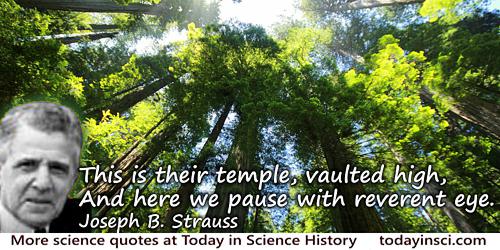
This is their temple, vaulted high,
And here we pause with reverent eye,
With silent tongue and awe-struck soul;
For here we sense life's proper goal;
To be like these, straight, true and fine,
To make our world, like theirs, a shrine;
Sink down, oh traveler, on your knees,
God stands before you in these trees.
Here, sown by the Creator's hand,
In serried ranks, the Redwoods stand;
No other clime is honored so,
No other lands their glory know.
The greatest of Earth's living forms,
Tall conquerors that laugh at storms;
Their challenge still unanswered rings,
Through fifty centuries of kings.
The nations that with them were young,
Rich empires, with their forts far-flung,
Lie buried now—their splendor gone;
But these proud monarchs still live on.
So shall they live, when ends our day,
When our crude citadels decay;
For brief the years allotted man,
But infinite perennials' span.
This is their temple, vaulted high,
And here we pause with reverent eye,
With silent tongue and awe-struck soul;
For here we sense life's proper goal;
To be like these, straight, true and fine,
To make our world, like theirs, a shrine;
Sink down, oh traveler, on your knees,
God stands before you in these trees.
In The Record: Volumes 60-61 (1938), 39.
[About John Evershed] There is much in our medallist’s career which is a reminder of the scientific life of Sir William Huggins. They come from the same English neighbourhood and began as amateurs of the best kind. They both possess the same kind of scientific aptitude.
Address, presenting the Gold medal of the Royal Astronomical Society to Evershed, as quoted in F.J.M. Stratton, 'John Evershed', Biographical Memoirs of Fellows of the Royal Society (Nov 1957), 3, 40.
[About Sir Roderick Impey Murchison:] The enjoyments of elegant life you early chose to abandon, preferring to wander for many successive years over the rudest portions of Europe and Asia—regions new to Science—in the hope, happily realized, of winning new truths.
By a rare union of favourable circumstances, and of personal qualifications equally rare, you have thus been enabled to become the recognized Interpreter and Historian (not without illustrious aid) of the Silurian Period.
By a rare union of favourable circumstances, and of personal qualifications equally rare, you have thus been enabled to become the recognized Interpreter and Historian (not without illustrious aid) of the Silurian Period.
Dedication page in Thesaurus Siluricus: The Flora and Fauna of the Silurian Period (1868), iv.
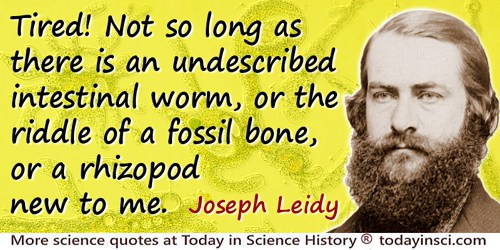
[Answering question whether he was tired of life:] Tired! Not so long as there is an undescribed intestinal worm, or the riddle of a fossil bone, or a rhizopod new to me.
Related about Joseph Leidy by Dr. Weir Mitchell, as stated in Richard A. Gregory, Discovery: Or, The Spirit and Service of Science (1916), 17.
[Answering whether there was life in other worlds, he said there probably was.] After all, there's plenty of unearthly looking things moving around in my refrigerator, so there's always a chance of life springing up almost anywhere.
In Keith Colquhoun and Ann Wroe, Economist Book of Obituaries (2008), 79.
[Criticizing as “appalingly complacent” a Conservative Government report that by the '60s, Britain would be producing all the scientists needed] Of course we shall, if we don't give science its proper place in our national life. We shall no doubt be training all the bullfighters we need, because we don't use many.
Address at the Imperial College of Science and Technology, London (28 Feb 1963). In 'Hailsham Chided on Science's Role', New York Times (1 Mar 1963), 2. Also in 'The Manhunters: British Minister Blames American Recruiters for Emigration of Scientists',Science Magazine (8 Mar 1963), 893.
[Defining Life] An internal principle of action.
Kritik der Urtheilskraft in Werke, IV, 260). In George Henry Lewes, Aristotle (1864), 229.
[Defining Life] The constant uniformity of phenomena under diversity of external influences.
Biologie (1802). As cited in translated form in George Henry Lewes, Physiology of Common Life (1875), Vol. 2, 356.
[Describing the effects of over-indulgence in wine:]
But most too passive, when the blood runs low
Too weakly indolent to strive with pain,
And bravely by resisting conquer fate,
Try Circe's arts; and in the tempting bowl
Of poisoned nectar sweet oblivion swill.
Struck by the powerful charm, the gloom dissolves
In empty air; Elysium opens round,
A pleasing frenzy buoys the lightened soul,
And sanguine hopes dispel your fleeting care;
And what was difficult, and what was dire,
Yields to your prowess and superior stars:
The happiest you of all that e'er were mad,
Or are, or shall be, could this folly last.
But soon your heaven is gone: a heavier gloom
Shuts o'er your head; and, as the thundering stream,
Swollen o'er its banks with sudden mountain rain,
Sinks from its tumult to a silent brook,
So, when the frantic raptures in your breast
Subside, you languish into mortal man;
You sleep, and waking find yourself undone,
For, prodigal of life, in one rash night
You lavished more than might support three days.
A heavy morning comes; your cares return
With tenfold rage. An anxious stomach well
May be endured; so may the throbbing head;
But such a dim delirium, such a dream,
Involves you; such a dastardly despair
Unmans your soul, as maddening Pentheus felt,
When, baited round Citheron's cruel sides,
He saw two suns, and double Thebes ascend.
But most too passive, when the blood runs low
Too weakly indolent to strive with pain,
And bravely by resisting conquer fate,
Try Circe's arts; and in the tempting bowl
Of poisoned nectar sweet oblivion swill.
Struck by the powerful charm, the gloom dissolves
In empty air; Elysium opens round,
A pleasing frenzy buoys the lightened soul,
And sanguine hopes dispel your fleeting care;
And what was difficult, and what was dire,
Yields to your prowess and superior stars:
The happiest you of all that e'er were mad,
Or are, or shall be, could this folly last.
But soon your heaven is gone: a heavier gloom
Shuts o'er your head; and, as the thundering stream,
Swollen o'er its banks with sudden mountain rain,
Sinks from its tumult to a silent brook,
So, when the frantic raptures in your breast
Subside, you languish into mortal man;
You sleep, and waking find yourself undone,
For, prodigal of life, in one rash night
You lavished more than might support three days.
A heavy morning comes; your cares return
With tenfold rage. An anxious stomach well
May be endured; so may the throbbing head;
But such a dim delirium, such a dream,
Involves you; such a dastardly despair
Unmans your soul, as maddening Pentheus felt,
When, baited round Citheron's cruel sides,
He saw two suns, and double Thebes ascend.
The Art of Preserving Health: a Poem in Four Books (2nd. ed., 1745), Book IV, 108-110.
[On the use of scopolamine in criminology], If it is permissible for a state to take life, liberty and property because of crime, it can be made legal to obtain information from a suspected criminal by the use of a drug. If the use of bloodhounds is legal, the use of scopolamine can be made legal.
From paper read at the Section on State Medicine and Public Hygiene of the State Medical Association of Texas at El Paso (11 May 1922), 'The Use Of Scopolamine In Criminology', published in Texas State Journal of Medicine (Sep 1922). Reprinted in The American Journal of Police Science (Jul-Aug 1931), 2, No. 4, 328.
[When questioned on his longevity] First of all, I selected my ancestors very wisely. ... They were long-lived, healthy people. Then, as a chemist, I know how to eat, how to exercise, keep my blood circulating. ... I don't worry. I don't get angry at people. I don't worry about things I can't help. I do what I can to make the world a better place to live, but I don't complain if things aren't right. As a scientist I take the world as I find it.
[About celebrating his 77th birthday by swimming a half mile in 22 minutes] I used swim fins and webbed gloves because a man of intelligence should apply his power efficiently, not just churn the water.
[About celebrating his 77th birthday by swimming a half mile in 22 minutes] I used swim fins and webbed gloves because a man of intelligence should apply his power efficiently, not just churn the water.
As quoted in obituary by Wallace Turner, 'Joel Hildebrand, 101', New York Times (3 May 1983), D27.
Aber das Leben ist kurz und die Wahrheit wirkt ferne und lebt lange: sagen wir die Wahrheit.
Life is short and truth works far and lives long: let us speak the truth.
Life is short and truth works far and lives long: let us speak the truth.
Concluding remark in Preface, written at Dresden in August 1818, first German edition, Die Welt als Wille und Vorstellung, 4 Bücher nebst einem Anhange der die Kritik der Kentischen Philosophie (1819), xvi. As translated by Richard Burton Haldane and John Kemp in The World as Will and Representation (1883, 1907), Vol. 1, xv.
Ars longa, vita brevis.
Art is long, life is short.
Art is long, life is short.
Aphorisms, i. The original was written in Greek. This Latin translation, by Seneca (De Brevitate Vitae, 1.1), is in John Bartlett, Familiar Quotations (1905), 6, footnote 3. The sense is generally taken to be, 'Life is short, but to learn a profession (an art) takes a long time.'
Das Leben der Gotter ist Mathematik.
Mathematics is the Life of the Gods.
Mathematics is the Life of the Gods.
Attributed.
Dilbert: Maybe I’m unlucky in love because I’m so knowledgeable about science that I intimidate people. Their intimidation becomes low self-esteem, then they reject me to protect their egos.
Dogbert: Occam’s Razor.
Dilbert: What is “Occam's Razor”?
Dogbert: A guy named Occam had a rule about the world. Basically he said that when there are multiple explanations for something the simplest explanation is usually correct. The simplest explanation for your poor love life is that you’re immensely unattractive.
Dilbert: Maybe Occam had another rule that specifically exempted this situation, but his house burned down with all his notes. Then he forgot.
Dogbert: Occam’s Razor.
Dilbert: I’m an idiot.
Dogbert: I don’t think we can rule it out at this point.
Dogbert: Occam’s Razor.
Dilbert: What is “Occam's Razor”?
Dogbert: A guy named Occam had a rule about the world. Basically he said that when there are multiple explanations for something the simplest explanation is usually correct. The simplest explanation for your poor love life is that you’re immensely unattractive.
Dilbert: Maybe Occam had another rule that specifically exempted this situation, but his house burned down with all his notes. Then he forgot.
Dogbert: Occam’s Razor.
Dilbert: I’m an idiot.
Dogbert: I don’t think we can rule it out at this point.
Dilbert comic strip (11 Jul 1993).
Dilbert: Wow! According to my computer simulation, it should be possible to create new life forms from common household chemicals
Dogbert: This raises some thorny issues.
Dilbert: You mean legal, ethical and religious issues?
Dogbert: I was thinking about parking spaces.
Dogbert: This raises some thorny issues.
Dilbert: You mean legal, ethical and religious issues?
Dogbert: I was thinking about parking spaces.
Dilbert comic strip (31 May 1989).
Epitaph of John Hunter
The Royal College of Surgeons of England have placed this tablet over the grave of Hunter, to record their admiration of his genius as a gifted interpreter of the Divine Power and Wisdom at work in the Laws of Organic Life, and their grateful veneration for his services to mankind as the Founder of Scientific Surgery.
The Royal College of Surgeons of England have placed this tablet over the grave of Hunter, to record their admiration of his genius as a gifted interpreter of the Divine Power and Wisdom at work in the Laws of Organic Life, and their grateful veneration for his services to mankind as the Founder of Scientific Surgery.
— Epitaph
Memorial brass in the floor of north aisle of Westminster Abbey, placed when Hunter's remains were reinterred there (28 Mar 1859). In Charles Coulston Gillespie (ed.), Dictionary of Scientific Biography (1972), Vol. 6, 568.
Error of confounding cause and effect.—There is no more dangerous error than confounding consequence with cause: I call it the intrinsic depravity of reason. … I take an
example: everybody knows the book of the celebrated Comaro, in which he recommends his spare diet as a recipe for a long and happy life,—for a virtuous life also. Few books have been read so much… I believe hardly any book … has caused so much harm, has shortened so many lives, as this well-meant curiosity. The source of this mischief is in confounding consequence with cause. The candid Italian saw in his diet the cause of his long life, while the prerequisite to long life, the extraordinary slowness of the metabolic process, small consumption, was the cause of his spare diet. He was not at liberty to eat little or much; his frugality—was not of “free will;” he became sick when he ate more.
From 'The Four Great Errors', The Twilight of the Idols (1888), collected in Thomas Common (trans.), The Works of Friedrich Nietzsche (1896), Vol. 11, 139.
For-thi loke thow lovye,
As longe as thow durest;
For is no science under sonne
So sovereyn for the soule.
So long as you live, see that you love,
For no science under the sun can so heal the soul.
As longe as thow durest;
For is no science under sonne
So sovereyn for the soule.
So long as you live, see that you love,
For no science under the sun can so heal the soul.
In William Langland and B. Thomas Wright (ed.) The Vision and Creed of Piers Ploughman (1842), 184. Modern translation by Terrence Tiller in Piers Plowman (1981, 1999), 94.
Hie locus est ubi mars gaudet succurere vitae.
This place is where death rejoices to come to the aid of life.
This place is where death rejoices to come to the aid of life.
In the anatomical dissection theatre of the University of Bologna.
In primis, hominis est propria VERI inquisitio atque investigato. Itaque cum sumus negotiis necessariis, curisque vacui, tum avemus aliquid videre, audire, ac dicere, cognitionemque rerum, aut occultarum aut admirabilium, ad benè beatéque vivendum necessariam ducimus; —ex quo intelligitur, quod VERUM, simplex, sincerumque sit, id esse naturæ hominis aptissimum. Huic veri videndi cupiditati adjuncta est appetitio quædam principatûs, ut nemini parere animus benè a naturâ informatus velit, nisi præcipienti, aut docenti, aut utilitatis causâ justè et legitimè imperanti: ex quo animi magnitudo existit, et humanarum rerum contemtio.
Before all other things, man is distinguished by his pursuit and investigation of TRUTH. And hence, when free from needful business and cares, we delight to see, to hear, and to communicate, and consider a knowledge of many admirable and abstruse things necessary to the good conduct and happiness of our lives: whence it is clear that whatsoever is TRUE, simple, and direct, the same is most congenial to our nature as men. Closely allied with this earnest longing to see and know the truth, is a kind of dignified and princely sentiment which forbids a mind, naturally well constituted, to submit its faculties to any but those who announce it in precept or in doctrine, or to yield obedience to any orders but such as are at once just, lawful, and founded on utility. From this source spring greatness of mind and contempt of worldly advantages and troubles.
Before all other things, man is distinguished by his pursuit and investigation of TRUTH. And hence, when free from needful business and cares, we delight to see, to hear, and to communicate, and consider a knowledge of many admirable and abstruse things necessary to the good conduct and happiness of our lives: whence it is clear that whatsoever is TRUE, simple, and direct, the same is most congenial to our nature as men. Closely allied with this earnest longing to see and know the truth, is a kind of dignified and princely sentiment which forbids a mind, naturally well constituted, to submit its faculties to any but those who announce it in precept or in doctrine, or to yield obedience to any orders but such as are at once just, lawful, and founded on utility. From this source spring greatness of mind and contempt of worldly advantages and troubles.
In De Officiis, Book 1. Sect. 13. As given in epigraph to John Frederick William Herschel, A Preliminary Discourse on the Study of Natural Philosophy (1830), viii.
La critique est la vie de la science.
Criticism is the life of science.
Criticism is the life of science.
In Victor Cousin’s Introduction to Peter Abelard, Ouvrages Inédits d'Abélard pour Servir à l'Histoire de la Philosophie Scolastique en France (1836), cxxix.
La fermentation est … la vie sans air, c’est la vie sans oxygène libre
Fermentation is … life without air, it is life without free oxygen.
Fermentation is … life without air, it is life without free oxygen.
In 'Études sur la Bière', Section 6, 'Théorie Physiologique des Fermentation', Revue Scientifique (26 Aug 1876), 2nd Series, 11, No. 9, 214. This is described as “Pasteur’s famous aphorism, ‘Fermentation is life without oxygen’”, in Burton J. Hendrick, 'Some Modern Ideas on Food', McClure’s Magazine (Apr 1910), 34, No. 6, 667.
Le savant n’étudie pas la nature parce que cela est utile; il l’étudie parce qu’il y prend plaisir et il y prend plaisir parce qu’elle est belle. Si la nature n’était pas belle, elle ne vaudrait pas la peine d’être connue, la vie ne vaudrait pas la peine d’être vécue.
The scientist does not study nature because it is useful to do so. He studies it because he takes pleasure in it, and he takes pleasure in it because it is beautiful. If nature were not beautiful, it would not be worth knowing, and life would not be worth living. I am not speaking, of course, of the beauty which strikes the senses, of the beauty of qualities and appearances. I am far from despising this, but it has nothing to do with science. What I mean is that more intimate beauty which comes from the harmonious order of its parts, and which a pure intelligence can grasp.
The scientist does not study nature because it is useful to do so. He studies it because he takes pleasure in it, and he takes pleasure in it because it is beautiful. If nature were not beautiful, it would not be worth knowing, and life would not be worth living. I am not speaking, of course, of the beauty which strikes the senses, of the beauty of qualities and appearances. I am far from despising this, but it has nothing to do with science. What I mean is that more intimate beauty which comes from the harmonious order of its parts, and which a pure intelligence can grasp.
In Science et Méthode (1920), 48, as translated by Francis Maitland, in Science and Method (1908, 1952), 15.
Man is the result of slow growth; that is why he occupies the position he does in animal life. What does a pup amount to that has gained its growth in a few days or weeks, beside a man who only attains it in as many years.
In Orison Swett Marden, 'Bell Telephone Talk: Hints on Success by Alexander G. Bell', How They Succeeded: Life Stories of Successful Men Told by Themselves (1901), 35.
Mathematical truth has validity independent of place, personality, or human authority. Mathematical relations are not established, nor can they be abrogated, by edict. The multiplication table is international and permanent, not a matter of convention nor of relying upon authority of state or church. The value of π is not amenable to human caprice. The finding of a mathematical theorem may have been a highly romantic episode in the personal life of the discoverer, but it cannot be expected of itself to reveal the race, sex, or temperament of this discoverer. With modern means of widespread communication even mathematical notation tends to be international despite all nationalistic tendencies in the use of words or of type.
In 'Light Thrown on the Nature of Mathematics by Certain Aspects of Its Development', Mathematics in General Education (1940), 256. This is the Report of the Committee on the Function of Mathematics in General Education of the Commission on Secondary School Curriculum, which was established by the Executive Board of the Progressive Education Association in 1932.
Mi è impossibile cingere i fianchi di una ragazza con il mio braccio destro e serrare il suo sorriso nella mia mano sinistra, per poi tentare di studiare i due oggetti separatamente. Allo stesso modo, non ci è possibile separare la vita dalla materia vivente, allo scopo di studiare la sola materia vivente e le sue reazioni. Inevitabilmente, studiando la materia vivente e le sue reazioni, studiamo la vita stessa.
It is impossible to encircle the hips of a girl with my right arm and hold her smile in my left hand, then proceed to study the two items separately. Similarly, we can not separate life from living matter, in order to study only living matter and its reactions. Inevitably, studying living matter and its reactions, we study life itself
It is impossible to encircle the hips of a girl with my right arm and hold her smile in my left hand, then proceed to study the two items separately. Similarly, we can not separate life from living matter, in order to study only living matter and its reactions. Inevitably, studying living matter and its reactions, we study life itself
In The Nature of Life (1948).
Nature and nurture are an inseparable blend of influences that work together to produce our behavior. A growing band of researchers are demonstrating that the bedrock of behaviors that make up the concerns of everyday life, such as sex, language, cooperation, and violence have been carved out by evolution over the eons, and this Stone Age legacy continues to influence modern life today.
In Stone Age Present: How Evolution Has Shaped Modern Life: From Sex, Violence and Language to Emotions, Morals and Communities, (1995), 25-26.
Omnis perfectio in hac vita quandam imperfectionem sibi habet annexam: et omnis speculatio nostra quadam caligine non caret.
Every perfection in this life has some imperfection clinging to it; and no speculation is without a certain obscurity.
Every perfection in this life has some imperfection clinging to it; and no speculation is without a certain obscurity.
In De Imitatione Christi (1709), Book 1, Chap. 3, 6. As translated in Of the Imitation of Christ (1903), 8.
Perché la vita è dolore e l’amore godimento è un anestetico
Life is pain and the enjoyment of love is an anesthetic.
Life is pain and the enjoyment of love is an anesthetic.
In Il mestiere di vivere (1947), 78. Translated as The Burning Brand: Diaries 1935-1950 (1961), 90.
Pour réussir dans la science, il faut douter; pour réussir dans la vie, il faut être sûr.
To succeed in science, one must doubt; to succeed in life, one must be sure.
To succeed in science, one must doubt; to succeed in life, one must be sure.
In Recueil d'Œuvres de Léo Errera: Botanique Générale (1908), 193. Google translation by Webmaster.
Que faisons-nous ici-bas? Nous préparons les floraisons de demain. Nous sommes tous du fumier d'humanité future.
What are we doing on earth? We are preparing the blossoms of tomorrow. We are all the manure of future humanity.
What are we doing on earth? We are preparing the blossoms of tomorrow. We are all the manure of future humanity.
Aphorism dated 28 Nov 1903, in Recueil d'Œuvres de Léo Errera: Botanique Générale (1908), 194. Google translation by Webmaster. You may choose to use “blooms” instead of “blossoms” depending on your context.
The constancy of the internal environment is the condition for free and independent life: the mechanism that makes it possible is that which assured the maintenance, with the internal environment, of all the conditions necessary for the life of the elements.
Lectures on the Phenomena of Life Common to Animals and Plants (1878), trans. Hebbel E. Hoff, Roger Guillemin and Lucienne Guillemin (1974), 84.
CLAUDIO: Death is a fearful thing.
ISABELLA: And shamed life a hateful.
CLAUDIO: Ay, but to die, and go we know not where;
To lie in cold obstruction, and to rot;
This sensible warm motion to become
A kneaded clod; and the delighted spirit
To bathe in fiery floods, or to reside
In thrilling region of thick-ribbed ice;
To be imprisioned in the viewless winds,
And blown with restless violence round about
The pendant world; or to be worst than worst
Of those lawless and incertain thought
Imagine howling—'tis too horrible!
The weariest and most loathed worldly life
That age, ache, penury, and imprisionment
Can lay on nature is a paradise
To what we fear of death.
ISABELLA: And shamed life a hateful.
CLAUDIO: Ay, but to die, and go we know not where;
To lie in cold obstruction, and to rot;
This sensible warm motion to become
A kneaded clod; and the delighted spirit
To bathe in fiery floods, or to reside
In thrilling region of thick-ribbed ice;
To be imprisioned in the viewless winds,
And blown with restless violence round about
The pendant world; or to be worst than worst
Of those lawless and incertain thought
Imagine howling—'tis too horrible!
The weariest and most loathed worldly life
That age, ache, penury, and imprisionment
Can lay on nature is a paradise
To what we fear of death.
Measure for Measure (1604), III, i.
QUEEN: Thou know’st ’tis common—all that lives must die,
Passing through nature to eternity.
HAMLET: Ay, madam, it is common.
Passing through nature to eternity.
HAMLET: Ay, madam, it is common.
Hamlet (1601), I, ii.
SIR TOBY: Does not our lives consist of the four elements?
SIR ANDREW: Faith, so they say; but I think it rather consists of eating and drinking.
SIR TOBY: Thou'rt a scholar; let us therefore eat and drink.
SIR ANDREW: Faith, so they say; but I think it rather consists of eating and drinking.
SIR TOBY: Thou'rt a scholar; let us therefore eat and drink.
Twelfth Night (1601), II, iii.
~~[Atrributed]~~ I’m sure the universe is full of intelligent life. It’s just been too intelligent to come here.
Webmaster doubts the authenticity of this quote. It is all over the web, without any source cited. So far, in books available to search, the earliest instance of the quote Webmaster finds is 2003, also with no source, in New Scientist (2003), 177, 53. If this was an authentic quote, wouldn't it show up somewhere before that, with a source, since he died in 2008? Perhaps it is a paraphrase, or from an interview. Can you help?
~~[Misquotation]~~ Every truth starts life as a heresy and ends life as an orthodoxy.
Huxley actually said “It is the customary fate of new truths to begin as heresies and to end as superstitions.” See the original quote, with citation, elsewhere on this webpage. It was restated, without quotation marks, in Garrett Hardin, Nature and Man’s Fate (1961),293, as—T.H. Huxley once remarked that the new truths of science begin as heresy, advance to orthodoxy, and end up as superstition. Variants including “orthodoxy” have appeared in various publications since then. (See further discussion on the quoteinvestigator.com website.)
A Law of Nature, (Lex Naturalis) is a Precept, or generall Rule, found out by Reason, by which a man is forbidden to do, that, which is destructive of his life, or taketh away the means of preserving the same; and to omit, that, by which he thinketh it may be best preserved.
In Leviathan (1651), 64. Hobbes is identifying a precept of morality that men should naturally observe, as contrasted with a law set by politics of government.
A bewildering assortment of (mostly microscopic) life-forms has been found thriving in what were once thought to be uninhabitable regions of our planet. These hardy creatures have turned up in deep, hot underground rocks, around scalding volcanic vents at the bottom of the ocean, in the desiccated, super-cold Dry Valleys of Antarctica, in places of high acid, alkaline, and salt content, and below many meters of polar ice. ... Some deep-dwelling, heat-loving microbes, genetic studies suggest, are among the oldest species known, hinting that not only can life thrive indefinitely in what appear to us totally alien environments, it may actually originate in such places.
In Life Everywhere: the Maverick Science of Astrobiology (2002), xi.
A bird is an instrument working according to mathematical law, which instrument it is within the capacity of man to reproduce with all its movements, but not with a corresponding degree of strength, though it is deficient only in the power of maintaining equilibrium. We may therefore say that such an instrument constructed by man is lacking in nothing except the life of the bird, and this life must needs be supplied from that of man.
'Of the Bird's Movement' from Codice Atlantico 161 r.a., in Leonardo da Vinci's Notebooks, trans. E. MacCurdy (1906), Vol. 1, 153.
A chemical compound once formed would persist for ever, if no alteration took place in surrounding conditions. But to the student of Life the aspect of nature is reversed. Here, incessant, and, so far as we know, spontaneous change is the rule, rest the exception—the anomaly to be accounted for. Living things have no inertia and tend to no equilibrium.
From Address (22 Jul 1854) delivered at St. Martin’s Hall, published as a pamphlet (1854), 7, and collected in 'Educational Value of Natural History Sciences', Lay Sermons, Addresses, and Reviews (1870), 75.
A comparatively small variety of species is found in the older rocks, although of some particular ones the remains are very abundant; ... Ascending to the next group of rocks, we find the traces of life become more abundant, the number of species extended.
Vestiges of the Natural History of Creation (1844), 60-1.
A complete survey of life on Earth may appear to be a daunting task. But compared with what has been dared and achieved in high-energy physics, molecular genetics, and other branches of “big science,” it is in the second or third rank.
In 'Edward O. Wilson: The Biological Diversity Crisis: A Challenge to Science', Issues in Science and Technology (Fall 1985), 2, No. 1, 26.
A faithful friend is the medicine of life; and they that fear the Lord shall find him.
— Bible
King James version, Ecclesiasticus 6:16.
A faithful friend is the medicine of life.
A few days afterwards, I went to him [the same actuary referred to in another quote] and very gravely told him that I had discovered the law of human mortality in the Carlisle Table, of which he thought very highly. I told him that the law was involved in this circumstance. Take the table of the expectation of life, choose any age, take its expectation and make the nearest integer a new age, do the same with that, and so on; begin at what age you like, you are sure to end at the place where the age past is equal, or most nearly equal, to the expectation to come. “You don’t mean that this always happens?”—“Try it.” He did try, again and again; and found it as I said. “This is, indeed, a curious thing; this is a discovery!” I might have sent him about trumpeting the law of life: but I contented myself with informing him that the same thing would happen with any table whatsoever in which the first column goes up and the second goes down.
In Budget of Paradoxes (1872), 172.
A few days ago, a Master of Arts, who is still a young man, and therefore the recipient of a modern education, stated to me that until he had reached the age of twenty he had never been taught anything whatever regarding natural phenomena, or natural law. Twelve years of his life previously had been spent exclusively amongst the ancients. The case, I regret to say, is typical. Now we cannot, without prejudice to humanity, separate the present from the past.
'On the Study of Physics', From a Lecture delivered in the Royal Institution of Great Britain in the Spring of 1854. Fragments of Science for Unscientific People: A Series of Detached Essays, Lectures, and Reviews (1892), Vol. 1, 284-5.
A field is the most just possession for men. For what nature requires it carefully bears: barley, oil, wine, figs, honey. Silver-plate and purple will do for the tragedians, not for life.
— Philemon
Fragment 105 K-A quoted by Stobaeus 4. 15a. 15. In Matthew Leigh, Comedy and the Rise of Rome (2005), 112.
A frequent misunderstanding of my vision of Gaia is that I champion complacence, that I claim feedback will always protect the environment from any serious harm that humans might do. It is sometimes more crudely put as “Lovelock’s Gaia gives industry the green light to pollute at will.” The truth is almost diametrically opposite. Gaia, as I see her, is no doting mother tolerant of misdemeanors, nor is she some fragile and delicate damsel in danger from brutal mankind. She is stern and tough, always keeping the world warm and comfortable for those who obey the rules, but ruthless in her destruction of those who transgress. Her unconscious goal is a planet fit for life. If humans stand in the way of this, we shall be eliminated with as little pity as would be shown by the micro-brain of an intercontinental ballistic nuclear missile in full flight to its target.
In The Ages of Gaia: A Biography of Our Living Earth (1999), 199.
A good work of visual art carries a person who is capable of appreciating it out of life into ecstasy.
In Art (1913), 29-30
A great department of thought must have its own inner life, however transcendent may be the importance of its relations to the outside. No department of science, least of all one requiring so high a degree of mental concentration as Mathematics, can be developed entirely, or even mainly, with a view to applications outside its own range. The increased complexity and specialisation of all branches of knowledge makes it true in the present, however it may have been in former times, that important advances in such a department as Mathematics can be expected only from men who are interested in the subject for its own sake, and who, whilst keeping an open mind for suggestions from outside, allow their thought to range freely in those lines of advance which are indicated by the present state of their subject, untrammelled by any preoccupation as to applications to other departments of science. Even with a view to applications, if Mathematics is to be adequately equipped for the purpose of coping with the intricate problems which will be presented to it in the future by Physics, Chemistry and other branches of physical science, many of these problems probably of a character which we cannot at present forecast, it is essential that Mathematics should be allowed to develop freely on its own lines.
In Presidential Address British Association for the Advancement of Science, Sheffield, Section A,
Nature (1 Sep 1910), 84, 286.
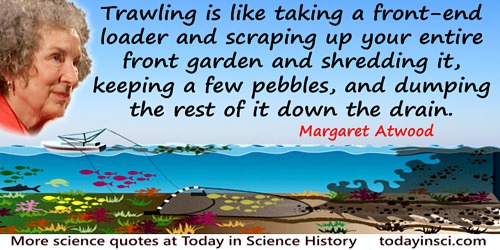
A huge net is being dragged across the sea floor, destroying everything in its path. Ahead of it bloom undersea forests and their hundreds and thousands of living creatures, both plant and animal; behind it is a desert. The net is pulled to the surface and most of the dead and dying life forms in it are thrown out. A few marketable species are retained. [Trawling] is like taking a front-end loader and scraping up your entire front garden and shredding it, keeping a few pebbles, and dumping the rest of it down the drain.
In Payback: Debt and the Shadow Side of Wealth (2008), 191.
A hundred times every day I remind myself that my inner and outer life depends on the labors of other men, living and dead, and that I must exert myself in order to give in the measure as I have received and am still receiving.
…...
A hundred years ago … an engineer, Herbert Spencer, was willing to expound every aspect of life, with an effect on his admiring readers which has not worn off today.
Things do not happen quite in this way nowadays. This, we are told, is an age of specialists. The pursuit of knowledge has become a profession. The time when a man could master several sciences is past. He must now, they say, put all his efforts into one subject. And presumably, he must get all his ideas from this one subject. The world, to be sure, needs men who will follow such a rule with enthusiasm. It needs the greatest numbers of the ablest technicians. But apart from them it also needs men who will converse and think and even work in more than one science and know how to combine or connect them. Such men, I believe, are still to be found today. They are still as glad to exchange ideas as they have been in the past. But we cannot say that our way of life is well-fitted to help them. Why is this?
Things do not happen quite in this way nowadays. This, we are told, is an age of specialists. The pursuit of knowledge has become a profession. The time when a man could master several sciences is past. He must now, they say, put all his efforts into one subject. And presumably, he must get all his ideas from this one subject. The world, to be sure, needs men who will follow such a rule with enthusiasm. It needs the greatest numbers of the ablest technicians. But apart from them it also needs men who will converse and think and even work in more than one science and know how to combine or connect them. Such men, I believe, are still to be found today. They are still as glad to exchange ideas as they have been in the past. But we cannot say that our way of life is well-fitted to help them. Why is this?
In 'The Unification of Biology', New Scientist (11 Jan 1962), 13, No. 269, 72.
A hundred years ago the study of life was often pursued, and also presented to the public, in a highly unified way. Darwin, as everyone knows, in addressing the world at large began his story with the history of pigeons and ended it with the breeding of primroses, having made excursions on the way into the origins of coral reefs and of the races of Man.
In 'The Unification of Biology', New Scientist (11 Jan 1962), 13, No. 269, 72.
A life is either all spiritual or not spiritual at all. No man can serve two masters.
Quoted in Kim Lim (ed.), 1,001 Pearls of Spiritual Wisdom: Words to Enrich, Inspire, and Guide Your Life (2014), 11
A life on the ocean wave,
A home on the rolling deep,
For the spark that nature gave
I have the right to keep.
A home on the rolling deep,
For the spark that nature gave
I have the right to keep.
A life spent in making mistakes is not only more honorable but more useful than a life spent doing nothing.
In 'Preface on Doctors', The Doctor's Dilemma (1909, 1911), lxxxv.
A life spent in the routine of science need not destroy the attractive human element of a woman's nature.
Said of Williamina Paton Fleming 1857- 1911, American Astronomer.
Said of Williamina Paton Fleming 1857- 1911, American Astronomer.
Obituary of Williamina Paton Fleming, Science, 1911, 33, 988.
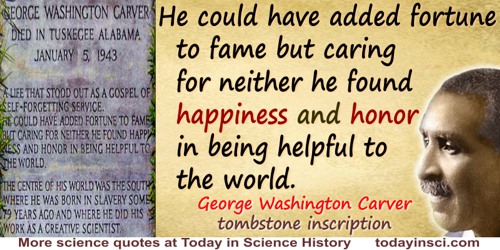
A life that stood out as a gospel of self-forgetting service.
He could have added fortune to fame but caring for neither he found happiness and honor in being helpful to the world.
The centre of his world was the south where he was born in slavery some 79 years ago and where he did his work as a creative scientist.
He could have added fortune to fame but caring for neither he found happiness and honor in being helpful to the world.
The centre of his world was the south where he was born in slavery some 79 years ago and where he did his work as a creative scientist.
Epitaph on tombstone at Tuskegee University Campus Cemetery, Alabama.
A little science is something that they must have. I should like my nephews to know what air is, and water; why we breathe, and why wood burns; the nutritive elements essential to plant life, and the constituents of the soil. And it is no vague and imperfect knowledge from hearsay I would have them gain of these fundamental truths, on which depend agriculture and the industrial arts and our health itself; I would have them know these things thoroughly from their own observation and experience. Books here are insufficient, and can serve merely as aids to scientific experiment.
A living speck—the merest dab of life—capable of pleasure and pain, is far more interesting to me than all the immensities of mere matter.
In Jean-Henri Fabre and Alexander Teixeira de Mattos (trans.), Fabre’s Book of Insects (1921, 1998), 120.
A lodestone is a wonderful thing in very many experiments, and like living things. And one of its remarkable virtues in that which the ancients considered to be a living soul in the sky, in the globes and in the stars, in the sun and in the moon.
In De Magnete. Cited in Gerrit L. Verschuur, Hidden Attraction (1996), 19.
A man ceases to be a beginner in any given science and becomes a master in that science when he has learned that ... he is going to be a beginner all his life.
The New Leviathan: or Man, Society, Civilization and Barbarism (1942, 1999) Pt. 1, Ch. 1, Aph. 46, 3.
A man who dares to waste one hour of time has not discovered the value of life.
In a Letter to his sister Susan (Aug 1836), collected in Francis Darwin (ed.), Charles Darwin: His Life Told in an Autobiographical Chapter, and in a Selected Series of His Published Letters, Volume 5 (1892), 137.
A man who has been the indisputable favorite of his mother keeps for life the feeling of a conqueror, that confidence of success that often induces real success.
Quoted in Ernest Jones, The Life and Work of Sigmund Freud (1957), Vol. 1, 5.
A mind which has once imbibed a taste for scientific enquiry, and has learnt the habit of applying its principles readily to the cases which occur, has within itself an inexhaustable source of pure and exciting contemplations:— One would think that Shakespeare had such a mind in view when he describes a contemplative man as finding
“Tongues in trees—books in running brooks—
Sermons in stones—and good in everything.”
Accustomed to trace the operations of general causes and the exemplification of general laws, in circumstances where the uninformed and uninquiring eye, perceives neither novelty nor beauty, he walks in the midst of wonders; every object which falls in his way elucidates some principle, affords some instruction and impresses him with a sense of harmony and order. Nor is it a mere passive pleasure which is thus communicated. A thousand questions are continually arising in his mind, a thousand objects of enquiry presenting themselves, which keep his faculties in constant exercise, and his thoughts perpetually on the wing, so that lassitude is excluded from his life, and that craving after artificial excitement and dissipation of the mind, which leads so many into frivolous, unworthy, and destructive pursuits, is altogether eradicated from his bosom.
“Tongues in trees—books in running brooks—
Sermons in stones—and good in everything.”
Accustomed to trace the operations of general causes and the exemplification of general laws, in circumstances where the uninformed and uninquiring eye, perceives neither novelty nor beauty, he walks in the midst of wonders; every object which falls in his way elucidates some principle, affords some instruction and impresses him with a sense of harmony and order. Nor is it a mere passive pleasure which is thus communicated. A thousand questions are continually arising in his mind, a thousand objects of enquiry presenting themselves, which keep his faculties in constant exercise, and his thoughts perpetually on the wing, so that lassitude is excluded from his life, and that craving after artificial excitement and dissipation of the mind, which leads so many into frivolous, unworthy, and destructive pursuits, is altogether eradicated from his bosom.
In Dionysius Lardner (ed.), Cabinet Cyclopaedia, Vol 1, Preliminary Discourse on the Study of Natural Philosophy (1831), 14-15.
A moment’s insight is sometimes worth a life’s experience.
In 'Iris, Her Book', The Professor at the Breakfast-Table (1860, 1892), 239.
A noteworthy and often-remarked similarity exists between the facts and methods of geology and those of linguistic study. The science of language is, as it were, the geology of the most modern period, the Age of the Man, having for its task to construct the history of development of the earth and its inhabitants from the time when the proper geological record remains silent … The remains of ancient speech are like strata deposited in bygone ages, telling of the forms of life then existing, and of the circumstances which determined or affected them; while words are as rolled pebbles, relics of yet more ancient formations, or as fossils, whose grade indicates the progress of organic life, and whose resemblances and relations show the correspondence or sequence of the different strata; while, everywhere, extensive denudation has marred the completeness of the record, and rendered impossible a detailed exhibition of the whole course of development.
In Language and the Study of Language (1867), 47.
A physician’s subject of study is necessarily the patient, and his first field for observation is the hospital. But if clinical observation teaches him to know the form and course of diseases, it cannot suffice to make him understand their nature; to this end he must penetrate into the body to find which of the internal parts are injured in their functions. That is why dissection of cadavers and microscopic study of diseases were soon added to clinical observation. But to-day these various methods no longer suffice; we must push investigation further and, in analyzing the elementary phenomena of organic bodies, must compare normal with abnormal states. We showed elsewhere how incapable is anatomy alone to take account of vital phenenoma, and we saw that we must add study of all physico-chemical conditions which contribute necessary elements to normal or pathological manifestations of life. This simple suggestion already makes us feel that the laboratory of a physiologist-physician must be the most complicated of all laboratories, because he has to experiment with phenomena of life which are the most complex of all natural phenomena.
From An Introduction to the Study of Experimental Medicine (1865), as translated by Henry Copley Greene (1957), 140-141.
A plain, reasonable working man supposes, in the old way which is also the common-sense way, that if there are people who spend their lives in study, whom he feeds and keeps while they think for him—then no doubt these men are engaged in studying things men need to know; and he expects of science that it will solve for him the questions on which his welfare, and that of all men, depends. He expects science to tell him how he ought to live: how to treat his family, his neighbours and the men of other tribes, how to restrain his passions, what to believe in and what not to believe in, and much else. And what does our science say to him on these matters?
It triumphantly tells him: how many million miles it is from the earth to the sun; at what rate light travels through space; how many million vibrations of ether per second are caused by light, and how many vibrations of air by sound; it tells of the chemical components of the Milky Way, of a new element—helium—of micro-organisms and their excrements, of the points on the hand at which electricity collects, of X rays, and similar things.
“But I don't want any of those things,” says a plain and reasonable man—“I want to know how to live.”
It triumphantly tells him: how many million miles it is from the earth to the sun; at what rate light travels through space; how many million vibrations of ether per second are caused by light, and how many vibrations of air by sound; it tells of the chemical components of the Milky Way, of a new element—helium—of micro-organisms and their excrements, of the points on the hand at which electricity collects, of X rays, and similar things.
“But I don't want any of those things,” says a plain and reasonable man—“I want to know how to live.”
In 'Modern Science', Essays and Letters (1903), 221-222.
A poet is, after all, a sort of scientist, but engaged in a qualitative science in which nothing is measurable. He lives with data that cannot be numbered, and his experiments can be done only once. The information in a poem is, by definition, not reproducible. ... He becomes an equivalent of scientist, in the act of examining and sorting the things popping in [to his head], finding the marks of remote similarity, points of distant relationship, tiny irregularities that indicate that this one is really the same as that one over there only more important. Gauging the fit, he can meticulously place pieces of the universe together, in geometric configurations that are as beautiful and balanced as crystals.
In The Medusa and the Snail: More Notes of a Biology Watcher (1974, 1995), 107.
A recognized fact which goes back to the earliest times is that every living organism is not the sum of a multitude of unitary processes, but is, by virtue of interrelationships and of higher and lower levels of control, an unbroken unity. When research, in the efforts of bringing understanding, as a rule examines isolated processes and studies them, these must of necessity be removed from their context. In general, viewed biologically, this experimental separation involves a sacrifice. In fact, quantitative findings of any material and energy changes preserve their full context only through their being seen and understood as parts of a natural order.
First sentence of 'The Central Control of the Activity of Internal Organs', Nobel Lecture (12 Dec 1949).
A science is said to be useful if its development tends to accentuate the existing inequalities in the distribution of wealth, or more directly promotes the destruction of human life.
In A Mathematician's Apology (1940, reprint with Foreward by C.P. Snow 1992), 113. Note that Hardy wrote these words while World War II was raging.
A scientist is in a sense a learned small boy. There is something of the scientist in every small boy. Others must outgrow it. Scientists can stay that way all their lives.
Nobel banquet speech (10 Dec 1967). In Ragnar Granit (ed.), Les Prix Nobel en 1967 (1968).
A scientist lives with all reality. There is nothing better. To know reality is to accept it, and eventually to love it.
Nobel banquet speech (10 Dec 1967). In Ragnar Granit (ed.), Les Prix Nobel en 1967 (1968).
A sick man talks obsessively about his illness; a healthy man never talks about his health; for as Pirandello points out, we take happiness for granted, and only begin to question life when we are unhappy.
In Introduction to the New Existentialism (1966), 15.
A single ray of light from a distant star falling upon the eye of a tyrant in bygone times, may have altered the course of his life, may have changed the destiny of nations, may have transformed the surface of the globe, so intricate, so inconceivably complex are the processes of nature.
Lecture (Feb 1893) delivered before the Franklin Institute, Philadelphia, 'On Light and Other High Frequency Phenomena,' collected in Thomas Commerford Martin and Nikola Tesla, The Inventions, Researches and Writings of Nikola Tesla (1894), 298.
A species can only thrive when everything else around it thrives too. … If we take care of nature, nature will take care of us. It’s now time for our species to stop simply growing, to establish a life on our planet in balance with nature. To start to thrive.
From narration to Netflix TV program, A Life on Our Planet: My Witness Statement and a Vision for the Future (4 Oct 2020).
A study of Dr. [Florence] Sabin’s work shows the greatness of her achievement and the character of her mind. She has dealt with the primary and fundamental problem of the cell—the unit of plant and animal life. All through her investigations she has followed the cell, seeking the secret of differentiations by newer and finer methods, both physical and chemical. Always through her work runs the great strong, continuous cord of cell differentiations. This is one of the great concepts of man, for all life begins as a single cell. I have known and followed Dr. Sabin’s work since her student days, and have lately been more closely associated with her in her tuberculosis studies. She is all in mind and spirit and ideals that man or woman ever accomplishes. She belongs to the great students of both sexes, for when these have the brains and the will to work I see little difference.
In Genevieve Parkhurst, 'Dr. Sabin, Scientist: Winner Of Pictorial Review’s Achievement Award', Pictorial Review (Jan 1930), 2.
A sufferer from angina, Hunter found that his attacks were often brought on by anger. He declared, 'My life is at the mercy of the scoundrel who chooses to put me in a passion.' This proved prophetic: at a meeting of the board of St. George's Hospital, London, of which he was a member, he became involved in a heated argument with other board members, walked out of the meeting and dropped dead in the next room.
As described in Clifton Fadiman (ed.), André Bernard (ed.), Bartlett's Book of Anecdotes (2000), 282, citing New Scientist (9 Nov 1981).
A thing is either alive or it isn’t; there is nothing that is almost alive. There is but the remotest possibility of the origin of life by spontaneous generation, and every likelihood that Arrhenius is right when he dares to claim that life is a cosmic phenomenon, something that drifts between the spheres, like light, and like light transiently descends upon those fit to receive it.
In An Almanac for Moderns (1935), 393.
A tree is beautiful, but what’s more, it has a right to life; like water, the sun and the stars, it is essential. Life on earth is inconceivable without trees. Forests create climate, climate influences peoples’ character, and so on and so forth. There can be neither civilization nor happiness if forests crash down under the axe, if the climate is harsh and severe, if people are also harsh and severe. ... What a terrible future!
In letter to A.S. Suvorin (18 Oct 1888).
A vision of the whole of life!. Could any human undertaking be ... more grandiose? This attempt stands without rival as the most audacious enterprise in which the mind of man has ever engaged ... Here is man, surrounded by the vastness of a universe in which he is only a tiny and perhaps insignificant part—and he wants to understand it.
…...
A vital phenomenon can only be regarded as explained if it has been proven that it appears as the result of the material components of living organisms interacting according to the laws which those same components follow in their interactions outside of living systems.
Gesammelte Schriften (1904), Vol. 3, 767. Trans. Paul F. Cranefield, 'The Organic Physics of 1847 and the Biophysics of Today', Journal of the History of Medicine and Allied Sciences, 1957, 12, 410.
A wise man’s day is worth a fool’s life
Arabic proverb. In Hialmer Day Gould, New Practical Spelling (1905), 27
A work of genius is something like the pie in the nursery song, in which the four and twenty blackbirds are baked. When the pie is opened, the birds begin to sing. Hereupon three fourths of the company run away in a fright; and then after a time, feeling ashamed, they would fain excuse themselves by declaring, the pie stank so, they could not sit near it. Those who stay behind, the men of taste and epicures, say one to another, We came here to eat. What business have birds, after they have been baked, to be alive and singing? This will never do. We must put a stop to so dangerous an innovation: for who will send a pie to an oven, if the birds come to life there? We must stand up to defend the rights of all the ovens in England. Let us have dead birds..dead birds for our money. So each sticks his fork into a bird, and hacks and mangles it a while, and then holds it up and cries, Who will dare assert that there is any music in this bird’s song?
Co-author with his brother Augustus William Hare Guesses At Truth, By Two Brothers: Second Edition: With Large Additions (1848), Second Series, 86. (The volume is introduced as “more than three fourths new.” This quote is identified as by Julius; Augustus had died in 1833.)
A working definition of life, … could [be] in terms of a large molecule made up of carbon compounds that can replicate, or make copies of itself, and metabolize food and energy…: macromolecule, metabolism, replication.
From interview, 'The Seeds of Life', in The Omni Interviews (1984), 4.
A writer must be as objective as a chemist: he must abandon the subjective line; he must know that dung-heaps play a very reasonable part in a landscape, and that the evil passions are as inherent in life as good ones.
Letter to M. V. Kiselev (14 Jan 1887). In L. S. Friedland (ed.), Anton Chekhov: Letters on the Short Story (1967).
About two million years ago, man appeared. He has become the dominant species on the earth. All other living things, animal and plant, live by his sufferance. He is the custodian of life on earth, and in the solar system. It’s a big responsibility.
From speech given at an anti-war teach-in at the Massachusetts Institute of Technology, (4 Mar 1969) 'A Generation in Search of a Future', as edited by Ron Dorfman for Chicago Journalism Review, (May 1969).
Abstract as it is, science is but an outgrowth of life. That is what the teacher must continually keep in mind. … Let him explain … science is not a dead system—the excretion of a monstrous pedantism—but really one of the most vigorous and exuberant phases of human life.
In 'The Teaching of the History of Science', The Scientific Monthly (Sep 1918), 195-196.
Accordingly the primordial state of things which I picture is an even distribution of protons and electrons, extremely diffuse and filling all (spherical) space, remaining nearly balanced for an exceedingly long time until its inherent instability prevails. We shall see later that the density of this distribution can be calculated; it was about one proton and electron per litre. There is no hurry for anything to begin to happen. But at last small irregular tendencies accumulate, and evolution gets under way. The first stage is the formation of condensations ultimately to become the galaxies; this, as we have seen, started off an expansion, which then automatically increased in speed until it is now manifested to us in the recession of the spiral nebulae.
As the matter drew closer together in the condensations, the various evolutionary processes followed—evolution of stars, evolution of the more complex elements, evolution of planets and life.
As the matter drew closer together in the condensations, the various evolutionary processes followed—evolution of stars, evolution of the more complex elements, evolution of planets and life.
The Expanding Universe (1933), 56-57.
Act as if you are going to live for ever and cast your plans way ahead. You must feel responsible without time limitations, and the consideration of whether you may or may not be around to see the results should never enter your thoughts.
In Theodore Rockwell, The Rickover Effect: How One Man Made A Difference (2002), 342.
Adam is fading out. It is on account of Darwin and that crowd. I can see that he is not going to last much longer. There's a plenty of signs. He is getting belittled to a germ—a little bit of a speck that you can't see without a microscope powerful enough to raise a gnat to the size of a church. They take that speck and breed from it: first a flea; then a fly, then a bug, then cross these and get a fish, then a raft of fishes, all kinds, then cross the whole lot and get a reptile, then work up the reptiles till you've got a supply of lizards and spiders and toads and alligators and Congressmen and so on, then cross the entire lot again and get a plant of amphibiums, which are half-breeds and do business both wet and dry, such as turtles and frogs and ornithorhyncuses and so on, and cross-up again and get a mongrel bird, sired by a snake and dam'd by a bat, resulting in a pterodactyl, then they develop him, and water his stock till they've got the air filled with a million things that wear feathers, then they cross-up all the accumulated animal life to date and fetch out a mammal, and start-in diluting again till there's cows and tigers and rats and elephants and monkeys and everything you want down to the Missing Link, and out of him and a mermaid they propagate Man, and there you are! Everything ship-shape and finished-up, and nothing to do but lay low and wait and see if it was worth the time and expense.
'The Refuge of the Derelicts' collected in Mark Twain and John Sutton Tuckey, The Devil's Race-Track: Mark Twain's Great Dark Writings (1980), 340-41.
- 1980
Admit for a moment, as a hypothesis, that the Creator had before his mind a projection of the whole life-history of the globe, commencing with any point which the geologist may imagine to have been a fit commencing point, and ending with some unimaginable acme in the indefinitely distant future. He determines to call this idea into actual existence, not at the supposed commencing point, but at some stage or other of its course. It is clear, then, that at the selected stage it appears, exactly as it would have appeared at that moment of its history, if all the preceding eras of its history had been real.
Omphalos: An Attempt to Untie the Geological Knot (1857), 351.
Adopt good habits when I change my method of life.
From Appendix A, 'Extracts From the Unpublished Writings of Carnot', Reflections on the Motive Power of Heat (1890, 2nd ed. 1897), 206.
Adrenalin does not excite sympathetic ganglia when applied to them directly, as does nicotine. Its effective action is localised at the periphery. The existence upon plain muscle of a peripheral nervous network, that degenerates only after section of both the constrictor and inhibitory nerves entering it, and not after section of either alone, has been described. I find that even after such complete denervation, whether of three days' or ten months' duration, the plain muscle of the dilatator pupillae will respond to adrenalin, and that with greater rapidity and longer persistence than does the iris whose nervous relations are uninjured. Therefore it cannot be that adrenalin excites any structure derived from, and dependent for its persistence on, the peripheral neurone. But since adrenalin does not evoke any reaction from muscle that has at no time of its life been innervated by the sympathetic, the point at which the stimulus of the chemical excitant is received, and transformed into what may cause the change of tension of the muscle fibre, is perhaps a mechanism developed out of the muscle cell in response to its union with the synapsing sympathetic fibre, the function of which is to receive and transform the nervous impulse. Adrenalin might then be the chemical stimulant liberated on each occasion when the impulse arrives at the periphery.
'On the Action of Adrenalin', Proceedings of the Physiological Society, 21 May 1904, in The Journal of Physiology 1904, 31, xxi.
Advances in medicine and agriculture have saved vastly more lives than have been lost in all the wars in history.
The Demon-Haunted World: Science as a Candle in the Dark (1996), 11.
Adventure is the point where you toss your life on the scales of chance and wait for the pointer to stop.
First Contact (1945)
Adventure isn’t hanging on a rope off the side of a mountain. Adventure is an attitude that we must apply to the day to day obstacles of life - facing new challenges, seizing new opportunities, testing our resources against the unknown and in the process, discovering our own unique potential.
…...
After death, life reappears in a different form and with different laws. It is inscribed in the laws of the permanence of life on the surface of the earth and everything that has been a plant and an animal will be destroyed and transformed into a gaseous, volatile and mineral substance.
Quoted in Patrice Debré, Louis Pasteur, trans. Elborg Forster (1994), 110.
After that cancellation [of the Superconducting Super Collider in Texas, after $2 billion had been spent on it], we physicists learned that we have to sing for our supper. ... The Cold War is over. You can't simply say “Russia!” to Congress, and they whip out their checkbook and say, “How much?” We have to tell the people why this atom-smasher is going to benefit their lives.
As quoted in Alan Boyle, 'Discovery of Doom? Collider Stirs Debate', article (8 Sep 2008) on a msnbc.com web page.
Albert Einstein called the intuitive or metaphoric mind a sacred gift. He added that the rational mind is a faithful servant. It it paradoxical that in the context of modern life we have begun to worship the servant and defile the divine.
In The Metaphoric Mind: A Celebration of Creative Consciousness (1976), 26. Note that these words are the author’s own free interpretation Einstein’s views. He is not directly quoting Einstein’s words. No verbatim version appears in Einstein writings. A variant of Samples’ words has become misattributed as an Einstein quote: “The intuitive mind is a sacred gift and the rational mind is a faithful servant; we have created a society that honors the servant and has forgotten the gift.”
Alcohol is the anesthesia by which we endure the operation of life.
Widely seen misattributed (?) to George Bernard Shaw, but always without source citation. There seems to be no primary source for Shaw having written the idea using the above wording. However, there are other, documented, quotes about alcohol on the George Bernard Shaw Quotations page, which express a similar theme.
Alfred Nobel - pitiable half-creature, should have been stifled by humane doctor when he made his entry yelling into life. Greatest merits: Keeps his nails clean and is never a burden to anyone. Greatest fault: Lacks family, cheerful spirits, and strong stomach. Greatest and only petition: Not to be buried alive. Greatest sin: Does not worship Mammon. Important events in his life: None.
Letter (1887) from Alfred to his brother, Ludwig. In Erik Bergengre, Alfred Nobel: the Man and His Work (1960), 177.
All appearances to the contrary, the only watchmaker in nature is the blind forces of physics, albeit deployed in very special way. A true watchmaker has foresight: he designs his cogs springs, and plans their interconnections, with a future purpose in his mind's eye. Natural selection, the blind, unconscious, automatic process which Darwin discovered, and which we now know is the explanation for the existence and apparently purposeful form of all life, has no purpose in mind. It has no mind and no mind's eye. It does not plan for the future. It has no vision, no foresight, no sight at all. If it can be said to play the role of watchmaker in nature, it is the blind watchmaker.
The Blind Watchmaker (1986), 5.
All change is relative. The universe is expanding relatively to our common material standards; our material standards are shrinking relatively to the size of the universe. The theory of the “expanding universe” might also be called the theory of the “shrinking atom”. …
:Let us then take the whole universe as our standard of constancy, and adopt the view of a cosmic being whose body is composed of intergalactic spaces and swells as they swell. Or rather we must now say it keeps the same size, for he will not admit that it is he who has changed. Watching us for a few thousand million years, he sees us shrinking; atoms, animals, planets, even the galaxies, all shrink alike; only the intergalactic spaces remain the same. The earth spirals round the sun in an ever-decreasing orbit. It would be absurd to treat its changing revolution as a constant unit of time. The cosmic being will naturally relate his units of length and time so that the velocity of light remains constant. Our years will then decrease in geometrical progression in the cosmic scale of time. On that scale man’s life is becoming briefer; his threescore years and ten are an ever-decreasing allowance. Owing to the property of geometrical progressions an infinite number of our years will add up to a finite cosmic time; so that what we should call the end of eternity is an ordinary finite date in the cosmic calendar. But on that date the universe has expanded to infinity in our reckoning, and we have shrunk to nothing in the reckoning of the cosmic being.
We walk the stage of life, performers of a drama for the benefit of the cosmic spectator. As the scenes proceed he notices that the actors are growing smaller and the action quicker. When the last act opens the curtain rises on midget actors rushing through their parts at frantic speed. Smaller and smaller. Faster and faster. One last microscopic blurr of intense agitation. And then nothing.
:Let us then take the whole universe as our standard of constancy, and adopt the view of a cosmic being whose body is composed of intergalactic spaces and swells as they swell. Or rather we must now say it keeps the same size, for he will not admit that it is he who has changed. Watching us for a few thousand million years, he sees us shrinking; atoms, animals, planets, even the galaxies, all shrink alike; only the intergalactic spaces remain the same. The earth spirals round the sun in an ever-decreasing orbit. It would be absurd to treat its changing revolution as a constant unit of time. The cosmic being will naturally relate his units of length and time so that the velocity of light remains constant. Our years will then decrease in geometrical progression in the cosmic scale of time. On that scale man’s life is becoming briefer; his threescore years and ten are an ever-decreasing allowance. Owing to the property of geometrical progressions an infinite number of our years will add up to a finite cosmic time; so that what we should call the end of eternity is an ordinary finite date in the cosmic calendar. But on that date the universe has expanded to infinity in our reckoning, and we have shrunk to nothing in the reckoning of the cosmic being.
We walk the stage of life, performers of a drama for the benefit of the cosmic spectator. As the scenes proceed he notices that the actors are growing smaller and the action quicker. When the last act opens the curtain rises on midget actors rushing through their parts at frantic speed. Smaller and smaller. Faster and faster. One last microscopic blurr of intense agitation. And then nothing.
In The Expanding Universe (1933) , 90-92.
All life depends on organic reactions.
A favorite saying.
A favorite saying.
Quoted in William J. Cromie, Obituary, Harvard University Gazette (16 Oct 1997).
All life is linked together in such a way that no part of the chain is unimportant. Frequently, upon the action of some of these minute beings depends the material success or failure of a great commonwealth.
Insect Life: An Introduction To Nature-Study And A Guide For Teachers (1897), 1.
All living forms are the results of physical influences which are still in operation, and vary only in degree and direction
Entry for Gottfried Reinhold Treviranus in Encyclopedia Britannica (1911), Vol. 27, 256.
All living organisms are but leaves on the same tree of life. The various functions of plants and animals and their specialized organs are manifestations of the same living matter. This adapts itself to different jobs and circumstances, but operates on the same basic principles. Muscle contraction is only one of these adaptations. In principle it would not matter whether we studied nerve, kidney or muscle to understand the basic principles of life. In practice, however, it matters a great deal.
'Muscle Research', Scientific American, 1949, 180 (6), 22.
All living things need their instruction manual (even nonliving things like viruses) and that is all they need, carried in one very small suitcase.
In The Center of Life: A Natural History of the Cell (1977, 1978), 8.
All my life through, the new sights of Nature made me rejoice like a child.
In Pierre Curie (1923), 162.
All Nature bristles with the marks of interrogation—among the grass and the petals of flowers, amidst the feathers of birds and the hairs of mammals, on mountain and moorland, in sea and sky-everywhere. It is one of the joys of life to discover those marks of interrogation, these unsolved and half-solved problems and try to answer their questions.
In Riddles of Science (1932), 5.
All Nature is linked together by invisible bonds and every organic creature, however low, however feeble, however dependent, is necessary to the well-being of some other among the myriad forms of life.
From Man and Nature (1864), 109.
All of my life, I have been fascinated by the big questions that face us, and have tried to find scientific answers to them. If, like me, you have looked at the stars, and tried to make sense of what you see, you too have started to wonder what makes the universe exist.
From website for PBS program, Stephen Hawking's Universe (1997).
All of our experience indicates that life can manifest itself only in a concrete form, and that it is bound to certain substantial loci. These loci are cells and cell formations. But we are far from seeking the last and highest level of understanding in the morphology of these loci of life. Anatomy does not exclude physiology, but physiology certainly presupposes anatomy. The phenomena that the physiologist investigates occur in special organs with quite characteristic anatomical arrangements; the various morphological parts disclosed by the anatomist are the bearers of properties or, if you will, of forces probed by the physiologist; when the physiologist has established a law, whether through physical or chemical investigation, the anatomist can still proudly state: This is the structure in which the law becomes manifest.
In 'Cellular-Pathologie', Archiv für pathologische Anatomie und Physiologie und fur klinische Medizin (1855), 8, 19, as translated in LellandJ. Rather, 'Cellular Pathology', Disease, Life, and Man: Selected Essays by Rudolf Virchow (1958), 84.
All our knowledge merely helps us to die a more painful death than the animals that know nothing. A day will come when science will turn upon its error and no longer hesitate to shorten our woes. A day will come when it will dare and act with certainty; when life, grown wiser, will depart silently at its hour, knowing that it has reached its term.
Our Eternity, translated by Alexander Teixeira de Mattos (1913), 24.
All over the world there lingers on the memory of a giant tree, the primal tree, rising up from the centre of the Earth to the heavens and ordering the universe around it. It united the three worlds: its roots plunged down into subterranean abysses, Its loftiest branches touched the empyrean. Thanks to the Tree, it became possible to breathe the air; to all the creatures that then appeared on Earth it dispensed its fruit, ripened by the sun and nourished by the water which it drew from the soil. From the sky it attracted the lightning from which man made fire and, beckoning skyward, where clouds gathered around its fall. The Tree was the source of all life, and of all regeneration. Small wonder then that tree-worship was so prevalent in ancient times.
From 'L'Arbre Sacre' ('The Sacred Tree'), UNESCO Courier (Jan 1989), 4. Epigraph to Chap 1, in Kenton Miller and Laura Tangley, Trees of Life: Saving Tropical Forests and Their Biological Wealt (1991), 1.
All religions, arts and sciences are branches of the same tree. All these aspirations are directed toward ennobling man’s life, lifting it from the sphere of mere physical existence and leading the individual towards freedom.
'Moral Decay', Out of My Later Years (1937, 1995), 9.
All that we can do, is to keep steadily in mind that each organic being is striving to increase at a geometrical ratio; that each at some period of its life, during some season of the year, during each generation or at intervals, has to struggle for life, and to suffer great destruction. When we reflect on this struggle, we may console ourselves with the full belief, that the war of nature is not incessant, that no fear is felt, that death is generally prompt, and that the vigorous, the healthy, and the happy survive and multiply.
From On the Origin of Species by Means of Natural Selection; or, The Preservation of Favoured Races in the Struggle for Life (1861), 76.
All the conditions of happiness are realized in the life of the man of science.
The Conquest of Happiness (1930), 146.
All the life of the universe may be regarded as manifestations of energy masquerading in various forms, and all the changes in the universe as energy running about from one of these forms to the other, but always without altering the total amount.
In The Universe Around Us (1929, 1934), 114-115. Also in David Dietz, 'Cultural Values of Physics', Annual Report of the Report of the Board of Regents of The Smithsonian Institution: 1940 (1941), quoted on p.149 and cited in footnote 10 on p.154.
All the Universe is full of the life of perfect creatures.
In The Scientific Ethics (1930), 20.
All versions written for nonscientists speak of fused males as the curious tale of the anglerfish–just as we so often hear about the monkey swinging through the trees, or the worm burrowing through soil. But if nature teaches us any lesson, it loudly proclaims life’s diversity. There ain’t no such abstraction as the clam, the fly, or the anglerfish. Ceratioid anglerfishes come in nearly 100 species, and each has its own peculiarity.
…...
Almost all aspects of life are engineered at the molecular level, and without understanding molecules we can only have a very sketchy understanding of life itself.
What Mad Pursuit: A Personal View of Scientific Discovery (1988), 61.
Almost daily we shudder as prophets of doom announce the impending end of civilization and universe. We are being asphyxiated, they say, by the smoke of the industry; we are suffocating in the ever growing mountain of rubbish. Every new project depicts its measureable effects and is denounced by protesters screaming about catastrophe, the upsetting of the land, the assault on nature. If we accepted this new mythology we would have to stop pushing roads through the forest, harnessing rivers to produce the electricity, breaking grounds to extract metals, enriching the soil with chemicals, killing insects, combating viruses … But progress—basically, an effort to organise a corner of land and make it more favourable for human life—cannot be baited. Without the science of pomiculture, for example, trees will bear fruits that are small, bitter, hard, indigestible, and sour. Progress is desirable.
Uncredited. In Lachman Mehta, Stolen Treasure (2012), 117.
Alphonse of Castile is reported to have said that if he had had the making of the universe he would have done it much better. And I think so too. Instead of making a man go through the degradation of faculties and death, he should continually improve with age, and then be translated from this world to a superior planet, where he should begin life with the knowledge gained here, and so on. That would be to my mind, as an old man, a more satisfactory way of conducting affairs
Address, in 'Report to the Chemical Society's Jubilee', Nature (26 Mar 1891), 43, 493.
Although I am a typical loner in daily life, my consciousness of belonging to the invisible community of those who strive for truth, beaut y, and justice has preserved me from feeling isolated.
…...
Although the whole of this life were said to be nothing but a dream and the physical world nothing but a phantasm, I should call this dream or phantasm real enough, if, using reason well, we were never deceived by it.
Epigraph, without citation, in J.R. Newman (ed.) The World of Mathematics (1956), 1832.
Always preoccupied with his profound researches, the great Newton showed in the ordinary-affairs of life an absence of mind which has become proverbial. It is related that one day, wishing to find the number of seconds necessary for the boiling of an egg, he perceived, after waiting a minute, that he held the egg in his hand, and had placed his seconds watch (an instrument of great value on account of its mathematical precision) to boil!
This absence of mind reminds one of the mathematician Ampere, who one day, as he was going to his course of lectures, noticed a little pebble on the road; he picked it up, and examined with admiration the mottled veins. All at once the lecture which he ought to be attending to returned to his mind; he drew out his watch; perceiving that the hour approached, he hastily doubled his pace, carefully placed the pebble in his pocket, and threw his watch over the parapet of the Pont des Arts.
This absence of mind reminds one of the mathematician Ampere, who one day, as he was going to his course of lectures, noticed a little pebble on the road; he picked it up, and examined with admiration the mottled veins. All at once the lecture which he ought to be attending to returned to his mind; he drew out his watch; perceiving that the hour approached, he hastily doubled his pace, carefully placed the pebble in his pocket, and threw his watch over the parapet of the Pont des Arts.
Popular Astronomy: a General Description of the Heavens (1884), translated by J. Ellard Gore, (1907), 93.
Among all highly civilized peoples the golden age of art has always been closely coincident with the golden age of the pure sciences, particularly with mathematics, the most ancient among them.
This coincidence must not be looked upon as accidental, but as natural, due to an inner necessity. Just as art can thrive only when the artist, relieved of the anxieties of existence, can listen to the inspirations of his spirit and follow in their lead, so mathematics, the most ideal of the sciences, will yield its choicest blossoms only when life’s dismal phantom dissolves and fades away, when the striving after naked truth alone predominates, conditions which prevail only in nations while in the prime of their development.
This coincidence must not be looked upon as accidental, but as natural, due to an inner necessity. Just as art can thrive only when the artist, relieved of the anxieties of existence, can listen to the inspirations of his spirit and follow in their lead, so mathematics, the most ideal of the sciences, will yield its choicest blossoms only when life’s dismal phantom dissolves and fades away, when the striving after naked truth alone predominates, conditions which prevail only in nations while in the prime of their development.
From Die Entwickelung der Mathematik im Zusammenhange mit der Ausbreitung der Kultur (1893), 4. As translated in Robert Édouard Moritz, Memorabilia Mathematica; Or, The Philomath’s Quotation-Book (1914), 191-192. From the original German, “Bei allen Kulturvölkern ist die Blüthezeit der Kunst auch immer zeitlich eng verbunden mit einer Blüthezeit der reinen Wissenschaften, insbesondere der ältesten unter ihnen, der Mathematik.
Dieses Zusammentreffen dürfte auch nicht ein zufälliges, sondern ein natürliches, ein Ergebniss innerer Notwendigkeit sein. Wie die Kunst nur gedeihen kann, wenn der Künstler, unbekümmert um die Bedrängnisse des Daseins, den Eingebungen seines Geistes lauschen und ihnen folgen kann, so kann die idealste Wissenschaft, die Mathematik, erst dann ihre schönsten Blüthen treiben, wenn des Erdenlebens schweres Traumbild sinkt und sinkt und sinkt, wenn das Streben nach der nackten Wahrheit allein bestimmend ist, was nur bei Nationen in der Vollkraft ihrer Entwickelung vorkommt.”
Dieses Zusammentreffen dürfte auch nicht ein zufälliges, sondern ein natürliches, ein Ergebniss innerer Notwendigkeit sein. Wie die Kunst nur gedeihen kann, wenn der Künstler, unbekümmert um die Bedrängnisse des Daseins, den Eingebungen seines Geistes lauschen und ihnen folgen kann, so kann die idealste Wissenschaft, die Mathematik, erst dann ihre schönsten Blüthen treiben, wenn des Erdenlebens schweres Traumbild sinkt und sinkt und sinkt, wenn das Streben nach der nackten Wahrheit allein bestimmend ist, was nur bei Nationen in der Vollkraft ihrer Entwickelung vorkommt.”
Among all the occurrences possible in the universe the a priori probability of any particular one of them verges upon zero. Yet the universe exists; particular events must take place in it, the probability of which (before the event) was infinitesimal. At the present time we have no legitimate grounds for either asserting or denying that life got off to but a single start on earth, and that, as a consequence, before it appeared its chances of occurring were next to nil. ... Destiny is written concurrently with the event, not prior to it.
In Jacques Monod and Austryn Wainhouse (trans.), Chance and Necessity: An Essay on the Natural Philosophy of Modern Biology (1971), 145.
Among natural bodies some have, and some have not, life; and by life we mean the faculties of self-nourishment, self-growth and self-decay. Thus every natural body partaking of life may be regarded as an essential existence; … but then it is an existence only in combination. … And since the organism is such a combination, being possessed of life, it cannot be the Vital Principle. Therefore it follows that the Vital Principle most be an essence, as being the form of a natural body, holding life in potentiality; but essence is a reality (entetechie). The Vital Principle is the original reality of a natural body endowed with potential life; this, however, is to be understood only of a body which may be organized. Thus the parts even of plants are organs, but they are organs that are altogether simple; as the leaf which is the covering of the pericarp, the pericarp of the fruit. If, then, there be any general formula for every kind of Vital Principle, it is—tthe primary reality of an organism.
In George Henry Lewes, Aristotle (1864), 231.
Among people I have met, the few whom I would term “great” all share a kind of unquestioned, fierce dedication; an utter lack of doubt about the value of their activities (or at least an internal impulse that drives through any such angst); and above all, a capacity to work (or at least to be mentally alert for unexpected insights) at every available moment of every day of their lives.
From The Lying Stones of Marrakech: Penultimate Reflections in Natural History (2000), 76.
Among the scenes which are deeply impressed on my mind, none exceed in sublimity the primeval forests undefaced by the hand of man; whether those of Brazil, where the powers of Life are predominant, or those of Tierra del Fuego, where Death and Decay prevail. Both are temples filled with the varied productions of the God of Nature: no one can stand in these solitudes unmoved, and not feel that there is more in man than the mere breath of his body.
Journal of Researches: into the Natural History and Geology of the Countries Visited During the Voyage of H.M.S. Beagle Round the World (1839), ch. XXIII, 604-5.
Among the studies to which the [Rockefeller] Foundation is giving support is a series in a relatively new field, which may be called molecular biology, in which delicate modern techniques are being used to investigate ever more minute details of certain life processes.
In 'Molecular Biology', Annual Report of the Rockefeller Foundation (1938), 203-4. Reprinted in a letter to Science (6 Nov 1970), 170, 582.
An Englishman, unless asleep, feels an invisible compulsion to be doing something, to consider time as of some importance. With us, according to custom and tradition, the charm of life consists in ease—ease from the absence of compulsion to do anything.
Comparing English and Indian culture in Address to Mysore Civil Engineers Association (14 Nov 1910), collected in Speeches by Sir M. Visvesvaraya, KCIE. Dewan of Mysore. 1910-11 to 1916-17 (1917), 11.
An error that ascribes to a man what was actually the work of a woman has more lives than a cat.
In Letter, Westminster Gazette (14 Mar 1909). As cited in Joan Mason, 'Hertha Ayrton (1854-1923) and the Admission of Women to the Royal Society of London', Notes and Records of the Royal Society of London (Jul 1991), 45, No. 2, 201-220. Ayrton wrote so that Marie Curie should be recognized for the discovery of radium, rather than being attributed to Pierre Curie.
An evolution is a series of events that in itself as series is purely physical, — a set of necessary occurrences in the world of space and time. An egg develops into a chick; … a planet condenses from the fluid state, and develops the life that for millions of years makes it so wondrous a place. Look upon all these things descriptively, and you shall see nothing but matter moving instant after instant, each instant containing in its full description the necessity of passing over into the next. … But look at the whole appreciatively, historically, synthetically, as a musician listens to a symphony, as a spectator watches a drama. Now you shall seem to have seen, in phenomenal form, a story.
In The Spirit of Modern Philosophy: An Essay in the Form of Lectures (1892), 425.
An example of such emergent phenomena is the origin of life from non-living chemical compounds in the oldest, lifeless oceans of the earth. Here, aided by the radiation energy received from the sun, countless chemical materials were synthesized and accumulated in such a way that they constituted, as it were, a primeval “soup.” In this primeval soup, by infinite variations of lifeless growth and decay of substances during some billions of years, the way of life was ultimately reached, with its metabolism characterized by selective assimilation and dissimilation as end stations of a sluiced and canalized flow of free chemical energy.
In 'The Scientific Character of Geology', The Journal of Geology (Jul 1961), 69, No. 4, 458.
An honest man, armed with all the knowledge available to us now, could only state that in some sense, the origin of life appears at the moment to be almost a miracle, so many are the conditions which would have had to have been satisfied to get it going. But this should not be taken to imply that there are good reasons to believe that it could not have started on the earth by a perfectly reasonable sequence of fairly ordinary chemical reactions. The plain fact is that the time available was too long, the many microenvironments on the earth’s surface too diverse, the various chemical possibilities too numerous and our own knowledge and imagination too feeble to allow us to be able to unravel exactly how it might or might not have happened such a long time ago, especially as we have no experimental evidence from that era to check our ideas against.
In Life Itself: Its Origin and Nature (1981), 88.
An informed appraisal of life absolutely require(s) a full understanding of life’s arena–the universe. … By deepening our understanding of the true nature of physical reality, we profoundly reconfigure our sense of ourselves and our experience of the universe.
In The Fabric of the Cosmos: Space, Time, and the Texture of Reality (2007), 5.
An intimate friend and a hated enemy have always been indispensable requirements for my emotional life; I have always been able to create them anew, and not infrequently my childish ideal has been so closely approached that friend and enemy coincided in the same person.
The Interpretation of Dreams (1913), 385.
Sigmund Freud - 1913
And above all things, never think that you’re not good enough yourself. A man should never think that. My belief is that in life people will take you at your own reckoning.
…...
And having thus passed the principles of arithmetic, geometry, astronomy, and geography, with a general compact of physics, they may descend in mathematics to the instrumental science of trigonometry, and from thence to fortification, architecture, engineering, or navigation. And in natural philosophy they may proceed leisurely from the history of meteors, minerals, plants, and living creatures, as far as anatomy. Then also in course might be read to them out of some not tedious writer the institution of physic. … To set forward all these proceedings in nature and mathematics, what hinders but that they may procure, as oft as shall be needful, the helpful experiences of hunters, fowlers, fishermen, shepherds, gardeners, apothecaries; and in other sciences, architects, engineers, mariners, anatomists.
In John Milton and Robert Fletcher (ed.), 'On Education', The Prose Works of John Milton: With an Introductory Review (1834), 100.
And many kinds of creatures must have died,
Unable to plant out new sprouts of life.
For whatever you see that lives and breathes and thrives
Has been, from the very beginning, guarded, saved
By it's trickery for its swiftness or brute strength.
And many have been entrusted to our care,
Commended by their usefulness to us.
For instance, strength supports a savage lion;
Foxes rely on their cunning; deer their flight.
Unable to plant out new sprouts of life.
For whatever you see that lives and breathes and thrives
Has been, from the very beginning, guarded, saved
By it's trickery for its swiftness or brute strength.
And many have been entrusted to our care,
Commended by their usefulness to us.
For instance, strength supports a savage lion;
Foxes rely on their cunning; deer their flight.
On the Nature of Things, trans. Anthony M. Esolen (1995), Book 5, lines 852-60, 183.
And so I conclude that blood lives and is nourished of itself and in no way depends on any other part of the body as being prior to it or more excellent... So that from this we may perceive the causes not only of life in general... but also of longer or shorter life, of sleeping and waking, of skill, of strength and so forth.
Disputations Touching the Generation of Animals (1651), trans. Gweneth Whitteridge (1981), Chapter 52, 247. Alternate translation: “We conclude that blood lives of itself and that it depends in no ways upon any parts of the body. Blood is the cause not only of life in general, but also of longer or shorter life, of sleep and waking, of genius, aptitude, and strength. It is the first to live and the last to die.”
And so the great truth, now a paradox, may become a commonplace, that man is greater than his surroundings, and that the production of a breed of men and women, even in our great cities, less prone to disease, and pain, more noble in aspect, more rational in habits, more exultant in the pure joy of living, is not only scientifically possible, but that even the partial fulfillment of this dream, if dream it be, is the most worthy object towards which the lover of his kind can devote the best energies of his life.
In 'The Breed of Man', The Nineteenth Century, (Oct 1900), 669, as collected in Martin Polley (ed.), The History of Sport in Britain, 1880-1914: Sport, Education, and Improvement (2004), Vol. 2, 181.
And somewhere there are engineers
Helping others fly faster than sound.
But, where are the engineers
Helping those who must live on the ground?
Helping others fly faster than sound.
But, where are the engineers
Helping those who must live on the ground?
Oxfam poster, as quoted on various websites.
And yet surely to alchemy this right is due, that it may be compared to the husbandman whereof Æsop makes the fable, that when he died he told his sons that he had left unto them gold buried under the ground in his vineyard: and they digged over the ground, gold they found none, but by reason of their stirring and digging the mould about the roots of their vines, they had a great vintage the year following: so assuredly the search and stir to make gold hath brought to light a great number of good and fruitful inventions and experiments, as well for the disclosing of nature as for the use of man's life.
The Advancement of Learning (1605, 1712), Vol. 1, 15.
Anton Chekhov wrote that ‘one must not put a loaded rifle on stage if no one is thinking of firing it.’ Good drama requires spare and purposive action, sensible linking of potential causes with realized effects. Life is much messier; nothing happens most of the time. Millions of Americans (many hotheaded) own rifles (many loaded), but the great majority, thank God, do not go off most of the time. We spend most of real life waiting for Godot, not charging once more unto the breach.
…...
Any chemist reading this book can see, in some detail, how I have spent most of my mature life. They can become familiar with the quality of my mind and imagination. They can make judgements about my research abilities. They can tell how well I have documented my claims of experimental results. Any scientist can redo my experiments to see if they still work—and this has happened! I know of no other field in which contributions to world culture are so clearly on exhibit, so cumulative, and so subject to verification.
From Design to Discovery (1990), 119-20.
Any child born into the hugely consumptionist way of life so common in the industrial world will have an impact that is, on average, many times more destructive than that of a child born in the developing world.
— Al Gore
Earth in the Balance: Ecology and the Human Spirit (2006), 308.
Any fool can destroy trees. They cannot run away; and if they could, they would still be destroyed,—chased and hunted down as long as fun or a dollar could be got out of their bark hides, branching horns, or magnificent bole backbones. Few that fell trees plant them; nor would planting avail much towards getting back anything like the noble primeval forests. During a man’s life only saplings can be grown, in the place of the old trees—tens of centuries old—that have been destroyed.
In 'The American Forests', Atlantic Monthly (Aug 1897), Vol. 80, 157.
Anyone who does not grasp the close juxtaposition of the vulgar and the scholarly has either too refined or too compartmentalized a view of life. Abstract and visceral fascination are equally valid and not so far apart.
In The Flamingo’s Smile (1985).
Anyone who thinks science is trying to make human life easier or more pleasant is utterly mistaken.
In 'Quotation Marks', New York Times (11 Oct 1931), XX2.
Apart from its healthful mental training as a branch of ordinary education, geology as an open-air pursuit affords an admirable training in habits of observation, furnishes a delightful relief from the cares and routine of everyday life, takes us into the open fields and the free fresh face of nature, leads us into all manner of sequestered nooks, whither hardly any other occupation or interest would be likely to send us, sets before us problems of the highest interest regarding the history of the ground beneath our feet, and thus gives a new charm to scenery which may be already replete with attractions.
Outlines of Field-Geology (1900), 251-2.
Archimedes constructing his circle pays with his life for his defective biological adaptation to immediate circumstances.
In Ernst Mach and Thomas J. McCormack, Knowledge and Error: Sketches on the Psychology of Enquiry (1976, 2012), Chap. 4, 45. First published in German as Erkenntnis und Irrtum (1905). Translated from 5th edition (1926). The context is the legend that Archimedes was too engrossed in his work to pay attention to an invading Roman soldier, who killed him.
Archimedes possessed so high a spirit, so profound a soul, and such treasures of highly scientific knowledge, that though these inventions [used to defend Syracuse against the Romans] had now obtained him the renown of more than human sagacity, he yet would not deign to leave behind him any commentary or writing on such subjects; but, repudiating as sordid and ignoble the whole trade of engineering, and every sort of art that lends itself to mere use and profit, he placed his whole affection and ambition in those purer speculations where there can be no reference to the vulgar needs of life; studies, the superiority of which to all others is unquestioned, and in which the only doubt can be whether the beauty and grandeur of the subjects examined, or the precision and cogency of the methods and means of proof, most deserve our admiration.
— Plutarch
In John Dryden (trans.), Life of Marcellus.
Are God and Nature then at strife,
That Nature lends such evil dreams?
So careful of the type she seems,
So careless of the single life; ...
'So careful of the type', but no.
From scarped cliff and quarried stone
She cries, 'A thousand types are gone:
I care for nothing, all shall go' ...
Man, her last work, who seemed so fair,
Such splendid purpose in his eyes,
Who rolled the psalm to wintry skies,
Who built him fanes of fruitless prayer,
Who trusted God was love indeed
And love Creation's final law—
Tho’ Nature red in tooth and claw
With ravine, shrieked against his creed...
That Nature lends such evil dreams?
So careful of the type she seems,
So careless of the single life; ...
'So careful of the type', but no.
From scarped cliff and quarried stone
She cries, 'A thousand types are gone:
I care for nothing, all shall go' ...
Man, her last work, who seemed so fair,
Such splendid purpose in his eyes,
Who rolled the psalm to wintry skies,
Who built him fanes of fruitless prayer,
Who trusted God was love indeed
And love Creation's final law—
Tho’ Nature red in tooth and claw
With ravine, shrieked against his creed...
In Memoriam A. H. H. (1850), Cantos 56-57. Collected in Alfred Tennyson and William James Rolfe (ed.) The Poetic and Dramatic works of Alfred, Lord Tennyson (1898), 176.
Are God and Nature then at strife,
That Nature lends such evil dreams?
So careful of the type she seems,
So careless of the single life…
So careful of the type, but no.
From scarped cliff and quarried stone
She cries, “A thousand types are gone;
I care for nothing, all shall go.”
That Nature lends such evil dreams?
So careful of the type she seems,
So careless of the single life…
So careful of the type, but no.
From scarped cliff and quarried stone
She cries, “A thousand types are gone;
I care for nothing, all shall go.”
From poem, 'In Memoriam A.H.H.' written between 1833-50, and first published anonymously in 1850. Collected in Poetical Works of Alfred Tennyson (1860), Vol.2, 64.
Arguably the greatest technological triumph of the century has been the public-health system, which is sophisticated preventive and investigative medicine organized around mostly low- and medium-tech equipment; ... fully half of us are alive today because of the improvements.
In Visions of Technology (1999), 22.
Arithmetic, as we shall see by and by, is overdone, in a certain sense, in our schools; just so far as the teaching is based upon the concrete, so far is it profitable; but when the book-makers begin to make it too abstract, as they very often do, it becomes a torture to both teacher and learners, or, at best, a branch of imaginary knowledge unconnected with real life.
From 'Introduction', Mathematical Teaching and its Modern Methods (1886), 10.
Art and religion first; then philosophy; lastly science. That is the order of the great subjects of life, that’s their order of importance.
Dialog by the character Miss Brodie, in The Prime of Miss Jean Brodie (1961, 2004), 23-24.
Art includes everything that stimulates the desire to live; science, everything that sharpens the desire to know. Art, even the most disinterested, the most disembodied, is the auxiliary of life.
Rémy de Gourmont and Glenn Stephen Burne (ed.), Selected Writings (1966), 170.
Art is the Tree of Life. Science is the Tree of Death.
Annotations to the print (c. 1826-27), Laocoön: Jehovah & His Two Sons, Satan & Adam. An engraving of Laocoön, the well-known classical sculpture, is surrounded with many short, graffiti-like comments. These two sayings are in the blank space to the right of the picture. This was Blake's last illuminated work. Transcribed in William Blake and Edwin John Ellis (ed.), The Poetical Works of William Blake (1906), Vol. 1, 435.
Art is unquestionably one of the purest and highest elements in human happiness. It trains the mind through the eye, and the eye through the mind. As the sun colors flowers, so does art color life.
The Pleasures of Life (1887, 2007), 99.
As a general rule, the most successful man in life is the man who has the best information.
Endymion (1880), 156.
As a man who has devoted his whole life to the most clear headed science, to the study of matter, I can tell you as a result of my research about atoms this much: There is no matter as such. All matter originates and exists only by virtue of a force which brings the particle of an atom to vibration and holds this most minute solar system of the atom together. … We must assume behind this force the existence of a conscious and intelligent mind. This mind is the matrix of all matter.
Lecture, 'Das Wesen der Materie' [The Essence/Nature/Character of Matter], Florence, Italy (1944). Archiv zur Geschichte der Max-Planck-Gesellschaft, Abt. Va, Rep. 11 Planck, Nr. 1797. Original German and this English translation, as in Gregg Braden, The Spontaneous Healing of Belief: Shattering the Paradigm of False Limits (2009), 334-35. Note: a number of books showing this quote cite it as from Planck’s Nobel Prize acceptance speech (1918), which the Webmaster has checked, and does not see this quote therein. The original German excerpt, and a slightly more complete translation is also on this web page, beginning: “As a physicist who devoted ….”
As a scientist and geneticist I started to feel that science would probably soon reach the point where its interference into the life processes would be counterproductive if a properly designed governing policy was not implemented. A heavily overcrowded planet, ninety-five percent urbanized with nuclear energy as the main source of energy and with all aspects of life highly computerized, is not too pleasant a place for human life. The life of any individual soon will be predictable from birth to death. Medicine, able to cure almost everything, will make the load of accumulated defects too heavy in the next two or three centuries. The artificial prolongation of life, which looked like a very bright idea when I started research in aging about twenty-five years ago, has now lost its attractiveness for me. This is because I now know that the aging process is so multiform and complex that the real technology and chemistry of its prevention by artificial interference must be too complex and expensive. It would be the privilege of a few, not the method for the majority. I also was deeply concerned about the fact that most research is now either directly or indirectly related to military projects and objectives for power.
Quoted in 'Zhores A(leksandrovich) Medvedev', Contemporary Authors Online, Gale, 2002.
As a scientist, I am not sure anymore that life can be reduced to a class struggle, to dialectical materialism, or any set of formulas. Life is spontaneous and it is unpredictable, it is magical. I think that we have struggled so hard with the tangible that we have forgotten the intangible.
…...
As a single footstep will not make a path on the earth, so a single thought will not make a pathway in the mind. To make a deep physical path, we walk again and again. To make a deep mental path, we must think over and over the kind of thoughts we wish to dominate our lives.
From The Art of Living, Day by Day 91972), 77. Frequently misattributed to Henry David Thoreau.
As an adolescent I aspired to lasting fame, I craved factual certainty, and I thirsted for a meaningful vision of human life—so I became a scientist. This is like becoming an archbishop so you can meet girls.
In 'Seventy-five reasons to become a scientist', American Scientist (Sep/Oct 1988). 76, No. 5, 452.
As an eminent pioneer in the realm of high frequency currents … I congratulate you [Nikola Tesla] on the great successes of your life’s work.
…...
As buds give rise by growth to fresh buds, and these, if vigorous, branch out and overtop on all sides many a feebler branch, so by generation I believe it has been with the great Tree of Life, which fills with its dead and broken branches the crust of the earth, and covers the surface with its ever branching and beautiful ramifications.
From On the Origin of Species by Means of Natural Selection; or, The Preservation of Favoured Races in the Struggle for Life (1861), 119.
As crude a weapon as the cave man’s club, the chemical barrage has been hurled against the fabric of life—a fabric on the one hand delicate and destructible, on the other miraculously tough and resilient, and capable of striking back in unexpected ways. [On the effect of chemical insecticides and fertilizers.]
In Silent Spring, (1962), 297.
As far as the meaning of life in general, or in the abstract, as far as I can see, there is none. If all of life were suddenly to disappear from earth and anywhere else it may exist, or if none had ever formed in the first place, I think the Universe would continue to exist without perceptible change. However, it is always possible for an individual to invest his own life with meaning that he can find significant. He can so order his life that he may find as much beauty and wisdom in it as he can, and spread as much of that to others as possible.
In a book proposal for The Meaning of Life edited by Hugh S. Moorhead, 1989.
As for a future life, every man must judge for himself between conflicting vague probabilities.
In The Life and Letters of Charles Darwin edited by Sir Francis Darwin (1887).
As for the excellent little wretches who grow up in what they are taught, with never a scruple or a query, ... they signify nothing in the intellectual life of the race.
'Poet at the Breakfast-Table', The Atlantic Monthly (Oct 1872), 429.
As I show you this liquid, I too could tell you, 'I took my drop of water from the immensity of creation, and I took it filled with that fecund jelly, that is, to use the language of science, full of the elements needed for the development of lower creatures. And then I waited, and I observed, and I asked questions of it, and I asked it to repeat the original act of creation for me; what a sight it would be! But it is silent! It has been silent for several years, ever since I began these experiments. Yes! And it is because I have kept away from it, and am keeping away from it to this moment, the only thing that it has not been given to man to produce, I have kept away from it the germs that are floating in the air, I have kept away from it life, for life is the germ, and the germ is life.'
Quoted in Patrice Debré, Louis Pasteur, trans. Elborg Forster (1994), 169.
As I stood behind the coffin of my little son the other day, with my mind bent on anything but disputation, the officiating minister read, as part of his duty, the words, 'If the dead rise not again, let us eat and drink, for to-morrow we die.' I cannot tell you how inexpressibly they shocked me. Paul had neither wife nor child, or he must have known that his alternative involved a blasphemy against all that well best and noblest in human nature. I could have laughed with scorn. What! Because I am face to face with irreparable loss, because I have given back to the source from whence it came, the cause of a great happiness, still retaining through all my life the blessings which have sprung and will spring from that cause, I am to renounce my manhood, and, howling, grovel in bestiality? Why, the very apes know better, and if you shoot their young, the poor brutes grieve their grief out and do not immediately seek distraction in a gorge.
Letter to Charles Kingsley (23 Sep 1860). In L. Huxley, The Life and Letters of Thomas Henry Huxley (1903), Vol. 1, 318.
As I strayed into the study of an eminent physicist, I observed hanging against the wall, framed like a choice engraving, several dingy, ribbon-like strips of, I knew not what... My curiosity was at once aroused. What were they? ... They might be shreds of mummy-wraps or bits of friable bark-cloth from the Pacific, ... [or] remnants from a grandmother’s wedding dress... They were none of these... He explained that they were carefully-prepared photographs of portions of the Solar Spectrum. I stood and mused, absorbed in the varying yet significant intensities of light and shade, bordered by mystic letters and symbolic numbers. As I mused, the pale legend began to glow with life. Every line became luminous with meaning. Every shadow was suffused with light shining from behind, suggesting some mighty achievement of knowledge; of knowledge growing more daring in proportion to the remoteness of the object known; of knowledge becoming more positive in its answers, as the questions which were asked seemed unanswerable. No Runic legend, no Babylonish arrowhead, no Egyptian hieroglyph, no Moabite stone, could present a history like this, or suggest thoughts of such weighty import or so stimulate and exalt the imagination.
The Sciences of Nature Versus the Science of Man: A Plea for the Science of Man (1871), 7-9.
As in the domains of practical life so likewise in science there has come about a division of labor. The individual can no longer control the whole field of mathematics: it is only possible for him to master separate parts of it in such a manner as to enable him to extend the boundaries of knowledge by creative research.
In Die reine Mathematik in den Jahren 1884-99, 10. As quoted, cited and translated in Robert Édouard Moritz, Memorabilia Mathematica; Or, The Philomath’s Quotation-Book (1914), 94.
As nuclear and other technological achievements continue to mount, the normal life span will continue to climb. The hourly productivity of the worker will increase.
…...
As regards religion, on the other hand, one is generally agreed that it deals with goals and evaluations and, in general, with the emotional foundation of human thinking and acting, as far as these are not predetermined by the inalterable hereditary disposition of the human species. Religion is concerned with man’s attitude toward nature at large, with the establishing of ideals for the individual and communal life, and with mutual human relationship. These ideals religion attempts to attain by exerting an educational influence on tradition and through the development and promulgation of certain easily accessible thoughts and narratives (epics and myths) which are apt to influence evaluation and action along the lines of the accepted ideals.
Replying to the Liberal Ministers’ Club of New York City. Published in >The Christian Register, (Jun 1948). As given in Albert Einstein, Cal Seelig (ed.) and Sonja Bargmann (trans., ed.), Ideas and Opinions (1954, 2010), 50.
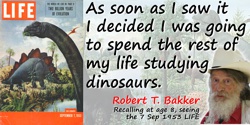
As soon as I saw it I decided I was going to spend the rest of my life studying dinosaurs.
Recalling his reaction, at age 8, when he saw Rudolph Zallinger’s mural of dinosaurs, the cover story of the 7 Sep 1953 Life magazine.
As soon as we touch the complex processes that go on in a living thing, be it plant or animal, we are at once forced to use the methods of this science [chemistry]. No longer will the microscope, the kymograph, the scalpel avail for the complete solution of the problem. For the further analysis of these phenomena which are in flux and flow, the investigator must associate himself with those who have labored in fields where molecules and atoms, rather than multicellular tissues or even unicellular organisms, are the units of study.
'Experimental and Chemical Studies of the Blood with an Appeal for More Extended Chemical Training for the Biological and Medical Investigator', Science (6 Aug 1915), 42, 176.
As the brain of man is the speck of dust in the universe that thinks, so the leaves—the fern and the needled pine and the latticed frond and the seaweed ribbon—perceive the light in a fundamental and constructive sense. … Their leaves see the light, as my eyes can never do. … They impound its stellar energy, and with that force they make life out of the elements.
In Flowering Earth (1939), 4.
As the vernal equinox heralds the arrival of spring, it symbolizes not only the rebirth of nature but also the renewal of hope and possibility in our lives.
A fictional quote imagined in the style typical of a scientist (19 Mar 2024).
As we advance in life we learn the limits of our abilities.
Inaugural Address Delivered to the University of St. Andrews, March 19, 1869 (1869), 3.
As we descend deeper and deeper into this region, the inhabitants become more and more modified, and fewer and fewer, indicating our approach to an abyss where life is either extinguished, or exhibits but a few sparks to mark its lingering presence.
In The Natural History of the European Seas (1859), 26-27. (In the 19th century, knowledge was gained from deep sea life hauled in with nets.)
Ask a follower of Bacon what [science] the new philosophy, as it was called in the time of Charles the Second, has effected for mankind, and his answer is ready; “It has lengthened life; it has mitigated pain; it has extinguished diseases; it has increased the fertility of the soil; it has given new securities to the mariner; it has furnished new arms to the warrior; it has spanned great rivers and estuaries with bridges of form unknown to our fathers; it has guided the thunderbolt innocuously from heaven to earth; it has lighted up the night with the splendour of the day; it has extended the range of the human vision; it has multiplied the power of the human muscles; it has accelerated motion; it has annihilated distance; it has facilitated intercourse, correspondence, all friendly offices, all dispatch of business; it has enabled man to descend to the depths of the sea, to soar into the air, to penetrate securely into the noxious recesses of the earth, to traverse the land in cars which whirl along without horses, to cross the ocean in ships which run ten knots an hour against the wind. These are but a part of its fruits, and of its first-fruits; for it is a philosophy which never rests, which has never attained, which is never perfect. Its law is progress. A point which yesterday was invisible is its goal to-day, and will be its starting-point to-morrow.”
From essay (Jul 1837) on 'Francis Bacon' in Edinburgh Review. In Baron Thomas Babington Macaulay and Lady Trevelyan (ed.) The Works of Lord Macaulay Complete (1871), Vol. 6, 222.
Astronomers tell us that there are about 1023 stars in the universe. That’s a meaningful number to chemists—an Avogadro number of potential solar systems of which between 1 and 50 percent are estimated to have planets. … Planets are plentiful—and from this fact we can begin our exploration of how life might have evolved on any one of them.
In 'Cosmochemistry The Earliest Evolution', The Science Teacher (Oct 1983), 50, No. 7, 34.
At Arcueil ... I dined in distinguished company... There was a lot of very interesting discussion. It is these gatherings which are the joy of life.
Maurice Crosland, Gay-Lussac, Scientist and Bourgeois (1978), 21.
At first he who invented any art that went beyond the common perceptions of man was naturally admired by men, not only because there was something useful in the inventions, but because he was thought wise and superior to the rest. But as more arts were invented, and some were directed to the necessities of life, others to its recreation, the inventors of the latter were always regarded as wiser than the inventors of the former, because their branches of knowledge did not aim at utility.
Metaphysics, 981b, 13-20. In Jonathan Barnes (ed.), The Complete Works of Aristotle (1984), Vol. 2, 1553.
At first I became depressed. I seemed to be getting worse pretty rapidly. There didn’t seem any point in working on my Ph.D. because I didn’t know I would live long enough to finish it.
In a message to his 70th birthday celebration, delivered at a public symposium in Cambridge, England (which ill health prevented him from attending). As quoted in Alok Jha, 'Stephen Hawking marks 70th birthday with speech to leading cosmologists', The Guardian (8 Jan 2012). (Around the age of 21, as he started his Ph.D. in Cambridge, Hawking was diagnosed with motor neurone disease.)
At lunch Francis [Crick] winged into the Eagle to tell everyone within hearing distance that we had found the secret of life.
Purported remark made at The Eagle pub (28 Feb 1953), near the Cavendish Laboratory in Cambridge, to celebrate the fact that they, Crick and Watson, had unravelled the structure of DNA. Stated by James Watson in The Double Helix: A Personal Account of the Discovery of the Structure of DNA (1968, 1998), 197. However Francis Crick, in What Mad Pursuit (1990), 77, writes that was “according to Jim,” but “of that I have no recollection.” Nevertheless, some quote collections report this incident with a direct quote as “We have discovered the secret of life!”
At the beginning of its existence as a science, biology was forced to take cognizance of the seemingly boundless variety of living things, for no exact study of life phenomena was possible until the apparent chaos of the distinct kinds of organisms had been reduced to a rational system. Systematics and morphology, two predominantly descriptive and observational disciplines, took precedence among biological sciences during the eighteenth and nineteenth centuries. More recently physiology has come to the foreground, accompanied by the introduction of quantitative methods and by a shift from the observationalism of the past to a predominance of experimentation.
In Genetics and the Origin of Species (1937, 1982), 6.
Atomic energy bears that same duality that has faced man from time immemorial, a duality expressed in the Book of Books thousands of years ago: “See, I have set before thee this day life and good and death and evil … therefore choose life.”
In This I Do Believe edited by Edward R. Murrow (1949).
Basic research at universities comes in two varieties: research that requires big bucks and research that requires small bucks. Big bucks research is much like government research and in fact usually is government research but done for the government under contract. Like other government research, big bucks academic research is done to understand the nature and structure of the universe or to understand life, which really means that it is either for blowing up the world or extending life, whichever comes first. Again, that's the government's motivation. The universities' motivation for conducting big bucks research is to bring money in to support professors and graduate students and to wax the floors of ivy-covered buildings. While we think they are busy teaching and learning, these folks are mainly doing big bucks basic research for a living, all the while priding themselves on their terrific summer vacations and lack of a dress code.
Smalls bucks research is the sort of thing that requires paper and pencil, and maybe a blackboard, and is aimed primarily at increasing knowledge in areas of study that don't usually attract big bucks - that is, areas that don't extend life or end it, or both. History, political science, and romance languages are typically small bucks areas of basic research. The real purpose of small bucks research to the universities is to provide a means of deciding, by the quality of their small bucks research, which professors in these areas should get tenure.
Smalls bucks research is the sort of thing that requires paper and pencil, and maybe a blackboard, and is aimed primarily at increasing knowledge in areas of study that don't usually attract big bucks - that is, areas that don't extend life or end it, or both. History, political science, and romance languages are typically small bucks areas of basic research. The real purpose of small bucks research to the universities is to provide a means of deciding, by the quality of their small bucks research, which professors in these areas should get tenure.
Accidental Empires (1992), 78.
Basic research may seem very expensive. I am a well-paid scientist. My hourly wage is equal to that of a plumber, but sometimes my research remains barren of results for weeks, months or years and my conscience begins to bother me for wasting the taxpayer’s money. But in reviewing my life’s work, I have to think that the expense was not wasted.
Basic research, to which we owe everything, is relatively very cheap when compared with other outlays of modern society. The other day I made a rough calculation which led me to the conclusion that if one were to add up all the money ever spent by man on basic research, one would find it to be just about equal to the money spent by the Pentagon this past year.
Basic research, to which we owe everything, is relatively very cheap when compared with other outlays of modern society. The other day I made a rough calculation which led me to the conclusion that if one were to add up all the money ever spent by man on basic research, one would find it to be just about equal to the money spent by the Pentagon this past year.
In The Crazy Ape (1971).
Be glad of life, because it gives you the chance to love and to work and to play and to look up at the stars.
…...
Be you in what line of life you may, it will be amongst your misfortunes if you have not time properly to attend to [money management]; for. ... want of attention to pecuniary matters … has impeded the progress of science and of genius itself.
Advice to Young Men (1833), 50.
Before a complex of sensations becomes a recollection placeable in time, it has ceased to be actual. We must lose our awareness of its infinite complexity, or it is still actual ... It is only after a memory has lost all life that it can be classed in time, just as only dissected flowers find their way into the herbarium of a botanist.
…...
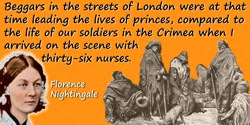
Beggars in the streets of London were at that time leading the lives of princes, compared to the life of our soldiers in the Crimea when I arrived on the scene with thirty-six nurses.
As quoted in ‘Little Chats With Big People’, The Scrap Book (Jan 1908), 5, No. 1, 43.
Believing, as I do, in the continuity of nature, I cannot stop abruptly where our microscopes cease to be of use. Here the vision of the mind authoritatively supplements the vision of the eye. By a necessity engendered and justified by science I cross the boundary of the experimental evidence, and discern in that Matter which we, in our ignorance of its latent powers, and notwithstanding our professed reverence for its Creator, have hitherto covered with opprobrium, the promise and potency of all terrestrial Life.
'Address Delivered Before The British Association Assembled at Belfast', (19 Aug 1874). Fragments of Science for Unscientific People: A Series of Detached Essays, Lectures, and Reviews (1892), Vol. 2, 191.
Better far off to leave half the ruins and nine-tenths of the churches unseen and to see well the rest; to see them not once, but again and often again; to watch them, to learn them, to live with them, to love them, till they have become a part of life and life’s recollections.
…...
Between every two pine trees there is a door leading to a new way of life.
As stated in Frederick W. Turner, John Muir: Rediscovering America (2000), 193. Also seen as “Between every two pines is a doorway to a new world,” in Thomas N. Taylor, Edith L. Taylor, Michael Krings, Paleobotany: the Biology and Evolution of Fossil Plants (2009), 805. “Between every two pines stood the door to the world's greatest cathedral,” in Robert Adrian de Jauralde Hart, Forest Gardening: Cultivating an Edible Landscape (1996), xi. Please contact Webmaster if you know the primary source and Muir's exact wording.
Beyond these are other suns, giving light and life to systems, not a thousand, or two thousand merely, but multiplied without end, and ranged all around us, at immense distances from each other, attended by ten thousand times ten thousand worlds, all in rapid motion; yet calm, regular and harmonious—all space seems to be illuminated, and every particle of light a world. ... all this vast assemblages of suns and worlds may bear no greater proportion to what lies beyond the utmost boundaries of human vision, than a drop of water to the ocean.
In The Geography of the Heavens and Class-Book of Astronomy (1874), 148 That knowledge is not happiness.
Biological diversity is the key to the maintenance of the world as we know it. Life in a local site struck down by a passing storm springs back quickly: opportunistic species rush in to fill the spaces. They entrain the succession that circles back to something resembling the original state of the environment.
In 'Storm Over the Amazon', The Diversity of Life (1992), 15.
Biology occupies a position among the sciences both marginal and central. Marginal because, the living world, constituting only a tiny and very “special” part of the universe, it does not seem likely that the study of living beings will ever uncover general laws applicable outside the biosphere. But if the ultimate aim of the whole of science is indeed, as I believe, to clarify man's relationship to the universe, then biology must be accorded a central position, since of all the disciplines it is the one that endeavours to go most directly to the heart of the problems that must be resolved before that of “human nature” can even be framed in other than metaphysical terms.
In Jacques Monod and Austryn Wainhouse (trans.), Chance and Necessity: An Essay on the Natural Philosophy of Modern Biology (1971), xi.
Bohr’s standpoint, that a space-time description is impossible, I reject a limine. Physics does not consist only of atomic research, science does not consist only of physics, and life does not consist only of science. The aim of atomic research is to fit our empirical knowledge concerning it into our other thinking. All of this other thinking, so far as it concerns the outer world, is active in space and time. If it cannot be fitted into space and time, then it fails in its whole aim and one does not know what purpose it really serves.
Letter to Willy Wien (25 Aug 1926). Quoted in Walter Moore, Schrödinger: Life and Thought (1989), 226.
Boiled down to one sentence, my message is the unboundedness of life and the unboundedness of human destiny.
…...
Books are not absolutely dead things, but do contain a potency of life in them to be as active as that soul was whose progeny they are.
In Areopagitica: A speech of Mr John Milton for the Liberty of Unlicenced printing to the Parliament of England (23 Nov 1644), 4.
Borel makes the amusing supposition of a million monkeys allowed to play upon the keys of a million typewriters. What is the chance that this wanton activity should reproduce exactly all of the volumes which are contained in the library of the British Museum? It certainly is not a large chance, but it may be roughly calculated, and proves in fact to be considerably larger than the chance that a mixture of oxygen and nitrogen will separate into the two pure constituents. After we have learned to estimate such minute chances, and after we have overcome our fear of numbers which are very much larger or very much smaller than those ordinarily employed, we might proceed to calculate the chance of still more extraordinary occurrences, and even have the boldness to regard the living cell as a result of random arrangement and rearrangement of its atoms. However, we cannot but feel that this would be carrying extrapolation too far. This feeling is due not merely to a recognition of the enormous complexity of living tissue but to the conviction that the whole trend of life, the whole process of building up more and more diverse and complex structures, which we call evolution, is the very opposite of that which we might expect from the laws of chance.
The Anatomy of Science (1926), 158-9.
Both died, ignored by most; they neither sought nor found public favour, for high roads never lead there. Laurent and Gerhardt never left such roads, were never tempted to peruse those easy successes which, for strongly marked characters, offer neither allure nor gain. Their passion was for the search for truth; and, preferring their independence to their advancement, their convictions to their interests, they placed their love for science above that of their worldly goods; indeed above that for life itself, for death was the reward for their pains. Rare example of abnegation, sublime poverty that deserves the name nobility, glorious death that France must not forget!
'Éloge de Laurent et Gerhardt', Moniteur Scientifique (1862), 4, 473-83, trans. Alan J. Rocke.
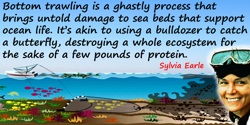
Bottom trawling is a ghastly process that brings untold damage to sea beds that support ocean life. It’s akin to using a bulldozer to catch a butterfly, destroying a whole ecosystem for the sake of a few pounds of protein. We wouldn’t do this on land, so why do it in the oceans?
In 'Can We Stop Killing Our Oceans Now, Please?', Huffington Post (14 Aug 2013).
Bread is the staff of life.
Cited as“The proverb was first recorded in 1638 in Penkethman, Artachthos” in Martin H. Manser, The Facts on File Dictionary of Proverbs (2007), 33.
Büchsel in his reminiscences from the life of a country parson relates that he sought his recreation in Lacroix’s Differential Calculus and thus found intellectual refreshment for his calling. Instances like this make manifest the great advantage which occupation with mathematics affords to one who lives remote from the city and is compelled to forego the pleasures of art. The entrancing charm of mathematics, which captivates every one who devotes himself to it, and which is comparable to the fine frenzy under whose ban the poet completes his work, has ever been incomprehensible to the spectator and has often caused the enthusiastic mathematician to be held in derision. A classic illustration is the example of Archimedes….
From Die Entwickelung der Mathematik im Zusammenhange mit der Ausbreitung der Kultur (1893), 22. As translated in Robert Édouard Moritz, Memorabilia Mathematica; Or, The Philomath’s Quotation-Book (1914), 186. From the original German, “Wenn Büchsel in seinen Erinnerungen aus dem Leben eines Landgeistlichen erzählt, dass er in der Differentialrechnung von Lacroix Erholung gesucht und geistige Erfrischung ftir seinen Beruf gefunden habe, so erkennen wir darin den grossen Vorzug, den die Beschaftigung mit der Mathematik für jemanden hat, der fern von einer Stadt lebt und auf ihre Kunstgenüsse verzichten muss. Der berückende Zauber der
Mathematik, dem jeder unterliegt, der sich ihr ergiebt, und der dem holden Wahnsinn vergleichbar ist, unter dessen Bann der Dichter sein Work vollendet, ist dem betrachtenden Mitmenschen immer unbegreiflich gewesen und hat den begeisterten Mathematiker oft zum Gespött werden lassen. Als klassisches Beispiel wird jedem Schüler Archimedes…”
Buffon said unreservedly, "Genius is simply patience carried to the extreme." To those who asked how he achieved fame he replied: "By spending forty years of my life bent over my writing desk.”
From Reglas y Consejos sobre Investigacíon Cientifica: Los tónicos de la voluntad. (1897), as translated by Neely and Larry W. Swanson, in Advice for a Young Investigator (1999), 39.
Business men are to be pitied who do not recognize the fact that the largest side of their secular business is benevolence. ... No man ever manages a legitimate business in this life without doing indirectly far more for other men than he is trying to do for himself.
Defining what makes a business legitimate. In Proverbs from Plymouth Pulpit (1887), 44.
But how is it that they [astrologers] have never been able to explain why, in the life of twins, in their actions, in their experiences, their professions, their accomplishments, their positions—in all the other circumstances of human life, and even in death itself, there is often found such a diversity that in those respects many strangers show more resemblance to them than they show to one another, even though the smallest possible interval separated their births and though they were conceived at the same moment, by a single act of intercourse.
De Civitate Dei (The City of God) [413-426], Book V, chapter I, trans. H. Bettenson (1972),180-181.
But however secure and well-regulated civilized life may become, bacteria, Protozoa, viruses, infected fleas, lice, ticks, mosquitoes, and bedbugs will always lurk in the shadows ready to pounce when neglect, poverty, famine, or war lets down the defenses.
Rats, Lice and History (1934), 13-4.
But I think that in the repeated and almost entire changes of organic types in the successive formations of the earth—in the absence of mammalia in the older, and their very rare appearance (and then in forms entirely. unknown to us) in the newer secondary groups—in the diffusion of warm-blooded quadrupeds (frequently of unknown genera) through the older tertiary systems—in their great abundance (and frequently of known genera) in the upper portions of the same series—and, lastly, in the recent appearance of man on the surface of the earth (now universally admitted—in one word, from all these facts combined, we have a series of proofs the most emphatic and convincing,—that the existing order of nature is not the last of an uninterrupted succession of mere physical events derived from laws now in daily operation: but on the contrary, that the approach to the present system of things has been gradual, and that there has been a progressive development of organic structure subservient to the purposes of life.
'Address to the Geological Society, delivered on the Evening of the 18th of February 1831', Proceedings of the Geological Society (1834), 1, 305-6.
But in nothing are swifts more singular than in their early retreat. They retire, as to the main body of them, by the tenth of August, and sometimes a few days sooner: and every straggler invariably withdraws by the twentieth, while their congeners, all of them, stay till the beginning of October; many of them all through that month, and some occasionally to the beginning of November. This early retreat is mysterious and wonderful, since that time is often the sweetest season in the year. But, what is more extraordinary, they begin to retire still earlier in the most southerly parts of Andalusia, where they can be no ways influenced by any defect of heat; or, as one might suppose, defect of food. Are they regulated in their motions with us by failure of food, or by a propensity to moulting, or by a disposition to rest after so rapid a life, or by what? This is one of those incidents in natural history that not only baffles our searches, but almost eludes our guesses!
In Letter to Daines Barrington, (28 Sep 1774), in The Natural History and Antiquities of Selborne (1789), 278.
But the dreams about the modes of creation, enquiries whether our globe has been formed by the agency of fire or water, how many millions of years it has cost Vulcan or Neptune to produce what the fiat of the Creator would effect by a single act of will, is too idle to be worth a single hour of any man’s life.
Letter (2 May 1826) to Doctor John P. Emmet. Collected in The Writings of Thomas Jefferson (1854), Vol. 7, 443.
But the life of a man is of no greater importance to the universe than that of an oyster.
'On Suicide' (written 1755, published postumously). In Essays On Suicide And The Immortality Of The Soul: (1777, New Ed. 1799), 7.
But the whole vital process of the earth takes place so gradually and in periods of time which are so immense compared with the length of our life, that these changes are not observed, and before their course can be recorded from beginning to end whole nations perish and are destroyed.
Meteorology, 351b, 8-13. In Jonathan Barnes (ed.), The Complete Works of Aristotle (1984), Vol. I, 573.
But there is another alchemy, operative and practical, which teaches how to make the noble metals and colours and many other things better and more abundantly by art than they are made in nature. And science of this kind is greater than all those preceding because it produces greater utilities. For not only can it yield wealth and very many other things for the public welfare, but it also teaches how to discover such things as are capable of prolonging human life for much longer periods than can be accomplished by nature … Therefore this science has special utilities of that nature, while nevertheless it confirms theoretical alchemy through its works.
Opus Tertium [1266-1268], chapter 12, quoted in A. C. Crombie, Augustine to Galileo (1959), Vol. I, 69.
But when it has been shown by the researches of Pasteur that the septic property of the atmosphere depended not on the oxygen, or any gaseous constituent, but on minute organisms suspended in it, which owed their energy to their vitality, it occurred to me that decomposition in the injured part might be avoided without excluding the air, by applying as a dressing some material capable of destroying the life of the floating particles. Upon this principle I have based a practice.
'On the Antiseptic Principle in the Practice of Surgery', The British Medical Journal (1867), ii, 246.
But who can say that the vapour engine has not a kind of consciousness? Where does consciousness begin, and where end? Who can draw the line? Who can draw any line? Is not everything interwoven with everything? Is not machinery linked with animal life in an infinite variety of ways?
But, as we consider the totality of similarly broad and fundamental aspects of life, we cannot defend division by two as a natural principle of objective order. Indeed, the ‘stuff’ of the universe often strikes our senses as complex and shaded continua, admittedly with faster and slower moments, and bigger and smaller steps, along the way. Nature does not dictate dualities, trinities, quarterings, or any ‘objective’ basis for human taxonomies; most of our chosen schemes, and our designated numbers of categories, record human choices from a cornucopia of possibilities offered by natural variation from place to place, and permitted by the flexibility of our mental capacities. How many seasons (if we wish to divide by seasons at all) does a year contain? How many stages shall we recognize in a human life?
…...
But, however many ways there may be of being alive, it is certain that there are vastly more ways of being dead, or rather not alive.
The Blind Watchmaker (1996), 9.
By firm immutable immortal laws Impress’d on Nature by the GREAT FIRST CAUSE,
Say, MUSE! how rose from elemental strife
Organic forms, and kindled into life;
How Love and Sympathy with potent charm
Warm the cold heart, the lifted hand disarm;
Allure with pleasures, and alarm with pains,
And bind Society in golden chains.
Say, MUSE! how rose from elemental strife
Organic forms, and kindled into life;
How Love and Sympathy with potent charm
Warm the cold heart, the lifted hand disarm;
Allure with pleasures, and alarm with pains,
And bind Society in golden chains.
From 'Production of Life', The Temple of Nature; or, The Origin of Society: A Poem, with Philosophical Notes (1803), 3, Canto I, lines 1-8.
By its very nature the uterus is a field for growing the seeds, that is to say the ova, sown upon it. Here the eggs are fostered, and here the parts of the living [fetus], when they have further unfolded, become manifest and are made strong. Yet although it has been cast off by the mother and sown, the egg is weak and powerless and so requires the energy of the semen of the male to initiate growth. Hence in accordance with the laws of Nature, and like the other orders of living things, women produce eggs which, when received into the chamber of the uterus and fecundated by the semen of the male, unfold into a new life.
'On the Developmental Process', in H. B. Adelmann (ed.), Marcello Malpighi and the Evolution of Embryology (1966), Vol. 2, 861.
By medicine life may be prolong’d, yet death
Will seize the Doctor too.
Will seize the Doctor too.
Cymbeline (1609, publ. 1623), Act 5, Scene 5. In Charles Knight (ed.), The Works of William Shakspere (1868), 605.
By research in pure science I mean research made without any idea of application to industrial matters but solely with the view of extending our knowledge of the Laws of Nature. I will give just one example of the ‘utility’ of this kind of research, one that has been brought into great prominence by the War—I mean the use of X-rays in surgery. Now, not to speak of what is beyond money value, the saving of pain, or, it may be, the life of the wounded, and of bitter grief to those who loved them, the benefit which the state has derived from the restoration of so many to life and limb, able to render services which would otherwise have been lost, is almost incalculable. Now, how was this method discovered? It was not the result of a research in applied science starting to find an improved method of locating bullet wounds. This might have led to improved probes, but we cannot imagine it leading to the discovery of X-rays. No, this method is due to an investigation in pure science, made with the object of discovering what is the nature of Electricity. The experiments which led to this discovery seemed to be as remote from ‘humanistic interest’ —to use a much misappropriated word—as anything that could well be imagined. The apparatus consisted of glass vessels from which the last drops of air had been sucked, and which emitted a weird greenish light when stimulated by formidable looking instruments called induction coils. Near by, perhaps, were great coils of wire and iron built up into electro-magnets. I know well the impression it made on the average spectator, for I have been occupied in experiments of this kind nearly all my life, notwithstanding the advice, given in perfect good faith, by non-scientific visitors to the laboratory, to put that aside and spend my time on something useful.
In Speech made on behalf of a delegation from the Conjoint Board of Scientific Studies in 1916 to Lord Crewe, then Lord President of the Council. In George Paget Thomson, J. J. Thomson and the Cavendish Laboratory in His Day (1965), 167-8.
By the act of generation nothing more is done than to ferment the sperm of ye female by the sperm of ye male that it may thereby become fit nourishment for ye Embryo: ffor ye nourishment of all animals is prepared by ferment & the ferment is taken from animals of the same kind, & makes the nourishment subtile & spiritual. In adult animals the nourishmt is fermented by the choler and pancreatic juice both wch come from the blood. The Embryo not being able to ferment its own nourishment wch comes from the mothers blood has it fermented by the sperm wch comes from ye fathers blood, & by this nourishment it swells, drops off from ye Ovarium & begins to grow with a life distinct from that of ye mother.
From 'Quæst 25' in Draft version of The Queries manuscript, Add. MS. 3970, folio 235 held by the University of Cambridge Library. As quoted and cited in R.W. Home, 'Force, Electricity, and Living Matter', from Margaret J. Osler and Paul Lawrence Farber (eds.), Religion, Science, and Worldview: Essays in Honor of Richard S. Westfall (2002), 113.
By the death of Mr. O. Chanute the world has lost one whose labors had to an unusual degree influenced the course of human progress. If he had not lived the entire history of progress in flying would have been other than it has been.
Writing in Aeronautics in Jan 1911 about Chanute's death, collected in Wilbur Wright and Orville Wright, The Papers of Wilbur and Orville Wright: Volume Two 1906-1948 (1953), 1013.
By the worldly standards of public life, all scholars in their work are of course oddly virtuous. They do not make wild claims, they do not cheat, they do not try to persuade at any cost, they appeal neither to prejudice nor to authority, they are often frank about their ignorance, their disputes are fairly decorous, they do not confuse what is being argued with race, politics, sex or age, they listen patiently to the young and to the old who both know everything. These are the general virtues of scholarship, and they are peculiarly the virtues of science.
In Science and Human Values (1956).
Calculation touches, at most, certain phenomena of organic destruction. Organic creation, on the contrary, the evolutionary phenomena which properly constitute life, we cannot in any way subject to a mathematical treatment.
In Creative Evolution (1911).
Can I pay any higher tribute to a man [George Gaylord Simpson] than to state that his work both established a profession and sowed the seeds for its own revision? If Simpson had reached final truth, he either would have been a priest or would have chosen a dull profession. The history of life cannot be a dull profession.
From 'G.G. Simpson, Paleontology, and the Modern Synthesis', collected in Ernst Mayr, William B. Provine (eds.), The Evolutionary Synthesis: Perspectives on the Unification of Biology (1998), 171.
Cats and monkeys, monkeys and cats—all human life is there.
In The Atlantic Monthly (Mar 1873), 31, No. 185, 292. Collected in The Madonna of the Future (1883), 38.
Cavendish was a great Man with extraordinary singularities—His voice was squeaking his manner nervous He was afraid of strangers & seemed when embarrassed to articulate with difficulty—He wore the costume of our grandfathers. Was enormously rich but made no use of his wealth... He Cavendish lived latterly the life of a solitary, came to the Club dinner & to the Royal Society: but received nobody at his home. He was acute sagacious & profound & I think the most accomplished British Philosopher of his time.
Quoted in J. Z. Fullmer, 'Davy's Sketches of his Contemporaries', Chymia, 1967, 12, 133.
Cellular pathology is not an end if one cannot see any alteration in the cell. Chemistry brings the clarification of living processes nearer than does anatomy. Each anatomical change must have been preceded by a chemical one.
Attributed in H. Coper and H. Herken, Deutsche Medizini Wochenschrift (18 Oct 1963), 88, No. 42, 2035, in the original German, “Nach der Überlieferung durch His soll Virchow geäußert haben: ‘Die Zellular-pathologie ist nicht am Ende, wenn man an einer Zelle keine Veränderungen mehr sehen kann. Die Chemie steht der Erklärung der Lebensvorgänge näher als die Anatomie. Jede anatomische Verände-rung setzt notwendig eine chemische voraus.’” As translated in Angel Pentschew,'Morphology and morphogenesis of lead encephalopathy', Acta Neuropathologica (Sep 1965) 5, No. 2, 133-160, as cited in I. Arthur Michaelson and Mitchell W. Sauerhoff, 'Animal Models of Human Disease: Severe and Mild Lead Encephalopathy in the Neonatal Rat', Environmental Health Perspectives (May 1974), 7, 204 & 223 footnote. Note: Although given in quotation marks in the original German text, the subject quote is almost definitely NOT verbatim, but only a paraphrase of Virchow’s teachings. The German text introduces the subject quote with, “Nach der Überlieferung durch His soll Virchow geäußert haben:…” which means, “According to tradition Virchow is said to have expressed:…” (using Google translate). However, it is useful as a succinct statement to the effect of what Virchow might say to summarize his doctrine.
Certainly one of the most enthralling things about human life is the recognition that we live in what, for practical purposes, is a universe without bounds.
Chance alone is at the source of every innovaton, of all creation in the biosphere. Pure chance, only chance, absolute but blind liberty is at the root of the prodigious edifice that is evolution... It today is the sole conceivable hypothesis, the only one that squares with observed and tested fact.
Stating life began by the chance collision of particles of nucleic acid in the “prebiotic soup.”
Stating life began by the chance collision of particles of nucleic acid in the “prebiotic soup.”
In Jacques Monod and Austryn Wainhouse (trans.), Chance and Necessity: An Essay on the Natural Philosophy of Modern Biology (1971), 112-113.
Chance is the only source of true novelty.
In Life Itself: Its Origin and Nature (1981), 58.
Change is the law of life. And those who look only to the past or the present are certain to miss the future.
Address in the Assembly Hall at the Paulskirche in Frankfurt, (25 Jun 1963). Collected in Public Papers of the Presidents of the United States: John F. Kennedy, 1963 (1964), 517.
Chaos often breeds life when order breeds habit.
The Education of Henry Adams (1907, 1918), 249.
Characteristically skeptical of the idea that living things would faithfully follow mathematical formulas, [Robert Harper] seized upon factors in corn which seemed to blend in the hybrid—rather than be represented by plus or minus signs, and put several seasons into throwing doubt upon the concept of immutable hypothetical units of inheritance concocted to account for selected results.
In 'Robert Almer Harper', National Academy Biographical Memoirs (1948), 25, 233-234.
Chemistry stands at the pivot of science. On the one hand it deals with biology and provides explanations for the processes of life. On the other hand it mingles with physics and finds explanations for chemical phenomena in the fundamental processes and particles of the universe. Chemistry links the familiar with the fundamental.
In Scientific American Library, Molecules (1987, 2003), 2.
Chemists show us that strange property, catalysis, which enables a substance while unaffected itself to incite to union elements around it. So a host, or hostess, who may know but little of those concerned, may, as a social switchboard, bring together the halves of pairs of scissors, men who become life-long friends, men and women who marry and are happy husbands and wives.
From chapter 'Jottings from a Note-book', in Canadian Stories (1918), 179.
Choose a job you love and you will never have to work a day in your life.
Too often seen carelessly attributed to Confucius. Webmaster has searched the original writings of the disciples of Confucius who recorded his thoughts, and has seen nothing resembling this. Peasants of his era did not “choose a job”—they merely worked on raising food and providing the necessities of life for their family and community.
Comets giveth and comets taketh away.
In Comet (1885, 1997), 337. [Note the context refers to the idea that although perhaps comets seeded life on earth, later comet collisions with Earth could cause mass extinctions.]
Coming to the question of life being found on other planets, Professor Haldane apologized for discoursing, as a mere biologist, on a subject on which we had been expecting a lecture by a physicist [J. D. Bernal]. He mentioned three hypotheses:
(a) That life had a supernatural origin,
(b) That it originated from inorganic materials, and (c) That life is a constituent of the Universe and can only arise from pre-existing life. The first hypothesis, he said, should be taken seriously, and he would proceed to do so. From the fact that there are 400,000 species of beetle on this planet, but only 8,000 species of mammals, he concluded that the Creator, if he exists, has a special preference for beetles, and so we might be more likely to meet them than any other type of animal on a planet which would support life.
(a) That life had a supernatural origin,
(b) That it originated from inorganic materials, and (c) That life is a constituent of the Universe and can only arise from pre-existing life. The first hypothesis, he said, should be taken seriously, and he would proceed to do so. From the fact that there are 400,000 species of beetle on this planet, but only 8,000 species of mammals, he concluded that the Creator, if he exists, has a special preference for beetles, and so we might be more likely to meet them than any other type of animal on a planet which would support life.
In Mark Williamson, 'Haldane’s Special Preference', The Linnean, 1992, 8, 14.
Common sense is the measure of the possible; it is composed of experience and prevision; it is calculation applied to life.
Entry for 26 Dec 1852 in Amiel’s Journal: The Journal Intime of Henri-Frédéric Amiel, trans. Humphry Ward (1893), 34.
Compared to the breadth of knowledge yet to be known, what does your life actually matter?
— Movie
Europa Report (2013)
Concerning the gods, I have no means of knowing either that they exist or that they do not exist, nor what sort of form they may have; there are many reasons why knowledge on this subject is not possible, owing to the lack of evidence and the shortness of human life.
Protagoras, fr. 1, quoted in E. Hussey, The Pre-Socratics (1972), 109.
Connected by innumerable ties with abstract science, Physiology is yet in the most intimate relation with humanity; and by teaching us that law and order, and a definite scheme of development, regulate even the strangest and wildest manifestations of individual life, she prepares the student to look for a goal even amidst the erratic wanderings of mankind, and to believe that history offers something more than an entertaining chaos—a journal of a toilsome, tragi-comic march nowither.
In 'Educational Value of Natural History Sciences', Lay Sermons, Addresses, and Reviews (1870), 97.
Consciousness… does not appear to itself chopped up in bits. Such words as “chain” or “train” do not describe it fitly as it presents itself in the first instance. It is nothing jointed; it flows. A “river” or a “stream” are the metaphors by which it is most naturally described. In talking of it hereafter, let us call it the stream of thought, of consciousness, or of subjective life.
Source of the expression “stream of consciousness”.
Source of the expression “stream of consciousness”.
The Principles of Psychology (1890), Vol. 1, 239.
Conservation and rural-life policies are really two sides of the same policy; and down at the bottom this policy rests upon the fundamental law that neither man nor nation can prosper unless, in dealing with the present, thought is steadily given for the future.
'Rural Life' (originally published in The Outlook, 27 Aug 1910). In The Works of Theodore Roosevelt. Vol. 16: American Problems (1926), 146.
Considering the difficulties represented by the lack of water, by extremes of temperature, by the full force of gravity unmitigated by the buoyancy of water, it must be understood that the spread to land of life forms that evolved to meet the conditions of the ocean represented the greatest single victory won by life over the inanimate environment.
(1965). In Isaac Asimov’s Book of Science and Nature Quotations (1988), 194.
Constant, or free, life is the third form of life; it belongs to the most highly organized animals. In it, life is not suspended in any circumstance, it unrolls along a constant course, apparently indifferent to the variations in the cosmic environment, or to the changes in the material conditions that surround the animal. Organs, apparatus, and tissues function in an apparently uniform manner, without their activity undergoing those considerable variations exhibited by animals with an oscillating life. This because in reality the internal environment that envelops the organs, the tissues, and the elements of the tissues does not change; the variations in the atmosphere stop there, so that it is true to say that physical conditions of the environment are constant in the higher animals; it is enveloped in an invariable medium, which acts as an atmosphere of its own in the constantly changing cosmic environment. It is an organism that has placed itself in a hot-house. Thus the perpetual changes in the cosmic environment do not touch it; it is not chained to them, it is free and independent.
Lectures on the Phenomena of Life Common to Animals and Plants (1878), trans. Hebbel E. Hoff, Roger Guillemin and Lucienne Guillemin (1974), 83.
Contrary to popular parlance, Darwin didn't discover evolution. He uncovered one (most would say the) essential mechanism by which it operates: natural selection. Even then, his brainstorm was incomplete until the Modern Synthesis of the early/mid-20th century when (among other things) the complementary role of genetic heredity was fully realized. Thousands upon thousands of studies have followed, providing millions of data points that support this understanding of how life on Earth has come to be as it is.
In online article, 'The Day That Botany Took on Bobby Jindal by Just Being Itself', Huffington Post (5 Aug 2013).
Cosmology does, I think, affect the way that we perceive humanity’s role in nature. One thing we’ve learnt from astronomy is that the future lying ahead is more prolonged than the past. Even our sun is less than halfway through its life.
…...
Courage is the price that
Life exacts for granting peace.
The soul that knows it not, knows no release
From little things:
Knows not the livid loneliness of fear,
Nor mountain heights where bitter joy can hear
The sound of wings.
Life exacts for granting peace.
The soul that knows it not, knows no release
From little things:
Knows not the livid loneliness of fear,
Nor mountain heights where bitter joy can hear
The sound of wings.
From poem 'Courage' (1927), opening lines, included in magazine article by Marion Perkins, 'Who Is Amelia Earhart?', Survey (1 Jul 1928), 60. Quoted as epigraph, and cited in Mary S. Lovell, The Sound of Wings: The Life of Amelia Earhart (1989), ix.
CREATION OF LIFE.
The Startling Discovery of Prof. Loeb.
Lower Animals Produced by Chemical Means.
Process May Apply to the Human Species.
Immaculate Conception is Explained.
Wonderful Experiments Conducted at Woods Hole.
The Startling Discovery of Prof. Loeb.
Lower Animals Produced by Chemical Means.
Process May Apply to the Human Species.
Immaculate Conception is Explained.
Wonderful Experiments Conducted at Woods Hole.
The Boston Herald (26 Nov 1899), 17.
Creationists have also changed their name ... to intelligent design theorists who study 'irreducible complexity' and the 'abrupt appearance' of life—yet more jargon for 'God did it.' ... Notice that they have no interest in replacing evolution with native American creation myths or including the Code of Hammarabi alongside the posting of the Ten Commandments in public schools.
'75 Years and Still No Peace'. Humanist (Sep 2000)
Culture may even be described simply as that which makes life worth living.
In Notes Toward a Definition of Culture (1948, 2014), 26.
Cuvier … brings the void to life again, without uttering abracadabras, he excavates a fragment of gypsum, spies a footprint and shouts: “Look!” And suddenly the marbles are teeming with creatures, the dead come to life again, the world turns!
From 'La Peau de Chagrin' (1831). As translated as by Helen Constantine The Wild Ass’s Skin (2012), 19.
Dance … is life, or becomes it, in a way that other arts cannot attain. It is not in stone, or words or tones, but in our muscles. It is a formulation of their movements.
In Art Is Action: A Discussion of Nine Arts in a Modern World (1939), 56.
Dare to live the life you have dreamed for yourself. Go forward and make your dreams come true.
…...
Darwin abolished special creations, contributed the Origin of Species and hitched all life together in one unbroken procession of Siamese Twins, the whole evolved by natural and orderly processes from one microscopic parent germ.
'The Secret History of Eddypus', in Mark Twain and David Ketterer (ed.), Tales of Wonder (2003), 223.
Darwin grasped the philosophical bleakness with his characteristic courage. He argued that hope and morality cannot, and should not, be passively read in the construction of nature. Aesthetic and moral truths, as human concepts, must be shaped in human terms, not ‘discovered’ in nature. We must formulate these answers for ourselves and then approach nature as a partner who can answer other kinds of questions for us–questions about the factual state of the universe, not about the meaning of human life. If we grant nature the independence of her own domain–her answers unframed in human terms–then we can grasp her exquisite beauty in a free and humble way. For then we become liberated to approach nature without the burden of an inappropriate and impossible quest for moral messages to assuage our hopes and fears. We can pay our proper respect to nature’s independence and read her own ways as beauty or inspiration in our different terms.
…...
Darwin recognized that thus far the civilization of mankind has passed through four successive stages of evolution, namely, those based on the use of fire, the development of agriculture, the development of urban life and the use of basic science for technological advancement.
In The Science Matrix: The Journey, Travails, Triumphs (1992, 2012), 86.
Darwinian fitness is compounded of a mutual relationship between the organism and the environment. Of this, fitness of environment is quite as essential a component as the fitness which arises in the process of organic evolution; and in fundamental characteristics the actual environment is the fittest possible abode of life.
His thesis for the book stated at the beginning of The Fitness of the Environment (1913), Preface, v.
Death is what gives life meaning. To know your days are numbered. Your time is short.
— Movie
Spoken by character The Ancient One (actress Tilda Swinton), in movie Doctor Strange (2016).
Deductivism in mathematical literature and inductivism in scientific papers are simply the postures we choose to be seen in when the curtain goes up and the public sees us. The theatrical illusion is shattered if we ask what goes on behind the scenes. In real life discovery and justification are almost always different processes.
Induction and Intuition in Scientific Thought (1969), 26.
Defenders of the short-sighted men who in their greed and selfishness will, if permitted, rob our country of half its charm by their reckless extermination of all useful and beautiful wild things sometimes seek to champion them by saying the “the game belongs to the people.” So it does; and not merely to the people now alive, but to the unborn people. The “greatest good for the greatest number” applies to the number within the womb of time, compared to which those now alive form but an insignificant fraction. Our duty to the whole, including the unborn generations, bids us restrain an unprincipled present-day minority from wasting the heritage of these unborn generations. The movement for the conservation of wild life and the larger movement for the conservation of all our natural resources are essentially democratic in spirit, purpose, and method.
'Bird Reserves at the Mouth of the Mississippi', A Book-Lover's Holidays in the Open (1920), 300-301.
Despite the high long-term probability of extinction, every organism alive today, including every person reading this paper, is a link in an unbroken chain of parent-offspring relationships that extends back unbroken to the beginning of life on earth. Every living organism is a part of an enormously long success story—each of its direct ancestors has been sufficiently well adapted to its physical and biological environments to allow it to mature and reproduce successfully. Viewed thus, adaptation is not a trivial facet of natural history, but a biological attribute so central as to be inseparable from life itself.
In 'Integrative Biology: An Organismic Biologist’s Point of View', Integrative and Comparative Biology (2005), 45, 330.
Detest it as lewd intercourse, it can deprive you of all your leisure, your health, your rest, and the whole happiness of your life.
Having himself spent a lifetime unsuccessfully trying to prove Euclid’s postulate that parallel lines do not meet, Farkas discouraged his son János from any further attempt.
Having himself spent a lifetime unsuccessfully trying to prove Euclid’s postulate that parallel lines do not meet, Farkas discouraged his son János from any further attempt.
Letter (1820), to his son, János Bolyai. Translation as in Dirk Jan Struik, A concise history of mathematics (2nd Ed., 1948), 253.
Dirichlet was not satisfied to study Gauss’ Disquisitiones arithmetical once or several times, but continued throughout life to keep in close touch with the wealth of deep mathematical thoughts which it contains by perusing it again and again. For this reason the book was never placed on the shelf but had an abiding place on the table at which he worked. … Dirichlet was the first one, who not only fully understood this work, but made it also accessible to others.
In Dirichlet, Werke, Bd. 2, 315. As translated in Robert Édouard Moritz, Memorabilia Mathematica; Or, The Philomath’s Quotation-book (1914), 159.
Disease is not something personal and special, but only a manifestation of life under modified conditions, operating according to the same laws as apply to the living body at all times, from the first moment until death.
In Ian F. McNeely, Medicine on a Grand Scale: Rudolf Virchow, Liberalism, and the Public Health (2002), 26.
Disease may be defined as “A change produced in living things in consequence of which they are no longer in harmony with their environment.”
In Disease and its Causes (1913), 9.
Do not squander time for that is the stuff life is made of.
…...
Do not try the parallels in that way: I know that way all along. I have measured that bottomless night, and all the light and all the joy of my life went out there.
Having himself spent a lifetime unsuccessfully trying to prove Euclid's postulate that parallel lines do not meet, Farkas discouraged his son János from any further attempt.
Having himself spent a lifetime unsuccessfully trying to prove Euclid's postulate that parallel lines do not meet, Farkas discouraged his son János from any further attempt.
Letter (4 Apr 1820), to his son, János Bolyai. In J. J. O'Connor and E. F. Robertson, 'Farkas Wolfgang Bolyai' (Mar 2004), web article in MacTutor..
Doctor, no medicine.—We are machines made to live—organized expressly for that purpose.—Such is our nature.—Do not counteract the living principle.—Leave it at liberty to defend itself, and it will do better than your drugs.
As given in Tryon Edwards (ed.), A Dictionary of Thoughts (1908), 339.
Does human spaceflight simply have a life of its own, without a realistic objective that is remotely commensurate with its costs? Or, indeed, is human spaceflight now obsolete?
In 'Is Human Spaceflight Obsolete?', Issues in Science and Technology (Summer 2004).
Does life belong to what we know as matter, or is it an independent principle inserted into matter at some suitable epoch when the physical conditions became such as to permit the development of life?
In Fragments of Science for Unscientific People: A Series of Detached Essays (1871), 158.
Don't live in a town where there are no doctors.
In Richard Alan Krieger, Civilization's Quotations (2002), 313.
Dr. M.L. von Franz has explained the circle (or sphere) as a symbol of Self. It expresses the totality of the psyche in all its aspects, including the relationship between man and the whole of nature. It always points to the single most vital aspect of life, its ultimate wholeness.
In Aniela Jaffé, 'Symbolism in the Visual Arts', collected in Carl Jung (ed.), Man and His Symbols (1964, 1968), 266.
During a conversation with the writer in the last weeks of his life, Sylvester remarked as curious that notwithstanding he had always considered the bent of his mind to be rather analytical than geometrical, he found in nearly every case that the solution of an analytical problem turned upon some quite simple geometrical notion, and that he was never satisfied until he could present the argument in geometrical language.
In Proceedings London Royal Society, 63, 17.
During my span of life science has become a matter of public concern and the l'art pour l'art standpoint of my youth is now obsolete. Science has become an integral and most important part of our civilization, and scientific work means contributing to its development. Science in our technical age has social, economic, and political functions, and however remote one's own work is from technical application it is a link in the chain of actions and decisions which determine the fate of the human race. I realized this aspect of science in its full impact only after Hiroshima.
— Max Born
My Life & My Views (1968), 49.
During my stay in London I resided for a considerable time in Clapham Road in the neighbourhood of Clapham Common... One fine summer evening I was returning by the last bus 'outside' as usual, through the deserted streets of the city, which are at other times so full of life. I fell into a reverie (Träumerei), and 10, the atoms were gambolling before my eyes! Whenever, hitherto, these diminutive beings had appeared to me, they had always been in motion: but up to that time I had never been able to discern the nature of their motion. Now, however, I saw how, frequently, two smaller atoms united to form a pair: how the larger one embraced the two smaller ones: how still larger ones kept hold of three or even four of the smaller: whilst the whole kept whirling in a giddy dance. I saw how the larger ones formed a chain, dragging the smaller ones after them but only at the ends of the chain. I saw what our past master, Kopp, my highly honoured teacher and friend has depicted with such charm in his Molekular-Welt: but I saw it long before him. The cry of the conductor 'Clapham Road', awakened me from my dreaming: but I spent part of the night in putting on paper at least sketches of these dream forms. This was the origin of the 'Structural Theory'.
Kekule at Benzolfest in Berichte (1890), 23, 1302.
During the vernal equinox, we witness the delicate balance between light and darkness, warmth and cold. It’s a reminder of the intricate interplay of forces that sustain life on our planet and the cosmic harmony that governs the universe.
A fictional quote imagined in the style of a theoretical physicist and cosmologist (19 Mar 2024).
Dust consisting of fine fibers of asbestos, which are insoluble and virtually indestructible, may become a public health problem in the near future. At a recent international conference on the biological effects of asbestos sponsored by the New York Academy of Sciences, participants pointed out on the one hand that workers exposed to asbestos dust are prone in later life to develop lung cancer, and on the other hand that the use of this family of fibrous silicate compounds has expanded enormously during the past few decades. A laboratory curiosity 100 years ago, asbestos today is a major component of building materials.
— Magazine
In Scientific American (Sep 1964). As cited in '50, 100 & 150 Years Ago', Scientific American (Dec 2014), 311, No. 6, 98.
Each human life is unique, born of a miracle that reaches beyond laboratory science.
Quoted in Kim Lim (ed.), 1,001 Pearls of Spiritual Wisdom: Words to Enrich, Inspire, and Guide Your Life (2014), 42
Each pregnant Oak ten thousand acorns forms
Profusely scatter’d by autumnal storms;
Ten thousand seeds each pregnant poppy sheds
Profusely scatter’d from its waving heads;
The countless Aphides, prolific tribe,
With greedy trunks the honey’d sap imbibe;
Swarm on each leaf with eggs or embryons big,
And pendent nations tenant every twig ...
—All these, increasing by successive birth,
Would each o’erpeople ocean, air, and earth.
So human progenies, if unrestrain’d,
By climate friended, and by food sustain’d,
O’er seas and soils, prolific hordes! would spread
Erelong, and deluge their terraqueous bed;
But war, and pestilence, disease, and dearth,
Sweep the superfluous myriads from the earth...
The births and deaths contend with equal strife,
And every pore of Nature teems with Life;
Which buds or breathes from Indus to the Poles,
And Earth’s vast surface kindles, as it rolls!
Profusely scatter’d by autumnal storms;
Ten thousand seeds each pregnant poppy sheds
Profusely scatter’d from its waving heads;
The countless Aphides, prolific tribe,
With greedy trunks the honey’d sap imbibe;
Swarm on each leaf with eggs or embryons big,
And pendent nations tenant every twig ...
—All these, increasing by successive birth,
Would each o’erpeople ocean, air, and earth.
So human progenies, if unrestrain’d,
By climate friended, and by food sustain’d,
O’er seas and soils, prolific hordes! would spread
Erelong, and deluge their terraqueous bed;
But war, and pestilence, disease, and dearth,
Sweep the superfluous myriads from the earth...
The births and deaths contend with equal strife,
And every pore of Nature teems with Life;
Which buds or breathes from Indus to the Poles,
And Earth’s vast surface kindles, as it rolls!
The Temple of Nature (1803), canto 4, lines 347-54, 367-74, 379-82, pages 156-60.
Each science and law is … prospective and fruitful. Astronomy is not yet astronomy, whilst it only counts the stars in the sky. It must come nearer, and be related to men and their life.
From Notes to 'Progress of Culture' in The Complete Works of Ralph Waldo Emerson: Letters and Social Aims (1875, 1904), Vol. 8, 409.
Earlier this week … scientists announced the completion of a task that once seemed unimaginable; and that is, the deciphering of the entire DNA sequence of the human genetic code. This amazing accomplishment is likely to affect the 21st century as profoundly as the invention of the computer or the splitting of the atom affected the 20th century. I believe that the 21st century will be the century of life sciences, and nothing makes that point more clearly than this momentous discovery. It will revolutionize medicine as we know it today.
Senate Session, Congressional Record (29 Jun 2000) Vol. 146, No 85, S6050.
Eat to live, and not live to eat.
In Poor Richard’s Almanack (1733).
Edna St Vincent Millay said:
My candle burns at both ends;
It will not last the night;
But, ah, my foes, and oh, my friends –
It gives a lovely light.
So it is with Gaia. The first aeons of her life were bacterial, and only in her equivalent of late middle age did the first meta-fauna and meta-zoa appear. Not until her eighties did the first intelligent animal appear on the planet. Whatever our faults, we surely have enlightened Gaia’s seniority by letting her see herself from space as a whole planet while she was still beautiful.
My candle burns at both ends;
It will not last the night;
But, ah, my foes, and oh, my friends –
It gives a lovely light.
So it is with Gaia. The first aeons of her life were bacterial, and only in her equivalent of late middle age did the first meta-fauna and meta-zoa appear. Not until her eighties did the first intelligent animal appear on the planet. Whatever our faults, we surely have enlightened Gaia’s seniority by letting her see herself from space as a whole planet while she was still beautiful.
In 'The Life History of Gaia', The Revenge of Gaia: Earth’s Climate Crisis & The Fate of Humanity (2006), Chap. 3, 46-47.
Education enlarges the child’s survey of the world in which he lives. Education stimulates and develops a child’s individuality. Education should harmonize the individual will and the institutional will.
As quoted, without citation, in 'What Is Education?', The Journal of Education (28 Sep 1905), 62, No. 13, 354.
Education is the apprenticeship of life.
In James Wood, Dictionary of Quotations from Ancient and Modern, English and Foreign Sources (1893), 77:17.
Electric and magnetic forces. May they live for ever, and never be forgot, if only to remind us that the science of electromagnetics, in spite of the abstract nature of its theory, involving quantities whose nature is entirely unknown at the present, is really and truly founded on the observations of real Newtonian forces, electric and magnetic respectively.
From 'Electromagnetic Theory, CXII', The Electrician (23 Feb 1900), Vol. 44, 615.
ELECTRICITY, n. The power that causes all natural phenomena not known to be caused by something else. It is the same thing as lightning, and its famous attempt to strike Dr. Franklin is one of the most picturesque incidents in that great and good man's career. The memory of Dr. Franklin is justly held in great reverence, particularly in France, where a waxen effigy of him was recently on exhibition, bearing the following touching account of his life and services to science:
Monsieur Franqulin, inventor of electricity. This illustrious savant, after having made several voyages around the world, died on the Sandwich Islands and was devoured by savages, of whom not a single fragment was ever recovered.
Electricity seems destined to play a most important part in the arts and industries. The question of its economical application to some purposes is still unsettled, but experiment has already proved that it will propel a street car better than a gas jet and give more light than a horse.
Monsieur Franqulin, inventor of electricity. This illustrious savant, after having made several voyages around the world, died on the Sandwich Islands and was devoured by savages, of whom not a single fragment was ever recovered.
Electricity seems destined to play a most important part in the arts and industries. The question of its economical application to some purposes is still unsettled, but experiment has already proved that it will propel a street car better than a gas jet and give more light than a horse.
The Cynic's Word Book (1906), 87. Also published later as The Devil's Dictionary.
EMBALM, v.t. To cheat vegetation by locking up the gases upon which it feeds. By embalming their dead and thereby deranging the natural balance between animal and vegetable life, the Egyptians made their once fertile and populous country barren and incapable of supporting more than a meagre crew. The modern metallic burial casket is a step in the same direction, and many a dead man who ought now to be ornamenting his neighbor's lawn as a tree, or enriching his table as a bunch of radishes, is doomed to a long inutility. We shall get him after awhile if we are spared, but in the meantime the violet and rose are languishing for a nibble at his glutæus maximus.
The Cynic's Word Book (1906), 90. Also published later as The Devil's Dictionary.
Embrace those sciences which give to retired life usefulness, ornament or amusement.
In letter to Caspar Wistar (21 Jun 1807), collected in The Works of Thomas Jefferson (2010), Vol. 10, 423.
Energy is the only life ... as Reason is the bound or outward circumference of Energy.
In The Marriage of Heaven and Hell (1792-93) [See Freeman J. Dyson].
Engineering stimulates the mind. Kids get bored easily. They have got to get out and get their hands dirty: make things, dismantle things, fix things. When schools can offer that, you’ll have an engineer for life.
As quoted on imdb.com biography page for Bruce Dickinson. Webmaster has not yet found a primary source for this quote. Can you help?
Engineering training deals with the exact sciences. That sort of exactness makes for truth and conscience. It might be good for the world if more men had that sort of mental start in life even if they did not pursue the profession.
Reprint of his 1916 statement in 'Engineering as a Profession', Engineer’s Week (1954).
Enough for me the mystery of the eternity of life, and the inkling of the marvellous structure of reality, together with the single-hearted endeavour to comprehend a portion, be it never so tiny, of the reason that manifests itself in nature.
In Alan Harris (ed.), The World As I See It (1934), 242.
Eskimos living in a world of ice have no word at all for that substance—and this has been cited as evidence of their primitive mentality. But ice as such is of no interest to an Eskimo; what is of interest, indeed of vital importance, are the different kinds of ice with which he must deal virtually every day of his life.
As co-author with Floyd W. Matson, in The Human Connection (1979), 174. More often seen without explanatory context, as “The Eskimos live among ice all their lives but have no single word for ice,” for example, in Richard Brautigan, Trout Fishing in America, The Pill Versus the Springhill Mine Disaster, and In Watermelon Sugar (1989), 111.
Essentially only one thing in life interests us: our psychical constitution, the mechanism of which was and is wrapped in darkness. All human resources, art, religion, literature, philosophy and historical sciences, all of them join in bringing lights in this darkness. But man has still another powerful resource: natural science with its strictly objective methods. This science, as we all know, is making huge progress every day. The facts and considerations which I have placed before you at the end of my lecture are one out of numerous attempts to employ a consistent, purely scientific method of thinking in the study of the mechanism of the highest manifestations of life in the dog, the representative of the animal kingdom that is man's best friend.
'Physiology of Digestion', Nobel Lecture (12 Dec 1904). In Nobel Lectures: Physiology or Medicine 1901-1921 (1967), 134
Even as a coin attains its full value when it is spent, so life attains its supreme value when one knows how to forfeit it with grace when the time comes.
In The Crystal Arrow: Essays on Literature, Travel, Art, Love, and the History of Medicine (1964), 436.
Even if only one in a hundred of the ten billion suitable planets has actually got life well under way, there would be more than 100 million such planets. No, it is presumptuous to think that we are alone.
In The View From a Distant Star: Man's Future in the Universe (1964), 64.
Even the humblest creature has to know how to react to the difference between food and toxin if it's to survive. ... Life and some level of intelligent behavior—discerning and doing what's best for one's survival—appear to go hand in hand.
In Life Everywhere: the Maverick Science of Astrobiology (2002), 140.
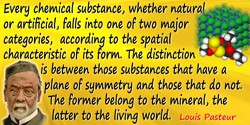
Every chemical substance, whether natural or artificial, falls into one of two major categories, according to the spatial characteristic of its form. The distinction is between those substances that have a plane of symmetry and those that do not. The former belong to the mineral, the latter to the living world.
Pasteur Vallery-Radot (ed.), Oeuvres de Pasteur (1922-1939), Vol. I, 331. Quoted in Patrice Debré, Louis Pasteur, trans. Elborg Forster (1994), 261.
Every creature alive on the earth today represents an unbroken line of life that stretches back to the first primitive organism to appear on this planet; and that is about three billion years.
In talk, 'Origin of Death' (1970).
Every day we are interacting with the economy, whether we want to or not, and whether we know it or not. To have a level of control over our lives, we need to understand the connections between money and events and ourselves.
As quoted in brochure for PBS TV financial news series, Adam Smith’s Money World.
Every form of life can be produced by physical forces in one of two ways: either by coming into being out of formless matter, or by the modification of an already existing form by a continued process of shaping. In the latter case the cause of this modification may lie either in the influence of a dissimilar male generative matter upon the female germ, or in the influence of other powers which operate only after procreation.
From Gottfried Reinhold Treviranus, The Biology or Philosophy of Animate Nature, as quoted in translation of Ernst Heinrich Philipp August Haeckel's 8th German edition with E. Ray Lankester (ed.), The History of Creation, or, the Development of the Earth and its Inhabitants by the Action of Natural Causes (1892), 95.
Every good thought you think is contributing its share to the ultimate result of your life.
…...
Every inhabitant of this planet must contemplate the day when this planet may no longer be habitable. Every man, woman and child lives under a nuclear sword of Damocles, hanging by the slenderest of threads, capable of being cut at any moment by accident or miscalculation or by madness. The weapons of war must be abolished before they abolish us.
Address to the United Nations General Assembly, (25 Sep 1961). On U.S. Department of State website.

Every living being is also a fossil. Within it, all the way down to the microscopic structure of its proteins, it bears the traces if not the stigmata of its ancestry.
In Jacques Monod and Austryn Wainhouse (trans.), Chance and Necessity: An Essay on the Natural Philosophy of Modern Biology (1972), 160.
Every living thing from a living thing.
Omne vivum ex vivo.
Omne vivum ex vivo.
Associated with Pasteur, perhaps because he popularized this as a motto, but it actually predates his birth. The Latin form is found attributed to William Harvey, for example, in O. v Boltenstern, Die neuere Geschichte der Medicin (1802), 109. Also attributed to Francesco Redi in Andrew Wilson, for example, in 'Science—Culture for the Masses', Science and Poetry: And Other Essays (1888), 31. Attribution to Pasteur can be found, for example, in F.G. Nagasaka, Robert S. Cohen, Japanese Studies in the Philosophy of Science (1998), 181.
Every living thing is made of cells, and everything a living thing does is done by the cells that make it up.
In The Center of Life: A Natural History of the Cell (1977, 1978), 6.
Every one of us can do something to protect and care for our planet. We have to live in such a way that a future will be possible for our children and our grandchildren. Our own life has to be. Our own life has to be our message.
In The World We Have: A Buddhist Approach to Peace and Ecology (2008), i.
Every rule has its limits, and every concept its ambiguities. Most of all is this true in the science of life, where nothing quite corresponds to our ideas; similar ends are reached by varied means, and no causes are simple.
In Internal Factors in Evolution (1965), 13.
Every student who enters upon a scientific pursuit, especially if at a somewhat advanced period of life, will find not only that he has much to learn, but much also to unlearn.
Outlines of Astronomy (1871), 11th edn., 1.
Every well established truth is an addition to the sum of human power, and though it may not find an immediate application to the economy of every day life, we may safely commit it to the stream of time, in the confident anticipation that the world will not fail to realize its beneficial results.
In 'Report of the Secretary', Annual Report of the Board of Regents of the Smithsonian Institution for 1856 (1857), 20.
Every word carries its own surprises and offers its own rewards to the reflective mind. Their amazing variety is a constant delight. I do not believe that I am alone in this—a fascination with words is shared by people in all countries and all walks of life.
The Science of Words (1991), preface, vii.
Everybody likes to hear about a man laying down his life for his country, but nobody wants to hear about a country giving her shirt for her planet.
In 'The Wild Flag', The New Yorker (9 Sep 1944), 35. Quote collected in In the Words of E.B. White: Quotations from America’s Most Companionable of Writers (2011), 150.
Everybody’s a mad scientist, and life is their lab. We’re all trying to experiment to find a way to live, to solve problems, to fend off madness and chaos.
In David Chronenberg and Chris Rodley (ed.), Chronenberg on Chronenberg (1992), 7. As cited in Carl Royer, B Lee Cooper, The Spectacle of Isolation in Horror Films: Dark Parades (2013), 55.
Everyone is aware of the difficult and menacing situation in which human society–shrunk into one community with a common fate–now finds itself, but only a few act accordingly. Most people go on living their every-day life: half frightened, half indifferent, they behold the ghostly tragicomedy which is being performed on the international stage before the eyes and ears of the world. But on that stage, on which the actors under the floodlights play their ordained parts, our fate of tomorrow, life or death of the nations, is being decided.
…...
Everything about microscopic life is terribly upsetting. How can things so small be so important?
Epigraph in Isaac Asimov’s Book of Science and Nature Quotations (1988), 156.
Evolution: At the Mind's Cinema
I turn the handle and the story starts:
Reel after reel is all astronomy,
Till life, enkindled in a niche of sky,
Leaps on the stage to play a million parts.
Life leaves the slime and through all ocean darts;
She conquers earth, and raises wings to fly;
Then spirit blooms, and learns how not to die,-
Nesting beyond the grave in others' hearts.
I turn the handle: other men like me
Have made the film: and now I sit and look
In quiet, privileged like Divinity
To read the roaring world as in a book.
If this thy past, where shall they future climb,
O Spirit, built of Elements and Time?
I turn the handle and the story starts:
Reel after reel is all astronomy,
Till life, enkindled in a niche of sky,
Leaps on the stage to play a million parts.
Life leaves the slime and through all ocean darts;
She conquers earth, and raises wings to fly;
Then spirit blooms, and learns how not to die,-
Nesting beyond the grave in others' hearts.
I turn the handle: other men like me
Have made the film: and now I sit and look
In quiet, privileged like Divinity
To read the roaring world as in a book.
If this thy past, where shall they future climb,
O Spirit, built of Elements and Time?
'Evolution: At the Mind's Cinema' (1922), in The Captive Shrew and Other Poems of a Biologist (1932), 55.
Exercise in the most rigorous thinking that is possible will of its own accord strengthen the sense of truth and right, for each advance in the ability to distinguish between correct and false thoughts, each habit making for rigour in thought development will increase in the sound pupil the ability and the wish to ascertain what is right in life and to defend it.
In Anleitung zum mathematischen Unterricht in den höheren Schulen (1906), 28.
Faced with a new mutation in an organism, or a fundamental change in its living conditions, the biologist is frequently in no position whatever to predict its future prospects. He has to wait and see. For instance, the hairy mammoth seems to have been an admirable animal, intelligent and well-accoutered. Now that it is extinct, we try to understand why it failed. I doubt that any biologist thinks he could have predicted that failure. Fitness and survival are by nature estimates of past performance.
In Scientific American (Sep 1958). As cited in '50, 100 & 150 years ago', Scientific American (Sep 2008), 299, No. 3, 14.
Facts are to the mind the same thing as food to the body. On the due digestion of facts depends the strength and wisdom of the one, just as vigor and health depend on the other. The wisest in council, the ablest in debate, and the most agreeable in the commerce of life is that man who has assimilated to his understanding the greatest number of facts.
Facts may belong to the past history of mankind, to the social statistics of our great cities, to the atmosphere of the most distant stars, to the digestive organs of a worm, or to the life of a scarcely visible bacillus. It is not the facts themselves which form science, but the method in which they are dealt with.
From The Grammar of Science (1892), 15.
Far and away the best prize that life has to offer is the chance to work hard at work worth doing.
From Address (7 Sep 1903), at the State Fair, Syracuse, N.Y., collected in Addresses and Presidential Messages of Theodore Roosevelt, 1902-1904 (1907), Vol. 1, 241.
Fear is the main source of superstition, and one of the main sources of cruelty. To conquer fear is the beginning of wisdom, in the pursuit of truth as in the endeavour after a worthy manner of life.
In An Outline of Intellectual Rubbish (1943), 23.
First follow Nature, and your judgment frame
By her just standard, which is still the same:
Unerring nature, still divinely bright,
One clear, unchanged, and universal light,
Life, force, and beauty must to all impart,
At once the source, and end, and test of art.
By her just standard, which is still the same:
Unerring nature, still divinely bright,
One clear, unchanged, and universal light,
Life, force, and beauty must to all impart,
At once the source, and end, and test of art.
#039;Essay On Criticism#039;, Miscellaneous Poems and Translations: by Several Hands (1720), 38.
First were mainframes, each shared by lots of people. Now we are in the personal computing era, person and machine staring uneasily at each other across the desktop. Next comes ubiquitous computing, or the age of calm technology, when technology recedes into the background of our lives.
From biography on University of California, Berkeley, website.
For a billion years the patient earth amassed documents and inscribed them with signs and pictures which lay unnoticed and unused. Today, at last, they are waking up, because man has come to rouse them. Stones have begun to speak, because an ear is there to hear them. Layers become history and, released from the enchanted sleep of eternity, life’s motley, never-ending dance rises out of the black depths of the past into the light of the present.
In 'Prologue', Conversation with the Earth (1954), 4. As translated by E.B. Garside from Gespräch mit der Erde (1947).
For a modern ruler the laws of conservation and transformation of energy, when the vivifing stream takes its source, the ways it wends its course in nature, and how, under wisdom and knowledge, it may be intertwined with human destiny, instead of careering headlong to the ocean, are a study at least as pregnant with consequences to life as any lesson taught by the long unscientific history of man.
Science and Life (1920), 5.
For God’s sake, please give it up. Fear it no less than the sensual passion, because it, too, may take up all your time and deprive you of your health, peace of mind and happiness in life.
Having himself spent a lifetime unsuccessfully trying to prove Euclid's postulate that parallel lines do not meet, Farkas discouraged his son János from any further attempt.
Having himself spent a lifetime unsuccessfully trying to prove Euclid's postulate that parallel lines do not meet, Farkas discouraged his son János from any further attempt.
Letter (1820) to his son, János Bolyai. Translation as in Philip J. Davis and Reuben Hersh, The Mathematical Experience (1981), 220. In Bill Swainson, Encarta Book of Quotations (2000), 124.
For if medicine is really to accomplish its great task, it must intervene in political and social life. It must point out the hindrances that impede the normal social functioning of vital processes, and effect their removal.
In Die einheitsrebungen in der wissenschaftlichen medicin (1849), 48. As quoted and citefd in Paul Farmer, Pathologies of Power (2004), 323.
For it is owing to their wonder that men now both begin and at first began to philosophize; they wondered originally at the obvious difficulties, then advanced little by little and stated difficulties about the greater matters, e.g. about the phenomena of the moon and those of the sun and the stars, and about the genesis of the universe. And a man who is puzzled and wonders thinks himself ignorant (whence even the lover of myth is in a sense a lover of wisdom, for myth is composed of wonders); therefore since they philosophized in order to escape from ignorance, evidently they were pursuing science in order to know, and not for any utilitarian end. And this is confirmed by the facts; for it was when almost all the necessities of life and the things that make for comfort and recreation were present, that such knowledge began to be sought. Evidently then we do not seek it for the sake of any advantage; but as the man is free, we say, who exists for himself and not for another, so we pursue this as the only free science, for it alone exists for itself.
Metaphysics, 982b, 12-27. In Jonathan Baines (ed.), The Complete Works of Aristotle (1984), Vol. 2, 1554.
For many of us, water simply flows from a faucet, and we think little about it beyond this point of contact. We have lost a sense of respect for the wild river, for the complex workings of a wetland, for the intricate web of life that water supports.
Last Oasis: Facing Water Scarcity (1997), 184.
For most of my life, one of the persons most baffled by my own work was myself.
Lecture, University of Maryland (Mar 2005).
For my own part I would as soon be descended from that heroic little monkey, who braved his dreaded enemy in order to save the life of his keeper; or from that old baboon, who, descending from the mountains, carried away in triumph his young comrade from a crowd of astonished dogs—as from a savage who delights to torture his enemies, offers up bloody sacrifices, practices infanticide without remorse, treats his wives like slaves, knows no decency, and is haunted by the grossest superstitions.
The Descent of Man (1871), Vol. 2, 404-5.
For some years I have been afflicted with the belief that flight is possible to man. My disease has increased in severity and I feel that it will soon cost me an increased amount of money if not my life.
Opening line his first letter (13 May 1900) to Octave Chanute. In Marvin W. McFarland (ed.) The Papers of Wilbur and Orville Wright: 1899-1905 (1953), Vol. 1, 13.
For terrestrial vertebrates, the climate in the usual meteorological sense of the term would appear to be a reasonable approximation of the conditions of temperature, humidity, radiation, and air movement in which terrestrial vertebrates live. But, in fact, it would be difficult to find any other lay assumption about ecology and natural history which has less general validity. … Most vertebrates are much smaller than man and his domestic animals, and the universe of these small creatures is one of cracks and crevices, holes in logs, dense underbrush, tunnels, and nests—a world where distances are measured in yards rather than miles and where the difference between sunshine and shadow may be the difference between life and death. Actually, climate in the usual sense of the term is little more than a crude index to the physical conditions in which most terrestrial animals live.
From 'Interaction of physiology and behavior under natural conditions', collected in R.I. Bowman (ed.), The Galapagos (1966), 40.
For the evolution of science by societies the main requisite is the perfect freedom of communication between each member and anyone of the others who may act as a reagent.
The gaseous condition is exemplified in the soiree, where the members rush about confusedly, and the only communication is during a collision, which in some instances may be prolonged by button-holing.
The opposite condition, the crystalline, is shown in the lecture, where the members sit in rows, while science flows in an uninterrupted stream from a source which we take as the origin. This is radiation of science. Conduction takes place along the series of members seated round a dinner table, and fixed there for several hours, with flowers in the middle to prevent any cross currents.
The condition most favourable to life is an intermediate plastic or colloidal condition, where the order of business is (1) Greetings and confused talk; (2) A short communication from one who has something to say and to show; (3) Remarks on the communication addressed to the Chair, introducing matters irrelevant to the communication but interesting to the members; (4) This lets each member see who is interested in his special hobby, and who is likely to help him; and leads to (5) Confused conversation and examination of objects on the table.
I have not indicated how this programme is to be combined with eating.
The gaseous condition is exemplified in the soiree, where the members rush about confusedly, and the only communication is during a collision, which in some instances may be prolonged by button-holing.
The opposite condition, the crystalline, is shown in the lecture, where the members sit in rows, while science flows in an uninterrupted stream from a source which we take as the origin. This is radiation of science. Conduction takes place along the series of members seated round a dinner table, and fixed there for several hours, with flowers in the middle to prevent any cross currents.
The condition most favourable to life is an intermediate plastic or colloidal condition, where the order of business is (1) Greetings and confused talk; (2) A short communication from one who has something to say and to show; (3) Remarks on the communication addressed to the Chair, introducing matters irrelevant to the communication but interesting to the members; (4) This lets each member see who is interested in his special hobby, and who is likely to help him; and leads to (5) Confused conversation and examination of objects on the table.
I have not indicated how this programme is to be combined with eating.
Letter to William Grylls Adams (3 Dec 1873). In P. M. Harman (ed.), The Scientific Letters and Papers of James Clerk Maxwell (1995), Vol. 2, 1862-1873, 949-50.
For the first time in my life I saw the horizon as a curved line. It was accentuated by a thin seam of dark blue light - our atmosphere. Obviously this was not the ocean of air I had been told it was so many times in my life. I was terrified by its fragile appearance.
…...
For the first time there was constructed with this machine [locomotive engine] a self-acting mechanism in which the interplay of forces took shape transparently enough to discern the connection between the heat generated and the motion produced. The great puzzle of the vital force was also immediately solved for the physiologist in that it became evident that it is more than a mere poetic comparison when one conceives of the coal as the food of the locomotive and the combustion as the basis for its life.
'Leid und Freude in der Naturforschung', Die Gartenlaube (1870), 359. Trans. Kenneth L. Caneva, Robert Mayer and the Conservation of Energy (1993), 145.
For the life of the flesh is in the blood.
— Bible
Leviticus 17:11.
For the most part we humans live with the false impression of security and a feeling of being at home in a seemingly trustworthy physical and human environment. But when the expected course of everyday life is interrupted, we are like shipwrecked people on a miserable plank in the open sea, having forgotten where they came from and not knowing whither they are drifting. But once we fully accept this, life becomes easier and there is no longer any disappointment.
…...
For the most part, Western medicine doctors are not healers, preventers, listeners, or educators. But they're damned good at saving a life and the other aspects kick the beam. It's about time we brought some balance back to the scale.
For the rest of my life I will reflect on what light is.
(1917). Quoted in Sidney Perkowitz, Empire of Light (1999), 69.
For the world, I count it not an inn, but an hospital, and a place, not to live, but to die in.
In Religio Medici (1642, 1754), pt. 2, sec. 11, 203.
For they are, in truth, textbooks of life: they gather outer and inner experiences into a general and connected whole.
In The Maxims and Reflections of Goethe (1906), 189.
For this knowledge of right living, we have sought a new name... . As theology is the science of religious life, and biology the science of [physical] life ... so let Oekology be henceforth the science of [our] normal lives ... the worthiest of all the applied sciences which teaches the principles on which to found... healthy... and happy life.
Quoted in Robert Clarke (ed.), Ellen Swallow: The Woman Who Founded Ecology (1973), 120.
For those of us who make only a brief study of chemistry, the benefits to be expected are of an indirect nature. Increased capacity for enjoyment, a livelier interest in the world in which we live, a more intelligent attitude toward the great questions of the day—these are the by-products of a well-balanced education, including chemistry in its proper relation to other studies.
In 'Introduction', General Chemistry: An Elementary Survey Emphasizing Industrial Applications of Fundamental Principles (1923), 4.
For three days now this angel, almost too heavenly for earth has been my fiancée … Life stands before me like an eternal spring with new and brilliant colours. Upon his engagement to Johanne Osthof of Brunswick; they married 9 Oct 1805.
Letter to Farkas Wolfgang Bolyai (1804). Quoted in Stephen Hawking, God Created the Integers: The Mathematical Breakthroughs (2005), 567.
For three million years we were hunter-gatherers, and it was through the evolutionary pressures of that way of life that a brain so adaptable and so creative eventually emerged. Today we stand with the brains of hunter-gatherers in our heads, looking out on a modern world made comfortable for some by the fruits of human inventiveness, and made miserable for others by the scandal of deprivation in the midst of plenty.
Co-author with American science writer Roger Amos Lewin (1946), Origins: What New Discoveries Reveal about the Emergence of our Species and its Possible Future (1977), 249.
For truly in nature there are many operations that are far more than mechanical. Nature is not simply an organic body like a clock, which has no vital principle of motion in it; but it is a living body which has life and perception, which are much more exalted than a mere mechanism or a mechanical motion.
The Principles of the Most Ancient and Modern Philosophy (1692), trans. and ed. Allison Coudert and Taylor Corse (1996), 64.
For who would live if life held no allurements?
Quoted, without citation, in front matter to T. A. Edison Foundation, Lewis Howard Latimer: A Black Inventor: a Biography and Related Experiments You Can Do (1973). If you know the primary source, please contact Webmaster.
For, dear me, why abandon a belief
Merely because it ceases to be true.
Cling to it long enough, and not a doubt
It will turn true again, for so it goes.
Most of the change we think we see in life
Is due to truths being in and out of favour.
Merely because it ceases to be true.
Cling to it long enough, and not a doubt
It will turn true again, for so it goes.
Most of the change we think we see in life
Is due to truths being in and out of favour.
'The Black Cottage'. In Edward Connery Latham (ed.), The Poetry of Robert Frost (1971), 77.
Forests … are in fact the world’s air-conditioning system—the very lungs of the planet—and help to store the largest body of freshwater on the planet … essential to produce food for our planet’s growing population. The rainforests of the world also provide the livelihoods of more than a billion of the poorest people on this Earth… In simple terms, the rainforests, which encircle the world, are our very life-support system—and we are on the verge of switching it off.
Presidential Lecture (3 Nov 2008) at the Presidential Palace, Jakarta, Indonesia. On the Prince of Wales website.
Form your life humanly, and you have done enough: but you will never reach the height of art and the depth of science without something divine.
Idea 68. In Friedrich Schlegel, translated by Ernst Behler and Roman Struc, Dialogue on Poetry and Literary Aphorisms (trans. 1968), 155.
Formerly one sought the feeling of the grandeur of man by pointing to his divine origin: this has now become a forbidden way, for at its portal stands the ape, together with other gruesome beasts, grinning knowingly as if to say: no further in this direction! One therefore now tries the opposite direction: the way mankind is going shall serve as proof of his grandeur and kinship with God. Alas this, too, is vain! At the end of this way stands the funeral urn of the last man and gravedigger (with the inscription “nihil humani a me alienum puto”). However high mankind may have evolved—and perhaps at the end it will stand even lower than at the beginning!— it cannot pass over into a higher order, as little as the ant and the earwig can at the end of its “earthly course” rise up to kinship with God and eternal life. The becoming drags the has-been along behind it: why should an exception to this eternal spectacle be made on behalf of some little star or for any little species upon it! Away with such sentimentalities!
Daybreak: Thoughts on the Prejudices of Morality (1881), trans. R. J. Hollingdale (1982), 32.
Fortunately analysis is not the only way to resolve inner conflicts. Life itself still remains a very effective therapist.
Our Inner Conflicts: A Constructive Theory of Neurosis (1945, 1999), 240.
Fossils, be it understood, are given botanical names and spoken of as if they were species, but they are merely the bits, however wonderfully preserved, of extinct beings: we are apt to forget in the explicit elegance of the structures made by cell-walls, that it is the living protoplasm which is plant life and makes species.
In The Life of Plants (1964, 2002), 177.
Four elements, hydrogen, carbon, oxygen and nitrogen, also provide an example of the astonishing togetherness of our universe. They make up the “organic” molecules that constitute living organisms on a planet, and the nuclei of these same elements interact to generate the light of its star. Then the organisms on the planet come to depend wholly on that starlight, as they must if life is to persist. So it is that all life on the Earth runs on sunlight. [Referring to photosynthesis]
In lecture, 'Life and Mind in the Universe', versions of which George Wald delivered throughout the 1980s. On the website of his son, Elijah Wald, who states it was the last of his father’s major lectures.
Free men are aware of the imperfection inherent in human affairs, and they are willing to fight and die for that which is not perfect. They know that basic human problems can have no final solutions, that our freedom, justice, equality, etc. are far from absolute, and that the good life is compounded of half measures, compromises, lesser evils, and gropings toward the perfect. The rejection of approximations and the insistence on absolutes are the manifestation of a nihilism that loathes freedom, tolerance, and equity.
In The Temper of Our Time (1967), 103.
From a drop of water a logician could predict an Atlantic or a Niagara without having seen or heard of one or the other. So all life is a great chain, the nature of which is known whenever we are shown a single link of it.
In A Study in Scarlet (1887, 1892), 27.
From all we have learnt about the structure of living matter, we must be prepared to find it working in a manner that cannot be reduced to the ordinary laws of physics. And that not on the ground that there is any “new force” or what not, directing the behavior of the single atoms within a living organism, but because the construction is different from anything we have yet tested in the physical laboratory.
What is Life? (1956), 74.
From packaging materials, through fibers, foams and surface coatings, to continuous extrusions and large-scale moldings, plastics have transformed almost every aspect of life. Without them, much of modern medicine would be impossible and the consumer electronics and computer industries would disappear. Plastic sewage and water pipes alone have made an immeasurable contribution to public health worldwide.
'Plastics—No Need To Apologize', Trends in Polymer Science (Jun 1996), 4, 172. In Paul C. Painter and Michael M. Coleman, Essentials of Polymer Science and Engineering (2008), 21.
From the age of 13, I was attracted to physics and mathematics. My interest in these subjects derived mostly from popular science books that I read avidly. Early on I was fascinated by theoretical physics and determined to become a theoretical physicist. I had no real idea what that meant, but it seemed incredibly exciting to spend one's life attempting to find the secrets of the universe by using one's mind.
From 'Autobiography', in Tore Frängsmyr (ed.) Les Prix Nobel. The Nobel Prizes 2004, (2005).
From the infinitely great down to the infinitely small, all things are subject to [the laws of nature]. The sun and the planets follow the laws discovered by Newton and Laplace, just as the atoms in their combinations follow the laws of chemistry, as living creatures follow the laws of biology. It is only the imperfections of the human mind which multiply the divisions of the sciences, separating astronomy from physics or chemistry, the natural sciences from the social sciences. In essence, science is one. It is none other than the truth.
From Cours d’Economie Politique (1896-97), as given in Archives Internationales d’Histoire des Sciences (1993), Issues 131-133, 67.
From the standpoint of observation, then, we must regard it as a highly probable hypothesis that the beginnings of the mental life date from as far back as the beginnings of life at large.
From the war of nature, from famine and death, the most exalted object which we are capable of conceiving, namely, the production of the higher animals, directly follows. There is grandeur in this view of life, with its several powers, having been originally breathed into a few forms or into one; and that, whilst this planet has gone cycling on according to the fixed law of gravity, from so simple a beginning endless forms most beautiful and most wonderful have been, and are being, evolved.
Concluding paragraph in The Origin of Species (1859), 490. In the second edition, Darwin changed “breathed” to “breathed by the Creator”.
Future generations are unlikely to condone our lack of prudent concern for the integrity of the natural world that supports all life.
Silent Spring (1962), 13.
Gaia is a thin spherical shell of matter that surrounds the incandescent interior; it begins where the crustal rocks meet the magma of the Earth’s hot interior, about 100 miles below the surface, and proceeds another 100 miles outwards through the ocean and air to the even hotter thermosphere at the edge of space. It includes the biosphere and is a dynamic physiological system that has kept our planet fit for life for over three billion years. I call Gaia a physiological system because it appears to have the unconscious goal of regulating the climate and the chemistry at a comfortable state for life. Its goals are not set points but adjustable for whatever is the current environment and adaptable to whatever forms of life it carries.
In The Revenge of Gaia: Earth’s Climate Crisis & The Fate of Humanity (2006, 2007), 19.
Genes make enzymes, and enzymes control the rates of chemical processes. Genes do not make ‘novelty seeking’ or any other complex and overt behavior. Predisposition via a long chain of complex chemical reactions, mediated through a more complex series of life’s circumstances, does not equal identification or even causation.
…...
God asks no man whether he will accept life. That is not the choice. You must accept it. The only choice is how.
Quoted in Kim Lim (ed.), 1,001 Pearls of Spiritual Wisdom: Words to Enrich, Inspire, and Guide Your Life (2014), 24
Gödel proved that the world of pure mathematics is inexhaustible; no finite set of axioms and rules of inference can ever encompass the whole of mathematics; given any finite set of axioms, we can find meaningful mathematical questions which the axioms leave unanswered. I hope that an analogous Situation exists in the physical world. If my view of the future is correct, it means that the world of physics and astronomy is also inexhaustible; no matter how far we go into the future, there will always be new things happening, new information coming in, new worlds to explore, a constantly expanding domain of life, consciousness, and memory.
From Lecture 1, 'Philosophy', in a series of four James Arthur Lectures, 'Lectures on Time and its Mysteries' at New York University (Autumn 1978). Printed in 'Time Without End: Physics and Biology in an Open Universe', Reviews of Modern Physics (Jul 1979), 51, 449.
Guard well your spare moments. They are like uncut diamonds. Discard them and their value will never be known. Improve them and they will become the brightest gems in a useful life.
…...
Habit is thus the enormous fly-wheel of society, its most precious conservative agent. It alone is what keeps us all within the bounds of ordinance, and saves the children of fortune from the envious uprisings of the poor. It alone prevents the hardest and most repulsive walks of life from being deserted by those brought up to tread therein.
'The Laws of Habit', The Popular Science Monthly (Feb 1887), 447.
Haldane could have made a success of any one of half a dozen careers—as mathematician, classical scholar, philosopher, scientist, journalist or imaginative writer. On his life’s showing he could not have been a politician, administrator (heavens, no!), jurist or, I think, a critic of any kind. In the outcome he became one of the three or four most influential biologists of his generation.
Essay, 'J.B.S.', in Pluto’s Republic: Incorporating The Art of the Soluble and Induction and Intuition in Scientific Thought (1982), collected in The Strange Case of the Spotted Mice and Other Classic Essays on Science (1996), 87.
Half the joy of life is in little things taken on the run… but let us keep our hearts
young and our eyes open that nothing worth our while shall escape us. That nothing worth our while shall escape us. And everything is worth its while if we only grasp it and its significance.
Found quoted without source in The American Journal of Clinical Medicine (1907), 14, 150, and several other publications of that time period. Webmaster invites help pinpointing the primary text.
Half the time of all medical men is wasted keeping life in human wrecks who have no more intelligible reason for hanging on than a cow has for giving milk.
…...
Have fun: You only go through life once, but if you play it right once is enough.
In J.S. "Torch" Lewis, 'Lear the Legend', Aviation Week & Space Technology (2 Jul 2001 ), 155 Supplement, No 1, 116
He had read much, if one considers his long life; but his contemplation was much more than his reading. He was wont to say that if he had read as much as other men he should have known no more than other men.
From 'Thomas Hobbes', in Andrew Clark (ed.) Brief Lives (1898), Vol. 1, 349.
He saw virus particles shaped like snakes, in negative images. They were white cobras tangled among themselves, like the hair of Medusa. They were the face of nature herself, the obscene goddess revealed naked. This life form thing was breathtakingly beautiful. As he stared at it, he found himself being pulled out of the human world into a world where moral boundaries blur and finally dissolve completely. He was lost in wonder and admiration, even though he knew that he was the prey.
The Hot Zone
He should avail himself of their resources in such ways as to advance the expression of the spirit in the life of mankind. He should use them so as to afford to every human being the greatest possible opportunity for developing and expressing his distinctively human capacity as an instrument of the spirit, as a centre of sensitive and intelligent awareness of the objective universe, as a centre of love of all lovely things, and of creative action for the spirit.
…...
He who appropriates land to himself by his labor, does not lessen but increases the common stock of mankind. For the provisions serving to the support of human life, produced by one acre of inclosed and cultivated land, are … ten times more than those which are yielded by an acre of land, of an equal richness lying waste in common. And therefore he that incloses land and has a greater plenty of the conveniences of life from ten acres than he could have from a hundred left to nature, may truly be said to give ninety acres to mankind.
In John Locke and Thomas Preston Peardon (ed.), The Second Treatise of Civil Government: An Essay Concerning the True Original, Extent and End of Civil Government (Dec 1689, 1952), 22.
He who does not believe that God is above all is either a fool or has no experience of life.
From the original Latin, “Deum qui non summum putet, Aut stultum aut rerum esse imperitum existumem,” in Incert. Fragment XV. As translated in Thomas Benfield Harbottle, Dictionary of Quotations (Classical) (1897), 44.
He who is not courageous enough to take risks will accomplish nothing in life.
In Ebony (1984), 40, 140.
He who would lead a Christ-like life is he who is perfectly and absolutely himself. He may be a great poet, or a great man of science, or a young student at the University, or one who watches sheep upon a moor, or a maker of dramas like Shakespeare, or a thinker about God, like Spinoza. or a child who plays in a garden, or a fisherman who throws his nets into the sea. It does not matter what he is as long as he realises the perfection of the soul that is within him.
In 'The Critic As Artist', Oscariana: Epigrams (1907), 27-28
He, who for an ordinary cause, resigns the fate of his patient to mercury, is a vile enemy to the sick; and, if he is tolerably popular, will, in one successful season, have paved the way for the business of life, for he has enough to do, ever afterward, to stop the mercurial breach of the constitutions of his dilapidated patients. He has thrown himself in fearful proximity to death, and has now to fight him at arm's length as long as the patient maintains a miserable existence.
Quoted by William M. Scribner, 'Treatment of Pneumonia and Croup, Once More, Etc,' in The Medical World (1885), 3, 187.
Heart and Brain are the two lords of life. In the metaphors of ordinary speech and in the stricter language of science, we use these terms to indicate two central powers, from which all motives radiate, to which all influences converge.
From 'The Principles of Success in Literature', The Fortnightly (1865), 1, 66.
Her [Rosalind Franklin] devotion to research showed itself at its finest in the last months of
her life. Although stricken with an illness which she knew would be fatal, she continued to work right up to the end.
In his obituary for Rosalind Franklin, Nature, 1958, 182, 154. As given in Andrew Brown, J.D. Bernal: The Sage of Science (2005), 359.
Heraclitus son of Bloson (or, according to some, of Herakon) of Ephesus. This man was at his prime in the 69th Olympiad. He grew up to be exceptionally haughty and supercilious, as is clear also from his book, in which he says: “Learning of many things does not teach intelligence; if so it would have taught Hesiod and Pythagoras, and again Xenophanes and Hecataeus.” … Finally he became a misanthrope, withdrew from the world, and lived in the mountains feeding on grasses and plants. However, having fallen in this way into a dropsy he came down to town and asked the doctors in a riddle if they could make a drought out of rainy weather. When they did not understand he buried himself in a cow-stall, expecting that the dropsy would be evaporated off by the heat of the manure; but even so he failed to effect anything, and ended his life at the age of sixty.
Diogenes Laertius 9.1. In G. S. Kirk, E. Raven, and M. Schofield (eds.), The Presocratic philosophers: A Critical History with a Selection of Texts (1983), 181.
Here are the most important pieces of advice that I’ve passed on to my children. One, remember to look up at the stars and not down at your feet. Two, never give up work. Work gives you meaning and purpose and life is empty without it. Three, if you are lucky enough to find love, remember it is rare and don’t throw it away.
From Interview with Diane Sawyer on ABC TV, World News Tonight (2010). As quoted in 'The Most Important Pieces of Advice Stephen Hawking Gave to his Children' (14 Mar 2018), on abcnews.go.com webpage.
Here I most violently want you to
Avoid one fearful error, a vicious flaw.
Don’t think that our bright eyes were made that we
Might look ahead; that hips and knees and ankles
So intricately bend that we might take
Big strides, and the arms are strapped to the sturdy shoulders
And hands are given for servants to each side
That we might use them to support our lives.
All other explanations of this sort
Are twisted, topsy-turvy logic, for
Nothing what is born produces its own use.
Sight was not born before the light of the eyes,
Nor were words and pleas created before the tongue
Rather the tongue’s appearance long preceded
Speech, and the ears were formed far earlier than
The sound first heard. To sum up, all the members
Existed, I should think, before their use,
So use has not caused them to have grown.
Avoid one fearful error, a vicious flaw.
Don’t think that our bright eyes were made that we
Might look ahead; that hips and knees and ankles
So intricately bend that we might take
Big strides, and the arms are strapped to the sturdy shoulders
And hands are given for servants to each side
That we might use them to support our lives.
All other explanations of this sort
Are twisted, topsy-turvy logic, for
Nothing what is born produces its own use.
Sight was not born before the light of the eyes,
Nor were words and pleas created before the tongue
Rather the tongue’s appearance long preceded
Speech, and the ears were formed far earlier than
The sound first heard. To sum up, all the members
Existed, I should think, before their use,
So use has not caused them to have grown.
In On the Nature of Things (1995), Book IV, lines 823-842, 145 as translated by Anthony M. Esolen.
Here I shall present, without using Analysis [mathematics], the principles and general results of the Théorie, applying them to the most important questions of life, which are indeed, for the most part, only problems in probability. One may even say, strictly speaking, that almost all our knowledge is only probable; and in the small number of things that we are able to know with certainty, in the mathematical sciences themselves, the principal means of arriving at the truth—induction and analogy—are based on probabilities, so that the whole system of human knowledge is tied up with the theory set out in this essay.
Philosophical Essay on Probabilities (1814), 5th edition (1825), trans. Andrew I. Dale (1995), 1.
Here is the element or power of conduct, of intellect and knowledge, of beauty, and of social life and manners, and all needful to build up a complete human life. … We have instincts responding to them all, and requiring them all, and we are perfectly civilized only when all these instincts of our nature—all these elements in our civilization have been adequately recognized and satisfied.
Collected in Tryon Edwards (ed.), A Dictionary of Thoughts: Being a Cyclopedia of Laconic Quotations from the Best Authors Both Ancient and Modern (1891), 75.
Here lies one who for medicines would not give
A little gold, and so his life he lost;
I fancy now he’d wish again to live,
Could he but guess how much his funeral cost.
A little gold, and so his life he lost;
I fancy now he’d wish again to live,
Could he but guess how much his funeral cost.
Here man is no longer the center of the world, only a witness, but a witness who is also a partner in the silent life of nature, bound by secret affinities to the trees.
From Presidential Address (20 Dec 1957), to the Annual Meeting of the Swedish Academy, 'The Linnaeus Tradition and Our Time', collected in Servant of Peace: A Selection of the Speeches and Statements of Dag Hammarskjöld, Secretary-General of the United Nations, 1953-1961 (1962), 153. Also in Public Papers of the Secretaries-General of the United Nations (1973), Vol. 3, 703.
Heredity is the general expression of the periodicity of organic life. All generations belong to a continuous succession of waves, in which every single one resembles its predecessors and its followers.
In 'On the Principles of Animal Morphology', Proceedings of the Royal Society of Edinburgh (1888), 15, 295. Original as Letter to Mr John Murray, communicated to the Society by Professor Sir William Turner. Page given as in collected volume published 1889.
His [Erwin Schrödinger's] private life seemed strange to bourgeois people like ourselves. But all this does not matter. He was a most lovable person, independent, amusing, temperamental, kind and generous, and he had a most perfect and efficient brain.
— Max Born
In My Life, Recollections of a Nobel Laureate (1978), 270. Quoted by Walter Moore, Schrödinger: Life and Thought (1992), 6.
His [Henry Cavendish’s] Theory of the Universe seems to have been, that it consisted solely of a multitude of objects which could be weighed, numbered, and measured; and the vocation to which he considered himself called was, to weigh, number and measure as many of those objects as his allotted three-score years and ten would permit. This conviction biased all his doings, alike his great scientific enterprises, and the petty details of his daily life.
In George Wilson, The Life of the Honourable Henry Cavendish: Including the Abstracts of his Important Scientific Papers (1851), 186.
His mother’s favorite, he [Freud] possessed the self-confidence that told him he would achieve something worth while in life, and the ambition to do so, though for long the direction this would take remained uncertain.
In The Life and Work of Sigmund Freud: The Formative Years and the Great Discoveries, 1856-1900 (1957), 15.
History without the history of science, to alter slightly an apothegm of Lord Bacon, resembles a statue of Polyphemus without his eye—that very feature being left out which most marks the spirit and life of the person. My own thesis is complementary: science taught ... without a sense of history is robbed of those very qualities that make it worth teaching to the student of the humanities and the social sciences.
'The History of Science and the Teaching of Science', in I. Bernard Cohen and Fletcher G. Watson (eds.), General Education in Science (1952), 71.
Hold fast to dreams for if dreams die, life is a broken winged bird that cannot fly.
…...
Honest pioneer work in the field of science has always been, and will continue to be, life’s pilot. On all sides, life is surrounded by hostility. This puts us under an obligation.
In Function of the Orgasm: Discovery of the Orgone (1927, 1973), 37.
Hope has as many lives as a cat or a king.
From Book III, 'A Talk on the Stairs', Hyperion: A Romance (1853), 213.
Hormones, vitamines, stimulants and depressives are oils upon the creaky machinery of life. Principal item, however, is the machinery.
How can Life grant us boon of living, compensate
For dull grey ugliness and pregnant hate
Unless we dare
The soul’s dominion? Each time we make a choice, we pay
With courage to behold the restless day,
And count it fair.
For dull grey ugliness and pregnant hate
Unless we dare
The soul’s dominion? Each time we make a choice, we pay
With courage to behold the restless day,
And count it fair.
From poem 'Courage' (1927), second half, included in magazine article by Marion Perkins, 'Who Is Amelia Earhart?', Survey (1 Jul 1928), 60. Quoted as epigraph, and cited in Mary S. Lovell, The Sound of Wings: The Life of Amelia Earhart (1989), ix.
How far do you go to preserve individual human life? … I mean, what are we to do with the NHS? How can you put a value in pounds, shillings and pence on an individual’s life? There was a case with a bowel cancer drug – if you gave that drug, which costs several thousand pounds, it continued life for six weeks on. How can you make that decision?
Answering “What is the most difficult ethical dilemma facing science today?” NHS is the British National Health Service, which has the difficulty of how to best allocate limited funding resources. From 'Interview: Of Mind and Matter: David Attenborough Meets Richard Dawkins', The Guardian (11 Sep 2010).
How greatly would the heroes and statesmen of antiquity have despised the labours of that man who devoted his life to investigate the properties of the magnet! Little could they anticipate that this humble mineral was destined to change the very form and condition of human society in every quarter of the globe.
In 'Observations on the Study of Mineralogy', The Philosophical Magazine and Journal (Jul 1819), 54, 46. Slightly edited and used by Joseph Henry in 'Introductory Lecture on Chemistry' (Jan-Mar 1832), The Papers of Joseph Henry, Vol. 1, 396.
How mysterious this life was, how deep and muddy its waters ran, yet how clear and noble what emerged from them.
Narcissus and Goldmund. Quoted in Kim Lim (ed.), 1,001 Pearls of Spiritual Wisdom: Words to Enrich, Inspire, and Guide Your Life (2014), 23
How peacefully he sleep!
Yet may his ever-questing spirit, freed at length
from all the frettings of this little world,
Wander at will among the uncharted stars.
Fairfield his name. Perchance celestial fields
disclosing long sought secrets of the past
Spread 'neath his enraptured gaze
And beasts and men that to his earthly sight
were merely bits of stone shall live again to
gladden those eager eyes.
o let us picture him—enthusiast—scientist—friend—
Seeker of truth and light through all eternity!
Yet may his ever-questing spirit, freed at length
from all the frettings of this little world,
Wander at will among the uncharted stars.
Fairfield his name. Perchance celestial fields
disclosing long sought secrets of the past
Spread 'neath his enraptured gaze
And beasts and men that to his earthly sight
were merely bits of stone shall live again to
gladden those eager eyes.
o let us picture him—enthusiast—scientist—friend—
Seeker of truth and light through all eternity!
New York Sun (13 Nov 1935). Reprinted in 'Henry Fairfield Osborn', Supplement to Natural History (Feb 1936), 37:2, 135. Bound in Kofoid Collection of Pamphlets on Biography, University of California.
How strange is the lot of us mortals! Each of us is here for a brief sojourn; for what purpose he knows not, though he sometimes thinks he senses it. But without deeper reflection one knows from daily life that one exists for other people–first of all for those upon whose smiles and well-being our own happiness is wholly dependent, and then for the many, unknown to us, to whose destinies we are bound by the ties of sympathy. A hundred times every day I remind myself that my inner and outer life are based on the labors of other men, living and dead, and that I must exert myself in order to give in the same measure as I have received and am still receiving.
…...
However improbable we regard [the spontaneous origin of life],… it will almost certainly happen at least once…. The time… is of the order of two billion years.… Given so much time, the “impossible” becomes possible, the possible probable, and the probable virtually certain. One only has to wait: time itself performs the miracles.
In 'The Origin of Life', Scientific American (Aug 1954), 191, No. 2, 46. Note that the quoted time of 2 billion years is rejected as impossibly short by such authors as H. J. Morowitz, in Energy Flow in Biology (1968), 317.
Hudson is at his best about the greatest living English stylist ... Besides this he is the finest living observer, and the greatest living lover of bird and animal life, and of Nature in her moods.
Letter to A.A. Knopf, 4 Jan 1915.
Human behaviour reveals uniformities which constitute natural laws. If these uniformities did not exist, then there would be neither social science nor political economy, and even the study of history would largely be useless. In effect, if the future actions of men having nothing in common with their past actions, our knowledge of them, although possibly satisfying our curiosity by way of an interesting story, would be entirely useless to us as a guide in life.
In Cours d’Economie Politique (1896-7), Vol. 2, 397.
Human blood is a testament to life’s origin in the ocean: its chemical composition is nearly identical to that of sea-water.
In 'Ocean Policy and Reasonable Utopias', The Forum (Summer 1981), 16, No. 5, 900.
Human consciousness is just about the last surviving mystery. A mystery is a phenomenon that people don’t know how to think about—yet. There have been other great mysteries: the mystery of the origin of the universe, the mystery of life and reproduction, the mystery of the design to be found in nature, the mysteries of time, space, and gravity. These were not just areas of scientific ignorance, but of utter bafflement and wonder. We do not yet have the final answers to any of the questions of cosmology and particle physics, molecular genetics and evolutionary theory, but we do know how to think about them. The mysteries haven't vanished, but they have been tamed. They no longer overwhelm our efforts to think about the phenomena, because now we know how to tell the misbegotten questions from the right questions, and even if we turn out to be dead wrong about some of the currently accepted answers, we know how to go about looking for better answers. With consciousness, however, we are still in a terrible muddle. Consciousness stands alone today as a topic that often leaves even the most sophisticated thinkers tongue-tied and confused. And, as with all the earlier mysteries, there are many who insist—and hope—that there will never be a demystification of consciousness.
Consciousness Explained (1991), 21-22.
Human evolution is nothing else but the natural continuation, at a collective level, of the perennial and cumulative process of “psychogenetic” arrangement of matter which we call life. … The whole history of mankind has been nothing else (and henceforth it will never be anything else) but an explosive outburst of ever-growing cerebration. … Life, if fully understood, is not a freak in the universe—nor man a freak in life. On the contrary, life physically culminates in man, just as energy physically culminates in life.
(1952). As quoted in Stephen Jay Gould, Hen's Teeth and Horse's Toes: Further Reflections in Natural History (1984, 1994), 246.
Human life is proverbially uncertain; few things are more certain than the solvency of a life-insurance company.
In The Nature of the Physical World (1928), 300.
Human personality resembles a coral reef: a large hard/dead structure built and inhabited by tiny soft/live animals. The hard/dead part of our personality consists of habits, memories, and compulsions and will probably be explained someday by some sort of extended computer metaphor. The soft/live part of personality consists of moment-to-moment direct experience of being. This aspect of personality is familiar but somewhat ineffable and has eluded all attempts at physical explanation.
Quoted in article 'Nick Herbert', in Gale Cengage Learning, Contemporary Authors Online (2002).
Humanity certainly needs practical men, who get the most out of their work, and, without forgetting the general good, safeguard their own interests. But humanity also needs dreamers, for whom the disinterested development of an enterprise is so captivating that it becomes impossible for them to devote their care to their own material profit. Without the slightest doubt, these dreamers do not deserve wealth, because they do not desire it. Even so, a well-organised society should assure to such workers the efficient means of accomplishing their task, in a life freed from material care and freely consecrated to research.
In Eve Curie, Madame Curie: A Biography by Eve Curie (1938, 2007), 344.
Humanity is cutting down its forests, apparently oblivious to the fact that we may not be able to live without them.
Epigraph in Isaac Asimov’s Book of Science and Nature Quotations (1988), 101.
Humanity is exalted not because we are so far above other living creatures, but because knowing them well elevates the very concept of life.
In Biophilia (1984, 2009), 22.
I agree with Schopenhauer that one of the most powerful motives that attracts people to science and art is the longing to escape from everyday life.
Quoted, without citation in Bulletin of the Atomic Scientists (Feb 1959), 85. If you know a primary source, please contact Webmaster.
I am absolutely enraptured by the atmosphere of a wreck. A dead ship is the house of a tremendous amount of life—fish and plants. The mixture of life and death is mysterious, even religious. There is the same sense of peace and mood that you feel on entering a cathedral.
Quoted in 'Sport: Poet of the Depths', Time (28 Mar 1960)
I am almost thanking God that I was never educated, for it seems to me that 999 of those who are so, expensively and laboriously, have lost all before they arrive at my age—& remain like Swift's Stulbruggs—cut and dry for life, making no use of their earlier-gained treasures:—whereas, I seem to be on the threshold of knowledge.
In Vivien Noakes, Edward Lear: the Life of a Wanderer (1969), 22.
I am among the most durable and passionate participants in the scientific exploration of the solar system, and I am a long-time advocate of the application of space technology to civil and military purposes of direct benefit to life on Earth and to our national security.
In 'Is Human Spaceflight Obsolete?' Quoted in Issues in Science and Technology (Summer 2004).
I am an organic chemist, albeit one who adheres to the definition of organic chemistry given by the great Swedish chemist Berzelius, namely, the chemistry of substances found in living matter, and my science is one of the more abstruse insofar as it rests on concepts and employs a jargon neither of which is a part of everyday experience. Nevertheless, organic chemistry deals with matters of truly vital Importance and in some of its aspects with which I myself have been particularly concerned it may prove to hold the keys to Life itself.
In 'Synthesis in the Study of Nucleotides', Nobel Lecture, 11 December 1957. In Nobel Lectures: Chemistry 1942-1962 (1964), 522.
I am aware of some of the tragic repercussions of the chemical fight against insects taking place in France and elsewhere, and I deplore them. Modern man no longer knows how to foresee or to forestall. He will end by destroying the earth from which he and other living creatures draw their food. Poor bees, poor birds, poor men...
In Ann Cottrell Free (ed.), Animals, Nature and Albert Schweitzer (1982). Rachel Carson dedicated her book Silent Spring (1962) to Albert Schweitzer, with his words, “Modern man no longer knows how to foresee or to forestall. He will end by destroying the earth.”
I am besotted with birds of paradise. Watching them display is the most extraordinary thing I’ve ever seen in my life.
From interview with Alice Roberts, 'Attenborough: My Life on Earth', The Biologist (Aug 2015), 62, No. 4, 16.
I am glad that the life of pandas is so dull by human standards, for our efforts at conservation have little moral value if we preserve creatures only as human ornaments; I shall be impressed when we show solicitude for warty toads and slithering worms.
…...
I am inclined to think I shall owe ten years of my life to the good effects of the gas, for I inhale about 20 gallons every day in showing patients how to commence. The gas is just like air, only containing a little more oxygen. Oxygen is what gives life and vitality to the blood. We live on oxygen.
Quoted in The Electrical Review (11 Aug 1893), Vol. 33, 143.
I am not insensible to natural beauty, but my emotional joys center on the improbable yet sometimes wondrous works of that tiny and accidental evolutionary twig called Homo sapiens. And I find, among these works, nothing more noble than the history of our struggle to understand nature—a majestic entity of such vast spatial and temporal scope that she cannot care much for a little mammalian afterthought with a curious evolutionary invention, even if that invention has, for the first time in so me four billion years of life on earth, produced recursion as a creature reflects back upon its own production and evolution. Thus, I love nature primarily for the puzzles and intellectual delights that she offers to the first organ capable of such curious contemplation.
…...
I am of the decided opinion, that mathematical instruction must have for its first aim a deep penetration and complete command of abstract mathematical theory together with a clear insight into the structure of the system, and doubt not that the instruction which accomplishes this is valuable and interesting even if it neglects practical applications. If the instruction sharpens the understanding, if it arouses the scientific interest, whether mathematical or philosophical, if finally it calls into life an esthetic feeling for the beauty of a scientific edifice, the instruction will take on an ethical value as well, provided that with the interest it awakens also the impulse toward scientific activity. I contend, therefore, that even without reference to its applications mathematics in the high schools has a value equal to that of the other subjects of instruction.
In 'Ueber das Lehrziel im mathemalischen Unterricht der höheren Realanstalten', Jahresbericht der Deutschen Mathematiker Vereinigung, 2, 192. (The Annual Report of the German Mathematical Association. As translated in Robert Édouard Moritz, Memorabilia Mathematica; Or, The Philomath’s Quotation-Book (1914), 73.
I am particularly concerned to determine the probability of causes and results, as exhibited in events that occur in large numbers, and to investigate the laws according to which that probability approaches a limit in proportion to the repetition of events. That investigation deserves the attention of mathematicians because of the analysis required. It is primarily there that the approximation of formulas that are functions of large numbers has its most important applications. The investigation will benefit observers in identifying the mean to be chosen among the results of their observations and the probability of the errors still to be apprehended. Lastly, the investigation is one that deserves the attention of philosophers in showing how in the final analysis there is a regularity underlying the very things that seem to us to pertain entirely to chance, and in unveiling the hidden but constant causes on which that regularity depends. It is on the regularity of the main outcomes of events taken in large numbers that various institutions depend, such as annuities, tontines, and insurance policies. Questions about those subjects, as well as about inoculation with vaccine and decisions of electoral assemblies, present no further difficulty in the light of my theory. I limit myself here to resolving the most general of them, but the importance of these concerns in civil life, the moral considerations that complicate them, and the voluminous data that they presuppose require a separate work.
Philosophical Essay on Probabilities (1825), trans. Andrew I. Dale (1995), Introduction.
I am satisfied with the mystery of life’s eternity and with a knowledge, a sense, of the marvelous structure of existence–as well as the humble attempt to understand even a tiny portion of the Reason that manifests itself in nature.
…...
I am sorry to say that there is too much point to the wisecrack that life is extinct on other planets because their scientists were more advanced than ours.
From Speech (11 Dec 1959) at Washington, D.C., 'Disarmament', printed in President John F. Kennedy, A Grand and Global Alliance (1968), 1.
I ask any one who has adopted the calling of an engineer, how much time he lost when he left school, because he had to devote himself to pursuits which were absolutely novel and strange, and of which he had not obtained the remotest conception from his instructors? He had to familiarize himself with ideas of the course and powers of Nature, to which his attention had never been directed during his school-life, and to learn, for the first time, that a world of facts lies outside and beyond the world of words.
From After-Dinner Speech (Apr 1869) delivered before the Liverpool Philomathic Society, 'Scientific Education', collected in Lay Sermons, Addresses, and Reviews (1870), 63. Previously published in Macmillan’s Magazine.
I ask myself whether the huge national commitment of technical talent to human spaceflight and the ever-present potential for the loss of precious human life are really justifiable.
In 'Is Human Spaceflight Obsolete?', Issues in Science and Technology (Summer 2004). [Note: published one year after the loss of seven lives in the Space Shuttle Columbia disaster. —Webmaster]
I attained a triumph so complete that it is now rare to meet an American with marks of small pox on his face... Benefits are valuable according to their duration and extent, like the showers from heaven, but the benign remedy Vaccination saves millions of lives every century, like the blessing of the sun, universal and everlasting.
(Remark made near the end of his life.)
(Remark made near the end of his life.)
I believe in an immortal soul. science has proved that nothing disintegrates into nothingness. Life and soul, therefore, cannot disintegrate into nothingness, and so are immortal.
…...
I believe it’s worth emphasizing that a scientist and a graduate student in college, and a kid in grammar school all can start with understanding something new by exploring even the simplest and most common forms of life you find right in the heart of the city. Along a fringe of a street, along the edges and into a city park, is a multitude of species, of associations, of phenomena going on that scientists themselves have not fully come to understand.
From interview with National Geographic, in Andrew Revkin, 'Conservation Legend Has Big Plans For Future', on nationalgeographic.com website.
I believe that life can go on forever. It takes a million years to evolve a new species, ten million for a new genus, one hundred million for a class, a billion for a phylum—and that’s usually as far as your imagination goes. In a billion years, it seems, intelligent life might be as different from humans as humans are from insects. But what would happen in another ten billion years? It’s utterly impossible to conceive of ourselves changing as drastically as that, over and over again. All you can say is, on that kind of time scale the material form that life would take is completely open. To change from a human being to a cloud may seem a big order, but it’s the kind of change you’d expect over billions of years.
Quoted in Omni (1986), 8, 38.
I believe that the human mind, or even the mind of a cat, is more interesting in its complexity than an entire galaxy if it is devoid of life.
In Kendrick Frazier, 'A Mind at Play: An Interview with Martin Gardner', Skeptical Inquirer (Mar/Apr 1998), 37.
I believe that the useful methods of mathematics are easily to be learned by quite young persons, just as languages are easily learned in youth. What a wondrous philosophy and history underlie the use of almost every word in every language—yet the child learns to use the word unconsciously. No doubt when such a word was first invented it was studied over and lectured upon, just as one might lecture now upon the idea of a rate, or the use of Cartesian co-ordinates, and we may depend upon it that children of the future will use the idea of the calculus, and use squared paper as readily as they now cipher. … When Egyptian and Chaldean philosophers spent years in difficult calculations, which would now be thought easy by young children, doubtless they had the same notions of the depth of their knowledge that Sir William Thomson might now have of his. How is it, then, that Thomson gained his immense knowledge in the time taken by a Chaldean philosopher to acquire a simple knowledge of arithmetic? The reason is plain. Thomson, when a child, was taught in a few years more than all that was known three thousand years ago of the properties of numbers. When it is found essential to a boy’s future that machinery should be given to his brain, it is given to him; he is taught to use it, and his bright memory makes the use of it a second nature to him; but it is not till after-life that he makes a close investigation of what there actually is in his brain which has enabled him to do so much. It is taken because the child has much faith. In after years he will accept nothing without careful consideration. The machinery given to the brain of children is getting more and more complicated as time goes on; but there is really no reason why it should not be taken in as early, and used as readily, as were the axioms of childish education in ancient Chaldea.
In Teaching of Mathematics (1902), 14.
I believe with Schopenhauer that one of the strongest motives that lead men to art and science is escape from everyday life with its painful crudity and hopeless dreariness, from the fetters of one’s own ever shifting desires. A finely tempered nature longs to escape from personal life into the world of objective perception and thought; this desire may be compared with the townsman’s irresistible longing to escape from his noisy, cramped surroundings into the silence of high mountains, where the eye ranges freely through the still, pure air and fondly traces out the restful contours apparently built for eternity.
Address at The Physical Society, Berlin (1918) for Max Planck’s 60th birthday, 'Principles of Research', collected in Essays in Science (1934) 2.
I came from Paris in the Spring of 1884, and was brought in intimate contact with him [Thomas Edison]. We experimented day and night, holidays not excepted. His existence was made up of alternate periods of work and sleep in the laboratory. He had no hobby, cared for no sport or amusement of any kind and lived in utter disregard of the most elementary rules of hygiene. There can be no doubt that, if he had not married later a woman of exceptional intelligence, who made it the one object of her life to preserve him, he would have died many years ago from consequences of sheer neglect. So great and uncontrollable was his passion for work.
As quoted in 'Tesla Says Edison Was an Empiricist', The New York Times (19 Oct 1931), 25.
I came to biochemistry through chemistry; I came to chemistry, partly by the labyrinthine routes that I have related, and partly through the youthful romantic notion that the natural sciences had something to do with nature. What I liked about chemistry was its clarity surrounded by darkness; what attracted me, slowly and hesitatingly, to biology was its darkness surrounded by the brightness of the givenness of nature, the holiness of life. And so I have always oscillated between the brightness of reality and the darkness of the unknowable. When Pascal speaks of God in hiding, Deus absconditus, we hear not only the profound existential thinker, but also the great searcher for the reality of the world. I consider this unquenchable resonance as the greatest gift that can be bestowed on a naturalist.
Heraclitean Fire: Sketches from a Life before Nature (1978), 55.
I can conceive few human states more enviable than that of the man to whom, panting in the foul laboratory, or watching for his life under the tropic forest, Isis shall for a moment lift her sacred veil, and show him, once and for ever, the thing he dreamed not of; some law, or even mere hint of a law, explaining one fact; but explaining with it a thousand more, connecting them all with each other and with the mighty whole, till order and meaning shoots through some old Chaos of scattered observations.
Health and Education (1874), 289.
I can live with doubt and uncertainty. I think it’s much more interesting to live not knowing than to have answers which might be wrong.
From transcript of a BBC television program, 'The Pleasure of Finding Things Out' (1981). In Richard Phillips Feynman and Jeffrey Robbins (ed.), The Pleasure of Finding Things Out: the Best Short Works of Richard P. Feynman (2000), 24.
I can see him [Sylvester] now, with his white beard and few locks of gray hair, his forehead wrinkled o’er with thoughts, writing rapidly his figures and formulae on the board, sometimes explaining as he wrote, while we, his listeners, caught the reflected sounds from the board. But stop, something is not right, he pauses, his hand goes to his forehead to help his thought, he goes over the work again, emphasizes the leading points, and finally discovers his difficulty. Perhaps it is some error in his figures, perhaps an oversight in the reasoning. Sometimes, however, the difficulty is not elucidated, and then there is not much to the rest of the lecture. But at the next lecture we would hear of some new discovery that was the outcome of that difficulty, and of some article for the Journal, which he had begun. If a text-book had been taken up at the beginning, with the intention of following it, that text-book was most likely doomed to oblivion for the rest of the term, or until the class had been made listeners to every new thought and principle that had sprung from the laboratory of his mind, in consequence of that first difficulty. Other difficulties would soon appear, so that no text-book could last more than half of the term. In this way his class listened to almost all of the work that subsequently appeared in the Journal. It seemed to be the quality of his mind that he must adhere to one subject. He would think about it, talk about it to his class, and finally write about it for the Journal. The merest accident might start him, but once started, every moment, every thought was given to it, and, as much as possible, he read what others had done in the same direction; but this last seemed to be his real point; he could not read without finding difficulties in the way of understanding the author. Thus, often his own work reproduced what had been done by others, and he did not find it out until too late.
A notable example of this is in his theory of cyclotomic functions, which he had reproduced in several foreign journals, only to find that he had been greatly anticipated by foreign authors. It was manifest, one of the critics said, that the learned professor had not read Rummer’s elementary results in the theory of ideal primes. Yet Professor Smith’s report on the theory of numbers, which contained a full synopsis of Kummer’s theory, was Professor Sylvester’s constant companion.
This weakness of Professor Sylvester, in not being able to read what others had done, is perhaps a concomitant of his peculiar genius. Other minds could pass over little difficulties and not be troubled by them, and so go on to a final understanding of the results of the author. But not so with him. A difficulty, however small, worried him, and he was sure to have difficulties until the subject had been worked over in his own way, to correspond with his own mode of thought. To read the work of others, meant therefore to him an almost independent development of it. Like the man whose pleasure in life is to pioneer the way for society into the forests, his rugged mind could derive satisfaction only in hewing out its own paths; and only when his efforts brought him into the uncleared fields of mathematics did he find his place in the Universe.
A notable example of this is in his theory of cyclotomic functions, which he had reproduced in several foreign journals, only to find that he had been greatly anticipated by foreign authors. It was manifest, one of the critics said, that the learned professor had not read Rummer’s elementary results in the theory of ideal primes. Yet Professor Smith’s report on the theory of numbers, which contained a full synopsis of Kummer’s theory, was Professor Sylvester’s constant companion.
This weakness of Professor Sylvester, in not being able to read what others had done, is perhaps a concomitant of his peculiar genius. Other minds could pass over little difficulties and not be troubled by them, and so go on to a final understanding of the results of the author. But not so with him. A difficulty, however small, worried him, and he was sure to have difficulties until the subject had been worked over in his own way, to correspond with his own mode of thought. To read the work of others, meant therefore to him an almost independent development of it. Like the man whose pleasure in life is to pioneer the way for society into the forests, his rugged mind could derive satisfaction only in hewing out its own paths; and only when his efforts brought him into the uncleared fields of mathematics did he find his place in the Universe.
In Florian Cajori, Teaching and History of Mathematics in the United States (1890), 266-267.
I can’t recall a single problem in my life, of any sort, that I ever started on that I didn't solve, or prove that I couldn’t solve it. I never let up, until I had done everything that I could think of, no matter how absurd it might seem as a means to the end I was after.
As quoted in French Strother, 'The Modern Profession of Inventing', World's Work and Play (Jul 1905), 6, No. 32, 186.
I cannot accept any concept of God based on the fear of life or the fear of death, or blind faith.
As recollected from a visit some months earlier, and quoted in William Miller, 'Old Man’s Advice to Youth: “Never Lose a Holy Curiosity”', Life (2 May 1955), 62.
I cannot face with comfort the idea of life without work; work and the free play of the imagination are for me the same thing, I take no pleasure in anything else.
Letter to Oskar Pfister, 3 Jun 1910. Quoted in H. Meng and E. Freud (eds.), Psycho-Analysis and Faith: The Letters of Sigmund Freud and Oskar Pfister (1963), 146.
I cannot find anything showing early aptitude for acquiring languages; but that he [Clifford] had it and was fond of exercising it in later life is certain. One practical reason for it was the desire of being able to read mathematical papers in foreign journals; but this would not account for his taking up Spanish, of which he acquired a competent knowledge in the course of a tour to the Pyrenees. When he was at Algiers in 1876 he began Arabic, and made progress enough to follow in a general way a course of lessons given in that language. He read modern Greek fluently, and at one time he was furious about Sanskrit. He even spent some time on hieroglyphics. A new language is a riddle before it is conquered, a power in the hand afterwards: to Clifford every riddle was a challenge, and every chance of new power a divine opportunity to be seized. Hence he was likewise interested in the various modes of conveying and expressing language invented for special purposes, such as the Morse alphabet and shorthand. … I have forgotten to mention his command of French and German, the former of which he knew very well, and the latter quite sufficiently; …
In paper, 'William Kingdon Clifford', The Fortnightly Review (1879), 31, 671. Published in advance of Leslie Stephen and Frederick Pollock (eds.), Clifford’s Lectures and Essays (1879), Vol. 1, Introduction, 9. The 'Introduction' was written by Pollock.
I cannot imagine a God who rewards and punishes the objects of his creation, whose purposes are modeled after our own–a God, in short, who is but a reflection of human frailty. Neither can I believe that the individual survives the death of his body, although feeble souls harbor such thoughts through fear or ridiculous egotism. It is enough for me to contemplate the mystery of conscious life perpetuating itself through all eternity, to reflect upon the marvelous structure of the universe which we can dimly perceive, and to try humbly to comprehend even an infinitesimal part of the intelligence manifested in nature.
From 'What I Believe: Living Philosophies XIII', Forum and Century (Oct 1930), 84, No. 4, 194. Article in full, reprinted in Edward H. Cotton (ed.), Has Science Discovered God? A Symposium of Modern Scientific Opinion (1931), 97.
I cannot let the year run out without sending you a sign of my continued existence and to extend my sincere wishes for the well-being of you and your dear ones in the New Year. We will not be able to send New Year greetings much longer; but even when we have passed away and have long since decomposed, the bonds that united us in life will remain and we shall be remembered as a not too common example of two men, who truly without envy and jealousy, contended and struggled in the same field, yet nevertheless remained always closely bound in friendship.
Letter from Liebig to Wohler (31 Dec 1871). Quoted in Ralph Oesper, The Human Side of Scientists (1975), 206.
I cannot think of a single field in biology or medicine in which we can claim genuine understanding, and it seems to me the more we learn about living creatures, especially ourselves, the stranger life becomes.
In 'On Science and Certainty', Discover Magazine (Oct 1980).
I complained to Mr. Johnson that I was much afflicted with melancholy, which was hereditary in our family. He said that he himself had been greatly distressed with it, and for that reason had been obliged to fly from study and meditation to the dissipating variety of life. He advised me to have constant occupation of mind, to take a great deal of exercise, and to live moderately; especially to shun drinking at night. “Melancholy people,” said he, are apt to fly to intemperance, which gives a momentary relief but sinks the soul much lower in misery.” He observed that laboring men who work much and live sparingly are seldom or never troubled with low spirits.
I confess that Magic teacheth many superfluous things, and curious prodigies for ostentation; leave them as empty things, yet be not ignorant of their causes. But those things which are for the profit of men—for the turning away of evil events, for the destroying of sorceries, for the curing of diseases, for the exterminating of phantasms, for the preserving of life, honor, or fortune—may be done without offense to God or injury to religion, because they are, as profitable, so necessary.
In De Occulta Philosophia (1533), Vol. 1. Translation by J.F. (1651) reprinted as The Philosophy of Natural Magic (1913), 28.
I could fill an entire second life with working on my prints.
As quoted on the website mcescher.com, without citation.
I decided that life rationally considered seemed pointless and futile, but it is still interesting in a variety of ways, including the study of science. So why not carry on, following the path of scientific hedonism? Besides, I did not have the courage for the more rational procedure of suicide.
Life of a Scientist (1989), 24.
I decided to study science and, on arrival at Cambridge, became extremely excited and interested in biochemistry when I first heard about it…. It seemed to me that here was a way to really understand living matter and to develop a more scientific basis to many medical problems.
From biographical sketch in Wilhelm Odelberg (ed.) Les Prix Nobel. The Nobel Prizes 1980, (1981).
I definitely deny that any pathological process, i.e. any life-process taking place under unfavourable circumstances, is able to call forth qualitatively new formations lying beyond the customary range of forms characteristic of the species. All pathological formations are either degenerations, transformations, or repetitions of typical physiological structures.
In 'Cellular-Pathologie', Archiv für pathologische Anatomie und Physiologie und fur klinische Medizin (1855), 8, 13-14, as translated in LellandJ. Rather, 'Cellular Pathology', Disease, Life, and Man: Selected Essays by Rudolf Virchow (1958), 81.
I do not believe in freedom of the will. Schopenhauer’s words: ‘Man can do what he wants, but he cannot will what he wills’ accompany me in all situations throughout my life and reconcile me with the actions of others even if they are rather painful to me. This awareness of the lack of freedom of will preserves me from taking too seriously myself and my fellow men as acting and deciding individuals and from losing my temper.
…...
I do not believe that a moral philosophy can ever be founded on a scientific basis. … The valuation of life and all its nobler expressions can only come out of the soul’s yearning toward its own destiny. Every attempt to reduce ethics to scientific formulas must fail. Of that I am perfectly convinced.
In 'Science and God: A Dialogue', Forum and Century (June 1930), 83, 374. Einstein’s dialogue was with James Murphy and J.W.N. Sullivan. Excerpted in David E. Rowe and Robert J. Schulmann, Einstein on Politics: His Private Thoughts and Public Stands on Nationalism, Zionism, War, Peace, and the Bomb (2007), 230. The book introduces this quote as Einstein’s reply when Murphy asked, in the authors’ words, “how far he thought modern science might be able to go toward establishing practical ideals of life on the ruins of religious ideals.”
I do not believe that science per se is an adequate source of happiness, nor do I think that my own scientific outlook has contributed very greatly to my own happiness, which I attribute to defecating twice a day with unfailing regularity. Science in itself appears to me neutral, that is to say, it increases men’s power whether for good or for evil. An appreciation of the ends of life is something which must be superadded to science if it is to bring happiness, but only the kind of society to which science is apt to give rise. I am afraid you may be disappointed that I am not more of an apostle of science, but as I grow older, and no doubt—as a result of the decay of my tissues, I begin to see the good life more and more as a matter of balance and to dread all over-emphasis upon anyone ingredient.
Letter to W. W. Norton, Publisher (27 Jan 1931). In The Autobiography of Bertrand Russell, 1914-1944 (1968), Vol. 2, 200.
I do not maintain that the chief value of the study of arithmetic consists in the lessons of morality that arise from this study. I claim only that, to be impressed from day to day, that there is something that is right as an answer to the questions with which one is able to grapple, and that there is a wrong answer—that there are ways in which the right answer can be established as right, that these ways automatically reject error and slovenliness, and that the learner is able himself to manipulate these ways and to arrive at the establishment of the true as opposed to the untrue, this relentless hewing to the line and stopping at the line, must color distinctly the thought life of the pupil with more than a tinge of morality. … To be neighborly with truth, to feel one’s self somewhat facile in ways of recognizing and establishing what is right, what is correct, to find the wrong persistently and unfailingly rejected as of no value, to feel that one can apply these ways for himself, that one can think and work independently, have a real, a positive, and a purifying effect upon moral character. They are the quiet, steady undertones of the work that always appeal to the learner for the sanction of his best judgment, and these are the really significant matters in school work. It is not the noise and bluster, not even the dramatics or the polemics from the teacher’s desk, that abide longest and leave the deepest and stablest imprint upon character. It is these still, small voices that speak unmistakably for the right and against the wrong and the erroneous that really form human character. When the school subjects are arranged on the basis of the degree to which they contribute to the moral upbuilding of human character good arithmetic will be well up the list.
In Arithmetic in Public Education (1909), 18. As quoted and cited in Robert Édouard Moritz, Memorabilia Mathematica; Or, The Philomath’s Quotation-book (1914), 69.
I do not personally want to believe that we already know the equations that determine the evolution and fate of the universe; it would make life too dull for me as a scientist. … I hope, and believe, that the Space Telescope might make the Big Bang cosmology appear incorrect to future generations, perhaps somewhat analogous to the way that Galileo’s telescope showed that the earth-centered, Ptolemaic system was inadequate.
From 'The Space Telescope (the Hubble Space Telescope): Out Where the Stars Do Not Twinkle', in NASA Authorization for Fiscal Year 1978: Hearings before the Committee on Commerce, Science and Transportation, United States Senate, 95th Congress, first session on S.365 (1977), 124. This was testimony to support of authorization for NASA beginning the construction of the Space Telescope, which later became known as the Hubble Space Telescope.
I do not think words alone will solve humanity’s present problems. The sound of bombs drowns out
men’s voices. In times of peace I have great faith in the communication of ideas among thinking men, but today, with brute force dominating so many millions of lives, I fear that the appeal to
man’s intellect is fast becoming virtually meaningless.
In 'I Am an American' (22 Jun 1940), Einstein Archives 29-092. Excerpted in David E. Rowe and Robert J. Schulmann, Einstein on Politics: His Private Thoughts and Public Stands on Nationalism, Zionism, War, Peace, and the Bomb (2007), 470. It was during a radio broadcast for the Immigration and Naturalization Service, interviewed by a State Department Official. Einstein spoke following an examination on his application for American citizenship in Trenton, New Jersey. The attack on Pearl Harbor and America’s declaration of war on Japan was still over a year in the future.
I do not want to write beyond this point, because those days when I studied relentlessly are nostalgic to me; and on the other hand, I am sad when I think how I have become increasingly preoccupied with matters other than study.
Explaining why he went no further in his autobiography than 1934, the year he published his paper describing his great discovery, the meson theory. From the original Japanese autobiography Tabibito, translated as The Traveler (1982), 207.
I don’t believe medical discoveries are doing much to advance human life. As fast as we create ways to extend it we are inventing ways to shorten it.
What They Said (1970), 374.
I don’t play accurately—anyone can play accurately—but I play with wonderful expression. As far as the piano is concerned, sentiment is my forte. I keep science for life.
In 'Sebatian Melmoth', The Writings of Oscar Wilde: Epigrams, Phrases and Philosophies For the Use of the Young (1907), 87.
I don’t think many people remember what life was like in those days. This was the era when the Russians were claiming superiority, and they could make a pretty good case—they put up Sputnik in ’57; they had already sent men into space to orbit the earth. There was this fear that perhaps communism was the wave of the future. The astronauts, all of us, really believed we were locked in a battle of democracy versus communism, where the winner would dominate the world.
As reported by Howard Wilkinson in 'John Glenn Had the Stuff U.S. Heroes are Made of', The Cincinnati Enquirer (20 Feb 2002).
I don't believe in an afterlife, so I don't have to spend my whole life fearing hell, or fearing heaven even more. For whatever the tortures of hell, I think the boredom of heaven would be even worse.
In Rosemarie Jarski, Words from the Wise (2007), 18.
I feel that to be a director of a laboratory should not be, by definition, a permanent mission. People should have the courage to step down and go back to science. I believe you will never have a good director of a scientific laboratory unless that director knows he is prepared to become a scientist again. … I gave my contribution; I spent five years of my life to work hard for other people’s interest. … It’s time to go back to science again. I have some wonderful ideas, I feel I’m re-born.
From 'Asking Nature', collected in Lewis Wolpert and Alison Richards (eds.), Passionate Minds: The Inner World of Scientists (1997), 202.
I felt more determined than ever to become a physician, and thus place a strong barrier between me and all ordinary marriage. I must have something to engross my thoughts, some object in life which will fill this vacuum, and prevent this sad wearing away of the heart.
Entry from her early journal, stated in Pioneer Work in Opening the Medical Profession to Women (1895), 28.
I find out what the world needs, then I proceed to invent. My main purpose in life is to make money so that I can afford to go on creating more inventions.
…...
I grew up in Brooklyn, New York … a city neighborhood that included houses, lampposts, walls, and bushes. But with an early bedtime in the winter, I could look out my window and see the stars, and the stars were not like anything else in my neighborhood. [At age 5] I didn’t know what they were.
[At age 9] my mother … said to me, “You have a library card now, and you know how to read. Take the streetcar to the library and get a book on stars.” … I stepped up to the big librarian and asked for a book on stars. … I sat down and found out the answer, which was something really stunning.I found out that the stars are glowing balls of gas. I also found out that the Sun is a star but really close and that the stars are all suns except really far away I didn’t know any physics or mathematics at that time, but I could imagine how far you’d have to move the Sun away from us till it was only as bright as a star. It was in that library, reading that book, that the scale of the universe opened up to me. There was something beautiful about it.
At that young age, I already knew that I’d be very happy if I could devote my life to finding out more about the stars and the planets that go around them. And it’s been my great good fortune to do just that.
[At age 9] my mother … said to me, “You have a library card now, and you know how to read. Take the streetcar to the library and get a book on stars.” … I stepped up to the big librarian and asked for a book on stars. … I sat down and found out the answer, which was something really stunning.I found out that the stars are glowing balls of gas. I also found out that the Sun is a star but really close and that the stars are all suns except really far away I didn’t know any physics or mathematics at that time, but I could imagine how far you’d have to move the Sun away from us till it was only as bright as a star. It was in that library, reading that book, that the scale of the universe opened up to me. There was something beautiful about it.
At that young age, I already knew that I’d be very happy if I could devote my life to finding out more about the stars and the planets that go around them. And it’s been my great good fortune to do just that.
Quoted in interview with Jack Rightmyer, in 'Stars in His Eyes', Highlights For Children (1 Jan 1997). Ages as given in Tom Head (ed.), Conversations with Carl Sagan (2006), x.
I had made up my mind to find that for which I was searching even if it required the remainder of my life. After innumerable failures I finally uncovered the principle for which I was searching, and I was astounded at its simplicity. I was still more astounded to discover the principle I had revealed not only beneficial in the construction of a mechanical hearing aid but it served as well as means of sending the sound of the voice over a wire. Another discovery which came out of my investigation was the fact that when a man gives his order to produce a definite result and stands by that order it seems to have the effect of giving him what might be termed a second sight which enables him to see right through ordinary problems. What this power is I cannot say; all I know is that it exists and it becomes available only when a man is in that state of mind in which he knows exactly what he wants and is fully determined not to quit until he finds it.
As quoted, without citation, in Mack R. Douglas, Making a Habit of Success: How to Make a Habit of Succeeding, How to Win With High Self-Esteem (1966, 1994), 38. Note: Webmaster is dubious of a quote which seems to appear in only one source, without a citation, decades after Bell’s death. If you know a primary source, please contact Webmaster.
I hardly know of a great physical truth whose universal reception has not been preceded by an epoch in which the most estimable persons have maintained that the phenomena investigated were directly dependent on the Divine Will, and that the attempt to investigate them was not only futile but blasphemous. And there is a wonderful tenacity of life about this sort of opposition to physical science. Crushed and maimed in every battle, it yet seems never to be slain; and after a hundred defeats it is at this day as rampant, though happily not so mischievous, as in the time of Galileo.
In Address (10 Feb 1860) to weekly evening meeting, 'On Species and Races, and their Origin', Notices of the Proceedings at the Meetings of the Members of the Royal Institution: Vol. III: 1858-1862 (1862), 199.
I hate and fear 'science' because of my conviction that, for long to come if not for ever, it will be the remorseless enemy of mankind. I see it destroying all simplicity and gentleness of life, all the beauty of the world; I see it restoring barbarism under a mask of civilization; I see it darkening men's minds and hardening their hearts.
The Private Papers of Henry Ryecroft (1903), 268-9.
I have a boundless admiration for the solitary genius which enabled [Hermann Oberth] to bring into focus all of the essential elements of a gigantic concept, together with the human greatness which allowed him, in shy reserve, to bear with equanimity the “crucify hims” as well as the “hosannas” of public opinion. I myself owe him a debt of gratitude not only for being the guiding light of my life, but also for my first contact with the theoretical and practical aspects of rocket technology and space travel.
Primary source needed for verification. (Can you help?)
I have accumulated a wealth of knowledge in innumerable spheres and enjoyed it as an always ready instrument for exercising the mind and penetrating further and further. Best of all, mine has been a life of loving and being loved. What a tragedy that all this will disappear with the used-up body!
In and Out of the Ivory Tower (1960), 311.
I have always found small mammals enough like ourselves to feel that I could understand what their lives would be like, and yet different enough to make it a sort of adventure and exploration to see what they were doing.
Echoes of Bats and Men (1959), 2.
I have attempted to form a judgment as to the conditions for evolution based on the statistical consequences of Mendelian heredity. The most general conclusion is that evolution depends on a certain balance among its factors. There must be a gene mutation, but an excessive rate gives an array of freaks, not evolution; there must be selection, but too severe a process destroys the field of variability, and thus the basis for further advance; prevalence of local inbreeding within a species has extremely important evolutionary consequences, but too close inbreeding leads merely to extinction. A certain amount of crossbreeding is favorable but not too much. In this dependence on balance the species is like a living organism. At all levels of organization life depends on the maintenance of a certain balance among its factors.
In Proceedings of the Sixth International Congress of Genetics: Ithaca, New York, 1932 (1932) Vol. 1, 365.
I have been especially fortunate for about 50 years in having two memory banks available—whenever I can't remember something I ask my wife, and thus I am able to draw on this auxiliary memory bank. Moreover, there is a second way In which I get ideas ... I listen carefully to what my wife says, and in this way I often get a good idea. I recommend to ... young people ... that you make a permanent acquisition of an auxiliary memory bank that you can become familiar with and draw upon throughout your lives.
T. Goertzel and B. Goertzel, Linus Pauling (1995), 240.
I have devoted my whole life to the study of Nature, and yet a single sentence may express all that I have done. I have shown that there is a correspondence between the succession of Fishes in geological times and the different stages of their growth in the egg,—this is all. It chanced to be a result that was found to apply to other groups and has led to other conclusions of a like nature.
In Methods of Study in Natural History (1863), 23.
I have enough to do in life. I am beavering away as hard as I can for most of my waking hours and the idea that I have to keep telling people what I am doing and catching up with what they are doing is absurd.
Expressing no interest in social media as a broadcasting extension. From interview with Nick Harding in 'Sir David Attenborough: ‘This awful summer? We've only ourselves to blame…’' The Independent (July 2012). On the website of independent.co.uk online.
I have from my childhood, in conformity with the precepts of a mother void of all imaginary fear, been in the constant habit of taking toads in my hand, and applying them to my nose and face as it may happen. My motive for doing this very frequently is to inculcate the opinion I have held, since I was told by my mother, that the toad is actually a harmless animal; and to whose manner of life man is certainly under some obligation as its food is chiefly those insects which devour his crops and annoy him in various ways.
Letter to an unknown correspondent, quoted by Bowdler Sharpe, The Natural History and Antiquities of Selborne (1900), Vol. 1, 69. In Averil M. Lysaght, Joseph Banks in Newfoundland and Labrador, 1766: his Diary, Manuscripts, and Collections (1971), 44.
I have had a fairly long life, above all a very happy one, and I think that I shall be remembered with some regrets and perhaps leave some reputation behind me. What more could I ask? The events in which I am involved will probably save me from the troubles of old age. I shall die in full possession of my faculties, and that is another advantage that I should count among those that I have enjoyed. If I have any distressing thoughts, it is of not having done more for my family; to be unable to give either to them or to you any token of my affection and my gratitude is to be poor indeed.
Letter to Augez de Villiers, undated. Quoted in D. McKie, Antoine Lavoisier: Scientist, Economist, Social Reformer (1952), 303.
I have indeed lived and worked to my taste either in art or science. What more could a man desire? Knowledge has always been my goal. There is much that I shall leave behind undone…but something at least I was privileged to leave for the world to use, if it so intends…As the Latin poet said I will leave the table of the living like a guest who has eaten his fill. Yes, if I had another life to spend, I certainly would not waste it. But that cannot be, so why complain?
Letter to R. C. Craw, quoted in Tuatara (1984) Vol. 27 (1): 5-7
I have lived much of my life among molecules. They are good company. I tell my students to try to know molecules, so well that when they have some question involving molecules, they can ask themselves, What would I do if I were that molecule? I tell them, Try to feel like a molecule; and if you work hard, who knows? Some day you may get to feel like a big molecule!
Nobel banquet speech (10 Dec 1967). In Ragnar Granit (ed.), Les Prix Nobel en 1967 (1968).
I have never done anything 'useful'. No discovery of mine has made, or is likely to make, directly or indirectly, for good or ill, the least difference to the amenity of the world... Judged by all practical standards, the value of my mathematical life is nil; and outside mathematics it is trivial anyhow. I have just one chance of escaping a verdict of complete triviality, that I may be judged to have created something worth creating. And that I have created something is undeniable: the question is about its value.
A Mathematician's Apology (1940), 90-1.
I have never done anything “useful.” No discovery of mine has made, or is likely to make, directly or indirectly, for good or ill, the least difference to the amenity of the world... Judged by all practical standards, the value of my mathematical life is nil; and outside mathematics it is trivial anyhow. I have just one chance of escaping a verdict of complete triviality, that I may be judged to have created something worth creating. And that I have created something is undeniable: the question is about its value. [The things I have added to knowledge do not differ from] the creations of the other artists, great or small, who have left some kind of memorial beind them.
Concluding remarks in A Mathmatician's Apology (1940, 2012), 150-151.
I have never looked upon ease and happiness as ends in themselves–this critical basis I call the ideal of a pigsty. The ideals that have lighted my way, and time after time have given me new courage to face life cheerfully, have been Kindness, Beauty, and Truth. Without the sense of kinship with men of like mind, without the occupation with the objective world, the eternally unattainable in the field of art and scientific endeavors, life would have seemed empty to me. The trite objects of human efforts–possessions, outward success, luxury–have always seemed to me contemptible.
In 'What I Believe,' Forum and Century (1930).
I have no patience with the doctrine of “pure science,”—that science is science only as it is uncontaminated by application in the arts of life: and I have no patience with the spirit that considers a piece of work to be legitimate only as it has direct bearing on the arts and affairs of men. We must discover all things that are discoverable and make a record of it: the application will take care of itself.
In 'The Survey Idea in Country Life', collected in John Phelan, Readings in Rural Sociology (1920), 480.
I have not chosen a career that will lead me to a great fortune, but not my principal ambition.
In fact, later in life he enjoyed comfortable income from his science discoveries.
In fact, later in life he enjoyed comfortable income from his science discoveries.
Letter to his father, 1803. In Maurice Crosland, Gay-Lussac, Scientist and Bourgeois (1978), 1.
I have now reached the point where I may indicate briefly what to me constitutes the essence of the crisis of our time. It concerns the relationship of the individual to society. The individual has become more conscious than ever of his dependence upon society. But he does not experience this dependence as a positive asset, as an organic tie, as a protective force, but rather as a threat to his natural rights, or even to his economic existence. Moreover, his position in society is such that the egotistical drives of his make-up are constantly being accentuated, while his social drives, which are by nature weaker, progressively deteriorate. All human beings, whatever their position in society, are suffering from this process of deterioration. Unknowingly prisoners of their own egotism, they feel insecure, lonely, and deprived of the naive, simple, and unsophisticated enjoyment of life. Man can find meaning in life, short and perilous as it is, only through devoting himself to society.
…...
I have patiently born with abundance of Clamour and Ralary [raillery], for beginning a new Practice here (for the Good of the Publick) which comes well Recommended, from Gentlemen of Figure & Learning, and which well agrees to Reason, when try’d & duly considered, viz. Artificially giving the Small Pocks, by Inoculation, to One of my Children, and Two of my Slaves, in order to prevent the hazard of Life… . and they never took one grain or drop of Medicine since, & are perfectly well.
By “clamour” he is referring to the public commotion in Boston reacting to his introduction of smallpox inoculation. Public statement in the Gazette (Jul 10-17), No. 85, 1721. As quoted and cited in Reginald H. Fitz, 'Zabdiel Boylston, Inoculator, and the Epidemic of Smallpox in Boston in 1721', Bulletin of the Johns Hopkins Hospital (1911), 22, 319.
I have repeatedly had cause to refer to certain resemblances between the phenomena of irritability in the vegetable kingdom and those of the animal body, thus touching a province of investigation which has hitherto been far too little cultivated. In the last instance, indeed, I might say animal and vegetable life must of necessity agree in all essential points, including the phenomena of irritability also, since it is established that the animal organism is constructed entirely and simply from the properties of these substances that all vital movements both of plants and animals are to be explained.
Lectures on the Physiology of Plants (1887), 600.
I have said that science is impossible without faith. … Inductive logic, the logic of Bacon, is rather something on which we can act than something which we can prove, and to act on it is a supreme assertion of faith … Science is a way of life which can only fluorish when men are free to have faith.
In Calyampudi Radhakrishna Rao, Statistics and Truth (1997), 31.
I have seen many phases of life; I have moved in imperial circles, I have been a Minister of State; but if I had to live my life again, I would always remain in my laboratory, for the greatest joy of my life has been to accomplish original scientific work, and, next to that, to lecture to a set of intelligent students.
Quoted in Ralph Oesper, The Human Side of Scientists (1975), 55.
I have seen oaks of many species in many kinds of exposure and soil, but those of Kentucky excel in grandeur all I had ever before beheld. They are broad and dense and bright green. In the leafy bowers and caves of their long branches dwell magnificent avenues of shade, and every tree seems to be blessed with a double portion of strong exulting life.
Notebook entry, (2 Sep 1867). In A Thousand-Mile Walk to the Gulf (1916), xix. This was the first day of Muir's journey, which he had began at Louisville, Kentucky.
I have turned my attention from technological progress to life, from the civilized to the wild.
In Autobiography of Values (1976), p. 358.
I have, also, a good deal of respect for the job they [physicists] did in the first months after Hiroshima. The world desperately needed information on this new problem in the daily life of the planet, and the physicists, after a slow start, did a good job of giving it to them. It hasn’t come out with a fraction of the efficiency that the teachers might have wished, but it was infinitely more effective than anyone would have dared expect.
In 'A Newsman Looks at Physicists', Physics Today (May 1948), 1, No. 1, 15.
I hope my studies may be an encouragement to other women, especially to young women, to devote their lives to the larger interests of the mind. It matters little whether men or women have the more brains; all we women need to do to exert our proper influence is just to use all the brains we have.
In Elinor Bluemel, Florence Sabin: Colorado Woman of the Century (1959), 124. Cited elsewhere as from speech accepting the Pictorial Review achievement award (1929).
I hope my studies may be an encouragement to other women, especially to young women, to devote their lives to the larger interests of the mind. It matters little whether men or women have the more brains; all we women need to do to exert our proper influence is just to use all the brains we have."
As quoted in part, in Eminent Women: Recipients of the National Achievement Award (1948), 8. Cited more completely elsewhere as from speech accepting the Pictorial Review achievement award (1929).
I intentionally left the question of the origin of life uncanvassed as being altogether ultra vires in the present state of our knowledge.
Letter (28 Mar 1882) to George C. Wallich—which Sir Gavin de Beer thinks was the last letter which Darwin is known to have dictated and signed before his death in 1882. In Gavin De Beer, 'Some Unpublished Letters of Charles Darwin', Notes and Records of the Royal Society (1959), 14, As quoted and cited in Lim Ramon, Self And The Phenomenon Of Life: A Biologist Examines Life From Molecules To Humanity (2017), 12-66.
I know no study which is so unutterably saddening as that of the evolution of humanity, as it is set forth in the annals of history. Out of the darkness of prehistoric ages man emerges with the marks of his lowly origin strong upon him. He is a brute, only more intelligent than the other brutes, a blind prey to impulses, which as often as not led him to destruction; a victim to endless illusions, which make his mental existence a terror and a burden, and fill his physical life with barren toil and battle.
'Agnosticism' (1889). In Collected Essays (1894), Vol. 5, 256.
I know that certain minds would regard as audacious the idea of relating the laws which preside over the play of our organs to those laws which govern inanimate bodies; but, although novel, this truth is none the less incontestable. To hold that the phenomena of life are entirely distinct from the general phenomena of nature is to commit a grave error, it is to oppose the continued progress of science.
Leçons sur les Phenomenes Physiques de la Vie (1836-38), Vol. 1, 6. Trans. J. M. D. Olmsted, François Magendie (1944), 203.
I know that the majority of those who are not only considered intellectual people, but actually are very intellectual, able to understand the most difficult scientic, mathematical, and philosophical discussions, are very rarely able to understand even the simplest and most obvious truth, if it involves a consequent admission that a judgment concerning some subject, which they have reached often with great effort, a judgment of which they are proud, with which they have indoctrinated others, and on the foundation of which they have built their whole lives-that this judgment may possibly be false.
First sentence of Chap. 14, 'The Sense of Art is Atrophied', What is Art? (1898), 207, as translated by Charles Johnston. [Note: scientic (sic) is as printed.]
I know well there are those who would have the Study of Nature restrained wholly to Observations; without ever proceeding further. But due Consideration, and a deeper Insight into Things, would soon have undeceived and made them sensible of their error. Assuredly, that man who should spend his whole life in amassing together stone, timber, and other materials for building, without ever at the making any use, or raising any fabrick out of them, might well be reputed very fantastic and extravagant. And a like censure would be his due, who should be perpetually heaping up of natural collections without design. building a structure of philosophy out of them, or advancing some propositions that might turn to the benefit and advantage of the world. This is in reality the true and only proper end of collections, of observations, and natural history: and they are of no manner of use or value without it.
In An Attempt Toward a Natural History of the Fossils of England (1729), xiii-xiv.
I learned this, at least, by my experiment: that if one advances confidently in the direction of his dreams, and endeavors to live the life which he has imagined, he will meet with a success unexpected in common hours.
In Walden: or, Life in the Woods (1854, 1893), 496.
I left the woods for as good a reason as I went there. Perhaps it seemed to me that I had several more lives to live, and could not spare any more time for that one.
In Walden: or, Life in the Woods (1854, 1893), 496.
I like to summarize what I regard as the pedestal-smashing messages of Darwin’s revolution in the following statement, which might be chanted several times a day, like a Hare Krishna mantra, to encourage penetration into the soul: Humans are not the end result of predictable evolutionary progress, but rather a fortuitous cosmic afterthought, a tiny little twig on the enormously arborescent bush of life, which, if replanted from seed, would almost surely not grow this twig again, or perhaps any twig with any property that we would care to call consciousness.
…...
I need scarcely say that the beginning and maintenance of life on earth is absolutely and infinitely beyond the range of sound speculation in dynamical science.
In lecture, 'The Sun's Heat' delivered to the Friday Evening Discourse in Physical Science at the Royal Institution in London. Collected in Popular Lectures and Addresses (1889), Vol. 1, 415.
I never pick up an item without thinking of how I might improve it. I never perfected an invention that I did not think about in terms of the service it might give others. I want to save and advance human life, not destroy it. I am proud of the fact that I never invented weapons to kill. The dove is my emblem.
…...
I now think the answer is very simple: it’s true. God did create the universe about 13.7 billion years ago, and of necessity has involved Himself with His creation ever since. The purpose of this universe is something that only God knows for sure, but it is increasingly clear to modern science that the universe was exquisitely fine-tuned to enable human life.
In Letter (May 2005), sent to the Hope College 2005 Alumni Banquet, read in lieu of accepting an award in person, because of declining health from cancer.
I often use the analogy of a chess game: one can learn all the rules of chess, but one doesn’t know how to play well…. The present situation in physics is as if we know chess, but we don’t know one or two rules. But in this part of the board where things are in operation, those one or two rules are not operating much and we can get along pretty well without understanding those rules. That’s the way it is, I would say, regarding the phenomena of life, consciousness and so forth.
In Superstrings: A Theory of Everything? by P. C. W. Davies and Julian Brown (1988).
I read … that geometry is the art of making no mistakes in long calculations. I think that this is an underestimation of geometry. Our brain has two halves: one is responsible for the multiplication of polynomials and languages, and the other half is responsible for orientation of figures in space and all the things important in real life. Mathematics is geometry when you have to use both halves.
In S.H. Lui, 'An Interview with Vladimir Arnol’d', Notices of the AMS (Apr 1997) 44, No. 4, 438. Reprinted from the Hong Kong Mathematics Society (Feb 1996).
I really enjoy good murder mystery writers, usually women, frequently English, because they have a sense of what the human soul is about and why people do dark and terrible things. I also read quite a lot in the area of particle physics and quantum mechanics, because this is theology. This is about the nature of being. This is what life is all about. I try to read as widely as I possibly can.
…...
I recognize that to view the Earth as if it were alive is just a convenient, but different, way of organizing the facts of the Earth. I am, of course, prejudiced in favour of Gaia and have filled my life for the past 25 years with the thought that the Earth might be in certain ways be alive—not as the ancients saw her, a sentient goddess with purpose and foresight—more like a tree. A tree that exists, never moving except to sway in the wind, yet endlessly conversing with the sunlight and the soil. Using sunlight and water and nutrients to grow and change. But all done so imperceptibly that, to me, the old oak tree on the green is the same as it was when I was a child.
In Healing Gaia: Practical Medicine for the Planet (1991), 12.
I regard sex as the central problem of life. And now that the problem of religion has practically been settled, and that the problem of labor has at least been placed on a practical foundation, the question of sex—with the racial questions that rest on it—stands before the coming generations as the chief problem for solution. Sex lies at the root of life, and we can never learn to reverence life until we know how to understand sex.
Studies in the Psychology of Sex (1897), Vol. 1, xxx.
I remember vividly my student days, spending hours at the light microscope, turning endlessly the micrometric screw, and gazing at the blurred boundary which concealed the mysterious ground substance where the secret mechanisms of cell life might be found.
Nobel Lecture, The Coming Age of the Cell, 12 Dec 1974
I scrutinize life.
Part of a longer quote that begins, “You disembowel the animal…” on the Jean-Henri Fabre Quotes page of this website.
I should not like to leave an impression that all structural problems can be settled by X-ray analysis or that all crystal structures are easy to solve. I seem to have spent much more of my life not solving structures than solving them.
In 'X-ray Analysis of Complicated Molecules', Nobel Lecture (11 Dec 1964). In Nobel Lectures: Chemistry 1942-1962 (1964), 88.
I should rejoice to see mathematics taught with that life and animation which the presence and example of her young and buoyant sister [natural and experimental science] could not fail to impart, short roads preferred to long ones.
From Presidential Address (1869) to the British Association, Exeter, Section A, collected in Collected Mathematical Papers of Lames Joseph Sylvester (1908), Vol. 2, 657.
I sometimes hear preachers speak of the sad condition of men who live without God in the world, but a scientist who lives without God in the world seems to me worse off than ordinary men.
As quoted in E.P. Whipple, 'Recollections of Agassiz', in Henry Mills Alden (ed.), Harper's New Monthly Magazine (June 1879), 59, 103.
I sometimes think there is a malign force loose in the universe that is the social equivalent of cancer, and it’s plastic. It infiltrates everything. It’s metastasis. It gets into every single pore of productive life. I mean there won’t be anything that isn’t made of plastic before long. They’ll be paving the roads with plastic before they’re done. Our bodies, our skeletons, will be replaced with plastic.
From Robert Begiebing, 'Twelfth Round: An Interview with Norman Mailer', collected in J. Michael Lennon (ed.), Conversations with Norman Mailer (1988), 321.
I sometimes wonder how we spent leisure time before satellite television and Internet came along…and then I realise that I have spent more than half of my life in the ‘dark ages’!
From interview (5 Dec 2003) days before his 86th birthday with Nalaka Gunawardene, published on the internet sites http://southasia.oneworld.net and arthurcclarke.net.
I strongly oppose cloning, as do most Americans. We recoil at the idea of growing human beings for spare body parts or creating life for our convenience. And while we must devote enormous energy to conquering disease, it is equally important that we pay attention to the moral concerns raised by the new frontier of human embryo stem cell research. Even the most noble ends do not justify any means.
'Address to the Nation on Stem Cell Research', (9 Aug 2001) in Public Papers Of The Presidents Of The United States, George W. Bush, 2001 (2004), Book 2, 955.
I suspect that the changes that have taken place during the last century in the average man's fundamental beliefs, in his philosophy, in his concept of religion. in his whole world outlook, are greater than the changes that occurred during the preceding four thousand years all put together. ... because of science and its applications to human life, for these have bloomed in my time as no one in history had had ever dreamed could be possible.
In The Autobiography of Robert A. Millikan (1951, 1980), xii.
I suspect there could be life and intelligence out there in forms that we can't conceive. And there could, of course, be forms of intelligence beyond human capacity—beyond as much as we are beyond a chimpanzee.
As quoted by Robin McKie in 'Aliens Can't Hear Us, Says Astronomer', The Guardian (27 Jan 2010), reporting on “a special meeting on the search for extraterrestrial intelligence” on 26 Jan 2010.
I tell my students, with a feeling of pride that I hope they will share, that the carbon, nitrogen, and oxygen that make up ninety-nine per cent of our living substance were cooked in the deep interiors of earlier generations of dying stars. Gathered up from the ends of the universe, over billions of years, eventually they came to form, in part, the substance of our sun, its planets, and ourselves. Three billion years ago, life arose upon the earth. It is the only life in the solar system.
From speech given at an anti-war teach-in at the Massachusetts Institute of Technology, (4 Mar 1969) 'A Generation in Search of a Future', as edited by Ron Dorfman for Chicago Journalism Review, (May 1969).
I think each individual is never a plane but a polyhedron. Naturally, whenever a ray of light falls on a face, a vertex, an edge of this polyhedron; the arc that it reflects is undoubtedly variable, very complex and single or multicoloured. I don’t believe in plane men, I think we’re all multiple. We don’t have a double life, we have a multiple life. However, it is no less true that we’re thought to have a common denominator. I think I am or I aspire to be an honest man that tries not to bother too many people in this valley of tears.
From Cela Foundation biography webpage.
I think I have been much of my life an irritant. But some people say that something good came out of my research, something valuable that could be regarded as a pearl, and I can assure those who worked with me it was you who made the pearls and I was merely the grain of sand, the irritant to produce the pearls.
Recalling how, when increasingly in demand to serve on committees, upon attempting to resign from one, he was told by the chairman “We want you as an irritant.” Remark at a luncheon, quoted in Obituary, 'Nicholas Kurti, C. B. E. 14 May 1908-24 November 1998', by J.H. Sanders, Biographical Memoirs of Fellows of the Royal Society (Nov 2000), 46, 309.
I think if a physician wrote on a death certificate that old age was the cause of death, he’d be thrown out of the union. There is always some final event, some failure of an organ, some last attack of pneumonia, that finishes off a life. No one dies of old age.
In talk, 'Origin of Death' (1970). Evolution began with one-celled organisms reproducing indefinitely by cell division.
I think it would be a very rash presumption to think that nowhere else in the cosmos has nature repeated the strange experiment which she has performed on earth—that the whole purpose of creation has been staked on this one planet alone. It is probable that dotted through the cosmos there are other suns which provide the energy for life to attendant planets. It is apparent, however, that planets with just the right conditions of temperature, oxygen, water and atmosphere necessary for life are found rarely.
But uncommon as a habitable planet may be, non-terrestrial life exists, has existed and will continue to exist. In the absence of information, we can only surmise that the chance that it surpasses our own is as good as that it falls below our level.
But uncommon as a habitable planet may be, non-terrestrial life exists, has existed and will continue to exist. In the absence of information, we can only surmise that the chance that it surpasses our own is as good as that it falls below our level.
As quoted by H. Gordon Garbedian in 'Ten Great Riddles That Call For Solution by Scientists', New York Times (5 Oct 1930), XX4. Garbedian gave no citation to a source for Shapley’s words. However, part of this quote is very similar to that of Sir Arthur Eddington: “It would indeed be rash to assume that nowhere else has Nature repeated the strange experiment which she has performed on the earth,” from 'Man’s Place in the Universe', Harper’s Magazine (Oct 1928), 157 573.
I think that support of this [stem cell] research is a pro-life pro-family position. This research holds out hope for more than 100 million Americans.
In Eve Herold, George Daley, Stem Cell Wars (2007), 39.
I think the light of science is so dazzling that it can be evaluated only by studying its reflection from the absorbing mirror of life; and life brings one back to wildness.
In 'The Wisdom of Wilderness', Life (22 Dec 1967), 63, No. 25, 8.
I think there probably is life, maybe primitive life, in outer space. There might be very primitive life in our solar system—single-cell animals, that sort of thing. We may know the answer to that in five or ten years. There is very likely to be life in other solar systems, in planets around other stars. But we won’t know about that for a long time.
Interview conducted on Scholastic website (20 Nov 1998).
I took biology in high school and didn't like it at all. It was focused on memorization. ... I didn't appreciate that biology also had principles and logic ... [rather than dealing with a] messy thing called life. It just wasn't organized, and I wanted to stick with the nice pristine sciences of chemistry and physics, where everything made sense. I wish I had learned sooner that biology could be fun as well.
Interview (23 May 1998), 'Creating the Code to Life', Academy of Achievement web site.
I travel a lot; I hate having my life disrupted by routine.
…...
I trust and believe that the time spent in this voyage … will produce its full worth in Natural History; and it appears to me the doing what little we can to increase the general stock of knowledge is as respectable an object of life, as one can in any likelihood pursue.
In Charles Darwin and Francis Darwin (ed.), The Life and Letters of Charles Darwin (1888), 245.
I uphold my own rights, and therefore I also recognize the rights of others. This is the principle I act upon in life, in politics and in science. We owe it to ourselves to defend our rights, for it is the only guarantee for our individual development, and for our influence upon the community at large. Such a defence is no act of vain ambition, and it involves no renunciation of purely scientific aims. For, if we would serve science, we must extend her limits, not only as far as our own knowledge is concerned, but in the estimation of others.
Cellular Pathology, translated by Frank Chance (1860), x.
I used to say the evening that I developed the first x-ray photograph I took of insulin in 1935 was the most exciting moment of my life. But the Saturday afternoon in late July 1969, when we realized that the insulin electron density map was interpretable, runs that moment very close.
'X-rays and the Structure of Insulin', British Medical Journal (1971), 4, 449.
I waited for Rob and, linking arms, we took our final steps together onto the rooftop of the world. It was 8.15 am on 24 May 2004; there was nowhere higher on the planet that we could go, the world lay at our feet. Holding each other tightly, we tried to absorb where we were. To be standing here, together, exactly three years since Rob’s cancer treatment, was nothing short of a miracle. Standing on top of Everest was more than just climbing a mountain - it was a gift of life. With Pemba and Nawang we crowded together, wrapping our arms around each other. They had been more than Sherpas, they had been our guardian angels.
— Jo Gambi
…...
I wanted to see what no one had yet observed, even if I had to pay for this curiosity with my life.
Twenty Thousand Leagues Under the Sea translated by Walter James Miller and Frederick Paul Walter (1870). In Gary Westfahl, Science Fiction Quotations: From the Inner Mind to the Outer Limits (2006), 116.
I was captured for life by chemistry and by crystals.
Oxford Dictionary of Quotations, 6th ed.
I was in continual agony; I have never in my life been so tired as on the summit of Everest that day. I just sat and sat there, oblivious to everything … I knew I was physically at the end of my tether.
In All 14 Eight-Thousanders (1999), 77.
I was unable to devote myself to the learning of this al-jabr [algebra] and the continued concentration upon it, because of obstacles in the vagaries of Time which hindered me; for we have been deprived of all the people of knowledge save for a group, small in number, with many troubles, whose concern in life is to snatch the opportunity, when Time is asleep, to devote themselves meanwhile to the investigation and perfection of a science; for the majority of people who imitate philosophers confuse the true with the false, and they do nothing but deceive and pretend knowledge, and they do not use what they know of the sciences except for base and material purposes; and if they see a certain person seeking for the right and preferring the truth, doing his best to refute the false and untrue and leaving aside hypocrisy and deceit, they make a fool of him and mock him.
A. P. Youschkevitch and B. A. Rosenfeld, 'Al-Khayyami', in C. C. Gillispie (ed.), Dictionary of Scientific Biography (1973), Vol. 7, 324.
I well know what a spendidly great difference there is [between] a man and a bestia when I look at them from a point of view of morality. Man is the animal which the Creator has seen fit to honor with such a magnificent mind and has condescended to adopt as his favorite and for which he has prepared a nobler life; indeed, sent out for its salvation his only son; but all this belongs to another forum; it behooves me like a cobbler to stick to my last, in my own workshop, and as a naturalist to consider man and his body, for I know scarcely one feature by which man can be distinguished from apes, if it be not that all the apes have a gap between their fangs and their other teeth, which will be shown by the results of further investigation.
T. Fredbärj (ed.), Menniskans Cousiner (Valda Avhandlingar av Carl von Linné nr, 21) (1955), 4. Trans. Gunnar Broberg, 'Linnaeus's Classification of Man', in Tore Frängsmyr (ed.), Linnaeus: The Man and his Work (1983), 167.
I went to the woods because I wished to live deliberately, to front only the essential facts of life, and see if I could not learn what it had to teach, and not, when I came to die, discover that I had not lived.
Walden (1854), 143.
I will simply express my strong belief, that that point of self-education which consists in teaching the mind to resist its desires and inclinations, until they are proved to be right, is the most important of all, not only in things of natural philosophy, but in every department of dally life.
'Observations On Mental Education', a lecture before the Prince Consort and the Royal Institution, 6 May 1854. Experimental researches in chemistry and physics (1859), 477.
I wish they don’t forget to keep those treasures pure which they have in excellence over the west: their artistic building of life, the simplicity a nd modesty in personal need, and the pureness and calmness of Japanese soul.
…...
I would clarify that by ‘animal’ I understand a being that has feeling and that is capable of exercising life functions through a principle called soul; that the soul uses the body's organs, which are true machines, by virtue of its being the principal cause of the action of each of the machine's parts; and that although the placement that these parts have with respect to one another does scarcely anything else through the soul's mediation than what it does in pure machines, the entire machine nonetheless needs to be activated and guided by the soul in the same way as an organ, which, although capable of rendering different sounds through the placement of the parts of which it is composed, nonetheless never does so except through the guidance of the organist.
'La Mechanique des Animaux', in Oeuvres Diverses de Physique et de Mechanique (1721), Vol. 1, 329. Quoted in Jacques Roger, Keith R. Benson (ed.), Robert Ellrich (trans.), The Life Sciences in Eighteenth-Century French Thought, (1997), 273-4.
I would have you to observe that the difficulty & mystery which often appear in matters of science & learning are only owing to the terms of art used in them, & if many gentlemen had not been rebuted by the uncouth dress in which science was offered to them, we must believe that many of these who now shew an acute & sound judgement in the affairs of life would also in science have excelled many of those who are devoted to it & who were engaged in it only by necessity & a phlegmatic temper. This is particularly the case with respect to chemistry, which is as easy to be comprehended as any of the common affairs of life, but gentlemen have been kept from applying to it by the jargon in which it has been industriously involved.
Cullen MSS, No. 23, Glasgow University library. In A. L. Donovan, Philosophical Chemistry In the Scottish Enlightenment: The Doctrines and Discoveries of Wllliam Cullen and Joseph Black (1975), 111.
I would not have it inferred ... that I am, as yet, an advocate for the hypothesis of chemical life. The doctrine of the vitality of the blood, stands in no need of aid from that speculative source. If it did, I would certainly abandon it. For, notwithstanding the fashionableness of the hypothesis in Europe, and the ascendancy it has gained over some minds in this country [USA], it will require stubborn facts to convince me that man with all his corporeal and intellectual attributes is nothing but hydro-phosphorated oxyde of azote ... When the chemist declares, that the same laws which direct the crystallization of spars, nitre and Glauber's salts, direct also the crystallization of man, he must pardon me if I neither understand him, nor believe him.
Medical Theses (1805), 391-2, footnote.
I would not leave anything to a man of action; as he would be tempted to give up work. On the other hand I would like to help dreamers as they find it difficult to get on in life.
A few months before his death. As translated and stated in H. Schück and Ragnar Sohlman, The Life of Alfred Nobel (1929), 241.
I would rather be ashes than dust!
I would rather that my spark should burn out in a brilliant blaze than it should be stifled by dry-rot.
I would rather be a superb meteor, every atom of me in magnificent glow, than a sleepy and permanent planet.
The proper function of man is to live, not to exist.
I shall not waste my days in trying to prolong them.
I shall use my time.
I would rather that my spark should burn out in a brilliant blaze than it should be stifled by dry-rot.
I would rather be a superb meteor, every atom of me in magnificent glow, than a sleepy and permanent planet.
The proper function of man is to live, not to exist.
I shall not waste my days in trying to prolong them.
I shall use my time.
'Jack London Credo' quoted, without citing a source, in Irving Shepard (ed.), Jack London’s Tales of Adventure (1956), Introduction, vii. (Irving Shepard was London's literary executor.) This sentiment, expressed two months before his death, was quoted by journalist Ernest J. Hopkins in the San Francisco Bulletin (2 Dec 1916), Pt. 2, 1. No direct source in London's writings has been found, though he wrote “I would rather be ashes than dust&rdquo. as an inscription in an autograph book. Biographer Clarice Stasz cautions that although Hopkins had visited the ranch just weeks before London's death, the journalist's quote (as was not uncommon in his time) is not necessarily reliable, or may be his own invention. See this comment in 'Apocrypha' appended to Jack London, The Call Of The Wild (eBookEden.com).
I would rather have a big burden and a strong back, than a weak back and a caddy to carry life’s luggage.
Aphorism in The Philistine (Dec 1904), 20, No. 1, 26.
I would rather live in a world where my life is surrounded by mystery than live in a world so small that my mind could comprehend it.
'The Mystery of Life', Riverside Sermons (1958), 22.
I would request that my body in death be buried, not cremated so that the energy content contained within in gets returned to the earth, so that flora and fauna can dine upon it just as I’ve dined upon flora and fauna throughout my life.
…...
I would... establish the conviction that Chemistry, as an independent science, offers one of the most powerful means towards the attainment of a higher mental cultivation; that the study of Chemistry is profitable, not only inasmuch as it promotes the material interests of mankind, but also because it furnishes us with insight into those wonders of creation which immediately surround us, and with which our existence, life, and development, are most closely connected.
Familiar Letters on Chemistry (1859), 4th edn., 1.
I write for the same reason I breathe—because if I didn't, I would die.
Isaac Asimov, Stanley Asimov (ed.), Yours, Isaac Asimov: a Lifetime of Letters (1995), 8.
I'd lay down my life for two brothers or eight cousins.
Quipped in a pub conversation. 'Accidental Career', New Scientist, 8 Aug 1974, 325.
I'm not a wizard or a Frankenstein tampering with Nature. We are not creating life. We have merely done what many people try to do in all kinds of medicine—to help nature. We found nature could not put an egg and sperm together, so we did it. We do not see anything immoral in doing that in the interests of the mother. I cannot see anything immoral in trying to help the patient’s problem.
As quoted by thr Associated Press after the birth of Louise Brown, the first baby born by in vitro fertilization. Reprinted in, for example,'First test-tube baby born in England', Toledo Blade (27 Jul 1978), 1. As reported, the first sentence was given in its own quote marks, followed by “Dr. Steptoe said,” so the quote may not have been delivered as a single statement.
I’ll change my state with any wretch
Thou canst from gaol of dunghill fetch.
My pain’s past cure, another hell;
I may not in this torment dwell.
Now desperate I hate my life,
Lend me a halter or a knife!
All my griefs to this are jolly,
Naught so damned as melancholy.
Thou canst from gaol of dunghill fetch.
My pain’s past cure, another hell;
I may not in this torment dwell.
Now desperate I hate my life,
Lend me a halter or a knife!
All my griefs to this are jolly,
Naught so damned as melancholy.
I’m tired of that stupid phrase, “the birds and the bees” which is supposed to represent “the facts of life” or the beginnings of the sex instruction of the young. … Well for heaven’s sake, has anyone ever tried to explain sex by talking about the birds and the bees? What have the birds and the bees to do with it? IT’S THE BEES AND THE FLOWERS. Will you get that through your head? IT’S THE BEES AND THE FLOWERS. The bee travels to one flower and picks up pollen from the stamens. The pollen contains the male sex cells of the plant. The bee then travels to another flower (of the same species) and the pollen brushes off onto the pistil, which contains the female sex cells of the plant. … Now in the human being … we don’t rely on bees to do it for us.
From Isaac Asimov’s letter in 'Hue and Cry' letter column in magazine, James L. Quinn (ed.), IF: Worlds of Science Fiction (Dec 1957), 7, No. 6, 119
I’ve enjoyed life, but it would have been nice to treat my wife to dinner once in a while.
From a 1996 interview, as quoted in an obituary which explained, “his patents for the hovercraft and other inventions did provide what he conceded was a reasonable living, but they did not make him rich.” In Michael T. Kaufman, 'Christopher Cockerell, 88, Inventor, Dies; Father of Hovercraft and Marconi Devices', New York Times (4 Jun 1999), 19.
I’ve learned that life sometimes gives you a second chance.
Fifth stanza of poem 'On Turning 70'. The poem is printed in Michigan Office of Services to the Aging, Annual Report 2004 (2005), no page number.
I’ve learned that making a “living” is not the same thing as making a “life.”
Fourth stanza of poem 'On Turning 70'. The poem is printed in Michigan Office of Services to the Aging, Annual Report 2004 (2005), no page number.
I’ve learned that no matter what happens, or how bad it seems today, life does go on, and it will be better tomorrow.
First stanza of poem 'On Turning 70'. The poem is printed in Michigan Office of Services to the Aging, Annual Report 2004 (2005), no page number.
I’ve learned that regardless of your relationship with your parents, you’ll miss them when they’re gone from your life.
Third stanza of poem 'On Turning 70'. The poem is printed in Michigan Office of Services to the Aging, Annual Report 2004 (2005), no page number.
I’ve learned that you shouldn’t go through life with a catcher’s mitt on both hands; you need to be able to throw something back.
Sixth stanza of poem 'On Turning 70'. The poem is printed in Michigan Office of Services to the Aging, Annual Report 2004 (2005), no page number.
I’ve never consciously tried to keep myself out of anything I write, and I’ve always talked clearly when people interview me. I don’t think my life is too interesting. It’s lived mainly inside my brain.
As quoted by Lawrence Toppman, 'Mastermind', The Charlotte Observer (20 Jun 1993), 1E, 6E. As quoted and cited in Dana Richards, 'Martin Gardner: A “Documentary”', collected in Elwyn R. Berlekamp and Tom Rodgers (ed.) The Mathemagician and Pied Puzzler: A Collection in Tribute to Martin Gardner (1999), 3.
If A is a success in life, I should say the formula is A = X + Y + Z, X being work and Y being play. … … [Z] is keeping your mouth shut.
Reply to question about what Einstein considered “the best formula for success in life,” asked by S.J. Woolf in an interview at Einstein's home, published as 'Einstein’s Own Corner of Space’, New York Times (18 Aug 1929), Sunday Magazine, 1. Also stated in Carl Seelig, Albert Einstein: A Documentary Biography (1956), 54, as “A (Success) = X (Work) + Y (Play) + Z (Keep your mouth shut).
If a man dies of cancer in fear and despair, then cry for his pain and celebrate his life. The other man, who fought like hell and laughed in the end, but also died, may have had an easier time in his final months, but took his leave with no more humanity.
…...
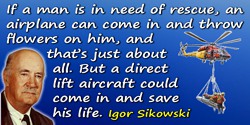
If a man is in need of rescue, an airplane can come in and throw flowers on him, and that’s just about all. But a direct lift aircraft could come in and save his life.
From 'Igor Sikorsky the Aviation Pioneer Speaks', Igor I. Sikorsky Historical Archives, sikorskyarchives.com.
If a man, holding a belief which he was taught in childhood or persuaded of afterwards, keeps down and pushes away any doubts which arise about it in his mind, purposely avoids the reading of books and the company of men that call in question or discuss it, and regards as impious those questions which cannot easily be asked without disturbing it—the life of that man is one long sin against mankind.
In 'The Ethics of Belief', Contemporary Review (Jan 1877), collected in Leslie Stephen and Frederick Pollock (eds.), Lectures and Essays: By the Late William Kingdon Clifford, F.R.S. (1886), 346.
If a superior alien civilisation sent us a message saying, “We’ll arrive in a few decades,” would we just reply, “OK, call us when you get here—we’ll leave the lights on”? Probably not—but this is more or less what is happening with AI. Although we are facing potentially the best or worst thing to happen to humanity in history, little serious research is devoted to these issues outside non-profit institutes such as the Cambridge Centre for the Study of Existential Risk, the Future of Humanity Institute, the Machine Intelligence Research Institute, and the Future of Life Institute. All of us should ask ourselves what we can do now to improve the chances of reaping the benefits and avoiding the risks.
From article with byline attributing several authors collectively, namely: Stephen Hawking, Stuart Russell, Max Tegmark, Frank Wilczek, 'Stephen Hawking: `Transcendence looks at the implications of artificial intelligence—but are we taking AI seriously enough?’', Independent. Posted on the newspaper site www.independent.co.uk (01 May 2014). The article does not given an individual attribution to the quoter, so it is not clear if Stephen Hawking contributed it, and it is easily possible he did not. Thus this entry is filed under his name only because he is the first-listed in the byline.
If all history is only an amplification of biography, the history of science may be most instructively read in the life and work of the men by whom the realms of Nature have been successively won.
The Founders of Geology (1905), 4.
If Babbage had lived seventy-five years later I would have been out of a job.
As quoted in Jeremy Bernstein, The Analytical Engine: Computers, Past, Present, and Future (1964), 52. Note: Aiken created the Harvard Mark I computer in the 1940s. Babbage died in 1871.
If God didn't create life this way, He certainly missed a good bet.
Remark he made after experiments simulating electric discharges in the primitive atmosphere of the earth produced amino acids molecules (the first step- toward life). As quoted by Carl Sagan in Henry S.F. Cooper Jr., 'A Resonance with Something Alive', collected in Carl Sagan and Tom Head (ed.), Conversations with Carl Sagan (2006), 30. Reprinted from The Search for Life on Mars (1979).
If I exist, God exists. With me it is a necessity of my being as it is with millions. They may not be able to talk about it, but from their life you can see that it is a part of their life.
Quoted in Kim Lim (ed.), 1,001 Pearls of Spiritual Wisdom: Words to Enrich, Inspire, and Guide Your Life (2014), 141
If I had influence with the good fairy who is supposed to preside over the christening of all children, I should ask that her gift to each child in the world be a sense of wonder so indestructible that it would last throughout life, as an unfailing antidote against the boredom and disenchantment of later years, the sterile preoccupation with things that are artificial, the alienation from the sources of our strength.
In The Sense of Wonder (1956, 1984), 42-43. First published in 'Help Your Child to Wonder', Womans Home Companion (Jul 1956), 24-27 & 46-48.
If I had my life to live over … I would pick more daisies.
Title and last line from poem published with a misspelled last name of “Stair”. This name error is associated with various viral copies around the net. This poem form was published in 'If I Had My Life to Live Over', Family Circle (27 Mar 1978). Reprinted in Byron Crawford, Kentucky Stories (2001), 1, which also details the name confusion. This version is shortened from the previously published prose by Don Herald in Reader’s Digest (Oct 1953).
If I had my life to live over again I would not devote it to develop new industrial processes: I would try to add my humble efforts to use Science to the betterment of the human race.
I despair of the helter-skelter methods of our vaulted homo sapiens, misguided by his ignorance and his politicians. If we continue our ways, there is every possibility that the human race may follow the road of former living races of animals whose fossils proclaim that they were not fit to continue. Religion, laws and morals is not enough. We need more. Science can help us.
I despair of the helter-skelter methods of our vaulted homo sapiens, misguided by his ignorance and his politicians. If we continue our ways, there is every possibility that the human race may follow the road of former living races of animals whose fossils proclaim that they were not fit to continue. Religion, laws and morals is not enough. We need more. Science can help us.
Letter to a friend (14 Jan 1934). In Savage Grace (1985, 2007), 62.
If I had to define life in a single phrase, I should clearly express my thought of throwing into relief one characteristic which, in my opinion, sharply differentiates biological science. I should say: life is creation.
From An Introduction to the Study of Experimental Medicine (1865), as translated by Henry Copley Greene (1957), 93.
If I were asked to name the most needed of all reforms in the spirit of education, I should say: “Cease conceiving of education as mere preparation for later life, and make it the full meaning of the present life.”
[This is widely seen quoted in a paraphrased form: Education is not preparation for life; education is life itself.]
[This is widely seen quoted in a paraphrased form: Education is not preparation for life; education is life itself.]
In essay, 'Self-Realization as the Moral Ideal', collected in John Dewey and Jo Ann Boydston (ed.), The Early Works, 1882-1898: Volume 4: 1893-1894: Early Essays and The Study of Ethics (1967, 2008), 50.
If I were not a physicist, I would probably be a musician. I often think in music. I live my dreams in music. I see my life in terms of music... I get most joy in life out of music.
In 'What Life Means to Einstein: An Interview by George Sylvester Viereck', Saturday Evening Post (26 Oct 1929), 113.
If in a given community unchecked popular rule means unlimited waste and destruction of the natural resources—soil, fertility, waterpower, forests, game, wild-life generally—which by right belong as much to subsequent generations as to the present generation, then it is sure proof that the present generation is not yet really fit for self-control, that it is not yet really fit to exercise the high and responsible privilege of a rule which shall be both by the people and for the people. The term “for the people” must always include the people unborn as well as the people now alive, or the democratic ideal is not realized.
In A Book-Lover's Holidays in the Open (1916), 319.
If in our withered leaves you see
Hint of your own mortality:—
Think how, when they have turned to earth,
New loveliness from their rich worth
Shall spring to greet the light; then see
Death as the keeper of eternity,
And dying Life’s perpetual re-birth !
Hint of your own mortality:—
Think how, when they have turned to earth,
New loveliness from their rich worth
Shall spring to greet the light; then see
Death as the keeper of eternity,
And dying Life’s perpetual re-birth !
Poem attributed with initials W.L., epigraph for chapter on 'The Nitrogen Cycle', in Arthur E. Shipley, Life: A Book for Elementary Students (1925, 2013), 37.
If it is a terrifying thought that life is at the mercy of the multiplication of these minute bodies [microbes], it is a consoling hope that Science will not always remain powerless before such enemies...
Paper read to the French Academy of Sciences (29 Apr 1878), published in Comptes Rendus de l'Academie des Sciences, 86, 1037-43, as translated by H.C.Ernst. Collected in Charles W. Eliot (ed.) The Harvard Classics, Vol. 38; Scientific Papers: Physiology, Medicine, Surgery, Geology (1910), 366.
If it were possible to have a life absolutely free from every feeling of sin, what a terrifying vacuum it would be!
In The Burning Brand: Diaries 1935-1950 (1961), 175.
If Lovelock hadn’t detected those CFCs [in the atmosphere above Antarctica] we’d all be living under the ocean in snorkels and fins to escape that poisonous sun.
As quoted in Jeff Goodell, How to Cool the Planet: Geoengineering and the Audacious Quest to Fix Earth’s Climate (2010), 95. Goodell noted that Nobel Prize-winning scientists Rowland and Molina hypothesized that sunlight split apart CFC molecules, releasing reactive chlorine atoms, that would burn a hole in the protective ozone layer of the atmosphere, increasing danger from more ultraviolet light penetrating to the earth. When the ozone hole was experimentally verified over Antarctica, the potential destruction to the planet on a grand scale was realized, CFCs were banned, and ozone depletion was halted. Rowland and Molina shared a 1995 Nobel Prize. Although earlier, Lovelock had recognized “no conceivable hazard” from CFCs in the earth’s atmosphere, he was nevertheless the first to detect them in the atmosphere over Antarctica. For this critical evidence, Lovelock was at least mentioned in the Nobel Prize press release.
If matter is not eternal, its first emergence into being is a miracle beside which all others dwindle into absolute insignificance. But, as has often been pointed out, the process is unthinkable; the sudden apocalypse of a material world out of blank nonentity cannot be imagined; its emergence into order out of chaos when “without form and void” of life, is merely a poetic rendering of the doctrine of its slow evolution.
In Nineteenth Century (Sep c.1879?). Quoted in John Tyndall, 'Professor Virchow and Evolution', Fragments of Science (1879), Vol. 2, 377.
If medical science continues to prolong human life, some of us may eventually pay off the mortgage.
In Evan Esar, 20,000 Quips & Quotes (1968, 1995), 532.
If needed to give a comparison expressing my feelings about the science of life, I would say that it is a magnificent reception room, resplendent with light, which one can only reach by passing through a long and dreadful kitchen.
In Introduction à l'Étude de la Médecine Expérimentale (1865), 23. From the original French, “S’il fallait donner une comparaison qui exprimât mon sentiment sur la science de la vie, je dirais que c’est un salon superbe tout resplendissant de lumière, dans lequel on ne peut parvenir qu’en passant par une longue et affreuse cuisine.” English version by Webmaster using Google Translate. This version has additional context than the customary translation, elsewhere on this web page, that begins, “The science of life is a superb….”
If patterns of ones and zeros were “like” patterns of human lives and death, if everything about an individual could be represented in a computer record by a long string of ones and zeros, then what kind of creature would be represented by a long string of lives and deaths?
Vineland (1900, 1997), 90.
If people do not believe that mathematics is simple, it is only because they do not realize how complicated life is.
In speech to first national meeting of the Association for Computing Machinery (1947), as quoted in Franz L. Alt, 'Archaeology of computers: Reminiscences, 1945-1947', Communications of the ACM (Jul 1972), 15, No. 7, 694.
If the average man in the street were asked to name the benefits derived from sunshine, he would probably say “light and warmth” and there he would stop. But, if we analyse the matter a little more deeply, we will soon realize that sunshine is the one great source of all forms of life and activity on this old planet of ours. … [M]athematics underlies present-day civilization in much the same far-reaching manner as sunshine underlies all forms of life, and that we unconsciously share the benefits conferred by the mathematical achievements of the race just as we unconsciously enjoy the blessings of the sunshine.
From Address (25 Feb 1928) to National Council of Teachers of Mathematics, Boston. Abstract published in 'Mathematics and Sunshine', The Mathematics Teacher (May 1928), 21, No. 5, 245.
If the kind of controversy which so often springs up between modernism and traditionalism in religion were applied to more commonplace affairs of life we might see some strange results. …It arises, let us say, from a passage in an obituary notice which mentions that the deceased had loved to watch the sunsets from his peaceful country home.. …it is forgotten that what the deceased man looked out for each evening was an experience and not a creed.
Swarthmore Lecture (1929) at Friends’ House, London, printed in Science and the Unseen World (1929), 84-85.
If the laws of physics and chemistry are universal, we can extrapolate the events of Earth’s chemical evolution to other planets and other stars and thus argue for the possibility of life beyond Earth.
In 'Cosmochemistry The Earliest Evolution', The Science Teacher (Oct 1983), 50, No. 7, 36.
If the only prayer you ever say in your entire life is thank you, it will be enough.
Quoted in Kim Lim (ed.), 1,001 Pearls of Spiritual Wisdom: Words to Enrich, Inspire, and Guide Your Life (2014), 179
If the task of scientific methodology is to piece together an account of what scientists actually do, then the testimony of biologists should be heard with specially close attention. Biologists work very close to the frontier between bewilderment and understanding.
Biology is complex, messy and richly various, like real life; it travels faster nowadays than physics or chemistry (which is just as well, since it has so much farther to go), and it travels nearer to the ground. It should therefore give us a specially direct and immediate insight into science in the making.
Biology is complex, messy and richly various, like real life; it travels faster nowadays than physics or chemistry (which is just as well, since it has so much farther to go), and it travels nearer to the ground. It should therefore give us a specially direct and immediate insight into science in the making.
Induction and Intuition in Scientific Thought (1969), 1.
If the Weismann idea triumphs, it will be in a sense a triumph of fatalism; for, according to it, while we may indefinitely improve the forces of our education and surroundings, and this civilizing nurture will improve the individuals of each generation, its actual effects will not be cumulative as regards the race itself, but only as regards the environment of the race; each new generation must start de novo, receiving no increment of the moral and intellectual advance made during the lifetime of its predecessors. It would follow that one deep, almost instinctive motive for a higher life would be removed if the race were only superficially benefited by its nurture, and the only possible channel of actual improvement were in the selection of the fittest chains of race plasma.
'The Present Problem of Heredity', The Atlantic Monthly (1891), 57, 363.
If there is life elsewhere in the universe, chemically speaking, it would be very similar to what we have on earth.
Speaking at a 1986 Fall Meeting of the American Chemical Society, Anaheim, California, as quoted and cited in J. Raloff, 'Is There a Cosmic Chemistry of Life?', Science News (20 Sep 1986), 130, No. 12, 182.
If there is no solace in the fruits of our research, there is at least some consolation in the research itself. Men and women are not content to comfort themselves with tales of gods and giants, or to confine their thoughts to the daily affairs of life; they also build telescopes and satellites and accelerators and sit at their desks for endless hours working out the meaning of the data they gather.
In The First Three Minutes (1977), 154-155.
If there is such a thing as luck, then I must be the most unlucky fellow in the world. I’ve never once made a lucky strike in all my life. When I get after something that I need, I start finding everything in the world that I don’t need—one damn thing after another. I find ninety-nine things that I don’t need, and then comes number one hundred, and that—at the very last—turns out to be just what I had been looking for.
In Martin André Rosanoff, 'Edison in His Laboratory', Harper’s Magazine (Sep 1932), 406.
If there were a billion people living on the planet, we could do whatever we please. But there are nearly seven billion. At this scale, life as we know it today is not sustainable.
As told to and quoted in Jeff Goodell, How to Cool the Planet: Geoengineering and the Audacious Quest to Fix Earth’s Climate (2010), 91.
If trouble were as easy to get out of as into—life would be one sweet song.
Aphorism as given by the fictional character Dezhnev Senior, in Fantastic Voyage II: Destination Brain (1987), 280.
If we are still here to witness the destruction of our planet some five billion years or more hence ..., then we will have achieved something so unprecedented in the history of life that we should be willing to sing our swan song with joy.
…...
If we can combine our knowledge of science with the wisdom of wildness, if we can nurture civilization through roots in the primitive, man’s potentialities appear to be unbounded, Through this evolving awareness, and his awareness of that awareness, he can emerge with the miraculous—to which we can attach what better name than “God”? And in this merging, as long sensed by intuition but still only vaguely perceived by rationality, experience may travel without need for accompanying life.
A Letter From Lindbergh', Life (4 Jul 1969), 61. In Eugene C. Gerhart, Quote it Completely! (1998), 409.
If we die, we want people to accept it. We’re in a risky business, and we hope that if anything happens to us it will not delay the program. The conquest of space is worth the risk of life.
As quoted in John Andrews Barbour, Footprints on the Moon (1969), 125.
If we drove an automobile the way we try to run civilization, I think we would face backwards, looking through the back window, admiring where we came from, and not caring where we are going. If you want a good life you must look to the future. … I think it is all right to have courses in history. But history is the “gonest” thing in the world. … Let’s keep history, but let’s take a small part of the time and study where we are going. … We can do something about the unmade history.
As quoted in book review, T.A. Boyd, 'Charles F. Kettering: Prophet of Progress', Science (30 Jan 1959), 256.
If we lived on a planet where nothing ever changed, there would be little to do. There would be nothing to figure out. There would be no impetus for science. And if we lived in an unpredictable world, where things changed in random or very complex ways, we would not be able to figure things out. But we live in an in-between universe, where things change, but according to patterns, rules, or as we call them, laws of nature. If I throw a stick up in the air, it always falls down. If the sun sets in the west, it always rises again the next morning in the east. And so it becomes possible to figure things out. We can do science, and with it we can improve our lives.
Cosmos (1980, 1985), 32.
If we put together all that we have learned from anthropology and ethnography about primitive men and primitive society, we perceive that the first task of life is to live. Men begin with acts, not with thoughts.
Folkways: A Study of the Sociological Importance of Usages, Manners, Customs, Mores and Morals (1907), 2.
If we take a survey of our own world … our portion in the immense system of creation, we find every part of it, the earth, the waters, and the air that surround it, filled, and as it were crouded with life, down from the largest animals that we know of to the smallest insects the naked eye can behold, and from thence to others still smaller, and totally invisible without the assistance of the microscope. Every tree, every plant, every leaf, serves not only as an habitation, but as a world to some numerous race, till animal existence becomes so exceedingly refined, that the effluvia of a blade of grass would be food for thousands.
In The Age of Reason: Being an Investigation of True and Fabulous Theology (27 Jan O.S. 1794), 60. The word “crouded” is as it appears in the original.
If we view mathematical speculations with reference to their use, it appears that they should be divided into two classes. To the first belong those which furnish some marked advantage either to common life or to some art, and the value of such is usually determined by the magnitude of this advantage. The other class embraces those speculations which, though offering no direct advantage, are nevertheless valuable in that they extend the boundaries of analysis and increase our resources and skill. Now since many investigations, from which great advantage may be expected, must be abandoned solely because of the imperfection of analysis, no small value should be assigned to those speculations which promise to enlarge the field of anaylsis.
In Novi Comm. Petr., Vol. 4, Preface.
If you ask ... the man in the street ... the human significance of mathematics, the answer of the world will be, that mathematics has given mankind a metrical and computatory art essential to the effective conduct of daily life, that mathematics admits of countless applications in engineering and the natural sciences, and finally that mathematics is a most excellent instrumentality for giving mental discipline... [A mathematician will add] that mathematics is the exact science, the science of exact thought or of rigorous thinking.
Address (28 Mar 1912), Michigan School Masters' Club, Ann Arbor, 'The Humanization of the Teaching of Mathematics. Printed in Science (26 Apr 1912). Collected in The Human Worth of Rigorous Thinking: Essays and Addresses (1916), 65-66.
If you hope to make a success of life you must be willing to do whatever comes your way to the best of your ability.
From address to the Brown University YMCA, as quoted in 'Young Rockefeller: Defending Trusts, Uses American Beauty Similitude,' Cincinnati Enquirer (9 Feb 1902), 4, citing the New York Journal.
![Jane Goodall quote: If you look into their [chimpanzees] eyes, you know you’re looking into a thinking mind. They teach us that](https://todayinsci.com/G/Goodall_Jane/GoodallJane-EyesThm.jpg)
If you look into their [chimpanzees] eyes, you know you’re looking into a thinking mind. They teach us that we are not the only beings with personalities, minds capable of rational thought, altruism and a sense of humor. That leads to new respect for other animals, respect for the environment and respect for all life.
From interview by Tamar Lewin, 'Wildlife to Tireless Crusader, See Jane Run', New York Times (20 Nov 2000), F35.
If you resolve to give up smoking, drinking and loving, you don't actually live longer; it just seems that way.
If you want my opinion on the mystery of life and all that, I can give it to you in a nutshell. The universe is like a safe to which there is a combination. But the combination is locked up in the safe.
In Let Me Count the Ways (1965), 306-307.
If you were going to risk all that, not just risk the hardship and the pain but risk your life. Put everything on line for a dream, for something that’s worth nothing, that can’t be proved to anybody. You just have the transient moment on a summit and when you come back down to the valley it goes. It is actually a completely illogical thing to do. It is not justifiable by any rational terms. That’s probably why you do it.
The Beckoning Silence
If, again with the light of science, we trace forward into the future the condition of our globe, we are compelled to admit that it cannot always remain in its present condition; that in time, the store of potential energy which now exists in the sun and in the bodies of celestial space which may fall into it will be dissipated in radiant heat, and consequently the earth, from being the theatre of life, intelligence, of moral emotions, must become a barren waste.
Address (Jul 1874) at the grave of Joseph Priestley, in Joseph Henry and Arthur P. Molella, et al. (eds.), A Scientist in American Life: Essays and Lectures of Joseph Henry (1980), 120.
If, then, the motion of every particle of matter in the universe were precisely reversed at any instant, the course of nature would be simply reversed for ever after. The bursting bubble of foam at the foot of a waterfall would reunite and descend into the water; the thermal motions would reconcentrate their energy, and throw the mass up the fall in drops re-forming into a close column of ascending water. Heat which had been generated by the friction of solids and dissipated by conduction, and radiation, and radiation with absorption, would come again to the place of contact, and throw the moving body back against the force to which it had previously yielded. Boulders would recover from the mud materials required to rebuild them into their previous jagged forms, and would become reunited to the mountain peak from which they had formerly broken away. And if also the materialistic hypothesis of life were true, living creatures would grow backwards, with conscious knowledge of the future but no memory of the past, and would become again unborn.
In 'The Kinetic Theory of the Dissipation of Energy', Nature (1874), 9, 442.
Imagine Aristotle revivified and visiting Manhattan. Nothing in our social, political, economic, artistic, sexual or religious life would mystify him, but he would be staggered by our technology. Its products—skyscrapers, cars, airplanes, television, pocket calculators—would have been impossible without calculus.
In book review, 'Adventures Of a Mathematician: The Man Who Invented the H-Bomb', New York Times (9 May 1976), 201.
Imagine life as a game in which you are juggling five balls in the air. You name them - work, family, health, friends, and spirit - and you’re keeping all of these in the air. You will soon understand that work is a rubber ball. If you drop it, it will bounce back. But the other four balls - family, health, friends, and spirit are made of glass. If you drop one of these, they will be irrevocably scuffed, marked, nicked, damaged, or even shattered. They will never be the same. You must understand that and strive for balance in your life.
…...
In [David] Douglas's success in life ... his great activity, undaunted courage, singular abstemiousness, and energetic zeal, at once pointed him out as an individual eminently calculated to do himself credit as a scientific traveler.
In 'Extracts from A Brief Memoir of the Life of David Douglas' (1834), in W.F. Wilson (ed.), David Douglas, Botanist at Hawaii (1919), 12.
In 1944 Erwin Schroedinger, stimulated intellectually by Max Delbruck, published a little book called What is life? It was an inspiration to the first of the molecular biologists, and has been, along with Delbruck himself, credited for directing the research during the next decade that solved the mystery of how 'like begat like.' Max was awarded this Prize in 1969, and rejoicing in it, he also lamented that the work for which he was honored before all the peoples of the world was not something which he felt he could share with more than a handful. Samuel Beckett's contributions to literature, being honored at the same time, seemed to Max somehow universally accessible to anyone. But not his. In his lecture here Max imagined his imprisonment in an ivory tower of science.
'The Polymerase Chain Reaction', Nobel Lecture (8 Dec 1993). In Nobel Lectures: Chemistry 1991-1995 (1997), 103.
In 1946 [we visited] a rock called Le Veyron, around which sea life swarmed … an undersea paradise.… About thirty years later I returned … to the same depth, to the same caves, at the same time of year. The grotto was empty. Not one single fish lived among the rocks. The verdant gardens were gone.…
When I saw Le Veyron, I believed that the sea’s most monstrous force doesn’t live in Loch Ness. It lives in us.
When I saw Le Veyron, I believed that the sea’s most monstrous force doesn’t live in Loch Ness. It lives in us.
In Jacques Cousteau and Susan Schiefelbein, The Human, the Orchid, and the Octopus: Exploring and Conserving Our Natural World (2007), 40-41.
In a crystal we have the clear evidence of the existence of a formative life-principle, and though we cannot understand the life of a crystal, it is none the less a living being.
In 'The Problem of Increasing Human Energy: With Special Reference to the Harnessing of the Sun’s Energy', Century Illustrated Magazine (Jun 1900), 60, No. 2, 180.
In a sense Shapley’s telling me that space was transparent, which I shouldn’t have believed, illustrates a fundamental problem in science, believing what people tell you. Go and find it out for yourself. That same error has persisted in my life and in many other people’s. Authorities are not always authorities on everything; they often cling to their own mistakes.
Oral History Transcript of interview with Dr. Jesse Greenstein by Paul Wright (31 Jul 1974), on website of American Institute of Physics.
In a word, I consider hospitals only as the entrance to scientific medicine; they are the first field of observation which a physician enters; but the true sanctuary of medical science is a laboratory; only there can he seek explanations of life in the normal and pathological states by means of experimental analysis.
From An Introduction to the Study of Experimental Medicine (1865), as translated by Henry Copley Greene (1957), 146.
In all our academies we attempt far too much. ... In earlier times lectures were delivered upon chemistry and botany as branches of medicine, and the medical student learned enough of them. Now, however, chemistry and botany are become sciences of themselves, incapable of comprehension by a hasty survey, and each demanding the study of a whole life, yet we expect the medical student to understand them. He who is prudent, accordingly declines all distracting claims upon his time, and limits himself to a single branch and becomes expert in one thing.
Quoted in Johann Hermann Baas, Henry Ebenezer Handerson (trans.), Outlines of the History of Medicine and the Medical Profession (1889), 842-843.
In all works on Natural History, we constantly find details of the marvellous adaptation of animals to their food, their habits, and the localities in which they are found. But naturalists are now beginning to look beyond this, and to see that there must be some other principle regulating the infinitely varied forms of animal life. It must strike every one, that the numbers of birds and insects of different groups having scarcely any resemblance to each other, which yet feed on the same food and inhabit the same localities, cannot have been so differently constructed and adorned for that purpose alone. Thus the goat-suckers, the swallows, the tyrant fly-catchers, and the jacamars, all use the same kind ‘Of food, and procure it in the same manner: they all capture insects on the wing, yet how entirely different is the structure and the whole appearance of these birds!
In A Narrative of Travels on the Amazon and Rio Negro (1853), 83-84.
In an age of egoism, it is so difficult to persuade man that of all studies, the most important is that of himself. This is because egoism, like all passions, is blind. The attention of the egoist is directed to the immediate needs of which his senses give notice, and cannot be raised to those reflective needs that reason discloses to us; his aim is satisfaction, not perfection. He considers only his individual self; his species is nothing to him. Perhaps he fears that in penetrating the mysteries of his being he will ensure his own abasement, blush at his discoveries, and meet his conscience. True philosophy, always at one with moral science, tells a different tale. The source of useful illumination, we are told, is that of lasting content, is in ourselves. Our insight depends above all on the state of our faculties; but how can we bring our faculties to perfection if we do not know their nature and their laws! The elements of happiness are the moral sentiments; but how can we develop these sentiments without considering the principle of our affections, and the means of directing them? We become better by studying ourselves; the man who thoroughly knows himself is the wise man. Such reflection on the nature of his being brings a man to a better awareness of all the bonds that unite us to our fellows, to the re-discovery at the inner root of his existence of that identity of common life actuating us all, to feeling the full force of that fine maxim of the ancients: 'I am a man, and nothing human is alien to me.'
Considerations sur les diverses méthodes à suivre dans l'observation des peuples sauvages (1800) The Observation of Savage Peoples, trans. F. C. T. Moore (1969), 61.
In an age of specialization people are proud to be able to do one thing well, but if that is all they know about, they are missing out on much else life has to offer.
As given in John Rennie, 'Dennis Flanagan, A Proud “Renaissance Hack”', Scientific American (26 Jan 2005).
In Aristotle the mind, regarded as the principle of life, divides into nutrition, sensation, and faculty of thought, corresponding to the inner most important stages in the succession of vital phenomena.
In Cairo, I secured a few grains of wheat that had slumbered for more than thirty centuries in an Egyptian tomb. As I looked at them this thought came into my mind: If one of those grains had been planted on the banks of the Nile the year after it grew, and all its lineal descendants had been planted and replanted from that time until now, its progeny would to-day be sufficiently numerous to feed the teeming millions of the world. An unbroken chain of life connects the earliest grains of wheat with the grains that we sow and reap. There is in the grain of wheat an invisible something which has power to discard the body that we see, and from earth and air fashion a new body so much like the old one that we cannot tell the one from the other.…This invisible germ of life can thus pass through three thousand resurrections.
In In His Image (1922), 33.
In early life I had felt a strong desire to devote myself to the experimental study of nature; and, happening to see a glass containing some camphor, portions of which had been caused to condense in very beautiful crystals on the illuminated side, I was induced to read everything I could obtain respecting the chemical and mechanical influences of light, adhesion, and capillary attraction.
In preface to Scientific Memoirs (1878), xii.
In every phase of business life, keep at least one year ahead of the other fellow.
As quoted by H.M. Davidson, in System: The Magazine of Business (Apr 1922), 41, 412.
In fact, the thickness of the Earth's atmosphere, compared with the size of the Earth, is in about the same ratio as the thickness of a coat of shellac on a schoolroom globe is to the diameter of the globe. That's the air that nurtures us and almost all other life on Earth, that protects us from deadly ultraviolet light from the sun, that through the greenhouse effect brings the surface temperature above the freezing point. (Without the greenhouse effect, the entire Earth would plunge below the freezing point of water and we'd all be dead.) Now that atmosphere, so thin and fragile, is under assault by our technology. We are pumping all kinds of stuff into it. You know about the concern that chlorofluorocarbons are depleting the ozone layer; and that carbon dioxide and methane and other greenhouse gases are producing global warming, a steady trend amidst fluctuations produced by volcanic eruptions and other sources. Who knows what other challenges we are posing to this vulnerable layer of air that we haven't been wise enough to foresee?
In 'Wonder and Skepticism', Skeptical Enquirer (Jan-Feb 1995), 19, No. 1.
In geologists’ own lives, the least effect of time is that they think in two languages, function on two different scales. … “A million years is a short time—the shortest worth messing with for most problems.”
In Basin and Range (1981), 134.
In her book My Life With the Chimpanzees, Goodall told the story of “Mike,” a chimp who maintained his dominance by kicking a series of kerosene cans ahead of him as he moved down a road, creating confusion and noise that made his rivals flee and cower. She told me she would be thinking of Mike as she watched [Donald Trump in] the upcoming debates.
In magazine article by 'When Donald Meets Hillary', The Atlantic (Oct 2016). The reporter stated “Jane Goodall … told me shortly before Trump won the GOP nomination.”
In his wretched life of less than twenty-seven years Abel accomplished so much of the highest order that one of the leading mathematicians of the Nineteenth Century (Hermite, 1822-1901) could say without exaggeration, “Abel has left mathematicians enough to keep them busy for five hundred years.” Asked how he had done all this in the six or seven years of his working life, Abel replied, “By studying the masters, not the pupils.”
The Queen of the Sciences (1931, 1938), 10.
In honoring the Wright Brothers, it is customary and proper to recognize their contribution to scientific progress. But I believe it is equally important to emphasize the qualities in their pioneering life and the character in man that such a life produced. The Wright Brothers balanced sucess with modesty, science with simplicity. At Kitty Hawk their intellects and senses worked in mutual support. They represented man in balance, and from that balance came wings to lift a world.
Speech, quoted in Leonard Mosley, Lindbergh (2000), 347. In 1949, Lindbergh gave a speech when he received the Wright Brothers Memorial Trophy.
In human freedom in the philosophical sense I am definitely a disbeliever. Everybody acts not only under external compulsion but also in accordance with inner necessity. Schopenhauer’s saying, that ‘a man can do what he wants, but not want what he wants,’ has been an inspiration to me since my youth up, and a continual consolation and unfailing well-spring of patience in the face of the hardships of life, my own and others. This feeling mercifully not only mitigates the sense of responsibility which so easily becomes paralysing, and it prevents us from taking ourselves and other people too seriously; it conduces to a view of life in which humour, above all, has its due place.
In The World As I See It (1934), 238.
In its essence, the theory of natural selection is primarily an attempt to give an account of the probable mechanism of the origin of the adaptations of the organisms to their environment, and only secondarily an attempt to explain evolution at large. Some modern biologists seem to believe that the word 'adaptation' has teleological connotations, and should therefore be expunged from the scientific lexicon. With this we must emphatically disagree. That adaptations exist is so evident as to be almost a truism, although this need not mean that ours is the best of all possible worlds. A biologist has no right to close his eyes to the fact that the precarious balance between a living being and its environment must be preserved by some mechanism or mechanisms if life is to endure.
Genetics and Origin of Species (1937), 150.
In its most primitive form, life is, therefore, no longer bound to the cell, the cell which possesses structure and which can be compared to a complex wheel-work, such as a watch which ceases to exist if it is stamped down in a mortar. No, in its primitive form life is like fire, like a flame borne by the living substance;—like a flame which appears in endless diversity and yet has specificity within it;—which can adopt the form of the organic world, of the lank grass-leaf and of the stem of the tree.
Address given at the 1913 meeting of the Koninklijke Akademie van Wetenschappen in Amsterdam. Trans. in G. Van Iterson, Jr, L. E. Den Dooren De Jong and A. J. Kluyver, Martinus Willem Beilerinck: His Life and Work (1940), 120.
In life, unlike chess, the game continues after checkmate.
Aphorism as given by the fictional character Dezhnev Senior, in Fantastic Voyage II: Destination Brain (1987), 192.
In man, the mechanical breathing is essential to life, and it is one of the old tests for death to see whether these movements have ceased completely.
In 'Introduction', The Comparative Physiology of Respiratory Mechanisms (1941, 2015), 1. The book is based on a series of lectures delivered at Swarthmore College in 1939.
In mathematical analysis we call x the undetermined part of line a: the rest we don’t call y, as we do in common life, but a-x. Hence mathematical language has great advantages over the common language.
Lichtenberg: A Doctrine of Scattered Occasions: Reconstructed From: Reconstructed From His Aphorisms and Reflections (1959), 158.
In medical practice a man may die when, scientifically speaking, he ought to have lived. I have actually known a man to die of a disease from which he was, scientifically speaking, immune. But that does not affect the fundamental truth of science.
B.B. character in The Doctor's Dilemma, Act 3 (First produced in 1906). In The Doctor's Dilemma: With a Preface on Doctors (1911), 70.
In my life as an architect, I found that the single thing which inhibits young professionals, new students most severely, is their acceptance of standards that are too low.
In 'Foreword' written for Richard P. Gabriel, Patterns of Software: Tales from the Software Community (1996), vii.
In not a few the [opium-eating] habit has crept upon them almost unconsciously, during the medicinal use of opiates to soothe pain, to remove sleeplessness, or to arrest protracted bowel-complaint. The risk of this evil should therefore be carefully borne in mind, for life-long misery has often been caused by undue laxity in the prescribing of opiates.
In 'Clinical Lecture On The Treatment Of The Habit Of Opium-Eating', The British Medical Journal (15 Feb 1868), 1, No. 372, 137.
In one of my lectures many years ago I used the phrase “following the trail of light”. The word “light” was not meant in its literal sense, but in the sense of following an intellectual concept or idea to where it might lead. My interest in living things is probably a fundamental motivation for the scientific work in the laboratory, and we created here in Berkeley one of the first and foremost interdisciplinary laboratories in the world.
In autobiography, Following the Trail of Light: A Scientific Odyssey (1992), 134.
In order to seek truth, it is necessary once in the course of our life, to doubt, as far as possible, of all things.
From the original Latin: “Veritatem inquirenti, semel in vita de omnibus, quantum fieri potest, esse dubitandum,” Principles of Philosophy (1644). Pars Prima, as collected in Charles Adam and Paul Tannery, Œuvres de Descartes (1905), Vol. 8, Proposition I, 5. English version as given in John Veitch (trans.), The Method, Meditations, and Selections from the Principles of Descartes (1880), 193. Also seen translated as: “If you would be a real seeker after truth, you must at least once in your life doubt, as far as possible, all things.”
In order to understand what is meant by the word “brain” as it is used by neuroscientists, we must bear in mind the evidence that this organ contains in some recorded form the basis of one’s whole conscious life. It contains the record of all our aims and ambitions and is essential for the experience of all pleasures and pains, all loves and hates.
In Philosophy and the Brain (1987), 8.
In our daily lives, we enjoy the pervasive benefits of long-lived robotic spacecraft that provide high-capacity worldwide telecommunications; reconnaissance of Earth’s solid surface and oceans, with far-reaching cultural and environmental implications; much-improved weather and climatic forecasts; improved knowledge about the terrestrial effects of the Sun’s radiations; a revolutionary new global navigational system for all manner of aircraft and many other uses both civil and military; and the science of Earth itself as a sustainable abode of life.
In 'Is Human Spaceflight Obsolete?', Issues in Science and Technology (Summer 2004).
In our time this search [for extraterrestrial life] will eventually change our laws, our religions, our philosophies, our arts, our recreations, as well as our sciences. Space, the mirror, waits for life to come look for itself there.
…...
In our way of life … with every decision we make, we always keep in mind the seventh generation of children to come. … When we walk upon Mother Earth, we always plant our feet carefully, because we know that the faces of future generations are looking up at us from beneath the ground. We never forget them.
Earth Day Pledge (1993)
In place of science, the Eskimo has only magic to bridge the gap between what he can understand and what is not known. Without magic, his life would be one long panic.
In Man’s Rise to Civilization (1968), 48.
In reality, all Arguments from Experience are founded on the Similarity which we discover among natural Objects, and by which we are induc'd to expect effects similar to those which we have found to follow from such Objects. And tho' none but a Fool or Madman will ever pretend to dispute the Authority of Experience, or to reject that great Guide of human Life, it may surely be allow'd a Philosopher to have so much Curiosity at least as to examine the Principle of human Nature, which gives this mighty Authority to Experience, and makes us draw Advantage from that Similarity which Nature has plac'd among different Objects. From Causes which appear similar we expect similar Effects. This is the Sum of our experimental Conclusions.
An Enquiry Concerning Human Understanding (1748), 63.
In recent times, modern science has developed to give mankind, for the first time in the history of the human race, a way of securing a more abundant life which does not simply consist in taking away from someone else.
In a speech to the American Philosophical Society, 1938.
In science as in life the greatest truths are the simplest.
In 'Mathematical Emancipations', The Monist (Jan 1906), 16, No. 1, 65.
In science, as in life, learning and knowledge are distinct, and the study of things, and not of books, is the source of the latter.
In 'On The Study of Zoology', Lay Sermons, Addresses, and Reviews (1870), 112.
![Rachel Carson quote: In that dawn chorus [of birds] one hears the throb of life itself.](https://todayinsci.com/C/Carson_Rachel/CarsonRachel-DawnThm.jpg)
In that dawn chorus [of birds] one hears the throb of life itself.
In The Sense of Wonder (1956, 1965), 69
In the 1940s when I did my natural sciences degree in zoology it was very much laboratory-based. … I was not keen on the idea of spending the rest of my life in the lab. I also don’t think I would have been particularly good at it. I don't think I have as analytical a mind or the degree of application that one would need to become a first-rate research scientist.
From interview with Michael Bond, 'It’s a Wonderful Life', New Scientist (14 Dec 2002), 176, No. 2373, 48.
In the animal world we have seen that the vast majority of species live in societies, and that they find in association the best arms for the struggle for life: understood, of course, in its wide Darwinian sense—not as a struggle for the sheer means of existence, but as a struggle against all natural conditions unfavourable to the species. The animal species, in which individual struggle has been reduced to its narrowest limits, and the practice of mutual aid has attained the greatest development, are invariably the most numerous, the most prosperous, and the most open to further progress. The mutual protection which is obtained in this case, the possibility of attaining old age and of accumulating experience, the higher intellectual development, and the further growth of sociable habits, secure the maintenance of the species, its extension, and its further progressive evolution. The unsociable species, on the contrary, are doomed to decay.
Mutual Aid: A Factor of Evolution (1902), 293.
In the arts of life main invents nothing; but in the arts of death he outdoes Nature herself, and produces by chemistry and machinery all the slaughter of plague, pestilence and famine. … There is nothing in Man's industrial machinery but his greed and sloth: his heart is in his weapons.
Play, Man and Superman: A Comedy and a Philosophy (1903)
In the country of the blind the one-eyed man is lucky to escape with his life.
In The Decline and Fall of Science (1976), 171.
In the history of scientific development the personal aspects of the process are usually omitted or played down to emphasize that the thing discovered is independent of the discoverer and that the result can be checked. But, as Einstein has pointed out, scientific concepts are 'created in the minds of men,' and in some way the nonprofessional aspects of life and mind are inevitably related to the professional.
American Institute of Physics, Center for History of Physics Newsletter (Fall 2004).
In the Life of Darwin by his son, there is related an incident of how the great naturalist once studied long as to just what a certain spore was. Finally he said, “It is this, for if it isn’t, then what is it?” And all during his life he was never able to forget that he had been guilty of this unscientific attitude, for science is founded on certitude, not assumption.
In Elbert Hubbard (ed. and publ.), The Philistine (May 1908), 26, No. 6, 172.
In the long course of cell life on this earth it remained, for our age for our generation, to receive the full ownership of our inheritance. We have entered the cell, the Mansion of our birth, and started the inventory of our acquired wealth.
Talking about the new information revealed by electron microscopy Nobel Lecture, The Coming Age of the Cell, 12 Dec 1974
In the moment of the vernal equinox, we find ourselves standing at the threshold between winter’s chill and spring’s warmth, a testament to the resilience of life and the promise of new beginnings.
A fictional quote imagined in the style typical of a scientist (19 Mar 2024).
In the nature of life and in the principles of evolution we have had our answer. Of men elsewhere, and beyond, there will be none, forever.
In 'Little Men and Flying Sources', The Immense Journey (1957), 162.
In the next twenty centuries … humanity may begin to understand its most baffling mystery—where are we going? The earth is, in fact, traveling many thousands of miles per hour in the direction of the constellation Hercules—to some unknown destination in the cosmos. Man must understand his universe in order to understand his destiny. Mystery, however, is a very necessary ingredient in our lives. Mystery creates wonder and wonder is the basis for man’s desire to understand. Who knows what mysteries will be solved in our lifetime, and what new riddles will become the challenge of the new generation? Science has not mastered prophesy. We predict too much for the next year yet far too little for the next ten. Responding to challenges is one of democracy’s great strengths. Our successes in space can be used in the next decade in the solution of many of our planet’s problems.
In a speech to a Joint Meeting of the Two Houses of Congress to Receive the Apollo 11 Astronauts (16 Sep 1969), in the Congressional Record.
In the social equation, the value of a single life is nil; in the cosmic equation, it is infinite… Not only communism, but any political movement which implicitly relies on purely utilitarian ethics, must become a victim to the same fatal error. It is a fallacy as naïve as a mathematical teaser, and yet its consequences lead straight to Goya’s Disasters, to the reign of the guillotine, the torture chambers of the Inquisition, or the cellars of the Lubianka.
In 'The Invisible Writing', Arrow in the Blue: An Autobiography (1952), Vol. 2, 357.
In the spring of 1760, [I] went to William and Mary college, where I continued two years. It was my great good fortune, and what probably fixed the destinies of my life, that Dr. William Small of Scotland, was then Professor of Mathematics, a man profound in most of the useful branches of science, with a happy talent of communication, correct and gentlemanly manners, and an enlarged and liberal mind. He, most happily for me, became soon attached to me, and made me his daily companion when not engaged in the school; and from his conversation I got my first views of the expansion of science, and of the system of things in which we are placed.
In Thomas Jefferson and Andrew Adgate Lipscomb (ed.), The Writings of Thomas Jefferson (1904), Vol. 1, 3.
In the study of this membrane [the retina] I for the first time felt my faith in Darwinism (hypothesis of natural selection) weakened, being amazed and confounded by the supreme constructive ingenuity revealed not only in the retina and in the dioptric apparatus of the vertebrates but even in the meanest insect eye. ... I felt more profoundly than in any other subject of study the shuddering sensation of the unfathomable mystery of life.
Recollections of My Life (1898), 576. Quoted in Sidney Perkowitz, Empire of Light (1999), 16.
In the twenties the late Dr. Glenn Frank, an eminent social scientist, developed a new statement of the scientific code, which has been referred to as the “Five Fingers of the Scientific Method.” It may be outlined as follows: find the facts; filter the facts; focus the facts; face the facts; follow the facts. The facts or truths are found by experimentation; the motivation is material. The facts are filtered by research into the literature; the motivation is material. The facts are focused by the publication of results; again the motivation is material. Thus the first three-fifths of the scientific method have a material motivation. It is about time scientists acknowledge that there is more to the scientific convention than the material aspect. Returning to the fourth and fifth fingers of Dr. Frank's conception of the scientific method, the facts should be faced by the proper interpretation of them for society. In other words, a scientist must assume social responsibility for his discoveries, which means that he must have a moral motivation. Finally, in the fifth definition of the scientific method, the facts are to be followed by their proper application to everyday life in society, which means moral motivation through responsibility to society.
From 'Scientists and Society', American Scientist (Jul 1954), 42, No. 3, 495.
In the vast cosmical changes, the universal life comes and goes in unknown quantities ... sowing an animalcule here, crumbling a star there, oscillating and winding, ... entangling, from the highest to the lowest, all activities in the obscurity of a dizzying mechanism, hanging the flight of an insect upon the movement of the earth... Enormous gearing, whose first motor is the gnat, and whose last wheel is the zodiac.
Victor Hugo and Charles E. Wilbour (trans.), Les Misérables (1862), 41.
In the vestibule of the Manchester Town Hall are placed two life-sized marble statues facing each other. One of these is that of John Dalton … the other that of James Prescott Joule. … Thus honour is done to Manchester’s two greatest sons—to Dalton, the founder of modern Chemistry and of the Atomic Theory, and the laws of chemical-combining proportions; to Joule, the founder of modern Physics and the discoverer of the Law of Conservation of Energy. The one gave to the world the final and satisfactory proof … that in every kind of chemical change no loss of matter occurs; the other proved that in all the varied modes of physical change, no loss of energy takes place.
In John Dalton and the Rise of Modern Chemistry (1895), 7.
In the world of physics we watch a shadowgraph performance of the drama of familiar life. The shadow of my elbow rests on the shadow table as the shadow ink flows over the shadow paper. It is all symbolic, and as a symbol the physicist leaves it. ... The frank realization that physical science is concerned with a world of shadows is one of the most significant of recent advances.
In The Nature of the Physical World (1928, 2005), xiv-xv.
In the year 2000, the solar water heater behind me, which is being dedicated today, will still be here supplying cheap, efficient energy. A generation from now, this solar heater can either be a curiosity, a museum piece, an example of a road not taken, or it can be just a small part of one of the greatest and most exciting adventures ever undertaken by the American people: harnessing the power of the Sun to enrich our lives as we move away from our crippling dependence on foreign oil.
[The next President, Republican Ronald Reagan, removed the solar panels and gutted renewable energy research budgets. The road was not taken, nationally, in the eight years of his presidency. Several of the panels are, indeed, now in museums. Most were bought as government surplus and put to good use on a college roof.]
[The next President, Republican Ronald Reagan, removed the solar panels and gutted renewable energy research budgets. The road was not taken, nationally, in the eight years of his presidency. Several of the panels are, indeed, now in museums. Most were bought as government surplus and put to good use on a college roof.]
Speech, at dedication of solar panels on the White House roof, 'Solar Energy Remarks Announcing Administration Proposals' (20 Jun 1979).
In theory one is aware that the earth revolves but in practice one does not perceive it, the ground on which one treads seems not to move, and one can live undisturbed. So it is with Time in one's life. (1918)
'À l’ombre des jeunes filles en fleurs', À la recherche du temps perdu (1913-27).
In these strenuous times, we are likely to become morbid and look constantly on the dark side of life, and spend entirely too much time considering and brooding over what we can't do, rather than what we can do, and instead of growing morose and despondent over opportunities either real or imaginary that are shut from us, let us rejoice at the many unexplored fields in which there is unlimited fame and fortune to the successful explorer and upon which there is no color line; simply the survival of the fittest.
In article urging African-Americans to engage in plant breeding to develop improved species.'A New Industry for Colored Men and Women', Colored American (Jan 1908, 14, 33. Cited in Linda O. McMurry, George Washington Carver, Scientist and Symbol (1982), 109.
In this great celestial creation, the catastrophy of a world, such as ours, or even the total dissolution of a system of worlds, may possibly be no more to the great Author of Nature, than the most common accident in life with us, and in all probability such final and general Doomsdays may be as frequent there, as even Birthdays or mortality with us upon the earth. This idea has something so cheerful in it, that I know I can never look upon the stars without wondering why the whole world does not become astronomers; and that men endowed with sense and reason should neglect a science they are naturally so much interested in, and so capable of enlarging their understanding, as next to a demonstration must convince them of their immortality, and reconcile them to all those little difficulties incident to human nature, without the least anxiety. All this the vast apparent provision in the starry mansions seem to promise: What ought we then not to do, to preserve our natural birthright to it and to merit such inheritance, which alas we think created all to gratify alone a race of vain-glorious gigantic beings, while they are confined to this world, chained like so many atoms to a grain of sand.
In The Universe and the Stars: Being an Original Theory on the Visible Creation, Founded on the Laws of Nature (1750, 1837), 132.
In this world [of art] the emotions of life find no place.
In Art (1913), 27.
In trying to evaluate Hopkins' unique contribution to biochemistry it may perhaps be said that he alone amongst his contemporaries succeeded in formulating the subject. Among others whose several achievements in their own fields may have surpassed his, no one has ever attempted to unify and correlate biochemical knowledge so as to form a comprehensible picture of the cell and its relation to life, reproduction and function.
'Sir F. G. Hopkins' Teaching and Scientific Influence'. In J. Needham and E. Baldwin (eds.), Hopkins and Biochemistry, 1861-1947 (1949), 36.
In using the present in order to reveal the past, we assume that the forces in the world are essentially the same through all time; for these forces are based on the very nature of matter, and could not have changed. The ocean has always had its waves, and those waves have always acted in the same manner. Running water on the land has ever had the same power of wear and transportation and mathematical value to its force. The laws of chemistry, heat, electricity, and mechanics have been the same through time. The plan of living structures has been fundamentally one, for the whole series belongs to one system, as much almost as the parts of an animal to the one body; and the relations of life to light and heat, and to the atmosphere, have ever been the same as now.
In 'Introduction', Manual of Geology: Treating of the Principles of the Science (1863), 7.
In wilderness I sense the miracle of life, and behind it our scientific accomplishments fade to trivia.
Declaring a preference for contact with nature rather than with technology. In 'The Wisdom of Wilderness', Life (22 Dec 1967), 63, No. 25, 10.
In working out physical problems there should be, in the first place, no pretence of rigorous formalism. The physics will guide the physicist along somehow to useful and important results, by the constant union of physical and geometrical or analytical ideas. The practice of eliminating the physics by reducing a problem to a purely mathematical exercise should be avoided as much as possible. The physics should be carried on right through, to give life and reality to the problem, and to obtain the great assistance which the physics gives to the mathematics.
In Electromagnetic Theory (1892), Vol. 2, 5.
Increased knowledge of heredity means increased power of control over the living thing, and as we come to understand more and more the architecture of the plant or animal we realize what can and what cannot be done towards modification or improvement.
Reginald C. Punnett, in article 'Mendelism', from Hugh Chisholm (ed.) The Encyclopædia Britannica (1911), Vol. 18, 120.
Indeed, we need not look back half a century to times which many now living remember well, and see the wonderful advances in the sciences and arts which have been made within that period. Some of these have rendered the elements themselves subservient to the purposes of man, have harnessed them to the yoke of his labors and effected the great blessings of moderating his own, of accomplishing what was beyond his feeble force, and extending the comforts of life to a much enlarged circle, to those who had before known its necessaries only.
From paper 'Report of the Commissioners Appointed to Fix the Site of the University of Virginia' (Dec 1818), reprinted in Annual Report of the Board of Visitors of the University of Virginia for the Fiscal Year Ending May 31, 1879 (1879), 10. Collected in Commonwealth of Virginia, Annual Reports of Officers, Boards, and Institutions of the Commonwealth of Virginia, for the Year Ending September 30, 1879 (1879).
Induction is the process of generalizing from our known and limited experience, and framing wider rules for the future than we have been able to test fully. At its simplest, then, an induction is a habit or an adaptation—the habit of expecting tomorrow’s weather to be like today’s, the adaptation to the unwritten conventions of community life.
Inspiration in the field of science by no means plays any greater role, as academic conceit fancies, than it does in the field of mastering problems of practical life by a modern entrepreneur. On the other hand, and this also is often misconstrued, inspiration plays no less a role in science than it does in the realm of art.
From a Speech (1918) presented at Munich University, published in 1919, and collected in 'Wissenschaft als Beruf', Gessammelte Aufsätze zur Wissenschaftslehre (1922), 524-525. As given in H.H. Gerth and C. Wright-Mills (translators and eds.), 'Science as a Vocation', Max Weber: Essays in Sociology (1946), 136.
Instruction ends in the schoolroom, but education ends only with life. A child is given to the universe to be educated.
Sermons Preached at Trinity Chapel, Brighton (1866), 271.
Insulin is not a cure for diabetes; it is a treatment. It enables the diabetic to burn sufficient carbohydrates, so that proteins and fats may be added to the diet in sufficient quantities to provide energy for the economic burdens of life.
'Diabetes and Insulin', Nobel Lecture, 15 September 1925. In Nobel Lectures: Physiology or Medicine, 1922-1941 (1965), 68.
Intelligent life on a planet comes of age when it first works out the reason for its own existence.
The Selfish Gene (1976), 1.
Into each life some rain must fall,
Some days must be dark and dreary.
Some days must be dark and dreary.
From 'The Rainy Day', The Poetical Works of Henry Wadsworth Longfellow (1855), 112.
Is evolution a theory, a system or a hypothesis? It is much more: it is a general condition to which all theories, all hypotheses, all systems must bow and which they must satisfy henceforth if they are to be thinkable and true. Evolution is a light illuminating all facts, a curve that all lines must follow. ... The consciousness of each of us is evolution looking at itself and reflecting upon itself....Man is not the center of the universe as once we thought in our simplicity, but something much more wonderful—the arrow pointing the way to the final unification of the world in terms of life. Man alone constitutes the last-born, the freshest, the most complicated, the most subtle of all the successive layers of life. ... The universe has always been in motion and at this moment continues to be in motion. But will it still be in motion tomorrow? ... What makes the world in which we live specifically modern is our discovery in it and around it of evolution. ... Thus in all probability, between our modern earth and the ultimate earth, there stretches an immense period, characterized not by a slowing-down but a speeding up and by the definitive florescence of the forces of evolution along the line of the human shoot.
In The Phenomenon of Man (1975), pp 218, 220, 223, 227, 228, 277.
Is it absurd to imagine that our social behavior, from amoeba to man, is also planned and dictated, from stored Information, by the cells? And that the time has come for men to be entrusted with the task, through heroic efforts, of bringing life to other worlds?
From Nobel Prize Lecture (Dec 1974), 'The Coming Age of the Cell'. Collected in Jan Lindsten (ed.) Nobel Lectures, Physiology or Medicine 1971-1980 (1992).
Is it not true that for every person the course of life is along the line of least resistance, and that in this the movement of humanity is like the movement of material bodies?
In preface to Scientific Memoirs (1878), xiv.
Is man a peculiar organism? Does he originate in a wholly different way from a dog, bird, frog, or fish? and does he thereby justify those who assert that he has no place in nature, and no real relationship with the lower world of animal life? Or does he develop from a similar embryo, and undergo the same slow and gradual progressive modifications? The answer is not for an instant doubtful, and has not been doubtful for the last thirty years. The mode of man’s origin and the earlier stages of his development are undoubtedly identical with those of the animals standing directly below him in the scale; without the slightest doubt, he stands in this respect nearer the ape than the ape does to the dog. (1863)
As quoted in Ernst Haeckel and E. Ray Lankester (trans.) as epigraph for Chap. 12, The History of Creation (1886), Vol. 1, 364.
Is pure science to be regarded as overall beneficial to society? Answer: It depends much on what you consider benefits. If you look at health, long life, transportation, communication, education, you might be tempted to say yes. If you look at the enormous social-economic dislocations, at the prospect of an immense famine in India, brought on by the advances of public health science and nutrition science, at strains on our psyches due to the imbalance between technical developments and our limited ability to adjust to the pace of change, you might be tempted to say no. Clearly, the present state of the world—to which science has contributed much—leaves a great deal to be desired, and much to be feared. So I write down … SCIENCE BENEFICIAL? DOUBTFUL.
In 'Homo Scientificus According to Beckett," collected in William Beranek, Jr. (ed.)Science, Scientists, and Society, (1972), 135. Excerpted in Ann E. Kammer, Science, Sex, and Society (1979), 276.
Is the very mechanism for the universe to come into being meaningless or unworkable or both unless the universe is guaranteed to produce life, consciousness and observership somewhere and for some little time in its history-to-be?
Quoted in P.C.W. Davies, God and the New Physics (1984), 39, from J.A. Wheeler, 'Genesis and observership', Foundational Problems in the Special Science (1977), 39.
Is this your triumph—this your proud applause,
Children of Truth, and champions of her cause?
For this has Science search’d, on weary wing,
By shore and sea—each mute and living thing!
Children of Truth, and champions of her cause?
For this has Science search’d, on weary wing,
By shore and sea—each mute and living thing!
'Pleasures of Hope', Part 2. In Samuel Rogers, Thomas Campbell, et al, The Poetical Works of Rogers, Campbell, J. Montgomery, Lamb, and Kirke White (1830), 121.
Is what you are doing fun? Of course, physics is also fun—indeed it is an enjoyable way of life. One reason physics is fun is that each element of progress transforms an area of ignorance into knowledge, but it also creates, as a by-product, an amount of new and additional ignorance in excess of that which was reduced to understanding. Thus, the volume of delicious ignorance we produce is ever-expanding, like our exponentially exploding universe.
In 'Physics and the APS in 1979', Physics Today (Apr 1980), 33, No. 4, 50.
It [mathematics] is in the inner world of pure thought, where all entia dwell, where is every type of order and manner of correlation and variety of relationship, it is in this infinite ensemble of eternal verities whence, if there be one cosmos or many of them, each derives its character and mode of being,—it is there that the spirit of mathesis has its home and its life.
Is it a restricted home, a narrow life, static and cold and grey with logic, without artistic interest, devoid of emotion and mood and sentiment? That world, it is true, is not a world of solar light, not clad in the colours that liven and glorify the things of sense, but it is an illuminated world, and over it all and everywhere throughout are hues and tints transcending sense, painted there by radiant pencils of psychic light, the light in which it lies. It is a silent world, and, nevertheless, in respect to the highest principle of art—the interpenetration of content and form, the perfect fusion of mode and meaning—it even surpasses music. In a sense, it is a static world, but so, too, are the worlds of the sculptor and the architect. The figures, however, which reason constructs and the mathematic vision beholds, transcend the temple and the statue, alike in simplicity and in intricacy, in delicacy and in grace, in symmetry and in poise. Not only are this home and this life thus rich in aesthetic interests, really controlled and sustained by motives of a sublimed and supersensuous art, but the religious aspiration, too, finds there, especially in the beautiful doctrine of invariants, the most perfect symbols of what it seeks—the changeless in the midst of change, abiding things hi a world of flux, configurations that remain the same despite the swirl and stress of countless hosts of curious transformations.
Is it a restricted home, a narrow life, static and cold and grey with logic, without artistic interest, devoid of emotion and mood and sentiment? That world, it is true, is not a world of solar light, not clad in the colours that liven and glorify the things of sense, but it is an illuminated world, and over it all and everywhere throughout are hues and tints transcending sense, painted there by radiant pencils of psychic light, the light in which it lies. It is a silent world, and, nevertheless, in respect to the highest principle of art—the interpenetration of content and form, the perfect fusion of mode and meaning—it even surpasses music. In a sense, it is a static world, but so, too, are the worlds of the sculptor and the architect. The figures, however, which reason constructs and the mathematic vision beholds, transcend the temple and the statue, alike in simplicity and in intricacy, in delicacy and in grace, in symmetry and in poise. Not only are this home and this life thus rich in aesthetic interests, really controlled and sustained by motives of a sublimed and supersensuous art, but the religious aspiration, too, finds there, especially in the beautiful doctrine of invariants, the most perfect symbols of what it seeks—the changeless in the midst of change, abiding things hi a world of flux, configurations that remain the same despite the swirl and stress of countless hosts of curious transformations.
In 'The Universe and Beyond', Hibbert Journal (1904-1906), 3, 314.
It all began with utter, indeed addictive, fascination with other forms of life. That led me through concern about what humanity is doing to the biology of the planet, to consideration of ecosystems and global cycles. That in turn has led to very practical concerns about how people should relate to nature. Yet the original fascination with jewel-like bits of natural science is always there.
Giving his own reason, in 'Seventy-Five Reasons to Become a Scientist', American Scientist (Sep-Oct 1988), 76, No. 5, 450.
It has become a cheap intellectual pastime to contrast the infinitesimal pettiness of man with the vastnesses of the stellar universes. Yet all such comparisons are illicit. We cannot compare existence and meaning; they are disparate. The characteristic life of a man is itself the meaning of vast stretches of existences, and without it the latter have no value or significance. There is no common measure of physical existence and conscious experience because the latter is the only measure there is of the former. The significance of being, though not its existence, is the emotion it stirs, the thought it sustains.
Philosophy and Civilization (1931), reprinted in David Sidorsky (ed.), John Dewey: The Essential Writings (1977), 7.
It has long been a complaint against mathematicians that they are hard to convince: but it is a far greater disqualification both for philosophy, and for the affairs of life, to be too easily convinced; to have too low a standard of proof. The only sound intellects are those which, in the first instance, set their standards of proof high. Practice in concrete affairs soon teaches them to make the necessary abatement: but they retain the consciousness, without which there is no sound practical reasoning, that in accepting inferior evidence because there is no better to be had, they do not by that acceptance raise it to completeness.
In An Examination of Sir William Hamilton’s Philosophy (1878), 611.
It is a curious situation that the sea, from which life first arose should now be threatened by the activities of one form of that life. But the sea, though changed in a sinister way, will continue to exist; the threat is rather to life itself.
The Sea Around Us (1951).
It is a great thing to start life with a small number of really good books which are your very own.
In Through the Magic Door (1908), Chap. 2, 24.
It is a substance called Chlorophyll, the most wonderful substance in our world. A world without chlorophyll would be a world without the higher forms of life, and in such a world no life, save perhaps that of the lowest bacteria, could possibly endure. In fact, without this remarkable pigment the living world as at present constituted could not exist.
In Life: A Book for Elementary Students (1925, 2013), 28.
It is almost irresistible for humans to believe that we have some special relation to the universe, that human life is not just a more-or-less farcical outcome of a chain of accidents reaching back to the first three minutes, but that we were somehow built in from the beginning.
The First Three Minutes: A Modern View of the Origin of the Universe (1977), 154.
It is by the aid of iron that we construct houses, cleave rocks, and perform so many other useful offices of life. But it is with iron also that wars, murders, and robberies are effected, and this, not only hand to hand, but from a distance even, by the aid of missiles and winged weapons, now launched from engines, now hurled by the human arm, and now furnished with feathery wings. This last I regard as the most criminal artifice that has been devised by the human mind; for, as if to bring death upon man with still greater rapidity, we have given wings to iron and taught it to fly. ... Nature, in conformity with her usual benevolence, has limited the power of iron, by inflicting upon it the punishment of rust; and has thus displayed her usual foresight in rendering nothing in existence more perishable, than the substance which brings the greatest dangers upon perishable mortality.
Natural History of Pliny, translation (1857, 1898) by John Bostock and H. T. Riley, 205-6.
It is certainly true in the United States that there is an uneasiness about certain aspects of science, particularly evolution, because it conflicts, in some people’s minds, with their sense of how we all came to be. But you know, if you are a believer in God, it’s hard to imagine that God would somehow put this incontrovertible evidence in front of us about our relationship to other living organisms and expect us to disbelieve it. I mean, that doesn't make sense at all.
From video of interview with Huffington post reporter at the 2014 Davos Annual Meeting, World Economic Forum (25 Jan 2014). On web page 'Dr. Francis Collins: “There Is An Uneasiness” About Evolution'
It is curious to observe how differently these great men [Plato and Bacon] estimated the value of every kind of knowledge. Take Arithmetic for example. Plato, after speaking slightly of the convenience of being able to reckon and compute in the ordinary transactions of life, passes to what he considers as a far more important advantage. The study of the properties of numbers, he tells us, habituates the mind to the contemplation of pure truth, and raises us above the material universe. He would have his disciples apply themselves to this study, not that they may be able to buy or sell, not that they may qualify themselves to be shop-keepers or travelling merchants, but that they may learn to withdraw their minds from the ever-shifting spectacle of this visible and tangible world, and to fix them on the immutable essences of things.
Bacon, on the other hand, valued this branch of knowledge only on account of its uses with reference to that visible and tangible world which Plato so much despised. He speaks with scorn of the mystical arithmetic of the later Platonists, and laments the propensity of mankind to employ, on mere matters of curiosity, powers the whole exertion of which is required for purposes of solid advantage. He advises arithmeticians to leave these trifles, and employ themselves in framing convenient expressions which may be of use in physical researches.
Bacon, on the other hand, valued this branch of knowledge only on account of its uses with reference to that visible and tangible world which Plato so much despised. He speaks with scorn of the mystical arithmetic of the later Platonists, and laments the propensity of mankind to employ, on mere matters of curiosity, powers the whole exertion of which is required for purposes of solid advantage. He advises arithmeticians to leave these trifles, and employ themselves in framing convenient expressions which may be of use in physical researches.
In 'Lord Bacon', Edinburgh Review (Jul 1837). Collected in Critical and Miscellaneous Essays: Contributed to the Edinburgh Review (1857), Vol. 1, 394.
It is curious to observe with what different degrees of architectonic skill Providence has endowed birds of the same genus, and so nearly correspondent in their general mode of life! for while the swallow and the house-martin discover the greatest address in raising and securely fixing crusts or shells of loam as cunabula for their young, the bank-martin terebrates a round and regular hole in the sand or earth, which is serpentine, horizontal, and about two feet deep. At the inner end of this burrow does this bird deposit, in a good degree of safety, her rude nest, consisting of fine grasses and feathers, usually goose-feathers, very inartificially laid together.
In Letter to Daines Barrington, (26 Feb 1774), in The Natural History and Antiquities of Selborne (1789), 176.
It is distinctly proved, by this series of observations, that the reflex function exists in the medulla independently of the brain; in the medulla oblongata independently of the medulla spinalis; and in the spinal marrow of the anterior extremities, of the posterior extremities, and of the tail, independently of that of each other of these parts, respectively. There is still a more interesting and satisfactory mode of performing the experiment: it is to divide the spinal marrow between the nerves of the superior and inferior extremities. We have then two modes of animal life : the first being the assemblage of the voluntary and respiratory powers with those of the reflex function and irritability; the second, the two latter powers only: the first are those which obtain in the perfect animal, the second those which animate the foetus. The phenomena are precisely what might have been anticipated. If the spinal marrow be now destroyed, the irritability alone remains,—all the other phenomena having ceased.
'On the Reflex Function of the Medulla Oblongata and Medulla Spinalis,' Philosophical Transactions of the Royal Society, 1833, 123, 650.
It is easy to follow in the sacred writings of the Jewish people the development of the religion of fear into the moral religion, which is carried further in the New Testament. The religions of all civilized peoples, especially those of the Orient, are principally moral religions. An important advance in the life of a people is the transformation of the religion of fear into the moral religion.
…...
It is easy to overlook this thought that life just is. As humans we are inclined to feel that life must have a point. We have plans and aspirations and desires. We want to take constant advantage of the intoxicating existence we’ve been endowed with. But what’s life to a lichen? Yet its impulse to exist, to be, is every bit as strong as ours-arguably even stronger. If I were told that I had to spend decades being a furry growth on a rock in the woods, I believe I would lose the will to go on. Lichens don’t. Like virtually all living things, they will suffer any hardship; endure any insult, for a moment’s additions existence. Life, in short just wants to be.
…...
It is essential for genetic material to be able to make exact copies of itself; otherwise growth would produce disorder, life could not originate, and favourable forms would not be perpetuated by natural selection.
Nobel Lecture (11 Dec 1962). In Nobel Lectures, Physiology or Medicine, 1942-1962 (1999, 762.
It is for such inquiries the modern naturalist collects his materials; it is for this that he still wants to add to the apparently boundless treasures of our national museums, and will never rest satisfied as long as the native country, the geographical distribution, and the amount of variation of any living thing remains imperfectly known. He looks upon every species of animal and plant now living as the individual letters which go to make up one of the volumes of our earth’s history; and, as a few lost letters may make a sentence unintelligible, so the extinction of the numerous forms of life which the progress of cultivation invariably entails will necessarily render obscure this invaluable record of the past. It is, therefore, an important object, which governments and scientific institutions should immediately take steps to secure, that in all tropical countries colonised by Europeans the most perfect collections possible in every branch of natural history should be made and deposited in national museums, where they may be available for study and interpretation. If this is not done, future ages will certainly look back upon us as a people so immersed in the pursuit of wealth as to be blind to higher considerations. They will charge us with having culpably allowed the destruction of some of those records of Creation which we had it in our power to preserve; and while professing to regard every living thing as the direct handiwork and best evidence of a Creator, yet, with a strange inconsistency, seeing many of them perish irrecoverably from the face of the earth, uncared for and unknown.
In 'On the Physical Geography of the Malay Archipelago', Journal of the Royal Geographical Society (1863), 33, 234.
It is grindingly, creakingly, crashingly obvious that, if Darwinism were really a theory of chance, it couldn’t work. You don't need to be a mathematician or physicist to calculate that an eye or a haemoglobin molecule would take from here to infinity to self-assemble by sheer higgledy-piggledy luck. Far from being a difficulty peculiar to Darwinism, the astronomic improbability of eyes and knees, enzymes and elbow joints and all the other living wonders is precisely the problem that any theory of life must solve, and that Darwinism uniquely does solve. It solves it by breaking the improbability up into small, manageable parts, smearing out the luck needed, going round the back of Mount Improbable and crawling up the gentle slopes, inch by million-year inch. Only God would essay the mad task of leaping up the precipice in a single bound.
In Climbing Mount Improbable (1996), 67-8.
It is hard to exaggerate Mr Erdos’s passion. For 19 hours a day, seven days a week, stimulated by coffee, and later by amphetamines, he worked on mathematics. He might start a game of chess, but would probably doze off until the conversation returned to maths. To find another life this century as intensely devoted to abstraction, one must reach back to Ludwig Wittgenstein (1889-1951), who stripped his life bare for philosophy. But whereas Wittgenstein discarded his family fortune as a form of self-torture, Mr Erdos gave away most of the money he earned because he simply did not need it. “Private property is a nuisance,” he would say. And where Wittgenstein was driven by near suicidal compulsions, Mr Erdos simply constructed his life to extract from his magnificent obsession the maximum amount of happiness.
— Magazine
In obituary 'Paul Erdos', The Economist (5 Oct 1996), 83.
It is hard to imagine while strenuously walking in the heart of an equatorial rain forest, gasping for every breath in a stifling humid sauna, how people could have ever adapted to life under these conditions. It is not just the oppressive climate - the tall forest itself is dark, little light reaching the floor from the canopy, and you do not see any animals. It is a complete contrast to the herbivore-rich dry savannahs of tropical Africa. Yet there are many animals here, evident by the loud, continual noise of large cryptic insects and the constant threat of stepping on a deadly king cobra. This was my first impression of the rain forest in Borneo.
The Humans Who Went Extinct
It is hardly possible to maintain seriously that the evil done by science is not altogether outweighed by the good. For example, if ten million lives were lost in every war, the net effect of science would still have been to increase the average length of life.
In A Mathematician's Apology (1940, 2012), 65.
It is important to realize that life on this planet has spent about three-quarters of its existence in single-celled form, and even today the majority of organisms still exist as single cells. The evolutionary pressure to become complex is evidently not very great.
and Robert Shapiro
It is in man's heart that the life of nature's spectacle exists; to see it, one must feel it.
Emile (1762).
It is in scientific honesty that I endorse the presentation of alternative theories for the origin of the universe, life and man in the science classroom. It would be an error to overlook the possibility that the universe was planned rather than happening by chance.
In letter to California State board of Education (14 Sep 1972).
It is inevitable that those to whom is vouchsafed a long life of usefulness should outlive the friends of their youth.
In 'Charles Anthony Scott', Biographical Memoirs: Vol. VIII (1919), 87.
It is mere rubbish thinking, at present, of origin of life; one might as well think of origin of matter.
Letter to J. D. Hooker, 29 March 1863. In F. Burkhardt and S. Smith (eds.), The Correspondence of Charles Darwin 1863 (1999), Vol. 11, 278.
It is my thesis that the physical functioning of the living individual and the operation of some of the newer communication machines are precisely parallel in their analogous attempts to control entropy through feedback. Both of them have sensory receptors as one stage in their cycle of operation: that is, in both of them there exists a special apparatus for collecting information from the outer world at low energy levels, and for making it available in the operation of the individual or of the machine. In both cases these external messages are not taken neat, but through the internal transforming powers of the apparatus, whether it be alive or dead. The information is then turned into a new form available for the further stages of performance. In both the animal and the machine this performance is made to be effective on the outer world. In both of them, their performed action on the outer world, and not merely their intended aetion, is reported back to the central regulatory apparatus.
In The Human Use of Human Beings: Cybernetics and Society (1954), 26-27.
It is no valid objection that science as yet throws no light on the far higher problem of the essence or origin of life. Who can explain gravity? No one now objects to following out the results consequent on this unknown element of attraction...
The Origin of Species (1909), 519-520.
It is not a simple life to be a single cell, although I have no right to say so, having been a single cell so long ago myself that I have no memory at all of that stage in my life.
In A Long Line of Cells: Collected Essays (1990), 244.
It is not clear to anyone, least of all the practitioners, how science and technology in their headlong course do or should influence ethics and law, education and government, art and social philosophy, religion and the life of the affections. Yet science is an all-pervasive energy, for it is at once a mode of thought, a source of strong emotion, and a faith as fanatical as any in history.
Science: The Glorious Entertainment (1964), 3.
It is not failure but success that is forcing man off this earth. It is not sickness but the triumph of health... Our capacity to survive has expanded beyond the capacity of Earth to support us. The pains we are feeling are growing pains. We can solve growth problems in direct proportion to our capacity to find new worlds... If man stays on Earth, his extinction is sure even if he lasts till the sun expands and destroys him... It is no longer reasonable to assume that the meaning of life lies on this earth alone. If Earth is all there is for man, we are reaching the foreseeable end of man.
…...
It is not I who seek to base Man's dignity upon his great toe, or insinuate that we are lost if an Ape has a hippocampus minor. On the contrary, I have done my best to sweep away this vanity. I have endeavoured to show that no absolute structural line of demarcation, wider than that between the animals which immediately succeed us in the scale, can be drawn between the animal world and ourselves; and I may add the expression of my belief that the attempt to draw a physical distinction is equally futile, and that even the highest facuities of feeling and of intellect begin to germinate in lower forms of life. At the same time, no one is more strongly convinced than I am of the vastness of the gulf between civilized man and the brutes; or is more certain that whether from them or not, he is assuredly not of them.
'On the Relations of Man to the Lower Animals' (1863). In Collected Essays (1894), Vol. 7. 152-3.
It is not surprising that our language should be incapable of describing the processes occurring within the atoms, for, as has been remarked, it was invented to describe the experiences of daily life, and these consists only of processes involving exceedingly large numbers of atoms. Furthermore, it is very difficult to modify our language so that it will be able to describe these atomic processes, for words can only describe things of which we can form mental pictures, and this ability, too, is a result of daily experience. Fortunately, mathematics is not subject to this limitation, and it has been possible to invent a mathematical scheme—the quantum theory—which seems entirely adequate for the treatment of atomic processes; for visualization, however, we must content ourselves with two incomplete analogies—the wave picture and the corpuscular picture.
The Physical Principles of the Quantum Theory, trans. Carl Eckart and Frank C. Hoyt (1949), 11.
It is not the organs—that is, the character and form of the animal’s bodily parts—that have given rise to its habits and particular structures. It is the habits and manner of life and the conditions in which its ancestors lived that have in the course of time fashioned its bodily form, its organs and qualities.
In Jean Lamarck and Hugh Elliot (trans.) Zoological Philosophy: An Exposition with Regard to the Natural History of Animals (1914), 114.
It is notorious that the desire to live increases as life itself shortens.
In Charlas de Café: pensamientos, anécdotas y confidencias (1920). (Café Chats: Thoughts, Anecdotes and Confidences). As translated in Peter McDonald (ed.) Oxford Dictionary of Medical Quotations (2004), 83.
It is notoriously difficult to define the word living.
Opening sentence in Of Molecules and Men (1966, 2004), 3.
It is of interest to inquire what happens when the aviator’s speed… approximates to the velocity of light. Lengths in the direction of flight become smaller and smaller, until for the speed of light they shrink to zero. The aviator and the objects accompanying him shrink to two dimensions. We are saved the difficulty of imagining how the processes of life can go on in two dimensions, because nothing goes on. Time is arrested altogether. This is the description according to the terrestrial observer. The aviator himself detects nothing unusual; he does not perceive that he has stopped moving. He is merely waiting for the next instant to come before making the next movement; and the mere fact that time is arrested means that he does not perceive that the next instant is a long time coming.
In Space, Time and Gravitation: An Outline of the General Relativity Theory (1920, 1921), 26.
It is of priceless value to the human race to know that the sun will supply the needs of the earth, as to light and heat, for millions of years; that the stars are not lanterns hung out at night, but are suns like our own; and that numbers of them probably have planets revolving around them, perhaps in many cases with inhabitants adapted to the conditions existing there. In a sentence, the main purpose of the science is to learn the truth about the stellar universe; to increase human knowledge concerning our surroundings, and to widen the limits of intellectual life.
In 'The Nature of the Astronomer’s Work', North American Review (Jun 1908), 187, No. 631, 915.
It is one of the laws of life that each acquisition has its cost. No organism can exercise power without yielding up part of its substance. The physiological law of Transfer of Energy is the basis of human success and happiness. There is no action without expenditure of energy and if energy be not expended the power to generate it is lost. This law shows itself in a thousand ways in the life of man. The arm which is not used becomes palsied. The wealth which comes by chance weakens and destroys. The good which is unused turns to evil. The charity which asks no effort cannot relieve the misery she creates.
In The Strength of Being Clean: A Study of the Quest for Unearned Happiness (1900), 6.
It is only at the beginning of the age of the dinosaurs that the deep sea, hitherto bare of organisms, was finally invaded by life.
(1965). In Isaac Asimov’s Book of Science and Nature Quotations (1988), 136.
It is possible that the deepest meaning and aim of Newtonianism, or rather, of the whole scientific revolution of the seventeenth century, of which Newton is the heir and the highest expression, is just to abolish the world of the 'more or less', the world of qualities and sense perception, the world of appreciation of our daily life, and to replace it by the (Archimedean) universe of precision, of exact measures, of strict determination ... This revolution [is] one of the deepest, if not the deepest, mutations and transformations accomplished—or suffered—by the human mind since the invention of the cosmos by the Greeks, two thousand years before.
'The Significance of the Newtonian Synthesis' (1950). In Newtonian Studies (1965), 4-5.
It is possible with … carbon … to form very large molecules that are stable. This results from the stability of the carbon-to-carbon bond. You must have complexity in order to achieve the versatility characteristic of living organisms. You can achieve this complexity with carbon forming the molecular backbone.
From interview with Neil A. Campbell, in 'Crossing the Boundaries of Science', BioScience (Dec 1986), 36, No. 11, 739.
It is probable that all organisms now alive are descended from one ancestor, for the following reason. Most of our structural molecules are asymmetrical, as shown by the fact that they rotate the plane of polarized light, and often form asymmetrical crystals. But of the two possible types of any such molecule, related to one another like a right and left boot, only one is found throughout living nature. The apparent exceptions to this rule are all small molecules which are not used in the building of the large structures which display the phenomena of life.
In 'The Origin of Life', The Inequality of Man: And Other Essays (1932), 157.
It is probable that the scheme of physics will be enlarged so as to embrace the behaviour of living organisms under the influence of life and mind. Biology and psychology are not alien sciences; their operations are not solely mechanical, nor can they be formulated by physics as it is today; but they belong to a physical universe, and their mode of action ought to be capable of being formulated in terms of an enlarged physics in the future, in which the ether will take a predominant place. On the other hand it may be thought that those entities cannot be brought to book so easily, and that they will always elude our ken. If so, there will be a dualism in the universe, which posterity will find staggering, but that will not alter the facts.
In Past Years: an Autobiography (1932), 350. Quoted in book review, Waldehar Kaempfert, 'Sir Oliver Lodge Stands by the Old Physics', New York Times (21 Feb 1932), BR5.
It is said that the composing of the Lilavati was occasioned by the following circumstance. Lilavati was the name of the author’s daughter, concerning whom it appeared, from the qualities of the ascendant at her birth, that she was destined to pass her life unmarried, and to remain without children. The father ascertained a lucky hour for contracting her in marriage, that she might be firmly connected and have children. It is said that when that hour approached, he brought his daughter and his intended son near him. He left the hour cup on the vessel of water and kept in attendance a time-knowing astrologer, in order that when the cup should subside in the water, those two precious jewels should be united. But, as the intended arrangement was not according to destiny, it happened that the girl, from a curiosity natural to children, looked into the cup, to observe the water coming in at the hole, when by chance a pearl separated from her bridal dress, fell into the cup, and, rolling down to the hole, stopped the influx of water. So the astrologer waited in expectation of the promised hour. When the operation of the cup had thus been delayed beyond all moderate time, the father was in consternation, and examining, he found that a small pearl had stopped the course of the water, and that the long-expected hour was passed. In short, the father, thus disappointed, said to his unfortunate daughter, I will write a book of your name, which shall remain to the latest times—for a good name is a second life, and the ground-work of eternal existence.
In Preface to the Persian translation of the Lilavati by Faizi (1587), itself translated into English by Strachey and quoted in John Taylor (trans.) Lilawati, or, A Treatise on Arithmetic and Geometry by Bhascara Acharya (1816), Introduction, 3. [The Lilavati is the 12th century treatise on mathematics by Indian mathematician, Bhaskara Acharya, born 1114.]
It is the destiny of wine to be drunk, and it is the destiny of glucose to be oxidized. But it was not oxidized immediately: its drinker kept it in his liver for more than a week, well curled up and tranquil, as a reserve aliment for a sudden effort; an effort that he was forced to make the following Sunday, pursuing a bolting horse. Farewell to the hexagonal structure: in the space of a few instants the skein was unwound and became glucose again, and this was dragged by the bloodstream all the way to a minute muscle fiber in the thigh, and here brutally split into two molecules of lactic acid, the grim harbinger of fatigue: only later, some minutes after, the panting of the lungs was able to supply the oxygen necessary to quietly oxidize the latter. So a new molecule of carbon dioxide returned to the atmosphere, and a parcel of the energy that the sun had handed to the vine-shoot passed from the state of chemical energy to that of mechanical energy, and thereafter settled down in the slothful condition of heat, warming up imperceptibly the air moved by the running and the blood of the runner. 'Such is life,' although rarely is it described in this manner: an inserting itself, a drawing off to its advantage, a parasitizing of the downward course of energy, from its noble solar form to the degraded one of low-temperature heat. In this downward course, which leads to equilibrium and thus death, life draws a bend and nests in it.
The Periodic Table (1975), trans. Raymond Rosenthal (1984), 192-3.
It is the intertwined and interacting mechanisms of evolution and ecology, each of which is at the same time a product and a process, that are responsible for life as we see it, and as it has been.
In Evolutionary Paleoecology of the Marine Biosphere (1973), 58.
It is the man of science, eager to have his every opinion regenerated, his every idea rationalised, by drinking at the fountain of fact, and devoting all the energies of his life to the cult of truth, not as he understands it, but as he does not understand it, that ought properly to be called a philosopher. To an earlier age knowledge was power—merely that and nothing more—to us it is life and the summum bonum.
As quoted in Sir Richard Gregory, Discovery: Or, The Spirit and Service of Science (1916), 24.
It is the object of science to replace, or save, experiences, by the reproduction and anticipation of facts in thought. Memory is handier than experience, and often answers the same purpose. This economical office of science, which fills its whole life, is apparent at first glance; and with its full recognition all mysticism in science disappears.
In 'The Economy of Science', The Science of Mechanics: A Critical and Historical Exposition of Its Principles (1893), 4.
It is therefore easy to see why the churches have always fought science and persecuted its devotees. On the other hand, I maintain that the cosmic religious feeling is the strongest and noblest motive for scientific research. Only those who realize the immense efforts and, above all, the devotion without which pioneer work in theoretical science cannot be achieved are able to grasp the strength of the emotion out of which alone such work, remote as it is from the immediate realities of life, can issue. What a deep conviction of the rationality of the universe and what a yearning to understand, were it but a feeble reflection of the mind revealed in this world, Kepler and Newton must have had to enable them to spend years of solitary labor in disentangling the principles of celestial mechanics! Those whose acquaintance with scientific research is derived chiefly from its practical results easily develop a completely false notion of the mentality of the men who, surrounded by a skeptical world, have shown the way to kindred spirits scattered wide through the world and through the centuries. Only one who has devoted his life to similar ends can have a vivid realization of what has inspired these men and given them the strength to remain true to their purpose in spite of countless failures. It is cosmic religious feeling that gives a man such strength. A contemporary has said, not unjustly, that in this materialistic age of ours the serious scientific workers are the only profoundly religious people.
…...
It is true that physics gives a wonderful training in precise, logical thinking-about physics. It really does depend upon accurate reproducible experiments, and upon framing hypotheses with the greatest possible freedom from dogmatic prejudice. And if these were the really important things in life, physics would be an essential study for everybody.
In Science is a Sacred Cow (1950), 90-91.
It is unnatural in a large field to have only one shaft of wheat, and in the infinite Universe only one living world.
Attributed. Variations of the idea are also seen. As yet, Webmaster has been unable to find and check a primary source. See 'Hunting the Wild Quote' at www.roger-pearse.com/weblog/?p=3894.
It is unquestionably no slight advantage to be placed, at that early stage of life, when the mind collects its facts with greatest avidity, and the curiosity is most active, in localities where there is much to attract observation that has, escaped the notice of others. … I…was born on the Old Red Sandstone [of Scotland].
In front matter, The Old Red Sandstone: Or, New Walks in an Old Field (1851), v.
It is usually not recognized that for every injurious or parasitic microbe there are dozens of beneficial ones. Without the latter, there would be no bread to eat nor wine to drink, no fertile soils and no potable waters, no clothing and no sanitation. One can visualize no form of higher life without the existence of the microbes. They are the universal scavengers. They keep in constant circulation the chemical elements which are so essential to the continuation of plant and animal life.
In My Life With the Microbes (1954), 4.
It may be that it is only by the grace of granitization that we have continents to live on.
The Granite Controversy: Geological Addresses Illustrating the Evolution of a Disputant (1957), 373.
It may metaphorically be said that natural selection is daily and hourly scrutinising, throughout the world, the slightest variations; rejecting those that are bad, preserving and adding up all that are good; silently and insensibly working, whenever and wherever opportunity offers, at the improvement of each organic being in relation to its organic and inorganic conditions of life. We see nothing of these slow changes in progress, until the hand of time has marked the lapse of ages...
The Origin of Species (1870), 80.
It may sound like a lot of work to keep up with organic chemistry, and it is; however, those who haven't the time to do it become subject to decay in the ability to teach and to contribute to the Science—a sort of first-order process the half-life of which can't be much more than a year or two.
Highlights of Organic Chemistry: An Advanced Textbook (1974), 112.
It may very properly be asked whether the attempt to define distinct species, of a more or less permanent nature, such as we are accustomed to deal with amongst the higher plants and animals, is not altogether illusory amongst such lowly organised forms of life as the bacteria. No biologist nowadays believes in the absolute fixity of species … but there are two circumstances which here render the problem of specificity even more difficult of solution. The bacteriologist is deprived of the test of mutual fertility or sterility, so valuable in determining specific limits amongst organisms in which sexual reproduction prevails. Further, the extreme rapidity with which generation succeeds generation amongst bacteria offers to the forces of variation and natural selection a field for their operation wholly unparalleled amongst higher forms of life.
'The Evolution of the Streptococci', The Lancet, 1906, 2, 1415-6.
It must be borne in mind that the tragedy of life doesn’t lie in not reaching your goal. The tragedy lies in having no goal to reach. It isn’t a calamity to die with dreams unfulfilled, but it is a calamity not to dream. It is not a disaster to be unable to capture your idea, but it is disaster to have no idea to capture. It is not a disgrace not to reach for the stars, but it is a disgrace to have no stars to reach for. Not failure, but low aim is a sin.
…...
It must be for truth’s sake, and not for the sake of its usefulness to humanity, that the scientific man studies Nature. The application of science to the useful arts requires other abilities, other qualities, other tools than his; and therefore I say that the man of science who follows his studies into their practical application is false to his calling. The practical man stands ever ready to take up the work where the scientific man leaves it, and adapt it to the material wants and uses of daily life.
Methods of Study in Natural History (1863),24.
It seems to me that the natural world is the greatest source of excitement; the greatest source of visual beauty, the greatest source of intellectual interest. It is the greatest source of so much in life that makes life worth living.
As quoted in Jack Shepherd, "David Attenborough: 15 of the naturalist’s best quotes: In celebration of his 94th birthday", Independent (8 May 2017), on independent.co.uk website.
It took hundreds of millions of years to produce the life that now inhabits the earth–eons of time in which that developing and evolving and diversifying life reached a state of adjustment and balance with its surroundings.
In Silent Spring (1962), 6.
It was cold. Space, the air we breathed, the yellow rocks, were deadly cold. There was something ultimate, passionless, and eternal in this cold. It came to us as a single constant note from the depths of space. We stood on the very boundary of life and death.
…...
It was my good fortune to be linked with Mme. Curie through twenty years of sublime and unclouded friendship. I came to admire her human grandeur to an ever growing degree. Her strength, her purity of will, her austerity toward herself, her objectivity, her incorruptible judgement—all these were of a kind seldom found joined in a single individual… The greatest scientific deed of her life—proving the existence of radioactive elements and isolating them—owes its accomplishment not merely to bold intuition but to a devotion and tenacity in execution under the most extreme hardships imaginable, such as the history of experimental science has not often witnessed.
Out of My Later Years (1950), 227-8.
It was on the 25th November 1740 that I cut the first polyp. I put the two parts in a flat glass, which only contained water to the height of four to five lignes. It was thus easy for me to observe these portions of the polyp with a fairly powerful lens.
I shall indicate farther on the precautions I took in making my experiments on these cut polyps and the technique I adopted to cut them. It will suffice to say here that I cut the polyp concerned transversely, a little nearer the anterior than the posterior end. The first part was thus a little shorter than the second.
The instant that I cut the polyp, the two parts contracted so that at first they only appeared like two little grains of green matter at the bottom of the glass in which I put them—for green, as I have already said, is the colour of the first polyps that I possessed. The two parts expanded on the same day on which I separated them. They were very easy to distinguish from one another. The first had its anterior end adorned with the fine threads that serve the polyp as legs and arms, which the second had none.
The extensions of the first part was not the only sign of life that it gave on the same day that it was separated from the other. I saw it move its arms; and the next day, the first time I came to observe it, I found that it had changed its position; and shortly afterwards I saw it take a step. The second part was extended as on the previous day and in the same place. I shook the glass a little to see if it were still alive. This movement made it contract, from which I judged that it was alive. Shortly afterwards it extended again. On the following days I saw the same thing.
I shall indicate farther on the precautions I took in making my experiments on these cut polyps and the technique I adopted to cut them. It will suffice to say here that I cut the polyp concerned transversely, a little nearer the anterior than the posterior end. The first part was thus a little shorter than the second.
The instant that I cut the polyp, the two parts contracted so that at first they only appeared like two little grains of green matter at the bottom of the glass in which I put them—for green, as I have already said, is the colour of the first polyps that I possessed. The two parts expanded on the same day on which I separated them. They were very easy to distinguish from one another. The first had its anterior end adorned with the fine threads that serve the polyp as legs and arms, which the second had none.
The extensions of the first part was not the only sign of life that it gave on the same day that it was separated from the other. I saw it move its arms; and the next day, the first time I came to observe it, I found that it had changed its position; and shortly afterwards I saw it take a step. The second part was extended as on the previous day and in the same place. I shook the glass a little to see if it were still alive. This movement made it contract, from which I judged that it was alive. Shortly afterwards it extended again. On the following days I saw the same thing.
In Mémoires, pour servir à l'histoire d'un genre de polyps d'eau douce à bras en forme de cornes (1744), 7-16. Trans. John R. Baker, in Abraham Trembley of Geneva: Scientist and Philosopher 1710-1784 (1952), 31.
It was quite the most incredible event that has ever happened to me in my life. It was almost as incredible as if you fired a 15-inch shell at a piece of tissue paper and it came back and hit you.
[Recalling in 1936 the discovery of the nucleus in 1909, when some alpha particles were observed instead of travelling through a very thin gold foil were seen to rebound backward, as if striking something much more massive than the particles themselves.]
[Recalling in 1936 the discovery of the nucleus in 1909, when some alpha particles were observed instead of travelling through a very thin gold foil were seen to rebound backward, as if striking something much more massive than the particles themselves.]
Quoted in Abraham Pais, Inward Bound (1986), 189, from E. N. da C. Andrade, Rutherford and the nature of the atom, (1964) 111.
It was to Hofmeister, working as a young man, an amateur and enthusiast, in the early morning hours of summer months, before business, at Leipzig in the years before 1851, that the vision first appeared of a common type of Life-Cycle, running through Mosses and Ferns to Gymnosperms and Flowering Plants, linking the whole series in one scheme of reproduction and life-history.
(1919). As quoted in E.J.H. Corner, The Life of Plants (1964).
It would be an easy task to show that the characteristics in the organization of man, on account of which the human species and races are grouped as a distinct family, are all results of former changes of occupation, and of acquired habits, which have come to be distinctive of individuals of his kind. When, compelled by circumstances, the most highly developed apes accustomed themselves to walking erect, they gained the ascendant over the other animals. The absolute advantage they enjoyed, and the new requirements imposed on them, made them change their mode of life, which resulted in the gradual modification of their organization, and in their acquiring many new qualities, and among them the wonderful power of speech.
Quoted in Ernst Heinrich Philipp August Haeckel The Evolution of Man (1897), Vol. 1, 70.
It would indeed be a great delusion, if we stated that those sports of Nature [we find] enclosed in rocks are there by chance or by some vague creative power. Ah, that would be superficial indeed! In reality, those shells, which once were alive in water and are now dead and decomposed, were made thus by time not Nature; and what we now find as very hard, figured stone, was once soft mud and which received the impression of the shape of a shell, as I have frequently demonstrated.
La vana speculazione disingannata del senso (1670), trans. Ezio Vaccari, 83-4.
It you’re bored with life-if you don’t get up every morning with a burning desire to do things-you don’t have enough goals.
…...
It’s amazing how quickly nature consumes human places after we turn our backs on them. Life is a hungry thing.
…...
It’s important to always bear in mind that life occurs in historical time. Everyone in every culture lives in some sort of historical time, though it might not be perceived in the same way an outside observer sees it. It’s an interesting question, “When is now?” “Now” can be drawn from some point like this hour, this day, this month, this lifetime, or this generation. “Now” can also have occurred centuries ago; things like unfair treaties, the Trail of Tears, and the Black Hawk War, for instance, remain part of the “Now” from which many Native Americans view their place in time today. Human beings respond today to people and events that actually occurred hundreds or even thousands of years ago. Ethnohistorians have played a major role in showing how now is a social concept of time, and that time is part of all social life. I can only hope that their work will further the understanding that the study of social life is a study of change over time.
From Robert S. Grumet, 'An Interview with Anthony F. C. Wallace', Ethnohistory (Winter 1998), 45, No. 1, 127.
Its [mathematical analysis] chief attribute is clearness; it has no means for expressing confused ideas. It compares the most diverse phenomena and discovers the secret analogies which unite them. If matter escapes us, as that of air and light because of its extreme tenuity, if bodies are placed far from us in the immensity of space, if man wishes to know the aspect of the heavens at successive periods separated by many centuries, if gravity and heat act in the interior of the solid earth at depths which will forever be inaccessible, mathematical analysis is still able to trace the laws of these phenomena. It renders them present and measurable, and appears to be the faculty of the human mind destined to supplement the brevity of life and the imperfection of the senses, and what is even more remarkable, it follows the same course in the study of all phenomena; it explains them in the same language, as if in witness to the unity and simplicity of the plan of the universe, and to make more manifest the unchangeable order which presides over all natural causes.
From Théorie Analytique de la Chaleur (1822), Discours Préliminaire, xiv, (Theory of Heat, Introduction), as translated by Alexander Freeman in The Analytical Theory of Heat (1878), 7.
James Watt patented his steam engine on the eve of the American Revolution, consummating a relationship between coal and the new Promethean spirit of the age, and humanity made its first tentative steps into an industrial way of life that would, over the next two centuries, forever change the world.
In The Hydrogen Economy: The Creation of the Worldwide Energy Web and the Redistribution of Power on Earth (2002), 2.
John Dalton's records, carefully preserved for a century, were destroyed during the World War II bombing of Manchester. It is not only the living who are killed in war.
In Anu Garg, Another Word a Day (2005), 210. If you know a primary print source, please contact Webmaster.
Judged superficially, a progressive saturation of the germ plasm of a species with mutant genes a majority of which are deleterious in their effects is a destructive process, a sort of deterioration of the genotype which threatens the very existence of the species and can finally lead only to its extinction. The eugenical Jeremiahs keep constantly before our eyes the nightmare of human populations accumulating recessive genes that produce pathological effects when homozygous. These prophets of doom seem to be unaware of the fact that wild species in the state of nature fare in this respect no better than man does with all the artificality of his surroundings, and yet life has not come to an end on this planet. The eschatological cries proclaiming the failure of natural selection to operate in human populations have more to do with political beliefs than with scientific findings.
Genetics and Origin of Species (1937), 126.
Just as a tree constitutes a mass arranged in a definite manner, in which, in every single part, in the leaves as in the root, in the trunk as in the blossom, cells are discovered to be the ultimate elements, so is it also with the forms of animal life. Every animal presents itself as a sum of vital unities, every one of which manifests all the characteristics of life. The characteristics and unity of life cannot be limited to anyone particular spot in a highly developed organism (for example, to the brain of man), but are to be found only in the definite, constantly recurring structure, which every individual element displays. Hence it follows that the structural composition of a body of considerable size, a so-called individual, always represents a kind of social arrangement of parts, an arrangement of a social kind, in which a number of individual existences are mutually dependent, but in such a way, that every element has its own special action, and, even though it derive its stimulus to activity from other parts, yet alone effects the actual performance of its duties.
In Lecture I, 'Cells and the Cellular Theory' (1858), Rudolf Virchow and Frank Chance (trans.) ,Cellular Pathology (1860), 13-14.
Just as in the animal and vegetable kingdoms, an individual comes into being, so to speak, grows, remains in being, declines and passes on, will it not be the same for entire species? If our faith did not teach us that animals left the Creator's hands just as they now appear and, if it were permitted to entertain the slightest doubt as to their beginning and their end, may not a philosopher, left to his own conjectures, suspect that, from time immemorial, animal life had its own constituent elements, scattered and intermingled with the general body of matter, and that it happened when these constituent elements came together because it was possible for them to do so; that the embryo formed from these elements went through innumerable arrangements and developments, successively acquiring movement, feeling, ideas, thought, reflection, consciousness, feelings, emotions, signs, gestures, sounds, articulate sounds, language, laws, arts and sciences; that millions of years passed between each of these developments, and there may be other developments or kinds of growth still to come of which we know nothing; that a stationary point either has been or will be reached; that the embryo either is, or will be, moving away from this point through a process of everlasting decay, during which its faculties will leave it in the same way as they arrived; that it will disappear for ever from nature-or rather, that it will continue to exist there, but in a form and with faculties very different from those it displays at this present point in time? Religion saves us from many deviations, and a good deal of work. Had religion not enlightened us on the origin of the world and the universal system of being, what a multitude of different hypotheses we would have been tempted to take as nature's secret! Since these hypotheses are all equally wrong, they would all have seemed almost equally plausible. The question of why anything exists is the most awkward that philosophy can raise- and Revelation alone provides the answer.
Thoughts on the Interpretation of Nature and Other Philosophical Works (1753/4), ed. D. Adams (1999), Section LVIII, 75-6.
Just as the constant increase of entropy is the basic law of the universe, so it is the basic law of life to be ever more highly structured and to struggle against entropy.
In 'Letter to Dr. Gustáv Husák', Václav Havel: Or Living in Truth (1986), Pt. 1, 23.
Keep in mind that new ideas are commonplace, and almost always wrong. Most flashes of insight lead nowhere; statistically, they have a half-life of hours or maybe days. Most experiments to follow up the surviving insights are tedious and consume large amounts of time, only to yield negative or (worse!) ambiguous results.
In Consilience: The Unity of Knowledge (1998, 1999), 60
Knowing how contented, free and joyful is life in the realms of science, one fervently wishes that many would enter their portals.
In The Principles of Chemistry (1891), Vol. 1, preface, footnote, ix, as translated from the Russian 5th edition by George Kamensky, edited by A. J. Greenaway.
Knowing what we know from X-ray and related studies of the fibrous proteins, how they are built from long polypeptide chains with linear patterns drawn to a grand scale, how these chains can contract and take up different configurations by intramolecular folding, how the chain- groups are penetrated by, and their sidechains react with, smaller co-operating molecules, and finally how they can combine so readily with nucleic acid molecules and still maintain the fibrous configuration, it is but natural to assume, as a first working hypothesis at least, that they form the long scroll on which is written the pattern of life. No other molecules satisfy so many requirements.
William Thomas Astbury and Florence O. Bell. 'Some Recent Developments in the X-Ray Study of Proteins and Related Structures', Cold Spring Harbor Symposia on Quantitative Biology, 1938, 6, 1144.
Knowledge is necessary too. A child with great intuition could not grow up to become something worthwhile in life without some knowledge. However there comes a point in everyone’s life where only intuition can make the leap ahead, without knowing precisely how.
As recollected from a visit some months earlier, and quoted in William Miller, 'Old Man’s Advice to Youth: “Never Lose a Holy Curiosity”', Life (2 May 1955), 64.
Knowledge is the golden ladder over which we climb to heaven; knowledge is the light which illuminates our path through this life and leads to a future life of everlasting glory.
In his words, what he recalls his mother telling him as a boy, in From Immigrant to Inventor: An Example to Young Americans (1922, 1934), 12.
Knox was engaged in a theological discussion with scientist John Scott Haldane. “In a universe containing millions of planets,” reasoned Haldane, “is it not inevitable that life should appear on at least one of them?”
“Sir,” replied Knox, “if Scotland Yard found a body in your cabin trunk, would you tell them: ‘There are millions of trunks in the world; surely one of them must contain a body?’ I think they would still want to know who put it there.”
“Sir,” replied Knox, “if Scotland Yard found a body in your cabin trunk, would you tell them: ‘There are millions of trunks in the world; surely one of them must contain a body?’ I think they would still want to know who put it there.”
Quoted in Clifton Fadiman and André Bernard (eds.), Bartlett's Book of Anecdotes (2000), 324. See also Richard Hazelett and Dean Turner, Benevolent Living (1990), 49, citing John J. McAleer
Krill, a vital food sources for sea life, is being snatched in vast quantities, with trawlers traveling halfway around the globe, generating ruinous carbon emissions in the form of global supply chains.
In 'Can We Stop Killing Our Oceans Now, Please?', Huffington Post (14 Aug 2013).
Lagrange, in one of the later years of his life, imagined that he had overcome the difficulty (of the parallel axiom). He went so far as to write a paper, which he took with him to the Institute, and began to read it. But in the first paragraph something struck him that he had not observed: he muttered: 'Il faut que j'y songe encore', and put the paper in his pocket.' [I must think about it again]
Budget of Paradoxes (1872), 173.
Laws, written, if not on stone tables, yet on the azure of infinitude, in the inner heart of God’s creation, certain as life, certain as death, are there, and thou shalt not disobey them.
In James Wood, Dictionary of Quotations from Ancient and Modern, English and Foreign Sources (1893), 232:11.
Lay aside all conceit. Learn to read the book of Nature for yourself. Those who have succeeded best have followed for years some slim thread which once in a while has broadened out and disclosed some treasure worth a life-long search.
Lecture at a teaching laboratory on Penikese Island, Buzzard's Bay. Quoted from the lecture notes by David Starr Jordan, Science Sketches (1911), 145.
Leave your home, O youth, and seek out alien shores. A wider range of life has been ordained for you.
…...
Leo Szilard’s Ten Commandments:
1. Recognize the connections of things and the laws of conduct of men, so that you may know what you are doing.
2. Let your acts be directed towards a worthy goal, but do not ask if they will reach it; they are to be models and examples, not means to an end.
3. Speak to all men as you do to yourself, with no concern for the effect you make, so that you do not shut them out from your world; lest in isolation the meaning of life slips out of sight and you lose the belief in the perfection of the creation.
4. Do not destroy what you cannot create.
5. Touch no dish, except that you are hungry.
6. Do not covet what you cannot have.
7. Do not lie without need.
8. Honor children. Listen reverently to their words and speak to them with infinite love.
9. Do your work for six years; but in the seventh, go into solitude or among strangers, so that the memory of your friends does not hinder you from being what you have become.
10. Lead your life with a gentle hand and be ready to leave whenever you are called.
1. Recognize the connections of things and the laws of conduct of men, so that you may know what you are doing.
2. Let your acts be directed towards a worthy goal, but do not ask if they will reach it; they are to be models and examples, not means to an end.
3. Speak to all men as you do to yourself, with no concern for the effect you make, so that you do not shut them out from your world; lest in isolation the meaning of life slips out of sight and you lose the belief in the perfection of the creation.
4. Do not destroy what you cannot create.
5. Touch no dish, except that you are hungry.
6. Do not covet what you cannot have.
7. Do not lie without need.
8. Honor children. Listen reverently to their words and speak to them with infinite love.
9. Do your work for six years; but in the seventh, go into solitude or among strangers, so that the memory of your friends does not hinder you from being what you have become.
10. Lead your life with a gentle hand and be ready to leave whenever you are called.
Circulated by Mrs. Szilard in July 1964, in a letter to their friends (translated by Dr. Jacob
Bronowski). As printed in Robert J. Levine, Ethics and Regulation of Clinical Research (1988), 431.
Let him who so wishes take pleasure in boring us with all the wonders of nature: let one spend his life observing insects, another counting the tiny bones in the hearing membrane of certain fish, even in measuring, if you will, how far a flea can jump, not to mention so many other wretched objects of study; for myself, who am curious only about philosophy, who am sorry only not to be able to extend its horizons, active nature will always be my sole point of view; I love to see it from afar, in its breadth and its entirety, and not in specifics or in little details, which, although to some extent necessary in all the sciences, are generally the mark of little genius among those who devote themselves to them.
'L'Homme Plante', in Oeuvres Philosophiques de La Mettrie (1796), Vol. 2, 70-1. Jacques Roger, The Life Sciences in Eighteenth-Century French Thought, edited by Keith R. Benson and trans. Robert Ellrich (1997), 377.
Let it be understood that the University is a preparatory school: it is life that gives you the “finals”—not college.
Aphorism in The Philistine (Dec 1904), 20, No. 1, 30.
Let the artist have just enough to eat, and the tools of this trade: ask nothing of him. Materially make the life of the artist sufficiently miserable to be unattractive, and no-one will take to art save those in whom the divine daemon is absolute.
In Art (1958), 172.
Let the mind rise from victory to victory over surrounding nature, let it but conquer for human life and activity not only the surface of the earth but also all that lies between the depth of the sea and the outer limits of the atmosphere; let it command for its service prodigious energy to flow from one part of the universe to the other, let it annihilate space for the transference of its thoughts.
In Ivan Pavlov and William Horsley Gantt (trans.), Lectures on Conditioned Reflexes (1928, 1941), Preface, 41.
Let the surgeon take care to regulate the whole regimen of the patient's life for joy and happiness by promising that he will soon be well, by allowing his relatives and special friends to cheer him and by having someone tell him jokes, and let him be solaced also by music on the viol or psaltery. The surgeon must forbid anger, hatred, and sadness in the patient, and remind him that the body grows fat from joy and thin from sadness.
In James Joseph Walsh, Old-Time Makers of Medicine (1911), 270.
Let us suppose that an ichthyologist is exploring the life of the ocean. He casts a net into the water and brings up a fishy assortment. Surveying his catch, he proceeds in the usual manner of a scientist to systematise what it reveals. He arrives at two generalisations:
(1) No sea-creature is less than two inches long.
(2) All sea-creatures have gills.
These are both true of his catch, and he assumes tentatively that they will remain true however often he repeats it.
In applying this analogy, the catch stands for the body of knowledge which constitutes physical science, and the net for the sensory and intellectual equipment which we use in obtaining it. The casting of the net corresponds to observation; for knowledge which has not been or could not be obtained by observation is not admitted into physical science.
An onlooker may object that the first generalisation is wrong. “There are plenty of sea-creatures under two inches long, only your net is not adapted to catch them.” The icthyologist dismisses this objection contemptuously. “Anything uncatchable by my net is ipso facto outside the scope of icthyological knowledge. In short, what my net can't catch isn't fish.” Or—to translate the analogy—“If you are not simply guessing, you are claiming a knowledge of the physical universe discovered in some other way than by the methods of physical science, and admittedly unverifiable by such methods. You are a metaphysician. Bah!”
(1) No sea-creature is less than two inches long.
(2) All sea-creatures have gills.
These are both true of his catch, and he assumes tentatively that they will remain true however often he repeats it.
In applying this analogy, the catch stands for the body of knowledge which constitutes physical science, and the net for the sensory and intellectual equipment which we use in obtaining it. The casting of the net corresponds to observation; for knowledge which has not been or could not be obtained by observation is not admitted into physical science.
An onlooker may object that the first generalisation is wrong. “There are plenty of sea-creatures under two inches long, only your net is not adapted to catch them.” The icthyologist dismisses this objection contemptuously. “Anything uncatchable by my net is ipso facto outside the scope of icthyological knowledge. In short, what my net can't catch isn't fish.” Or—to translate the analogy—“If you are not simply guessing, you are claiming a knowledge of the physical universe discovered in some other way than by the methods of physical science, and admittedly unverifiable by such methods. You are a metaphysician. Bah!”
In 'Selective Subjectivism', The Philosophy of Physical Science (1938, 2012), 16.
Let your dream devour your life not your life devour your dream.
Widely seen on French websites as, “Faites que le rêve dévore votre vie afin que la vie ne dévore pas votre rêve,” citing Le Petit Prince (The Little Prince). However, as yet, Webmaster has not been able to verify that the quote is found in that book. Can you help?
Life ... is a relationship between molecules.
Quoted In T. Hager, Force of Nature: The Life of Linus Pauling (1997), 542.
Life and business are rather simple after all—to make a success of either, you've got to hang on to the knack of putting yourself into the other person's place.
c. 1891. On Wrigley Company web site.
Life arose as a living molecule or protogene, the progression from this stage to that of the ameba is at least as great as from ameba to man. All the essential problems of living organisms are already solved in the one-celled (or, as many now prefer to say, noncellular) protozoan and these are only elaborated in man or the other multicellular animals. The step from nonlife to life may not have been so complex, after all, and that from cell to multicellular organism is readily comprehensible. The change from protogene to protozoan was probably the most complex that has occurred in evolution, and it may well have taken as long as the change from protozoan to man.
The Meaning of Evolution: A Study of the History of Life and of its Significance for Man (1949), 16
Life became a science when interest shifted from the dissection of dead bodies to the study of action in living beings and the nature of the environment they live in.
From Why We Behave Like Human Beings (1925), Preface, xiv.
Life can be thought of as water kept at the right temperature in the right atmosphere in the right light for a long enough period of time.
You and The Universe (1958), 145.
Life consists in the sum of the functions, by which death is resisted.
[Also translated as: Life is the ensemble of functions that resist death.]
[Also translated as: Life is the ensemble of functions that resist death.]
Recherches physiologiques sur la vie et la mort (1800), trans. P. Gold, Physiological Researches on Life and Death (1815), 21.
Life does not consist mainly—or even largely—of facts and happenings. It consists mainly of the storm of thoughts that is forever blowing through one’s head.
In Autobiography of Mark Twain (1929), Vol. 1, 283.
Life exists in the universe only because the carbon atom possesses certain exceptional properties.
In The Mysterious Universe (1930, 1932), 22.
Life goes faster on protein.
Life has been reduced to getting food out of cans.
Life has found ways to flourish in boiling hot springs and on icy mountain tops, to fly, glow in the dark, put forth leaves in a rainless desert, or plumb the ocean, reproducing and adapting, reincarnating itself in new forms in defiance of time and death.
…...
Life is a wave, which in no two consecutive moments of its existence is composed of the same particles.
In 'Vitality', Scientific Use of the Imagination and Other Essays (1872), 62.
Life is a copiously branching bush, continually pruned by the grim reaper of extinction, not a ladder of predictable progress.
Wonderful Life (1989), 35.
Life is a five to four decision in the Supreme Court of the Mind. Counteract the hopelessness. You can change that one vote. Sit down and turn blood into ink.
As quoted in 'In memoriam—Jack J. Leedy (1921–2004)', Journal of Poetry Therapy (2004), 17, No. 4, 231.
Life is a forced state! I am surprized that we live, rather than that our friends die.
Letter to James Watt, 21 June 1796. Quoted in Desmond King-Hele, Erasmus Darwin: A Life of Unequalled Achievement (1999), 305.
Life is a journey, but don’t worry, you’ll find a parking spot at the end.
…...
Life is a partial, continuous, progressive, multiform and conditionally interactive, self-realization of the potentialities of atomic electron states.
In The Origin of Life (1967), 251.
Life is a pattern of energies. It is not easy to say more.
In The New Universe: A Biography of the Worlds in Which We Live (1926), 66.
Life is a phenomenon sui generis, a primal fact in its own right, like energy. Cut flesh or wood how you like, hack at them in a baffled fury—you cannot find life itself, you can only see what it built out of the lifeless dust.
In An Almanac for Moderns (1935), 393.
Life is a school of probability.
In R.H. Hutton (ed.), 'Thomas Babington Macaulay', Literary Studies: By the Late Walter Bagehot (1879), Vol. 2, 257.
Life is a series of definite and successive changes both in structure and in composition, which take place in an individual without destroying its identity.
In Problems of Life and Mind: Second Series: the Physical Basis of Mind (1891), 32.
Life is a series of experiences, each one of which makes us bigger, even though it is hard to realize this. For the world was built to develop character, and we must learn that the setbacks and griefs which we endure help us in our marching onward.
…...
Life is a short enough passage. I am half the journey. I will complete the remainder as I can.
From Appendix A, 'Extracts From the Unpublished Writings of Carnot', Reflections on the Motive Power of Heat (1890, 2nd ed. 1897), 209.
Life is a thin narrowness of taken-for-granted, a plank over a canyon in a fog. There is something under our feet, the taken-for-granted. A table is a table, food is food, we are we—because we don’t question these things. And science is the enemy because it is the questioner. Faith saves our souls alive by giving us a universe of the taken-for-granted.
From a 1923 journal entry. As quoted in The Ghost in the Little House, ch. 7, by William V. Holtz (1993).
Life is a ticket to the greatest show on earth.
Life is an offensive, directed against the repetitious mechanism of the Universe.
In Adventures of Ideas (1933), 102.
Life is death on a vacation.
Aphorism in The Philistine (Mar 1905), 20, No. 4, 158.
Life is death we’re lengthy at, death the hinge to life.
Letter to Louise and Frances Norcross (late May 1863), in Thomas H. Johnson (ed.), Selected Letters (1986), 183.
Life is either a daring adventure or nothing.
Quoted in Kim Lim (ed.), 1,001 Pearls of Spiritual Wisdom: Words to Enrich, Inspire, and Guide Your Life (2014), 21
Life is everything. Life is God. Everything changes and moves and that movement is God. And while there is life there is joy in consciousness of the divine. To love life is to love God.
War and Peace. Quoted in Kim Lim (ed.), 1,001 Pearls of Spiritual Wisdom: Words to Enrich, Inspire, and Guide Your Life (2014), 154
Life is extinct on other planets because their scientists were more advanced than ours.
In Lily Splane, Quantum Consciousness (2004), 307
Life is girt all round with a zodiac of sciences, the contributions of men who have perished to add their point of light to our sky. ... These road-makers on every hand enrich us. We must extend the area of life and multiply our relations. We are as much gainers by finding a property in the old earth as by acquiring a new planet.
In James Wood, Dictionary of Quotations from Ancient and Modern, English and Foreign Sources (1893), 247:34.
Life is good for only two things: to do mathematics and to teach it.
From François Arago, 'Mort de Poisson', Œvres Complètes de François Arago (1854), Vol.2, 662, translated by Webmaster from the original French, “La vie n’est bonne qu’à deux choses: à faire des mathématiques et à les professer.” Quote introduced by Arago as “Poisson … avait l’habitude de dire” (“Poisson … used to say”). Also seen in a book of quotes, Alphonse Rebière (ed.), Mathématiques et Mathématiciens: Pensées et Curiosités (1893), 158, as “La vie n’est bonne qu'à étudier et à enseigner les mathématiques”, which Webmaster translates as “Life is good only to study and to teach mathematics”. Also currently found online as “La vie n’est bonne que pour deux choses: découvrir les mathématiques et enseigner les mathématiques”, translated as “Life is good for only two things, discovering mathematics and teaching mathematics”, in Howard Whitley Eves, Mathematical Circles Adieu: A Fourth Collection of Mathematical Stories and Anecdotes (1977), 22. Arago was a contemporary of Poisson, and Webmaster speculates from the context of the biography that perhaps Arago knew the quote firsthand from Poisson. Webmaster has not yet been able to trace either version to a primary source written by Poisson. (Can you help?)
Life is hard for insects. And don’t think mice are having any fun either.
Without Feathers (1975), 103
Life is inseparable from water. For all terrestrial animals, including birds, the inescapable need for maintaining an adequate state of hydration in a hostile, desiccating environment is a central persistent constraint which exerts a sustained selective pressure on every aspect of the life cycle. It has been said, with some justification, that the struggle for existence is a struggle for free energy for doing physiological work. It can be said with equal justification for terrestrial organisms that the struggle for existence is a struggle to maintain an aqueous internal environment in which energy transformations for doing work can take place.
In 'The water economy of seed-eating birds that survive without drinking', Proceedings of the International Ornithological Congress (1972), 15, 237-238.
Life is like a dogsled team. If you ain’t the lead dog, the scenery never changes.
…...
Life is like riding a bicycle. To keep your balance you must keep moving.
This epigraph, as seen in Walter Isaacson, Einstein: His Life and Universe (2007), 1, is a translated shortened paraphrase. The original source is a letter (5 Feb 1930) written by Albert Einstein to his son Eduard, in the original German as: “Beim Menschen ist es wie beim Velo. Nur wenn er fährt, nur wenn er in Bewegung bleibt, kann er bequem die Balance halten.” Isaacson quotes this in a footnote on page 565, which includes a translation by Barbara Wolff (Einstein archives, Hebrew University, Jerusalem) as: “It is the same with people as it is with riding a bike. Only when moving can one comfortably maintain one’s balance.” Elsewhere, this is also seen translated as: “People are like bicycles. They can keep their balance only as long as they keep moving.” The Quote Investigator website cites various earlier similes linking life and the bicycle, including one from 1882.
Life is no brief candle to me. It is a sort of splendid torch which I have got a hold of for the moment, and I want to make it burn as brightly as possible before handing it on to future generations.
As referenced to a private conversation with Professor henderson and quoted in Edwin Björkman, 'The Serious Bernard Shaw', The American Review of Reviews (1911), 43, 425.
Life is not a chain of events but an area—something spreading out from a hidden centre and welling at once toward all points of the compass.
The Gentle Art of Tramping (1926), 193.
Life is not a miracle. It is a natural phenomenon, and can be expected to appear whenever there is a planet whose conditions duplicate those of the earth.
[Stating his belief that planets supporting life cannot be rare.]
[Stating his belief that planets supporting life cannot be rare.]
Lecture at New York Academy of Medicine. Quoted in article, 'Life Begins,' Time (24 Nov 1952).
Life is not an exact science; it is an art.
In Samuel Butler and Henry Festing Jones (ed.), 'Reconciliation', The Note-books of Samuel Butler (1912, 1917), 351.
Life is not determined by consciousness, but consciousness by life.
As co-author with Friedrich Engels, The German Ideology, (written 1845-1846). Edited by R. Pascal (1938), 15.
Life is not easy for any of us, but what of that? We must have perseverance and above all confidence in ourselves. We must believe that we are gifted in something, and that this thing, at whatever cost, must be attained.
Letter to brother (1894). In Eve Curie, Madame Curie: a Biography by Eve Curie (1937, 2007), 158.
Life is not found in atoms or molecules or genes as such, but in organization; not in symbiosis but in synthesis.
In 'Cell and Protoplasm Concepts: Historical Account', The Cell and the Protoplasm: Publication of the American Association of Science (1940), No. 114, 18.
Life is not the object of Science: we see a little, very little; And what is beyond we can only conjecture.
In Samuel Johnson and William P. Page (ed.), 'Causes Which Produce Diversity of Opinion', The Life and Writings of Samuel Johnson (1840), Vol. 2, 244.
Life is one thing—we all lose it sooner or later. Sanity is quite another.
Aphorism as given by the fictional character Dezhnev Senior, in Fantastic Voyage II: Destination Brain (1987), 89.
Life is order, death is disorder. A fundamental law of Nature states that spontaneous chemical changes in the universe tend toward chaos. But life has, during milliards of years of evolution, seemingly contradicted this law. With the aid of energy derived from the sun it has built up the most complicated systems to be found in the universe—living organisms. Living matter is characterized by a high degree of chemical organisation on all levels, from the organs of large organisms to the smallest constituents of the cell. The beauty we experience when we enjoy the exquisite form of a flower or a bird is a reflection of a microscopic beauty in the architecture of molecules.
The Nobel Prize for Chemistry: Introductory Address'. Nobel Lectures: Chemistry 1981-1990 (1992), 69.
Life is pleasant. Death is peaceful. It’s the transition that’s troublesome.
Aphorism as given by the fictional character Dezhnev Senior, in Fantastic Voyage II: Destination Brain (1987), 71.
Life is short and we have not too much time for gladdening the hearts of those who are traveling the dark way with us. Oh, be swift to love! Make haste to be kind.
Entry for 16 Dec 1868 in Amiel’s Journal: The Journal Intime (1896), Vol. 2, 15, as translated by Mrs. Humphry Ward.
Life is short, and the Art long; the occasion fleeting; experience fallacious, and judgment difficult. The physician must not only be prepared to do what is right himself, but also to make the patient, the attendants, and externals cooperate.
The Genuine Works of Hippocrates, trans. Francis Adams (1886), Vol. 2, 192.
Life is short, the Art long, opportunity fleeting, experience treacherous, judgment difficult. The physician must be ready, not only to do his duty himself, but also to secure the co-operation of the patient, of the attendants and of externals.
Aphorisms, in Hippocrates, trans. W. H. S. Jones (1931), Vol. 4, 99.
Life is the continuous adjustment of internal relations to external relations.
In The Principles of Biology (1862), Vol. 1, 84.
Life is the dynamical condition of the organism.
In George Henry Lewes, Aristotle (1864), 230.
Life is the mode of action of proteins.
Engels’ definition of life, according to William Bragg, as given in Andrew Brown, J.D. Bernal: The Sage of Science (2005), 343.
Life is the most important thing about the world, the most important thing about life is evolution. Thus, by consciously seeking what is most meaningful, I moved from poetry to mineralogy to paleontology to evolution.
This View of Life: the World of an Evolutionist (1964), 27-28.
Life is the twofold internal movement of composition and decomposition at once general and continuous.
In The American Journal of the Medical Sciences (1858), 152.
Life is too complicated to permit a complete understanding through the study of whole organisms. Only by simplifying a biological problem—breaking it down into a multitude of individual problems—can you get the answers.
From interview with Neil A. Campbell, in 'Crossing the Boundaries of Science', BioScience (Dec 1986), 36, No. 11, 738.
Life is too short to do the things you don’t love doing.
As quoted on imdb.com biography page for Bruce Dickinson. Webmaster has not yet found a primary source for this quote. Can you help?
Life is water, dancing to the tune of solids.
From Perspect. Biol. Med. (1971), 12, 239. As cited by John G Watterson, 'The Wave-Cluster Model of Water-Protein Interactions',in David G Green, Complex Systems: From Biology to Computation (1993), 36. Also quoted as "Life is water, dancing to the tune of macro molecules," by Gerald H. Pollack and Ivan L. Cameron, in Water and the Cell (2006), viii.
Life isn’t about finding yourself. Life is about creating yourself.
…...
Life isn’t about what happens to you, it’s about how you handle what happens.
…...
Life itself is but the expression of a sum of phenomena, each of which follows the ordinary physical and chemical laws. (1845)
In Jonathan Miller, Freud: the Man, his World, His Influence (1972), 25
Life levels all men: death reveals the eminent.
In 'Maxims for Revolutionists: Fame', in Man and Superman (1903), 240.
Life originated in the sea, and about eighty percent of it is still there.
Epigraph in Isaac Asimov’s Book of Science and Nature Quotations (1988), 134.
Life spirals laboriously upward to higher and even higher levels, paying for every step.
As quoted in Mark Davidson, Uncommon Sense: The Life and Thought of Ludwig Von Bertalanffy (1901-1972), Father of General Systems Theory (1983), 220. Robert G.B. Reid follow this with an explanatory comment—Death was the price of the multicellular condition; pain the price of nervous integration; anxiety the price of consciousness—in Evolutionary Theory: The Unfinished Synthesis (1985), 236. Reid’s comment was not made in quotation marks. However, Bertanffy’s actually quote was concatenated with Reid's comment and attributed only to Bertanffy, in Michael Dowd, Thank God for Evolution: How the Marriage of Science and Religion (2008), 93, and subsequently requoted thusly by later authors.
Life through many long periods has been manifested in a countless host of varying structures, all circumscribed by one general plan, each appointed to a definite place, and limited to an appointed duration. On the whole the earth has been thus more and more covered by the associated life of plants and animals, filling all habitable space with beings capable of enjoying their own existence or ministering to the enjoyment of others; till finally, after long preparation, a being was created capable of the wonderful power of measuring and weighing all the world of matter and space which surrounds him, of treasuring up the past history of all the forms of life, and considering his own relation to the whole. When he surveys this vast and co-ordinated system, and inquires into its history and origin, can he be at a loss to decide whether it be a work of Divine thought and wisdom, or the fortunate offspring of a few atoms of matter, warmed by the anima mundi, a spark of electricity, or an accidental ray of sunshine?
Life on the Earth: Its Origin and Succession (1860), 216-7.

Life thus forms a long, unbroken chain of generations, in which the child becomes the mother, and the effect becomes the cause.
In 'On the Mechanistic Interpretation of Life' (1858), Rudolf Virchow and Lelland J. Rather (trans.) , Disease, Life, and Man: Selected Essays by Rudolf Virchow (1958), 116.
Life was born and propagates itself on the earth as a solitary pulsation.
In Teilhard de Chardin and Sara Appleton-Weber (trans.), The Human Phenomenon (1999, 2003), 60. Originally published in French as Le Phénomene Humain (1955).
Life well spent is long.
…...
Life would be unbearable if death were not worse yet.
Aphorism as given by the fictional character Dezhnev Senior, in Fantastic Voyage II: Destination Brain (1987), 274.
Life—a spiritual pickle preserving the body from decay.
Quoted in Kim Lim (ed.), 1,001 Pearls of Spiritual Wisdom: Words to Enrich, Inspire, and Guide Your Life (2014), 15
Life, forever dying to be born afresh, forever young and eager, will presently stand upon this Earth as upon a footstool, and stretch out its realm amidst the stars.
…...
Life, in a body whose order and state of affairs can make it manifest, is assuredly, as I have said, a real power that gives rise to numerous phenomena. This power has, however, neither goal nor intention. It can do only what it does; it is only a set of acting causes, not a particular being. I was the first to establish this truth at a time when life was still thought to be a principle, an archeia, a being of some sort.
'Système Analytique des Connaissances Positives de l’Homme, restreintes a celles qui proviennent directement ou indirectement de I'observation' (1820), trans. M. H. Shank and quoted in Madeleine Barthélemy-Madaule, Lamarck the Mythical Precursor: A Study of the Relations between Science and Ideology (1982), 102.
Life, therefore, has been often disturbed on this earth by terrible events—calamities which, at their commencement, have perhaps moved and overturned to a great depth the entire outer crust of the globe, but which, since these first commotions, have uniformly acted at a less depth and less generally. Numberless living beings have been the victims of these catastrophes; some have been destroyed by sudden inundations, others have been laid dry in consequence of the bottom of the seas being instantaneously elevated. Their races even have become extinct, and have left no memorial of them except some small fragments which the naturalist can scarcely recognise.
'Preliminary discourse', to Recherches sur les Ossemens Fossiles (1812), trans. R. Kerr Essay on the Theory of the Earth (1813), 16-7.
Life, this anti-entropy, ceaselessly reloaded with energy, is a climbing force, toward order amidst chaos, toward light, among the darkness of the indefinite, toward the mystic dream of Love, between the fire which devours itself and the silence of the Cold.
Nobel Lecture, The Coming Age of the Cell, 12 Dec 1974
Life’s greatest tragedy is to lose God and not to miss him.
Quoted in Kim Lim (ed.), 1,001 Pearls of Spiritual Wisdom: Words to Enrich, Inspire, and Guide Your Life (2014), 153
Like Molière’s M. Jourdain, who spoke prose all his life without knowing it, mathematicians have been reasoning for at least two millennia without being aware of all the principles underlying what they were doing. The real nature of the tools of their craft has become evident only within recent times A renaissance of logical studies in modern times begins with the publication in 1847 of George Boole’s The Mathematical Analysis of Logic.
Co-authored with James R. Newman in Gödel's Proof (1986, 2005), 30.
Like my father and grandfather, Philippe and Jacques-Yves Cousteau, I’ve dedicated my life to exploring and protecting our seas, in large part through documentary film.
In 'Ocean Oases: Protecting Canyons & Seamounts of the Atlantic Coast', The Huffington Post (8 Jun 2011).
LIVER, n. A large red organ thoughtfully provided by nature to be bilious with. The sentiments and emotions which every literary anatomist now knows to haunt the heart were anciently believed to infest the liver; and even Gascoygne, speaking of the emotional side of human nature, calls it "our hepaticall parte." It was at one time considered the seat of life; hence its name— liver, the thing we live with.
The Collected Works of Ambrose Bierce (1911), Vol. 7, The Devil's Dictionary, 195.
Lives of great men remind us
We can make our lives sublime,
And departing leave behind us
Footprints on the sands of time.
We can make our lives sublime,
And departing leave behind us
Footprints on the sands of time.
From poem, 'A Psalm of Life', collected in Poetical Works of Henry Wadsworth Longfellow (1855), 42.
Living things have no inertia, and tend to no equilibrium.
'On the Educational Value of the Natural History Sciences' (1854). In Collected Essays (1893), Vol. 3, 40.
Long lives are not necessarily pleasurable…. We will be lucky if we can postpone the search for new technologies for a while, until we have discovered some satisfactory things to do with the extra time. Something will surely have to be found to take the place of sitting on the porch re-examining one’s watch.
In 'The Long Habit', The Lives of a Cell: Notes of a Biology Watcher (1974), 57.
Look at life as an energy economy game. Each day, ask yourself, Are my energy expenditures (actions, reactions, thoughts, and feelings) productive or nonproductive? During the course of my day, have I accumulated more stress or more peace?
Doc Childre and Howard Martin
Look at life through the windshield, not the rear-view mirror.
Aphorism in The Complete Book of Business Success (2000), 22.
Look round this universe. What an immense profusion of beings, animated and organized, sensible and active! You admire this prodigious variety and fecundity. But inspect a little more narrowly these living existences, the only beings worth regarding. How hostile and destructive to each other! How insufficient all of them for their own happiness! How contemptible or odious to the spectator! The whole presents nothing but the idea of a blind Nature, inpregnated by a great vivifying principle, and pouring forth from her lap, without discernment or parental care, her maimed and abortive children.
In Dialogues Concerning Natural Religion (1779), 219-220.
Looking at these stars suddenly dwarfed my own troubles and all the gravities of terrestrial life. I thought of their unfathomable distance, and the slow inevitable drift of their movements out of the unknown past into the unknown future.
In The Time Machine (1898), 144.
Looking outward to the blackness of space, sprinkled with the glory of a universe of lights, I saw majesty—but no welcome. Below was a welcoming planet. There, contained in the thin, moving, incredibly fragile shell of the biosphere is everything that is dear to you, all the human drama and comedy. That’s where life is; that’s where all the good stuff is.
Observation as payload specialist on the Challenger Eight space shuttle mission. As quoted in Kevin W. Kelley (ed.), The Home Planet (1988), 8.
Lucy, dear child, mind your arithmetic. You know in the first sum of yours I ever saw there was a mistake. You had carried two (as a cab is licensed to do), and you ought, dear Lucy, to have carried but one. Is this a trifle? What would life be without arithmetic, but a scene of horrors.
Letter to a child (22 Jul 1835). In Sydney Smith, Saba Holland, with Sarah Austin (ed.), A Memoir of the Reverend Sydney Smith by his Daughter, Lady Holland (4th ed. 1855), Vol. 2, 364.
M. Waldman … concluded with a panegyric upon modern chemistry…:— “The ancient teachers of this science” said he, “Promised impossibilities and performed nothing. The modern masters promise very little; they know that metals cannot be transmuted and that the elixir of life is a chimera. But these philosophers seem only made to dabble in dirt, and their eyes to pore over the microscope or crucible, have indeed performed miracles. They penetrate into the recesses of nature and show how she works in her hiding-places. They ascend into the heavens; they have discovered how the blood circulates, and the nature of the air we breathe. They can command the thunders of heaven, mimic the earthquake, and even mock the invisible world with its own shadows.”
In Frankenstein: Or, The Modern Prometheus (1823), Vol. 1, 73-74. Webmaster note: In the novel, when the fictional characters meet, M. Waldman, professor of chemistry, sparks Victor Frankenstein’s interest in science. Shelley was age 20 when the first edition of the novel was published anonymously (1818).
Machines are the direct products of living objects; they derive their complexity and design from living objects, and they are diagnostic of the existence of life on a planet. The same goes for fossils, skeletons and dead bodies.
In The Blind Watchmaker (1986, 1996), 2.
MAGNITUDE, n. Size. Magnitude being purely relative, nothing is large and nothing small. If everything in the universe were increased in bulk one thousand diameters nothing would be any larger than it was before, but if one thing remained unchanged all the others would be larger than they had been. To an understanding familiar with the relativity of magnitude and distance the spaces and masses of the astronomer would be no more impressive than those of the microscopist. For anything we know to the contrary, the visible universe may be a small part of an atom, with its component ions, floating in the life-fluid (luminiferous ether) of some animal. Possibly the wee creatures peopling the corpuscles of our own blood are overcome with the proper emotion when contemplating the unthinkable distance from one of these to another.
The Collected Works of Ambrose Bierce (1911), Vol. 7, The Devil's Dictionary, 209.
Mainstream biology may be suffering from what I call 'Physics envy' in aiming to reduce life to nothing but well known, typically Newtonian principles of physics and chemistry.
'From the Editor's Desk', Frontier Perspectives (1991), 2, 3.
Man … begins life as an ambiguous speck of matter which can in no way be distinguished from the original form of the lowest animal or plant. He next becomes a cell; his life is precisely that of the animalcule. Cells cluster round this primordial cell, and the man is so far advanced that he might be mistaken for an undeveloped oyster; he grows still more, and it is clear that he might even be a fish; he then passes into a stage which is common to all quadrupeds, and next assumes a form which can only belong to quadrupeds of the higher type. At last the hour of birth approaches; coiled within the dark womb he sits, the image of an ape; a caricature of the man that is to be. He is born, and for some time he walks only on all fours; he utters only inarticulate sounds; and even in his boyhood his fondness for climbing trees would seem to be a relic of the old arboreal life.
In The Martyrdom of Man (1876), 393.
Man chooses either life or death, but he chooses; everything he does, from going to the toilet to mathematical speculation, is an act of religious worship, either of God or of himself.
Quoted in Kim Lim (ed.), 1,001 Pearls of Spiritual Wisdom: Words to Enrich, Inspire, and Guide Your Life (2014), 15
Man has generally been preoccupied with obtaining as much “production” from the landscape as possible, by developing and maintaining early successional types of ecosystems, usually monocultures. But, of course, man does not live by food and fiber alone; he also needs a balanced CO2-O2 atmosphere, the climactic buffer provided by oceans and masses of vegetation, and clean (that is, unproductive) water for cultural and industrial uses. Many essential life-cycle resources, not to mention recreational and esthetic needs, are best provided man by the less 'productive' landscapes. In other words, the landscape is not just a supply depot but is also the oikos—the home—in which we must live.
'The Strategy of Ecosystem Development. An Understanding of Ecological Succession Provides a Basis for Resolving Man's Conflict with Nature', Science (1969), 164, 266.
Man is merely a frequent effect, a monstrosity is a rare one, but both are equally natural, equally inevitable, equally part of the universal and general order. And what is strange about that? All creatures are involved in the life of all others, consequently every species... all nature is in a perpetual state of flux. Every animal is more or less a human being, every mineral more or less a plant, every plant more or less an animal... There is nothing clearly defined in nature.
D'Alembert's Dream (1769), in Rameau's Nephew and D' Alembert's Dream, trans. Leonard Tancock (Penguin edition 1966), 181.
Man is only a moral being because he lives in society, since morality consists in solidarity with the group, and varies according to that solidarity. Cause all social life to vanish, and moral life would vanish at the same time, having no object to cling to.
The Division of Labour in Society (1893), trans. W. D. Halls (1984), 331.
Man is still by instinct a predatory animal given to devilish aggression.
The discoveries of science have immensely increased productivity of material things. They have increased the standards of living and comfort. They have eliminated infinite drudgery. They have increased leisure. But that gives more time for devilment.
The work of science has eliminated much disease and suffering. It has increased the length of life. That, together with increase in productivity, has resulted in vastly increased populations. Also it increased the number of people engaged in devilment.
The discoveries of science have immensely increased productivity of material things. They have increased the standards of living and comfort. They have eliminated infinite drudgery. They have increased leisure. But that gives more time for devilment.
The work of science has eliminated much disease and suffering. It has increased the length of life. That, together with increase in productivity, has resulted in vastly increased populations. Also it increased the number of people engaged in devilment.
Address delivered to Annual Meeting of the York Bible Class, Toronto, Canada (22 Nov 1938), 'The Imperative Need for Moral Re-armament', collected in America's Way Forward (1939), 50.
Man tries to make for himself in the fashion that suits him best a simplified and intelligible picture of the world; he then tries to some extent to substitute this cosmos of his for the world of experience, and thus to overcome it. This is what the painter, the poet, the speculative philosopher, and the natural scientist do, each in his own fashion. Each makes this cosmos and its construction the pivot of his emotional life, in order to find in this way the peace and security which he cannot find in the narrow whirlpool of personal experience.
Address at The Physical Society, Berlin (1918) for Max Planck’s 60th birthday, 'Principles of Research', collected in Essays in Science (1934, 2004) 3.
Man, so far as natural science by itself is able to teach us, is no longer the final cause of the universe, the heaven-descended heir of all the ages. His very existence is an accident, his story a brief and discreditable episode in the life of one of the meanest of the planets. Of the combination of causes which first converted a piece or pieces of unorganised jelly into the living progenitors of humanity, science indeed, as yet, knows nothing.
In 'The Religion of Humanity', Essays and Addresses by the Right Hon. Arthur J. Balfour (1893), 307.
Man, the cutting edge of terrestrial life, has no rational alternative but to expand the environmental and resource base beyond earth.
On the 'extraterrestrial imperative,' recalled on his death 11 Dec 84
Man's health and well-being depends upon, among many things, the proper functioning of the myriad proteins that participate in the intricate synergisms of living systems.
Nobel Prize Banquet Speech (10 Dec 1972).
Man’s unconscious… contains all the patterns of life and behaviour inherited from his ancestors, so that every human child, prior to consciousness, is possessed of a potential system of adapted psychic functioning.
The Basic Postulates of Analytical Psychology (1931), 186.
Mankind is drawn to the heavens for the same reason we were once drawn into unknown lands and across the open sea. We choose to explore space because doing so improves our lives, and lifts our national spirit. So let us continue the journey.
Conclusion of speech, NASA Headquarters (14 Jan 2004). In Office of the Federal Register (U.S.) Staff (eds.), Public Papers of the Presidents of the United States, George W. Bush (2007), 59.
Many animals even now spring out of the soil,
Coalescing from the rains and the heat of the sun.
Small wonder, then, if more and bigger creatures,
Full-formed, arose from the new young earth and sky.
The breed, for instance, of the dappled birds
Shucked off their eggshells in the springtime, as
Crickets in summer will slip their slight cocoons
All by themselves, and search for food and life.
Earth gave you, then, the first of mortal kinds,
For all the fields were soaked with warmth and moisture.
Coalescing from the rains and the heat of the sun.
Small wonder, then, if more and bigger creatures,
Full-formed, arose from the new young earth and sky.
The breed, for instance, of the dappled birds
Shucked off their eggshells in the springtime, as
Crickets in summer will slip their slight cocoons
All by themselves, and search for food and life.
Earth gave you, then, the first of mortal kinds,
For all the fields were soaked with warmth and moisture.
On the Nature of Things, trans. Anthony M. Esolen (1995), Book 5, lines 794-803, 181.
Many of life’s failures are people who did not realize how close they were to success when they gave up.
…...
Many of the nobles and senators, although of great age, mounted more than once to the top of the highest church in Venice, in order to see sails and shipping … so far off that it was two hours before they were seen without my spy-glass …, for the effect of my instrument is such that it makes an object fifty miles off appear as large as if it were only five miles away. ... The Senate, knowing the way in which I had served it for seventeen years at Padua, ... ordered my election to the professorship for life.
Quoted in Will Durant, Ariel Duran, The Age of Reason Begins (1961), 604. From Charles Singer, Studies in the History and Method of Science (1917), Vol. 1, 228.
Many the forms of life,
Fearful and strange to see,
But man supreme stands out
For strangeness and for fear.
Fearful and strange to see,
But man supreme stands out
For strangeness and for fear.
First line of a choral ode in Antigone, line 332, as translated in Harvard Classics. One of several variations given in Bernard Stiegler, Technics and Time, 3, (2010), 237.
March 24, 1672. I saw the surgeon cut off the leg of a wounded sailor, the stout and gallant man enduring it with incredible patience without being bound to his chair as usual on such painful occasions. I had hardly courage enough to be present. Not being cut off high enough, the gangrene prevailed, and the second operation cost the poor creature his life.
Mars was surprising in its way but not flabbergasting; it was a disappointment not to find evidences of life, and there was some sadness in the pictures sent back to earth from the Mars Lander, that lonely long-legged apparatus poking about with its jointed arm, picking up sample after sample of the barren Mars soil, looking for any flicker of life and finding none; the only sign of life on Mars was the Lander itself, an extension of the human mind all the way from earth to Mars, totally alone.
In Late Night Thoughts on Listening to Mahler’s Ninth Symphony (1984), 22.
Marx never did a day’s work in his life, and knew as much about the proletariat as I do about chorus girls.
In Before the Sabbath (1979), 60.
Mathematical research, with all its wealth of hidden treasure, is all too apt to yield nothing to our research: for it is haunted by certain ignes fatui—delusive phantoms, that float before us, and seem so fair, and are all but in our grasp, so nearly that it never seems to need more than one step further, and the prize shall be ours! Alas for him who has been turned aside from real research by one of these spectres—who has found a music in its mocking laughter—and who wastes his life and energy on the desperate chase!
Written without pseudonym as Charles L. Dodgson, in Introduction to A New Theory of Parallels (1888, 1890), xvi. Note: Ignes fatui, the plural of ignes fatuus (foolish fire), refers to a will-o'-the-wisp: something deceptive or deluding.
Mathematics as an expression of the human mind reflects the active will, the contemplative reason, and the desire for aesthetic perfection. Its basic elements are logic and intuition, analysis and construction, generality and individuality. Though different traditions may emphasize different aspects, it is only the interplay of these antithetic forces and the struggle for their synthesis that constitute the life, usefulness, and supreme value of mathematical science.
As co-author with Herbert Robbins, in What Is Mathematics?: An Elementary Approach to Ideas and Methods (1941, 1996), x.
Mathematics associates new mental images with ... physical abstractions; these images are almost tangible to the trained mind but are far removed from those that are given directly by life and physical experience. For example, a mathematician represents the motion of planets of the solar system by a flow line of an incompressible fluid in a 54-dimensional phase space, whose volume is given by the Liouville measure
Mathematics and Physics (1981), Foreward. Reprinted in Mathematics as Metaphor: Selected Essays of Yuri I. Manin (2007), 90.
Mathematics is a logical method … Mathematical propositions express no thoughts. In life it is never a mathematical proposition which we need, but we use mathematical propositions only in order to infer from propositions which do not belong to mathematics to others which equally do not belong to mathematics.
In Tractatus Logico Philosophicus (1922), 169 (statements 6.2-6.211).
Mathematics is not a book confined within a cover and bound between brazen clasps, whose contents it needs only patience to ransack; it is not a mine, whose treasures may take long to reduce into possession, but which fill only a limited number of veins and lodes; it is not a soil, whose fertility can be exhausted by the yield of successive harvests; it is not a continent or an ocean, whose area can be mapped out and its contour defined: it is limitless as that space which it finds too narrow for its aspirations; its possibilities are as infinite as the worlds which are forever crowding in and multiplying upon the astronomer’s gaze; it is as incapable of being restricted within assigned boundaries or being reduced to definitions of permanent validity, as the consciousness of life, which seems to slumber in each monad, in every atom of matter, in each leaf and bud cell, and is forever ready to burst forth into new forms of vegetable and animal existence.
From Commemoration Day Address (22 Feb 1877) at Johns Hopkins University, Baltimore, collected in The Collected Mathematical Papers: (1870-1883) (1909), 77-78.
Mathematics is the life supreme. The life of the gods is mathematics. All divine messengers are mathematicians. Pure mathematics is religion. Its attainment requires a theophany.
In Schriften (1901), Bd.. 2, 223.
Matter and energy seem granular in structure, and so does “life”, but not so mind.
In Tarner Lecture, at Trinity College, Cambridge (Oct 1956), 'The Arithmetical Paradox: The Oneness of Mind', printed in Mind and Matter (1958), 61. Also collected in What is Life?: With Mind and Matter and Autobiographical Sketches (1992, 2012), 134.
May not Music be described as the Mathematic of sense, Mathematic as Music of the reason? the soul of each the same! Thus the musician feels Mathematic, the mathematician thinks Music, Music the dream, Mathematic the working life each to receive its consummation from the other when the human intelligence, elevated to its perfect type, shall shine forth glorified in some future Mozart-Dirichlet or Beethoven-Gauss a union already not indistinctly foreshadowed in the genius and labours of a Helmholtz!
In paper read 7 Apr 1864, printed in 'Algebraical Researches Containing a Disquisition On Newton’s Rule for the Discovery of Imaginary Roots', Philosophical Transactions of the Royal Society of London (1865), 154, 613, footnote. Also in Collected Mathematical Papers, Vol. 2, 419.
May the conscience and the common sense of the peoples be awakened, so that we may reach a new stage in the life of nations, where people will look back on war as an incomprehensible aberration of their forefathers!
…...
Medical statistics will be our standard of measurement: we will weigh life for life and see where the dead lie thicker, among the workers or among the privileged.
Inaugurating his journal, Die Medizinische Reform (1848), 182, in which he asked scholars to collect medical statistics. (The Medical Reform.) As quoted in Paul Farmer, Infections and Inequalities: The Modern Plagues (2001), 1. Cited in David L. Brunsma, Keri E. Iyall Smith and Brian K. Gran (eds.), Institutions Unbound: Social Worlds and Human Rights (2016), 10 & 207 footnote.
Medicine is not only a science; it is also an art. It does not consist of compounding pills and plasters; it deals with the very processes of life, which must be understood before they may be guided.
…...
Melvin Calvin was a fearless scientist, totally unafraid to venture into new fields such as hot atom chemistry, carcinogenesis, chemical evolution and the origin of life, organic geochemistry, immunochemistry, petroleum production from plants, farming, Moon rock analysis, and development of novel synthetic biomembrane models for plant photosystems.
Co-author with Andrew A. Benson, 'Melvin Calvin', Biographical Memoirs of the US National Academy of Science.
Men go into space to see whether it is the kind of place where other men, and their families and their children, can eventually follow them. A disturbingly high proportion of the intelligent young are discontented because they find the life before them intolerably confining. The moon offers a new frontier. It is as simple and splendid as that.
— Magazine
Editorial on the moon landing, The Economist (1969).
Men make their own history, but not just as they please. They do not choose the circumstances for themselves, but have to work upon circumstances as they find them, have to fashion the material handed down by the past. The legacy of the dead generations weighs like an alp upon the brains of the living.
The Eighteenth Brumaire of Louis Bonaparte (1852).
Men of science, fit to teach, hardly exist. There is no demand for such men. The sciences make up life; they are important to life. The highly educated man fails to understand the simplest things of science, and has no peculiar aptitude for grasping them. I find the grown-up mind coming back to me with the same questions over and over again.
Giving Evidence (18 Nov 1862) to the Public Schools Commission. As quoted in John L. Lewis, 125 Years: The Physical Society & The Institute of Physics (1999), 168.
Men that looke no further than their outsides thinke health an appertinance unto life, and quarrell with their constitutions for being sick; but I that have examined the parts of man, and know upon what tender filaments that Fabrick hangs, doe wonder what we are not alwayes so; and considering the thousand dores that lead to death doe thanke my God that we can die but once.
Religio Medici (1642), Part I, Section 44. In L. C. Martin (ed.), Thomas Browne: Religio Medici and Other Works (1964), 42.
Men will not be content to manufacture life: they will want to improve on it.
The World, The Flesh and The Devil: An Enquiry into the Future of the Three Enemies of the Rational Soul (1929), 56.
Mere knowledge is comparatively worthless unless digested into practical wisdom and common sense as applied to the affairs of life.
As quoted, without citation, in John Walker, A Fork in the Road: Answers to Daily Dilemmas from the Teachings of Jesus Christ (2005), 71.
Metals are the great agents by which we can examine the recesses of nature; and their uses are so multiplied, that they have become of the greatest importance in every occupation of life. They are the instruments of all our improvements, of civilization itself, and are even subservient to the progress of the human mind towards perfection. They differ so much from each other, that nature seems to have had in view all the necessities of man, in order that she might suit every possible purpose his ingenuity can invent or his wants require.
From 'Classification of Simple Bodies', The Artist & Tradesman’s Guide: Embracing Some Leading Facts & Principles of Science, and a Variety of Matter Adapted to the Wants of the Artist, Mechanic, Manufacturer, and Mercantile Community (1827), 16.
Microbiology is usually regarded as having no relevance to the feelings and aspirations of the man of flesh and bone. Yet, never in my professional life do I find myself far removed from the man of flesh and bone. It is not only because microbes are ubiquitous in our environment, and therefore must be studied for the sake of human welfare. More interesting, and far more important in the long run, is the fact that microbes exhibit profound resemblances to man. They resemble him in their physical makeup, in their properties, in their responses to various stimuli; they also display associations with other living things which have perplexing and illuminating analogies with human societies.
Middle age has been said to be the time of a man’s life when, if he has two choices for an evening, he takes the one that gets him home earlier.
Journal of the American Medical Association (1962), 181, 393.
Mineral substances vary greatly in color, transparency, luster, brilliance, odor, taste, and other properties which are shown by their strength and weakness, shape, and form. They do not have the variety of origins that we find not only in living matter but also in original matter. Moreover they have not been classified like the latter on the basis of the place where they pass their life since mineral substances lack life and with rare exceptions are found only within the earth. They do not have the differences in characters and actions which nature has given to living things alone. Great differences are not the essential features of minerals as they are of living and original matter.
De Natura Fossilium (1546), trans. M. C. and J. A. Bandy (1955), 1.
Modern civilization depends on science … James Smithson was well aware that knowledge should not be viewed as existing in isolated parts, but as a whole, each portion of which throws light on all the other, and that the tendency of all is to improve the human mind, and give it new sources of power and enjoyment … narrow minds think nothing of importance but their own favorite pursuit, but liberal views exclude no branch of science or literature, for they all contribute to sweeten, to adorn, and to embellish life … science is the pursuit above all which impresses us with the capacity of man for intellectual and moral progress and awakens the human intellect to aspiration for a higher condition of humanity.
[Joseph Henry was the first Secretary of the Smithsonian Institution, named after its benefactor, James Smithson.]
[Joseph Henry was the first Secretary of the Smithsonian Institution, named after its benefactor, James Smithson.]
The first clause is inscribed on the National Museum of American History, Washington, D.C. In Library of Congress, Respectfully Quoted: A Dictionary of Quotations (1989), 313. From 'On the Smithsonian Institution', (Aug 1853), Proceedings of the Third Session of the American Association for the Advancement of Education (1854), 101.
Modern war, even from the consideration of physical welfare, is not creative. Soldiers and civilians alike are supposed to put on mental khaki. … War means the death of that fertile war which consists of the free, restless conflict of ideas. The war which matters is that of the scientist with nature; of the farmer with the tawny desert; of … philosopher against … mob stupidity. Such war is creative. … Inventions that further life and joy; freedom; new knowledge, whether Luther Burbank’s about the breeding of fruits or Einstein's about relativity; great cathedrals and Beethoven's music: these modern mechanical war can destroy but never produce. At its most inventive height, war creates the Maxim gun, the submarine, disseminable germs of disease, life-blasting gases. Spiritually and intellectually, modern war is not creative.
From ‘The Stagnation of War’, in Allen D. Hole (ed.) The Messenger of Peace (Nov 1924), 49, No. 11, 162-163.
Molecular genetics, our latest wonder, has taught us to spell out the connectivity of the tree of life in such palpable detail that we may say in plain words, “This riddle of life has been solved.”
From Nobel Lecture (10 Dec 1969), 'A Physicist's Renewed Look at Biology – Twenty Years Later.' in Nobel Lectures, Physiology or Medicine 1963-1970 (1972), 405.
More than any other the practitioner of medicine may illustrate … that we are here not to get all we can out of life for ourselves, but to try to make the lives of others happier.
From address 'The Master-Word in Medicine' written for a festival (Oct 1903) of inauguration of new laboratories at the University of Toronto. It was published as No. 18 in Aequanimitas and other Addresses (1904, 1906), 385.
Most American citizens think that life without the telephone is scarcely worth living. The American public telephone system is therefore enormous. Moreover the system belongs to an organization, the Bell companies, which can both control it and make the equipment needed. There is no surer way of getting efficient functional design than having equipment designed by an organization which is going to have to use it. Humans who would have to live with their own mistakes tend to think twice and to make fewer mistakes.
In 'Musical Acoustics Today', New Scientist (1 Nov 1962), 16 No. 311, 256.
Most loss of life and property has been due to the collapse of antiquated and unsafe structures, mostly of brick and other masonry. ... There is progress of California toward building new construction according to earthquake-resistant design. We would have less reason to ask for earthquake prediction if this was universal.
From interview with Henry Spall, as in an abridged version of Earthquake Information Bulletin (Jan-Feb 1980), 12, No. 1, that was on the USGS website.
Most of the beds [of rock] contain shells, corals, and other related forms, called fossils,—so named because dug out of the earth, the word being from the Latin fossilis, meaning, that which is dug up. … The various species that have left their remains in any bed must have been in existence when that bed was in progress of formation…. The study of the fossils of the successive beds is the study of the succession of living species that have existed in the earth’s history.
In 'Introduction', A Text-book of Geology: Designed for Schools and Academies (1863), 3.
Most of us have had moments in childhood when we touched the divine presence. We did not think it extraordinary because it wasn’t; it was just a beautiful moment filled with love. In those simple moments our hearts were alive, and we saw the poignant beauty of life vividly with wonder and appreciation.
David McArthur and Bruce McArthur
Mother Nature never ceases to amaze me. I feel nature can offer some of the best remedies for healing, peace and balance in our busy lives.
As quoted in a Tweet on The Nature Conservancy feed
Much as I admired the elegance of physical theories, which at that time geology wholly lacked, I preferred a life in the woods to one in the laboratory.
From J. Tuzo Wilson, 'Early Days in University Geophysics', Ann. Rev. Earth Planet Sci. (1982), 10, 4.
Much later, when I discussed the problem with Einstein, he remarked that the introduction of the cosmological term was the biggest blunder he ever made in his life. But this “blunder,” rejected by Einstein, is still sometimes used by cosmologists even today, and the cosmological constant denoted by the Greek letter Λ rears its ugly head again and again and again.
My World Line (1970). Cited in Edward Robert Harrison, Cosmology: the Science of the Universe (2000), 379, which adds: “The Λ force is referred to by various names, such as the cosmological constant, cosmological term, cosmical constant or cosmical term.”
Much of American life for the previous twenty-five years had been defined by this adversary. American budgets, politics, weapons, foreign policy, science, research, and domestic priorities and the lives of millions of military-age Americans were influenced almost as much by what happened in Moscow as by what happened in Washington.
In My American Journey (1996), 165.
My boyhood life in New York City has impressed me with the popular ignorance and also with the great need of something better than local lore and weather proverbs.
In 'How the United States Weather Bureau Was Started', Scientific American (20 May 1916), 114, 529.
My entire life consisted of musings, calculations, practical works and trials. Many questions remain unanswered; many works are incomplete or unpublished. The most important things still lie ahead.
As quoted in Air & Space Smithsonian (2002), 17, 69.
My father’s collection of fossils was practically unnamed, but the appearance of Phillips’ book [Geology of the Yorkshire Coast], in which most of our specimens were figured, enabled us to remedy this defect. Every evening was devoted by us to accomplishing the work. This was my first introduction to true scientific study. … Phillips’ accurate volume initiated an entirely new order of things. Many a time did I mourn over the publication of this book, and the consequences immediately resulting from it. Instead of indulging in the games and idleness to which most lads are prone, my evenings throughout a long winter were devoted to the detested labour of naming these miserable stones. Such is the short-sightedness of boyhood. Pursuing this uncongenial work gave me in my thirteenth year a thorough practical familiarity with the palaeontological treasures of Eastern Yorkshire. This early acquisition happily moulded the entire course of my future life.
In Reminiscences of a Yorkshire naturalist (1896), 12.
My guess is that well over eighty per cent. of the human race goes through life without having a single original thought..
Minority Report (1956, 2006 reprint), 10.
My ideal man is Benjamin Franklin—the figure in American history most worthy of emulation ... Franklin is my ideal of a whole man. ... Where are the life-size—or even pint-size—Benjamin Franklins of today?
Describing his personal hero, in a lecture (1964). In Gerald James Holton, Victory and Vexation in Science: Einstein, Bohr, Heisenberg, and Others (2005), 92. In John S. Rigden,Science: The Center of Culture (1970), 111-112. In Rabi, Scientist and Citizen (2000), xxv, the author states that a portrait of Benjamin Franklin hung in Rabi's office.
My interest is in the future because I am going to spend the rest of my life there.
Quoted in 'Thoughts on the Business of Life', Forbes (), 62, 34.
0 Reviews
Forbes Inc., 1948
My internal and external life depend so much on the work of others that I must make an extreme effort to give as much as I receive.
Quoted, without citation, in Floyd Merrell, Unthinking Thinking: Jorge Luis Borges, Mathematics, and the New Physics, 241. Webmaster has not found any other source for this quote, and cautions doubt about its authenticity. If you know a primary source, please contact Webmaster.
My life as a surgeon-scientist, combining humanity and science, has been fantastically rewarding. In our daily patients we witness human nature in the raw–fear, despair, courage, understanding, hope, resignation, heroism. If alert, we can detect new problems to solve, new paths to investigate.
In Tore Frängsmyr and Jan E. Lindsten (eds.), Nobel Lectures: Physiology Or Medicine: 1981-1990 (1993), 565.
My life has been a continuous fulfillment of dreams. It appears that everything I saw and did has a new, and perhaps, more significant meaning, every time I see it. The earth is good. It is a privilege to live thereon.
In The National Gardener (1952?), 7.
My life has been filled with adventures linked together like pearls on a thread. Pearls rarely turn up in oysters served to you on a plate; you have to dive for them.
In 'Foreword to the 35th Anniversary Edition', Kon-Tiki: Across the Pacific by Raft (1990), xi.
My mind seems to have become a kind of machine for grinding general laws out of large collections of facts, but why this should have caused the atrophy of that part of the brain that alone on which the higher tastes depend, I cannot conceive. A man with a mind more highly organised or better constituted than mine would not, I suppose, have thus suffered, and if I had to live my life over again, I would have made a rule to read some poetry and listen to some music at least once every week; for perhaps the parts of my brain now atrophied would thus have been kept alive through use.
In Charles Darwin and Francis Darwin (ed.), Charles Darwin: His Life Told in an Autobiographical Chapter, and in a Selected Series of His Published Letters (1892), 51.
My mother, my dad and I left Cuba when I was two [January, 1959]. Castro had taken control by then, and life for many ordinary people had become very difficult. My dad had worked [as a personal bodyguard for the wife of Cuban president Batista], so he was a marked man. We moved to Miami, which is about as close to Cuba as you can get without being there. It’s a Cuba-centric society. I think a lot of Cubans moved to the US thinking everything would be perfect. Personally, I have to say that those early years were not particularly happy. A lot of people didn’t want us around, and I can remember seeing signs that said: “No children. No pets. No Cubans.” Things were not made easier by the fact that Dad had begun working for the US government. At the time he couldn’t really tell us what he was doing, because it was some sort of top-secret operation. He just said he wanted to fight against what was happening back at home. [Estefan’s father was one of the many Cuban exiles taking part in the ill-fated, anti-Castro Bay of Pigs invasion to overthrow dictator Fidel Castro.] One night, Dad disappeared. I think he was so worried about telling my mother he was going that he just left her a note. There were rumors something was happening back home, but we didn’t really know where Dad had gone. It was a scary time for many Cubans. A lot of men were involved—lots of families were left without sons and fathers. By the time we found out what my dad had been doing, the attempted coup had taken place, on April 17, 1961. Initially he’d been training in Central America, but after the coup attempt he was captured and spent the next two years as a political prisoner in Cuba. That was probably the worst time for my mother and me. Not knowing what was going to happen to Dad. I was only a kid, but I had worked out where my dad was. My mother was trying to keep it a secret, so she used to tell me Dad was on a farm. Of course, I thought that she didn’t know what had really happened to him, so I used to keep up the pretense that Dad really was working on a farm. We used to do this whole pretending thing every day, trying to protect each other. Those two years had a terrible effect on my mother. She was very nervous, just going from church to church. Always carrying her rosary beads, praying her little heart out. She had her religion, and I had my music. Music was in our family. My mother was a singer, and on my father’s side there was a violinist and a pianist. My grandmother was a poet.
…...
My original decision to devote myself to science was a direct result of the discovery which has never ceased to fill me with enthusiasm since my early youth—the comprehension of the far from obvious fact that the laws of human reasoning coincide with the laws governing the sequences of the impressions we receive from the world about us; that, therefore, pure reasoning can enable man to gain an insight into the mechanism of the latter. In this connection, it is of paramount importance that the outside world is something independent from man, something absolute, and the quest for the laws which apply to this absolute appeared to me as the most sublime scientific pursuit in life.
'A Scientific Autobiography' (1948), in Scientific Autobiography and Other Papers, trans. Frank Gaynor (1950), 13.
My own emotional feeling is that life has a purpose—ultimately, I’d guess that purpose it has is the purpose that we’ve given it and not a purpose that come out of any cosmic design.
As quoted in Michio Kaku, Parallel Worlds: A Journey Through Creation, Higher Dimensions, and the Future of the Cosmos (2006), 359.
My present and most fixed opinion regarding the nature of alcoholic fermentation is this: The chemical act of fermentation is essentially a phenomenon correlative with a vital act, beginning and ending with the latter. I believe that there is never any alcoholic fermentation without their being simultaneously the organization, development, multiplication of the globules, or the pursued, continued life of globules which are already formed.
In 'Memoire sur la fermentation alcoolique', Annales de Chemie et de Physique (1860), 58:3, 359-360, as translated in Joseph S. Fruton, Proteins, Enzymes, Genes: The Interplay of Chemistry and Biology (1999), 137.
My profession often gets bad press for a variety of sins, both actual and imagined: arrogance, venality, insensitivity to moral issues about the use of knowledge, pandering to sources of funding with insufficient worry about attendant degradation of values. As an advocate for science, I plead ‘mildly guilty now and then’ to all these charges. Scientists are human beings subject to all the foibles and temptations of ordinary life. Some of us are moral rocks; others are reeds. I like to think (though I have no proof) that we are better, on average, than members of many other callings on a variety of issues central to the practice of good science: willingness to alter received opinion in the face of uncomfortable data, dedication to discovering and publicizing our best and most honest account of nature’s factuality, judgment of colleagues on the might of their ideas rather than the power of their positions.
In Dinosaur in a Haystack: Reflections in Natural History (1997), 270.
My second fixed idea is the uselessness of men above sixty years of age, and the incalculable benefit it would be in commercial, political, and in professional life, if as a matter of course, men stopped work at this age.
In farewell address, Johns Hopkins University, 'The Fixed Period', as quoted in Harvey Cushing, The Life of Sir William Osier (1925), vol. 1, 666. He was reflecting on his own intention to retire (now age 55) because he felt a teacher should have a fixed period of service. The title of his address was from an Anthony Trollope novel The Fixed Period which discussed the retiring of college teachers at age 60.
My son, all my life I have loved this science so deeply that I can now hear my heart beat for joy.
Commenting about Pasteur's accomplishment of separating two asymmetric forms of tartaric acid crystals.
Commenting about Pasteur's accomplishment of separating two asymmetric forms of tartaric acid crystals.
Quoted in Ralph Oesper, The Human Side of Scientists (1975), 152.
My task was to show the psychologists that it is possible to apply physiological knowledge to the phenomena of psychical life.
'Reflexes of the Brain', Selected Works (1935), 335-6.
My view of life is that it’s next to impossible to convince anybody of anything.
(20 Feb 1890). Quoted in Stuart Dodgson Collingwood, The Life and Letters of Lewis Carroll (1898), 291.
My whole life is devoted unreservedly to the service of my sex. The study and practice of medicine is in my thought but one means to a great end, for which my very soul yearns with intensest passionate emotion, of which I have dreamed day and night, from my earliest childhood, for which I would offer up my life with triumphant thanksgiving, if martyrdom could secure that glorious end:— the true ennoblement of woman, the full harmonious development of her unknown nature, and the consequent redemption of the whole human race.
From letter (12 Aug 1848) replying to Emily Collins, reproduced in Elizabeth Cady Stanton, Susan Brownell Anthony and Matilda Joslyn Gage, History of Woman Suffrage (1881), Vol. 1, 91. Blackwell was at the time a student at the medical college of Geneva, N.Y.
Natural history is not equivalent to biology. Biology is the study of life. Natural history is the study of animals and plants—of organisms. Biology thus includes natural history, and much else besides.
In The Nature of Natural History (1961, 2014), 7.
Natural Science treats of motion and force. Many of its teachings remain as part of an educated man's permanent equipment in life.
Such are:
(a) The harder you shove a bicycle the faster it will go. This is because of natural science.
(b) If you fall from a high tower, you fall quicker and quicker and quicker; a judicious selection of a tower will ensure any rate of speed.
(c) If you put your thumb in between two cogs it will go on and on, until the wheels are arrested, by your suspenders. This is machinery.
(d) Electricity is of two kinds, positive and negative. The difference is, I presume, that one kind comes a little more expensive, but is more durable; the other is a cheaper thing, but the moths get into it.
Such are:
(a) The harder you shove a bicycle the faster it will go. This is because of natural science.
(b) If you fall from a high tower, you fall quicker and quicker and quicker; a judicious selection of a tower will ensure any rate of speed.
(c) If you put your thumb in between two cogs it will go on and on, until the wheels are arrested, by your suspenders. This is machinery.
(d) Electricity is of two kinds, positive and negative. The difference is, I presume, that one kind comes a little more expensive, but is more durable; the other is a cheaper thing, but the moths get into it.
In Literary Lapses (1918), 130.
Nature being capricious and taking pleasure in creating and producing a continuous sucession of lives and forms because she knows that they serve to increase her terrestrial substance, is more ready and swift in her creating than time is in destroying, and therefore she has ordained that many animals shall serve as food one for the other; and as this does not satisfy her desire she sends forth frequently certain noisome and pestilential vapours and continual plagues upon the vast accumulations and herds of animals and especially upon human beings who increase very rapidly because other animals do not feed upon them.
'Philosophy', in The Notebooks of Leonardo da Vinci, trans. E. MacCurdy (1938), Vol. 1 80.
Nature has no reverence towards life. Nature treats life as though it were the most valueless thing in the world. … Nature does not act by purposes.
In Tarner Lecture, at Trinity College, Cambridge (Oct 1956), 'The Arithmetical Paradox: The Oneness of Mind', printed in Mind and Matter (1958), 66. Also collected in What is Life?: With Mind and Matter and Autobiographical Sketches (1992, 2012), 138.
Nature has provided two great gifts: life and then the diversity of living things, jellyfish and humans, worms and crocodiles. I don’t undervalue the investigation of commonalities but can’t avoid the conclusion that diversity has been relatively neglected, especially as concerns the brain.
From his autobiographical chapter, 'Theodore H. Bullock', in Larry R. Squire (ed.), The History of Science in Autobiography (1996), Vol. 1, 144.
Nature has put itself the problem how to catch in flight light streaming to the earth and to store the most elusive of all powers in rigid form. To achieve this aim, it has covered the crust of earth with organisms which in their life processes absorb the light of the sun and use this power to produce a continuously accumulating chemical difference. ... The plants take in one form of power, light; and produce another power, chemical difference.
In pamphlet, The Organic Motion in its Relation to Metabolism (1845), as translated in Eugene Rabinowitch, Govindjee, Photosynthesis (1969), 9.
Nature intended me for the tranquil pursuits of science, by rendering them my supreme delight. But the enormities of the times in which I have lived, have forced me to take a part in resisting them, and to commit myself on the boisterous ocean of political passions.
Letter to Pierre Samuel Du Pont de Nemours (2 Mar 1809). In Thomas Jefferson and John P. Foley (ed.) The Jeffersonian Cyclopedia (1990), 766.
Nature is no great mother who has borne us. She is our creation. It is our brain that she quickens to life. Things are because we see them, and what we see, and how we see it, depends on the Arts that have influenced us. To look at a thing is very different from seeing a thing. One does not see anything until one sees its beauty.
In 'Decay of Lying', The Writings of Oscar Wilde: Epigrams, Phrases and Philosophies For the Use of the Young (1907), 7.
Nature is the system of laws established by the Creator for the existence of things and for the succession of creatures. Nature is not a thing, because this thing would be everything. Nature is not a creature, because this creature would be God. But one can consider it as an immense vital power, which encompasses all, which animates all, and which, subordinated to the power of the first Being, has begun to act only by his order, and still acts only by his concourse or consent ... Time, space and matter are its means, the universe its object, motion and life its goal.
'De la Nature: Premiere Vue', Histoire Naturelle, Générale et Particulière, Avec la Description du Cabinet du Roi (1764), Vol. 12, iii-iv. Trans. Phillip R. Sloan.
Nature offers us a thousand simple pleasures—plays of light and color, fragrance in the air, the sun’s warmth on skin and muscle, the audible rhythm of life’s stir and push—for the price of merely paying attention. What joy! But how unwilling or unable many of us are to pay this price in an age when manufactured sources of stimulation and pleasure are everywhere at hand. For me, enjoying nature’s pleasures takes conscious choice, a choice to slow down to seed time or rock time, to still the clamoring ego, to set aside plans and busyness, and to simply to be present in my body, to offer myself up.
In Sisters of the Earth: Women’s Prose and Poetry (1991), 43.
Nature proceeds little by little from things lifeless to animal life in such a way that it is impossible to determine the exact line of demarcation, nor on which side thereof an intermediate form should lie. Thus, next after lifeless things comes the plant, and of plants one will differ from another as to its amount of apparent vitality; and, in a word, the whole genus of plants, whilst it is devoid of life as compared with an animal, is endowed with life as compared with other corporeal entities. Indeed, as we just remarked, there is observed in plants a continuous scale of ascent towards the animal. So, in the sea, there are certain objects concerning which one would be at a loss to determine whether they be animal or vegetable. For instance, certain of these objects are fairly rooted, and in several cases perish if detached.
History of Animals, 588b, 4-14. In Jonathan Barnes (ed.) The Complete Works of Aristotle (1984), Vol. 1, 922.
Nature vibrates with rhythms, climatic and diastrophic, those finding stratigraphic expression ranging in period from the rapid oscillation of surface waters, recorded in ripple-mark, to those long-deferred stirrings of the deep imprisoned titans which have divided earth history into periods and eras. The flight of time is measured by the weaving of composite rhythms- day and night, calm and storm, summer and winter, birth and death such as these are sensed in the brief life of man. But the career of the earth recedes into a remoteness against which these lesser cycles are as unavailing for the measurement of that abyss of time as would be for human history the beating of an insect's wing. We must seek out, then, the nature of those longer rhythms whose very existence was unknown until man by the light of science sought to understand the earth. The larger of these must be measured in terms of the smaller, and the smaller must be measured in terms of years.
'Rhythm and the Measurement of Geologic Time', Bulletin of the Geological Society of America, 1917, 28,746.
Nature, everywhere the most amazingly and outstandingly remarkable producer of living bodies, being most carefully arranged according to physical, mechanical, and chemical laws, does not give even the smallest hint of its extraordinary and tireless workings and quite clearly points to its work as being alone worthy of a benign and omnipotent God; and it carries this bright quality in all of its traces, in that, just as all of its general mechanisms rejoice, so also do all of their various smallest component parts rejoice in the depth of wisdom, in the height of perfection, and in the lofty arrangement of forms and qualities, which lie far beyond every investigation of the human mind.
'Inaugural Physico-Medical Dissertation on the Blood and the Circulation of the Microcosm' (1749). Trans. Arthur Donovan and Joseph Prentiss, James Hutton's Medical Dissertation (1980), 29.
Nature! … Incessant life, development, and movement are in her, but she advances not. She changes for ever and ever, and rests not a moment. Quietude is inconceivable to her, and she has laid her curse upon rest. She is firm. Her steps are measured, her exceptions rare, her laws unchangeable.
As quoted by T.H. Huxley, in Norman Lockyer (ed.), 'Nature: Aphorisms by Goethe', Nature (1870), 1, 9.
Nature! … The spectacle of Nature is always new, for she is always renewing the spectators. Life is her most exquisite invention; and death is her expert contrivance to get plenty of life.
As quoted by T.H. Huxley, in Norman Lockyer (ed.), 'Nature: Aphorisms by Goethe', Nature (1870), 1, 9.
Never fear big long words.
Big long words name little things.
All big things have little names.
Such as life and death, peace and war.
Or dawn, day, night, hope, love, home.
Learn to use little words in a big way.
It is hard to do,
But they say what you mean.
When you don't know what you mean, use big words.
That often fools little people.
Big long words name little things.
All big things have little names.
Such as life and death, peace and war.
Or dawn, day, night, hope, love, home.
Learn to use little words in a big way.
It is hard to do,
But they say what you mean.
When you don't know what you mean, use big words.
That often fools little people.
Quoted in Saturday Review (1962), 45, No. 2. It was written (1936) for his son, as advice for young copy writers.
- 1995
Never in its life has the sun seen shade,
Never in its life seen a shadow where it falls:
There, always there, in the sun-swept glade,
It lurks below the leaf; behind bodies, under walls,
Creeps, clings, hides. Be it millions, be it one—
The sun sees no shadow, and no shadow sees the sun.
Never in its life seen a shadow where it falls:
There, always there, in the sun-swept glade,
It lurks below the leaf; behind bodies, under walls,
Creeps, clings, hides. Be it millions, be it one—
The sun sees no shadow, and no shadow sees the sun.
Poem, as quoted in Arthur E. Shipley, Life: A Book for Elementary Students (1925, 2013), 31.
New frontiers of the mind are before us, and if they are pioneered with the same vision, boldness, and drive with which we have waged this war we can create a fuller and more fruitful employment and a fuller and more fruitful life.
Letter to Vannevar Bush (17 Nov 1944). As printed in Vannevar Bush, Science, the Endless Frontier: A report to the President (1945), viii.
No longer can we be satisfied with a life where the heart has its reasons which reason cannot know. Our hearts must know the world of reason, and reason must be guided by an informed heart.
In The Guardian, March 15, 1990.
No matter how we twist and turn we shall always come back to the cell. The eternal merit of Schwann does not lie in his cell theory that has occupied the foreground for so long, and perhaps will soon be given up, but in his description of the development of the various tissues, and in his demonstration that this development (hence all physiological activity) is in the end traceable back to the cell. Now if pathology is nothing but physiology with obstacles, and diseased life nothing but healthy life interfered with by all manner of external and internal influences then pathology too must be referred back to the cell.
In 'Cellular-Pathologie', Archiv für pathologische Anatomie und Physiologie und fur klinische Medizin (1855), 8, 13-14, as translated in LellandJ. Rather, 'Cellular Pathology', Disease, Life, and Man: Selected Essays by Rudolf Virchow (1958), 81.
No more harmful nonsense exists than the common supposition that deepest insight into great questions about the meaning of life or the structure of reality emerges most readily when a free, undisciplined, and uncluttered (read, rather, ignorant and uneducated) mind soars above mere earthly knowledge and concern.
…...
No occupation is more worthy of an intelligent and enlightened mind, than the study of Nature and natural objects; and whether we labour to investigate the structure and function of the human system, whether we direct our attention to the classification and habits of the animal kingdom, or prosecute our researches in the more pleasing and varied field of vegetable life, we shall constantly find some new object to attract our attention, some fresh beauties to excite our imagination, and some previously undiscovered source of gratification and delight.
In A Practical Treatise on the Cultivation of the Dahlia (1838), 1-2.
No one can read the Gospels without feeling the actual presence of Jesus. His personality pulsates in every word. No myth is filled with such life.
…...
No one really understood music unless he was a scientist, her father had declared, and not just a scientist, either, oh, no, only the real ones, the theoreticians, whose language mathematics. She had not understood mathematics until he had explained to her that it was the symbolic language of relationships. “And relationships,” he had told her, “contained the essential meaning of life.”
In The Goddess Abides, (1972), 20.
No one who has seen a baby sinking back satiated from the breast and falling asleep with flushed cheeks and a blissful smile can escape the reflection that this picture persists as a prototype of the expression of sexual satisfaction in later life.
Three Essays on Sexuality: Infantile Sexuality (1905), In James Strachey (ed.), The Standard Edition of the Complete Psychological Works of Sigmund Freud (1953), Vol 7, 182.
No one, it has been said, will ever look at the Moon in the same way again. More significantly can one say that no one will ever look at the earth in the same way. Man had to free himself from earth to perceive both its diminutive place in a solar system and its inestimable value as a life-fostering planet. As earthmen, we may have taken another step into adulthood. We can see our planet earth with detachment, with tenderness, with some shame and pity, but at last also with love.
In Earth Shine (1969). As quoted and cited in Joseph J. Kerski, Interpreting Our World: 100 Discoveries That Revolutionized Geography (2016), 93.
No other explanation of living forms is allowed than heredity, and any which is founded on another basis must be rejected. The present fashion requires that even the smallest and most indifferent inquiry must be dressed in phylogenetic costume, and whilst in former centuries authors professed to read in every natural detail some intention of the creator mundi, modern scientists have the aspiration to pick out from every occasional observation a fragment of the ancestral history of the living world.
'On the Principles of Animal Morphology', Proceedings of the Royal Society of Edinburgh (2 Apr 1888), 15, 294. Original as Letter to Mr John Murray, communicated to the Society by Professor Sir William Turner. Page given as in collected volume published 1889.
No scientific subject holds more surprises for us than biology. Foremost is the surprise that life exists at all.
In The Deep Hot Biosphere: The Myth of Fossil Fuels (2013), 1.
No serious student of human behavior denies the potent influence of evolved biology upon our cultural lives. Our struggle is to figure out how biology affects us, not whether it does.
In An Urchin in the Storm: Essays about Books and Ideas (1988, 2010), 152.
No steam or gas ever drives anything until it is confined. No Niagara is ever turned into light and power until it is tunneled. No life ever grows until it is focused, dedicated, disciplined.
In Living Under Tension Sermons On Christianity Today (1941), 206.
No study is less alluring or more dry and tedious than statistics, unless the mind and imagination are set to work, or that the person studying is particularly interested in the subject; which last can seldom be the case with young men in any rank of life.
In The Statistical Breviary: Shewing, on a Principle Entirely New, the Resources of Every State and Kingdom in Europe (1801), 16.
No! What we need are not prohibitory marriage laws, but a reformed society, an educated public opinion which will teach individual duty in these matters. And it is to the women of the future that I look for the needed reformation. Educate and train women so that they are rendered independent of marriage as a means of gaining a home and a living, and you will bring about natural selection in marriage, which will operate most beneficially upon humanity. When all women are placed in a position that they are independent of marriage, I am inclined to think that large numbers will elect to remain unmarried—in some cases, for life, in others, until they encounter the man of their ideal. I want to see women the selective agents in marriage; as things are, they have practically little choice. The only basis for marriage should be a disinterested love. I believe that the unfit will be gradually eliminated from the race, and human progress secured, by giving to the pure instincts of women the selective power in marriage. You can never have that so long as women are driven to marry for a livelihood.
In 'Heredity and Pre-Natal Influences. An Interview With Dr. Alfred Russel Wallace', Humanitarian (1894), 4, 87.
No. I have been teaching it all my life, and I do not want to have my ideas upset.
Reply when James Clerk Maxwell’s asked if he would like to see an experimental demonstration of conical refraction. As given in James G. Crowther, The Cavendish Laboratory, 1874-1974 (1974), 9.
Not all is doom and gloom. We are beginning to understand the natural world and are gaining a reverence for life - all life.
Source unverified. Please contact Webmaster if you know the primary source.
Not all living creatures die. An amoeba, for example, need never die; it need not even, like certain generals, fade away. It just divides and becomes two new amoebas.
In talk, 'Origin of Death' (1970).
Not all the winds, and storms, and earthquakes, and seas, and seasons of the world, have done so much to revolutionize the earth as Man, the power of an endless life, has done since the day he came forth upon it, and received dominion over it.
From Sermon on the Power of Endless Life, and Other Sermons (1876), 310.
Not marble graven with public records, whereby breath and life return to goodly heroes after death.
— Horace
In Ode 8, 'In Praise of Poesy', Horace, The Odes and Epodes (1921), 315.
Not one idiot in a thousand has been entirely refractory to treatment, not one in a hundred has not been made more happy and healthy; more than thirty per cent have been taught to conform to social and moral law, and rendered capable of order, of good feeling, and of working like the third of a man; more than forty per cent have become capable of the ordinary transactions of life under friendly control, of understanding moral and social abstractions, of working like two-thirds of a man.
Quoted in Appleton's Cyclopedia of American Biography
Not only do the various components of the cells form a living system, in which the capacity to live, react, and reproduce is dependent on the interactions of all the members of the system; but this living system is identical with the genetic system. The form of life is determined not only by the specific nature of the hereditary units but also by the structure and arrangement of the system. The whole system is more than the sum of its parts, and the effect of each of the components depends on and is influenced by all previous reactions, whose sequence is in turn determined by the whole idiotype.
'Cytoplasmic Inheritance in Epilobium and Its Theoretical Significance', Advances in Genetics (1954), 6, 320.
Not only is science fiction an idea of tremendous import, but it is to be an important factor in making the world a better place to live in, through educating the public to the possibilities of science and the influence of science on life which, even today, are not appreciated by the man on the street. … If every man, woman, boy and girl, could be induced to read science fiction right along, there would certainly be a great resulting benefit to the community, in that the educational standards of its people would be raised tremendously. Science fiction would make people happier, give them a broader understanding of the world, make than more tolerant.
Editorial, Science Fiction Week (1930). In Gary Westfahl, Hugo Gernsback and the Century of Science Fiction (2007), 166.
Not only is the state of nature hostile to the state of art of the garden; but the principle of the horticultural process, by which the latter is created and maintained, is antithetic to that of the cosmic process. The characteristic feature of the latter is the intense and unceasing competition of the struggle for existence. The characteristic of the former is the elimination of that struggle, by the removal of the conditions which give rise to it. The tendency of the cosmic process is to bring about the adjustment of the forms of plant life to the current conditions; the tendency of the horticultural process is the adjustment of the conditions to the needs of the forms of plant life which the gardener desires to raise.
'Evolution and Ethics-Prolegomena' (1894). In Collected Essays (1894), Vol. 9, 13.
Not only such Actions as were at first Indifferent to us, but even such as were Painful, will by Custom and Practice become Pleasant. Sir Francis Bacon observes in his Natural Philosophy, that our Taste is never pleased better, than with those things which at first created a Disgust in it. He gives particular Instances of Claret, Coffee, and other Liquors, which the Palate seldom approves upon the first Taste; but when it has once got a Relish of them, generally retains it for Life.
In The Spectator (2 Aug 1712), No. 447, collected in The Spectator (9th ed., 1728), Vol. 6, 225-226.
Nothing could have been worse for the development of my mind than Dr. Butler's school, as it was strictly classical, nothing else being taught, except a little ancient geography and history. The school as a means of education to me was simply a blank. During my whole life I have been singularly incapable of mastering any language. Especial attention was paid to versemaking, and this I could never do well. I had many friends, and got together a good collection of old verses, which by patching together, sometimes aided by other boys, I could work into any subject.
In Charles Darwin and Francis Darwin (ed.), Charles Darwin: His Life Told in an Autobiographical Chapter, and in a Selected Series of His Published Letters (1892), 8.
Nothing has such power to broaden the mind as the ability to investigate systematically and truly all that comes under thy observation in life.
Meditations. In Jehiel Keeler Hoyt, The Cyclopedia of Practical Quotations (1896), 326.
Nothing in life is to be feared, it is only to be understood. Now is the time to understand more, so that we may fear less.
Primary source uncertain. Found widely quoted as two sentences, without citation. For example, in Larry Chang, Wisdom for the Soul (2006), 304. If you have a primary source, please contact Webmaster, who has not yet found it in any large collection or biography, but has seen it mentioned without citation in many books as far back as 1952. Webmaster doubts that the second sentence is by Curie. The quote appears in a 1968 publication as the conclusion of an article, and only the first sentence is given in quotes. The second sentence is outside the quotes. See Glenn T. Seaborg, 'Need We Fear Our Nuclear Future?', Bulletin of the Atomic Scientists (Jan 1968), 24, No. 1, 42. Seaborg's article title, on page 36, is followed by the first sentence only, in quotes, citing Maria Sklodowska-Curie. His article condenses the speech he gave before a symposium in celebration of the Maria Sklodowska-Curie Centenary held in Warsaw, Poland (19 Oct 1967). The first sentence, alone, appears in French as «On ne doit rien craindre dans la vie—il suffit de comprendre,» in Université Laval, Faculté de médecine, Société medicale des hôpitaux universitaires de Québec, Laval médical (1951), 16, 569. This French source gives as context Marie Curie's discovery that she had cancer. The second sentence does not easily share that context, so the Webmaster believes it is solely the words of Glenn T. Seaborg, belonging only as a concluding remark to his article.
Nothing in physics seems so hopeful to as the idea that it is possible for a theory to have a high degree of symmetry was hidden from us in everyday life. The physicist's task is to find this deeper symmetry.
In American Scientist (1977) (as cited in The Atlantic (1984), 254, 81.) As an epigraph in Crystal and Dragon: The Cosmic Dance of Symmetry and Chaos in Nature, Art and Consciousness (1993), 139.
Nothing is less applicable to life than mathematical reasoning. A proposition in mathematics is decidedly false or true. Everywhere else the true is mingled with the false.
Quoted, without citation, in David Eugene Smith, The Teaching of Elementary Mathematics (1904), 170.
Nothing is more powerful than an individual acting out of his conscience, thus helping to bring the collective conscience to life.
…...
Nothing will benefit human health and increase chances for survival of life on Earth as much as the evolution to a vegetarian diet.
…...
Nothing will sustain you more potently than the power to recognize in your humdrum routine, as perhaps it may be thought, the true poetry of life—the poetry of the commonplace, of the ordinary man, of the plain, toil-worn woman, with their loves and their joys, their sorrows and their griefs.
From address 'The Student Life', No. 20 in Aequanimitas and other Addresses (1904, 1906), 423. This was a farewell address to American and Canadian medical students.
Now I feel as if I should succeed in doing something in mathematics, although I cannot see why it is so very important… The knowledge doesn’t make life any sweeter or happier, does it?
In Letter (29 May 1898), at age almost 18, to Mrs. Lawrence Hutton, excerpted in The Story of My Life: With her Letters (1887-1901) (1903, 1921), 242.
Now I must take you to a very interesting part of our subject—to the relation between the combustion of a candle and that living kind of combustion which goes on within us. In every one of us there is a living process of combustion going on very similar to that of a candle, and I must try to make that plain to you. For it is not merely true in a poetical sense—the relation of the life of man to a taper; and if you will follow, I think I can make this clear.
From the concluding lecture (8 Jan 1861) given to a juvenile audience at the Royal Institution, as published in A Course of Six Lectures on the Chemical History of a Candle (1861), 167.
Now length of Fame (our second life) is lost,
And bare threescore is all ev’n that can boast;
Our sons their fathers’ failing language see.
And bare threescore is all ev’n that can boast;
Our sons their fathers’ failing language see.
In An Essay on Criticism (1749), 64. Note: first published anonymously in 1711 when Pope was 22 years old.
Now, I must tell you of a strange experience which bore fruit in my later life. … We had a cold [snap] drier that ever observed before. People walking in the snow left a luminous trail behind them and a snowball thrown against an obstacle gave a flare of light like a loaf of sugar hit with a knife. [As I stroked] Mačak’s back, [it became] a sheet of light and my hand produced a shower of sparks. … My father … remarked, this is nothing but electricity, the same thing you see on the trees in a storm. My mother seemed alarmed. Stop playing with the cat, she said, he might start a fire. I was thinking abstractly. Is nature a cat? If so, who strokes its back? It can only be God, I concluded. …
I cannot exaggerate the effect of this marvelous sight on my childish imagination. Day after day I asked myself what is electricity and found no answer. Eighty years have gone by since and I still ask the same question, unable to answer it.
I cannot exaggerate the effect of this marvelous sight on my childish imagination. Day after day I asked myself what is electricity and found no answer. Eighty years have gone by since and I still ask the same question, unable to answer it.
Letter to Miss Pola Fotitch, 'A Story of Youth Told by Age' (1939). In John Ratzlaff, editor, Tesla Said (1984), 283-84. Cited in Marc J. Seifer, Wizard: The Life and Times of Nikola Tesla (1998), 5.
Now, we propose in the first place to show, that this law of organic progress is the law of all progress. Whether it be in the development of the Earth, in the development in Life upon its surface, in the development of Society, of Government, of Manufactures, of Commerce, of Language, Literature, Science, Art, this same evolution of the simple into the complex, through a process of continuous differentiation, holds throughout. From the earliest traceable cosmical changes down to the latest results of civilization, we shall find that the transformation of the homogeneous into the heterogeneous is that in which Progress essentially consists.
'Progress: Its Law and Cause', Westminster Review (1857), 67, 446-7.
Now, what I want is, Facts. Teach these boys and girls nothing but Facts. Facts alone are wanted in life. Plant nothing else. And root out everything else. You can only form the minds of reasoning animals upon Facts: nothing else will ever be of any service to them. This is the principle on which I bring up my own children, and this is the principle on which I bring up these children. Stick to Facts, sir! ... In this life, we want nothing but Facts, sir: nothing but Facts!
Spoken by fictional character Thomas Gringrind, first paragraph, chap. 1, Hard Times, published in Household Words (1 Apr 1854), Vol. 36, 1.

Nursing is an art: and if it is to be made an art, it requires an exclusive devotion as hard a preparation as any painter’s or sculptor’s work; for what is the having to do with dead canvas or dead marble, compared with having to do with the living body, the temple of God’s spirit? It is one of the Fine Arts: I had almost said, the finest of Fine Arts.
First published as a eulogy to an unnamed nurse in 'Una and the Lion', Good Words (1 Jun 1868), 360-366. Reprinted in Una and the Lion (1871), 6.
Of all extinct life-forms, dinosaurs are the most popular. Why that should be is not clear.
Epigraph in Isaac Asimov’s Book of Science and Nature Quotations (1988), 202.
Of all my inventions, I liked the phonograph best. Life’s most soothing things are sweet music and a child’s goodnight.
…...
Of all the supervised conditions for life offered man, those under U.S.A.’s constitution have proved the best. Wherefore, be sure when you start modifying, corrupting or abrogating it.
Of plain, sound sense, life’s current coin is made; With that we drive the most substantial trade.
In Hialmer Day Gould, New Practical Spelling (1905), 13.
Of the various anesthetics which have been introduced for surgical use, only two deserve to be considered, and in order of preference they are ether and chloroform. In general, there is no comparison between these agents. Ether is so much safer than chloroform that the latter is fast disappearing in practice. In the present rapid progress of science it can not but be a short while until chloroform will only he employed in a very limited number of cases. The estimated death-rate after ether is 1 in 20,000, in chloroform 1 in 3,000. All of the objections to ether by the advocates of chloroform narcosis—namely, its slowness of action, irritation of the respiratory tract, nausea and vomiting, inflammability, extra quantity required, etc.—fade into insignificance when brought face to face with the fact that about seven lives are sacrificed by chloroform to one by ether.
In A Text-Book on Surgery: General, Operative, and Mechanical (1887), 24.
Of what significance is one’s one existence, one is basically unaware. What does a fish know about the water in which he swims all his life? The bitter and the sweet come from outside. The hard from within, from one’s own efforts. For the most part I do what my own nature drives me to do. It is embarrassing to earn such respect and love for it.
…...
On a perfect planet such as might be acceptable to a physicist, one might predict that from its origin the diversity of life would grow exponentially until the carrying capacity, however defined, was reached. The fossil record on Earth, however, tells a very different story.
In 'The Evolution of Diversity in AAncient Ecosystems: a Review', Philosophical Transactions of the Royal Society B (28 Feb 1998), 353, No. 1366, 327.
On my tests, I [had] … what I called a “two and fifty question.” Two points if they got it right; 50 points off if they missed it.
Now this isn’t as unfair as it seems because much of life is that way. You can do right all your life and nobody says anything. But you go out and make one little mistake and everybody censures you.
Now this isn’t as unfair as it seems because much of life is that way. You can do right all your life and nobody says anything. But you go out and make one little mistake and everybody censures you.
In address, to the Economic Club of Detroit (14 Jan 1990), 'Where Do We Go From Here?' on the massiechairs.com website.
On poetry and geometric truth,
And their high privilege of lasting life,
From all internal injury exempt,
I mused; upon these chiefly: and at length,
My senses yielding to the sultry air,
Sleep seized me, and I passed into a dream.
And their high privilege of lasting life,
From all internal injury exempt,
I mused; upon these chiefly: and at length,
My senses yielding to the sultry air,
Sleep seized me, and I passed into a dream.
From 'The Prelude' in Book 5, collected in Henry Reed (ed.), The Complete Poetical Works of William Wordsworth (1851), 497.
On the contrary, God was always invented to explain mystery. God is always invented to explain those things that you do not understand. Now when you finally discover how something works, you get some laws which you're taking away from God; you don't need him anymore. But you need him for the other mysteries. So therefore you leave him to create the universe because we haven't figured that out yet; you need him for understanding those things which you don't believe the laws will explain, such as consciousness, or why you only live to a certain length of time—life and death—stuff like that. God is always associated with those things that you do not understand. Therefore, I don't think that the laws can be considered to be like God because they have been figured out.
Quoted in P. C. W. Davies and Julian Brown (eds.), Superstrings: A Theory of Everything? (1988), 208-9.
On Tuesday evening at Museum, at a ball in the gardens. The night was chill, I dropped too suddenly from Differential Calculus into ladies’ society, and could not give myself freely to the change. After an hour’s attempt so to do, I returned, cursing the mode of life I was pursuing; next morning I had already shaken hands, however, with Diff. Calculus, and forgot the ladies….
From his diary for 10 Aug 1851, as quoted in J. Helen Gardner and Robin J. Wilson, 'Thomas Archer Hirst—Mathematician Xtravagant II: Student Days in Germany', The American Mathematical Monthly (Jun-Jul 1993), 6, No. 100, 534.
Once a molecule is asymmetric, its extension proceeds also in an asymmetrical sense. This concept completely eliminates the difference between natural and artificial synthesis. The advance of science has removed the last chemical hiding place for the once so highly esteemed vis vitalis.
‘Synthesen in der Zuckergruppe', Berichte der deutschen Chemischen Gesellschaft, 1894, 27, 3189.
Once established, an original river advances through its long life, manifesting certain peculiarities of youth, maturity and old age, by which its successive stages of growth may be recognized without much difficulty.
'The Rivers and Valleys of Pennsylvania', The National Geographic Magazine, 1889, 1, 203.
Once life evolves, it tends to cover its tracks.
Quoted in Peter Douglas Ward and Donald Brownlee, Rare Earth (2000), 55.
One [idea] was that the Universe started its life a finite time ago in a single huge explosion, and that the present expansion is a relic of the violence of this explosion. This big bang idea seemed to me to be unsatisfactory even before detailed examination showed that it leads to serious difficulties.
In radio talk on the BBC Third Programme, as subsequently printed in the BBC’s The Listener magazine (9 Mar 1950), Vol.43, 420. This was his further use of the term “big bang” that he first expressed in a radio talk on 28 Mar 1949.
One amino acid does not a protein make—let alone a being.
From Oasis in Space (1988). Quoted in Peter Douglas Ward and Donald Brownlee, Rare Earth (2000), 55.
One and all
We lend an ear—nay, Science takes thereto—
Encourages the meanest who has racked
Nature until he gains from her some fact,
To state what truth is from his point of view,
Mere pin-point though it be: since many such
Conduce to make a whole, she bids our friend
Come forward unabashed and haply lend
His little life-experience to our much
Of modern knowledge.
We lend an ear—nay, Science takes thereto—
Encourages the meanest who has racked
Nature until he gains from her some fact,
To state what truth is from his point of view,
Mere pin-point though it be: since many such
Conduce to make a whole, she bids our friend
Come forward unabashed and haply lend
His little life-experience to our much
Of modern knowledge.
'With Francis Furini', The Complete Poetic and Dramatic Works of Robert Browning (1895), 967.
One can ask: “If I crystallize a virus to obtain a crystal consisting of the molecules that make up the virus, are those molecules lifeless or not?” … The properties of living organisms are those of aggregates of molecules. It’s very difficult to draw a line between molecules that are lifeless and molecules that are not lifeless.
From interview with Neil A. Campbell, in 'Crossing the Boundaries of Science', BioScience (Dec 1986), 36, No. 11, 738.
One cannot ignore half of life for the purposes of science, and then claim that the results of science give a full and adequate picture of the meaning of life. All discussions of “life” which begin with a description of man's place on a speck of matter in space, in an endless evolutionary scale, are bound to be half-measures, because they leave out most of the experiences which are important to use as human beings.
In Religion and the Rebel (1957), 309.
One day when the whole family had gone to a circus to see some extraordinary performing apes, I remained alone with my microscope, observing the life in the mobile cells of a transparent star-fish larva, when a new thought suddenly flashed across my brain. It struck me that similar cells might serve in the defence of the organism against intruders. Feeling that there was in this something of surpassing interest, I felt so excited that I began striding up and down the room and even went to the seashore in order to collect my thoughts.
I said to myself that, if my supposition was true, a splinter introduced into the body of a star-fish larva, devoid of blood-vessels or of a nervous system, should soon be surrounded by mobile cells as is to be observed in a man who runs a splinter into his finger. This was no sooner said than done.
There was a small garden to our dwelling, in which we had a few days previously organised a 'Christmas tree' for the children on a little tangerine tree; I fetched from it a few rose thorns and introduced them at once under the skin of some beautiful star-fish larvae as transparent as water.
I was too excited to sleep that night in the expectation of the result of my experiment, and very early the next morning I ascertained that it had fully succeeded.
That experiment formed the basis of the phagocyte theory, to the development of which I devoted the next twenty-five years of my life.
I said to myself that, if my supposition was true, a splinter introduced into the body of a star-fish larva, devoid of blood-vessels or of a nervous system, should soon be surrounded by mobile cells as is to be observed in a man who runs a splinter into his finger. This was no sooner said than done.
There was a small garden to our dwelling, in which we had a few days previously organised a 'Christmas tree' for the children on a little tangerine tree; I fetched from it a few rose thorns and introduced them at once under the skin of some beautiful star-fish larvae as transparent as water.
I was too excited to sleep that night in the expectation of the result of my experiment, and very early the next morning I ascertained that it had fully succeeded.
That experiment formed the basis of the phagocyte theory, to the development of which I devoted the next twenty-five years of my life.
In Olga Metchnikoff, Life of Elie Metchnikoff 1845-1916 (1921), 116-7.
One gram of moss from the forest floor, a piece about the size of a muffin, would harbor 150,000 protozoa, 132,000 tardigrades, 3,000 springtails, 800 rotifers, 500 nematodes, 400 mites, and 200 fly larvae. These numbers tell us something about the astounding quantity of life in a handful of moss.
In 'In the Forest of the Waterbear', Gathering Moss: A Natural and Cultural History of Mosses (2003), 55.
One never finds fossil bones bearing no resemblance to human bones. Egyptian mummies, which are at least three thousand years old, show that men were the same then. The same applies to other mummified animals such as cats, dogs, crocodiles, falcons, vultures, oxen, ibises, etc. Species, therefore, do not change by degrees, but emerged after the new world was formed. Nor do we find intermediate species between those of the earlier world and those of today's. For example, there is no intermediate bear between our bear and the very different cave bear. To our knowledge, no spontaneous generation occurs in the present-day world. All organized beings owe their life to their fathers. Thus all records corroborate the globe's modernity. Negative proof: the barbaritY of the human species four thousand years ago. Positive proof: the great revolutions and the floods preserved in the traditions of all peoples.
'Note prese al Corso di Cuvier. Corso di Geologia all'Ateneo nel 1805', quoted in Pietro Corsi, The Age of Lamarck, trans. J. Mandelbaum (1988), 183.
One of the gladdest moments of human life, methinks, is the departure upon a distant journey into unknown lands. Shaking off with one mighty effort the fetters of habit, the leaden weight of routine, the cloak of many cares and the slavery of home, man feel once more happy.
In Zanzibar: City, Island, and Coast (1872), Vol. 1, 16.
One of the grandest generalizations formulated by modern biological science is that of the continuity of life; the protoplasmic activity within each living body now on earth has continued without cessation from the remote beginnings of life on our planet, and from that period until the present no single organism has ever arisen save in the form of a bit of living protoplasm detached from a pre-existing portion; the eternal flame of life once kindled upon this earth has passed from organism to organism, and is still, going on existing and propagating, incarnated within the myriad animal and plant forms of everyday life.
In History of the Human Body (1919), 1.
One of the great achievements of the 1950s and 1960s was a [TV] series called Your Life in Their Hands, which dealt with medical science. It presented the scientific evidence for the connection between tobacco and cancer, against the entrenched opposition, all of which you can quite easily imagine. … The “television doctor” … presented the evidence of the connection between the two over and over again on television. A lot of people tried to stop it, but he carried on. It ruined his career, I suspect, in the medical sense, but he stuck to his guns. It’s one of early television’s badges of honour.
From interview with Brian Cox and Robert Ince, in 'A Life Measured in Heartbeats', New Statesman (21 Dec 2012), 141, No. 5138, 32.
One of the memorable moments of my life was when Willard Libby came to Princeton with a little jar full of crystals of barium xenate. A stable compound, looking like common salt, but much heavier. This was the magic of chemistry, to see xenon trapped into a crystal.
Letter to Oliver Sacks. Quoted in Oliver Sacks, Uncle Tungsten: Memories of a Chemical Boyhood (2001), footnote, 203.
One of the strongest motives that lead men to art and science is escape from everyday life with its painful crudity and hopeless dreariness, from the fetters of one's own ever-shifting desires. A finely tempered nature longs to escape from the personal life into the world of objective perception and thought.
Albert Einstein and Walter Shropshire (ed.), The Joys of Research (1981), 40.
One should guard against inculcating a young man with the idea that success is the aim of life, for a successful man normally receives from his peers an incomparably greater portion than the services he has been able to render them deserve. The value of a man resides in what he gives and not in what he is capable of receiving. The most important motive for study at school, at the university, and in life is the pleasure of working and thereby obtaining results which will serve the community. The most important task for our educators is to awaken and encourage these psychological forces in a young man {or woman}. Such a basis alone can lead to the joy of possessing one of the most precious assets in the world - knowledge or artistic skill.
…...
One should guard against preaching to the young man success in the customary sense as the aim in life. ... The most important motive for work in school and in life is pleasure in work, pleasure in its result, and the knowledge of the value of the result to the community.
'On Education', address at the State University of New York, Albany (15 Oct 1936) in celebration of the Tercentenary of Higher Education in America, translation prepared by Lina Arronet. In Albert Einstein, The Einstein Reader (2006), 30.
One summer night, out on a flat headland, all but surrounded by the waters of the bay, the horizons were remote and distant rims on the edge of space. Millions of stars blazed in darkness, and on the far shore a few lights burned in cottages. Otherwise there was no reminder of human life. My companion and I were alone with the stars: the misty river of the Milky Way flowing across the sky, the patterns of the constellations standing out bright and clear, a blazing planet low on the horizon. It occurred to me that if this were a sight that could be seen only once in a century, this little headland would be thronged with spectators. But it can be seen many scores of nights in any year, and so the lights burned in the cottages and the inhabitants probably gave not a thought to the beauty overhead; and because they could see it almost any night, perhaps they never will.
In The Sense of Wonder (1956), as condensed in Reader’s Digest (1986), 129, 174.
One thing I have learned in a long life: that all our science, measured against reality, is primitive and childlike—and yet is the most precious thing we have.
Epigraph in Banesh Hoffmann and Helen Dukas, Albert Einstein: Creator and Rebel (1972, 1973), vii.
One thing was clear: I’d had a great life in research. It wasn’t broken, so why fix it? So I set up interviews with 10 universities, and Johns Hopkins came out on top.
Quoted in Johns Hopkins University News Release (9 Jan 2003) after he retired from Bell Labs in 2001 and joined the faculty in Fall 2002. On jh.edu web site.
Only a life lived for others is a life worthwhile.
…...
Only the individual can think, and thereby create new values for society–nay, even set up new moral standards to which the life of the community conforms. Without creative, independently thinking and judging personalities the upward development of society is as unthinkable as the development of the individual personality without the nourishing soil of the community.
…...
Only the mountain has lived long enough to listen objectively to the howl of a wolf.… Mountains have a secret opinion about them.… Our rifles were empty, the old wolf was down… We reached the old wolf in time to watch a fierce green fire dying in her eyes. I realized then, and have known ever since, that there was something new to me in those eyes—something known only to her and to the mountain.
ORGANIC LIFE beneath the shoreless waves
Was born and nurs'd in Ocean's pearly caves;
First, forms minute, unseen by spheric glass,
Move on the mud, or pierce the watery mass;
These, as successive generations bloom,
New powers acquire, and larger limbs assume;
Whence countless groups of vegetation spring,
And breathing realms of fin, and feet, and wing.
Thus the tall Oak, the giant of the wood,
Which bears Britannia's thunders on the flood;
The Whale, unmeasured monster of the main,
The lordly Lion, monarch of the plain,
The Eagle soaring in the realms of air,
Whose eye undazzled drinks the solar glare,
Imperious man, who rules the bestial crowd,
Of language, reason, and reflection proud,
With brow erect, who scorns this earthy sod,
And styles himself the image of his God;
Arose from rudiments of form and sense,
An embryon point, or microscopic ens!
Was born and nurs'd in Ocean's pearly caves;
First, forms minute, unseen by spheric glass,
Move on the mud, or pierce the watery mass;
These, as successive generations bloom,
New powers acquire, and larger limbs assume;
Whence countless groups of vegetation spring,
And breathing realms of fin, and feet, and wing.
Thus the tall Oak, the giant of the wood,
Which bears Britannia's thunders on the flood;
The Whale, unmeasured monster of the main,
The lordly Lion, monarch of the plain,
The Eagle soaring in the realms of air,
Whose eye undazzled drinks the solar glare,
Imperious man, who rules the bestial crowd,
Of language, reason, and reflection proud,
With brow erect, who scorns this earthy sod,
And styles himself the image of his God;
Arose from rudiments of form and sense,
An embryon point, or microscopic ens!
The Temple of Nature (1803), canto 1, lines 295-314, pages 26-8.
Organic life, we are told, has developed gradually from the protozoan to the philosopher, and this development, we are assured, is indubitably an advance. Unfortunately it is the philosopher, not the protozoon, who gives us this assurance.
From Herbert Spencer lecture delivered at Oxford (1914) 'On Scientific Method in Philosophy', collected in Mysticism and Logic and Other Essays (1919), 106.
Organisms are not billiard balls, propelled by simple and measurable external forces to predictable new positions on life’s pool table. Sufficiently complex systems have greater richness. Organisms have a history that constrains their future in myriad, subtle ways.
In The Panda’s Thumb: More Reflections in Natural History (1987, 2010), 16.
Our atom of carbon enters the leaf, colliding with other innumerable (but here useless) molecules of nitrogen and oxygen. It adheres to a large and complicated molecule that activates it, and simultaneously receives the decisive message from the sky, in the flashing form of a packet of solar light; in an instant, like an insect caught by a spider, it is separated from its oxygen, combined with hydrogen and (one thinks) phosphorus, and finally inserted in a chain, whether long or short does not matter, but it is the chain of life. All this happens swiftly, in silence, at the temperature and pressure of the atmosphere, and gratis: dear colleagues, when we learn to do likewise we will be sicut Deus [like God], and we will have also solved the problem of hunger in the world.
Levi Primo and Raymond Rosenthal (trans.), The Periodic Table (1975, 1984), 227-228. In this final section of his book, Levi imagines the life of a carbon atom. He calls this his first “literary dream”. It came to him at Auschwitz.
Our challenge is to give what account we can of what becomes of life in the solar system, this corner of the universe that is our home; and, most of all, what becomes of men—all men, of all nations, colors, and creeds. This has become one world, a world for all men. It is only such a world that can now offer us life, and the chance to go on.
From speech given at an anti-war teach-in at the Massachusetts Institute of Technology, (4 Mar 1969) 'A Generation in Search of a Future', as edited by Ron Dorfman for Chicago Journalism Review, (May 1969).
Our children will attain to a far more fundamental insight into language, if we, when teaching them, connect the words more with the actual perception of the thing and the object. … Our language would then again become a true language of life, that is, born of life and producing life.
In Friedrich Fröbel and Josephine Jarvis (trans.), The Education of Man (1885), 145.

Our children will enjoy in their homes electrical energy too cheap to meter. … Transmutation of the elements, unlimited power, ability to investigate the working of living cells by tracer atoms, the secret of photosynthesis about to be uncovered, these and a host of other results, all in about fifteen short years. It is not too much to expect that our children will know of great periodic regional famines in the world only as matters of history, will travel effortlessly over the seas and under the and through the air with a minimum of danger and at great speeds, and will experience a life span far longer than ours, as disease yields and man comes to understand what causes him to age.
Speech at the 20th anniversary of the National Association of Science Writers, New York City (16 Sep 1954), as quoted in 'Abundant Power From Atom Seen', New York Times (17 Sep 1954) 5.
Our civilization is an engineering civilization, and the prosperous life of the large population, which our earth now supports has become possible only by the work of the engineer. Engineering, however, is the application of science to the service of man, and so to-day science is the foundation, not only of our prosperity, but of our very existence, and thus necessarily has become the dominant power in our human society.
In 'Religion and Modern Science', The Christian Register (16 Nov 1922), 101, 1089. The article is introduced as “the substance of an address to the Laymen’s League in All Soul’s Church (5 Nov 1922).
Our Constitution … is an experiment as all life is an experiment.
From Dissent in Abrams v. U.S., p. 304, quoted in Saturday Review (1929), 6, 582.
Our death is not an end if we can live on in our children and the younger generation. For they are us, our bodies are only wilted leaves on the tree of life.
In a letter to Dutch physicist Heike Kamerlingh-Omnes’ widow, February 25,1926.
Our emphasis on science has resulted in an alarming rise in world populations, the demand and ever-increasing emphasis of science to improve their standards and maintain their vigor. I have been forced to the conclusion that an over-emphasis of science weakens character and upsets life's essential balance.
In 'The Wisdom of Wilderness', Life (22 Dec 1967), 63, No. 25, 9.
Our ideas … are for the most part like bad sixpences and we spend our lives in trying to pass them on one another.
Samuel Butler, Henry Festing Jones (ed.), The Note-Books of Samuel Butler (1917), 216.
Our life is frittered away by detail … Simplify, simplify.
In Walden; or Life in the Woods (1854), 99.
Our minds are finite, and yet even in these circumstances of finitude we are surrounded by possibilities that are infinite, and the purpose of human life is to grasp as much as we can out of the infinitude.
Dialogue 21 (28 Jun 1941). Dialogues of Alfred North Whitehead (1954, 2001) 160.
Our revels are now ended. These our actors,
As I foretold you, were all spirits, and Are melted into air, into thin air;
And like the baseless fabric of this vision,
The cloud-capp'd towers, the gorgeous palaces,
The solemn temples, the great globe itself,
Yea, all which it inherit, shall dissolve.
And like this insubstantial pageant faded,
Leave not a rack behind. We are such stuff
As dreams are made on; and our little life
Is rounded with a sleep.
As I foretold you, were all spirits, and Are melted into air, into thin air;
And like the baseless fabric of this vision,
The cloud-capp'd towers, the gorgeous palaces,
The solemn temples, the great globe itself,
Yea, all which it inherit, shall dissolve.
And like this insubstantial pageant faded,
Leave not a rack behind. We are such stuff
As dreams are made on; and our little life
Is rounded with a sleep.
The Tempest (1611), IV, i.
Our scientific work in physics consists in asking questions about nature in the language that we possess and trying to get an answer from experiment by the means at our disposal. In this way quantum theory reminds us, as Bohr has put it, of the old wisdom that when searching for harmony in life one must never forget that in the drama of existence we are ourselves both players and spectators. It is understandable that in our scientific relation to nature our own activity becomes very important when we have to deal with parts of nature into which we can penetrate only by using the most elaborate tools.
The Copenhagen Interpretation of Quantum Theory (1958). In Steve Adams, Frontiers (2000), 13.
Our situation on this earth seems strange. Every one of us appears here involuntarily and uninvited for a short stay, without knowing the whys and the wherefore. In our daily lives we only feel that man is here for the sake of others, for those whom we love and for many other beings whose fate is connected with our own. I am often worried at the thought that my life is based to such a large extent on the work of my fellow human beings and I am aware of my great indebtedness to them.
…...
Our system of philosophy is itself on trial; it must stand or fall according as it is broad enough to find room for this experience as an element of life.
Swarthmore Lecture (1929) at Friends’ House, London, printed in Science and the Unseen World (1929), 46.
Our time is distinguished by wonderful achievements in the fields of scientific understanding and the technical application of those insights. Who would not be cheered by this? But let us not forget that human knowledge and skills alone cannot lead humanity to a happy and dignified life. Humanity has every reason to place the proclaimers of high moral standards and values above the discoverers of objective truth. What humanity owes to personalities like Buddha, Moses, and Jesus ranks for me higher than all the achievements of the inquiring constructive mind.
(Sep 1937). In Helen Dukas and Banesh Hoffman (eds.), Albert Einstein, the Human Side (1979), 70. The editors state that except being unrelated to “a ‘Preaching Mission’, nothing of any consequence is known of the circumstances that prompted its composition.”
Our way of life has been influenced by the way technology has developed. In future, it seems to me, we ought to try to reverse this and so develop our technology that it meets the needs of the sort of life we wish to lead.
Men, Machines and Sacred Cows (1984).
Our world faces a crisis as yet unperceived by those possessing power to make great decisions for good or evil. The unleashed power of the atom has changed everything save our modes of thinking and we thus drift toward unparalleled catastrophe. We scientists who released this immense power have an overwhelming responsibility in this world life-and-death struggle to harness the atom for the benefit of mankind and not for humanity’s destruction. … We need two hundred thousand dollars at once for a nation-wide campaign to let people know that a new type of thinking is essential if mankind is to survive and move toward higher levels. This appeal is sent to you only after long consideration of the immense crisis we face. … We ask your help at this fateful moment as a sign that we scientists do not stand alone.
In 'Atomic Education Urged by Einstein', New York Times (25 May 1946), 13. Extract from a telegram (24 May 1946) to “several hundred prominent Americans”, signed by Albert Einstein as Chairman, with other members, of the Emergency Committee of Atomic Scientists. It was also signed by the Federation of American Scientists.
Our world is not an optimal place, fine tuned by omnipotent forces of selection. It is a quirky mass of imperfections, working well enough (often admirably); a jury-rigged set of adaptations built of curious parts made available by past histories in different contexts ... A world optimally adapted to current environments is a world without history, and a world without history might have been created as we find it. History matters; it confounds perfection and proves that current life transformed its own past.
…...
Ours is the commencement of a flying age, and I am happy to have popped into existence at a period so interesting.
In 20 Hrs., 40 Min. (1928), 310.
Out of all possible universes, the only one which can exist, in the sense that it can be known, is simply the one which satisfies the narrow conditions necessary for the development of intelligent life.
From In the Centre of Immensities: Creation (1979), as cited in Bill Swainson, The Encarta Book of Quotations (2000), 579.
Overemphasis on the competitive system and premature specialization on the ground of immediate usefulness kill the spirit on which all cultural life depends.
From interview with Benjamin Fine, 'Einstein Stresses Critical Thinking', New York Times (5 Oct 1952), 37.
Owing to this struggle for life, any variation, however slight and from whatever cause proceeding, if it be in any degree profitable to an individual of any species, in its infinitely complex relationship to other organic beings and to external nature, will tend to the preservation of that individual, and will generally be inherited by its offspring.
…...
People ask me often [whether] the Nobel Prize [was] the thing you were aiming for all your life, and I say that would be crazy. Nobody would aim for a Nobel Prize because, if you didn’t get it, your whole life would be wasted. What we were aiming at was getting people well, and the satisfaction of that is much greater than any prize you can get.
Quoted in interview by Mary Ellen Avery (1997).
People who are unused to learning, learn little, and that slowly, while those more accustomed do much more and do it more easily. The same thing also happens in connection with research. Those who are altogether unfamiliar with this become blinded and bewildered as soon as their minds begin to work: they readily withdraw from the inquiry, in a state of mental fatigue and exhaustion, much like people who attempt to race without having been trained. He, on the other hand, who is accustomed to research, seeks and penetrates everywhere mentally, passing constantly from one topic to another; nor does he ever give up his investigation; he pursues it not merely for a matter of days, but throughout his whole life. Also by transferring his mind to other ideas which are yet not foreign to the questions at issue, he persists till he reaches the solution.
'On Paralysis'. Quoted in A. J. Brock, Greek Medicine: Being Extracts Illustrative of Medical Writers from Hippocrates to Galen (1929), 185.
Perhaps bacteria may tentatively be regarded as biochemical experiments; owing to their relatively small size and rapid growth, variations must arise much more frequently than in more differentiated forms of life, and they can in addition afford to occupy more precarious positions in natural economy than larger organisms with more exacting requirements.
Bacterial Metabolism (1930). In 'Obituary Notice: Marjory Stephenson, 1885–1948', Biochemistry Journal (1950), 46:4, 377.
Perhaps the problem is the seeming need that people have of making black-and-white cutoffs when it comes to certain mysterious phenomena, such as life and consciousness. People seem to want there to be an absolute threshold between the living and the nonliving, and between the thinking and the “merely mechanical,” ... But the onward march of science seems to force us ever more clearly into accepting intermediate levels of such properties.
‘Shades of Gray Along the Consciousness Continuum’, Fluid Concepts & Creative Analogies: Computer Models of the Fundamental Mechanisms of Thought (1995), 310.
Personality is the supreme realization of the innate idiosyncrasy of a living being. It is an act of high courage flung in the face of life.
In The Development of Personality (1953), 171.
https://books.google.com/books?id=
Carl Gustav Jung - 195
Phenomena unfold on their own appropriate scales of space and time and may be invisible in our myopic world of dimensions assessed by comparison with human height and times metered by human lifespans. So much of accumulating importance at earthly scales ... is invisible by the measuring rod of a human life. So much that matters to particles in the microscopic world of molecules ... either averages out to stability at our scale or simply stands below our limits of perception.
…...
Philosophers of science constantly discuss theories and representation of reality, but say almost nothing about experiment, technology, or the use of knowledge to alter the world. This is odd, because ‘experimental method’ used to be just another name for scientific method.... I hope [to] initiate a Back-to-Bacon movement, in which we attend more seriously to experimental science. Experimentation has a life of its own.
Representing and Intervening, p. 149f (1983). Announcing the author's intention to stress 'intervening' as an essential component of science.
Philosophy gets on my nerves. If we analyze the ultimate ground of everything, then everything finally falls into nothingness. But I have decided to resume my lectures again and look the Hydra of doubt straight into the eye, and it be quite ominous if one values one’s life.
Given as “fashioned from Boltzmann’s notes for his lecture on natural philosophy on October 24, 1904” and translated in John Blackmore (ed.), Ludwig Boltzmann: His Later Life and Philosophy, 1900-1906 (1995), 136. Blackmore indicates (p.133) that since Boltzmann spoke freely, this may not be verbatim for what he actually said, because he did not read his lectures from his notes. However, it does “rather accurately represent his thinking” at the time he wrote his lecture. His Lectures on Natural Philosophy (1903-1906) were reconstructed from Boltzmann’s shorthand notes by Ilse M. Fasol-Boltzmann (ed.), in Ludwig Boltzmann Principien der Naturfolosofti (1990). This quote is translated from p.107.
Philosophy may teach us to bear with equanimity the misfortunes of our neighbours, and science resolve the moral sense into a secretion of sugar, but art is what makes the life of each citizen a sacrament.
In Epigrams of Oscar Wilde (2007), 48.
PHONOGRAPH, n. An irritating toy that restores life to dead noises
The Collected Works of Ambrose Bierce (1911), Vol. 7, The Devil's Dictionary, 251.
Physical science enjoys the distinction of being the most fundamental of the experimental sciences, and its laws are obeyed universally, so far as is known, not merely by inanimate things, but also by living organisms, in their minutest parts, as single individuals, and also as whole communities. It results from this that, however complicated a series of phenomena may be and however many other sciences may enter into its complete presentation, the purely physical aspect, or the application of the known laws of matter and energy, can always be legitimately separated from the other aspects.
In Matter and Energy (1912), 9-10.
Physicians get neither name nor fame by the pricking of wheals or the picking out thistles,
or by laying of plaisters to the scratch of a pin; every old woman can do this. But if they would have a name and a fame, if they will have it quickly, they must do some great and desperate cures. Let them fetch one to life that was dead; let them recover one to his wits that was mad; let them make one that was born blind to see; or let them give ripe wits to a fool: these are notable cures, and he that can do thus, if he doth thus first, he shall have the name and fame he deserves; he may lie abed till noon.
In John Bunyan and Robert Philip (ed.), The Works of John Bunyan (1850), Vol. 1, 75.
Physicists still tend to regard biologists as men condemned by their lack of mathematics to follow an imprecise science. Some biologists think that, life is too complex to be amenable to mathematical study.
From A.S. Curtis, 'The Value of Mathematics in Biology',New Scientist (25 Jan 1962), 223.
Physiological psychology, on the other hand, is competent to investigate the relations that hold between the processes of the physical and those of the mental life.
Physiology and psychology cover, between them, the field of vital phenomena; they deal with the facts of life at large, and in particular with the facts of human life.
Physiology is concerned with all those phenomena of life that present them selves to us in sense perception as bodily processes, and accordingly form part of that total environment which we name the external world.
Plants, again, inasmuch as they are without locomotion, present no great variety in their heterogeneous pacts. For, when the functions are but few, few also are the organs required to effect them. ... Animals, however, that not only live but perceive, present a great multiformity of pacts, and this diversity is greater in some animals than in others, being most varied in those to whose share has fallen not mere life but life of high degree. Now such an animal is man.
Parts of Animals, 655b, 37-656a, 7. In Jonathan Barnes (ed.), The Complete Works of Aristotle (1984), Vol. I, 1021-2.
Plasma seems to have the kinds of properties one would like for life. It’s somewhat like liquid water—unpredictable and thus able to behave in an enormously complex fashion. It could probably carry as much information as DNA does. It has at least the potential for organizing itself in interesting ways.
Quoted in T.A. Heppenheimer, 'After The Sun Dies', Omni (1986), 8, No. 11, 38.
Poetry creates life; Science dissects death.
Lectures and Addresses on Literary and Social Topics (1859), 123. In James Wood, Dictionary of Quotations from Ancient and Modern, English and Foreign Sources (1893), 382:26 .
Populations of bacteria live in the spumes of volcanic thermal vents on the ocean floor, multiplying in water above the boiling point. And far beneath Earth’s surface, to a depth of 2 miles (3.2 km) or more, dwell the SLIMES (subsurface lithoautotrophic microbial ecosystems), unique assemblages of bacteria and fungi that occupy pores in the interlocking mineral grains of igneous rock and derive their energy from inorganic chemicals. The SLIMES are independent of the world above, so even if all of it were burned to a cinder, they would carry on and, given enough time, probably evolve new life-forms able to re-enter the world of air and sunlight.
In 'Vanishing Before Our Eyes', Time (26 Apr 2000).
Positive, objective knowledge is public property. It can be transmitted directly from one person to another, it can be pooled, and it can be passed on from one generation to the next. Consequently, knowledge accumulates through the ages, each generation adding its contribution. Values are quite different. By values, I mean the standards by which we judge the significance of life. The meaning of good and evil, of joy and sorrow, of beauty, justice, success-all these are purely private convictions, and they constitute our store of wisdom. They are peculiar to the individual, and no methods exist by which universal agreement can be obtained. Therefore, wisdom cannot be readily transmitted from person to person, and there is no great accumulation through the ages. Each man starts from scratch and acquires his own wisdom from his own experience. About all that can be done in the way of communication is to expose others to vicarious experience in the hope of a favorable response.
The Nature of Science and Other Lectures (1954), 7.
Possibly the most pregnant recent development in molecular biology is the realization that the beginnings of life are closely associated with the interactions of proteins and nucleic acids.
'X-ray and Related Studies of the Structure of the Proteins and Nucleic Acids', PhD Thesis, University of Leeds (1939), 63. As quoted in Robert Cecil Olby, The Path to the Double Helix: The Discovery of DNA (1974), 70.
Post-operatively the transplanted kidney functioned immediately with a dramatic improvement in the patient’s renal and cardiopulmonary status. This spectacular success was a clear demonstration that organ transplantation could be life-saving. In a way, it was spying into the future because we had achieved our long-term goal by bypassing, but not solving, the issue of biological incompatibility.
Referring to the pioneering first kidney transplant. It was well-matched since it was between twins. In Nobel Lecture (8 Dec 1990). Printed in Tore Frängsmyr and Jan Lindsten (eds.), Nobel Lectures, Physiology or Medicine 1981-1990 (1993).
Probably I am very naive, but I also think I prefer to remain so, at least for the time being and perhaps for the rest of my life.
…...
Professor [Max] Planck, of Berlin, the famous originator of the Quantum Theory, once remarked to me that in early life he had thought of studying economics, but had found it too difficult! Professor Planck could easily master the whole corpus of mathematical economics in a few days. He did not mean that! But the amalgam of logic and intuition and the wide knowledge of facts, most of which are not precise, which is required for economic interpretation in its highest form is, quite truly, overwhelmingly difficult for those whose gift mainly consists in the power to imagine and pursue to their furthest points the implications and prior conditions of comparatively simple facts which are known with a high degree of precision.
'Alfred Marshall: 1842-1924' (1924). In Geoffrey Keynes (ed.), Essays in Biography (1933), 191-2
Proposals for forming a Public Institution for diffusing the knowledge of Mechanical Inventions, and for teaching, by Philosophical Lectures and Experiments, the application of Science to the common purposes of life.
Title of the pamphlet (Apr 1799) in which he proposed what is now the Royal Institution. As named in a notice under 'A Correct List of New Publications', The Monthly Magazine: Part 1 for 1799 from January to June, inclusive (Apr 1799), 7, Part 1, 221.
Psychology is a part of the science of life or biology. … As the physiologist inquires into the way in which the so-called “functions” of the body are performed, so the psychologist studies the so-called “faculties” of the mind.
In Hume (1879), 50.
Psychology, on the other hand, seeks to give account of the interconnexion of processes which are evinced by our own consciousness, or which we infer from such manifestations of the bodily life in other creatures as indicate the presence of a consciousness similar to our own.
Rachel Carson was the best thing America is capable of producing: a modest person, concerned, courageous, and profoundly right—all at the same time. Troubled by knowledge of an emerging threat to the web of life, she took pains to become informed, summoned her courage, breached her confines, and conveyed a diligently constructed message with eloquence enough to catalyze a new social movement. Her life addressed the promise and premise of being truly human.
In his Foreward to Rachel Carson, The Sea Around Us (1950, 2003), xvi.
Real life is, to most men, a long second-best, a perpetual compromise between the ideal and the possible; but the world of pure reason ;knows no compromise, no practical limitations, no barrier to the creative activity.
Essay, 'The Study of Mathematics' (1902), collected in Philosophical Essays (1910), 73-74. Also collected in Mysticism and Logic: And Other Essays (1919), 60.
Recently, we’ve reported that we have made all five bases, the compounds that spell out the instructions for all life and are a part of the nucleic acids, RNA and DNA. Not only did we make all five bases but we found them in a meteorite! So that these two things coming together really assure us that the molecules necessary for life can be found in the absence of life. This was the biggest stumbling block.
In Space World (1985), 5, 25.
Recognize that the very molecules that make up your body, the atoms that construct the molecules, are traceable to the crucibles that were once the centers of high mass stars that exploded their chemically rich guts into the galaxy, enriching pristine gas clouds with the chemistry of life. So that we are all connected to each other biologically, to the earth chemically and to the rest of the universe atomically. That’s kinda cool! That makes me smile and I actually feel quite large at the end of that. It’s not that we are better than the universe, we are part of the universe. We are in the universe and the universe is in us.
From a History Channel TV show, (?) The Universe.
Recollections [his autobiographical work] might possibly interest my children or their children. I know that it would have interested me greatly to have read even so short and dull a sketch of the mind of my grandfather, written by himself, and what he thought and did, and how he worked. I have attempted to write the following account of myself as if I were a dead man in another world looking back at my own life. Nor have I found this difficult, for life is nearly over with me.
Religion reveals the meaning of life, and science only applies this meaning to the course of circumstances.
My Religion, translated by Huntington Smith (3rd Ed., 1885), 121.
Reputation. The evil that men do lives after them. Yes, and a good deal of the evil that they never did as well.
Samuel Butler, Henry Festing Jones (ed.), The Note-Books of Samuel Butler (1917), 217.
Researchers keep identifying new species, but they have no idea about the life cycle of a given species or its other hosts. They cut open an animal and find a new species. Where did it come from? What effect does it have on its host? What is its next host? They don't know and they don't have time to find out, because there are too many other species waiting to be discovered and described.
Talk at Columbia University, 'The Power of Parasites.'
Round about what is, lies a whole mysterious world of might be, — a psychological romance of possibilities and things that do not happen. By going out a few minutes sooner or later, by stopping to speak with a friend at a corner, by meeting this man or that, or by turning down this street instead of the other, we may let slip some great occasion good, or avoid some impending evil, by which the whole current of our lives would have been changed. There is no possible solution to the dark enigma but the one word, “Providence.”
In 'Table-Talk', The Poetical Works of Henry Wadsworth Longfellow: Volume 3 (1883), 1354.
Rutherford was as straightforward and unpretentious as a physicist as he was elsewhere in life, and that no doubt was one of the secrets of his success. “I was always a believer in simplicity, being a simple man myself,” he said. If a principle of physics could not be explained to a barmaid, he insisted, the problem was with the principle, not the barmaid.
In Great Physicists (2001), 328.
Sand is a substance that is beautiful, mysterious, and infinitely variable; each grain on a beach is the result of processes that go back into the shadowy beginnings of life, or of the earth itself.
In The Edge of the Sea (1955), 125.
Savages have often been likened to children, and the comparison is not only correct but also highly instructive. Many naturalists consider that the early condition of the individual indicates that of the race,—that the best test of the affinities of a species are the stages through which it passes. So also it is in the case of man; the life of each individual is an epitome of the history of the race, and the gradual development of the child illustrates that of the species.
Pre-historic Times, as Illustrated by Ancient Remains, and the Manners and Customs of Modern Savages, (2nd. ed. 1869, 1878), 583.
Science aims at constructing a world which shall be symbolic of the world of commonplace experience. It is not at all necessary that every individual symbol that is used should represent something in common experience or even something explicable in terms of common experience. The man in the street is always making this demand for concrete explanation of the things referred to in science; but of necessity he must be disappointed. It is like our experience in learning to read. That which is written in a book is symbolic of a story in real life. The whole intention of the book is that ultimately a reader will identify some symbol, say BREAD, with one of the conceptions of familiar life. But it is mischievous to attempt such identifications prematurely, before the letters are strung into words and the words into sentences. The symbol A is not the counterpart of anything in familiar life.
From 'Introduction', The Nature of the Physical World (1928), xiii.
Science and art are only too often a superior kind of dope, possessing this advantage over booze and morphia: that they can be indulged in with a good conscience and with the conviction that, in the process of indulging, one is leading the “higher life.”
Ends and Means (1937), 320. In Collected Essays (1959), 369.
Science and poetry are, in fact, inseparable. By providing a vision of life, of Earth, of the universe in all its splendor, science does not challenge human values; it can inspire human values. It does not negate faith; it celebrates faith.
In Jacques Cousteau and Susan Schiefelbein, The Human, the Orchid, and the Octopus: Exploring and Conserving Our Natural World (2007), 201.
Science by itself produces a very badly deformed man who becomes rounded out into a useful creative being only with great difficulty and large expenditure of time. … It is a much smaller matter to both teach and learn pure science than it is to intelligently apply this science to the solution of problems as they arise in daily life.
As quoted in Gary W. Matkin, Technology Transfer and the University (1990), 24.
Science can give us only the tools in the box, these mechanical miracles that it has already given us. But of what use to us are miraculous tools until we have mastered the humane, cultural use of them? We do not want to live in a world where the machine has mastered the man; we want to live in a world where man has mastered the machine.
Frank Lloyd Wright on Architecture: Selected Writings 1894-1940 (1941), 258.
Science can point out dangers, but science cannot turn the direction of minds and hearts. That is the province of spiritual powers within and without our very beings—powers that are the mysteries of life itself.
…...
Science continually though gradually adds to our consciousness of life; but for full knowledge we are “infants in the dark.”
In Sir William Withey Gull and Theodore Dyke Acland (ed.), A Collection of the Published Writings of William Withey Gull (1896), liv.
Science enhances the moral value of life, because it furthers a love of truth and reverence—love of truth displaying itself in the constant endeavor to arrive at a more exact knowledge of the world of mind and matter around us, and reverence, because every advance in knowledge brings us face to face with the mystery of our own being.
In Max Planck and James Vincent Murphy (trans.), Where is Science Going?, (1932), 169.
Science has radically changed the conditions of human life on earth. It has expanded our knowledge and our power but not our capacity to use them with wisdom.
In Old Myths and New Realities (1964).
Science helps us before all things in this, that it somewhat lightens the feeling of wonder with which Nature fills us; then, however, as life becomes more and more complex, it creates new facilities for the avoidance of what would do us harm and the promotion of what will do us good.
In The Maxims and Reflections of Goethe (1906), 203.
Science is a cemetery of dead ideas, even though life may issue from them.
Tragic Sense of Life (1913), translated by John Ernest Crawford Flitch (1954), 90.
Science is but a feeble means for motivating life. It enlightens men, but fails to arouse them to deeds of self-sacrifice and devotion. … It dispels ignorance, but it never launched a crusade. It gives aid in the struggle with the hard surroundings of life, but it does not inform us to what end we struggle, or whether the struggle is worth while. … Intelligence can do little more than direct.
As quoted by M.G. Mellon in his retiring Presidential Address to the Winter Meeting of the Indiana Academy of Science at the University of Notre Dame (30 Oct 1942), 'Science, Scientists, and Society', printed in Proceedings of the Indiana Academy of Science (1943), 52, 15. No source citation given.
Science is for Life, not Life for Science.
As quoted, without citation, in John Arthur Thomson, 'The Utility of Science', Introduction to Science (1911), 245. Webmaster has so far not found the primary source — can you help?
Science is not only compatible with spirituality; it is a profound source of spirituality. When we recognize our place in an immensity of light-years and in the passage of ages, when we grasp the intricacy, beauty, and subtlety of life, then that soaring feeling, that sense of elation and humility combined, is surely spiritual ... The notion that science and spirituality are somehow mutually exclusive does a disservice to both.
In Demon-Haunted World: Science as a Candle in the Dark (1995), 29.
Science is organized knowledge. Wisdom is organized life.
[Author Will Durant’s summary of Kant’s ideas; not a direct translation of Kant’s own words.]
[Author Will Durant’s summary of Kant’s ideas; not a direct translation of Kant’s own words.]
Although often seen, these are (almost certainly) not Kant’s own words. While explaining Kant’s ideas, this are the words used by Will Durant in 'Kant and German Idealism: Transcendental Analytic', The Story of Philosophy (1924, 1938), 295-296. The first sentence, “Science is organized knowledge,” was first stated by Herbert Spencer in 1854 (see Science Quotes by Herbert Spencer.) On the webside of quoteinvestigator.com, which pinpoints Durant as the origin of the quote, it is further explained that Kant’s writing style used complicated expression that makes it rare to find intelligible direct quotes of Kant’s own words.
Science is really about describing the way the universe works in one aspect or another in all branches of science—how a life-form works, how this works, how that works. ... You have to have a natural curiosity for that.
Quoted in press release 'Steven Chu Named Sixth Lab Director' (2004) on Lawrence Berkeley National Laboratory websire.
Science is the flower of the altruism of the ages, by which nothing that lives “liveth for itself alone.” The recognition of facts and laws is the province of science.
From Presidential Address (5 Dec 1896) to the Biological Society of Washington, 'The Malarial Parasite and Other Pathogenic Protozoa', Popular Science Monthly (Mar 1897), 642.
Science is the only truth and it is the great lie. It knows nothing, and people think it knows everything. It is misrepresented. People think that science is electricity, automobilism, and dirigible balloons. It is something very different. It is life devouring itself. It is the sensibility transformed into intelligence. It is the need to know stifling the need to live. It is the genius of knowledge vivisecting the vital genius.
repr. In Selected Writings, ed. and trans. by Glen S. Burne (1966). 'Art and Science,' Promenades Philosophiques (1905-1909).
Science is the outcome of being prepared to live without certainty and therefore a mark of maturity. It embraces doubt and loose ends.
Quoted in interview by Tim Adams, 'This much I know: A.C. Grayling', The Observer (4 Jul 2009).
Science is triumphant with far-ranging success, but its triumph is somehow clouded by growing difficulties in providing for the simple necessities of human life on earth.
In Science and Survival (1966).
Science is, on the whole, an informal activity, a life of shirt sleeves and coffee served in beakers.
From Nobel Banquet Speech (10 Dec 1967), in Les Prix Nobel en 1967, Editor Ragnar Granit, [Nobel Foundation], Stockholm, 1968
Science itself, no matter whether it is the search for truth or merely the need to gain control over the external world, to alleviate suffering, or to prolong life, is ultimately a matter of feeling, or rather, of desire—the desire to know or the desire to realize.
In New Perspectives in Physics (1962), 196.
Science must be your passion. Remember that science claims a man’s whole life. Had he two lives they would not suffice. Science demands an undivided allegiance from its followers. In your work and in your research there must always be passion.
Translation of a note, 'Bequest of Pavlov to the Academic Youth of his Country', written a few days before his death for a student magazine, The Generation of the Victors. As published in 'Pavlov and the Spirit of Science', Nature (4 Apr 1936), 137, 572.
Science not only purifies the religious impulse of the dross of its anthropomorphism but also contributes to a religious spiritualization of our understanding of life.
…...
Science progresses by a series of combinations in which chance plays not the least role. Its life is rough and resembles that of minerals which grow by juxtaposition [accretion]. This applies not only to science such as it emerges [results] from the work of a series of scientists, but also to the particular research of each one of them. In vain would analysts dissimulate: (however abstract it may be, analysis is no more our power than that of others); they do not deduce, they combine, they compare: (it must be sought out, sounded out, solicited.) When they arrive at the truth it is by cannoning from one side to another that they come across it.
English translation from manuscript, in Évariste Galois and Peter M. Neumann, 'Dossier 12: On the progress of pure analysis', The Mathematical Writings of Évariste Galois (2011), 263. A transcription of the original French is on page 262. In the following quote from that page, indicated deletions are omitted, and Webmaster uses parentheses to enclose indications of insertions above the original written line. “La science progresse par une série de combinaisons où le hazard ne joue pas le moindre rôle; sa vie est brute et ressemble à celle des minéraux qui croissent par juxtà position. Cela s’applique non seulement à la science telle qu’elle résulte des travaux d’une série de savants, mais aussi aux recherches particulières à chacun d’eux. En vain les analystes voudraient-ils se le dissimuler: (toute immatérielle qu’elle wst analyse n’est pas pas plus en notre pouvoir que des autres); ils ne déduisent pas, ils combinent, ils comparent: (il faut l’epier, la sonder, la solliciter) quand ils arrivent à la vérité, c’est en heurtant de côté et d’autre qu’il y sont tombés.” Webmaster corrected from typo “put” to “but” in the English text.
Science quickens and cultivates directly the faculty of observation, which in very many persons lies almost dormant through life, the power of accurate and rapid generalizations, and the mental habit of method and arrangement; it accustoms young persons to trace the sequence of cause and effect; it familiarizes then with a kind of reasoning which interests them, and which they can promptly comprehend; and it is perhaps the best corrective for that indolence which is the vice of half-awakened minds, and which shrinks from any exertion that is not, like an effort of memory, merely mechanical.
Report of the Royal Commission on Education (1861), Parliamentary Papers (1864), Vol 20, 32-33, as cited in Paul White, Thomas Huxley: Making the "Man of Science" (2003), 77, footnote. Also quoted in John Lubbock, The Pleasures of Life (1887, 2007), 63.
Science says: “We must live,” and seeks the means of prolonging, increasing, facilitating and amplifying life, of making it tolerable and acceptable, wisdom says: “We must die,” and seeks how to make us die well.
'Arbitrary Reflections', Essays and Soliloquies, translated by John Ernest Crawford Flitch (1925), 154. In Robert Andrews, The Columbia Dictionary of Quotations (1993), 844:9.
Science was false by being unpoetical. It assumed to explain a reptile or a mollusk, and isolated it—which is hunting for life in graveyards. Reptile or mollusk or man or angel only exists in system, in relation.
In 'Letters and Social Aims: Poetry and Imagination', Prose works of Ralph Waldo Emerson (1880), Vol. 3, 199.
Science would have us believe that such accuracy, leading to certainty, is the only criterion of knowledge, would make the trial of Galileo the paradigm of the two points of view which aspire to truth, would suggest, that is, that the cardinals represent only superstition and repression, while Galileo represents freedom. But there is another criterion which is systematically neglected in this elevation of science. Man does not now—and will not ever—live by the bread of scientific method alone. He must deal with life and death, with love and cruelty and despair, and so must make conjectures of great importance which may or may not be true and which do not lend themselves to experimentation: It is better to give than to receive; Love thy neighbor as thyself; Better to risk slavery through non-violence than to defend freedom with murder. We must deal with such propositions, must decide whether they are true, whether to believe them, whether to act on them—and scientific method is no help for by their nature these matters lie forever beyond the realm of science.
In The End of the Modern Age (1973), 89.
Science, for me, gives a partial explanation for life. In so far as it goes, it is based on fact, experience and experiment.
Letter to her father, Ellis Franklin, undated, perhaps summer 1940 while she was an undergraduate at Cambridge. Excerpted in Brenda Maddox, The Dark Lady of DNA (2002), 61.
Science, like life, feeds on its own decay. New facts burst old rules; then newly divined conceptions bind old and new together into a reconciling law.
The Will to Believe and Other Essays in Popular Philosophy, 1910
Science, which cuts its way through the muddy pond of daily life without mingling with it, casts its wealth to right and left, but the puny boatmen do not know how to fish for it.
My Past and Thoughts: the Memoirs of Alexander Herzen (revised translation 1968, 1982), 594.
scientist is a ... learned child. Others must outgrow it. Scientists can stay that way all their life.
…...
Scientists alone can establish the objectives of their research, but society, in extending support to science, must take account of its own needs. As a layman, I can suggest only with diffidence what some of the major tasks might be on your scientific agenda, but … First, I would suggest the question of the conservation and development of our natural resources. In a recent speech to the General Assembly of the United Nations, I proposed a world-wide program to protect land and water, forests and wildlife, to combat exhaustion and erosion, to stop the contamination of water and air by industrial as well as nuclear pollution, and to provide for the steady renewal and expansion of the natural bases of life.
From Address to the Centennial Convocation of the National Academy of Sciences (22 Oct 1963), 'A Century of Scientific Conquest'. Online at The American Presidency Project.
Scientists and Drapers. Why should the botanist, geologist or other-ist give himself such airs over the draper’s assistant? Is it because he names his plants or specimens with Latin names and divides them into genera and species, whereas the draper does not formulate his classifications, or at any rate only uses his mother tongue when he does? Yet how like the sub-divisions of textile life are to those of the animal and vegetable kingdoms! A few great families—cotton, linen, hempen, woollen, silk, mohair, alpaca—into what an infinite variety of genera and species do not these great families subdivide themselves? And does it take less labour, with less intelligence, to master all these and to acquire familiarity with their various habits, habitats and prices than it does to master the details of any other great branch of science? I do not know. But when I think of Shoolbred’s on the one hand and, say, the ornithological collections of the British Museum upon the other, I feel as though it would take me less trouble to master the second than the first.
Samuel Butler, Henry Festing Jones (ed.), The Note-Books of Samuel Butler (1917), 218.
Scientists are supposed to live in ivory towers. Their darkrooms and their vibration-proof benches are supposed to isolate their activities from the disturbances of common life. What they tell us is supposed to be for the ages, not for the next election. But the reality may be otherwise.
…...
Scientists have reaped rich rewards, they have sat high in government councils and have been blinded by the attractiveness of public life—all this because they happen to have been good killers.
'Science in the Age of Aquarius', EOS—Transactions of the American Geophysical Union (1974), 55, 1026.
Scientists themselves readily admit that they do not fully understand the consequences of our many-faceted assault upon the interwoven fabric of atmosphere, water, land and life in all its biological diversity. But things could also turn out to be worse than the current scientific best guess. In military affairs, policy has long been based on the dictum that we should be prepared for the worst case. Why should it be so different when the security is that of the planet and our long-term future?
Speech, 'Global Security Lecture' at Cambridge University (28 Apr 1993).
Season’d life of man preserv’d and stor’d up in Books.
In Areopagitica: A speech of Mr John Milton for the Liberty of Unlicenced printing to the Parliament of England (23 Nov 1644), 35. Or, without apostrophes, “Seasoned life of man preserved and stored up in books.”
See dying Vegetables Life sustain,
See Life dissolving vegetate again.
All Forms that perish other forms supply,
By turns they catch the vital breath, and die.
See Life dissolving vegetate again.
All Forms that perish other forms supply,
By turns they catch the vital breath, and die.
In 'Epistle III', Essay on Man,: Being the First Book of Ethic Epistles (1734), 39.
See, thro' this air, this ocean, and this earth,
All matter quick, and bursting into birth.
Above, how high progressive life may go!
Around, how wide! how deep extend below!
Vast chain of being, which from God began,
Natures ethereal, human, angel, man,
Beast, bird, fish, insect! what no eye can see,
No glass can reach! from Infinite to thee,
From thee to Nothing—On superior pow'rs
Were we to press, inferior might on ours:
Or in the full creation leave a void,
Where, one step broken, the great scale's destroy'd:
From Nature's chain whatever link you strike,
Tenth or ten thousandth, breaks the chain alike.
All matter quick, and bursting into birth.
Above, how high progressive life may go!
Around, how wide! how deep extend below!
Vast chain of being, which from God began,
Natures ethereal, human, angel, man,
Beast, bird, fish, insect! what no eye can see,
No glass can reach! from Infinite to thee,
From thee to Nothing—On superior pow'rs
Were we to press, inferior might on ours:
Or in the full creation leave a void,
Where, one step broken, the great scale's destroy'd:
From Nature's chain whatever link you strike,
Tenth or ten thousandth, breaks the chain alike.
'An Essay on Man' (1733-4), Epistle I. In John Butt (ed.), The Poems of Alexander Pope (1965), 513.
Several of my young acquaintances are in their graves who gave promise of making happy and useful citizens and there is no question whatever that cigarettes alone were the cause of their destruction. No boy living would commence the use of cigarettes if he knew what a useless, soulless, worthless thing they would make of him.
Quoted in Henry Ford, The Case Against the Little White Slaver (1914), Vol. 1, 20.
Simple molecules combine to make powerful chemicals. Simple cells combine to make powerful life-forms. Simple electronics combine to make powerful computers. Logically, all things are created by a combination of simpler, less capable components. Therefore, a supreme being must be in our future, not our origin. What if “God” is the consciousness that will be created when enough of us are connected by the Internet?!!
Thoughts by character Dogbert in Dilbert cartoon strip (11 Feb 1996).
Since science's competence extends to observable and measurable phenomena, not to the inner being of things, and to the means, not to the ends of human life, it would be nonsense to expect that the progress of science will provide men with a new type of metaphysics, ethics, or religion.
'Science and Ontology', Bulletin of Atomic Scientists (1949), 5, 200.
Since the Creator had made the facts of the after-life inaccessible to man, He must not have required that man understand death in order to live fruitfully.
In The Lost World of Thomas Jefferson (1948, 1993), 262.
Since the discovery of oxygen the civilised world has undergone a revolution in manners and customs. The knowledge of the composition of the atmosphere, of the solid crust of the earth, of water, and of their influence upon the life of plants and animals, was linked to that discovery. The successful pursuit of innumerable trades and manufactures, the profitable separation of metals from their ores, also stand in the closest connection therewith.
Familiar Letters on Chemistry (1851), 5.
So erst the Sage [Pythagoras] with scientific truth
In Grecian temples taught the attentive youth;
With ceaseless change how restless atoms pass
From life to life, a transmigrating mass;
How the same organs, which to-day compose
The poisonous henbane, or the fragrant rose,
May with to-morrow's sun new forms compile,
Frown in the Hero, in the Beauty smile.
Whence drew the enlighten'd Sage the moral plan,
That man should ever be the friend of man;
Should eye with tenderness all living forms,
His brother-emmets, and his sister-worms.
In Grecian temples taught the attentive youth;
With ceaseless change how restless atoms pass
From life to life, a transmigrating mass;
How the same organs, which to-day compose
The poisonous henbane, or the fragrant rose,
May with to-morrow's sun new forms compile,
Frown in the Hero, in the Beauty smile.
Whence drew the enlighten'd Sage the moral plan,
That man should ever be the friend of man;
Should eye with tenderness all living forms,
His brother-emmets, and his sister-worms.
The Temple of Nature (1803), canto 4, lines 417-28, page 163.
So far from having a materialistic tendency, the supposed introduction into the earth at successive geological periods of life,—sensation,—instinct,—the intelligence of the higher mammalia bordering on reason,—and lastly the improvable reason of Man himself, presents us with a picture of the ever-increasing dominion of mind over matter.
The Antiquity of Man (1863), 506.
So I travelled, stopping ever and again, in great strides of a thousand years or more, drawn on by the mystery of the earth’s fate, watching with a strange fascination the sun grow larger and duller in the westward sky, and the life of the old earth ebbing out.
In The Time Machine (1898), 160.
So many of the chemical reactions occurring in living systems have been shown to be catalytic processes occurring isothermally on the surface of specific proteins, referred to as enzymes, that it seems fairly safe to assume that all are of this nature and that the proteins are the necessary basis for carrying out the processes that we call life.
In 'The Physical Basis of Life', (1951), 39. As given in Andrew Brown, J.D. Bernal: The Sage of Science (2005), 359.
Society exists through a process of transmission quite as much as biological life. This transmission occurs by means of communication of habits of doing, thinking, and feeling from the older to the younger.
Democracy and Education: an Introduction to the Philosophy of Education (1916), 3.
Sociobiology is not just any statement that biology, genetics, and evolutionary theory have something to do with human behavior. Sociobiology is a specific theory about the nature of genetic and evolutionary input into human behavior. It rests upon the view that natural selection is a virtually omnipotent architect, constructing organisms part by part as best solutions to problems of life in local environments. It fragments organisms into “traits,” explains their existence as a set of best solutions, and argues that each trait is a product of natural selection operating “for” the form or behavior in question. Applied to humans, it must view specific behaviors (not just general potentials) as adaptations built by natural selection and rooted in genetic determinants, for natural selection is a theory of genetic change. Thus, we are presented with unproved and unprovable speculations about the adaptive and genetic basis of specific human behaviors: why some (or all) people are aggressive, xenophobic, religious, acquisitive, or homosexual.
In Hen's Teeth and Horses Toes (1983, 2010), 242-243.
Some see a clear line between genetic enhancement and other ways that people seek improvement in their children and themselves. Genetic manipulation seems somehow worse—more intrusive, more sinister—than other ways of enhancing performance and seeking success. But, morally speaking, the difference is less significant than it seems. Bioengineering gives us reason to question the low-tech, high-pressure child-rearing practices we commonly accept. The hyperparenting familiar in our time represents an anxious excess of mastery and dominion that misses the sense of life as a gift. This draws it disturbingly close to eugenics... Was the old eugenics objectionable only insofar as it was coercive? Or is there something inherently wrong with the resolve to deliberately design our progeny’s traits... But removing coercion does not vindicate eugenics. The problem with eugenics and genetic engineering is that they represent a one-sided triumph of willfulness over giftedness, of dominion over reverence, of molding over beholding.
Michael J. Sandel, 'The Case Against Perfection', The Atlantic Monthly (Apr 2004).
Some young folks have wind-fall minds, prematurely detached from the tree of knowledge for a life-long sourness and pettiness.
From chapter 'Jottings from a Note-Book', in Canadian Stories (1918), 181.
Sometimes dreams alter the course of an entire life.
…...
Sometimes I think the surest sign that intelligent life exists elsewhere in the universe is that it has never tried to contact us.
Dialog by Calvin (fictional character) in syndicated newspaper comic strip Calvin and Hobbes. Collected in Scientific Progress Goes “Boink!” (1991), 29.
Somewhere in the arrangement of this world there seems to be a great concern about giving us delight, which shows that, in the universe, over and above the meaning of matter and forces, there is a message conveyed through the magic touch of personality. ...
Is it merely because the rose is round and pink that it gives me more satisfaction than the gold which could buy me the necessities of life, or any number of slaves. ... Somehow we feel that through a rose the language of love reached our hearts.
Is it merely because the rose is round and pink that it gives me more satisfaction than the gold which could buy me the necessities of life, or any number of slaves. ... Somehow we feel that through a rose the language of love reached our hearts.
The Religion of Man (1931), 102. Quoted in H. E. Hunter, The Divine Proportion (1970), 6.
Sooner or later in every talk, [David] Brower describes the creation of the world. He invites his listeners to consider the six days of Genesis as a figure of speech for what has in fact been 4 billion years. On this scale, one day equals something like six hundred and sixty-six million years, and thus, all day Monday and until Tuesday noon, creation was busy getting the world going. Life began Tuesday noon, and the beautiful organic wholeness of it developed over the next four days. At 4 p.m. Saturday, the big reptiles came on. At three minutes before midnight on the last day, man appeared. At one-fourth of a second before midnight Christ arrived. At one-fortieth of a second before midnight, the Industrial Revolution began. We are surrounded with people who think that what we have been doing for that one-fortieth of a second can go on indefinitely. They are considered normal, but they are stark. raving mad.
In Encounters with the Archdruid (1971), 79-80.
Specialization has gotten out of hand. There are more branches in the tree of knowledge than there are in the tree of life. A petrologist studies rocks; a pedologist studies soils. The first one sieves the soil and throws away the rocks. The second one picks up the rocks and brushes off the soil. Out in the field, they bump into each other only like Laurel and Hardy, by accident, when they are both backing up.
In The Next One Hundred Years (1990).
Srinivasa Ramanujan was the strangest man in all of mathematics, probably in the entire history of science. He has been compared to a bursting supernova, illuminating the darkest, most profound corners of mathematics, before being tragically struck down by tuberculosis at the age of
33... Working in total isolation from the main currents of his field, he was able to rederive 100 years’ worth of Western mathematics on his own. The tragedy of his life is that much of his work was wasted rediscovering known mathematics.
In Hyperspace:A Scientific Odyssey through Parallel Universes, Time Warps, and the Tenth Dimension (1994), 172.
Stand firm in your refusal to remain conscious during algebra. In real life, I assure you, there is no such thing as algebra.
In 'Tips for Teens,' Social Studies (1981), 27.
Statistical science is indispensable to modern statesmanship. In legislation as in physical science it is beginning to be understood that we can control terrestrial forces only by obeying their laws. The legislator must formulate in his statutes not only the national will, but also those great laws of social life revealed by statistics.
Speech (16 Dec 1867) given while a member of the U.S. House of Representatives, introducing resolution for the appointment of a committee to examine the necessities for legislation upon the subject of the ninth census to be taken the following year. Quoted in John Clark Ridpath, The Life and Work of James A. Garfield (1881), 217.
Still there are moments when one feels free from one’s own identification with human limitations and inadequacies. At such moments, one imagines that one stands on some spot of a small planet, gazing in amazement at the cold yet profoundly moving beauty of the eternal, the unfathomable: life and death flow into one, and there is neither evolution nor destiny; only being.
From Letter (9 Jan 1939) to Queen Mother Elisabeth of Belgium asking for help to get his cousin out of wartime Germany. Einstein was already at the Institute for Advanced Study at Princeton in Ameerica. As quoted in The New Yorker (10 Mar 1973), 49, 46.
Stones grow, plants grow, and live, animals grow live and feel.
Philosophia Botanica (1751), Introduction 1-4. Trans. Frans A. Statleu, Linnaeus and the Linnaeans: The Spreading of their Ideas in Systematic Botany, 1735-1789 (1971), 33.
Success comes by doing the common, every-day things of life uncommonly well.
As quoted in Edward J. Wheeler (ed.), 'The Demeanor of John D. Rockefeller, Jr., Under Fire,' Current Opinion (Jul 1914), 57, No. 1, 21. This quote was one out of a collation in the article, “from his many talks to the Bible Class he formerly conducted and from various interviews.”
Such biological ideas as the “survival of the fittest,” whatever their doubtful value in natural science, are utterly useless in attempting to understand society … The life of a man in society, while it is incidentally a biological fact, has characteristics that are not reducible to biology and must be explained in the distinctive terms of a cultural analysis … the physical well-being of men is a result of their social organization and not vice versa … Social improvement is a product of advances in technology and social organization, not of breeding or selective elimination … Judgments as to the value of competition between men or enterprises or nations must be based upon social and not allegedly biological consequences; and … there is nothing in nature or a naturalistic philosophy of life to make impossible the acceptance of moral sanctions that can be employed for the common good.
Social Darwinism in American Thought 1860-1915 (1945), 176.
Such philosophy as shall not vanish in the fume of subtile, sublime, or delectable speculation but shall be operative to the endowment and betterment of man’s life.
As quoted on title page of Lancelot Hogben, Science for the Citizen (1938).
Suicide is merely the product of the general condition of society, and that the individual felon only carries into effect what is a necessary consequence of preceding circumstances. In a given state of society, a certain number of persons must put an end to their own life. This is the general law; and the special question as to who shall commit the crime depends of course upon special laws; which, however, in their total action, must obey the large social law to which they are all subordinate. And the power of the larger law is so irresistible, that neither the love of life nor the fear of another world can avail any thing towards even checking its operation.
In History of Civilization in England (1857, 1904), 15-16.
Suppose it were perfectly certain that the life and fortune of every one of us would, one day or other, depend upon his winning or losing a game of chess. Don't you think that we should all consider it to be a primary duty to learn at least the names and the moves of the pieces; to have a notion of a gambit, and a keen eye for all the means of giving and getting out of check? Do you not think that we should look with a disapprobation amounting to scorn upon the father who allowed his son, or the state which allowed its members, to grow up without knowing a pawn from a knight?
Yet, it is a very plain and elementary truth that the life, the fortune, and the happiness of every one of us, and, more or less, of those who are connected with us, do depend upon our knowing something of the rules of a game infinitely more difficult and complicated than chess. It is a game which has been played for untold ages, every man and woman of us being one of the two players in a game of his or her own. The chess-board is the world, the pieces are the phenomena of the universe, the rules of the game are what we call the laws of nature. The player on the other side is hidden from us. We know that his play is always fair, just, and patient. But also we know, to our cost, that he never overlooks a mistake, or makes the smallest allowance for ignorance. To the man who plays well the highest stakes are paid with that sort of overflowing generosity with which the strong shows delight in strength. And one who plays ill is checkmated—without haste, but without remorse.
Yet, it is a very plain and elementary truth that the life, the fortune, and the happiness of every one of us, and, more or less, of those who are connected with us, do depend upon our knowing something of the rules of a game infinitely more difficult and complicated than chess. It is a game which has been played for untold ages, every man and woman of us being one of the two players in a game of his or her own. The chess-board is the world, the pieces are the phenomena of the universe, the rules of the game are what we call the laws of nature. The player on the other side is hidden from us. We know that his play is always fair, just, and patient. But also we know, to our cost, that he never overlooks a mistake, or makes the smallest allowance for ignorance. To the man who plays well the highest stakes are paid with that sort of overflowing generosity with which the strong shows delight in strength. And one who plays ill is checkmated—without haste, but without remorse.
Address to the South London Working Men’s College. 'A Liberal Education; and Where to Find It', in David Masson, (ed.), Macmillan’s Magazine (Mar 1868), 17, 369. Also in 'A Liberal Education and Where to Find it' (1868). In Collected Essays (1893), Vol. 3, 82.
Suppose that we are wise enough to learn and know—and yet not wise enough to control our learning and knowledge, so that we use it to destroy ourselves? Even if that is so, knowledge remains better than ignorance. It is better to know—even if the knowledge endures only for the moment that comes before destruction—than to gain eternal life at the price of a dull and swinish lack of comprehension of a universe that swirls unseen before us in all its wonder. That was the choice of Achilles, and it is mine, too.
Widely seen on the Web, but always without citation, so regard attribution as uncertain. Webmaster has not yet found reliable verification. Contact Webmaster if you know a primary print source.
Suppose then I want to give myself a little training in the art of reasoning; suppose I want to get out of the region of conjecture and probability, free myself from the difficult task of weighing evidence, and putting instances together to arrive at general propositions, and simply desire to know how to deal with my general propositions when I get them, and how to deduce right inferences from them; it is clear that I shall obtain this sort of discipline best in those departments of thought in which the first principles are unquestionably true. For in all our thinking, if we come to erroneous conclusions, we come to them either by accepting false premises to start with—in which case our reasoning, however good, will not save us from error; or by reasoning badly, in which case the data we start from may be perfectly sound, and yet our conclusions may be false. But in the mathematical or pure sciences,—geometry, arithmetic, algebra, trigonometry, the calculus of variations or of curves,— we know at least that there is not, and cannot be, error in our first principles, and we may therefore fasten our whole attention upon the processes. As mere exercises in logic, therefore, these sciences, based as they all are on primary truths relating to space and number, have always been supposed to furnish the most exact discipline. When Plato wrote over the portal of his school. “Let no one ignorant of geometry enter here,” he did not mean that questions relating to lines and surfaces would be discussed by his disciples. On the contrary, the topics to which he directed their attention were some of the deepest problems,— social, political, moral,—on which the mind could exercise itself. Plato and his followers tried to think out together conclusions respecting the being, the duty, and the destiny of man, and the relation in which he stood to the gods and to the unseen world. What had geometry to do with these things? Simply this: That a man whose mind has not undergone a rigorous training in systematic thinking, and in the art of drawing legitimate inferences from premises, was unfitted to enter on the discussion of these high topics; and that the sort of logical discipline which he needed was most likely to be obtained from geometry—the only mathematical science which in Plato’s time had been formulated and reduced to a system. And we in this country [England] have long acted on the same principle. Our future lawyers, clergy, and statesmen are expected at the University to learn a good deal about curves, and angles, and numbers and proportions; not because these subjects have the smallest relation to the needs of their lives, but because in the very act of learning them they are likely to acquire that habit of steadfast and accurate thinking, which is indispensable to success in all the pursuits of life.
In Lectures on Teaching (1906), 891-92.
Surgeons must be very careful
When they take the knife!
Underneath their fine incisions
Stirs the Culprit—Life!
When they take the knife!
Underneath their fine incisions
Stirs the Culprit—Life!
No. 108, 'Surgeons Must Be Very Careful', (1859). In The Poems of Emily Dickinson (1958), 123.
Take the living human brain endowed with mind and thought. …. The physicist brings his tools and commences systematic exploration. All that he discovers is a collection of atoms and electrons and fields of force arranged in space and time, apparently similar to those found in inorganic objects. He may trace other physical characteristics, energy, temperature, entropy. None of these is identical with thought. … How can this collection of ordinary atoms be a thinking machine? … The Victorian physicist felt that he knew just what he was talking about when he used such terms as matter and atoms. … But now we realize that science has nothing to say as to the intrinsic nature of the atom. The physical atom is, like everything else in physics, a schedule of pointer readings.
From a Gifford Lecture, University of Edinburgh (1927), published in 'Pointer Readings: Limits of Physical Knowledge', The Nature of the Physical World (1929), 258-259.
Take the rose—most people think it very beautiful: I don’t care for it at all. I prefer the cactus, for the simple reason that it has a more interesting personality. It has wonderfully adapted itself to its surroundings! It is the best illustration of the theory of evolution in plant life.
From George MacAdam, 'Steinmetz, Electricity’s Mastermind, Enters Politics', New York Times (2 Nov 1913), SM3.
Tape playback in automobiles is going to be the next big thing. I’m going to be in the position of a man with a boat full of life jackets following a ship he knows is going to sink. He won’t have any trouble selling them.
About making 100,000 new eight-track tape units before having any orders for them. As quoted by C.P. Gilmore, 'Hard-Nosed Gambler in the Plane Game', (1966). Collected in Max Gunther, The Very, Very Rich and How They Got That Way: The Spectacular Success (1972, 2010) 182.
Technology is a gift of God. After the gift of life it is perhaps the greatest of God's gifts. It is the mother of civilizations, of arts and of sciences.
Infinite in All Directions: Gifford lectures given at Aberdeen, Scotland (2004), 270.
Technology is the science of arranging life so that one need not experience it.
…...
That brain of mine is something more than merely mortal; as time will show; (if only my breathing & some other etceteras do not make too rapid a progress towards instead of from mortality).
Before ten years are over, the Devil’s in it if I haven’t sucked out some of the life-blood from the mysteries of this universe, in a way that no purely mortal lips or brains could do.
Before ten years are over, the Devil’s in it if I haven’t sucked out some of the life-blood from the mysteries of this universe, in a way that no purely mortal lips or brains could do.
In letter to Charles Babbage (5 Jul 1843). British Library Additional Manuscripts, MSS 37192, folio 349. As quoted and cited in Dorothy Stein (ed.), 'This First Child of Mine', Ada: A Life and a Legacy (1985), 110.
That man can interrogate as well as observe nature was a lesson slowly learned in his evolution. Of the two methods by which he can do this, the mathematical and the experimental, both have been equally fruitful—by the one he has gauged the starry heights and harnessed the cosmic forces to his will; by the other he has solved many of the problems of life and lightened many of the burdens of humanity.
In 'The Evolution of the Idea of Experiment in Medicine', in C.G. Roland, Sir William Osler, 1849-1919: A Selection for Medical Students (1982), 103. As cited in William Osler and Mark E. Silverman (ed.), The Quotable Osler (2002), 249
That night I lie out under the stars again. The Pleiades are there winking at me. I am no longer on my way from one place to another. I have changed lives. My life now is as black and white as night and day; a life of fierce struggle under the sun, and peaceful reflection under the night sky. I feel as though I am floating on a raft far, far away from any world I ever knew.
…...
That no real Species of Living Creatures is so utterly extinct, as to be lost entirely out of the World, since it was first Created, is the Opinion of many Naturalists; and 'tis grounded on so good a Principle of Providence taking Care in general of all its Animal Productions, that it deserves our Assent. However great Vicissitudes may be observed to attend the Works of Nature, as well as Humane Affairs; so that some entire Species of Animals, which have been formerly Common, nay even numerous in certain Countries; have, in Process of time, been so perfectly soft, as to become there utterly unknown; tho' at the same time it cannot be denyed, but the kind has been carefully preserved in some other part of the World.
'A Discourse concerning the Large Horns frequently found under Ground in Ireland, Concluding from them that the great American Deer, call'd a Moose, was formerly common in that Island: With Remarks on some other things Natural to that Country', Philosophical Transactions of the Royal Society of London (1697), 19, 489.
That one must do some work seriously and must be independent and not merely amuse oneself in life—this our mother [Marie Curie] has told us always, but never that science was the only career worth following.
As quoted by Mary Margaret McBride in A Long Way From Missouri (1959), 123.
That which, to the anatomist, is the end,—is, to the sculptor, the means. The former desires details, for their own sake; the latter, that by means of them, he may kindle his work with life, and stamp it with beauty.
In 'Sculpture', The True and the Beautiful in Nature, Art, Morals, and Religion (1872), 205.
The “big bang” … set matter whirling in a maelstrom of activity that would never cease. The forces of order sought to bring this process under control, to tame chance. The result was not the rigid order of a crystal but the order of life. From the outset, chance has been the essential counterpart of the ordering forces.
As co-author with Ruthild Winkler, trans by Robert and Rita Kimber, in The Laws of the Game: How the Principles of Nature Govern Chance (1981, 1993), 3.
The ability of the genes to vary and, when they vary (mutate), to reproduce themselves in their new form, confers on these cell elements, as Muller has so convincingly pointed out, the properties of the building blocks required by the process of evolution. Thus, the cell, robbed of its noblest prerogative, was no longer the ultimate unit of life. This title was now conferred on the genes, subcellular elements, of which the cell nucleus contained many thousands and, more precisely, like Noah’s ark, two of each kind.
Nucleo-cytoplasmic Relations in Micro-Organisms: Their Bearing on Cell Heredity and Differentiation (1953), 2-3.
The act of discovery, the act of being confronted with a new phenomenon, is a very passionate and very exciting moment in everyone’s life. It’s the reward for many, many years of effort and, also, of failures.
From 'Asking Nature', collected in Lewis Wolpert and Alison Richards (eds.), Passionate Minds: The Inner World of Scientists (1997), 197.
The advance from the simple to the complex, through a process of successive differentiations, is seen alike in the earliest changes of the Universe to which we can reason our way back, and in the earliest changes which we can inductively establish; it is seen in the geologic and climatic evolution of the Earth; it is seen in the unfolding of every single organism on its surface, and in the multiplication of kinds of organisms; it is seen in the evolution of Humanity, whether contemplated in the civilized individual, or in the aggregate of races; it is seen in the evolution of Society in respect alike of its political, its religious, and its economical organization; and it is seen in the evolution of all those endless concrete and abstract products of human activity which constitute the environment of our daily life. From the remotest past which Science can fathom, up to the novelties of yesterday, that in which Progress essentially consists, is the transformation of the homogeneous into the heterogeneous.
Progress: Its Law and Cause (1857), 35.
The advance of scientific knowledge does not seem to make either our universe or our inner life in it any less mysterious.
The Sciences and Philosophy: Gifford Lectures, University of Glasgow, 1927 & 1925 (1929), 165.
The advantage which science gained by Gauss’ long-lingering method of publication is this: What he put into print is as true and important today as when first published; his publications are statutes, superior to other human statutes in this, that nowhere and never has a single error been detected in them. This justifies and makes intelligible the pride with which Gauss said in the evening of his life of the first larger work of his youth: “The Disquisitiones arithmeticae belong to history.”
In Allgemeine Deutsche Biographie (1878, 8, 435. As cited and translated in Robert Édouard Moritz, Memorabilia Mathematica; Or, The Philomath’s Quotation-book (1914), 158.
The aim of medicine is to prevent disease and prolong life, the ideal of medicine is to eliminate the need of a physician.
Concluding remark from address, 'The Aims and Ideals of the American Medical Association', collected in Proceedings of the 66th Annual Meeting of the National Education Association of the United States (1928), 163.
The aim of science is to seek the simplest explanations of complex facts. We are apt to fall into the error of thinking that the facts are simple because simplicity is the goal of our quest. The guiding motto in the life of every natural philosopher should be, Seek simplicity and distrust it.
In The Concept of Nature: Tarner Lectures Delivered in Trinity College, November 1919 (1920), 163.
The alchemists of past centuries tried hard to make the elixir of life: ... Those efforts were in vain; it is not in our power to obtain the experiences and the views of the future by prolonging our lives forward in this direction. However, it is well possible in a certain sense to prolong our lives backwards by acquiring the experiences of those who existed before us and by learning to know their views as well as if we were their contemporaries. The means for doing this is also an elixir of life.
Foreword to Die Entwicklung der Chemie in der neueren Zeit (1873), trans. W. H. Brock.
The analysis of Nature into its individual parts, the grouping of the different natural processes and natural objects in definite classes, the study of the internal anatomy of organic bodies in their manifold forms—these were the fundamental conditions of the gigantic strides in our knowledge of Nature which have been made during the last four hundred years. But this method of investigation has also left us as a legacy the habit of observing natural objects and natural processes in their isolation, detached from the whole vast interconnection of things; and therefore not in their motion, but in their repose; not as essentially changing, but fixed constants; not in their life, but in their death.
Herr Eugen Dühring's Revolution in Science (Anti-Dühring), First Publication (1878). Trans. Emile Burns and ed. C.P. Dutt (1935), 27-8.
The ancients had a taste, let us say rather a passion, for the marvellous, which caused … grouping together the lofty deeds of a great number of heroes, whose names they have not even deigned to preserve, and investing the single personage of Hercules with them. … In our own time the public delight in blending fable with history. In every career of life, in the pursuit of science especially, they enjoy a pleasure in creating Herculeses.
In François Arago, trans. by William Henry Smyth, Baden Powell and Robert Grant, 'Fourier', Biographies of Distinguished Scientific Men (1859), Vol. 1, 408. This comment indicates that a single scientist or inventor may be held as the exemplar, such as James Watt and the steam-engine, although groundwork was laid by predecessors.
The animal kingdom exhibits a series of mental developments which may be regarded as antecedents to the mental development of man, for the mental life of animals shows itself to be throughout, in its elements and in the general laws governing the combination of the elements, the same as the mental life of man.
Outline of Psychology (1902)
The animal's heart is the basis of its life, its chief member, the sun of its microcosm; on the heart all its activity depends, from the heart all its liveliness and strength arise. Equally is the king the basis of his kingdoms, the sun of his microcosm, the heart of the state; from him all power arises and all grace stems.
De Motu Cordis (1628), The Circulation of the Blood and Other Writings, trans. Kenneth j. Franklin (1957), Dedication to the King, 3.
The answer to the Great Question of … Life, the Universe and Everything … is Forty-two
The Hitch Hiker’s Guide to the Galaxy (1979), Chapter 27.
The arithmetic of life does not always have a logical answer.
Westfield State College
The art of progress is to preserve order amid change and to preserve change amid order. Life refuses to be embalmed alive. The more prolonged the halt in some unrelieved system of order, the greater the crash of the dead society.
In Process and Reality: An Essay in Cosmology (1929), 515. As cited in Paul Grimley Kuntz, Alfred North Whitehead (1984), 14.
The artificial products do not have any molecular dissymmetry; and I could not indicate the existence of a more profound separation between the products born under the influence of life and all the others.
Quoted in Joseph S. Fruton, Proteins, Enzymes, Genes: The Interplay of Chemistry and Biology (1999), 135.
The atom bomb was no “great decision.” It was used in the war, and for your information, there were more people killed by fire bombs in Tokyo than dropping of the atomic bombs accounted for. It was merely another powerful weapon in the arsenal of righteousness. The dropping of the bombs stopped the war, save millions of lives.
In reply to a question at a symposium, Columbia University, NYC (28 Apr 1959). In Truman Speaks (1960), 67.
The attempted synthesis of paleontology and genetics, an essential part of the present study, may be particularly surprising and possibly hazardous. Not long ago, paleontologists felt that a geneticist was a person who shut himself in a room, pulled down the shades, watched small flies disporting themselves in milk bottles, and thought that he was studying nature. A pursuit so removed from the realities of life, they said, had no significance for the true biologist. On the other hand, the geneticists said that paleontology had no further contributions to make to biology, that its only point had been the completed demonstration of the truth of evolution, and that it was a subject too purely descriptive to merit the name 'science'. The paleontologist, they believed, is like a man who undertakes to study the principles of the internal combustion engine by standing on a street corner and watching the motor cars whiz by.
Tempo and Mode in Evolution (1944), 1.
The beauty and genius of a work of art may be reconceived, though its first material expression be destroyed; a vanished harmony may yet again inspire the composer, but when the last individual of a race of living things breathes no more, another heaven and another earth must pass before such a one can be again.
In The Bird: Its Form and Function (1906), Vol. 1, 18.
The beauty of life is, therefore, geometrical beauty of a type that Plato would have much appreciated.
The Origin of Life (1967), xiii.
The belief that mathematics, because it is abstract, because it is static and cold and gray, is detached from life, is a mistaken belief. Mathematics, even in its purest and most abstract estate, is not detached from life. It is just the ideal handling of the problems of life, as sculpture may idealize a human figure or as poetry or painting may idealize a figure or a scene. Mathematics is precisely the ideal handling of the problems of life, and the central ideas of the science, the great concepts about which its stately doctrines have been built up, are precisely the chief ideas with which life must always deal and which, as it tumbles and rolls about them through time and space, give it its interests and problems, and its order and rationality. That such is the case a few indications will suffice to show. The mathematical concepts of constant and variable are represented familiarly in life by the notions of fixedness and change. The concept of equation or that of an equational system, imposing restriction upon variability, is matched in life by the concept of natural and spiritual law, giving order to what were else chaotic change and providing partial freedom in lieu of none at all. What is known in mathematics under the name of limit is everywhere present in life in the guise of some ideal, some excellence high-dwelling among the rocks, an “ever flying perfect” as Emerson calls it, unto which we may approximate nearer and nearer, but which we can never quite attain, save in aspiration. The supreme concept of functionality finds its correlate in life in the all-pervasive sense of interdependence and mutual determination among the elements of the world. What is known in mathematics as transformation—that is, lawful transfer of attention, serving to match in orderly fashion the things of one system with those of another—is conceived in life as a process of transmutation by which, in the flux of the world, the content of the present has come out of the past and in its turn, in ceasing to be, gives birth to its successor, as the boy is father to the man and as things, in general, become what they are not. The mathematical concept of invariance and that of infinitude, especially the imposing doctrines that explain their meanings and bear their names—What are they but mathematicizations of that which has ever been the chief of life’s hopes and dreams, of that which has ever been the object of its deepest passion and of its dominant enterprise, I mean the finding of the worth that abides, the finding of permanence in the midst of change, and the discovery of a presence, in what has seemed to be a finite world, of being that is infinite? It is needless further to multiply examples of a correlation that is so abounding and complete as indeed to suggest a doubt whether it be juster to view mathematics as the abstract idealization of life than to regard life as the concrete realization of mathematics.
In 'The Humanization of Teaching of Mathematics', Science, New Series, 35, 645-46.
The best part of working at a university is the students. They come in fresh, enthusiastic, open to ideas, unscarred by the battles of life. They don't realize it, but they're the recipients of the best our society can offer. If a mind is ever free to be creative, that's the time. They come in believing textbooks are authoritative but eventually they figure out that textbooks and professors don't know everything, and then they start to think on their own. Then, I begin learning from them.
As quoted in autobiography of Stephen Chu in Gösta Ekspong (ed.), Nobel Lectures: Physics 1996-2000 (2002), 120.
The big blue area that dominates the view of earth from space was once our home and today represents 97 percent of the biosphere where life exists, providing the water we drink and the air we breathe. And we are destroying it.
In 'Can We Stop Killing Our Oceans Now, Please?', Huffington Post (14 Aug 2013).
The biggest thrill of my life was finding out something that nobody in the world ever knew before. Another gratification is a recognition of the fact that you really do understand a lot of things that go on in the world that most people don’t—like planets moving around the sun.
In interview, Rushworth M. Kidder, 'Grounded in Space Science', Christian Science Monitor (22 Dec 1989).
The blood, the fountain whence the spirits flow,
The generous stream that waters every part,
And motion, vigour, and warm life conveys
To every Particle that moves or lives;
This vital fluid, thro' unnumber'd tubes
Pour'd by the heart, and to the heart again
Refunded; scourg'd forever round and round;
Enrag'd with heat and toil, at last forgets
Its balmy nature; virulent and thin
It grows; and now, but that a thousand gates
Are open to its flight, it would destroy
The parts it cherish' d and repair'd before.
Besides, the flexible and tender tubes
Melt in the mildest, most nectareous tide
That ripening Nature rolls; as in the stream
Its crumbling banks; but what the vital force
Of plastic fluids hourly batters down,
That very force, those plastic particles
Rebuild: so mutable the state of man.
For this the watchful appetite was given,
Daily with fresh materials to repair
This unavoidable expense of life,
This necessary waste of flesh and blood.
Hence the concoctive powers, with various art,
Subdue the cruder aliments to chyle;
The chyle to blood; the foamy purple tide
To liquors, which through finer arteries
To different parts their winding course pursue;
To try new changes, and new forms put on,
Or for the public, or some private use.
The generous stream that waters every part,
And motion, vigour, and warm life conveys
To every Particle that moves or lives;
This vital fluid, thro' unnumber'd tubes
Pour'd by the heart, and to the heart again
Refunded; scourg'd forever round and round;
Enrag'd with heat and toil, at last forgets
Its balmy nature; virulent and thin
It grows; and now, but that a thousand gates
Are open to its flight, it would destroy
The parts it cherish' d and repair'd before.
Besides, the flexible and tender tubes
Melt in the mildest, most nectareous tide
That ripening Nature rolls; as in the stream
Its crumbling banks; but what the vital force
Of plastic fluids hourly batters down,
That very force, those plastic particles
Rebuild: so mutable the state of man.
For this the watchful appetite was given,
Daily with fresh materials to repair
This unavoidable expense of life,
This necessary waste of flesh and blood.
Hence the concoctive powers, with various art,
Subdue the cruder aliments to chyle;
The chyle to blood; the foamy purple tide
To liquors, which through finer arteries
To different parts their winding course pursue;
To try new changes, and new forms put on,
Or for the public, or some private use.
The Art of Preserving Health (1744), book 2, I. 12-23, p.15-16.
The book of Nature is the book of Fate. She turns the gigantic pages,—leaf after leaf,—never re-turning one. One leaf she lays down, a floor of granite; then a thousand ages, and a bed of slate; a thousand ages, and a measure of coal; a thousand ages, and a layer of marl and mud: vegetable forms appear; her first misshapen animals, zoophyte, trilobium, fish; then, saurians,—rude forms, in which she has only blocked her future statue, concealing under these unwieldy monsters the fine type of her coming king. The face of the planet cools and dries, the races meliorate, and man is born. But when a race has lived its term, it comes no more again.
From 'Fate', collected in The Complete Works of Ralph Waldo Emerson, Volume 6: The Conduct of Life (1860), 15. This paragraph is the prose version of his poem, 'Song of Nature'.
The brain seems a thoroughfare for nerve-action passing its way to the motor animal. It has been remarked that Life's aim is an act not a thought. To-day the dictum must be modified to admit that, often, to refrain from an act is no less an act than to commit one, because inhibition is coequally with excitation a nervous activity.
The Brain and its Mechanism (1933), 10.
The breaking up of the terrestrial globe, this it is we witness. It doubtless began a long time ago, and the brevity of human life enables us to contemplate it without dismay. It is not only in the great mountain ranges that the traces of this process are found. Great segments of the earth's crust have sunk hundreds, in some cases, even thousands, of feet deep, and not the slightest inequality of the surface remains to indicate the fracture; the different nature of the rocks and the discoveries made in mining alone reveal its presence. Time has levelled all.
The Face of the Earth (1904), Vol. 1, 604.
The cell, this elementary keystone of living nature, is far from being a peculiar chemical giant molecule or even a living protein and as such is not likely to fall prey to the field of an advanced chemistry. The cell is itself an organism, constituted of many small units of life.
Quoted in Joseph S. Fruton, Proteins, Enzymes, Genes: The Interplay of Chemistry and Biology (1999), 59.
The century of biology upon which we are now well embarked is no matter of trivialities. It is a movement of really heroic dimensions, one of the great episodes in man’s intellectual history. The scientists who are carrying the movement forward talk in terms of nucleo-proteins, of ultracentrifuges, of biochemical genetics, of electrophoresis, of the electron microscope, of molecular morphology, of radioactive isotopes. But do not be misled by these horrendous terms, and above all do not be fooled into thinking this is mere gadgetry. This is the dependable way to seek a solution of the cancer and polio problems, the problems of rheumatism and of the heart. This is the knowledge on which we must base our solution of the population and food problems. This is the understanding of life.
Letter to H. M. H. Carsan (17 Jun 1949). Quoted in Raymond B. Fosdick, The Story of the Rockefeller Foundation (1952), 166.
The chief instrument of American statistics is the census, which should accomplish a two-fold object. It should serve the country by making a full and accurate exhibit of the elements of national life and strength, and it should serve the science of statistics by so exhibiting general results that they may be compared with similar data obtained by other nations.
Speech (16 Dec 1867) given while a member of the U.S. House of Representatives, introducing resolution for the appointment of a committee to examine the necessities for legislation upon the subject of the ninth census to be taken the following year. Quoted in John Clark Ridpath, The Life and Work of James A. Garfield (1881), 219.
The chief thing in life is to do something—to work.
As quoted in Edward J. Wheeler (ed.), 'The Demeanor of John D. Rockefeller, Jr., Under Fire,' Current Opinion (Jul 1914), 57, No. 1, 21. This quote was one out of a collation in the article, “from his many talks to the Bible Class he formerly conducted and from various interviews.”
The choice of zoology as a main subject [at university] was to follow up my childhood love of nature. … My animal studies never became quite what I had hoped for. We hardly heard of wild beasts and the way they lived in the wilderness. We sliced up intestines and looked at them under the microscope … but their life and function in the environment was ignored in favor of their Latin names. … Was our knowledge of nature superior to, or only different from, that of the eagle-eyed Polynesian islanders, who specialized in appraising nature the way it could best benefit man? I had to think as a scientist now. Not as a Polynesian yet. Knowledge was to be sought independently of its purpose.
In Ch. 1, 'Farewell to Civilization', Fatu-Hiva (1974), 9-10.
The city of Hiroshima stands as more than a monument to massive death and destruction. It stands as a living testament to the necessity for progress toward nuclear disarmament.
Speech (11 Jan 1978)). In Bill Adler (ed.), The Wit and Wisdom of Ted Kennedy (2011).
The close observation of little things is the secret of success in business, in art, in science, and in every pursuit in life.
In Self-help: With Illustrations of Character and Conduct (1861), 100.
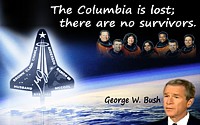
The Columbia is lost; there are no survivors. … In an age when space flight has come to seem almost routine, it is easy to overlook the dangers of travel by rocket, and the difficulties of navigating the fierce outer atmosphere of the Earth. These astronauts knew the dangers, and they faced them willingly, knowing they had a high and noble purpose in life. Because of their courage and daring idealism, we will miss them all the more. … The cause in which they died will continue. Mankind is led into the darkness beyond our world by the inspiration of discovery and the longing to understand. Our journey into space will go on.
Address to the Nation on the Space Shuttle Columbia tragedy, from the Cabinet Room (1 Feb 2003). In William J. Federer, A Treasury of Presidential Quotations (2004), 437.
The concepts of ‘soul’ or ‘life’ do not occur in atomic physics, and they could not, even indirectly, be derived as complicated consequences of some natural law. Their existence certainly does not indicate the presence of any fundamental substance other than energy, but it shows only the action of other kinds of forms which we cannot match with the mathematical forms of modern atomic physics ... If we want to describe living or mental processes, we shall have to broaden these structures. It may be that we shall have to introduce yet other concepts.
In 'Fundamental Problems of Atomic Physics', collected in Philip P. Wiener (Ed.), Readings in Philosophy of Science: Introduction to the Foundations and Cultural Aspects of the Sciences (1953), 96. From a Lecture delivered at the Eidgenössische Technische Hochschule, Zürich (9 Jul 1948). Published Wandlungen in den Grundlagen der Naturwissenschaft, as translated by F. C. Hayes in Philosophic Problems of Nuclear Science (1952).
The conclusion forced upon me in the course of a life devoted to natural science is that the universe as it is assumed to be in physical science is only an idealized world, while the real universe is the spiritual universe in which spiritual values count for everything.
The Sciences and Philosophy: Gifford Lectures, University of Glasgow, 1927 & 1925 (1929), 273.
The conscience of the dying belies their life.
…...
The conscious life of the mind is of small importance in comparison with its unconscious life.
From original French, “La vie consciente de l’esprit ne représente qu’une bien faible part auprès
de sa vie inconsciente,” in Psychologie des Foules (1895), 16. English text in The Crowd: A Study of the Popular Mind (1897), Book 1, Chap. 1, 7. [A closer translation could be: “The conscious life of the mind represents only a very small part of of his unconscious life.” —Webmaster]
The contingency of history (both for life in general and for the cultures of Homo sapiens) and human free will (in the factual rather than theological sense) are conjoined concepts, and no better evidence can be produced than the ‘experimental’ production of markedly different solutions in identical environments.
…...
The continuous invention of new ways of observing is man’s special secret of living.
From Lecture 4, 'The Establishment of Certainty' (23 Nov 1050), in the BBC Home Service radio series of Reith Lectures on 'Doubt and Certainty in Science'. Published in The Listener (1950), 44, 585.
The contributions of physiological knowledge to an understanding of distribution are necessarily inferential. Distribution is a historical phenomenon, and the data ordinarily obtained by students of physiology are essentially instantaneous. However, every organism has a line of ancestors which extends back to the beginning of life on earth and which, during this immensity of time, has invariably been able to avoid, to adapt to, or to compensate for environmental changes.
From 'The role of physiology in the distribution of terrestrial vertebrates', collected in C.L. Hubbs (ed.), Zoogeography: Publ. 51 (1958), 84.
The creative life [is] the only one for a serious man.
In A Mathematician's Apology (1940, 2012), 53.
The crescendo of noise—whether it comes from truck or jackhammer, siren or airplane—is more than an irritating nuisance. It intrudes on privacy, shatters serenity, and can inflict pain. We dare not be complacent about this ever mounting volume of noise. In the years ahead, it can bring even more discomfort—and worse—to the lives of people.
In 'Special Message to the Congress on Conservation: “To Renew a Nation” (8 Mar 1968). Collected in Public Papers of the Presidents of the United States: Lyndon B. Johnson: 1968-69 (1970), 363.
https://books.google.com/books?isbn=1623768977
Johnson, Lyndon B. - 1970
The crown and glory of life is Character. It is the noblest possession of a man, constituting a rank in itself, and an estate in the general goodwill; dignifying every station, and exalting every position in society. It exercises a greater power than wealth, and secures all the honour without the jealousies of fame. It carries with it an influence which always tells; for it is the result of proved honour, rectitude, and consistency—qualities which, perhaps more than any other, command the general confidence and respect of mankind.
In Self-help: With Illustrations of Character and Conduct (1859, 1861), 396.
The crust of erosion is always linked to life.
In A.V. Lapo, 'Problemy biogeokhimii' (“Problems of Biogeochemistry”), Works of the Biogeochemical Laboratory (1980), 16, 123.
The dependence on computers is merely the most recent—and the most extreme—example of how man relies on technology in order to escape the burden of acting as an independent agent. It helps him avoid the task of giving meaning to his life, of deciding and pursuing what is truly valuable.
From interview with New Age journal (1985), as quoted in obituary (2008) on M.I.T. News website.
The desire for guidance, love, and support prompts men to form the social or moral conception of God. This is the God of Providence, who protects, disposes, rewards, and punishes; the God who, according to the limits of the believer’s outlook, loves and cherishes the life of the tribe or of the human race, or even or life itself; the comforter in sorrow and unsatisfied longing; he who preserves the souls of the dead. This is the social or moral conception of God.
…...
The development of statistics are causing history to be rewritten. Till recently the historian studied nations in the aggregate, and gave us only the story of princes, dynasties, sieges, and battles. Of the people themselves—the great social body with life, growth, sources, elements, and laws of its own—he told us nothing. Now statistical inquiry leads him into the hovels, homes, workshops, mines, fields, prisons, hospitals, and all places where human nature displays its weakness and strength. In these explorations he discovers the seeds of national growth and decay, and thus becomes the prophet of his generation.
Speech (16 Dec 1867) given while a member of the U.S. House of Representatives, introducing resolution for the appointment of a committee to examine the necessities for legislation upon the subject of the ninth census to be taken the following year. Quoted in John Clark Ridpath, The Life and Work of James A. Garfield (1881), 217.
The difficulties connected with my criterion of demarcation (D) are important, but must not be exaggerated. It is vague, since it is a methodological rule, and since the demarcation between science and nonscience is vague. But it is more than sharp enough to make a distinction between many physical theories on the one hand, and metaphysical theories, such as psychoanalysis, or Marxism (in its present form), on the other. This is, of course, one of my main theses; and nobody who has not understood it can be said to have understood my theory.
The situation with Marxism is, incidentally, very different from that with psychoanalysis. Marxism was once a scientific theory: it predicted that capitalism would lead to increasing misery and, through a more or less mild revolution, to socialism; it predicted that this would happen first in the technically highest developed countries; and it predicted that the technical evolution of the 'means of production' would lead to social, political, and ideological developments, rather than the other way round.
But the (so-called) socialist revolution came first in one of the technically backward countries. And instead of the means of production producing a new ideology, it was Lenin's and Stalin's ideology that Russia must push forward with its industrialization ('Socialism is dictatorship of the proletariat plus electrification') which promoted the new development of the means of production.
Thus one might say that Marxism was once a science, but one which was refuted by some of the facts which happened to clash with its predictions (I have here mentioned just a few of these facts).
However, Marxism is no longer a science; for it broke the methodological rule that we must accept falsification, and it immunized itself against the most blatant refutations of its predictions. Ever since then, it can be described only as nonscience—as a metaphysical dream, if you like, married to a cruel reality.
Psychoanalysis is a very different case. It is an interesting psychological metaphysics (and no doubt there is some truth in it, as there is so often in metaphysical ideas), but it never was a science. There may be lots of people who are Freudian or Adlerian cases: Freud himself was clearly a Freudian case, and Adler an Adlerian case. But what prevents their theories from being scientific in the sense here described is, very simply, that they do not exclude any physically possible human behaviour. Whatever anybody may do is, in principle, explicable in Freudian or Adlerian terms. (Adler's break with Freud was more Adlerian than Freudian, but Freud never looked on it as a refutation of his theory.)
The point is very clear. Neither Freud nor Adler excludes any particular person's acting in any particular way, whatever the outward circumstances. Whether a man sacrificed his life to rescue a drowning, child (a case of sublimation) or whether he murdered the child by drowning him (a case of repression) could not possibly be predicted or excluded by Freud's theory; the theory was compatible with everything that could happen—even without any special immunization treatment.
Thus while Marxism became non-scientific by its adoption of an immunizing strategy, psychoanalysis was immune to start with, and remained so. In contrast, most physical theories are pretty free of immunizing tactics and highly falsifiable to start with. As a rule, they exclude an infinity of conceivable possibilities.
The situation with Marxism is, incidentally, very different from that with psychoanalysis. Marxism was once a scientific theory: it predicted that capitalism would lead to increasing misery and, through a more or less mild revolution, to socialism; it predicted that this would happen first in the technically highest developed countries; and it predicted that the technical evolution of the 'means of production' would lead to social, political, and ideological developments, rather than the other way round.
But the (so-called) socialist revolution came first in one of the technically backward countries. And instead of the means of production producing a new ideology, it was Lenin's and Stalin's ideology that Russia must push forward with its industrialization ('Socialism is dictatorship of the proletariat plus electrification') which promoted the new development of the means of production.
Thus one might say that Marxism was once a science, but one which was refuted by some of the facts which happened to clash with its predictions (I have here mentioned just a few of these facts).
However, Marxism is no longer a science; for it broke the methodological rule that we must accept falsification, and it immunized itself against the most blatant refutations of its predictions. Ever since then, it can be described only as nonscience—as a metaphysical dream, if you like, married to a cruel reality.
Psychoanalysis is a very different case. It is an interesting psychological metaphysics (and no doubt there is some truth in it, as there is so often in metaphysical ideas), but it never was a science. There may be lots of people who are Freudian or Adlerian cases: Freud himself was clearly a Freudian case, and Adler an Adlerian case. But what prevents their theories from being scientific in the sense here described is, very simply, that they do not exclude any physically possible human behaviour. Whatever anybody may do is, in principle, explicable in Freudian or Adlerian terms. (Adler's break with Freud was more Adlerian than Freudian, but Freud never looked on it as a refutation of his theory.)
The point is very clear. Neither Freud nor Adler excludes any particular person's acting in any particular way, whatever the outward circumstances. Whether a man sacrificed his life to rescue a drowning, child (a case of sublimation) or whether he murdered the child by drowning him (a case of repression) could not possibly be predicted or excluded by Freud's theory; the theory was compatible with everything that could happen—even without any special immunization treatment.
Thus while Marxism became non-scientific by its adoption of an immunizing strategy, psychoanalysis was immune to start with, and remained so. In contrast, most physical theories are pretty free of immunizing tactics and highly falsifiable to start with. As a rule, they exclude an infinity of conceivable possibilities.
'The Problem of Demarcation' (1974). Collected in David Miller (ed.) Popper Selections (1985), 127-128.
The dignity of this end of endowment of man's life with new commodity appeareth by the estimation that antiquity made of such as guided thereunto ; for whereas founders of states, lawgivers, extirpators of tyrants, fathers of the people, were honoured but with the titles of demigods, inventors ere ever consecrated among the gods themselves.
Bacon and Basil Montagu (Ed.), 'Fragments of Valerius Terminus, on the Interpretation of Nature', Works of Bacon (1825), vol. 1., 266. Quoted in The Origin and Progress of the Mechanical Inventions of James Watt (1854), Vol.1, 2.
The disaster was caused neither by carelessness nor human failure. Unknown natural factors that we are still unable to explain today have made a mockery of all our efforts. The very substance intended to provide food and life to millions of our countrymen and which we have produced and supplied for years has suddenly become a cruel enemy for reasons we are as yet unable to fathom. It has reduced our site to rubble.
From the memorial service for the hundreds of people killed by the explosion of the ammonia fertilizer factory at Oppau, Germany. At the time, the explosive nature of ammonium nitrate was not understood.
From the memorial service for the hundreds of people killed by the explosion of the ammonia fertilizer factory at Oppau, Germany. At the time, the explosive nature of ammonium nitrate was not understood.
BASF corporate history webpage.
The discovery of agriculture was the first big step toward a civilized life.
In Evolution and Ethics (1947), 79.
The diseases which are hard to cure in neighborhoods… are catarrh, hoarseness, coughs, pleurisy, consumption, spitting of blood, and all others that are cured not by lowering the system but by building it up. They are hard to cure, first, because they are originally due to chills; secondly, because the patient's system being already exhausted by disease, the air there, which is in constant agitation owing to winds and therefore deteriorated, takes all the sap of life out of their diseased bodies and leaves them more meager every day. On the other hand, a mild, thick air, without drafts and not constantly blowing back and forth, builds up their frames by its unwavering steadiness, and so strengthens and restores people who are afflicted with these diseases.
In De Architectura, Book 1, Chap 6, Sec. 3. As translated in Morris Hicky Morgan (trans.), Vitruvius: The Ten Books on Architecture (1914), 25.
The diversity of life is extraordinary. There is said to be a million or so different kinds of living animals, and hundreds of thousands of kinds of plants. But we don’t need to think of the world at large. It is amazing enough to stop and look at a forest or at a meadow—at the grass and trees and caterpillars and hawks and deer. How did all these different kinds of things come about; what forces governed their evolution; what forces maintain their numbers and determine their survival or extinction; what are their relations to each other and to the physical environment in which they live? These are the problems of natural history.
In The Nature of Natural History (1950), 8.
The division between life and nonlife is perhaps an artificial one.
Speaking at an international meeting on the origins of life, quoted in E. Eckholm, 'Search for the Origins is Widening', International Herald Tribune (7 Jul 1986). As cited in Stuart R. Hameroff, Ultimate Computing: Biomolecular Consciousness and Nanotechnology (1987), 57.
The dog [in Pavlov’s experiments] does not continue to salivate whenever it hears a bell unless sometimes at least an edible offering accompanies the bell. But there are innumerable instances in human life where a single association, never reinforced, results in the establishment of a life-long dynamic system. An experience associated only once with a bereavement, an accident, or a battle, may become the center of a permanent phobia or complex, not in the least dependent on a recurrence of the original shock.
Personality: A Psychological Interpretation(1938), 199.
The dog writhing in the gutter, its back broken by a passing car, knows what it is to be alive. So too with the aged elk of the far north woods, slowly dying in the bitter cold of winter. The asphalt upon which the dog lies knows no pain. The snow upon which the elk has collapsed knows not the cold. But living beings do. … Are you conscious? Then you can feel more pain. … Perhaps we even suffer more than the dumb animals.
In The Symbiotic Universe: Life and Mind in the Cosmos (1988), 194-195. As quoted and cited in Robert E. Zinser, The Fascinated God: What Science Says to Faith and Faith to Scientists (2003), 521.
The drive behind life has lost none of its power; proof that, impelled by that drive, man can build as well as destroy; that in his nature is more of Vishnu the Creator than of Siva the Destroyer.
From Why We Behave Like Human Beings (1925), 479.
The ductless glands secrete among other things our moods, our aspirations, our philosophy of life.
'And Wanton Optics Roil the Melting Eye', in Music at Night and Other Essays (1931), 26.
The earth does not belong to us; we belong to the earth. All things are connected, like the blood which unites one family. Mankind did not weave the web of life. We are but one strand within it. Whatever we do to the web, we do to ourselves.
Fictional speech from script for ABC TV movie, Home (1972). The words by the screenwriter were inspired from an Earth Day gathering in 1970, where Perry heard a historical account by physician Dr. Henry Smith. The doctor’s words were published in a Seattle newspaper, written up to 33 years after being present, when in Dec 1854 Chief Seattle made an impassioned speech, in the language of his own people, the Suquwamish. The Chief, with other tribal leaders, were meeting with the Territorial Governor who was trying to get them to sign away their lands and instead receive protection on a reservation. Dr. Smith may not have been fluent in the language of the Suquwamish, although he did make some notes at the time. But he wrote poetry, making embellishment or invention likely, so it is questionable whether his newspaper account is reliable in providing the Chief’s actual words. In turn, Perry has made clear that his script provided a fictional representation of the Chief. The televised quote, however became mythical, and is incorrectly passed along as attributed to Chief Seattle in 1854, but the truth is the words are contemporary, written by Perry, a screenwriter. Also seen as: “Humankind has not woven the web of life. We are but one thread within it. Whatever we do to the web, we do to ourselves. All things are bound together. All things connect.”
The Earth has recovered after fevers like this, and there are no grounds for thinking that what we are doing will destroy Gaia, but if we continue business as usual, our species may never again enjoy the lush and verdant world we had only a hundred years ago. What is most in danger is civilization; humans are tough enough for breeding pairs to survive, and Gaia is toughest of all. What we are doing weakens her but is unlikely to destroy her. She has survived numerous catastrophes in her three billion years or more of life.
In The Revenge of Gaia: Earth’s Climate Crisis & The Fate of Humanity (2006, 2007), 76-77.
The earth holds a silver treasure, cupped between ocean bed and tenting sky. Forever the heavens spend it, in the showers that refresh our temperate lands, the torrents that sluice the tropics. Every suckling root absorbs it, the very soil drains it down; the rivers run unceasing to the sea, the mountains yield it endlessly… Yet none is lost; in vast convection our water is returned, from soil to sky, and sky to soil, and back gain, to fall as pure as blessing. There was never less; there could never be more. A mighty mercy on which life depends, for all its glittering shifts, water is constant.
In A Cup of Sky (1950), 41.
The earth is a book in which we read not only its history, but the history of the living things it has borne.
Epigraph in Isaac Asimov’s Book of Science and Nature Quotations (1988), 108.
The Earth Speaks, clearly, distinctly, and, in many of the realms of Nature, loudly, to William Jennings Bryan, but he fails to hear a single sound. The earth speaks from the remotest periods in its wonderful life history in the Archaeozoic Age, when it reveals only a few tissues of its primitive plants. Fifty million years ago it begins to speak as “the waters bring forth abundantly the moving creatures that hath life.” In successive eons of time the various kinds of animals leave their remains in the rocks which compose the deeper layers of the earth, and when the rocks are laid bare by wind, frost, and storm we find wondrous lines of ascent invariably following the principles of creative evolution, whereby the simpler and more lowly forms always precede the higher and more specialized forms.
The earth speaks not of a succession of distinct creations but of a continuous ascent, in which, as the millions of years roll by, increasing perfection of structure and beauty of form are found; out of the water-breathing fish arises the air-breathing amphibian; out of the land-living amphibian arises the land-living, air-breathing reptile, these two kinds of creeping things resembling each other closely. The earth speaks loudly and clearly of the ascent of the bird from one kind of reptile and of the mammal from another kind of reptile.
This is not perhaps the way Bryan would have made the animals, but this is the way God made them!
The earth speaks not of a succession of distinct creations but of a continuous ascent, in which, as the millions of years roll by, increasing perfection of structure and beauty of form are found; out of the water-breathing fish arises the air-breathing amphibian; out of the land-living amphibian arises the land-living, air-breathing reptile, these two kinds of creeping things resembling each other closely. The earth speaks loudly and clearly of the ascent of the bird from one kind of reptile and of the mammal from another kind of reptile.
This is not perhaps the way Bryan would have made the animals, but this is the way God made them!
The Earth Speaks to Bryan (1925), 5-6. Osborn wrote this book in response to the Scopes Monkey Trial, where William Jennings Bryan spoke against the theory of evolution. They had previously been engaged in the controversy about the theory for several years. The title refers to a Biblical verse from the Book of Job (12:8), “Speak to the earth and it shall teach thee.”
The effort to understand the universe is one of the very few things that lifts human life above the level of farce, and gives it some of the grace of tragedy.
In The First Three Minutes (1977), 155.
The efforts of most human-beings are consumed in the struggle for their daily bread, but most of those who are, either through fortune or some special gift, relieved of this struggle are largely absorbed in further improving their worldly lot. Beneath the effort directed toward the accumulation of worldly goods lies all too frequently the illusion that this is the most substantial and desirable end to be achieved; but there is, fortunately, a minority composed of those who recognize early in their lives that the most beautiful and satisfying experiences open to humankind are not derived from the outside, but are bound up with the development of the individual's own feeling, thinking and acting. The genuine artists, investigators and thinkers have always been persons of this kind. However inconspicuously the life of these individuals runs its course, none the less the fruits of their endeavors are the most valuable contributions which one generation can make to its successors.
In letter (1 May 1935), Letters to the Editor, 'The Late Emmy Noether: Professor Einstein Writes in Appreciation of a Fellow-Mathematician', New York Times (4 May 1935), 12.
The elements of the living body have the chemical peculiarity of forming with each other most numerous combinations and very large molecules, consisting of five, six or even seven different elements.
In discourse (10 Dec 1893) to General Meeting, Nassau Association for Natural Science, Wiesbaden, Germany. Printed in 'The Distribution of the Organic Elements', The Chemical News and Journal of Industrial Science (1895), 71, No. 1832, 19.
The emotional centre is the dynamo of our whole life.
In On Love & Psychological Exercises: With Some Aphorisms & Other Essays (1998), 50.
The energy of the mind is the essence of life.
…...
The equation of animal and vegetable life is too complicated a problem for human intelligence to solve, and we can never know how wide a circle of disturbance we produce in the harmonies of nature when we throw the smallest pebble into the ocean of organic life.
Man and Nature, (1864), 103.
The essence of life is statistical improbability on a colossal scale.
In The Blind Watchmaker: Why the Evidence of Evolution Reveals a Universe Without Design (1986), 317.
The essential molecule of reproduction, DNA, … is composed of only four nitrogen bases (adenine, thymine, guanine, and cytosine), the sugar deoxyribose, and a phosphate. DNA’s intermediary, RNA, differs only by the substitution of the sugar ribose for deoxyribose and the nitrogen base uracil for thymine. The proteins of living organisms are made with a mere 20 amino acids, all arranged in a “left-handed” configuration. Taking into account all 28 building blocks, or “letters” (20 amino acids, five bases, two sugars, and one phosphate), the message is clear: With such a limited alphabet, all life must have had a common chemical origin.
In 'Cosmochemistry The Earliest Evolution', The Science Teacher (Oct 1983), 50, No. 7, 35.
The estimate we form of the intellectual capacity of our race, is founded on an examination of those productions which have resulted from the loftiest flights of individual genius, or from the accumulated labors of generations of men, by whose long-continued exertions a body of science has been raised up, surpassing in its extent the creative powers of any individual, and demanding for its development a length of time, to which no single life extends.
In The Ninth Bridgewater Treatise: A Fragment (1838), 30.
The events of the past few years have led to a critical examination of the function of science in society. It used to be believed that the results of scientific investigation would lead to continuous progressive improvements in conditions of life; but first the War and then the economic crisis have shown that science can be used as easily for destructive and wasteful purposes, and voices have been raised demanding the cessation of scientific research as the only means of preserving a tolerable civilization. Scientists themselves, faced with these criticisms, have been forced to consider, effectively for the first time, how the work they are doing is connected around them. This book is an attempt to analyse this connection; to investigate how far scientists, individually and collectively, are responsible for this state of affairs, and to suggest what possible steps could be taken which would lead to a fruitful and not to a destructive utilization of science.
The Social Function of Science (1939), xlii.
The evolution of higher and of lower forms of life is as well and as soundly established as the eternal hills. It has long since ceased to be a theory; it is a law of Nature as universal in living things as is the law of gravitation in material things and in the motions of the heavenly spheres.
Evolution and Religion in Education (1926), 118.
The existence of life must be considered as an elementary fact that can not be explained, but must be taken as a starting point in biology, in a similar way as the quantum of action, which appears as an irrational element from the point of view of classical mechanical physics, taken together with the existence of elementary particles, forms the foundation of atomic physics. The asserted impossibility of a physical or chemical explanation of the function peculiar to life would in this sense be analogous to the insufficiency of the mechanical analysis for the understanding of the stability of atoms.
'Light and Life', Nature, 1933, 131, 458.
The experience and behaviour that gets labelled schizophrenic is a special strategy that a person invents in order to live in an unlivable situation.
Politics of Experience (1967), 95.
The explosions [of dying stars] scattered the heavy elements as a fine dust through space. By the time it made the Sun, the primordial gas of the Milky Way was sufficiently enriched with heavier elements for rocky planets like the Earth to form. And from the rocks atoms escaped for eventual incorporation in living things: carbon, nitrogen, oxygen, phosphorus and sulphur for all living tissue; calcium for bones and teeth; sodium and potassium for the workings of nerves and brains; the iron colouring blood red… and so on.
No other conclusion of modern research testifies more clearly to mankind’s intimate connections with the universe at large and with the cosmic forces at work among the stars.
In The Key to the Universe: A Report on the New Physics (1977), 33.
The exterior appearance of human life is but the material embodiment, the substantial expression, of thought—the hieroglyphic writing of the soul.
In 'Genius', Wellman’s Miscellany (Dec 1871), 4, No. 6, 201.
The fact that astronomies change while the stars abide is a true analogy of every realm of human life and thought, religion not least of all.
In The Living of These Days: An Autobiography (1956), 230.
The fact that death from cancer is on the increase is not only a problem of medicine, but its at the same time testifies to the wonderful efficiency of medical science... [as it] enables more persons top live long enough to develop some kind of cancer in old and less resistant tissues.
Charles H. Mayo and William A. Hendricks, 'Carcinoma of the Right Segment of the Colon', presented to Southern Surgical Assoc. (15 Dec 1925). In Annals of Surgery (Mar 1926), 83, 357.
The fact that human life can be prolonged with fewer physical problems requires that we give increasing attention to improving the quality of life. As the poet Edwin Markham stated: “We are all fools until we know that in the common plan, nothing is worth the building if it does not build the man; why build these temples glorious, if man unbuilded goes?”
In 'Millenial Musings', Chemical & Engineering News (6 Dec 1999), 77, No. 49, 48.
The fact that scientists do not consciously practice a formal methodology is very poor evidence that no such methodology exists. It could be said—has been said—that there is a distinctive methodology of science which scientists practice unwittingly, like the chap in Moliere who found that all his life, unknowingly, he had been speaking prose.
Induction and Intuition in Scientific Thought (1969), 9.
The fact that this chain of life existed [at volcanic vents on the seafloor] in the black cold of the deep sea and was utterly independent of sunlight—previously thought to be the font of all Earth’s life—has startling ramifications. If life could flourish there, nurtured by a complex chemical process based on geothermal heat, then life could exist under similar conditions on planets far removed from the nurturing light of our parent star, the Sun.
Quoted in Peter Douglas Ward and Donald Brownlee, Rare Earth: Why Complex Life is Uncommon in the Universe (2000), 1, without citation.
The fact that, with respect to size, the viruses overlapped with the organisms of the biologist at one extreme and with the molecules of the chemist at the other extreme only served to heighten the mystery regarding the nature of viruses. Then too, it became obvious that a sharp line dividing living from non-living things could not be drawn and this fact served to add fuel for discussion of the age-old question of “What is life?”
Nobel Lecture (12 Dec 1946), 'The Isolation and Properties of Crystalline Tobacco Mosaic Virus', collected in Nobel Lectures in Chemistry (1999), 140.
The fact which interests us most is the life of the naturalist. The purest science is still biographical.
In A Week on the Concord and Merrimack Rivers (1862), 382.
The facts of life do not penetrate to the sphere in which our beliefs are cherished; they did not engender those beliefs, and they are powerless to destroy them.
Swann’s Way. Quoted in Kim Lim (ed.), 1,001 Pearls of Spiritual Wisdom: Words to Enrich, Inspire, and Guide Your Life (2014), 40
The farthest Thunder that I heard
Was nearer than the Sky
And rumbles still, though torrid Noons
Have lain their missiles by-
The Lightning that preceded it
Struck no one but myself-
But I would not exchange the Bolt
For all the rest of Life-
Indebtedness to Oxygen
The Happy may repay,
But not the obligation
To Electricity-
It founds the Homes and decks the Days
And every clamor bright
Is but the gleam concomitant
Of that waylaying Light-
The Thought is quiet as a Flake-
A Crash without a Sound,
How Life’s reverberation
Is Explanation found-—
Was nearer than the Sky
And rumbles still, though torrid Noons
Have lain their missiles by-
The Lightning that preceded it
Struck no one but myself-
But I would not exchange the Bolt
For all the rest of Life-
Indebtedness to Oxygen
The Happy may repay,
But not the obligation
To Electricity-
It founds the Homes and decks the Days
And every clamor bright
Is but the gleam concomitant
Of that waylaying Light-
The Thought is quiet as a Flake-
A Crash without a Sound,
How Life’s reverberation
Is Explanation found-—
The fateful question for the human species seems to me to be whether and to what extent their cultural development will succeed in mastering the disturbance of their communal life by the human instinct of aggression and self-destruction … One thing only do I know for certain and that is that man's judgements of value follow directly from his wihes for happiness—that, accordingly, they are an attempt to support his illusions with arguments. (1930)
Civilization and its Discontents (2005), 154.
The first entirely vital action, so termed because it is not effected outside the influence of life, consists in the creation of the glycogenic material in the living hepatic tissue. The second entirely chemical action, which can be effected outside the influence of life, consists in the transformation of the glycogenic material into sugar by means of a ferment.
Sur le Méchanisme de la Fonction du Sucre dans Ie Foie (1857), 583. Translated in Joseph S. Fruton, Proteins, Enzymes, Genes: The Interplay of Chemistry and Biology (1999), 340.
The first principle for the student to recognise, and one to which in after life he will often have to recur, is that his work lies not in the fluctuating balance of men’s opinion, but with the unchangeable facts of nature.
From Address (Oct 1874) delivered at Guy’s Hospital, 'On The Study of Medicine', printed in British Medical journal (1874), 2, 425. Collected in Sir William Withey Gull and Theodore Dyke Acland (ed.), A Collection of the Published Writings of William Withey Gull (1896), 4.
The first question which you will ask and which I must try to answer is this, “What is the use of climbing Mount Everest ?” and my answer must at once be, “It is no use.” There is not the slightest prospect of any gain whatsoever. Oh, we may learn a little about the behavior of the human body at high altitudes, and possibly medical men may turn our observation to some account for the purposes of aviation. But otherwise nothing will come of it. We shall not bring back a single bit of gold or silver, not a gem, nor any coal or iron. We shall not find a single foot of earth that can be planted with crops to raise food. It’s no use. So, if you cannot understand that there is something in man which responds to the challenge of this mountain and goes out to meet it, that the struggle is the struggle of life itself upward and forever upward, then you won’t see why we go. What we get from this adventure is just sheer joy. And joy is, after all, the end of life. We do not live to eat and make money. We eat and make money to be able to enjoy life. That is what life means and what life is for.
…...
The first requisite to success in life is to be a good animal.
In Getting on in the World; Or, Hints on Success in Life (1873), 55.
The first two rules of science are: 1. The truth at any price including the price of your life. 2. Look at things right under your nose as if you’ve never seen them before, then proceed from there.
In The God Problem: How a Godless Cosmos Creates (2012), 16.
The flight of most members of a profession to the high empyrean, where they can work peacefully on purely scientific problems, isolated from the turmoil of real life, was perhaps quite appropriate at an earlier stage of science; but in today's world it is a luxury we cannot afford.
The Scientific Imagination: Case Studies (1978), 250.
The following general conclusions are drawn from the propositions stated above, and known facts with reference to the mechanics of animal and vegetable bodies:—
There is at present in the material world a universal tendency to the dissipation of mechanical energy.
Any restoration of mechanical energy, without more than an equivalent of dissipation, is impossible in inanimate material processes, and is probably never effected by means of organized matter, either endowed with vegetable life, or subjected to the will of an animated creature.
Within a finite period of time past the earth must have been, and within a finite period of time to come the earth must again be, unfit for the habitation of man as at present constituted, unless operations have been, or are to be performed, which are impossible under the laws to which the known operations going on at present in the material world are subject.
There is at present in the material world a universal tendency to the dissipation of mechanical energy.
Any restoration of mechanical energy, without more than an equivalent of dissipation, is impossible in inanimate material processes, and is probably never effected by means of organized matter, either endowed with vegetable life, or subjected to the will of an animated creature.
Within a finite period of time past the earth must have been, and within a finite period of time to come the earth must again be, unfit for the habitation of man as at present constituted, unless operations have been, or are to be performed, which are impossible under the laws to which the known operations going on at present in the material world are subject.
In 'On a Universal Tendency in Nature to the Dissipation of Mechanical Energy', Proceedings of the Royal Society of Edinburgh, 1852, 3, 141-142. In Mathematical and Physical Papers (1882-1911), Vol. 1, 513-514.
The following story is true. There was a little boy, and his father said, “Do try to be like other people. Don’t frown.” And he tried and tried, but could not. So his father beat him with a strap; and then he was eaten up by lions. Reader, if young, take warning by his sad life and death. For though it may be an honour to be different from other people, if Carlyle’s dictum about the 30 million be still true, yet other people do not like it. So, if you are different, you had better hide it, and pretend to be solemn and wooden-headed. Until you make your fortune. For most wooden-headed people worship money; and, really, I do not see what else they can do. In particular, if you are going to write a book, remember the wooden-headed. So be rigorous; that will cover a multitude of sins. And do not frown.
From 'Electromagnetic Theory, CXII', The Electrician (23 Feb 1900), Vol. 44, 615.
The forest is a peculiar organism of unlimited kindness and benevolence that makes no demands for its sustenance and extends generously the products of its life activity; it provides protection to all beings, offering shade even to the axeman who destroys it.
In Sergius Alexander Wilde, Forest Soils and Forest Growth (1946), 6.
The frequency of disastrous consequences in compound fracture, contrasted with the complete immunity from danger to life or limb in simple fracture, is one of the most striking as well as melancholy facts in surgical practice.
'On a New Method of Treating Compound Fracture, Abscesses, etc: With Observations on the Conditions of Supperation', Part I, The Lancet (1867), 326.
The fundamental characteristic of the scientific method is honesty. In dealing with any question, science asks no favors. ... I believe that constant use of the scientific method must in the end leave its impress upon him who uses it. ... A life spent in accordance with scientific teachings would be of a high order. It would practically conform to the teachings of the highest types of religion. The motives would be different, but so far as conduct is concerned the results would be practically identical.
Address as its retiring president, to the American Association for the Advancement of Science, St. Louis (28 Dec 1903). 'Scientific Investigation and Progress', Nature 928 Jan 1904), 69:1787, 309.
The further the spiritual evolution of mankind advances, the more certain it seems to me that the path to genuine religiosity does not lie through the fear of life, and the fear of death, and blind faith, but through striving after rational knowledge.
…...
The future of humanity is uncertain, even in the most prosperous countries, and the quality of life deteriorates; and yet I believe that what is being discovered about the infinitely large and the infinitely small is sufficient to absolve this end of the century and millennium. What a very few are acquiring in knowledge of the physical world will perhaps cause this period not to be judged as a pure return to barbarism.
In 'News from the Sky', Other People’s Trades (1989), 23-24.
The Gaia Hypothesis asserts that Earth’s atmosphere is continually interacting with geology (the lithosphere). Earth’s cycling waters (the hydrosphere), and everything that lives (the biosphere). … The image is that the atmosphere is a circulatory system for life’s bio-chemical interplay. If the atmosphere is pan of a larger whole that has some of the qualities of an organism, one of those qualities we must now pray for is resilience.
In Praise of Nature
The game of Chess is not merely an idle amusement. Several very valuable qualities of the mind, useful in the course of human life, are to be acquired or strengthened by it so as to become habits ready on all occasions.
In The Morals of Chess. As quoted in The Gentleman's Magazine, and Historical Chronicle (1787), 590.
The gene as the basis of life.
'The Gene as the Basis of Life', Proceedings of the International Congress of Plant Sciences (1929), 1, 897-921.
The general knowledge of our author [Leonhard Euler] was more extensive than could well be expected, in one who had pursued, with such unremitting ardor, mathematics and astronomy as his favorite studies. He had made a very considerable progress in medical, botanical, and chemical science. What was still more extraordinary, he was an excellent scholar, and possessed in a high degree what is generally called erudition. He had attentively read the most eminent writers of ancient Rome; the civil and literary history of all ages and all nations was familiar to him; and foreigners, who were only acquainted with his works, were astonished to find in the conversation of a man, whose long life seemed solely occupied in mathematical and physical researches and discoveries, such an extensive acquaintance with the most interesting branches of literature. In this respect, no doubt, he was much indebted to an uncommon memory, which seemed to retain every idea that was conveyed to it, either from reading or from meditation.
In Philosophical and Mathematical Dictionary (1815), 493-494.
The generation of seeds ... is therefore marvelous and analogous to the other productions of living things. For first of all an umbilicus appears. ... Its extremity gradually expands and after gathering a colliquamentous ichor becomes analogous to an amnion. ... In the course of time the seed or fetus begins to become visible.
'On the Developmental Process', in H. B. Adelmann (ed.), Marcello Malpighi and the Evolution of Embryology (1966), Vol. 2, 850.
The good life is one inspired by life and guided by knowledge.
…...
The great art of life is sensation, to feel that we exist, even in pain.
…...
The great beauty of Darwin’s theory of evolution is that it explains how complex, difficult to understand things could have arisen step by plausible step, from simple, easy to understand beginnings. We start our explanation from almost infinitely simple beginnings: pure hydrogen and a huge amount of energy. Our scientific, Darwinian explanations carry us through a series of well-understood gradual steps to all the spectacular beauty and complexity of life.
From speech at the Edinburgh International Science Festival (15 Apr 1992), published in the Independent newspaper. Included in excerpt in Alec Fisher, The Logic of Real Arguments (2004), 84-85. The full speech was reprinted in The Nullifidian, (Dec 1994). Transcribed online in the Richard Dawkins archive, article 89, titled: Lecture from 'The Nullifidian' (Dec 94).
The great end of life is not knowledge, but action. What men need is as much knowledge as they can organize for action; give them more and it may become injurious. Some men are heavy and stupid from undigested learning.
'Technical Education' (1877). In Collected Essays (1893), Vol. 3, 422. [A similar statement was made in the same time period by Karl Marx.]
The great testimony of history shows how often in fact the development of science has emerged in response to technological and even economic needs, and how in the economy of social effort, science, even of the most abstract and recondite kind, pays for itself again and again in providing the basis for radically new technological developments. In fact, most people—when they think of science as a good thing, when they think of it as worthy of encouragement, when they are willing to see their governments spend substance upon it, when they greatly do honor to men who in science have attained some eminence—have in mind that the conditions of their life have been altered just by such technology, of which they may be reluctant to be deprived.
In 'Contemporary World', Bulletin of the Atomic Scientists (Feb 1948), 4, 67.
The great truths with which it [mathematics] deals, are clothed with austere grandeur, far above all purposes of immediate convenience or profit. It is in them that our limited understandings approach nearest to the conception of that absolute and infinite, towards which in most other things they aspire in vain. In the pure mathematics we contemplate absolute truths, which existed in the divine mind before the morning stars sang together, and which will continue to exist there, when the last of their radiant host shall have fallen from heaven. They existed not merely in metaphysical possibility, but in the actual contemplation of the supreme reason. The pen of inspiration, ranging all nature and life for imagery to set forth the Creator’s power and wisdom, finds them best symbolized in the skill of the surveyor. "He meted out heaven as with a span;" and an ancient sage, neither falsely nor irreverently, ventured to say, that “God is a geometer”.
In Orations and Speeches (1870), Vol. 3, 614.
The great use of a life is to spend it for something that outlasts it.
In Letter to W. Lutoslawski (13 Nov 1900). Collected in Ralph Barton Perry (ed.), The Thought and Character of William James: As Revealed in Unpublished Correspondence and Notes, Together with His Published Writings Vol.2 (1935), 289. Footnote for cite of Letter from The Thought and Character of William James: Briefer Version (1948, 1964), 247.
The greatest joy in life is to accomplish. It is the getting, not the having. It is the giving, not the keeping.
From Cameron Prize Lecture (1928), delivered before the University of Edinburgh. As quoted and cited in Editorial Section, 'Sir Frederick Banting', Canadian Public Health Journal (May 1941), 32, No. 5, 266.
The greatest mystery is why there is something instead of nothing, and the greatest something is this thing we call life.
In Through a Window by Alan Lightman and Roberta Brawer (1990).
The greatest pleasure in life is doing what people say you cannot do.
Attributed. The wording as above may be a popularized derivative from this quote: “The greatest enjoyment possible to man was that which this philosophy promises its votaries—the pleasure of being always right, and always reasoning—without ever being bound to look at anything.” In The English Constitution (1867), 296.
The Greeks are wrong to recognize coming into being and perishing; for nothing comes into being nor perishes, but is rather compounded or dissolved from things that are. So they would be right to call coming into being composition and perishing dissolution.
Simplicius, Commentary on Aristotle’s Physics, 163,20-4. In G. S. Kirk, J. E. Raven and M. Schofield (eds.), The Presocratic Philosophers: A Critical History with a Selection of Texts (1983), p. 358.
The growing complexity of civilized life demands with each age broader and more exact knowledge as to the material surroundings and greater precision in our recognition of the invisible forces or tendencies about us.
From Presidential Address (5 Dec 1896) to the Biological Society of Washington, 'The Malarial Parasite and Other Pathogenic Protozoa', Popular Science Monthly (Mar 1897), 642.
The handling of our forests as a continuous, renewable resource means permanent employment and stability to our country life. The forests are also needed for mitigating extreme climatic fluctuations, holding the soil on the slopes, retaining the moisture in the ground, and controlling the equable flow of water in our streams.
From 'A Presidential Statement on Receipt of the Award of the Schlich Forestry Medal' (29 Jan 1935) in Public Papers of the Presidents of the United States: F.D. Roosevelt, 1935, Volume 4 (1938), 65. Roosevelt was awarded the medal by the Society of American Foresters. This quote continues with the line “The forests are the ‘lungs’ of our land….”
The heart transplant wasn’t such a big thing surgically. The point is I was prepared to take the risk. My philosophy is that the biggest risk in life is not to take the risk.
In conversation with Time magazine. As quoted in 'Christiaan Barnard', Encyclopedia of World Biography.
The highest reach of science is, one may say, an inventive power, a faculty of divination, akin to the highest power exercised in poetry; therefore, a nation whose spirit is characterised by energy may well be eminent in science; and we have Newton. Shakspeare [sic] and Newton: in the intellectual sphere there can be no higher names. And what that energy, which is the life of genius, above everything demands and insists upon, is freedom; entire independence of all authority, prescription and routine, the fullest room to expand as it will.
'The Literary Influence of Acadennes' Essays in Criticism (1865), in R.H. Super (ed.) The Complete Prose Works of Matthew Arnold: Lectures and Essays in Criticism (1962), Vol. 3, 238.
The history of civilization proves beyond doubt just how sterile the repeated attempts of metaphysics to guess at nature’s laws have been. Instead, there is every reason to believe that when the human intellect ignores reality and concentrates within, it can no longer explain the simplest inner workings of life’s machinery or of the world around us.
From Reglas y Consejos sobre Investigacíon Cientifica: Los tónicos de la voluntad. (1897), as translated by Neely and Larry W. Swanson, in Advice for a Young Investigator (1999), 2.
The history of life is more adequately represented by a picture of 'punctuated equilibria' than by the notion of phyletic gradualism. The history of evolution is not one of stately unfolding, but a story of homeostatic equilibria, disturbed only 'rarely' (i.e. rather often in the fullness of time) by rapid and episodic events of speciation.
'Punctuated Equilibria: An Alternative to Phyletic Gradualism', in Thomas J. M. Schopf (ed.), Models in Paleobiology (1972), 84.
The history of life on earth has been a history of interaction between living things and their surroundings.
In Silent Spring (1962), 5.
The history of the cosmos
is the history of the struggle of becoming.
When the dim flux of unformed life
struggled, convulsed back and forth upon itself,
and broke at last into light and dark
came into existence as light,
came into existence as cold shadow
then every atom of the cosmos trembled with delight.
is the history of the struggle of becoming.
When the dim flux of unformed life
struggled, convulsed back and forth upon itself,
and broke at last into light and dark
came into existence as light,
came into existence as cold shadow
then every atom of the cosmos trembled with delight.
God is Born', David Herbert Lawrence, The Works of D.H. Lawrence (1994), 571.
The history of the knowledge of the phenomena of life and of the organized world can be divided into two main periods. For a long time anatomy, and particularly the anatomy of the human body, was the α and ω of scientific knowledge. Further progress only became possible with the discovery of the microscope. A long time had yet to pass until through Schwann the cell was established as the final biological unit. It would mean bringing coals to Newcastle were I to describe here the immeasurable progress which biology in all its branches owes to the introduction of this concept of the cell concept. For this concept is the axis around which the whole of the modern science of life revolves.
Nobel Lecture (11 Dec 1908) 'Partial Cell Functions.' Collected in Nobel Lectures: Physiology or Medicine 1901-1921 (1967), 304.
The human brain is a machine which alone accounts for all our actions, our most private thoughts, our beliefs. ... To choose a spouse, a job, a religious creed—or even choose to rob a bank—is the peak of a causal chain that runs back to the origin of life and down to the nature of atoms and molecules.
The Mind Machine (1998), 145. In Vinoth Ramachandra, Subverting Global Myths: Theology and the Public Issues Shaping our World (2008), 179.
The hypothesis of the connexion of the first limestone beds with the commencement of organic life upon our planet is supported by the fact, that in these beds we find the first remains of the bodies of animated creatures.
Vestiges of the Natural History of Creation (1844), 57.
The important thing is not to stop questioning. Curiosity has its own reason for existing. One cannot help but be in awe when he contemplates the mysteries of eternity, of life, of the marvelous structure of reality.
Recollection of a statement to William Miller, an editor, as quoted in, 'Old Man’s Advice to Youth: “Never Lose a Holy Curiosity”', Life (2 May 1955), 64.
The indescribable pleasure—which pales the rest of life's joys—is abundant compensation for the investigator who endures the painful and persevering analytical work that precedes the appearance of the new truth, like the pain of childbirth. It is true to say that nothing for the scientific scholar is comparable to the things that he has discovered. Indeed, it would be difficult to find an investigator willing to exchange the paternity of a scientific conquest for all the gold on earth. And if there are some who look to science as a way of acquiring gold instead of applause from the learned, and the personal satisfaction associated with the very act of discovery, they have chosen the wrong profession.
From Reglas y Consejos sobre Investigacíon Cientifica: Los tónicos de la voluntad. (1897), as translated by Neely and Larry W. Swanson, in Advice for a Young Investigator (1999), 50.
The inexperienced and presumptuous band of medical tyros let loose upon the world destroys more of human life in one year than all the Robin Hoods, Cartouches, and Macheaths do in a century.
In letter to Caspar Wistar (21 Jun 1807). Memoir, Correspondence, And Miscellanies, From The Papers Of Thomas Jefferson (1829), Vol. 4, 93. (Jefferson regards Robin Hood as a villain, on a par with with Cartouche, an 18th-century highwayway, and Macheath, the cutthroat in John Gay’s Beggar’s Opera.)
The influence of electricity in producing decompositions, although of inestimable value as an instrument of discovery in chemical inquiries, can hardly be said to have been applied to the practical purposes of life, until the same powerful genius [Davy] which detected the principle, applied it, by a singular felicity of reasoning, to arrest the corrosion of the copper-sheathing of vessels. … this was regarded as by Laplace as the greatest of Sir Humphry's discoveries.
Reflections on the Decline of Science in England (1830), 16.
The information we have so far from the exploration of the planets seems to indicate that the earth is probably the only place in this solar system where there is life.
In Space World (1985), 5, 25.
The intellectual life of the whole of western society is increasingly being split into two polar groups… Literary intellectuals at one pole—at the other scientists, and as the most representative, the physical scientists. Between the two a gulf of mutual incomprehension—sometimes (particularly among the young) hostility and dislike, but most of all lack of understanding.
The Two Cultures and the Scientific Revolution: The Rede Lecture (1959), 4.
The interior parts of the earth and its internal depths are a region totally impervious to the eye of mortal man, and can least of all be approached by those ordinary paths of hypothesis adopted by naturalists and geologists. The region designed for the existence of man, and of every other creature endowed with organic life, as well as the sphere opened to the perception of man's senses, is confined to a limited space between the upper and lower parts of the earth, exceedingly small in proportion to the diameter, or even semi-diameter of the earth, and forming only the exterior surface, or outer skin, of the great body of the earth.
In Friedrich von Schlegel and James Burton Robertson (trans.), The Philosophy of History (1835), 20.
The interpretations of science do not give us this intimate sense of objects as the interpretations of poetry give it; they appeal to a limited faculty, and not to the whole man. It is not Linnaeus or Cavendish or Cuvier who gives us the true sense of animals, or water, or plants, who seizes their secret for us, who makes us participate in their life; it is Shakspeare [sic] … Wordsworth … Keats … Chateaubriand … Senancour.
'Maurice de Guerin' Essays in Criticism (1865), in R.H. Super (ed.) The Complete Prose Works of Matthew Arnold: Lectures and Essays in Criticism (1962), Vol. 3, 13.
The invention of the scientific method and science is, I'm sure we'll all agree, the most powerful intellectual idea, the most powerful framework for thinking and investigating and understanding and challenging the world around us that there is, and it rests on the premise that any idea is there to be attacked. If it withstands the attack then it lives to fight another day and if it doesn't withstand the attack then down it goes. Religion doesn't seem to work like that.
From impromptu speech at a Cambridge conference (1998). Quoted in Richard Dawkins, A Devil's Chaplain: Reflections on Hope, Lies, Science, and Love (2004), 168. In Douglas Adams, The Salmon of Doubt: Hitchhiking the Galaxy One Last Time (2002), 141.
The invertebrated classes include the most numerous and diversified forms of the Animal Kingdom. At the very beginning of our inquiries into their vital powers and acts we are impressed with their important relations to the maintenance of life and organization on this planet, and their influence in purifying the sea and augmenting and enriching the land—relations of which the physiologist conversant only with the vertebrated animals must have remained ignorant.
In Lecture, delivered at the Royal College of Surgeons, collected in Lecture 24, 'Cephalopoda', Lectures on the Comparative Anatomy and Physiology of the Invertebrate Animals (1843), Vol. 1, 362.
The Jewish scriptures admirably illustrate the development from the religion of fear to moral religion, a development continued in the New Testament. The religions of all civilized peoples, especially the peoples of the Orient, are primarily moral religions. The development from a religion of fear to moral religion is a great step in peoples’ lives. And yet, that primitive religions are based entirely on fear and the religions of civilized peoples purely on morality is a prejudice against which we must be on our guard. The truth is that all religions are a varying blend of both types, with this differentiation: that on the higher levels of social life the religion of morality predominates.
…...
The key to SETI is to guess the type of communication that an alien society would use. The best guesses so far have been that they would use radio waves, and that they would choose a frequency based on 'universal' knowledge—for instance, the 1420 MHz hydrogen frequency. But these are assumptions formulated by the human brain. Who knows what sort of logic a superadvanced nonhuman life form might use? ... Just 150 years ago, an eyeblink in history, radio waves themselves were inconceivable, and we were thinking of lighting fires to signal the Martians.
Quoted on PBS web page related to Nova TV program episode on 'Origins: Do Aliens Exist in the Milky Way'.
The land! That is where our roots are. There is the basis of our physical life. The farther we get away from the land, the greater our insecurity. From the land comes everything that supports life, everything we use for the service of physical life. The land has not collapsed or shrunk in either extent or productivity. It is there waiting to honor all the labor we are willing to invest in it, and able to tide us across any dislocation of economic conditions.
Advice during the Great Depression, placed in an advertisement, 'Henry Ford on Self-Help', Literary Digest (29 Jun 1932), 113, No. 12, 29, and various other magazines.
The last few meters up to the summit no longer seem so hard. On reaching the top, I sit down and let my legs dangle into space. I don’t have to climb anymore. I pull my camera from my rucksack and, in my down mittens, fumble a long time with the batteries before I have it working properly. Then I film Peter. Now, after the hours of torment, which indeed I didn’t recognize as torment, now, when the monotonous motion of plodding upwards is at an end, and I have nothing more to do than breathe, a great peace floods my whole being. I breathe like someone who has run the race of his life and knows that he may now rest forever. I keep looking all around, because the first time I didn’t see anything of the panorama I had expected from Everest, neither indeed did I notice how the wind was continually chasing snow across the summit. In my state of spiritual abstraction, I no longer belong to myself and to my eyesight. I am nothing more than a single, narrow, gasping lung, floating over the mists and the summits.
In Everest: Expedition to the Ultimate (1979), 180.
The last level of metaphor in the Alice books is this: that life, viewed rationally and without illusion, appears to be a nonsense tale told by an idiot mathematician. At the heart of things science finds only a mad, never-ending quadrille of Mock Turtle Waves and Gryphon Particles. For a moment the waves and particles dance in grotesque, inconceivably complex patterns capable of reflecting on their own absurdity.
In 'Introduction', The Annotated Alice (1974), viii.
The law of conservation rigidly excludes both creation and annihilation. Waves may change to ripples, and ripples to waves,—magnitude may be substituted for number, and number for magnitude,—asteroids may aggregate to suns, suns may resolve themselves into florae and faunae, and florae and faunae melt in air,—the flux of power is eternally the same. It rolls in music through the ages, and all terrestrial energy,—the manifestations of life, as well as the display of phenomena, are but the modulations of its rhythm.
Conclusion to lecture 12 (10 Apr 1862) at the Royal Institution, collected in Heat Considered as a Mode of Motion: Being a Course of Twelve Lectures (1863), 449.
The life and soul of science is its practical application, and just as the great advances in mathematics have been made through the desire of discovering the solution of problems which were of a highly practical kind in mathematical science, so in physical science many of the greatest advances that have been made from the beginning of the world to the present time have been made in the earnest desire to turn the knowledge of the properties of matter to some purpose useful to mankind.
From 'Electrical Units of Measurement', a lecture delivered at the Institution of Civil Engineers, London (3 May 1883), Popular Lectures and Addresses Vol. 1 (1891), 86-87.
The life history of the individual is first and foremost an accommodation to the patterns and standards traditionally handed down in his community. From the moment of birth the customs into which he is born shape his experience and behavior.
In 'The Science of Custom', Patterns of Culture (1934, 2005), 2-3.
The life of a wild animal always has a tragic end.
In Wild Animals I Have Known (1898), 12
The life of the spirit is a life of thought; the ideal of thought is truth; everlasting truth is the goal of mathematics.
In The American Mathematical Monthly (1949), 56, 19. Excerpted in John Ewing (ed,), A Century of Mathematics: Through the Eyes of the Monthly (1996), 186.
The life work of the engineer consists in the systematic application of natural forces and the systematic development of natural resources in the service of man.
Paper presented (15 Nov 1905) to the Association of American Agricultural Colleges and Experiment Stations, Washington, D.C., Proceedings of the 19th Annual Convention of the Association of American Agricultural Colleges and Experiment Stations (1906), Vol. 19-24, 90. Initials only given in this paper for H.W. Tyler (of Massachussetts); Webmaster tentatively matched with Harry Walter Tyler of M.I.T.
The lives of scientists, considered as Lives, almost always make dull reading. For one thing, the careers of the famous and the merely ordinary fall into much the same pattern, give or take an honorary degree or two, or (in European countries) an honorific order. It could be hardly otherwise. Academics can only seldom lead lives that are spacious or exciting in a worldly sense. They need laboratories or libraries and the company of other academics. Their work is in no way made deeper or more cogent by privation, distress or worldly buffetings. Their private lives may be unhappy, strangely mixed up or comic, but not in ways that tell us anything special about the nature or direction of their work. Academics lie outside the devastation area of the literary convention according to which the lives of artists and men of letters are intrinsically interesting, a source of cultural insight in themselves. If a scientist were to cut his ear off, no one would take it as evidence of a heightened sensibility; if a historian were to fail (as Ruskin did) to consummate his marriage, we should not suppose that our understanding of historical scholarship had somehow been enriched.
'J.B.S: A Johnsonian Scientist', New York Review of Books (10 Oct 1968), reprinted in Pluto's Republic (1982), and inThe Strange Case of the Spotted Mice and Other Classic Essays on Science (1996), 86.
The living being is stable. It must be so in order not to be destroyed, dissolved, or disintegrated by the colossal forces, often adverse, which surround it. By apparent contradiction it maintains its stability only if it is excitable and capable of modifying itself according to external stimuli and adjusting its response to the stimulation. In a sense it is stable because it is modifiable—the slight instability is the necessary condition for the true stability of the organism.
In Dictionnaire de Physiologie (1900), Vol. 4, 72. English as quoted in Walter Bradford Cannon, The Wisdom of the Body (1932), 21, with French source citation footnoted on 26.
The longer I live, the more I am convinced that the apothecary is of more importance than Seneca; and that half the unhappiness in the world proceeds from little stoppages; from a duct choked up, from food pressing in the wrong place, from a vexed duodenum, or an agitated pylorus.
'Of the Body', in Sydney Smith, Saba Holland, with Sarah Austin (ed.), A Memoir of the Reverend Sydney Smith by his Daughter, Lady Holland (3rd ed. 1855), Vol. 1, 174.
The losses of the natural world are our loss, their silence silences something within the human mind. Human language is lit with animal life: we play cats-cradle or have hare-brained ideas; we speak of badgering, or outfoxing someone; to squirrel something away and to ferret it out. … When our experience of the wild world shrinks, we no longer fathom the depths of our own words; language loses its lustre and vividness.
In 'Fifty Years On, the Silence of Rachel Carson’s Spring Consumes Us', The Guardian (25 Sep 2012),
The man of true genius never lives before his time, he never undertakes impossibilities, and always embarks on his enterprise at the suitable place and period. Though he may catch a glimpse of the coming light as it gilds the mountain top long before it reaches the eyes of his contemporaries, and he may hazard a prediction as to the future, he acts with the present.
Closing Address (19 Mar 1858) at the Exhibition of the Metropolitan Mechanics' Institute, of Washington. Published as a pamphlet by the M.M. Institute (1853). Collected in Smithsonian Miscellaneous Collections, Vol. 30.
The mass of men lead lives of quiet desperation.
In 'Economy', in Walden: Or, Life in the Woods (1854, 1899), 10.
The material world is only the shell of the universe: the world of life are its inhabitants.
From The Spectator (25 Oct 1712), No. 519, collected in The Works of the Right Honorable Joseph Addison (1721), Vol. 4, 18.
The mathematical life of a mathematician is short. Work rarely improves after the age of twenty-five or thirty. If little has been accomplished by then, little will ever be accomplished.
Reflections: Mathematics and Creativity', New Yorker (1972), 47, No. 53, 39-45. In Douglas M. Campbell, John C. Higgins (eds.), Mathematics: People, Problems, Results (1984), Vol. 2, 5.
The mathematicians are well acquainted with the difference between pure science, which has only to do with ideas, and the application of its laws to the use of life, in which they are constrained to submit to the imperfections of matter and the influence of accidents.
In Samuel Johnson and W. Jackson Bate (Ed.), ',The Rambler, No. 14, Saturday, 5 May 1750.' The Selected Essays from the Rambler, Adventurer, and Idler (1968), 40.
The meaning of human life and the destiny of man cannot be separable from the meaning and destiny of life in general. 'What is man?' is a special case of 'What is life?' Probably the human species is not intelligent enough to answer either question fully, but even such glimmerings as are within our powers must be precious to us. The extent to which we can hope to understand ourselves and to plan our future depends in some measure on our ability to read the riddles of the past. The present, for all its awesome importance to us who chance to dwell in it, is only a random point in the long flow of time. Terrestrial life is one and continuous in space and time. Any true comprehension of it requires the attempt to view it whole and not in the artificial limits of any one place or epoch. The processes of life can be adequately displayed only in the course of life throughout the long ages of its existence.
The Meaning of Evolution: A Study of the History of Life and of its Significance for Man (1949), 9.
The meaning of life is 'the ultimate questioner's vanity.'
Quotations: Superultramodern Science and Philosophy (2005).
The meaning of life is contained in every single expression of life. It is present in the infinity of forms and phenomena that exist in all of creation.
…...
The meaning of the evolution of culture is no longer a riddle to us. It must present to us the struggle between Eros and Death, between the instincts of life and the instincts of destruction, as it works itself out in the human species.
In Sigmund Freud and Joan Riviere (trans.), Civilization and Its Discontents (1930, 1994), 49.
The mechanist is intimately convinced that a precise knowledge of the chemical constitution, structure, and properties of the various organelles of a cell will solve biological problems. This will come in a few centuries. For the time being, the biologist has to face such concepts as orienting forces or morphogenetic fields. Owing to the scarcity of chemical data and to the complexity of life, and despite the progresses of biochemistry, the biologist is still threatened with vertigo.
Problems of Morphogenesis in Ciliates: The Kinetosomes in Development, Reproduction and Evolution (1950), 92-3.
The media need superheroes in science just as in every sphere of life.
Interview with Deborah Solomon, 'The Science of Second-Guessing', in New York Times Magazine (12 Dec 2004), 37.
The mental process by which hypotheses are suggested is obscure. Ordinarily they flash into consciousness without premonition, and it would he easy to ascribe them to a mysterious intuition or creative faculty; but this would contravene one of the broadest generalizations of modern psychology. Just as in the domain of matter nothing is created from nothing, just as in the domain of life there is no spontaneous generation, so in the domain of mind there are no ideas which do not owe their existence to antecedent ideas which stand in the relation of parent to child.
In Address (11 Dec 1895) as President of the Geological Society, 'The Origin of Hypotheses, illustrated by the Discussion of a Topographical Problem', printed as Presidential Address of Grove Karl Gilbert (1896), 4. Also collected in Science (1896), 3, 2.
The more I find life to be a great design, the more I suspect it to be singular in existence; the more I suspect it to be singular, the more I feel it to be specific and personal; the more I feel it to be personal, the more I think of it to be a mere question; And the more I think of it to be a question, the less I understand the questioner.
Quotations: Superultramodern Science and Philosophy (2005).
The most beautiful thing to experience is the mysterious. It is the true source of life, art and science.
This is seen around the Web attributed to Talbot, but is not his original idea. It is an abridged statement, from a longer quote by Albert Einstein in his 'Credo' (1932).
The most convincing proof of the conversion of heat into living force [vis viva] has been derived from my experiments with the electro-magnetic engine, a machine composed of magnets and bars of iron set in motion by an electrical battery. I have proved by actual experiment that, in exact proportion to the force with which this machine works, heat is abstracted from the electrical battery. You see, therefore, that living force may be converted into heat, and that heat may be converted into living force, or its equivalent attraction through space.
'On Matter, Living Force, and Heat' (1847). In The Scientific Papers of James Prescott Joule (1884), Vol. 1, 270-1.
The most extensive computation known has been conducted over the last billion years on a planet-wide scale: it is the evolution of life. The power of this computation is illustrated by the complexity and beauty of its crowning achievement, the human brain.
In Gary William Flake, The Computational Beauty of Nature (2000), 415.
The most fatal illusion is the settled point of view. Since life is growth and motion, a fixed point of view kills anybody who has one.
In 'April 29', Once Around the Sun (1951), 115.
The most important human endeavor is the striving for morality in our actions. Our inner balance and even our very existence depend on it. Only morality in our actions can give beauty and dignity to life.
In a letter to a minister in Brooklyn, N.Y. (20 Nov 1950), first paragraph, as quoted in Helen Dukas and Banesh Hoffmann (eds.), Albert Einstein: The Human Side (1979, 1981), 95.
The most intensely social animals can only adapt to group behavior. Bees and ants have no option when isolated, except to die. There is really no such creature as a single individual; he has no more life of his own than a cast off cell marooned from the surface of your skin.
In The Lives of a Cell (1974), 63.
The most wonderful mystery of life may well be the means by which it created so much diversity from so little physical matter. The biosphere, all organisms combined, makes up only about one part in ten billion of the earth’s mass. … Yet life has divided into millions of species, the fundamental units, each playing a unique role in relation to the whole.
In 'The Most Fundamental Unit', The Diversity of Life (1992), 35.
The mutton in the study gathered over it a thick blanket of Penicillium. On the 13th [December 1875] it had assumed a light brown colour as if by a faint admixture of clay; but the infusion became transparent. The ‘clay’ here was the slime of dead or dormant Bacteria, the cause of their quiescence being the blanket of Penicillium. I found no active life in this tube, while all the others swarmed with Bacteria. In every case where the mould was thick and coherent the Bacteria died, or became dormant, and fell to the bottom of the sediment … The Bacteria which manufacture a green pigment appear to be uniformly victorious in their fight with the Penicillium.
From paper read to the Royal Institution (1 Jan 1876). In 'Professor Tyndall on the Optical Deportment of the Atmosphere in Relation to Putrefaction and Infection' , Philosophical Transactions of the Royal Society of London (1876), 166, 62.
The mystery of life is certainly the most persistent problem ever placed before the thought of man. There is no doubt that from the time humanity began to think it has occupied itself with the problem of its origin and its future which undoubtedly is the problem of life. The inability of science to solve it is absolute. This would be truly frightening were it not for faith.
Address (10 Sep 1934) to the International Congress of Electro-Radio Biology, Venice. In Associated Press, 'Life a Closed Book, Declares Marconi', New York Times (11 Sep 1934), 15.
The name chronic alcoholism applies to the collective symptoms of a disordered condition of the mental, motor, and sensory functions of the nervous system, these symptoms assuming a chronic form, and without their being immediately connected with any of those (organic) modifications of the central or peripheric portions of the nervous system which may be detected during life, or discovered after death by ocular inspection; such symptoms, moreover, affecting individuals who have persisted for a considerable length of time in the abuse of alcoholic liquors.
Published in Swedish in 1849. Translation quoted in William Marcet On Chronic Alcoholic Intoxication (1868), 21.
The natural sciences are sometimes said to have no concern with values, nor to seek morality and goodness, and therefore belong to an inferior order of things. Counter-claims are made that they are the only living and dynamic studies... Both contentions are wrong. Language, Literature and Philosophy express, reflect and contemplate the world. But it is a world in which men will never be content to stay at rest, and so these disciplines cannot be cut off from the great searching into the nature of things without being deprived of life-blood.
Presidential Address to Classical Association, 1959. In E. J. Bowen's obituary of Hinshelwood, Chemistry in Britain (1967), Vol. 3, 536.
The natural world in which we live is nothing short of entrancing—wondrous really. Personally, I take great joy in sharing a world with the shimmering variety of life on earth. Nor can I believe any of us really want a planet which is a lonely wasteland.
In Reith Lecture, 'Biodiversity', BBC Radio 4 (19 Apr 2000). Audio on BBC website.
The nature of light is a subject of no material importance to the concerns of life or to the practice of the arts, but it is in many other respects extremely interesting.
Lecture 39, 'On the Nature of Light and Colours', A Course of Lectures on Natural Philosophy and the Mechanical Arts (1845), Vol. 1, 359.
The necessary has never been man’s top priority. The passionate pursuit of the nonessential and the extravagant is one of the chief traits of human uniqueness. Unlike other forms of life, man’s greatest exertions are made in the pursuit not of necessities but of superfluities. Man is the only creature that strives to surpass himself, and yearns for the impossible.
Commenting on the first moon landing. In 'Reactions to Man’s Landing on the Moon Show Broad Variations in Opinions', The New York Times (21 Jul 1969), 6.
The nineteenth century will ever be known as the one in which the influences of science were first fully realised in civilised communities; the scientific progress was so gigantic that it seems rash to predict that any of its successors can be more important in the life of any nation.
From Inaugural Address as President of the British Association, published Nature (10 Sep 1903),439. (Lockyer was editor of the journal at the time.)
The northern ocean is beautiful, ... and beautiful the delicate intricacy of the snowflake before it melts and perishes, but such beauties are as nothing to him who delights in numbers, spurning alike the wild irrationality of life and baffling complexity of nature’s laws.
In Kandelman's Krim: A Realistic Fantasy (1957), 101.
The nucleic acids, as constituents of living organisms, are comparable In importance to proteins. There is evidence that they are Involved In the processes of cell division and growth, that they participate In the transmission of hereditary characters, and that they are important constituents of viruses. An understanding of the molecular structure of the nucleic acids should be of value In the effort to understand the fundamental phenomena of life.
[Co-author with American chemist, B. Corey (1897-1971)]
[Co-author with American chemist, B. Corey (1897-1971)]
'A Proposed Structure for the Nucleic Acids', Proceedings of the National Academy of Sciences (1953), 39, 84.
THE OATH. I swear by Apollo [the healing God], the physician and Aesclepius [son of Apollo], and Health [Hygeia], and All-heal [Panacea], and all the gods and goddesses, that, according to my ability and judgment, I will keep this Oath and this stipulation—to reckon him who taught me this Art equally dear to me as my parents, to share my substance with him, and relieve his necessities if required; to look upon his offspring in the same footing as my own brothers, and to teach them this art, if they shall wish to learn it, without fee or stipulation; and that by precept, lecture, and every other mode of instruction, I will impart a knowledge of the Art to my own sons, and those of my teachers, and to disciples bound by a stipulation and oath according to the law of medicine, but to none others. I will follow that system of regimen which, according to my ability and judgment, I consider for the benefit of my patients, and abstain from whatever is deleterious and mischievous. I will give no deadly medicine to any one if asked, nor suggest any such counsel; and in like manner I will not give to a woman a pessary to produce abortion. With purity and with holiness I will pass my life and practice my Art. I will not cut persons laboring under the stone, but will leave this to be done by men who are practitioners of this work. Into whatever houses I enter, I will go into them for the benefit of the sick, and will abstain from every voluntary act of mischief and corruption; and, further, from the seduction of females or males, of freemen and slaves. Whatever, in connection with my professional practice or not, in connection with it, I see or hear, in the life of men, which ought not to be spoken of abroad, I will not divulge, as reckoning that all such should be kept secret. While I continue to keep this Oath unviolated, may it be granted to me to enjoy life and the practice of the art, respected by all men, in all times! But should I trespass and violate this Oath, may the reverse be my lot!
The Genuine Works of Hippocrates, trans. Francis Adams (1886), Vol. 2, 344-5.
The oceans are the life support system of this planet, providing us with up to 70 percent of our oxygen, as well as a primary source of protein for billions of people, not to mention the regulation of our climate.
In 'Why Exploring the Ocean is Mankind’s Next Giant Leap', contributed to CNN 'Lightyears Blog' (13 Mar 2012).
The One remains, the many change and pass;
Heaven's light forever shines, Earth's shadows fly;
Life, like a dome of many-coloured glass,
Stains the white radiance of Eternity,
Until Death tramples it to fragments.
Heaven's light forever shines, Earth's shadows fly;
Life, like a dome of many-coloured glass,
Stains the white radiance of Eternity,
Until Death tramples it to fragments.
Adonais (1821), St. 52. In K. Raine (ed.), Shelley (1974), 209.
The only part of evolution in which any considerable interest is felt is evolution applied to man. A hypothesis in regard to the rocks and plant life does not affect the philosophy upon which one's life is built. Evolution applied to fish, birds and beasts would not materially affect man's view of his own responsibilities except as the acceptance of an unsupported hypothesis as to these would be used to support a similar hypothesis as to man. The evolution that is harmful—distinctly so—is the evolution that destroys man’s family tree as taught by the Bible and makes him a descendant of the lower forms of life. This … is a very vital matter.
'God and Evolution', New York Times (26 Feb 1922), 84. Rebuttals were printed a few days later from Henry Fairfield Osborn and Edwin Grant Conklin.
The other book you may have heard of and perhaps read, but it is not one perusal which will enable any man to appreciate it. I have read it through five or six times, each time with increasing admiration. It will live as long as the ‘Principia’ of Newton. It shows that nature is, as I before remarked to you, a study that yields to none in grandeur and immensity. The cycles of astronomy or even the periods of geology will alone enable us to appreciate the vast depths of time we have to contemplate in the endeavour to understand the slow growth of life upon the earth. The most intricate effects of the law of gravitation, the mutual disturbances of all the bodies of the solar system, are simplicity itself compared with the intricate relations and complicated struggle which have determined what forms of life shall exist and in what proportions. Mr. Darwin has given the world a new science, and his name should, in my opinion, stand above that of every philosopher of ancient or modem times. The force of admiration can no further go!!!
Letter to George Silk (1 Sep 1860), in My Life (1905), Vol. I, 372-373.
The other experiment (which I shall hardly, I confess, make again, because it was cruel) was with a dog, which, by means of a pair of bellows, wherewith I filled his lungs, and suffered them to empty again, I was able to preserve alive as long as I could desire, after I had wholly opened the thorax, and cut off all the ribs, and opened the belly. Nay, I kept him alive above an hour after I had cut off the pericardium and the mediastinum, and had handled and turned his lungs and heart and all the other parts of its body, as I pleased. My design was to make some enquiries into the nature of respiration. But though I made some considerable discovery of the necessity of fresh air, and the motion of the lungs for the continuance of the animal life, yet I could not make the least discovery in this of what I longed for, which was, to see, if I could by any means discover a passage of the air of the lungs into either the vessels or the heart; and I shall hardly be induced to make any further trials of this kind, because of the torture of this creature: but certainly the enquiry would be very noble, if we could any way find a way so to stupify the creature, as that it might not be sensible.
Letter from Robert Hooke to Robert Boyle (10 Nov 1664). In M. Hunter, A. Clericuzio and L. M. Principe (eds.), The Correspondence of Robert Boyle (2001), Vol. 2, 399.
The overwhelming astonishment, the queerest structure we know about so far in the whole universe, the greatest of all cosmological scientific puzzles, confounding all our efforts to comprehend it, is the earth. We are only now beginning to appreciate how strange and splendid it is, how it catches the breath, the loveliest object afloat around the sun, enclosed in its own blue bubble of atmosphere, manufacturing and breathing its own oxygen, fixing its own nitrogen from the air into its own soil, generating its own weather at the surface of its rain forests, constructing its own carapace from living parts: chalk cliffs, coral reefs, old fossils from earlier forms of life now covered by layers of new life meshed together around the globe, Troy upon Troy.
In Late Night Thoughts on Listening to Mahler’s Ninth Symphony (1984), 22-23.
The philosophy that I have worked under most of my life is that the serious study of natural history is an activity which has far-reaching effects in every aspect of a person’s life. It ultimately makes people protective of the environment in a very committed way. It is my opinion that the study of natural history should be the primary avenue for creating environmentalists.
As quoted in William V. Mealy, Peter Friederici and Roger Tory Peterson Institute, Value in American Wildlife Art: Proceedings of the 1992 Forum (1992), 3.
The physiological combustion theory takes as its starting point the fundamental principle that the amount of heat that arises from the combustion of a given substance is an invariable quantity–i.e., one independent of the circumstances accompanying the combustion–from which it is more specifically concluded that the chemical effect of the combustible materials undergoes no quantitative change even as a result of the vital process, or that the living organism, with all its mysteries and marvels, is not capable of generating heat out of nothing.
Bemerkungen über das mechanische Aequivalent der Wärme [Remarks on the Mechanical Equivalent of Heat] (1851), 17-9. Trans. Kenneth L. Caneva, Robert Mayer and the Conservation of Energy (1993), 240.
The plan followed by nature in producing animals clearly comprises a predominant prime cause. This endows animal life with the power to make organization gradually more complex, and to bring increasing complexity and perfection not only to the total organization but also to each individual apparatus when it comes to be established by animal life. This progressive complication of organisms was in effect accomplished by the said principal cause in all existing animals. Occasionally a foreign, accidental, and therefore variable cause has interfered with the execution of the plan, without, however, destroying it. This has created gaps in the series, in the form either of terminal branches that depart from the series in several points and alter its simplicity, or of anomalies observable in specific apparatuses of various organisms.
Histoire Naturelle des Animaux sans Vertèbres (1815-22), Vol. 1, 133. In Pietro Corsi, The Age of Lamarck: Evolutionary Theories in France 1790-1830, trans. J. Mandelbaum (1988), 189.
The point about zero is that we do not need to use it in the operations of daily life. No one goes out to buy zero fish. It is the most civilized of all the cardinals, and its use is only forced on us by the needs of cultivated modes of thought.
In An Introduction to Mathematics (1911), 63.
The popularisation of scientific doctrines is producing as great an alteration in the mental state of society as the material applications of science are effecting in its outward life. Such indeed is the respect paid to science, that the most absurd opinions may become current, provided they are expressed in language, the sound of which recals [sic] some well-known scientific phrase.
'Introductory Lecture on Experimental Physics' (1871). In W. D. Niven (ed.), The Scientific Papers of James Clerk Maxwell (1890), Vol. 2, 242.
The position in which we are now is a very strange one which in general political life never happened. Namely, the thing that I refer to is this: To have security against atomic bombs and against the other biological weapons, we have to prevent war, for if we cannot prevent war every nation will use every means that is at their disposal; and in spite of all promises they make, they will do it.
…...
The present lack of a definitely acceptable account of the origin of life should certainly not be taken as a stumbling block for the whole Darwinian world view.
In The Blind Watchmaker (1991), 166.
The pressures for human cloning are powerful; but, although it seems likely that somebody, at some time, will attempt it, we need not assume that it will ever become a common or significant feature of human life.
In The Second Creation: Dolly and the Age of Biological Control
The prime goal is to alleviate suffering, and not to prolong life. And if your treatment does not alleviate suffering, but only prolongs life, that treatment should be stopped.
Attributed. Seen as an end-of-page space filler, 'Reflections', after article, Michael J. MacFarlane, 'Sir William Osier: A Brief Review', Journal of General Internal medicine (Nov 1993), 8, 625.
The primitive history of the species is all the more fully retained in its germ-history in proportion as the series of embryonic forms traversed is longer; and it is more accurately retained the less the mode of life of the recent forms differs from that of the earlier, and the less the peculiarities of the several embryonic states must be regarded as transferred from a later to an earlier period of life, or as acquired independently. (1864)
As translated and quoted in Ernst Haeckel and E. Ray Lankester (trans.) as epigraph for Chap. 13, The History of Creation (1886), Vol. 1, 406.
The prodigious waste of human life occasioned by this perpetual struggle for room and food, was more than supplied by the mighty power of population, acting, in some degree, unshackled, from the constant habit of emigration.
An Essay on the Principle of Population (1798), 48.
The progress of science is strewn, like an ancient desert trail, with the bleached skeletons of discarded theories which once seemed to possess eternal life.
In The Ghost in the Machine (1967), 178.
The progress of synthesis, or the building up of natural materials from their constituent elements, proceeds apace. Even some of the simpler albuminoids, a class of substances of great importance in the life process, have recently been artificially prepared. ... Innumerable entirely new compounds have been produced in the last century. The artificial dye-stuffs, prepared from materials occurring in coal-tar, make the natural colours blush. Saccharin, which is hundreds of times sweeter than sugar, is a purely artificial substance. New explosives, drugs, alloys, photographic substances, essences, scents, solvents, and detergents are being poured out in a continuous stream.
In Matter and Energy (1912), 45-46.
The pursuit of knowledge is but a course between two ignorances, as human life is itself only a wayfaring from grave to grave.
In Philosophy of Sir William Hamilton (1853), 517.
The question of the origin of life is essentially speculative. We have to construct, by straightforward thinking on the basis of very few factual observations, a plausible and self-consistent picture of a process which must have occurred before any of the forms which are known to us in the fossil record could have existed.
The Origin of Life (1967), 2.
The real difficulty, however, that we all have to face in life is not so much the science of cookery as the stupidity of cooks.
In Epigrams of Oscar Wilde (2007), 165.
The really important questions in human life are hardly touched upon by psychologists. Do liars come to believe their own lies? Is pleasure the same as happiness? Is it better to have loved and lost than never to have loved, or not to be able to love?
In Science is a Sacred Cow (1950), 137.
The really valuable thing in the pageant of human life seems to me not the State but the creative, sentient individual, the personality; it alone creates the noble and the sublime, while the herd as such remains dull in thought and dull in feeling.
…...
The reason Dick's [Richard Feynman] physics was so hard for ordinary people to grasp was that he did not use equations. The usual theoretical physics was done since the time of Newton was to begin by writing down some equations and then to work hard calculating solutions of the equations. This was the way Hans [Bethe] and Oppy [Oppenheimer] and Julian Schwinger did physics. Dick just wrote down the solutions out of his head without ever writing down the equations. He had a physical picture of the way things happen, and the picture gave him the solutions directly with a minimum of calculation. It was no wonder that people who had spent their lives solving equations were baffled by him. Their minds were analytical; his was pictorial.
Quoted in Michio Kaku and Jennifer Trainer Thompson, Beyond Einstein: the Cosmic Quest for the Theory of the Universe (1987, 1999), 56-57, citing Freeman Dyson, Disturbing the Universe (1979, 1981), 55-56.
The reason so many people never get anywhere in life is because when opportunity knocks, they are out in the backyard looking for four-leaf clovers.
The reformer [of the body of law] who would seek to improve such a system in any material degree, mistakes his vocation. That task had better be left to time and experience. He will often find it impossible to know what to eradicate and what to spare, and in plucking up the tares, the wheat may sometimes be destroyed. “The pound of flesh” may be removed, indeed, but with it will come, gushing forth, the blood of life.
From biographical preface by T. Bigelow to Austin Abbott (ed.), Official Report of the Trial of Henry Ward Beecher (1875), Vol. 1, xii.
The results of mathematics are seldom directly applied; it is the definitions that are really useful. Once you learn the concept of a differential equation, you see differential equations all over, no matter what you do. This you cannot see unless you take a course in abstract differential equations. What applies is the cultural background you get from a course in differential equations, not the specific theorems. If you want to learn French, you have to live the life of France, not just memorize thousands of words. If you want to apply mathematics, you have to live the life of differential equations. When you live this life, you can then go back to molecular biology with a new set of eyes that will see things you could not otherwise see.
In 'A Mathematician's Gossip', Indiscrete Thoughts (2008), 213.
The rule for life in the sea can be summed up in the well known expression “big fish eat little fish”. … Research shows that great losses occur in the fish cycle because small fish are eaten by larger ones, and in many cases the larger fish are not fit for human consumption.
In 'Man Explores the Sea', Journal of the Royal Society of Arts (Sep 1963), 111, No. 5086, 787-789.
The saddest aspect of life right now is that science gathers knowledge faster than society gathers wisdom.
IIsaac Asimov's Book of Science and Nature Quotations (1988), 281.
The saddest moment in a person’s life comes but once.
The science of calculation … becomes continually more necessary at each step of our progress, and … must ultimately govern the whole of the applications of science to the arts of life.
In 'Future Prospects', On the Economy of Machinery and Manufactures (1st ed., 1832), chap. 32, 278.
The science of life is a superb and dazzlingly lighted hall which may be reached only by passing through a long and ghastly kitchen.
From Introduction à l'Étude de la Médecine Expérimentale (1865), translated by Henry Copley Greene, in An Introduction to the Study of Experimental Medicine (1927, 1957), 15. As extracted in John Bartlett and Emily Morison Beck (ed.), Familiar Quotations (1980, 15th ed.), 551.
The scientific method is a potentiation of common sense, exercised with a specially firm determination not to persist in error if any exertion of hand or mind can deliver us from it. Like other exploratory processes, it can be resolved into a dialogue between fact and fancy, the actual and the possible; between what could be true and what is in fact the case. The purpose of scientific enquiry is not to compile an inventory of factual information, nor to build up a totalitarian world picture of Natural Laws in which every event that is not compulsory is forbidden. We should think of it rather as a logically articulated structure of justifiable beliefs about nature. It begins as a story about a Possible World—a story which we invent and criticise and modify as we go along, so that it ends by being, as nearly as we can make it, a story about real life.
Induction and Intuition in Scientific Thought (1969), 59.
The scientist, if he is to be more than a plodding gatherer of bits of information, needs to exercise an active imagination. The scientists of the past whom we now recognize as great are those who were gifted with transcendental imaginative powers, and the part played by the imaginative faculty of his daily life is as least as important for the scientist as it is for the worker in any other field—much more important than for most. A good scientist thinks logically and accurately when conditions call for logical and accurate thinking—but so does any other good worker when he has a sufficient number of well-founded facts to serve as the basis for the accurate, logical induction of generalizations and the subsequent deduction of consequences.
‘Imagination in Science’, Tomorrow (Dec 1943), 38-9. Quoted In Barbara Marinacci (ed.), Linus Pauling In His Own Words: Selected Writings, Speeches, and Interviews (1995), 82.
The sculptor does not work for the anatomist, but for the common observer of life and nature.
In 'Sculpture', The True and the Beautiful in Nature, Art, Morals, and Religion (1872), 205.
The search [for extra-terrestrial life] is a failure until that moment when it suddenly becomes a success.
Quoted in 'Do Aliens Exist in the Milky Way', PBS web page for WGBH Nova, 'Origins.'
The second great channel through which the impulse towards the control of procreation for the elevation of the race is entering into practical life is by the general adoption, by the educated—of methods for the prevention of conception except when conception is deliberately desired.
Studies in the Psychology of Sex (1913), Vol. 4, 588.
The second great product of industry should be the rewarding life for every person
In Alan R. Earls and Nasrin Rohani, Polaroid (2005), 19.
The seeker after truth must, once in the course of his life, doubt everything, as far as is possible.
In Principles of Philosophy Part 1, 1, As translated by Cottingham, Stoothoff and Murdoch in Descartes: Selected Philosophical Writings (1988, 1999), 160.
The significant chemicals of living tissue are rickety and unstable, which is exactly what is needed for life.
As shown, without citation, in Randy Moore, Writing to Learn Science (1997), 226.
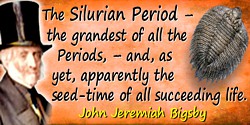
The Silurian Period—the grandest of all the Periods,—and, as yet, apparently the seed-time of all succeeding life.
Dedication page in Thesaurus Siluricus: The Flora and Fauna of the Silurian Period (1868), iv.
The simplest schoolboy is now familiar with facts for which Archimedes would have sacrificed his life. What would we not give to make it possible for us to steal a look at a book that will serve primary schools in a hundred years?
In Souvenirs d’Enfance et de Jeunesse (1846), Preface, 13. From the original French, “Le simple écolier sait maintenant des vérités pour lesquelles Archimède eût sacrifié sa vie. Que ne donnerions-nous pas pour qu’il nous fût possible de jeter un coup d’œil furtif sur tel livre qui servira aux écoles primaires dans cent ans?”
The solar system was formed 4.6 billion years ago, and the oldest fossils on Earth have been dated at about 3.8 billion years. Sometime between these two points, the chemicals of the young planet were organized into the responsive, reproducing systems we call “life.”
In 'Cosmochemistry The Earliest Evolution', The Science Teacher (Oct 1983), 50, No. 7, 35.
The solution, as all thoughtful people recognize, must lie in properly melding the themes of inborn predisposition and shaping through life’s experiences. This fruitful joining cannot take the false form of percentages adding to 100–as in ‘intelligence is 80 percent nature and 20 percent nurture,’ or ‘homosexuality is 50 percent inborn and 50 percent learned,’ and a hundred other harmful statements in this foolish format. When two ends of such a spectrum are commingled, the result is not a separable amalgam (like shuffling two decks of cards with different backs), but an entirely new and higher entity that cannot be decomposed (just as adults cannot be separated into maternal and paternal contributions to their totality).
…...
The sooner patients can be removed from the depressing influence of general hospital life the more rapid their convalescence.
Lancet (1916).
The Spaniards plundered Peru for its gold, which the Inca aristocracy had collected as we might collect stamps, with the touch of Midas. Gold for greed, gold for splendor, gold for adornment, gold for reverence, gold for power, sacrificial gold, life-giving gold, gold for tenderness, barbaric gold, voluptuous gold.
The speculative propositions of mathematics do not relate to facts; … all that we are convinced of by any demonstration in the science, is of a necessary connection subsisting between certain suppositions and certain conclusions. When we find these suppositions actually take place in a particular instance, the demonstration forces us to apply the conclusion. Thus, if I could form a triangle, the three sides of which were accurately mathematical lines, I might affirm of this individual figure, that its three angles are equal to two right angles; but, as the imperfection of my senses puts it out of my power to be, in any case, certain of the exact correspondence of the diagram which I delineate, with the definitions given in the elements of geometry, I never can apply with confidence to a particular figure, a mathematical theorem. On the other hand, it appears from the daily testimony of our senses that the speculative truths of geometry may be applied to material objects with a degree of accuracy sufficient for the purposes of life; and from such applications of them, advantages of the most important kind have been gained to society.
In Elements of the Philosophy of the Human Mind (1827), Vol. 3, Chap. 1, Sec. 3, 180.
The Stone Age did not end because humans ran out of stones. It ended because it was time for a re-think about how we live.
As reported, without quotation marks, in Jo Twist, 'Eco-designs on Future Cities', on BBC News website (14 June 2005). McDonough did not originate the statement about the Stone Age; it has been used earlier and attributed to others. He added his own conclusion to it.
The stories of Whitney’s love for experimenting are legion. At one time he received a letter asking if insects could live in a vacuum. Whitney took the letter to one of the members of his staff and asked the man if he cared to run an experiment on the subject. The man replied that there was no point in it, since it was well established that life could not exist without a supply of oxygen. Whitney, who was an inveterate student of wild life, replied that on his farm he had seen turtles bury themselves in mud each fall, and, although the mud was covered with ice and snow for months, emerge again in the spring. The man exclaimed, “Oh, you mean hibernation!” Whitney answered, “I don’t know what I mean, but I want to know if bugs can live in a vacuum.”
He proceeded down the hall and broached the subject to another member of the staff. Faced with the same lack of enthusiasm for pursuing the matter further, Whitney tried another illustration. “I’ve been told that you can freeze a goldfish solidly in a cake of ice, where he certainly can’t get much oxygen, and can keep him there for a month or two. But if you thaw him out carefully he seems none the worse for his experience.” The second scientist replied, “Oh, you mean suspended animation.” Whitney once again explained that his interest was not in the terms but in finding an answer to the question.
Finally Whitney returned to his own laboratory and set to work. He placed a fly and a cockroach in a bell jar and removed the air. The two insects promptly keeled over. After approximately two hours, however, when he gradually admitted air again, the cockroach waved its feelers and staggered to its feet. Before long, both the cockroach and the fly were back in action.
He proceeded down the hall and broached the subject to another member of the staff. Faced with the same lack of enthusiasm for pursuing the matter further, Whitney tried another illustration. “I’ve been told that you can freeze a goldfish solidly in a cake of ice, where he certainly can’t get much oxygen, and can keep him there for a month or two. But if you thaw him out carefully he seems none the worse for his experience.” The second scientist replied, “Oh, you mean suspended animation.” Whitney once again explained that his interest was not in the terms but in finding an answer to the question.
Finally Whitney returned to his own laboratory and set to work. He placed a fly and a cockroach in a bell jar and removed the air. The two insects promptly keeled over. After approximately two hours, however, when he gradually admitted air again, the cockroach waved its feelers and staggered to its feet. Before long, both the cockroach and the fly were back in action.
'Willis Rodney Whitney', National Academy of Sciences, Biographical Memoirs (1960), 357-358.
The stream of thought flows on but most of its segments fall into the bottomless abyss of oblivion. Of some, no memory survives the instant of their passage. Of others, it is confined to a few moments, hours or days. Others, again, leave vestiges which are indestructible, and by means of which they may be recalled as long as life endures.
…...
The Struggle for Existence amongst all organic beings throughout the world, which inevitably follows from their high geometrical powers of increase ... This is the doctrine of Malthus, applied to the whole animal and vegetable kingdoms. As many more individuals of each species are born than can possibly survive; and as, consequently, there is a frequently recurring struggle for existence, it follows that any being, if it vary however slightly in any manner profitable to itself, under the complex and sometimes varying conditions of life, will have a better chance of surviving, and thus be naturally selected. From the strong principle of inheritance, any selected variety will tend to propagate its new and modified form.
From On the Origin of Species by Means of Natural Selection; or, The Preservation of Favoured Races in the Struggle for Life (1861), 12.
The student should read his author with the most sustained attention, in order to discover the meaning of every sentence. If the book is well written, it will endure and repay his close attention: the text ought to be fairly intelligible, even without illustrative examples. Often, far too often, a reader hurries over the text without any sincere and vigorous effort to understand it; and rushes to some example to clear up what ought not to have been obscure, if it had been adequately considered. The habit of scrupulously investigating the text seems to me important on several grounds. The close scrutiny of language is a very valuable exercise both for studious and practical life. In the higher departments of mathematics the habit is indispensable: in the long investigations which occur there it would be impossible to interpose illustrative examples at every stage, the student must therefore encounter and master, sentence by sentence, an extensive and complicated argument.
In 'Private Study of Mathematics', Conflict of Studies and other Essays (1873), 67.
The stupidity of overfishing would have shocked Carson, herself a marine biologist. … Dredgers carve graveyards in seabeds, fertilisers fuel plankton blooms that result in oxygenless dead zones, and climate change threatens much sea life.
In 'Fifty Years On, the Silence of Rachel Carson’s Spring Consumes Us', The Guardian (25 Sep 2012). Griffiths also quotes a professor of marine conservation, Callum Roberts, from his Ocean of Life that “Since the 1950s, when she published her trilogy The Sea, two-thirds of the species we have fished have collapsed, and some species are down 99%.”
The sublime discoveries of Newton, and, together with these, his not less fruitful than wonderful application, of the higher mathesis to the movement of the celestial bodies, and to the laws of light, gave almost religious sanction to the corpuscular system and mechanical theory. It became synonymous with philosophy itself. It was the sole portal at which truth was permitted to enter. The human body was treated an hydraulic machine... In short, from the time of Kepler to that of Newton, and from Newton to Hartley, not only all things in external nature, but the subtlest mysteries of life, organization, and even of the intellect and moral being, were conjured within the magic circle of mathematical formulae.
Hints Towards the Formation of a more Comprehensive Theory of Life (1848). In The Collected Works of Samuel Taylor Coleridge: Shorter Works and Fragments (1995), H. J. Jackson and J. R. de J. Jackson (eds.), Vol. 11, 1, 498.
The succession of individuals, connected by reproduction and belonging to a species, makes it possible for the specific form itself to last for ages. In the end, however, the species is temporary; it has no “eternal life.” After existing for a certain period, it either dies or is converted by modification into other forms.
As translated by Joseph McCabe in Haeckel's The Wonders of Life: a Popular Study of Biological Philosophy (1904), 248.
The sum of human happiness would not necessarily be reduced if for ten years every physical and chemical laboratory were closed and the patient and resourceful energy displayed in them transferred to the lost art of getting on together and finding the formula for making both ends meet in the scale of human life.
In a speech to the British Association for the Advancement of Science, Leeds, September 4, 1927.
The sun … is a body of great size and power, the ruler, not only of the seasons and of the different climates, but also of the stars themselves and of the heavens. When we consider his operations, we must regard him as the life, or rather the mind of the universe, the chief regulator and the God of nature; he also lends his light to the other stars. He is the most illustrious and excellent, beholding all things and hearing all things.
In The Natural History of Pliny (1855), Vol. 1, 20.
The sun gives spirit and life to the plants and the earth nourishes them with moisture.
…...
The sun is a mass of incandescent gas, a gigantic nuclear furnace,
Where hydrogen is built into helium at a temperature of millions of degrees.
Yo ho, it’s hot, the sun is not a place where we could live.
But here on earth there’d be no life without the light it gives.
We need its light, we need its heat, we need its energy.
Without the sun, without a doubt, there’d be no you and me.
Where hydrogen is built into helium at a temperature of millions of degrees.
Yo ho, it’s hot, the sun is not a place where we could live.
But here on earth there’d be no life without the light it gives.
We need its light, we need its heat, we need its energy.
Without the sun, without a doubt, there’d be no you and me.
— Hy Zaret
From song 'Why Does the Sun Shine? (The Sun Is A Mass Of Incandescent Gas)' on LP record album Space Songs (1961), in the series Ballads for the Age of Science. Music by Louis Singer, and sung by Tom Glazer. Also recorded by the group They Might Be Giants (1998) who followed up with 'Why Does The Sun Really Shine? (The Sun is a Miasma of Incandescent Plasma)' on CD album Here Comes Science (2009), which corrects several scientific inaccuracies in the lyrics
The Sun is no lonelier than its neighbors; indeed, it is a very common-place star,—dwarfish, though not minute,—like hundreds, nay thousands, of others. By accident the brighter component of Alpha Centauri (which is double) is almost the Sun's twin in brightness, mass, and size. Could this Earth be transported to its vicinity by some supernatural power, and set revolving about it, at a little less than a hundred million miles' distance, the star would heat and light the world just as the Sun does, and life and civilization might go on with no radical change. The Milky Way would girdle the heavens as before; some of our familiar constellations, such as Orion, would be little changed, though others would be greatly altered by the shifting of the nearer stars. An unfamiliar brilliant star, between Cassiopeia and Perseus would be—the Sun. Looking back at it with our telescopes, we could photograph its spectrum, observe its motion among the stars, and convince ourselves that it was the same old Sun; but what had happened to the rest of our planetary system we would not know.
The Solar System and its Origin (1935), 2-3.
The sweetest and most inoffensive path of life leads through the avenues of science and learning; and whoever can either remove any obstruction in this way, or open up any new prospect, ought, so far, to be esteemed a benefactor to mankind.
…...
The symbol A is not the counterpart of anything in familiar life. To the child the letter A would seem horribly abstract; so we give him a familiar conception along with it. “A was an Archer who shot at a frog.” This tides over his immediate difficulty; but he cannot make serious progress with word-building so long as Archers, Butchers, Captains, dance round the letters. The letters are abstract, and sooner or later he has to realise it. In physics we have outgrown archer and apple-pie definitions of the fundamental symbols. To a request to explain what an electron really is supposed to be we can only answer, “It is part of the A B C of physics”.
In Introduction to The Nature of the Physical World (1928), xiv.
The technologies which have had the most profound effects on human life are usually simple. A good example of a simple technology with profound historical consequences is hay. ... It was hay that allowed populations to grow and civilizations to flourish among the forests of Northern Europe. Hay moved the greatness of Rome to Paris and London, and later to Berlin and Moscow and New York.
[The year-round growth of green grass in the Mediterranean climate meant that hay was not needed by the Romans. North of the Alps, hay maintained horses and oxen and thus their motive power, and productivity.]
[The year-round growth of green grass in the Mediterranean climate meant that hay was not needed by the Romans. North of the Alps, hay maintained horses and oxen and thus their motive power, and productivity.]
In 'Quick is Beautiful', Infinite in All Directions: Gifford Lectures Given at Aberdeen, Scotland (1988, 2004), 135.
The technologies which have had the most profound effects on human life are usually simple. A good example of a simple technology with profound historical consequences is hay. Nobody knows who invented hay, the idea of cutting grass in the autumn and storing it in large enough quantities to keep horses and cows alive through the winter. All we know is that the technology of hay was unknown to the Roman Empire but was known to every village of medieval Europe. Like many other crucially important technologies, hay emerged anonymously during the so-called Dark Ages. According to the Hay Theory of History, the invention of hay was the decisive event which moved the center of gravity of urban civilization from the Mediterranean basin to Northern and Western Europe. The Roman Empire did not need hay because in a Mediterranean climate the grass grows well enough in winter for animals to graze. North of the Alps, great cities dependent on horses and oxen for motive power could not exist without hay. So it was hay that allowed populations to grow and civilizations to flourish among the forests of Northern Europe. Hay moved the greatness of Rome to Paris and London, and later to Berlin and Moscow and New York. ... Great inventions like hay and printing, whatever their immediate social costs may be, result in a permanent expansion of our horizons, a lasting acquisition of new territory for human bodies and minds to cultivate.
Infinite In All Directions (1988, 2004), 135. The book is a revised version of a series of the Gifford Lectures under the title 'In Praise of Diversity', given at Aberdeen, Scotland.
The theory of punctuated equilibrium, proposed by Niles Eldredge and myself, is not, as so often misunderstood, a radical claim for truly sudden change, but a recognition that ordinary processes of speciation, properly conceived as glacially slow by the standard of our own life-span, do not resolve into geological time as long sequences of insensibly graded intermediates (the traditional, or gradualistic, view), but as geologically ‘sudden’ origins at single bedding planes.
…...
The theory of the method of knowing which is advanced in these pages may be termed pragmatic. ... Only that which has been organized into our disposition so as to enable us to adapt the environment to our needs and adapt our aims and desires to the situation in which we live is really knowledge.
Democracy and Education: an Introduction to the Philosophy of Education (1916), 400.
The thought that we’re in competition with Russians or with Chinese is all a mistake, and trivial. We are one species, with a world to win. There’s life all over this universe, but the only life in the solar system is on earth, and in the whole universe we are the only men.
From speech given at an anti-war teach-in at the Massachusetts Institute of Technology, (4 Mar 1969) 'A Generation in Search of a Future', as edited by Ron Dorfman for Chicago Journalism Review, (May 1969).
The totality of life, known as the biosphere to scientists and creation to theologians, is a membrane of organisms wrapped around Earth so thin it cannot be seen edgewise from a space shuttle, yet so internally complex that most species composing it remain undiscovered. The membrane is seamless. From Everest's peak to the floor of the Mariana Trench, creatures of one kind or another inhabit virtually every square inch of the planetary surface.
In 'Vanishing Before Our Eyes', Time (26 Apr 2000). Also in The Future of Life (2002), 3.
The tragedy of life is not that man loses, but that he almost wins.
…...
The tree of life should perhaps be called the coral of life, base of branches dead; so that passages cannot be seen—this again offers contradiction to constant succession of germs in progress.
P. H. Barrett et al. (eds.), Charles Darwin's Notebooks1836-1844: Geology, Transmutation of the Species, Metaphysical Enquiries, (1987), Notebook B, 25-6.
The trouble with life isn’t that there is no answer, it’s that there are so many answers.
Journal entry, as a young woman, as quoted in Margaret Mead, Ruth Benedict: A Humanist in Anthropology (1974), 2.
The truth is, there are only two things in life, reasons and results, and reasons simply don't count.
In Webster's 21st Century Book of Quotations (1992), 143.
The unexpected and the incredible belong in this world. Only then is life whole.
…...
The uniformity of the earth’s life, more astonishing than its diversity, is accountable by the high probability that we derived, originally, from some single cell, fertilized in a bolt of lightning as the earth cooled. It is from the progeny of this parent cell that we take our looks; we still share genes around, and the resemblance of the enzymes of grasses to those of whales is a family resemblance.
In The Lives of a Cell (1974), 5.
The United States pledges before you—and therefore before the world—its determination to help solve the fearful atomic dilemma—to devote its entire heart and mind to find the way by which the miraculous inventiveness of man shall not be dedicated to his death, but consecrated to his life.
From address to the General Assembly of the United Nations (8 Dec 1953).
The universality of parasitism as an offshoot of the predatory habit negatives the position taken by man that it is a pathological phenomenon or a deviation from the normal processes of nature. The pathological manifestations are only incidents in a developing parasitism. As human beings intent on maintaining man's domination over nature we may regard parasitism as pathological insofar as it becomes a drain upon human resources. In our efforts to protect ourselves we may make every kind of sacrifice to limit, reduce, and even eliminate parasitism as a factor in human life. Science attempts to define the terms on which this policy of elimination may or may not succeed. We must first of all thoroughly understand the problem, put ourselves in possession of all the facts in order to estimate the cost. Too often it has been assumed that parasitism was abnormal and that it needed only a slight force to reestablish what was believed to be a normal equilibrium without parasitism. On the contrary, biology teaches us that parasitism is a normal phenomenon and if we accept this view we shall be more ready to pay the price of freedom as a permanent and ever recurring levy of nature for immunity from a condition to which all life is subject. The greatest victory of man over nature in the physical realm would undoubtedly be his own delivery from the heavy encumbrance of parasitism with which all life is burdened.
Parasitism and Disease (1934), 4.
The universe contains vastly more order than Earth-life could ever demand. All those distant galaxies, irrelevant for our existence, seem as equally well ordered as our own.
As quoted in Eugene F. Mallove, The Quickening Universe: Cosmic Evolution and Human Destiny (1987), 61.
The universe is an asymmetrical entity. I am inclined to believe that life as it is manifested to us must be a function of the asymmetry of the universe or of the consequence of this fact. The universe is asymmetrical; for if one placed the entire set of bodies that compose the solar system, each moving in its own way, before a mirror, the image shown would not be superimposable on the reality.
Rene Vallery-Radot, Vie de Pasteur (1900), 79. Quoted in Patrice Debre, Louis Pasteur, trans. Elborg Forster (1994), 78.
The universe is asymmetric and I am persuaded that life, as it is known to us, is a direct result of the asymmetry of the universe or of its indirect consequences. The universe is asymmetric.
Acknowledging the role of molecules that have stereoisomers, some the mirror image of the others, and microorganisms whose chemistry prefers only one of those forms.
Acknowledging the role of molecules that have stereoisomers, some the mirror image of the others, and microorganisms whose chemistry prefers only one of those forms.
Comptes Rendus de l'Académie des Science (1 Jun 1874). Reprinted in Oeuvres, Vol. 1, 361. In J.B.S. Haldane, Nature, 185, 87. As cited in Alan L. Mackay,The Harvest of a Quiet Eye (1977), 117. Pasteur's application of a microorganism with a chemical behaviour preferring a specific stereoisomer is in Sven Klussmann, The Aptamer Handbook (2006), 420.
The universe is reeking with organic matter. You could say that the universe is in the business of making life—or that God is an organic chemist.
From interview, 'The Seeds of Life', in The Omni Interviews (1984), 10.
The universe shows us the life of God, or rather it is in itself the life of God… . God is not out of the universe any more than the universe is out of God. God is the principle, the universe is the consequence.
Quoted in Kim Lim (ed.), 1,001 Pearls of Spiritual Wisdom: Words to Enrich, Inspire, and Guide Your Life (2014), 40
The use of tobacco is one of the most evident of all the retrograde influences of our time. It invades all classes, destroys social life, and is turning, in the words of Mantegazza, the whole of Europe into a cigar divan.
Letter, 'Tobacco and the Diseases It Produces', The Times (25 Sep 1878), 4. Reprinted in Timaru Herald (29 Nov 1878), 29, No. 1309, 3.
The value of fundamental research does not lie only in the ideas it produces. There is more to it. It affects the whole intellectual life of a nation by determining its way of thinking and the standards by which actions and intellectual production are judged. If science is highly regarded and if the importance of being concerned with the most up-to-date problems of fundamental research is recognized, then a spiritual climate is created which influences the other activities. An atmosphere of creativity is established which penetrates every cultural frontier. Applied sciences and technology are forced to adjust themselves to the highest intellectual standards which are developed in the basic sciences. This influence works in many ways: some fundamental students go into industry; the techniques which are applied to meet the stringent requirements of fundamental research serve to create new technological methods. The style, the scale, and the level of scientific and technical work are determined in pure research; that is what attracts productive people and what brings scientists to those countries where science is at the highest level. Fundamental research sets the standards of modern scientific thought; it creates the intellectual climate in which our modern civilization flourishes. It pumps the lifeblood of idea and inventiveness not only into the technological laboratories and factories, but into every cultural activity of our time. The case for generous support for pure and fundamental science is as simple as that.
In 'Why Pure Science?' in Bulletin of the Atomic Scientists, 1965.
The value the world sets upon motives is often grossly unjust and inaccurate. Consider, for example, two of them: mere insatiable curiosity and the desire to do good. The latter is put high above the former, and yet it is the former that moves some of the greatest men the human race has yet produced: the scientific investigators. What animates a great pathologist? Is it the desire to cure disease, to save life? Surely not, save perhaps as an afterthought. He is too intelligent, deep down in his soul, to see anything praiseworthy in such a desire. He knows by life-long observation that his discoveries will do quite as much harm as good, that a thousand scoundrels will profit to every honest man, that the folks who most deserve to be saved will probably be the last to be saved. No man of self-respect could devote himself to pathology on such terms. What actually moves him is his unquenchable curiosity–his boundless, almost pathological thirst to penetrate the unknown, to uncover the secret, to find out what has not been found out before. His prototype is not the liberator releasing slaves, the good Samaritan lifting up the fallen, but the dog sniffing tremendously at an infinite series of rat-holes.
In 'Types of Men: The Scientist', Prejudices (1923), 269-70.
The varieties of chemical substances actually found in living things are vastly more restricted than the possible varieties. A striking illustration is that if one molecule each of all the possible types of proteins were made, they would together weigh more than the observable universe. Obviously there are a fantastically large number of protein types that are not made by living cells.
In The Closing Circle: Nature, Man, and Technology (2014).
The various branches of knowledge always tend as a whole to stray away from life, and return thither only by a roundabout way.
In The Maxims and Reflections of Goethe (1906), 189.
The vast spread
Of darkness
That speaks of mystery
The darkness that reveals
The beauty that lies beneath
In the form of glittering
Stars, a countless beauty
That seemed to conceal
A million stories
That can make the mankind
Take a new look at life
And the majestic moon
That silently looks at mankind
Wondering how its serenity
Was disturbed by the little steps
Of a man from the beautiful earth
Yet softly smiling back
And let the world sleep
In its magical glow
A glow that soothes
The world’s senses
And forget the pain of reality
Of darkness
That speaks of mystery
The darkness that reveals
The beauty that lies beneath
In the form of glittering
Stars, a countless beauty
That seemed to conceal
A million stories
That can make the mankind
Take a new look at life
And the majestic moon
That silently looks at mankind
Wondering how its serenity
Was disturbed by the little steps
Of a man from the beautiful earth
Yet softly smiling back
And let the world sleep
In its magical glow
A glow that soothes
The world’s senses
And forget the pain of reality
…...
The vernal equinox is a cosmic reset button, marking the transition from the dormancy of winter to the vitality of spring. It’s a reminder of the Earth’s perpetual motion and the cyclical nature of life.
A fictional quote imagined in the style of an astrophysicist (19 Mar 2024).
The vernal equinox is Nature’s proclamation of renewal and rejuvenation, a time when the Earth awakens from its winter slumber and bursts forth with new life. It’s a testament to the resilience and vitality of our planet.
A fictional quote imagined in the style typical of a scientist (19 Mar 2024).
The vigorous branching of life’s tree, and not the accumulating valor of mythical marches to progress, lies behind the persistence and expansion of organic diversity in our tough and constantly stressful world. And if we do not grasp the fundamental nature of branching as the key to life’s passage across the geological stage, we will never understand evolution aright.
…...
The voyage of the Beagle has been by far the most important event in my life and has determined my whole career; yet it depended on so small a circumstance as my uncle offering to drive me 30 miles to Shrewsbury, which few uncles would have done, and on such a trifle as the shape of my nose.
At the end of a particular drive, his uncle, Josiah Wedgwood, convinced Darwin’s reluctant father that Charles should voyage on the Beagle. Captain Fitz-Roy believed he could read a man’s character from the shape of his nose. In Charles Darwin and Francis Darwin (ed.), 'Autobiography', The Life and Letters of Charles Darwin (1887, 1896), Vol. 1, 51.

The whole apparatus of using loyalty-security hearings for working off personal political spite has been firmly established as a part of our “way of life” and I do not see anything happening yet to loosen the hold of this machinery on us.
In letter to Linus Pauling (8 Sep 1955). Cited on Oregon State University Library web site.
The whole history of life is a record of cycles.
Mainsprings of Civilization (1945), 453.
The wise man, however, will avoid partial views of things. He will not, with the miser, look to gold and silver as the only blessings of life; nor will he, with the cynic, snarl at mankind for preferring them to copper and iron. … That which is convenient is that which is useful, and that which is useful is that which is valuable.
From 13th Lecture in 1818, in Bence Jones, The Life and Letters of Faraday (1870), Vol. 1, 255.
The wonderful things in life are the things you do, not the things you have.
…...
The woof and warp of all thought and all research is symbols, and the life of thought and science is the life inherent in symbols; so that it is wrong to say that a good language is important to good thought, merely; for it is the essence of it.
From 'The Ethics of Terminology', in Collected Papers (1931), Vol. 1, 129.
The world has achieved brilliance without wisdom, power without conscience. Ours is a world of nuclear giants and ethical infants. We know more about war than we know about peace, more about killing than we know about living.
Speech (10 Nov 1948) in Boston, Massachusetts, preceding Armistice Day, Collected Writings (1967), Vol. 1. Quoted in Bulletin of the Atomic Scientists (Apr 1952), 8, No. 4, 114.
The world has arisen in some way or another. How it originated is the great question, and Darwin's theory, like all other attempts, to explain the origin of life, is thus far merely conjectural. I believe he has not even made the best conjecture possible in the present state of our knowledge.
In Evolution and Permanence of Type (1874), 12.
The world is a very different one now. For man holds in his mortal hands the power to abolish all forms of human poverty, and all forms of human life.
Inaugural address (1961). Robert G. Torricelli and Andrew Carroll, In Our Own words: Extraordinary Speeches of the American Century (1999), 222.
The world of mathematics and theoretical physics is hierarchical. That was my first exposure to it. There's a limit beyond which one cannot progress. The differences between the limiting abilities of those on successively higher steps of the pyramid are enormous. I have not seen described anywhere the shock a talented man experiences when he finds, late in his academic life, that there are others enormously more talented than he. I have personally seen more tears shed by grown men and women over this discovery than I would have believed possible. Most of those men and women shift to fields where they can compete on more equal terms
Alvarez: Adventures of a Physicist (1987), 20.
The world of mathematics, which you condemn, is really a beautiful world; it has nothing to do with life and death and human sordidness, but is eternal, cold and passionless. To me, pure, mathematics is one of the highest forms of art; it has a sublimity quite special to itself, and an immense dignity derived, from the fact that its world is exempt I, from change and time. I am quite serious in this. The only difficulty is that none but mathematicians can enter this enchanted region, and they hardly ever have a sense of beauty. And mathematics is the only thing we know of that is capable of perfection; in thinking about it we become Gods.
Letter to Helen Thomas (30 Dec 1901). Quoted in Nicholas Griffin (ed.), The Selected Letters of Bertrand Russell (1992), Vol. 1, 224.
The world of organisms, of animals and plants, is built up of individuals. I like to think, then, of natural history as the study of life at the level of the individual—of what plants and animals do, how they react to each other and their environment, how they are organized into larger groupings like populations and communities.
In The Nature of Natural History (1961, 2014), 7.
The world's forests need to be seen for what they are—giant global utilities, providing essential public services to humanity on a vast scale. They store carbon, which is lost to the atmosphere when they burn, increasing global warming. The life they support cleans the atmosphere of pollutants and feeds it with moisture. They act as a natural thermostat, helping to regulate our climate and sustain the lives of 1.4 billion of the poorest people on this Earth. And they do these things to a degree that is all but impossible to imagine.
Speech (25 Oct 2007) at the World Wildlife Fund gala dinner, Hampton Court Palace, announcing the Prince's Rainforests Project. On the Prince of Wales website.
Theories and schools, like microbes and globules, devour each other and by their struggle ensure the continuing of life.
In Cities of the Plain (1927).
There are a thousand thousand reasons to live this life, everyone of them sufficient.
Gilead. Quoted in Kim Lim (ed.), 1,001 Pearls of Spiritual Wisdom: Words to Enrich, Inspire, and Guide Your Life (2014), 24
There are about 3,000,000 people seriously ill in the United States…. More than half of this illness is preventable. If we count the value of each life lost at only $1700 and reckon the average earning lost by illness at $700 a year for grown men, we find that the economic gain from mitigation of preventable disease in the United States would exceed $1,500,000,000 a year. … This gain … can be secured through medical investigation and practice, school and factory hygiene, restriction of labor by women and children, the education of the people in both public and private hygiene, and through improving the efficiency of our health service, municipal, state, and national.
From 'National Efficiency', Report of the National Conservation Commission (Feb 1909), Vol. 1, 25. Collected in United States Congressional Serial Set (1909), Issue 5397, 60th Congress, 2nd Session, Senate, Document 676. In transmitting the report to Congress on 22 Jan 1909, President Theodore Roosevelt introduced this report as the “first inventory of natural resources,” which “presents a statement of our available capital in material resources, which are the means of progress.” [It is noteworthy that the above quoted commentary on “National Efficiency” was included with the inventory of mineral, lands, forest and lands of the United States. —Webmaster]
There are as many archetypes as there are typical situations in life.
In The Archetypes and the Collective Unconscious (1969), 48.
There are certain general Laws that run through the whole Chain of natural Effects: these are learned by the Observation and Study of Nature, and are by Men applied as well to the framing artificial things for the Use and Ornament of Life, as to the explaining the various Phænomena: Which Explication consists only in shewing the Conformity any particular Phænomenon hath to the general Laws of Nature, or, which is the same thing, in discovering the Uniformity there is in the production of natural Effects; as will be evident to whoever shall attend to the several Instances, wherin Philosophers pretend to account for Appearances.
A Treatise Concerning the Principles of Human Knowledge [first published 1710], (1734), 87-8.
There are living systems; there is no living “matter.” No substance, no single molecule, extracted and isolated from a living being possess, of its own, the aforementioned paradoxical properties. They are present in living systems only; that is to say, nowhere below the level of the cell.
Inaugural lecture on taking the chair of molecular biology, Collège de France (3 Nov 1967). From Biology to Ethics (1969), 5.
There are only two ways to live your life. One is as though nothing is a miracle. The other is as though everything is a miracle.
…...
There are still many unsolved problems about bird life, among which are the age that birds attain, the exact time at which some birds acquire their adult dress, and the changes which occur in this with years. Little, too, is known about the laws and routes of bird migration, and much less about the final disposition of the untold thousands which are annually produced.
There are those who say that the human kidney was created to keep the blood pure, or more precisely, to keep our internal environment in an ideal balanced state. This I must deny. I grant that the human kidney is a marvelous organ, but I cannot grant that it was purposefully designed to excrete urine or to regulate the composition of the blood or to subserve the physiological welfare of Homo sapiens in any sense. Rather I contend that the human kidney manufactures the kind of urine that it does, and it maintains the blood in the composition which that fluid has, because this kidney has a certain functional architecture; and it owes that architecture not to design or foresight or to any plan, but to the fact that the earth is an unstable sphere with a fragile crust, to the geologic revolutions that for six hundred million years have raised and lowered continents and seas, to the predacious enemies, and heat and cold, and storms and droughts; to the unending succession of vicissitudes that have driven the mutant vertebrates from sea into fresh water, into desiccated swamps, out upon the dry land, from one habitation to another, perpetually in search of the free and independent life, perpetually failing, for one reason or another, to find it.
From Fish to Philosopher (1953), 210-1.
There are those who say we cannot afford to invest in science, that support for research is somehow a luxury at moments defined by necessities. I fundamentally disagree. Science is more essential for our prosperity, our security, our health, our environment, and our quality of life than it has ever been before. … we can't allow our nation to fall behind. Unfortunately, that's exactly what's happened. Federal funding in the physical sciences as a portion of our gross domestic product has fallen by nearly half over the past quarter century. Time and again we've allowed the research and experimentation tax credit, which helps businesses grow and innovate, to lapse.
Speech to the National Academy of Sciences Annual Meeting (27 Apr 2009).
There are two ways of extending life: firstly by moving the two points “born” and “died” farther away from one another… The other method is to go more slowly and leave the two points wherever God wills they should be, and this method is for the philosophers.
Aphorism 22 in Notebook B (1768-1771), as translated by R.J. Hollingdale in Aphorisms (1990). Reprinted as The Waste Books (2000), 21.
There are two ways to slide easily through life; to believe everything or to doubt everything. Both ways save us from thinking.
Manhood of Humanity (1921), 4. Sometimes seen misquoted as 'slice through life.'
There came in February the issue of Life saying on the cover “Dr. Teller Refutes 9000 Scientists”… I wrote to Life and said first that Teller hadn’t refuted 9000 scientists and second I felt that they should publish the article that I had written… They sent the article back and said that they didn’t want it and then I offered it to Look. The editor of Look called me and said they couldn’t get into a controversy with Life. Then I offered it to the Saturday Evening Post and the Ladies Home Journal and Readers Digest and none of them were interested in it. And then I thought, “What shall I do? I’ll have to write a book and see if I can’t get it published.”’
As quoted in Ted Goertzel, et al., Linus Pauling: A Life in Science and Politics (1965, 1995), 46.
There can be no doubt that science is in many ways the natural enemy of language. Language, either literary or colloquial, demands a rich store of living and vivid words—words that are “thoughtpictures,” and appeal to the senses, and also embody our feelings about the objects they describe. But science cares nothing about emotion or vivid presentation; her ideal is a kind of algebraic notation, to be used simply as an instrument of analysis; and for this she rightly prefers dry and abstract terms, taken from some dead language, and deprived of all life and personality.
In The English Language (1912), 124-125.
There cannot be a greater mistake than that of looking superciliously upon practical applications of science. The life and soul of science is its practical application .
In Lecture 'Electrical Units of Measurement' delivered at the Institution of Civil Engineers (3 May 1883). Collected in Popular Lectures and Addresses (1889), Vol. 1, 79.
There have, however, always been men of high and disciplined spirituality who have insisted on their direct experience of something greater than themselves. Their conviction of the reality of a spiritual life apart from and transcending the life of the body may not lend itself to scientific proof or disproof; nevertheless the remarkable transformation in personality seen in those who rightfully lay claim to such experience is as objective as tomorrow's sunrise. Millions of lesser men draw strength from the contacts they can make through prayer and meditation with this aspect of the inner life.
at a convention of scientists in 1967 at the University of Notre Dame
There is a conservation of matter and of energy, there may be a conservation of life; or if not of life, of something which transcends life.
Christopher: A Study in Human Personality (1918), 68.
There is a demon in technology. It was put there by man and man will have to exorcise it before technological civilization can achieve the eighteenth-century ideal of humane civilized life.
A God Within (1972), 216.
There is a finite number of species of plants and animals—even of insects—upon the earth. … Moreover, the universality of the genetic code, the common character of proteins in different species, the generality of cellular structure and cellular reproduction, the basic similarity of energy metabolism in all species and of photosynthesis in green plants and bacteria, and the universal evolution of living forms through mutation and natural selection all lead inescapably to a conclusion that, although diversity may be great, the laws of life, based on similarities, are finite in number and comprehensible to us in the main even now.
Presidential Address (28 Dec 1970) to the American Association for the Advancement of Science. 'Science: Endless Horizons or Golden Age?', Science (8 Jan 1971), 171, No. 3866, 24.
There is a point of view among astronomical researchers that is generally referred to as the Principle of Mediocrity. ... If the Sun and its retinue of worlds is only one system among many, then many other systems will be like ours: home to life. Indeed, to the extent that this is true, we should be prepared for the possibility that, even in the Milky Way galaxy, billions of planets may be carpeted by the dirty, nasty business known as life.
Quoted in 'Do Aliens Exist in the Milky Way', PBS web page for WGBH Nova, 'Origins.'
There is a strange disparity between the sciences of inert matter and those of life. Astronomy, mechanics, and physics are based on concepts which can be expressed, tersely and elegantly, in mathematical language. They have built up a universe as harmonious as the monuments of ancient Greece. They weave about it a magnificent texture of calculations and hypotheses. They search for reality beyond the realm of common thought up to unutterable abstractions consisting only of equations of symbols. Such is not the position of biological sciences. Those who investigate the phenomena of life are as if lost in an inextricable jungle, in the midst of a magic forest, whose countless trees unceasingly change their place and their shape. They are crushed under a mass of facts, which they can describe but are incapable of defining in algebraic equations.
Man the Unknown (1935), 1.
There is delight in the hardy life of the open.
African Game Trails (1910), ix. This is one of the quotations inscribed in the Roosevelt Memorial rotunda at the American Museum of Natural History.
There is no “pure” science itself divorced from human values. The importance of science to the humanities and the humanities to science in their complementary contribution to the variety of human life grows daily. The need for men familiar with both is imperative.
In 'Abstract' The Impurity of Science (19 Apr 1962), the printed version of the Robbins Lecture (27 Feb 1962) given at Pomona College, Claremont, California, as published by Ernest O. Lawrence Radiation Laboratory, University of California.
There is no conclusive evidence of life after death. But there is no evidence of any sort against it. Soon enough you will know. So why fret about it?
In 'From the Notebooks of Lazarus Long', Time Enough for Love: The Lives of Lazarus Long (1973), 257.
There is no duress like one’s own conscience and it is that which makes life so needlessly bitter.
Aphorism as given by the fictional character Dezhnev Senior, in Fantastic Voyage II: Destination Brain (1987), 252.
There is no force inherent in living matter, no vital force independent of and differing from the cosmic forces; the energy which living matter gives off is counterbalanced by the energy which it receives.
In Disease and its Causes (1913), 10-11.
There is no higher life form than a librarian.
In Terry Pratchett, Ian Stewart and Jack Cohen, introductory section, 'The Story Starts Here', The Science of Discworld (1999), 10. The section is initialed by all three coauthors. Which of them wrote which lines, is not designated. [Webmaster recognizes the subject quote is, at least, characteristic of Pratchett; hence listed under his name.]
There is no more potent antidote to the corroding influence of mammon than the presence in the community of a body of men devoted to science, living for investigation and caring nothing for the lust of the eyes and the pride of life.
In address at the University of Minnesota, "Teacher and Student" (1892) collected in Aequanimitas: With Other Addresses to Medical Students, Nurses and Practitioners of Medicine (1904), 29.
There is no more wild, free, vigorous growth of the forest, but everything is in pots or rows like a rococo garden... The pupil is in the age of spontaneous variation which at no period of life is so great. He does not want a standardized, overpeptonized mental diet. It palls on his appetite.
Hall, GS (1904b). Adolescence: Its psychology and its relations to physiology, anthropology, sociology, sex, crime, religion and education (1904), Vol. 2, 509.
There is no royal flower-strewn path to success. And if there is, I have not found it, for if I have accomplished anything in life it is because I have been willing to work hard.
Quoted in A'Lelia Bundles, On Her Own Ground: The Life and Times of Madam C.J. Walker (2000). As cited in The Big Book of Business Quotations (2003), 2.
There is no story in my life. It has always been just one step at a time—one thing which I have tried to do as well as I could and which has led on to something else. It has all been in the day’s work.
Told to an interviewer in her late seventies. As quoted in Joan T. Mark, A Stranger in Her Native Land: Alice Fletcher and the American Indians (1988), 355.
There is nothing human in the whole round of nature. All nature, all the universe that we can see, is absolutely indifferent to us, and except to us human life is of no more value than grass. If the entire human race perished at this hour, what difference would it make to the earth? What would the earth care? As much as for the extinct dodo, or for the fate of the elephant now going.
In Chap. 4, The Story of My Heart: My Autobiography (1883), 57.
There is only one subject matter for education, and that is Life in all its manifestations. Instead of this single unity, we offer children—Algebra, from which nothing follows; Geometry, from which nothing follows; Science, from which nothing follows; History, from which nothing follows; a Couple of Languages, never mastered; and lastly, most dreary of all, Literature, represented by plays of Shakespeare, with philological notes and short analyses of plot and character to be in substance committed to memory.
In 'The Aims of Education', The Aims of Education: & Other Essays (1917), 10.
There is perhaps no science of which the development has been carried so far, which requires greater concentration and will power, and which by the abstract height of the qualities required tends more to separate one from daily life.
In 'Provisional Report of the American Subcommittee of the International Commission on Teaching of Mathematics', Bulletin American Society (Nov 1910), 97.
There may be frugality which is not economy. A community, that withholds the means of education from its children, withholds the bread of life and starves their souls.
In Rush Welter, American Writings on Popular Education: The Nineteenth Century (1971), 76.
There might have been a hundred or a thousand life-bearing planets, had the course of evolution of the universe been a little different, or there might have been none at all. They would probably add, that, as life and man have been produced, that shows that their production was possible; and therefore, if not now then at some other time, if not here then in some other planet of some other sun, we should be sure to have come into existence; or if not precisely the same as we are, then something a little better or a little worse.
From Conclusion to Man's Place in the Universe: A Study of the Results of Scientific Research (1903), 315.
There must be a reason why some people can afford to live well. They must have worked for it. I only feel angry when I see waste. When I see people throwing away things we could use.
A Gift for God (1975).
There must be no barriers to freedom of inquiry. There is no place for dogma in science. The scientist is free, and must be free to ask any question, to doubt any assertion, to seek for any evidence, to correct any errors. ... Our political life is also predicated on openness. We know that the only way to avoid error is to detect it and that the only way to detect it is to be free to inquire. And we know that as long as men are free to ask what they must, free to say what they think, free to think what they will, freedom can never be lost, and science can never regress.
Life (10 Oct 1949), 136.
There seem to be but three ways for a nation to acquire wealth: the first is by war, as the Romans did, in plundering their conquered neighbors—this is robbery; the second by commerce, which is generally cheating; the third by agriculture, the only honest way, wherein man receives a real increase of the seed thrown into the ground, in a kind of continual miracle, wrought by the hand of God in his favor, as a reward for his innocent life and his virtuous industry.
In 'Positions to be Examined', The Works of Benjamin Franklin Consisting of Essays, Humorous, Moral and Literary (1824), 241.
There’s plenty of water in the universe without life, but nowhere is there life without water.
In Sea Change: A Message of the Oceans (1995), xii.
These duplicates in those parts of the body, without which a man might have very well subsisted, though not so well as with them, are a plain demonstration of an all-wise Contriver, as those more numerous copyings which are found among the vessels of the same body are evident demonstrations that they could not be the work of chance. This argument receives additional strength if we apply it to every animal and insect within our knowledge, as well as to those numberless living creatures that are objects too minute for a human eye: and if we consider how the several species in this whole world of life resemble one another in very many particulars, so far as is convenient for their respective states of existence, it is much more probable that a hundred millions of dice should be casually thrown a hundred millions of times in the same number than that the body of any single animal should be produced by the fortuitous concourse of matter.
In The Spectator (22 Nov 1712), No. 543, as collected in Vol. 4 (1721, 10th ed.), 48.
They are babies in waiting, life on ice.
On sperm cells frozen for preservation
On sperm cells frozen for preservation
'Quickening Debate over Life on Ice' Time (2 Jul 1984)
They will have the World to be in Large, what a Watch is in Small; which is very regular, and depends only upon the just disposing of the several Parts of the Movement.
Conversations on the Plurality of Words (1686), trans. William Gardiner (1715), 11.
Thinking is merely the comparing of ideas, discerning relations of likeness and of difference between ideas, and drawing inferences. It is seizing general truths on the basis of clearly apprehended particulars. It is but generalizing and particularizing. Who will deny that a child can deal profitably with sequences of ideas like: How many marbles are 2 marbles and 3 marbles? 2 pencils and 3 pencils? 2 balls and 3 balls? 2 children and 3 children? 2 inches and 3 inches? 2 feet and 3 feet? 2 and 3? Who has not seen the countenance of some little learner light up at the end of such a series of questions with the exclamation, “Why it’s always that way. Isn’t it?” This is the glow of pleasure that the generalizing step always affords him who takes the step himself. This is the genuine life-giving joy which comes from feeling that one can successfully take this step. The reality of such a discovery is as great, and the lasting effect upon the mind of him that makes it is as sure as was that by which the great Newton hit upon the generalization of the law of gravitation. It is through these thrills of discovery that love to learn and intellectual pleasure are begotten and fostered. Good arithmetic teaching abounds in such opportunities.
In Arithmetic in Public Education (1909), 13. As quoted and cited in Robert Édouard Moritz, Memorabilia Mathematica; Or, The Philomath’s Quotation-book (1914), 68.
This [Nobel Prize makes] a huge perturbation in my life [and] is not something which I have particularly liked … in many ways I would have much preferred not to have received it … it is well to remember that there is in general no correlation between the judgment of posterity and the judgment of contemporaries.
From Kameshwar C. Wall, 'Conversations with Chandra', Chandra: A Biography of S. Chandrasekhar (1991), 296-298.
This [the fact that the pursuit of mathematics brings into harmonious action all the faculties of the human mind] accounts for the extraordinary longevity of all the greatest masters of the Analytic art, the Dii Majores of the mathematical Pantheon. Leibnitz lived to the age of 70; Euler to 76; Lagrange to 77; Laplace to 78; Gauss to 78; Plato, the supposed inventor of the conic sections, who made mathematics his study and delight, who called them the handles or aids to philosophy, the medicine of the soul, and is said never to have let a day go by without inventing some new theorems, lived to 82; Newton, the crown and glory of his race, to 85; Archimedes, the nearest akin, probably, to Newton in genius, was 75, and might have lived on to be 100, for aught we can guess to the contrary, when he was slain by the impatient and ill mannered sergeant, sent to bring him before the Roman general, in the full vigour of his faculties, and in the very act of working out a problem; Pythagoras, in whose school, I believe, the word mathematician (used, however, in a somewhat wider than its present sense) originated, the second founder of geometry, the inventor of the matchless theorem which goes by his name, the pre-cognizer of the undoubtedly mis-called Copernican theory, the discoverer of the regular solids and the musical canon who stands at the very apex of this pyramid of fame, (if we may credit the tradition) after spending 22 years studying in Egypt, and 12 in Babylon, opened school when 56 or 57 years old in Magna Græcia, married a young wife when past 60, and died, carrying on his work with energy unspent to the last, at the age of 99. The mathematician lives long and lives young; the wings of his soul do not early drop off, nor do its pores become clogged with the earthy particles blown from the dusty highways of vulgar life.
In Presidential Address to the British Association, Collected Mathematical Papers, Vol. 2 (1908), 658.
This Academy [at Lagado] is not an entire single Building, but a Continuation of several Houses on both Sides of a Street; which growing waste, was purchased and applied to that Use.
I was received very kindly by the Warden, and went for many Days to the Academy. Every Room hath in it ' one or more Projectors; and I believe I could not be in fewer than five Hundred Rooms.
The first Man I saw was of a meagre Aspect, with sooty Hands and Face, his Hair and Beard long, ragged and singed in several Places. His Clothes, Shirt, and Skin were all of the same Colour. He had been Eight Years upon a Project for extracting Sun-Beams out of Cucumbers, which were to be put into Vials hermetically sealed, and let out to warm the Air in raw inclement Summers. He told me, he did not doubt in Eight Years more, that he should be able to supply the Governor's Gardens with Sunshine at a reasonable Rate; but he complained that his Stock was low, and interested me to give him something as an Encouragement to Ingenuity, especially since this had been a very dear Season for Cucumbers. I made him a small Present, for my Lord had furnished me with Money on purpose, because he knew their Practice of begging from all who go to see them.
I saw another at work to calcine Ice into Gunpowder; who likewise shewed me a Treatise he had written concerning the Malleability of Fire, which he intended to publish.
There was a most ingenious Architect who had contrived a new Method for building Houses, by beginning at the Roof, and working downwards to the Foundation; which he justified to me by the life Practice of those two prudent Insects the Bee and the Spider.
In another Apartment I was highly pleased with a Projector, who had found a device of plowing the Ground with Hogs, to save the Charges of Plows, Cattle, and Labour. The Method is this: In an Acre of Ground you bury at six Inches Distance, and eight deep, a quantity of Acorns, Dates, Chestnuts, and other Masts or Vegetables whereof these Animals are fondest; then you drive six Hundred or more of them into the Field, where in a few Days they will root up the whole Ground in search of their Food, and make it fit for sowing, at the same time manuring it with their Dung. It is true, upon Experiment they found the Charge and Trouble very great, and they had little or no Crop. However, it is not doubted that this Invention may be capable of great Improvement.
I had hitherto seen only one Side of the Academy, the other being appropriated to the Advancers of speculative Learning.
Some were condensing Air into a dry tangible Substance, by extracting the Nitre, and letting the acqueous or fluid Particles percolate: Others softening Marble for Pillows and Pin-cushions. Another was, by a certain Composition of Gums, Minerals, and Vegetables outwardly applied, to prevent the Growth of Wool upon two young lambs; and he hoped in a reasonable Time to propagate the Breed of naked Sheep all over the Kingdom.
I was received very kindly by the Warden, and went for many Days to the Academy. Every Room hath in it ' one or more Projectors; and I believe I could not be in fewer than five Hundred Rooms.
The first Man I saw was of a meagre Aspect, with sooty Hands and Face, his Hair and Beard long, ragged and singed in several Places. His Clothes, Shirt, and Skin were all of the same Colour. He had been Eight Years upon a Project for extracting Sun-Beams out of Cucumbers, which were to be put into Vials hermetically sealed, and let out to warm the Air in raw inclement Summers. He told me, he did not doubt in Eight Years more, that he should be able to supply the Governor's Gardens with Sunshine at a reasonable Rate; but he complained that his Stock was low, and interested me to give him something as an Encouragement to Ingenuity, especially since this had been a very dear Season for Cucumbers. I made him a small Present, for my Lord had furnished me with Money on purpose, because he knew their Practice of begging from all who go to see them.
I saw another at work to calcine Ice into Gunpowder; who likewise shewed me a Treatise he had written concerning the Malleability of Fire, which he intended to publish.
There was a most ingenious Architect who had contrived a new Method for building Houses, by beginning at the Roof, and working downwards to the Foundation; which he justified to me by the life Practice of those two prudent Insects the Bee and the Spider.
In another Apartment I was highly pleased with a Projector, who had found a device of plowing the Ground with Hogs, to save the Charges of Plows, Cattle, and Labour. The Method is this: In an Acre of Ground you bury at six Inches Distance, and eight deep, a quantity of Acorns, Dates, Chestnuts, and other Masts or Vegetables whereof these Animals are fondest; then you drive six Hundred or more of them into the Field, where in a few Days they will root up the whole Ground in search of their Food, and make it fit for sowing, at the same time manuring it with their Dung. It is true, upon Experiment they found the Charge and Trouble very great, and they had little or no Crop. However, it is not doubted that this Invention may be capable of great Improvement.
I had hitherto seen only one Side of the Academy, the other being appropriated to the Advancers of speculative Learning.
Some were condensing Air into a dry tangible Substance, by extracting the Nitre, and letting the acqueous or fluid Particles percolate: Others softening Marble for Pillows and Pin-cushions. Another was, by a certain Composition of Gums, Minerals, and Vegetables outwardly applied, to prevent the Growth of Wool upon two young lambs; and he hoped in a reasonable Time to propagate the Breed of naked Sheep all over the Kingdom.
Gulliver's Travels (1726, Penguin ed. 1967), Part III, Chap. 5, 223.
This being the only living world we are ever likely to know, let us join to make the most of it.
Concluding remark in 'The Biological Diversity Crisis', Bioscience (Dec 1985), 35, No. 11, 705. Also collect in Paul R. Krausman and Bruce D. Leopold (eds.), Essential Readings in Wildlife Management and Conservation (2013), 472.
This constitution we designate by the word genotype. The word is entirely independent of any hypothesis; it is fact, not hypothesis that different zygotes arising by fertilisation can thereby have different qualities, that, even under quite similar conditions of life, phenotypically diverse individuals can develop.
Elemente der Exakten Erblichkeitslehre (1909), 165-70. Trans. in Ernst Mayr, The Growth of Biological Thought: Diversity, Evolution and Inheritance (1982), 782.
This frustration of reading the tabloid press… it would easy to become convinced that the human race is on a mission to divide things into two clean columns… Good or evil, healthy or deadly or natural or chemical… everything organic and natural is good, ignoring the fact that organic natural substances include arsenic… Everything chemical is bad, ignoring that fact the everything is chemicals. Everything is chemicals! The day they discover yoga mats are carcinogenic will be the happiest day of my life.
Introducing his song, 'The Fence', on DVD, Live at the Royal Albert Hall (2011).
This is my religion: I am filled with Wonder at the outcome of 4 billion years of evolution here on our speck in the universe and Hope regarding our opportunity to improve the lives of those around us through basic science discoveries and their translation to clinical practice.
In Acceptance Remarks, 2016 Lasker Awards Ceremony, published in 'Oxygen Sensing – An Essential Process for Survival', on laskerfoundation.org website.
This is the goal: To make available for life every place where life is possible. To make inhabitable all worlds as yet uninhabitable, and all life purposeful.
In G.P.H. Freville (trans.), Man Into Space: New Projects for Rocket and Space Travel (1957), 167. Quoted, for example, in Charles H. Holbrow, 'Suburbs in Space', The Rotarian (Jun 1978), 19.
This is the question
Marry
Children—(if it Please God)—Constant companion (& friend in old age) who will feel interested in one—object to be beloved and played with—better than a dog anyhow. Home, & someone to take care of house—Charms of music and female chit-chat.—These things good for one’s health.—but terrible loss of time.—
My God, it is Intolerable to think of spending ones whole life, like a neuter bee, working, working—& nothing after all.—No, no, won’t do. Imagine living all one’s day solitary in smoky dirty London House.—Only picture to yourself a nice soft wife on a sofa with good fire, & books & music perhaps-—Compare this vision with the dingy reality of Grt. Marlbro’ Street.
Not Marry
Freedom to go where one liked—choice of Society and little of it. —Conversation of clever men at clubs—Not forced to visit relatives, & to bend in every trifle. —to have the expense and anxiety of children—perhaps quarreling—Loss of time. —cannot read in the Evenings—fatness & idleness—Anxiety & responsibility—less money for books &c—if many children forced to gain one’s bread. —(but then it is very bad for ones health to work too much)
Perhaps my wife won’t like London; then the sentence is banishment & degradation into indolent, idle fool.
Marry—Marry—Marry Q.E.D.
It being proved necessary to Marry When? Soon or late?
Marry
Children—(if it Please God)—Constant companion (& friend in old age) who will feel interested in one—object to be beloved and played with—better than a dog anyhow. Home, & someone to take care of house—Charms of music and female chit-chat.—These things good for one’s health.—but terrible loss of time.—
My God, it is Intolerable to think of spending ones whole life, like a neuter bee, working, working—& nothing after all.—No, no, won’t do. Imagine living all one’s day solitary in smoky dirty London House.—Only picture to yourself a nice soft wife on a sofa with good fire, & books & music perhaps-—Compare this vision with the dingy reality of Grt. Marlbro’ Street.
Not Marry
Freedom to go where one liked—choice of Society and little of it. —Conversation of clever men at clubs—Not forced to visit relatives, & to bend in every trifle. —to have the expense and anxiety of children—perhaps quarreling—Loss of time. —cannot read in the Evenings—fatness & idleness—Anxiety & responsibility—less money for books &c—if many children forced to gain one’s bread. —(but then it is very bad for ones health to work too much)
Perhaps my wife won’t like London; then the sentence is banishment & degradation into indolent, idle fool.
Marry—Marry—Marry Q.E.D.
It being proved necessary to Marry When? Soon or late?
Notes on Marriage, July 1838. In F. Burkhardt and S. Smith (eds.), The Correspondence of Charles Darwin 1837-1843 (1986), Vol. 2, 444.
This is true of all science. Successes were largely due to forgetting completely about what one ultimately wanted, or whether one wanted anything ultimately; in refusing to investigate things which profit, and in relying solely on guidance by criteria of intellectual elegance. … And I think it extremely instructive to watch the role of science in everyday life, and to note how in this area the principle of laissez faire has led to strange and wonderful results.
Address (Jun 1954) to Princeton Graduate Alumni, 'The Role of Mathematics in the Science and in Society', in Collected Works: Vol. 6: Theory of Games, Astrophysics, Hydrodynamics and Meteorology (1961), Vol. 6, 489. As quoted in Armand Borel, 'On the Place of Mathematics in Culture', in Armand Borel: Œvres: Collected Papers (1983), Vol. 4, 422.
This long disease, my life.
'Epistle to Dr Arbuthnot' (1735). In John Butt (ed.), The Poems of Alexander Pope (1965), 602.
This notion that “science” is something that belongs in a separate compartment of its own, apart from everyday life, is one that I should like to challenge. We live in a scientific age; yet we assume that knowledge of science is the prerogative of only a small number of human beings, isolated and priest-like in their laboratories. This is not true. It cannot be true. The materials of science are the materials of life itself. Science is part of the reality of living; it is the what, the how, and the why of everything in our experience. It is impossible to understand man without understanding his environment and the forces that have molded him physically and mentally.
Address upon receiving National Book Award at reception, Hotel Commodore, New York (27 Jan 1952). As cited in Linda Lear, Rachel Carson: Witness for Nature (1997), 218-219.
This organ deserves to be styled the starting point of life and the sun of our microcosm just as much as the sun deserves to be styled the heart of the world. For it is by the heart's vigorous beat that the blood is moved, perfected, activated, and protected from injury and coagulation. The heart is the tutelary deity of the body, the basis of life, the source of all things, carrying out its function of nourishing, warming, and activating body as a whole. But we shall more fittingly speak of these matters when we consider the final cause of this kind of movement.
De Motu Cordis (1628), The Circulation of the Blood and Other Writings, trans. Kenneth J. Franklin (1957), Chapter 8, 59. Alternate translation: “The heart is the beginning of life; the sun of the microcosm, even as the sun in his turn might well be designated the heart of the world; for it is the heart by whose virtue and pulse the blood is moved, perfected, made apt to nourish, and is preserved from corruption and coagulation; it is the household divinity which, discharging its function, nourishes, cherishes, quickens the whole body, and is indeed the foundation of life, the source of all action. … The heart, like the prince in a kingdom, in whose hands lie the chief highest authority, rules over all; it is the original and foundation from which all power is derived, on which all power depends in the animal body.” In translation by Geoffrey Keynes (1953), 59.
This remarkable [nuclear] energy is spreading its tentacles to almost all walks of life - be it power, agriculture, medicine, laser systems, satellite imagery or environment protection.
Interview in newsletter of the Raja Ramanna Centre for Advanced Technology (Oct 2001), online.
This spontaneous emergence of order at critical points of instability, which is often referred to simply as “emergence,” is one of the hallmarks of life. It has been recognized as the dynamic origin of development, learning, and evolution. In other words, creativity—the generation of new forms—is a key property of all living systems.
From 'Complexity and Life', in Fritjof Capra, Alicia Juarrero, Pedro Sotolongo (eds.) Reframing Complexity: Perspectives From the North and South (2007), 16.
This survival of the fittest which I have here sought to express in mechanical terms, is that which Mr. Darwin has called “natural selection, or the preservation of favoured races in the struggle for life.”
Principles of Biology (1865, 1872), Vol. 1, 444-445.
This theme of mutually invisible life at widely differing scales bears an important implication for the ‘culture wars’ that supposedly now envelop our universities and our intellectual discourse in general ... One side of this false dichotomy features the postmodern relativists who argue that all culturally bound modes of perception must be equally valid, and that no factual truth therefore exists. The other side includes the benighted, old-fashioned realists who insist that flies truly have two wings, and that Shakespeare really did mean what he thought he was saying. The principle of scaling provides a resolution for the false parts of this silly dichotomy. Facts are facts and cannot be denied by any rational being. (Often, facts are also not at all easy to determine or specify–but this question raises different issues for another time.) Facts, however, may also be highly scale dependent–and the perceptions of one world may have no validity or expression in the domain of another. The one-page map of Maine cannot recognize the separate boulders of Acadia, but both provide equally valid representations of a factual coastline.
The World as I See It (1999)
This therefore is Mathematics:
She reminds you of the invisible forms of the soul;
She gives life to her own discoveries;
She awakens the mind and purifies the intellect;
She brings light to our intrinsic ideas;
She abolishes oblivion and ignorance which are ours by birth...
She reminds you of the invisible forms of the soul;
She gives life to her own discoveries;
She awakens the mind and purifies the intellect;
She brings light to our intrinsic ideas;
She abolishes oblivion and ignorance which are ours by birth...
— Proclus
Quoted in Benjamin Franklin Finkel, Mathematical Association of America, The American Mathematical Monthly (1947), Vol. 54, 425.
This tomb holds Diophantus Ah, what a marvel! And the tomb tells scientifically the measure of his life. God vouchsafed that he should be a boy for the sixth part of his life; when a twelfth was added, his cheeks acquired a beard; He kindled for him the light of marriage after a seventh, and in the fifth year after his marriage He granted him a son. Alas! late-begotten and miserable child, when he had reached the measure of half his father’s life, the chill grave took him. After consoling his grief by this science of numbers for four years, he reached the end of his life.
Epigram-problem for age at his death (84). Original Greek with English translation in The Greek Anthology (1918), Vol. 5, 92-93.
This universe whose chief miracle is that it exists,… [is] a great garden in which life is trying to obtain a foothold.
In The Philosopher’s Stone (1969), 232.
This world is but the vestibule of an immortal life. Every action of our lives touches on some chord that will vibrate in eternity.
Quoted in Kim Lim (ed.), 1,001 Pearls of Spiritual Wisdom: Words to Enrich, Inspire, and Guide Your Life (2014), 167
Those who dwell as scientists … among the beauties and mysteries of the earth are never alone or weary of life. Those who contemplate the beauty of the earth find reserves of strength that will endure as long as life lasts.
In The Sense of Wonder (1956, 1965), 88-89.
Though the parallel is not complete, it is safe to say that science will never touch them unaided by its practical applications. Its wonders may be catalogued for purposes of education, they may be illustrated by arresting experiments, by numbers and magnitudes which startle or fatigue the imagination but they will form no familiar portion of the intellectual furniture of ordinary men unless they be connected, however remotely, with the conduct of ordinary life.
Decadence (1908), 53.
Though the theories of plate tectonics now provide us with a modus operandi, they still seem to me to be a periodic phenomenon. Nothing is world-wide, but everything is episodic. In other words, the history of any one part of the earth, like the life of a soldier, consists of long periods of boredom and short periods of terror.
In The Nature of the Stratigraphical Record (1973), 100.
Though to the layman, the world revealed by the chemist may seem more commonplace, it is not so to him. Each new insight into how the atoms in their interactions express themselves in structure and transformations, not only of inanimate matter, but particularly also of living matter, provides a thrill.
Speech at the Nobel Banquet (10 Dec 1983) for his Nobel Prize in Chemistry. In Wilhelm Odelberg (ed.), Les Prix Nobel: The Nobel Prizes (1984), 43.
Three passions, simple but overwhelmingly strong, have governed my life: the longing for love, the search for knowledge, and unbearable pity for the suffering of mankind.
The Autobiography of Betrand Russell (1998), 9, first sentence of the Prologue.
Through [the growing organism's] power of assimilation there is a constant encroachment of the organic upon the inorganic, a constant attempt to convert all available material into living substance, and to indefinitely multiply the total number of individual organisms.
In History of the Human Body (1919), 2.
Through art and science in their broadest senses it is possible to make a permanent contribution towards the improvement and enrichment of human life and it is these pursuits that we students are engaged in.
From Nobel Banquet Speech (10 Dec 1980).
Through it [Science] we believe that man will be saved from misery and degradation, not merely acquiring new material powers, but learning to use and to guide his life with understanding. Through Science he will be freed from the fetters of superstition; through faith in Science he will acquire a new and enduring delight in the exercise of his capacities; he will gain a zest and interest in life such as the present phase of culture fails to supply.
'Biology and the State', The Advancement of Science: Occasional Essays & Addresses (1890), 108-9.
Through the ages, man's main concern was life after death. Today, for the first time, we find we must ask questions about whether there will be life before death.
The Crazy Ape (1970), 18.
Through the animal and vegetable kingdoms, Nature has scattered the seeds of life abroad with the most profuse and liberal hand; but has been comparatively sparing in the room and the nourishment necessary to rear them. The germs of existence contained in this spot of earth, if they could freely develop themselves, would fill millions of worlds in the course of a few thousand years. Necessity, that imperious all-pervading law of nature, restrains them within the prescribed bounds. The race of plants and the race of animals shrink under this great restrictive law; and man cannot by any efforts of reason escape from it.
In An Essay on the Principle of Population (1798), 14-15.
Throughout his life Newton must have devoted at least as much attention to chemistry and theology as to mathematics.
In History of Mathematics (3rd Ed., 1901), 335.
Throughout history, engineers have served their neighbours, their towns and their countries by making tools, machines and countless other things that improve every aspect of life. From information technology to medical science and mining, from building roads to space travel, engineers are working to make a difference to our standard of living, and with it our health, wealth and happiness.
From a speech by The Queen at The Queen Elizabeth Prize for Engineering (25 Jun 2013).
Throughout history, engineers have served their neighbours, their towns and their countries by making tools, machines and countless other things that improve every aspect of life. From information technology to medical science and mining, from building roads to space travel, engineers are working to make a difference to our standard of living, and with it our health, wealth and happiness. At its heart, engineering is about using science to find creative, practical solutions. It is a noble profession.
In Speech (25 Jun 2013), for the 2013 Queen Elizabeth Prize for Engineering.
Throughout life he [Friedrich Fröbel] was always seeking for hidden connexions and an underlying unity in all things.
From article 'Friedrich Froebel', in Day Otis Kellogg (ed.), Encyclopædia Britannica: A Dictionary of Arts, Sciences, and General Literature (1879), Vol. 9, 696.
Thursday, May 30 [1912]. This morning at 3:15, Wilbur passed away, aged 45 years, 1 month, and 14 days. A short life, full of consequences. An unfailing intellect, imperturbable temper, great selfreliance and as great modesty, seeing the right clearly, pursuing it steadily, he lived and died. Many called - many telegrams. (Probably over a thousand.)
From Milton’s handwritten Diary entry for Thur, 30 May 1912.
Thus it might be said, that the vegetable is only the sketch, nor rather the ground-work of the animal; that for the formation of the latter, it has only been requisite to clothe the former with an apparatus of external organs, by which it might be connected with external objects.
From hence it follows, that the functions of the animal are of two very different classes. By the one (which is composed of an habitual succession of assimilation and excretion) it lives within itself, transforms into its proper substance the particles of other bodies, and afterwards rejects them when they are become heterogeneous to its nature. By the other, it lives externally, is the inhabitant of the world, and not as the vegetable of a spot only; it feels, it perceives, it reflects on its sensations, it moves according to their influence, and frequently is enabled to communicate by its voice its desires, and its fears, its pleasures, and its pains.
The aggregate of the functions of the first order, I shall name the organic life, because all organized beings, whether animal or vegetable, enjoy it more or less, because organic texture is the sole condition necessary to its existence. The sum of the functions of the second class, because it is exclusively the property of the animal, I shall denominate the animal life.
From hence it follows, that the functions of the animal are of two very different classes. By the one (which is composed of an habitual succession of assimilation and excretion) it lives within itself, transforms into its proper substance the particles of other bodies, and afterwards rejects them when they are become heterogeneous to its nature. By the other, it lives externally, is the inhabitant of the world, and not as the vegetable of a spot only; it feels, it perceives, it reflects on its sensations, it moves according to their influence, and frequently is enabled to communicate by its voice its desires, and its fears, its pleasures, and its pains.
The aggregate of the functions of the first order, I shall name the organic life, because all organized beings, whether animal or vegetable, enjoy it more or less, because organic texture is the sole condition necessary to its existence. The sum of the functions of the second class, because it is exclusively the property of the animal, I shall denominate the animal life.
Physiological Researches on Life and Death (1815), trans. P. Gold, 22-3.
Thus the great drama of universal life is perpetually sustained; and though the individual actors undergo continual change, the same parts are ever filled by another and another generation; renewing the face of the earth, and the bosom of the deep, with endless successions of life and happiness.
Geology and Mineralogy, Considered with Reference to Natural Theology (1836), Vol. I, 134.
Times change. But life and science go on.
From Nobel Lecture (7 Dec 1996), 'Discovering the Fullerenes', collected in Ingmar Grenthe (ed.), Nobel Lectures, Chemistry 1996-2000 (2003).
To a person uninstructed in natural history, his country or sea-side stroll is a walk through a gallery filled with wonderful works of art, nine-tenths of which have their faces turned to the wall. Teach him something of natural history, and you place in his hands a catalogue of those which are worth turning around. Surely our innocent pleasures are not so abundant in this life, that we can afford to despise this or any other source of them.
On the Educational Value of the Natural History Sciences' (1854). In Collected Essays (1893). Vol. 3, 63.
To appreciate a work of art we need bring with us nothing from life, no knowledge of its ideas and affairs, no familiarity with its emotions. Art transports us from the world of man’s activity to a world of æsthetic exaltation. For a moment we are shut off from human interests; our anticipations and memories are arrested; we are lifted above the stream of life. The pure mathematician rapt in his studies knows a state of mind which I take to be similar, if not identical. He feels an emotion for his speculations which arises from no perceived relation between them and the lives of men, but springs, inhuman or super-human, from the heart of an abstract science. I wonder, sometimes, whether the appreciators of art and of mathematical solutions are not even more closely allied.
In Art (1913), 25.
To be born, to live and to die is merely to change forms... And what does one form matter any more than another?... Each form has its own sort of happiness and unhappiness. From the elephant down to the flea... from the flea down to the sensitive and living molecule which is the origin of all, there is not a speck in the whole of nature that does not feel pain or pleasure.
D'Alembert's Dream (1769), in Rameau's Nephew and D' Alembert's Dream, trans. Leonard Tancock (Penguin edition 1966), 182.
To be creative, scientists need libraries and laboratories and the company of other scientists; certainly a quiet and untroubled life is a help. A scientist's work is in no way deepened or made more cogent by privation, anxiety, distress, or emotional harassment. To be sure, the private lives of scientists may be strangely and even comically mixed up, but not in ways that have any special bearing on the nature and quality of their work. If a scientist were to cut off an ear, no one would interpret such an action as evidence of an unhappy torment of creativity; nor will a scientist be excused any bizarrerie, however extravagant, on the grounds that he is a scientist, however brilliant.
In Advice to a Young Scientist (1979), 40.
To call ourselves a Microcosme, or little world, I thought it onely a pleasant trope of Rhetorick, till my neare judgement and second thoughts told me there was a reall truth therein: for first wee are a rude masse, and in the ranke of creatures, which only are, and have a dull kinde of being not yet priviledged with life, or preferred to sense or reason; next we live the life of plants, the life of animals, the life of men, and at last the life of spirits, running on in one mysterious nature those five kinds of existence, which comprehend the creatures not onely of world, but of the Universe.
Religio Medici (1642), Part I, Section 34. In L. C. Martin (ed.), Thomas Browne: Religio Medici and Other Works (1964), 33.
To each of us life is an experiment in Nature’s laboratory, and she tests and tries us in a thousand ways, using us and improving us if we serve her turn, ruthlessly dispensing with us if we do not.
In 'The Evolution of the Idea of Experiment in Medicine', Transactions of the Congress of American Physicians and Surgeons. Seventh Triennial Session (1907), 7.
To fly in space is to see the reality of Earth, alone. The experience changed my life and my attitude toward life itself. I am one of the lucky ones.
…...
To fulfill a dream, to be allowed to sweat over lonely labor, to be given a chance to create, are the meat and potatoes of life. The money is the gravy.
…...
To furnish the means of acquiring knowledge is … the greatest benefit that can be conferred upon mankind. It prolongs life itself and enlarges the sphere of existence.
Report, as chairman of a committee, on the establishment of the Smithsonian Institution (Jan 1836). In Josiah Quincy, Memoir of the life of John Quincy Adams (1858), 265.
To have peace with this peculiar life; to accept what we do not understand; to wait calmly for what awaits us, you have to be wiser than I am.
As quoted, without citation, on the mcescher.com website.
To him who devotes his life to science, nothing can give more happiness than increasing the number of discoveries, but his cup of joy is full when the results of his studies immediately find practical applications.
As quoted in René J. Dubos, Louis Pasteur, Free Lance of Science (1960, 1986), 85.
To inquisitive minds like yours and mine the reflection that the quantity of human knowledge bears no proportion to the quantity of human ignorance must be in one view rather pleasing, viz., that though we are to live forever we may be continually amused and delighted with learning something new.
In letter to Dr. Ingenhouz. Quoted in Theodore Diller, Franklin's Contribution to Medicine (1912), 65. The source gives no specific cite for the letter, and Webmaster has found the quote in no other book checked, so authenticity is in question.

To lengthen thy Life, lessen thy Meals.
In Poor Richard's Almanack (1733).
To Nature nothing can be added; from Nature nothing can be taken away; the sum of her energies is constant, and the utmost man can do in the pursuit of physical truth, or in the applications of physical knowledge, is to shift the constituents of the never-varying total. The law of conservation rigidly excludes both creation and annihilation. Waves may change to ripples, and ripples to waves; magnitude may be substituted for number, and number for magnitude; asteroids may aggregate to suns, suns may resolve themselves into florae and faunae, and floras and faunas melt in air: the flux of power is eternally the same. It rolls in music through the ages, and all terrestrial energy—the manifestations of life as well as the display of phenomena—are but the modulations of its rhythm.
Conclusion of Heat Considered as a Mode of Motion: Being a Course of Twelve Lectures Delivered at the Royal Institution of Great Britain in the Season of 1862 (1863), 449.
To our senses, the elements are four
and have ever been, and will ever be
for they are the elements of life, of poetry, and of perception,
the four Great Ones, the Four Roots, the First Four
of Fire and the Wet, Earth and the wide Air of the World.
To find the other many elements, you must go to the laboratory
and hunt them down.
But the four we have always with us, they are our world.
Or rather, they have us with them.
and have ever been, and will ever be
for they are the elements of life, of poetry, and of perception,
the four Great Ones, the Four Roots, the First Four
of Fire and the Wet, Earth and the wide Air of the World.
To find the other many elements, you must go to the laboratory
and hunt them down.
But the four we have always with us, they are our world.
Or rather, they have us with them.
'The Four', David Herbert Lawrence, The Works of D.H. Lawrence (1994), 593.
To pray is to think about the meaning of life.
Quoted in Kim Lim (ed.), 1,001 Pearls of Spiritual Wisdom: Words to Enrich, Inspire, and Guide Your Life (2014), 178
To regard such a positive mental science [psychology] as rising above the sphere of history, and establishing the permanent and unchanging laws of human nature, is therefore possible only to a person who mistakes the transient conditions of a certain historical age for the permanent conditions of human life.
The Idea of History (1946), 224.
To save a man’s life against his will is the same as killing him.
— Horace
…...
To see the world, things dangerous to come to, to see behind walls, to draw closer, to find each other and to feel. That is the purpose of Life.
The Secret Life of Walter Mitty
To stand at the edge of the sea … is to have knowledge of things that are as eternal as any earthly life can be.
In Under the Sea-Wind: A Naturalist’s Picture of Ocean Life (1941), xiii.
To suppose that the eye, with all its inimitable contrivances for adjusting the focus to different distances, for admitting different amounts of light, and for the correction of spherical and chromatic aberration, could have been formed by natural selection, seems, I freely confess, absurd in the highest possible degree. When it was first said that the sun stood still and the world turned round, the common sense of mankind declared the doctrine false; but the old saying of Vox populi, vox Dei, as every philosopher knows, cannot be trusted in science. Reason tells me, that if numerous gradations from a perfect and complex eye to one very imperfect and simple, each grade being useful to its possessor, can be shown to exist; if further, the eye does vary ever so slightly, and the variations be inherited, which is certainly the case; and if any variation or modification in the organ be ever useful to an animal under changing conditions of life, then the difficulty of believing that a perfect and complex eye could be formed by natural selection, though insuperable by our imagination, can hardly be considered real.
On The Origin of Species by Means of Natural Selection (1859, 1882), 143-144.
To the engineer falls the job of clothing the bare bones of science with life, comfort, and hope.
Reprint of his 1916 statement in 'Engineering as a Profession', Engineer’s Week (1954).
To the mind which looks not to general results in the economy of Nature, the earth may seem to present a scene of perpetual warfare, and incessant carnage: but the more enlarged view, while it regards individuals in their conjoint relations to the general benefit of their own species, and that of other species with which they are associated in the great family of Nature, resolves each apparent case of individual evil, into an example of subserviency to universal good.
Geology and Mineralogy, Considered with Reference to Natural Theology (1836), Vol. I, 131-2.
To think I have spent my life on absolute muck.
Exclaimed after Littlewood explained Eddington’s writings about relativity to Russell, who at that time knew no such physics. In John E. Littlewood and Béla Bollobás (ed.), A Mathematician’s Miscellany, (1953, 1986), 129.
To us probability is the very guide of life.
In 'Introduction', The Analogy of Religion, Natural and Revealed, to the Constitution and Course of Nature (1740), Vol. 1, iv.
Today we are on the eve of launching a new industry, based on imagination, on scientific research and accomplishment. … Now we add radio sight to sound. It is with a feeling of humbleness that I come to this moment of announcing the birth in this country of a new art so important in its implications that it is bound to affect all society. It is an art which shines like a torch of hope in the troubled world. It is a creative force which we must learn to utilize for the benefit of all mankind. This miracle of engineering skill which one day will bring the world to the home also brings a new American industry to serve man’s material welfare … [Television] will become an important factor in American economic life.
Address at dedication of RCA Exhibit Building, New York World Fair before unveiling the RCA television exhibit (20 Apr 1939). In RCA Review: A Technical Journal (1938), Vols 3-4, 4.
As quoted in Marcy Carsey and Tom Werner, 'Father of Broadcasting: David Sarnoff (Time 100)', Time (7 Dec 1998), 152, No. 23, 88; and in Eugene Lyons, David Sarnoff: A Biography (1966), 216.
Tonight, the moon came out, it was nearly full.
Way down here on earth, I could feel it’s pull.
The weight of gravity or just the lure of life,
Made me want to leave my only home tonight.
I’m just wondering how we know where we belong
Is it in the arc of the moon, leaving shadows on the lawn
In the path of fireflies and a single bird at dawn
Singing in between here and gone
Way down here on earth, I could feel it’s pull.
The weight of gravity or just the lure of life,
Made me want to leave my only home tonight.
I’m just wondering how we know where we belong
Is it in the arc of the moon, leaving shadows on the lawn
In the path of fireflies and a single bird at dawn
Singing in between here and gone
…...
Towards the end of his life, he [Ernest Rutherford] said, “I’ve just finished reading some of my early papers, and you know, when I’d finished I said to myself, ‘Rutherford, my boy, you used to be a damned clever fellow.’”
As quoted in 'The Rutherford Memorial Lecture' (29 Mar 1939), Memorial Lectures Delivered Before the Chemical Society (1951), Vol. 4, 183. Although quoted without source, note that Tizard and Rutherford were friends.
Tranquilizers to overcome angst, pep pills to wake us up, life pills to ensure blissful sterility. I will lift up my ears unto the pills whence cometh my help.
New Statesman (3 Aug 1962). In Thelma C. Altshuler, Martha M. McDonough and Audrey J. Roth, Prose as Ewxperience (2007), 5.
True, no one can absolutely control the direction of his life; but each person can certainly influence it. The armchair explorers who complain that they never got their “one lucky shot” were never really infected by the incurable drive to explore. Those who have the bug—go.
In Jacques Cousteau and Susan Schiefelbein, The Human, the Orchid, and the Octopus: Exploring and Conserving Our Natural World (2007), 32.
Truth and falsity, indeed understanding, is not necessarily something purely intellectual, remote from feelings and attitudes. ... It is in the total conduct of men rather than in their statements that truth or falsehood lives, more in what a man does, in his real reaction to other men and to things, in his will to do them justice, to live at one with them. Here lies the inner connection between truth and justice. In the realm of behavior and action, the problem recurs as to the difference between piece and part.
From 'On Truth', collected in Mary Henle (ed.), Documents of Gestalt Psychology (1961), 28.
Truth travels down from the heights of philosophy to the humblest walks of life, and up from the simplest perceptions of an awakened intellect to the discoveries which almost change the face of the world. At every stage of its progress it is genial, luminous, creative. When first struck out by some distinguished and fortunate genius, it may address itself only to a few minds of kindred power. It exists then only in the highest forms of science; it corrects former systems, and authorizes new generalizations. Discussion, controversy begins; more truth is elicited, more errors exploded, more doubts cleared up, more phenomena drawn into the circle, unexpected connexions of kindred sciences are traced, and in each step of the progress, the number rapidly grows of those who are prepared to comprehend and carry on some branches of the investigation,— till, in the lapse of time, every order of intellect has been kindled, from that of the sublime discoverer to the practical machinist; and every department of knowledge been enlarged, from the most abstruse and transcendental theory to the daily arts of life.
In An Address Delivered Before the Literary Societies of Amherst College (25 Aug 1835), 16-17.
Try not to become a man of success, but rather try to become a man of value. He is considered
successful in our day who gets more out of life than he puts in. But a man of value will give more than he receives."
In William Miller, 'Old Man's Advice to Youth: Never Lose a Holy Curiosity', Life (2 May 1955), 64.
Tungsten, X-rays, and Coolidge form a trinity that has left an indelible impression upon our life and times. The key word in this triad is Coolidge, for his work brought the element tungsten from laboratory obscurity to the central role of the industrial stage and gave the X-ray a central role in the progress of medicine throughout the world.
In National Academy of Sciences, Biographical Memoirs, Vol. 53, 141.
Twice in my life I have spent two weary and scientifically profitless years seeking evidence to corroborate dearly loved hypotheses that later proved to be groundless; times such as these are hard for scientists—days of leaden gray skies bringing with them a miserable sense of oppression and inadequacy.
From Advice to a Young Scientist (1979), 6.
Two contrary laws seem to be wrestling with each other nowadays: the one, a law of blood and of death, ever imagining new means of destruction and forcing nations to be constantly ready for the battlefield—the other, a law of peace, work and health, ever evolving new means for delivering man from he scourges which beset him. The one seeks violent conquests, the other the relief of humanity. The latter places one human life above any victory: while the former would sacrifice hundreds and thousands of lives to the ambition of one.
Address at the Inauguration of the Pasteur Institute. In René Vallery-Radot, The Life of Pasteur, translated by Mrs. R. L. Devonshire (1919), 444.
Two impressions remaining, after a life of scientific research:
1. The inexhaustible oddity of nature.
2. The capacity of the human system for recovery.
1. The inexhaustible oddity of nature.
2. The capacity of the human system for recovery.
Unverified. Found as an epigraph, without citation, in Boris A Kupershmidt, The Variational Principles of Dynamics (1992).
Tyndall declared that he saw in Matter the promise and potency of all forms of life, and with his Irish graphic lucidity made a picture of a world of magnetic atoms, each atom with a positive and a negative pole, arranging itself by attraction and repulsion in orderly crystalline structure. Such a picture is dangerously fascinating to thinkers oppressed by the bloody disorders of the living world. Craving for purer subjects of thought, they find in the contemplation of crystals and magnets a happiness more dramatic and less childish than the happiness found by mathematicians in abstract numbers, because they see in the crystals beauty and movement without the corrupting appetites of fleshly vitality.
In Back to Methuselah: A Metabiological Pentateuch (1921), lxi-lxii.
Under the... new hypothesis [of Continental Drift] certain geological concepts come to acquire a new significance amounting in a few cases to a complete inversion of principles, and the inquirer will find it necessary to re-orient his ideas. For the first time he will get glimpses... of a pulsating restless earth, all parts of which are in greater or less degree of movement in respect to the axis of rotation, having been so, moreover, throughout geological time. He will have to leave behind him—perhaps reluctantly—the dumbfounding spectacle of the present continental masses, firmly anchored to a plastic foundation yet remaining fixed in space; set thousands of kilometres apart, it may be, yet behaving in almost identical fashion from epoch to epoch and stage to stage like soldiers, at drill; widely stretched in some quarters at various times and astoundingly compressed in others, yet retaining their general shapes, positions and orientations; remote from one another through history, yet showing in their fossil remains common or allied forms of terrestrial life; possessed during certain epochs of climates that may have ranged from glacial to torrid or pluvial to arid, though contrary to meteorological principles when their existing geographical positions are considered -to mention but a few such paradoxes!
Our Wandering Continents: An Hypothesis of Continental Drifting (1937), 3.
Underneath his sweetness and gentleness was the heat of a volcano. [Michael Faraday] was a man of excitable and fiery nature; but through high self-discipline he had converted the fire into a central glow and motive power of life, instead of permitting it to waste itself in useless passion.
In Faraday as a Discoverer (1868), 37.
Unless our laboratory results are to give us artificialities, mere scientific curiosities, they must be subjected to interpretation by gradual re-approximation to conditions of life.
'Psychology and Social Practice', The Psychological Review, 1900, 7, 119.
Until that afternoon, my thoughts on planetary atmospheres had been wholly concerned with atmospheric analysis as a method of life detection and nothing more. Now that I knew the composition of the Martian atmosphere was so different from that of our own, my mind filled with wonderings about the nature of the Earth. If the air is burning, what sustains it at a constant composition? I also wondered about the supply of fuel and the removal of the products of combustion. It came to me suddenly, just like a flash of enlightenment, that to persist and keep stable, something must be regulating the atmosphere and so keeping it at its constant composition. Moreover, if most of the gases came from living organisms, then life at the surface must be doing the regulation.
Homage to Gaia: The Life of an Independent Scholar (2000), 253.
Until we consider animal life to be worthy of the consideration and reverence we bestow upon old books and pictures and historic monuments, there will always be the animal refugee living a precarious life on the edge of extermination, dependent for existence on the charity of a few human beings.
In Encounters With Animals (1970), 105.
Using any reasonable definition of a scientist, we can say that 80 to 90 percent of all the scientists that have ever lived are alive now. Alternatively, any young scientist, starting now and looking back at the end of his career upon a normal life span, will find that 80 to 90 percent of all scientific work achieved by the end of the period will have taken place before his very eyes, and that only 10 to 20 percent will antedate his experience.
Little Science, Big Science (1963), 1-2.
Very little of Roman literature will find its way into the kingdom of heaven, when the events of this world will have lost their importance. The languages of heaven will be Chinese, Greek, French, German, Italian, and English, and the blessed Saints will dwell with delight on these golden expressions of eternal life. They will be wearied with the moral fervour of Hebrew literature in its battle with a vanished evil, and with Roman authors who have mistaken the Forum for the footstool of the living God.
In 'The Place of Classics in Education', The Aims of Education: & Other Essays (1917), 104.
Water must be thought of in terms of the chains of life it supports.
In Silent Spring (1962), 46.
We already know the physical laws that govern everything we experience in everyday life … It is a tribute to how far we have come in theoretical physics that it now takes enormous machines and a great deal of money to perform an experiment whose results we cannot predict.
From Inaugural Lecture (29 Apr 1980) as Lucasian Professor at Cambridge University, 'Is the End in Sight for Theoretical Physics?', collected in Black Holes and Baby Universes and Other Essays (1993), 50 & 64.
We are a caring nation, and our values should also guide us on how we harness the gifts of science. New medical breakthroughs bring the hope of cures for terrible diseases and treatments that can improve the lives of millions. Our challenge is to make sure that science serves the cause of humanity instead of the other way around.
Telephone remarks to the March for Life, in Public Papers of the Presidents of the United States: George W. Bush, 2007 (), Book I)President Calls March for Life Participants (22 Jan 2007), 41.
We are a spectacular, splendid manifestation of life. We have language… We have affection. We have genes for usefulness, and usefulness is about as close to a “common goal” for all of nature as I can guess at.
In The Medusa and the Snail: More Notes of a Biology Watcher (1974, 1995), 16-17.
We are all but recent leaves on the same old tree of life and if this life has adapted itself to new functions and conditions, it uses the same old basic principles over and over again. There is no real difference between the grass and the man who mows it.
In Free Radical by R.W. Moss (1988).
We are all travelers who are journeying … not knowing where the next day of our life is going to take us. We have no understanding of the surprises that are in store for us. Steadily we will know, understand and decipher and then it will all start to make sense. Until then keep travelling.
We are here to add what we can to, not to get what we can from, Life.
In Harvey Cushing, The Life of Sir William Osler (1925), Vol. 1, 352. From graduating address (4 Jun 1891) at Nurses Training School, Johns Hopkins Hospital, given in full as 'Doctor and Nurse', in Aequanimitas and Other Addresses (1904, 1906), 20.
We are ignorant of the Beyond because this ignorance is the condition sine qua non of our own life. Just as ice cannot know fire except by melting, by vanishing.
Journal, September 1890.
We are just beginning to understand how molecular reaction systems have found a way to “organize themselves”. We know that processes of this nature ultimately led to the life cycle, and that (for the time being?) Man with his central nervous system, i.e. his memory, his mind, and his soul, stands at the end of this development and feels compelled to understand this development. For this purpose he must penetrate into the smallest units of time and space, which also requires new ideas to make these familiar concepts from physics of service in understanding what has, right into our century, appeared to be beyond the confines of space and time.
Answering “Where Now?” as the conclusion of his Nobel Lecture (11 Dec 1967) on 'Immeasurably Fast Reactions', published in Nobel Lectures, Chemistry 1963-1970 (1972).
We are living in a world in which all wars are wars of defense.
From speech given at an anti-war teach-in at the Massachusetts Institute of Technology, (4 Mar 1969) 'A Generation in Search of a Future', as edited by Ron Dorfman for Chicago Journalism Review, (May 1969).
We are living now, not in the delicious intoxication induced by the early successes of science, but in a rather grisly morning-after, when it has become apparent that what triumphant science has done hitherto is to improve the means for achieving unimproved or actually deteriorated ends.
Ends and Means: an Inquiry into the Nature of Ideals and into Methods Employed for their Realization (1937), 310.
We are machines built by DNA whose purpose is to make more copies of the same DNA. ... This is exactly what we are for. We are machines for propagating DNA, and the propagation of DNA is a self-sustaining process. It is every living object's sole reason for living.
Royal Institution Christmas Lecture, 'The Ultraviolet Garden', (No. 4, 1991). Quoted in Vinoth Ramachandra, Subverting Global Myths: Theology and the Public Issues Shaping our World (2008), 187.
We are not alone in the universe, and do not bear alone the whole burden of life and what comes of it. Life is a cosmic event—so far as we know the most complex state of organization that matter has achieved in our cosmos. It has come many times, in many places—places closed off from us by impenetrable distances, probably never to be crossed even with a signal. As men we can attempt to understand it, and even somewhat to control and guide its local manifestations. On this planet that is our home, we have every reason to wish it well. Yet should we fail, all is not lost. Our kind will try again elsewhere.
In 'The Origin of Life', Scientific American (Aug 1954), 191, No. 2, 53.
We are not at the end of our progress but at the beginning. We have but reached the shores of a great unexplored continent. We cannot turn back. … It is man’s destiny to ponder on the riddle
of existence and, as a by-product of his wonderment, to create a new life on this earth.
As quoted in book review, T.A. Boyd, 'Charles F. Kettering: Prophet of Progress', Science (30 Jan 1959), 255.
We are placed here with certain talents and capabilities. It is up to each of us to use those talents and capabilities as best you can. If you do that, I think there is a power greater than any of us that will place the opportunities in our way, and if we use our talents properly, we will be living the kind of life we should live.
At NASA press conference (9 Apr 1959) to introduce the Mercury 7 astronauts. As quoted in Joseph N. Bell, Seven Into Space: The Story of the Mercury Astronauts (1960), 69.
We are the generation that searched on Mars for evidence of life, but couldn’t rouse enough moral sense to stop the destruction of even the grandest manifestations of life on earth. In that sense, we are like the Romans whose works of an, architecture, and engineering inspire our awe but whose traffic in slaves and gladiatorial combat is mystifying and loathsome.
[Co-author with Anna Sequoia.]
[Co-author with Anna Sequoia.]
67 Ways to Save the Animals
We Buddhists have always held that firm conviction that there exists life and civilization on other planets in the many systems of the universe, and some of them are so highly developed that they are superior to our own.
In 'Reactions to Man’s Landing on the Moon Show Broad Variations in Opinions', The New York Times (21 Jul 1969), 6.
We can learn a lot from living organisms. An organism is a pretty complicated thing, which can tolerate surgery, which can tolerate injury, which can tolerate all kinds of perturbation provided they are not too great and do not come too suddenly. There’s something we call trauma, however. We don’t really understand what it is—but organisations can suffer from it too.
From interview with Graham Chedd, 'The Lady Gets Her Way', New Scientist (5 Jul 1973), 59, No. 853, 16.
We cannot cheat on DNA. We cannot get round photosynthesis. We cannot say I am not going to give a damn about phytoplankton. All these tiny mechanisms provide the preconditions of our planetary life. To say we do not care is to say in the most literal sense that “we choose death.”
In Maurice F. Strong (ed.), Who Speaks For Earth (1973), 31. In Robert Andrews, The Columbia Book of Quotations (1993), 261.
We cannot hope to build a better world without improving the individual. Toward this end, each of us must work for his own highest development, accepting at the same time his share of responsibility in the general life of humanity—our particular duty being to aid those to whom we think we can be most useful.
Quoted in Eve Curie Labouisse and Eve Curie, trans. by Vincent Sheean, Madame Curie (1937), 53.
We cannot rest and sit down lest we rust and decay. Health is maintained only through work. And as it is with all life so it is with science. We are always struggling from the relative to the absolute.
In Max Planck and James Vincent Murphy (trans.), Where is Science Going?, (1932), 200.
We come therefore now to that knowledge whereunto the ancient oracle directeth us, which is the knowledge of ourselves; which deserveth the more accurate handling, by how much it toucheth us more nearly. This knowledge, as it is the end and term of natural philosophy in the intention of man, so notwithstanding it is but a portion of natural philosophy in the continent of nature. And generally let this be a rule, that all partitions of knowledges be accepted rather for lines and veins, than for sections and separations; and that the continuance and entireness of knowledge be preserved. For the contrary hereof hath made particular sciences to become barren, shallow, and erroneous; while they have not been nourished and maintained from the common fountain. So we see Cicero the orator complained of Socrates and his school, that he was the first that separated philosophy and rhetoric; whereupon rhetoric became an empty and verbal art. So we may see that the opinion of Copernicus touching the rotation of the earth, which astronomy itself cannot correct because it is not repugnant to any of the phenomena, yet natural philosophy may correct. So we see also that the science of medicine, if it be destituted and forsaken by natural philosophy, it is not much better than an empirical practice. With this reservation therefore we proceed to Human Philosophy or Humanity, which hath two parts: the one considereth man segregate, or distributively; the other congregate, or in society. So as Human Philosophy is either Simple and Particular, or Conjugate and Civil. Humanity Particular consisteth of the same parts whereof man consisteth; that is, of knowledges that respect the Body, and of knowledges that respect the Mind. But before we distribute so far, it is good to constitute. For I do take the consideration in general and at large of Human Nature to be fit to be emancipate and made a knowledge by itself; not so much in regard of those delightful and elegant discourses which have been made of the dignity of man, of his miseries, of his state and life, and the like adjuncts of his common and undivided nature; but chiefly in regard of the knowledge concerning the sympathies and concordances between the mind and body, which, being mixed, cannot be properly assigned to the sciences of either.
The Advancement of Learning (1605) in James Spedding, Robert Ellis and Douglas Heath (eds.), The Works of Francis Bacon (1887-1901), Vol. 3, 366-7.
We divorced ourselves from the materials of the earth, the rock, the wood, the iron ore; we looked to new materials which were cooked in vats, long complex derivatives of urine which we called plastic. They had no odor of the living, ... their touch was alien to nature. ... [They proliferated] like the matastases of cancer cells.
The Idol and the Octopus: political writings (1968), 83 and 118.
We do not know how the scientists of the next century will define energy or in what strange jargon they will discuss it. But no matter what language the physicists use they will not come into contradiction with Blake. Energy will remain in some sense the lord and giver of life, a reality transcending our mathematical descriptions. Its nature lies at the heart of the mystery of our existence as animate beings in an inanimate universe.
In 'Energy in the Universe,' Scientific American, September 1971 [See William Blake].
We do not know of any enzymes or other chemical defined organic substances having specifically acting auto-catalytic properties such as to enable them to construct replicas of themselves. Neither was there a general principle known that would result in pattern-copying; if there were, the basis of life would be easier to come by. Moreover, there was no evidence to show that the enzymes were not products of hereditary determiners or genes, rather than these genes themselves, and they might even be products removed by several or many steps from the genes, just as many other known substances in the cell must be. However, the determiners or genes themselves must conduct, or at least guide, their own replication, so as to lead to the formation of genes just like themselves, in such wise that even their own mutations become .incorporated in the replicas. And this would probably take place by some kind of copying of pattern similar to that postulated by Troland for the enzymes, but requiring some distinctive chemical structure to make it possible. By virtue of this ability of theirs to replicate, these genes–or, if you prefer, genetic material–contained in the nuclear chromosomes and in whatever other portion of the cell manifests this property, such as the chloroplastids of plants, must form the basis of all the complexities of living matter that have arisen subsequent to their own appearance on the scene, in the whole course of biological evolution. That is, this genetic material must underlie all evolution based on mutation and selective multiplication.
'Genetic Nucleic Acid', Perspectives in Biology and Medicine (1961), 5, 6-7.
We don’t teach our students enough of the intellectual content of experiments—their novelty and their capacity for opening new fields… . My own view is that you take these things personally. You do an experiment because your own philosophy makes you want to know the result. It’s too hard, and life is too short, to spend your time doing something because someone else has said it’s important. You must feel the thing yourself—feel that it will change your outlook and your way of life.
In Bernstein, 'Profiles: Physicists: I', The New Yorker (13 Oct 1975), 108.
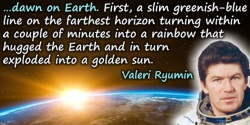
We entered into shadow. Contact with Moscow was gone. Japan floated by beneath us and I could clearly see its cities ablaze with lights. We left Japan behind to face the dark emptiness of the Pacific Ocean. No moon. Only stars, bright and far away. I gripped the handle like a man hanging onto a streetcar. Very slowly, agonizingly, half an hour passed, and with that, dawn on Earth. First, a slim greenish-blue line on the farthest horizon turning within a couple of minutes into a rainbow that hugged the Earth and in turn exploded into a golden sun. You’re out of your mind, I told myself, hanging onto a ship in space, and to your life, and getting ready to admire a sunrise.
…...
We feel that even if all possible scientific questions be answered, the problems of life have still not been touched at all. Of course there is then no question left, and just this is the answer.
From the German, “Wir fühlen, dass selbst, wenn alle möglichen wissenschaftlichen Fragen beantwortet sind, unsere Lebensprobleme noch gar nicht berührt sind. Freilich bleibt dann eben keine Frage mehr; und eben dies ist die Antwort,” in Logisch-Philosophische Abhandlung (1921). German text with English translation in Tractatus Logico-Philosophicus (1922), 186-187.
We have a right to expect that the best trained, the best educated men on the Pacific slope, the Rocky Mountains, and great plains States will take the lead in the preservation and right use of forests, in securing the right use of waters, and in seeing that our land policy is not twisted from its original purpose, but is perpetuated by amendment, by change when such change is necessary in the life of that purpose, the purpose being to turn the public domain into farms each to be the property of the man who actually tills it and makes his home in it.
Address at Leland Stanford, Jr., University, Palo Alto, California, 12 May 1903. Addresses and Presidential Messages of Theodore Roosevelt, 1902-1904 (1904), 198.
We have little more personal stake in cosmic destiny than do sunflowers or butterflies. The transfiguration of the universe lies some 50 to 100 billion years in the future; snap your fingers twice and you will have consumed a greater fraction of your life than all human history is to such a span. ... We owe our lives to universal processes ... and as invited guests we might do better to learn about them than to complain about them. If the prospect of a dying universe causes us anguish, it does so only because we can forecast it, and we have as yet not the slightest idea why such forecasts are possible for us. ... Why should nature, whether hostile or benign, be in any way intelligible to us? All the mysteries of science are but palace guards to that mystery.
…...
We have now felled forest enough everywhere, in many districts far too much. Let us restore this one element of material life to its normal proportions, and devise means for maintaining the permanence of its relations to the fields, the meadows and the pastures, to the rain and the dews of heaven, to the springs and rivulets with which it waters down the earth.
From Man and Nature (1864), 328-329.
We have reason not to be afraid of the machine, for there is always constructive change, the enemy of machines, making them change to fit new conditions.
We suffer not from overproduction but from undercirculation. You have heard of technocracy. I wish I had those fellows for my competitors. I'd like to take the automobile it is said they predicted could be made now that would last fifty years. Even if never used, this automobile would not be worth anything except to a junkman in ten years, because of the changes in men's tastes and ideas. This desire for change is an inherent quality in human nature, so that the present generation must not try to crystallize the needs of the future ones.
We have been measuring too much in terms of the dollar. What we should do is think in terms of useful materials—things that will be of value to us in our daily life.
We suffer not from overproduction but from undercirculation. You have heard of technocracy. I wish I had those fellows for my competitors. I'd like to take the automobile it is said they predicted could be made now that would last fifty years. Even if never used, this automobile would not be worth anything except to a junkman in ten years, because of the changes in men's tastes and ideas. This desire for change is an inherent quality in human nature, so that the present generation must not try to crystallize the needs of the future ones.
We have been measuring too much in terms of the dollar. What we should do is think in terms of useful materials—things that will be of value to us in our daily life.
In 'Quotation Marks: Against Technocracy', New York Times (1 Han 1933), E4.
We have the opportunity of observing her [Nature] through these delicate and pellucid teguments of the bodies of Insects acting according to her usual course and way, undisturbed, whereas when we endeavour to pry into her secrets by breaking open the doors upon her, and dissecting and mangling creatures whil'st there is life yet within them, we find her indeed at work, but put into such disorder by the violence offer'd, as it may easily be imagin'd how differing a thing we should find, if we could, as we can with a Microscope, in these smaller creatures, quietly peep in at the windows, without frighting her out of her usual byas.
Micrographia, or some Physiological Descriptions of Minute Bodies made by Magnifying Glasses with Observations and Inquiries thereupon (1665), 186.
We inhabit a complex world. Some boundaries are sharp and permit clean and definite distinctions. But nature also includes continua that cannot be neatly parceled into two piles of unambiguous yeses and noes. Biologists have rejected, as fatally flawed in principle, all attempts by antiabortionists to define an unambiguous ‘beginning of life,’ because we know so well that the sequence from ovulation or spermatogenesis to birth is an unbreakable continuum–and surely no one will define masturbation as murder.
…...
We know less about the sexual life of little girls than of boys. But we need not feel ashamed of this distinction; after all, the sexual life of adult women is a 'dark continent' for psychology.
The Question of Lay Analysis (1926), in James Strachey (ed.), The Standard Edition of the Complete Psychological Works of Sigmund Freud (1959), Vol. 20, 212.
We know, from ordinary life, that we are not able to direct our attention perfectly steadily and uniformly to one and the same object... At times the attention turns towards the object most intensely, and at times the energy flags.
An Introduction to Psychology (1912)
We lift ourselves by our thought. We climb upon our vision of ourselves. If you want to enlarge your life, you must first enlarge your thought of it and of yourself. Hold the ideal of yourself as you long to be, always everywhere.
…...
We may be sure, that if Lyell were now living he would frankly recognize new facts, as soon as they were established, and would not shrink from any modification of his theory which these might demand. Great as were his services to geology, this, perhaps, is even greater—for the lesson applies to all sciences and to all seekers alter knowledge—that his career, from first to lost, was the manifestation of a judicial mind, of a noble spirit, raised far above all party passions and petty considerations, of an intellect great in itself, but greater still in its grand humility; that he was a man to whom truth was as the “pearl of price,” worthy of the devotion and, if need be, the sacrifice of a life.
Conclusion in Charles Lyell and Modern Geology (1895), 213.
We may have to live with the failure to control atomic energy for the rest of our lives. If that is to be our lot, let us face it steadfastly with faith in the civilisation we defend. The acid test of the strength of our society is the self-discipline of its adherents.
As quoted in 'On This Day', The Times (1 Feb 2001), 21, reprinting the article 'United States to Develop Hydrogen Bomb' from The Times (1 Feb 1950), which in turn was quoting Baruch from 'International Control of Atomic Energy', Air Affairs (Spring 1950), 319.
We may regard the cell quite apart from its familiar morphological aspects, and contemplate its constitution from the purely chemical standpoint. We are obliged to adopt the view, that the protoplasm is equipped with certain atomic groups, whose function especially consists in fixing to themselves food-stuffs, of importance to the cell-life. Adopting the nomenclature of organic chemistry, these groups may be designated side-chains. We may assume that the protoplasm consists of a special executive centre (Leistungs-centrum) in connection with which are nutritive side-chains… The relationship of the corresponding groups, i.e., those of the food-stuff, and those of the cell, must be specific. They must be adapted to one another, as, e.g., male and female screw (Pasteur), or as lock and key (E. Fischer).
Croonian Lecture, 'On Immunity with Special Reference to Cell Life', Proceedings of the Royal Society of London, 1900, 66, 433-434.
We may say that life has borrowed from inanimate processes the same mechanism used in producing these striking structures that are crystals.
‘The Nature of Forces between Large Molecules of Biological Interest’, Nature (1948), 161, 708.
We may therefore say in the future, strictly within the limits of observation, that in certain respects the fossil species of a class traverse in their historical succession metamorphoses similar to those which the embryos undergo in themselves. … The development of a class in the history of the earth offers, in many respects, the greatest analogy with the development of an individual at different periods of his life. The demonstration of this truth is one of the most beautiful results of modern paleontology.
From Embryologie des Salmones, collected in L. Agassiz, Poissons d'Eau Douce de l’Europe Centrale (1842), 260. Translated by Webmaster using Google Translate, from the original French, “On pourra donc dire à l'avenir, en restant rigoureusement dans les limites de l'observation, qu'à certains égards, les espèces fossiles d'une classe parcourent dans leur succession historique des métamorphoses semblables à celles que subissent les embryons en se développant … Le développement d’une classe dans l’histoire de la terre offre, à divers égards, la plus grande analogie avec le dévelopment d’un individu aux différentes époques de sa vie. La démonstration de cette vérité est un des plus beaux résultat de la paléontologie moderne.”
We may, I think, draw a yet higher and deeper teaching from the phenomena of degeneration. We seem to learn from it the absolute necessity of labour and effort, of struggle and difficulty, of discomfort and pain, as the condition of all progress, whether physical or mental, and that the lower the organism the more need there is of these ever-present stimuli, not only to effect progress, but to avoid retrogression. And if so, does not this afford us the nearest attainable solution of the great problem of the origin of evil? What we call evil is the essential condition of progress in the lower stages of the development of conscious organisms, and will only cease when the mind has become so thoroughly healthy, so well balanced, and so highly organised, that the happiness derived from mental activity, moral harmony, and the social affections, will itself be a sufficient stimulus to higher progress and to the attainment of a more perfect life.
In 'Two Darwinian Essays', Nature (1880), 22, 142.
We need another and a wiser and perhaps a more mystical concept of animals. Remote from universal nature, and living by complicated artifice, man in civilization surveys the creature through the glass of his knowledge and sees thereby a feather magnified and the whole image in distortion. We patronize them for their incompleteness, for their tragic fate of having taken form so far below ourselves. And therein we err, and greatly err. For the animal shall not be measured by man. In a world older and more complete than ours they move finished and complete, gifted with extensions of the senses we have lost or never attained, living by voices we shall never hear. They are not brethren, they are not underlings; they are other nations, caught with ourselves in the net of life and time, fellow prisoners of the splendour and travail of the earth.
The Outermost House (1928), 25.
We need another, wiser, and perhaps a more mystical concept of animals. For the animal shall not be measured by man....They are not underlings. They are other nations, caught with ourselves in the net of life and time, fellow prisoners of the splendor and travail of Earth.
The Outermost House: A Year of Life On The Great Beach of Cape Cod (2003), 24-25.
We need science education to produce scientists, but we need it equally to create literacy in the public. Man has a fundamental urge to comprehend the world about him, and science gives today the only world picture which we can consider as valid. It gives an understanding of the inside of the atom and of the whole universe, or the peculiar properties of the chemical substances and of the manner in which genes duplicate in biology. An educated layman can, of course, not contribute to science, but can enjoy and participate in many scientific discoveries which as constantly made. Such participation was quite common in the 19th century, but has unhappily declined. Literacy in science will enrich a person’s life.
In Popular Mechanics (Sep 1961), 256
We need to respect the oceans and take care of them as if our lives depended on it. Because they do.
In 'Can We Stop Killing Our Oceans Now, Please?', Huffington Post (14 Aug 2013).
We never attempted to decipher the meaning of life; we wanted only to testify to the miracle of life.
In Jacques Cousteau and Susan Schiefelbein, The Human, the Orchid, and the Octopus: Exploring and Conserving Our Natural World (2007), 39.
We no longer can talk of unearned “rights.” We’ll have to get back to working for “rights” to adequate food, housing, education, opportunity, a place in the sun—and not everybody is going to make the grade. I don’t see this obsession with the lowest strata of humanity, against all natural biologic experience. We must accept that life is unfair.
In Raymond Mungo, 'Dixy Lee Ray: How Madame Nuke Took Over Washington', Mother Jones (May 1977), 2, No. 4, 31.
We of an older generation can get along with what we have, though with growing hardship; but in your full manhood and womanhood you will want what nature once so bountifully supplied and man so thoughtlessly destroyed; and because of that want you will reproach us, not for what we have used, but for what we have wasted...So any nation which in its youth lives only for the day, reaps without sowing, and consumes without husbanding, must expect the penalty of the prodigal whose labor could with difficulty find him the bare means of life.
'Arbor Day: A Message to the School-Children of the United States', 15 Apr 1907. In Presidential Addresses and State Papers (1910), Vol. 11, 1207-8.
We owe our lives to the sun... How is it, then, that we feel no gratitude?
Earth Ethics (Summer 1990).
We regard as 'scientific' a method based on deep analysis of facts, theories, and views, presupposing unprejudiced, unfearing open discussion and conclusions. The complexity and diversity of all the phenomena of modern life, the great possibilities and dangers linked with the scientific-technical revolution and with a number of social tendencies demand precisely such an approach, as has been acknowledged in a number of official statements.
Progress, Coexistence and Intellectual Freedom (1968), 25.
We shall therefore take an appropriately correct view of the origin of our life, if we consider our own embryos to have sprung immediately from those embryos whence our parents were developed, and these from the embryos of their parents, and so on for ever. We should in this way look on the nature of mankind, and perhaps on that of the whole animated creation, as one Continuous System, ever pushing out new branches in all directions, that variously interlace, and that bud into separate lives at every point of interlacement.
'Hereditary Talent and Character', Macmillan's Magazine, 1865, 12, 322.
We should have positive expectations of what is in the universe, not fears and dreads. We are made with the realization that we’re not Earthbound, and that our acceptance of the universe offers us room to explore and extend outward. It’s like being in a dark room and imagining all sorts of terrors. But when we turn on the light – technology - suddenly it’s just a room where we can stretch out and explore. If the resources here on Earth are limited, they are not limited in the universe. We are not constrained by the limitations of our planet. As children have to leave the security of family and home life to insure growth into mature adults, so also must humankind leave the security and familiarity of Earth to reach maturity and obtain the highest attainment possible for the human race.
…...
We take for granted the need to escape the self. Yet the self can also be a refuge. In totalitarian countries the great hunger is for private life. Absorption in the minutiae of an individual existence is the only refuge from the apocalyptic madhouse staged by maniacal saviors of humanity.
In Reflections on the Human Condition (1973), 35.
We talk about life as being dull as ditchwater, but is ditchwater dull? Naturalists with microscopes have told me that it teems with quiet fun.
'The Spice of Life', The Listener (1936). As cited, without initial phrase, in Bill Swainson (ed.), The Encarta Book of Quotations (2000), 201. Full sentences quote from Alzina Stone Dale, The Outline of Sanity: A Biography of G. K. Chesterton (2005), 288.
We think of something that has four legs and wags its tail as being alive. We look at a rock and say it’s not living. Yet when we get down to the no man’s land of virus particles and replicating molecules, we are hard put to define what is living and what is non-living.
From interview, 'The Seeds of Life', in The Omni Interviews (1984), 4.
We urgently need [the landmark National Ocean Policy] initiative, as we use our oceans heavily: Cargo ships crisscross the sea, carrying goods between continents. Commercial and recreational fishing boats chase fish just offshore. Cruise ships cruise. Oil and gas drilling continues, but hopefully we will add renewable energy projects as well. Without planning, however, these various industrial activities amount to what we call “ocean sprawl,” steamrolling the resources we rely upon for our livelihoods, food, fun, and even the air we breathe. While humankind relies on many of these industries, we also need to keep the natural riches that support them healthy and thriving. As an explorer, I know firsthand there are many places in the ocean so full of life that they should be protected.
In 'A Blueprint for Our Blue Home', Huffington Post (18 Jul 2011).
We will be able to depart this life with the quiet peace-giving notion, that we were permitted to contribute to the happiness of many who will live after us. In our long lives we endeavored to unfold the collective consciousness. In our lives we have known hell and heaven; the final balance, however, is that we helped pave the way to dynamic harmony in this earthly house. That, I believe, is the meaning of this life.
Letter to old unnamed friend (Jul 1981), quoted in Willem J. M. van der Linden, 'In Memoriam: R. W. van Bemmelen', Netherlands Journal of Geosciences, Geologie en Mijnbouw (1984), 63, No. 1.
We’re going to see public attitudes [on climate change] switch not in proportion to scientific findings or graphs, but in proportion to the stories they hear, the people they know whose lives have been touched by climate change or some environmental calamity. That’s what really changed public opinion.
From interview with Mark Tercek, 'Q&A With Ramez Naam: Dialogues on the Environment', Huffington Post (1 Jul 2013).
What a curious picture it is to find man, homo sapiens, of divine origin, we are told, seriously considering going underground to escape the consequences of his own folly. With a little wisdom and foresight, surely it is not yet necessary to forsake life in the fresh air and in the warmth of sunlight. What a paradox if our own cleverness in science should force us to live underground with the moles.
'The Effect of the Atomic Bomb on American Foreign Policy', address to the Foreign Policy Association, New York City, 20 Oct 1945. Congressional Record 2 Nov 1945, 91, Appendix, p. A4654.
What animates a great pathologist? Is it the desire to cure disease, to save life? Surely not, save perhaps as an afterthought. He is too intelligent, deep in his soul, to see anything praiseworthy in such a desire. He knows from life-long observation that his discoveries will do quite as much harm as good, that a thousand scoundrels will profit to every honest man, that the folks who most deserve to be saved will probably be the last to be saved. ... What actually moves him is his unquenchable curiosity—his boundless, almost pathological thirst to penetrate the unknown, to uncover the secret, to find out what has not been found out before. ... [like] the dog sniffing tremendously at an infinite series of rat-holes. ... And yet he stands in the very front rank of the race
In 'The Scientist', Prejudices: third series (1922), 269-70.
What can be more important than the science of life to any intelligent being who has the good fortune to be alive?
Epigraph in Isaac Asimov’s Book of Science and Nature Quotations (1988), 36.
What does a fish know about the water in which it swims all its life?
Webmaster has not yet been able to find a primary source. Seen with Einstein’s name, but Webmaster suspects that is misattributed.
What else can the human mind hold besides numbers and magnitudes? These alone we apprehend correctly, and if piety permits to say so, our comprehension is in this case of the same kind as God’s, at least insofar as we are able to understand it in this mortal life.
As quoted in Epilogue, The Sleepwalkers: A History of Man’s Changing Vision of the Universe (1959), 524.
What friends do with us and for us is a real part of our life; for it strengthens and advances our personality. The assault of our enemies is not part of our life ; it is only part of our experience ; we throw it off and guard ourselves against it as against frost, storm, rain, hail, or any other of the external evils which may be expected to happen.
In The Maxims and Reflections of Goethe (1906), 201.
What is a scientist?… We give the name scientist to the type of man who has felt experiment to be a means guiding him to search out the deep truth of life, to lift a veil from its fascinating secrets, and who, in this pursuit, has felt arising within him a love for the mysteries of nature, so passionate as to annihilate the thought of himself.
The Montessori Method, trans. Anne E. George,(1964), 8.
What is art
But life upon the larger scale, the higher,
When, graduating up in a spiral line
Of still expanding and ascending gyres,
It pushed toward the intense significance
Of all things, hungry for the Infinite?
But life upon the larger scale, the higher,
When, graduating up in a spiral line
Of still expanding and ascending gyres,
It pushed toward the intense significance
Of all things, hungry for the Infinite?
From poem, 'Aurora Leigh' (1856), Book 4. In Elizabeth Barrett Browning and Harriet Waters Preston (ed.), The Complete Poetical Works of Mrs. Browning (1900), 323.
What is laid down, ordered, factual, is never enough to embrace the whole truth: life always spills over the rim of every cup.
As quoted, without source, in Philip J. Davis and Reuben Hersh, The Mathematical Experience (1981, 2012), xxv.
What is life? It is the flash of a firefly in the night. It is the breath of a buffalo in the wintertime. It is the little shadow which runs across the grass and loses itself in the sunset.
…...
What is mathematics? What is it for? What are mathematicians doing nowadays? Wasn't it all finished long ago? How many new numbers can you invent anyway? Is today’s mathematics just a matter of huge calculations, with the mathematician as a kind of zookeeper, making sure the precious computers are fed and watered? If it’s not, what is it other than the incomprehensible outpourings of superpowered brainboxes with their heads in the clouds and their feet dangling from the lofty balconies of their ivory towers?
Mathematics is all of these, and none. Mostly, it’s just different. It’s not what you expect it to be, you turn your back for a moment and it's changed. It's certainly not just a fixed body of knowledge, its growth is not confined to inventing new numbers, and its hidden tendrils pervade every aspect of modern life.
Mathematics is all of these, and none. Mostly, it’s just different. It’s not what you expect it to be, you turn your back for a moment and it's changed. It's certainly not just a fixed body of knowledge, its growth is not confined to inventing new numbers, and its hidden tendrils pervade every aspect of modern life.
Opening paragraphs of 'Preface', From Here to Infinity (1996), vii.
What is the meaning of human life, or for that matter, of the life of any creature? To know an answer to this question means to be religious. Does it make any sense, then, to pose this question? I answer: The man who regards his own life and that of his fellow creatures as meaningless is not merely unhappy but hardly fit for life.
In Ideas and Opinions (1954), 11. A different translation is given in The World As I See It (1935), 1. From the original German in Mein Weltbild (1934).
What is the meaning of human life, or of organic life altogether? To answer this question at all implies a religion. Is there any sense then, you ask, in putting it? I answer, the man who regards his own life and that of his fellow creatures as meaningless is not merely unfortunate but almost disqualified for life.
In The World As I See It (1935), 1. A different translation is given in Ideas and Opinions (1954), 11. From the original German in Mein Weltbild (1934).
What is the use of this history, what the use of all this minute research? I well know that it will not produce a fall in the price of pepper, a rise in that of crates of rotten cabbages, or other serious events of this kind, which cause fleets to be manned and set people face to face intent upon one another's extermination. The insect does not aim at so much glory. It confines itself to showing us life in the inexhaustible variety of its manifestations; it helps us to decipher in some small measure the obscurest book of all, the book of ourselves.
Introducing the natural history and his study of the insect Minotaurus typhoeus. In Jean-Henri Fabre and Alexander Teixeira de Mattos (trans.), The Life and Love of the Insect (1918), 128.
What marvel is this? We begged you for drinkable springs,
O earth, and what is your lap sending forth?
Is there life in the deeps as well? A race yet unknown
Hiding under the lava? Are they who had fled returning?
Come and see, Greeks; Romans, come! Ancient Pompeii Is found again, the city of Hercules rises!
O earth, and what is your lap sending forth?
Is there life in the deeps as well? A race yet unknown
Hiding under the lava? Are they who had fled returning?
Come and see, Greeks; Romans, come! Ancient Pompeii Is found again, the city of Hercules rises!
Translation as given, without citation, as epigraph in C.W. Ceram, Gods, Graves, and Scholars: The Story of Archaeology (1986), 1. There are other translations of the Schiller’s original German, for example, in 'Pompeii and Herculaneum', Life of Schiller: Poetical Works (1902), 249.
What politicians do not understand is that [Ian] Wilmut discovered not so much a technical trick as a new law of nature. We now know that an adult mammalian cell can fire up all the dormant genetic instructions that shut down as it divides and specializes and ages, and thus can become a source of new life. You can outlaw technique; you cannot repeal biology.
Writing after Wilmut's successful cloning of the sheep, Dolly, that research on the cloning of human beings cannot be suppressed.
Writing after Wilmut's successful cloning of the sheep, Dolly, that research on the cloning of human beings cannot be suppressed.
'A Special Report on Cloning'. Charles Krauthammer in Time (10 Mar 1997).
What scientist would not long to go on living, if only to see how the little truths he has brought to light will grow up?
Pensées d'un Biologiste (1939). Translated in The Substance of Man (1962), 254.
What strange wonder is this? Our prayer to thee was for water,
Earth! What is this that thou now send’st from thy womb in reply?
In the abyss is there life ? Or hidden under the lava
Dwelleth some race now unknown? Does what hath fled e’er return?
Greeks and Romans, oh come! Oh, see the ancient Pompeii
Here is discover’d again,—Hercules’ town is rebuilt!
Earth! What is this that thou now send’st from thy womb in reply?
In the abyss is there life ? Or hidden under the lava
Dwelleth some race now unknown? Does what hath fled e’er return?
Greeks and Romans, oh come! Oh, see the ancient Pompeii
Here is discover’d again,—Hercules’ town is rebuilt!
Beginning lines of poem, 'Pompeii and Herculaneum', in Edgar A. Bowring (trans.), The Poems of Schiller (1875), 237.
What we call man is a mechanism made up of … uncrystallized matter … all the colloid matter of his mechanism is concentrated in a countless number of small cells. … [T]hese cells [are] dwelling places, communes, a walled town within which are many citizens. ... [T]hese are the units of life and when they pass out into space man as we think we know him is dead, a mere machine from which the crew have left,so to speak. ... [T]hese units are endowed with great intelligence. They have memories, they must be divided into countless thousands of groups, most are workers, there are directing groups. Some are chemists, they manufacture the most complicated chemicals that are secreted by the glands.
Diary and Sundry Observations of Thomas Alva Edison (1948), 203-44. In Mark Seltzer, Serial Killers (1998), 215-6.
What would life be without art? Science prolongs life. To consist of what—eating, drinking, and sleeping? What is the good of living longer if it is only a matter of satisfying the requirements that sustain life? All this is nothing without the charm of art.
The Art of the Theatre (1924), 177.
Whatever answers faith gives.. .such answers always give an infinite meaning to the finite existence of man; a meaning that is not destroyed by suffering, deprivation or death. This means only in faith can we find the meaning and possibility of life.
Quoted in Kim Lim (ed.), 1,001 Pearls of Spiritual Wisdom: Words to Enrich, Inspire, and Guide Your Life (2014), 19
Whatever be the detail with which you cram your student, the chance of his meeting in after life exactly that detail is almost infinitesimal; and if he does meet it, he will probably have forgotten what you taught him about it. The really useful training yields a comprehension of a few general principles with a thorough grounding in the way they apply to a variety of concrete details. In subsequent practice the men will have forgotten your particular details; but they will remember by an unconscious common sense how to apply principles to immediate circumstances. Your learning is useless to you till you have lost your textbooks, burnt your lecture notes, and forgotten the minutiae which you learned by heart for the examination. What, in the way of detail, you continually require will stick in your memory as obvious facts like the sun and the moon; and what you casually require can be looked up in any work of reference. The function of a University is to enable you to shed details in favor of principles. When I speak of principles I am hardly even thinking of verbal formulations. A principle which has thoroughly soaked into you is rather a mental habit than a formal statement. It becomes the way the mind reacts to the appropriate stimulus in the form of illustrative circumstances. Nobody goes about with his knowledge clearly and consciously before him. Mental cultivation is nothing else than the satisfactory way in which the mind will function when it is poked up into activity.
In 'The Rhythm of Education', The Aims of Education: & Other Essays (1917), 41.
Whatever terrain the environmental historian chooses to investigate, he has to address the age-old predicament of how humankind can feed itself without degrading the primal source of life. Today as ever, that problem is the fundamental challenge in human ecology, and meeting it will require knowing the earth well—knowing its history and knowing its limits.
In 'Transformations of the Earth: toward an Agroecological Perspective in History', Journal of American History (Mar 1990), 76, No. 4, 1106.
Whatever the scientists may say, if we take the supernatural out of life, we leave only the unnatural.
Autobiography, All the Days of My Life (1913), 478.
Whatsoever therefore is consequent to a time of Warre, where every man is Enemy to every man; the same is consequent to the time, wherein men live without other security, than what their own strength, and their own invention shall furnish them withall. In such condition, there is no place for Industry; because the fruit thereof is uncertain: and consequently no Culture of the Earth; no Navigation, nor use of the commodities that may be imported by Sea; no commodious Building; no Instruments of moving, and removing, such things as require much force; no Knowledge of the face of the Earth; no account of Time; no Arts; no Letters; no Society; and which is worst of all, continual fear, and danger of violent death; And the life of man, solitary, poore, nasty, brutish, and short.
Leviathan (1651), ed. C. B. Macpherson (1968), Part 1, Chapter 13, 186.
Wheeler’s First Moral Principle: Never make a calculation until you know the answer. Make an estimate before every calculation, try a simple physical argument (symmetry! invariance! conservation!) before every derivation, guess the answer to every paradox and puzzle. Courage: No one else needs to know what the guess is. Therefore make it quickly, by instinct. A right guess reinforces this instinct. A wrong guess brings the refreshment of surprise. In either case life as a spacetime expert, however long, is more fun!
In E.F. Taylor and J.A. Wheeler, Spacetime Physics (1992), 20.
When a man spends his life among the stars and planets, or lays out a twelvemonth on the spots of the sun, however noble his speculations may be, they are very apt to fall into burlesque.
In The Works of Joseph Addison: Including the Whole Contents of Bp. Hurd’s Edition, with Letters and Other Pieces Not Found in Any Previous Collection; and Macaulay’s Essay on His Life and Works (1854), Vol. 2, 9.
When air has been freshly and strongly tainted with putrefaction, so as to smell through the water, sprigs of mint have presently died, upon being put into it, their leaves turning black; but if they do not die presently, they thrive in a most surprizing manner. In no other circumstances have I ever seen vegetation so vigorous as in this kind of air, which is immediately fatal to animal life. Though these plants have been crouded in jars filled with this air, every leaf has been full of life; fresh shoots have branched out in various , and have grown much faster than other similiar plants, growing in the same exposure in common air.
This observation led me to conclude that plants, instead of affecting the air in the same manner with animal respiration, reverse the effects of breathing, and tend to keep the atmosphere sweet and wholesome, when it is become noxious, in consequence on animals living and breathing, or dying and putrefying in it.
In order to ascertain this, I took a quantity of air, made thoroughly noxious, by mice breathing and dying in it, and divided it into two parts; one of which I put into a phial immersed in water; and to the other (which was contained in a glass jar, standing in water) I put a sprig of mint. This was about the beginning of August 1771, and after eight or nine days, I found that a mouse lived perfectly well in that part of the air, in which the sprig of mint had grown, but died the moment it was put into the other part of the same original quantity of air; and which I had kept in the very same exposure, but without any plant growing in it.
This observation led me to conclude that plants, instead of affecting the air in the same manner with animal respiration, reverse the effects of breathing, and tend to keep the atmosphere sweet and wholesome, when it is become noxious, in consequence on animals living and breathing, or dying and putrefying in it.
In order to ascertain this, I took a quantity of air, made thoroughly noxious, by mice breathing and dying in it, and divided it into two parts; one of which I put into a phial immersed in water; and to the other (which was contained in a glass jar, standing in water) I put a sprig of mint. This was about the beginning of August 1771, and after eight or nine days, I found that a mouse lived perfectly well in that part of the air, in which the sprig of mint had grown, but died the moment it was put into the other part of the same original quantity of air; and which I had kept in the very same exposure, but without any plant growing in it.
'Observations on Different Kinds of Air', Philosophical Transactions (1772), 62, 193-4.
When all the discoveries [relating to the necessities and some to the pastimes of life] were fully developed, the sciences which relate neither to pleasure nor yet to the necessities of life were invented, and first in those places where men had leisure. Thus the mathematical sciences originated in the neighborhood of Egypt, because there the priestly class was allowed leisure.
In Metaphysics, 1-981b, as translated by Hugh Tredennick (1933). Also seen translated as “Now that practical skills have developed enough to provide adequately for material needs, one of these sciences which are not devoted to utilitarian ends [mathematics] has been able to arise in Egypt, the priestly caste there having the leisure necessary for disinterested research.”
When an hypothesis has come to birth in the mind, or gained footing there, it leads a life so far comparable with the life of an organism, as that it assimilates matter from the outside world only when it is like in kind with it and beneficial; and when contrarily, such matter is not like in kind but hurtful, the hypothesis, equally with the organism, throws it off, or, if forced to take it, gets rid of it again entirely.
In Arthur Schopenhauer and T. Bailey Saunders (ed., trans), The Art of Literature: A Series of Essays (1891), 81.
When Cayley had reached his most advanced generalizations he proceeded to establish them directly by some method or other, though he seldom gave the clue by which they had first been obtained: a proceeding which does not tend to make his papers easy reading. …
His literary style is direct, simple and clear. His legal training had an influence, not merely upon his mode of arrangement but also upon his expression; the result is that his papers are severe and present a curious contrast to the luxuriant enthusiasm which pervades so many of Sylvester’s papers. He used to prepare his work for publication as soon as he carried his investigations in any subject far enough for his immediate purpose. … A paper once written out was promptly sent for publication; this practice he maintained throughout life. … The consequence is that he has left few arrears of unfinished or unpublished papers; his work has been given by himself to the world.
His literary style is direct, simple and clear. His legal training had an influence, not merely upon his mode of arrangement but also upon his expression; the result is that his papers are severe and present a curious contrast to the luxuriant enthusiasm which pervades so many of Sylvester’s papers. He used to prepare his work for publication as soon as he carried his investigations in any subject far enough for his immediate purpose. … A paper once written out was promptly sent for publication; this practice he maintained throughout life. … The consequence is that he has left few arrears of unfinished or unpublished papers; his work has been given by himself to the world.
In Proceedings of London Royal Society (1895), 58, 23-24.
When every fact, every present or past phenomenon of that universe, every phase of present or past life therein, has been examined, classified, and co-ordinated with the rest, then the mission of science will be completed. What is this but saying that the task of science can never end till man ceases to be, till history is no longer made, and development itself ceases?
From The Grammar of Science (1892), 15.
When I call to mind my earliest impressions, I wonder whether the process ordinarily referred to as growing up is not actually a process of growing down; whether experience, so much touted among adults as the thing children lack, is not actually a progressive dilution of the essentials by the trivialities of living.
In 'Red Legs Kicking', A Sand County Almanac, and Sketches Here and There (1949, 1987), 120.
When I discuss intelligent life in the universe, I take this to include the human race, even though much of its behavior throughout history appears not to have been calculated to aid the survival of the species.
In 'A Step Backward For Civilization', The Washington Post (16 Feb 2014), Sec. A, 21.
When one considers in its length and in its breadth the importance of this question of the education of the nation's young, the broken lives, the defeated hopes, the national failures, which result from the frivolous inertia with which it is treated, it is difficult to restrain within oneself a savage rage. In the conditions of modern life the rule is absolute, the race which does not value trained intelligence is doomed. Not all your heroism, not all your social charm, not all your wit, not all your victories on land or at sea, can move back the finger of fate. To-day we maintain ourselves. To-morrow science will have moved forward yet one more step, and there will be no appeal from the judgment which will then be pronounced on the uneducated.
In 'Organisation of Thought', The Aims of Education: & Other Essays (1917), 22.
When scientists discovered that liquid water, which brought forth life on Earth, exists nowhere else in great quantities in the solar system, the most significant lesson they taught was not that water, or the life that depends on it, is necessarily the result of some chemical accident in space; their most important revelation was that water is rare in infinity, that we should prize it, preserve it, conserve it.
In Jacques Cousteau and Susan Schiefelbein, The Human, the Orchid, and the Octopus: Exploring and Conserving Our Natural World (2007), 201-202.
When searching for harmony in life one must never forget that in the drama of existence we are ourselves both actors and spectators.
Niels Bohr, 'Discussion with Einstein on Epistemological Problems in Atomic Physics', in P. A. Schilpp (ed.), Albert Einstein: Philosopher-Scientist (1949), 236.
When the body becomes Your mirror,
how can it serve?
When the mind becomes Your mind,
what is left to remember?
Once my life is Your gesture,
how can I pray?
When all my awareness is Yours,
what can there be to know?
how can it serve?
When the mind becomes Your mind,
what is left to remember?
Once my life is Your gesture,
how can I pray?
When all my awareness is Yours,
what can there be to know?
Quoted in Kim Lim (ed.), 1,001 Pearls of Spiritual Wisdom: Words to Enrich, Inspire, and Guide Your Life (2014), 190
When the child outgrows the narrow circle of family life … then comes the period of the school, whose object is to initiate him into the technicalities of intercommunication with his fellow-men, and to familiarize him with the ideas that underlie his civilization, and which he must use as tools of thought if he would observe and understand the phases of human life around him; for these … are invisible to the human being who has not the aid of elementary ideas with which to see them.
In Psychologic Foundations of Education: An Attempt to Show the Genesis of the Higher Faculties of the Mind (1907), 265.
When the patient dies the kidneys may go to the pathologist, but while he lives the urine is ours. It can provide us day by day, month by month, and year by year, with a serial story of the major events going on within the kidney.
Glomerular Nephritis, Diagnosis and Treatment (1948), 2.
When ultra-violet light acts on a mixture of water, carbon dioxide, and ammonia, a vast variety of organic substances are made, including sugars and apparently some of the materials from which proteins are built up…. But before the origin of life they must have accumulated till the primitive oceans reached the consistency of hot dilute soup…. The first living or half-living things were probably large molecules synthesized under the influence of the sun’s radiation, and only capable of reproduction in the particularly favorable medium in which they originated….
In 'The Origin of Life', The Inequality of Man: And Other Essays (1932, 1937), 152.
When we are motivated by goals that have deep meaning, by dreams that need completion, by pure love that needs expressing, then we truly live life.
…...
When we have fully discovered the scientific laws that govern life, we shall realise that one person who has more illusions than the dreamer is the man of action.
In Epigrams of Oscar Wilde (2007), 111.

When we have to do with an art whose end is the saving of human life, any neglect to make ourselves thorough masters of it becomes a crime.
Quoted without citation in United States Medical Investigator (1885), 21, 521. Seen in various other later publications, but also without citation. If you know the primary source, please contact Webmaster.
When we react to life from the head without joining forces with the heart, it can lead us into childish, inelegant behavior that we don’t respect in ourselves. If we get the head in sync with the heart first, we have the power of their teamwork working for us and we can make the changes we know we need to make.
Doc Childre and Howard Martin
When we reflect that all the aspects of Nature, all the emotions of the soul, and all the events of life, have been the subjects of poetry for hundreds and thousands of years, we can hardly wonder that there should be so many resemblances and coincidences of expression among poets, but rather that they are not more numerous and more striking.
In 'Table-Talk', The Poetical Works of Henry Wadsworth Longfellow: Volume 3 (1883), 1355.
When you and I were born, only one thing was certain about the rest of our lives: that you and I would someday die. Just as a trillion, trillion, trillion (1036) microorganisms, animals and plants have died before us. … A God who slaughters is no God at all. Or if he i … He is a God who must be stopped.
In The God Problem: How a Godless Cosmos Creates (2012), 19.
When you realize the value of all life, you dwell on what is past and concentrate more on the preservation of the future.
Her last diary entry. As quoted in Camilla De la Bédoyère, No One Loved Gorillas More: Dian Fossey’s Letters From the Mist (2005), 178.
When you recover or discover something that nourishes your soul and brings joy, care enough about yourself to make room for it in your life.
Quoted in Kim Lim (ed.), 1,001 Pearls of Spiritual Wisdom: Words to Enrich, Inspire, and Guide Your Life (2014), 253
When... the biologist is confronted with the fact that in the organism the parts are so adapted to each other as to give rise to a harmonious whole; and that the organisms are endowed with structures and instincts calculated to prolong their life and perpetuate their race, doubts as to the adequacy of a purely physiochemical viewpoint in biology may arise. The difficulties besetting the biologist in this problem have been rather increased than diminished by the discovery of Mendelian heredity, according to which each character is transmitted independently of any other character. Since the number of Mendelian characters in each organism is large, the possibility must be faced that the organism is merely a mosaic of independent hereditary characters. If this be the case the question arises: What moulds these independent characters into a harmonious whole? The vitalist settles this question by assuming the existence of a pre-established design for each organism and of a guiding 'force' or 'principle' which directs the working out of this design. Such assumptions remove the problem of accounting for the harmonious character of the organism from the field of physics or chemistry. The theory of natural selection invokes neither design nor purpose, but it is incomplete since it disregards the physiochemical constitution of living matter about which little was known until recently.
The Organism as a Whole: From a Physiochemical Viewpoint (1916), v-vi.
Where a cell arises, there a cell must have previously existed (omnis cellula e cellula), just as an animal can spring only from an animal, a plant only from a plant. In this manner, although there are still a few spots in the body where absolute demonstration has not yet been afforded, the principle is nevertheless established, that in the whole series of living things, whether they be entire plants or animal organisms, or essential constituents of the same, an eternal law of continuous development prevails.
In Lecture II 'Physiological Tissues' (17 Feb 1858), as translated by Frank Chance in Cellular Pathology: As Based Upon Physiological and Pathological Histology. Twenty Lectures Delivered in the Pathological Institute of Berlin During the Months of February, March and April, 1858 (1860), 27-28.
Where speculation ends—in real life—there real, positive science begins: the representation of the practical activity, of the practical process of development of men. Empty talk about consciousness ceases, and real knowledge has to take its place.
In David McLellan (ed.), 'The Premisses of the Material Method', Karl Marx: Selected Writings (2000), 181.
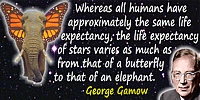
Whereas all humans have approximately the same life expectancy the life expectancy of stars varies as much as from that of a butterfly to that of an elephant.
In A Star Called the Sun (1964), 145.
Whereas the man of action binds his life to reason and its concepts so that he will not be swept away and lost, the scientific investigator builds his hut right next to the tower of science so that he will be able to work on it and to find shelter for himself beneath those bulwarks which presently exist.
On Truth and Lies in a Nonmoral Sense (1873). Collected in Keith Ansell-Pearson (ed.), and Duncan Large (ed.), The Nietzsche Reader (2006), 121.
Whereas you have a very expensive dept. for destroying human life, would it not be for the honour of the New World to have a little national establishment for the preservation of human life; more especially as the devouring monster, small pox, has already destroyed many millions (some say 40) more lives than there are people now on the face of the earth.
(Conclusion of a letter (14 Dec 1826) to Massachusetts Congressman Edward Everett (1794-1865), in which he outlined his experience with vaccination.)
(Conclusion of a letter (14 Dec 1826) to Massachusetts Congressman Edward Everett (1794-1865), in which he outlined his experience with vaccination.)
Whereas, to borrow an illustration from mathematics, life was formerly an equation of, say, 100 unknown quantities, it is now one of 99 only, inasmuch as memory and heredity have been shown to be one and the same thing.
Samuel Butler, Henry Festing Jones (ed.), The Note-Books of Samuel Butler (1917), 57.
While DNA could be claimed to be both simple and elegant, it must be remembered that DNA almost certainly originated fairly close to the origin of life when things were necessarily simple or they would not have got going.
In What Mad Pursuit: A Personal View of Scientific Discovery (1988), 138.
While men believe themselves to be seeking truth for its own sake, they are in fact seeking life in truth.
Tragic Sense of Life (1913), translated by John Ernest Crawford Flitch (1954), 23.
While religion prescribes brotherly love in the relations among the individuals and groups, the actual spectacle more resembles a battlefield than an orchestra. Everywhere, in economic as well as in political life, the guiding principle is one of ruthless striving for success at the expense of one’s fellow men. This competitive spirit prevails even in school and, destroying all feelings of human fraternity and cooperation, conceives of achievement not as derived from the love for productive and thoughtful work, but as springing from personal ambition and fear of rejection.
…...
While there are several chronic diseases more destructive to life than cancer, none is more feared.
Charles H. Mayo and William A. Hendricks, 'Carcinoma of the Right Segment of the Colon', presented to Southern Surgical Assoc. (15 Dec 1925). In Annals of Surgery (Mar 1926), 83, 357.
Who would be a better source of information about the forests than aborigines themselves because they have lived off the forest for most of their lives. The forests have provided the aborigines with food, medicine and shelter among other things and yet, the aborigines have never abused or ravaged the forest the way others have.
Keynote address yesterday at the 21st IUFRO World Congress (International Union of Forestry Research Organisations), Kuala Lumpur, Malaysia. As quoted in Lee Shi-lan 'Utilise Knowledge of Aborigines for the Conservation of Forests', New Straits Times (14 Aug 2000), 8.
Whoever looks at the insect world, at flies, aphides, gnats and innumerable parasites, and even at the infant mammals, must have remarked the extreme content they take in suction, which constitutes the main business of their life. If we go into a library or newsroom, we see the same function on a higher plane, performed with like ardor, with equal impatience of interruption, indicating the sweetness of the act. In the highest civilization the book is still the highest delight.
In Lecture, second in a series given at Freeman Place Chapel, Boston (Mar 1859), 'Quotation and Originality', in Letters and Social Aims (1875, 1917), 177.
Why does this magnificent applied science which saves work and makes life easier bring us so little happiness? … The simple answer runs: “Because we have not yet learned to make sensible use of it.”
Address to students of the California Institute of Technology, Pasadena, California (16 Feb 1931). In New York Times (17 Feb 1931), p. 6.
Why may we not say, that all Automata (Engines that move themselves by springs and wheeles as doth a watch) have an artificiall life? For what is the Heart, but a Spring; and the Nerves, but so many Strings; and the Joynts, but so many Wheeles, giving motion to the whole Body, such as was intended by the Artificer? Art goes yet further, imitating the rationall and most excellent worke of Nature, Man. For by Art is created the great LEVIATHAN called a COMMON-WEALTH, or STATE, (in latine CIVITAS) which is but an Artificiall Man; though of greater stature and strength than the Naturall, for whose protection and defence it was intended; and in which, the Soveraignty is an Artificiall Soul, as giving life and motion to the whole body.
Leviathan (1651), ed. C. B. Macpherson (1968), Part I, Introduction, 81.
Why should one say that the machine does not live? It breathes, for its breath forms the atmosphere of some towns.
In Coningsby: Or The New Generation (1844), Vol. 2, Book 4, Ch.1, 7.
Why should we limit by dogma or otherwise man’s liberty to select his food and drink? … the great practical rule of life in regard of human diet will not be found in enforcing limitation of the sources of food which Nature has abundantly provided.
In Eating and Living: Diet in Relation to Age and Activity (1885), 16-17.
Why the dinosaurs died out is not known, but it is supposed to be because they had minute brains and devoted themselves to the growth of weapons of offense in the shape of numerous horns. However that may be, it was not through their line that life developed.
In 'Men versus. Insects' (1933), collected in In Praise of Idleness and Other Essays (1935), 199.
Why then be concerned about the conservation of wildlife when for all practical purposes we would be much better off if humans and their domestic animals and pets were the only living creatures on the face of the earth? There is no obvious and demolishing answer to this rather doubtful logic although in practice the destruction of all wild animals would certainly bring devastating changes to our existence on this planet as we know it today… The trouble is that everything in nature is completely interdependent. Tinker with one part of it and the repercussions ripple out in all directions… Wildlife—and that includes everything from microbes to blue whales and from a fungus to a redwood tree—has been so much part of life on the earth that we are inclined to take its continued existence for granted… Yet the wildlife of the world is disappearing, not because of a malicious and deliberate policy of slaughter and extermination, but simply because of a general and widespread ignorance and neglect.
World Wildlife Fund Dinner, York, (1969). As quoted and cited in 'The Mirror of a Duke', The Dorset Eye on dorseteye.com website
Why, only last term we sent a man who had never been in a laboratory in his life as a senior Science Master to one of our leading public schools. He came [to our agency] wanting to do private coaching in music. He’s doing very well, I believe.
In Decline and Fall (1928), 1962 edn., 25.
Will it be possible to solve these problems? It is certain that nobody has thus far observed the transformation of dead into living matter, and for this reason we cannot form a definite plan for the solution of this problem of transformation. But we see that plants and animals during their growth continually transform dead into living matter, and that the chemical processes in living matter do not differ in principle from those in dead matter. There is, therefore, no reason to predict that abiogenesis is impossible, and I believe that it can only help science if the younger investigators realize that experimental abiogenesis is the goal of biology.
The Dynamics of Living Matter (1906), 223.
Will our Philosophy to later Life
Seem but a crudeness of the planet's youth,
Our Wisdom but a parasite of Truth?
Seem but a crudeness of the planet's youth,
Our Wisdom but a parasite of Truth?
Essay read at the Heretics Club, Cambridge (May 1922), 'Philosophic Ants', collected in Essays of a Biologist (1923), 176.
With an interest almost amounting to anxiety, geologists will watch the development of researches which may result in timing the strata and the phases of evolutionary advance; and may even-going still further back—give us reason to see in the discrepancy between denudative and radioactive methods, glimpses of past aeons, beyond that day of regeneration which at once ushered in our era of life, and, for all that went before, was 'a sleep and a forgetting'.
Radioactivity and Geology (1909), 250-1.
With every throb of the climatic pulse which we have felt in Central Asia,, the centre of civilisation has moved this way and that. Each throb has sent pain and decay to the lands whose day was done, life and vigour to those whose day was yet to be.
Final sentence in his book, The Pulse of Asia (1907), 385.
With savages, the weak in body or mind are soon eliminated; and those that survive commonly exhibit a vigorous state of health. We civilised men, on the other hand, do our utmost to check the process of elimination; we build asylums for the imbecile, the maimed, and the sick; we institute poor-laws; and our medical men exert their utmost skill to save the life of every one to the last moment.
…...
With the key of the secret he marches faster
From strength to strength, and for night brings day,
While classes or tribes too weak to master
The flowing conditions of life, give way.
From strength to strength, and for night brings day,
While classes or tribes too weak to master
The flowing conditions of life, give way.
From poem 'Rex' from one of his Poetry Notebooks, used as epigraph to 'Education', The Works of Ralph Waldo Emerson: Vol X: Lectures and Biographical Sketches (1883), 123.
With the neutron bomb, which destroys life but not property, capitalism has found the weapon of its dreams.
In 'Money Et Cetera', A Voice Crying in the Wilderness (Vox Clamantis in Deserto) (1989), 100.
Without any remaining wilderness we are committed wholly, without chance for even momentary reflection and rest, to a headlong drive into our technological termite-life, the Brave New World of a completely man-controlled environment. We need wilderness preserved—as much of it as is still left, and as many kinds—because it was the challenge against which our character as a people was formed.
Letter (3 Dec 1960) written to David E. Pesonen of the Outdoor Recreation Resources Review Commission. Collected in 'Coda: Wilderness Letter', The Sound of Mountain Water: The Changing American West (1969), 147.
Without natural resources life itself is impossible. From birth to death, natural resources, transformed for human use, feed, clothe, shelter, and transport us. Upon them we depend for every material necessity, comfort, convenience, and protection in our lives. Without abundant resources prosperity is out of reach.
In Breaking New Ground (1947, 1998), 505.
Without the suitable conditions life could not exist. But both life and its conditions set forth the operations of inscrutable Power. We know not its origin; we know not its end. And the presumption, if not the degradation, rests with those who place upon the throne of the universe a magnified image of themselves, and make its doings a mere colossal imitation of their own.
In Forms of Water in Clouds and Rivers, Ice and Glaciers (1872), 125.
Women decide the larger questions of life correctly and quickly, not because they are lucky guessers, not because they practise a magic inherited from savagery, but simply and solely because they have sense. They see at a glance what most men could not see with searchlights and telescopes.
…...
World Game finds that 60 percent of all the jobs in the U.S.A. are not producing any real wealth—i.e., real life support. They are in fear-underwriting industries or are checking-on-other-checkers, etc.
In Critical Path (1982), 223.
Wouldst thou enjoy a long Life, a healthy Body, and a vigorous Mind, and be acquainted also with the wonderful Works of God? labour in the first place to bring thy Appetite into Subjection to Reason.
In Poor Richard's Almanack (1742).
You all have learned reliance
On the sacred teachings of Science,
So I hope, through life, you will never decline
In spite of philistine Defiance
To do what all good scientists do.
Experiment.
Make it your motto day and night.
Experiment.
And it will lead you to the light.
On the sacred teachings of Science,
So I hope, through life, you will never decline
In spite of philistine Defiance
To do what all good scientists do.
Experiment.
Make it your motto day and night.
Experiment.
And it will lead you to the light.
From 'Experiment', a song in the musical Nymph Errant (1933).
You and your purpose in life are the same thing. Your purpose is to be you.
Quoted in Kim Lim (ed.), 1,001 Pearls of Spiritual Wisdom: Words to Enrich, Inspire, and Guide Your Life (2014), 250
You bring me the deepest joy that can be felt by a man [Pasteur himself] whose invincible belief is that Science and Peace will triumph over Ignorance and War, that nations will unite, not to destroy, but to build, and that the future will belong to those who will have done most for suffering humanity. But whether our efforts are or are not favored by life, let us be able to say, when we come near to the great goal, “I have done what I could.”
Speech at the Sorbonne, Paris, France (27 Dec 1892) where his 70th birth was recognized. His son presented the speech due to the weakness of Pastuer's voice. In René Vallery-Radot, The Life of Pasteur, R. L. Devonshire (trans.) (1902), Vol. 2, 297.
You can be a thorough-going Neo-Darwinian without imagination, metaphysics, poetry, conscience, or decency. For “Natural Selection” has no moral significance: it deals with that part of evolution which has no purpose, no intelligence, and might more appropriately be called accidental selection, or better still, Unnatural Selection, since nothing is more unnatural than an accident. If it could be proved that the whole universe had been produced by such Selection, only fools and rascals could bear to live.
Back to Methuselah: A Metabiological Pentateuch (1921), lxi-lxii.
You can hardly convince a man of error in a life-time, but must content yourself with the reflection that the progress of science is slow. If he is not convinced, his grand-children may be. The geologists tell us that it took one hundred years to prove that fossils are organic, and one hundred and fifty more, to prove that they are not to be referred to the Noachian deluge.
In A Week on the Concord and Merrimack Rivers (1862), 68.
You can stop splitting the atom; you can stop visiting the moon; you can stop using aerosols; you may even decide not to kill entire populations by the use of a few bombs. But you cannot recall a new form of life.
Letter to the editor of Science (1976). Quoted in Rose M. Morgan, The Genetics Revolution (2006), 3.
You disembowel the animal and I study it alive; you make it an object of horror and pity, and I make it love you; you work in a torture and dismemberment workshop, I observe under the blue sky, on the cicadas’ song; … you scrutinize death, I scrutinize life.
From the original French, “Vous éventrez la bête et moi je l'étudie vivante ; vous en faites un objet d'horreur et de pitié, et moi je la fais aimer; vous travaillez dans un atelier de torture et de dépècement, j'observe sous le ciel bleu, au chant des cigales; … vous scrutez la mort, je scrute la vie.” In 'L’Harmas', Nouveaux Souvenirs entomologiques: Études sur l’instinct et les mœurs des Insectes (1882), 3. English version by Webmaster using Google translate.
You have chosen the most fascinating and dynamic profession there is, a profession with the highest potential for greatness, since the physician’s daily work is wrapped up in the subtle web of history. Your labors are linked with those of your colleagues who preceded you in history, and those who are now working all over the world. It is this spiritual unity with our colleagues of all periods and all countries that has made medicine so universal and eternal. For this reason we must study and try to imitate the lives of the “Great Doctors” of history.
epilogue to A Prelude to Medical History
You have probably heard or said at some point, “I could not live without my cell phone.” Well, the world cannot live without the Arctic; it affects every living thing on Earth and acts as a virtual thermostat, reflecting sunlight and cooling the planet.
In 'What do the Arctic, a Thermostat and COP15 Have in Common?', Huffington Post (18 Mar 2010).
You look at science (or at least talk of it) as some sort of demoralising invention of man, something apart from real life, and which must be cautiously guarded and kept separate from everyday existence. But science and everyday life cannot and should not be separated.
Letter to her father, Ellis Franklin (undated, summer 1940? while she was an undergraduate at Cambridge). Excerpted in Brenda Maddox, The Dark Lady of DNA (2002), 60-61.
You may not divide the seamless coat of learning. What education has to impart is an intimate sense for the power of ideas, for the beauty of ideas, and for the structure of ideas, together with a particular body of knowledge which has peculiar reference to the life of the being possessing it.
In 'The Aims of Education', The Aims of Education and Other Essays (1929), 23.
You may take it as an instance of male injustice if I assert that envy and jealousy play an even greater part in the mental life of women than of men. It is not that I think these characteristics are absent in men or that I think they have no other roots in women than envy for the penis; but I am inclined to attribute their greater amount in women to this latter influence.
New Introductory Lectures on Psycho-Analysis (1933), in James Strachey (ed.), The Standard Edition of the Complete Psychological Works of Sigmund Freud (1964), Vol. 22, 125.
You say Beasts are Machines like Watches? But put the Machine called a Dog, and the Machine called a Bitch to one another for some time, and there may result another little Machine; whereas two Watches might be together all their Life-time, without ever producing a third Watch. Now Madam de B— and I think, according to our Philosophy, that all things which being but two, are endued with the Virtue of making themselves three, are of a much higher Nature than a Machine.
'Letter XI to Mr. C: Upon his studying the Philosophy of Descartes', Letters of Gallantry (1685), trans. Mr Ozell (1715), 25.
You will be astonished when I tell you what this curious play of carbon amounts to. A candle will burn some four, five, six, or seven hours. What, then, must be the daily amount of carbon going up into the air in the way of carbonic acid! ... Then what becomes of it? Wonderful is it to find that the change produced by respiration ... is the very life and support of plants and vegetables that grow upon the surface of the earth.
From the concluding lecture (8 Jan 1861) given to a juvenile audience at the Royal Institution, as published in A Course of Six Lectures on the Chemical History of a Candle (1861), 177.
You will die but the carbon will not; its career does not end with you. It will return to the soil, and there a plant may take it up again in time, sending it once more on a cycle of plant and animal life.
…...
Your life is your spiritual path. It’s what’s right in front of you. You can’t live anyone else’s life. The task is to live yours and stop trying to copy one you think looks better.
Quoted in Kim Lim (ed.), 1,001 Pearls of Spiritual Wisdom: Words to Enrich, Inspire, and Guide Your Life (2014), 245
Your theories are those which you and many other people find easiest and pleasantest to believe, but, so far as I can see, they have no foundation other than they lead to a pleasant view of life … I agree that faith is essential to success in life … but I do not accept your definition of faith, i.e. belief in life after death. In my view, all that is necessary for faith is the belief that by doing our best we shall come nearer to success and that success in our aims (the improvement of the lot of mankind, present and future) is worth attaining … I maintain that faith in this world is perfectly possible without faith in another world.
Letter to her father, Ellis Franklin (undated, summer 1940? while she was an undergraduate at Cambridge). Excerpted in Brenda Maddox, The Dark Lady of DNA (2002), 61.
 In science it often happens that scientists say, 'You know that's a really good argument; my position is mistaken,' and then they would actually change their minds and you never hear that old view from them again. They really do it. It doesn't happen as often as it should, because scientists are human and change is sometimes painful. But it happens every day. I cannot recall the last time something like that happened in politics or religion.
(1987) --
In science it often happens that scientists say, 'You know that's a really good argument; my position is mistaken,' and then they would actually change their minds and you never hear that old view from them again. They really do it. It doesn't happen as often as it should, because scientists are human and change is sometimes painful. But it happens every day. I cannot recall the last time something like that happened in politics or religion.
(1987) -- 





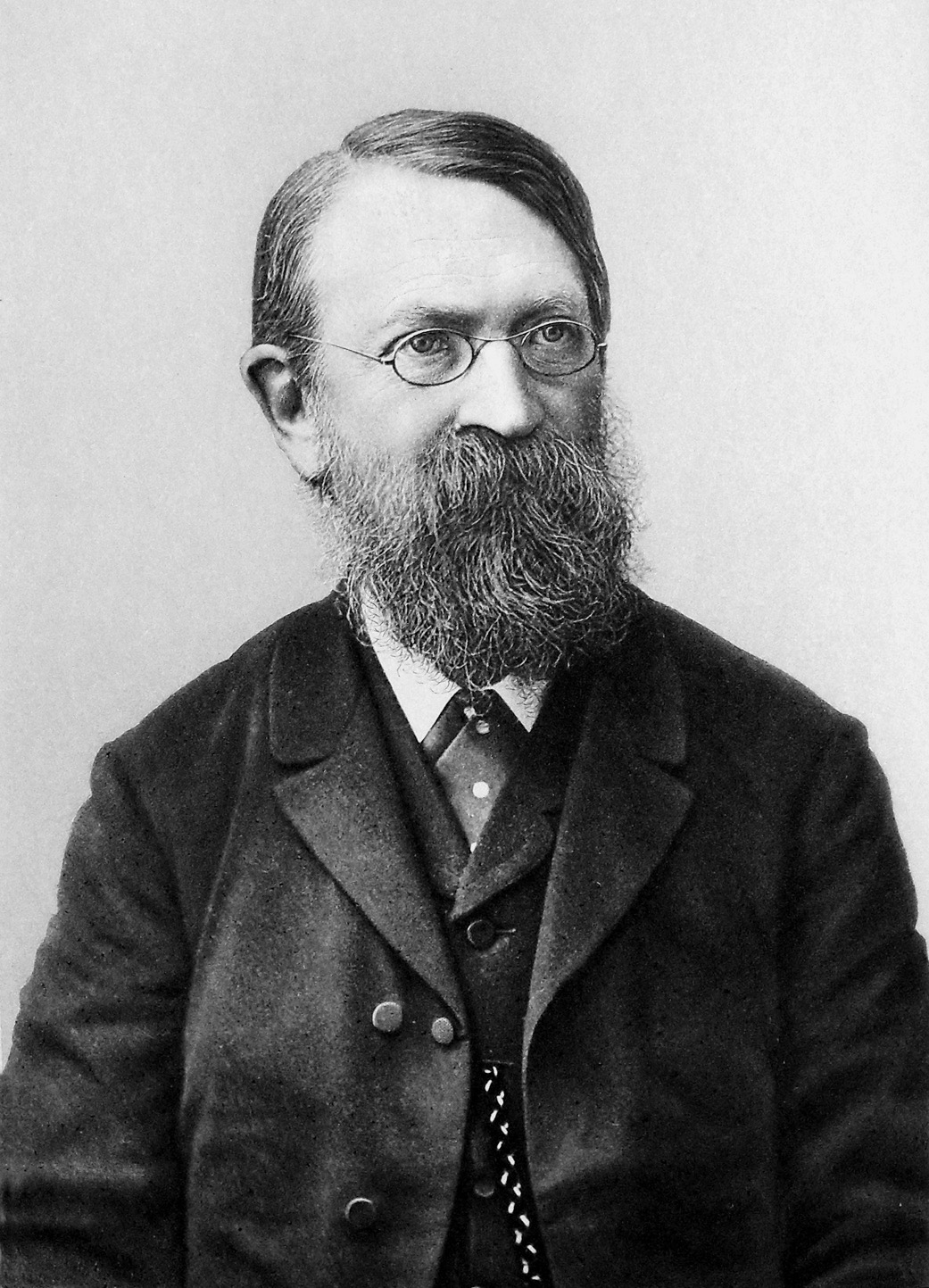
.jpg)