Lead Quotes (396 quotes)
…it ought to be remembered that there is nothing more difficult to take in hand, more perilous to conduct, or more uncertain in its success, than to take the lead in the introduction of a new order of things. Because the innovator has for enemies all those who have done well under the old conditions, and lukewarm defenders in those who may do well under the new.
The Prince (1532). W. K. Marriott (translator) and Rob McMahon (editor), The Prince (2008), 71.
’Twas thus by the glare of false science betray’d,
That leads to be bewilder, and dazzles the blind.
That leads to be bewilder, and dazzles the blind.
'The Hermit'. In James Beattie and Alexander Dyce, The Poetical Works of James Beattie (1866), Vol. 2, 95.
[1157] The man who blames the supreme certainty of mathematics feeds on confusion, and can never silence the contradictions of sophistical sciences which lead to an eternal quackery.
W. An. III. 241 a. From the original Italian: “Chi biasima la soma certezza della matematica, si pasce di confusione mai porrà silentio alle contraditioni delle soffistiche sciētie, colle quali s’inpara vno eterno gridore.” English and Italian in Jean Paul Richter (trans.), 'Philosophical Maxims: Of Mechanics', The Literary Works of Leonardo da Vinci (1883), Vol. 1, Part 2, 289, Aphorism 1157. [Note: Da Vinci writes ē=en.] Also translated beginning, “Those who condemn…”. Also seen translated as “Whoever despises the high wisdom of mathematics nourishes himself on delusion and will never still the sophistic sciences whose only product is an eternal uproar,” in Nicholas J. Rose Mathematical Maxims and Minims (1988).
[Allowing embryonic stem cell research] … is also likely to lead to human cloning and the harvesting of body parts from babies conceived for this purpose.
An example of extreme prolife religious conservative opposition confusing public opinion.
An example of extreme prolife religious conservative opposition confusing public opinion.
Statement released 15 Jun 2004 from Focus on the Family organisation which he founded. Quoted in Eve Herold, George Daley, Stem Cell Wars (2007), 39.
[D]iscovery should come as an adventure rather than as the result of a logical process of thought. Sharp, prolonged thinking is necessary that we may keep on the chosen road but it does not itself necessarily lead to discovery. The investigator must be ready and on the spot when the light comes from whatever direction.
Letter to Dr. E. B. Krumhaar (11 Oct 1933), in Journal of Bacteriology (Jan 1934), 27, No. 1, 19.
[T]here are some common animal behaviors that seem to favor the development of intelligence, behaviors that might lead to brainy beasts on many worlds. Social interaction is one of them. If you're an animal that hangs out with others, then there's clearly an advantage in being smart enough to work out the intentions of the guy sitting next to you (before he takes your mate or your meal). And if you're clever enough to outwit the other members of your social circle, you'll probably have enhanced opportunity to breed..., thus passing on your superior intelligence. ... Nature—whether on our planet or some alien world—will stumble into increased IQ sooner or later.
Seth Shostak, Alex Barnett, Cosmic Company: the Search for Life in the Universe (2003), 62 & 67.
Die Gewohnheit einer Meinung erzeugt oft völlige Ueberzeugung von ihrer Richtigkeit, sie verbirgt die schwächeren Theile davon, und macht uns unfähig, die Beweise dagegen anzunehmen.
The habit of an opinion often leads to the complete conviction of its truth, it hides the weaker parts of it, and makes us incapable of accepting the proofs against it.
The habit of an opinion often leads to the complete conviction of its truth, it hides the weaker parts of it, and makes us incapable of accepting the proofs against it.
(1827). German text in Ira Freund, The Study of Chemical Composition (1904), 31. Translated form in Carl Schorlemmer, The Rise and Development of Organic Chemistry (1894), 49.
La science, mon garçon, est faite d’erreurs, mais d’erreurs qu’il est bon de commettre, car elles mènent peu à peu à la vérité.
Science, my boy, is composed of errors, but errors that it is right to make, for they lead step by step to the truth.
Science, my boy, is composed of errors, but errors that it is right to make, for they lead step by step to the truth.
Journey to the Centre of the Earth, translated by William Butcher (1992, 2008), 146.
Omnes scientiae sunt connexae et fovent auxiliis sicut partes ejusdem totius, quarum quaelibet opus suum peragit non propter se sed pro aliis.
All sciences are connected; they lend each other material aid as parts of one great whole, each doing its own work, not for itself alone, but for the other parts; as the eye guides the body and the foot sustains it and leads it from place to place.
All sciences are connected; they lend each other material aid as parts of one great whole, each doing its own work, not for itself alone, but for the other parts; as the eye guides the body and the foot sustains it and leads it from place to place.
Opus Tertium [1266- 1268], chapter 4, Latin text quoted in J. B. Bury, The Idea of Progress (1920), 355 (footnote to page 25). In J. S. Brewer (ed.), Fr. Rogeri Bacon Opera ... inedita (1859), 18.
Question: If you were to pour a pound of molten lead and a pound of molten iron, each at the temperature of its melting point, upon two blocks of ice, which would melt the most ice, and why?
Answer: This question relates to diathermancy. Iron is said to be a diathermanous body (from dia, through, and thermo, I heat), meaning that it gets heated through and through, and accordingly contains a large quantity of real heat. Lead is said to be an athermanous body (from a, privative, and thermo, I heat), meaning that it gets heated secretly or in a latent manner. Hence the answer to this question depends on which will get the best of it, the real heat of the iron or the latent heat of the lead. Probably the iron will smite furthest into the ice, as molten iron is white and glowing, while melted lead is dull.
Answer: This question relates to diathermancy. Iron is said to be a diathermanous body (from dia, through, and thermo, I heat), meaning that it gets heated through and through, and accordingly contains a large quantity of real heat. Lead is said to be an athermanous body (from a, privative, and thermo, I heat), meaning that it gets heated secretly or in a latent manner. Hence the answer to this question depends on which will get the best of it, the real heat of the iron or the latent heat of the lead. Probably the iron will smite furthest into the ice, as molten iron is white and glowing, while melted lead is dull.
Genuine student answer* to an Acoustics, Light and Heat paper (1880), Science and Art Department, South Kensington, London, collected by Prof. Oliver Lodge. Quoted in Henry B. Wheatley, Literary Blunders (1893), 180-1, Question 14. (*From a collection in which Answers are not given verbatim et literatim, and some instances may combine several students' blunders.)
To Wheeler's comment, If you haven't found something strange during the day, it hasn't been much of a day, a student responded, I can't believe that space is that crummy. Wheeler replied: To disagree leads to study, to study leads to understanding, to understand is to appreciate, to appreciate is to love. So maybe I'll end up loving your theory.
Quoted in Charles Birch, Biology and the Riddle of Life (1999), 10.
A totally blind process can by definition lead to anything; it can even lead to vision itself.
In Jacques Monod and Austryn Wainhouse (trans.), Chance and Necessity: An Essay on the Natural Philosophy of Modern Biology (1972), 98.
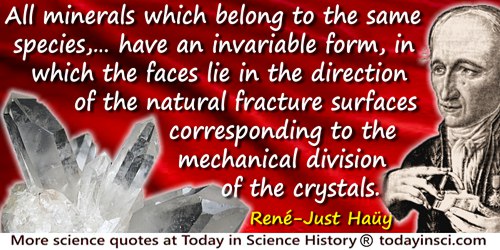
A casual glance at crystals may lead to the idea that they were pure sports of nature, but this is simply an elegant way of declaring one’s ignorance. With a thoughtful examination of them, we discover laws of arrangement. With the help of these, calculation portrays and links up the observed results. How variable and at the same time how precise and regular are these laws! How simple they are ordinarily, without losing anything of their significance! The theory which has served to develop these laws is based entirely on a fact, whose existence has hitherto been vaguely discerned rather than demonstrated. This fact is that in all minerals which belong to the same species, these little solids, which are the crystal elements and which I call their integrant molecules, have an invariable form, in which the faces lie in the direction of the natural fracture surfaces corresponding to the mechanical division of the crystals. Their angles and dimensions are derived from calculations combined with observation.
Traité de mineralogie … Publié par le conseil des mines (1801), Vol. 1, xiii-iv, trans. Albert V. and Marguerite Carozzi.
A general State education is a mere contrivance for moulding people to be exactly like one another: and as the mould in which it casts them is that which pleases the predominant power in the government, whether this be a monarch, a priesthood, an aristocracy, or the majority of the existing generation in proportion as it is efficient and successful, it establishes a despotism over the mind, leading by a natural tendency to one over the body.
In On Liberty (1859), 190-191.
A man loses his fortune; he gains earnestness. His eyesight goes; it leads him to a spirituality... We think we are pushing our own way bravely, but there is a great Hand in ours all the time.
Quoted in Kim Lim (ed.), 1,001 Pearls of Spiritual Wisdom: Words to Enrich, Inspire, and Guide Your Life (2014), 20
A man who is convinced of the truth of his religion is indeed never tolerant. At the least, he is to feel pity for the adherent of another religion but usually it does not stop there. The faithful adherent of a religion will try first of all to convince those that believe in another religion and usually he goes on to hatred if he is not successful. However, hatred then leads to persecution when the might of the majority is behind it.
…...
A mind which has once imbibed a taste for scientific enquiry, and has learnt the habit of applying its principles readily to the cases which occur, has within itself an inexhaustable source of pure and exciting contemplations:— One would think that Shakespeare had such a mind in view when he describes a contemplative man as finding
“Tongues in trees—books in running brooks—
Sermons in stones—and good in everything.”
Accustomed to trace the operations of general causes and the exemplification of general laws, in circumstances where the uninformed and uninquiring eye, perceives neither novelty nor beauty, he walks in the midst of wonders; every object which falls in his way elucidates some principle, affords some instruction and impresses him with a sense of harmony and order. Nor is it a mere passive pleasure which is thus communicated. A thousand questions are continually arising in his mind, a thousand objects of enquiry presenting themselves, which keep his faculties in constant exercise, and his thoughts perpetually on the wing, so that lassitude is excluded from his life, and that craving after artificial excitement and dissipation of the mind, which leads so many into frivolous, unworthy, and destructive pursuits, is altogether eradicated from his bosom.
“Tongues in trees—books in running brooks—
Sermons in stones—and good in everything.”
Accustomed to trace the operations of general causes and the exemplification of general laws, in circumstances where the uninformed and uninquiring eye, perceives neither novelty nor beauty, he walks in the midst of wonders; every object which falls in his way elucidates some principle, affords some instruction and impresses him with a sense of harmony and order. Nor is it a mere passive pleasure which is thus communicated. A thousand questions are continually arising in his mind, a thousand objects of enquiry presenting themselves, which keep his faculties in constant exercise, and his thoughts perpetually on the wing, so that lassitude is excluded from his life, and that craving after artificial excitement and dissipation of the mind, which leads so many into frivolous, unworthy, and destructive pursuits, is altogether eradicated from his bosom.
In Dionysius Lardner (ed.), Cabinet Cyclopaedia, Vol 1, Preliminary Discourse on the Study of Natural Philosophy (1831), 14-15.
A Miracle is a Violation of the Laws of Nature; and as a firm and unalterable Experience has established these Laws, the Proof against a Miracle, from the very Nature of the Fact, is as entire as any Argument from Experience can possibly be imagined. Why is it more than probable, that all Men must die; that Lead cannot, of itself, remain suspended in the Air; that Fire consumes Wood, and is extinguished by Water; unless it be, that these Events are found agreeable to the Laws of Nature, and there is required a Violation of these Laws, or in other Words, a Miracle to prevent them? Nothing is esteem'd a Miracle, if it ever happen in the common Course of Nature... There must, therefore, be a uniform Experience against every miraculous Event, otherwise the Event would not merit that Appellation. And as a uniform Experience amounts to a Proof, there is here a direct and full Proof, from the Nature of the Fact, against the Existence of any Miracle; nor can such a Proof be destroy'd, or the Miracle render'd credible, but by an opposite Proof, which is superior.
An Enquiry Concerning Human Understanding (1748), 180-181.
A scientist strives to understand the work of Nature. But with our insufficient talents as scientists, we do not hit upon the truth all at once. We must content ourselves with tracking it down, enveloped in considerable darkness, which leads us to make new mistakes and errors. By diligent examination, we may at length little by little peel off the thickest layers, but we seldom get the core quite free, so that finally we have to be satisfied with a little incomplete knowledge.
Lecture to the Royal Swedish Academy of Science, 23 May 1764. Quoted in J. A. Schufle 'Torbern Bergman, Earth Scientist', Chymia, 1967, 12, 78.
A strict materialist believes that everything depends on the motion of matter. He knows the form of the laws of motion though he does not know all their consequences when applied to systems of unknown complexity.
Now one thing in which the materialist (fortified with dynamical knowledge) believes is that if every motion great & small were accurately reversed, and the world left to itself again, everything would happen backwards the fresh water would collect out of the sea and run up the rivers and finally fly up to the clouds in drops which would extract heat from the air and evaporate and afterwards in condensing would shoot out rays of light to the sun and so on. Of course all living things would regrede from the grave to the cradle and we should have a memory of the future but not of the past.
The reason why we do not expect anything of this kind to take place at any time is our experience of irreversible processes, all of one kind, and this leads to the doctrine of a beginning & an end instead of cyclical progression for ever.
Now one thing in which the materialist (fortified with dynamical knowledge) believes is that if every motion great & small were accurately reversed, and the world left to itself again, everything would happen backwards the fresh water would collect out of the sea and run up the rivers and finally fly up to the clouds in drops which would extract heat from the air and evaporate and afterwards in condensing would shoot out rays of light to the sun and so on. Of course all living things would regrede from the grave to the cradle and we should have a memory of the future but not of the past.
The reason why we do not expect anything of this kind to take place at any time is our experience of irreversible processes, all of one kind, and this leads to the doctrine of a beginning & an end instead of cyclical progression for ever.
Letter to Mark Pattison (7 Apr 1868). In P. M. Hannan (ed.), The Scientific Letters and Papers of James Clerk Maxwell (1995), Vol. 2, 1862-1873, 360-1.
A superficial knowledge of mathematics may lead to the belief that this subject can be taught incidentally, and that exercises akin to counting the petals of flowers or the legs of a grasshopper are mathematical. Such work ignores the fundamental idea out of which quantitative reasoning grows—the equality of magnitudes. It leaves the pupil unaware of that relativity which is the essence of mathematical science. Numerical statements are frequently required in the study of natural history, but to repeat these as a drill upon numbers will scarcely lend charm to these studies, and certainly will not result in mathematical knowledge.
In Primary Arithmetic: First Year, for the Use of Teachers (1897), 26-27.
A superficial knowledge of mathematics may lead to the belief that this subject can be taught incidentally, and that exercises akin to counting the petals of flowers or the legs of a grasshopper are mathematical. Such work ignores the fundamental idea out of which quantitative reasoning grows—the equality of magnitudes. It leaves the pupil unaware of that relativity which is the essence of mathematical science. Numerical statements are frequently required in the study of natural history, but to repeat these as a drill upon numbers will scarcely lend charm to these studies, and certainly will not result in mathematical knowledge.
In Primary Arithmetic: First Year, for the Use of Teachers (1897), 26-27.
A theory can be proved by experiment; but no path leads from experiment to the birth of a theory.
As quoted in Antonina Vallentin, Einstein: A Biography (1954), 105. The author,
a close friend of Einstein’s family, cites the quote only as “which he has recently made public.”
About eight days ago I discovered that sulfur in burning, far from losing weight, on the contrary, gains it; it is the same with phosphorus; this increase of weight arises from a prodigious quantity of air that is fixed during combustion and combines with the vapors. This discovery, which I have established by experiments, that I regard as decisive, has led me to think that what is observed in the combustion of sulfur and phosphorus may well take place in the case of all substances that gain in weight by combustion and calcination; and I am persuaded that the increase in weight of metallic calxes is due to the same cause... This discovery seems to me one of the most interesting that has been made since Stahl and since it is difficult not to disclose something inadvertently in conversation with friends that could lead to the truth I have thought it necessary to make the present deposit to the Secretary of the Academy to await the time I make my experiments public.
Sealed note deposited with the Secretary of the French Academy 1 Nov 1772. Oeuvres de Lavoisier, Correspondance, Fasc. II. 1770-75 (1957), 389-90. Adapted from translation by A. N. Meldrum, The Eighteenth-Century Revolution in Science (1930), 3.
About ten months ago [1609] a report reached my ears that a certain Fleming [Hans Lippershey] had constructed a spyglass, by means of which visible objects, though very distant from the eye of the observer, were distinctly seen as if nearby... Of this truly remarkable effect several experiences were related, to which some persons gave credence while others denied them. A few days later the report was confirmed to me in a letter from a noble Frenchman at Paris, Jacques Badovere, which caused me to apply myself wholeheartedly to enquire into the means by which I might arrive at the invention of a similar instrument. This I did shortly afterwards, my basis being the theory of refraction. First I prepared a tube of lead, at the ends of which I fitted two glass lenses, both plane on one side while on the other side one was spherically convex and the other concave.
The Starry Messenger (1610), trans. Stillman Drake, Discoveries and Opinions of Galileo (1957), 28-9.
According to my derivative hypothesis, a change takes place first in the structure of the animal, and this, when sufficiently advanced, may lead to modifications of habits… . “Derivation” holds that every species changes, in time, by virtue of inherent tendencies thereto. “Natural Selection” holds that no such change can take place without the influence of altered external circumstances educing or selecting such change… . The hypothesis of “natural selection” totters on the extension of a conjectural condition, explanatory of extinction to the majority of organisms, and not known or observed to apply to the origin of any species.
In On the Anatomy of Vertebrates (1868), Vol. 3, 808.
After seeking in vain for the construction of a perpetual motion machine, the relations were investigated which must subsist between the forces of nature if such a machine is to be impossible; and this inverted question led to the discovery of the law of the conservation of energy, which, again, explained the impossibility of perpetual motion in the sense originally intended.
Opening of Lecture (1900), 'Mathematische Probleme' (Mathematical Problems), to the International Congress of Mathematicians, Paris. From the original German reprinted in David Hilbert: Gesammelte Abhandlungen (Collected Treatises, 1970), Vol. 3. For full citation, see the quote that begins, “This conviction of the solvability…”, on the David Hilbert Quotes page on this website.
All children are curious and I wonder by what process this trait becomes developed in some and suppressed in others. I suspect again that schools and colleges help in the suppression insofar as they meet curiosity by giving the answers, rather than by some method that leads from narrower questions to broader questions. It is hard to satisfy the curiosity of a child, and even harder to satisfy the curiosity of a scientist, and methods that meet curiosity with satisfaction are thus not apt to foster the development of the child into the scientist. I don't advocate turning all children into professional scientists, although I think there would be advantages if all adults retained something of the questioning attitude, if their curiosity were less easily satisfied by dogma, of whatever variety.
The Nature of Natural History (1950, 1990), 256-257.
All creation is a mine, and every man a miner.
The whole earth, and all within it, upon it, and round about it, including himself … are the infinitely various “leads” from which, man, from the first, was to dig out his destiny.
The whole earth, and all within it, upon it, and round about it, including himself … are the infinitely various “leads” from which, man, from the first, was to dig out his destiny.
Opening sentences of lecture 'Discoveries and Inventions', (1860) in Discoveries and Inventions (1915).
All frescoes are as high finished as miniatures or enamels, and they are known to be unchangeable; but oil, being a body itself, will drink or absorb very little colour, and changing yellow, and at length brown, destroys every colour it is mixed with, especially every delicate colour. It turns every permanent white to a yellow and brown putty, and has compelled the use of that destroyer of colour, white lead, which, when its protecting oil is evaporated, will become lead again. This is an awful thing to say to oil painters ; they may call it madness, but it is true. All the genuine old little pictures, called cabinet pictures, are in fresco and not in oil. Oil was not used except by blundering ignorance till after Vandyke’s time ; but the art of fresco painting being lost, oil became a fetter to genius and a dungeon to art.
In 'Opinions', The Poems: With Specimens of the Prose Writings of William Blake (1885), 276-277.
All scientists must focus closely on limited targets. Whether or not one’s findings on a limited subject will have wide applicability depends to some extent on chance, but biologists of superior ability repeatedly focus on questions the answers to which either have wide ramifications or lead to new areas of investigation. One procedure that can be effective is to attempt both reduction and synthesis; that is, direct a question at a phenomenon on one integrative level, identify its mechanism at a simpler level, then extrapolate its consequences to a more complex level of integration.
In 'Scientific innovation and creativity: a zoologist’s point of view', American Zoologist (1982), 22, 230-231,
Among all highly civilized peoples the golden age of art has always been closely coincident with the golden age of the pure sciences, particularly with mathematics, the most ancient among them.
This coincidence must not be looked upon as accidental, but as natural, due to an inner necessity. Just as art can thrive only when the artist, relieved of the anxieties of existence, can listen to the inspirations of his spirit and follow in their lead, so mathematics, the most ideal of the sciences, will yield its choicest blossoms only when life’s dismal phantom dissolves and fades away, when the striving after naked truth alone predominates, conditions which prevail only in nations while in the prime of their development.
This coincidence must not be looked upon as accidental, but as natural, due to an inner necessity. Just as art can thrive only when the artist, relieved of the anxieties of existence, can listen to the inspirations of his spirit and follow in their lead, so mathematics, the most ideal of the sciences, will yield its choicest blossoms only when life’s dismal phantom dissolves and fades away, when the striving after naked truth alone predominates, conditions which prevail only in nations while in the prime of their development.
From Die Entwickelung der Mathematik im Zusammenhange mit der Ausbreitung der Kultur (1893), 4. As translated in Robert Édouard Moritz, Memorabilia Mathematica; Or, The Philomath’s Quotation-Book (1914), 191-192. From the original German, “Bei allen Kulturvölkern ist die Blüthezeit der Kunst auch immer zeitlich eng verbunden mit einer Blüthezeit der reinen Wissenschaften, insbesondere der ältesten unter ihnen, der Mathematik.
Dieses Zusammentreffen dürfte auch nicht ein zufälliges, sondern ein natürliches, ein Ergebniss innerer Notwendigkeit sein. Wie die Kunst nur gedeihen kann, wenn der Künstler, unbekümmert um die Bedrängnisse des Daseins, den Eingebungen seines Geistes lauschen und ihnen folgen kann, so kann die idealste Wissenschaft, die Mathematik, erst dann ihre schönsten Blüthen treiben, wenn des Erdenlebens schweres Traumbild sinkt und sinkt und sinkt, wenn das Streben nach der nackten Wahrheit allein bestimmend ist, was nur bei Nationen in der Vollkraft ihrer Entwickelung vorkommt.”
Dieses Zusammentreffen dürfte auch nicht ein zufälliges, sondern ein natürliches, ein Ergebniss innerer Notwendigkeit sein. Wie die Kunst nur gedeihen kann, wenn der Künstler, unbekümmert um die Bedrängnisse des Daseins, den Eingebungen seines Geistes lauschen und ihnen folgen kann, so kann die idealste Wissenschaft, die Mathematik, erst dann ihre schönsten Blüthen treiben, wenn des Erdenlebens schweres Traumbild sinkt und sinkt und sinkt, wenn das Streben nach der nackten Wahrheit allein bestimmend ist, was nur bei Nationen in der Vollkraft ihrer Entwickelung vorkommt.”
An inventor is an opportunist, one who takes occasion by the hand; who, having seen where some want exists, successfully applies the right means to attain the desired end. The means may be largely, or even wholly, something already known, or there may be a certain originality or discovery in the means employed. But in every case the inventor uses the work of others. If I may use a metaphor, I should liken him to the man who essays the conquest of some virgin alp. At the outset he uses the beaten track, and, as he progresses in the ascent, he uses the steps made by those who have preceded him, whenever they lead in the right direction; and it is only after the last footprints have died out that he takes ice-axe in hand and cuts the remaining steps, few or many, that lift him to the crowning height which is his goal.
In Kenneth Raydon Swan, Sir Joseph Swan (1946), 44.
And from this such small difference of eight minutes [of arc] it is clear why Ptolemy, since he was working with bisection [of the linear eccentricity], accepted a fixed equant point… . For Ptolemy set out that he actually did not get below ten minutes [of arc], that is a sixth of a degree, in making observations. To us, on whom Divine benevolence has bestowed the most diligent of observers, Tycho Brahe, from whose observations this eight-minute error of Ptolemy’s in regard to Mars is deduced, it is fitting that we accept with grateful minds this gift from God, and both acknowledge and build upon it. So let us work upon it so as to at last track down the real form of celestial motions (these arguments giving support to our belief that the assumptions are incorrect). This is the path I shall, in my own way, strike out in what follows. For if I thought the eight minutes in [ecliptic] longitude were unimportant, I could make a sufficient correction (by bisecting the [linear] eccentricity) to the hypothesis found in Chapter 16. Now, because they could not be disregarded, these eight minutes alone will lead us along a path to the reform of the whole of Astronomy, and they are the matter for a great part of this work.
Astronomia Nova, New Astronomy (1609), ch. 19, 113-4, Johannes Kepler Gesammelte Werke (1937-), Vol. 3, 177-8.
And yet in a funny way our lack of success led to our breakthrough; because, since we could not get a cell line off the shelf doing what we wanted, we were forced to construct it. And the original experiment ... developed into a method for the production of hybridomas ... [which] was of more importance than our original purpose.
From Nobel Lecture (8 Dec 1984), collected in Tore Frängsmyr and Jan Lindsten (eds.), Nobel Lectures in Physiology Or Medicine: 1981-1990 (1993), 256-257.
Antiqua consuetudo difficulter relinquitur: & ultra proprium videre nemo libenter ducitur.
Old habits are hard to break: and no one is easily led beyond his own point of view.
Old habits are hard to break: and no one is easily led beyond his own point of view.
In De Imitatione Christi (1709), Book 1, Chap. 14, 23. As translated by William C. Creasy in The Imitation of Christ by Thomas à Kempis: A New Reading of the 1441 Latin Autograph Manuscript (2007), 15.
Any artist or novelist would understand—some of us do not produce their best when directed. We expect the artist, the novelist and the composer to lead solitary lives, often working at home. While a few of these creative individuals exist in institutions or universities, the idea of a majority of established novelists or painters working at the “National Institute for Painting and Fine Art” or a university “Department of Creative Composition” seems mildly amusing. By contrast, alarm greets the idea of a creative scientist working at home. A lone scientist is as unusual as a solitary termite and regarded as irresponsible or worse.
Homage to Gala: The Life of an Independent Scholar (2000), 2.
Any one whose disposition leads him to attach more weight to unexplained difficulties than to the explanation of facts will certainly reject my theory.
The Origin of Species (1859), 482.
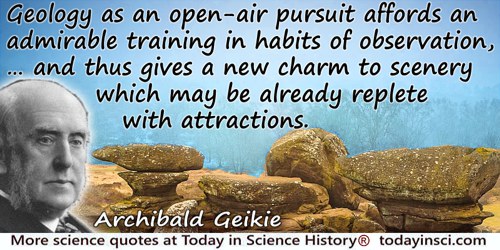
Apart from its healthful mental training as a branch of ordinary education, geology as an open-air pursuit affords an admirable training in habits of observation, furnishes a delightful relief from the cares and routine of everyday life, takes us into the open fields and the free fresh face of nature, leads us into all manner of sequestered nooks, whither hardly any other occupation or interest would be likely to send us, sets before us problems of the highest interest regarding the history of the ground beneath our feet, and thus gives a new charm to scenery which may be already replete with attractions.
Outlines of Field-Geology (1900), 251-2.
Armament is no protection against the war but leads to war. Striving for peace and preparing for war are incompatible with each other
…...
As plants convert the minerals into food for animals, so each man converts some raw material in nature to human use. The inventors of fire, electricity, magnetism, iron, lead, glass, linen, silk, cotton; the makers of tools; the inventor of decimal notation, the geometer, the engineer, the musician, severally make an easy way for all, through unknown and impossible confusions.
In 'Uses of Great Men', Representative Men (1850), 5-6.
As scientific men we have all, no doubt, felt that our fellow men have become more and more satisfying as fish have taken up their work which has been put often to base uses, which must lead to disaster. But what sin is to the moralist and crime to the jurist so to the scientific man is ignorance. On our plane, knowledge and ignorance are the immemorial adversaries. Scientific men can hardly escape the charge of ignorance with regard to the precise effect of the impact of modern science upon the mode of living of the people and upon their civilisation. For them, such a charge is worse than that of crime.
From Banquet Speech (10 Dec 1922), Nobel Prize in Chemistry, collected in Carl Gustaf Santesson (ed.), Les Prix Nobel en 1921-1922 (1923).
As there are six kinds of metals, so I have also shown with reliable experiments… that there are also six kinds of half-metals. I through my experiments, had the good fortune … to be the discoverer of a new half-metal, namely cobalt regulus, which had formerly been confused with bismuth.
The six metals were gold, silver, copper, iron, lead, tin. The semimetals, in addition to cobalt, were mercury, bismuth, zinc, and the reguluses of antimony and arsenic. Cited as “According to Zenzén, Brandt stated in his diary for 1741,” in Mary Elvira Weeks and Henry M. Leicester (ed.), Discovery of the Elements (6th edition, revised and enlarged 1960). Brandt presented his work to the Royal Academy of Sciences, Upsala, as printed in 'Dissertatio de semimetallis' (Dissertation on semi-metals) in Acta Literaria et Scientiarum Sveciae (Journal of Swedish literature and sciences) (1735), 4 1-10.
At this stage you must admit that whatever is seen to be sentient is nevertheless composed of atoms that are insentient. The phenomena open to our observation so not contradict this conclusion or conflict with it. Rather they lead us by the hand and compel us to believe that the animate is born, as I maintain, of the insentient.
In On the Nature of the Universe, translated by R. E. Latham (1951, 1994), 59.
Between every two pine trees there is a door leading to a new way of life.
As stated in Frederick W. Turner, John Muir: Rediscovering America (2000), 193. Also seen as “Between every two pines is a doorway to a new world,” in Thomas N. Taylor, Edith L. Taylor, Michael Krings, Paleobotany: the Biology and Evolution of Fossil Plants (2009), 805. “Between every two pines stood the door to the world's greatest cathedral,” in Robert Adrian de Jauralde Hart, Forest Gardening: Cultivating an Edible Landscape (1996), xi. Please contact Webmaster if you know the primary source and Muir's exact wording.
Beware how you take away hope from any human being. Nothing is clearer than that the merciful Creator intends to blind most people as they pass down into the dark valley. Without very good reasons, temporal or spiritual, we should not interfere with his kind arrangements. It is the height of cruelty and the extreme of impertinence to tell your patient he must die, except you are sure that he wishes to know it, or that there is some particular cause for his knowing it. I should be especially unwilling to tell a child that it could not recover; if the theologians think it necessary, let them take the responsibility. God leads it by the hand to the edge of the precipice in happy unconsciousness, and I would not open its eyes to what he wisely conceals.
In Valedictory Address Delivered to the Medical Graduates at Harvard University, at the Annual Commencement, Wednesday, March 10, 1858) (1858), 14. Reprinted, as published in The Boston Medical and Surgical Journal (25 Mar 1858), 58, No. 8, 158.
Biology … is the least self-centered, the least narcissistic of the sciences—the one that, by taking us out of ourselves, leads us to re-establish the link with nature and to shake ourselves free from our spiritual isolation.
In 'Victories and Hopes of Biology', Can Man Be Modified? (1959), 31

Birds ... are sensitive indicators of the environment, a sort of “ecological litmus paper,” ... The observation and recording of bird populations over time lead inevitably to environmental awareness and can signal impending changes.
In Peterson Field Guide to Birds of North America (2008), 10.
Book-knowledge is a poor resource … In many cases, ignorance is a good thing: the mind retains its freedom of investigation and does not stray along roads that lead nowhither, suggested by one’s reading. … Ignorance can have its advantages; the new is found far from the beaten track.
In Jean-Henri Fabre and Alexander Teixeira de Mattos (trans.), The Life and Love of the Insect (1918), 243.
Both died, ignored by most; they neither sought nor found public favour, for high roads never lead there. Laurent and Gerhardt never left such roads, were never tempted to peruse those easy successes which, for strongly marked characters, offer neither allure nor gain. Their passion was for the search for truth; and, preferring their independence to their advancement, their convictions to their interests, they placed their love for science above that of their worldly goods; indeed above that for life itself, for death was the reward for their pains. Rare example of abnegation, sublime poverty that deserves the name nobility, glorious death that France must not forget!
'Éloge de Laurent et Gerhardt', Moniteur Scientifique (1862), 4, 473-83, trans. Alan J. Rocke.
But for the persistence of a student of this university in urging upon me his desire to study with me the modern algebra I should never have been led into this investigation; and the new facts and principles which I have discovered in regard to it (important facts, I believe), would, so far as I am concerned, have remained still hidden in the womb of time. In vain I represented to this inquisitive student that he would do better to take up some other subject lying less off the beaten track of study, such as the higher parts of the calculus or elliptic functions, or the theory of substitutions, or I wot not what besides. He stuck with perfect respectfulness, but with invincible pertinacity, to his point. He would have the new algebra (Heaven knows where he had heard about it, for it is almost unknown in this continent), that or nothing. I was obliged to yield, and what was the consequence? In trying to throw light upon an obscure explanation in our text-book, my brain took fire, I plunged with re-quickened zeal into a subject which I had for years abandoned, and found food for thoughts which have engaged my attention for a considerable time past, and will probably occupy all my powers of contemplation advantageously for several months to come.
In Johns Hopkins Commemoration Day Address, Collected Mathematical Papers, Vol. 3, 76.
But in the present century, thanks in good part to the influence of Hilbert, we have come to see that the unproved postulates with which we start are purely arbitrary. They must be consistent, they had better lead to something interesting.
In A History of Geometrical Methods (1940, reprint 2003), 423.
But just as astronomy succeeded astrology, following Kepler's discovery of planetary regularities, the discoveries of these many principles in empirical explorations of intellectual processes in machines should lead to a science, eventually.
[Co-author with South African mathematician, Seymour Papert (1928- )]
[Co-author with South African mathematician, Seymour Papert (1928- )]
Artificial Intelligence (1973), 25.
But why, it has been asked, did you go there [the Antarctic]? Of what use to civilization can this lifeless continent be? ... [Earlier] expeditions contributed something to the accumulating knowledge of the Antarctic ... that helps us thrust back further the physical and spiritual shadows enfolding our terrestrial existence. Is it not true that one of the strongest and most continuously sustained impulses working in civilization is that which leads to discovery? As long as any part of the world remains obscure, the curiosity of man must draw him there, as the lodestone draws the mariner's needle, until he comprehends its secret.
In 'Hoover Presents Special Medal to Byrd...', New York Times (21 Jun 1930), 1.
Changes That Have Occurred in the Globe: When we have seen with our own eyes a mountain progressing into a plain; that is to say, an immense boulder separating from this mountain and covering the fields; an entire castle broken into pieces over the ground; a river swallowed up which then bursts out from its abyss; clear marks of a vast amount of water having once flooded regions now inhabited, and a hundred vestiges of other transformations, then we are much more willing to believe that great changes altered the face of the earth, than a Parisian lady who knows only that the place where her house was built was once a cultivated field. However, a lady from Naples who has seen the buried ruins of Herculaneum, is much less subject to the bias which leads us to believe that everything has always been as it is today.
From article 'Changements arrivées dans le globe', in Dictionnaire philosophique (1764), collected in Œuvres Complètes de Voltaire (1878), Vol. 2, 427-428. Translated by Ian Ellis, from the original French: “Changements arrivées dans le globe: Quand on a vu de ses yeux une montagne s’avancer dans une plaine, c’est-à-dire un immense rocher de cette montagne se détacher et couvrir des champs, un château tout entier enfoncé dans la terre, un fleuve englouti qui sort ensuite de son abîme, des marques indubitables qu’un vaste amas d’eau inondait autrefois un pays habité aujourd’hui, et cent vestiges d’autres révolutions, on est alors plus disposé à croire les grands changements qui ont altéré la face du monde, que ne l’est une dame de Paris qui sait seulement que la place où est bâtie sa maison était autrefois un champ labourable. Mais une dame de Naples, qui a vu sous terre les ruines d’Herculanum, est encore moins asservie au préjugé qui nous fait croire que tout a toujours été comme il est aujourd’hui.”
Complexes are psychic contents which are outside the control of the conscious mind. They have been split off from consciousness and lead a separate existence in the unconscious, being at all times ready to hinder or to reinforce the conscious intentions.
A Psychological Theory of Types (1931), 79.
Consider the hateful brew compounded with gleaming, deadly white lead whose fresh colour is like milk…. Over the victim’s jaws and in the grooves of the gums is plastered an astringent froth, and the furrow of the tongue turns rough on either side, and the depth of the throat grows somewhat dry, and from the pernicious venom follows a dry retching and hawking, for this affliction is severe; meanwhile his spirit sickens and he is worn out with mortal suffering. His body too grows chill, while sometimes his eyes behold strange illusions or else he drowses; nor can he bestir his limbs as heretofore, and he succumbs to the overmastering fatigue.
— Nicander
As translated by A.S.F. Gow and A.F. Scholfield in Nicander: The Poems and Portical Fragments (1953), 99.
Copious springs are found where there are mines of gold, silver, iron, copper, lead, and the like, but they are very harmful.
In De Architectura, Book 7, Chap 3, Sec. 5. As translated in Morris Hicky Morgan (trans.), Vitruvius: The Ten Books on Architecture (1914), 234.
Data is not necessarily information. Information does not necessarily lead to knowledge. And knowledge is not always sufficient to discover truth and breed wisdom.
From post 're:The Pursuit of Knowledge, from Genesis to Google' to the 'Interesting People' List (6 Jan 2005), now archived at interesting-people.org website
Despite the continuing expansion or even explosion of information, there will forever be limits beyond which the devices of science cannot lead a man.
In Boundaries of the Soul (1972, 1994), 378.
Did it ever occur to you that there’s no limit to how complicated things can get, on account of one thing always leading to another?
In 'Quo Vadimus?, The Adelphi (Jan 1930), collected in Quo Vadimus?: Or, The Case For the Bicycle (1938) 26.
Do not follow where the path may lead. Go instead where there is no path and leave a trail.
In Richard Alan Krieger, Civilization’s Quotations: Life’s Ideal (2002), 6. Although this source, and a number of others, attribute the quote to Ralph Waldo Emerson, none that the webmaster found have a citation, and a number of other sources treat it as anonymous. Thus, the webmaster references Emerson with doubt. If you know a definitive primary print source, please contact the webmaster.
Do not go where the path may lead, go instead where there is no path and leave a trail.
…...
Does the evolutionary doctrine clash with religious faith? It does not. It is a blunder to mistake the Holy Scriptures for elementary textbooks of astronomy, geology, biology, and anthropology. Only if symbols are construed to mean what they are not intended to mean can there arise imaginary, insoluble conflicts. ... the blunder leads to blasphemy: the Creator is accused of systematic deceitfulness.
In 'Nothing in Biology Makes Sense Except in the Light of Evolution', The American Biology Teacher (Mar 1973), 125-129.
Does there truly exist an insuperable contradiction between religion and science? Can religion be superseded by science? The answers to these questions have, for centuries, given rise to considerable dispute and, indeed, bitter fighting. Yet, in my own mind there can be no doubt that in both cases a dispassionate consideration can only lead to a negative answer. What complicates the solution, however, is the fact that while most people readily agree on what is meant by “science,” they are likely to differ on the meaning of “religion.”
Replying to the Liberal Ministers’ Club of New York City. Published in >The Christian Register, (Jun 1948). As given in Ideas and Opinions (1954, 2010), 49-50.
Doubtless the reasoning faculty, the mind, is the leading and characteristic attribute of the human race. By the exercise of this, man arrives at the properties of the natural bodies. This is science, properly and emphatically so called. It is the science of pure mathematics; and in the high branches of this science lies the truly sublime of human acquisition. If any attainment deserves that epithet, it is the knowledge, which, from the mensuration of the minutest dust of the balance, proceeds on the rising scale of material bodies, everywhere weighing, everywhere measuring, everywhere detecting and explaining the laws of force and motion, penetrating into the secret principles which hold the universe of God together, and balancing worlds against worlds, and system against system. When we seek to accompany those who pursue studies at once so high, so vast, and so exact; when we arrive at the discoveries of Newton, which pour in day on the works of God, as if a second fiat had gone forth from his own mouth; when, further, we attempt to follow those who set out where Newton paused, making his goal their starting-place, and, proceeding with demonstration upon demonstration, and discovery upon discovery, bring new worlds and new systems of worlds within the limits of the known universe, failing to learn all only because all is infinite; however we may say of man, in admiration of his physical structure, that “in form and moving he is express and admirable,” it is here, and here without irreverence, we may exclaim, “In apprehension how like a god!” The study of the pure mathematics will of course not be extensively pursued in an institution, which, like this [Boston Mechanics’ Institute], has a direct practical tendency and aim. But it is still to be remembered, that pure mathematics lie at the foundation of mechanical philosophy, and that it is ignorance only which can speak or think of that sublime science as useless research or barren speculation.
In Works (1872), Vol. 1, 180.
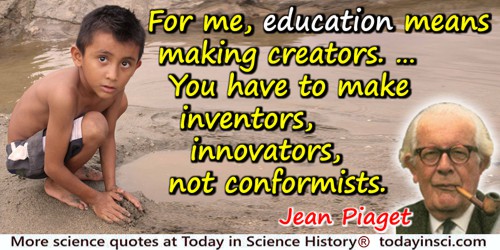
Education, for most people, means trying to lead the child to resemble the typical adult of his society. … But for me, education means making creators. … You have to make inventors, innovators, not conformists.
As quoted in Jean-Claude Bringuier and Basia Miler Gulati (trans.), Conversations with Jean Piaget (1980), 132.
Eradication of microbial disease is a will-o’-the-wisp; pursuing it leads into a morass of hazy biological concepts and half truths.
Man Adapting (1965), 381.
Even a wise experiment when made by a fool generally leads to a false conclusion, but that fools’ experiments conducted by a genius often prove to be leaps through the dark into great discoveries.
Commenting on Charles Darwin’s “fool’s experiments”, in 'Charles Robert Darwin', collected in C.D. Warner (ed.), Library of the World’s Best Literature Ancient and Modern (1896), Vol. 2, 4391-4392.
Even mistaken hypotheses and theories are of use in leading to discoveries. This remark is true in all the sciences. The alchemists founded chemistry by pursuing chimerical problems and theories which are false. In physical science, which is more advanced than biology, we might still cite men of science who make great discoveries by relying on false theories. It seems, indeed, a necessary weakness of our mind to be able to reach truth only across a multitude of errors and obstacles.
An Introduction to the Study of Experimental Medicine (1865, translation 1927, 1957), 170.
Ever since celestial mechanics in the skillful hands of Leverrier and Adams led to the world-amazed discovery of Neptune, a belief has existed begotten of that success that still other planets lay beyond, only waiting to be found.
…...
Every bird which flies has the thread of the infinite in its claw. Germination includes the hatching of a meteor and the tap of a swallow's bill breaking the egg, and it leads forward the birth of an earth-worm and the advent of Socrates.
Victor Hugo and Charles E. Wilbour (trans.), Les Misérables (1862), 41.
Every individual is continually exerting himself to find out the most advantageous employment for whatever capital he can command. It is his own advantage, indeed, and not that of society, which he has in view. But the study of his own advantage naturally, or rather necessarily, leads him to prefer that employment which is most advantageous to the society.
In 'Of Restraints upon Importation', An Inquiry Into the Nature and Causes of the Wealth of Nations (1776), Vol. 2, Book 4, 32
Every progress that a church makes in the construction of its dogmas leads to a further taming of the free spirit; every new dogma … narrows the circle of free thought. … Science, on the other hand, liberates with every step of its development, it opens up new paths to thought … In other words, it allows the individual to be truly free.
Translated from the original German, “Jeder Fortschritt, den eine Kirche in dem Aufbau ihrer Dogmen macht, führt zu einer weiter gehenden Bändigung des freien Geistes; jedes neue Dogma …
verengt den Kreis des freien Denkens. … Die Naturwissenschaft umgekehrt befreit mit jedem Schritte ihrer Entwicklung, sie eröffnet dem Gedanken neue Bahnen … Sie gestattet, mit anderen Worten, dem Einzelnen in vollem Masse wahr zu sein.” In Speech to the 24th meeting of the German Naturalists and Physicians at Rostock 'Ueber die Aufgaben der Naturwissenschaften in dem neuen nationalen Leben Deutschlands', (On the tasks of the natural sciences in the new
national life of Germany), published in Chemisches Zentralblatt (11 Oct 1871), No. 41, 654-655. English version by Webmaster using Google translate.
Everyone has talent. What is rare is the courage to follow that talent to dark place where it leads.
…...
Experience hobbles progress and leads to abandonment of difficult problems; it encourages the initiated to walk on the shady side of the street in the direction of experiences that have been pleasant. Youth without experience attacks the unsolved problems which maturer age with experience avoids, and from the labors of youth comes progress. Youth has dreams and visions, and will not be denied.
From speech 'In the Time of Henry Jacob Bigelow', given to the Boston Surgical Society, Medalist Meeting (6 Jun 1921). Printed in Journal of the Medical Association (1921), 77, 599.
Experiment adds to knowledge, Credulity leads to error.
Arabic Proverb.
Failure is, in a sense, the highway to success, inasmuch as every discovery of what is false leads us to seek earnestly after what is true.
…...
First of all a natural talent is required; for when Nature opposes, everything else is in vain; but when Nature leads the way to what is most excellent, instruction in the art takes place...
The Genuine Works of Hippocrates, trans. Francis Adams (1886), Vol. 2, 284.
For any two portions of fire, small or great, will exhibit the same ratio of solid to void; but the upward movement of the greater is quicker than that of the less, just as the downward movement of a mass of gold or lead, or of any other body endowed with weight, is quicker in proportion to its size.
On the Heavens, 309b, 11-5. In Jonathan Barnes (ed.), The Complete Works of Aristotle (1984), Vol. I, 505.
For it is obvious to everybody, I think, that this study [of astronomy] compels the soul to look upward and leads it away from things here to higher things.
— Plato
The Republic 7 529a ((5th-4th century B.C.), trans. P. Shorey (1935), Vol. 2, Book 7, 179-81. Another translation gives: “For everyone, as I think, must see that astronomy compels the soul to look upwards and leads us from this world to another.”
For many centuries chemists labored to change lead into precious gold, and eventually found that precious uranium turned to lead without any human effort at all.
Epigraph in Isaac Asimov and Jason A. Shulman (eds.), Isaac Asimov’s Book of Science and Nature Quotations (1988), 43.
For the evolution of science by societies the main requisite is the perfect freedom of communication between each member and anyone of the others who may act as a reagent.
The gaseous condition is exemplified in the soiree, where the members rush about confusedly, and the only communication is during a collision, which in some instances may be prolonged by button-holing.
The opposite condition, the crystalline, is shown in the lecture, where the members sit in rows, while science flows in an uninterrupted stream from a source which we take as the origin. This is radiation of science. Conduction takes place along the series of members seated round a dinner table, and fixed there for several hours, with flowers in the middle to prevent any cross currents.
The condition most favourable to life is an intermediate plastic or colloidal condition, where the order of business is (1) Greetings and confused talk; (2) A short communication from one who has something to say and to show; (3) Remarks on the communication addressed to the Chair, introducing matters irrelevant to the communication but interesting to the members; (4) This lets each member see who is interested in his special hobby, and who is likely to help him; and leads to (5) Confused conversation and examination of objects on the table.
I have not indicated how this programme is to be combined with eating.
The gaseous condition is exemplified in the soiree, where the members rush about confusedly, and the only communication is during a collision, which in some instances may be prolonged by button-holing.
The opposite condition, the crystalline, is shown in the lecture, where the members sit in rows, while science flows in an uninterrupted stream from a source which we take as the origin. This is radiation of science. Conduction takes place along the series of members seated round a dinner table, and fixed there for several hours, with flowers in the middle to prevent any cross currents.
The condition most favourable to life is an intermediate plastic or colloidal condition, where the order of business is (1) Greetings and confused talk; (2) A short communication from one who has something to say and to show; (3) Remarks on the communication addressed to the Chair, introducing matters irrelevant to the communication but interesting to the members; (4) This lets each member see who is interested in his special hobby, and who is likely to help him; and leads to (5) Confused conversation and examination of objects on the table.
I have not indicated how this programme is to be combined with eating.
Letter to William Grylls Adams (3 Dec 1873). In P. M. Harman (ed.), The Scientific Letters and Papers of James Clerk Maxwell (1995), Vol. 2, 1862-1873, 949-50.
From our best qualities come our worst. From our urge to pull together comes our tendency to pull apart. From our devotion to higher good comes our propensity to the foulest atrocities. From out commitment to ideals come our excuse to hate. Since the beginning of history, we have been blinded by evil’s ability to don a selfless disguise. We have failed to see that our finest qualities often lead us to the actions we most abhor—murder, torture, genocide, and war.
In 'Who is Lucifer?', The Lucifer Principle: A Scientific Expedition Into the Forces of History (1997), 3.
From the point of view of the physicist, a theory of matter is a policy rather than a creed; its object is to connect or co-ordinate apparently diverse phenomena, and above all to suggest, stimulate and direct experiment. It ought to furnish a compass which, if followed, will lead the observer further and further into previously unexplored regions.
The Corpuscular Theory of Matter (1907), 1.
From whence it is obvious to conclude that, since our Faculties are not fitted to penetrate into the internal Fabrick and real Essences of Bodies; but yet plainly discover to us the Being of a GOD, and the Knowledge of our selves, enough to lead us into a full and clear discovery of our Duty, and great Concernment, it will become us, as rational Creatures, to imploy those Faculties we have about what they are most adapted to, and follow the direction of Nature, where it seems to point us out the way.
An Essay Concerning Human Understanding (1690). Edited by Peter Nidditch (1975), Book 4, Chapter 12, Section 11, 646.
Generality of points of view and of methods, precision and elegance in presentation, have become, since Lagrange, the common property of all who would lay claim to the rank of scientific mathematicians. And, even if this generality leads at times to abstruseness at the expense of intuition and applicability, so that general theorems are formulated which fail to apply to a single special case, if furthermore precision at times degenerates into a studied brevity which makes it more difficult to read an article than it was to write it; if, finally, elegance of form has well-nigh become in our day the criterion of the worth or worthlessness of a proposition,—yet are these conditions of the highest importance to a wholesome development, in that they keep the scientific material within the limits which are necessary both intrinsically and extrinsically if mathematics is not to spend itself in trivialities or smother in profusion.
In Die Entwickdung der Mathematik in den letzten Jahrhunderten (1884), 14-15.
Genetics is the first biological science which got in the position in which physics has been in for many years. One can justifiably speak about such a thing as theoretical mathematical genetics, and experimental genetics, just as in physics. There are some mathematical geniuses who work out what to an ordinary person seems a fantastic kind of theory. This fantastic kind of theory nevertheless leads to experimentally verifiable prediction, which an experimental physicist then has to test the validity of. Since the times of Wright, Haldane, and Fisher, evolutionary genetics has been in a similar position.
Oral history memoir. Columbia University, Oral History Research Office, New York, 1962. Quoted in William B. Provine, Sewall Wright and Evolutionary Biology (1989), 277.
Geologists on the whole are inconsistent drivers. When a roadcut presents itself, they tend to lurch and weave. To them, the roadcut is a portal, a fragment of a regional story, a proscenium arch that leads their imaginations into the earth and through the surrounding terrane.
Annals of the Former World
Geology does better in reclothing dry bones and revealing lost creations, than in tracing veins of lead and beds of iron; astronomy better in opening to us the houses of heaven than in teaching navigation; surgery better in investigating organiation than in setting limbs; only it is ordained that, for our encouragement, every step we make in science adds something to its practical applicabilities.
Modern Painters (1852), Part 3, 8-9.
Geometry may sometimes appear to take the lead of analysis, but in fact precedes it only as a servant goes before his master to clear the path and light him on his way. The interval between the two is as wide as between empiricism and science, as between the understanding and the reason, or as between the finite and the infinite.
From 'Astronomical Prolusions', Philosophical Magazine (Jan 1866), 31, No. 206, 54, collected in Collected Mathematical Papers of James Joseph Sylvester (1908), Vol. 2, 521.
Google can aggregate all web and paper-based information, and they can build fantastic search engines, but that will not directly lead to truth or wisdom. For that we will continue to need education, training in critical thought, and good editors who can help us winnow the fact from the fiction.
From post 're:The Pursuit of Knowledge, from Genesis to Google' to the 'Interesting People' List (6 Jan 2005) maintained by David J. Farber, now archived at interesting-people.org website.
Have the changes which lead us from one geologic state to another been, on a long average uniform in their intensity, or have they consisted of epochs of paroxysmal and catastrophic action, interposed between periods of comparative tranquillity? These two opinions will probably for some time divide the geological world into two sects, which may perhaps be designated as the Uniformitarians and the Catastrophists.
In 'Review of Charles Lyell's Principles of Geology', Quarterly Review (1832), 47, 126.
He leads a new crusade, his bald head glistening... One somehow pities him, despite his so palpable imbecilities... But let no one, laughing at him, underestimate the magic that lies in his black, malignant eye, his frayed but still eloquent voice. He can shake and inflame these poor ignoramuses as no other man among us...
[Describing William Jennings Bryan, orator, at the Scopes Monkey Trial.]
[Describing William Jennings Bryan, orator, at the Scopes Monkey Trial.]
Henry Louis Mencken and S.T. Joshi (ed.), H.L. Mencken on Religion (2002), 18.
He who would lead a Christ-like life is he who is perfectly and absolutely himself. He may be a great poet, or a great man of science, or a young student at the University, or one who watches sheep upon a moor, or a maker of dramas like Shakespeare, or a thinker about God, like Spinoza. or a child who plays in a garden, or a fisherman who throws his nets into the sea. It does not matter what he is as long as he realises the perfection of the soul that is within him.
In 'The Critic As Artist', Oscariana: Epigrams (1907), 27-28
High energy prices lead to lower energy prices because of the supply and demand side behavioral changes that they induce.
In transcript, 'Treasury Secretary Snow Optimistic on Economy', PBS Newshour (23 Mar 2005), on pbs.org website.
I am absolutely convinced that no wealth in the world can help humanity forward, even in the hands of the most devoted worker. The example of great and pure individuals is the only thing that can lead us to noble thoughts and deeds. Money only appeals to selfishness and irresistibly invites abuse. Can anyone imagine Moses, Jesus or Gandhi armed with the moneybags of Carnegie?
…...
I am confident that if we recommit ourselves to discovery; if we support science education to create the next generation of scientists and engineers right here in America; if we have the vision to believe and invest in things unseen, then we can lead the world into a new future of peace and prosperity.
From weekly Democratic address as President-Elect, online video (20 Dec 2008), announcing his selection of science and technology advisers. C-Span video 282995-102.
I am persuaded that there is not in the nature of science anything unfavourable to religious feelings, and if I were not so persuaded I should be much puzzled to account for our being invested, as we so amply are, with the facilities that lead us to the discovery of scientific truth. It would be strange if our Creator should be found to be urging us on in a career which tended to be a forgetfulness of him.
Letter to H. J. Rose (19 Nov 1826). Quoted in I. Todhunter (ed.), William Whewell: An Account of His Writings with Selections From His Literary and Scientific Correspondence (1876), Vol. 2, 76.
I am told that the wall paintings which we had the happiness of admiring in all their beauty and freshness [in the chapel she discovered at Abu Simbel] are already much injured. Such is the fate of every Egyptian monument, great or small. The tourist carves it over with names and dates, and in some instances with caricatures. The student of Egyptology, by taking wet paper “squeezes” sponges away every vestige of the original colour. The “Collector” buys and carries off everything of value that he can, and the Arab steals it for him. The work of destruction, meanwhile goes on apace. The Museums of Berlin, of Turin, of Florence are rich in spoils which tell their lamentable tale. When science leads the way, is it wonderful that ignorance should follow?
Quoted in Margaret S. Drower, The Early Years, in T.G.H. James, (ed.), Excavating in Egypt: The Egypt Exploration Society, 1882-1982 (1982), 10. As cited in Wendy M.K. Shaw, Possessors and Possessed: Museums, Archaeology, and the Visualization of History in the Late Ottoman Empire (2003), 37. Also quoted in Margaret S. Drower, Flinders Petrie: A Life in Archaeology (1995), 57.
I believe with Schopenhauer that one of the strongest motives that lead men to art and science is escape from everyday life with its painful crudity and hopeless dreariness, from the fetters of one’s own ever shifting desires. A finely tempered nature longs to escape from personal life into the world of objective perception and thought; this desire may be compared with the townsman’s irresistible longing to escape from his noisy, cramped surroundings into the silence of high mountains, where the eye ranges freely through the still, pure air and fondly traces out the restful contours apparently built for eternity.
Address at The Physical Society, Berlin (1918) for Max Planck’s 60th birthday, 'Principles of Research', collected in Essays in Science (1934) 2.
I can see him [Sylvester] now, with his white beard and few locks of gray hair, his forehead wrinkled o’er with thoughts, writing rapidly his figures and formulae on the board, sometimes explaining as he wrote, while we, his listeners, caught the reflected sounds from the board. But stop, something is not right, he pauses, his hand goes to his forehead to help his thought, he goes over the work again, emphasizes the leading points, and finally discovers his difficulty. Perhaps it is some error in his figures, perhaps an oversight in the reasoning. Sometimes, however, the difficulty is not elucidated, and then there is not much to the rest of the lecture. But at the next lecture we would hear of some new discovery that was the outcome of that difficulty, and of some article for the Journal, which he had begun. If a text-book had been taken up at the beginning, with the intention of following it, that text-book was most likely doomed to oblivion for the rest of the term, or until the class had been made listeners to every new thought and principle that had sprung from the laboratory of his mind, in consequence of that first difficulty. Other difficulties would soon appear, so that no text-book could last more than half of the term. In this way his class listened to almost all of the work that subsequently appeared in the Journal. It seemed to be the quality of his mind that he must adhere to one subject. He would think about it, talk about it to his class, and finally write about it for the Journal. The merest accident might start him, but once started, every moment, every thought was given to it, and, as much as possible, he read what others had done in the same direction; but this last seemed to be his real point; he could not read without finding difficulties in the way of understanding the author. Thus, often his own work reproduced what had been done by others, and he did not find it out until too late.
A notable example of this is in his theory of cyclotomic functions, which he had reproduced in several foreign journals, only to find that he had been greatly anticipated by foreign authors. It was manifest, one of the critics said, that the learned professor had not read Rummer’s elementary results in the theory of ideal primes. Yet Professor Smith’s report on the theory of numbers, which contained a full synopsis of Kummer’s theory, was Professor Sylvester’s constant companion.
This weakness of Professor Sylvester, in not being able to read what others had done, is perhaps a concomitant of his peculiar genius. Other minds could pass over little difficulties and not be troubled by them, and so go on to a final understanding of the results of the author. But not so with him. A difficulty, however small, worried him, and he was sure to have difficulties until the subject had been worked over in his own way, to correspond with his own mode of thought. To read the work of others, meant therefore to him an almost independent development of it. Like the man whose pleasure in life is to pioneer the way for society into the forests, his rugged mind could derive satisfaction only in hewing out its own paths; and only when his efforts brought him into the uncleared fields of mathematics did he find his place in the Universe.
A notable example of this is in his theory of cyclotomic functions, which he had reproduced in several foreign journals, only to find that he had been greatly anticipated by foreign authors. It was manifest, one of the critics said, that the learned professor had not read Rummer’s elementary results in the theory of ideal primes. Yet Professor Smith’s report on the theory of numbers, which contained a full synopsis of Kummer’s theory, was Professor Sylvester’s constant companion.
This weakness of Professor Sylvester, in not being able to read what others had done, is perhaps a concomitant of his peculiar genius. Other minds could pass over little difficulties and not be troubled by them, and so go on to a final understanding of the results of the author. But not so with him. A difficulty, however small, worried him, and he was sure to have difficulties until the subject had been worked over in his own way, to correspond with his own mode of thought. To read the work of others, meant therefore to him an almost independent development of it. Like the man whose pleasure in life is to pioneer the way for society into the forests, his rugged mind could derive satisfaction only in hewing out its own paths; and only when his efforts brought him into the uncleared fields of mathematics did he find his place in the Universe.
In Florian Cajori, Teaching and History of Mathematics in the United States (1890), 266-267.
I conceived and developed a new geometry of nature and implemented its use in a number of diverse fields. It describes many of the irregular and fragmented patterns around us, and leads to full-fledged theories, by identifying a family of shapes I call fractals.
The Fractal Geometry of Nature (1977, 1983), Introduction, xiii.
I could not help laughing at the ease with which he explained his process of deduction. “When I hear you give your reasons,” I remarked, “the thing always appears to me to be so ridiculously simple that I could easily do it myself, though at each successive instance of your reasoning I am baffled, until you explain your process. And yet I believe that my eyes are as good as yours.”
“Quite so,” he answered, lighting a cigarette, and throwing himself down into an arm-chair. “You see, but you do not observe. The distinction is clear. For example, you have frequently seen the steps which lead up from the hall to this room.”
“Frequently.”
“How often?”
“'Well, some hundreds of times.”
“Then how many are there?”
“How many! I don't know.”
“Quite so! You have not observed. And yet you have seen. That is just my point. Now, I know that there are seventeen steps, because I have both seen and observed.”
“Quite so,” he answered, lighting a cigarette, and throwing himself down into an arm-chair. “You see, but you do not observe. The distinction is clear. For example, you have frequently seen the steps which lead up from the hall to this room.”
“Frequently.”
“How often?”
“'Well, some hundreds of times.”
“Then how many are there?”
“How many! I don't know.”
“Quite so! You have not observed. And yet you have seen. That is just my point. Now, I know that there are seventeen steps, because I have both seen and observed.”
From 'Adventure I.—A Scandal in Bohemia', Adventures of Sherlock Holmes, in The Strand Magazine: An Illustrated Monthly (Jul 1891), 2, 62.

I do not think it is possible really to understand the successes of science without understanding how hard it is—how easy it is to be led astray, how difficult it is to know at any time what is the next thing to be done.
In The First Three Minutes: A Modern View of the Origin of the Universe (1977), 132.
I have attempted to form a judgment as to the conditions for evolution based on the statistical consequences of Mendelian heredity. The most general conclusion is that evolution depends on a certain balance among its factors. There must be a gene mutation, but an excessive rate gives an array of freaks, not evolution; there must be selection, but too severe a process destroys the field of variability, and thus the basis for further advance; prevalence of local inbreeding within a species has extremely important evolutionary consequences, but too close inbreeding leads merely to extinction. A certain amount of crossbreeding is favorable but not too much. In this dependence on balance the species is like a living organism. At all levels of organization life depends on the maintenance of a certain balance among its factors.
In Proceedings of the Sixth International Congress of Genetics: Ithaca, New York, 1932 (1932) Vol. 1, 365.
I have been able to solve a few problems of mathematical physics on which the greatest mathematicians since Euler have struggled in vain … But the pride I might have held in my conclusions was perceptibly lessened by the fact that I knew that the solution of these problems had almost always come to me as the gradual generalization of favorable examples, by a series of fortunate conjectures, after many errors. I am fain to compare myself with a wanderer on the mountains who, not knowing the path, climbs slowly and painfully upwards and often has to retrace his steps because he can go no further—then, whether by taking thought or from luck, discovers a new track that leads him on a little till at length when he reaches the summit he finds to his shame that there is a royal road by which he might have ascended, had he only the wits to find the right approach to it. In my works, I naturally said nothing about my mistake to the reader, but only described the made track by which he may now reach the same heights without difficulty.
(1891) As quoted in translation in Leo Koenigsberger and Frances A. Welby (trans.), Hermann von Helmholtz (1906), 180-181.
I have been trying to point out that in our lives chance may have an astonishing influence and, if I may offer advice to the young laboratory worker, it would be this—never neglect an extraordinary appearance or happening. It may be—usually is, in fact—a false alarm that leads to nothing, but may on the other hand be the clue provided by fate to lead you to some important advance.
Lecture at Harvard University. Quoted in Joseph Sambrook, David W. Russell, Molecular Cloning (2001), Vol. 1, 153.
I have never seen the Philosopher's Stone that turns lead into Gold, but I have known the pursuit of it turn a Man's Gold into Lead.
In Poor Richard's Almanack (1738).
I have no doubt that it is possible to give a new direction to technological development, a direction that shall lead it back to the real needs of man, and that also means: to the actual size of man. Man is small, and, therefore, small is beautiful. To go
Small is Beautiful (1973).
I have not chosen a career that will lead me to a great fortune, but not my principal ambition.
In fact, later in life he enjoyed comfortable income from his science discoveries.
In fact, later in life he enjoyed comfortable income from his science discoveries.
Letter to his father, 1803. In Maurice Crosland, Gay-Lussac, Scientist and Bourgeois (1978), 1.
I have satisfied myself that the [cosmic] rays are not generated by the formation of new matter in space, a process which would be like water running up a hill. Nor do they come to any appreciable amount from the stars. According to my investigations the sun emits a radiation of such penetrative power that it is virtually impossible to absorb it in lead or other substances. ... This ray, which I call the primary solar ray, gives rise to a secondary radiation by impact against the cosmic dust scattered through space. It is the secondary radiation which now is commonly called the cosmic ray, and comes, of course, equally from all directions in space. [The article continues: The phenomena of radioactivity are not the result of forces within the radioactive substances but are caused by this ray emitted by the sun. If radium could be screened effectively against this ray it would cease to be radioactive, he said.]
Quoted in 'Tesla, 75, Predicts New Power Source', New York Times (5 Jul 1931), Section 2, 1.
I hear one day the word “mountain,” and I ask someone “what is a mountain? I have never seen one.”
I join others in discussions of mountains.
One day I see in a book a picture of a mountain.
And I decide I must climb one.
I travel to a place where there is a mountain.
At the base of the mountain I see there are lots of paths to climb.
I start on a path that leads to the top of the mountain.
I see that the higher I climb, the more the paths join together.
After much climbing the many paths join into one.
I climb till I am almost exhausted but I force myself and continue to climb.
Finally I reach the top and far above me there are stars.
I look far down and the village twinkles far below.
It would be easy to go back down there but it is so beautiful up here.
I am just below the stars.
I join others in discussions of mountains.
One day I see in a book a picture of a mountain.
And I decide I must climb one.
I travel to a place where there is a mountain.
At the base of the mountain I see there are lots of paths to climb.
I start on a path that leads to the top of the mountain.
I see that the higher I climb, the more the paths join together.
After much climbing the many paths join into one.
I climb till I am almost exhausted but I force myself and continue to climb.
Finally I reach the top and far above me there are stars.
I look far down and the village twinkles far below.
It would be easy to go back down there but it is so beautiful up here.
I am just below the stars.
…...
I recall my own emotions: I had just been initiated into the mysteries of the complex number. I remember my bewilderment: here were magnitudes patently impossible and yet susceptible of manipulations which lead to concrete results. It was a feeling of dissatisfaction, of restlessness, a desire to fill these illusory creatures, these empty symbols, with substance. Then I was taught to interpret these beings in a concrete geometrical way. There came then an immediate feeling of relief, as though I had solved an enigma, as though a ghost which had been causing me apprehension turned out to be no ghost at all, but a familiar part of my environment.
In Tobias Dantzig and Joseph Mazur (ed.), 'The Two Realities', Number: The Language of Science (1930, ed. by Joseph Mazur 2007), 254.
I saw a horrible brown heap on the floor in the corner, which, but for previous experience in this dismal wise, I might not have suspected to be “the bed.” There was something thrown upon it and I asked what it was. “’Tis the poor craythur that stays here, sur; and ’tis very bad she is, ’tis very bad she’s been this long time, and ’tis better she’ll never be, and ’tis slape she doos all day, and ’tis wake she doos all night, and ‘tis the lead, Sur.” “The what?” “The lead, Sur. Sure, ’tis the lead-mills, where women gets took on at eighteen pence a day, Sur, when they makes application early enough, and is lucky and wanted, and ’tis lead-pisoned she is, Sur, and some of them gits lead-pisoned soon and some of them gets lead-pisoned later, and some but not many, niver, and ’tis all according to the constitooshun, Sur, and some constitooshuns is strong, and some is weak, and her constitooshun is lead-pisoned, bad as can be, Sur, and her brain is coming out at her ear, and it hurts her dreadful, and that’s what it is and niver no more and niver so less, Sur.”
In 'New Uncommercial Samples: A Small Star in the East', All the Year Round (19 Dec 1868), New Series, No. 3, 62.
I suppose that the first chemists seemed to be very hard-hearted and unpoetical persons when they scouted the glorious dream of the alchemists that there must be some process for turning base metals into gold. I suppose that the men who first said, in plain, cold assertion, there is no fountain of eternal youth, seemed to be the most cruel and cold-hearted adversaries of human happiness. I know that the economists who say that if we could transmute lead into gold, it would certainly do us no good and might do great harm, are still regarded as unworthy of belief. Do not the money articles of the newspapers yet ring with the doctrine that we are getting rich when we give cotton and wheat for gold rather than when we give cotton and wheat for iron?
'The Forgotten Man' (1883). In The Forgotten Man and Other Essays (1918), 468.
I think that only daring speculation can lead us further and not accumulation of facts.
…...
I wol yow telle, as was me taught also,
The foure spirites and the bodies sevene,
By ordre, as ofte I herde my lord hem nevene.
The firste spirit quiksilver called is,
The second orpiment, the thridde, ywis,
Sal armoniak, and the firthe brimstoon.
The bodies sevene eek, lo! hem heer anoon:
Sol gold is, and Luna silver we threpe,
Mars yron, Mercurie quiksilver we clepe,
Saturnus leed, and Jupiter is tin,
And Venus coper, by my fader kin!
The foure spirites and the bodies sevene,
By ordre, as ofte I herde my lord hem nevene.
The firste spirit quiksilver called is,
The second orpiment, the thridde, ywis,
Sal armoniak, and the firthe brimstoon.
The bodies sevene eek, lo! hem heer anoon:
Sol gold is, and Luna silver we threpe,
Mars yron, Mercurie quiksilver we clepe,
Saturnus leed, and Jupiter is tin,
And Venus coper, by my fader kin!
The Canon's Yeoman's Tale, lines 819-29. In Larry D. Benson (ed.), The Riverside Chaucer (1988), 273.
If experiments are performed thousands of times at all seasons and in every place without once producing the effects mentioned by your philosophers, poets, and historians, this will mean nothing and we must believe their words rather our own eyes? But what if I find for you a state of the air that has all the conditions you say are required, and still the egg is not cooked nor the lead ball destroyed? Alas! I should be wasting my efforts... for all too prudently you have secured your position by saying that 'there is needed for this effect violent motion, a great quantity of exhalations, a highly attenuated material and whatever else conduces to it.' This 'whatever else' is what beats me, and gives you a blessed harbor, a sanctuary completely secure.
'The Assayer' (1623), trans. Stillman Drake, Discoveries and Opinions of Galileo (1957), 273.
If God is absolutely good, why should He punish the sinner for all eternity, since He does not lead him to good, or give him an example?
From Appendix A, 'Extracts From the Unpublished Writings of Carnot', Reflections on the Motive Power of Heat (1890, 2nd ed. 1897), 216.
If I set out to prove something, I am no real scientist—I have to learn to follow where the facts lead me—I have to learn to whip my prejudices.
Attributed, as cited in Peter McDonald (ed.), Oxford Dictionary of Medical Quotations (2004), 95. Quoted earlier without citation as “If I want to find truth, I must have an open mind. I have to learn to follow where the facts lead me—I have to learn to whip my prejudices,” in World Order (1948), 14, 76.
If it be true, that some Chymists have now and then converted Lead into Gold, it was by just such a hazard, as if a man should let fall a handful of sand upon a table and the particles of it should be so ranged that we could read distinctly on it a whole page of Virgil’s Ænead.
In Traité de Physique, (1671, 1676), Part. 3, Chap. 6, 186. As translated in Rohault’s System of Natural Philosophy (1723), Part 3, Chap. 6, 154. From the original French, “Que s’il est vray que quelques Chymistes ayent autrefois converty du plomb en or, ça esté par un hazard aussi grand, que si ayant laissé tomber de haut une poignée de sable sur une table, ses gains s'estoient tellement rangez, qu'on y pût lire distinctement une page de l'Eneide de Virgile.”
If it were possible for a metaphysician to be a golfer, he might perhaps occasionally notice that his ball, instead of moving forward in a vertical plane (like the generality of projectiles, such as brickbats and cricket balls), skewed away gradually to the right. If he did notice it, his methods would naturally lead him to content himself with his caddies’s remark-“ye heeled that yin,” or “Ye jist sliced it.” … But a scientific man is not to be put off with such flimsy verbiage as that. He must know more. What is “Heeling”, what is “slicing”, and why would either operation (if it could be thoroughly carried out) send a ball as if to cover point, thence to long slip, and finally behind back-stop? These, as Falstaff said, are “questions to be asked.”
In 'The Unwritten Chapter on Golf, Nature (1887), 36, 502.
If physics leads us today to a world view which is essentially mystical, it returns, in a way, to its beginning, 2,500 years ago. ... This time, however, it is not only based on intuition, but also on experiments of great precision and sophistication, and on a rigorous and consistent mathematical formalism.
In The Tao of Physics (1975), 19.
If the atoms in [a] decimetre cube of lead were all put into a chain side by side the same distance apart as they are in the normal lead, the strings of atoms so formed would reach over six million million miles.
In Lecture (1936) on 'Forty Years of Atomic Theory', collected in Needham and Pagel (eds.) in Background to Modern Science: Ten Lectures at Cambridge Arranged by the History of Science Committee, (1938), 99.
If there be an order in which the human race has mastered its various kinds of knowledge, there will arise in every child an aptitude to acquire these kinds of knowledge in the same order. So that even were the order intrinsically indifferent, it would facilitate education to lead the individual mind through the steps traversed by the general mind. But the order is not intrinsically indifferent; and hence the fundamental reason why education should be a repetition of civilization in little.
Education: Intellectual, Moral and Physical (1861), 76.
If three simple questions and one well chosen laboratory test lead to an unambiguous diagnosis, why harry the patient with more?
Editorial, 'Clinical decision by numbers'. Lancet (1975) 1, 1077.
![Jane Goodall quote: If you look into their [chimpanzees] eyes, you know you’re looking into a thinking mind. They teach us that](https://todayinsci.com/G/Goodall_Jane/GoodallJane-Eyes500x250px.jpg)
If you look into their [chimpanzees] eyes, you know you’re looking into a thinking mind. They teach us that we are not the only beings with personalities, minds capable of rational thought, altruism and a sense of humor. That leads to new respect for other animals, respect for the environment and respect for all life.
From interview by Tamar Lewin, 'Wildlife to Tireless Crusader, See Jane Run', New York Times (20 Nov 2000), F35.
In a sense, the fossil fuels are a onetime gift that lifted us up from subsistence agriculture and eventually should lead us to a future based on renewable resources.
In Hubbert's Peak: The Impending World Oil Shortage (2001), 160.
In all cases when a particular agent or cause is to be studied, experiments should be arranged in such a way as to lead if possible to results depending on it alone ; or, if this cannot be done, they should be arranged so as to increase the effects due to the cause to be studied till these so far exceed the unavoidable concomitants, that the latter may be considered as only disturbing, not essentially modifying the effects of the principal agent.
In William Thomson and Peter Guthrie Tait, Treatise on Natural Philosophy (1867), Vol. 1, 305.
In chemistry, our theories are crutches; to show that they are valid, they must be used to walk... A theory established with the help of twenty facts must explain thirty, and lead to the discovery of ten more.
Leçons sur la Philosophie Chimique (1837), 60. Trans. S. Kapoor, 'Dumas and Organic Classification', Ambix, 1969, 16, 4.
In describing the honourable mission I charged him with, M. Pernety informed me that he made my name known to you. This leads me to confess that I am not as completely unknown to you as you might believe, but that fearing the ridicule attached to a female scientist, I have previously taken the name of M. LeBlanc in communicating to you those notes that, no doubt, do not deserve the indulgence with which you have responded.
Explaining her use of a male psuedonym.
Explaining her use of a male psuedonym.
Letter to Carl Friedrich Gauss (1807)
In Euclid each proposition stands by itself; its connection with others is never indicated; the leading ideas contained in its proof are not stated; general principles do not exist. In modern methods, on the other hand, the greatest importance is attached to the leading thoughts which pervade the whole; and general principles, which bring whole groups of theorems under one aspect, are given rather than separate propositions. The whole tendency is toward generalization. A straight line is considered as given in its entirety, extending both ways to infinity, while Euclid is very careful never to admit anything but finite quantities. The treatment of the infinite is in fact another fundamental difference between the two methods. Euclid avoids it, in modern mathematics it is systematically introduced, for only thus is generality obtained.
In 'Geometry', Encyclopedia Britannica (9th edition).
In mathematics, … and in natural philosophy since mathematics was applied to it, we see the noblest instance of the force of the human mind, and of the sublime heights to which it may rise by cultivation. An acquaintance with such sciences naturally leads us to think well of our faculties, and to indulge sanguine expectations concerning the improvement of other parts of knowledge. To this I may add, that, as mathematical and physical truths are perfectly uninteresting in their consequences, the understanding readily yields its assent to the evidence which is presented to it; and in this way may be expected to acquire the habit of trusting to its own conclusions, which will contribute to fortify it against the weaknesses of scepticism, in the more interesting inquiries after moral truth in which it may afterwards engage.
In Elements of the Philosophy of the Human Mind (1827), Vol. 3, Chap. 1, Sec. 3, 182.
In my opinion instruction is very purposeless for such individuals who do no want merely to collect a mass of knowledge, but are mainly interested in exercising (training) their own powers. One doesn't need to grasp such a one by the hand and lead him to the goal, but only from time to time give him suggestions, in order that he may reach it himself in the shortest way.
Letter to Heinrich Schumacher (2 Oct 1808). Quoted in G. Waldo Dunnington, Carl Friedrich Gauss: Titan of Science (2004), 416.
In my youth I often asked what could be the use and necessity of smelting by putting powdered charcoal at the bottom of the furnace. Nobody could give me any other reason except that the metal and especially lead, could bury itself in the charcoal and so be protected against the action of the bellows which would calcine or dissipate it. Nevertheless it is evident that this does not answer the question. I accordingly examined the operation of a metallurgical furnace and how it was used. In assaying some litharge [lead oxide], I noticed each time a little charcoal fell into the crucible, I always obtained a bit of lead … I do not think up to the present time foundry-men ever surmised that in the operation of founding with charcoal there was something [phlogiston] which became corporeally united with the metal.
Traité de Soufre (1766), 64. French translation published 1766, first published in German in 1718.
In no subject is there a rule, compliance with which will lead to new knowledge or better understanding. Skilful observations, ingenious ideas, cunning tricks, daring suggestions, laborious calculations, all these may be required to advance a subject. Occasionally the conventional approach in a subject has to be studiously followed; on other occasions it has to be ruthlessly disregarded. Which of these methods, or in what order they should be employed is generally unpredictable. Analogies drawn from the history of science are frequently claimed to be a guide; but, as with forecasting the next game of roulette, the existence of the best analogy to the present is no guide whatever to the future. The most valuable lesson to be learnt from the history of scientific progress is how misleading and strangling such analogies have been, and how success has come to those who ignored them.
'Cosmology', in Arthur Beer (ed.), Vistas in Astronomy (1956), Vol. 2, 1722.
In one of my lectures many years ago I used the phrase “following the trail of light”. The word “light” was not meant in its literal sense, but in the sense of following an intellectual concept or idea to where it might lead. My interest in living things is probably a fundamental motivation for the scientific work in the laboratory, and we created here in Berkeley one of the first and foremost interdisciplinary laboratories in the world.
In autobiography, Following the Trail of Light: A Scientific Odyssey (1992), 134.
In science, as in love, a concentration on technique is likely to lead to impotence.
Invitation to Sociology (1936), 13. In Ken G. Smith and Michael A. Hitt, Great Minds in Management: the Theory of Process Development (2005), 361.
In the dog two conditions were found to produce pathological disturbances by functional interference, namely, an unusually acute clashing of the excitatory and inhibitory processes, and the influence of strong and extraordinary stimuli. In man precisely similar conditions constitute the usual causes of nervous and psychic disturbances. Different conditions productive of extreme excitation, such as intense grief or bitter insults, often lead, when the natural reactions are inhibited by the necessary restraint, to profound and prolonged loss of balance in nervous and psychic activity.
Ivan Pavlov and G. V. Anrep (ed., trans.), Conditioned Reflexes—An Investigation of the Physiological Activity of the Cerebral Cortex (1927), 397.
In the fight which we have to wage incessantly against ignorance and quackery among the masses and follies of all sorts among the classes, diagnosis, not drugging, is our chief weapon of offence. Lack of systematic personal training in the methods of the recognition of disease leads to the misapplication of remedies, to long courses of treatment when treatment is useless, and so directly to that lack of confidence in our methods which is apt to place us in the eyes of the public on a level with empirics and quacks.
Address to the Canadian Medical Association, Montreal (17 Sep 1902), 'Chauvinism in Medicine', published in The Montreal Medical Journal (1902), 31, 267. Collected in Aequanimitas, with Other Addresses to Medical Students, Nurses and Practitioners of Medicine (1904), 299.
In the medical field [scientific ignorance] could lead to horrendous results. People who don’t understand the difference between a controlled experiment and claims by some quack may die as a result of not taking medical science seriously. One of the most damaging examples of pseudoscience is false memory syndrome. I’m on the board of a foundation exposing this problem.
As quoted by Lawrence Toppman, 'Mastermind', The Charlotte Observer (20 Jun 1993), 6E. As quoted and cited in Dana Richards, 'Martin Gardner: A “Documentary”', collected in Elwyn R. Berlekamp and Tom Rodgers (ed.) The Mathemagician and Pied Puzzler: A Collection in Tribute to Martin Gardner (1999), 11.
In the moonlight
While drinking homemade wine
My sorrow hung heavy
And my heart felt like lead.
The moon was golden yellow
The night soft and mellow.
There was a smell of jasmine
All around.
And I felt the weight of the world
Upon my shoulders.
I looked at the twinkling stars in the sky
So far and wide
Here’s to you
I lifted my wine
And my eyes looked upon the brilliance
Of the moon and stars
From afar...
While drinking homemade wine
My sorrow hung heavy
And my heart felt like lead.
The moon was golden yellow
The night soft and mellow.
There was a smell of jasmine
All around.
And I felt the weight of the world
Upon my shoulders.
I looked at the twinkling stars in the sky
So far and wide
Here’s to you
I lifted my wine
And my eyes looked upon the brilliance
Of the moon and stars
From afar...
…...
In the social equation, the value of a single life is nil; in the cosmic equation, it is infinite… Not only communism, but any political movement which implicitly relies on purely utilitarian ethics, must become a victim to the same fatal error. It is a fallacy as naïve as a mathematical teaser, and yet its consequences lead straight to Goya’s Disasters, to the reign of the guillotine, the torture chambers of the Inquisition, or the cellars of the Lubianka.
In 'The Invisible Writing', Arrow in the Blue: An Autobiography (1952), Vol. 2, 357.
In vertebrate paleontology, increasing knowledge leads to triumphant loss of clarity.
Synapsid Evolution and Dentition, International Colloquium on the Evolution of Mammals, Brussels (1962.)
Inheritance by itself leads to no change, and variation leads to no permanent change, unless the variations themselves are heritable. Thus it is not inheritance and variation which bring about evolution, but the inheritance of variation.
In 'Variation Due to Change in the Individual Gene', The American Naturalist (Jan-Feb 1922), 56, No. 642, 35.
It can even be thought that radium could become very dangerous in criminal hands, and here the question can be raised whether mankind benefits from knowing the secrets of Nature, whether it is ready to profit from it or whether this knowledge will not be harmful for it. The example of the discoveries of Nobel is characteristic, as powerful explosives have enabled man to do wonderful work. They are also a terrible means of destruction in the hands of great criminals who lead the peoples towards war. I am one of those who believe with Nobel that mankind will derive more good than harm from the new discoveries.
Nobel Lecture (6 June 1905), 'Radioactive Substances, Especially Radium', collected in Stig Lundqvist (ed.), Nobel Lectures: Physics 1901-1921 (1998), 78.
It has been asserted … that the power of observation is not developed by mathematical studies; while the truth is, that; from the most elementary mathematical notion that arises in the mind of a child to the farthest verge to which mathematical investigation has been pushed and applied, this power is in constant exercise. By observation, as here used, can only be meant the fixing of the attention upon objects (physical or mental) so as to note distinctive peculiarities—to recognize resemblances, differences, and other relations. Now the first mental act of the child recognizing the distinction between one and more than one, between one and two, two and three, etc., is exactly this. So, again, the first geometrical notions are as pure an exercise of this power as can be given. To know a straight line, to distinguish it from a curve; to recognize a triangle and distinguish the several forms—what are these, and all perception of form, but a series of observations? Nor is it alone in securing these fundamental conceptions of number and form that observation plays so important a part. The very genius of the common geometry as a method of reasoning—a system of investigation—is, that it is but a series of observations. The figure being before the eye in actual representation, or before the mind in conception, is so closely scrutinized, that all its distinctive features are perceived; auxiliary lines are drawn (the imagination leading in this), and a new series of inspections is made; and thus, by means of direct, simple observations, the investigation proceeds. So characteristic of common geometry is this method of investigation, that Comte, perhaps the ablest of all writers upon the philosophy of mathematics, is disposed to class geometry, as to its method, with the natural sciences, being based upon observation. Moreover, when we consider applied mathematics, we need only to notice that the exercise of this faculty is so essential, that the basis of all such reasoning, the very material with which we build, have received the name observations. Thus we might proceed to consider the whole range of the human faculties, and find for the most of them ample scope for exercise in mathematical studies. Certainly, the memory will not be found to be neglected. The very first steps in number—counting, the multiplication table, etc., make heavy demands on this power; while the higher branches require the memorizing of formulas which are simply appalling to the uninitiated. So the imagination, the creative faculty of the mind, has constant exercise in all original mathematical investigations, from the solution of the simplest problems to the discovery of the most recondite principle; for it is not by sure, consecutive steps, as many suppose, that we advance from the known to the unknown. The imagination, not the logical faculty, leads in this advance. In fact, practical observation is often in advance of logical exposition. Thus, in the discovery of truth, the imagination habitually presents hypotheses, and observation supplies facts, which it may require ages for the tardy reason to connect logically with the known. Of this truth, mathematics, as well as all other sciences, affords abundant illustrations. So remarkably true is this, that today it is seriously questioned by the majority of thinkers, whether the sublimest branch of mathematics,—the infinitesimal calculus—has anything more than an empirical foundation, mathematicians themselves not being agreed as to its logical basis. That the imagination, and not the logical faculty, leads in all original investigation, no one who has ever succeeded in producing an original demonstration of one of the simpler propositions of geometry, can have any doubt. Nor are induction, analogy, the scrutinization of premises or the search for them, or the balancing of probabilities, spheres of mental operations foreign to mathematics. No one, indeed, can claim preeminence for mathematical studies in all these departments of intellectual culture, but it may, perhaps, be claimed that scarcely any department of science affords discipline to so great a number of faculties, and that none presents so complete a gradation in the exercise of these faculties, from the first principles of the science to the farthest extent of its applications, as mathematics.
In 'Mathematics', in Henry Kiddle and Alexander J. Schem, The Cyclopedia of Education, (1877.) As quoted and cited in Robert Édouard Moritz, Memorabilia Mathematica; Or, The Philomath’s Quotation-book (1914), 27-29.
It has been pointed out already that no knowledge of probabilities, less in degree than certainty, helps us to know what conclusions are true, and that there is no direct relation between the truth of a proposition and its probability. Probability begins and ends with probability. That a scientific investigation pursued on account of its probability will generally lead to truth, rather than falsehood, is at the best only probable.
In A Treatise on Probability (1921), 322.
It is … a sign of the times—though our brothers of physics and chemistry may smile to hear me say so—that biology is now a science in which theories can be devised: theories which lead to predictions and predictions which sometimes turn out to be correct. These facts confirm me in a belief I hold most passionately—that biology is the heir of all the sciences.
From Nobel Banquet speech (10 Dec 1960).
It is a constant struggle not to let the theory lead the science in the way that is most beneficial to one’s assumptions.
In U.S. News & World Report (1997), 123, 262.
It is a serious question whether America, following England’s lead, has not gone into problem-solving too extensively. Certain it is that we are producing no text-books in which the theory is presented in the delightful style which characterizes many of the French works … , or those of the recent Italian school, or, indeed, those of the continental writers in general.
In The Teaching of Elementary Mathematics (1902), 219.
It is also vital to a valuable education that independent critical thinking be developed in the young human being, a development that is greatly jeopardized by overburdening with too much and too varied subjects. Overburdening necessarily leads to superficiality.
From interview with Benjamin Fine, 'Einstein Stresses Critical Thinking', New York Times (5 Oct 1952), 37. [Here, “superficiality” has been inserted as a correction for a typo, “superciality”, in the original text. —Webmaster]
It is an irony of fate that I myself have been the recipient of excessive admiration and reverence from my fellow-beings, through no fault, and no merit, of my own. The cause of this may well be the desire, unattainable for many, to understand the few ideas to which I have with my feeble powers attained through ceaseless struggle. I am quite aware that for any organisation to reach its goals, one man must do the thinking and directing and generally bear the responsibility. But the led must not be coerced, they must be able to choose their leader.
In 'What I Believe', Forum and Century (1930), 84, 193-194.
It is certainly true that all physical phenomena are subject to strictly mathematical conditions, and mathematical processes are unassailable in themselves. The trouble arises from the data employed. Most phenomena are so highly complex that one can never be quite sure that he is dealing with all the factors until the experiment proves it. So that experiment is rather the criterion of mathematical conclusions and must lead the way.
In Matter, Ether, Motion (1894), 89.
It is difficult to see anything but infatuation in the destructive temperament which leads to the action … that each of us is to rejoice that our several units are to be distinguished at death into countless millions of organisms; for such, it seems, is the latest revelation delivered from the fragile tripod of a modern Delphi.
In 'Dawn and the Creation of Worship', The Nineteenth Century, 1885, 18, 706.
It is interesting to contemplate an entangled bank, clothed with many plants of many kinds, with birds singing on the bushes, with various insects flitting about, and with worms crawling through the damp earth, and to reflect that these elaborately constructed forms, so different from each other, and dependent on each other in so complex a manner, have all been produced by laws acting around us. These laws, taken in the largest sense, being Growth with Reproduction; Inheritance which is almost implied by reproduction; Variability from the indirect and direct action of the external conditions of life, and from use and disuse; a Ratio of Increase so high as to lead to a Struggle for Life, and as a consequence to Natural Selection, entailing Divergence of Character and the Extinction of less-improved forms.
Concluding remarks in final chapter, The Origin of Species (1859), 490.
It is not enough to say that we cannot know or judge because all the information is not in. The process of gathering knowledge does not lead to knowing. A child's world spreads only a little beyond his understanding while that of a great scientist thrusts outward immeasurably. An answer is invariably the parent of a great family of new questions. So we draw worlds and fit them like tracings against the world about us, and crumple them when we find they do not fit and draw new ones.
In John Steinbeck and Edward Flanders Ricketts, Sea of Cortez: a Leisurely Journal of Travel and Research (1941), 165-66.
It is not possible to find in all geometry more difficult and more intricate questions or more simple and lucid explanations [than those given by Archimedes]. Some ascribe this to his natural genius; while others think that incredible effort and toil produced these, to all appearance, easy and unlaboured results. No amount of investigation of yours would succeed in attaining the proof, and yet, once seen, you immediately believe you would have discovered it; by so smooth and so rapid a path he leads you to the conclusion required.
— Plutarch
In John Dryden (trans.), Life of Marcellus.
It is now necessary to indicate more definitely the reason why mathematics not only carries conviction in itself, but also transmits conviction to the objects to which it is applied. The reason is found, first of all, in the perfect precision with which the elementary mathematical concepts are determined; in this respect each science must look to its own salvation .... But this is not all. As soon as human thought attempts long chains of conclusions, or difficult matters generally, there arises not only the danger of error but also the suspicion of error, because since all details cannot be surveyed with clearness at the same instant one must in the end be satisfied with a belief that nothing has been overlooked from the beginning. Every one knows how much this is the case even in arithmetic, the most elementary use of mathematics. No one would imagine that the higher parts of mathematics fare better in this respect; on the contrary, in more complicated conclusions the uncertainty and suspicion of hidden errors increases in rapid progression. How does mathematics manage to rid itself of this inconvenience which attaches to it in the highest degree? By making proofs more rigorous? By giving new rules according to which the old rules shall be applied? Not in the least. A very great uncertainty continues to attach to the result of each single computation. But there are checks. In the realm of mathematics each point may be reached by a hundred different ways; and if each of a hundred ways leads to the same point, one may be sure that the right point has been reached. A calculation without a check is as good as none. Just so it is with every isolated proof in any speculative science whatever; the proof may be ever so ingenious, and ever so perfectly true and correct, it will still fail to convince permanently. He will therefore be much deceived, who, in metaphysics, or in psychology which depends on metaphysics, hopes to see his greatest care in the precise determination of the concepts and in the logical conclusions rewarded by conviction, much less by success in transmitting conviction to others. Not only must the conclusions support each other, without coercion or suspicion of subreption, but in all matters originating in experience, or judging concerning experience, the results of speculation must be verified by experience, not only superficially, but in countless special cases.
In Werke [Kehrbach] (1890), Bd. 5, 105. As quoted, cited and translated in Robert Édouard Moritz, Memorabilia Mathematica; Or, The Philomath’s Quotation-Book (1914), 19.
It is perplexing to see the flexibility of the so-called 'exact sciences' which by cast-iron laws of logic and by the infallible help of mathematics can lead to conclusions which are diametrically opposite to one another.
In The Nature of Light: an Historical Survey (1970), 229
It is the destiny of wine to be drunk, and it is the destiny of glucose to be oxidized. But it was not oxidized immediately: its drinker kept it in his liver for more than a week, well curled up and tranquil, as a reserve aliment for a sudden effort; an effort that he was forced to make the following Sunday, pursuing a bolting horse. Farewell to the hexagonal structure: in the space of a few instants the skein was unwound and became glucose again, and this was dragged by the bloodstream all the way to a minute muscle fiber in the thigh, and here brutally split into two molecules of lactic acid, the grim harbinger of fatigue: only later, some minutes after, the panting of the lungs was able to supply the oxygen necessary to quietly oxidize the latter. So a new molecule of carbon dioxide returned to the atmosphere, and a parcel of the energy that the sun had handed to the vine-shoot passed from the state of chemical energy to that of mechanical energy, and thereafter settled down in the slothful condition of heat, warming up imperceptibly the air moved by the running and the blood of the runner. 'Such is life,' although rarely is it described in this manner: an inserting itself, a drawing off to its advantage, a parasitizing of the downward course of energy, from its noble solar form to the degraded one of low-temperature heat. In this downward course, which leads to equilibrium and thus death, life draws a bend and nests in it.
The Periodic Table (1975), trans. Raymond Rosenthal (1984), 192-3.
It is true that when pride releases energies and serves as a spur to achievement, it can lead to a reconciliation with the self and the attainment of genuine self-esteem.
In The Passionate State of Mind (1955), 23.
It often happens that men, even of the best understandings and greatest circumspection, are guilty of that fault in reasoning which the writers on logick call the insufficient, or imperfect enumeration of parts, or cases: insomuch that I will venture to assert, that this is the chief, and almost the only, source of the vast number of erroneous opinions, and those too very often in matters of great importance, which we are apt to form on all the subjects we reflect upon, whether they relate to the knowledge of nature, or the merits and motives of human actions. It must therefore be acknowledged, that the art which affords a cure to this weakness, or defect, of our understandings, and teaches us to enumerate all the possible ways in which a given number of things may be mixed and combined together, that we may be certain that we have not omitted anyone arrangement of them that can lead to the object of our inquiry, deserves to be considered as most eminently useful and worthy of our highest esteem and attention. And this is the business of the art, or doctrine of combinations ... It proceeds indeed upon mathematical principles in calculating the number of the combinations of the things proposed: but by the conclusions that are obtained by it, the sagacity of the natural philosopher, the exactness of the historian, the skill and judgement of the physician, and the prudence and foresight of the politician, may be assisted; because the business of all these important professions is but to form reasonable conjectures concerning the several objects which engage their attention, and all wise conjectures are the results of a just and careful examination of the several different effects that may possibly arise from the causes that are capable of producing them.
Ars conjectandi (1713). In F. Maseres, The Doctrine of Permutations and Combinations (1795), 36.
It required unusual inquisitiveness to pursue the development of scientific curiosities such as charged pith balls, the voltaic cell, and the electrostatic machine. Without such endeavors and the evolution of associated instrumentation, initially of purely scientific interest, most of the investigations that lead to the basic equations of electromagnetism would have been missed. … We would have been deprived of electromagnetic machinery as well as knowledge of electromagnetic waves.
From The Science Matrix: The Journey, Travails, Triumphs (1992, 1998), 14.
It seems to me that the view toward which we are tending is that the specificity in gene action is always a chemical specificity, probably the production of enzymes which guide metabolic processes along particular channels. A given array of genes thus determines the production of a particular kind of protoplasm with particular properties—such, for example, as that of responding to surface forces by the formation of a special sort of semipermeable membrane, and that of responding to trivial asymmetries in the play of external stimuli by polarization, with consequent orderly quantitative gradients in all physiologic processes. Different genes may now be called into play at different points in this simple pattern, either through the local formation of their specific substrates for action, or by activation of a mutational nature. In either case the pattern becomes more complex and qualitatively differentiated. Successive interactions of differentiated regions and the calling into play of additional genes may lead to any degree of complexity of pattern in the organism as a largely self-contained system. The array of genes, assembled in the course of evolution, must of course be one which determines a highly selfregulatory system of reactions. On this view the genes are highly specific chemically, and thus called into play only under very specific conditions; but their morphological effects, if any, rest on quantitative influences of immediate or remote products on growth gradients, which are resultants of all that has gone on before in the organism.
In 'Genetics of Abnormal Growth in the Guinea Pig', Cold Spring Harbor Symposia on Quantitative Biology (1934), 2, 142.
It was badly received by the generation to which it was first addressed, and the outpouring of angry nonsense to which it gave rise is sad to think upon. But the present generation will probably behave just as badly if another Darwin should arise, and inflict upon them that which the generality of mankind most hate—the necessity of revising their convictions. Let them, then, be charitable to us ancients; and if they behave no better than the men of my day to some new benefactor, let them recollect that, after all, our wrath did not come to much, and vented itself chiefly in the bad language of sanctimonious scolds. Let them as speedily perform a strategic right-about-face, and follow the truth wherever it leads.
'On the Reception of the Origin of Species'. In F. Darwin (ed.), The Life and Letters of Charles Darwin, Including an Autobiographical Chapter (1888), Vol. 2, 204.
It was basic research in the photoelectric field—in the photoelectric effect that would one day lead to solar panels. It was basic research in physics that would eventually produce the CAT scan. The calculations of today's GPS satellites are based on the equations that Einstein put to paper more than a century ago.
Speech to the National Academy of Sciences Annual Meeting (27 Apr 2009).
It will be noticed that the fundamental theorem proved above bears some remarkable resemblances to the second law of thermodynamics. Both are properties of populations, or aggregates, true irrespective of the nature of the units which compose them; both are statistical laws; each requires the constant increase of a measurable quantity, in the one case the entropy of a physical system and in the other the fitness, measured by m, of a biological population. As in the physical world we can conceive the theoretical systems in which dissipative forces are wholly absent, and in which the entropy consequently remains constant, so we can conceive, though we need not expect to find, biological populations in which the genetic variance is absolutely zero, and in which fitness does not increase. Professor Eddington has recently remarked that “The law that entropy always increases—the second law of thermodynamics—holds, I think, the supreme position among the laws of nature.” It is not a little instructive that so similar a law should hold the supreme position among the biological sciences. While it is possible that both may ultimately be absorbed by some more general principle, for the present we should note that the laws as they stand present profound differences—-(1) The systems considered in thermodynamics are permanent; species on the contrary are liable to extinction, although biological improvement must be expected to occur up to the end of their existence. (2) Fitness, although measured by a uniform method, is qualitatively different for every different organism, whereas entropy, like temperature, is taken to have the same meaning for all physical systems. (3) Fitness may be increased or decreased by changes in the environment, without reacting quantitatively upon that environment. (4) Entropy changes are exceptional in the physical world in being irreversible, while irreversible evolutionary changes form no exception among biological phenomena. Finally, (5) entropy changes lead to a progressive disorganization of the physical world, at least from the human standpoint of the utilization of energy, while evolutionary changes are generally recognized as producing progressively higher organization in the organic world.
The Genetical Theory of Natural Selection (1930), 36.
Judged superficially, a progressive saturation of the germ plasm of a species with mutant genes a majority of which are deleterious in their effects is a destructive process, a sort of deterioration of the genotype which threatens the very existence of the species and can finally lead only to its extinction. The eugenical Jeremiahs keep constantly before our eyes the nightmare of human populations accumulating recessive genes that produce pathological effects when homozygous. These prophets of doom seem to be unaware of the fact that wild species in the state of nature fare in this respect no better than man does with all the artificality of his surroundings, and yet life has not come to an end on this planet. The eschatological cries proclaiming the failure of natural selection to operate in human populations have more to do with political beliefs than with scientific findings.
Genetics and Origin of Species (1937), 126.
Judging from our experience upon this planet, such a history, that begins with elementary particles, leads perhaps inevitably toward a strange and moving end: a creature that knows, a science-making animal, that turns back upon the process that generated him and attempts to understand it. Without his like, the universe could be, but not be known, and this is a poor thing. Surely this is a great part of our dignity as men, that we can know, and that through us matter can know itself; that beginning with protons and electrons, out of the womb of time and the vastnesses of space, we can begin to understand; that organized as in us, the hydrogen, the carbon, the nitrogen, the oxygen, those 16-21 elements, the water, the sunlight—all having become us, can begin to understand what they are, and how they came to be.
In 'The Origins of Life', Proceedings of the National Academy of Sciences of the United States of America (1964), 52, 609-110.
Just by studying mathematics we can hope to make a guess at the kind of mathematics that will come into the physics of the future ... If someone can hit on the right lines along which to make this development, it m may lead to a future advance in which people will first discover the equations and then, after examining them, gradually learn how to apply the ... My own belief is that this is a more likely line of progress than trying to guess at physical pictures.
'The Evolution of the Physicist's Picture of Nature', Scientific American, May 1963, 208, 47. In Steve Adams, Frontiers (2000), 57.
Keep in mind that new ideas are commonplace, and almost always wrong. Most flashes of insight lead nowhere; statistically, they have a half-life of hours or maybe days. Most experiments to follow up the surviving insights are tedious and consume large amounts of time, only to yield negative or (worse!) ambiguous results.
In Consilience: The Unity of Knowledge (1998, 1999), 60
Knowledge is the golden ladder over which we climb to heaven; knowledge is the light which illuminates our path through this life and leads to a future life of everlasting glory.
In his words, what he recalls his mother telling him as a boy, in From Immigrant to Inventor: An Example to Young Americans (1922, 1934), 12.
Knowledge leads us from the simple to the complex; wisdom leads us from the complex to the simple.
In Dianna Daniels Booher, Your Signature Life: Pursuing God's Best Every Day (2003), 30.
LEAD, n. A heavy blue-gray metal much used ... as a counterpoise to an argument of such weight that it turns the scale of debate the wrong way. An interesting fact in the chemistry of international controversy is that at the point of contact of two patriotisms lead is precipitated in great quantities.
[Referring to bullets.]
[Referring to bullets.]
The Collected Works of Ambrose Bierce (1911), Vol. 7, The Devil's Dictionary, 187.
Leave the beaten track occasionally and dive into the woods. Every time you do so you will be certain to find something that you have never seen before. Of course, it will be a little thing, but do not ignore it. Follow it up, explore all around it: one discovery will lead to another, and before you know it, you will have something worth thinking about to occupy your mind. All really big discoveries are the results of thought.
Address (22 May 1914) to the graduating class of the Friends’ School, Washington, D.C. Printed in 'Discovery and Invention', The National Geographic Magazine (1914), 25, 650.
Leo Szilard’s Ten Commandments:
1. Recognize the connections of things and the laws of conduct of men, so that you may know what you are doing.
2. Let your acts be directed towards a worthy goal, but do not ask if they will reach it; they are to be models and examples, not means to an end.
3. Speak to all men as you do to yourself, with no concern for the effect you make, so that you do not shut them out from your world; lest in isolation the meaning of life slips out of sight and you lose the belief in the perfection of the creation.
4. Do not destroy what you cannot create.
5. Touch no dish, except that you are hungry.
6. Do not covet what you cannot have.
7. Do not lie without need.
8. Honor children. Listen reverently to their words and speak to them with infinite love.
9. Do your work for six years; but in the seventh, go into solitude or among strangers, so that the memory of your friends does not hinder you from being what you have become.
10. Lead your life with a gentle hand and be ready to leave whenever you are called.
1. Recognize the connections of things and the laws of conduct of men, so that you may know what you are doing.
2. Let your acts be directed towards a worthy goal, but do not ask if they will reach it; they are to be models and examples, not means to an end.
3. Speak to all men as you do to yourself, with no concern for the effect you make, so that you do not shut them out from your world; lest in isolation the meaning of life slips out of sight and you lose the belief in the perfection of the creation.
4. Do not destroy what you cannot create.
5. Touch no dish, except that you are hungry.
6. Do not covet what you cannot have.
7. Do not lie without need.
8. Honor children. Listen reverently to their words and speak to them with infinite love.
9. Do your work for six years; but in the seventh, go into solitude or among strangers, so that the memory of your friends does not hinder you from being what you have become.
10. Lead your life with a gentle hand and be ready to leave whenever you are called.
Circulated by Mrs. Szilard in July 1964, in a letter to their friends (translated by Dr. Jacob
Bronowski). As printed in Robert J. Levine, Ethics and Regulation of Clinical Research (1988), 431.
Life is like a dogsled team. If you ain’t the lead dog, the scenery never changes.
…...
Logic has borrowed the rules of geometry without understanding its power. … I am far from placing logicians by the side of geometers who teach the true way to guide the reason. … The method of avoiding error is sought by every one. The logicians profess to lead the way, the geometers alone reach it, and aside from their science there is no true demonstration.
From De l’Art de Persuader, (1657). Pensées de Pascal (1842), Part 1, Article 3, 41-42. As translated in Robert Édouard Moritz, Memorabilia Mathematica; Or, The Philomath’s Quotation-Book (1914), 202. From the original French, “La logique a peut-être emprunté les règles de la géométrie sans en comprendre la force … je serai bien éloigné de les mettre en parallèle avec les géomètres, qui apprennent la véritable méthode de conduire la raison. … La méthode de ne point errer est recherchée de tout le monde. Les logiciens font profession d'y conduire, les géomètres seuls y arrivent; et, hors de leur science …, il n'y a point de véritables démonstrations ….”
Logic teaches us that on such and such a road we are sure of not meeting an obstacle; it does not tell us which is the road that leads to the desired end. For this, it is necessary to see the end from afar, and the faculty which teaches us to see is intuition. Without it, the geometrician would be like a writer well up in grammar but destitute of ideas.
…...
Looking back … over the long and labyrinthine path which finally led to the discovery [of the quantum theory], I am vividly reminded of Goethe’s saying that men will always be making mistakes as long as they are striving after something.
From Nobel Prize acceptance speech (2 Jun 1920), as quoted and translated by James Murphy in 'Introduction: Max Planck: a Biographical Sketch', in Max Planck and James Murphy (trans.), Where is Science Going (1932), 23. This passage of Planck’s speech is translated very differently for the Nobel Committee. See elsewhere on this web page, beginning, “When I look back…”.
Man is an imitative creature, and whoever is the foremost leads the herd.
As quoted, without citation, in John Walker, A Fork in the Road: Answers to Daily Dilemmas from the Teachings of Jesus Christ (2005), 137.
Man is slightly nearer to the atom than to the star. … From his central position man can survey the grandest works of Nature with the astronomer, or the minutest works with the physicist. … [K]nowledge of the stars leads through the atom; and important knowledge of the atom has been reached through the stars.
Lecture 1. Stars and Atoms (1928, 2007), 9.
Man will not always stay on earth; the pursuit of light and space will lead him to penetrate the bounds of the atmosphere, timidly at first, but in the end to conquer the whole of solar space.
Epitaph he wrote for himself, engraved in bronze letters on the tall grey stone obelisk raised over his grave. As translated by Kenneth Syers and given in the English edition, Beyond the Planet Earth (1960) of K. Tsiolkovsky’s original Russian book (1920). Also seen translated as, “Mankind will not remain on the earth forever, but, in search of light and space, will at first timidly penetrate beyond the limits of the atmosphere and then finally conquer the spaces of the solar system.”
Mathematics … above all other subjects, makes the student lust after knowledge, fills him, as it were, with a longing to fathom the cause of things and to employ his own powers independently; it collects his mental forces and concentrates them on a single point and thus awakens the spirit of individual inquiry, self-confidence and the joy of doing; it fascinates because of the view-points which it offers and creates certainty and assurance, owing to the universal validity of its methods. Thus, both what he receives and what he himself contributes toward the proper conception and solution of a problem, combine to mature the student and to make him skillful, to lead him away from the surface of things and to exercise him in the perception of their essence. A student thus prepared thirsts after knowledge and is ready for the university and its sciences. Thus it appears, that higher mathematics is the best guide to philosophy and to the philosophic conception of the world (considered as a self-contained whole) and of one’s own being.
In Die Mathematik die Fackelträgerin einer neuen Zeit (1889), 40. As translated in Robert Édouard Moritz, Memorabilia Mathematica; Or, The Philomath’s Quotation-book (1914), 49.
Mathematics and music, the most sharply contrasted fields of scientific activity which can be found, and yet related, supporting each other, as if to show forth the secret connection which ties together all the activities of our mind, and which leads us to surmise that the manifestations of the artist’s genius are but the unconscious expressions of a mysteriously acting rationality.
In Vorträge und Reden (1884, 1896), Vol 1, 122. As translated in Robert Édouard Moritz, Memorabilia Mathematica; Or, The Philomath’s Quotation-book (1914), 191. From the original German, “Mathematik und Musik, der schärfste Gegensatz geistiger Thätigkeit, den man auffinden kann, und doch verbunden, sich unterstützend, als wollten sie die geheime Consequenz nachweisen, die sich durch alle Thätigkeiten unseres Geistes hinzieht, und die auch in den Offenbarungen des künstlerischen Genius uns unbewusste Aeusserungen geheimnissvoll wirkender Vernunftmässigkeit ahnen lässt.”
May we not assure ourselves that whatever woman’s thought and study shall embrace will thereby receive a new inspiration, that she will save science from materialism, and art from a gross realism; that the ‘eternal womanly shall lead upward and onward’?
As quoted in The Fair Women, ch. 16, by Jeanne Madeline Weimann (1981).From a paper published in Art and Handicraft in the Woman's Building, a book sponsored by the Board of Lady Managers of the Commission that planned the 1893 World's Columbian Expositio
Medals are great encouragement to young men and lead them to feel their work is of value, I remember how keenly I felt this when in the 1890s. I received the Darwin Medal and the Huxley Medal. When one is old, one wants no encouragement and one goes on with one's work to the extent of one’s power, because it has become habitual.
Letter to Major Greenwood (8 Dec 1933). Quoted in M. E. Magnello, 'Karl Pearson', in P. Armitage and T. Colton (eds.), The Encyclopedia of Biostatistics (1998), Vol. 4, 3314.
Men that looke no further than their outsides thinke health an appertinance unto life, and quarrell with their constitutions for being sick; but I that have examined the parts of man, and know upon what tender filaments that Fabrick hangs, doe wonder what we are not alwayes so; and considering the thousand dores that lead to death doe thanke my God that we can die but once.
Religio Medici (1642), Part I, Section 44. In L. C. Martin (ed.), Thomas Browne: Religio Medici and Other Works (1964), 42.
Monotremes oviparous, ovum meroblastic.
The platypus and the echidna lay eggs which, having considerable yolk, lead to the development of the embryo above the yolkmass.
The platypus and the echidna lay eggs which, having considerable yolk, lead to the development of the embryo above the yolkmass.
Cablegram sent to The British Association for the Advancement of Science in Montreal, 1884. Quoted In H. Burrell, The Platypus (1927), 45.
Most discussions of the population crisis lead logically to zero population growth as the ultimate goal, because any growth rate, if continued, will eventually use up the earth... Turning to the actual measures taken we see that the very use of family planning as the means for implementing population policy poses serious but unacknowledged limits the intended reduction in fertility. The family-planning movement, clearly devoted to the improvement and dissemination of contraceptive devices, states again and again that its purpose is that of enabling couples to have the number of children they want.
With the publication of this article 'zero population growth' and the acronym 'ZPG' came into general use.
With the publication of this article 'zero population growth' and the acronym 'ZPG' came into general use.
'Population Policy: Will Current Programs Succeed?', Science, 1967, 158, 732.
Most impediments to scientific understanding are conceptual locks, not factual lacks. Most difficult to dislodge are those biases that escape our scrutiny because they seem so obviously, even ineluctably, just. We know ourselves best and tend to view other creatures as mirrors of our own constitution and social arrangements. (Aristotle, and nearly two millennia of successors, designated the large bee that leads the swarm as a king.)
…...
Most scientists think of science as being a kind of purifying intellectual machinery that leads to honesty, to the withering away of ignorance and wrong ideas, including, provided they are of the atheistic persuasion, those of religion.
In Pamela Weintraub (ed.), 'E. O. Wilson', The Omni Interviews (1984), 231.
Most, if not all, of the great ideas of modern mathematics have had their origin in observation. Take, for instance, the arithmetical theory of forms, of which the foundation was laid in the diophantine theorems of Fermat, left without proof by their author, which resisted all efforts of the myriad-minded Euler to reduce to demonstration, and only yielded up their cause of being when turned over in the blow-pipe flame of Gauss’s transcendent genius; or the doctrine of double periodicity, which resulted from the observation of Jacobi of a purely analytical fact of transformation; or Legendre’s law of reciprocity; or Sturm’s theorem about the roots of equations, which, as he informed me with his own lips, stared him in the face in the midst of some mechanical investigations connected (if my memory serves me right) with the motion of compound pendulums; or Huyghen’s method of continued fractions, characterized by Lagrange as one of the principal discoveries of that great mathematician, and to which he appears to have been led by the construction of his Planetary Automaton; or the new algebra, speaking of which one of my predecessors (Mr. Spottiswoode) has said, not without just reason and authority, from this chair, “that it reaches out and indissolubly connects itself each year with fresh branches of mathematics, that the theory of equations has become almost new through it, algebraic geometry transfigured in its light, that the calculus of variations, molecular physics, and mechanics” (he might, if speaking at the present moment, go on to add the theory of elasticity and the development of the integral calculus) “have all felt its influence”.
In 'A Plea for the Mathematician', Nature, 1, 238 in Collected Mathematical Papers, Vol. 2, 655-56.
My dynamite will sooner lead to peace than a thousand world conventions. As soon as men will find that in one instant, whole armies can be utterly destroyed, they surely will abide by golden peace.
As quoted, without citation, in Peter T. Davis and Craig R. McGuffin, Wireless Local Area Networks: Technology, Issues, and Strategies (1995), 159. Various sources since then have the quote with that wording. This shares the same sentiment - and may be an alternate translation - as Nobel’s quote given by Linus Pauling in his Nobel Acceptance Speech (see elsewhere on this page). Pauling in his speech said it was from a statement by Nobel in 1892, as reported by Bertha von Sutter. Webmaster has so far found no definitive print source for either version. Please contact Webmaster if you have.
My experiments with single traits all lead to the same result: that from the seeds of hybrids, plants are obtained half of which in turn carry the hybrid trait (Aa), the other half, however, receive the parental traits A and a in equal amounts. Thus, on the average, among four plants two have the hybrid trait Aa, one the parental trait A, and the other the parental trait a. Therefore, 2Aa+ A +a or A + 2Aa + a is the empirical simple series for two differing traits.
Letter to Carl Nägeli, 31 Dec 1866. In Curt Stern and Eva R. Sherwood (eds.), The Origin of Genetics: A Mendel Source Book (1966), 63.
My reading of Aristotle leads me to believe that in all his work he had always before him the question; What light does this throw on man? But the question was not phrased in his mind—at least, so it appears to me—in the sense of “What light does this throw upon the origin of man,” but rather in the sense “What light does this throw on the way in which man functions and behaves here and now?”
Considering Aristotle as an anthropologist. In 'Review: The Discovery of Man by Stanley Casson', Isis (Jun 1941), 33, No. 2, 303.
Nature is beneficent. I praise her and all her works. She is silent and wise. … She is cunning, but for good ends. … She has brought me here and will also lead me away. I trust her. She may scold me, but she will not hate her work.
As quoted by T.H. Huxley, in Norman Lockyer (ed.), 'Nature: Aphorisms by Goethe', Nature (1870), 1, 10.
No path leads from a knowledge of that which is to that which should be.
'The Goal' lecture at Princeton University (1939), quoted in Philipp Frank and George Rosen, Einstein (2002), 287.
Nor do I know any study which can compete with mathematics in general in furnishing matter for severe and continued thought. Metaphysical problems may be even more difficult; but then they are far less definite, and, as they rarely lead to any precise conclusion, we miss the power of checking our own operations, and of discovering whether we are thinking and reasoning or merely fancying and dreaming.
In Conflict of Studies (1873), 13.
Not every collision,
not every punctilious trajectory
by which billiard-ball complexes
arrive at their calculable meeting places
lead to reaction. ...
Men (and women) are not
as different from molecules
as they think.
not every punctilious trajectory
by which billiard-ball complexes
arrive at their calculable meeting places
lead to reaction. ...
Men (and women) are not
as different from molecules
as they think.
Hoffmann, as a chemist-turned-poet is making the analogy of random intermolecular interactions to those of humans. From poem, 'Men and Molecules', The Metamict State (1984), 43. Cited as an epigraph in William L. Masterton and Cecile N. Hurley Chemistry: Principles and Reactions, Updated Edition (2005), 282.
Nothing leads the scientist so astray as a premature truth.
Pensées d'un Biologiste (1939). Translated in The Substance of Man (1962), 89.
Oersted would never have made his great discovery of the action of galvanic currents on magnets had he stopped in his researches to consider in what manner they could possibly be turned to practical account; and so we would not now be able to boast of the wonders done by the electric telegraphs. Indeed, no great law in Natural Philosophy has ever been discovered for its practical implications, but the instances are innumerable of investigations apparently quite useless in this narrow sense of the word which have led to the most valuable results.
From Silvanus Phillips Thompson, 'Introductory Lecture to the Course on Natural Philosophy', The Life of Lord Kelvin (1910), Vol. 1, Appendix to Chap. 5, 249.
Of all the American scientists whose concern about the use of atomic weapons at Hiroshima and Nagasaki led them to devote themselves to the cause of peace, none was more dedicated nor more effective than [Edward] Condon. His efforts as Science Adviser to the Select Committee on Atomic Energy of the United States Senate after the war had much to do with the decision by the Congress to place government responsibility for atomic energy in a civilian rather than a military agency.
From 'Edward Uhler Condon, A Personal Recollection', presented at the Fourth International Conference on Atomic Physics, published in the Proceedings of this conference by G. zu Pulitz et al. (eds.), Atomic Physics (1975), Vol. 4, as collected in Asim O. Barut, Halis Odabasi and Alwyn van der Merwe (eds.), Selected Popular Writings of E.U. Condon (1991), 2. Branscomb added that there was a “price he paid for his relentless pursuit of this goal.”
Oh, that my words were now written! Oh, that they were printed in a book! That with an graven with an iron pen and lead, in the rock for ever!
— Bible
Reference to the antiquity of iron and lead, from Job 19:23-24, in The Holy Bible (1746), 473.

On certain occasions, the eyes of the mind can supply the want of the most powerful telescopes, and lead to astronomical discoveries of the highest importance.
In François Arago, trans. by William Henry Smyth, Baden Powell and Robert Grant, 'Laplace', Biographies of Distinguished Scientific Men (1859), Vol. 1, 347. This comment refers to the ability of a mathematician to describe a circumstance before an actual observation confirms it.
On one occasion, when he was giving a dinner to some friends at the university, he left the table to get them a bottle of wine; but, on his way to the cellar, he fell into reflection, forgot his errand and his company, went to his chamber, put on his surplice, and proceeded to the chapel. Sometimes he would go into the street half dressed, and on discovering his condition, run back in great haste, much abashed. Often, while strolling in his garden, he would suddenly stop, and then run rapidly to his room, and begin to write, standing, on the first piece of paper that presented itself. Intending to dine in the public hall, he would go out in a brown study, take the wrong turn, walk a while, and then return to his room, having totally forgotten the dinner. Once having dismounted from his horse to lead him up a hill, the horse slipped his head out of the bridle; but Newton, oblivious, never discovered it till, on reaching a tollgate at the top of the hill, he turned to remount and perceived that the bridle which he held in his hand had no horse attached to it. His secretary records that his forgetfulness of his dinner was an excellent thing for his old housekeeper, who “sometimes found both dinner and supper scarcely tasted of, which the old woman has very pleasantly and mumpingly gone away with”. On getting out of bed in the morning, he has been discovered to sit on his bedside for hours without dressing himself, utterly absorbed in thought.
In 'Sir Isaac Newton', People’s Book of Biography: Or, Short Lives of the Most Interesting Persons of All Ages and Countries (1868), 257.
One [idea] was that the Universe started its life a finite time ago in a single huge explosion, and that the present expansion is a relic of the violence of this explosion. This big bang idea seemed to me to be unsatisfactory even before detailed examination showed that it leads to serious difficulties.
In radio talk on the BBC Third Programme, as subsequently printed in the BBC’s The Listener magazine (9 Mar 1950), Vol.43, 420. This was his further use of the term “big bang” that he first expressed in a radio talk on 28 Mar 1949.
One feature which will probably most impress the mathematician accustomed to the rapidity and directness secured by the generality of modern methods is the deliberation with which Archimedes approaches the solution of any one of his main problems. Yet this very characteristic, with its incidental effects, is calculated to excite the more admiration because the method suggests the tactics of some great strategist who foresees everything, eliminates everything not immediately conducive to the execution of his plan, masters every position in its order, and then suddenly (when the very elaboration of the scheme has almost obscured, in the mind of the spectator, its ultimate object) strikes the final blow. Thus we read in Archimedes proposition after proposition the bearing of which is not immediately obvious but which we find infallibly used later on; and we are led by such easy stages that the difficulties of the original problem, as presented at the outset, are scarcely appreciated. As Plutarch says: “It is not possible to find in geometry more difficult and troublesome questions, or more simple and lucid explanations.” But it is decidedly a rhetorical exaggeration when Plutarch goes on to say that we are deceived by the easiness of the successive steps into the belief that anyone could have discovered them for himself. On the contrary, the studied simplicity and the perfect finish of the treatises involve at the same time an element of mystery. Though each step depends on the preceding ones, we are left in the dark as to how they were suggested to Archimedes. There is, in fact, much truth in a remark by Wallis to the effect that he seems “as it were of set purpose to have covered up the traces of his investigation as if he had grudged posterity the secret of his method of inquiry while he wished to extort from them assent to his results.” Wallis adds with equal reason that not only Archimedes but nearly all the ancients so hid away from posterity their method of Analysis (though it is certain that they had one) that more modern mathematicians found it easier to invent a new Analysis than to seek out the old.
In The Works of Archimedes (1897), Preface, vi.
One general law, leading to the advancement of all organic beings, namely, multiply, vary, let the strongest live and the weakest die.
…...
One of the major goals when studying specific genetic diseases is to find the primary gene product, which in turn leads to a better understanding of the biochemical basis of the disorder. The bottom line often reads, 'This may lead to effective prenatal diagnosis and eventual eradication of the disease.' But we now have the ironic situation of being able to jump right to the bottom line without reading the rest of the page, that is, without needing to identify the primary gene product or the basic biochemical mechanism of the disease. The technical capability of doing this is now available. Since the degree of departure from our previous approaches and the potential of this procedure are so great, one will not be guilty of hyperbole in calling it the 'New Genetics'.
'Prenatal Diagnosis and the New Genetics', The American Journal of Human Genetics, 1980, 32:3, 453.
One of the most disturbing ways that climate change is already playing out is through what ecologists call “mismatch” or “mistiming.” This is the process whereby warming causes animals to fall out of step with a critical food source, particularly at breeding times, when a failure to find enough food can lead to rapid population losses.
In 'The Change Within: The Obstacles We Face Are Not Just External', The Nation (12 May 2014).
One of the strongest motives that lead men to art and science is escape from everyday life with its painful crudity and hopeless dreariness, from the fetters of one's own ever-shifting desires. A finely tempered nature longs to escape from the personal life into the world of objective perception and thought.
Albert Einstein and Walter Shropshire (ed.), The Joys of Research (1981), 40.
One should guard against inculcating a young man with the idea that success is the aim of life, for a successful man normally receives from his peers an incomparably greater portion than the services he has been able to render them deserve. The value of a man resides in what he gives and not in what he is capable of receiving. The most important motive for study at school, at the university, and in life is the pleasure of working and thereby obtaining results which will serve the community. The most important task for our educators is to awaken and encourage these psychological forces in a young man {or woman}. Such a basis alone can lead to the joy of possessing one of the most precious assets in the world - knowledge or artistic skill.
…...
Only persistence leads to the goal,
Only fullness leads to clarity,
And truth dwells in the abyss.
Only fullness leads to clarity,
And truth dwells in the abyss.
Last stanza of poem, 'Spruch des Konfucius' ('Sayings of Confucius', 1796), translated using DeepL from the original German: “Nur Beharrung führt zum Ziel,/Nur die Fülle führt zur Klarheit,/Und im Abgrund wohnt die Wahrheit.” From Musen-Almanach für das Jahr 1800 (1800), 209-210. Said to be a favorite aphorism of Niels Bohr.
Nur die Fülle führt zur Klarheit, Und im Abgrund wohnt die Wahrheit.”
OPIATE, n. An unlocked door in the prison of Identity. It leads into the jail yard.
The Collected Works of Ambrose Bierce (1911), Vol. 7, The Devil's Dictionary, 237.
Optimism is the faith that leads to achievement. Nothing can be done without hope or confidence.
…...
Ostwald was a great protagonist and an inspiring teacher. He had the gift of saying the right thing in the right way. When we consider the development of chemistry as a whole, Ostwald's name like Abou ben Adhem's leads all the rest ... Ostwald was absolutely the right man in the right place. He was loved and followed by more people than any chemist of our time.
'Ostwald', Journal of Chemical Education, 1933, 10, 612, as cited by Erwin N. Hiebert and Hans-Gunther Korber in article on Ostwald in Charles Coulston Gillespie (ed.), Dictionary of Scientific Biography Supplement 1, Vol 15-16, 466, which also says Wilder Bancroft "received his doctorate under Ostwald in 1892."
Our attention will focus on the institutional context of technological innovation rather than … individual inventors, for the actual course of work that leads to the conception and use of technology always involves a group that has worked for a considerable period of time on the basic idea before success is achieved.
In The Social Context of Innovation: Bureaucrats, Families, and Heroes in the Early Industrial Revolution as Foreseen in Bacon’s New Atlantis (1982, 2003), 3.
Our Professor, which doth have tenure,
Feared be thy name.
Thy sets partition,
Thy maps commute,
In groups as in vector spaces.
Give us this day our daily notation,
And forgive us our obtuseness,
As we forgive tutors who cannot help us.
Lead us not into Lye rings,
But deliver us from eigenvalues,
For thine is the logic, the notation, and the accent,
That confuses us forever.
Amen.
Feared be thy name.
Thy sets partition,
Thy maps commute,
In groups as in vector spaces.
Give us this day our daily notation,
And forgive us our obtuseness,
As we forgive tutors who cannot help us.
Lead us not into Lye rings,
But deliver us from eigenvalues,
For thine is the logic, the notation, and the accent,
That confuses us forever.
Amen.
'Algebra Prayer' by an unnamed University of Toronto mathematics student. On the Department of Mathematics, University of Toronto web site.
Our spirit is often led astray by its own delusions; it is even frightened by its own work, believes that it sees what it fears, and in the horror of night sees at last the objects which itself has produced.
Translation of the original French, “Souvent de ses erreurs notre âme est obsedée; De son ouvrage même elle est intimidée, Croit voir ce qu’elle craint, et dans l’horreur des nuits, Voit enfin les objets qu’elle-même a produits.” From Sémiramis, Act 1, Scene 5. Accompanied with the translation in Craufurd Tait Ramage, Beautiful Thoughts from French and Italian Authors (1866), 364.
Our time is distinguished by wonderful achievements in the fields of scientific understanding and the technical application of those insights. Who would not be cheered by this? But let us not forget that human knowledge and skills alone cannot lead humanity to a happy and dignified life. Humanity has every reason to place the proclaimers of high moral standards and values above the discoverers of objective truth. What humanity owes to personalities like Buddha, Moses, and Jesus ranks for me higher than all the achievements of the inquiring constructive mind.
(Sep 1937). In Helen Dukas and Banesh Hoffman (eds.), Albert Einstein, the Human Side (1979), 70. The editors state that except being unrelated to “a ‘Preaching Mission’, nothing of any consequence is known of the circumstances that prompted its composition.”
Our ultimate analysis of space leads us not to a “here” and a “there,” but to an extension such as that which relates “here” and “there.” To put the conclusion rather crudely—space is not a lot of points close together; it is a lot of distances interlocked.
The Mathematical Theory of Relativity (1923), 10.
Our way of life has been influenced by the way technology has developed. In future, it seems to me, we ought to try to reverse this and so develop our technology that it meets the needs of the sort of life we wish to lead.
Men, Machines and Sacred Cows (1984).
Perfect concordance among reformers is not to be expected; and men who are honestly struggling towards the light cannot hope to attain at one bound to the complete truth. There is always a danger lest the fascination of a new discovery should lead us too far. Men of science, being human, are apt, like lovers, to exaggerate the perfections and be a little blind to the faults of the object of their choice.
'The Anniversary Address of the President', Quarterly Journal of the Geological Society of London, 1885, 41, 55.
Physical investigation, more than anything besides, helps to teach us the actual value and right use of the Imagination—of that wondrous faculty, which, left to ramble uncontrolled, leads us astray into a wilderness of perplexities and errors, a land of mists and shadows; but which, properly controlled by experience and reflection, becomes the noblest attribute of man; the source of poetic genius, the instrument of discovery in Science, without the aid of which Newton would never have invented fluxions, nor Davy have decomposed the earths and alkalies, nor would Columbus have found another Continent.
Presidential Address to Anniversary meeting of the Royal Society (30 Nov 1859), Proceedings of the Royal Society of London (1860), 10, 165.
Physical Science and Industrialism may be conceived as a pair of dancers, both of whom know their steps and have an ear for the rhythm of the music. If the partner who has been leading chooses to change parts and to follow instead, there is perhaps no reason to expect that he will dance less correctly than before.
From 'Introduction: The Geneses of Civilizations', A Study of History (1948), Vol. 1, 3, footnote.
Poor teaching leads to the inevitable idea that the subject [mathematics] is only adapted to peculiar minds, when it is the one universal science and the one whose four ground-rules are taught us almost in infancy and reappear in the motions of the universe.
In Mathematical Teaching (1907), 19.
Professor Sylvester’s first high class at the new university Johns Hopkins consisted of only one student, G. B. Halsted, who had persisted in urging Sylvester to lecture on the modem algebra. The attempt to lecture on this subject led him into new investigations in quantics.
In Teaching and History of Mathematics in the United States (1890), 264.
Prolonged commitment to mathematical exercises in economics can be damaging. It leads to the atrophy of judgement and intuition which are indispensable for real solutions and, on occasion, leads also to a habit of mind which simply excludes the mathematically inconvenient factors from consideration.
In Economics, Peace, and Laughter (1981), 41, footnote.
Psychology … tells us that we rarely work through reasons and evidence in a systematic way; weighing information carefully and suspending the impulse to draw conclusions. Instead, much of the time we use mental shortcuts or rules of thumb that save us mental effort. These habits often work reasonably well, but they also can lead us to conclusions we might dismiss if we applied more thought.
As co-author with Kathleen Hall Jamieson, in unSpun: Finding Facts in a World of Disinformation (2007), 70.
Pursuit of the objective of maximum species diversity or even maximum species richness could lead to serious negative consequences if taken literally.
In The Fragmented Forest: Island Biogeography Theory and the Preservation of Biotic Diversity (1984), 106.
Remember that accumulated knowledge, like accumulated capital, increases at compound interest: but it differs from the accumulation of capital in this; that the increase of knowledge produces a more rapid rate of progress, whilst the accumulation of capital leads to a lower rate of interest. Capital thus checks its own accumulation: knowledge thus accelerates its own advance. Each generation, therefore, to deserve comparison with its predecessor, is bound to add much more largely to the common stock than that which it immediately succeeds.
The Exposition of 1851: Or the Views of Industry, Science and Government of England (1851), 192-3.
Research may start from definite problems whose importance it recognizes and whose solution is sought more or less directly by all forces. But equally legitimate is the other method of research which only selects the field of its activity and, contrary to the first method, freely reconnoitres in the search for problems which are capable of solution. Different individuals will hold different views as to the relative value of these two methods. If the first method leads to greater penetration it is also easily exposed to the danger of unproductivity. To the second method we owe the acquisition of large and new fields, in which the details of many things remain to be determined and explored by the first method.
In Zum Gedächtniss an Julius Plucker', Göttinger Abhandlungen (1871), 16, Mathematische Classe, 6.
Results rarely specify their causes unambiguously. If we have no direct evidence of fossils or human chronicles, if we are forced to infer a process only from its modern results, then we are usually stymied or reduced to speculation about probabilities. For many roads lead to almost any Rome.
…...
Run the tape again, and let the tiny twig of Homo sapiens expire in Africa. Other hominids may have stood on the threshold of what we know as human possibilities, but many sensible scenarios would never generate our level of mentality. Run the tape again, and this time Neanderthal perishes in Europe and Homo erectus in Asia (as they did in our world). The sole surviving human stock, Homo erectus in Africa, stumbles along for a while, even prospers, but does not speciate and therefore remains stable. A mutated virus then wipes Homo erectus out, or a change in climate reconverts Africa into inhospitable forest. One little twig on the mammalian branch, a lineage with interesting possibilities that were never realized, joins the vast majority of species in extinction. So what? Most possibilities are never realized, and who will ever know the difference? Arguments of this form lead me to the conclusion that biology's most profound insight into human nature, status, and potential lies in the simple phrase, the embodiment of contingency: Homo sapiens is an entity, not a tendency.
Wonderful Life (1989), 320.
Science and technology, like all original creations of the human spirit, are unpredictable. If we had a reliable way to label our toys good and bad, it would be easy to regulate technology wisely. But we can rarely see far enough ahead to know which road leads to damnation. Whoever concerns himself with big technology, either to push it forward or to stop it, is gambling in human lives.
In Disturbing the Universe (1979), 7.
Science deals with judgments on which it is possible to obtain universal agreement. These judgments do not concern individual facts and events, but the invariable association of facts and events known as the laws of science. Agreement is secured by observation and experiment—impartial courts of appeal to which all men must submit if they wish to survive. The laws are grouped and explained by theories of ever increasing generality. The theories at first are ex post facto—merely plausible interpretations of existing bodies of data. However, they frequently lead to predictions that can be tested by experiments and observations in new fields, and, if the interpretations are verified, the theories are accepted as working hypotheses until they prove untenable. The essential requirements are agreement on the subject matter and the verification of predictions. These features insure a body of positive knowledge that can be transmitted from person to person, and that accumulates from generation to generation.
From manuscript on English Science in the Renaissance (1937), Edwin Hubble collection, Box 2, Huntington Library, San Marino, California. As cited by Norriss S. Hetherington in 'Philosophical Values and Observation in Edwin Hubble's Choice of a Model of the Universe', Historical Studies in the Physical Sciences (1982), 13, No. 1, 41. (Hetherington comments parenthetically that the references to court, judgment and appeal may be attributable to his prior experiences as a Rhodes Scholar reading Roman law at Oxford, and to a year's practice as an attorney in Louisville, Kentucky.)
Science emerges from the other progressive activities of man to the extent that new concepts arise from experiments and observations, and that the new concepts in turn lead to further experiments and observations.
From On Understanding Science (1947), 24 as quoted and cited in Naomi Oreskes and John Krige (eds.), Science and Technology in the Global Cold War (2014), 380 & footnote 30 on 391.
Science has to do with facts, art with phenomena. To science, phenomena are of use only as they lead to facts; and to art, facts are of use only as they lead to phenomena.
From Stones of Venice (1851, 1886), Vol. 3, 36.
Science I have defined as a series of concepts or conceptual schemes arising out of experiment and observation and leading to new experiments and new observations. From the experimental work and careful observations of nature come the scientific facts that are tied together by the concepts and conceptual schemes of modern science.
In 'Introduction', James Bryant Conant and Leonard K. Nash, Harvard Case Histories in Experimental Science (1957), x.
Science is a human activity, and the best way to understand it is to understand the individual human beings who practise it. Science is an art form and not a philosophical method. The great advances in science usually result from new tools rather than from new doctrines. ... Every time we introduce a new tool, it always leads to new and unexpected discoveries, because Nature's imagination is richer
than ours.
Concluding remark from 'The Scientist As Rebel' American Mathemtical Monthly (1996), 103, 805. Reprinted in The Scientist as Rebel (2006), 17-18, identified as originally written for a lecture (1992), then published as an essay in the New York Review.
Science is knowledge certain and evident in itself, or by the principles from which it is deducted, or with which it is certainly connected. It is subjective, as existing in the mind; objective, as embodied in truths; speculative, as leading to do something, as in practical science.
…...
Science is the topography of ignorance. From a few elevated points we triangulate vast spaces, inclosing infinite unknown details. We cast the lead, and draw up a little sand from abysses we may never reach with our dredges.
'Border Lines of Knowledge in Some Provinces of Medical Science', an introductory lecture to the Medical Class of Harvard University (6 Nov 1861). In Works of Oliver Wendell Holmes (1892), 211.
Science seems to me to teach in the highest and strongest manner the great truth which is embodied in the Christian conception of entire surrender to the will of God. Sit down before fact as a little child, be prepared to give up every preconceived notion, follow humbly wherever and to whatever abysses nature leads, or you shall learn nothing. I have only begun to learn content and peace of mind since I have resolved at all risks to do this.
Letter to Charles Kingsley (23 Sep 1860). In L. Huxley, The Life and Letters of Thomas Henry Huxley (1903), Vol. 1, 316.
Science, in the immediate, produces knowledge and, indirectly, means of action. It leads to methodical action if definite goals are set up in advance. For the function of setting up goals and passing statements of value transcends its domain. While it is true that science, to the extent of its grasp of causative connections, may reach important conclusions as to the compatibility and incompatibility of goals and evaluations, the independent and fundamental definitions regarding goals and values remain beyond science’s reach.
…...
Scientific inquiry would thus he conceived of as analogous to terrestrial exploration, whose product—geography—yields results of continually smaller significance which fill in ever more minute gaps in our information. In such a view, later investigations yield findings of ever smaller importance, with each successive accretion making a relatively smaller contribution to what has already come to hand. The advance of science leads, step by diminished step, toward a fixed and final view of things.
In The Limits Of Science (1984, Rev. 1999), 67.
Scientists, therefore, are responsible for their research, not only intellectually but also morally. This responsibility has become an important issue in many of today's sciences, but especially so in physics, in which the results of quantum mechanics and relativity theory have opened up two very different paths for physicists to pursue. They may lead us—to put it in extreme terms—to the Buddha or to the Bomb, and it is up to each of us to decide which path to take.
In The Turning Point: Science, Society, and the Rising Culture (1983), 87.
Since nothing can exist that does not fulfil the conditions which render its existence possible, the different parts each being must be co-ordinated in such a way as to render possible the existence of the being as a whole, not only in itself, but also in its relations with other beings, and the analysis of these conditions often leads to general laws which are as certain as those which are derived from calculation or from experiment.
Le Règne Animal distribué d' Après son Organisation (1817), 6. Translated in E. S. Russell, Form and Function: A Contribution to the History of Animal Morphology (1916), 34.
Since the world is what it is, it is clear that valid reasoning from sound principles cannot lead to error; but a principle may be so nearly true as to deserve theoretical respect, and yet may lead to practical consequences which we feel to be absurd. There is therefore a justification for common sense in philosophy, but only as showing that our theoretical principles cannot be quite correct so long as their consequences are condemned by an appeal to common sense which we feel to be irresistible.
In A History of Western Philosophy, (1945, 1996), 553.
Some of my youthful readers are developing wonderful imaginations. This pleases me. Imagination has brought mankind through the Dark Ages to its present state of civilization. Imagination led Columbus to discover America. Imagination led Franklin to discover electricity. Imagination has given us the steam engine, the telephone, the talking-machine and the automobile, for these things had to be dreamed of before they became realities. So I believe that dreams—day dreams, you know, with your eyes wide open and your brain-machinery whizzing—are likely to lead to the betterment of the world. The imaginative child will become the imaginative man or woman most apt to create, to invent, and therefore to foster civilization. A prominent educator tells me that fairy tales are of untold value in developing imagination in the young. I believe it.
Opening paragraph of preface, 'To My Readers', The Lost Princess of Oz (1917), 13.
Some recent work by E. Fermi and L. Szilard, which has been communicated to me in manuscript, leads me to expect that the element uranium may be turned into a new and important source of energy in the immediate future. Certain aspects of the situation seem to call for watchfulness and, if necessary, quick action on the part of the Administration. …
In the course of the last four months it has been made probable … that it may become possible to set up nuclear chain reactions in a large mass of uranium, by which vast amounts of power and large quantities of new radium-like elements would be generated. Now it appears almost certain that this could be achieved in the immediate future.
This new phenomenon would also lead to the construction of bombs, and it is conceivable—though much less certain—that extremely powerful bombs of a new type may thus be constructed. A single bomb of this type, carried by boat or exploded in a port, might well destroy the whole port altogether with some of the surrounding territory. However, such bombs might well prove to be too heavy for transportation by air.
In the course of the last four months it has been made probable … that it may become possible to set up nuclear chain reactions in a large mass of uranium, by which vast amounts of power and large quantities of new radium-like elements would be generated. Now it appears almost certain that this could be achieved in the immediate future.
This new phenomenon would also lead to the construction of bombs, and it is conceivable—though much less certain—that extremely powerful bombs of a new type may thus be constructed. A single bomb of this type, carried by boat or exploded in a port, might well destroy the whole port altogether with some of the surrounding territory. However, such bombs might well prove to be too heavy for transportation by air.
Letter to President Franklin P. Roosevelt, (2 Aug 1939, delivered 11 Oct 1939). In Otto Nathan and Heinz Norden (Eds.) Einstein on Peace (1960, reprinted 1981), 294-95.
Sometimes a hunch, right or wrong, is sufficient theory to lead to a useful observation.
In On the Management of Statistical Techniques for Quality and Productivity (1981), 86.
Speaking of libraries: A big open-stack academic or public library is no small pleasure to work in. You’re, say, trying to do a piece on something in Nevada, and you go down to C Floor, deep in the earth, and out to what a miner would call a remote working face. You find 10995.497S just where the card catalog and the online computer thought it would be, but that is only the initial nick. The book you knew about has led you to others you did not know about. To the ceiling the shelves are loaded with books about Nevada. You pull them down, one at a time, and sit on the floor and look them over until you are sitting on a pile five feet high, at which point you are late home for dinner and you get up and walk away. It’s an incomparable boon to research, all that; but it is also a reason why there are almost no large open-stack libraries left in the world.
…...
Tarshish was thy merchant by reason of the multitude of all kind of riches; with silver, iron, tin and lead, they traded in thy fairs.
— Bible
Reference to an early use of metals, from Ezekiel 27:12, in Holy Bible (1769).
The Qualities then that are in Bodies rightly considered, are of Three sorts.
First, the Bulk, Figure, Number, Situation, and Motion, or Rest of their solid Parts; those are in them, whether we perceive them or no; and when they are of that size, that we can discover them, we have by these an Idea of the thing, as it is in it self, as is plain in artificial things. These I call primary Qualities.
Secondly, The Power that is in any Body, by Reason of its insensible primary Qualities, to operate after a peculiar manner on any of our Senses, and thereby produce in us the different Ideas of several Colours, Sounds, Smells, Tastes, etc. These are usually called sensible Qualities.
Thirdly, The Power that is in any Body, by Reason of the particular Constitution of its primary Qualities, to make such a change in the Bulk, Figure, Texture, and Motion of another Body, as to make it operate on our Senses, differently from what it did before. Thus the Sun has a Power to make Wax white, and Fire to make Lead fluid. These are usually called Powers.
First, the Bulk, Figure, Number, Situation, and Motion, or Rest of their solid Parts; those are in them, whether we perceive them or no; and when they are of that size, that we can discover them, we have by these an Idea of the thing, as it is in it self, as is plain in artificial things. These I call primary Qualities.
Secondly, The Power that is in any Body, by Reason of its insensible primary Qualities, to operate after a peculiar manner on any of our Senses, and thereby produce in us the different Ideas of several Colours, Sounds, Smells, Tastes, etc. These are usually called sensible Qualities.
Thirdly, The Power that is in any Body, by Reason of the particular Constitution of its primary Qualities, to make such a change in the Bulk, Figure, Texture, and Motion of another Body, as to make it operate on our Senses, differently from what it did before. Thus the Sun has a Power to make Wax white, and Fire to make Lead fluid. These are usually called Powers.
An Essay Concerning Human Understanding (1690). Edited by Peter Nidditch (1975), Book 2, Chapter 8, Section 23, 140-1.
The advantage of the emotions is that they lead us astray, and the advantage of science is that it is not emotional.
In The Picture of Dorian Gray (1891), 60.
The beginning of civilisation is the discovery of some useful arts, by which men acquire property, comforts, or luxuries. The necessity or desire of preserving them leads to laws and social institutions. The discovery of peculiar arts gives superiority to particular nations ... to subjugate other nations, who learn their arts, and ultimately adopt their manners;— so that in reality the origin as well as the progress and improvement of civil society is founded in mechanical and chemical inventions.
Consolations In Travel; or, the Last Days of a Philosopher (1830), 228.
The chances for favorable serendipity are increased if one studies an animal that is not one of the common laboratory species. Atypical animals, or preparations, force one to use non-standard approaches and non-standard techniques, and even to think nonstandard ideas. My own preference is to seek out species which show some extreme of adaptation. Such organisms often force one to abandon standard methods and standard points of view. Almost inevitably they lead one to ask new questions, and most importantly in trying to comprehend their special and often unusual adaptations one often serendipitously stumbles upon new insights.
In 'Scientific innovation and creativity: a zoologist’s point of view', American Zoologist (1982), 22, 234.
The complexity of contemporary biology has led to an extreme specialization, which has inevitably been followed by a breakdown in communication between disciplines. Partly as a result of this, the members of each specialty tend to feel that their own work is fundamental and that the work of other groups, although sometimes technically ingenious, is trivial or at best only peripheral to an understanding of truly basic problems and issues. There is a familiar resolution to this problem but it is sometimes difficulty to accept emotionally. This is the idea that there are a number of levels of biological integration and that each level offers problems and insights that are unique to it; further, that each level finds its explanations of mechanism in the levels below, and its significances in the levels above it.
From 'Interaction of physiology and behavior under natural conditions', collected in R.I. Bowman (ed.), The Galapagos (1966), 39.
The condensed air becomes attached to [the metallic calx], and adheres little by little to the smallest of its particles: thus its weight increases from the beginning to the end: but when all is saturated, it can take up no more.
— Jean Rey
The Increase in Weight of Tin and Lead on Calcination (1630), Alembic Club Reprint (1895), 52.
The development of statistics are causing history to be rewritten. Till recently the historian studied nations in the aggregate, and gave us only the story of princes, dynasties, sieges, and battles. Of the people themselves—the great social body with life, growth, sources, elements, and laws of its own—he told us nothing. Now statistical inquiry leads him into the hovels, homes, workshops, mines, fields, prisons, hospitals, and all places where human nature displays its weakness and strength. In these explorations he discovers the seeds of national growth and decay, and thus becomes the prophet of his generation.
Speech (16 Dec 1867) given while a member of the U.S. House of Representatives, introducing resolution for the appointment of a committee to examine the necessities for legislation upon the subject of the ninth census to be taken the following year. Quoted in John Clark Ridpath, The Life and Work of James A. Garfield (1881), 217.
The difference between myth and science is the difference between divine inspiration of “unaided reason” (as Bertrand Russell put it) on the one hand and theories developed in observational contact with the real world on the other. It is the difference between the belief in prophets and critical thinking, between Credo quia absurdum (I believe because it is absurd–Tertullian) and De omnibus est dubitandum (Everything should be questioned–Descartes). To try to write a grand cosmical drama leads necessarily to myth. To try to let knowledge substitute ignorance in increasingly large regions of space and time is science.
In 'Cosmology: Myth or Science?' Journal of Astrophysics and Astronomy (1984), 5, 79-98.
The difficulties connected with my criterion of demarcation (D) are important, but must not be exaggerated. It is vague, since it is a methodological rule, and since the demarcation between science and nonscience is vague. But it is more than sharp enough to make a distinction between many physical theories on the one hand, and metaphysical theories, such as psychoanalysis, or Marxism (in its present form), on the other. This is, of course, one of my main theses; and nobody who has not understood it can be said to have understood my theory.
The situation with Marxism is, incidentally, very different from that with psychoanalysis. Marxism was once a scientific theory: it predicted that capitalism would lead to increasing misery and, through a more or less mild revolution, to socialism; it predicted that this would happen first in the technically highest developed countries; and it predicted that the technical evolution of the 'means of production' would lead to social, political, and ideological developments, rather than the other way round.
But the (so-called) socialist revolution came first in one of the technically backward countries. And instead of the means of production producing a new ideology, it was Lenin's and Stalin's ideology that Russia must push forward with its industrialization ('Socialism is dictatorship of the proletariat plus electrification') which promoted the new development of the means of production.
Thus one might say that Marxism was once a science, but one which was refuted by some of the facts which happened to clash with its predictions (I have here mentioned just a few of these facts).
However, Marxism is no longer a science; for it broke the methodological rule that we must accept falsification, and it immunized itself against the most blatant refutations of its predictions. Ever since then, it can be described only as nonscience—as a metaphysical dream, if you like, married to a cruel reality.
Psychoanalysis is a very different case. It is an interesting psychological metaphysics (and no doubt there is some truth in it, as there is so often in metaphysical ideas), but it never was a science. There may be lots of people who are Freudian or Adlerian cases: Freud himself was clearly a Freudian case, and Adler an Adlerian case. But what prevents their theories from being scientific in the sense here described is, very simply, that they do not exclude any physically possible human behaviour. Whatever anybody may do is, in principle, explicable in Freudian or Adlerian terms. (Adler's break with Freud was more Adlerian than Freudian, but Freud never looked on it as a refutation of his theory.)
The point is very clear. Neither Freud nor Adler excludes any particular person's acting in any particular way, whatever the outward circumstances. Whether a man sacrificed his life to rescue a drowning, child (a case of sublimation) or whether he murdered the child by drowning him (a case of repression) could not possibly be predicted or excluded by Freud's theory; the theory was compatible with everything that could happen—even without any special immunization treatment.
Thus while Marxism became non-scientific by its adoption of an immunizing strategy, psychoanalysis was immune to start with, and remained so. In contrast, most physical theories are pretty free of immunizing tactics and highly falsifiable to start with. As a rule, they exclude an infinity of conceivable possibilities.
The situation with Marxism is, incidentally, very different from that with psychoanalysis. Marxism was once a scientific theory: it predicted that capitalism would lead to increasing misery and, through a more or less mild revolution, to socialism; it predicted that this would happen first in the technically highest developed countries; and it predicted that the technical evolution of the 'means of production' would lead to social, political, and ideological developments, rather than the other way round.
But the (so-called) socialist revolution came first in one of the technically backward countries. And instead of the means of production producing a new ideology, it was Lenin's and Stalin's ideology that Russia must push forward with its industrialization ('Socialism is dictatorship of the proletariat plus electrification') which promoted the new development of the means of production.
Thus one might say that Marxism was once a science, but one which was refuted by some of the facts which happened to clash with its predictions (I have here mentioned just a few of these facts).
However, Marxism is no longer a science; for it broke the methodological rule that we must accept falsification, and it immunized itself against the most blatant refutations of its predictions. Ever since then, it can be described only as nonscience—as a metaphysical dream, if you like, married to a cruel reality.
Psychoanalysis is a very different case. It is an interesting psychological metaphysics (and no doubt there is some truth in it, as there is so often in metaphysical ideas), but it never was a science. There may be lots of people who are Freudian or Adlerian cases: Freud himself was clearly a Freudian case, and Adler an Adlerian case. But what prevents their theories from being scientific in the sense here described is, very simply, that they do not exclude any physically possible human behaviour. Whatever anybody may do is, in principle, explicable in Freudian or Adlerian terms. (Adler's break with Freud was more Adlerian than Freudian, but Freud never looked on it as a refutation of his theory.)
The point is very clear. Neither Freud nor Adler excludes any particular person's acting in any particular way, whatever the outward circumstances. Whether a man sacrificed his life to rescue a drowning, child (a case of sublimation) or whether he murdered the child by drowning him (a case of repression) could not possibly be predicted or excluded by Freud's theory; the theory was compatible with everything that could happen—even without any special immunization treatment.
Thus while Marxism became non-scientific by its adoption of an immunizing strategy, psychoanalysis was immune to start with, and remained so. In contrast, most physical theories are pretty free of immunizing tactics and highly falsifiable to start with. As a rule, they exclude an infinity of conceivable possibilities.
'The Problem of Demarcation' (1974). Collected in David Miller (ed.) Popper Selections (1985), 127-128.
The drinking of litharge causes oppression of the stomach, belly and intestines, with intense griping pains;… it suppresses the urine, while the body swells and acquires an unsightly leaden hue.
As quoted in H.A. Waldron, 'Lead Poisoning in the Ancient World', Medical History (Oct 1973). 17, No. 4, 395.
The errors of definitions multiply themselves according as the reckoning proceeds; and lead men into absurdities, which at last they see but cannot avoid, without reckoning anew from the beginning.
In Thomas Hobbes and William Molesworth (ed.) Leviathan: Or the Matter, Form and Power of a Commonwealth Ecclesiastical and Civil (1839), Vol. 3, 24.
The events of the past few years have led to a critical examination of the function of science in society. It used to be believed that the results of scientific investigation would lead to continuous progressive improvements in conditions of life; but first the War and then the economic crisis have shown that science can be used as easily for destructive and wasteful purposes, and voices have been raised demanding the cessation of scientific research as the only means of preserving a tolerable civilization. Scientists themselves, faced with these criticisms, have been forced to consider, effectively for the first time, how the work they are doing is connected around them. This book is an attempt to analyse this connection; to investigate how far scientists, individually and collectively, are responsible for this state of affairs, and to suggest what possible steps could be taken which would lead to a fruitful and not to a destructive utilization of science.
The Social Function of Science (1939), xlii.
The examination system, and the fact that instruction is treated mainly as a training for a livelihood, leads the young to regard knowledge from a purely utilitarian point of view as the road to money, not as the gateway to wisdom.
In 'Education as a Political Institution', Atlantic Monthly, (Jun 1916), 117 755.
Also in Principles of Social Reconstruction (1916, 2013), 113.
The exploration of the external world by the methods of physical science leads not to a concrete reality but to a shadow world of symbols, beneath which those methods are unadapted for penetrating.
Swarthmore Lecture (1929) at Friends’ House, London, printed in Science and the Unseen World (1929), 73.
The fact that stares one in the face is that people of the greatest sincerity and of all levels of intelligence differ and have always differed in their religious beliefs. Since at most one faith can be true, it follows that human beings are extremely liable to believe firmly and honestly in something untrue in the field of revealed religion. One would have expected this obvious fact to lead to some humility, to some thought that however deep one's faith, one may conceivably be mistaken. Nothing is further from the believer, any believer, than this elementary humility. All in his power … must have his faith rammed down their throats. In many cases children are indeed indoctrinated with the disgraceful thought that they belong to the one group with superior knowledge who alone have a private wire to the office of the Almighty, all others being less fortunate than they themselves.
From 'Religion is a Good Thing', collected in R. Duncan and M. Wesson-Smith (eds.) Lying Truths: A Critical Scruting of Current Beliefs and Conventions (1979), 205. As quoted in Paul Davies, God and the New Physics (1984), 6-7.
The focal points of our different reflections have been called “science”’ or “art” according to the nature of their “formal” objects, to use the language of logic. If the object leads to action, we give the name of “art” to the compendium of rules governing its use and to their technical order. If the object is merely contemplated under different aspects, the compendium and technical order of the observations concerning this object are called “science.” Thus metaphysics is a science and ethics is an art. The same is true of theology and pyrotechnics.
Definition of 'Art', Encyclopédie (1751). Translated by Nelly S. Hoyt and Thomas Cassirer (1965), 4.
The forms of art are inexhaustible; but all lead by the same road of aesthetic emotion to the same world of aesthetic ecstasy.
In Art (1913), 37.
The function of Latin literature is its expression of Rome. When to England and France your imagination can add Rome in the background, you have laid firm the foundations of culture. The understanding of Rome leads back to the Mediterranean civilisation of which Rome was the last phase, and it automatically exhibits the geography of Europe, and the functions of seas and rivers and mountains and plains. The merit of this study in the education of youth is its concreteness, its inspiration to action, and the uniform greatness of persons, in their characters and their staging. Their aims were great, their virtues were great, and their vices were great. They had the saving merit of sinning with cart ropes.
In 'The Place of Classics in Education', The Aims of Education: & Other Essays (1917), 106.
The fundamental laws necessary for the mathematical treatment of a large part of physics and the whole of chemistry are thus completely known, and the difficulty lies only in the fact that application of these laws leads to equations that are too complex to be solved.
'Quantum Mechanics of Many-Electron Systems', Proceedings of the Royal Society (1929), A, 123, 714-733. Quoted in Steven M. Bachrach, Computational Organic Chemistry, Preface, xiii.
The genuine spirit of Mathesis is devout. No intellectual pursuit more truly leads to profound impressions of the existence and attributes of a Creator, and to a deep sense of our filial relations to him, than the study of these abstract sciences. Who can understand so well how feeble are our conceptions of Almighty Power, as he who has calculated the attraction of the sun and the planets, and weighed in his balance the irresistible force of the lightning? Who can so well understand how confused is our estimate of the Eternal Wisdom, as he who has traced out the secret laws which guide the hosts of heaven, and combine the atoms on earth? Who can so well understand that man is made in the image of his Creator, as he who has sought to frame new laws and conditions to govern imaginary worlds, and found his own thoughts similar to those on which his Creator has acted?
In 'The Imagination in Mathematics', North American Review, 85, 226.
The great object of all knowledge is to enlarge and purify the soul, to fill the mind with noble contemplations, to furnish a refined pleasure, and to lead our feeble reason from the works of nature up to its great Author and Sustainer. Considering this as the ultimate end of science, no branch of it can surely claim precedence of Astronomy. No other science furnishes such a palpable embodiment of the abstractions which lie at the foundation of our intellectual system; the great ideas of time, and space, and extension, and magnitude, and number, and motion, and power. How grand the conception of the ages on ages required for several of the secular equations of the solar system; of distances from which the light of a fixed star would not reach us in twenty millions of years, of magnitudes compared with which the earth is but a foot-ball; of starry hosts—suns like our own—numberless as the sands on the shore; of worlds and systems shooting through the infinite spaces.
Oration at Inauguration of the Dudley Astronomical Observatory, Albany (28 Jul 1856). Text published as The Uses of Astronomy (1856), 36.
The history of mathematics may be instructive as well as agreeable; it may not only remind us of what we have, but may also teach us to increase our store. Says De Morgan, “The early history of the mind of men with regards to mathematics leads us to point out our own errors; and in this respect it is well to pay attention to the history of mathematics.” It warns us against hasty conclusions; it points out the importance of a good notation upon the progress of the science; it discourages excessive specialization on the part of the investigator, by showing how apparently distinct branches have been found to possess unexpected connecting links; it saves the student from wasting time and energy upon problems which were, perhaps, solved long since; it discourages him from attacking an unsolved problem by the same method which has led other mathematicians to failure; it teaches that fortifications can be taken by other ways than by direct attack, that when repulsed from a direct assault it is well to reconnoiter and occupy the surrounding ground and to discover the secret paths by which the apparently unconquerable position can be taken.
In History of Mathematics (1897), 1-2.
The history of science has proved that fundamental research is the lifeblood of individual progress and that the ideas that lead to spectacular advances spring from it.
In J. Edwin Holmström, Records and Research in Engineering and Industrial Science (1956), 7.
The hope that new experiments will lead us back to objective events in time and space is about as well founded as the hope of discovering the end of the world in the unexplored regions of the Antarctic.
In Philosophical Problems of Quantum Physics (1952, 1979), 18.
The imagination is … the most precious faculty with which a scientist can be equipped. It is a risky possession, it is true, for it leads him astray a hundred times for once that it conducts him to truth; but without it he has no chance at all of getting at the meaning of the facts he has learned or discovered.
In Respiratory Proteids: Researches in Biological Chemistry (1897), Preface, iv.
The importance of a result is largely relative, is judged differently by different men, and changes with the times and circumstances. It has often happened that great importance has been attached to a problem merely on account of the difficulties which it presented; and indeed if for its solution it has been necessary to invent new methods, noteworthy artifices, etc., the science has gained more perhaps through these than through the final result. In general we may call important all investigations relating to things which in themselves are important; all those which have a large degree of generality, or which unite under a single point of view subjects apparently distinct, simplifying and elucidating them; all those which lead to results that promise to be the source of numerous consequences; etc.
From 'On Some Recent Tendencies in Geometric Investigations', Rivista di Matematica (1891), 44. In Bulletin American Mathematical Society (1904), 444.
The instinct for collecting, which began as in other animals as an adaptive property, could always in man spread beyond reason; it could become a hoarding mania. But in its normal form it provides a means of livelihood at the hunting and collecting stage of human evolution. It is then attached to a variety of rational aptitudes, above all in observing, classifying, and naming plants, animals and minerals, skills diversely displayed by primitive peoples. These skills with an instinctive beginning were the foundation of most of the civilised arts and sciences. Attached to other skills in advanced societies they promote the formation of museums and libraries; detached, they lead to acquisition and classification by eccentric individuals, often without any purpose or value at all.
As quoted in Richard Fifield, 'Cytologist Supreme', New Scientist (16 Apr 1981), 90, No. 1249, 179; citing C.D. Darlington, The Little Universe of Man (1978).
The leading idea which is present in all our [geological] researches, and which accompanies every fresh observation, the sound of which to the ear of the student of Nature seems echoed from every part of her works, is—Time!—Time!—Time!
The Geology and Extinct Volcanoes of Central France (2nd ed., 1858), 208-9.
The lives of scientists, considered as Lives, almost always make dull reading. For one thing, the careers of the famous and the merely ordinary fall into much the same pattern, give or take an honorary degree or two, or (in European countries) an honorific order. It could be hardly otherwise. Academics can only seldom lead lives that are spacious or exciting in a worldly sense. They need laboratories or libraries and the company of other academics. Their work is in no way made deeper or more cogent by privation, distress or worldly buffetings. Their private lives may be unhappy, strangely mixed up or comic, but not in ways that tell us anything special about the nature or direction of their work. Academics lie outside the devastation area of the literary convention according to which the lives of artists and men of letters are intrinsically interesting, a source of cultural insight in themselves. If a scientist were to cut his ear off, no one would take it as evidence of a heightened sensibility; if a historian were to fail (as Ruskin did) to consummate his marriage, we should not suppose that our understanding of historical scholarship had somehow been enriched.
'J.B.S: A Johnsonian Scientist', New York Review of Books (10 Oct 1968), reprinted in Pluto's Republic (1982), and inThe Strange Case of the Spotted Mice and Other Classic Essays on Science (1996), 86.
The mass of men lead lives of quiet desperation.
In 'Economy', in Walden: Or, Life in the Woods (1854, 1899), 10.
The mathematical facts worthy of being studied are those which, by their analogy with other facts, are capable of leading us to the knowledge of a physical law. They reveal the kinship between other facts, long known, but wrongly believed to be strangers to one another.
From Lecture to the Psychological Society, Paris, 'Mathematical Creation', translation collected in James Roy Newman The World of Mathematics (1956), Vol. 4, 2043.
The mathematical formulation of the physicist’s often crude experience leads in an uncanny number of cases to an amazingly accurate description of a large class of phenomena. This shows that the mathematical language has more to commend it than being the only language which we can speak; it shows that it is, in a very real sense, the correct language.
In 'The Unreasonable Effectiveness of Mathematics in the Natural Sciences,' Communications in Pure and Applied Mathematics (Feb 1960), 13, No. 1 (February 1960). Collected in Eugene Paul Wigner, A.S. Wightman (ed.), Jagdish Mehra (ed.), The Collected Works of Eugene Paul Wigner (1955), Vol. 6, 542.
The more important fundamental laws and facts of physical science have all been discovered, and these are now so firmly established that the possibility of their ever being supplanted in consequence of new discoveries is exceedingly remote. Nevertheless, it has been found that there are apparent exceptions to most of these laws, and this is particularly true when the observations are pushed to a limit, i.e., whenever the circumstances of experiment are such that extreme cases can be examined. Such examination almost surely leads, not to the overthrow of the law, but to the discovery of other facts and laws whose action produces the apparent exceptions. As instances of such discoveries, which are in most cases due to the increasing order of accuracy made possible by improvements in measuring instruments, may be mentioned: first, the departure of actual gases from the simple laws of the so-called perfect gas, one of the practical results being the liquefaction of air and all known gases; second, the discovery of the velocity of light by astronomical means, depending on the accuracy of telescopes and of astronomical clocks; third, the determination of distances of stars and the orbits of double stars, which depend on measurements of the order of accuracy of one-tenth of a second-an angle which may be represented as that which a pin's head subtends at a distance of a mile. But perhaps the most striking of such instances are the discovery of a new planet or observations of the small irregularities noticed by Leverrier in the motions of the planet Uranus, and the more recent brilliant discovery by Lord Rayleigh of a new element in the atmosphere through the minute but unexplained anomalies found in weighing a given volume of nitrogen. Many other instances might be cited, but these will suffice to justify the statement that “our future discoveries must be looked for in the sixth place of decimals.”
In Light Waves and Their Uses (1903), 23-4. Michelson had some years earlier referenced “an eminent physicist” that he did not name who had “remarked that the future truths of physical science are to be looked for in the sixth place of decimals,” near the end of his Convocation Address at the Dedication of the Ryerson Physical Laboratory at the University of Chicago, 'Some of the Objects and Methods of Physical Science' (4 Jul 1894), published in University of Chicago Quarterly Calendar (Aug 1894), 3, No.2, 15. Also
The multiplicity is only apparent. This is the doctrine of the Upanishads. And not of the Upanishads only. The mystical experience of the union with God regularly leads to this view, unless strong prejudices stand in the West.
…...
The new painters do not propose, any more than did their predecessors, to be geometers. But it may be said that geometry is to the plastic arts what grammar is to the art of the writer. Today, scholars no longer limit themselves to the three dimensions of Euclid. The painters have been lead quite naturally, one might say by intuition, to preoccupy themselves with the new possibilities of spatial measurement which, in the language of the modern studios, are designated by the term fourth dimension.
The Cubist Painters: Aesthetic Meditations (1913) translated by Lionel Abel (1970), 13. Quoted in Michele Emmer, The Visual Mind II (2005), 352.
The only truly secure system is one that is powered off, cast in a block of concrete and sealed in a lead-lined room with armed guards—and even then I have my doubts.
As quoted in epigraph to A.K. Dewdney, 'Computer Recreations: Of Worms, Viruses and Core War' by A. K. Dewdney in Scientific American (Mar 1989), 110. Also on the koth.org website.
The other line of argument, which leads to the opposite conclusion, arises from looking at artificial automata. Everyone knows that a machine tool is more complicated than the elements which can be made with it, and that, generally speaking, an automaton A, which can make an automaton B, must contain a complete description of B, and also rules on how to behave while effecting the synthesis. So, one gets a very strong impression that complication, or productive potentiality in an organization, is degenerative, that an organization which synthesizes something is necessarily more complicated, of a higher order, than the organization it synthesizes. This conclusion, arrived at by considering artificial automaton, is clearly opposite to our early conclusion, arrived at by considering living organisms.
From lecture series on self-replicating machines at the University of Illinois, Lecture 5 (Dec 1949), 'Re-evaluation of the Problems of Complicated Automata—Problems of Hierarchy and Evolution', Theory of Self-Reproducing Automata (1966).
The outlook seems grim. Natural selection under civilized conditions may lead mankind to evolve towards a state of genetic overspecialization for living in gadget-ridden environments. It is certainly up to man to decide whether this direction of his evolution is or is not desirable. If it is not, man has, or soon will have, the knowledge requisite to redirect the evolution of his species pretty much as he sees fit. Perhaps we should not be too dogmatic about this choice of direction. We may be awfully soft compared to paleolithic men when it comes to struggling, unaided by gadgets, with climatic difficulties and wild beasts. Most of us feel most of the time that this is not a very great loss. If our remote descendants grow to be even more effete than we are, they may conceivably be compensated by acquiring genotypes conducive to kindlier dispositions and greater intellectual capacities than those prevalent in mankind today.
[Co-author with American statistician Gordon Allen.]
[Co-author with American statistician Gordon Allen.]
Theodosius Dobzhansky and Gordon Allen, 'Does Natural Selection Continue to Operate in Modern Mankind?', American Anthropologist, 1956, 58 599.

The path towards sustainable energy sources will be long and sometimes difficult. But America cannot resist this transition, we must lead it. We cannot cede to other nations the technology that will power new jobs and new industries, we must claim its promise. That’s how we will maintain our economic vitality and our national treasure—our forests and waterways, our crop lands and snow-capped peaks. That is how we will preserve our planet, commanded to our care by God. That’s what will lend meaning to the creed our fathers once declared.
In Second Inaugural Address (21 Jan 2013) at the United States Capitol.
The philosopher of science is not much interested in the thought processes which lead to scientific discoveries; he looks for a logical analysis of the completed theory, including the establishing its validity. That is, he is not interested in the context of discovery, but in the context of justification.
'The Philosophical Significance of the Theory of Relativity' (1938). Collected in P.A. Schillp (ed.). Albert Einstein: Philosopher-Scientist (1949, 1970), 292. Cited in G. Holton, Thematic Origins of Scientific Thought (1973), 7.
The philosopher of science is not much interested in the thought processes which lead to scientific discoveries; he looks for a logical analysis of the completed theory, including the relationships establishing its validity. That is, he is not interested in the context of discovery, but in the context of justification.
In'The Philosophical Significance of the Theory of Relativity' (1949), collected in P.A. Schilpp (ed), Albert Einstein: Philosopher-Scientist (1969), 292. As quoted and cited in Stanley Goldberg, Understanding Relativity: Origin and Impact of a Scientific Revolution (1984, 2013), 306.
The phosphorous smell which is developed when electricity (to speak the profane language) is passing from the points of a conductor into air, or when lightning happens to fall upon some terrestrial object, or when water is electrolysed, has been engaging my attention the last couple of years, and induced me to make many attempts at clearing up that mysterious phenomenon. Though baffled for a long time, at last, I think, I have succeeded so far as to have got the clue which will lead to the discovery of the true cause of the smell in question.
[His first reference to investigating ozone, for which he is remembered.]
[His first reference to investigating ozone, for which he is remembered.]
Letter to Michael Faraday (4 Apr 1840), The Letters of Faraday and Schoenbein, 1836-1862 (1899), 73. This letter was communicated to the Royal Society on 7 May, and an abstract published in the Philosophical Magazine.
The practice of that which is ethically best—what we call goodness or virtue—involves a course of conduct which, in all respects, is opposed to that which leads to success in the cosmic struggle for existence. In place of ruthless self-assertion it demands self-restraint; in place of thrusting aside, or treading down, all competitors, it requires that the individual shall not merely respect, but shall help his fellows… It repudiates the gladiatorial theory of existence… Laws and moral precepts are directed to the end of curbing the cosmic process.
'Evolution and Ethics' (1893). In Collected Essays (1894), Vol. 9, 81-2.
The present state of the earth and of the organisms now inhabiting it, is but the last stage of a long and uninterrupted series of changes which it has undergone, and consequently, that to endeavour to explain and account for its present condition without any reference to those changes (as has frequently been done) must lead to very imperfect and erroneous conclusions.
In 'On the Law which has regulated the Introduction of New Species', The Annals and Magazine of Natural History (1855), 16, No. 93, 184.
The progress of biology in the next century will lead to a recognition of the innate inequality of man. This is today most obviously visible in the United States.
In The Inequality of Man (1932), 18.
The progress of science has always been the result of a close interplay between our concepts of the universe and our observations on nature. The former can only evolve out of the latter and yet the latter is also conditioned greatly by the former. Thus in our exploration of nature, the interplay between our concepts and our observations may sometimes lead to totally unexpected aspects among already familiar phenomena.
'Weak Interactions and Nonconservation of Parity', Nobel Lecture, 11 Dec 1957. In Nobel Lectures: Physics 1942-1962 (1964), 417.
The progress of science is often affected more by the frailties of humans and their institutions than by the limitations of scientific measuring devices. The scientific method is only as effective as the humans using it. It does not automatically lead to progress.
Chemistry (1989), 6.
The pursuit of science leads only to the insoluble.
…...
The pursuit of science leads to a religious feeling of a special sort, which is indeed quite different from the religiosity of someone more naive.
Response to a letter from sixth-grade student Phyllis Wright (24 Jan 1936), Einstein Archive, reel
52-337. As quoted and cited in Max Jammer, Einstein and Religion: Physics and Theology (2011), 93.
The qualities of number appear to lead to the apprehension of truth.
— Plato
The Republic 7 525b, trans. P. Shorey (1935), Vol. 2, Book 7, 161.
The quest of the absolute leads into the four-dimensional world.
From Gifford Lecture, Edinburgh, (1927), 'Relativity', collected in The Nature of the Physical World (1928), 26.
The results of science, in the form of mechanism, poison gas, and the yellow press, bid fair to lead to the total downfall of our civilization.
In Conway Memorial Lecture (24 Mar 1922) at South Place Institute, published as Free Thought and Official Propaganda (1922), 55.
The rudest numerical scales, such as that by which the mineralogists distinguish different degrees of hardness, are found useful. The mere counting of pistils and stamens sufficed to bring botany out of total chaos into some kind of form. It is not, however, so much from counting as from measuring, not so much from the conception of number as from that of continuous quantity, that the advantage of mathematical treatment comes. Number, after all, only serves to pin us down to a precision in our thoughts which, however beneficial, can seldom lead to lofty conceptions, and frequently descend to pettiness.
On the Doctrine of Chances, with Later Reflections (1878), 61-2.
The scientific method cannot lead mankind because it is based upon experiment, and every experiment postpones the present moment until one knows the result. We always come to each other and even to ourselves too late so soon as we wish to know in advance what to do.
As quoted in H.W. Auden, The Faber Book of Aphorisms (1962), 260.
The scientific method is the only authentic means at our command for getting at the significance of our everyday experiences of the world in which we live. It means that scientific method provides a working pattern of the way in which and the conditions under which experiences are used to lead ever onward and outward. … Consequently, whatever the level of experience, we have no choice but either to operate in accord with the pattern it provides or else to neglect the place of intelligence in the development and control of a living and moving experience.
In Experience And Education (1938), 88.
The scientist is a lover of truth for the very love of truth itself, wherever it may lead.
Quoted in Dr. D. M. Brooks, The Necessity of Atheism (1933), 341.
The scientist takes off from the manifold observations of predecessors, and shows his intelligence, if any, by his ability to discriminate between the important and the negligible, by selecting here and there the significant steppingstones that will lead across the difficulties to new understanding. The one who places the last stone and steps across to the terra firma of accomplished discovery gets all the credit.
In As I Remember Him (1940).
The second [argument about motion] is the so-called Achilles, and it amounts to this, that in a race the quickest runner can never overtake the slowest, since the pursuer must first reach the point whence the pursued started, so that the slower must always hold a lead.
Statement of the Achilles and the Tortoise paradox in the relation of the discrete to the continuous.; perhaps the earliest example of the reductio ad absurdum method of proof.
Statement of the Achilles and the Tortoise paradox in the relation of the discrete to the continuous.; perhaps the earliest example of the reductio ad absurdum method of proof.
— Zeno
Aristotle, Physics, 239b, 14-6. In Jonathan Barnes (ed.), The Complete Works of Aristotle (1984), Vol. 1, 404.
The seemingly useless or trivial observation made by one worker leads on to a useful observation by another: and so science advances, “creeping on from point to point.”
Lecture 6, collected in Light Visible and Invisible: A Series of Lectures Delivered at the Royal Institution of Great Britain, at Christmas, 1896 (1897), 276.
The sequence of theorist, experimenter, and discovery has occasionally been compared to the sequence of farmer, pig, truffle. The farmer leads the pig to an area where there might be truffles. The pig searches diligently for the truffles. Finally, he locates one, and just as he is about to devour it, the farmer snatches it away.
In Leon Lederman and Dick Teresi, The God Particle: If the Universe is the Answer, What is the
Question (1993, 2006), 16.
The social sciences were for all those who had not yet decided what to do with their lives, and for all those whose premature frustrations led them into the sterile alleys of confrontation.
Dear Me
The sweetest and most inoffensive path of life leads through the avenues of science and learning; and whoever can either remove any obstruction in this way, or open up any new prospect, ought, so far, to be esteemed a benefactor to mankind.
…...
The teaching of elementary mathematics should be conducted so that the way should be prepared for the building upon them of the higher mathematics. The teacher should always bear in mind and look forward to what is to come after. The pupil should not be taught what may be sufficient for the time, but will lead to difficulties in the future. … I think the fault in teaching arithmetic is that of not attending to general principles and teaching instead of particular rules. … I am inclined to attack Teaching of Mathematics on the grounds that it does not dwell sufficiently on a few general axiomatic principles.
In John Perry (ed.), Discussion on the Teaching of Mathematics (1901), 33. The discussion took place on 14 Sep 1901 at the British Association at Glasgow, during a joint meeting of the mathematics and physics sections with the education section. The proceedings began with an address by John Perry. Professor Hudson was the first speak in the Discussion which followed.
The theoretical idea … does not arise apart from and independent of experience; nor can it be derived from experience by a purely logical procedure. It is produced by a creative act. Once a theoretical idea has been acquired, one does well to hold fast to it until it leads to an untenable conclusion.
'On the Generalized Theory of Gravitation', Scientific American (Apr 1950). Collected in David H. Levy (ed.), The Scientific American Book of the Cosmos (2000), 14.
The theory of numbers is particularly liable to the accusation that some of its problems are the wrong sort of questions to ask. I do not myself think the danger is serious; either a reasonable amount of concentration leads to new ideas or methods of obvious interest, or else one just leaves the problem alone. “Perfect numbers” certainly never did any good, but then they never did any particular harm.
In A Mathematician’s Miscellany (1953). Reissued as Béla Bollobás (ed.), Littlewood’s Miscellany (1986), 74.
The theory that gravitational attraction is inversely proportional to the square of the distance leads by remorseless logic to the conclusion that the path of a planet should be an ellipse, … It is this logical thinking that is the real meat of the physical sciences. The social scientist keeps the skin and throws away the meat. … His theorems no more follow from his postulates than the hunches of a horse player follow logically from the latest racing news. The result is guesswork clad in long flowing robes of gobbledygook.
In Science is a Sacred Cow (1950), 149-150.
The traditional disputes of philosophers are, for the most part, as unwarranted as they are unfruitful. The surest way to end them is to establish beyond question what should be the purpose and method of a philosophical enquiry. And this is by no means so difficult a task as the history of philosophy would lead one to suppose. For if there are any questions which science leaves it to philosophy to answer, a straightforward process of elimination must lead to their discovery.
Language, Truth and Logic (1960), 33.
The traditional psychology talks like one who should say a river consists of nothing but pailsful, spoonsful, quartpotsful, barrelsful, and other moulded forms of water. Even were the pails and the pots all actually standing in the stream, still between them the free water would continue to flow. It is just this free water of consciousness that psychologists resolutely overlook. Every definite image in the mind is steeped and dyed in the free water that flows round it. With it goes the sense of its relations, near and remote, the dying echo of whence it came to us, the dawning sense of whither it is to lead.
'On Some Omissions of Introspective Psychology', Mind (1884), 9, 16.
The United States is the most powerful technically advanced country in the world to-day. Its influence on the shaping of international relations is absolutely incalculable. But America is a large country and its people have so far not shown much interest in great international problems, among which the problem of disarmament occupies first place today. This must be changed, if only in the essential interests of the Americans. The last war has shown that there are no longer any barriers between the continents and that the destinies of all countries are closely interwoven. The people of this country must realize that they have a great responsibility in the sphere of international politics. The part of passive spectator is unworthy of this country and is bound in the end to lead to disaster all round.
…...
The various reasons which we have enumerated lead us to believe that the new radio-active substance contains a new element which we propose to give the name of radium.
Marie Curie, Pierre Curie and Gustave Bémont, 'Sur une Nouvelle Substance Fortement Radio-Active, Contenue dans las Pechblende', (On a new, strongly radio-active substance, contained in pitchblende), Comptes Rendus (1898). 127, 1217. In Joseph E. Harmon and Alan G. Gross (editors), The Scientific Literature (2007), 151.
The whole aim of practical politics is to keep the populace alarmed (and hence clamorous to be led to safety) by menacing it with an endless series of hobgoblins, all of them imaginary.
Essay, 'The Smart Set' (Dec 1921), 29. As cited in A Mencken Chrestomathy (1949, 2012), p. 29 (1949).
The world is devoted to physical science, because it believes theses discoveries will increase its capacity of luxury and self-indulgence. But the pursuit of science only leads to the insoluble.
In Lothair (1879), 70.
The worth of a new idea is invariably determined, not by the degree of its intuitiveness—which incidentally, is to a major extent a matter of experience and habit—but by the scope and accuracy of the individual laws to the discovery of which it eventually leads.
In Scientific Autobiography and Other Papers (1968), 109-110.
Theory is a window into the world. Theory leads to prediction. Without prediction, experience and examples teach nothing.
In The New Economics for Industry, Government, Education (1993), 103.
There are four classes of Idols which beset men’s minds. To these for distinction’s sake I have assigned names,—calling the first class Idols of the Tribe; the second, Idols of the Cave; the third, Idols of the Market Place; the fourth, Idols of the Theatre …
The Idols of the Tribe have their foundation in human nature itself, and in the tribe or race of men. For it is a false assertion that the sense of man is the measure of things. On the contrary, all perceptions as well of the sense as of the mind are according to the measure of the individual and not according to the measure of the universe. And the human understanding is like a false mirror, which, receiving rays irregularly, distorts and discolours the nature of things by mingling its own nature with it.
The Idols of the Cave are the idols of the individual man. For every one (besides the errors common to human nature in general) has a cave or den of his own, which refracts and discolours the light of nature; owing either to his own proper and peculiar nature; or to his education and conversation with others; or to the reading of books, and the authority of those whom he esteems and admires; or to the differences of impressions, accordingly as they take place in a mind preoccupied and predisposed or in a mind indifferent and settled; or the like.
There are also Idols formed by the intercourse and association of men with each other, which I call Idols of the Market-place, on account of the commerce and consort of men there. For it is by discourse that men associate; and words are imposed according to the apprehension of the vulgar, and therefore the ill and unfit choice of words wonderfully obstructs the understanding. Nor do the definitions or explanations where with in some things learned men are wont to guard and defend themselves, by any means set the matter right. But words plainly force and overrule the understanding, and throw all into confusion, and lead men away into numberless empty controversies and idle fancies.
Lastly, there are Idols which have immigrated into men’s minds from the various dogmas of philosophies, and also from wrong laws of demonstration. These I call Idols of the Theatre; because in my judgment all the received systems are but so many stage-plays, representing worlds of their own creation after an unreal and scenic fashion.
The Idols of the Tribe have their foundation in human nature itself, and in the tribe or race of men. For it is a false assertion that the sense of man is the measure of things. On the contrary, all perceptions as well of the sense as of the mind are according to the measure of the individual and not according to the measure of the universe. And the human understanding is like a false mirror, which, receiving rays irregularly, distorts and discolours the nature of things by mingling its own nature with it.
The Idols of the Cave are the idols of the individual man. For every one (besides the errors common to human nature in general) has a cave or den of his own, which refracts and discolours the light of nature; owing either to his own proper and peculiar nature; or to his education and conversation with others; or to the reading of books, and the authority of those whom he esteems and admires; or to the differences of impressions, accordingly as they take place in a mind preoccupied and predisposed or in a mind indifferent and settled; or the like.
There are also Idols formed by the intercourse and association of men with each other, which I call Idols of the Market-place, on account of the commerce and consort of men there. For it is by discourse that men associate; and words are imposed according to the apprehension of the vulgar, and therefore the ill and unfit choice of words wonderfully obstructs the understanding. Nor do the definitions or explanations where with in some things learned men are wont to guard and defend themselves, by any means set the matter right. But words plainly force and overrule the understanding, and throw all into confusion, and lead men away into numberless empty controversies and idle fancies.
Lastly, there are Idols which have immigrated into men’s minds from the various dogmas of philosophies, and also from wrong laws of demonstration. These I call Idols of the Theatre; because in my judgment all the received systems are but so many stage-plays, representing worlds of their own creation after an unreal and scenic fashion.
From Novum Organum (1620), Book 1, Aphorisms 39, 41-44. Translated as The New Organon: Aphorisms Concerning the Interpretation of Nature and the Kingdom of Man), collected in James Spedding, Robert Ellis and Douglas Heath (eds.), The Works of Francis Bacon (1857), Vol. 4, 53-55.
There are reported to be six species of metals, namely, gold, silver, iron, copper, tin, and lead. Actually there are more. Mercury is a metal although we differ on this point with the chemists. Plumbum cinereum (gray lead) which we call bisemutum was unknown to the older Greek writers. On the other hand, Ammonius writes correctly many metals are unknown to us, as well as many plants and animals.
As translated by Mark Chance Bandy and Jean A. Bandy from the first Latin Edition of 1546 in De Natura Fossilium: (Textbook of Mineralogy) (2004), 19. Originally published by Geological Society of America as a Special Paper (1955). There are other translations with different wording.
There are three stages in the development of science: First, there is the observation of things and facts—the scientists map out and inventory the objects in each department of Nature; secondly, the interrelations are investigated, and this leads to a knowledge of forces and influences which produce or modify those objects…. This is the dynamic stage, the discovery of forces and laws connecting each fact with all other facts, and each province of Nature with all other provinces of Nature. The goal of this second stage of science is to make each fact in Nature throw light on all the other facts, and thus to illuminate each by all. … Science in its third and final stage learns to know everything in Nature as a part of a process which it studies in the history of its development. When it comes to see each thing in the perspective of its evolution, it knows it and comprehends it.
In Psychologic Foundations of Education: An Attempt to Show the Genesis of the Higher Faculties of the Mind (1907), 378.
There are two avenues from the little passions and the drear calamities of earth; both lead to the heaven and away from hell—Art and Science. But art is more godlike than science; science discovers, art creates.
Spoken by fictional character Zanoni in novel, Zanoni (1842), 6.
There has never been an age so full of humbug. Humbug everywhere, even in science. For years now the scientists have been promising us every morning a new miracle, a new element, a new metal, guaranteeing to warm us with copper discs immersed in water, to feed us with nothing, to kill us at no expense whatever on a grand scale, to keep us alive indefinitely, to make iron out of heaven knows what. And all this fantastic, scientific humbugging leads to membership of the Institut, to decorations, to influence, to stipends, to the respect of serious people. In the meantime the cost of living rises, doubles, trebles; there is a shortage of raw materials; even death makes no progress—as we saw at Sebastopol, where men cut each other to ribbons—and the cheapest goods are still the worst goods in the world.
With co-author Jules de Goncourt (French writer, 1830-70)
With co-author Jules de Goncourt (French writer, 1830-70)
Diary entry, 7 Jan 1857. In R. Baldick (ed. & trans.), Pages from the Goncourt Journal (1978), 24.
There is a finite number of species of plants and animals—even of insects—upon the earth. … Moreover, the universality of the genetic code, the common character of proteins in different species, the generality of cellular structure and cellular reproduction, the basic similarity of energy metabolism in all species and of photosynthesis in green plants and bacteria, and the universal evolution of living forms through mutation and natural selection all lead inescapably to a conclusion that, although diversity may be great, the laws of life, based on similarities, are finite in number and comprehensible to us in the main even now.
Presidential Address (28 Dec 1970) to the American Association for the Advancement of Science. 'Science: Endless Horizons or Golden Age?', Science (8 Jan 1971), 171, No. 3866, 24.
There is a road in the hearts of all of us, hidden and seldom traveled, which leads to an unknown, secret place.
Quoted in Kim Lim (ed.), 1,001 Pearls of Spiritual Wisdom: Words to Enrich, Inspire, and Guide Your Life (2014), 249
There is no inductive method which could lead to the fundamental concepts of physics. Failure to understand this fact constituted the basic philosophical error of so many investigators of the nineteenth century.
Opening of section 4, 'The Theory of Relativity', in Physics and Reality (1936), collected in Essays in Physics (1950), 34.
There is nothing more odious than the majority; it consists of a few powerful men to lead the way; of accommodating rascals and submissive weaklings; and of a mass of men who trot after them, without in the least knowing their own mind.
In The Maxims and Reflections of Goethe (1906), 197.
There is nothing opposed in Biometry and Mendelism. Your husband [W.F.R. Weldon] and I worked that out at Peppards [on the Chilterns] and you will see it referred in the Biometrika memoir. The Mendelian formula leads up to the “ancestral law.” What we fought against was the slovenliness in applying Mendel's categories and asserting that such formulae apply in cases when they did not.
Letter to Mrs.Weldon (12 Apr 1907). Quoted in M. E. Magnello, 'Karl Pearson's Mathematization of Inheritance: From Ancestral Heredity to Mendelian Genetics (1895-1909)', Annals of Science (1998), 55, 89.
There is thus a possibility that the ancient dream of philosophers to connect all Nature with the properties of whole numbers will some day be realized. To do so physics will have to develop a long way to establish the details of how the correspondence is to be made. One hint for this development seems pretty obvious, namely, the study of whole numbers in modern mathematics is inextricably bound up with the theory of functions of a complex variable, which theory we have already seen has a good chance of forming the basis of the physics of the future. The working out of this idea would lead to a connection between atomic theory and cosmology.
From Lecture delivered on presentation of the James Scott prize, (6 Feb 1939), 'The Relation Between Mathematics And Physics', printed in Proceedings of the Royal Society of Edinburgh (1938-1939), 59, Part 2, 129.
There may only be a small number of laws, which are self-consistent and which lead to complicated beings like ourselves. … And even if there is only one unique set of possible laws, it is only a set of equations. What is it that breathes fire into the equations and makes a universe for them to govern? Is the ultimate unified theory so compelling that it brings about its own existence?
Lecture (1987), 'The Origin of the Universe', collected in Black Holes And Baby Universes And Other Essays (1993), 99.
There's antimony, arsenic, aluminium, selenium,
And hydrogen and oxygen and nitrogen and rhenium,
And nickel, neodymium, neptunium, germanium,
And iron, americium, ruthenium, uranium,
Europium, zirconium, lutetium, vanadium,
And lanthanum and osmium and astatine and radium,
And gold and protactinium and indium and gallium,
And iodine and thorium and thulium and thallium.
There's yttrium, ytterbium, actinium, rubidium,
And boron, gadolinium, niobium, iridium,
And strontium and silicon and silver and samarium,
And bismuth, bromine, lithium, beryllium and barium.
There's holmium and helium and hafnium and erbium,
And phosphorus and francium and fluorine and terbium,
And manganese and mercury, molybdenum, magnesium,
Dysprosium and scandium and cerium and cesium,
And lead, praseodymium and platinum, plutonium,
Palladium, promethium, potassium, polonium,
And tantalum, technetium, titanium, tellurium,
And cadmium and calcium and chromium and curium.
There's sulfur, californium and fermium, berkelium,
And also mendelevium, einsteinium, nobelium,
And argon, krypton, neon, radon, xenon, zinc and rhodium,
And chlorine, cobalt, carbon, copper, tungsten, tin and sodium.
These are the only ones of which the news has come to Harvard,
And there may be many others, but they haven't been discarvard.
[To the tune of I am the Very Model of a Modern Major General.]
And hydrogen and oxygen and nitrogen and rhenium,
And nickel, neodymium, neptunium, germanium,
And iron, americium, ruthenium, uranium,
Europium, zirconium, lutetium, vanadium,
And lanthanum and osmium and astatine and radium,
And gold and protactinium and indium and gallium,
And iodine and thorium and thulium and thallium.
There's yttrium, ytterbium, actinium, rubidium,
And boron, gadolinium, niobium, iridium,
And strontium and silicon and silver and samarium,
And bismuth, bromine, lithium, beryllium and barium.
There's holmium and helium and hafnium and erbium,
And phosphorus and francium and fluorine and terbium,
And manganese and mercury, molybdenum, magnesium,
Dysprosium and scandium and cerium and cesium,
And lead, praseodymium and platinum, plutonium,
Palladium, promethium, potassium, polonium,
And tantalum, technetium, titanium, tellurium,
And cadmium and calcium and chromium and curium.
There's sulfur, californium and fermium, berkelium,
And also mendelevium, einsteinium, nobelium,
And argon, krypton, neon, radon, xenon, zinc and rhodium,
And chlorine, cobalt, carbon, copper, tungsten, tin and sodium.
These are the only ones of which the news has come to Harvard,
And there may be many others, but they haven't been discarvard.
[To the tune of I am the Very Model of a Modern Major General.]
Song, 'The Elements' (1959). In Tom Lehrer,Too Many Songs by Tom Lehrer: With Not Enough Drawings by Ronald Searle (1981), 151.
This example illustrates the differences in the effects which may be produced by research in pure or applied science. A research on the lines of applied science would doubtless have led to improvement and development of the older methods—the research in pure science has given us an entirely new and much more powerful method. In fact, research in applied science leads to reforms, research in pure science leads to revolutions, and revolutions, whether political or industrial, are exceedingly profitable things if you are on the winning side.
In Lord Rayleigh, The Life of Sir J. J. Thomson (1943), 199
This is true of all science. Successes were largely due to forgetting completely about what one ultimately wanted, or whether one wanted anything ultimately; in refusing to investigate things which profit, and in relying solely on guidance by criteria of intellectual elegance. … And I think it extremely instructive to watch the role of science in everyday life, and to note how in this area the principle of laissez faire has led to strange and wonderful results.
Address (Jun 1954) to Princeton Graduate Alumni, 'The Role of Mathematics in the Science and in Society', in Collected Works: Vol. 6: Theory of Games, Astrophysics, Hydrodynamics and Meteorology (1961), Vol. 6, 489. As quoted in Armand Borel, 'On the Place of Mathematics in Culture', in Armand Borel: Œvres: Collected Papers (1983), Vol. 4, 422.
This leads us to ask for the reasons which call for this new theory of transmutation. The beginning of things must needs lie in obscurity, beyond the bounds of proof, though within those of conjecture or of analogical inference. Why not hold fast to the customary view, that all species were directly, instead of indirectly, created after their respective kinds, as we now behold them,--and that in a manner which, passing our comprehension, we intuitively refer to the supernatural? Why this continual striving after “the unattained and dim,”—these anxious endeavors, especially of late years, by naturalists and philosophers of various schools and different tendencies, to penetrate what one of them calls “the mystery of mysteries,” the origin of species? To this, in general, sufficient answer may be found in the activity of the human intellect, “the delirious yet divine desire to know,” stimulated as it has been by its own success in unveiling the laws and processes of inorganic Nature,—in the fact that the principal triumphs of our age in physical science have consisted in tracing connections where none were known before, in reducing heterogeneous phenomena to a common cause or origin, in a manner quite analogous to that of the reduction of supposed independently originated species to a common ultimate origin,—thus, and in various other ways, largely and legitimately extending the domain of secondary causes. Surely the scientific mind of an age which contemplates the solar system as evolved from a common, revolving, fluid mass,— which, through experimental research, has come to regard light, heat, electricity, magnetism, chemical affinity, and mechanical power as varieties or derivative and convertible forms of one force, instead of independent species,—which has brought the so-called elementary kinds of matter, such as the metals, into kindred groups, and raised the question, whether the members of each group may not be mere varieties of one species,—and which speculates steadily in the direction of the ultimate unity of matter, of a sort of prototype or simple element which may be to the ordinary species of matter what the protozoa or component cells of an organism are to the higher sorts of animals and plants,—the mind of such an age cannot be expected to let the old belief about species pass unquestioned.
— Asa Gray
'Darwin on the Origin of Species', The Atlantic Monthly (Jul 1860), 112-3. Also in 'Natural Selection Not Inconsistent With Natural Theology', Darwiniana: Essays and Reviews Pertaining to Darwinism (1876), 94-95.
This science, Geometry, is one of indispensable use and constant reference, for every student of the laws of nature; for the relations of space and number are the alphabet in which those laws are written. But besides the interest and importance of this kind which geometry possesses, it has a great and peculiar value for all who wish to understand the foundations of human knowledge, and the methods by which it is acquired. For the student of geometry acquires, with a degree of insight and clearness which the unmathematical reader can but feebly imagine, a conviction that there are necessary truths, many of them of a very complex and striking character; and that a few of the most simple and self-evident truths which it is possible for the mind of man to apprehend, may, by systematic deduction, lead to the most remote and unexpected results.
In The Philosophy of the Inductive Sciences Part 1, Bk. 2, chap. 4, sect. 8 (1868).
Those who came before us made certain that this country rode the first waves of the industrial revolution, the first waves of modern invention, and the first wave of nuclear power, and this generation does not intend to founder in the backwash of the coming age of space. We mean to be a part of it—we mean to lead it.
Address at Rice University in Houston (12 Sep 1962). On website of John F. Kennedy Presidential Library and Museum. [This go-to-the-moon speech was largely written by presidential advisor and speechwriter Ted Sorensen.]
Thought, without the data on which to structure that thought, leads nowhere.
In Has Science Found God?: The Latest Results in the Search for Purpose in the Universe (2003), 41.
Thus science strips off, one after the other, the more or less gross materialisations by which we endeavour to form an objective image of the soul, till men of science, speculating, in their non-scientific intervals, like other men on what science may possibly lead to, have prophesied that we shall soon have to confess that the soul is nothing else than a function of certain complex material systems.
Review of B. Stewart and P. G. Tait's book on Paradoxical Philosophy, in Nature, 19, 1878. In W. D. Niven (ed.), The Scientific Papers of James Clerk Maxwell (1890), Vol. 2, 760.
To Descartes, the great philosopher of the 17th century, is due the undying credit of having removed the bann which until then rested upon geometry. The analytical geometry, as Descartes’ method was called, soon led to an abundance of new theorems and principles, which far transcended everything that ever could have been reached upon the path pursued by the ancients.
In Die Entwickelung der Mathematik in den letzten Jahrhunderten (1884), 10.
To discover a Conception of the mind which will justly represent a train of observed facts is, in some measure, a process of conjecture, ... and the business of conjecture is commonly conducted by calling up before our minds several suppositions, selecting that one which most agrees with what we know of the observed facts. Hence he who has to discover the laws of nature may have to invent many suppositions before he hits upon the right one; and among the endowments which lead to his success, we must reckon that fertility of invention which ministers to him such imaginary schemes, till at last he finds the one which conforms to the true order of nature.
Philosophy of the Inductive Sciences (1847), Vol. 2, 54.
To go straight to the deepest depth, I went for Hegel; what unclear thoughtless flow of words I was to find there! My unlucky star led me from Hegel to Schopenhauer … Even in Kant there were many things that I could grasp so little that given his general acuity of mind I almost suspected that he was pulling the reader’s leg or was even an imposter.
As quoted in D. Flamm, Stud. Hist. Phil. Sci. (1983), 14, 257.
To me education is a leading out of what is already there in the pupil’s soul. To Miss Mackay it is a putting in of something that is not there, and that is not what I call education, I call it intrusion.
…...
To say that mind is a product or function of protoplasm, or of its molecular changes, is to use words to which we can attach no clear conception. You cannot have, in the whole, what does not exist in any of the parts; and those who argue thus should put forth a definite conception of matter, with clearly enunciated properties, and show, that the necessary result of a certain complex arrangement of the elements or atoms of that matter, will be the production of self-consciousness. There is no escape from this dilemma—either all matter is conscious, or consciousness is something distinct from matter, and in the latter case, its presence in material forms is a proof of the existence of conscious beings, outside of, and independent of, what we term matter. The foregoing considerations lead us to the very important conclusion, that matter is essentially force, and nothing but force; that matter, as popularly understood, does not exist, and is, in fact, philosophically inconceivable. When we touch matter, we only really experience sensations of resistance, implying repulsive force; and no other sense can give us such apparently solid proofs of the reality of matter, as touch does. This conclusion, if kept constantly present in the mind, will be found to have a most important bearing on almost every high scientific and philosophical problem, and especially on such as relate to our own conscious existence.
In 'The Limits of Natural Selection as Applied to Man', last chapter of Contributions to the Theory of Natural Selection (1870), 365-366.
To stop short in any research that bids fair to widen the gates of knowledge, to recoil from fear of difficulty or adverse criticism, is to bring reproach on science. There is nothing for the investigator to do but go straight on, 'to explore up and down, inch by inch, with the taper his reason;' to follow the light wherever it may lead, even should it at times resemble a will-o'-the-wisp.
Referring to his interest in psychical (spiritual) research.
Referring to his interest in psychical (spiritual) research.
Presidential address to the British Association (1898). Quoted in Harold Begbie in Pall Mall magazine (Jan 1903). In Albert Shaw, The American Monthly Review of Reviews (1903), 27, 232.
Two extreme views have always been held as to the use of mathematics. To some, mathematics is only measuring and calculating instruments, and their interest ceases as soon as discussions arise which cannot benefit those who use the instruments for the purposes of application in mechanics, astronomy, physics, statistics, and other sciences. At the other extreme we have those who are animated exclusively by the love of pure science. To them pure mathematics, with the theory of numbers at the head, is the only real and genuine science, and the applications have only an interest in so far as they contain or suggest problems in pure mathematics.
Of the two greatest mathematicians of modern tunes, Newton and Gauss, the former can be considered as a representative of the first, the latter of the second class; neither of them was exclusively so, and Newton’s inventions in the science of pure mathematics were probably equal to Gauss’s work in applied mathematics. Newton’s reluctance to publish the method of fluxions invented and used by him may perhaps be attributed to the fact that he was not satisfied with the logical foundations of the Calculus; and Gauss is known to have abandoned his electro-dynamic speculations, as he could not find a satisfying physical basis. …
Newton’s greatest work, the Principia, laid the foundation of mathematical physics; Gauss’s greatest work, the Disquisitiones Arithmeticae, that of higher arithmetic as distinguished from algebra. Both works, written in the synthetic style of the ancients, are difficult, if not deterrent, in their form, neither of them leading the reader by easy steps to the results. It took twenty or more years before either of these works received due recognition; neither found favour at once before that great tribunal of mathematical thought, the Paris Academy of Sciences. …
The country of Newton is still pre-eminent for its culture of mathematical physics, that of Gauss for the most abstract work in mathematics.
Of the two greatest mathematicians of modern tunes, Newton and Gauss, the former can be considered as a representative of the first, the latter of the second class; neither of them was exclusively so, and Newton’s inventions in the science of pure mathematics were probably equal to Gauss’s work in applied mathematics. Newton’s reluctance to publish the method of fluxions invented and used by him may perhaps be attributed to the fact that he was not satisfied with the logical foundations of the Calculus; and Gauss is known to have abandoned his electro-dynamic speculations, as he could not find a satisfying physical basis. …
Newton’s greatest work, the Principia, laid the foundation of mathematical physics; Gauss’s greatest work, the Disquisitiones Arithmeticae, that of higher arithmetic as distinguished from algebra. Both works, written in the synthetic style of the ancients, are difficult, if not deterrent, in their form, neither of them leading the reader by easy steps to the results. It took twenty or more years before either of these works received due recognition; neither found favour at once before that great tribunal of mathematical thought, the Paris Academy of Sciences. …
The country of Newton is still pre-eminent for its culture of mathematical physics, that of Gauss for the most abstract work in mathematics.
In History of European Thought in the Nineteenth Century (1903), 630.
Typical of the fundamental scientific problems whose solution should lead to important industrial consequences are, for example, the release of atomic energy, which experiment has shown to exist in quantities millions of times greater than is liberated by combustion.
An early speculation on using the amount of energy that could be released from uranium atoms. In a letter to Henry Ford (18 May 1931). He recorded earlier thoughts on the subject in his Research Notebook, entry for 23 Jul 1930, in Arthur H. Compton Notebooks, Washington University, St. Louis, and AIP. Cited by Stanley Coben, in 'The Scientific Establishment and the Transmission of Quantum Mechanics to the United States, 1919-32', The American Historical Review (Apr 1971), 76, No. 2, 466.
Upon the whole, Chymistry is as yet but an opening science, closely connected with the usefull and ornamental arts, and worthy the attention of the liberal mind. And it must always become more and more so: for though it is only of late, that it has been looked upon in that light, the great progress already made in Chymical knowledge, gives us a pleasant prospect of rich additions to it. The Science is now studied on solid and rational grounds. While our knowledge is imperfect, it is apt to run into error: but Experiment is the thread that will lead us out of the labyrinth.
In Alexander Law, Notes of Black's Lectures, vol. 3, 88. Cited in Charles Coulston Gillispie, Dictionary of Scientific Biography: Volumes 1-2 (1981), 181.
Various accounts of Empedocles’ death are given in ancient sources. His enemies said that his desire to be thought a god led him to throw himself into the crater of Mount Etna so that he might vanish from the world completely and thus lead men to believe he had achieved apotheosis. Unfortunately the volcano defeated his design by throwing out one of the philosopher’s sandals.
As described in Clifton Fadiman (ed.), André Bernard (ed.), Bartlett's Book of Anecdotes (2000), 193, citing Oxford Classical Dictionary.
Water from clay pipes is much more wholesome than that which is conducted through lead pipes, because lead is found to be harmful for the reason that white lead is derived from it, and this is said to be hurtful to the human system.
In De Architectura, Book 8, Chap 6, Sec. 10. As translated in Morris Hicky Morgan (trans.), Vitruvius: The Ten Books on Architecture (1914), 246.
We all know that enforced propinquity often leads on to greater intimacy.
In 'Recent Advances in the Chemistry of Natural Products', Pure and Applied Chemistry (1968), 17, 545.
We believe that interest in nature leads to knowledge,
which is followed by understanding,
and later, appreciation.
Once respect is gained
it is a short step to responsibility,
and ultimately action
to preserve our Earth.
which is followed by understanding,
and later, appreciation.
Once respect is gained
it is a short step to responsibility,
and ultimately action
to preserve our Earth.
…...
We debase the richness of both nature and our own minds if we view the great pageant of our intellectual history as a compendium of new in formation leading from primal superstition to final exactitude. We know that the sun is hub of our little corner of the universe, and that ties of genealogy connect all living things on our planet, because these theories assemble and explain so much otherwise disparate and unrelated information–not because Galileo trained his telescope on the moons of Jupiter or because Darwin took a ride on a Galápagos tortoise.
…...
We do not know of any enzymes or other chemical defined organic substances having specifically acting auto-catalytic properties such as to enable them to construct replicas of themselves. Neither was there a general principle known that would result in pattern-copying; if there were, the basis of life would be easier to come by. Moreover, there was no evidence to show that the enzymes were not products of hereditary determiners or genes, rather than these genes themselves, and they might even be products removed by several or many steps from the genes, just as many other known substances in the cell must be. However, the determiners or genes themselves must conduct, or at least guide, their own replication, so as to lead to the formation of genes just like themselves, in such wise that even their own mutations become .incorporated in the replicas. And this would probably take place by some kind of copying of pattern similar to that postulated by Troland for the enzymes, but requiring some distinctive chemical structure to make it possible. By virtue of this ability of theirs to replicate, these genes–or, if you prefer, genetic material–contained in the nuclear chromosomes and in whatever other portion of the cell manifests this property, such as the chloroplastids of plants, must form the basis of all the complexities of living matter that have arisen subsequent to their own appearance on the scene, in the whole course of biological evolution. That is, this genetic material must underlie all evolution based on mutation and selective multiplication.
'Genetic Nucleic Acid', Perspectives in Biology and Medicine (1961), 5, 6-7.
We have a right to expect that the best trained, the best educated men on the Pacific slope, the Rocky Mountains, and great plains States will take the lead in the preservation and right use of forests, in securing the right use of waters, and in seeing that our land policy is not twisted from its original purpose, but is perpetuated by amendment, by change when such change is necessary in the life of that purpose, the purpose being to turn the public domain into farms each to be the property of the man who actually tills it and makes his home in it.
Address at Leland Stanford, Jr., University, Palo Alto, California, 12 May 1903. Addresses and Presidential Messages of Theodore Roosevelt, 1902-1904 (1904), 198.
We have one of his [Newton’s] college memorandum-books, which is highly interesting. The following are some of the entries: “Drills, gravers, a hone, a hammer, and a mandril, 5s.;” “a magnet, 16s.;” “compasses, 2s.;” “glass bubbles, 4s.;” “at the tavern several other times, £1;” “spent on my cousin, 12s.;” “on other acquaintances, 10s.;” “Philosophical Intelligences, 9s. 6d.;” “lost at cards twice, 15s.;” “at the tavern twice, 3s. 6d.;” “to three prisms, £3;” “four ounces of putty, 1s. 4d.;” “Bacon’s Miscellanies, 1s. 6d.;” “a bible binding, 3s.;” “for oranges to my sister, 4s. 2d.;” “for aquafortis, sublimate, oyle pink, fine silver, antimony, vinegar, spirit of wine, white lead, salt of tartar, £2;” “Theatrum chemicum, £1 8s.”
In 'Sir Isaac Newton', People’s Book of Biography: Or, Short Lives of the Most Interesting Persons of All Ages and Countries (1868), 255.
We must make the following remark: a proof, that after a certain time t1, the spheres must necessarily be mixed uniformly, whatever may be the initial distribution of states, cannot be given. This is in fact a consequence of probability theory, for any non-uniform distribution of states, no matter how improbable it may be, is still not absolutely impossible. Indeed it is clear that any individual uniform distribution, which might arise after a certain time from some particular initial state, is just as improbable as an individual non-uniform distribution; just as in the game of Lotto, any individual set of five numbers is as improbable as the set 1, 2, 3, 4, 5. It is only because there are many more uniform distributions than non-uniform ones that the distribution of states will become uniform in the course of time. One therefore cannot prove that, whatever may be the positions and velocities of the spheres at the beginning, the distributions must become uniform after a long time; rather one can only prove that infinitely many more initial states will lead to a uniform one after a definite length of time than to a non-uniform one. Loschmidt's theorem tells us only about initial states which actually lead to a very non-uniform distribution of states after a certain time t1; but it does not prove that there are not infinitely many more initial conditions that will lead to a uniform distribution after the same time. On the contrary, it follows from the theorem itself that, since there are infinitely many more uniform distributions, the number of states which lead to uniform distributions after a certain time t1, is much greater than the number that leads to non-uniform ones, and the latter are the ones that must be chosen, according to Loschmidt, in order to obtain a non-uniform distribution at t1.
From 'On the Relation of a General Mechanical Theorem to the Second Law of Thermodynamics' (1877), in Stephen G. Brush (ed.), Selected Readings in Physics (1966), Vol. 2, Irreversible Processes, 191-2.
We must painfully acknowledge that, precisely because of its great intellectual developments, the best of man's domesticated animals—the dog—most often becomes the victim of physiological experiments. Only dire necessity can lead one to experiment on cats—on such impatient, loud, malicious animals. During chronic experiments, when the animal, having recovered from its operation, is under lengthy observation, the dog is irreplaceable; moreover, it is extremely touching. It is almost a participant in the experiments conducted upon it, greatly facilitating the success of the research by its understanding and compliance.
'Vivisection' (1893), as translated in Daniel P. Todes, Pavlov’s Physiology Factory: Experiment, Interpretation, Laboratory Enterprise (2002), 123.
We receive it as a fact, that some minds are so constituted as absolutely to require for their nurture the severe logic of the abstract sciences; that rigorous sequence of ideas which leads from the premises to the conclusion, by a path, arduous and narrow, it may be, and which the youthful reason may find it hard to mount, but where it cannot stray; and on which, if it move at all, it must move onward and upward… . Even for intellects of a different character, whose natural aptitude is for moral evidence and those relations of ideas which are perceived and appreciated by taste, the study of the exact sciences may be recommended as the best protection against the errors into which they are most likely to fall. Although the study of language is in many respects no mean exercise in logic, yet it must be admitted that an eminently practical mind is hardly to be formed without mathematical training.
In Orations and Speeches (1870), Vol. 8, 510.
We see, then, that the elements of the scientific method are interrelated. Facts are necessary materials; but their working up by experimental reasoning, i.e., by theory, is what establishes and really builds up science. Ideas, given form by facts, embody science. A scientific hypothesis is merely a scientific idea, preconceived or previsioned. A theory is merely a scientific idea controlled by experiment. Reasoning merely gives a form to our ideas, so that everything, first and last, leads back to an idea. The idea is what establishes, as we shall see, the starting point or the primum movens of all scientific reasoning, and it is also the goal in the mind's aspiration toward the unknown.
From An Introduction to the Study of Experimental Medicine (1865), as translated by Henry Copley Greene (1957), 26.
We should admit in theory what is already very largely a case in practice, that the main currency of scientific information is the secondary sources in the forms of abstracts, reports, tables, &c., and that the primary sources are only for detailed reference by very few people. It is possible that the fate of most scientific papers will be not to be read by anyone who uses them, but with luck they will furnish an item, a number, some facts or data to such reports which may, but usually will not, lead to the original paper being consulted. This is very sad but it is the inevitable consequence of the growth of science. The number of papers that can be consulted is absolutely limited, no more time can be spent in looking up papers, by and large, than in the past. As the number of papers increase the chance of any one paper being looked at is correspondingly diminished. This of course is only an average, some papers may be looked at by thousands of people and may become a regular and fixed part of science but most will perish unseen.
'The Supply of Information to the Scientist: Some Problems of the Present Day', The Journal of Documentation, 1957, 13, 195.
Well, in the first place, it leads to great anxiety as to whether it’s going to be correct or not … I expect that’s the dominating feeling. It gets to be rather a fever…
At age 60, when asked about his feelings on discovering the Dirac equation.
At age 60, when asked about his feelings on discovering the Dirac equation.
"Interview with T. Kuhn (7 May 1963), Niels Bohr Library, American Intitute of Physics, New York. In A. Pais, 'Playing With Equations, the Dirac Way'. Behram N. Kursunoglu (Ed.) and Eugene Paul Wigner (Ed.), Paul Adrien Maurice Dirac: Reminiscences about a Great Physicist (1990), 110.
What is important is the gradual development of a theory, based on a careful analysis of the ... facts. ... Its first applications are necessarily to elementary problems where the result has never been in doubt and no theory is actually required. At this early stage the application serves to corroborate the theory. The next stage develops when the theory is applied to somewhat more complicated situations in which it may already lead to a certain extent beyond the obvious and familiar. Here theory and application corroborate each other mutually. Beyond lies the field of real success: genuine prediction by theory. It is well known that all mathematized sciences have gone through these successive stages of evolution.
'Formulation of the Economic Problem' in Theory of Games and Economic Behavior (1964), 8. Reprinted in John Von Neumann, F. Bródy (ed.) and Tibor Vámos (ed.), The Neumann Compendium (2000), 416.
What now, dear reader, shall we make of our telescope? Shall we make a Mercury’s magic wand to cross the liquid aether with, and like Lucian lead a colony to the uninhabitied evening star, allured by the sweetness of the place?
In Preface to Dioptrics (1611), 86. Collected in Galileo Galilei, Johannes Kepler and Edward Stafford Carlos (trans.), The Sidereal Messenger of Galileo Galilei: And a Part of the Preface to Kepler’s Dioptrics (1880), 103.
What struck me most in England was the perception that only those works which have a practical tendency awake attention and command respect, while the purely scientific, which possess far greater merit are almost unknown. And yet the latter are the proper source from which the others flow. Practice alone can never lead to the discovery of a truth or a principle. In Germany it is quite the contrary. Here in the eyes of scientific men no value, or at least but a trifling one, is placed upon the practical results. The enrichment of science is alone considered worthy attention.
Letter to Michael Faraday (19 Dec 1844). In Bence Jones (ed.), The life and letters of Faraday (1870), Vol. 2, 188-189.
What you learn from others you can use to follow.
What you learn for yourself you can use to lead.
What you learn for yourself you can use to lead.
In The Art of Doing Science and Engineering: Learning to Learn (1975, 2005), 160.
When a conjecture inspires new hopes or creates new fears, action is indicated. There is an important asymmetry between hope, which leads to actions that will test its basis, and fear, which leads to restriction of options frequently restricting testing of the basis for the fear. As we know only too well, many of our hopes do not survive their tests. However, fears accumulate untested. Our inventory of untested fears has always made humanity disastrously vulnerable to thought control. While science was independent of politics, its greatest triumph was the reduction of that vulnerability.
Dartmouth College (1994)
When an hypothesis has come to birth in the mind, or gained footing there, it leads a life so far comparable with the life of an organism, as that it assimilates matter from the outside world only when it is like in kind with it and beneficial; and when contrarily, such matter is not like in kind but hurtful, the hypothesis, equally with the organism, throws it off, or, if forced to take it, gets rid of it again entirely.
In Arthur Schopenhauer and T. Bailey Saunders (ed., trans), The Art of Literature: A Series of Essays (1891), 81.
When I started on this problem I surveyed the field and selected the best road, regardless of the roads which others have taken. I knew the direction in which others had attempted to solve the problem, and was careful not to fall into the same rut which had led every previous effort into failure and ruin.
From short Speech at the Chamberlain Hotel, Washington, D.C. (Feb 1885), concluding the exhibition of his own Linotype invention. As given in Carl Schlesinger (ed.), 'Mr. Mergenthaler’s Speech', The Biography of Ottmar Merganthaler: Inventor of the Linotype (1989), 20.
When I was a little over eight years old,… I was sent to a day-school…. [By this time] my taste for natural history, and more especially for collecting, was well developed. I tried to make out the names of plants, and collected all sorts of things, shells, seals, franks, coins, and minerals. The passion for collecting which leads a man to be a systematic naturalist, a virtuoso, or a miser, was very strong in me.
In Charles Darwin and Francis Darwin (ed.), 'Autobiography', The Life and Letters of Charles Darwin (1887, 1896), Vol. 1, 26.
When science makes minor mysteries disappear, greater mysteries stand confessed. For one object of delight whose emotional value science has inevitably lessened—as Newton damaged the rainbow for Keats—science gives back double. To the grand primary impressions of the worldpower, the immensities, the pervading order, and the universal flux, with which the man of feeling has been nurtured from of old, modern science has added thrilling impressions of manifoldness, intricacy, uniformity, inter-relatedness, and evolution. Science widens and clears the emotional window. There are great vistas to which science alone can lead, and they make for elevation of mind. The opposition between science and feeling is largely a misunderstanding. As one of our philosophers has remarked, science is in a true sense 'one of the humanities.'
J. Arthur Thomson (ed.), The Outline of Science: A Plain Story Simply Told (1921/2), Vol. 2, Science and Modern Thought, 787.
When the old and bewhiskered alchemist mentally planned his transmutations from lead to gold, he no doubt considered his reagent “spiritus vitroli” second only to his trusty Philosopher’s Stone in power and usefulness; for we read of sulphuric acid back through Alchemical times.
Co-author with E.L. Larison, American Sulphuric Acid Practice (1921), 1.
When the simplest compounds of this element are considered (marsh gas, chloride of carbon, chloroform, carbonic acid, phosgene, sulphide of carbon, hydrocyanic acid, etc.) it is seen that the quantity of carbon which chemists have recognised as the smallest possible, that is, as an atom, always unites with 4 atoms of a monatomic or with two atoms of a diatomic element; that in general, the sum of the chemical units of the elements united with one atom of carbon is 4. This leads us to the view that carbon is tetratomic or tetrabasic. In the cases of substances which contain several atoms of carbon, it must be assumed that at least some of the atoms are in some way held in the compound by the affinity of carbon, and that the carbon atoms attach themselves to one another, whereby a part of the affinity of the one is naturally engaged with an equal part of the affinity of the other. The simplest and therefore the most probable case of such an association of carbon atoms is that in which one affinity unit of one is bound by one of the other. Of the 2 x 4 affinity units of the two carbon atoms, two are used up in holding the atoms together, and six remain over, which can be bound by atom)' of other elements.
'Ueber die Konstitution und die Metamorphosen der chemischen Verbindungen', Annalen (1858) 5, 106. Trans. in J. R. Partington, A History of Chemistry (1972), Vol. 4, 536.
When we react to life from the head without joining forces with the heart, it can lead us into childish, inelegant behavior that we don’t respect in ourselves. If we get the head in sync with the heart first, we have the power of their teamwork working for us and we can make the changes we know we need to make.
Doc Childre and Howard Martin
When we trace the history of psychology we are led into a labyrinth of fanciful opinions, contradictions, and absurdities intermixed with some truths.
In Francis Crick, The Astonishing Hypothesis: the Scientific Search for the Soul (1995), 35.
Whenever a textbook is written of real educational worth, you may be quite certain that some reviewer will say that it will be difficult to teach from it. Of course it will be difficult to teach from it. It it were easy, the book ought to be burned; for it cannot be educational. In education as elsewhere, the broad primrose path leads to a nasty place. This evil path is represented by a book or a set of lectures which will practically enable the student to learn by heart all the questions likely to be asked at the next external examination.
In 'The Aims of Education', The Aims of Education: & Other Essays (1917), 6-7.
Where there is cinnabar above, yellow gold will be found below. Where there is lodestone above, copper and gold be found below. Where there is calamine above, lead, tin, and red copper will be found below. Where there is haematite above, iron will be found below. Thus it can be seen that mountains are full of riches.
From Guo Me-ruo et al., Collections of Rectifications of the Book of Guang Zi (1956), 146-7. Trans. Yang Jing-Yi.
Whether or not you agree that trimming and cooking are likely to lead on to downright forgery, there is little to support the argument that trimming and cooking are less reprehensible and more forgivable. Whatever the rationalization is, in the last analysis one can no more than be a bit dishonest than one can be a little bit pregnant. Commit any of these three sins and your scientific career is in jeopardy and deserves to be.
Honour in Science (1984), 14.
While the Mathematician is busy with deductions from general propositions, the Biologist is more especially occupied with observation, comparison, and those processes which lead to general propositions.
In 'On the Educational Value of the Natural History Sciences', Science and Education: Essays (1894), 57.
Who of us would not be glad to lift the veil behind which the future lies hidden; to cast a glance at the next advances of our science and at the secrets of its development during future centuries? What particular goals will there be toward which the leading mathematical spirits of coming generations will strive? What new methods and new facts in the wide and rich field of mathematical thought will the new centuries disclose?
Opening of Lecture (1900), 'Mathematische Probleme' (Mathematical Problems), to the International Congress of Mathematicians, Paris. From the original German reprinted in David Hilbert: Gesammelte Abhandlungen (Collected Treatises, 1970), Vol. 3. For full citation, see the quote that begins, “This conviction of the solvability…”, on the David Hilbert Quotes page on this website.
Why can the chemist not take the requisite numbers of atoms and simply put them together? The answer is that the chemist never has atoms at his disposal, and if he had, the direct combination of the appropriate numbers of atoms would lead only to a Brobdingnagian potpourri of different kinds of molecules, having a vast array of different structures. What the chemist has at hand always consists of substances, themselves made up of molecules, containing defined numbers of atoms in ordered arrangements. Consequently, in order to synthesize anyone substance, his task is that of combining, modifying, transforming, and tailoring known substances, until the total effect of his manipulations is the conversion of one or more forms of matter into another.
In 'Art and Science in the Synthesis of Organic Compounds: Retrospect and Prospect', in Maeve O'Connor (ed.), Pointers and Pathways in Research (1963), 28.
Without preparing fluorine, without being able to separate it from the substances with which it is united, chemistry has been able to study and to analyze a great number of its compounds. The body was not isolated, and yet its place was marked in our classifications. This well demonstrates the usefulness of a scientific theory, a theory which is regarded as true during a certain time, which correlates facts and leads the mind to new hypotheses, the first causes of experimentation; which, little by little, destroy the theory itself, in order to replace it by another more in harmony with the progress of science.
[Describing the known history of fluorine compounds before his isolation of the element.]
[Describing the known history of fluorine compounds before his isolation of the element.]
'Fluorine', lecture at the Royal Institution (28 May 1897), translated from the French, in Proceedings of the Royal Institution (1897). In Annual Report of the Board of Regents of the Smithsonian Institution to July 1897 (1898), 262.
Yet, hermit and stoic as he was, he was really fond of sympathy, and threw himself heartily and childlike into the company of young people whom he loved, and whom he delighted to entertain, as he only could, with the varied and endless anecdotes of his experiences by field and river: and he was always ready to lead a huckleberry-party or a search for chestnuts and grapes.
In magazine article, 'Thoreau', The Atlantic (Aug 1862), 10, 240. Emerson is credited as author on the Contents page.
You all have learned reliance
On the sacred teachings of Science,
So I hope, through life, you will never decline
In spite of philistine Defiance
To do what all good scientists do.
Experiment.
Make it your motto day and night.
Experiment.
And it will lead you to the light.
On the sacred teachings of Science,
So I hope, through life, you will never decline
In spite of philistine Defiance
To do what all good scientists do.
Experiment.
Make it your motto day and night.
Experiment.
And it will lead you to the light.
From 'Experiment', a song in the musical Nymph Errant (1933).
Your theories are those which you and many other people find easiest and pleasantest to believe, but, so far as I can see, they have no foundation other than they lead to a pleasant view of life … I agree that faith is essential to success in life … but I do not accept your definition of faith, i.e. belief in life after death. In my view, all that is necessary for faith is the belief that by doing our best we shall come nearer to success and that success in our aims (the improvement of the lot of mankind, present and future) is worth attaining … I maintain that faith in this world is perfectly possible without faith in another world.
Letter to her father, Ellis Franklin (undated, summer 1940? while she was an undergraduate at Cambridge). Excerpted in Brenda Maddox, The Dark Lady of DNA (2002), 61.
 In science it often happens that scientists say, 'You know that's a really good argument; my position is mistaken,' and then they would actually change their minds and you never hear that old view from them again. They really do it. It doesn't happen as often as it should, because scientists are human and change is sometimes painful. But it happens every day. I cannot recall the last time something like that happened in politics or religion.
(1987) --
In science it often happens that scientists say, 'You know that's a really good argument; my position is mistaken,' and then they would actually change their minds and you never hear that old view from them again. They really do it. It doesn't happen as often as it should, because scientists are human and change is sometimes painful. But it happens every day. I cannot recall the last time something like that happened in politics or religion.
(1987) -- 





.jpg)
.jpg)