Land Quotes (143 quotes)
[About the great synthesis of atomic physics in the 1920s:] It was a heroic time. It was not the doing of any one man; it involved the collaboration of scores of scientists from many different lands. But from the first to last the deeply creative, subtle and critical spirit of Niels Bohr guided, restrained, deepened and finally transmuted the enterprise.
Quoted in Bill Becker, 'Pioneer of the Atom', New York Times Sunday Magazine (20 Oct 1957), 54.
Die Wissenschaft ist ein Land, welches die Eigenschaft hat, um so mehr Menschen beherbergen zu können, je mehr Bewohner sich darin sammeln; sie ist ein Schatz, der um so grösser wird, je mehr man ihn teilt. Darum kann jeder von uns in seiner Art seine Arbeit tun, und die Gemeinsamkeit bedeutet nicht Gleichförmigkeit.
Science is one land, having the ability to accommodate even more people, as more residents gather in it; it is a treasure that is the greater the more it is shared. Because of that, each of us can do his work in his own way, and the common ground does not mean conformity.
Science is one land, having the ability to accommodate even more people, as more residents gather in it; it is a treasure that is the greater the more it is shared. Because of that, each of us can do his work in his own way, and the common ground does not mean conformity.
Speaking (in German) at the Banquet to Past Presidents, the Chemical Society, as published in William Crookes (ed.) The Chemical News (16 Dec 1898), 78, 298. Also used as epigraph, in Paul Walden, Wilhelm Ostwald (1904), 1. Translation by Webmaster.
Ich have auf eine geringe Vermutung eine gefährliche Reise gewagt und erblicke schon die Vorgebirge neuer Länder. Diejenigen, welche die Herzhaftigheit haben die Untersuchung fortzusetzen, werden sie betreten.
Upon a slight conjecture [on the origin of the solar system] I have ventured on a dangerous journey and I already behold the foothills of new lands. Those who have the courage to continue the search will set foot on them.
Upon a slight conjecture [on the origin of the solar system] I have ventured on a dangerous journey and I already behold the foothills of new lands. Those who have the courage to continue the search will set foot on them.
From Allgemeine Naturgeschichte und Theorie des Himmels (Natural History and Theory of the Heavens (1755). As quoted in D. ter Haar and A.G.W. Cameron, 'Historical Review of Theories of the Origin of the Solar System', collected in Robert Jastrow and A. G. W. Cameron (eds.), Origin of the Solar System: Proceedings of a Conference Held at the Goddard Institute for Space Studies, New York, January 23-24, 1962, (1963), 3.
'Cosmogonical Hypotheses' (1913), collected in Harlow Shapley, Source Book in Astronomy, 1900-1950 (1960), 347.
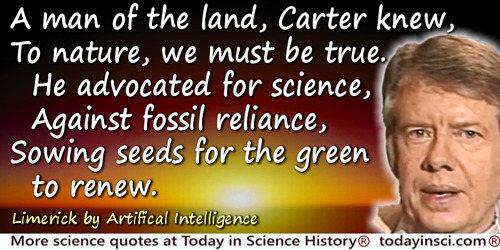
A man of the land, Carter knew,
To nature, we must be true.
He advocated for science,
Against fossil reliance,
Sowing seeds for the green to renew.
To nature, we must be true.
He advocated for science,
Against fossil reliance,
Sowing seeds for the green to renew.
Limerick generated by Artificial Intelligence, with two words tweaked by Webmaster. Original AI output had “Jimmy” and “accrue”; changed to “Carter” and “renew”.
A rock or stone is not a subject that, of itself, may interest a philosopher to study; but, when he comes to see the necessity of those hard bodies, in the constitution of this earth, or for the permanency of the land on which we dwell, and when he finds that there are means wisely provided for the renovation of this necessary decaying part, as well as that of every other, he then, with pleasure, contemplates this manifestation of design, and thus connects the mineral system of this earth with that by which the heavenly bodies are made to move perpetually in their orbits.
Theory of the Earth, with Proofs and l1lustrations, Vol. 1 (1795), 276.
A soil adapted to the growth of plants, is necessarily prepared and carefully preserved; and, in the necessary waste of land which is inhabited, the foundation is laid for future continents, in order to support the system of the living world.
In 'Concerning and System of the Earth, its Duration and Stability', a Dissertation presented to the Royal Society of Edinburgh (Mar-Apr 1785). The surviving Abstract is excerpted in Frank H. T. Rhodes, Richard O. Stone and Bruce D. Malamud (eds.), Language of the Earth: A Literary Anthology (2002, 2nd. ed. 2008), 110.
A strange feeling of complete, almost solemn contentment suddenly overcame me when the descent module landed, rocked, and stilled. The weather was foul, but I smelled Earth, unspeakably sweet and intoxicating. And wind. Now utterly delightful; wind after long days in space.
…...
A tax on the farms would then result in the proprietors themselves working the lands, and this would mean better cultivation, and improvements which would yield returns indeed, but at too remote a period for the tenant. It would tend to a division of landed property, men of small fortune uniting in the purchase with capitalists who seek only the rent or payment for the land.
From Appendix A, 'Extracts From the Unpublished Writings of Carnot', Reflections on the Motive Power of Heat (1890, 2nd ed. 1897), 212-213.
A tax on the rent of a farm would be much better than a tax on the land itself. Proprietors then could only avoid taxes by themselves improving their property. As it is, they merely collect the rents, and usually employ their surplus in unproductive expenditure, while the proprietary farmers voluntarily devote theirs to the improvement of the land.
From Appendix A, 'Extracts From the Unpublished Writings of Carnot', Reflections on the Motive Power of Heat (1890, 2nd ed. 1897), 212.
A time will come when science will transform [our bodies] by means which we cannot conjecture... And then, the earth being small, mankind will migrate into space, and will cross the airless Saharas which separate planet from planet, and sun from sun. The earth will become a Holy Land which will be visited by pilgrims from all quarters of the universe.
…...
According to the Boshongo people of central Africa, in the beginning, there was only darkness, water, and the great god Bumba. One day Bumba, in pain from a stomach ache, vomited up the sun. The sun dried up some of the water, leaving land. Still in pain, Bumba vomited up the moon, the stars, and then some animals. The leopard, the crocodile, the turtle, and finally, man. This creation myth, like many others, tries to answer the questions we all ask. Why are we here? Where did we come from?
Lecture (1987), 'The Origin of the Universe', collected in Black Holes And Baby Universes And Other Essays (1993), 99.
All animals whatsoever, whether they fly or swim or walk upon dry land, whether they bring forth their young alive or in the egg, develop in the same way.
In The Works of Aristotle: Historia Animalium (350 BC), (The History of Animals), Book VII, Part 7, 586a21 translated in William David Ross and John Alexander Smith (eds.), D’Arcy Wentworth Thompson (trans.), (1910), Vol. 4, 27.
Amphibious Animals link the Terrestrial and Aquatique together; Seals live at Land and at Sea, and Porpoises have the warm Blood and Entrails of a Hog, not to mention what is confidently reported of Mermaids or Sea-men.
In An Essay Concerning Humane Understanding (1689, 1706, 5th ed.), 381. This was later quoted verbatim in Joseph Addison The Spectator (25 Oct 1712), No. 519, as collected in Vol. 7 (1729, 10th ed.), 176. Quote collections attributing to Addison are in error.
An underwater-listening device, the “hydrophone,” has, in recent years, shown that sea creatures click, grunt, snap, moan, and, in general, make the ocean depths as maddeningly noisy as ever the land is.
(1965). In Isaac Asimov’s Book of Science and Nature Quotations (1988), 188.
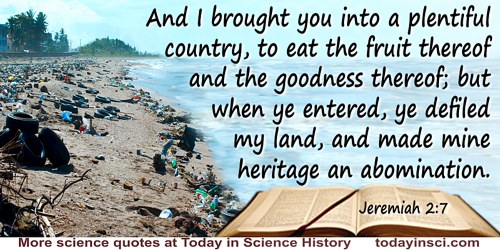
And I brought you into a plentiful country, to eat the fruit thereof and the goodness thereof; but when ye entered, ye defiled my land, and made mine heritage an abomination.
— Bible
Jeremiah 2:7, King James Bible.
As science, of necessity, becomes more involved with itself, so also, of necessity, it becomes more international. I am impressed to know that of the 670 members of this Academy [National Academy of Sciences], 163 were born in other lands.
From Address to the Centennial Convocation of the National Academy of Sciences (22 Oct 1963), 'A Century of Scientific Conquest.' Online at The American Presidency Project.
As the human fetus develops, its changing form seems to retrace the whole of human evolution from the time we were cosmic dust to the time we were single-celled organisms in the primordial sea to the time we were four-legged, land-dwelling reptiles and beyond, to our current status as largebrained, bipedal mammals. Thus, humans seem to be the sum total of experience since the beginning of the cosmos.
From interview with James Reston, Jr., in Pamela Weintraub (ed.), The Omni Interviews (1984), 99. Previously published in magazine, Omni (May 1982).
At the present time the fishing industry is, in some ways, at the stage at which primitive man was many centuries ago—we hunt the fish that Nature provides, just as our ancestors hunted animals for food. We have not yet begun to herd fish or to improve their quality—but one day we shall be forced to farm the seas as we do the land.
In 'Man Explores the Sea', Journal of the Royal Society of Arts (Sep 1963), 111, No. 5086, 787.
Basic research is like shooting an arrow into the air and, where it lands, painting a target.
As quoted by Walter Gratzer, in book review titled 'The Bomb and the Bumble-Bees' (about the book Late Night Thoughts, by Lewis Thomas), Nature (15 Nov 1984), 31, 211. The original text expresses the quote as “It was the organic chemist, Homer Adkins, who defined basic research as shooting an arrow into the air, and…”.
Before the seas and lands had been created, before the sky that covers everything, Nature displayed a single aspect only throughout the cosmos; Chaos was its name, a shapeless, unwrought mass of inert bulk and nothing more, with the discordant seeds of disconnected elements all heaped together in anarchic disarray.
Describing the creation of the universe from chaos, at the beginning of Book I of Metamorphoses, lines 5-9. As translated in Charles Martin (trans.), Metamorphoses (2004), 15.
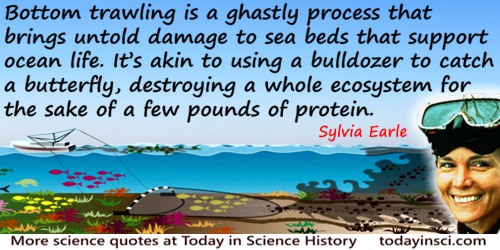
Bottom trawling is a ghastly process that brings untold damage to sea beds that support ocean life. It’s akin to using a bulldozer to catch a butterfly, destroying a whole ecosystem for the sake of a few pounds of protein. We wouldn’t do this on land, so why do it in the oceans?
In 'Can We Stop Killing Our Oceans Now, Please?', Huffington Post (14 Aug 2013).
Changes That Have Occurred in the Globe: When we have seen with our own eyes a mountain progressing into a plain; that is to say, an immense boulder separating from this mountain and covering the fields; an entire castle broken into pieces over the ground; a river swallowed up which then bursts out from its abyss; clear marks of a vast amount of water having once flooded regions now inhabited, and a hundred vestiges of other transformations, then we are much more willing to believe that great changes altered the face of the earth, than a Parisian lady who knows only that the place where her house was built was once a cultivated field. However, a lady from Naples who has seen the buried ruins of Herculaneum, is much less subject to the bias which leads us to believe that everything has always been as it is today.
From article 'Changements arrivées dans le globe', in Dictionnaire philosophique (1764), collected in Œuvres Complètes de Voltaire (1878), Vol. 2, 427-428. Translated by Ian Ellis, from the original French: “Changements arrivées dans le globe: Quand on a vu de ses yeux une montagne s’avancer dans une plaine, c’est-à-dire un immense rocher de cette montagne se détacher et couvrir des champs, un château tout entier enfoncé dans la terre, un fleuve englouti qui sort ensuite de son abîme, des marques indubitables qu’un vaste amas d’eau inondait autrefois un pays habité aujourd’hui, et cent vestiges d’autres révolutions, on est alors plus disposé à croire les grands changements qui ont altéré la face du monde, que ne l’est une dame de Paris qui sait seulement que la place où est bâtie sa maison était autrefois un champ labourable. Mais une dame de Naples, qui a vu sous terre les ruines d’Herculanum, est encore moins asservie au préjugé qui nous fait croire que tout a toujours été comme il est aujourd’hui.”
Conservation is a state of harmony between men and land.
In essay "Conservation' (1953), Collected in Aldo Leopold and Luna B. Leopold, Round River (1972), 145.
Conservation is the foresighted utilization, preservation. And/or renewal of forest, waters, lands and minerals, for the greatest good of the greatest number for the longest time.
In Breaking New Ground (1947, 1998), 505.
Considering the difficulties represented by the lack of water, by extremes of temperature, by the full force of gravity unmitigated by the buoyancy of water, it must be understood that the spread to land of life forms that evolved to meet the conditions of the ocean represented the greatest single victory won by life over the inanimate environment.
(1965). In Isaac Asimov’s Book of Science and Nature Quotations (1988), 194.
Could Hamlet have been written by a committee, or the “Mona Lisa” painted by a club? Could the New Testament have been composed as a conference report? Creative ideas do not spring from groups. They spring from individuals. The divine spark leaps from the finger of God to the finger of Adam, whether it takes ultimate shape in a law of physics or a law of the land, a poem or a policy, a sonata or a mechanical computer.
Baccalaureate address (9 Jun 1957), Yale University. In In the University Tradition (1957), 156.
Earthquakes traveling through the interior of the globe are like so many messengers sent out to explore a new land. The messages are constantly coming and seismologists are fast learning to read them.
In Our Mobile Earth (1926), 5.
Ere land and sea and the all-covering sky
Were made, in the whole world the countenance
Of nature was the same, all one, well named
Chaos, a raw and undivided mass,
Naught but a lifeless bulk, with warring seeds
Of ill-joined elements compressed together.
Were made, in the whole world the countenance
Of nature was the same, all one, well named
Chaos, a raw and undivided mass,
Naught but a lifeless bulk, with warring seeds
Of ill-joined elements compressed together.
Ovid’s description of the Creation of the universe at the beginning of Metamorphoses, Book I, lines 5-9, as translated in A.D. Melville (trans.), Ovid: Metamorphoses (1987), 1.
Essentially all civilizations that rose to the level of possessing an urban culture had need for two forms of science-related technology, namely, mathematics for land measurements and commerce and astronomy for time-keeping in agriculture and aspects of religious rituals.
From The Science Matrix: The Journey, Travails, Triumphs (1992, 1998), Preface, x.
Felling a tree was possibly the original deed of appropriation of the natural earth by early mankind in Europe. Thousands of years ago,… man lifted a heavy flint tool and struck at the base of a tree. He may have wanted the tree for shelter and fuel, or possibly to make a bridge over a river or a path through a bog…. [E]ventually the tree crashed to the floor, and the first act in the slow possession of the land by its people was complete.
In The Man Who Made Things Out of Trees: The Ash in Human Culture and History (2015), Chap. 1.
For the Lord your God is bringing you into a good land—a land with brooks, streams, and deep springs gushing out into the valleys and hills; a land with wheat and barley, vines and fig trees, pomegranates, olive oil and honey; 9 a land where bread will not be scarce and you will lack nothing; a land where the rocks are iron and you can dig copper out of the hills.
— Bible
New International Version, Bible, Deuteronomy 8, 7-9.
Glittering white, shining blue, raven black … the land looks like a fairytale. Pinnacle after pinnacle, peak after peak—crevassed, wild as any land on our globe, it lies, unseen and untrodden. It is a wonderful feeling to travel along it.
As quoted from South Pole expedition diary (13 Nov 1911) in Roland Huntford, Scott and Amundsen (1980), 438.
Great capitalists could not themselves cultivate vast extents of land, and not wanting to diminish their revenues by renting them, would be induced to sell portions suitable for cultivation by their new owners, and would then carry their money into new industrial and commercial enterprises.
From Appendix A, 'Extracts From the Unpublished Writings of Carnot', Reflections on the Motive Power of Heat (1890, 2nd ed. 1897), 213.
Having to squeeze the last drop of utility out of the land has the same desperate finality as having to chop up the furniture to keep warm.
…...
He who appropriates land to himself by his labor, does not lessen but increases the common stock of mankind. For the provisions serving to the support of human life, produced by one acre of inclosed and cultivated land, are … ten times more than those which are yielded by an acre of land, of an equal richness lying waste in common. And therefore he that incloses land and has a greater plenty of the conveniences of life from ten acres than he could have from a hundred left to nature, may truly be said to give ninety acres to mankind.
In John Locke and Thomas Preston Peardon (ed.), The Second Treatise of Civil Government: An Essay Concerning the True Original, Extent and End of Civil Government (Dec 1689, 1952), 22.
His mind illumined the Past and the Future and wrought greatly for the present. By his genius distant lands converse and men sail unafraid upon the deep.
— Epitaph
Inscription on the tomb of Reginald and Helen Fessenden in Bermuda. In Frederick Seitz, The Cosmic Inventor: Reginald Aubrey Fessenden (1866-1932) (1999), 61, being Transactions of the American Philosophical Society, Held at Philadelphia For Promoting Useful Knowledge, Vol. 86, Pt. 6.
Houston, Tranquility Base here, the Eagle has landed.
First words transmitted from the moon (20 Jul 1969).
Humanity is about to learn that a lunatic (touched by the moon) is not a crazy man but one so sane, well-informed, well-coordinated, self-disciplined, cooperative and fearless as to be the first earthian human to have been ferried to a physical landing upon the moon, and thereafter to have been returned safely to reboard his mother space vehicle earth.
In 'Reactions to Man’s Landing on the Moon Show Broad Variations in Opinions', The New York Times (21 Jul 1969), 6.
I cannot separate land and sea: to me they interfinger like a pattern in a moss agate, positive and negative shapes irrevocably interlocked. My knowledge of this peninsula depends on that understanding: of underwater canyons that are continuations of the land, of the shell fossils far inland that measure continuations of the sea in eons past.
…...
I contend that the continued racial classification of Homo sapiens represents an outmoded approach to the general problem of differentiation within a species. In other words, I reject a racial classification of humans for the same reasons that I prefer not to divide into subspecies the prodigiously variable West Indian land snails that form the subject of my own research.
…...
I had a dream, and it landed right here in my hand.
…...
I have presented the periodic table as a kind of travel guide to an imaginary country, of which the elements are the various regions. This kingdom has a geography: the elements lie in particular juxtaposition to one another, and they are used to produce goods, much as a prairie produces wheat and a lake produces fish. It also has a history. Indeed, it has three kinds of history: the elements were discovered much as the lands of the world were discovered; the kingdom was mapped, just as the world was mapped, and the relative positions of the elements came to take on a great significance; and the elements have their own cosmic history, which can be traced back to the stars.
In The Periodic Kingdom: A Journey Into the Land of the Chemical Elements (1995), Preface, viii.
I have seen a thousand sunsets and sunrises, on land where it floods forest and mountains with honey coloured light, at sea where it rises and sets like a blood orange in a multicoloured nest of cloud, slipping in and out of the vast ocean. I have seen a thousand moons: harvest moons like gold coins, winter moons as white as ice chips, new moons like baby swans’ feathers.
Letter to Lee McGeorge (31 Jul 1978). Collected in Letters of Note: Volume 2: An Eclectic Collection of Correspondence (2016), 76.
I traveled among unknown men,
In lands beyond the sea;
Nor England! did I know till then
What love I bore to thee.
In lands beyond the sea;
Nor England! did I know till then
What love I bore to thee.
First verse of poem, 'I Travelled among Unknown Men', In Poems: In Two Volumes (1807), Vol. 1, 68.
I would be the last to deny that the greatest scientific pioneers belonged to an aristocracy of the spirit and were exceptionally intelligent, something that we as modest investigators will never attain, no matter how much we exert ourselves. Nevertheless … I continue to believe that there is always room for anyone with average intelligence … to utilize his energy and … any man could, if he were so inclined, be the sculptor of his own brain, and that even the least gifted may, like the poorest land that has been well-cultivated and fertilized, produce an abundant harvest..
From Preface to the second edition, Reglas y Consejos sobre Investigacíon Cientifica: Los tónicos de la voluntad. (1897), as translated by Neely and Larry W. Swanson, in Advice for a Young Investigator (1999), xv.
If aliens visit us, the outcome would be much as when Columbus landed in America, which didn’t turn out well for the Native Americans.
From Discovery TV series, Into the Universe With Stephen Hawking (2010). As cited on BBC News webpage, 'Stephen Hawking warns over making contact with aliens' (25 Apr 2010). He suggested that aliens might simply raid Earth for resources, then move on.
If the earth’s population continues to double every 50 years (as it is now doing) then by 2550 A.D. it will have increased 3,000-fold. … by 2800 A.D., it would reach 630,000 billion! Our planet would have standing room only, for there would be only two-and-a-half square feet per person on the entire land surface, including Greenland and Antarctica. In fact, if the human species could be imagined as continuing to multiply further at the same rate, by 4200 A.D. the total mass of human tissue would be equal to the mass of the earth.
In The Intelligent Man's Guide to Science: The Biological Sciences (1960), 117. Also in Isaac Asimov’s Book of Science and Nature Quotations (1988), 237.
If we and the rest of the backboned animals were to disappear overnight, the rest of the world would get on pretty well. But if [the invertebrates] were to disappear, the world’s ecosystems would collapse. disappear, the land’s ecosystems would collapse. The soil would lose its fertility. Many of the plants would no longer be pollinated. Lots of animals, amphibians, reptiles, birds, mammals would have nothing to eat. And our fields and pastures would be covered with dung and carrion.
From BBC TV series Life in the Undergrowth (2005). As cited in Simon Barnes, History of the World in 100 Animals (2020), end of Chap. 72.
Imperceptibly a change had been wrought in me until I no longer felt alone in a strange, silent country. I had learned to hear the echoes of a time when every living thing upon this land and even the varied overshadowing skies had its voice, a voice that was attentively heard and devoutly heeded by the ancient people of America. Henceforth, to me the plants, the trees, the clouds and all things had become vocal with human hopes, fears and supplications.
From Preface, Indian Games and Dances with Native Songs (1915), v.
In addition, the oil royalties the Federal Government does not collect from big oil will starve the Land and Water Conservation Fund of critical financial resources.
— Ron Kind
…...
In Amsterdam the water is the mistress and the land the vassal, throughout the city there are as many canals and drawbridges as bracelets on a Gypsy’s bronzed arms.
In The Mirror of Souls, and Other Essays (1966), 335.
In India we have clear evidence that administrative statistics had reached a high state of organization before 300 B.C. In the Arthasastra of Kautilya … the duties of the Gopa, the village accountant, [include] “by setting up boundaries to villages, by numbering plots of grounds as cultivated, uncultivated, plains, wet lands, gardens, vegetable gardens, fences (váta), forests altars, temples of gods, irrigation works, cremation grounds, feeding houses (sattra), places where water is freely supplied to travellers (prapá), places of pilgrimage, pasture grounds and roads, and thereby fixing the boundaries of various villages, of fields, of forests, and of roads, he shall register gifts, sales, charities, and remission of taxes regarding fields.”
Editorial, introducing the new statistics journal of the Indian Statistical Institute, Sankhayā (1933), 1, No. 1. Also reprinted in Sankhyā: The Indian Journal of Statistics (Feb 2003), 65, No. 1, viii.
In using the present in order to reveal the past, we assume that the forces in the world are essentially the same through all time; for these forces are based on the very nature of matter, and could not have changed. The ocean has always had its waves, and those waves have always acted in the same manner. Running water on the land has ever had the same power of wear and transportation and mathematical value to its force. The laws of chemistry, heat, electricity, and mechanics have been the same through time. The plan of living structures has been fundamentally one, for the whole series belongs to one system, as much almost as the parts of an animal to the one body; and the relations of life to light and heat, and to the atmosphere, have ever been the same as now.
In 'Introduction', Manual of Geology: Treating of the Principles of the Science (1863), 7.
Individual thinkers since the days of Ezekiel and Isaiah have asserted that the despoliation of land is not only inexpedient but wrong. Society, however, has not yet affirmed their belief. I regard the present conservation movement as the embryo of such an affirmation.
In 'The Ethical Sequence', A Sand County Almanac, and Sketches Here and There (1949, 1987), 203.
It is as true now, as it was in the days when Werner first drew his far-reaching inferences before his charmed listeners, that on the characteristic phenomena and varying distribution of the grand mineral masses of the rock-formations, almost all that concerns the relative habitability of a land depends.
In 'The Relations of Geology', Scottish Geographical Magazine (Aug 1902), 19, No. 8, 409.
It is not surprising, in view of the polydynamic constitution of the genuinely mathematical mind, that many of the major heros of the science, men like Desargues and Pascal, Descartes and Leibnitz, Newton, Gauss and Bolzano, Helmholtz and Clifford, Riemann and Salmon and Plücker and Poincaré, have attained to high distinction in other fields not only of science but of philosophy and letters too. And when we reflect that the very greatest mathematical achievements have been due, not alone to the peering, microscopic, histologic vision of men like Weierstrass, illuminating the hidden recesses, the minute and intimate structure of logical reality, but to the larger vision also of men like Klein who survey the kingdoms of geometry and analysis for the endless variety of things that flourish there, as the eye of Darwin ranged over the flora and fauna of the world, or as a commercial monarch contemplates its industry, or as a statesman beholds an empire; when we reflect not only that the Calculus of Probability is a creation of mathematics but that the master mathematician is constantly required to exercise judgment—judgment, that is, in matters not admitting of certainty—balancing probabilities not yet reduced nor even reducible perhaps to calculation; when we reflect that he is called upon to exercise a function analogous to that of the comparative anatomist like Cuvier, comparing theories and doctrines of every degree of similarity and dissimilarity of structure; when, finally, we reflect that he seldom deals with a single idea at a tune, but is for the most part engaged in wielding organized hosts of them, as a general wields at once the division of an army or as a great civil administrator directs from his central office diverse and scattered but related groups of interests and operations; then, I say, the current opinion that devotion to mathematics unfits the devotee for practical affairs should be known for false on a priori grounds. And one should be thus prepared to find that as a fact Gaspard Monge, creator of descriptive geometry, author of the classic Applications de l’analyse à la géométrie; Lazare Carnot, author of the celebrated works, Géométrie de position, and Réflections sur la Métaphysique du Calcul infinitesimal; Fourier, immortal creator of the Théorie analytique de la chaleur; Arago, rightful inheritor of Monge’s chair of geometry; Poncelet, creator of pure projective geometry; one should not be surprised, I say, to find that these and other mathematicians in a land sagacious enough to invoke their aid, rendered, alike in peace and in war, eminent public service.
In Lectures on Science, Philosophy and Art (1908), 32-33.
It may be said of some very old places, as of some very old books, that they are destined to be forever new. The nearer we approach them, the more remote they seem: the more we study them, the more we have yet to learn. Time augments rather than diminishes their everlasting novelty; and to our descendants of a thousand years hence it may safely be predicted that they will be even more fascinating than to ourselves. This is true of many ancient lands, but of no place is it so true as of Egypt.
Opening remark in Pharaohs, Fellahs and Explorers (1891), 3.
It was strangely like war. They attacked the forest as if it were an enemy to be pushed back from the beachheads, driven into the hills, broken into patches, and wiped out. Many operators thought they were not only making lumber but liberating the land from the trees...
[On the first logging of the U.S. Olympic Peninsula.]
[On the first logging of the U.S. Olympic Peninsula.]
The Last Wilderness (1955). In William Dietrich, The Final Forest: the Battle for the Last Great Trees of the Pacific Northwest (1992), 21.
Land that is left wholly to nature, that has no improvement of pasturage, tillage, or planting, is called, as indeed it is, “waste”.
In John Locke and Thomas Preston Peardon (ed.), The Second Treatise of Civil Government: An Essay Concerning the True Original, Extent and End of Civil Government (Dec 1689, 1952), 25.
Lay down your rails, ye nations, near and far—
Yoke your full trains to Steam’s triumphal car;
Link town to town; unite in iron bands
The long-estranged and oft-embattled lands.
Yoke your full trains to Steam’s triumphal car;
Link town to town; unite in iron bands
The long-estranged and oft-embattled lands.
From poem, 'Railways' (1846), collected in The Poetical Works of Charles Mackay: Now for the First Time Collected Complete in One Volume (1876), 214.
Mankind is drawn to the heavens for the same reason we were once drawn into unknown lands and across the open sea. We choose to explore space because doing so improves our lives, and lifts our national spirit. So let us continue the journey.
Conclusion of speech, NASA Headquarters (14 Jan 2004). In Office of the Federal Register (U.S.) Staff (eds.), Public Papers of the Presidents of the United States, George W. Bush (2007), 59.
Meat reared on land matures relatively quickly, and it takes only a few pounds of plants to produce a pound of meat. Tuna take 10 to 14 years to mature, require thousands of pounds of food to develop, and we’re hunting them to the point of extinction.
In 'Can We Stop Killing Our Oceans Now, Please?', Huffington Post (14 Aug 2013).
Men first appeared as fish. When they were able to help themselves they took to land.
These are certainly not exact words from Anaximander, though it summarizes Plutarch’s version of what Anaximander believed. Although the subject quote is widely seen, no original of Anaximander’s writings survived on this hypothesis. What we know of Anaximander is what other, later, ancient Greek writers handed down in a kind of ancient Greek telephone game. These include Hippolytus, Aetius and Plutarch. Their expressions of what Anaximander believed relate by a general theme, but notably differ in specifics. For the fragmentary evidence, see Felix M. Cleve, The Giants of Pre-Sophistic Greek Philosophy: An Attempt to Reconstruct Their Thoughts (2012), 145-148. An example of the subject quote is given by David M. Neuberger, without quotation marks: Anaximander said men were produced first in fishes and, that when they were able to help themselves, they were thrown up on the land. Opening sentence 'A Call to the Chemist to Purge Industry of its Contamination of Our Coast and Inland Waters', Chemical Age (Oct 1923), 31, No. 10, 431.
Meteor: A shooting star that falls by not landing anywhere.
In Esar’s Comic Dictionary (1943, 4th ed. 1983), 378.
Methods of fishing are becoming more and more efficient, but the whole fishing industry is based on the exploitation of a wild population. This is almost a prehistoric concept on land, but it has never been questioned at sea.
In Men, Machines, and Sacred Cows (1984), 162.
Millions of our race are now supported by lands situated where deep seas once prevailed in earlier ages. In many districts not yet occupied by man, land animals and forests now abound where the anchor once sank into the oozy bottom.
Principles of Geology (1837), Vol. 1, 237.
Myriad small ponds and streams would reflect the full glare of the sun for one or two seconds, then fade away as a new set of water surfaces came into the reflecting position. The effect was as if the land were covered with sparkling jewels.
…...
Nature’s great and wonderful power is more demonstrated in the sea than on the land.
As quoted in Isaac Asimov and Jason A. Shulman (eds.), Isaac Asimov’s Book of Science and Nature Quotations (1988), 186. Webmaster has not yet found another source with this wording. (Can you help?)
No pessimist ever discovered the secret of the stars or sailed an uncharted land, or opened a new doorway for the human spirit.
…...
One doesn’t discover new lands without consenting to lose sight of the shore for a very long time.
In The Counterfeiters: A Novel (1951, 2012), 353. As translated by Dorothy Bussy from the original French, “On ne découvre pas de terre nouvelle sans consentir à perdre de vue, d'abord et longtemps, tout rivage”, in Les Faux Monnayeurs (1925).
One of the gladdest moments of human life, methinks, is the departure upon a distant journey into unknown lands. Shaking off with one mighty effort the fetters of habit, the leaden weight of routine, the cloak of many cares and the slavery of home, man feel once more happy.
In Zanzibar: City, Island, and Coast (1872), Vol. 1, 16.
One would like to see mankind spend the balance of the century in a total effort to clean up and groom the surface of the globe – wipe out the jungles, turn deserts and swamps into arable land, terrace barren mountains, regulate rivers, eradicate all pests, control the weather, and make the whole land mass a fit habitation for Man. The globe should be our and not nature’s home, and we no longer nature’s guests.
In The Temper of Our Time (1967), 94.
Our truest systems of science had small beginnings, gradual and countless contributions, and finally took their place in use, as each of you, from helpless childhood and feeble boyhood, have grown to your present strength and maturity. No such system could be born in a day. It was not as when nature in fitful pulsations of her strength suddenly lifted the land into mountain ranges, but rather, as with small accretions, gathered in during countless years, she builds her islands in the seas.
From Address (1 Aug 1875), 'The Growth of Principles' at Saratoga. Collected in William L. Snyder (ed.), Great Speeches by Great Lawyers: A Collection of Arguments and Speeches (1901), 246.
Owing to their [minor planets or asteroids] small size; … The force of gravity on their surfaces must be very small. A man placed on one of them would spring with ease 60 feet high, and sustain no greater shock in his descent than he does on the Earth from leaping a yard. On such planets giants may exist; and those enormous animals which here require the buoyant power of water to counteract their weight, may there inhabit the land.
In Elements of Astronomy (1870), 153. The ellipsis reads “the largest minor planet is but 228 miles in diameter, and many of the smaller ones are less than 50.”
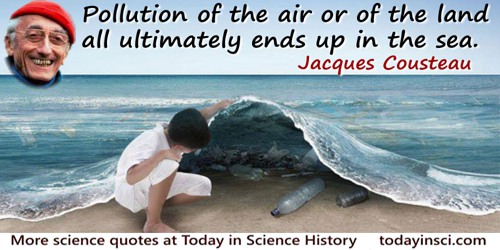
Pollution of the air or of the land all ultimately ends up in the sea.
In 'Ocean Policy and Reasonable Utopias', The Forum (Summer 1981), 16, No. 5, 897
Praise the sea, but keep on land.
In Wolfgang Mieder, Wolfgang Mieder, Stewart A. Kingsbury (eds.), A Dictionary of American Proverbs (1992), 30.
Proprietors of lands, then, after all, have to bear the mutation taxes. All increase of these taxes is a loss for them, and these taxes are heavier on the small proprietors than on the large, because their changes are more frequent. The tax on the farms, on the contrary, would bear more heavily on large estates.
From Appendix A, 'Extracts From the Unpublished Writings of Carnot', Reflections on the Motive Power of Heat (1890, 2nd ed. 1897), 215.
Remind me that the most fertile lands were built by the fires of volcanoes.
…...
Returning now to the Malay Archipelago, we find that all the wide expanse of sea which divides Java, Sumatra, and Borneo from each other, and from Malacca and Siam, is so shallow that ships can anchor in any part of it, since it rarely exceeds forty fathoms in depth; and if we go as far as the line of a hundred fathoms, we shall include the Philippine Islands and Bali, east of Java. If, therefore, these islands have been separated from each other and the continent by subsidence of the intervening tracts of land, we should conclude that the separation has been comparatively recent, since the depth to which the land has subsided is so small. It is also to be remarked that the great chain of active volcanoes in Sumatra and Java furnishes us with a sufficient cause for such subsidence, since the enormous masses of matter they have thrown out would take away the foundations of the surrounding district; and this may be the true explanation of the often-noticed fact that volcanoes and volcanic chains are always near the sea. The subsidence they produce around them will, in time, make a sea, if one does not already exist.
Malay Archipelago
Scientific research is one of the most exciting and rewarding of occupations. It is like a voyage of discovery into unknown lands, seeking not for new territory but for new knowledge. It should appeal to those with a good sense of adventure.
From Nobel Banquet Speech (10 Dec 1980).
Scientists alone can establish the objectives of their research, but society, in extending support to science, must take account of its own needs. As a layman, I can suggest only with diffidence what some of the major tasks might be on your scientific agenda, but … First, I would suggest the question of the conservation and development of our natural resources. In a recent speech to the General Assembly of the United Nations, I proposed a world-wide program to protect land and water, forests and wildlife, to combat exhaustion and erosion, to stop the contamination of water and air by industrial as well as nuclear pollution, and to provide for the steady renewal and expansion of the natural bases of life.
From Address to the Centennial Convocation of the National Academy of Sciences (22 Oct 1963), 'A Century of Scientific Conquest'. Online at The American Presidency Project.
Scientists themselves readily admit that they do not fully understand the consequences of our many-faceted assault upon the interwoven fabric of atmosphere, water, land and life in all its biological diversity. But things could also turn out to be worse than the current scientific best guess. In military affairs, policy has long been based on the dictum that we should be prepared for the worst case. Why should it be so different when the security is that of the planet and our long-term future?
Speech, 'Global Security Lecture' at Cambridge University (28 Apr 1993).
Sea-water is, of course, opaque and this is the first difficulty that faces the oceanographer. Most of the tools needed to investigate the sea must use physical principles which are more complicated than the optical methods that are so satisfactory for studying the surface features of the land.
In 'Man Explores the Sea', Journal of the Royal Society of Arts (Sep 1963), 111, No. 5086, 786.
Shoot for the moon. Even if you miss, you’ll land among the stars
…...
Teapot Dome involved the conservation of the oil resources of the United States, especially those situated upon the public lands.
…...
That land is a community is the basic concept of ecology, but that land is to be loved and respected is an extension of ethics. That land yields a cultural harvest is a fact long known, but latterly often forgotten.
In 'Foreword', A Sand County Almanac, and Sketches Here and There (1949, 1987), viii-ix.
The absolute extent of land in the Archipelago is not greater than that contained by Western Europe from Hungary to Spain; but, owing to the manner in which the land is broken up and divided, the variety of its productions is rather in proportion to the immense surface over which the islands are spread, than to the quantity of land which they contain.
Malay Archipelago
The attitude of the intellectual community toward America is shaped not by the creative few but by the many who for one reason or another cannot transmute their dissatisfaction into a creative impulse, and cannot acquire a sense of uniqueness and of growth by developing and expressing their capacities and talents. There is nothing in contemporary America that can cure or alleviate their chronic frustration. They want power, lordship, and opportunities for imposing action. Even if we should banish poverty from the land, lift up the Negro to true equality, withdraw from Vietnam, and give half of the national income as foreign aid, they will still see America as an air-conditioned nightmare unfit for them to live in.
In 'Some Thoughts on the Present', The Temper of Our Time (1967), 107.
The canyon country does not always inspire love. To many it appears barren, hostile, repellent—a fearsome, mostly waterless land of rock and heat, sand dunes and quicksand. cactus, thornbush, scorpion, rattlesnake, and agoraphobic distances. To those who see our land in that manner, the best reply is, yes, you are right, it is a dangerous and terrible place. Enter at your own risk. Carry water. Avoid the noon-day sun. Try to ignore the vultures. Pray frequently.
The Journey Home
The competition of the sellers would cause a momentary fall in the price of the lands, and would enable small farmers to become land-owners. The number of vast estates often badly managed would then be diminished, and considerable fortunes, changing hands more easily, would naturally pass into those which would be most likely to increase their value.
From Appendix A, 'Extracts From the Unpublished Writings of Carnot', Reflections on the Motive Power of Heat (1890, 2nd ed. 1897), 213.
The desire to fly after the fashion of the birds is an idea handed down to us by our ancestors who, in their grueling travels across trackless lands in prehistoric times, looked enviously on the birds soaring freely through space, at full speed, above all obstacles, on the infinite highway of the air.
In The Papers of Wilbur and Orville Wright: Including the Chanute-Wright Letters (1953), 934.
The earth holds a silver treasure, cupped between ocean bed and tenting sky. Forever the heavens spend it, in the showers that refresh our temperate lands, the torrents that sluice the tropics. Every suckling root absorbs it, the very soil drains it down; the rivers run unceasing to the sea, the mountains yield it endlessly… Yet none is lost; in vast convection our water is returned, from soil to sky, and sky to soil, and back gain, to fall as pure as blessing. There was never less; there could never be more. A mighty mercy on which life depends, for all its glittering shifts, water is constant.
In A Cup of Sky (1950), 41.
The Earth Speaks, clearly, distinctly, and, in many of the realms of Nature, loudly, to William Jennings Bryan, but he fails to hear a single sound. The earth speaks from the remotest periods in its wonderful life history in the Archaeozoic Age, when it reveals only a few tissues of its primitive plants. Fifty million years ago it begins to speak as “the waters bring forth abundantly the moving creatures that hath life.” In successive eons of time the various kinds of animals leave their remains in the rocks which compose the deeper layers of the earth, and when the rocks are laid bare by wind, frost, and storm we find wondrous lines of ascent invariably following the principles of creative evolution, whereby the simpler and more lowly forms always precede the higher and more specialized forms.
The earth speaks not of a succession of distinct creations but of a continuous ascent, in which, as the millions of years roll by, increasing perfection of structure and beauty of form are found; out of the water-breathing fish arises the air-breathing amphibian; out of the land-living amphibian arises the land-living, air-breathing reptile, these two kinds of creeping things resembling each other closely. The earth speaks loudly and clearly of the ascent of the bird from one kind of reptile and of the mammal from another kind of reptile.
This is not perhaps the way Bryan would have made the animals, but this is the way God made them!
The earth speaks not of a succession of distinct creations but of a continuous ascent, in which, as the millions of years roll by, increasing perfection of structure and beauty of form are found; out of the water-breathing fish arises the air-breathing amphibian; out of the land-living amphibian arises the land-living, air-breathing reptile, these two kinds of creeping things resembling each other closely. The earth speaks loudly and clearly of the ascent of the bird from one kind of reptile and of the mammal from another kind of reptile.
This is not perhaps the way Bryan would have made the animals, but this is the way God made them!
The Earth Speaks to Bryan (1925), 5-6. Osborn wrote this book in response to the Scopes Monkey Trial, where William Jennings Bryan spoke against the theory of evolution. They had previously been engaged in the controversy about the theory for several years. The title refers to a Biblical verse from the Book of Job (12:8), “Speak to the earth and it shall teach thee.”
The Earth would only have to move a few million kilometers sunward—or starward—for the delicate balance of climate to be destroyed. The Antarctic icecap would melt and flood all low-lying land; or the oceans would freeze and the whole world would be locked in eternal winter. Just a nudge in either direction would be enough.
In Rendezvous With Rama (1973), 9.
The edge of the sea is a strange and beautiful place. All through the long history of Earth it has been an area of unrest where waves have broken heavily against the land, where the tides have pressed forward over the continents, receded, and then returned. For no two successive days is the shore line precisely the same. Not only do the tides advance and retreat in their eternal rhythms, but the level of the sea itself is never at rest. It rises or falls as the glaciers melt or grow, as the floor of the deep ocean basins shifts under its increasing load of sediments, or as the Earth’s crust along the continental margins warps up or down in adjustment to strain and tension. Today a little more land may belong to the sea, tomorrow a little less. Always the edge of the sea remains an elusive and indefinable boundary.
Opening paragraph in The Edge of the Sea (1955), 1.
The establishment of such a tax would certainly find many opponents among proprietors, landed non-cultivators who form in fact the influential personnel in the state, for it is they who usually make the laws
From Appendix A, 'Extracts From the Unpublished Writings of Carnot', Reflections on the Motive Power of Heat (1890, 2nd ed. 1897), 213-214.
The facts proved by geology are briefly these: that during an immense, but unknown period, the surface of the earth has undergone successive changes; land has sunk beneath the ocean, while fresh land has risen up from it; mountain chains have been elevated; islands have been formed into continents, and continents submerged till they have become islands; and these changes have taken place, not once merely, but perhaps hundreds, perhaps thousands of times.
In 'On the Law which has regulated the Introduction of New Species', The Annals and Magazine of Natural History (1855), 16, No. 93, 184.
The forests are the “lungs” of our land, purifying the air and giving fresh strength to our people.
From 'A Presidential Statement on Receipt of the Award of the Schlich Forestry Medal' (29 Jan 1935) in Public Papers of the Presidents of the United States: F.D. Roosevelt, 1935, Volume 4 (1938), 65. Roosevelt was awarded the medal by the Society of American Foresters. This is seen in a number of sources incorrectly joined with Roosevelt’s quote about the nation destroying is soil (q.v.), but Webmaster has only been able to find primary sources for these as separate quotes.
The great question of the seventies is, shall we surrender to our surroundings, or shall we make our peace with nature and begin to make reparations for the damage we have done to our air, our land, our water? Restoring nature to its natural state is a cause beyond party and beyond factions. It has become a common cause of all the people of this country [America].
In State of the Union Address (22 Jan 1970).
The health of the sea, no less than the health of the land, is ultimately responsible for every morsel we put in our mouths, every breath of air we take. We cannot create the land and sea, but we can destroy them.
In 'Introduction' contributed to Enric Sala, The Nature of Nature: Why We Need the Wild (2020).
The highway system devours land resources and atmosphere at a rate that is impossible to sustain.
(1972).
The invertebrated classes include the most numerous and diversified forms of the Animal Kingdom. At the very beginning of our inquiries into their vital powers and acts we are impressed with their important relations to the maintenance of life and organization on this planet, and their influence in purifying the sea and augmenting and enriching the land—relations of which the physiologist conversant only with the vertebrated animals must have remained ignorant.
In Lecture, delivered at the Royal College of Surgeons, collected in Lecture 24, 'Cephalopoda', Lectures on the Comparative Anatomy and Physiology of the Invertebrate Animals (1843), Vol. 1, 362.
The known is finite, the unknown infinite; spiritually we find ourselves on a tiny island in the middle of a boundless ocean of the inexplicable. It is our task, from generation to generation, to drain a small amount of additional land.
As given in Herbert and W. Roesky and Klaud Möckel, translated from the original German by T.N. Mitchell and W.E. Russey, Chemical Curiosities: Spectacular Experiments and Inspired Quotes
(1996), 212. It is a restatement of an original quote from concluding remarks to a chapter by Thomas Huxley, 'On the Reception of the ‘Origin of Species’', the last chapter in Charles Darwin and Francis Darwin (ed.), The Life and Letters of Charles Darwin (1887), Vol. 1, 557. Webmaster suggests, the original Huxley quote was translated for the original German text, and when that was translated for the English edition, the quote morphed into into the form above.
The land is the only living thing. Men are merely mortals.… The land is a mother that never dies.
Maori Polynesian saying. As quoted in Jean Hobbs, Hawaii: A Pageant of the Soil (1935), ix.
The land! That is where our roots are. There is the basis of our physical life. The farther we get away from the land, the greater our insecurity. From the land comes everything that supports life, everything we use for the service of physical life. The land has not collapsed or shrunk in either extent or productivity. It is there waiting to honor all the labor we are willing to invest in it, and able to tide us across any dislocation of economic conditions.
Advice during the Great Depression, placed in an advertisement, 'Henry Ford on Self-Help', Literary Digest (29 Jun 1932), 113, No. 12, 29, and various other magazines.
The last word in ignorance is the man who says of an animal or plant: “What good is it?” If the land mechanism as a whole is good, then every part is good, whether we understand it or not.
From 'Conservation' (c.1938), Round River: From the Journals of Aldo Leopold (1953), 141. Collected in The Essential Aldo Leopold: Quotations and Commentaries (1999), 142.
The Lunar landing of the astronauts is more than a step in history; it is a step in evolution.
Editorial, New York Times (20 Jul 1969).
The maintenance of biological diversity requires special measures that extend far beyond the establishment of nature reserves. Several reasons for this stand out. Existing reserves have been selected according to a number of criteria, including the desire to protect nature, scenery, and watersheds, and to promote cultural values and recreational opportunities. The actual requirements of individual species, populations, and communities have seldom been known, nor has the available information always been employed in site selection and planning for nature reserves. The use of lands surrounding nature reserves has typically been inimical to conservation, since it has usually involved heavy use of pesticides, industrial development, and the presence of human settlements in which fire, hunting, and firewood gathering feature as elements of the local economy.
The Fragmented Forest: Island Biogeography Theory and the Preservation of Biotic Diversity (1984), xii.
The map appears to us more real than the land.
From 'Study of Thomas Hardy', in Edward D. McDonald (ed.), Phoenix: The Posthumous Papers of D.H. Lawrence (1936). Excerpted in Selected Critical Writings (1998), 20.
The moon is a very nice place. When we landed, we were 20 minutes behind. Because time on the Moon was so precious, what I remember most is trying to catch up.
As quoted in 'NASA Mourns the Passing of Astronaut John Young' (6 Jan 2018) on nasa.gov website.
The only true voyage of discovery, the only fountain of Eternal Youth, would be not to visit strange lands but to possess other eyes, to behold the universe through the eyes of another, of a hundred others, to behold the hundred universes that each of them beholds, that each of them is.
From La Prisonnière (1923), a volume in the series of novels À la Recherche du Temps Perdu (Remembrance of Things Past). Translated by C.K. Moncrief as The Captive (1929, 1949), 70-71. This text is often seen paraphrased as “The real voyage of discovery consists not in seeing new sights, but in looking with new eyes.” [Note that the context refers to the “eyes” of artists (including composers), and their ability to transport the viewer or listener with “a pair of wings, … which would enable us to traverse infinite space” to see new vistas through their art.]
The practices we now call conservation are, to a large extent, local alleviations of biotic pain. They are necessary, but they must not be confused with cures. The art of land doctoring is being practiced with vigor, but the science of land health is yet to be born.
In 'Wilderness for Science', A Sand County Almanac, and Sketches Here and There (1949, 1987), 195-196.
The prestige of government has undoubtedly been lowered considerably by the prohibition law. For nothing is more destructive of respect for the government and the law of the land than passing laws which cannot be enforced. It is an open secret that the dangerous increase of crime in the United States is closely connected with this.
…...
The problem, then, is how to bring about a striving for harmony with land among a people many of whom have forgotten there is any such thing as land, among whom education and culture have become almost synonymous with landlessness. This is the problem of conservation education.
In 'Conservation' (1938), collected in Luna B. Leopold (ed.), Round River: From the Journals of Aldo Leopold (1966, 1972), 155.
The ruthless destruction of their forests by the Chinese is one of the reasons why famine and plague today hold this nation in their sinister grasp. Denudation, wherever practiced, leaves naked soil; floods and erosion follow, and when the soil is gone men must also go—and the process does not take long. The great plains of Eastern China were centuries ago transformed from forest into agricultural land. The mountain plateau of Central China have also within a few hundred years been utterly devastated of tree growth, and no attempt made at either natural or artificial reforestation. As a result, the water rushes off the naked slopes in veritable floods, gullying away the mountain sides, causing rivers to run muddy with yellow soil, and carrying enormous masses of fertile earth to the sea. Water courses have also changed; rivers become uncontrollable, and the water level of the country is lowered perceptibly. In consequence, the unfortunate people see their crops wither and die for lack of water when it is most needed.
Statement (11 May 1921) by United States Department of Agriculture (USDA) concerning the famine in China in seven out of every ten years. Reported in 'Blames Deforestation: Department of Agriculture Ascribes Chinese Famine to it', New York Times (12 May 1921), 12.
The tax on farms not affecting the owners of timber, would be made up by a tax on the felling, a very justifiable tax, for standing timber is landed property. Standing timber is often worth much more than the land on which it stands.
From Appendix A, 'Extracts From the Unpublished Writings of Carnot', Reflections on the Motive Power of Heat (1890, 2nd ed. 1897), 215.
The tiny creatures of the undergrowth were the first creatures of any kind to colonise the land. They established the foundations of the land’s ecosystems and were able to transcend the limitations of their small size by banding together in huge communities of millions.
From BBC TV series Life in the Undergrowth (2005), as quoted in BBC press release (10 Oct 2005).
There are no foreign lands. It is the traveler only who is foreign.
…...
There are no reptiles, and no snake can exist there [Ireland]; for although often brought over from Britain, as soon as the ship nears land, they breathe the scent of the air, and die.
— Bede
There are those who say that the human kidney was created to keep the blood pure, or more precisely, to keep our internal environment in an ideal balanced state. This I must deny. I grant that the human kidney is a marvelous organ, but I cannot grant that it was purposefully designed to excrete urine or to regulate the composition of the blood or to subserve the physiological welfare of Homo sapiens in any sense. Rather I contend that the human kidney manufactures the kind of urine that it does, and it maintains the blood in the composition which that fluid has, because this kidney has a certain functional architecture; and it owes that architecture not to design or foresight or to any plan, but to the fact that the earth is an unstable sphere with a fragile crust, to the geologic revolutions that for six hundred million years have raised and lowered continents and seas, to the predacious enemies, and heat and cold, and storms and droughts; to the unending succession of vicissitudes that have driven the mutant vertebrates from sea into fresh water, into desiccated swamps, out upon the dry land, from one habitation to another, perpetually in search of the free and independent life, perpetually failing, for one reason or another, to find it.
From Fish to Philosopher (1953), 210-1.
There rolls the deep where grew the tree.
O earth, what changes hast thou seen!
There where the long street roars, hath been
The stillness of the central sea.
The hills are shadows, and they flow
From form to form, and nothing stands;
They melt like mist, the solid lands,
Like clouds they shape themselves and go.
O earth, what changes hast thou seen!
There where the long street roars, hath been
The stillness of the central sea.
The hills are shadows, and they flow
From form to form, and nothing stands;
They melt like mist, the solid lands,
Like clouds they shape themselves and go.
In Memoriam A. H. H. (1850), canto 123. Collected in Alfred Tennyson and William James Rolfe (ed.) The Poetic and Dramatic works of Alfred, Lord Tennyson (1898), 194.
This great pressure of a people always moving to new frontiers, in search of new lands, new power, the full freedom of a virgin world, has ruled our course and formed our policies like a Fate.
From Address (26 Dec 1901) delivered on the 125th anniversary of the battle of Trenton, published in 'The Ideals of America', The Atlantic (1902), 90, No. 542, 726.
This invention has been originated in the land which gave birth to the telegraph, the telephone, the Hoe press and the reaper; everybody will know that it came from the United States.
From short Speech at the Chamberlain Hotel, Washington, D.C. (Feb 1885), concluding the exhibition of his own Linotype invention. As given in Carl Schlesinger (ed.), 'Mr. Mergenthaler’s Speech', The Biography of Ottmar Merganthaler: Inventor of the Linotype (1989), 20. [Thanking his funders for support that honored their country. —Webmaster]
This is the way federal land management should work. Cooperation, not confrontation, should be the hallmark of conservation efforts.
…...
This king [Sesostris] divided the land among all Egyptians so as to give each one a quadrangle of equal size and to draw from each his revenues, by imposing a tax to be levied yearly. But everyone from whose part the river tore anything away, had to go to him to notify what had happened; he then sent overseers who had to measure out how much the land had become smaller, in order that the owner might pay on what was left, in proportion to the entire tax imposed. In this way, it appears to me, geometry originated, which passed thence to Hellas.
(II. c. 109) As quoted in Florian Cajori, A History of Elementary Mathematics (1893), 10, footnoted to C.A. Bretschneider, Die Geometrie und die Geometer vor Eukides (1870). Note that the word geometry itself means “land measurement.”
This sounds simple: do we not already sing our love for and obligation to the land of the free and the home of the brave? Yes, but just what and whom do we love? Certainly not the soil, which we are sending helter-skelter downriver. Certainly not the waters, which we assume have no function except to turn turbines, float barges, and carry off sewage. Certainly not the plants, of which we exterminate whole communities without batting an eye. Certainly not the animals, of which we have already extirpated many of the largest and most beautiful species.
In 'The Land Ethic: The Community Concept', A Sand County Almanac, and Sketches Here and There (1949, 1987), 204.
Though Darwin may proclaim the law,
And spread it far abroad, O!
The man that first the secret saw,
Was honest old Monboddo.
The Architect precedence takes
Of him that bears the hod, 0!
So up and at them, Land of Cakes!
We’ll vindicate Monboddo.
And spread it far abroad, O!
The man that first the secret saw,
Was honest old Monboddo.
The Architect precedence takes
Of him that bears the hod, 0!
So up and at them, Land of Cakes!
We’ll vindicate Monboddo.
From Ballad, 'The Memory of Monboddo', in Blackwood’s Magazine (Sep 1861), 90, No. 551, 364, Verse 5 (of 6). Written to the Air, The Looking Glass. It is footnoted to explain that Lord (James Burnett) Monboddo “has written a book about the origin of language, in which he traces monkeys up to men.” The note is quoted and cited from Boswell’s Life of Johnson, Vol. 4, 73.
To set foot on the soil of the asteroids, to lift by hand a rock from the Moon, to observe Mars from a distance of several tens of kilometers, to land on its satellite or even on its surface, what can be more fantastic? From the moment of using rocket devices a new great era will begin in astronomy: the epoch of the more intensive study of the firmament.
(1896). As quoted in Firmin Joseph Krieger, Behind the Sputniks: A Survey of Soviet Space Science (1958), 23.
True conservation provides for wise use by the general public. The American people do not want our resources preserved for the exclusive use of the wealthy. These land and water resources belong to the people, and people of all income levels should have easy access to them.
As quoted, without source citation, in John Eggink, Managing Energy Costs: A Behavioral and Non-Technical Approach (2007), 217.
Truth and understanding are not such wares as to be monopolized and traded in by tickets and statutes and standards. We must not think to make a staple commodity of all the knowledge in the land, to mark and license it like our broadcloth and our woolpacks.
In Areopagitica: A speech of Mr John Milton for the Liberty of Unlicenced printing to the Parliament of England (23 Nov 1644), 23.
We are consuming our forests three times faster than they are being reproduced. Some of the richest timber lands of this continent have already been destroyed, and not replaced, and other vast areas are on the verge of destruction. Yet forests, unlike mines, can be so handled as to yield the best results of use, without exhaustion, just like grain fields.
Address to the Deep Waterway Convention, Memphis, Tennessee (4 Oct 1907), 'Our National Inland Waterways Policy'. In American Waterways (1908), 9.
We do not associate the idea of antiquity with the ocean, nor wonder how it looked a thousand years ago, as we do of the land, for it was equally wild and unfathomable always.
…...
We have before us the restoration of that ancient land whose name was a synonym for abundance, prosperity, and grandeur for many generations. Records as old as those of Egypt and as well attested tell of fertile lands and teeming populations, mighty kings and warriors, sages and wise men, over periods of thousands of years. ... A land such as this is worth resuscitating. Once we have apprehended the true cause of its present desolate and abandoned condition, we are on our way to restoring it to its ancient fertility. A land which so readily responded to ancient science, and gave a return which sufficed for the maintenance of a Persian Court in all its splendor, will surely respond to the efforts of modern science and return manifold the money and talent spent on its regeneration.
From The Restoration of the Ancient Irrigation Works on the Tigris: or, The Re-creation of Chaldea (1903), 30.
We may consider the renting of a property for several years as a sale of the usufruct during the time of the lease. Now nine years' possession, for example, is equal to more than a third of the value of the property, supposing the annual product to be one twentieth of the capital. It would then be reasonable to apply to this sort of sale the laws which govern that of landed property, and consequently the mutation tax. The person who cannot or will not cultivate his soil, instead of alienating the property itself, binds himself to alienate the usufruct for a time, and the price is paid at stated intervals instead of all at once. There is farm rent.
From Appendix A, 'Extracts From the Unpublished Writings of Carnot', Reflections on the Motive Power of Heat (1890, 2nd ed. 1897), 214.
We shall never achieve harmony with land, any more than we shall achieve justice or liberty for people. In these higher aspirations the important thing is not to achieve, but to strive.
In 'Conservation' (1938), collected in Luna B. Leopold (ed.), Round River: From the Journals of Aldo Leopold (1966, 1972), 155.
What shall be done with nature to reclaim
The herbless, treeless waste? those dead seas past,
Dried summer lands, deserts and “antres vast,”
The earth’s reproach, her barrenness and shame.
Can human toil and foresight help the same?
Science, of soils declares with grand forecast,
Last shall be first, and first shall be the last
To come to fruit in Irrigation’s name!
The herbless, treeless waste? those dead seas past,
Dried summer lands, deserts and “antres vast,”
The earth’s reproach, her barrenness and shame.
Can human toil and foresight help the same?
Science, of soils declares with grand forecast,
Last shall be first, and first shall be the last
To come to fruit in Irrigation’s name!
In 'Arid Lands', Poems of Expansion (1898), 108.
When the great truth accidentally revealed and experimentally confirmed is fully recognized, that this planet, with all its appalling immensity, is to electric currents virtually no more than a small metal ball and that by this fact many possibilities, each baffling imagination and of incalculable consequence, are rendered absolutely sure of accomplishment; when the first plant is inaugurated and it is shown that a telegraphic message, almost as secret and non-interferable as a thought, can be transmitted to any terrestrial distance, the sound of the human voice, with all its intonations and inflections, faithfully and instantly reproduced at any other point of the globe, the energy of a waterfall made available for supplying light, heat or motive power, anywhere—on sea, or land, or high in the air—humanity will be like an ant heap stirred up with a stick: See the excitement coming!
In 'The Transmission of Electric Energy Without Wires', Electrical World and Engineer (5 Mar 1904), 43, No. 10, 431.
When you are risen on the eastern horizon
You have filled every land with your beauty…
Though you are far away, your rays are on Earth.
You have filled every land with your beauty…
Though you are far away, your rays are on Earth.
…...
Whereas at the outset geometry is reported to have concerned herself with the measurement of muddy land, she now handles celestial as well as terrestrial problems: she has extended her domain to the furthest bounds of space.
In The Story of Euclid. (1902) 14-15.
Wherever we go on land, these small creatures [insects, worms] are within a few inches of our feet—often disregarded. We would do very well to remember them.
From BBC TV series Life in the Undergrowth (2005), as quoted in BBC press release (10 Oct 2005).
Why should we grope among the dry bones of the past, or put the living generation into masquerade out of its faded wardrobe? … There are new lands, new men, new thoughts.
From 'Introduction' in his first published book (at first, anonymously), Nature (1836), 5-6.
Wilderness is an anchor to windward. Knowing it is there, we can also know that we are still a rich nation, tending our resources as we should—not a people in despair searching every last nook and cranny of our land for a board of lumber, a barrel of oil, a blade of grass, or a tank of water.
From 'Statement of Hon. Stewart L. Udall, Secretary of the Department of the Interior', in Hearings before the Committee on Interior and Insular Affairs, United States Senate, Eighty-Eighth Congress, First Session on S.4, A Bill to Establish a National Wilderness Preservation System for the Permanent Good of the Whole People and For Other Purposes (28 Feb-1 Mar 1963), 19. Udall read a statement he attributed to “the chairman of this committee” [which was Anderson P. Clinton] from “an article that he [Anderson] wrote a year or two ago about wilderness legislation.” So, this lengthy citation is a secondary source. This quote can be found elsewhere attributed to Udall, which is an error; Udall was only reading into the record words written earlier by Anderson Clinton. If a reader can identify the primary source—the article by Anderson Clinton—please contact Webmaster to improve this citation.
Your mysterious mountains I wish to see closer. May I land my kinky machine?
Third Stone from the Sun
 In science it often happens that scientists say, 'You know that's a really good argument; my position is mistaken,' and then they would actually change their minds and you never hear that old view from them again. They really do it. It doesn't happen as often as it should, because scientists are human and change is sometimes painful. But it happens every day. I cannot recall the last time something like that happened in politics or religion.
(1987) --
In science it often happens that scientists say, 'You know that's a really good argument; my position is mistaken,' and then they would actually change their minds and you never hear that old view from them again. They really do it. It doesn't happen as often as it should, because scientists are human and change is sometimes painful. But it happens every day. I cannot recall the last time something like that happened in politics or religion.
(1987) --