Labor Quotes (200 quotes)
Labour Quotes, Labored Quotes, Laboured Quotes, Laboring Quotes, Labouring Quotes
Labour Quotes, Labored Quotes, Laboured Quotes, Laboring Quotes, Labouring Quotes
... [I]nfectious disease is merely a disagreeable instance of a widely prevalent tendency of all living creatures to save themselves the bother of building, by their own efforts, the things they require. Whenever they find it possible to take advantage of the constructive labors of others, this is the path of least resistance. The plant does the work with its roots and its green leaves. The cow eats the plant. Man eats both of them; and bacteria (or investment bankers) eat the man. ...
Rats, Lice and History (1935).
…by shortening the labours doubled the life of the astronomer.
On the benefit of Napier’s logarithms.
On the benefit of Napier’s logarithms.
Quoted in H. Eves, In Mathematical Circles (1969).
“There is no expedient to which a man will not resort to avoid the real labor of thinking.
Sir Joshua Reynolds.”
Sir Joshua Reynolds.”
Sign motto used by Edison in his plant. It is a compacted paraphrase of an original quote by the painter, Joshua Reynolds, (which can been seen on the Reynolds quote page on this site). This form of the quote, was published by B.C. Forbes in The American Magazine (Jan 1921), 10. Forbes wrote about his visit to the Edison’s office, where he was shown a placard bearing the motto and attribution to Sir Joshua Reynolds, and told by Edison that he intended to have copies “put all over the plant.”
[Alchemists] finde out men so covetous of so much happiness, whom they easily perswade that they shall finde greater Riches in Hydargyrie [mercury], than Nature affords in Gold. Such, whom although they have twice or thrice already been deluded, yet they have still a new Device wherewith to deceive um again; there being no greater Madness…. So that the smells of Coles, Sulphur, Dung, Poyson, and Piss, are to them a greater pleasure than the taste of Honey; till their Farms, Goods, and Patrimonies being wasted, and converted into Ashes and Smoak, when they expect the rewards of their Labours, births of Gold, Youth, and Immortality, after all their Time and Expences; at length, old, ragged, famisht, with the continual use of Quicksilver [mercury] paralytick, onely rich in misery, … a laughing-stock to the people: … compell’d to live in the lowest degree of poverty, and … at length compell’d thereto by Penury, they fall to Ill Courses, as Counterfeiting of Money.
In The Vanity of the Arts and Sciences (1530), translation (1676), 313.
[Decimal currency is desirable because] by that means all calculations of interest, exchange, insurance, and the like are rendered much more simple and accurate, and, of course, more within the power of the great mass of people. Whenever such things require much labor, time, and reflection, the greater number who do not know, are made the dupes of the lesser number who do.
Letter to Congress (15 Jan 1782). 'Coinage Scheme Proposed by Robert Morris, Superintendent of Finance', from MS. letters and reports of the Superintendent of Finance, No, 137, Vol. 1, 289-300. Reprinted as Appendix, in Executive Documents, Senate of the U.S., Third Session of the Forty-Fifth Congress, 1878-79 (1879), 430.
[Man] … his origin, his growth, his hopes and fears, his loves and his beliefs are but the outcome of accidental collocations of atoms; that no fire, no heroism, no intensity of thought and feeling can preserve an individual life beyond the grave; that all the labour of the ages, all the devotion, all the inspiration, all the noonday brightness of human genius are destined to extinction in the vast death of the solar system, and that the whole temple of Man's achievement must inevitably be buried beneath the debris of a universe in ruins…
From 'A Free Man's Worship', Independent Review (Dec 1903). Collected in Mysticism and Logic: And Other Essays (1918), 47-48.
[Radius]: You will work. You will build ... You will serve them... Robots of the world... The power of man has fallen... A new world has arisen. The rule of the Robots... March!
The word 'robot' was coined in this play for a new working class of automatons (from the Czech word robota meaning compulsory labour)
The word 'robot' was coined in this play for a new working class of automatons (from the Czech word robota meaning compulsory labour)
R.U.R. (1920), 89-90 in 1961 ed.
[About Francis Baily] The history of the astronomy of the nineteenth century will be incomplete without a catalogue of his labours. He was one of the founders of the Astronomical Society, and his attention to its affairs was as accurate and minute as if it had been a firm of which he was the chief clerk, with expectation of being taken into partnership.
In Supplement to the Penny Cyclopaedia. Quoted in Sophia Elizabeth De Morgan, Memoir of Augustus De Morgan (1882), 46
Between the frontiers of the three super-states Eurasia, Oceania, and Eastasia, and not permanently in possession of any of them, there lies a rough quadrilateral with its corners at Tangier, Brazzaville, Darwin, and Hongkong. These territories contain a bottomless reserve of cheap labour. Whichever power controls equatorial Africa, or the Middle East or Southern India or the Indonesian Archipelago, disposes also of the bodies of hundreds of millions of ill-paid and hardworking coolies, expended by their conquerors like so much coal or oil in the race to turn out more armaments, to capture more territory, to control more labour, to turn out more armaments, to capture more territory, to control…
Thus George Orwell—in his only reference to the less-developed world.
I wish I could disagree with him. Orwell may have erred in not anticipating the withering of direct colonial controls within the “quadrilateral” he speaks about; he may not quite have gauged the vehemence of urges to political self-assertion. Nor, dare I hope, was he right in the sombre picture of conscious and heartless exploitation he has painted. But he did not err in predicting persisting poverty and hunger and overcrowding in 1984 among the less privileged nations.
I would like to live to regret my words but twenty years from now, I am positive, the less-developed world will be as hungry, as relatively undeveloped, and as desperately poor, as today.
Thus George Orwell—in his only reference to the less-developed world.
I wish I could disagree with him. Orwell may have erred in not anticipating the withering of direct colonial controls within the “quadrilateral” he speaks about; he may not quite have gauged the vehemence of urges to political self-assertion. Nor, dare I hope, was he right in the sombre picture of conscious and heartless exploitation he has painted. But he did not err in predicting persisting poverty and hunger and overcrowding in 1984 among the less privileged nations.
I would like to live to regret my words but twenty years from now, I am positive, the less-developed world will be as hungry, as relatively undeveloped, and as desperately poor, as today.
'The Less-Developed World: How Can We be Optimists?' (1964). Reprinted in Ideals and Realities (1984), xv-xvi. Referencing a misquote from George Orwell, Nineteen Eighty Four (1949), Ch. 9.
A free soul ought not to pursue any study slavishly; for while bodily labors performed under constraint do not harm the body, nothing that is learned under compulsion stays with the mind.
— Plato
From The Republic 7 536e, as translated by Paul Shorey (1930).
A garden requires patient labor and attention. Plants do not grow merely to satisfy ambitions or to fulfill good intentions. They thrive because some one expended effort on them.
In Philip Dorf, Liberty Hyde Bailey: An Informal Biography: a Pioneer Educator in Horticulture (1956), 83.
A hundred times every day I remind myself that my inner and outer life depends on the labors of other men, living and dead, and that I must exert myself in order to give in the measure as I have received and am still receiving.
…...
A man has a very insecure tenure of a property which another can carry away with his eyes. A few months reduced me to the cruel necessity either of destroying my machine, or of giving it to the public. To destroy it, I could not think of; to give up that for which I had laboured so long, was cruel. I had no patent, nor the means of purchasing one. In preference to destroying, I gave it to the public.
[On his inability to keep for himself a profitable income from his invention of the Spinning Mule.]
[On his inability to keep for himself a profitable income from his invention of the Spinning Mule.]
As quoted in James Mason, The Great Triumphs of Great Men (1875), 579.
A provision of endless apparatus, a bustle of infinite enquiry and research, or even the mere mechanical labour of copying, may be employed, to evade and shuffle off real labour, — the real labour of thinking.
In Discourse XII, Discourses on Painting and the Fine Arts: Delivered at the Royal Academy (1826), 226
A single idea, if it is right, saves us the labor of an infinity of experiences.
Reflections on America (1958), 97.
A vast technology has been developed to prevent, reduce, or terminate exhausting labor and physical damage. It is now dedicated to the production of the most trivial conveniences and comfort.
Reflections on Behaviorism and Society (1978), 6.
About the year 1772, being then an apprentice to a wheel-wright, or wagon maker, I laboured to discover some means of propelling land carriages without animal power. … one of my brothers [told me of] blacksmith’s boys, who, for amusement, had stopped up the touch hole of a gun barrel, then put in about a gill of water, and rammed down a tight wad; after which they put the breech in the smith’s fire, when it discharged itself with as loud a crack as if it had been loaded with powder. It immediately occurred to me, that here was the power to propel any wagon, if I could only apply it.
From 'On the Origin of Steam Boats and Steam Wagons', Thomas Cooper (ed.), The Emporium of Arts and Sciences (Feb 1814), 2, No. 2, 205.
Accurate and minute measurement seems to the non-scientific imagination, a less lofty and dignified work than looking for something new. But nearly all the grandest discoveries of science have been but the rewards of accurate measurement and patient long-continued labour in the minute sifting of numerical results.
Presidential inaugural address, to the General Meeting of the British Association, Edinburgh (2 Aug 1871). In Report of the Forty-First Meeting of the British Association for the Advancement of Science (1872), xci.
All human affairs follow nature's great analogue, the growth of vegetation. There are three periods of growth in every plant. The first, and slowest, is the invisible growth by the root; the second and much accelerated is the visible growth by the stem; but when root and stem have gathered their forces, there comes the third period, in which the plant quickly flashes into blossom and rushes into fruit.
The beginnings of moral enterprises in this world are never to be measured by any apparent growth. ... At length comes the sudden ripeness and the full success, and he who is called in at the final moment deems this success his own. He is but the reaper and not the labourer. Other men sowed and tilled and he but enters into their labours.
The beginnings of moral enterprises in this world are never to be measured by any apparent growth. ... At length comes the sudden ripeness and the full success, and he who is called in at the final moment deems this success his own. He is but the reaper and not the labourer. Other men sowed and tilled and he but enters into their labours.
Life Thoughts (1858), 20.
All labor that uplifts humanity has dignity and importance and should be undertaken with painstaking excellence.
In Strength to Love (1963), 71.
An inventive age
Has wrought, if not with speed of magic, yet
To most strange issues. I have lived to mark
A new and unforeseen creation rise
From out the labours of a peaceful Land:
Wielding her potent enginery to frame
And to produce, with appetite as keen
As that of war, which rests not night or day.
Has wrought, if not with speed of magic, yet
To most strange issues. I have lived to mark
A new and unforeseen creation rise
From out the labours of a peaceful Land:
Wielding her potent enginery to frame
And to produce, with appetite as keen
As that of war, which rests not night or day.
In The Excursion (1814). In The Works of William: Wordsworth (1994), Book 8, 875.
And if you want the exact moment in time, it was conceived mentally on 8th March in this year one thousand six hundred and eighteen, but submitted to calculation in an unlucky way, and therefore rejected as false, and finally returning on the 15th of May and adopting a new line of attack, stormed the darkness of my mind. So strong was the support from the combination of my labour of seventeen years on the observations of Brahe and the present study, which conspired together, that at first I believed I was dreaming, and assuming my conclusion among my basic premises. But it is absolutely certain and exact that the proportion between the periodic times of any two planets is precisely the sesquialterate proportion of their mean distances.
Harmonice Mundi, The Harmony of the World (1619), book V, ch. 3. Trans. E. J. Aiton, A. M. Duncan and J. V. Field (1997), 411.
Another error is a conceit that … the best has still prevailed and suppressed the rest: so as, if a man should begin the labor of a new search, he were but like to light upon somewhat formerly rejected, and by rejection brought into oblivion; as if the multitude, or the wisest for the multitude’s sake, were not ready to give passage rather to that which is popular and superficial, than to that which is substantial and profound: for the truth is, that time seemeth to be of the nature of a river or stream, which carrieth down to us that which is light and blown up, and sinketh and drowneth that which is weighty and solid.
Advancement of Learning, Book 1. Collected in The Works of Francis Bacon (1826), Vol 1, 36.
Anyone who understands algebraic notation, reads at a glance in an equation results reached arithmetically only with great labour and pains.
From Recherches sur les Principes Mathématiques de la Théorie des Richesses (1838), as translated by Nathaniel T. Bacon in 'Preface', Researches Into Mathematical Principles of the Theory of Wealth (1897), 4. From the original French, “Quiconque connaît la notation algébrique, lit d'un clin-d'œil dans une équation le résultat auquel on parvient péniblement par des règles de fausse position, dans l'arithmétique de Banque.”
Archimedes … had stated that given the force, any given weight might be moved, and even boasted, we are told, relying on the strength of demonstration, that if there were another earth, by going into it he could remove this. Hiero being struck with amazement at this, and entreating him to make good this problem by actual experiment, and show some great weight moved by a small engine, he fixed accordingly upon a ship of burden out of the king’s arsenal, which could not be drawn out of the dock without great labor and many men; and, loading her with many passengers and a full freight, sitting himself the while far off with no great endeavor, but only holding the head of the pulley in his hand and drawing the cords by degrees, he drew the ship in a straight line, as smoothly and evenly, as if she had been in the sea. The king, astonished at this, and convinced of the power of the art, prevailed upon Archimedes to make him engines accommodated to all the purposes, offensive and defensive, of a siege. … the apparatus was, in most opportune time, ready at hand for the Syracusans, and with it also the engineer himself.
— Plutarch
In John Dryden (trans.), Life of Marcellus.
Ars est sine arte, cujus principium est mentiri, medium laborare, et finis mendicare.
The art is devoid of art, whose beginning is falsehood, its middle labour, and its end beggary.
[On the character of the delusive science of alchemy].
The art is devoid of art, whose beginning is falsehood, its middle labour, and its end beggary.
[On the character of the delusive science of alchemy].
In Henry Thomas Riley, Dictionary of Latin Quotations, Proverbs, Maxims, and Mottos (1866), 27.
As in the domains of practical life so likewise in science there has come about a division of labor. The individual can no longer control the whole field of mathematics: it is only possible for him to master separate parts of it in such a manner as to enable him to extend the boundaries of knowledge by creative research.
In Die reine Mathematik in den Jahren 1884-99, 10. As quoted, cited and translated in Robert Édouard Moritz, Memorabilia Mathematica; Or, The Philomath’s Quotation-Book (1914), 94.
As soon as we touch the complex processes that go on in a living thing, be it plant or animal, we are at once forced to use the methods of this science [chemistry]. No longer will the microscope, the kymograph, the scalpel avail for the complete solution of the problem. For the further analysis of these phenomena which are in flux and flow, the investigator must associate himself with those who have labored in fields where molecules and atoms, rather than multicellular tissues or even unicellular organisms, are the units of study.
'Experimental and Chemical Studies of the Blood with an Appeal for More Extended Chemical Training for the Biological and Medical Investigator', Science (6 Aug 1915), 42, 176.
As to a perfect Science of natural Bodies … we are, I think, so far from being capable of any such thing that I conclude it lost labour to seek after it.
In 'Extent of Human Knowledge', An Essay Concerning Humane Understanding (1700), Book 4, 335.
At the entrance to the observatory Stjerneborg located underground, Tycho Brahe built a Ionic portal. On top of this were three sculptured lions. On both sides were inscriptions and on the backside was a longer inscription in gold letters on a porfyr stone: Consecrated to the all-good, great God and Posterity. Tycho Brahe, Son of Otto, who realized that Astronomy, the oldest and most distinguished of all sciences, had indeed been studied for a long time and to a great extent, but still had not obtained sufficient firmness or had been purified of errors, in order to reform it and raise it to perfection, invented and with incredible labour, industry, and expenditure constructed various exact instruments suitable for all kinds of observations of the celestial bodies, and placed them partly in the neighbouring castle of Uraniborg, which was built for the same purpose, partly in these subterranean rooms for a more constant and useful application, and recommending, hallowing, and consecrating this very rare and costly treasure to you, you glorious Posterity, who will live for ever and ever, he, who has both begun and finished everything on this island, after erecting this monument, beseeches and adjures you that in honour of the eternal God, creator of the wonderful clockwork of the heavens, and for the propagation of the divine science and for the celebrity of the fatherland, you will constantly preserve it and not let it decay with old age or any other injury or be removed to any other place or in any way be molested, if for no other reason, at any rate out of reverence to the creator’s eye, which watches over the universe. Greetings to you who read this and act accordingly. Farewell!
(Translated from the original in Latin)
Before an experiment can be performed, it must be planned—the question to nature must be formulated before being posed. Before the result of a measurement can be used, it must be interpreted—nature's answer must be understood properly. These two tasks are those of the theorist, who finds himself always more and more dependent on the tools of abstract mathematics. Of course, this does not mean that the experimenter does not also engage in theoretical deliberations. The foremost classical example of a major achievement produced by such a division of labor is the creation of spectrum analysis by the joint efforts of Robert Bunsen, the experimenter, and Gustav Kirchoff, the theorist. Since then, spectrum analysis has been continually developing and bearing ever richer fruit.
'The Meaning and Limits of Exact Science', Science (30 Sep 1949), 110, No. 2857, 325. Advance reprinting of chapter from book Max Planck, Scientific Autobiography (1949), 110.
By his very success in inventing labor-saving devices, modern man has manufactured an abyss of boredom that only the privileged classes in earlier civilizations have ever fathomed.
The Conduct of Life (1951), 14.
By the death of Mr. O. Chanute the world has lost one whose labors had to an unusual degree influenced the course of human progress. If he had not lived the entire history of progress in flying would have been other than it has been.
Writing in Aeronautics in Jan 1911 about Chanute's death, collected in Wilbur Wright and Orville Wright, The Papers of Wilbur and Orville Wright: Volume Two 1906-1948 (1953), 1013.
By these pleasures it is permitted to relax the mind with play, in turmoils of the mind, or when our labors are light, or in great tension, or as a method of passing the time. A reliable witness is Cicero, when he says (De Oratore, 2): 'men who are accustomed to hard daily toil, when by reason of the weather they are kept from their work, betake themselves to playing with a ball, or with knucklebones or with dice, or they may also contrive for themselves some new game at their leisure.'
The Book of Games of Chance (1663), final sentences, trans. Sydney Henry Gould. In Oysten Ore, The Gambling Scholar (1953), 241.
Criticism is as often a trade as a science, requiring, as it does, more health than wit, more labour than capacity, more practice than genius.
In John Timbs (ed.), Laconics; or, The Best Words of the Best Authors (1929), 156.
Criticism, though dignified from the earliest ages by the labours of men eminent for knowledge and sagacity, has not yet attained the certainty and stability of science.
In Samuel Austin Allibone, Prose Quotations from Socrates to Macaulay (1880), 151.
Endowed with two qualities, which seemed incompatible with each other, a volcanic imagination and a pertinacity of intellect which the most tedious numerical calculations could not daunt, Kepler conjectured that the movements of the celestial bodies must be connected together by simple laws, or, to use his own expression, by harmonic laws. These laws he undertook to discover. A thousand fruitless attempts, errors of calculation inseparable from a colossal undertaking, did not prevent him a single instant from advancing resolutely toward the goal of which he imagined he had obtained a glimpse. Twenty-two years were employed by him in this investigation, and still he was not weary of it! What, in reality, are twenty-two years of labor to him who is about to become the legislator of worlds; who shall inscribe his name in ineffaceable characters upon the frontispiece of an immortal code; who shall be able to exclaim in dithyrambic language, and without incurring the reproach of anyone, “The die is cast; I have written my book; it will be read either in the present age or by posterity, it matters not which; it may well await a reader, since God has waited six thousand years for an interpreter of his words.”
In 'Eulogy on Laplace', in Smithsonian Report for the year 1874 (1875), 131-132.
Even the taking of medicine serves to make time go on with less heaviness. I have a sort of genius for physic and always had great entertainment in observing the changes of the human body and the effects produced by diet, labor, rest, and physical operations.
Even those to whom Providence has allotted greater strength of understanding, can expect only to improve a single science. In every other part of learning, they must be content to follow opinions, which they are not able to examine; and, even in that which they claim as peculiarly their own, can seldom add more than some small particle of knowledge, to the hereditary stock devolved to them from ancient times, the collective labour of a thousand intellects.
In Samuel Johnson and W. Jackson Bate (Ed.), ',The Rambler, No. 121, Tuesday, 14 May 1751.' The Selected Essays from the Rambler, Adventurer, and Idler (1968), 172.
Every man should eat and drink and enjoy the fruit of all his labor; it is the gift of God.
— Bible
(circa 725 B.C.)
Every man who rises above the common level has received two educations: the first from his teachers; the second, more personal and important, from himself. … in which his mind has expanded to its proper form and dimensions … in the voluntary labours. … the merit of spontaneous and solid industry.
In The Autobiographies of Edward Gibbon (1896), 231.
Every utterance from government - from justifying 90-day detention to invading other countries [and] to curtailing civil liberties - is about the dangers of religious division and fundamentalism. Yet New Labour is approving new faith schools hand over fist. We have had the grotesque spectacle of a British prime minister, on the floor of the House of Commons, defending - like some medieval crusader - the teaching of creationism in the science curriculum at a sponsor-run school whose running costs are wholly met from the public purse.
In The Guardian (10 Apr 2006).
Everything that is really great and inspiring is created by the individual who can labor in freedom.
…...
Excellence is never granted to man, but as the reward of labour.
From 'A Discourse Delivered to the Students of the Royal Academy, on the Distribution of Prizes' (11 Dec 1769), in Seven Discourses Delivered in the Royal Academy (1778), 52.
Experience hobbles progress and leads to abandonment of difficult problems; it encourages the initiated to walk on the shady side of the street in the direction of experiences that have been pleasant. Youth without experience attacks the unsolved problems which maturer age with experience avoids, and from the labors of youth comes progress. Youth has dreams and visions, and will not be denied.
From speech 'In the Time of Henry Jacob Bigelow', given to the Boston Surgical Society, Medalist Meeting (6 Jun 1921). Printed in Journal of the Medical Association (1921), 77, 599.
For many centuries chemists labored to change lead into precious gold, and eventually found that precious uranium turned to lead without any human effort at all.
Epigraph in Isaac Asimov and Jason A. Shulman (eds.), Isaac Asimov’s Book of Science and Nature Quotations (1988), 43.
For they are not given to idleness, nor go in a proud habit, or plush and velvet garments, often showing their rings upon their fingers, or wearing swords with silver hilts by their sides, or fine and gay gloves upon their hands, but diligently follow their labours, sweating whole days and nights by their furnaces. They do not spend their time abroad for recreation, but take delight in their laboratory. They wear leather garments with a pouch, and an apron wherewith they wipe their hands. They put their fingers amongst coals, into clay, and filth, not into gold rings. They are sooty and black like smiths and colliers, and do not pride themselves upon clean and beautiful faces.
As translated in Paracelsus and Arthur Edward Waite (ed.), The Hermetic and Alchemical Writings of Paracelsus (1894, 1976), Vol. 1, 167.
From one sublime genius—NEWTON—more light has proceeded than the labour of a thousand years preceding had been able to produce.
Familiar Letters on Chemistry in Its Relations to Physiology, Dietetics, Agriculture, Commerce and Political Economy (3rd ed., 1851), 3.
From the level of pragmatic, everyday knowledge to modern natural science, the knowledge of nature derives from man’s primary coming to grips with nature; at the same time it reacts back upon the system of social labour and stimulates its development.
…...
Further, it will not be amiss to distinguish the three kinds and, as it were, grades of ambition in mankind. The first is of those who desire to extend their own power in their native country, a vulgar and degenerate kind. The second is of those who labor to extend the power and dominion of their country among men. This certainly has more dignity, though not less covetousness. But if a man endeavor to establish and extend the power and dominion of the human race itself over the universe, his ambition (if ambition it can be called) is without doubt both a more wholesome and a more noble thing than the other two. Now the empire of man over things depends wholly on the arts and sciences. For we cannot command nature except by obeying her.
From Novum Organum (1620), Book 1, Aphorism 129. Translated as The New Organon: Aphorisms Concerning the Interpretation of Nature and the Kingdom of Man), collected in James Spedding, Robert Ellis and Douglas Heath (eds.), The Works of Francis Bacon (1857), Vol. 4, 114.
Gather, ye nations, gather!
From forge, and mine, and mill!
Come, Science and Invention;
Come, Industry and Skill!…
Gather, ye nations, gather!
Let ancient discord cease,
And Earth, with myriad voices,
Awake the song of Peace!
From forge, and mine, and mill!
Come, Science and Invention;
Come, Industry and Skill!…
Gather, ye nations, gather!
Let ancient discord cease,
And Earth, with myriad voices,
Awake the song of Peace!
From poem, 'The Festival of Labour' (1851), collected in The Poetical Works of Charles Mackay: Now for the First Time Collected Complete in One Volume (1876), 539. Written for the opening of the Great Exhibition.
Genetics has enticed a great many explorers during the past two decades. They have labored with fruit-flies and guinea-pigs, with sweet peas and corn, with thousands of animals and plants in fact, and they have made heredity no longer a mystery but an exact science to be ranked close behind physics and chemistry in definiteness of conception. One is inclined to believe, however, that the unique magnetic attraction of genetics lies in the vision of potential good which it holds for mankind rather than a circumscribed interest in the hereditary mechanisms of the lowly species used as laboratory material. If man had been found to be sharply demarcated from the rest of the occupants of the world, so that his heritage of physical form, of physiological function, and of mental attributes came about in a superior manner setting him apart as lord of creation, interest in the genetics of the humbler organisms—if one admits the truth—would have flagged severely. Biologists would have turned their attention largely to the ways of human heredity, in spite of the fact that the difficulties encountered would have rendered progress slow and uncertain. Since this was not the case, since the laws ruling the inheritance of the denizens of the garden and the inmates of the stable were found to be applicable to prince and potentate as well, one could shut himself up in his laboratory and labor to his heart's content, feeling certain that any truth which it fell to his lot to discover had a real human interest, after all.
Mankind at the Crossroads (1923), v-vi.
Genius can never despise labor.
Louis Klopsch, Many Thoughts of Many Minds (1896), 106.
Geometry, which should only obey Physics, when united with it sometimes commands it. If it happens that the question which we wish to examine is too complicated for all the elements to be able to enter into the analytical comparison which we wish to make, we separate the more inconvenient [elements], we substitute others for them, less troublesome, but also less real, and we are surprised to arrive, notwithstanding a painful labour, only at a result contradicted by nature; as if after having disguised it, cut it short or altered it, a purely mechanical combination could give it back to us.
From Essai d’une nouvelle théorie de la résistance des fluides (1752), translated as an epigram in Ivor Grattan-Guinness, Convolutions in French Mathematics, 1800-1840: From the Calculus and Mechanics to Mathematical Analysis and Mathematical Physics (1990), Vol. 1, 33.
Gold is found in our own part of the world; not to mention the gold extracted from the earth in India by the ants, and in Scythia by the Griffins. Among us it is procured in three different ways; the first of which is in the shape of dust, found in running streams. … A second mode of obtaining gold is by sinking shafts or seeking among the debris of mountains …. The third method of obtaining gold surpasses the labors of the giants even: by the aid of galleries driven to a long distance, mountains are excavated by the light of torches, the duration of which forms the set times for work, the workmen never seeing the light of day for many months together.
In Pliny and John Bostock (trans.), The Natural History of Pliny (1857), Vol. 6, 99-101.
He who appropriates land to himself by his labor, does not lessen but increases the common stock of mankind. For the provisions serving to the support of human life, produced by one acre of inclosed and cultivated land, are … ten times more than those which are yielded by an acre of land, of an equal richness lying waste in common. And therefore he that incloses land and has a greater plenty of the conveniences of life from ten acres than he could have from a hundred left to nature, may truly be said to give ninety acres to mankind.
In John Locke and Thomas Preston Peardon (ed.), The Second Treatise of Civil Government: An Essay Concerning the True Original, Extent and End of Civil Government (Dec 1689, 1952), 22.
His [Thomas Edison] method was inefficient in the extreme, for an immense ground had to be covered to get anything at all unless blind chance intervened and, at first, I was almost a sorry witness of his doings, knowing that just a little theory and calculation would have saved him 90 per cent of the labor. But he had a veritable contempt for book learning and mathematical knowledge, trusting himself entirely to his inventor's instinct and practical American sense. In view of this, the truly prodigious amount of his actual accomplishments is little short of a miracle.
As quoted in 'Tesla Says Edison Was an Empiricist', The New York Times (19 Oct 1931), 25. In 1884, Tesla had moved to America to assist Edison in the designing of motors and generators.
Historically the most striking result of Kant's labors was the rapid separation of the thinkers of his own nation and, though less completely, of the world, into two parties;—the philosophers and the scientists.
The Order of Nature: An Essay (1917), 69.
How greatly would the heroes and statesmen of antiquity have despised the labours of that man who devoted his life to investigate the properties of the magnet! Little could they anticipate that this humble mineral was destined to change the very form and condition of human society in every quarter of the globe.
In 'Observations on the Study of Mineralogy', The Philosophical Magazine and Journal (Jul 1819), 54, 46. Slightly edited and used by Joseph Henry in 'Introductory Lecture on Chemistry' (Jan-Mar 1832), The Papers of Joseph Henry, Vol. 1, 396.
How strange is the lot of us mortals! Each of us is here for a brief sojourn; for what purpose he knows not, though he sometimes thinks he senses it. But without deeper reflection one knows from daily life that one exists for other people–first of all for those upon whose smiles and well-being our own happiness is wholly dependent, and then for the many, unknown to us, to whose destinies we are bound by the ties of sympathy. A hundred times every day I remind myself that my inner and outer life are based on the labors of other men, living and dead, and that I must exert myself in order to give in the same measure as I have received and am still receiving.
…...
I always rejoice to hear of your being still employed in experimental researches into nature, and of the success you meet with. The rapid progress true science now makes, occasions my regretting sometimes that I was born so soon: it is impossible to imagine the height to which may be carried, in a thousand years, the power of man over matter; we may perhaps learn to deprive large masses of their gravity, and give them absolute levity for the sake of easy transport. Agriculture may diminish its labour and double its produce; all diseases may by sure means be prevented or cured (not excepting even that of old age), and our lives lengthened at pleasure even beyond the antediluvian standard. Oh! that moral science were in as fair a way of improvement; that men would cease to be wolves to one another; and that human beings would at length learn what they now improperly call humanity!
Letter to Dr Priestley, 8 Feb 1780. In Memoirs of Benjamin Franklin (1845), Vol. 2, 152.
I am almost thanking God that I was never educated, for it seems to me that 999 of those who are so, expensively and laboriously, have lost all before they arrive at my age—& remain like Swift's Stulbruggs—cut and dry for life, making no use of their earlier-gained treasures:—whereas, I seem to be on the threshold of knowledge.
In Vivien Noakes, Edward Lear: the Life of a Wanderer (1969), 22.
I am busy just now again on Electro-Magnetism and think I have got hold of a good thing but can't say; it may be a weed instead of a fish that after all my labour I may at last pull up.
Letter to Richard Phillips, 23 Sep 1831. In Michael Faraday, Bence Jones (ed.), The Life and Letters of Faraday (1870), Vol. 2, 3.
I am credited with being one of the hardest workers and perhaps I am, if thought is the equivalent of labour, for I have devoted to it almost all of my waking hours. But if work is interpreted to be a definite performance in a specified time according to a rigid rule, then I may be the worst of idlers. Every effort under compulsion demands a sacrifice of life-energy. I never paid such a price. On the contrary, I have thrived on my thoughts.
In 'My Early Life', My Inventions: And Other Writings (2016), 1. Originally published in serial form in Part 1, 'My Early Life' in the series of articles, 'My Inventions', Electrical Experimenter magazine (1919).
I am only a physicist with nothing material to show for my labours. I have never even seen the ionosphere, although I have worked on the subject for thirty years. That does show how lucky people can be. If there had been no ionosphere I would not have been standing here this morning.
Response to receiving an honour from the Institute of Mechanical Engineers. As quoted in New Scientist (22 Nov 1956), 33.
I boast nothing, but plainely say, we all labour against our owne cure, for death is the cure of all diseases.
Religio Medici (1642), Part I, Section 9. In L. C. Martin (ed.), Thomas Browne: Religio Medici and Other Works (1964), 68.
I find that by confining a workman to one particular limb of the pistol until he has made two thousand, I save at least one quarter of his labor, to what I should provided I finishd them by small quantities; and the work will be as much better as it is quicker made. ... I have some seventeen thousand screws & other parts of pistols now forgd. & many parts nearly finished & the business is going on brisk and lively.
Describing subdivision of labour and standardization of parts.
Describing subdivision of labour and standardization of parts.
Letter to the Secretary of the Navy (1808), in S.N.D. and R.H. North, Memoir of Simeon North (1913), 64. Quoted in Joseph Wickham Roe, English and American Tool Builders (1916), 134.
I hope that in due time the chemists will justify their proceedings by some large generalisations deduced from the infinity of results which they have collected. For me I am left hopelessly behind and I will acknowledge to you that through my bad memory organic chemistry is to me a sealed book. Some of those here, [August] Hoffman for instance, consider all this however as scaffolding, which will disappear when the structure is built. I hope the structure will be worthy of the labour. I should expect a better and a quicker result from the study of the powers of matter, but then I have a predilection that way and am probably prejudiced in judgment.
Letter to Christian Schönbein (9 Dec 1852), The Letters of Faraday and Schoenbein, 1836-1862 (1899), 209-210.
I know no such thing as genius,—genius is nothing but labor and diligence.
Louis Klopsch, Many Thoughts of Many Minds (1896), 106.
I publish this Essay in its present imperfect state, in order to prevent the furacious attempts of the prowling plagiary, and the insidious pretender to chymistry, from arrogating to themselves, and assuming my invention, in plundering silence: for there are those, who, if they can not be chymical, never fail by stratagem, and mechanical means, to deprive industry of the fruits, and fame of her labours.
Preface to An Essay on Combustion with a View to a New Art of Dyeing and Painting (1794), vii-viii.
I regard sex as the central problem of life. And now that the problem of religion has practically been settled, and that the problem of labor has at least been placed on a practical foundation, the question of sex—with the racial questions that rest on it—stands before the coming generations as the chief problem for solution. Sex lies at the root of life, and we can never learn to reverence life until we know how to understand sex.
Studies in the Psychology of Sex (1897), Vol. 1, xxx.
![Nikola Tesla quote: If he [Thomas Edison] had a needle to find in a haystack, he would not stop to reason where it was most like](https://todayinsci.com/T/Tesla_Nikola/TeslaNikola-Haystack500x250px.jpg)
If he [Thomas Edison] had a needle to find in a haystack, he would not stop to reason where it was most likely to be, but would proceed at once with the feverish diligence of a bee, to examine straw after straw until he found the object of his search. … [J]ust a little theory and calculation would have saved him ninety percent of his labor.
As quoted in 'Tesla Says Edison Was an Empiricist', The New York Times (19 Oct 1931), 25. In 1884, Tesla had moved to America to assist Edison in the designing of motors and generators.
If I had been taught from my youth all the truths of which I have since sought out demonstrations, and had thus learned them without labour, I should never, perhaps, have known any beyond these; at least, I should never have acquired the habit and the facility which I think I possess in always discovering new truths in proportion as I give myself to the search.
In Discours de la Méthode (1637). In English from John Veitch (trans.), A Discourse on Method (1912), 57.
If Russia is to be a great power, it will be, not because of its nuclear potential, faith in God or the president, or Western investment, but thanks to the labor of the nation, faith in knowledge and science and the maintenance and development of scientific potential and education.
Quoted in Darryl J. Leiter, Sharon Leiter, A to Z of physicists (2003), 3.
If the [Vestiges] be true, the labours of sober induction are in vain; religion is a lie; human law is a mass of folly, and a base injustice; morality is moonshine; our labours for the black people of Africa were works of madmen; and man and woman are only better beasts!
Letter to Charles Lyell (9 Apr 1845). In John Willis Clark and Thomas McKenny Hughes (eds.), The Life and Letters of the Reverend Adam Sedgwick (1890), Vol. 2, 84.
If the mysterious influence to which the dissymmetry of nature is due should come to change in sense or direction, the constituting elements of all living beings would take an inverse dissymmetry. Perhaps a new world would be presented to us. Who could foresee the organization of living beings, if the cellulose, which is right, should become left, if the left albumen of the blood should become right? There are here mysteries which prepare immense labours for the future, and from this hour invite the most serious meditations in science.
Lecture (3 Feb 1860), to the Chemical Society of Paris, 'On the Molecular Dissymetry of Natural Organic Products', reprinted in The Chemical News and Journal of Industrial Science (3 May 1862), 5, No. 126, 248.
If the study of all these sciences which we have enumerated, should ever bring us to their mutual association and relationship, and teach us the nature of the ties which bind them together, I believe that the diligent treatment of them will forward the objects which we have in view, and that the labor, which otherwise would be fruitless, will be well bestowed.
— Plato
…...
If there is any work in the world which cannot be so well finished by another as by him who has commenced it, it is that at which I labour.
In Discours de la Méthode (1637). In English from John Veitch (trans.), A Discourse on Method (1912), 57.
If you do not rest on the good foundation of nature, you will labour with little honor and less profit.
As quoted in George Clausen, Six Lectures on Painting: Delivered to the Students of the Royal Arts in London, January, 1904 (1906), 30.
If you have great talents, industry will improve them; if moderate abilities, industry will supply their deficiencies. Nothing is denied to well-directed labour; nothing is ever to be attained without it.
From 'A Discourse Delivered to the Students of the Royal Academy, on the Distribution of Prizes' (11 Dec 1769), in Seven Discourses Delivered in the Royal Academy (1778), 57.
In general, art has preceded science. Men have executed great, and curious, and beautiful works before they had a scientific insight into the principles on which the success of their labours was founded. There were good artificers in brass and iron before the principles of the chemistry of metals were known; there was wine among men before there was a philosophy of vinous fermentation; there were mighty masses raised into the air, cyclopean walls and cromlechs, obelisks and pyramids—probably gigantic Doric pillars and entablatures—before there was a theory of the mechanical powers. … Art was the mother of Science.
Lecture (26 Nov 1851), to the London Society of Arts, 'The General Bearing of the Great Exhibition on the Progress of Art and Science', collected in Lectures on the Results of the Great Exhibition of 1851' (1852), 7-8.
In its earliest development knowledge is self-sown. Impressions force themselves upon men’s senses whether they will or not, and often against their will. The amount of interest in which these impressions awaken is determined by the coarser pains and pleasures which they carry in their train or by mere curiosity; and reason deals with the materials supplied to it as far as that interest carries it, and no further. Such common knowledge is rather brought than sought; and such ratiocination is little more than the working of a blind intellectual instinct. It is only when the mind passes beyond this condition that it begins to evolve science. When simple curiosity passes into the love of knowledge as such, and the gratification of the æsthetic sense of the beauty of completeness and accuracy seems more desirable that the easy indolence of ignorance; when the finding out of the causes of things becomes a source of joy, and he is accounted happy who is successful in the search, common knowledge passes into what our forefathers called natural history, whence there is but a step to that which used to be termed natural philosophy, and now passes by the name of physical science.
In this final state of knowledge the phenomena of nature are regarded as one continuous series of causes and effects; and the ultimate object of science is to trace out that series, from the term which is nearest to us, to that which is at the farthest limit accessible to our means of investigation.
The course of nature as it is, as it has been, and as it will be, is the object of scientific inquiry; whatever lies beyond, above, or below this is outside science. But the philosopher need not despair at the limitation on his field of labor; in relation to the human mind Nature is boundless; and, though nowhere inaccessible, she is everywhere unfathomable.
In this final state of knowledge the phenomena of nature are regarded as one continuous series of causes and effects; and the ultimate object of science is to trace out that series, from the term which is nearest to us, to that which is at the farthest limit accessible to our means of investigation.
The course of nature as it is, as it has been, and as it will be, is the object of scientific inquiry; whatever lies beyond, above, or below this is outside science. But the philosopher need not despair at the limitation on his field of labor; in relation to the human mind Nature is boundless; and, though nowhere inaccessible, she is everywhere unfathomable.
The Crayfish: an Introduction to the Study of Zoölogy (1880), 2-3. Excerpted in Popular Science (Apr 1880), 16, 789-790.
In our days everything seems pregnant with its contrary. Machinery, gifted with the wonderful power of shortening and fructifying human labor, we behold starving and overworking it… . At the same pace that mankind masters nature, man seems to become enslaved to other men or his own infamy. Even the pure light of science seems unable to shine but on the dark background of ignorance.
In Speech (14 Apr 1856) on the 4th Anniversary of the People’s Paper, collected in David McLellan (ed.), Karl Marx: Selected Writings (2000), 368.
In symbols one observes an advantage in discovery which is greatest when they express the exact nature of a thing briefly and, as it were, picture it; then indeed the labor of thought is wonderfully diminished.
In letter to Tschirnhaus. As quoted in George F. Simmons Calculus Gems (1992), 156, citing Dirk Jan Struik, 281-282.
Indeed, we need not look back half a century to times which many now living remember well, and see the wonderful advances in the sciences and arts which have been made within that period. Some of these have rendered the elements themselves subservient to the purposes of man, have harnessed them to the yoke of his labors and effected the great blessings of moderating his own, of accomplishing what was beyond his feeble force, and extending the comforts of life to a much enlarged circle, to those who had before known its necessaries only.
From paper 'Report of the Commissioners Appointed to Fix the Site of the University of Virginia' (Dec 1818), reprinted in Annual Report of the Board of Visitors of the University of Virginia for the Fiscal Year Ending May 31, 1879 (1879), 10. Collected in Commonwealth of Virginia, Annual Reports of Officers, Boards, and Institutions of the Commonwealth of Virginia, for the Year Ending September 30, 1879 (1879).
Intellectual beauty is sufficient unto itself, and only for it rather than for the future good of humanity does the scholar condemn himself to arduous and painful labors.
From Reglas y Consejos sobre Investigacíon Cientifica: Los tónicos de la voluntad. (1897), as translated by Neely and Larry W. Swanson, in Advice for a Young Investigator (1999), 51.
Intelligence increases mere physical ability one half. The use of the head abridges the labor of the hands.
In Proverbs from Plymouth Pulpit (1887), 44.
It has been just so in all my inventions. The first step is an intuition—and comes with a burst, then difficulties arise. This thing that gives out and then that—“Bugs” as such little faults and difficulties are called show themselves and months of anxious watching, study and labor are requisite before commercial success—or failure—is certainly reached.
Describing his invention of a storage battery that involved 10,296 experiments. Note Edison’s use of the term “Bug” in the engineering research field for a mechanical defect greatly predates the use of the term as applied by Admiral Grace Murray Hopper to a computing defect upon finding a moth in the electronic mainframe.] Letter to Theodore Puskas (18 Nov 1878). In The Yale Book of Quotations (2006), 226.
It is interesting to transport one’s self back to the times when Astronomy began; to observe how discoveries were connected together, how errors have got mixed up with truth, have delayed the knowledge of it, and retarded its progress; and, after having followed the various epochs and traversed every climate, finally to contemplate the edifice founded on the labours of successive centuries and of various nations.
Description of Bailly’s plan when writing his history of astronomy books, quoted by François Arago, trans. by William Henry Smyth, Baden Powell and Robert Grant, in 'Bailly', Biographies of Distinguished Scientific Men (1859), Vol. 1, 114. Arago first presented this biography of Bailly when he read it to the Academy of Sciences (26 Feb 1844).
It is not Cayley’s way to analyze concepts into their ultimate elements. … But he is master of the empirical utilization of the material: in the way he combines it to form a single abstract concept which he generalizes and then subjects to computative tests, in the way the newly acquired data are made to yield at a single stroke the general comprehensive idea to the subsequent numerical verification of which years of labor are devoted. Cayley is thus the natural philosopher among mathematicians.
In Mathematische Annalen, Bd. 46 (1895), 479. As quoted and cited in Robert Édouard Moritz, Memorabilia Mathematica; Or, The Philomath’s Quotation-book (1914), 146.
It is not possible to find in all geometry more difficult and more intricate questions or more simple and lucid explanations [than those given by Archimedes]. Some ascribe this to his natural genius; while others think that incredible effort and toil produced these, to all appearance, easy and unlaboured results. No amount of investigation of yours would succeed in attaining the proof, and yet, once seen, you immediately believe you would have discovered it; by so smooth and so rapid a path he leads you to the conclusion required.
— Plutarch
In John Dryden (trans.), Life of Marcellus.
It is obvious that man dwells in a splendid universe, a magnificent expanse of earth and sky and heaven, which manifestly is built on a majestic plan, maintains some mighty design, though man himself cannot grasp it. Yet for him it is not a pleasant or satisfying world. In his few moments of respite from labor or from his enemies, he dreams that this very universe might indeed be perfect, its laws operating just as now they seem to do, and yet he and it somehow be in full accord. The very ease with which he can frame this image to himself makes the reality all the more mocking. ... It is only too clear that man is not at home in this universe, and yet he is not good enough to deserve a better.
In The New England Mind: The Seventeenth Century (1939, 1954), 7.
It is only by the influence of individuals who can set an example, whom the masses recognize as their leaders, that they can be induced to submit to the labors and renunciations on which the existence of culture depends.
In The Future of an Illusion (1928), 7.
It is supposed that the ancients were ignorant of the law in hydraulics, by which water, in a tube, will rise as high as the fountain-head; and hence they carried their stupendous aqueducts horizontally, from hill-top to hill-top, upon lofty arches, with an incredible expenditure of labor and money. The knowledge of a single law, now familiar to every well-instructed school-boy,— namely, that water seeks a level, and, if not obstructed, will find it,—enables the poorest man of the present day to do what once demanded the wealth of an empire. The beautiful fragments of the ancient Roman aqueducts, which have survived the ravage of centuries, are often cited to attest the grandeur and power of their builders. To me, they are monuments, not of their power, but of their weakness.
In Thoughts Selected From the Writings of Horace Mann (1872), 231.
It is the destiny of the sciences, which must necessarily be in the hands of a few, that the utility of their progress should be invisible to the greater part of mankind, especially if those sciences are associated with unobtrusive pursuits. Let a greater facility in using our navigable waters and opening new lines of communication but once exist, simply because at present we know vastly better how to level the ground and construct locks and flood-gates—what does it amount to? The workmen have had their labors lightened, but they themselves have not the least idea of the skill of the geometer who directed them; they have been put in motion nearly as the body is by a soul of which it knows nothing; the rest of the world has even less perception of the genius which presided over the enterprise, and enjoys the success it has attained only with a species of ingratitude.
As quoted in Joseph Henry, 'Report of the Secretary', Annual Report of the Board of Regents of the Smithsonian Institution for 1859 (1860), 16-17. Webmaster has not yet been able to locate a primary source for this quote.
It is therefore easy to see why the churches have always fought science and persecuted its devotees. On the other hand, I maintain that the cosmic religious feeling is the strongest and noblest motive for scientific research. Only those who realize the immense efforts and, above all, the devotion without which pioneer work in theoretical science cannot be achieved are able to grasp the strength of the emotion out of which alone such work, remote as it is from the immediate realities of life, can issue. What a deep conviction of the rationality of the universe and what a yearning to understand, were it but a feeble reflection of the mind revealed in this world, Kepler and Newton must have had to enable them to spend years of solitary labor in disentangling the principles of celestial mechanics! Those whose acquaintance with scientific research is derived chiefly from its practical results easily develop a completely false notion of the mentality of the men who, surrounded by a skeptical world, have shown the way to kindred spirits scattered wide through the world and through the centuries. Only one who has devoted his life to similar ends can have a vivid realization of what has inspired these men and given them the strength to remain true to their purpose in spite of countless failures. It is cosmic religious feeling that gives a man such strength. A contemporary has said, not unjustly, that in this materialistic age of ours the serious scientific workers are the only profoundly religious people.
…...
It is unworthy of excellent men to lose hours like slaves in the labour of calculation which could safely be relegated to anyone else if machines were used.
Describing, in 1685, the value to astronomers of the hand-cranked calculating machine he had invented in 1673.
Describing, in 1685, the value to astronomers of the hand-cranked calculating machine he had invented in 1673.
From 'Machina Arithmetica in qua non Aditio tantum Subtractio', as translated by Mark Kormes in David Eugene Smith, A Source Book in Mathematics (1929), 181.
It is worth noting that the notation facilitates discovery. This, in a most wonderful way, reduces the mind's labour.
In Eberhard Zeidler, Applied Functional Analysis: main principles and their applications (1995), 225.
It would seem at first sight as if the rapid expansion of the region of mathematics must be a source of danger to its future progress. Not only does the area widen but the subjects of study increase rapidly in number, and the work of the mathematician tends to become more and more specialized. It is, of course, merely a brilliant exaggeration to say that no mathematician is able to understand the work of any other mathematician, but it is certainly true that it is daily becoming more and more difficult for a mathematician to keep himself acquainted, even in a general way, with the progress of any of the branches of mathematics except those which form the field of his own labours. I believe, however, that the increasing extent of the territory of mathematics will always be counteracted by increased facilities in the means of communication. Additional knowledge opens to us new principles and methods which may conduct us with the greatest ease to results which previously were most difficult of access; and improvements in notation may exercise the most powerful effects both in the simplification and accessibility of a subject. It rests with the worker in mathematics not only to explore new truths, but to devise the language by which they may be discovered and expressed; and the genius of a great mathematician displays itself no less in the notation he invents for deciphering his subject than in the results attained. … I have great faith in the power of well-chosen notation to simplify complicated theories and to bring remote ones near and I think it is safe to predict that the increased knowledge of principles and the resulting improvements in the symbolic language of mathematics will always enable us to grapple satisfactorily with the difficulties arising from the mere extent of the subject.
In Presidential Address British Association for the Advancement of Science, Section A., (1890), Nature, 42, 466.
John Dalton was a very singular Man, a quaker by profession & practice: He has none of the manners or ways of the world. A tolerable mathematician He gained his livelihood I believe by teaching the mathematics to young people. He pursued science always with mathematical views. He seemed little attentive to the labours of men except when they countenanced or confirmed his own ideas... He was a very disinterested man, seemed to have no ambition beyond that of being thought a good Philosopher. He was a very coarse Experimenter & almost always found the results he required.—Memory & observation were subordinate qualities in his mind. He followed with ardour analogies & inductions & however his claims to originality may admit of question I have no doubt that he was one of the most original philosophers of his time & one of the most ingenious.
J. Z. Fullmer, 'Davy's Sketches of his Contemporaries', Chymia, 1967, 12, 133-134.
Learning without thought is labor lost; thought without learning is perilous.
In Hialmer Day Gould, New Practical Spelling (1905), 14.
Let the farmer for evermore be honored in his calling, for they who labor in the earth are the chosen people of God.
In Tryon Edwards (ed.), A Dictionary of Thoughts: Being a Cyclopedia of Laconic Quotations (1891), 11.
Let us, then, be up and doing,
With a heart for any fate;
Still achieving, still pursuing,
Learn to labor and to wait.
With a heart for any fate;
Still achieving, still pursuing,
Learn to labor and to wait.
Concluding stanza in 'A Psalm of Life', Poems (1856), 69.
Man continues to be the only 150 pound nonlinear servomechanism that can be wholly mass-produced by unskilled labor.
In 'Mechanisms in Anxiety', Journal of Neuropsychiatry (Sep-Oct 1963), 5, 416. Also appears as “Man is the only…reproduced…” for the opening sentence by Ashley Montagu in 'Forward: Origin of the Specious' for Robin Fox, The Passionate Mind: Sources of Destruction and Creativity (2000), xxi.
Man is not the only animal who labors; but he is the only one who improves his workmanship.
Lecture 'Discoveries and Inventions', (1860) in Discoveries and Inventions (1915).
Mathematical discoveries, small or great … are never born of spontaneous generation. They always presuppose a soil seeded with preliminary knowledge and well prepared by labour, both conscious and subconscious.
As given, without citation, in Eric Temple Bell, Men of Mathematics (1937), 548.
May not Music be described as the Mathematic of sense, Mathematic as Music of the reason? the soul of each the same! Thus the musician feels Mathematic, the mathematician thinks Music, Music the dream, Mathematic the working life each to receive its consummation from the other when the human intelligence, elevated to its perfect type, shall shine forth glorified in some future Mozart-Dirichlet or Beethoven-Gauss a union already not indistinctly foreshadowed in the genius and labours of a Helmholtz!
In paper read 7 Apr 1864, printed in 'Algebraical Researches Containing a Disquisition On Newton’s Rule for the Discovery of Imaginary Roots', Philosophical Transactions of the Royal Society of London (1865), 154, 613, footnote. Also in Collected Mathematical Papers, Vol. 2, 419.
Medicine is a science which hath been (as we have said) more professed than laboured, and yet more laboured than advanced: the labour having been, in my judgment, rather in circle than in progression. For I find much iteration, but small addition. It considereth causes of diseases, with the occasions or impulsions; the diseases themselves, with the accidents; and the cures, with the preservation.
The Advancement of Learning (1605) in James Spedding, Robert Ellis and Douglas Heath (eds.), The Works of Francis Bacon (1887-1901), Vol. 3, 373.
Medicine, the only profession that labours incessantly to destroy the reason for its own existence.
Speech at a dinner for General W.C. Gorgas (23 Mar 1914). In Carl C. Gaither and Andrew SlocombeMedically Speaking (), 204.
Men give me some credit for genius. All the genius I have lies in this: When I have a subject in hand, I study it profoundly. Day and night it is before me. I explore it in all its bearings. My mind becomes pervaded with it. Then the effort which I have made is what people are pleased to call the fruit of genius. It is the fruit of labor and thought.
Attributed as a comment to a friend. In J. C. Thomas, Manual of Useful Information (1893), 108.
More and more of out colleagues fail to understand our work because of the high specialization of research problems. We must not be discouraged if the products of our labor are not read or even known to exist. The joy of research must be found in doing since every other harvest is uncertain.
Letter to Dr. E. B. Krumhaar (11 Oct 1933), in Journal of Bacteriology (Jan 1934), 27, No. 1, 20.
My father’s collection of fossils was practically unnamed, but the appearance of Phillips’ book [Geology of the Yorkshire Coast], in which most of our specimens were figured, enabled us to remedy this defect. Every evening was devoted by us to accomplishing the work. This was my first introduction to true scientific study. … Phillips’ accurate volume initiated an entirely new order of things. Many a time did I mourn over the publication of this book, and the consequences immediately resulting from it. Instead of indulging in the games and idleness to which most lads are prone, my evenings throughout a long winter were devoted to the detested labour of naming these miserable stones. Such is the short-sightedness of boyhood. Pursuing this uncongenial work gave me in my thirteenth year a thorough practical familiarity with the palaeontological treasures of Eastern Yorkshire. This early acquisition happily moulded the entire course of my future life.
In Reminiscences of a Yorkshire naturalist (1896), 12.
Natural powers, principally those of steam and falling water, are subsidized and taken into human employment Spinning-machines, power-looms, and all the mechanical devices, acting, among other operatives, in the factories and work-shops, are but so many laborers. They are usually denominated labor-saving machines, but it would be more just to call them labor-doing machines. They are made to be active agents; to have motion, and to produce effect; and though without intelligence, they are guided by laws of science, which are exact and perfect, and they produce results, therefore, in general, more accurate than the human hand is capable of producing.
Speech in Senate (12 Mar 1838). In The Writings and Speeches of Daniel Webster (1903), Vol. 8, 177.
Nature crying out and speaking to country people in these words: Clown, wherefore dost thou behold the heavens? Why dost thou seek after the stars? When thou art now werry with short sleep, the nights are troublesome to thee. So I scatter little stars in the grass, and I shew them in the evening when thy labour is ended, and thou art miraculously allured to look upon them when thous passest by: Dost thou not see how a light like fire is covered when she closeth her wings, and she carrieth both night and day with her.
In Thomas Moffett, 'Glow-Worms', The Theater of Insects.
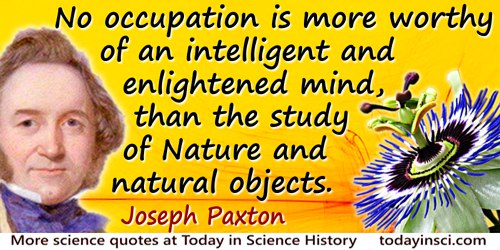
No occupation is more worthy of an intelligent and enlightened mind, than the study of Nature and natural objects; and whether we labour to investigate the structure and function of the human system, whether we direct our attention to the classification and habits of the animal kingdom, or prosecute our researches in the more pleasing and varied field of vegetable life, we shall constantly find some new object to attract our attention, some fresh beauties to excite our imagination, and some previously undiscovered source of gratification and delight.
In A Practical Treatise on the Cultivation of the Dahlia (1838), 1-2.
No person will deny that the highest degree of attainable accuracy is an object to be desired, and it is generally found that the last advances towards precision require a greater devotion of time, labour, and expense, than those which precede them.
Reflections on the Decline of Science in England (1830), 167.
No place affords a more striking conviction of the vanity of human hopes than a publick library; for who can see the wall crouded on every side by mighty volumes, the works of laborious meditation, and accurate inquiry, now scarcely known but by the catalogue, and preserved only to encrease the pomp of learning, without considering how many hours have been wasted in vain endeavours, how often imagination has anticipated the praises of futurity, how many statues have risen to the eye of vanity, how many ideal converts have elevated zeal, how often wit has exulted in the eternal infamy of his antagonists, and dogmatism has delighted in the gradual advances of his authority, the immutability of his decrees, and the perpetuity of his power.
Non unquam dedit
Documenta fors majora, quam fragili loco
Starent superbi.
Seneca, Troades, II, 4-6
Insulting chance ne'er call'd with louder voice,
On swelling mortals to be proud no more.
Of the innumerable authors whose performances are thus treasured up in magnificent obscurity, most are forgotten, because they never deserved to be remembered, and owed the honours which they have once obtained, not to judgment or to genius, to labour or to art, but to the prejudice of faction, the stratagem of intrigue, or the servility of adulation.
Nothing is more common than to find men whose works are now totally neglected, mentioned with praises by their contemporaries, as the oracles of their age, and the legislators of science. Curiosity is naturally excited, their volumes after long enquiry are found, but seldom reward the labour of the search. Every period of time has produced these bubbles of artificial fame, which are kept up a while by the breath of fashion and then break at once and are annihilated. The learned often bewail the loss of ancient writers whose characters have survived their works; but perhaps if we could now retrieve them we should find them only the Granvilles, Montagus, Stepneys, and Sheffields of their time, and wonder by what infatuation or caprice they could be raised to notice.
It cannot, however, be denied, that many have sunk into oblivion, whom it were unjust to number with this despicable class. Various kinds of literary fame seem destined to various measures of duration. Some spread into exuberance with a very speedy growth, but soon wither and decay; some rise more slowly, but last long. Parnassus has its flowers of transient fragrance as well as its oaks of towering height, and its laurels of eternal verdure.
Non unquam dedit
Documenta fors majora, quam fragili loco
Starent superbi.
Seneca, Troades, II, 4-6
Insulting chance ne'er call'd with louder voice,
On swelling mortals to be proud no more.
Of the innumerable authors whose performances are thus treasured up in magnificent obscurity, most are forgotten, because they never deserved to be remembered, and owed the honours which they have once obtained, not to judgment or to genius, to labour or to art, but to the prejudice of faction, the stratagem of intrigue, or the servility of adulation.
Nothing is more common than to find men whose works are now totally neglected, mentioned with praises by their contemporaries, as the oracles of their age, and the legislators of science. Curiosity is naturally excited, their volumes after long enquiry are found, but seldom reward the labour of the search. Every period of time has produced these bubbles of artificial fame, which are kept up a while by the breath of fashion and then break at once and are annihilated. The learned often bewail the loss of ancient writers whose characters have survived their works; but perhaps if we could now retrieve them we should find them only the Granvilles, Montagus, Stepneys, and Sheffields of their time, and wonder by what infatuation or caprice they could be raised to notice.
It cannot, however, be denied, that many have sunk into oblivion, whom it were unjust to number with this despicable class. Various kinds of literary fame seem destined to various measures of duration. Some spread into exuberance with a very speedy growth, but soon wither and decay; some rise more slowly, but last long. Parnassus has its flowers of transient fragrance as well as its oaks of towering height, and its laurels of eternal verdure.
The Rambler, Number 106, 23 Mar 1751. In W. J. Bate and Albrecht B. Strauss (eds.), The Rambler (1969), Vol. 2, 200-1.
Not to know what has been transacted in former times is to be always a child. If no use is made of the labors of past ages, the world must remain always in the infancy of knowledge.
In Samuel Johnson and Arthur Murphy, The works of Samuel Johnson (1837), 237.
Nothing tends so much to the advancement of knowledge as the application of a new instrument. The native intellectual powers of men in different times are not so much the causes of the different success of their labors, as the peculiar nature of the means and artificial resources in their possession.
In Elements of Chemical Philosophy (1812), Vol. 1, Part 1, 28.
Now having (I know not by what accident) engaged my thoughts upon the Bills of Mortality, and so far succeeded therein, as to have reduced several great confused Volumes into a few perspicuous Tables, and abridged such Observations as naturally flowed from them, into a few succinct Paragraphs, without any long Series of multiloquious Deductions, I have presumed to sacrifice these my small, but first publish'd, Labours unto your Lordship, as unto whose benign acceptance of some other of my Papers even the birth of these is due; hoping (if I may without vanity say it) they may be of as much use to persons in your Lordships place, as they are of none to me, which is no more than fairest Diamonds are to the Journeymen Jeweller that works them, or the poor Labourer that first digg'd them from Earth.
[An early account demonstrating the value of statistical analysis of public health data. Graunt lived in London at the time of the plague epidemics.]
[An early account demonstrating the value of statistical analysis of public health data. Graunt lived in London at the time of the plague epidemics.]
From Graunt's 'Epistle Dedicatory', for Natural and Political Observations Mentioned in a Following Index and Made upon Bills of Mortality (1662). Reproduced in Cornelius Walford, The Insurance Cyclopaedia (1871), Vol. 1, 286. (This text used abbreviations for “Mort.” and “vols.”) The italicized words are given as from other sources. Note: bills of mortality are abstracts from parish registers showing the numbers that have died in each week, month or year.
Now that is the wisdom of a man, in every instance of his labor, to hitch his wagon to a star, and see his chore done by the gods themselves. That is the way we are strong, by borrowing the might of the elements. The forces of steam, gravity, galvanism, light, magnets, wind, fire, serve us day by day and cost us nothing.
From Chap. 2, 'Civilization', in Society and Solitude (1870), 24.
October 9, 1863
Always, however great the height of the balloon, when I have seen the horizon it has roughly appeared to be on the level of the car though of course the dip of the horizon is a very appreciable quantity or the same height as the eye. From this one might infer that, could the earth be seen without a cloud or anything to obscure it, and the boundary line of the plane approximately the same height as the eye, the general appearance would be that of a slight concavity; but I have never seen any part of the surface of the earth other than as a plane.
Towns and cities, when viewed from the balloon are like models in motion. I shall always remember the ascent of 9th October, 1863, when we passed over London about sunset. At the time when we were 7,000 feet high, and directly over London Bridge, the scene around was one that cannot probably be equalled in the world. We were still so low as not to have lost sight of the details of the spectacle which presented itself to our eyes; and with one glance the homes of 3,000,000 people could be seen, and so distinct was the view, that every large building was easily distinguishable. In fact, the whole of London was visible, and some parts most clearly. All round, the suburbs were also very distinct, with their lines of detached villas, imbedded as it were in a mass of shrubs; beyond, the country was like a garden, its fields, well marked, becoming smaller and smaller as the eye wandered farther and farther away.
Again looking down, there was the Thames, throughout its whole length, without the slightest mist, dotted over its winding course with innumerable ships and steamboats, like moving toys. Gravesend was visible, also the mouth of the Thames, and the coast around as far as Norfolk. The southern shore of the mouth of the Thames was not so clear, but the sea beyond was seen for many miles; when at a higher elevation, I looked for the coast of France, but was unable to see it. On looking round, the eye was arrested by the garden-like appearance of the county of Kent, till again London claimed yet more careful attention.
Smoke, thin and blue, was curling from it, and slowly moving away in beautiful curves, from all except one part, south of the Thames, where it was less blue and seemed more dense, till the cause became evident; it was mixed with mist rising from the ground, the southern limit of which was bounded by an even line, doubtless indicating the meeting of the subsoils of gravel and clay. The whole scene was surmounted by a canopy of blue, everywhere free from cloud, except near the horizon, where a band of cumulus and stratus extended all round, forming a fitting boundary to such a glorious view.
As seen from the earth, the sunset this evening was described as fine, the air being clear and the shadows well defined; but, as we rose to view it and its effects, the golden hues increased in intensity; their richness decreased as the distance from the sun increased, both right and left; but still as far as 90º from the sun, rose-coloured clouds extended. The remainder of the circle was completed, for the most part, by pure white cumulus of well-rounded and symmetrical forms.
I have seen London by night. I have crossed it during the day at the height of four miles. I have often admired the splendour of sky scenery, but never have I seen anything which surpassed this spectacle. The roar of the town heard at this elevation was a deep, rich, continuous sound the voice of labour. At four miles above London, all was hushed; no sound reached our ears.
Always, however great the height of the balloon, when I have seen the horizon it has roughly appeared to be on the level of the car though of course the dip of the horizon is a very appreciable quantity or the same height as the eye. From this one might infer that, could the earth be seen without a cloud or anything to obscure it, and the boundary line of the plane approximately the same height as the eye, the general appearance would be that of a slight concavity; but I have never seen any part of the surface of the earth other than as a plane.
Towns and cities, when viewed from the balloon are like models in motion. I shall always remember the ascent of 9th October, 1863, when we passed over London about sunset. At the time when we were 7,000 feet high, and directly over London Bridge, the scene around was one that cannot probably be equalled in the world. We were still so low as not to have lost sight of the details of the spectacle which presented itself to our eyes; and with one glance the homes of 3,000,000 people could be seen, and so distinct was the view, that every large building was easily distinguishable. In fact, the whole of London was visible, and some parts most clearly. All round, the suburbs were also very distinct, with their lines of detached villas, imbedded as it were in a mass of shrubs; beyond, the country was like a garden, its fields, well marked, becoming smaller and smaller as the eye wandered farther and farther away.
Again looking down, there was the Thames, throughout its whole length, without the slightest mist, dotted over its winding course with innumerable ships and steamboats, like moving toys. Gravesend was visible, also the mouth of the Thames, and the coast around as far as Norfolk. The southern shore of the mouth of the Thames was not so clear, but the sea beyond was seen for many miles; when at a higher elevation, I looked for the coast of France, but was unable to see it. On looking round, the eye was arrested by the garden-like appearance of the county of Kent, till again London claimed yet more careful attention.
Smoke, thin and blue, was curling from it, and slowly moving away in beautiful curves, from all except one part, south of the Thames, where it was less blue and seemed more dense, till the cause became evident; it was mixed with mist rising from the ground, the southern limit of which was bounded by an even line, doubtless indicating the meeting of the subsoils of gravel and clay. The whole scene was surmounted by a canopy of blue, everywhere free from cloud, except near the horizon, where a band of cumulus and stratus extended all round, forming a fitting boundary to such a glorious view.
As seen from the earth, the sunset this evening was described as fine, the air being clear and the shadows well defined; but, as we rose to view it and its effects, the golden hues increased in intensity; their richness decreased as the distance from the sun increased, both right and left; but still as far as 90º from the sun, rose-coloured clouds extended. The remainder of the circle was completed, for the most part, by pure white cumulus of well-rounded and symmetrical forms.
I have seen London by night. I have crossed it during the day at the height of four miles. I have often admired the splendour of sky scenery, but never have I seen anything which surpassed this spectacle. The roar of the town heard at this elevation was a deep, rich, continuous sound the voice of labour. At four miles above London, all was hushed; no sound reached our ears.
Travels in the Air (1871), 99-100.
Of Science generally we can remark, first, that it is the most perfect embodiment of Truth, and of the ways of getting at Truth. More than anything else does it impress the mind with the nature of Evidence, with the labour and precautions necessary to prove a thing. It is the grand corrective of the laxness of the natural man in receiving unaccredited facts and conclusions. It exemplifies the devices for establishing a fact, or a law, under every variety of circumstances; it saps the credit of everything that is affirmed without being properly attested.
In Education as a Science (1879), 147-148.
Oh, my dear Kepler, how I wish that we could have one hearty laugh together. Here, at Padua, is the principal professor of philosophy, whom I have repeatedly and urgently requested to look at the moon and planets through my glass, [telescope] which he pertinaciously refuses to do. Why are you not here? what shouts of laughter we should have at this glorious folly! and to hear the professor of philosophy at Pisa laboring before the grand duke with logical arguments, as if with magical incantations, to charm the new planets out of the sky.
From Letter to Johannes Kepler. As translated in John Elliot Drinkwater Bethune, Life of Galileo Galilei: With Illustrations of the Advancement of Experimental Philosophy (1832), 92-93.
Once it happened that all the other members of a man mutinied against the stomach, which they accused as the single, idle, uncontributing part in the entire body, while the rest were put to hardships and the expense of much labor to supply and minister to its appetites. However, the stomach merely ridiculed the fatuity of the members, who appeared not to be aware that the stomach certainly does receive the general nourishment, but only to return it again and distribute it amongst the rest.
Fable related by Menenius Agrippa to resolve a grievance of plebeians against the social hierarchy, described in 'Life of Coriolanus', collected in A.H. Clough (ed.), Plutarch’s Lives of Illustrious Men (1859, 1881), 155.
One-story intellects, two-story intellects, three-story intellects with skylights. All fact-collectors, who have no aim beyond their facts, are one-story men. Two-story men compare, reason, generalize, using the labors of the fact-collectors as well as their own. Three-story men idealize, imagine, predict; their best illumination comes from above, through the skylight. There are minds with large ground-floors, that can store an infinite amount of knowledge; some librarians, for instance, who know enough of books to help other people, without being able to make much other use of their knowledge, have intellects of this class. Your great working lawyer has two spacious stories; his mind is clear, because his mental floors are large, and he has room to arrange his thoughts so that lie can get at them,—facts below, principles above, and all in ordered series; poets are often narrow below, incapable of clear statement, and with small power of consecutive reasoning, but full of light, if sometimes rather bare of furniture, in the attics.
The Poet at the Breakfast Table (1883), 50.
Our moral theorists seem never content with the normal. Why must it always be a contest between fornication, obesity and laziness, and celibacy, fasting and hard labor?
Science has gone a long way toward helping man to free himself from the burden of hard labor; yet, science itself is not a liberator. It creates means, not goals. It is up to men to utilize those means to achieve reasonable goals.
In 'I Am an American' (22 Jun 1940), Einstein Archives 29-092. Excerpted in David E. Rowe and Robert J. Schulmann, Einstein on Politics: His Private Thoughts and Public Stands on Nationalism, Zionism, War, Peace, and the Bomb (2007), 470. The British Library Sound Archive holds a recording of this statement by Einstein. It was during a radio broadcast for the Immigration and Naturalization Service, interviewed by a State Department Official. Einstein spoke following an examination on his application for American citizenship in Trenton, New Jersey. The attack on Pearl Harbor and America’s declaration of war on Japan was still over a year in the future.
Science has gone down into the mines and coal-pits, and before the safety-lamp the Gnomes and Genii of those dark regions have disappeared… Sirens, mermaids, shining cities glittering at the bottom of quiet seas and in deep lakes, exist no longer; but in their place, Science, their destroyer, shows us whole coasts of coral reef constructed by the labours of minute creatures; points to our own chalk cliffs and limestone rocks as made of the dust of myriads of generations of infinitesimal beings that have passed away; reduces the very element of water into its constituent airs, and re-creates it at her pleasure.
Book review of Robert Hunt, Poetry of Science (1848), in the London Examiner (1848). Although uncredited in print, biographers identified his authorship from his original handwritten work. Collected in Charles Dickens and Frederic George Kitton (ed.) Old Lamps for New Ones: And Other Sketches and Essays (1897), 86-87.
Science is the labor and handicraft of the mind; poetry can only be considered its recreation.
As quoted in Nathaniel Holmes, The Authorship of Shakespeare (1867), 198. Footnoted as Int. Globe, Works (Mont.), XV. 150.
Science is the labor of mind applied to nature
In Alexander Humboldt and E.C. Otté (trans.), 'Introduction', Cosmos: Sketch of a Physical Description of the Universe (1852), Vol. 1, 76. The translator’s preface is dated 1844.
SCIENCE! thou fair effusive ray
From the great source of mental Day,
Free, generous, and refin'd!
Descend with all thy treasures fraught,
Illumine each bewilder'd thought,
And bless my labour'g mind.
From the great source of mental Day,
Free, generous, and refin'd!
Descend with all thy treasures fraught,
Illumine each bewilder'd thought,
And bless my labour'g mind.
'Hymn to Science' (1739). In Robin Dix (ed.), The Poetical Works of Mark Akenside (1996), 406.
Scientists and Drapers. Why should the botanist, geologist or other-ist give himself such airs over the draper’s assistant? Is it because he names his plants or specimens with Latin names and divides them into genera and species, whereas the draper does not formulate his classifications, or at any rate only uses his mother tongue when he does? Yet how like the sub-divisions of textile life are to those of the animal and vegetable kingdoms! A few great families—cotton, linen, hempen, woollen, silk, mohair, alpaca—into what an infinite variety of genera and species do not these great families subdivide themselves? And does it take less labour, with less intelligence, to master all these and to acquire familiarity with their various habits, habitats and prices than it does to master the details of any other great branch of science? I do not know. But when I think of Shoolbred’s on the one hand and, say, the ornithological collections of the British Museum upon the other, I feel as though it would take me less trouble to master the second than the first.
Samuel Butler, Henry Festing Jones (ed.), The Note-Books of Samuel Butler (1917), 218.
See that your children be taught, not only the labors of the earth, but the loveliness of it.
In Elbert Hubbard (ed. and publ.), The Philistine (Mar 1908), 26, No. 4, inside front cover, opposite 97.
Shun no toil to make yourself remarkable by some talent or other; yet do not devote yourself to one branch exclusively. Strive to get clear notions about all. Give up no science entirely; for science is but one.
In Henry Southgate (ed.), Many Thoughts of Many Minds (1862), 340.
Simple as the law of gravity now appears, and beautifully in accordance with all the observations of past and of present times, consider what it has cost of intellectual study. Copernicus, Galileo, Kepler, Euler, Lagrange, Laplace, all the great names which have exalted the character of man, by carrying out trains of reasoning unparalleled in every other science; these, and a host of others, each of whom might have been the Newton of another field, have all labored to work out, the consequences which resulted from that single law which he discovered. All that the human mind has produced—the brightest in genius, the most persevering in application, has been lavished on the details of the law of gravity.
in The Ninth Bridgewater Treatise: A Fragment (1838), 57.
Such is always the pursuit of knowledge. The celestial fruits, the golden apples of the Hesperides, are ever guarded by a hundred-headed dragon which never sleeps, so that it is an Herculean labor to pluck them.
In The Writings of Henry David Thoreau: V; Excursions and Poems (1906), 307.
Taking him for all and all, I think it will be conceded that Michael Faraday was the greatest experimental philosopher the world has ever seen; and I will add the opinion, that the progress of future research will tend, not to dim or to diminish, but to enhance and glorify the labours of this mighty investigator.
In Faraday as a Discoverer (1868), 147.
That the machine of Heaven is not a hard and impervious body full of various real spheres, as up to now has been believed by most people. It will be proved that it extends everywhere, most fluid and simple, and nowhere presents obstacles as was formerly held, the circuits of the Planets being wholly free and without the labour and whirling round of any real spheres at all, being divinely governed under a given law.
De Mundi Aetherei Recentioribus Phaenomenis (On Recent Phenomena in the Aetherial World) (1588). Quoted in M. Boas Hall, The Scientific Renaissance 1450-1630 (1962), 117.
That the master manufacturer, by dividing the work to be executed into different processes, each requiring different degrees of skill or of force, can purchase precisely the precise quantity of both which is necessary for each process; whereas, if the whole work were executed by one workman, that person must possess sufficient skill to perform the most difficult, and sufficient strength to execute the most laborious, of the operations into which the art is divided.
In 'On the Division of Labour', Economy of Machinery and Manufactures (1st ed., 1832), chap. 18, 127.
The “British Association for the Promotion of Science,” … is almost necessary for the purposes of science. The periodical assemblage of persons, pursuing the same or différent branches of knowledge, always produces an excitement which is favourable to the development of new ideas; whilst the long period of repose which succeeds, is advantageous for the prosecution of the reasonings or the experiments then suggested; and the récurrence of the meeting in the succeeding year, will stimulate the activity of the inquirer, by the hope of being then enabled to produce the successful result of his labours.
In 'Future Prospects', On the Economy of Machinery and Manufactures (1st ed., 1832), chap. 32, 274. Note: The British Association for the Advancement of Science held its first meeting at York in 1831, the year before the first publication of this book in 1832.
The advancement of science is slow; it is effected only by virtue of hard work and perseverance. And when a result is attained, should we not in recognition connect it with the efforts of those who have preceded us, who have struggled and suffered in advance? Is it not truly a duty to recall the difficulties which they vanquished, the thoughts which guided them; and how men of different nations, ideas, positions, and characters, moved solely by the love of science, have bequeathed to us the unsolved problem? Should not the last comer recall the researches of his predecessors while adding in his turn his contribution of intelligence and of labor? Here is an intellectual collaboration consecrated entirely to the search for truth, and which continues from century to century.
[Respecting how the work of prior researchers had enabled his isolation of fluorine.]
[Respecting how the work of prior researchers had enabled his isolation of fluorine.]
Proceedings of the Royal Institution (1897). In Annual Report of the Board of Regents of the Smithsonian Institution to July 1897 (1898), 262.
The cases of action at a distance are becoming, in a physical point of view, daily more and more important. Sound, light, electricity, magnetism, gravitation, present them as a series.
The nature of sound and its dependence on a medium we think we understand, pretty well. The nature of light as dependent on a medium is now very largely accepted. The presence of a medium in the phenomena of electricity and magnetism becomes more and more probable daily. We employ ourselves, and I think rightly, in endeavouring to elucidate the physical exercise of these forces, or their sets of antecedents and consequents, and surely no one can find fault with the labours which eminent men have entered upon in respect of light, or into which they may enter as regards electricity and magnetism. Then what is there about gravitation that should exclude it from consideration also? Newton did not shut out the physical view, but had evidently thought deeply of it; and if he thought of it, why should not we, in these advanced days, do so too?
The nature of sound and its dependence on a medium we think we understand, pretty well. The nature of light as dependent on a medium is now very largely accepted. The presence of a medium in the phenomena of electricity and magnetism becomes more and more probable daily. We employ ourselves, and I think rightly, in endeavouring to elucidate the physical exercise of these forces, or their sets of antecedents and consequents, and surely no one can find fault with the labours which eminent men have entered upon in respect of light, or into which they may enter as regards electricity and magnetism. Then what is there about gravitation that should exclude it from consideration also? Newton did not shut out the physical view, but had evidently thought deeply of it; and if he thought of it, why should not we, in these advanced days, do so too?
Letter to E. Jones, 9 Jun 1857. In Michael Faraday, Bence Jones (ed.), The Life and Letters of Faraday (1870), Vol. 2, 387.
The economic anarchy of capitalist society as it exists today is, in my opinion, the real source of the evil. We see before us a huge community of producers the members of which are unceasingly striving to deprive each other of the fruits of their collective labor–not by force, but on the whole in faithful compliance with legally established rules.
…...
The engineer is the key figure in the material progress of the world. It is his engineering that makes a reality of the potential value of science by translating scientific knowledge into tools, resources, energy and labor to bring them to the service of man ... To make contribution of this kind the engineer requires the imagination to visualize the needs of society and to appreciate what is possible as well as the technological and broad social age understanding to bring his vision to reality.
In Philip Sporn, Foundations of Engineering: Cornell College of Engineering Lectures, Spring 1963 (1964), 22.
The estimate we form of the intellectual capacity of our race, is founded on an examination of those productions which have resulted from the loftiest flights of individual genius, or from the accumulated labors of generations of men, by whose long-continued exertions a body of science has been raised up, surpassing in its extent the creative powers of any individual, and demanding for its development a length of time, to which no single life extends.
In The Ninth Bridgewater Treatise: A Fragment (1838), 30.
The feudal model of agriculture collided, first, with environmental limits and then with a massive external shock – the Black Death. After that, there was a demographic shock: too few workers for the land, which raised their wages and made the old feudal obligation system impossible to enforce. The labour shortage also forced technological innovation. The new technologies that underpinned the rise of merchant capitalism were the ones that stimulated commerce (printing and accountancy), the creation of tradeable wealth (mining, the compass and fast ships) and productivity (mathematics and the scientific method).
In 'The End of Capitalism Has Begun', The Guardian (17 Jul 2015) (online).
The framing of hypotheses is, for the enquirer after truth, not the end, but the beginning of his work. Each of his systems is invented, not that he may admire it and follow it into all its consistent consequences, but that he may make it the occasion of a course of active experiment and observation. And if the results of this process contradict his fundamental assumptions, however ingenious, however symmetrical, however elegant his system may be, he rejects it without hesitation. He allows no natural yearning for the offspring of his own mind to draw him aside from the higher duty of loyalty to his sovereign, Truth, to her he not only gives his affections and his wishes, but strenuous labour and scrupulous minuteness of attention.
Philosophy of the Inductive Sciences (1847), Vol. 2, 57.
The history of semiconductor physics is not one of grand heroic theories, but one of painstaking intelligent labor. Not strokes of genius producing lofty edifices, but great ingenuity and endless undulation of hope and despair. Not sweeping generalizations, but careful judgment of the border between perseverance and obstinacy. Thus the history of solid-state physics in general, and of semiconductors in particular, is not so much about great men and women and their glorious deeds, as about the unsung heroes of thousands of clever ideas and skillful experiments—reflection of an age of organization rather than of individuality.
'Selected Topics from the History of Semiconductor Physics and Its Applications', in Lillian Hoddeson et al. (eds.), Out of the Crystal Maze (1992), 474.
The increasing technicality of the terminology employed is also a serious difficulty. It has become necessary to learn an extensive vocabulary before a book in even a limited department of science can be consulted with much profit. This change, of course, has its advantages for the initiated, in securing precision and concisement of statement; but it tends to narrow the field in which an investigator can labour, and it cannot fail to become, in the future, a serious impediment to wide inductive generalisations.
Year Book of Science (1892), preface, from review in Chemical News and Journal of Physical Science (14 Apr 1892), 65, 190.
The iron labor of conscious logical reasoning demands great perseverance and great caution; it moves on but slowly, and is rarely illuminated by brilliant flashes of genius. It knows little of that facility with which the most varied instances come thronging into the memory of the philologist or historian. Rather is it an essential condition of the methodical progress of mathematical reasoning that the mind should remain concentrated on a single point, undisturbed alike by collateral ideas on the one hand, and by wishes and hopes on the other, and moving on steadily in the direction it has deliberately chosen.
In Ueber das Verhältniss der Naturwissenschaften zur Gesammtheit der Wissenschaft, Vorträge und Reden (1896), Bd. 1, 178.
The labor of love aspect is important. The most successful scientists are not the most talented. But they are the ones who are impelled by curiosity. They’ve got to know what the answer is.
As quoted in Andrew Grant and Gaia Grant, Who Killed Creativity?: ...And How Do We Get It Back? (2012).
The land! That is where our roots are. There is the basis of our physical life. The farther we get away from the land, the greater our insecurity. From the land comes everything that supports life, everything we use for the service of physical life. The land has not collapsed or shrunk in either extent or productivity. It is there waiting to honor all the labor we are willing to invest in it, and able to tide us across any dislocation of economic conditions.
Advice during the Great Depression, placed in an advertisement, 'Henry Ford on Self-Help', Literary Digest (29 Jun 1932), 113, No. 12, 29, and various other magazines.
The majority of mathematical truths now possessed by us presuppose the intellectual toil of many centuries. A mathematician, therefore, who wishes today to acquire a thorough understanding of modern research in this department, must think over again in quickened tempo the mathematical labors of several centuries. This constant dependence of new truths on old ones stamps mathematics as a science of uncommon exclusiveness and renders it generally impossible to lay open to uninitiated readers a speedy path to the apprehension of the higher mathematical truths. For this reason, too, the theories and results of mathematics are rarely adapted for popular presentation … This same inaccessibility of mathematics, although it secures for it a lofty and aristocratic place among the sciences, also renders it odious to those who have never learned it, and who dread the great labor involved in acquiring an understanding of the questions of modern mathematics. Neither in the languages nor in the natural sciences are the investigations and results so closely interdependent as to make it impossible to acquaint the uninitiated student with single branches or with particular results of these sciences, without causing him to go through a long course of preliminary study.
In Mathematical Essays and Recreations (1898), 32.
The most striking characteristic of the written language of algebra and of the higher forms of the calculus is the sharpness of definition, by which we are enabled to reason upon the symbols by the mere laws of verbal logic, discharging our minds entirely of the meaning of the symbols, until we have reached a stage of the process where we desire to interpret our results. The ability to attend to the symbols, and to perform the verbal, visible changes in the position of them permitted by the logical rules of the science, without allowing the mind to be perplexed with the meaning of the symbols until the result is reached which you wish to interpret, is a fundamental part of what is called analytical power. Many students find themselves perplexed by a perpetual attempt to interpret not only the result, but each step of the process. They thus lose much of the benefit of the labor-saving machinery of the calculus and are, indeed, frequently incapacitated for using it.
In 'Uses of Mathesis', Bibliotheca Sacra (Jul 1875), 32, 505.
The native intellectual powers of men in different times, are not so much the causes of the different success of their labours, as the peculiar nature of the means and artificial resources in their possession. Independent of vessels of glass, there could have been no accurate manipulations in common chemistry: the air pump was necessary for live investigation of the properties of gaseous matter; and without the Voltaic apparatus, there was no possibility of examining the relations of electrical polarities to chemical attractions.
In Elements of Chemical Philosophy (1812), Vol. 1, Part 1, 28-29.
The owner of the means of production is in a position to purchase the labor power of the worker. By using the means of production, the worker produces new goods which become the property of the capitalist. The essential point about this process is the relation between what the worker produces and what he is paid, both measured in terms of real value. In so far as the labor contract is free what the worker receives is determined not by the real value of the goods he produces, but by his minimum needs and by the capitalists’ requirements for labor power in relation to the number of workers competing for jobs. It is important to understand that even in theory the payment of the worker is not determined by the value of his product.
…...
The persons who have been employed on these problems of applying the properties of matter and the laws of motion to the explanation of the phenomena of the world, and who have brought to them the high and admirable qualities which such an office requires, have justly excited in a very eminent degree the admiration which mankind feels for great intellectual powers. Their names occupy a distinguished place in literary history; and probably there are no scientific reputations of the last century higher, and none more merited, than those earned by great mathematicians who have laboured with such wonderful success in unfolding the mechanism of the heavens; such for instance as D ’Alembert, Clairaut, Euler, Lagrange, Laplace.
In Astronomy and General Physics (1833), Bk. 3, chap. 4, 327.
The position of the anthropologist of to-day resembles in some sort the position of classical scholars at the revival of learning. To these men the rediscovery of ancient literature came like a revelation, disclosing to their wondering eyes a splendid vision of the antique world, such as the cloistered of the Middle Ages never dreamed of under the gloomy shadow of the minster and within the sound of its solemn bells. To us moderns a still wider vista is vouchsafed, a greater panorama is unrolled by the study which aims at bringing home to us the faith and the practice, the hopes and the ideals, not of two highly gifted races only, but of all mankind, and thus at enabling us to follow the long march, the slow and toilsome ascent, of humanity from savagery to civilization. And as the scholar of the Renaissance found not merely fresh food for thought but a new field of labour in the dusty and faded manuscripts of Greece and Rome, so in the mass of materials that is steadily pouring in from many sides—from buried cities of remotest antiquity as well as from the rudest savages of the desert and the jungle—we of to-day must recognise a new province of knowledge which will task the energies of generations of students to master.
'Author’s Introduction' (1900). In Dr Theodor H. Gaster (ed.), The New Golden Bough (1959), xxv-xxvi.
The product of mental labor—science—always stands far below its value, because the labor-time necessary to reproduce it has no relation at all to the labor-time required for its original production.
…...
The prohibition of science would be contrary to the Bible, which in hundreds of places teaches us how the greatness and the glory of God shine forth marvelously in all His works, and is to be read above all in the open book of the heavens. And let no one believe that the reading of the most exalted thoughts which are inscribed upon these pages is to be accomplished through merely staring up at the radiance of the stars. There are such profound secrets and such lofty conceptions that the night labors and the researches of hundreds and yet hundreds of the keenest minds, in investigations extending over thousands of years would not penetrate them, and the delight of the searching and finding endures forever.
As stated by William H. Hobbs, 'The Making of Scientific Theories,' Address of the president of Michigan Academy of Science at the Annual Meeting, Ann Arbor (28 Mar 1917) in Science (11 May 1917), N.S. 45, No. 1167, 443.
The school of Plato has advanced the interests of the race as much through geometry as through philosophy. The modern engineer, the navigator, the astronomer, built on the truths which those early Greeks discovered in their purely speculative investigations. And if the poetry, statesmanship, oratory, and philosophy of our day owe much to Plato’s divine Dialogues, our commerce, our manufactures, and our science are equally indebted to his Conic Sections. Later instances may be abundantly quoted, to show that the labors of the mathematician have outlasted those of the statesman, and wrought mightier changes in the condition of the world. Not that we would rank the geometer above the patriot, but we claim that he is worthy of equal honor.
In 'Imagination in Mathematics', North American Review, 85, 228.
The state must increasingly and earnestly concern itself with the care of the sick and the aged, and above all, the children. … I look forward to the universal establishment of minimum standards of life and labor. … I do not want to see impaired the vigour of competition, but we can do much to mitigate the consequences of failure. We can draw a line below which we will not allow persons to live and labour yet above which they may compete with all the strength of their manhood. We want to have free competition upwards; we decline to allow free competition to run downwards. … We do not want to pull down the structure of science and civilization — but to spread a net over the abyss.
In The People's Rights (1909, 1971), 154-155.
The story of scientific discovery has its own epic unity—a unity of purpose and endeavour—the single torch passing from hand to hand through the centuries; and the great moments of science when, after long labour, the pioneers saw their accumulated facts falling into a significant order—sometimes in the form of a law that revolutionised the whole world of thought—have an intense human interest, and belong essentially to the creative imagination of poetry.
In Prefactory Note, Watchers of the Sky (1922), v.
The valuable properties of this cement depend in a great measure on the mode of preparing it for use. The mixing should therefore be conducted with care in order to form a perfect union of the powdered cement, sand and water. This can be best accomplished by the use of the New England corn hoe on a board floor or by beating with a hand stamper; not much labour is required if properly applied. Mechanics can judge when the mixture is perfect by the appearance of the mortar, which, when properly prepared, very much resembles putty.
Directions for Using White's Patent Hydraulic Cement.
The virgin fertility of our soils, and the vast amount of unskilled labor, have been more of a curse than a blessing to agriculture. This exhaustive system for cultivation, the destruction of forests, the rapid and almost constant decomposition of organic matter, together with the problems of nitrification and denitrification, the multitudinous insects and fungus diseases which are ever increasing with marvelous rapidity year by year, make our agricultural problem one requiring more brains than of the North, East or West.
In Farmer’s Leaflet 7: The Need of Scientific Agriculture in the South (1902). Reprinted in The Review of Reviews (1902), 25, 322.
Theories cannot claim to be indestructible. They are only the plough which the ploughman uses to draw his furrow and which he has every right to discard for another one, of improved design, after the harvest. To be this ploughman, to see my labours result in the furtherance of scientific progress, was the height of my ambition, and now the Swedish Academy of Sciences has come, at this harvest, to add the most brilliant of crowns.
'The Method of Direct Hydrogenation by Catalysis', Nobel Lecture (11 Dec 1912). Noble Lectures in Chemistry 1901-1921 (1966), 230-1.
There are about 3,000,000 people seriously ill in the United States…. More than half of this illness is preventable. If we count the value of each life lost at only $1700 and reckon the average earning lost by illness at $700 a year for grown men, we find that the economic gain from mitigation of preventable disease in the United States would exceed $1,500,000,000 a year. … This gain … can be secured through medical investigation and practice, school and factory hygiene, restriction of labor by women and children, the education of the people in both public and private hygiene, and through improving the efficiency of our health service, municipal, state, and national.
From 'National Efficiency', Report of the National Conservation Commission (Feb 1909), Vol. 1, 25. Collected in United States Congressional Serial Set (1909), Issue 5397, 60th Congress, 2nd Session, Senate, Document 676. In transmitting the report to Congress on 22 Jan 1909, President Theodore Roosevelt introduced this report as the “first inventory of natural resources,” which “presents a statement of our available capital in material resources, which are the means of progress.” [It is noteworthy that the above quoted commentary on “National Efficiency” was included with the inventory of mineral, lands, forest and lands of the United States. —Webmaster]
There has not been any science so much esteemed and honored as this of mathematics, nor with so much industry and vigilance become the care of great men, and labored in by the potentates of the world, viz. emperors, kings, princes, etc.
In 'On the Usefulness of Mathematics', in Works (1840), Vol. 2, 28.
There is no expedient to which a man will not resort to avoid the real labor of thinking.[Greatly abbreviated and paraphrased.]
The original 1784 version of this quote begins “A provision of endless apparatus…” (see elsewhere on this page). Over the years, the original 35-word quote has been paraphrased, re-paraphrased and abbreviated to these 18 words. In this form, it was published by B.C. Forbes in 'Why Do So Many Men Never Amount to Anything?',The American Magazine (Jan 1921). The journalist, having visited Thomas Edison’s laboratory, wrote that Edison showed him a placard inscribed with this quote, including the name of Joshua Reynolds, with the intention of having copies placed “all over the plant.” The quote was subsequently repeated by other writers, (describing Edison’s use of the sign), some of whom omitted the name of Joshua Reynolds incorrectly implying attribution to Edison.
There was yet another disadvantage attaching to the whole of Newton’s physical inquiries, ... the want of an appropriate notation for expressing the conditions of a dynamical problem, and the general principles by which its solution must be obtained. By the labours of LaGrange, the motions of a disturbed planet are reduced with all their complication and variety to a purely mathematical question. It then ceases to be a physical problem; the disturbed and disturbing planet are alike vanished: the ideas of time and force are at an end; the very elements of the orbit have disappeared, or only exist as arbitrary characters in a mathematical formula
Address to the Mechanics Institute, 'An Address on the Genius and Discoveries of Sir Isaac Newton' (1835), excerpted in paper by Luis M. Laita, Luis de Ledesma, Eugenio Roanes-Lozano and
Alberto Brunori, 'George Boole, a Forerunner of Symbolic Computation', collected in John A. Campbell and Eugenio Roanes-Lozano (eds.), Artificial Intelligence and Symbolic Computation: International Conference AISC 2000 (2001), 3.
There was, I think, a feeling that the best science was that done in the simplest way. In experimental work, as in mathematics, there was “style” and a result obtained with simple equipment was more elegant than one obtained with complicated apparatus, just as a mathematical proof derived neatly was better than one involving laborious calculations. Rutherford's first disintegration experiment, and Chadwick's discovery of the neutron had a “style” that is different from that of experiments made with giant accelerators.
From 'Physics in a University Laboratory Before and After World War II', Proceedings of the Royal Society of London, Series A, (1975), 342, 463. As cited in Alan McComas, Galvani's Spark: The Story of the Nerve Impulse (2011), 107.
These insecticides are not selective poisons; they do not single out the one species of which we desire to be rid. … Scientific observers at Sheldon described the symptoms of a meadowlark found near death: “Although it lacked muscular coordination and could not fly or stand, it continued to beat its wings and clutch with its toes while lying on its side. Its beak was held open and breathing was labored.”
In 'Needless Havoc', Silent Spring (1962), 99. [Note: Summarizing Carson (pp 92-93), for several years from 1954, Sheldon, in eastern Illinois, was subjected to extensive spraying of dieldrin (50 times more poisonous than DDT) by the Agriculture Departments of the U.S. and Illinois, to attempt to eradicate the Japanese beetle along the line of its invasive advance into Illinois. The dieldrin used was roughly equivalent to 150 pounds of DDT per acre. —Webmaster]
This Academy [at Lagado] is not an entire single Building, but a Continuation of several Houses on both Sides of a Street; which growing waste, was purchased and applied to that Use.
I was received very kindly by the Warden, and went for many Days to the Academy. Every Room hath in it ' one or more Projectors; and I believe I could not be in fewer than five Hundred Rooms.
The first Man I saw was of a meagre Aspect, with sooty Hands and Face, his Hair and Beard long, ragged and singed in several Places. His Clothes, Shirt, and Skin were all of the same Colour. He had been Eight Years upon a Project for extracting Sun-Beams out of Cucumbers, which were to be put into Vials hermetically sealed, and let out to warm the Air in raw inclement Summers. He told me, he did not doubt in Eight Years more, that he should be able to supply the Governor's Gardens with Sunshine at a reasonable Rate; but he complained that his Stock was low, and interested me to give him something as an Encouragement to Ingenuity, especially since this had been a very dear Season for Cucumbers. I made him a small Present, for my Lord had furnished me with Money on purpose, because he knew their Practice of begging from all who go to see them.
I saw another at work to calcine Ice into Gunpowder; who likewise shewed me a Treatise he had written concerning the Malleability of Fire, which he intended to publish.
There was a most ingenious Architect who had contrived a new Method for building Houses, by beginning at the Roof, and working downwards to the Foundation; which he justified to me by the life Practice of those two prudent Insects the Bee and the Spider.
In another Apartment I was highly pleased with a Projector, who had found a device of plowing the Ground with Hogs, to save the Charges of Plows, Cattle, and Labour. The Method is this: In an Acre of Ground you bury at six Inches Distance, and eight deep, a quantity of Acorns, Dates, Chestnuts, and other Masts or Vegetables whereof these Animals are fondest; then you drive six Hundred or more of them into the Field, where in a few Days they will root up the whole Ground in search of their Food, and make it fit for sowing, at the same time manuring it with their Dung. It is true, upon Experiment they found the Charge and Trouble very great, and they had little or no Crop. However, it is not doubted that this Invention may be capable of great Improvement.
I had hitherto seen only one Side of the Academy, the other being appropriated to the Advancers of speculative Learning.
Some were condensing Air into a dry tangible Substance, by extracting the Nitre, and letting the acqueous or fluid Particles percolate: Others softening Marble for Pillows and Pin-cushions. Another was, by a certain Composition of Gums, Minerals, and Vegetables outwardly applied, to prevent the Growth of Wool upon two young lambs; and he hoped in a reasonable Time to propagate the Breed of naked Sheep all over the Kingdom.
I was received very kindly by the Warden, and went for many Days to the Academy. Every Room hath in it ' one or more Projectors; and I believe I could not be in fewer than five Hundred Rooms.
The first Man I saw was of a meagre Aspect, with sooty Hands and Face, his Hair and Beard long, ragged and singed in several Places. His Clothes, Shirt, and Skin were all of the same Colour. He had been Eight Years upon a Project for extracting Sun-Beams out of Cucumbers, which were to be put into Vials hermetically sealed, and let out to warm the Air in raw inclement Summers. He told me, he did not doubt in Eight Years more, that he should be able to supply the Governor's Gardens with Sunshine at a reasonable Rate; but he complained that his Stock was low, and interested me to give him something as an Encouragement to Ingenuity, especially since this had been a very dear Season for Cucumbers. I made him a small Present, for my Lord had furnished me with Money on purpose, because he knew their Practice of begging from all who go to see them.
I saw another at work to calcine Ice into Gunpowder; who likewise shewed me a Treatise he had written concerning the Malleability of Fire, which he intended to publish.
There was a most ingenious Architect who had contrived a new Method for building Houses, by beginning at the Roof, and working downwards to the Foundation; which he justified to me by the life Practice of those two prudent Insects the Bee and the Spider.
In another Apartment I was highly pleased with a Projector, who had found a device of plowing the Ground with Hogs, to save the Charges of Plows, Cattle, and Labour. The Method is this: In an Acre of Ground you bury at six Inches Distance, and eight deep, a quantity of Acorns, Dates, Chestnuts, and other Masts or Vegetables whereof these Animals are fondest; then you drive six Hundred or more of them into the Field, where in a few Days they will root up the whole Ground in search of their Food, and make it fit for sowing, at the same time manuring it with their Dung. It is true, upon Experiment they found the Charge and Trouble very great, and they had little or no Crop. However, it is not doubted that this Invention may be capable of great Improvement.
I had hitherto seen only one Side of the Academy, the other being appropriated to the Advancers of speculative Learning.
Some were condensing Air into a dry tangible Substance, by extracting the Nitre, and letting the acqueous or fluid Particles percolate: Others softening Marble for Pillows and Pin-cushions. Another was, by a certain Composition of Gums, Minerals, and Vegetables outwardly applied, to prevent the Growth of Wool upon two young lambs; and he hoped in a reasonable Time to propagate the Breed of naked Sheep all over the Kingdom.
Gulliver's Travels (1726, Penguin ed. 1967), Part III, Chap. 5, 223.
This irrelevance of molecular arrangements for macroscopic results has given rise to the tendency to confine physics and chemistry to the study of homogeneous systems as well as homogeneous classes. In statistical mechanics a great deal of labor is in fact spent on showing that homogeneous systems and homogeneous classes are closely related and to a considerable extent interchangeable concepts of theoretical analysis (Gibbs theory). Naturally, this is not an accident. The methods of physics and chemistry are ideally suited for dealing with homogeneous classes with their interchangeable components. But experience shows that the objects of biology are radically inhomogeneous both as systems (structurally) and as classes (generically). Therefore, the method of biology and, consequently, its results will differ widely from the method and results of physical science.
Atom and Organism: A New Approach to Theoretical Biology (1966), 34.
This prime matter which is proper for the form of the Elixir is taken from a single tree which grows in the lands of the West. It has two branches, which are too high for whoso seeks to eat the fruit thereof to reach them without labour and trouble; and two other branches, but the fruit of these is drier and more tanned than that of the two preceding. The blossom of one of the two is red [corresponding to gold], and the blossom of the second is between white and black [corresponding to silver]. Then there are two other branches weaker and softer than the four preceding, and the blossom of one of them is black [referring to iron] and the other between white and yellow [probably tin]. And this tree grows on the surface of the ocean [the material prima from which all metals are formed] as plants grow on the surface of the earth. This is the tree of which whosoever eats, man and jinn obey him; it is also the tree of which Adam (peace be upon him!) was forbidden to eat, and when he ate thereof he was transformed from his angelic form to human form. And this tree may be changed into every animal shape.
'Cultivation of Gold', trans. E. J. Holmyard (1923), 23. Quoted and annotated in Seyyed Hossein Nasr, Science and Civilization in Islam (1968), 279.
Those who are unacquainted with the details of scientific investigation have no idea of the amount of labour expended in the determination of those numbers on which important calculations or inferences depend. They have no idea of the patience shown by a Berzelius in determining atomic weights; by a Regnault in determining coefficients of expansion; or by a Joule in determining the mechanical equivalent of heat.
In Sound: A Course of Eight Lectures Delivered at the Royal Institution of Great Britain (1867), 26.
Those who intend to practise Midwifery, ought first of all to make themselves masters of anatomy, and acquire a competent knowledge in surgery and physic; because of their connections with the obstetric art, if not always, at least in many cases. He ought to take the best opportunities he can find of being well instructed; and of practising under a master, before he attempts to deliver by himself. ... He should also embrace every occasion of being present at real labours, ... he will assist the poor as well as the rich, behaving always with charity and compassion.
In A Treatise on the Theory and Practice of Midwifery (1766), 440-441.
Thou, O God, dost sell unto us all good things at the price of labour.
Quotation credited to Leonardo da Vinci that she chose for her bookplate, and which reflects her outlook on her work.
Quotation credited to Leonardo da Vinci that she chose for her bookplate, and which reflects her outlook on her work.
In Philip D. McMaster and Michael Heidelberger, 'Florence Rena Sabin', National Academy of Sciences, Biographical Memoirs (1960), Vol. 34, 272.
To create a little flower is the labour of ages.
In 'Proverbs', The Poems: With Specimens of the Prose Writings of William Blake (1885), 281.
To describe all the several pairs of the spinal Nerves, and to rehearse all their branchings, and to unfold the uses and actions of them, would be a work of an immense labour and trouble: and as this Neurologie cannot be learned nor understood without an exact knowledge of the Muscles, we may justly here forbear entring upon its particular institution.
In Anatomy of the Brain and Nerves (1664), trans. Samuel Pordage (1681), reprinted in William Peindel (ed.), Thomas Willis: Anatomy of the Brain and Nerves (1965), Vol. 2, 178.
To expect that the intricacies of science will be pierced by a careless glance, or the eminences of fame ascended without labour, is to expect a peculiar privilege, a power denied to the rest of mankind; but to suppose that the maze is inscrutable to diligence, or the heights inaccessible to perseverance, is to submit tamely to the tyranny of fancy, and enchain the mind in voluntary shackles.
'The Need For General Knowledge,' Rambler No. 137 (9 Jul 1751). In Samuel Johnson, Donald Greene (ed.), Samuel Johnson (1984), 223.
To fulfill a dream, to be allowed to sweat over lonely labor, to be given a chance to create, are the meat and potatoes of life. The money is the gravy.
…...
Unconscious, perhaps, of the remote tendency of his own labours, he [Joseph Black] undermined that doctrine of material heat, which he seemed to support. For, by his advocacy of latent heat, he taught that its movements constantly battle, not only some of our senses, but all of them; and that, while our feelings make us believe that heat is lost, our intellect makes us believe that it is not lost. Here, we have apparent destructability, and real indestructibility. To assert that a body received heat without its temperature rising, was to make the understanding correct the touch, and defy its dictates. It was a bold and beautiful paradox, which required courage as well as insight to broach, and the reception of which marks an epoch in the human mind, because it was an immense step towards idealizing matter into force.
History of Civilization in England (1861), Vol. 2, 494.
We may need simple and heroic legends for that peculiar genre of literature known as the textbook. But historians must also labor to rescue human beings from their legends in science–if only so that we may understand the process of scientific thought aright.
…...
We may, I think, draw a yet higher and deeper teaching from the phenomena of degeneration. We seem to learn from it the absolute necessity of labour and effort, of struggle and difficulty, of discomfort and pain, as the condition of all progress, whether physical or mental, and that the lower the organism the more need there is of these ever-present stimuli, not only to effect progress, but to avoid retrogression. And if so, does not this afford us the nearest attainable solution of the great problem of the origin of evil? What we call evil is the essential condition of progress in the lower stages of the development of conscious organisms, and will only cease when the mind has become so thoroughly healthy, so well balanced, and so highly organised, that the happiness derived from mental activity, moral harmony, and the social affections, will itself be a sufficient stimulus to higher progress and to the attainment of a more perfect life.
In 'Two Darwinian Essays', Nature (1880), 22, 142.
We of an older generation can get along with what we have, though with growing hardship; but in your full manhood and womanhood you will want what nature once so bountifully supplied and man so thoughtlessly destroyed; and because of that want you will reproach us, not for what we have used, but for what we have wasted...So any nation which in its youth lives only for the day, reaps without sowing, and consumes without husbanding, must expect the penalty of the prodigal whose labor could with difficulty find him the bare means of life.
'Arbor Day: A Message to the School-Children of the United States', 15 Apr 1907. In Presidential Addresses and State Papers (1910), Vol. 11, 1207-8.
We pass with admiration along the great series of mathematicians, by whom the science of theoretical mechanics has been cultivated, from the time of Newton to our own. There is no group of men of science whose fame is higher or brighter. The great discoveries of Copernicus, Galileo, Newton, had fixed all eyes on those portions of human knowledge on which their successors employed their labors. The certainty belonging to this line of speculation seemed to elevate mathematicians above the students of other subjects; and the beauty of mathematical relations and the subtlety of intellect which may be shown in dealing with them, were fitted to win unbounded applause. The successors of Newton and the Bernoullis, as Euler, Clairaut, D’Alembert, Lagrange, Laplace, not to introduce living names, have been some of the most remarkable men of talent which the world has seen.
In History of the Inductive Sciences, Vol. 1, Bk. 4, chap. 6, sect. 6.
We think of Euclid as of fine ice; we admire Newton as we admire the peak of Teneriffe. Even the intensest labors, the most remote triumphs of the abstract intellect, seem to carry us into a region different from our own—to be in a terra incognita of pure reasoning, to cast a chill on human glory.
In Estimates of Some Englishmen and Scotchmen (1856), 411-412
Western field-work conjures up images of struggle on horseback ... –toughing it out on one canteen a day as you labor up and down mountains. The value of a site is supposedly correlated with the difficulty of getting there. This, of course, is romantic drivel. Ease of access is no measure of importance. The famous La Brea tar pits are right in downtown Los Angeles. To reach the Clarkia lake beds, you turn off the main road at Buzzard’s Roost Trophy Company and drive the remaining fifty yards right up to the site.
…...
What signifies Philosophy that does not apply to some Use? May we not learn from hence, that black Clothes are not so fit to wear in a hot Sunny Climate or Season, as white ones; because in such Cloaths the Body is more heated by the Sun when we walk abroad, and are at the same time heated by the Exercise, which double Heat is apt to bring on putrid dangerous Fevers? The Soldiers and Seamen, who must march and labour in the Sun, should in the East or West Indies have an Uniform of white?
Letter to Miss Mary Stevenson, 20 Sep 1761. In Albert Henry Smyth (ed.), The Writings of Benjamin Franklin (1906), Vol. 4, 115.
When rich men are thus brought to regard themselves as trustees, and poor men learn to be industrious, economical, temperate, self-denying, and diligent in the acquisition of knowledge, then the deplorable strife between capital and labor, tending to destroy their fundamental, necessary, and irrefragable harmony will cease, and the world will no longer be afflicted with such unnatural industrial conflicts as we have seen during the past century...
Address (31 May 1871) to the 12th annual commencement at the Cooper Union, honoring his 80th birthday, in New York City Mission and Tract Society, Annual report of the New York City Mission and Tract Society (1872), 69.
When we build, let us think that we build forever. Let it not be for present delight nor for present use alone. Let it be such work as our descendants will thank us for; and let us think, as we lay stone on stone, that a time is to come when those stones will be held sacred because our hands have touched them, and that men will say, as they look upon the labor and wrought substance of them, “See! This our father did for us.”
From Lectures on 'Architecture and Painting' (Nov 1853), delivered at Edinburgh, collected in The Seven Lamps of Architecture (May 1849, 1887), 172.
When we no longer look at an organic being as a savage looks at a ship, as something wholly beyond his comprehension; when we regard every production of nature as one which has had a long history; when we contemplate every complex structure and instinct as the summing up of many contrivances, each useful to the possessor, in the same way as any great mechanical invention is the summing up of the labour, the experience, the reason, and even the blunders of numerous workmen; when we thus view each organic being, how far more interesting, I speak from experience, does the study of natural history become!
From the Conclusion of Origin of Species by Means of Natural Selection, Or the Preservation of Favoured Races in the Struggle for Life (3rd. ed., 1861), 521.
Whereas there is nothing more necessary for promoting the improvement of Philosophical Matters, than the communicating to such, as apply their Studies and Endeavours that way, such things as are discovered or put in practice by others; it is therefore thought fit to employ the Press, as the most proper way to gratifie those, whose engagement in such Studies, and delight in the advancement of Learning and profitable Discoveries, doth entitle them to the knowledge of what this Kingdom, or other parts of the World, do, from time to time, afford as well of the progress of the Studies, Labours, and attempts of the Curious and learned in things of this kind, as of their compleat Discoveries and performances: To the end, that such Productions being clearly and truly communicated, desires after solid and usefull knowledge may be further entertained, ingenious Endeavours and Undertakings cherished, and those, addicted to and conversant in such matters, may be invited and encouraged to search, try, and find out new things, impart their knowledge to one another, and contribute what they can to the Grand design of improving Natural knowledge, and perfecting all Philosophical Arts, and Sciences. All for the Glory of God, the Honour and Advantage of these Kingdoms, and the Universal Good of Mankind.
'Introduction', Philosophical Transactions (1665), 1, 1-2.
Whoever is to acquire a competent knowledge of medicine, ought to be possessed of the following advantages: a natural disposition; instructionl a favorable place for the study; early tuition, love of labor; leisure.
The Genuine Works of Hippocrates, trans. Francis Adams (1886), Vol. 2, 284.
Without seeking, truth cannot be known at all. It can neither be declared from pulpits, nor set down in articles, nor in any wise prepared and sold in packages ready for use. Truth must be ground for every man by itself out of its husk, with such help as he can get, indeed, but not without stern labor of his own.
…...
Workers must root out the idea that by keeping the results of their labors to themselves a fortune will be assured to them. Patent fees are so much wasted money. The flying machine of the future will not be born fully fledged and capable of a flight for 1,000 miles or so. Like everything else it must be evolved gradually. The first difficulty is to get a thing that will fly at all. When this is made, a full description should be published as an aid to others. Excellence of design and workmanship will always defy competition.
As quoted in Octave Chanute, Progress in Flying Machines (1894), 218.
Wouldst thou enjoy a long Life, a healthy Body, and a vigorous Mind, and be acquainted also with the wonderful Works of God? labour in the first place to bring thy Appetite into Subjection to Reason.
In Poor Richard's Almanack (1742).
You have chosen the most fascinating and dynamic profession there is, a profession with the highest potential for greatness, since the physician’s daily work is wrapped up in the subtle web of history. Your labors are linked with those of your colleagues who preceded you in history, and those who are now working all over the world. It is this spiritual unity with our colleagues of all periods and all countries that has made medicine so universal and eternal. For this reason we must study and try to imitate the lives of the “Great Doctors” of history.
epilogue to A Prelude to Medical History
 In science it often happens that scientists say, 'You know that's a really good argument; my position is mistaken,' and then they would actually change their minds and you never hear that old view from them again. They really do it. It doesn't happen as often as it should, because scientists are human and change is sometimes painful. But it happens every day. I cannot recall the last time something like that happened in politics or religion.
(1987) --
In science it often happens that scientists say, 'You know that's a really good argument; my position is mistaken,' and then they would actually change their minds and you never hear that old view from them again. They really do it. It doesn't happen as often as it should, because scientists are human and change is sometimes painful. But it happens every day. I cannot recall the last time something like that happened in politics or religion.
(1987) -- 





