Knight Quotes (6 quotes)
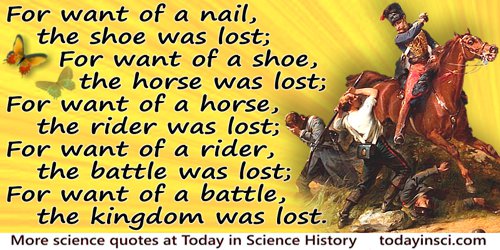
For want of a nail the shoe was lost; for want of a shoe the horse was lost; and for want of a horse, the rider was lost, being overtaken and slain by the enemy; all for the want of a horse-shoe nail.
As given in Benjamin Franklin, The Way to Wealth; As Clearly Shewn in the Preface of an Old Pennsylvania Almanack, Intitled, Poor Richard Improved (1774), 8. There are various other wordings of this proverb, including loss of the knight or message, the battle, the kingdom: “For want of a nail, the shoe was lost; For want of a shoe, the horse was lost; For want of a horse, the rider was lost; For want of a rider, the battle was lost; For want of a battle, the kingdom was lost.”
Here lies Sir Isaac Newton, Knight, who by a vigour of mind almost supernatural, first demonstrated, the motions and Figures of the Planets, the Paths of the comets, and the Tides of the Ocean. He diligently investigated the different refrangibilities to the rays of light, … Let Mortals rejoice that there has existed such and so great an ornament of Nature. Born, 25th Dec., 1642; died, 20th March, 1727.
— Epitaph
Translated from the Latin inscription on the tomb of Isaac Newton in Westminster Abbey. As quoted in John Stoughton, Worthies of Science (1879), 232-233.
I love to read the dedications of old books written in monarchies—for they invariably honor some (usually insignificant) knight or duke with fulsome words of sycophantic insincerity, praising him as the light of the universe (in hopes, no doubt, for a few ducats to support future work); this old practice makes me feel like such an honest and upright man, by comparison, when I put a positive spin, perhaps ever so slightly exaggerated, on a grant proposal.
From essay 'The Razumovsky Duet', collected in The Dinosaur in a Haystack: Reflections in Natural History (1995, 1997), 263.
Painting the desert, sun-setting the tone
Starving backstage, morning-stars are jaded
The moonshine murmur still shivers alone
Curved slice of sliver, shear breath shadows stone
Suspending twilight shiny and shaded
Painting the desert, sun-setting the tone
Carving solace into silver in June
On horizons’ glow from forgotten gold
The moonshine’s’ shilling delivers alone
Gleaming duels of knights, pierce deathly silence
Steel tines of starlight, clashing swords they hold
Painting the desert, sun-setting the tone
Dimples aware, sparkle sand on the dune
Winking at comets, after tails are told
The moon-sand whispers, sift rivers alone
Sharpness they hone, filing skills onto stone
Starlight dazzles, its own space created
Painting the desert, sun-setting the tone
From owls’ talon, moonlight shimmers alone
Starving backstage, morning-stars are jaded
The moonshine murmur still shivers alone
Curved slice of sliver, shear breath shadows stone
Suspending twilight shiny and shaded
Painting the desert, sun-setting the tone
Carving solace into silver in June
On horizons’ glow from forgotten gold
The moonshine’s’ shilling delivers alone
Gleaming duels of knights, pierce deathly silence
Steel tines of starlight, clashing swords they hold
Painting the desert, sun-setting the tone
Dimples aware, sparkle sand on the dune
Winking at comets, after tails are told
The moon-sand whispers, sift rivers alone
Sharpness they hone, filing skills onto stone
Starlight dazzles, its own space created
Painting the desert, sun-setting the tone
From owls’ talon, moonlight shimmers alone
…...
Suppose it were perfectly certain that the life and fortune of every one of us would, one day or other, depend upon his winning or losing a game of chess. Don't you think that we should all consider it to be a primary duty to learn at least the names and the moves of the pieces; to have a notion of a gambit, and a keen eye for all the means of giving and getting out of check? Do you not think that we should look with a disapprobation amounting to scorn upon the father who allowed his son, or the state which allowed its members, to grow up without knowing a pawn from a knight?
Yet, it is a very plain and elementary truth that the life, the fortune, and the happiness of every one of us, and, more or less, of those who are connected with us, do depend upon our knowing something of the rules of a game infinitely more difficult and complicated than chess. It is a game which has been played for untold ages, every man and woman of us being one of the two players in a game of his or her own. The chess-board is the world, the pieces are the phenomena of the universe, the rules of the game are what we call the laws of nature. The player on the other side is hidden from us. We know that his play is always fair, just, and patient. But also we know, to our cost, that he never overlooks a mistake, or makes the smallest allowance for ignorance. To the man who plays well the highest stakes are paid with that sort of overflowing generosity with which the strong shows delight in strength. And one who plays ill is checkmated—without haste, but without remorse.
Yet, it is a very plain and elementary truth that the life, the fortune, and the happiness of every one of us, and, more or less, of those who are connected with us, do depend upon our knowing something of the rules of a game infinitely more difficult and complicated than chess. It is a game which has been played for untold ages, every man and woman of us being one of the two players in a game of his or her own. The chess-board is the world, the pieces are the phenomena of the universe, the rules of the game are what we call the laws of nature. The player on the other side is hidden from us. We know that his play is always fair, just, and patient. But also we know, to our cost, that he never overlooks a mistake, or makes the smallest allowance for ignorance. To the man who plays well the highest stakes are paid with that sort of overflowing generosity with which the strong shows delight in strength. And one who plays ill is checkmated—without haste, but without remorse.
Address to the South London Working Men’s College. 'A Liberal Education; and Where to Find It', in David Masson, (ed.), Macmillan’s Magazine (Mar 1868), 17, 369. Also in 'A Liberal Education and Where to Find it' (1868). In Collected Essays (1893), Vol. 3, 82.
The game of chess has always fascinated mathematicians, and there is reason to suppose that the possession of great powers of playing that game is in many features very much like the possession of great mathematical ability. There are the different pieces to learn, the pawns, the knights, the bishops, the castles, and the queen and king. The board possesses certain possible combinations of squares, as in rows, diagonals, etc. The pieces are subject to certain rules by which their motions are governed, and there are other rules governing the players. … One has only to increase the number of pieces, to enlarge the field of the board, and to produce new rules which are to govern either the pieces or the player, to have a pretty good idea of what mathematics consists.
In Book review, 'What is Mathematics?', Bulletin American Mathematical Society (May 1912), 18, 386-387.
 In science it often happens that scientists say, 'You know that's a really good argument; my position is mistaken,' and then they would actually change their minds and you never hear that old view from them again. They really do it. It doesn't happen as often as it should, because scientists are human and change is sometimes painful. But it happens every day. I cannot recall the last time something like that happened in politics or religion.
(1987) --
In science it often happens that scientists say, 'You know that's a really good argument; my position is mistaken,' and then they would actually change their minds and you never hear that old view from them again. They really do it. It doesn't happen as often as it should, because scientists are human and change is sometimes painful. But it happens every day. I cannot recall the last time something like that happened in politics or religion.
(1987) -- 




