Judge Quotes (114 quotes)
...conscience looks backwards and judges past actions, inducing that kind of dissatisfaction, which if weak we call regret, and if severe remorse.
Descent of Man
“Mother like son” is a saying so true, the world will judge largely of mother by you.
In Silk Parachute.
[The biggest myth in business is that] bigger is better. A business should be judged not by its size but its impact.
In Issie Lapowsky, 'Scott Belsky', Inc. (Nov 2013), 140. Biography in Context,
[The sun] … which alone we should judge to be worthy of the most high God, if He should be pleased with a material domicile, and choose a place in which to dwell with the blessed angels.
As translated in Edwin Arthur Burtt, 'Kepler’s Early Acceptance of the New World-Scheme', The Metaphysical Foundations of Modern Physical Science: A Historical and and Critical Essay (1925), 48. From the Latin [as best as Webmaster can tell]: “[solem] … unum dignum omnes aestimaremus, in quo Deus Opt. Max., si corporeo domicilio delectaretur et capi loco posset, cum beatis angelis inhabitaret,” in Christian Frisch (ed.), Opera Omnia, Vol. 8, Part 1, 267.
Et j’espère que nos neveux me sauront gré, non seulement des choses que j'ai ici expliquées, mais aussi de celles que j'ai omises volontairement, afin de leur laisser le plaisir de les inventer.
I hope that posterity will judge me kindly, not only as to the things which I have explained, but also as to those which I have intentionally omitted so as to leave to others the pleasure of discovery.
I hope that posterity will judge me kindly, not only as to the things which I have explained, but also as to those which I have intentionally omitted so as to leave to others the pleasure of discovery.
Concluding remark in Géométrie (1637), as translated by David Eugene Smith and Marcia L. Latham, in The Geometry of René Descartes (1925, 1954), 240.
Quam multa fieri non posse priusquam sunt facta indicantur
How many things are judged impossible before they actually occur?
How many things are judged impossible before they actually occur?
In Pliny: Natural History (1947), Vol. 2, Book 7, 511, as translated by H. Rackham
A “critic” is a man who creates nothing and thereby feels qualified to judge the work of creative men. There is logic in this; he is unbiased—he hates all creative people equally.
In Time Enough for Love: The Lives of Lazarus Long (1973), 365.
A collective learning machine achieves its feats by using five elements … (1) conformity enforcers; (2) diversity generators; (3) inner-judges; (4) resource shifters; and (5) intergroup tournaments.
In 'From Social Synapses to Social Ganglions', Global Brain: The Evolution of Mass Mind from the Big Bang to the 21st Century (2000), 42.
A discovery must be, by definition, at variance with existing knowledge. During my lifetime, I made two. Both were rejected offhand by the popes of the field. Had I predicted these discoveries in my applications, and had those authorities been my judges, it is evident what their decisions would have been.
In 'Dionysians and Apollonians', Science (2 Jun 1972), 176, 966. Reprinted in Mary Ritchie Key, The Relationship of Verbal and Nonverbal Communication (1980), 318.
A physician is judged by the three A’s, Ability, Availability and Affability.
Quoted in: Familiar Medical Quotations, by M. B. Strauss.
A political law or a scientific truth may be perilous to the morals or the faith of individuals; but it cannot on this ground be resisted by the Church. … A discovery may be made in science which will shake the faith of thousands; yet religion cannot regret it or object to it. The difference in this respect between a true and a false religion is, that one judges all things by the standard of their truth, the other by the touchstone of its own interests. A false religion fears the progress of all truth; a true religion seeks and recognises truth wherever it can be found.
From 'Cardinal Wiseman and the Home and Foreign Review' (1862), collected in John Emerich Edward Dalberg Acton Baron Acton, John Neville Figgis (ed.) and Reginald Vere Laurence (ed.), The History of Freedom and Other Essays (1907), 449-450. The Darwinian controversy was at its height when this was written.
A true engineer, first of all, considers his duties as a trust and directs his whole energies to discharge the trust with all the solemnity of a judge on a bench. He is so immersed in his profession that he has no other sources of amusement, and is therefore always on his post.
From Jervis Memoirs, Beach Transcript, Jervis Library, Rome, New York. As quoted and cited on asce.org webpage of the American Society of Civil Engineers.
All Pretences of foretelling by Astrology, are Deceits; for this manifest Reason, because the Wise and Learned, who can only judge whether there be any Truth in this Science, do all unanimously agree to laugh at and despise it; and none but the poor ignorant Vulgar give it any Credit.
'An Account of the Death of Mr. Patrige' (1708), collected in The Works of Jonathan Swift (1746), Vol. 1, 124.
An individual can’t be judged by his group mean.
…...
An Individual, whatever species it might be, is nothing in the Universe. A hundred, a thousand individuals are still nothing. The species are the only creatures of Nature, perpetual creatures, as old and as permanent as it. In order to judge it better, we no longer consider the species as a collection or as a series of similar individuals, but as a whole independent of number, independent of time, a whole always living, always the same, a whole which has been counted as one in the works of creation, and which, as a consequence, makes only a unity in Nature.
'De la Nature: Seconde Vue', Histoire Naturelle, Générale et Particulière, Avec la Description du Cabinet du Roi (1765), Vol. 13, i. Trans. Phillip R. Sloan.
And who can doubt that it will lead to the worst disorders when minds created free by God are compelled to submit slavishly to an outside will? When we are told to deny our senses and subject them to the whim of others? When people devoid of whatsoever competence are made judges over experts and are granted authority to treat them as they please? These are the novelties which are apt to bring about the ruin of commonwealths and the subversion of the state.
In Galileo’s handwriting is his personal copy of Dialogue on the Great World Systems, x. As quoted in Edward Aloysius Pace and James Hugh Ryan, The New Scholasticism (1954),
Any man who is intelligent must, on considering that health is of the utmost value to human beings, have the personal understanding necessary to help himself in diseases, and be able to understand and to judge what physicians say and what they administer to his body, being versed in each of these matters to a degree reasonable for a layman.
Affections, in Hippocrates, trans. P. Potter (1988), Vol. 5, 7.
As arithmetic and algebra are sciences of great clearness, certainty, and extent, which are immediately conversant about signs, upon the skilful use whereof they entirely depend, so a little attention to them may possibly help us to judge of the progress of the mind in other sciences, which, though differing in nature, design, and object, may yet agree in the general methods of proof and inquiry.
In Alciphron: or the Minute Philosopher, Dialogue 7, collected in The Works of George Berkeley D.D. (1784), Vol. 1, 621.
As every circumstance relating to so capital a discovery as this (the greatest, perhaps, that has been made in the whole compass of philosophy, since the time of Sir Isaac Newton) cannot but give pleasure to all my readers, I shall endeavour to gratify them with the communication of a few particulars which I have from the best authority. The Doctor [Benjamin Franklin], after having published his method of verifying his hypothesis concerning the sameness of electricity with the matter lightning, was waiting for the erection of a spire in Philadelphia to carry his views into execution; not imagining that a pointed rod, of a moderate height, could answer the purpose; when it occurred to him, that, by means of a common kite, he could have a readier and better access to the regions of thunder than by any spire whatever. Preparing, therefore, a large silk handkerchief, and two cross sticks, of a proper length, on which to extend it, he took the opportunity of the first approaching thunder storm to take a walk into a field, in which there was a shed convenient for his purpose. But dreading the ridicule which too commonly attends unsuccessful attempts in science, he communicated his intended experiment to no body but his son, who assisted him in raising the kite.
The kite being raised, a considerable time elapsed before there was any appearance of its being electrified. One very promising cloud passed over it without any effect; when, at length, just as he was beginning to despair of his contrivance, he observed some loose threads of the hempen string to stand erect, and to avoid one another, just as if they had been suspended on a common conductor. Struck with this promising appearance, he inmmediately presented his knuckle to the key, and (let the reader judge of the exquisite pleasure he must have felt at that moment) the discovery was complete. He perceived a very evident electric spark. Others succeeded, even before the string was wet, so as to put the matter past all dispute, and when the rain had wetted the string, he collected electric fire very copiously. This happened in June 1752, a month after the electricians in France had verified the same theory, but before he had heard of any thing that they had done.
The kite being raised, a considerable time elapsed before there was any appearance of its being electrified. One very promising cloud passed over it without any effect; when, at length, just as he was beginning to despair of his contrivance, he observed some loose threads of the hempen string to stand erect, and to avoid one another, just as if they had been suspended on a common conductor. Struck with this promising appearance, he inmmediately presented his knuckle to the key, and (let the reader judge of the exquisite pleasure he must have felt at that moment) the discovery was complete. He perceived a very evident electric spark. Others succeeded, even before the string was wet, so as to put the matter past all dispute, and when the rain had wetted the string, he collected electric fire very copiously. This happened in June 1752, a month after the electricians in France had verified the same theory, but before he had heard of any thing that they had done.
The History and Present State of Electricity, with Original Experiments (1767, 3rd ed. 1775), Vol. 1, 216-7.
As for a future life, every man must judge for himself between conflicting vague probabilities.
In The Life and Letters of Charles Darwin edited by Sir Francis Darwin (1887).
But if anyone, well seen in the knowledge, not onely of Sacred and exotick History, but of Astronomical Calculation, and the old Hebrew Kalendar, shall apply himself to these studies, I judge it indeed difficult, but not impossible for such a one to attain, not onely the number of years, but even, of dayes from the Creation of the World.
In 'Epistle to the Reader', The Annals of the World (1658). As excerpted in Wallen Yep, Man Before Adam: A Correction to Doctrinal Theology, "The Missing Link Found" (2002), 18.
But many of our imaginations and investigations of nature are futile, especially when we see little living animals and see their legs and must judge the same to be ten thousand times thinner than a hair of my beard, and when I see animals living that are more than a hundred times smaller and am unable to observe any legs at all, I still conclude from their structure and the movements of their bodies that they do have legs... and therefore legs in proportion to their bodies, just as is the case with the larger animals upon which I can see legs... Taking this number to be about a hundred times smaller, we therefore find a million legs, all these together being as thick as a hair from my beard, and these legs, besides having the instruments for movement, must be provided with vessels to carry food.
Letter to N. Grew, 27 Sep 1678. In The Collected Letters of Antoni van Leeuwenhoek (1957), Vol. 2, 391.
By the fruit one judges the tree; the tree of science grows exceedingly slowly; centuries elapse before one can pluck the ripe fruits; even today it is hardly possible for us to shell and appraise the kernel of the teachings that blossomed in the seventeenth century. He who sows cannot therefore judge the worth of the corn. He must have faith in the fruitfulness of the seed in order that he may follow untiringly his chosen furrow when he casts his ideas to the four winds of heaven.
As quoted in Philipp Frank, Modern Science and its Philosophy (1949), 62, which cites Évolution de la Mécanique (1903).
Common Sense is that which judges the things given to it by other senses.
…...
Concentrate only on the achievements, and ignore the mistakes. When judging a mathematician you should only integrate f+ (the positive part of his function) and ignore the negative part. Perhaps this should apply more generally to all evaluations of your fellow men.
On his philosophy of writing letters of recommendation. As given in essay, Ronald Coifman and Robert S. Strichartz, 'The School of Antoni Zygmund', collected in Peter Duren (ed.), A Century of Mathematics in America (1989), 348. The authors acknowledge students of Zygmund provided personal recollections to them for the essay in general. Webmaster speculates the quote is from a student recollection, and not necessarily verbatim.
Don’t judge each day by the harvest you reap, but by the seeds you plant.
…...
ENGINEER, in the military art, an able expert man, who, by a perfect knowledge in mathematics, delineates upon paper, or marks upon the ground, all sorts of forts, and other works proper for offence and defence. He should understand the art of fortification, so as to be able, not only to discover the defects of a place, but to find a remedy proper for them; as also how to make an attack upon, as well as to defend, the place. Engineers are extremely necessary for these purposes: wherefore it is requisite that, besides being ingenious, they should be brave in proportion. When at a siege the engineers have narrowly surveyed the place, they are to make their report to the general, by acquainting him which part they judge the weakest, and where approaches may be made with most success. Their business is also to delineate the lines of circumvallation and contravallation, taking all the advantages of the ground; to mark out the trenches, places of arms, batteries, and lodgments, taking care that none of their works be flanked or discovered from the place. After making a faithful report to the general of what is a-doing, the engineers are to demand a sufficient number of workmen and utensils, and whatever else is necessary.
In Encyclopaedia Britannica or a Dictionary of Arts and Sciences (1771), Vol. 2, 497.
Every man is ready to join in the approval or condemnation of a philosopher or a statesman, a poet or an orator, an artist or an architect. But who can judge of a mathematician? Who will write a review of Hamilton’s Quaternions, and show us wherein it is superior to Newton’s Fluxions?
In 'Imagination in Mathematics', North American Review, 85, 224.
Examining this water...I found floating therein divers earthy particles, and some green streaks, spirally wound serpent-wise...and I judge that some of these little creatures were above a thousand times smaller than the smallest ones I have ever yet seen, upon the rind of cheese, in wheaten flour, mould, and the like.
[The first recorded observation of protozoa.]
[The first recorded observation of protozoa.]
Letter to the Royal Society, London (7 Sep 1674). In John Carey, Eyewitness to Science (1997), 28.
Far from becoming discouraged, the philosopher should applaud nature, even when she appears miserly of herself or overly mysterious, and should feel pleased that as he lifts one part of her veil, she allows him to glimpse an immense number of other objects, all worthy of investigation. For what we already know should allow us to judge of what we will be able to know; the human mind has no frontiers, it extends proportionately as the universe displays itself; man, then, can and must attempt all, and he needs only time in order to know all. By multiplying his observations, he could even see and foresee all phenomena, all of nature's occurrences, with as much truth and certainty as if he were deducing them directly from causes. And what more excusable or even more noble enthusiasm could there be than that of believing man capable of recognizing all the powers, and discovering through his investigations all the secrets, of nature!
'Des Mulets', Oeuvres Philosophiques, ed. Jean Piveteau (1954), 414. Quoted in Jacques Roger, The Life Sciences in Eighteenth-Century French Thought, ed. Keith R. Benson and trans. Robert Ellrich (1997), 458.
Fortunately, a scientist’s worth is judged on the basis of his accomplishments, not the tidiness of his work habits.
In 'Scientific innovation and creativity: a zoologist’s point of view', American Zoologist (1982), 22, 231.
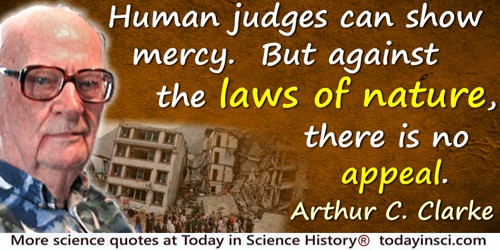
Human judges can show mercy. But against the laws of nature, there is no appeal.
The Wind from the Sun: Stories of the Space Age (1972), 8.
I believe [the Department of Energy] should be judged not by the money we direct to a particular State or district, company, university or national lab, but by the character of our decisions. The Department of Energy serves the country as a Department of Science, a Department of Innovation, and a Department of Nuclear Security.
In letter (1 Feb 2013) to Energy Department employees announcing his decision not to serve a second term.
I cannot but be astonished that Sarsi should persist in trying to prove by means of witnesses something that I may see for myself at any time by means of experiment. Witnesses are examined in doutbful matters which are past and transient, not in those which are actual and present. A judge must seek by means of witnesses to determine whether Peter injured John last night, but not whether John was injured, since the judge can see that for himself.
'The Assayer' (1623), trans. Stillman Drake, Discoveries and Opinions of Galileo (1957), 271.
I cannot judge my work while I am doing it. I have to do as painters do, stand back and view it from a distance, but not too great a distance. How great? Guess.
Quoted without citation in W.H. Auden and L. Kronenberger (eds.) The Viking Book of Aphorisms (1966), 291. Webmaster has tried without success to locate a primary source. Can you help?
I do not claim that intelligence, however defined, has no genetic basis–I regard it as trivially true, uninteresting, and unimportant that it does. The expression of any trait represents a complex interaction of heredity and environment ... a specific claim purporting to demonstrate a mean genetic deficiency in the intelligence of American blacks rests upon no new facts whatever and can cite no valid data in its support. It is just as likely that blacks have a genetic advantage over whites. And, either way, it doesn’t matter a damn. An individual can’t be judged by his group mean.
…...
I find hope in the darkest of days, and focus in the brightest. I do not judge the universe.
Quoted in Kim Lim (ed.), 1,001 Pearls of Spiritual Wisdom: Words to Enrich, Inspire, and Guide Your Life (2014), 23
I have just finished my sketch of my species theory. If as I believe that my theory is true & if it be accepted even by one competent judge, it will be a considerable step in science. I therefore write this, in case of my sudden death, as my most solemn & last request, which I am sure you will consider the same as if legally entered in my will, that you will devote 400£ to its publication & further will yourself, or through Hensleigh [Wedgwood], take trouble in promoting it.
Letter to Emma Darwin, 5 July 1844. In F. Burkhardt and S. Smith (eds.), The Correspondence of Charles Darwin 1844-1846 (1987), Vol. 3, 43.
I have no doubt that certain learned men, now that the novelty of the hypotheses in this work has been widely reported—for it establishes that the Earth moves, and indeed that the Sun is motionless in the middle of the universe—are extremely shocked, and think that the scholarly disciplines, rightly established once and for all, should not be upset. But if they are willing to judge the matter thoroughly, they will find that the author of this work has committed nothing which deserves censure. For it is proper for an astronomer to establish a record of the motions of the heavens with diligent and skilful observations, and then to think out and construct laws for them, or rather hypotheses, whatever their nature may be, since the true laws cannot be reached by the use of reason; and from those assumptions the motions can be correctly calculated, both for the future and for the past. Our author has shown himself outstandingly skilful in both these respects. Nor is it necessary that these hypotheses should be true, nor indeed even probable, but it is sufficient if they merely produce calculations which agree with the observations. … For it is clear enough that this subject is completely and simply ignorant of the laws which produce apparently irregular motions. And if it does work out any laws—as certainly it does work out very many—it does not do so in any way with the aim of persuading anyone that they are valid, but only to provide a correct basis for calculation. Since different hypotheses are sometimes available to explain one and the same motion (for instance eccentricity or an epicycle for the motion of the Sun) an astronomer will prefer to seize on the one which is easiest to grasp; a philosopher will perhaps look more for probability; but neither will grasp or convey anything certain, unless it has been divinely revealed to him. Let us therefore allow these new hypotheses also to become known beside the older, which are no more probable, especially since they are remarkable and easy; and let them bring with them the vast treasury of highly learned observations. And let no one expect from astronomy, as far as hypotheses are concerned, anything certain, since it cannot produce any such thing, in case if he seizes on things constructed for another other purpose as true, he departs from this discipline more foolish than he came to it.
Although this preface would have been assumed by contemporary readers to be written by Copernicus, it was unsigned. It is now believed to have been written and added at press time by Andreas Osiander (who was then overseeing the printing of the book). It suggests the earth’s motion as described was merely a mathematical device, and not to be taken as absolute reality. Text as given in 'To the Reader on the Hypotheses in this Work', Copernicus: On the Revolutions of the Heavenly Spheres (1543), translated by Alistair Matheson Duncan (1976), 22-3. By adding this preface, Osiander wished to stave off criticism by theologians. See also the Andreas Osiander Quotes page of this website.
I look upon a good physician, not so properly as a servant to nature, as one, that is a counsellor and friendly assistant, who, in his patient’s body, furthers those motions and other things, that he judges conducive to the welfare and recovery of it; but as to those, that he perceives likely to be hurtful, either by increasing the disease, or otherwise endangering the patient, he thinks it is his part to oppose or hinder, though nature do manifestly enough seem to endeavour the exercising or carrying on those hurtful motions.
Quoted In Barbara Kaplan (ed.) Divulging of Useful Truths in Physick: The Medical Agenda of Robert Boyle (1993), 125.
I regarded as quite useless the reading of large treatises of pure analysis: too large a number of methods pass at once before the eyes. It is in the works of application that one must study them; one judges their utility there and appraises the manner of making use of them.
As reported by J. F. Maurice in Moniteur Universel (1814), 228.
I’ve always been inspired by Dr. Martin Luther King, who articulated his Dream of an America where people are judged not by skin color but “by the content of their character.” In the scientific world, people are judged by the content of their ideas. Advances are made with new insights, but the final arbitrator of any point of view are experiments that seek the unbiased truth, not information cherry picked to support a particular point of view.
In letter (1 Feb 2013) to Energy Department employees announcing his decision not to serve a second term.
If even in science there is no a way of judging a theory but by assessing the number, faith and vocal energy of its supporters, then this must be even more so in the social sciences: truth lies in power.
In Radio Lecture (30 Jun 1973) broadcast by the Open University, collected in Imre Lakatos, John Worrall (ed.) and Gregory Currie (ed.), 'Introduction: Science and Pseudoscience', The Methodology of Scientific Research Programmes (1978, 1980), Vol. 1, 9.
If it is impossible to judge merit and guilt in the field of natural science, then it is not possible in any field, and historical research becomes an idle, empty activity.
Reden und Abhandlungen (1874). Trans. W. H. Brock.
If the scientific method, and especially its application to human relations, is as important as we have contended, then our educational efforts must be judged largely by the degree to which they inculcate a familiarity with this method, and the reliable generalizations it has yielded thus far.
In 'Education in a Scientific Age', Can Science Save Us? (1947, 2nd ed. 1961), 66-67.
If there be some who, though ignorant of all mathematics, take upon them to judge of these, and dare to reprove this work, because of some passage of Scripture, which they have miserably warped to their purpose, I regard them not, and even despise their rash judgment. … What I have done in this matter, I submit principally to your Holiness, and then to the judgment of all learned mathematicians. And that I may not seem to promise your Holiness more concerning the utility of this work than I am able to perform, I pass now to the work itself.
The dedication to Pope Paul III in the Preface of De Revolutionibus Orbium Coelestium, (On the Revolutions of Heavenly Spheres), originally written in Latin. As translated and quoted in Sarah K. Bolton, Famous Men of Science (1926), 7-8. Webmaster, as yet, has not found this quotation, in these words verbatim, as part of a complete book translation of the original Latin by Copernicus. However, it is consistent with other translations.
If this “critical openminded attitude” … is wanted, the question at once arises, Is it science that should be studied in order to achieve it? Why not study law? A judge has to do everything that a scientist is exhorted to do in the way of withholding judgment until all the facts are in, and then judging impartially on the merits of the case as well as he can. … Why not a course in Sherlock Holmes? The detectives, or at least the detective-story writers, join with the scientists in excoriating “dogmatic prejudice, lying, falsification of facts, and data, and willful fallacious reasoning.”
In Science is a Sacred Cow (1950), 191.
In all things, therefore, where we have clear evidence from our ideas, and those principles of knowledge I have above mentioned, reason is the proper judge; and revelation, though it may, in consenting with it, confirm its dictates, yet cannot in such cases invalidate its decrees: nor can we be obliged, where we have the clear and evident sentience of reason, to quit it for the contrary opinion, under a pretence that it is matter of faith: which can have no authority against the plain and clear dictates of reason.
in Essay Concerning Human Understanding (1690), book 4, ch. 18, sec. 20.
In science, address the few; in literature, the many. In science, the few must dictate opinion to the many; in literature, the many, sooner or later, force their judgement on the few. But the few and the many are not necessarily the few and the many of the passing time: for discoverers in science have not un-often, in their own day, had the few against them; and writers the most permanently popular not unfrequently found, in their own day, a frigid reception from the many. By the few, I mean those who must ever remain the few, from whose dieta we, the multitude, take fame upon trust; by the many, I mean those who constitute the multitude in the long-run. We take the fame of a Harvey or a Newton upon trust, from the verdict of the few in successive generations; but the few could never persuade us to take poets and novelists on trust. We, the many, judge for ourselves of Shakespeare and Cervantes.
Caxtoniana: A Series of Essays on Life, Literature, and Manners (1863), Vol. 2, 329- 30.
It is another property of the human mind that whenever men can form no idea of distant and unknown things, they judge them by what is familiar and at hand.
In The New Science (3rd ed., 1744), Book 1, Para. 122, as translated by Thomas Goddard Bergin and Max Harold Fisch, The New Science of Giambattista Vico (1948, 1984), 60.
It is not enough to say that we cannot know or judge because all the information is not in. The process of gathering knowledge does not lead to knowing. A child's world spreads only a little beyond his understanding while that of a great scientist thrusts outward immeasurably. An answer is invariably the parent of a great family of new questions. So we draw worlds and fit them like tracings against the world about us, and crumple them when we find they do not fit and draw new ones.
In John Steinbeck and Edward Flanders Ricketts, Sea of Cortez: a Leisurely Journal of Travel and Research (1941), 165-66.
It is now necessary to indicate more definitely the reason why mathematics not only carries conviction in itself, but also transmits conviction to the objects to which it is applied. The reason is found, first of all, in the perfect precision with which the elementary mathematical concepts are determined; in this respect each science must look to its own salvation .... But this is not all. As soon as human thought attempts long chains of conclusions, or difficult matters generally, there arises not only the danger of error but also the suspicion of error, because since all details cannot be surveyed with clearness at the same instant one must in the end be satisfied with a belief that nothing has been overlooked from the beginning. Every one knows how much this is the case even in arithmetic, the most elementary use of mathematics. No one would imagine that the higher parts of mathematics fare better in this respect; on the contrary, in more complicated conclusions the uncertainty and suspicion of hidden errors increases in rapid progression. How does mathematics manage to rid itself of this inconvenience which attaches to it in the highest degree? By making proofs more rigorous? By giving new rules according to which the old rules shall be applied? Not in the least. A very great uncertainty continues to attach to the result of each single computation. But there are checks. In the realm of mathematics each point may be reached by a hundred different ways; and if each of a hundred ways leads to the same point, one may be sure that the right point has been reached. A calculation without a check is as good as none. Just so it is with every isolated proof in any speculative science whatever; the proof may be ever so ingenious, and ever so perfectly true and correct, it will still fail to convince permanently. He will therefore be much deceived, who, in metaphysics, or in psychology which depends on metaphysics, hopes to see his greatest care in the precise determination of the concepts and in the logical conclusions rewarded by conviction, much less by success in transmitting conviction to others. Not only must the conclusions support each other, without coercion or suspicion of subreption, but in all matters originating in experience, or judging concerning experience, the results of speculation must be verified by experience, not only superficially, but in countless special cases.
In Werke [Kehrbach] (1890), Bd. 5, 105. As quoted, cited and translated in Robert Édouard Moritz, Memorabilia Mathematica; Or, The Philomath’s Quotation-Book (1914), 19.
It is odd to think that there is a word for something which, strictly speaking, does not exist, namely, “rest.” We distinguish between living and dead matter; between moving bodies and bodies at rest. This is a primitive point of view. What seems dead, a stone or the proverbial “door-nail,” say, is actually forever in motion. We have merely become accustomed to judge by outward appearances; by the deceptive impressions we get through our senses.
— Max Born
The Restless Universe (1935), I.
It is well to know something of the manners of various peoples, in order more sanely to judge our own, and that we do not think that everything against our modes is ridiculous, and against reason, as those who have seen nothing are accustomed to think.
In Discourse on Method (1637).
Judging from our experience upon this planet, such a history, that begins with elementary particles, leads perhaps inevitably toward a strange and moving end: a creature that knows, a science-making animal, that turns back upon the process that generated him and attempts to understand it. Without his like, the universe could be, but not be known, and this is a poor thing. Surely this is a great part of our dignity as men, that we can know, and that through us matter can know itself; that beginning with protons and electrons, out of the womb of time and the vastnesses of space, we can begin to understand; that organized as in us, the hydrogen, the carbon, the nitrogen, the oxygen, those 16-21 elements, the water, the sunlight—all having become us, can begin to understand what they are, and how they came to be.
In 'The Origins of Life', Proceedings of the National Academy of Sciences of the United States of America (1964), 52, 609-110.
Know then thyself, presume not God to scan;
The proper study of Mankind is Man.
Plac'd on this isthmus of a middle state,
A being darkly wise, and rudely great:
With too much knowledge for the Sceptic side,
With too much weakness for the Stoic's pride,
He hangs between; in doubt to act, or rest;
In doubt to deem himself a God, or Beast;
In doubt his Mind or Body to prefer,
Born but to die, and reas'ning but to err;
Alike in ignorance, his reason such,
Whether he thinks too little, or too much:
Chaos of Thought and Passion, all confus'd;
Still by himself abus'd, or disabus'd;
Created half to rise, and half to fall;
Great lord of all things, yet a prey to all;
Sole judge of Truth, in endless Error hurl'd:
The glory, jest, and riddle of the world!
... Superior beings, when of late they saw
A mortal Man unfold all Nature's law,
Admir'd such wisdom in an earthly shape,
And shew'd a NEWTON as we shew an Ape.
The proper study of Mankind is Man.
Plac'd on this isthmus of a middle state,
A being darkly wise, and rudely great:
With too much knowledge for the Sceptic side,
With too much weakness for the Stoic's pride,
He hangs between; in doubt to act, or rest;
In doubt to deem himself a God, or Beast;
In doubt his Mind or Body to prefer,
Born but to die, and reas'ning but to err;
Alike in ignorance, his reason such,
Whether he thinks too little, or too much:
Chaos of Thought and Passion, all confus'd;
Still by himself abus'd, or disabus'd;
Created half to rise, and half to fall;
Great lord of all things, yet a prey to all;
Sole judge of Truth, in endless Error hurl'd:
The glory, jest, and riddle of the world!
... Superior beings, when of late they saw
A mortal Man unfold all Nature's law,
Admir'd such wisdom in an earthly shape,
And shew'd a NEWTON as we shew an Ape.
'An Essay on Man' (1733-4), Epistle II. In John Butt (ed.), The Poems of Alexander Pope (1965), 516-7.
Logic does not pretend to teach the surgeon what are the symptoms which indicate a violent death. This he must learn from his own experience and observation, or from that of others, his predecessors in his peculiar science. But logic sits in judgment on the sufficiency of that observation and experience to justify his rules, and on the sufficiency of his rules to justify his conduct. It does not give him proofs, but teaches him what makes them proofs, and how he is to judge of them.
In A System of Logic, Ratiocinative and Inductive: Being a Connected View of the Principles of Evidence, and the Methods of Scientific Investigation (1843), Vol. 1, 11.
Mathematics is not the discoverer of laws, for it is not induction; neither is it the framer of theories, for it is not hypothesis; but it is the judge over both, and it is the arbiter to which each must refer its claims; and neither law can rule nor theory explain without the sanction of mathematics.
In 'Linear Associative Algebra', American Journal of Mathematics (1881), 4, 97.
Mere numbers cannot bring out … the intimate essence of the experiment. This conviction comes naturally when one watches a subject at work. … What things can happen! What reflections, what remarks, what feelings, or, on the other hand, what blind automatism, what absence of ideas! … The experimenter judges what may be going on in [the subject’s] mind, and certainly feels difficulty in expressing all the oscillations of a thought in a simple, brutal number, which can have only a deceptive precision. How, in fact, could it sum up what would need several pages of description!
In La Suggestibilité (1900), 119-20.
Mere poets are sottish as mere drunkards are, who live in a continual mist, without seeing or judging anything clearly. A man should be learned in several sciences, and should have a reasonable, philosophical and in some measure a mathematical head, to be a complete and excellent poet.
In Notes and Observations on The Empress of Morocco (1674), 70.
Neither in the subjective nor in the objective world can we find a criterion for the reality of the number concept, because the first contains no such concept, and the second contains nothing that is free from the concept. How then can we arrive at a criterion? Not by evidence, for the dice of evidence are loaded. Not by logic, for logic has no existence independent of mathematics: it is only one phase of this multiplied necessity that we call mathematics.
How then shall mathematical concepts be judged? They shall not be judged. Mathematics is the supreme arbiter. From its decisions there is no appeal. We cannot change the rules of the game, we cannot ascertain whether the game is fair. We can only study the player at his game; not, however, with the detached attitude of a bystander, for we are watching our own minds at play.
How then shall mathematical concepts be judged? They shall not be judged. Mathematics is the supreme arbiter. From its decisions there is no appeal. We cannot change the rules of the game, we cannot ascertain whether the game is fair. We can only study the player at his game; not, however, with the detached attitude of a bystander, for we are watching our own minds at play.
In Number: The Language of Science; a Critical Survey Written for the Cultured Non-Mathematician (1937), 244-245.
Nobody knows more than a tiny fragment of science well enough to judge its validity and value at first hand. For the rest he has to rely on views accepted at second hand on the authority of a community of people accredited as scientists. But this accrediting depends in its turn on a complex organization. For each member of the community can judge at first hand only a small number of his fellow members, and yet eventually each is accredited by all. What happens is that each recognizes as scientists a number of others by whom he is recognized as such in return, and these relations form chains which transmit these mutual recognitions at second hand through the whole community. This is how each member becomes directly or indirectly accredited by all. The system extends into the past. Its members recognize the same set of persons as their masters and derive from this allegiance a common tradition, of which each carries on a particular strand.
Personal Knowledge (1958), 163.
Nobody supposes that doctors are less virtuous than judges; but a judge whose salary and reputation depended on whether the verdict was for plaintiff or defendant, prosecutor or prisoner, would be as little trusted as a general in the pay of the enemy.
…...
Not everything is an idea. Otherwise psychology would contain all the sciences within it or at least it would be the highest judge over all the sciences. Otherwise psychology would rule over logic and mathematics. But nothing would be a greater misunderstanding of mathematics than its subordination to psychology.
In Elmer Daniel Klemke, Essays on Frege (1968), 531.
Not greatly moved with awe am I
To learn that we may spy
Five thousand firmaments beyond our own.
The best that's known
Of the heavenly bodies does them credit small.
View'd close, the Moon's fair ball
Is of ill objects worst,
A corpse in Night's highway, naked, fire-scarr'd, accurst;
And now they tell
That the Sun is plainly seen to boil and burst
Too horribly for hell.
So, judging from these two,
As we must do,
The Universe, outside our living Earth,
Was all conceiv'd in the Creator's mirth,
Forecasting at the time Man's spirit deep,
To make dirt cheap.
Put by the Telescope!
Better without it man may see,
Stretch'd awful in the hush'd midnight,
The ghost of his eternity.
To learn that we may spy
Five thousand firmaments beyond our own.
The best that's known
Of the heavenly bodies does them credit small.
View'd close, the Moon's fair ball
Is of ill objects worst,
A corpse in Night's highway, naked, fire-scarr'd, accurst;
And now they tell
That the Sun is plainly seen to boil and burst
Too horribly for hell.
So, judging from these two,
As we must do,
The Universe, outside our living Earth,
Was all conceiv'd in the Creator's mirth,
Forecasting at the time Man's spirit deep,
To make dirt cheap.
Put by the Telescope!
Better without it man may see,
Stretch'd awful in the hush'd midnight,
The ghost of his eternity.
'The Two Deserts' (1880-85). Poems, Introduction Basil Champneys (1906), 302.
Objections … inspired Kronecker and others to attack Weierstrass’ “sequential” definition of irrationals. Nevertheless, right or wrong, Weierstrass and his school made the theory work. The most useful results they obtained have not yet been questioned, at least on the ground of their great utility in mathematical analysis and its implications, by any competent judge in his right mind. This does not mean that objections cannot be well taken: it merely calls attention to the fact that in mathematics, as in everything else, this earth is not yet to be confused with the Kingdom of Heaven, that perfection is a chimaera, and that, in the words of Crelle, we can only hope for closer and closer approximations to mathematical truth—whatever that may be, if anything—precisely as in the Weierstrassian theory of convergent sequences of rationals defining irrationals.
In Men of Mathematics (1937), 431-432.
Of … habitable worlds, such as the Earth, all which we may suppose to be of a terrestrial or terraqueous nature, and filled with beings of the human species, subject to mortality, it may not be amiss in this place to compute how many may he conceived within our finite view every clear Star-light night. … In all together then we may safely reckon 170,000,000, and yet be much within compass, exclusive Of the Comets which I judge to be by far the most numerous part of the creation.
In The Universe and the Stars: Being an Original Theory on the Visible Creation, Founded on the Laws of Nature (1750, 1837), 131-132.
Of science and logic he chatters,
As fine and as fast as he can;
Though I am no judge of such matters,
I’m sure he’s a talented man.
As fine and as fast as he can;
Though I am no judge of such matters,
I’m sure he’s a talented man.
'The Talented Man.' In Winthrop Mackworth Praed, Ferris Greenslet, The Poems of Winthrop Mackworth Praed (1909), 122.
by - 1909
On becoming very intimate with Fitz-Roy, I heard that I had run a very narrow risk of being rejected, on account of the shape of my nose! He was an ardent disciple of Lavater, and was convinced that he could judge a man's character by the outline of his features. He doubted whether anyone with my nose could possess sufficient energy and determination for the voyage. I think he was well-satisfied that my nose had spoken falsely.
In Charles Darwin and Francis Darwin (ed.), The Life and Letters of Charles Darwin: Including an Autobiographical Chapter (1896), 50.
Once we have judged a thing a work of art, we have judged it ethically of the first importance and put it beyond the reach of the moralist.
In Art (1913), 20.
Only the doctor and the judge have the right to inflict the death penalty without receiving the same.
— Philemon
In 'The Sicilian.' Fragment preserved by Stobaeus, Florigelium. In Gustave Jules Witkowski, The Evil that Has Been Said of Doctors (1889), 4-5.
Only the individual can think, and thereby create new values for society–nay, even set up new moral standards to which the life of the community conforms. Without creative, independently thinking and judging personalities the upward development of society is as unthinkable as the development of the individual personality without the nourishing soil of the community.
…...
Our natural way of thinking about these coarser emotions is that the mental perception of some fact excites the mental affection called the emotion, and that this latter state of mind gives rise to the bodily expression. My theory, on the contrary, is that the bodily changes follow directly the perception of the exciting fact, and that our feeling of the same changes as they occur IS the emotion. Common-sense says, we lose our fortune, are sorry and weep; we meet a bear, are frightened and run; we are insulted by a rival, are angry and strike. The hypothesis here to be defended says that this order of sequence is incorrect, that the one mental state is not immediately induced by the other, that the bodily manifestations must first be interposed between, and that the more rational statement is that we feel sorry because we cry, angry because we strike, afraid because we tremble, and not that we cry, strike, or tremble, because we are sorry, angry, or fearful, as the case may be. Without the bodily states following on the perception, the latter would be purely cognitive in form, pale, colorless, destitute of emotional warmth. We might then see the bear, and judge it best to run, receive the insult and deem it right to strike, but we should not actually feel afraid or angry.
The Principles or Psychology (1890), Vol. 2, 449-50.
Our reasonings are grounded upon two great principles, that of contradiction, in virtue of which we judge false that which involves a contradiction, and true that which is opposed or contradictory to the false.
The Monadology and Other Philosophical Writings (1714), trans. Robert Latta (1898) 235.
Positive, objective knowledge is public property. It can be transmitted directly from one person to another, it can be pooled, and it can be passed on from one generation to the next. Consequently, knowledge accumulates through the ages, each generation adding its contribution. Values are quite different. By values, I mean the standards by which we judge the significance of life. The meaning of good and evil, of joy and sorrow, of beauty, justice, success-all these are purely private convictions, and they constitute our store of wisdom. They are peculiar to the individual, and no methods exist by which universal agreement can be obtained. Therefore, wisdom cannot be readily transmitted from person to person, and there is no great accumulation through the ages. Each man starts from scratch and acquires his own wisdom from his own experience. About all that can be done in the way of communication is to expose others to vicarious experience in the hope of a favorable response.
The Nature of Science and Other Lectures (1954), 7.
Reason must approach nature with the view, indeed, of receiving information from it, not, however, in the character of a pupil, who listens to all that his master chooses to tell him, but in that of a judge, who compels the witnesses to reply to those questions which he himself thinks fit to propose. To this single idea must the revolution be ascribed, by which, after groping in the dark for so many centuries, natural science was at length conducted into the path of certain progress.
Critique of Pure Reason, translated by J.M.D. Meiklejohn (1855), Preface to the Second Edition, xxvii.
Say I have lost all faith in patents, judges, and everything relating to patents.
Science asks no questions about the ontological pedigree or a priori character of a theory, but is content to judge it by its performance; and it is thus that a knowledge of nature, having all the certainty which the senses are competent to inspire, has been attained—a knowledge which maintains a strict neutrality toward all philosophical systems and concerns itself not with the genesis or a priori grounds of ideas.
Originally published in North American Review (1865). 'The Philosophy of Herbert Spencer,' repr. In Philosophical Writings of Chauncey Wright (1963), p. 8.
Science teaches us, in effect, to submit our reason to the truth and to know and judge of things as they are—that is to say, as they themselves choose to be and not as we would have them to be.
In Tragic Sense of Life (1913), translated by John Ernest Crawford Flitch (1954), 193.
So-called extraordinary events always split into two extremes naturalists who have not witnessed them: those who believe blindly and those who do not believe at all. The latter have always in mind the story of the golden goose; if the facts lie slightly beyond the limits of their knowledge, they relegate them immediately to fables. The former have a secret taste for marvels because they seem to expand Nature; they use their imagination with pleasure to find explanations. To remain doubtful is given to naturalists who keep a middle path between the two extremes. They calmly examine facts; they refer to logic for help; they discuss probabilities; they do not scoff at anything, not even errors, because they serve at least the history of the human mind; finally, they report rather than judge; they rarely decide unless they have good evidence.
Quoted in Albert V. Carozzi, Histoire des sciences de la terre entre 1790 et 1815 vue à travers les documents inédités de la Societé de Physique et d'Histoire Naturelle de Genève, trans. Albert V. and Marguerite Carozzi. (1990), 175.
The aim of scientific work is truth. While we internally recognise something as true, we judge, and while we utter judgements, we assert.
In Manuscripts 2 (after 1879). As cited and translated by Ivor Grattan-Guinness in The Search for Mathematical Roots, 1870-1940 (2011), 177.
The dispute between evolutionists and creation scientists offers textbook writers and teachers a wonderful opportunity to provide students with insights into the philosophy and methods of science. … What students really need to know is … how scientists judge the merit of a theory. Suppose students were taught the criteria of scientific theory evaluation and then were asked to apply these criteria … to the two theories in question. Wouldn’t such a task qualify as authentic science education? … I suspect that when these two theories are put side by side, and students are given the freedom to judge their merit as science, creation theory will fail ignominiously (although natural selection is far from faultless). … It is not only bad science to allow disputes over theory to go unexamined, but also bad education.
In Building a Bridge to the 18th Century: How the Past Can Improve Our Future (1999), 168.
The domain of mathematics is the sole domain of certainty. There and there alone prevail the standards by which every hypothesis respecting the external universe and all observation and all experiment must be finally judged. It is the realm to which all speculation and thought must repair for chastening and sanitation, the court of last resort, I say it reverently, for all intellection whatsoever, whether of demon, or man, or deity. It is there that mind as mind attains its highest estate.
In 'The Universe and Beyond', Hibbert Journal (1904-1906), 3, 314.
The generality of men are so accustomed to judge of things by their senses that, because the air is indivisible, they ascribe but little to it, and think it but one remove from nothing.
In Mary Elvira Weeks, The Discovery of the Elements (1934), 29, citing Boyle, 'Memoirs for a General History of the Air', in Shaw's Abridgment of Boyle's works (1725), Vol. 3, 61, and Ramsay, The Gases of the Atmosphere (1915), 10.
The importance of a result is largely relative, is judged differently by different men, and changes with the times and circumstances. It has often happened that great importance has been attached to a problem merely on account of the difficulties which it presented; and indeed if for its solution it has been necessary to invent new methods, noteworthy artifices, etc., the science has gained more perhaps through these than through the final result. In general we may call important all investigations relating to things which in themselves are important; all those which have a large degree of generality, or which unite under a single point of view subjects apparently distinct, simplifying and elucidating them; all those which lead to results that promise to be the source of numerous consequences; etc.
From 'On Some Recent Tendencies in Geometric Investigations', Rivista di Matematica (1891), 44. In Bulletin American Mathematical Society (1904), 444.
The more progress physical sciences make, the more they tend to enter the domain of mathematics, which is a kind of center to which they all converge. We may even judge of the degree of perfection to which a science has arrived by the facility with which it may be submitted to calculation.
In Eulogy of Quetelet by E. Mailly (1874).
The physician himself, if sick, actually calls in another physician, knowing that he cannot reason correctly if required to judge his own condition while suffering.
De Republica, iii.16.
The plant cell, like the animal cell, is a type of laboratory of cellular tissues that organize themselves and develop within its innermost substance; its imperforate walls, to judge from our strongest magnifying instruments, have the property of drawing out by aspiration from the ambient liquid the elements necessary for its elaboration. They thus have the property of acting as a sorter, of admitting certain substances and preventing the passage of others, and consequently of separating the elements of certain combinations in order to admit only a portion of them.
As quoted in article
Marc Klein,'François-Vincent Raspail', in Charles Coulston Gillispie (ed.), Dictionary of Scientific Biography (1975). Vol.11, 300.
The prominent reason why a mathematician can be judged by none but mathematicians, is that he uses a peculiar language. The language of mathesis is special and untranslatable. In its simplest forms it can be translated, as, for instance, we say a right angle to mean a square corner. But you go a little higher in the science of mathematics, and it is impossible to dispense with a peculiar language. It would defy all the power of Mercury himself to explain to a person ignorant of the science what is meant by the single phrase “functional exponent.” How much more impossible, if we may say so, would it be to explain a whole treatise like Hamilton’s Quaternions, in such a wise as to make it possible to judge of its value! But to one who has learned this language, it is the most precise and clear of all modes of expression. It discloses the thought exactly as conceived by the writer, with more or less beauty of form, but never with obscurity. It may be prolix, as it often is among French writers; may delight in mere verbal metamorphoses, as in the Cambridge University of England; or adopt the briefest and clearest forms, as under the pens of the geometers of our Cambridge; but it always reveals to us precisely the writer’s thought.
In North American Review (Jul 1857), 85, 224-225.
The republic has no need of scientists [savants].
Apocryphal remark; supposedly the judge’s reply to Lavoisier when he appealed at his trial for more time to complete his scientific work.
Apocryphal remark; supposedly the judge’s reply to Lavoisier when he appealed at his trial for more time to complete his scientific work.
Cited in H. Guerlac, 'Lavoisier', in Charles Gillispie (ed.), Dictionary of Scientific Biography (1973), 8, 85. However, Jean-Pierre Poirier and Rebecca Balinski (trans.) in Lavoisier: Chemist, Biologist, Economist (1998), 379, says about the remark that “It is now known that the statement is apocryphal” [meaning it is of questionable authenticity], and that “Jean Noel Halle, in the name of the Advisory Board for Arts and Trades, had sent the judges a long report detailing the services Lavoisier had rendered to the Republic, but Coffinal [president of the Revolutionary Tribunal] had refused to acknowledge it.” Thus, Lavoisier was guillotined on 8 May 1794. Coffinhal was himself guillotined on 6 Aug 1794.
The scientific theorist is not to be envied. For Nature, or more precisely experiment, is an inexorable and not very friendly judge of his work. It never says “Yes” to a theory. In the most favorable cases it says “Maybe,” and in the great majority of cases simply “No.” If an experiment agrees with a theory it means for the latter “Maybe,” and if it does not agree it means “No.” Probably every theory will someday experience its “No”—most theories, soon after conception.
In Albert Einstein: The Human Side by Helen Dukas and Banesh Hoffmann (1979).
The valuable properties of this cement depend in a great measure on the mode of preparing it for use. The mixing should therefore be conducted with care in order to form a perfect union of the powdered cement, sand and water. This can be best accomplished by the use of the New England corn hoe on a board floor or by beating with a hand stamper; not much labour is required if properly applied. Mechanics can judge when the mixture is perfect by the appearance of the mortar, which, when properly prepared, very much resembles putty.
Directions for Using White's Patent Hydraulic Cement.
The value of fundamental research does not lie only in the ideas it produces. There is more to it. It affects the whole intellectual life of a nation by determining its way of thinking and the standards by which actions and intellectual production are judged. If science is highly regarded and if the importance of being concerned with the most up-to-date problems of fundamental research is recognized, then a spiritual climate is created which influences the other activities. An atmosphere of creativity is established which penetrates every cultural frontier. Applied sciences and technology are forced to adjust themselves to the highest intellectual standards which are developed in the basic sciences. This influence works in many ways: some fundamental students go into industry; the techniques which are applied to meet the stringent requirements of fundamental research serve to create new technological methods. The style, the scale, and the level of scientific and technical work are determined in pure research; that is what attracts productive people and what brings scientists to those countries where science is at the highest level. Fundamental research sets the standards of modern scientific thought; it creates the intellectual climate in which our modern civilization flourishes. It pumps the lifeblood of idea and inventiveness not only into the technological laboratories and factories, but into every cultural activity of our time. The case for generous support for pure and fundamental science is as simple as that.
In 'Why Pure Science?' in Bulletin of the Atomic Scientists, 1965.
The visible universe is subject to quantification, and is so by necessity. … Between you and me only reason will be the judge … since you proceed according to the rational method, so shall I. … I will also give reason and take it. … This generation has an innate vice. It can’t accept anything that has been discovered by a contemporary!
As quoted in James Burke, The Day the Universe Changed (1985), 41. Burke also quotes the first sentence in The Axemaker's Gift (1995), 112, but after the first ellipsis, is substituted “If you wish to hear more from me, give and take reason, because I am not the kind of man to satisfy his hunger on the picture of a steak!”
The world hath been much abused by the opinion of making gold; the work itself I judge to be possible; but the means, hitherto propounded, to effect it are, in the practice, full of error and imposture; and in the theory, full of unfound imaginations.
From 'Experiment Solitary Touching the Making of Gold', Sylva Sylvarum: Or, a Natural History (1627), published posthumously by William Rawley. As collected and translated in The Works of Francis Bacon (1765), Vol. 1, 204. As quoted in Samuel Austin Allibone, Prose Quotations From Socrates to Macaulay (1876), 28.
Their theories should be carefully examined and their arguments fairly weighed, but the scientist cannot compel acceptance of any argument he advances, except as, judged upon its merits, it is convincing.
In chapter, 'The Origin of Man', In His Image (1922), 93.
There are many arts and sciences of which a miner should not be ignorant. First there is Philosophy, that he may discern the origin, cause, and nature of subterranean things; for then he will be able to dig out the veins easily and advantageously, and to obtain more abundant results from his mining. Secondly there is Medicine, that he may be able to look after his diggers and other workman ... Thirdly follows astronomy, that he may know the divisions of the heavens and from them judge the directions of the veins. Fourthly, there is the science of Surveying that he may be able to estimate how deep a shaft should be sunk … Fifthly, his knowledge of Arithmetical Science should be such that he may calculate the cost to be incurred in the machinery and the working of the mine. Sixthly, his learning must comprise Architecture, that he himself may construct the various machines and timber work required underground … Next, he must have knowledge of Drawing, that he can draw plans of his machinery. Lastly, there is the Law, especially that dealing with metals, that he may claim his own rights, that he may undertake the duty of giving others his opinion on legal matters, that he may not take another man’s property and so make trouble for himself, and that he may fulfil his obligations to others according to the law.
In De Re Metallica (1556), trans. H.C. and L.H. Hoover (1950), 3-4.
There is something sublime in the secrecy in which the really great deeds of the mathematician are done. No popular applause follows the act; neither contemporary nor succeeding generations of the people understand it. The geometer must be tried by his peers, and those who truly deserve the title of geometer or analyst have usually been unable to find so many as twelve living peers to form a jury. Archimedes so far outstripped his competitors in the race, that more than a thousand years elapsed before any man appeared, able to sit in judgment on his work, and to say how far he had really gone. And in judging of those men whose names are worthy of being mentioned in connection with his,—Galileo, Descartes, Leibnitz, Newton, and the mathematicians created by Leibnitz and Newton’s calculus,—we are forced to depend upon their testimony of one another. They are too far above our reach for us to judge of them.
In 'Imagination in Mathematics', North American Review, 86, 223.
Those who are accustomed to judge by feeling do not understand the process of reasoning, because they want to comprehend at a glance and are not used to seeking for first principles. Those, on the other hand, who are accustomed to reason from first principles do not understand matters of feeling at all, because they look for first principles and are unable to comprehend at a glance.
In Pensées (1670), Section 7, No. 33. As translated in W.H. Auden and L. Kronenberger (eds.) The Viking Book of Aphorisms (1966), 351. Also translated as “Those who are accustomed to judge by feeling do not understand the process of reasoning, for they would understand at first sight, and are not used to seek for principles. And others, on the contrary, who are accustomed to reason from principles, do not at all understand matters of feeling, seeking principles, and being unable to see at a glance,” in Blaise Pascal and W.F. Trotter (trans.), 'Thoughts', No. 3, collected in Charles W. Eliot (ed.), The Harvard Classics (1910), Vol. 48, 9. From the original French, “Ceux qui sont accoutumés à juger par le sentiment ne comprennent rien aux choses de raisonnement, car ils veulent d’abord pénétrer d’une vue et ne sont point accoutumés à chercher les principes. Et les autres, au contraire, qui sont accoutumés à raisonner par principes, ne comprennent rien aux choses de sentiment, y cherchant des principes et ne pouvant voir d’une vue,” in Ernest Havet (ed.), Pensées de Pascal (1892), 224.
Those who judge of a work by rule are in regard to others as those who have a watch are in regard to others. One says, “It is two hours ago”; the other says, “It is only three-quarters of an hour.” I look at my watch, and say to the one, “You are weary,” and to the other, “Time gallops with you”; for it is only an hour and a half ago, and I laugh at those who tell me that time goes slowly with me, and that I judge by imagination. They do not know that I judge by my watch.
In Pascal’s Pensées (1958), 3-4.
Until its results have gone through the painful process of publication, preferably in a refereed journal of high standards, scientific research is just play. Publication is an indispensable part of science. “Publish or perish” is not an indictment of the system of academia; it is a partial prescription for creativity and innovation. Sustained and substantial publication favors creativity. Novelty of conception has a large component of unpredictability. ... One is often a poor judge of the relative value of his own creative efforts. An artist’s ranking of his own works is rarely the same as that of critics or of history. Most scientists have had similar experiences. One’s supply of reprints for a pot-boiler is rapidly exhausted, while a major monograph that is one’s pride and joy goes unnoticed. The strategy of choice is to increase the odds favoring creativity by being productive.
In 'Scientific innovation and creativity: a zoologist’s point of view', American Zoologist (1982), 22, 233-234.
Vagueness is very much more important in the theory of knowledge than you would judge it to be from the writings of most people. Everything is vague to a degree you do not realize till you have tried to make it precise, and everything precise is so remote from everything that we normally think, that you cannot for a moment suppose that is what we really mean when we say what we think.
In The Philosophy of Logical Atomism (1918, 1919), 2.
We are recorders and reporters of the facts—not judges of the behavior we describe.
Recalled on his death 25 Aug 56
We can see that there is only one substance in the universe and that man is the most perfect one. He is to the ape and the cleverest animals what Huygens's planetary clock is to one of Julien Leroy's watches. If it took more instruments, more cogs, more springs to show or tell the time, if it took Vaucanson more artistry to make his flautist than his duck, he would have needed even more to make a speaking machine, which can no longer be considered impossible, particularly at the hands of a new Prometheus. Thus, in the same way, nature needed more artistry and machinery to construct and maintain a machine which could continue for a whole century to tell all the beats of the heart and the mind; for we cannot tell the time from the pulse, it is at least the barometer of heat and liveliness, from which we can judge the nature of the soul.
Machine Man (1747), in Ann Thomson (ed.), Machine Man and Other Writings (1996), 33-4.
We judge ourselves by what we feel capable of doing, while others judge us by what we have already done.
In Kavanagh: A Tale (1849), 3.

We may fairly judge of the commercial prosperity of a country from the amount of sulphuric acid it consumes.
Familiar Lectures on Chemistry (1843).
We must in imagination sweep off the drifted matter that clogs the surface of the ground; we must suppose all the covering of moss and heath and wood to be torn away from the sides of the mountains, and the green mantle that lies near their feet to be lifted up; we may then see the muscular integuments, and sinews, and bones of our mother Earth, and so judge of the part played by each of them during those old convulsive movements whereby her limbs were contorted and drawn up into their present posture.
Letter 2 to William Wordsworth. Quoted in the appendix to W. Wordsworth, A Complete Guide to the Lakes, Comprising Minute Direction for the Tourist, with Mr Wordsworth's Description of the Scenery of the County and Three Letters upon the Geology of the Lake District (1842), 15.
We should misjudge this scientist [Fritz Haber] seriously if we were to judge him only by his harvest. The stimulation of research and the advancement of younger scholars become ever more important to him than his own achievements.
In Richard Willstätter, Arthur Stoll (ed. of the original German) and Lilli S. Hornig (trans.), From My Life: The Memoirs of Richard Willstätter (1958), 269.
What a chimera ... is man ! What a novelty, what a monster, what a chaos, what a subject of contradiction, what a prodigy! A judge of all things, feeble worm of the earth, depository of the truth, cloacae of uncertainty and error, the glory and the shame of the universe!
…...
Whether true or false, others must judge; for the firmest conviction of the truth of a doctrine by its author, seems, alas, not to be the slightest guarantee of truth.
Letter (1 May 1857) to Alfred Russel Wallace. In Sir Francis Darwin (ed.), The Life and Letters of Charles Darwin (1887), 454.
While playing the part of the detective the investigator follows clues, but having captured his alleged fact, he turns judge and examines the case by means of logically arranged evidence. Both functions are equally essential but they are different.
In The Art of Scientific Investigation (1950, 1957), 92.
Whoever undertakes to set himself up as a judge of Truth and knowledge is shipwrecked by the laughter of the gods.
In 'Aphorisms for Leo Baeck', Ideas and Opinions (1954), 28. German version, “Wer es untemimmt, auf dem Gebiete der Wahrheit und der Erkenntnis als Autorität, scheitert an dem Gelächter der Götter,” in Lewis Samuel Feuer, Einstein and the Generations of Science (1982), 105.
You cannot … judge the importance of things … by the noise they make.
In Good-Bye, Mr. Chips (1934), 99.
You shall yourself be judge. Reason, with most people, means their own opinion.
Essay XVII. 'A New School of Reform: A Dialogue between a Rationalist and a Sentimentalist', in A.R. Waller and A. Glover (eds.), The Collected Works of William Hazlitt (1903), Vol. 7, 188.
 In science it often happens that scientists say, 'You know that's a really good argument; my position is mistaken,' and then they would actually change their minds and you never hear that old view from them again. They really do it. It doesn't happen as often as it should, because scientists are human and change is sometimes painful. But it happens every day. I cannot recall the last time something like that happened in politics or religion.
(1987) --
In science it often happens that scientists say, 'You know that's a really good argument; my position is mistaken,' and then they would actually change their minds and you never hear that old view from them again. They really do it. It doesn't happen as often as it should, because scientists are human and change is sometimes painful. But it happens every day. I cannot recall the last time something like that happened in politics or religion.
(1987) -- 





