Job Quotes (86 quotes)
[Choosing to become a geophysicist was] entirely accidental and was due to the difficulty of getting a job during the depression. There happened to be one available in Cambridge at the time when I needed it.
Quoted in 'Edward Crisp Bullard,' Current Biography (1954)
[It was] a lot of fun and we were so absorbed trying to do a good job that we didn’t think of the dangers. Until later on when people were saying, “You were sitting on top of all that hydrogen and oxygen.” Those tanks were right outside, the control room’s right there. I mean now, like up at Plum Brook, the control room for B-2 is like half a mile away. We were fifty feet away.
Recalling his experience with rocket engine tests using liquid hydrogen and liquid oxygen, while working as an engineer at the Propulsion Systems Laboratory. From Interview (1 Sep 2009), for the NASA Glenn History Collection, Oral History Collection, Cleveland, Ohio. As quoted an cited in Robert S. Arrighi, Pursuit of Power: NASA’s Propulsion and Systems Laboratory No. 1 and 2 (2012), 91.
[Science] is not a job nine to five. When you do science you have to do science 24 hours a day. When you are at home you should be thinking about science; when you are going to bed, you should be dreaming about science. It’s full immersion vou see.
As quoted in Lewis Wolpert and Alison Richards (eds.), Passionate Minds: The Inner World of Scientists (1997), 6.
[The surplus of basic knowledge of the atomic nucleus was] largely used up [during the war with the atomic bomb as the dividend.] We must, without further delay restore this surplus in preparation for the important peacetime job for the nucleus - power production. ... Many of the proposed applications of atomic power - even for interplanetary rockets - seem to be within the realm of possibility provided the economic factor is ruled out completely, and the doubtful physical and chemical factors are weighted heavily on the optimistic side. ... The development of economic atomic power is not a simple extrapolation of knowledge gained during the bomb work. It is a new and difficult project to reach a satisfactory answer. Needless to say, it is vital that the atomic policy legislation now being considered by the congress recognizes the essential nature of this peacetime job, and that it not only permits but encourages the cooperative research-engineering effort of industrial, government and university laboratories for the task. ... We must learn how to generate the still higher energy particles of the cosmic rays - up to 1,000,000,000 volts, for they will unlock new domains in the nucleus.
Addressing the American Institute of Electrical Engineering, in New York (24 Jan 1946). In Schenectady Gazette (25 Jan 1946),
[About the demand of the Board of Regents of the University of California that professors sign non-Communist loyalty oaths or lose their jobs within 65 days.] No conceivable damage to the university at the hands of hypothetical Communists among us could possibly have equaled the damage resulting from the unrest, ill-will and suspicion engendered by this series of events.
As quoted in 'Professors in West Call Oath “Indignity”', New York Times (26 Feb 1950), 38.
[On President Bush's plan to get to Mars in 10 years] Stupid. Robots would do a better job and be much cheaper because you don't have to bring them back.
Interview with Deborah Solomon, 'The Science of Second-Guessing', in New York Times Magazine (12 Dec 2004), 37.
Jobs: I look at myself as an artist if anything. Sort of a trapeze artist.
Levy: With or without a net?
Jobs: Without.
Levy: With or without a net?
Jobs: Without.
Expressing the driving force behind his passion. Interview with Rolling Stone writer, Steven Levy (late Nov 1983). As quoted in Nick Bilton, 'The 30-Year-Old Macintosh and a Lost Conversation With Steve Jobs' (24 Jan 2014), on New York Times blog web page. Levy appended a transcript of the interview to an updated Kindle version of his book, Insanely Great: The Life and Times of Macintosh, the Computer that Changed Everything.
Ron Hutcheson, a Knight-Ridder reporter: [Mr. President, what are your] personal views [about the theory of] intelligent design?
President George W. Bush: [Laughing. You're] doing a fine job of dragging me back to the past [days as governor of Texas]. ... Then, I said that, first of all, that decision should be made to local school districts, but I felt like both sides ought to be properly taught...”
Hutcheson: Both sides ought to be properly taught?
President: Yes ... so people can understand what the debate is about.
Hutcheson: So the answer accepts the validity of “intelligent design” as an alternative to evolution?
President: I think that part of education is to expose people to different schools of thought, and I'm not suggesting—you're asking me whether or not people ought to be exposed to different ideas, and the answer is yes.
Hutcheson: So we've got to give these groups—...
President: [interrupting] Very interesting question, Hutch. [Laughter from other reporters]
President George W. Bush: [Laughing. You're] doing a fine job of dragging me back to the past [days as governor of Texas]. ... Then, I said that, first of all, that decision should be made to local school districts, but I felt like both sides ought to be properly taught...”
Hutcheson: Both sides ought to be properly taught?
President: Yes ... so people can understand what the debate is about.
Hutcheson: So the answer accepts the validity of “intelligent design” as an alternative to evolution?
President: I think that part of education is to expose people to different schools of thought, and I'm not suggesting—you're asking me whether or not people ought to be exposed to different ideas, and the answer is yes.
Hutcheson: So we've got to give these groups—...
President: [interrupting] Very interesting question, Hutch. [Laughter from other reporters]
From conversation with reporters at the White House (1 Aug 2005), as quoted by Matthew Cooper in 'Fanning the Controversy Over “Intelligent Design”', Time (3 Aug 2005). The Time writer stated, “The president has gone farther in questioning the widely-taught theories of evolution and natural selection than any president since Ronald Reagan, who advocated teaching creationism in public schools alongside evolution.” Just a few months later, in the nation's first case on that point, on 20 Dec 2005, “a federal judge [John E. Jones] ruled it was unconstitutional for a Pennsylvania school district to present intelligent design as an alternative in high school biology courses, because it is a religious viewpoint,” as reported by Laurie Goodstein in 'Judge Rejects Teaching Intelligent Design', New York Times (21 Dec 2005). Goodstein also wrote “Judge Jones, a Republican appointed by President Bush, concluded that intelligent design was not science,” and that “the evidence in the trial proved that intelligent design was 'creationism relabeled.' The Supreme Court has already ruled that creationism ... cannot be taught as science in a public school.”
A key concept is that security is an enabler, not a disabler. … Security … enables you to keep your job, security enables you to move into new markets, security enables you to have confidence in what you’re doing.
As quoted in magazine article, an interview by John McCormick, 'Computer Security as a Business Enabler', Baseline (7 Jul 2007).
A lot of people ask, “Do you think humans are parasites?” It’s an interesting idea and one worth thinking about. People casually refer to humanity as a virus spreading across the earth. In fact, we do look like some strange kind of bio-film spreading across the landscape. A good metaphor? If the biosphere is our host, we do use it up for our own benefit. We do manipulate it. We alter the flows and fluxes of elements like carbon and nitrogen to benefit ourselves—often at the expense of the biosphere as a whole. If you look at how coral reefs or tropical forests are faring these days, you’ll notice that our host is not doing that well right now. Parasites are very sophisticated; parasites are highly evolved; parasites are very successful, as reflected in their diversity. Humans are not very good parasites. Successful parasites do a very good job of balancing—using up their hosts and keeping them alive. It’s all a question of tuning the adaptation to your particular host. In our case, we have only one host, so we have to be particularly careful.
Talk at Columbia University, 'The Power of Parasites'.
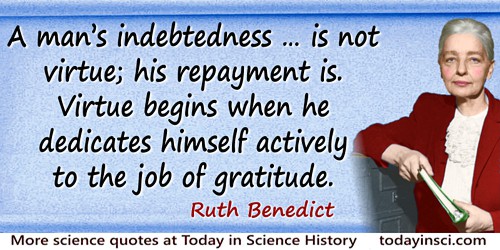
A man’s indebtedness … is not virtue; his repayment is. Virtue begins when he dedicates himself actively to the job of gratitude.
In The Chrysanthemum and the Sword (1946, 2006), 114.
A pessimist: an optimist out of a job.
Aphorism in The Philistine (Dec 1904), 20, No. 1, 10.
All living organisms are but leaves on the same tree of life. The various functions of plants and animals and their specialized organs are manifestations of the same living matter. This adapts itself to different jobs and circumstances, but operates on the same basic principles. Muscle contraction is only one of these adaptations. In principle it would not matter whether we studied nerve, kidney or muscle to understand the basic principles of life. In practice, however, it matters a great deal.
'Muscle Research', Scientific American, 1949, 180 (6), 22.
An inventor is simply a fellow who doesn’t take his education too seriously. You see, from the time a person is six years old until he graduates form college he has to take three or four examinations a year. If he flunks once, he is out. But an inventor is almost always failing. He tries and fails maybe a thousand times. It he succeeds once then he’s in. These two things are diametrically opposite. We often say that the biggest job we have is to teach a newly hired employee how to fail intelligently. We have to train him to experiment over and over and to keep on trying and failing until he learns what will work.
In 'How Can We Develop Inventors?' presented to the Annual meeting of the American Society of Society Engineers. Reprinted in Mechanical Engineering (Apr 1944). Collected in Prophet of Progress: Selections from the Speeches of Charles F. Kettering (1961), 108.
But when you come right down to it, the reason that we did this job is because it was an organic necessity. If you are a scientist you cannot stop such a thing. If you are a scientist you believe that it is good to find out how the world works; that it is good to find out what the realities are; that it is good to turn over to mankind at large the greatest possible power to control the world and to deal with it according to its lights and values.
Regarding the atomic bomb project.
Regarding the atomic bomb project.
From speech at Los Alamos (17 Oct 1945). Quoted in David C. Cassidy, J. Robert Oppenheimer and the American Century (2009), 214.
Change requires experimentation. But no problem can be solved by the same consciousness that created it. Our job is to dream—and to make those dreams happen.
In interview article, 'Designing For The Future', Newsweek (15 May 2005).
Choose a job you love and you will never have to work a day in your life.
Too often seen carelessly attributed to Confucius. Webmaster has searched the original writings of the disciples of Confucius who recorded his thoughts, and has seen nothing resembling this. Peasants of his era did not “choose a job”—they merely worked on raising food and providing the necessities of life for their family and community.
Computer science … jobs should be way more interesting than even going to Wall Street or being a lawyer--or, I can argue, than anything but perhaps biology, and there it’s just a tie.
From interview (24 May 2004) in Scientific American (Jun 2004), 45.
Copernicus, the most learned man whom we are able to name other than Atlas and Ptolemy, even though he taught in a most learned manner the demonstrations and causes of motion based on observation, nevertheless fled from the job of constructing tables, so that if anyone computes from his tables, the computation is not even in agreement with his observations on which the foundation of the work rests. Therefore first I have compared the observations of Copernicus with those of Ptolemy and others as to which are the most accurate, but besides the bare observations, I have taken from Copernicus nothing other than traces of demonstrations. As for the tables of mean motion, and of prosthaphaereses and all the rest, I have constructed these anew, following absolutely no other reasoning than that which I have judged to be of maximum harmony.
Dedication to the Duke of Prussia, Prutenicae Tabulae (1551), 1585 edition, as quoted in Owen Gingerich, The Eye of Heaven: Ptolemy, Copernicus, Kepler (1993), 227.
Engineering is more closely akin to the arts than perhaps any other of the professions; first, because it requires the maximum of natural aptitude and of liking for the work in order to offset other factors; second, because it demands, like the arts, an almost selfless consecration to the job; and, third, because out of the hundreds who faithfully devote themselves to the task, only a few are destined to receive any significant reward—in either money or fame.
As coauthor with Frank W. Skinner, and Harold E. Wessman, 'Foreward', Vocational Guidance in Engineering Lines (1933), vi.
Every man has some forte something he can do better than he can do anything else. Many men, however, never find the job they are best fitted for. And often this is because they do not think enough. Too many men drift lazily into any job, suited or unsuited for them; and when they don’t get along well they blame everybody and everything except themselves.
As quoted from an interview by B.C. Forbes in The American Magazine (Jan 1921), 10.
Everybody that I’ve ever seen that enjoyed their job was very good at it.
For what are the whales being killed? For a few hundred jobs and products that are not needed, since there are cheap substitutes. If this continues, it will be the end of living and the beginning of survival. The world is being totaled.
Attributed.
Games are among the most interesting creations of the human mind, and the analysis of their structure is full of adventure and surprises. Unfortunately there is never a lack of mathematicians for the job of transforming delectable ingredients into a dish that tastes like a damp blanket.
In J.R. Newman (ed.), 'Commentary on Games and Puzzles', The World of Mathematics (1956), Vol. 4, 2414.
Hubble's observations suggested that there was a time, called the big bang, when the universe was infinitesimally small and infinitely dense. Under such conditions all the laws of science, and therefore all ability to predict the future, would break down. If there were events earlier than this time, then they could not affect what happens at the present time. Their existence can be ignored because it would have no observational consequences. One may say that time had a beginning at the big bang, in the sense that earlier times simply would not be defined. It should be emphasized that this beginning in time is very different from those that had been considered previously. In an unchanging universe a beginning in time is something that has to be imposed by some being outside the universe; there is no physical necessity for a beginning. One can imagine that God created the universe at literally any time in the past. On the other hand, if the universe is expanding, there may be physical reasons why there had to be a beginning. One could still imagine that God created the universe at the instant of the big bang, or even afterwards in just such a way as to make it look as though there had been a big bang, but it would be meaningless to suppose that it was created before the big bang. An expanding universe does not preclude a creator, but it does place limits on when he might have carried out his job!
A Brief History of Time: From the Big Bang to Black Holes (1988), 8-9.
I am a cross between Steve Jobs and Leonardo da Vinci.
As quoted by Franz Lidz in 'Dr. NakaMats, the Man With 3300 Patents to His Name', Smithsonian Magazine (Dec 2012).
I am quite aware that we have just now lightheartedly expelled in imagination many excellent men who are largely, perhaps chiefly, responsible for the buildings of the temple of science; and in many cases our angel would find it a pretty ticklish job to decide. But of one thing I feel sure: if the types we have just expelled were the only types there were, the temple would never have come to be, any more than a forest can grow which consists of nothing but creepers. For these people any sphere of human activity will do, if it comes to a point; whether they become engineers, officers, tradesmen, or scientists depends on circumstances.
…...
I do not believe that God ever created a man and then got so “put out” over the job that He damned him.
Aphorism in The Philistine (Apr 1905), 20, No. 5, 160.
I felt an awesome responsibility, and I took the responsibility very seriously, of being a role model and opening another door to black Americans, but the important thing is not that I am black, but that I did a good job as a scientist and an astronaut. There will be black astronauts flying in later missions … and they, too, will be people who excel, not simply who are black … who can ably represent their people, their communities, their country.
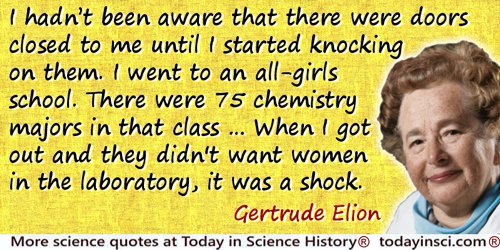
I hadn’t been aware that there were doors closed to me until I started knocking on them. I went to an all-girls school. There were 75 chemistry majors in that class, but most were going to teach it … When I got out and they didn't want women in the laboratory, it was a shock … It was the Depression and nobody was getting jobs. But I had taken that to mean nobody was getting jobs … [when I heard] “You're qualified. But we’ve never had a woman in the laboratory before, and we think you’d be a distracting influence.”
As quoted in Sharon Bertsch McGrayne, Nobel Prize Women in Science: Their Lives, Struggles and Momentous Discoveries (1993).
I hardly look upon this as an operational mission. My job has just been to develop something which will break down a dam wall. I look upon this raid as my last great experiment to see if it can be done on the actual thing.
About his “dambuster” bomb project during World War II. As quoted in W. B. Bartlett, Dam Busters: In the Words of the Bomber Crews (2011, 2013), 103. Wallis said this, ahead of the raid, to Wing Cdr G. P. Gibson, leader of the force of Lancasters of Bomber Command.
I have, also, a good deal of respect for the job they [physicists] did in the first months after Hiroshima. The world desperately needed information on this new problem in the daily life of the planet, and the physicists, after a slow start, did a good job of giving it to them. It hasn’t come out with a fraction of the efficiency that the teachers might have wished, but it was infinitely more effective than anyone would have dared expect.
In 'A Newsman Looks at Physicists', Physics Today (May 1948), 1, No. 1, 15.
I like to tell students that the jobs I took [at NASA] after my Ph.D. were not in existence only a few years before. New opportunities can open up for you in this ever changing field.
From interview, 'Happy 90th Birthday, Nancy', on NASA website (30 May 2017).
I remember growing up thinking that astronauts and their job was the coolest thing you could possibly do... But I absolutely couldn’t identify with the people who were astronauts. I thought they were movie stars.
…...
I said that there is something every man can do, if he can only find out what that something is. Henry Ford has proved this. He has installed in his vast organization a system for taking hold of a man who fails in one department, and giving him a chance in some other department. Where necessary every effort is made to discover just what job the man is capable of filling. The result has been that very few men have had to be discharged, for it has been found that there was some kind of work each man could do at least moderately well. This wonderful system
adopted by my friend Ford has helped many a man to find himself. It has put many a fellow on his feet. It has taken round pegs out of square holes and found a round hole for them. I understand that last year only 120 workers out of his force of 50,000 were discharged.
As quoted from an interview by B.C. Forbes in The American Magazine (Jan 1921), 10.
I think it is a duty I owe to my profession and to my sex to show that a woman has a right to the practice of her profession and cannot be condemned to abandon it merely because she marries. I cannot conceive how women’s colleges, inviting and encouraging women to enter professions can be justly founded or maintained denying such a principle.
(From a letter Brooks wrote to her dean, knowing that she would be told to resign if she married, she asked to keep her job. Nevertheless, she lost her teaching position at Barnard College in 1906. Dean Gill wrote that “The dignity of women’s place in the home demands that your marriage shall be a resignation.”)
(From a letter Brooks wrote to her dean, knowing that she would be told to resign if she married, she asked to keep her job. Nevertheless, she lost her teaching position at Barnard College in 1906. Dean Gill wrote that “The dignity of women’s place in the home demands that your marriage shall be a resignation.”)
As quoted by Margaret W. Rossiter in Women Scientists in America: Struggles and Strategies to 1940. Baltimore: Johns Hopkins University Press (1982).
I've never seen a job being done by a five-hundred-person engineering team that couldn't be done better by fifty people.
Statement once told to the author, as quoted in Thomas J. Peters, Liberation Management: Necessary Disorganization for the Nanosecond Nineties (1992), 572.
If a person cannot love a plant after he has pruned it, then he has either done a poor job or is devoid of emotion.
In The Pruning-Book: A Monograph of the Pruning and Training of Plants (1898), 134.
If Babbage had lived seventy-five years later I would have been out of a job.
As quoted in Jeremy Bernstein, The Analytical Engine: Computers, Past, Present, and Future (1964), 52. Note: Aiken created the Harvard Mark I computer in the 1940s. Babbage died in 1871.
If there’s more than one way to do a job and one of those ways will end in disaster, then somebody will do it that way.
[Early statement of what became known as Murphy's Law.]
[Early statement of what became known as Murphy's Law.]
As quoted in People (31 Jan 1983), 82. Also in Nick T. Spark, A History of Murphy's Law (2006), 47.
Nick T. Spark - Humor - 2006
In those days in the South, the only professional jobs that seemed to be open to a black man were a teacher, a preacher, a doctor or a lawyer.
About his youth. Quoted in Johns Hopkins University News Release (9 Jan 2003) on jh.edu web site.
It has been said that computing machines can only carry out the processes that they are instructed to do. This is certainly true in the sense that if they do something other than what they were instructed then they have just made some mistake. It is also true that the intention in constructing these machines in the first instance is to treat them as slaves, giving them only jobs which have been thought out in detail, jobs such that the user of the machine fully understands what in principle is going on all the time. Up till the present machines have only been used in this way. But is it necessary that they should always be used in such a manner? Let us suppose we have set up a machine with certain initial instruction tables, so constructed that these tables might on occasion, if good reason arose, modify those tables. One can imagine that after the machine had been operating for some time, the instructions would have altered out of all recognition, but nevertheless still be such that one would have to admit that the machine was still doing very worthwhile calculations. Possibly it might still be getting results of the type desired when the machine was first set up, but in a much more efficient manner. In such a case one would have to admit that the progress of the machine had not been foreseen when its original instructions were put in. It would be like a pupil who had learnt much from his master, but had added much more by his own work. When this happens I feel that one is obliged to regard the machine as showing intelligence.
Lecture to the London Mathematical Society, 20 February 1947. Quoted in B. E. Carpenter and R. W. Doran (eds.), A. M. Turing's Ace Report of 1946 and Other Papers (1986), 122-3.
It is the business of science to offer rational explanations for all the events in the real world, and any scientist who calls on God to explain something is falling down on his job. This applies as much to the start of the expansion as to any other event. If the explanation is not forthcoming at once, the scientist must suspend judgment: but if he is worth his salt he will always maintain that a rational explanation will eventually be found. This is the one piece of dogmatism that a scientist can allow himself—and without it science would be in danger of giving way to superstition every time that a problem defied solution for a few years.
The Mystery of the Expanding Universe (1964), 122.
Journalism must find the facts, it must not prejudge things in terms of conservatism or liberalism or radicalism; it must not decide in advance that it is to be conformist or non-conformist; it cannot fly in the face of facts without courting ultimate disaster.
Journalism must focus the facts; facts are not important for their own sake; they are important only as a basis for action; journalism must focus the facts it finds upon the issues its readers face.
Journalism must filter the facts; it must with conscientious care separate the facts from admixtures of prejudice, passion, partisanship, and selfish interest; facts that are diluted, colored, or perverted are valueless as a basis for action.
Journalism must face the facts; it must learn that the energy spent in trying to find ways to get around, under, or over the facts is wasted energy; facts have a ruthless way of winning the day sooner or later.
Journalism must follow the facts; journalism must say of facts as Job said, of God: though they slay us, yet shall we trust them; if the facts threaten to upset a paper's cherished policy, it always pays the journalist to re-examine his policy; that way lies realism, and realism is the ultimate good.
Journalism must focus the facts; facts are not important for their own sake; they are important only as a basis for action; journalism must focus the facts it finds upon the issues its readers face.
Journalism must filter the facts; it must with conscientious care separate the facts from admixtures of prejudice, passion, partisanship, and selfish interest; facts that are diluted, colored, or perverted are valueless as a basis for action.
Journalism must face the facts; it must learn that the energy spent in trying to find ways to get around, under, or over the facts is wasted energy; facts have a ruthless way of winning the day sooner or later.
Journalism must follow the facts; journalism must say of facts as Job said, of God: though they slay us, yet shall we trust them; if the facts threaten to upset a paper's cherished policy, it always pays the journalist to re-examine his policy; that way lies realism, and realism is the ultimate good.
From address as president of the Wisconsin local chapter of Theta Sigma Phi, at its first annual Matrix Table (9 Jan 1926). quoted in 'Journalism News and Notes', in Robert S. Crawford (ed.), The Wisconsin Alumni Magazine (Feb 1926), 27, No. 4, 101. If you know any other example of Glenn Frank speaking about his five themes on facts, please contact Webmaster.
My father introduced me to three black men who had earned doctorates in chemistry and physics. The best jobs they could find were at the post office. My father said I was taking the long road toward working at the post office.
Recalling how his parents were disappointed that he chose to study physics at university instead of medicine to be a doctor. Quoted in Johns Hopkins University News Release (9 Jan 2003) on jh.edu web site.
Nothing enrages me more than when people criticize my criticism of school by telling me that schools are not just places to learn math and spelling, they are places where children learn a vaguely defined thing called socialization. I know. I think schools generally do an effective and terribly damaging job of teaching children to be infantile, dependent, intellectually dishonest, passive and disrespectful to their own developmental capacities. (1981)
Quoted in K.P. Yaday and Malti Sundram, Encyclopaedia Of Child And Primary Education Development, Vol. 2, 99.
Our job in physics is to see things simply, to understand a great many complicated phenomena in a unified way, in terms of a few simple principles.
In Nobel Lecture (8 Dec 1989), 'Conceptual Foundations of the Unified Theory of Weak and Electromagnetic Interactions.'
Our job is to keep everlastingly at research and experiment, to adapt our laboratories to production as soon as practicable, to let no new improvement in flying and flying equipment pass us by.
End of Boeing’s quote, inscribed on his memorial at the Boeing Developmental Center, Tukwila, WA, as given in Mike Lombardi, 'Historical Perspective: 50 years at the Leading Edge', Boeing Frontiers (Aug 2009), 9.
People ask, “Is the science going to run ahead of the ethics?” I don't think that’s always the problem. I think it’s that the science runs ahead of the politics. Bioethics can alert people to something coming down the road, but it doesn't mean policy and politicians are going to pay attention. They tend to respond when there’s an immediate crisis. The job of the ethicist, in some ways, is to warn or be prophetic. You can yell loudly, but you can’t necessarily get everybody to leave the cinema, so to speak.
Interview by Karen Pallarito in The Scientist (Jan 2008), supplement, 74.
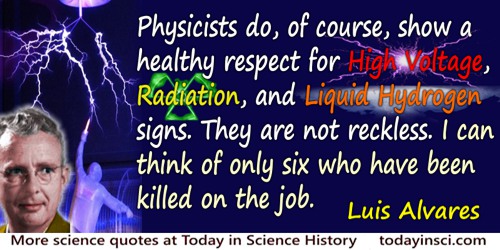
Physicists do, of course, show a healthy respect for High Voltage, Radiation, and Liquid Hydrogen signs. They are not reckless. I can think of only six who have been killed on the job.
In Adventures of a Physicist (1987), 14.
Rome wasn’t built in a day? I wasn’t in charge of that job.
In 'Speeding up Calculations', Facts From Figures (1951), Chap. 6, 66.
Science … has the job, first of all, of enabling the inquiring mind to feel at home in a mysterious universe.
In Relativity Visualized (1981, 1985), 77.
Suppose you had a small electrical fire and... a structural engineer [looked] at your home’s wiring [and] reports that the wiring is “shot” and there is a 50% chance that your house would burn down in the next few years unless you replace all the wiring. The job will cost $20,000... so you get an independent assessment. The next engineer agrees with the first warning. You can either continue to shop for additional evaluations until you find the one engineer in 1,000 that is willing to give you the answer you want, “Your family is not in danger” or you can change the wiring.
[Comparing the urgency of action on climate change to a problem with electrical wiring in a house.]
[Comparing the urgency of action on climate change to a problem with electrical wiring in a house.]
From press conference at National Press Club (17 Sep 2008), 'Basic Research: Fueling America's Future'. Quoted on the Science Coalition website.
The analysis of man discloses three chemical elements - a job, a meal and a woman.
The cowman who cleans his range of wolves does not realize that he is taking over the wolf’s job of trimming the herd to fit the range. He has not learned to think like a mountain. Hence we have dustbowls, and rivers washing the future into the sea.
In 'Thinking Like a Mountain', A Sand County Almanac, and Sketches Here and There (1949, 1987), 132.
The engineer is concerned to travel from the abstract to the concrete. He begins with an idea and ends with an object. He journeys from theory to practice. The scientist’s job is the precise opposite. He explores nature with his telescopes or microscopes, or much more sophisticated techniques, and feeds into a computer what he finds or sees in an attempt to define mathematically its significance and relationships. He travels from the real to the symbolic, from the concrete to the abstract. The scientist and the engineer are the mirror image of each other.
In The Development of Design (1981), 19-20.
The Fundamental Regulator Paradox … The task of a regulator is to eliminate variation, but this variation is the ultimate source of information about the quality of its work. Therefore, the better the job a regulator does the less information it gets about how to improve.
In Gerald M. Weinberg and Daniela Weinberg, The Design of Stable Systems (1979), 250. As quoted in John R. Wilson, Evaluation of Human Work (2005), 220.
The great liability of the engineer compared to men of other professions is that his works are out in the open where all can see them. … He cannot, like the architects, cover his failures with trees and vines. … If his works do not work, he is damned. That is the phantasmagoria that haunts his nights and dogs his days. He comes from the job at the end of the day resolved to calculate it again.
Reprint of his 1916 statement in 'Engineering as a Profession', Engineer’s Week (1954).
The human brain is a machine which alone accounts for all our actions, our most private thoughts, our beliefs. ... To choose a spouse, a job, a religious creed—or even choose to rob a bank—is the peak of a causal chain that runs back to the origin of life and down to the nature of atoms and molecules.
The Mind Machine (1998), 145. In Vinoth Ramachandra, Subverting Global Myths: Theology and the Public Issues Shaping our World (2008), 179.
The job is so fantastic, you don’t need a hobby. The hobby is going to work.
Quoted in magazine article, 'Space Trio: New Faces Among Shuttle Crew', Ebony (Mar 1979), 60.
The job of the artist is always to deepen the mystery
John Mitchinson and John Lloyd, If Ignorance Is Bliss, Why Aren't There More Happy People?: Smart Quotes for Dumb Times (2009), 217.
The job of theorists, especially in biology, is to suggest new experiments. A good theory makes not only predictions, but surprising predictions that then turn out to be true. (If its predictions appear obvious to experimentalists, why would they need a theory?)
In What Mad Pursuit: A Personal View of Scientific Discovery (1988), 142.
The laboratory was an unattractive half basement and low ceilinged room with an inner dark room for the galvanometer and experimental animals. It was dark, crowded with equipment and uninviting. Into it came patients for electrocardiography, dogs for experiments, trays with coffee and buns for lunch. It was hot and dusty in summer and cold in winter. True a large fire burnt brightly in the winter but anyone who found time to warm his backside at it was not beloved by [Sir Thomas] Lewis. It was no good to try and look out of the window for relaxation, for it was glazed with opaque glass. The scientific peaks were our only scenery, and it was our job to try and find the pathways to the top.
— Magazine
'Tribute to Sir Thomas Lewis', University College Hospital Magazine (1955), 40, 71.
The more we know about this universe, the more mysterious it is. The old world that Job knew was marvelous enough, and his description of its wonders is among the noblest poetry of the race, but today the new science has opened to our eyes vistas of mystery that transcend in their inexplicable marvel anything the ancients ever dreamed.
In 'What Keeps Religion Going?', collected in Living Under Tension: Sermons On Christianity Today (1941), 53.
The owner of the means of production is in a position to purchase the labor power of the worker. By using the means of production, the worker produces new goods which become the property of the capitalist. The essential point about this process is the relation between what the worker produces and what he is paid, both measured in terms of real value. In so far as the labor contract is free what the worker receives is determined not by the real value of the goods he produces, but by his minimum needs and by the capitalists’ requirements for labor power in relation to the number of workers competing for jobs. It is important to understand that even in theory the payment of the worker is not determined by the value of his product.
…...

The path towards sustainable energy sources will be long and sometimes difficult. But America cannot resist this transition, we must lead it. We cannot cede to other nations the technology that will power new jobs and new industries, we must claim its promise. That’s how we will maintain our economic vitality and our national treasure—our forests and waterways, our crop lands and snow-capped peaks. That is how we will preserve our planet, commanded to our care by God. That’s what will lend meaning to the creed our fathers once declared.
In Second Inaugural Address (21 Jan 2013) at the United States Capitol.
The scientist is not responsible for the laws of nature, but it is a scientist’s job to find out how these laws operate. It is the scientist’s job to find ways in which these laws can serve the human will. However, it is not the scientist’s job to determine whether a hydrogen bomb should be used. …
In A Passion for Science edited by L. Wolpert and A. Richards (1988).
The scientist is not responsible for the laws of nature. It is his job to find out how these laws operate. It is the scientist’s job to find the ways in which these laws can serve the human will. However, it is not the scientist’s job to determine whether a hydrogen bomb should be constructed, whether it should be used, or how it should be used. This responsibility rests with the American people and with their chosen representatives.
In 'Back to the Laboratories', Bulletin of the Atomic Scientists (Mar 1950), 6, No. 3, 71. Quoted in L. Wolpert and A. Richards (eds.), A Passion for Science (1988), 9, but incorrectly attributed to Robert Oppenheimer.
There has come about a general public awareness that America is not automatically, and effortlessly, and unquestionably the leader of the world in science and technology. This comes as no surprise to those of us who have watched and tried to warn against the steady deterioration in the teaching of science and mathematics in the schools for the past quarter century. It comes as no surprise to those who have known of dozens of cases of scientists who have been hounded out of jobs by silly disloyalty charges, and kept out of all professional employment by widespread blacklisting practices.
Banquet speech at American Physical Society, St. Louis, Missouri. (29 Nov 1957). In "Time to Stop Baiting Scientists", Bulletin of the Atomic Scientists (Feb 1958), 80.
There is no record in human history of a happy philosopher; they exist only in romantic legend. Many of them have committed suicide; many others have turned their children out of doors and beaten their wives. And no wonder. If you want to find out how a philosopher feels when he is engaged in the practise of his profession, go to the nearest zoo and watch a chimpanzee at the wearying and hopeless job of chasing fleas. Both suffer damnably, and neither can win.
From The Human Mind, Prejudices: Sixth Series (1927), 85. Collected in A Mencken Chrestomathy (1949, 1956), 16.
There’s a touch of the priesthood in the academic world, a sense that a scholar should not be distracted by the mundane tasks of day-to-day living. I used to have great stretches of time to work. Now I have research thoughts while making peanut butter and jelly sandwiches. Sure it’s impossible to write down ideas while reading “Curious George” to a two-year-old. On the other hand, as my husband was leaving graduate school for his first job, his thesis advisor told him, “You may wonder how a professor gets any research done when one has to teach, advise students, serve on committees, referee papers, write letters of recommendation, interview prospective faculty. Well, I take long showers.”
In 'In Her Own Words: Six Mathematicians Comment on Their Lives and Careers: Susan Landau', Notices of the AMS (Sep 1991), 38, No. 7, 704.
There’s probably 5000 times more solar energy than the humans will ever need. We could cover our highways with solar collectors to make ribbons of energy, and I think that it’s really the largest job creation program in the history of the planet that’s in front of us. It’s a celebration of the abundance of human creativity combined with the abundance of the natural world.
In audio segment, 'William McDonough: Godfather of Green', WNYC, Studio 360 broadcast on NPR radio (18 Mar 2008) and archived on the station website.
Three apples changed the world, Adam's apple, Newton's apple, and Steve's apple.
[Tweeted tribute for Steve Jobs, co-founder the Apple computer company.]
[Tweeted tribute for Steve Jobs, co-founder the Apple computer company.]
In Fouad Ajami, 'The Arab World's Unknown Son', Wall Street Journal (12 Oct 2011).
To the engineer falls the job of clothing the bare bones of science with life, comfort, and hope.
Reprint of his 1916 statement in 'Engineering as a Profession', Engineer’s Week (1954).
We make a lot of mistakes in the environmental space. … We don’t do a good-enough job of asking, “What are the fundamentals of telling a good story?” And that is not statistics, it’s usually not science, or at least complex science. It’s people stories. … It’s got to have adventure, it’s got to be funny, it’s got to pull my heart strings, it’s got to have conflict, setting, character. It’s a story. And if it doesn’t have those things, it can be the best-meaning story in the world, and nobody’s going to buy it.
From interview with Dan Conover, 'A Conversation with Philippe Cousteau Jr.', Charleston City Paper (27 Jul 2012).
We need to engage and inspire today’s youth to do a much better job of protecting the planet and our future than we have. My grandfather raised me believing in the power of youth to change the world. … Education and young people are key to making sure we don’t keep repeating our mistakes.
In 'Gulf Dispatch: Time to Tap Power of Teens', CNN Blog (23 Jul 2010).
We often hear that mathematics consists mainly of “proving theorems.” Is a writer's job mainly that of “writing sentences?”
In Rota's 'Introduction' written (1980) to preface Philip J. Davis and Reuben Hersh, The Mathematical Experience (1981, 2012), xxii.
What [man landing on the moon] is doing up there is indulging his obsession with the impossible. The impossible infuriates and tantalizes him. Show him an impossible job and he will reduce it to a possibility so trite that eventually it bores him.
'Why on Earth Are We There? Because It's Impossible', New York Times (21 Jul 1969), 17.
When it becomes clear that you cannot find out by reasoning whether the cat is in the linen-cupboard, it is Reason herself who whispers, “Go and look. This is not my job: it is a matter for the senses.”
In Miracles: A Preliminary Study (1947), 110. Collected in Words to Live By: A Guide for the Merely Christian (2007), 245.
When we accept tough jobs as a challenge and wade into them with joy and enthusiasm, miracles can happen.
…...
Whenever there is a hard job to be done I assign it to a lazy man; he is sure to find an easy way of doing it.
Whether it’s the science to slow global warming; the technology to protect our troops and confront bioterror and weapons of mass destruction; the research to find life-saving cures; or the innovations to remake our industries and create twenty-first century jobs—Today, more than ever before, science holds the key to our survival as a planet and our security and prosperity as a nation. It’s time we once again put science at the top of our agenda and work to restore America’s place as the world leader in science and technology.
From weekly Democratic address as President-Elect, online video (20 Dec 2008), announcing his selection of science and technology advisers. C-Span video 282995-102.
With a thousand joys I would accept a nonacademic job for which industriousness, accuracy, loyalty, and such are sufficient without specialized knowledge, and which would give a comfortable living and sufficient leisure, in order to sacrifice to my gods [mathematical research]. For example, I hope to get the editting of the census, the birth and death lists in local districts, not as a job, but for my pleasure and satisfaction...
Letter to Heinrich Olbers (26 Oct 1802). Quoted in G. Waldo Dunnington, Carl Friedrich Gauss: Titan of Science (2004), 415.
World Game finds that 60 percent of all the jobs in the U.S.A. are not producing any real wealth—i.e., real life support. They are in fear-underwriting industries or are checking-on-other-checkers, etc.
In Critical Path (1982), 223.
You don’t concentrate on risks. You concentrate on results. No risk is too great to prevent the necessary job from getting done.
Your true inventor has a yen to invent, just as a painter or musician is impelled to create something in his art. I began wanting to invent when I was in short pants. At the age of eight—and that was forty years ago—I invented a rock-thrower. Later I found that the Romans had done a much better job some two thousand years before me.
Attributed to an unnamed “holder of many patents,” as quoted by Stacy V. Jones, in You Ought to Patent That (1962), 21.
 In science it often happens that scientists say, 'You know that's a really good argument; my position is mistaken,' and then they would actually change their minds and you never hear that old view from them again. They really do it. It doesn't happen as often as it should, because scientists are human and change is sometimes painful. But it happens every day. I cannot recall the last time something like that happened in politics or religion.
(1987) --
In science it often happens that scientists say, 'You know that's a really good argument; my position is mistaken,' and then they would actually change their minds and you never hear that old view from them again. They really do it. It doesn't happen as often as it should, because scientists are human and change is sometimes painful. But it happens every day. I cannot recall the last time something like that happened in politics or religion.
(1987) -- 





