Investigation Quotes (252 quotes)
Investigations Quotes
Investigations Quotes
[1158] There is no certainty in sciences where one of the mathematical sciences cannot be applied, or which are not in relation with these mathematics.
Notebook G (c.1515), sheet 95 back. In the original Italian: “Nessuna certezza delle sciētie è, dove no si può applicare vna delle sciētie matematiche e che non son vnight con esse matematiche.” English and Italian in Jean Paul Richter (trans.), 'Philosophical Maxims: Of Mechanics', The Literary Works of Leonardo da Vinci (1883), Vol. 1, Part 2, 289, Aphorism 1158. [Note: da Vinci wrote ē=en; v=u] The following, found on the web, without citation, seems to be a paraphrase: “No human investigation can be called real science if it cannot be demonstrated mathematically.”
![Willem van Bemmelen quote: [In geology,] As in history, the material in hand remains silent if no questions are asked.](https://todayinsci.com/V/VanBemmelen_RW/VanBemmelenRW-Silent500x250px.jpg)
[In geology,] As in history, the material in hand remains silent if no questions are asked. The nature of these questions depends on the “school” to which the geologist belongs and on the objectivity of his investigations. Hans Cloos called this way of interrogation “the dialogue with the earth,” “das Gesprach mit der Erde.”
In 'The Scientific Character of Geology', The Journal of Geology (Jul 1961), 69, No. 4, 456.
Conclusions
I. A curve has been found representing the frequency distribution of standard deviations of samples drawn from a normal population.
II. A curve has been found representing the frequency distribution of values of the means of such samples, when these values are measured from the mean of the population in terms of the standard deviation of the sample…
IV. Tables are given by which it can be judged whether a series of experiments, however short, have given a result which conforms to any required standard of accuracy or whether it is necessary to continue the investigation.
I. A curve has been found representing the frequency distribution of standard deviations of samples drawn from a normal population.
II. A curve has been found representing the frequency distribution of values of the means of such samples, when these values are measured from the mean of the population in terms of the standard deviation of the sample…
IV. Tables are given by which it can be judged whether a series of experiments, however short, have given a result which conforms to any required standard of accuracy or whether it is necessary to continue the investigation.
'The Probable Error of a Mean', Biometrika, 1908, 6, 25.
Imprimisque hominis est propria veri inquisitio atque investigatio.
The first duty of man is the seeking after and the investigation of truth.
The first duty of man is the seeking after and the investigation of truth.
De Officiis I., 4, 18. In Thomas Benfield Harbottle, Dictionary of Quotations (classical) (3rd Ed., 1906), 98.
In primis, hominis est propria VERI inquisitio atque investigato. Itaque cum sumus negotiis necessariis, curisque vacui, tum avemus aliquid videre, audire, ac dicere, cognitionemque rerum, aut occultarum aut admirabilium, ad benè beatéque vivendum necessariam ducimus; —ex quo intelligitur, quod VERUM, simplex, sincerumque sit, id esse naturæ hominis aptissimum. Huic veri videndi cupiditati adjuncta est appetitio quædam principatûs, ut nemini parere animus benè a naturâ informatus velit, nisi præcipienti, aut docenti, aut utilitatis causâ justè et legitimè imperanti: ex quo animi magnitudo existit, et humanarum rerum contemtio.
Before all other things, man is distinguished by his pursuit and investigation of TRUTH. And hence, when free from needful business and cares, we delight to see, to hear, and to communicate, and consider a knowledge of many admirable and abstruse things necessary to the good conduct and happiness of our lives: whence it is clear that whatsoever is TRUE, simple, and direct, the same is most congenial to our nature as men. Closely allied with this earnest longing to see and know the truth, is a kind of dignified and princely sentiment which forbids a mind, naturally well constituted, to submit its faculties to any but those who announce it in precept or in doctrine, or to yield obedience to any orders but such as are at once just, lawful, and founded on utility. From this source spring greatness of mind and contempt of worldly advantages and troubles.
Before all other things, man is distinguished by his pursuit and investigation of TRUTH. And hence, when free from needful business and cares, we delight to see, to hear, and to communicate, and consider a knowledge of many admirable and abstruse things necessary to the good conduct and happiness of our lives: whence it is clear that whatsoever is TRUE, simple, and direct, the same is most congenial to our nature as men. Closely allied with this earnest longing to see and know the truth, is a kind of dignified and princely sentiment which forbids a mind, naturally well constituted, to submit its faculties to any but those who announce it in precept or in doctrine, or to yield obedience to any orders but such as are at once just, lawful, and founded on utility. From this source spring greatness of mind and contempt of worldly advantages and troubles.
In De Officiis, Book 1. Sect. 13. As given in epigraph to John Frederick William Herschel, A Preliminary Discourse on the Study of Natural Philosophy (1830), viii.
In primis, hominis est propria VERI inquisitio atque investigato.
Before all other things, man is distinguished by his pursuit and investigation of TRUTH.
Before all other things, man is distinguished by his pursuit and investigation of TRUTH.
In De Officiis, Book 1. Sect. 13. As given in epigraph to John Frederick William Herschel, A Preliminary Discourse on the Study of Natural Philosophy (1830), viii. This is the start of a longer quote on the Cicero quotes page.
Notatio naturae, et animadversio perperit artem
Art is born of the observation and investigation of nature.
Art is born of the observation and investigation of nature.
In Jon R. Stone, The Routledge Dictionary of Latin Quotations (2005), 78.
Une idée anticipée ou une hypothèse est donc le point de départ nécessaire de tout raisonnement expérimental. Sans cela on ne saurait faire aucune investigation ni s’instruire ; on ne pourrait qu’entasser des observations stériles. Si l’on expérimentait sans idée préconçue, on irait à l’aventure; mais d’un autre côté, ainsi que nous l’avons dit ailleurs, si l’on observait avec des idées préconçues, on ferait de mauvaises observations.
An anticipative idea or an hypothesis is, then, the necessary starting point for all experimental reasoning. Without it, we could not make any investigation at all nor learn anything; we could only pile up sterile observations. If we experimented without a preconceived idea, we should move at random.
[Also seen translated as:] A hypothesis is … the obligatory starting point of all experimental reasoning. Without it no investigation would be possible, and one would learn nothing: one could only pile up barren observations. To experiment without a preconceived idea is to wander aimlessly.
An anticipative idea or an hypothesis is, then, the necessary starting point for all experimental reasoning. Without it, we could not make any investigation at all nor learn anything; we could only pile up sterile observations. If we experimented without a preconceived idea, we should move at random.
[Also seen translated as:] A hypothesis is … the obligatory starting point of all experimental reasoning. Without it no investigation would be possible, and one would learn nothing: one could only pile up barren observations. To experiment without a preconceived idea is to wander aimlessly.
Original work in French, Introduction à l'Étude de la Médecine Expérimentale (1865). English translation by Henry Copley Green in An Introduction to the Study of Experimental Medicine (1927, 1957), 32. Alternate translation in Peter Medawar, 'Hypothesis and Imagination', collected in The Strange Case of the Spotted Mice and Other Classic Essays on Science (1974), 30.
A Dr van’t Hoff of the veterinary college at Utrecht, appears to have no taste for exact chemical investigation. He finds it a less arduous task to mount Pegasus (evidently borrowed from the veterinary school) and to proclaim in his La Chemie dans l’espace how, during his bold fight to the top of the chemical Parnassus, the atoms appeared to him to have grouped themselves together throughout universal space. … I should have taken no notice of this matter had not Wislicenus oddly enough written a preface to the pamphlet, and not by way of a joke but in all seriousness recommended it a worthwhile performance.
'Signs of the Times', Journal fur Praktische Chemie, 15, 473. Trans. W. H. Brock.
A physician’s subject of study is necessarily the patient, and his first field for observation is the hospital. But if clinical observation teaches him to know the form and course of diseases, it cannot suffice to make him understand their nature; to this end he must penetrate into the body to find which of the internal parts are injured in their functions. That is why dissection of cadavers and microscopic study of diseases were soon added to clinical observation. But to-day these various methods no longer suffice; we must push investigation further and, in analyzing the elementary phenomena of organic bodies, must compare normal with abnormal states. We showed elsewhere how incapable is anatomy alone to take account of vital phenenoma, and we saw that we must add study of all physico-chemical conditions which contribute necessary elements to normal or pathological manifestations of life. This simple suggestion already makes us feel that the laboratory of a physiologist-physician must be the most complicated of all laboratories, because he has to experiment with phenomena of life which are the most complex of all natural phenomena.
From An Introduction to the Study of Experimental Medicine (1865), as translated by Henry Copley Greene (1957), 140-141.
A study of Dr. [Florence] Sabin’s work shows the greatness of her achievement and the character of her mind. She has dealt with the primary and fundamental problem of the cell—the unit of plant and animal life. All through her investigations she has followed the cell, seeking the secret of differentiations by newer and finer methods, both physical and chemical. Always through her work runs the great strong, continuous cord of cell differentiations. This is one of the great concepts of man, for all life begins as a single cell. I have known and followed Dr. Sabin’s work since her student days, and have lately been more closely associated with her in her tuberculosis studies. She is all in mind and spirit and ideals that man or woman ever accomplishes. She belongs to the great students of both sexes, for when these have the brains and the will to work I see little difference.
In Genevieve Parkhurst, 'Dr. Sabin, Scientist: Winner Of Pictorial Review’s Achievement Award', Pictorial Review (Jan 1930), 2.
Absorbed in the special investigation, I paid no heed to the edifice which was meanwhile unconsciously building itself up. Having however completed the comparison of the fossil species in Paris, I wanted, for the sake of an easy revision of the same, to make a list according to their succession in geological formations, with a view of determining the characteristics more exactly and bringing them by their enumeration into bolder relief. What was my joy and surprise to find that the simplest enumeration of the fossil fishes according to their geological succession was also a complete statement of the natural relations of the families among themselves; that one might therefore read the genetic development of the whole class in the history of creation, the representation of the genera and species in the several families being therein determined; in one word, that the genetic succession of the fishes corresponds perfectly with their zoological classification, and with just that classification proposed by me.
Quoted in Elizabeth Cary Agassiz (ed.), Louis Agassiz: His Life and Correspondence (1885), Vol. I, 203-4.
Abstruse mathematical researches … are … often abused for having no obvious physical application. The fact is that the most useful parts of science have been investigated for the sake of truth, and not for their usefulness. A new branch of mathematics, which has sprung up in the last twenty years, was denounced by the Astronomer Royal before the University of Cambridge as doomed to be forgotten, on account of its uselessness. Now it turns out that the reason why we cannot go further in our investigations of molecular action is that we do not know enough of this branch of mathematics.
In 'Conditions of Mental Development', Lectures and Essays (1901), Vol. 1, 115.
According to my views, aiming at quantitative investigations, that is at establishing relations between measurements of phenomena, should take first place in the experimental practice of physics. By measurement to knowledge [door meten tot weten] I should like to write as a motto above the entrance to every physics laboratory.
'The Significance of Quantitative Research in Physics', Inaugural Address at the University of Leiden (1882). In Hendrik Casimir, Haphazard Reality: Half a Century of Science (1983), 160-1.
Again and again, often in the busiest phases of the insulin investigations, he [Frederick Banting] found time to set a fracture or perform a surgical operation on one of his army comrades or on some patient who was in need.
In 'Obituary: Sir Frederick Banting', Science (14 Mar 1941), N.S. 93, No. 2411, 248.
Alexander Langmuir was quoted in the early 1960s instructing incoming Epidemic Intelligence Service (EIS) officers that the only need for the laboratory in an outbreak investigation was to “prove their conclusions were right.” (2011)
As given in epigraph to Chap. 9, in Centers for Disease Control and Prevention, The CDC Field Epidemiology Manual (2018), 188. A footnoted reference explains: “Langmuir’s point was not to denigrate the laboratory but to emphasize the power of an investigation based on a solid clinical case definition and established field epidemiologic principles,” in Walter R. Dowdle (corresponding author), Leonard W. Mayer, Karen K. Steinberg, Neelam D. Ghiya and Tanja Popovic (co-authors), 'CDC Laboratory Contributions to Public Health', Morbidity and Mortality Weekly Report, Supplements (7 Oct 2011), 60, 27.
All of our experience indicates that life can manifest itself only in a concrete form, and that it is bound to certain substantial loci. These loci are cells and cell formations. But we are far from seeking the last and highest level of understanding in the morphology of these loci of life. Anatomy does not exclude physiology, but physiology certainly presupposes anatomy. The phenomena that the physiologist investigates occur in special organs with quite characteristic anatomical arrangements; the various morphological parts disclosed by the anatomist are the bearers of properties or, if you will, of forces probed by the physiologist; when the physiologist has established a law, whether through physical or chemical investigation, the anatomist can still proudly state: This is the structure in which the law becomes manifest.
In 'Cellular-Pathologie', Archiv für pathologische Anatomie und Physiologie und fur klinische Medizin (1855), 8, 19, as translated in LellandJ. Rather, 'Cellular Pathology', Disease, Life, and Man: Selected Essays by Rudolf Virchow (1958), 84.
All palaetiological sciences, all speculations which attempt to ascend from the present to the remote past, by the chain of causation, do also, by an inevitable consequence, urge us to look for the beginning of the state of things which we thus contemplate; but in none of these cases have men been able, by the aid of science, to arrive at a beginning which is homogeneous with the known course of events. The first origin of language, of civilization, of law and government, cannot be clearly made out by reasoning and research; and just as little, we may expect, will a knowledge of the origin of the existing and extinct species of plants and animals, be the result of physiological and geological investigation.
In History of the Inductive Sciences (1837), Vol. 3, 581.
All scientists must focus closely on limited targets. Whether or not one’s findings on a limited subject will have wide applicability depends to some extent on chance, but biologists of superior ability repeatedly focus on questions the answers to which either have wide ramifications or lead to new areas of investigation. One procedure that can be effective is to attempt both reduction and synthesis; that is, direct a question at a phenomenon on one integrative level, identify its mechanism at a simpler level, then extrapolate its consequences to a more complex level of integration.
In 'Scientific innovation and creativity: a zoologist’s point of view', American Zoologist (1982), 22, 230-231,
All the modern higher mathematics is based on a calculus of operations, on laws of thought. All mathematics, from the first, was so in reality; but the evolvers of the modern higher calculus have known that it is so. Therefore elementary teachers who, at the present day, persist in thinking about algebra and arithmetic as dealing with laws of number, and about geometry as dealing with laws of surface and solid content, are doing the best that in them lies to put their pupils on the wrong track for reaching in the future any true understanding of the higher algebras. Algebras deal not with laws of number, but with such laws of the human thinking machinery as have been discovered in the course of investigations on numbers. Plane geometry deals with such laws of thought as were discovered by men intent on finding out how to measure surface; and solid geometry with such additional laws of thought as were discovered when men began to extend geometry into three dimensions.
In Lectures on the Logic of Arithmetic (1903), Preface, 18-19.
Although we know nothing of what an atom is, yet we cannot resist forming some idea of a small particle, which represents it to the mind ... there is an immensity of facts which justify us in believing that the atoms of matter are in some way endowed or associated with electrical powers, to which they owe their most striking qualities, and amongst them their mutual chemical affinity.
[Summarizing his investigations in electrolysis.]
[Summarizing his investigations in electrolysis.]
Experimental Researches in Electricity (1839), section 852. Cited in Laurie M. Brown, Abraham Pais, Brian Pippard, Twentieth Century Physics (1995), Vol. 1, 51.
Although with the majority of those who study and practice in these capacities [engineers, builders, surveyors, geographers, navigators, hydrographers, astronomers], secondhand acquirements, trite formulas, and appropriate tables are sufficient for ordinary purposes, yet these trite formulas and familiar rules were originally or gradually deduced from the profound investigations of the most gifted minds, from the dawn of science to the present day. … The further developments of the science, with its possible applications to larger purposes of human utility and grander theoretical generalizations, is an achievement reserved for a few of the choicest spirits, touched from time to time by Heaven to these highest issues. The intellectual world is filled with latent and undiscovered truth as the material world is filled with latent electricity.
In Orations and Speeches, Vol. 3 (1870), 513.
Among the studies to which the [Rockefeller] Foundation is giving support is a series in a relatively new field, which may be called molecular biology, in which delicate modern techniques are being used to investigate ever more minute details of certain life processes.
In 'Molecular Biology', Annual Report of the Rockefeller Foundation (1938), 203-4. Reprinted in a letter to Science (6 Nov 1970), 170, 582.
An intelligent patient, private or otherwise, to whom you have taken the trouble to explain the nature of the investigation, makes the best laboratory animal.
'Some of the ‘Do’s’ and ‘Do-Nots’ in Clinical Investigation,' Journal of Clinical Investigation (1944), 23, 921-26.
Anthropology has reached that point of development where the careful investigation of facts shakes our firm belief in the far-reaching theories that have been built up. The complexity of each phenomenon dawns on our minds, and makes us desirous of proceeding more cautiously. Heretofore we have seen the features common to all human thought. Now we begin to see their differences. We recognize that these are no less important than their similarities, and the value of detailed studies becomes apparent. Our aim has not changed, but our method must change. We are still searching for the laws that govern the growth of human culture, of human thought; but we recognize the fact that before we seek for what is common to all culture, we must analyze each culture by careful and exact methods, as the geologist analyzes the succession and order of deposits, as the biologist examines the forms of living matter. We see that the growth of human culture manifests itself in the growth of each special culture. Thus we have come to understand that before we can build up the theory of the growth of all human culture, we must know the growth of cultures that we find here and there among the most primitive tribes of the Arctic, of the deserts of Australia, and of the impenetrable forests of South America; and the progress of the civilization of antiquity and of our own times. We must, so far as we can, reconstruct the actual history of mankind, before we can hope to discover the laws underlying that history.
The Jesup North Pacific Expedition: Memoir of the American Museum of Natural History (1898), Vol. 1, 4.
Any one, if he will only observe, can find some little thing he does not understand as a starter for an investigation.
From Address (22 May 1914) to the graduating class of the Friends’ School, Washington, D.C. Printed in 'Discovery and Invention', The National Geographic Magazine (1914), 25, 650.
Archimedes to Eratosthenes greeting. … certain things first became clear to me by a mechanical method, although they had to be demonstrated by geometry afterwards because their investigation by the said method did not furnish an actual demonstration. But it is of course easier, when we have previously acquired by the method, some knowledge of the questions, to supply the proof than it is to find it without any previous knowledge.
As translated by Thomas L. Heath in The Method of Archimedes (1912), 12.
Arguably the greatest technological triumph of the century has been the public-health system, which is sophisticated preventive and investigative medicine organized around mostly low- and medium-tech equipment; ... fully half of us are alive today because of the improvements.
In Visions of Technology (1999), 22.
As for my memory, I have a particularly good one. I never keep any record of my investigations or experiments. My memory files all these things away conveniently and reliably. I should say, though, that I didn’t cumber it up with a lot of useless matter.
From George MacAdam, 'Steinmetz, Electricity's Mastermind, Enters Politics', New York Times (2 Nov 1913), SM3.
As in Mathematicks, so in Natural Philosophy, the Investigation of difficult Things by the Method of Analysis, ought ever to precede the Method of Composition. This Analysis consists in making Experiments and Observations, and in drawing general Conclusions from them by Induction, and admitting of no Objections against the Conclusions, but such as are taken from Experiments, or other certain Truths. For Hypotheses are not to be regarded in experimental Philosophy.
From Opticks, (1704, 2nd ed. 1718), Book 3, Query 31, 380.
As pure truth is the polar star of our science [mathematics], so it is the great advantage of our science over others that it awakens more easily the love of truth in our pupils. … If Hegel justly said, “Whoever does not know the works of the ancients, has lived without knowing beauty,” Schellbach responds with equal right, “Who does not know mathematics, and the results of recent scientific investigation, dies without knowing truth.”
From Didaktik und Methodik des Rechnens und der Mathematik (1908), 37. As quoted and translated in J.W.A. Young, Teaching of Mathematics in the Elementary and the Secondary School (1907), 44. From the original German, “Wenn Hegel mit Recht sagt: ‘Wer die Werke der Alten nicht kennt, der hat gelebt, ohne die Schönheit gekannt zu haben’, so erwidert Schellbach mit nicht minderem Recht: ‘Wer die Math. und die Resultate der neueren Naturforschung nicht gekannt hat, der stirbt, ohne die Wahrheit zu kennen.’”
As we consider the manifold materials that keep us going between breakfast and bedtime, our welfare is served by the wild species that make up the planetary ecosystem with us. To date, scientists have conducted intensive screening of less than 1 percent of all species with a view to determining their economic potential. Yet these preliminary investigations have thrown up thousands of products of everyday use.
A Wealth Of Wild Species: Storehouse For Human Welfare (1983), Prologue, 8.
Astronomy is one of the sublimest fields of human investigation. The mind that grasps its facts and principles receives something of the enlargement and grandeur belonging to the science itself. It is a quickener of devotion.
In Thoughts Selected From the Writings of Horace Mann (1872), 41.
At the beginning of all experimental work stands the choice of the appropriate technique of investigation.
From 'The Central Control of the Activity of Internal Organs', Nobel Lecture (12 Dec 1949).
At the moment I am occupied by an investigation with Kirchoff which does not allow us to sleep. Kirchoff has made a totally unexpected discovery, inasmuch as he has found out the cause for the dark lines in the solar spectrum and can produce these lines artificially intensified both in the solar spectrum and in the continuous spectrum of a flame, their position being identical with that of Fraunhofer’s lines. Hence the path is opened for the determination of the chemical composition of the Sun and the fixed stars.
Letter to H.E. Roscoe (Nov 1859). In The Life and Experiences of Sir Henry Enfield Roscoe (1906), 81.
At the moment I am occupied by an investigation with Kirchoff which does not allow us to sleep. Kirchoff has made a totally unexpected discovery, inasmuch as he has found out the cause for the dark lines in the solar spectrum and can produce these lines artificially intensified both in the solar spectrum and in the continuous spectrum of a flame, their position being identical with that of Fraunhofer’s lines. Hence the path is opened for the determination of the chemical composition of the Sun and the fixed stars.
Letter to H.E. Roscoe (Nov 1859). In The Life and Experiences of Sir Henry Enfield Roscoe (1906), 71.
At their best, at their most creative, science and engineering are attributes of liberty—noble expressions of man’s God-given right to investigate and explore the universe without fear of social or political or religious reprisals.
From 'Sarnoff Honored by I.R.E.', in Department of Information of the Radio Corporation of America, Radio Age: Research, Manufacturing, Communications, Broadcasting (Apr 1953), 12, No. 2, 32.
At times the [radio telescope] records exhibited a feature characteristic of interference, occurring some time later than the passage of the two known sources. This intermittent feature was curious, and I recall saying once that we would have to investigate the origin of that interference some day. We joked that it was probably due to the faulty ignition of some farm hand returning from a date.
From address to the 101st Meeting of the American Astronomical Society, Gainesville, Florida (27 Dec 1958). Printed in 'An Account of the Discovery of Jupiter as a Radio Source', The Astronomical Journal (Mar 1959), 64, No. 2, 37.
Book-knowledge is a poor resource … In many cases, ignorance is a good thing: the mind retains its freedom of investigation and does not stray along roads that lead nowhither, suggested by one’s reading. … Ignorance can have its advantages; the new is found far from the beaten track.
In Jean-Henri Fabre and Alexander Teixeira de Mattos (trans.), The Life and Love of the Insect (1918), 243.
But for the persistence of a student of this university in urging upon me his desire to study with me the modern algebra I should never have been led into this investigation; and the new facts and principles which I have discovered in regard to it (important facts, I believe), would, so far as I am concerned, have remained still hidden in the womb of time. In vain I represented to this inquisitive student that he would do better to take up some other subject lying less off the beaten track of study, such as the higher parts of the calculus or elliptic functions, or the theory of substitutions, or I wot not what besides. He stuck with perfect respectfulness, but with invincible pertinacity, to his point. He would have the new algebra (Heaven knows where he had heard about it, for it is almost unknown in this continent), that or nothing. I was obliged to yield, and what was the consequence? In trying to throw light upon an obscure explanation in our text-book, my brain took fire, I plunged with re-quickened zeal into a subject which I had for years abandoned, and found food for thoughts which have engaged my attention for a considerable time past, and will probably occupy all my powers of contemplation advantageously for several months to come.
In Johns Hopkins Commemoration Day Address, Collected Mathematical Papers, Vol. 3, 76.
But many of our imaginations and investigations of nature are futile, especially when we see little living animals and see their legs and must judge the same to be ten thousand times thinner than a hair of my beard, and when I see animals living that are more than a hundred times smaller and am unable to observe any legs at all, I still conclude from their structure and the movements of their bodies that they do have legs... and therefore legs in proportion to their bodies, just as is the case with the larger animals upon which I can see legs... Taking this number to be about a hundred times smaller, we therefore find a million legs, all these together being as thick as a hair from my beard, and these legs, besides having the instruments for movement, must be provided with vessels to carry food.
Letter to N. Grew, 27 Sep 1678. In The Collected Letters of Antoni van Leeuwenhoek (1957), Vol. 2, 391.
By research in pure science I mean research made without any idea of application to industrial matters but solely with the view of extending our knowledge of the Laws of Nature. I will give just one example of the ‘utility’ of this kind of research, one that has been brought into great prominence by the War—I mean the use of X-rays in surgery. Now, not to speak of what is beyond money value, the saving of pain, or, it may be, the life of the wounded, and of bitter grief to those who loved them, the benefit which the state has derived from the restoration of so many to life and limb, able to render services which would otherwise have been lost, is almost incalculable. Now, how was this method discovered? It was not the result of a research in applied science starting to find an improved method of locating bullet wounds. This might have led to improved probes, but we cannot imagine it leading to the discovery of X-rays. No, this method is due to an investigation in pure science, made with the object of discovering what is the nature of Electricity. The experiments which led to this discovery seemed to be as remote from ‘humanistic interest’ —to use a much misappropriated word—as anything that could well be imagined. The apparatus consisted of glass vessels from which the last drops of air had been sucked, and which emitted a weird greenish light when stimulated by formidable looking instruments called induction coils. Near by, perhaps, were great coils of wire and iron built up into electro-magnets. I know well the impression it made on the average spectator, for I have been occupied in experiments of this kind nearly all my life, notwithstanding the advice, given in perfect good faith, by non-scientific visitors to the laboratory, to put that aside and spend my time on something useful.
In Speech made on behalf of a delegation from the Conjoint Board of Scientific Studies in 1916 to Lord Crewe, then Lord President of the Council. In George Paget Thomson, J. J. Thomson and the Cavendish Laboratory in His Day (1965), 167-8.
By science, then, I understand the consideration of all subjects, whether of a pure or mixed nature, capable of being reduced to measurement and calculation. All things comprehended under the categories of space, time and number properly belong to our investigations; and all phenomena capable of being brought under the semblance of a law are legitimate objects of our inquiries.
In Report of the British Association for the Advancement of Science (1833), xxviii.
Cayley was singularly learned in the work of other men, and catholic in his range of knowledge. Yet he did not read a memoir completely through: his custom was to read only so much as would enable him to grasp the meaning of the symbols and understand its scope. The main result would then become to him a subject of investigation: he would establish it (or test it) by algebraic analysis and, not infrequently, develop it so to obtain other results. This faculty of grasping and testing rapidly the work of others, together with his great knowledge, made him an invaluable referee; his services in this capacity were used through a long series of years by a number of societies to which he was almost in the position of standing mathematical advisor.
In Proceedings of London Royal Society (1895), 58, 11-12.
Chemical research conducts to the knowledge of philosophical truth, and forms the mind to philosophical enlargement and accuracy of thought, more happily than almost any other species of investigation in which the human intellect can be employed.
Quote following title page of Samuel Parkes, A Chemical Catechism With Notes, Illustrations and Experiments (8th ed. 1818).
Chemistry and physics are experimental sciences; and those who are engaged in attempting to enlarge the boundaries of science by experiment are generally unwilling to publish speculations; for they have learned, by long experience, that it is unsafe to anticipate events. It is true, they must make certain theories and hypotheses. They must form some kind of mental picture of the relations between the phenomena which they are trying to investigate, else their experiments would be made at random, and without connection.
From 'Radium and Its Products', Harper’s Magazine (Dec 1904), 52.
Doubtless many can recall certain books which have greatly influenced their lives, and in my own case one stands out especially—a translation of Hofmeister's epoch-making treatise on the comparative morphology of plants. This book, studied while an undergraduate at the University of Michigan, was undoubtedly the most important factor in determining the trend of my botanical investigation for many years.
D.H. Campbell, 'The Centenary of Wilhelm Hofmeister', Science (1925), 62, No. 1597, 127-128. Cited in William C. Steere, Obituary, 'Douglas Houghton Campbell', American Bryological and Lichenological Society, The Bryologist (1953), 127. The book to which Cambell refers is W. Hofmeister, On the Germination, Development, and Fructification of the Higher Cryptogamia, and on the Fructification of the Coniferae, trans. by Frederick Currey (1862).
Edison was by far the most successful and, probably, the last exponent of the purely empirical method of investigation. Everything he achieved was the result of persistent trials and experiments often performed at random but always attesting extraordinary vigor and resource. Starting from a few known elements, he would make their combinations and permutations, tabulate them and run through the whole list, completing test after test with incredible rapidity until he obtained a clue. His mind was dominated by one idea, to leave no stone unturned, to exhaust every possibility.
As quoted in 'Tesla Says Edison Was an Empiricist', The New York Times (19 Oct 1931), 25.
Endowed with two qualities, which seemed incompatible with each other, a volcanic imagination and a pertinacity of intellect which the most tedious numerical calculations could not daunt, Kepler conjectured that the movements of the celestial bodies must be connected together by simple laws, or, to use his own expression, by harmonic laws. These laws he undertook to discover. A thousand fruitless attempts, errors of calculation inseparable from a colossal undertaking, did not prevent him a single instant from advancing resolutely toward the goal of which he imagined he had obtained a glimpse. Twenty-two years were employed by him in this investigation, and still he was not weary of it! What, in reality, are twenty-two years of labor to him who is about to become the legislator of worlds; who shall inscribe his name in ineffaceable characters upon the frontispiece of an immortal code; who shall be able to exclaim in dithyrambic language, and without incurring the reproach of anyone, “The die is cast; I have written my book; it will be read either in the present age or by posterity, it matters not which; it may well await a reader, since God has waited six thousand years for an interpreter of his words.”
In 'Eulogy on Laplace', in Smithsonian Report for the year 1874 (1875), 131-132.
Even in science the object of research is no longer nature itself, but man’s investigation of nature.
In The Physicist's Conception of Nature (1958), 24.
Every discovery opens a new field for investigation of facts, shows us the imperfection of our theories. It has justly been said, that the greater the circle of light, the greater the boundary of darkness by which it is surrounded.
Humphry Davy and John Davy, 'Consolations in Travel—Dialogue V—The Chemical Philosopher', The Collected Works of Sir Humphry Davy (1840), Vol. 9, 362.
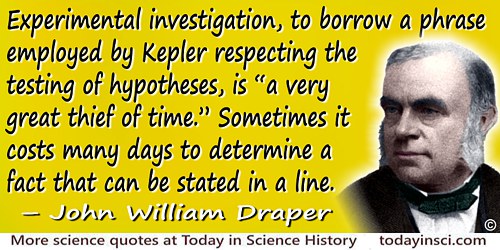
Experimental investigation, to borrow a phrase employed by Kepler respecting the testing of hypotheses, is “a very great thief of time.” Sometimes it costs many days to determine a fact that can be stated in a line.
In preface to Scientific Memoirs (1878), xi.
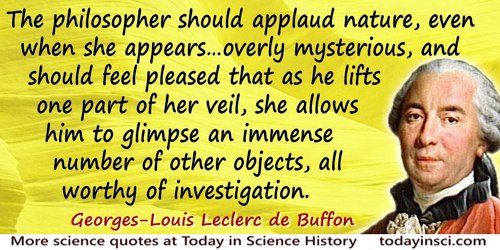
Far from becoming discouraged, the philosopher should applaud nature, even when she appears miserly of herself or overly mysterious, and should feel pleased that as he lifts one part of her veil, she allows him to glimpse an immense number of other objects, all worthy of investigation. For what we already know should allow us to judge of what we will be able to know; the human mind has no frontiers, it extends proportionately as the universe displays itself; man, then, can and must attempt all, and he needs only time in order to know all. By multiplying his observations, he could even see and foresee all phenomena, all of nature's occurrences, with as much truth and certainty as if he were deducing them directly from causes. And what more excusable or even more noble enthusiasm could there be than that of believing man capable of recognizing all the powers, and discovering through his investigations all the secrets, of nature!
'Des Mulets', Oeuvres Philosophiques, ed. Jean Piveteau (1954), 414. Quoted in Jacques Roger, The Life Sciences in Eighteenth-Century French Thought, ed. Keith R. Benson and trans. Robert Ellrich (1997), 458.
Flower in the crannied wall,
I pluck you out of the crannies;—
I hold you here, root and all, in my hand,
Little flower—but if I could understand
What you are, root and all, and all in all,
I should know what God and man is.
I pluck you out of the crannies;—
I hold you here, root and all, in my hand,
Little flower—but if I could understand
What you are, root and all, and all in all,
I should know what God and man is.
In The Holy Grail: and Other Poems (1870), 165.
For me and many scientists, the understanding of nature is based upon scientific investigations that add to humankind’s ever increasing fund of knowledge. The fund is ever changing as new generations of scientists add to, debate, and reinterpret the data.
From 'Mystery of the First Americans: Claims for the Remains: C. Vance Haynes, Jr.', web page on pbs.org website.
For the most part, statistics is a method of investigation that is used when other methods are of no avail; it is often a last resort and a forlorn hope.
In Facts from Figures (1951), 3.
For you teach very clearly by your behaviour how slowly and how meagerly our senses proceed in the investigation of ever inexhaustible nature.
Elettricismo artificiale (1772), vii-viii, trans. in Antonio Pace, Franklin and Italy (1958), 58.
Fortunately I experienced Max Wertheimer's teaching in Berlin and collaborated for over a decade with Wolfgang Köhler. I need not emphasize my debts to these outstanding personalities. The fundamental ideas of Gestalt theory are the foundation of all our investigations in the field of the will, of affection, and of the personality.
From A Dynamic Theory of Personality. Selected papers (1935), 240.
From the physician, as emphatically the student of Nature, is expected not only an inquiry into cause, but an investigation of the whole empire of Nature and a determination of the applicability of every species of knowledge to the improvement of his art.
In 'An Inquiry, Analogical and Experimental, into the Different Electrical conditions of Arterial and Venous Blood', New Orleans Medical and Surgical Journal (1853-4), 10, 584-602 & 738-757. As cited in George B. Roth, 'Dr. John Gorrie—Inventor of Artificial Ice and Mechanical Refrigeration', The Scientific Monthly (May 1936) 42 No. 5, 464-469.
Geometric writings are not rare in which one would seek in vain for an idea at all novel, for a result which sooner or later might be of service, for anything in fact which might be destined to survive in the science; and one finds instead treatises on trivial problems or investigations on special forms which have absolutely no use, no importance, which have their origin not in the science itself but in the caprice of the author; or one finds applications of known methods which have already been made thousands of times; or generalizations from known results which are so easily made that the knowledge of the latter suffices to give at once the former. Now such work is not merely useless; it is actually harmful because it produces a real incumbrance in the science and an embarrassment for the more serious investigators; and because often it crowds out certain lines of thought which might well have deserved to be studied.
From 'On Some Recent Tendencies in Geometric Investigations', Rivista di Matematica (1891), 43. In Bulletin American Mathematical Society (1904), 443.
Great is the faith of the flush of knowledge and of the investigation of the depths of qualities and things.
In Walt Whitman and William Michael Rossetti (ed.), 'Preface to the First Edition of Leaves of Grass', Poems By Walt Whitman (1868), 46.
He [Louis Pasteur] imagined further experiments, to bring more light, for contradictions excited him to new investigations.
As quoted in René J. Dubos, Louis Pasteur, Free Lance of Science (1960, 1986), 76.
He [Sylvester] had one remarkable peculiarity. He seldom remembered theorems, propositions, etc., but had always to deduce them when he wished to use them. In this he was the very antithesis of Cayley, who was thoroughly conversant with everything that had been done in every branch of mathematics.
I remember once submitting to Sylvester some investigations that I had been engaged on, and he immediately denied my first statement, saying that such a proposition had never been heard of, let alone proved. To his astonishment, I showed him a paper of his own in which he had proved the proposition; in fact, I believe the object of his paper had been the very proof which was so strange to him.
I remember once submitting to Sylvester some investigations that I had been engaged on, and he immediately denied my first statement, saying that such a proposition had never been heard of, let alone proved. To his astonishment, I showed him a paper of his own in which he had proved the proposition; in fact, I believe the object of his paper had been the very proof which was so strange to him.
As quoted by Florian Cajori, in Teaching and History of Mathematics in the United States (1890), 268.
He who gives a portion of his time and talent to the investigation of mathematical truth will come to all other questions with a decided advantage over his opponents. He will be in argument what the ancient Romans were in the field: to them the day of battle was a day of comparative recreation, because they were ever accustomed to exercise with arms much heavier than they fought; and reviews differed from a real battle in two respects: they encountered more fatigue, but the victory was bloodless.
Reflection 352, in Lacon: or Many things in Few Words; Addressed to Those Who Think (1820), 159.
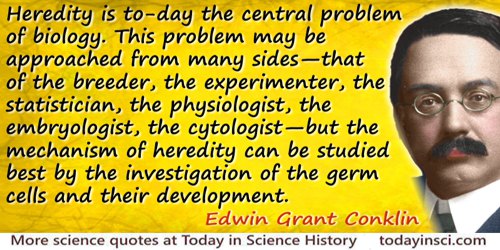
Heredity is to-day the central problem of biology. This problem may be approached from many sides—that of the breeder, the experimenter, the statistician, the physiologist, the embryologist, the cytologist—but the mechanism of heredity can be studied best by the investigation of the germ cells and their development.
From Address of the vice-president and chairman of Section F, Zoology, American Association for the Advancement of Science, Chicago Meeting (1907-8). Published in 'The Mechanism of Heredity', Science (17 Jan 1908), 27, No. 691, 89-90.
History is primarily a socio-psychological science. In the conflict between the old and the new tendencies in historical investigation... we are at the turn of the stream, the parting of the ways in historical science.
Historical Development and Present Character of the Science of History (1906), 111.
Honest investigation is but the application of common sense to the solution of the unknown. Science does not wait on Genius, but is the companion of Industry.
From address (1 Oct 1884), at inauguration of the Corcoran School of Science and Arts, Columbian University, Washington, D.C. Published in 'The Larger Import of Scientific Education', Popular Science Monthly (Feb 1885), 26, 453.
How many discoveries are reserved for the ages to come when our memory shall be no more, for this world of ours contains matter for investigation for all generations.
From Quaestiones Naturales as translated in Charles Singer, From Magic to Science (1958), 57.
I … share an excitement and a certain pride in the wonders opened up by scientific investigation …, and also a recognition of the value in scientific method of keeping the hypotheses as simple as possible—my Oxford tutor gave me a great respect for Occam’s razor.
In Letter to periodical, Chemistry and Industry (17 Feb 1997).
I am much occupied with the investigation of the physical causes [of motions in the Solar System]. My aim in this is to show that the celestial machine is to be likened not to a divine organism but rather to a clockwork … insofar as nearly all the manifold movements are carried out by means of a single, quite simple magnetic force. This physical conception is to be presented through calculation and geometry.
Letter to Ilerwart von Hohenburg (10 Feb 1605) Quoted in Holton, Johannes Kepler's Universe: Its Physics and Metaphysics, 342, as cited by Hylarie Kochiras, Force, Matter, and Metaphysics in Newton's Natural Philosophy (2008), 57.
I am particularly concerned to determine the probability of causes and results, as exhibited in events that occur in large numbers, and to investigate the laws according to which that probability approaches a limit in proportion to the repetition of events. That investigation deserves the attention of mathematicians because of the analysis required. It is primarily there that the approximation of formulas that are functions of large numbers has its most important applications. The investigation will benefit observers in identifying the mean to be chosen among the results of their observations and the probability of the errors still to be apprehended. Lastly, the investigation is one that deserves the attention of philosophers in showing how in the final analysis there is a regularity underlying the very things that seem to us to pertain entirely to chance, and in unveiling the hidden but constant causes on which that regularity depends. It is on the regularity of the main outcomes of events taken in large numbers that various institutions depend, such as annuities, tontines, and insurance policies. Questions about those subjects, as well as about inoculation with vaccine and decisions of electoral assemblies, present no further difficulty in the light of my theory. I limit myself here to resolving the most general of them, but the importance of these concerns in civil life, the moral considerations that complicate them, and the voluminous data that they presuppose require a separate work.
Philosophical Essay on Probabilities (1825), trans. Andrew I. Dale (1995), Introduction.
I believe that the useful methods of mathematics are easily to be learned by quite young persons, just as languages are easily learned in youth. What a wondrous philosophy and history underlie the use of almost every word in every language—yet the child learns to use the word unconsciously. No doubt when such a word was first invented it was studied over and lectured upon, just as one might lecture now upon the idea of a rate, or the use of Cartesian co-ordinates, and we may depend upon it that children of the future will use the idea of the calculus, and use squared paper as readily as they now cipher. … When Egyptian and Chaldean philosophers spent years in difficult calculations, which would now be thought easy by young children, doubtless they had the same notions of the depth of their knowledge that Sir William Thomson might now have of his. How is it, then, that Thomson gained his immense knowledge in the time taken by a Chaldean philosopher to acquire a simple knowledge of arithmetic? The reason is plain. Thomson, when a child, was taught in a few years more than all that was known three thousand years ago of the properties of numbers. When it is found essential to a boy’s future that machinery should be given to his brain, it is given to him; he is taught to use it, and his bright memory makes the use of it a second nature to him; but it is not till after-life that he makes a close investigation of what there actually is in his brain which has enabled him to do so much. It is taken because the child has much faith. In after years he will accept nothing without careful consideration. The machinery given to the brain of children is getting more and more complicated as time goes on; but there is really no reason why it should not be taken in as early, and used as readily, as were the axioms of childish education in ancient Chaldea.
In Teaching of Mathematics (1902), 14.
I can see him now at the blackboard, chalk in one hand and rubber in the other, writing rapidly and erasing recklessly, pausing every few minutes to face the class and comment earnestly, perhaps on the results of an elaborate calculation, perhaps on the greatness of the Creator, perhaps on the beauty and grandeur of Mathematics, always with a capital M. To him mathematics was not the handmaid of philosophy. It was not a humanly devised instrument of investigation, it was Philosophy itself, the divine revealer of TRUTH.
Writing as a Professor Emeritus at Harvard University, a former student of Peirce, in 'Benjamin Peirce: II. Reminiscences', The American Mathematical Monthly (Jan 1925), 32, No. 1, 5.
I claim that many patterns of Nature are so irregular and fragmented, that, compared with Euclid—a term used in this work to denote all of standard geometry—Nature exhibits not simply a higher degree but an altogether different level of complexity … The existence of these patterns challenges us to study these forms that Euclid leaves aside as being “formless,” to investigate the morphology of the “amorphous.”
Cited as from Fractals: Form, Chance, and Dimension (1977), by J.W. Cannon, in review of The Fractal Geometry of Nature (1982) in The American Mathematical Monthly (Nov 1984), 91, No. 9, 594.
I distinguish two kinds of "applied" research: problem-solving research — government or commercially initiated, centrally managed and institutionally coupled to a plan for application of the results, useful science—investigator-initiated, competitively evaluated and widely communicated. Then we have basic science—useful also, also investigator-initiated, competitively evaluated and widely communicated.
In Confessions of a Technophile (1994), 31.
I do not see any reason to assume that the heuristic significance of the principle of general relativity is restricted to gravitation and that the rest of physics can be dealt with separately on the basis of special relativity, with the hope that later on the whole may be fitted consistently into a general relativistic scheme. I do not think that such an attitude, although historically understandable, can be objectively justified. The comparative smallness of what we know today as gravitational effects is not a conclusive reason for ignoring the principle of general relativity in theoretical investigations of a fundamental character. In other words, I do not believe that it is justifiable to ask: What would physics look like without gravitation?
…...
I had made up my mind to find that for which I was searching even if it required the remainder of my life. After innumerable failures I finally uncovered the principle for which I was searching, and I was astounded at its simplicity. I was still more astounded to discover the principle I had revealed not only beneficial in the construction of a mechanical hearing aid but it served as well as means of sending the sound of the voice over a wire. Another discovery which came out of my investigation was the fact that when a man gives his order to produce a definite result and stands by that order it seems to have the effect of giving him what might be termed a second sight which enables him to see right through ordinary problems. What this power is I cannot say; all I know is that it exists and it becomes available only when a man is in that state of mind in which he knows exactly what he wants and is fully determined not to quit until he finds it.
As quoted, without citation, in Mack R. Douglas, Making a Habit of Success: How to Make a Habit of Succeeding, How to Win With High Self-Esteem (1966, 1994), 38. Note: Webmaster is dubious of a quote which seems to appear in only one source, without a citation, decades after Bell’s death. If you know a primary source, please contact Webmaster.
I have been described on more than one occasion as belonging to something called the 'Functional School of Social Anthropology' and even as being its leader, or one of its leaders. This Functional School does not really exist; it is a myth invented by Professor Malinowski ... There is no place in natural science for 'schools' in this sense, and I regard social anthropology as a branch of natural science. ... I conceive of social anthropology as the theoretical natural science of human society, that is, the investigation of social phenomena by methods essentially similar to those used in the physical and biological sciences. I am quite willing to call the subject 'comparative sociology', if anyone so wishes.
In A. Kuper, Anthropologists and Anthropology: The Modern British School (1983), 36.
I have never had any student or pupil under me to aid me with assistance; but have always prepared and made my experiments with my own hands, working & thinking at the same time. I do not think I could work in company, or think aloud, or explain my thoughts at the time. Sometimes I and my assistant have been in the Laboratory for hours & days together, he preparing some lecture apparatus or cleaning up, & scarcely a word has passed between us; — all this being a consequence of the solitary & isolated system of investigation; in contradistinction to that pursued by a Professor with his aids & pupils as in your Universities.
Letter to C. Ransteed, 16 Dec 1857. In L. Pearce Williams (ed.), The Selected Correspondence of Michael Faraday (1971), Vol. 2, 888.
I have not been aware of any one else [than Joseph Leidy] in America interested in microscopic anatomy, and write to interest you in my investigation of the organ of hearing.
Describing Joseph Leidy in a letter to him (1852). As quoted, without further source detail, in Henry Fairfield Osborn, 'Biographical Memoir of Joseph Leidy', collected in National Academy of Sciences, Biographical Memoirs: Volume 7 (1913), 345.
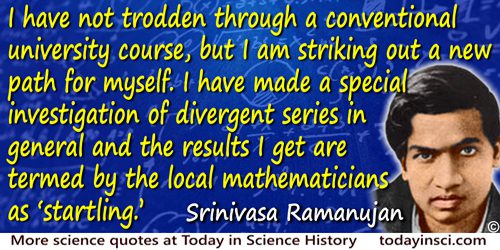
I have not trodden through a conventional university course, but I am striking out a new path for myself. I have made a special investigation of divergent series in general and the results I get are termed by the local mathematicians as “startling.”
First letter to G.H. Hardy (16 Jan 1913). In Collected Papers of Srinivasa Ramanujan (1927), xxiii. Hardy notes he did “seem to remember his telling me that his friends had given him some assistance” in writing the letter because Ramanujan's “knowledge of English, at that stage of his life, could scarcely have been sufficient.”
I have repeatedly had cause to refer to certain resemblances between the phenomena of irritability in the vegetable kingdom and those of the animal body, thus touching a province of investigation which has hitherto been far too little cultivated. In the last instance, indeed, I might say animal and vegetable life must of necessity agree in all essential points, including the phenomena of irritability also, since it is established that the animal organism is constructed entirely and simply from the properties of these substances that all vital movements both of plants and animals are to be explained.
Lectures on the Physiology of Plants (1887), 600.
I have said that the investigation for which the teeth of the shark had furnished an opportunity, was very near an end... But thereafter, while I was examining more carefully these details of both places and bodies [sedimentary deposits and shells], these day by day presented points of doubt to me as they followed one another in indissoluble connection, so that I saw myself again and again brought back to the starting-place, as it were, when I thought I was nearest the goal. I might compare those doubts to the heads of the Lernean Hydra, since when one of them had been got rid of, numberless others were born; at any rate, I saw that I was wandering about in a sort of labyrinth, where the nearer one approaches the exit, the wider circuits does one tread.
The Prodromus of Nicolaus Steno's Dissertation Concerning a Solid Body enclosed by Process of Nature within a Solid (1669), trans. J. G. Winter (1916), 206.
I have satisfied myself that the [cosmic] rays are not generated by the formation of new matter in space, a process which would be like water running up a hill. Nor do they come to any appreciable amount from the stars. According to my investigations the sun emits a radiation of such penetrative power that it is virtually impossible to absorb it in lead or other substances. ... This ray, which I call the primary solar ray, gives rise to a secondary radiation by impact against the cosmic dust scattered through space. It is the secondary radiation which now is commonly called the cosmic ray, and comes, of course, equally from all directions in space. [The article continues: The phenomena of radioactivity are not the result of forces within the radioactive substances but are caused by this ray emitted by the sun. If radium could be screened effectively against this ray it would cease to be radioactive, he said.]
Quoted in 'Tesla, 75, Predicts New Power Source', New York Times (5 Jul 1931), Section 2, 1.
I have shown first in the course of this investigation that the infective matter is independently animate, and further that one could think of the independently animate matter as either animal and plant organisms or elementary parts of animals, which have achieved a relative individuality.
'On Miasmata and Contagia', trans. G. Rosen, Bulletin of the Institute of the History of Medicine (1938), 6, 957.
I have to keep going, as there are always people on my track. I have to publish my present work as rapidly as possible in order to keep in the race. The best sprinters in this road of investigation are Becquerel and the Curies...
Letter to his mother (5 Jan1902). Quoted in A. S. Eve, Rutherford: Being the Life and Letters of the Rt. Hon. Lord Rutherford (1939), 80. In Laurie M. Brown, Abraham Pais and A. B. Pippard, Twentieth Century Physics (1995), 58.
I like a deep and difficult investigation when I happen to have made it easy to myself, if not to all others; and there is a spirit of gambling in this, whether, as by the cast of a die, a calculation è perte de vue shall bring out a beautiful and perfect result or shall be wholly thrown away. Scientific investigations are a sort of warfare carried on in the closet or on the couch against all one’s contemporaries and predecessors; I have often gained a signal victory when I have been half asleep, but more frequently have found, upon being thoroughly awake, that the enemy had still the advantage of me, when I thought I had him fast in a corner, and all this you see keeps me alive.
Letter to Hudson Gurney, quoted in George Peacock, The Life of Thomas Young (1855), 239.
I was unable to devote myself to the learning of this al-jabr [algebra] and the continued concentration upon it, because of obstacles in the vagaries of Time which hindered me; for we have been deprived of all the people of knowledge save for a group, small in number, with many troubles, whose concern in life is to snatch the opportunity, when Time is asleep, to devote themselves meanwhile to the investigation and perfection of a science; for the majority of people who imitate philosophers confuse the true with the false, and they do nothing but deceive and pretend knowledge, and they do not use what they know of the sciences except for base and material purposes; and if they see a certain person seeking for the right and preferring the truth, doing his best to refute the false and untrue and leaving aside hypocrisy and deceit, they make a fool of him and mock him.
A. P. Youschkevitch and B. A. Rosenfeld, 'Al-Khayyami', in C. C. Gillispie (ed.), Dictionary of Scientific Biography (1973), Vol. 7, 324.
I well know what a spendidly great difference there is [between] a man and a bestia when I look at them from a point of view of morality. Man is the animal which the Creator has seen fit to honor with such a magnificent mind and has condescended to adopt as his favorite and for which he has prepared a nobler life; indeed, sent out for its salvation his only son; but all this belongs to another forum; it behooves me like a cobbler to stick to my last, in my own workshop, and as a naturalist to consider man and his body, for I know scarcely one feature by which man can be distinguished from apes, if it be not that all the apes have a gap between their fangs and their other teeth, which will be shown by the results of further investigation.
T. Fredbärj (ed.), Menniskans Cousiner (Valda Avhandlingar av Carl von Linné nr, 21) (1955), 4. Trans. Gunnar Broberg, 'Linnaeus's Classification of Man', in Tore Frängsmyr (ed.), Linnaeus: The Man and his Work (1983), 167.
I will frankly tell you that my experience in prolonged scientific investigations convinces me that a belief in God—a God who is behind and within the chaos of vanishing points of human knowledge—adds a wonderful stimulus to the man who attempts to penetrate into the regions of the unknown.
As quoted in E.P. Whipple, 'Recollections of Agassiz', in Henry Mills Alden (ed.), Harper's New Monthly Magazine (June 1879), 59, 103.
If a mathematician of the past, an Archimedes or even a Descartes, could view the field of geometry in its present condition, the first feature to impress him would be its lack of concreteness. There are whole classes of geometric theories which proceed not only without models and diagrams, but without the slightest (apparent) use of spatial intuition. In the main this is due, to the power of the analytic instruments of investigations as compared with the purely geometric.
In 'The Present Problems in Geometry', Bulletin American Mathematical Society (1906), 286.
If logical training is to consist, not in repeating barbarous scholastic formulas or mechanically tacking together empty majors and minors, but in acquiring dexterity in the use of trustworthy methods of advancing from the known to the unknown, then mathematical investigation must ever remain one of its most indispensable instruments. Once inured to the habit of accurately imagining abstract relations, recognizing the true value of symbolic conceptions, and familiarized with a fixed standard of proof, the mind is equipped for the consideration of quite other objects than lines and angles. The twin treatises of Adam Smith on social science, wherein, by deducing all human phenomena first from the unchecked action of selfishness and then from the unchecked action of sympathy, he arrives at mutually-limiting conclusions of transcendent practical importance, furnish for all time a brilliant illustration of the value of mathematical methods and mathematical discipline.
In 'University Reform', Darwinism and Other Essays (1893), 297-298.
If two or more instances of the phenomenon under investigation have only one circumstance in common, the circumstance in which alone all the instances agree is the cause (or effect) of the given phenomenon.
A System of Logic, Ratiocinative and Inductive (1858), 224.
If we view mathematical speculations with reference to their use, it appears that they should be divided into two classes. To the first belong those which furnish some marked advantage either to common life or to some art, and the value of such is usually determined by the magnitude of this advantage. The other class embraces those speculations which, though offering no direct advantage, are nevertheless valuable in that they extend the boundaries of analysis and increase our resources and skill. Now since many investigations, from which great advantage may be expected, must be abandoned solely because of the imperfection of analysis, no small value should be assigned to those speculations which promise to enlarge the field of anaylsis.
In Novi Comm. Petr., Vol. 4, Preface.
In 1945 J.A. Ratcliffe … suggested that I [join his group at Cavendish Laboratory, Cambridge] to start an investigation of the radio emission from the Sun, which had recently been discovered accidentally with radar equipment. … [B]oth Ratcliffe and Sir Lawrence Bragg, then Cavendish Professor, gave enormous support and encouragement to me. Bragg’s own work on X-ray crystallography involved techniques very similar to those we were developing for “aperture synthesis,” and he always showed a delighted interest in the way our work progressed.
From Autobiography in Wilhelm Odelberg (ed.), Les Prix Nobel en 1974/Nobel Lectures (1975)
In a Dublin hospital, many years ago, it was noticed that the death-rate was markedly higher in the ground-floor wards than it was in the wards upstairs. This fact was commented on in an official report, and marked down as requiring investigation. Then it was discovered that, when new patients came in, the porter of the hospital was in the habit of putting them upstairs if they could walk by themselves, and downstairs if they could not.
From 'Figures Can Lie', Science Digest (Sep 1951), 30, No. 3, 53. (As condensed from The Listener). Excerpted in Meta Riley Emberger and Marian Ross Hall, Scientific Writing (1955), 407.
In a sense, genetics grew up as an orphan. In the beginning botanists and zoologists were often indifferent and sometimes hostile toward it. “Genetics deals only with superficial characters”, it was often said. Biochemists likewise paid it little heed in its early days. They, especially medical biochemists, knew of Garrod’s inborn errors of metabolism and no doubt appreciated them in the biochemical sense and as diseases; but the biological world was inadequately prepared to appreciate fully the significance of his investigations and his thinking. Geneticists, it should be said, tended to be preoccupied mainly with the mechanisms by which genetic material is transmitted from one generation to, the next.
'Genes and Chemical Reactions In Neurospora', Nobel Lecture, 11 Dec 1958. In Nobel Lectures: Physiology or Medicine 1942-1962 (1964), 598.
In all chemical investigations, it has justly been considered an important object to ascertain the relative weights of the simples which constitute a compound. But unfortunately the enquiry has terminated here; whereas from the relative weights in the mass, the relative weights of the ultimate particles or atoms of the bodies might have been inferred, from which their number and weight in various other compounds would appear, in order to assist and to guide future investigations, and to correct their results. Now it is one great object of this work, to shew the importance and advantage of ascertaining the relative weights of the ultimate particles, both of simple and compound bodies, the number of simple elementary particles which constitute one compound particle, and the number of less compound particles which enter into the formation of one more compound particle.
If there are two bodies, A and B, which are disposed to combine, the following is the order in which the combinations may take place, beginning with the most simple: namely,
1 atom of A + 1 atom of B = 1 atom of C, binary
1 atom of A + 2 atoms of B = 1 atom of D, ternary
2 atoms of A + 1 atom of B = 1 atom of E, ternary
1 atom of A + 3 atoms of B = 1 atom of F, quaternary
3 atoms of A and 1 atom of B = 1 atom of G, quaternary
If there are two bodies, A and B, which are disposed to combine, the following is the order in which the combinations may take place, beginning with the most simple: namely,
1 atom of A + 1 atom of B = 1 atom of C, binary
1 atom of A + 2 atoms of B = 1 atom of D, ternary
2 atoms of A + 1 atom of B = 1 atom of E, ternary
1 atom of A + 3 atoms of B = 1 atom of F, quaternary
3 atoms of A and 1 atom of B = 1 atom of G, quaternary
A New System of Chemical Philosophy (1808), Vol. 1, 212-3.
In attempting to discover how much blood passes from the veins into the arteries I made dissections of living animals, opened up arteries in them, and carried out various other investigations. I also considered the symmetry and size of the ventricles of the heart and of the vessels which enter and leave them (since Nature, who does nothing purposelessly, would not purposelessly have given these vessels such relatively large size). I also recalled the elegant and carefully contrived valves and fibres and other structural artistry of the heart; and many other points. I considered rather often and with care all this evidence, and took correspondingly long trying to assess how much blood was transmitted and in how short a time. I also noted that the juice of the ingested food could not supply this amount without our having the veins, on the one hand, completely emptied and the arteries, on the other hand, brought to bursting through excessive inthrust of blood, unless the blood somehow flowed back again from the arteries into the veins and returned to the right ventricle of the heart. In consequence, I began privately to consider that it had a movement, as it were, in a circle.
De Motu Cordis (1628), The Circulation of the Blood and Other Writings, trans. Kenneth j. Franklin (1957), Chapter 8, 57-8.
In clinical investigation the sick individual is at the centre of the picture. The physician must have a deep interest in his patient’s economic and social structure as well as in his physical and psychic state. If attention is not paid to the diagnosis of the person the clinical investigator is apt to fail in studies of the patient’s disease. Without a consideration of the patient as a human being it would have been difficult to have fed patients daily large amounts of liver.
In Nobel Banquet speech (10 Dec 1934). Collected in Gustaf Santesson (ed.) Les Prix Nobel en 1934 (1935).
In fact, whenever energy is transmitted from one body to another in time, there must be a medium or substance in which the energy exists after it leaves one body and before it reaches the other ... and if we admit this medium as an hypothesis, I think it ought to occupy a prominent place in our investigations, and that we ought to endeavour to construct a mental representation of all the details of its action, and this has been my constant aim in this treatise.
A Treatise on Electricity and Magnetism (1873), Vol. 2, 438.
In its earliest development knowledge is self-sown. Impressions force themselves upon men’s senses whether they will or not, and often against their will. The amount of interest in which these impressions awaken is determined by the coarser pains and pleasures which they carry in their train or by mere curiosity; and reason deals with the materials supplied to it as far as that interest carries it, and no further. Such common knowledge is rather brought than sought; and such ratiocination is little more than the working of a blind intellectual instinct. It is only when the mind passes beyond this condition that it begins to evolve science. When simple curiosity passes into the love of knowledge as such, and the gratification of the æsthetic sense of the beauty of completeness and accuracy seems more desirable that the easy indolence of ignorance; when the finding out of the causes of things becomes a source of joy, and he is accounted happy who is successful in the search, common knowledge passes into what our forefathers called natural history, whence there is but a step to that which used to be termed natural philosophy, and now passes by the name of physical science.
In this final state of knowledge the phenomena of nature are regarded as one continuous series of causes and effects; and the ultimate object of science is to trace out that series, from the term which is nearest to us, to that which is at the farthest limit accessible to our means of investigation.
The course of nature as it is, as it has been, and as it will be, is the object of scientific inquiry; whatever lies beyond, above, or below this is outside science. But the philosopher need not despair at the limitation on his field of labor; in relation to the human mind Nature is boundless; and, though nowhere inaccessible, she is everywhere unfathomable.
In this final state of knowledge the phenomena of nature are regarded as one continuous series of causes and effects; and the ultimate object of science is to trace out that series, from the term which is nearest to us, to that which is at the farthest limit accessible to our means of investigation.
The course of nature as it is, as it has been, and as it will be, is the object of scientific inquiry; whatever lies beyond, above, or below this is outside science. But the philosopher need not despair at the limitation on his field of labor; in relation to the human mind Nature is boundless; and, though nowhere inaccessible, she is everywhere unfathomable.
The Crayfish: an Introduction to the Study of Zoölogy (1880), 2-3. Excerpted in Popular Science (Apr 1880), 16, 789-790.
In order that an inventory of plants may be begun and a classification of them correctly established, we must try to discover criteria of some sort for distinguishing what are called “species”. After a long and considerable investigation, no surer criterion for determining species had occurred to me than distinguishing features that perpetuate themselves in propagation from seed. Thus, no matter what variations occur in the individuals or the species, if they spring from the seed of one and the same plant, they are accidental variations and not such as to distinguish a species. For these variations do not perpetuate themselves in subsequent seeding. Thus, for example, we do not regard caryophylli with full or multiple blossoms as a species distinct from caryophylli with single blossoms, because the former owe their origin to the seed of the latter and if the former are sown from their own seed, they once more produce single-blossom caryophylli. But variations that never have as their source seed from one and the same species may finally be regarded as distinct species. Or, if you make a comparison between any two plants, plants which never spring from each other's seed and never, when their seed is sown, are transmuted one into the other, these plants finally are distinct species. For it is just as in animals: a difference in sex is not enough to prove a difference of species, because each sex is derived from the same seed as far as species is concerned and not infrequently from the same parents; no matter how many and how striking may be the accidental differences between them; no other proof that bull and cow, man and woman belong to the same species is required than the fact that both very frequently spring from the same parents or the same mother. Likewise in the case of plants, there is no surer index of identity of species than that of origin from the seed of one and the same plant, whether it is a matter of individuals or species. For animals that differ in species preserve their distinct species permanently; one species never springs from the seed of another nor vice versa.
— John Ray
Historia Plantarum (1686), Vol. 1, 40. Trans. Edmund Silk. Quoted in Barbara G. Beddall, 'Historical Notes on Avian Classification', Systematic Zoology (1957), 6, 133-4.
In order to turn natural history into a true science, one would have to devote oneself to investigations capable of telling us not the particular shape of such and such an animal, but the general procedures of nature in the animal's production and preservation.
'Lettre sur le progress des sciences' in Oeuvres de Mr. De Maupertuis (1756), Vol. 2, 386. Quoted in Jacques Roger, The Life Sciences in Eighteenth-Century French Thought, ed. Keith R. Benson and trans. Robert Ellrich (1997), 392.
In physics we deal with states of affairs much simpler than those of psychology and yet we again and again learn that our task is not to investigate the essence of things—we do not at all know what this would mean&mash;but to develop those concepts that allow us to speak with each other about the events of nature in a fruitful manner.
Letter to H.P.E. Hansen (20 Jul 1935), Niels Bohr Archive. In Jan Faye, Henry J. Folse, Niels Bohr and Contemporary Philosophy (1994), 83.
In scientific investigations it is grievously wrong to pander to the public’s impatience for results, or to let them think that for discovery it is necessary only to set up a great manufactory and a system of mass production. If in treatment team work is effective, in research it is the individual who counts first and above all. No great thought has ever sprung from anything but a single mind, suddenly conceiving. Throughout the whole world there has been too violent a forcing of the growth of ideas; too feverish a rush to perform experiments and publish conclusions. A year of vacation for calm detachment with all the individual workers thinking it all over in a desert should be proclaimed.
In Viewless Winds: Being the Recollections and Digressions of an Australian Surgeon (1939), 286.
In the case of chemical investigations known as decompositions or analyses, it is first important to determine exactly what ingredients you are dealing with, or chemically speaking, what substances are contained in a given mixture or composite. For this purpose we use reagents, i.e., substances that possess certain properties and characteristics, which we well know from references or personal experience, such that the changes which they bring about or undergo, so to say the language that they speak thereby inform the researcher that this or that specific substance is present in the mixture in question.
From Zur Farben-Chemie Musterbilder für Freunde des Schönen und zum Gebrauch für Zeichner, Maler, Verzierer und Zeugdrucker [On Colour Chemistry...] (1850), Introduction. Translation tweaked by Webmaster from version in Herbert and W. Roesky and Klaud Möckel, translated by T.N. Mitchell and W.E. Russey, Chemical Curiosities: Spectacular Experiments and Inspired Quotes (1996), 1. From the original German, “Bei solchen chemischen Untersuchungen, die man zersetzende oder zergliedernde nennt, kommt es zunächst darauf an, zu ermitteln, mit welchen Stoffen man es zu thun hat, oder um chemisch zu reden, welche Stoffe in einem bestimmten Gemenge oder Gemisch enthalten sind. Hierzu bedient man sich sogenannter gegenwirkender Mittel, d. h. Stoffe, die bestimmte Eigenschaften und Eigenthümlichkeiten besitzen und die man aus Ueberlieferung oder eigner Erfahrung genau kennt, so daß die Veränderungen, welche sie bewirken oder erleiden, gleichsam die Sprache sind, mit der sie reden und dadurch dem Forscher anzeigen, daß der und der bestimmte Stoff in der fraglichen Mischung enthalten sei.”
In the discovery of hidden things and the investigation of hidden causes, stronger reasons are obtained from sure experiments and demonstrated arguments than from probable conjectures and the opinions of philosophical speculators of the common sort...
De Magnete (1600). In William Gilbert and P. Fleury Mottelay (trans.), William Gilbert of Colchester, physician of London: On the load stone and magnetic bodies (1893), xlvii.
In the mathematical investigations I have usually employed such methods as present themselves naturally to a physicist. The pure mathematician will complain, and (it must be confessed) sometimes with justice, of deficient rigour. But to this question there are two sides. For, however important it may be to maintain a uniformly high standard in pure mathematics, the physicist may occasionally do well to rest content with arguments which are fairly satisfactory and conclusive from his point of view. To his mind, exercised in a different order of ideas, the more severe procedure of the pure mathematician may appear not more but less demonstrative. And further, in many cases of difficulty to insist upon the highest standard would mean the exclusion of the subject altogether in view of the space that would be required.
In Preface to second edition, The Theory of Sound (1894), Vol. 1, vii.
Indeed, the most important part of engineering work—and also of other scientific work—is the determination of the method of attacking the problem, whatever it may be, whether an experimental investigation, or a theoretical calculation. … It is by the choice of a suitable method of attack, that intricate problems are reduced to simple phenomena, and then easily solved.
In Engineering Mathematics: A Series of Lectures Delivered at Union College (1911, 1917), Vol. 2, 275.
Instead of dismissing professors for finding something out, let us rather discharge those who do not. Let each teacher understand that investigation is not dangerous for him; that his bread is safe, no matter how much truth he may discover, and that his salary will not be reduced, simply because he finds that the ancient Jews did not know the entire history of the world.
In Some Mistakes of Moses (1879), 27.
Investigation may be likened to the long months of pregnancy, and solving a problem to the day of birth. To investigate a problem is, indeed, to solve it.
In Winberg Chai, The Foreign Relations of the People's Republic of China (1972), 46.
It has been asserted … that the power of observation is not developed by mathematical studies; while the truth is, that; from the most elementary mathematical notion that arises in the mind of a child to the farthest verge to which mathematical investigation has been pushed and applied, this power is in constant exercise. By observation, as here used, can only be meant the fixing of the attention upon objects (physical or mental) so as to note distinctive peculiarities—to recognize resemblances, differences, and other relations. Now the first mental act of the child recognizing the distinction between one and more than one, between one and two, two and three, etc., is exactly this. So, again, the first geometrical notions are as pure an exercise of this power as can be given. To know a straight line, to distinguish it from a curve; to recognize a triangle and distinguish the several forms—what are these, and all perception of form, but a series of observations? Nor is it alone in securing these fundamental conceptions of number and form that observation plays so important a part. The very genius of the common geometry as a method of reasoning—a system of investigation—is, that it is but a series of observations. The figure being before the eye in actual representation, or before the mind in conception, is so closely scrutinized, that all its distinctive features are perceived; auxiliary lines are drawn (the imagination leading in this), and a new series of inspections is made; and thus, by means of direct, simple observations, the investigation proceeds. So characteristic of common geometry is this method of investigation, that Comte, perhaps the ablest of all writers upon the philosophy of mathematics, is disposed to class geometry, as to its method, with the natural sciences, being based upon observation. Moreover, when we consider applied mathematics, we need only to notice that the exercise of this faculty is so essential, that the basis of all such reasoning, the very material with which we build, have received the name observations. Thus we might proceed to consider the whole range of the human faculties, and find for the most of them ample scope for exercise in mathematical studies. Certainly, the memory will not be found to be neglected. The very first steps in number—counting, the multiplication table, etc., make heavy demands on this power; while the higher branches require the memorizing of formulas which are simply appalling to the uninitiated. So the imagination, the creative faculty of the mind, has constant exercise in all original mathematical investigations, from the solution of the simplest problems to the discovery of the most recondite principle; for it is not by sure, consecutive steps, as many suppose, that we advance from the known to the unknown. The imagination, not the logical faculty, leads in this advance. In fact, practical observation is often in advance of logical exposition. Thus, in the discovery of truth, the imagination habitually presents hypotheses, and observation supplies facts, which it may require ages for the tardy reason to connect logically with the known. Of this truth, mathematics, as well as all other sciences, affords abundant illustrations. So remarkably true is this, that today it is seriously questioned by the majority of thinkers, whether the sublimest branch of mathematics,—the infinitesimal calculus—has anything more than an empirical foundation, mathematicians themselves not being agreed as to its logical basis. That the imagination, and not the logical faculty, leads in all original investigation, no one who has ever succeeded in producing an original demonstration of one of the simpler propositions of geometry, can have any doubt. Nor are induction, analogy, the scrutinization of premises or the search for them, or the balancing of probabilities, spheres of mental operations foreign to mathematics. No one, indeed, can claim preeminence for mathematical studies in all these departments of intellectual culture, but it may, perhaps, be claimed that scarcely any department of science affords discipline to so great a number of faculties, and that none presents so complete a gradation in the exercise of these faculties, from the first principles of the science to the farthest extent of its applications, as mathematics.
In 'Mathematics', in Henry Kiddle and Alexander J. Schem, The Cyclopedia of Education, (1877.) As quoted and cited in Robert Édouard Moritz, Memorabilia Mathematica; Or, The Philomath’s Quotation-book (1914), 27-29.
It has been pointed out already that no knowledge of probabilities, less in degree than certainty, helps us to know what conclusions are true, and that there is no direct relation between the truth of a proposition and its probability. Probability begins and ends with probability. That a scientific investigation pursued on account of its probability will generally lead to truth, rather than falsehood, is at the best only probable.
In A Treatise on Probability (1921), 322.
It has been said that science is opposed to, and in conflict with revelation. But the history of the former shown that the greater its progress, and the more accurate its investigations and results, the more plainly it is seen not only not to clash with the Latter, but in all things to confirm it. The very sciences from which objections have been brought against religion have, by their own progress, removed those objections, and in the end furnished fall confirmation of the inspired Word of God.
…...
It is not possible to find in all geometry more difficult and more intricate questions or more simple and lucid explanations [than those given by Archimedes]. Some ascribe this to his natural genius; while others think that incredible effort and toil produced these, to all appearance, easy and unlaboured results. No amount of investigation of yours would succeed in attaining the proof, and yet, once seen, you immediately believe you would have discovered it; by so smooth and so rapid a path he leads you to the conclusion required.
— Plutarch
In John Dryden (trans.), Life of Marcellus.
It is rigid dogma that destroys truth; and, please notice, my emphasis is not on the dogma, but on the rigidity. When men say of any question, “This is all there is to be known or said of the subject; investigation ends here,” that is death. It may be that the mischief comes not from the thinker but for the use made of his thinking by late-comers. Aristotle, for example, gave us our scientific technique … yet his logical propositions, his instruction in sound reasoning which was bequeathed to Europe, are valid only within the limited framework of formal logic, and, as used in Europe, they stultified the minds of whole generations of mediaeval Schoolmen. Aristotle invented science, but destroyed philosophy.
Dialogues of Alfred North Whitehead, as recorded by Lucien Price (1954, 2001), 165.
It is structure that we look for whenever we try to understand anything. All science is built upon this search; we investigate how the cell is built of reticular material, cytoplasm, chromosomes; how crystals aggregate; how atoms are fastened together; how electrons constitute a chemical bond between atoms. We like to understand, and to explain, observed facts in terms of structure. A chemist who understands why a diamond has certain properties, or why nylon or hemoglobin have other properties, because of the different ways their atoms are arranged, may ask questions that a geologist would not think of formulating, unless he had been similarly trained in this way of thinking about the world.
‘The Place of Chemistry In the Integration of the Sciences’, Main Currents in Modern Thought (1950), 7, 110.
It is, so to speak, a scientific tact, which must guide mathematicians in their investigations, and guard them from spending their forces on scientifically worthless problems and abstruse realms, a tact which is closely related to esthetic tact and which is the only thing in our science which cannot be taught or acquired, and is yet the indispensable endowment of every mathematician.
In Die Entwickelung der Mathematik in den letzten Jahrhunderten (1869), 28. As translated in Robert Édouard Moritz, Memorabilia Mathematica; Or, The Philomath’s Quotation-book (1914), 92. From the original German, “Es ist, so zu sagen, ein wissenschaftlicher Tact, welcher die Mathematiker bei ihren Untersuchungen leiten, und sie davor bewahren muss, ihre Kräfte auf wissenschaftlich werthlose Probleme und abstruse Gebiete zu wenden, ein Tact, der dem ästhetischen nahe verwandt, das einzige ist, was in unserer Wissenschaft nicht gelehrt und gelernt werden kann, aber eine unentbehrliche Mitgift eines Mathematikers sein sollte.”
It required unusual inquisitiveness to pursue the development of scientific curiosities such as charged pith balls, the voltaic cell, and the electrostatic machine. Without such endeavors and the evolution of associated instrumentation, initially of purely scientific interest, most of the investigations that lead to the basic equations of electromagnetism would have been missed. … We would have been deprived of electromagnetic machinery as well as knowledge of electromagnetic waves.
From The Science Matrix: The Journey, Travails, Triumphs (1992, 1998), 14.
It was his [Leibnitz’s] love of method and order, and the conviction that such order and harmony existed in the real world, and that our success in understanding it depended upon the degree and order which we could attain in our own thoughts, that originally was probably nothing more than a habit which by degrees grew into a formal rule. This habit was acquired by early occupation with legal and mathematical questions. We have seen how the theory of combinations and arrangements of elements had a special interest for him. We also saw how mathematical calculations served him as a type and model of clear and orderly reasoning, and how he tried to introduce method and system into logical discussions, by reducing to a small number of terms the multitude of compound notions he had to deal with. This tendency increased in strength, and even in those early years he elaborated the idea of a general arithmetic, with a universal language of symbols, or a characteristic which would be applicable to all reasoning processes, and reduce philosophical investigations to that simplicity and certainty which the use of algebraic symbols had introduced into mathematics.
A mental attitude such as this is always highly favorable for mathematical as well as for philosophical investigations. Wherever progress depends upon precision and clearness of thought, and wherever such can be gained by reducing a variety of investigations to a general method, by bringing a multitude of notions under a common term or symbol, it proves inestimable. It necessarily imports the special qualities of number—viz., their continuity, infinity and infinite divisibility—like mathematical quantities—and destroys the notion that irreconcilable contrasts exist in nature, or gaps which cannot be bridged over. Thus, in his letter to Arnaud, Leibnitz expresses it as his opinion that geometry, or the philosophy of space, forms a step to the philosophy of motion—i.e., of corporeal things—and the philosophy of motion a step to the philosophy of mind.
A mental attitude such as this is always highly favorable for mathematical as well as for philosophical investigations. Wherever progress depends upon precision and clearness of thought, and wherever such can be gained by reducing a variety of investigations to a general method, by bringing a multitude of notions under a common term or symbol, it proves inestimable. It necessarily imports the special qualities of number—viz., their continuity, infinity and infinite divisibility—like mathematical quantities—and destroys the notion that irreconcilable contrasts exist in nature, or gaps which cannot be bridged over. Thus, in his letter to Arnaud, Leibnitz expresses it as his opinion that geometry, or the philosophy of space, forms a step to the philosophy of motion—i.e., of corporeal things—and the philosophy of motion a step to the philosophy of mind.
In Leibnitz (1884), 44-45. [The first sentence is reworded to better introduce the quotation. —Webmaster]
Lately we have been getting facts pointing to the “oceanic” nature of the floor of so-called inland seas. Through geological investigations it has been definitely established that in its deepest places, for instance, the Caribbean Sea and the Gulf of Mexico, the Earth’s crust is devoid of granite stratum. The same may be said quite confidently about the Mediterranean and the Black Sea. Could the interpretation of these data be that inland seas were the primary stage of the formation of oceanic basins?
From 'O geologicheskom stroyenii i razvitii okeanicheskikh vpadm' (The Geological Structure and Development of Ocean Hollows ), News of the USSR Academy of Sciences, Geology Series (1955), 3, 3-18. As given in N. Zhirov, Atlantis: Atlantology: Basic Problems (2001), 139.
Many successful investigators were not trained in the branch of science in which they made their most brilliant discoveries: Pasteur, Metchnikoff and Galvani are well-known examples. A sheepman named J.H.W. Mules, who had no scientific training, discovered a means of preventing blowfly
attack in sheep in Australia when many scientists had failed.
In W.I.B. Beveridge, The Art of Scientific Investigation (1957), 2.
Mathematical physics is in the first place physics and it could not exist without experimental investigations.
From inaugural lecture at Utrecht on the kinetic theory of matter and its modern development (1913), as quoted in Julio Antonio Gonzalo and Carmen Aragó López (eds.), Great Solid State Physicists of the 20th Century (2003), 157.
Measurement has too often been the leitmotif of many investigations rather than the experimental examination of hypotheses. Mounds of data are collected, which are statistically decorous and methodologically unimpeachable, but conclusions are often trivial and rarely useful in decision making. This results from an overly rigorous control of an insignificant variable and a widespread deficiency in the framing of pertinent questions. Investigators seem to have settled for what is measurable instead of measuring what they would really like to know.
'Patient Care—Mystical Research or Researchable Mystique/', Clinical Research (1964), 12, no. 4, 422.
Modern anthropology has taught us, through comparative investigation of so-called primitive cultures, that the social behavior of human beings may differ greatly, depending upon prevailing cultural patterns and the types of organisation which predominate in society. It is on this that those who are striving to improve the lot of man may ground their hopes: human beings are not condemned, because of their biological constitution, to annihilate each other or to be at the mercy of a cruel, self-inflicted fate.
…...
Modern cytological work involves an intricacy of detail, the significance of which can be appreciated by the specialist alone; but Miss Stevens had a share in a discovery of importance, and her work will be remembered for this, when the minutiae of detailed investigations that she carried out have become incorporated in the general body of the subject.
In obituary, 'The Scientific Work of Miss N.M. Steves', Science (11 Oct 1912), 36, No. 928, 468.
Most, if not all, of the great ideas of modern mathematics have had their origin in observation. Take, for instance, the arithmetical theory of forms, of which the foundation was laid in the diophantine theorems of Fermat, left without proof by their author, which resisted all efforts of the myriad-minded Euler to reduce to demonstration, and only yielded up their cause of being when turned over in the blow-pipe flame of Gauss’s transcendent genius; or the doctrine of double periodicity, which resulted from the observation of Jacobi of a purely analytical fact of transformation; or Legendre’s law of reciprocity; or Sturm’s theorem about the roots of equations, which, as he informed me with his own lips, stared him in the face in the midst of some mechanical investigations connected (if my memory serves me right) with the motion of compound pendulums; or Huyghen’s method of continued fractions, characterized by Lagrange as one of the principal discoveries of that great mathematician, and to which he appears to have been led by the construction of his Planetary Automaton; or the new algebra, speaking of which one of my predecessors (Mr. Spottiswoode) has said, not without just reason and authority, from this chair, “that it reaches out and indissolubly connects itself each year with fresh branches of mathematics, that the theory of equations has become almost new through it, algebraic geometry transfigured in its light, that the calculus of variations, molecular physics, and mechanics” (he might, if speaking at the present moment, go on to add the theory of elasticity and the development of the integral calculus) “have all felt its influence”.
In 'A Plea for the Mathematician', Nature, 1, 238 in Collected Mathematical Papers, Vol. 2, 655-56.
Nature has provided two great gifts: life and then the diversity of living things, jellyfish and humans, worms and crocodiles. I don’t undervalue the investigation of commonalities but can’t avoid the conclusion that diversity has been relatively neglected, especially as concerns the brain.
From his autobiographical chapter, 'Theodore H. Bullock', in Larry R. Squire (ed.), The History of Science in Autobiography (1996), Vol. 1, 144.
Nature is nowhere accustomed more openly to display her secret mysteries than in cases where she shows tracings of her workings apart from the beaten paths; nor is there any better way to advance the proper practice of medicine than to give our minds to the discovery of the usual law of nature, by careful investigation of cases of rarer forms of disease.
Letter IX, to John Vlackveld (24 Apr 1657), in The Circulation of the Blood (2006), 200.
Nature, everywhere the most amazingly and outstandingly remarkable producer of living bodies, being most carefully arranged according to physical, mechanical, and chemical laws, does not give even the smallest hint of its extraordinary and tireless workings and quite clearly points to its work as being alone worthy of a benign and omnipotent God; and it carries this bright quality in all of its traces, in that, just as all of its general mechanisms rejoice, so also do all of their various smallest component parts rejoice in the depth of wisdom, in the height of perfection, and in the lofty arrangement of forms and qualities, which lie far beyond every investigation of the human mind.
'Inaugural Physico-Medical Dissertation on the Blood and the Circulation of the Microcosm' (1749). Trans. Arthur Donovan and Joseph Prentiss, James Hutton's Medical Dissertation (1980), 29.
Neither the natives of Munsa [chief of the Mangbetu] nor the people of Kifan who came to me knew anything of the existence of a great lake, even though I undertook a positively detective investigation in order to discover any possible political intrigues. All of the statements of different people were noted and then compared; they agree as to names etc., which put my mind at rest.
On the necessity of compiling map data by comparisons between interviews with locals. In August Petermann, Petermann’s Geographische Mittheilungen (1871), 13. As quoted and cited in Kathrin Fritsch, '"You Have Everything Confused And Mixed Up…!" Georg Schweinfurth, Knowledge And Cartography Of Africa In The 19th Century', History in Africa (2009), 36, 93.
No human investigation can be called real science if it cannot be demonstrated mathematically.
In Treatise on Painting (1651).
No occupation is more worthy of an intelligent and enlightened mind, than the study of Nature and natural objects; and whether we labour to investigate the structure and function of the human system, whether we direct our attention to the classification and habits of the animal kingdom, or prosecute our researches in the more pleasing and varied field of vegetable life, we shall constantly find some new object to attract our attention, some fresh beauties to excite our imagination, and some previously undiscovered source of gratification and delight.
In A Practical Treatise on the Cultivation of the Dahlia (1838), 1-2.
No subject of philosophical inquiry within the limits of human investigation is more calculated to excite admiration and to awaken curiosity than fire; and there is certainly none more extensively useful to mankind. It is owing, no doubt, to our being acquainted with it from our infancy, that we are not more struck with its appearance, and more sensible of the benefits we derive from it. Almost every comfort and convenience which man by his ingenuity procures for himself is obtained by its assistance; and he is not more distinguished from the brute creation by the use of speech, than by his power over that wonderful agent.
In The Complete Works of Count Rumford (1876), Vol. 4, 3-4.
Nothing has such power to broaden the mind as the ability to investigate systematically and truly all that comes under thy observation in life.
Meditations. In Jehiel Keeler Hoyt, The Cyclopedia of Practical Quotations (1896), 326.
Nothing in the whole system of nature is isolated or unimportant. The fall of a leaf and the motion of a planet are governed by the same laws. … It is in the study of objects considered trivial and unworthy of notice by the casual observer that genius finds the most important and interesting phenomena. It was in the investigation of the varying colors of the soap-bubble that Newton detected the remarkable fact of the fits of easy reflection and easy refraction presented by a ray of light in its passage through space, and upon which he established the fundamental principle of the present generalization of the undulatory theory of light. … The microscopic organization of animals and plants is replete with the highest instruction; and, surely, in the language of one of the fathers of modern physical science, “nothing can be unworthy of being investigated by man which was thought worthy of being created by GOD.”
In 'Report of the Secretary', Seventh Annual Report of the Board of Regents of the Smithsonian Institution for 1852 (1853), 15.
Now this establishment of correspondence between two aggregates and investigation of the propositions that are carried over by the correspondence may be called the central idea of modern mathematics.
In 'Philosophy of the Pure Sciences', Lectures and Essays (1901), Vol. 1, 402.
Oersted would never have made his great discovery of the action of galvanic currents on magnets had he stopped in his researches to consider in what manner they could possibly be turned to practical account; and so we would not now be able to boast of the wonders done by the electric telegraphs. Indeed, no great law in Natural Philosophy has ever been discovered for its practical implications, but the instances are innumerable of investigations apparently quite useless in this narrow sense of the word which have led to the most valuable results.
From Silvanus Phillips Thompson, 'Introductory Lecture to the Course on Natural Philosophy', The Life of Lord Kelvin (1910), Vol. 1, Appendix to Chap. 5, 249.
Ohm found that the results could be summed up in such a simple law that he who runs may read it, and a schoolboy now can predict what a Faraday then could only guess at roughly. By Ohm's discovery a large part of the domain of electricity became annexed by Coulomb's discovery of the law of inverse squares, and completely annexed by Green's investigations. Poisson attacked the difficult problem of induced magnetisation, and his results, though differently expressed, are still the theory, as a most important first approximation. Ampere brought a multitude of phenomena into theory by his investigations of the mechanical forces between conductors supporting currents and magnets. Then there were the remarkable researches of Faraday, the prince of experimentalists, on electrostatics and electrodynamics and the induction of currents. These were rather long in being brought from the crude experimental state to a compact system, expressing the real essence. Unfortunately, in my opinion, Faraday was not a mathematician. It can scarely be doubted that had he been one, he would have anticipated much later work. He would, for instance, knowing Ampere's theory, by his own results have readily been led to Neumann’s theory, and the connected work of Helmholtz and Thomson. But it is perhaps too much to expect a man to be both the prince of experimentalists and a competent mathematician.
From article 'Electro-magnetic Theory II', in The Electrician (16 Jan 1891), 26, No. 661, 331.
One feature which will probably most impress the mathematician accustomed to the rapidity and directness secured by the generality of modern methods is the deliberation with which Archimedes approaches the solution of any one of his main problems. Yet this very characteristic, with its incidental effects, is calculated to excite the more admiration because the method suggests the tactics of some great strategist who foresees everything, eliminates everything not immediately conducive to the execution of his plan, masters every position in its order, and then suddenly (when the very elaboration of the scheme has almost obscured, in the mind of the spectator, its ultimate object) strikes the final blow. Thus we read in Archimedes proposition after proposition the bearing of which is not immediately obvious but which we find infallibly used later on; and we are led by such easy stages that the difficulties of the original problem, as presented at the outset, are scarcely appreciated. As Plutarch says: “It is not possible to find in geometry more difficult and troublesome questions, or more simple and lucid explanations.” But it is decidedly a rhetorical exaggeration when Plutarch goes on to say that we are deceived by the easiness of the successive steps into the belief that anyone could have discovered them for himself. On the contrary, the studied simplicity and the perfect finish of the treatises involve at the same time an element of mystery. Though each step depends on the preceding ones, we are left in the dark as to how they were suggested to Archimedes. There is, in fact, much truth in a remark by Wallis to the effect that he seems “as it were of set purpose to have covered up the traces of his investigation as if he had grudged posterity the secret of his method of inquiry while he wished to extort from them assent to his results.” Wallis adds with equal reason that not only Archimedes but nearly all the ancients so hid away from posterity their method of Analysis (though it is certain that they had one) that more modern mathematicians found it easier to invent a new Analysis than to seek out the old.
In The Works of Archimedes (1897), Preface, vi.
One important object of this original spectroscopic investigation of the light of the stars and other celestial bodies, namely to discover whether the same chemical elements as those of our earth are present throughout the universe, was most satisfactorily settled in the affirmative. (1909)
In Publications of Sir William Huggins's Observatory (1909), Vol. 2, 49, footnote added to emphasize the significance of the results shown in this collection’s reprint of William Huggins and Dr. Miller, 'On the Spectra of Some of the Fixed Stars', Philosophical Transactions (1864), 64, 413-435.
One morning a great noise proceeded from one of the classrooms [of the Braunsberger gymnasium] and on investigation it was found that Weierstrass, who was to give the recitation, had not appeared. The director went in person to Weierstrass’ dwelling and on knocking was told to come in. There sat Weierstrass by a glimmering lamp in a darkened room though it was daylight outside. He had worked the night through and had not noticed the approach of daylight. When the director reminded him of the noisy throng of students who were waiting for him, his only reply was that he could impossibly interrupt his work; that he was about to make an important discovery which would attract attention in scientific circles.
In Karl Weierstrass: Jahrbuch der Deutschen Mathematiker Vereinigung (1897), 6), 88-89. As quoted, cited and translated in Robert Édouard Moritz, Memorabilia Mathematica; Or, The Philomath’s Quotation-Book (1914), 180.
One of the first and foremost duties of the teacher is not to give his students the impression that mathematical problems have little connection with each other, and no connection at all with anything else. We have a natural opportunity to investigate the connections of a problem when looking back at its solution.
In How to Solve It: A New Aspect of Mathematical Method (2004), 15.
One of the greatest goals of the manned space flight program is that earth orbital flight will eventually become safe enough and low enough in cost to facilitate a firsthand scientific investigation from that vantage point.
In 'After Apollo, What?', Science Teacher (Sep 1969), 36, No. 6. 22.
One of the most striking results of modern investigation has been the way in which several different and quite independent lines of evidence indicate that a very great event occurred about two thousand million years ago. The radio-active evidence for the age of meteorites; and the estimated time for the tidal evolution of the Moon's orbit (though this is much rougher), all agree in their testimony, and, what is far more important, the red-shift in the nebulae indicates that this date is fundamental, not merely in the history of our system, but in that of the material universe as a whole.
The Solar System and its Origin (1935), 137.

Our children will enjoy in their homes electrical energy too cheap to meter. … Transmutation of the elements, unlimited power, ability to investigate the working of living cells by tracer atoms, the secret of photosynthesis about to be uncovered, these and a host of other results, all in about fifteen short years. It is not too much to expect that our children will know of great periodic regional famines in the world only as matters of history, will travel effortlessly over the seas and under the and through the air with a minimum of danger and at great speeds, and will experience a life span far longer than ours, as disease yields and man comes to understand what causes him to age.
Speech at the 20th anniversary of the National Association of Science Writers, New York City (16 Sep 1954), as quoted in 'Abundant Power From Atom Seen', New York Times (17 Sep 1954) 5.
Our science, in contrast with others, is not founded on a single period of human history, but has accompanied the development of culture through all its stages. Mathematics is as much interwoven with Greek culture as with the most modern problems in Engineering. She not only lends a hand to the progressive natural sciences but participates at the same time in the abstract investigations of logicians and philosophers.
In Klein und Riecke: Ueber angewandte Mathematik und Physik (1900), 228.
People who are unused to learning, learn little, and that slowly, while those more accustomed do much more and do it more easily. The same thing also happens in connection with research. Those who are altogether unfamiliar with this become blinded and bewildered as soon as their minds begin to work: they readily withdraw from the inquiry, in a state of mental fatigue and exhaustion, much like people who attempt to race without having been trained. He, on the other hand, who is accustomed to research, seeks and penetrates everywhere mentally, passing constantly from one topic to another; nor does he ever give up his investigation; he pursues it not merely for a matter of days, but throughout his whole life. Also by transferring his mind to other ideas which are yet not foreign to the questions at issue, he persists till he reaches the solution.
'On Paralysis'. Quoted in A. J. Brock, Greek Medicine: Being Extracts Illustrative of Medical Writers from Hippocrates to Galen (1929), 185.
Physical investigation, more than anything besides, helps to teach us the actual value and right use of the Imagination—of that wondrous faculty, which, left to ramble uncontrolled, leads us astray into a wilderness of perplexities and errors, a land of mists and shadows; but which, properly controlled by experience and reflection, becomes the noblest attribute of man; the source of poetic genius, the instrument of discovery in Science, without the aid of which Newton would never have invented fluxions, nor Davy have decomposed the earths and alkalies, nor would Columbus have found another Continent.
Presidential Address to Anniversary meeting of the Royal Society (30 Nov 1859), Proceedings of the Royal Society of London (1860), 10, 165.
Physiological experiment on animals is justifiable for real investigation, but not for mere damnable and detestable curiosity.
letter to E. Ray Lankester
Professor Sylvester’s first high class at the new university Johns Hopkins consisted of only one student, G. B. Halsted, who had persisted in urging Sylvester to lecture on the modem algebra. The attempt to lecture on this subject led him into new investigations in quantics.
In Teaching and History of Mathematics in the United States (1890), 264.
Science can be defined as “the observation, identification, description, experimental investigation and theoretical explanation of natural phenomena.”
In Bernice Zeldin Schacter, Issues and Dilemmas of Biotechnology: A Reference Guide (1999), 1, citing the American Heritage Dictionary, 2nd College Edition.
Science does not present itself to man until mind conquers matter in striving to subject the result of experimental investigation to rational combinations.
In Alexander Humboldt and E.C. Otté (trans.), 'Introduction', Cosmos: Sketch of a Physical Description of the Universe (1852), Vol. 1, 76. The translator’s preface is dated 1844.
Science, regarded as the pursuit of truth, which can only be attained by patient and unprejudiced investigation, wherein nothing is to be attempted, nothing so minute as to be justly disregarded, must ever afford occupation of consummate interest, and subject of elevated meditation.
On the Connexion of the Physical Sciences (1858), 2-3.
Scientific inquiry would thus he conceived of as analogous to terrestrial exploration, whose product—geography—yields results of continually smaller significance which fill in ever more minute gaps in our information. In such a view, later investigations yield findings of ever smaller importance, with each successive accretion making a relatively smaller contribution to what has already come to hand. The advance of science leads, step by diminished step, toward a fixed and final view of things.
In The Limits Of Science (1984, Rev. 1999), 67.
Scientists and particularly the professional students of evolution are often accused of a bias toward mechanism or materialism, even though believers in vitalism and in finalism are not lacking among them. Such bias as may exist is inherent in the method of science. The most successful scientific investigation has generally involved treating phenomena as if they were purely materialistic, rejecting any metaphysical hypothesis as long as a physical hypothesis seems possible. The method works. The restriction is necessary because science is confined to physical means of investigation and so it would stultify its own efforts to postulate that its subject is not physical and so not susceptible to its methods.
The Meaning of Evolution: A Study of the History of Life and of its Significance for Man (1949), 127.
Shoe leather epidemiology.
[Langmuir stressed that investigators go into the field to collect their own data and directly view the locale of a public health problem. His graduates wore lapel pins of a shoe with a hole in the sole.]
[Langmuir stressed that investigators go into the field to collect their own data and directly view the locale of a public health problem. His graduates wore lapel pins of a shoe with a hole in the sole.]
As stated in 'Alexander Langmuir Dies at 83', New York Times (24 Nov 1993), D19.
Since the discovery of secret things and in the investigation of hidden causes, stronger reasons are obtained from sure experiments and demonstrated arguments than from probable conjectures and the opinions of philosophical speculators of the common sort; therefore to the end that the noble substance of that great loadstone, our common mother (the earth), still quite unknown, and also the forces extraordinary and exalted of this globe may the better be understood, we have decided first to begin with the common stony and ferruginous matter, and magnetic bodies, and the parts of the earth that we may handle and may perceive with the senses; then to proceed with plain magnetic experiments, and to penetrate to the inner parts of the earth.
On the Loadstone and Magnetic Bodies and on the Great Magnet the Earth: A New Physiology, Demonstrated with many Arguments and Experiments (1600), trans. P. Fleury Mottelay (1893), Author’s Preface, xlvii.
Since the examination of consistency is a task that cannot be avoided, it appears necessary to axiomatize logic itself and to prove that number theory and set theory are only parts of logic. This method was prepared long ago (not least by Frege’s profound investigations); it has been most successfully explained by the acute mathematician and logician Russell. One could regard the completion of this magnificent Russellian enterprise of the axiomatization of logic as the crowning achievement of the work of axiomatization as a whole.
Address (11 Sep 1917), 'Axiomatisches Denken' delivered before the Swiss Mathematical Society in
Zürich. Translated by Ewald as 'Axiomatic Thought', (1918), in William Bragg Ewald, From Kant to Hilbert (1996), Vol. 2, 1113.
Skepticism is a useful tool of the inquisitive mind, but it is scarcely a method of investigation.
(1928). As quoted, without source, in James P. Vanyo, 'The Legal System: Can it be Analyzed to Suit the Scientist?', Jurimetric Journal (Winter 1973), 14, No. 2, 106.
Something is as little explained by means of a distinctive vital force as the attraction between iron and magnet is explained by means of the name magnetism. We must therefore firmly insist that in the organic natural sciences, and thus also in botany, absolutely nothing has yet been explained and the entire field is still open to investigation as long as we have not succeeded in reducing the phenomena to physical and chemical laws.
Grundzüge der Wissenschaftlichen Botanik nebst einer Methodologischen Einleitung als Anleitung zum Studium der Planze [Principles of Scientific Botany] (1842-3), Vol. 1, 49. Trans. Kenneth L. Caneva, Robert Mayer and the Conservation of Energy (1993), 108.
Speaking concretely, when we say “making experiments or making observations,” we mean that we devote ourselves to investigation and to research, that we make attempts and trials in order to gain facts from which the mind, through reasoning, may draw knowledge or instruction.
Speaking in the abstract, when we say “relying on observation and gaining experience,” we mean that observation is the mind's support in reasoning, and experience the mind's support in deciding, or still better, the fruit of exact reasoning applied to the interpretation of facts. It follows from this that we can gain experience without making experiments, solely by reasoning appropriately about well-established facts, just as we can make experiments and observations without gaining experience, if we limit ourselves to noting facts.
Observation, then, is what shows facts; experiment is what teaches about facts and gives experience in relation to anything.
Speaking in the abstract, when we say “relying on observation and gaining experience,” we mean that observation is the mind's support in reasoning, and experience the mind's support in deciding, or still better, the fruit of exact reasoning applied to the interpretation of facts. It follows from this that we can gain experience without making experiments, solely by reasoning appropriately about well-established facts, just as we can make experiments and observations without gaining experience, if we limit ourselves to noting facts.
Observation, then, is what shows facts; experiment is what teaches about facts and gives experience in relation to anything.
From An Introduction to the Study of Experimental Medicine (1865), as translated by Henry Copley Greene (1957), 11.
Statistics is, or should be, about scientific investigation and how to do it better, but many statisticians believe it is a branch of mathematics.
In Technometrics (1990), 32, 251-252.
That form of popular science which merely recites the results of investigations, which merely communicates useful knowledge, is from this standpoint bad science, or no science at all. … Apply this test to every work professing to give a popular account of any branch of science. If any such work gives a description of phenomena that appeals to his imagination rather than to his reason, then it is bad science.
From The Grammar of Science (1892), 12.
The ability to imagine relations is one of the most indispensable conditions of all precise thinking. No subject can be named, in the investigation of which it is not imperatively needed; but it can be nowhere else so thoroughly acquired as in the study of mathematics.
In Darwinism and other Essays (1893), 296.
The American Cancer Society's position on the question of a possible cause-effect relationship between cigarette smoking and lung cancer is:
1. The evidence to date justifies suspicion that cigarette smoking does, to a degree as yet undetermined, increase the likelihood of developing cancer of the lung.
2. That available evidence does not constitute irrefutable proof that cigarette smoking is wholly or chiefly or partly responsible for lung cancer.
3. That the evidence at hand calls for the extension of statistical and laboratory studies designed to confirm or deny a causual relationship between cigarette smoking and lung cancer.
4. That the society is committed to furthering such intensified investigation as its resources will permit.
1. The evidence to date justifies suspicion that cigarette smoking does, to a degree as yet undetermined, increase the likelihood of developing cancer of the lung.
2. That available evidence does not constitute irrefutable proof that cigarette smoking is wholly or chiefly or partly responsible for lung cancer.
3. That the evidence at hand calls for the extension of statistical and laboratory studies designed to confirm or deny a causual relationship between cigarette smoking and lung cancer.
4. That the society is committed to furthering such intensified investigation as its resources will permit.
Conclusions of statement after a meeting of the ACS board of directors in San Francisco (17 Mar 1954). Quoted in 'Tobacco Industry Denies Cancer Tie'. New York Times (14 Apr 1954), 51.
The analysis of Nature into its individual parts, the grouping of the different natural processes and natural objects in definite classes, the study of the internal anatomy of organic bodies in their manifold forms—these were the fundamental conditions of the gigantic strides in our knowledge of Nature which have been made during the last four hundred years. But this method of investigation has also left us as a legacy the habit of observing natural objects and natural processes in their isolation, detached from the whole vast interconnection of things; and therefore not in their motion, but in their repose; not as essentially changing, but fixed constants; not in their life, but in their death.
Herr Eugen Dühring's Revolution in Science (Anti-Dühring), First Publication (1878). Trans. Emile Burns and ed. C.P. Dutt (1935), 27-8.
The application of botanical and zoological evidence to determine the relative age of rocks—this chronometry of the earth's surface which was already present to the lofty mind of Hooke—indicates one of the most glorious epochs of modern geognosy, which has finally, on the Continent at least, been emancipated from the way of Semitic doctrines. Palaeontological investigations have imparted a vivifying breath of grace and diversity to the science of the solid structure of the earth.
Cosmos: A Sketch of a Physical Description of the Universe (1845-62), trans. E. C. Due (1849), Vol. 1, 272.
The chief aim of all investigations of the external world should be to discover the rational order and harmony which has been imposed on it by God and which He revealed to us in the language of mathematics.
Epigraph, without citation, in Morris Kline, Mathematical Thought from Ancient to Modern Times (1972), 231. Need primary source. Can you help?
The concept of an independent system is a pure creation of the imagination. For no material system is or can ever be perfectly isolated from the rest of the world. Nevertheless it completes the mathematician’s “blank form of a universe” without which his investigations are impossible. It enables him to introduce into his geometrical space, not only masses and configurations, but also physical structure and chemical composition. Just as Newton first conclusively showed that this is a world of masses, so Willard Gibbs first revealed it as a world of systems.
The Order of Nature: An Essay (1917), 126.
The contents of this section will furnish a very striking illustration of the truth of a remark, which I have more than once made in my philosophical writings, and which can hardly be too often repeated, as it tends greatly to encourage philosophical investigations viz. That more is owing to what we call chance, that is, philosophically speaking, to the observation of events arising from unknown causes, than to any proper design, or pre-conceived theory in this business. This does not appear in the works of those who write synthetically upon these subjects; but would, I doubt not, appear very strikingly in those who are the most celebrated for their philosophical acumen, did they write analytically and ingenuously.
'On Dephlogisticated Air, and the Constitution of the Atmosphere', in The Discovery of Oxygen, Part I, Experiments by Joseph Priestley 1775 (Alembic Club Reprint, 1894), 5.
The contradictory experiments of chemists leave us at liberty to conclude what we please. My conclusion is, that art has not yet invented sufficient aids to enable such subtle bodies [air, light, &c.] to make a well-defined impression on organs as blunt as ours; that it is laudable to encourage investigation but to hold back conclusion.
Letter to Rev. James Madison (Paris, 19 Jul 1788). In Thomas Jefferson and John P. Foley (ed.), The Jeffersonian Cyclopedia (1900), 135. From H.A. Washington, The Writings of Thomas Jefferson (1853-54). Vol 2, 431.
The degree of exactness of the intuition of space may be different in different individuals, perhaps even in different races. It would seem as if a strong naive space-intuition were an attribute pre-eminently of the Teutonic race, while the critical, purely logical sense is more fully developed in the Latin and Hebrew races. A full investigation of this subject, somewhat on the lines suggested by Francis Gallon in his researches on heredity, might be interesting.
In The Evanston Colloquium Lectures (1894), 46.
The events of the past few years have led to a critical examination of the function of science in society. It used to be believed that the results of scientific investigation would lead to continuous progressive improvements in conditions of life; but first the War and then the economic crisis have shown that science can be used as easily for destructive and wasteful purposes, and voices have been raised demanding the cessation of scientific research as the only means of preserving a tolerable civilization. Scientists themselves, faced with these criticisms, have been forced to consider, effectively for the first time, how the work they are doing is connected around them. This book is an attempt to analyse this connection; to investigate how far scientists, individually and collectively, are responsible for this state of affairs, and to suggest what possible steps could be taken which would lead to a fruitful and not to a destructive utilization of science.
The Social Function of Science (1939), xlii.
The evidence from both approaches, statistical and experimental, does not appear sufficiently significant to me to warrant forsaking the pleasure of smoking. As a matter of fact, if the investigations had been pointed toward some material that I thoroughly dislike, such as parsnips, I still would not feel that evidence of the type presented constituted a reasonable excuse for eliminating the things from my diet. I will still continue to smoke, and if the tobacco companies cease manufacturing their product, I will revert to sweet fern and grape leaves.
Introduction in Eric Northrup, Science Looks at Smoking (1957), 34.
The experimental investigation by which Ampere established the law of the mechanical action between electric currents is one of the most brilliant achievements in science. The whole theory and experiment, seems as if it had leaped, full grown and full armed, from the brain of the 'Newton of Electricity'. It is perfect in form, and unassailable in accuracy, and it is summed up in a formula from which all the phenomena may be deduced, and which must always remain the cardinal formula of electro-dynamics.
A Treatise on Electricity and Magnetism (1873), Vol. 2, 162.
The experimental investigation by which Ampère established the law of the mechanical action between electric currents is one of the most brilliant achievements in science. The whole, theory and experiment, seems as if it had leaped, full grown and full armed, from the brain of the “Newton of Electricity”. It is perfect in form, and unassailable in accuracy, and it is summed up in a formula from which all the phenomena may be deduced, and which must always remain the cardinal formula of electro-dynamics.
In James Clerk Maxwell, Electricity and Magnetism (1881), Vol. 2, 163
The external world of physics has … become a world of shadows. In removing our illusions we have removed the substance, for indeed we have seen that substance is one of the greatest of our illusions. Later perhaps we may inquire whether in our zeal to cut out all that is unreal we may not have used the knife too ruthlessly. Perhaps, indeed, reality is a child which cannot survive without its nurse illusion. But if so, that is of little concern to the scientist, who has good and sufficient reasons for pursuing his investigations in the world of shadows and is content to leave to the philosopher the determination of its exact status in regard to reality.
In Introduction to The Nature of the Physical World (1928), xiv.
The first step in all physical investigations, even in those which admit of the application of mathematical reasoning and the deductive method afterwards, is the observation of natural phenomena; and the smallest error in such observation in the beginning is sufficient to vitiate the whole investigation afterwards. The necessity of strict and minute observation, then, is the first thing which the student of the physical sciences has to learn; and it is easy to see with what great advantage the habit thus acquired may be carried into everything else afterwards.
Presidential Address to Anniversary meeting of the Royal Society (30 Nov 1859), Proceedings of the Royal Society of London (1860), 10, 164-165.
The genius of Laplace was a perfect sledge hammer in bursting purely mathematical obstacles; but, like that useful instrument, it gave neither finish nor beauty to the results. In truth, in truism if the reader please, Laplace was neither Lagrange nor Euler, as every student is made to feel. The second is power and symmetry, the third power and simplicity; the first is power without either symmetry or simplicity. But, nevertheless, Laplace never attempted investigation of a subject without leaving upon it the marks of difficulties conquered: sometimes clumsily, sometimes indirectly, always without minuteness of design or arrangement of detail; but still, his end is obtained and the difficulty is conquered.
In 'Review of “Théorie Analytique des Probabilites” par M. le Marquis de Laplace, 3eme edition. Paris. 1820', Dublin Review (1837), 2, 348.
The gentleman [Mr. Taber] from New York says [agricultural research] is all foolish. Yes; it was foolish when Burbank was experimenting with wild cactus. It was foolish when the Wright boys went down to Kitty Hawk and had a contraption there that they were going to fly like birds. It was foolish when Robert Fulton tried to put a boiler into a sail boat and steam it up the Hudson. It was foolish when one of my ancestors thought the world was round and discovered this country so that the gentleman from New York could become a Congressman. (Laughter.) ... Do not seek to stop progress; do not seek to put the hand of politics on these scientific men who are doing a great work. As the gentleman from Texas points out, it is not the discharge of these particular employees that is at stake, it is all the work of investigation, of research, of experimentation that has been going on for years that will be stopped and lost.
Speaking (28 Dec 1932) as a member of the 72nd Congress, early in the Great Depression, in opposition to an attempt to eliminate a small amount from the agricultural appropriation bill. As quoted in 'Mayor-Elect La Guardia on Research', Science (1933), New Series, 78, No. 2031, 511.
The great art consists in devising décisive experiments, leaving no place to the imagination of the observer. Imagination is needed to give wings to thought at the beginning of experimental investigations on any given subject. When, however, the time has come to conclude, and to interpret the facts derived from observations, imagination must submit to the factual results of the experiments.
Speech (8 Jul 1876), to the French Academy of Medicine. As translated in René J. Dubos, Louis Pasteur, Free Lance of Science (1950, 1986), 376. Date of speech identified in Maurice B. Strauss, Familiar Medical Quotations (1968), 502.

The greater is the circle of light, the greater is the boundary of the darkness by which it is confined. But, notwithstanding this, the more light we get, the more thankful we ought to be, for by this means we have the greater range for satisfactory contemplation. In time the bounds of light will be still farther extended; and from the infinity of the divine nature, and the divine works, we may promise ourselves an endless progress in our investigation of them: a prospect truly sublime and glorious.
In Experiments and Observations with a Continuation of the Observations on Air (1781), Vol. 2, Preface, ix.
The greatest of all spectral classifiers, Antonia Maury had two strikes on her: the biggest one was, she was a woman. A woman had no chance at anything in astronomy except at Harvard in the 1880’s and 1890’s. And even there, things were rough. It now turns out that her director, E.C. Pickering, did not like the way she classified; she then refused to change to suit him; and after her great publication in Harvard Annals 28 (1897), she left Harvard—and in a sense, astronomy. ... I would say the most remarkable phenomenological investigation in modern astronomy is Miss Maury’s work in Harvard Annals 28. She didn’t have anything astrophysical to go on. Investigations between 1890 and 1900 were the origin of astrophysics. But these were solar, mostly. And there Miss Maury was on the periphery. I’ve seen pictures of groups, where she’d be standing away a little bit to one side of the other people, a little bit in the background. It was a very sad thing. When Hertzsprung wrote Pickering to congratulate him on Miss Maury’s work that had led to Hertzsprung’s discovery of super giants, Pickering is supposed to have replied that Miss Maury’s work was wrong — could not possibly be correct.
'Oral History Transcript: Dr. William Wilson Morgan' (8 Aug 1978) in the Niels Bohr Library & Archives.
The Greeks in the first vigour of their pursuit of mathematical truth, at the time of Plato and soon after, had by no means confined themselves to those propositions which had a visible bearing on the phenomena of nature; but had followed out many beautiful trains of research concerning various kinds of figures, for the sake of their beauty alone; as for instance in their doctrine of Conic Sections, of which curves they had discovered all the principal properties. But it is curious to remark, that these investigations, thus pursued at first as mere matters of curiosity and intellectual gratification, were destined, two thousand years later, to play a very important part in establishing that system of celestial motions which succeeded the Platonic scheme of cycles and epicycles. If the properties of conic sections had not been demonstrated by the Greeks and thus rendered familiar to the mathematicians of succeeding ages, Kepler would probably not have been able to discover those laws respecting the orbits and motions of planets which were the occasion of the greatest revolution that ever happened in the history of science.
In History of Scientific Ideas, Bk. 9, chap. 14, sect. 3.
The History of Evolution is the real source of light in the investigation of organic bodies. It is applicable at every step, and all our ideas of the correlation of organic bodies will be swayed by our knowledge of the history of evolution. To carry the proof of it into all branches of research would be an almost endless task. (1828)
Quoted as an epigraph to Chap. 3, in Ernst Haeckel, The Evolution of Man, (1886), Vol 1, 48.
The history of this paper suggests that highly speculative investigations, especially by an unknown author, are best brought before the world through some other channel than a scientific society, which naturally hesitates to admit into its printed records matters of uncertain value. Perhaps one may go further and say that a young author who believes himself capable of great things would usually do well to secure the favourable recognition of the scientific world by work whose scope is limited and whose value is easily judged, before embarking upon higher flights.
'On the Physics of Media that are Composed of Free and Perfectly Elastic Molecules in a State of Motion', Philosophical Transactions (1892), 183, 560.
The importance of a result is largely relative, is judged differently by different men, and changes with the times and circumstances. It has often happened that great importance has been attached to a problem merely on account of the difficulties which it presented; and indeed if for its solution it has been necessary to invent new methods, noteworthy artifices, etc., the science has gained more perhaps through these than through the final result. In general we may call important all investigations relating to things which in themselves are important; all those which have a large degree of generality, or which unite under a single point of view subjects apparently distinct, simplifying and elucidating them; all those which lead to results that promise to be the source of numerous consequences; etc.
From 'On Some Recent Tendencies in Geometric Investigations', Rivista di Matematica (1891), 44. In Bulletin American Mathematical Society (1904), 444.
The investigation of causal relations between economic phenomena presents many problems of peculiar difficulty, and offers many opportunities for fallacious conclusions. Since the statistician can seldom or never make experiments for himself, he has to accept the data of daily experience, and discuss as best he can the relations of a whole group of changes; he cannot, like the physicist, narrow down the issue to the effect of one variation at a time. The problems of statistics are in this sense far more complex than the problems of physics.
In 'On the Theory of Correlation', Journal of the Royal Statistical Society (Dec 1897), 60, 812, as cited in Stephen M. Stigler, The History of Statistics: The Measurement of Uncertainty Before 1900 (1986), 348.
The investigation of nature is an infinite pasture-ground where all may graze, and where the more bite, the longer the grass grows, the sweeter is its flavor, and the more it nourishes.
From Address to the Members of the Midland Institute, 'Administrative Nihilism', printed in The Fortnightly (1871), New Series 10, 540.
The investigation of the truth is in one way hard, in another easy. An indication of this is found in the fact that no one is able to attain the truth adequately, while, on the other hand, no one fails entirely, but every one says something true about the nature of things, and while individually they contribute little or nothing to the truth, by the union of all a considerable amount is amassed. Therefore, since the truth seems to be like the proverbial door, which no one can fail to hit, in this way it is easy, but the fact that we can have a whole truth and not the particular part we aim at shows the difficulty of it. Perhaps, as difficulties are of two kinds, the cause of the present difficulty is not in the facts but in us.
Metaphysics, 993a, 30-993b, 9. In Jonathan Barnes (ed.), The Complete Works of Aristotle (1984), Vol. 2, 1569-70.
The main difficulty the student of groups meets is not that of following the argument, which is nearly always straightforward, but of grasping the purpose of the investigation.
In 'On Groups', Prelude to Mathematics (1955), 201.
The majority of mathematical truths now possessed by us presuppose the intellectual toil of many centuries. A mathematician, therefore, who wishes today to acquire a thorough understanding of modern research in this department, must think over again in quickened tempo the mathematical labors of several centuries. This constant dependence of new truths on old ones stamps mathematics as a science of uncommon exclusiveness and renders it generally impossible to lay open to uninitiated readers a speedy path to the apprehension of the higher mathematical truths. For this reason, too, the theories and results of mathematics are rarely adapted for popular presentation … This same inaccessibility of mathematics, although it secures for it a lofty and aristocratic place among the sciences, also renders it odious to those who have never learned it, and who dread the great labor involved in acquiring an understanding of the questions of modern mathematics. Neither in the languages nor in the natural sciences are the investigations and results so closely interdependent as to make it impossible to acquaint the uninitiated student with single branches or with particular results of these sciences, without causing him to go through a long course of preliminary study.
In Mathematical Essays and Recreations (1898), 32.
The method of scientific investigation is nothing but the expression of the necessary mode of working of the human mind. It is simply the mode at which all phenomena are reasoned about, rendered precise and exact.
In 'Method of Discovery', On Our Knowledge of the Causes of the Phenomena of Organic Nature (1863), 56. Also in excerpt collected in in Isabel S. Gordon and Sophie Sorkin (eds.), The Armchair Science Reader (1959), 263.
The methods of science aren’t foolproof, but they are indefinitely perfectible. Just as important: there is a tradition of criticism that enforces improvement whenever and wherever flaws are discovered. The methods of science, like everything else under the sun, are themselves objects of scientific scrutiny, as method becomes methodology, the analysis of methods. Methodology in turn falls under the gaze of epistemology, the investigation of investigation itself—nothing is off limits to scientific questioning. The irony is that these fruits of scientific reflection, showing us the ineliminable smudges of imperfection, are sometimes used by those who are suspicious of science as their grounds for denying it a privileged status in the truth-seeking department—as if the institutions and practices they see competing with it were no worse off in these regards. But where are the examples of religious orthodoxy being simply abandoned in the face of irresistible evidence? Again and again in science, yesterday’s heresies have become today’s new orthodoxies. No religion exhibits that pattern in its history.
…...
The moment one has offered an original explanation for a phenomenon which seems satisfactory, that moment affection for his intellectual child springs into existence, and as the explanation grows into a definite theory his parental affections cluster about his offspring and it grows more and more dear to him. ... There springs up also unwittingly a pressing of the theory to make it fit the facts and a pressing of the facts to make them fit the theory... To avoid this grave danger, the method of multiple working hypotheses is urged. It differs from the simple working hypothesis in that it distributes the effort and divides the affections... In developing the multiple hypotheses, the effort is to bring up into view every rational exploration of the phenomenon in hand and to develop every tenable hypothesis relative to its nature, cause or origin, and to give to all of these as impartially as possible a working form and a due place in the investigation. The investigator thus becomes the parent of a family of hypotheses; and by his parental relations to all is morally forbidden to fasten his affections unduly upon anyone. ... Each hypothesis suggests its own criteria, its own method of proof, its own method of developing the truth, and if a group of hypotheses encompass the subject on all sides, the total outcome of means and of methods is full and rich.
'Studies for Students. The Method of Multiple Working Hypotheses', Journal of Geology (1897), 5, 840-6.
The most useless investigation may prove to have the most startling practical importance: Wireless telegraphy might not yet have come if Clerk Maxwell had been drawn away from his obviously “useless” equations to do something of more practical importance. Large branches of chemistry would have remained obscure had Willard Gibbs not spent his time at mathematical calculations which only about two men of his generation could understand.
Quoted in Larry R. Squire (ed.), The History of Neuroscience in Autobiography (1996), Vol. 1, 350-351. The above is a highlight excerpted from a longer quote beginning “To prove to an indignant questioner ….” in this same collection for A. V. Hill.
The motto of all the mongoose family is, 'Run and find out'.
'Rikki-Tikki-Tavi', The Jungle Book (1894), 124.
The native intellectual powers of men in different times, are not so much the causes of the different success of their labours, as the peculiar nature of the means and artificial resources in their possession. Independent of vessels of glass, there could have been no accurate manipulations in common chemistry: the air pump was necessary for live investigation of the properties of gaseous matter; and without the Voltaic apparatus, there was no possibility of examining the relations of electrical polarities to chemical attractions.
In Elements of Chemical Philosophy (1812), Vol. 1, Part 1, 28-29.
The Negro must enter the higher fields of learning. He must be prepared for advanced and original investigation. The progress, dignity, and respectability of our people depend on this. Mere honesty, mere wealth will not give us rank among the other peoples of the civilized world; and, what is more, we ourselves will never be possessed of conscious self-respect, until we can point to men in our own ranks who are easily the equal of any race.
From speech (late spring semester 1896), delivered in Nashville, Tennessee, 'The Need of a Liberal Education for Us, and That, Too, in the South', excerpted in Ridgely Torrence, The Story of John Hope (1948), 115.
The origin of a science is usually to be sought for not in any systematic treatise, but in the investigation and solution of some particular problem. This is especially the case in the ordinary history of the great improvements in any department of mathematical science. Some problem, mathematical or physical, is proposed, which is found to be insoluble by known methods. This condition of insolubility may arise from one of two causes: Either there exists no machinery powerful enough to effect the required reduction, or the workmen are not sufficiently expert to employ their tools in the performance of an entirely new piece of work. The problem proposed is, however, finally solved, and in its solution some new principle, or new application of old principles, is necessarily introduced. If a principle is brought to light it is soon found that in its application it is not necessarily limited to the particular question which occasioned its discovery, and it is then stated in an abstract form and applied to problems of gradually increasing generality.
Other principles, similar in their nature, are added, and the original principle itself receives such modifications and extensions as are from time to time deemed necessary. The same is true of new applications of old principles; the application is first thought to be merely confined to a particular problem, but it is soon recognized that this problem is but one, and generally a very simple one, out of a large class, to which the same process of investigation and solution are applicable. The result in both of these cases is the same. A time comes when these several problems, solutions, and principles are grouped together and found to produce an entirely new and consistent method; a nomenclature and uniform system of notation is adopted, and the principles of the new method become entitled to rank as a distinct science.
Other principles, similar in their nature, are added, and the original principle itself receives such modifications and extensions as are from time to time deemed necessary. The same is true of new applications of old principles; the application is first thought to be merely confined to a particular problem, but it is soon recognized that this problem is but one, and generally a very simple one, out of a large class, to which the same process of investigation and solution are applicable. The result in both of these cases is the same. A time comes when these several problems, solutions, and principles are grouped together and found to produce an entirely new and consistent method; a nomenclature and uniform system of notation is adopted, and the principles of the new method become entitled to rank as a distinct science.
In A Treatise on Projections (1880), Introduction, xi. Published as United States Coast and Geodetic Survey, Treasury Department Document, No. 61.
The origin of an adaptive structure and the purposes it comes to fulfill are only chance combinations. Purposefulness is a very human conception for usefulness. It is usefulness looked at backwards. Hard as it is to imagine, inconceivably hard it may appear to many, that there is no direct relation between the origin of useful variations and the ends they come to serve, yet the modern zoologist takes his stand as a man of science on this ground. He may admit in secret to his father confessor, the metaphysician, that his poor intellect staggers under such a supposition, but he bravely carries forward his work of investigation along the only lines that he has found fruitful.
'For Darwin', The Popular Science Monthly (1909), 74, 380.
The prediction of nuclear winter is drawn not, of course, from any direct experience with the consequences of global nuclear war, but rather from an investigation of the governing physics. (The problem does not lend itself to full experimental verification—at least not more than once.)[co-author with American atmospheric chemist Richard P. Turco (1943- )]
A Path Where No Man Thought: Nuclear Winter and the End of the Arms Race (1990), 26.
The present rate of progress [in X-ray crystallography] is determined, not so much by the lack of problems to investigate or the limited power of X-ray analysis, as by the restricted number of investigators who have had a training in the technique of the new science, and by the time it naturally takes for its scientific and technical importance to become widely appreciated.
Concluding remark in Lecture (1936) on 'Forty Years of Crystal Physics', collected in Needham and Pagel (eds.) in Background to Modern Science: Ten Lectures at Cambridge Arranged by the History of Science Committee, (1938), 89.
The present state of electrical science seems peculiarly unfavorable to speculation … to appreciate the requirements of the science, the student must make himself familiar with a considerable body of most intricate mathematics, the mere retention of which in the memory materially interferes with further progress. The first process therefore in the effectual study of the science, must be one of simplification and reduction of the results of previous investigation to a form in which the mind can grasp them.
First sentence of Maxwell’s first paper (read 10 Dec 1855), 'On Faraday’s Lines of Force', Transactions of the Cambridge Philosophical Society (1857), Vol. X, part I. Collected in William Davidson Niven (ed.), The Scientific Papers of James Clerk Maxwell (1890), Vol. 1, 155.
The principal result of my investigation is that a uniform developmental principle controls the individual elementary units of all organisms, analogous to the finding that crystals are formed by the same laws in spite of the diversity of their forms.
Mikroskopische Untersuchungen über die Uebereinstimmung in der Struktur und dem Wachsthum der Thiue und Pflanzen (1839). Microscopic Researches into the Accordance in the Structure and Growth of Animals and Plants, trans. Henry Smith (1847), 1.
The prohibition of science would be contrary to the Bible, which in hundreds of places teaches us how the greatness and the glory of God shine forth marvelously in all His works, and is to be read above all in the open book of the heavens. And let no one believe that the reading of the most exalted thoughts which are inscribed upon these pages is to be accomplished through merely staring up at the radiance of the stars. There are such profound secrets and such lofty conceptions that the night labors and the researches of hundreds and yet hundreds of the keenest minds, in investigations extending over thousands of years would not penetrate them, and the delight of the searching and finding endures forever.
As stated by William H. Hobbs, 'The Making of Scientific Theories,' Address of the president of Michigan Academy of Science at the Annual Meeting, Ann Arbor (28 Mar 1917) in Science (11 May 1917), N.S. 45, No. 1167, 443.
The pursuit of natural knowledge, the investigation of the world – mental and material – in which we live, is not a dull and spiritless affair: rather is it a voyage of adventure of the human mind, a holiday for reckless and imaginative souls.
In speech at Nobel Banquet, Stockholm (10 Dec 1923). Collected in Carl Gustaf Santesson (ed.), Les Prix Nobel en 1921-1922 (1923).
The rallying motto of a sectarian name is incapable of exciting to sober, calm, scientific investigation; it only rouses the explosive spirit of accusations of heresy to a fierce volcanic flame. Truth and the weal of humanity should be the only motto of the genuine elucidators of the art, and the watchword of their brotherly, peaceful bond of union, without slavish adherence to any sectarian leader, if we would not see the little good that we know completely sacrificed to party spirit and discord.
In 'View of Professional Liberality at the Commencement of the Nineteenth Century' from the Allgemeiner Anzeiger d. D. No. 32 (1801), collected in R.E. Dudgeon (ed., trans.) The Lesser Writings of Samuel Hahnemann (1851), 363.
The rules of scientific investigation always require us, when we enter the domains of conjecture, to adopt that hypothesis by which the greatest number of known facts and phenomena may be reconciled.
In The Physical Geography of the Sea (1855), 123.
The school of Plato has advanced the interests of the race as much through geometry as through philosophy. The modern engineer, the navigator, the astronomer, built on the truths which those early Greeks discovered in their purely speculative investigations. And if the poetry, statesmanship, oratory, and philosophy of our day owe much to Plato’s divine Dialogues, our commerce, our manufactures, and our science are equally indebted to his Conic Sections. Later instances may be abundantly quoted, to show that the labors of the mathematician have outlasted those of the statesman, and wrought mightier changes in the condition of the world. Not that we would rank the geometer above the patriot, but we claim that he is worthy of equal honor.
In 'Imagination in Mathematics', North American Review, 85, 228.
The solution of problems is one of the lowest forms of mathematical research, … yet its educational value cannot be overestimated. It is the ladder by which the mind ascends into higher fields of original research and investigation. Many dormant minds have been aroused into activity through the mastery of a single problem.
With co-editor J. M. Colaw, Editorial introducing the first issue of The American Mathematical Monthly (Jan 1894), 1, No. 1, 2.
The standard of proof is not very high for an investigation that announces that a plume is responsible for a bit of magma or a bit of chemistry found in, or near, or away from a volcano. The standard is being lowered all the time. Plumes were invented to explain small-scale features such as volcanoes. They were 100 kilometers wide. Then they were used to provide magmas 600 km away from a volcano, or to interact with distant ridges. Then the whole North Atlantic, from Canada to England needed to be serviced by a single plume. Then all of Africa. Then a bit of basalt on the East Pacific Rise was found to be similar to a Hawaiian basalt, so the plume influence was stretched to 5000 kilometers! No reviewer or editor has been found to complain yet. Superplumes are now routinely used to affect geology all around the Pacific. This is called creeping incredulity. It can also be called a Just-So Story.
Please contact Webmaster if you know the primary source for this quote.
The student should read his author with the most sustained attention, in order to discover the meaning of every sentence. If the book is well written, it will endure and repay his close attention: the text ought to be fairly intelligible, even without illustrative examples. Often, far too often, a reader hurries over the text without any sincere and vigorous effort to understand it; and rushes to some example to clear up what ought not to have been obscure, if it had been adequately considered. The habit of scrupulously investigating the text seems to me important on several grounds. The close scrutiny of language is a very valuable exercise both for studious and practical life. In the higher departments of mathematics the habit is indispensable: in the long investigations which occur there it would be impossible to interpose illustrative examples at every stage, the student must therefore encounter and master, sentence by sentence, an extensive and complicated argument.
In 'Private Study of Mathematics', Conflict of Studies and other Essays (1873), 67.
The study of human anatomy is the basis of the investigation of the anatomy of all animals with a back-bone; and conversely, the anatomy of any animal of this class tends to throw light on that of man.
In 'Report of the Secretary', Seventh Annual Report of the Board of Regents of the Smithsonian Institution for 1852 (1853), 16.
The task of physiological psychology remains the same in the analysis of ideas that it was in the investigation of sensations: to act as mediator between the neighbouring sciences of physiology and psychology.
The teaching process, as commonly observed, has nothing to do with the investigation and establishment of facts, assuming that actual facts may ever be determined. Its sole purpose is to cram the pupils, as rapidly and as painlessly as possible, with the largest conceivable outfit of current axioms, in all departments of human thought—to make the pupil a good citizen, which is to say, a citizen differing as little as possible, in positive knowledge and habits of mind, from all other citizens.
From Baltimore Evening Sun (12 Mar 1923). Collected in A Mencken Chrestomathy (1949, 1956), 316.
The value of mathematical instruction as a preparation for those more difficult investigations, consists in the applicability not of its doctrines but of its methods. Mathematics will ever remain the past perfect type of the deductive method in general; and the applications of mathematics to the simpler branches of physics furnish the only school in which philosophers can effectually learn the most difficult and important of their art, the employment of the laws of simpler phenomena for explaining and predicting those of the more complex. These grounds are quite sufficient for deeming mathematical training an indispensable basis of real scientific education, and regarding with Plato, one who is … as wanting in one of the most essential qualifications for the successful cultivation of the higher branches of philosophy
In System of Logic, Bk. 3, chap. 24, sect. 9.
There are about 3,000,000 people seriously ill in the United States…. More than half of this illness is preventable. If we count the value of each life lost at only $1700 and reckon the average earning lost by illness at $700 a year for grown men, we find that the economic gain from mitigation of preventable disease in the United States would exceed $1,500,000,000 a year. … This gain … can be secured through medical investigation and practice, school and factory hygiene, restriction of labor by women and children, the education of the people in both public and private hygiene, and through improving the efficiency of our health service, municipal, state, and national.
From 'National Efficiency', Report of the National Conservation Commission (Feb 1909), Vol. 1, 25. Collected in United States Congressional Serial Set (1909), Issue 5397, 60th Congress, 2nd Session, Senate, Document 676. In transmitting the report to Congress on 22 Jan 1909, President Theodore Roosevelt introduced this report as the “first inventory of natural resources,” which “presents a statement of our available capital in material resources, which are the means of progress.” [It is noteworthy that the above quoted commentary on “National Efficiency” was included with the inventory of mineral, lands, forest and lands of the United States. —Webmaster]
There is no more potent antidote to the corroding influence of mammon than the presence in the community of a body of men devoted to science, living for investigation and caring nothing for the lust of the eyes and the pride of life.
In address at the University of Minnesota, "Teacher and Student" (1892) collected in Aequanimitas: With Other Addresses to Medical Students, Nurses and Practitioners of Medicine (1904), 29.
There is poetry in science and the cultivation of the imagination is an essential prerequisite to the successful investigation of nature.
Presidential address to the American Association for the Advancement of Science (22 Aug 1850),The Papers of Joseph Henry, Vol. 8, 89. (Original text had typos: “immagination” and “prerequsite”.)
There’s Nature and she’s going to come out the way She is. So therefore when we go to investigate we shouldn’t predecide what it is we’re looking for only to find out more about it. Now you ask: “Why do you try to find out more about it?” If you began your investigation to get an answer to some deep philosophical question, you may be wrong. It may be that you can’t get an answer to that particular question just by finding out more about the character of Nature. But that’s not my interest in science; my interest in science is to simply find out about the world and the more I find out the better it is, I like to find out...
…...
These changes—the more rapid pulse, the deeper breathing, the increase of sugar in the blood, the secretion from the adrenal glands—were very diverse and seemed unrelated. Then, one wakeful night, after a considerable collection of these changes had been disclosed, the idea flashed through my mind that they could be nicely integrated if conceived as bodily preparations for supreme effort in flight or in fighting. Further investigation added to the collection and confirmed the general scheme suggested by the hunch.
The Way of an Investigator: A Scientist's Experiences in Medical Research (1945), 59-60.
They [mathematicians] only take those things into consideration, of which they have clear and distinct ideas, designating them by proper, adequate, and invariable names, and premising only a few axioms which are most noted and certain to investigate their affections and draw conclusions from them, and agreeably laying down a very few hypotheses, such as are in the highest degree consonant with reason and not to be denied by anyone in his right mind. In like manner they assign generations or causes easy to be understood and readily admitted by all, they preserve a most accurate order, every proposition immediately following from what is supposed and proved before, and reject all things howsoever specious and probable which can not be inferred and deduced after the same manner.
In Mathematical Lectures (1734), 65-66.
This investigation has yielded an unanticipated result that reaction of cyanic acid with ammonia gives urea, a noteworthy result in as much as it provides an example of the artificial production of an organic, indeed a so-called animal, substance from inorganic substances.
[The first report of the epoch-making discovery, that an organic compound can be produced from inorganic substances.]
[The first report of the epoch-making discovery, that an organic compound can be produced from inorganic substances.]
In 'On the Artificial Formation of Urea'. In J.C. Poggendorff's Annalen der Physik und Chemie (1828), 88, 253. Alternate translation in 'Über Künstliche Bildung des
Hamstoffs', Annalen der Physik und Chemie (1828), 12, 253, as translated in Quarterly Journal of Science (Apr-Jun 1828), 25, 491. Collected in Henry Marshall Leicester and Herbert S. Klickstein, A Source Book in Chemistry, 1400-1900 (1951), 310.
Those who are unacquainted with the details of scientific investigation have no idea of the amount of labour expended in the determination of those numbers on which important calculations or inferences depend. They have no idea of the patience shown by a Berzelius in determining atomic weights; by a Regnault in determining coefficients of expansion; or by a Joule in determining the mechanical equivalent of heat.
In Sound: A Course of Eight Lectures Delivered at the Royal Institution of Great Britain (1867), 26.
Thou, youthful seeker after knowledge, investigate and experiment and never desist therefrom, for thou willst harvest, fruits a thousand-fold.
Epigraph, in Paul Walden, Salts, Acids, and Bases: Electrolytes: Stereochemistry (1929), 5.
To bring scientific investigation to a happy end once appropriate methods have been determined, we must hold firmly in mind the goal of the project. The object here is to focus the train of thought on more and more complex and accurate associations between images based on observation and ideas slumbering in the unconscious.
From Reglas y Consejos sobre Investigacíon Cientifica: Los tónicos de la voluntad. (1897), as translated by Neely and Larry W. Swanson, in Advice for a Young Investigator (1999), 33.
To emphasize this opinion that mathematicians would be unwise to accept practical issues as the sole guide or the chief guide in the current of their investigations, ... let me take one more instance, by choosing a subject in which the purely mathematical interest is deemed supreme, the theory of functions of a complex variable. That at least is a theory in pure mathematics, initiated in that region, and developed in that region; it is built up in scores of papers, and its plan certainly has not been, and is not now, dominated or guided by considerations of applicability to natural phenomena. Yet what has turned out to be its relation to practical issues? The investigations of Lagrange and others upon the construction of maps appear as a portion of the general property of conformal representation; which is merely the general geometrical method of regarding functional relations in that theory. Again, the interesting and important investigations upon discontinuous two-dimensional fluid motion in hydrodynamics, made in the last twenty years, can all be, and now are all, I believe, deduced from similar considerations by interpreting functional relations between complex variables. In the dynamics of a rotating heavy body, the only substantial extension of our knowledge since the time of Lagrange has accrued from associating the general properties of functions with the discussion of the equations of motion. Further, under the title of conjugate functions, the theory has been applied to various questions in electrostatics, particularly in connection with condensers and electrometers. And, lastly, in the domain of physical astronomy, some of the most conspicuous advances made in the last few years have been achieved by introducing into the discussion the ideas, the principles, the methods, and the results of the theory of functions. … the refined and extremely difficult work of Poincare and others in physical astronomy has been possible only by the use of the most elaborate developments of some purely mathematical subjects, developments which were made without a thought of such applications.
In Presidential Address British Association for the Advancement of Science, Section A, (1897), Nature, 56, 377.
To prove to an indignant questioner on the spur of the moment that the work I do was useful seemed a thankless task and I gave it up. I turned to him with a smile and finished, “To tell you the truth we don’t do it because it is useful but because it’s amusing.” The answer was thought of and given in a moment: it came from deep down in my soul, and the results were as admirable from my point of view as unexpected. My audience was clearly on my side. Prolonged and hearty applause greeted my confession. My questioner retired shaking his head over my wickedness and the newspapers next day, with obvious approval, came out with headlines “Scientist Does It Because It’s Amusing!” And if that is not the best reason why a scientist should do his work, I want to know what is. Would it be any good to ask a mother what practical use her baby is? That, as I say, was the first evening I ever spent in the United States and from that moment I felt at home. I realised that all talk about science purely for its practical and wealth-producing results is as idle in this country as in England. Practical results will follow right enough. No real knowledge is sterile. The most useless investigation may prove to have the most startling practical importance: Wireless telegraphy might not yet have come if Clerk Maxwell had been drawn away from his obviously “useless” equations to do something of more practical importance. Large branches of chemistry would have remained obscure had Willard Gibbs not spent his time at mathematical calculations which only about two men of his generation could understand. With this faith in the ultimate usefulness of all real knowledge a man may proceed to devote himself to a study of first causes without apology, and without hope of immediate return.
From lecture to a scientific society in Philadelphia on “The Mechanism of the Muscle” given by invitation after he received a Nobel Prize for that work. The quote is Hill’s response to a post-talk audience question asking disapprovingly what practical use the speaker thought there was in his research. The above quoted answer, in brief, is—for the intellectual curiosity. As quoted about Hill by Bernard Katz in his own autobiographical chapter, 'Sir Bernard Katz', collected in Larry R. Squire (ed.), The History of Neuroscience in Autobiography (1996), Vol. 1, 350-351. Two excerpts from the above have been highlighted as standalone quotes here in this same quote collection for A. V. Hill. They begin “All talk about science…” and “The most useless investigation may prove…”.
To the behaviourist a man is only a nexus of stimuli and responses, because the method of investigation, by its own definitions and axioms, is merely the study of the relations between stimuli and responses.
In A Shorter History of Science (1944), 137.
To what part of electrical science are we not indebted to Faraday? He has increased our knowledge of the hidden and unknown to such an extent, that all subsequent writers are compelled so frequently to mention his name and quote his papers, that the very repetition becomes monotonous. [How] humiliating it may be to acknowledge so great a share of successful investigation to one man...
In the Second Edition ofElements of Electro-Metallurgy: or The Art of Working in Metals by the Galvanic Fluid (143), 128.
Truth travels down from the heights of philosophy to the humblest walks of life, and up from the simplest perceptions of an awakened intellect to the discoveries which almost change the face of the world. At every stage of its progress it is genial, luminous, creative. When first struck out by some distinguished and fortunate genius, it may address itself only to a few minds of kindred power. It exists then only in the highest forms of science; it corrects former systems, and authorizes new generalizations. Discussion, controversy begins; more truth is elicited, more errors exploded, more doubts cleared up, more phenomena drawn into the circle, unexpected connexions of kindred sciences are traced, and in each step of the progress, the number rapidly grows of those who are prepared to comprehend and carry on some branches of the investigation,— till, in the lapse of time, every order of intellect has been kindled, from that of the sublime discoverer to the practical machinist; and every department of knowledge been enlarged, from the most abstruse and transcendental theory to the daily arts of life.
In An Address Delivered Before the Literary Societies of Amherst College (25 Aug 1835), 16-17.
Von Helmholtz, the great German physicist said that after previous investigation of a problem “in all directions … happy ideas came unexpectedly without effort like an inspiration.” He found that ideas did not come to him when his mind was fatigued or when at the working table, but often in the morning after a night’s rest or during the slow ascent of wooded hills on a sunny day.
In The Art of Scientific Investigation (1950), 69.
We define thermodynamics ... as the investigation of the dynamical and thermal properties of bodies, deduced entirely from the first and second law of thermodynamics, without speculation as to the molecular constitution.
The Scientific Papers of James Clerk Maxwell (2003), 664-665.
We do not live in a time when knowledge can be extended along a pathway smooth and free from obstacles, as at the time of the discovery of the infinitesimal calculus, and in a measure also when in the development of projective geometry obstacles were suddenly removed which, having hemmed progress for a long time, permitted a stream of investigators to pour in upon virgin soil. There is no longer any browsing along the beaten paths; and into the primeval forest only those may venture who are equipped with the sharpest tools.
In 'Mathematisches und wissenschaftliches Denken', Jahresbericht der Deutschen Mathematiker Vereinigung, Bd. 11, 55. In Robert Édouard Moritz, Memorabilia Mathematica; Or, The Philomath’s Quotation-book (1914), 91.
We may regard [Scheele] not only as having given the first indication of the rich harvest to be reaped by the investigation of the compounds of organic chemistry, but as having been the first to discover and make use of characteristic reactions by which closely allied substances can be detected and separated, so that he must be considered one of the chief founders of analytical chemistry.
In Treatise on Chemistry (1877, 1890), Vol. 1, 23.
We must remain, in a word, in an intellectual disposition which seems paradoxical, but which, in my opinion, represents the true mind of the investigator. We must have a robust faith and yet not believe.
[Often seen summarized as: The investigator should have a robust faith—and yet not believe.]
[Often seen summarized as: The investigator should have a robust faith—and yet not believe.]
Introduction to the Study of Experimental Medicine (1865). In Alan S. Weber, Nineteenth Century Science: a Selection of Original Texts (2000), 333.
We sound the future, and learn that after a period, long compared with the divisions of time open to our investigation, the energies of our system will decay, the glory of the sun will be dimmed and the earth, tideless and inert, will no longer tolerate the race which has for a moment disturbed its solitude. Man will go down into the pit, and all his thoughts will perish.
The Foundations of Belief: Being Notes Introductory to the Study of Theology (1895), 30-1.
We were about to abandon our efforts when the book of M. Mouillard fell into our hands, and we (since then) continued our investigations with the results before you.
From interview with M. Frank St. Lahm, L’Aerophile (Jul 1910). Quoted and cited in book review for L.P. Mouillard, Le Vol Sans Battement (Flight Without Flapping), in Journal of the United States Artillery (1912), 37, No. 2, 261.
Whatever the subject of any investigation may be, whether poetry, biology, ethics or torpedo warfare, the same scientific method of procedure must be followed. We must first unravel the complex and heterogeneous back to first principles, and then reason forward from the simple to the complex, from the homogeneous to the heterogeneous, from what we know to what we would learn. Such are the methods pursued by all successful inventors, scientific investigators and discoverers.
In The Science of Poetry and the Philosophy of Language (1910), ix.
When Cayley had reached his most advanced generalizations he proceeded to establish them directly by some method or other, though he seldom gave the clue by which they had first been obtained: a proceeding which does not tend to make his papers easy reading. …
His literary style is direct, simple and clear. His legal training had an influence, not merely upon his mode of arrangement but also upon his expression; the result is that his papers are severe and present a curious contrast to the luxuriant enthusiasm which pervades so many of Sylvester’s papers. He used to prepare his work for publication as soon as he carried his investigations in any subject far enough for his immediate purpose. … A paper once written out was promptly sent for publication; this practice he maintained throughout life. … The consequence is that he has left few arrears of unfinished or unpublished papers; his work has been given by himself to the world.
His literary style is direct, simple and clear. His legal training had an influence, not merely upon his mode of arrangement but also upon his expression; the result is that his papers are severe and present a curious contrast to the luxuriant enthusiasm which pervades so many of Sylvester’s papers. He used to prepare his work for publication as soon as he carried his investigations in any subject far enough for his immediate purpose. … A paper once written out was promptly sent for publication; this practice he maintained throughout life. … The consequence is that he has left few arrears of unfinished or unpublished papers; his work has been given by himself to the world.
In Proceedings of London Royal Society (1895), 58, 23-24.
When I investigate and when I discover that the forces of the heavens and the planets are within ourselves, then truly I seem to be living among the gods.
In Francesco De Sanctis, History of Italian literature (1959), Vol. 1, 418.
When in Ames, I had charge of a football team and a track team. I was the official ‘rubber.’ Now we call them ‘Masseurs.’ But we weren’t so stylish in those days, so my title was that of a ‘rubber.’ I noticed then that there was something lacking in the oils used for such purposes, which set me thinking. When I came to Tuskegee, I found a healing strength in peanut oil not found in other oils. I have found great possibilities in it. I am simply a scientist attempting to work out a complete oil therapy. In my investigations I find that the peanut oils give better results when skillfully applied than any of the 44 other oils that I have used. So far my success is very gratifying. I have more than 6,000 letters before me on this subject, and there are people who come to consult with me every day.
As quoted in 'Chemistry and Peace', Atlanta Daily World (3 Jan 1943), 4.
While electric railroading is perhaps the most important branch of electrical engineering, at least as regards commercial importance, considering the amount capital invested therein, nevertheless it is a remarkable fact that while most other branches of electrical engineering had been developed to a very high degree of perfection, even a few years ago theoretical investigation of electric railroading was still conspicuous by its almost entire absence.
All the work was done by some kind of empirical experimenting, that is, some kind of motor was fitted up with some gearing or some sort of railway car, and then run, and if the motor burned out frequently it was replaced with a larger motor, and if it did not burn out, a trailer was put on the car, and perhaps a second trailer, until the increase of the expense account in burn-outs of the motors balanced the increased carrying capacity of the train.
All the work was done by some kind of empirical experimenting, that is, some kind of motor was fitted up with some gearing or some sort of railway car, and then run, and if the motor burned out frequently it was replaced with a larger motor, and if it did not burn out, a trailer was put on the car, and perhaps a second trailer, until the increase of the expense account in burn-outs of the motors balanced the increased carrying capacity of the train.
'The Electric Railway', Transactions of the American Institute of Electrical Engineers (1902), 125.
While the nature of Texas fever is by no means made clear as yet, we are able to affirm that ticks can produce it. Whether the disease can be transmitted by any other agency must be decided by future investigations. Meanwhile the evidence accumulated thus far seems to favor very strongly the dictum: No ticks, no Texas fever.
'Investigations of the Infectious Diseases of Animals', in Report of the Bureau of Animal Industry (1889-90), 98.
While up to this time contrary sexual instinct has had but an anthropological, clinical, and forensic interest for science, now, as a result of the latest investigations, there is some thought of therapy in this incurable condition, which so heavily burdens its victims, socially, morally, and mentally. A preparatory step for the application of therapeutic measures is the exact differentiation of the acquired from the congenital cases; and among the latter again, the assignment of the concrete case to its proper position in the categories that have been established empirically.
Psychopathia Sexualis: With Special Reference to Contrary Sexual Instinct: A Medico-Legal Study (1886), trans. Charles Gilbert Chaddock (1892), 319.
While, on the one hand, the end of scientific investigation is the discovery of laws, on the other, science will have reached its highest goal when it shall have reduced ultimate laws to one or two, the necessity of which lies outside the sphere of our cognition. These ultimate laws—in the domain of physical science at least—will be the dynamical laws of the relations of matter to number, space, and time. The ultimate data will be number, matter, space, and time themselves. When these relations shall be known, all physical phenomena will be a branch of pure mathematics.
'Address to the section of Mathematical and Physical Science', Reports of the British Association for the Advancement of Science (1895), 595.
Who knows not mathematics and the results of recent scientific investigation dies without knowing truth.
As qoted in Jacob William Albert Young, Teaching of Mathematics in the Elementary and the Secondary School (1907), 44. Footnoted with cite to Simon, Mathematischer Unterricht, 21
Why, then, are we surprised that comets, such a rare spectacle in the universe, are not known, when their return is at vast intervals?. … The time will come when diligent research over long periods will bring to light things which now lie hidden. A single lifetime, even though entirely devoted to the sky, would not be enough for the investigation of so vast a subject … And so this knowledge will be unfolded only through long successive ages. There will come a time when our descendants will be amazed that we did not know things that are so plain to them …. Many discoveries are reserved for ages still to come, when memory of us will have been effaced. Our universe is a sorry little affair unless it has in it something for every age to investigate … Nature does not reveal her mysteries once and for all. Someday there will be a man who will show in what regions comets have their orbit, why they travel so remote from other celestial bodies, how large they are and what sort they are.
Natural Questions, Book 7. As translated by Thomas H. Corcoran in Seneca in Ten Volumes: Naturales Quaestiones II (1972), 279 and 293.
With crystals we are in a situation similar to an attempt to investigate an optical grating merely from the spectra it produces... But a knowledge of the positions and intensities of the spectra does not suffice for the determination of the structure. The phases with which the diffracted waves vibrate relative to one another enter in an essential way. To determine a crystal structure on the atomic scale, one must know the phase differences between the different interference spots on the photographic plate, and this task may certainly prove to be rather difficult.
Physikalische Zeitschrift (1913), 14. Translated in Walter Moore, Schrödinger. Life and Thought (1989), 73.
 In science it often happens that scientists say, 'You know that's a really good argument; my position is mistaken,' and then they would actually change their minds and you never hear that old view from them again. They really do it. It doesn't happen as often as it should, because scientists are human and change is sometimes painful. But it happens every day. I cannot recall the last time something like that happened in politics or religion.
(1987) --
In science it often happens that scientists say, 'You know that's a really good argument; my position is mistaken,' and then they would actually change their minds and you never hear that old view from them again. They really do it. It doesn't happen as often as it should, because scientists are human and change is sometimes painful. But it happens every day. I cannot recall the last time something like that happened in politics or religion.
(1987) --