Intuition Quotes (82 quotes)
A scientist works largely by intuition. Given enough experience, a scientist examining a problem can leap to an intuition as to what the solution ‘should look like.’ ... Science is ultimately based on insight, not logic.
…...
After Darwin had conceived the basic idea of evolution, … there was still one important point not accounted for, namely, the tendency in organic beings descended from the same stock to diverge as they become modified. … “I can remember the very spot in the road, whilst in my carriage, when to my joy the solution occurred to me.”
In The Art of Scientific Investigation (1950), 69.
All great achievements in science start from intuitive knowledge, namely, in axioms, from which deductions are then made. … Intuition is the necessary condition for the discovery of such axioms.
In Conversations with Einstein by Alexander Moszkowski (1970).
All human knowledge begins with intuitions, proceeds from thence to concepts, and ends with ideas.
Critique of Pure Reason (1781, 1787), B 730. As translated by Norman Kemp Smith in Immanuel Kant's Critique of Pure Reason (1929), 569. Also translated in an epigraph as “All human knowledge thus begins with intuitions, proceeds thence to concepts, and ends with ideas,” in David Hilbert and E.J. Townsend (trans.), 'Introduction', Foundations of Geometry (1902), 1, citing Kant, Kritik der reinen Vernunft, Elementarlehre, Part 2, Sec. 2.
As scientists the two men were contrasting types—Einstein all calculation, Rutherford all experiment ... There was no doubt that as an experimenter Rutherford was a genius, one of the greatest. He worked by intuition and everything he touched turned to gold. He had a sixth sense.
(Reminiscence comparing his friend, Ernest Rutherford, with Albert Einstein, whom he also knew.)
(Reminiscence comparing his friend, Ernest Rutherford, with Albert Einstein, whom he also knew.)
Trial and Error: The Autobiography of Chaim Weizman (1949), 118. Quoted in A Force of Nature: The Frontier Genius of Ernest Rutherford (2007), 65-66.
Catastrophe Theory is a new mathematical method for describing the evolution of forms in nature. … It is particularly applicable where gradually changing forces produce sudden effects. We often call such effects catastrophes, because our intuition about the underlying continuity of the forces makes the very discontinuity of the effects so unexpected, and this has given rise to the name.
From Catastrophe Theory: Selected Papers, 1972-1977 (1977), 1. As quoted and cited in a Review by: Hector J. Sussmann, SIAM Review (Apr 1979), 21, No. 2, 269.
Cosmic evolution may teach us how the good and evil tendencies of man may have come about; but, in itself, it is incompetent to furnish any better reason why what we call good is preferable to what we call evil than we had before. Some day, I doubt not, we shall arrive at an understanding of the evolution of the aesthetic faculty; but all the understanding in the world will neither increase nor diminish the force of the intuition that this is beautiful and that is ugly.
'Evolution and Ethics' (1893). In Collected Essays (1894), Vol. 9, 80.
For there are two modes of acquiring knowledge, namely, by reasoning and experience. Reasoning draws a conclusion and makes us grant the conclusion, but does not make the conclusion certain, nor does it remove doubt so that the mind may rest on the intuition of truth, unless the mind discovers it by the path of experience; since many have the arguments relating to what can be known, but because they lack experience they neglect the arguments, and neither avoid what is harmful nor follow what is good. For if a man who has never seen fire should prove by adequate reasoning that fire burns and injures things and destroys them, his mind would not be satisfied thereby, nor would he avoid fire, until he placed his hand or some combustible substance in the fire, so that he might prove by experience that which reasoning taught. But when he has had actual experience of combustion his mind is made certain and rests in the full light of truth. Therefore reasoning does not suffice, but experience does.
Opus Majus [1266-1268], Part VI, chapter I, trans. R. B. Burke, The Opus Majus of Roger Bacon (1928), Vol. 2, 583.
Generality of points of view and of methods, precision and elegance in presentation, have become, since Lagrange, the common property of all who would lay claim to the rank of scientific mathematicians. And, even if this generality leads at times to abstruseness at the expense of intuition and applicability, so that general theorems are formulated which fail to apply to a single special case, if furthermore precision at times degenerates into a studied brevity which makes it more difficult to read an article than it was to write it; if, finally, elegance of form has well-nigh become in our day the criterion of the worth or worthlessness of a proposition,—yet are these conditions of the highest importance to a wholesome development, in that they keep the scientific material within the limits which are necessary both intrinsically and extrinsically if mathematics is not to spend itself in trivialities or smother in profusion.
In Die Entwickdung der Mathematik in den letzten Jahrhunderten (1884), 14-15.
Half a century ago Oswald (1910) distinguished classicists and romanticists among the scientific investigators: the former being inclined to design schemes and to use consistently the deductions from working hypotheses; the latter being more fit for intuitive discoveries of functional relations between phenomena and therefore more able to open up new fields of study. Examples of both character types are Werner and Hutton. Werner was a real classicist. At the end of the eighteenth century he postulated the theory of “neptunism,” according to which all rocks including granites, were deposited in primeval seas. It was an artificial scheme, but, as a classification system, it worked quite satisfactorily at the time. Hutton, his contemporary and opponent, was more a romanticist. His concept of “plutonism” supposed continually recurrent circuits of matter, which like gigantic paddle wheels raise material from various depths of the earth and carry it off again. This is a very flexible system which opens the mind to accept the possible occurrence in the course of time of a great variety of interrelated plutonic and tectonic processes.
In 'The Scientific Character of Geology', The Journal of Geology (Jul 1961), 69, No. 4, 456-7.
How often people speak of art and science as though they were two entirely different things, with no interconnection. An artist is emotional, they think, and uses only his intuition; he sees all at once and has no need of reason. A scientist is cold, they think, and uses only his reason; he argues carefully step by step, and needs no imagination. That is all wrong. The true artist is quite rational as well as imaginative and knows what he is doing; if he does not, his art suffers. The true scientist is quite imaginative as well as rational, and sometimes leaps to solutions where reason can follow only slowly; if he does not, his science suffers.
'Prometheus.' The Roving Mind (1983), Chap 25.
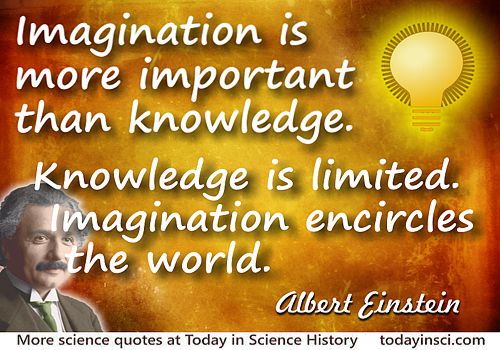
I believe in intuition and inspiration. Imagination is more important than knowledge. For knowledge is limited, whereas imagination embraces the entire world, stimulating progress, giving birth to evolution. It is, strictly speaking, a real factor in scientific research.
Cosmic Religion: With Other Opinions and Aphorisms (1931), 97.
I believe myself to possess a most singular combination of qualities exactly fitted to make me pre-eminently a discoverer of the hidden realities of nature… the belief has been forced upon me…
Firstly: Owing to some peculiarity in my nervous system, I have perceptions of some things, which no one else has… and intuitive perception of… things hidden from eyes, ears, & ordinary senses…
Secondly: my sense reasoning faculties;
Thirdly: my concentration faculty, by which I mean the power not only of throwing my whole energy & existence into whatever I choose, but also of bringing to bear on anyone subject or idea, a vast apparatus from all sorts of apparently irrelevant & extraneous sources…
Well, here I have written what most people would call a remarkably mad letter; & yet certainly one of the most logical, sober-minded, cool, pieces of composition, (I believe), that I ever framed.
Firstly: Owing to some peculiarity in my nervous system, I have perceptions of some things, which no one else has… and intuitive perception of… things hidden from eyes, ears, & ordinary senses…
Secondly: my sense reasoning faculties;
Thirdly: my concentration faculty, by which I mean the power not only of throwing my whole energy & existence into whatever I choose, but also of bringing to bear on anyone subject or idea, a vast apparatus from all sorts of apparently irrelevant & extraneous sources…
Well, here I have written what most people would call a remarkably mad letter; & yet certainly one of the most logical, sober-minded, cool, pieces of composition, (I believe), that I ever framed.
Lovelace Papers, Bodleian Library, Oxford University, 42, folio 12 (6 Feb 1841). As quoted and cited in Dorothy Stein (ed.), 'This First Child of Mine', Ada: A Life and a Legacy (1985), 86.
I have often pondered over the roles of knowledge or experience, on the one hand, and imagination or intuition, on the other, in the process of discovery. I believe that there is a certain fundamental conflict between the two, and knowledge, by advocating caution, tends to inhibit the flight of imagination. Therefore, a certain naivete, unburdened by conventional wisdom, can sometimes be a positive asset.
In R. Langlands, 'Harish-Chandra', Biographical Memoirs of Fellows of the Royal Society (1985), Vol. 31, 206.
I know few significant questions of public policy which can safely be confided to computers. In the end, the hard decisions inescapably involve imponderables of intuition, prudence, and judgment.
From Address to the Centennial Convocation of the National Academy of Sciences (22 Oct 1963), 'A Century of Scientific Conquest.' Online at The American Presidency Project.
I maintain that in every special natural doctrine only so much science proper is to be met with as mathematics; for… science proper, especially [science] of nature, requires a pure portion, lying at the foundation of the empirical, and based upon a priori knowledge of natural things. … To the possibility of a determinate natural thing, and therefore to cognise it à priori, is further requisite that the intuition corresponding à priori to the conception should be given; in other words, that the conception should be constructed. But the cognition of the reason through construction of conceptions is mathematical. A pure philosophy of nature in general, namely, one that only investigates what constitutes a nature in general, may thus be possible without mathematics; but a pure doctrine of nature respecting determinate natural things (corporeal doctrine and mental doctrine), is only possible by means of mathematics; and as in every natural doctrine only so much science proper is to be met with therein as there is cognition à priori, a doctrine of nature can only contain so much science proper as there is in it of applied mathematics.
From Preface to The Metaphysical Foundations of Natural Science (1786), as translated by Ernest Belford Boax, in Kant’s Prolegomena: And The Metaphysical Foundations of Natural Science (1883), 140.
I would picture myself as a virus, or as a cancer cell, for example, and try to sense what it would be like to be either. I would also imagine myself as the immune system, and I would try to reconstruct what I would do as an immune system engaged in combating a virus or cancer cell. When I had played through a series of such scenarios on a particular problem and had acquired new insights, I would design laboratory experiments accordingly… Based upon the results of the experiment, I would then know what question to ask next… When I observed phenomena in the laboratory that I did not understand, I would also ask questions as if interrogating myself: “Why would I do that if I were a virus or a cancer cell, or the immune system?” Before long, this internal dialogue became second nature to me; I found that my mind worked this way all the time.
In Anatomy of Reality: Merging of Intuition and Reason (1983), 7, footnote b, as quoted and cited in Roger Frantz, Two Minds: Intuition and Analysis in the History of Economic Thought (2006), 7.
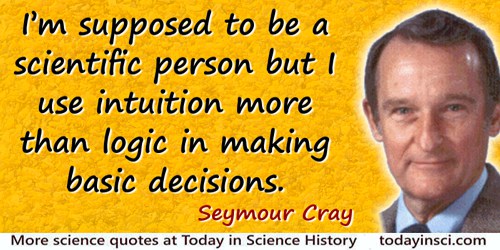
I’m supposed to be a scientific person but I use intuition more than logic in making basic decisions.
In transcript of a video history interview with Seymour Cray by David K. Allison at the National Museum of American History, Smithsonian Institution, (9 May 1995), 30.
If a mathematician of the past, an Archimedes or even a Descartes, could view the field of geometry in its present condition, the first feature to impress him would be its lack of concreteness. There are whole classes of geometric theories which proceed not only without models and diagrams, but without the slightest (apparent) use of spatial intuition. In the main this is due, to the power of the analytic instruments of investigations as compared with the purely geometric.
In 'The Present Problems in Geometry', Bulletin American Mathematical Society (1906), 286.
If arithmetical skill is the measure of intelligence, then computers have been more intelligent than all human beings all along. If the ability to play chess is the measure, then there are computers now in existence that are more intelligent than any but a very few human beings. However, if insight, intuition, creativity, the ability to view a problem as a whole and guess the answer by the “feel” of the situation, is a measure of intelligence, computers are very unintelligent indeed. Nor can we see right now how this deficiency in computers can be easily remedied, since human beings cannot program a computer to be intuitive or creative for the very good reason that we do not know what we ourselves do when we exercise these qualities.
In Machines That Think (1983).
If physics leads us today to a world view which is essentially mystical, it returns, in a way, to its beginning, 2,500 years ago. ... This time, however, it is not only based on intuition, but also on experiments of great precision and sophistication, and on a rigorous and consistent mathematical formalism.
In The Tao of Physics (1975), 19.
If we can combine our knowledge of science with the wisdom of wildness, if we can nurture civilization through roots in the primitive, man’s potentialities appear to be unbounded, Through this evolving awareness, and his awareness of that awareness, he can emerge with the miraculous—to which we can attach what better name than “God”? And in this merging, as long sensed by intuition but still only vaguely perceived by rationality, experience may travel without need for accompanying life.
A Letter From Lindbergh', Life (4 Jul 1969), 61. In Eugene C. Gerhart, Quote it Completely! (1998), 409.
In my experience most mathematicians are intellectually lazy and especially dislike reading experimental papers. He (René Thom) seemed to have very strong biological intuitions but unfortunately of negative sign.
In What Mad Pursuit: A Personal View of Scientific Discovery (1988), 136.
In the secondary schools mathematics should be a part of general culture and not contributory to technical training of any kind; it should cultivate space intuition, logical thinking, the power to rephrase in clear language thoughts recognized as correct, and ethical and esthetic effects; so treated, mathematics is a quite indispensable factor of general education in so far as the latter shows its traces in the comprehension of the development of civilization and the ability to participate in the further tasks of civilization.
The purposes of instruction in mathematics in secondary schools formulated by the German Society for the Advancement of Instruction. From Unterrichtsblätter fur Mathematik und Naturwissenschaft (1904), 128. As translated in Robert Édouard Moritz, Memorabilia Mathematica; Or, The Philomath’s Quotation-Book (1914), 72-73.
It has been just so in all my inventions. The first step is an intuition—and comes with a burst, then difficulties arise. This thing that gives out and then that—“Bugs” as such little faults and difficulties are called show themselves and months of anxious watching, study and labor are requisite before commercial success—or failure—is certainly reached.
Describing his invention of a storage battery that involved 10,296 experiments. Note Edison’s use of the term “Bug” in the engineering research field for a mechanical defect greatly predates the use of the term as applied by Admiral Grace Murray Hopper to a computing defect upon finding a moth in the electronic mainframe.] Letter to Theodore Puskas (18 Nov 1878). In The Yale Book of Quotations (2006), 226.
It is by logic that we prove, but by intuition that we discover.
In Science and Method (1908) translated by Francis Maitland (1914, 2007), 129.
It is his intuition, his mystical insight into the nature of things, rather than his reasoning which makes a great scientist.
In The Open Society and Its Enemies (1945).
It is often held that scientific hypotheses are constructed, and are to be constructed, only after a detailed weighing of all possible evidence bearing on the matter, and that then and only then may one consider, and still only tentatively, any hypotheses. This traditional view however, is largely incorrect, for not only is it absurdly impossible of application, but it is contradicted by the history of the development of any scientific theory. What happens in practice is that by intuitive insight, or other inexplicable inspiration, the theorist decides that certain features seem to him more important than others and capable of explanation by certain hypotheses. Then basing his study on these hypotheses the attempt is made to deduce their consequences. The successful pioneer of theoretical science is he whose intuitions yield hypotheses on which satisfactory theories can be built, and conversely for the unsuccessful (as judged from a purely scientific standpoint).
Co-author with Raymond Arthur Lyttleton, in 'The Internal Constitution of the Stars', Occasional Notes of the Royal Astronomical Society 1948, 12, 90.
It is through it [intuition] that the mathematical world remains in touch with the real world, and even if pure mathematics could do without it, we should still have to have recourse to it to fill up the gulf that separates the symbol from reality.
…...
It is through science that we prove, but through intuition that we discover.
…...
It was my good fortune to be linked with Mme. Curie through twenty years of sublime and unclouded friendship. I came to admire her human grandeur to an ever growing degree. Her strength, her purity of will, her austerity toward herself, her objectivity, her incorruptible judgement—all these were of a kind seldom found joined in a single individual… The greatest scientific deed of her life—proving the existence of radioactive elements and isolating them—owes its accomplishment not merely to bold intuition but to a devotion and tenacity in execution under the most extreme hardships imaginable, such as the history of experimental science has not often witnessed.
Out of My Later Years (1950), 227-8.
Jacques Hadamard, the French mathematician, has written a little book … and describes how intuition wells up from completely unfathomable depths, first appears in a peculiar guise, and then suddenly breaks out with lightning clarity.
In 'Homo Scientificus According to Beckett', collected in William Beranek, Jr. (ed.),Science, Scientists, and Society, (1972), 135-. Excerpted in Ann E. Kammer, Science, Sex, and Society (1979), 285. (Hadamard’s book is An Essay on the Psychology of Invention in the Mathematical Field.)
Knowledge is necessary too. A child with great intuition could not grow up to become something worthwhile in life without some knowledge. However there comes a point in everyone’s life where only intuition can make the leap ahead, without knowing precisely how.
As recollected from a visit some months earlier, and quoted in William Miller, 'Old Man’s Advice to Youth: “Never Lose a Holy Curiosity”', Life (2 May 1955), 64.
Let us now declare the means whereby our understanding can rise to knowledge without fear of error. There are two such means: intuition and deduction. By intuition I mean not the varying testimony of the senses, nor the deductive judgment of imagination naturally extravagant, but the conception of an attentive mind so distinct and so clear that no doubt remains to it with regard to that which it comprehends; or, what amounts to the same thing, the self-evidencing conception of a sound and attentive mind, a conception which springs from the light of reason alone, and is more certain, because more simple, than deduction itself. …
It may perhaps be asked why to intuition we add this other mode of knowing, by deduction, that is to say, the process which, from something of which we have certain knowledge, draws consequences which necessarily follow therefrom. But we are obliged to admit this second step; for there are a great many things which, without being evident of themselves, nevertheless bear the marks of certainty if only they are deduced from true and incontestable principles by a continuous and uninterrupted movement of thought, with distinct intuition of each thing; just as we know that the last link of a long chain holds to the first, although we can not take in with one glance of the eye the intermediate links, provided that, after having run over them in succession, we can recall them all, each as being joined to its fellows, from the first up to the last. Thus we distinguish intuition from deduction, inasmuch as in the latter case there is conceived a certain progress or succession, while it is not so in the former; … whence it follows that primary propositions, derived immediately from principles, may be said to be known, according to the way we view them, now by intuition, now by deduction; although the principles themselves can be known only by intuition, the remote consequences only by deduction.
It may perhaps be asked why to intuition we add this other mode of knowing, by deduction, that is to say, the process which, from something of which we have certain knowledge, draws consequences which necessarily follow therefrom. But we are obliged to admit this second step; for there are a great many things which, without being evident of themselves, nevertheless bear the marks of certainty if only they are deduced from true and incontestable principles by a continuous and uninterrupted movement of thought, with distinct intuition of each thing; just as we know that the last link of a long chain holds to the first, although we can not take in with one glance of the eye the intermediate links, provided that, after having run over them in succession, we can recall them all, each as being joined to its fellows, from the first up to the last. Thus we distinguish intuition from deduction, inasmuch as in the latter case there is conceived a certain progress or succession, while it is not so in the former; … whence it follows that primary propositions, derived immediately from principles, may be said to be known, according to the way we view them, now by intuition, now by deduction; although the principles themselves can be known only by intuition, the remote consequences only by deduction.
In Rules for the Direction of the Mind, Philosophy of Descartes. [Torrey] (1892), 64-65.
Logic teaches us that on such and such a road we are sure of not meeting an obstacle; it does not tell us which is the road that leads to the desired end. For this, it is necessary to see the end from afar, and the faculty which teaches us to see is intuition. Without it, the geometrician would be like a writer well up in grammar but destitute of ideas.
…...
Mathematicians create by acts of insight and intuition. Logic then sanctions the conquests of intuition. It is the hygiene that mathematics practices to keep its ideas healthy and strong. Moreover, the whole structure rests fundamentally on uncertain ground, the intuition of humans. Here and there an intuition is scooped out and replaced by a firmly built pillar of thought; however, this pillar is based on some deeper, perhaps less clearly defined, intuition. Though the process of replacing intuitions with precise thoughts does not change the nature of the ground on which mathematics ultimately rests, it does add strength and height to the structure.
In Mathematics in Western Culture (1964), 408.
Mathematics as an expression of the human mind reflects the active will, the contemplative reason, and the desire for aesthetic perfection. Its basic elements are logic and intuition, analysis and construction, generality and individuality. Though different traditions may emphasize different aspects, it is only the interplay of these antithetic forces and the struggle for their synthesis that constitute the life, usefulness, and supreme value of mathematical science.
As co-author with Herbert Robbins, in What Is Mathematics?: An Elementary Approach to Ideas and Methods (1941, 1996), x.
Mathematics is often erroneously referred to as the science of common sense. Actually, it may transcend common sense and go beyond either imagination or intuition. It has become a very strange and perhaps frightening subject from the ordinary point of view, but anyone who penetrates into it will find a veritable fairyland, a fairyland which is strange, but makes sense, if not common sense.
With co-author James R. Newman, in Mathematics and the Imagination (1940), 359.
Men of science belong to two different types—the logical and the intuitive. Science owes its progress to both forms of minds. Mathematics, although a purely logical structure, nevertheless makes use of intuition. Among the mathematicians there are intuitives and logicians, analysts and geometricians. Hermite and Weierstrass were intuitives. Riemann and Bertrand, logicians. The discoveries of intuition have always to be developed by logic.
In Man the Unknown (1935), 123.
My crystal ball or intuition tells me that in the '80s the impact of RIA [radioimmunoassay] on the study of infectious diseases may prove as revolutionary as its impact on endocrinology in the 60s.
Radioimmunoassay: A probe for fine structure of biological systems Nobel Lecture, 8 Dec 1977
My view of the matter, for what it is worth, is that there is no such thing as a logical method of having new ideas, or a logical reconstruction of this process. My view may be expressed by saying that every discovery contains an “irrational element,” or “a creative intuition,” in Bergson's sense. In a similar way Einstein speaks of the “search for those highly universal laws … from which a picture of the world can be obtained by pure deduction. There is no logical path.” he says, “leading to these … laws. They can only be reached by intuition, based upon something like an intellectual love (Einfühlung) of the objects of experience.”
In The Logic of Scientific Discovery: Logik Der Forschung (1959, 2002), 8.
Notion without intuition is empty, intuition without notion is blind.
In Ralph Keyesr, The Quote Verifier, 52.
Professor [Max] Planck, of Berlin, the famous originator of the Quantum Theory, once remarked to me that in early life he had thought of studying economics, but had found it too difficult! Professor Planck could easily master the whole corpus of mathematical economics in a few days. He did not mean that! But the amalgam of logic and intuition and the wide knowledge of facts, most of which are not precise, which is required for economic interpretation in its highest form is, quite truly, overwhelmingly difficult for those whose gift mainly consists in the power to imagine and pursue to their furthest points the implications and prior conditions of comparatively simple facts which are known with a high degree of precision.
'Alfred Marshall: 1842-1924' (1924). In Geoffrey Keynes (ed.), Essays in Biography (1933), 191-2
Prolonged commitment to mathematical exercises in economics can be damaging. It leads to the atrophy of judgement and intuition which are indispensable for real solutions and, on occasion, leads also to a habit of mind which simply excludes the mathematically inconvenient factors from consideration.
In Economics, Peace, and Laughter (1981), 41, footnote.
Pure mathematics is a collection of hypothetical, deductive theories, each consisting of a definite system of primitive, undefined, concepts or symbols and primitive, unproved, but self-consistent assumptions (commonly called axioms) together with their logically deducible consequences following by rigidly deductive processes without appeal to intuition.
In 'Non-Euclidian Geometry of the Fourth Dimension', collected in Henry Parker Manning (ed.), The Fourth Dimension Simply Explained (1910), 58.
Science discovery is an irrational act. It’s an intuition which turns out to be reality at the end of it. I see no difference between a scientist developing a marvellous discovery and an artist making a painting
From 'Asking Nature', collected in Lewis Wolpert and Alison Richards (eds.), Passionate Minds: The Inner World of Scientists (1997), 197.
Science does not mean an idle resting upon a body of certain knowledge; it means unresting endeavor and continually progressing development toward an end which the poetic intuition may apprehend, but which the intellect can never fully grasp.
In The Philosophy of Physics (1936). Collected in The New Science: 3 Complete Works (1959), 290.
Science, then, is the attentive consideration of common experience; it is common knowledge extended and refined. Its validity is of the same order as that of ordinary perception; memory, and understanding. Its test is found, like theirs, in actual intuition, which sometimes consists in perception and sometimes in intent. The flight of science is merely longer from perception to perception, and its deduction more accurate of meaning from meaning and purpose from purpose. It generates in the mind, for each vulgar observation, a whole brood of suggestions, hypotheses, and inferences. The sciences bestow, as is right and fitting, infinite pains upon that experience which in their absence would drift by unchallenged or misunderstood. They take note, infer, and prophesy. They compare prophesy with event, and altogether they supply—so intent are they on reality—every imaginable background and extension for the present dream.
The Life of Reason, or the Phases of Human Progress (1954), 393.
Scientific research was much like prospecting: you went out and you hunted, armed with your maps and instruments, but in the ened your preparations did not matter, or even your intuition. You needed your luck, and whatever benefits accrued to the diligent, through sheer, grinding hard work.
The Andromeda Strain (1969)
Since the seventeenth century, physical intuition has served as a vital source for mathematical porblems and methods. Recent trends and fashions have, however, weakened the connection between mathematics and physics; mathematicians, turning away from their roots of mathematics in intuition, have concentrated on refinement and emphasized the postulated side of mathematics, and at other times have overlooked the unity of their science with physics and other fields. In many cases, physicists have ceased to appreciate the attitudes of mathematicians. This rift is unquestionably a serious threat to science as a whole; the broad stream of scientific development may split into smaller and smaller rivulets and dry out. It seems therefore important to direct our efforts towards reuniting divergent trends by classifying the common features and interconnections of many distinct and diverse scientific facts.
As co-author with David Hilbert, in Methods of Mathematical Physics (1937, 1989), Preface, v.
Statistical analysis in cases involving small numbers can be particularly helpful because on many occasions intuition can be highly misleading.
In essay 'Statistical Proof of Employment Discrimination', collected in Judith M. Tanur et al. (eds.), Statistics, a Guide to the Unknown (3rd ed., 1989), 83.
The arithmetization of mathematics … which began with Weierstrass … had for its object the separation of purely mathematical concepts, such as number and correspondence and aggregate, from intuitional ideas, which mathematics had acquired from long association with geometry and mechanics. These latter, in the opinion of the formalists, are so firmly entrenched in mathematical thought that in spite of the most careful circumspection in the choice of words, the meaning concealed behind these words, may influence our reasoning. For the trouble with human words is that they possess content, whereas the purpose of mathematics is to construct pure thought. But how can we avoid the use of human language? The … symbol. Only by using a symbolic language not yet usurped by those vague ideas of space, time, continuity which have their origin in intuition and tend to obscure pure reason—only thus may we hope to build mathematics on the solid foundation of logic.
In Tobias Dantzig and Joseph Mazur (ed.), Number: The Language of Science (1930, ed. by Joseph Mazur 2007), 99.
The actuality of us being cognizant and accepting of the fact we are but a speck of sand in a universe sized desert, whose existence is irrelevant to any facet of universal function is a hard pill to swallow. Knowing the world will go on for another billion years after death and you will have no recollection of anything, just as you have no recollection of the billion years before your birth is a mind-boggling intuition.
In White Guilt (2010), 90.
The common perception of science as a rational activity, in which one confronts the evidence of fact with an open mind, could not be more false. Facts assume significance only within a pre-existing intellectual structure, which may be based as much on intuition and prejudice as on reason.
In The Guardian, September 28, 1989.
The degree of exactness of the intuition of space may be different in different individuals, perhaps even in different races. It would seem as if a strong naive space-intuition were an attribute pre-eminently of the Teutonic race, while the critical, purely logical sense is more fully developed in the Latin and Hebrew races. A full investigation of this subject, somewhat on the lines suggested by Francis Gallon in his researches on heredity, might be interesting.
In The Evanston Colloquium Lectures (1894), 46.
The discovery of truth by slow, progressive meditation is talent. Intuition of the truth, not preceded by perceptible meditation, is genius.
Aphorism 93 (1787), in Aphorisms on Man. Translated from the original manuscript of the Rev. John Caspar Lavater (3rd ed. 1790), 36.
The first [quality] to be named must always be the power of attention, of giving one's whole mind to the patient without the interposition of anything of oneself. It sounds simple but only the very greatest doctors ever fully attain it. … The second thing to be striven for is intuition. This sounds an impossibility, for who can control that small quiet monitor? But intuition is only interference from experience stored and not actively recalled. … The last aptitude I shall mention that must be attained by the good physician is that of handling the sick man's mind.
In 'Art and Science in Medicine', The Collected Papers of Wilfred Trotter, FRS (1941), 98.
The functional validity of a working hypothesis is not a priori certain, because often it is initially based on intuition. However, logical deductions from such a hypothesis provide expectations (so-called prognoses) as to the circumstances under which certain phenomena will appear in nature. Such a postulate or working hypothesis can then be substantiated by additional observations ... The author calls such expectations and additional observations the prognosis-diagnosis method of research. Prognosis in science may be termed the prediction of the future finding of corroborative evidence of certain features or phenomena (diagnostic facts). This method of scientific research builds up and extends the relations between the subject and the object by means of a circuit of inductions and deductions.
In 'The Scientific Character of Geology', The Journal of Geology (Jul 1961), 69, No. 4, 454-5.
The intellect has little to do on the road to discovery. There comes a leap in consciousness, call it intuition or what you will, and the solution comes to you and you don’t know why or how.
Quoted in Forbes (15 Sep 1974). In Larry Chang, Wisdom for the Soul (2006), 179.
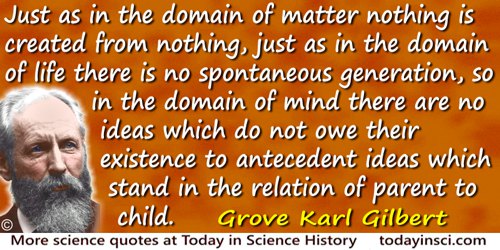
The mental process by which hypotheses are suggested is obscure. Ordinarily they flash into consciousness without premonition, and it would he easy to ascribe them to a mysterious intuition or creative faculty; but this would contravene one of the broadest generalizations of modern psychology. Just as in the domain of matter nothing is created from nothing, just as in the domain of life there is no spontaneous generation, so in the domain of mind there are no ideas which do not owe their existence to antecedent ideas which stand in the relation of parent to child.
In Address (11 Dec 1895) as President of the Geological Society, 'The Origin of Hypotheses, illustrated by the Discussion of a Topographical Problem', printed as Presidential Address of Grove Karl Gilbert (1896), 4. Also collected in Science (1896), 3, 2.
The moment of truth, the sudden emergence of new insight, is an act of intuition. Such intuitions give the appearance of miraculous flashes, or short circuits of reasoning. In fact they may be likened to an immersed chain, of which only the beginning and the end are visible above the surface of consciousness. The diver vanishes at one end of the chain and comes up at the other end, guided by invisible links.
In The Act of Creation (1964).
The new painters do not propose, any more than did their predecessors, to be geometers. But it may be said that geometry is to the plastic arts what grammar is to the art of the writer. Today, scholars no longer limit themselves to the three dimensions of Euclid. The painters have been lead quite naturally, one might say by intuition, to preoccupy themselves with the new possibilities of spatial measurement which, in the language of the modern studios, are designated by the term fourth dimension.
The Cubist Painters: Aesthetic Meditations (1913) translated by Lionel Abel (1970), 13. Quoted in Michele Emmer, The Visual Mind II (2005), 352.
The question of the origin of the hypothesis belongs to a domain in which no very general rules can be given; experiment, analogy and constructive intuition play their part here. But once the correct hypothesis is formulated, the principle of mathematical induction is often sufficient to provide the proof.
As co-author with Herbert Robbins, in What Is Mathematics?: An Elementary Approach to Ideas and Methods (1941, 1996), 15.
The really valuable factor is intuition!
In Alexander Moszkowski, Gesprächen mit Einstein (1921), translated in Conversations with Einstein 96.
The scientific value of truth is not, however, ultimate or absolute. It rests partly on practical, partly on aesthetic interests. As our ideas are gradually brought into conformity with the facts by the painful process of selection,—for intuition runs equally into truth and into error, and can settle nothing if not controlled by experience,—we gain vastly in our command over our environment. This is the fundamental value of natural science
In The Sense of Beauty: Being the Outlines of Aesthetic Theory (1896), 22.
The supreme task of the physicist is to arrive at those universal elementary laws from which the cosmos can be built up by pure deduction. There is no logical path to these laws; only intuition, resting on sympathetic understanding of experience, can reach them. In this methodological uncertainty, one might suppose that there were any number of possible systems of theoretical physics all equally well justified; and this opinion is no doubt correct, theoretically. But the development of physics has shown that at any given moment, out of all conceivable constructions, a single one has always proved itself decidedly superior to all the rest.
Address (1918) for Max Planck's 60th birthday, at Physical Society, Berlin, 'Principles of Research' in Essays in Science (1934), 4.
The threads that archaeology has put in Sir Arthur Evans’ hands are of necessity tangled, faded and broken; yet his learning and intuition have enabled him to weave them into a coherent whole that is almost history.
From Bosanquet’s book review, 'The Realm of Minos', (of Sir Arthur Evans’, The Palace of Minos: A Comparative Account of the Successive Stages of the Early Cretan Civilization as Illustrated by the Discoveries at Knossos: Volume I), in Harold Cox, ed., The Edinburgh Review (Jul 1922), 236, No. 481, 70.
Then followed months of intense thought in order to find out what the bewildering chaos of scattered observations meant until one day all of a sudden the whole became as clear and comprehensible as if it were illuminated with a flash of light … There are not many joys in human life equal to the joy of the sudden birth of a generalisation illuminating the mind after a long period of patient research.”
In Memoirs of a Revolutionist, 226-227. Concerning his geographical “meticulous research which resulted in his discovery of the configuration of the mountains of Asia—a discovery which he regarded as his most significant contribution to science.” As quoted, commented and cited in Caroline Cahm, Kropotkin: And the Rise of Revolutionary Anarchism, 1872-1886 (2002), 24.
There does seem to be a sense in which physics has gone beyond what human intuition can understand. We shouldn’t be too surprised about that because we’re evolved to understand things that move at a medium pace at a medium scale. We can’t cope with the very tiny scale of quantum physics or the very large scale of relativity.
From 'Interview: Of Mind and Matter: David Attenborough Meets Richard Dawkins', The Guardian (11 Sep 2010).
There is no logical way to the discovery of these elemental laws. There is only the way of intuition, which is helped by a feeling for the order lying behind the appearance.
In the 'Introduction' he wrote for Max Planck’s book, Where is Science Going (c.1932), 12, translated by James Murphy.
There is, however, no genius so gifted as not to need control and verification. ... [T]he brightest flashes in the world of thought are incomplete until they have been proved to have their counterparts in the world of fact. Thus the vocation of the true experimentalist may be defined as the continued exercise of spiritual insight, and its incessant correction and realisation. His experiments constitute a body, of which his purified intuitions are, as it were, the soul.
In 'Vitality', Scientific Use of the Imagination and Other Essays (1872), 43.
Thoughts without content are empty, intuitions without concepts are blind... The understanding can intuit nothing, the senses can think nothing. Only through their union can knowledge arise.
Critique of Pure Reason (1781), trans. Norman Kemp Smith (1929), 93.
Truths are known to us in two ways: some are known directly, and of themselves; some through the medium of other truths. The former are the subject of Intuition, or Consciousness; the latter, of Inference; the latter of Inference. The truths known by Intuition are the original premisses, from which all others are inferred.
A System of Logic, Ratiocinative and Inductive (1858), 3.
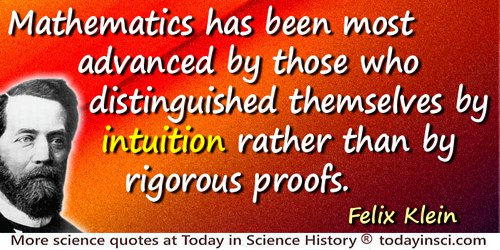
Undoubtedly, the capstone of every mathematical theory is a convincing proof of all of its assertions. Undoubtedly, mathematics inculpates itself when it foregoes convincing proofs. But the mystery of brilliant productivity will always be the posing of new questions, the anticipation of new theorems that make accessible valuable results and connections. Without the creation of new viewpoints, without the statement of new aims, mathematics would soon exhaust itself in the rigor of its logical proofs and begin to stagnate as its substance vanishes. Thus, in a sense, mathematics has been most advanced by those who distinguished themselves by intuition rather than by rigorous proofs.
As quoted in Hermann Weyl, Unterrichtsblätter für Mathematik und Naturwissenschaften (1932), 38, 177-188. As translated by Abe Shenitzer, in 'Part I. Topology and Abstract Algebra as Two Roads of Mathematical Comprehension', The American Mathematical Monthly (May 1995), 102, No. 7, 453.
Von Helmholtz, the great German physicist said that after previous investigation of a problem “in all directions … happy ideas came unexpectedly without effort like an inspiration.” He found that ideas did not come to him when his mind was fatigued or when at the working table, but often in the morning after a night’s rest or during the slow ascent of wooded hills on a sunny day.
In The Art of Scientific Investigation (1950), 69.
We all know, from what we experience with and within ourselves, that our conscious acts spring from our desires and our fears. Intuition tells us that that is true also of our fellows and of the higher animals. We all try to escape pain and death, while we seek what is pleasant. We are all ruled in what we do by impulses; and these impulses are so organized that our actions in general serve for our self preservation and that of the race. Hunger, love, pain, fear are some of those inner forces which rule the individual’s instinct for self preservation. At the same time, as social beings, we are moved in the relations with our fellow beings by such feelings as sympathy, pride, hate, need for power, pity, and so on. All these primary impulses, not easily described in words, are the springs of man’s actions. All such action would cease if those powerful elemental forces were to cease stirring within us. Though our conduct seems so very different from that of the higher animals, the primary instincts are much alike in them and in us. The most evident difference springs from the important part which is played in man by a relatively strong power of imagination and by the capacity to think, aided as it is by language and other symbolical devices. Thought is the organizing factor in man, intersected between the causal primary instincts and the resulting actions. In that way imagination and intelligence enter into our existence in the part of servants of the primary instincts. But their intervention makes our acts to serve ever less merely the immediate claims of our instincts.
…...
We do whatever we can to deny intuition of the invisible realms. We clog up our senses with smog, jam our minds with media overload. We drown ourselves in alcohol or medicate ourselves into rigidly artificial states... we take pride in our cynicism and detachment. Perhaps we are terrified to discover that our “rationality” is itself a kind of faith, an artifice, that beneath it lies the vast territory of the unknown.
Quoted in Kim Lim (ed.), 1,001 Pearls of Spiritual Wisdom: Words to Enrich, Inspire, and Guide Your Life (2014), 29
When a scientist is ahead of his times, it is often through misunderstanding of current, rather than intuition of future truth. In science there is never any error so gross that it won't one day, from some perspective, appear prophetic.
Pensées d'un Biologiste (1939). Translated in The Substance of Man (1962), Chap. 7.
When someone says “I am thinking, therefore I am, or I exist,” he does not deduce existence from thought by means of a syllogism, but recognises it as something self-evident by a simple intuition of the mind. This is clear from the fact that if he were deducing it by means of a syllogism, he would have to have had previous knowledge of the major premiss 'Everything which thinks is, or exists'; yet in fact he learns it from experiencing in his own case that it is impossible that he should think without existing. It is in the nature of our mind to construct general propositions on the basis of our knowledge of particular ones.
Author's Replies to the Second set of Objections to Meditations on the First Philosophy (1641), in The Philosophical Writings of Descartes (1985), trans. J. Cottingham, R. Stoothoff and D. Murdoch, Vol. 2, 100.
When the logician has resolved each demonstration into a host of elementary operations, all of them correct, he will not yet be in possession of the whole reality, that indefinable something that constitutes the unity ... Now pure logic cannot give us this view of the whole; it is to intuition that we must look for it.
Science and Method (1914 edition, reprint 2003), 126.
Wisdom is a river that runs deep and slow. Inspiration and intuition are
lightning flashes reflected on its surface.
In Barbara A. Robinson, Mind Bungee Jumping: Words of Life, Love, Inspiration, Encouragement and Motivation (2008), 287.
by - Poetry - 2008
Without the sensuous faculty no object would be given to us, without understanding no object would be thought. Thoughts without content are void, intuitions without conceptions, blind.
Critique of Pure Reason, translation by John Miller Dow Meiklejohn (1899), 45.
 In science it often happens that scientists say, 'You know that's a really good argument; my position is mistaken,' and then they would actually change their minds and you never hear that old view from them again. They really do it. It doesn't happen as often as it should, because scientists are human and change is sometimes painful. But it happens every day. I cannot recall the last time something like that happened in politics or religion.
(1987) --
In science it often happens that scientists say, 'You know that's a really good argument; my position is mistaken,' and then they would actually change their minds and you never hear that old view from them again. They really do it. It doesn't happen as often as it should, because scientists are human and change is sometimes painful. But it happens every day. I cannot recall the last time something like that happened in politics or religion.
(1987) -- 




